Depicting Difference: The Tower of Babel and the Language of Sacred Art

Depicting Difference: The Tower of Babel and the Language of Sacred Art

“For form is only the manifestation, the shape of content.”
Ben Shahn, The Shape of Content, p. 72

Genesis chapter 11 presents the narrative of the Tower of Babel, detailing how, contrary to the divine directive to disperse and populate the earth, the descendants of the flood’s survivors congregated in a single city and commenced construction of a substantial tower. God intervened to prevent further cooperation among them by disrupting their shared language, thereby introducing linguistic diversity, which ultimately ceased the building process and resulted in the broad dispersal of the population.

The account of the Tower of Babel offers a unique context for exploring what characterizes an image—and, by extension, a work of art—as Jewish. In Christian artistic traditions, from medieval illuminations to Renaissance paintings, the tower is often portrayed as a symbol of pride and serves as a cautionary emblem against human ambition. In contrast, Jewish philosophy and visual culture do not treat the tower as an important iconographic motif or as a warning against aspiration. Where the story does appear in Jewish art, it offers an alternative interpretation, and in certain instances, it recasts the tower motif in a more positive light.

The Architecture of Arrogance: Bruegel’s Tower and the Christian Moral Imagination

A painting of a tower of babel AI-generated content may be incorrect.

Figure 1: Pieter Bruegel, The Tower of Babel, Kunsthistorisches Museum, Vienna

Among the most celebrated representations of the Tower of Babel is Pieter Bruegel the Elder’s painting housed in Vienna’s Kunsthistorisches Museum (we previously discussed another painting from the museum, Samuel van Hoogstraten’s Old Man at a Window, and whether it is a Jewish painting, its subject a famous Rabbi). Measuring over three feet wide and five feet high, this work features a monumental spiral structure composed of arches and tiers that ascend unevenly into the clouds. The immense scale of the tower stands in stark contrast to the small human figures depicted throughout—hundreds of workers engaged in various tasks. Bruegel’s paintings are notable for their comprehensive and detailed portrayal of subjects. (This site allows you to zoom in on all the details.) In this scene, each trade and stage of construction is rendered with meticulous attention; some laborers transport massive stone blocks along ramps, while oxen-pulled carts bear heavy loads of building materials. Human-powered treadwheel cranes lift supplies upward, and scaffolding constructed from poles, planks, and ropes clings to the sides of the tower. Masons apply mortar and lay bricks, carpenters reinforce beams, and overseers direct operations, attempting to manage the complexity and activity inherent in such an undertaking.

In the foreground, King Nimrod, adorned in elaborate robes and a crown, oversees the construction as the principal architect of the tower. He reviews architectural plans with his attendants while laborers kneel. Surrounding him, foremen gesture towards the ascending walls, effectively conveying his directives to the assembled workforce. Beyond the imposing structure of the tower, ships are visible entering the harbor, their masts prominent on the horizon.

Bruegel often used allegory in his work. By integrating contemporary construction methods and maritime elements into the depiction of the ancient story, he placed Babel in the context of his own time. The painting presents examples of human innovation alongside the risks associated with ambitious endeavors, making its observations applicable from the 16th century to the present day.[1]

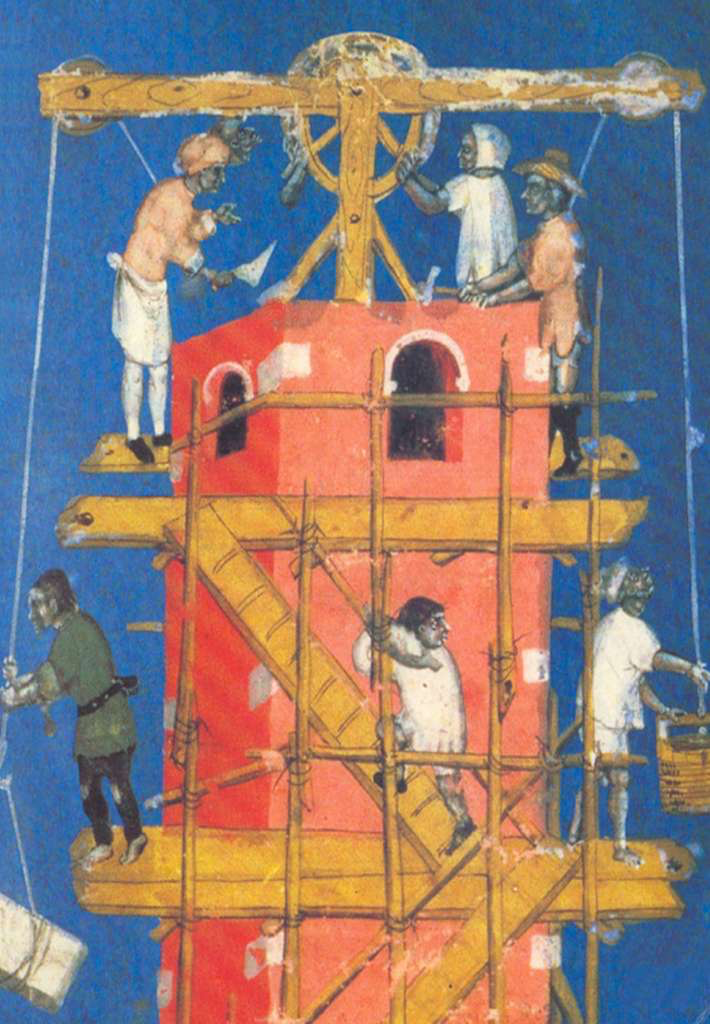
A painting of people working on a tower AI-generated content may be incorrect.

Figure 2: 13th Century Manuscript of Rudolf von Ems Poetry

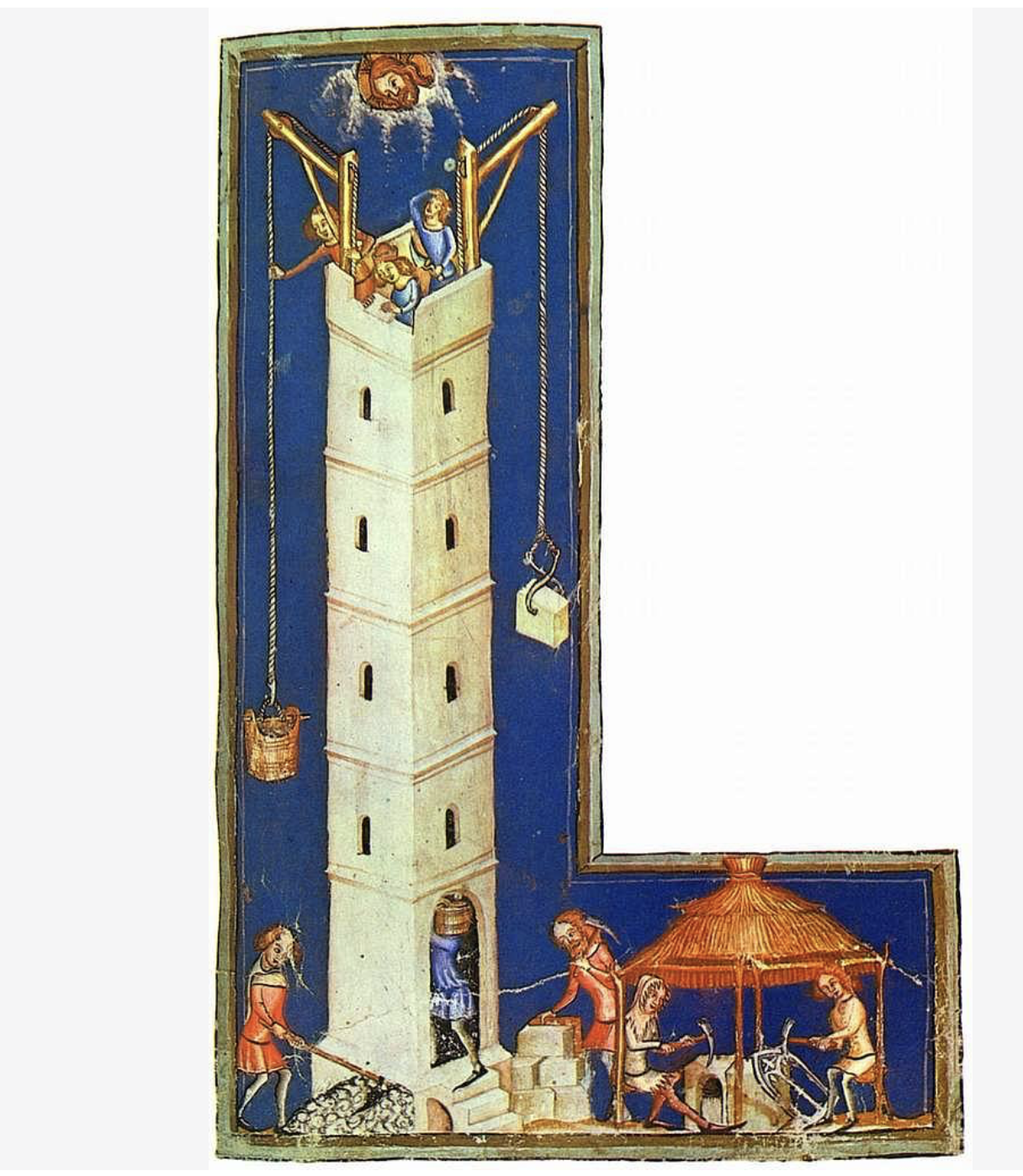
A letter l with a tower and people working AI-generated content may be incorrect.

Figure 3: 14th Century York Manuscript

Earlier artistic portrayals commonly focused on Babel’s height and grandeur. Medieval manuscripts and Church paintings often depicted it as upright, rectilinear, and monumental, resembling a fortress or cathedral spire. In contrast, Bruegel presents the tower as unstable, leaning, and showing deterioration at its foundation, while construction continues at the upper levels. The structure appears to challenge natural order by being built atop a mountain and using brick, which leads to rock formations that affect its stability. Bruegel incorporates Roman arches reminiscent of the Colosseum, suggesting parallels to historical architecture that had fallen into decline by the time of his visit in 1560. Some areas are already inhabited; for example, a woman is seen hanging laundry. The residents appear unaware of the structural issues beneath them, blinded by their hubris. Nimrod’s prominence in the foreground, with the workers genuflecting to him and his plans that he holds in his hands, further emphasizes the fetishization of human ambition.

At the time, Bruegel’s audience didn’t have to look far to see a potential Babel in the making: Antwerp was booming, expanding, and building like never before, and its populace risked falling into the sin of pride. In 1563, when Bruegel painted the Tower of Babel, the city was Europe’s busiest port and a magnet for wealth, with goods and materials streaming in daily through the Scheldt River. Massive new fortifications were under construction to secure the city’s growth, while the Cathedral of Our Lady still stood unfinished, its single soaring spire a symbol of grandeur halted midstream. Cranes, treadwheels, scaffolding, and teams of laborers were familiar sights on Antwerp’s skyline, all details Bruegel carefully folded into his painting. Even the ships visible in the harbor of his Babel recall Antwerp’s bustling docks, tying the biblical story directly to his contemporaries’ lived experience. For Bruegel’s viewers, the tower was not just a monument to ancient pride but a mirror of their own city’s dazzling ambition and its underlying fragility.

Bruegel does not show the dramatic aftermath, the confusion of tongues, and the scattering of peoples across the earth. Instead, he arrests the narrative at the moment of construction, filling the canvas with the feverish activity of workers and the looming mass of the tower itself. In doing so, he lets the architecture bear the weight of the story: the leaning walls, the buckling arches, and the crumbling base foreshadow the enterprise’s futility. The punishment is absent because the tower already embodies it, an image of human ambition that carries within itself the seeds of its own destruction.

Bruegel’s legacy is twofold. On the one hand, he fixed Babel’s appearance for centuries: spiraling, leaning, and crumbling, the visual template repeated in paintings, engravings, church murals, and biblical illustrations well into the modern era. From 16th-century Flemish workshops to 18th-century Bibles, from church frescoes to Romantic illustrations, and even into 20th-century literature and contemporary art, Bruegel’s leaning Tower of Babel has been endlessly reimagined as the enduring image of human ambition and collapse.[2] On the other hand, he reshaped its meaning. Earlier images celebrated human pride by showing the tower upright and impregnable. Bruegel’s version, and the generations of artists and authors who followed, transformed it into a parable of fragility, a monument doomed to collapse even as it rose.

Buildings Fall Books Endure: The Jewish Reading of Babel

Within the Jewish exegetical tradition, the story of Babel carries a different emphasis than in Bruegel’s Christian retelling. The tower itself is a bit player in a larger story, a catalyst and not the focus, less important than the human decision it symbolizes. In Genesis 9:1, God commands Noah’s descendants to “be fruitful, multiply, and fill the earth.” Yet instead of dispersing across the world, humanity chooses to settle in one place and build a city and tower “lest we be scattered abroad upon the face of the whole earth” (Gen. 11:4). In this reading, the sin is not arrogance against heaven but resistance to God’s plan of dispersal. The tower becomes a narrative device, a means of dramatizing humankind’s determination to remain unified, sedentary, and secure.[3]

Seen from this perspective, the confusion of languages and scattering of peoples is not so much a punishment as a necessary correction. The multiplicity of tongues is God’s way of ensuring that His will for humanity, for it to spread, diversify, and populate the earth, is carried out. The Jewish interpretation, therefore, reads the story as a lesson about human attempts to thwart divine design, not Bruegel’s Christian vision, which centers on pride and monumental ambition. What matters is not the tower’s collapse but humanity’s refusal to scatter, and the way God ultimately enforces the order of creation.

This contrast is confirmed by the way Jewish tradition titles the episode “Dor Haflagah,” meaning “the Generation of Division,” rather than “Migdal Bavel,” the Tower of Babel. (Sanhedrin 10:3; Baba Metziah 4:2). The Hebrew name shifts attention away from architecture altogether and toward the human drama: the refusal to scatter, the divine act of dividing languages, and the dispersal across the earth. In other words, where Christianity made the tower a visual icon, Judaism made the generation itself the lesson.[4]

This approach was not only in Jewish exegesis but also in Jewish art. There are only five identified examples of the tower in Jewish art, but in all of them, it is illustrated in a uniquely Jewish manner.

A mosaic of people in different poses AI-generated content may be incorrect.

Figure 4: Tower of Babel, Khirbet Wadi Hamam Mosaic, c. 3rd century, source.

A mosaic of people working on a building AI-generated content may be incorrect.

Figure 5: Tower of Babel, Huqoq Synagogue, c. 5th Century

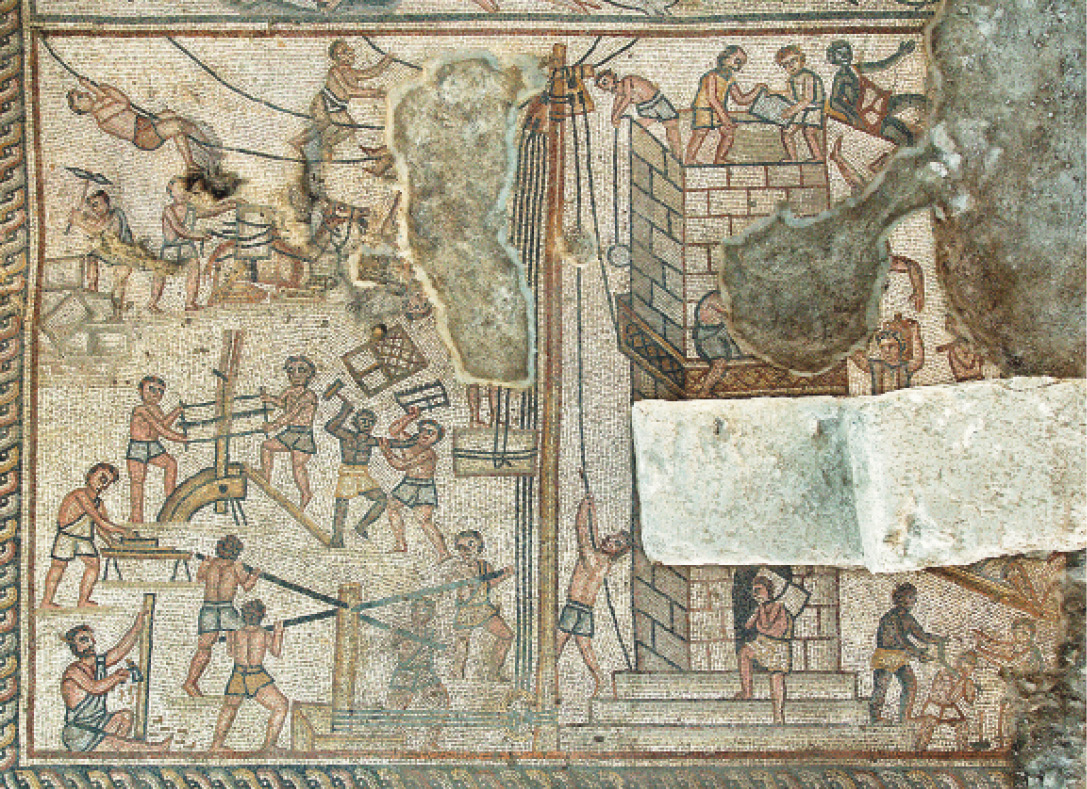
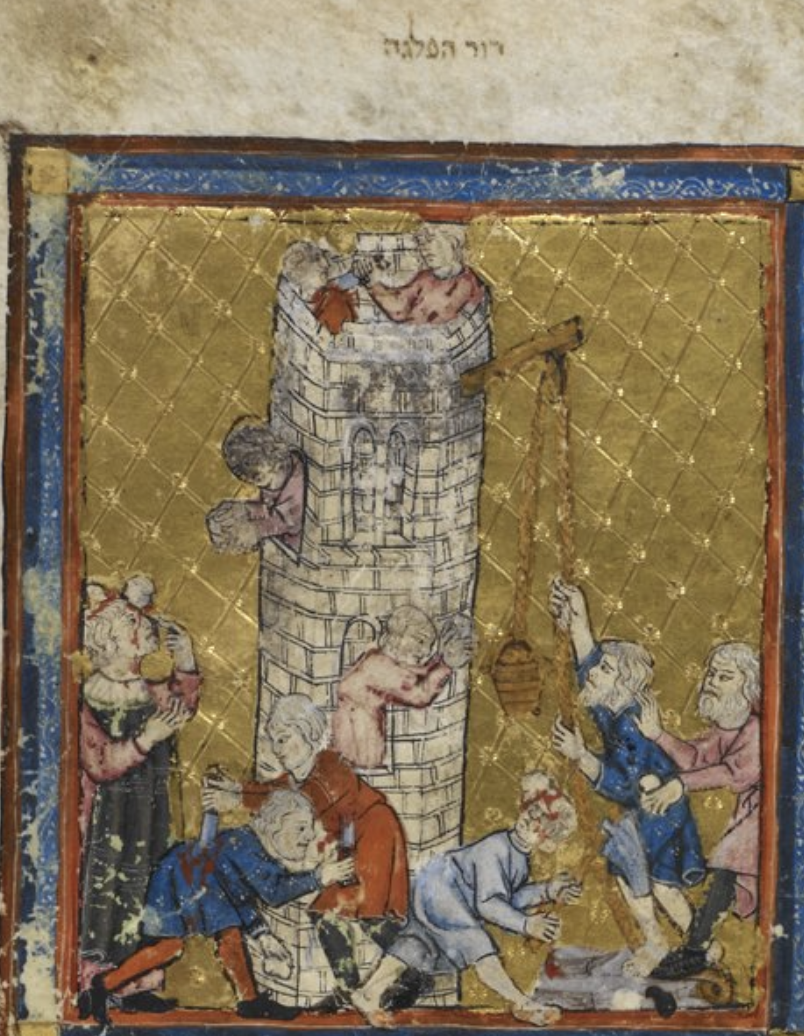
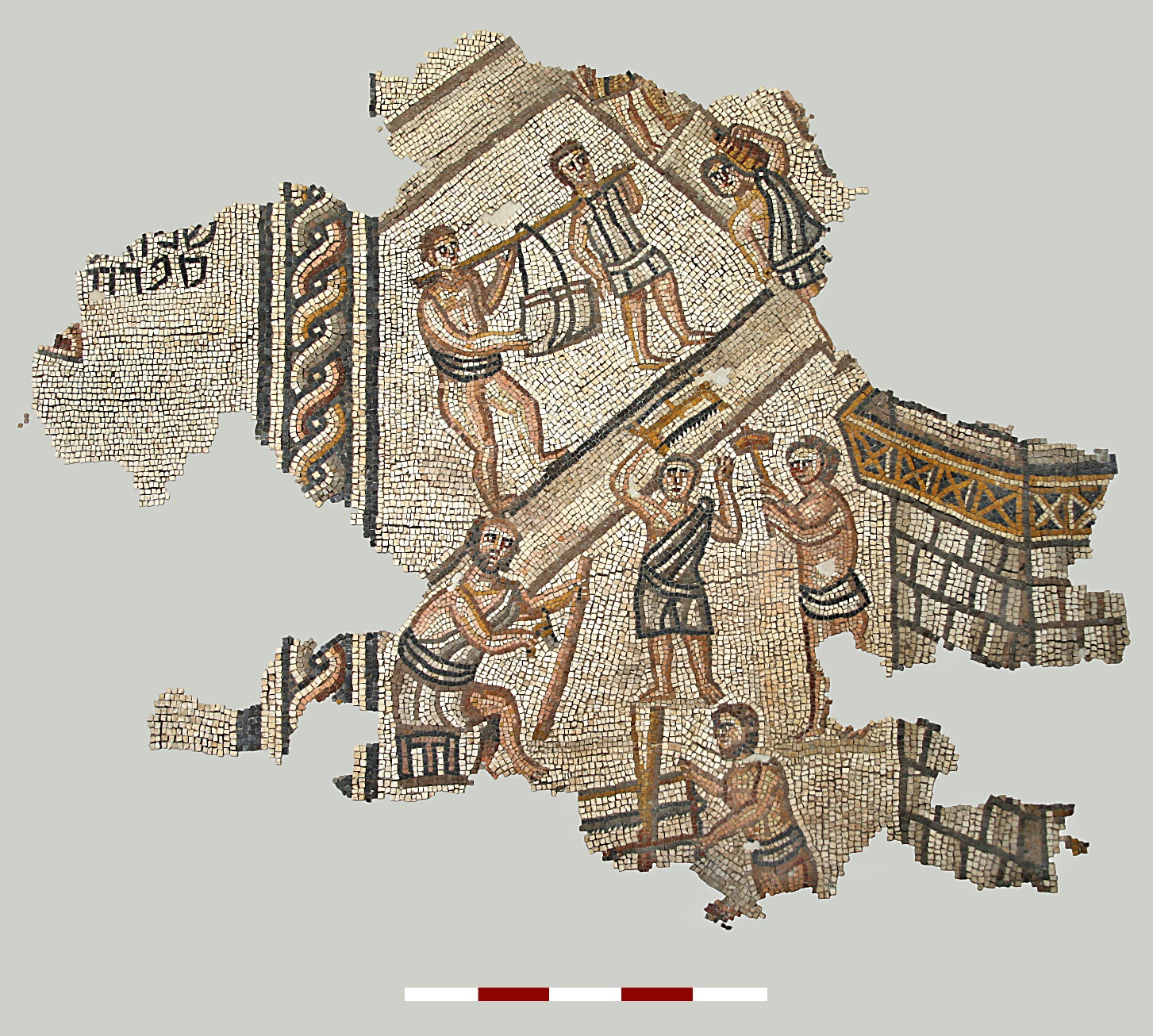
The earliest two examples are synagogue mosaics, a third-century synagogue in Wadi Hamam, and a recently discovered fifth-century mosaic on the floor of the Huqoq Synagogue in northeastern Israel. Only a part of the Wadi Hamam scene has survived, though it is the largest intact biblical scene found. It shows workers and a tower on the left. In the center, two workers are hitting each other. The Huqoq mosaic is larger and illustrates all stages of construction, including detailed depictions of hoists, levers, and various chiseling and cutting tools. At the center of the scene, two workers are engaged in conflict—one wielding a hammer and the other a saw.[5] Similarly, three medieval manuscripts feature this theme; in two, the depiction of violence is the central focus, while in the third, it forms part of a broader image, akin to the mosaic. [6]

A close-up of a painting AI-generated content may be incorrect.

Figure 6 Golden Haggadah, fol. 3r

Although these examples feature the tower, they can be distinguished from the Christian perspective. Firstly, the labeling of the images aligns with Jewish tradition, specifically referencing Dor Haflagah. Secondly, Bruegel’s comprehensive visual representation notably omits any mention of violence. The interpretation that linguistic confusion led to violence is exclusive to Jewish sources, appearing in Genesis Rabba and various other texts, but not in Christian writings.[7] Given that the mosaic dates to the third century, this seems to potentially point to an earlier codification of Genesis Rabba than is currently assumed or that this approach was already was an oral legend.[8] The only known medieval Christian manuscript featuring a descent into violence, The Bedford Book of Hours, has prompted one scholar to assert that it “is undoubtedly based on a Jewish legend.”[9]

While Jewish manuscript culture preserves the uniquely Jewish interpretation of the iconography of the Tower of Babel, Jewish print culture would transform Bruegel’s symbol of pride and sin into a fortress of divine protection.

The Soncino family was the first great dynasty of Hebrew printers, active in northern Italy from the late 15th to the early 16th century.[10] Originating from the town of Soncino in Lombardy and operating intermittently between roughly 1483 and 1527, they established presses in a succession of Italian cities, including Soncino, Brescia, Fano, Pesaro, and Rimini, as well as in Turkey. The founder, Joshua Solomon Soncino, and his nephew, Gershom ben Moses Soncino, expanded the enterprise into one of the most respected printing houses of Renaissance Italy. Gershom issued one of the earliest dated Hebrew books, a Talmudic tractate printed at Soncino in 1484. This work, with its unique layout, is the first of its kind to become canonized, combining the source text with two surrounding commentaries, and is itself a work of art. Their editions combined typographic precision with decorative sophistication equal to the best contemporary Latin and vernacular presses, and their name became synonymous with the art of Hebrew printing itself. They did not just print for a Jewish audience, but also printed over 100 non-Jewish titles, outdoing their Jewish output of 64 titles.

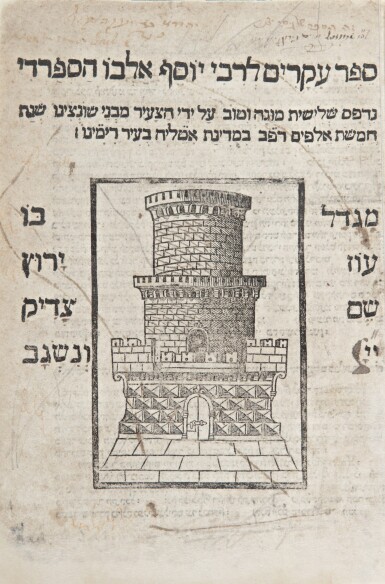
SEFER IKKARIM (BOOK OF PRINCIPLES), RABBI JOSEPH ALBO, RIMINI: GERSHOM SONCINO, 1522 | Sacred Splendor: Judaica from the Arthur and Gitel Marx Collection | 2019 | Sotheby's

Figure 7: Joseph Albo, Sefer Ikkarim, Rimini, 1522

The Soncino family was active from 1483, but in books printed from 1522, first in Rimini and subsequently in Salonika and Constantinople, Gershom incorporated a new printer’s mark – essentially a printer’s coat of arms.[11] This first appeared in R. Joseph Albo’s Sefer Ikkarim and depicts a traditional Renaissance-style solid stone tower rising above a crenellated wall, accompanied by the verse ‘מִגְדַּל עֹז שֵׁם יְהוָה, בּוֹ יָרוּץ צַדִּיק וְנִשְׂגָּב” “the name of the Lord is a mighty tower; the righteous runneth into it, and is set up on high,’ (Proverbs 18:10) on the left and right sides of the image. Gershom chooses to highlight the tower, unlike other possible symbols such as the rainbow, clouds of glory, or King David, which could have served a similar purpose.

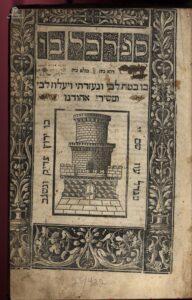
Figure 8: Kol Bo, Rimini, 1525, Gross Family Collection

In the Sefer Kol Bo, published in Rimini circa 1525 and considered Gershom’s most distinguished work from that period, a prominent introductory statement appears above the tower: “In You I place my heart and you will help me, and I will raise my heart and with song I will praise you: ‘the name of the Lord is a strong tower; the righteous runs into it, and is safe.’” This clearly presents the tower as an icon of divine protection and intervention. Notably, Gershom’s tower does not correspond with any physical structure in Soncino or Rimini; instead, the tower symbolizes a spiritual rather than an earthly construct.[12] There is one small, but somewhat strange, detail about Gershom’s tower: the doors are latched on the outside, making the locks useless. This oddity reinforces that the tower is divine, as it does not need a locked door. We reenact this belief annually during the Pesach seder. Gershom’s tower, rooted in Mishlei rather than Bereishit, represents divine protection in contrast to retribution. For a Jewish printer deeply engaged with Renaissance book art, this choice offered a thoughtful reinterpretation, reclaiming the tower as a symbol of resilience and trust in God’s safeguarding of the Jewish community people.[13]

The story of the “tower,” whether Bruegel’s collapsing monument or Soncino’s enduring emblem, reminds us how difficult it is to define what makes art “Jewish.” The same image can signify pride or faith, sin or sanctity, depending on the hands and the heart that shape it. Jewish art, then, is not confined to subject or style, but often lives in subtler places — in the design of a page, the mark of a printer, or the choice of a verse. Ultimately, even art speaks in different languages.

Notes: 

  1. For background on the creation of the painting see Margaret A. Sullivan, Bruegel and the Creative Process, 1559-1563 (Ashgate: England, 2010), 191-204. For a direct comparison of the painting with the biblical narrative see Ruth Dorot and Edna Langenthal, “Pieter Bruegel the Elder’s The Tower of Babel (1563). From Art to Architecture,” Journal Education Culture and Society, 2, (2023), 380-400.

  2. See Diána Kulisz, “The Tower of Babel Motif in the Art of the Low Countries,” in Mesopotamia Kingdom of Gods and Demons, ed. Zoltán Niederreiter, (Budapest: Museum of Fine Arts, 2024), 424-439.
  3. See Umberto Cassuto, A Commentary on the Book of Genesis, Part II, trans. Israel Abrams, (Jerusalem: Magnes Press, 1974), 225-226. Abarbenal, however, interprets the section much more in line with Bruegel’s themes. See Nehama Leibowitz, Studies in Bereshit, trans. Aryeh Newman, (Jerusalem: World Zionist Organization), 95-97.
  4. See Cassuto, id. at 203.
  5. See Karen Britt and Ra’anan Boustan, “Artistic Influences in Synagogue Mosaics: Putting the Huqoq Synagogue in Context,” BAR, May/June 2019, 40-41. They note that these are the only two known examples of synagogue mosaics to depict the Tower of Babel.
  6. The Golden Haggadah, Bezalel Narkiss ed. (England, 1996) 24-25; Marc Michael Epstein, The Medieval Haggadah: Art, Narrative & Religious Imagination (New Haven: Yale University Press, 2011), 157-158.
  7. For a collection of the various sources see M.M. Kasher, Torah Shelemah, vol. 1, 515, no. 60 and 517 no. 73.
  8. See Anat Reizel, Introduction to Midrashic Literature, (Tevunot: Alon Shevut, 2011), pp. 105–106.
  9. See Mira Friedman, “The Tower of Babel in the Bedford Book of Hours,” in The Old Testament as Inspiration in Culture, Jan Heller, ed. (Trebenice: 2001), 113-114.
  10. See generally, A.M. Haberman, Perakim be-Toldoth Hamdpissim ha-Ivrim (Jerusalem: Rubin Mass, 1978),15-101; Moses Marx, “Gershom Soncino’s Wander Years in Italy, 1498-1527” in HUCA XI (1936), reprinted as a stand alone work with many examples of Soncino illustrations, in 1969, by the Society of Jewish Bibliophiles.
  11. Abraham Yaari, Hebrew Printers’ Marks: From the Beginning of Hebrew Printing to the End of 19th Century (Jerusalem: Hebrew University Press, 1943), 4-5, 123-124. Gershom once used a different mark with a tower in the 1505 Fano edition Mashal ha-Kadmoni. Id. 124.
  12. Yaari, Printers Marks, 124.
  13. Gershom’s prayer may have been tied to a conflict with a Jew who had converted to Christianity. In the end, perhaps because of this conflict, although it remains unclear, Gershom was forced to flee Italy soon after. See Marx, “Wandering Years,” 55-59.


Elliott Horowitz – “”Most of all you’ve got to hide it from the kids…’ Reading Esther before Bed”

Elliott Horowitz teaches at Bar Ilan University and is co-editor of Jewish Quarterly Review.
This is his fourth contribution to the Seforim blog. We hope that you enjoy.
“”Most of all you’ve got to hide it from the kids…’:
Reading Esther before Bed”

Elliott Horowitz
“The problem of selecting Bible stories for the early grades is an especially difficult one,” wrote Emanuel Gamoran in his introduction to the first volume of Lenore Cohen’s Bible Tales for Very Young Children (2 vols, 1934-36), of which he was the editor. “Not all stories of the Bible are suited to the needs of little children,” continued Gamoran, who was an American Reform rabbi, and a disciple of the pioneer Jewish educator Samson Benderly,[1] “nor should all those children be told them in their entirety. In some instances certain details should be omitted.” In comes as little surprise, then, that in the second volume of Cohen’s Bible Tales the book of Esther contains only a single casualty – the evil Haman, who by the king’s order is hanged on the gallows he had prepared for Mordecai. No mention is made of the death by hanging of Haman’s ten sons, or of the more than 75,000 non-Jews killed, with the king’s permission, by Mordecai’s coreligionists. This was clearly one of those instances in which, according to Rabbi Gamoran, “certain details should be omitted.”
The identical omissions had been made three years earlier in a biblical anthology for children (The Children’s Bible: Selections from the Old and New Testaments) whose contents were “translated and arranged” by two distinguished non-Jews: Henry Sherman, who headed the “department of religious literature” at Charles Scribner’s Sons, which published the book, and Charles Foster Kent, who, as indicated on the frontispiece, was “Woolsey Professor of Biblical Literature in Yale University.”[2] The same editorial policy had earlier been followed by the American children’s writer Frances Jenkins Olcott (1873-1967) in her delightful Bible Stories to Read and Tell, published by Blue Ribbon Books in 1916.
Cohen and Gamoran, then, followed a venerable tradition in saving their “very young” readers from any knowledge of the sad fate of Haman’s sons. Yet they could arguably have followed the model of their British coreligionist Mrs. Philip Cohen in her two-volume Bible Readings with My Children (2nd ed., 1899). In her retelling of the book of Esther she acknowledged that not only Haman, but also his “ten sons were hanged on the gallows which their father had set up for Mordecai.”[3] Moreover, unlike Frances Olcott, who omitted mention of the permission given the Jews by Ahasuerus to defend themselves, and Messrs. Sherman and Kent, who included “the king’s “command that the Jews who were in every city should gather together and protect their lives,” but said nothing about the consequences thereof, Mrs. Cohen felt that it was safe to tell children that “the Jews, in defending themselves, killed numbers of their enemies.”
Mrs. Cohen’s justly popular anthology went through several editions, the fourth of which appeared in London in 1923. In that same year the future (but now lamented) Bible scholar Nahum Sarna was born in London. Not surprisingly, it was from that anthology that he acquired his earliest knowledge of Scripture. Reminiscing decades later about how he came to devote his life “to the study and teaching of the Hebrew Bible,” Sarna, then recently retired from Brandeis University, recalled that among his “earliest and most agreeable recollections is my father reading to me every Shabbat, with unfailing regularity from a little two-volumed work entitled Bible Readings with my Children by a Mrs. Philip Cohen. I am not certain, but I believe I was about three years old when the regimen began.”[4]
II
Bible Readings with my Children was not the first such anthology produced for Jewish children in Victorian England. Already in 1877 Ellis Davidson had published The Bible Reader under the explicit “sanction” of Britain’s Chief Rabbi Nathan Marcus Adler.[5] It was intended, as its subtitle indicated for the Use of Jewish Schools and Families, With the Addition of Questions on the Text, and Moral Reflections on Each Chapter. Davidson’s Bible Reader contained material from the popular book of Esther, but not much from the book’s brutal ending. Thus, anticipating Sherman and Kent’s Children’s Bible of 1930 readers were informed of the permission granted the Jews by Ahasuerus “to destroy, to slay, and to annihilate any armed force…that might attack them, with their children and their women,” but learned nothing of the consequences of that permission. Davidson did find a way to include the deaths of Haman’s sons, which both the Children’s Bible and Frances Olcott’s earlier Bible Stories later chose to omit, but he did so at the cost of changing the biblical story. They “were slain in battle,” and only afterwards hanged, wrote Davidson, “to show the people how utterly the whole house of Haman was degraded, and in order that future assaults might be prevented.”[6]
During the 1890’s two graduates of Oxford, each of whom had been at Balliol College when it was headed by the legendary Benjamin Jowett (1817-93), brought out their own biblical anthologies intended – at least in part – for young readers. The first of these to appear was John William Mackail’s Biblia Innocentium: Being the Story of God’s Chosen People Before the Coming of Our Lord…upon Earth, Written Anew for Children (1892). Mackail (1859-1945), who was born on the Isle of Bute and whose father was a minister of the Scottish Free Church, had overlapped as an undergraduate at Balliol with Claude Montefiore (1858-1938), who was a great nephew of the renowned Sir Moses. It is likely that they knew each other, since neither – unlike the bulk of their classmates – was an Anglican product of a posh “public school.” Both were also among the college’s most distinguished students; achieving “firsts” in the demanding course of study known as Greats (Literae Humaniores) in which their classmate George Nathaniel Curzon (a former Etonian and future viceroy of India) received only a “second.”[7]
In 1896 Montefiore, who was presumably familiar with Mackail’s Biblia Innocentium (which had appeared in a second edition in 1893) brought his Bible for Home Reading (1896), a two-volume anthology “with comments and reflections for the use of Jewish parents and their children. ” In certain respects Montefiore’s anthology followed the limitations that both his coreligionist Davidson and his former classmate Mackail had imposed upon themselves. No mention was made, for example, of the rape of Dinah in Genesis 34 or the subsequent massacre perpetrated by her brothers in Shechem. Yet with regard to the book of Esther Montefiore took a diametrically different approach. Whereas both previous Victorian anthologies, the one Jewish and the other Christian, had informed their readers of the permission granted the Jews to defend themselves but not of the bloody consequences thereof, Montefiore decided to include all the chpaters of Esther in their entirety despite what he acknowledged as the “religious and moral deficiencies.” These, he claimed, had been “ignored or explained away” by some, but also “exaggerated and falsely labelled” by others.” The best solution, he believed was to let readers, young and old, judge for themselves.
There were other ways of dealing with the book’s “religious and moral deficiencies” when presenting its contents to young readers. In his Story of the Bible: first published in 1904, Jesse Lyman Hurlbut (1843-1930), a Methodist Episcopal clergyman, reported not only that “Haman died upon the gallows that he made for Mordecai, but also that his sons “were put to death for their father’s evildoing.” He added, however, that this had been done “according to the cruel usage of those times.”[8] In contrast to Ellis Davidson’s clumsy attempt, in 1877, to make the hanging of Haman’s sons more palatable to his younger readers, Hurlbut, a native of New York, showed that it was possible to add without detracting.
Notes:
[1] On both Gamoran and Benderly, see Penny Schine Gold, Making the Bible Modern: Children’s Bibles and Jewish Education in Twentieth-Century America (Ithaca, 2004).
[2] H. A. Sherman and and C. F. Kent, The Children’s Bible (New York, 1933), 223-25.
[3] Mrs. Philip Cohen, Bible Readings with my Children, two volumes (rev. ed. London, 1899), II, 336.
[4] Nahum Sarna, “Ruminations of a Jewish Bible Scholar,” Bible Review 4:3 (June 1988). See also the obituary by Tom Long in the Boston Globe (25 June 2005).
[5] On Davidson, see Geoffrey Cantor, “‘From nature to nature’s God’: Ellis A. Davidson—mid-Victorian educator, moralist, and consummate Designer,” Jewish History 23:4 (December 2009): 263-388.
[6] On Davidson’s work and its treatment of the book of Esther, see Elliott Horowitz, Reckless Rites: Purim and the Legacy of Jewish Violence (2nd ed., Princeton, 2008), 24.
[7] On Montefiore at Balliol and the impact on the college of Jowett, see Horowitz, Reckless Rites, 25, and the sources cited there.
[8] Hurlbut, Story of the Bible: For Young and Old (Philadelphia, 1952).


A Conversation With Professor Marcin Wodziński on Hasidism

A Conversation With Professor Marcin Wodziński on Hasidism
By Rabbi Yitzchok Frankfurter

This article appeared in Ami Magazine July 11, 2018/ 28 Tamuz 5778 and is reprinted here with permission.

This is not my first conversation with the Polish scholar Marcin Wodzinski. In 2013, following the release of his book on chasidism and politics, he visited my office together with the well-known askan Reb Duvid Singer. Today as then, my conversation with him elicits paradoxical emotions. His knowledge of chasidism, particularly its roots and subsequent development, is shockingly broad. In fact, many chasidim turn to him for information about their origins, and Professor Wodzinski’s research has saved for posterity much of that history.
Of course, the mere fact that chasidism, a vibrant Jewish movement that once thrived in Eastern Europe and Russia, has been reduced to a scholarly discipline for a Polish academician is saddening. Poland was once the center of chasidic and Jewish life in general, but it now has very few Jews living there. And it goes without saying that Poland is devoid of any vibrant Jewish culture.
“That loss,” he tells me, “is very acutely felt in Poland on many levels. One significant expression of this is the Museum of the History of Polish Jews in Warsaw. I was its head historian for some time, as well as the chief designer of the gallery that depicts the 19th century. Three years after its opening, it is now the most successful museum in Poland.”
Unfortunately, it hurts to hear that, because that is precisely what Hitler was trying to accomplish. The Nazis wanted to reduce Jews and Judaism to relics and artifacts found only in a museum, and I tell the sympathetic professor as much.
“That’s true, but I would say that Poland as a country can’t do anything about it because there are so few Jews living there. But in terms of recognizing the tragedy and the loss and as an expression of pain, this museum is extremely important. And there are many other examples of how the non-Jewish community is trying to integrate an understanding of Jewish culture into what it means to be Polish today. There are at least four centers of academic Jewish studies in the country, which is the same number that exists in Israel. Each center has many scholars who are doing valuable research and earning PhDs in the subject. These schools attract people who want to study Jewish history and culture. Many of them write important articles and books that are read by a lot of Poles.
“The Jews are not an extinct race,” he says with fervor, “and this notion among Poles is even stronger today than it was 50 and 100 years ago, when Polish culture was very antagonistic towards Jews and sought to exclude them. Today, an increasing number of people realize that you can’t understand Poland without understanding the Jews.”
Field of Study
Marcin hails from a town in Poland that is 50 kilometers away from Breslau, or Wrocław as it is known in Polish, which before the Holocaust was the epicenter of the haskalah, rather than chasidism. Yet ironically, it was the chasidic movement that drew his interest.
“Of course. There weren’t any chasidim here. The city of Wrocław is best-known for the Beit Midrash l’Rabbanim, which was part of the so-called Conservative movement. Abraham Geiger, who one of the leaders of the Reform movement, was also quite active in Wrocław for over two decades. And the Jewish historian Heinrich Groetz spent his entire academic Marcin Wodzinski accompanying chasidim at a kever. Seen in the background is Reb Duvid Singer. life at its university,” he tells me when I confide in him that given his place of birth and alma mater (he also attended the University of Wrocław), I find his interest in chasidism rather peculiar. “But there were also some important chasidic books that were published in Wrocław, such as the first edition of Kol Simchah, which is the collected teachings of Rav Simchah Bunim of Peshischa.”
“So you’re a goy,” I tease him, “born in the birthplace of the maskilim, but chasidism became your field of interest.”
“That’s right!” he replies good-naturedly. “I’m trying to bridge ideas and interests. My interest in Jewish history and culture began with Jewish cemeteries, which was very typical at the time because it was the most visible presence of both the Jewish presence and absence in Poland in the 1980s. I learned Hebrew so I could write down the inscriptions, and I was fascinated by seeing the rebirth of chasidic pilgrimages to the gravesites of tzaddikim in Lizhensk, Peshischa, Lublin and other places. Then I started researching chasidic life, which is what I’ve been involved in for the past three decades.
“Two weeks ago I published a book called An Historical Atlas of Hasidism, which is going to be very important for chasidic studies. It contains 280 pages of full-color maps and images from the inception of chasidism until today. The maps present an entirely new way of understanding the movement, and there are a lot of previously unknown historical images. The book was published by the prestigious Princeton University Press.
“I also recently published a book entitled Hasidism: Key Questions. That one was printed by Oxford University Press. That is the volume of which I am the most proud, as it summarizes my entire investigation into chasidism. It has seven chapters, each of which addresses a different central question: the definition of chasidus, women in chasidism, chasidic leadership and the role of a tzaddik, the demographics of chasidim historically and today, the geography of where they lived, the economics of chasidic life, and finally, the end of chasidus in Eastern Europe and how it moved to the United States and Israel. I put forth the argument that this shift was not only because of World War II but actually started during the First World War. The book has around 350 pages.”
“What do you think you’ve added to the understanding of chasidus?” I ask.
“There are several things that are unique about my work. First of all, I am equally interested in the lives of the rank-and-file chasidim as I am in the lives of the tzaddikim. To me, a tzaddik isn’t a leader if he doesn’t have followers. That is why I believe that much of the research so far has been misguided by omitting the tzaddik’s thousands of followers from the picture. I think it’s critically important to understand not only the teachings of the great chasidic minds but also—and perhaps more so—to understand how they reached the simple folk and affected their lives. Another innovation in my work is that I don’t just delve into intellectual topics. I also look at the social, economic and other aspects of history, which are aspects that have only been properly addressed by very few scholars. This results in an entirely different perspective.
“But perhaps most importantly, the vast majority of scholarship on chasidism has focused on its early years. We know quite a lot about the Baal Shem Tov and Rav Dovber of Mezritch, and we know some things about their disciples, but we know very little about chasidism in the 19th and early-20th centuries before the Holocaust. We know about some leaders, but very little about the lives of the chasidic communities. Both of these two recent books expand the scope of interest. I call the 19th century the ‘golden age’ of chasidism, because that’s when the number of people who considered themselves chasidim reached its peak. There were many regions of central Poland, Galicia and Volhynia [the region where Ukraine, Poland and Belarus meet] where chasidim constituted the majority of Jews, and it’s critically important to understand what their lives were like then.”
“How much of the actual Torah of the tzaddikim do you study? Is it something you consider necessary for your research, or do you completely ignore it?”
“Obviously, there are many people who are bigger experts on that than I am. I’m not even an am haaretz; I’m a goy!” he says unapologetically, “so it’s not really something for me to study.”
“So you don’t think it’s important or that you’re missing something in your research?”
“It’s obviously important, and that’s why many people study it. But I can’t do everything. I do need to understand the chasidic concepts, but I don’t study them myself; I read what other scholars have written. That’s the best I can do. I can’t be a specialist on everything. What I’m trying to do is to show that beyond Torah, there is a huge area of chasidic life that hasn’t been properly looked into, such as the relative power of individual groups. These are things that everyone would love to know. It also gives you an understanding of the spiritual leadership of various tzaddikim, because if one tzaddik has 100,000 followers, his relationship with his followers is very different from that of a tzaddik with 50 followers.
“We can also see how far the shtieblach were located from the court. For Chabad, the average distance between the court and the shtiebel was 400 kilometers, which means that the vast majority of chasidim only visited the Rebbe once or twice in their lives. For Vizhnitz, which was very strong in Hungary, the average distance was less than 100 kilometers, which means that most of the chasidim came to see the Rebbe several times a year because it was relatively easy to get there. This means that the relationship of the typical Vizhnitzer chasid and his Rebbe was very different from that of the typical Lubavitcher chasid and his Rebbe.
“Then there were courts that were even closer to their shtieblach. For example, Kretchnif’s average distance was 30 kilometers, which means that they could go to their Rebbe every Shabbos and he knew his chasidim personally. The Gerrer Rebbe had 100,000 chasidim, which means that he didn’t know all of them by face and name, with the result that the spiritual inspiration they received was different from that received by chasidim of a smaller chasidus. So while this kind of information isn’t part of the teachings of any particular group, it’s still very important to understand.
“It’s hard to summarize everything I believe I bring to the field. But as I said, I try to capture the totality of chasidic life, not just its spiritual aspects but also its economic, social and cultural ones.”
“Has your work brought you emotionally closer to the Jewish community, or is it just a field of research to you?”
“Whenever anyone chooses a field of research he feels some sort of connection. The most difficult thing for anyone to do is to decipher himself.”
“You speak Hebrew and English fluently, but in which language do you write?”
“Lately, I’ve been writing more and more in English instead of Polish because my books are addressed primarily to international audiences. But I still write articles in Polish, so I’m pretty much bilingual in my academic life.”
“Is the objective of your research to understand Poland or to understand Jews?” I ask next.
“I might be exceptional in some sense because I focus on Jewish history; I don’t research so-called Polish-Jewish relations. I’m interested in chasidism, the haskalah and Jewish cemeteries and that’s it. But I would say that the majority of scholars in Poland who are interested in Jews study the relationship between Poles and Jews.”
“As a non-Jew, are you welcomed by Jewish researchers of chasidism, or do you feel like an outsider?”
“There isn’t any bias against non-Jewish scholars in academia, or at least I’ve never experienced it. As a whole, the scholars studying chasidism are extremely openminded people. I’m very happy to be part of this community and I feel very welcome and supported both intellectually and emotionally. The research I do is very broad, so I often have to rely on support from other people, which is always forthcoming.
“I would also say that over time I have established increasingly good relations with the chasidic community and with many individual chasidim who seem to appreciate my research. A big part of the atlas in my book maps out contemporary chasidism. In order to do it I had to ask a critical question—how many chasidim are there today?—because without the answer it’s impossible to continue any further. Are the numbers bigger or smaller than before the war? Where do they live? Which is the biggest chasidic court today? Celebrating at a Belz wedding To obtain the answer, I decided to turn to the chasidic phone directories and counted the number of households. Based on the 42 directories I received I arrived at a total of 130,000, which I believe covers almost all of the chasidic households in existence today. This allowed me to estimate the demographic and geographic distribution of chasidim and many other issues, and it was only possible thanks to the goodwill of the chasidic communities that appreciated my research and shared their directories with me. I am extremely pleased to have gotten support not only from my fellow scholars but also from chasidic people.”
“Which is the largest chasidus today?”
“You know the answer to that: Satmar, with 26,000 households split between the two groups.”
 “Which is second?”
“Chabad, with 16,000, followed by Ger, with 12,000. Belz has 7,500 households. The most difficult to calculate is Breslov because they use different categories for inclusion, but I estimate them at 7,000. Sanz has 4,000; Bobov has 3,000; and another 1,500 for Bobov-45. I am very proud to have done this research.”
Bustling Centers of Chasidic Life
“Where was the center of chasidic activity in the 19th century, Poland or Ukraine?”
“That’s a very good question. I have a set of maps in my atlas depicting where the tzaddikim lived and how this changed over time. I also have a map showing 70% of all the existing chasidic shtieblach at the beginning of the 20th century. This was an enormous undertaking. I managed to locate 2,854 shtieblach, which, as I said, represents some 70% of the total during that time period. It is very clear that the cradle of chasidism was Podolia and Volhynia, which are Ukrainian territories. At the end of the 18th century it moved north to Belarus and west to Galicia. In the 19th century, the epicenter was Galicia and the southern part of central Poland. Then it moved south again into Hungary and Romania.”
“Where does Czechoslovakia, where my own parents hail from, come into play?”
“Slovakia is part of Greater Hungary, because up until 1918 it was part of the Austro-Hungarian Empire, so when I say ‘Hungary’ I am including Slovakia. By contrast, the area that is now the Czech Republic isn’t significant to us because there were very few chasidim there if at all. In fact, only the eastern part of Slovakia, which later became TransCarpathian Ruthenia and was incorporated into Hungary, Romania and now Ukraine, is relevant to this topic, but it was never a center of chasidic life. As for the Hungarian territories, it was mostly Maramures and Transylvania that were heavily chasidic.”
“According to your calculations, would you say that the majority of the Jews at that time were religious, and a majority of the religious Jews were chasidim?”
“Up until the interwar period in the 1920s and ’30s, the majority of the population was religious, although not all were chasidim; it depended on the area. In Lithuania the majority were Litvish—either misnagdim or ambivalent towards chasidim—while only a minority were chasidim. But in Galicia, especially Eastern and Central Galicia, the majority were chasidim. Many communities were dominated by chasidim. Poland was also divided: Eastern Poland was mostly chasidic, but in Western Poland the numbers were much smaller.
“In general, the vast majority of Eastern European Jews in the 19th century were Orthodox, but this changed radically in the interwar period. In the Soviet Union, the number of religious people dropped dramatically because of the Communists’ anti-religious stance, and the chasidim were heavily persecuted and their leaders sent to Siberia. For example, the Machnovka Rebbe was only allowed to leave his exile in the 1960s. In Poland there wasn’t any religious persecution between the wars, but because of the trend towards modernization and the influence of secularism and politics, the number of people who were still religious dropped to one-third of the Jewish population. Of those who were religious, I’d say that the majority were chasidim. This loss was acutely felt by the chasidic community.
“If you look at the activities of the Piaseczno, Aleksander Rebbe and Gerrer Rebbes, much of their activity was inspired by the crisis of many members of the younger generation leaving the community and becoming communists or Zionists. They understood that they had to reinvent the structure of the traditional chasidic community, particularly during the First World War and immediately afterwards.”
“They say that history is written by the victors. There were many large chasidic courts before the Holocaust but they are no longer remembered, and other chasidic groups are far more dominant now. This makes people believe that they were dominant before the war as well, but it’s not necessarily true.”
“My atlas corrects this misconception. As I told you, I found 2,854 shtieblach in the early part of the last century. By comparing the number of shtieblach of different courts, I was able to establish their relative power, and the numbers are very precise. In Central Poland, 22% of shtieblach were Ger; 13% were Aleksander; 6% were Kotzk and its offspring, followed by Amshinov, Otvotzk (Vorka), and other smaller groups. Perhaps the biggest one that’s completely unknown today is Olik, which may have been the third largest in Volhynia during the interwar period.
“Which was the biggest in Ukraine?”
“Between the wars, the biggest court in Ukraine was Trisk, with 16%. The second largest was Sadigura, which was really in Bukovina, outside Ukraine, with 8%. The third was Olik, followed by Karlin-Stolin, Makarov, Tolne, Chernobyl, Stepan, Lubavitch, Skver, Brzezan, Hornosteipel and others.”
“Where was Lubavitch the most dominant?”
“Lubavitch was the dominant group in Lithuania and Belarus, where they had 32% of all the shtieblach. Every third shtiebel was Lubavitch, and there were other shtieblach belonging to other Chabad courts. Four percent belonged to Kapust; 3% to Liadi, and 3% to Strashelye. If you count all of them together, almost half of the shtieblach were Chabad. The next largest one in Belarus and Lithuania was Karlin-Stolin with 10%, followed by Slonim, Kobrin, Koidanov and several others.”
“Do you see a common denominator between all of these groups despite their differences?”
“Yes, and one of them is their common origin. The understanding that they all come from the Baal Shem Tov informs every single chasidic community. It also affects the relationships between groups, because it is much easier to move from one chasidic group to another than it is to move from chasidism to non-chasidism or vice versa. There are also elements that are shared by every group. The role of the tzaddik is one such element. Even to the groups like the ‘toite chasidim,’ as the Breslovers were once called since they don’t have a live Rebbe, there is still an understanding of the Rebbe as an essential spiritual experience for every chasid.
“Perhaps this is something that distinguishes me from many other scholars of chasidism. Whereas most of them concentrate on the theology and books, my approach is more in line with the statement of Rav Zusha of Anipoli. When he was in the court of Rav Dovber of Mezritch, he said that he learned more Torah from the way his Rebbe tied his shoelaces than he would ever learn from his lectures. To me, the interaction with the Rebbe is what defines the life of the community. My research brings this aspect to light, whereas other scholars tend to overlook it.”
Economic Life and Political Power
“How do you make a distinction in your research between religious Jews and chasidic Jews in terms of their economic, social and cultural lives? They were probably almost the same.”
“That’s true as far as economics is concerned,” he admits. “It’s very difficult to differentiate between chasidim and non-chasidim, and finding sources was extremely difficult. But I managed to locate the complete lists of several communities in Poland and Belarus, and I also came into possession of complete lists of taxpayers and their professions. By comparing the two lists, I could see how chasidim fit into the picture of the general Jewish economic activity.
“There’s a popular stereotype both in the secular world and among chasidic writers that the early chasidim were poor, even in the 19th century. One of the things I wanted to know was whether chasidim on average were richer or poorer than the average nonchasid. I also wanted to know if there was any specific profile for chasidic economic activity. Where did the money they used to sustain their families come from?
“Thanks to the comparison between the lists of chasidim and the lists of other Jews in central Poland and Belarus, I came to the conclusion— which was quite surprising to me—that chasidic communities were on average wealthier than nonchasidic ones. Even more interesting, the chasidim preferred to engage in trade and weren’t so involved in artisanship and crafts. Also, there were very few chasidim who were unskilled workers, although there was a lot overrepresentation when it came to the communal professions such as rabbi, gabbai, shames, mohel and shochet. So when you compare chasidim to other religious groups with similar profiles, you understand why their communal structure was as I described.”
“In what sense?”
“In the sense of emunah and bitachon supporting the economic activity. In the 19th century, the average boy starting an enterprise would get money from his family or in-laws and establish a business. Some of them would succeed, while others would go bankrupt. Many people needed to go bankrupt several times before starting to make money. In the traditional non-chasidic world, a person might start a business once or twice with his family’s support, but if he didn’t succeed he simply went bankrupt.
“Then there was another tier of support in the chasidic world: If a person failed using the money from his family, he could still count on assistance from his community. There is much documentation of chasidic solidarity being very important for internal economic support. If there was a wealthy person in a small chasidic town and he knew that another person had failed at his enterprise, he was willing to help him. This meant that people were given another chance.
“Also, chasidim preferred to be in trade rather than crafts, which usually generates a higher income. Being a chasid actually supported engaging in trade, because a non-chasid’s economic relations extended to his immediate business partners and family, but for a chasid this network was wider since he had to visit the court of the tzaddik several times a year, where he was able to build very strong relationships with people from other towns. This meant that he had access to business partners in a very large geographical region. It was therefore much easier for him to have a successful enterprise because he had a much larger pool of potential partners.
“Another important factor is the role of the tzaddik as arbitrator, not only in spiritual or familial matters but also economically. This is one more level that wasn’t available to a non-chasidic community, and it was enough to put chasidim in a relatively better financial situation.”
“Tell me about the political power chasidim wielded in their various countries of residence in Eastern Europe, which is the subject of the book you released in 2013.”
“It’s very interesting to see that some of the tzaddikim—most prominently Rav Yitzchak of Vurka and later the Chidushei HaRim—functioned as shtadlanim, representatives of the Jewish community to the non-Jewish authorities. It is also very instructive to see that behind their activity there were what I would call legal advisers, people who were very knowledgeable and skillful in navigating the law of the country. These were generally big entrepreneurs who had major financial influence and dealt with the authorities on a day-to-day basis. Those people weren’t visible, however; they lent their expertise to the tzaddik, who was the face of the political power. But it was really a wider enterprise undertaken by the entire community and not just the tzaddikim themselves.”
“Who do you think was the most politically astute and active among the Rebbes?
“In the 19th century, it is clear to me that the biggest innovation in the understanding of politics among tzaddikim came from Rav Yitzchak of Vurka. Around the same time the Tzemach Tzedek, Rav Menachem Mendel Schneersohn, was also very influential in political matters in Russia. You can see the structure of support from very wealthy Jews in St. Petersburg and Moscow, who brought their expertise into the service of the chasidic community. Those two should be listed as the most skillful political leaders of that period. In a sense they established the path for other segments of the Orthodox Jewish community. In the next century you have the founders of Agudat Yisrael in Poland, but that was a very different concept because by then it was mostly electoral politics predicated on parties.”
“Was the political power held only by the Rebbes or the chasidim as well?”
“I would say that any political activity required a very developed cooperation of many levels of political involvement. The tzaddik would never act alone, and it is obvious that without support he wouldn’t have been able to accomplish what he did. At the same time, without him others would be unable to have power. They were entirely interdependent, so it’s impossible to say which was the more important. The beauty is that they managed to invent new ways of being politically active, because traditional Jewish politics had been based on shtadlanim.
“The way it worked up until then was that the Jewish community would hire a political activist who would go to the Polish court or nobleman and try to obtain certain political privileges. This changed in the late-18th century because there was no longer a Polish court, so the entire legal system changed. Under the new system, the Jewish community was deprived of political power, not because of antiSemitism—which of course existed—but because the authorities claimed that the Jews weren’t a community but only individual citizens. Every citizen could represent his own interests, but no one could speak in the name of a group. Jews were permitted to organize for religious purposes, but they were forbidden to organize politically. This meant having to reinvent how to represent themselves to the government, but somehow the tzaddikim managed to present themselves as the representatives of the entire Jewish population.”
“What’s fascinating is that all of this developed in antiSemitic environments. Would you agree with that statement?”
“The political elite were certainly more or less antiSemitic, but they were trying to present themselves as neutral. Those who were skillful used this supposed ambivalence to their advantage. Rav Yitzchak of Vurka, for example, was as successful as he was because he was able to neutralize the anti-Semitic bias of many politicians. He forced them to act against their will by citing legal precedents in support of his arguments that they couldn’t reject. One such case involved the right of rabbanim to control the kashrut of meat in Poland. Absurdly, the right to sell kosher meat and levy the special tax on it had been given over to a Christian enterprise, which was obviously a major problem. Rav Yitzchak of Vurka managed to present this as destructive to the state budget and contrary to its revenue laws. By using this argument, he managed to help the Jewish community regain control. The political bias and anti-Semitism of many of the politicians was rendered ineffective, because they had to follow the legal procedures established by the law of the land. One of the most important factors in the politics of the 19th century was that even the most oppressive countries were trying to establish themselves as places that operated under the rule of law.”
“Tell me about the Tzemach Tzedek’s successes. What was his style of political activity?”
“He was active in Russia in a different context. When he passed away in 1866 there was a visible break in the political representation in Russia, mainly because his succession was unclear; his sons established other courts in other towns, and his youngest son, Rav Shmuel, remained in Lubavitch. This was only slowly regained by his grandson, Rav Shalom Dovber, but his was a time of lesser political success. Concurrently, the Chidushei HaRim established himself as an extremely successful political leader in central Poland. He was succeeded by the Sfas Emes, who was also very successful, as was his son, the Imrei Emes, who was very involved in the creation of Agudat Yisrael. By then the political climate in central Poland was under Russian control, but because it was ethnically different, it maintained a separate legal system that encouraged political activity far more than Russia. So I would say that after 1866 and the passing of the Tzemach Tzedek, there was no longer a real parallel of politics in Russia and Poland.”
“By ‘political activism’ you mean efforts to benefit Jewish life in the places they lived.”
“I am referring to those actions that were undertaken by chasidic leaders with the support of their constituencies to guarantee certain privileges or rights for the Jewish community at large, not just the chasidic community. Aside from the right to have control over the supply of kosher meat, this would include the ability of Jewish prisoners to have kosher food or the right to establish eiruvin in Jewish districts. This was a very important change from the earlier chasidic involvement in politics like that of Rav Meir of Apta, who was mostly active in defending the rights of chasidim to establish their own shtieblach, or to prevent the persecution of the chasidic community.”
“Every Jewish leader really fought for the rights of the Jewish community, so how were the chasidic leaders different in that regard?”
“True, many of their efforts weren’t very different from those of non-chasidic rabbanim, but the whole structure of chasidism empowered its leaders far more than other rabbanim. Let’s say that there was a rabbi of a town—even a very important posek in a big city. Who was behind him? He had only his personal charisma and his community. The Gerrer Rebbe, however, had 50,000 followers all over Poland. This gave him the ability to engineer a campaign to support his political actions in a very broad way. This structure of support that wasn’t confined to specific territories and could cover large areas of Eastern Europe gave additional power to chasidic representation.”
“Did you get the feeling that the growth of a particular court was dependent on the political skills of its leader?”
“That’s something that’s very hard to establish, because no direct testimonies would say such a thing, that this tzaddik was more powerful because he was politically skilled. But if you observe the correlation between political involvement and the number of followers, it’s very significant that those tzaddikim who became more politically involved eventually gained wider followings and vice versa; by having wider followings they were able to be more effective politicians. So these two phenomena were interdependent both ways.
“This is also very true of the interwar period. The tzaddikim who were engaged in the reinvention of chasidism after the First World War, establishing new school systems and other activities of that kind, eventually turned out to be more effective than others. For example, before WWI the Tchortkover and Belzer Rebbes were equally as powerful. But after the war the Tchortkover Rebbe’s power shrank dramatically, and the same holds true of many other Rebbes in central Poland. Another example would be the Gerrer Rebbe, whose political involvement and institution of new infrastructures in the yeshivos and Bais Yankevs [sic] gave him a very strong boost. He had 100,000 followers in the interwar period, which was unparalleled. So a connection exists between politics and the internal relative power of certain Rebbes.”
Concerns and Lessons
The country of Poland is currently going through difficult political times. Last week, the government effectively forced more than two dozen justices out of their jobs. The purged judges refused to recognize their dismissal, while the government officials insisted that they would no longer be allowed to hear cases. Surrounded by cheering supporters, the top Supreme Court justice took a defiant stand on the courthouse steps, and vowed to keep fighting to protect the Polish constitution and the independence of that nation’s courts. The confrontation was followed by dueling news conferences, fiery speeches and more street protests. I ask Marcin if he thinks Poland is moving towards a more dictatorial type of government.
“Poland has been losing its democratic institutions with increasing rapidity over the last three years since the ruling party took power,” he admits. “I can already see a lot of manifestations of an authoritarian state. While the Supreme Court is currently in the news it’s really only the tip of the iceberg, because we see many such things on a daily basis, such as the use of police against the political enemies of the present government, which is typically authoritarian. Then there’s the use of the media as a propaganda tool for the current government. Using public money in support of one political option totally demolishes the constitutional structure. I am very afraid that if the ruling party wins again next year, that will be the last free election in Poland.”
“Do you think that the Jews who live in Poland and the Jewish community at large should be concerned about this?” I want to know. “The ruling party is right-wing, and in Europe right-wing parties are very closely associated with anti-Semitic ideologies, but they are very wary of being labeled antiSemitic. For this reason, the ruling party won’t openly attack the Jewish community in the foreseeable future. But just by looking at the Holocaust law that was passed in January you can see that even without the direct intention of the regime there’s been a rise of anti-Semitic sentiment, which is fueled by the current political climate. This might be a concern in the long run, and is something that has been expressed by many representatives of the Jewish community over the last year.”
“Are you concerned as an academic about the freedom to do your research?”
“Yes. My understanding of the Holocaust law, which was somewhat rescinded, was that the objective wasn’t to persecute people who discussed the involvement of Poles in the killing of Jews during the Holocaust; it was more about creating a general feeling of fear and auto-censorship of what can be said in public these days.”
My final question to the professor is whether he thinks that what his research reveals about chasidic life contains lessons for the world at large.
“That’s a difficult question for me because I’m an academic; my work isn’t so much about finding moral lessons. But it is very clear to me that chasidism holds a huge cultural and spiritual attraction to the world. If you look at its impact on cultural imagery, the image of the traditional Jewish world to many non-Jews is identical to chasidism. This is a huge success, which is due to the spiritual attractiveness of chasidism. But I’m much more interested in analyzing it as a religious phenomenon that shows the interrelationship between religion and other aspects of daily life. I’m not saying that chasidism isn’t a religious movement; of course it is. But being a chasid is something so comprehensive that it affects cultural expressions, economic life and many other areas of activity.
“My research articulates the totality of the experience and helps people understand chasidism as a vibrant movement that isn’t black and white, which is the way it is often portrayed. It has very rich and complicated structures, which have a very big influence not only on the Jewish community but on the larger, non-Jewish societies in which chasidim live. It is also very deeply embedded in geographical location. My Historical Atlas of Hasidism shows how much the spirituality of chasidism is conditioned by the geographical context in which it developed, which is yet another aspect.
“What I would love to achieve with my publications,” he finally allows, “is to promote the understanding that because chasidism is so unique, it allows us to understand much of the world around us, and not just chasidism itself.”

Review of Dr. Michael Stanislawski, “A Murder in Lemberg: Politics, Religion, and Violence in Modern Jewish History”

Some have already pointed out that Columbia University Professor Michael Stanislawski has a new book/thriller.[1] This book describes the murder of R. Abraham Kohn and the events leading up to it and its aftermath.

Prof. Stanislawski attempts to discern whether, in fact, R. Kohn was murdered — Stanislawski thinks so — and in doing so, provides a wonderful description of Lvov (Lemberg) during the mid-nineteenth century. The basic background is that R. Kohn was a Reform Rabbi who became the main Rabbi in Lemberg. This allowed him to enact various rules, some such as the abolition of the various Jewish taxes which were collected by Orthodox Jews and thus they profited from it at the expense of the poor could be viewed as postive. But, as he was Reform, even the poor who benifited from this, still complained about such changes. As Stanislawski shows, much of R. Kohn’s actual reforms to Jewish practice were to be found in his articles (and his prior pulpit) rather than his public speeches or proclamations in Lemberg. While the book is interesting and Stanislawski does a good job on the whole, there are several points which I think need to be addressed.

The first is his conclusion. Although he does allow there may be room to doubt whether Kohn was murdered, anyone reading the book comes away with the impression that Stanislawski thinks Kohn was murdered. Stanislawski chides prior authors who don’t conclude Kohn was murdered. The problem with this, is Stanislawski provides the entire legal history after Kohn’s death, which seriously questions whether Kohn was murdered. That is, after Kohn died one person stood trial for his murder and was convicted. However, on appeal this was overturned. After the verdict was overturned, it was again reviewed by the highest court and the appellate court’s judgment was upheld.

While there are some issues with both of these appellate decisions, I don’t see how, after 150 years, and the fact that he admits he doesn’t have all the documentation, Stanislawski could then chide these other authors for relying upon these contemporaneous decisions! If Stanislawski unearthed some document which pointed to the perpetrator that would be one thing, but that is not the case here.

Additionally, Stanislawski intimates that as the accused was Orthodox, later Orthodox writers and publishers attempted to cover up the whole incident and label it as a death. He singles out the publishing house Mossad HaRav Kook and lays claim they also deliberately got it wrong. [2] Setting aside the possiblity that these Orthodox publications decided to rely upon the decision of the abovementioned courts, it is disingenuous to accuse Mossad HaRav Kook when in fact, another one of their publications — one that they have reprinted just a few weeks ago — includes the story as Stanislawski wants to believe it happened. Included in Prof. Meir Hershkovics’ biography on R. Tzvi Hirsch Chajes (Maharetz Chajes) published by Mossad HaRav Kook, it is noted that Kohn and his child were murdered by Orthodox Jews.[3]

While, a conspiracy theory makes for more exciting reading, the facts don’t seem to support it.

Notes:
[1] Michael Stanislawski, A Murder in Lemberg: Politics, Religion, and Violence in Modern Jewish History (Princeton University Press, 2007)
[2] See esp. id. p. 77
[3] See Meir Hershkovics, Maharetz Chayot: Toledot Rabbi Tzvi Hirsh Chayot u-Mishnato (Mossad HaRav Kook, 2007), p. 103-05.


An Incident of “Pilegesh B’Givah” in 19th Century Germany

AN INCIDENT OF “PILEGESH B’GIVAH” IN 19TH CENTURY GERMANY
by Eli Genauer
I recently purchased an antique Hebrew book for less than the price of a dinner at a moderately priced restaurant. This particular edition is what some would call a “common” — meaning it is the 36th edition (the fourth edition of a revised version) of this book and it was printed in the mid-19th century. Generally, the market does not assign a high price for books like these, but they can be a treasure trove of knowledge and information.
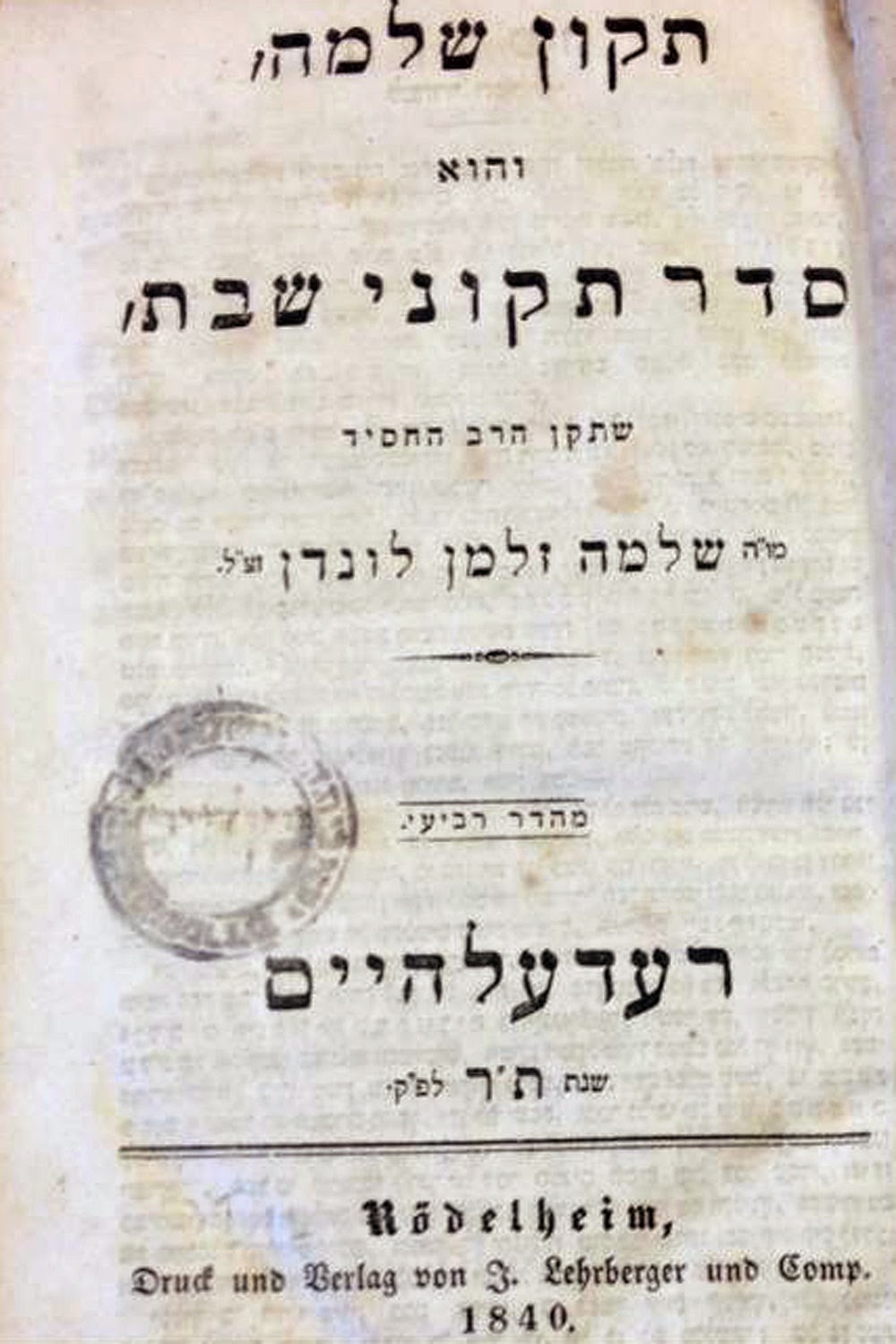
The work is Tikkun Shlomo and is primarily focused on the Shabbos liturgy.  I reproduced the title page:
Many will no doubt recognize the name of the compiler, Shlomo Zalman London (1661-1748) who wrote the book “קהלת שלמה”and that it was reprinted thirty times in the next 200 years.  
Tikkun Shlomo was first published in Amsterdam by Dr. Naftali Hertz HaLevi in 1733.  Dr. Levi published many a storied book, including the first edition of Mesilat Yesharim and the edition of the Shu”t HaTashbetz that is alleged (erroneously) to have been cosigned to flames.  According to Friedberg, when Dr. Levi published the Tikun Shlomo, not much else was being published in Amsterdam due to the effect of the Thirty-Year War.[1]  The Tikkun Shlomo was very popular, going through almost 40 editions by the late 19th century. Heidenheim expanded this work in 1835, and the edition I purchased was the fourth Heidenheim edition (two of the three were published in Roedelheim and the other in Lemberg).  
Things get off to a wonderful start in this book with the Hakdamah which is indicated to come from the third edition. In it, the unnamed editor pays tribute to his mentor Wolf Heidenheim Z”L and maintains that he has followed in his footsteps in all matters because “anyone who follows him will not err”. The editor only refers to himself at the end of the Hakdamah as “HaTzair”, but he leaves us an unmistakable hint as to his identity. Before we get to that, let us see what else he includes in this “Hakdamah”
ויהי מימים,ויקם עוד בּישׂראל פּורץ גדר,וישׁחת דברים נעימים, ויוסף עוד להרוס חומת שׂפת עבר ולדבּר תועה אשר לא כּדת. כּי פּרץ מצפון בא בא, ותפתח הרעה, וידפיס אישׁ אחד את המחזורים ב׳האננאפער׳, ויעבור חק, ויהפוך וישׁנה מדעתו את דברי התפילות ופיוטים, ויעקש ויעקל מאוד כמעט בכל דף ודף, ותהי זמירת ישׂראל בידו מעין משחת ומקור נרפשׁ, אשה יפה וסרת טעם, כּי שנה את טעמה ויתעמר בה וימכרה בּכּסף, וכן לא יעשׂה.
He takes great offense to a certain Machzor printed by “one man”. The Machzor to which he referring to is known as “Ordnung der Oeffentlichen Andacht für die Sabbath und Festtage des Ganzen Jahres, nach dem Gebrauche des Neuen Tempel-Vereins”, otherwise known as “Seder ha-‘Abodah, Minhag Ḳehal Bayit Ḥadash” printed in Hamburg (not Hanover) in 1819. Two editors are listed:  Seckel Isaac Fraenkel and Meyer Israel Bresslau. It was the new prayer book of the Hamburg Reform Temple dedicated in 1818.  To paraphrase what he writes about this effort: “ a great evil has descended from the north, one that has been perpetrated by a man who published Machzorim in the city of Hanover ( Hamburg ). In his hands, the prayers, which are like a beautiful  woman , are now left with no personality. His purpose was to destroy the Hebrew language, the prayers as we know them, and Judaism itself.”


He continues by writing that he has authored a work Zichron Livnei Yisroel ( Altona 1819) in which he lays out his war against these Machzorim.[2] The title incorporates this explanation:
זה ימים יצא בדפוס קונטרס מיוחד לתפילת ערבית ושחרית לשבת, ומעתיקי תפלה הזאת עברו גבול אשר גבלו הראשונים, גרעו והוסיפו כחפץ לבבם … חלילה … לשנות מסדר תפלתינו / … דברי … עקיבא בר”א ברעסלויא, ראב”ד פה ק”ק אלטונא
This was Rabbi Akiva Wertheimer (1778-1835), the Rav of Altona, Germany, today part of the city of Hamburg. He wrote “Zichron Livnei Yisroel” and was the editor of our edition of “Tikun Shlomo”. His opposition to the new Reform prayer service is noted in a book called “Shnos Dor V’Dor” printed in Jerusalem by Artscroll/Mesorah in 2004. It records the following that occurred in 1819 which coincides with the printing of his book “Zichron Livnei Yisroel”:
בשנת תקע״ט, עוד קודם להתמנורנו, בקום המחדשים ״אנשי ההיכל״
הרפורמי דהמבורג לשנות את סדרי התפילה היה הוא הראשון אשר יצא כנגדם והזהיר את כל הקהילות סביבות אלטונא מפניהם.
Continuing in the Hakdamah to Tikun Shlomo, we find that Rav Wertheimer has launched a campaign against the reformers by adding that he has sent this out broadside everywhere to warn others of this assault on tradition. He does this brilliantly by paraphrasing a Pasuk in Tanach ( Shoftim 20:6) which deals with the tragic story of “Pilegesh B’Givah” an incident which almost tore the Jewish people apart.
The Pasuk reads:  וָאֹחֵז בְּפִילַגְשִׁי, וָאֲנַתְּחֶהָ, וָאֲשַׁלְּחֶהָ, בְּכָל-שְׂדֵה נַחֲלַת יִשְׂרָאֵל:  כִּי עָשׂוּ זִמָּה וּנְבָלָה, בְּיִשְׂרָאֵל.
His paraphrase reads:
ואוחז בפּילגשׁו ואנתחה ואשׁלחה בכל גבול ישׂראל, למען יראו זקני עם וקציניו, והסירו גם את המכשלה הזאת מקרבּם
The full text of the broadside was published in Dukes, AW”H leMoshav, Cracow: 1903, 104-05.  Additionally, the National Library of Israel has a copy (perhaps that of Israel Mehlman, see his catalog Ginzei Yisrael, no. 1743).  The broadside is signed, Akiva br”a Bresslau without additional identifiers, i.e. the son of Avigdor Wertheimer.  As Dukes notes, Graetz mistakenly attributed this work to a different Akiva, Akiva Eiger.  But he was not the only one to publish against the Hamburg Temple and its prayer book in Altona that year.  The work, Eleh Divrei ha-Brit, was also published in Altona in 1819 and it contains, among others, the position of the Hatam Sofer.  
The battle was waged by both sides, and Meyer Israel Bresslau, one of the editors of the Hamburg prayer book, that same year responded with Herev Nokmat (available online here).  The other editor, Fraenkel, in the prayerbook includes a defense of the changes[3].  
As with many editors of Siddurim, Rav Wertheimer extols the exactness of his edition, claiming that he has fixed many of the errors that have crept into previous Siddurim. Specifically, he addresses the text of Mishnayos Shabbos which appeared in many Siddurim and which he has carefully edited especially when it comes to the “Nekudos”.
He continues and states that when it comes to words of foreign origin, such as in Greek, Latin or Arabic, he has also made sure that the “Nekudos” are correct reflecting the proper pronunciation in those languages.
Unfortunately this is not a simple task and this example will illustrate the difficulty in doing so.
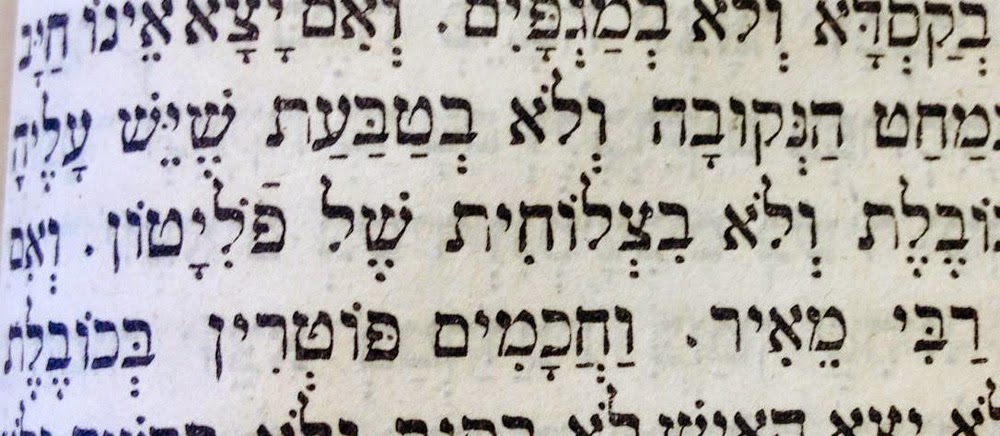
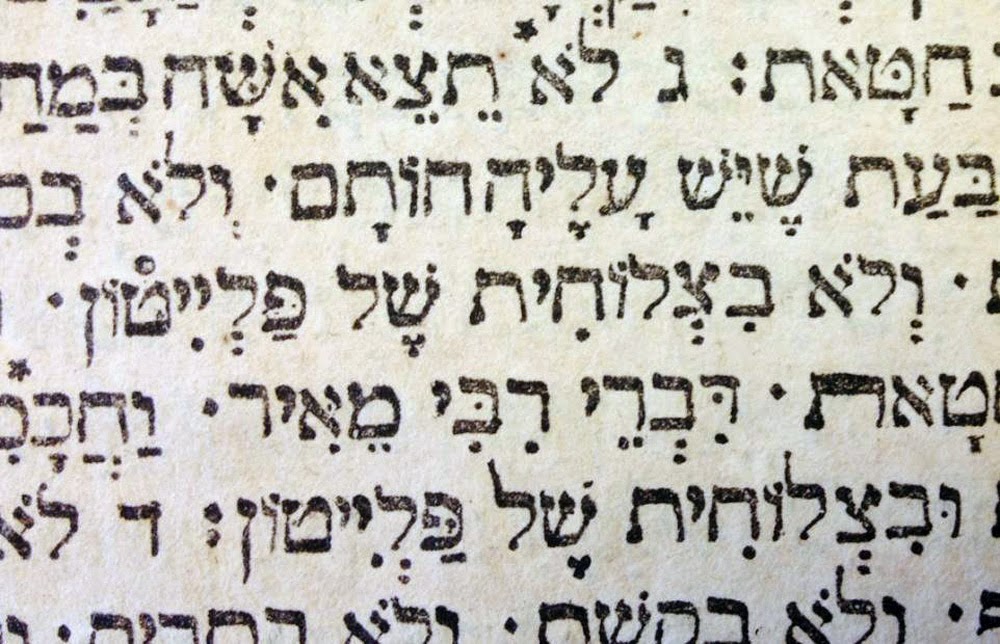
The laws of what a woman may or may not carry outside on Shabbos are discussed in Shabbos 6:3. Among the items prohibited is something called a “Tzlochis Shel Palyiton”, a flask of “Palyiton.” Jastrow defines this word as “an ointment or oil prepared from the leaves of spikenard”. He adds that its origin is the Latin word “foliatum”. The Latin Lexicon website spells this word foliātum and gives the exact same definition. So how should this Latin word be spelled in Hebrew?
Rav Wertheimer indicates that it should be pronounced something like “Folia’tone”which is pretty close to the Latin word except for there being an “n” sound at the end of the word instead of the “m” sound.
I have a Mishnayos printed in Pisa during the same time period (1797) which makes it look more like “Pal’yi’tone”:
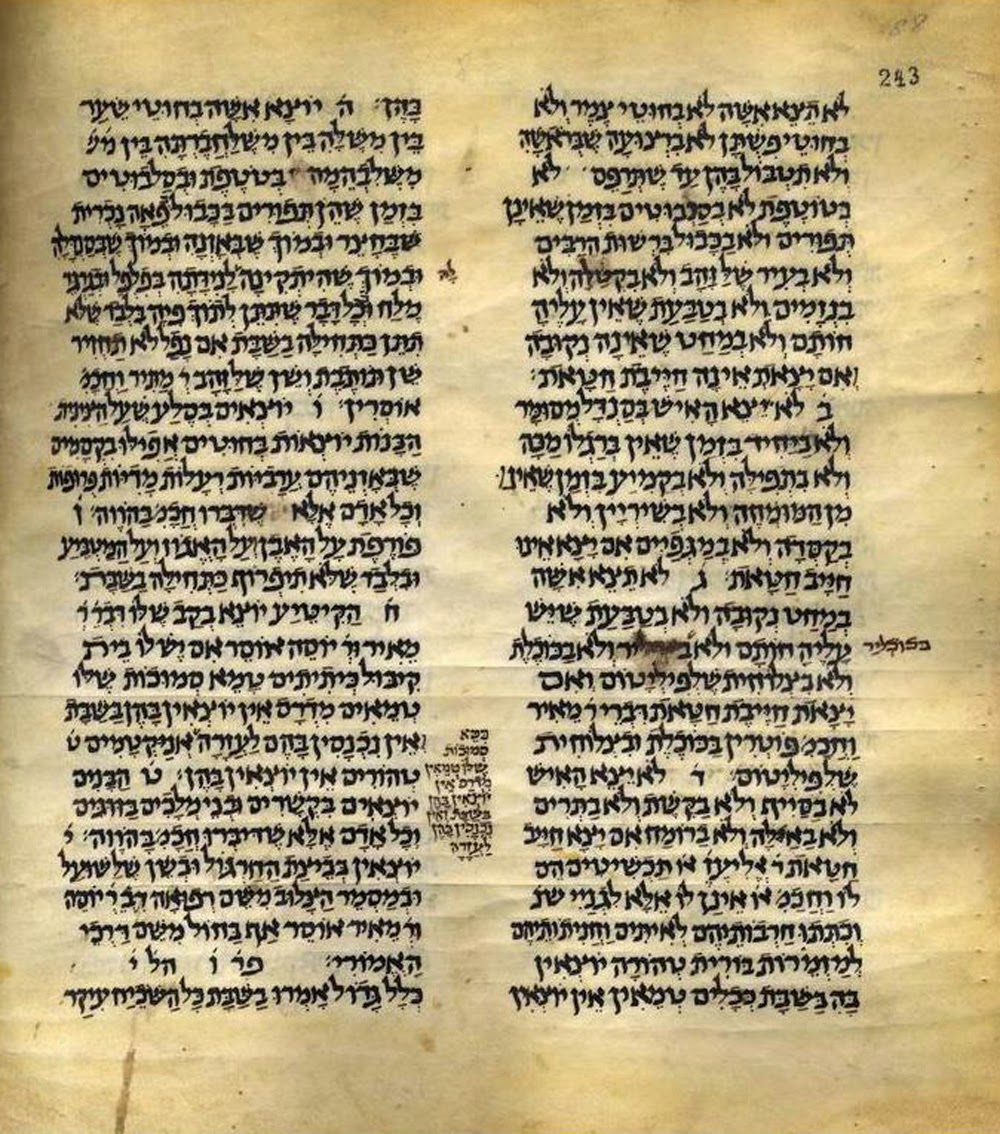
Two very old manuscripts of the Mishneh shed some light on how the word was originally spelled. One of the most famous is known as Codex Kaufmann ( MS Kaufmann A 50) which was written in 10th or 11th century Palestine. There we find the word looking more like “Pil’Ya’Tome”, with an “m” sound at the end:
The Parma manuscript referred to as MS Parma, De Rossi 138 written in 1073 has it the same as Kaufmann.
In recently printed Mishnayos such as from Feldheim, Artscroll, Steinsaltz, and Blackman, the word is spelled “פלייטון” with either a Patach ,Chirik, or “Shva”  under the “Peh”, or “פולייטון”, which looks more like Rav Wertheiner’s rendering.
One thing is clear- it is sometimes very difficult to write a foreign word with Hebrew letters and vowels, and it is also difficult to ascertain which version is “correct”.
Another wonderful aspect to the book that I bought was learning about the man whose name is embossed on the front cover. He is listed as יוסף אשר בן כ״ה (כבוד הרב) משה פאלאק   
We know a bit about Yosef Asher Pollock from some of the other books and manuscripts he owned. The following two citations are from the online catalogue of the Israel National Library:
1. A manuscript written in the 19th century by Chaim ben Yaakov Abolofia.
תקנות קהלת איזמיר. ‬
Los Angeles – University of California 960 bx. 1.9
ותו הספר: “מספרי יוסף אשר פאלאק ז”ל” משנת תרפ”ה. ‬
From this record we know that he had passed away before 1925 and that the manuscript is now in Los Angeles.


2. A manuscript written in the 18th century
(ספר הכונות (חלק שבת ומועדים. 
Amsterdam – Universiteitsbibliotheek MS Rosenthal 567
בראשו תו ספר של הבעלים “יוסף אשר פאלאק
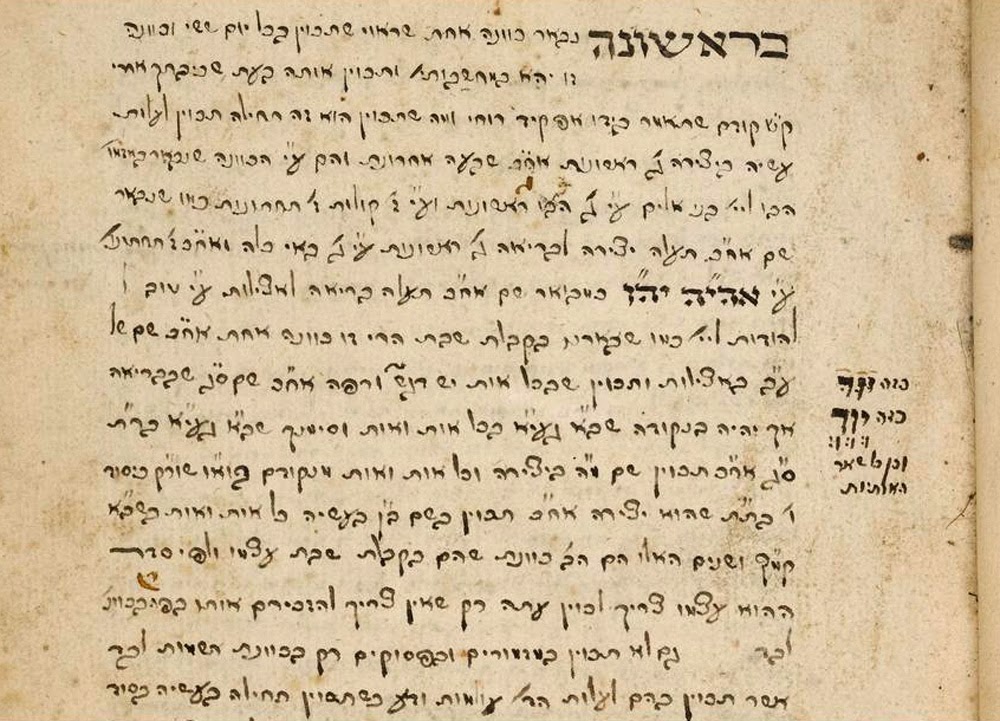
This rare manuscript has been scanned and is available online. The first page looks like this:
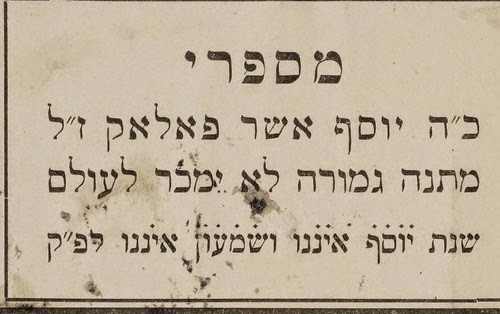
From this one we also learn quite a bit more about Yosef Asher Pollock because it contains this bookplate on the inside front cover

We surmise from here that this was not the only book he had that was donated, as someone went to a lot of trouble composing and printing such a heartfelt donation plate. (“ Yosef is not here, nor is Shimon”) The year the bookplate was printed was 5693(1933). There is also a stern warning that since this is a gift, it may never be sold by the recipient.   

The history of the Bibliotheca Rosenthaliana in Amsterdam is also interesting, especially how the collection of Judaica survived the Nazi occupation. The library’s website notes the following:
“The Germans closed the Bibliotheca Rosenthaliana in the summer of 1941 and transported part of the collection to Germany, where it was earmarked for Rosenberg’s ‘Institut zur Erforschung der Judenfrage’.
Happily, these plans were thwarted with the German capitulation. Most of the boxes of books were in storage in Hungen, near Frankfurt am Main, where they were found and shipped back to Amsterdam. But the curator and his assistant together with their families had also been deported-for them there was no return”
Finally, it seems clear to me that my book was also a gift never to be sold. I surmise this from the fact that the name of Yosef Asher Pollack is beautifully embossed on the front cover of the Siddur, making it unnecessary to have an ownership bookplate inside the Siddur.
Nevertheless, on the inside front cover there is a rectangular remnant of a bookplate which has been torn off.  
Coincidentally, its size exactly matches the bookplate of the manuscript donated to the Bibliotheca Rosenthaliana, which contained the admonition of not selling the book. Tearing off this “warning label” enabled the book to be sold, something that most likely happened over time to many books that were donated to libraries.
___________________________________________________
[1] Friedberg, History of Hebrew Typography, Antwerp: 1937, 49.  Although Dr. Levi’s production may have slowed, the bases for Freidberg’s assertion that Amsterdam publishing was affected by the Thrity-Year War is uncertain.  During the 18th century, production of Hebrew books in Amsterdam ranges from 82 to a high of 246 per decade.  The 1730s, the period that Tikkun Shlomo was published, is in the mid-range of those two extremes, with 145 books published between  1730-39.
[2] This work is a single sheet broadside and begins with Moda’ah raba . . . Zikhron Le-veni Yisrael.  
[3] For a summary of his arguments, see Petuchowski, Prayerbook Reform in Europe, New York, NY: 1968, 53-54.


The Satmar Rebbe and a Censored Mishnah Berurah, and R. Baruch Rabinovich of Munkács

The Satmar Rebbe and a Censored Mishnah Berurah, and R. Baruch Rabinovich of Munkács

Marc B. Shapiro

1. In my recent interview in Der Veker, available here, I said that I hope to discuss how the Satmar Rebbe was mistaken in identifying a Zionist censorship in the Mishnah Berurah.

In Ha-Maor, Elul 5716, p. 30, M. Abramson tells the following story that appears under the heading על זיוף המשנה ברורה. The Satmar Rebbe was away from home and asked his assistant, R. Joseph Ashkenazi (who is the source of the story), to bring him a book. Ashkenazi brought the first book that came to his hand. It was a Mishnah Berurah printed in Israel. After investigating the history of the printing of the Mishnah Berurah at the National Library of Israel, I concluded that the copy the Satmar Rebbe was given was published by Pardes in 1955 (one year before the event described). Here is the title page.

Later the Rebbe returned the book to Ashkenazi and said that as far as he remembers, the language in section 156 of this copy of the Mishnah Berurah differs from what appears in other editions. Ashkenazi checked an older edition of the Mishnah Berurah and discovered that the Israeli edition had altered the original text.

The original Mishnah Berurah 156:4 reads:

מצוה על כל אדם לאהוב את כ”א מישראל כגופו שנא’ ואהבת לרעך כמוך וכו’ ודוקא רעך בתורה ומצוות אבל אדם רשע שראה אותו שעבר עבירה המפורסמת בישראל ולא קיבל תוכחה מצוה לשנאתו.

I have underlined the words that Abramson calls attention to. While the original text reads: לאהוב את כ”א מישראל, the Pardes edition has לאהוב את עמיתו. Abramson notes, “In this they wanted to show their support for democracy, that one needs to love not just the Jews but also the Arabs.” The Pardes edition also omits the second series of words that I have underlined, which express sentiments that are not very tolerant of the irreligious,[1] as well as some other words.

Here is the uncensored page in the Mishnah Berurah.

Here is the censored page in the Pardes edition.

Upon looking again at the Abramson article, I see that I misremembered, as it does not actually say that the Satmar Rebbe attributed this censorship to the Zionist publisher. He simply noticed the problem in the Israeli edition and said that this Mishnah Berurah is not like the others he has seen. It is Abramson who explicitly blames the Zionists (although perhaps the Rebbe agreed with Abramson). Abramson sarcastically writes that apparently they also provide copies of the Mishnah Berurah “to the children of Mapai and Mapam,” and this explains why they altered and censored the text.

Yet the truth is that what we have just seen has nothing to do with the Israeli publisher, Pardes. I found the same censorship in a Mishnah Berurah that appeared in Warsaw in 1895, and interestingly, it is this very edition that is found on hebrewbooks.org here. In other words, the changes we have seen were inserted under Czarist rule, and the Israeli publisher simply reprinted a copy of the Mishnah Berurah without realizing that it was a censored version.[2]

I know of another example where the altering of a text was blamed on the Zionists, and this time the one doing the blaming was a Mizrachi rabbi, R. Avigdor Cyperstein. In the Mossad ha-Rav Kook Archive of Religious Zionism there is a letter from R. Cyperstein to Dr. Yitzhak Rafael dated May 14, 1967. The relevant section reads as follows:

ידידי היקר – אני רוצה לזכות אותך בזכות הרבים, ובטח לא תחמיץ את המצווה הזו: כעת בכל העולם נפוצים הסידורים תוצרת הארץ הוצאת “בית רפאל”, ת”א – “סדור התפלה השלם” – והנה מצאתי בסידור זה דבר נורא: במעמדות של יום הששי מובא הגמ’ מנחות מד. המעשה באדם אחד שהי’ זהיר במצוות ציצית וכו’ ושם כתוב “באה לבית מדרשו של ר’ חייא, אמרה לו רבי צוה עלי ויעשוני גיורת וכו’, – והמולי”ם הללו העיזו לשלוח יד בגירסת הגמ’, ובמקום ויעשוני גיורת – השליכו את הגיורת החוצה, והכניסו במקומה “עברית” . . . והמרחק-התהום בין גיורת לעברית – אין צורך לבאר, וגם כוונתם הטרופה, בוקעה מזה, ומעלה סרחון, בכי’ לדורות. דומני שאין מי שהוא שהעיז לכבוש את המלכה בבית וכל ישראל – מתפללים מסידור זה, וע”כ מצווה לפרסם זה ברבים, ולתקן בהוצאות החדשות.

It is hard to know whether what R. Cyperstein refers to was indeed a Zionist inspired alteration. I say this because the version ויעשוני עברית is also attested to in a few sources that pre-date Zionism. I think it is more likely that the publisher just assumed that this is a more authentic reading.

Since I have been discussing the Satmar Rebbe, here is as good a place as any to note that contrary to popular belief, the name Satmar does not come from St. Mary. The original meaning seems to be a personal name, and in popular etymology the word came to mean “great village.”[3] Yet even in the Satmar community some believe that the word comes from St. Mary, and because of this they pronounce it as “Sakmar”. In pre-war Hungary this pronunciation was common among many Orthodox Jews, not only Satmar hasidim.[4] For one example of this, here is Samuel Noah Gottlieb’s entry on Satmar in his rabbinic encyclopedia, Ohalei Shem (Pinsk, 1912), p. 425. As you can see, while “Szatmar” appears in the vernacular, in the Hebrew the city is spelled “Sakmar”. There are many more such examples.

This avoidance of saying the word “Satmar” is similar to the way Jews referred in Hebrew and Yiddish to the Austrian town Deutschkreutz. Unlike the case with Satmar, when it came to Deutschkreutz the universal Jewish name was Tzeilem (Kreutz=cross=tzelem). On the other hand, there was a significant Jewish community in the Lithuanian city of Mariampole, whose name comes from Mary. Yet I am not aware of anyone who avoided saying the name of this city. Shimon Steinmetz emailed me as follows:

We might also note other cities with Christian-y names, like Kristianpol. Kristianpoler was a name used even by rabbis, cf. Rabbi Yechiel Kristianpoler, and his son Rabbi Meir. In addition, the Lithuanian town Kalvarija, which has a very Christian association, Jews used it without any issue. On the other hand, the Jews called St Petersburg, “Petersburg,” without the “St.”

One other point about Satmar: In a lecture I mentioned that one of the old-time American rabbis met with the Satmar Rebbe and concluded that when it came to the State of Israel, you simply could not speak to him about it. He was like a shoteh le-davar ehad when it came to this in that no matter how much you tried to convince him otherwise, he refused to listen to reason. Someone asked me which rabbi said this. It was R. Ephraim Jolles of Philadelphia (as I heard from a family member). I don’t think his formulation is too harsh, as anyone who has read the Satmar Rebbe’s writings can attest. It does not bother me if he or anyone else wants to be an anti-Zionist. However, the anti-Zionist rhetoric found in the Satmar Rebbe’s writings, and those of his successors, is often more extreme than what we find among the pro-Palestinian groups. Take a look at this passage from Va-Yoel Moshe, p. 11.

אם נקח כל פירצות הדור והעבירות המרובות הנעשות בכל העולם וישימו אותם בכף מאזנים אחת, ומדינה הציונית בכף מאזנים השני’, [המדינה הציונית] תכריע את הכל, שהוא השורש פורה ראש ולענה של אבי אבות הטומאה שבכל אבות הנזיקין שבכל העולם כולו, והן המה המטמאים את כל העולם כולו.

By what logic can one claim that such an outrageous passage would be anti-Semitic if said by Mahmoud Abbas, Linda Sarsour, Tamika Mallory, or Max Blumenthal, but not so if the very same thing is said in Satmar?

If anyone wants to see the results of this rhetoric, here are two videos with kids from Satmar. In this one the children are being taught that the Zionists started World War II and to hope for the destruction of the State of Israel.


In this video children were told that Netanyahu was in the car and they were to throw eggs at it.

It is very painful to see how children are being indoctrinated with such hatred. Again I ask, if such a video surfaced from a leftist camp, there would be no hesitation in labeling it anti-Semitic. So why are people hesitant to conclude that Satmar is also involved in spreading anti-Semitism?

The general assumption is that the Satmar Rebbe hated Zionism and the State of Israel so much, that he was inclined to believe even the most far-out anti-Semitic canards against the State. I have always found this difficult to believe. Say what you will about the Rebbe, there is no denying that he was very intelligent. Thus, I have a hard time accepting that he could have really believed in Zionist control of the media and other anti-Semitic tropes found in his polemical writings. In other words, I think it is more likely that he did not believe in any of these things but said them anyway in order to convince his followers not to give up the fight against Zionism, a fight that had been abandoned by so many former anti-Zionists after the Holocaust and the creation of the State of Israel in 1948. In such a battle it was necessary to turn Israel not only into something bad, but actually the worst sin imaginable.

R. Nahum Abraham, a Satmar hasid and prolific author, has recently written that the Satmar Rebbe would deny things that he knew were true. He regarded his denials as “necessary lies,” in order to prevent people from being led in the wrong direction.[5] If the Rebbe thought that it was permissible to deny the truth of certain hasidic stories in order to prevent his followers from being influenced by them, isn’t it possible that he would exaggerate the evils of the State of Israel in order to best indoctrinate his followers with an anti-Zionist perspective?

This approach also would explain a big problem that no one has been able to adequately account for. How was the Satmar Rebbe able to have friendly and respectful relationships with people who, based on what he writes, he should have regarded as completely out of the fold due to their involvement with the State of Israel? This includes even men like R. Aharon Kotler who supported voting in the Israeli elections, which the Satmar Rebbe claimed is “the most severe prohibition in the entire Torah.”[6] Yet we know that the Satmar Rebbe respected R. Aharon and others who had a very different perspective.[7] Can’t this be seen as evidence that there is a good deal of ideologically-driven exaggeration in the Satmar Rebbe’s writings, and that not everything he says really reflects his actual views? After all, if he really thought that voting in the elections was the most severe prohibition in the Torah and the State of Israel was completely destroying Judaism, would he still be able to be on good terms with rabbis who instructed their followers to vote and be part of the State?

2. Since I mentioned Munkács in this post, let me return to another recent post here where I discussed R. Baruch Rabinovich, the son-in-law of R. Hayyim Eleazar Shapira and his successor as Munkácser Rebbe. When I wrote the post I was unaware of the fact that R. Baruch’s grandson, R. Yosef Rabinovich, recently published Ner Baruch, which is a collection of Torah writings and letters from R. Baruch. He includes in the volume the haskamot written by R. Baruch. I examined new printings of the volumes with haskamot that I was unaware of and found that R. Baruch’s haskamah to the first edition of R. Yitzhak Adler, Seder Shanah ha-Aharonah (Munkács, 1937) was deleted in subsequent printings. The same thing happened with R. Baruch’s haskamah to R. Judah Zvi Lustig’s Yedei Sofer (Debrecen, 1938). Here is how the page with the haskamot looks in the original printing.

Here is how the page with the haskamot looks in the reprint, where R. Baruch’s haskamah has been deleted.

Another point about R. Baruch: In 1946 he tried to become chief rabbi of Tel Aviv but lost out to R. Isser Yehudah Unterman. This is discussed in Samuel Heilman’s Who Will Lead Us? From a letter that appears in the archive of R. Isaac Herzog, and was sent to an unknown rabbi, we see that in 1950 R. Baruch was also interested in becoming av beit din in Tel Aviv.

This information is, to the best of my knowledge, not recorded anywhere else. In this letter, which I found here (a site that contains more interesting information and pictures about R. Baruch) we that R. Herzog, R. Unterman, and R. Yaakov Moshe Toledano were strongly opposed to R. Baruch receiving this appointment. Although the reason for this opposition is not mentioned, it is perhaps because they felt it was an abomination that someone from the anti-Zionist Munkács dynasty should have such a position in the State of Israel. However, as I have mentioned in my previous post, it is doubtful that R. Baruch ever really shared his father-in-law’s strong anti-Zionism. It is possible that the anti-Zionist statements he made in the pre-war years might not have reflected his actual beliefs but were due to his position as rebbe. That is, as the successor of R. Hayyim Eleazar Shapira he felt that he had to make such statements. It is also the case that had he not continued his father-in-law’s anti-Zionist stance he would not have retained much of a following in Munkács.

When R. Baruch wanted to become chief rabbi of Tel Aviv, a letter in opposition to this was published by Chaim Kugel, head of the Holon Municipal Council:

Is it conceivable that this man . . . who hounded Zionism and Zionists . . . who loyally continued the line of the Munkács court, which cursed and banned any Jew who pronounced the word Zion on his lips . . . is it conceivable that this man will appear as a representative and moral leader in the first Hebrew city, and be a guide to its residents and Zionists?[8]

In those days it was obvious that positions of chief rabbis of important cities would go to Zionist rabbis. Here, for example, is a letter to R. Unterman from David Zvi Pinkas, an important Mizrachi figure and signatory of Israel’s Declaration of Independence.[9] Note how Pinkas tells R. Unterman that the Mizrachi expects him to follow the Mizrachi approach in everything he does. If R. Unterman could not commit to this, then Pinkas would have found another rabbi who could.

In my earlier post I neglected to mention R. Baruch’s Hashav Nevonim that appeared in 2016. This book is full of interesting material, and the more I read from R. Baruch, the more impressed I am. He really was a fascinating figure in so many ways.

There is a good deal I can say about Hashav Nevonim, but let me just call attention to the first essay that appears in the book, focused on conversion. Conversion is a matter often in the news. I have said on numerous occasions that what currently passes as the standard approach to conversion was not the case at all in previous years. To begin with, among the rabbis there were different understandings of what kabbalat ha-mitzvot entailed, and the currently accepted view that a prospective convert must commit to become fully halakhically observant, as practiced today in Orthodox communities, was not the view of many, and perhaps not even the view of most. The notion that a conversion could be annulled after the fact was hardly ever put into practice, although even this is found on occasion and R. Baruch cites some authorities who speak about this very point. Thus, it is not, as has often been alleged, a modern haredi idea with no historical basis although, as mentioned, it was very rare.

After going through the various views on conversion, R. Baruch concludes as follows (p. 47).

מנהג העולם נראה כמקבל דיעה זו, וכל מי שנתגייר, בין ששומר מצוות, ובין שחוזר ועובר עבירות, דינו כישראל, כל שקיבל עצמו עול מצות עם גירותו.

I have underlined the words which are not currently accepted by many (most?) conversion courts and which are at the heart of the controversy regarding voiding conversions. Today, the assumption of many conversion courts is that if someone who converts is later seen violating halakhah in a serious way, we can assume that this person never really accepted the mitzvot at the conversion, and the conversion is therefore not valid. It is this argument which was hardly ever put into practice in previous years and now appears to be quite common, so much so that converts claim to feel that their conversions are always “on condition,” namely, that even many years after converting there is the possibility that the conversion will be declared invalid because of a lack of proper kabbalat ha-mitzvot.

On pp. 27-28, R. Baruch calls attention to the novel view of R. Isaac Benjamin Wolf, author of Nahalat Binyamin (Amsterdam, 1682), a book reprinted a number of times and which carries the haskamah by R. Jacob Sasportas. Here is the title page.

R. Isaac is described as rabbi of מדינת מרק. This refers to the German county of Mark, about which see here.

Here is page 89a in Nahalat Binyanim

According to R. Isaac, in places such as Spain and Portugal, where one could not practice Judaism openly, if a Jewish man marries a non-Jewish woman, and the woman chooses to practice Judaism, both she and her children are regarded as Jewish. How can she be Jewish when she never immersed in the mikveh and there was no beit din to preside over the conversion? R. Isaac says that there is no obligation to immerse in the mikveh when there is danger (as there would be in a place with the Inquisition looking to find Crypto-Jews). Although he does not elaborate, it is obvious that according to R. Isaac kabbalat ha-mitzvot in front of a beit din is not an absolute requirement. In other words, he holds that in a she’at ha-dehak one can convert on one’s own, without a beit din.

This is a fascinating position that is at odds with accepted halakhah, so much so that most people won’t even believe that such a position is possible. R. Baruch is not able to cite anyone who agrees with it. The position of Nahalat Binyamim is discussed by R. Eliezer Waldenberg, who not surprisingly completely rejects it.[10] However, he does cite a medieval view that has some similarity to Nahalat Binyamim:

היה מקום להביא סמוכין לזה משיטת האביאסף שהובא במרדכי ביבמות סו”פ החולץ שמפרש דברי הגמ’ שם שאומרת מי לא טבלה לנדותה שמשמע דבדיעבד הוי גר גמור גם בטבילה בלי ג’.

Unlike R. Waldenberg, R. Hayyim Amsalem, Zera Yisrael, p. 290, does not reject Nahalat Binyamin out of hand. Instead he writes:

חזו דברי גאון קדמון זה לאיצטרופי, ולדון להקל בבני האנוסים ובבני יהודים לענין גיורם וחזרתם לדת, שכל שימולו ויטבלו לשם יהדות בהודעת מקצת מצוות כהלכה, סגי להו אף לכתחילה, אע”פ שאנחנו לא יודעים מה שהיה אח”כ לענין קיום המצוות, וזה אתי אפי’ למ”ד קבלת מצוות מעכבת.

See also Jacob Sofer, Sipurei Yaakov (Lvov, 1913), vol. 2, pp. 7ff. (no. 42), for a lengthy story starring the Maharal. The tale is obviously fictional, but of importance for our purposes is that the story, reported in a hasidic text, tells of a woman who ran away from her non-Jewish husband and married a Jewish man, had children, and was a righteous woman. However, this woman never converted with a beit din, and yet on p. 8a it specifically states that she and her children are to be regarded as Jewish. R. Nahum Abraham points to this as an example of an anti-halakhic hasidic story that cannot be true.[11]

Finally, Nahmanides in his commentary to Yevamot 45b has an interesting view and I do not know if it is accepted.

ואיפשר לומר דגבי קבלת מצוות צריך שלשה אפילו בדיעבד דמשפט כתיב ביה מה התם שנים שדנו אין דיניהן דין אף כאן אינו גר אפילו בדיעבד, אבל מי שהודיעוהו מקצת ענשן של מצות ומתן שכרן של מצות וקיבל עליו בב”ד לטבול ולמול, אם הלך ומל וטבל שלא בפני ב”ד הרי זה כשר ולא פסלינן לזרעיה

3. There are many new books to speak about. One of them is Chaim I. Waxman, Social Change and Halakhic Evolution in American Orthodoxy. The content of the book can be seen from the title. I will be reviewing this book in an academic journal, so I do not need to speak about it here. I would, however, like to call attention to one point that will not be mentioned in my review. Chapter 5 is titled “Tensions Within Modern Orthodoxy.” Not surprisingly, it deals with women rabbis. On pp. 109-110, Waxman refers to R. Jeremy Wieder’s view on the matter (the name is misspelled “Weider”). He quotes from an article in the Yeshiva University Commentator, which summarizes R. Wieder’s position as follows: “[I]n light of the success of the yoetzet halacha program in increasing overall observance in the communities that he has observed, it may be very beneficial to have women rabbis.”

I was quite surprised to see such a liberal position expressed by a YU Rosh Yeshiva, and I checked the source which appears here. R. Wieder is indeed quoted saying, among other things, that there is no binding tradition on the matter of women rabbis since the issue of women in leadership positions is a new question, thus preventing the development of a “stream of Jewish tradition.” However, when I read the article I did not find anything about how it may be “beneficial to have women rabbis.” I then noticed the following at the beginning of the article. “Editor’s Note: This article has been edited to more precisely convey the opinions represented.” In this case, I think the meaning of “more precisely convey” is that what originally appeared was altered (presumably at R. Wieder’s request) in order to prevent controversy. Yet even with the removal of R. Wieder’s view that it may be “beneficial to have women rabbis,” the current text of the article does not alter the substance of R. Wieder’s opinion. Thus, we find the following:

Lastly, Rabbi Wieder talked about the issue from a philosophical standpoint. He argued that expanding the pool of rabbinic students could lead to an increase in qualified rabbinic candidates. Rabbi Wieder added that he has observed the yoetzet halacha program increase overall halachic observance in the communities it serves and he expressed his optimism that women rabbis could generate similar improvement.

These words are certainly in opposition to the OU’s recent statement on women and religious leadership which is available here.

The question I have been asked a few times is if in the current political climate it is possible for a rabbi at a mainstream Modern Orthodox synagogue, or a teacher at a mainstream Modern Orthodox school, to feel free to express support for the ordination of women. Would such a rabbi or teacher risk censure from his colleagues or even the possibility of losing his job? The answer to these questions will determine if we are dealing with a real wedge issue (as I think we are).

Another new book is R. Bezalel Naor’s Shod Melakhim. R. Naor is well known as an outstanding interpreter of R. Kook. His great knowledge of the entire scope of Jewish thought (not just R. Kook) is apparent to anyone who examines his writings. Yet I do not know how many are aware of R. Naor’s achievements when it comes to rabbinic literature. This latest book is a collection of R. Naor’s studies on various halakhot in the Mishneh Torah. As part of R. Naor’s explication of these halakhot, he offers the reader wide-ranging enlightening discussions using numerous sources, both traditional and academic. For those who can appreciate the synthesis of the traditional and the academic approaches to the study of Maimonides, R. Naor’s new book is a real treat.

In the past I have spoken about the late R. Mordechai Spielman’s great work on the Zohar, Tiferet Zvi. The seventh volume of Tiferet Zvi has recently appeared, and can even be purchased on Amazon. Anyone who is interested in how the Zohar has been interpreted, and the impact of the Zohar on later rabbinic literature, will benefit greatly from of R. Spielman’s writings.

A new book (over 600 pages) by Benjamin Brown has appeared. It focuses on the Karlin hasidic dynasty. When I received the book in the mail, the first thought that came to my head is that Brown is a phenomenon. There is no other way to put it. It is not just the quantity of his literary output that is astounding, but also the quality, as everything he writes is worth reading.

____________

[1] Regarding the Hafetz Hayyim’s view of the non-religious, which is very much at odds with current approaches in the Lithuanian yeshiva world (at least in America), see Benjamin Brown, “Ha-‘Ba’al Bayit’: R. Yisrael Meir ha-Kohen, he-‘Hafetz Hayyim,’” in Brown and Nissim Leon, eds., Ha-Gedolim (Jerusalem, 2017), pp. 127ff. Brown also shows that in a few letters the Hafetz Hayyim adopts a more moderate perspective.
[2] In future posts I hope to say a good deal more about the Satmar Rebbe’s writings. For now, let me just respond to someone who emailed me and compared R. Hayyim Eleazar Shapira, the Munkácser Rebbe, to the Satmar Rebbe. It is true that they are similar in terms of their strong opposition to Zionism, and the Satmar Rebbe can be seen as the Munkácser Rebbe’s successor in this matter. However, in terms of their scholarly approach, they are quite different, as the Satmar Rebbe did not have the Munkácser’s critical sense. In fact, I was quite surprised to learn that the Satmar Rebbe accepted as authentic the forged anti-Zionist letters published by Chaim Bloch in his three volume Dovev Siftei Yeshenim. See R. Dov Schwartz, Meshiv Devarim (New York, 2011), pp. 140-141.
[3] See here.
[4] Shimon Steinmetz called my attention to סאקמאר appearing as the name of the city as early as 1859 in R. Hayyim Meir Ze’ev ha-Kohen, Sha’arei Hayyim (Pressburg 1859), in the list of subscribers at the beginning of the book. (You can find this on Google books, but the version of the book on hebrewbooks.org is missing these pages, as well as other pages.) This shows that referring to the city as “Sakmar” was already common. Steinmetz also called my attention to the same thing in the list of subscribers found at the end of R. Hayyim Joseph David Azulai, Kise Rahamim (Ungvar, 1870). In this case, you can see the subscribers in the copy on hebrewbooks.org, but it has been removed from the copy on Otzar ha-Chochmah. If this was removed intentionally, on the assumption that it is not really part of the sefer, it is a big problem, as the subscriber information can be of great historical importance. It is vital that both hebrewbooks.org and Otzar ha-Chochmah scan books in their entirety, without making any changes whatsoever.

R. Yoel Teitelbaum used the term Satmar all the time, and it was on his stationery, but I did find a number of places where he wrote Sakmar, spelled סאקמער and סאקמיר. See e.g., his approbations to R. Abraham Hayyim Reinman, Va-Yetze Perah (Satmar, 1940), R. Asher Steinmetz, Mikveh Yisrael ha-Shem (Jerusalem, 1961), and his letter in Divrei Yoel: Mikhtavim (Brooklyn, 1981), vol. 2, p. 81. See also Esther Farbstein, Be-Seter ha-Madregah (Jerusalem, 2013), p. 862, for a 1949 letter from Budapest to R. Yoel in which the word Sakmar is used. Shimon Steinmetz wrote to me as follows:

I think you can see by his [R. Yoel’s] correct spelling in Latin letters that he didn’t take it seriously, and perhaps not too many Jews did. After all, R. Joel Teitelbaum himself, who I think most people would consider fairly zealous, did not insist or use it very much. . . . This tells me that when people did call it Sakmar, most of them were probably just calling it that because it was already what Jews called it. Perhaps it was even a sly joke to begin with.

[5] Peti Ya’amin le-Khol Davar (n.p., 2017), p. 31
[6] Divrei Yoel, Mikhtavim, no. 90.
[7] In a future post I will publish a letter I received from Moshe Beck dealing with this point. Beck is the chief rabbi of the U.S. Neturei Karta.
[8] Translation in Heilman, Who Will Lead Us?, p. 45.
[9] The letter is found in the Israel State Archives, David Zvi Pinkas collection, 3070/15-פ.
[10] Tzitz Eliezer, vol. 17, no. 42:11.
[11] Heikhal ha-Besht 18 (Nisan 5767), p. 18. For an Arabic version of this story, see Bayit Neeman 96 (26 Tevet 5776), pp. 4-5.