The Anonymous Author of Tikkunei Zohar and Ra‘ya Mehemna: An Antinomian or a Radical Maimonidean?
The Anonymous Author of Tikkunei Zohar and Ra‘ya Mehemna: An Antinomian or a Radical Maimonidean?
By Bezalel Naor
Today, it is an accepted fact in scholarly circles that Tikkunei Zohar and Ra‘ya Mehemna form a single unit that postdates the main body of Zohar.[1] More than one reader has been scandalized by statements in Tikkunei Zohar and Ra‘ya Mehemna likening the Mishnah to a shifhah or maidservant.[2] Predictably, in response, there grew an apologetic literature that attempts to justify how such shocking statements are compatible with normative Halakhah.[3]
One cannot rule out altogether the assertion by various secular historians that these pejorative statements betray an antinomian streak,[4] though to be certain, such statements of Tikkunei Zohar and Ra‘ya Mehemna are not situated in the present but deferred to the future. With this proviso, they are no more “antinomian” than the statement of Rav Yosef in the Talmud: “Mitsvot (commandments) are nullified in the future.”[5]
I wish to present a hitherto unexplored possibility. It seems likely that the anonymous author of Tikkunei Zohar and Ra‘ya Mehemna (which surfaced in Spain in the first decades of the fourteenth century)[6] was not so much an antinomian as a radical Maimonidean. It is in this light that we should understand negative statements issuing from the author regarding the study of Mishnah or those comparing the various Talmudic exercises and mental gymnastics to the backbreaking labor to which the Children of Israel were subjected in Egyptian exile.[7] These do not spring from an anti-halakhic mindset but rather from taking at face value Maimonides’ syllabus as laid out in his introduction to Mishneh Torah:
Hence, I have entitled this work Mishneh Torah (Review of the Law), for the reason that a person, who first reads the Written Law and then this [compilation], will know from it the whole of the Oral Law, without having need to read any other book between them [italics mine—BN].
We should be asking ourselves: Are there any historical grounds to assert that in Spain in the early 1300s there were halakhic Jews who openly—we should add, brazenly—promulgated the Maimonidean curriculum to the exclusion of Talmudic studies and the concomitant exercise of pilpul?
I offer the words of Joseph Ibn Kaspi:
Therefore my rabbis, listen to me and God will listen to you! I see that it is the intention of those among you who engage in Gemara, novellae and opinions (shitot),[8] to know proofs for the practical commandments, for you are not satisfied with the tradition from Mishneh Torah composed by Rabbenu Moshe [i.e. Maimonides], though he said: “And one shall have no need of any other book between them [Italics mine—BN].”
Here is an example. Ha-Rav ha-Moreh [i.e. Maimonides] wrote in his laws: “A sukkah that is higher than twenty ammah is invalid.”[9] Yet you despair and are without comfort until you know whether the reason is because “the eye does not rest upon it,” or because “one is not sitting in the shade of the sekhakh (overhead boughs) but of the walls,” or because “the sukkah must be a temporary dwelling,” as written in the Gemara.[10] Even this will not satisfy the very punctilious (mehadrin min ha-mehadrin) until they have added problems and opinions (shitot)[11]: “If you should say,” “one may say,” etc.
Truly, I admit that this is good, but why is the knowledge of proofs an obligation in regard to practical commandments, while not [even] an option,[12] but an outright prohibition when it comes to commandments of the heart? What sin has been committed by these four commandments of the heart (that I mentioned) that you do not treat them in the same manner but are satisfied by a weak tradition of few words, wanting comprehension?[13]
Who was Joseph Ibn Kaspi? Born either in Arles, Provence or Argentière, Languedoc,[14] around the year 1280, he passed in 1345 on the island of Majorca. His was a peripatetic life. The first period of his life was spent in the south of France. Later he gravitated to Barcelona, where his married son David resided. At approximately age thirty-five he travelled to Egypt for several months,[15] hoping to acquire there the intellectual legacy of Maimonides from the Master’s fourth and fifth generation descendants but was sorely disappointed in this respect. He even entertained the thought of traveling to Fez, Morocco in search of wisdom,[16] but that particular journey never materialized.
Ibn Kaspi’s reputation is that of an ultra-rationalist. His naturalistic explanations of events in the Bible far exceed even those of Maimonides; for that reason his opinions were marginalized. Though there is an abundance of manuscripts, it was only in the nineteenth century that Ibn Kaspi’s works were published from manuscript. (A few still remain in manuscript.) To this day, his interpretations have yet to “mainstream.”
My juxtaposing the Maimonidean enthusiast Joseph ibn Kaspi to the anonymous author of the kabbalistic works known as Ra‘ya Mehemna and Tikkunei Zohar may strike the reader of this essai as bizarre. Besides their contemporaneity, what basis is there for this juxtaposition?
Geographically, there are certainly grounds for relating the two authors to one another. Though separated by the Pyrenees, there was much traffic, intellectual and otherwise between Provence and Northern Spain. Some of the greatest families of Provencal scholars originated in Spain: the Kimhis, Joseph and his son David, who excelled as grammarians and Bible exegetes; and the Tibbonides, Judah and his son Samuel, who were the premier translators of classic philosophic works from Judeo-Arabic to Hebrew. And the traffic was two-way. Prominent Provencal families wended their way to Sefarad. The halakhist Rabbi Zerahyah Halevi (“Ba‘al ha-Ma’or”), a native of Gerona, established his career in Narbonne, only to return to Gerona at the end of his days. (His great-grandson was the Talmudist Rabbi Aharon Halevi of Barcelona.)[17] Ibn Kaspi is an example of a Provencal scholar who relocated to Catalonia: Barcelona, and eventually, the Balearic isle of Majorca. Thus, there could easily have been a sharing of ideas between southern France and northern Spain.[18]
In terms of mindset, the border between rationalist philosophy and kabbalah was especially porous at this time. Whoever authored Ra‘ya Mehemna and Tikkunei Zohar, carried with him much Maimonidean baggage. Linguistically, it is apparent to any student of the Ra‘ya Mehemna and Tikkunim that they are rife with the philosophic jargon made popular by the Tibbonides’ translations from Judeo-Arabic.[19] And let us not forget that the very backbone of Ra‘ya Mehemna is an enumeration of the commandments à la Maimonides’ Sefer ha-Mitsvot. (Rabbi Reuven Margaliyot isolated these commandments and presented them in orderly fashion in the introduction to his edition of the Zohar.)
*
When we put it all together it makes perfect sense. As shocking as some of its bold statements may be, the literary oeuvre of Ra‘ya Mehemna and Tikkunei Zohar cannot be construed as issuing from the mind of an antinomian. An antinomian would not go to the bother of constructing a Book of Commandments after a fashion. Rather, I maintain that the downgrading of the study of Talmud in general, and Mishnah in particular, should be attributed to a radical adoption of Maimonides’ curriculum of studies, whereby his halakhic magnum opus Mishneh Torah has superseded the study of Mishnah and Gemara.
In this respect, Maimonides’ devotees in Provence and Spain ventured beyond the Master himself. Maimonides penned a convincing letter to Rabbi Pinhas, the Dayyan (Justice) of Alexandria,[20] that regardless of what he wrote in the introduction to Mishneh Torah, the traditional study of the Talmudic tractates (albeit as summarized in Alfasi’s Halakhot) continues unabated in his beit midrash.[21] The curriculum that Maimonides once proposed remained an abstraction. It seems that Egyptian Jewry was not overly receptive to this innovation. Only well over a century later, did this great intellectual experiment of Maimonides, Mishneh Torah, a “hivemind of halakhah,”[22] designed to replace the “dialectics of Abayye and Rava,” find foot soldiers in the likes of Ibn Kaspi and the anonymous author of Ra‘ya Mehemna and Tikkunei Zohar. They launched their campaign from the soil of Provence and Spain.
Our thesis does not ride on the reputation of Joseph ibn Kaspi. Ibn Kaspi’s statement is perhaps the most outspoken and provocative call for adoption of Maimonides’ Mishneh Torah as a way of bypassing Talmudic studies, yet there are other testimonies (from the least expected quarter) that the exclusive study of Mishneh Torah was starting to gain traction in medieval Spain.
The great halakhist Rabbi Asher ben Yehiel (Rosh) emigrated from Germany to Spain at the turn of the fourteenth century and eventually emerged as the Rabbi of Toledo, Castile, where he left his stamp on the shape of Castilian Halakhah.[23] Evidently, Rabbi Asher had cause to fulminate against authorities who decided questions of practical Halakhah based solely on the rulings of Mishneh Torah without recourse to Talmud.
Rabbi Asher writes:
I heard from a great man in Barcelona who was eminently familiar with three orders [of the Talmud, i.e. Mo‘ed, Nashim and Nezikin]. He said: “I am amazed at people who have not studied Gemara and adjudicate based on their reading in the books of Maimonides, of blessed memory, believing that they understand them. I know myself, when it comes to the three orders that I studied, I am able to understand when I read Maimonides’ books. However, his books that are based on Kodashim and Zera‘im—I do not understand at all. And I know that it is that way for them regarding all his books![24]
*
Rabbi Yahya Kafah (1850-1931) was not wide of the mark when he asserted that those statements in Zoharic literature that undercut the Talmud (comprised of Mishnah and Gemara) were designed to enhance the prestige of the Kabbalah. (By the same token, one may safely say that Ibn Kaspi’s desire to streamline the study of Halakhah, stemmed from his valorization of Philosophy.)
Logically, our next question should be: What was Maimonides’ own stake in proposing that his compendium Mishneh Torah take the place of protracted Talmudic studies? Maimonides provides a simple answer to this question in his introduction to Mishneh Torah:
At this time, severe vicissitudes prevail, and all feel the pressure of hard times. The wisdom of our wise men has disappeared; the understanding of our prudent men is hidden. Hence, the commentaries of the Geonim and their compilations of laws and responses, which they took care to make clear, have in our times become hard to understand so that only a few individuals properly comprehend them. Needless to add that such is the case in regard to the Talmud itself—the Babylonian as well as the Palestinian—the Sifra, the Sifre and the Tosefta, all of which works require a broad mind, a wise soul and lengthy time, and then one can know from them the correct practice as to what is forbidden or permitted, and the other rules of the Torah.
On these grounds, I, Moses the son of Rabbi Maimon the Sefardi, bestirred myself…[25]
While perhaps not the ideal curriculum, the exigencies of the time demanded the production of a bold new work on the order of Mishneh Torah that would preserve the practice of Halakhah for the masses ill-equipped to make their way through the labyrinthine discussions of the Talmud or even the decisions of the Gaonica (originally intended to clarify the canons of Jewish Law).
But was there perhaps another purpose of Mishneh Torah that Maimonides kept to himself and was not willing to divulge in writing? In Hilkhot Talmud Torah (Laws of the Study of Torah), Maimonides would proceed to sketch the traditional trivium of Mikra (Bible), Mishnah and Talmud, [26]such that Pardes (the esoteric teachings of Judaism) comes under the rubric of “Talmud”[27]; and that furthermore, the mature scholar who has covered the requisite literature and is thus no longer bound by the daily trivium, “will devote all his days exclusively to Talmud, according to the breadth of his mind and the composure of his intellect.”[28]
Was the condensing of Talmud into Mishneh Torah Maimonides’ master plan to free time for the study of Pardes or esoterica? Should that prove true, then Ibn Kaspi’s interest,[29] and mutatis mutandis that of the Tikkunei Zohar and Ra‘ya Mehemna, was not so very different from that of HaRav HaMoreh.[30]
[1] This fact was recognized two and a half centuries ago by the discerning eye of Rabbi Jacob Emden. See Emden’s Mitpahat Sefarim, Altona 1768, Part 1, chap. 3 (6b); chaps. 6-7 (16b-17b); Lvov 1870, pp. 12, 37-39.
Whereas Zohar itself has come to be associated with the name of Rabbi Moses de Leon, no single name surfaces in regard to Tikkunei Zohar and Ra‘ya Mehemna (though there are some who would attribute the latter to a yet unidentified disciple of De Leon).
It should be mentioned in passing that even in regard to the authorship of the Zohar there has been a sea change in scholarly thinking. Unlike Scholem, who was convinced that the single author of the Zohar was Rabbi Moses de Leon, current thinking (spearheaded by Yehuda Liebes) rejects this notion of single authorship and assumes the Zohar to be a collaborative or composite work on the part of a mystic fraternity or haburah.
[2] See Zohar I, 27b. This is actually a segment of Tikkunei Zohar that the Italian printers in 1558 mistakenly embedded in Zohar. See Editor Daniel Matt’s note to the Pritzker edition of the Zohar, vol. 1 (Stanford, California: Stanford University Press, 2004), p. 170, note 499. See also the Introduction to Tikkunei Zohar (Vilna, 1867), 15b and gloss of the Vilna Gaon, s.v. shalta shifhah.
And see the Tikkunim appended to Tikkunei Zohar (Margaliyot ed.), tikkun 9 (147a).
By the same token, there are passages where the Mishnah is related to Metatron, the “‘eved” (male servant). See e.g. Ra‘ya Mehemna in Zohar III, 29b; and The Hebrew Writings of the Author of Tiqqunei Zohar and Ra‘aya Mehemna (Hebrew), ed. Efraim Gottlieb (Jerusalem: The Israel Academy of Sciences and Humanities, 2003), p. 1, line 3.
Moshe Idel has demonstrated that this motif whereby the Mishnah is juxtaposed to Metatron is to be found in the obscure work of Rabbi Abraham Esquira, Yesod ‘Olam (Ms. Moscow, Günzburg 607, 80a-b). See Idel’s introduction to The Hebrew Writings of the Author of Tiqqunei Zohar and Ra‘aya Mehemna, pp. 23-24, 27-28. Inter alia, Esquira’s text makes mention of “six hundred orders of Mishnah.” This is a reference to b. Hagigah 14a. See Rashi there s.v. shesh me’ot sidrei Mishnah. Thus, p. 23, n. 76 of Idel’s introduction is in need of correction. By the same token, Esquira’s “seven hundred orders of confusion” (“shesh me’ot sidrei bilbulim”) is a parody of the “seven hundred orders of Mishnah” in b. Hagigah 14a. See Idel, ibid. p. 28, n. 105.
Concerning the juxtaposition of the six-lettered Metatron, the servant, to the six days of the work week, see the Vilna Gaon’s gloss to Tikkunei Zohar (Vilna, 1867), tikkun 18 (33b), s.v. be-gin de-Metatron. There is precedent in a Teshuvat ha-Ge’onim (Gaonic responsum) for restricting the activity of the angelic realm to the six days of the week and reserving the seventh Sabbath day for Israel’s sphere of influence. See Tosafot, Sanhedrin 37b, s.v. mi-kenaf ha-’arets zemirot shama‘nu; and Rabbi Reuven Margaliyot, Margaliyot ha-Yam ad locum, and idem, Nitsutsei Zohar to Ra‘ya Mehemna in Zohar III, 93a, note 2.
Later, in sixteenth-century Safed, Rabbi Isaac Luria advised reserving the Sabbath day for the exclusive study of Kabbalah (“as was the custom of the early ones”), while relegating the study of Halakhah to the six work days. This is hinted to in the two verses “Hishtahavu la-Hashem be-hadrat kodesh” (whose initials form the word “Kabbalah”) and “Hari‘u la-Hashem kol ha-’arets (initials “Halakhah”). See Rabbi Hayyim Vital, Peri ‘Ets Hayyim (Dubrovna, 1804), Sha‘ar ha-Shabbat , chap. 21 (103c); Rabbi Jacob Zemah, Nagid u-Metsaveh (Lublin, 1881), 25b. And see Peri ‘Ets Hayyim, Sha‘ar Hanhagat ha-Limmud, s.v. kavvanat keri’at ha-Mishnah (85a): “Know that the Mishnah is Metatron in Yetsirah…”
In the Ra‘ya Mehemna in Zohar III, 279b, the Mishnah is referred to as the “shifhah…the female of the ‘eved, na‘ar (“lad”). “Na‘ar” or “lad” is yet another epithet for Metatron; see b. Yevamot 16b (based on Psalms 37:25) and Tosafot ad loc. s.v. pasuk zeh sar ha-‘olam amaro. Just as Metatron is referred to as “‘eved,” “for his name is like that of his Master” (b. Sanhedrin 38b). Both Metatron and Shadai have the numerical value of 318. (In Ra‘ya Mehemna in Zohar III, 82b it is spelled out that “Metatron is a good servant, a faithful servant to his Master.”)
In Ra‘ya Mehemna, in Zohar III, 276a, three of the most difficult tractates of the Mishnah are singled out for derision, ‘Eruvin, Niddah and Yevamot, as they are assigned the acronym ‘Ani (poor man). The Vilna Gaon points out that the derogation of the rabbis, students of the Mishnah, is not absolute, but only relative to the “ba‘alei kabbalah” (“masters of the Kabbalah”). See Yahel ’Or, ed. Naftali Hertz Halevi (Vilna, 1882), Tetse, 276a, s.v. ve-i teima.
Earlier in that passage (Zohar 275b) we have the underhanded compliment, “Hakham Mufle Ve-Rav Rabbanan” (“Outstanding Sage and Rabbi of Rabbis”), whose initials spell the word “hamor” (jackass). (This cynical remark found its way into the modern mystery novel by Richard Zimler, The Last Kabbalist of Lisbon [Woodstock, NY: The Overlook Press, 1998], p. 44.)
One who found absolutely outrageous the labeling of the Mishnah as a “shifhah” was the Chief Rabbi of Sana‘a, Yemen, Rabbi Yahya ben Shelomo (Sliman) Kafah (1850-1931). See his ‘Amal u-Re‘ut Ru’ah va-Haramotu-Teshuvatam (Tel-Aviv, 1914; limited facsimile edition Jerusalem 1976), p. 12. Available at hebrewbooks.org.
‘Amal u-Re‘ut Ru’ah va-Haramotu-Teshuvatam is Rabbi Kafah’s rejoinder to the bans placed upon him by the various batei din (courts) of Jerusalem—Ashkenazic, Hasidic and Sefardic. It struck Rabbi Kafah as highly ironic that he, a staunch defender of Talmudic Judaism, was placed under the ban, while the Zohar, with its numerous derisions of Talmud and its students, was upheld and, what is more, sanctified. Ibid. p. 14.
The constraints of space do not allow us to explore the controversy regarding the Zohar that erupted in Yemen in the early part of the twentieth century between Rabbi Kafah and his disciples, the self-styled Darda‘im, on the one hand, and their opponents, to whom they referred as ‘Ikeshim. (The first label is based on the Midrashic pun on Darda‘ [1Kings 5:11] as Dor De‘ah, “a generation of knowledge”; the second comes from Deuteronomy 32:5, “dor ‘ikesh u-petaltol,” “a perverse and twisted generation.”) At the instigation of his critics, Rabbi Kafah was jailed on more than one occasion by the Muslim authorities. (Rabbi Kafah alludes to this in ‘Amal u-Re‘ut Ru’ah va-Haramot u-Teshuvatam, p. 14.)
The man who acted as a peacemaker between the warring factions was none other than Rabbi Abraham Isaac Hakohen Kook. While upholding Rabbi Kafah’s status as an unusual Torah scholar, Rabbi Kook conveyed to him that he had erred in taking literally passages that were intended to be understood metaphorically. See Igrot ha-Rayah, vol. 2, ed. RZYH Kook (Jerusalem: Mossad Harav Kook 1961), no. 626 (pp. 247-248); Haskamot ha-Rayah, ed. Y.M. Yismah and B.Z Kahana (Jerusalem, 1988), no. 41 (pp. 46-47); Ma’amrei ha-Rayah, vol. 2, ed. Elisha Aviner (Langenauer) (Jerusalem, 1984), pp. 518-521. An incomplete variant of the letter in Haskamot ha-Rayah was published by Rabbi Moshe Zuriel, Otserot ha-Rayah, vol. 1 (Rishon LeZion, 2002), no. 76 (p. 447). See further Rabbi Zevi Yehudah Hakohen Kook, Li-Sheloshah be-Ellul I (Jerusalem, 1938; photo offset Jerusalem, 1978), par. 107 (p. 46).
For Rav Kook’s involvement with the Yemenite community and facilitating their ‘aliyah at the beginning of the twentieth century, see ibid. par. 42 (p. 21); and recently Ben Zion Rosenfeld, “Yahaso shel ha-Rayah Kook le-Hakhmei ha-Mizrah bi-Tekufat Yaffo 5664-5674 (1904-1914)” [“HaRav Avraham Isaac HaCohen Kook and his Attitude Regarding the Sephardi Sages During His Stay in Jaffa 5664–567 4(1904–1914)”], Libi ba-Mizrah (My Heart Is in the East) 1 (2019), pp. 287-290.
[3] See Rabbi Hayyim Vital, introduction to Sha‘ar ha-Hakdamot (printed as an introduction to the standard editions of ‘Ets Hayyim); Rabbi Shneur Zalman of Liadi, Iggeret ha-Kodesh (4th section of Tanya), chap. 26 (especially 143a). And see Rabbi Dov Baer Shneuri, Bi’urei ha-Zohar (Brooklyn, NY: Kehot, 2015), Bereshit (to Zohar I, 27b), 5a-8d.
[4] Heinrich Graetz, History of the Jews, cited in Gershom G. Scholem, “The Meaning of the Torah in Jewish Mysticism,” in idem, On the Kabbalah and Its Symbolism (New York: Schocken Books, 1970), p. 70, n. 1.
Contra Graetz, Scholem, referring to “the ambiguity of certain statements about the hierarchical order of the Bible, the Mishnah, the Talmud, and the Kabbalah, which are frequent in the Ra‘ya Mehemna and the Tikkunim, and which have baffled not a few readers of these texts,” states categorically: “It would be a mistake to term these passages antinomistic or anti-Talmudic” (op. cit. p. 70). Rather, to describe the peculiar posture of the Ra‘ya Mehemna and the Tikkunim, Scholem coins the term “utopian antinomianism” or “antinomian utopia” (op. cit., pp. 80, 82).
Other secular scholars who objected to Graetz’s judgment concerning the controversial passages in the Zohar (or to be more precise, Tikkunei Zohar) were Bernfeld and Zinberg. See Heinrich Graetz, Geschichte der Juden, 7, Beilage 12; Shim‘on Bernfeld, Da‘at Elohim, Part 1 (Warsaw, 1897), pp. 396-397, note 1; Israel Zinberg, A History of Jewish Literature, vol. 3, transl. Bernard Martin (Cleveland: The Press of Case Western Reserve University, 1973), pp. 55-56.
[6] Scholem and Idel would date Tikkunei Zohar and Ra‘ya Mehemna as early as the end of the thirteenth century (bringing the work in contact with Rabbi Moses de Leon). See Idel’s introduction to The Hebrew Writings of the Author of Tiqqunei Zohar and Ra‘aya Mehemna, pp. 10, 25-26, 29. Tishby established the years 1312-1313 as the terminus ad quem for the composition of Tikkunei Zohar based on its Messianic expectations for those years. Cited in Idel, ibid. p. 10, n. 7. See also p. 23. Idel, relying on Liebes, would make the terminus ad quem a year earlier, 1311. (Ibid.)
They embittered their lives with hard labor (‘avodah kashah)—with kushya (difficulty);
with mortar (homer)—with kal ve-homer (a fortiori);
and with bricks (levenim)—with libun hilkheta (clarification of the law);
and with all [manner of] labor in the field—this is Beraita;
all their labor—this is Mishnah.
Though mistakenly embedded by the Italian printers back in 1558 in the text of the Zohar, this is actually a segment from the later work Tikkunei Zohar. See above note 2.
This same anachronistic interpretation of the verse in Exodus 1:14 is found (with slight variations) in the Ra‘ya Mehemna, again embedded in Zohar III, 153a, 229b (though in this case explicitly identified as Ra‘ya Mehemna). See also Tikkunei Zohar, tikkun 21 (Margaliyot ed. 44a); the additional Tikkunim appended to Tikkunei Zohar, tikkun 9 (147a); and the Tikkunim appended to Zohar Hadash (Margaliyot ed.), 97d (where the end of the verse is interpreted, “be-pharekh—da pirkha”), 98b, 99b.
And see now, The Hebrew Writings of the Author of Tiqqunei Zohar and Ra‘aya Mehemna (Hebrew), ed. Efraim Gottlieb and Moshe Idel (Jerusalem: The Israel Academy of Sciences and Humanities, 2003), pp. 39-40.
This degradation of Talmudic hermeneutic was duly noted by Rabbi Kafah (see above note 2). Kafah believed that the not so hidden agenda of the anonymous writer was to promote the study of Kabbalah at the expense of the study of Talmud. See ‘Amal u-Re‘ut Ru’ah va-Haramot u-Teshuvatam, p. 12: “The entire purpose of the author of the Zohar is to cause the Mishnah and the Talmud to be forgotten from Israel, to stop up the mouth of the well of living waters from which flow the ways of the Oral Law, and have them occupy themselves with his new Torah.”
[8] The primary meaning of the Hebrew word shitah is a line; hence, a line of thought. For its derivative usage in medieval rabbinical literature, see Mordechai Breuer, ’Ohalei Torah (Jerusalem: Shazar Center, 2004), pp. 109, 510; Ya‘akov Spiegel, ‘Ammudim be-Toledot ha-Sefer ha-‘Ivri, vol. 2 (Ramat Gan: Bar Ilan, 2005), p. 442; and lately, Hayyim Eliezer Ashkenazi, “Heker ve-‘Iyun be-Sifrei Rishonim (4),” Yeshurun, vol. 40 (Nisan 5779), p. 930, n. 7.
In the London Beth Din Ms. 40 (designated in the microfilm collection of the National Library of Israel, F4708), f.30, this word reads “mishnayot,” rather than shitot, but the reading is unlikely, to say the least. Cf. below n. 11.
[10] The three opinions are found in b. Sukkah 2a.
[11] In the London Beth Din ms. for “shitot” there occurs the grotesquerie “shtuyot” (foolishness).
[12] The London Beth Din ms. has the superior reading “eino reshut o makom patur.”
[13] Joseph ben Abba Mari ibn Kaspi, Sefer ha-Mussar/Yoreh De‘ah, chap. 15.
Ibn Kaspi’s Sefer ha-Mussar was published in a couple of collections: Eliezer Ashkenazi of Tunis’ Ta‘am Zekenim (Frankfurt am Main, 1854); and Isaac Last’s ‘Asarah Klei Kesef (Pressburg, 1903). Our particular chapter (15) appeared earlier in the introduction to Ibn Kaspi’s ‘Ammudei Kesef u-Maskiyot Kesef, ed. Salomo Werbluner (Frankfurt am Main, 1848), p. xv. In Ta‘am Zekenim our quote appears on 53a; in ‘Asarah Klei Kesef on p. 70.
Sefer ha-Mussar was written for Ibn Kaspi’s twelve year old son Shelomo residing in Tarascon (Provence). According to the colophon, it was completed in 1332 in Valencia (Catalonia).
[14] Moshe Kahan is of the opinion that Joseph himself was born in Arles, and that it was his ancestors who hailed from Argentière (hence the Hebrew surname Kaspi). See M. Kahan, “Joseph ibn Kaspi—From Arles to Majorca,” Iberia Judaica VIII (2016), pp. 181-192.
[15] Kahan dates the journey between the years 1313-1315, and writes that Ibn Kaspi stayed in Egypt for about five months. Op. cit. p. 182.
In Mishneh Kesef I, ed. Isaac Last (Pressburg, 1905; photo offset Jerusalem, 1970), chap. 14 (pp. 18-19), Ibn Kaspi writes that about two years ago, at approximately age thirty-five, he went down to Egypt. The colophon of the book (p. 168) is datelined Arles, 1317, which would mean that the Egyptian expedition took place about the year 1315.
In Sefer ha-Mussar, which according to the colophon was completed in Valencia in 1332, we receive a slightly different picture. In the introduction, Ibn Kaspi writes that twenty years previous he wandered to Egypt; the total trip, from beginning to end, lasted five months. If we take him at his word, the trip to Egypt was in 1312. What is clear is that the actual sojourn in Egypt was less than five months.
[16] Introduction to Sefer ha-Mussar. In chap. 15, Ibn Kaspi spells out his fascination with Fez: “The Jews find repulsive and abandon today the Guide…the Christians respect and exalt it, and have translated it [to Latin]. All the more so the Ishmaelites; in Fez [italics mine—BN] and other lands, they established study-houses to learn the Guide from the mouth of Jewish scribes.”
[17] See Israel Ta-Shma, Rabbi Zerahyah Halevi (Ba‘al ha-Ma’or) u-B’nei Hugo (Jerusalem: Mossad Harav Kook, 1992), pp. 2, 16; Hayyim Eliezer Ashkenazi, “Heker ve-‘Iyun be-Sifrei Rishonim (4),” p. 933, n. 17.
[18] Though scholars assume a Castilian—rather than a Catalonian—provenance for Tikkunei Zohar and Ra‘yaMehemna, I do not see that as a major obstacle. Surely, the main flow of traffic was between Provence in the south of France and Catalonia in the north of Spain, but for Jews, Sefarad was an overarching unity, no matter the local potentates into which it was fragmented. Thus, in 1305, the Rabbi of Barcelona, Catalonia, Rabbi Solomon ben Abraham ibn Adret (Rashba) was able to place a newly arrived German émigré, Rabbi Asher ben Yehiel (Rosh) in the rabbinate of Toledo, Castile. (See Avraham Hayyim Freimann, Ha-Rosh ve-Tse’etsa’av, trans. Menahem Eldar [Jerusalem: Mossad Harav Kook, 1986], pp. 28-29.)
Sometimes, within a single family one finds both strands of Kabbalah, Castilian and Catalonian. Isaac ibn Sahula, native of Guadalajara, Castile, author of the bestiary Meshal ha-Kadmoni (1281), as well as a kabbalistic commentary to Song of Songs, was a disciple of Rabbi Moses of Burgos, as well as an assumed associate of Rabbi Moses de Leon. (The first reference to the Midrash ha-Ne‘elam, an early stratum of the Zoharic literature, is found in Ibn Sahula’s Meshal ha-Kadmoni.) His brother, Meir ibn Sahula, on the other hand, prided himself on his Catalonian and Provencal pedigree, being a disciple of “Rabbi Joshua ibn Shu‘aib and of Rabbi Solomon ben Abraham ibn Adret (Rashba), who received from Nahmanides, who in turn received from Rabbi Isaac the Blind, son of Rabad of Posquières, who in turn received from Elijah the Prophet.” So writes Meir ibn Sahula at the conclusion to his commentary on the Bahir, “’Or ha-Ganuz.”
(Yehuda Liebes speculated that the especially acerb remarks that precede this peroration are directed against recent developments in Castilian Kabbalah, namely the Zohar. See Y. Liebes, Studies in the Zohar [Albany: State University of New York Press, 1993], pp. 168-169, n. 50. However, in all fairness, the description of those “who expound books and books of the nations, and transcribe therein their gods, and call them ‘Secrets of the Torah’ [Sitrei Torah],” sounds more like an attack on Maimonides and his followers who construe Aristotelian philosophy as Sitrei Torah, than an assault upon the Zohar. At the end of his lengthy footnote, Liebes conceded this distinct possibility.)
Thus, the division of Spanish Kabbalah into discrete units of Castilian versus Catalonian traditions need not prejudice us against the possibility of penetrations and influences that defy this dyadic model. One needs to complexify the general picture of Spanish Kabbalah in order to appreciate the multiplicity of forces at work. Binaries are helpful as historic guidelines but they can never do justice to the complexity of lived reality.
[19] Tishby collected some of these Tibbonide neologisms, starting with “nefesh ha-sikhlit” or “intellectual soul” (Ra‘ya Mehemna in Zohar III, 29b). See Isaiah Tishby, Mishnat ha-Zohar, vol. 1, 2nd printing with corrections (Jerusalem: Mossad Bialik, 1949), pp. 77-78.
One can well appreciate how the Chief Rabbi of Sana‘a, Yemen, Yahya ben Shelomo Kafah, a most outspoken opponent of the Zohar, typified its author as “the philosopher, author of the Zohar” (“ha-philosoph mehabber ha-Zohar”). See his ‘Amal u-Re‘ut Ru’ah va-Haramot u-Teshuvatam, pp. 12-16.
Besides the obvious use of Maimonidean terminology, there is the subtle copying of categories. An example would be the way in which the author of Tikkunei Zohar patterned his “hamesh minim” (“five species” or “five sects”) of the ‘Erev Rav (Mixed Multitude) after Maimonides’ “hamishah minim” (“five sectarians”). The passage from Tikkunei Zohar was incorporated by the printers in Zohar I, 25a. (The note in Derekh Emet alerts the reader that the material correlates to Tikkunei Zohar, tikkun 50. In the new Pritzker edition of the Zohar, the passage from Tikkunei Zohar has been removed.) Maimonides’ “hamishah minim” are found in MT, Hil. Teshuvah 3:7. This is just a random sample of the pervasive influence of Maimonides on the author of Tikkunei Zohar and Ra‘ya Mehemna.
Cf. the direct quote from Maimonides, Hil. Teshuvah 3:6 in Isaac ibn Sahula’s Meshal ha-Kadmoni (Venice, 1546), Sha‘ar ha-Rishon (10a), s.v. va-yo’el ha-tsevi le-va’er. And see now Sarah Offenberg, “On Heresy and Polemics in Two Proverbs in Meshal Haqadmoni” (Hebrew), Jewish Thought 1 (2019), pp. 64-65. Recently, Hartley Lachter has attempted to demonstrate that the general tenor of Meshal ha-Kadmoni is esoteric; see H. Lachter, “Spreading Secrets: Kabbalah and Esotericism in Isaac ibn Sahula’s Meshal ha-Kadmoni,”Jewish Quarterly Review, Vol. 100, No. 1 (Winter 2010), pp. 111-138.
[20] It should be noted, for whatever it is worth, that Pinhas ben Meshullam was a Provencal rabbi who took up the post of Dayyan of Alexandria, Egypt. It would be pure conjecture on my part to posit that his critique of Maimonides reflected the way in which Mishneh Torah had been received in Provence. It is equally possible that Pinhas’ critique was not based on actual observation of the Provencal reception of Mishneh Torah.
[21] See Igrot ha-Rambam, ed. Yitzhak Shilat, vol. 2 (Jerusalem, 1988), pp. 438-439; quoted in Bezalel Naor, The Limit of Intellectual Freedom: The Letters of Rav Kook (Spring Valley, NY: Orot, 2011), pp. 297-298.
[22] The term “hivemind” referred originally to the coordinated behavior of a colony of insects (bees or ants) which to an outside observer, appears the workings of a single mind. In the age of the Internet, it refers to the collectivity of the users who function as a single mind in expressing their thoughts and opinions. This is, in effect, what Maimonides created in Mishneh Torah. As he stated it so eloquently in the introduction to that work:
I…intently studied all these works, with the view of putting together the results obtained from them in regard to what is forbidden or permitted, clean or unclean, and the other rules of the Torah—all in plain language and terse style, so that thus the entire Oral Law might become systematically known to all, without citing difficulties and solutions or differences of view, one person saying so, and another something else [italics mine—BN]—but consisting of statements, clear and convincing, and in accordance with the conclusions drawn from all these compilations and commentaries that have appeared from the time of Rabbenu ha-Kadosh [i.e. Rabbi Judah the Prince] to the present, so that all the rules shall be accessible to young and old, whether these appertain to the (Pentateuchal) precepts or to the institutions established by the sages and prophets, so that no other work should be needed for ascertaining any of the laws of Israel, but that this work might serve as a compendium of the entire Oral Law…
(Moses Hyamson translation with correction)
[23] See A.H. Freimann, Ha-Rosh ve-Tse’etsa’av, chap. 4 (pp. 32-41).
[24]She’elot u-Teshuvot ha-Rosh 31:9; quoted in Bezalel Naor, The Limit of Intellectual Freedom, pp. 300-301.
[25] Translation of Moses Hyamson with slight alterations.
[26]b. Kiddushin 30a. See Tosafot there s.v. lo tserikha le-yomei.
[29] In Sefer ha-Mussar, chap. 10, Ibn Kaspi lays out a study plan for his twelve year old son, Shelomo. He advises Shelomo to spend the next two years studying Bible and Talmud. From fourteen to sixteen, he should turn his attention to ethics: Proverbs, Ecclesiastes, Avot with the commentary and introduction of Maimonides, Hilkhot De‘ot of Sefer ha-Madda‘, as well as Aristotle’s Nicomachean Ethics. Starting at age sixteen, for the next two years, he should tackle the Halakhic codes of Alfasi, Rabbi Moses of Coucy [i.e. Sefer Mitsvot Gadol or SeMaG] and Maimonides, and pursue the study of logic. At age eighteen, he would be well advised to study natural science for two years. Finally, at age twenty, Shelomo should commence studying Aristotle’s Metaphysics and Maimonides’ Guide. (He is also advised to take a wife at that time.)
[30] See Maimonides’ famous parable of the King’s palace in Guide of the Perplexed III, 51.
Beyond the Masthead of the Beys Yaakov Journal, 1923-1980 – Part 2: ‘Abomination’ or Scandal? Mistranslation, Journalism, and the Halivni Controversy
Beyond the Masthead of the Beys Yaakov Journal, 1923-1980 – Part 2:
‘Abomination’ or Scandal? Mistranslation, Journalism, and the Halivni Controversy
By Dan Rabinowitz and Menachem Butler
In Part 1 of this study, it was argued[1] that the Beys Yaakov Journal cannot be understood simply as an ideological mouthpiece of Agudath Israel, nor as an instrument of Orthodox withdrawal. Across decades, its editors repeatedly confronted intellectual challenges in public, publishing voices and materials that lay beyond the formal boundaries of Agudah authority and resisting the impulse toward protective silence. That does not mean it adopted liberal positions; rather, its conclusions fit squarely within the traditions of Ultra-Orthodox theology. The journal’s Orthodox commitments were genuine, but they were not understood to require insulation from controversy or the suppression of methodological dispute. In this second installment of “Beyond the Masthead of the Beys Yaakov Journal, 1923-1980,” the controversy surrounding Rabbi Professor David Weiss Halivni serves as an especially revealing test case for these dynamics.
Rabbi Professor David Weiss Halivni passed away on June 28, 2022. On July 17, the New York Times published a lengthy obituary under the headline and subheadline:
“David Weiss Halivni, Controversial Talmudic Scholar, Dies at 94. He was considered too radical by many Orthodox rabbis and too regressive by many Conservative Jewish leaders. But his work was widely praised.”[2]
NY Times July 17, 2022 Obituary
The framing is revealing. Halivni is positioned between two opposing camps, too radical for one and too regressive for the other. This symmetrical construction reduces a complex methodological dispute to a narrative of ideological extremity and obscures the substantive nature of Orthodox objections. The obituary further characterized Halivni’s scholarship as grounded in the “controversial idea” that the Talmud is “riddled with inconsistencies and incongruities” resulting from the vulnerabilities of largely oral transmission, “subject to the flaws resulting from fallible memories.” It reproduced Agudath Israel’s denunciation of his work as an “abomination,” accusing him of daring “to enter the domain of the holy” and to suggest that the transmitters of the Talmud altered the text unknowingly. At the same time, Halivni was quoted defending his position: “divine origin does not preclude critical study, since critical study seeks to purge the text of human error.”
Beyond this polemical exchange, the obituary devoted substantial attention to Halivni’s innovative approach to Talmudic study, illustrating it through an extended discussion of a sugya in Mo’ed Katan. What was “pioneering” about Halivni’s work, the obituary explained, was his effort to “burrow[…] deeply into the history of how the Talmud … came to be compiled,” and to argue that its transmission, “for generations, largely oral,” was inevitably “subject to the flaws resulting from fallible memories.” Halivni therefore sought to “restore the pristine state of the Talmud,” in one student’s formulation, by identifying “incorrect editorial surmises” and exposing moments in which later transmitters resorted to “forced readings” in order to reconcile contradictions. As the obituary emphasized, Halivni’s method aimed to “iron out the inconsistencies and gaps and restore logical coherence” by tracing a concept’s provenance and, where necessary, reconstructing earlier textual strata. This methodological claim entailed a far-reaching reassessment of traditional assumptions about the formation and internal coherence of the Talmud.[3]
David Weiss Halivni (1927-2022) was born in Poljana Kobilecka in interwar Czechoslovakia and received rabbinic ordination in Sighet at the age of fifteen. Deported to Auschwitz in 1944, he survived the camps as the sole remaining member of his family.[4] After immigrating to the United States in 1947, he combined advanced yeshiva learning with formal academic study, ultimately joining the faculty of the Jewish Theological Seminary and later Columbia University.[5] In his later years he made aliyah and taught at Bar-Ilan University. Beginning in 1969, he published the first volume of his monumental Mekorot u-Mesorot,[6] which developed a sustained program of source-critical Talmudic interpretation,[7] aimed at distinguishing between tannaitic dicta and later amoraic and editorial strata.[8] It was this methodological ambition, more than questions of biography or institutional affiliation, that made Halivni a focal point of Orthodox critique.
Such sustained engagement with technical Talmudic scholarship is unusual for The New York Times. Yet this was not the paper’s first encounter with Halivni’s work. On the eve of Rosh Hashanah in 1977, The New York Times Magazine published a lengthy profile of Halivni by Israel Shenker under the title “A Life in the Talmud.”[9] There, Shenker described Halivni as “a respected public enemy at the pinnacle of modern scholarship” and reported that “The ultra-Orthodox Israeli political party Agudath Israel called it an ‘abomination,’” citing an editorial in Beys Yaakov Journal. The juxtaposition of scholarly daring and religious denunciation supplied the dramatic architecture that the 2022 obituary would later reprise.
The New York Times narrative, however, is fundamentally flawed. It misidentifies the institutional character and editorial posture of the Beys Yaakov Journal, misconstrues the nature of its engagement with contested scholarship, and rests on a tendentious, if not deliberate, mistranslation of a pivotal passage. More importantly, it mislocates the center of Orthodox resistance to Halivni’s work. The critique in that article in Beys Yaakov Journal, and the journalistic distortions surrounding it, should not be mistaken for the principal arena of Orthodox opposition. The more consequential controversy unfolded within the American Modern Orthodox world, particularly at Yeshiva University and among its associated intellectual networks, circles far more familiar to the Times readership and far more central to the internal struggles of American Judaism during the period under review. As we will demonstrate in a subsequent installment of this series, it was there, rather than in Israeli party politics, that the most sustained and institutionally significant resistance to Halivni took shape.
Israel Shenker: A Scholar “Trapped in a Newsman’s Body”
To grasp the significance of Israel Shenker’s mischaracterization of the Beys Yaakov Journal, one must first understand Shenker himself. He was no ignorant sensationalist, no journalist stumbling blindly into a world he did not understand. On the contrary, he was widely (and aptly) described as “a scholar trapped in a newsman’s body.”[10] Fluent in Hebrew and Yiddish and possessed of formidable erudition, Shenker moved comfortably among texts, languages, and learned worlds that lay beyond the reach of most reporters.
That independence was visible early. While enrolled at the University of Pennsylvania, Shenker reportedly completed his degree without attending classes, preferring to work alone in the library and appearing only for examinations. As his niece later recalled, he “did not attend classes because he did not need to,” a habit that remained a defining feature of his intellectual life: self-directed, book-centered, and impatient with institutional mediation.[11]
Across several decades at The New York Times, Shenker profiled an extraordinary range of cultural and intellectual figures. Yet the range was not random. He gravitated toward individuals who combined mastery with eccentricity, authority with paradox: Groucho Marx,[12] whose comic persona masked a sharp literary intelligence; Jorge Luis Borges,[13] blind yet hyper-lucid; Noam Chomsky,[14] the dissident linguist who destabilized both politics and grammar; Vladimir Nabokov,[15] the aristocratic stylist and relentless classifier; Pablo Picasso,[16] whose genius lay in permanent disruption. Alongside them appeared scientists and system-builders such as Isaac Asimov, polymaths of prodigious output and explanatory ambition.[17]
Shenker brought the same sensibility to Jewish intellectual life. He wrote about scholars such as Uriel Simon,[18] Salo Wittmayer Baron,[19] and Solomon Zeitlin,[20] figures whose authority derived not from popular appeal but from textual mastery and historical depth. He became one of the Times’ principal correspondents on Jewish culture, though with telling selectivity: the Jewish Theological Seminary consistently dominated his institutional coverage,[21] while nearly every other yeshiva or rabbinical seminary in New York went largely unremarked[22]; the Second Avenue Deli became his emblem of Jewish urban life,[23] while nearly every other Jewish restaurant remained invisible.[24] Shenker’s choices reveal a consistent pattern: he favored sites and figures that condensed Jewish meaning into legible symbols.[25]
Much of his Jewish writing was light in tone but not trivial. He reported on a snobbish kosher hotel in England[26]; obscure and declining Jewish communities[27]; the phenomenon of “miraculous” pareve cheesecake[28]; the Twerski rabbinic dynasty[29] and other Hasidic groups[30]; itinerant soferim repairing pesul Torah scrolls[31]; Hebrew book publishing[32]; dreydl manufacturers[33]; the economics of yarmulkes and skullcaps[34]; the professional culture of kosher certification and supervision[35]; and prayer groups on El Al flights so numerous they gathered at the rear of the plane and disrupted its altitude.[36] These were not throwaway curiosities. They were chosen because they dramatized ingenuity, adaptation, and excess.
Other pieces were more substantial. Shenker produced one of the most comprehensive journalistic profiles of Isaac Bashevis Singer,[37] wrote with open admiration about Harry Austryn Wolfson, the legendary Harvard scholar of Jewish philosophy,[38] and reported sympathetically on the Lubavitcher Rebbe’s public call for kindness on the occasion of his seventieth birthday.[39] He covered Holocaust conferences, theological debates, Jewish cultural institutions, and scholarly gatherings with genuine seriousness.[40] Many of these essays were later revised and collected in his 1985 volume Coat of Many Colors, a book that stands as the fullest expression of his intellectual commitments.[41]
Shenker’s first sustained engagement with talmudic scholarship came in 1971, with a profile of Rabbi Adin Steinsaltz,[42] then deeply immersed in producing a new edition of the Talmud.[43] The article was largely respectful, yet it included a pointed dismissal attributed to Rabbi Louis Finkelstein, chancellor of the Jewish Theological Seminary, belittling Steinsaltz’s achievement.[44] The move is revealing. Even where admiration was warranted, Shenker could not resist inserting institutional tension, foregrounding controversy where extended methodological explanation might have sufficed.
That instinct became even more pronounced in Shenker’s 1975 feature, “Responsa: The Law as Seen by Rabbis for 1,000 Years,” based on interviews with Rabbi Moshe and Rabbi Solomon B. Freehof.[45] The pairing itself was astute, recognizing responsa as a transdenominational genre spanning Orthodox and Reform authority. Yet the article in The New York Times was framed by a prominent callout box – “A Responsum Sampler” – that juxtaposed grave contemporary questions, such as homosexuality and women wearing pants, with deliberately quirky cases,[46] including ritual slaughter under hypnosis[47] and a woman who swallowed a fly.[48] Responsa appeared less as a discipline of burdened responsibility than as a theater of ingenuity and oddity. The irony is that Rabbi Feinstein explicitly rejected such a portrayal. “You can’t wake up in the morning and decide you’re an expert on answers,” he insisted, stressing that authority emerges only through long recognition of sound judgment. More pointedly, he framed pesak as religious accountability: “A rabbi who replies to people’s questions works harder than a doctor dealing with a case of life and death. The doctor is responsible only to his patient, but the rabbi is responsible to God.” This ethic of burdened responsibility, articulated in the interview itself, stands in tension with the broader journalistic framing. Rabbi Feinstein articulated the same conception programmatically in the introduction to the first volume of Iggerot Moshe,[49] where he repeatedly describes his rulings not as demonstrations of mastery but as obligations imposed by circumstance. His responsa, he writes, emerge from “darkness,” composed only because he felt compelled to give instruction; the decisor must rule according to “what his eyes see and what appears true to him,” even amid doubt and fear of error. Authority, in this account, lies not in brilliance or certainty but in the willingness to assume responsibility for guidance. This was an ethic that closely parallels his insistence in the Times interview that “the rabbi is responsible to God,” not to ingenuity or acclaim. [50]
Shenker was plainly fascinated by the genre; he devoted nearly thirty pages to responsa literature in Coat of Many Colors. Whether the emphasis on eccentricity reflected his own priorities or editorial intervention is difficult to determine. Shenker’s own reflections offer some guidance. In a 1986 profile, he described himself as writing “as a reporter more than anything else,” insisting that he was “not interested in arguing any ideas of [his] own.”[51] Baruch Halpern’s account is especially suggestive. A leading scholar of the Hebrew Bible and ancient Israel, he explains that when Shenker worked for Time in postwar Europe, managing its Paris bureau, Shenker deliberately forwent by-lines out of a “corporatist sense of mission,” valuing collective authorship over individual credit.[52] Only later, at The New York Times, did Shenker embrace what Halpern memorably termed “that sacred by-line,” situating his career within a broader shift toward intellectual individuation.[53]
Shenker openly admired religious intellect even while identifying as a nonbeliever. He spoke candidly of his fascination with rabbinic literature – not for its piety, but for what he called “the determination to find excuses for impossible things.” Talmud and responsa were, in his words, “endlessly fascinating.” This posture, respectful yet detached, drawn to paradox rather than normativity, helps explain both his genuine engagement with Jewish learning and his recurrent tendency to foreground eccentricity or scandal at the expense of internal meaning.[54]
That stance was reflected not only in Shenker’s writing but also in the manner in which he chose to live. In his later years he withdrew from institutional journalism altogether and settled in rural Scotland, where his wife Mary, born into the Sagman family of Glasgow, had familial roots. There he described himself as a solitary reader moving from library to library, drawn to places that functioned as what he called “intellectual hospices.”[55] Writing in 1985 about a residential library in Wales founded by William Gladstone, Shenker offered an implicit self-portrait: a scholar without a pulpit, a journalist without a platform, committed less to intervention than to observation, and to books rather than communities. From that deliberately marginal and proudly nonconfessional vantage point, Judaism appeared not as a living system governed by internal norms, but as a repository of endlessly fascinating textual ingenuity. This orientation is also visible in Shenker’s books. Beyond Coat of Many Colors, Shenker published a series of substantial monographs that further attest to the breadth and seriousness of his intellectual interests, including studies of lexicography and the history of language,[56] literary travel[57] and eighteenth-century intellectual culture,[58] and contemporary Jewish and Israeli public life.[59]
Seen against this background, Shenker’s treatment of David Weiss Halivni cannot plausibly be dismissed as a product of ignorance or linguistic incapacity. He possessed the philological competence to read the Hebrew of the Beys Yaakov Journal accurately and the cultural literacy to recognize the specifically Orthodox stakes of Halivni’s project. The resulting mischaracterization was therefore interpretive rather than inadvertent: a reframing of a bounded intramural methodological dispute in the idiom of public scandal. In this instance, Shenker’s erudition did not guard against distortion but conferred authority upon it.
To see why this reframing proved so consequential requires closer attention to the article itself and to the broader Orthodox debate over the academic study of the Talmud in which it intervened. Only within that broader context does the inadequacy of the binary framework later imposed upon Halivni come into focus. In a subsequent installment of this series, we will examine specific episodes in his life, consider his distinctive approach to Talmudic study, and then turn to the controversy it provoked. His trajectory across worlds often presumed to be mutually exclusive, including the traditional yeshiva culture of Eastern Europe, the postwar Orthodox institutions of America, and the emerging academic study of rabbinic literature, forms an essential backdrop to that debate.
The 1969 Beys Yaakov Journal Article: Engaging the Challenge
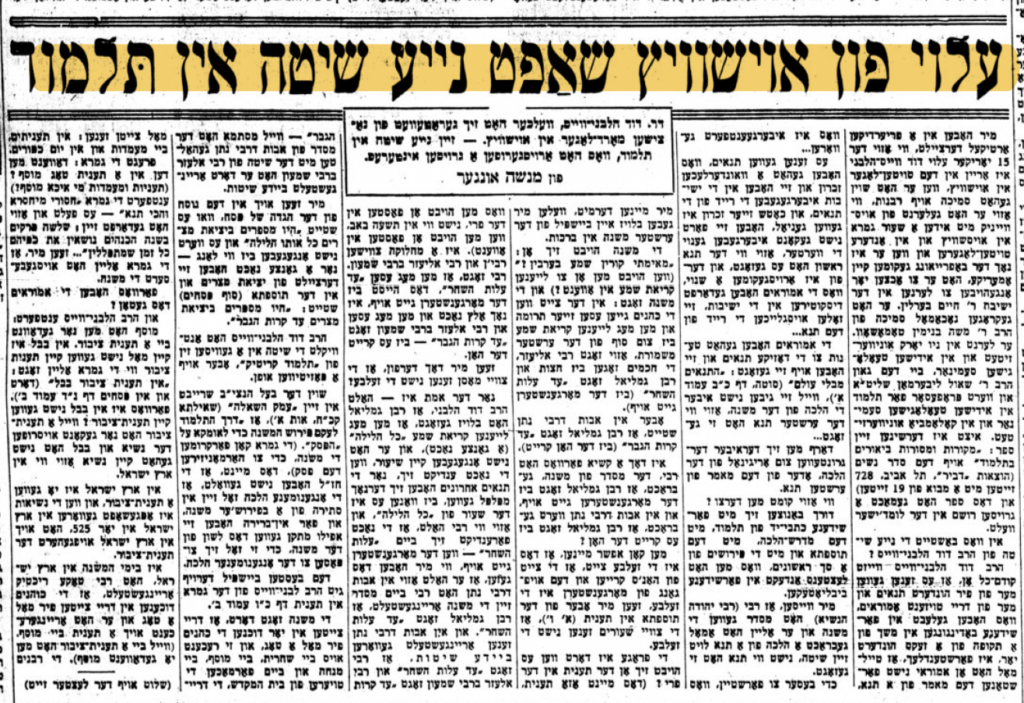
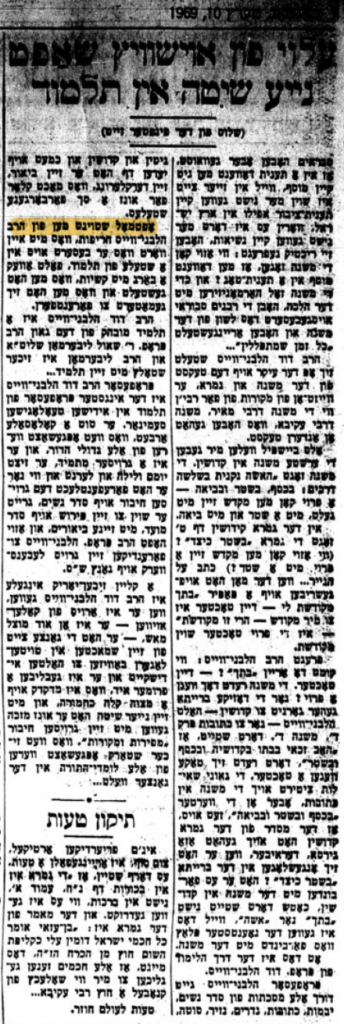
In early 1969, the Beys Yaakov Journal published “A Cry of Alarm Concerning the New School of ‘Talmud Critics’!”[60] by “Harav Yitzhak M. Shmueli” (almost certainly a pseudonym).[61] The article appeared in issue no. 116, shortly after the publication of the first volume of Halivni’s Mekorot u-Mesorot (1969).[62] It was not a reflexive polemic or an immediate rebuttal, but a considered response to a scholarly methodology that had already begun to exert influence within academic and semi-academic Jewish discourse.[63] Shmueli’s article reflects the Journal’s longstanding editorial posture: the intellectual challenges of modernity, particularly those circulating in print and academic venues, cannot be met with silence or denial. Rather than ignoring them, the Beys Yaakov Journal insisted on direct and public engagement.[64]
The article offers a sweeping critique of the Jewish Theological Seminary (JTS) and its Talmudic scholarship, with Halivni serving as the central exemplar. After briefly dismissing academic biblical criticism as a spent and methodologically compromised enterprise, Shmueli turns to what he presents as a more urgent danger: the emergence of academic Talmudic criticism within the Jewish Theological Seminary. He notes that Mekorot u-Mesorot bears the subtitle Biʾurim Talmudiyim and explicitly links this nomenclature to the Biʾur associated with Moses Mendelssohn, whom he identifies, in conventional Orthodox polemic, as a progenitor of German Reform Judaism.[65] The terminological parallel is presented as symptomatic rather than incidental.
Shmueli’s extended polemic against biblical criticism should be read less as his operative argument than as a genealogical warning. By tracing “Ḥokhmat Yisrael” back to German biblical criticism and Wissenschaft des Judentums, he establishes a historical cautionary tale rather than mounting a detailed refutation.[66] Once the discussion turns to Talmud, however, the tone shifts markedly: denunciatory generalizations give way to named books, cited introductions, concrete methodological claims, and extended quotation of traditional authorities. The rhetorical genealogy sets the stage; the argument itself unfolds as a focused dispute over the limits of legitimate Talmudic method.
Beyond an Internal Scholarly Debate
Shmueli’s concern, however, was not confined to an intramural scholarly dispute that might otherwise have remained limited to a narrow academic readership. The urgency, he argued, arose from Halivni’s entry into the broader intellectual public. In 1963, Halivni authored the Encyclopaedia Britannica entry “Source Criticism,” appended to the encyclopedia’s discussion of the “Talmud.” There he did not merely note philological problems in passing, but presented “source criticism” as a discrete scholarly method whose central task was to distinguish between the original statements of rabbinic authorities and the forms those statements assumed through oral transmission. A paragraph from that Britannica entry was later reprinted on the inside cover of Mekorot u-Mesorot: Seder Nashim (1969) under the heading, “From the author’s statement in the Encyclopaedia Britannica.” It reads:
“Source criticism seeks to differentiate between the original statements as they were enunciated by their authors and the forms they took as a consequence of being orally transmitted; that is, between the sources and their later traditions. It is not to be confused with the kind of analysis – frequently carried out by the rabbis or the Talmud – which merely traces the historical sources of a given passage without judging whether or not the passage faithfully reflects these sources. Source criticism claims that the transmission of the Talmud was not, and perhaps could not have been, verbatim, and that the text became altered in transmission, with the result that many statements in the Talmud have not come down in their original form. Instead, what survives is the form assumed in the last phase of transmissional development. While such a study is pertinent to most ancient texts, it is particularly relevant to the Talmud, which primarily consists of quotations and their interpretations.”[67]
On Halivni’s account, talmudic transmission “was not, and perhaps could not have been, verbatim,” with the result that many passages survive only in the form assumed in the final phase of transmissional development. The Talmud, he argued in that encyclopedia entry, is therefore particularly susceptible to such analysis, since it largely consists of quotations and interpretive strata. By articulating this claim in the idiom of general textual criticism and situating it within a major English-language reference work addressed to a broad, non-confessional readership, Halivni effectively relocated questions of talmudic authority from the internal norms of the beit midrash to the evaluative jurisdiction of modern academic scholarship. What might otherwise have remained an internal scholarly controversy was thus recast as a public representation of the Talmud within a wider intellectual culture.
It is precisely this public and methodological self-positioning that made the volume contentious. By placing the critical premise at the threshold of the book, Halivni indicated that the issue at stake was not merely philological refinement but the conceptual framework within which the Talmud itself would be understood. The decision to reproduce this paragraph prominently on the inside cover of Mekorot u-Mesorot was therefore more than bibliographic notice. It framed the book from the outset as an intervention in the academic discourse of textual criticism and positioned its central thesis as a methodological claim rather than an incidental observation. Before encountering Halivni’s detailed readings, the reader is confronted with a declaration about the nature of talmudic transmission and the legitimacy of critical reconstruction. In this sense, the reprinted Britannica passage functions as a programmatic preface, signaling that the project’s claims about the Talmud’s layered development are not ancillary but foundational.
This concern about public legitimation was not new. Long before the appearance of Halivni’s Mekorot u-Mesorot, Orthodox critics had already accused JTS, particularly under Finkelstein, of attempting to translate rabbinic tradition into a civic idiom aimed at American elites, a trajectory that would later culminate in highly visible episodes such as the Seminary’s 1957 convocation attended by Chief Justice Earl Warren.[68] This dynamic can already be seen by the early 1930s, such critiques had evolved from responses to discrete initiatives into a sustained indictment of Finkelstein’s leadership. In a widely circulated Yiddish pamphlet responding to the accumulated controversy surrounding the Seminary,[69] Dr. Aaron Rosmarin retrospectively gathered earlier charges, first voiced in The Jewish Forum,[70] Der Tog,[71] and The Jewish Spectator ,[72] into a comprehensive critique of what he presented as a coherent institutional strategy: the deliberate public repositioning of JTS through interfaith initiatives and universalist ethical rhetoric, designed to render Judaism intelligible and respectable to Christian and civic authorities while eroding the internal boundaries of rabbinic tradition.[73] Read in this longer perspective, the anxieties later articulated by Shmueli in the late 1960s appear not as episodic reactions to a single event, but as the continuation of an established polemical grammar through which the Seminary had long been contested within Haredi and Orthodox circles.
Yet the controversy did not unfold solely in the register of political denunciation or institutional suspicion. It also took the form of an internal methodological dispute over the norms of Talmudic scholarship.
Substantive Scholarship, Not Political Condemnation
Shmueli did not confine his critique to rhetorical denunciation. The article prominently featured, in a separate callout box at the top center of the page, the complete four-paragraph letter of the Ḥazon Ish addressing the use of manuscripts and textual emendation in Talmudic interpretation.[74] Given the Ḥazon Ish’s stature as one of the most authoritative scholars of his generation, his methodological positions were widely regarded as normative and were adopted, explicitly or implicitly, by many traditional Orthodox rabbis and scholars. Crucially, the Ḥazon Ish does not reject manuscript evidence as such; rather, he rejects its elevation into a corrective authority over the received text as transmitted and interpreted through the classical rabbinic canon. By foregrounding the Ḥazon Ish’s objections instead of invoking partisan rhetoric or institutional polemic, Shmueli cast the controversy as a serious methodological dispute internal to the discipline of Talmud study.
The letter reads in full:
“To interpret a sugya and to emend the Gemara on the basis of the ‘Munich’ manuscript – does this mean that all the sages of the generation, from the time of the Rishonim until now, all failed to apprehend the truth, because a single scribe erred and added material to the Gemara of his own accord, thereby causing all the sages to stumble?
I am not of them nor of their multitude. The manuscripts that were in the hands of the early authorities of blessed memory – they gave their lives for them, and the providence of the Blessed One, that the Torah not be forgotten from Israel, hovered over them. And when they began to print the Gemara, the sages of the generation gave their lives for its refinement and correction. And even if, at times, one may benefit from manuscripts to cleanse corruptions that arise over the course of time, with regard to a matter that issued from the hands of all our masters without any hesitation – Heaven forbid to disturb it.
Consider this yourself. When there are three manuscripts before us and two agree, we follow the two and set aside the one. And who can say to us that the ‘Munich’ manuscript is not from that one that was nullified by the majority in its own time? And who can say that it was not known to those lacking precision? In any case, it is null and void, like a broken potsherd, in the face of the received version.
And because a scribe erred and omitted a few words, as scribes are wont to err – shall we build towers? Perhaps indeed it is so, that the scribe omitted them and it is not from the sages, but when we rely on the tradition, the Torah of Rashi and Tosafot and all the sages – certainly this is the Torah. And I have almost never seen any benefit in arriving at the truth through variant readings uncovered from the genizot. Rather, they are all a benefit for distorting judgment and perverting the truth. It would have been fitting to consign them to burial, for the loss outweighs the gain.”
By reproducing this letter in full, Shmueli makes clear that his opposition to Halivni’s methodology rests on principled epistemological and methodological grounds rather than on ideological reflex. The Ḥazon Ish’s critique does not deny the existence of manuscript variation or the occasional value of textual witnesses; rather, it rejects the privileging of isolated manuscripts over the cumulative authority of the received tradition as transmitted and interpreted through generations of rabbinic scholarship.[75]
Crucially, Shmueli explicitly acknowledges that multiplicity, difficulty, and textual variation are intrinsic features of Torah she-baʿal peʿh. He concedes that variant readings and unresolved tensions have always belonged to the tradition, and he invokes major figures such as the Ḥatam Sofer and R. Israel Salanter to underscore that truth in Torah does not reside in surface simplicity. This concession sharply distinguishes his position from any naïve textual absolutism. What he rejects is not complexity itself, but the elevation of conjectural reconstruction into a corrective authority over the received text and its interpretive canon. In this way, Shmueli situates his argument squarely within a substantive Talmudic debate. He contends that even academically rigorous methods, supported by extensive philological evidence, remain subject to serious internal critique from within the Orthodox scholarly tradition itself. The article therefore represents intellectual engagement rather than political denunciation or fundamentalist rejection.
A full reading of Shmueli’s article makes clear that his deepest concern is not the existence of critical hypotheses as such, but their translation into public authority. Again and again, the danger he identifies lies in institutional legitimation: a book published by a major Israeli press, authored by a faculty member of the Jewish Theological Seminary, and disseminated to a broad readership through venues such as the Encyclopaedia Britannica. For Shmueli, the methodological question becomes urgent precisely at the point where speculative reconstruction threatens to become normative representation. The issue, in other words, is not academic experimentation behind closed doors, but the public pedagogy of Judaism to Jews and non-Jews alike.
Acknowledging Lieberman’s Authenticity
One of the most revealing features of Shmueli’s polemic is his careful distinction between Halivni and Saul Lieberman. Despite the breadth and intensity of his critique of the JTS approach, he is markedly restrained in his treatment of Lieberman. This restraint is deliberate. Lieberman’s Orthodox credentials were exceptionally strong and widely recognized across multiple sectors of the Orthodox world.[76] Upon his arrival in Palestine in 1928, he was appointed director of Machon Harry Fischel, a flagship Orthodox research institute devoted to advanced talmudic and halakhic scholarship, an appointment facilitated by leading rabbinic figures, including R. Isser Zalman Meltzer and R. Avraham Yitzhak Hacohen Kook.[77] At the same time, Lieberman pursued rigorous academic training at the Hebrew University under Prof. Jacob Nahum Epstein, the foremost architect of modern academic Talmud. Far from disqualifying him, this dual formation reflects the still-open willingness of segments of the Orthodox rabbinic elite in the interwar period to recognize exceptional Torah mastery even when pursued through unconventional scholarly frameworks.[78]
This standing remained intact even as Lieberman later contemplated accepting a position at the Jewish Theological Seminary. Before doing so, he consulted major Orthodox authorities, among them R. Isser Zalman Meltzer and R. Yaakov Moshe Charlap. Their responses ranged from principled refusal to issue a ruling to cautious, conditional acquiescence, but none denied Lieberman’s stature as a preeminent talmid ḥakham.[79] As Marc B. Shapiro has shown, Lieberman’s move to JTS did not erase his reputation within elite Orthodox circles; rather, it exposed unresolved tensions within Orthodoxy itself concerning the boundaries between institutional affiliation, scholarly method, and personal halakhic authority.[80] Lieberman thus occupied a liminal position: fully embedded in the Lithuanian rabbinic elite, deeply shaped by its intellectual ethos, yet operating at the outer limits of what Orthodoxy could comfortably accommodate.
It is precisely this status that explains Shmueli’s careful tone. To indict Lieberman directly would have required confronting not a marginal figure but a scholar whose legitimacy had been affirmed – explicitly or tacitly – by many of Orthodoxy’s leading authorities. Shmueli’s restraint therefore reflects less an endorsement of Lieberman’s methodology than an acknowledgment of the exceptional difficulty of dislodging a figure whose authority derived not from institutional politics alone, but from recognized and formidable Torah greatness. Shmueli’s own rhetoric reflects this distinction with care. He refers to Lieberman explicitly as a “renowned scholar, erudite in Torah she-baʿal peh,” even as he directs his most sustained and forceful criticism toward Halivni and the methodological program embodied in Mekorot u-Mesorot. This differentiation is significant. It underscores the Beys Yaakov Journal’s capacity for discriminating judgment rather than indiscriminate rejection of academic scholarship.
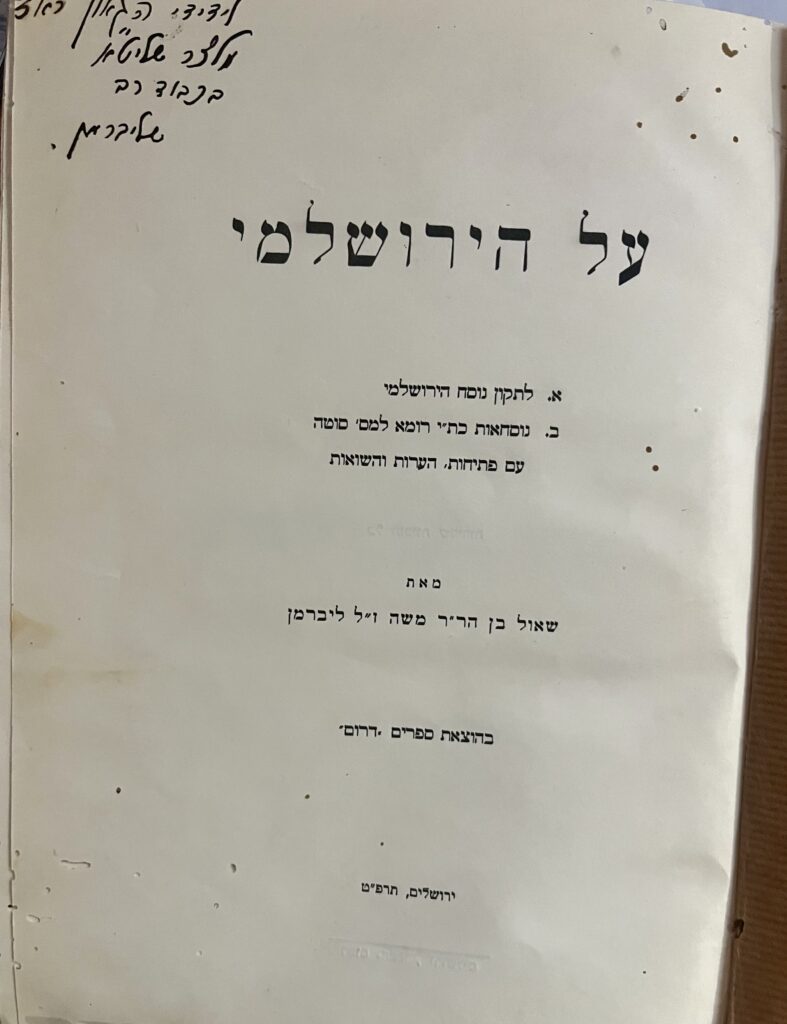
This, despite the fact that Lieberman’s earliest major work, Al ha-Yerushalmi, had already exemplified a disciplined form of textual criticism, drawing on manuscripts, parallel traditions, and internal philological analysis to clarify and correct the text of the Jerusalem Talmud. This could easily have provided fodder for Shmueli, yet he remained silent regarding Lieberman’s method. Recently published letters show that even the Ḥazon Ish engaged Lieberman seriously on these questions. Their correspondence reveals a principled disagreement over method, particularly regarding emendations grounded in manuscript evidence, while also demonstrating that such philological argumentation could be treated as a legitimate subject of rabbinic dispute rather than dismissed outright as heresy. Of course, since this correspondence had not yet been published, it cannot explain Shmueli’s silence on Lieberman’s approach.[81]
Copy of Al ha-Yerushalmi Gifted to R. I.Z. Meltzer from Lieberman
This nuance is essential for understanding the Beys Yaakov article’s invocation of the Ḥazon Ish. Lieberman is not cast as a theological threat or ideological provocateur, but as a formidable talmid ḥakham whose methods, though troubling to some, remained bounded within an elite scholarly discourse. Halivni, by contrast, is portrayed as extending those methods in a more expansive and publicly consequential direction, one that, in Shmueli’s view, exceeded the implicit safeguards that had contained earlier forms of academic intervention. The result is a portrait of Orthodox engagement with academic Talmud that is internally differentiated, historically self-aware, and intellectually serious, far removed from caricatures of reflexive or indiscriminate rejection.
That differentiation, however, depended upon the boundaries of scholarly containment. It held only so long as the debate remained internal to a learned community. Nowhere does Shmueli’s anxiety emerge more sharply than in his discussion of Halivni’s contribution to the Encyclopaedia Britannica.[82] Written in English for a general readership unfamiliar with the internal conventions of Talmudic study, Halivni’s article marks, in Shmueli’s view, the point at which an intramural scholarly debate enters the public register. At that point, silence becomes irresponsible. What is at stake is no longer a disputed method within a learned guild, but the public representation of the Talmud itself: its authority, coherence, and standing before a wider audience.
Yet the subsequent reception of the controversy would hinge less on Shmueli’s carefully drawn distinctions than on the interpretation of a single line in the Beys Yaakov article itself.
The Mistranslation That Changed Everything
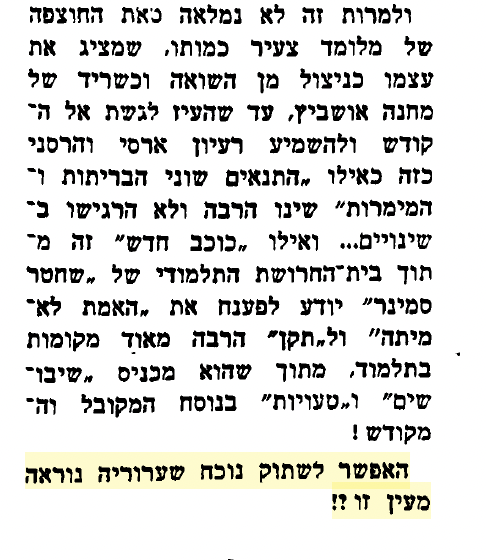
After developing its substantive critique, the Beys Yaakov article closes with a pointed rhetorical question:
!?האפשר לשתוק נוכח שערוריה נוראה מעין זו
The phrase is best rendered: “Is it possible to remain silent in the face of such a terrible scandal?”
Here we arrive at Shenker’s most consequential error. Shenker isolated the noun שערוריה (sha’aruriyah) and translated it as “abomination.” This was not a neutral lexical choice, but a serious mistranslation with far-reaching interpretive consequences.
In classical and rabbinic Hebrew, as well as in modern Hebrew, שערוריה denotes a scandal or public outrage, an event or claim that provokes alarm, indignation, and moral disquiet. Rooted in the semantic field of סער and סערה, it evokes turbulence and upheaval, suggesting commotion and protest rather than ritual pollution or theological deviance.[83] The term therefore belongs to the register of public scandal and polemical critique, not to the technical vocabulary of halakhic or theological condemnation. It conveys gravity, even urgency, but it does not imply that the object in question lies beyond the bounds of religious legitimacy. By contrast, Biblical and rabbinic Hebrew possess precise and well-established terms for “abomination,” most prominently תועבה (toʿevah) and the ש־ק־ץ family (שקץ, sheqets; שיקץ, shiqets). These terms function as technical markers of religious repugnance and exclusion.[84] תועבה denotes what is abhorrent before God, a term reserved for practices that are religiously intolerable, most prominently idolatry and acts explicitly proscribed as violations of the divine order. שקץ, by contrast, marks what is ritually defiling and categorically repugnant, designating objects or acts that are not merely objectionable but intrinsically contaminating within the cultic and halakhic system. In such usage, these terms do not merely register protest or indignation. They function as categorical markers of religious illegitimacy, designating acts or objects as intrinsically defiling and wholly intolerable within the normative order of divine law.
An Orthodox polemicist seeking to convey that level of categorical condemnation would almost certainly have employed one of these terms. Shmueli does not. His diction is emphatic but restrained, signaling moral alarm and scholarly urgency rather than theological excommunication. Translating שערוריה as “abomination” imputes to the article a category of judgment absent from the Hebrew. The difference is not rhetorical but semantic: the mistranslation shifts the text from protest to proscription, from scandal to heresy. One is reminded of the rabbinic topos of qotzo shel yod, the barely perceptible stroke of the yod (understood by Rashi as its right leg and by Rabbeinu Tam as its curved crown) whose alteration can overturn an entire halakhic construction.[85] Shenker’s substitution performed precisely such a transformation. There is no plausible pathway by which the language of “abomination” could have entered the public narrative surrounding Halivni other than through this mistranslation. In doing so, it recast an argument urging engagement with a grave scholarly challenge as a declaration of religious intolerance and obscured the article’s actual posture, which was not to brand Halivni’s work as heretical but to insist that a development of profound intellectual and communal consequence cannot responsibly be met with silence.
The consequences of this lexical substitution extended far beyond Shenker’s 1977 profile. Once “abomination” entered the New York Times archive as the purported Orthodox verdict on Halivni, it became available for repetition as journalistic fact. Thus, when the Times published its 2022 obituary of Halivni, it reproduced Shenker’s framing and relied on the same source. The obituary’s headline, casting Halivni as a “controversial” scholar rejected by “many Orthodox rabbis,” thus rested in part on a mistranslation that had already transformed a bounded Hebrew critique of scholarly method into a sweeping theological denunciation. In this way, a single erroneous word became the pivot of a durable public narrative.
The Effect of Sensationalism
Israel Shenker’s mistranslation did not merely distort a phrase; it altered the character of the intellectual activity in which the Beys Yaakov Journal was engaged. The original article undertook a demanding and careful task: it presented a sophisticated academic methodology to an Orthodox readership, explained why that methodology posed serious difficulties within the traditional epistemology of Talmudic study, marshaled substantive scholarly objections, above all the position of the Ḥazon Ish, acknowledged internal differentiation within Orthodoxy, and articulated strong disagreement grounded in textual and methodological analysis. By rendering the article’s culminating language as invoking an “abomination,” Shenker recast sustained scholarly critique as fundamentalist denunciation, collapsing methodological dispute into theological outrage and substituting caricature for argument.
This inversion is especially consequential in light of the documented record of the Beys Yaakov Journal of reflective engagement with modernity, both in its prewar Polish incarnation[86] and in its postwar Israeli continuation.[87] Beys Yaakov was not a polemical broadsheet but an educational and intellectual forum that repeatedly confronted modern scholarship rather than retreating from it. Shenker’s portrayal effaced that history and compounded the distortion by mischaracterizing the journal as “an official publication” of Agudath Israel. It was not. Published by the “Central Beys Yaakov of Israel” and later by the “Bais Yaakov Women’s College,” the journal functioned as an educational organ aligned with Agudah but not as a party instrument. The distinction is substantive. Educational journals cultivate explanation and debate; party organs enforce discipline.
The encounter with Rabbi Professor David Weiss Halivni was therefore neither a reflexive ban nor an eruption of obscurantism, but a serious internal reckoning with a scholarly development understood to carry public and pedagogical consequences. The episode demonstrates how readily Orthodox intellectual life in the mid-twentieth century has been recast through external narratives that confuse methodological dispute with theological denunciation. To understand the controversy properly requires moving beyond journalistic distortion to the jurisprudential problem Halivni’s scholarship forced into view. The debate was not about temperament or piety, but about first principles: whether historical reconstruction can be insulated from normativity; whether halakhic authority rests on procedural continuity or on claims of historical transparency; and whether Orthodox institutions possess mechanisms capable of absorbing critical candor without destabilizing the structures of authority they seek to preserve. It is to that institutional and conceptual terrain that we now turn.
[to be continued…]
Appendix 1: Yitzhak M. Shmueli, “A Cry of Alarm Concerning the New School of ‘Talmud Critics’!” Beys Yaakov, vol. 10, no. 4 [#116] (1969): 4-5 (Hebrew), available here:
Yitzhak M. Shmueli,
“A Cry of Alarm Concerning the New School of “Talmud Critics”!
“Ḥokhmat Yisrael” – that enterprise which was founded and ardently desired at the initiative of the various exponents of “Reform,” in all its forms – there is no falsehood and distortion more dreadful than it. This “root that bears gall and wormwood” – its earliest growth began in Germany, and there it affixed to itself the flattering yet deceptive name: “Wissenschaft des Judentums” (“the Science of Judaism,” in a literal translation from German). Within the bosom of this poisoned “science” arose all the movements of assimilation and derision away from Judaism. Generations of upright Jews fell into this trap. Many – far, far too many – this very “Ḥokhmat Yisrael” led all the way to the gates of apostasy, Heaven forfend.
All the venomous “wisdom” of the founders and disseminators of this “science” concerning “Judaism” in fact drew its sustenance from the sources of malice inherent in German, gentile “Biblical Criticism.” There were German scholars who regarded themselves as immense experts in the knowledge of the “East” (“Orientalistics,” in the foreign tongue), and, being afflicted with hatred of Israel, jealousy and the impulse of enmity toward the Book of Books burned within them. From this was born their aspiration “to criticize the Bible” in the most bizarre forms. And the matter is well known to the discerning. Several of the Christian researchers in Germany, foremost among them the orientalist Wellhausen – notorious for his attacks and his arrogant “discoveries” against the integrity and originality of the Bible – in fact founded the modern school of “Biblical Criticism.” And to our shame, even a few scholars from among our brethren, the Children of Israel, adhered to this path, taking hold of the seeds of self-directed malice, and lent their hand and their strength to the expansion and dissemination of this poisonous “science,” whose very point of departure was permeated with hatred of Israel.
This is neither the place nor the proper hour to display publicly all the falsehoods and malicious distortions that have accumulated around this discipline of “Biblical Criticism,” which, from the moment Jews too began to engage in it, cloaked itself in the new guise of “Ḥokhmat Yisrael.”
The historical truth is that this entire “science” known as “Biblical Criticism” has long since been exposed as false – and of all the mountains of nonsense and all the towers of lies that were heaped up and constructed by the celebrated “Biblical critics,” there remains no longer one stone upon another, one brick upon another, most evidently so. Indeed, it is precisely the scientific discoveries of the most recent period – and first and foremost the discovery of the “hidden scrolls” – that have decisively demolished the foundations of this deceptive “science.”
From time to time, modern Israeli archaeologists burst forth in cries of astonishment: Behold and see, to what degree everything found in the Holy Scriptures is precise!
And the historical truth is being clarified from every perspective. For these “Biblical critics,” not a few of whom are in fact complete ignoramuses regarding the Torah of Israel as a Torah of life and as the Torah of eternity, are accustomed to “correcting” the books of the Bible in accordance with whatever arises from their most confused and wildly unrestrained imagination. And suddenly, from ancient caves, hidden scrolls are found dating from nearly two thousand years ago, and everything written within those original and authentic scrolls – which renowned scholars examine and scrutinize – contradicts and refutes those sophistic vapidities and heaps of nonsense that were crowned with the title “Biblical science.”
And beyond this, the archaeologists engaged in excavations at historical sites in the Land also have something to say. And they demonstrate – as, for example, the Israeli archaeologist Dr. Moshe Kochavi recently demonstrated, who organized and directed the excavations in the Negev and in the Judean Mountains:
“The geographical record in Scripture has been proven by the discoveries in our excavations to be an exceptionally precise and reliable measure! In the Book of Joshua, chapter 15, there is found a detailed delineation of the boundaries of the tribe of the sons of Judah, their cities and their settlements, and all the discoveries made by our archaeological unit, which encompassed approximately twenty-five sites from the period of the kings of Judah, definitively confirmed that the entire division into districts – in the wilderness, in the hill-country, in the lowland, and in the Negev – is completely accurate; it accords with the standards demanded by every rigorous modern geographer!”
Ḥazal already said: “Yehudah ve-‘od la-qera” – that is, is there any further need whatsoever to confirm what is written in the Torah? In this generation, therefore, the whole-hearted faithful of Israel – loyal to the Torah and continuers of the heritage of Judaism – can, for their part, dispense with all those “authoritative confirmations” as well as the “scientific corroborations” of those “rigorous modern geographers.” But those great “sages” of Biblical Criticism – what answer can they possibly offer in the face of all the archaeological discoveries?
II.
And behold, there has emerged the newest fashion of “Talmud Criticism,” as a link integrated into the chain of distortions of “Ḥokhmat Yisrael” – which contains no “wisdom,” and whose association with “Israel” is exceedingly dubious.
It is a sacred obligation to raise a mighty voice of protest against the new “school” of the pretentious “Talmud critics,” who are liable to mislead pure souls among the Children of Israel. It is a double obligation to sound the alarm and to warn, since the dangerous initiative to harm – Heaven forbid – the foundational sources of the Oral Torah has now issued forth from a group of scholars concentrated around the “Schechter Seminary” in New York, whose official name is the “Jewish Theological Seminary,” and which is known as the “spiritual center” of the Conservative (“traditionalist”) movement in America.
As the first swallow heralding the emergence of the new method, there has now appeared, published by “Dvir” in Tel Aviv, a book entitled Sources and Traditions – Explanations in the Talmud. Its author, David Halivni, presents himself as an “expert in Talmudic research” who grew up within the walls of the “Schechter Seminary” in New York, in the company of Professor Louis Finkelstein, head of the Seminary, and Professor Saul Lieberman, the Seminary’s chief scholarly authority.
A public alarm must be sounded regarding the dangerous and destructive tendency of these “Talmudic explanations,” for of itself there surfaces the characteristic comparison with that famous “commentary” on the Torah by Moses Mendelssohn, the founding father of Reform in Germany! And if one extends this historical comparison further, the author of this “Talmudic research” likewise employs an innocent formulation and continually lifts his eyes heavenward…
“‘Blessed is the Omnipresent’ – thus opens the book’s ‘Preface’ – ‘who has merited me to see in print my explanations… May it be His will that just as He has merited me to see in print my explanations on the Order of Nashim, so may He merit me to see in print my explanations on the other orders and other books.’”
As it appears, the destructive hand is raised openly, and the plan is rather broad: to attack all the orders of the Shas and the other sources of Ḥazal, by means of that rusted and poison-saturated weapon called “Sources and Traditions”…
In the author’s scientific idiom this is called “textual truth,” since he strives to demonstrate that the Talmud is supposedly filled and replete with “inaccuracies,” “changes in sources,” “deviations from the simple interpretation,” and the like – claims and arguments that were habitual upon the tongues of all the “Biblical critics.”
From the words of the “Introduction” it is plainly evident that the author knows the truth, and merely intends to rebel against it! He himself writes that variations in textual versions, together with the difficulties bound up with them, have long since become part of the traditions… and indeed, one who has grown accustomed to this – precisely in this he perceives the distinctiveness of the Torah, and that its very diversity is its superior virtue…
The author even knows how to cite the words and opinions of the great Torah authorities, the giants of spirit of the later generations, such as the Ḥatam Sofer or Rabbi Israel Salanter, who explained that the essence of the distinctiveness of the Oral Torah lies precisely in this: that not everything appears revealed and simple at first glance…
This was the considered view of the author of the Ḥatam Sofer (in his novellae to tractate Ketubbot):
“The forced explanations (the resolutions offered to account for the difficulties arising in the comparison of the words of Ḥazal) – most of them are true… however, the rationalizations and inventions – most of them are false, and they are what cover over the face of truth.”
And Rabbi Israel Salanter, founder of the Mussar movement, stated this explicitly (in the introduction to his work Tevunah):
“What is truth? Truth does not live by simplicity alone, for simplicity is but one branch among the ways of proof; and for the most part the cherished difficulties stand ready to wage war against simplicity and to dislodge it…”
And despite all this, the arrogant audacity of a young scholar such as he has not been satisfied – a man who presents himself as a survivor of the Holocaust and as a remnant of the Auschwitz camp – to the point that he dared to approach the holy and to voice such a venomous and destructive notion, as though “the tannaim who transmitted the baraitot and dicta” altered much and did not even sense the alterations… whereas this “new star” from the Talmudic factory of the “Schechter Seminary” knows how to decipher “the truth in its truest sense” and to “correct” very many passages in the Talmud, by inserting “corruptions” and “errors” into the accepted and sanctified text!
Is it possible to remain silent in the face of such a terrible scandal?
III.
The source of a great danger has been exposed – one that is public-spiritual in character, and not merely literary-scholarly. We have no dispute with the author of this “collection of explanations,” who, notwithstanding everything, is himself compelled to concede that this is in essence not a new invention of his own, and that there have already been such researchers within the domain of “Ḥokhmat Yisrael” who attempted to “explicate” the sugyot of the Shas by a textual “critical method”…
The gravity of the danger is inherent in this fact: that it is an “official product” of the “Schechter Seminary,” and consequently it will be recognized and accepted as a “scientific discovery,” and perhaps even as a “scientific challenge” on the part of the Conservative movement in America.
Several years ago, the heads of the “Schechter Seminary” in America made numerous efforts to confer upon themselves a name and standing as a “Talmudic” research institution. Above all, they relied upon the personality of Professor Saul Lieberman, a renowned scholar and master of knowledge in the disciplines of the Oral Torah. It was not difficult to grasp that the spiritual leadership of the Conservative movement could not remain indifferent to the mighty historical phenomenon that became apparent in America with the establishment and flourishing of several advanced yeshivot for Torah study and rabbinic instruction. The “rabbis” of the Conservatives were truly alarmed by the rise of the power and influence of Haredi Judaism (Orthodox Judaism) in America, and they sought to demonstrate that among them too a “spiritual revival” was taking place, and that they too intended to return and to revivify the connection with the heritage of Judaism.
In accordance with the manner of the Conservatives and of all varieties of Reform, who are oriented primarily outward and whose chief concern is to find favor in the eyes of the gentiles, so they then arranged (some years ago) a grand celebration “in honor of the Talmud,” to which the Chief Justice of the Supreme Federal Court in Washington, Earl Warren, was invited. And the great surprise of the celebration was that the Chief Justice of the highest judges in America delivered an enthusiastic address concerning “the ethics of the Talmud,” and set forth several of the principles of Talmudic ethics as a model and exemplar of justice and uprightness!
The speech of the Chief Justice was not an isolated occurrence in America, where in recent times interest in the sources of Judaism has grown. Thanks to authoritative English translations, Christian scholars obtained some access to the treasures of the Talmud. One scholar, an expert in international law, a gentile from birth, published in the pages of an important scholarly journal a special study on the “spirit of true democracy” which he discovered in the Talmud.
And it is an interesting matter that the scholar paid attention there to that foundational principle in halakhic clarification in the Talmud: that “these and those are the words of the Living God.” The expert in international law translated this into his own terms, as an expression of democracy and freedom of expression – that one does not silence the “minority opinion” and does not disregard the rational arguments of the “opposing side,” but rather grants (as is done in the Talmud!) full right even to the minority opinion to explain its outlook. Even after the ruling has been decided on the basis of the majority view – which precisely accords with formal democracy – the “Talmudic sage” continues to voice and present his opinion upon the pages of the Talmud!
In various forms and through various channels, some of the perspectives of the Talmud began to penetrate American society. The growth in the number of yeshiva students in America – many of whom are regarded as authoritative experts in the domains of modern science – transmitted many of the moral principles of the Oral Torah into the broader world.
Until there arose a young “Talmudic researcher,” among the trainees of the “Schechter Seminary,” and proclaimed from every possible platform that fidelity to the text of the Talmud is doubtful, and that one must begin “Talmudic criticism”…
This matter did not suffice with the preparation of the anthology of “Sources and Traditions,” whose entire purpose is to obscure the sources and to undermine the traditions, but he even offered his “merchandise” (apparently upon the recommendation of the heads of the “Schechter Seminary”) to the editorial board of the world-renowned Encyclopaedia Britannica.
From his pen emerged the article “Source Criticism,” appended to the entry “Talmud” in volume 21 of the Encyclopaedia Britannica. What is the entire tendency of this article – particularly when it appears in English and is directed to the general public and to scholars for whom both the sources of the Talmud and the spirit of the Talmud are foreign – what can it lead to? Destructive views such as these: “that one should not lose one’s reason because of the analyses of the sages of the Talmud, who were not precise in the historical sources.” Both absolute ignorance is embedded in them, and an evil spirit of slander and self-degradation drips from them!
IV.
This figure did not emerge merely to testify concerning himself; rather, he also serves to testify concerning the entire “Schechter Seminary.” And the matter exceeds the limited framework of “literary activity” in the domain of “Talmud Criticism.” The “Schechter Seminary” embodies the “fortress of spirit” of the Conservative movement in America – and not only in America.
In recent years, the “Conservative” leaders have revealed an aspiration for “conquest,” and they seek precisely to transform themselves into a “global spiritual movement.” Concurrently, part of their leadership issues “public declarations,” as though their entire purpose is “to preserve and to draw from the sources of Judaism.”
It is indeed true that the great Torah authorities in America, foremost among them the Gaon Rabbi Aharon Kotler, of blessed memory, related from the outset with great suspicion to all “signs of rapprochement” on the part of the Conservatives, since, according to da‘at Torah, even their “tendencies” bear a pronounced character of Reform. The great Torah authorities in America therefore warned that rabbinic organizations in the United States should not blur the “dividing line” between the Jewish communities and the Conservative associations. A fierce spiritual campaign was waged on this matter in the public consciousness of American Jewry. And now one sees plainly what may be expected even from the learned “masters of sources” within the Schechter Seminary.
Appendix 2: Menashe Unger, “A Survivor of Auschwitz Creates a New Method in Talmudic Interpretation,” Der Tog (10 March 1969): 5-8 (Yiddish)
Menashe Unger,
“A Survivor of Auschwitz Creates a New Method in Talmudic Interpretation”
Der Tog (10 March 1969): 5-8 (Yiddish)
Dr. David Halivni Weiss, a survivor of the Nazi extermination camp at Auschwitz, has developed a new method in the study of the Talmud, a method that has aroused wide and serious interest.
In an earlier article we described how the fifteen-year-old Eliyahu David Weiss Halivni was sent to the death camp at Auschwitz already possessing rabbinic ordination; how, under conditions of mortal danger, he studied Gemara together with fellow Jews in Auschwitz and in other death camps; and how, after liberation, he arrived in America. At the age of eighteen he began studying at the Rabbi Chaim Berlin Yeshiva, where he again received rabbinic ordination, this time from Rabbi Moshe Binyamin Tomashov. He later pursued studies at New York University and at the Jewish Theological Seminary, under the guidance of the eminent scholar Rabbi Professor Saul Lieberman. He ultimately became professor of Talmud at the Jewish Theological Seminary and at Columbia University.
His book has now appeared: Mekorot u-Mesorot: Biʾurim ba-Talmud (Sources and Traditions: Explanations in the Talmud), on the Order Nashim, published by Dvir in Tel Aviv. The volume comprises 728 pages, with an introduction of nineteen pages. The book has made a powerful impression in the world of Talmudic scholarship.
What constitutes the new method of Rabbi David Halivni Weiss?
Rabbi Halivni Weiss first emphasizes that more than four hundred Tannaim and more than three thousand Amoraim lived under widely differing historical and social conditions over a period of approximately six hundred years. It is therefore understandable that at times an Amora did not fully comprehend a teaching of a Tanna transmitted to him. There were Tannaim who possessed extraordinary memories and transmitted the teachings of earlier authorities in the academies. Yet even when their memory was exceptional, they were not always able to convey the precise wording exactly as the original Tanna had formulated it. As a result, discrepancies arose, and the Amoraim were compelled to discuss these matters in the academies in order to reconcile the transmitted teachings.
The Amoraim even leveled accusations against such Tannaim, declaring: “The Tannaim are destroyers of the world” (Sotah 22a), because they failed to transmit the halakhah of the Mishnah exactly as the earliest Tanna had stated it. Accordingly, one must strive to return to the original formulation of the halakhah, or to the original statement of the earliest Tanna.
How is this accomplished? By making systematic use of variant manuscripts of the Talmud, Midrash Halakhah, the Tosefta, and the interpretations of many early authorities that have been discovered in recent times in various libraries. We know that Rabbi Judah the Prince, the redactor of the Mishnah, himself sometimes transmitted a halakhah according to his own conceptual framework, and not exactly as the Tanna had originally stated it, in order to render it more intelligible.
To clarify this approach, we will offer one example, drawn from the first Mishnah in Tractate Berakhot. The Mishnah opens: “From when does one recite the Shema in the evening?” It states that from the time the priests enter to eat their terumah one may recite the Shema until the end of the first watch, according to Rabbi Eliezer. The Sages say until midnight, and Rabban Gamliel says “until the rise of dawn.” However, in Avot de-Rabbi Natan it is stated that Rabban Gamliel says “until the rooster crows.”
This raises a difficulty: why did Rabbi, the redactor of the Mishnah, transmit Rabban Gamliel’s opinion as “until the rise of dawn,” whereas Avot de-Rabbi Natan reports it as “until the rooster crows”? One might assume that these refer to the same point in time, that the crowing of the rooster coincides with the appearance of the morning star. Yet from the Tosefta in Tractate Taʿanit (1:6) we see that these two temporal markers are not identical.
The discussion there concerns a fast that begins in the morning, as distinct from fasts such as the Ninth of Av, which begin in the evening. A dispute is recorded between Rabbi and Rabbi Eliezer ben Rabbi Shimon. Rabbi maintains that one may eat “until the rise of dawn,” meaning until the appearance of the morning star, which is still considered night, whereas Rabbi Eliezer ben Rabbi Shimon rules “until the rooster crows.” From this it is evident that the two times are not the same.
Rabbi Halivni Weiss therefore concludes that Rabban Gamliel originally stated only that one may recite the Shema “throughout the entire night,” without specifying any precise endpoint. The later Tannaim then debated how long the measure of “the entire night” extended. Since Rabbi held that night ends with the rise of dawn, and since Avot de-Rabbi Natan indicates that he indeed held this position, Rabbi incorporated into the Mishnah the formulation that Rabban Gamliel says “until the rise of dawn.” In Avot de-Rabbi Natan, however, both views were preserved: Rabbi’s position, “until the rise of dawn,” and that of Rabbi Eliezer ben Rabbi Shimon, “until the rooster crows,” because the redactor of Avot de-Rabbi Natan apparently accepted the latter view and therefore recorded both.
A similar phenomenon appears in the text of the Passover Haggadah, where it states: “They would recount the exodus from Egypt all that night,” without specifying an endpoint. By contrast, the Tosefta at the end of Tractate Pesahim states: “They recount the exodus from Egypt until the rooster crows.”
Rabbi David Halivni Weiss has thus developed a method that may be described, in a certain sense, as Talmudic textual criticism, but in a positive and constructive manner. Already the Netziv writes in his Haʿamek Sheʾelah (Sheʾiltah 136, section 1) that “it is the way of the Talmud to reinterpret the Mishnah so as not to uproot the halakhic ruling.” That is, the Sages did not wish the accepted halakhah to stand in contradiction to an explicit Mishnah, and where necessary they even corrected the wording of the Mishnah so that it would conform to the accepted halakhah.
Rabbi Halivni Weiss presents a striking illustration from Tractate Taʿanit (26b). The Mishnah there states that on three occasions during the year the priests raise their hands in blessing four times a day, and it enumerates Shaharit, Musaf, Minhah, and the closing of the Temple gates. These occasions are fast days, Maʿamadot, and Yom Kippur. The Gemara asks: is there a Musaf prayer on a fast day? It answers: “Something is missing, and this is how it should read: On three occasions during the year the priests raise their hands whenever they pray.” We thus see that the Gemara itself emended the Mishnah.
Why did the Amoraim do this? Rabbi Halivni Weiss explains that Musaf was recited only on a communal fast. In Babylonia there was never a communal fast, as the Gemara itself notes, because only the Nasi could proclaim such a fast, and Babylonia lacked a Nasi, unlike the Land of Israel. In the Land of Israel, communal fasts did exist, but after the abolition of the Nasiate in the year 425 they ceased there as well. In the Mishnaic period, however, Rabbi correctly included Musaf among the prayers recited on such days.
Later Amoraim, who lived in Babylonia and knew no communal fasts even in the Land of Israel, were perplexed by the Mishnah’s implication that Musaf was recited on a fast day. In order to harmonize the Mishnah with the accepted halakhah, they therefore emended its wording and inserted the phrase “whenever they pray.”
Rabbi David Halivni Weiss places primary emphasis on the textual foundations of the Mishnah and the Gemara. He demonstrates, on the basis of early sources, that there existed variant versions of the Mishnah, such as the Mishnah of Rabbi Meir and the Mishnah of Rabbi Akiva, which differed in wording.
As an example, he points to the opening Mishnah in Tractate Kiddushin: “A woman is acquired in three ways: by money, by document, and by intercourse.” The Gemara in Kiddushin (9a) asks: “By document, how?” and answers that if a man writes, “You are betrothed to me,” the woman is betrothed. Rabbi Halivni Weiss asks how the formulation “your daughter” enters the discussion, when the Mishnah speaks of a woman. He explains that this baraita originally referred not to Kiddushin but to Ketubbot, chapter four, where the Mishnah states that a father has rights over his daughter’s betrothal by money or by document. The redactor of the Gemara in Kiddushin apparently possessed such a version and connected the baraita to the Mishnah in Kiddushin because it was the closest relevant context.
This, then, is the path of study of Professor David Halivni Weiss. He proceeds through all the tractates of the Order Nashim, Yevamot, Ketubbot, Nedarim, Nazir, Sotah, Gittin, and Kiddushin, offering on every folio his elucidations and explanations, thereby clarifying many passages that have long remained obscure. At times a single incisive observation resolves a complex Talmudic difficulty and causes an entire accumulation of questions, which scholars had struggled to answer, to fall away.
Rabbi David Halivni Weiss is an outstanding disciple of the eminent Rabbi Professor Saul Lieberman, who takes great pride in his student. Professor Rabbi David Halivni Weiss is the youngest professor of Talmud at the Jewish Theological Seminary. He is engaged in a monumental scholarly undertaking that will be appreciated by all the leading Torah scholars of the generation. Having published his major work on the Order Nashim, he is already preparing a commentary on the Order Moʿed, with the aim of completing a comprehensive work on the entire Talmud.
Rabbi David Halivni Weiss emerged from the valley of death as a fragile child, a living remnant who endured the years of torment in the death camps while preserving his Jewish identity. He has remained a deeply observant Jew, meticulous in every detail of halakhic observance. Through his new method he has conferred a great benefit upon the world of Torah scholarship with his work Mekorot u-Mesorot, which will surely be highly esteemed by all students of Torah throughout the world.
Appendix 3: The 1957 Warren Convocation and the Circulation of Talmudic Self-Incrimination Discourse
Shmueli notes in his article in the Beys Yaakov Journal the wider efforts of JTS to translate talmudic discourse into a public idiom of modern legal and ethical relevance, and specifically a visit by Chief Justice Earl Warren.[88] During the 1950s, under the leadership of JTS Chancellor Louis Finkelstein, the Seminary promoted what it termed an “ethics of the Talmud,” presented as a normative program rather than antiquarian scholarship. Finkelstein described this enterprise as a kind of “fifth Shulḥan Arukh,” positioning the Talmud as a source of authoritative guidance for contemporary life.
The scope and aims of this project are documented in a substantial exchange between Finkelstein and Saul Lieberman in the mid-1950s.[89] In a detailed letter dated July 22, 1955, Finkelstein outlined his ambition to develop what he explicitly termed a “fifth Shulḥan Arukh,” by which he meant a systematic exposition of rabbinic ethics derived from the talmudic corpus. The letter makes clear that the two had discussed the matter repeatedly and that Finkelstein regarded Lieberman as indispensable to its realization. He credited Lieberman not only for scholarly guidance but for shaping his understanding of the ethical dimensions of rabbinic literature, remarking that he sought to render “Professor Lieberman as an institution” into a durable intellectual framework. Lieberman’s reply articulates a distinctive conception of legal-ethical obligation. Jewish law, he argued, establishes only the minimal standards necessary for social existence; genuine ethical responsibility begins beyond that threshold. Ethical expectations vary according to intellectual and moral stature. Conduct that might be considered blameless in an ordinary individual could be ethically culpable in a scholar. Rabbinic literature, he maintained, preserves numerous episodes illustrating such graduated responsibility, and only a sustained analytical study of the entire corpus could yield a systematic code of rabbinic ethics. He wrote:
“I might have stated to you my position on Jewish law and legal ethics. I believe that they are only the minimum without which no society can exist. The real legal ethics begin beyond this minimum. Each individual is legally bound by an ethical system conditioned to his individual character, temperament and general stature. A certain behavior on the part of an ordinary man may rightly be considered blameless under the circumstances, but the same behavior on the part of a learned man should be considered ethically criminal. In between the ignorant small man and the learned great man there are numerous gradations of ethical principles which correspondingly should guide the individual according to his status. Rabbinic literature abounds in episodes which highly illuminate the particular ethical principles with which we are concerned. The general idea is that none is exempt from the moral duty to aspire for perfection, thus raising the standards of the ethical principles required by the law for the particular individual.”[90]
This initiative took institutional form in September 1957 with the inauguration of the Lehman Institute of Ethics,[91] marked by a scholarly convocation on “Law as a Moral Force,”[92] attended by Chief Justice Earl Warren and described by one speaker as graced by the presence of “the most beloved citizen of our land.”[93]
Contemporary coverage makes clear that the convocation was designed not only as an internal scholarly gathering but as a publicized civic event. Reporting on the occasion, The New York Times noted that Warren had “enrolled” at the Seminary for a three-day convocation held over the weekend of September 13-14, 1957, devoted to Jewish law and its relevance to contemporary legal problems, and described both his participation in scholarly discussions and his attendance at Sabbath eve services. Finkelstein was quoted as framing the event as a gesture of civic-cultural deference: the Seminary, he declared, sought to honor Warren by sharing with him “our most treasured possession – the Talmud and its teaching.”[94] The report further translated rabbinic jurisprudence into American legal idiom, describing the Mishnah’s interpretive authority as “analogous to a Supreme Court decision,” and noting that Saul Lieberman’s Friday night lecture addressed procedural doctrines, especially self-incrimination and double jeopardy, that resonated directly with American constitutional discourse.[95] A contemporaneous Jewish Telegraphic Agency report similarly quoted Warren as remarking that several American constitutional safeguards, including those against self-incrimination and double jeopardy, appeared to derive from talmudic law. While noting that protection against self-incrimination was “perhaps not as sacred now as in ancient times,” Warren nonetheless affirmed its continuing place within American jurisprudence.[96] The episode illustrates the dynamic that Shmueli sought to resist: talmudic law presented as a moral-jurisprudential resource whose public legitimacy is ratified through elite American recognition.
According to Louis Finkelstein’s later recollection, Warren was so struck by Lieberman’s lecture that, despite an understanding that he would not speak publicly, he insisted on addressing the assembled audience. Warren reportedly expressed astonishment that such teachings were “almost a secret,” asking how it was that “nobody knows about it.” Public attention followed quickly. Finkelstein recalled that former President Harry S. Truman, then visiting New York, read the New York Times account of the event and declared, “If it is good enough for him, it is good enough for me,” before arriving at the Seminary together with Judge Samuel Rosenman, himself not merely a jurist but a leading Democratic insider and former presidential adviser closely associated with Roosevelt and Truman. Shmueli’s polemic thus draws upon a real and widely publicized episode in which the Talmud was presented to prominent representatives of the American political and legal establishment as a jurisprudential and ethical resource.[97]
Although the text of Lieberman’s lecture, “Law as a Moral Force in Rabbinic Literature,”[98] has not been preserved (and no recording was made, as it was delivered on the Sabbath eve), the intellectual aims of the convocation inaugurating the Herbert H. Lehman Institute of Ethics are articulated with unusual clarity in the published preface to Professor Shalom Spiegel’s address, Amos versus Amaziah.[99]
The conclave was explicitly convened to explore the moral dimensions of law as articulated in ancient Hebrew sources and to assess their relevance to contemporary legal and civic problems. Chief Justice Earl Warren and former President Harry S. Truman were among the featured participants, and Warren was quoted as remarking on the “sense of humility” that follows from recognizing that “most of the good things that we find in our law and in our own institutions come from the wisdom of men of other ages.” Spiegel’s address, identified in the prefatory material as one of the principal lectures of the weekend, framed prophetic confrontation and biblical justice through the idiom of constitutional adjudication and judicial review; Truman reportedly described it as “one of the best [lectures] I have ever heard in my life.”[100] In this respect, Spiegel’s published address offers a reliable index of the conceptual register within which Lieberman’s now-lost lecture was heard.
The episode circulated widely beyond the English-language press. Coverage in the Yiddish press highlighted the unusual image of the Chief Justice of the United States Supreme Court sitting in the Seminary, wearing a yarmulke and studying Talmud together with Finkelstein and Lieberman.[101] It was largely through this reportage that the episode entered the retrospective memory of circles associated with Yeshiva University. Decades later, Rabbi Hershel Schachter recalled in writing that R. Joseph B. Soloveitchik reacted sharply to Yiddish newspaper accounts of Lieberman’s talmudic exposition, particularly the suggestion that repentance could nullify liability to punishment in an earthly court, a claim difficult to reconcile with Makkot 13b. He reportedly dismissed such reports as devarim betelim (‘idle talk’) and invoked the Ra’avad’s critique of Maimonides.[102]
Samuel J. Levine has recently suggested that Chief Justice Warren’s later invocation of Jewish law in Miranda v. Arizona (1966) may be traced to his widely reported 1957 visit to the Jewish Theological Seminary. According to Levine, the JTS encounter helped prepare the conceptual ground for Miranda, as contemporary accounts of the visit already portrayed Jewish law as an antecedent to Anglo-American constitutional protections, particularly in the area of self-incrimination.[103] That framework, however, was already in circulation at least a year earlier and cannot be attributed solely to the 1957 Seminary visit.
Newly available correspondence complicates any linear account of influence running from Warren’s 1957 visit to the Seminary to Miranda (1966). In early 1956, Rabbi Norman Lamm, then a pulpit rabbi in Springfield, Massachusetts, published in Judaism a substantial essay written at the height of public controversy over the Fifth Amendment, explicitly framing ein adam mesim atzmo rasha (“no man can render himself legally wicked”) as the halakhic analogue of the constitutional privilege against self-incrimination.[104] Far from offering a casual comparison, Lamm argued that halakhah went beyond the Fifth Amendment by rendering all criminal confessions inadmissible, even if voluntarily offered.[105] This was the argument Warren would later cite in his majority opinion.
On March 19, 1956, more than a year before Warren’s appearance at the Seminary, Justice William O. Douglas wrote to Lamm that he had read the essay and found it “uncommonly suggestive,” praising its “penetrating analysis.”[106] The letter demonstrates that Lamm’s comparative formulation had already circulated within the Court at the moment of its publication, independently of the later public staging of the JTS symposium. Although the precise circumstances under which Warren first encountered the essay remain unknown, Douglas’s correspondence establishes that the argument had entered the Court’s intellectual orbit well before the 1957 visit.[107]
Contemporary Jewish press coverage of Miranda indicates that Warren’s footnote was promptly read in genealogical terms. An editorial in the Wisconsin Jewish Chronicle, titled “Grandpappy of the Fifth Amendment,” presented the decision as evidence that “the ancient Talmudic law” lay at the root of modern constitutional protections. Citing Lamm’s formulation of ein adam mesim atzmo rasha, it described the Talmud as the “great, great, great grandpappy” of the Fifth Amendment and treated the Court’s ruling as a contemporary reaffirmation of an ancient legal principle.[108] Similarly, the St. Louis Jewish Light interpreted Warren’s reference to “ancient times” as an acknowledgment of Lamm’s 1956 formulation, stressing that halakhah not only anticipated but surpassed the Fifth Amendment in stringency.[109] In both instances, a comparative footnote was taken as evidence of a historical lineage linking Jewish jurisprudence to American constitutional doctrine.
The JTS episode should therefore be understood not as the origin of Warren’s engagement with Jewish law, but as a conspicuous public moment that consolidated and legitimated a line of juridical reflection already underway.
This pattern of influence and circulation is also visible, albeit indirectly, in the later secondary literature produced within the Seminary’s own intellectual milieu. Aaron Kirschenbaum, whose Self-Incrimination in Jewish Law emerged from the JTS faculty orbit,[110] neither mentions Warren’s widely publicized 1957 visit to the Seminary nor notes Warren’s later reliance on Norman Lamm’s 1956 essay in his majority opinion in Miranda v. Arizona. He does, however, call attention to Warren’s use of other secondary legal scholarship.[111] The omission is striking, since Enker and Elsen themselves cite Lamm’s essay on the halakhic analogue to the Fifth Amendment,[112] thereby situating Lamm’s argument squarely within the very body of legal literature on which Warren drew.
Indeed, Kirschenbaum explicitly situates his own engagement with self-incrimination in the political and legal climate of the early 1950s. Reflecting on his years at JTS, he recalls how he and his fellow students felt an almost compulsive need to render Moses, Hazal, and Maimonides “relevant,” reading classical sources through the selective lens of modern rights discourse. Under the pressures of the McCarthy era, he writes, congressional investigations and compelled testimony rendered the constitutional privilege of silence a matter of urgent moral significance. The formula “I refuse to answer… because my response would constitute self-incrimination” became, for him, not merely a legalism but a moral idiom. It was precisely this Fifth Amendment protection, he explains, that “captivated” him and first drew him into the surrounding legal literature.[113]
Whatever the precise channels through which Jewish legal analogies entered American constitutional discourse, the Lehman Institute convocation represented a highly visible attempt to stage talmudic law as a public moral resource within elite American civic culture, and it was precisely this institutional posture that drew Orthodox critique. Yet the controversy surrounding the Lehman Institute and the 1957 Warren convocation was not without precedent. From the mid-1930s onward, Louis Finkelstein’s efforts to reposition the Jewish Theological Seminary as a locus of public moral and cultural authority had already provoked sustained criticism from Orthodox and right-wing observers, who viewed such initiatives as compromising rabbinic integrity in pursuit of external validation. Programs aimed at engaging Christian intellectuals or framing Judaism in universal ethical terms were repeatedly denounced in the Orthodox and Yiddish press as apologetic accommodation, and at times as missionary entanglement. Figures such as Aaron Rosmarin cast these projects as oriented less toward the cultivation of internal rabbinic tradition than toward securing legitimacy before non-Jewish audiences and American cultural elites.
Notes
Throughout this article, individuals are occasionally referred to by surname alone, in keeping with established scholarly convention. This practice is adopted solely for stylistic consistency and carries no implication of disrespect. ↑
Joseph Berger, “Rabbi David Weiss Halivni, Scholar Devoted to the Talmud, Dies at 94,” The New York Times (18 July 2022): A17. ↑
See David Weiss Halivni, The Book and The Sword: A Life of Learning In The Shadow of Destruction (New York: Farrar Straus and Giroux, 1996); and Netiʻot Ledavid: Jubilee Volume for David Weiss Halivni, eds. Yaakov Elman, Ephraim Bezalel Halivni, and Zvi Arie Steinfeld (Jerusalem: Orhot Press, 2004). ↑
For the fullest methodological exposition of his theory of Talmudic redaction, see David Weiss Halivni, The Formation of the Babylonian Talmud, trans. Jeffrey L. Rubenstein (Oxford: Oxford University Press, 2013). See also H.A. Alexander, “David Halivni and Shamma Friedman: Conflicting Trends in Talmud Criticism,” Conservative Judaism, vol. 39, no. 3 (Spring 1987): 45-57; Ari Bergmann, Halevy, Halivni and the Oral Formation of the Babylonian Talmud (PhD diss., Columbia University, 2014) and Ari Bergmann, The Formation of the Talmud: Scholarship and Politics in Yitzhak Isaac Halevy’s Dorot Harishonim (Berlin: de Gruyter, 2021); and earlier in Irwin H. Haut, The Talmud as Law or Literature: An Analysis of David W. Halivni’s ‘Mekorot Umasorot’ (New York, Bet Sha’ar Press, 1982). A fuller treatment of Halivni’s method and its reception will be presented in subsequent essays in this series. ↑
For the subsequent editions in this series, see David Weiss Halivni, Mekorot u-Masorot: Seder Nashim (Tel-Aviv: Devir, 1969; Hebrew); David Weiss Halivni, Mekorot u-Masorot: Seder Moed, from Yoma to Hagiga (Jerusalem: Jewish Theological Seminary, 1975; Hebrew); David Weiss Halivni, Mekorot u-Masorot: Shabbat (Jerusalem: Jewish Theological Seminary, 1982; Hebrew); David Weiss Halivni, Mekorot u-Masorot: Eruvin-Pesahim (Jerusalem: Jewish Theological Seminary, 1982; Hebrew); David Weiss Halivni, Mekorot u-Masorot: Seder Nashim, second edition (Toronto: Otsereinu, 1992; Hebrew); David Weiss Halivni, Mekorot u-Masorot: Bava Kamma (Toronto: Otsereinu, 1993; Hebrew); David Weiss Halivni, Mekorot u-Masorot: Bava Metzia (Jerusalem: Magnes, 2002; Hebrew); David Weiss Halivni, Introduction to ‘Mekorot u-Masorot’, first edition (Jerusalem: Magnes Press, 2009; Hebrew); David Weiss Halivni, Introduction to ‘Mekorot u-Masorot’, second edition (Jerusalem: Magnes Press, 2012; Hebrew); David Weiss Halivni, Mekorot u-Masorot: Sanhedrin, Shavu’ot, Makot, Avodah Zarah, Horayot (Jerusalem: Magnes, 2012; Hebrew); David Weiss Halivni, Mekorot u-Masorot: Zevahim-Menahot (Jerusalem: Magnes Press, 2023; Hebrew); and see David Weiss Halivni, The Formation of the Babylonian Talmud, ed. and trans. Jeffrey L. Rubenstein (Oxford: Oxford University Press, 2013). ↑
A comprehensive bibliographical listing of Halivni’s writings, including digitized scans, is available on the Academia.edu page (here) curated by Menachem Butler in collaboration with Professor Halivni’s family. ↑
Israel Shenker, “A Life in the Talmud,” The New York Times Magazine (11 September 1977): 44-45, 74-82, available here. ↑
Margalit Fox, “Israel Shenker, 82, a Reporter With the Instincts of a Scholar,” The New York Times (17 June 2007): 23. ↑
Israel Shenker, “Groucho, at 81, Discusses Favorite Topic- Women,” The New York Times (4 May 1972): 50; Israel Shenker, “Groucho Marx Uses Room Service to Press Suit,” The New York Times (5 June 1975): 40. ↑
Israel Shenker, “Borges, a Blind Writer With Insight,” The New York Times (6 April 1971): 48. ↑
Israel Shenker, “Former Chomsky Disciples Hurl Harsh Words at the Master,” The New York Times (10 September 1972): 70. ↑
Israel Shenker, “The Old Magician at Home,” The New York Times Book Review (9 January 1972): 2. ↑
Israel Shenker, “Picasso, 90 Today, Assayed By Critic, Curator, 3 Artists,” The New York Times (25 October 1971): 42. ↑
Israel Shenker, “Asimov, ‘on Fire to Explain,’ Writes 100th Book – About Himself,” The New York Times (18 October 1969): 35; Israel Shenker, “I.B. Singer As Traveler,” The New York Times (13 March 1983): 66-70. ↑
Israel Shenker, “A Religious Zionist Urges Compromise on Occupied Lands,” The New York Times (15 June 1978): 12. For contemporaneous coverage of the Oz V’Shalom movement – founded in response to Gush Emunim – see “Orthodox Group in Israel Forming Peace Movement to Oppose Gush Emunim,” The Jewish Week (11 June 1978): 24. ↑
Israel Shenker, “Professor, 80, Looks to Volume 18 of Jewish History,” The New York Times (26 May 1975): 31. ↑
Israel Shenker, “Solomon Zeitlin, Long a Professor of History and Rabbinics, Dies,” The New York Times (30 December 1976): 26. ↑
Israel Shenker, “Shabuoth Group Sifts Gossamer Threads of Torah, Particularly the Ten Commandments,” The New York Times (24 May 1969): 25; Israel Shenker, “Rabbi Gives Views on Birth Control: Cites Jewish Law and Bible on Marital Ethics,” The New York Times (30 November 1969): 50; Israel Shenker, “Rabbi Finkelstein to Retire; Joy of Study Undiminished,” The New York Times (28 September 1971): 41; Israel Shenker, “Two Are Named as Heads of the Jewish Theological Seminary,” The New York Times (28 October 1971): 43; Israel Shenker, “Rabbi to Give Nixon a Kingly Blessing,” The New York Times (19 January 1973): 16; Israel Shenker, “Adele Ginzberg, at 90, Says, ‘So What?’,” The New York Times (16 May 1976): 50; Israel Shenker, “Japanese Christian Is Awarded A Doctorate by Jewish Seminary,” The New York Times (31 May 1977): 33. ↑
See also Shenker’s profile of Rabbi Benjamin Kamenetzky, son of the renowned Torah scholar Rabbi Yaakov Kamenetsky, who fielded religious inquiries through a public telephone ‘Hot Line to the Rabbi’, in Israel Shenker, “On Wednesday, the Rabbis Answered the Phones,” The New York Times (19 May 1978): B1. ↑
See also Israel Shenker, “Deli Waiters Turn Polite for the 4th,” The New York Times (5 July 1969): 38; Israel Shenker, “Delicatessen Puts Clock Back 20 Years,” The New York Times (12 March 1974): 41; Israel Shenker, “For Customers Over 65, The Food Is Half-Price,” The New York Times (25 September 1974): 46; and Israel Shenker, “In Delis, 2d Ave. Is a Palace,” The New York Times (22 April 1977): C19. ↑
There were, of course, rare exceptions. See, for example, Israel Shenker, “Knishes and Latkes, Yes! But Chicken Wellington?” The New York Times (10 March 1971): 45; Israel Shenker, “Taste for Business Builds Brooklyn Knish Empire,” The New York Times (9 May 1971): 80; and Israel Shenker, “They Sing in Praise of Matzoh Brei,” The New York Times (19 November 1973): 44. ↑
Including, for example, Israel Shenker, “Ideological Labels Changing Along With the Label-Makers,” The New York Times (12 November 1970): 45,48; Israel Shenker, “Man and Machine Match Minds at M.I.T.: 5th Conference on Artificial Intelligence Seeks Ways to Smarter Computers,” The New York Times (27 August 1977): 8; Israel Shenker, “Lowell’s Sacco-Vanzetti Papers Are Opened After 50 Years,” The New York Times (10 December 1977): 12; Israel Shenker, “Freiheit Editor’s 75th Birthday Party Is in a Class by Itself: ‘Preserving the Language’,” The New York Times (12 February 1978), 48; Israel Shenker, “Webster, Noah (1758-1843): A Clearly Defined Reputation,” The New York Times (14 April 1978): B1, B5. ↑
Israel Shenker, “Behind the Scenes at the Savoy,” The New York Times (23 June 1985): 19, 36. ↑
Israel Shenker, “Lonely Sea Gate’s Streets Still Belong to Its People,” The New York Times (2 January 1972): A6; Israel Shenker, “Despair Fills Lower East Side Synagogues,” The New York Times (19 March 1974): 4; Israel Shenker, “What’s Nu? Bagel-and-Bus Tours of Jewish New York,” The New York Times (5 May 1976): 89. ↑
Israel Shenker, “The Miraculous Cheeseless Cheesecake: The Cheesecake Without Cheese,” The New York Times (5 July 1978): C1, C7. ↑
Israel Shenker, “The Twerski Tradition: 10 Generations of Rabbis in the Family,” The New York Times (23 July 1978): 38. See also Edward Reichman and Menachem Butler, “The Medical Training and Yet Another (Previously Unknown) Legacy of Rabbi Dr. Abraham J. Twerski, zt”l,” The Seforim Blog (2 February 2021), available here. ↑
Israel Shenker, “Hasidic Group Marks Its 100th Year,” The New York Times (2 June 1971): 46; Israel Shenker, “Hasidic Feat: Simple as Aleph, Beth, Gimel,” The New York Times (3 November 1977): A18. ↑
Israel Shenker, “Brooklyn Brothers Use Scribes’ Ancient Art in Torah Repairs,” The New York Times (27 July 1977): B1. ↑
Israel Shenker, “It’s Onward and Uptown For Hebrew Publishing,” The New York Times (1 August 1976): 40. ↑
Israel Shenker, “Dreydl Makers in City Preparing for What’s a Dreydl? You Shouldn’t Ask,” The New York Times (28 September 1970): 45; and Israel Shenker, “C.C.N.Y’s President Loses Dreydl Crown in Spin-Off,” The New York Times (7 December 1972): 106. ↑
Israel Shenker, “Brides and Bar Mitzvahs Bring a Rush on Yarmulkes,” The New York Times (20 June 1977): 31 ↑
Israel Shenker, “The Day the Waldorf Went Kosher,” The New York Times (23 Dec 1977); 20; and Israel Shenker, “With Them, It’s Always Strictly Kosher,” The New York Times (15 April 1979): 32-33, 36-38, 40, 42. ↑
Israel Shenker, “On El Al, They’d Rather Walk: It’s Up and Down the Aisles, Even at Meal Times,” The New York Times (15 November 1968): 93. ↑
Israel Shenker, “Isaac Singer’s Perspective on God and Man,” The New York Times (23 October 1968): 49, 94; Israel Shenker, “A Bit of Reality by I.B. Singer and Son,” The New York Times (17 April 1970): 44; and Israel Shenker, “The Man Who Talked Back to God: Isaac Bashevis Singer, 1904-91,” The New York Times Book Review (11 August 1991): 11. ↑
Israel Shenker, “Harvard’s Resident Sage Marks 85th Birthday Today,” The New York Times (2 November 1972): 45, 86, available here. He later wrote Wolfson’s obituary in Israel Shenker, “Harry Wolfson, 86, Philosopher of Religion at Harvard, is Dead,” TheNew York Times (21 September 1974): 32, available here. For another contemporaneous tribute, see Mark Jay Mirsky, “Our Greatest Sage: Elegy for Harry Wolfson,” The Village Voice (13 January 1975): 39-41, available here. ↑
Israel Shenker, “Lubavitch Rabbi Marks His 70th Year With Call for ‘Kindness’,” The New York Times (27 March 1972): 39. ↑
Israel Shenker, “Israeli Historian Denies Jews Yielded to the Nazis ‘Like Sheep’,” The New York Times (6 May 1970): 2; Israel Shenker, “How Yiddish Survives At 2 New York Schools,” The New York Times (16 January 1974): 68; Israel Shenker, “An Awesome Reliving of Auschwitz Unfolds at St. John’s,” The New York Times (4 June 1974): 39; Israel Shenker, “The Holocaust: Did God Want It?” The New York Times (6 June 1974): 38; Israel Shenker, “The Holocaust Was ‘Radical Counter-Testimony’ to Religion,” The New York Times (9 June 1974): E5; Israel Shenker, “Scholars at Holocaust Conference Here Seek Answers to the Unanswerable,” The New York Times (4 March 1975): 13; Israel Shenker, “Jewish Cultural Arts: The Big Debate,” The New York Times (13 January 1976): 42; Israel Shenker, “Diverse Views Given on U.S. Jewish Experience,” The New York Times (22 March 1976): 55; and Israel Shenker, “Conference Ponders Who’s a Jew and Why,” The New York Times (26 May 1976): 18; ↑
Israel Shenker, Coat of Many Colors: Pages from Jewish Life (Garden City, NY: Doubleday, 1985). ↑
Israel Shenker, “Israeli Scholar Preparing New Edition of Talmud,” The New York Times (19 September 1971): 78. ↑
And on the controversy two decades later on Rabbi Adin Steinsaltz’ edition of the Talmud, see Haim Shapiro, “Talmudist Continues Down Path of Peace,” The Jewish Week (25 August 1989): 2, 31; Leon Wieseltier, “Unlocking the Rabbis’ Secrets: Review of ‘The Talmud’, by Adin Steinsaltz,” The New York Times Book Review (17 December 1989): 3, 31; Haim Shapiro, “Moving Up The Charts: Rabbi Adin Steinsaltz’s English Translation of the Talmud is Becoming A Surprisingly Hot Seller Abroad,” The Jerusalem Post Magazine (9 March 1990): 7-8; Jonathan Sacks, “Steinsaltz the Polymath,” The London Jewish Chronicle (2 March 1990): 27; Jacob Neusner, “Letter – Steinsaltz’s Say-So,” The Forward (7 December 1990): 6; Jacob Neusner, “Along with the Sizzle, Plenty of Beef: Review of ‘The Talmud: The Steinsaltz Edition, vol. 1: Tractate Bava Metzia. Part 1’, by Adin Steinsaltz,” in Jacob Neusner, ed., Approaches to Ancient Judaism: New Series, vol. 2 (Atlanta: Scholars Press, 1990), 57-65; Emanuel Rackman, “Carved in Stone: Some Powerful Rabbis Won’t Accept New Talmud Interpretations,” The Jewish Week (22 February 1991): 31; and Chaim Rapoport, “On Publishing the Talmud in Translation and With New Commentaries,” Ohr Yisroel, vol. 13, no. 2 (December 2007): 53-88 (Hebrew). ↑
Israel Shenker, “Israeli Scholar Preparing New Edition of Talmud,” TheNew York Times (19 September 1971): 78. Professor Louis Finkelstein held a very different view on another aid to Talmudic study, a concordance of the Talmud. In that instance, he praised the work describing it as “important as the Dead Sea Scrolls,” because “except for the rare scholar” it was nearly impossible to identify parallel, and potentially related, Talmudic terms. Perhaps JTS sponsorship of the concordance may account for the different treatments of the two works. See Harry Gilroy, “Index to Talmud is Reported Half Finished,” TheNew York Times (1 April 1968): 42. As well, JTS was involved in the publication of the El Am Talmud. See Moses Eskolosky, “New Key to Talmud’s Treasure Trove,” The United Synagogue Review, vol. 18, no. 1 (July 1965): 14-17; and Elie Wiesel, “A Proposal on How to Learn Talmud with Children,” Forverts (22 September 1967): 2, 5 (Yiddish). ↑
Israel Shenker, “Responsa: The Law as Seen by Rabbis for 1,000 Years,” The New York Times (5 May 1975): 33, 61. ↑
Israel Shenker, “Hats Are Off to Kremlinologists, an Endangered Species in Era of Détente,” The New York Times (20 September 1974): 41, 77. ↑
Israel Shenker, “When a Patient’s Dreams Put Him to Sleep, He May Defy Analysis,” The New York Times (17 December 1976): 29. ↑
Israel Shenker, Coat of Many Colors: Pages from Jewish Life (Garden City, NY: Doubleday, 1985), 74. ↑
Moshe Feinstein, “Introduction,” in Iggerot Moshe, vol. 1 (New York: New York: Noble Book Press Corp., 1959), 3-4 (Hebrew).↑
See also Tovia Preschel, “Profile of Rav Moshe Feinstein,” The Jewish Press (27 July 1962): 3; Emanuel Rackman, “Halachic Progress: Rabbi Moshe Feinstein’s Igrot Moshe on Even ha-Ezer,” Judaism: A Quarterly Journal, vol. 13, no. 3 (Summer 1964): 365-373; Aaron Kirschenbaum, “Rabbi Moshe Feinstein’s Responsa: A Major Halachic Event,” Judaism: A Quarterly Journal, vol. 15, no. 3 (Summer 1966): 364-373, available here; “Orthodox Jewish Leader Points To A Remedy For Today’s Many Problems,” The American Examiner (16 April 1970): 1-2; Marvin Schick, “Rabbi Moshe Feinstein: A Genius in Learning, Service and Loving Kindness,” The Long Island Jewish World (17 April 1986): 6-7; Harel Gordin, “Torah Sage of America: Rabbi Moses Feinstein,” in Benjamin Brown and Nissim Leon, eds., The Gedolim: Leaders Who Shaped the Israeli Haredi Jewry (Jerusalem: Magnes Press, 2017), 430-455 (Hebrew); and Aviad Hacohen, “Everything Is according to the American Custom: A New Custom for a New Country,” in Joseph Isaac Lifshitz, Naomi Feuchtwanger-Sarig, Simha Goldin, Jean Baumgarten, and Hasia Diner, eds., Minhagim: Custom and Practice in Jewish Life (Berlin: de Gruyter, 2019), 235-324, available here. ↑
Ira Wolfman, “Israel Shenker, A Jewish Writer, Sweet and Sour,” The Long Island Jewish World (24 July 1986): 16. ↑
Baruch Halpern, From Gods to God: The Dynamics of Iron Age Cosmologies (Tübingen: Mohr Siebeck, 2009), 7. ↑
Margalit Fox, “Israel Shenker, 82, a Reporter With the Instincts of a Scholar,” The New York Times (17 June 2007): 23. ↑
Ira Wolfman, “Israel Shenker, A Jewish Writer, Sweet and Sour,” The Long Island Jewish World (24 July 1986): 16. ↑
Israel Shenker, “In Wales, A Bookworm’s Holiday,” The New York Times (2 June 1985): 32. ↑
Israel Shenker, Words and Their Masters (Garden City, NY: Doubleday, 1974); Israel Shenker, Harmless Drudges: Wizards of Language: Ancient, Medieval, and Modern (Bronxville: Barnhardt, 1979). ↑
Israel Shenker, Following Tocqueville through Joyce’s Dublin (New York: Random House, 1972). ↑
Israel Shenker, In the Footsteps of Johnson and Boswell (Boston: Houghton Mifflin, 1984). ↑
Israel Shenker and Mary Shenker, As Good as Golda: The Warmth and Wisdom of Israel’s Prime Minister (New York: Random House, 1970). ↑
Yitzhak M. Shmueli, “A Cry of Alarm Concerning the New School of ‘Talmud Critics’!” Beys Yaakov, vol. 10, no. 4 [#116] (1969): 4-5 (Hebrew), available here, with translation in Appendix 1 below. ↑
See Shmuel Ashkenazi, Iggeret Shmuel, vol. 1 (Jerusalem, 2021), 404 (Hebrew), who subjects another article by “Rabbi Yitzhak M. Shmueli” to sustained critique, describing it as a conspiratorial construction lacking evidentiary support. Through close examination of manuscripts, historical context, and philological detail, Ashkenazi argues that Shmueli’s claim of deliberate textual manipulation for anti-Hasidic purposes is unsupported and rests on conjecture rather than demonstrable proof; see ibid., 401–404. The episode is instructive insofar as it illustrates a broader feature of Shmueli’s polemical style. Apart from this case, Shmueli published only a small number of additional essays on the same figure, most of which are similarly rhetorical and accusatory in tone rather than analytically substantiated; see Beys Yaakov, nos. 113–114 (September 1968): 28-30, 36 (Hebrew); and Beys Yaakov, nos. 160–161 (May 1973): 4-6 (Hebrew). ↑
Yitzhak M. Shmueli’s article against Halivni in Beys Yaakov constitutes an explicit counter-intervention to the laudatory presentation of David Weiss Halivni’s work published days earlier in Menashe Unger, “A Survivor of Auschwitz Creates a New Method in Talmudic Interpretation,” Der Tog (10 March 1969): 5-8 (Yiddish), translated below in Appendix 2. Unger’s review introduced Mekorot u-Mesorot to a broad Yiddish-reading public, highlighting Halivni’s Holocaust biography, his punctilious Orthodox observance, and, above all, his standing as a distinguished disciple of Professor Saul Lieberman. Framed in these terms, the article suggested that Halivni’s method warranted acceptance within Orthodox circles, treating Lieberman’s imprimatur and Halivni’s personal piety as sufficient markers of legitimacy. It is precisely this public strategy of legitimation, rather than the mere circulation of a scholarly monograph, that the Beys Yaakov article appears designed to contest. ↑
See, for example, the Dan Rabinowitz, “Between Authority and Inquiry: Beyond the Masthead of the Beys Yaakov Journal, 1923-1980 – Part 1,” The Seforim Blog (22 December 2025), available here. ↑
On this motif, see Zev Eleff and Menachem Butler, “Moses Mendelssohn and the Orthodox Mind,” The Lehrhaus (9 January 2017), available here; see, now, Yoav Schaefer, “Haskalah in Berlin: Moses Mendelssohn, Immanuel Kant, and the Foundations of Reform Judaism,” in Stanley M. Davids and Leah Hochman, eds., Re-forming Judaism: Moments of Disruption in Jewish Thought (New York: CCAR Press, 2023), 147-164. ↑
For a more differentiated historical account of Wissenschaft des Judentums and its complex relationship to modern biblical criticism, see Edward Breuer and Hanan Gafni, “Jewish Biblical Scholarship between Tradition and Innovation,” in Magne Sæbø, ed., Hebrew Bible-Old Testament, The History of Its Interpretation, vol. 3: From Modernism to Post-Modernism (The Nineteenth and Twentieth Centuries) (Göttingen: Vandenhoeck & Ruprecht, 2013), 262-303.These studies present a more differentiated genealogy than the schematic lineage invoked by Shmueli. ↑
David Weiss Halivni, “Talmud: Source Criticism,” Encyclopedia Britannica, vol. 21 (1963): 645, available here. ↑
For documentation of the 1957 Lehman Institute convocation inaugurating the Lehman Institute of Ethics, including Chief Justice Warren’s participation, contemporaneous press coverage, later recollections, and the subsequent circulation of talmudic self-incrimination discourse within Supreme Court circles, see Appendix 3 (“The 1957 Warren Convocation and the Circulation of Talmudic Self-Incrimination Discourse”). ↑
Aaron Rosmarin, An Answer (To the Polemic surrounding the Jewish Theological Seminary) (New York: 1943; Yiddish). ↑
Aaron Rosmarin, “Whither the Jewish Theological Seminary?” The Jewish Forum, vol. 17, no. 8 (September 1934): 239-246; Aaron Rosmarin, “Whither the Jewish Theological Seminary?” The Jewish Forum, vol. 17, no. 10 (November 1934): 315-319; Aaron Rosmarin, “Whither the Jewish Theological Seminary?” The Jewish Forum, vol. 18, no. 1 (January 1935): 6-8. ↑
Aaron Rosmarin, “‘Hold-up’ on Sukkot,” Der Tog (28 September 1934): 9 (Yiddish). ↑
Aaron Rosmarin, “American Jewry Awake,” The Jewish Spectator, vol. 4, no. 1 (November 1938): 18-21; Aaron Rosmarin, “Editorial: Missionaries in a Rabbinical Seminary,” The Jewish Spectator, vol. 7, no. 2 (December 1941): 4-5; Aaron Rosmarin, “Is The Jewish Theological Seminary of America Becoming A Den of Missionaries?” The Jewish Spectator, vol. 7, no. 3 (January 1942): 13-16; Aaron Rosmarin, “Editorial: ‘Honors’ for Dr. Finkelstein,” The Jewish Spectator, vol. 13, no. 2 (December 1947): 5; Louis Feinberg and Aaron Rosmarin, “Post-Scripts to the Finkelstein Controversy,” The Jewish Spectator, vol. 13, no. 4 (February 1948): 29-30. ↑
Dr. Aaron Rosmarin’s polemical posture is further complicated by the later fact that he refused to grant his wife a gett, a biographical episode that bears directly on the themes of halakhic coercion and moral accountability that animate his broader critique of rabbinic authority. See Marc B. Shapiro, “Saul Lieberman and his Ketubah, Driving on Shabbat, an Unusual Marriage Practice, Girls born on Friday, and More,” The Seforim Blog (28 January 2026), available here, and the forthcoming essay by Aviad Hacohen and Menachem Butler, “Trude Weiss-Rosmarin as a Philosopher of Halakhic Accountability: The Agunah Crisis and the Lieberman Clause in Postwar America,” which situates Weiss-Rosmarin’s polemic against rabbinic institutional impotence within the longer history of Orthodox–Conservative conflict over authority, jurisdiction, and moral responsibility in Jewish divorce law. Although Rosmarin’s anti-JTS campaign spanned more than a decade and generated a substantial polemical corpus across Yiddish and English venues, it has not yet been reconstructed systematically as an object of intellectual or institutional history; a full study of his sustained polemic against the Seminary remains a scholarly desideratum. ↑
For extended discussion of the Ḥazon Ish’s approach to manuscripts and textual emendation, see Moshe Bleich, “The Role of Manuscripts in Halakhic Decision-Making: Hazon Ish, His Precursors and Contemporaries,” Tradition: A Journal of Orthodox Jewish Thought, vol. 27, no. 2 (Winter 1993): 22-55; Benjamin Brown, “The Method of Study of the Ḥazon Ish in Contrast to the Approach of Critical Scholarship,” in The Ḥazon Ish: Halakhist, Believer and Leader of the Haredi Revolution (Jerusalem: Magnes Press, 2011), 384-397 (Hebrew); and Hannah Kehat, “Fortifying the Status of Torah in the Thought of the Ḥazon Ish,” in Aviad Hacohen, Yitzchak Avi Roness, and Menachem Butler, eds., Milḥemet Mitzvah, vol. 2: Religious Leadership and Halakhic Responsibility in the Military Service Debate (Cambridge, MA: The Institute for Jewish Research and Publications, 2025), 157-241. ↑
The Ḥazon Ish’s position will be analyzed in greater detail in our forthcoming article at The Seforim Blog. ↑
See David Golinkin, “Was Professor Saul Lieberman ‘Orthodox’ or ‘Conservative’?” The Seforim Blog (2 December 2014), available here; and Tuvia Preschel, “R. Saul Lieberman and His Scholarly Work,” in Ma’amarei Tuvia: Reshimot u-Ma’amarim, vol. 2 (Jerusalem: Mossad HaRav Kook, 2017), 155-56. Preschel’s study remains, to date, the most reliable biographical treatment of Lieberman, albeit partial. By contrast, Elijah J. Schochet and Solomon J. Spiro, Saul Lieberman: The Man and His Work (New York: Jewish Theological Seminary of America, 2005), authored by two of Lieberman’s students, fails to do justice to either the man or his scholarship. Despite its publication by an academic press, the volume is largely hagiographic in character, relying heavily on unverified anecdotes and making little effort to reconcile these with the historical record. The authors’ uncritical devotion to Lieberman results in significant apologetic distortion, aimed at rehabilitating his standing among his students and within segments of the Orthodox world. For a more balanced and methodologically rigorous analysis of Lieberman’s complex relationship with Orthodox Judaism, see Marc B. Shapiro, Saul Lieberman and the Orthodox (Scranton: University of Scranton Press, 2007).A comprehensive critical biography of Lieberman and a full assessment of his scholarly legacy remain a desideratum. For now, see the Festschriften for Saul Lieberman in ha-Doar, vol. 43, no. 23 (5 April 1963; Hebrew); Researches in Talmudic Literature in Honor of the Eightieth Birthday of Saul Lieberman (Jerusalem: Israel Academy of Sciences and Humanities, 1983), (Hebrew); Saul Lieberman Memorial Volume (Jerusalem: Israel Academy of Sciences, 1983; Hebrew); Saul Lieberman Memorial Volume, ed. Shamma Friedman (New York and Jerusalem: The Jewish Theological Seminary of America, 2005; Hebrew); Saul Lieberman (1898-1983): Talmudic Scholar, ed. Meir Lubetski (Lewiston: The Edwin Mellen Press, 2002), and see also Elijah J. Schochet and Solomon Spiro, Saul Lieberman: The Man and His Work (New York: The Jewish Theological Seminary of America, 2005), and Marc B. Shapiro, Saul Lieberman and the Orthodox (Scranton: University of Scranton Press, 2007).Professor Aviad Hacohen is at work on a biography of Professor Saul Lieberman; for now, see Aviad Hacohen, “Two Scholars Who Were in Our City: Correspondence between Saul Lieberman and Jacob David Abramsky,” ha-Tsofeh Literary Supplement (21 April 1984): 5 (Hebrew), available here; Aviad Hacohen, “Schlemiel, Schlimazel, and Nebbich: Letters from Saul Lieberman to Gershom and Fania Scholem,” Haaretz Literary Supplement (25 April 2000): H1 (Hebrew) , available here; Aviad Hacohen, “The Tannah from New York: A Selection of Professor Saul Lieberman’s Letters,” Jewish Studies, no. 42 (2003): 289-301 (Hebrew), available here; Aviad Hacohen, “Six Days and Seven Gates: Between Israeli President Izhak Navon and Professor Rabbi Saul Lieberman,” Oneg Shabbat (9 June 2023), available here; Aviad Hacohen, “Lieberman Kifshuto: Personal Letters Revealing the Sensitive and Playful Side of a Talmudic Genius, On the 40th Yahrzeit of Professor Saul Lieberman,” Makor Rishon, Sabbath Supplement, no. 1338: Parashat Tzav (31 March 2023): 8-11 (Hebrew), available here; Aviad Hacohen, “The Generation Did Not Appropriately and Duly Appreciate Mr. Schocken [Eulogy by Rabbi Prof. Saul Lieberman for Shlomo Zalman Schocken, March 1960],” Haaretz Literary Supplement (28 April 2024): 1 (Hebrew), available here; Aviad Hacohen, “The Story of the Rabbi Who Rejected the Maxim: ‘Torah Scholars Increase Peace in the World’,” Haaretz Literary Supplement (25 May 2023): 8 (Hebrew), available here; and Aviad Hacohen, “‘A Lithuanian Mind in Its Lithuanian Essence, From Volozhin to Jerusalem’: R. Shaul Lieberman’s Intellectual Kinship with the Legacy of Lithuanian Torah & Its Bearers,” in Martin S. Cohen, ed., Essays in Jewish Studies in Honor of Rabbi Prof. David Golinkin (Jerusalem: Schechter, 2025), 101-139 (Hebrew), available here. ↑
See Ari (Yitzchak) Chwat, “‘Hokhmat Yisrael in Its Holiness’: Rav Kook’s Vision for True Critical-Scientific Study,” Talelei Orot, vol. 13 (2007): 943-976 (Hebrew); and Ari (Yitzchak) Chwat, “Rabbi Kook’s Connections with Prof. Rabbi Saul Lieberman as a Model for His Attitude Towards Critical Torah Research,” Tzohar, vol. 35 (2009): 59-66 (Hebrew), among other sources. ↑
Aviad Hacohen, “‘A Lithuanian Mind in Its Lithuanian Essence, From Volozhin to Jerusalem’: Rabbi Shaul Lieberman’s Intellectual Kinship with the Legacy of Lithuanian Torah and Its Bearers,” in Martin S. Cohen, ed., Shir Ha-Ma’alot L’David: Essays in Jewish Studies in Honor of Rabbi Prof. David Golinkin (Jerusalem: Machon Schechter, 2025), 101-139, available here. ↑
Saul Lieberman, “Letter to S.A. HaLevi and the editors of ha-Pardes,” in Jehiel Jacob Weinberg, Kitvei ha-Gaon Rabbi Yehiel Ya’akov Weinberg, vol. 2, ed. Marc B. Shapiro (Scranton: University of Scranton Press, 2003), 449-450 (Hebrew). ↑
Marc B. Shapiro, Saul Lieberman and the Orthodox (Scranton: University of Scranton Press, 2006), esp. chs. 2-4. ↑
See Shmuel Glick and Menachem Katz, “‘A Threefold Cord’: On Saul Lieberman and His Relationship with the Hazon Ish and Jacob Nahum Epstein,” in Shmuel Glick, Evelyn M. Cohen, Angelo M. Piattelli, et al., eds., Meḥevah le-Menaḥem: Studies in Honor of Menahem Hayyim Schmelzer (Jerusalem: Schocken, 2019), 269-289 (Hebrew). ↑
David Weiss Halivni, “Talmud: Source Criticism,” Encyclopedia Britannica, vol. 21 (1963): 645, available here. ↑
See Ludwig Koehler and Walter Baumgartner, The Hebrew and Aramaic Lexicon of the Old Testament (Leiden: Brill, 1994), s.v. סער, סערה; cf. modern Hebrew dictionaries, s.v. שערוריה, which define the term as scandal, public outrage, or moral tumult. ↑
Koehler and Baumgartner, Hebrew and Aramaic Lexicon, s.v. תועבה (denoting what is religiously abhorrent, especially in contexts of idolatry or forbidden practice); s.v. שקץ (a detestable or ritually impure object, frequently in cultic contexts). ↑
See b. Menahot 29a, Rashi and Tosafot ad loc., s.v. Qotzo shel yod. For the modern afterlife of this rabbinic proverb, see Ben-Ami Feingold, “Kotzo Shel Yod: The Anatomy of a Satire,” Jerusalem Studies in Hebrew Literature, vol. 2 (1983): 73-103 (Hebrew); and Michael Stanislawski, For Whom Do I Toil? Judah Leib Gordon and the Crisis of Russian Jewry (New York: Oxford University Press, 1988), 125-128. ↑
See Yossef Fund, A Banner for Youngsters: The Agudat Israel Children’s Press (Jerusalem: Carmel, 2021), 67-71 (Hebrew). ↑
See Yossef Fund, Separation or Participation? Agudat Israel Confronting Zionism and the State of Israel (Jerusalem: Magnes, 2009; Hebrew); and Yossef Fund, Assemble Youngsters of Yehuda!: The Youth Movements of Agudat Israel (Jerusalem: Carmel, 2023; Hebrew). ↑
For a foundational analysis of the internal intellectual dialectic at JTS, between an elite philological-textual tradition and a more publicly engaged mode of scholarship oriented toward translating rabbinic learning into contemporary civic and ethical discourse, and for an account that explicitly situates Finkelstein’s mid-century initiatives within that institutional tension, see Jonathan D. Sarna, “Two Traditions of Seminary Scholarship,” in Jack Wertheimer, ed., Tradition Renewed: A History of the Jewish Theological Seminary, vol. 2: Beyond the Academy (New York: Jewish Theological Seminary of America, 1997), 54-80. ↑
See Elijah J. Schochet and Solomon Spiro, Saul Lieberman: The Man and His Work (New York: The Jewish Theological Seminary of America, 2005), 197-199. ↑
Harvey E. Goldberg, “Becoming History: Perspectives on the Seminary Faculty at Mid‑Century,” in Jack Wertheimer, ed., Tradition Renewed: A History of the Jewish Theological Seminary, vol. 1: The Making of an Institution of Jewish Higher Learning (New York: The Jewish Theological Seminary of America, 1997), 355-437, esp. 371. ↑
Louis Finkelstein, “Earl Warren’s Inquiry into Talmudic Law,” in Earl Warren: The Chief Justiceship (Berkeley: The Regents of the University of California, 1977), 1-24, esp. 4-5, recalling Warren’s weekend at JTS and describing Saul Lieberman’s lecture on the talmudic prohibition of self-incrimination and its relevance to Anglo-American constitutional protections. ↑
For the address delivered by the event’s principal patron, emphasizing the civic and moral framing of the convocation, see Simon H. Rifkind, “The Law as a Moral Force,” The Reconstructionist, vol. 23, no. 13 (1 November 1957): 8-12; reprinted in full, including the complete opening remarks, in Simon H. Rifkind, One Man’s Word: Selected Works of Simon H. Rifkind, vol. 1, eds. Adam Bellow and William Keens (New York: Keens Co., 1986), 367-374. Rifkind opened: “The annual convocations of this institution of higher learning are always grand occasions. To this convocation, however, I should like to attribute special virtues. First, because it is graced by the presence of the Chief Justice of the United States, who is also the most beloved citizen of our land. Second, because of its theme, since it is dedicated to the concept of the ‘law as a moral force.’ I feel obliged to recite the traditional prayer of gratitude. She-heḥeyanu ve-kiyyemanu ve-higgiʿanu la-zeman ha-zeh.” ↑
Richard Amper, “Warren Studies Talmudic Law Here,” The New York Times (14 September 1957): 1, 10, reporting that Chief Justice Earl Warren “enrolled” at the Jewish Theological Seminary for a three-day program on Jewish law and its contemporary relevance, including lectures by Louis Finkelstein and Saul Lieberman and Warren’s attendance at Sabbath services. ↑
Ibid.; and see Harvey E. Goldberg, “Becoming History: Perspectives on the Seminary Faculty at Mid‑Century,” in Jack Wertheimer, ed., Tradition Renewed: A History of the Jewish Theological Seminary, vol. 1: The Making of an Institution of Jewish Higher Learning (New York: The Jewish Theological Seminary of America, 1997), 355-437, esp. 371-372. ↑
For contextual discussion of the Warren-JTS episode as part of a broader mid-century encounter between American legal culture and Jewish studies, see Shira Billet, “Harry S. Truman’s Bible and Earl Warren’s Talmud: A Forgotten Story in the Encounter between American Law and Jewish Studies,” Dine Israel, vol. 38 (2024): 11*-36*, available here. ↑
The title of this lecture was noted in “To Discuss Moral Force,” New Jersey Jewish News (13 September 1957): 2, available here. ↑
Shalom Spiegel, Amos versus Amaziah: Address Delivered at the Jewish Theological Seminary of America Weekend Convocation on “Law as a Moral Force,” September 14, 1957 (New York: Jewish Theological Seminary of America, 1957). ↑
See also Harry S. Truman’s letter to Louis Finkelstein, Sept. 17, 1957, as found in the Library of the Jewish Theological Seminary of America, in which Truman wrote that he had long known Amos 7 “word for word” and added: “I wish you would tell that able and distinguished rabbi [Shalom Spiegel] that I have never had a more pleasant experience than listening to his lecture.” This letter is quoted in Shira Billet, “Harry S. Truman’s Bible and Earl Warren’s Talmud: A Forgotten Story in the Encounter between American Law and Jewish Studies,” Dine Israel, vol. 38 (2024): 11*-36*, esp. 12*n9, available here. ↑
“Earl Warren, Chief Justice of the Supreme Court, Studies Gemara at the Jewish Theological Seminary,” Der Tog (15 September 1957): 1-2 (Yiddish). ↑
See Hershel Schachter, MiPninei HaRav (Jerusalem: Flatbush Beth Hamedrosh, 2001), 223 (Hebrew), and then further in Hershel Schachter, “In a Court of Law, a Person Cannot Render Himself an Evildoer,” in Eretz ha-Tzvi (New York: The Michael Scharf Publication Trust of Yeshiva University Press, 1992), 237-240 (Hebrew). In an essay at The Seforim Blog, Yaacov Sasson notes that Lieberman’s reported explanation is difficult to square with Makkot 13b, which states explicitly that repentance does not absolve one from liability to capital punishment administered by an earthly court. He suggests a possible distinction between repentance prior to gmar din and repentance after sentencing, but stresses that such a harmonization is strained, departs from the plain sense of the sugya, and sits uneasily with the dominant trajectory of later halakhic interpretation. See Yaacov Sasson, “Gems from Rav Herzog’s Archive (Part 1 of 2): Giyus, Professor Lieberman and More,” The Seforim Blog (23 May 2018), available here. ↑
Newton M. Roemer, “Chief Justice Warren Studies Talmud,” New Jersey State Bar Journal, vol. 1, no. 1 (Fall 1957): 15. ↑
Norman Lamm, “The Fifth Amendment and Its Equivalent in the Halakha,” Judaism: A Quarterly Journal, vol. 5, no. 1 (Winter 1956): 53-59. ↑
Rabbi Norman Lamm’s engagement with Fifth Amendment discourse predates his 1956 essay and can already be traced in his public sermonic rhetoric during the height of McCarthy-era investigations. In 1954, the Springfield Union reported on a Sabbath sermon delivered by Lamm on the occasion of Albert Einstein’s seventy-fifth birthday, in which he praised Einstein’s resistance to Senator Joseph McCarthy and explicitly invoked the Fifth Amendment as a constitutional idiom of principled restraint under political pressure. The report describes Lamm’s interpretation of Einstein’s guarded response to congressional inquiry (“probably he was wrong”) as a lesson in the moral and civic meaning of the privilege against self-incrimination. See “Einstein’s Courage in Challenge to ‘Demagogue’ McCarthy Hailed,” Springfield Union (13 March 1954): 23. ↑
William O. Douglas to Norman Lamm, “Letter from Justice Douglas about Article on the Fifth Amendment and Halacha,” (19 March 1956), The Lamm Legacy, available here. ↑
Alan M. Dershowitz, Chutzpah (Boston: Little, Brown, 1991), 365 n.4, points that both Miranda v. Arizona, 86 S. Ct. 1602, 1619 n.27 (1966), and Garrity v. New Jersey, 87 S. Ct. 616, 627 n.5 (1967), cited Rabbi Norman Lamm’s article. In each instance the reference appears in a comparative-law footnote and serves an illustrative rather than doctrinal function. The citations demonstrate that Lamm’s argument was known to members of the Court and regarded as jurisprudentially suggestive, but they do not, standing alone, establish that halakhic doctrine exerted a determinative influence on the Court’s constitutional analysis. ↑
“Editorial: Grandpappy of the Fifth Amendment,” Wisconsin Jewish Chronicle (5 August 1966): 6. ↑
“Editorial: Jewish Law Revisited,” St. Louis Jewish Light (3 August 1966): 4. ↑
Aaron Kirschenbaum, Self-Incrimination in Jewish Law (New York: The Burning Bush Press, 1970). ↑
Specifically, to Arnold N. Enker and Sheldon H. Elsen, “Counsel for the Suspect: Massiah v. United States and Escobedo v. Illinois,” Minnesota Law Review, vol. 49, no. 1 (November 1964): 47-91. ↑
Ibid., 67n66, they cite Norman Lamm, “The Fifth Amendment and Its Equivalent in the Halakha,” Judaism: A Quarterly Journal, vol. 5, no. 1 (Winter 1956): 53-59. See the retrospective in Samuel J. Levine, “Rabbi Lamm, the Fifth Amendment, and Comparative Jewish Law,” Tradition: A Journal of Orthodox Jewish Thought, vol. 53, no. 3 (Summer 2021): 146-154. ↑
Yet his autobiographical account of those same years, when he was at JTS, makes no reference to Earl Warren’s 1957 visit, an omission that bears directly on the interpretive frame through which his work might otherwise plausibly be read. Aaron Kirschenbaum, Self-Incrimination in Jewish Law (New York: The Burning Bush Press, 1970), which emerged from the Seminary’s intellectual orbit, could easily be situated within the narrative of Warren’s celebrated encounter with rabbinic jurisprudence. Kirschenbaum himself, however, locates the origins of his interest elsewhere: in the political and legal pressures of the McCarthy era and in the contemporaneous moral salience of the Fifth Amendment privilege against self-incrimination. See Aaron Kirschenbaum, Autobiography (Tel Aviv: Olam Hadash, 2014), esp. 92 (Hebrew). ↑
Hebrew Printing in Lissa (Leszno), A Brief (Perchance) Transitory Moment
Hebrew Printing in Lissa (Leszno), A Brief (Perchance) Transitory Moment
Jewish history is replete with cities, locations, that in their time were centers of Jewish life, replete with communal activities and prominent sages, but sadly, are poorly recalled today, if at all, except in academic and historical circles. One such location is Lissa, Leszno in Polish. Given its relative prominence, Lissa is unusual in that, unlike many similar locations, it was not home to a prominent Hebrew press. Lissa did, perchance, host a printing press for a brief period of time, and that press, together with the books it is credited with publishing, is the subject of this article.
Lissa (Leszno) is located in the Poznan district of Prussia, or, depending on one’s perspective, in the Wielkopolska province of Poland.[2] Previously a village, Lissa was incorporated as a town in 1534, granted a charter by Count Andreas Lescynski, whose descendants include Stanislas Leszczynski, King of Poland (1704-1709). Jewish settlement followed soon after, the settlers likely coming from Germany, having such names as Auerbach and Oldenburg, and several decades later from Silesia. There were Jews prior to that time, however, as communal records record a coronation tax in 1507.
There are contradictory reports as to Jewish settlement, one noting that the Jewish community was granted a charter in 1580, and at about that time a synagogue and a cemetery were established. Another recounting informs that the privilege granted to the Jewish community is dated March 10, 1626, and the earliest preserved tombstone dates to 1662/67. The Jewish population of Lissa consisted of approximately 5,000 Jews in 1765 (about 15% of the town’s population); one of the largest Jewish communities in the Polish–Lithuanian Commonwealth.
The Lissa (Leszno) community had business relations with Breslau as early as 1650. By 1740 Jewish merchants outnumbered non-Jews; by 1793, 40 of the 53 merchants were Jewish, as were 200 of the 201 brokers. Similarly, by 1800, 32 of the 51 tailors were Jews, while others were smelters, tanners, furriers, and embroiderers. Products such as woven goods, furs, and hides reached Moscow and the Turkish borders. After the second partition of Poland and the absorption of Lissa into Prussia in 1793, the community, deprived of its markets in Poland and Russia, began to decline, falling as low as 804 in 1913.
Jewish life was not entirely pacific. The Jewish community of Lissa suffered during tah-ve-tat (the Chmielnicki massacres of 1648-49) and during the second Swedish war which forced the Jews to temporarily flee in 1659. In the Northern War (1706–07), the community underwent extra exactions from both sides, suffering plunder and rape from Russian soldiers, the entire Jewish quarter being burned. In 1709, there was a plague and Jews were accused, by bringing the corpse of a Jew to be buried, of infecting the town with the plague. There were several subsequent events, including devastating fires in which Jewish homes and synagogues were destroyed.
All this notwithstanding, Lissa became a center of Jewish life in Greater Poland in the mid-eighteenth century, renowned throughout Europe for its rabbinic sages and yeshivot. Among the prominent rabbinic sages who served in Lissa are R. Isaac Eilenburg, R. Jacob Isaac ben Shalom; Isaac ben Moses Gershon; R. Ephraim Kalisch; Mordecai ben Ẓevi Hirsch; the latter’s brother, R. Abraham Abusch Lissa; R. David Tevele; R. Jacob Lorbeerbaum, and from 1864 to 1912 R. Samuel Baeck. Also associated with Lissa is R. Akiva Eger, who studied in Lissa from 1780 to 1790.
Given the above, it would be surprising if there was not a Hebrew press in Lissa. Nevertheless, Lissa’s subsequent history, would suggest that locating a press there in the early decades of the nineteenth century is also, perchance, surprising, as will be addressed later. Concerning the Lissa press, Yeshayahu Vinograd records eight entries for it in his Thesaurus of the Hebrew Book.[3] Those works are all small, in octavo format, generally booklets at best. One additional work, not recorded in the Thesaurus as a Lissa imprint, but so listed by the National Library of Israel, is R. Joseph Yuspa Hirschfeld’s Yad Yosef.
We come now as why the Hebrew press in Lissa is referred to in the article title as “Brief (Perchance) and Transitory.” In contrast to the above record of Lissa imprints, Ch. Friedberg, in his History of Hebrew Typography, does not have an entry for Lissa, but rather subsumes the publications credited to that city to his entry for Dyhernfurt (Dyhernfurth) writing concisely in a footnote, that “the printers intentionally give the place of printing on several title-pages as Lissa in place of Dyhernfurth for reasons that are unclear. There is no doubt that these books were printed in their entirety in Dyhernfurth.”[4] That location is in Lower Silesia, a community approximately 50 miles (80 km.) distant from Lissa. It had, at times, been under Austrian (Hapsburg) rule, subsequently considered part of Poland and of Prussia.
Dyhernfurth was home to a press that had previously been very successful, beginning with Shabbetai Bass (1641-1718) who established a Hebrew press there in 1689. In the more than ensuing century, Hebrew presses in Dyhernfurth printed numerous titles including individual tractates from the Talmud, as well as two complete editions of the Talmud. However, the second edition of the Talmud, printed from 1816 through 1824, was not successful.[5] The then current Hebrew press, that of David Sklower and Naphtali Zevi ben Moses David Hochmavitz, was forced to close. Part of the typographical equipment fell to Sklower who relocated to Breslau and afterwards to Warsaw. The remaining typographical equipment went, in 1821, to R. Zevi Hirsch ben Meir Katz, known as Warschauer.
It is Warschauer who is credited as the Hebrew printer in Lissa (Leszno). It is his name that appears on the title-pages of several of the books that give Lissa as the place of publication. Friedberg, as noted above, writes that these books were actually Dyhernfurth imprints. Friedberg references an article in the Soncino-Blãtter by Dr. Louis Lewin who writes, in considerably greater detail, that it has escaped notice that the Lissa type is consistently Dyhernfurth type and “dass sie durchgangig Dyhernfurther Typen aufweisen, eilweise nur Fortfetzung eines Dyhernfurther Druckes sind . . . (that it is partially only a continuation of the Dyhernfurth press)”. Furthermore, a Lissa ליסא press being concealed, only alluded to by the phrase Gedruckt in der hebrãischen “Buchdruckerei.”
Lewin continues that works such as the Mahzorare either a reprint of the popular and much reprinted Heidenheim Machzorim or a plagiarism of an author whose authorship is disputed. He is also dismissive of the women’s prayer books, not consequential works. Lewin also observes that no mention is made of the press in the Lissa commuity news or in other contenporary Lissa docments. concluding that “all these prints must be “Es mńssen darum alle diese Drucke als Pseudo-Lissaer”not noted in Jewish literature. But ratherליססא , the names of the print shop owners and staff echte Dyhernfurther bezeichnet werden, deren Druckherren die Brūder Hirsch und Markus Warschauer waren (described as pseudo-Lissaer and actually Dyhernfurth imprints, the printers being the brothers Hirsch and Markus Warsawer).[6]
Interestingly. Friedberg, in his bibliographical lexicon, Beit Eked Sefarim, records these Lissa imprints without modifying notation.[7] Other bibliographers also record Lissa imprints without qualifications. For example, Aron Freiman, in A Gazetteer of Hebrew printing, records Joseph Hirschfeld’s Lekitat Yosef as the first Lissa imprint.[8]
At this time, that is the early nineteenth century, there was a prohibition in Austria on the publication of several categories of Hebrew books, particularly Hasidic and kabbalistic books as well as Yiddish works. Lissa, however, although previously part of the Habsburg domain, appears to have been apart from that realm at this time. When those prohibitions were in effect, Hebrew printers attempted to circumvent them by either by backdating books to a period prior to its imposition of the prohibition or giving a false publication place on the title-page. However, the books credited to the Lissa press, with a rare exception, do not appear to fall into the prohibited categories and should not, therefore, have required any prevarication.[9]
As noted above, only a small number of titles are credited to the Lissa press. The titles described are indicative of the market to which this small press directed its publications. It did not publish large works, such as Talmudic tractates or major halakhic treatises. Rather its publications are small books addressed and of value to the general population.
La-Yesharim Tehillah – Among the first titles published by the press is La-Yesharim Tehillah, a drama by the renowned kabbalist R. Moses Hayyim Luzzatto’s (Ramhal, 1707–1746). Ramhal is best known today for his Mesillat Yesharim, a popular and much studied ethical masterpiece. La-Yesharim Tehillah (Praise to the Upright), a very different composition, is one of Ramhal’s last works. It is an allegory, expressing the feelings of persecution he experienced due to controversy about him, and reflecting his belief in the ultimate victory of the just. This edition was published in octavo format (80: 72 pp.).
1824, La-Yesharim Tehillah
The title-page, which has no ornamentation, neither decorative borders nor a printer’s mark, states:
La-Yesharim Tehillah Shir Yididos
On the day of the wedding of the sage, the wise, כהר”ר [the honorable rabbi] Jacob Di-Gais יצ“ו [may his Rock and Redeemer watch over him] With the bride, the virgin, the modest Lady Rachel De Vega Enriques יצ“ו [may her Rock and Redeemer watch over her]
I, the young Moses Hayyim ben Jacob Hayyin Luzzatto, have written it. First printed in Amsterdam in 1740 And printed a second and third time in Berlin in 1780 And in the year [5]584 (1824) לב“ע [From the creation of the World]. LISSA At the press of the partners, Gabridor Warschauer, and Company. At the expense of the exalted R. Lipman of Koenigsberg.
The title, La-Yesharim Tehillah, is from the verse “[Sing forth, O you righteous, to the Lord; it is fit that] the upright [acclaim, praise] Him” (Psalms 33:1); the subtitle, is from “For the leader; on the shoshannim by the son of the Korah, A maskil, a song of endearment (A Love Song, Shir Yididos”(Psalms 45:1).
The title-page is followed by prefatory material set in rabbinic letters, among them introductions, one from R. Solomon ben Joel of Duvno, descriptions of the allusions in the play, a list of the characters, and the play. The text is in square vocalized Hebrew. La-Yesharim Tehillah, Ramhal’s third and last play, was written in Amsterdam and represents the climax of his dramatic art. The play is an allegory in three acts of four, five and six scenes. [10] An example of the text,
Understanding: O Uprightness, Beloved of my soul, let thy heart take courage; like a girdle gird on strength! For when assistance seems far away, relief comes suddenly to us. When in the blazing heat, in summer drought, the sky is covered with thick darkness of the clouds whose thunder roaring makes the earth beneath to quake; when lightning flashes like an arrow; when the wind rends the mounts, as thought they were earthen pitchers . . . then the beasts of the forest all together take refuge, and all the young doves flee into the clefts of rocks. . . .
Uprightness: O understanding, of joy of my heart, thy comforting has surely enlarged my heart. For now it seems as though from the words of thy mouth I behold an opening for my hope. But be so kind, if thou hast good tidings. Withhold it not from me.[11]
A popular and much reprinted work, the Bet Eked Sepharim records twenty-six editions through 1949. According to the Bet Eked Sepharim this is the eighth edition, not the fourth printing of La-Yesharim Tehillah.[12]
Likitat Yosef – Also printed in 1824 and, reportedly, again in 1826 is R. Joseph Yuspa ben Tzvi Hirsch Hirschfeld’s Likitat Yosef, a linguistic work, a Hebrew-Yiddish Dictionary with references to Biblical verse for instructing children.[13] This too is an octavo ([6], 61, [1] ff.). The publishers are given as Medihernfort and Kamp. Hirschfeld (d. 1848), a pedagogue, is credited with three additional works, Yad Yosef (below), Middot ha-Derashot Halakah (Berlin, 1840), and Shir ha-Yahid (Berlin, 1833), on prayer and zemirot.[14] Another work, recorded by William Zeitlin is Bechinath Olam (Berlin, 1838), “Reflections on the world and its inhabitants by R. Jedaya Penini. …”[15]
The title-page of Likitat Yosef is formatted in the same manner as La-Yesharim Tehillah, that is, without ornamentation. However, unlike the preceeding work, which is dated in a straight forward manner, Likitat Yosef is dated with a chronogram, “‘Accursed is the one who moves the boundary of his fellow ארור מסיג גבול רעהו (584 = 1824)’ (Deuteronomy 27:17) for fifteen years.” The restriction on reprinting Likitat Yosef is highly unusual, not because it states the time limit for reprinting the work, but due to its mention on the title-page rather than in an approbation, which is the customary way of restricting unauthorized republication, and that it is used as the dating chronogram. The title-page states that it is:
Sefer Likitat Yosef A key To finding pleasing items, One language and other things[16] Hebrew . . . words from Yuspa Hirschfeld Preschool teacher . . . Printed Here, in the crowned city LISSA “Accursed is the one who moves the boundary of his fellow” (584 = 1824) for fifteen years. At the press of the partners from Dyhernfurth, Medihernfort and Kamp
The title-page is followed by the introduction which begins “‘A wise man has his eyes in his head’ (Ecclesiastes (2:14), an understanding scale in his hand, and the roots of understanding branch out in his eyes. He will see that ‘My heart overflows with a goodly theme’ (Psalms 45:2): to teach the young of the children of Israel ‘a clear language’ (Zephaniah 3:9).” Hirschfeld continues on the importance and value of the youth of Israel learning the language well, on a daily basis. The heart of the wise person values this in contrast to the fool who has no appreciation. Hirschfeld states that due to his love of brevity he has not expounded on words at length
There is a brief postscript in which Hirschfeld references his father, R. Tzvi Hirsch, followed by a brief statement from the printer who states that it is not as leket shikhhah, the forgotten gleanings from the field, but rather is selections all pure. Below is an acronym, the first letter of each line spelling Joseph Yuspa. Next is a list of sixty-three contributors (sponsors) arranged by city in German (Fraktur), that is, Breslau (22), Posen (17), Lissa (14), Krotoschin (6), Wortenborg (2), and D. Ostrowo (2).
1824, Likitat Yosef
The text is set in two columns, arranged alphabetically. Within each column words are given in Hebrew in square vocalized letters with their explanation in Yiddish set in a smaller font comprised of a mixture of Vaybertaytsh and rabbinic letters. Synonyms are given in order and words are organized by letters of the alphabet and vowels, for example, ayin patach, ayin segol, for example
Likitat Yosef has been reprinted several times, beginning, as noted above, with a reported second Lissa edition (1826), Vienna (1825), and again in Vienna (1835).[17]
Tehinat Imahot; Techina Shlosha She’arim – Our next Lissa titles are two small octavo tehinot, that is, Tehinat Imahot ([8] ff.) by Hadas, the wife of the late R. Yudel of Hadzish and Techina Shlosha She’arim ([16] ff.), no author given. Both were printed, respectively, in 1824 and 1825, by the Hebraisher Buchdruckerei (Hebrew book printers) with the same title-page format as noted above.
Tehinnot are described by A. Idelsohen as private devotions, often the source for later public prayers. They are a personal, spontaneous and inspired form of expression representing the craving of the soul. They may be understood as in keeping with Berakhot (28b), which states, “do not make your prayer routine, but rather free supplications and petitions before God.” Tehinnot were written through the ages by men of piety; they have been described as a “rivulet of that warm and soulful outpouring [that] never ran dry in Israel.” They have been written through the generations to express plights, needs, wishes, and aspirations which move the heart. Originally in Hebrew, they have been written in all languages spoken by Jews. Tehinnot in Yiddish were mainly for women and those unfamiliar with Hebrew. In many cases tehinnot were published in book form.[18]
Similarly, Meyer Waxman writes that “Tehinoth were the special medium of devotion of the women of Israel and were adapted . . . both in form and content to their needs. Generation after generation of pious souls had poured forth their hearts before their Maker and pleaded for the health and welfare of their near and dear ones in the semi-lyrical language of these supplication prayers.” He notes their varied nature, describing them as heterogenous, addressing all phases of life, supplications in an intimate tone.[19]
The text of both or our tehinot are set in Vaybertaytsh, a semi-cursive type generally but not exclusively, reserved for Yiddish books, so named because these works were most often read by the less educated and women. They were clearly meant for an Ashkenazi audience, for books in Vaybertaytsh were certainly not directed or intelligible to a market outside that community, but also evidence that that market was sufficiently large enough to justify the publication of works for a particular element of rather than for the entire Jewish community.[20]
The title-page of Tehinat Imahot (mother’s supplications) states that it is a collection of prayers of life, continuing in Yiddish that it is with the merit of our fathers and mothers and the Lord who has given us years of life through honorable deeds. The text is in a single column, set in Vaybertaytsh.
Techina Shlosha She’arim is in three parts, as noted on the title-page, that is, hallah, niddah, and lighting Sabbath candles; Shabbat and Rosh Hodesh; and the Yamim Nora’im. The text, set in a single column in Vaybertaytsh, excepting headings and introductory lines, is comprised of both prayers and brief halakhic notes. The references to hallah, niddah, and lighting Sabbath candles concerns the taking of a portion of bread for an offering; niddah, the monthly menstrual separation; and hadlaka, lighting the Friday evening Sabbath candles. The importance of these activities is based on Shabbat 31a, which states “For three transgressions woman die in childbirth. Because they are not observant [of the laws] of Niddah, Hallah, and lighting of Sabbath candles.”
1825, Techina Shlosha She’arim
This is the only edition of Tehinat Imahot. This is the first edition of Techina Shlosha She’arim; it has been reprinted numerous times, the Thesaurus records twenty-one editions.[21]
Yad Yosef – Our second R. Joseph Yuspa Hirschfeld title is Yad Yosef. This, the first edition, is not, as noted above, recorded in the Thesaurus as a Lissa imprint but rather as having been printed in Vienna at the press of Anton Schmidt in 1826. Friedberg, in the Bet Eked, does record this edition as a Lissa imprint.[22] It was published as a duodecimo (120: [2], III-VI, [VII-XII], 216, [2] pp.). The title-page, which does not name Lissa as the place of publication, follows the style of the other Lissa imprints, that is, with a simple title-page devoid of ornamentation. It describes Yad Yosef as the names of the persecuted שמות הנרדפים for which there are references. It is dated “And we will rejoice in the words of your Torah ונשמחבדברי תורתך (588 = 1828).” The colophon dates completion of the work to Wednesday, Rosh Hodesh Heshvan, in the year “Happy is the one who waits אשרי המחכה (589 = October 8, 1828)” (Daniel 12:12).
Yad Yosef reads from left to right, like a German book. Nevertheless, it begins with a Hebrew title-page followed a multi-page vorrede (preface) in German followed by a second lengthy preface in Hebrew. The former has an image of justice, sitting blindfolded with a sword in one hand, scales in the other. Below it is Hebrew text that states,
“See for yourselves how my eyes lit up when I tasted that bit of honey” (I Samuel 14:29) “If my anguish were weighed” )Job 6:2) on the matter. “My full calamity laid on the scales” )Job 6:2) and for my heart suffices.
Repeated below it are those verses in German. The Hebrew introduction begins in a light manner that might perchance be meant to be humorous or sarcastic, stating that “it is well known, especially to those who love words of acumen אמרי בינה that it is the custom for a work, small or large, to have a have a brief summary of the book’s topic – to place words in the mouth of the reader, his eyes to see, his eyelids discern the apology, and quickly find the object of his desire.” He then continues, begins, in a more serious vein,
that he “has walked in their footsteps and prepared a lexicon, also I – and this work (letter) I gathered with great diligence, nights as days, with exertion for the honor of the Torah and those who study it: who love and cherish it the beloved! “The teaching of the LORD is perfect” (Psalms 19:8), in it are written and I have found the reasons of DIFFERENT WORDS IN EXPRESSION AND TOUGHT – I have arranged them alphabetically . . .
1828, Yad Yosef
The introduction is followed by the text, set from left to right, comprised of Hebrew works and concise bi-lingual references. Entries are brief, the Hebrew word in the center in square vocalized letters, to the left a source of the term in rabbinic letters, and to the right a translation in German and biblical source. Three examples of the text, one only with a reference, that to Rashi, from the above image, are:
כביר ע’ רש’י ובאור – Matratze. 1. Sam 19. 13.
ענג Lust, Wohlleben. Jes. 58. 13
תענוג Vergnūgen. Sprūch. 19. 10.
כביר – Matratze. 1. Sam 19. 13. which refers to the verse “Michal then took mannequins and placed them in the bed, and she put a כביר goat-skin at its head and covered it with a cloth.” (I Samuel 19:13).
ענג Lust, Wohlleben. Jes. 58. 13 (If you restrain your foot because it is the Sabbath, refrain from accomplishing your own needs on My holy day; if you proclaim the Sabbath ענג ‘a delight’ and the holy [day] of the Lord ‘honored’ and you honor it by not engaging in your own affairs, from or discussing the forbidden: seeking your own needs.” (Isaiah 58:13)
תענוג Vergnūgen. Sprūch. 19. 10. תענוג Pleasure does not befit a fool; surely [it is not fitting for] a servant over dignitaries. (Proverbs 19:10).
Yad Yosef concludes with a multi-page bi-lingual Hebrew-German Oeffentliche Danksagung (public thanksgiving) addressed to Tobias Marcus and L. Mende, an example below:
Let your home be wide open, and let the poor be members of your household. (Avot 1:5) Dein Haus sei offen, Fremde aufaunehmen, um Gastfreiheit an ihnen su üben; achte sie wie deine Hausgebornrn.”
Open your hand to the poor and needy kin in your land (Deuteronomy 15:11) Thue deine Hand auf gegen deinen Bruder, de Arman und Dürftigen in deinem Lande.
Yad Yosef has been reprinted twice, in Frankfurt on the Oder (1828) and in Berlin (1830).[23]
A final word on Joseph Yuspa Hirschfeld. Moritz Steinschneider has an entry for Joseph Hirschfeld, which begins “Privatlehrer in Schweria a. d. Warte. [Postena Berol. etc. Mrt. mense Decmbr. A1848. – Autor suspectus,” that is he describes Hirschfeld as a private tutor and concludes that the authorship is suspect.[24] No reason is given for that suspicion and in the absence of any supporting or contradictory evidence Steinschneider’s position remains open, unresolved.
Also attributed to the Lissa press is a Mahzor, dated 1824, not seen by the author. Perchance, this is the Heidenheim Mahzor referred to by Lewin. Another work credited to the press, although its date distances it from the general period of activity of the subject press, is R. Saul Isaac ben Ahron Jacob Kaempf’s Toldot Rabbi Akiva Eger, dated 1838. Also noted is another undated edition of Techina Shlosha She’arim.
We now return to the subject of perchance, that is, whether there was a press in Lissa or, as Dr. Lewin suggests, the books attributed to Lissa were actually printed in Dyhernfurth. Lewin was a respected scholar and his reservations need be taken seriously. However, upon inspection, his contention does not appear to be convincing.
Among his arguments for a Dyhernfurth publication site for the books attributed to Lissa are the likeness of the fonts in the books printed in both locations. However, likeness of fonts is not a strong argument: not only is type available to more than one press from a foundry, but more likely Warschauer took typographical equipment with him when relocating to Lissa, as did Sklower when he relocated to Breslau. Similarly, there is no reason why the worker’s names, not noted in the colophons, is any more suggestive of Dyhernfurth than Lissa, nor does the insufficient description of the press seem sufficient evidence to question its location. That the women’s prayer books appear to be inconsequential to Lewin does not detract from their communal value or suggest that they were printed elsewhere. That the press is not mentioned in communal news or documents may be because the press was not consequential. It might be well asked, if the Lissa press was in Dyhernfurth, why is it not mentioned in their communal records, or, finally, what was to be gained by concealing the press’s location.
On the other hand, just as Sklower left Dyhernfurth for Breslau so did Warschauer leave Dyhernfurth for Lissa. That the press appears to have done poorly there actually supports a Lissa location. A small press, it did not publish “consequential” works such as the Talmud, large halakhic titles, or responsa. The books that it did publish were of value to a, perchance, less educated community, addressing their needs, including women’s prayer books.
A likely reason for the presses’ difficulties and brief existence may actually be its location, that is, in Lissa. That location, as noted above, at one time a city of import, had begun to decline after the partition of Poland and its annexation by Prussia in 1793. No longer an important commercial center nor a location with a history as a center of printing. Lissa had no prior press, nor was it well situated for a press. The books it published were small, of value to a local population, consisting of ethical, linguistic and liturgical works, but did not address the needs of a more sophisticated population with leading yeshivot, as Lissa had been so earlier. It was not set up for book distribution, a basic requirement for a successful press. Several of the books that it did publish, were quickly reissued in Vienna, republished at the press of Anton Schmidt, a publisher of consequence.[25]
Given the restrictions on reprinting stated on the title-page of Likitat Yosef it would appear that the almost immediate reprinting of that title and other works were at the initiative of the author. Given the poor distribution of Lissa imprints Hirschfeld likely sought a larger and more successful press, an objective filled by the press of Anton Schmidt. Perchance, no, in this instance certainly not perchance, but more likely, indeed assuredly, if the books had been printed in Dyhernfurth, with its history of printing and successful book distribution, there would not have been a need to reprint these titles in Vienna.
All of the above notwithstanding, the books that were published in Lissa, albeit small in number and in size, were worthy titles. Lissa was, as noted at the beginning of this article, one of many presses, small in size and output, which are poorly recalled today. Nevertheless, this does not detract from the fact that these presses published valuable works, serving the needs of the local population. Here too, the Lissa press, despite being short lived, published books of value to its community and deserves to be remembered and well regarded.
[1] I would like to express my appreciation to Eli Genauer for reading the article and his comments. All images in this article are Courtesy of the National Library of Israel.
[2] The background information on the history of Lissa (Leszno) is a composite of the following articles on that city, namely Jacob Rothschild and Danuta Dombrowska, “Leszno,” Encyclopaedia Judaica, vol. 12, p. 667; Gotthard Deutschand Samuel Baeck, “Lissa (called formerly Polnisch Lissa),” Jewish Encyclopedia,vol. 8, pp. 107-08; “Leszno (I),” The Encyclopedia of Jewish Life Before and During the Holocaust, vol. 2, pp. 74-74; and Hanna Węgrzynek, “Leszno,” YIVO Encyclopedia of Jews in Eastern Europe, translated from Polish by Joanna Nalewajo-Kulikov, vol. 1, p. 107.
[3] Yeshayahu Vinograd, Thesaurus of the Hebrew Book. Listing of Books Printed in Hebrew Letters Since the Beginning of Printing circa 1469 through 1863 II (Jerusalem, 1993-95), p. 407 [Hebrew].
[4] Ch. Friedberg: History of Hebrew Typography of the Following Cities in Europe: Amsterdam . . .Dyhernfurt . . . From its Beginning in the year1516 . . (Antwerp, 1937), p. 72 [Hebrew].
[5] Concerning the printing of the Talmud in Dyhernfurth see Marvin J. Heller, Printing the Talmud:A History of the Individual Treatises Printed from 1700 to 1750. (Brill, Leiden, 1999), pp. 219-43.
[6] Louis Lewin, “Hebrãische Drucke und Drucker aus Grosspolen,” Soncino-Blãtter (Berlin, 1925-26), pp. 173-74. R. Louis Lewin (1868–1941), was a German rabbi and historian. He served as rabbi in several communities prior to settling in 1937 he settled in Palestine. Among his several works is Geschichte der Juden in Lissa (1904). Israel Halpern, “Lewin, Louis,” EJ 12, p. 761.
[7] Ch. B. Friedberg, Bet Eked Sepharim,(Israel, n.d), var. cit. [Hebrew].
[8] Aron Freiman, A Gazetteer of Hebrew printing, reprinted in Hebrew Printing and Bibliography (New York, 1976), p.298.
[9] Concerning the intentional misdating of Hebrew books or giving a different location see Marvin J. Heller, “Who can discern his errors? Misdates, Errors, and Deceptions, in and about Hebrew Books, Intentional and Otherwise,” in Further Studies in the Making of the Early Hebrew Book (Brill, Leiden/Boston, 2013), pp. 395-420.
[10] Meyer Waxman, A History of Jewish Literature III (New York, London, 1960), pp. 101-04.
[11] Benzion Halper, “Dispute Between Understanding and Uprightness” in Post – Biblical Hebrew Literature: an Anthology (Philadelphia, 1921), pp. 243-246
[12] Friedberg, Bet Eked Sepharim, lamed 422. The eight printings recorded by the Bet Eked Sepharim, in contrast to the first editions cited on the title-page of this edition are 1) Amsterdam,1743; 2) Berlin, 1780; 3) Lvov, 1790; 4) Lvov, 1799; 5) Berlin, 1799; 6) Lvov, 1803; 7) Lvov, 1823; and (8) Lissa, 1824.
[13] Both the Thesaurus and the Beit Eked Sefarim have entries for a 1826 edition of Likitat Yosef. However, none the library catalogues checked, admittedly a small number, nor World Cat, he world’s largest network of library content and services, record an 1826 edition of Likitat Yosef.
[14] Vinograd, Thesaurus I, p. 221.
[15] William Zeitlin, Biblotheca hebraica post-Mendelssohniana (Leipzig, 1983). p. 144.
[16] This phrase appears, with a single letter variation, in Genesis 11:1 as “[The whole earth was of] one language and of common purpose .שפה אחת ודברים אחדים.” Perhaps this form of the verse on the title-page is more appropriate for Likitat Yosef, as it appears in halakhic and midrashic works as well as commentaries, and one kabbalistic work, Sefer Milḥamot Hato Likitat Yosef’ as “The whole earth was of one language and other purposes שפה אחת ודבריםאחרים,” suggesting Likitat Yosef’s linguistic purpose, that is, it is a bi-lingual dictionary.
[17] Friedberg, Beit Eked Sefarim, lamed 788; Vinograd, Thesaurus, I, p. 221. Concerning the 1825 Vienna edition of Likitat Yosef. There is no question of misdating or incorrect labeling. The 1825 Vienna was seen and a comparison of the two editions show that it is as described, a separate, independent, and apparently slightly expanded printing of the Lissa edition of Hirschfeld’s Likitat Yosef, this at the press of Anton Schmidt.
[18] A. Idelsohen, Jewish Liturgy and its development (New York, 1932), pp. 257-58, 264-65;
[19] Waxman, p. 641.
[20] Concerning the early use of Vaybertaytsh see Herbert C. Zafren, “Variety in the Typography of Yiddish: 1535-1635,” Hebrew Union College Annual LIII (Cincinnati, 1982), pp. 137-63; idem, “Early Yiddish Typography,” Jewish Book Annual 44 (New York, 1986-87), pp. 106-119. In the former article, Zafren informs that the first book in which Yiddish was a segment was major was Mirkevet ha-Mishneh (Sefer shel R. Anshel), a concordance and glossary of the Bible (Cracow, 1534/35). In the latter article he suggests that the origin of Vaybertaytsh, which he refers to as Yiddish type, was the Ashkenaz rabbinic fonts, supplanted by the more widespread Sephardic rabbinic type which prevailed in Italy (p. 112).
[21] Vinograd, Thesaurus II, p. 165.
[22] Friedberg, Bet Eked Sepharim, yod 119; Vinograd, Thesaurus II, p. 230.
[23] Friedberg, Bet Eked Sepharim, yod 119.
[24] Moritz Steinschneider, Catalogus Liborium Hebraeorum in Bibliotheca Bodleiana (Berlin, 1852-60), col. 1043, no. 5233.
[25] Anton Schmidt was sufficiently sucessesful and the quality of his books highly regarded with the result that he was ennobled in 1823 by the Austrian Emperor, so that he now was Anton Von Schmid.
Further Comments by Marc Shapiro
Further Comments
By Marc B. Shapiro
I had thought that this would be my last post of the current batch, but it turned out to be too long. So I have divided it into two parts. Here is part no. 1.
The volumes ShomreiMishmeret ha-Kodesh, by R. Natan Raphael Auerbach, have just appeared. Here is the cover.
This book is devoted to the Auerbach family, which was one of the great rabbinic families in Germany. They were the “A” in what was known as the ABC rabbinic families (the others being Bamberger and Carlebach). Over 150 pages are devoted to R. Zvi Benjamin Auerbach, who was the most prominent of the Auerbach rabbis. He was also the publisher of Seferha-Eshkol, to which he added his commentary Nahal Eshkol. In a number of posts I dealt with Auerbach’s edition of SeferHa-Eshkol, and discussed how both academic scholars and traditional talmidei hakhamim have concluded that the work is a forgery.1 Readers who are interested in the details can examine the earlier posts. In this newly published volume, which was called to my attention by Eliezer Brodt, the author speaks briefly about the Seferha-Eshkol controversy and responds to those who, in his words, continue to defame a gadol be-Yisrael (p. 382):
הממשיכים לבזות גדול בישראל ולהכפישו באופן אישי
In the note the author refers to Moshe Samet, who earlier had dealt with Seferha-Eshkol, and also to one of my posts on the Seforim Blog. While Seforim Blog posts have been cited in English scholarly writings, as far as I know this is the first time that there has been citation in a Hebrew volume.
I understand why members of the Auerbach family might feel obliged to defend him. (Yet one of my college suitemates was a descendant of Auerbach, and it didn’t seem to trouble him when I told him about the controversy.) Why a respected rabbi would forge a book is not something I want to get into now. In the earlier post I assumed that he was schizophrenic, as when it comes to Seferha-Eshkol I can’t think of any ideological reason for his actions. (Samet, He-Hadash Assur min ha-Torah [Jerusalem, 2005], p. 152 n. 235, identifies as one of Auerbach’s motivations: מגמה אורתודוקסית).
As for the argument that since he was a leading rabbi we must therefore assume that he couldn’t have done such a thing, this is disproven by all the recent examples of well-known rabbis who were involved in a variety of types of improper behavior. Before they were exposed, no one could ever have imagined what we learnt, and everyone would have been 100 percent sure that these rabbis could not possibly have been involved in such activities. This simply shows that that just because someone is a well-known rabbi we don’t have to automatically conclude that he is innocent no matter what the evidence says.
In many of the recent cases, at least the ones dealing with sexual abuse, the rabbis no doubt suffered from some sort of mental illness, as I can’t imagine that men who did so much to influence people positively and help them were complete frauds. I think that Auerbach must also have had some psychological issues, and this is actually the best limud zekhut. For once we assume this, it means that we don’t have to view the rest of his illustrious career and achievements as fraudulent. In short, he had a problem and it manifested itself in his forgeries. Yet I admit that I can’t prove my supposition, and at the end of the day we will probably never be able to explain definitively why Auerbach would forge the text any more than we can explain how another great figure, Erasmus, forged a patristic work and attributed it to Saint Cyprian.2 Anthony Grafton, who has written an entire book on the subject, sums up the matter as follows: “The desire to forge, in other words, can infect almost anyone: the learned as well as the ignorant, the honest person as well as the rogue.”3
Unfortunately, Shomrei Mishmeret ha-Kodesh does not seriously deal with any of the evidence that has led to the conclusion that we are dealing with a forgery. (For reasons I can’t get into now, I find it completely implausible that someone in medieval times forged the work and Auerbach was duped. But let me make one point: Auerbach claimed to be working from a very old manuscript, and yet this “manuscript” contains material from the 17th and 18th centuries.). Since the author mentions Seferha-Eshkol vol. 4, which was published in 1986 together with the Nahal Eshkol, I once again renew my call for this manuscript to be made public and for some explanation to be given as to where it comes from, since Auerbach’s many defenders were unaware of it. The fact that a portion of Auerbach’s manuscript (i.e. his copy of the supposed medieval manuscript) mysteriously surfaced so many decades after Auerbach’s death, and that we are told nothing about it or even shown a picture of it, certainly raises red flags. As I noted in one of my previous posts, the Nahal Eshkol published here has a reference to a book that only appeared after Auerbach died. This means that quite apart from Seferha-Eshkol, we also have to raise questions about whether the Nahal Eshkol published here is itself authentic. It could be that it is indeed genuine, and the reference to the later book is an interpolation, but that is why we have to see the manuscript. After all, if the manuscript is written in one hand, and it includes the reference to the later book, then there is no doubt that it too is a forgery. So let the evidence about Seferha-Eshkol vol. 4, together with the manuscript, be placed on the Seforim Blog for all to see. Perhaps then we can begin to understand the mystery of this volume.
As long as the topic has been brought up, let me call attention to Shulamit Elitzur’s new book, Lamah Tzamnu (Jerusalem, 2007). On p. 115 n. 2, she gives an example where the Sefer ha-Eshkol forgery was perpetrated by using a quotation from the Shibolei ha-Leket, and cites a comment in this regard from the noted scholar Simhah Emanuel. On p. 235 n. 3,8 she mentions another example of forgery in the Auerbach SeferHa-Eshkol. For further instance, see Israel Moshe Ta-Shma’s posthumously published Keneset Mehkarim, vol. 4 (Jerusalem, 2010), p. 183 n. 28.4 In an article in Atarah le-Hayyim (Jerusalem, 2000), p. 292, Neil Danzig also points to a non-authentic interpolation in Auerbach’s Seferha-Eshkol. Yet I am surprised to see that he follows Ta-Shma in thinking that R. Moses De Leon might have had something to do with this.
In terms of traditional Torah scholars, I came across a comment by R. Avigdor Nebenzahl in R. Yaakov Epstein’s recently published Hevel Nahalato, vol. 7, p. 157. (Epstein is the grandson of Prof. Jacob Nahum Epstein.5) Nebenzahl comes from a German Orthodox background, so one might expect him to come to the defense of Auerbach, as did a number of prominent German Orthodox figures. Yet that is not what we find. Epstein had cited a passage from Auerbach’s Sefer ha- Eshkol to which Nebenzahl added that it is well known that some question the authenticity of this edition and claim that it is a forgery. In case you are looking for any non-scholarly motivations for this comment, I should mention that Nebenzahl’s sister was Plia Albeck (died 2005), the daughter-in-law of Hanokh Albeck and a significant person in her own right. (She paved the way for most of the Jewish settlements in the West Bank.) Hanokh Albeck, together with his father, Shalom Albeck, published the authentic Sefer ha-Eshkol, and were both very involved in exposing Auerbach’s forgery. In other words, Nebenzahl’s comment shows that families stick together. (Just out of curiosity, does anyone know if there have been any marriages between the two important families, the Auerbachs and the Albecks?)
In a previous post, I mentioned R. Yehiel Avraham Zilber’s belief that the Auerbach Sefer ha-Eshkol is forged. To the sources I referred to, we can add Birur Halakhah, Orah Hayyim 75. Also, R. Yisrael Tuporovitz, who has written many volumes of Talmudic commentaries, is not shy about offering his opinion. Here is what he writes in Derekh Yisrael: Hullin (Bnei Brak, 1999), p. 8:
וכבר נודע שספר האשכול הנדפס עם ביאור נחל אשכול הוא מזוייף ואין לסמוך עליו כלל
He repeats this judgment on pages 38, 53 and 345.
In one of the earlier posts I mentioned that R. Yitzhak Ratsaby denies the authenticity of Auerbach’s edition. I also quoted from his letter to me. At the time, I was unaware that portions of this letter also appear in his haskamah to R. Moshe Parzis’ Taharat Kelim (Bnei Brak, 2002). Another new source in this regard from Ratsaby is his Shulhan Arukh ha-Mekutzar (Bnei Brak, 2000), Yoreh Deah 138:3 (p. 287), where he accuses Auerbach of taking something from the Peri Hadash and placing it in Sefer ha-Eshkol.
Ratsaby discussed the Sefer ha-Eshkol in his haskamah to Parzis’ book because the latter had called attention to the defense of Auerbach in Tzidkat ha-Tzaddik. Here is the title page of the latter work.
Among the defenders of Auerbach was R. Jacob Schorr of Kuty, Galicia. Schorr was a genius and is best known for his edition of the Sefer ha-Itim.6 He also wrote the responsa volume Divrei Yaakov (Kolomea, 1881), and a second volume, culled from various sources, both published and manuscript, appeared in 2006. Here is his picture, taken from Aharon Sorasky’s Marbitzei Torah me-Olam ha-Hasidut, vol. 3, p. 11.
It is an unfortunate oversight that this incredible scholar does not have an entry in the Encyclopaedia Judaica. A list of all of his works can be found in the introduction to his Mavo al ha-Tosefta (Petrokov, 1930). This introduction also contains R. Zvi Ezekiel Michaelson’s biography of Schorr. As with everything written by this amazing bibliophile,7 one learns a great deal, not only about the subject he focuses on, but about all sorts of other things.8 Michaelson was killed in the Holocaust and numerous unpublished manuscripts of his were lost. His grandson was Prof. Moshe Shulvass, and a responsum is addressed to him in Michaelson’s Tirosh ve-Yitzhar, no. 158.
Schorr’s son was Dr. Alexander Schorr, who translated many classic Greek and Latin texts into Hebrew.9 Alexander Schorr’s grandson is the well-known Israeli film director, Renen Schorr.10
Since Prof. Leiman has just written about the Maharal, it is worth noting that Schorr tells an incredibly far-fetched story, which he actually believed, about the Maharal and Emperor Rudolph. According to the tale, Rudolph’s biological father was a Jewish man. What happened was that Rudolph’s mother, the queen, could not have children with the Emperor. She therefore asked a Jewish man to impregnate her or else she would unleash persecution on the Jews in the kingdom. Upon hearing this, the beit din gave the man permission to accede to her wishes. I don’t want to repeat any more of this nonsensical story, but those who are interested can find it in R. Abraham Michaelson’s Shemen ha-Tov (Petrokov, 1905), pp. 60a-b. (R. Abraham was R. Zvi Ezekiel’s son.)
Returning to Schorr, one of the most astounding examples of self-confidence—others will no doubt call it arrogance or foolishness—ever stated by a rabbi (in print, at least) was penned by him. In his Meir Einei Hakhamim, reprinted in Kitvei ve-Hiddushei ha-Gaon Rabbi Yaakov Schorr (Bnei Brak, 1991), p. 177, we find the following:
ואני מעיד עלי שמים וארץ כי לא היה ולא יקום עוד אחרי שום חכם אשר יהי’ בקי בטוב [!] בפלפול תנאים ואמוראים כמותי
This text is often quoted by R. Yaakov Hayyim Sofer in his various works.11 This is not the only time Schorr expressed himself this way. On page 129 he writes
ודע דהופיע רוח הקודש בבית מדרשי
(This expression can also be found in other books, and originates in Rabad’s hassagah to Hilkhot Lulav 8:5. But to see this type of language in a sefer written by a someone very young [see below], even a genius like Schorr, is a bit jarring.) Sofer, Shem Betzalel, p. 28, also points to Meir Einei Hakhamim, p. 209, where Schorr writes about one of his ideas:
וזה נכון יותר מפירוש רש”י
(On this page, Schorr alludes to R Zvi Hirsch Chajes, referring to him as אחד מחכמי הזמן. Sofer claims that Schorr’s general practice is to not mention Chajes by name. Sofer wants the reader to think that he doesn’t know why Schorr acts this way. Yet the reason is obvious, and Sofer himself certainly knows that some talmudists were not fans of Chajes.)
Perhaps we can attribute Schorr’s over-the-top comments to his own immaturity. After all, as Sofer, Shem Betzalel, p. 29, points out, Schorr began writing the book I am quoting from at age thirteen, and completed it by the time he was sixteen. A genius he certainly was, yet I think we should assume that his excessive comments were the product of youthful exuberance. Sofer sees Schorr’s youthfulness as also responsible for the very harsh way he criticizes the writings of various gedolim, which is something that is more understandable, and forgivable, in a teenager than in a mature scholar. I think all writers are embarrassed of things their penned in their youth, and that is to be expected.12 An example I often mention in this regard (when not referring to myself) is Hirsch’s harsh criticism of Maimonides. This appeared in Hirsch’s first book, the Nineteen Letters, published when he was 28 years old. Never again in Hirsch’s many writings does he ever express himself this way. My assumption is that he regretted what he wrote, and in his mature years he would not have used such strong language. Similarly, I wonder if in his mature years R. Soloveitchik would have commented to R. Weinberg—as he did in his twenties—that his grandfather had a greater understanding than even the Vilna Gaon. (I have printed Weinberg’s letter where this appears in a few different places, most recently on the Seforim Blog and in the Hebrew section to my Studies in Maimonides.)
In terms of young achievers in the Lithuanian Torah world, I wonder how many have ever heard of R. Meir Shafit. He lived in the nineteenth century and wrote a commentary on the Jerusalem Talmud, when not many were studying it. Here is the title page of one of the volumes, where it tells us that he became rav of a community at the age of fifteen.
The Hazon Ish once remarked that the young Rabbi Shafit would mischievously throw pillows at his gabbaim!13
Returning to Schorr and Sefer ha-Eshkol, Ratsaby is not impressed by Schorr’s defense. He notes that in R. Yaakov Hayyim Sofer’s Torat Yaakov, Sofer states that the ideas of Schorr “צריכים בדיקה.”
I found the comment in Torat Yaakov (2002 edition) p. 880. Here Sofer claims that despite his brilliance, Schorr often puts forth unsustainable suppositions, and he calls attention to R. Reuven Margaliot, Ha-Mikra ve-ha-Mesorah, ch. 12. Here Margaliot cites a suggestion by Schorr that the text of Kiddushin 30a should be emended because the vav of גחון is not the middle letter of the Torah. Schorr further states that the editor of Masekhet Sofrim was misled by the error in the Talmud. The implication of Schorr’s comment is that all of our sifrei Torah are mistaken, for they mark this letter as special. Margaliot responds:
ותמה אני על תלמיד חכם מובהק כמוהו איך הרשה לעצמו לחשוב על מסדר מסכת סופרים שהוא טועה ומטעה וגם בודה מלבו מנהגים בכתיבת ס”ת. ב”הגהות” כאלו יכולים לעשות כל מה שרוצים, וכאשר כתב הגר”א [אליהו] פוסק בפסקי אליהו שם: רעדה אחזתני לעשות טעות כזה בגמרא ולחשוב על כל הס”ת שגיונות בדקדוקים דו’ דגחון ודרש דרש.
With regard to Ratsaby, I should also note that his dispute with R. Ovadiah Yosef continues unabated. In his recent Ner Yom Tov (Bnei Brak, 2008), pp. 20-21, he goes so far as to accuse R. Ovadiah of plagiarism.
He also states, with regard to R. Ovadiah (p. 100):
שכבוד התורה אצלו, הוא רק למי שמסכים לדבריו
Ratsaby’s book was written to defend the Yemenite practice of not making a blessing on Yom Tov candles against the criticism of R. Ovadiah. He also deals with R. Ovadiah’s larger point that the Yemenites must embrace the Shulhan Arukh’s rulings now that they are in the Land of Israel. The entire Yemenite rabbinate agrees with Ratsaby’s position, but upon seeing how he attacked R. Ovadiah, the condemnation of him from other Yemenite rabbis was swift. All I can say in defense of Ratsaby is that R. Ovadiah has been criticizing him in a less than respectful way for some time now. But in a sense, Ratsaby got what was coming to him, because for many years he has been writing very disrespectfully about R. Kafih.
In this new book, p. 98, Ratsaby goes so far as to repeat the legend that when Kafih was appointed a dayan in Jerusalem he swore to R. Ovadiah that he accepted the Zohar, and Ratsaby claims that Kafih swore falsely. Kafih, however, denied that he ever took such an oath.14 For a long time Ratsaby has been proclaiming that it forbidden to use Kafih’s books, as he is a member of the kat, i.e., the Dardaim who don’t accept the Zohar or Kabbalah in general. Yet R. Ovadiah has declared that the Dardaim are not to be regarded as heretics.15 This is in contrast to R. Chaim Kanievsky who holds that the Dardaim are heretics who cannot be counted in a minyan.16 R. David Teherani states that since the Dardaim reject the Zohar, their wine is yein nesekh.17 According to Aaron Abadi, R. Shlomo Zalman Auerbach also ruled that rejection of the Zohar and Kabbalah is heresy.18
I can understand those who assert that one must believe that the Zohar was written by Rashbi or at the very least that it was written be-ruah ha-kodesh, and if you deny this it is heresy. Yet what is one to make of the following statement, which greatly enlarges the realm of heresy (R. Menasheh Klein, Mishneh Halakhot, vol. 7, no. 160):
ואם הוא אינו מאמין שהמ”ב [משנה ברורה] נכתב ברוה”ק אזי הוא בכלל אפיקורוס וכופר בתורת ה’ . . . יש בזמן הזה שאין מאמינים שגם בדורינו אנו ישנם חכמי הזמן שיש להם רוה”ק . . . ומי שלא מאמין בזה הרי הוא אפיקורוס וכופר בלי ספק.
Based on this definition, I think the entire Lithuanian rabbinate until World War II would be regarded as heretics. Would such a statement even have been imaginable before twenty years ago? It is, of course, no secret that the Lithuanian rabbinate has been transformed along hasidic lines. This change is undeniable and I can point to many examples of this. Here is one (which was sent to me by R. Yitzhak Hershkowitz).
Would any Jew in Lithuania ever fall for such a thing as magic (or holy) wine? Anyone who tried to peddle this stuff would have been thrown out of the beit midrash. I was actually told an anti-hasidic joke with regard to this picture. I ask all Hasidim not to be offended as neither I nor the management endorse the joke. Yet it deserves to be recorded for posterity, for as we all know, jokes are simply jokes, but the history of jokes (even bad ones), well that is scholarship. The joke goes as follows: “It is incredbible. We now see great Lithuanian Torah scholars doing things that until now only hasidic rebbes did. But even more incredible would be to see the reverse, that is, to see hasidic rebbes write seforim on Shas and poskim.”
With regard to the Zohar, I must mention an amazing point called to my attention by David Zilberberg, from which we see that R. Joseph B. Soloveitchik did not believe that R. Simeon bar Yohai wrote the Zohar, or at least that he didn’t write all of it. I always assumed as much, but as far as I know there was never any proof, until now. In The Lord is Righteous in All His Ways, pp. 206-207, the Rav discusses the Western Wall and says that there is no mention of it in Chazal and very little mention in rishonim. The Wall is mentioned in Shir ha-Shirim Rabbah 2:2219, where it states that the Kotel will never be destroyed, but the Rav says about this Midrash:
I will tell you frankly that I am always suspicious about this midrash, because the classical sources, the Bavli and the Yerushalmi, do not mention the Kotel ha-Ma’aravi. The midrash cited earlier is, perhaps, a later insert. Apparently, Rabbi El’azar ha-Kalir knew the midrash. To my mind, this kinah of Rabbi Elazar ha-Kalir is one of the earliest documents to mention the Kotel ha-Ma’aravi.
Earlier in this book the Rav tells us when Kalir lived:
I do not know why historians have to explore when Kalir lived when he himself states that nine hundred years have passed and the Messiah has not yet arrived. It means that Kalir lived in the tenth century.
Yet as Zilberberg correctly points out, the Western Wall is seen as quite significant in the Zohar (II, 5b), and is referred to as Rosh Amanah.20 The Rav knew the Zohar very well, and therefore, when he tells us that Chazal do not mention the Western Wall, and it is only during the time of the rishonim that we begin to see references to it, he is also telling us that the Zohar (or at least this section of the Zohar) was written in the days of the rishonim.
Returning to Auerbach, let me add in conclusion that he is not the only great rabbi and Torah scholar who was involved in forgery. An earlier case is R. Benjamin Ze’ev of Arta (sixteenth century), author of the well known responsa volume Teshuvot Binyamin Ze’ev. Here is the title page from the first edition (Venice, 1539):
In the midst of a dispute he was involved in, he forged the signature of the Venetian rabbi, R. Baruch Bendit Axelrad, placing it on a document that supported himself. He also forged an entire letter in R. Baruch Bendit’s name. When all this was discovered, it helped lead to R. Benjamin’s downfall.21
Quite apart from the forgery, R. Solomon Luria, Yam Shel Shlomo, Bava Kamma, ch. 8 no. 72, also accuses R. Benjamin Zev of plagiarism. Here are some his words:
כל דבריו גנובים וארוכים בפלפול שאינו לצורך וכנגד פנים מראה אחור . . . ושרי לי מרי אם הוא צדיק למה הביא הקב”ה תקלה על ידו הלא הוא היה הכותב ונתן לדפוס הספר מידו ומפיו.
One big question that needs to be considered is how far removed is forgery from false attribution? When it comes to false attribution there is a long rabbinic tradition supporting it, and in the book I am currently working on I deal with this in great detail. If you can falsely attribute a position to a sage, perhaps you can forge a document in his name as well (assuming it is not done for personal gain). Could that be what was driving Auerbach?
* * *
A few people have sent me a question about my Monday night Torah in Motion classes, so I assume that there are others who have the question as well. Here is the answer: If you cannot be with us at 9PM and you are signed up, the classes are sent to you so that you can watch or listen at your convenience. This is much cheaper than downloading the classes individually.
2 See Anthony Grafton, Forgers and Critics: Creativity and Duplicity in Western Scholarship (Princeton, 1990), pp. 44-45.
3 Ibid., p. 48.
4 As has been noted by many, Auerbach’s edition of SeferHa-Eshkol has misled countless talmidei hakhamim. There is another way in which Auerbach misled a scholar, but in this case it was accidental. In the introduction to his edition, p. xv note 9, Auerbach reports in the name of a supposedly reliable person that the Yerushalmi Kodashim was to be found in the Vatican library. This false report led R. Mordechai Farhand to travel there from Hungary in search of this treasure, and he describes his journey. See Farhand, Be’er Mordechai (Galanta, 1927), pp. 154ff. Farhand was a gullible fellow. See ibid. p. 152, where even though it had been a number of years since Friedlaender’s Yerushalmi forgery had been established, he didn’t want to take sides. The legend that there was a copy of the Yerushalmi Kodashim in the Vatican had been disproven already in the nineteenth century. See R. Baruch Oberlander in Or Yisrael (Tamuz 5761), p. 220.
5 In his review of my edition of Kitvei ha-Rav Weinberg, vol. 2, R. Neriah Guttel, Ha-Ma’ayan (Nisan 5764), pp. 82-83, writes that it was improper for me to publish Weinberg’ judgment of Epstein (p. 430). Although they were friends, and Weinberg thought that Epstein was a great scholar, he also pointed out that that Epstein wasn’t a lamdan. What Weinberg meant is that Epstein wasn’t a traditional talmid hakham but an academic Talmudic researcher. As such, while his publications had great value, in Weinberg’s eyes they didn’t get to the heart of what Talmudic scholarship should be about. In Weinberg’s words:
סוכ”ס אפשטיין אינו למדן, ואיננו אלא פילולוג בעל חוש חד. בלא לומדות אי אפשר לחקור לא את המשנה ולא התלמוד.
Statements like these are vital for evaluating Weinberg’s approach to academic scholarship, and I never would dream of censoring such things.
6 In his Sha’ar Yaakov (Petrokov, 1922), no. 16, there is a responsum to “Abraham Joshua Heschel.” Shmuel Glick, Kuntres ha-Teshuvot he-Hadash, vol. 3, s.v. Sha’ar Yaakov, assumes that this is the famous A. J. Heschel, but I don’t think we can conclude this based only on the name, which was shared by a number of others.
7 Eleh Ezkerah (New York, 1957), vol. 2, p. 196 (repeated in the Encylopaedia Judaica entry on Michaelson), states that in Michaelson’s Degan Shamayim (Petrokov, 1901), there are responsa written when he was twelve and thirteen years old. This is a mistake. The earliest responsa dates from when he was seventeen years old. See pp. 10a, 11a.
8 On p. 23 he prints a letter that Schorr wrote to Michaelson’s son, who wanted to translate the Sefer ha-Hinukh into Yiddish. Schorr was strongly opposed to this. He explained as follows, using words that won’t make the women very happy:
רבינו הרמב”ם והחינוך אחריו שהודיעו ברבים טעמי מצות וכו’ יכשלו בזה קלי הדעת לבטל המצוה כפי סכלות דעתם אשר לפי הטעם אין לחוש עוד בזמנינו וכיוצא שבטל בהם טעם זה וכו’ איך ניתן לגלות טעמי מצות גם בפני נשים ועמי הארץ אשר יקראו בו, חלילה לרו”מ לעבור על לפני עור.
11 Sofer often refers to a similar type of comment by R. Shlomo Kluger, Ha-Elef Lekha Shlomo, Orah Hayyim 367:
אם הייתי זוכר כל מה שכתבתי מעולם לא הי’ שום הערה בעולם שלא הרגשתי בזה.
(I cited both Schorr and Kluger in a footnote in my article on the Hatam Sofer in Be’erot Yitzhak: Studies in Memory of Isadore Twersky. Although other writers also cite this comment of Kluger, as with much else, I believe that I first saw the reference in one of Sofer’s writings.) Kluger wrote so many thousands of responsa, that it is not uncommon for him to contradict himself and forget what he wrote previously. See R. Yehudah Leib Maimon, ed., Sefer ha-Gra (Jerusalem, 1954), p. 99 in the note. R. Solomon Schreiber, Hut ha-Meshulash (Tel Aviv, 1963), p. 19, claims that R. Nathan Adler’s reason for not recording his Torah teachings was due to a belief that the permission to put the Oral Law into writing only applies if one is not able to remember this information. Since, according to Schreiber, R. Nathan claimed that he never forgot any Torah knowledge, he was not permitted to take advantage of this heter.
12 Regarding Schorr being a childhood genius, this letter from him to R. Shlomo Kluger appeared in Moriah, Av 5767.
As you can see, the letter was written in 1860 (although I can’t make out what the handwriting says after תר”ך). We are informed, correctly, that Schorr was born in 1853, which would mean that he was seven years old when he wrote the letter. This, I believe, would make him the greatest child genius in Jewish history, as I don’t think the Vilna Gaon could even write like this at age seven. Furthermore, if you read the letter you see that two years prior to this Schorr had also written to Kluger. Are there any other examples of a five-year-old writing Torah letters to one of the gedolei ha-dor? Furthermore, from the letter we see that the seven-year-old Schorr was also the rav of the town of Mariompol! (The Mariompol in Galicia, not Lithuania.) I would have thought that this merited some mention by the person publishing this letter. After all, Schorr would be the only seven-year-old communal rav in history, and this letter would be the only evidence that he ever served as rav in this town. But the man who published this document and the editor of the journal are entirely oblivious to what must be one of the most fascinating letters in all of Jewish history. Yet all this assumes that the letter was actually written by Schorr. Once again we must thank R. Yaakov Hayyim Sofer for setting the record straight. In his recently published Shuvi ha-Shulamit (Jerusalem, 2009), vol. 7, p. 101, he calls attention to the error and points out, citing Wunder, Meorei Galicia, that the rav of Mariampol was another man entirely, who was also named Jacob Schorr.
13 A. Horowitz, Orhot Rabbenu (Bnei Brak, 1991), vol. 1, p. 364.
14 See Avivit Levi, Holekh Tamim (Jerusalem, 2003), p. 133 n. 161.
15 See R. Yosef Pinhasi, Yefeh Toar, p. 116.
16 See his response in Mordechai Alemkayas, Va-Yikhtov Mordechai (Jerusalem, 2009), p. 340.
17 Yayin le-Nesekh (Betar Ilit, 1996), p. 70.
18 See here. According to Abadi, R. Shlomo Zalman’s decision was made with regard to a well-known scholar who is very involved with Artscroll.
19 The Rav doesn’t note that there is a mention of the Wall in Shemot Rabbah 2:2 as well, but his judgment would no doubt be the same. Contrary to the Rav, since these midrashim are found in so many parallel sources, I don’t think there is any question that they indeed originate with Chazal.
20 See Pinchas Giller, Reading the Zohar (Oxford, 2001), pp. 12-13.
21 The event is described in Meir Benayahu, Mavo le-Sefer Binyamin Ze’ev (Jerusalem, 1989), pp. 120ff. Once the dispute got going, all sorts things were said. R. Benjamin was even accused of purchasing his semikhah. See ibid., p.140. The source for this is R. Elijah ha-Levi, Zekan Aharon (Constantinople, 1534), no. 184.
German Orthodoxy, Hakirah, and More
German Orthodoxy, Hakirah, and More
Marc B. Shapiro
1. I recently published a translation of Hirsch’s famous lecture on Schiller. You can see it here.
At first I thought that this lecture remained untranslated into English for so long because of ideological concerns. (I still think that this is the reason it was never translated into Hebrew.) Yet before the article appeared, I was informed that the reason it did not appear in the English translation of the Collected Writings of Hirsch was not due to ideological censorship, but censorship of a different sort (see the article, note 2). I will let readers decide if this was a smart choice or not. I plan on publishing another translation from Hirsch which has also never appeared in English or Hebrew, and which many people will regard as not “religiously correct” for the twenty-first century.
With regard to the Schiller lecture, I thank Elan Rieser who called my attention to the following: Hirsch quoted Schiller as saying about a plant, “What it [the plant] unwittingly is, be thou of thine own free will.” It so happens that this very thought also appears in the Nineteen Letters, Elias translation, p. 56: “The law to which all forces submit instinctively and involuntarily—to this law you, too, are to subordinate yourself, but consciously and of your own free will.” This shows that even in his earliest work, Hirsch was influenced by Schiller.
While on the topic of non-Jewish writers influencing German rabbis, here is another example which might lead some to wonder if we have crossed the line from influence into plagiarism. (I do not think so, as I will explain.) Rabbi Marcus Lehmann (1831-1890) was a well-known German Orthodox rabbi. He served as rabbi of Mainz and was founder and editor of the Orthodox newspaper Der Israelit. Apart from his scholarly endeavors, he published a series of children’s books, and is best known for that. These were very important as they gave young Orthodox Jews a literature that reflected traditional Jewish values and did not have the Christian themes and references common in secular literature. Yet despite their value for the German Orthodox, R. Israel Salanter was upset when one of Lehmann’s stories (Süss Oppenheimer) was translated into Hebrew and published in the Orthodox paper Ha-Levanon. Although R. Israel recognized that Lehmann’s intentions were pure and that his writings could be of great service to the German Orthodox, it was improper for the East European youth to read Lehmann’s story because there were elements of romantic love in it. This is reported by R. Isaac Jacob Reines, Shnei ha-Meorot, Ma’amar Zikaron ba-Sefer, part 1, p. 46. Here is the relevant passage:
והנה ברור הדבר בעיני כי הרה”צ רמ”ל כיון בהספור הזה לש”ש, ויכול היות כי יפעל מה בספורו זה על האשכנזים בכ”ז לא נאה לפני רב ממדינתינו להעתיק ספור כזה שסוף סוף יש בו מענייני אהבה.
This passage is followed by another, which was made famous by R. Jehiel Jacob Weinberg in Seridei Esh, vol. 2 no. 8. This is Weinberg’s well-known responsum on co-ed groups. He describes how R. Israel Salanter visited R. Esriel Hildesheimer and saw him giving a shiur in Tanakh and Shulhan Arukh before young women. R. Israel commented that if a rabbi from Lithuania would institute such a practice in his community they would throw him out of his position, and rightfully so. Yet he only hoped that he would be worthy enough to share a place in the World to Come with Hildesheimer: הלואי שיהי’ חלקי בג”ע עם הגה”צ ר”ע הילדסהיימר.
Weinberg doesn’t say where he learnt of this story, but it comes from Reines, who heard it directly from R. Israel Salanter. Yet Weinberg’s recollection was not exact. Before World War II, Weinberg had access to Shnei ha-Meorot, and he refers to it in his essay on Reines (Seridei Esh, vol. 4, p. 355, originally published before the War). After the War he no longer had access to this book, and thus was not able to check R. Israel Salanter’s exact words. Although, based on Weinberg, people often repeat Salanter’s comment that he hopes for a share of the World to Come together with Hildesheimer, he never actually said this. Here are his words, as recorded by the only witness, Reines, and I hope that from now on the great R. Israel Salanter will be quoted accurately. (The passage in the parenthesis is a comment from Reines himself.)
הלכתי לבקר גם את ביה”ס אשר לבנות, ששמעתי שגם שם מגיד הרה”ג הנ”ל [הילדסהיימר] איזה שעור, ומצאתי שבחדר גדול ורחב ידים עומד באמצע שולחן גדול וסביב השולחן יושבות נערות גדולות, והרה”ג הנ”ל בראש השלחן מגיד לפניהם שעור בשו”ע (הוא אמר לי אז גם באיזה הלכה שאמר להם אבל שכחתי) והוסיף לומר בזה”ל “ברור הדבר בעיני כי כוונת הרב היא לש”ש, וגם נעלה הדבר בעיני מכל ספק, כי כל התלמידות האלה השומעות לקח מפיו תהיינה לנשים כשירות, תמלאנה כל המצות שהנשים חייבות בהן, תחנכנה ילדיהן על דרכי התורה והאמונה, באופן שיש לומר בוודאות גמורה ומוחלטת כי הרה”ג הנ”ל עושה בזה דבר גדול באין ערוך, בכ”ז ינסה נא רב במדינתינו לעשות ב”ס כזה, הלא יקראו אחריו מלא ומן גיוו יגרשוהו; ואין ספק כי יהי’ מוכרח לנער את חצני’ מן הרבנות כי לא תהלמו עוד”, כל הדברים האלה דבר הרה”ג הצדיק הנ”ל בהתרגשות מיוחדה והתלהבות יתירה
Returning to Lehmann, one of his short stories is titled Ithamar. Eliezer Abrahamson called my attention to the fact that chapter 17 tells the same story as is found in Lew Wallace’s classic American novel, Ben-Hur, Book 3, chs. 2-3. I prefer to call this “borrowing”, rather than plagiarism, since Ben-Hur was a worldwide sensation and Lehmann was not trying to hide his borrowing. At that time, any adult reading Lehmann’s book would know what he was basing the chapter on, and that he was providing a Jewish version of certain episodes. In fact, the name of the main character of Lehmann’s book, Ithamar (not a very common name), is also the name of the father of the main character of Ben-Hur (Judah ben Ithamar ben Hur). By naming his character Ithamar, Lehmann was signaling his debt to Wallace.[1]
Regarding Lehmann’s stories, in the 1990s they also appeared in a censored haredi version. Ha-Modia actually published an article attacking this “reworking”. Here it is, followed by the response. (You can right-click to open larger images, or download it as a pdf here.)
I found these on my computer and don’t remember anymore how I got them (and unfortunately, there is no date visible on the articles). Click them to enlarge.
2. Not too long ago Hakirah 13 (2012) appeared, and as with the previous issues, it is a great collection of articles. The other Orthodox journals have to ask themselves why Hakirah has been so successful in overshadowing them. I think the answer is obvious. Hakirah is not afraid to take risks in what they publish. They don’t mind rocking the boat a bit, and dealing with controversial matters. I want to respond to two articles in the issue. The first is R. Elazar Muskin’s piece in which he discusses a 1954 Yom ha-Atzmaut event in Cleveland, which featured R. Elijah Meir Bloch, the Rosh Yeshiva of the Telz yeshiva. From the article one sees that Bloch had a positive attitude towards the State of Israel. Before reading further, I suggest people look over Muskin’s article again, so you can best appreciate that which will follow. You can find the article here.
Muskin notes that Bloch’s letter justifying his appearance at the Yom ha-Atzmaut event was published in R. Joseph Epstein’s 1969 book Mitzvot ha-Shalom. Although there have been many books that express a positive, or tolerant, view towards Zionism, anti-Zionist extremists chose to focus on this volume. Muskin quotes Gerald Parkoff who wrote as follows in a letter published in the Torah u-Madda Journal 9 (2000), p. 279:
When the first edition of the Mizvot ha-Shalom was published, the unsold inventory, which represented most of the extant copies, was kept in Rabbi Epstein’s garage. As it turned out, the sefer came to the attention of some misguided people[2] who were particularly upset with Rabbi Epstein’s association of Rabbi Eliyahu Meir Bloch with Yom ha-Azmaut. They proceeded to burn the first edition of Mizvot ha-Shalom in Rabbi Epstein’s garage. Subsequently, the perpetrators of this dastardly act were found and brought to a SatmarBet Din. Financial restitution was then made to Rabbi Epstein.
As Parkoff notes, when the next edition of the work was published, Epstein took out Bloch’s letter, so as not to have another confrontation with the extremists. Yet something doesn’t make sense. Why would Satmar (or Satmar-like) extremists care about a letter from Bloch in Epstein’s book? What does this have to do with them? The extremists certainly had no interest in defending the honor of an Agudist whose ideology is rejected by them just as they reject the Mizrachi position. So why would they care about Epstein’s book at all?
If you compare the first edition of Mitzvot ha-Shalom to the second edition, the answer is, I think, obvious, and it has nothing to do with the Bloch letter. Pages 605-624 from the first edition are omitted in the second edition. The first few pages of this is Bloch’s letter, but beginning on p. 612 there is a section titled “Al ha-Geulah ve-al ha-Teshuvah.” This section is a rejection of R. Joel Teitelbaum’s views (in which, by the way, Epstein refers to the writings of R. Zvi Hirsch Kalischer, R. Yissachar Shlomo Teichtal, and R. Menachem M. Kasher). The very title of the section is an allusion to the Satmar Rav’s book, Al ha-Geulah ve-al ha-Temurah. While Epstein’s views are expressed respectfully, it is easy to see why the extremists would have gone after him, as a means of upholding the honor of their Rebbe. They presumably also saw the following passage, p. 611, as directed against the Satmar Rav, and even if it wasn’t directed against him personally, it is certainly directed against his followers.
אמנם השטן מרקד בין תלמידי חכמים על תלמי הפירוד והפילוג בישראל להטיל קטטיגוריא ביניהם, עד כדי השמצת שמות אהלי תורה ויראה, ועד כדי הורדת כבוד גדולים ארצה בכתבי פלסתר והוצאת דיבה, ללא חשש הלבנת פנים, וחטא מבזה תלמיד חכם, ונמצאים נכשלים בחטאים יותר חמורים מאלה שבאו לצעוק עליהם.
On p. 615 he writes as follows (even referring to the Satmar Rav’s views as “has ve-shalom”):
עיני גדולי וצדיקי הדור רואים נסים ונפלאות (ראה לעיל מבוא, מ”מ 32) – קול דודי דופק – אם אתחלתא דגאולה, אם רק פקידה, אם רק רמז רמיזה “מן החרכים” מאבינו שבשמים לריצוי, לפיוס – בהדי כבשי דרחמנא למה לן – איתערותא דלעילא הקוראת לאיתערותא דלתתא – וכי כל זה אך אור מתעה הוא חו”ש? (ראה “על הגאולה ועל התמורה עמ’ כ’ . . . )
I found a relevant “open letter” in the R. Leo Jung archives, File 2/1, at Yeshiva University. I thank the Yeshiva University Archives for permission to reproduce the letter here.
From this letter we see again that the issue had nothing to do with Bloch. Yet since there were other people attacking the Satmar Rav’s views during this time, I still think we need an explanation as to why these crazies decided to focus on Epstein. From the “open letter” it would appear that this was just another way to attack R. Moshe Feinstein, who wrote a haskamah for Epstein. In the “open letter” it states that if R. Moshe does not retract his haskamah then those behind the letter will take action. This action no doubt includes the burning of Epstein’s sefer.[3]
Here is how these wicked people expressed themselves, sounding just like mobsters:
משה’לע תדע שזה היא האזהרה האחרונה שאם לא תתחרט ברבים על ההסכמה שכתבת להספר הנ”ל לא נבוא עוד בכתב רק בידים נעשה מעשים נבהלים שתסמר שערות ראשך שתבוש להראות פרצופך הטמא.
Regarding R. Elijah Meir Bloch, he was a real Agudist, even serving on the U.S. Moetzet Gedolei ha-Torah. Yet his positive view of the establishment of the State of Israel is not unexpected. I say this because his father, R. Joseph Leib Bloch, Rosh Yeshiva of Telz and also rav of the city – the combination of rosh yeshiva and city rav was not so common [4] – appeared to be inclined to a type of Religious Zionism. Here is his letter to R. Zvi Yehudah Kook, published in the latter’s Li-Netivot Yisrael (Beit El, 2001), vol. 1.
I realize that R. Joseph Leib Bloch is usually portrayed as a strong anti-Zionist. This needs further investigation, but it could be that his opposition was only against secular Zionism and what he regarded as the Mizrachi’s compromises with the secular Zionists. From his letter, we see that he had a much different view of R. Kook’s Degel Yerushalayim.[5]
The letter above that of R. Joseph Leib Bloch is from R. Avraham Shapiro, the Kovno Rav, who unlike many other Lithuanian gedolim was a real opponent of Agudat Israel. (Another noteworthy opponent was R. Moses Soloveitchik.) Here is R. Shapiro’s picture.
R. Shapiro also was a supporter of Religious Zionism and a great admirer of R. Kook. Unfortunately, we don’t yet have a biography of his life. Those who want to know a little more about his attitude towards Zionism can see his 1919 letter to R. Kook in Iggerot la-Re’iyah, no. 94. Here he writes as follows:
החלטנו שבהמעשים הפוליטיים להשגת חפצנו באה”ק, כלומר העבודה לפני אסיפת השלו’, נלך ביחד עם הציונים שלא בהתפוררות כבאי כח מפלגה ומפלגה, כי אם כבאי כח כל העם העברים בסתם. למטרה זו נבחרה קומיסיה פוליטית לבוא בדברים עם הציונים, וכבר נעשה הצעדים הדרושים לזה. מקוה אני שתמצא הדרך להתאחדות הפעולות.
We see very clearly from this letter that the Kovno Rav supported working with the non-Orthodox Zionists in order to achieve the Zionist objective, which became a real possibility after the defeat of the Ottoman Empire in World War 1.
In a 1921 letter to R. Zvi Yehudah Kook, Iggerot la-Re’iyah, p. 557, the Kovno Rav refers to the Agudah paper Ha-Derekh in a mocking tone: כפי שראיתי מ”הדרך” לא-דרך. In this letter he tells R. Zvi Yehudah that it is important for the Orthodox in Palestine to be involved in the political process that was set up by the British Mandatory authorities. Yet instead of doing that, he claims that the Orthodox have turned a large portion of the women against them, alluding towards the Eretz Yisrael rabbis’ ruling forbidding women’s suffrage, a ruling which R. Avraham Yitzhak Kook was at the forefront of. Look at these words and remember that the one writing them was one of the greatest poskim of his time, the great rav of Kovno, not some minor Mizrachi figure:
האומנם חושבים הם את השתתפות הנשים לאיסור גמור המפורש בתורה שאין אומרים בו מוטב יהיו שוגגים כו’? לדעתי הסכילו עשה.
This opposition to women voting in Israeli elections has disappeared from the haredi world, for obvious political reasons. Yet examination of haredi writings leads to the conclusion that female suffrage is only a hora’at sha’ah, and that if the haredim ever became a majority the right to vote would be removed from women. But I think that this is more theory than reality, as I can’t imagine that even a haredi society would take this step as the backlash from women would be quite significant. As for the followers of R. Kook, do they also think that female suffrage is hora’at sha’ah and hope for a day when the vote will be taken away from women, for all the reasons R. Kook offered? Based on a recent statement by R. Aviner, it appears that for some of them the answer to this question is yes.
The Kovno Rav ends his letter to R. Zvi Yehudah with these strong words against Agudat Israel:
כנראה אסע אי”ה בקרוב בשביל צרכי צבור ללונדון. כמובן לא בשביל אגודת-ישראל. כנראה אחר כ’ את האספה בפ”ב. מה דעתו עליה? אנכי בכוונה לא נטלתי חלק בה, לפי שכל מעשיהם עד עכשיו אינם רצוים בעיני ואינם בדרך האמת. הדו”ח של רוזנהיים לא הי’ אמת. הקומיסא הפוליטית איננה יודעת מאום מאשר עשו ולכה”פ אנכי איני מסכים על כל דרכיהם שהזיקו רק להאורטודקכסיא ולא לאחרים. אני אומר זאת לכל מפורש מבלי התחבא בהשקפתי.
I mention the Kovno Rav’s opposition to Agudat Yisrael not only for its historical significance, but also because it brings us back to a time when Agudat Israel actually did something other than put on a big Daf Yomi celebration every seven years.[6] There was a time when Agudat Israel tried to accomplish great things, so there was reason to oppose it by those who thought that it was moving in the wrong direction. Today, however, what is Agudat Israel? There was a time when it was a movement, and today it is a lobbying organization, pure and simple, and without much influence at that. I guess that’s what happens when you don’t even have a website or a journal. You sink into oblivion, only to be remembered in another seven years at the next Siyum ha-Shas.
In a 1931 letter to R. Kook, Iggerot la-Re’iyah, no. 273, the Kovno Rav asks R. Kook if he agrees with him that a world congress of rabbis should be convened – אספת רבנים עולמית . I mention this only because in later years it became almost an article of faith in the haredi world that such rabbinic gatherings were absolutely forbidden. The fear was that the gatherings would make decisions at odds with the haredi Daas Torah. The only way to make sure that their followers would not attend these gatherings, where they might actually hear different viewpoints, was for the haredi leaders to ban these gatherings.[7] This is as good an example of any of how the haredi leadership uses its rabbinic “muscle” for political goals. If someone were to ask on what basis can one state that it is forbidden for rabbis with different viewpoints to gather to discuss issues, the answer is obviously not going to be that the Talmud or Shulhan Arukh says it is forbidden. It is forbidden because the gedolim say it is forbidden, i.e., Daas Torah.
R. Jehiel Jacob Weinberg writes as follows about the Kovno Rav (Kitvei ha-Rav Weinberg, vol. 2, p. 234):
ועלי להעיר כי הגאון דקאוונא שליט”א הוא אחד מגדולי הדור בזמננו, אחד המוחות היותר טובים שבתוכנו. ואעפ”י שאנשים ידועים משתדלים להשפילו ולהמעיט את ערכו, מ”מ אי אפשר להחשיך את אור תורתו וחכמתו.
What does Weinberg mean when he speaks of those who oppose the Kovno Rav and try to minimize his importance? Who are these people and what led them to this judgment of the great Kovno Rav? Let me thicken the plot. The late R. Tovia Lasdun wrote to me as follows: “Kovner Rav was a great person, but his views did not always meet the views of the Orthodoxy [!]”[8] By “Orthodoxy” he meant Lithuanian yeshiva world Orthodoxy. From what we have seen already, namely, his anti-Agudah stand and the other points I noted, one can begin to understand why there would be opposition to the Kovno Rav from yeshiva circles.
R. Jeffrey Woolf recorded the following story about the Kovno Rav. He heard it from an eyewitness and it is very illuminating.[9]
The pre-war Jewish community of Kovno (Kaunas, today) Lithuania was divided into different components, divided by the Neris River. On the one side was the general community, which was made up of every type of contemporary Jewish religious and cultural population. Indeed, the community was a bit notorious for a lackadaisical form of religiosity. On the other side of the Williampol bridge, was the famous Slabodka Yeshiva, a flagship of the Mussar Movement. As might be expected, relations between the two sectors were often tense. There was a saying attributed to the Alter of Slabodka, R. Nosson Zvi Finkel זצ”ל, that the bridge from Kovno to Slabodko only went one way.
Coping with the myriad of challenges, modernization and secularization in Kovno was its illustrious rabbi, R. Avraham Dov-Bear Kahana-Shapira זצוק”ל, author of the classic collection of responsa and Talmudic essays דבר אברהם, and known more popularly as the ‘Kovner Rov.’ One central concern of his was the alienation of young Kovner Jews from the synagogue. Thus, when the administration of the Choral Synagogue came to him with an intriguing approach to the problem, he jumped at it.
The idea was to have the synagogue’s cantor, the internationally renowned tenor Misha Alexandrovich, offer public concerts that would feature classical חזנות alongside renditions of serene Italian bel canto compositions. The hope was that this type of cultural evening would draw modernizing young Jewish men and women to the synagogue, where they would socialize and (perhaps) find mates.
The first concert was a smashing success and more were planned. Everyone was thrilled, except for the heads of the Slabodka Yeshiva. They turned angrily to the Kovner Rov and demanded that he intervene to stop the concerts. They were indecent, the Rashe Yeshiva objected. The led to fraternization between men and women, and in the synagogue. Worse still, they might corrupt yeshiva students.
The Kovner Rav listened quietly, and then firmly rejected the Yeshiva’s objection. “You are responsible only for your yeshiva,” he asserted. “I am responsible for the spiritual welfare of all of the Jews of Kovno.” The concerts, he declared, would continue.
Returning to R. Elijah Meir Bloch, there is another relevant source and that is found in Chaim Bloch’s Dovev Siftei Yeshenim. (There was no familial relationship between the two Blochs.) As we have discussed numerous times, one can’t believe anything that Bloch wrote, and all of the letters of gedolim he published must be assumed to be forgeries. However, this only applies to the letters he published of deceased individuals, but the letters he published of living figures are indeed authentic. In vol. 1 (1959), p. 392, he published a letter he received in December 1944 from Jacob Rosenheim, the president of World Agudat Israel, then living in New York. Chaim Bloch had written to him asking on what basis the Agudah was now supporting the establishment of a Jewish state. Rosenheim replied that this policy was based on the decision of the “gedolei ha-Torah.” He also mentioned that this support was dependent on two important points. (1) The State had to be run according to Torah, and (2) that the new State would be accepted peacefully by the Arabs. He states that if the Arabs and the world governments agree to the establishment of the State, then there is no prohibition of שלא ימרדו באומות. He also adds that there is no prohibition to establish a state without a Temple, i.e., a State before the coming of the Messiah.
Chaim Bloch strongly rejects Rosenheim’s words, and declares that based upon what Rosenheim writes, there is now no difference between the Agudah and the Mizrachi. This was exactly the claim of the Edah Haredit in Jerusalem, and eventually it and the Agudah would go their separate ways.
The end of Rosenheim’s letter is of interest to us, because after stating that he personally doesn’t believe that in the current (end of 1944) circumstances there is any chance of a Torah state, he adds that R. Eliezer Silver and R. Elijah Meir Bloch do think such a Torah state is possible. I don’t know what this says about the political acumen of Silver[10] and R. Elijah Meir Bloch, but it shows that R. Bloch had a very optimistic view of the religious development of the future State.
Rosenheim concludes his letter by stating that, unlike Silver and R. Elijah Meir Bloch, “we” (by which he must mean the rest of the Agudah leadership) regard the creation of a State as a real catastrophe. Rosenheim and the others assumed (correctly) that the non-religious would be the majority and that this would create a very difficult circumstance for Orthodox Jews. Their preference was that the land remain under British control, with religious freedom given to all. Rosenheim’s comments today appear surprising, but we must remember that from the perspective of most Agudists, nothing was worse than having a secular “Hebrew State”. Many of them assumed that Zionist control of the Land of Israel would lead to anti-religious measures (which turned out to be correct in some instances). Others might even have believed that the Zionists were to be suspected of wanting to kill the Orthodox![11]
Regarding R. Elijah Meir Bloch, let me call attention to one more interesting source. In the volume Yahadut Lita, vol. 2, pp. 234-235, Bloch contributed an article on Agudat Israel, in which, as mentioned, he was very involved. In this article he says the following, which fits in very well with what we learn from Muskin’s essay (I have added the emphasis).
“אגודת ישראל” בליטא, כמו מרכז “יבנה”, התענינו גם בהפצת הדיבור העברית והשתמשו בטקסיהם בדגל הכחול-לבן, שכן סיסמתה של ה”אגודה” בליטא היתה ללחום רק נגד הדברים שהם בניגוד להשקפתה, אבל לא נגד דברים נכונים כשלעצמם, אף שאחרים דוגלים בהם בדרך מנוגדת להשקפת העולם החרדית. סיסמתנו היתה שכל דבר טוב שייך לנו, אף שאחרים הרימוהו על נס, ונקבל את האמת ממי שאמרו. אדרבה, בזה יכולנו לרכוש את דעת-הקהל לצדנו בהיות מאבקנו רק נגד הדברים שהם בניגוד למסורת.
As Bloch says, the approach of the Lithuanian Agudah was not to oppose something just because it was supported by the non-Orthodox. Just because the non-Orthodox spoke in Hebrew in their schools and used the blue and white flag didn’t mean that the Orthodox had to avoid these things. (I have to admit that for Agudah members to use the blue and white flag strikes me as very strange, as from its beginning this was a Zionist flag, not a flag for the Jewish people as a whole.)
In his article, Bloch describes how in the 1930s two hundred Agudah halutzim went on aliyah, after hakhsharah at Tzeirei Agudah kibbutzim in Lithuania. Sounding very Zionistic, he notes that among them were those who took part in defense of the yishuv against Arab attacks: ופעלו במסירות למען בנין הארץ.[12]
* * * *
In a previous post I asked two quiz questions. No one was able to answer no. 1, which means that the prize will remain for the winner of a future quiz. These were the questions.
1. Tell me the only place in the Shulhan Arukh where R. Joseph Karo mentions a kabbalistic concept? I am referring to an actual concept e.g., Adam Kadmon, Ein Sof, etc.
2. If more than one person answers the above question correctly, the one who answers the following (not related to seforim) will win: Which is the only United States embassy that has a kosher kitchen?
Nachum Lamm and Ari Zivotofsky both got the answer right for no. 2. The embassy is in Prague and the ambassador is Norman L. Eisen. I had the pleasure of davening with him every morning on my trip to Prague last summer. You can read about him here.
Now let’s turn to the question no. 1. The first thing to note is that there are many halakhot in the Shulhan Arukh. If R. Joseph Karo was a mystic, as in the title of Werblowsky’s book on him,[13] one would expect to see evidence of this in the Shulhan Arukh, and also in the Beit Yosef. Yet we don’t have this, and references to the Zohar and even basing halakhot on the Zohar have nothing to do with whether one should be thought of as a mystic. By the 16th century the Zohar was a canonical text, so referring to it says nothing about whether one is a mystic, neither then nor today.
However, we know that R. Joseph Karo was a mystic because of his book Magid Meisharim, which recounts his visions of a heavenly figure, who taught him over many decades.[14] Interestingly, R. Leopold Greenwald denied that Karo wrote this book. He attributes it to an anonymous לץ.[15] This reminds me of something I noted in an earlier post. See here where I mention how Abraham Samuel Judah Gestetner denies that R. Jacob Emden wrote Megilat Sefer, his autobiography. Gestetner claims that it could only have been written by a degenerate maskil! (There is no doubt whatsoever that Emden wrote the work.)
Despite the fact that the Shulhan Arukh does not generally mention kabbalistic ideas, there is one place, and only one place, where he indeed does so. It is in Orah Hayyim 24:5, where he states that the two tzitzit in front have ten knots, which is an allusion to the ten Sefirot:
כשמסתכל בציצית מסתכל בשני ציציות שלפניו שיש בהם עשרה קשרים רמז להויות
* * *
I am happy to report that this summer, God willing, I will once again be leading Jewish history-focused tours to Central Europe and Italy. (A trip to Spain is being planned, but will not be ready by the summer.) For information about the trip to Central Europe, please see here.
Complete information about the Italy trip will will soon be available on the Torah in Motion website.
To be continued
[1] With regard to Ben-Hur, there are at least eight different Hebrew translations, and they all censor Christian themes in the novel. See Nitsa Ben-Ari, “The Double Conversion of Ben-Hur: A Case of Manipulative Translation,” Target 12 (2002), pp. 263-302.
[2] Why such lashon nekiyah? I can think of many more appropriate ways to refer to such criminals.
[3] In the introduction to Iggerot Moshe, vol. 8, p. 27 (written by the sons and son-in-law), it states that some Satmar hasidim would come to R. Moshe for advice and to receive blessings. But on p. 26 it also records as follows:
בגלל עמדת האגודה לגבי ארץ ישראל וההתנגדות החריפה של חסידות סטאמר לעמדה זו, הוחלט אצלם לתקוף את רבנו ופסקיו (כך ספרו לרבנו אנשי נטורי קרתא בירושלים כאשר היה שם בשנת תשכ”ד). כמטרה להתקפה זו נבחרו תשובותיו בעניין הזרעה מלאכותית ושיעור מחיצה של עזרת נשים. מחלוקת זו שלא היתה לאמיתה של תורה גרמה לרבנו עגמת נפש מרובה. התקפות אלה לא היו רק באמצעות מאמרים ותשובות, אלא גם בהתקפות אישיות חירופים וגידופים, מעשי אלימות, איומי פצצות, הטרדות טלפוניות ושריפת ספריו.
[4] His father-in-law, R. Eliezer Gordon, also held both positions, as did his son, R. Avraham Yitzhak Bloch (who was martyred in the Holocaust). Although in the U.S. the Telz yeshiva adopted a very anti-secular studies perspective, this was not the case in Europe. R. Joseph Leib Bloch was very involved with the Yavneh day school system in Lithuania, which incorporated secular studies (and also Tanakh), and in the context of Eastern Europe can be regarded as a form of Modern Orthodox education. It is also significant that in Yavneh schools Hebrew was the language of instruction for all subjects. The preparatory school (mekhinah) of the Telz yeshiva also contained secular studies (which the government insisted on if students wanted to be exempted from the draft).
The graduates of Yavneh attended universities, in particular the University of Kovno, and they had an Orthodox student group named Moriah. By the 1930s, Lithuania had begun to produce an academically trained Orthodox population. Had the Holocaust not intervened, much of Lithuanian Orthodoxy would have come to resemble German Orthodoxy. This is important to realize since people often assume that Bnei Brak and Lakewood are the only authentic continuation of Lithuania, when nothing could be further from the truth. What R. Ruderman attempted to establish in Baltimore was, speaking historically, the true successor of the pre-War Lithuanian Orthodox society’s dominant ethos. (I am speaking of Orthodox society as a whole, not the very small yeshiva population.)
In speaking of R. Joseph Leib Bloch, Dr. Yitzhak Raphael ha-Halevi Etzion, the head of the Yavneh Teacher’s Institute in Telz, writes as follows:
בדברי על הגימנסיה העברית לבנות “יבנה” בטאלז ובהזכרי על החינוך בעיר בכלל אינני יכול שלא להזכיר את דמותו המופלאה והדגולה של הרב ר’ יוסף ליב בלוך זצ”ל, רבה של טאלז וראש ישיבתה. אחד הרבנים הגדולים והקנאים ביותר של ליטא – היה הראשון שהבין את הנחיצות של חינוך עברי דתי-מודרני לבנות ולבנים.
See “Ha-Zerem ha-Hinukhi ‘Yavneh’ be-Lita,” Yahadut Lita, vol. 2, pp. 160-165.
R. Shlomo Carlebach wrote as follows, after describing the creation of the Kovno Gymnasium, a Torah im Derekh Eretz school established by R. Joseph Zvi Carlebach (Ish Yehudi: The Life and the Legacy of a Torah Great, Rav Joseph Tzvi Carlebach (Brooklyn, 2008), pp. 74, 76):
The Kovno Gymnasium left a deep impression upon the Lithuanian Torah leaders, who could not help but notice the enthusiastic response to the Torah im Derech Eretz educational approach on the part of students and parents. They realized that this approach caused no compromise in Yirat Shamayim. The enormous upheaval in the political and social structure of Jewish society throughout the land, in the aftermath of war, threatened the stability and loyalty of Jewish youth. Under those circumstances, these Torah leaders felt an urgent need to introduce a similar educational program, on a broad scale, by reorganizing existing schools and establishing new ones, where subjects in Derech Eretz would be taught alongside Limuday Kodesh.
At the behest of the Telzer Rav, Rav Joseph Leib Bloch, a world-renowned gaon and Rosh Yeshivah of the equally renowned Telzer Yeshivah, Dr. [Leo] Deutschlaender, director and guiding spirit of the Keren Hatorah Central Office in Vienna, was summoned to Kovno to organize, in consultation with the Rav [Joseph Zvi Carlebach] such an educational system, to be called Yavneh. . . . At its conclusion, he published a summary of the “Yavneh educational project” in the “Israelit”. He reported that separate teachers’ seminaries for men and women had been established in Kovno, in addition to “gymnasium-style high schools in Telz, Kovno, and Ponevesh, and approximately 100 elementary schools spread throughout the land.”
It is interesting that when the late, unlamented, Jewish Observer published a review of this book by R. Yosef Gavriel Bechhofer, the editor felt constrained to insert the following “clarification,” knowing that its readers would be shocked to learn that Lithuanian Torah Jewry was not an enlarged version of Lakewood.
The best part of this “clarification” is the final sentence. I wonder, why does such a careful scholar and talmid hakham as Rabbi Carlebach need to have his book vetted by “gedolei Torah and roshei yeshivos”, who for all their talmudic learning are not known as experts in historical matters? Since the Agudah gedolei Torah and roshei yeshivot are prepared to cover up historical truths (as seen in their signing on to the ban of Making of a Godol), why in this case did they agree to allow the masses to learn what really was going on in Lithuania? Is it because they too feel the need to change the direction of American haredi Orthodoxy to a more secular studies friendly perspective, and this could help set the stage for this?
Returning to Telz, the question remains why Telz in Cleveland adopted such an extremely negative outlook regarding secular studies? Maybe a reader can offer some insight. R. Rakeffet has reported that R. Samuel Volk of YU, who was himself an old Telzer, commented that Telz in Cleveland distorted what Telz in Europe was about.
An interesting story about the Cleveland Telz was told to me by Rabbi M.C., a Cleveland native (and YU musmach). He was at the Telz high school and upon graduating decided to go to YU. R. Mordechai Gifter summoned M.C.’s mother and told her that if her son goes to YU, within a few months he will no longer be religious. She then angrily demanded that R. Gifter return to her all the years of tuition she had paid. She said: “If you tell me that after all the years my son has studied here, it will only take a few months at YU before he becomes non-religious, then the education you offer must be pretty lousy, and I want my money back!”
R. Dov Lior recalls that R. Zvi Yehudah Kook had a similar reaction when at a meeting of roshei reshiva with Minister of Defense Shimon Peres a haredi rosh yeshiva claimed that putting yeshiva students in the army could lead to them becoming non-religious (Hilah Wolberstein, Mashmia Yeshuah [Merkaz Shapira, 2010], p. 296):
הרכין הרב צבי יהודה את ראשו כולו בוש ונכלם. הרי צבא ישראל, צבאנו הוא, ולא צבא הפריץ הנוכרי, ולכן חובה עלינו להשתתף בו. זאת ועוד, האם המטען שהבחורים קיבלו בישיבות אינו חזק דיו שיש לחשוש כל כך לקלקולם?
[5] See his Shiurei Da’at (Tel Aviv, 1956), vol. 3, p. 65 (in his shiur “Dor Haflagah”), where we see that he was also opposed to messianic Zionism, so it appears that he didn’t really understand R. Kook’s ideology.
הגאולה אי אפשר להביא על ידי תחבולות בני אדם ואי אפשר לדעת אותן, נעלה ונעלם הוא ענין הגאולה, ולכן תבא בהיסח הדעת, כי לא ידעו בני אדם אל נכון איזה מצב הוא הראוי לגאולה.
[6] In all the discussions recently about the success of Daf Yomi, I didn’t see anyone note that one of the reasons this success is so surprising is that the whole notion of Daf Yomi goes against what for many years was the outlook of the rabbinic elite. The Shakh, Yoreh Deah 246:5, quoting the Derishah, states that laypeople should not only study Talmud but also halakhah, which he thinks should be their major focus as practical halakhah is שורש ועיקר לתורתינו. It is not hard to understand the point that since a layperson’s time is limited, he will get more out of his learning by focusing on practical material. If, for example, one has an hour a day to learn, what makes more sense: to go through hilkhot Shabbat or to study Talmud? While people today prefer Talmud, the Shakh prefers halakhah, and I don’t know of any rabbinic figures in years past who disagreed with the Shakh. This Shakh is also mentioned in the introduction to the Mishnah Berurah. While it is obvious that one who has time to learn both Talmud and practical halakhah is in the ideal circumstance, how did we get to the situation where those whose time is limited are now encouraged to focus on Talmud? The credit (or blame, depending on your outlook) for this development can, I think, be laid at Artscroll’s door, for Artscroll made learning Talmud exciting for the masses, in a way that halakhah is not, and maybe can never be.
Daf Yomi is so revolutionary precisely due to its democratic ethos, that everyone is welcome to study that which used to be the preserve of only the elites. Much like American universities opened up higher learning to the masses, and created a situation where for the first time in history texts such as Plato and Aristotle were now taught (or spoon-fed) to all, so too, for he first time in history, Daf Yomi allowed Talmud to become a product of mass consumption.
[7] See e.g.. R. Eleazar Shakh, Mikhtavim u-Ma’amarim, vols. 1-2, no. 111.
[8] Rabbi Rakeffet has reported the following story that he was told by R. Bernard Revel’s widow, Sarah. When the Kovno Rav was in New York he was at some gathering with Revel. Revel told him that he had to excuse himself as he had yahrzeit and had to go recite kaddish at a minyan, The Kovno Rav replied: “You also believe in that?” The implication was that the notion of saying kaddish on a yahrzeit was folk religion, not something that Torah scholars take seriously. Mrs. Revel was shocked when she heard the comment, but Rakeffet is probably correct that this was an example of Lithuanian rabbinic humor.
[10] I heard from a Holocaust survivor that in 1946 Silver came to Kielce. Dressed in a military uniform, he gave a speech telling the people to remain in Poland in order to rebuild Jewish life there. The man who told me this thought that Silver’s speech was directed against the Mizrachi. (Silver was in Poland on July 4, 1946, the date of the infamous Kielce pogrom, yet I don’t know if his visit to Kielce was before or after the pogrom.) Silver was not a chaplain, but rather an emissary of Agudat ha-Rabbanim and Vaad Hatzalah. “The American government agreed to Silver’s wearing an Army uniform so its insignias would add to his protection in areas where anti-Semitism was still rife.”Aaron Rakeffet-Rothkoff, The Silver Era (Jerusalem/New York, 2000), p. 228.
[11] It has been reported that R. Moshe Sternbuch claims that he was told by R. Velvel Soloveitchik that his father, R. Hayyim, once expressed fear of not being left alone with a religious Zionist. He was worried that the latter would kill him, since the Zionists are suspected of shefihut damim. See Mishkenot ha-Ro’im, vol.1, p. 271, quoting Om Ani Homah, Sivan 5732. (I don’t know if Sternbuch is being quoted accurately, but I can’t imagine that R. Hayyim would ever have said this about a religious Zionist. A number of his own students and relatives were religious Zionists!). The exact same fear was, according to Moshe Blau, expressed by R. Joseph Rozin, the Rogochover:
הלא הם [הציונים] חשודים על הכל, הם חשודים גם על שפיכות דמים
See Yair Borochov, Ha-Rogochovi p. 70. (After the killing of Jacob de Haan, this viewpoint was given some basis.) See ibid., where Blau also quotes the Rogochover as saying that the reason he stopped publicizing his anti-Zionist views was because he was asked to do so by his daughter, who was married to R. Yisrael Abba Citron, the rav of Petah Tikvah. Citron was a Mizrachi supporter and it was creating problems for him that his father-in-law was attacking the Zionist movement. Regarding Citron, see the fascinating book-length biography of him that appears at the beginning of his volume of hiddushim, published in 2010.
[12] As Eliezer Brodt noted in his last post, Bloch’s son, R. Yosef Zalman Bloch, Be-Emunah Shelemah (Monsey, 2012), pp. 115-116, quotes a strongly anti-Zionist and anti-Mizrachi letter of the elder Bloch, attempting to leave the impression that when it came to this issue his father had a completely negative attitude. However, as we have seen, the truth is more complicated. In general, Y.Z. Bloch’s book is quite a strange mix of wide learning combined with unbelievable nonsense, a point alluded to much more gently by Brodt. On the very page that he quotes his father’s view of Zionism, he tells us that one who does not believe that God’s individual providence encompasses everything in the world, even the animals, insects, falling leaves, etc. הרי הוא כופר בעיקר, ואין לו חלק לעוה”ב. He says that the sages in earlier times who didn’t have this perspective were tzadikim and they are at present in Olam ha-Ba, but today, after the matter has been “decided” by the Masorah, holding such a position is heretical. Leaving aside the question as to why he feels he is a prophet and can in bombastic fashion declare who has lost his share in the World to Come (something he is fond of doing in this book), does he not realize how many great Torah scholars from even recent generations he has (inadvertently?) condemned as heretics?
This is all so obvious to me that I don’t see any need to cite “authorities.” But for those who want this, let me offer the following. A few years ago, an author writing in Mishpahah asserted that one who believes that animals are not subject to individual providence, it is like he is “eating fowl with milk” (which is a lot less severe than Bloch’s judgment that such a person is a heretic with no share in the World to Come). R. Meir Mazuz, Or Torah, Tamuz 5769, pp. 867-868, responded to this strange assertion by citing many authorities who indeed held this position, and he mentions nothing about it being “rejected by the Masorah.” He concludes:
אבל אטו מי שסובר כדעת הרמב”ם והרמב”ן והרד”ק ורבינו בחיי וספר החינוך ומהרש”א והרמ”ק ומהר”י אירגאס והגר”א נקרא אוכל בשר עוף בחלב?
A large section of Bloch’s book is designed to show that the only acceptable Torah belief is that the sun, planets, and stars revolve around the earth. As for Copernicus, he refers to him as קופירניקוס הרשע שר”י (p. 351 n. 36).
Among his nuggets of wisdom is that astronomy is the most heretical, and anti-Jewish, of all the sciences. P. 387 n. 1:
וצריכה למודעי, דספרי חכמת התכונה גרעי טובא יותר מכל שאר ספרי חכמתם, שמלאים אפיקורסות ושנאת הקב”ה ר”ל, שנאת דת יהודית, ושנאת האמת, שטויות ושגעונות, עד שיש להתפלא מה טעם יהיו “חכמיהם” וספריהם האלו כל כך מטופשים ומלאי ארס הכפירה יותר מכל שאר ספרי חכמיהם.
Since, as he states, these scientists are not only heretics but also stupid fools, one can only wonder how they were able to figure out how to put a man on the moon.
On p. 331 he refers to the view of R. Jacob Kamenetsky (without mentioning him by name) that the first four chapters of Hilkhot Yesodei ha-Torah are not to be regarded as Torah but as פילוסופיא בעלמא. See Emet le-Yaakov (New York, 1998), pp. 15-16. Bloch sees this as absolute heresy, and he quotes R. Yehudah Segal of Manchester as saying that even if the Hatam Sofer or the Noda bi-Yehudah said this, we would not accept what they said, and would be forced to reinterpret their words. Bloch quotes this approvingly, and this illustrates the problem. He is so locked into his dogmatic assumptions that his mind is closed and doesn’t want to be confused with the facts.. If most people were shown an explicit text of the Hatam Sofer or Noda bi-Yehudah that diverges from their dogmatic assumption, they would conclude that their assumption of what is “acceptable” needs to be revised. But Bloch refuses to even acknowledge the possibility that people greater than him might have a different perspective on what constitute the fundamentals of faith.
Bloch advocates this approach even when it comes to the rishonim (p. 117):
ואפילו מה שכתבו עמודי העולם הראשונים ז”ל, אם אינו מתאים עם האמונה הפשוטה הברורה שבה”אני מאמין”, וכפי שנמסרה לנו ה”אני מאמין” מאבותינו ואמותינו הצדיקים והצדקניות, הַניחו אותה בקרן זוית.
On p. 336 Bloch goes further than merely rejecting the Copernican outlook that earth revolves around the sun. He also denies that the earth rotates on its axis. According to him, it is a Torah truth that the earth stands still: שהארץ עומדת על עמדה ואינה זזה כלל.
The absolute craziest thing he says, in a book filled with absurdities, is that the sun, moon, and all the stars [!] revolve around the earth every twenty-four hours!:
שהשמש והירח וכל הכוכבי-לכת וכל הכוכבים וכל צבא השמים סובבים יחד את כדור הארץ בכל עשרים וארבע שעות.
I guess it is a neat trick that stars so many light years away (i.e., trillions of miles away) are able to circle earth each day. (Our galaxy alone has hundreds of billions of stars.) But seriously, is one supposed to laugh or cry when reading this? How should one relate to a rabbi who so dishonors the Torah by claiming that this is Torah truth, and a required belief of any religious Jew?
On p. 289 Bloch writes:
והא דמצינו לפעמים שאחד מרבותינו הראשונים או אחד מגדולי האחרונים ז”ל אשר מימיהם אנו שותים, אמרו על איזה אגדתא שזה גוזמא, תדע לנכון דלא משום שח”ו לא הרכינו ראשם לכל הנאמר בגמרא, וחשבו שמה שרחוק מהמציאות שלעינינו בהכרח יתפרש רק כגוזמא, אלא דכך היתה קבלתם דזה המאמר המובא בתלמוד לא נאמרה מעיקרא כפשוטה אלא כגוזמא.
Everything in this sentence is incorrect, and is contradicted by numerous explicit statements in rishonim and aharonim.
[13] Joseph Karo: Lawyer and Mystic (Oxford, 1962)
[14] Regarding why R. Joseph Karo doesn’t mention the maggid in his halakhic writings, see Eliezer Brodt, Likutei Eliezer (Jerusalem, 2010), pp. 106ff. As usual, Brodt shows incredible erudition.
[15]Kol Bo al Avelut (Brooklyn, 1951), vol. 2, p. 31, in the note. Greenwald elaborates on this position in Ha-Rav R. Yosef Karo (New York, 1953), ch. 8.
Marc B. Shapiro – Forgery and the Halakhic Process, part 3
Forgery and the Halakhic Process, part 3
By Marc B. Shapiro
I thought that I had exhausted all I had to say about Rabbi Zvi Benjamin Auerbach’s edition of the Eshkol — see my first two posts at the Seforim blog, here and here [and elaborations] — but thanks to some helpful comments from readers, there is some more material that should be brought to the public’s attention. Even before looking at this, let me express my gratitude to Dan Rabinowitz who sent me this picture of a youthful Auerbach. In my first post I cited R. Yitzhak Ratsaby as a very rare example of a posek who is aware of the problems with Auerbach’s Eshkol. A scholar who wishes to remain anonymous, and who has helped me a great deal in the past,[1] called my attention to R. Yehiel Avraham Zilber (the son of R. Binyamin Yehoshua Zilber), who is also aware of the Eshkol problem. In his Berur Halakhah, Yoreh Deah (second series), p. 111, he notes that R. Ovadiah Yosef cites Auerbach’s Eshkol in matters of hilkhot niddah. Yet the authentic Eshkol does not have any section for niddah. In fact, as Yaakov Sussman has pointed out,[2] Auerbach’s Eshkol, vol. 1, p. 117, also refers to the Yerushalmi on Niddah. However, this is impossible as neither R. Abraham ben Isaac nor any of the other rishonim had this volume.
Zilber writes that his own approach is not to rely on anything in either Auerbach’s Eshkol or the Nahal Eshkol. In his Berur Halakhah, Orah Hayyim (third series), p. 16, he also states that a certain passage in Auerbach’s Eshkol,Hilkhot Tzitzit cannot be authentic. Before I was alerted to these two sources I had never examined any of Zilber’s volumes (although I have perused the works of his father). Now that I have looked at them I see that they contain a great deal of learning, but my sense is that they are of no significance in the halakhic world, and are rarely quoted.
This doesn’t mean that they are not valuable in and of themselves, but with so many halakhic books being published, only some can make it to the top. The rest, no matter how learned, remain little studied and even less quoted. One must feel bad for authors who put so much effort into producing their works which could be of great use to people, yet at the end of the day do not have any impact.
As Eliezer Brodt has already pointed out, in a previous post at the Seforim blog, with respect to books on hilkhot shemitah, although new volumes continue to appear, it is hard to believe that much of anything original is being added.[3] The same can be said for the laws of Shabbat, where I don’t see how another new book recording the halakhot can possibly have any value as we already have so many fine books in this area. If the author is going to come up with new rulings, then fine, but it is hard to see how the world will benefit from yet another collection of the various melakhot and what is permitted and forbidden.
This doesn’t mean that up-and-coming halakhic scholars have nothing to write about. For example, there is only one book on the halakhic issues involved in sex change operations, so here is an area that cries out for our best and brightest to direct their talents towards. For those who are writing books that are not given the attention due them, one should not lose hope. Occasionally a book that is ignored in its time comes back in a future generation and assumes great popularity (e.g., the Minhat Hinnukh), while books which were very popular in previous years fall out of style. One example of the latter is the Kitzur Shulhan Arukh. When I was young everyone seemed to study it. It has been reprinted numerous times and also translated into many languages. According to the Encyclopedia Judaica, it went through fourteen editions in the author’s lifetime, which I think is a record for halakhic works. Yet today, I don’t know anyone who uses it as a work of practical halakhah. (Simply writing this ensures that people will e-mail me to point out that there are indeed some who still use it).
Returning to the anonymous scholar mentioned above, he also alerted me to a letter by R. Michael[4] Aryeh Stiegel which appeared in Tzefunot 1 (Tevet, 5749): 108. In this case I had actually seen the letter, as I own the journal and even have my pen mark on this page. But I had forgotten about it, so once again I am in the anonymous scholar’s debt. Before noting what he says, let me repeat what I mentioned in a previous post, namely, that the publication of the fourth volume of the Eshkol is very strange. We are given no information about the manuscript such as where it came from and why no one, including Auerbach’s family, had ever heard of it until it was published.
There is one other point which I neglected to make in my previous post, but it also is relevant. In 1974 Bernard Bergman published an essay on Auerbach in the Joshua Finkel Festschrift (later included as an appendix to vol. 4 of the Eshkol) in which he defended him against Albeck’s attack. At the time of this essay Bergman knew nothing about any unpublished manuscript of Auerbach’s Eshkol. It is very suspicious, to say the least, that Bergman is also the one to publish the newly discovered volume. Are we supposed to assume that it is just coincidence that Bergman, who earlier had published an essay on Auerbach, discovered this manuscript? (Those who are old enough will recall that during these years Bergman had lots of other things on his mind.) Of course, it is possible that some rare book dealer came into possession of the manuscript and knowing Bergman’s interest in Auerbach, sold it to him. In my previous post I stated that despite the problems that can be raised about the new volume, barring any further evidence we should give Bergman the benefit of the doubt.
Yet Stiegel notes something which should force us to reopen the issue. In volume 4, p. 26 n. 24, we find the following in the Nahal Eshkol.
לא ידעתי למה מביא זה, שהרי רבא הקשה אי הכי במקדש היכי תקעינן. אך מצאתי שגם הראב”ן ר”ה מביא דרש זה, ועי’ באבן שלמה על הראב”ן שם אות ד’ שהאריך ליישב קושיה זו.
The problem is that the edition of Ra’avan with R. Solomon Zalman Ehrenreich’s commentary Even Shlomo only appeared in 1926, many years after Auerbach’s death. This sort of anachronism is often what enables scholars to uncover a fraud.
When problems became apparent in Auerbach’s edition, Albeck called for the manuscript to be produced, and this was never done. Here too, I call for the manuscript of volume 4 to be produced, and for the publisher, Machon Harry Fischel, to join in this demand. Only when we can examine the manuscript will we be able to determine what is going on. If the answer given is that the manuscript cannot be located, which was the same answer given one hundred years ago, then the possibility that Eshkol volume 4 is a late twentieth century forgery will have to be seriously considered.
The anonymous scholar also alerted me to R. Hayyim Krauss’ Toharat ha-Shabbat ke-Hilkhatah. Krauss is known for a campaign he mounted in the 1970’s, culminating in the publication of his books Birkhot ha-Hayyim and Mekhalkel Hayim be-Hesed, which were in large part devoted to showing that the proper – and original — pronunciation in the Amidah is morid ha-geshem, not gashem. There is no doubt that Kraus was correct, but I don’t know if his campaign bore any fruit. Certainly in the United States when I was growing up, virtually everyone said gashem since that is what the siddurim had, including Brinbaum. Matters have changed greatly in the last twenty years because of the ArtScroll siddur. This siddur vocalizes – or, to use the word that ArtScroll prefers, “vowelizes” – גשם as geshem. I have previously noted one example where the Artscroll siddur has changed the davening practices of the American Orthodox community[5] and this is another. Had the ArtScroll siddur given gashem as the pronunciation, that’s what we all would be saying now.
Since this blog is devoted to seforim, with a great focus on bibliographical curiosities, let me mention the following: It has been awhile since I’ve seen the literature about geshem vs. gashem, but I remember that the side that supported gashem was able to show that it was not only grammarians who supported this reading, but R. David Lida (c. 1650-1696) Ashkenazi rav of Amsterdam, also attested to it. In fact, he might be the earliest authority to do so. But those who cited Lida didn’t know a couple of things about him. Neither do the people who keep publishing his works. To begin with, Lida was a plagiarizer, and not a very skilled one at that.[6]
People can live with plagiarism, especially as it is not uncommon in haredi “mehkar.”[7] But worse, much worse, is that Lida also appears to have been a Sabbatian. In my Limits of Orthodox Theology, p. 42 n. 21, I called attention to something similar. The Yemenite kabbalists who attacked R. Yihye Kafih made use of, and defended, a Sabbatian work written by Nehemiah Hayon. It was only after R. Kook pointed out the true nature of Hayon’s work that they excised this defense. As I commented in my book, this shows the elasticity of apologetics, in that if one beleves a work is “kosher,” he will devote great efforts to defending it, but after learning that the author is a Sabbatian the defense is immediately dropped. We must ask, however, why were the ideas in this work acceptable before the author’s biography was known?
Returning to Krauss’ Toharat ha-Shabbat ke-Hilkhatah, in volume 1 of this work he cites Auerbach’s Eshkol. In volume 2, p. 450, Krauss publishes a letter he received from R. David Zvi Hillman. Hillman, in addition to being an outstanding talmid hakham, also has a real historical sense and many years ago edited Iggerot ha-Tanya u-Venei Doro (Jerusalem, 1953). In more recent years he published an interesting, though wrong-headed, article arguing that Meiri’s views of anti-Gentile halakhot are not to be taken seriously but were written due to fear of the censor (which was a concern even in pre-printing days).[8] He has also been involved with the Frankel edition of the Rambam, most recently editing Sefer ha-Mitzvot. Despite its problems, the Frankel edition of the Mishneh Torah is now the standard edition for both yeshivot and the academic world.[9]
As everyone knows, the Frankel edition has been attacked for systematically ignoring the writings of some prominent non-haredi gedolim. For example, there are no references to R. Kook, even though he wrote a commentary on the Rambam’s shemitah laws, which will be mentioned in an upcoming post at the Seforim blog. (He is cited the ArtScroll Mishnah volume on Shevi’it.) It was because of this affront that R. Kook’s followers have put out a separate index of commentaries on the Mishneh Torah, which is now available online. See here.
A particularly harsh criticism of the Frankel edition, which appeared as an “open letter,” is found here: Hillman chose to answer this critique. He briefly mentions the issue of R. Kook, but has a lot to say about R. Kafih, and his critique of the latter is incredibly sharp. Here is his letter:
Even if one doesn’t agree with him, it should be obvious to all that Hillman has a much broader knowledge than the typical talmid hakham. It therefore should not be surprising that he was critical of Krauss for including Auerbach’s Eshkol. In fact, Krauss does not even print Hillman’s entire letter, but cuts out a section that no doubt would have been seen as disrespectful to Auerbach. Thus, Hillman writes:
ומ”ש באשכול ליתי’ באשכול (הוצ’ אלבעק) אלא . . .
Krauss inserted the three dots since Hillman’s original letter must have continued by referring to Auerbach’s edition. Similarly, a few lines later Hillman writes
(. . . ובנד”ד יש לנו לזה ראיה נוספת ממה שלא הוזכרה שזה דעת האשכול בספר המאירי שהיה הצאצאיו ושמעתתי’ בפומיה תדיר בכינוי גדולי קדמונינו) ואף את”ל . . . ומבעל האשכול יצאו הדברים מ”מ הלכה כהרשב”א דבתראה הוי.
The second ellipsis was inserted by Krauss. In his letter Hillman must have written, “Even if you want to say that Auerbach didn’t forge this section, and it really was stated by the Eshkol.” Yet Krauss didn’t want anything negative about Auerbach to appear in print, so he cut it out. Hillman also calls attention to the comments of R. Hayyim Eleazar Shapira in the introduction to his Darkhei Teshuvah on hilkhot mikvaot. Here Shapira notes that the Maharsham cited Auerbach’s Eshkol, and this once again raises the problem I have earlier discussed, namely, what to do with pesakim that rely on forged texts? (This is not such a problem in hilkhot mikvaot, as Shapira notes that most of what is quoted from Auerbach’s Eshkol is le-humra).
Shapira states that he is not prepared to decide the matter of the authenticity of Auerbach’s Eshkol, yet according to Hillman נראה מכתלי דבריו שדעתו נוטה לצד המערערים על אמיתותו. It is obvious that the reason Shapira does not definitively decide the matter is because of his feeling of respect for Auerbach as a great talmid hakham. The notion that such an outstanding Torah scholar, one of the German rabbinic elite, could perpetrate such a fraud is difficult for people to accept. Yet Shapira is also surprised that the Maharsham cites Auerbach’s Eshkol entirely oblivious to the problems with this edition.
I don’t see this as unusual at all. Shapira was an incredibly learned man, with knowledge of all sorts of things, but the Maharsham was an ish halakah whose life was spent in Shas and Poskim. Similarly, although R. Moshe Feinstein quotes Auerbach’s Eshkol, I would assume that he too had never heard of the controversy, as it is not something that penetrated the walls of the traditional Lithuanian Beit Midrash (at least not until so many bachurim began reading the Seforim blog!). Shapira writes:
ולא באתי להכריע, יען כי כם כבוד הה”ג ז”ל בעל נחל אשכול המו”ל (ואשר האריך לבאר כשיטתו במבואו והקדמתו) לא נקל בעיני . . . (ולא ידעתי מה הי’ לו להג’ מהרש”ם ז”ל וכי לא ראה או לא ידע, מ”ש וערערו על ככה והביא כמעט כל דברי ס’ האשכול כאלו הי’ ברור ומקובל אצלו הללמ”ס שזהוא להראב”ד בלי ספק ופקפוק לעולם).
In his reply to Hillman, Krauss states that he was indeed aware of the problems with Auerbach’s Eshkol, and even referred to Shapira’s introduction, but he did not want to elaborate (and indeed, he never quotes what Shapira says, but only tells the reader to examine it). I think that many people in the traditional world who know about the issue have this problem as well. They are between a rock and a hard place. If they say nothing, then a forgery is allowed to remain part of the Torah world. Yet if they write against it, they must take on someone who in his lifetime was recognized as one of the gedolim of Germany. Like all gedolim, he was also regarded as a great tzaddik.
Krauss does allow himself to say the following:
ובזה צע”ג על שו”ת שבט הלוי ח”א סי’ כ”ד – ועוד כמה מאחרוני הזמן – אשר לא שת לבו לדברים אלו ודורש דברי האשכול כמין חומר.
Prof. Yaakov Spiegel has also called my attention to his article in the latest Sidra[10] focusing on the various terms used for describing the blessing of the new moon. It so happens that in medieval times the term kiddush levanah was not found in either the Sephardic world or among Provencal scholars. Yet as Spiegel notes, this expression is found in Auerbach’s Eshkol, in a section that is missing from Albeck’s edition. This is another proof (if any was needed) that Auerbach’s edition is a forgery.[11]
The Auerbach forgery relates to another issue, that of rabbis lying and making things up for what they view as good reasons (which ties into my current project on censorship). Let me offer one example of this, but first I must give some background. If there is one thing Orthodox Jews know it is that sturgeon is a non-kosher fish. Yet as with so much else that people know, this is not exactly correct. While our practice today is not to eat sturgeon, no less a figure than the great R. Yehezkel Landau, the Noda bi-Yehudah, permitted it.[12] This decision led to enormous controversy as many of the greatest rabbis of Europe lined up in opposition.
Rabbi Aaron Chorin, at this time rav of Arad, Hungary, was a student of R. Yehezkel and he took up the cause of kosher sturgeon, publishing the volume Imrei Noam (Prague 1798) in support of his teacher’s view. At this time he had not yet crossed over to the dark side where he would, in the Hatam Sofer’s words, become known as אחר, an abbreviation of the way Chorin signed his name: Aron Choriner Rabbiner (see Teshuvot Hatam Sofer, 6:96). R. Isaac Grishaber, the rav of Paks, took up the battle against Chorin and published the volume Makel Noam (Vienna 1799). Here is the title page of the book: Chorin responded with another book on the subject, Shiryon Kaskasim (Prague, 1800).
Grishaber was a fairly well known rabbi, and in recent years Torah journals have begun to print his unpublished writings. The problem that Grishaber was up against was that even with the many rabbis who wrote haskamot for his book, the great R. Yehezkel Landau had ruled differently. How could he destroy Chorin’s argument, convince the people that he was right, and most importantly, spare Jews from eating non-kosher when the recently deceased gadol ha-dor stood in his way?
Even before Chorin published his book, Grishaber had been on a crusade to have sturgeon declared as non-kosher. As part of this battle Grishaber took a fateful step which I have no doubt was done le-shem shamayim, but which from our perspective must be regarded as reprehensible.
In his effort to stop the eating of sturgeon, which he firmly believed was a terrible sin, Grishaber declared that R. Yehezkel sent him a letter retracting his decision and asking him to forward this letter to the rabbi of Temesvar, to whom he originally gave his lenient opinion. Grishaber states that the original letter of R. Yehezkel, which he received and sent on to the other rabbi, was lost in the mail.[13] He also writes that he misplaced the copy he made of R. Yehezkel’s original letter to him. This is all very fishy. Not surprisingly, R. Yehezkel’s son, R. Samuel, and R. Yehezkel’s leading student, R. Eleazar Fleckeles, rejected Grishaber’s testimony. They declared that he never received such a letter. In other words, he was lying when he stated that the Noda bi-Yehudah had retracted his opinion.
These are strong words, but it is hard to read what R. Samuel and R. Fleckeles write and still have any doubts that Grishaber was engaging in a fraud – although as R. Samuel states, Grishaber no doubt believed that in the effort to stop people from eating non-kosher even this was permissible. Here are some of R. Samuel’s words (Noda bi-Yehudah, Yoreh Deah, tinyana, no. 29), which are very interesting in that he keeps the standard respectful phrases at the same time that he is telling Grishaber that he is a liar.
ימחול לי מעלתו שדבר זה הוא שקר מוחלט . . .ופשיטא שאין מעלתו נאמן בזה מאחר שאין בידו גוף האגרת ומרחיק עדותו לומר ששלחו להרב מטו”ו ונאבד . . . כל זה הוא למופת שכבוד מעלתו שקר ענה בשם אאמ”ו הגאון ז”ל. לכן טוב ויפה שכבוד מעלתו ישתוק מזה ומצוה שלא לאמר דבר שאינו נשמע ושאין להאמין, ודבר פשוט הוא שאין מעלתו נאמן לאסור . . . ואני דן את מעלתו לכף זכות שכוונתו בזה לש”ש אחר שלפי טעותו שבעיניו נראה הדג זה לאיסור ויודע בעצמו שלא יהיה דבריו נשמעין נגד פסק של אאמ”ו הגאון ז”ל לכך התחכם לומר שאאמ”ו הדר ביה.
Grishaber also had to deal with the fact that in Turkey the Jews ate sturgeon. To this he replied that one could not rely on the Turkish Jews since many of them were still followers of Shabbetai Zvi. R. Samuel had no patience for this nonsensical assertion.
לא אשיב על זה כי סתם ישראל בחזקת כשרות ולמה זה יוציא דילטורין על ישראל לומר כל מי שאוכל דבר הנראה למעלתו לאיסור הוא מודח מעדת ישראל. ולמה לא מיחו בהם הרבנים שם שהם גדולי ישראל. אין זה כי אם רוח יתירא.
In a second letter to Grishaber (ibid., no. 30), R. Samuel shows that his patience is at an end:
ואני מזהירו שלא ילמד לשונו שקר ומרה תהי’ באחרונה אם יתגלה קלונו ברבים.
Yet interestingly enough, in keeping with the rabbinic tradition of respectful writing he ends his second letter with כ”ד אוהבו.
Fleckeles also speaks harshly (Teshuvah me-Ahavah, vol. 2, Yoreh Deah no. 329), and this comes after beginning his letter with all the customary rabbinic introductory words of praise.
עמו הסליחה לישנא דחוצפות היא זו נגד רבן של ישראל ובדבר שכבר הורה זקן וחלה הוראתו קרוב לעשרי’ שנה . . . ומה שהעיר שרבינו הגדול נ”ע כתב אליו שחוזר מהוראה זו ובקש ממנו להודיע הדבר להרב דק”ק טעמישוואר והמכתב ההוא נאבד ממנו ומכל אדם שארי לי’ מארי מדבר שקר תרחק כתיב ומוציא לעז על אותו צדיק יסוד עולם איך יכתוב אליו שהוא בריחוק מקום ולא יכתוב באתרא דאוכלין אותו הדג על פיו ועוד אלמלא נגנז ספרי יחזקאל הי’ יכול לומר מה שלבו חפץ אבל ספריו כאן וקבע הדברים להלכה ולמעשה מיד ולדורות.
Although there were some who supported R. Yehezkel, this remained a minority opinion. By now no one is in dispute about this matter. Yet I wonder if any readers recall eating sturgeon in the United States. I ask because there was a time when sturgeon was regarded as kosher in this country. Here is a page from the list of kosher fish published by Agudas ha-Rabbonim in Ha-Pardes, April 1933. This advertisement for delicious sturgeon appeared in subsequent issues of Ha-Pardes.
Note that swordfish is also on the list, proof that Orthodox Jews ate this as well. I won’t say much more about this since I know that Dr. Ari Zivotofsky has a lengthy article on the topic about to appear in the Israeli-journal BDD (Bekhol Derakhekha Daehu). Let me just mention the following two points, if only to disabuse people of the notion that it was only the Conservatives who permitted swordfish.
1. The Chief Rabbinate of Israel declared swordfish to be kosher, and in a 1960 responsum R. Isser Yehudah Unterman defended this ruling. In response to R. Moshe Tendler’s objection, Unterman reaffirmed its kosher status.[14] It is likely that the widespread assumption that swordfish is not kosher can be traced to Tendler’s successful efforts in this regard. Today, who even remembers the that swordfish used to be kosher?
2. There was a great rav in Boston named Mordechai Savitsky. To a certain extent he was an adversary of the Rav and was one those tragic figures in American Orthodoxy. His Torah knowledge was the equal of any of the outstanding Roshei Yeshiva who became so popular, but he was never able to find his place. He publicly declared – and in his Shabbat ha-Gadol derashah no less – that swordfish is kosher.
These two points are enough to show that the issue of swordfish is anything but settled, and is certainly not an Orthodox-Conservative issue. Zivotofsky’s article will be quite illuminating in this regard.
Notes: [1] See The Limits of Orthodox Theology, Preface. [2] Mehkerei Talmud 2 (1993), 255 n. 196. [3]”R. Yaakov Lipshitz and Heter Mechirah,” the Seforim blog (October 11, 2007), available here. [4] In an effort to keep far away from non-Jewish names, many people who are named מיכאל spell it as Michoel. I have even seen Mecheol. Certainly, no one today in the haredi world who has the name משה would write his English name as Moses, as is found on R. Moshe Feinstein’s stationery. [5] See here at note 8. [6] See Bazalel Naor, Post-Sabbatian Sabbatianism: Study of an Underground Messianic Movement (Spring Valley, 1999), 38; Marvin Heller, “David ben Aryeh Leib of Lida and his Migdal David: Accusations of Plagiarism in Eighteenth Century Amsterdam,” Shofar 19 (Winter 2001): 117-128. [7] Yet can they live with a well-known contemporary rabbi who not only falsified a book he worked on, but has ignored a series of summons to a beit din? See here (and here) for more. Since the censorship and forgery he engaged in are directed against Chabad, it is possible that in his mind he has done no wrong. He probably also assumes that a Chabad beit din is not valid, and therefore he can ignore it. [8] “Leshonot ha-Meiri she-Nikhtevu li-Teshuvat ha-Minim,” Tzefunot 1 (5749): 65-72. [9] In my forthcoming book, Studies in Maimonides and His Interpreters (University of Scranton, 2008), I give examples of some of the problems. The book should appear in another few months. [10] “Le-Mashmaut ha-Bituyim: Kiddush Hodesh, Birkat Levanah, Kiddush Levanah,” Sidra 22 (2007): 185-200. [11] For other forgeries in Auerbach’s Eshkol, see Louis Ginzberg, Perushim ve-Hiddushim Birushalmi, vol. 1, Introduction, p. 84, and vol. 4, p. 6. I owe these references to the anonymous scholar. [12] Noda bi-Yehudah, Yoreh Deah, tinyana, no. 28. [13] See Yisrael Natan Heschel, “Mismakhim Nosafim le-Folmos Dag ha-Stirel bi-Shenat 5558,” Beit Aharon ve-Yisrael (Sivan-Tamuz 5755): 109. [14] See Shevet mi-Yehudah, vol. 2, Yoreh Deah no. 5.
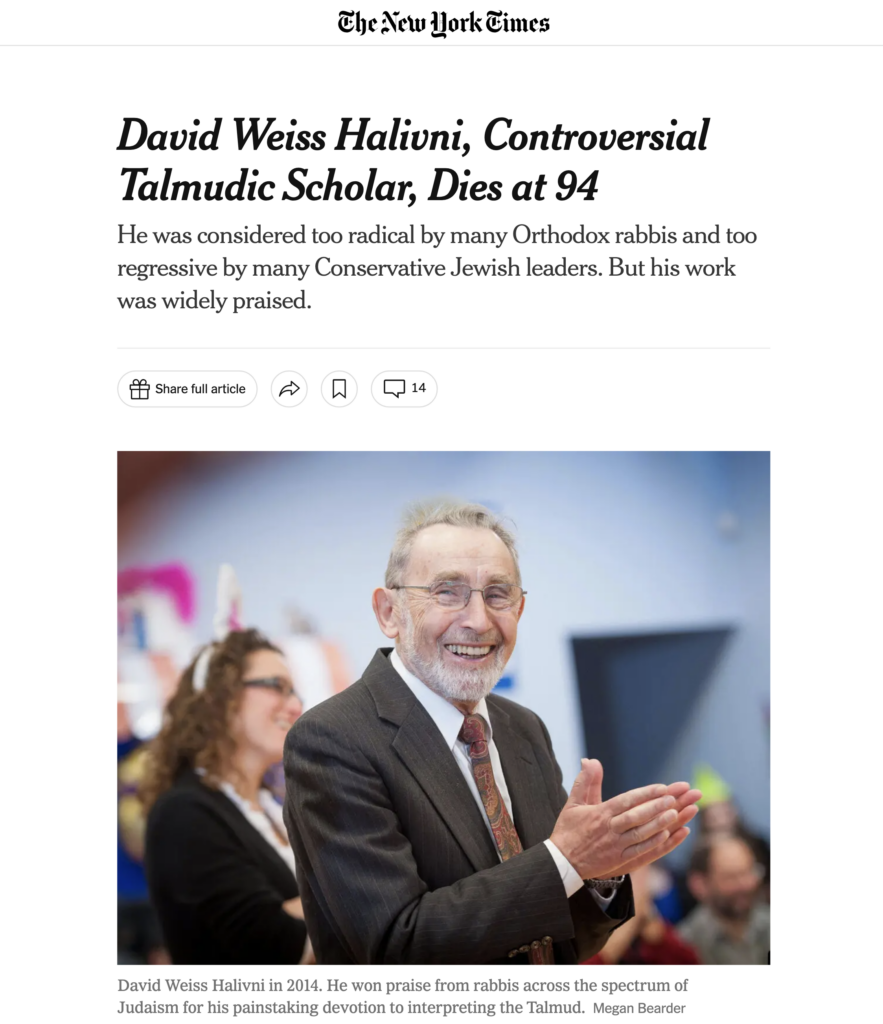
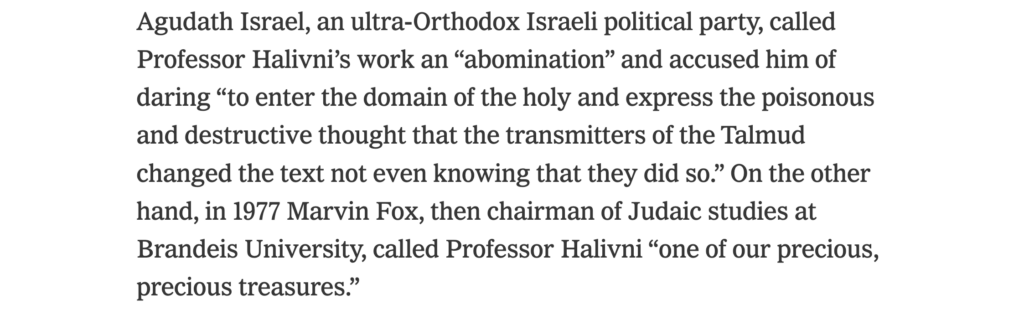
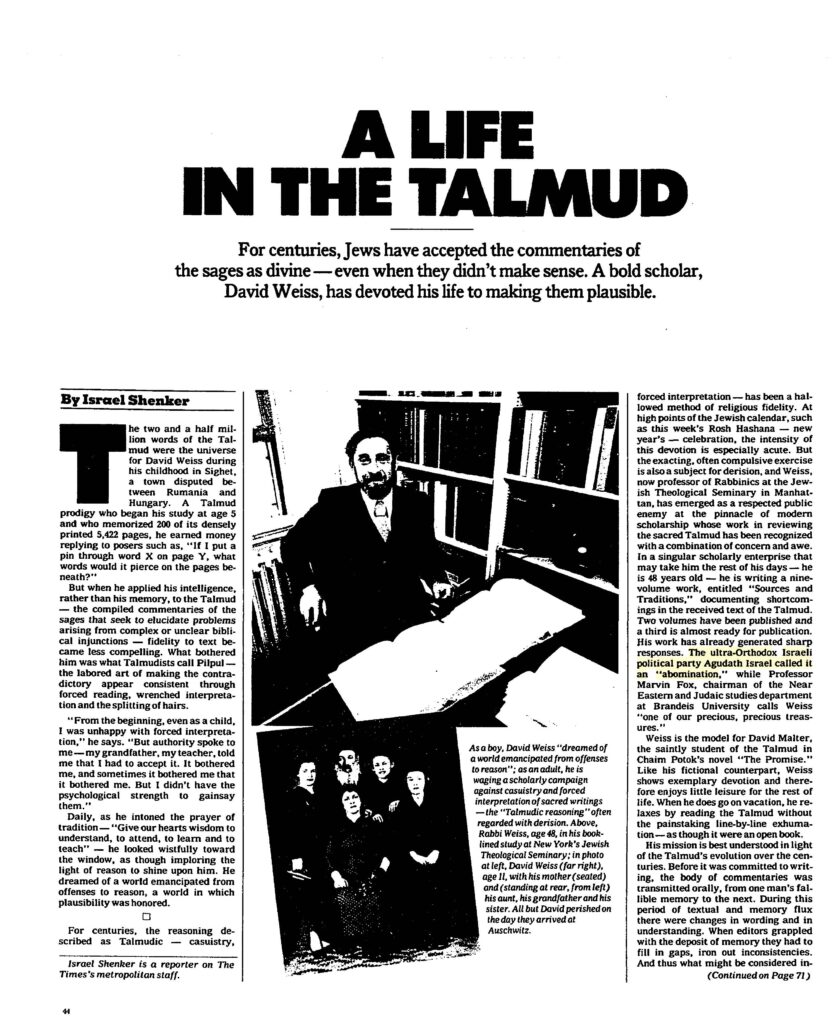
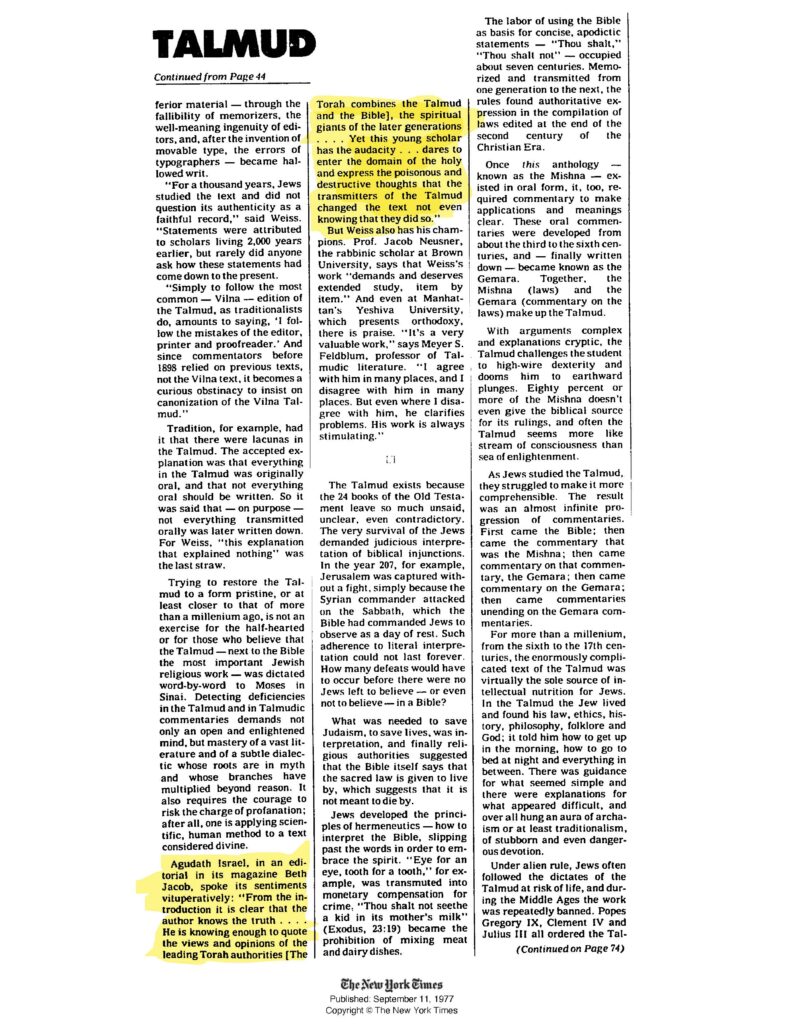
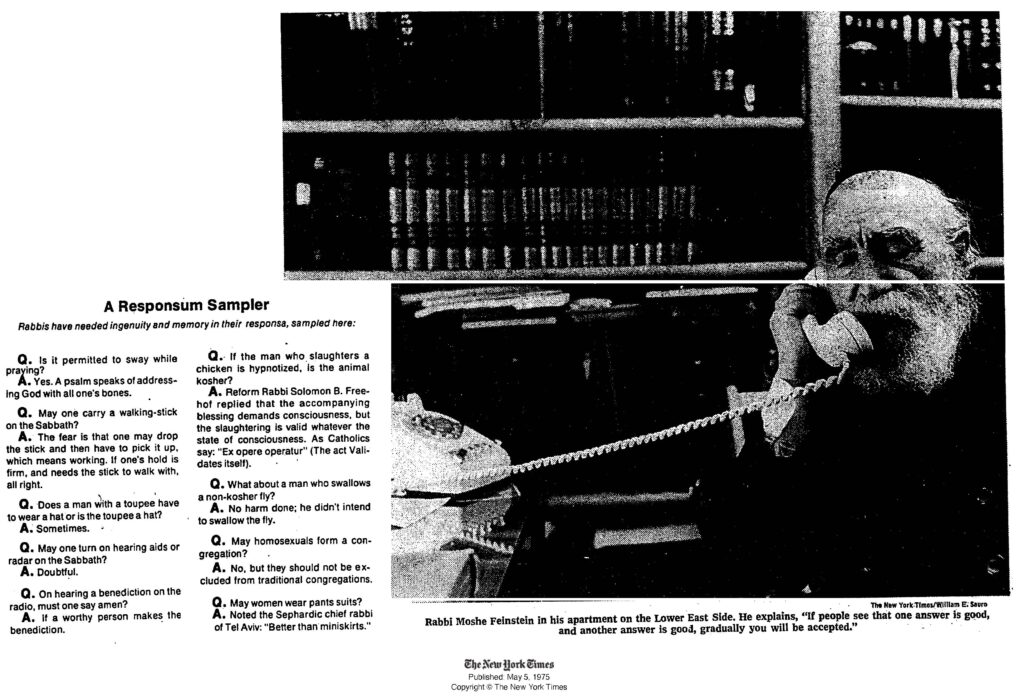
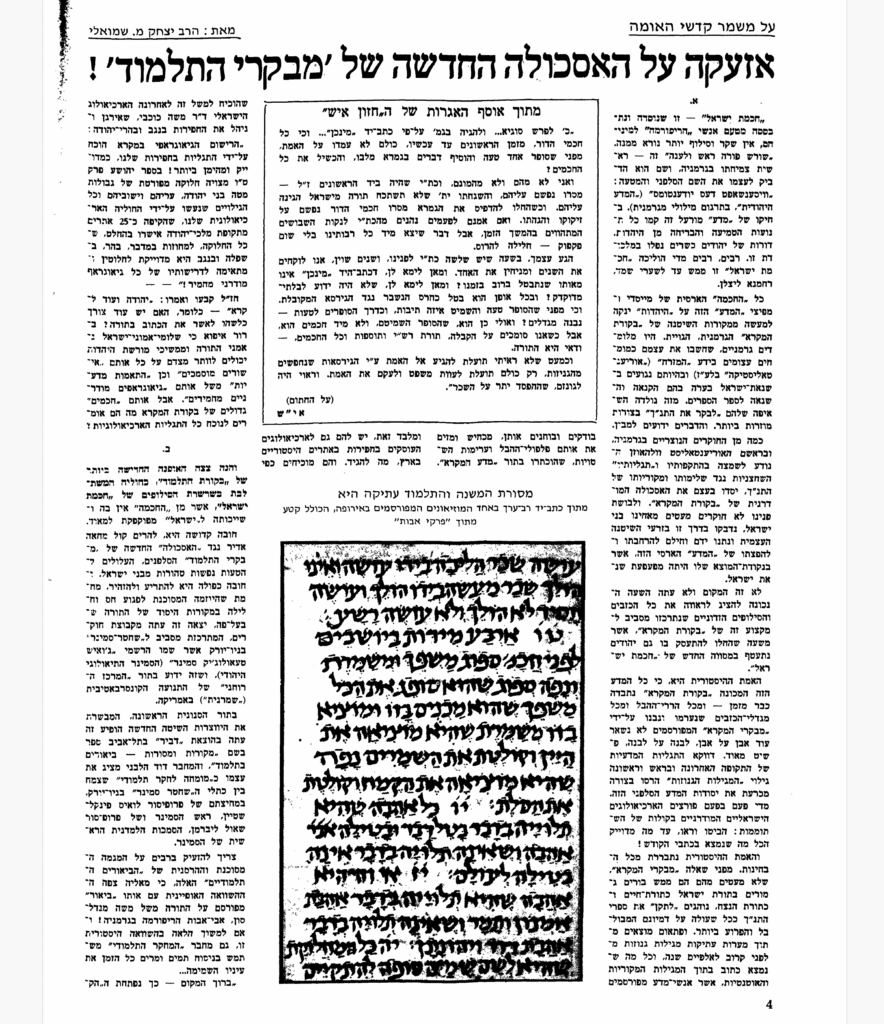
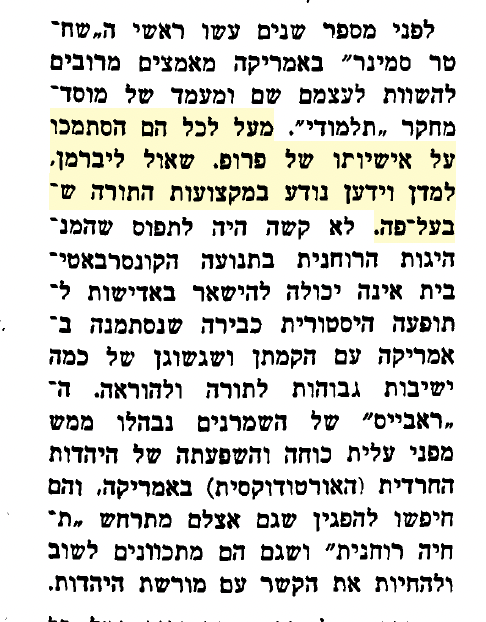 This, despite the fact that Lieberman’s earliest major work, Al ha-Yerushalmi, had already exemplified a disciplined form of textual criticism, drawing on manuscripts, parallel traditions, and internal philological analysis to clarify and correct the text of the Jerusalem Talmud. This could easily have provided fodder for Shmueli, yet he remained silent regarding Lieberman’s method. Recently published letters show that even the Ḥazon Ish engaged Lieberman seriously on these questions. Their correspondence reveals a principled disagreement over method, particularly regarding emendations grounded in manuscript evidence, while also demonstrating that such philological argumentation could be treated as a legitimate subject of rabbinic dispute rather than dismissed outright as heresy. Of course, since this correspondence had not yet been published, it cannot explain Shmueli’s silence on Lieberman’s approach.