Two Notes on Censorship and Plagiarism on the Ramban’s Commentary on the Torah

There are a significant number of seforim that are considered “classic” commentaries on the Torah, including, for example, Rashi, Ibn Ezra, Radak, Ralbag and Ramban, et.al. In this post, we shall discuss the Ramban’s commentary on the Torah, as it is also on important work in the history of Hebrew printing.

The first edition, published between 1469-72,[1] in Rome, was the first book published in that city (and the only one of the early works that positively identifies Rome as the city of publication) and is available online here [it was also reprinted by Mekor in 1970 with a short introduction by A.M. Habermann]. Over the years, the Ramban’s commentary increased in popularity, and in commensurate with that popularity, many books have been written to further understand this commentary. The most commonly used edition today is the edition by Charles B. Chavel.[2] This edition, published by Mossad HaRav Kook, in two volumes, contains a critical edition of the text as well as explanatory notes.

There are two interesting points about the above edition that are less well-known. The first, a fairly minor point, is the “problem” some apparently have with the fact Mossad HaRav Kook published this edition. In R. Wreschner’s excellent commentary on Masekhet Avodah Zarah, Seder Ya’akov, first printed in 1988 (reprinted in 2004, third edition), in his introduction, he discusses the problem of censorship (in the “Jewish/Non-Jewish” sense, for example, removal of mentions of Jesus) in Hebrew books. While he rightfully decries the numerous instances of censorship in the history of the Jewish book, he notes that of late we have been partially able to rectify some of these omissions.

He singles out various editions and says:

ובעזרת הית”ב החומל על דלותם באורך גלותם, נדפסים היום ספרים כאלו [אם המילים החסרים] מחדש כגון ספר הרמב”ם בהוצ[ת] פראנקל, וכן פרש”י והרמב”ן ורבנו בחיי עה”ת . . . בהוצאת ה.ק. עכ”ל

With the help of God who has pity on our impoverished state due to the lengthy exile, today we have many such books [with the censorship replaced] anew, for instance the Frankel edition of the Rambam, and also Rashi’s commentary and the Ramban and the Rabbeinu Bachya on the Bible printed by Hey. Kuf. (Emphasis mine).

What does ה”ק stand for? R. Wreschner, two pages later, includes a full page explaining all the abbreviations in his book — but this one, ה”ק, however, does not appear there. Of course, this abbreviation is for HaRav Kook, meaning Mossad HaRav Kook. It seems that even fully mentioning the name of this publisher was, in R. Wreschner’s mind, unthinkable, even while he condemns other forms of censorship. That is, not R. Kook himself, but a publishing house named after him is also considered taboo.

The second issue with the Chavel edition is that there may actually be a reason not to mention this particular edition, not because of the publisher but because of the content. In one of the more interesting introductions, R. Moshe Greenes, in his commentary on the Ramban, Keren Peni Moshe, criticizes the Mossad HaRav Kook edition for what he perceives as serious errors in that edition.

R. Greenes begins, after going on a few tangents—including claiming that back in 1988 people were so lazy they couldn’t get up to look for a sefer, or even turn pages—by praising R. Chavel’s work on the Ramban. However, shortly after that praise, R. Greenes spends the next eight pages or so pointing out all the shortcomings of R. Chavel’s edition. First, he argues that R. Chavel plagiarized multiple times from the earlier commentary on the Ramban by R. Mordechai Gimpel, Techelet Mordechai. R. Greenes then accuses R. Chavel of plagiarizing from R. Menachem Zvi Eisenstadt’s edition (both volumes have recently been reprinted together in a single volume but were unavailable to R. Green at the time).[3]

R. Greenes includes numerous examples of alleged plagiarisms and even explains that the footnotes with asterisks can be identified with the Techelet Mordechai. These, alleges R. Greenes, were added only after R. Chavel acquired the Techelet Mordechai, which required inserting into the existing footnotes without altering the numbering scheme, resulting in numbers with asterisks. Whether or not R. Chavel properly attributed these sources is still up for debate. Nonetheless, regardless of whether there was actual plagiarism, the fact remains that R. Greenes’s introduction is one of the more unique ones out there.

Notes:
[1] On the date of publication, see Moses Marx, “On the Date of Appearance of the First Printed Hebrew Book,” in Alexander Marx Jubilee Volume (New York, 1950) pp. 485-501; and the bibliopgraphy in Catalogue of Hebrew Incunabula from the Collection of the Jewish Theological Seminary of America, ed. Shimon Iakerson (New York: Jewish Theological Seminary, 2004), [6]. For additional information on the prints of Ramban’s Commentary to the Torah, see M.M. Kasher, et al., Sa’arei haElef (Jerusalem, 1985), pp. 90-91, 571.
[2] For bio-bibliographical details about Chavel, see Moshe D. Sherman, Orthodox Judaism in America: A Biographical Dictionary and Sourcebook (Westport: Greenwood, 1996), s.v. “Charles B. Chavel.”
[3] Perush ha-Ramban al ha-Torah (Brooklyn: 5762)


Rabbi Yehuda Henkin — Opposite of Plagiarism

Rabbi Yehuda Henkin is the author of Shu”T Bnei Banim in four volumes and the commentary Chibah Yeteirah on the Torah. He learned privately with his grandfather, Rabbi Yosef Eliyahu Henkin, and served as Area Rabbi of the Bet Shean Valley in Israel. He now lives in Jerusalem.

Rabbi Henkin has two degrees from Columbia University, and has written extensively in English: Equality Lost–Essays in Torah Commentary, Halacha and Jewish Thought, (Urim Publications); New Interpretations on the Parsha (Ktav); Responsa on Contemporary Jewish Women’s Issues (Ktav); and the forthcoming Understanding Tzniut–Modern Controversies in the Jewish Community (Urim).

This is his first contribution to the Seforim blog.

Opposite of Plagiarism
Rabbi Yehuda Henkin

Plagiarism is a lack of attribution; less common is its opposite, mistaken attribution; rare indeed is the attribution of a defamatory work to the object of the defamation himself! An example of the latter can be found in the entry in the Encyclopedia Judaica [1] concerning my grandfather, R. Yosef Eliyahu Henkin zt”l.

The offending sentence reads: “His published responsa appear in Chaim Bloch’s Even me-Kir Tizak (1953) and his own Perushei Lev Ivra (c. 1925).”[2] But in fact, not only does the pamphlet Even me-Kir Tizak contain no responsa of R. Henkin, it is an unbridled personal attack on him on the part of one who lost a din Torah heard before him. Bloch refused to accept the verdict, and resorted to defamation of the judges. If I recall reading correctly about the affair, he was subsequently put in cherem by the Agudas HaRabbonim.

How did the mix-up in attribution occur? Since the card-catalogue of the Jewish Reading Room of the 42nd Street Library in New York listed Bloch’s pamphlet under R. Henkin, one can surmise that the researcher[3] for the EJ copied the listing without bothering to look up the reference.

Since then the mistake has been copied in Rafael Halperin’s Entziklopedia l’Bet Yisrael and, earlier this year, in the new edition of the EJ (2007). Surely a case of shigegat talmud oleh zadon [4].

Notes:
[1] First published in 1972, vol. 8 column 324. The EJ contains a number of incorrect or partial biographical details; for a comprehensive account see my Equality Lost (Urim), chap. 16. See here for Shnayer Z. Leiman’s review of the NEJ at the Seforim blog.
[2] This confuses two separate works: Perushei Ivra [PDF] (1925) and Lev Ivra [PDF] (1957). Together with Edut leYisrael (1946), all were reprinted in Kitvei haGri”a Henkin, vol. 1 (1981). In addition, Kitvei haGri”a Henkin, vol. 2 (1989) is a collection of his responsa and articles, edited by his son (my father) Avraham Hillel zt”l. (The volumes may or may not be available from Ezras Torah in NY. I have some of vol. 1 and a few more of vol. 2.)
[3] Not to be confused with the rosh yeshiva of the same name, but an otherwise reputable academic scholar.
[4] Avot 4:13.


Pesach Journals, Had Gadyah, Plagiarism & Bibliographical Errors

Two journals have put out special collections devoted to Pesach. The first, Moriah, has continued their holiday specific journals and collected their third volume of articles devoted to Pesach. Yeshurun, for the first time has also collected choice articles related to a specific holiday and published a volume devoted to Pesach as well.

Yeshurun’s effort, being their first, is the focus of this post. This volume is much smaller than their typical volumes. Usually, each volume of Yeshurun is huge – over 700+ pages – with this volume, however, the articles comprise a “mere” 300+ pages. Aside from articles related to Pesach, this volume contains an index to the first 10 volumes of Yeshurun. [1] The index contains indexes of persons, books, topics, and sources (Bible verse, Mishna, Talmud etc.). Although any index is most welcome (especially in light of how large the volumes are) and this index is pretty comprehensive but I am unsure why they decided to leave out an index of authors. That is, the index of persons is limited to persons discussed in articles, not those who actually wrote the articles. So if one wants to look up all the articles written by person X, they are out of luck for now.

Aside from the issue of lack of an author index I found a much more glaring problem in this volume. The volume includes an article discussing the song Had Gadyah. This article has numerous flaws. First, the author of the article is Tuvia Fruend. Tuvia Fruend has authored a series of books on the holidays “Mo’adim l’Simcha.” These books contain articles related to the holidays. Fruend’s modus operandi for Mo’adim l’Simcha is to find a good article on the topic and then repackage it – or at times – just plagiarize it. What is particularly surprising in this context is that one article he is clearly guilty of plagiarizing is one which appeared in Yeshurun – by one of the editors of Yeshurun! As I have previously shown, Fruend copied it verbatim, without citation, and even repeated typographical errors. Why then, Yeshurun would give Fruend a forum is difficult to understand.

Second, the article itself is problematic. This article appears in Fruend’s Mo’adim l’Simcha and this is a reprint of that article. [2] This time, however, all the footnotes are removed. Additionally, even though there are no footnotes, there are also almost no citations in this article. Instead, we have statements such as this “according to many scholars” [3] – without saying who those scholars are or where they can be found. Further, Fruend, in one of the few actual citations, says “in the journal Machnim issue 54, 1961 there appears” where he notes the article in Machnim records a different version of this song. Fruend doesn’t tell us who the author of the article was – A. M. Habermann. Additionally, Fruend makes it appear that the only value of this article is the alternative language. But, if one looks up the article, the article discusses not only the alternative reading but includes other sources which shed light on Had Gadyah, sources which Fruend uses in his article.

Further, Fruend’s reliance on Habermann’s article are apparent in the last part of Fruend’s article. Fruend lists (and discusses some) of the books devoted to explaining Had Gadyah. Fruend, although never notes that Habermann had complied a list previously – in an article that Fruend had already noted he had seen.

Finally, there are some bibliographical errors which appear in the article. First, while minor, Fruend, for the number of Haggadah published uses Ya’ari’s bibliography. Although Ya’ari’s bibliography of the Haggadah is a fine bibliography it is significantly incomplete. Yudlov’s, more recent, bibliography (“The Haggadah Thesaurus“) contains almost double the amount of Haggadahs. Second, the bibliographical information Fruend provides for some of the books devoted to Had Gadyah are in error. The first book on the list is Mogen David by R. David b. Meshulam. Fruend gives the date 1745, this, however, is incorrect. The actual printing date is 1755. [4] The second bibliographical error is according to Fruend the commentary on Had Gadyah, Pesach Tikvah, was published in Frankfort in 1785. Again this is incorrect. The London edition was published in 1785, however, this was not the first edition. Instead, the first edition, which was published in Frankfort, was published in 1727. [5] All of these errors could have been easily corrected by looking in Yudlov or even Ya’ari, or even copying from Habermann correctly. Finally, if Fruend had actually used Yudlov he would have found an additional commentary on Had Gadyah unlisted by Habermann. Although Yudolov did not see it, he records a commentary Milas Even, Fuerth, 1730. [6]

[1] The editors note that the index to the balance of the volumes is in process and will be published in due time.

[2] It may be that Fruend also previously published this article in Yeshurun as well, but as they have no author index I was unable to confirm that this article appeared in Yeshurun before. Even if this the first time he published in Yeshurun, I don’t understand why some of the errors below were not corrected by any of the editors of Yeshurun.

[3] This statement also appears in the original article in Mo’adim l’Simcha without citation there either.

[4] In order to figure out the date one must add up the bold letters which appear in the legend בשנת ליל שמורים הוא לה’ which adds up to 515 i.e. the year 5, 515 which converts to 1755. Perhaps Fruend’s date was due to a mathematical error.

[5] The date of publication may not actually be this date. This is so as included on the title page is a legend which reads “to know the week and the year [of the printing of this book] when it was finished completely.” Yudolov admits that he is unable to figure out what the publisher meant by this line. Yudolov, however, bases his dating on C.D. Friedberg. Although there may be some question about the exact date, the date offered by Freund is impossible. This is so, as the printer was Johann Kelner. Kelner printed between the years 1708-1730. Thus, Fruend’s date of 1785 is impossible – at least if Kelner printed this book.

[6] In truth there is a more troubling error to the whole article. Fruend fails to discuss the significant evidence that Had Gadyah is merely a popular folksong which was borrowed and converted for use at the Seder. While Fruend does discuss those who downplay this assertion, he doesn’t discuss any of the counter-evidence or fully explain the issue.


R. Akiva Yosef Schlesinger, Tikkat Shofar on Shabbat & plagiarism (of course)

Menachem Mendel has a very good post discussing the issues and the history regarding the propriety of blowing the shofar on Rosh HaShana when it falls on Shabbat. A central figure in this discussion is R. Akiva Yosef Schlesinger. R. Schlesinger is perhaps best known for his book Lev haIvri a commentary on the last will and testament of the Hatam Sofer. In this book, which perhaps can be used to trace much of Haredi ideology today, the bulk is devoted to putting down the “reformers.” He discusses Mendelssohn’s Biur, speaking in the vernacular and a host of other issues. There is no doubt he held what many would consider extremists views. R. Schlesinger has a less well known side – his love of Israel and dislike or almost vehement hatred of inertia.

R. Schlesinger who was born and raised in Hungry emigrated to Israel. When he got to Israel, at the time, most people were supported by the various kollelim. These kollelim would be set up by country, Hungarian Kollel etc. (the American Kollel was controversial). These kollelim in turn wielded tremendous power – they had the money. R. Schlesinger took a very dim view of these kollelim. First, he felt the money was not given out based upon need and merit, rather it was given based upon status and connections. Additionally, this system only ensured that people would never actually try and make money themselves. To be clear, these kollelim did not only support people learning full time, rather, almost everyone was supported by them.

R. Schlesinger came out strongly against the kollelim and decided to set up his own system. This system he outlined his book Kollel HaIvirim. First, he explains his system would be democratic. He explains that the Torah requires one to follow the majority. This is so, even when a Godol or the like holds different views. He proves this by pointing to the system of the Sanhedrin. There, they did not just go with greatest Rabbi on the Sanhedrin, rather, they started polling the views of the lowest one. (p. 7).

According to R. Schlesinger’s system the Kollel or Board would be in charge of almost everything. They would oversee the education of the children. He advocated for marriage at 18 and then a 3 year period to devote to study. However, R. Schlesinger notes, not too many people are successful at just studying Torah full time, therefore, the Kollel should see who is not or who does not have an interest and they should learn a proper profession. This study should not be half hazard. Instead, they should study from a expert and devote a significant amount of time to this endeavor. He includes agriculture among these professions. (p. 9-10)

R. Schlesinger did not shy away from accountability. Even today many religious organizations do not have open books. R. Schlesinger, however, advocated for a yearly accounting which would be sent to all where they could view all the expenses and the accounting of the Kollel. (p.11).

He also seems to have taken what today would be considered a religious Zionist view of the then current status of Israel. Although at the time, Israel was under the rule of the Turkish government, due to the fact, they were fairly benevolent he understood that it was already then – long before the founding of the State of Israel – the messianic era. Specifically, he points to the Talmudic passage which explains the only change during the messianic era will be the removal of government oppression (אין בין עולם הזה לימות המשיח אלא שעבוד מלכיות בלבד). (p. 19) Additionally, he chides his former countrymen on their aversion to move to Israel. He says R. Isaiah Horowitz in the 16th century moved to Israel although it took a year to do. Today, he says, it is easy. The government gives anyone who wants a pass and it on the fast ships and rail it takes a mere 10 days. (p. 16).

Although it was fairly safe, R. Schlesinger was aware there still should be a security force. Thus, he advocated for a month long rotation for everyone. These watchers would serve for a month and then others would take their place. He says they should do so even on Shabbat. (p. 26b).

He wanted everyone to have a flag. There would be a general Kollel haIvrim flag with white, green, purple and turquoise. Then each shevet would have their own as well. (p. 27).

All of these plans met with serious resentment from the established Kollelim. They viewed him as undermining their system and way of life. So, as anyone who wants to get someone in trouble does – they searched his books to find something they could ban. Sure enough, they were successful. In his book Bet Yosef Hadash, which is on the Bet Yosef, he discusses a terrible problem and attempts to find a satisfactory answer. In Russia at the time there was forced conscription for a 25 year period. This was a Jewish death sentence – some people, were taken as young as 8. So, some would flee Russia and move to Israel to avoid this. At times, their wives refused to come. R. Schlesinger, therefore, discusses the possibility of getting around the Herem of Rabbenu Gershon on two wives. R. Schlesinger’s enemies, however, accused him of doing away with and not respecting the Herem.

They consigned his books to the fire and put a ban on them.

In the end, however, his students (and he had many) were successful in setting up the city of Petach Tikvah (see here for more). They wanted R. Schlesinger to join them, and he did. He purchased land, but to honor his father in law, purchased it in his father in laws name.

Unfortunately, this had terrible ramifications. When R. Schlesinger returned to Hungary to gain support for his movement, his enemies went to his father in law. His father in law was old and could not take this. His father in law signed over the land he owned in Petach Tikvah, the land which was the culmination of R. Schlesinger’s dream to his enemies, the Hungarian Kollel. R. Schlesinger then attempted to get it back. He did win some court victories. His opponents, however, used his own means against him. They ignored the pronouncements of the Bet Din, knowing that R. Schlesinger would never go to a non-Jewish court.

It seems that not only was R. Schlesinger a tragic figure, but other things he touched as well. Shmuel Weingarten was an avid Zionist. He published, among other things, a book demonstrating the collection of anti-Zionist letters in Dovev Siftei Yeshanim were forgeries. At the end of his life he obtained letters sent to R. Schlesinger’s group (although they don’t mention it, Weingarten shows they in fact were)and published them in a volume titled B’Shevach Yishuv Ha’aretz. These letters were from many Rabbis, some who were not that well known. Weingarten, as he notes, had to spend considerable effort tracking down and providing biographical information about these persons. He also transcribed the letters. He, unfortunately, did not live to see this book published.

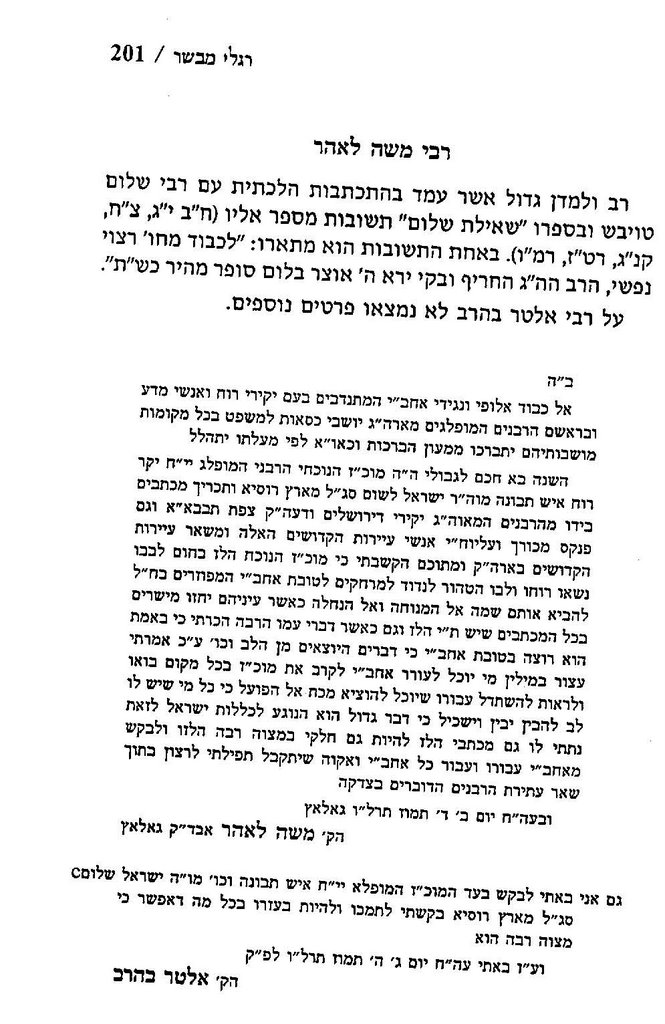
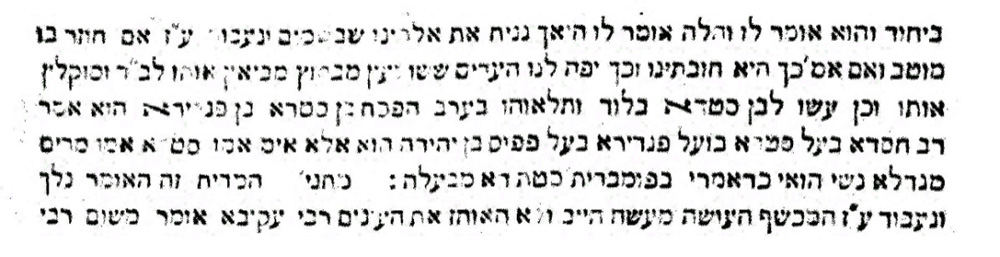
In 1999/2000 some in Beni Brak B. Margolius (most likely a woman due to the lack of first name), published a book, Ragli Mevasar. This book is divided into three parts. The first two are biographies of R. Schlesinger and his father in law. The last part are the very same letters originally published by Weingarten. Additionally, they include the very same biographies that Weingarten did. There is absolutely no attribution at all! I have included a page from each were the reader can see how they are the same. The top page is from Weingarten and the bottom from Ragli Mevasar. None of the library catalogs I have seen note that this is plagiarized.


Torah & Rationalism – Writings of the Gaon Rabbenu Aaron Chaim HaLevi Zimmerman zt”l

Torah & Rationalism – Writings of the Gaon Rabbenu Aaron Chaim HaLevi Zimmerman zt”l (Feldheim 2020, 216pp.)*

Ovadya Hoffman

Deviating from conventional book reviews I shall not enter into a discussion of the author – R. Chaim Zimmerman’s genius, schooling, breathtaking erudition, oeuvre, philosophies or his broader Weltanschauung. I leave that for the biographers, that is, if any will take up the challenge.[1] Nor does this survey qualify as a comprehensive book review as I will explain later on. 

First, a word on the book itself. When a posthumously published book appears any critical minded reader wonders where the material came from, in what condition it was, did the publishers do any editing at all to the materials etc.? These are very important questions with serious ramifications and any responsible publisher should want to provide as much detail as possible. Unfortunately, in the present book we are presented with a vague picture. The reader is only informed (Preface, viii) “The text presented includes redacted variants of articles published during the 1980s under the headline Torah and Logic.” No precise list of the publications’ previous appearances is given, a proper bibliography, no exact description of the redactions or even who committed the redactions – the editor, Moshe Avraham Landy, or R. Zimmerman himself. One example, which relates to the section I’d like to focus on, is Landy’s note on p. 131 n. 265 (duplicated in the Hebrew section, p. 174). He informs us that R. Zimmerman “compiled a page by page critique of Professor Ginzberg‘s A Commentary on the Palestinain Talmud that shows most of the sources quoted by Ginzberg are found explicitly in earlier lesser-known printed books on Talmud Yerushalmi; and any chiddush, or “original idea”, offered by Ginzberg could also be found in sefarim and books of previous rabbis and scholars. This critique was written about 1950, and for various reasons was not published. Some galley proofs and other remnants of this manuscript are in the archive of the collected writing of the Gaon Rabbenu… They are presented herein for the reader in the original Hebrew…” I am unsure if what is presented are pieces of a longer manuscript which runs “page by page” (on all three volumes of the Commentary and the posthumously published fourth volume) or if this is the complete critique which, in its current composition, only encompasses the first eighty or so pages of the first volume. Again, a precise description and an unequivocal report of the materials would have obviated any confusion. 

CHAPTER IX – The Falsity of Chochmas Yisrael

I shall focus on R. Zimmerman’s charges leveled at Professor Louis Ginzberg’s Perushim VeChiddushim BaYerushalmi (herein, “Commentary”); specially the explicated charges mentioned in this chapter as they are reflective of the criticisms in the Hebrew recension, “רצנזיה” (Appendix, 175ff.), which will not be treated in this essay. I do not think such a presentation is misrepresentative or fragmentary of R. Zimmerman’s complete critique since he himself maintained that “[f]or the intelligent reader, the following evidential examples should suffice” (p. 131). Additionally, I resisted from responding to the cryptic one-liner allegations sprinkled on the preceding pages (pp. 127-130) since I’m not at all sure to what precisely R. Zimmerman was referring to and are, supposedly, detailed only in the Hebrew section. I surmise that the citations to the Commentary referenced in the notes of those one-liners were provided (or, suggested) by the editor of the manuscript, either Landy or Rabbi Eliyahu M. Zelasko (cf. p. 175). Finally, to assay the buildup and the opinions expressed in the chapter of the wider “Falsity of Chochmas Yisrael” is more tedious and requires a much more in-depth systematic debate as it relates to their different schools of thought, principles and religious philosophies, which is entirely beyond the scope of this scrutiny. This review is not intended as a rejoinder or an exculpation of Chochmas Yisrael, its “truthfulness” or its fidelity to Halachah and tradition. In this brief register it is strictly Ginzberg’s [rabbinic] scholarship I attempt to address in light of R. Zimmerman’s allegations; not the man, his beliefs or his affiliated institution(s). Transliterations below follow the method employed in the book under review. Emphasis, in italics, are of the current writer. 

P. 127
He [Ginzberg] writes in his book that he developed a novel approach and a scientific method to Halachah.
These are Ginzberg’s actual words (English intro., viii):
In these volumes an attempt has been made to deal with the writings of the mishnaic-talmudic period as a unit and, within the framework of a commentary on the first treatise of the Palestinian Talmud, to present a novel approach to the study of this literature.
To the initiated with the Yerushalmi’s commentaries I think a tenable argument can be made that Ginzberg’s tomes are a unique attempt at approaching the study of Talmud Yerushalmi with modern methods through the very framework he delineated in his introductions. Alas, R. Zimmerman did not offer examples to the contrary, i.e. books predating Ginzberg which approached the Yerushalmi mirroring the latter’s methods. This is in stark contrast to Solomon Zeitlin’s perspective who wrote in his review of the Commentary: “It is the first and only serious rabbinic work published so far in this country. Ginzberg is the first to give us a thorough, scholarly treatment of the Palestinian Talmud from the old rabbinic and also scholarly point of view.” Zeitlin, not being one to ingratiate with embellishment, went so far to suggest “Solomon ibn Adret said there was only one in a generation who could understand the Palestinian Talmud. Prof. Ginzberg, I believe without exaggeration, has no equal in our generation and is one of the greatest authorities on the Palestinian Talmud since the time of the Gaon of Vilna.”[2] Among the many Roshe Yeshivot and rabbanim who respectfully referred to and/or corresponded with Ginzberg, mention should be made here of what R. Mordechai Gifter wrote to Ginzberg upon receiving a copy of the Commentary
זה כשבוע שהובא אוצר גדול לביתי הוא ספרו של כבודו “פירושים וחידושים בירושלמי”, ואתמול גמרתי העיון בכרך הראשון על שני פרקים הראשונים במס’ ברכות. ואף שאין כבודו צריך לדכוותי, לא אוכל להתאפק לומר לו “יישר חילו לאורייתא”, ואקוה שיזכה להו”ל ספרו על כל הירושלמי, להאיר עיני ההוגים בתלמוד זה. הספר גזל ממני הרבה שינה, ואקוה שיהיו לרצון לפניו הערות אחדות שמצאתי להעיר בדבריו[3]
P. 132 

R. Zimmerman introduced the question regarding the strength of the obligation to recite the paragraphs of the Shema section; is it Biblical or rabbinical and, if any, which paragraphs? He called attention to the Peri Chadash and Sha’agas Aryeh who offered their respective
“great pilpulim… The Sha’gas Aryeh in his great teshuvah [responsum] has a pilpul on the subject, where he quotes some pieces of the Peri Chadash and argues against them… Ginzberg writes in a very trivial and casual tone against these two renowned geonim… Ginzberg writes that these two geonim, despite all their lengthy pilpul, overlooked an explicit and open source in the Talmud Yerushalmi.”
Not only is this an overly exaggerated characterization of Ginzberg’s actual words, the irony is eyebrow raising as Ginzberg’s words are presented in the footnote and the readers can detect this themselves, save for the note which contains a truncated text of Peri Chadash and therefore gives a different impression of what Peri Chadash actually wrote and how he formulated his discussion. These are Ginzberg’s words [with emphasis on the phrasing under attack]:
האחרונים האריכו לפלפל אם למ”ד ק”ש מן התורה ב’ פרשיות הן מן התורה או רק פרשה ראשונה (עיין פרי חדש ס”ו [ע.ה.: צ”ל ס”ז], ושאגת אריה ס’, ב’) ולא העירו על דברי הירושלמי כאן, שכבר אמרנו בכמה מקומות שלהירושלמי ק”ש מן התורה, ומ”מ טרחו למצוא טעם למה אין צריך כוונה רק פרק ראשון ולא אמרו שפרק ראשון מן התורה ולכך צריך כוונה ופרק שני מדרבנן ולכן אינו צריך כוונה, וע”כ ששניהם מן התורה, ועיין ראש דבור הקודם, ואכמ”ל
First of all, such common stock phrases, in all of rabbinic literature, needs no elaboration other than to say that it is not perceived as an undermining and disdainful “very trivial and casual tone” (never mind the harsher verbiage, and no less from R. Hezkiah de Silva himself). 

After repeating this same stricture (p. 133) R. Zimmerman adds:
…it is astonishing that the academic “scientific scholar” Louis Ginzberg either did not understand the words of the Peri Chadash and Sha’agas Aryeh, or deliberately deceived to discredit them. The error of Ginzberg here is because in the same chapter of the Peri Chadash, the Peri Chadash himself quotes this Talmud Yerushalmi, and brings this very proof with respect to which Ginzberg claims that he “caught” the Peri Chadash and the Sha’agas Aryeh in overlooking the Talmud Yerushalmi. Of course, the Sha’agas Aryeh makes reference to the Peri Chadash, so obviously he does not have to repeat the proof from this Yerushalmi which is clearly stated by the Peri Chadash.
Let us inspect the Peri Chadash. He begins chapter 67 with a thorough exposition determining what the obligatory status is with regards to reading chapters of the Shema. After about eight long paragraphs he arrives at his own conclusion that the reading of both chapters are biblically mandated and suggests that Rambam’s words appear to evoke the same opinion. He writes:
מעתה נשאר לנו לברר הדעת השלישי’ והיא היותר אמיתי מכולן דפרש’ שמע ופרשת והיה אם שמוע השתי פרשיו’ הוו מן התור’… וכך מטין דברי הרמב”ם ז”ל… וזו היא דעתי ומסתייעא הדין סברא דילן מהא דגרסינן בפ’ היה קורא…
Moving on to a dissection of the respective topic in the Bavli in order to prove his opinion, Peri Chadash qualifies that there is a Tanaitic dispute if the reading of both also require intent (“kavannah”) or only one of the chapters and adduces support from a Tosefta, interpreting the two opinions to be debating this last question vis-à-vis intent. To further corroborate this interpretation Peri Chadash finally adds:
ובירושלמי אמרינן מה בין פ’ ראשון דבעי כוונ’ לפ’ שני דלא בעי כוונ’ ומשני לה, נמצא דהני תנאי ס”ל דשתי פרשיו’ ראשונו’ הוו מן התור’…
It seems it is quite reasonable, if not absolute, to understand Peri Chadash’s usage of the Yerushalmi only as support to his interpretation of the views in the Tosefta regarding intent as it relates to “דהני תנאי” of the Tosefta. In other words, Peri Chadash did not cite the Yerushalmi in order to settle the question regarding the status of the Shema passages. One would imagine that if it was his intention do so he would have introduced such a critical source much earlier in his discussion and devoted more than a brief quote of this Yerushalmi passage. It appears that Sha’agas Aryeh too understood the Peri Chadash in this vein since, in his responsum, he does not merely “make(s) reference to the Peri Chadash” – he systematically went through Peri Chadash’s proofs and refutes them one by one, yet he does not single out the Yerushalmi in attempt to disprove the proof from it.
PP. 134 

Before moving to this example it is important to present the relevant rabbinic materials. Briefly put, the Yerushalmi presents two opinions as to why one must have his feet together when praying. One of the two opinions learns this from the exegetical requirement of the Kohanim to walk heel-beside-toe (“עקב בצד גודל”). A mishnah in Yoma (2:1) tells us that prior to certain Temple regulations Kohanim would race up the ramp in order to merit doing a particular service. The Tosefos Yeshanim (Yoma 22a s.v. bezman) points to this contradiction; namely, how were the Kohanim permitted to run if it is indicated in the Yerushalmi that the Kohanim were required to walk heel-beside-toe? Dismissing the possibility that they ran heel-beside-toe (“ואין נראה לומר דרצין עקב בצד גודל קאמר”) Tosefos Yeshanim goes on to present what appears as two answers. Answer 1: “ושמא כיון שלא [היו] עדיין עסוקין בעבודה כמו בהולכת אברים לכבש יכולין לרוץ” (= since they had not yet been involved in a service, such as the delivering of the limbs via the ramp, they were allowed to run). Answer 2: “אי נמי רצין עקב בצד גודל שלא להראות כמו עושה כן אלא כי כן צריך לו לילך בשעת עבודה כדפי’”. One readily discerns that this reading is textually defective. On the margin of this folio in the standard Vilna edition, a gloss is brought closing with “וע’ ש”י” (= see Siah Yitzchak [Nunes Vaes, Jerusalem 1960, p. 293]), presenting a substantiated alternative reading which, for the sake of brevity, I will not get into other than to point out that the alternative phrase indicates that there is no second answer. Instead, the rest of the text is a further explanation of a particular, related Talmudic passage elsewhere. On the other hand, in R. Avigdor Arieli’s edition of the Tosefos Yeshanim (Jerusalem 1993, p.30) some text of Tosefos HaRosh is incorporated and such is the text given: “אי נמי רצין עקב בצד גודל [קאמר שהיו ממהרין ללכת בענין זה…]”. This answer seems to say that the Kohanim would hurriedly walk heel-beside-toe. The nuanced difference borne in this answer compels one to consider that Siah Yitzchak’s emendation is more likely. 

This now brings us to the commentary of R. Avraham Abba Schiff in his To’afos Re’em which R. Zimmerman uses to level charges against Ginzberg. Here is the pertinent text of R. Schiff:
…ובירושלמי… אמרו זהו שעומד ומתפלל צריך להשוות את רגליו כו’ ח”א כמלאכים וח”א ככהנים כו’ שהיו מהלכים עקב בצד גודל וגודל בצד עקב משמע משם דוקא וכ”כ התוס’ ישנים יומא שם עיי”ש שכ’ אי נמי רצין עקב בצד גודל שלא להראות כחו עושה כן אלא כי כן צריך לו לילך בשעת עבודה כדפי’ עכ”ל ודבריהם אלו אינם מובנים והנראה לי דט”ס יש שם וכנ”ל אי נמי רצין ועולין בכבש עקב כו’ ור”ל דמתני’ ה”ק היו רצין עד לכבש והולכין בכבש כדרכן עקב בצד גודל וזהו שסיימו בת”י שלא להראות כחו עושה כן כו’ פי’ במ”ש ועולין בכבש לא להראות כחן היו עולין לכבש דעולין בכבש כדרכן עקב בצד גודל אלא עיקר הקדמתן במ”ש היו רצין דהיינו עד לכבש…
R. Schiff likewise noted the textual difficulty of the Tosefos Yeshanim and therefore suggested a different reading. He proposed that the second answer means (reads) the Kohanim would run up until the ramp but from there they would walk heel-beside-toe. If this is the second answer it seems somewhat forced as its underlying rationale is presumably to restrict running when ascending the ramp, i.e. executing a designated service, and it is essentially the same as the first answer. 

Returning to R. Zimmerman, after he informs us of the aforementioned Tanaitic contradiction, he continues:
Tosefos Yeshanim… gives these two terutzim [solutions] to answer this contradiction. On the Sefer Yere’im… there is a perush [commentary] by the name To’afos Re’em where he brings all the bekiyus [referecnes] on this subject. He also writes this contradiction and explains both terutzim. And after he writes these two terutzim, he references the Tosefos Yeshanim, as quoted above.
Next, R. Zimmerman asserts that:
…with the claim of originality, Ginzberg answers the contradiction asked by the Rishonim and of Tosefos Yeshanim with these two solutions, not being aware that Tosefos Yeshanim himself wrote these two answers word for word.
Here too, Ginzberg’s text is presented and the reader can see that he nowhere asserts any claim of originality. He merely referenced the classic sources, including the Tosefos Yeshanim, and then paraphrased what some of the Rishonim asked and answered. The only phrase one can guess (or, read into) which R. Zimmerman based this imputation is where Ginzberg wrote, regarding the distinction of ascending the ramp when executing an actual part of the service, “והיה אפשר לומר”. But, this is borderline pedantic as any accustomed student of rabbinics does not expect an author to reiterate every time they allude to an aforementioned source. He essentially claimed that Ginzberg quoted the sources but “did not make the effort to look up the Tosefos Yeshanim, and he plagiarized the words of the To’afos Re’em… taking credit for himself, and taking for granted that no one will catch him in plagiarizing these two big “chiddushim” word for word from the To’afos Re’em.” By that token one must assume as well that the other sources which Ginzberg quoted and dealt with were also gotten from a different (albeit, unnamed) source. More importantly, it is not entirely clear that To’afos Re’em even spelled out both answers of Tosefos Yeshanim, precluding the possibility that Ginzberg plagiarized “word for word from the To’afos Re’em”. Never mind the strange notion that Ginzberg wouldn’t look up an explicit Tosefos Yeshanim which he cited and instead opted to quote an unclear formulation of the To’afos Re’em.

(The reference in p. 135 n. 279 to the Commentary should read: ‘עמוד 45’, and “שהרי על הלכה כהנים זו” should read ‘…הלכת כהנים זו’. For “keves” on p. 134, “keveṣ” or “kevesh” should be supplied.)
PP. 136
R. Zimmerman opined that with all the reference books on the Yerushalmi et al.
…if someone has in front of him all these sefarim when he learns Talmud Yerushalmi (he does not have to be an expert in Halachah), he could produce most of Ginzberg’s works.
Leaving aside this fantastic assumption and the certain debatable quality of the older reference books, one wonders if the careful inclusion of “most” was some admission that even with all reference books at one’s disposal, Ginzberg’s monumental ‘Legends of the Jews’, however, could certainly not have been produced by just anyone, not even today with our advanced digital databases. If this assumption is correct, one wonders how to reconcile the acknowledgment of Ginzberg’s singular erudition but then to accuse him of plagiarizing even known, classical sources.

PP. 137 

R. Zimmerman gave some examples to illustrate Ginzberg’s dependency on the various reference books and in particular Rabbi Dov Ber Ratner’s ‘Ahavas Tzion vi-Yerushalayim’ of which he alleges:
Ginzberg being aware that one may discover the obvious, that most of his references and citations are plagiarized from Ratner… and others, always tries to disqualify Ratner and others.[4]
I’m going to leave aside the obvious question as to the merit of such a claim, whether or not an author should always cite a reference book at every instance. Instead, I prefer to determine if there is any basis at all to the claim of deceit.

The first example of Ginzberg’s alleged attempt to disqualify Ratner’s work is R. Zimmerman’s oblique citation to the English introduction of the Commentary. Here are Ginzberg’s actual words:
The most important source for establishing a correct text are the numerous quotations… and one must be grateful to Baer Ratner (1852-1917) for collecting them in twelve volumes of his work… The parallels must however be used with great caution for the following reasons…
Ginzberg then continued to list three sound and ostensibly true critiques and words of caution.[5] Perhaps interpretation is in the eyes of the reader so suffice it to say there is no readily discernible attempt to “disqualify Ratner’s work”. Conversely, in Ginzberg’s Seride Yerushalmi, after he described the importance of collecting and collating quotes of Yerushalmi as found in Rishonim, he stated “וכבר התחיל במצוה הרב הגדול וכו’ כמוה”ר בער ראטנער נ”י בספרו יקר הערך ורב השבח ספר “אהבת ציון וירושלים” אשר בו העיר על גרסאות הירושלמי שבספרי הראשונים והאיר עיני לומר הירושלמי.”” (New York 1909, intro. IV). Such statements would be counterproductive and ineffective if attempting to disqualify a work.

IBID
He copies from Ratner verbatim without mentioning his name.
The reference is given to Commentary p. 54 where Ginzberg indeed quoted the same two passages from the Yalkut which Ratner quoted. Now, even before analyzing the material one must wonder if two authors cite the same classical and relevant sources is that sufficient to presume one copied from the other?[6] In any case, if one reads the detailed discussion of Ginzberg it is unmistakable that he independently studied and scrutinized the sources for he included much detail of which Ratner does not give the slightest mention. Furthermore, mention should be made of the fact that the referenced volume of Ratner was published in 1901 and the first volume of Ginzberg’s ‘Legends’, a work which had begun in 1903 was published in 1909 (JPS 2003[7], intro. XVI). There, in describing the distance between earth and heaven (the focus of the aforementioned Yalkut) Ginzberg referenced the Yerushalmi under discussion in addition to numerous other sources (ibid. p. 10 n. 31 & 32). Interestingly, he did not, however, cite the Yalkut which he later cited in his Commentary. With intent to minimize Ginzberg’s scholarship we can fault him for not referencing the Yalkut in the notes to his ‘Legends’. But, an obvious explanation can be, due to the enormous and difficult task in reworking all available ancient texts and incorporating them into a flowing narrative by necessity would require paraphrasing and omitting subtle Aggadic amplifications. The passage in the Yalkut, which Ginzberg expresses doubts per its original text, contains almost identical phrasing as the Yerushalmi and therefore added nothing for his sources. Had Ginzberg only known about the Yalkut passages from Ratner he should have referenced it in his ‘Legends’. This is, again, leaving aside the perplexing claim that someone who organized and authored the intricate, colossal and scholarly sources and discussions in the notes to the ‘Legends’ did not independently know the Yalkut, a primary text quoted throughout the ‘Legends’.

IBID
…he writes “many erred” because they did not know the sources, but the sources are written by Ratner…
Ginzberg commented that a particular passage of the Yerushalmi is found similarly in the Bavli, and while some Rishonim/Geonim quote the passage as it’s reflected in the Yerushalmi Ginzberg posited that their source was from the Bavli, unlike Ratner who quoted the parallels in the Sheëltot and BH”G and determined that their source was the Yerushalmi. Ginzberg concluded the brief comment by exclaiming
וטעו אלה שאמרו שבהג והשאלתות השתמשו כאן בירושלמי, עיין מה שכתבתי גואניקא א’, פד.
Ginzberg clearly was taking issue with what some erroneously assumed that the Yerushalmi was the common source for those two authorities, not that some did not know the sources. Besides for his objection being rather clear, when one examines the reference to Geonica they are met with a more detailed analysis of this error. As if it’s not explicit enough, there Ginzberg wrote:
“In his learned scholia… Ratner does not hesitate to attribute it to the Yerushalmi as Rabbi Aha’s source, and yet it can be readily demonstrated, from the words of the Sheëltot, that it goes back to the Babli.” 
P.138
Again, Ginzberg writes ‘Ratner did not indicate this source’, and this is an outright falsification, because in that same place Ratner quoted the source.
The reference here is to Commentary (p. 75 fn. 84). Ginzberg writes
לאוהבו של מלך שבא והרתיק על פתחו של מלך. במחזור ויטרי שי”ג (וראטנער לא העיר על מקור זה) גרס, תערו במקום פתחו, וזה יותר מדויק…
In the parenthesis, after “מקור זה”, a footnote reads
וכן לא העיר על הילקוט… אשכול… ושלחן ארבע שמביאים דברי הירושלמי על התכיפות
R. Zimmerman must have been referring to the Yalkut reference since Ratner (cited by R. Zimmerman) does not refer to Mahzor Vitri, Eshkol or Shulhan Shel Arba. Yet, even the Yalkut is only cited by Ratner on the preceding piece of Yerushalmi “מי שתוכף לסמיכה שחיטה”. On the piece under discussion, indicated by the caption of Ginzberg’s quote, Ratner only makes reference to the Amsterdam ed. of the Yerushalmi and did not note the textual variants contained in the Yalkut. Aside for this not being “an outright falsification”, the language used to quote Ginzberg is misleading. R. Zimmerman specifically referred to the footnote in Commentary, though it does not say there “Ratner did not indicate this source”; that exact phrasing is in the main text regarding the Mahzor Vitry which Ratner did not reference. The footnote says (if rendered in English) “he also did not indicate A, B and C.” If one were to object that A was indeed indicated by Ratner then a fairer phrasing would be something to the effect of “one of the sources was quoted by Ratner” thereby not wholly discrediting the author’s point. 

At this junction I’d like to refer to one piece produced in the Hebrew section (p. 211) as it directly relates to this piece. Ginzberg’s aforementioned text is quoted and then R. Zimmerman notes
מ”ש “במחזור ויטרי שי”ג גרס תערו במקום פתחו” לא היה ולא נברא. וזה לשונו [במחזור וויטרי] סימן י”ז [עמוד 13] א”ר חמי של מי שאינו סומך גאולה לתפלה למה הוא דומה לאוהבו של מלך שבא והרתיק על פתחו של מלך… וכו’. ואמנם הגירסא זו [תרעו ולא כמ”ש גינזבורג תערו] הובא בספר המנהיג [דיני תפלה, עמוד מ”ד, הוצאת מוסד הרב קוק] וכבר ציינה ראטנער [אהבת ציון וירושלים, צד 11] וזה המחבר זייף דברי ראטנער כדרכו. ואמנם כך פירשו שמה המחזור וויטרי, תרפ”ד, דף 31, כמו שציין גינזבורג אלא שהרי המחזור וויטרי סותר את עצמו…
Admittedly I’m unsure what to make of this protest. R. Zimmerman unabashedly quotes a second text from Mahzor Vitry, which Ginzberg was explicitly not referring to, and then impugns Ginzberg of quoting a spurious text from Mahzor Vitry (and plagiarizing from Ratner), despite R. Zimmerman’s subsequent acknowledgment that Mahzor Vitry does elsewhere contain the very text quoted by Ginzberg. Additionally, the bracketed words, which dismiss Ginzberg’s quote of “תערו”, are also disingenuous since Ginzberg was not referencing the Manhig’s text at all. This also brings us back to my earlier suspicion of the editor’s methods: Who inserted these erroneous brackets? Was R. Zimmerman being unfair or was the editor unmindful?

In summation, a pattern emerges before the reader which betrays a vendetta against Ginzberg; picayune criticisms and inflated accusations which don’t hold much water. Any time a reference provided by Ginzberg had been cited elsewhere it is automatically assumed to be stolen and any explanation offered is deemed unlearned, unless there is precedence to it then it is assumed to be plagiarized. It appears it was Ginzberg himself who was the object of R. Zimmerman’s attacks, while grasping at straws under the pretense of a scholarly critique. One cannot but wonder why R. Zimmerman did not publish these galleys while Ginzberg was alive, affording him the opportunity to respond. It is not as if R. Zimmerman was one to shy from polemicizing, as he famously engaged with R. Menachem M. Kasher over the International Date Line matter. Had R. Zimmerman published the materials while Ginzberg was still alive perhaps he, and its current readership, would have merited the author’s own rebuttal.[8]
___________
 
*My thanks to the editors at the Seforim Blog and R. Moshe Maimon for reviewing the paper and offering their suggestions.
[1] For a brief biographical sketch, see the journal Yeshurun (Israel 2012, Vol. 27, 855ff.).
[2] JQR (April 1943, p. 433).
[3] Marc B. Shapiro, Saul Lieberman and the Orthodox (Scranton 2006, p. 13 n. 45, 31-21; for R. Gifter see n. 117). It would not be out of place to note how R. Zimmerman addressed Prof. Saul Lieberman, 

לחד מתקיפי דורנו הגאון המופלא הבקי בכל מכמני התורה והחכמה
(Shapiro, ibid. p. 42), while Lieberman referred to Ginzberg
 
מרא דהלכתא ומרא דאגדתא הגר”ל גינצבורג
 
(Sinai, Jerusalem 5739, p. 225; repub. Mehkarim BeTorat Eretz Yisrael, Jerusalem 1991, p. 127). On a different occasion Lieberman estimated:
ודבר אחד מבליט את גינצבורג מתוך כל החכמים שקדמו לו. בספריהם של בעלי “חכמת ישראל”, ואפילו מן הגדולים שבהם, אתה מוצא לפעמים טעויות גסות בפירושן ובפשטן של הסוגיות אשר לפניהם. מה שאין כן אצל גינצבורג העומד למעלה מזה. בכל ספריו ומאמריו המרובים אין אף פעם טעויות ממין זה ודומה להן. ואין לזלזל בפרט חשוב זה, כי טעויות גסות מן המין הנ”ל פוסלות את כל הספר בעיני בני תורה והמחבר מאבד על-ידי זה את הסמכות ואת ההשפעה שלו. ועוד זאת: גינצבורג באחת מחוברותיו “תשובה בדבר יינות הכשרים והפסולים למצוה”… הראה את כוחו גם בפסק הלכה כאחד הרבנים הגדולים, ואף בני הישיבה שאין להם עסק עם חכמת ישראל רואים בו מתוך ספרו זה אחד משלהם, את העילוי מישיבת טלז וסלובודקה. 

(ibid., pp. 613-614)
[4] Noteworthy is Ratner’s own declaration that in preparation for his volume on mas. Rosh Hashanah he utilized Ginzberg’s Seride Yerushalmi on Rosh HaShanah:…היו לנגד עיני הספר היקר שרידי ירושלמי מאת הרב הגדול ר’ לוי גינצבורג מנויארק והשתמשתי בו במס’ רה”ש (Ahavas Tzion vi-Yerushalayim, Vilna 1911, Rosh HaShanah, petah davar). Indeed the two had maintained correspondence even prior to the publication of Seride Yerushalmi, as is evident from the letter Ratner quoted which he received from Ginzberg (Ahavas Tzion vi-Yerushalayim, Piotrków 1908, Pesahim p. 55) and in the subsequent volumes he continued to use Ginzberg’s Seride Yerushalmi and Geonica. Incidentally, one instance akin to the “trivial and casual tone” but in Ratner’s work which, with equal justice, should have awakened the ire of R. Zimmerman, Ratner wrote: המפרשים יגעו בזה לפרש, אבל הגי’ הנכונה בשרידי ירושלמי… (Ahavas Tzion vi-Yerushalayim, Vilna 1913, Bez. p. 10).
[5] Similar words of caution were likewise expressed a few years later by another contemporaneous eminent scholar and expert on Talmud Yerushalmi, Professor Saul Lieberman (HaYerushalmi Kiphshuto, N.Y. & Jerusalem 1995, intro. p. 24). The words of caution had already proven to be wise and advisory as Lieberman, earlier in his ‘Al HaYerushalmi’ (Jerusalem, 1929), in multiple instances called attention to some mistakes in Ahavas Tzion vi-Yerushalayim. Cf. also J.N. Epstein in Mehkarim BeSifrut HaTalmud uVeleshonot HaShamiot, Jerusalem 1988, Vol. 2 Part 1, p. 263 n. 1. More currently, Prof. Yaacov Sussmann acutely demonstrated the shortcomings of Ratner’s magnum opus in the journal Mada’ei HaYahadut (World Union of Jewish Studies 2002, vol. 41 pp. 23; my thanks to R. Eliezer Brodt for this last reference.)
[6] It would appear that the only distinction with regards to Ginzberg is that he belonged to the “Chochmas Yisreol” camp which R. Zimmerman frequently disparaged. Otherwise, what would prevent R. Zimmerman from leveling the same charges against R. Chaim Heller, a universally recognized talmid hacham and scholar par excellence, who compiled a collection of parallel sources of the Yerushalmi in his essays ‘HaMa’alot LeShlomo’ (LeShelomo, Berlin, 1910, 246ff.) and ‘A”D [‘Al Derech] Mesoret HaShas BeYerushalmi’ (LeDovid Zvi, Berlin 1914, 55ff.), both published after Ratner’s Ahavas Tzion vi-Yerushalayim? The same can be said for R. Ze’ev Wolf Rabinovitz’s ‘Sha’are Torath Eretz Israel’ (Jerusalem, 1940) who certainly made use of Ahavas Tzion vi-Yerushalayim but only seldom referenced it, as did R. Shlomo Goren in his ‘HaYerushalmi HaMefurash’ (Jerusalem, 1961). Is one to accuse them too of plagiarism in all the instances they could have quoted Ratner? Conversely, in his review of Prof. Ginzberg’s posthumously published fourth volume of the Commentary and R. Goren’s HaYerushalmi (Kirjath Sepher, Jerusalem, vol. 33 p. 199), Professor Avraham Goldberg noted the common sources often cited by both in drawing parallels between the Yerushalmi and other rabbinic texts, yet he apparently saw no oddity and did not go as far as to accuse the later of the two, R. Goren, of plagiarism, for obvious reason.
This point of common sources is of serious significance as it relates to multiple instances where R. Zimmerman alleges the charge of plagiarism. One in particular is found in the Hebrew section (199ff.) where R. Zimmerman claims that Ginzberg copied from Jehiel Bornstein and the texts of both of these figures is then presented side-by-side (in Bornstein’s text “היה ראוי לו” should read “היה נראה לי”; “את” in “את הכוכבים הסמוכים לארץ” should be omitted; “ג’ פעמים”should read “ג’ כוכבים”; “אולי ישיבני” should read “…ישיבנו”; “שיבאו השמש והריח” should read “…והירח”; “לא” in “לא נבעו להם” should be omitted; in Ginzberg’s text “ורבי חנינא כוונו” should read “ורבי ור’ חנינא כוונו”; “רבי ב’ דקים” should read “רק ב’ דקים”). The subject under discussion pertains to the solar and lunar rotations in calculating the time of twilight (ben hashmashot). R. Zimmerman points out that Bornstein had explained the Talmudic passage in an essay published in the journal ‘HaTekufah’ (Warsaw 5786) and Ginzberg copied his explanation, even including what Bornstein had inserted in parenthesis, except that the former Anglicized the word “refraction” [presumably to conceal the plagiarism]. In truth, there’s reason to believe that Ginzberg had seen Bornstein’s essay since he referenced Bornstein’s incipient essay in his ‘Legends’ (JPS Philadelphia 1968, VI p. 129 n. 758). However, since the objective was to explain a Talmudic passage, to offer “the simple peshat”, avouched by the titular “פירושים וחדושים”, is it incredulous that Ginzberg independently arrived at the same explanation? Did R. Goren, who suggested the same explanation in his HaYerushalmi (p. 8), also plagiarize from Bornstein or Ginzberg? The parenthesis in question are in fact a parenthetical explanatory gloss which would have rightfully been placed as such by any commentator expounding the given Talmudic passage and the usage of the word “refraction” is common locution for the subject under discussion. Let us not forget that Ginzberg was a highly competent mathematician to the extent that Albert Einstein was impressed with his knowledge in mathematics (cf. The Responsa of Professor Louis Ginzberg, N.Y. & Jerusalem 1996, intro. pp. 3, 15). In all likeliness, an individual of such caliber would have independently comprehended this passage, as did Bornstein. Furthermore, the collated texts of Ginzberg and Bornstein bear very dissimilar phraseology in their attempts to explain the passage. (See also Heshey Zelcer’s comparison of three later commentaries on this passage, Ḥakirah N.Y. 2004, vol. 1 p. 113).
[7] This edition of the Legends should be used with caution as there are numerous typographical and referential errors in the main text as well as in the notes. As with all publications, Ginzberg’s Commentary was at the mercy of its publishers and it too suffered corrupted passages, some of which he communicated to S. Petrushka (see below, fn. 8).
[8] For instance, Simcha Petrushka published in the Bitzaron periodical a letter which he had sent Ginzberg containing questions and notes on his Commentary. Upon receiving a letter in response to each of his claims, Petrushka had the letter published in the following Bitzaron issue (N.Y. 1945, vol. XII, 214ff.).


Who can discern his errors? Misdates, Errors, Deceptions, and other Variations in and about Hebrew Books, Intentional and Otherwise: Revisited

Who can discern his errors?
Misdates, Errors, Deceptions, and other Variations in and about Hebrew Books, Intentional and
Otherwise: Revisited[1]
by Marvin J. Heller

Marvin J. Heller is the award winning author of books and articles on early Hebrew printing and bibliography. Among
his books are the Printing the Talmud series, The Sixteenth and Seventeenth Century Hebrew Book(s): An Abridged Thesaurus, and collections of articles.

R. Eleazar once entered a privy, and a Persian [Roman] came and thrust him away. R. Eleazar got up and went out, and a serpent came and tore out the other’s gut. R. Eleazar applied to him the verse, “Therefore will I give a man (אָדָם adam) for thee (Isaiah 43:4).” Read not adam [a man] but אֱדֹם edom [an Edomite = a Roman] corrected by the censor to “but a Persian.” (Berakhot 62b)
 “R. Eleazar said: Any man who has no wife is no proper man; for it is said, Male and female created He them and called their
name Adam” corrected by the censor to “any Jew who is unmarried” (Yevamot 63a).[2]
Sensitivity to the contents of Jewish texts by non-Jews, and apostates in their employ, was a feature of Jewish life at various periods, one particularly notable and noxious time being in the sixteenth century when, during the counter-Reformation, the Church undertook to censor and correct those Hebrew books that were not placed on the index and banned in their entirety. In the first example, the understanding based on the reading of adam אָדָם as edom אֱדֹם (Rome) is completely lost by the substitution of Persian for Edom. In the second example “Any man who has no wife is no proper man” was deeply offensive to a Church that required an unmarried and celibate clergy. In both instances the text was altered to adhere to the Church’s sensibilities despite the fact that not only was the original intent lost but that, particularly in the first case, it ceased to be meaningful.
            Books, and even more so Hebrew books, often underwent modifications, textual changes, due to the vicissitudes and complexities of the Jewish condition, frequently involuntary. The subject of “Misdates, Errors, Deceptions, and other Variations in and about Hebrew Books, Intentional and Otherwise,” addresses textual changes, as well as other errors, intentional and unintentional, that may be found in Hebrew books. Addressed previously in Hakirah, this is a companion article, providing additional examples of book errors, variations, and discrepancies. As noted previously, errors “come in many shapes and forms. Some are significant, others are of little consequence; most are unintentional, others are purposeful. When found, errors may be corrected, left unchanged, or found in both corrected and uncorrected forms. . . . Other errors are not to be found in the book per se but rather in our understanding of the book. This article is concerned with errors in and about Hebrew books only. It is not intended to be and certainly is not comprehensive, but rather explores the variety of errors, some of consequence, most less so, providing several interesting examples for the reader’s edification and perhaps enjoyment.”[3]
Among the errors discussed in this article are 1) those dealing with the expurgation of the Talmud; 2) expurgation of other Hebrew works; 3) internal censorship, that is, of Hebrew books by Jews; 4) accusations of plagiarism and forgery; 5) misidentification of the place of printing; 6) confusion due to mispronunciations.
I
            Returning to the beginning of the article, the Talmud, initially banned in 1553 and placed on the Index librorum prohibitorum in 1559, was subsequently permitted by the Council of Trent in 1564, but only under restrictive and onerous conditions. Reprinted in greatly censored form, the introductory quote refers to modifications in the Basle Talmud (1578-81). A condition of the Basle Talmud was that the name “Talmud” be prohibited. Heinrich Graetz explains the Pope’s and Council’s considerations in forbidding the name.
the Council only approved the list of forbidden books previously made out in the
papal office, the opinion of the pope and those who surrounded him served as
a  guide in the treatment of Jewish writings. The decision of this point was left to the pope, who afterwards issued
a bull to the effect that the Talmud was indeed accursed – like Reuchlin’s ‘Augenspiegel
and Kabbalistic writings’ – but that it would be allowed to appear if the name
Talmud were omitted, and if before its publication the passages inimical to
Christianity were excised, that is to say, if it were submitted to censorship
(March 24th, 1564). Strange, indeed, that the pope should have allowed the
thing, and forbidden its name! He was afraid of public opinion, which would
have considered the contradiction too great between one pope, who had sought
out and burnt the Talmud, and the next, who was allowing it to go untouched. At
all events there was now a prospect that this written memorial, so
indispensable to all Jews, would once more be permitted to see the light,
although in a maimed condition.[4]
            Among the most egregious examples of censorship of the Talmud is Bava Kamma 38a. That amud (page) of the Talmud, dealing with financial relations between Jews and non-Jews, was expurgated, almost in its entirety. Prior to the much censored Basle Talmud (1578-1581) the text was completely printed, for example, in the 1519/20-23 Venice edition of the Talmud published by Daniel Bomberg. After the censored Basle Talmud was published, initially, rather than contract the text, large blank spaces were left, clearly indicating that text had been expurgated.
            Abraham Karp notes that in some editions of the Talmud “many expurgated passages are restored, and where deletions are retained, blank spaces are left to indicate the omission to the reader and, no doubt, to permit him to fill in by pen what they dared not to print.”[5] An example of the blank spaces can be seen from the Frankfurt an der Oder Talmud 1697-99, printed by Michael Gottschalk. Such omissions are to be found in almost all seventeenth and early eighteenth editions of the Talmud, a notable exception being the Benveniste edition (Amsterdam, 1644-47).[[6]  Rabbinovitch too notes that blank spaces were left for expurgated text, those omissions being consistent with the Basle Talmud. He adds, however, that this policy was followed until the 1835 Vilna Talmud. At that time government officials prohibited the practice so that the omissions would not be so obvious.[7]  In fact, text was consolidated much earlier, as evidenced, by the illustrations of Bava Kama 38a from the 1734‑39 Frankfurt an der Oder Talmud. This expurgated material is restored in current editions of the Talmud.
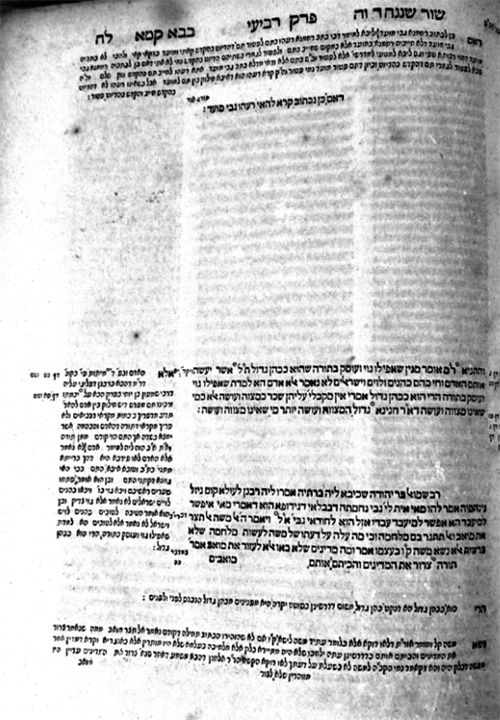
Frankfurt an der Oder – 1697-99
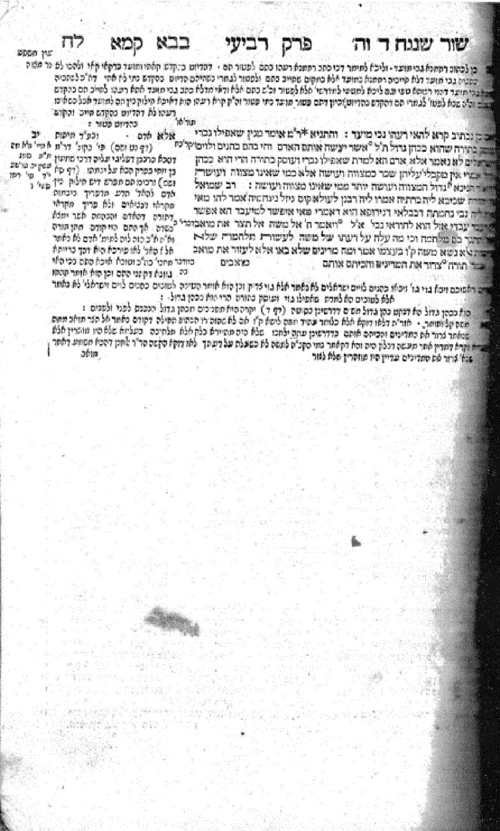
Frankfurt an der Oder – 1734-39

Another example of interest, one that has not fared as well, the text not yet restored in most editions of the Talmud, is to be found in Shabbat 104b and Sanhedrin 67a. The reference there is to Ben Satda, beginning, in the latter tractate “and so they did to Ben Satda
in Lod, and hung him on erev Pesah. Ben Satda? He was the son (ben) of Padera . . .”[8] Popper notes that Gershom Soncino, when publishing “a few of the Talmudic tracts at Soncino during the last decade of the fifteenth century, he took care not to restore any of the objectionable words in the MSS. from which he printed.”[9] Here too the text is complete in the Bomberg Talmud. Two subsequent exceptions in later editions of Sanhedrin where the Ben Satda entries do appear are in the Talmud printed by Immanuel Benveniste and in the edition of Sanhedrin printed in Sulzbach in or about 1696.

Sanhedrin 67a, Benveniste Talmud
However, in two complete editions of the Talmud (1755-63, 1766-70) printed in Sulzbach, the Ben Satda entries are omitted, as is the case of most modern editions of the Talmud.[10]
II
            The Talmud isn’t the only work to have been censored. Amnon Raz-Krakotzkin provides several examples of text in books
that were modified due to the censor’s ministrations. Among them is R. Abraham ben Jacob Saba’s (d. c. 1508) Zeror ha-Mor, a commentary on the Pentateuch based on kabbalistic and midrashic sources.[11] On the passage “They would slaughter to demons without power, gods whom they knew not, newcomers recently arrived, whom your ancestors did not dread” (Deuteronomy 32:17), referring to “Christians in general and priests in particular as ‘demons’ (shadim): ‘For as the nations of the world, all their abominations and vanities come from the power of demons, hence, the monks would shave the hair of their heads  and leave some at the top of the head as a stain.’” This passage continues, referring to bishops and popes, concluding that their entire heads are shaved like a marble with only a bit of hair about their ears, so that they have the appearance of demons, hairless, and like demons, provide no blessings, are like a fruitless tree, and “thus, it is fitting that they bear no sons of daughters.” Raz-Krakotzkin informs that this passage appeared in the first two editions of Zeror ha-Mor printed by Bomberg, and the Giustiniani edition (1545) but was already expurgated by the Cavalli edition (1566), a blank space in place of the text. That space subsequently disappeared and, although a Cracow edition based on the Bomberg Zeror ha-Mor restored the text it remains missing from most later editions.[12] Raz-Krakotzkin continues, citing additional examples.
            Early halakhic works were also subject to the ministrations of the censor.[13] Among them are such works as R. Samson ben Zadok’s (thirteenth century) Sefer Tashbez (Cremona, 1556). Samson was a student of R. Meir of Rothenburg (Maharam, c. 1220-1293). When the latter was imprisoned in the tower of Ensisheim, Samson visited him regularly, serving as his attendant and carefully recording in Tashbez Maharam’s teachings, customs, and daily rituals, as well as what he heard and observed, from the time Meir rose in the morning until he retired at night, on weekdays, Sabbaths, and festivals. Although a relatively small work (80: [6], 55 leaves), it consists of 590 entries beginning with Sabbath night (1-17), Sabbath day (18-98), followed by festivals, Sefer Torah, priestly benedictions, prayer, slumber, talis and tefillin, benedictions, issur ve-heter (dietary laws), redemption of the first born, hallah, vows, marriage and divorce, monetary laws, and piety. Expurgation by the censor of Tashbez was done sloppily, for terms such as meshumad and goy, normally excised, remain, but with a disclaimer near the end that they refer to idol worshipers only.[14]
III
Not all errors are due to the ministrations of the censor. Jews, too, at times, have taken their turns at modifying the text of books.
            A recent and perhaps quite surprising example of internal censorship is to be found in R. Solomon Ganzfried’s (1804–1886) Kizzur Shulḥan Arukh. First printed in 1864, that work an abridgement of the Shulhan Arukh for the average person, went through fourteen editions in the author’s lifetime, and numerous editions since then, as well as translations into many languages and has been the subject of glosses.[15] Marc B. Shapiro informs that in the Lublin (1904) edition of the Kizzur Shulḥan Arukh and several other editions the entry (201:4) that “apostates, informers, and heretics –for all these the rules of an onan and of mourners should not be observed. Their brothers and other next of kin should dress in white, eat, drink, and rejoice that enemies of the Almighty have perished,” the words “apostates, informers, and heretics” have been removed. In the Vilna edition (1915) the entire paragraph is removed and the sections renumbered from seven to six. In the Mossad Harav Kook vocalized edition a new halakhah was substituted, but that has since been corrected to reflect the original text. The reason, according to Shapiro, is that with the expansion of Jewish education to include girls, it was felt that schoolchildren, with assimilated relatives, would see this as referring to family members.[16] Several recent editions of the Kizzur Shulḥan Arukh that were examined, in both Hebrew and English, have the original text.
            R. Abraham Isaac Kook (1865–1935), chief rabbi of Jerusalem and first Ashkenazic chief rabbi in Israel (then Palestine),
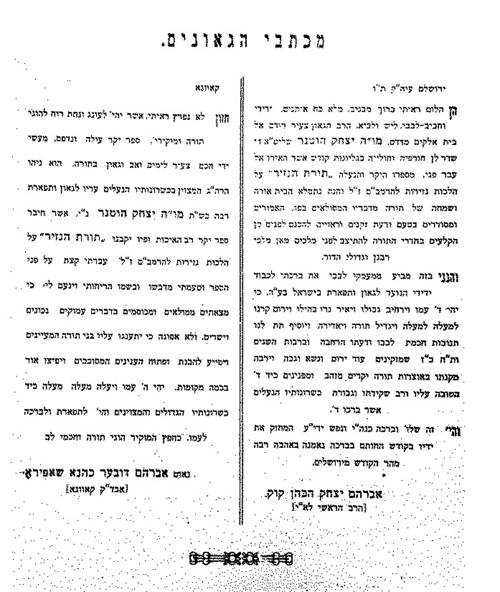
was a profound, influential, and mystical thinker. Highly regarded by his contemporaries, his strongly Zionist views also resulted in some opposition, but even most of his contemporaries who disagreed with him held him in high regard. Shapiro notes that with time, Kook’s reputation changed. Despite the fact that such pre-eminent rabbis as R. Solomon Zalman Auerbach (1910-95) and R. Joseph Shalom Elyashiv (1910-2012) were unwavering in their high regard of Kook, strong anti-Kook sentiment developed later in religious anti-Zionist circles. Shapiro notes that “Kook has been the victim of more censorship and simple omission of fact for the sake of haredi ideology than any other figure. When books are reprinted by haredi and anti-Zionist publishers Kook’s approbations (hascomas) are routinely omitted.” One of several examples of this modified opinion Shapiro cites is a lengthy eulogy delivered by R. Isaac Kossowsky (1877-1951) praising Kook. When the eulogy was reprinted in She’elot Yitzhak, a collection of Kossowsky’s writings, the name of the subject of the eulogy, Rav Kook, was omitted. In the reprint of She’elot Yitzhak the eulogy is deleted in its entirety.[17]
            Shapiro’s observation about Rav Kook’s approbations is confirmed in several books. R. Eliezer Mansour Settehon’s (Sutton, 1860-1937) Notzar Adam: Hosafah Notzar Adam (Tiberius, 1930), discourses on spiritual development, has approbations from R. Abraham Abukzer, R. Moses Kliers, and R. Jacob Hai Zerihan, and R. Abraham Isaac ha-Kohen Kook. In a description of Notzar Adam in in Aleppo, City of Scholars (Brooklyn, 2005), Kook’s name, Kook’s name is omitted from a list of the book’s approbations.[18]

In a variation of this, two internet sites that reproduce the full text of Hebrew books both include Rav Isaac
Hutner’s (1906-80) Torat ha-Nazir (Kovno, 1932). This, the first edition, has three approbations; a full page hascoma from R. Hayyim Ozer Grodzinski (1863–1940), and the following page two approbations, side by side, from R. Abraham Duber Kahana (1870–1943) and Rav Kook. The first internet site, with more than 53,000 books for free download, follows R. Grodzinski’s approbation with a blank page and then the text. The second, a subscription site with more than 76,000 scanned books, goes directly from R. Grodzinski’s hascoma to the text, dispensing with the blank page, also not reproducing the second page of approbations. It is not clear whether the copies scanned were faulty, the scanning incomplete, or the omission intentional. Nevertheless, to conclude this section on a positive note, surprisingly, given the omission of Rav Kook’s approbation in both scans of Torat ha-Nazir, both sites list and provide an extensive number of Rav Kook’s works.
IV
Accusations of plagiarism accompany the publication of two works by and/or attributed to R. Nathan Nata ben Samson Spira (Shapira, d. 1577). Spira, born to a distinguished family that was, according to the Ba’al Shem Tov, one of the three pure families throughout the generations in Israel (the others being Margulies and Horowitz), served as rabbi in Grodno (Horodno) until 1572, when he accepted a position in Posnan. His grandson was R. Nathan Nata ben Solomon Spira (Megalleh Amukkot, c. 1585-1633). Among Nathan Nata Spira’s works is Imrei Shefer (20: [1], 260 ff.), a super-commentary on Rashi and R. Elijah Mizrahi (c. 1450–1526). The book was brought to press by Spira’s son R. Isaac Spira (d. 1623), Rosh Yeshiva in Kovno and afterwards in Cracow. Work on Imrei Shefer began in Cracow in 1591 but before printing was finished Isaac Spira accepted a position in Lublin where publication was completed at the press of Kalonymus ben Mordecai Jaffe (1597).[19]
The title-pages states that Spira, “gives goodly words (Imrei Shefer)’ (Genesis 49:21) and he gives, ‘seed to the sower, and bread לזורע ולחם (357=1597) to the eater’ (Isaiah 55:10) of Torah.” In the introduction, Isaac informs that the work is entitled Imrei Shefer from the verse, “he gives goodly words” (and the word “he gives הנתן” in the Torah is without a vav), implying the name of the author [Nathan נתן] and Shefer שפר is language of Spira שפירא the family name of the author. Isaac then addresses the existence of an unauthorized and fraudulent edition ascribed to his father, printed in Venice (Be’urim, 1593),
found and brought out by men who lack the yoke of the kingdom of heaven. A work discovered, who knows the identity of the author, perhaps a boy wrote it and wanted to credit it to an authoritative source אילן גדול), [my father my lord]. God forbid that his holy mouth should bring forth words that have no substance, vain, worthless, and empty, a forgery, “[And, behold], it was all grown over with thorns, and nettles had covered it over” (Proverbs 24:31).
Isaac Spira took his complaint to the Va’ad Arba’ah Artzot (Council of the Four Lands), requesting they prohibit the distribution of the Be’urim in Poland. The response of the Va’ad is printed at the end of the introduction,
It has been declared, by consent of the rabbis, and the [communal] leaders of these lands,
that these books shall neither be sold nor introduced into [any Jewish] home in
any of these lands. Those who have [already] purchased them shall receive their
money back and not keep [such] an evil thing in their home.
What was and who wrote the Be’urim, the reputedly plagiarized copy of R. Nathan Nata ben Samson Spira’s Imrei Shefer? The title-page of the Be’urim (40: 180 ff.), printed in Venice in 1593 “for Bragadin Giustiniani by the partners Matteo Zanetti and Komin Parezino at the press of Matteo Zanetti,” states that it was written by ha-Rav, the renowned, the gaon, R. Nathan from Grodno in the year, “For you shall go out with joy בשמחה (353=1593), and be led forth with peace” (Isaiah 55:12). Be’urim does not have an introduction nor a colophon that provides any additional information.
Isaac Spira’s accusation that the Be’urim is a forgery, not to be ascribed to his father, but rather was written by an unknown young man who then attributed it to Spira, is confirmed by R. Issachar Baer Eylenburg (1550-1623), who writes in his responsa, Be’er Sheva (Venice, 1614) and also in his commentary on Rashi, Zeidah La-Derekh (Prague, 1623) that it is obvious that the Be’urim were not the work of the holy Spira, but rather of an erring student “who hung (attributed it) to himself, hanging it on a large tree” (cf. Pesahim 112a).[20]
Among the distinguished sages of medieval Sepharad is Rabbenu Bahya ben Asher ben Hlava (c. 1255-1340). Best known for his popular, multi-faceted, and much reprinted Torah commentary, written in 1291 and first published in Naples (1491),  Rabbenu Bahya was also the author of Kad ha-Kemaḥ (Constantinople, 1515) and Shulḥan shel Arba (Mantua, 1514). The former, Kad ha-Kemaḥ, is comprised of sixty discourses on varied subjects, among them festivals, prayer, faith, and charity, all infused with ethical content. Among the numerous editions of Kad ha-Kemaḥ is a scholarly edition entitled Kitvei Rabbenu Baḥya (Jerusalem, 1970) edited and with annotations by R. Hayyim Dov Chavel (1906–1982).
Among the essays in Kad ha-Kemaḥ is one entitled Kippurim, on Yom Kippur. Part of that discourse includes a commentary on the book of Jonah, read on Yom Kippur. Chavel, in the introduction to his annotations on Rabbenu Bahya’s commentary on Jonah, suggests that Rabbenu Bahya took his commentary from R. Abraham ben Ḥayya’s (d. c. 1136) Hegyon ha-Nefesh, first published by E. Freimann (Leipzig,
1860). Abraham ben Ḥayya, a resident of Barcelona, was a philosopher, mathematician, and astronomer, reflected in his several works, including translations from the Arabic. Hegyon ha-Nefesh “deals with creation, repentance, good and evil, and the saintly life. The emphasis is ethical, the approach is generally homiletical – based on the exposition of biblical passages – and it may have been designed for reading during the Ten Days of Penitence.”[21] Kitvei Rabbenu Baḥya and Hegyon ha-Nefesh are sufficiently alike to support Chavel’s contention that
Rabbenu utilized the Sefer Hegyon ha-Nefesh (or Sefer ha-Mussar) of the earlier sage R. Abraham ben Ḥayya ha-Nasi, known as ṣāḥib-al-shurṭa . . . In it is found this commentary on the book of Jonah. This was already noted by the author of Zaphat ha-Shemen – the usage by Rabbenu of this book is comparable to his use of other works: according to his needs. The reason that he does not mention it in his commentary is, perhaps, because the books of R. Abraham ha-Nasi were well known, and the leading sages, such as the Rambam, Ramban and other leading rabbis utilized it, comparable to “Joshua was sitting and delivering his discourse without mentioning names, and all knew that it was the Torah of Moses” (Yevamot 96b).[22].
We leave accusations of plagiarism and turn to forgery, a well-known case involving a person of repute, Saul Hirsch (Hirschel)
Berlin’s (1740-94) Besamim Rosh.[23] Berlin was a person of great promise; the son of R. Hirschel Levin (Ẓevi Hirsch, 1721–1800), chief rabbi of Berlin, ordained at the age of twenty and in 1768 av bet din in Frankfurt an der Oder. At some point Berlin became disillusioned with what he believed to be antiquated rabbinical authority. He gave up his official rabbinic position in Frankfurt, removing to Berlin. There Berlin was an associate of Moses Mendelssohn (1729–1786), providing, in 1778, an approbation for Mendelssohn’s Be’ur (Berlin, 1783) and was a supporter of the enlightenment figure Naphtali Herz Wessely (1725–1805), writing an anonymous pamphlet in defense of  Wessely’s
Divrei Shalom ve-Emet (Berlin, 1782) entitled Ketav Yosher (1794).[24]
An earlier forgery of Berlin, described by Dan Rabinowitz, this under the pseudonym of Ovadiah bar Barukh Ish Polanya, was Berlin’s Mitzpeh Yokteil (1789), a vicious attack on R. Raphael Kohen, rabbi of the three communities, Altona-Hamburg-Wansbeck, who had opposed Mendelssohn’s Be’ur, and on Kohen’s Torat Yekuteil (Amsterdam, 1772) on Yoreh Deah. The Communities’ beit din placed Ovadiah, the presumed author, under a ban. The ban’s proponents approached R. Tzevi Hirsch, the chief rabbi of Berlin and Saul Berlin’s father, seeking his signature on the ban.[25] It appears that Tzvi Hirsch initially concurred with the ban, but, as he was close to deciding in favor of signing the ban, someone whispered in his ear the verse “woe is me, my master, it is borrowed שאול” (II Kings 6:5), – which he understood to be a play on שאול (borrowed), referring to his son, Saul, the true author of Mitzpeh Yokteil.[26]
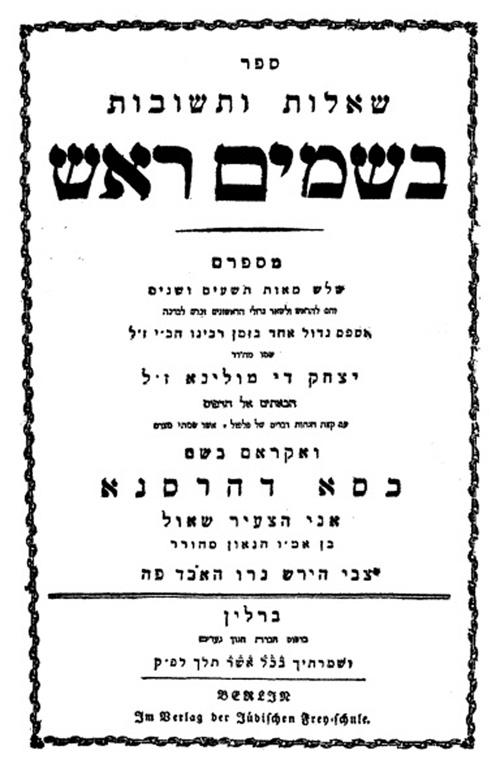
 

Turning to Besamim Rosh Saul Berlin’s infamous forgery, it claims to be the responsa of R. Asher ben Jehiel (Rosh, c. 1250–1327), among the most preeminent of medieval sages of European Jewry. The title-page describes it as the responsa Besamim Rosh, 392 responsa from books from the Rosh and other rishonim (early rabbinic sages) compiled by R. Isaac di Molina and with annotations Kasa de-Harshana by the young Saul ben R. Ẓevi Hirsch, av bet din, here (Berlin).[27] It is dated “and will keep you in all places where you goושמרתיך בכל אשר תלך   553 = 1793)” (Genesis 28:15), note Asher אשר in the date. In Besamim Rosh Berlin, having become an adherent of the haskalah, presents ideas inconsistent with and at variance with traditional halakhic positions. Among the novel responsa are removing the prohibition on suicide due to the difficult conditions of Jewish life; permitting shaving on Hol ha-Mo’ed; requiring a shohet to test the sharpness of his knife on his tongue; saying a blessing over non-kosher food; disregarding commandments that are upsetting; not taking Megillat Esther seriously; and that Jews beliefs can change. An example of the responsa, albeit a brief one and without Berlin’s Kasa de-Harshana, is the much quoted responsum concerning “legumes, rice, and millet which some Ashkenazic rabbis prohibit and is the practice in some communities. . .” (105b: no. 138): The responsum states:

This is very strange, for the Talmud permits it and no bet din is known to have made such an enactment. It is not for us to inquire why such an enactment was made and why it was followed by some. Possibly because of the exiles and the confused גירושים והבלבוחים, weighed down in poverty . . . and also due to the small community of Karaites in their midst who were also exiled. . . . unable to distinguish between bread and bread and all leavening from which it is possible to make flour and bread. But, God forbid, that we freely prohibit that which is permitted, and all the more because of the poor and needy, who lack sufficient meat and bread all the days of the festival. . . . “who eat [but] a litra of vegetables for at a meal” (Sanhedrin 94b). Also “a leap year is not intercalated in the year following a Sabbatical year for this reason.” All the more (kal ve-homer) to prohibit most types of food to the poor and needy on festivals and the overly strict (mahmerin) will have to answer on the day of judgement.
            How has Besamim Rosh been received? Soon after its publication R. Wolf Landsberg, in Ze’ev Yitrof (Frankfurt an der Oder, 1793), stated that Besamim Rosh was a forgery, and R. Mordecai Benet (1753-1829) wrote to Berlin’s father, that Besamim Rosh was “from head to foot only wounds and grievous abscesses from sinful, vile men.”[28] R. Hayyim Joseph David Azulai (Hida, 1724–1806) in his Shem ha-Gedolim, one of several works in which he mentions Besamim Rosh, states “I have heard ‘a voice of a great rushing’ (Ezekiel 3:12) that there are in this book strange things. . . . Therefore the reader should not rely on it.”[29] The Hatam Sofer (R. Moses Sofer, 1762–1839), based on the responsum on suicide, also concluded that Besamim Rosh was a forgery.[30] Among the varied modern authorities who quote Besamim Rosh, albeit critically, are R. Solomon Joseph Zevin (1885–1978) and R. Ovadia Yosef (1920-13) the latter writing an approbation for the 1984 edition of Besamim Rosh.[31]
How influential was Besamim Rosh? Fishman writes that “Besamim Rosh is of itself cast as a work of rabbinic literature, a Trojan horse of sorts, capable of injecting reformist viewpoints directly into the camp of halakhic discourse. Indeed, the sheer frequency with which Besamim Rosh has been cited in subsequent halakhic writings [documented by Samet] raises the question of whether the work may not have been effective in introducing unconventional perspectives into rabbinic thought.”[32] Similarly, Shmuel Feiner notes that “Some scholars
regard Besamim Rosh as the beginning of the reform of Judaism.”[33] Finally, knowledge that Besamim Rosh was a forgery was so widespread, that it is even so described in a book dealers catalogue, that of Jakob Ginzburg, in Listing of Rare and Valuable Books (Minsk, 1914), stating “565 Besamin Rosh attributed to the Rosh, poor condition Berlin, 1792, 50 1.”
V
Of less consequence is a common error, if it may be so described, that is, the misleading identification of the place of printing on the title-pages of late seventeenth through the early nineteenth century books. Amsterdam, from the early seventeenth century, was the foremost center of Hebrew printing in Europe. Its reputation was such that printers in other lands, often with the only the most tenuous, if any, connections with Amsterdam, attempted to associate their imprints with that city. In a wide variety of locations the actual place of printing is minimized; what is enlarged is that the letters are באותיות אמשטרדם Amsterdam letters. Mozes Heiman Gans describes this practice,
Amsterdam may have had an embarrassing lack of rabbinical training facilities, but thanks to the Hebrew printing works it nevertheless had a great name in the world of Jewish scholarship. Moreover, the haskamot (certificate of fitness) was also sought by Jewish printers abroad, and so highly-prized were books ‘printed in Amsterdam’ or ‘be-Amsterdam’ that cunning rivals invented the phrase ‘printed ke-Amsterdam’, i.e. in the manner of Amsterdam, hoping to deceive the readers by relying on the similarity of the Hebrew k and b.[34]
            An early example of this practice is in Dessau, where the court Jew, Moses Benjamin Wulff, established a Hebrew press in Anhalt-Dessau.[35] Approval for the press was given on December 14, 1695 by Princess Henriette Catherine of Orange, Prince Leopold I’s mother, acting as regent in her son’s frequent absences in the service of the Prussian army. The first books were published in 1696, among them R. Jacob ben Joseph Reischer’s (Jacob Backofen, c. 1670–1733) Hok Ya’akov and Solet le-Minhah ve-Shemen le-Minhah, and the following year R. Shabbetai ben Meir ha-Kohen’s (Shakh, 1621–1662) Gevurat Anashim, each with a title-page, with a pillared frame topped by an obelisk and the statement,
Printed here [in the holy congregation of] Dessau with AMSTERDAM letters
Under the rule of her ladyship, the praiseworthy and pious Duchess, of distinguished birth HENRIETTE CATHERINE [May her majesty be exalted]
Another notable instance are the title-pages of R. Judah Leib ben Enoch Zundel’s (1645–1705) Hinnukh Beit Yehudah (Frankfurt am Main, 1708), a collection of one hundred forty-five responsa, among them several by the author. Zundel (1645–1705), who succeeded his father as rabbi of the district of Swabia in 1675, subsequently relocated to Pfersee, where he remained until his death. Judah Leib was also the author of Reshit Bikkurim (Frankfurt, 1708), homilies by Judah Leib and his father. The sermons in that work are on festivals and Sabbaths based upon R. Joseph Albo and includes excerpts from a commentary on the Bible which Judah Leib had intended publishing.[36]

 The publisher of these books was Johann Koelner, the distinguished Frankfurt am Main printer (1708-27), credited with publishing half of the Hebrew books printed in Frankfurt up to the middle of the nineteenth century as well as a fine edition of the Babylonian Talmud.[37] Koelner began printing with Hinnukh Beit Yehudah; it is unusual in that there are two title-pages for the book, one noting that it was printed in Frankfurt am Main, the other stating that Hinnukh Beit Yehudah was printed, in an enlarged font with, Amsterdam, in a smaller font, letters, and the place of printing, Frankfurt am Main, also set in a smaller font.[38]
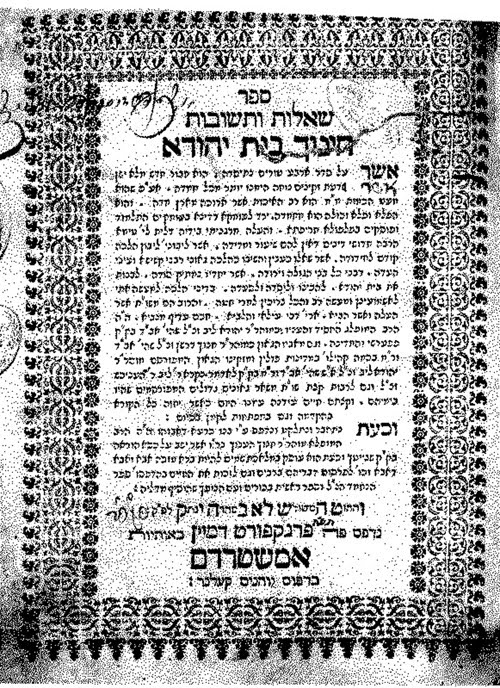
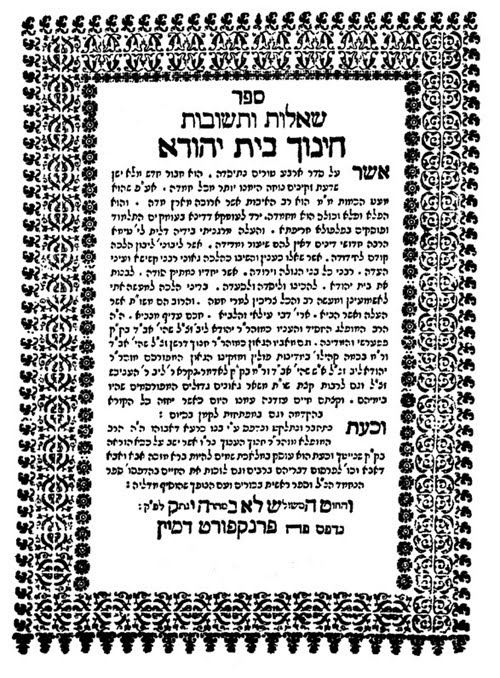
Another way of emphasizing Amsterdam fonts rather than the city in which a book was printed is evident from R. Jacob Uri Shraga Feival’s ben Menahem Nachum’s Bet Ya’akov Esh (Frankfurt an der Oder, 1765) on Job. Here, somewhat unusually, even the reference to the source of the fonts is highlighted, saying with Amsterdam letters. The place of printing is given below in abbreviation in a slightly smaller font as printed here פ”פ דאדר (Frankfurt an der Oder).
In addition to several locations in Germany, such as Hamburg and Jessnitz, we also find this practice in such varied locations as in Zolkiew, for example, R. Aaron Moses ben Zevi Hirsch of Lvov (Lemberg) Ohel Moshe (1765) on grammar; in Lvov, on the title-page of R. Jacob ben Baruch of Tyczyn’s (c. 1640-1725) Birkat Yosef (1784) on Shulhan Arukh Hoshen Mishpat; and with a mahzor that states, in large red letters, that it was printed in Slavuta and, in a small font in German only, that is, it was printed (gedrukt) in Lemberg. We also find this done, somewhat far afield, in Livorno; the title-page of Seder Nezikin of the Jerusalem Talmud (1770), printed with a frame that is like but not exact of the Amsterdam edition of Seder Nashim (1754), by Carlo Giorgi, stating “printed here, Livorno, with Amsterdam letters.
            And then there are inadvertent errors, such as misreading a colophon. Popular books, frequently reprinted, go through numerous editions. At times it is difficult to identify early editions and, as might be expected, books are occasionally misidentified, attributed to the wrong press, misdated, and there are instances when editions are recorded that never existed. All of these errors can be found in R. Leon Modena’s (Judah Aryeh, 1571-1648) Sur me-Ra.[39]
Sur me-Ra, a popular and much reprinted tract opposing the snares and consequences of gambling, was written by Modena when, according to his autobiography, he was only twelve or thirteen years old. Paradoxically, Modena would later become a compulsive gambler, even gambling away his daughters’ dowries. Translated into Latin, German, Yiddish, French, and English, Sur me-Ra is not a straightforward denunciation of gambling but rather a dialogue between two friends, one opposed to games of chance, the other a proponent of such games, both positions well argued, accounting for its popularity. It was first published in Venice in the year בשמחה (with joy, [5]355 = 1594/95) by the Venetian press of Giovanni di Gara as an anonymous tract on the evils of gambling, Modena initially choosing to be anonymous. Sur me-Ra was republished, not long afterwards, twice, according to several bibliographic sources, in 1615. One edition, attributed to a Venice press, appears to be dubious, it not being recorded in any library collection and the sources that list it do so without descriptive details.[40]
The two 1615 Prague editions are recorded in a library listing, one published at the press of Moses ben Bezalel Katz, octavo in format, here consisting of ten unfoliated leaves. The second Prague edition, a bi-lingual Hebrew-Latin edition, is not so much dubious as mislabeled, having been printed several decades later and elsewhere. The Katz edition has an introduction from R. Jacob ben Mattias Treves which concludes “And it came to pass, because the midwives feared God, that he made them houses” (Exodus 1:21) at a goodly בשע”ה (375 = 1615) time, “a time to cast להשלי”ך (75 = 1615) away stones” (cf. Ecclesiastes 3:5).
A bi-lingual Hebrew-Latin edition of Sur me-Ra was purportedly printed in Wittenburg in 1665 by Johannis Haken. This edition is physically small, octavo in format, measuring 18 cm.; otherwise it is an expanded edition of Sur me-Ra, being comprised of [134] pp. and ending on quire Q3 followed by several index pages. There is a Latin title-page with a Hebrew heading, giving the place of printing, printer’s name, and date, followed by considerable preliminary matter in Latin. There is a second Hebrew-Latin title page, lacking all of these particulars about the edition and with a somewhat dissimilar briefer Latin text.
This Wittenburg edition of Sur me-Ra has been incorrectly recorded in at least one major library as a second 1615 Prague Hebrew-Latin edition of that work. The reason for the error appears to be twofold. First, the library copy lacks the first descriptive title-page and the second title page, as noted, lacks identifying information. Moreover, the introduction to the Prague edition is included, with its reference to Prague at the beginning and, at the end, two highlighted dates, although the first “at a goodly בשע”ה (375 = 1615) time” is not highlighted here and a close reading indicates that the second date was set improperly, that is, the Prague edition which concludes with the date “a time to cast להשלי”ך (375 = 1615)” here, reading להשלי”ך, the final khaf being emphasized as if to be included in the enumeration of the letters, which likely misled a reader looking at it too casually, as it results in a figure (395) too large for the Prague edition and too small for the Wittenburg edition.[41]
Another edition of Sur me-Ra was printed in Leiden by Johannes Gorgius Nisselius. An orientalist, Nisselius, poor and unable to obtain a post as a teacher, became a printer. The title-page is misdated תנ”ו (456 = 1696) instead of 1656, attributed by L. Fuks and R. G. Fuks‑Mansfeld to Nisselius’ unfamiliarity with Hebrew chronology, and causing Moritz Steinschneider to describe it as an “edition negligenitissime curate (a very slipshod edition).[42]
Three reported bi-lingual editions of Sur me-Ra, Hebrew with Latin translation, quarto format, are recorded in bibliographic sources. The dates given are 1698, 1702, and 1767. These editions are listed, without further details, in Julius Fürst’s Bibliotheca Judaica, Benjacob’s Otzar ha-Sefarim, and Vinograd’s Thesaurus of the Hebrew Book, each likely repeating the entries in the previous earlier work.[43] That three editions of Sur me-Ra were printed in Oxford within this time frame seems highly unlikely, given that from the first Hebrew book reported for Oxford, Maimonides’ commentary on Mishnayot, with Latin, printed in 1655, concluding with a Bible in 1790, only sixteen titles with Hebrew text are reported. One printing of Sur me-Ra seems reasonable, two less so, three unlikely.
VI
            Mispronunciations and misunderstandings are the source of numerous errors, a problem that persists from biblical times, as in the following passage from Judges (12:36)
And the Gileadites took the passages of Jordan before the Ephraimites; and it was so that when those Ephraimites who had escaped said, Let me cross over; that the men of Gilead said to him, Are you an Ephraimite? If he said, No; Then said they to him, Say now Shibboleth; and he said Sibboleth; for he could not pronounce it right. Then they took him, and slew him at the passages of Jordan; and there fell at that time of the Ephraimites forty two thousand.
R. David Cohen observes that not all typesetting errors can be attributed to the compositor selecting the wrong letters. In Kuntres ha-Akov le-Mishor: le-Taken ta’uyot ha-Defus shel ha-Shas Hotsa’at Vilna he observes that there are mistakes that can only be attributed to hearing. Many printers realized that it was possible to save hours of labor by having type set by a pair of workers, one reading to the setter, who either did not hear correctly or misunderstood due to different dialects. Cohen provides several examples from the 1880-86 Vilna Talmud, for example, פסח in place of פתח, and comments that much ink has been has been spent resolving apparent difficulties that are in reality nothing more than printers’ errors. Among the numerous examples are:[44]
Rosh HaShanah 14a: Rashi בקוביא (dice-playing) – a piece of עצם (bone) . . . other reading עצים (wood).
Megillah 14a: Many prophets arose for Israel מי-הוה, (it should say מיהוי) [double the number of [the Israelites]
who came out of Egypt].
Zevahim 48a: Rashi Midrasha – (Leviticus 4) . . . Should say 6.
           
Similarly, R. Menahem Mendel Brachfeld (Brakhfeld, 1917-84), in his two volume work, Yosef Halel, based on the Reggio di Calabria (1475) and other early editions, provides a lengthy listing of emendations to current texts of Rashi. He informs that numerous errors in more recent editions of Rashi are due to errors in transmission, frequently compounded by editors, printers, and the unkind modifications of censors. Indeed, R. Solomon Alkabetz, the grandfather of the eponymous author of Lekhah Dodi, in his edition of Rashi’s Torah commentary (Guadalajara, 1476), admittedly corrected it according to his own reasoning. Furthermore, explanations of Rashi are often based on these faulty editions.[45] At the beginning of each volume are the detailed emendations and at the end a brief summary of the changes, for example:
Leviticus 10: 16) The goat of the sin-offering, the goat of the additional service of the month and the three goats of sin-offering sacrificed on that day, the he-goat, the goat of Nahshon, and the goat of [Rosh Hodesh], etc. According to this version it is not clear what Rashi is suggesting by the he-goat. In the first edition (Reggio di Calabria) and the Alkabetz edition, the text is three goats of sin-offering sacrificed on that day, take a he-goat and the goat of Nahshon, etc. and with this Rashi alludes to the verse at the beginning of the parasha that speaks about the obligatory offerings of the day, writing take “a he-goat.”[46]
Leviticus 26: 21) Sevenfold according to your sins, seven other punishments, etc. Seven שבע is in the feminine,
and others ואחרים is male. In the first edition and in the Alkabetz edition the text is seven other punishments, as the number of your sins חטאתיכם.[47]
Our text
16) the he-goat, the goat of Nahshon,  and
the goat of [Rosh Hodesh].
21) Sevenfold according to your sins, seven other punishments,
Text first edition
16) take a he-goat and the goat (RH) of Nahshon, the goat of Rosh Hodesh.
21) seven other punishments as the number of your sins.[48]

            Another, quite different, inadvertent, error is of interest. In the late seventeenth- early eighteenth century a small number of printers of Hebrew books employed monograms, formed from the Latin initials of the Hebrew printer’s name, as their devices. Several were mirror-image monograms, which can be read directly and in reverse (mirror) image, resulting in more attractive and certainly more complex pressmarks than the simple interlacing of letters; perhaps graphic palindromes.[49] They are, however, often difficult to interpret; the undiscerning reader is often unaware that the mark is a signet rather than an ornamental device.
 

Gottschalk device correct usage – Frankfort am Main
 Gottschalk device inverted – Zolkiew


The first usage of a monogram in a Hebrew book is that of the Frankfurt-am-Oder printer, Michael Gottschalk, noted above. Over several decades his mirror-image monogram appears in  all of his Talmud editions, in three forms, all consisting of Gottschalk’s initials interwoven in straight and mirror images (MG), that is, it can be read in straight and reverse images. The last of his mirror-image monograms, employed on the title-pages of the Berlin and Frankfurt an der Oder Talmud editions (1715‑22, 1734‑39) is an elongated form of his initials. Gottschalk’s place in Frankfurt was taken by Professor F. Grillo, who, in association with the Berlin printer Aaron ben Moses Rofe of Lissa, completed the third Talmud. The printer’s device on the title pages of this edition is the elongated Gottschalk Mirror-monogram.  It is correctly placed on most tractates but inverted on tractate Niddah.  The error was quickly corrected, for on the title page of Seder Tohorot, printed immediately after and bound with Niddah, the monogram is right side up. We also find the elongated Gottschalk monogram, inverted, employed in Zolkiew on the title-page of  the responsa of R. Saul ben Moses of Lonzo’s Givat Shaul (1774) by David ben Menahem, who, in this instance, likely did not realize that it was comprised of Gottschalk’s initials.[50]
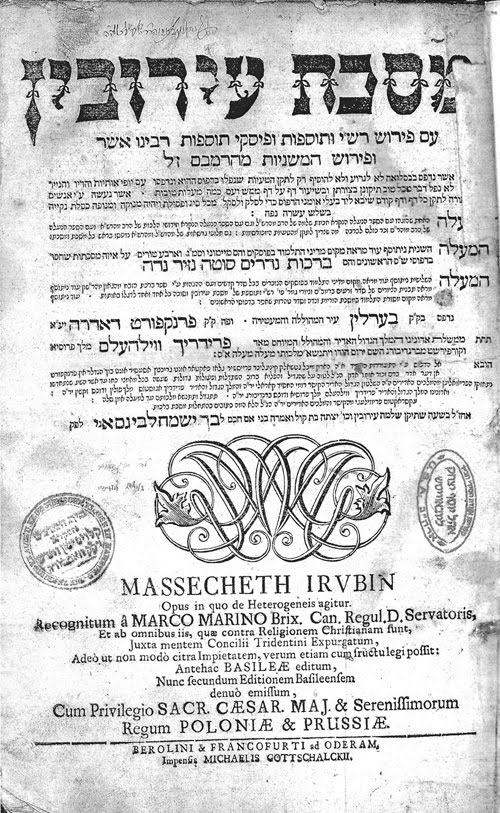
            At the beginning of the article it was stated that “this article is concerned with errors in and about Hebrew books only.” While the following example might tend to belie that statement, that is so only if the reader does not accept that the Bible is a Hebrew book, even if in translation. With that caveat, we bring an interesting and, from the printer’s perspective, an especially unfortunate error. For centuries the King James Bible was the authoritative English translation of the Bible by and for English speaking non-Jews. First published in 1611 by Robert Barker, it was reissued in 1631 by Barker, together with Martin Lucas, then the royal printers in London. This edition of the King James Bible is now best known as the Wicked Bible, but is also referred to as the Adulterous Bible or Sinners’ Bible. The error is in the Ten Commandments, in which the prohibition against adultery (Exodus 20:14; Heb. Bible 20:13) reads “Thou shalt commit adultery,” the “not” having been omitted, thus accounting for this edition of the King James Bible being referred to as the wicked Bible.
King Charles I was made acquainted with the error and the printers were called before the Star Chamber, where, upon the facts being proved, the printers were fined £3,000 about 34,000 pounds today). Subsequently, Barker and Lucas lost their printer’s licenses. The Archbishop of Canterbury, angered by the mistakes in this edition of the Bible, stated:
I knew the tyme
when great care was had about printing, the Bibles especially, good compositors
and the best correctors were gotten being grave and learned men, the paper and
the letter rare, and faire every way of the beste, but now the paper is nought,
the composers boyes, and the correctors unlearned.[51]
Printed in a press run of 1,000 copies, the wicked Bible was subsequently ordered destroyed; a handful of copies only are extant today.[52]
This article began with censorship, primarily of the Talmud and other Hebrew books, followed by internal censorship of Hebrew books, plagiarism and forgery, errors intentional (misleading) and unintentional, of varying levels of consequence. As noted in the previous article, “what they have in common is the consequence of inadvertently or deliberately misleading the reader. This is a subject that fascinates and certainly deserves further study. Nevertheless, even this overview should caution the reader that not everything in print, no matter how innocuous or well received, is necessarily so, for,”
Who can discern his errors? Clean me from hidden faults. Keep back Your servant also from presumptuous sins; let
them not have dominion over me; then shall I be blameless, and innocent of great transgression (Psalms 19:13-14).[53]


[1] I would like to express my appreciation to Eli
Genauer for reading the article and for his many corrections, my son-in-law, R.
Moshe Tepfer at the National Library of Israel, Israel Mizrahi of Mizrahi Book
Store, and R. Yitzhak Wilhelm and R. Zalman Levine, reading room librarians,
Chabad-Lubavitch Library for providing me with facsimiles of the rare books
described in this article.
[2] William
Popper, The Censorship of Hebrew Books (New York, 1899, reprint New
York, 1968), pp. 59, 60.
[3] “Who can
discern his errors? Misdates, Errors, and Deceptions, in and about Hebrew
Books, Intentional and Otherwise” Hakirah: The Flatbush Journal of Jewish
Law and Thought
12 (2011), pp. 269-91, reprinted in Further Studies in the Making of
the Early Hebrew Book
(Brill, Leiden/Boston, 2013), pp. 395-420.
[4] Heinrich
Graetz, History of the Jews IV (Philadelphia, 1956), p. 589.
[5] Abraham J. Karp, From
the Ends of the Earth. Judaic Treasures of the Library of Congress
(Washington,
1991), p. 47.
[6] Despite having a more accurate text than later seventeenth
and eighteenth editions, the Benveniste Talmud is, with exceptions, not always
highly regarded due to its small size. An
interesting early example of this relates to the handsome Lublin Talmud
(1617-39), from the perspective of the seventeenth century. In correspondence
between a representative of Duke Augustus the Young of Braunschweig [1635-66], founder
of the Ducal Library in Wolfenbuettel and R. Jacob ben Abraham Fidanque, author
of a super-commentary on the Abarbanel’s commentary on Nevi’im Rishonim and a dealer,
Fidanque writes “My lord’s letter arrived today, Wednesday, Erev Rosh Hodesh
Tevet, concerning the Lublin edition of the Talmud. I have one to sell, and it
is very fine in its beauty and its paper, in sixteen volumes and new. If my
lord wishes to give me 40R, that is, forty R. I will send it to him immediately
upon receipt of his response. I will sell it for less, but if my lord wants to
purchase an Amsterdam edition I will sell it for 14R. . . .” (K.
Wilkelm, “The Duke and the Talmud” Kiryat Sefer, XII (1936), p. 494
[Hebrew).
[7] Rabbinovicz, p.
100.
[8] Ben Satda, a
surname of Jesus of Nasereth, is, according to Marcus Jastrow, A Dictionary
of the Targumim, the Talmud Babli and Yerushalmi, and the Midrashic Literature

(Brooklyn, N.Y., n. d.), p. 972, probably of Greek origin. The section on Ben
Satda (Sanhedrin 67a) begins “and so they did to Ben Satda in Lod, and
hung him on erev Pesah. Ben Satda? He was the son (ben) of Padera . . .,
Padera being a name given to both the mother and father of Jesus.” As noted
above, neither this or comparable entries appear in many current editions of
the Talmud.
[9] Popper, p. 21.
[10] A somewhat inconsistent exception is
the Soncino translation of the Talmud. In the edition of Sanhedrin
published by the Traditional press (New York, n. d.) the Ben Satda entry is
omitted from both the Hebrew and English text. However, in the Judaic
and Soncino Classic Library (Judaica Press, Brooklyn, NY) edition, translator
David Kantrowitz, the Ben Satda entry is
available in Hebrew but not in English. However, in the Rebecca Bennet
Publications (1959) Soncino edition of Shabbat and the Judaic and
Soncino Classic Library edition of that tractate the Ben Satda text appears in both the Hebrew and in the English
translation, as well as in the Art Scroll Schottenstein edition of Shabbat.
That entry, however, is incomplete, and the Hebrew portion of the Judaic
and Soncino Classic Library edition notes that the censor has removed part of
the text.
[11] Abraham
Saba rewrote Zeror ha-Mor in Portugal from memory, having lost his writings
after the expulsionof the Jews from Spain.. Saba was imprisoned in Portugal for
refusing to accept baptism. Eventually released, he resettled in Morocco. Less
well known is what occurred afterwards. R. Hayyim Joseph David Azulai (Hida,
1724–1806) informs that Saba, after residing in Fez for ten years, traveled to
Verona, Italy. En route, a storm arose. The captain, in despair, requested Saba
pray for the ship’s safety. He agreed, but on the condition that, if he were to
die at sea, the captain should not bury him at sea, but rather take him to a
Jewish community for proper burial. The captain agreed, Abraham Saba’s prayed
and the storm abated. Two days later, on the eve of Yom Kippur, Saba died. The
captain took his body to Verona, where the Jewish community buried him with
great honor. (Hayyim Joseph David Azulai, Shem ha-gedolim ha-shalem with additions by Menachem Mendel Krengel
I (Jerusalem, 1979), pp. 13-14 [Hebrew].
[12] Amnon
Raz-Krakotzkin, The Censor, the Editor, and the Text: the Catholic
Church and the Shaping of the Jewish Canon in the Sixteenth Century
,
translated by Jackie Feldman (Philadelphia: University of Pennsylvania
Press, 2007), pp. 142. My edition of Zeror ha-Mor,
published by Heichel ha-Sefer (Benei Brak,1990) includes this passage.
[13] Among other censored halakhic works are R. Menahem ben Aaron ibn
Zerah’s (c. 1310-1385) Zeidah la-Derekh (Ferrara, 1554). The entry in Zeidah
la-Derekh
on malshinim (slanderers, informers), comprising almost an
entire leaf, was removed and the enumeration of the prayers comprising the Amidah
was correspondingly adjusted when the second edition (Sabbioneta, 1567) was
printed. The expurgated material has not been restored in subsequent editions. Another
contemporary halakhic work that was also censored is R. Isaac ben Joseph
of Corbeil (d. 1280) of the Ba’alei Tosafot’s Amudei Golah (Cremona,
1556), in which objectionable terms, and occasionally entire paragraphs, were
either substituted or suppressed. Concerning Zeidah la-Derekh and Amudei
Golah
see my “Concise and Succinct: Sixteenth Century Editions of Medieval
Halakhic Compendiums,” Hakirah: The Flatbush Journal of Jewish Law and
Thought
15 (2013), pp. 122-24 and 114-16 respectively.
[14] Isaiah
Sonne, “Expurgation of Hebrew Books,” in Hebrew Printng and Bibliography, Editor
Charles Berlin (New York, 1976), p. 231.
[15] Jacob S. Levinger, “Ganzfried, Solomon ben Joseph,” Encyclopaedia
Judaica
. Ed. Michael Berenbaum and Fred Skolnik, 7 (Detroit, 2007),
379-380.
[16] Marc B.
Shapiro, Changing the Immutable: How Orthodox Judaism Rewrites its History
(Oxford, Portland, 2015), p. 85-89.
[17] Shapiro, pp. 142 ff.
[18] David Sutton, Aleppo, City of Scholars
(Brooklyn, 2005), p. 334 no. 539.
[19] 1575, Birkat
ha-Mazon
, Lublin – Birkat ha-Mazon, facsimile reproduction
(Brooklyn, 2000), with introductions by Dovberush Weber and Eliezer Katzman,
pp. 6-23, 1-10 [Hebrew].
[20] Katzman, facsimile, p. 3; Meijer Marcus Roest, Catalogue
der Hebraica und Judaica Rosenthalishen
Bibliotek. Bearbetet von M. Roest,
with Anhang by Leeser Rosenthal (Amsterdam, 1875, reprint Amsterdam,
1966), II p. 42 n. 243  [Hebrew].
[21] Geoffrey Wigoder, “Abraham Bar Ḥiyya,” EJ 1, pp. 292-294.
[22] Hayyim Dov Chavel, “Kitvei Rabbenu Baḥya (Jerusalem, 1970), pp. 213-14 [Hebrew]. These remarks
are preceded by Chavel in the introduction to Kitvei Rabbenu Baḥya (p.
13), where he writes similarly that “the entire commentary on Jonah (in the
essay on Kippurim) is from this author (R. Abraham
ben Ḥayya). It is not clear to me why he concealed his name. Perhaps the reason
is that his books were very well known. . . .”
[23] Besamim
Rosh
was briefly referred to in “Who can discern his errors? . . .” in
footnote (25). It is addressed here in greater detail. Besamim Rosh has
been the subject of considerable interest. A sample biography includes the
following: Raymond Apple, “Saul Berlin (1740-1794) – Heretical Rabbi,”
Proceedings of the Australian Jewish Forum held at Mandelbaum House, University
of Sydney, 8-9 February 2004, Mandelbaum Studies in Judaica 12,
published by Mandelbaum House,
here; Samuel
Joseph Fuenn, Kiryah Ne’emanah (Vilna, 1860). pp. 295-98 [Hebrew];
Reuben Margaliot, “R. Saul Levin Forger of the book ‘Besamim Rosh’,” Areshet,
ed. Isaac Raphael, (1944) pp. 411-418 [Hebrew]; Moses Pelli, The age of
Haskalah, (Lanhan, 2010) pp. 171-89; idem., “Intimations of Religious
Reform in the German Hebrew Haskalah Literature” Jewish Social Studies 32:1
“(Jan. 1970), pp. 3-13); “No Besamim in this Rosh,” On the Main Line May
12, 2007, here; Dan
Rabinowitz, “Besamim Rosh,” The Seforim Blog, October 21, 2005, here;
Moshe Samet, “The Beginnings of Orthodoxy,” Modern Judaism, 8: 3
(1988), pp. 249-269;
[24] Abraham
David, “Berlin, Saul ben Ẓevi Hirsch Levin,” EJ 3, 459-460.
[25] The ban called for Mitzpeh Yokteil to be
burned  and destroyed with “great shame,”
and, in Berlin, it was so burned in the old synagogue courtyard (Israel
Zinberg, A History of Jewish Literature VIII (New York, 1975),
translated by Bernard Martin, p. 195.
[26] Dan
Rabinowitz, “Benefits
of the Internet: Besamim Rosh and its History
,” The Seforim Blog,
April 26, 2010, here.
[27] Talya
Fishman suggests that Berlin selected di Molina because little was known about
him and “it is probably of significance that this halakhist was ridiculed by
the Shulhan arukh’s (sic) author as one who failed to understand
the teachings of his predecessors and who said things of his own opinion, as if
‘prophetically, with no basis in Gemara or poskim [i.e. decisors]’.
Halakhically erudite readers of Besamim Rosh who learned that it was discovered
and compiled by R. Isaac di Molina might not have suspected the volume’s
dubious provenance, but they might well have been negatively prejudiced in
their assessment of its reliability as a legal source.” (Talya Fishman,
“Forging Jewish Memory, Besamim Rosh: and the Invention of
Pre-Emancipation Jewish Culture” in Jewish History and Jewish Memory: Essays
in Honor of Yosef Hayyim Yerushalmi
, ed. Elishiva
Carlebach
, John
M. Efron
, David
N. Myers
, pp. 78). Zinberg (p. 197) suggests that this
di Molina is a fabricated person, noting that the gematria
(numerical value) of di Molina equals di Satanow,
(137), a maskilic collaborator of Berlin.
[28] Zinberg, p. 197.
[29] Azulai, Shem
ha-Gedolim
II, p. 34 no. 127.
[30] Dan Rabinowitz, “Benefits
of the Internet.”
[31] Fishman, p. 75.
[32] Fishman, p. 81.
[33] Shmuel Feiner, The
Jewish Enlightenment
, tr. Chaya Naor (Philadelphia, 2011), p. 336.
[34] Mozes
Heiman Gans, Memorbook. History of Dutch Jewry from the Renaissance to 1940
with 1100 illustrations and text
(Baarn, Netherlands, 1977), p. 140.
[35] Concerning
Moses Benjamin Wulff see Marvin J. Heller, “Moses Benjamin Wulff – Court Jew in
Anhalt-Dessau,” European Judaism 33:2 (London, 2000), pp. 61-71,
reprinted in Studies in
the Making of the Early Hebrew Book
(hereafter Studies, Brill, Leiden/Boston,
2008), pp. 206-17.
[36]  Yehoshua Horowitz, “Judah Leib ben Enoch Zundel,” EJ 11.

[37] Richard Gottheil,
A. Freimann, Joseph Jacobs, M. Seligsohn,
“Frankfort-on-the-Main,” JE.

[38] The left
image is courtesy of Israel Mizrahi, Mizrahi Book Store.
[39] For a more detailed discussion of Leon (Judah Aryeh) Modena and Sur
me-Ra
see my “Sur me-Ra: Leone (Judah Aryeh) Modena’s Popular and
Much Reprinted Treatise Against Gambling” (Gutenberg-Jahrbuch, Mainz,
2015), pp. 105-22).
[40] Isaac Benjacob,
Otzar
ha-Sefarim: Sefer Arukh li-Tekhunat Sifre Yiśraʼel Nidpasim ṿe-Khitve Yad
(Vilna, 1880), p. 419, samekh 314 [Hebrew];
Ch. B. Friedberg, Bet Eked Sefarim, (Israel, n.d.), samekh
331 [Hebrew]; Yeshayahu Vinograd, Thesaurus of the Hebrew Book. Listing of
Books Printed in Hebrew Letters Since the Beginning of Printing circa 1469
through 1863
II (Jerusalem, 1993-95), p. 266 no. 1084 [Hebrew].
[41] The library in question was contacted and has since
modified their catalogue.
[42] L. Fuks
and R. G. Fuks‑Mansfeld, Hebrew Typography in the Northern Netherlands 1585
– 1815
(Leiden, 1984-87), I pp. 47-48 no. 53; Moritz Steinschneider, Catalogus Liborium Hebraeorum in Bibliotheca
Bodleiana
(CB, Berlin, 1852-60), no. 5745 col. 1351:24.
[43] Isaac Benjacob,
Otzar ha-Sefarim, p. 419, samekh
317 [Hebrew]; Julius Fürst, Bibliotheca Judaica: Bibliographisches Handbuch
der Gesammten Jüdischen Literatur . .
.II (1849-63, reprint Hildesheim,
1960), p. 384; Vinograd, Thesaurus of the Hebrew Book. II pp. 14-15 nos.
6, 8, 15.
[44] David
Cohen, Kuntres ha-Akov le-Mishor: le-Taken ta’uyot ha-Defus shel
ha-Shas Hotsa’at Vilna
(Brooklyn, 1983), pp. 4, 18, 22, 40.
[45] Menahem Mendel Brachfeld, Yosef Halel I (Brooklyn,
1987), pp. 8-9.
[46] Brachfeld, II p. 36. An accompanying footnote notes
that this is also the order in the Rome, Soncino, and Zamora editions, as well
as in many manuscripts on parchment.
[47] Brachfeld, II p. 102. The accompanying footnotes
states that this is also the text in the Rome and Zamora editions.
[48] Brachfeld, II, pp. 13, 33.
[49] A
palindrome is a word, line, verse, number, sentence, etc., reading the same backward as forward, for example, Madam, I’m Adam; able was I ere I saw Elba; and mom.
[50] Concerning
the usage mirror-image monograms see Marvin
J. Heller, “Mirror-image Monograms as Printers’ Devices on the Title
Pages of Hebrew Books Printed in the Seventeenth and Eighteenth Centuries,” Printing
History
40 (Rochester, N. Y., 2000), pp. 2-11, reprinted in Studies, pp. 33-43. The
title-page of Givat Shaul, as does other of works printed in various
locations, as noted above, states that it was printed, in Zolkiew, in small
letters, with fonts, again small letters, and then Amsterdam, in a very large
font.
[51] Louis Edward Ingelbart, Press
Freedoms: a Descriptive Calendar of Concepts, Interpretations, Events, and
Courts Actions, from 4000 B.C. to the Present
, (Greenwood Publishing,
1987), p. 40.
[52] A copy was
recently offered for sale for $99,500. here.
Among other errors in early editions of the Bible are the “Cannibal Bible,”
printed at Amsterdam in 1682, with the sentence “If the latter husband ate her
[for hate her], her former husband may not take her again” (Deuteronomy
24:3); a 1702 edition has the Psalmist complaining that “printers [princes]
have persecuted me without a cause” (Psalm 119:161); and  an edition published in Charles I’s reign,
reads “The fool hath said in his heart there is a God” (Psalm 14:1) here.
[53] Having pointed out the errors of others, I thought, in
all fairness, to note some errors in my own work, both those of consequence and
those less so. Those errors, however, in both categories, being too numerous,
might, given the length of this article, prove excessive and tedious for the
reader. They need, therefore, to be saved for a later day, for a possible
future article.