Stolen Title Pages: The Case of An Unknown Contemporary Plagiarist

“Stolen Title Pages”:
The Case of An Unknown Contemporary Plagiarist*

The title of this post – “Stolen Title Pages” – is not mine, instead, I have borrowed it from Chaim Lieberman.[1] I have used this title because there are many forms of plagiarism – some, totally innocent – others involving lack of citation, borrowing a sentence here or there, but the plagiarism under discussion in this post is much worse than all of the above.[2] The plagiarism discussed in this post is limited to just changing the title page – that is, the entire book is the same with the only alteration being the name of the author and, at times, the title of the book. For example, if I republished Shakespeare’s Romeo and Juliet but instead of putting Shakespeare’s name I substituted mine.

The kabbalistic work on the holidays of the year, by R. Yitzhak Isaac ben Yoel HaKohen, Brit Kehunat Olam, was recently republished. This work was first published in 1796 in Lvov, and has been reprinted many times since then. In the introduction of this new edition, the publishers list the various printings of this work. But, they neglected to mention one reprint of this work. One can’t really fault them as this reprint was not published under the name Brit Kehunat Olam, nor did R. Yitzhak Isaac’s name appear anywhere in this reprint. Instead, although the book is word for word the same as Brit Kehunat Olam, a totally different title and a totally different author is given. As we shall see this is not the only time this person has taken someone else book for his own. This reprint which was done sometime around 2000 is instead titled Pardes haMo’adim ‘al Moadi Yisrael. The author is הצב”ר which, according to the many approbations he has received, is an abbreviation of R. Tzyion ben Ratson Lahat.

The Pardes haMo’adim contains approbations from R. Shimon Sherabi, the Rabbis of Kiryat Melachi – R. Hayyim Pinto and R. Yisrael Areyeh Gerstenkorn, R. Meshumar Tzubri, and R. Yisrael Sherabi. Some of these praise Lahat for his erudition in writing this work, others note his “great fear of sin,” but none of these haskamot note that every word in this book is plagiarized.

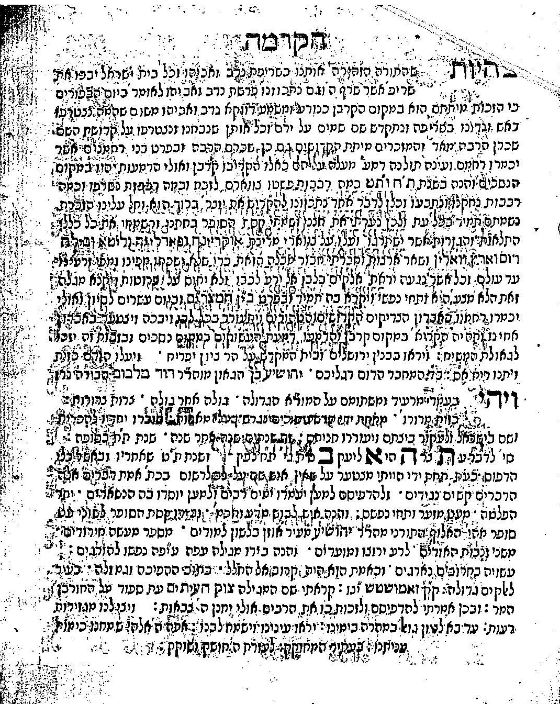
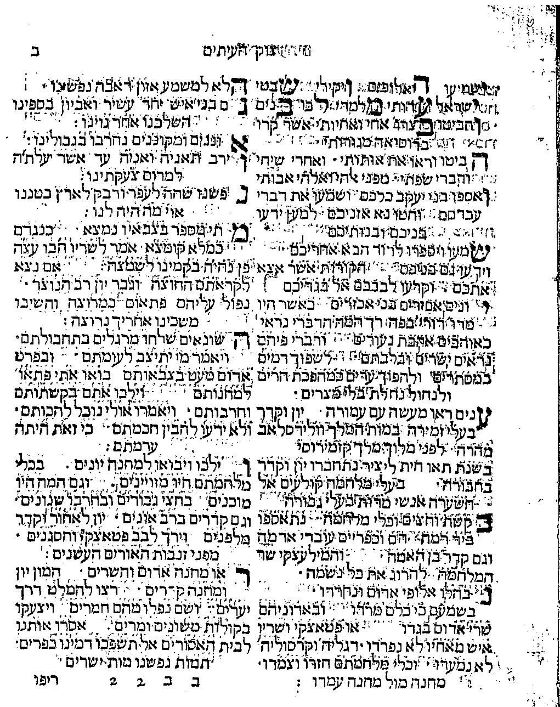
For purposes of accuracy, I must note, that Lahat did alter one thing aside from the title page. Perhaps in an effort to avoid detection he shifted the sections around. So, one can’t take page one and match it up, instead, you just need to find the section. This is not as hard as it would seem as Lahat used the same chapter headings as the original. So, for instance, the scan below you have the chapter titled מאמר מצות משוחים בשמן from both works. The newer type (on the right), without the commentary of the Sha’ar Shimon, is Lahat’s edition while the other (on the left) is the original.

Lest one think it is just that section or just the Brit Kehunat Olam that Lahat copied, I have provided another section – מאמר סכת שלם. Again you can see it is copied word for word. But, I also want to point out it is not just the Brit Kehunat Olam he copied but the commentary, Shem miShimon by R. Shimon Englander as well. As one can see, the notes on the bottom provide citations as well as further elucidations of the Brit Kehunat Olam. Although Lahat did not use footnotes – he used endnotes – they are the same as well.

I have provided below the pages from both Brit Kehunat Olam (on the left) which includes the Shem miShimon at the bottom. The other pages (to the right and bottom) are Lahat’s page from this section and the final page is Lahat’s notes which match up perfectly with the Shem miShimon.

As I mentioned above this is not the first time Lahat has stolen a prior work and substituted his name for that of the author. Instead, I have found at least two other times, where he did the same thing. In fact, one of the approbations for Pardes haMo’adim actually makes mention of this prior plagiarized work. This other work is Lahat’s book Minhagei haAriza”l. This work was published sometime after 1996. It contains four parts. Again, הצב”ר appears on the title page and all the approbations are written to R. Tzyion ben Ratson Lahat (as an aside his last name may actually be רווה [Ravah] as he dedicates this book to his brother Naftali bar Ratson Ravah). This work, with one slight change which I will discuss in a moment, is word for word from the book Minhagei haArizal haNikrah Petura d’Abba by R. Uri ben Asher Strizinitzer [3] first published in Jerusalem 1905.

This work takes fifth and the sixth sha’ar from R. Chaim Vital’s Shemonah She’arim which contain the bulk of the customs of R. Yitzhak Luria(Ari”ZaL). R. Strizinitzer, then includes his commentary, titled Beni Abba, which explains and offers sources for the customs of R. Yitzhak Luria. This work contains the approbation of R. Shalom Mordechi haKohen (the Braziner Rebbi). When he originally published this work, R. Strizinitzer did so anonymously. When he published a similar work Me’ori Tzion he revealed himself based upon an acrostic on the title page. The Meori Tzion was the fourth and final part of R. Strizinitzer’s work on the customs of R. Yitzhak Luria – as we shall see this was also copied. So R. Strizinitzer has three titles – Petura d’Abba, Beni Abba, and Meori Tzyion. The Petura d’Abba contains the portion from Shemonah She’arim and Beni Abba is Strizinitzer’s notes.

Now, we go to sometime after 1996, and a new book, again re-typeset, comes out with the title Minhagei HaAri”Zal with the three works Darkei Tzyion, Sha’ari Tzyion, and Me’ori Tzyion with הצב”ר’s name as the author.

The only thing Lahat did, however, was alter the titles of the first two sections, he didn’t even bother moving things around to avoid detection. In Lahat’s edition the Darkei Tzyion contains the portion from Shemonah She’arim and Sha’ari Tzyion contains the notes. Below, I have provided two pages, one from each book, to demonstrate the plagiarism.

In fact, in Strizinitzer’s book at the end he has “השמטות” – things he left out. Lahat, also has at the end things he left out – and coincidentally, they are the same as well. There is one other small change aside from the title page, and that is in the introduction. In Strizinitzer’s introduction at the end he explains why he decided to title his books as he did. Now, Lahat’s titles are different, so Lahat (left) removed that one line from the original introduction (right). The relevant passages are below.

Now, we return to the third title – Me’ori Tzyion, which Strizinitzer published separately in 1911,[4] and Lahat has included in this book. For this one, Lahat couldn’t be bothered with coming up with a new title so he uses the same title – perhaps to finally be able to say he really did copy everything perfectly. Both pages are below (Lahat, left; original, right).

Finally, we get to the at least the third example of Lahat’s stolen title pages. In this case it was fairly easy to locate the original. Lahat titled this work Pirush ‘al Birkat Kohanim, which as the title implies is a commentary and discussion about Birkat Kohanim. But, Lahat was kind and at the top of each page he has כה תברכו. This title כה תברכו is the same as a book published in 1881 in Solenika by R. Chaim Hemzi. And, it turns out not only is the title the same but the content is as well.


Lahat is by no means the first to merely switch the title pages – as I noted at the beginning of this post, Lieberman has examples of this phenomenon and there are other articles which discuss other instances of plagiarism as well.[5] What is perhaps unique about Lahat is that he seems to have done it more than once, in fact, I can not say for sure the rest of Lahat’s 13 (!) other books [6] are not merely copies as well. Additionally, many have assumed that in the digital age, when from the comfort of one’s home they can call up the card catalogs of almost every major library in the world and thousands books are available online or on one of hard drives – some of which are even searchable, this would have been detected. In fact not a single catalog entry in any library notes that these are copied – even when Lahat did not change the title of the book.

Further, aside from the approbation to Lahat’s Pardes haMo’adim, in his Minhagei haAriZal, Lahat includes approbations from his other works. Some of these are leading Rabbis who also have failed to detect their approbations are on stolen works. These Rabbis include (aside from those already mentioned above): R. Ovadia Yosef, R. Mayer Getz, R. Shalom Messas, R. Yosef Tzubeyri, and R. Tzion Tzubeyri.

Perhaps, now, this can be corrected and Lahat will cease stealing the works of others.

* Prior to posting I have attempted to locate Lahat without success. His books generally provide none of the standard information such as publisher/printer or any contact information.

Notes:
[1] Chaim Lieberman, Ohel Roch”el, vol. 1 (New York, 1980), 477-480, 529-531.

[2] There are no lack of examples, both real and imagined in this category. For one example of lack of proper citation, see R. Natan Neta Leiter, Tzyion l’Nefesh Hayyai (Jerusalem, 1964), no. 109.

[3] His surname comes from a town outside of Lvov.

[4] In some reprints of Strizinitzer’s Minhagi AriZal, Me’ori Tzyion is included.

[5] See Lieberman supra n. 1. Lieberman notes [p. 477] the case of Hemdat Tzvi, where the original was printed in 1876 and the stolen version with the same title was printed in 1879. However, he leaves out one worthwhile point. Although in the stolen version he knew enough to remove the original authors name, apparently he didn’t even read through the whole book as on p. 72b, the original author quotes his grandfather by name, and this same passage appears in the stolen version. Further, on p. 87, the original author includes a teshuva which he signs by name. In the stolen version it appears without change signed by the original author!). See also Kitvei Pinchas Turburg, ed. A. R. Malachi, 24-36; C. Leshem, Shabbat u’Mo’adi Yisrael (Tel Aviv, 1969), 379-409; Y. Sternhill, Kochavi Yitzhak (Brooklyn, 1969), Introductions to volumes I & II; Marc B. Shapiro, Saul Lieberman and the Orthodox (Scranton, 2006), 5 n. 9, discussing the example of Rabbi Nosson Dovid Rabinowich which was also discussed in a previous post at the Seforim blog; Shraga Abramson, “Chasad b’Ameirat Daver shelo b’Shem ‘Omro,” Sinai 112 (Nissan-Iyyar 1993): 1-24; Alei Sefer 16 (1990): 177-79; Moriah 83-84 (Adar I,1978) 79-80; A. Perls, “Das Plagium,” in Monatsschrift für Geschichte und Wissenschaft des Judentums / MGWJ 28 (1879): 305-322; R. Margolis, Shem Olam, Jerusalem, 1989, introduction.

Regarding the halakhic permissibility of plagiarism, see Nahum Visfish, Mishnat Zechuot haYotser (Jerusalem, 2002), esp. 95-115; Nahum Rakover, Zechut haYotsrim beMekorot haYehudim (Jerusalem, 1991), 17-72, a portion of which appeared as “Plagiarism of Torah Teachings,” Areshet 6 (1980): 222-226; and idem., “Plagiarism and the Obligation to Cite Sources: Aspects of Copyright Law in the Halakhah,” Dinei Yisrael 6 (1975): 93-120;

[6] There is one book which is particularly suspect, as Lahat’s book is titled מאיר לארץ and it is kabbalistic interpretations on ברכת המזון and there is another book with the same name on the same topic. Thus far, however, I have been unable to secure a copy to compare the two.


A Puzzling Example of Plagiarism

One of the strange facts connected with plagiarism is that, at times, it is hard to discern what the motivation is to plagiarize. For example, we have seen a person today that continuously plagiarizes entire books even though he is well-known and, if the approbations on his books are any indication, well-respected. Still, he has plagiarized, in their entirety at least three books and seems to continue to do so. While monetary gain may be a reason, I don’t see this as making him rich.

Another example where it is hard to figure out why the person plagiarized is an earlier case, a case from the early 19th century. Again, we are dealing with a book that was plagiarized in its entirety. Such examples, where the whole book is appropriated, makes it easy to show that this is a case of plagiarism and not merely that a sentence or two was not cited properly. This particular example also has the benefit that although an entire book was stolen and then republished under the very same title, it appears that detection of this eluded some experts in the field of Jewish books. Specifically, as we shall see that Israel Zinberg, had no knowledge of this. First, the original.

The book in question is a small work, Ha-Matzah Hadasha, published in Amsterdam as part of a collection of works. The entire collection, that includes three other works, is Shir Emunim. The author of these works is R. Moshe Piza. Ha-Matzah Hadasha is a book whose purpose is to demonstrate and list the words that contain the letter Shin and to distinguish between a Shin and a Sin. Additionally, R. Piza included a short commentary on the bottom that provides translation for some of the words he lists. Finally, R. Piza includes a poem of sorts at the end that lists the Sins in Tanach.


Ha-Matzah Hadasha, Amsterdam, 1793

Now, the plagiarized version. For this we travel from Amsterdam to Vilna. Zinberg, (A History of Jewish Literature, New York, 1975, vol. 6, pp. 282-84) in discussing the early rumblings of the Haskalah movement points to an “interesting person” Naftali Hertz Shulman. Shulman was very well-read and may have been proficient in Russian, German and Latin, something very uncommon for Jews of the time. He gave classes in the Rambam’s Moreh Nevukim and was a teacher to many wealth students. Shulman attempted to start a journal that would provide information “about commerce and political events, and the lover of science about scientific discoveries.” The stated purpose of the journal was so that “much knowledge in the realm of various languages, mathematics, geography, the natural sciences, etc. will be disseminated among our people.”

Now, in 1804, Shulman published R. Benyamin Mussafia’s lexographic work, Zekher Rav. Additionally, in 1804, under his own name, Shulman published Ha-Matzah Hadasha. On the title page Shulman states that “he gathered the information [in Ha-Matzah Hadasha] from many places” but never says that the entire work is word for word from R. Piza’s earlier work. Zinberg, in his three pages on Shulman – most of glowing with Shulman’s accomplishments – never mentions this fact. This is so, although the fact that Shulman plagiarism was already noted by Roest in his catalog of the Rosenthal collection, Yodeh Sefer no. 520. Roest notes that Shulman plagiarized Piza’s entire work. It is worth noting that in truth Shulman did not plagiarize R. Piza’s entire work – Shulman left out the final poem (I have provided it below).

Even auction catalogers, whose job presumably is to increase the value of auction items, were unaware of this fact. In the Judiaca Jerusalem catalog (April, 2008) they had Shulman’s work for sale. They merely note that Shulman probably wrote this work – a work to differentiate between a the two similar letters of Shin and Sin – due to the unique Lithuanian pronunciation. Not only do that not mention the work is not original to Shulman, their explanation fails to account for the fact the work was never written in response to Lithuanian pronunciation as it was originally written in Amsterdam by a Sefardic author, R. Piza.


Ha-Matzah Hadasha, Sklov, 1804

Now, in light of Zinberg’s description of Shulman, Shulman appears to have been well respected in Vilna, as I mentioned he taught many wealthy children, Shulman published his own works and was involved with many members of the early Haskalah even going so far as to suggest publishing the journal mentioned above. It is therefore perplexing then he would plagiarize an eight page book that for the most part is merely a list of words from Tanach that merely highlights whether there is a Shin or a Sin. Below, are scans from the original and Shulman’s edition.


A Page from Shulman’s edition

The same page from Piza’s original version

The poem that appears at the end of Piza’s Version

Note
Additionally, it may be that he actually plagiarized another book as well. While this is highly speculative, another book, discussed here, was plagiarized from R. Abraham ben HaGra in 1804 by a Yehuda ben Naftali Hertz. I don’t know if this Yehuda ben Naftali Hertz is related to the Naftali Hertz above but the similarity in name, place of publication, as well as the timing may be an indication that either it is the same person or somehow connected.


Plagiarism I

As some of you have brought up in the comments regarding other works that had been plagiarized I thought it would be appropriate to discuss some of the more famous and those less so of instances of plagiarism.

The first example, is perhaps the most well-known one, that of the work Mekore Minhagim. This work which in question and answer form, discusses the sources and reasons for various customs was first printed in 1846 in Berlin by R. Avrohom Lewysohn (1805-1861). This work contained 100 of these questions and answers and consequently ended with a , ויזרע אברהם מאה שערים ויברכו ה and Avrohom planted 100 gates. This, of course referenced the authors name and the fact he wrote 100 questions. This is lifted from the verse in Genesis 26:12 ויזרע יצחק . . .מאה שערים ויברכו ה.

However, if today one tries to purchase this book (any one still can it has been reprinted many times) instead of a photocopy of the 1846 edition by Lewysohn, one gets a book with the same title but the author’s name is actually Yosef Finkelstein (originally published in Vienna in 1851). Also, instead of 100 questions there are only 41. Those differences aside, the remaining 41 questions and answers are word for word the same as Lewysohn’s.

This plagiarism was noted almost immediately by David Cassel, (1818-1893), in the first issue of Monatsschrift für Geschichte und Wissenschaft des Judentums, October, 1852 p. 34. However, this did not stop Finkelstein, and his edition was published possibly twice in 1851 alone and from then on numerous times to this day.

While Finkelstein’s is word for word, he was forced to change a few minor things. One in particular was the play on the verse at the end, his reads, ויזרע ויסף מא’ שערים. Although he attempted to retain the play on the verse, this fails as there was only 41 gates in his edition.

Finkelstein did not stop there. When his treachery was revealed in the paper HaMagid, he actually went on to argue that it was Lewysohn who copied from him and not the other way around. Finkelstein claimed when he was passing through Berlin, Lewysohn asked to borrow his manuscript and surreptitiously copied it. Finkelstein, however, does not explain how Lewysohn was able to add the additional 59 question and answers. Additionally, we will see in the next installment on this book, how Finkelstein gives himself away.

For more on plagiarism especially the halakhic discussion see here.

(Continued here)


Lag Ba-Omer and Upsherins in Recent Jewish literature: Revisionist History and Borrowing and Plagiarism

Lag Ba-Omer and Upsherins in Recent Jewish literature:
Revisionist History and Borrowing and Plagiarism
By Eliezer Brodt

In this post I would like to touch upon some of the topics relating to Lag Ba-Omer through a discussion of the latest volume of R. Tuviah Freund’s Moadim le-Simcha.

By way of introduction, in the past few years, the field minhaghim, specifically the research and investigation of sources and reasons for custom has expanded exponentially. To be sure, from early rishonim and onwards we have many books discussing minhag. But, only more only more recently, did the systematic study and collecting of sources as they relate to minhag really start. The basic idea underlying this particular area of research involves digging up as many sources as one could related to a particular minhag and then to try and put together a comprehensive picture of the development of the specific minhag. This is a time consuming process. To begin with, one has to carefully track down early sources, figure out who is earliest source, and then try to understand the reasons given for the custom on the whole. Additionally, one has to be mindful of who influenced whom, separate the development from the original unadulterated custom, as customs, being the product of human development tend to themselves to develop over time. The older a minhag is, the more difficult a challenge as the possible source texts multiply and patience is required to put together the whole puzzle.

The recent interest in the field has produced many articles and books. Although many of these articles rely on one another, proper attribution varies widely. Some authors always give credit, while others just “borrow” sources and still others take entire text portions without any attribution. At times, to obscure this misappropriation, the order of the original article is changed although the text remains the same.

Bar-Ilan University professor Daniel Sperber, in the introduction to his eighth and final volume of his Minhagei Yisrael, catalogues and comments on many recent works minhag. In an earlier volume he published a bibliography on minhagim by Prof. Yosef Tabory.

The Moadim le-Simcha Series

In this genre, one of the more recent and popular books is Moadim le-Simcha, by R. Tuviah Freund. The sixth volume of this series has just been published. The volumes follow the yearly holiday cycle and this latest volume covers the holidays appearing in the months of Iyyar and Sivan.

R. Freund first publishes portions of the books in the newsweekly Hamodia (Hebrew). Then, he updates them and collects and arranges them according to the months. Overall, the material found in this collection is excellent. R. Freund uses a wide range of sources and it is obvious that he works hard to put out a good product. Moreover, just collecting this disparate material in one place is admirable.

But, aside from doing his own research – a task that is obviously quite time consuming – R. Freund employs two other methods that ultimately allow him to produce these books. As I have elaborated on in the past, Machon Otzar ha-Poskim has a card catalogue comprising thousands of topics with a phenomenal amount of sources related to those topics. R. Freund, as other contemporary authors, uses these cards to get a head start (alternatively, sometimes the cards provide everything) on the articles in Moadim le-Simcha. R. Freund freely acknowledges, at the beginning of each volume, that he relies on these cards.

As we have previously noted, another source of R. Freund’s materials, however, goes unacknowledged. On many topics, not necessarily all, he locates a key article of a talmid hakham or academic scholar, and then R. Freund proceeds to use their material. At times he mentions the original source in a random footnote while on other occasions he makes no mention at all.

Of course, there is no problem using someone else material so long as the source is clearly noted at the outset of the chapter that you used it and you are adding on your own finds. To be sure R. Freund is not the only who fails to properly note all of his sources; many authors do this today both in the traditional rabbinic and academic communities, and this is not a new phenomenon. Indeed, below, we will see another such example.

Setting aside this methodological issue, Moadim le-Simcha also suffers from lack of proper organization. Chapters do not flow into one another like they should, content is not put in chronological order and many times sources are not given. One other issue is one can always find more material touching on the topics covered in Moadim le-Simcha. Although this is not a criticism of R. Freund but is an issue anytime someone attempts to collect material on minhagim. Overall, however, Moadim le-Simcha is well worth one’s money as it does have a wealth of information some of which will not be found else where on many interesting topics relating to the months of the year.

Moadim le-Simcha, volume 6 – The Customs relating to the Months of Iyyar & Sivan

As mentioned above, the latest volume of this series covers Iyar and Sivan. The first article is a lengthy one covering the issues of becoming bar-mitvah during the sefirah period. This one section is over ninety pages. The next topic is Pesach Sheni. The next eight articles cover topic that are connected with Lag Ba-Omer. The final section covers Shavous topics.

It is the Lag Ba-Omer section, however, that will be the focus of our discussion. Topics covered include the recent minhag called ח”י רוטל (pp. 146- 148), bows and arrows on Lag Ba-Omer (pp. 155-58),[1] and the origins of bonfires on Lag Ba-Omer and burning clothing. There is then a detour to discuss the more general custom of lighting candles at graves year-round. Then we return to Lag Ba-Omer with a discussion of Upsherin and a section on peyos, after which he discusses the custom of learning at the kever of the Rabbi Shimon bar Yochai (“Rashbi”), followed by a chapter on the halakhic discussions relating to Kupas (charity) of Rashbi. On the topic of Rashbi, R. Freund turns to the controversial topic of authorship of the Zohar, as well as some general aspects of studying Kabbalah. Then we have another detour to discuss visiting graves of Tzadkim in general. He concludes this section with a discussion of the minhag to go to the kever of Shmauel ha-Navi on the forty-third day of Sefirat ha-Omer.

We now turn to the content of these chapters and Lag Ba-Omer generally.

Traditionally, the sefirah period is considered a time of mourning. The most well-known reason given – offered by the rishonim – is the mourning is due to the death of students of R. Akiva who died during this time of the year. Because this is deemed a mourning period, we refrain from shaving, taking haircuts, dancing, listening to music and making weddings, etc. Interestingly, some seem to think that there is an additional minhag during this time of abstaining from purchasing new clothes in order to avoid making a shehecheyanu; however, this is wrong. Many poskim write that people erroneously confuse the sefirah period restrictions with those customarily applied during the three weeks. Indeed, during the three weeks, one should refrain from buying new clothes to avoid a shehecheyanu, but during sefirah no such halakha applies. For example, the Mishnah Berurah writes that if during sefirah [493:2]:

מ”מ אם נזדמן לו איזה ענין שצריך לברך עליו שהחיינו יברך

The source for this ruling is the Ma’mar Mordechai who writes:

לא מצאתיו בשום ספר ראשון או אחרון ואין ספק שנשתרבב זה המנהג ממה שכתוב בשלחן ערוך לקמן סי’ תקנא דטוב ליזהר מלומר שהחיינו בין המצרים על פרי או על מלבוש

While this is the halakha, today we do know that in fact there is some bases for refraining from shehecheyanu during sefirah. As many manuscripts have come to light, one of these manuscripts reflects this customs. In fact, this topic was comprehensively covered by R. Gedaliah Oberlander in his journal Ohr Yisroel, and later reprinted in his collection on minhaghim called Minhag Avosenu be-Yadenu (Merkaz Halakhah, 2005). There is much to add on this topic and I hope to return to it in a future post at the Seforim blog. While on this topic of shehecheyanu during sefirah, it is worth noting that one of the earliest sources reflecting this custom is the Leket Yosher. R. Zilber, quoted by R. Ben David, in his article in Tzohar, uses this example to question the authenticity of the Leket Yosher. Basically, they argue the Leket Yosher must be a forgery as this custom is only attested to in recent times. But, as I mentioned R. Oberlander demonstrates that there are many sources for the shehecheyanu restriction aside from the Leket Yosher. (Also, R. Ben David, in a later issue of Tzohar admitted that the fact the Leket Yosher may confirm what was believed to be a later custom is meaningless and disavowed his reliance on R. Zilber.)

Prof. Daniel Sperber (Minhagei Yisrael 1:101-117) posits that the mourning customs during sefirah are mainly due to the crusades, as many of the most horrific events of the crusades took place during the sefirah period. As evidence, Sperber notes that in Ashkenaz there was a custom to refrain from cutting one’s nails – a terrific extension of symbolic mourning. Moreover, in Sefer Assufot [printed in a few places- see Meoros ha-Rishonim p. 89] it says:

ועוד נראה לי מה שאין נושאין נשים בין פסח לעצרת, מפני צער הקהלות בכל המלכות, ומתענין עליהם ומזכירין נשמות באותן השבתות ומצטערין ודואגין עליהן באותו הפרק

In Spanish sources, however, we find that they were much more lenient some going so far to permit marriage during the sefirah period. (For one example of this leniency, see the manuscript published by Meir Benayahu,Yosef Bechiri [Jerusalem, 1991], 518-20).

Now for some reason or reasons all these prohibitions are lifted on Lag Ba-Omer. Additionally, there is a custom to celebrate on Lag Ba-Omer, while to a more limited degree in many places, but especially in Meron at the Kever of Rashbi. In Meron there are great celebrations with music and dancing and the like on Lag Ba-Omer. The obvious question, however, is why?

Now I will not even attempt to provide all the answers offered, but in a moment I will point the interest reader to additional sources. There are many early sources for simcha on Lag Ba-Omer, also that tachanun is omitted, marriages are allowed and so is shaving. In some rishonim the reason given is because the students of Rabbi Akiva stopped dying on Lag Ba-Omer. This reason, however, provides no insight into the connection between Meron and specifically Rashbi and Lag Ba-Omer.

One of the most famous reasons explaining the connection between Rashbi and Lag Ba-Omer – if you ask anyone this will probably be their reply – is because the Rashbi died on Lag Ba-Omer. Assuming for a moment this is factually correct, it is quite strange that we celebrate Rashbi’s death. We don’t find any other yahrzeit that we celebrate it in such a way and we had many other great people die besides for Rashbi, Avraham, Moshe, David HaMelech, etc. – none of whose death we celebrate with bonfires. Another problem is that neither chazal nor any of the rishonim mention Rashbi dying on Lag Ba-Omer. These questions and others were addressed by the Hatam Sofer in his teshuvot. In fact, because of these problems, he was very skeptical – to put it very mildly – of this celebration that takes place at Meron.

As an aside, an unknown sources about this whole topic is a statement found in some versions of Toledot Ha-Arizal (Sefer ha-Ari, 219) it is also found in a manuscript of the Chida which says:

בימי מרן (ר’ יסוף קארו) הסכימו שלא יעשו ישראל הערביים מחול בל”ג בעומר על ציון רשב”י. ונראה למרן וב”ד שהוא זלזול שאוכלים ומרקדים, ונכתבה ולא נחתמה. בלילה חלם מרן עם הרשב”י וא”ל שתבא מגפה גדולה בעבור זו ההסכמה, כי רצונו שישמחו בהללולא, ולמחר קרע את ההסכמה

With this introduction regarding Lag Ba-Omer, we can now turn to the Moadim le-Simcha’s discussion of Lag Ba-Omer customs.

He starts the topic of Lag Ba-Omer with a nice list of issues regarding Lag Ba-Omer giving the impression that this list indicates the progression of the articles. The reader is quickly disabused of this notion as R. Freund jumps from topic to topic at times returning to earlier topics with no discernable order. After carefully reading the Lag Ba-Omer section, I decided to compare R. Freund’s work with that of R. Betzalel Landau’s [author of ha-Goan mi-Vilna] on Lag Ba-Omer called מסע מירון. R. Landau’s sefer is a collection of articles printed in 1966 and as is the case with R. Freund, R. Landau’s articles also first appeared in the Hebrew weekly Hamodia. R. Landau’s work is printed along with the Maseh Meron of R. Mendel Rabin. R. Landau’s articles deal with everything connected to Lag Ba-Omer, from the visiting of Meron and the accompanying celebration to Upsherin and much more. It is written beautifully, well organized and has excellent sources including manuscripts and many rare seforim.

After comparing the material, I noticed that R. Tuviah Freund basically lifted all the material from R. Betzalel Landau with one big difference: where R. Landau presents the material in very organized fashion, R. Freund does not. To be sure, Freund adds much material to the topics discussed by Landau and Freund covers areas not covered by Landau. On the other hand, Freund omits many interesting topics and sources relating to this day that he should have dealt with such as discussion of the song Bar-Yochai.[2] The point is not that Freund used the sources collected by Landau but rather at the outset of the articles Freund should note his debt to Landau and reference the reader to Landau’s work for its additional materials. In fact, in passing on at least two occasions Freund mentions “Mase Meron” indicating that indeed he was aware of and used Landau’s work. To make this even more bizarre, the only times Freund cites Landau, in truth, Landau was merely quoting from Avraham Yaari, Iggerot Eretz Yisrael (Tel Aviv, 1943), a work that Freund uses directly in other places (379-384). In other words, the times he does mention Landau’s work it was almost unnecessary while where Freund should mention it he does not. Is it to say that only here he used Landau work and the rest he found himself? I find it hard to believe and quite silly – there is no problem to use someone else’s material as long as you give them proper credit.

A Revisionist History of Lag Ba-Omer and Another Example of Plagiarism.

Before returning to the rest of R. Tuviah Freund’s Moadim le-Simcha, we need to examine another recent article that appeared in the journal Yeshurun (no. 15) authored by R. Moshe Blau. R. Blau’s article is devoted to Lag Ba-Omer and is well organized and clearly written – a model for R. Freund to learn from. While these facts distinguish R. Blau’s article from Freund’s, Blau actually has something in common with Freund – Blau too plagiarized.

Again, Blau uses information that appears elsewhere without mentioning the sources. Specifically, Blau plagiarized from Avraham Yaari, Meir Benayahu, Betzalel Landau, and possibly even R. Yaakov Hillel, as I will demonstrate below.

As I mentioned earlier many traditionally many claim the yarzheit of Rashbi is on Lag Ba-Omer. While this claim is well-known the source of this tradition is more difficult to locate. Avraham Yaari and Meir Benayahu show that the earliest source to mention Lag Ba-Omer as the yarzheit of Rashbi is none other than the Hemdat Ha-Yamim. (R. Yaakov Hillel also confirms this on page 13 in his Aid ha-Gal ha-Zeh.)

There were some, however, who attributed the Lag Ba-Omer death date of Rashbi not to Hemdat Ha-Yamim but to R. Hayyim Vital, whose source was the Arizal. In truth, it is a mistake to give R. Vital credit for this. The source of this mistake was based on a simple printing mistake in one version of the Prei Etz Chaim which was first printed in 1782 – available here. (For more on this edition see R. Yosef Avivi, Binyan Ariel, pp. 68-71.) That edition reads:

והטעם שמת רשב”י ביום ל”ג בעומר כי הוא מתלמידי רבי עקיבא הנ”ל שמתו בספירת העומר

The Chida already writes that this is a mistake and instead of שמת, one letter is missing and the correct reading is שמחת רשב”י. So it is not a reference to Rashbi’s death day at all. Avraham Yaari demonstrates that other sources aside from the Prei Etz Chaim confirm this reading of שמחת. Meir Benayahu also concludes this is the correct reading using manuscripts. Finally, R. Yakov Hillel also writes that it is clear from viewing many manuscripts of the Prei Etz Chaim that it is a mistake. [3]

Turning to the origins of going to Meron, again, Avraham Yaari, in an article in Tarbiz 22 (1951) has a very detailed piece showing how the custom of going to Meron was taken from an earlier custom of going on Pesach Shnei to the kevarim of Hillel and Shamai in Meron. Soon after Yaari published this article, Meir Benayahu penned a strong rebuttal (Sefunot 6 pp. 11-40), and is again summarized in Sefer Vilnai 2:326-330). According to Benayahu, the custom of going to Meron was begun by the “Mekubeli Sefat.” Irrespective of whose side one falls, both articles are full of interesting facts about the development of this Lag Ba-Omer. In my opinion, Benayahu appears to have the upper hand. More recently, Tel Aviv University professor Elchanan Reiner revisited this topic in his incredible dissertation, “Pilgrims and Pilgrimage to Eretz Yisrael (1099-1517),” (PhD dissertation, Hebrew University of Jerusalem, 1988), 295-320. (Hopefully, Dr. Reiner will publish this in book form.)

Returning to Freund’s article on Lag Ba-Omer, there is no doubt he used both Landau and Benayahu, as he quotes them in his notes. At the end of his article, Freund raises the older, although less known, custom of going to the grave of Shmuel ha-Navi (again close to Lag Ba-Omer) (p. 384). In doing so Freund quotes an early source for this custom, a source that is only in manuscript. But, Freund provides no citation where this source can be found. In fact this comes from Yaari (neither Landau or Benayahu mention it) who notes that this was originally published in Jacob Moses Toledano, “Teudot mikkitvey-yad,” Hebrew Union College Annual 4 (1927): 449-466, quote at 458. So either Freund was perusing random old copies of HUCA or more likely, he found Yaari’s article on Lag Ba-Omer and neglected to mention that.

Coming back to Blau’s article, the general idea of Blau in his article is after dealing with all the sources of why Lag Ba-Omer is different than the rest of Sefirat ha-Omer. His new ideas which he brings to the table are that 1) the earliest source for Lag Ba-Omer being the death of Rashbi is from Hemdat ha-Yamim. This point was already made by both Yaari and Benayahu. 2) The printings of Prei Etz Chaim contains a printing error (Blau shows this to be the case from various manuscripts he checked). Again, not a new point, while it is nice that he prints in the article copies of the various manuscripts but this also was already shown to be the case by Benayahu much earlier. 3) Finally, at the end of his article he brings from a manuscript that R. Yosef Karo wanted to stop the going to Meron but did not. Blau, however, concludes that this fact is not mentioned by the Chida because the Chida did not believe this manuscript was legitimate. This whole major manuscript is brought by Yaari and Benayahu. The text itself is printed in Benayahu’s Sefer HaChida. Additionally, R. Landau also discusses this point. None of this is noted by Blau. All in all this leads to the conclusion that much of Blau’s article is premised, without attribution, on Yaari’s, Benayahu’s, and Landau’s works on the topic.

As an aside both R. Yaakov Hillel and R. Ovadiah Yosef (Yabia Omer 5:35 and Hazon Ovadiah, p. 274) do not encourage going to Meron on Lag Ba-Omer due to the situation of pritzus there. R. Hillel is also against going on these types of hilulas throughout the year.

In actuality, while it is difficult to connect with the death of Rashi, there is another important person who perhaps did die on Lag be-Omer, Yehoshua ben Nun. (See R. Hamberger, Shoreshei Minhag Ashkenaz 3:262). In Meglias Ta’anis, the last section, there is a part titled Meglias Ta’anis Batra. In many versions of this text, it places Yehoshua ben Nun’s death on Lag be-Omer. Professor Shulamis Elitzur, in her excellent book, Lamu Tzamnu, deal with the death date of Yehoshua ben Nun at length. She cites to many early piyutuim that mirror this reading found in Meglias Ta’anis. (See Lamu Tzamnu pp. 18, 26, 34, 39, 66, 120, 126, 172.) Generally, Lamu Tzamnu is a scientific edition of Megilas Tannit Batra. For further on this, see also her Piyyutei R. Pinchas ha-Kohen, pp. 240 & 693. See also, Landau, p. 71, who errs in this regard based on a faulty manuscript; S. Leiman, “The Scroll of Fasts: The Ninth of Tevet” in J.Q.R., vol. 74, pp. 174-95, esp. pp. 174-79; Reiner, op. cit., pp. 289-90.

Moadim le-Simcha on Upsherin and Peyos

Now that we have covered the two latest discussions of Lag Ba-Omer and their similar faults, we return to the rest of Moadim le-Simcha. Freund’s next major topic is that of Upsherin. The problem with this article is that it is not objective.

The source for the Upsherin custom is highly problematic. R. Benyamin Shlomo Hamberger, Shorshei Minhag Ashkenaz 3:251-267, attacks it for the following reasons: there is no mention of this custom in any of the rishonim. Now do not say they did not bother to write it down as we have very detailed discussions from the rishonim about this time period in a Jewish boy’s life how to take him to cheder etc. (discussed by R. Hamburger at great length in volume two of his Shorshei Minhag Ashkenaz 2:502-532) but there is no mention of the Upsherin custom.[4] Furthermore, he shows from many places in the times of the rishonim they cut their hair long before three years old. Another big question dealt with by Yaari and later on in more detail by Hamberger is the attributing the custom of Upsherin on Lag Ba-Omer to the Arizal. This attribution is problematic as it is documented that the Arizal did not cut hair the entire sefirah – including Lag Ba-Omer. This particular issue M. Benayahu does not find to be such a problem as it could be what he did to his son and what he himself did were two different things. Another issue R. Hamberger raises is even if there is such a minhag what does it have to do with Rashbi and where do we find such a thing to give a haircut in a grave yard? Further more he brings sources [amongst them a National Geographic Magazine!] which claim that it come from outside – Arabic influences. R. Hamburger does defend it a little that it still makes sense to keep if it comes from outside sources. However after seeing all this documentation of R Hamburger notes that it makes sense why we can not find sources in litvishe or Hungarian sources – as there are no early sources in rishonim!

Professor Sperber [Minhagei Yisrael 8: 13-30] takes Hamberger’s discussion much further documenting how this comes from many completely outside ancient sources. R. Yechiel Goldhaber (author of the Minhagei ha-Kehillos) told me that he just saw a manuscript of a letter of R. Akiva Yosef Schlesinger who writes very sharply that this whole custom is taken form outside sources. Generally, Freund has no problem mentioning R Hamburger as he quotes this very same volume in another chapter of his in this sefer – saying Tikun on shavuos night. But when it comes to using Hamberger to question or examine Upsherin, Freund seems unable to do so.

After this chapter Freund has a section all about the customs of peyos including different opinions about wearing it behind ones ears. A careful reading of this chapter shows he stole much [and he could of stolen even more] from Yitzchak (Eric) Zimmer’s chapter in his Olam Keminhago Noheg (Mercaz Zalman Shazar, 1996) devoted to these topics.

Freund continues with a chapter on the development of the tomb over Rashbi’s kever and its history. He has a lot of important information on it. I would add to it the last section of M Benayhu previously mentioned article (which I think for sure Freund was well aware of on this topic of Meron in general).

The Zohar and its History

In connection with Rashbi, Freund examines the Zohar, its authorship and other topics related to the learning of the Zohar. This topic really deserves its own series of posts but for now I will just point out three issues. He does not mention that there was any opposition to the authorship of the Zohar. Now I understand perfectly well why he does not mention Yehudah Aryeh (Leon) Modena and others but there is one work which definitely deserves mention and that is the Mitpachat Seforim from R. Yaakov (Jacob) Emden. This work is not an attempt to undermine Kabbalah at all but rather it shows that there was some tampering done to the Zohar by different people. To be sure this work was considered very important by many as the Hatam Sofer writes in a teshuvah [Choshen Mishpat Likutim, 59] to someone:

הנה נמצא בשכונתך ס’ מטפחת ספרים למהריעב”ץ תמצא שם כי דבר גדול דבר הנביא ז”ל בענין זה הלא ישתוממו רואיו וד”ל

Interestingly enough a few years back this sefer was printed by someone than it was put in cherem by the badatz! The printer was cursed by sefardi mekubalim and he died within the year! This edition of the sefer is now considered very rare. Indeed, included in the introduction to this edition, are other sources attesting to the importance of the Mitpachat Seforim. Additionally, R. Eliezer Waldenberg, in his Tzizt Eliezer cites the Mitpachat Seforim. (Tzitz Eliezer 9:51 and 21:5).

Another issue I have with this chapter is he does not even mention the famous discussion of the poskim regarding contradictions between Kabbalah and halakha; much has been written on this I will not even bother to cite sources.

One other issue with this chapter is at the end he lists commentaries on the Zohar although he does not claim to make a comprehensive list there are some strange omissions. One is the work of R. Reuven Margoliyot on the Zohar it is extremely important with all his comments as he draws parallels from all over chazal another thing he does is he references many halakhic discussions from the Zohar. Besides for this R. Margoliyot deals with all the questions which R Emden raises in his Mitpachat Seforim. R. Shlomo Zevin, Soferim ve-Seforim, has a beautiful review of R. Margoliyot’s work. One other important work that is not listed is Tiferet Zvi from R. Spielman. Thus far it is only six volumes, going up until chumash Vayikra. This work is literally an encyclopedia on the Zohar dealing with the hundreds of halakha and kabbalistic topics relating to the Zohar [see the comment of Professor Yisrael M. Ta-Shma, ha-Niglah she-b’Nistar, 109 n. 13]. It is very ironic that during R. Spielman lifetime he had to peddle his seforim going door to door begging people to buy them and now it is a very hard to find to purchase.

Finally, Freund discusses visiting kevarim in general – he includes a special section about Kohanim. Here Freund writes openly at the outset that he used an earlier work but he should have been aware there is a much more through and important work on the topic from R Spielman called Zion Lenefesh Chayah.

General sources:
All about Lag Ba-Omer (much of the material overlaps) see R. Shlomo J. Zevin, Moadim Bahalcha pp. 359-64; S Ashkenazi in Avnei Chain pp. 103-11; Pardes Eliezer.

For personal accounts of Lag Ba-Omer see Chanina Mizrachi Yehudei Paras (Tel Aviv, 1959), 29-34. For a Christian traveler account from 1838 see Maseh ha-Notzrim, 496 see id., 517-18 for another account.

Others used to go to Kever of Shimon Hazadik see: Nachlas Yosef [2: 42]; Eiyur Hakodesh ve-Yoshveha p. 43. See a Christian traveler account from 1838 in Maseh ha-Notzrim p. 448 – he mentions that they cut the hair there.

On going to Meron in general see: Kivrei Avos pp. 179-81; The excellent collection from Z Vilani in his Mazavos be-Eretz ha-Kodesh pp. 117-150.

On Shmuel ha-Navi and visiting his grave, see Lamu Tzamu pp. 177-180; Reiner op. cit. pp. 306-320

Notes:
[1] On using bow and arrows on Lag Ba-Omer: see the sources listed by Landau, ibid pp. 124-26 [At this point I am unable to find the source for the riddle of the Malbim that Landau brings.] Moadim le-Simcha pp. 155-59; Pardes Eliezer pp. 229-49; ha-Koton ve-Halachosov chapter 24 p. 59 n. 22; Kundes p. 49 [see here on this work]; Zikhronot Av u-Beno p. 231; Zikhronot me-Rav Litai p. 245 [on this work see here]; A.S. Sachs, Worlds that Passed (Philadelphia, 1928), 112.

[2] About the song Bar-Yochai (which he choose not to talk about it at all), see Landau piece in Maseh Meron; the excellent study by Professor Moshe Hallamish, in Hakabblah, 507-531. See also Hallamish’s Hanageios Kabbalios be-Shabbat pp. 300-03. On general songs composed for Rashbi see Hallamish in Hakabblah pp. 259-83.

[3] R. Yaakov Hillel deals with all this in his sefer Aid ha-Gal ha-Zeh printed two years ago. This is a nice sefer all about Lag Ba-Omer and the Zohar. He has many interesting chapters including the origins of the Zohar the importance of learning Zohar and how to learn it. Another chapter he has is on the topic of contradictions between Kabbalah and halakha. He also has a chapter on Torah Lav Min hashamaayim and its relation to pesak halakha. He also deals with this topic in a few other places in his notes on Moreh Betzbah of the Chidah. It is worth seeing the latest edition, page 159 and onwards, as it is updated from the 1980 edition. He also dealt with this in his journal Mekabtzeal (25: 45-59). R. Hillel definitely saw what Benayahu writes on the topic but he does not credit him at all.

[4] For more on this see Ivan Marcus in Rituals of Childhood (Yale, 1996) and in his Jewish Lifecycle (Washington, 2004).


On the Plagiarism of a Tach-ve-Tat Chronicle

On the Plagiarism of a Tach-ve-Tat Chronicle

During this period, between the 17th of Tamuz and the 9th of Av, there is an increased focus upon various historical calamities that befell the Jewish people. Jewish history is unfortunately replete with such examples. Some instances have spawned specific days of commemoration while others have produced whole bodies of literature. And, while the literature surrounding these events is diverse, covering liturgy, poetry, history, we focus on one type: the chronicle. Additionally, our focus is the Chmielnicki Massacres, or Gezerot Tach ve-Tat. The Hebrew refers to the dates – 1648-49 – when the majority of Jew-killing took place. While these events took place hundreds of years ago, its effects including the total number of Jews killed is still being debated by scholars. (See Jits van Straten, “Did Shmu’el Ben Nathan and Nathan Hanover Exaggerate: Estimates of Jewish Casualties in the Ukraine During the Cossack Revolt in 1648,” Zutot 6:1 (2009), 75-82, calling into question the lower estimates of Shaul Stampfer, “What Actually Happened to the Jews of Ukraine in 1648?” Jewish History 17:2 (May 2003), 207-27.)
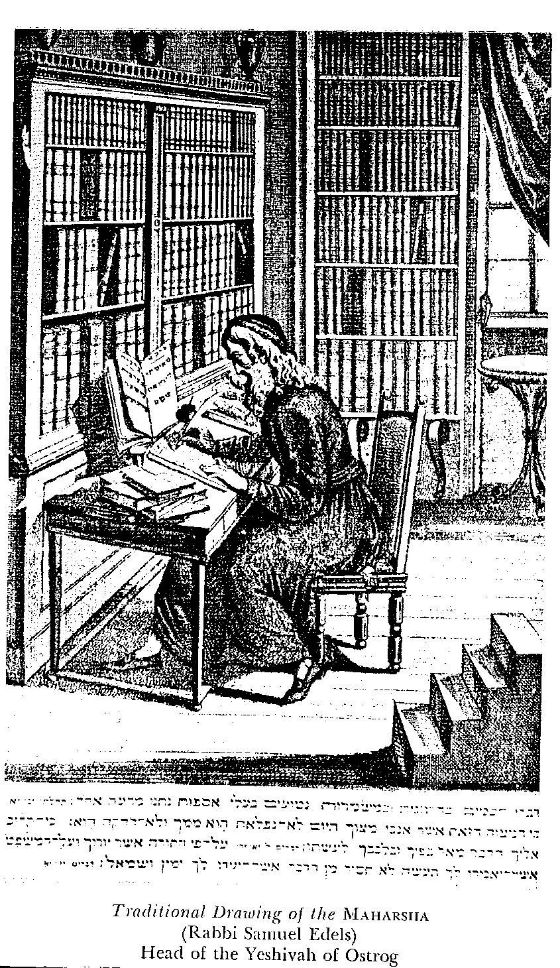
The most well-known chronicle describing the events is that of R. Nathan of Hanover, Yaven Metzulah. There is an English translation of Hanover’s work, Abyss of Despair, translated by R. Abraham J. Mesch. The translation includes a “traditional drawing of Maharsha.”
While it is not noted, this illustration, that has Maharsha with long flowing hair first appears in the Vienna, 1814 edition of the Maharsha’s commentary (vol. I, vol. II). While Mesch indicates this is the “traditional drawing” we know of no earlier instance than the Vienna edition. This was not the only Vienna edition that includes a questionable portrait. The 1804 Vienna edition of R. Yitzhak Alfasi’s Halakhot also includes a portrait that is claimed to be R. Alfasi. Again, we know of no earlier evidence that would confirm such a rendering.
A collection of these chronicles was published most recently Gezerat Tach ve-Tat, Jerusalem, 2004. Additionally, Joel Raba, Between Remembrance and Denial, Columbia Univ. Press, 1995, discusses these chronicles as does the collection of articles that appears in the journal, Jewish History 17:2 (May, 2003).
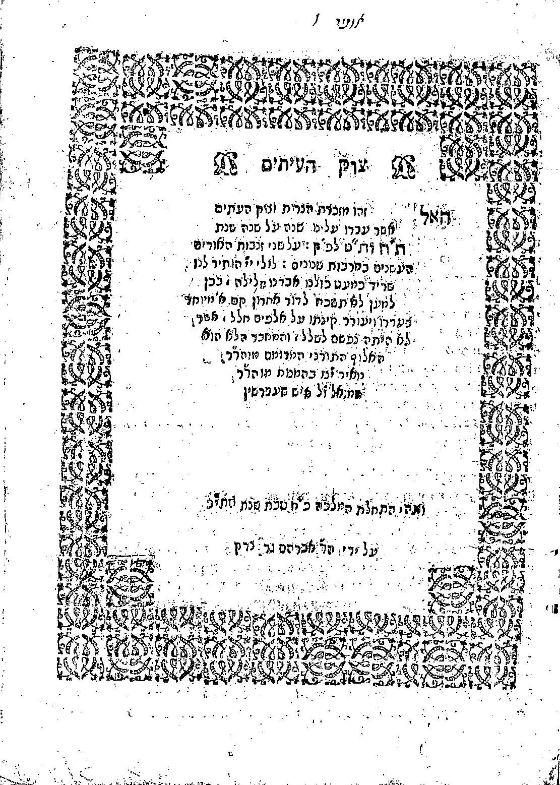
We turn our attention, however, to a lesser known work from this period, Tzok ha-Itim. Tzok was actually the first chronicle regarding the 1648-49 events published. It was first published in Krakow, 1650 (link). Indeed, some have argued that Hanover relied heavily on Tzok in compiling Yaven Metzulah (first published in 1653).
Tzok was republished in Constantinople in 1652. This edition is exceedingly rare. According to Ya’ari, there is but one complete copy extant. (See Ya’ari, Kiryat Sefer, (16) 1939-40). This edition was published by R. Shmuel ben R. Shimson who on his way to Israel after fleeing the massacres. At the end of the book he includes a dirge (kinnah) about the events. He also penned his own introduction which describes his own suffering. He says that “I am the only remaining survivor in my family as the rest were killed sanctifying god’s name . . . although I was spared . . . my wife and children I buried, I lost all of my possessions . . . .” He explains that “all I wanted was to dwell in the bet midrash and therefore I decided to travel to Jerusalem” and that while he was on his journey he came across Tzok and decided to reprint it in Constantinople “so that what has occurred shall not be forgotten.” (Ya’ari, Mechkerei Sefer, Jerusalem, 1958 p. 16 reprints the entire introduction, he also provides other accounts of people, who, on their way to Israel, issued works related to 1648-49 massacres.)
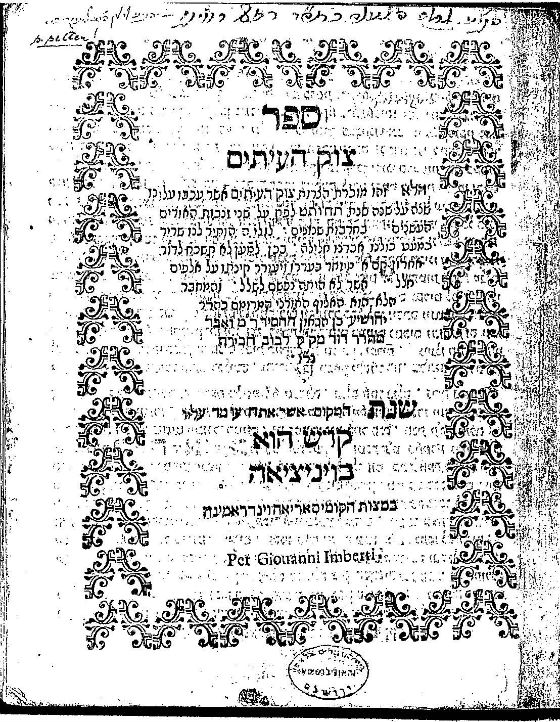
Tzok was then reissued in Venice in 1656.
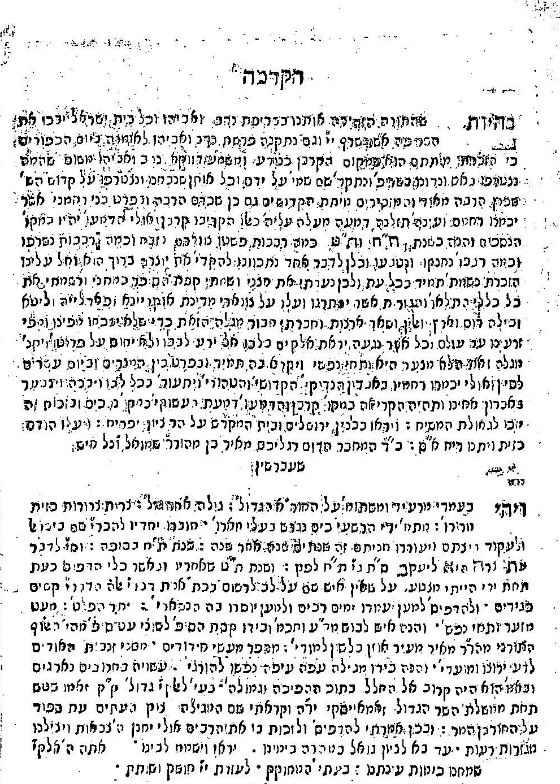
The first two editions list R. Meir ben Shmuel of Szczebrzeszyn as the author. The 1656 edition, however, lists a completely different author, R. Joshua ben David of Lemberg. It is not only on the title page that a different author is listed. The work itself is not composed as traditional narrative. Instead, it is written in verse. The first verses in all the editions spell out the author’s name in an acrostic. Thus, the 1650 and 1652 editions have an acrostic that spells out R. Meir of Szczebrzeszyn’s name while the 1656 edition acrostic spells out R. Joshua’s name. In some instances words are added to create the “new” acrostic, while in other instances, the highlighted letters are changed.
Here is the introduction to the Constantinople edition:
And here is the introduction to the Venice edition:
As an aside it is worth noting that this is not the only time a plagiarizer has been forced to change the acrostic to hide his stolen goods. (See Kitvei Pinchas Turburg, ed. A. R. Malachi, 24-36 for additional examples of acrostic changes, and see this earlier post discussing similar changes to hide the identity of the true author, and see this post where the plagiarizer was caught in the act and forced to admit his guilt and apologize). Additionally, at least in one instance the acrostic was able to demonstrate authorship. In the Siddur Bet Ya’akov (although attributed to R. Y. Emden, this siddur contains numerous additions as compared to R. Emden’s actual siddur called Ammudei ShamayimSha’arei Shamayim; this is one of them) the Belzer Rebbe asserts that the author of the zemer Yom Shabbat Kodesh Hu had his song stolen. He came across the plagiarizer and challenged him to prove authorship. Specifically, the real author showed that his name, Yonatan, could be seen in the acrostic, and with this he vanquished the thief. R. Emden uses this story to explain the meaning behind the final verse which loosely translated as “all the talk [about authorship] should [now] end now that I have enlarged the song [and demonstrated my authorship] . . . and that no one should ever steal from me as this song is my property.”
An example where the acrostic actually has the opposite effect, obscuring the original author is also a zemer, Yom Zeh le-Yisrael. At times, this song can be confusing depending upon which bencher one is using. This so, because some version have a shorter version while others have a longer ( see here for example). Some argue that the two versions are indicative of two authors, one, the original author which only spelled out Yitzhak (and then lamed vav) to which all the other verses were added, now spelling Yitzhak Luria Hazak. (Regarding this zemer see Naftali ben Menachem, Zemirot shel Shabbat, Israel, 1949, 144-45; I. Davidson, Thesaurus of Mediaeval Hebrew Poetry, Ktav, 1970, vol. II, 348.)
Returning to Tzok, because the acrostic lends support for either author, some didn’t know who the “real” author was. In the 1890s, a number of these chronicles regarding bad events in Jewish history were collected and published under the title Le-Korot ha-Gezerot ‘al Yisrael by C. Gorlin. Included is Tzok. But, instead of a traditional introduction, he prefaces Tzok with a section “Who is the real author?” Gorlin argues that the real author is indeed R. Meir and not R. Joshua. This is not the first time that there is some confusion regarding who is the real author and who is the thief, for another example see here and for another example of modern day plagiarism see here.
With regard to the Constantinople edition, Ya’ari demonstrates that this edition is better than the first, in that many of the typos and the like have been corrected. Unfortunately, perhaps due to its rarity, the 2004 edition of Tzok relies upon the 1650 edition and not the better 1652. Additionally, the 1652 edition is one of the works published by a convert. Of course, this is probably what first got Ya’ari interested as he provides a bibliography of works published by converts.
It should be noted that Tzok was rather popular even if it is no longer. When R. David ha-Levi Segal, author of the commentary on Shulhan Orakh, Turei Zehav, sent a delegation to the false messiah, Shabbatai Tzvi, when the delegation entered, they record that Shabbatai Tzvi had a copy of Tzok on the table. (See G. Scholem, Sabbati Sevi, Princeton Univ. Press, 1976, p. 623 quoting Leib Ozer, Sippurei Ma’ashi Sabbati Tzvi, p. 81 and Sefer Tziz Nobel Tzvi, ed. I. Tishby, pp. 77-79.)
Finally, we note that the most recent edition, the 2004 op. cit., uses the Krakow first edition, even though Ya’ari has already shown that the rare Constantinople edition corrected numerous errors that appear in the Krakow edition.


Plagiarism II (Talmudic Terminology): An Update by Marc Shapiro

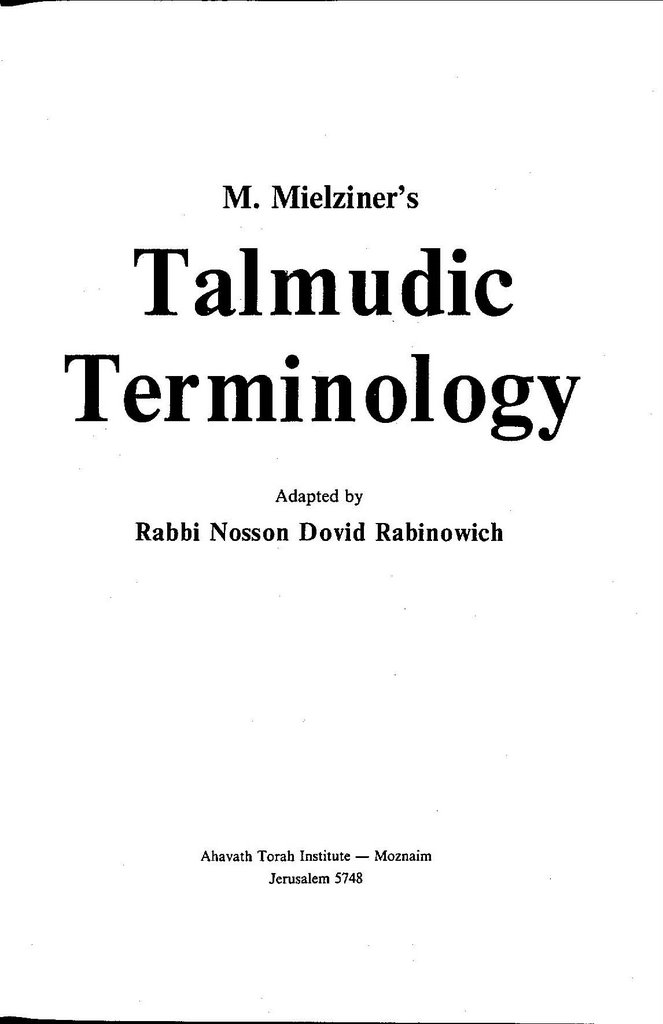
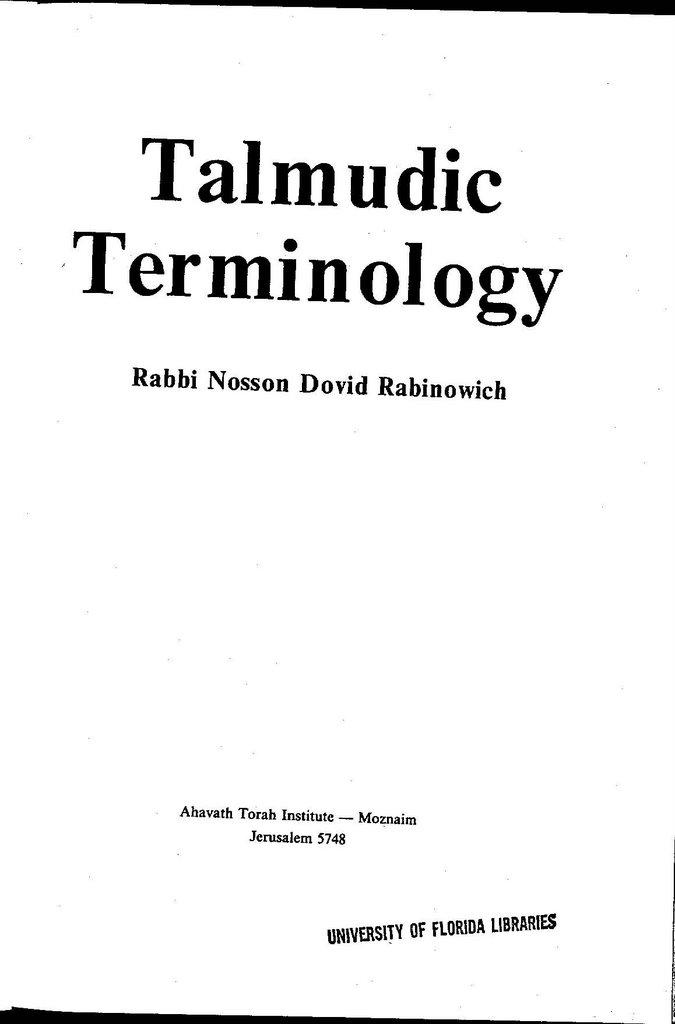
In 1988, Rabbi Nosson Dovid Rabinowich published a book titled Talmudic Terminology. However, as was noted in brief by Dr. Marc Shapiro, this was plagiarized from Moses Mielziner’s Introduction to the Talmud, first published in 1894. This omission, however, has been corrected in Rabinowich’s reprints of his Talmudic Terminology where the title now reads that Rabinowich’s work is “adapted” from Mielziner’s.

While this would appear to be the end of the matter it is not. Dr. Shapiro has investigated this issue further and has sent the following:

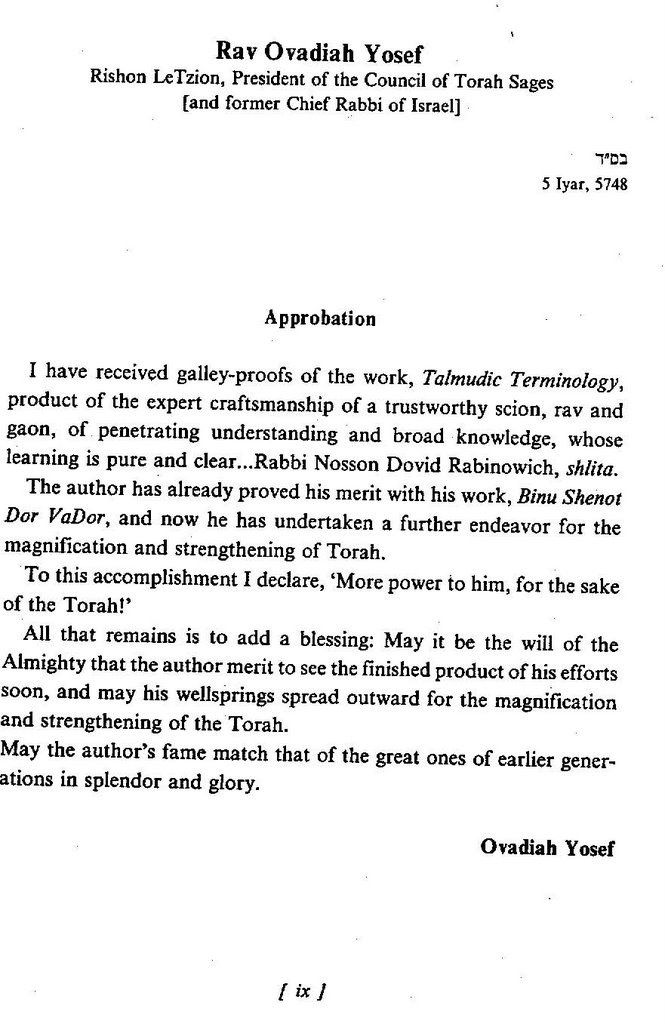
After I published my book Saul Lieberman and the Orthodox a number of people pointed out to me that Nosson Rabinowich’s plagiarism of Mielziner is more extensive than what I point out. I didn’t know what they were referring to since I had the first edition of his book M. Mielziner’s Talmudic Terminology, published in 1988 (in my kuntres, there is a typo, as it says 1998). Or so I thought. I succeeded in locating another copy by interlibrary loan, and lo and behold, the title page does not say M. Mielziner’s Talmudic Terminology adapted by N. Rabinowich but it identifies him as the author. What’s even more fascinating is that the other edition has haskamot of Rabbis Ovadiah Yosef and Aharon Feldman. Obviously, when the scandal broke, Rabinowich quickly produced a new title page and took out the haskamot (and also added a note on p. xv and made a slight change in note 2). p. xv (replacing “some” with “most”.) It is obvious why the haskamot were taken out, since they praise Rabinowich for producing a book which he didn’t write. In fact, Rabinowich is responsible for something very interesting. We find here the first example in history where gedolim put a haskamah on a work written by a Reform rabbi! Unknowingly, Rabbis Yosef and Feldman gave a haskamah to Mielziner. You can be sure this is not something that makes them happy.

Additionally, in an effort to keep the two “editions” the same, Rabinowich did not alter the pagination; this is so, even though he removed the haskamot. Consequently, the “new” edition is missing those pages. I have provided both title pages as well as Rabbis Yosef’s and Feldman’s haskamot (as one can no longer get them).