China and the Answer to the Last Quiz

China and the Answer to the Last Quiz
Marc B. Shapiro
I recently returned from China and one of my friends asked me if during my time there I found anything of relevance to the Seforim Blog. He did not mean the comment seriously, but in fact I did find something. Whenever I am in synagogues I make a point of examining their collection of books, as you never know what you might come across. In Beijing I was at the fabulous Chabad House and I found something that will be of interest to Seforim Blog readers. Before getting to that I need to mention that my time in Beijing was made doubly special as I was able to spend Shabbat with Rabbi Dr. Dror Fixler. In addition to being an outstanding award-winning scientist, he is also a fine Judaic scholar. Among his important publications are new translations from the Arabic of Maimonides’ commentary on the Mishnah to tractates Berakhot, Peah, and Avodah Zarah. Each volume is accompanied by Fixler’s learned notes. Fixler has also published numerous articles on various Torah themes, including on practical halakhic matters. See here.
Fixler is a student of R. Nachum Eliezer Rabinovitch, and I used some of the time we were together to clarify the details of R. Rabinovitch’s position that there is no halakhic prohibition in using an electronic key card on Shabbat,[1] or in walking through a door that opens electronically, or even using an electronic faucet where the water comes out when you put your hand under it. Without getting into the halakhic details, I think one thing is sure, namely, that the future will bring more such lenient decisions in this area. The changing circumstances of modern life will create enormous pressure for lenient decisions, as modern technology which helps us in so many ways also creates many problems regarding Shabbat. For example, how long until it will be impossible to access an apartment building in New York and other big cities without using a key card? The day is probably coming when private apartment doors will also use key cards, not to mention numerous other such Shabbat-problematic technological advances that will be unavoidable aspects of life in the future. Therefore, I believe that some future poskim will return to R. Shlomo Zalman Auerbach’s position that if there is no creation of heat or light, then technically there is no violation of Shabbat.
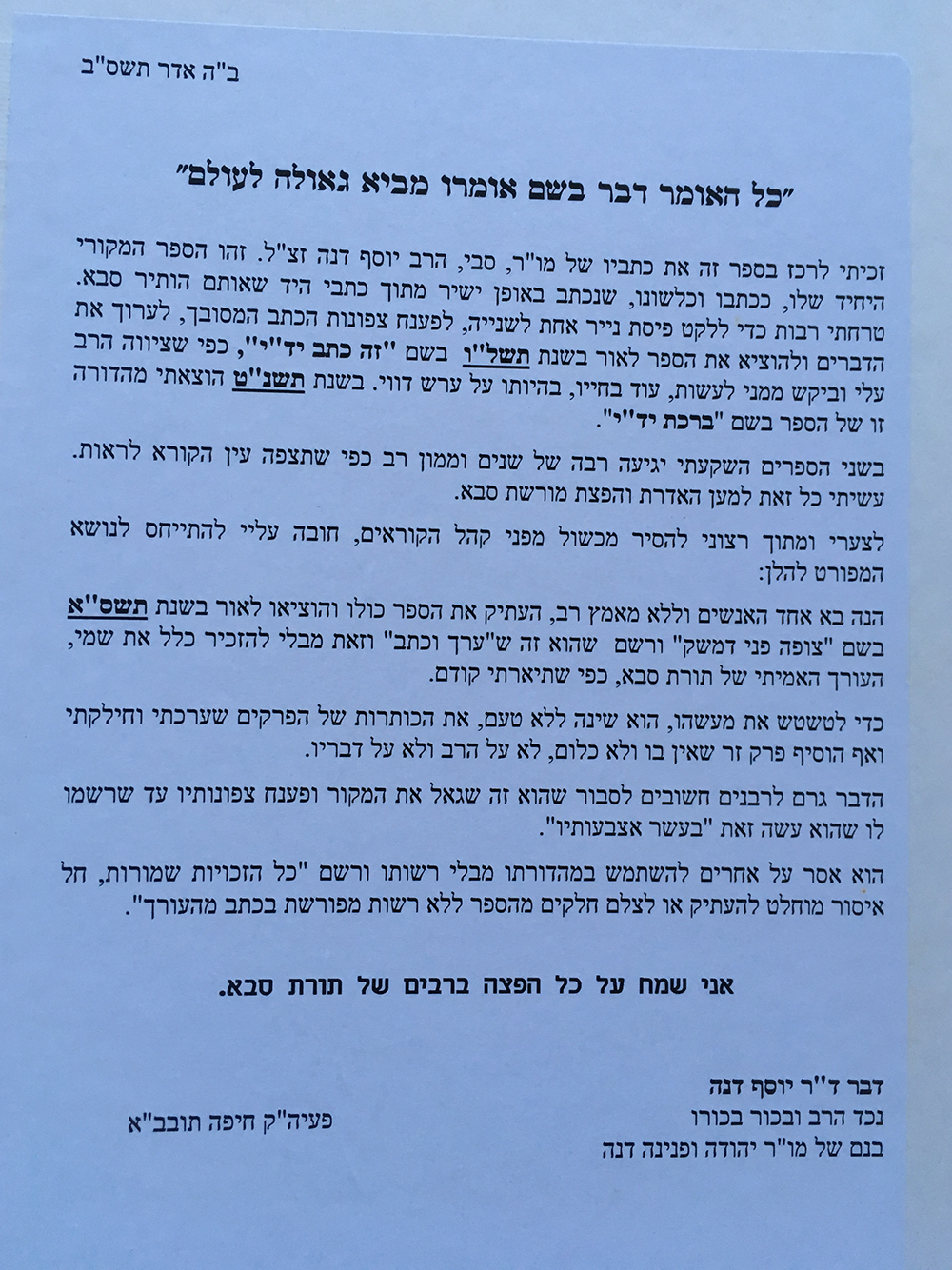
Getting back to the matter of seforim, while looking through the books at the Chabad House I saw Birkat Yadi by R. Joseph Judah Dana.
I had never before seen this book and it is not found on Otzar ha-Chochmah. Pasted on the inside cover is the following. (Unfortunately, the pictures I took came out blue on my phone.)
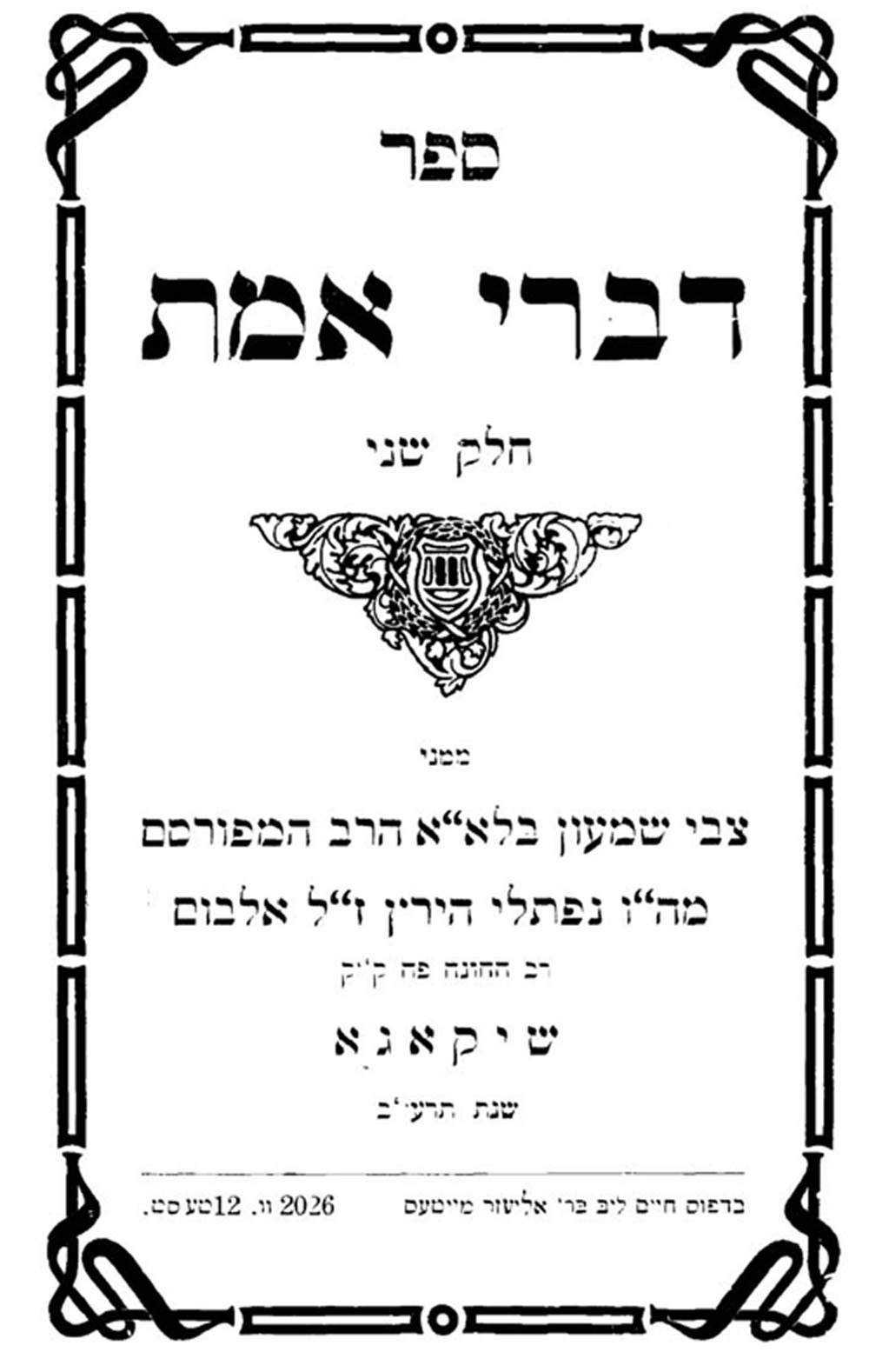
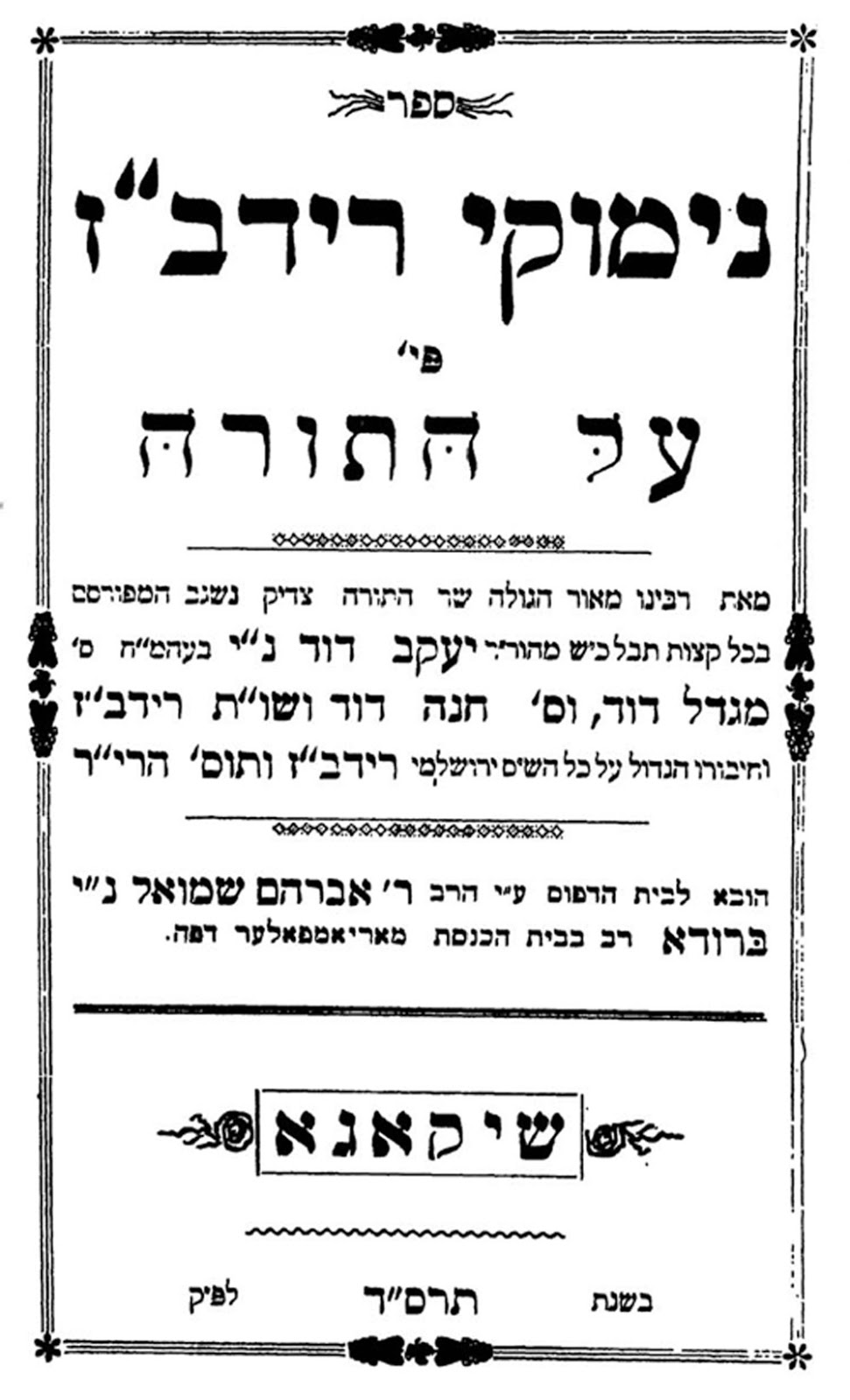
The book the editor, Prof. Joseph Dana, is referring to is Tzofeh Penei Damesek. Here is the title page.
Without getting into the accusation of plagiarism, there is something that is noteworthy about Tzofeh Penei Damesek, namely, that included among the approbations from great rabbis is a lengthy letter from Professor José Faur.
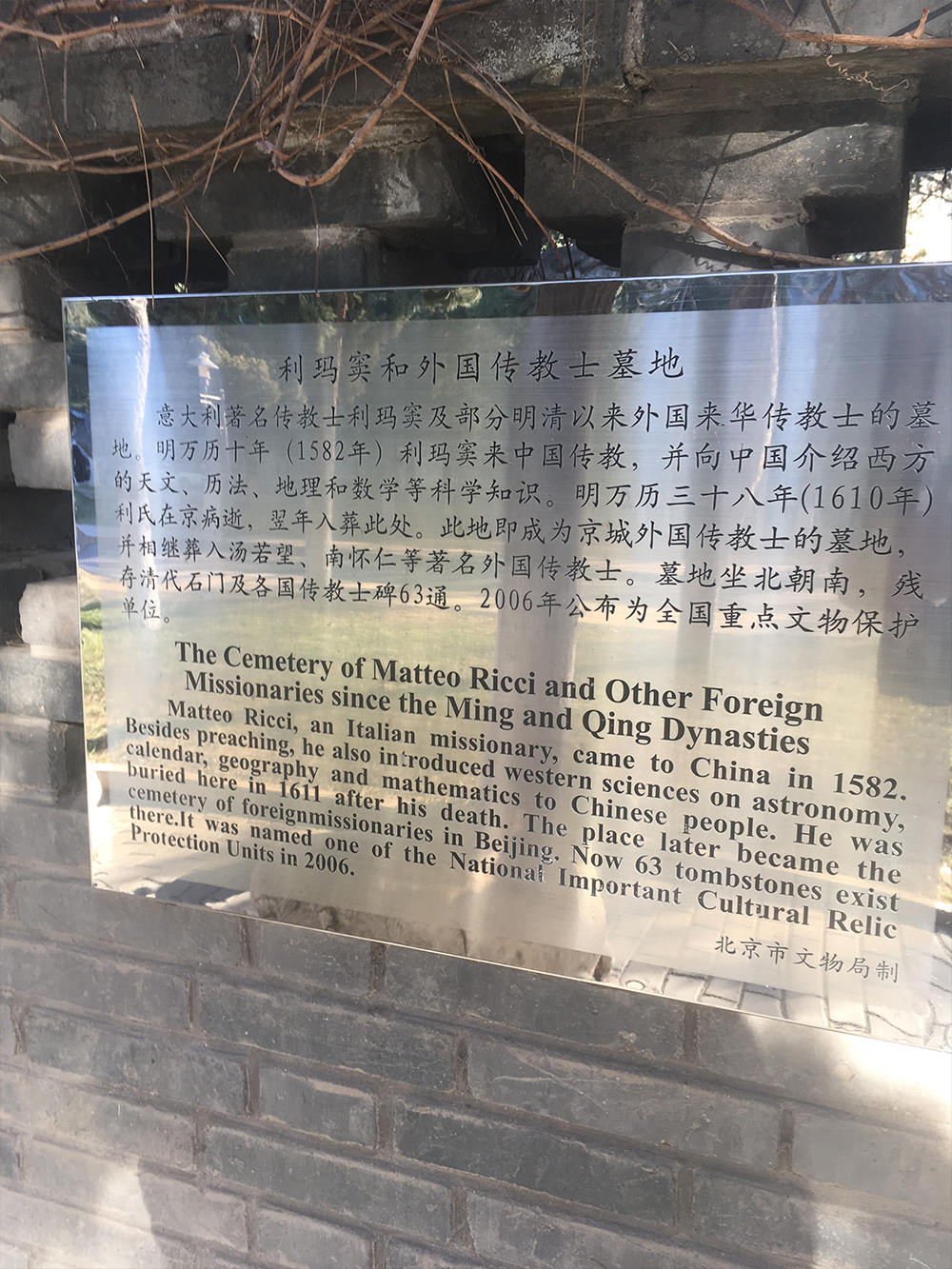
Let me share one other interesting thing about my recent trip to Beijing. It isn’t related to seforim but was of great interest to my colleagues at the University of Scranton, which is a Jesuit university.  The Friday night before arriving in Beijing I was in Hong Kong and learned that one of the people I was talking to at dinner shared my interest in Matteo Ricci (1552-1610), the famous Jesuit missionary to China. This man told me that years before he had visited Ricci’s grave and that it was worthwhile for me go see it. There is actually a Jewish connection here, for Ricci was asked if he would take over the position of rabbi of the Kaifeng Jewish community, but on the condition that he give up eating pork.[2] (Obviously the Jews of Kaifeng were not the most learned.)
I checked online and saw that Ricci’s grave, which is found in the first Christian cemetery in China, was indeed a site that some tourists had written about. However, in recent years it had become much harder to visit without being part of an organized group and arranging the visit ahead of time. The fact that the small cemetery is found on the grounds of a Communist party school is no doubt the reason for this. I was thus unsure whether they would allow me in, but my guide was able to convince them that I was harmless. If it were only so easy to get into some of the old Jewish cemeteries I have attempted to visit.
Here is the grave and the plaque put up nearby.
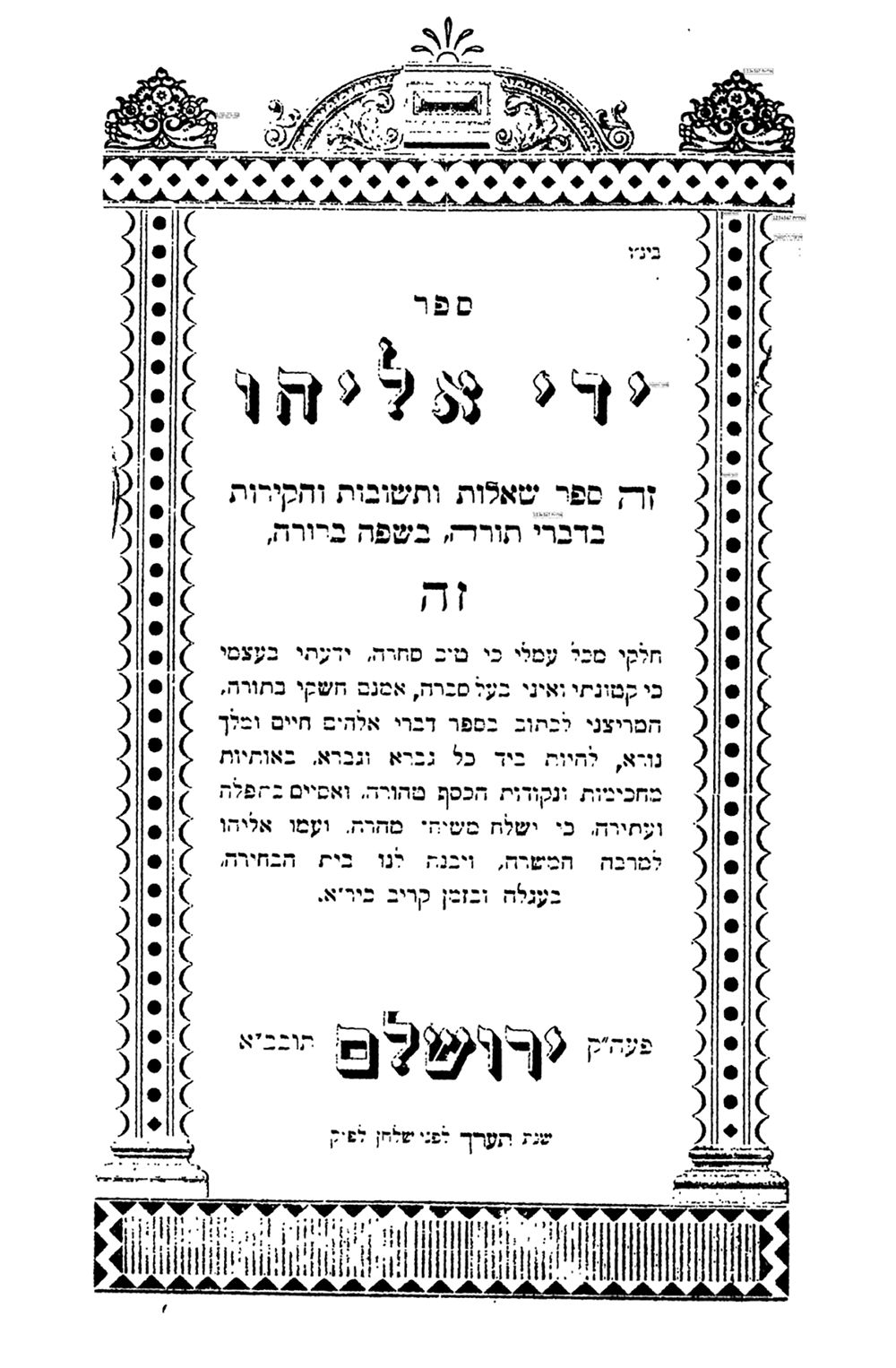
Concerning China there is a lot more I have to say, and I hope to publish a manuscript from a few hundred years ago regarding the Jews of China. For now, let me just note the following which will be of particular interest to Seforim Blog readers: There are two works of responsa that were published by rabbis who served in China. (I am not including Hong Kong which I will return to in a future post.) The first is R. Elijah Hazan’s Yedei Eliyahu. Here is the title page of volume 1.
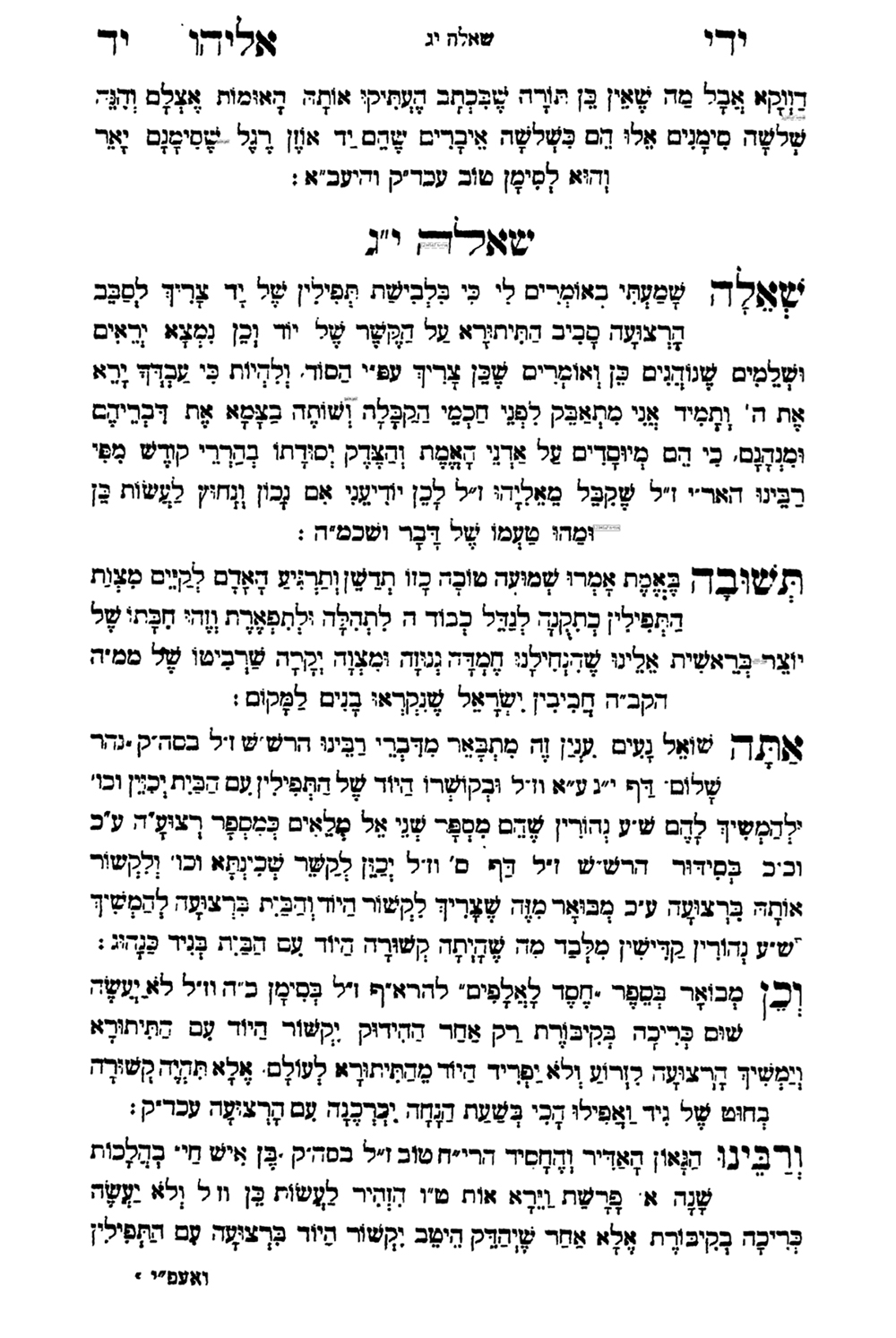
R. Hazan published three volumes in total. What makes his responsa very unusual, if not unique, is that the text is published complete with vowels. I don’t think I have ever seen another responsa collection published with vowels. Here is a sample page.
As R. Hazan explains in the introduction, he was the hazan in the Ohel Leah Synagogue in Hong Kong for fourteen years. Following this, for ten years he served as hazan at the Ohel Rachel Synagogue in Shanghai. Both of these synagogues still exist, but Ohel Rachel is now part of the Shanghai Educational Ministry and tourists are not permitted entry.
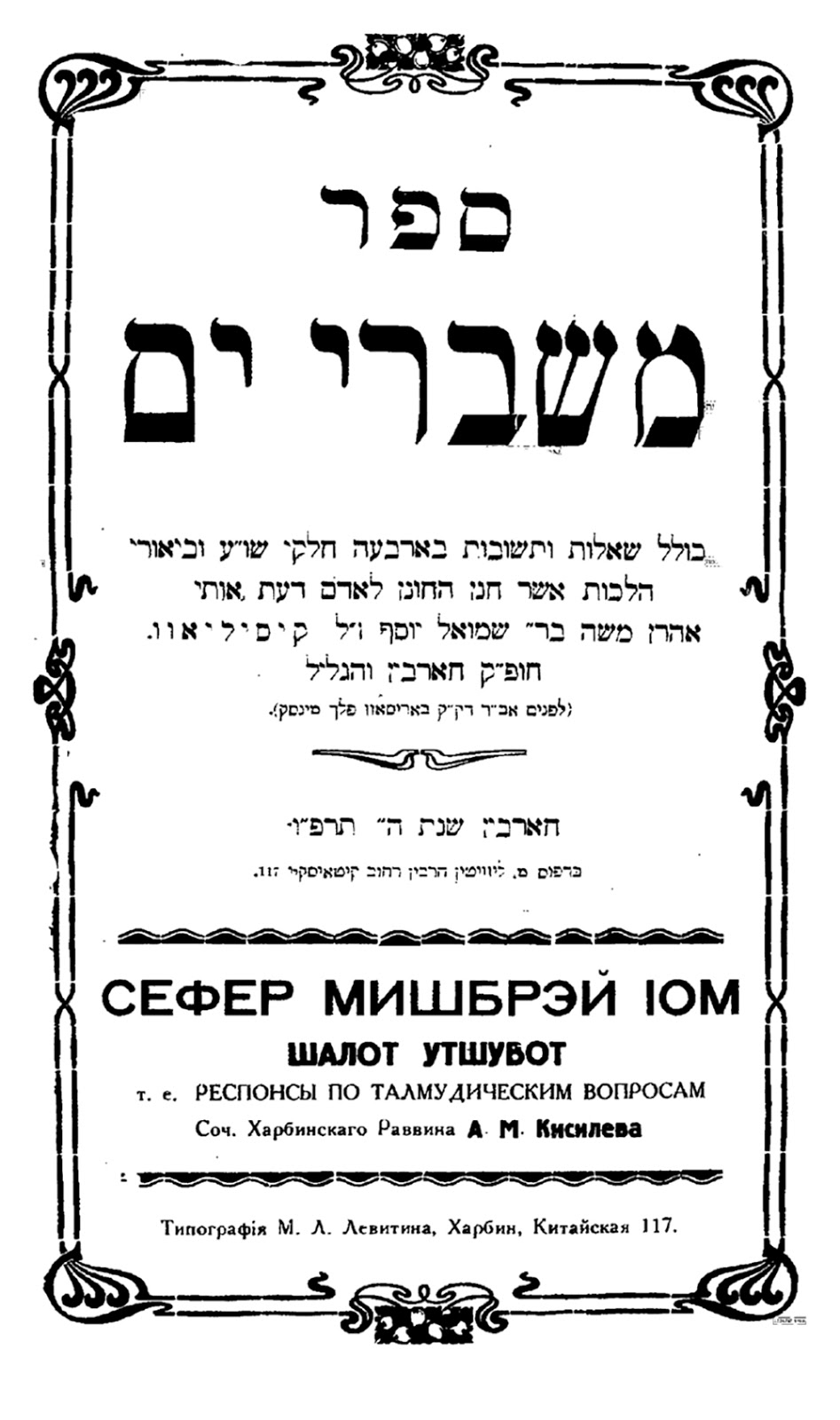
The second work of responsa by a rabbi in China is R. Aaron Moses Kiseleff’s Mishberei Yam. Here is the title page.
This book is significant not only because the author lived in China, but also because the book itself was printed in China in 1926, in the city of Harbin. Because of its proximity to Russia, Harbin attracted many Russian Jews and they were the ones who brought R. Kiseleff there. In the 1920s the Jewish population of Harbin was over 20,000.[3] As late as the 1940s there still was a Jewish day school in Harbin.[4]
Not long ago I saw that R. Gedaliah Felder, Yesodei Yeshurun: Shabbat, vol. 2, p. 216, refers to R. Kiseleff’s Mishberei Yam, and in a footnote writes:[5]
הספר הזה חשוב מאד כי זה הספר היחידי של הלכה שנדפס ברוסיא אחרי המהפכה, נדפס בשנת תרפ”ו.
No doubt because he saw the Russian writing on the title page of Mishberei Yam, R. Felder mistakenly assumed that Harbin is in Russia. He thus concluded falsely that Mishberei Yam is the only book on halakhah published in the Soviet Union. While this is incorrect, had he known the truth he could have kept the footnote but changed it to say that Mishberei Yam is important since it is the only original book on halakhah published in China.
R. Kiseleff served as rabbi in Harbin from 1913 until his death in 1949. After his death, his widow moved to Israel and published R. Kiseleff’s derashot, Imrei Shefer. Here is the title page which refers to R. Kiseleff as the chief rabbi of the Far East.
As explained in the introduction, R. Kiseleff was actually given this title in 1937 at a gathering of Far East Jewish communities.[6]
Herman Dicker writes as follows:[7]
Rabbi Kiseleff was a great Talmudic scholar who first came to Harbin when he was in his forties. He was born in Sores, Russia, in 1866 and as a child excelled in Jewish studies. He soon became known as the Vietker Ilui (wonder child), taking his name from the Yeshiva he attended as a youth. At sixteen, he transferred to the Yeshiva of Minsk, and, two years later, moved over to the Talmudic Center of Volozhin, where he studied with the famed Rabbi Chaim Soloveitchik. . . . Rabbi Kiseleff was ordained by Rabbi Chaim Ozer Grodzenski and then served as the rabbi of Borisoff from 1900-1913. In his final year at Borisoff, in 1913, Rabbi Kiseleff was called to Harbin and he accepted the post as spiritual head there at the gentle urging of the Lubavitcher Rebbe.
Within a short period of time, Rabbi Kiseleff won the love and admiration of the entire community and achieved a great deal in raising the spiritual level of this remote Jewish congregation. It was, therefore, fitting that in 1937 he was elected, unanimously, as Chief Rabbi by the General Conference of the Far Eastern Jewish Communities. . . .
In 1931, he published Nationalism and Judaism, a Russian-language volume of sermons and lectures on the significance of Judaism. . . . Rabbi Kiseleff enjoyed the friendship of all the religious and intellectual leaders of Manchuria, without regard to their nationality or faith, for they all admired him as a person and respected his vast knowledge in various areas of academic learning. At one time, he debated the “Merchant of Venice” and the image of Shylock with three university professors and to this day scores of men and women remember his brilliance and eloquence on that occasion.
There is a good deal of interesting material in R. Kiseleff’s Mishberei Yam, and let me call attention to just a few things. In no. 15, R. Kiseleff rules that if there is a non-Jew who wants to convert but the doctors tell him that it is dangerous for him to be circumcised, he still cannot be converted without a circumcision. In this responsum, R. Kiseleff also writes about how rabbis should avoid converting people who are not serious about being good Jews (although he assumes, as most rabbis did until recent years, that a conversion with such people would still be valid ex post facto).
ובכלל עלינו להתרחק בכל האפשר לקבל גרים כאלו שידוע שרוב הגרים הבאים להתגייר בימינו לא משום אהבתם לדת ישראל באמת רק על הרוב סבות אחרות בדבר משום אשה או דומה לזה ואף שמלמדים אותם לומר בפני ב”ד שאוהבים את דת ישראל ומטעמים ידועים אין אנו דוחים אותם שהרי בדיעבד גם בכה”ג הוי גר, אבל גרים כאלו יותר נוח לנו שאם נמצא אמתלא שלא לקבלם מהראוי להתרחק מזה, דאם בגרים אמתים אמרו חז”ל שקשים לישראל כספחת מה נענה לגרים גרורים כאלו שאין לבם לשמים כלל.
In no. 19 he discusses if a married woman becomes insane and has a child with someone other than her husband, if the child is a mamzer.
In no. 28 he responds to a rabbi in a Far East Russian community in which there were no Sabbath observant people other than the rabbi’s family. This created problems when it came to writing a get as one needs kosher witnesses and also the sofer cannot be a Sabbath violator. R. Kiseleff argues that since everyone in the town violates Shabbat, these people are not included under the halakhic definition of a “public Sabbath violator,” which means that one violates Shabbat in front of ten observant Jews. Therefore, none of the many gittin arranged by the questioning rabbi’s predecessor are to be regarded as pasul. At the end of his responsum, R. Kiseleff notes that in Siberia there is a big problem when it comes to gittin, as many places have no rabbi and the local shochet arranges the get. Needless to say, these shochetim were often not learned at all in this matter, and this could create major halakhic complications. R. Kiseleff therefore suggested that no one should be authorized to slaughter in Siberia until he learns the laws of gittin and is given an authorization to arrange gittin.
In nos. 29-30 he deals with a case of a man who gave a get and afterwards claimed that he was forced to do so, as he was beaten and the people beating him said that if he doesn’t give the get they will kill him. R. Kiseleff writes that the get is valid as the man would not have taken the threat seriously. In support of his assumption, he cites R. Moses Isserles who states with reference to a different case that Jews who threaten to kill another Jew are only trying to scare him, “as Jews are not murderers.”[8] R. Kiseleff sent his responsum to R. Meir Simhah of Dvinsk, and the latter disagreed with R. Kiseleff. R. Meir Simhah argued that contemporary “wild” young Jews are indeed capable of killing someone, and thus when threatened by them the man being pressured to authorize the get certainly would have taken this seriously.
דבחורי ישראל הפרוצים בזמנינו חשידי גם אשפ”ד
Here is another story about Harbin told by R. David Abraham Mandelbaum. In 1943 his father and his friend, both yeshiva students in Shanghai, came to Harbin where they visited the university. While there, and presumably in the library, they found on one of the tables a Sefat Emet on Kodashim. The two students were very surprised, since how did this book end up in such a far-away place? They grabbed the book and quickly exited.[9]
פתאום צדו עינים ספר קודש, המונח על אחד השולחנות. הבחורים המופתעים ניגשו ופתחו וגילו להפתעתם, שזהו הספר הק’ “שפת אמת” על סדר קדשים. התדהמה היתה עצומה, איך הגיע ספר קדוש זה למקום נידח, בעיר חארבין שבסין הרחוקה?! אפס, הם לא חשבו הרבה, שמו את הספר באמתחתם, והסתלקו חיש מהר מן המקום כמוצאי שלל רב.
The story as told is quite shocking to me and I am surprised that it was reported, for how was this not thievery? Presumably, the university acquired the book from one of the local Jews who donated it. Or perhaps at the time the yeshiva students were visiting the man who was studying the book had gone out to the restroom or he had left the book there from a previous visit. If such was the case, when the man returned he would have been very upset to find that his book was taken. It appears that the two yeshiva students simply felt that they had a right to take the book, as it did not belong in a Chinese institution.
This reminds me of how many years ago I walked into the library of the Jewish Theological Seminary and saw that they had installed an anti-theft system to prevent anyone from removing a book without it being checked out. Upon inquiring I was told that this was necessary as some people thought it was OK to take books from the library, as they felt that they were “liberating” the books from the clutches of those who had no right to them, that is, the Conservatives. I never took that claim seriously and always assumed that a thief is a thief, and the people stealing the books – no matter how big their kippot or how long their beards – did not have any religious justification worked out. Subsequent experiences have shown me that these sorts of thieves will steal from anyone if given the chance, even if it means pretending to be kollel students. (I won’t elaborate further, but some European readers will know what I am referring to). But in the case from Harbin, it seems obvious that the reason for taking the book was precisely because the yeshiva students felt that there was no reason for the Sefat Emet to be in a Chinese institution. As mentioned already, I do not see how this can be justified halakhically, as we are not talking about a Jewish book that was, for example, confiscated by the government for anti-Semitic reasons.[10]
After the yeshiva students returned to Shanghai with the Sefat Emet, it was then reprinted there. Here is the title page.
They also sent a copy of the book to R. Kiseleff, and here is the letter that accompanied the book.[11]
Interestingly, the copy of Sefat Emet that they used to reprint the book was missing some words. They therefore added by hand what they thought were the missing words. The following appears in R. David Abraham Mandelbaum, Giborei ha-Hayil, vol. 2, p. 107.
As is well known, when the Mir yeshiva reached Japan there was a lot of confusion about when to observe Shabbat and especially the upcoming Yom Kippur. Although there was already a local community there that observed Shabbat on Saturday, the Hazon Ish had informed the yeshiva that they must observe Shabbat on Sunday. R. Yehezkel Levenstein, the mashgiach of the Mir yeshiva, wrote to R. Kiseleff asking him specifically what to do about Yom Kippur, and he included a copy of the Hazon Ish’s letter explaining his reasoning. It is interesting that even after receiving the Hazon Ish’s letter R. Levenstein felt the need to consult with R Kiseleff, who was, as we have seen, regarded as the mara de-atra of the Far East.[12]
R. Kiseleff did not accept the Hazon Ish’s position. He told R. Levenstein that the question of Yom Kippur is no different than Shabbat, and they should keep the day that is currently being kept. R. Kiseleff was particularly worried that moving the Shabbat to Sunday, when it had previously been observed on Saturday, could lead to a lessening of Shabbat observance among the general Jewish population:
ורע עלי המעשה ששמעתי שמקצת מן הפליטים בקאבע קראו בתורה ביום א’ והתפללו תפלת שבת, ביחוד היא דרושה זהירות מרובה בענין זה בתבל כו’. ועתה כאשר נמצאו חרדים לדבר ד’ דוחים את השבת ליום א’ חג הנוצרים, יקל ענין שבת בעיניהם לגמרי, ויאמרו התירו פרושים את הדבר, ויצא מזה מכשול גדול אשר קשה יהי’ לתקן. לכן נלך מדרך זה חדש כזה אסור מן התורה בכל מקום . . . וכל המשנה ידו על התחתונה.
R. Aryeh Leib Malin also wrote to R. Kiseleff, and R. Kiseleff replied to him saying the same thing and sharply rejecting the Hazon Ish’s opinion.
בערב ש”ק העבר הרציתי מכתב להרב ר’ יחזקאל לעווינשטיין שליט”א בתשובה על מכתב הרב חזון איש, בו הודעתי טעמי ונימוקי שלא אסכים לפסק דינו על דבר דחיית יום השבת ביאפאן ליום א’ . . . כי דבריו בנוים על יסוד רעוע ובלתי ברור ומוסכם . . . ובלי ספק יגרום חלול שבת ותשתכח תורת שבת לגמרי . . . והריני מורה שיהודי יאפאן ישמרו שבת ומועדים ככל היהודים [במזרח הרחוק].
One wonders how R. Kiseleff would have reacted had he known that according to R. Simhah Zelig Rieger even in Harbin Jews should avoid Torah prohibitions on Sunday.[13] 

והרי הישראלים בחארבין שהיא מארץ חינא אינם מתנהגים כבעל המאור, נראה שלענין התפילה שהוא ענין דרבנן לא נשנה ממנהג הישראלים היושבים שם. ולענין איסור דאורייתא יש לחוש לדעת בעל המאור שהשבת מאוחרה לשל ירושלים

I earlier mentioned R. Kiseleff’s book of derashotImrei Shefer. In addition to the typical derashot one would expect in such a volume, it also includes eulogies for the Hafetz Hayyim and R. Kook. Regarding R. Kook, R. Kiseleff tells us that they were at the Volozhin yeshiva together and R. Kook was regarded then as one of the yeshiva’s outstanding students. He also records a talmudic question that R. Kook asked that R. Kiseleff tells us became the talk of all the students. Also included in the book are speeches R. Kiseleff gave on the twentieth and twenty-fifth anniversaries of Herzl’s death. He describes how thanks to Herzl many Jews who were entirely removed from Jewish life and ready to assimilate began to feel pride in their heritage and reconnect to their people.

Also included in the book are speeches he gave in honor of the Balfour Declaration and in memory of Nahum Sokolow and the victims of the 1929 massacres in the Land of Israel. Especially noteworthy is the speech found on p. 97, which celebrates the opening of the Hebrew University.
Many readers know about R. Kook’s speech on this occasion, and how he was attacked for supposedly applying to the university the verse, “For Torah shall forth from Zion, and the word of the Lord from Jerusalem” (Isaiah 2:3, Micah 4:2).[14] While R. Kook never used this verse with reference to the Hebrew University, R. Kiseleff did, as you can see from the above text.
* * * * *
In my post here I wrote:
It has been a while since I had a quiz, so here goes. In the current post I mentioned the prohibition of Torah study on Tisha be-Av. This is an example where the halakhah of Tisha be-Av is stricter than that of Yom Kippur. Many authorities rule that there is also something else that is forbidden on Tisha be-Av but permitted on Yom Kippur. Answers should be sent to me.
Many wrote to me that it is forbidden to greet someone on Tisha be-Av but not on Yom Kippur. Greeting is forbidden on Tisha be-Av due to the halakhot of mourning. However, this is forbidden according to everyone, and in the question I asked for an example of something that according to “many authorities” is forbidden on Tisha be-Av but permitted on Yom Kippur. If you pointed to something that is forbidden by “all” authorities (i.e., standard undisputed halakhah), this is not the correct answer.
A number of people also wrote to me that on Tisha be-Av one does not sit in a regular chair, unlike on Yom Kippur. Yet contrary to popular belief – and based on the emails I have received, it is indeed a quite popular belief – there is no halakhah that one must sit on the ground on Tisha be-Av. Rather, this is a minhag, not a law, and because it is a minhag we do not sit on the ground the entire day.[15]
The correct answer, which was sent to me by Brian Schwartz and Abe Lederer, is that many authorities hold that it forbidden to smell spices on Tisha be-Av, but this is not the case on Yom Kippur. In fact, smelling spices is recommended on Yom Kippur as a way to increase the number of blessings recited on this day, so that one can reach one hundred.[16]
While this is the answer I had in mind, Peretz Mochkin sent me another answer. If one has a seminal discharge on Yom Kippur, most poskim, including the Shulhan Arukh, Orah Hayyim 613:11, hold that he cannot go to the mikveh on this day. However, there are a number of significant authorities who hold that he may do so. When it comes to Tisha be-Av, there is agreement among halakhic authorities that it is forbidden to go to the mikveh after a seminal discharge.[17] However, this does not really answer the quiz question, since the question spoke of something that is permitted on Yom Kippur but forbidden on Tisha be-Av, and as noted, most poskim, at least in recent generations, forbid going to the mikveh on Yom Kippur in the case of a seminal discharge.[18]
________________________________
[1] I am aware of another posek who permits using an electronic key card on Shabbat, but requires covering up the green LED light. He explained to me that people feel good when they see the green light go on, and thus it cannot be regarded as a פסיק רישא דלא ניחא ליה. I wonder though, would other poskim agree that the feeling of satisfaction that the key works really be regarded as the sort of benefit that is considered as ניחא ליה? I think we usually assume that ניחא ליה is some sort of tangible benefit, like a light that goes on and allows you to see. In any event, the LED light is not a concern for R. Rabinovitch, and he does not require covering it up. R. Yitzhak Abadi only permits using an electronic key card on Yom Tov, and he too does not require covering up the LED light.
[2] See Donald Daniel Leslie, The Survival of the Chinese Jews: The Jewish Community of Kaifeng (Leiden, 1972), pp. 33-34; Jonathan D. Spence, The Memory Palace of Matteo Ricci (New York, 1983), p. 121.
[3] See Patrick Fuliang Shan, “‘A Proud and Creative Jewish Community’: The Harbin Diaspora, Jewish Memory and Sino-Israel Relations,” American Review of China Studies 9 (Fall 2008), p. 7. See also Joshua Fogel, “The Japanese and the Jews: A Comparative Analysis of Their Communities in Harbin, 1898-1930,” in Robert Bickers and Christian Henriot, eds., New Frontiers: Imperialism’s New Communities in East Asia, 1842-1935(Manchester, 2000), pp. 88-109
[4] See Zorah Warhaftig, Refugee and Survivor (Jerusalem, 19880, p. 208.
[5] Yesodei Yeshurun: Shabbat, vol. 2, p. 216.
[6] For the political background of these gatherings, see Herman Dicker, Wanderers and Settlers in the Far East (New York, 1962), pp. 45ff.; David Kranzler, Japanese, Nazis and Jews: The Jewish Refugee Comunity of Shanghai, 1938-1945 (Hoboken, 1988), pp. 220ff.
[7] Ibid., pp. 25-26. Much of what Dicker writes is taken word for word from the introduction to Imrei Shefer.
[8] Shulhan Arukh, Hoshen Mishpat, 236:1.
[9] David Avraham Mandelbaum, Giborei ha-Hayil (Bnei Brak, 2010), vol. 2, p. 105.
[10] The Hebrew manuscripts in the Vatican was an issue in the late 1980s, when the late Manfred Lehmann led a group, the Committee for the Recovery of Jewish Manuscripts, which insisted that the manuscripts be returned to the Jewish people by being donated to the National Library of Israel. See Lehmann, “The Story of the Hebrew Manuscripts in the Vatican Library,” available here. Nothing came of this venture and it does not seem like anyone at present has any interest in making an issue of the matter.
[11] From Mandelbaum, Giborei ha-Hayil, vol. 2, p. 109.
[12] See R. Yohanan ha-Kohen Schwadron, “Be-Inyan Kav ha-Ta’arikh,” Beit Aharon ve-Yisrael, Shevat-Adar 5770, p. 118. The complete letters of R. Kiseleff to R. Levenstein and R. Aryeh Leib Malin (mentioned later in the post) are found in R. Menahem Kasher, Kav ha-Taarikh ha-Yisraeli (Jerusalem, 1977), pp. 241-242.
[13] See his letter published in Talpiot 2 (1945), pp. 177-178.
[14] See my Changing the Immutable, pp. 143, 151.
[15] See e.g., here.
[16] See R. Yitzhak Yosef, Yalkut Yosef, Orah Hayyim 612:3. R. Yosef does cite a few sources that forbid smelling spices on Yom Kippur, but this viewpoint has never been accepted. I don’t think readers will be surprised to learn that there is an entire sefer devoted to the laws of smelling. The anonymously published 224-page Birkat ha-Reiahappeared in 2004. Here is the title page.
On pp. 196ff. he discusses the case of someone who has no sense of smell. The question is, can he make the blessing on besamim? The Shulhan Arukh, Orah Hayyim 297:5, rules that such a person can make the blessing on behalf of one who does not know how to make the blessing himself. This ruling was disputed by others, yet R. Jacob Reischer, Shevut Ya’akov, vol. 3, no. 20, defends the Shulhan Arukh, but as he says, not for R. Joseph Karo’s reason. R. Reischer argues that even though one without the sense of smell does not get any physical benefit from smelling something, his soul benefits. R. Reischer mentions that although the doctors reject the notion that the soul gets any benefit from this, their viewpoint can be disregarded because their scientific knowledge comes from “Aristotle and his companions.” R. Reischer died in 1733 and it is amazing that this is how he regarded the state of the study of medicine. Even more amazing, however, is that as he continues to attack modern science, R. Reischer adds that the non-Jewish scientists’ knowledge is based on the assumption that the earth is round, which contradicts the talmudic understanding and is thus to be rejected. How is it possible that in the eighteenth century R. Reischer believed that the earth was flat? 

The Vilna Gaon is also recorded as having held this opinion. See R. Joshua Heschel Levin, Aliyot Eliyahu (Jerusalem, 1989), p. 98 n. 82. This also appears to be what the Vilna Gaon is saying in his commentary to Tikunei Zohar (Vilna, 1867), p. 158a:

והוא יסוד הארץ שהיא רבועא כמ”ש מארבע כנפות הארץ ואמר בספרי הכנף לאפוקי עגול’ [עגולה]
See also R. Reuven Margaliyot’s note to Zohar, Vayikra, p. 10a, n. 10 (he mistakenly cites the Vilna Gaon’s comment as appearing in his commentary to Tikunei Zohar, p. 5b).
Did R. Zvi Elimelekh of Dinov, the Bnei Yisaskhar, think the earth was flat? Here is what he writes in his Devarim Nehmadim to Avot 5:1:
אין לחקור על היוצר כל למה ברא את העולם [בי’ מאמרות וגם] אין לחקור למה ברא את השמי’ כדוריי והארץ שטחיית וכיוצ’.
See here for a contemporary rabbi and author of seforim who believes the earth is flat.
[17] The only exceptions to this I have found are two unknown sources mentioned by R. Simhah Rabinowitz, Piskei Teshuvot, Orah Hayyim 554 note 58. These two sources are (תורת חיים (פעסט and קונטרס קודש ישראל 
[18] R. Joseph Hayyim, Rav Pealim, vol. 2, Orah Hayyim no. 61, states that among the medieval authorities, most held that it is permissible to to go to the mikveh on Yom Kippur after a seminal discharge: 

דהמתירים לטבול הם רוב מנין ורוב בנין


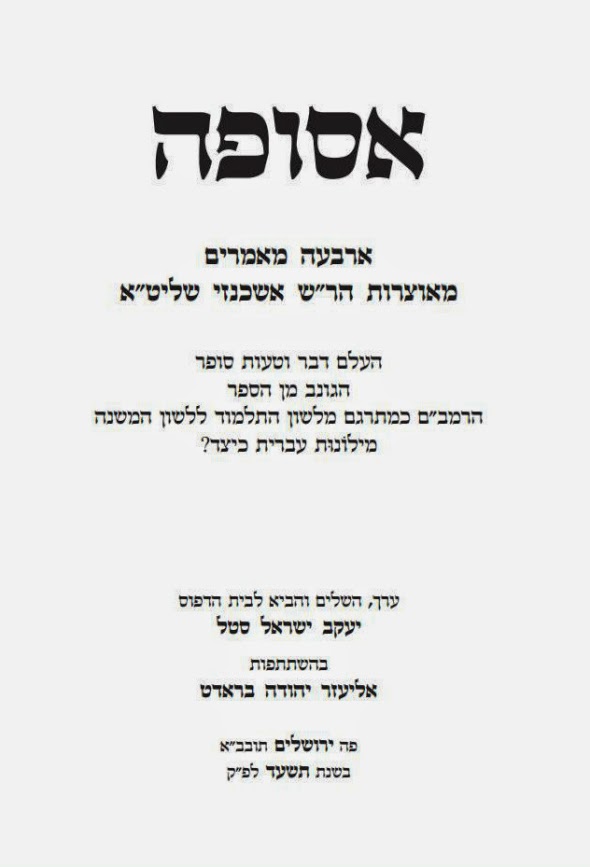
Asufah of Rabbi Shmuel Ashkenazi

New sefer announcement: Asufah of Rabbi Shmuel Ashkenazi
By Eliezer Brodt  
אסופה, ארבעה מאמרים מאוצרות הר”ש אשכנזי שליט”א [‘העלם דבר וטעות סופר’, ‘הגונב מן הספר’, ‘הרמב”ם כמתרגם מלשון התלמוד ללשון המשנה’, ‘מילונות עברית כיצד’?], ערך והשלים והביא לבית הדפוס, יעקב ישראל סטל, בהשתתפות אליעזר יהודה בראדט, כריכה רכה, 166 עמודים.
It is with great pleasure that I announce the release of another volume of Rabbi Shmuel Ashkenazi’s work- Asufah. As I have written in the past, we are trying to print the collected material Rabbi Ashkenazi has written over a seventy year period. Many additional volumes are ready to go to print, but we lack funds to
do so [any help would be greatly appreciated].
This new volume is composed of four articles. Two of these articles (no. 3 and 4) were printed in Leshonenu and Leshonenu L’Am, almost fifty years ago. A third article (no. 2) was partially printed in a recent volume of Yeshurun, and the fourth article (no. 1) was supposed to have been printed in the journal
Or Yisrael but was excluded from the volume right before printing.
The first article deals with mistakes that great people have made in their writings. The point of the collection is to show that anyone can make a mistake, however this does in no way detract from their greatness. This sampling is only a small part [18 samples] of a much larger collection of similar kinds of mistakes that we hope to print in the future.
The second article is a list of 85[!] cases of plagiarisms. It’s seventy two pages long and includes a very broad introduction on the subject. Hopefully this list will encourage others to collect similar instances and work to complete such a list.
The third article deals with the Rambam as a translator. As is well known, the Rambam wrote his classic work Yad Hachzakah in the Hebrew of the Mishna, as opposed to Talmudic Hebrew which is comprised of many Aramaic loanwords as well.  Thus, the Rambam had to translate many Aramaic terms into Hebrew. This article deals with this topic and shows many interesting points related to this.
The fourth article is a review of the popular Hebrew dictionary HaMilon HaChadash, by Avraham Even-Shoshan. This article was first published in 1967 in the language journal Leshonanu in three parts. Some of the material from these articles was added into later editions of the dictionary. There is a wealth of information in this article about words and expressions. Rabbi Ashkenazi had made a 12 page index for his own personal copy of the article; this index is published here for the first time in this volume. Additionally,
Rabbi Ashkenazi added many notes which he recorded over the years on the side of his copy of the article. All of the above addenda have been included in this printing.
 In sum, this volume is of importance to any person interested in the Jewish book or the Hebrew Language.
The book was printed in a limited run of 300 copies and is not being sold in retail stores. If one is interested in purchasing a copy he can do so either through me, or at Beigeleisen in the U.S. or Girsa in Jerusalem. The price of the book, including air mail shipping to the U.S., Canada or England is $24.
For a sample of this work or for any other information regarding this project, feel free to email me at: eliezerbrodt@gmail.com


Eliezer Brodt: Corrections and Clarifications


Corrections and Clarifications on Two Editions of R. Chaim Berlin’s Responsa: An Egregious Example of Censorship
by: Eliezer Brodt


From time to time I get feed back about some of my previous posts some good some bad – aside from the standard criticism of poor grammar, editing or transliterating, all of which are my fault entirely. The blog does not have a full time editor (its all on a volunteer basis), and the goal of the editors, in general, is to get out posts at high speed with good content (many of which could have been printed in journals) but this avoids the whole long process of printing etc. Sometimes the feedback shows that some things need more clarifications or statements I made are simply wrong and need to be corrected. Thus, I definitely encourage all feedback. When I write posts (although I spend much time researching and writing them) I am still collecting information on these topics which I hope to incorporate at future times (at times I have done so already). Another point, which almost goes without saying, is that I am definitely not trying to Pasken any halachic leniency with what I quote.  I just like to bring interesting, nice points to public knowledge. With this introduction I would like to clarify some issues as a few very important remarks and corrections are in order about a previous post of mine Two Editions of R. Chaim Berlin’s Responsa: An Egregious Example of Censorship

In this post I accused the editors of the new edition for censorship in a few places most notably a leniency about shaking woman hands and a pro-Chassidus statement. I then concluded that there are probably more examples of censorship in this work but I do not have time to go through all four volumes. In general before I write a review on a sefer I read the sefer cover to cover a few times carefully. Since this work has four massive volumes I did not do so. Instead I used the many indexes of the sefer based on topics, Shas and names of the people mentioned etc. I could not find the various pieces so I concluded that there was censorship. I recently received a letter from an old friend who read through this post very carefully and had a few very important comments. I would like to deal with some of his comments. 

On Shaking hands with woman

First of all I accuse the editors of the new edition of censoring this Teshuvah by removing it,  but that is simply a false accusation. This Teshvah is included in the new edition in volume two p.257. 
Second of all my friend writes: “I will admit that when I first saw the teshuvah I too understood it to mean that,  but after a careful reading that R. Chaim Berlin actually never permits shaking hands at all. Rather, R. Berlin brings the Gemarah in Brochos about someone who hands money to a woman in order to look at her, R. Berlin therefore deduces that if the intent is not in order to look at her (as is the case in the one who asked the shaila) then this would not apply and it would be permissible to pass money from his hand to hers. He then adds that it would be better to be careful about this too, but if this proves impossible one should not be machmir etc. that’s all. It would seem quite clear that he is discussing a situation of someone who has a business or runs a store (as the one who asked the shaila, R. Alshvang, did) and needs to hand money (or merchandise) to his customers. This is the case of the above mentioned Gemarah (i.e. passing money, not shaking hands). After finding this teshuvah in the new edition I saw that the publishers of the new edition were kind enough to explain this (and were careful to put this explanation in brackets; the accepted form of an editors addition).”

 
I will admit this argument sounds convincing but I am not sure it is correct. The exact quote of the Teshuvah is as follows:
 
אשר שאל על דבר נתינת ידו לרשעים או לנכרית, הנה ליתן יד לפושעים אין שום איסור בזה אם אין בזה הודאה וחיזוק להנהגותיהם בשרירות לבם. ולתת יד לאשה לשון הש”ס הוא ברכות ס”א א’ המרצה מעות לאשה מידו לידה כדי להסתכל בה, מבואר דאם אינו מכוין לשום דבר וכש”כ שאינו עושה כדי להסתכל בה כמו מעלתו שכל מעשיו לשם שמים אין איסור בזה לרצות מעות מידו לידה. ודאי אם יוכל להזהר בזה מה טוב, אבל אם אי אפשר לו להנצל מזה כגון אם הנכרית הקדימה והושיט לו את ידה ואין דעתו לשום הרהור ח”ו אין להחמיר בזה, ודרכיה דרכי נועם, ואהבת את ה’ אלקיך אמרו חכמים יומא פ”ו א’ שיהא שם שמים מתאהב על ידך, ולא יאמרו על יראי ה’ שהם משוגעים ואינם בעלי דרך ארץ.
 

A simple reading of the first part was about shaking the hand of a Rasha or non-Jewish woman as his answer implies where he says “as long as it does not show any agreement to their behavior”. I would assume that is not referring to just taking money from them. He then goes on to dealing with the story by a Jewish woman as he says “to give a hand to a woman”. To which he answers based on the Gemarah of giving money to a woman… which I think also answers the question of shaking a woman’s hand. It would definitely be helpful to have the original question of R. Alshvang but I do not. The new edition after the words אשר שאל על דבר נתינת ידו לרשעים או לנכרית, stuck in the words

[בהושטת הפרקמטיא או המו”מ בהרצאת המעות, האם צריך להקפיד שלא למסור מיד ליד]

Now they do not write that they did (nor do they mention in the introduction that they ever do this) this making you think R. Chaim Berlin writes that. But aside for that I am not sure that this is true as his reply does not make sense when he answers אין שום איסור בזה אם אין בזה הודאה וחיזוק להנהגותיהם בשרירות לבם. if he was talking about shaking hands then this statement makes sense but if its just about handing over money I am not sure what it means.

 
 One last point I am not concluding via this possible pesak of R. Chaim Berlin that it is permitted to shake woman’s hands that is for one to ask their local Rav as where I come from we go with the strict pesak of R Moshe Feinstein that it is prohibited as he writes:
ולהושיט יד לאשה כדרך הנותנים שלום בהפגשם, פשוט שאסור אף לפנויה שהרי הן נדות וכ”ש לאשת איש (אגרת משה, או”ח, א, סי’ קיג).
 
Other cases of supposed Censorship:
The piece I brought of additions to the Mishana where R. Chaim Berlin writes:

שביארתי מאמרם ז”ל התמוה מאד בשלהי מס’ סוטה מ”ט ב’ על משנתינו משמת רבי בטלה ענוה ויראת חטא א”ל ר”י לתנא לא תיתני ענוה דאיכא אנא א”ל ר”נ לתנא לא תיתני יראת חטא דאיכא אנא. והתמיה מפורסמת איך אמוראים קדושים כאלה ישבחו עצמם בענוה ויראת חטא, והמלך החכם אמר יהללך זר ולא פיך. וביארתי בס”ד על פי מש”כ הרע”ב ז”ל על האי בבא משמת רבי בטלה ענוה שתלמידיו של רבי הוסיפו וכתבו זה במשנה, וכ”כ בתוס’ רע”ק בשם הרמב”ן בחי’ ע”ז ל”ז א’ שהוא תוספת שהוסיף בר קפרא או לוי במשנה, והמה היו תנאים אחרונים תלמידי רבי. ואמרתי שהוא הוא התנא שדברו עמו רב יוסף ורב נחמן, שרב יוסף א”ל לזה התנא שהוסיף במשנה משמת רבי בטלה ענוה א”ל לא תיתני ענוה שאתה מסתיר מדותיך הטובים ושונה במשנה משמת רבי בטלה ענוה ואנא ידענא שגם אתה ענוותן כרבי ועדיין לא בטלה ענוה משמת רבי, וכן א”ל רב נחמן לזה התנא שהוסיף במשנה משמת רבי בטלה יראת חטא א”ל לתנא לא תיתני יראת חטא שאתה מסתיר מדותיך הטובים ושונה במשנה משמת רבי בטלה יראת חטא ואנא ידענא שגם אתה ירא חטא כרבי, ועדיין לא בטלה יראת חטא משמת רבי, כן ביארתי זה המאמר לפי חומר הנושא.  


I could not figure out why this piece was edited out but my friend has a much more logical explanation. In the introduction of the sefer the editors write they hope to collect all the pieces of R. Chaim Berlin on Agadah and print them shortly.


The pieces where he writes: 

ועל דבר כסוי ראש האשה במטפחת אחת, אם אין שערה נראין אין בזה שום איסור, ועדיף טובא מפיאה נכרית, ואין צריך כלל שני כסויין, ואם אך אין השער נראה בחוץ די בכסוי אחד אף ברשות הרבים, ורשאי גם לקרות ק”ש כנגדה,ואין להחמיר עוד בזמן הזה.
 
I also accused the editors of the new edition of censoring this Teshuvah out but that is simply a false accusation. This Teshvah is included in the new edition in volume two p.260.
 
The pieces where he writes:
לדבר עם אשה בשוק לא נאסר אלא לתלמיד חכם ולא למי שאינו מוחזק בתלמיד חכם, וכשם שתלמיד חכם המדבר עם אשה בשוק גורם בזה חלול השם כן מי שאינו מוחזק לתלמיד חכם הנזהר בזה שלא לדבר עם אשתו לעיני הבריות הוא מיחזי כיוהרא, ויש בזה גם כן חלול השם …
I also accused the editors of the new edition of Censoring this Teshuvah out but that is simply a false accusation. This Teshvah is included in the new edition in volume two p.261. Furthermore in both of these last two pieces, in the new edition we have an addition – the exact question posed to R. Chaim Berlin see p.258-259.


 The Piece Pro Chassidus:

 R. Chaim Berlin writes:

ולהתפלל בבית הכנסת של החסידים אין שום חשש בזה, וגזירת רבינו הגר”א ז”ל לא הי’ אלא בזמנו שהקילו אז בכבוד תלמידי חכמים לומדי תורה, ולא כן בימינו שהחסידים חולקים כבוד לכל לומדי תורה והם יראי ה’ ושומרים תורהומצוה. אך על דבר שינוי נוסחת התפלה, אסור לשנות בפרהסיא ממנהגיהם ומנוסחאותיהם ובנוסח הקדושה יאמר קדושת כתר בשביל שנאמרת בקול רם ויש בזה איסור לא תתגודדו, וגם שלא לעורר מחלוקת ח”ו, אבל בתפלה בלחש לא ישנה כבודו ממנהג אבותיו וממנהגו מעולם, ויתפלל שמונה עשרה בלחש כנוסח אשכנז.


I claimed that this piece is censored out from the new edition, this too is a a false accusation. This Teshvah is included in the new edition in volume two p. 261. Furthermore in the new edition we have an addition – the exact question posed to R. Chaim Berlin (p.259):

והנה נא הואלתי לשאול עוד דבר אחד לבד. אם ראוי או נכון להתחבר עם החסידים היינו להתפלל בנוסח שלהם, וגם יש בהם חלוקי דעות ואיזה מהם קודם. ואם הגר”א אשר אסר שני פעמים להתחבר עמהם כלל והרחיקם במאוד למה אנו וכל גדולי ישראל נוהגין לקרבן ולהתקרב להם ודבר טוב ראיתי בהם שבחייהם חיי אחדות יותר ממנו.


Reading Newspapers on Shabbos and reliability of Torah Temimah:

Another piece my friend takes issue with is what I write about newspapers on Shabbos. My friend writes: Whether or not the Netziv read newspapers on shabbos I don’t know. I would be inclined to believe what R’ Chaim Berlin says about this; after all even those who opposed him on Volozhin never accused him of being a liar. But either way to bring ‘testimony’ from Mekor Boruch is ludicrous; everyone knows that! As for R’ Meir Bar Ilan’s ‘testimony’ it might be worth something (if his childhood memories can be trusted) it also might be just an ‘echo’ of Mekor Boruch (i.e. he might have sent it there himself), but the truth is that this is not at all important to the issue at hand, because he doesn’t talk about shabbos at all.
 

First I would like to clarify there have been many many articles written about the Mekor Baruch showing plagiarism and mistakes he made. Others have shown that he is not reliable in his quotes from his father about Chabad. I am not here to add to that all I have to say is anything he wrote about his uncle that was public fact I doubt he played around with or lied about. He received a beautiful haskamah from R. Kook I doubt he would have received one had he said such lies about Netziv his rebbe. Also many people at that time were alive at that time who learnt by the Netziv yet no opposition was expressed as far as we know to date. I am not Chas vesholom calling R’ Chaim Berlin a liar. Perhaps he was expressing his opinion based on a conversation he had with his father early on in life whereas maybe the Netziv changed his mind over time and that was what Mekor Baruch was reporting. As for R’ Meir Bar Ilan he does not write that the Netzv read newspapers on Shabbas. All he says is he did in general and on Shabbas he held it was ok as he wrote in Itur Sofrim. I guess he was not aware of what R. Chaim Berlin said on the topic.

 
Woman covering their Hair:

Much has been written about how the responsa literature can aid in reconstructing the history of the period, this sefer also shows us this. Just to cite one example in volume one (p. 88) of the newer version (which shockingly was not edited out) someone wrote to R. Chaim:
גלוי וידוע לכבודו עד כמה פשתה הנגע בארצינו וביתר שאת בארצות אוירפפה ושדה תיכלה כמעט בכל בנות ישראל שוע ודל אשר גם בעליהן ואבותיהן המה משלומי אמוני היהודים המחזקים בדתינו הקדוש והמה גם הנה אינן ח”ו מפורקי עול בדרך כלל, ובכל זאת עברו ושנו ונעשה להן כהתיר לילך בגליות שער ראשיהן אחת המרבה ואחת המטמעטת, עיר ועיר ומדינה ומדינה כמנהגה וכפי חוקות המאדע שלה. ולא ישמרו את נפשותיהן מזה לילך כן גם בבתי כנסיות ובבתי מדרשות ובמסיבות אנשים שרים סביב לשלחן בעת סעודות נשואין שבת ויום טוב…
 
We see from this that the well known phenomena of woman not covering their hair in previous generations. The question which was posed to R. Chaim was what one should do about saying
berokhot or Shema in front of such a woman. To which R. C. Berlin replied:
לענין קריאת שמע גופא יש מקילין בזמן הזה שכבר נהגו לגלות ראשן ודומה לשער שמחוץ לצמתן… ומעתה למעשה בזמן הזה, מי שאינו מחפש למצוא לו יתד על מה לסמוך, ומקלו יגיד לו, יוכל לסמוך על המקילין. ומי שהוא ירא חטא ורוצה לצאת ידי שמים גם בסתר כבגלוי, ודאין אין לו לסמוך על המקילין.
   Some points which my friend pointed out is one this Teshuvah is on p.78, and the writer was referring to Germany in 1909. Another point which is a typo on my part is it should say: 

מי שאינו מחפש אלא למצוא לו יתד על מה לסמוך, ומקלו יגיד לו, יוכל לסמוך על המקילין.

 Meaning if your looking for a heter you have one but that is not what you should be doing.


One last point my friend made is what R. Chaim Berlin concludes:

והעצה היעוצה לו, לעוצם עיניו, שדבר הזה הוא נקל מאוד… דאם אי אפשר לו באופן אחר, יוכל לסמוך על המתירין עצימת עינים, ומי שעוצם עיניו מראות שוא, יזכה לראות פני שכינה.

In conclusion it is proper to quote the famous words of the Rambam which one should ultimately do:

וממה שראוי שתדעהו שהאדם אין לו לדבר ולדרוש באזני העם עד שיחזור מה שרצונו לדבר בו פעם ושתים ושלש וארבע וישנה אותו היטב ואחר כן ידברו… ועל מה שירשם האדם בידו ויכתבהו ראוי שיחזירהו אלף פעמים אלו יתכן זה… (אגרת השמד, שילת, עמ’ לג-לד).


The Netziv, Reading Newspapers on Shabbos, in general & Censorship (part one)*

 The Netziv, Reading Newspapers on Shabbos, in general & Censorship (part one)*
By: Eliezer Brodt
Previously, I have touched on the topic of the Netziv reading newspapers on weekdays and on Shabbos [here and here]. In this post I would like to revisit the subject, and also deal with some cases of censorship in the Netziv’s seforim.[1] I would like to stress at the outset that this is a work in progress[2] and not intended L’Halacha; each person should consult his own Rav.

In 1928, R’ Baruch Halevei Epstein described in his Mekor Baruch how on Shabbos his uncle, the Netziv, would read the Hebrew newspaper:

ואחר שקידש דודי על היין וטעמו מיני מאפה קלה, ואחר שקרא מעט בעתונים שנתקבלו מחדש… [מקור ברוך, חלק ד, עמ’ 1790].Further he adds:
וזוכר אני, כי “המגיד” הי’ דרכו להתקבל בכל ערב שבת לפנות ערב, ובלילה לא קרא אותו, מפני שליל שבת הי’ קודש לו לחזור בעל פה על המשניות ממסכתות שבת ועירובין… וקרא בו (בהמגיד) במשך היום.
וכאשר נקרה, שנתאחר “המגיד” לבא בזמנו בערב שבת, הי’ אומר, כי באותה השבת חש הוא כאלו חסר לו דבר מה, כמו שמרגיש “בשבת חזון”. זה הרגיל ללכת למרחץ בכל ערב שבת, ובערב שבת חזון נמנעים מזה; וכן הי’ אומר כי העתונים יחשבו לו כמביאי אליו ברכת שלום מכל העולם ועל כן יוקירם וייחל להם [מקור ברוך שם, עמ’ 1794].
 In 1988, Artscroll published part of this book in English called ‘My Uncle the Netziv‘. Lakewood Cheder distributed it as a fundraiser. A few months later, the Cheder sent out a letter apologizing for having sent the book and recommended not reading it. The Cheder explained that there were statements in the book which did not represent the Hashkofos of the Netziv. Jacob J. Schacter, in his frequently quoted article “Haskalah, Secular Studies and the Close of the Yeshiva in Volozhin in 1892,[3] speculates as to which aspects of the book this letter was referring; was it the author’s description of the Netziv reading of newspapers on Shabbos?
There have been many articles written in the past about the Mekor Baruch, alleging plagiarism and the errors he made in his historical narrative.[4] Some have shown that quotes in his father’s name about Chabad are unreliable. In the present article, I do not wish to add to that. It seems unlikely that that Rabbi Epstein would publish fabrications regarding his uncle’s practices that were common knowledge.[5] His work received a glowing haskamah from Rav Kook; had R. Epstein penned outright lies about the Netziv, Rav Kook’s rebbe, it is   doubtful that he would have given such an approbation.
This assumption aside, we may adduce more concrete evidence as to the veracity of R. Epstein’s report. In 1888, when Rav Kook he was 23 years old, he published the first issue of a periodical entitled ‘Ittur Sofrim’.[6] This sefer had many impressive Haskomot from Gedolei Yisroel, among them the Netziv. The volume included a Teshuvah from the Netziv, where he writes:
במכה”ע… ולי נראה דודאי לעיין מותר בפשיטות
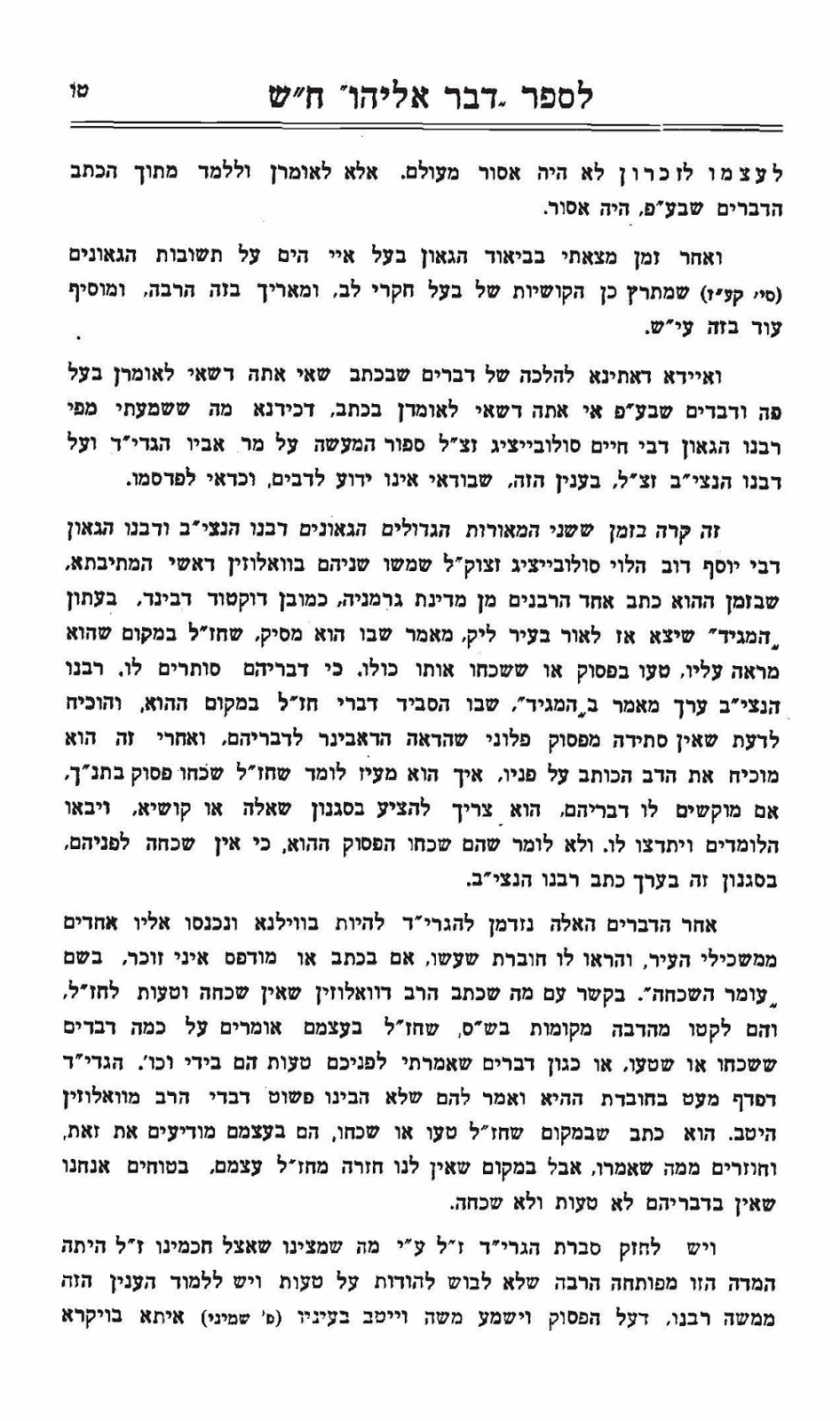
 Here is a copy of the actual Teshuvah of the Netziv:


 Later on in the same year (1888) Rav Zev Turbavitz in a letter to the Aderet, writes:[7]
כאשר הגיע לידי סי’ עיטור סופרים חלק ראשון נבהלתי מראות הלכה הראשונה בראשית הפעלים לתורה מהרב הנצי”ב מוואלאזין שחולק על הש”ע שאוסר גם העיון בשטרי הדיוטות בשבת… והארכתי בזה ובודאי נחוץ הוא להדפיסה כי בודאי רבים יפלו על המציאה הגדולה הזאת, ויתלה עצמן באילן גדול ויתפארו בעצמן שכתורה יעשו…
 He also wrote a letter to Rav Kook, where he says:
עיטור סופרים… והנה בפתחי אותו ראיתי ראשית אומרים בד”ת פסק הג’ הנצי”ב מוואלאזין, ונשתוממתי מאד ושלח דברים ע”פ חוצות לחלוק על הש”ע וכן הראשונים והאחרונים בדברים של מה בכך, ובפרט להקל באיסורי שבת… והאמת אגיד לכת”ר כי אם לא היה שמו של הנצי”ב חתום על דבריו לא הייתי מאמין שיצאו דברים אלו מפי בן תורה ומה גם מפי גדול. ונפלאתי על כבודו שנתן להם מקום עוד בראש דבריו…”.
R’ Chaim Berlin writes this about his father’s Heter in 1893:[8]
ועל דבר לעיין בשבת בהרהורא בעלמא בלי קריאה בפה באגרות רשות ובמכתבי העתים לא הי’ כלל דעת מר אבא הגאון שליט”א, לקבוע מסמרים בהלכה זו ככל דבריו שבעטור סופרים, ולא בא אלא ליישב מנהג העולם שקוראים במכתבי העתים בשבת שסומכים בזה על משמעות תלמודא דידן עפ”י דעתם, שמפרשים דתלמודא דידן פליג בזה על תלמוד ירושלמי, אבל להלכה גם הוא יודה דקיי”ל כהירושלמי, וכה”ג מצינו בהרבה מקומות שכתבו הפוסקים ליישב מנהג העולם, שסומכים על דעה יחידית אף שלא כהלכה.

Without going into his reasoning, it seems clear that the Netziv, permitted reading newspapers on Shabbos.
In 1894, The Shut Bikurei Shlomo was printed (with a Haskamah of the Netziv). The first Teshuvah is a letter the author wrote to the Netziv in 1890, commenting on his Heter to read newspapers on Shabbos, which was printed in ‘Ittur Sofrim’. The second Teshuvah is the Netziv’s response clarifying his heter. He did not back down from it.[9] Even more interesting is that the letter of  Rabbi Chaim Berlin, previously mentioned, is also to the author of the Shut Bikurei Shlomo.

Worth pointing out is, in the Netziv’s Meromei Sadeh to Shabbos [116 b, p. 94] he writes exactly as he does in Ittur Sofrim, he just does not add in the words ‘newspapers’. This clearly shows that he understood that this was the correct way to learn the Sugyah.


R. Meir Bar-Ilan also writes that his father, the Netziv permitted reading newspapers on Shabbos (Me-Volozhin LeYerushalayim 1:138). Apparently he did not agree with his brother, R’ Chaim Berlin.

The Shut Meishiv Davar

R. Meir Bar-Ilan writes about his father’s Teshuvot:

ולא עלה על דעתו לפרסם חידושיו הרבים על הש”ס ותשובותיו שהגיעו לאלפים. רק בסוף ימיו, כאשר הפצירו בו מאות ואלפי תלמידיו שיפרסם את תשובותיו, הסכים בקושי גדול להדפיסן בשם ‘משיב דבר’, ומפני שלא היה בידו העתקות מתשובותיו, כשם שלא נשארו העתקות משאר מכתביו, מוכרחים היו לקבצם משואלים שונים ולאספם ממקומות רבים. מתוך כך התשובות שנדפסו במשיב דבר אינן אלא חלק קטן מאוד ממה שהשיב… [מוולוזין עד ירושלים, א, עמ’ 138][10].

It is interesting to note that these two Teshuvot [from Ittur Sofrim and Bikurei Shlomo] about reading newspapers were not printed in this 1894 collection.

In 1993, a new edition of the Shut Meishiv Davar was printed with a fifth section, which includes a collection of 109 Teshuvot and articles by Netziv from various places, including manuscripts. Noticeably absent are both of the Netziv’s Teshuvot regarding reading Newspapers, from the Ittur Sofrim and Bikurei Shlomo.

In 2004, Eyal Mishulash was printed on the subject of reading Shtarei Hedyotot on Shabbos. At the end of the work [p. 240], he quotes a response from Shut Bikurei Shlomo and dismisses the opinion, based upon a Mordechai. The author does not bother telling you exactly who he is dismissing, namely the Netziv, which I believe is a problematic way to present facts; at the very least, mention that the author of the Heter is the Netziv. I feel certain that if the Netziv had forbidden it, his Teshuvah would have been printed prominently in the book.

It is worth noting that none of the various compilations dealing with this topic mention the Netziv’s Teshuvot. Even Rabbi Ovadiah Yosef, who discusses reading newspapers on Shabbos in Chazon Ovadiah, 6:70-73 [one of the last things he wrote], does not quote these Teshuvot.

Reading newspapers during the week[11]

Rabbi Epstein writes:

כל מערכות העתונים העברים כמעט, מאלה אשר במדינה ואשר בחו”ל היו שולחים עליו את העתוניהם השבועיים והירחונים… חנם אין כסף, והיו מעתירים אליו כי יחוננם בספורתו מן איזה מין שהוא… והיו עתים ומקרים שנענה להם; ולקריאה תמידית וסדורית היו לו העתנוים “המגיד” ו”הלבנון”… [מקור ברוך, ד, עמ’ 1794].

R Meir Bar-Ilan also writes the same (Me-Volozhin LeYerushalayim 1:138[12]):

כשהתחילו הצפירה והמליץ לצאת בכל יום והדואר בוולוז’ין היה מתקבל פעמיים בשבוע, וכל פעם באה חבילה שלימה של עתונים, היה אבא ז”ל מקפיד על כך, שאיש לא יקח ממנו גליון עתון, קודם שעבר על הכל.

He repeats this in his work Raban Shel Yisroel (p. 112).

Micha Yosef Berdyczewski writes in an article first published in 1886:

נצי”ב… אוהב תורה וחכמה, ומכתבי העתים שלא יקצצו בנטיעות ימצאו מהלכים בביתו… [מיכה יוסף ברדיצ’בסקי, כתבים, א, עמ’ 72]
 Another student of Volozhin writes in his memoirs about the Netziv:

 היה חותם על כל מכתב עת עברי וקרא בהם כמו ה’מליץ’, ה’צפירה’, ‘היום’, ‘המגיד’ ‘הלבנון’ ועוד [פרקי זכרונות, עמ’ 127].
In his memoirs about the Netziv, yet another student of Volozhin writes:

הגר”הל [הגאון ר’ הירש ליב] כידוע לא היה קנאי, היה גם מקוראי המליץ ואף ליודעי חן היה ביתו פתוח לקרות אותו.[13]

Similarly, Rabbi Moshe Shmuel Shapiro writes:

הנצי”ב עצמו היה מקבל בכל יום את הצפירה והמליץ [ר’ משה שמואל ודורו, עמ’ 62].
Censorship in the Meishiv Davar

Shaul Stampfer writes in his excellent book ‘Lithuanian Yeshivas of the Nineteenth Century‘ (p. 163) “Both R. Berlin and R. Hayim Soloveitchik read newspapers”. 

In a footnote he records the following:

“Rabbi Boruch Oberlander pointed out that, in the latest edition of R. Berlin’s Responsa Meshiv Davar there is a curious omission. The original reads ‘as published in Hamelits, 137 in 5687′ but in the new edition reads simply ‘as published in 5687’ (… Meshiv Davar ii. [p.]71 (responsum 8). Despite the omission in the current edition, it is clear that R. Berlin read newspapers.”[14]

My good friend Mr. Israel, upon reading this passage, consulted a copy of the first edition of Meishiv Davar, printed in 1894, and confirmed what Rabbi Oberlander said is indeed correct, the words ‘Hameilits etc.’ appear. However, when he checked another copy of  Meishiv Davar, also printed in 1894, he saw that the words ‘Hameilits etc.’ had been removed! Thus proving that this censorship took place already in 1894!

It appears that the Meishiv Davar was printed twice in 1894 and already there are differences between the two editions.

 The Mifal Bibliography Haivrit notes:

קיימות הדפסות סטיריאוטיפיות אחדות של ספר זה, ובכולן התאריך תרנ”ד. יש השמטות אחדות שונות בין הדפסה להדפסה.

 However, they do not write what the differences are, exactly. It seems we have uncovered one of them.[15]


Shmuel Glick, in his first volume of Kuntres Hateshuvot Hachadoshot, s.v. Meishiv Davar [p. 686 # 2498], does not make any mention of there being two versions of the 1894 editionHowever, in volume three [p. 1505], Glick notes that there are different editions of Meishiv Davar and while he does mention one difference between the two editions, he does not note this particular discrepancy. [See the end of the post.]

The story does not end here. When Mr. Israel turned the page to the very next siman in the Meishiv Davar, he again noticed the same occurrence. In one edition of the 1894 Meishiv Davar [p. 73, responsum 9] it says ‘Hameliits etc.’ and in the other edition, also printed in 1894, the word ‘Hameilits‘ had been removed!


Even more interesting is that these two Teshuvot originally appeared as articles in the Hameilits newspaper!!

Additionally worth pointing out, is another mention of Hameilits newspaper in the same siman [no. 9], which was not edited out from either 1894 edition:

אבל אם בעל נפש הוא עליו לבקש תחלה מחילה ברבים באותו מקום הוא המליץ…

[Presumably, those responsible for censoring the edition mistook the word to mean ‘advocated’, not the title of the newspaper]

Images five
In 1968, the Meishiv Davar was reprinted based on the 1894 edition that included the words ‘Hameilits etc.’.

 In 2003, a volume called Igrot HaNetziv Me-Volozhin was printed in Bnei Brak, including some letters on this same controversy [pp. 168- 174] [without saying where they are from[16]] with the words ‘Hameilits etc.’

Netziv and his Emek Ha-Netziv

Surprisingly, the story does not end here.

In an article written in 1887 by Rav Kook about the Netziv[17], he writes:
ובהיותו בן עשרים ושלש שנים כבר ראה לבו הרבה חכמה ודעת בכל מקצועות תורה שבעל פה ואז החל לכתוב ספרו הגדול על הספרי חמדה גנוזה עמו עד היום… הננו מעוררים בזה את כבוד הגאון שליט”א לזכות את הרבים מתופשי התורה בהוצאת הספר היקר הזה לאור עולם ולהאיר עיני רבים ממבקשי הדעת [כנסת ישראל, בעריכת ש’ ראבינוויץ, ווארשא תרמ”ח, עמ’ 140(=מאמרי הראי”ה, עמ’ 124)].

However, the Netziv’s Pirush on Sifrei,[18] entitled Emek Ha-Netziv was first printed from manuscript only in 1959-1969. In the first volume the Netziv quotes the “Zofeh Le-hamagid Year ten, issue 28″. Gil Perl already notes that this is the edition of the Ha -Maggid printed on July 17, 1867.[19] Although Perl noted other cases of censorship in the Emek Ha-Netziv, this source was not censored.[20] We see here clearly that the Netziv read newspapers and even referenced them in his work.

Netziv and his Ha’amek Davar                   
          
In 1879, the Netziv printed his classic work on chumash, Ha’amek Davar,[21] based on the Shiurim he gave after Davening.[22] In his Pirush to Parshat Bereishis (2:9), he quotes a manuscript of R’ Maimon (father of the Rambam) which he had seen printed in Ha-Levonon.

In 1937, Rabbi Meir Bar-Ilan printed a collection of almost one thousand and five hundred addenda by the Netziv to his Ha’amek Davar[23] [available here]. On page seven, Netziv quotes the newspaper Ha-tzefirah. Furthermore, Gil Perl points to some additional passages in Ha’amek Davar that seem to be based on material from the newspapers of the time.[24] From all the above, we see him reading newspapers.[25]


Censorship and the Ha’amek Davar

In 1999, a new edition of the Ha’amek Davar was printed incorporating many more corrections.[26] They inserted the numerous addenda published by Rabbi Meir Bar-Ilan into their proper places in the chumash. However two pieces were censored out – both of the aforementioned quotes by the Netziv,[27] citing these newspapers!

In 2005, Rabbi Mordechai Cooperman reprinted the Ha’amek Davar; with annotations, his edition does contain both newspaper references.


More on the Netziv and newspapers

In 2003, a volume called Igrot HaNetziv Me-Volozhin was printed in Bnei Brak this volume is full of references and articles by the Netziv from different newspapers of the time.[28]

In Meishiv Davar 1:44 there is a piece titled: “Al Yamin vsmal’.[29] This siman was actually first printed in the newspaper Machzike Hadat[30] and as can be seen from the introductory paragraphs, it was a response to an earlier article that the Netziv had read in that newspaper.

Appendix: Some other Gedolim who read Newspapers

Yitzchak Wetzlar writes in the introduction to his Libes Briv (written in the early 1700’s) about his work: “think of it as a Newspaper. Nowadays the finest and most important people, scholars and Rabbis read them or have them read to them”.[31]
For other Poskim who were known to have read newspapers, see: Rabbi Yakov Emden[32]; Rabbi Yosef Zechariah Stern [as anyone familiar with his writings knows][33]; Yakov Mark, BeMechitzosom Shel Gedolei Hador, p. 34; Roni Beer Marx, ibid, pp. 40-41 [about the Malbim and others]; Rabbi Yitzchak Nissenbaum, Alei Cheldi,[34]; Jacob Katz, With My Own Eyes, pp. 30-31;  Pinchas Sirkis, Ish HaEmunah, 1979, p. 82, 86; Jacob J. Schacter, ‘Facing the Truths of History’, Torah U’maddah Journal, 8 (1998), p. 225, 263-264 [about Rav Moshe Feinstein Zatzal]; Benny Brown, Hachazon Ish, 2011, p. 21 [about the Chazon Ish; who even quotes Ha-Tzefirah in his work on Orach Chaim 141:9].

A student of the forgotten gaon,[34b] Rabbi Moshe Nechemia Kahanov (1817-1887) [Rosh Yeshiva of Eitz Chaim[34c]] writes:

 ר’ משה נחמיה כהנא או ה’רבה’ מחסלביץ, ראש הישיבה, ידע את נטיתי להשכלה וקרבני על כך, שכן אף הוא היה נוטה בצנעה להשכלה ולמשכילים. בימים ההם אסרו על ה’חבצלת’ לבוא בקהל והרב מחסלביץ היה מקבל אותה מדי שבת בשבת מידי אני. בכל שבת אחר הצהרים הייתי סר אל הישיבה כש’החבצלת’ טמונה בחיקי, מוסר אותה לידיו והוא פורש לחדר קטן הנשען אל הישיבה וקורא בה. כפעם בפעם היה מוסר על ידי שלום לרי”ד פרומקין ומביע לו את ידידותו והוקרתו על השקפתיו של העורך. אוסר אני בכבלים היה מצדיק את הדין על עצמו חולני אני ואין בכחי לעמוד בפני התקיפים ממני [אפרים כהן רייס, מזכרונות איש ירושלים, עמ’ 54].

Worth pointing out is Binyomin Goldberg’s claim that even Rabbi Chaim Soloveitchik secretly read the Hameilits.[35]
Rabbi Moshe Bernstein,[36] Son in law of Rabbi Baruch Ber Leibowitz records the following story about Reb Baruch Ber:
משביקר הגאון ר’ משה סולוביציק, שהיה אז ראש ישיבת תחכמוני בוילנה, כיבדו בהגדת שיעור בישיבה, תלמידי הישיבה שהיו ברובם קנאים התנגדו לזה בכל תקף ובאו לומר לרבם כי הם ילכו מהשיעור הזה, הוא אמר להם כדברים האלה, ת”ל חוננתי בכח מיוחד שלא להאמין בדבר שאינו רוצה, לדידי אין הדבר אמת כלל, ידיד נפשו הגאון ר’ משה אינו כלל בישיבת המזרחי תחכמוני[37], אינו קורא עתונים ואינו מאמין להם, וככה אני יועץ גם לכם, התלמידים שמעו לקולו והקשיבו אל השיעור בנחת ובשלוה [הגיונות, עמ’ עב].
Another Great Gaon who read newspapers was Rabbi Eliyahu Klatzkin. According to his son Yakov, he subscribed to and read several papers in different languages.[38] In an incredible Teshuva of his regarding Tzar Balei Chaim Rabbi Klatzkin quotes numerous medical works in different languages and even newspapers, including The London Times and others papers in Russian and Yiddish.[39]

While Rabbi Moshe Zeirah, Yeshurun 15 (2005), pp. 753-776, refers to the Teshuva on Tzar Balei Chaim and Rabbi Eliyahu Klatzkin’s expert knowledge of science, he does not mention this point.[40]

Another person who read newspapers was Rabbi Shneur Zalman Me’Lublin,[41] author of the Shut Toras Chessed:

רבי ישראל דוד פרומקין שהיה ממעריצי הרב שלח להרב בכל יום ששי העתון חבצלת שהוציא לאור. לקח הרב סכין וחתך למעלה, שיהא נוח לקרות, הביט שניה אחת על העמוד הראשון וכן על השני וכן להלן רק איזה שניות, אחר כך לקח את העתון ופרש על המפה שעל השלחן, ועליו היתה הרבנית מעמדת המנרות של שבת שלא יטפטף מן החלב על המפה. חשבתי שאינו קורא כל הכותב בעתון, המכיל 8 עמודים שלמים, רק מעט בצד זה ומעט מצד שני, וכן הלאה. פעם בין מנחה למעריב, כאשר שכב על מטתו ושמע חדשות (כשאר הבאתי לעיל), ספר אחד חדשות מענינות, אמר הרב זה מדפוס בעתון חבצלת של שבוע זה, ואמר לי להביא את העתון שהיה מונח על האיצטבא. מסרתי לו, ותוך כדי דיבר פתח העתון והראה בעמוד פלוני שורה פלונית כתוב זאת. נשתוממתי שבמהירות כל כך קורא את כל העתון ובשניה אחת הראה איפה מודפס [שלשה עולמות, ב, עמ’ קמז-קמח].
Another person who read newspapers was Rabbi Elchanon Wasserman. The following passage appears on Rabbi Aron Sorasky’s book Or Elchonon [1: 27-28 and the second passage appears in the same book pp. 282-283]. In the English version adaption of this book printed by Artscroll called Reb Elchonon both passage appear uncensored [pp. 28-29, 216] [Thanks to my friend Eli Markin for this source]. 


Another additional point in all this is there were great Gedolim who wrote articles in some of these newspapers[41b] such as Rabbi Alexander Moshe Lapidus,[42] Rabbi Tzvi Hirsch Kalisher,[43] Rabbi Eliyahu Gutmacher,[44] Rabbi Shmuel Moholiver, [45]Rabbi Mordechai Eliasberg[46] and Rabbi Yechiel Yakov Weinberg.[47]
Just to conclude with one last story related to reading newspaper:

*Special thanks goes to my good friend Yisroel Israel for all his time and help in preparing this article. I would also like to thank my friend Rabbi Yosaif M. Dubovick for editing this article. 
[1] For general sources on censorship in Shut [Responsa] Literature see S. Glick, Kuntres Hateshuvot Hachadoshot, vol. 1,  introduction, pp. 58-67; ibid, E-Shnev leSafrut HaTeshuvot, pp. 259-290.
[2]  In the future, I hope to return to exploring other Heterim for reading newspapers on Shabbos. For now see: Herman Pollack, Jewish Folkways in Germanic lands (1648-1806), Cambridge 1971, pp. 168-169, 235, Daniel Sperber, Darka Shel Halacha, pp. 238-241. I also hope to return to the Netziv and his writings in a special series of articles devoted to him. It must be noted that “newspapers” in this context do not only refer to newspapers like the New York Times. The periodical literature read by the Netziv was not the Times and was not Hamodia. These were in many cases ideologically maskilic papers, and while they contained typical Torah articles, they *also* contained editorials and “academic Jewish” type stuff, and this is what the Netziv read and these are what he is talking about, quoting, etc.
[3] Torah u-Madda Journal 2 (1990), pp. 76-133
[4] See Rabbi Kirshbaum, HY”d, Zion Le-Menachem, New York 1965, pp. 251-265.
[5]  Many years ago I discussed the work Mekor Baruch with my Rosh Yeshiva, Rabbi Zelig Epstein Zatzal. He told me he that he had no problem believing this story by Rabbi Epstein or others that people had issues with. He mentioned that when he was learning in the Mir in Europe, he chipped in together with a few friends to purchase a set of Mekor Baruch. When I asked him specifically about this passage of the Netziv reading newspapers on Shabbos, he reiterated that he had no problem accepting its truth. He then told me that he once spent a Shabbos at Rav Dovid Tevil Dynovsky’s home whose daughter would read to him from a Yiddish newspaper. See Rabbi Nosson Kamenetsky, Making of a Godol, 2, p. 1178 who quotes the same anecdote regarding Rav Dynovsky, citing Rabbi Zelig Epstein.

Rav Dynovsky’s anonymously published sefer, Maamar Likrat Tzamei,[which is an attack on Zionism, Hertzl and the Mizrachi movement], is full of quotes from the various Hebrew and Yiddish newspapers of the time [see for example pp. 5, 6, 20, 26, 29, 30, 31, 35, 37, 40, 45, 46 49, 50]. 

Saul Leiberman considered Rav Dynovsky his main Rebbe [Making of a Godol, 2, p. 1189, based on an interview with Shraga Abramson]. Shraga Abramson who also learnt by Rav Dynovsky writes about Leiberman and Rav Dynovsky the following:

לא רחוק מעיירת מולדתו, מוטלה, היתה ישיבה קטנה שידועה היתה בשעתה, לפני מלחמת העולם הראשונה, זו ישיבת מאלטש, בראשה עמד אדם מיוחד: רב העיירה וראש הישיבה ר’ דוד טעבל דיינובסקי, הי”ד, מבעלי ההגיון שבלימוד התלמוד ומבעלי המוסר מן יסד ר’ ישראל סאלאנטר. היסוד שהונח לו לליברמן בישיבה זאת היינו, לימוד התורה ולימוד המוסר נשאר אצלו חזק בכל ימי חייו. וליברמן ידע את ההשפעה שהושפע בישיבה זאת, וזכר לה חסד נעוריו כל ימיו [לזכרו של שואל ליברמן, האקדמיה הלאומית הישראלית למדעים, ירושלים תשמ”ד, עמ’ 24-25].

For more information on this unknown Gaon see Rabbi Nosson Kamenetsky, Making of a Godol, 2, pp. 1174-1181.

Of course, it bears mentioning (as already noted On the Main Line [here]), Chief Rabbi Herzog’s words, The Jewish Chronicle, February 25, 1927: “On Sabbath morning, while turning the pages of my copy of the Jewish Chronicle, my eye caught under the caption Obituary notices the name of Rabbi Meir Simcha of Dvinsk…”.

See also Rabbi Yechiel Yaakov Weinberg, Kisvei Hagaon Rabbi Yechiel Yaakov Weinberg, 2, p. 396:

אחד מבני המשפחה הזאת הלעיז על הרב שהוא קורא עתונים בשבת.
[6]  I hope to return to this journal in a future article. Meanwhile, see Yehudah Mirsky, An Intellectual and Spiritual Biography of Rabbi Avraham Yitzhaq Ha-Cohen Kook from 1865-1904, PhD dissertation, Harvard University 2007, pp. 85-99. I am not sure why this volume [as far as I can see] did not make it to the Kuntres Hateshuvot Hachadoshot of Shmuel Glick.
[7] These letters were printed from manuscript in Moriah 23 (3-4) (1999), pp. 54-60 and more recently in a new edition of the ‘Ittur Sofrim’ printed in 2011, pp. 97-102.
[8]  Otzar R’ Chaim Berlin, Shut Nishmat Chaim, 4, (2008), p. 114; Shut Nishmat Chaim, Siman 24.
[9]   Rav Kook already commented about this Heter at the end of the first issue of the Ittur Sofrim. See also Shut Bikurei Shlomo siman, 3-4 for more on this topic. The Chasdei Dovid, 2, Jerusalem 1994, p. 149, on the related passage in Tosefta, is extremely important for this topic.
[10] See also Rabbi Shlomo Yosef Zevin, Ishim Veshitos, (2007), pp. 17-18;  Rabbi Moshe Shmuel Shapiro, R. Moshe Shmuel Ve-doro, p. 54.
[11] Of course, there were many Poskim who were against reading newspapers even during the week. See, for example, the Chofetz Chaim’s son, who writes:

מר אבא לא קרא עיתונים מעולם אף באותם שלא היה בהם מינות, ועגבים וליצנות ולא היה ניחא דעתו מקריאתי אני והיה אומר מה תמצא בעתונים רק צרות וצרות מבלי שאין בידינו להושיע, וידע אנכי זאת גם מבלעדי העתונים כי אין העולם הזה מקום של נחת וקורת רוח וכמו שאמר הכתוב… [דוגמא מדרכי אבי זצ”ל, עמ’ מג.]

See also the Michtavei Chofetz Chaim #42:

See also this passage:

And this passage:

           
See most recently: Divrei Chachomim, Bnei Brak 1975; Rabbi Kalman Krohn, Harchek Mei’aleha Darcheka, Lakewood 2012. See Rabbi Fuerst, Ir Hagoleh, 1, p. 476. See also Mi’pihem, p. 375.
[12] This passage appears in the original Yiddish version of the book Fun Volozhin Biz Yerushalayim, Chapter 12. See also Me-Volozhin LeYerushalayim p. 163.
[13]  Moshe Yuft, Reshumot V’zichronot, 1924, p. 10. This memoir is not found in Pirkei Zichronot, nor was it used by S. Stampfer in Lithuanian Yeshivas of the Nineteenth Century.
[14] This passage appears on page 179 of the Hebrew edition of Stampfer’s book.
[15]  See also Rabbi S. Gershuni, Hama’yan, 52:4 [202] (2012), p. 54 note, 22 who mentions this censorship about the Hameilits, but not that there were two editions of the 1894 printing.
[16]  It appears that there are additional letters about this same subject. See ibid, pp.163-168. For more on the controversy related to these Teshuvot, see Y. Mondshine, Zechor L’Avraham, (1999) pp. 374- 444 [also available here]. See also Igrot R. Yitzchak Elchanan, 1 (2004), pp. 266-267. See also S. Glick, E-Shnev leSafrut HaTeshuvot, pp.150-154.
[17] On this essay see Yehudah Mirsky, An Intellectual and Spiritual Biography of Rabbi Avraham Yitzhaq Ha-Cohen Kook from 1865-1904, PhD dissertation, Harvard University 2007, pp. 84-85. See also Rabbi Yitzchak Nissenbaum who wrote about this essay:
את… רבי אברהם יצחק הכהן קוק שמעתי זה כבר. בעודני צעיר קראתי את מאמרו ב’כנסת ישראל’ לשפ”ר על הנצי”ב מוואלוזין, וכתלמיד הישיבה, המחבב את רבו הזקן, נהניתי מאד מדבריו [עלי חלדי, עמ’ 188].
[18]  I hope to return to this incredible work in the future for now see the beautiful book of Gil Perl, The Pillar of Volozhin, Boston 2012.
[19] Gil Perl, The Pillar of Volozhin, Boston 2012, p. 32.
[20]  Ibid, and see here.
[21]  On this work see: Jay Harris, How Do We Know This?, pp. 239-244; Channah Katz, Mishnat Hanetziv, pp. 93-98; idem, Machanayim 4 (1993), pp. 380-387; Nissim Eliakim, Haamek Davar la-Netziv, Moreshet Yaakov 2003; Gil Perl, The Pillar of Volozhin, pp. 168-237; Rabbi Dov Leor, Aloni Mamrei, 121 (2008), pp. 73-85. For the dating of this work see: Gil Perl, ibid, pp. 169-171; Rabbi S. Gershuni, Hama’yan, 52:4 [202]. (2012), pp. 50-56.

On the Ha’amek Davar, see the article (quoted above) written in 1887 by Rav Kook about the Netziv where he writes:

בעת ההיא כתב גם כן ביאורו על התורה, אשר גם בו היתה לו האמת לקו והבקרת הנאמנה למשקלת יישר דברי חז”ל עפ”י הדקדוק בסגנון מליצת הכתוב…

In a letter to Dr. Eliyahu Harkavi the Netziv writes [I will hopefully return to the nature of their relationship in the future]:

וידעתי כי איני כדאי והגון להדפסה רחבה כזו, ומה אני ומה כחי להוציא לאור ביאור פרוס על חמשה חומשי תורה, וגם בפעלת ההדפסה רבה אשר הגיע עד חמשת אלפים רו”כ, ובחיי ראשי כי לא הי’ מכן בידי גם מאה רו”כ, אך יד ה’ והשגחתו הפרטית הי’ עמדי בזכות הישיבה הק’ שאני מוסר נפשי עליה, והטה דעת המדפסים להדפיס בהקפה יותר משלש אלפים רו”כ… [שנות דור ודור, ב, עמ’ קפג-קפד (=אגרות הנצי”ב, עמ’ לא)].

See also Igrot HaNetziv Me-Volozhin, p. 214.
[22]  The subject of these shiurim was not dealt with in the excellent book of S. Stampfer, Lithuanian Yeshivas of the Nineteenth Century or in the volume Toldot Beis Hashem B’Volozhin,.

On these shiurim See the Netziv who writes:
וזכות הרבים עמדה לי שפירשתי בכל יום הפרשה לפני היושבים לפני ה’ בית התלמוד עץ החיים אשר נטע אביר הרועים הגאון מהור”ח זצ”ל [קדמת העמק, אות ה].
In the article (quoted above) written in 1887, by Rav Kook about the Netziv he writes:

בהנהגת הישיבה… גם הרגיל אותם לשנן פרשה אחת בכל יום מפרשת השבוע ויער אזנם למוסר לדעת איך ללכת נגד החיים…”.

See also Pinchas Turberg’s picturesque description of the scene when at age fourteen he first walked in to the Volzhiner Yeshiva on a Friday morning:

בבוקר,… השכמתי לקום וברוח סוערת מהרים לבית הישיבה., הרושם שעשה עלי הבית הגדול… כל זה אי אפשר לתאר באומר ודברים. הרגשתי את עצמי כאלו נכנסתי לתוך עולם אחר… ביחוד משך אליו את העין איש זקן בעל פנים מאירות ועינים טובות ומלטפות, שישב מעוטף בטלית ומעוטר בתפלין ולמד לפני תלמידים פרשת השבוע. הזקן הזה היה ראש הישיבה, הנצי”ב שלמד את שעוריו בחומש לאחרי תפלת שחרית [כתבי פינחס טורברג, ניו יורק תשי”ג, עמ’ קלא (= פרקי זכרונות, עמ’ 195)].
Rabbi Yitzchak Nissenbaum writes in his beautiful memoirs:

זמן מה הייתי שומע גם את שעורי הנצי”ב בחומש, שהיה מטיף אחרי תפילת השחרית [עלי חלדי, עמ’ 45 (=פרקי זכרונות, עמ’ 103].
In an article comparing the Netziv and Rabbi Chaim Soloveitchik, Rabbi Yitzchak Nissenbaum writes a bit more:

הסבא יושב בכל יום ויום אחר התפילה ומטיף לפני התלמידים פרשה בתורה מסדר השבוע, וכה הוא לומד ומלמד במשך השנה את כל חמשת חומשי תורה, עד שנולד לו באורו הידוע ‘העמק דבר’. והנכד חושב כי תורה שבכתב ניתנה רק לתינקות של בית רבן טרם שהגיע זמנם ללוד את תורה שבעל פה” [הצפירה, ו’ תשרי תרע”ט גלי’ 37 עמוד 9].

 Micha Yosef Berdyczewski writes:

תפילת שחרית בציבור בשעה 8 בבוקר… ורבים יישארו לשמוע פרשת השבוע מבוארת מפי הרב הגאון ר’ נצי”ב שליט”א על פי דרכו ביאורו הנפלא, הנוטע בקרב לב השומעים רגשות יקרות ואהבת אלקים ואדם. [מיכה יוסף ברדיצ’בסקי, כתבים, א, עמ’ 73 וראה שם, עמ’ 71, 196]

See also Rabbi Meir Bar-Ilan, Me-Volozhin LeYerushalayim pp. 112-113; Pirkei Zichronot, p. 127, 172; Rabbi Moshe Neryah, Toldot HaNetziv, pp. 13-14; Rabbi Moshe Shmuel Shapiro, R. Moshe Shmuel Ve-doro, p. 41, 72; Moshe Tzinovitz, Etz Chaim, p. 235. See also Binyomin Goldberg’s peculiar claim that the general consensus towards the Netziv’s Chumash Shiur was indifference, at best. This passage can be found in Zichron LeAchronim, 1924, p. 21. This book is extremely rare and there is no copy of it in Jewish National Library. Special thanks to Professor Shaul Stampfer for providing me with a photo-copy.
Chumash was learned in Volozhin in the times of Rabbi Chaim Volozhiner and Reb Itzeleh Volozhiner. See: Rabbi Yechiel Yaakov Weinberg, Kisvei Hagaon Rabbi Yechiel Yaakov Weinberg Zal, 2, p. 217; Dov Eliach, Avi Hayeshivot, 2012, pp. 460-462; S. Stampfer, Lithuanian Yeshivas of the Nineteenth Century, p. 42; Toldot Beis Hashem B’Volozhin, p. 63;M. Breuer, Ohalei Torah, pp. 122-123; Shlomo Tikochinski, Darchei Halimud Beyeshivot Lita Bimeah Hatesha Esreh, MA Thesis (Hebrew University, Jerusalem, 2004), p. 34.

In Pirkei Zichronot [p.84] we find a claim from Shmuel Zitron that R. Yehoshua Levin gave a chumash shiur using Mendelsohn’s Biur. However, S. Stampfer [ibid, p. 68] already notes that Zitron’s memoirs are not always accurate.

On Chumash being part of curricula in Yeshivot, see M. Breuer, Ohalei Torah, pp. 118-123. I hope to return to this subject in the future.
[23] The Netziv was always working on adding to this work, In a letter, he writes:
ויאמין לי מעלתו כי נכספתי מאוד לשוב ולהדפיס החומשים עם העמק דבר, כי רבים מבקשים אותם ממני, וגם יש לי הוספות הרבה, אבל אין לי עצה להשיג הוצאות הדפסה… [פרשגן, תרנ”ט ראש הספר].

This letter is also printed in Igrot HaNetziv Me-Volozhin (p. 41) without citing its source.

See also the following interesting letter from the Netziv to Rabbi Eliezer Lipman Prins:

ובכלל אענה על תרעומת מע”כ שקצרתי בלשוני כ”כ כי טוב הוא להתחוקק בראש למי שחפץ להבין ולהשכיל. ובכ”ז מודה אני שיש מקומות שקצרתי יותר מהנדרש וכשאר יזכני ה’ ברחמיו לשוב ולהדפיס החומשים עם באור העמק דבר אי”ה אראה לתקן הלשון באיזה מקומות. לבד אשר אשית נוספות הרבה אשר זכני ד’ לדקדק בלשון המקרא. אך עתה קצרה ידי לשוב ולהדפיס משום חוסר מעות. [פרנס לדורו, עמ’ 208-209].

Worth noting is that the 1999 edition quotes this letter in the beginning of their edition, without giving the source. They also print the whole letter in the back of the volume of Ha’amek Davar on Shemos (p. 21), without referencing the source. This letter is also printed in Igrot HaNetziv Me-Volozhin  (pp. 34-35) without citing its source.
The Aderet writes when he first met the Netziv:

העירותיו כמה דברים בביאורו על התורה שהיה מגיהו אז להדפיסו מחדש (סדר אליהו, עמ’ 85).

See also Rabbi Eliezer Lipman Prins’ notes on the Ha’amek Davar, printed in his Parnas Ledoro, pp.241-256.
[24] Gil Perl, ibid, p.81, 176-177. Rabbi S. Gershuni, Hama’yan, 52:4 [202], (2012), p. 54 points to further evidence in the Ha’amek Davar that the Netziv read newspapers.
[25] On this work see the excellent introduction by Rabbi Meir Bar-Ilan [of course it’s not included in the newer editions]; Rabbi Shlomo Yosef Zevin, Ishim Veshitos, (2007), pp. 23-26.
[26]   See what they write in the back of the first volume of Ha’amek Davar.

מהדורה מתוקנת המופיעה לראשונה, אשר בו אלפי תיקונים והוספות שהגיהם והוסיפם מרן הגהמ”ח זיע”א בכתב יד קדשו על גליוני החומש עם פירוש העמק דבר שהו”ל בחייו בשנות תרל”ט תר”מ. חלק גדול מההספות כבר נדפס בשנת תרח”ץ בסוף החומש, ועתה זכינו בס”ד להשלים את כל ההוספות וההגהות שנמצאו על גליוני החומש בכתי”ק, וכן לעוד הרבה תוספות מהעתקה אחרת שנערכה גם על מנת לשלב את ההוספות והתיקונים להפירוש.
I just started to compare the editions and noticed many new pieces. For example in the Introduction of the Netziv to the Ha’amek Davar called Kadmus Ha’amek there are over 20 new lines of text added in different places. In the famous introduction of Netziv to Chumash Bereishis over 6 new lines of text were added. I will hopefully return to all this in the future.
My problem with this edition is that although it’s amazing to have all these new pieces it would have been helpful for one to be able to see what’s new and what’s old. I would have suggested that they use different fonts, one for the original work, one for the 1500 additions from Rabbi Meir Bar Ilan and one for the new material that they added. Similar to the style found in the Eshkol edition of the Siddur of Rabbi Yakov Emden which allows the reader to see easily what is being added. For a different criticism see what Rabbi Mordechai Cooperman writes in the introduction to his edition of the Ha’amek Davar.

For an interesting discussion relating to this edition, see the back and forth which took place in some recent editions of the journal Hamay’an: Rabbi Avraham Glanzer, Hama’yan, 52:3 [201], (2012), pp. 94-95; Rabbi S. Gershuni, Hama’yan, 52:4 [202], (2012), pp. 50-56; Rabbi Dovid Shapiro, Hama’yan, 52:4 [203]. (2013), p. 103, Although, Rabbi Shapiro deals with an issue of the editing of the new Ha’amek Davar, he does not talk about the censorship of the Netziv’s newspaper reading. 

[27]  Rabbi S. Gershuni, Hama’yan, 52:4 [202]. (2012), p. 53 also points to the censorship.
[28] Hacarmel: p. 21; Ha’maggid: p. 54, 198; Hameilits: p. 60, 113, 114, 140, 147, 168, 170; Ha-Tzefirah: p. 112, 120, 133, 134, 140,141. See also Mekor Baruch, 4, pp.1795-1796 what he brings from the Netziv about the fighting between the Ha’maggid and  Ha-Levanon.

However in regard to the Newspaper Ha’Shachar he writes to Dr. Eliyahu Harkavi:

עוד בקשתי.. וכן ראיתי באיזה עלה עת שמעכ”ה מעריך דברים בעלה השחר, מבוקשי אם אפשר לשלחם לי כל היוצא, בלי עלה השחר, המשחיר את כבוד התורה וכל קדושיה עמה, וכי יבוא דברי מע”כ אלי וכבדתים להביט בדבריו [שנות דור ודור, ב, עמ’ קפד (=אגרות הנצי”ב, עמ’ לב)].

On these newspapers in general see: E.R. Malachi, Mineged Tir’eh, pp. 17-121; Gideon Kouts, Chadushot V’korot HaYamim, Tel Aviv 2013; Dovid Tal, Yehuda Leib Kantor, Tel Aviv 2011, pp. 367-370; Roni Beer Marx, Between Seclusion and Adaption; The Newspaper Halevanon and East European Orthodox Society’s Facing Up to Modern Challenges,(Heb.)PhD. Dissertation, Hebrew University, 2011.
[29]  On this essay see Y. Rivkin, HaNetziv Viyichuso L’Chibbat Tzion, 1919, pp. 7-9; Rabbi Moshe Shmuel Shapiro, R. Moshe Shmuel Ve-doro, p. 63; Moshe Tzinovitz, Etz Chaim, p. 236; Gil Perl, ‘No Two Minds are Alike: Tolerance and Pluralism in the Work of Netziv’, Torah U-Maddah Journal, vol. 12, pp. 74-98.
[30]  On this newspaper see: Joseph Margoshes, A world apart, A memoir of Jewish Life in Nineteenth Century Galicia, p. 14, 25-27; Rachel Manekin, The Growth and Development of Jewish orthodoxy in Galicia, The “machsike hadas” Society 1867-1883, PHD, Hebrew University 2000.
[31] [(English translation of Yiddish) The Libes Briv of Isaac Wetzlar, edited and translated by Morris Faierstein, p.43 (see also p. 13)].

For some sources of regular people reading Newspapers see Yakov Mark, BeMechitzosom Shel Gedolei Hador, p. 28; Pirkei Zichronot, p. 256 [In Telz]; Joseph Margoshes, A world apart, A memoir of Jewish Life in Nineteenth Century Galicia, p. 45, 47; Mah Shera’Iti [Zichronotav shel Yechezkel Kotik], p. 184, 297; Chaim Hamberger, Sheloshah Olamot, 2, pp. 40-41; Mi’pihem, p.273. See also M. Zalkin, Be’alot Hashachar, pp. 255-261.
[32] Rabbi J.J. Schachter, Rabbi Jacob Emden: Life and Major Works, PhD. Dissertation, Harvard University, 1988, p. 614; Maoz Kahana, ‘An Esoteric path to Modernity Rabbi Jacob Emden’s Alchemical Quest’, Journal of Modern Jewish Study (2013) 12:2, p. 271 note 70.
[33] See also Rabbi Zev Rabiner, Harav Yosef Zechariah Stern, 1943, p. 24.
[34]  pp. 56, 73-74, 76, 78, 87, 128, 132, 137, 165, 167, 196, 318.
[34b] The Mishna Berurah quotes his work Netivot Sholom numerous times in Hilchot BishulSharei Tzion (318: 55, 57, 58, 61, 62).
[34c] About him see Avraham Lunz, Netivot Zion VeYerushlayim, pp. 208-209 [who was a talmid of his]; Rabbi Betzalel Landau, in the back of Sifsei Yeshai​nyim, pp. 35-58; Pinchas Gr​ie​vsky, Zichron Lechovvim Harishonim, 8, pp. 391-413; Rabbi Yechiel Michel Tycosinski, Luach Eretz Yisroel, 1, pp. 163-167 [=Chatzer Churvos Rebbe Yehudah Hachassid, pp. 48-53] Yosef Salamon, ‘The Etz Chaim Yeshiva in Jerusalem at the time of Moshe Nechemiah Cahaniu (1866-1887)’,  Yeshivot Ubatei Midroshot, pp.187-197. I will hopefully return to this Gaon in the second part of this post.
[35] See his work Zichron LeAchronim, 1924, p. 6. This passage is quoted in Shaul Stampfer ‘Lithuanian Yeshivas of the Nineteenth Century‘, p. 163. See also Rabbi Nosson Kamenetsky, Making of a Godol, 1, p.459 & vol. 2, p. 917 for a possible explanation as to why Rabbi Soloveitchik read the paper.
[36]  About him see Li’frakim, pp. 156-157.
[37]  However see Rabbi Yitzchak Nissenbaum who was one of the people who ran this Yeshiva who writes:
תכחמוני… כאשר נמנה אחר כך הרב רבי משה סולוביייציק לדירקטור הערכה כבר תכנית ללמוד גפ”ת ובתוכם כבר הובא איזה סדר… [עלי חלדי, עמ’ 344] [וראה: אגרות הרב ניסנבוים, עמ’ 243].
[38] Notrei Morshet, pp.157-169, for a more complete version of this article see Yaakov Klatzkin, Kesavim, pp. 304-320.
[39]Imrei Shefer, Siman 34, pp. 72-73. See also Shnayer Z. Leiman, Rabbinic Responses to Modernity, Judaic Studies 5, 2007 pp. 116-118.
[40] For more on Rabbi Eliyahu Klatzkin, see Rabbi Amram Blau, Heichal Habesht 34, (2013), pp. 159-160.
[41] About him see: Chaim Hamberger, Sheloshah Olamot, 2, pp. 141-158; Yitzchak Shirion, Zichronot , pp. 43-45; Chachmei Polin, pp. 350-353; Igrot Baal Ha’Toras Chesed edited by Y. Mondshine; Y. Chananel,  Ha’Gaon Me’Lublin.
[41b] See: Yakov Lipshitz, Zichron Yakov, 2, pp. 15-19, 99-116; Roni Beer Marx, Between Seclusion and Adaption; The Newspaper Halevanon and East European Orthodox Society’s Facing Up to Modern Challenges,(Heb.)PhD. Dissertation, Hebrew University, 2011; Marc Shapiro, Between the Yeshiva World and Modern Orthodoxy, pp. 38-41.
[42]  See Toras Ha’Goan Rebbe Alexander Moshe, pp. 583-592. See also Yakov Lipshitz, Zichron Yakov, 2, p. 99.
[43]  Many of them are collected in Y. Klausner, Ketavim Tzioni’im, Jerusalem 1947.
[44]  Many of them are collected in Succos Shalom, Jerusalem 1990; see for example pp. 31-33, 43, 49, 60, 61, 65, 75, 91, 95, 96, 101, 151, 159, 168, 172. 
[45] Yakov Mark, BeMechitzosom Shel Gedolei Hador, pp. 197-198
[46]  Shevl Ha’zahav, p. 17; Yakov Mark, BeMechitzosom Shel Gedolei Hador, p. 141, 146; Rabbi Bezalel Naor, The limit of Intellectual freedom, the Letters of Rav Kook, pp. 179-180.
[47] See Marc Shapiro, Between the Yeshiva World and Modern Orthodoxy, pp. 23-26.


The Writings of R. Hayyim Gulevsky, Part 2

The Writings of R. Hayyim Gulevsky, part 2
By Marc B. Shapiro

Many of the stories Gulevsky tells cannot be verified, and we have to take his word that he is faithfully recording that which he heard. Thus, he tells us about R. Abraham Eliezer Alperstein, who was an early rosh yeshiva at Yeshivat R Yitzhak Elhanan and the author of the first commentary on the Talmud published in the United States. It appeared in Chicago in 1887. Gulevsky tells the story of Alperstein’s move to Chicago, where, after arriving, he supposedly gave a speech in which he said the following (Du Yovlin, p. 30):
יהודי נוי יארק הם בעלי זדון ומשוגה ואינם שומעים לקול מורים, רק לקול מורדים. אבל את יהודים יקרים בשיקאגא כי לכל העם בשגגה, ואשר את המלה בשגגה חיריק תחת השין גימל הראשון פתח וגימל השני קמוצה, וזה נקרא שיגאגא.
(Alperstein’s pun, שגגה=Chicago, is also found in the introduction to the second edition of his commentary.)
Gulevsky claims that Alperstein left New York for Chicago because the people in charge of bringing a chief rabbi to N.Y. were not interested in a great scholar but in a fine speaker and that is why they chose R. Jacob Joseph, who was the leading preacher in Vilna. Although he was also served as a dayan, he was not esteemed as a halakhic authority. Gulevsky adds that when Yeshivat R. Yitzhak Elhanan was established, they didn’t consider R. Jacob Joseph worthy of being the head rosh yeshiva. According to Gulevsky, even though he was a great talmid hakham, he was not of the level that an important community in Europe would have picked him as its rav.
With regard to R. Jacob Joseph, let me point out an error I made in an earlier post.[1] I referred to the Aderet’s responsum attacking R. Jacob Joseph and I assumed that the publishers didn’t know who R. Jacob Joseph was or they wouldn’t have allowed this to appear. It was pointed out, however, that I was wrong as in the index at the back of the volume the editors indeed identify who R. Jacob Joseph was. This makes it even more unusual that the text wasn’t censored.
While Alperstein at first was very happy in Chicago, this did not last long, As Yosef Goldman points out, “Alperstein had only praise for his congregation in Chicago in the first edition [of his talmudic commentary]; in the second edition he referred to its members as ‘wild boars.’”[2]
Only a few years later R. Jacob David Wilovsky (Ridbaz) also came to Chicago and he too found a great deal of difficulty there. In particular, he was opposed by R. Zvi Simeon Album who saw Ridbaz as a threat to his own kashrut supervision. While today everyone knows the Ridbaz and no one has heard of Album, we shouldn’t let this prejudice us in this particular matter. After all, Album was also a fine talmid hakham, although obviously not at the Ridbaz’ level. He published two volumes detailing his terrible dispute with Ridbaz, in which aside from dealing with kashrut matters, he also accuses Ridbaz of plagiarism and of creating controversy where ever he goes. Here are the title pages.
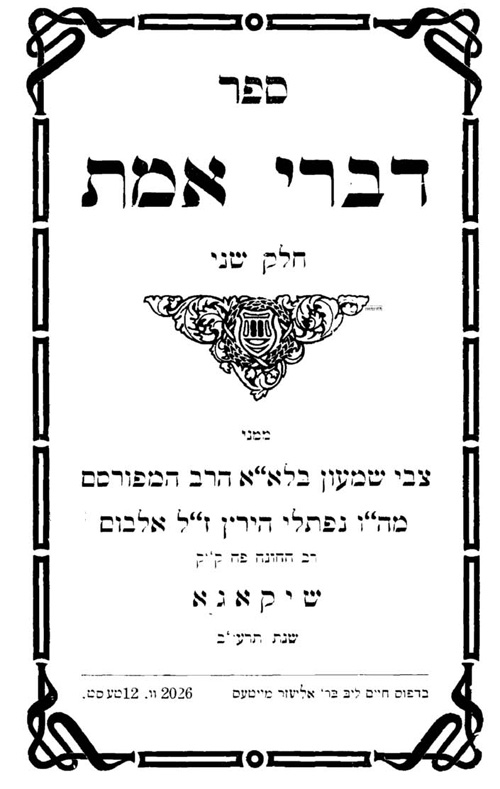
While the history of kashrut supervision is a great interest of mine, I will leave that for another time. For now, let me just call attention to two interesting points he makes in his polemic against Ridbaz.
The Ridbaz’ attack on the Brisker method is well known. In the introduction to his responsa, Beit Ridbaz (Jerusalem, 1908), Ridbaz writes as follows:

A certain rabbi invented the “chemical” method of study. Those in the know now refer to it as “chemistry,” but many speak of it as “logic.” This proved to be of great harm to us for it is a foreign spirit from without that they have brought in to the Oral Torah. This is not the Torah delivered to us by Moses from the mouth of the Omnipresent. This method of study has spread among the yeshivah students who still hold a gemara in their hands. In no way does this type of Torah study bring men to purity. From the day this method spread abroad this kind of Torah has had no power to protect its students. . . . It is better to have no rosh yeshivah than to have one who studies with the “chemical” method.

In his ethical will, printed at the end of his responsa, Ridbaz returns to this criticism and directs his sons: “Be careful, and keep far away from the new method of study that has in recent years spread through Lithuania and Zamut. Those knowledgeable in Torah refer to it as ‘chemistry.'” [Just before this post appeared, R. Eliezer Katzman sent word that in his opinion, Ridbaz is not referring to R. Hayyim and the Brisker approach, but rather to Telz and its method of talmudic analysis. I don’t believe this is correct, and hope to return to this subject in a future post.]
In the first edition of Shaul Stampfer’s Ha-Yeshivah ha-Lita’it be-Hithavutah, p. 113 n. 29, he quotes Saul Lieberman’s opinion that Ridbaz’ words were directed against R. Isaac Jacob Reines. This is clearly incorrect. Reines’ method had no influence whatsoever, and Ridbaz is speaking about a method of study that was widespread in the yeshivot. It is obvious that he can only be referring to the method of R. Hayyim. Lieberman’s incorrect speculation was removed in the second edition of Stampfer’s book.
This new edition is of great importance for it contains the documents that reveal the true reason why Volozhin was closed. In fact, On the Main Line has recently printed a report from the Jewish Chronicle that shows that even in England they had heard that the reason for closing down the yeshiva had to do with the “nihilists.”[3] Incidentally, the report in the Jewish Chronicle’s second story (also cited by On the Main Line) that the Netziv went to Western Europe is incorrect. In fact, I found it quite strange, as it is well known that the Netziv never left Eastern Europe. I asked R. Nathan Kamenetsky about this, and he responded as follows:

They confused him with his son R’ Hayyim Berlin, who did travel to Western Europe to raise funds. In MOAG (p. 449) I quote part of a letter R’ Hayyim wrote FROM PARIS, four months after the closure of the yeshiva to the Rav of Tripoli, Libya . . . From the text of [R.] Berlin’s signature on that letter, I prove (among other proofs) that the Berlins expected the closure of the yeshiva to be temporary.[4]

He also wrote me that he finds the article on the closure significant as “this proves that even among Jews it was known that the yeshiva was closed for the actual reason that is set down in the government records that Stampfer discovered and publicized in his later edition of ‘Yeshivot Lita be’Hit’havutah’. . . . It is invaluable.”

Returning to the Ridbaz, it is not surprising that Album, Divrei Emet, vol. 2, p. 45, points to Ridbaz’ comments as proof that the latter had contempt for the Torah scholars of Eastern Europe. Ridbaz never responded to this volume, but in the introduction to Nimukei Ridbaz (Chicago, 1904), he had already given his view of Album (without mentioning him by name).[5] There was another attack on Album in the book Akhen Noda ha-Davar (n.p., n.d). This latter work is very rare and I have never seen a copy of it. Although its author is given as P. Gwirtzman, Album claims that it was really written by Ridbaz (Divrei Emet, vol. 2, pp. 3, 9, 31).
Needless to say, because of his attacks on R. Hayyim, Ridbaz did not endear himself to the Soloveitchik family. Once when a student referred to Ridbaz, R. Joseph B. Soloveitchik became very angry and told the student never to mention his name again. He also said that some gedolim are always right, some are sometimes right, and some are never right, and the Ridbaz falls into the latter category![6]
Album also points to something else in order to attack Ridbaz. Here is the title page of Ridbaz’ Nimukei Ridbaz.
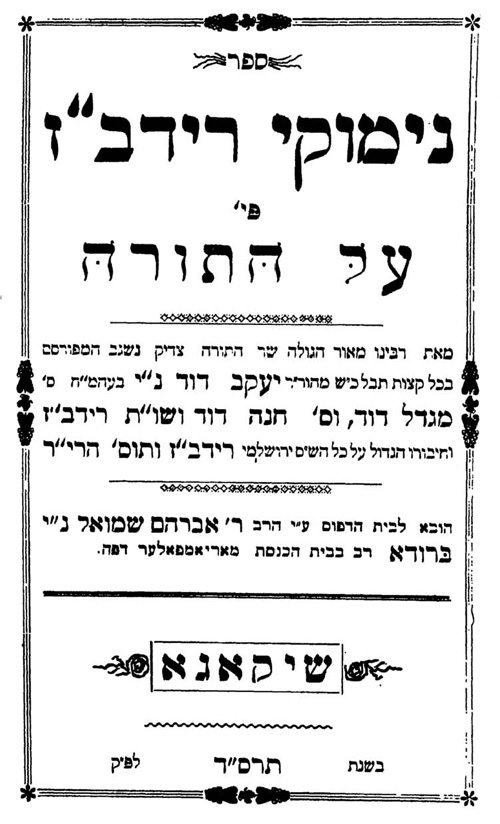
Look at how Ridbaz is described with such grandiose titles. Album picks up on this and writes (Divrei Emet, vol. 1, p. 34b):

עשה עטרה לעצמו בראשו וכתב על עצמו על פתח השער, ספר נימוקי הרידב”ז, מאת רבינו מאור הגולה שר התורה צדיק נשגב המפורסם בכל קצות תבל כק”ש מה’ יעקב דוד נ”י המפורסם בחיבורו הגדול על הירושלמי. כן כתב הרידב”ז על עצמו – ועשה נגד הירושלמי מפורש בפ’ ז’ דפסחים וז”ל הירושלמי ושנא את הרבנות מלמד שלא יניח אדם עטרה לעצמו בראשו שנאמר יהללוך זרים ולא פיך
He continues by mocking Ridbaz’ learning. Here is one example, where he picks up on something Ridbaz writes in Nimukei Ridbaz (ibid., p. 35a):
וכמה דברים אשר נמצאים בתוכו הוא אפס ואין – ואין זה כי אם ראות עין. כמו למשל כתב בפ’ וירא דלכך לא הכניס אברהם המלאכים לתוך האוהל משום דהצדיקים אין הקב”ה מביא תקלה על ידם, ואם הכניסם לתוך האוהל היה שרה רואה אותם, וקיי”ל דאשה נדה אסורה להביט על הס”ת ע”כ באם היו באוהל היתה בע”כ שרה רואה אותם ע”כ. והנה כל דבריו בזה דברים בטלים המה, ראשית שאין שום איסור על האשה להביט על הס”ת רק מצד מנהג וכבוד, עיין במג”א וגם אין צדיקים הקב”ה מביא תקלה על ידן לא שייך אלא במידי דאכילת איסור.
He continues the assault on this point in vol. 2, p. 39:
ומלבד שדבריו דברי ליצנות המה, ומה ענין מלאכים לס”ת, והיכן מצינו שיהי’ מלאכים בגדר ס”ת.
It is very sad to read how Ridbaz and Album speak about each other, and as more than a few have quipped, “There is no hatred like the hatred between rabbis.” Another version of the comment is that “There is no hatred like the hatred between rabbis, especially when money is involved.” Yet in this case, at least, I don’t know how significant the financial angle was. Album claimed that he never received remuneration for giving his hashgachah, and this isn’t something he could have put in print if it was not true. However, Harold Gastwirt assumes that Album was upset that Ridbaz had been chosen as chief rabbi of Chicago, instead of him, and this position certainly did come with a salary.[7])
In seeking to explain the phenomenon or rabbinic hatred, R. Jacob Eskolsky gives the following insightful answer (Taryag Mitzvot [New York, 1926], vol. 1, p. 32a.
פעם אחת השבתי לבעל הבית אחד בעיר סקרענטאן, אשר הייתי שם רב איזה שנים, אשר שאלני השאלה הנושנה של העם, מדוע נשתנו הרבנים מכל בני מלאכה אחרת, אשר הם יושבים זה בצד זה ברחוב אחד או בבית חרושת אחד ואינם שונאים זה לזה, והרבנים מכיון שנמצאים שנים בעיר אינם נוחין זה לזה, אדרבה שונאים הם זה את זה ומחרפים אחד את חבירו, היש איזו סיבה לפליאה זו? והשבתי לו בפשיטות, הלא אם יבואו איש לביתו ויבשר בשורה נעימה לאשתו, כי עזרהו ה’ בפרנסתו ויוכל להוסיף לה שפחה על שפחתה שתהיה עזר כנגדה ותוכל לישב בקתדרא, תגיע להגברת שמחה מזה, וגם השפחה היושבת בבית הבישול בשמעה זאת אחורי הדלת נתמלאה רצון משמועה הזאת, כי תהיה לה חברה לעבודתה ולא יפול משא כל הבית עליה. לא כן אם יבוא איש הביתה בבשורה נעימה ומספר לאשתו כי עזרהו ה’ בריווח גדול יוכל לקחת עוד אשה אחת על אשתו, כי יוכל לפרנס שתי נשים, אז תמלא קנאת עזה כמוה ותשפוך כל חמתה עליו ובקול רעש גדול תחיל הזעק עליו, כי איננה שפחה בביתו להיות שמח בחברתה, כי בעלת הבית היא ואינה חפצה בשום אופן להניח שניה לצוות ולהנהיג עניני הבית ורק קולה ישמע בכל ענין הנהגת הבית, ואם לא ישמע לה ויקח אשה אחרת עליה תהיה צרה לה. כמו כן אם הרבנים מקיימים מה שנאמר בהוריות (דף י’) לא שררות אני נותן לכם, עבדות אני נותן לכם, כי אז היו שמחים אם הקהל מקבל עליו עוד רב, ובקבלת עוד עבד לצרכי הקהל הוקל מעליו עבודת העיר, אך אם הרב מחשיב את עצמו לשר ושופט ונוהג נשיאותו ברמה וכל מילי דמתא יהיו נמתחים אך על פיו ובלעדו לא ירים איש את ידו, אז מביט בעין קנאה על רב השני ואינו מניחו להרים ראש. ועל זה אמרו חכמנו (יומא עא) אלו תלמידי חכמים שדומים לנשים ועושים גבורה כאנשים, כי דרך נשים להם להיות מתקנאות בירך חברתה ולהיות צרה להשניה.
Before coming to New York, Eskolsky had served as a rav in Scranton[8] and was no stranger to rabbinic disputes himself.[9]
Exalted egos from both sides also helps to explain rabbinic feuds. As the Maharal commented, this is a particular problem of Torah scholars, because they are aware of their own great scholarship (Netivot Olam: Netivot ha-Anavah, ch. 6):
כי הגאוה הוא על בעל תורה בטבע וכל זה מצד הגדולה והמעלה שיש לתורה . . . ומפני כך בעל התורה יש בו קצת גאוה שרואה עצמו ג”כ גבוה ונבדל משאר הבריות.
Sometimes these rabbinic disputes even reach the level of what R. Jehiel Jacob Weinberg referred to as “murder.” Here is what he wrote in a letter to R. Joseph Apfel (Kitvei ha-Rav Weinberg, vol. 1 no. 3):
לפני שנתיים באו לכאן הרב גרוסנאס ביחד עם הפרופ’ דומב להתיעץ עם הגרי”א הרצוג ז”ל ששהה כאן והם הי’ גם אצלי ואני יעצתי להגריא”ה לבלי להורות הוראה בזה כי אם בהסכמת כל גדולי ירושלים כי . . . יש קנאים גדולים שאינם מודים על האמת אלא מחמירים עפ”י שיקול דעתם ורגשי לבם. ועמם אין להתוכח והם חשודים גם על שפיכת דם של המקילים וד”ל.
I published this volume as a sefer, to be used in the beit midrash, so I took out something which I didn’t think was proper to appear in such a work (as opposed to a scholarly book or blog where these considerations do not apply). In accordance with scholarly convention, I indicated this with an ellipses. Incidentally, when the late R. Joseph Apfel gave me the letters he received from R. Weinberg, there was only one place where he told me to omit a name. Other than that, he gave me permission to publish the letters in their entirety.
The complete sentence reads (and I have emphasized the deleted word):
כי אם בהסכמת כל גדולי ירושלים כי ביניהם יש קנאים גדולים שאינם מודים על האמת
In other words, R. Weinberg includes in his criticism even some people regarded as gedolim. This should not surprise us, and it doesn’t mean that these individuals are not, in fact, gedolim. Even well-meaning people can at times be led to extreme statements and “shefihut damim”. We have seen this in the last few years when rabbis, without any real knowledge of the facts, have declared that certain hashgachot are not reliable. We have seen gedolim declare that certain authors are dangerous without having even read their books (in the original or in translation) or spoken to them. I know from speaking to some of the mashgichim and the authors that they regard this as real “shefihut damim,” for they have been publicly condemned as either not reliable in matters of kashrut[10] or as destroyers of Torah society. If the accusations are true, then the rabbis have no choice but to speak out. But if the allegations are false, or even uncertain, is there any greater “shefihut damim” than this?
With regard to Weinberg’s comment, the late Yonah Emanuel wrote to me:
[תרשה] לי להתייחס לקטע הנ”ל, בו הרב ויינברג כתב שהקנאים חשודים על שפיכות דמים של המקילים. יש להביא אסמכתא מעדות אישה (!). רות בלוי בספרה “שומרי העיר” (י”ם תשל”ט) , פרק יז-יח, מתארת איך הקנאים רצו למנוע נישואי רבי עמרם בלוי איתה, בהיותה גיורת. אבל למה להביא ממרחק לחמנו? פעם הלכתי לשיעור אצל מו”ר הרב ש”ז אויערבך זצ”ל, ופתאום ראיתי במדרגות בית מו”ר זצ”ל קנאים רבים, חלק מהם דחפו עצמם לתוך הדירה, וחלק עמדו בחוץ. הם רצו ללחוץ בענין מסויים על מו”ר זצ”ל, והשיטה הבדוקה לבוא בהמונים, ללחוץ ולהפחיד. על זה התריע הרב ויינברג זצ”ל ממרחקים. על כגון זה נאמר “את בנציבין ומצודתך פרוסה בירושלים” (פסחים ג ע”ב).
Regarding rabbinic disputes, it is also worth recalling these memorable words, quoted by R. David Sperber (grandfather of Prof. Daniel Sperber)[11]:
מוטב להעמיד צלם בהיכל מלהחזיק במחלוקת
Returning to Ridbaz, all of the controversy in Chicago was too much for him and he left Chicago. Legend has it that he was locked in the freezer, in an attempt by his enemies to kill him, and upon being freed he immediately took his family and grabbed a train to New York. It was Friday night but he felt this was a case of was pikuach nefesh. I doubt that the story is true, although in a previous post I did mention a case where the mashgiach was locked in the freezer. We also have another recorded case where this happened. I refer to Rabbi Luntz of Paterson, N. J. who was locked in the icebox by one of the butchers he certified. This would have been bad enough, but Luntz also had to contend with R. Judah Leib Seltzer, who was later one of the leaders of Agudat ha-Rabbonim. He too was in Paterson and had a terrible feud with Luntz, which “climaxed by a public fight between the two rabbis in the synagogue.”[12]
Speaking of rabbis who were chased out of their communities, let me repeat what I heard from the late Rabbi Louis Jacobs.[13] This story is not documented anywhere, but is something that Jacobs no doubt heard growing up in Manchester. R. Abraham Aaron Yudelevitz was a rav in Manchester at the turn of the twentieth century. He would later come to the United States where he served as a rav in Boston and later in New York, and he was also a rosh yeshiva at Yeshivat R. Yitzhak Elhanan. As with a few others, while in N.Y. he even had the title “Rav ha-Kollel.”
Yudelevitz might have been the most brilliant Torah scholar in the United States. He was also prepared to stand up to anyone (including the Rogochover),[14] and is known for one incredible pesak that created enormous controversy: He permitted a woman to appoint another woman as her shaliah to carry out the halitzah ceremony. A short discussion of Yudelevitz’ life and the controversy is found in the second volume of Yeshurun,[15] the series which continues to publish massive volumes full of important and fascinating material. The typical haredi nonsense is, of course, to be found there, but since it is not so common it is no more than an unpleasant distraction.[16]
Here is a picture of Yudelevitz. He is on the right and the other rabbi is Gavriel Zev Margulies, whom I mentioned in my last post (see also note 12).[17]

Jacobs told me that when the machers had tired of Yudelevitz, they let him know it was time to leave in the following way. When his carriage pulled up one day, inside it were a couple of prostitutes waiting for him. This was the message to Yudelevitz to get out of town! Rather than stay and fight, he set his sights on the United States.

Returning to Gulevsky, in his book Du Yovlin (New York, 1988) he focuses on American Orthodoxy and its various rabbinic leaders. Since R. Emanuel Rackman recently passed away, let me quote a little of what he says (p. 45) about R. David Rackman, who was R. Emanuel’s father. He is the author of Kiryat Hanah David (New York, 1967), published by his son, and was a Rosh Yeshiva at RIETS for a couple of years beginning in 1907.

אחד מראשוני התלמידים שבאו ללמוד בישיבה ואחרי כן הרביצו תורה בישיבה, זה היה הרה”ג רבי דוד רקמאן. כפי ששמעתי מזקנים, הרה”ג מוהר”ר דוד רקמאן בא לארצות הברית עם סמיכת חכמים בידו. הרה”ג רבי נחום דן מסלוצק היה משגיח הראשון בישיבה, והוא לא היה קשור עם תנועת המוסר לגמרי. אבל היה אביהם של כל בני הישיבה, ויותר מזה אביהם ואמם. הוא יעץ להרה”ג דוד רקמאן שימשיך ללמוד ולא לרוץ אחרי הבלי עולם הזה . . . בשנת תרס”ז כבר נתן שיעורים בישיבה קרוב לשלש שנים. היה חכם מופלג ותמך בישיבה כל ימיו. כאשר באו לישיבה מאורי ישראל רבותינו העילוי ממיטשט ואחרי כן רבי משה הלוי סאלאווייציג עזב הרה”ג רבי דוד רקמאן כל עסקיו, וממש התאבק בעפר רגליהם. פעם ראיתי אותו בסביבת החכם השלם איש האשכולות מרן חיים העליר, ויבדל לחיים טובים “הרב” שליט”א. מעולם לא ראיתי פה במדינה הזאת רב שיעמוד ביראת הכבוד כלפי גדולי ישראל אמיתיים כרבי דוד רקמאן.
Gulevsky gives descriptions of other early students at RIETS. One of those he mentions is Moses Romm, who was later a rabbi in Minneapolis. I believe he is the grandfather of Rabbi Romm who taught at BMT for many years. He also mentions Henry Guterman, who was the rav of Scranton for half a century, and has recollections of Samuel K. Mirsky, Dov Baer Abramowitz, and many others. There is so much material here, for those interested in American Orthodoxy, that I can’t even begin to summarize it.
Regarding R. Benjamin Fleischer, many of whose books are now on HebrewBooks.org, Gulevsky says the following (p. 46):
טיפוס מיוחד במינו היה הרה”ג העצום רבי בנימין שלייפער [צ”ל פליישער] שהיה רב בבית מדרש הגדול במורד העיר. היה עילוי נפלא ובקיאותו בש”ס ופוסקים היה משהו מיוחד. ובגלל שהיה עילוי בכל המובנים לכן לא נעשה הפוסק במורד העיר. היה מחמיר גדול בשאלת נשים, אפילו בדרבנן. השיטה שלו היתה שבמדינה הזאת אין חשש מאכולת, הנשים נקיות ביותר וצריכים לבטל לגמרי כל הקולות של כתמים. התרעם הרבה על כמה פסקים של הרה”ג א. ה. בניו יראק, והרה”ג ח. מ. בשיקגא, לא רק בשאלת נשים.
The New York rabbi he alludes to is undoubtedly R. Joseph Elijah Henkin but I don’t know who the Chicago rabbi is. Maybe one of the readers can help out here. As mentioned before, Gulevsky uses this type of code throughout his works. With regard to his categorization of Fleischer as an “illui,” it is worth recalling R. Moshe Feinstein’s comment that: אין לנו הרבה נחת מהעילויים.[18
In the previous post I quoted the very harsh things Gulevsky had to say about YU. Yet Du Yovlin was written while he was still employed there, and from this book we get an entirely different picture. YU is referred to as “yeshivatenu ha-kedoshah”, and on p. 1 Dr. Norman Lamm is described as follows:
ידידי ורב חביבי וכו’, החכם השלם איש האשכולות כליל המדעים וכו’ וכו’ וכו’ הרה”ג נחום לאם שליט”א
At the beginning of this post I mentioned that Gulevsky is descended from both R. Hayyim of Volozhin and his brother R. Simcha. While everyone knows that R. Hayyim became the student of the Vilna Gaon, Gulevsky tells us the following about his forefather, R. Simcha, which is amazing in that it testifies to Lithuanian opposition to the Vilna Gaon (Du Yovlin, p. 2):
אאמו”ז רבינו שמחה התנגד לנסוע אל אדונינו הגר”א כפי שרמז מר זקני הגאון החסיד קדוש ישראל זצוק”ל הי”ד. זקנינו רבינו שמחה בתמימותו הכנה חשב שהגר”א הולך לשנות מנהגן של ישראל, והתנגד לזה הרבה. אדונינו בעל השאגת אריה לא שינה שום דבר מלבד שהכשיר מכה בדופן וכו’, אולם אדונינו הגר”א, שמעו עליו שאינו מניח תפילין בחול המועד וכדומה.
With regard to the Vilna Gaon, and why he never made it to the Land of Israel, Gulevsky writes as follows (Shabbat Shabbaton, p. 134):
ושמעתי מאאמו”ז הגאון החסיד קדוש ישראל עמוד ההוראה ואביר הרועים מרנא שמחה זעליג זצוק”ל הי”ד, ששמע ממרא דמתיבתא עלאה הגה”ח המובהק מרן רפאל מוואלאזשין ששמע מאביו רבינו אריה ליב שאפירא מקאוונא, היו הרבה טעמים שהגר”א חזר מדרכו לארץ ישראל. אבל רבינו אריה ליב סבר שאחד מהטעמים בנגלה היה שהגר”א סבר העיקר כהמבי”ט נגד הבית יוסף וכל חכמי הדור ההוא.
According to the Mabit all produce grown in the Land of Israel in the Sabbatical year, even on non-Jewish land, has sanctity and must be given special treatment. I assume that Gulevsky’s report means that the Gaon did not want to come to the land of Israel and create controversy by adopting a practice in opposition to R. Joseph Karo’s view, which was minhag Eretz Yisrael.[19] (In the twentieth century the Chazon Ish had no compunctions in advocating the Mabit’s opinion, especially as there are reports – hotly disputed, to be sure – that before his death R. Joseph Karo abandoned his position.[20])
An interesting comment which is not of a historical nature is found in Shabbat Shabbaton. p. 96. R. Moshe Feinstein states that anytime Rabad doesn’t express his disagreement with the Rambam, this shows that he agrees with him. R. Moshe is hardly the first to argue in this fashion,[21] yet Gulevsky points out that this is a methodological error and that there are numerous times that Rabad disagrees in his other works and doesn’t record this disagreement in his hassagot. R. Yaakov Hayyim Sofer, who has a bekiut unlike that of anyone alive today, has a very long list of such disagreements, and if all we had were the hassagot we would know nothing of this.[22] We can conclude, therefore, that Rabad’s hassagot were never intended to be a comprehensive list of all of his criticisms, but were written in an ad hoc fashion.
Quite apart from what appears in his books, there are some other interesting tidbits he told me which as far as I know do not appear in print.
1. The grandfather of the famous bibliographer, E. R. Malachi, was named Engleman, and he emigrated from Brisk to the Land of Israel in 1837.
2. R. Simcha Zelig Rieger was head of a kollel le-hora’ah in Volozhin. This kollel focused on practical halakhah.
3. R. Hayyim Soloveitchik and R. Velvel never preached to the community, not even on Shabbat ha-Gadol and Shabbat Shuvah.[23]
4. Although R. Velvel was officially rav of Brisk for twenty years, he only resided in the city for six and a half of these years. He was often ill and had to spend much of his time in places more congenial to his health. He was not living there during the 1937 pogrom, but after this event he returned to the city for two weeks.
5. In Kelm “they held of” Wessely’s Yein ha-Levanon.(I include this because I think Gulevsky meant the yeshiva as a whole, not simply R. Simcha Zissel. R. David Zvi Hillman has seen the manuscript essays of R. Simcha Zissel, and they contain references to Wessely. When these were published in Hokhmah u-Mussar [New York, 1957], Wessely’s name was deleted.[24])
6. Rabbi Rakefet has asserted on numerous occasions that as a young man R. Shneur Kotler attended R. Soloveitchik’s shiurim at YU. Gulevsky denies this. According to him, R. Shneur only went to hear the Rav at Moriah.[25]
7. R. Joseph Zekhariah Stern, Zekher Yehosef, Orah Hayyim no. 177, has a responsum addressed to ר’ מנחם שרגא רעוויל. This is Bernard Revel’s father (The first name was actually Nahum, not Menahem.)

I would be remiss in not mentioning that one has to question many of the stories Gulevsky tells, simply because they don’t agree with what we know from other sources. While he tries to be careful in his facts, some of his reports are no different than the typical “frum history” in which all sorts of stories get repeated as if they were facts. There are a number of examples of this but let me note one that doesn’t appear in his books, but which he told me. According to Gulevsky, the reason Yeshiva College did not offer a job to Saul Lieberman is because his father-in-law, Meir Bar-Ilan, almost bankrupted the institution when he served as temporary president during Bernard Revel’s leave of absence. Yet this is completely false. There are also times when Gulevsky writes things that are not merely incorrect, but downright foolish. See e.g., here.

The link just given refers to Gulevsky’s stringent view of eruvin. In this he is following not only the Brisker tradition but also that of his grandfather, who did not believe that an eruv could be established in the typical town. Yet Gulevsky has also noted that despite this opposition, there was an eruv in Brisk and his grandfather checked it every week.[26] (When the young Joseph Baer visited Brisk he checked it together with R. Simcha Zelig.[27] He also used to check the eruv in Chaslovitz, where his father was the rav.) Originally I thought that the presence of an eruv in Brisk was an example of R. Hayyim not wishing to force the community to adopt his stringent position. Yet from R. Moshe Sternbuch’s recently published Teshuvot ve-Hanhagot, vol. 5, no. 101, we see that this was not the case. He heard from R. Velvel that R. Hayyim wanted to forbid the eruv, and even publicized this, but the people refused to listen to him. (You see, it is not only Modern Orthodox Jews who ignore what the rabbis tell them!) The people must have thought that if other cities with great rabbis can have an eruv, then why should they suffer because of R. Hayyim’s humra. Faced with this rejection, R. Hayyim told R. Simcha Zelig that the kashrut of the eruv was to be his responsibility. R. Hayyim wanted nothing to do with it. R. Velvel himself would only check the eruv once a year, before Rosh Hashanah, and it bothered him greatly that his own city was relying on what he regarded to be unacceptable leniencies.[28]
In Boston, as long as R. Joseph B. Soloveitchik was active, there was no eruv. The Rav publicly declared:
I am opposed to the establishment of eruvin. An eruv in American means the abolishment of the prohibition of carrying on Shabbat. Aside from certain [meta-halakhic] reasons, I also have halakhic reasons why I can’t give my approval to the establishment of eruvin. [29]
As soon as the Rav was no longer able to protest, an eruv was established in Brookline. I was in the Bostoner Rebbe’s shul when he spoke about how important the eruv was and that everyone should rely on it. He insisted that there must be no distinction between the “frum,” who don’t carry, and everyone else. It is interesting that the Modern Orthodox world, which places the Rav on such a pedestal, has not accepted one of his few public halakhic pronouncements.

[1] See here
[2] Hebrew Printing in America, p. 501.
[3] See here.
[4] In his e-mail to me Kamenetsky mistakenly wrote R. Meir Berlin. I have corrected it.
[5] The introduction to this book and also his Beit Ridbaz (Jerusalem, 1908), are fascinating, because he describes in detail many of the communal problems he saw. One wonders if he was writing his book today, which problems he would identify. I don’t think English sermons would still be an issue for him, although I think it is fair to say that advertising a “Pretty Woman” sheitl would definitely outrage hiim. After all, the sheitl is supposed to represent modesty, and Julia Roberts’ profession in that particular movie was not exactly tzniusdik. See here (Unfortunately, some of the comments to this post are inappropriate.)
[6] I heard this from an eyewitness. The event took place in the 1950s.
[7] See Fraud, Corruption, and Holiness (Port Washington, 1974), p. 91.
[8] Quiz question: Which contemporary gadol be-Yisrael was born in Scranton?
[9] See Gastwirt, Fraud, p. 145, that Eskolsky was expelled from Agudat ha-Rabbanim for giving a hekhsher on a plant that produced both kosher and non-kosher meat. This was in violation of the Agudat ha-Rabbanim takkanah. Those rabbis who opposed Agudat ha-Rabbanim’s policy formed the competing Kenesset ha-Rabbonim, which was led by R. Gavriel Zev Margulies.
[10] Experience has shown that a rabbi who is financially corrupt can easily win back his reputation (and in some circles financial corruption doesn’t affect his reputation to begin with). Yet if a rabbi is accused of not being reliable in matters of kashrut, even if the accusation is false, it is almost impossible for him to turn this around. Unfortunately, when it comes to kashrut supervision, American Orthodoxy has distorted our tradition. People are constantly told that if they see a hashgachah on a product or restaurant, that they cannot rely on it without investigating who the rav ha-machshir is. This is completely mistaken. According to halakhah every rav is regarded as trustworthy unless you have been reliably informed otherwise. Without receiving negative information, one should always assume that a rav is reliable. This is no different than if you arrive in a new city and go to shul on Shabbat and you are invited to someone’s house for lunch. One should assume, unless he has reason to think otherwise, that the person inviting him keeps kosher, as religious Jews have a hezkat kashrut. Certainly, if the rabbi invites you to his house you must assume this. The notion that is currently rampant, that we don’t trust a rav until we investigate him, is the exact opposite of what the tradition has always held. Rather, we are supposed to trust the rav unless we are given reason to think otherwise. Every rav, even a rav ha-machshir, has a hezkat kashrut and is assumed to be doing his job reliably.
To show how far this idiocy has gone, let me share something that happened a couple of years ago when I was visiting a city that shall remain nameless. Someone was eating with us and mentioned that he was going to be travelling to Elizabeth, New Jersey. He asked me if I knew about kosher food in the area. I told him that Elizabeth has a very nice Jewish community, with plenty of kosher food. He then asked who gave the hashgachah, and I replied that it is Rabbi Teitz. The man wasn’t happy with my answer, which troubled me since I had never heard of anyone question R. Teitz. In fact, in speaking to him it was apparent that he had never even heard of R. Teitz. Yet he announced for everyone that his family would have to avoid visiting any of the kosher eateries when he was in Elizabeth. I was really shocked and I asked him, “Why? What is wrong with R. Teitz?” I further asked him where he thinks the people he will be visiting in Elizabeth get their food. Yet he would only reply: “We only eat at places under the supervision of a Vaad.” I told him that I didn’t think that there was a Vaad in Elizabeth, and why in any case does he need a Vaad? A Vaad might be a good idea from a practical standpoint, in order to create one communal standard, yet there is nothing in the Shulhan Arukh about a Vaad, and R. Teitz is as reliable as anyone. Yet all I got from him was the same nonsense about how without a Vaad a hashgachah cannot be trusted. (I never asked him what he would do in a one-rabbi town.)
[11] Afarkasta de-Anya, vol. 1, no. 165:3. While Sperber later became a mainstream haredi posek, in his youth he was also exposed to Haskalah. See Joseph Ibn Kaspi, Asarah Kelei Kesef ed. Last (Pressburg, 1903), vol. 2, pp. 190ff. (Hebrewbooks.org for some reason splits up Asarah Kelei Kesef into separate volumes. If you search hebrewbooks.org under נקדות כסף you will find the Sperber letters.) Sperber, p. 193, asks Last, when he publishes his letters, to describe him as a hasid. His reason is incredible:
נא לתארינו [צ”ל לתאריני] בשם “חסיד” והיה אם לא ייטבו דברי בעיניהם ידינני לכ”ז, ויאמרו כי חסיד הוא וחכמה מה לו, ואם אולי ימצאו דברי נכונים, אז ירומם שם חסיד תחת לשונם ויאמרו הגם חסיד יודע ומבין דבר.
[12] See Gastwirt, Fraud, p. 93. Cf. Jenna Weissman Joselit, New York’s Jewish Jews (Bloomington, 1990), p. 62, regarding R. Moses Z. Margolies and his kashrut battles: “Determined to teach the Ramaz a lesson, a band of disgruntled butchers alledgedly banded together to poison the meat at his daughter’s wedding supper, sickening some 2000 guests, including the bride.” During his great dispute with R. Shalom Elhanan Jaffe, R. Gavriel Zev Margulies was physically attacked by shohatim who supported Jaffe. See Gastwirt, Fraud, p. 121.
[13] Since I mention Jacobs, I must also note the following. In a recent AJS Review (vol. 32, 2008), pp. 450-452, I reviewed Miri Freud-Kandel’s history of Orthodox Judaism in Britain. I mentioned the “Jacob’s Affair” and there is a note explaining what this was.
“The term ‘Jacobs Affair’ refers to the controversy surrounding the potential appointment of Rabbi Louis Jacobs as chief rabbi of England. In 1961, Rabbi Louis Jacobs, z”l, was nominated as the principal of Jews’ College, a position considered a potential way station for the chief rabbinate of the British Commonwealth. That appointment, however, was blocked by the then-chief rabbi Israel Brodie because of his published views. Brodie then prohibited Louis from returning to his post at the New West End synagogue in London, upon which a new congregation was established for him.”
This was added by the editor. I never would have referred to Jacobs as “Louis.” I have, incidentally, many letters from Jacobs that I hope to publish. Although we only met three times, we corresponded for almost twenty years. Only now do I realize how lucky I was, that this world-renowned scholar took the time from his busy life to correspond with a young student, especially a student who had no compunctions telling Jacobs when he disagreed with him. Occasionally, I would send Jacob’s material that I thought would interest him. One time I sent him R. Joseph Messas’ Mayim Hayim, and was surprised to later see that he cited this work in Beyond Reasonable Doubt (London, 1999), pp. 216-217. He showed great insight in describing Messas as follows: “As is evident from his responsa, Mashash, for a rabbi of the old school, was something of a modernist. But his historical sense was sufficiently acute not to allow him to read modern ideas into the sayings of the ancient rabbis.” I also sent him Haym Soloveitchik’s famous article, “Religious Law and Change,” AJS Review 12 (1987), pp. 203-221, which surprisingly he had never seen. When A Tree of Life was reprinted in 2000, he added a new introduction and cited this article as further support for the thesis of his book.
Regarding editors adding material to an author’s work without asking, see the recent comment by Haym Soloveitchik in “Mishneh Torah: Polemic and Art,” in Jay M. Harris, ed., Maimonides After 800 Years (Cambridge, 2007), p. 333 n. 25. (This is a truly wonderful article.) In referring to an entry he wrote for the Oxford Dictionary of the Jewish Religion, Soloveitchik notes: “The editors, wishing to improve upon my scant bibliography, added Shemuel Argaman, The Captivity of the Maharam: A Narrative of the Events Surrounding the Arrest and Captivity of the Maharam of Rothenburg (New York, 1990)—a children’s storybook published by the Lakewood Heder.”
[14] See here. This source does not give the book and page no. that is excerpted: It is Av be-Hokhmah (New York, 1927), pp. 85-86.
[15] R. Moshe Zvi Berger, “Av le-Hakhamim: Ha-Gaon R. Avraham Aharon Yudelevitz,” Yeshurun 2 (1997)), pp. 686-691.
[16] For an example from the most recent volume, see Yeshurun 21 (Nisan 5769) p. 417, where in discussing “Ha-Gaon R. Moses Aaron Poleyeff” we are told that he שימש אז כראש ישיבה באחד מהישיבות שבאמריקה. If this was someone who taught at RIETS for a short period of time, I might understand it, but Poleyeff spent his entire adult life teaching there. (He began teaching at RIETS in 1920.) He was also widely regarded as Yeshiva’s most beloved teacher. Poleyeff, more than anyone else, would be offended at this attempt to “kasher” him by hiding the fact that he taught at RIETS. (An outstanding talmid hakham recently commented to me that in his opinion Poleyeff was a greater lamdan than R. Moshe Feinstein!)
[17] I found the picture here.
[18] R. Michel Shurkin, Meged Giv’ot Olam ( Jerusalem, 2005), vol. 2, p. 23. He also quotes R. Leib Malin as saying that it is not good to be an illui.
[19] Eliezer Brodt called my attention to the fact that R. David Luria offered this reason as well. See Dov Eliach, Ha-Gaon (Jerusalem, 2002), vol. 3, p. 1286.
[20] See Dayan I. Grunfeld, The Dietary Laws (London, 1972), vol. 2, pp. 180-181
[21] R. Yitzhak Yosef, in his new work, Einei Yitzhak (Jerusalem, 2009), vol. 3, p. 439, also accepts this methodological rule.
[22] Keneset Hayyim (Jerusalem, 1993), pp. 9-12. See also Isadore Twersky, Rabad of Posquieres (Cambridge, 1962), pp. 175-176.
[23] In the recently published Kol Brisk (Jerusalem, 2009), p. 20, it refers to R. Hayyim delivering words of Mussar on Shabat Shuvah. Gulevsky strongly denies this. The most that he would acknowledge is that perhaps in his first year or two he gave derashot, but never after that. (R. Chaim’s and the Brisker Rav’s way of “rabbinating” did not find favor in the eyes of all of Brisk’s citizens, ואכמ”ל.) In general, there are historical points in this book that are doubtful, leading me to question its reliability in such matters. Even if the historical information came from R. Aaron Soloveichik, it was not uncommon for R. Aaron to err in such matters, and again אכמ”ל. (Kol Brisk is authored by one of R. Aaron Soloveichik’s son. He doesn’t give his name on the title page so I will respect this.)
Let me give one example of the questionable material in this book. On p. 33 there is a whole story, seemingly legendary, to explain how R. David Feinsten, R. Moshe’s father, received the name Feinstein, since the family’s original name was not this. Yet in the introduction to vol. 8 of Iggerot Moshe, p. 6, the children of R. Moshe state that Feinstein was indeed the family name.
Perhaps in another post I will return to this book, as it has a number of what are certain to be controversial statements. For example, on p. 656 it blasts the OU for naming its Israel center after someone who, we are told, caused R. Aaron Soloveichik so much trouble:
בפעולה זו הם מבזים גדול בתורה שכל ימיו הרביץ תורה לאלפים.
[24] See Naftali Hertz Wessely, Yein ha-Levanon (Rishon le-Tzion, 2003), p. 28.
[25] Regarding R. Shneur, a recent article in Ha-Ma’ayan reveals that in the mid-1940’s he was involved in founding the first yeshiva in Palestine that taught secular studies. See R. Yoel Amital, “Sabi ha-Rav Zvi Yehudah Meltzer,” Ha-Ma’ayan 49 (Tamuz, 5769), p. 66.
[26] See R. Menasheh Klein, Mishneh Halakhot, vol. 8, no. 128, vol. 15, no. 127 (responsum to Gulevsky; this last source quotes R. Moshe Feinstein as stating that there was also an eruv in Karlin, despite the fact that R. Yaakov of Karlin was the leading opponent of city eruvin). In his responsum to Gulevsky, Klein says some of the strangest things imaginable, which raise questions as to how he can be taken seriously as a posek in matters of eruvin. According to his calculations, and this is directly related to his halakhic understanding, in Second Temple days there were billions (!) of Jews in the Land of Israel, and roughly thirty million of them would descend on Jerusalem for the holidays. He concludes (vol. 15 p. 201):
והבוליווארדיס והמעטראפאליטין של קווינס וגרענד סענטאראל אף לא הגיעו לקרסולי ירושלים עיה”ק וזה לפענ”ד פשוט
In another responsum to Gulevsky dealing with eruvin (Mishneh Halakhot, vol. 8, no. 168), he says something equally strange:
גם מרן הח”ס נחשב מתלמידי בעש”ט שהי’ תלמיד מובהק של מרן בעל הפלאה
[27] Schachter, Nefesh ha-Rav, p. 170.
[28] R. Sternbuch adds:
ומאמר היה בפיו בשם אביו הגר”ח זצ”ל, “קשה למצוא עירוב כשר וקשה למצוא מקוה פסול”, וכוונתו שבעירוב נכנסים לדחוקים ומכשירים, ובמקוה אף שמדינא יש להקל מחמירים.
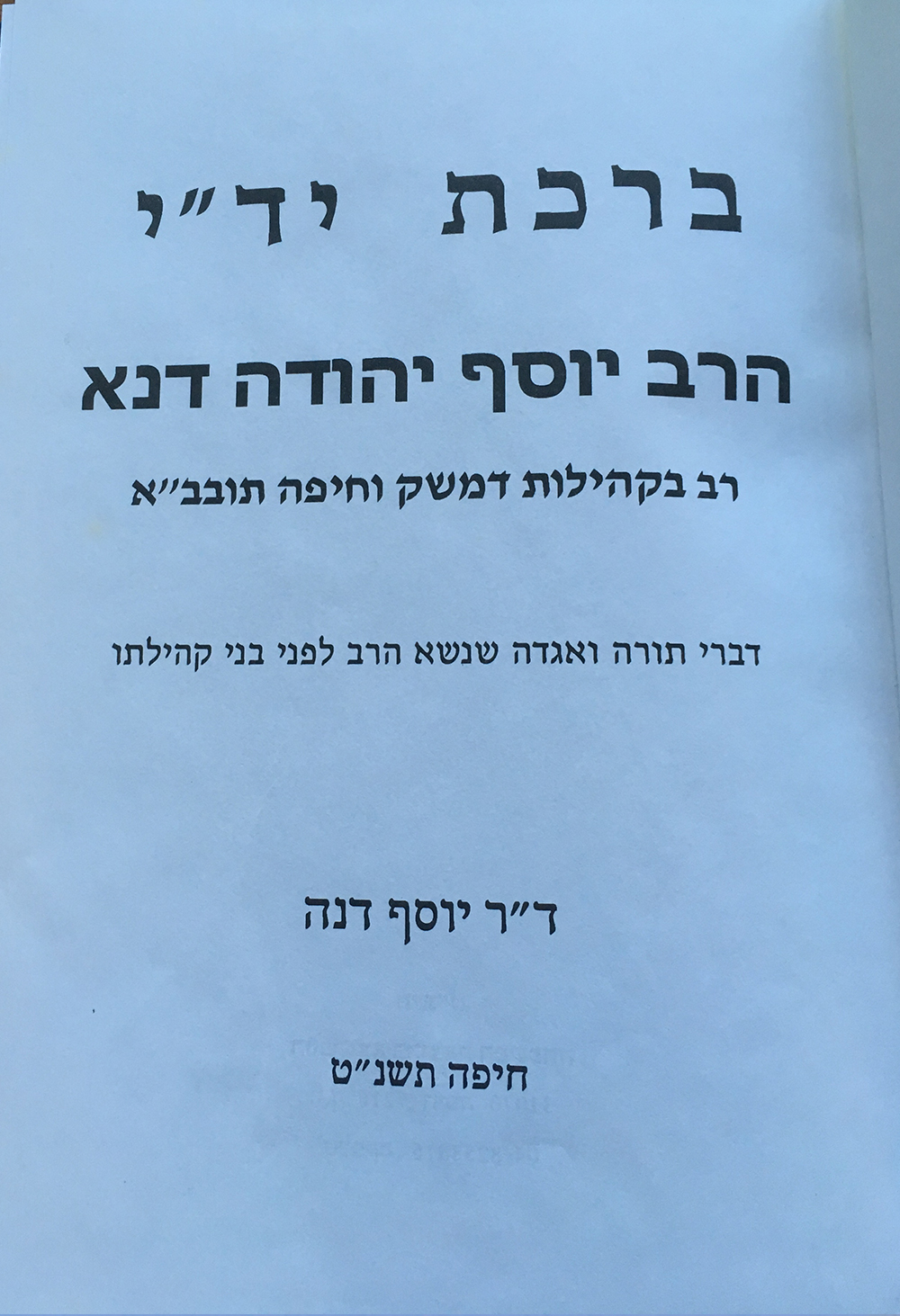
[29] Ha-Pardes (January, 1979), p. 26.


A Preliminary Bibliography of Recent Works on Birkat ha-Chamah

A Preliminary Bibliography of the Recent Works on Birkat ha-Chamah by Eliezer Brodt & Ish Sefer There are many works and articles on this topic and, as such, this is merely a preliminary attempt to deal with this burgeoning area of Jewish literature. [See also here]. For a great bibliographic note on the development of Seder Birkat ha-Chamah, including publications relating to birkat ha-chamah, see R. J. D. Bleich, Birkat ha-Chamah, pp.128-133. JNUL has put up a many of the editions of relating to subject here, here, here, here, here, here, here, here, here, here, here, here, here, here, here, here, here, here, and here. That's right, the JNUL has 19 editions (!) of the Birkat ha-Chamah starting with the first in 1785 through 1981 Edah Haredit edition.  These editions come from such disparate places as Egypt, Tunis, India, and Iraq.   But, now, turning to the editions currently in print.Boker Yizrach from R. Meldola was reprinted again and it includes a later edition with a Pirush Sharei Mizrach from R. Yekusiel Kamelhar (about him in general see this book).Tekufos ha-Chamah u-Berckoseh of R. Yechiel Michel Tukuchensky was reprinted again. A new work on this topic is called Otzar ha-Zemanim by R. A. Brisk. This work is 336 pages is beautifully type-set, well organized, very strong in halacha and it has a bit on the astronomical aspects of birkat ha-chamah.Another work on this topic is by R. M.M. Gerlitz called Birkat ha-Chamah ke-Hilkhoto. On the prior edition, R. J. D. Bleich writes that Gerlitz's book is the most comprehensive work on the topic. This work is an expanded version of its earlier edition, and is now 558 pages. This work is strong in both astronomy, devoting 190 pages to the topic, and strong in the halacaha aspects. It also has many responsum relating to this topic and includes dershot that were said at prior birkat ha-chama by various Gedolim. In addition, this new edition has many letters to R. Chaim Kanievsky on the topic (a recent "minhag" of all works on halacha). To just mention one interesting discussion which R. M.M. Gerlitz deals with is the Ozstrosver's now famous statement that it is extra special if Birkat ha-Chamah falls out on Erev Pesach (pp.115-18). Another nice addition to R. Gerlitz's revised edition is R. Yakov Emden's comments (pp.479-94) all about birkat ha-chamah. These comments were originally printed in the back of the 1757 edition of Megilat Tannit and were omitted from later editions of Megilat Tannit. As such, R. Emden's comments escaped the notice of many of the people learning this topic. Aside from R. Emden's discussion about birkat ha-chamah, he also deals with the Frankist movement and states that one can inform on them to the government (he also deals with Christianity). However,  R. Gerlitz cuts out a page of this – where R. Emden listed some of the Frankists sins – Gerlitz argues that there is no need  to print this today. Today with the amazing web data base of free seforim at Hebrew books one can see this rare edition here and the pages on birkat ha-chamah here and the edited pages here. One thing lacking from this otherwise excellent edition is a proper index of topics discussed.Another work is called Birkat ha-Chamah be-Tekufoseah by R. Genot. This work is 748 pages and is very strong in the astronomy aspects but weaker in the halacha aspects. On the bibliographical front, it reproduces many different editions of Birkat ha-Chamah. He also includes the comments of R. Emden but in a much more abbreviated form than R. Gerlitz. One interesting thing (p.276) a quote from a manuscript from 745 years ago of how the beracha was recited by the Chazan after Ma'ariv! One big mistake in this work when dealing with the famous question of if the calendar according to Shmuel is off so why do we follow Shmuel's opinion,  R. Genot prints a photocopy of the original Halevonon article of R. Alexander Moshe Lapides he then writes: בעוד שהקושיא בת מאות השנים על אמיתות תקופת שמואל נידונה בספרי האחרונים נתפרסמו מאמרים אחדים גם בכתבי עת, שלא עלו על שולחנם של שלומי אמוני ישראל. הבאונם אך כקוריוז משלים לנושא רחב זה , ואם יש בהם משפטים הנוגדים את מסורתנו, הרי הם דברים שאין בה ממש (עמ' 424). He obviously does not know who R. Alexander Moshe Lapides was – a talmid  chaver of R. Yisroel Salanter and one of leading Litvish Gedolim of his time. As an aside this piece was recently reprinted in the excellent edition of Torat ha-Goan R. Alexander Moshe pp.6-8. Another work is from R. Zvi Cohen called Birkat ha-Chamah, 383 pages. This sefer is like all his others, full of excellent information from a very wide range of sources. This work is expanded from earlier edition and is strong in halacha aspects but not as strong in astronomy. Another work on the topic is called Seder Bircas Kiddish Hachamah by R. Strohli, 203 pages.Of great interest to me in the works of R. Brisk, R. Gerlitz, R. Genot, R. Cohen and R. Strohli [a version of this appeared in the recent Journal Etz Chaim volume 8] is how they list sources of Gedolim throughout the ages how they each did this beracha.  In doing so, these works quote many rare sources although, at times, they overlap each other (next time around someone just has to take all the works on the topic and put it together into one volume). One source which escaped them (except for The Sun Cycle p. 23) is found in a autobiography from the early 1600's where the author describes as follows:  כט אדר שעז בהיותי בק' ורנקבורט נתחדש החמה כי כן נעשה כל כח שנה מחזור החמה ולא נעשה כזאת עוד עד ער"ח ניסין ארבע מאות וחמשה אשרי המחכה ויגיע לימים אלו והלכו כל הקהל בשעה ג' על היום על בית הקברות ויום מעונן היה ועמדתי בתוכם ואמרנו פה אחד ברוך עושה מעשה בראשית (ר' אשר ב"ר אליעזר הלוי, ספר זכרונות, עמ' 7).  Another interesting thing we see from this account is the strange minhag to say birkat ha-chamah in the cemetery or near it. This strange minhag is only mentioned briefly by R. Genot in Birkat ha-Chamah be-Tekufoseah (p. 290) and discussed at greater length by R. Gerlitz in Birkat ha-Chamah ke-Hilkhoto (pp. 231-233) (otherwise I have seen no mention of this strange custom). It seems this was the minhag in Frankfurt according to the Yosef Ometz but R. Chaim Rapoport in Birkat ha-Chamah Al Pei Minhag Chabad (p. 80-81) cites the Alei Tamar who argues that this is an incorrect reading of Yosef Ometz and they did not say the beracha at the cemetery. However from this account we see that they indeed did say it at the cemetery. [See also E. Prins comments on this Yosef Ometz in Parnos le-Dorot, p. 292.]Another work is called Birkat ha-Chamah Al Pei Minhag Chabad, from R. Chaim Rapoport 167 pages. This edition includes a section of the halachot in English. Of special interest in this work of R. Rapoport and that of R. Strohli is their sections dealing with women and this beracha. In English, there is  R. J. D. Bleich, Birkat ha-Chamah, 243 pages. This work is extremely well written, as R. Bleich excels at making extremely complicated things sound easy.  It deals with astronomy and halacha aspects very comprehensively for scholar and layman alike. Just to mention one interesting source, not only related  to birkat ha-chamah, is that when discussing aleinu and the censorship of the statement  שהם משתחוים להבל וריק ומתפללים אל אל לא יושיע that the Mahril Diskin held one has to be careful to say it because of משנה ממטבע שטבעו חכמים בברכות. R. Bleich writes that he saw in the siddur of R. Reven Grozovsky that this phrase was written in the siddur. Just one complaint with this particular edition is it is very annoying the way the pages are set up as a Hebrew book even though it is written in English making the pages confusing going from one page to the next. Additionally, one thing lacking from this otherwise excellent edition is a proper index of topics discussed. Another work also in English is from R. Yehuda Hershkowitz, The Sun Cycle, 213 pages printed by Tuvia's. The strength of this work lies in its uniqueness not to merely retread the same ground the above works deal with.  R. Hershkowitz, notes in the introduction that he does not see any point in replicating the seforim already out there on the topic. Instead, he chose to deal with the deeper meaning of the prayers and the beracha in general. He has extensive comments on the tefilos (according to kabbalah and machasvah). He also includes an excellent in depth chapter about the astronomical aspects of this topic. Most of the book is in English but he includes all the tefilos in Hebrew with a translation, notes and an in-depth scholarly chapter on the sugyah in Berkhot, regarding birkat ha-chamah, discussing the Bavli, Yershalmi and Tosefta. One thing lacking from this otherwise excellent edition is a proper index of topics discussed.
One interesting aspect in this work is as mentioned most of these works provide (just some better than others) accounts showing different birkat ha-chamah accounts through out history. Hershkowitz shows that the earliest possible source is from about 1300 years ago in various early paytanim (see The Sun Cycle p.15). Another interesting discussion which he deals with is the definition of the word סלה that it might mean refrain meaning repeat, which means it was intended for the choir to repeat it (see The Sun Cycle pp.68-70).

One interesting point regarding birkat ha-chamah is that although we hold that one makes the beracha with shem u-malchut, the Maharal did not. An explanation for the Mahral's practice appears in R. Moshe Kunitz's Ben Yochai:ומהאי טעמא נראה שהגאון האדיר אבי זקני מהר"ל מפראג ז"ל היה מברך ברכת קידוש החמה בלא שם ומלכות, לפי שבערוך (ערך חמה) כ' ב' פירושים אהא דתני ברכות נט רע"ב הרואה חמה בתקופתה מברכין וכו' ולפי הב' אשתמיט מאמר אביי שם בש"ס ישינם לכן נראה דברכה קבועה כל כח שנין איתקין אחר חתימת התלמוד ומש"ה לא בירך בשם ומלכות (בן יוחאי, שער שבעי סי' רפא, דף קמא ע"א).  
What is even more interesting is this account is referenced by R. Akiva Eiger who quotes it in his notes to Shulcahn Orach O.C. 229:2. The reason why this is interesting is because of who R. Kunitz was.  In particular, he had very strong Haskala leanings and was even linked with R. Aaron Chorin a leading figure of the early Reform movement. R. Moshe Sofer referred to Chorin as Acher as a play on Chorin's name and, in R. Sofer's view, Chorin's opinions.  In part, Kunitz's connection to the Reform movement is based on a letter that appears in Nogah TzedekNogah Tzedek, printed Dessau, 1818, is written to justify various changes such as the using the Sefadic pronunciation, doing away with the silent Shemoneh Esreh, and the inclusion of musical instruments, such as the organ, even on Shabbat.  At the end of this volume, pp. 27-28, Kunitz's letter addressing these issues appears.  On the first issue, the Sefardic pronunciation, Kunitz says this is fine, and notes that R. Nathan Adler (R. Sofer's Rebbi) used the Sefardic pronunciation. Regarding abolishing the silent amidah, he is against this. Regarding the final issue, the use of music, Kunitz again takes a permissive view and allows for musical accompaniment, although he doesn't discuss Shabbat. 
The "Traditional" response to Nogeh Tzedek (and its related works) was not short in coming. The traditionalists banded together sending out letters and collected the responses in a single volume, Eleh Divrei ha-Brit, Altona, 1819. On this aspect see M. Samet, Ha-Chadash Assur min ha-Torah pp.241-42 (and index) and this thread, this thread, and this thread.Returning to Kunitz's work, Ben Yochai, one of the aspects of this work is explaining why some time Rashbi is referred to as ר' שמעון and others as ר' שמעון בר יוחאי. His basic theory is that before he went into cave he is referred to as ר' שמעון and only after the cave is he called בר יוחאי. Indeed, on the title page of the book there is an illustration of the "cave."  In truth, however, this theory is a mistake as Yechosei Tannim Vamorim the Rebbe of the Rochach writes just the opposite:  וכן דברי ר' שמעון בן יוחי ורוב פעמים דברי ר' שמעון אלא כולן בבחרותן קודם שהובהקו לרבים ולכשנעשו ראשי ישיבות הוזכרו סתם (יחוסי תנאים אומוראים, מהדורת מימון, עמ' שצא). Another large part of Ben Yochai deals with R. Yakov Emden's comments on the Zohar in Mitpachas Seforim.  R. Kunitz answers each one of R. Emden's 280 comments. A more recent attempt to deal with R. Emden's criticisms of the Zohar was mounted by  R. Reuven Margolis in his notes to his edition of the Zohar, Nitzotei Zohar. See R. Zevin excellent review on Margolis's Zohar in his Soferim Ve-Sefarim, (Midrash ve-zohar …, pp.31-32).  Yet at the same time, R. Margolis writes in Arshet 2, pp. 336-337 that one has to check carefully into each thing which Kunitz says. It is not only R. Margolis that question Kunitz's work.  Rosenthal in his excellent bibliography, Yodeah Sefer, comments on the Ben Yochai: ואתה הקורא בראותך את ספר הגדול למראה הזה עם כל אורך לשונו ובקיאותו לעור עין כל קורא, אל תבטחבו ואל תשע אל דבריו. לך נא וקרא בדברי המחברים אשר באו אחריו כמו בספרי כרם חמד, תעודה בישראל, בית יהודה, ושרשי לבנון והוא מחברת הראשונה מבית האוצר, ופרחי צפון, וכלם יענו ויאמרו כי כל דבריו הבל ואין בהם מועיל, וכל דבריו הטובים אשר נמצאו בספרו, אשר בהם התראה לעין הקורא כבקי בכל ספרי העברים, גנב מספר סדר הדורות.
On this work of Kunitz in general see Boaz Huss, Ke-Zohar ha-Rokiyah, pp. 321, 333, 343-44.

In the fascinating sefer (subject of its own post hopefully shortly) on Zohar called Matzav Hayashar by R. S. Z. Dober, Dober accuses Kunitz many times of plagiarism (1:2a, 7a). The only compliment R. Dober gives Kunitz is that he had a nice library (2:60) and that R. Dober is a good judge of that as he had a great library too.  Kunitz's work Ben Yochai is quoted by many just to list a few Shut Sich Yitzchak (67,116, 414, 464), Shut Afrekasta Danyah, (1:1&27) and R. Ovadiah Yosef in all his seforim. In the incredible sefer Ha-Meir Laretz he has a few comments on his Teshuvos Hamesaref (see pg 85a). Another work of Kuntz is Ma'ashe Hakhamim, Beis Rebbi, Vienna, 1805.  This work is a biography of R. Yehuda ha-Nasi, Rabbenu ha-Kodosh.  An abridged version, titled Toldot Rebbi Yehuda ha-Nasi, appears at the beginning of the Tifferet Yisrael Mishnaot.  Although, in the latest version of the Tifferet Yisrael, Zekher Hanoch edition, the Toldot have been removed.  According to the publisher, Moznayim, it was Kunitz's reputation that was cause for removal.  Ironically, in this latest edition, the publishers seem to have overlooked a much more controversial statement in their edition. There is an article titled, Ma'amar 'al Dikduk Lashon ha-Mishna that includes a footnote that argues that many parts of Kohelet were written later than the traditional dating. See p. 13b, note *. (Thanks to Dr. Marc Shapiro for calling this to my attention.)  This passage remains in the Zekher Hanoch edition. While Ma'ashe Hakamim, until recently, received widespread dissemination through the inclusion in the Mishnaot, not everyone felt it was a worthwhile sefer.  Indeed, Rosenthal, again in Yodea Sefer is very critical of this work, as well as Kunitz's other work, Sefer ha-Iyun.  See Yodeah Sefer, letter Bet, no. 224, and letter Mem, no. 1208.  The only sefer of Kunitz that escaped Rosenthal's wrath is Kunitz's Ha-Matzref, although Rosenthal doesn't have any entry for that work at all.