Jewish Treasures From Oxford Libraries

JEWISH TREASURES FROM OXFORD LIBRARIES

By Paul Shaviv

Ed. Rebecca Abrams and Cesar Merchan-Hamann / Bodleian Library, University of Oxford, 2020 / ISBN 978 1 85124 502 4 / Available in the USA via Amazon $55

307pp, 140 full-colour plates

Oxford,[1] the ‘City of Dreaming Spires’, is one of the world’s greatest repositories of Hebraica and Judaica, both books and manuscripts.

This sumptuous volume was initiated at the encouragement and support of Martin J. Gross, a New Jersey philanthropist and Jewish community activist. It is a bargain at the price. The book is absolutely handsome – the quality of the printing is outstanding, and it is printed on 135gsm paper.

The core of ‘Jewish Treasures from Oxford Libraries’ describes seven collectors and their eponymous collections, which together constitute the Hebraica holding of the Bodleian library; plus a description of smaller, but important, holdings of some individual College libraries; and the Genizah fragments held in Oxford. There are additional essays describing the history of the Bodleian itself, and the role of successive Librarians in encouraging the acquisition of Hebrew (and other ‘Oriental’) manuscripts; of the great cataloguers (Neubauer and Cowley); and of other benefactors, including the amazing figure of John Selden.[2]

Each chapter is written by different scholars. Archbishop Laud (1573–1645), by Giles Mandelbrote; Edward Pococke (1604-1691) by Benjamin Williams; Robert Huntington (1637-1701) by Simon Mills and Cesar Merchan-Hamann; Benjamin Kennicott (1718-1783) by Theodor Dunkelgrun; Matteo Luigi Canonici (1727-1805) by Dorit Raines; Rabbi David Oppenheim (1664-1736) by Joshua Teplitzky; and Heimann Joseph Michael (1792-1846) by Saverio Campanini. Each describes the biography of the collector, the characteristics and most important items of their collection, and how and why they amassed them.

The first thing that readers will note is that only the last two are Jewish. Even in the case of David Oppenheim, his unique collection of approximately 4,500 printed books and just under 1,000 bound volumes of manuscripts languished in storage in Europe until Revd. Alexander Nicoll, the Regius Professor of Hebrew, engineered its purchase by the Library. Otherwise they are a parade of Anglican Divines and Christian Hebraists (except Canonici, who was a Jesuit), witness to the intense interest (and expertise) in Hebrew and Jewish Studies by non-Jewish scholars in the sixteenth and seventeenth centuries. The stories of the collections are fascinating. Ambassadors, merchants and missionaries all have a part in purchasing (and pursuing) manuscripts. A special place seems to be occupied by the ‘Chaplains’ attached to the Embassies – one can surmise that they both had some expertise in Hebrew, even if rudimentary, and also perhaps time to devote to the ‘hunt’. We visit the great cities of the ‘Orient’ – Constantinople, Damascus, Aleppo, Cairo, and of Europe – Italy, Spain and Germany.

The objectives and interests of each collector were different. Some – Oppenheim is the obvious example – were happy to scoop up whatever was on the market. Kennicott was interested in Biblical material, resulting in his two-volume study of variations in extant biblical texts. Along the way, each of them acquired examples of the most magnificent decorated and illuminated works, covering the entire span of Judaica – texts, contracts, ketubot, from every place. The calligraphy itself is to be savoured and enjoyed. As mentioned, the 140 full-colour (and often full-page) plates do all of this justice.

Although overshadowed by Cambridge, Oxford too has significant Genizah holdings – described by Nadia Vidro. These were acquired in the nineteenth century and pre-dated Solomon Schechter’s bulk removal of the Genizah contents to Cambridge. They are apparently strong in Talmudic texts, and also include an autograph copy of Rambam’s Mishneh Torah – complete with alterations and editing notes. Adolph Neubauer sifted through the material; kept the largest fragments, often complete or semi-complete pages – and rejected the remainder, which were sold on to Elkan Adler. Neubauer could not foresee the techniques available later, and utilized in Cambridge, to read, identify and reap the benefits of the tiniest pieces.

It is very difficult to summarize such a wide-ranging work in a short review. I am left with several thoughts:

  • In the case of the Bodleian, their holdings were purchased, not plundered, although the circumstances by which the objects came into the possession of previous owners is not necessarily known. The scholarship, and enthusiasms, of the Christian Hebraists, familiar to scholars, is of course little appreciated in today’s wider Jewish community. Were it not for them, many, many of these works would be lost. Were it not for the conscientious curation and preservation of these books and manuscripts by non-Jewish, mainly academic, libraries, they would almost certainly be lost, and even if they existed, would probably be far less accessible.

  • The sheer aesthetic beauty of many of the manuscripts speaks of a different culture. Even if, as is surmised, many were illustrated by non-Jewish professional artists[3] – they were commissioned by Jewish patrons. Even the almost-certainly Jewish artists (of Ketubot and the like) seem to show a joyfulness absent from our contemporary production of texts; which I take as a reflection of a certain dour outlook and philosophy. The same comment could be made about the narrowness of contemporary religious publishing compared to the width of thought, concern and scholarship of our forebears.

  • On a different perspective, as an (ex-pat) Anglo-Jew, and a former graduate student of Jewish Studies at Oxford (way back in the 1970’s!), I have to again sigh at the neglect of its own treasures by the Anglo-Jewish community[4]. Even the initiator of this project hails from New Jersey! Perhaps a ray of optimism may come from the fairly recent appointment of Prof. Judith Olszowy Schlanger as head of the Oxford Centre for Hebrew and Jewish Studies (formerly housed at Yarnton Manor)? Until now, most of the OCHJS Presidents have been specialists in one or another aspect of the ancient world, or of other, wider areas of Jewish study. This is not to disparage any of these eminent scholars in any way whatsoever! But Professor Olszowy Schlanger has already published on Anglo-Norman and pre-Expulsion manuscripts; perhaps we will see fresh scholarship on English and European rabbinic study from her Presidency, from still-to-be-researched corners of the Bodleian!

A great read, a great book to possess, and – happy are they who may receive this book as a perfect gift!

[1] The city has a rich Jewish history of its own, which is thought to date back to 1075. Two (!) complementary websites both give excellent information and resources about Jewish Oxford. The first site, sponsored by the local Jewish community, whose supervisory committee includes one of the editors of the volume under review, is www.oxfordjewishheritage.co.uk . Clicking on the small window labelled ‘Jewish Heritage’ in the middle of the homepage of Oxford Chabad www.oxfordchabad.org opens up a surprisingly academic and scholarly range of material on Jewish Oxford. Both recommended!
[2] The present Bodley Librarian, Richard Ovenden, writes a Foreword; Cesar Merchan-Hamann a general Introduction; Rahel Fronda writes on the smaller College collections; and Piet van Boxel on the cataloguers. Mr. Martin J. Gross, the book’s ‘prime mover’, contributes an elegant Preface!
[3] See, for example, plate 114, from Ms. Michael 627 – from a Yom Kippur mahzor, where a non-Jewish artist, not knowing which way up the Hebrew is written, has the illustrations drawn upside down on the page.
[4] Painfully, the single most important Anglo-Jewish artefact, the dated pre-Expulsion Chumash mss, shown to H.M. The Queen to demonstrate the depth of Jewish experience in England, was sold at the Valmadonna Auction. The purchaser remains anonymous. It is not known if it is still in the UK. If it is, it is neither displayed nor accessible. The Bomberg Talmud, also sold by the Valmadonna Trust, is now in New York City after being in Westminster Abbey for centuries.


The Greatest Story in the Annals of Jewish Book Collecting

The Greatest Story in the Annals of Jewish Book Collecting
 By Jeremy Brown

Jeremy Brown is the author of New Heavens and a New Earth; The Jewish Reception of Copernican Thought. He writes on science, medicine and the Talmud at Talmudology.com 

As we approach the end of Masechet Yevamot in the Daf Yomi cycle, it seems appropriate to reflect on a legendary story in the annals of Jewish bibliography. This story involves King Henry VIII, the laws of Yevamot, and the greatest private Jewish library in the world.
About thirty years ago, while a medical student in London, I had the good fortune of visiting the Valmadonna Trust Library, that greatest of private Jewish libraries. (How I got there is another story for another time). And while there, I held the Talmud that certainly once belonged to Westminster Abbey. It may also have been owned by Henry VIII, who had brought a Bomberg Talmud from Venice in order to help him end his marriage to Catherineof Aragon, the first of his many wives. The story of Henry VIII’s purchase of the Bomberg Talmud – the first complete printed Talmud – actually hinges on Yevamot, and whether the rules of levirate marriage, or yibum, applied to him. 
Catherine of Aragon was actually a widow, having first been married to Henry’s younger brother Arthur. About six months after Catherine married Arthur he died childless, and in 1509 his older brother Prince Henry married his widow.  One more thing to know: Catherine claimed that her marriage to Arthur had never been consummated; this is important later in the story. (And here is an interesting historic footnote: it was Catherine’s parents, Ferdinand and Isabella who had expelled the Jews from Spain.)
By 1525, Prince Henry had become King Henry VIII, and has had one daughter with Catherine. He wanted a son, and now wished to marry Ann Boleyn. There was, however, a problem:  what was he to do with Catherine, his existing wife?  Divorce, remember, was tricky for this Catholic King. And here is where the Talmud comes in.  
Henry argued that his marriage to Catherine should be dissolved since it was biblically forbidden for a man to marry his sister-in-law. (Henry claimed years earlier that he could marry her because the marriage to his brother had not been consummated. See, I told you that was important information…)
But as we from Masechet Yevamot, the Bible commands a man to marry his widowed sister-in-law if his brother died without children. Since Arthur died childless, it could be argued that Henry was now fulfilling the biblical requirement of levirate marriage – known as yibum. If that was the case, the marriage was kosher and could not be dissolved
How was this conundrum to be resolved? Let’s have Jack Lunzer, the custodian of the library, tell the story. (You can also see the video here. Sorry about the ads. They are beyond our control.) 
As Lunzer tells us, the Talmud was obtained from Venice to help King Henry VIII find a way to divorce his wife (and former sister-in-law) Catherine, and so be free to marry Ann Boleyn. In fact, it’s a little bit more complicated than that. Behind the scenes were Christian scholars who struggled to reconcile the injunction against a man marrying his sister-in-law found in one part of the Bible, with the command to do so under specific circumstances, found in another. In fact the legality of Henry’s marriage had been in doubt for many years, which is why Henry had obtained the Pope’s special permission to marry.
John Stokesley, who later became Bishop of London, argued that the Pope had no authority to override the word of God that forbade a man from marrying his brother’s wife. As a result the dispensation the Pope had given was meaningless, and Henry’s marriage was null and void. In this way, Henry was free to marry.  But what did Stokesley do with the passages in Deuteronomy that require yibum?  He differentiated between them.  The laws in Leviticus, he claimed, were both the word of God and founded on natural reason. In this way they were moral laws; hence they applied to both Jew and Christian.  In contrast, the laws found in Deuteronomy, were judicial laws, which were ordained by God to govern (and punish) the Jews – and the Jews alone. They were never intended to apply to any other people, and so Henry’s Christian levirate marriage to Catherine was of no legal standing. There was therefore no impediment for Henry to marry Ann. As you can imagine, this rather pleased the king.
It remains unclear whether the Valmadonna Library Bomberg Talmud is indeed the very same one that Henry had imported from Venice. According to Sotheby’s and at least one academic, it actually came from the library of an Oxford professor of Hebrew, who bequeathed it to the Abbey. In any event, a Bomberg Talmud lay undisturbed at Westminster Abbey for the next four hundred years.  How Lunzer obtained it for his library is possibly the greatest story in the annals of Jewish book collecting. In the 1950s there was an exhibition in London to commemorate the readmission of the Jews to England under Cromwell. Lunzer noted that one of the books on display, from the collection of Westminster Abbey, was improperly labeled, and was in fact a volume of a Bomberg Talmud. Lunzer called the Abbey the next day, told them of his discovery, and suggested that he send some workers to clean the rest of the undisturbed volumes.  They discovered a complete Bomberg Talmud in pristine condition, and Lunzer wanted it. But despite years of negotiations with the Abbey, Lunzer’s attempts to buy the Talmud were rebuffed.  
Then in April 1980, Lunzer’s luck changed. He read in a brief newspaper article that the original 1065 Charter of Westminster Abbey had been purchased by an American at auction, but because of its cultural significance the British Government was refusing to grant an export license. Lunzer called the Abbey, was invited for tea, and a gentleman’s agreement was reached. He purchased the Charter from the American, presented it to the Abbey, and at a ceremony in the Jerusalem Chamber of Westminster Abbey the nine volumes of Bomberg’s Babylonian Talmud were presented to the Valmadonna Trust. It’s a glorious story, and it’s so much better when Lunzer himself tells it, as he does here: (You can also see the video here,and end it at 14.35. We continue to apologize for those ads.)

The Valmadonna Trust Library – all of its 13,000 books and manuscripts, including the Westminster Abbey Talmud, is now on sale at Sotheby’s in New York. It can be yours for about $35 million.  But if you buy it, you must agree to two conditions set by Lunzer: that the Library remain whole, and that it be made available to scholars. In that way, just as I once held that magical Talmud, others may continue to do so. 


ArtScroll’s Response and My Comments

 ArtScroll’s Response and My Comments
by Marc B. Shapiro 
My recent post here was more popular than my typical post. I base this statement on the fact that I received more emails from readers than usual and the post was picked up by a variety of different websites. The part dealing with the censorship of Rashbam was translated into Hebrew here (with one of the commenters calling for a herem to be placed on ArtScroll)[ and see also here.
ArtScroll has now issued its response. The following has been sent out to those who wrote to ArtScroll about the censorship.
Let us make clear at the outset, ArtScroll has total and uncompromising respect for Chazal and the classic commentators. We do not censor them. Every one of their words is holy, and we have never deigned to tamper with their sacred texts.
For an understanding of the matter under discussion, it is important to present the background of the published versions of Rashbam’s commentary on the Torah.

·      Rashbam’s commentary was first printed in 1705, based on the only existing manuscript of his virtually complete commentary on the Chumash. That manuscript began with Parashas Vayeira.

·      Subsequent editions were based on that 1705 printing.

·      In 1882, David Rosin published a new annotated edition of Rashbam’s commentary.

·   The new edition also included a commentary on the Parshiyos Bereishis, Noach, and Lech-Lecha based on comments culled by Rosin from Rashbam’s other writings as well as selections from other works that cite Rashbam. Additionally, this 1882 edition included material taken from a newly-discovered manuscript containing one page of commentary ascribed to Rashbam, on only the first chapter of Bereishis ending in the middle of verse 1:31.

·      This manuscript fragment includes an exegesis that appears several times – an exegesis that Ibn Ezra, in his famous Iggeres HaShabbos, vehemently condemns, stating, that it had been put forth by “minim” (heretics). Furthermore, a later exegesis in the same manuscript page (on verse 14) directly contradicts that earlier exegesis.
In our Czuker edition of Mikraos Gedolos, we wished to provide the Torah public with the fullest version of the Rashbam’s commentary, so rather than beginning with Parashas Vayeira, we incorporated additional material from the 1882 Rosin edition, from the beginning of Bereishis. However, given Ibn Ezra’s attribution of this exegesis to “minim,” coupled with a completely contradictory exegesis in verse 14, it is questionable whether Rashbam actually proposed the exegesis attributed to him.  Because of these factors we added only those writings attributed to Rashbam whose authenticity have not been questioned. Far from “censorship,” we have added to the older, standard Mikraos Gedolos editions.
Nevertheless, for the sake of clarity, we should have indicated that the basis for our text of Rashbam was the standard Vilna edition of 1898, with emendations from the Rosin edition of 1882. Indeed, this is what we have indicated in our just-published Sefer Shemos volume, and which will be reflected in future reprints of Sefer Bereishis.
* * * *
In my response I will only deal with the matter at hand, that is, the censorship of Rashbam’s commentary, not with the larger matter of whether ArtScroll really has “total and uncompromising respect for . . . the classic commentators.” I have dealt with this latter point in previous posts and offered evidence that contradicts ArtScroll’s assertion.
Let me begin by saying that the one word that best describes ArtScroll’s statement is “chutzpah”. Here we have an explanation from Rashbam that has been discussed and dealt with by some of the greatest Torah scholars for well over a century, yet ArtScroll feels that it knows better than all of them and thus has the authority to simply delete passages from the commentary. If that isn’t chutzpah, I don’t know what is.

Rashbam’s brother, Rabbenu Tam, famously attacked those who deleted or emended passages in the Talmud based on their own understanding.[1] Rabbenu Tam realized that if everyone had the freedom to do with the text as he wished, it wouldn’t be long before the Talmud was irrevocably damaged. As such, anyone who has a suggestion about a mistake in the text is free to add it in the form of a note or in a commentary, but he is not permitted to alter the text itself. The only honest thing would have been for ArtScroll to have included the “objectionable” passages and then explain why they feel that these texts are not authentic.
The fact that ArtScroll sees the passages that it deleted as heretical is irrelevant. Great people have regarded texts of the Rambam, of R. Kook, and of many others as heretical. Does that mean that we can start deleting these texts? There are aharonim and at least one rishon who believe that there are passages in the Talmud that were inserted by people intent on mocking the Sages (details will be in a future post). Does that mean that if ArtScroll shares this opinion it is entitled to delete these passages as well?
As I mentioned, the chutzpah is seen in the fact that ArtScroll feels that it knows better than such great figures as R. David Zvi Hoffmann[2] and R. Yaakov Kamenetsky.[3] Both of these men were not simply great talmudists but were also great biblical scholars, and they expound Rashbam’s view. It never occurred to them to delete the passages or to claim that they aren’t authentic. Cassuto was another great biblical scholar and he believed that Rashbam’s understanding of the verse is correct.[4]
Every student of Torah is taught the virtue of humility. What this means is that if you don’t understand something you seek out people greater than yourself to hear their perspective. How come ArtScroll didn’t follow this route before taking the drastic step of deleting the comments of Rashbam?
Unfortunately, if ArtScroll’s mikraot gedolot becomes the standard, anyone who uses the commentaries of R. Hoffmann, R. Kamenetsky, Cassuto and so many others will be very confused. These commentaries will cite Rashbam and explain his words, but the reader who opens up his ArtScroll mikraot gedolot to see what Rashbam says “inside” won’t be able to find it. If he doesn’t read the Seforim Blog, he won’t know what is going on.
For over a hundred years people studied Rashbam’s commentary without any problem. Different interpretations were offered, all in order to make sense of Rashbam’s words. Around fifteen years ago a few people, none of whom have any scholarly or religious standing, started making noise that there is heresy in Rashbam’s commentary on Genesis chapter 1.[5] This led a couple of haredi publishers to delete some or all of the “problematic” comments (different editions have different deletions).[6]
ArtScroll has chosen to follow this regrettable path. When this nonsense first began with the haredim in Israel, the great R. Yehoshua Mondshine, whose recent passing is an enormous loss for all, published the following letter in Kovetz Beit Aharon ve-Yisrael.[7]

The disdain he shows in this letter would be magnified if he were writing about ArtScroll, as one would expect ArtScroll to know better. It is unfortunate that ArtScroll did not heed his final words directed towards publishers inclined to censorship.
יש להתרות במו”לים שלא יהיו נחפזים “לצנזר” את פירוש הרשב”ם מכח סברות תמוהות וקלושות, ויחרדו לנפשם מאזהרות הקדמונים דלייטי ליד המגיה בספרים.
Following R. Mondshine’s letter, there appears a very lengthy letter by R. Menahem ben Shimon[8] explaining that Rashbam’s comments at the beginning of Genesis should not be controversial at all. He concludes by comparing censorship of Rashbam to the burning of Maimonides’ Guide of the Perplexed, and adds
יש בזה עזות מצח, וביזוי דברי הקדמונים, והתייחסות לדבריהם כאילו חלילה מדובר בתקליטור עם משחקים חינוכיים “בהכשר הרבנים”, וכיו”ב, וכבר הזהירונו חז”ל להיזהר בכבוד תלמידי חכמים שכל דבריהם כגחלי אש.
I have to acknowledge that some people are having a good chuckle right now at my expense. Call it naiveté, but I was convinced that the response of ArtScroll would be to admit the mistake, blame it on an error in “editing” or something like that, and correct matters in the next printing. That would have been a great outcome. I, more than many others, was shocked by ArtScroll’s response. 
In its response ArtScroll states: “[G]iven Ibn Ezra’s attribution of this exegesis to “minim,” coupled with a completely contradictory exegesis in verse 14, it is questionable whether Rashbam actually proposed the exegesis attributed to him.”
The first thing to note is that in the preface to the Iggeret ha-Shabbat, where Ibn Ezra explains what led him to write the work, he does not attribute this exegesis to “minim”. ArtScroll would have you believe that Ibn Ezra stated that the passages they have deleted are heretical interpolations. Even if this was the case, it would only be Ibn Ezra’s opinion. This would not entitle ArtScroll to delete the passages, just like they don’t have the right to delete other passages that some commentator thought were not authentic. But in this case ArtScroll is simply wrong, and I hope that they are not intentionally misleading people. (I also hope that they informed the sponsor of the new mikraot gedolot that they intended to delete passages from Rashbam.[9])

Here is the text from Ibn Ezra.[10]

As you can see, Ibn Ezra responds very sharply to the interpretation mentioned by Rashbam. Although Rashbam is not mentioned by name, the standard view in traditional and scholarly circles is that Ibn Ezra was indeed directing his words at Rashbam and not at others who shared this perspective. This would explain his use of the words ולא תשא פני איש which would only be used with reference to an outstanding scholar.[11] David Kahana suggests that, as a sign of respect, Ibn Ezra does not mention Rashbam by name and he also does not curse the author of the explanation he is attacking.[12] He only curses the one who reads it aloud and the scribe who writes it. If Ibn Ezra was directing his comment against some heretic, we would expect him to curse this person, so the fact that he does not do so is quite significant and indeed points to Rashbam as the “addressee” of Ibn Ezra’s Iggeret ha-Shabbat.
Ibn Ezra never denies the authenticity of the interpretation he is responding to; he just attacks it. His attack on Rashbam’s view is just like Nahmanides’ attack on Maimonides’ view that the angels who came to Abraham were really just part of a prophetic vision. Nahmanides does not deny that Maimonides said this, but he does say that it is forbidden to accept what Maimonides says. It is the exact same thing here. Ibn Ezra is not denying that Rashbam offered the interpretation. He is simply saying that it is forbidden to accept this approach. (I should also add, since we are discussing a dispute between Ibn Ezra and Rashbam, that by any traditional measure Rashbam must be regarded as a more significant and authoritative figure than Ibn Ezra.)

ArtScroll also states that since Rashbam’s commentary to Genesis 1:14 contradicts what he says in the passages deleted by ArtScroll, this gives weight to their assumption that the other passages were not written by Rashbam but were instead inserted by some heretic. To begin with, since there are five[13] “problematic” comments and one “non-problematic” comment, perhaps it is the “non-problematic” comment to Genesis 1:14 that is to be regarded as inauthentic and should be removed. I say this only tongue and cheek, since ArtScroll should have realized two pretty basic things.
1. Rashbam often offers explanations, even in matters of halakhah, that are in line with the peshat of the text but diverge from the talmudic understanding. I understand that in some contemporary circles this would be regarded as heretical, since they assume that the meaning of the verse, especially in halakhic matters, can only be what the sages of the Talmud declare. Yet Rashbam had a different perspective, and he allowed for a peshat that diverges from what the Talmud states.
2. If you have contradictory explanations in the same chapter, the proper thing to do is to see if they can be reconciled before deciding that some of the comments are not authentic and can therefore be deleted. This was the approach of the great scholars of the last century who discussed Rashbam’s commentary. If ArtScroll had “uncompromising respect” for these figures, who devoted great time to understanding what Rashbam was saying, they would not have dared delete Rashbam’s comments, since by doing so they are in effect claiming that they know better than R. Hoffmann, R. Kamenetsky, and so many others.
Let me cite some other writers, including outstanding Torah scholars, who discussed Rashbam’s comments on when the day begins. In ArtScroll’s eyes this was all a big waste of time, since Rashbam never could have said what appears in his commentary. I guess we should all feel sorry for these Torah scholars that when they wrote they didn’t have ArtScroll around to set them straight. The more important question is why didn’t ArtScroll think that any of the explanations offered by these scholars were enough to save Rashbam’s comments from being deleted? (My own sense is that the individual who made the choice to censor Rashbam did not begin to understand the issue and was unaware of the sources referred to in this post.)
1. R. Menahem M. Kasher discusses Ibn Ezra’s attack on Rashbam and offers an explanation for Rashbam’s position, distinguishing between how the days were structured in the first six days of creation and what occurred afterwards.[14] R. Kasher also cites R. Pinhas Horowitz, Ha-Makneh to Kiddushin 37b, that before the giving of the Torah night came after day, and this can also be an explanation for Rashbam’s approach. In support of his assumption, R. Horowitz cites a verse not mentioned by Rashbam, Genesis 8:22:  ויום ולילה לא ישבתו. As you can see, in this verse night comes after day. (R. Horowitz repeats this explanation in his Panim Yafot to Genesis 8:22.) R. Moses Sofer cites this point from R. Horowitz and notes that even today it is only with regard to Jews that night precedes day, but for non-Jews the halakhah remains that day precedes night.[15]
R. Ezekiel Landau agrees with R. Horowitz that before the giving of the Torah the day did not start at night.[16] In support of this approach, R. Samuel Mirsky refers to Ugaritic literature which he regards as real evidence for Rashbam’s position.[17]
R. Moshe Malka also takes note of R. Horowitz’s position.[18]  Based on it he claims that
נחה שקטה תמיהתו של הראב”ע על הרשב”ם, כי הוא דבר על מעשה בראשית לפני מת”ת
R. Catriel David Kaplin also refers to R. Horowitz’ perspective and explains that Rashbam agrees with it.[19]
R. Kasher further cites R. Isaac Israeli (14th century) as agreeing with R. Horowitz. In his Yesod Olam[20] R. Israeli writes
וכן נהגו כל ישראל ממתן תורה ועד עתה להתחיל קדושת השבת ושאר ימי מקראי קודש מתחילת הלילה . . . ועל העיקר הנכון הזה יסדו לנו קדמונינו וקבעו בחשבון מולדות הלבנה ותקופת החמה.
R. Kasher calls attention to the words ממתן תורה ועד עתה and concludes that R Israeli is telling us that before the giving of the Torah the day began in the morning.
Finally, R. Kasher points to two separate rabbinic texts, one talmudic and one midrashic, that he feels can support Rashbam’s approach.
2. Da’at Mikra to Genesis 1:5 (p. 10 n. 168) explains that Rashbam’s understanding of when the day begins only refers to the six days of creation.
3. A different approach in explaining Rashbam is taken by R. Moshe Schwerd in a recent article in Or Yisrael.[21]
4. The Lubavitcher Rebbe refers to Rashbam’s explanation of when the day begins in order to illustrate how explanations in accord with peshat can contradict the accepted halakhah.[22]
5. R. Chaim Leib Zaks calls attention to the fact that two medieval authorities explain Genesis 1:5: ויהי ערב ויהי בקר, just as Rashbam did, that is, that day comes before night.[23] The first is the commentary attributed to Rashi, Ta’anit 11b, s.v. למחר.[24] The second is the commentary attributed to Rashi, Nazir 7a s.v. התם.[25]
6. R. Eliyahu Katz, who served as rav of Bratislava under the Communists and later as chief rabbi of Be’er Sheva, published a number of interesting books which appear to be completely unknown. In his Emor ve-Amarta[26] he states that R. Judah ha-Nasi might also have held that according to the peshat night comes after day, and that Rashbam might have based his explanation on R. Judah’s opinion. He also points out that Rashi, Genesis 1:14 writes
שמוש החמה חצי יום ושמוש הלבנה חציו הרי יום שלם
This is a strange formulation since Rashi appears to be agreeing with Rashbam that the day – שמוש החמה – comes before the night – שמוש הלבנה.
7. R. Jacob of Vienna, in his commentary to Genesis 1:5, writes[27]:
וא”ת אימא הלילה הולך אחר היום והכי קאמר ויהי ערב של יום הראשון ויהי בקר של יום שני אז נשלם יום שלם
In his note to this passage R. Zvi Rotberg understandably refers to Rashbam, as R. Jacob might indeed be alluding to him here.[28] The editor of R. Jacob’s volume, R. Menasheh Grossberg, refers to R. Pinhas Horowitz’s view mentioned above.
8. R. Shlomo Fisher, without question one of the top Torah scholars in the world, elaborates on the implication of Rashbam’s view that it is only through Torah she-Ba’al Peh, not the peshat of the verses, that we know that day comes after night.[29] A student of R. Fisher asked him about the censorship of Rashbam, and not surprisingly he expressed strong opposition to any such tampering with the writings of rishonim. He also told this student about a contemporary “scholar” who claims that Rashbam was influenced by evil people who caused him to go astray! Talk about chutzpah![30]
10. Michael Landy called my attention to the fact that Abarbanel cites the interpretation mentioned by Rashbam in the name of יש מהמפרשים.[31]
All of these sources that I have quoted, and believe me when I tell you that there are many more, are simply designed to show that the view of Rashbam expressed in his commentary to the first chapter of Genesis is part and parcel of Torah history and literature. Many of our great minds have discussed Rashbam’s view in a variety of contexts. Yet ArtScroll, on its own, has decided that it knows best and chose to remove the words of Rashbam from the public eye. They have no right or authority to do this. Their action is a betrayal of Rashbam and of those who want to study the writings of Rashbam. It is also an incredible display of disrespect to those great Torah scholars who have devoted time to the matter and explained the comments of Rashbam that ArtScroll prefers to view as heretical.
After all we have seen, let us return to the issue of Ibn Ezra’s attack on Rashbam and ask why it was so harsh. After all, what is so terrible about explaining the peshat of the Torah even if it diverges from the accepted halakhah, an approach that is found in numerous commentators?
The significance of the example we have been discussing is that there were indeed sectarians who observed Shabbat from Saturday morning until Sunday morning. Rashbam’s interpretation was thus dangerous as it could have had real world implications by giving support to the anti-halakhic behavior just mentioned.
In his commentary to Exodus 16:25 Ibn Ezra refers to “many people, lacking in faith” who erred in this matter and did not start Shabbat on Friday night. He tells us that they based their mistaken approach on Genesis 1:5: ויהי ערב ויהי בקר. In other words, they interpreted the verse in the same way that Rashbam did. Towards the end of Iggeret Shabbat, p. 171, he also mentions these “minim” who do not observe Shabbat beginning Friday night. It is thus easy to see why Ibn Ezra reacted so strongly and set out to uproot Rashbam’s interpretation.
Who were these sectarians Ibn Ezra refers to? Presumably the Mishawites, a group that we know started Shabbat on Saturday morning.[32] Benjamin of Tudela records meeting sectarians in Cyprus, again presumably Mishawites, who indeed observed the Shabbat in this fashion.[33]
In the last paragraph of the ArtScroll letter it states that from now on they will note that their text of Rashbam is the standard Vilna edition of 1898 with “emendations from the Rosin edition of 1882”. This is clearly obfuscation as we are not dealing here with any “emendations” suggested by Rosin. To repeat what the issue is: Rosin printed from manuscript Rashbam’s commentary to Genesis chapter 1. This section of the commentary does not appear in the standard Vilna edition. ArtScroll chose to include Rashbam’s commentary to Genesis chapter 1 in its recently published mikraot gedolot. However, ArtScroll also chose to delete those sections of the commentary it didn’t like, assuming (without any evidence) that these sections were written by heretics. This is censorship of  Rashbam. That is all people need to know.[34]
ArtScroll has done some great things. They have also done some pretty disappointing things. But as I said in the prior post, nothing comes close to this. Deleting comments of one of the greatest rishonim is simply outrageous. Some have said that what ArtScroll did is unforgivable. I think this is going too far. If ArtScroll acknowledges its error and reinserts that which has been removed, I think that we all would be very happy to put this behind us. One of the most important aspects of a Torah personality is the ability to recognize when one has made a mistake and rectify it. If ArtScroll is able to do this, it would lead to great admiration.

On the other hand, if ArtScroll refuses to acknowledge that it has made a terrible error, even after seeing the evidence presented in this post, then one must conclude that ArtScroll is knowingly suppressing the words of a great rishon. One can only hope that ArtScroll does not wish to have this blemish permanently attached to its name.

[1] ArtScroll and other publishers should pay close attention to the words of Rabbenu Tam, which I would have thought would be enough to scare off the censors. Sefer ha-Yashar, ed. Rosenthal (Berlin, 1898), p. 75:
ומגיהי חנם, בעיני דינם, למדורי גהינם
P. 105:
כי כאשר לא יודעים, העולם מטעים, וכאשר תוהים, הספרים מגיהים. ואתם הרעות מהם, כי הם כותבים ה”ג בהגהותיהם, ולכן ניכר מעבדיהם. ואתה לא כן, אך סותם הגהותיך וסומכים עליך וטועים . . . אין עצה ואין תבונה, רק להעמיד על האמת ולזרוק מרה במגיהי הספרים
Even if they are not scared of מדורי גהינם, one would have thought that they would have seen the wisdom of what Rabbenu Tam writes in the introduction to Sefer ha-Yashar, ed. Schlesinger (Jerusalem, 1985), p. 9:
והדין נותן אם לא ידע אדם הלכה יכתוב פתרונו לפי ראות עיניו אם ירצה אך בספרים אל ימחק שדברי תורה עניים במקומן ועשירים במקום אחר ואם דבר רק הוא ממנו הוא [רק]
                       
[2] Sefer Bereshit, trans. Asher Wasserteil (Bnei Brak, 1969), pp. 26-27. Hoffmann writes as follows:
כמו גם פרשנים חדשים רבים הוא [רשב”ם] סבר, שבימי מעשה בראשית נמנו הימים באופן שונה מדרך מנייתם לאחר מכן, בימי מתן תורה, כשם שגם תחילת השנה לפני מתן תורה שונה – לדעת ר’ אליעזר – מזו שלאחריו.
[3] Emet le-Yaakov (Cleveland Heights, 2007), p. 17.
[4] Umberto Cassuto, A Commentary on the Book of Genesis, trans. Israel Abrahams (Jerusalem, 1998), p. 28.
[5] As far as I know, the first one to assert that Rashbam’s comments are heretical interpolations was R. Yehudah Nachshoni, Hagut be-Farashiyot ha-Torah (Bnei Brak, 1981), vol. 1, p. 262, but this had no impact on the haredi world. Here is the page from Nachshoni.

He writes:
לדעתו יש לחשוש שמא חלו ידי קראים בדברי הרשב”ם
What this means is that Ibn Ezra thought that perhaps Rashbam’s metaphorical interpretation of the commandment of tefillin in Ex. 13:9 is a Karaite interpolation. This is complete nonsense as Ibn Ezra says nothing of the sort. I think, therefore, that there is a typo and the first word should read לדעתי. It is still nonsense but at least now the sentence is understandable. Following this, Nachshoni adds another absurdity, stating that Rashbam’s interpretation of when the day starts is also a Karaite interpolation. (Prof. Daniel Lasker has confirmed to me that all Karaites began the Sabbath on Friday night.)
Now comes the real irony. ArtScroll published a posthumous translation of Nachshoni’s book in 1988. Apparently ArtScroll was embarrassed by what Nachshoni wrote so ArtScroll censored it! Here is the English version, Studies in the Weekly Parashah, vol. 2, pp. 414-415.
In 1988 ArtScroll censored the writings of Nachshoni because he said that Rashbam’s comments were heretical interpolations, but in 2014 ArtScroll accepted this very position and instead censored Rashbam! Can it get any crazier than this?
As an aside, let me also note that I find it strange that ArtScroll does not give Nachshoni the title “Rabbi” on the title page of its translation of his book, even though he is referred to as such in the preface.
[6] It is possible that the haredi publishers who censored Rashbam did so purely for financial reasons. After putting a lot of money into their editions, a pashkevil directed against them, incited by some extremist, could be financially devastating. In the haredi world it is often enough to say that there is a “problem” with a book for people not to buy it. The masses won’t have a clue about the issue, but if there is a choice between two competing mikraot gedolots, they will feel safer buying the one which has not had any questions raised about it.
[7] (Kislev-Tevet 5760), p. 150.
[8] Ibid., pp. 151-155.
[9] I don’t have the newly published ArtScroll mikraot gedolot on Exodus (and will refuse to buy it until Rashbam’s commentary is fixed). I was curious if Rashbam on Ex. 13:9 appears in full or if it too was censored. Here Rashbam states that the commandment of tefillin in this verse: והיה לך לאות על ידך ולזכרון בין עיניך, is to be understood metaphorically. Ibn Ezra, in his commentary on Ex.13:9, harshly criticizes the metaphorical interpretation. A friend sent me a copy of this page of Rashbam and the commentary appears in full. I did notice, however, that in the following verse in Rashbam, Ex. 13:10, it reads חוקת הפסח with a dagesh in the kuf. This is a mistake, and in the next printing the dagesh should be removed.
If ArtScroll is looking for something to censor in the newly released volume, Or ha-Hayyim to Ex. 31:16 probably fits the bill. In this controversial passage Or ha-Hayyim states that we don’t violate Shabbat to save the life of someone who will not live until the next Shabbat. This contradicts an explict talmudic passage, Yoma 85a, that one violates Shabbat even for hayyei sha’ah. See R. Ovadiah Yosef, Hazon Ovadiah: Shabbat, vol. 3, pp. 296ff. R. Judah Aryeh Leib Alter, Sefat Emet: Likutim (New York, 1957), p. 77a (Ki Tisa), already suggested that an “erring student” wrote these words in Or ha-Hayyim.
[10] It appears in Kerem Hemed 4 (1839), pp. 160-161.       
[11] See Aharon Mondshine, “Li-She’elat ha-Yahas she-Bein Perusheihem shel R. Avraham Ibn Ezra ve-Rashbam la-Torah: Behinah Mehudeshet,” Teudah 16-17 (2010), p. 17.
[12]  Rabbi Avraham Ibn Ezra (Warsaw, 1894), vol. 1, part 2, p. 45 n. 4.
[13] In the previous post I noted four examples of ArtScroll’s censorship with regard to Rashbam’s peshat  understanding of when the day begins: Gen. 1:4, 5, 8, 31. I neglected to mention Rashbam’s commentary to Gen. 1:6 which is also censored by Artscroll. Regarding why Rashbam’s commentary to the first three parashiyot of Genesis were missing from the manuscript, see Itamar Kislev in Tarbiz 73 (2004), p. 229 n. 12.
[14] Torah Shelemah, vol. 10-11, pp. 276-279.
[15] Hiddushei Hatam Sofer to Shabbat 87a. R. Akiva Eger points out that R. Horowitz’s position leads to a very interesting conclusion. Here is the summary in R. Yaakov Moshe Shurkin’s commentary to Teshuvot Rabbi Akiva Eger (Lakewood, 2003), vol. 2, p. 769 (Pesakim, no. 121):
וכתב רבינו דלפי חידושו של הפנים יפות הנ”ל, דדין עכו”ם ששבת חייב מיתה הוא ביום ולילה שלאחריו, יש להמליץ זכות על אלו שבאו להתגייר ומרגילים את עצמם לשמור את השבת גם קודם שנתגיירו כנ”ל, די”ל שאינם עוברים בזה באיסור דעכו”ם ששבת, דסגי להו אם יעשו מלאכה במוצאי שבת, וכדברי הפנים יפות הנ”ל. ואין צריך למחות בשפחות הנ”ל מלשבות בשבת.
[16] Tziyun le-Nefesh Hayah to Pesahim 116b.
[17]  “Midot ha-Parshanut ha-Mikrait,” Sura 1 (1954), p. 396.
[18] Be’er Moshe (Lod, 1994), p. 14. He also questions R. Horowitz’s position by citing Mishnah, Hullin 5:5:
                  
מה יום אחד האמור במעשה בראשית היום הולך אחר הלילה
Rashbam could easily reply that the Mishnah is not speaking in terms of peshat. However, I am surprised that neither R. Horowitz nor R. Landau discuss this text which would appear to contradict their approach, as they assume that the Talmud agrees that before the giving of the Torah night came after day.
[19] Keter Nehora (Jerusalem, 2004), p. 114.
[20] (Berlin, 1848), vol. 1, p. 35 (2:17).
[21] “Hagdarat Zemanei ha-Yom ve-ha-Laylah al pi Halakhah u-Mahashavah” Or Yisrael (Nisan 5770), pp. 226ff.
[22] Sihot Kodesh (1967), part 2, sihah from 12 Tamuz 5727, p. 284.
[23] “Be-Inyan ha-me-Et le-Et shel Ma’aseh Bereshit,” Ha-Maor (Oct. 1957), pp. 4ff.
[24] This source was also noted by R. Abraham Elijah Kaplan. See Divrei Talmud (Jerusalem, 1958), vol. 1, p. 42 n. 97:
וזה מזכיר דברי רשב”ם שנלחם בם ראב”ע במחברתו אגרת השבת
[25] Kaplin, Keter Nehora, p. 115, also refers to this commentary to Nazir.
[26] (Be’er Sheva, 1994), vol. 1, pp. 26-27.
[27] Peshatim u-Ferushim (Mainz, 1888),  pp. 9-10
[28] Le-Misbar Kera’e (Bnei Brak, 2005),  p. 49.
[29] Derashot Beit Yishai (n.p., 2004), p. 48 n. 11.
[30] E-mail of this student to me.
[31] Commentary to Genesis, p. 33 in the standard edition.
[32] Regarding the Mishawites, see Zvi Ankori, Karaites in Byzantium (Jerusalem, 1968), pp. 372-416. Regarding whether the Dead Sea Sect started the Sabbath on Saturday morning, see Lawrence Schiffman, The Halakhah at Qumran (Leiden, 1975), pp. 84-85. See also Jacob Z. Lauterbach, Rabbinic Essays (Cincinnati, 1951), pp. 446ff.
[33] See The Itinerary of Benjamin of Tudela, ed. Adler (London, 1907), pp. 17-18 (Hebrew), p. 15 (English).
[34] Here is the page listing the texts used in preparation of the ArtScroll mikraot gedolot for the Book of Genesis.

There is no mention of the Mossad ha-Rav Kook editions, perhaps because of copyright concerns. But there is no doubt that in preparing its text of the mikraot gedolot, an important source for ArtScroll for the commentaries of Ibn Ezra, Ramban, Hizkuni, R. Bahya ben Asher, and Sforno were the Mossad ha-Rav Kook editions (and perhaps also Bar Ilan’s Mikraot Gedolot ha-Keter).
For instance, look at the description of Hizkuni. The page from ArtScroll states that its text is based on the first printing and the manuscript thought to be from the author. This is exactly what one finds in Chavel’s edition of Hizkuni published by Mossad ha-Rav Kook. Does anyone really think that ArtScroll compared, line by line, the first printed edition to the manuscript? This work was already done by Chavel. All ArtScroll had to do was use the text provided by Mossad ha-Rav Kook. So how come ArtScroll can’t tell us this, and instead puts on this charade?

ArtScroll does not mention consulting manuscripts with any of the other texts included in its mikraot gedolot, only with the ones already published by Mossad ha-Rav Kook. ArtScroll also says that its edition of Hizkuni is based on the first printing, Cremona 1559. Yet the first printing was in Venice 1524. ArtScroll simply repeated Chavel’s mistake. See Chavel’s introduction to his edition, p. 11.
The title Hizkuni (which I don’t italicize since it is now used as a personal name) comes from the author’s introductory poem to the work. Here is the relevant page from the Chavel edition and on line 7 you can see the word vocalized.

Louis Jacobs, Jewish Biblical Exegesis (New York, 1973), p. 69, claims that the word should be vocalized as Hazekuni, which is the piel plural imperative (“strengthen me”; dagesh in zayinsheva under zayin). R. Chaim Mordechai Brecher made the same point. See G. Kressel, ed., Ha-Ahim Shulsinger (Jerusalem, 1986), p. 119. I don’t see why this is preferable as Hizkuni is also correct, as the kal plural imperative, and the kal imperative is actually much more common in the Bible than the piel imperative. Furthermore, Hizkuni rhymes better with yizkeruni, the parallel word in the poem. Finally, look at the sentence in its entirety
ויקרא שמו בישראל חזקוני, למען קוראיו בשמו יזכרוני
This means that one who pronounces the title of the book, Hizkuni, will be reminded of the name of the author, Hizkiyah. This mnemonic only works if the title of the book has a hirik under the het, like in the author’s name. See A. Ben Ezra in Kressel, ed. Ha-Ahim Shulsinger, p. 119.
Here is the introductory poem from ArtScroll’s edition. The word חזקוני is missing a dagesh in the zayin which means that ArtScroll understood it as an imperative. (Chavel places a dagesh in the zayin, meaning that he understood it as  piel plural perfect.)

Look at the third line from the bottom on p. 8 where ArtScroll has
ומבואר [נ”א: ומכוער]
Anyone who understands Hebrew can see that ומבואר is incorrect (and this error also appears in the Venice 1524 edition). When ArtScroll prepared its mikraot gedolot it had Chavel’s edition in front of it. Chavel’s edition is based on what appears to be the manuscript of the author. In this manuscript (which ArtScroll claims to have consulted) one finds the reading ומכוער. So how come this is not the word that appears in the text published by ArtScroll? This is the original reading, not a נוסח אחר. (At best, ArtScroll could have put ומבואר in brackets, but why would this even be necessary in a non-critical edition?) If ArtScroll thinks that it is important to cite the Cremona reading, then how come immediately following this it doesn’t have כי מי ימצא בו דבר חכמה מפואר. As you can see, this is what appears in the Cremona text, and again, one who knows Hebrew will realize that it doesn’t make much sense.

In the manuscript, which is the basis of Chavel’s version, the text reads אשר ימצא בו דבר חכמה מפואר. This is what appears in ArtScroll, with no indication that there is an alternative text. So why did ArtScroll feel the need to add [נ”א: ומכוער] in the previous part of the sentence? Is this just a way of showing the reader that ArtScroll is “scientific” and has examined the different versions?
If you compare ArtScroll’s version of the introductory poem to that which appears in Chavel’s edition, which is based on the manuscript, you will find that other than the example just mentioned, ArtScroll relies entirely on the mistaken text from the Cremona edition instead of using the correct version from the manuscript. Just skimming through the commentary I found other examples where ArtScroll ignores the manuscript reading in favor of the Cremona edition. I don’t know why ArtScroll did this, but it again shows that ArtScroll’s new edition of mikraot gedolot was not properly edited. 

I also found what I think is a punctuation mistake in ArtScroll’s edition of the poem. See the page from Chavel printed above, the second column, second to last line: ובעיני א-להים יישר. Chavel punctuates יישר as a pual imperfect. ArtScroll punctuates it as a kal imperfect. Because of the rhyming, I think Chavel is correct.

The issue of how ArtScroll uses works of prior scholarship requires a more detailed study than I can provide here. I would, however, like to point to one problematic aspect. Let us look briefly at ArtScroll’s Five Megillos, the earliest ArtScroll publication. ArtScroll is very proud of the fact that it only uses traditional rabbinic sources. On the first page of the commentary to each of the five megillot, we are informed that all material in square brackets is a comment from the author, which we are to assume is an original insight.
Here is ArtScroll’s commentary to Ruth 4:10.

Now read what appears in the Soncino commentary to Ruth 4:10.

ArtScroll’s entire comment is lifted from Soncino. Quite apart from the plagiarism, I find it troubling that ArtScroll feels that Soncino is good enough to be used, just not good enough to be mentioned by name. (When ArtScroll changed some of Soncino’s wording, a mistake crept in. Soncino has “sacred duty of building a home.” ArtScroll intended to change this to “sacred task of building a home,” but instead of “task” it reads “text”.)
After David Farkas called this example to my attention, it did not take me long to find other examples, of which I offer two. Here is Soncino’s commentary to Ruth 4:1.

Now look at ArtScroll on this same verse.

It is obvious that Soncino is the basis for what is found in ArtScroll. (Note the words “fairly large edifice” in both Soncino and ArtScroll.) 
Here is Soncino’s commentary to Esther 2:20.

Now look at ArtScroll on this same verse

Again, it is obvious that Soncino is the basis for what is found in ArtScroll. (Note the words “filial piety” in both Soncino and ArtScroll.)


A nay bintl briv: Personal Reminiscences of Rabbi Israel Meir ha-Kohen from the Yiddish Republic of Letters

A nay bintl briv:

Personal Reminiscences of Rabbi Israel Meir ha-Kohen from the Yiddish Republic of Letters

Shaul Seidler-Feller

Editor’s note: The present post is part one of a two-part essay. Part two can be found here.

Introduction

Beginning on January 20, 1906, Abraham (Abe) Cahan (1860–1951), the legendary founder and longtime editor of the Yiddish-language Forverts newspaper in New York, published a regular agony uncle column famously entitled A bintl briv (A Bundle of Letters; often Romanized A Bintel Brief).[1] Herein he reproduced missives sent to the daily by its largely Eastern European immigrant readership seeking advice on a range of personal issues, followed by his wise, insightful counsel.[2] While today this once-immensely-popular feature may have quietly evanesced into the mists of Yiddish journalistic history,[3] it is my intention here to revive it, if only briefly and in altered form, via transcription, translation, and discussion of two letters penned to the distinguished Forverts columnist Rabbi Aaron B. Shurin.

Shurin, born in Riteve (present-day Rietavas, Lithuania) on the second day of Rosh Hashanah 5673 (September 13, 1912)[4] to his parents Rabbi Moses and Ruth, learned in his youth at the heder and yeshivah of Riteve (the latter founded by his father) and spent the years 1928–1936 at the yeshivot of Ponevezh (present-day Panevėžys, Lithuania) and Telz (present-day Telšiai, Lithuania).[5] In 1936, he joined the rest of his family in the Holy Land, to which it had immigrated the previous year, and soon thereafter he continued his studies at the yeshivot of Hebron (as transplanted to Jerusalem) and Petah Tikva, as well as at the 1938 Summer Seminar in Tel Aviv under Prof. Yehuda Even Shmuel (Kaufman; 1886–1976).[6] The following year (1939), he received yoreh yoreh and yadin yadin semikhot from Rabbis Meir Stolewitz (1870–1949), Isser Zalman Meltzer (1870–1953), Reuven Katz (1880–1963), and Isaac ha-Levi Herzog (1888–1959) and in 1940 moved again, this time to New York, to which his father had relocated circa 1937.[7] At that point, he began studying at Yeshiva College and Columbia University, and in 1941–1942 he simultaneously taught Bible and Hebrew language and literature in YC; he would later go on to occupy a position on the Judaic studies faculty at Stern College for Women for many years (1949–1956 and 1966–2001).[8]

In the years that followed, in addition to teaching at YU, Shurin served as cofounder and vice president of Poalei Agudath Israel (1941–1947), rabbi of two synagogues (Beth Hacknesseth Anshei Slutsk at 34 Pike Street in Manhattan [1941–1945] and Toras Moshe Jewish Center at 4314 Tenth Avenue in Brooklyn [1945–1947]), and principal of a day school (Talmud Torah Hechodosh at 146 Stockton Street in Brooklyn [1949–1953]), among several other leadership positions.[9] However, it is his sixty-two-plus-year career at the Forverts on which I wish to focus here. Already in his youth, as a talmid in Telz and then in Israel, he began writing articles and studies for various Hebrew and Yiddish publications, and when he came to America (to quote him directly), “Anywhere I could write, I did […] I enjoyed it, and I compiled a portfolio of articles on a wide range of subjects. One day, a friend said to me, ‘You should write for the Forward.’ I laughed.”[10] At the time, the Forverts was by far the most widely read Jewish newspaper, with a daily circulation of over 100,000 copies, and was avowedly secular in orientation, even publishing on Shabbat and yom tov (although it was respectful of the religious).[11] Nevertheless, despite these challenges to a young, aspiring Orthodox journalist, Shurin took the idea of working at the Forverts to the famed historian and bibliophile Chaim Lieberman (1892–1991) who, after reading a sample of his work, recommended him to Harry Lang (1888–1970), a managing editor at the paper, and shortly thereafter editor Hillel (Harry) Rogoff (1882–1971) hired him.[12] From 1944 to 1983, Shurin wrote approximately two columns per week; when the Forverts became a weekly in the latter year, he, too, switched to one column per week until his retirement in 2007.[13]

For the most part, Shurin’s Forverts articles focused on religious topics, Jewish education, social-political issues in Israel (particularly those concerning the Orthodox parties), and the lives of great Jewish historical figures.[14] The aforementioned letters written to Shurin were sent in response to two of these columns, separated by eight years. His son David was kind enough to transfer them to Seforim Blog editor Eliezer Brodt (who then e-mailed scans to me) and to give full permission for their publication and translation below.[15]

First Letter

In honor of the sesquicentennial of what some consider the birth year of Rabbi Israel Meir ha-Kohen, the world-renowned Hafets Hayyim,[16] Shurin published an article in the Forverts treating the most important aspects of this great leader’s biography, focusing on his legendarily superlative piety, as well as his literary, educational, and political activities on behalf of European Jewry.[17] Not long thereafter, he received the following letter:


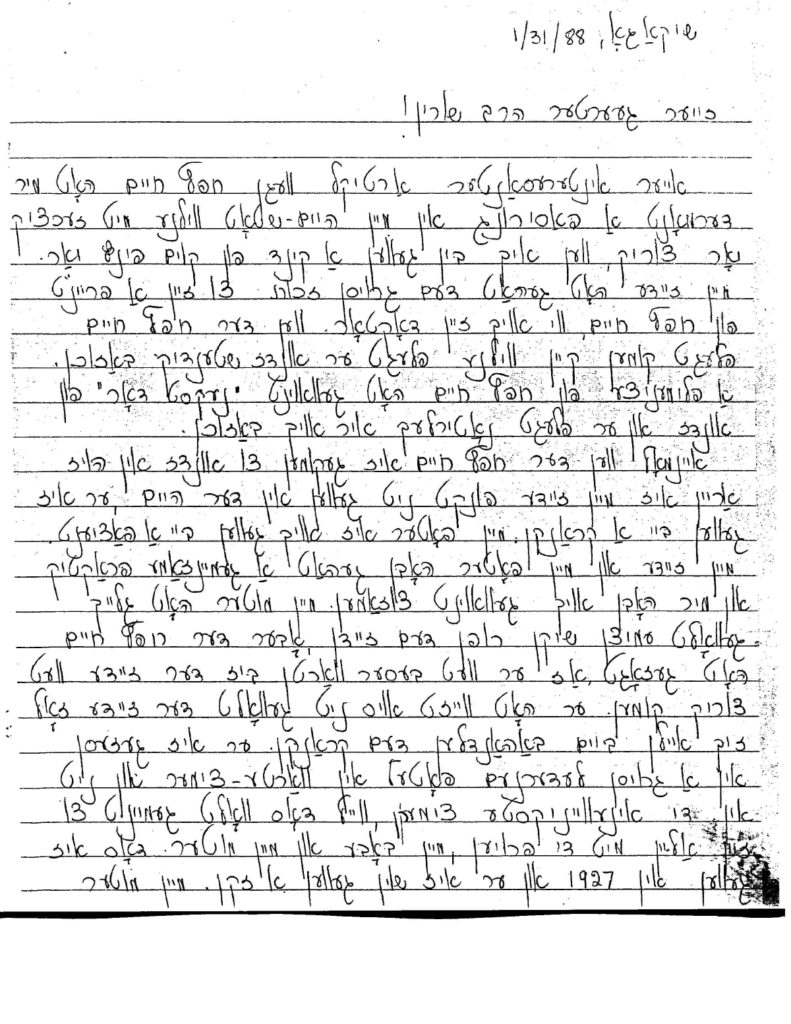
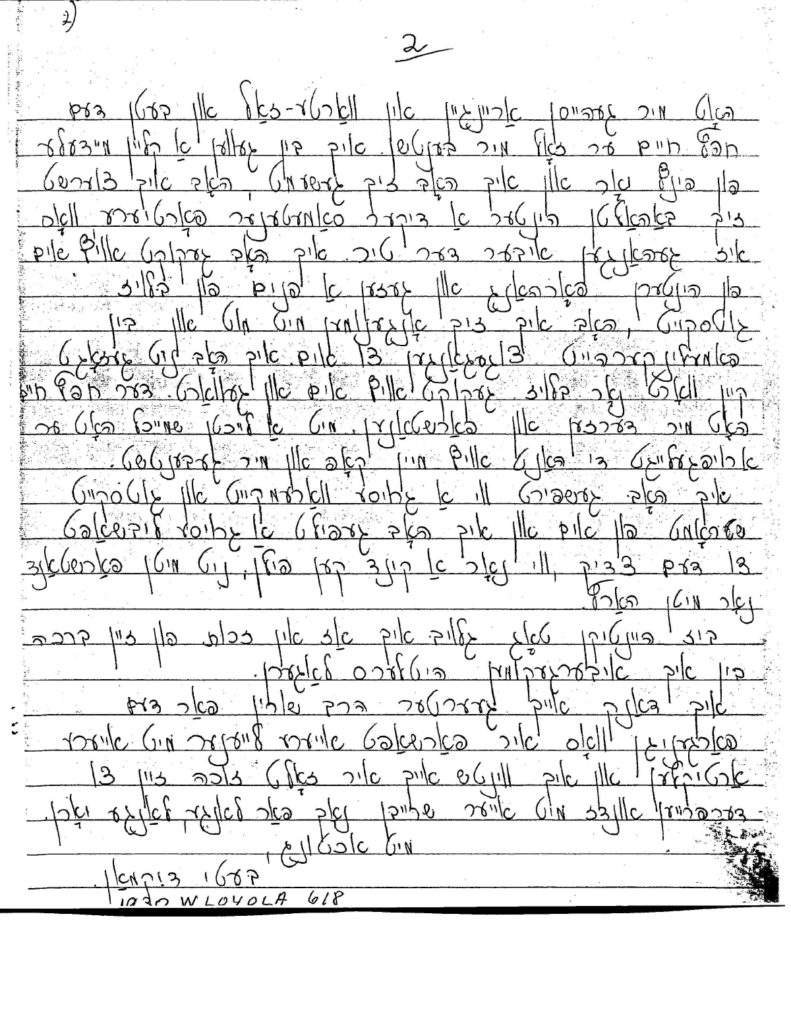
שיקאַגאָ, 1/31/88

!זייער געערטער הרב שורין

אייער אינטערעסאַנטער אַרטיקל וועגן חפץ חיים האָט מיר
דערמאָנט אַ פּאַסירונג אין מיין היים-שטאָט ווילנע מיט זעכציק
.יאָר צוריק, ווען איך בּין געווען אַ קינד פון קוים פינף יאָר
מיין זיידע האָט געהאַט דעם גרויסן זכות צו זיין אַ פריינט
פון חפץ חיים, ווי אויך זיין דאָקטאָר. ווען דער חפץ חיים
.פלעגט קומען קיין ווילנע פלעגט ער אונדז שטענדיק בּאַזוכן
אַ פּלימעניצע פון חפץ חיים האָט געוואוינט ״נעקסט דאָר״ פון
.אונדז און ער פלעגט נאַטירלעך איר אויך בּאַזוכן

איינמאָל ווען דער חפץ חיים איז געקומען צו אונדז אין הויז
אַריין איז מיין זיידע פּונקט ניט געווען אין דער היים, ער איז
.געווען בּיי אַ קראַנקן. מיין פאָטער איז אויך געווען בּיי אַ פּאַציענט
מיין זיידע און מיין פאָטער האָבּן געהאַט אַ געמיינזאַמע פּראַקטיק
און מיר האָבּן אויך געוואוינט צוזאַמען. מיין מוטער האָט גלייך
געוואָלט עמיצן שיקן רופן דעם זיידן, אָבער דער חפץ חיים
האָט געזאָגט, אַז ער וועט בּעסער וואַרטן בּיז דער זיידע וועט
צוריק קומען. ער האָט ווייזט אויס ניט געוואָלט דער זיידע זאָל
זיך איילן בּיים בּאַהאַנדלען דעם קראַנקן. ער איז געזעסן
אין אַ גרויסן לעדערנעם פאָטעל אין וואַרטע-צימער און ניט
אין די אינעווייניקסטע צימערן, ווייל דאָס וואָלט געמיינט צו
זיין אַליין מיט די פרויען, מיין בּאָבּע און מיין מוטער. דאָס איז
געווען אין 1927 און ער איז שוין געווען א זקן. מיין מוטער

2

האָט מיר געהייסן אַריינגיין אין וואַרטע-זאַל און בּעטן דעם
חפץ חיים ער זאָל מיר בּענטשן. איך בּין געווען אַ קליין מיידעלע
פון פינף יאָר און איך האָבּ זיך געשעמט, האָבּ איך צוערשט
זיך בּאַהאַלטן הינטער אַ דיקער סאַמעטענער פּאָרטיערע וואָס
איז געהאַנגען איבּער דער טיר. איך האָבּ געקוקט אויף אים
פון הינטערן פאָרהאַנג און געזען אַ פנים פון בּלויז
גוטסקייט, האָבּ איך זיך אָנגענומען מיט מוט און בּין
פּאמעלינקערהייט צוגעגאַנגען צו אים. איך האָבּ ניט געזאָגט
קיין וואָרט נאָר בּלויז געקוקט אויף אים און געוואַרט. דער חפץ חיים
האָט מיר דערזען און פאַרשטאַנען. מיט אַ לייכטן שמייכל האָט ער
.אַרויפגעלייגט די האַנט אויף מיין קאָפּ און מיר געבּענטשט
איך האָבּ געשפּירט ווי אַ גרויסע וואַרעמקייט און גוטסקייט
שטראָמט פון אים און איך האָבּ געפילט אַ גרויסע ליבּשאַפט
צו דעם צדיק, ווי נאָר אַ קינד קען פילן, ניט מיטן פאַרשטאַנד
.נאָר מיטן האַרץ

בּיז היינטיקן טאָג גלויבּ איך אַז אין זכות פון זיין ברכה
.בּין איך איבּערגעקומען היטלערס לאַגערן

איך דאַנק אייך געערטער הרב שורין פאַר דעם
פאַרגעניגן וואָס איר פאַרשאַפט אייערע לייענער מיט אייערע
אַרטיקלען און איך ווינטש אייך איר זאָלט זוכה זיין צו
.דערפרייען אונדז מיט אייער שרייבּן נאָך פאַר לאנגע, לאַנגע יאָרן

,מיט אכטונג
.בּעטי דיִקמאַן
1930 W LOYOLA 618

Chicago, 1/31/88

To the highly esteemed Rabbi Shurin!

Your interesting article about the Hafets Hayyim reminded me of a story that took place in my hometown of Vilna sixty years ago, when I was a child barely five years of age. My grandfather was very fortunate to be a friend of the Hafets Hayyim, as well as his physician. When the Hafets Hayyim would come to Vilna, he would always visit us. A niece of his lived next door, and he would also, naturally, go to see her.

One time when the Hafets Hayyim came to our house, my grandfather, as luck would have it, was not home; he was tending to someone ill. My father, too, was with a patient. My grandfather and father had a shared practice, and we also all lived together. My mother immediately suggested sending someone to call for my grandfather, but the Hafets Hayyim said that he preferred to wait until my grandfather returned. He evidently did not want my grandfather to rush his treatment of the sick person. He sat down in a large leather armchair in the foyer,[18] not in the innermost rooms, because that would have meant being secluded with the women – my grandmother and mother. This was in 1927, when he was already an elderly man. My mother

2

told me to go to the hallway[19] and ask the Hafets Hayyim to bless me. I was a small, shy girl of five years, so I initially hid behind a thick velvet portiere hanging over the door. But when I peered at him from behind the curtain and saw a face of pure goodness, I mustered up my courage and slowly approached him. I did not say a word; I just looked at him and waited. The Hafets Hayyim caught sight of me and understood. With an easy smile, he lay his hand on my head and blessed me. I sensed a great warmth and goodness streaming forth from him and felt much love for this righteous man, as only a child can – not with the mind but with the heart.

To this day, I believe that it is on account of his blessing that I survived Hitler’s camps.

I thank you, esteemed R. Shurin, for the joy that you bring to your readers with your columns and wish you the good fortune to continue delighting us with your writing for many, many years to come.

Respectfully,
Betty Dickman
1930 W Loyola 618

On April 14, 1997, Donna Puccini interviewed Betty Dickman about her experiences during the Holocaust on behalf of what is today the USC Shoah Foundation’s Institute for Visual History and Education.[20] From that conversation we learn that Dickman was born Isabella Margolin on April 9, 1922 in Vilna – then part of Poland and called Wilno but today known as Vilnius, Lithuania – as the only child of her parents, Mones (1893–1941) and Henya (1894–1943) Margolin. As already noted in the letter, her maternal grandparents, Chaim and Rose Bruk, lived together with them, and both her grandfather and father were physicians, while her grandmother and mother stayed home with their Polish maid.[21] Chaim Bruk was a prominent member of the Vilna Jewish community who sat on the board of directors of the Tiferes Bachurim Society (at 6 Niemiecka [present-day Vokiečių] Street),[22] helped to found the city’s Miszmeres Chojlim charitable hospital (at 5 Kijowska [present-day Kauno] Street),[23]  and served as gabbai of Zalkin’s (formerly Zemel’s) kloyz (at 2 Rudnicka [present-day Rūdninkų] Street),[24] which was located right next door to the family’s apartment building at 4 Rudnicka Street.[25] According to Dickman, when he passed away in 1936 at the age of 70, all the stores lining the streets through which the funeral procession passed were closed, and “there must have been about twenty-five thousand [!] people at that funeral.”

Aside from its value as a firsthand account of the profoundly human, down-to-earth, and kindhearted character of the Hafets Hayyim, this letter also touches on, and complicates our understanding of, at least three aspects of his biography and religious worldview.[26] First and foremost is his attitude toward medicine. The Hafets Hayyim was famous for his pure, unshakable faith in God,[27] relying on Him to heal the sick even when traditional medical interventions had not been attempted.[28] However, a number of incidents recorded by the Hafets Hayyim’s biographers point to a willingness to, and even insistence on the importance of, consult(ation) with physicians about health-related issues.[29] While I have so far not succeeded in corroborating the letter’s claim that Bruk served as the Hafets Hayyim’s personal doctor,[30] it is evident that both certain members of the Hafets Hayyim’s family and he himself had recourse to medical professionals at various stages of their lives[31] – a point that comes through clearly in Dickman’s writing.

Another interesting aspect of this story concerns the Hafets Hayyim’s willingness to bless the young girl. Though many petitioned him to pray on their behalf or offer them a blessing,[32] the Hafets Hayyim often refused on principle to do so, noting that God makes Himself equally available to every Jew, no matter his status in the community, and that He would actually prefer to hear directly from His children than from an intermediary.[33] The fact that he made an exception in this case, while certainly not unheard-of,[34] is nevertheless noteworthy, and it deepens our appreciation of his paternal conduct with this shy little girl.

Finally, attention should be directed toward the Hafets Hayyim’s halakhic stance on yihud. While most posekim assume that secluding oneself with a married woman whose husband is in town (ba‘alah ba-ir) is permissible even ab initio,[35] the letter reports that the Hafets Hayyim would not allow himself to sit together with Mrs. Bruk and Mrs. Margolin even though their husbands were not far away.[36] Interestingly, this humra, which is based on Rashi’s understanding of a passage in the Talmud,[37] seemingly contradicts the Hafets Hayyim’s own ruling on the matter in his Sefer nidhei yisra’el, intended for Jews who had immigrated to America.[38] It would thus appear that we have here an instance in which the Hafets Hayyim’s personal practice reflected a higher degree of stringency regarding halakhah than he required of others.[39]

━━━━━━━━━━━━━━━━━━━━━━━━━━━━━━━━

* I wish at the outset to express my gratitude to Eliezer Brodt for furnishing me with the opportunity to compose this essay and for his patience during its long gestation. Additional thanks go to his fellow editors at the Seforim Blog, particularly the incomparable Menachem Butler, whose bibliographical reach seems unlimited. Finally, I am indebted to my friends Eliyahu Krakowski, Daniel Tabak, and Shlomo Zuckier for their corrections and comments to an earlier draft of this piece that, taken together, improved it considerably.

[1] On the inception of A bintl briv, see Abraham Cahan, Bleter fun mayn leben, vol. 4 (New York: Forward Association, 1928), 471-478. See also “Treasures From the Forverts’ Archive – Chapter #3. A Bintel Brief (1)” (watch at about 1:13) (accessed August 19, 2019). For the historical background behind, and contemporary influences upon, this feature, see Steven Cassedy, “A Bintel brief: The Russian Émigré Intellectual Meets the American Mass Media,” East European Jewish Affairs 34,1 (2004): 104-120.
[2] After two to three years, Cahan tells us, his many other responsibilities at the paper did not allow him to continue answering the letters personally, so that he had to ask other members of his staff to compose the responses (Bleter, 483).
[3] The most recent column, published in a dedicated corner of The Jewish Daily Forward website called The Bintel Brief, is dated May 24, 2010 (accessed August 19, 2019). Anthologies of selected letters in English translation have appeared as Isaac Metzker (ed.), A Bintel Brief: Sixty Years of Letters from the Lower East Side to the Jewish Daily Forward, trans. Diana Shalet Levy with Bella S. Metzker (New York: Ballantine Books, 1971), and Isaac Metzker (ed.), A Bintel Brief: Letters to the Jewish Daily Forward[,] 1950–1980, trans. Bella S. Metzker and Diana Shalet Levy (New York: The Viking Press, 1981). More recently, some of these missives have been adapted into graphic novel form by Liana Finck as A Bintel Brief: Love and Longing in Old New York (New York: Ecco, 2014).
[4] Anon., “About the Author,” in Aaron B. Shurin, Moadim Lesimcha: Insights[,] Explanations and Stories on the Jewish Holidays (Brooklyn: Aaron B. Shurin, 2006), xi-xx, at p. xi. Some sources date his birth to 1913 or even 1914, but these are clearly mistaken given that when he died on 24 Sivan 5772 (June 14, 2012), he was just a few months shy of his one-hundredth birthday. See, e.g., David Tidhar, Entsiklopedyah la-halutsei ha-yishuv u-bonav: demuyyot u-temunot, vol. 10 (Tel Aviv: Sifriyyat Rishonim, 1959), 3474-3475, at p. 3474, translated/adapted somewhat inaccurately and laconically in Alter Levite, Dina Porat, and Roni Stauber (eds.), A Yizkor Book to Riteve: A Jewish Shtetl in Lithuania (Cape Town: The Kaplan-Kushlick Foundation, 2000), 105-106, at p. 105; Elias Schulman, Leksikon fun forverts shrayber zint 1897, ed. Simon Weber (New York: Forward Association, 1987), 90-91, at p. 90; Berl Kagan, Yidishe shtet, shtetlekh un dorfishe yishuvim in lite biz 1918: historish-biografishe skitses (New York: Berl Kagan, 1991), 556-557, at p. 556; and Alex Mindlin, “A Religious Voice in a Secular Forest,” The New York Times (November 28, 2004). I thank Chana Pollack, Archivist at The Jewish Daily Forward, for sending me a copy of the Leksikon for my personal use.

As an aside, and since I know that the Seforim Blog has a special interest in issues surrounding plagiarism, one can find (mild) examples of this phenomenon in the announcement of Shurin’s passing published by Casriel Bauman, “A Legend in His Time: Rabbi Aharon Ben Zion Shurin z”l,” Matzav.com (June 14, 2012) (accessed August 19, 2019) – subsequently reprinted with minor modifications in the Queens Jewish Link 1,12 (June 28, 2012): 89 – which fails to cite both Tidhar’s encyclopedia entry and the New York Times interview as its sources.
[5] Anon., “About the Author,” xi; see also Tidhar, Entsiklopedyah, 3474. For photographs of Shurin (at that point still going by the original family name, Mishuris) and his friends taken in Telz on 3 Adar II 5695 (March 8, 1935), see the following Ebay listings: 12 (accessed August 19, 2019). For a recent photograph of the dilapidated yeshivah building in Telz, taken by Richard Schofield as part of his photo essay Back to Shul (Vilnius: International Centre for Litvak Photography, 2018), see here (accessed August 19, 2019).
[6] Anon., “About the Author,” xi-xii; see also Anon., “Totse’ot ha-behinot be-seminar ha-kayits mi-ta‘am ha-v[a‘ad] ha-l[e’ummi],” Ha-tsofeh 3,318 (January 13, 1939): 1. (Cf. the 1940 United States Census record for Manhattan [accessed June 21, 2019], according to which Aaron, like the rest of his family, was living in “Tel-a-Viv” as of April 1, 1935. This seems unlikely given the date inscribed on the photographs mentioned in the previous note.) According to Tidhar, Entsiklopedyah, 3474, Shurin also attended a gymnasium at night while learning at the Lomzher yeshivah in Petah Tikva.
[7] Anon., “About the Author,” xii; see also Tidhar, Entsiklopedyah, 3474-3475, and the announcement of his move to America in Ha-mashkif 2,244 (January 25, 1940): 4. His younger brother, Rabbi Israel Shurin (1918–2007), followed a very similar educational path. See the biographical sketch published originally in Yated Neeman with contributions from Rabbi Mordechai Kamenetzky and Sharon Katz, entitled “Rav Yisroel Shurin, z”l: A Revered Rav and a Link to a Lithuanian Past” (accessed August 19, 2019).
[8] Anon., “About the Author,” xii. See also Anon., Columbia University in the City of New York: Supplement to the Directory Number, 1945 (New York: New York, 1945), 45; Tidhar, Entsiklopedyah, 3474; the 1967 volume of Stern’s yearbook, Kochaviah, 35 (where he is referred to as “Arthur,” rather than “Aaron,” Shurin); and YU Review: The Magazine of Yeshiva University (Fall 2005): 30. (For the record, the latest Kochaviah yearbook in which I was able to locate Shurin on the faculty pages was the 1997 volume [p. 21]; he did not appear there in the 1998 and 2000 editions, and neither the YU Archives nor Stern’s Hedi Steinberg Library held copies of the 1999 and 2001 volumes at the time I visited them [if indeed those editions were ever actually published]. I thank Shulamith Z. Berger, Curator of Special Collections and Hebraica-Judaica, for allowing me to examine the Archives’ holdings.) As noted by Tidhar and others, Shurin edited the Hebrew section of Eidenu (New York: Students of the Rabbi Isaac Elchanan Theological Seminary, 1942), a volume dedicated to the memory of YU President Rabbi Dr. Bernard Revel (1885–1940).
[9] Anon., “About the Author,” xii; see also Tidhar, Entsiklopedyah, 3474. For some of his other organizational affiliations, see Anon., “About the Author,” xviii. See also lots 169170191198200205210, and 211 from a Kestenbaum & Company auction held on April 7, 2016, which included letters written to Shurin and his father-in-law, Rabbi Moshe Dov-Ber Rivkin (1892–1976), by some of the leading lights of the Jewish world at the time (accessed August 19, 2019). It is interesting to note that Rabbis Eliezer Silver (1882–1968) and Joseph B. Soloveitchik (1903–1993) both apparently read Shurin’s columns in the Forverts.
[10] Quoted in Yisroel Besser, “Defending the Past in the Pages of the Forward: Rabbi Aaron Benzion Shurin’s Six Decades of Journalism,” Mishpacha (May 26, 2010): 26-33, at p. 29. For more on Shurin’s writing outside of the context of his work for the Forverts, including his many rabbinic publications, see Anon., “About the Author,” xiv-xvii, and Tidhar, Entsiklopedyah, 3474-3475.

Relatedly, Israel Mizrahi notes that Shurin’s personal library of approximately two thousand volumes “included many classics as well as obscure works from the last century as well as a very strong showing of newspapers, from the 19th century through the WWII period, with many bound volumes of rare newspapers present.” See “Recent Acquisitions at Mizrahi Bookstore, the libraries of Aaron Ben-Zion Shurin […],” Musings of a Jewish Bookseller (March 29, 2016) (accessed August 19, 2019). One of his books, Eliezer Ben-Yehuda’s Ad eimatai dibberu ivrit? (New York: Kadimah, 1919), comprised lot 3 of Winner’s Auctions’ July 19, 2016 sale (accessed August 19, 2019).
[11] Gennady Estraikh and Zalman Newfield, “Grandfathers against Bar Mitzvahs: Secular Immigrant Jews Confront Religion in 1940s America,” Zutot 9 (2012): 73-84, at p. 74; see also Gennady Estraikh, “A Mid-Twentieth-Century Quest for Jewish Authenticity: The Yiddish Daily Forverts’ Warming to Religion,” in Eliyana R. Adler and Sheila E. Jelen (eds.), Reconstructing the Old Country: American Jewry in the Post-Holocaust Decades (Detroit: Wayne State University Press, 2017), 111-134, at pp. 111-112. On the occasion of the Forverts’ eightieth anniversary, Shurin himself would reflect that “the Forverts has […] been very friendly to the yeshivah world throughout the years that I have been a collaborator on the Forverts editorial staff.” See Aaron B. Shurin, “Idish lebn in amerike,” Forverts (April 24, 1977): B8, B24, at p. B24.

In his interview with The New York Times, Shurin asserts that the Forverts had a quarter million readers at the time he was hired, but Estraikh and Newfield write that that number was accurate for the 1920s, not the 1940s.
[12] Besser, “Defending,” 30, explains the decision to bring an Orthodox rabbi onboard by noting that “times were changing and the Forward management perceived that they had to provide their Orthodox readership – which was immense – with a column geared to their needs, coverage and perspective of the issues that concerned them.” Similarly, Mindlin of the Times writes that “[Shurin’s] hiring reflected the feeling of the founding editor, Abraham Cahan, that the newspaper needed to speak to the religious Jews who flooded the United States in the 30’s and 40’s.” Indeed, according to Estraikh and Newfield, “Grandfathers,” 75 n. 8, based on an article published in the Forverts in February 1956, “[b]y the mid-1950s, secular readers already belonged to the minority of the Forverts audience.” See also Estraikh, “A Mid-Twentieth-Century Quest,” passim, but esp. pp. 121-122, as well as the comments cited by S. Daniel, editor of Ha-tsofeh, in an article translated as “Faithful Servant” in Shurin, Moadim Lesimcha, xxi-xxiv.
[13] Shurin’s first column appeared as A.B. Rutzon, “‘Mizrakhi’ un ‘agudes yisroel’ – vegn vos zey krigen zikh,” Forverts (November 5, 1944): B3 (Tidhar, Entsiklopedyah, 3475, notes that A.B. Rutzon was one of Shurin’s pseudonyms, a reference to his mother’s name, Ruth). The last article of his that I was able to identify was published April 20, 2007; see the table of contents of that issue here (accessed August 19, 2019). See also Anon., “About the Author,” xv.

Interestingly, Schulman, Leksikon, 90-91, writes that Shurin also managed the Fun folk tsu(m) folk (From People to People) readers’ correspondence section of the paper, although I did not find other references to this point. Also interesting, and curious, is the fact that although Shurin’s passing was mourned at the Kave shtibl and in Der moment (accessed August 19, 2019), I could find no article online in either the Forverts or the Forward reporting his death.
[14] See Anon., “About the Author,” xv; Tidhar, Entsiklopedyah, 3475; and Schulman, Leksikon, 90.
[15] I attempted to be faithful to the originals in transcribing these letters, without adjusting or correcting such features as orthography, vocalization, or punctuation.
[16] We know that he was born 11 Shevat, but the exact year is disputed, with varying accounts claiming it was either 5588 (1828), 5589 (1829), 5593 (1833), 5595 (1835), 5598 (1838), or 5599 (1839). For some of the literature on this issue, see Moses M. Yoshor, He-hafets hayyim: hayyav u-po‘olo, vol. 1 (Tel Aviv: Netsah, 1958), 25 with n. 1; Nathan Kamenetsky, Making of a Godol: A Study of Episodes in the Lives of Great Torah Personalities: Improved Edition, vol. 1, pt. 2 (Jerusalem: P.P. Publishers, 2004), 1106-1108 (Notes and Excursuses 5.1 (2) / Excursus B); and [Dan Rabinowitz], “Chofetz Hayyim[:] His Death, the New York Times and Research Tools,” Seforim Blog (October 31, 2006) (accessed August 19, 2019).
[17] Aaron B. Shurin, “Der ‘khofets khayim’, tsu zayn 150 yorikn geboyrn-yor,” Forverts (January 29, 1988): 13, 27. See also Shurin’s earlier, Hebrew-language reflection on the Hafets Hayyim’s life and works: “He-‘hafets hayyim’ – rabban shel yisra’el,” in Keshet gibborim: demuyyot ba-ofek ha-yehudi shel dor aharon, vol. 1 (Jerusalem: Mossad Harav Kook, 1964), 115-121.
[18] The original Yiddish here reads varte-tsimer, lit., “waiting room”; I take this to refer to the foyer of the home.
[19] The original Yiddish here reads varte-zal, lit., “waiting hall”; I take this to refer to the hallway off the foyer.
[20] The Institute website can be found here, and Dickman’s interview can be found either on the Visual History Archive Online site here or on YouTube here (accessed August 19, 2019).
[21] For three slightly different dappei-ed (pages of testimony) filed by Dickman with Yad Vashem about her father, see 12, and 3; for two she filed about her mother, see 1 and 2; and for two she filed about her grandmother Rose, see 1 and 2 (accessed August 19, 2019).
[22] According to Shemaryahu (Shmerele) Szarafan, “Di religyeze vilne,” in Aaron Isaac Grodzenski (ed.), Vilner almanakh (Vilna: Ovnt Kuryer, 1939; repr. Brooklyn: Moriah Offset Co., 1992), cols. 321-332, at col. 324, the Tiferes Bachurim Society was founded in 1902 by the young Rabbi Jechiel ha-Levi Sruelow (1879–1946) to combat the radical, anti-religious forces on the Jewish street by teaching young workers and craftsmen Torah and Talmud at night and on Shabbat and yom tov, when they had free time. Chaim Bruk was one of the people who did much to ensure the society’s financial security; he is pictured, together with Szarafan, Sruelow, and other members of the board of directors, in Leyzer Ran (ed.), Jerusalem of Lithuania: Illustrated and Documented, vol. 1 (New York: Vilno Album Committee, 1974), 261, and here (accessed August 19, 2019). See also Aliza Cohen-Mushlin, Sergey Kravtsov, Vladimir Levin et al. (eds.), “Appendix: Synagogues, Batei Midrash and Kloyzn in Vilnius,” in Synagogues in Lithuania: A Catalogue, vol. 2 (Vilnius: Vilnius Academy of Arts Press, 2012), 281-353, at pp. 303-304 (no. 12), and Yisrael Rozenson, “‘Ba‘avur tse‘irim kemo gam le-ovedim u-le-ozerim ba-hanuyyot’: al ha-mif‘al ha-hinnukhi ‘tif’eret bahurim’ be-vilnah,” Hagut: mehkarim ba-hagut ha-hinnukh ha-yehudi 10 (2014): 15-72, esp. p. 44. The society eventually moved into the former kloyz of the Lubavitcher Hasidim located in the Vilna shulhoyf (synagogue courtyard); see no. 12 in the diagram of the shulhoyf available here (accessed August 19, 2019).
[23] A. Karabtshinski, “Mishmeres-khoylim,” in Grodzenski, Vilner almanakh, cols. 319-320, reports that the society after which the hospital was named was founded by Rabbi Bezalel Altshuler in 1890 as a branch of Vilna’s general charity fund and that the hospital itself was built in 1913. Ran, Jerusalem of Lithuania, 161, by contrast, writes that the hospital building dedication took place in 1912. See also the photograph of the 1910 cornerstone-laying ceremony on that same page (161) in which, according to Dickman’s interview (watch at approx. 2:49:15), Bruk is pictured on the far right wearing a straw hat and holding a cane. For a photograph of the hospital building before the outbreak of World War II, see here (accessed August 19, 2019).
[24] See Cohen-Mushlin et al., “Appendix,” 317-318 (no. 60). For a photograph of Chaim Bruk praying in the kloyz circa 1935, see Dickman’s interview (watch at approx. 2:50:11); he is pictured on the far right in the first row.
[25] For maps of prewar/wartime Jewish Vilna, see Ran, Jerusalem of Lithuania, insert (in Yiddish), and here (in Polish) (accessed August 19, 2019). For a modern map of Vilna with Jewish sites (including ghetto borders) overlaid, see here (make sure to click “Explore on your own”) (accessed August 19, 2019). Most of the addresses mentioned above can be found in the vicinity of the two Vilna ghetto locations. For a photograph of a 3-D model of the Vilna ghettos created illegally by Jewish artists in 1943, see Leyzer Ran and Leybl Koriski (eds.), Bleter vegn vilne: zamlbukh (Łódź: Farband fun Vilner Yidn in Poyln, 1947; also available through the New York Public Library Yizkor Book online portal [accessed August 19, 2019]), after p. 52. Finally, for photographs of wartime and present-day Rudnicka/Rūdninkų Street, see here (accessed August 19, 2019).
[26] A definitive academic study of R. Israel Meir ha-Kohen’s life and legacy remains a scholarly desideratum. Rabbi Eitam Henkin, who, together with his wife Naama, was cruelly murdered in October 2015 by Palestinian terrorists, had made a major bid to fill the void by submitting a doctoral proposal on the topic to Tel Aviv University. Henkin’s mentor, Prof. David Assaf, posted the proposal online shortly after his death, both as a memorial for this up-and-coming scholar, whose life and brilliant career were cut all too short, and for the benefit of future researchers: “Sheloshim le-retsah eitam henkin: tokhnit ha-mehkar al ‘he-hafets hayyim’,” Oneg shabbat (October 30, 2015) (accessed August 19, 2019). The most recent attempt of which I am aware to critically assess, albeit partially, the work of the Hafets Hayyim was penned by Benjamin Brown, “Ha-‘ba‘al bayit’: r. yisra’el me’ir ha-kohen, he-‘hafets hayyim’,” in Benjamin Brown and Nissim Leon (eds.), Ha-‘gdoylim’: ishim she-itsevu et penei ha-yahadut ha-haredit be-yisra’el (Jerusalem: Van Leer Institute; Magnes Press, 2017), 105-151.

The most extensive research on the Hafets Hayyim’s life conducted outside the academic sphere is that by Rabbi Moses M. Yoshor (1896–1978), a student and eventual personal secretary of this great Torah sage. For the history of Yoshor’s various biographical studies of his revered teacher, see his The Chafetz Chaim: The Life and Works of Rabbi Yisrael Meir Kagan of Radin, trans. Charles Wengrov (Brooklyn: Mesorah Publications, 1984), xv-xviii, xxvii-xxviii, as well as the unpaginated translator’s note and note on the author in the frontmatter.
[27] On the Hafets Hayyim as one of the main Lithuanian representatives of a phenomenon Benjamin Brown has termed “the return of ‘pure faith’” within the Jewish tradition, see his “Shuvah shel ‘ha-emunah ha-temimah’: tefisat ha-emunah ha-haredit u-tsemihatah ba-me’ah ha-19,” in Moshe Halbertal, David Kurzweil, and Avi Sagi (eds.), Al ha-emunah: iyyunim be-mussag ha-emunah u-be-toledotav ba-massoret ha-yehudit (Jerusalem: Keter, 2005), 403-443, 669-683, at pp. 433-436, as well as idem, “Ha-‘ba‘al bayit’,” 143-146.
[28] See the account of his son, Rabbi Aryeh Leib Poupko (ca. 1860–1938), in Mikhtevei ha-rav hafets hayyim z[ekher] ts[addik] l[i-berakhah]: korot hayyav, derakhav, nimmukav ve-sihotav, 1st ed. (Warsaw: B. Liebeskind, 1937), 12 (third pagination): “My mother, of blessed memory, told me in my youth that during my upbringing they almost never consulted with doctors. If one of us fell ill, my father advised [my mother] to distribute a pood of bread to the poor, while he ascended to the attic and prayed, and the sickness departed” (par. 26; subsequently quoted in David Falk, Sefer ha-boteah ba-H[ashem] hesed yesovevennu [Jerusalem: n.p., 2010], 92, 250-251). In two other places, Poupko quotes his father as extolling the value of physical suffering in this world as a means of reaching the next world (ibid., 13 [third pagination; pars. 28-29]); see also ibid., 22 (first pagination). Moses M. Yoshor, Saint and Sage (Hafetz Hayim) (New York: Hafetz Hayim Yeshivah Society, 1937), 135, writes that the Hafets Hayyim refused to heed the advice of his physicians when he trekked approximately eighty kilometers from Radin (present-day Radun’, Belarus) to Vilna in early 1932, toward the end of his life, in order to attend a rabbinical conference.
[29] Several sources treat the Hafets Hayyim’s concern for others’ (particularly his students’) physical well-being: Moses M. Yoshor, He-hafets hayyim: hayyav u-po‘olo, vol. 2 (Tel Aviv: Netsah, 1959), 717; ibid., vol. 3 (Tel Aviv: Netsah, 1961), 846-847, 918; and Aryeh Leib Poupko, Mikhtevei ha-rav hafets hayyim z[ekher] ts[addik] l[i-berakhah], ed. S. Artsi, 2 vols. (Bnei Brak: n.p., 1986), 2:107. In addition, in his magnum opus, Mishnah berurah, the Hafets Hayyim discusses situations in which a doctor’s opinion is accorded halakhic significance, e.g., in the determination of whether someone should fast on Yom Kippur (see his comments to Joseph Caro, Shulhan arukhOrah hayyim 618).
[30] Strangely, I could not find mention of either Bruk or his son-in-law Mones Margolin in the essays about Vilna doctors by A.J. Goldschmidt and Zemach Shabad in Ephim H. Jeshurin (ed.), Vilne: a zamelbukh gevidmet der shtot vilne (New York: Wilner Branch 367, Workmen’s Circle, 1935), 377-437, 725-736.
[31] In his youth, while in yeshivah, the Hafets Hayyim suffered from a condition that interfered with his learning and was instructed by his doctors to take a break from his studies for a year, which he did (Poupko, Mikhtevei, 1st ed., 5 [first pagination]). On his consultation with physicians to heal his son Abraham (1869–1891), see ibid., 39 (first pagination); to heal his first wife Frieda (née Epstein), see ibid., 91 (first pagination); and to heal himself, see ibid., 19 (third pagination; par. 46). In the latter connection, see also Yoshor, He-hafets hayyim, 1:66, 3:1058, as well as Dov Katz, Rabbi yisra’el me’ir ha-kohen[,] ba‘al “hafets hayyim”: toledotav, ishiyyuto ve-shittato (Tel Aviv: Avraham Zioni, 1961), 24, 97-98.

Interestingly, Yoshor, He-hafets hayyim, 1:35-36 n. 4, also reports the following ma‘aseh li-setor: Solomon ha-Kohen (1830–1905), a friend of the Hafets Hayyim who grew up in Vilna, became sick between the ages of 13 and 17, and so the doctors instructed him to take a break from learning. He apparently replied that it would be better for him to die from limmud torah than from bittul torah, continued his studies unabated, and was healed. When the Hafets Hayyim would tell this story, he would grow very emotional and repeat his friend’s words several times. Then again, see ibid., 1:343.

As regards Chaim Bruk, a number of sources mention visits by a physician brought in specially from Vilna to treat the Hafets Hayyim, but none of them names him, and it could very well be that different doctors were called upon on different occasions; for instance, we know from Yoshor, He-hafets hayyim, 3:1058, that the Hafets Hayyim would sometimes be treated by Dr. Zemach Shabad (1864–1935). See Poupko, Mikhtevei, 1st ed., 19 (third pagination); Moses M. Yoshor, Dos lebn un shafen fun khofets khayim, 1st ed., vol. 2 (New York: Moses M. Yoshor, 1937), 481; idem, Saint and Sage, 97; and idem, He-hafets hayyim, 2:614, 624.
[32] See Anon., “Saintly ‘Chofetz Chaim’ Dead; Spiritual Head of World Jewry a Legend in Lifetime; over 100,” Jewish Telegraphic Agency (September 15, 1933); (with slight differences:) Anon., “Chofetz Chaim, 105, Is Dead in Poland,” The New York Times (September 16, 1933): 13; and Yoshor, Saint and Sage, 65.
[33] See Poupko, Mikhtevei, 1st ed., 120 (third pagination; par. 34), 75-76 (fourth pagination; par. 4); Yoshor, Saint and Sage, 131, 175; idem, Dos lebn, 403, 525; and Dov Katz, Tenu‘at ha-musar: toledoteha[,] isheha ve-shittoteha, vol. 4 (Tel Aviv: Avraham Zioni, 1967), 88-89.

Given all of this, it is most surprising, in my opinion, to find the following recorded by the Hafets Hayyim’s son: “Once, when he took ill, he sought to walk to the grave of the ga’on Rabbi Elijah in Vilna and to ask him to arouse heavenly mercy on his behalf, in the merit” of the Haggahot ha-gera that he had printed on Torat kohanim, together with his explanations (vols. 12; Piotrków: Mordechai Zederbaum, 1911). See Poupko, Mikhtevei, 1st ed., 43 (third pagination; par. 83).
[34] In fact, numerous sources testify to the Hafets Hayyim deviating at times from this policy. See Yoshor, Saint and Sage, 97, 108, 256; idem, Dos lebn, 363, 574, 610; Poupko, Mikhtevei, ed. S. Artsi, 2:100-101; and especially Anon., Sefer me’ir einei yisra’el, pt. 2, vol. 2 (Bnei Brak: Ma‘arekhet “Me’ir Einei Yisra’el,” 1999), ch. 28 (pp. 815-868), entitled “The Righteous Man Decrees – The Power of the Hafets Hayyim’s Blessings.” Indeed, even after he published a notice in the Vilna-based Dos vort newspaper in 1925 (not 1927, as some have claimed) requesting that people no longer come to him for blessings due to his weakened state, he would nevertheless warmly greet those who disregarded this plea and grant them their wish. For the text of the announcement, see Poupko, Mikhtevei, 1st ed., 77 (second pagination; no. 32). See also Yoshor, Dos lebn, 464-465, and Katz, Rabbi, 107-108.
[35] See, e.g., the comments of Tosafot to bKiddushin 81a, s.v. ba‘alah ba-ir ein hosheshin lah mi-shum yihud; David Ibn Zimra, Sh[e’elot] u-t[eshuvot] ha-radbaz, vol. 3 (Warsaw: Mordechai Kalinberg; Josefov: Solomon Zetser, 1882), 18a-b (no. 919 [no. 481]); and Solomon Luria, Yam shel shelomoh mi-massekhet kiddushin (Szczecin: n.p., 1861), 44a (ch. 4, par. 22). This would seem to be the simple read of Moses Maimonides, Mishneh torah, Hilkhot issurei bi’ah 22:1, and of Joseph Caro, Shulhan arukhEven ha-ezer 22:8, as well.
[36] Of course, the issue of the husbands’ proximity was not the only halakhically relevant factor in this case. For instance, the Hafets Hayyim’s standing in the Jewish world, his location in the apartment relative to where the women were, his elderliness, and the presence of the young Isabella could all have been brought to bear on the question of the permissibility of yihud in this situation. For a summary of some of the discussion, see Eliezer Judah Waldenberg, Sefer she’elot u-teshuvot tsits eli‘ezer, vol. 6 (Jerusalem: Mossad Harav Kook, 1961), 183-190, 228-231 (no. 40, chs. 7-8, 22).
[37] See Rashi to bKiddushin 81a, s.v. ba‘alah ba-ir ein hosheshin lah mi-shum yihud. Several prominent aharonim (following the aforementioned comments of Tosafot ad loc.) interpreted Rashi’s words as prohibiting yihud even when a woman’s husband is in the area. Probably most famously, Rabbi Joel Sirkes (1561–1640) ruled in accordance with this stringent interpretation of Rashi in his Bayit hadash commentary on Jacob ben Asher, Arba‘ah turimEven ha-ezer 22, s.v. ishah she-ba‘alah ba-ir. Interestingly, Waldenberg, by contrast, read Rashi in a lenient light (and cited others who did so as well); see Sefer she’elot u-teshuvot tsits eli‘ezer, 6:176-177 (no. 40, ch. 4).
[38] See Israel Meir ha-Kohen, Sefer nidhei yisra’el (Warsaw: Meir Jehiel Halter and Meir Eisenstadt, 1893), 62 (ch. 24, par. 6), quoting the Shulhan arukh essentially verbatim. I thank my friend, Jonathan Ziring, for this and a number of the above yihud-related references. If I have missed a relevant citation of the Hafets Hayyim’s own work, I would love to know about it; please message me about this or any other issue with this blogpost here.
[39] As a couple of friends rightly pointed out to me, what impelled the Hafets Hayyim to avoid joining the women in “the innermost rooms” of the apartment may not have been specific  halakhic considerations but rather a more general sense of propriety. The interpretation of his behavior as reflecting a reluctance to be “secluded” (aleyn in the original) with the women despite his advanced age relies on the perceptions of someone who was five years old at the time and who may not have appreciated the complexity of the Hafets Hayyim’s thought process.

One historical question raised by the letter for which I have not yet found a satisfying answer concerns the identity of the niece who lived next door to the Bruks and Margolins in Vilna and whom the Hafets Hayyim would regularly visit when he came to town. Some of the basic information on his family tree can be gleaned from Poupko, Mikhtevei, 1st ed., 2-3 (first pagination), who informs us that the Hafets Hayyim had a number of half-siblings. See also Binyamin of Petah Tikva, “He-hafets hayyim u-mishpahto,” Toladot ve-shorashim – atsei mishpahah (January 14, 2011) (accessed August 19, 2019) for a more extensive discussion of the Hafets Hayyim’s relations. More research into the various branches of his family is required.


R. Hayyim Hirschensohn, Can One Kill an Am Ha’aretz on Shabbat? Physical Punishments and Lots More

R. Hayyim Hirschensohn, Can One Kill an Am Ha’aretz on Shabbat? Physical Punishments and Lots More
by Marc B. Shapiro
1. In many earlier posts I have discussed R. Hayyim Hirschensohn, so let me pick up with him again.[1] In the Encyclopaedia Judaica’s article on R. Hirschensohn it tells us that he wrote a book Ateret Hakhamim published in 1874. Many people have been interested to see this book which was published when he was only seventeen years old. If you look at library catalogs you will not find anything. Yet if you look in Beit Eked Sefarim, the book is listed as published in Jerusalem, 1874, and this is where the EJ got its information. Beit Eked Sefarim gives the book the following subtitle:
קורות חכמת הטבע והפילוסופיה לפי השקפת אגדות חז”ל
As far as I can tell no such book was ever published in 1874 and I have no idea where the subtitle to the book came from. However, JNUL does have an unpublished manuscript from Hirschensohn with the title Ateret Hakhamim, and presumably that is where the confusion arose.
The first book by Hirschensohn is actually quite unknown, and is not mentioned by David Zohar in his list of Hirschensohn’s writings.[2] It is Ateret Zekenim, his commentary to R. Elijah Guttmacher’s Sukkat Shalom, published in 1883. While this book is not on Otzar ha-Hokhmah we are fortunate that it is on hebrewbooks.org, and here is the title page.

R. Hirschensohn published R. Guttmacher’s Sukkat Shalom from manuscript. The connection between the two was that R. Hirschensohn’s father, R. Jacob Mordechai, was close to Guttmacher and head of a yeshiva in Safed and later in Jerusalem that operated under R. Guttmacher’s auspices.[3] Sukkat Shalom was reprinted in 2000. Here is the title page.
Since this book is not on hebrewbooks.org or Otzar ha-Hokhmah, I think one can say that it qualifies as a “rare book.” In the introduction to this new printing, the editor tells us that the book was first published in 1883, but in the all too common haredi method, he does not tell the reader who first published it. He does tell us that his edition is based on the manuscript found in the New York Public Library, which must have come from R. Hirschensohn’s library.

When writing about a figure such as R. Hirschensohn, one of the central themes is developments in his thinking which is why the early writings are always so important. Therefore, this work must be studied by all who are interested in R. Hirschensohn. Ateret Zekenim shows R. Hirschensohn before he was exposed to secular studies and broadened himself. In this work, he is still a Jerusalem ben Torah with a limited curriculum, albeit more open-minded than many others in the Land of Israel during this period.[4]
Later in life he would even study Spinoza and write notes on the latter’s work. Yet he admitted that the feelings his writing on Spinoza raised in him were entirely the opposite of the spirit of religious feeling during Torah study, and he thus advised people to keep away from what he wrote, unless someone was particularly troubled by Spinoza’s ideas and needed to see a Jewish response.[5]
It is significant that even though R. Hirschensohn criticizes Spinoza, he does not relate to him as a heretic. He even attaches ז”ל after his name, as you can see from the title page of the second part of his Musagei Shav ve-ha-Emet.

I don’t know of any other rabbinic author who gives this type of honor to Spinoza, the heretic par excellence. In the preface to his discussion of Spinoza, R. Hirschensohn recounts what led him in 1903 to begin his study of the philosopher. On pp. 113ff. (second pagination, as are the other page numbers I refer to) R. Hirschensohn discusses Spinoza’s pantheism and states that he was not guilty of two of the big heresies: (1) regarding God as a corporeal being, or (2) avodah zarah. He was simply in error, and that was because he didn’t properly investigate matters. R. Hirschensohn even admires the way Spinoza stuck to his beliefs despite the persecution he suffered. He refused to give in to his opponents as from his perspective to do so would be a form of falsehood and idolatry. In other words, Spinoza and his opponents were equally well intentioned. In fact, all of them, including Spinoza, were tzaddikim! They simply had different perspectives on reality.
Here is what R. Hirschensohn writes on p. 115, words which are incredible coming from a rabbi and posek. As far as I know this is the only Orthodox defense of Spinoza.[6] (The word וברוך in the first sentence alludes to Spinoza’s name, and note also the words I have underlined.)
צדיק הוא שפינוזי לפי שטתו וברוך טעמו ונמוקו, ובצדקתו ותום לבבו סבל חרפת שונאיו ומנדיו וימסור נפשו וכבודו על קדוש השם, ולו הודה למתנגדיו אזי הי’ עובד אלהות הרבה, כאשר אנחנו היינו נחשבים לכופרים באלקים או עובדי ע”ז בשתוף לו הודינו אנחנו לשכלת שפינוזי באלוה, שני המתנגדים צדקו בדרכם ע”פ שיטתם המדעי ואת אלקים בקשו הרודף והנרדף, ושניהם צדיקים גמורים עובדי אלקים באמת ובלב שלם, כי כל המחלוקת אשר בינינו לשפינוזי היא רק מחלוקת מדעית, אשר אם כה ואם כה אין זה כפירה ונגיעה בדת ובאמונה, כאשר לא יהי’ נוגע לאמונה אם שני אנשים יחלקו שאחד יאמר שהארץ גדולה מהשמש והשני יאמר שהשמש גדולה
According to R. Hirschensohn, Spinoza made mistakes in his understanding of God, but this does not mean he was a heretic, since there is no obligation on Jews to investigate the nature of God. In other words, since there are no principles of faith regarding the nature of God, one such as Spinoza who errs in this matter cannot be regarded as a heretic as he has not uprooted any basic Jewish principles.[7] On p. 117 he writes:
לא נקרא בזה כופר באלוק ואפיקורס כי הוא לא אמר לאלוק נברא אתה הוא אומר שהוא מחויב המציאות וסבת עצמו, רק ייחס לו דבר שאין בו, נקרא בזה טועה לא כופר כי אין אנו מצווים בשום מקום לחקור ולידע מהות אלקים עלינו בדעת אלקים החוב רק לידע שיש שם מצוי ראשון ממציא כל נמצא כו’ החוב עלינו לידע ולהאמין מציאותו ולא לחקור ולידע את מהותו אפי’ מה לשלול ממנו . . . לא נצטונו בשום מקום לא בהתורה ולא בהנביאים גם לא בדחז”ל לידע ולחקור במהותו אדרבא נצטוינו שלא ללמד דברים אלו אלא לחכם ומבין מדעתו, כי לא נחוץ כלל לאמונה ודת החקירות בזה.
Following this, R. Hirschensohn states that since neither the Torah nor the Sages require that the masses educate themselves in philosophical matters, one cannot regard them as heretics for not being sophisticated in this area. The upshot of this, according to R. Hirschensohn, is that Rabad is correct in his criticism of Maimonides in Hilkhot Teshuvah 3:7. That is, an honest mistake even in basic theological matters does not render one a heretic.[8] What this means is that Spinoza also cannot be regarded as a heretic (and his mistake was not even in an ikar emunah). R. Hirschensohn concludes by saying that in Heaven both Spinoza and his opponents have made peace with one another (p. 118).
מודה הראב”ד ז”ל שההגשמה היא שבוש הדעות אבל לא נקרא על ידי זה מין רק טועה ומכש”כ מין הגשמה הזאת של שפינוזי אשר נוכל לקרא אותה בשם הגשמה רוחנית, הוא רק טועה לא מין וכופר ח”ו ומכש”כ שלא נקרא עובד ע”ז, והותר הנדר. ובעלמא דקשוט עושה שלום במרומיו יעשה שלום בין נשמתו של שפינוזי ונשמת מתנגדיו. כי לכל העם בשגגה.
This reminds me of the famous picture of Mendelssohn and his antagonist R. Ezekiel Landau embracing in the afterlife. It appeared in the book Alon Bakhut, published by Joseph Ha-Ephrati in 1793. (Mendelssohn was short and R. Landau was quite tall.)

S. also refers to the image here and notes another example of antagonists making up in the World to Come, in this case R. Jacob Emden and R. Jonathan Eybschuetz.[9]
Since I will touch on the dogma of Torah mi-Sinai in the next post, let me also note the suggestive comment of R. Hirschensohn that until parashat Va-Yigash we find stories in the Torah that took place in dreams, but after this there are no such stories in dreams. Rather, everything took place in reality.[10] Unfortunately, he does not explain which stories prior to Va-Yigash he regards as having taken place in dreams. If all he meant were the stories of Abraham and the three angels, and Jacob wrestling with the angel, which were already mentioned by Maimonides,[11] then there is not much of significance in his comment. I therefore assume he has much more in mind, but as mentioned, he doesn’t reveal the particulars.
2. In my post here I wrote “R. Asher Ben Jehiel, She’elot u-Teshuvot ha-Rosh 18:13, deals with a case of a woman who was intimate with a non-Jew and became pregnant from him. R. Asher affirms the local rabbi’s decision to cut off her nose.” This passage is referred to by Louis Epstein, Sex Laws and Customs in Judaism )New York, 1967), p. 173. In his note to this passage, Epstein writes, “Adret opposed this practice. See Besamim Rosh, 192.” This is a very surprising note. Epstein was a great talmid hakham and also a learned academic scholar. I therefore can’t understand how he assumed that the Rashba’s responsum in Besamim Rosh was authentic.
I have many notes to Besamim Rosh which I will one day turn into an article. The entire volume is one big game, meant to undermine traditional Judaism from the inside. People often assume that there are only a few “problematic” responsa, but this is incorrect, as there are loads of them, all with the same purpose in mind. Faced with the responsum of R. Asher which permitted mutilation, Saul Berlin could not put forth an alternative view in the name of R. Asher, so he attributed the forged responsum to the Rashba. In this responsum, “Rashba” responds to the very same inquiry that R. Asher was presented with, namely, was the questioner correct in ordering the removal of the nose of a woman who became pregnant from a non-Jewish man. In the question as it appears in Besamim Rosh, the pregnant woman is actually referred to as a ילדה, which is Berlin’s way of making R. Asher’s decision look even worse.
In his response, “Rashba” completely rejects R. Asher’s decision, stating that today there is no dinei nefashot, no kenasot, and certainly no mutilation. In this case, he tells us, the woman only violated a rabbinic prohibition, since there is no Torah prohibition on sex with a non-Jew. And even if it was a Torah prohibition there is no permission to mutilate her. “It is not proper to mutilate the daughters of Israel who are praised for their beauty.” It should be obvious to anyone who reads this responsum that we are seeing Saul Berlin’s attempt to put a kinder face on a troublesome aspect of medieval halakhah. The responsum anachronistically argues for a more humane approach to sinners than that presented by R. Asher, and is thus in line with Berlin’s wider struggle to reform traditional Judaism.[12]
It wasn’t just Saul Berlin who had a problem with this responsum (18:13) of R. Asher. As Zachary Grodzinski pointed out to me, and I later saw that Simhah Assaf makes the same point,[13] in the Vilna 1881 edition of R. Asher’s responsa (also reprinted in Vilna, 1885) the part about cutting of the woman’s nose has been removed. Here is how the responsum looks uncensored, where R. Asher’s questioner writes:
ומה שעלה בדעתי מפני שהענין כל כך מפורסם לחתוך חוטמה כדי לשחת תאר פניה שקשטה בפני הבועל

Here is how the passage looks in the censored edition, which takes out the point about cutting off her nose:
ומה שעלה בדעתי מפני שהענין כל כך מפורסם ליסרה כדת כדי לשחת תאר פניה שקשטה בפני הבועל

The uncensored text above comes from the Machon Yerushalayim edition. What I can’t understand, however, and I think is probably an error (because there is no note), is that the Machon Yerushalayim edition for some reason prints R. Asher’s answer in a censored form.
יפה דנת ליסרה כדת כדי שתתגנה על מנאפיה
Yet the earlier editions have a more complete answer. Here, for example, is the Venice 1552 edition, which includes the point about cutting off the nose in R. Asher’s answer.
יפה דנת יחתכו חוטמה להשחי’ תאר פניה כדי שתתגנה על מנאפיה

In responsum 17:8 R. Asher recommends cutting out the tongue of a blasphemer. This section of the responsum is also missing from the Vilna edition.[14]
On the matter of physical punishments in Spain,[15] also worthy of note is the responsum in Zikhron Yehudah, no. 75, signed by among others R. Jacob ben Asher, which reports that in Lucena, on the authority of R. Joseph Ibn Migash, an informer was executed (by stoning) on Yom Kippur that fell out on Shabbat during the time of ne’ilah. Since even official executions carried out on authority of the Sanhedrin were not permitted to take place on Shabbat,[16] presumably Ibn Migash decided that in this case there was impending danger from the individual and the execution could not be postponed.[17]
Regarding a different scoundrel, R. Asher stated (17:6):
מותר לנוחרו אפי’ ביוה”כ שחל להיות בשבת
This means that he can be killed on Yom Kippur that falls out on Shabbat.[18] In the Vilna edition the word לענשו is substituted for לנוחרו. The implication of לענשו is that the sinner be punished, but not that he be killed. As we saw with the other example where the Vilna edition made a change, there was obviously a concern by the printer in the Czarist kingdom not to publicize the physical punishments that Jews enforced in medieval Spain.[19]
The language מותר לנוחרו אפילו ביום הכפורים שחל להיות בשבת is taken from Pesahim 49b where it states that an am-ha’aretz may be killed on Yom Kippur that falls out on Shabbat. This is quite a shocking statement, one of a number of strong statements directed against the am ha-aretz,[20] and it certainly is not meant to be taken literally or as referring to what today we call an am ha’aretz.[21] A number of different interpretations have been offered, many of which have their own difficulties. For example, R. Isaac Alfasi, ad loc., explains the passage to mean that he can be killed if he is chasing after a man or an engaged woman to rape them on Yom Kippur.
The first problem with this interpretation is that if this is what the passage meant the Talmud could have easily said so, as  was pointed out by R. Asher ben Jehiel, ad loc.[22] Furthermore, the presence of an am ha’aretz in this scenario does not add anything, as even if it was a talmid hakham intent on the crime he would be killed. R. Jacob Emden, in his comment, ad loc., as usual has an original perspective in answering this problem. He notes that with regard to a typical rodef, if you can save the endangered person by only injuring the rodef then this is what you must do. However, Emden claims that when dealing with a rodef who is an am ha’aretz, one doesn’t need to be concerned with only injuring him, as you can simply kill the am ha’aretz.
דבסתם רודף אם יכולין להציל לנרדף באחד מאבריו של רודף אין רשאין להרגו, משא”כ בעם הארץ אין חוששין לו כך כך, מאחר שעל חייו אינו חס. אבל באופן אחר חלילה להרגו, דלא גרע מגויים עובדי אלילים דקיי”ל לא מעלים, גרמא בעלמא במניעת הצלה דוקא הוא דשריא, אבל אין מורידין, הריגה בידים אסירא, על אחת כמה וכמה ישראל עם הארץ.
I have no clue what led Emden to this point, which I see as quite shocking, as it legitimates what according to mainstream halakhah would be regarded as an act of murder. (The words of Emden I have just quoted are taken from the Nehardea edition of the Talmud, which uses Emden’s manuscript. The version of Emden’s comment found in the standard Vilna Shas and even in the new Oz ve-Hadar Talmud is a censored text.)
There is another surprising text in Rabad’s Temim Deim,[23] written by the Tosafist R. Isaac bar Samuel. He mentions that informers would be killed even if they only caused monetary damage to the Jewish community. In discussing how this is permitted, he refers to the talmudic passage that states that one can kill an am ha’aretz. R. Isaac explains the matter as follows: There are times when it is pikuah nefesh to kill an am ha’aretz, such as when he is unconcerned with other lives and is suspected of thievery and murder. What is really shocking is that R. Isaac continues by saying that even if you don’t know with certainty that this particular am ha’aretz has committed these crimes, since most of those he associates with are indeed suspected of this, it is permitted to kill the am ha’aretz even when he is not chasing after someone to cause harm!
How can this act be justified? R. Isaac says that perhaps the permission can be derived from a biblical verse, but even if not, he tells us that the Sages have the power to uproot commandments in the Torah, so if we kill the am ha’aretz, it is on their authority and we don’t need to be concerned with the prohibition of murder.
שאמרו רבותינו שיש עם הארץ שמותר לקורעו כדג ומותר לנוחרו ביום הכפורים שחל בשבת. אבל אין תמה דטעמא רבא איכא שפעמים שהוא פקוח לנפש כמה נפשות כגון אותו שידוע שאינו חס על חיי חבירו וחשוד ללסטם ולהרוג כשהוא יכול ואפי’ כשאינו ידוע בו בבירור כיון שרוב העושים כמעשיו הם חשודים בכך מותר ואפי’ שלא בשעת רדיפתו ואפשר שיש שום פסו’ ע”ז ואפי’ אין שם שום פ’ יש כח ביד חכמים לעקור דבר מן התורה ואפי’ בקום עשה דברי הכל כשיש טעם קצת למתיר שאז אינו דומה לעקירה
“The great novelty here is the sweeping heter to kill potential murderers, even if there is no specific knowledge that this particular am ha’aretz is a rodef.”[24] Such a view is not found among any of the other rishonim, and, it need hardly be said, if adopted would have dangerous implications. Had the authors of the controversial Torat ha-Melekh known of this text, they would certainly have cited it. (I will deal with Torat ha-Melekh in a future post.)
A different perspective is offered by the Maharal. He explains that while it is indeed forbidden to kill an am ha’aretz, he actually deserves to be killed. The only reason he is not killed is because of his potential to become something better than he is. The Maharal, in saying this, is not referring to an ignorant person, what today we call an am ha’aretz. For the Maharal, ignorance is not enough to put one in the same category of those whose existence is not “for the glory of God” and who are “lower than an animal.”[25] The Maharal also cites talmudic opinions that if one merely says the Shema or puts on tefillin or wears tzitzit, he is not to be regarded as an am ha’aretz. According to these views, an am ha’aretz is completely material. Yet one who performs the mitzvot just mentioned shows that he has a spiritual connection, and is thus removed from the category of am ha’aretz.[26]
The idea that an am ha’aretz is killed on Yom Kippur that falls on Shabbat leads to another matter. In the letter against the study of philosophy signed by R. Solomon ben Adret and many others,[27] the following sentence appears.
והספרים ההם אשר עשו ישרפו בשבת לעיניהם
At first glance, what this appears to be saying is that the books of philosophy should be burnt on Shabbat, and some scholars did understand the words in this fashion.[28] This would, however, be problematic, since there is no apparent halakhic justification for burning heretical works on Shabbat. In fact, it has been pointed out that the letter is not speaking about Shabbat at all.[29] It is simply using a melitzah based on the verse in II Sam. 23:7 which reads:
ובאש שרוף ישרפו בשבת
The final word has a kametz under the shin, and a segol under the betba-shavet. The words mean “they shall be utterly burned with fire in their place.” In other words, there is nothing about Shabbat in his verse, or in the letter signed by the Rashba.
Finally, I want to discuss a recent article by Rabbi Shalom C. Spira and Dr. Mark A. Wainberg that appeared in Hakirah entitled “Criminalization of HIV Transmission.”[30] They begin by quoting R. Zvi Spitz who argues that one who knowingly allows his illness to be passed to someone else, under Torah law he is responsible for damages.[31] Therefore, one who knowingly injects another with HIV would be regarded as responsible for the result.
Following this, the authors cite R. J. David Bleich who thinks that according to Torah law one who intentionally injects another with HIV (today we could add Ebola) would not be responsible for damages since in order for actual infection to take place, a series of chemical steps must occur placing the initial injection in the category of gerama. This is a strange position, to say the least, and R. Bleich himself quotes R. Eliezer Waldenberg’s objection to this way of thinking, as it would mean that one who puts poison in another’s drink is not biblically culpable for murder.[32] Since there is a dispute about this matter, Spitz and Wainberg conclude that “Evidently, the principle of “kim li” would serve to exculpate the murderer before a human court.” (pp. 137-138). They further say that one who intentionally injects another with HIV cannot be sued for monetary damages in a Beth Din, “but will instead be responsible before the Heavenly court, as would be the consequence for any gerama.” The one who injected an innocent person with HIV will “bear a supererogatory obligation to voluntarily offer restitution to his victim.”
Although the authors have previously cited R. Spitz as disagreeing with R. Bleich, they nevertheless state that “R. Spitz would probably concede to R. Bleich, simply because it is difficult to envisage a compelling refutation of all the countervailing authorities cited by R. Bleich.” This is a ridiculous statement as R. Spitz’s entire argument is in direct opposition to what R. Bleich states, and he cites the Steipler in support of his position. Where do the authors get the idea that because they are convinced by R. Bleich’s argument that R. Spitz would have to concede?[33] (In general, it is very rare for a halakhic authority debating an issue to concede that he was mistaken in his understanding.)
Finally, the authors note the possibility of the secular government punishing someone who injects another, but their assumption is that from a Jewish standpoint a person can go around injecting others with HIV and not pay any price, neither criminal nor civil, for his actions. If this was indeed the case, then the non-Orthodox community would be absolutely correct in their assumption that Jewish law is completely unsuited for running a modern legal system. However, that is not the case, and the problem is not with Jewish law, but with presentations of the sort just described.
Reading Spira’s and Wainberg’s article, which deals with a real life, contemporary problem, is like reading an article dealing with Jewish criminal law in which it is stressed that there is a need for someone to warn the criminal before he commits his crime as well as an absolute requirement for two male witnesses. Such a hypothetical article would conclude that if someone pulled out a machine gun at a Hadassah convention and killed 30 women, that Jewish law offers no way to punish him, as he was not warned and the action was only observed by women. At best, the author might suggest, as did Spira and Wainberg, that the murderer would be encouraged to “voluntarily offer restitution.”
The fact is that if we had a Jewish state in which Jewish law was the law of the land, the murderer described in the previous paragraph would not get away with it, and neither would the guy who injects another with HIV. As I have already discussed in prior posts, Jewish law allows the authorities vast discretion in order to do what is needed to ensure order and punish wrongdoers.[34] See here where I quote the Rashba who said that to insist on Torah law in these sorts of matters would “destroy the world.”
So in the real world, in a state run according to Jewish law, if someone purposely injected another with HIV he would not get off scot-free and encouraged to “voluntarily offer restitution,” as stated by Spira and Wainberg. What would happen is that the beit din would sentence the man to jail for attempted murder. In addition, assuming the man had any money, the beit din would confiscate a significant amount of it in order to cover the cost of medication for the man he infected. This is how Jewish law operates, and has always operated, in the real world when Jewish courts have had real authority. Any other portrayal is not only historically incorrect, but does a terrible disservice as it announces to both Jews and non-Jews that Jewish law is not equipped to handle the problems of the real world.
3. A number of people have suggested that I turn my posts into a book. Such a book would have to include many pictures and would be a large size book complete with an index. Since we are dealing with around a thousand pages so far, It would have to be at least two volumes. I think it would take quite a bit of effort to produce the book, which I am willing to do if there is an interest. I wonder how many people would buy such a book when the posts are available for free online. What do you think?
4. I will once again be leading tours this summer to Central Europe, Spain, and Italy. For more information, please go here http://torahinmotion.org/.
5. The newest work in the series I edit has just appeared: Ephraim Chamiel, The Middle Way: The Emergence of Modern-Religious Trends in Nineteenth-Century Judaism, Responses to Modernity in the Philosophy of Z. H. Chajes, S. R. Hirsch and S. D. Luzzatto. You can order it by going here here or calling 617-782-6290. By using the promotion code Chamiel30 Seforim Blog readers can get the volumes at 30% off.


[1] In my post here I refer to R. Hirschensohn’s comment that a lamdan is one for whom a difficult Rashi or Rambam keeps him up at night. I noted that this is something R. Soloveitchik would certainly agree with. I now see that R. Soloveitchik actually said that he would wake up in the middle of the night and start answering talmudic difficulties that had troubled him all day. See R. Baruch Simon, Imrei Barukh (New York, 2005), vol. 1, pp. 124-125.
[2] Mehuyavut Yehudit be-Olam Moderni (Jerusalem and Ramat-Gan, 2003), pp. 299-300.
[3] See Aryeh Morgenstern’s informative article “Mishpahat Hirschensohn u-Vesorat ha-Haskalah ve-ha-Modernah bi-Yerushalayim,” Katedra 108 (2003), pp. 105-130.
[4] For examples of his early thought, see Sukkat Shalom, pp. 149ff (Hebrew numerals), where he defends the antiquity of the Zohar; p. 153a for his belief in the existence of demons.
[5] See Hirschensohn, Musagei Shav ve-ha-Emet (Jerusalem, 1932), p. 120 (second numbering).
[6] In my forthcoming book I deal with what R. Kook says about Spinoza. While significant in their own right, R. Kook’s words cannot be regarded as a defense of Spinoza. See also R. Jacob Moses Harlap’s recently published comments on Spinoza, Mei Marom (Jerusalem, 2012), vol. 18, p. 68.
[7] See here where Steven Nadler discusses a recent unsuccessful attempt to have the ban on Spinoza lifted. This would only be symbolic since there is really no such thing as a herem on a dead person. See the earlier discussion of R. Isaac Herzog, Pesakim u-Khetavim, vol. 5, no. 111. He concludes that even if there was a ban against the books (meaning that one who read them would be placed in herem), it no longer is applicable. R. Herzog does note, of course, that the prohibition on reading heretical literature still applies.
[8] Rabbi Jeremy Wieder has stated regarding ikarei emunah: “I know that there are many who would say it’s whatever that, we poskin like the Rambam. I’m not sure who poskins like the Rambam. I don’t know that the Shulhan Arukh ever issued such a pesak.” He then states that it is not certain that we accept the Rambam’s view that one who thinks God has physical characteristics is a heretic, as it could be that Rabad is correct.
Listen here beginning at minute 12:50.
In Limits and in previous posts I have cited authorities who, while they accept Maimonides’ ikarim, reject his view that someone who doesn’t believe in one of his principles, because he doesn’t know any better, is a heretic. They assume that there is a concept of kefirah be-shogeg, and believe that this is what Rabad’s point is in his hassagah to Hilkhot Teshuvah 3:7. R. Chaim Rapoport has called my attention to the fact that the Lubavitcher Rebbe also accepted this position. See Iggerot Kodesh, vol. 22, pp. 33-34.
[9] The example comes from R. Abraham Hayyim Michelson, Ohel Avraham, p. 28b. See also R. Aryeh Zev Ginzberg, Divrei Hakhamim, pp. 286-287.
[10] Apiryon 2 (1925), p. 100 (no. 67).
[11] Guide 2:42.
[12] See Simhah Assaf, Ha-Onshin Aharei Hatimat ha-Talmud (Jerusalem, 1922), p. 69, who points out that the event described by R. Asher took place ten years after the Rashba died, thus proving that the responsum is a forgery. See also José Faur, In the Shadow of History (New York, 1992), p. 227 n. 82, who surprisingly assumes that Besamim Rosh, no. 301, is authentic. This responsum is actually one of the most notorious of Berlin’s forgeries.
[13] Ha-Onshin, p. 69.
[14] For a discussion of this responsum, see Jonathan Ray, The Sephardic Frontier (Ithaca, 2006), pp. 119ff. On p. 173 Ray writes: “Frustrated with their relative powerlessness against Jews who pursued relations with Gentile women, rabbinic authorities called for others to attack transgressors who they caught in such activity.” His sources for this statement are Zikhron Yehudah, no. 63 and R. Jonah Gerondi, Sha’arei Teshuvah, Gate 3, no. 131. Yet Zikhron Yehudah is explicit that the punishment has to be carried out by the beit din. On the other hand, R. Jonah quotes the law of kana’in pog’in bo and does not say that it is no longer applicable. This could indeed be seen as a call to kill transgressors.Israel Zinberg, A History of Jewish Literature, vol. 7, p. 164, quotes R. Isaac ben Elyakim’s (17th century) Yiddish book Lev Tov, which indeed does give license to kill transgressors:

For the sin of lying with a gentile woman is more grievous than adultery with a Jewess, and anyone who finds a man lying with a gentile woman may freely kill him. Indeed, it is a great mitzvah to slay him immediately, and it is like bringing him as a sacrifice, as Pinehas did. There is no need to give him any warning. Also, there is no need to obtain permission from any rabbi or from any judge or from any leader of the community, but whoever finds him . . . should kill him at once. One who slays him without judgment and without legal proceedings does a great mitzvah.
[15] Although in the current post and in the earlier post I deal with physical punishments (other than execution and lashes) in Spain, this was not the only place where this was done. The Bible, Judges 1:6, already mentions cutting off the thumbs and large toes of the defeated Canaanite king. R. Moses Isserles, Shulhan Arukh, Hoshen Mishpat 388:10, refers to blinding a moser or cutting out his tongue. R. Shalom Shachna, R. Isserles’ father-in-law, had an actual case in which he permitted blinding and cutting out the tongue of an evildoer. See She’elot u-Teshuvot Maharam Lublin, no. 138. This responsum is deleted from the Warsaw, 1881 edition of the responsa, but is found in the earlier editions which have the title Manhir Einei Hakhamim. R. Meir of Lublin tells us that R. Shalom Shachna’s ruling had a negative result in the end, as the man ended up apostatizing and marrying a Christian, and he and his children caused problems for the Jewish community. R. Solomon Luria was also a student of R. Shalom Shachna and he too reports this case and how after the punishment the man caused problems. See Yam Shel Shlomo, Yevamot 10:20:
ראיתי בימי שתקלה גדול’ בא לישראל ממעשה כזה שנקרו עניו [!] וחתכו לשונו שיצא אחר כך מן הכלל, מבוכה גדולה בישראל לולי רוב רחמיו וחסדיו שנתן לנו יתברך חנינה.
In order to prevent such occurrences, both R. Meir of Lublin and R. Luria reject the punishments of blinding and cutting out tongues, believing that when necessary the wicked one should simply be killed. R. Luria writes:
ונראה לי הלכה למעשה לדון כל מוסר רבים ומגזם לרבים ומוחזק לכך לאבדו אפי’ בידים ולא לחוס עליו בנפש אבל לא לחתוך לשונו ולנקר עיניו אלא לאבד הרע מקרבנו ואדרבא בזה איכא למיחש וקרוב לודאי שיתפקר ביותר ויפרוק עול ויצא חוץ לדת כדי לנקום נקם ויעליל ח”ו על ישראל ליבדה מלבו דברים שלא היו
R. Meir of Rothenburg stated that it is permitted to amputate the arm of one who continuously beats his wife. See She’elot u-Teshuvot Maharam Rothenburg, ed. Bloch (Budapest, 1895), no. 81. The same ruling is quoted in the name of R. Simhah of Speyer in Beit Yosef, Even ha-Ezer 154 (end). Already R. Huna recommended cutting off the hand of one who continuously struck others. See Sanhedrin 58b.
R. Jacob Weil (fifteenth century) of Germany ruled that it was permitted to gouge out someone’s eyes who violated Shabbat and Yom Kippur. See She’elot u-Teshuvot Mahari Veil (Jerusalem, 1959), section Dinin ve-Halakhot (at the end of the volume), no. 58.
R. Tzemah Gaon tells us that with a kohen who married a divorcee and there was a fear that he would perform the priestly blessing (which he was now forbidden to do), they would cut off the top of his fingers. See Halakhot Pesukot (Cracow, 1893), no. 84.
ואי הוו חיישין דאזיל לדוכתא אחריתא ופריס ידיה הוו קצין ליה לראש אצבעותיה וקבעין ביה מומא דלא ליפריס ידיה
See also Sha’arei Teshuvah (Leipzig, 1858), no. 177. This ruling is recorded in Beit Yosef, Even ha-Ezer 6 (citing Orhot Hayyim).The penalty of blinding a murderer is mentioned in Sanhedrin 27a (see Rashi who assumes that this is the meaning of the passage). Blinding oneself was also occasionally used as a preventative measure to keep one from sin. A geonic source tells us that R. Joseph and R. Sheshet blinded themselves for this reason. See Sha’arei Teshuvah, no. 178. According to Yalkut Shimoni, Bereshit, parashah 49, remez 161 (p. 848 in the Mossad ha-Rav Kook edition), R. Matya ben Heresh blinded himself for the same reason.

Regarding cutting a tongue out, see also R. Moses Hagiz, Mishnat Hakhamim (Czernowitz, 1864), no. 405, who tells the story of a rabbi and martyr who was tortured before being killed. When it was decreed that his tongue would be cut out, he stated that this was a punishment for him having learnt Latin and other non-Jewish languages.
While we are on the subject of harsh physical punishments, let me call attention to R. Yitzhak Nahman Eshkoli, Tza’ar Ba’alei Hayyim be-Halakhah u-ve-Aggadah (Ofakim, 2002), p. 261, who cites a contemporary opinion that when dealing with an eved kena’ani who has not yet had milah and tevilah, if necessary one can remove one of his limbs! (Obviously, this is no more than a theoretical point resulting from a “hiddush”.)
שישראל שקנה נכרי כדי שיהא עבדו, אך עדיין לא מל ולא טבל לשם עבדות, יהא מותר הישראל לחתוך את יד הנכרי כדי לכתוב עליה גט
We all know that you need to do everything you can to save another’s life. Let’s say an evil ruler tells you that he is going to kill another Jew, and if you agree to let him chop off your arm he will spare the person’s life. Are you obligated to give up your arm to save another? R. David Ibn Zimra, She’elot u-Teshuvot ha-Radbaz, no. 1052, discusses this question and concludes that you are not obligated, although to do so would be an act of hasidut. (This responsum is often cited in halakhic discussions of living organ donations.) I am sure readers are not surprised with this answer, yet R. Menahem Recanati records that some did think that he would be obligated to sacrifice a limb. See Sefer Recanati (Petrokov, 1894), no. 470. Radbaz’s responsum is actually in response to what Recanati writes, and Radbaz states the following important point, which is simply a matter of “sevara”.
דכתיב דרכיה דרכי נועם וצריך שמשפטי תורתינו יהיו מסכימים אל השכל והסברא ואיך יעלה על דעתנו שיניח אדם לסמא את עינו או לחתוך את ידו או רגלו כדי שלא ימיתו את חבירו
However, I wonder, is it really true what Radbaz says, that the laws of the Torah have to be in accord with sekhel and sevara?
[16] See Sanhedrin 35b.
[17] See R. Jacob Meshulam Ginzberg, Mishpatim le-Yisrael  (Jerusalem, 1956), p. 23 n. 158. See, however, this page from R. Reuven Margaliyot, Margaliyot ha-Yam, vol. 1, p. 91b (to Sanhedrin 46a), which reports the killing of a moser in the nineteenth century, and this indeed took place on Yom Kippur. The rabbi mentioned in this report, R. Joshua Kluger, served as rav in Greiding, Poland, from 1850-1885. See Zvi Horowitz, Le-Toldot ha-Kehilot be-Polin (Jerusalem, 1978), p. 194.
Now that you have had a chance to read the passage from R. Margaliyot, please look at the following pages from R. Moshe Blau’s Mishnat Moshe on Sanhedrin (Bnei Brak, 1989), pp. 152-153. It is completely lifted from Margaliyot ha-Yam, including the story that R. Margaliyot heard from his father!


Here is a page from Mishnat Moshe on Rosh ha-Shanah, p. 89. Blau writes
והנה מ”ש בדברנו בס’ משנת משה על מסכת סנהדרין
and then once again prints the same text from Margaliyot ha-Yam, without any indication of where it comes from.

I understand plagiarism, but I don’t understand how Blau can refer to אבי מורי ז”ל when the person who told the story is not his father?
[18] R. Asher also states that the person in question, who caused Jewish monetary losses, could be killed without witnesses or warning or any ruling by a beit din.
אין צריך עדים והתראה למסור אלא רק השומע מפיו שהוא מגזם להפסיד ממון של ישראל ולמסור בידי ע”א
[19] The entire section of the responsum I discuss here was not included in the first edition, Constantinople 1517, or in the second edition, Venice 1552. It is included in the Venice 1607 edition.
[20] For detailed discussion of the halakhic status of the am ha’aretz, see R. Nahman Shlomo Greenspan, Mishpat ha-Am ha-Aretz be-Sifrut ha-Halakhah be-Khol Tekufoteha (Jerusalem, 1946). See also Eliezer Zweigel, Sanegor (Warsawk 1885), pp. 164ff., and Adolph Buechler, Am ha-Aretz ha-Gelili (Jerusalem, 1964). For my earlier comments about the am ha’aretz, see my post here.
R. Solomon ben Adret, She’elot u-Teshuvot ha-Rashba, vol. 3, no. 314, goes so far as to say
וכולי עלמא השתא כעמי הארץ שהרוב אינן בני תורה
See also Beit Kelm (Bnei Brak, 2014), vol. 3, pp. 174-175.
[21] As part of his effort to delegitimize rabbinic Judaism, the notorious missionary Alexander McCaul referred to this text in his Netivot Olam (London, 1870), ch. 1. R. Isaac Margulies, Maoz ha-Talmud (Vilna, 1869), responded that it doesn’t mean that one can kill an am ha’aretz.
“ע”ה מותר לנוחרו” משמעו כך, שהע”ה מצד עצמו הנהו מותר, כלומר מתחייב בנפשו, אבל אין אדם בארץ שיהיה מותר להרגהו
[22] See also Hiddushei ha-Ran, ad loc.
[23] No. 203.
[24] Dov Halbertal, Erekh ha-Hayyim ba-Halakhah (Jerusalem, 2004), vol. 1, p. 232.
[25] Netivot Olam, ed. Pardes (Jerusalem, 1982), Netiv ha-Torah, ch. 15, p. 153.
[26] Ibid., pp. 158ff.
[27] She’elot u-Teshuvot ha-Rashba, vol. 1, no. 416. This doesn’t mean that the Rashba never cited philosophers. One of the places he cites Aristotle is in his Mishmeret ha-Bayit, printed in Torat ha-Bayit, ed. Brun (Jerusalem, 2010), vol. 1, cols. 360-361. Readers might recall that in my last post I spoke about people who not only don’t know, but don’t know that they don’t know, and referred to Plotinus in this regard. I neglected to mention that the Rashba refers to Aristotle as mentioning this phenomenon.
אמר הכותב המחבר בקי ברפואות יותר ממנו שיודע שאינו יודע אבל הוא אינו יודע ואינו יודע שאינו יודע וכבר אמר החכם ארסטו כי מי שאינו יודע שאינו יודע, אינו יודע
Samuel David Luzzatto also refers to the concept. See his letter quoted in Ephraim Chamiel, Ha-Derekh ha-Memutza’at: Reshit Tzemihat ha-Datiyut ha-Modernit (Jerusalem, 2011), p. 318:
הנה זה יתרון גדול שמצאתי לאיש ההמוני על האיש אשר התפלסף, כי הוא מכיר בעצמו שלא ידע, והאחר חושב שידע מה שלא ידע
See also R. Simhah Zissel of Kelm quoted in Beit Kelm, vol. 3, pp. 12, 214.
[28] See R. Avraham Hayyim Dov Levin,  Otzar Iggerot Kodesh (Jerusalem, 1952), no. 84 (who compares this to killing an am ha’aretz); R. Yeshayah Asher Zelig Miller in Or Yisrael 44 (Tamuz 5766), pp. 241-242; R. A. Biener in Or Yisrael 45 (Tishrei 5767), p. 247. R. Abraham Bornstein of Sochatchov wrote that the forged Besamim Rosh should be burnt on Yom Kippur that falls on Shabbat, but this was censored from his published responsa. See Z. Y. Abramowitz, “’Besamim Rosh’ be-Aspaklaryah Hasidit,” Tagim 3-4 (5732), p. 56, and Dan’s post here regarding a later censorship of this comment.
[29] See R. Yeshayah Asher Zelig Margolies, Amudei Arazim (Jerusalem, 1932), p. 10a in the note
[30] Hakirah (Winter 2013), pp. 133-143.
[31] There has recently been a lot of discussion about R. Shmuel Kamenetsky’s statements against vaccination, even against the polio vaccine(which he sees as a money-making scam). Understandably, there have been many negative comments about R. Kamenetsky, including assertions that he will be responsible for any children who get sick or even, God forbid, die. I think this is going too far. People have to take responsibility for their own actions. If people are foolish enough to ignore their pediatricians and instead listen to R. Kamenetsky’s dangerous advice in this matter, and something bad happens as a result, only they can be blamed. (Just like if they allow metzitzah ba-peh and something goes wrong.) So yes, R. Kamenetsky’s view about vaccination must be publicly rejected, in order that unsophisticated people not be led astray, but parents, and only parents, are responsible for the health of their children. If a child is not vaccinated and then contracts polio it is the parents who must be blamed.
[32] Contemporary Halakhic Problems, vol. 6, p. 163 n. 76. R. Waldenberg’s comment is found in Tzitz Eliezer, vol. 4, no. 13:2 (Bleich mistakenly has 13:3).
[33] While I have enormous admiration for R. Bleich’s erudition, not all of his conclusions are widely shared. For example, in a 9/11-type scenario R. Bleich argues that it is forbidden to shoot down an airplane which is going to crash into a building and the innocent passengers will die anyway. See “Sacrificing the Few to Save the Many,” Tradition 43:1 (2010), pp. 78-86. Without getting into the possible halakhic refutations of R. Bleich’s position, and why this case is not parallel to talmudic examples which speak of killing one innocent person to save many others, my approach in such matters is first to see if a conclusion leads to absurd results, and if it does, that would generally be a proof that it is not a tenable ruling. (This was exactly the approach followed by the Maccabees when they concluded, after many were killed, that not fighting on Shabbat, even in self-defense, cannot be what God wants. See 1 Maccabees 2: 29-41)If terrorists hijack an airplane, place a nuclear bomb on it, and fly to New York City or Tel Aviv, can it possibly be the halakhah that the plane cannot be shot down, and instead we will have to watch the city with all of its millions be killed? If I put an innocent person in my car trunk, load the car with explosives, and start driving the car to the middle of the city to explode it and kill hundreds, can it be that according to halakhah the military can’t blow up the car since an innocent person will be killed? If so, then in a state run according to halakhah terrorists will have a major new weapon: simply bring an innocent person along with them and this will prevent lethal attacks against the terrorists. In fact, they already do this in places like Gaza, and would anyone suggest that the State of Israel can’t defend itself even if it knows that an innocent person will be killed? It is thus not surprising to me that R. David Lau, when asked about shooting down a hijacked airplane to prevent it being crashed into a building, replied that it would be permissible. See here. When dealing with a 9/11-type scenario, Dov Halbertal refers to the innocent passengers as רודפים מאונס, thus meaning that it is permitted to shoot down the place. See Erekh ha-Hayyim ba-Halakhah, vol. 2, p. 382. R. Yitzhak Zilberstein states that during war the various rules about killing innocents to save others don’t apply. See Tefilah u-Refuah (Bnei Brak, 2011), pp. 58ff. He also suggests that one who is being held by terrorists intent on killing him (which is obviously the case with a hijacked plane) has the status of a גברא קטילא. This leads to the following conclusion (pp. 59-60):

ולכן יתכן שאין בהריגתו חידוש מצב של מיתה
This is in line with R. Elyashiv’s opinion that if terrorists are holding an innocent hostage, and are intent on killing him, it is permitted to drop a bomb on the terrorists even if you know that the innocent person will be killed at the same time. R. Elyashiv sees the action of killing the terrorists as a מעשה הצלה for future innocents. This pesak was given to R. Yaakov Wiener, and as R. Wiener notes, and contrary to R. Bleich’s opinion, this means that one can also shoot down a hijacked airplane in a 9-11-type scenario, since by doing so you save those currently on the ground from the intended assault. See R. Wiener, “She’elot u-Teshuvot be-Hilkhot Pikuah Nefesh,” Yeshurun 13 (2003), p. 552.
[34] See also R. Bleich, Bi-Netivot Ha-Halakhah, vol. 2, p. 158 n. 10. One source I haven’t yet quoted is R. Joel Ibn Shuaib, Olat Shabbat (Venice, 1577), parashat Shoftim (no page numbers; cited in Zweifel, Sanegor, p. 210).

 שאין ראוי לשפוט הדברים בכל זמן באופן שוה כי כבר יקרה בזמן מה ובעת מה שראוי להקל בדבר מה ולהחמיר בזמן אחר כפי מה שיגזור הוראת העת ולזה ב”ד מכין ועונשין כדין ושלא כדין לצורך השעה וכב’ באו בגמרא בזה דברי’ רבי’ הלכה למעשה וזאת המדה היא נק’ אצל החכמים חסד והיא תקון הצדק הדתי כי צריך באופן מה לצדק אותו ולתקן בו דבר מה ואין זה הפך המניח הדת אבל המשכות אל רצונו וכונתו ואם לא אל דבורו


The Fish Motif on Early Hebrew Title-Pages and as Pressmarks

The Fish Motif on Early Hebrew Title-Pages and as Pressmarks

by Marvin J. Heller
            Fish are a symbol replete with meaning, among them, in Judaism, representing fertility and good luck, albeit that fish are not an image that, for most, quickly comes to mind when considering Jewish iconography. Created on the fifth day of creation, fish symbolize fruitfulness, and, as Dr. Joseph Lowin informs, the month of Adar on the Hebrew calendar (February-March, Pisces) is considered “a lucky month for the Jews (mazal dagim).” He adds that in Eastern Europe people named sons Fishl as a symbol of luck, and that in the Bible, the father of Joshua is named fish, that is, Nun, which is fish in Aramaic.[1] Similarly, Ellen Frankel and Betsy Platkin Teutsch note the allusion to fertility and blessing, the former that when Jacob blesses Ephraim and Manasseh, Joseph’s sons, he says “May they multiply abundantly ve-yidgu, like fish) in the midst of the earth” (Genesis 48:16) and the latter to the Leviathan, the great sea monster the Jews will feast upon in the messianic age.[2]

Other biblical references to fish include Dagon, the fish-god of the Philistines, also worshipped elsewhere in the Middle East, mentioned several times in the Bible (Joshua15:41, 19:27; Judges 16:23; I Samuel 5:2–7; and I Chronicles 10:10).  A fish also appears in the biblical story of Jonah, a large fish (dag gadol), not the popular whale that swallowed the prophet.

            Not only Jewish sources and printers used devices that were fish related. The Medjed fish, a species of elephant fish, a medium-sized freshwater fish with a long downturned snout, abundant in the Nile, was worshipped at Oxyrhynchus in ancient Egypt and appears in Egyptian art. Fish are a not infrequent image on medieval coat of arms. Indeed, there are as many as 181 shields of salmon alone in heraldry.[3] The most well-known printer device with a fish is the anchor and dolphin of Aldus Manutius (1449-1515), albeit not strictly speaking a fish, as a dolphin is actually an aquatic marine mammal. Among the most novel of the marine pressmarks is that of the Liege printer J. M. Hovii, active during the latter half of the seventeenth century, whose mark consisted of a mermaid enwrapped about a tree with a skull at the foot of the tree.[4]

            This article is the most recent in a series describing printer’s devices and motifs appearing on the title-pages and with the colophons of early Hebrew printed books.[5] The use of the fish images described here are varied, comprised of pressmarks and full page frames which include representations of marine life. The discussion of the images and the presses are for the sixteenth into the eighteenth century. Although a number and variety of presses that that utilized marks with fish are addressed in this article they are examples only and not necessarily complete. Furthermore, the entries are expansive, that is, printers’ marks are not described in isolation but with discussions of the presses that employed them and examples of the books on which they appeared. Entries are in chronological.[6]

            As noted above, the month of Adar is, if not exactly, coterminous with the astrological sign of Pisces. That sign is represented by a pair of fish swimming in opposite directions, as fish swimming against the stream represents the powerful Pisces potential. They can be ‘sharks’ – charismatic, strong leaders with vision and clarity about leadership that can guide an entire nation, like Moses, who was also a Pisces. But those Pisces who prefer to go with the flow can be weak people who get carried away easily and are prone to addictive patterns of behavior.

Pisces is known for the holiday of Purim. According to the sages, it will be the only holiday to continue to be celebrated throughout the world after the Messiah comes. “When Adar begins, joy enters,” as the famous Hebraic phrase goes. It is a month of happiness, miracles and wonders. It affords us the ability to achieve mind over matter, to overcome our doubts, and connect to the Light.[7]

            Another compatible view of Adar and fish states that “The astral sign of Adar is the fish (Pisces). Fish are very fertile, and for that reason are seen as a sign of blessing and fruitfulness. The Hebrew word for blessing is bracha, from the root letters betreish, kaff. In Jewish numerology (gematria), the letter bet has a value of 2, reish is 200 and kaff is 20. Each of these is the first plural in their number unit. What this tells us is that the Jewish concept of ‘blessing’is intertwined with fertility, represented by the fish of Adar.”[8]

            Our first example of a pressmark with a fish is the most unusual in the article, the only device in which the fish is not only completely inconsistent with the above description but is the least prominent representation of a fish of all the pressmarks in the article. Among the earliest printers to make utilize of the fish in a pressmark is Joseph ben Jacob Shalit in Sabbioneta. Although the Sabbioneta press is commonly associated with Tobias ben Eliezer Foa, it was Shalit who appears to initially have been the motivating force behind the press and, with other partners, the provider of necessary financial support. Tobias Foa is credited with providing only the physical quarters, Duke Vespasian Gonzaga’s patronage, and limited financial assistance. Also associated with the press were Cornelius Adelkind, Vincenzo Conti, and R. Joshua Boaz Baruch, all prominent names in mid-sixteenth century Hebrew printing in Italy.

The first title printed at the press was Don Isaac ben Judah Abrabanel’s (1437-1508) Mirkevet ha‑Mishneh (1551), a commentary on Deuteronomy. Abrabanel began work on Mirkevet ha‑Mishneh when still in Lisbon, unlike the remainder of his commentary on the Torah which was written much later. Its completion was postponed, however, due to his responsibilities at the Portuguese court. The incomplete manuscript of Mirkevet ha-Mishneh was lost when Abrabanel was forced to flee Portugal in 1483. However, on his later peregrinations after the expulsion of the Jews from Spain Abrabanel came to the island of Corfu in 1493, where he serendipitously (miraculously) found a copy of the manuscript. Leaving aside other work he turned to completing this commentary, but after the departure of French troops from Naples, Abrabanel went to Monopoli (Apulia), where Mirkevet ha-Mishneh was finally completed in the first part of 1496.

The title page, dated 5311 Rosh Hodesh Sivan (Wednesday, May 16, 1551) is comprised of an architectural border with standing representations of the mythological Mars and Minerva. This border was first employed by Francesco Minizio Calvo in Rome in 1523 and as late as 1540 in Milan. This is its earliest appearance in a Hebrew book. It would be often reused and copied, appearing on the title pages of books printed as far apart as Salonika and Cracow.[9]

On the final unfoliated leaf are two devices, on the right that of Foa, a palm tree with a lion rampant on each side and affixed to the tree a Magen David, about it the verse, “The righteous flourish like the palm tree” (Psalms 92:13), all within a circle, and to the sides the letters ט and פ for Tobias Foa. On the left is Shalit’s device, a peacock standing on three rocks, facing left, with a fish in its beak within a cartouche, although Avraham Yaari, after describing the peacock with a fish, adds, in parenthesis, (or a worm?). The letters יביש about this device stand for Joseph ben Jacob Shalit. Also printed by the press that year was R. Isaac ben Moses Arama’s (c. 1420–1494) Ḥazut Kashah, on the relationship of philosophy and religion. It too has the Mars and Minerva title-page, but here the last leaf is foliated and has one pressmark only, the peacock with fish of Shalit.[10] Parenthetically, Arama too was a refugee from Spain.

Fig. 1 pressmarks of Joseph Shalit (left) and Tobias Foa (right)

The peacock with fish pressmark was reused by Shalit in Mantua at the press of Venturin Rufinelli with the colophon of several works, for example the late 10th century ethical work based on animal tales, translated from the encyclopedic Arabic Rasa`il ikhwan as-safa` wa khillan al-wafa` (Epistles of the Brethren of Purity and Loyal Friends) into Hebrew by Kalonymus ben Kalonymus (c. 1286-c. 1328) as Iggeret Ba’alei Hayyim (1557). The original is comprised of 52 eclectic volumes (pamphlets) on philosophy, religion, mathematics, logic, and music. The portion from which Iggeret Ba’alei Hayyim is taken appears at the end of the 25th book. The original was prepared by the Brethren of Purity, a secret Arab confraternity which flourished in Basra, Iraq in the second half of the tenth century. The tales themselves have an Indian origin. Four other varied works of note with the peacock with fish pressmark are R. Saadiah ben Joseph Gaon’s (882-942) Sefer ha-Tehiyyah ve-Sefer ha-Pedut (1556) on resurrection; R. Abraham ben Samuel ha-Levi ibn Hasdai’s (13th century) Ben ha-Melekh ve-ha-Nazir (1557), also based on an Indian romance and here derived from the Arabic; Berechiah ben Natronai ha-Nakdan’s (12th-13th century) Mishlei Shu’alim (1557-58) popular collection of fables, and a Haggadah with the Mars and Minerva title-page (1568).

The Shalit pressmark also appears on the title-page of several books printed in Venice at the press of Giovanni di Gara, without mention of Shalit, so that Yaari suggests he was not involved with the books but it was used simply as an ornament. Among the titles with this pressmark are R. David Kimhi’s (Radak, c. 1160-c.1235) commentary on Psalms (1566), R. Moses ben Baruch Almosnino’s (c.1515 – c.1580) Me’ammez Ko’ah (1587-88), R. Samuel ben Abraham Laniado’s (d. 1605) Keli Hemdah (1596), each with a biblical verse about the frame, and R. Aaron ibn Hayyim of Fez’s  (1545–1632) Lev Aharon (1608), this last without the biblical verses about the cartouche. The Shalit pressmark appears in various places in the books, after the introduction, by the colophon, least often on the title-page. Yaari notes that the Shalit device was also employed by Georgi di Cavilli in an Ashkenaz rite Mahzor (1568).[11]

Leaving Italy, for now, and Shalit, we turn to Cracow where Isaac ben Aaron Prostitz, who together with his sons after him, printed Hebrew books for fifty years, beginning in 1569. In 1578, Prostitz printed at least three large format attractive tractates from the Talmud, Avodah ZarahKetubbot, and Rosh Ha-Shanah, the last extant in a ten folio unicum fragment in the library of the Jewish Theological Seminary. Moritz Steinschneider writes that Avodah Zarah was printed “si revera Supplementi tantum instar ad ed. Basil,” and “seu castrata . . .Cracoviae vero supplementi instar excusus,” that is, to compensate for its omission of the entire tractate from the much censored Basle Talmud.[12] Another feature of this tractate is that it is the first employ by Prostitz of the shield with two fish facing in opposite directions, the upper facing left, the lower facing right, above a printer’s inker, as his device.

Prostitz’s apparent next use of this device, this the first noted in bibliographic sources, is a Mahzor (1584) printed with the support of four partners, and reused frequently afterwards on such varied titles as Josippon (1589) at the end of the book, Avot with the commentary Derekh Hayyim by R. Judah Loew ben Bezalel (Maharal of Prague, c. 1525-16) after the introduction (1589), R. Moses ben Jacob Cordovero’s (Ramak, 1522-1570) Pardes Rimmonim (1591), between the books introductions, R. Bahya ben Joseph ibn Paquda’s (late 11th century) Hovot ha-Levavot, after the translator’s preface (1593) and R. Naphtali Hirsch ben Asher Altschuler’s (16th-17th cent.) Ayyalah Sheluha c. 1595. Pardes Rimmonim was actually printed in Cracow/Nowy Dwor, the change in location due to a serious outbreak of plague in Cracow, Prostitz and his family forced to flee to Nowy Dwor with the press’ typographical equipment. Pardes Rimmonim was completed in that location, the only Hebrew book printed in that Nowy Dwor.[13]
Fig. 2 Pressmark of Isaac Prostitz

Yaari questions Prostitz’s use of this pressmark. While the employ of the printer’s tool is clear, that is not the case for the fish. He suggests that it might be a propitious sign for the partners in the printing of the Mahzor in 1584, which Prostitz continued to use afterwards. This is unlikely, however, for, as we have noted, this device had been employed previously in 1578 on tractate Avodah Zarah. Another possibility is that the fish alludes to the month (Adar) in which Proztitz was born, but he then inquires why the pressmark was not used previously on all the books printed by the press. Yaari notes Steinschneider’s suggestion that the fish represented Prostitz’s entreaty for children, as his sons were borne at an old age. Here to, however, he observes that Prostitz’s four sons were born earlier, being mentioned in the colophon to Toledot Yitzhak in 1593. Another suggestion is that the fish allude to the name of R. Naphtali Hirsch ben Asher Altschuler who was known by all as Hirsch mokhir seforim (bookseller) in Lublin and for whom Prostitz printed books, for example Hovot ha-Levavot, the fish alluding to the name Naphtali, for the portion of the tribe Naphtali included the Kinneret Sea, in which fish were plentiful, but Yaari concludes this is only speculative.[14] I would question why, even if this is true for R. Altschuler, what does this have to do with Prostitiz and why he should have adopted this fish image for his pressmark?

A short lived press existed in Thannhausen, Bavaria, near Augsburg, a zoltot (supplementary festival prayers for the period between Passover and Shavu’ot) and a Mahzor (c. 1594) for the entire year according to the Ashkenaz rite were printed in the last decade of the sixteenth century. The press was a furtive effort to print Hebrew books by R. Isaac Mazia, whose name, it has been suggested, is an abbreviation for mi-zera Yehudim anusim, that is, he was of Marrano origin, or that he had served as rabbi in several communities in southern Germany, together with R. Simeon ben Judah ha-Levi of Guenzburg (Simon zur Gemze) of Frankfurt, who arranged with the Munich printer Adam Berg, to issue those works. When printing the mahzor the printers, concerned about the Christian response to sensitive passages and accusations of blasphemy, left blanks to be filled in by the purchasers.

After an examination of the still incomplete mahzorim by the censor at the University of Ingolstadt the press run of 1,500 copies was destroyed; only five copies are known to be extant today. In August, 1597, Mazia was fined 200 florin and released, while Berg, as late as 1604, was still attempting to have his impounded press returned. All of this occurred despite the fact that the authorities concurred that the mahzorim had been approved for publication by the imperial authorities in Prague. Nevertheless, the printers had neither received nor sought permission from the local authorities in Burgau to print. Moreover, as the books were for export they gave the impression that printing was done with the permission of those authorities.
 Fig. 3b Zoltot


Fig. 3a Zoltot Extract

Both titles have a like frame comprised of an ornamental border with three entwined fish at the top (the signet of Mazia), at the sides are armed men in armor each with a shield, the right shield engraved with the name R. [Isaac] Mazia, the left with the name R. Simeon Levi. At the bottom is a laver pouring water on two hands, representative of the [Simeon] Levi. Isaac Yudlov informs that the fish here represent Isaac Mazia; this appearance of three fish as a printer’s mark is apparently unique. [15]

Not long afterwards we find the fish image employed in Lublin at the press of Zevi bar Abraham Kalonymous Jaffe. Lublin has a long and proud history as a Hebrew printing center, beginning with the press established by the family of Hayyim Shahor (Schwarz), that is, his son Isaac and his son-in-law Joseph ben Yakar. This press, through descendants and collateral members, would be active for almost a hundred and fifty years. The presses’ began publishing in 1551, with a folio Polish rite mahzor for the entire year, continuing until 1646 when a fire forced the press to close; printing resumed in 1648 when tah-ve-tat (gezerot Polania, the Chmielnicki massacres of 1648-49), broke out. That and the 1655-60 Swedish Muscovy wars, combined with others conflicts besetting the area made it impossible for Jaffe to continue and he had to close the press. Printing did resume when Solomon Zalman Jaffe ben Jacob Kalmankes of Turobin, encouraged and supported by his father, reestablished a Hebrew press. He printed 30 books until 1685 and the entire Jaffe family is credited with as many as 180 Hebrew titles.

Fig. 4 Pressmark of Zevi Jaffe

A device employed by Zevi Jaffe, found on the title page of tractates in the large folio edition of the Babylonian Talmud published from 1617-1639, and after the introduction to R. Joel Sirkes’ (Bah, 1561–1640), Meishiv Nefesh, and possibly other works is a deer with raised forelegs, above a crown atop a shield with two fish, the upper facing left and the lower facing representative of the fact that he was a Levi, often accompanied by two fish, here too indicating that he was born in the month of Adar.

Among the many prominent printers of Hebrew books in Amsterdam is Uri Phoebus ben Aaron Witmund ha-Levi. He had previously worked for Immanuel Benveniste; in 1658, Uri Phoebus established his own print-shop. He would print about one hundred titles, from 1658 to 1689, the period he was active in Amsterdam, generally traditional works for the Jewish community, encompassing Bibles, prayer-books, halakhic works, haggadotaggadot, and historical treatises (Yosippon). Prostitz’s first pressmark, employed in 1569 on the title-page of R. Naphtali Hertz ben Menahem of Lemberg’s Perush le-Midrash Humash Megillot Rabbah and intermittently afterwards was a stag within a cartouche. Subsequently, Uri Phoebus employed as his device a hand pouring water from a laver, representative of the fact that he was a Levi, often accompanied by two fish, here too indicating that he was born in the month of Adar.

The first usage by Uri Phoebus of this device was in 1660 on the title-page of Ketoret ha-Mizbe’ah, R. Mordecai ben Naphtali Hirsch of Kremsier’s (d. 1670) work on the aggadic portions of tractate Berakhot dealing with the destruction of the Temple and the length of the exile. The title-page of this folio book has an arabesque frame and across the lower half of the page is Uri Phoebus’s fish mark. That device would be frequently used as a decorative ornament in many of the books that Uri Phoebus printed, placed in various locations, after introductions or the colophons.
Fig. 5a Ketoret ha-Mizbe’ah

Fig. 5b Ketoret ha-Mizbe’ah Extract

Examples of the fish woodcut appears in other works, but not necessarily on the title-page, for example, in R. Hayyim ben Benjamin Ze’ev Bochner’s Or Hadash (c. 1671-75), on the laws of benedictions in a concise and abridged form, the title page of Or Hadash has an architectural frame headed by an eagle but no fish, that device being but one of several tail-pieces.

In 1662 Uri Phoebus printed an illustrated Haggadah accompanied by the commentary of R. Joseph Shalit ben Jacob Ashkenazi of Padua entitled Nimukei Yosef. The title-page of this quarto Haggadah has an architectural frame with two robed men at the sides, above winged cherubim and between them two fish with the winged head of a cherub. At the bottom are two vignettes; on the left the punishment of Shehem for the rape of Dinah and on the right the tribe of Levi killing the worshipers of the golden calf. In 1667-68, Uri Phoebus printed, also with this title-page, Nahalat Shivah (below and extract to right), R. Samuel ben David Moses ha-Levi’s (c.1625–1681) work on legal documents, particularly relating to divorce and civil matters. Nahalat Shivah has the same title-page as the Haggadah, here dated, “The Messiah ben David is coming משיח בן דוד בא (427 = 1667),” reflecting the referring to the false messiah Shabbetai Zevi. This title-page and fish crest (below) would be reused by Uri Phoebus for many years and elsewhere besides Amsterdam.

Fig. 6a Nahalat Shivah
Fig.6 Nahalat Shivah Extract

Other title-pages employed by Uri Phoebus, with different architectural frames but with a like laver and fish image include such varied works as R. Jonah ben Isaac Teomim (d. 1669) of Prague’s Kikayon di-Yonah (1669-70), novellae on tractates of the Babylonian Talmud and, attributed to R. David ben Aryeh Leib of Lida (c. 1650-96) Migdal David (1680), both with the Benveniste frame; and R. Isaac Benjamin Wolf ben Eliezer Lipman (d. c. 1698), rabbi of Landsberg, Germany’s Nahalat Binyamin (1682), the first part of a commentary on the taryag [613] mitzvot and R. Shabbetai ben Meir Ha-Kohen’s (Shakh, 1621–1662) Siftei Kohen, a commentary and halakhic novellae on Shulhan Arukh Hoshen Mishpat these with a frame with rectangular shapes, all with the fish and lave at the apex.[16]  The title-page of Siftei Kohen, the first part of a commentary on the taryag [613] mitzvot dates the beginning of the work to 21 Tammuz, days of the Messiah ימי המשיח (423 = Thursday, July 26, 1663). The colophon dates completion of the work to Monday, 21 Heshvan, in the days of the Messiah בימי   המשיח (425 = November 9, 1664, actually a Sunday), both dates (Messiah) a possible allusion to Shabbbtai Zevi.[17]

Among the more elaborate title-pages is that of the first complete translation of the Bible (1676-78) into Yiddish by R. Jekuthiel ben Isaac Blitz, a rabbi from Witmund, Germany and corrector at the press of Uri Phoebus. This edition was the subject of a serious controversy with the Amsterdam printer Joseph Athias, who published an almost simultaneous and related Yiddish edition by Joseph Witzenhausen printed (Amsterdam, 1679-87).

Fig. 7a Bible – Engraved Front-piece
Fig. 7b Later Prophets

Figs. 7c, 7d Extracts

The Bible has an engraved front-piece title-page with depictions of Moses and Aaron, Mount Sinai at the top, and in the lower right hand corner a coronet and below it the raised hands of the Kohen giving a benediction. In the lower left hand corner is a fish and laver image, here the two fish are crisscrossed. The engraved title page is incorrectly dated תזל כטל (439 = 1679), whereas the like title-pages for each of the biblical divisions are correctly dated  תלז(437 = 1677), such as Later Prophets, below. The text has a separate but like title-page for Former Prophets, Later Prophets, and Writings. Note that in the otherwise like depictions of the fish and laver the position of the laver and water is reversed.

In 1689, Uri Phoebus ceased printing in Amsterdam, in order to relocate to Poland. Faced with competition from the large number of Hebrew printers in Amsterdam, Uri Phoebus felt that he would be more successful in Poland, located closer to its large Jewish population, a major market for the Hebrew printing-houses of Amsterdam. He established the first Hebrew press in Zolkiew in 1691, bringing his typographical material with him. Uri Phoebus’ descendants continued to operate Hebrew printing-presses in Poland into the twentieth century.

One of, if not the first book printed by Uri Phoebus in Zolkiew is R. Mordecai ben Moses Katz of Prostitz’s Derekh Yam ha-Talmud (1692) a super-commentary on the Hiddushei Halakhot of R. Samuel Eliezer ben Judah ha-Levi Edels (Maharsha). The title-page of this small work (40: 8ff.), much worn, appears to be the Benveniste frame, but at the apex is the same fish image as at the apex of Siftei Kohen. Among the decorative material, after the introduction and after the colophon is Uri Phoebus’ four fish mark, one on each side facing a laver from which water is being poured.

Among the other works published by Uri Phoebus in Zolkiew with the Nahalat Shivah title page reproduced above, is R. Jekuthiel ben Solomon Zalman ha-Levi Suesskind’s Dat Yekuthiel (1696,), a concise (80: 16 ff.) versified enumeration of the taryag mitzvoth (613 commandments). After the approbations to Dat Yekuthiel, there are thirteen, is the press mark comprised of four fish and laver. The title-page informs that the manuscript was found by Jekuthiel’s son Jonah of Kalish in his father’s bag, and arranged and brought to press by his grandson Menahem Feibush.

After the approbations is a letter from Jekuthiel to his son Eliezer. Jekuthiel, who was incarcerated at the time, in which he writes from his dark cell of his painful existence, where he had “wormwood, and gall to drink” (cf. Jeremiah 9:14) until “‘My soul is weary of my life’ (Job 10:1) ‘and my soul became impatient’ (Zechariah 11:8) to die in this way with this ‘light bread’ (Numbers 21:5) that I eat, absorbed in all my limbs, ‘the bread of adversity, and the water of affliction’” (Isaiah 30:20). Jekuthiel continues, describing his hardships, and then writes, “I will pay my vows to the Lord” (Psalms 116:14, 18) and that he took “of that which came to my hand a (new) offering” (cf. Genesis 32:14) on the taryag mitzvot. He thought to write on them in verse, “parallel, one with the other” (Exodus 26:17, 36:22), in single stanzas to the end, in the order of the Torah with references to the Hamishah Homshei Torah in the margins. Jekuthiel tells his son to take this as his blessing, which will be for a remembrance for both of them.

Uri Phoebus passed away in c. 1705.[18] He was succeeded in Zolkiew by his son Hayyim David, who had assisted his father at the press. Unfortunately, Hayyim David died shortly after his father, leaving the print-shop, in turn, to his sons, Aaron and Gershon. Uri Phoebus’ descendants continued to operate Hebrew printing-presses in Poland into the twentieth century. Aaron and Gershon did not use the ornamental material brought by Uri Phoebus to Zolkiew, instead preparing new frames that also reflected that they were Levi’im, and employed on such small format books as R. Raphael Lonzano’s Kinyan Avraham (1723) and R. Meir ben Levi’s Likkutei Shoshanim (1727). This ornate frame continued to be used by their descendants, among them Judah Solomon Yarsh Rappaport in Lvov on a Shir ha-Shirim with the commentary Magishi Minhah (1817) in Lvov.[19]
Fig. 8a Kinyan Avraham
Fig. 8b Kinyan Avraham Extract

            Turning to, Germany, we find two fish, here facing in the same direction, on a title-page with an architectural pillared title-page, and at the bottom a palm tree, about it on the left a crab facing right and on the right two fish, both facing left, the former the sign of Tammuz (Cancer, scorpio), and, as already well noted, the latter the sign of Adar. The two zodiacal emblems may have had a personal significance, but, as Yosef Hayyim Yerushalmi observes describing a slightly later usage “the significance of this combination is difficult to ascertain.[20]

First employed in Fuerth by Joseph ben Solomon Zalman Schneur and his sons from 1691 through 1698, beginning with Torat Kohanim, and other folio volumes, primarily from the Shulhan Arukh, a like frame was subsequently used by Aaron ben Uri Lippman Frankel beginning with a Haggadah, in Sulzbach (below). Aaron was active in Sulzbach from the mid-1690’s until he passed away in 1720 at the age of seventy-five, first utilizing the fish image on a Mahzor printed in 1699 and afterwards in his folio imprints. Among those titles is a Haggadah (1711) with an attractive engraved copperplate front-piece (but without fish) followed by the second architectural pillared title-page described above. The architectural title-page was subsequently reused in Feurth by Hayyim ben Zevi Hirsch, who is credited with printing as many as 164 titles in that location, among the works with this frame and fish mark are several Haggadot (1746, 1752, and 1756).[21]
Fig. 9a Aaron ben Uri Lippman Frankel
Fig. 9b Aaron ben Uri Lippman Frankel Extract

The site of yet another press that employed fish on the title-page, here apparently once only, was in Wandsbeck, a borough in north-west Hamburg in Schleswig-Holstein. The first printed books in Wandsbeck are dated to the late sixteenth and early seventeenth centuries, beginning with the Astronomiae instauratae Mechanica of Tycho Brahe (1546-1601), the famous Danish astronomer, published in 1598 by the printer Phillip van Ohr. Hebrew printing in Wandsbeck is a later occurrence, beginning approximately a century after its non-Jewish counterparts. It flourished for a brief period, primarily, albeit not solely, at the press of Israel ben Abraham.[22] The Thesaurus of the Hebrew Book enumerates forty-four titles from 1688 through 1744, several of which, including the titles previous to Israel’s sojourn in Wandsbeck, are listed as doubtful and includes duplicates as well.[23]

Israel ben Abraham was a proselyte who, reputedly, had previously been a Catholic priest. After his conversion Israel eschewed the sobriquets common among converts such as Avinu or the Ger (convert). Israel converted to Judaism in Amsterdam, where he wrote a Yiddish-Hebrew grammar Mafte’ach Leshon ha-Kodesh (Amsterdam, 1713). In 1716, after leaving Amsterdam, Israel ben Abraham acquired the typographical equipment belonging to Moses Benjamin Wulff, the court Jew in Dessau, and printed in Koethen, Jessnitz, and then in Wandsbeck from 1726-33, returning, after a brief retirement, to Jessnitz in 1739, printing a small number of titles to 1744.
Fig. 10a Selihot with ma’ariv be-zemanah
Fig. 10b Selihot with ma’ariv be-zemanah Extract

Selihot with ma’ariv be-zemanah (evening prayers in its time) is one of if not the first dated book attributed to Israel ben Abraham in Wandsbeck; it is a small octavo book (80: 7, 9, [4], 10-13, 13-23, [3] ff.). Its distinct title-page states that it is a Selihot with ma’ariv be-zemanah and that it contains matter pertaining to women; it informs that it was printed “as vowed and accepted upon themselves by the men of the hevra kaddisha (burial society) of the gemilut hasadim (charitable association) of HALBERSTADT,” and that it was “brought to press by the heads, the officers of the hevra kaddisha, R. Wulff and the noble R. Leib Warburg.” The title-page is dated in the year “You resuscitate the dead מחיה מתים אתה (469 = 1709),” a misdate, as noted by Moritz Steinschneider, who rejects the 1709 date (non admittunt; recusus ergo . . .) and dates it to 1730?[24]  At the bottom of the title-page are images of a lion at the left supporting a signet enclosing a pail, at the right a wolf supporting on the right side of the signet, two vertical fish, facing in different directions. The symbolism of these images is not clear, although it might be related to Wulff and Warburg, prominent contemporary family names.

The most dramatic, eye catching title-page with a fish motif was printed in Bad Homburg vor der Höhe at the press of Aaron ben Zevi Hirsch of Dessau. This Homburg is the district town of the Hochtaunuskreis, Hesse, Germany, on the southern slope of the Taunus, bordering, among others, Frankfurt am Main and Oberursel.[25] The title-page appears on successive editions of R. Meir ben Jacob ha-Kohen Schiff’s (Maharam Schiff, 1605-41, var. 1608-44) Hiddushei Halakhot, novellae on tractates of the Talmud, printed in Homburg in 1737, 1741, and 1747. Maharam Schiff, scion of a distinguished rabbinic family, a prodigy, was appointed rabbi of the important city of Fulda at the age of 17, where he was also served as a Rosh Yeshivah. There is a tradition that he was appointed rabbi of Prague in 1641, but if, as his grandson, who brought his works to press, reports, that he lived only 36 years, Maharam Schiff must have passed away immediately after his appointment. Maharam Schiff’s novellae are highly regarded and are reprinted in standard editions of the Talmud.[26]

The title-page has a four part frame, the top image of a fish (sea creature) attacking a ship and within the fish two men, apparently roasting a small fish (?). Below the fish (sea creature) appears to be the face of a man. On the other editions the other portions of the frame are varied. A. M. Habermann, in his work on Hebrew title-pages describes the top portion of the frame as mythological.[27]
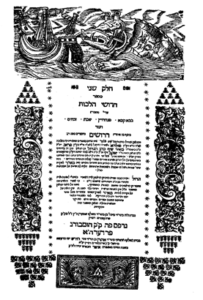
Fig. 11 1741, Hiddushei Halakhot

Returning to Amsterdam, an edition of Avot de-Rabbi Nathan with the commentary Ahavat Hesed (1777) by R. Abraham ben Samuel Witmond (1696-1773), also the author of novellae on the Pentateuch and Babylonian Talmud (1734). Avot de-Rabbi Nathan is one of the minor tractates, fourteen (fifteen, depending upon the enumeration) minor non-canonical tractates of the Talmud today appended to Seder Nezikin. It is an ethical work, considered a supplement to or a further development of Avot but with much aggadic material not related to the Mishnah, suggestive of an aggadic midrash. Ahavat Hesed was published posthumously by Witmond’s son-in-law and grandson at the press of Gerard Johann Janson. The header and place of publication on the title-page are printed in an oversized font in red letters. At the bottom of the page is a pressmark
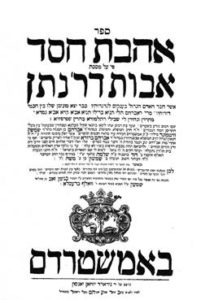
Fig. 12a Ahavat Hesed

Fig. 12b Ahavat Hesed Extract

At the bottom of the title-page is a shield with topped by a coronet and within it on the right are two fish facing in opposite directions, above them the sun, moon, and a star, and above them the phrase “and (Samson) said, [O Lord God,] remember me, I pray you, and strengthen me” (Judges 16:28); on the left a hand holding a pail above water, again above the sun, moon, and a star, and above the phrase “And David blessed the Lord” (I Chronicles 29:10). Yaari informs that the two phrases, allude to Witmond’s son-in-law, R. David, son of the late Solomon Bloch, together with the author’s grandson, Samson ben Moses, who brought the book to press. Furthermore, the fish refer to Samson ben Moses, born in the month of Adar, the sign of which is a fish, and the pail refers to his son-in-law David, born in the month of Shevat, that month’s sign being a pail.[28]

            The fish image, replete with its symbolism of fertility and good fortune, continued to be used in Jewish imagery and pressmarks. Indeed, shortly after its appearance on Ahavat Hesed it was again employed, if only occasionally, on the title-page of works from another Amsterdam printer, this into the nineteenth century. The usage over centuries depicted here attest to the popularity and power of the fish image, persisting to the present.
[1] Joseph Lowin, “Hebrew Root Word [D-Y-G]” Jewish Heritage on Line Magazine, http://www.jhom.com/topics/fish/lowin.html.
[2] Ellen Frankel and Betsy Platkin Teutsch, The Encyclopedia of Jewish Symbols) Northvale, London, 1995), p. 55.
[3] https://commons.wikimedia.org/wiki/Category:Salmons_in_heraldry
[4] W. Roberts, Printers’ Marks. A Chapter in the History of Typography, (London, 1893), pp. 201-02.
[5] Previous articles in this series are “Mirror-image Monograms as Printers’ Devices on the Title Pages of Hebrew Books Printed in the Seventeenth and Eighteenth Centuries,” Printing History 40 (Rochester, N. Y., 2000), pp. 2-11, reprinted in Studies in the Making of the Early Hebrew Book (Brill, Leiden/Boston, 2008), pp. 33-43; “The Cover Design, ‘The Printer’s Mark of Marc Antonio Giustiniani and the Printing Houses that Utilized It,’” Library Quarterly, 71:3 (Chicago, July, 2001), pp. 383-89, reprinted in Studies, pp. 44-53; “Mars and Minerva on the Hebrew Title Page,” The Papers of the Bibliographical Society of America 98:3 (New York, N. Y., 2004), pp. 269-92, reprinted in Studies, pp. 1-17; “The Bear Motif on Eighteenth Century Hebrew Books” The Papers of the Bibliographical Society of America 102:3 (New York, N. Y., 2008), pp. 341-61, reprinted in Further Studies in the Making of the Early Hebrew Book (Brill, Leiden/Boston, 2013), pp. 57-76; “Akedat Yitzhak (the Binding of Isaac) on the Title-Pages of Early Hebrew Books,” in Further Studies, pp. 35-56; “The Eagle Motif on 16th and 17th Century Hebrew Books,” Printing History, NS 17 (Syracuse, 2015), pp. 16-40; “The Lion Motif on Early Hebrew Title-Pages and Pressmarks,” (Printing History, NS 22, (Syracuse, 2015), pp. 53-71.
[6] Among the primary sources for this article are my The Sixteenth Century Hebrew Book: An Abridged Thesaurus (Brill, Leiden, 2004) and my The Seventeenth Century Hebrew Book: An Abridged Thesaurus. Brill, Leiden/Boston, 2011, and Avraham Yaari, Hebrew Printers’ Marks From the Beginning of Hebrew Printing to the End of the 19th Century, (Jerusalem, 1943), Hebrew with English introduction.
[7] Kabbalah Centre, https://livingwisdom.kabbalah.com/pisces-adar.
[8] Aish.com, http://www.aish.com/h/pur/b/The_Choice_of_Adar.html.
[9] Concerning the widespread use of this frame see my “Mars and Minerva on the Hebrew Title Page,” noted above.
[10] Yaari, Hebrew Printers’ Marks, pp. 12, 132 no. 19.
[11] Yaari, p. 132.
[12] Moritz Steinschneider, Catalogus Liborium Hebraeorum in Bibliotheca Bodleiana (Berlin, 1852-60), col. 220 n. 1407, col. 228 n. 1427.
[13] Nowy Dwor, Polish for ‘new manor’, is the prefix of several locations with that title. Another Nowy Dwor, Nowy Dwor Mazowiecki, was home to a Hebrew press in the late eighteenth – early nineteenth centuries, printing a significant number of Hebrew titles from 1781 through 1818.
[14] Yaari, pp. 26, 139 no. 42.
[15] A. M. Haberman, Title Pages of Hebrew Books (Safed, 1969), pp.m 48,129 no. 34; Isaac Yudlov, Hebrew Printers’ Marks: Fifty-Four Emblems and Marks if Hebrew Printers and Authors (Jeruslaem, 2001), pp. 36-40 [Hebrew]. He also informs that three small fish are the mark of the Gronim family of Prague in the sixteenth century, appearing on their headstones.
[16] Concerning Lida and Migdal David see my“David ben Aryeh Leib of Lida and his Migdal David: Accusations of Plagiarism in Eighteenth Century Amsterdam,” Shofar 19:2 (West Lafayette, Ind., 2001), pp. 117-28, reprinted in Studies in the Making of the Early Hebrew Book, pp. 191-205.
[17] Another work refering to Shabbetai Zevi noted by Ch. B. Friedberg, History of Hebrew Typography of the following Cities in Europe: Amsterdam, Antwerp, Avignon, Basle, Carlsruhe, Cleve, Coethen, Constance, Dessau, Deyhernfurt, Halle, Isny, Jessnitz, Leyden, London, Metz, Strasbourg, Thiengen, Vienna, Zurich. From its beginning in the year 1516 (Antwerp, 1937), p. 29 [Hebrew] published by Uri Phoebus is Tikkun Keria with a depiction of Shabbetai Zevi “sitting upon a throne, high and lifted up” (Isaiah 6:1).
[18] Ch. B. Friedberg, History of Hebrew Typography in Poland from the beginning of the year 1534, and its development up to our days . . . Second Edition, Enlarged, improved and revised from the sources (Tel Aviv, 1950), p. 64 [Hebrew] and Yaari, p. 158, date Uri Phoebus death to 1705. L. Fuks and R. G. In contrast, Fuks-Mansfeld, Hebrew Typography in the Northern Netherlands 1585 – 1815, II (Leiden, 1984), p. 242, writes that although Uri Phoebus was very productive in Zolkiew, he returned to Amsterdam in 1705, where, in 1710, he wrote “a short history of the first settlement of the Sephardic Jews in Amsterdam,” and where he died on 23 Shevat 5475 (17 January, 1715).
[19] Yaari, p. 158.
[20] Yosef Hayyim Yerushalmi, Haggadah and History, A Panorama in Facsimiles of Five Centuries of the Printed Haggadah from the Collections of Harvard University  and the Jewish Theological Society of America, (Philadelphia, 1976), plates 64, 65.
[21] Yeshayahu Vinograd, Thesaurus of the Hebrew Book. Listing of Books Printed in Hebrew Letters Since the Beginning of Printing circa 1469 through 1863 I (Jerusalem, 1993-95), I, p. 450 [Hebrew]; Yaari, pp. 51, 152-52 no, 82; Yudlov, pp. 59-61
[22] Concerning Hebrew printing in Wandsbeck see Marvin J. Heller, “Israel ben Abraham, his Hebrew Printing-Press in Wandsbeck, and the Books he Published,” Further Studies in the Making of the Early Hebrew Book (Brill, Leiden/Boston, 2013), pp. 169-93.
[23] Vinograd, II, pp. 168-69.
[24] Steinschneider, cols. 2792-93 no. 7517, 446-47 no. 2939.
[25] Concerning Hebrew printing in Homburg see my “Early Hebrew Printing in Bad Homburg vor der Höhe,” in progress.
[26] Itzhak Alfassi, “Schiff, Meir ben Jacob Ha-Kohen,” Encyclopaedia Judaica, (Detroit, 2007) vol. 18, p. 131; Mordechai Margalioth, ed. Encyclopedia of Great Men in Israel IV (Tel Aviv, 1986), col. 1028-29 [Hebrew].
[27] A. M. Habermann, Title Pages of Hebrew Books (Tel Aviv, 1969), pp. 104, 134 no. 88 [Hebrew].
[28] Marvin J. Heller, Printing the Talmud: A History of the Printed Editions of the Talmud from the mid-17th Century to the end of the 18th Century and the Presses that published them (Brill: forthcoming); Yaari, Hebrew Printers’ Marks, pp. 89, 169-70 no. 145.