Lithuanian Government Announces Construction of a $25,000,000 Convention Center in the Center of Vilna’s Oldest Jewish Cemetery

Lithuanian Government Announces
Construction of a $25,000,000 Convention Center
in the Center of Vilna’s Oldest Jewish Cemetery
by Sid Leiman

According to Russian statistics, Vilna had close to 200,000 inhabitants just prior to World War I, roughly forty percent of whom were Jewish, more than thirty percent were Polish, and about twenty percent were Russian and the rest consisted of small Lithuanian, Byelorussian, German and Tartar minorities.[1]

In 1919, the Paris Peace Conference was convened by the winning parties of World War I. Its purpose was to map the future of postwar Europe. When the status of Vilna came up for discussion, the Lithuanians claimed Vilnius as the rightful historical capital of independent Lithuania; the Poles rejected such claims on the basis of the cultural and linguistic affinities of Wilno to Poland. The Soviet regime, in diplomatic isolation, voiced its opinion that although Vilna had been part of Russia, the Bolsheviks were ready to share it with the oppressed peoples (mostly peasants) of Lithuanian and Byelorussian origins. Nobody asked or wanted to hear what Vilne meant to the Jews.[2]

I. Prologue.

In the summer of 1935, the municipal authorities of Vilna, then under Polish rule, announced that a sports stadium would be constructed on the site of Vilna’s oldest Jewish cemetery.3 At the time, the graves and tombstones of such greats as R. Menahem Mannes Chajes (d. 1636), one of Vilna’s earliest Chief Rabbis; R. Moshe Rivkes (d. 1671), author of Be’er Ha-Golah, a classic commentary on the Shulhan Arukh; R. Shlomo Zalman (d. 1788), younger brother of R. Hayyim of Volozhin and a favorite disciple of the Gaon of Vilna; R. Elijah b. Solomon (d. 1797), the Gaon of Vilna; and R. Abraham Danzig (d. 1820), author of Hayye Adam, a digest of practical Jewish law, stood in all their glory together with several thousand graves of all the Jewish men, women and children who had lived and died in Vilna between the years of 1592 and 1831.[4]

Tombstone Inscription of R. Menahem Mannes Chajes (d. 1636), embedded in the wall at the extreme left, in the Old Jewish Cemetery.
Tomb of R. Shlomo Zalman (d. 1788), younger brother of R. Hayyim of Volozhin, in the Old Jewish Cemetery.
Tomb of R. Elijah b. Solomon (d. 1797), the Gaon of Vilna, top right, in the Old Jewish Cemetery.
Grave and Tombstone Inscription of R. Abraham Danzig (d. 1820), center, in the Old Jewish Cemetery.

R. Chaim Ozer Grodzenski, spiritual leader of Vilna Jewry, as well as the leading Torah authority of his generation, interceded on behalf of Vilna and worldwide Jewry. He made it clear than no such desecration of a Jewish cemetery would be tolerated by the Jewish community. When the municipal authorities informed him that under the laws that applied at the time any cemetery not in use for one hundred years or more (the old Jewish cemetery was closed in 1831 due to lack of space) could be demolished by government decision, R. Chaim Ozer was adamant and informed the authorities that Jewish law prohibits the desecration of any Jewish cemetery, whether or not presently in use. Moreover, R. Chaim Ozer informed the authorities that the Jewish community would not comply in any way with the immoral demands of the municipal government. An attempt at a compromise was then made by the authorities; they were prepared to allow the section where the famous rabbis were buried to remain standing, so long as the Jewish community would agree to allow the government to demolish the remainder of the cemetery – where ordinary folk, i.e., men, women, and children were buried. R. Chaim Ozer ruled out any such compromise solution and, instead, engaged in a tireless, worldwide lobbying campaign, in an effort to persuade the government officials to rescind their decree.[5]

R. Chaim Ozer Grodzenski (in 1939).

When some rabbis in Palestine – sensing the gravity of the situation – issued a broadside calling for the grave of the Gaon of Vilna to be exhumed so that his remains could be transferred to the Holy Land, R. Chaim Ozer was livid. For, explained R. Chaim Ozer, by acquiescing to the exhumation and transfer of famous rabbis, one in effect consigns the rest of the cemetery to mass destruction. Moreover, it sets a precedent for all governments in Europe – just transfer the famous rabbis out of the Jewish cemetery and the Jews will agree to abandon the remainder of the cemetery.[6] The upshot of R. Chaim Ozer’s wisdom and intransigence was that under his watch,

no sports stadium was constructed on the old Jewish cemetery.[7] R. Chaim Ozer died on August 9 [= 5 Av], 1940.[8] Vilna, and arguably world Jewry, would never again have a leader who so deftly and gracefully combined within himself mastery of Torah, practical wisdom, and an unswerving commitment to the dissemination and protection of Jewish values – with profound and unstinting loyalty to his people, both living and deceased – under any and all circumstances.

II. Statement of Faina Kukliansky, Chairperson of the Lithuanian Jewish Community, Vilnius, August 15, 2015:[9]

Despite a Jerusalem Post story that would suggest otherwise (“Anger Flares Over Lithuanian Sports Palace,” Sam Sokol, 8/11/2015) there is today a remarkable consensus in Vilnius that the site of the former Snipiskes Cemetery and the graves beneath must be protected. On this matter, the government of Lithuania, the Lithuanian Jewish community which I chair, and the Committee for the Preservation of Jewish Cemeteries in Europe (CPJCE), which is Europe’s foremost halachic authority on cemeteries, all agree.

Attention is now focused on the abandoned former Soviet Sports Palace, which partially sits on the cemetery grounds and in its current condition is mostly a gathering place for graffiti artists and alcoholics. The government rightly wants to remove the building and turn it into a center for conferences and cultural events. Because the building itself has been designated an architectural heritage site, no significant structural changes are possible, but the interior will be renovated. The surrounding area will be maintained as a memorial park with inscriptions that describe some of the most famous people who were buried there.

The Lithuanian government and the CPJCE have an agreement dating to 2009, concerning the cemetery site. Even though we are only in a planning stage and still months away from any construction, recent discussions between the two have worked out an understanding for dealing with the renovation of the former Sports Palace. The CPJCE will provide rabbinic oversight and ensure that there are no halachic violations in the course of the work that takes place. The government has further agreed to limit the type of activities that will take place in the renovated center so that they are in keeping with the special nature of the site.

If anything, this should be a cause for celebration and a model for how other governments in our part of the world should deal with similar challenges of respecting and protecting Jewish cemeteries and the mass graves of Holocaust victims.

So what accounts for the “angry voices” in your story and the outrageous claims that a “desecration” is taking place?

No doubt some of those quoted are simply uninformed, and this fuller explanation will assuage their concerns. But sadly there are others who do know better but are using this issue to advance their own personal feuds and grievances. Some of them are rivals to the CPJCE, and while they would never publicly criticize its eminent Chairman, Rabbi Elyakim Schlesinger, they pretend not to know his involvement here. Perhaps even more destructive is the role being played by our community’s former rabbi, Chaim Burstein. His contract was recently terminated – he has spent more days abroad on his personal business than serving our Jews here in Lithuania – and so he is spreading these stories in order to attack me. It pains me to say these things, but your readers should know the truth.

As a proud Litvak who has the honor to chair a small but resilient Jewish community I have been part of many difficult struggles during these past decades as we have pressed the Lithuanian government to return former Jewish property and pressed the Lithuanian people to squarely confront the history of our Holocaust-era past. Those struggles are not over, but we have had much success. How ironic that as we now have Lithuanian leaders who are prepared to see clearly what happened in the past, we have fellow Jews who refuse to see clearly what is happening today.

Faina Kukliansky

III. Response to the Chairperson of the Lithuanian Jewish Community:
           

On August 15, 2015, Faina Kukliansky, Chairperson of the Lithuanian Jewish Community, issued a statement regarding the planned $25,000,000 Convention Center to be constructed by the Lithuanian government, and funded in large part by the European Union’s Structural Funds Program, in the center of Vilnius’ oldest Jewish cemetery – in use from the 16th through the 19th centuries – in the Shnipishkes (Yiddish: Shnipishok) section of Vilnius.

In the opening paragraph of the statement, Faina Kukliansky assures all concerned “that the site of the former Snipiskes cemetery and the graves beneath must be protected.” Her assurance, however, rings hollow, for as one reads on, it becomes apparent that she fully supports the idea of a Convention Center being constructed over the remains of the Jews buried in the cemetery.[10]

Ms. Kukliansky writes about the “abandoned former Soviet Sports Palace, which partially sits on the cemetery grounds.” One gets the impression that perhaps an annex to the Soviet-era Sports Palace, or its outer wall, sits on the cemetery grounds. In fact, the Soviet-era Sports Palace sits squarely in the very center of the old Jewish cemetery.[11]

Soviet-Era Sports Palace in Vilna, as it looks today, in the Old Jewish Cemetery.

Ms. Kukliansky continues: “Because the building [i.e., the Soviet-era Sports Palace] itself has been designated an architectural heritage site, no changes are possible.” Really? It was in the Soviet period that all the tombstones were systematically removed from the cemetery between 1948 and 1955, and it was in the Soviet period that a Sports Palace was constructed over the dead bodies of thousands of Vilnius Jews.[12] Now who was it that designated the Soviet Sports Palace an architectural heritage site? If it was the Soviets, what has this to do with Independent Lithuania? If, however, it was Independent Lithuania that made this designation, then rectification is long overdue. Indeed, the government of Lithuania should recognize the Shnipishkes Jewish cemetery as a heritage site of the Jewish community of Vilnius from the 16th through the 19th centuries. It should certainly not condone and perpetuate the Soviet desecration of a Jewish cemetery. That the EU supports such misuse of funds is nothing short of scandalous. Surely, there is ample room in and around Vilnius for the construction of a Convention Center someplace other than smack in the center of historically, the single most important Jewish cemetery in Lithuania and one of the most important in all of Europe.

Ms. Kukliansky labels those who disagree with her as “simply uninformed” or having a particular axe to grind. She does not entertain the possibility that building a Convention Center over a Jewish cemetery is not everybody’s cup of tea. I’m afraid it is Ms. Kukliansky who seems to be unaware of how many thousands of graves remain on the site, of how often bones have surfaced in recent years on the face of the cemetery,[13] and how despite prior agreements with the Lithuanian authorities, two entire buildings were constructed in recent years on the cemetery grounds.[14] Does she really believe – as she claims – that the construction of a $25,000,000 Convention Center will involve no excavation outside the present perimeters of the Soviet-era Sports Palace? Does she really believe – as she claims – that the type of activities that will take place in the renovated center will be in keeping with the special nature of the site? I wonder who is “simply uninformed.”

Faina Kukliansky writes: “If anything, this should be a cause for celebration and a model for how governments in our part of the world should deal with similar challenges of respecting and protecting Jewish cemeteries and mass graves of Holocaust victims.”

Nations of Eastern Europe take note! If you want to deal with respecting and protecting Jewish cemeteries, learn from the Vilnius experience. First remove and destroy all Jewish tombstones, and afterwards excavate wherever possible and destroy the remains of those who were buried there. Then build a Sports Palace or a Convention Center in the heart of the Jewish cemetery! Make certain that the new structures are designated architectural heritage sites, so that they cannot be dismantled. This should be followed by a celebration of how Jewish cemeteries have been respected and protected in the most proper fashion.

Faina Kukliansky is to be congratulated for assuming the responsibility of leading a “small but resilient Jewish community.” Sadly, she makes no mention of the fact that heartfelt and pained voices have been raised by a number of distinguished members of her small community, voicing strong opposition to the construction of the Convention Center in the Jewish cemetery.[15] But there is another issue here. Faina Kukliansky is much too modest in thinking that the “small and resilient Jewish community” of Vilnius is her only constituency. The Vilnius Jewish cemeteries belong not only to Vilnius and its Jewish community. The spiritual, as well as the genetic, descendants of the thousands of men and women buried in the Shnipishkes and Zaretcha Jewish cemeteries live the world over. They remember their ancestors, study their writings, often live by their teachings, and should have the right to pray at their graves in a cemetery not desecrated by a Convention Center.

Faina Kukliansky would do well to weigh carefully the consequences of the precedent she is setting. By lending her support to the construction of a Convention Center over the old Jewish cemetery, she places in jeopardy every Jewish cemetery in Europe and, perhaps, elsewhere as well. True, she claims that she relies on a rabbinic ruling issued by the CPJCE in London. Distinguished rabbis the world over, however, have raised their voices in unison against the construction of a Convention Center in the old Jewish cemetery, rendering the London opinion – at best – a minority one. These voices include the leading halakhic authorities in Israel16 and the United States,17 and the present heads of the great yeshivot that once graced Lithuania, which due to the Holocaust and Soviet repression had to resettle elsewhere.18 Faina Kukliansky would also do well to remember the voice raised long ago by her pre-World War II predecessor in Vilna, Rabbi Chaim Ozer Grodzenski. He did not allow the Polish government to desecrate the very Jewish cemetery that is about to be desecrated by the Lithuanian government with her approval.

Sid Leiman
Professor Emeritus of Jewish History and Literature
Brooklyn College

September 13, 2015
Erev Rosh Ha-Shanah 5776

Notes:

[1] Laimonas Briedis, Vilnius: City of Strangers (Vilnius, 2009), p. 168.
[2] Briedis, op. cit., p. 195. [The Briedis quotes have been slightly edited by me for the sake of clarity. -SL]
[3] See Yaakov Kosovsky-Shahor, ed., אגרות רחיים עוזר (Bnei Brak, 2000), vol. 1, pp. 400-401. Cf. Dov Eliach, הגאון (Jerusalem, 2002), vol. 3, p. 1142. See also the brief notice in Israel Klausner,
וילנא ירושלים דליטא: דורות האחרונים (Tel-Aviv, 1983), vol. 2, p. 554.
[4] For a concise history of the old Jewish cemetery in Vilna, see Israel Klausner, קורות בית העלמין הישן בוילנה (Vilna, 1935).
[5] In general, see Kosovsky-Shahor, op. cit., vol. 1, pp. 400-405.
[6] Kosovsky-Shahor, op. cit., vol. 1, pp. 402-403.
[7] A soccer field, just north of the old Jewish cemetery, was initiated in 1936 and eventually became Zalgiris Stadium when construction was completed by the Soviets in 1950. See Antanas Papshys, Vilnius: A Guide (Moscow, 1980), p. 127. It is still in use in Vilnius.
[8] For a moving account of his funeral, see Yosef Friedlander, “The Day Vilna Died,” Tradition 37:2 (2003), pp. 88-92.
[9] Faina Kukliansky’s statement was translated from Lithuanian into English and posted on August 15, 2015 on the Lithuanian Jewish Community website here. For the full context of the “Convention Center on the Old Jewish Cemetery” controversy, and for a comprehensive paper trail of statements made by Faina Kukliansky and the various parties involved in the controversy to date, see here. This site exists due to the incredible industry of the indefatigable Professor Dovid Katz of Vilnius, who also has prepared a register of all public voices that have been raised in opposition to the proposed construction of a Convention Center on the old Jewish cemetery, available here.
[10] One suspects that Ms. Kukliansky distinguishes between the land under the former Soviet-era Sport Palace (which, due to the excavations necessary for its construction, presumably led to the disposal of all Jewish remains that had been buried there) and the land surrounding the former Soviet-era Sports Palace (which presumably retains the remains of all those Jews who had been buried there). Thus, she feels comfortable with the construction of a Convention Center over the former Soviet-era Sports Palace. In terms of Jewish law, however, such a distinction is meaningless. Once a Jewish cemetery is consecrated it becomes a hallowed place, much like a synagogue. Like a synagogue, it cannot be used for secular purposes and it may not be desecrated in any way. And like a synagogue, it retains its sanctity whether or not Jews are actually present at any specific time or on a specific day. The Jewish cemetery remains hallowed in its entirety, even if all the remains have been removed from it; how much more so if remains are strewn throughout the cemetery! On the hallowed status of a Jewish cemetery, see, e.g., R. Jacob Moellin (d. 1427), ספר מהריל: מנהגים (Jerusalem, 1989), laws of fasting, p. 270; R. Elijah Shapira, אליהו רבה על ספרי הלבושים, to שלחן ערוך אורח חיים 581:4, note 39; and R. Judah Ashkenazi (d. circa 1742), באר היטב, and R. Samuel Kolin (d. 1806), מחצית השקל, to שלחן ערוך אורח חיים 581:4. In all the passages just cited, every Jewish cemetery is described as a מקום קדוש, i.e. a holy place – which is precisely why Jewish cemeteries are designated as places appropriate for prayer. When a municipal office building, or an apartment house, or a convention center is constructed on a Jewish cemetery, it as an act of desecration. Ms. Kukliansky seems upset about “the outrageous claims that a desecration is taking place.” The claims are hardly outrageous; it is the desecration that is taking place that is outrageous.

That a Jewish cemetery retains its hallowed status even if some or all the remains are removed from it and buried elsewhere is an official ruling of many rabbis, including R. Shlomo Zalman Auerbach (d. 1995), one of the greatest halakhic decisors of modern times. At שות מנחת שלמה (Jerusalem, 1999), vol. 2, responsum 88, p. 338, he rules unequivocally: “A Jewish cemetery, even if should happen that its remains have been exhumed, remains prohibited [for secular use, or for being sold to a second party], and always retains its character as a Jewish cemetery.” Cf. R. Moshe Feinstein,אגרות משה: יורה דעה חלק ג (New York, 1982), responsum 151, pp. 418-419.
[11] This can be seen by examining maps of the Jewish cemetery prepared during the last 200 years, as well as detailed photographs of the Jewish cemetery taken in the last 100 years. Even U.S. intelligence reports released by Wikileaks concede that “the Sports Palace property indisputably rests in the middle of the former cemetery.” See here.
[12] The Soviet-built Sports Palace, used primarily for volleyball and basketball games, was opened in 1971 and remained in use in Independent Lithuania until 2004.
[13] The evidence here is shocking indeed. See, e.g., Binyomin Rabinowitz, “Can Anything Be Done to Save the Remnants of Vilna’s Old Jewish Cemetery,” Dei’ah VeDibur (August 31, 2005), pp. 1-9, available online here.
[14] See, e.g., the Wikipedia entry on “Jewish Cemeteries of Vilnius”: “The Palace of Concerts and Sports (Lithuanian: Koncertų ir sporto rūmai) was built in 1971 right in the middle of the former cemetery. In 2005, apartment and office buildings were built at the site,” here.
[15] See, e.g., Ruta (Reyzke) Bloshtein’s stirring plea to the Lithuanian government online here.
[16] E.g, Rabbi Samuel Auerbach of Jerusalem, son and successor of R. Shlomo Zalman Auerbach.
[17] The list is much too long to be included here. Suffice to mention: Rabbi David Feinstein (head of Mesivta Tiferet Jerusalem), Rabbi Aharon Feldman (head of Ner Israel Rabbinical College), Rabbi Shmuel Kamenetsky (head of Talmudical Yeshiva of Philadelphia), and Rabbi Aaron M. Schechter (head of Mesivta Chaim Berlin).
[18] These include Rabbi Chaim Dov Heller, head of the Telz Yeshiva, formerly in Telshiai, Lithuania; Rabbi Osher Kalmanowitz, head of the Mirrer yeshiva, formerly in Mir, Greater Lithuania (today in Belarus); and Rabbi Aryeh Malkiel Kotler, head of the Beth Medrash Govoha in Lakewood, formerly in Kleck and Sluck, Greater Lithuania (today in Belarus).


ArtScroll and More

ArtScroll and More
by Marc B. Shapiro
Continued from here.
1. As mentioned, I believe that on occasion ArtScroll is unaware that the text it is explaining is a censored text. Sometimes it might even be an internally censored text (i.e., censored by Jews so as to avoid difficulties with the non-Jewish authorities). This same problem is often found with aharonim. How about with rishonim? For example, was Rashi ever misled by an internally censored text? I would hesitate to say so but this is exactly what is suggested by R. Elijah David Rabinowitz-Teomim (the Aderet), though he piously prefaces his remarks with the words לולי דברי רש”י.
Sanhedrin 58b states:
Resh Lakish said: A heathen who keeps a day of rest, deserves death, for it is written, “And a day and a night they shall not rest” (Gen. 8:22), and a master has said: Their prohibition is their death sentence. Ravina said: Even if he rested on a Monday.
The Aderet sees it as obvious (פשוט) that the original version of Ravina’s statement was “Even if he rested on Sunday,” and this was changed to “Monday” due to fear of the Christians.[1] Rashi, however, offers an explanation as to why “Monday” is mentioned, meaning that if the Aderet is correct then even Rashi was misled by the altered text.[2]
As part of his explanation on this passage, Rashi also writes: אחד בשבת ששובתין בו הנוצרים. This is the authentic version of Rashi which appears in the early Talmud printings. It is also found in Steinsaltz and Oz ve-Hadar. The censored Vilna Talmud, followed by ArtScroll, omit the word הנוצרים.
Even in the censored Vilna Talmud the word הנוצרים appears in Ta’anit 27b where we find the following:

Our Rabbis have taught: The men of the Mishmar prayed over the sacrifice of their brethren that it may be favorably accepted, whilst the men of the Ma’amad assembled in their synagogues and observed four fasts, on Monday, Tuesday, Wednesday and Thursday of that week. On Monday [they fasted] for those that go down to the sea; on Tuesday for those who travel in the deserts; on Wednesday that croup may not attack children; on Thursday for pregnant women and nursing mothers, that pregnant women should not suffer a miscarriage, and that nursing mothers may be able to nurse their infants; on Friday they did not fast out of respect for the Sabbath; and certainly not on the Sabbath. Why did they not fast on Sunday? — R. Johanan said: Because of the Christians (הנוצרים). R. Samuel b. Nahmani said: Because it is the third day after the creation of Man. Resh Lakish said: Because of the additional soul. For Resh Lakish said: Man is given an additional soul on Friday, but at the termination of the Sabbath it is taken away from him, as it is said, “He ceased from work and rested” [shavat va-yinafash], that is to say, once the rest had ceased, woe! that soul is gone.

There is something very strange about this passage, and yet it is not noted in Soncino, ArtScroll, Koren, or by R. Zvi Hirsch Chajes whom I could have expected to pick up on it. I assume that most people read this passage without even realizing the problem, which for the rishonim was not a problem as I will explain. The Sages, in describing what went on in Second Temple days, make clear that the men of the Ma’amad did not fast on Sunday. R. Johanan, who lived in third-century Eretz Yisrael, says that this was because of the Christians. Rashi explains that the Christians “make this day [Sunday] their holiday.”[3] R. Gershom, in his commentary on the passage, writes that the Christians’ “holiday is on Sunday and if the Jews would fast they [the Christians] would be angered.”[4]
The problem with all this is that in the days of the Second Temple there was no significant Christian community for Jews to be concerned with. Furthermore, these early followers of Jesus would not have observed the Sabbath on Sunday.[5] I think the answer to this problem is that the talmudic sages regarded Jesus as a student of R. Joshua ben Perahyah who flourished in the latter part of the second century BCE (i.e., ca. 130-100 BCE). In other words, in the talmudic conception Jesus lived at least a century earlier than the historical record tells us, and the amoraim assumed that the Christianity as they knew it was also practiced centuries before. Robert Travers Herford writes: “R. Johanan transferred to the time of the Temple a feature of the religious life of his own totally different time.”[6] The predating of Jesus’ life was also shared by the rishonim, which explains why the chronological problem did not trouble them.
Ketubot 102b states:

If a man died and left a young son with his mother, [and while] the father’s heirs demand, ‘Let him be brought up with us’, his mother claims, ‘My son should be brought up by me’, [the son] must be left with his mother and may not be left with anyone who is entitled to be his heir. Such a case once occurred and [the heirs] killed him ער”ה.

What does ער”ה mean? The first thing to note is that these letters are not part of the original talmudic text. In talmudic manuscripts, the writings of the rishonim, and also the early printed editions in Pesaro and Venice, the uncensored text reads “killed him on the eve of Passover.”[7] Because this is the authentic reading, this is how it appears in Steinsaltz, Koren, and Soncino. ArtScroll, however, translates the last words of the passage as “They butchered him on the first evening of his stay,” reading ער”ה as ערב הראשון.
ArtScroll’s action is quite strange, as there is absolutely no question what the authentic reading of the text is. Not only does ArtScroll translate the false acronym, but it even offers an explanation of it. “They were so eager for his blood that he did not even last a single night with him. They killed him on the evening of his arrival.” This is wildly incorrect as the acronym ער”ה is simply a printer’s invention.
ArtScroll continues its explanation as follows:

The words ערב הראשון, the first evening, are not actually found in the Baraisa. Rather, the Baraisa contains an acronym – ער”ה – which is read as ערב הראשון (see Rosh; Mesoras HaShas). Another interpretation of this acronym reads it as ערב הפסח, on Pesach eve (Meiri; Hagahos Yavetz)

This note also needs to be corrected as there is no dispute among rishonim about how to how to read the acronym, as the acronym did not exist in the days of the rishonim. It is an invention of one of the printed editions. Thus, contrary to what the note states, Meiri never gave an interpretation of the acronym to mean ערב הפסח. Rather, these words were in his text of the Talmud, and they were also in the Rosh’s text of the Talmud and appear in the manuscripts of the Rosh. The printed version of the Rosh has been “corrected”, just like the text of the Talmud and Rif was “corrected”.[8]
Why did printed editions of the Talmud begin to use the acronym? This talmudic passage was cited by anti-Semites to support the blood libel, namely, that Jews would kill Christian children before Passover to use their blood.[9] Thus, this “correction”, like so many others, was designed to undermine anti-Semitic attacks against the Talmud.[10]       
Seth Leibowitz called my attention to the Stone Chumash, p. 407, where in the introduction to the Ten Commandments it states:

Rambam (Moreh Nevuchim II:32) comments that they only heard the first two [commandments] from God, but they could hear only the sound of the Divine voice, as it were, and could not understand the words He was saying. . . . Thus, the people experienced prophecy, for they heard God’s voice, but their faith in Moses was reinforced, because only he understood what God was saying.

The first thing to note is that the reference should be II:33 not II:32. The passage just quoted states that the people experienced prophecy. Does Maimonides say this? Guide 2:33 is a very difficult chapter and any interpretation given can be challenged with alternative perspectives. (See Yaakov Levinger, Ha-Rambam ke-Filosof u-khe-Fosek, ch. 3.) Yet I think I am on safe ground in saying that Maimonides does not believe that what the people as a whole experienced is to be regarded as prophecy. While Guide 2:33 might be ambiguous in this matter, the previous chapter, 2:32, states explicitly: “As for the Gathering at Mount Sinai, though through a miracle all the people saw the great fire and heard the frightening and terrifying voices, only those who were fit for it achieved the rank of prophecy, and even those in various degrees.”
Shem Tov explains:
ואחר שסלק הרב אלו הטעיות אשר יראה מהם שהשם ינבא כל איש מבני אדם, סלק מעלינו ספק גדול והוא מעמד הר סיני אשר אנשים ונשים סכלים ובלתי ראויים כל היו נביאים וזה יביא לחשוב שהשם ית’ ינבא כל מי שירצה מבלתי שיהיה מוכן, ואמר שאף שכלם היו רואים האש הגדולה ושומעים הקולות הנוראות המפחידות וזה היה על צד הפלא, לא הגיע למדרגת הנבואה אלא הראוי לה והראויים יתחלפו מדרגותיהם ג”כ
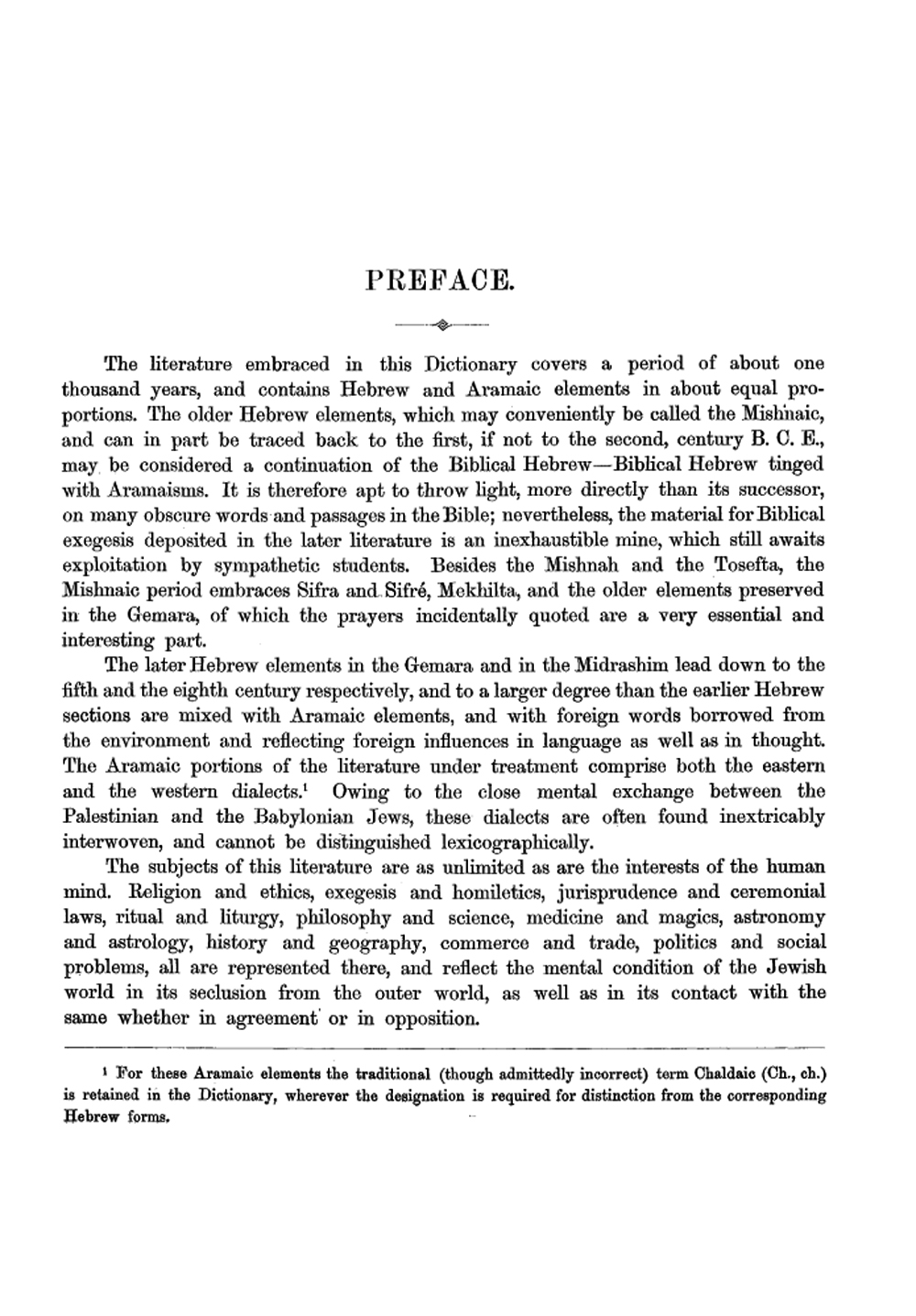
Finally, so that all the attention is not on ArtScroll, the following point was called to my attention by Benjamin Apfel. Here is the first page of Jastrow’s introduction to his dictionary. Read the last paragraph.

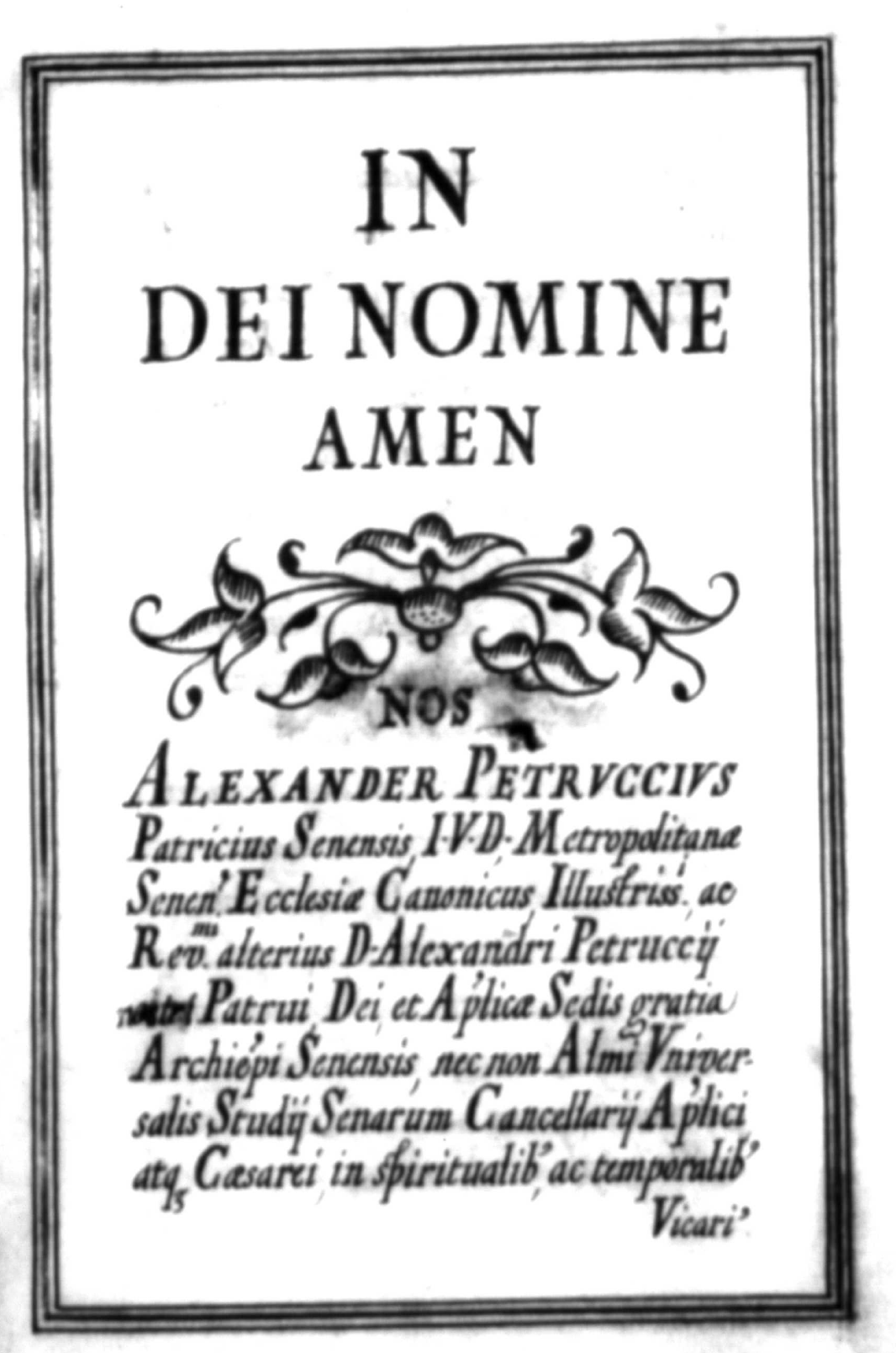
Here is the first page of Philip Birnbaum’s introduction to his translation of sections of the Mishneh Torah.[11]
The first paragraph is lifted from Jastrow. Would it have been so difficult for Birnbaum to simply add a note indicating that he was adapting Jastrow’s words?
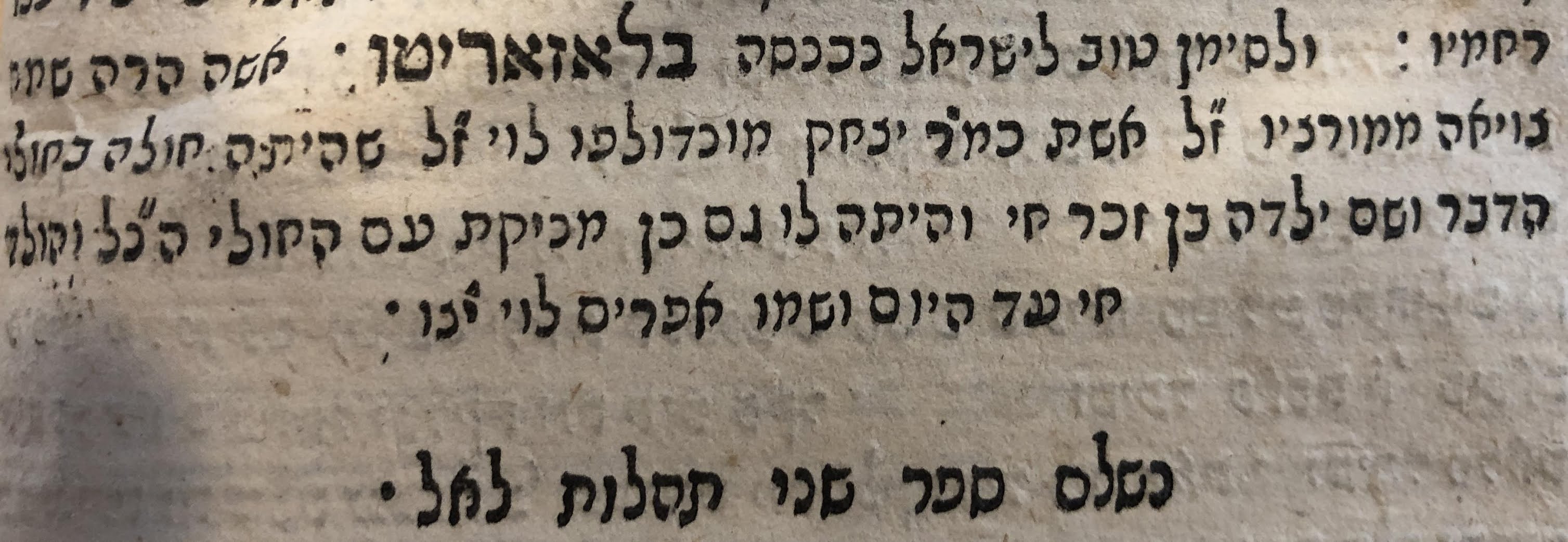
2. In my post here I referred to selections from Rashbam’s commentary on Psalms that were recently printed from manuscript. This should be distinguished from Rashbam’s commentary on Psalms published in Vienna in 1816 by Isaac Satanow. Here is the title page which tells us that the manuscript comes from the royal library in Berlin.
This commentary on Psalms is a forgery. While the volume is attributed to Rashbam it was actually written by Satanow. Regarding this forgery, David Rosin writes as follows:[12]
הכי קרא שמו יצחק ויהי כצחוק בעיניו להתחפש במעטה רבנו שמואל ולעשות מעשהו ולעבוד עבודתו. זר מעשהו ונכריה עבודתו, כל השומע יצחק לו
3. In my post here I quoted R. Moses Isaac Ashkenazi in his Ho’il Moshe that King David is not to be regarded as a prophet as he only had ruah ha-kodesh. One of the commenters wrote:

Rashi Megilla 14a quotes a Halachot Gedolot which names David as [a] prophet. Rashi speaks specifically about prophets as opposed to Ruach Hakodesh, and excludes Daniel based on Megilla 3a.

 Another commenter was more strident:

Wonderful example how modern scholars have no place in the Torah world! As first commenter pointed out, Dovid Hamelech is prominent in the list of 48 neviim, and there are scores of sugyos based on the nevuah of DH. The makom mizbeach, etc. Pure AmHaaRatzus!

I am not sure if I am the am ha-aretz he is referring to, which in any case would be uncalled for since I never said that David only had ruah ha-kodesh and was therefore not a prophet. All I did was point out that R. Moses Isaac Ashkenazi said this. When I called the commenter’s attention to the fact that his strong words were directed against R. Ashkenazi, he wrote:

I wouldn’t start up with Hoil Moshe, but was pointing out the danger of someone reading this post, and then taking it at face value. For anyone fluent in Shas they will find numerous references to DH’s nevua. Ruach HaKodesh wouldn’t work for all the halachos we learn out from DH. . . . I do thoroughly enjoy your posts, but find them quite dangerous. I would prefer my children at least stick to Artscroll and have their basics –DH’s nevua – straight!

Now let me say something that I did not put in the comments because I want the entire audience to see it, not just the tiny group that reads the comments. The commenter just quoted is a perfect example of one who is certain of something, and certain that the opposing position is incorrect, and this leads to very harsh language. Let’s leave aside R. Moses Isaac Ashkenazi who is not an important scholar. All would agree that R. Moses Sofer, the Hatam Sofer, is important and certainly not an am ha’aretz (which is the term the commenter used). Yet the Hatam Sofer is explicit that David was not a prophet and only had ruah ha-kodesh, which is exactly what R. Ashkenazi states and what the commenter so harshly attacks. Here are the Hatam Sofer’s words in Torat Moshe ha-ShalemBa-Midbar, p. 74.

הנה לא מצינו לישראל מלך שיהי’ גם נביא משולח לעם כי אם משה רבינו ע”ה, דכתיב גבי’ (דברים ל”ג ה’) ויהי בישורון מלך, אבל שארי נביאים לא היו מלכים והמלכים לא התנבאו, ודוד המלך ע”ה רה”ק הו”ל ולא נבואה, ולכן אחז”ל (גיטין נ”ט ע”א) מימות משה עד רבי לא מצינו תורה וגדולה במקום אחד, דאלו כל הנביאים היו עליהם בגדולה השופט והמלך שבימיו, וכל המלכים אפי’ דוד ושלמה היו הנביאים שבדורם גדולים מהם בתורה . . . שהרי אין מלך נביא.

This notion, that the kings were not prophets (other than Moses), is also stated in Zohar, Terumah, p. 154a, and this is presumably the Hatam Sofer’s source. I don’t deny that there are other authoritative sources that contradict this, including passages in the Talmud. Some of them are cited by R. Reuven Margaliyot in his note to the Zohar, ad loc., and we can speculate as to why the Hatam Sofer preferred the Zohar over these other sources. I cite this only to show that commenters should be very careful before labeling something as am ha’aratzus, as you never know whom you might be insulting with this comment.

4. The latest book in my series with Academic Studies Press has recently appeared. It is Sara Reguer, My Father’s Journey: A Memoir of Lost Worlds of Jewish Lithuania. (Reguer is the granddaughter of R. Simcha Zelig Reguer, the dayan of Brisk.) Here is the book’s description.

Born into a leading Lithuanian-Jewish rabbinic family, Moshe Aron Reguer initially followed the path of traditional yeshiva education. His adolescence coincided with World War I and its upheavals, pandemics, and pogroms, as well as with new ideas of Haskalah, Zionism, and socialism. His memoir, recently discovered and here translated and published for the first time, discusses his internal struggles and describes the world around him and the people who influenced him. Moshe Aron Reguer wrote his memoir at the age of 23, on the eve of his departure for Eretz Israel in 1926. However, his story did not end there, but continued in British Mandated Palestine and the United States. He kept in touch with the family in Brest-Litovsk until the Nazis destroyed Jewish Lithuania, and some of their correspondence is included within this volume.

Anyone who is interested in Jewish Lithuania and the great yeshivot will find this book of value.

I also want to call attention to the recent publication of Menachem Kellner, Jewish Universalism, edited by Hava Tirosh-Samuelson and Aaron W. Hughes. Kellner’s work has made a great impact, not only in Jewish scholarship but among thinking Jews in general. This small volume is a wonderful read and contains an intellectual portrait of Kellner written by James A. Diamond as well as a lengthy interview with Kellner.

This book is number 12 in Brill’s Library of Contemporary Jewish Philosophers. Here is what has appeared so far and what if forthcoming (taken from the Brill website).

Published Volumes

Vol. 1: Eliezer Schweid: The Responsibility of Jewish Philosophy
Vol. 2: Jonathan Sacks: Universalizing Particularity
Vol. 3: David Novak: Natural Law and Revealed Torah
Vol. 4: Eugene B. Borowitz: Rethinking God and Ethics
Vol. 5: Elliot N. Dorff: In Search of the Good Life
Vol. 6: Judith Plaskow: Feminism, Theology, and Justice
Vol. 7: David R. Blumenthal: Living with God and Humanity
Vol. 8: Moshe Idel: Representing God
Vol. 9: Lenn E. Goodman: Judaism, Humanity, and Nature
Vol. 10: Avi Sagi: Existentialism, Pluralism, and Identity
Vol. 11: Elliot R. Wolfson: Poetic Thinking
Vol. 12: Menachem Kellner: Jewish Universalism

Forthcoming Volumes

Vol. 13: J. David Bleich: Where Halakhah and Philosophy Meet (est. October 2015)
Vol. 14: Michael Fishbane: Jewish Hermeneutical Theology (est. October 2015)
Vol. 15: Norbert M. Samuelson: Reasoned Faith (est. November 2015)
Vol. 16: Arthur Green: Hasidism for Tomorrow (est. January 2016)

5. The issue of truth-telling in halakhic matters, discussed in the last chapter of my new book, has been of interest to many people. I did not want to be too lengthy in my response to Aryeh Frimer here, because it was not my own independent post. So let me now add some more details. DG reminded me of the following source. According to R. Jacob Moellin, when the Talmud states that a law is rabbinic but a verse is brought as an asmachta, this was done so as to mislead the people into thinking that it is a Torah law so that they would observe it more carefully.[13] In other words, the Sages were engaging in falsehood for a higher purpose.

This is exactly the sort of thing that Frimer claimed is not part of mainstream halakhic thought, a point which I disputed. It also is very relevant to my discussion of the dispute between the Hatam Sofer and R. Zvi Hirsch Chajes regarding “raising the prohibition”. Here are the Maharil’s words, as quoted by his student.

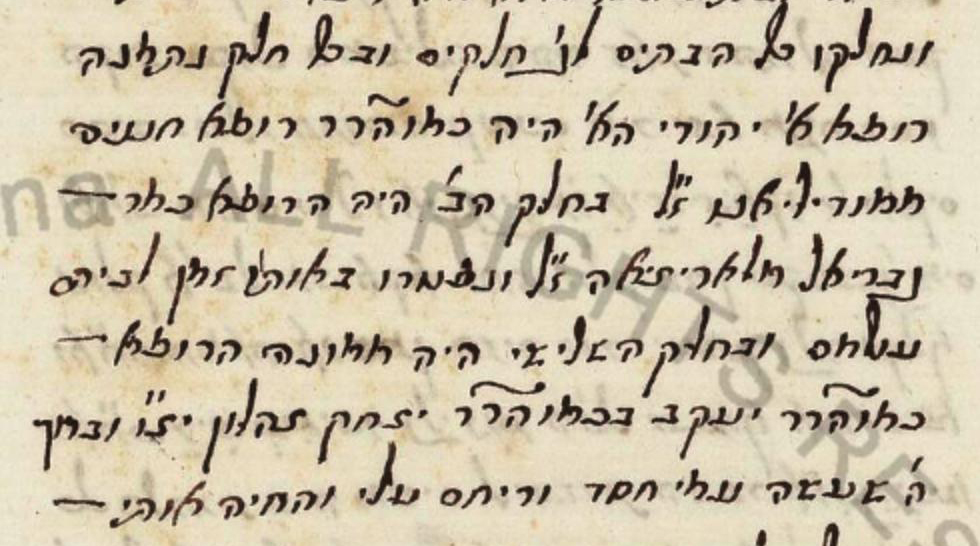
כל היכא דאיתמר מדרבנן הוא וקרא אסמכתא בעלמא, הכי פירושו ודאי תקנתא דרבנן הוא והם יצאו ובדקו ומצאו להם סמך מקרא, וסמכו דבריהם עליו כדי להחזיקם שיהיו סבורים דהוא מדאורייתא ויחמירו בו, ולא אתו לזלזל ולהקל בדברי חכמים

In the notes to this text, the editor informs us that one of the manuscripts has a different version. Instead of כדי להחזיקם שיהיו סבורים it reads להטעות הבריות שהם סבורים. This text is even more explicit that the Sages were not being honest with the masses. This manuscript has a handwritten note explaining that instead of reading להטעות הבריות it should say להטעים לבריות because the word להטעות is a דבר מגונה . In other words, the person who made this “correction” was troubled by the explicit statement that the Sages would deceive people, even if it was for a higher cause.

If there is one thing people have learnt from my posts over the years, it is that whenever you find a passage that diverges radically from what others think is appropriate, you will find those who deny the passage’s authenticity. In this case, the most prominent of the deniers is R. Joseph Engel[14]:

לענ”ד לא מיסתברי כלל ולא אאמין כלל שיצאו מפה קדוש המהרי”ל ז”ל

R. Simhah Klein writes[15]:
וכי ישקרו חז”ל לחזק דבריהם שיהיו סבורין דהוא דאורייתא

However, R. Eliyahu Bohbut is not at all bothered by the claim of the Maharil that the Sages engaged in a form of deception vis-à-vis the masses. After quoting the passage he explains matter-of-factly[16]:

כלומר דאסמכתא באה כביכול “להטעות” את העם שיסברו דאיכא איסור דאורייתא “ויחמירו בו”

Regarding one of the other matters I discussed in the book, namely, so-called “Orthodox history”, the folllowing appears in Divrei David (p. 30a), a collection of teachings of R. David Moses Friedman, the first Chortkover Rebbe.

פ”א סיפרו לפניו על איזה מעשה שאדמ”ור מרוזין זי”ע סיפר אותו פעם בסינגון זה ופעם בסיגנון אחר אמר על זה מרן אדמ”ור זי”ע שהסיפורי מעשיות שמספרים הצדיקים הוא לפי מה שצריך באותו שעה

This is an acknowledgment that the stories told by the rebbes are not really history, as they are designed to serve the needs of the present. As I think most people today realize, haredi “historical” writing in general is as much about the present as the past, and it is precisely because of this that authors feel it is legitimate to cover up or even alter the historical record in order to best serve the religious needs of the present.

Finally, a few people have asked about what I wrote on p. 244, that the strand of Jewish tradition that countenances falsehood “deserves to be understood in a sympathetic manner as well”. This does not mean that people need to agree with those who countenance falsehood, and I certainly do not. However, in writing an academic study as opposed to a polemic, it is important to recognize that approaches that today we might regard as unacceptable, were viewed very differently in other times and cultures (and for some, these “other times and cultures” continue into our own day). I am interested in understanding what leads people to diverge so dramatically from a value that I regard as important. In my book I did not set out to judge them, but in a sympathetic manner, i.e, with a sensitivity to their worldview, attempt to understand them. (When I used the word “sympathetic”, I did not mean that I approved of what I was describing, only that I was sensitive to the motivations behind the approach.) By the same token, when I see that great figures from earlier years have written troubling things about non-Jews or women, I also approach this in a sympathetic manner, understanding that for these people, living in a vastly different time and often suffering under terrible anti-Semitism, it made sense that they would express certain thoughts that today pretty much everyone regards as unacceptable. One need not be a complete historicist to acknowledge that all people are influenced by their era, for good and for bad. This is what I mean by understanding in a sympathetic manner.

Coming Soon: R. Ysoscher Katz and Modern Orthodox Halakhah; The Nineteenth- and Early Twentieth-Century Dispute Regarding the Historicity of the Hanukkah Miracle; R. Steinman and the Messianic Belief; R. Mazuz’s Short-Lived Entry into Politics; and a response to R. Aharon Lopiansky’s article in Dialogue.


[1] See his note in Mekabtzi’el 36 (2009), p. 64.
[2] Was Maimonides ever misled by a censored text? According to R. Eliyahu Zini, Eretz Hemdatenu, p. 75, this was indeed the case. Mishneh Torah, Hilkhot Avodah Zarah 9:13 states:
 המוכר ביתו לעבודה זרה דמיו אסורין בהנייה ויוליך אותם לים המלח
As Kesef Mishneh and others point out, the origin of this halakhah is Gittin 44a. Yet the authentic reading there is המוכר ביתו לגוי (the Vilna Talmud has לעובד כוכבים). As Dikdukei Soferim ha-Shalem (Jerusalem, 2001), ad loc., informs us, לגוי is the reading in all surviving manuscripts and early printings. Meiri, ad loc., explains the halakhah as follows:
שהמוכר בית לגוי בארץ ישראל ר”ל לאחד מעובדי האלילים דמיו אסורים מתורת קנס על שנתן לעובדי האלילים חנייה בקרקע
Since Maimonides had the reading לעבודה זרה, R. Zini concludes that the talmudic manuscript he used had been altered. This is much more compelling than the explanation offered by Kesef Mishneh and Lehem Mishneh that Maimonides interpreted לגוי to mean לעבודה זרה.
Yet there is no doubt that R. Zini is incorrect. As has been pointed out by many, one who examines Tosefta, Avodah Zarah 7:2, will see that this, and not Gittin 44a, is the source for Maimonides, and Kesef Mishneh and Lehem Mishneh were simply unaware of this source. It is significant that לעבודה זרה appears even in manuscripts of the Tosefta. 

Regarding Tosefta, Avodah Zarah 7:2 and Gittin 44a, I assume that only one of the versions preserves the authentic text, but I don’t think we can determine which one it is. The only thing that remains to be explained is why Maimonides did not codify the halakhah in Gittin 44a. (It could be that his version of Gittin 44a was indeed the same as that which appears in the Tosefta, but this has nothing to do with censorship.)

[3] Kesef Mishneh, Hilkhot Melakhim 10:9, cites Rashi. You can see the uncensored text of Kesef Mishneh in the Frankel edition. The version of Kesef Mishneh that appears in older editions of the Mishneh Torah is a censored text, and instead of recording Rashi’s statement about Sunday, the following appears: או בע”ש ששובתים בו הישמעלים. For printers in the Christian world there was no problem speaking about Muslim beliefs and practices, so in this case the original statement, made with reference to Christians, was substituted with one referring to Muslims. The printers who made this “correction” had the same misconception as many today, namely, that Friday is a day of rest for Muslims. It is not. Friday is a day of gathering for prayer, but Muslims do not have a sabbath, i.e., a day of rest.
[4] Interestingly, I found an anonymous medieval Italian text that records a “minhag tov” not to eat meat on Sunday. One reason offered is kevod Shabbat, namely, by having meat so soon after Shabbat one lessens the special nature of this day in which meat is the main dish. (Obviously, meat was not regarded as an everyday meal in this author’s time and place.) The second reason is מפני קלון הנוצרים. What this means is that since Sunday is the Christians’ holy day, Jews should avoid eating a special food like meat on that day. See Minhag Tov, ed. Weiss (Budapest, 1929), p. 230, no. 47.
[5] See Reuven Kimelman, “Birkat ha-Minim and the Lack of Evidence for an Anti-Christian Jewish Prayer in Late Antiquity,” in E. P. Sanders, et al., eds., Jewish and Christian Self-Definition (Philadelphia, 1981), vol. 2, p. 242.
[6] Christianity in Talmud and Midrash (London, 1903), p. 172. His first name “Robert” never appears in his works, as he went by “R. Travers Herford”. I supplied the first name in full as I did not want people to assume that we are dealing with “Rabbi Travers Herford”. Herford wrote a number of works about the Pharisees. His positive portrayal of them was in opposition to the standard Christian view. This highly impressed R. Zvi Yehudah Kook, who suggested translating Herford’s works into Hebrew. See his letter here where he writes:
חשבתי אז להעירו ע”ד ספריו החשובים של החכם האנגלי הרפורד, – היודע ואוהב את היהדות באופן נפלא, –  ע”ד תורת היהדות הפרושית וערכה העולמי, כהמשכה האמיתי של הנבואה בחיוניותה הנמשכת עד היום. כדאי וחשוב מאד היה לתרגמם לעברית, בשביל הנוער שלנו המתחשב מאד עם דבריו של גוי, וביחוד לעומת הרבוי של תרגומי דברי תפלות, שזכו ומזכים בהם את ספרותנו החדשה. אולי יואיל כ’ לזכות במצוה זו בהתמחות זריזותו ושקידתו
Herford’s commentary on Pirkei Avot is full of interesting points. To give one example, he argues that the proper vocalization of אמרו  in Avot 1:5: באשתו אמרו קל וחומר באשת חבירו, is amaro, not amru. (R. Mazuz told me that this is definitely incorrect.)
[7] See Dikdukei Soferim ha-Shalem, ad loc., Saul Lieberman, Tosefta ki-Feshutah, Ketubot, p. 365.
[8] See R. Yonatan Binyamin Buchinger in Or Yisrael 46 (Tevet 5767), pp. 237ff., ibid. 48 (Tamuz 5767), pp. 240-241, ibid. 51 (Adar Sheni 5768), p. 246. The authentic text of the Rif, which reads ערב הפסח, is found in the Constantinople 1509 edition. See Hilkhot Rav Alfas, ed. Zaks (Jerusalem, 1969), vol. 2, p. 128.
[9] See Ariel Toaff, Blood Passover (available online) ch. 8 n. 8. (Unfortunately, this book continues to give ammunition to anti-Semites.)
[10] See F. H. Wettstein, Halifat Mikhtavim (Cracow, 1900), p. 97; R. Dovid Cohen, He-Akov le-Mishor (Brooklyn, 1993), to Ketubot 102b (p. 106); Soncino’s note, Ketubot 102b.
[11] Maimonides’ Mishneh Torah (New York, 1967).
[12] Introduction to his edition of Rashbam on the Pentateuch, p. xix. See also Reuven Elitzur, Degel Mahaneh Reuven (n.p., n.d.), pp. 365ff. Not knowing who Satanow was, R. Yisrael Yaakov Fisher of the Edah Haredit refers to him as ר’ יצחק מסטנוב ז”ל. See Even Yisrael, vol. 8, no. 9. I found the same lack of awareness in R. Aryeh Leib Neimark, Even Yaakov (Slutzk, 1910), p. 57b: יפה פירש החכם מהר”י סאטנאב
[13] Sefer Maharil, ed. Spitzer (Jerusalem, 1989), Likutim, no. 70 (p. 629).
[14] Beit ha-Otzar, vol. 1, kelal 190 (p. 118b).
[15] Peleitat Soferim 1 (2012), p. 87 n. 7.
[16] Shoshanat ha-Amakim (Jerusalem, 2008), p. 257.


Notes on the Book of Samuel, and the Eternal Sanctity of the Temple in Maimonidean Thought

Notes on the Book of Samuel, and the Eternal Sanctity of the Temple in Maimonidean Thought

By Rabbi Avi Grossman

avrahambenyehuda.wordpress.com

Rabbi Label Dulitz, who passed away last week, was an iconic figure at YUHSB. I was privileged to first meet him when I began my studies at the school in the fall of 1996. That year, Rabbi Dulitz was teaching Talmud to part of the tenth grade, but some of us lucky freshmen got to sit in his afternoon Navi class. His photographic memory of the Bible, Talmud, and Shakespeare has already been recounted by many; what struck me more about the man who sought to mold men was his persistence, his insistence that all of his students put every ounce of their efforts into their studies. For years, I found myself more comfortable in the library than in the beis midrash, not because I was not interested in Torah study, but rather because of the atmosphere. In this, I found a model in Rabbi Dulitz, who made the third-floor gallery of our high-school library his personal study and let me spend as much time as I wanted at his table, even when I was cutting other classes. (I am also indebted to the long-time librarian, Mr. Wexler, for his support and dedication.) 

That year, Rabbi Dulitz did not teach us about the Book of Samuel; he drilled it into our minds as though using a thumbscrew (his word), and when we did not do well enough on our exams, he would wail like Achish, “do I lack crazies?”  When I was fifteen years old, I had questions about Samuel, but it took almost 25 years for me to even begin to articulate them. I regret that I had not sought the opportunity to thank Rabbi Dulitz before he was gone, but I pray that this serves as a fitting monument to him.

This is the story of an interesting argument over the interpretation of historical matters incidentally described in halachic works. For a few years, I made a number of assumptions regarding Maimonides’s views in this regard but recently those assumptions were challenged. 

A note on terminology: I will follow Maimonides’s precedent in this regard. That which the Israelites built in the wilderness and then established in a number of places within Israel is referred to as the mishkan, which is invariably rendered as Tabernacle, or as ohel mo’ed, Tent of Meeting, while the Temple is the translation of habayith, or some other construction, like beith adonay, and the word miqdash, Sanctuary, is the term that includes both Temple and Tabernacle alike, and which Maimonides uses to halachically define and equate all of the historical Sanctuaries:

מצות עשה לעשות בית לה’, מוכן להיות מקריבים בו הקרבנות, וחוגגין אליו שלוש פעמים בשנה–שנאמר “ועשו לי, מקדש” (שמות כה,ח); וכבר נתפרש בתורה משכן שעשה משה רבנו, והיה לפי שעה–שנאמר “כי לא באתם, עד עתה . . .” (דברים יב,ט)

 ואלו הן הדברים שהן עיקר בבניין הבית:  עושין בו קודש, וקודש הקודשים, ויהיה לפני הקודש מקום אחד והוא הנקרא אולם; ושלושתן נקראין היכל.  ועושין מחיצה אחרת סביב להיכל, רחוקה ממנו כעין קלעי החצר שהיו במדבר; וכל המוקף במחיצה זו שהוא כעין חצר אוהל מועד, הוא הנקרא עזרה. והכל נקרא מקדש

כיון שנכנסו לארץ, העמידו המשכן בגלגל ארבע עשרה שנה שכבשו ושחלקו.  ומשם באו לשילה, ובנו שם בית של אבנים; ופרסו יריעות המשכן עליו, ולא הייתה שם תקרה.  ושלוש מאות ותשע וששים שנה, עמד מקדש שילה. וכשמת עלי, חרב ובאו לנוב ובנו שם מקדש, וכשמת שמואל חרב ובאו לגבעון ובנו שם מקדש. ומגבעון באו לבית העולמים וימי נוב וגבעון, שבע וחמישים שנה

However, in many instances, the Bible uses all four and even some others as poetic synonyms. For the sake of clarity, I shall not.  

For some years now, I have  wondered about three things: Why is the destruction of the Tabernacle at Shiloh, although alluded to in the Book of Samuel and explicitly described in the Psalms and Jeremiah and the Mishna, not explicitly mentioned in Samuel? On the other hand, why does the Torah devote so much detail to the materials and construction of the Tabernacle, and why do the prophets give so much detail concerning the materials and construction of the First Temple, and then so much detail and reiteration when describing the First Temple’s destruction? Lastly, although we have no clear Talmudic or Mishnaic source for this claim, why is it that many commentators echo the claim of the Or Hahayim, that had the Temple been built by Moses, it never would have been destroyed? How did the Or Hahayim know that?

This website analyzes a number of topics which we have studied in the past, and its author, a prominent faculty member at Merkaz Harav with whom I have corresponded on this matter, offers an explanation that does not satisfy me because part of its basis is the assumption that the Tabernacle as it stood in Nov and Gibeon was not considered a full, halachic Sanctuary, whereas I feel it is clear from both the Yerushalmi and Maimonides’s commentary on the Mishna that the Tabernacles at Nov and Gibeon, despite the fact that they never housed the Ark of the Covenant, were as much complete sanctuaries as those at Shiloh and Jerusalem. While I  agree with his assertion that the main tragedy of Shiloh was the Ark of the Covenant’s falling into enemy hands, the idea that the rest of the Sanctuary’s destruction was insignificant because the Ark was already removed does not satisfy me, because by that logic, according to the major opinions that the Ark had been removed from the Temple decades before the Temple’s destruction, the Temple’s destruction would have also not been so tragic. Similarly, the Second Temple, which never housed the Ark, would also not have had a remarkably tragic destruction. These ideas are untenable.

Instead, I answered that the Torah dedicates so much detail to the construction of the Sanctuaries because they were the physical manifestations of Israel’s dedication to God’s service. The contributions of gold and silver transcended their physical value. They were the pride and joy of our people. The tragedy of the destruction of the First Temple was that due to our sins, the neglect of God’s law, the great riches that had been dedicated to the Temple fell into the hands of the heathens for their own profane use. This is a theme addressed by the prophets and sages, and part of the consolation of Zion that led to the building of the Second Temple was that they were returned. However, as history attests, the only component of the Mosaic Tabernacle that ever fell into enemy hands was the Ark, while the rest of Tabernacle, including its structural components and appointments, was evacuated from Shiloh before the Philistines got there, and eventually made its way to Nov, then Gibeon, and then was brought to be put into g’niza, permanent storage, under the Temple in Jerusalem. The Philistines merely demolished the stone walls that held up the impermanent, tent-like roof of the Shiloh Sanctuary and its stone altar, but the original altars of wood, bronze, and gold, for the burnt offerings and the incense, were saved. Thus, major tragedy was averted, although the people learned a harsh lesson. This explains why the prophets did not in any way detail the destruction of Shiloh like they did that of Jerusalem. No spoils were taken. I therefore suggest, as others have done before me, that the fact, mentioned in Sota 9b, that Moses’s major handiwork, the Tabernacle, never fell into enemy hands, is the basis for the idea that the same would have been true for the Temple. 

I recently had the honor of discussing these issues with Rabbi Shendorfi, and in response to his challenges, I collected the various sources within the writings of the Meiri, the Meshech Hochma, and the Hevel Nahalato that point to the absence of the Ark of the Covenant from the Sanctuaries at Nov and Gibeon as the reason, or perhaps the halachic mechanism that allowed, for the hetter bamoth, the permission to offer sacrifice outside of the Sanctuary. The original and complete Hebrew version of my analysis and conclusions is available here,, while an oral explanation thereof can be found in a series of Youtube videos here. God willing, their English counterparts will be made available soon.

The following is a summary of my main original arguments:

Maimonides describes two positive commandments (to offer all sacrifices in the chosen Sanctuary, and to bring all sacrificially designated things outside of Israel to the Sanctuary) and two negative commandments (not to slaughter sacrifices outside the Sanctuary courtyard, and not to burn any sacrifice outside the Sanctuary courtyard) that, as the sages point out in Z’vahim 14:4-10, did not apply when the Sanctuary stood in Nov and Gibeon. This is the state we refer to as hetter bamoth, when anyone could build his own bama, a “high place”, i.e., an altar, for private sacrifice.

The aforementioned commandments were taken very seriously early in our history; Joshua 22 describes how shortly after the Sanctuary was established at Shiloh, the Transjordanian tribes of Israel built a large, purely symbolic altar along the Jordan, and the other tribes were prepared to go to war against them for what was their seeming intention not to follow these commandments, while the book of Kings judges every single king of both Israel and Judah by how well each upheld these commandments. Every king of Israel starting from Jeroboam onward with the exception of Hosea son Elah, the last king of Israel, is faulted for maintaining places of sacrifice other than Jerusalem, while many kings of Judah are criticized for not abolishing the private altars that stood in their realms, and Hezekiah is the described as the greatest, most righteous king because he finally put an end to the practice. (I have always said that the modern political and religious establishment preventing Jews from visiting the site of the Temple, etc., is merely another manifestation of Jeroboam’s main policies, policies he and almost every one of his successors adopted in order to maintain their own grips on power. Thus, until an Israeli Prime Minister once again allows the Jewish People to worship God as per the Torah, they will all have “done evil in the eyes of God.”)

The main question before us is, therefore, on what basis did our ancestors establish altars and offer sacrifice outside of the Sanctuary during the time when it stood in Nov and Gibeon? What was the source or reason for this temporary suspension of a number of Biblical commandments?

The Meiri, noting that since the Ark of the Covenant was never present in the Sanctuaries at Nov and Gibeon, as is clear from the Book of Samuel, writes that its absence was the ostensible halachic allowance for sacrifice on private altars:

 הואיל ולא היה הארון קבוע עם המזבח – הותרו הבמות

Many similar sources can be found in Hevel Nahalato, available here. One of them is the Meshech Hochma, who claims that the Israelites were permitted, in isolated incidents, to offer sacrifice beyond the Shiloh Sanctuary when the Ark was temporarily removed from the Sanctuary. The problem is that this view of the Meshech Hochma, and the views of those who followed him, can not be resolved with Maimonides’s own commentary to the fourteenth chapter of Z’vahim, in which he explicitly writes, as per both Talmudim, that the hetter bamoth of the  Nov/Gibeon era was on the authority of an expository tradition of our sages (Z’vahim 119a):

When they came to Gibeon [and set up the Mishkan there], bamoth were [once again] permitted. How do we know that? — Because our Rabbis taught: “For you have not yet come to the m’nuha, the resting place and the nahala, the inheritance.” ‘The resting place’ alludes to Shiloh, ‘the inheritance’ alludes to Jerusalem. Why does Scripture separate them? [That is, why does scripture mention that there are two destinations?] In order to grant permission between one and the other.

See Maimonides’s complete commentary to Z’vahim 14, in which he also describes how the bamoth that existed before the Tabernacle was at Shiloh, when it was in Gilgal, were allowed by yet another derivation from the relevant verses, and not because the Ark was usually outside of the Tabernacle:

לפי שתלה הכתוב איסור הבמות במחנה והוא שנאמר אשר ישחט שור או כשב או עז במחנה ונתן טעם בזה למען אשר יביאו בני ישראל את זבחיהם וגו’ וזהו איסור הבמות לפי שמיום שפסקו המחנות [תרגום הרי׳׳ק: ״חיסול מחנות״] ונכנסו לארץ ר”ל ארץ כנען והוא הזמן שבאו לגלגל נסתלקה מצות לא תעשה זו ונשאר מותר 

As a matter of fact, according to the non-Maimonidean school, it would actually be quite imprecise for the sages of the Mishna to declare that there was a hetter bamoth during the Gilgal period, or any period for that matter. As a matter of fact, the entire style of the Mishna, to state whether there was a hetter bamoth or issur bamoth when the Sanctuary stood in any place, is pointless according to the Meiri and Meshech Hochma. Instead, the Mishna should have just stated a general rule at the outset that when the Ark was kept in the Tabernacle, the bamoth were prohibited, and when the Ark was taken out of the Tabernacle, the bamoth were permitted. As we will be reminded later on, the fact that the Mishna describes certain periods is exactly as the Talmud concludes: the permissibility of the bamoth depended on the time period, and not on a particular condition that could change during that period. 

One particular passage in Hevel Nahalato is particularly perplexing because he acknowledges Maimonides’s explanation for why the bamoth were permitted during the Gilgal period, but he then writes that the permission during the Nov/Gibeon period was granted because the Ark was absent.

 ישנה הסיבה בזמן נוב וגבעון שארון לא היה במקומו ואז המזבח ירד ממדרגתו להיות במה גדולה. וישנה הסיבה שהיתה בגלגל שבטלה החלוקה למחנות שכינה לויה וישראל ולכן אף המשכן כולו ירד ממדרגתו לדרגת במה גדולה\

This idea, which explicitly contradicts Maimonides’s own words, is echoed in later works, including those on the internet, such as this article by Rabbi Prof. Yoel Elitzur, son of the late Bible scholar Rabbi Yehuda Elitzur, and in it, he brings an answer that I recall hearing was also offered by Rabbi Soloveichik. He begins by citing another relevant passage from Maimonides’s laws (4:1):

When Solomon built the Temple, he was aware that it would ultimately be destroyed. [Therefore,] he constructed a chamber, in which the Ark could be entombed below [the Holy of Holies] in deep, maze-like vaults. King Josiah commanded that [the Ark] be entombed in the chamber built by Solomon, as it is said: “He said to the Levites, consecrated to the Lord, who taught all Israel, ‘Put the Holy Ark in the House that Solomon son of David, king of Israel, built…’” (II Chronicles 35:3).

This is unusual, as Rambam generally does not rule on historical questions in Mishneh Torah, including the interpretation of texts and even halakhic questions that were only relevant in the past (such as the permissibility of the bamoth), unless there is some practical halakhic implication for the present or the future, or if the question touches on a fundamental foundation of faith. In light of this, why did Rambam choose to rule with such certainty in our case, weighing in on what amounts to a Tannaitic historical dispute?

It is likely that the reason behind this ruling can be found in the Talmud Yerushalmi:

Rabbi Yassa said in the name of Rabbi Yohanan: “This is the rule – whenever the Ark is within [the Sanctuary], the bamot are forbidden; when it has left [the Sanctuary], the bamot are permitted.” Rabbi Ze’ira asked Rabbi Yassa: “Even [when the Ark has left the Sanctuary] temporarily, as in the case of Eli?” (Yerushalmi Megilla 1:12)

In the style of the Yerushalmi, Rabbi Ze’ira’s question that was seemingly left unanswered serves as its own conclusion: Indeed, even when the Ark leaves the Sanctuary temporarily, the bamot become permitted. Rabbi Meir Simcha of Dvinsk, in his Meshekh Chokhma commentary on Parashat Re’eh, expanded on this notion, using it to explain the apparent violation of the prohibition on bamot during the Shiloh period. According to him, during the time of the Mishkan in Shiloh, the Ark would be removed regularly from its place to be present at national gatherings elsewhere, and sometimes it would even remain in those other locations for extended periods of time. During those periods when the Ark was absent from the Mishkan in Shiloh, claims the Meshekh Chokhma, the bamot were permitted.

Now we can return to Rambam’s unusual ruling. In a different, well-known statement that is accepted as the normative halakha, Rambam rules that the “first consecration” performed by Solomon in Jerusalem applied “for that time and for eternity” (Hilkhot Beit Ha-bechira 6:14). This ruling has several halakhic implications, both positive – we can offer sacrifices on the Temple site even without the Temple itself; we can eat the “most holy” sacrifices even without the “hangings” of the Courtyard; we can eat sacrifices of lesser sanctity and ma’aser sheni even without the wall surrounding Jerusalem (Mishna Eduyot 8:6; Hilkhot Beit Ha-bechira 6:15) – and negative – the impure may not enter the area of the Courtyard; and bamot are prohibited outside of Jerusalem. In order to reconcile this ruling with the statement of the Yerushalmi, Rambam was forced to rule in accordance with Rabbi Judah son of Lakish – the Ark was hidden in its own place![11] If so, according to Rambam the Ark is still in its original location, waiting for us in the depths of the Holy of Holies, beneath the Foundation Stone in Jerusalem.

I wrote to Prof. Elitzur about how this is not a valid resolution to the question regarding Maimonides’s formulation because it assumes that the exchange between Rabbi Yassa and Rabbi Ze’ira is the bottom-line halacha and the conclusion of that Talmudic discussion, but in reality, the Talmud continues, and brings, at the conclusion of that section cited above, an elaboration of the mishnayoth in Z’vahim we saw above. There, at the conclusion of the first chapter of YT M’gilla, it explains why bamoth were prohibited during the Shilonic period, then permitted in the intervening period, and then permanently prohibited once the Temple was built: it was a d’rasha, an esoteric rule encoded in the unusual language of the prohibition, and it did not condition the hetter bamoth on the Ark’s constant presence in the Sanctuary, and is along the lines of the passage from Z’vahim 119a, above, and in the corresponding section from the Yerushalmi, after quoting the same verse referencing “the resting place” and “the inheritance,” and explaining that the former was Shiloh and the latter was Jerusalem, the consequences are explained:

Thus, while the Tent of Meeting [stood during the sojourn in the wilderness], the bamoth were prohibited. While [it stood] in Gilgal, the bamoth were permitted. While [it stood] in Shiloh, the bamoth were prohibited. While [it stood] in Nov and Gibeon, the bamoth were permitted. While [it stood] in Jerusalem, the bamoth were prohibited. [This can be compared] to a man who told his servant, “do not drink wine from Tiberias, nor from Caesarea, nor from Sephoris,” implying that from areas between those places, he could [drink wine].

And that is how Maimonides explains the Mishnayoth in his uncensored commentary to Z’vahim. This seems necessary, because the exposition of the verse about “the resting place” and “the inheritance” does not seem to teach anything about the Gilgal period, and it must be that the hetter bamoth of that period was due to some other factor. Be that as it may, Maimonides reiterates why there was a hetter bamoth between the Shiloh and Jerusalem eras: Moses, when he related this command, had implied that there would be a period between the two major Sanctuaries when the bamoth would once again be permitted.

It therefore turns out that Rabbi Yassa’s rule, actually a k’lal in the original Hebrew, should more accurately be translated as a “general principle,” less a declaration of halacha, and more of a mnemonic, a correlation that does not imply causation. If you will ask, how are we to remember if high places were permitted during the days of a particular sanctuary, then look for the Ark. The Ark stood in Shiloh, so the high places were then prohibited, but it did not stand in Nov and Gibeon, and therefore high places were permitted in their days. But Rabbi Ze’ira points out that this is too simplistic, because it implies that if the Ark were to have been removed from Shiloh temporarily, then the high places would have been temporarily permitted, or if the Ark were to be removed from the Temple in Jerusalem, it would also result in a hetter bamoth until it would be brought back, which is untenable, and explains why Rabbi Yassa has no rejoinder for Rabbi Ze’ira’s point, because the hetter bamoth, according to the conclusion of this Yerushalmi, and according to the plain meaning of the Bavli in Z’vahim, and according to Maimonides’s commentary, does not depend on the strict and immediate presence of the Ark of the Covenant in the Sanctuary, and that is why the Temple is still the Temple in its state of desolation according to Maimonides, even though the Ark has not been present therein since the late First Temple Period.

I also have a hard time accepting Rabbi Shendorfi’s terminology which implies that when the Ark is absent, the Sanctuary’s altar loses (lit. descends from its level of) sanctity and becomes a “bama g’dola, a great high place.” This term, bama g’dola, is actually greatly misunderstood, as we shall see. We also disagreed regarding the application of the word miqdash to the Tabernacles of Nov and Gibeon; I had written that the interpretation of what Maimonides wrote in the first source cited above meant that the Nov and Gibeon Sanctuaries were מקדשים לכל דבר, “Sanctuaries for all intents and purposes,” and this was also stated by Rabbi Bar Hayim in a series of recent lectures posted to Youtube, but Rabbi Shendorfi argued that Nov and Gibeon were not ״,מקדשים לכל דבר״ that they were somehow inferior or of lesser status, and the prophets never referred to Nov and Gibeon the way they referred to Shiloh and Jerusalem, and challenged me to prove my assertion. I think Maimonides’s opening ruling/definition is sufficient, and my challenge was instead to answer why the destruction of Shiloh became an afterthought, and why the subsequent Sanctuaries were not described with reverence.

I Kings 9:2-5, I Chronicles 22:1, and Psalms 132:14, and other relevant verses, as well as Laws of the Chosen Temple 1:3 and 6:13-16 show beyond any doubt that according to Maimonides, there is no indication that the sanctity of the Temple and the eternal prohibition against bamoth that were initiated with the Temple’s inauguration had anything to do with the absence or presence of the Ark in the Temple. Rather, they were made known to us expressly by the prophets and the Mosaic tradition.

Not only that, in those latter laws, Maimonides actually explains the nature of the Temple’s eternal sanctity and its halachic ramifications, and how their unconditional nature stands in stark contrast to the sanctity of the land of Israel, which is conditional, and therefore subject to nullification:

How was [the Second Temple] consecrated? With the first consecration initiated by Solomon, for he consecrated the Temple Courtyard and Jerusalem for that time and for eternity. Therefore, we may offer all the sacrifices [at the Temple], even though the Temple itself is not built. Similarly, the most holy sacrifices can be eaten in the entire [area of the] Courtyard, even though it is in ruin and not surrounded by a formal wall. We may also eat less holy sacrifices and the second tithe throughout Jerusalem, even though it is not [presently] surrounded by a wall, for through its original consecration, it was consecrated for that time and for eternity.

Why do I say that the original consecration sanctified the Temple and Jerusalem for eternity, while with regard to the consecration of the remainder of the Land of Israel, specifically regarding whether the Sabbatical year, tithes, and other related [agricultural] laws are in force, [the original consecration] did not sanctify it for eternity? Because the sanctity of the Temple and Jerusalem stems from the Divine Presence, and the Divine Presence can never be nullified. Thus, Leviticus 26:31 states: “I will lay waste to your sanctuaries.” The Sages declared: “Even though they have been devastated, their sanctity remains.”

In contrast, the [original] obligation to keep the laws of the Sabbatical year and tithes on the Land stemmed from the fact that it was conquered by the [Jewish people as a united] community. Therefore, when the land was taken from their hands [by the Babylonians,] their [original] conquest was nullified. Thus, according to Torah law, the land was freed from the obligations of the Sabbatical year and tithes because it was no longer “Land of Israel.”

That is, according to Maimonides, the sanctity of something is whether or not the relevant commandments and laws apply to it. An Aaronite priest is holy because specific commandments apply to him beyond those that apply to an ordinary Jew, whereas a halal, the offspring of a priest and a woman not fit for him, is desecrated, and the commandments and laws of the priesthood do not not apply to him. The land of Israel was promised to the Patriarchs and is eternally in the possession of the Jewish people, but its sanctity only exists under certain conditions, and it is only under those conditions that the laws and commandments actually apply therein. The idea of sanctity is a fundamental tenet of halacha, and applies in various forms to inanimate objects, vegetation, animals, people, places, and even time periods.

Most importantly, Maimonides writes explicitly how the Holy of Holies was holier than every other place:

בית קודש הקודשים מקודש ממנו שאין נכנס לשם אלא כהן גדול ביום הכיפורים, בשעת העבודה

The Holy of Holies is holier than [the rest of the Sanctuary edifice], as only the High Priest may enter there on Yom Kippur at the time of the service.

We see from this halacha that the essence of the Holy of Holies’ sanctity derived from the fact it was the place designated for more commandments than the other places, i.e., it had even stricter rules of limited entry than the rest of the Temple, and it was designated for a unique sacrificial service not performed elsewhere, and that is what made it holy, even when, for centuries perhaps, the Ark of the Covenant was absent. In the Guide to the Perplexed (3:45, based on the Friedlander translation), Maimonides explains that these defined areas of additional sanctity have a specific utility:

It is evident that the object of giving different degrees of sanctity to the different places, to the Temple Mount, the place between the two walls, to the women’s courtyard, to the Hall, and so on up to the Holy of Holies, was to raise the respect and reverence of the Temple in the minds of all who approached it.

The sixteenth-century commentator Radbaz has a classic explanation of Maimonides’s distinction between the sanctity of the Temple and the sanctity of the land, and it answers a question regarding the Mishna (Keilim 1) that Maimonides cites regarding the ten levels of sanctity within the Land of Israel:

The land of Israel is sanctified above all other lands. What is its sanctity? From it we bring the ‘omer, the bikkurim, and the two loaves of (pentecostal) bread.

Why doesn’t the Mishna just state that the land’s sanctity is that the mitzwoth hat’luyoth ba’aretz, the agricultural commandments that are contingent on the land, only apply in the land of Israel?

The answer is that the Mishna was aware that the main sanctity of the land is transient, that it was once conditional and then nullified, and therefore there were times when the land had no sanctity, i.e., the usual commandments were not in force. But, because the Temple’s sanctity is eternal and unconditional, and never lapsed, the sacrifices were always required, and the offerings mentioned in this Mishna are all public offerings of the Temple, and therefore this aspect of the land’s sanctity, which is a derivative of the Temple’s sanctity, is also eternal. That means, for example, that if during the times of the Babylonian exile, before work even began on the Second Temple and the altar was rebuilt, the Jews had an opportunity to offer sacrifice at the Temple ruins, as apparently happened at certain times even after the destruction of the Second Temple, and it was Passover or Pentecost, they would have to make sure that the grains they were using for the ‘omer and the pentecostal loaves, (also called bikkurim) had to come from the land of Israel, even though they could not and did not count the years of the Sabbatical cycle, or tithe their crops, or keep the other commandments that were contingent on the land.

Were the Temple’s sanctity conditional like that of the land’s sanctity, as the Meiri and the Meshech Hochma claim, I would have expected Maimonides to say so, just as he wrote how the land’s sanctity was once conditional and subject to nullification, and just as he wrote in the Book of Commandments regarding a similar issue:

If we were to suppose that the people of Israel were to disappear from the land of Israel – although it is sacrilege to say that God allow such a thing, as He has already promised that the remnant of this people shall neither be erased or uprooted – then our calculation [of the calendar] would not be of any utility to us whatsoever, because we are not supposed to calculate and intercalate the years and establish new moons outside of the land except for specific circumstances, and as we have explained, “for Torah shall go forth from Zion, and the word of the Lord from Jerusalem.”

According to Maimonides, the complete removal of the Jews from the land of Israel would be the destruction of the Jewish people.

This passage teaches us that the responsibility/necessity of a court to establish the Jewish calendar is, at least in theory, conditioned on the presence of that court within the land of Israel.

Thus, if the Temple’s sanctity was conditional, for example, on the presence of the Ark of the Covenant, we would have expected Maimonides to write something along the lines of:

If we were to suppose that the Ark of the Covenant were to disappear from the Temple – heaven forbid – then the entire sanctity of the Temple would be nullified, and we would not be able to offer any of the public sacrifices therein, even though the Temple would still be standing in all its grandeur, and we would not be able to eat the most holy sacrifices in the Temple Courtyard even if its walls were standing, and neither would we be able to eat less holy sacrifices and the second tithe within Jerusalem even if it had a wall, because the original sanctification of the Temple only has effect as long as the Ark remains in the Temple.

But Maimonides never wrote any such thing. It is very difficult to argue that according to Maimonides, or the sages for that matter, the sanctity of the Temple would be contingent on the presence of the Ark.

We will now turn to explaining what Maimonides’s intent was in seemingly ruling that the Ark of the Covenant was hidden in a secret chamber beneath the Temple Mount. The matter of the Ark’s disappearance from history is a matter of dispute both among secular researchers (at least among those who believe it ever existed) and our sages, and it seems that many of the proposed narratives are speculative and conjectural. How and why did Maimonides see fit to take sides in this argument?

As we have mentioned, the Meiri and Meshech Hochma et al. claim that the Ark must have stayed within the Temple for its sanctity to be able to persist, thus allowing for us to keep all of the positive and negative commandments of the Temple throughout history, even during the times the Temple stands in ruins, and even during Second Temple times. Although this could very well be a valid explanation for why some of the sages may have claimed that the Ark was hidden under the Temple, it certainly could not have been Maimonides’s reason.

My tentative answer is that with regards to historical and halachic disputes that have no clear resolution, it is Maimonides’s general practice to side with the position that draws the most scriptural support. In this case, there is a verse that seems to describe Josiah instructing the Priests and Levites to hide the Ark, and although Kings, Jeremiah, and Chronicles describe how the Babylonians destroyed and despoiled the Temple in great detail, no mention is made whatsoever of the Ark. This seems to indicate that the Ark was safely hidden before the destruction. This may also be the reason why the Mishna assumes that the Ark was hidden under the Temple, even though differing opinions existed among the sages. 

But why would Maimonides include his historical view at this point in the laws of the Temple?

My first answer is that just like in his introduction to the Yad, Maimonides lists all of the transmitters of the Oral Tradition in order to emphasize that the halachoth he records are solidly grounded in positive tradition, and in the first chapter of these laws he emphasizes the unbroken Jewish tradition of Sanctuary service since the revelation at Sinai until the permanent Temple in Jerusalem, and in the second chapter he brings the importance of the historical, eternal tradition of the location of the Altar, and in this fourth chapter, Maimonides emphasizes the Foundation Stone that lay prominently in the Holy of Holies, which has a long history parallel to that of the location of the Altar, and serves as its reference point. Yes, in the First Temple the Ark and the manna and Aaron’s staff rested upon the stone, but in the Second Temple, when they had already been hidden, the Foundation Stone was still there, and that was the important part. That is why Maimonides then describes how, because the location of the Holy of Holies needs to be exactly that as demanded by positive tradition, the builders of the Second Temple adjusted the plan of the partitions between the Holy and the Holy of Holies because of the doubt that had arisen. In each of these chapters, Maimonides’s purpose is to define a specific place to the exclusion of all others: The Temple Mount in Jerusalem to the exclusion of all other places in Israel, the place of the Altar as it always was to the exclusion of any other place on the Mount; the place of the Holy of Holies to the exclusion of any other place on the western part of the Mount. 

(Considering that because Maimonides already wrote in his commentary to the Mishna that the Temple’s sanctity is eternal and inalterable, and certainly not contingent on the presence of the Ark, I would have expected the Meshech Hochma and others to suggest that the sanctity of the Temple emanates from the presence of the Foundation Stone. I would not be surprised to learn that others have already suggested this.)

On the other hand, one might have thought that perhaps the location of the Holy of Holies should depend on that of the Ark, for example, if the Ark were now hidden 30 feet underground and a few hundred feet to the east of the where the foundation stone is (the Chamber of Wood was at the eastern end of the Temple’s outer courtyard), the Second Temple’s edifice should have been built directly over that new spot.

Secondly, Maimonides mentions that the Ark and the other items, Aaron’s staff, and the manna and the anointing oil, are still intact because these items serve as the tokens of the covenant (see below). A couple can not stay together alone in the house, or vacation on the opposite side of the world together, if they do not know where their k’thuba is. So too, Maimonides needed to write that the Temple is still God’s chosen place to be with His chosen people, and the marriage contract and the tokens of the covenant are still there for safekeeping.

Thirdly, Maimonides is following an idea found in the Midrash (Genesis Rabba 79:7):

“[Jacob] bought the section of the field where he had pitched his tent for one hundred qesita.” Rabbi Judah b. Simon said, “this is one of three places with which the nations of the world cannot deride Israel saying, ‘they are not lawfully yours:’ the Cave of the Patriarchs, the Holy Temple, and Joseph’s burial plot.

The verse described how all of these places were bought by Abraham, David, and Jacob respectively, for large sums. History has shown time and again that the people of Israel have endured the strange fortune of having to fight to maintain their historical connection to their eponymous land, even though the Chinese and Bulgarians and most others have not had to fight to maintain theirs.

Maimonides foresaw how one day, the nations of the world would challenge Israel’s right to the land of Israel, Jerusalem, the Temple Mount, and the places of the Altar and the Sanctuary, and that they would thus challenge the intrinsic and eternal holiness of those places. He thus brought the history and the enduring connection of those places to the Jewish tradition when explaining how their eternal sanctity affects the commandments that are meant to be performed in those places.

Rabbi Shendorfi used Rashi’s comments on Z’vahim 61b in an attempt to show how the Sanctuaries at Nob and Gibeon were of lesser holiness, but I disagreed with him because, in that context, Rashi was specifically addressing the construction of the altars at those two Sanctuaries, and as per the discussion on the previous folio, those altars only possessed a temporary sanctity that had long since passed, as opposed to the sanctity of the transportable, bronze altar of the Tabernacle, which maintained some of its sanctity even when it was not in usable condition, and the holiness of the Temple altars, which exists to this day at the site of the altar, even though the altar itself still awaits to be rebuilt. 

I will not translate the detailed disagreement regarding the interpretation of Z’vahim 119a, regarding where the second tithe was consumed in the years after the destruction of Shiloh and before the Temple was built. The Hevel Nahalato wondered why Maimonides and the Bartenura did not interpret the Mishna according to Rabbi Judah’s position if the halacha is normally in accordance with Rabbi Judah. My answer is that the Hevel Nahalato assumes that Rabbi Judah’s opinion is as explained by Rashi, but Maimonides and Bartenura understand the discussion entirely differently, and in their view, they do interpret the Mishna as being in accordance with Rabbi Judah. 

I suggest that it is a fallacious tendency to causally link the facts that the Ark was not present in both Nov and Gibeon and that at those times there was a hetter bamoth. However, correlation does not mean causation, as can be seen from the conclusions of both Talmudim and Maimonides’s commentary. The hetter bamoth was not due to the absence of the Ark, although it did coincide with the absence of the Ark. As I wrote earlier, this was even a rejected hawa amina in the Talmud. I am therefore not surprised that the rabbinic-literary record shows that this hawa amina appeared a few times in history. 

In the 20th century works that did assume this causal relationship, a slew of Biblical and Talmudic sources was marshaled as proof, but each time the indication was that indeed there was a correlation, but no proof of causation. For example, the Tosefta at the end of Z’vahim says “What was the great bama during the period of the hetter bama? The Tent of Meeting was pitched as normal, but the Ark was not there.” This, as the Hevel Nahalato and Rabbi Shendorfi pointed out, seems to say that the hetter bamoth may have been due to the absence of the Ark, but we should first ask what this teaching tells us beyond what is explicitly mentioned in many verses in Kings, Chronicles, and Samuel, including this one (I Kings 3:3-4):

Solomon loved the Lord, walking in the statutes of David his father; he would only slaughter and sacrifice in the [official] high places. The king went to Gibeon to sacrifice there; for that was the great bama; Solomon offered a thousand burnt-offerings upon that altar. 

The answer happens to be found in the two previous verses (ibid., 1-2):

Solomon married into Pharaoh, king of Egypt’s, family; he married Pharaoh’s daughter, and brought her to the city of David until he completed building his own house, the Temple of the Lord, and the wall of Jerusalem roundabout. Yet the people still sacrificed at the high places, because there was still no Temple built for the name of the Lord in those days. 

That is, the bamoth would become prohibited once the Temple was built. This verse is the clearest Biblical source for the Talmudic/Maimonidean position. Indeed, the Tabernacle stood in Gibeon while the Ark was first in Abinadab’s house and then in Jerusalem, and at that time Gibeon was called the “great bama” and other bamoth were permitted, but the reason for bamoth being permitted was because the permanent Temple had yet to be built.   

This is actually quite profound. One might have argued that if a “great bama” was at Gibeon, while an ordinary [minor] bama is any other private altar, then ever since David brought the Ark to Jerusalem and the prophets had endorsed his plan to build a permanent Temple in Jerusalem, and they had established an altar at what would be the site of the future, permanent Temple, there were actually two national central places of worship: the great bama in Gibeon, and the bama that already stood in Jerusalem, at the site of the future Sanctuary which God had chosen and which was accompanied by God’s messiah and His Ark. The verses therefore teach us that even though Solomon was stationed in Jerusalem, and he already had an established altar at the designated site of the Temple and the Ark of the Covenant was already waiting there in Jerusalem, the Tabernacle at Gibeon, where only Aaronite priests could serve and where the sacrificial service was done on the nation’s behalf every day “as per the the Torah of Moses” (I Chronicles 16:39-40) was still the only place true place of national, central worship, and for example, the Paschal offering could only be brought there (Laws of the Paschal Offering 1:2-3). I believe that there were perhaps thousands who were of this belief already in the last few years of David’s reign, especially after many Israelites became uncomfortable with making their pilgrimages to Gibeon, which, although a priestly city (Joshua 21:17), was also inhabited by cruel, unforgiving non-Jews (II Samuel 21:1-7), and had twice been the site of inter-Israelite, political violence (II Samuel 2:12-17 and 20:8). 

This idea is actually alluded to in Moses’s prayer when the Israelites would begin their journeys in the wilderness. “the Ark of the Lord’s Covenant would travel before them… to seek out m’nuha, rest, for them” (Numbers 10:33). “And when the Ark traveled, Moses said, Arise O Lord, and Your enemies will be dispersed, and those who hate You will flee from before You” (ibid., 35). As we saw, m’nuha is a reference to the Shiloh Sanctuary and its time period. That is, when the Israelites first came into Canaan, as Maimonides described, the land was sanctified through their conquests, when the Ark of the Covenant would lead them out to war. (As we wrote earlier, every one of the Israelite’s journeys from Sinai were acts of war and conquest). The Ark would go out to war with the people throughout their conquests, until at the end of those conquests, it, along with the rest of the Tabernacle, was brought to its first resting place in Shiloh, but after that, once God had come to His permanent resisting place, His nahala, portion, the Land would be sanctified not through war and conquest, but by the mere presence of His people. 

Another ramification of the Talmudic outlook regarding the hetter bamoth is that we are not obliged, like the Meshech Hochma and others were, to explain examples in the Books of Joshua and Judges wherein the Israelites built altars and offered sacrifice beyond the Shiloh Sanctuary as instances of when the Ark was temporarily removed from the Sanctuary. Instead, just like we find explicitly regarding Elijah at Mt. Carmel, and Gideon (Judges 6:25-26) and Manoah (ibid., 13:16), God expressly instructed them to offer sacrifice then and there, what the sages called a hora’ath sha’a, a one-time dispensation, the other instances were also similarly prophetic temporary dispensations. 

Another Biblical passage presents a challenge to the Meiri’s position. Upon witnessing the Clouds of Glory fill the Temple, Solomon declared (I Kings 8:18-21):

Now it was in the heart of my father David to build a temple for the Name of the Lord, God of Israel, but the Lord said to my father David: Because it was in your heart to build a temple for My name, you have done well with what was in your heart; However, you shall not build the Temple. Rather, your son, who shall come from out of your loins, he shall build the Temple for My Name. The Lord has kept His word that He spoke, and I have risen up in place of my father David, and I have sat on the throne of Israel, as the Lord spoke, and I have built the Temple for the Name of the Lord, God of Israel, and I have set therein a place for the Ark in which is the covenant of the Lord, which He forged with our fathers when He brought them out of the land of Egypt.’

According to the Meiri et al., why would Solomon need to say this? Isn’t the Temple’s very sanctity conditional on the presence of the Ark? Isn’t it supposed to be there? So why is it remarkable that Solomon’s magnificent Temple had a place for the Ark?

The answer is that, as Maimonides already implied, the Temple does not necessarily need the Ark. Yes, it was there during our best eras, but, as the Gibeon/Nov and Second Temple eras show, the Ark is far from necessary, and one should not assume that it would always be housed in the Sanctuary. An amazing aspect of the First Temple was that for the first time in decades, the Ark could once again be housed in the Holy of Holies.

Concerning the fact that Maimonides did not list an independent commandment to fashion the Ark, it must be noted that as he lists only one commandment to build and upkeep the Temple, and all of the service vessels within the Temple are included in the one commandment, and he does even count independent commandments to make those vessels that were actually used in the course of the service, e.g., the altars and the candelabrum, it is understandable why the Ark, which served no ritual purpose, enjoys no commandment regarding its own fabrication. This also explains why no replacement ark was created for the Second Temple: it served no practical purpose and did not and could not be replaced, because its purpose was disconnected from any Temple service. Only Solomon, and not Samuel, David, or Saul, installed the Ark in the Sanctuary when the time came. We see from this that it did not bother anyone that the Sanctuary lacked the Ark until then.

Josiah’s aforementioned removal of the Ark from the Temple did not in any way change the function or sanctity of the Temple.

Zerubbabel and Jeshua the High Priest received a mandate from Cyrus to do whatever was necessary to found and rebuild the Temple, and although they were guided by three prophets, they never sought to locate the Ark and return it, and they were never told to do so. Neither Ezra nor Nehemiah tried to do so even though they could have. Neither did any subsequent Jewish ruler: Simon the Just, the Maccabees, Simon ben Shetah, or Herod, who demolished the original structure of the Second Temple in order to build an even grander one under the guidance of the sages. All of these Second-Temple figures had just as much legal access to the entire Temple Mount as the modern Israeli government, and much less outside interference, if any at all. 

The Mishna does mention that there was a priest who believed that he may have found an indication of the Ark’s hiding place, and that he died a miraculous, sudden, and horrific death before he could share his find. This was a heavenly sign that the Ark was not supposed to be in the Second Temple. (In a nod to the teachings of R’ Avigdor Miller, I would argue that the benefit here was that the testimony contained in the Ark could not be claimed and hijacked by sectarian groups, the Sadducees, the Boethusians, and the Christians, that arose in that era and who did hijack the Temple and our scriptures when they had opportunities. At the very least, the Philistines who seized the Ark respected it as a vanquished god and learned to treat it with awe, and one could imagine that the Babylonians, who, according to some scholars both Jewish and non-Jewish, may have likewise shown some reverence to the Ark, but in the hands of the Christians it would be treated in a manner completely sacrilegious, or, God forbid as proof to their legitimacy. Until today, the Ethiopian Christians make such claims regarding the non-Ark they claim to possess.)

From a philosophical perspective, there never was and still is no reason to seek the Ark. In Hebrew, the Ark is referred to as both the Ark of the Covenant and the Ark of the Testimony because it holds the testimony, the physical relics, of the covenant enacted at Sinai: the tablets and the Torah are analogous to the Jewish institution of the marriage contract which is signed by both parties. In this case, the covenant has one document signed by God Himself, so to speak, the tablets, and the other by Israel’s legal representative, Moses, the Torah written by his hand. The Torah scroll itself was finalized by Moses on the day he died, when he contracted a second covenant with Israel, the covenant in the Plains of Moab, with the new generation that replaced the first. Nahmanides writes about how the Redemption from Egypt climaxed with the construction of the Tabernacle, while Solomon, in his speech at the Temple’s dedication, emphasized that the new edifice was to house the Ark of the covenant that began with the Exodus, which is why, of all of the events in scripture aside from the Passover observed in the wilderness a year after the Exodus, the dedication of Solomon’s Temple is dated to the year of the Exodus, as it was a continuation of that redemptive process.

However, in the interim exile, when the Second Temple’s construction was drawn out, the Jews reaccepted the Torah and the commandments anew, and out of love, as per the sages’ teaching regarding the ninth chapter of Esther, “the Jews accepted and upheld for themselves and for their descendants” that which they had previously accepted, and thus we had a new diaspora-born covenant that ascended to Israel with the builders of the Second Temple. The signing of this New Deal took place in the rebuilt Temple, as described in the latter part of the book of Nehemiah, among the people and their representatives led by Ezra, who, as the sages tell us, was worthy of receiving the Torah on Israel’s behalf, and was the one who had the final say as to the authorized text of the Torah, and who changed its script. The new tokens of this new covenant, Ezra’s Torah scrolls, were kept safely in the Temple, while the artisans fashioned new, engraved cherubim to adorn the back wall of the Holy of Holies, as though a replacement for the Ark of the Covenant, and analogous to the replacement marriage contract that the sages ordered a man to write for his wife if the original is no longer. The Ark of the Covenant was made to contain the physical evidence of the covenant and act as a divine antenna, but during the time of the Second Temple, the people saw how the Divine Presence rests upon Israel even in the Ark’s absence, and the people themselves carried or demonstrated the tokens of the eternal covenant with their very bodies.

This was foretold in Jeremiah 31:

Behold, days are coming, says the Lord, and I will enact a new covenant with the house of Israel and with the house of Judah; not like the covenant that I made with their fathers the day that I took them by their hand to bring them out of the land of Egypt, for they abrogated My covenant, although I lorded over them, says the Lord. For this is the covenant that I will make with the house of Israel after those days, says the Lord: I will have placed My Torah within them, and I will write it upon their heart; I will be a God for them, and they shall be a nation for Me.

(See also Rashi’s commentary to Jeremiah 3:16.)

Even when the Ark’s whereabouts were known, its function was exclusively as a prophetic antenna, and even when it is was stowed away in Abinadab’s house, the prophets flourished, and when it was ultimately hidden, Josiah told the people that although the priests no longer had any responsibility to protect and transport the Ark, the people should continue to serve God as they always were supposed to have done. And even after that, new prophets arose in Israel. Thus, nothing actually changed when the Ark was lost, and we are hard-pressed to find any example of how, when the Ark’s location was known, our manner of serving God was supposed to be different from the way it is now.

The Mishna mentions that the sages approved of Hezekiah’s destruction of the brazen serpent Nehushtan that Moses had fashioned. At the time, the people had started to ascribe powers to the inanimate object, and this smacked of idolatry. I believe his great-grandson Josiah’s decision to hide the Ark was along the same lines, especially given the impending destruction which he sought to avoid. Shortly before the destruction of Shiloh, the people had looked to the Ark in an inappropriate manner, thinking that it somehow guaranteed them divine protection and victory in battle, and this was also slightly idolatrous. The Ark contains the documentation of the covenant, but the covenant still has to be kept if the Jews wish to merit divine protection. At that point, they were punished by being routed in battle, and having the Ark captured and the Sanctuary destroyed, and much of Samuel’s subsequent work was to get the people to abandon the idolatry to which they had become accustomed. The verse explicitly connects the Ark’s concealment with the people returning to the pure worship of God (I Samuel 7:2-3):

It was that from the day that the Ark abode in Kiriath-Jearim, that many years passed, it was ultimately twenty years, and the entire house of Israel was drawn to the Lord.

Samuel said to the entire house of Israel, saying: If you return to the Lord with all your heart, then get rid of the foreign gods and the ashtaroth from among yourselves, and direct your hearts to the Lord, and serve Him exclusively, and He will deliver you from the hand of the Philistines.

The first of these two verses describes the entire twenty-year period, the latter describes Samuel’s initiation of the repentance movement.

Josiah was trying to pre-empt this type of after-the-fact reaction to retribution. His generation believed that the very Temple was invincible and would afford them lasting protection (Jeremiah 7:4), and this may have been due to an overly literal understanding of the Sanctuary as God’s residence, as that is what seems to be indicated by the words in Exodus, but in actuality, in Moses’s own words in Deuteronomy and in the traditional Targumim, the Temple did not and can not possibly contain the One Whose glory fills the universe, but rather, it is a place dedicated to His name and service. Their reliance was possibly fatal, and Josiah therefore sought to show them that the Temple did not need the Ark in order to function, and that it was not some sort of talisman. In essence, he wanted to bring about the pure state of both private religious devotion and public sacrificial service that had been in Samuel’s time, but without having to suffer the destruction of the Sanctuary. The sages themselves discuss such forms of pre-emptive remedies, such as self-imposed lashes and exile for penitents, and praying outdoors and visiting cemeteries on emergency fast days.

This argument can be seen from the progression of events in II Chronicles 34 and 35. There are those who argue that the proof text for Josiah hiding the Ark, 35:3, actually describes Josiah returning the Ark to its rightful place within the Sanctuary, because either his father or grandfather had removed it, but if that were the case, we would have expected to find Josiah doing so much earlier in the narrative, when he became an adult and ordered the refurbishing of the Temple, during the course of which the priests found the ominous Torah scroll which prompted the king and his advisors to seek Hulda’s guidance. When her prophecy of impending destruction was heard, Josiah began his national campaign of repentance in an effort to stave off the impending disaster, ridding the land of idolatry and having the people enter into a new covenant to keep the Torah. In context, the hiding of the Ark can be seen as an act meant to ensure that the people’s intentions in their worship of God would be pure and exactly as the Torah had commanded.

Indeed, in the recently released Steinsaltz Tanakh in English, a similar point is made in the commentary to Jeremiah 3:16.

As for the important question, “isn’t the idea of the Sinaitic covenant being superseded dangerously close to the Christian doctrine which proposes a New Testament and a new covenant with a newly chosen people to replace Israel?” The answer is thankfully no, because what we have seen in our very own Torah (the covenant in the Plains of Moab) and in the rest of the Bible, as we mentioned, are not new covenants but merely reaffirmations of the original eternal covenant, and that which has been replaced is limited to the documentation thereof. To what is this analogous? To a lender who lost his promissory note, and has a new one issued to him by the court. The attestations are the same, that the loan was given on such a date to so-and-so and due at such time, except that it now supersedes the previous note if it were to be found. So too, the covenant since the time of the Second Temple is the same covenant of Abraham and Sinai, just attested to by different exhibits.

I certainly do not buy the argument that Josiah hid the Ark of the Covenant in order to protect it from falling into the hands of the Babylonian conquerors because there does not seem to be any scriptural support for this contention, and because unlike the other Temple appointments, which fell into the hands of both the Babylonians and Romans, and were then desecrated, we already have seen what happened to the Ark when it was captured by the uncircumcised heathens: it brought retribution upon them. Had the Babylonians or Romans been foolish enough to take the Ark, they would have learned their lesson even faster than the Philistines did.

Instead, I offer this passage from Sh’qalim (6:1):

מי גנזו יאשיהו גנזו כיון שראה שכתוב (דברים כח) יולך ה’ אותך ואת מלכך אשר תקים עליך אל גוי אשר לא ידעת אתה ואבותיך עמד וגנזו הדא הוא דכתיב (דברי הימים ב לה) ויאמר ללוים המבינים ולכל ישראל הקדושים לה’ תנו את ארון הקדש בבית אשר בנה שלמה בן דוד מלך ישראל אין לכם משא בכתף אמר להם אם גולה הוא עמכם לבבל אין אתם מחזירין אותו עוד למקומו אלא (שם) עתה עבדו את ה’ אלהיכם ואת עמו ישראל

Josiah said to the Levites, “if the Ark goes into exile with you, you will never return it to its place.”

Notice that Josiah was not afraid of the Babylonians taking the Ark; as we saw it it could take very good care of itself. Instead, he was afraid the Levites would take it to accompany the people in exile, and then once it would be there in Babylonia, the Levites would, for whatever reason, not return it to the Temple when the time came. Why not? Well, as we read in Ezra, there was little enthusiasm to leave Babylonia when the time came, and the Levites were especially lackadaisical. Nothing has changed in all these centuries. To take the Jews out of the exile, you first have to take the exile out of the Jews. Now imagine the Ark had joined the Jews in exile. They would have come up with all sorts of lofty-sounding divrei torah about how the Divine Presence is with them in Babylonia, how their synagogues are much more than miqd’shei m’at, and other such justifications, just as today we delude ourselves with excuses for not leaving the diaspora, not voting for leadership that pledges to uphold the Torah, and not pressing for the building of the Temple. W’hameivin yavin.

Rabbi Shendorfi then asked me incredulously, “The Ark does go in the Holy of Holies. Is that not what grants it its holiness?” and my answer was no, it has intrinsic holiness in that it has limited access, as the Mishna states. However, it is also the ideal place for storing not only the Ark, but also other major symbolic objects, like the manna and Aaron’s staff, but even so, sometimes circumstances call for some or all of those items to be removed from the Holy of Holies, but that by no means detracts from its holiness. 

Finally, returning to terminology, the sages followed the Biblical precedent of using the terms “great bama” and “minor bama” in the same way they referred to synagogues and study halls since the times of the Babylonian exile as miqd’shei m’at (based on Ezekiel 11:16), lit. “minor sanctuaries,” as opposed to THE miqdash. That is, during David’s time, because altars were called bamoth, even if they were not literally “high places,” the central, national altar was called “the great bama.” 

We should also note that even though we find the term “great bama” regarding Gibeon in the Bible, we do not find it regarding Nov, even though it is obvious that the Tabernacle stood there. Further, it is well known that the site of the Sanctuary at Shiloh was neither on top of any hill or mountain, nor was it in a particularly low spot, but rather in a level area on the side of a hill.

(The author standing in the vineyards below the site of the Tabernacle at Shiloh. The Tabernacle stood on the side of the hill in the center of the picture, above his left shoulder.)

We also have no indication that the Tabernacle, at any station in the wilderness or at Gilgal, was ever erected at a particularly high place. Thus, it seems to me that the novelty of these verses is two-fold: Gibeon was the first place that the Israelites erected the Tabernacle in a place that was noticeably elevated, and that place was called “the [great] bama” because of its appearance. That it, is in the Bible, the Sanctuary was always referred to as “the  Tabernacle” or House of the Lord, etc., while its location in Gibeon was descriptively called “the great bama,” and many years later, long after the Jerusalem Temple became established, the altar at Gibeon was then referred to as “the great bama“, and the sages eventually referred to the entire Sanctuary at Gibeon as “the great bama.” This is reminiscent of how, in the language of the Talmud and the Rishonim, there is the issue of k’nisa, entering, or biath, coming into, the miqdash (Maimonides even has a whole class of laws called “biath miqdash“), whereas today, the controversy is referred to as k’nisa l’har habayit, “entering the Temple Mount,” or even more distantly, aliya l’har habayit, “ascending the Temple Mount.” I, in the spirit of accuracy and fidelity to tradition, use the Maimonidean term in order to stress the importance of the commandment in our day; we are not just walking around the perimeter of the Temple Mount. לשכנו תדרשו, ובאת שמה. We are going to the Temple.[1]

Thus, we see that the prophets never referred to the Gibeon Sanctuary as “the great bama,” but rather to only its location as “the great bama,” and every halachic distinction between the private bamoth and “the great bama” discussed by the sages is only in the realm of the service on those altars, but with regard to every other aspect of the service that did not involve the altar, e.g., the services done with the other appointments, such as the candelabrum, the golden altar, and the table of the shewbread, and all the laws of the priesthood, there were no differences. That is, contrary to what the Hevel Nahalato argued, the public sanctuary service throughout the Nov and Gibeon periods was in no way different from that of the Shiloh and Jerusalem periods, with the only exception being the allowance to eat “the less holy sacrificial foods in any city of Israel,” as the Mishna states explicitly. Many, as can be seen, have suggested that certain sacrifices were simply not offered during the Nov and Gibeon periods, but these arguments can not be made within Maimonides’ understanding of the sources. 

I was then challenged by the following passage from the Guide wherein Maimonides proposes reasons for the Temple appointments (ibid.):

It is known that the heathens in those days built temples to stars, and set up in those temples the image which they agreed upon to worship; because it was in some relation to a certain star or to a portion of one of the spheres. We were, therefore, commanded to build a temple to the name of God, and to place therein the Ark with two tables of stone, on which there were written the commandments “I am the Lord,” etc., and “Thou shalt have no other God before me,” etc. Naturally the fundamental belief in prophecy precedes the belief in the Law, for without the belief in prophecy there can be no belief in the Law. But a prophet only receives divine inspiration through the agency of an angel… From the preceding remarks it is clear that the belief in the existence of angels is connected with the belief in the Existence of God; and the belief in God and angels leads to the belief in Prophecy and in the truth of the Torah. In order to firmly establish this creed, God commanded [the Israelites] to make the form of two angels on top of the Ark. The belief in the existence of angels is thus inculcated into the minds of the people, and this belief is second in importance to the belief in God’s Existence; it leads us to believe in prophecy and in the Torah, and opposes idolatry. If there had only been one figure of a cherub, the people would have been misled and would have mistaken it for God’s image which was to be worshiped, in the fashion of the heathen; or they might have assumed that the angel [represented by the figure] was also a deity, and would thus have adopted a Dualism. By making two cherubim and distinctly declaring “the Lord is our God, the Lord is One,” Moses clearly proclaimed the theory of the existence of a number of angels; he left no room for the error of considering those figures as deities, since [he declared that) God is one, and that He is the Creator of the angels, who are more than one.

Although this could be seen as Maimonides stressing that the Ark was an almost critical fixture of the Sanctuaries, when we consider that in his definition, three Sanctuaries never housed the Ark, we realize that here Maimonides is actually emphasizing the form of the Cherubim that adorned the Ark, and that, as pointed out by the sages, even when the Ark was absent from the Sanctuary, other Cherubim were still within the Holy of Holies: Solomon constructed two, larger wood and gold Cherubim that stood in the First Temple, while in the Second Temple there were Cherubim carved into the wooden interior wall of the Holy of Holies (Yoma 54), and they were overlaid with gold. Thus, the important symbolic and ideological message of the Cherubim was never missing from the Temple, even if the Ark was. 

This entire discussion began with an attempt to explain why the destruction of Shiloh was almost ignored in the book of Samuel, and is only invoked in passing in other prophetic books. In truth, the book of Samuel is entirely transitory in nature. It is the story of the transition between the old, egalitarian system, to a rigid, exclusive establishment.

In one of his previous videos, Rabbi Bar Hayim discussed the commandment to build the Temple, specifically the statement of the sages that the Israelites were commanded to appoint a king, destroy Amalek, and build the Temple, implying that the order described is required, and meaning that the Temple could only be built by a king, which many authorities understood to mean that in the event there is no king in Israel, as is the case, for example, now, then there is no obligation to build the Temple. Rabbi Bar Hayim disagrees with this position; Maimonides for example, in the previously cited section from the Guide explains that a king would only be required not for the construction of the Temple per se, but 

chiefly, every one of the twelve tribes would desire to have this place in its borders and under its control; this would lead to divisions and discord, such as were caused by the desire for the priesthood. Therefore it was commanded that the Temple should not be built before the election of a king who would order its erection, and thus remove the cause of discord. 

The king is necessary for us to get past the selection of a place for the Temple, but once that is no longer going to be disputed, a king would not be necessary.

Alternatively, a hereditary monarch might not be totally necessary; perhaps, as we have seen before, the role of a Jewish king can also be filled by a prophet or Judge, as Maimonides writes specifically regarding the commandment to conquer the land. This would explain how the Tabernacle and the Second Temple were built under the leadership of Moses and Zerubbabel as the undisputed leaders of Israel, respectively, even though neither held the title of king. A prime minister would be no different.

It is therefore my proposal that in the days of Joshua, who was the most faithful to Moses’s teachings and knew the Torah better than anyone else, the Israelites did fulfill these three commandments. Joshua was for all intents and purposes the king of Israel just like Moses was, the Israelites had concluded their wars for the security of the people, which is the essence of milhemeth amalek, and by building a semi-permanent Sanctuary at Shiloh, they fulfilled the commandment to build the Temple. For close to four hundred years, no one doubted that the Israelites and their chosen leader had not done exactly “as God commanded Moses.” However, as history has shown, the prophets were still among us, and even though once upon a time, certain crowns had yet to be taken, the prophets could inform us that eventually those crowns would fall into certain hands exclusively. 

Before David, they knew that the Tabernacle could be transferred to a new place, as long as God ordained it. Even Shiloh, the place that God did choose, was eventually “rejected” (Psalms 78:60, 67). The Tabernacle reverted to its original, transportable condition, until It finally found its permanent, never-to-be-replaced home. In that intervening period, the Ark was even waiting  for the Tabernacle to leave its temporary place in Gibeon and join it in Jerusalem. The Tabernacle was moving frequently, and when it reached its penultimate station, it was even rivaled by its eventual replacement. With regards to the priesthood, in the old system any of Aaron’s descendants were eligible for the high priesthood, and the sages pointed out that the high priests had been descended from both of Aarons’ surviving sons, Elazar and Ithamar. However, even though Eli’s family held the high-priesthood at the end of the Shiloh period, as we see from Saul’s massacre of that family at Nov, and the subsequent transfer of the Tabernacle to Gibeon where Zadok’s family apparently had lived since Joshua’s days, in the intervening period both Abiathar and Zadok enjoyed the privileges of the high priesthood, and many verses in Samuel, Kings, and Chronicles, as well as teachings of our sages, point to the growing tension between the two men and their families throughout David’s reign, leading to a dangerous intrigue that saw Zadok being appointed the exclusive high priest and Solomon letting Abiathar live despite his perhaps selfish involvement in insurrection. From then on, the prophets would describe how the high priesthood would be exclusively in the hands of Zadok’s house. The high priesthood was up for grabs, and when it reached its penultimate officeholder, he was rivaled by his eventual replacement. Most noticeably, in the old system leadership was open to all of the tribes of Israel, and the sages claimed that every tribe produced one of the Judges. However, Samuel, who was a Levite just like Moses, presided over the transition from his unofficial role in lieu of king, to a temporary, conditional, Benjamite dynasty, to a state of two competing kingdoms (Ishbosheth and David) to that of an eternal, Davidic dynasty, and even David’s own family suffered from instability until Solomon was a few years into his reign. Leadership was changing hands, and when it reached its penultimate office holder, he was even rivaled by his eventual replacement. These three houses, the House of God in Jerusalem, the House of David, and the House of Zadok, would form an inseparable union, and they would forever retain the crowns they had earned, even though those crowns used to change hands regularly.

These transitions were all described by Samuel and the anonymous prophet who preceded him (I Samuel 3:11-14). The destruction of Shiloh:

The Lord said to Samuel: Behold, I will do a thing in Israel, at which both ears of everyone who hears it shall tingle.

This expression is an allusion to the destruction of the Sanctuary, as can be clearly seen by its use in two later prophecies of the Sanctuary’s destruction, in II Kings 21:12 and Jeremiah 19:3. 

The House of Eli would be cursed:

On that day I will execute against Eli all that I have spoken concerning his house, from the beginning even unto the end. For I have told him that I will judge his house forever, for the iniquity, in that he knew that his sons did bring a curse upon themselves, and he did not rebuke them. Therefore, I have sworn unto the house of Eli that the iniquity of Eli’s house shall never be expiated with sacrifice nor offering. 

and replaced:

And I will raise up a faithful priest for Myself, who shall do according to that which is in My heart and in My mind; and I will build a steady house for him, and he shall walk before My anointed forever. 

And this prophecy foreshadowed the rise of the Davidians, under whose tenure the Zadokite priests officiated (I Chronicles 29:22):

They ate and drank before the Lord on that day with great gladness. They made Solomon the son of David king for a second time, and anointed him for the Lord as ruler, and Zadok as priest.

Later, in the days of the building of the Second Temple, the prophet Zechariah described how these three great houses which had suffered from so much corruption leading up to the First Temple’s destruction, would experience a period of divine renewal (Zechariah 4:9-13):

The hands of Zerubbabel laid the foundation of this house; his hands shall also finish it, and you shall know that the Lord of Hosts has sent me to you. For who has despised the day of small things? Even they shall see with joy the plummet in Zerubbabel’s hand, even these seven [candles], which are the eyes of the Lord which dart to and fro across the whole earth. I Then responded, and said to him: ‘What are these two olive-trees on the right of the candelabrum and on its left?’ I responded a second time, and said to him, ‘What are these two olive branches, which are beside the two golden spouts, that empty the golden oil out of themselves?’ He answered me and said, ‘Do you not know what these are?’ And I said, ‘No, my lord.’ Then he said, ‘These are the two b’nei yitzhar,  those anointed with oil, who stand by the Lord of the whole earth.’

The anointed ones being Zerubbabel and Jeshua, the high priest. 

This explains why the destruction of Shiloh is almost ignored in the book of Samuel, and why Nov and Gibeon were not treated as full-fledged Sanctuaries in the eyes of the prophetic authors. They are not described with the same reverence and majesty that Shiloh and Jerusalem enjoyed, and Nov is nowhere explicitly described by any of the usual Biblical terms for any of the Sanctuaries, even though from a halachic standpoint it was a Sanctuary. This explains why Saul, after being rejected, was no longer an ideal, legitimate king even if he was halachically king even after David was anointed. This explains why Abiathar (II Samuel 15:24, according to the sages) and his father (I Samuel 14:3, 18, 19, 37) received no answer from the Urim and Tummim even though they were halachic high priests.  

II Samuel 7:18 states that, “David came and sat before God.” This could mean that David either sat before the Ark of the Covenant in the tent that he had pitched for it in Jerusalem, or that he went to the Sanctuary at Gibeon, but the Talmud, in a number of places, declares that only Davidic kings may sit in the Temple courtyard, and uses this verse as the proof text for this important exception, meaning that David did go to Gibeon, and that the sages assumed that the laws that applied to The Temple courtyard in Jerusalem once accordingly applied to Gibeon. Similarly, just as Maimonides rules (Laws of Murderers and the Preservation of Life):

The altar in the Temple serves as a refuge for [unintentional] killers… if a person kills unintentionally and takes refuge at the altar, and the blood redeemer kills him there, [the blood redeemer] should be executed as if he had killed him in a city of refuge.

it would seem reasonable that both Joab and Adonijah fled to Gibeon, and not the Jerusalem altar, to seek refuge from Solomon, even though they were not priests.

A possible challenge: Midrash Tanhuma (Wayaqhel 6) states that the entire Tabernacle was made for the sake of [housing] the Ark!

Indeed, this may be a challenge, but Maimonides already wrote that the initial commandment to build the Tabernacle is the also the eternal commandment to build the Temple: 

It is a positive commandment to build a House for God, ready for sacrifices to be offered within. There, we are to make celebratory pilgrimages three times a year, as it says [Exodus 25:8] states: “And you shall make a sanctuary for Me.”

And the purpose of any sanctuary from a halachic standpoint is sacrifice and pilgrimage. The Midrash, which discusses Bezalel’s seemingly supernatural wisdom, is describing a deeper, esoteric idea. 

Secondly, the Midrash is answering a potential challenge. The sages, as we have seen, said that the Israelites were to keep three commandments when they would settle in the land of Israel, and the building of the Temple is one of them. Why then would God command Israel to construct His house even before they would arrive in the land? Indeed, the sages debated to what extent the service was even conducted in the wilderness Tabernacle (Hagiga 6. See also the commentaries to Amos 5:25). None of the seasonal offerings were ever brought, and it is a matter of Talmudic dispute as to what, if any, of the daily and holiday public offerings, including offerings of mineral, vegetable, and animal origin, were actually brought! According to Maimonides, the Tabernacle was not only temporary, it was never used as a place of pilgrimage and used for very limited sacrifice! Rather, it must be that although the main purpose of the Tabernacle/Sanctuary would only be realized once Israel settled the land, the covenant they entered at Sinai required of them to have a proper place of storage for the tokens of that covenant, the Torah and the Tablets, and that is why the Tabernacle had to at least be built decades before it could be used as completely intended.

In Conclusion: An Interesting Symmetry and the Nov Novelty

According to the Talmudic chronology in the last chapter of Z’vahim and quoted by Maimonides:

The Tabernacle was in the wilderness for 39 years (almost exactly, from 1 Nisan until the second week of Nisan 39 years later).

The Tabernacle stood at Gilgal for 14 years.

The Tabernacle stood at Shiloh for 369 years. 

The Tabernacle stood in Nov and Gibeon for 57 years.

We do not have strong traditions regarding the dates of all of these; for example, although the Tabernacle was brought to Gilgal in Nisan, we do not know at what time of year it was then transferred to Shiloh, nor at what times of year Shiloh and Nov were destroyed. However, I propose that because the sages said that Israel began to count toward Sabbatical years after the 14 years of conquest, which ended when the Tabernacle was brought to Shiloh, and that the count traditionally starts on Rosh Hashana, the Tabernacle was therefore officially inaugurated at Shiloh on or about Rosh Hashana, just like the Temple eventually was.  

The First Temple stood for about 410 years, and sat in ruin for 70 years.

These figures are also rounded. The Temple was inaugurated on the 8th of Tishrei, but destroyed on the 9th of Av, while construction on the Second Temple began in Iyar. 

Thus, the total years that the Tabernacle stood and there was an issur bamoth is 369 + 39 = 408, while there were 14 + 57 = 71 years of the Tabernacle’s history that there was a hetter bamoth.

The First Temple stood for 410 incomplete years of issur bamoth, and lay in ruins for 70 years. I have not seen any treatment of this strange, chronological symmetry.

Now, I find it very interesting that the Daat Mikra and other modern-day commentaries struggle to positively identify the location of Nov. Unlike other major Biblical locations, there is still no consensus as to where Nov was. People visit Shiloh everyday, and if Gibeon were not in Area A, it would probably have many visitors. Where is Nov?

Further, I Samuel 21 describes Nov as both the home of the Tabernacle and as a priestly city, yet unlike Gibeon and Anathoth and the rest of the classical priestly cities within the territory of Benjamin, Nov is not on the lists as they appear in Joshua 21:17 and I Chronicles 6:45. When did Nov become a priestly city?

Next, I Samuel 22 describes how the women and children of Nov, the priests’ families, were also massacred. That is, unlike Shiloh and Jerualem, which the on-duty priests visited without bringing their families, who were left behind in their hometowns, Nov was apparently originally a priestly town even before the Tabernacle was brought there. Abiathar was the sole survivor of Nov, yet, when Solomon expelled him from Jerusalem and the priesthood, he commanded him to go back to “his field” in Anathoth. This is strange, because I would have expected Solomon to send Abiathar back to Nov, from which he had fled, and why would a priest own a field in a priestly city? The Levites and priests were given personal possession of the houses within the city, while the limited open areas around the cities were public spaces not owned by anyone!

Lastly, where does the name Nov come from, and what does it mean?

The answer to all of these questions is mentioned in the Zohar: Nov is Anathoth! That is why Gibeon and Anathoth are listed as priestly cities within Benjamin’s territory, but Nov is not, why the priests’ wives and children were also present in Nov, and how Abiathar as the sole survivor of the family that resided in Nov would eventually return to the ancestral fields that he came to possess in Anathoth. This also adds an ominous allusion to Jeremiah’s story (1:1): the prophet of the destruction of Jerusalem and its Sanctuary hailed from a town that had once housed the Sanctuary, and that had been destroyed and had its people massacred just like what would happen to Jerusalem. As we have written before, a prophet from, say, Shiloh, would not have been so ominous, because the destruction of Shiloh was not as tragic, because its holy vessels and treasures did not fall into enemy hands, and its people were evacuated before they could be slaughtered. 

At first I did not like this answer, because, as Prof. Elitzur pointed out to me, there is ample Biblical evidence that Nov was somewhere in the area of what is now Mt. Scopus/Shuafat, while Anatot is considerably farther to the north-west, but then he also pointed out to me that the modern-day settlement of Anatot/Almon which I had in mind is not the Biblical Anathoth. Rather, the Arab neighborhood of Anata is generally identified with Anathoth. 

It seems that the western end of Anata, northeast of where Highway 60 crosses Route 1 (just to the left of the red place marker on the map) is right about where Nov stood. I wonder if any particular place around there has been offered as a possible location for the Tabernacle? Considering that all of the Tabernacle’s components were moved intact to Gibeon, that King Saul had the place destroyed in his anger, and that the Tabernacle was not there for long, there might be very little archeological evidence remaining. I would imagine that Saul would have also ordered that no one ever again refer to the place as Nov. Thus, upon his return to Anathoth/Nov, Abiathar would not have found much of a city, but instead a large city-sized scene of desolation entirely belonging to him and his children, which they would build up anew. 

(Interestingly, the Zohar also rejects this opinion that identifies Nov with Anathoth, arguing that while Nov was a city, Anathoth was just a village. As Yehuda Kyl and others have pointed out, the Bible does refer to both towns as cities, so the Zohar’s rejection is itself denied.)

So why was Anathoth called Nov during Samuel’s time, if when it was first settled it was called Anathoth and then shortly thereafter reverted to Anathoth?

I believe the answer is that when Eli’s surviving family evacuated the Tabernacle from Shiloh to Nov, they had to find a place outside of their original city large enough to accommodate the Tabernacle and its courtyard and its other attendant facilities, and the many expected pilgrims, who, like Doeg himself, would need places to stay overnight after discharging their sacrificial obligations. They would have to put this new Temple-precinct to the west of the city, closer to the ancient highway that also served Shiloh to the north, the aforementioned Route 60 of today, and where the weather was more pleasant and the views prettier (the Judean Desert basically begins just to the east of Anata), and not within the areas designated by Torah law outside of the city for the Levites’ fields and vineyards and for open space, just like the Shiloh Sanctuary was erected outside of the walls of the ancient city. By the sages’ count, for about fourteen years, including the entire tenure of Samuel as Judge, this “New Anathoth” served as our people’s religious nucleus, and its name, like a handful of other words in the Bible (alon, m’cherotheihem, hein, hadar, amor, totafoth, etc.,) is borrowed from the ancient Mediterranean Languages; in Old Latin, as in Classical Latin, “nova” means “new.”

[1] https://www.youtube.com/watch?v=v6lHPQvYX4A


The Pitfalls of Disagreeing with the Gra

Sunday, the second day of Hol HaMo’ad, was the 210th yahrzeit of the Gra. The Gra, a towering figure in modern Judaism, was not immune from criticism. His views, like any other’s were subject to scrutiny. And, at times, there were those who disagreed with the Gra’s conclusions. While this criticism should come as no surprise (and especially so in light of the Gra’s dim view of deference to prior authorities), some felt the Gra should be immune from any criticism. Thus, we find the Gra’s dissenters taken to task for merely arguing with the Gra’s position.
Additionally, this post will be the beginning of a series of posts devoted to reviewing and highlighting one of the most important books in the history of the Jewish book to be published in recent memory. Dr. Yaakov Shmuel Spiegel (who has a terrific Hebrew Wikipedia entry here)has published two volumes of Amudim b’Tolodot Sefer HaIvri. Both volumes are tremendously rich in material and appear to have gone virtually unnoticed. (Unfortunately, Spiegel soon after the publication of the first volume came out with a revised edition. All citations are to the first edition of the first volume.)
As mentioned above, the first part of this post, is the first in a series discussing Spiegel’s book. The second part, although related to Spiegel is not discussed by Spiegel, and instead, is from another important bibliography work, Ohel Rochel.
There is but one review in HaMayaan [and in the latest AJS review of Spiegel’s second volume]. In fact, although those who have read it have recognized its import it has not stopped some from hiding their use of the book. Thus, a couple of weeks ago the Hiddushei HaBach were published on portions of the Talmud. Spiegel has an amazing discussion about the Hagot haBach. Spiegel discusses the history, what the Bach was doing, which edition of the Talmud he had. Perhaps most importantly, Spiegel discusses the errors that have crept into the Bach – mainly because the editors of the Vilna Shas removed the introduction to the work. The introduction explains certain devices that were employed to make clear which words the Bach was removing. Both the device (quotation marks) as well as the explanatory notes no longer appear, thus Spiegel provides numerous examples of people who based their Torah on an incorrect understanding of what the Bach was doing.

Returning to the new Hidushei HaBach, in the introduction they discuss the Bach’s other works. Of course, they discuss the Hagot HaBach and they rely heavily (read almost in entirety) on Spiegel. But, the only times they cite (p. 19 n. 1; p.43 n. 55; p. 46 n.65, n. 67) to Spiegel they use the following abbreviation עמודים בתולדות ה”ה. They do not provide what that means, and only a reader who was already aware of Spiegel’s book would have any idea. This is deliberate as although they are willing to use his book they are unwilling to let others know that.

In this post, however, I will not focus on the Bach, rather as mentioned above, we are going to discuss the Gra, and the first example focuses on the Hagot HaGra. This portion of the post mainly comes from Spiegel (Amudim: Haghot u’Maghim pp. 422-426, 461).

R. Gershon Henoch Leiner, the Radzyner Rebbi, published Sidrei Tahros. Sidrei Tahros is an attempt to fill a gap in the talmud. There are some mesechtot that do not have any talmudic commentary. While some, Zeraim for instance, have at least Yerushalmi, the mesechtot of Tahoros do not. Thus, R. Leiner culled the corpus of Rabbinic literature, Talmud, Midrash, Zohar, etc. and collected the relevant statements to create a “talmud” (it is even labeled as such – the legend on the page reads Gemara) on the two mesechtot of Ohelot and Kelim. Additionally, he wrote his own commentary on these volumes. The volume on Kelim was published in 1873 and included a map that can be seen here. The volume on Ohelot was published in 1903. After that both books were not republished until 1960 in a photomechanical reproduction.

Soon after it came out, people took issue with the entire concept – the concept of “creating” a gemara. Those who came out against him, did so in the newspaper Halevonon (available here – see the 1875 nos. 34, kovod levonon (machberes sheni year 11) 6 tamuz edition and see Ir Vilna vol. 1 p. 60 n. 7 for some choice quotes). Someone responded in Hamaggid (also available online see 17 Av, 1875). Much of this criticism was more focused on the concept of the Sidrei Taharos, (creating a “new” gemara) for our purposes, however, we are going to focus on one point, R. Leiner’s disagreements with the Gra.

In his commentary, R. Leiner takes issue with some of the Gra’s textual emendations. For instance R. Leiner states:
ודע דדברי הגר”א ז”ל בזה בספרו . . . לא איתברר לן ולא זכינו לעמוד בסוד דבריו ז”ל . . . דרכו בקודש נסתרה ונעלמה מאתנו

This is but one of the times R. Leiner disagrees with the Gra. At one time, R. Leiner is willing to attribute his disagreement not to the Gra, but instead, R. Leiner claims that perhaps the difficult statements in the Gra were not made by the Gra. Instead, a student misunderstood and thus it is now necessary to figure out what in fact the Gra said. Setting aside this justification (which, when it comes to the Gra’s notes on the Talmud is difficult to believe in light of the fact much comes from the Gra’s hand itself), R. Leiner still disagreed with the Gra for whatever reason it may be.

R. Yosef Refael and R. Betzalael HaKohen, Dayanim in the Vilna Bet Din were against the whole notion of the Sidrei Tahros. But, they also singled out R. Leiner’s disagreements with the Gra. Specifically, they say

ובהשגות המחבר [ר’ גרשון] על רבינו מאור הגולה הגר”א ז”ל כתב הרבה נגד כבוד הגר”א ז”ל בכמה מקומות ומדקדק עליו בדקדודי עניות לבד אשר אין מהצרוך להשיב עליהם כלל, וגם במהלליו את רבינו הגר”א ז”ל התנכר כנגדו כובד וכאילו היה חלילה אחד מחבריו . . . ובכמה מקומות תלה דברים זרים בפירוש הגר”א ז”ל, אשר לא יטעה כל המתחיל ללמוד לפרש כזאת

Another example is that of R. Barukh Brody in his book Bet Ya’akov where he states:

ועל של עתה באתי כי זה לא כביר נדפס ילקוט על מס’ כלים . . . והנה בעברי על פני דבריו באיזה מקומן ראיתי כי יצא בילקוטו באבני נגף נוכח תורת הגר”א ופגע ונגע בכ”מ [= בכמה מקומות] בכבוד רבינו הגר”א ומשיג על דבריו בעזות וחוצפה מאד, ושמתי עיוני על השגותיו ומצאתי ראיתי כי מלבד שאין קטן ערך כמוהו ראוי להתוכח עם ארי ארי[ה] דבי עילאה הגר”א ז”ל, בר מכל דין לא הבין ולא רצה להבין דברי הגר”א הקדושים רק שנאה וחוצפה מדברת מתוך גרונו . . . חכמתו המעט נסתקלה ממנו ולא הבין אפילו פשט הפשוט שבדברי הגר”א ז”ל

R. Brody thus accuses R. Leiner of brazeness, chutzpah, and that R. Leiner “is unable to understand even the simplest explanations.” Harsh words indeed all for disagreeing with the Gra.

The second example deals with a recently discussed book. In our discussion of Teffilah Zakah, we noted that various editions of the Hayye Adam were altered. In this case, we are going to deal with R. Danzig’s other well-known work the Hokhmat Adam. In the prior discussion the removal was due to the inclusion of a controversial book, in this case it was R. Danzig’s own words. [1]

The Hokhmat Adam was published after the Hayye Adam. In the Hayye Adam at various times, he take issue with the opinions of the Gra. R. Danzig was no stranger to the Gra, R. Danzig’s son married the grand-daughter (Gittel Vilner) of the Gra. It appears that R. Danzig’s disagreements with the Gra did not go unnoticed or unopposed.

In the first edition of the Hokhmat Adam, R. Danzig addresses criticisms. R. Danzig notes, inter alia, that the Gra himself would be more than happy to have people disagree with him. It appears, however, that only one copy remains of R. Danzig’s original words. This copy was discovered by Chaim Lieberman, one of the great bibliographers of the past generation, in what was R. Shmuel Straushun’s former library (a portion of the library is now housed in YIVO). The page, in relevant part, reads as follows:

והנה לא נמצא בחיבור זה מדברי מחותני הגאון רשכבה”ג מו’ אלי’ החסיד, והוא לסיבת כי שמעתי דבת רבים המתרעמים עלי שהשגתי עליו באיזה מקומות בחיבורי [חיי אדם] ובלתי ס[פק] שהאנשים המתרעמים לא ידעו דרך הפוסקים שכך דרך תה”ק זה בונה וזה סותר והתלמיד חולק על הרב כמש”כ בש”ע [יו”ד ס’ רמ”ב סע’ ג] ודרך זה היה נוהג אף בזמן תנאים ואמורים, ובודאי ניחא להגר”א מה שאני מפלפל בדבריו ממי שהוא אומר שפיר קאמר כדאר”י [=כדאמר רבי יוחנן] על בר לקישא. ולכתוב דבריו אף אם לא יהיה נ”ל זה לא אוכל, ולכן אחזתי במדת השתיקה להסיר תלונתם מעלי והם עתידים ליתן את הדין כי מנעו נ”ר [=נחת רוח] להגר”א לפלפל בדבריו, ודין אותי לכף זכות ידונו אותו משמים לזכות

This is not the text that appears in Hokhmat Adam, rather a slightly different text appears. These changes, however, as been demonstrated by Ch. Lieberman are significant. The following is how it appears (prior to the Binat Adam section):

והנה דברי מחותני גאון ישראל וקדושו אשר מימיו אנו שותים המקובל אלקי החסיד המפורסם מהו’ אלי’ חסיד דקהילתינו לא הבאתי כלל דבריו כמעט רק איזה גרגרים והוא לסיבה כי שמעתי דיבת רבים המתרעמים עלי על שבאיזה מקומות בחיברי חיי אדם השגתי עליו, ובלתי ספק שאנשים האלה אינם בקיאי’ בלימוד הפוסקי’ שכן דרך תה”ק זה בונה וזה סותר והתלמוד חולק על הרב והטור על אביו הרא”ש כמש”כ בש”ע ובפוסקי’, וזה ניחא להון כדאמר ר’ יוחנן על ר”ל דמיני ומיני’ רווח שמעתתא, ובודאי זהו נחת רוח להגואן יותר ממי שיאמר שפיר קאמר ועתידין ליתן את הדין על שמונעים נחת רוח מהגואן, והדן לכף זכות ידונו משמים לזכות

Lieberman points to four major changes. First, the honorifics surrounding the first mention of the Gra. Second, in the first iteration, R. Danzig decided to totally avoid any mention of the Gra while in the second iteration he cites “some small statements” of the Gra. Third, in the later iteration the statement of R. Yochonon is filled in. That is it provides the text. Lieberman allows that perhaps this was done to avoid “confusion” with another statement of R. Yochonon. R. Yohonon (Ketubot 84,b) says about Resh Lakish “what can I do my peer disagrees with me.” Rashi explains that “peer” means equal. Thus, perhaps the reader would think that R. Danzig was comparing himself with the Gra. Instead, the reader is now directed to the statement of R. Yohonon (Pesachim 88,a; Megilah 14,b) generally discussing Resh Lakish providing numerous answers to questions. Finally, in the later iteration the language “it is impossible for me to write what I don’t actually believe” is missing in it entirety. (For Lieberman’s article see Ohel Rochel, vol. 1, 473-74 [first printed in Kiryat Sefer, 37 (1962) pp. 413-14]).

Note:
[1] For examples of R. Danzig’s disagreements and some responses see Eliach, HaGoan, vol. 2 pp. 706-09.


Can Orthodoxy Decide Its Own History?

Can Orthodoxy Decide Its Own History?

Rabbi Shmuel Lesher 

The Making of a Godol

In his 2004 review of Rabbi Nosson Kamenetsky’s controversy-sparking Making of a Godol,[1] Professor Mordechai Breuer notes a marked change happening within haredi culture, specifically book culture:

The contents of the traditional Haredi bookshelf have expanded and transformed beyond recognition in recent generations. Alongside … the rabbinic classics … the shelves are now filled with books of types our ancestors could not have imagined.[2]

Breuer is referring to the proliferation of a new form of biography, or hagiography, of gedolim, or “Torah scholars” sometimes referred to as “Shivhei Tzaddikim” (Praises of the Righteous).

To be sure, historically, the practice of telling stories of praise and piety about gedolim is not new. Records of this literature can be found as early as the 19th century.[3] However, the recent proliferation and high demand for these works within contemporary haredi society is a fairly recent phenomenon.

It is against this backdrop that, in his review, Breuer celebrates R. Kamenetsky’s publication of Making of a Godol. He correctly notes that this book is not just another routine addition to the existing genre of hagiography. Quite the contrary, employing the rigorous research of an academic, the book makes a serious effort to depict the lives of Lithuanian yeshiva personalities as they truly were, without embellishment or distortion. In stark contrast to those who advocate for the idealized and sanitized portrayal of gedolim as saintly individuals devoid of human flaws or weakness, R. Kamenetsky authored a book whose content was subject to a single test: the test of truth.[4]

It is for this very reason that others did not celebrate the publication of Making of a Godol. In fact, shortly after the book was published in 2002, it was subject to a ban and removed from bookstores.

Breuer has his own critiques of the book. In addition to a number of serious methodological issues he raises with the book from an academic historical perspective, Breuer takes issue with a number of passages from a religious perspective, some of which may have been the reasons why it was banned within parts of the haredi community:

It is unfortunate that the author did not refrain from delving into minutiae that lack historical significance, including the personal weaknesses of Torah scholars… Yet, the author makes no effort to reconcile this phenomenon with the ideal of shemirat halashon (guarding one’s speech) …. The extensive treatment of such topics, without any attempt to analyze or integrate them into a cohesive picture of the “Making of a Godol” borders on gossip for its own sake. It would have been better to omit such material altogether.[5]

Jewish History: Lashon Harah?

Although Breuer categorizes the inclusion of some trivial and negative descriptions of gedolim in R. Kamenetsky’s book as “bordering on gossip for its own sake,” someone who levels the claim of actual lashon harah (prohibited negative speech) against any and all accurate history-keeping is Rabbi Shimon Schwab.

R. Schwab correctly notes that history must be accurate:

History must be truthful, otherwise it does not deserve its name. A book of history must report the bad with the good, the ugly with the beautiful, the difficulties and the victories, the guilt and the virtue. Since it is supposed to be truthful, it cannot spare the righteous if he fails, and it cannot skip the virtues of the villain. For such is truth, all is told the way it happened.[6]

Clearly, there is little use for inaccurate history books. 

R. Schwab further notes that since the canonization of Tanakh, no works of Jewish history were composed by our Sages. It appears that when prophecy ceased, the recording of Jewish history stopped at the same time.[7]

This phenomenon was noted by historian Yosef Hayim Yerushalmi. He writes that after the canonization of the Bible, it appears that Jewish historiography abruptly stopped:

After the close of the biblical canon the Jews virtually stopped writing history…. It is as though, abruptly, the impulse to historiography had ceased.[8]

This, Yerushalmi writes, is remarkable. Biblical Jewry and subsequent generations of Jews drew deep meaning from history. Their people’s history was deeply wedded to their sacred scripture. They came together weekly to read aloud from these passages in synagogues for thousands of years. Generation of scribes would copy and transmit these texts to the next generation with the utmost care and concern for their sacred task.[9]

Moreover, the Torah itself commands the Jewish people to remember “the days of old and to contemplate the years of every generation”:

זכר ימות עולם בינו שנות דור ודור שאל אביך ויגדך זקניך ויאמרו לך

Remember world history, study the generational epochs. Ask your father and he will relate to you, your elders and they will tell you (Devarim 32:7).

Therefore, R. Schwab asks: Why did our great Torah leaders not deem it necessary to register in detail all the events of their period just as the Torah and the prophets had done before them? 

R. Schwab’s answer will likely be shocking to all those who love history:

Only a prophet mandated by his Divine calling has the ability to report history as it really happened, unbiased and without prejudice….An historian has no right to take sides. He must report the stark truth and nothing but the truth…if an historian would report truthfully what he witnessed…He would violate the prohibition against spreading loshon harah which does not only apply to the living, but also to those who sleep in the dust and cannot defend themselves any more. What ethical purpose is served by preserving a realistic historic picture? Nothing but the satisfaction of curiosity. [10]

Using the imagery of Shem and Yefet who covered the nakedness of their father Noah when he became intoxicated, preserving their saintly memory of their father (Bereishit 9:23), R. Schwab argues for a more synthetic and sterilized version of Jewish history:

We should tell ourselves and our children the good memories of the good people, their unshakeable faith, their staunch defense of tradition, their life of truth, their impeccable honesty, their boundless charity and their great reverence for Torah and Torah sages. What is gained by pointing out their inadequacies and their contradictions? We want to be inspired by their example and learn from their experience. Rather than write the history of our forebears, every generation has to put a veil over the human failings of its elders and glorify all the rest which is great and beautiful. That means we have to do without a real history book….We do not need realism, we need inspiration from our forefathers in order to pass it on to posterity. 

Because a historian must record the facts, and the facts remain lashon harah and therefore forbidden, R. Schwab argues that Torah-true “historians” should engage in the genre of “story-telling” rather than truthful history focusing on telling the stories that will inspire, leaving out the truth if unflattering.

Is R. Schwab correct in asserting that the reading or writing of all accurate history is in violation of the formal prohibition(s) of lashon harah and therefore renders the field of Jewish history decidedly quite “un-Jewish”? Any serious student of history must respond to this question.[11]

It appears from the literature that the standard prohibition of lashon harah only applies to the living. The Gemara in Berakhot (19a) cites Rabbi Yitzhak who states, “Anyone who speaks negatively about the deceased is as if he speaks about a stone. Some say this is because the dead do not know, and some say that they know, but they do not care [about such speech].

Simply understood, R. Yitzhak’s statement means that just as there is no formal prohibition of lashon harah for slandering inanimate objects, there is no lashon harah when speaking negatively about the dead.[12]

Although the Raavya[13] and the Mordekhai[14] quote an ancient heirem (ban) against falsely libeling the deceased which is codified in Shulhan Arukh,[15] this would not constitute formal lashon harah.[16]

Interestingly, the father of the aforementioned R. Nosson Kamenetsky, Rabbi Yaakov Kamenetsky, writes that even this ban, which reaches beyond the scope of normative lashon harah, only forbids false libel. Whereas lashon harah is forbidden when speaking about living persons even when true,[17] one is permitted, according to the elder R. Kamenetsky, to tell negative stories about people from the past as long as they are true. R. Gil Student notes that when applied to history, this principle would provide a heter (allowance) for the accurate, albeit occasionally negative, recording of facts.[18]

On the other hand, R. Binyamin Yehoshua Zilber argues, contrary to the simple reading of the Gemara cited above, the dead do, in fact, know about and are affected by what is said about them. Therefore, he rules that one may not say anything bad about the dead, false or true.[19]

The Allowance of “Toelet

Either approach one takes to lashon harah about the dead, the allowances to permitted lashon harah would seem to apply to the dead just as it applies to the living. Regarding history, two allowances outlined by the Hafetz Haim seem particularly relevant: one permitting the “sharing of public knowledge”[20] and another based on “toelet” — having a legitimate or constructive purpose.[21] If something is already public knowledge, its inclusion in history books is permitted under the category of “sharing public knowledge.” If it is not already known, I would argue that documenting it for posterity, when it serves a constructive purpose for the historical record, should also be allowed.

Returning to Making of a Godol, R. Kamenetsky was aware of the potential for Breuer’s critique of lashon harah. In defense of his choice to include some less than savory passages in his book apparently for the sake of the historical record, R. Kamenetsky appears to utilize the “toelet argument”:

It goes without saying that R. Mordekhai Schwab [brother of R. Shimon Schwab who supported the study of accurate Jewish history] did not approve of revealing faults in any man without constructive purpose; and neither do I.[22]

R. Kamenetsky makes another argument to support disclosing even unsavory information. He claims there is some form of halakhic statute of limitations on people’s embarrassment. Things that transpired over a century ago are no longer subject to the rules of lashon harah:

I did not give much consideration to concealing then-sensitive matters for the reason that when my father talked about these long-past episodes he specifically applied the verse גם שנאתם גם קנאתם כבר אבדה (Both their [the principals’] enmity and their envy are already bygone)[23]…. In fact, my father considered the passage of only 50 years – a יובל (which the Torah labels ” לעולם [forever]”) – to have enough of a cumulative effect to erase one world and bring a new society in its stead.[24]

This rationale goes well beyond the toelet allowance or limiting lashon harah to the living. If one accepts this contention, any information that is at least 50 years old can be written even if the individual would not want this information shared.

Whatever the assumed allowance is, in recent years, it appears that many, even within the haredi community, have taken a more open approach to the study of Jewish history. 

Although Making of a Godol was banned, this did not impede the public’s interest in historical scholarship. Over twenty years after the Making of a Godol ban, interest in the academic study of Jewish history has only grown. Today, there is a new wave of Jewish historians, writers, and podcast hosts who are engaged in rigorous study and writing of Jewish history. In their weekly column in Mishpacha magazine “For the Record,” Yehuda Geberer and Dovi Safier cite directly from historical documents and materials from Jewish history. Geberer hosts a popular podcast entitled “Jewish History Soundbites (here).”Nachi Weinstein of Lakewood, New Jersey, the host of the Seforim Chatter podcast (here), routinely interviews academic historians and professors well outside the typical sources found in the more insulated Yeshiva community.

Although there is still a strong presence of the typical biographical or hagiographical, any careful observer of the Jewish community can discern a largely different approach being taken to the study of Jewish history.

The Ethical Imperative of Accurate Historiography

I have shown that, although debated, there is a halakhic basis for the study of accurate and truthful Jewish history. However, is there a moral imperative to study Jewish history? It may be permitted halakhically, but is there inherent value in the recording of history?

According to Rabbi Samson Raphael Hirsch, we can derive from the Torah itself that there is an ethical value in preserving history. R. Hirsch notes that the Torah “does not hide from us the faults, errors, and weaknesses of our great men” and narrates events simply “because they took place”:

The Torah never hides from us the faults, errors, and weaknesses of our great men. Just by that it gives a stamp of veracity to what it relates . . . The Torah never presents our great men as being perfect, it deifies no man, says of none ‘here you have the ideal, in this man the divine became human’ . . . The Torah is no collection of examples of saints. It relates what occurred, not because it was exemplary, but because it did occur.[25]

In fact, recording the mistakes of our biblical heroes provides more credibility to the Torah.

R.Yehuda Leib Bloch, the Rosh Yeshiva of Telshe, Lithuania makes a similar point:

At the very moment it describes the greatness and holiness of the Patriarchs, [the Torah] does not remain silent about their shortcomings. It does not conceal their flaws, nor does it portray them as divine beings possessing every virtue without defects or shortcomings….Our Torah is a Torah of truth, a Torah of life. It teaches us that a person, by virtue of being human, cannot be divine.[26]

Aside from the lesson of our Patriarchs’ and Matriarchs’ humanity and the credibility gained by the Torah, the fact that the Torah records events simply “because they took place” is significant for R. Hirsch. The very notion that something occurred, in and of itself merits being recorded in the Torah because the Torah values the truth of history. Throughout many of his works, R. Hirsch emphasizes the importance of historical awareness and the necessity of the study of history.[27] One citation will suffice:

To obtain knowledge of Nature and History…is not only something permitted but something which is desirable to the fullest extent, for only a mind armed with such a wide panoramic view on all matters can draw the right conclusions of the Jewish position in the world, in the whole of its speciality.[28]

Censoring the “Inconvenient Truths” of History 

Rabbi Dr. Jacob J. Schacter has argued in a number of important essays that there is an ethical imperative to preserving historical truth about our past and “facing the truths of history.”[29]

In support of his position, which he notes has historically been the minority one, R. Schacter draws from R. Yaakov Emden,[30] R. Hirsch,[31] and the Hazon Ish.[32] Critical of hagiographic works that censor or remove “inconvenient truths” about gedolim, R. Schacter writes:

Is overlooking part of the truth, in fact, any less of a lie than actively distorting it? Do not both result in a less than true—let us call it what it really is, i. e., false—picture of the facts or figure being presented? W. E. B. Du Bois wrote: “One is astonished in the study of history at the recurrence of the idea that evil must be forgotten, distorted, skimmed over.”[33]

R. Schacter also responds to R. Schwab’s rationalization for omitting parts of history:

It is interesting that Rabbi Schwab does not deny that “important people” and “good people” have failings and inadequacies. Rather, he suggests that they are best overlooked and forgotten. However, even this…explains only the neglect and disregard of history; it does not justify the distorting of history. While it may explain why one should not write about the past, it does not justify distorting the past when one does write about it. Inventing the past is as foolish as foretelling the future, but more scandalous.[34]

Suffice it to say, although “facing the truths of history” may be difficult, even prohibitive according to some, according to R. Schacter and those of his school, it is imperative.

The Miracle of Jewish Survival 

There may be yet another reason to study Jewish history from a religious perspective. In an often-cited passage, R. Yaakov Emden writes that Jewish history very well may be the repository of the greatest miracle known to man:

Who is so blind as to not see the divine providence?… We the exiled nation, a dispersed sheep. After all the troubles and shifts for two thousand years. No nation in the world is as pursued as us….[Our enemies] have brought on us great sufferings but were never able to triumph over us…All these ancient, powerful nations have gone by, their strength has withered, their protection has eroded. But we who cling to G-d are all alive today…Can the hand of chance do all this? I swear by my soul that…these ideas are greater [miracles] in my eyes than all the great open miracles G-d has performed for our forefathers in Egypt, the Sinai Desert, and in the land of Israel. The longer the exile lasts, the more the miracle is confirmed…[35]

If, as R. Emden argues, the story of Jewish people’s survival is even more miraculous and contributes more to our faith than the Exodus, it would follow that the study of the Jewish people’s history and its survival would be a critical part of Jewish education and faith-building.

In fact, R. Emden’s theory of the significance of the Jewish story of survival and its place within history, was felt by Catholic historian Paul Johnson. In the prologue to his A History of the Jews, Johnson gives his fourth and final reason why he chose to write this book and to study the Jewish people:

The book gave me the chance to reconsider objectively…the most intractable of all human questions: what are we on earth for? Is history merely a series of events whose sum is meaningless?….No people has ever insisted more firmly than the Jews that history has a purpose and humanity a destiny. At a very early stage in their collective existence they believed they had detected a divine scheme for the human race, of which their own society was to be a pilot. They worked out their role in immense detail. They clung to it with heroic persistence in the face of savage suffering. Many of them believe it still….The Jews, therefore, stand right at the centre of the perennial attempt to give human life the dignity of a purpose.[36]

For Johnson, the Jews stand at the centre of the very question of history and of human existence itself. Believing and arguing, by their very existence, that mankind does matter, and that there is moral significance to the history of the human race. 

In sum, the value of the rigorous and accurate study of Jewish history has been the subject of debate. From the standpoint of halakhah, I have argued that even negative information that can provide a greater understanding of our history is permitted to be recorded if it serves a constructive purpose for the historical record. However, more fundamentally, I believe that the proper study of Jewish history is not only a moral imperative ensuring an accurate picture of the past, it provides us with a deep sense of memory and Jewish identity. 

Rabbi Jonathan Sacks notes that although Jews were the first people to write history, biblical Hebrew has no word for “history.” Instead it uses the root zakhor, meaning “memory.”[37] History and memory are not the same thing. History is about facts, memory is about identity. History is about something that happened to someone else. It is “his story.” Memory is my story, the past that made me who I am, of whose legacy I am the guardian for the sake of generations yet to come. While, as I have argued, the study of history is crucial, without memory, there is no identity, and without identity, we are “mere dust on the surface of infinity.”[38]

[1] R. Nosson Kameneksty, Making of a Godol: A Study of Episodes in the Lives of Great Torah Personalities (Mesorah, 2002).
[2]
 Mordechai Breuer, “Gidulo Shel Gadol (Making of a Godol)” Hamayan 44:2 Teves 5764, pp. 81-82. For more reviews of Making of a Godol see Zev Lev, “Al Gidulo shel Gadol,” Hamayan 50:1 (Tishrei 5770) , pp. 100-104; “Teguvah le-divrei Prof. Lev z”l al ha-sefer Gidulo shel GadolHamayan 50:7 (Tishrei 5770), pp. 77-104.
[3]
See Immanuel Etkes, “On Shaping the Image of ‘the Gedolim’ in Ultra-Orthodox Lithuanian Hagiographic Literature,” in Benjamin Brown and Nissim Leon, eds., The Gedolim: Leaders Who Shaped the Israeli Haredi Jewry (Magnes, 2017), p. 26 (Hebrew). I was introduced to this and several other sources referenced in this article through R. Dovid Bashevkin. See his “Is Jewish History Lashon Harah,” Reading Jewish History in the Parsha (April 10, 2024) (available here).
[4]
 Breuer, “Gidulo Shel Gadol,” p. 81.
[5]
 Breuer, “Gidulo Shel Gadol,” pp. 83-84. For more on Making of a Godol and the ban on it see R. Nosson Kameneksty, “Anatomy of a Ban: the Story of the Ban on the Book Making of a Godol; R. Nosson Kamenetsky, “Making of a Ban: A Look At the Banning of Making of A Godol,” YUTorah.org (March 12, 2005) (available here); Marc B. Shapiro, “Of Books and Bans,” The Edah Journal 3:2 (2003) (available here) and his “On Re-Reading a Banned Book: Nathan Kamenetsky’s Making of a Godol,” Jewish Review of Books (Spring 2022); Dovid Lichtenstein, “Supermen or Super Men: Acknowledging the Faults and Mistakes of Gedolim,” Headlines 3: Halachic Debates of Current Events (Mekor, 2021), pp. 385-413 and his Halacha Headlines podcast on the topic.
[6] R.
Shimon Schwab, Selected Writings, (1988), p. 233.
[7] Ibid.
[8]
 Yosef Hayim Yerushalmi, Zakhor: Jewish History and Jewish Memory (Seattle and London, 1982), 15-16.
[9]
 Yerushalmi’s thesis has been the subject of much debate in academic circles. See perhaps most notably,  Robert Bonfil, “How Golden was the ‘Golden Age’ of Jewish Historiography?” History and Theory, Vol. 27, No. 4, Beiheft 27: Essays in Jewish Historiography (Dec., 1988), pp. 78-102. Also see Amos Funkenstein’s Perceptions of Jewish History (University of California Press, Berkeley, 1993); David N. Myers and Amos Funkenstein, “Remembering “Zakhor”: A Super-Commentary [with Response], History and Memory, Vol. 4, No. 2 (Fall – Winter, 1992), pp. 129-148; David Berger, “Identity, Ideology and Faith: Some Personal Reflections on the Social, Cultural and Spiritual Value of the Academic Study of Judaism,” in Howard Kreisel (ed.), Study and Knowledge in Jewish Thought (Ben-Gurion University, 2006), pp. 15-16. Thanks to Dr. Marc Herman and Dr. Tamar Ron Marvin for these sources.
[10] R.
Schwab, p. 234.
[11]
 For a discussion of the position of the Rambam on this question see R. Zev Eleff, “The Intersection of Halakhah and History,” Beit Yitzhak, Vol. 42 (5770), p. 425n4.
[12]
It should be noted that R. Yosef Shalom Elyashiv is cited as reading this Gemara differently and thereby prohibits lashon harah spoken of the dead the same as the living. See R. Benzion Kook (ed.), Shiurei Maran HaGrish Elyashiv, Berakhot 19a, with nn. 53-54.
[13]
Yoma, no. 531.
[14]
Yoma, no. 724.
[15]
 Orah Hayim 606:4.
[16]
 Mishnah Berurah 606:16.
[17]
Emet Liyaakov al Hatorah, Vayeishev, p. 194.
[18] R.
Gil Student, “Toward a Halakhic Philosophy of History,” Torah Musings (March 15, 2011).
[19]
 Shu”t Az Nidberu 14:68. For more see R. Daniel Feldman, False Facts and True Rumors: Lashon Hara in Contemporary Society, (2015), pp. 228-230 and R. Eleff, pp. 422-431.
[20]
 Hafetz Hayim 1:2:2.
[21]
 Ibid. 1:10:2.
[22] R.
Nathan Kamenetsky, Making of a Godol, Vol. 1 (Improved Edition, 2004), p. xxv.
[23]
Kohelet 9:6.
[24] R.
Kamenetsky, Making of a Godol, pp. xxiii-xxiv.
[25] R.
Samson Raphael Hirsch, The Pentateuch, Genesis 12:10-13.
[26] R.
Yosef Yehuda Leib Bloch, Shiurei Daat, Vayikra Bishem Hashem, p. 157.
[27]
 See R. Hirsch, “On Hebrew Instruction As Part of General Education,” Judaism Eternal, Vol. 1 (Soncino, 1956), p. 199; The Nineteen Letters, Letter Eighteen (Feldheim, 1995), p. 273; Pentateuch, Devarim 4:32, 6:4, and 16:1. I am indebted to Professor Yehuda (Leo) Levi for many of these citations. See his “Rabbi Samson Raphael Hirsch: Myth and Fact,” Tradition (Spring 1997), 31.3, p. 7 and 18.
[28]
 Pentateuch, Devarim 4:32.
[29]
See his “Haskalah, Secular Studies and the Close of the Yeshiva in Volozhin in 1892,” The Torah u-Madda Journal, vol. 2 (1990), pp. 76-133 (available here) and “Facing the Truths of History,” The Torah u-Madda Journal, vol. 8 (1998-1999), pp. 200-276 (available here).
[30]
 “Facing the Truths of History,” pp. 203-204.
[31] R.
Jacob J. Schacter, “On the Morality of the Patriarchs: Must Biblical Heroes be Perfect?” in Zvi Grumet, ed., Jewish Education in Transition (2007), p. 5.
[32] Koveitz Iggerot Meiet Hahazon Ish, Vol. 2, no. 133.
[33]
 “Facing the Truths of History,” pp. 230-231.
[34] “Haskalah, Secular Studies,” pp. 111-112.
[35]
Siddur Yavetz, Vol. 1, Introduction.
[36]
 Paul Johnson, A History of the Jews (1988), p. 2.
[37] R.
Jonathan Sacks, “A Nation of Storytellers,” (Ki Tavo), Lessons in Leadership (2015), p. 278.
[38] R.
Sacks, Morality (2020), p. 15.


The Physicians of the Rome Plague of 1656, Yaakov Zahalon and Hananiah Modigliano

The Physicians of the Rome Plague of 1656, Yaakov Zahalon and Hananiah Modigliano
Reclaiming a Long-Lost Role and the
Only Known Example of Father and Son Diplomas

By Edward Reichman

Ellen Wells of the Smithsonian Libraries wrote,[1] “The plague of Rome of 1656 was one of the best recorded medical events of the 17th century. It was referred to in most major political and ecclesiastical histories, in diplomatic correspondence and in personal memoirs. Books and pamphlets were issued in profusion. Commemorative prints were published …” The Jewish physician Yaakov Zahalon[2] contributed to this documentary phenomenon from the Jewish perspective.[3] Zahalon is one of the most famous physicians in Jewish history, and his book Otzar HaHayyim, published in Venice 1683, is one of only few original Hebrew medical treatises written in the premodern era. Therein, Zahalon added to the personal memoir genre of the plague.[4]

In the context of his discussion of pestilential fevers and plague, Zahalon records his recollections, both medical and non-medical, of the Bubonic Plague in Rome of 1656.[5] This passage is well-known and has been partially translated by Friedenwald.[6] It is in this passage that we read of Zahalon preaching from the balconies of the Rome Ghetto due to the closure of synagogues during the plague, an account recalled frequently over this past year.[7]

Zahalon was clearly present and practicing medicine in Rome during the epidemic, as he mentions a first-hand encounter with a patient, Shabtai Kohen, who died with fever and groin swelling, typical of bubonic plague. Zahalon diagnosed an intestinal hernia, despite the insistence of the non-Jewish physician that the patient had succumbed to plague. A diagnosis of plague would have necessitated quarantine of Kohen’s entire household. A postmortem exam confirmed Zahalon’s diagnosis. Yet, Zahalon’s exact role during the plague has remained elusive.

Regarding the administration of medical care in the Ghetto during the plague, Zahalon identifies a number of medical roles. An isolation house, called a Lazaretto, was set up in the Ghetto to accommodate those afflicted with plague.[8] The medical care in the Lazaretto was provided by Samuel Gabai, and his father, Ciroccio (Mordechai), who succumbed to the plague.[9]

Zahalon discusses the division of the ghetto into three sections, each with its appointed physician.[10]

The three physicians who equally divided the medical care of the city were Hananiah Modigliano, Gavriel Lariccia, and Yitzhak Zahalon. Who were these three physicians?

On Lariccia, I have found no additional information, and it is possible that this mention by Zahalon may be the only historical record of his existence. As recorded by Zahalon, Lariccia died during the plague.

On Modigliano, we are fortunate to have archival material. Hananiah Modigliano was a graduate of the University of Siena in 1628 and was one of a mere eleven Jewish graduates from this university from the years 1543 to 1695.[11] His medical diploma is extant and housed in the Jewish Theological Seminary Library.[12]

The invocation reads “In Dei Nomine Amen” (in the Name of God, Amen). While I have not seen any other diplomas of this period from the University of Siena,[13] there are a number of extant medical diplomas from this period issued by the University of Padua. The typical Padua diploma invocation reads “In Christi Nomine, Amen” (in the Name of Christ, Amen). The only diplomas that deviated from this norm were those of non-Christian students, in particular diplomas of Jewish graduates. Virtually every Jewish graduate’s diploma begins with the invocation, “In Dei Aeterni Nomine.” It is possible that the University of Siena made the same accommodations for its Jewish graduates as did Padua, few as they may have been.[14] Modigliano was also identified as a Jew in his diploma, with the word “Hebreo” appearing after his name:

This was also commonly found in the diplomas of the Jewish graduates of Padua, where the word “Hebreus” or “Iudeus” would typically, though not always, follow the name of the Jewish graduates.

We next hear of Modigliano on August 14, 1650, when upon the departure of Rafael Corcos,[15] the Roman Jewish community appointed three new worthy teachers, one of whom was the doctor Hananiah b. Rafael Modigliano.[16] As reported by Zahalon, Hananiah tragically died while serving as a physician for the Jewish community in Rome during the Bubonic Plague of 1656.

Modigliano’s son Raphael was also a physician, as well as a rabbi.[17] Extant medical diplomas of Jewish students are exceedingly rare, yet in this case, we are fortunate not only to possess a copy of Hananiah’s diploma, but we also possess the diploma of his son Raphael as well.[18] This is the only known case of extant father and son diplomas. A copy of his medical diploma from the University of Ferrara in 1662 is below:[19]

The invocation, similar to his father’s diploma, reads, “In Dei Nomine, Amen,” and he is likewise identified as “Hebreus.”

Of note, the document explicitly restricts his medical practice to Jewish patients.

We also have record of Raphael delivering weekly Shabbat sermons in the synagogue in Siena. Moses ben Samuel ben Bassa of Blanes records in his manual for preachers, Tena’ei ha-Darshan,[20] that both he and Raphael Modigliano would deliver weekly sermons, after which they would each provide constructive criticism of the other’s sermon.

What of our third and final physician, Yitzhak Zahalon? Regarding the third of the Jewish plague physicians for Rome in 1656, the author does not reveal additional details about him, despite their sharing the same last name. A few sentences later, however, Yaakov Zahalon enumerates the fatalities of the plague at around eight hundred deaths and mentions his cousin, the young skilled surgeon, Yitzhak Zahalon, amongst the casualties.

This has led at least one scholar to identify the physician in charge of one third of the city as the same Yitzhak Zahalon, the surgeon and cousin of Yaakov, the author. Sosland writes, “Three Jewish doctors are mentioned by Zahalon as having charge over the patients. One of them was a first cousin of our author, a certain Isaac Zahalon, a “skilled surgeon” who died toward the end of the epidemic.”[21]

With the physicians in charge of the medical care of the Lazaretto, as well as the different sections of the Ghetto, accounted for by name, we are left to wonder about the role, if any, the author, Yaakov Zahalon, played during the plague. As Sosland notes, “as to the exact role Jacob filled, we have no direct knowledge.”[22]

Zahalon’s medical work was published in Venice in 1683, and unlike the work of his rough contemporary, Tuviya Cohen, whose Ma’aseh Tuviya has been reprinted numerous times, has not yet merited even a second printing.[23] There is however one extant manuscript of Zahalon’s Otzar HaHayyim housed in the Vatican,[24] dated from no later than 1675, and it is in this manuscript that we find the solution to the riddle of Zahalon’s role in the administration of medical care to the Jews in the Rome Ghetto during the plague.

The manuscript appears to reflect that Otzar HaHayyim was initially part of a larger multi-section work entitled Ohalei Yaakov Otzar HaHokhmot. Zahalon’s medical work is labelled as section two, Hokhmat HaRefuah, the only section in the Vatican manuscript.

Below is the section describing the division of the city into three sections, each with its respective physician.

There is one key difference in this passage between the printed edition and the manuscript version. The physician in charge of the third section of the city is not Yitzhak Zahalon, whose identity is ambiguous, but rather, Yaakov ben Yitzhak Zahalon, none other than the author himself! A part of the name was accidentally omitted in the printed work. Zahalon refers to himself here in third person. This correction now facilitates a better understanding of the next sentence in the text, in which Zahalon continues to refer to himself, expressing gratitude to God for having rescued him from the ravages of the plague.

In this vein, I conclude with a comment on Zahalon’s conclusion to his plague passage. Despite the unspeakable tragedies experienced by the Jewish community, Zahalon ends his plague discussion by sharing a positive, though bittersweet, thought reflecting the continuity of the Jewish community:

As a good sign for the people of Israel, a pregnant woman named Zivia, the wife Yitzhak Mondolfo, contracted the plague, and though confined to the Lazaretto, was able to deliver a healthy child, whom she was able to nurse for a period before her demise. In the final line of this section in the printed work, we read that the child was still alive “until today,” and that his name was Efraim Levi. Though Zahalon’s book was published in 1683, this line appears in the manuscript, thus “until today” would be some twenty years after the plague.

While this indeed is some form of consolation, the manuscript adds an additional sentence which yields a far more powerful conclusion.

“And the circumcision was performed there (in the Lazaretto), and I say to you by your blood you shall live, and I say to you by your blood you shall live.” Zahalon concludes with the phrase from Yechezkel 16:6 which is traditionally recited as part of the circumcision ceremony. The allusion here to the plague is obvious.

Omitting this last sentence denies us not only the additional factual information about the performance of the circumcision in the Lazaretto, itself a remarkable event, but also Zahalon’s homiletic flourish which marked the community’s (re)birth after the tragedies of the plague. As I write these words, we are still in this midst of the Covid 19 pandemic, though the dissemination of the vaccines portends, God willing, for its cessation in the near future. These final intended words of Zahalon resonate deeply with us today, perhaps even more so than they would have when Otzar HaHayyim was published, some three decades after the plague.

[1] Ellen B. Wells, “Prints Commemorating the Rome 1656 Plague Epidemic,” Annali dell’Istituto e Museo di Storia della Scienza di Firenze 10 (1985), 15-21.
[2] On Zahalon, see Harry A. Savitz, “Jacob Zahalon, and His Book, ‘The Treasure of Life,’” New England Journal of Medicine 213:4 (July, 1935), 167-176; Harry Friedenwald, “Jacob Zahalon of Rome: Rabbi, Physician, Author and Moralist,” in his The Jews and Medicine 1 (Ktav Publishing House: New York, 1967), 268-279; J. Ph. Hes, “Jacob Zahalon on Hypochondriasis,” (Hebrew) Koroth 4:5-7 (December, 1967), 444-447; A. Danon, A. Kadar and D. V. Zaitchek, “Physiology and Pathology of Lactation in Zahalon’s Work,” (Hebrew) Koroth 4:11-12 (December, 1968), 667-678; D. Margalit, “Shmirath Habriuth by Maimonides and Comment by R. Jacob Zahalon,” (Hebrew) Koroth 5:1-2 (September, 1969), 96-98; Yehoshua Leibowitz, “R’ Yaakov Zahalon Ish Roma uPizmono liShabbat Hannukah 1687,” Sefer Zikaron liHayyim Enzo Sereni: Ketavim al Yehudei Roma (Shlomo Mayer Institute: Jerusalem, 5731), 166-181; Jonathan Jarashow, “Yakov Zahalon and the Jewish Attitude Towards Medicine,” Koroth 9:9-10 (1989), 725-736; Zohar Amar, Maimonides’ Regimen Sanitatis: Commentary of R. Jacob Zahalon on “Hilchot Deot” – Chapter Four, With an Added Brief Preface to the Treatise Ozar ha-Hayyim (Hebrew) (Neve-Tzuf, 2002); Samuel Kottek, “Pediatrics in the work Otzar HaHayyim of Jacob Zahalon,” (French), in Gad Freudenthal and Samuel Kottek, eds., Melanges d’Histoire de la Medicine Hebraique: Etudes Choisies de la Revue d’Histoir de la Medicine Hebraique (1948-1985) (Brill: Leiden, 2003), 183-207; Eliezer Brodt, Bein Keseh Le’Asor (Jerusalem, 5768), 184-185; Eliezer Brodt, “Segulot leZikaron uPetihat haLev,” Yerushateinu 5 (5771), 337-360, esp. 352; Michal Altbauer-Rudnik, “Love For All: The Medical Discussion of Lovesickness in Jacob Zahalon’s The Treasure of Life (Otzar Ha-Hayyim),” in Asaph Ben-Tov, Yaakov Deutsch and Tamar Herzig (eds.) Knowledge and Religion in Early Modern Europe: Studies in Honor of Michael Heyd (Brill: Leiden, 2013), 87-106. For discussion of the sources of Zahalon’s medical work, see Iris Idelson-Shein, “Rabbis of the (Scientific) Revolution: Revealing the Hidden Corpus of Early Modern Translations Produced by Jewish Religious Thinkers.” American Historical Review 126, no. 1. Forthcoming, March 2021.
[3] For the response of the Italian Jewish community to plagues in this period, including the plague in Rome of 1656, see Yaffa Kohen, The Development of Organizational Structures by the Italian Jewish Communities to Cope with the Plagues of the Sixteenth and Seventeenth Centuries (Hebrew) (Doctoral Dissertation: Bar Ilan University, submitted Tishrei, 5740). I thank Naomi Abraham, librarian at Bar Ilan University, for her truly exceptional efforts in making this dissertation available to me in the midst of the Covid pandemic.
[4] For more on this passage and on the plague in the Jewish Ghetto of Rome, see Yehoshua Leibowitz, “Bubonic Plague in the Ghetto of Rome (1656): Descriptions by Zahalon and by Gastaldi,” (Hebrew) Koroth 4: 3-4 (June, 1967), 155-169; Kohen, op. cit., 72-95.
[5] Y. Zahalon, Otzar HaHayyim (Venice, 1683), 21a-21b. Elsewhere we have discussed the Jewish physicians of the 1631 plague in Padua. See E. Reichman, “From Graduation to Contagion: Jewish Physicians Facing Plague in Padua, 1631” Lehrhaus (thelehrhaus.com), September 8, 2020.
[6] See H. Friedenwald, “Jacob Zahalon of Rome,” in his The Jews and Medicine (Johns Hopkins Press: Baltimore, 1944), 268-279.
[7] On Zahalon’s abilities and reputation as an orator, see Henry A. Sosland, A Guide for Preachers: The Or HaDarshan of Jacob Zahalon—A Seventeenth Century Italian Preacher’s Manual (Jewish Theological Seminary: New York, 1987). On the plague sermons, see pgs. 23-28.
[8]  See, for example, Guenter Risse, “Seventeenth-century Pest Houses or Lazarettos: Rome 1656,” in his Mending Bodies, Saving Souls: A History of Hospitals (Oxford University Press, 1999), 190-214.
[9] On the medical members of the Gabai (and Zahalon) families, see S. Plashkes, “Two Jewish Medical Families in 17th Century Italy: Gabai and Zahalon,” (Hebrew) Koroth 3:1-2 (October, 1962), 97-99.
[10] Otzar HaHayyim 21b.
[11] Israele Zoller, “I Medici Ebrei Laureati a Siena negli Anni 1543-1695,” Revista Israelitica 10 (1913), 60-70 and 100-110. In contrast, the University of Padua counts 127 Jewish medical graduates from 1617 to 1695. See A. Modena and E. Morpurgo, Medici E Chirurghi Ebrei Dottorati E Licenziati Nell’Universita di Padova dal 1617 al 1816 (Italian) (Forni Editore, 1967). For Jewish graduates of Padua earlier than this period, see D. Carpi, “Jews who received medical degrees from the University of Padua in the 16th and early 17th centuries,” (Hebrew) in Scritti in Memoria di Nathan Cassuto (Ben Tzvi Publishers: Jerusalem, 1986), 62-91.
[12] JTS, MS 8519. I thank Sharon Liberman Mintz for bringing this diploma to my attention. As part of my research interest in Jewish medical history, I have sought out copies of medical diplomas of Jewish students from previous centuries. Sharon, aware of this interest, notified me of a medical diploma in the JTS collection. The record does not identify the graduate but lists the University of Siena as the granting institution. I had never seen a diploma of a Jewish medical student from this institution; the majority of extant medical diplomas of Jewish students are from the University of Padua. However, due to the Covid 19 pandemic, access to the original diploma, stored in the remote site of the library, has been impossible. Fortunately, the National Library of Israel had taken black and white photographs of this document some years ago, and I was able to acquire copies. Since the onset of the pandemic, I have been focusing of the history of pandemics in Jewish medical history. When I received the copies of the diploma, and read the name, Hananiah Modigliano, it sounded familiar to me. It was a short while until I realized that I had seen the name mentioned in Zahalon’s passage on the plague.
[13] As per the librarian for the University of Siena Archives, the university does not possess any diplomas of this period.
[14] On the differences in the diplomas of Jewish medical graduates of the University of Padua, see E. Reichman, “Confessions of a Would-be Forger: The Medical Diploma of Tobias Cohn (Tuviya Ha-Rofeh) and Other Jewish Medical Graduates of the University of Padua,” in Kenneth Collins and Samuel Kottek, eds., Ma’ase Tuviya (Venice, 1708): Tuviya Cohen on Medicine and Science (Muriel and Philip Berman Medical Library of the Hebrew University of Jerusalem: Jerusalem, 2019), in press; E. Reichman, “The ‘Doctored’ Medical Diploma of Samuel, the Son of Menasseh ben Israel: Forgery or ‘For Jewry’?” Seforim Blog (https://seforimblog.com) (forthcoming).
[15] The Corcos family was a prominent Jewish Italian family. Another Jewish graduate of the University of Siena was Isaac Corcos, who graduated in 1654. See Zoller, op. cit. He may have been a relative and possibly a brother of Raphael Corcos.
[16] See H. Volgstein and P. Reiger, Geschichte der Juden in Rom, 2 vol (Berlin, 1895-1896), 267.
[17] On Raphael Modigliano, see Asher Salah, La Republique des Lettres: Rabbins, ecrivains et medecins juifs en Italie au XVIIIe Siecle (Brill: Leiden, 2007), 428-429.
[18] What makes this even more exceptional is that Hananiah’s diploma is the only known Jewish diploma from the University of Siena, and Raphael’s diploma is one of only two known Jewish diplomas from the University of Ferrara, the other being from 1802 (Samuel Vita Della Volta).
[19] The diploma was originally part of the Valmadonna Trust Library, Ms. 292, and is now incorporated into the National Library of Israel, system n. 990000822160205171. See Benjamin Richler, The Hebrew Manuscripts in the Valmadonna Trust Library (Valmadonna Trust: London, 1998), n. 269.
[20] Columbia University Library, Ms. X 893 T 15, p. 15a. See Sosland, op. cit., 82-83.
[21] Sosland, op. cit., 25. Others just listed the name as Isaac Zahalon without comment. See H. Volgstein and P. Reiger, Geschichte der Juden in Rom, 2 vol (Berlin, 1895-1896), 212-213.
[22] Sosland, op. cit., 25.
[23] Some years ago, Chaim Reich, ah, of Renaissance Hebraica, produced a high-quality reproduction of Otzar HaHayyim. I thank Rabbi Eliezer Brodt, who owns one of these copies, for this information.
[24] The manuscript is available online at https://digi.vatlib.it/mss/detail/Vat.ebr.466. On this manuscript see, Malachi Beit-Arié and Nurit Pasternak, Hebrew Manuscripts in the Vatican Library (Vatican City, 2008), 405. I have only compared the manuscript to the printed edition for this brief passage. A comprehensive comparison remains to be done.