Tracing the History of Shavuos Night Learning

Tracing the History of Shavuos Night Learning
By Eliezer Brodt
This article will trace some of the earliest sources for the Minhag observed by many to stay up learning Torah throughout the entire night of Shavuos.[1] At the outset I would like to note that the focus of this article will be not be about the exact seder that was learned i.e. Tikun Lel Shavuos.[2]
Different versions of this article originally appeared in the Kulmos Supplement of Mishpacha in 2014 and then in English in 2015. I returned to all this in my doctorate Halachic Commentaries to the Shulchan Aruch on Orach Chayim from Ashkenaz and Poland in the Seventeenth Century.[3] This post contains important additions to some of the earlier versions. One day I hope to update it properly.
That the minhag of staying up on Shavuos night to learn was observed widely in recent history is very clear. For example, the author of a nineteenth-century Lithuanian memoir describes how her brothers would stay up the entire night.[4]
In a memoir about Yeshivas Lomza, the author writes in passing “after staying up the whole night, the whole yeshiva would take part in a milchig kiddush at the Rosh Yeshiva’s house”.[5]
Chaim Grade writes: “On the First night of Shavuoth, the lamps in the Beth Medrash and the candelabra were still lit well past midnight. The benches were packed with men from the courtyard and from the neighboring streets who, as the custom on this night, came to study until dawn.”[6] Grade’s books are fiction, but his descriptions are based on life in Vilna.
A bochur describing Shavous in the Mir to his parents in 1938, writes in passing that the bnei hayeshiva had stayed up the whole night learning.[7]
Rav Chaim Stein, Rosh Yeshivah of Telz wrote an incredible World War II diary chronicling his great Mesiras Nefesh for whatever mitzvos he was able to do during that time. He also describes staying up the entire night learning.[8]
Earliest sources
But what are the earliest sources for this practice? It is not mentioned by either R. Yosef Caro or the Rama in Shulchan Aruch’s discussion of the halachos of Shavuos.
One of the earliest printed sources for this custom is a work entitled Sefer Ha-Mussar, authored by Rav Yehudah Kalatz and first printed in 1537, which states that there was a custom to stay up throughout both nights of Shavuos to learn various parts of Tanach and Kabbalah.[9] Today we know that the prior written source for this piece is Rav Dovid ben Rav Yehudah Hachassid.[10] This piece is also printed in the Mateh Moshe of Rav Moshe Meis (1591) without citing its source.[11] In 1558, the Zohar was printed for the first time, and in it we find that “righteous ones” would learn Torah during the entire night of Shavuos.[12] These words of the Zohar are already quoted in two early and important collections of material culled from the Zohar, the Mareh Cohen of Rav Yisachar Katz,[13] first printed in 1588 and in the Yesh Sachir of Rav Yisachar M’Karmintz,[14] first printed in 1609. It is also brought down in important works such as Rav Moshe Makir’s classic Seder HaYom [first printed in 1599],[15] Tikunei Shabbos (1613),[16] Tur Barekes (1650),[17] Heichal Hakodesh (1653)[18] and Sha’arei Tzion (1662).[19]
Who followed this minhag in earlier times?
From the Zohar it appears that this practice is limited to yechidei segulah, select spiritually exalted individuals. This is also how it appears that some sources that quote this Zohar, such as the Heichal Hakodesh, Magen Avraham,[20] Eliyah Rabba[21] and Me’orei Or,[22] understood it.
A number of gedolei Torah themselves wrote of having stayed up learning the whole night of Shavuos. In his Sefer Chizyonos, R’ Chaim Vital writes that he stayed up the whole night of Shavuos learning with the Arizal.[23] The Chida writes in the account of his travels[24] and in his autobiographical cheshbon hanefesh of having done so,[25] as does the Aderes.[26]
But other sources seem to have understood that this is a custom to be followed by all. Rav Moshe Makir in his Seder HaYom writes so clearly, and indeed, in a letter he wrote circa 1610 to Poland, Rav Shlumiel of Tzefas describes how everyone stayed up to learn on Shavuos night in keeping with the Seder HaYom.[27] The Shelah Hakadosh also describes how everyone stayed up learning, as did Rav Moshe Prague in a letter written in 1650 describing the scene in Yerushalayim.[28]
Thus, we see that what was originally a minhag only for the very learned evolved in a few decades into a practice observed by the broad masses. One may conjecture that the spread of the minhag occurred due to the fact that some of the seforim that mentioned it were very popular and widely read.
The promise of the Arizal
Another possible catalyst for the popular adoption of this minhag was the promise of the Arizal that “he who stays up the whole night learning will survive the year and not suffer any harm during the entire year.” This guarantee first appeared in a work called Shulchan Aruch Shel Ha-Arizal printed in 1650,[29] and was later reprinted in numerous widely-read works such as Sha’arei Tzion and Sefer Zechirah.[30]
Relatedly, R. Yosef Kapach, discussing the observance of this minhag in Teiman, writes that this night is a special time during which the gates of Heaven are open for the acceptance of tefillos. He cites a legend of a woman who was looking outside a window and she asked for her head to be made bigger. When that occurred, she could not get her head back inside through the window. It thus became necessary to feed her for the duration of the Yom Tov by means of a ladder, and it was only after Yom Tov, when the window could be broken, that she was finally extricated.[30]
The Visit of the Magid on Shavous night
Yet another reason this minhag may have become so widespread relates to the Maggid, the Heavenly emissary that would regularly visit the Beis Yosef to teach him Torah. The Shelah Hakadosh quotes from a lengthy letter that Rav Shlomo Alkabetz wrote describing the events of one particular Shavuos.[32]
Rav Shlomo Alkabetz writes that he and Rav Yosef Caro along with some others in their circle decided to stay up the whole night of Shavuos learning a specific seder limud from Tanach and Mishnayos. At about midnight, a voice was heard emanating from the throat of Rav Yosef Caro praising them for staying up to learn Torah and advising them that it would be even more praiseworthy if they were to do so with a minyan. And, indeed, the next night, the scene was repeated, this time with a minyan present.
This letter was first printed in 1646 in the introduction to the first edition of the Magid Meisharim, which records the teachings that the Magid conveyed through the Beis Yosef. It was then reprinted by the Shelah Hakadosh in 1648[33] and in the very popular and somewhat controversial anonymous work Chemdas Yomim in 1731.[34]These last two sources contributed to widespread knowledge of the story of the Magid of the Beis Yosef, which, in turn, enabled the minhag of learning throughout Shavuos night to become even more popular.
Why doesn’t Rav Yosef Caro mention this minhag?
In order to consider some possible reasons for the Rav Yosef Caro’s omission of this minhag from both his Shulchan Aruch and his commentary on the Tur, despite the fact that he was personally told by the Magid about the great importance of remaining awake throughout Shavuos night to learn Torah, it is important to first discuss some issues related to the Magid Meisharim.
Many Gedolim merited visits from Magidim who taught them secrets of Torah, but the most famous person to have been so visited was Rav Yosef Caro. Magid Meisharim, the work that emerged from those visits, is comprised mostly of Kabbalistic teachings, although there is some Halachic discussion there as well. Was that work intended only for Rav Yosef Caro or for the general Jewish populace as well? When there is a contradiction between this work and the Shulchan Aruch, according to which of these works are we to rule?
From the fact that numerous Poskim quote from the Magid Meisharim in their halachic works, it would seem that that at least some of the material was intended for everyone. One famous example concerns eating meat on Rosh Hashanah, which the Magid told Rav Yosef Caro not to do.[35] The Magen Avraham and other poskim bring this down, implying that they felt the halachic material in this work is applicable to the masses.[36] Many other examples this are collected in a series of articles written by Rav Klieres in the Torah journal Tzefunot.[37] However, the Munkatcher Rebbe held that the Magid Meisharim was intended for Rav Yosef Caro alone.[38]
A careful examination of the sefer shows that it also contains many hanhagos, practices that are not mandated by Halacha per se, but are recommended for a righteous person to adopt. Some feel that these pieces were meant for the masses, whereas others are of the opinion that these too were meant only for Rav Yosef Caro to follow.[39] Staying up on Shavuos night could be an example of such an hanhaga.[40] There is no halachic obligation to do so, but, as we have seen, it was widely practiced by righteous people, and sometimes the masses adopt such practices.
However, Rav Yaakov Emden brings from his father, the Chacham Tzvi, that the Magid Meisharim did not influence his halachic rulings in any way.[41] In his siddur, Rav Yaakov Emden writes that it is well-known that the Beis Yosef and Rav Shlomo Alkabetz stayed up Shavuos night and were visited by the voice of the Magid, but that this does not obligate the masses to follow suit.[42]
Based on the above, it becomes understandable why R. Yosef Caro did not cite the custom to stay up on Shavuos night in his halachic works despite knowing very well its importance from his Shavuos night experience with the Magid. As important a practice as it is, in his opinion it was not intended for the broader community.
The principle of Lo BaShamayim Hi and the Magid
In truth, there may well be more to the story of why Rav Yosef Caro did not bring this custom down in his halachic works. The Gemarah in Bava Metzia (59b) sets forth is the principle of “Lo BaShamayim Hi“, meaning that the halachic process is not influenced by other-worldly revelations such as a Heavenly voice telling us what to do, or the like.[43] Rav Akiva Yosef Schlesinger uses this axiom to explain why we do not find Rav Yosef Caro bringing anything he learned from the Magid in his Beis Yosef or Shulchan Aruch.[44] This general approach is found by numerous Achronim to dismiss material found in such ‘heavenly’ works to reach halachic conclusions. To list some: R. Alexander Moshe Lapidus,[45] R. Aron Mi-Pinsk,[46] R’ Yitzchack Issac Chaver,[47] and R. Yaakov Emden.[48]
However, the question remains as to why the principle Lo BaShamayim Hi did not prevent various poskim from citing works like that of the Magid in halachic discussions. For example, numerous poskim quote rulings from the Sh’ailos v’Teshuvos Min Hashamayim, in which a rishon collected the responses he received from Heaven in his dreams to questions he had posed before going to sleep.[49]
One possible explanation as to why some poskim cite these works is based on an idea found in the work Seder Mishnah by Rav Zev Wolf Boskovitz.[50] Rav Boskovitz writes that one can rely on such works when their conclusions are not contradicted by anything in Shas.
Other achronim, however, hold that the principle of Lo BaShamayim Hi is applicable under all circumstances and thus, we are not to rely on works like the Magid Meisharim and Sh’ailos v’Teshuvos Min Hashamayim for practical guidancePerhaps, then, Rav Yosef Caro held a similar position as these achronim and for this reason never quotes the Magid in his halachic works.
The Magen Avraham and the Shavuos night minhag
One final point: According to most of the early sources for this Minhag, it is based on Kabbala and was originally intended only for the most learned of the community, but eventually became the minhag of the masses too. However, it is interesting that the Magan Avraham, after quoting the Zohar as the earliest source for this minhag, gives his own reason for it.
He writes, based on the Midrash, that at Har Sinai, the Jews slept during the night before the giving of the Torah, and Hashem had to awaken them. As a form of teshuvah for our ancestors’ lack of zeal and appreciation for the Torah at Har Sinai, we stay up the entire night learning.[51]The Magen Avraham thus turned a Kabbalastically based custom into one with a basis in the revealed Torah.
Moreover, while most of the sources deal with the special seder of learning one is supposed to follow on Shavuos night, the Magan Avraham does not mention such a seder limud, choosing instead to address various halachic questions that arise for those who stay awake through the night, such as the halachos relating to Netilas YadyimBirchas Hatorah, the bracha on the Talis and Kriyas Shema Al Hamitah, thereby further giving a halachic focus to this Kabbalistically rooted minhag. In so doing, the Magen Avraham, a preeminent work on Orach Chaim, may have helped ensure the widespread adoption of the minhag of learning throughout Shavuos night.
[1] There are many collections of material on this subject. The most in depth treatment is that of R. Binyomin Hamberger, Shorshei Minhag Ashkenaz, 3, pp. 268-364. For additional useful material see : Yosef Yahlom, Alei Eyin, pp. 125-146; R’ Mordechai Spielman, Tiferes Tzvi, pp. 74-79; Meir Bar-Ilan, Mechkarei Hachag 8 (1997), pp. 28-48; Moshe Chalamish, HaKabbalah Betefilah Uminhag, pp. 595-612; R’ Yakov Hillel, Shut Shorshei Hayam, 2:12; Pardes Eliezer, pp. 70-171; Moadim L’simcha 6, pp. 420-448; Rabbi Yitzchak Tessler, P’ninei Minhag, pp. 120-166. See also Herman Pollack, Jewish Folkways in Germanic Lands (1648-1806), pp. 191-192. For a very interesting article connecting this minhag to the availability of coffeesee Elliott Horowitz, ‘Coffee, Coffeehouses, and the Nocturnal Rituals of Early Modern Jewry,’ AJS Review 14:1 (Spring 1989), pp. 17-46 and Assaf Nabarro, Tikkun from Lurianic Kabbalah to Popular Culture, PhD dissertation, Ben Gurion University 2006, pp. 87.
[2] For this see the sources in note one. See also most recently this article from Eli Stern.
[3] Eliezer Brodt, Halachic Commentaries to the Shulchan Aruch on Orach Chayim from Ashkenaz and Poland in the Seventeenth Century, PhD, Bar Ian University) July 2015, pp.354-360.
[4] Pauline Wengeroff, Memoirs of a Grandmother, 2010, p.150.
[5] See Pirkei Zichronos, (2004), p. 359
[6] Rabbis and Wives, p. 159.
[7] Letters from the Mir, p. 145
[8] Mi-Telz Ad Telz, p.212, 362.
[9] Sefer Hamusar, p. 59a. For information about this work see the introduction to the facsimile edition printed in Jerusalem 1973.
[10] Or Zarua, p. 233, first printed in its entirety from manuscript in 2009. See Chalamish (above, note 1), pp. 596-597; Eliezer Brodt, Halachic Commentaries to the Shulchan Aruch on Orach Chayim from Ashkenaz and Poland in the Seventeenth Century, pp. 355, fn. 117.
[11] Mateh Moshe 3:694.
[12] ZoharEmor p. 88a
[13] Mareh Cohen, p. 117, 280. On this work see Zev Gries, Safrut Hanhaghot, pp. 41-42, 71-75.
[14] Yesh Sachir, p. 33b.
[15] Seder HaYom, p. 183.
[16] About this work see Eliezer Brodt, Halachic Commentaries to the Shulchan Aruch on Orach Chayim from Ashkenaz and Poland in the Seventeenth Century, PhD dissertation, Bar Ian University, pp. 264-278
[17] Siman 494.
[18] Heichal Hakodesh, p. 60a.
[19] About this work see the appendix to this earlier post here.
[20] Magen Avraham, 494: introduction.
[21] Ibid.
[22] Od LaMoed, p. 33a.
[23] Sefer Chizyonos, 4:17 (end).
[24] Ma’agel Tov, p. 66, 154. See my article in Yeshurun 26 (2012), pp. 853-874 for more about this work.
[25] Sefer HaChida, 2, pp. 534, 538,539,540, 544.
[26] See his Nefesh Dovid, p. 129 [printed in the back of Seder Eliyhau]. In his work Har Hamoriah, he describes a time when he was ill on Erev Shavuos but that evening felt well enough to stay up and learn [first printed in Shnos Dor Vedor, 1. p.125 and then in Har Hamoriah, p. 59].
[27] First printed by Simcha Assaf, Kovetz Al Yad 3, p. 131.
[28] Masos Eretz Yisroel, p.300.
[29] See Eliezer Brodt, Halachic Commentaries to the Shulchan Aruch on Orach Chayim from Ashkenaz and Poland in the Seventeenth Century, PhD dissertation, Bar Ian University, pp.191-198
[30] Sefer Zechirah, p. 258. On this work, see my Likutei Eliezer, pp. 13-25.
[31] Halichos Teiman, p. 32
[32] Shelah, Shavuos, pp. 29b-30a. About this letter see: Rabbi Leopold Greenwald, Harav R’ Yosef Caro Uz’mano, pp. 197-199; Tzvi Werblowsky, Joseph Karo, Lawyer and Mystic, pp. 19-21, 108-114; A. Ya’ari, Ta’alumot Sefer, p. 106; Y. Tishbi, Chikrei Kabalah UShlucoseha, 2, pp. 391-393; Dovid Tamar, Mechkarim Betoldot Hayehudim B’Eretz Yisroel, pp.195-196; R’ Blau, Kulmos, 100 (2011), p.14,29.
[33] See Chalamish (above note 1), p. 599.
[34] On this work, see my Likutei Eliezer, p. 2.
[35-36]] On this subject see my Likutei Eliezer, pp. 90-100. For a new approach to all this see most recently Eliezer Brodt, “The Relationship of the Magen Avraham to the Work Magid MeisharimYeshurun 35 (2016), pp. 738-787. Also see Eliezer Brodt, Halachic Commentaries to the Shulchan Aruch on Orach Chayim from Ashkenaz and Poland in the Seventeenth Century, PhD dissertation, Bar Ian University, pp. 284-290.
[37] Tzefunot 6 (1990), pp. 79-86; 8 (1990), pp. 23-31; 9 (1991), pp. 25-33.
[38] Nimukei Orach Chaim, 426:1.
[39] See Meir Benayahu, Yosef Bechiri, pp. 396-401; Tzvi Werblowsky, Joseph Karo, Lawyer and MysticSee also Likutei Eliezer, pp. 100-103.
[40] This is not found in the Magid Meisharim that we have today. But the Chida has already written that the sefer that is extant today is only a small part of the original work.
[41] Torat Hakanaot, p. 48a.
[42] Siddur Rav Yaakov Emden, 2, p. 159.
[43] For a very useful summary of material about this, see Encyclopedia Talmudis, 33, pp. 869-882. M. Goldstein, The Assistance of Celestial Bodies in Halachic Decisions, (heb.), PhD dissertation, Bar Ilan University 2004.
[44] Beis Yosef Hachadash, p. 424.
[45] Toras HaGaon R’ Alexander Moshe, p. 328.
[46] Tosfos Aron, p. 42a.
[47] Magan Vtzinah, pp. 27b-28a.
[48] Torat Hakanot, p. 48a.
[49] About this work, see Rav Aron Marcus’ and Rav Reuven Margolios introductions to their respective editions of Sh’ailos v’Teshuvos Min Hashamayim. See also E. Kanarfogel, “For its not in Heaven: Dreams as a Determinant of Jewish Law and Practice in Northern Europe During the High Middle Ages,” Studies in Medieval Jewish Intellectual and Social History (2012) pp. 111-143; Unpublished lecture of Pinchas Roth, “Questions and Answers from Heaven: Halakhic Diversity in a Medieval Community”; Pinchas Roth, “Responsa from Heaven: Fragments of a New Manuscript of “She’elot u-Teshuvot min ha-Shamayim” from Gerona,” Materia Giudaica 15-16 (2010-2011) pp. 555-564; Likutei Eliezer, pp.59-63.
[50] Seder Mishnah, Madah, pp. 113-114.
[51] See the Radal’s notes to Pirkei D’Rabi Eliezer, Perek 41: 41-42.


“I Do Not Understand a Single Word of What I Wrote in My Book”: Rav Kook, Saul Lieberman, and a Literary Mishlo’aḥ Manot Exchange

“‘I Do Not Understand a Single Word of What I Wrote in My Book’: Rav Kook, Saul Lieberman, and a Literary Mishlo’aḥ Manot Exchange”

By Aviad Hacohen

The festival of Purim, with its customs and traditions, has long constituted a broad and fertile field for a vast body of research, folklore, and ritual practice associated with the “Jewish carnival.”[1] The drinking of wine, the wearing of costumes (which have no foundation in early sources and, in the view of many scholars, were influenced by the Venetian carnival),[2] the use of noisemakers for the purpose of “blotting out Amalek,”[3] and the practice of mishlo’aḥ manot have all added layers of joy and exuberance to the festival, at times reaching the point of genuine revelry and even debauchery,[4] and giving rise in certain historical contexts to acts of mockery, hostility, and ritualized violence that have attracted sustained scholarly attention.[5]

Two of the day’s commandments explicitly mentioned in the Scroll of Esther are “the sending of portions, each man to his fellow, and gifts to the poor.”[6] Whereas the giving of charity to the poor assumed a more or less uniform form, the “sending of portions” became a platform for no small measure of creativity. Already in the Talmud,[7] it is related that the amora Rabbi Yehudah Nesi’ah (the grandson of the tanna Rabbi Yehudah ha-Nasi)[8] sent his colleague Rabbi Hoshaya an especially splendid mishlo’aḥ manot, consisting of choice veal and an entire jug of wine.

To this day, one may observe throughout Israel, particularly in Haredi concentrations, especially elaborate mishlo’aḥ manot, laden with assorted and varied food items, accompanied by ornate trays and crackling cellophane wrapping. Alongside the traditional commandment, in recent decades in particular, a rich vein of humor has developed portraying the familiar bottle of wine and dry cake as completing an entire “circuit” within the community, passed from hand to hand as a repeatedly re-gifted mishlo’aḥ manot, until it ultimately returns to its original sender.[9] In light of this reality, many today prefer to refrain from preparing an individualized mishlo’aḥ manot, much of whose content is ultimately discarded after the festival, and instead opt for a standardized communal mishlo’aḥ manot distributed collectively to members of the community. The funds thereby saved, rather than being expended on redundant food items and decorative packaging, are redirected toward a range of charitable and benevolent causes.

These contemporary developments, however, merely underscore a broader point: the commandment of mishlo’aḥ manot has long been characterized by considerable elasticity in both form and practice. Indeed, halakhic literature contains an extensive discussion concerning the question of how one may properly discharge one’s obligation with respect to this commandment. One of the more intriguing debates in this context concerns whether one may fulfill the obligation of mishlo’aḥ manot not through edible “portions,” but rather through “words of Torah,” by sending a book, each person to his fellow. There is, in fact, no small body of testimony regarding sages of Israel, such as Rabbi Shlomo Alkabetz and Rabbi Yehudah Aszod, who sent, as “mishlo’aḥ manot, each person to his fellow,” their own Torah novellae or scholarly compositions.[10]

This halakhic discussion is not merely theoretical. In the course of my research on Rabbi Professor Saul Lieberman (1898-1982),[11] I encountered a striking modern resonance of precisely this idea, one that illuminates the enduring cultural and intellectual valences of mishlo’aḥ manot beyond its strictly culinary expression. Although he arrived in Jerusalem at a relatively late age, being about twenty-nine, Lieberman quickly became integrated into Jerusalem’s intellectual milieu. As a member of the first cohort of students at the Institute of Jewish Studies at the Hebrew University on Mount Scopus (which had been founded only a few years earlier), he listened with great thirst to the teachings of the leading scholars in Jewish Studies and in classical studies, among them his teacher and master Professor Yaakov Naḥum Epstein,[12] Professor Shmuel Klein, and Professor Moshe Schwabe,[13] one of the foremost scholars of classical culture.

Alongside his academic studies, he soon acquired a reputation as an exceptionally great Torah scholar, for whom no secret of rabbinic literature was lo anīs lei, that is, nothing lay beyond him and nothing escaped his grasp. For many hours he would labor diligently over his learning, memorizing Mishnayot and Talmud – Bavli and Yerushalmi – by heart,[14] and within a few years he produced several exemplary works, such as On the Yerushalmi (1929) and The Talmud of Caesarea (1931), which to this day are regarded as foundational texts in the scholarly study of rabbinic literature.[15]

Upon the completion of his studies, Lieberman began teaching in the Talmud preparatory program of the Institute of Jewish Studies, while simultaneously devoting himself to the composition of The Yerushalmi According to Its Plain Meaning (Ha-Yerushalmi Ke-Peshuto) (1935), intended as a comprehensive commentary on the entire Jerusalem Talmud.

On the personal plane, life did not treat him kindly. A short time after his arrival in the Land of Israel, he was bereaved of his youthful wife, Rachel née Rabinowitz, daughter of the rabbi of Pinsk and a descendant of a distinguished rabbinic dynasty. Some time later, he married his second wife, Judith, likewise of illustrious lineage in her own right, the daughter of Rabbi Meir Berlin (later, Bar-Ilan), leader of the Mizrachi movement, and granddaughter of the Netziv of Volozhin. She accompanied him faithfully until the end of her days. The couple did not merit children, and Lieberman immersed himself in his learning.[16]

In the course of these years he became integrated into the “circle of Jerusalem sages,” forming close friendships with many of its members, among them the writer S.Y. Agnon[17]; the scholar Gershom Scholem[18]; the bookseller and proprietor of the Darom publishing house, Michl Rabinowitz; the educator Eliezer Meir Lifshitz; and the merchant and cultural patron Shlomo Zalman Schocken,[19] who in those days founded the Institute for the Study of Medieval Hebrew Poetry.[20]

One figure with whom Lieberman developed an especially close relationship was the Chief Rabbi of the Land of Israel, Rav Abraham Isaac Hacohen Kook. Rav Kook was revered by many members of the Yishuv, among them Berl Katznelson and S.Y. Agnon, and even by self-described “heretics” such as Gershom Scholem and Justice Haim Cohn, who in his youth studied Torah for a year in Rav Kook’s yeshiva together with his cousin, the journalist Azriel Carlebach.[21]

Despite the age gap between them (Rav Kook was twenty-seven years older than Lieberman), the two formed an exceptionally close bond, so much so that Rav Kook, despite being heavily burdened with unceasing rabbinic and public responsibilities, agreed to reserve a fixed hour each day to study in ḥavruta with Saul Lieberman the Tur on Ḥoshen Mishpat, together with Rabbi Joseph Karo’s Beit Yosef.[22]

Like many others, Lieberman, who would later come to be recognized as the greatest scholar of the Talmud in the twentieth century, continued to revere Rav Kook until his final days, and on more than one occasion cited his teachings. Thus, for example, in a letter dated 29 December 1981 to his younger colleague, Professor Ephraim E. Urbach, Lieberman opens with the following sentence:

“You wrote to me that ‘you were ill,’ and I was reminded of the words of Rav Kook, of blessed memory, who said: I prefer to hear ‘I was ill’ rather than ‘I was wealthy’….”[23]

According to a widespread Jerusalem legend, Lieberman and Rav Kook stipulated that they would not cancel their daily study session for any amount of money in the world, and that should either of them violate this condition, he would be required to pay a substantial “fine” to his counterpart. For Lieberman, whose daily schedule was relatively free, fulfilling this condition was easy. For Rav Kook, who in those days was already in poor health and burdened to exhaustion with the needs of the public, fulfilling it was far more difficult, almost impossible.

And indeed, on one such day Rav Kook was compelled to cancel the study session after being invited to serve as sandek at the circumcision of the child of one of Jerusalem’s notable residents. Lieberman, of course, did not forget the matter,[24] and resolved to vindicate the affront at an appropriate time.

In the late afternoon of the “Purim of the unwalled cities,” the fourteenth of Adar 5695 (1935), when Rav Kook was preoccupied with the final preparations for the reading of the Megillah that night in Jerusalem and with organizing the charity funds of matanot la-evyonim to be distributed the following day (for in Jerusalem Purim is celebrated on the fifteenth of Adar), Lieberman appeared unexpectedly at his home and demanded payment of the “fine”: one hour of study in exchange for the hour that had been cancelled several months earlier.

Rav Kook, who recognized the justice of the claim, had little choice. He set aside all his affairs, and the two sat and studied together for a full hour.

Thus far the story, which circulated in Jerusalem for many years. I confess that for a long time I regarded it as no more than a charming “urban legend,” one of those anecdotes that naturally crystallize around towering figures, depicting them not only in their greatness in Torah but also, in the manner of the early sages, as men of wit who knew how to tease one another with affectionate irony.

The story took root, and its echoes may be found in various books as well, albeit in an imprecise form, such as in the writings of Rabbi Moshe Tzvi Neria on Rav Kook.[25] The source material for Rabbi Neria’s account is preserved in his personal archive, now housed in the National Library of Israel, and includes a remarkable series of recollections that Lieberman shared with him in the summer of 1979.[26]

To my astonishment, however, two concrete pieces of evidence that have come to light in recent years in the course of my research on Lieberman do more than merely gesture toward the plausibility of the account. They substantially corroborate it. The first emerged many years ago in the main library of Yeshivat Mercaz HaRav – a library endowed in the name of Markus Cohn, the father of Arthur Cohn, the eminent Hollywood producer who passed away only recently.[27]

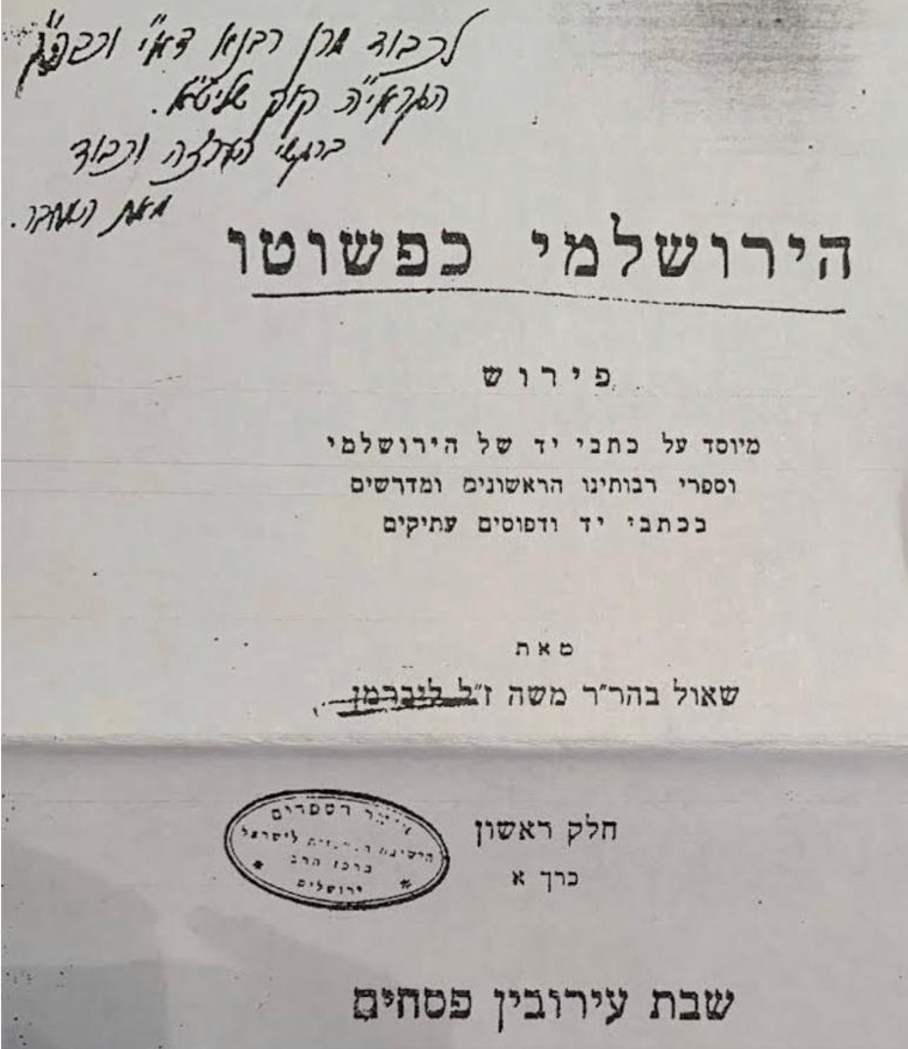
On the first volume of The Yerushalmi According to Its Plain Meaning (Ha-Yerushalmi Ke-Peshuto) (also the last, for Lieberman ultimately decided to abandon his projected commentary on the Yerushalmi and to turn instead to the Tosefta, on which he produced his monumental Tosefta Ke-Peshutah), there appears a dedication that Lieberman wrote to Rav Kook, composed, as was customary, in rabbinic idiom and in abbreviations:

“In honor of our master, the rabbi of the Land of Israel and of all the Diaspora, the Gaon Rav A.I.H. Kook, may he live a long and good life, with feelings of admiration and respect, from the author.”

Attention should be paid to the date on which these words were written. The work was published in 5695 (1935). Lieberman signed his introduction at the beginning of that year, on Sunday, 7 Tishrei 5695, between Rosh Ha-Shanah and Yom Kippur, corresponding to 16 September 1934.

Obviously, the printing also took a certain period, probably a few months.

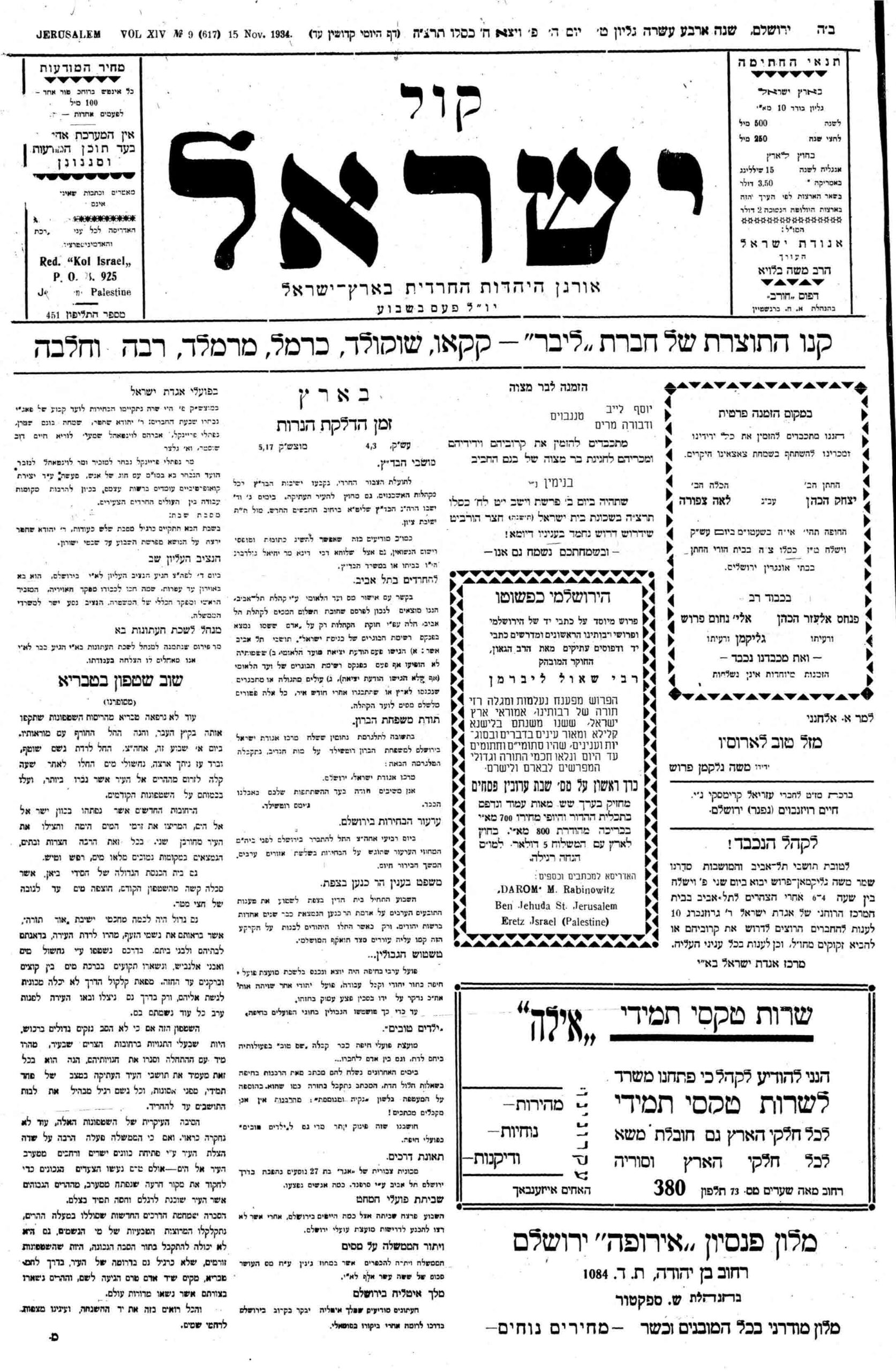
Greater precision can be established regarding the date of publication. A notice announcing the appearance of Ha-Yerushalmi Ke-Peshuto was printed on the front page of Kol Yisrael, the organ of Agudat Israel in Jerusalem (edited by Rabbi Moshe Blau), on 8 Kislev 5695 (15 November 1934). The advertisement’s conspicuous placement on the newspaper’s front page indicates that the volume had only recently emerged from the press and was then being introduced to the reading public. It therefore provides a reliable terminus post quem for any presentation of the work to Rav Kook.

Lieberman therefore could not have presented the book to Rav Kook before that date. The possible window is accordingly narrow: from mid-November 1934 until the onset of Rav Kook’s final illness around Passover 5695 (April 1935). It is thus plausible that Lieberman brought the newly printed volume to him on the eve of Purim of that year, perhaps as mishlo’aḥ manot, or shortly beforehand, and that Rav Kook, in return, presented him with a copy of Rosh Milin bearing the distinctive Purim dedication.

Rav Kook passed away in Elul of that year. Approximately six months earlier, around Passover, he had contracted his final illness and was already confined to his deathbed in a state of severe suffering. Consequently, even had Lieberman wished to do so, he could only have presented him with the work during the brief period at the beginning of that year, from the book’s publication until Passover.

The second surprise came to my attention several years ago, when a friend sent me a photograph of the title page of Rav Kook’s small and enigmatic kabbalistic work, a copy of which was in his possession.

The work, Rosh Milin, on the Hebrew letters, was written in 1917, during Rav Kook’s exile in London in the course of the First World War.[28] Thus did Rav Kook write, in the affectionate dedication he inscribed to his young colleague and ḥavruta:

“A gift of true love to the chosen of my heart, Rabbi Saul Lieberman, may he live a long and good life. Abraham Isaac, the small [i.e., the humble one]. Purim of the unwalled cities, 5695 [1935].”

Anyone familiar with the dedications and expressions of esteem that Rav Kook addressed to various individuals, including leading Torah scholars, will recognize that the phrase he wrote to Lieberman, “true love to the chosen of my heart,” is striking in its exceptional character.

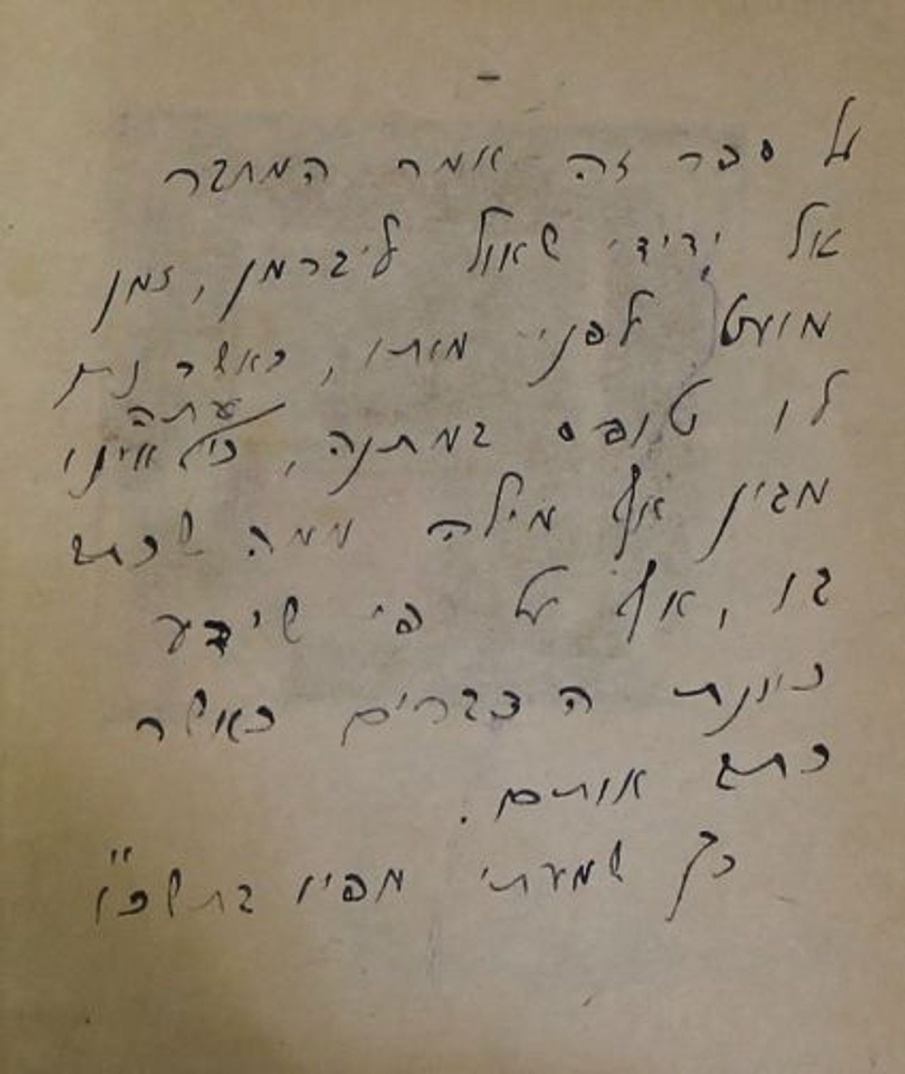
Incidentally, Gershom Scholem later related that, despite his expertise in Kabbalah, he did not succeed in understanding Rosh Milin. He further added – “on the testimony of trustworthy informants,” by which he meant his close friend Saul Lieberman (and he even recorded the remark in his personal copy of the book, now preserved in the National Library of Israel) – that Rav Kook himself told Lieberman:

“Regarding this book, the author [i.e., Rav Kook] said to my friend Saul Lieberman, shortly before his death – when he presented him with a copy as a gift – that he now does not understand a single word of what he wrote in it, even though at the time of writing he fully grasped the meaning and intent of the matters.”[29]

Although Lieberman was as far removed from engagement with Kabbalah as east is from west, he once gave memorable expression to this distance when asked to introduce a lecture by his close friend Gershom Scholem. Lieberman opened his remarks with an immortal quip about Scholem’s field of research, Kabbalah and Jewish mysticism: “Nonsense is nonsense, but the study of nonsense may be a science….”[30] Nevertheless, Rav Kook chose, of all his writings, to present Lieberman with this particular book as a gift, perhaps so that it might serve as a kind of “amulet,” or perhaps as an act of Purim mischief on the part of the aged rabbi; we cannot know.

The unusual date recorded in the dedication, “Purim of the unwalled cities, 5695,” suggests that the booklet was presented to Lieberman on that very occasion, when, according to the account, he chose to collect the aged Rav Kook’s “debt” during their joint study session, perhaps their last, on Purim of that year.

It is entirely plausible that on that occasion Lieberman brought Rav Kook his newly published work, The Yerushalmi According to Its Plain Meaning, and that in return Rav Kook presented him with mishlo’aḥ manot in the form of his small and enigmatic book.

Thus the Jerusalem legend seems to acquire flesh and sinew, and what once appeared to be no more than a charming anecdote may in fact preserve a genuine historical memory: a literary mishlo’aḥ manot exchanged between two towering figures, in which Torah, affection, and Purim playfulness were delicately intertwined.

Appendix A: Rabbi Moshe Tzvi Neria’s Archival Notes on Saul Lieberman’s Recollections of Rav Kook (Summer 1979)

The following translation is based on Rabbi Moshe Tzvi Neria’s handwritten notes preserved in his personal archive, currently housed in the National Library of Israel (Jerusalem). The notes record a conversation held during Summer 1979 in which Rabbi Professor Saul Lieberman recounted a series of episodes relating to Rav Abraham Isaac Hacohen Kook and the influence that Rav Kook exerted upon him. The material corresponds in its essentials to passages later published by Rabbi Neria, but the archival version preserves additional details and a more expansive formulation of Lieberman’s testimony.

Rabbi Neria was accustomed to preserving every scrap of paper containing substantive content that passed through his hands. Alongside newspaper clippings in which several articles about Lieberman appeared, Rabbi Neria preserved the remarks he heard directly from him in the summer of 5739 (1979). According to his account, Lieberman requested that he telephone him in the early morning (“from eight o’clock onward I disconnect the telephone, lock the door, and engage in my Talmudic study without interruptions”), and he did so.

Lieberman told Rabbi Neria that his first visit to Rav Abraham Isaac Hacohen Kook took place on the night of Shavuot:

“I heard that he was teaching Sefer ha-Mitzvot [i.e., Maimonides’ Book of the Commandments]. I came and sat down by the table. In the course of the study I made a remark, and the Rav answered me briefly. Later I made another remark, and again I received a brief reply. When I remarked upon his words a third time, the Rav turned to me and said: ‘Come in to me tomorrow.’ When I came after the festival, the Rav received me with great warmth, asked about my family, and it emerged that he knew several rabbis among my relatives. After a Torah conversation, he asked that I come to him frequently, and thus I did. On the way to the Rav’s visit to the Gerrer Rebbe (to R. Neḥemyah’le [??]), the Rav delayed at my apartment and became engrossed in a halakhic give-and-take concerning a matter I was then studying. I would come and present my novellae before him, ask about what had been difficult for me, and the like. His warm attitude toward me greatly encouraged me. He had a mystical influence upon me, even though I am far from mysticism. I had ‘tests,’ and he influenced me to remain in the study of Torah.”

Lieberman recounted to Rabbi Neria one such “test.” According to his account, a dispute arose between Rabbi Fishman [i.e., R. Yehudah Leib Maimon] and Bank Mizraḥi. The parties decided to submit to arbitration before attorney Mordechai Eliash. Lieberman represented Rabbi Fishman, whereas the bank was represented by attorney Mordechai Levanon. Rav Kook summoned Lieberman and instructed him to cease representing him in the arbitration:

“You have acquired a reputation for involving yourself in arbitration, and that will draw you away from your learning.”

Rabbi Neria further adds and cites in Lieberman’s name words of admiration and reverence for Rav Kook:

“Not only did his greatness in Torah exert influence – and he knew the entirety of Torah – but his entire personality. Matters of the people of Israel and the Land of Israel were not for him merely pathetic rhetoric; rather, they overflowed from his depths, from his hidden world, and there was something mystical in it. This was a figure overflowing with light, and his light would penetrate in its own ways… The Rav was an artist. Not merely a man with poetic sensibility, but truly an artist. In his writing there is a sacred grandeur. His words are like the tones of the shofar’s sound. The ease of his writing is astonishing, yet it is the result of abundant knowledge. They once told of a certain wealthy man who marveled at the request of a great painter to receive an enormous sum of money for a sketch he drew within ten minutes. ‘Not so,’ replied the painter; ‘I labored sixty years in order to attain an ability to draw in such a manner.’”

According to Rabbi Neria, Lieberman told him that he was occupied with printing Ḥasdei David, the commentary of R. David Pardo on the Tosefta, and that through printing his own work on Seder Ṭohorot he repaid his debt…

In this context Lieberman added:

“I also must repay a debt to the Rav [i.e., Kook]. He greatly encouraged me in the study of the Jerusalem Talmud. Several times I presented before him my Torah insights in elucidating difficult passages in the Jerusalem Talmud, and he took great pleasure in them.”

In response to Rabbi Neria’s question, “Was the Rav [i.e., Kook] as proficient in the Jerusalem Talmud as in the Babylonian?” Lieberman replied:

“The Rav was proficient in everything: Babylonian and Jerusalem Talmud, Tosefta and Midrashim, Rishonim and decisors. The Rav was the only one who encompassed the entirety of Torah, and this influenced his encompassing vision. The Rav’s vast scope contributed greatly to the richness of his personality. This was also the greatness of the Netziv, who knew the whole of Torah. I am deeply impressed by the Netziv. So too was R. Meir Simḥah [of Dvinsk, author of Or Sameaḥ].”

In this connection, Rabbi Neria cited words written by Rav Kook:

“The originality of the ‘ever-strengthening spring’ and the ‘river that does not cease’ (Avot, beginning of ch. 6) is the primary aspiration of one who engages in Torah for its own sake, which comes from divine cleaving. The inner spiritual bond with that which is all, the source of all, and beyond all. The desire filled with purity, which steadily intensifies to absorb the distilled essence of the supernal sap within the supernal realms—these are they who always seek the ennobled renewal in its vigorous force” (Iggerot ha-Ra’ayah, vol. 3, p. 4).

(“The Rav’s [i.e., Kook’s] vast scope contributed greatly to the richness of his personality. His opponents fought against him because they recognized his power, because they knew his greatness.”) According to Rabbi Neria, Lieberman described the Rav’s words as expressing a “sacred grandeur.”

Rabbi Neria further relates, in Lieberman’s name, that in the summer of 5690 (1930) Rabbi Moshe Ostrovsky came to the apartment where Rav Kook was staying in Kiryat Moshe in order to pressure him to agree to the compromise proposal then being circulated, according to which the people of Israel would relinquish part of their rights in the Land of Israel, including at the Western Wall. Lieberman was present. The visitor wished that he leave the room so that he could speak with Rav Kook privately; however, Rav Kook detained Lieberman and instructed him to continue sitting there.

Years later, after the passing of Rav Kook, Rabbi Neria heard at a memorial gathering held in the Jewish Agency building that Rav Kook had told Rabbi Ostrovsky:

“The people of Israel has not empowered any person to relinquish the Western Wall. If we relinquish it, the Holy One, blessed be He, will not wish to restore it to us.”

Rabbi Neria testifies that while he lived in Jerusalem in the 1930s, Rabbi Professor Saul Lieberman would customarily pray on the High Holy Days together with the students of Yeshivat Merkaz ha-Rav, who had established their place of prayer at Yeshivat Etz Ḥayyim in the Maḥaneh Yehudah neighborhood.

Among other matters, Rabbi Neria wrote down what he heard from Lieberman regarding his shared study with Rav Kook, and according to what is stated there. The accounts found in Rabbi Neria’s handwritten notes correspond in their essentials to what he later presented in his book.

Alongside them, I found in this archive and in additional archives details concerning Lieberman’s involvement, at the request of his friend (and relative) Rachel Yanait Ben-Zvi, wife of the late President Yitzḥak Ben-Zvi, in the establishment of a yeshivat hesder in Peki’in. Within this framework he approached Rabbi M. Z. Neria and asked him to assist in realizing the idea in practice. Concerning this episode I intend to write, God willing, elsewhere.

Notes

I would like to express my sincere gratitude to my friend and colleague Mr. Menachem Butler, who devoted considerable effort to translating and editing this article into English. I am also grateful for his valuable contributions, including bibliographical references and precise citations.

  1. See Harold Fisch, “Reading and Carnival: On the Semiotics of Purim,” Poetics Today, vol. 15, no. 1 (Spring 1994): 55-74.
  2. See, for example Yaakov Shmuel Spiegel, “Cross Dressing for Special Occasions,” in Joseph R. Hacker, Yosef Kaplan, and B.Z. Kedar, eds., Rishonim ve-Aharonim, From Sages to Savants: Studies Presented to Avraham Grossman (Jerusalem: Shazar, 2010), 329-352 (Hebrew), available here; and Gedalia Oberlander, “The Custom of Disguising Oneself on Purim,” Or Yisrael, vol. 2, no. 3 [#7] (April 1997):125-131 (Hebrew), available here; Moshe Leib Halberstadt, “Costumes on Purim and at Various Events,” Yerushatenu, vol. 5 (2011): 169-175 (Hebrew).
  3. See Shamma Friedman, “Erasing Haman,” Leshonenu, vol. 61, no. 3 (June 1998): 259-263 (Hebrew), available here; Daniel Sperber, “Destroying the Name of Haman,” Shana be-Shana, vol. 32 (2001): 203-211 (Hebrew), available here; and Daniel Sperber, How To Strike Haman (Jerusalem: The Wolfson Museum of Jewish Art, 2002; Hebrew), available here. For a comprehensive survey of the halakhic and historical sources concerning this custom, see Eliezer Brodt, “The Pros and Cons of Making Noise When Haman’s Name is Mentioned: A Historical Perspective (updated),” The Seforim Blog (22 March 2016), available here.
  4. See Dan Rabinowitz, “Purim, Mixed Dancing, and Kill Joys,” The Seforim Blog (6 March 2006), available here.
  5. See Elliott Horowitz, Reckless Rites: Purim and the Legacy of Jewish Violence (Princeton: Princeton University Press, 2006).
  6. Esther 9:22.
  7. Megillah 7a.
  8. See Alan Appelbaum, “Why the Rabbis of the Yerushalmi Called R. Judah Nesiah ‘a Great Man’?” Journal of Ancient Judaism, vol. 3, no. 3 (December 2012): 339-365.
  9. One can hardly help but wonder how long it will be before a kunṭres devoted to the halakhic parameters of re-gifting mishlo’aḥ manot appears, if indeed one has not already been published, systematically treating such questions as whether the initial recipient must effect a formal kinyan; whether the mitzvah requires that the gift be given mi-shelo (“from one’s own”); the respective roles of the giver’s kavvanah and the recipient’s awareness; the permissibility of re-gifting absent the donor’s consent (da‘at ba‘alim); whether the obligation may be discharged through an intermediary (shaliaḥ); whether one may fulfill the mitzvah with an item received earlier that same day; and whether a package that circulates through multiple hands constitutes mishlo’aḥ manot at all, or merely an elaborate exercise in communal redistribution, together with the host of subsidiary questions such a case inevitably generates.
  10. For more on this practice, see Meir Wunder, “Books as Mishlo’aḥ Manot,” Moriah, vol. 5, no. 5-6 [#53-54] (November 1973 – January 1974): 83-86 (Hebrew); and Tovia Preschel, “Mishlo’aḥ Manot of Books from Authors,” ha-Doar, vol. 53, no. 19 (8 March 1974): 295 (Hebrew).
  11. I am currently at work on a biography of Professor Saul Lieberman; for now, my earlier writings on him, see Aviad Hacohen, “Two Scholars Who Were in Our City: Correspondence between Saul Lieberman and Jacob David Abramsky,” ha-Tsofeh Literary Supplement (21 April 1984): 5 (Hebrew), available here; Aviad Hacohen, “Schlemiel, Schlimazel, and Nebbich: Letters from Saul Lieberman to Gershom and Fania Scholem,” Haaretz Literary Supplement (25 April 2000): H1 (Hebrew) , available here; Aviad Hacohen, “The Tannah from New York: A Selection of Professor Saul Lieberman’s Letters,” Jewish Studies, no. 42 (2003): 289-301 (Hebrew), available here; Aviad Hacohen, “Six Days and Seven Gates: Between Israeli President Izhak Navon and Professor Rabbi Saul Lieberman,” Oneg Shabbat (9 June 2023), available here; Aviad Hacohen, “Lieberman Kifshuto: Personal Letters Revealing the Sensitive and Playful Side of a Talmudic Genius, On the 40th Yahrzeit of Professor Saul Lieberman,” Makor Rishon, Sabbath Supplement, no. 1338: Parashat Tzav (31 March 2023): 8-11 (Hebrew), available here; Aviad Hacohen, “The Generation Did Not Appropriately and Duly Appreciate Mr. Schocken [Eulogy by Rabbi Prof. Saul Lieberman for Shlomo Zalman Schocken, March 1960],” Haaretz Literary Supplement (28 April 2024): 1 (Hebrew), available here; Aviad Hacohen, “The Story of the Rabbi Who Rejected the Maxim: ‘Torah Scholars Increase Peace in the World’,” Haaretz Literary Supplement (25 May 2023): 8 (Hebrew), available here; and Aviad Hacohen, “‘A Lithuanian Mind in Its Lithuanian Essence, From Volozhin to Jerusalem’: R. Shaul Lieberman’s Intellectual Kinship with the Legacy of Lithuanian Torah & Its Bearers,” in Martin S. Cohen, ed., Essays in Jewish Studies in Honor of Rabbi Prof. David Golinkin (Jerusalem: Schechter, 2025), 101-139 (Hebrew), available here.
  12. See Shmuel Glick and Menachem Katz, “‘A Threefold Cord’: On Saul Lieberman and His Relationship with the Hazon Ish and Jacob Nahum Epstein,” in Shmuel Glick, Evelyn M. Cohen, Angelo M. Piattelli, et al., eds., Meḥevah le-Menaḥem: Studies in Honor of Menahem Hayyim Schmelzer (Jerusalem: Schocken, 2019), 269-289 (Hebrew).
  13. See Saul Lieberman, “Ten Words,” in Texts and Studies (New York: Ktav, 1974), [1-20], where Lieberman refers explicitly to “my teacher, Prof. Moshe Schwabe, of blessed memory,” and describes Schwabe’s long-standing aspiration to produce a new dictionary of Greek and Latin loanwords in rabbinic literature. For the subsequent realization of this lexicographical program in systematic form, see Daniel Sperber, A Dictionary of Greek and Latin Legal Terms in Rabbinic Literature (Ramat-Gan: Bar-Ilan University Press, 1984); Daniel Sperber, My Rabbinic Loanwords Card Index of More Than a Half-Century: A Companion Volume to Professor Samuel Krauss’ Griechische und Lateinische Lehnwörter im Talmud, Midrasch und Targum, ed. Menachem Butler (Cambridge, MA: Shikey Press, 2022), esp. the introduction, available here, where Sperber describes the work as the product of “more than fifty-years of collection and research,” originally conceived as an annotated continuation of Krauss’s Lehnwörter, and acknowledges Lieberman’s personal role in encouraging his philological work, noting that Lieberman “adopted me as his disciple in this field.” Sperber also reproduces a letter of approbation from Lieberman dated 19 Shevat 5738 (27 January 1978), praising Sperber’s “objective evaluation of Krauss’s volume” and commending the “great progress” reflected in his conclusions.
  14. A fine “real-time” description of his path during those years appears in a letter written at the time by his father-in-law, Rabbi Meir Bar-Ilan, leader of the Mizrachi movement. Writing to his son Tuvia (a chemist and later the first Director-General of Bar-Ilan University) on 25 Marḥeshvan 5694 (5 November 1933), Bar-Ilan remarked“…And so, my dear, everything I have found here: outwardly nothing has changed in our home, but inwardly part of our apartment has been transformed into a beit midrash. For our Shaul sits and engages in Torah and scholarship with remarkable diligence. Your small room has been turned into a library, for Shaul has many books – among them items of precious value – and there he labors over them, if I am not mistaken, some ten hours a day and at night. Apart from those hours in which he teaches at the Teachers’ Seminary and at the university – only twice a week – he sits “over Torah and avodah.” He is engaged in writing a great book [this refers to Ha-Yerushalmi Kifshuto, published in 5695 (1935)], which, upon its completion and publication, will, it seems to me, renew a momentum among Talmudic circles and scholars of Israel with respect to the Jerusalem Talmud. Shaul is great – loftier than I had known – “full and overflowing” in an excellent measure; his knowledge is astonishing and his intellect clear, and beyond this he is an outstandingly diligent scholar. I do not know whether he will persist in his diligence, for it is possible that only on account of his literary work does he not divert his mind from his studies, but at present he continues his work with diligence and industriousness…”
  15. See, recently, Moshe Assis, Saul Lieberman’s Marginalia on Talmud Yerushalmi (Jerusalem: Carmel, 2022; Hebrew).
  16. On Judith Berlin Lieberman’s lineage, intellectual formation, and educational career, see Judith Berlin Lieberman, Autobiography and Reflections, eds. Menachem Butler and Abraham Lieberman (Cambridge, MA: Shikey Press, 2022), available here. See especially the autobiographical memoir (pp. 20-38) and the introductory essay by her nephew Hillel Halkin (pp. 15-19).
  17. See Aviad Hacohen, “‘Honey and Milk Are Under His Tongue, Yet Beneath It Burns a Blazing Fire’: On the Relationship between S.Y. Agnon and Saul Lieberman,” Haaretz Literary Supplement (6 October 2023): 7 (Hebrew), available here.
  18. See Aviad Hacohen, “Schlemiel, Schlimazel, and Nebbich – Letters from Saul Lieberman to Gershom and Fania Scholem,” Haaretz Literary Supplement (25 April 2000): H1 (Hebrew), available here.
  19. See Aviad Hacohen, “The Generation Did Not Appropriately and Duly Appreciate Mr. Schocken [Eulogy by Rabbi Prof. Saul Lieberman for Shlomo Zalman Schocken, March 1960],” Haaretz Literary Supplement (28 April 2024): 1 (Hebrew), available here.
  20. See, for example, Menahem Zulay, “The Research Institute for Hebrew Poetry,” Haaretz Literary Supplement (31 October 1947): 9 (Hebrew); and A.M. Habermann, “Salman Schocken and The Research Institute for Hebrew Poetry: On His Fifth Anniversary of His Death,” Haaretz Literary Supplement (17 July 1964): 13 (Hebrew).
  21. See Aviad Hacohen, “If every Sabbath were like Yom Kippur: An Interview with Haim Cohn,” Meimad, no. 17 (August 1999): 12-15 (Hebrew), available here; and Aviad Hacohen, “Apikores with Divine Grace – Review of ‘Being Jewish: Culture, Law, Religion, State’, by Haim Cohn,” ha-Tsofeh Literary Supplement (27 April 2007): 10, 13 (Hebrew), available here; and see also Azriel Carlebach, “The Rav Renowned for Halakhic Expertise,” Maariv Literary Supplement (19 February 1956): 4 (Hebrew), and Haim Cohn, “The Yeshiva of Rav Kook,” in Haim Cohn, A Personal Introduction: Autobiography, ed. Michal Smoira-Cohn (Kinneret: Dvir, 2005), 96-102 (Hebrew).
  22. Ari (Yitzchak) Chwat, “Rabbi Kook’s Connections with Prof. Rabbi Saul Lieberman as a Model for His Attitude Towards Critical Torah Research,” Tzohar, vol. 35 (2009): 59-66 (Hebrew), is especially important for situating the Rav Kook-Lieberman relationship within the broader question of Rav Kook’s principled openness to rigorous philological and historical methods in Torah study, and for treating Lieberman as a case study for the category Rav Kook termed ḥokhmat yisrael be-qedushatah. For further development of this concept, see Ari (Yitzchak) Chwat, “‘Hokhmat Yisrael in Its Holiness’: Rav Kook’s Vision for True Critical-Scientific Study,” Talelei Orot, vol. 13 (2007): 943-976 (Hebrew).
  23. The letter, preserved in the Professor Ephraim E. Urbach Archive at the National Library of Israel in Jerusalem, is scheduled for publication in my forthcoming volume, Pirkei Shaul, which, God willing, is expected to appear in the coming year.
  24. Many stories concerning Lieberman’s extraordinary powers of memory circulated among people already during his lifetime. One of the sages of Jerusalem, who sought to clarify the difference between Lieberman and other great Torah scholars endowed with remarkable mnemonic ability, described it as follows: “So-and-so, the gaon, knows the entire Talmud by heart. Say to him a particular word, and he will immediately tell you where it appears throughout the whole of the Talmud. Lieberman is greater than he: he can tell you with certainty that a particular word does not appear anywhere in the entire Talmud…”
  25. See Moshe Tzvi Neria, “From the Testimony of Rabbi Saul Lieberman,” in Likkutei ha-Ra’ayah, ed. Moshe Tzvi Neria, vol. 2 (Kefar ha-Ro’eh: 1990), 336–341 (Hebrew), which preserves a version of the Rosh Milin anecdote attributed to Lieberman (based on an interview conducted by Neria in Summer 1981), though without the later bibliographic framing and transmission history found in Scholem’s formulation. Neria’s presentation should also be situated within his broader editorial enterprise of collecting and disseminating Rav Kook-related reminiscences for a wide Hebrew readership, both in his books and in his ha-Tsofeh newspaper columns in the Religious Zionist press.
  26. For a translated excerpt from Rabbi Neria’s handwritten archival notes recording his 1979 conversation with Saul Lieberman, see Appendix A below.
  27. See Yair Sheleg, “King Arthur: Members of the Family of Arthur Cohn, Who Passed Away Last Week, Recount His Scrupulous Observance of the Sabbath Even on the Most Prestigious Stages, and His Profound Love for the State of Israel, Expressed Not Only Through Generous Donations,” Makor Rishon, Sabbath Supplement: Parashat Vayigash (25 December 2025; Hebrew), available here.
  28. See Aaron Ahrend, “About Rav Kook’s ‘Rosh Millin’,” Da’at, no. 27 (Summer 1991): 73-85 (Hebrew), available here; and Aaron Ahrend, “Further on Rav Kook’s ‘Rosh Millin’,” Sinai, vol. 110 (June – July 1992): 190-192 (Hebrew), available here.
  29. Zvi Leshem, “‘He Does Not Understand a Single Word of What He Wrote’: Gershom Scholem and Rabbi Abraham Isaac Hacohen Kook – A Story of a Marginal Note,” Ha-Safranim, Blog of the National Library of Israel (19 August 2019), available here and here.Rabbi Moshe Tzvi Neria transmitted these remarks in the name of Saul Lieberman himself. See Moshe Tzvi Neria, “From the Testimony of Rabbi Saul Lieberman,” in Likkutei ha-Ra’ayah, ed. Moshe Tzvi Neria, vol. 2 (Kefar ha-Ro’eh: 1990), 339 (Hebrew). On the affinity between the Rav Kook and Saul Lieberman, see ibid., pp. 92, 337-341, 369. From there also in Elijah J. Schochet and Solomon J. Spiro, Saul Lieberman: The Man and His Work (New York: Jewish Theological Seminary of America, 2005), 52-53, 101.
  30. See Daniel Abrams, “Defining Modern Academic Scholarship: Gershom Scholem and the Establishment of a New Discipline,” The Journal of Jewish Thought and Philosophy, vol. 9 (2000): 267-302, esp. 268n1, where he writes:“Lieberman’s statement has been circulating as an oral tradition amongst scholars and students of the Jewish Theological Seminary. The only printed reference to it I have found is offered by Joseph Dan in his “The Revelation of the Secret of the World: The Beginning of Jewish Mysticism in Late Antiquity” (Brown University Program in Judaic Studies, Occasional Paper Number 2, Providence 1992, p. 3): “We all know that mysticism is nonsense, but the history of mysticism is a science.” See however Lieberman’s article “How much Greek in Jewish Palestine,” Biblical and Other Studies, ed. A. Altmann, Cambridge, Mass. 1962, p. 135 [reprinted in Texts and Studies, New York 1974, p. 22), Lieberman offered the following formulation: “Nonsense is nonsense, but the history of nonsense is a very important science. In certain respects it is more revealing than the history of sciences based on reason.” (see also Mortimer Ostow, Ultimate Intimacy; the Psychodynamics of Jewish Mysticism, London 1995, p. 362) Lieberman apparently regretted his statement and wrote an appendix for Scholem’s Jewish Gnosticism based on these lectures.”


Towards a Bibliography of seforim related to Shavous and Megilas Rus (new and old)


Towards a Bibliography of seforim related to Shavous and Megilas Rus (new and old)

By Eliezer Brodt

In this post I intend to start a list towards a more complete bibliography to the various seforim (new and old) and articles related to Shavous. I hope to update it much more in the future as my computer (with all my information just died).

When learning the Halachos of Shavous, one is struck how the Tur does not mention anything special for Shavous except for instructions related to davening and Keriyas Hatorah. The only custom he mentions that is unique to Shavous is saying Azharot. Rabbi Yosef Caro in both of his works, Beis Yosef and Shulchan Aruch pretty much follows in this path. In the Codes is not until the Rema that some of the famous customs related to this Yom Tov are brought down, such as the custom of placing flowers in shuls and houses, the custom of eating Milchigs and eating special lechem to remember the Shtei Halechem. Only afterwards through the writings of the Matteh Moshe, Knesses Hagedolah and especially the Magen Avraham are the other customs related to this Yom Tov brought forward, among  them, when exactly is one supposed to daven Maariv Shavous night, staying up the whole night learning, saying Akdamus, using a special Trope when leining the Aseres Hadibros,and leining Megilas Rus[1].

The first work worth mentioning, as its one of my all time favorites, is Rav Zevin’s Moadim Be-halacha. In this work he has four pieces, none of which needs my approval ! – related to Shavous. He has a general piece, one related to various issues about the Shtei Halechem, another related to Megilas Rus and one related to various aspects of Aseres Hadibros.

Regarding general aspects of Aseres Hadibros one should see the collection of articles in the volume called
Aseres  Hadibros
edited by B. Segal (Magnes Press, 1986) and the work
Aseres  Hadibros Ve-keriyas Shema
from Moshe Weinfeld (2001).

For a discussion of the special Trope used when leining the 
Aseres  Hadibros see the article from Amnon Shiloah in the volume
Aseres  Hadibros
edited by B. Segal. See also Rabbi Dovid Yitzchaki in the back of his edition of Luach Eresh pp. 524- 540; the series of articles of Y. Laufer (available here, here and here) [special thanks to my good friend Mr. Yisroel Israel for bringing this to my attention]; this article from Y. Ofer.

For discussion of the custom to stand during the leining of 
Aseres  Hadibros see this earlier post by Dan Rabinowitz available here and especially the sources listed at the end. To add to the usage of the Teshuvos Harambam mentioned there, see Rav Zevin, Moadim Be-halacha, p. 389-390. See also what I mention here, and also Rabbi Oberlander, Minhag Avosenu Beyadenu, pp.605-622.

Regarding Shtei Halechem see the excellent work Birchat Haaretz from Rabbi Y. Mashbaum available here.

Regarding the time when to daven Maariv Shavous night see Rabbi Binyomin Hamburger, Shorshei Minhag Ashkenaz, 4:344-369.

Regarding staying up Shavous night, see R. Hamburger, Shorshei Minhag Ashkenaz, 3:268-364, where he traces this minhag and deals with, at great length, the minhag of saying Tikun. See also Professor Moshe Chalamish, Ha-Kabalah, pp. 595- 612. See also J.D. Wilhelm, “Sidrei Tikkunim,” in Alei Ayin: Essays Presented to Salman Schocken (Jerusalem: Schocken 1948-1952), pp. 125-146, (Hebrew). Of course I must mention my good friend Menachem Butler’s favorite article relating to all this, Elliott Horowitz, “Coffee, Coffeehouses, and the Nocturnal Rituals of Early Modern Jewry,” AJS Review 14:1 (Spring 1989) pp. 17-46. For other Halachic issues related to staying up all night see the recent work, Ha-niyur Kol Ha-laylah.

Regarding saying Akdamot see this earlier post from Dan Rabinowitz available here. See also Rabbi Dovid Yitzchaki in the back of his edition of Luach Eresh, pp. 541-542. See also Jeffrey Hoffman, “Akdamut: History, Folklore, and Meaning,” Jewish Quarterly Review 99:2 (Spring 2009) pp. 161-183.

Regarding the custom of saying Azharot on Shavous see what I wrote here. I hope to update this post in the near future. Meanwhile, see what I wrote in Yeshurun 25:447-449.

Another area worth learning about is Bikurim. For this I recommend the volume of the Safrai Family from their series of Mishnas Eretz Yisrael.

Regarding the custom of placing flowers in Shul and at home, see the works of Rabbi Oberlander, Minhag Avosenu Beyadenu, pp. 573-604 and the collections of material found in Moadim Li-simcha and Pardes Eliezer.

Regarding the custom of eating Dairy on Shavous, much has been written. See the works of Rabbi Oberlander, Minhag Avosenu Beyadenu, pp. 623-647 and the collections of material found in Moadim Li-simcha and Pardes Eliezer. Recently Rabbi Moshe Dinin collected 160 reasons (!) for this custom in  Kuntres Matamei Moshe (2008). Even more recently Rabbi Yosef Ohev Zion printed a work called Yoma De-atzartah (2009) [thanks to Yissochor Hoffman for bringing this work to my attention]. For important discussion related to this topic see the articles of my friend Rabbi Yehudah Spitz available here and here.

Related to this one should read the great article by Aviad A. Stollman, “Halakhic Development as a Fusion of Hermeneutical Horizons: The Case of the Waiting Period Between Meat and Dairy,” AJS Review 28:2 (November 2005) pp. 1-30 (Hebrew) [expanded from his M.A. on Perek Kol Habassar.

Another custom that originally took place on Shavous was when a child turned three they used to conduct a special seder with eating cakes and reciting various pesukim and the like. This custom was dealt with by many; for a recent discussion of this topic, including sources, see my article in Yerushasenu 5 (2011), pp. 337-360. [A PDF is available upon request].

Another issue of interest worth mentioning related to Shavous is the plagiarism of the highly controversial Sefer Chemdas Yamim discussed many times on this blog (see here). Isaiah Tishbi in his various essays where he proves the plagiarism’s of the Chemdas uses many different topics related to Shavous. See the collection of his articles Chikrei Kabbalah Veshiluchoseh pp. 374-376 (regarding when to daven Maariv), 382-383 (which day was Matan Torah), pp. 389-391 (regarding standing during Aseret hadibrot), pp. 391-393 (regarding the Maggid visiting the Beis Yosef on Shavous night) and pp. 340-341 (regarding eating meat after milk).

Here is a listing of some general works related to Shavous that deal with many of the above aspects and more:

א. ר’ שלמה קלוגר, קהלת יעקב, ירושלים תשס”ו, תמז עמודים.

ב. ר’ פנחס שווארטץ, מנחה חדשה, תרצ”ז, נו עמודים.

ג. ר’ יצחק ווייס, בינה לעתים, בני ברק תשסד.

ד. ר’ שריה דבליצקי, קיצור הלכות מועדים, תשס”ו, פב עמודים.

ה. ר’ אבוגדר נבנצל, ירושלים במועדיה.

ו. ר’ עובדיה יוסף, חזון עובדיה, יום טוב, ירושלים תשס”ג.

ז. ר’ אהרן מיאסניק, מנחת אהרן, ירושלים תשס”ח, רצב עמודים.

ח. ר’ גדליה אבערלאנדער, מנהג אבותינו בידינו, מאנסי תשס”ו.

ט. פרדס אליעזר.

י. ר’ טוביה פריינד, מועדים לשמחה, ירושלים תשס”ח.

יא. ר’ יצחק טעסלער, פניני המנהג, מונסי תשס”ח, תצב עמודים, ספר זה כולל אלפי מקורות וס”ד פרקים על עניני החג.

יב. ר’ יוסף חיים אוהב ציון, יומא דעצרתא, ירושלים תשס”ח.

Over the centuries numerous works have been written explain this Megilah. Just to mention a few: until last year the best collection of Rishonim was in the Toras Chaim edition printed by Mossad Rav Kook. This edition has the commentaries of nine Rishonim printed based on manuscripts.

A few year ago the Even Yisrael company printed a nicely done edition which had a few Rishonim and Achronim. But I cannot offer an opinion if it does not have mistakes and the like. More recently they reprinted this, adding many more Rishonim and Achronim. If one is interested in buying any one volume related to Rus this is the best to buy for your money, as you get a bunch of commentaries all in one volume.

Another work worth mentioning is called Tosfos Haslem this is a collection from many different manuscripts of the Baalei Hatosfos on the Megilah.

Another work on Rus worth mentioning is the Shoresh Yeshai from Rabbi Shlomo Alkabetz. There are many editions of this work, but I recommend the one printed a few years ago edited by Rabbi Shmuel Askhkenazi, as it includes a very good introduction, many notes and some very useful indices.

Another beautiful work on Rus worth learning through is the Meshivos Nefesh from the Bach. This perush goes through everything related to the megilah very thoroughly. He also wrote a work on Rashi called Be’er Mayim. This work was printed many times.

Another work is the Torah Sheleimah continuing in the path of Rabbi Menachem Kasher’s Torah Sheleimah on the Torah, collecting the many Midrashim on the Megilah. However the great notes of Rav Kasher are definitely missed by many.

Another work I enjoyed on Rus was from Rabbi Yosef Zechariah Stern – one of my favorite Gedolim – his bekius here is simply remarkable (as it is in all his other works).

Another collection of useful works on Megilas Rus was printed a few years ago by my good friend Rabbi Moshe Hubner. The title of the volume is Uryan Toilessyah (314 pp.). This volume contains four works, the first being his own called Uryan Toilessyah. The style of this work is to deal with many of the issues that come up while learning the Megilah.The questions and answers are based on a very wide range of sources. He also includes many nice ideas of his own to various problems. It is very organized clear and to the point. He also printed three other earlier works, the first being Invei Hagefen first printed in 1863, the second being Rishon Mekor Hachaim first printed in 1697. He also reprinted some Teshuvos and articles related to Shavous from his grandfather Rabbi Shmuel Hubner, author of the Nimukei Shmuel. [A few copies of this work are still available; email me for more details].

This year a few more important works related to Megilas Rus were just printed. First worth mentioning is the Mikraot Gedolot Haketer from Bar Ilan. This series began a few years back and has fallen asleep for awhile. Last week the project “woke up” and five volumes were released in the small size. The point of this series is to offer the most accurate texts of various Rishonim on Tanach based on all the manuscripts.

Another excellent work just printed is the Eshkol Hakofer from Rabbi Avraham Sbba, author of the Tzeror Hamor (259 pp.). This work had been printed many years ago based on one manuscript but this edition is printed based on numerous manuscripts and contains many pieces not found in the printed edition. This work is simply beautifully done, with a nice introduction and many useful notes.

Another great work that just was printed for the first time was the Toldos Shlomo by  Rabbi Shlomo Kluger (436 pp.).

Another new work on Megilas Rus is called Megilas Rus Im Otzros Hameforshim (482 pp.) This work contains a few sections the first part contains separate extensive perushim on Targum, Rashi, Rav Yosef Kara and Ibn Ezra’s perushim. Besides for this, it contains an extensive peuish on the Megilah. Another section has in-depth lengthy discussions on various topics related to the Megilah, Rus and David Hamelech. As the bibliography at the end of the sefer shows it is based on many seforim.

Another work worth mentioning is the Ke-Motzo Shalal Rav on Rus and Shavuos. This work continues in the path of Rabbi Rosenthal’s earlier works on chumash and Yomim Tovim with the same name, collecting and presenting nice material, written clearly, and easy to understand related to Rus and Shavous from famous and less famous works.

Regarding whether or not to stand for the recitation of the Aseres Hadibros, see here. Thanks thanks for Yissachar Hoffman for sending me this. In the work Shiurei Rav Elyashiv on Berachos (p. 93) it says that he says its assur to stand based on this teshuvah of the Rambam. I will add that I davened for many years at Rav Elyashiv’s minyan on shabbos. I always wanted to see if he would sit or stand but he almost always got that aliya – until one time he did not and I was able to see that he indeed stayed seated!

[i] The Rema mentions this minhag earlier (490:9) but not in hilchos Shavous.


Towards a Bibliography of seforim related to Shavuos and Megilas Rus (both new and old) – updated

Towards a Bibliography of seforim related to Shavuos and Megilas Rus (both new and old)

By Eliezer Brodt

Originally posted May 24, 2012 – Updated June 3, 2019

In this post I intend to start a list towards a more complete bibliography to the various seforim (new and old) and articles related to Shavuos (including many links). I hope to update it in the future.

When learning the Halachos of Shavuos, one is struck how the Tur does not mention anything special for Shavuos except for instructions related to davening and Keriyas Hatorah. The only custom he mentions that is unique to Shavuos is saying Azharot. Rabbi Yosef Caro in both of his works, Beis Yosef and Shulchan Aruch pretty much follows in this path. In the Codes is not until the Rema that some of the famous customs related to this Yom Tov are brought down, such as the custom of placing flowers in shuls and houses, the custom of eating Milchigs and eating special lechem to remember the Shtei Halechem. Only afterwards through the writings of the Matteh Moshe, Knesses Hagedolah and especially the Magen Avraham are the other customs related to this Yom Tov brought forward, among  them, when exactly is one supposed to daven Maariv Shavuos night, staying up the whole night learning, saying Akdamus, using a special Trope when leining the Aseres Hadibros, and leining Megilas Rus[1].

The first work worth mentioning, as its one of my all-time favorites, is Rav Zevin’s Moadim Be-halacha. In this work he has four pieces, none of which needs my approval! – related to Shavuos. He has a general piece, one related to various issues about the Shtei Halechem, another related to Megilas Rus and one related to various aspects of Aseres Hadibros.

Regarding general aspects of Aseres Hadibros one should see the collection of articles in the volume called Aseres Hadibros edited by B. Segal (Magnes Press, 1986) and the work Aseres Hadibros Ve-keriyas Shema from Moshe Weinfeld (2001).

For a discussion of the special Trope used when leining the  Aseres Hadibros see the article from Amnon Shiloah in the volume  Aseres Hadibros edited by B. Segal. See also Rabbi Dovid Yitzchaki in the back of his edition of Luach Eresh pp. 524- 540; the series of articles of Y. Laufer (available here, here and here) [special thanks to my good friend Mr. Yisroel Israel for bringing this to my attention]; this article from Y. Ofer. See also Jordon, Penkower, ‘Maimonides and the Alepp Codex‘, Textus IX (1981), pp. 115-117.

For discussion of the custom to stand during the leining of  Aseres  Hadibros see this earlier post by Dan Rabinowitz available here and especially the sources listed at the end. To add to the usage of the Teshuvos Harambam mentioned there, see Rav Zevin, Moadim Be-halacha, p. 389-390. See also what I mention here, and also Rabbi Oberlander, Minhag Avosenu Beyadenu, pp.605-622. In addition see here [thanks for Yissachar Hoffman for sending me this source]. In the work Shiurei Rav Elyashiv on Berachos (p. 93) it says that he held it’s assur to stand based on this teshuvah of the Rambam. I will add that I davened for many years at Rav Elyashiv’s minyan on shabbos. I always wanted to see if he would sit or stand but he almost always got that aliya – until one time he did not and I was able to see that he indeed stayed seated!

Regarding the dating of Matan Torah see A. Lifshitz, The Date of the Giving of the Torah In Rabbinic Sources, Netuim 16 (2010), pp. 33-68.

Regarding Shtei Halechem see the excellent work Birchat Haaretz from Rabbi Y. Mashbaum available here.

Regarding the time when to daven Maariv Shavuos night and making Kiddish see Rabbi Binyomin Hamburger, Shorshei Minhag Ashkenaz, 4:344-369. See also Eliezer Brodt, Halachic Commentaries to the Shulchan Aruch on Orach Chayim from Ashkenaz and Poland in the Seventeenth Century, PhD, Bar Ian University) July 2015, pp. 338-341.

Regarding staying up Shavuos night, see R. Hamburger, Shorshei Minhag Ashkenaz, 3:268-364, where he traces this minhag and deals with, at great length, the minhag of saying Tikun. See also Professor Moshe Chalamish, Ha-Kabalah, pp. 595- 612. See also J.D. Wilhelm, “Sidrei Tikkunim,” in Alei Ayin: Essays Presented to Salman Schocken (Jerusalem: Schocken 1948-1952), pp. 125-146, (Hebrew). Of course, I must mention my good friend Menachem Butler’s favorite article relating to all this, Elliott Horowitz, “Coffee, Coffeehouses, and the Nocturnal Rituals of Early Modern Jewry,” AJS Review 14:1 (Spring 1989) pp. 17-46 [available here for download]. For other Halachic issues related to staying up all night see the recent work, Ha-niyur Kol Ha-laylah. See Also my article Tracing the history of Shavuos night learning available in English here and Here. See also Eliezer Brodt, Halachic Commentaries to the Shulchan Aruch on Orach Chayim from Ashkenaz and Poland in the Seventeenth Century, PhD, Bar Ian University) July 2015, pp.354-360.

Regarding saying Akdamot see this earlier post from Dan Rabinowitz available here. See also Rabbi Dovid Yitzchaki in the back of his edition of Luach Eresh, pp. 541-542. See also Jeffrey Hoffman, “Akdamut: History, Folklore, and Meaning,” Jewish Quarterly Review 99:2 (Spring 2009) pp. 161-183. See also the recent work, from Rabbi Strickoff, Inside Akdamus and Yetziv Pisgam, 2019 (176 pp.) See also my extensive article on this in hebrew available here and updated here in the latest volume of Yerushaseinu (2018), pp.514-534, which also deals with Yetziv Pisgam. I hope to complete part two shortly.

Of course, I need to mention an earlier book related to this from one of my favorite writers, Y. Rivkind, Di Historishe Alegorye Fun R. Meir Shats, Vilna 1929 (Yiddish) (64 pp.) [A PDF is Available upon request]. Also, worth mentioning is the very valuable PHD on the topic originally written in Hungarian in 1946 from Naftoli Berger, Tefilos UPiutyim… Shirat Akdamut. It was translated into Hebrew in 1973.

For an interesting older Perush on Akdamus with a nice overview see here. See also this work.

Regarding the custom of saying Azharot on Shavuos see what I wrote here and available in pdf form here]. I hope to update this post in the near future. Meanwhile, see what I wrote in Yeshurun 25:447-449.

Another area worth learning about is Bikurim. For this I recommend the volume of the Safrai Family from their series of Mishnas Eretz Yisrael.

Regarding the custom of placing flowers in Shul and at home, see the works of Rabbi Oberlander, Minhag Avosenu Beyadenu, pp. 573-604 and the collections of material found in Moadim Li-simcha and Pardes Eliezer. See also Rabbi Yehuda Spitz, Adorning the Shul with Greenery on Shavuos (part one & part two). See also this earlier article on the seforim blog & my Hebrew article on it here (IyH, A more complete version is going to print shortly].

Regarding the custom of eating Dairy on Shavuos, much has been written. See the works of Rabbi Oberlander, Minhag Avosenu Beyadenu, pp. 623-647 and the collections of material found in Moadim Li-simcha and Pardes Eliezer. Recently Rabbi Moshe Dinin collected 160 reasons (!) for this custom in Kuntres Matamei Moshe (2008). Even more recently Rabbi Yosef Ohev Zion printed a work called Yoma De-atzartah (2009) [thanks to Yissochor Hoffman for bringing this work to my attention]. For important discussion related to this topic see the articles of my friend Rabbi Yehudah Spitz available here and here.  See More recently my articles on the topic , “The Mysteries of Milchigs”, Ami 71 (2013), pp. 89-93 (here) and the updated version, Tracing the history of eating milchigs on Shavuos (here). See also Rabbi Yehuda Spitz, The Halachic Challenges of the Cheesecake (here).

Related to this one should read the great article by Aviad A. Stollman, “Halakhic Development as a Fusion of Hermeneutical Horizons: The Case of the Waiting Period Between Meat and Dairy,” AJS Review 28:2 (November 2005) pp. 1-30 (Hebrew) [expanded from his M.A. on Perek Kol Habassar. See Also R’ Eitam Henkin HYd article available here.

Another custom that originally took place on Shavuos was when a child turned three, they used to conduct a special seder with eating cakes and reciting various pesukim and the like. This custom was dealt with by many; for a recent discussion of this topic, including sources, see my article in Yerushasenu 5 (2011), pp. 337-360. [A PDF is available upon request or its downloadable here].

Another issue of interest worth mentioning related to Shavuos is the plagiarism of the highly controversial Sefer Chemdas Yamim discussed many times on this blog (see here). Isaiah Tishbi in his various essays where he proves the plagiarisms of the Chemdas, uses many different topics related to Shavuos as samples. See the collection of his articles Chikrei Kabbalah Veshiluchoseh pp. 374-376 (regarding when to daven Maariv), 382-383 (which day was Matan Torah), pp. 389-391 (regarding standing during Aseret hadibrot), pp. 391-393 (regarding the Maggid visiting the Beis Yosef on Shavuos night) and pp. 340-341 (regarding eating meat after milk).

Here is a listing of some general works related to Shavuos that deal with many of the above aspects and more:

  1. ר’ שלמה קלוגר, קהלת יעקב, ירושלים תשס”ו, תמז עמודים..
  2. ר’ פנחס שווארטץ, מנחה חדשה, תרצ”ז, נו עמודים
  3. ר’ יצחק ווייס, בינה לעתים, בני ברק תשסד
  4. ר’ שריה דבליצקי, קיצור הלכות מועדים, תשס”ו, פב עמודים
  5. ר’ אבוגדר נבנצל, ירושלים במועדיה
  6. ר’ עובדיה יוסף, חזון עובדיה, יום טוב, ירושלים תשס”ג
  7. ר’ אהרן מיאסניק, מנחת אהרן, ירושלים תשס”ח, רצב עמודים
  8. ר’ גדליה אבערלאנדער, מנהג אבותינו בידינו, מאנסי תשס”ו
  9. פרדס אליעזר
  10. ר’ טוביה פריינד, מועדים לשמחה, ירושלים תשס”ח
  11. ר’ יצחק טעסלער, פניני המנהג, מונסי תשס”ח, תצב עמודים, ספר זה כולל אלפי מקורות וס”ד פרקים על עניני החג.
  12. ר’ יוסף חיים אוהב ציון, יומא דעצרתא, ירושלים תשס”ח.
  13. ר’ שמעון קרסנר, נחלת שמעון, ב’ חלקים, באלטימאר תשע”ה, תסו+של עמודים.

Over the centuries numerous works have been written explain this Megilah. Just to mention a few: until last year the best collection of Rishonim was in the Toras Chaim edition printed by Mossad Rav Kook. This edition has the commentaries of nine Rishonim printed based on manuscripts.

A few year ago, the Even Yisrael company printed a nicely done edition which had a few Rishonim and Achronim. But I cannot offer an opinion if it does not have mistakes and the like. More recently they reprinted this, adding many more Rishonim and Achronim. If one is interested in buying any one volume related to Rus this is the best to buy for your money, as you get a bunch of commentaries all in one volume.

Another work worth mentioning is called Tosfos Haslem this is a collection from many different manuscripts of the Baalei Hatosfos on the Megilah.

Another work on Rus worth mentioning is the Shoresh Yeshai from Rabbi Shlomo Alkabetz. There are many editions of this work, but I recommend the one printed a few years ago edited by Rabbi Shmuel Askhkenazi, as it includes a very good introduction, many notes and some very useful indices.

Another beautiful work on Rus worth learning through is the Meshivos Nefesh from the Bach. This perush goes through everything related to the megilah very thoroughly. He also wrote a work on Rashi called Be’er Mayim. This work was printed many times.

Another work is the Torah Sheleimah continuing in the path of Rabbi Menachem Kasher’s Torah Sheleimah on the Torah, collecting the many Midrashim on the Megilah. However, the great notes of Rav Kasher are definitely missed by many.

Another work I enjoyed on Rus was from Rabbi Yosef Zechariah Stern – one of my favorite Gedolim – his bekius here is simply remarkable (as it is in all his other works).

Another collection of useful works on Megilas Rus was printed a few years ago by my good friend Rabbi Moshe Hubner. The title of the volume is Uryan Toilessyah (314 pp.). This volume contains four works, the first being his own called Uryan Toilessyah. The style of this work is to deal with many of the issues that come up while learning the Megilah.The questions and answers are based on a very wide range of sources. He also includes many nice ideas of his own to various problems. It is very organized clear and to the point. He also printed three other earlier works, the first being Invei Hagefen first printed in 1863, the second being Rishon Mekor Hachaim first printed in 1697. He also reprinted some Teshuvos and articles related to Shavuos from his grandfather Rabbi Shmuel Hubner, author of the Nimukei Shmuel. [A few copies of this work are still available; email me for more details].

This year a few more important works related to Megilas Rus were just printed. First worth mentioning is the Mikraot Gedolot Haketer from Bar Ilan. This series began a few years back and has fallen asleep for awhile. Last week the project “woke up” and five volumes were released in the small size. The point of this series is to offer the most accurate texts of various Rishonim on Tanach based on all the manuscripts.

Another excellent work just printed is the Eshkol Hakofer from Rabbi Avraham Sbba, author of the Tzeror Hamor (259 pp.). This work had been printed many years ago based on one manuscript but this edition is printed based on numerous manuscripts and contains many pieces not found in the printed edition. This work is simply beautifully done, with a nice introduction and many useful notes.

Another work on Rus worth mentioning is Nachlas Yosef from R’ Yosef Lipovitz available here. About this Interesting personality see Hillel Goldberg, Between Berlin and Slobodka, pp. 137-145 and more recently in Sholomo Tikochinski, Torah Scholarship, Mussar and Elitism (2016), pp. 309-310.

Another great work that just was printed for the first time was the Toldos Shlomo by Rabbi Shlomo Kluger (436 pp.).

Another new work on Megilas Rus is called Megilas Rus Im Otzros Hameforshim (482 pp.) This work contains a few sections the first part contains separate extensive perushim on Targum, Rashi, Rav Yosef Kara and Ibn Ezra’s perushim. Besides for this, it contains an extensive peuish on the Megilah. Another section has in-depth lengthy discussions on various topics related to the Megilah, Rus and David Hamelech. As the bibliography at the end of the sefer shows it is based on many seforim.

Another work worth mentioning is the Ke-Motzo Shalal Rav on Rus and Shavuos. This work continues in the path of Rabbi Rosenthal’s earlier works on chumash and Yomim Tovim with the same name, collecting and presenting nice material, written clearly, and easy to understand related to Rus and Shavuos from famous and less famous works.

 [1] The Rema mentions this minhag earlier (490:9) but not in hilchos Shavuos.


JQR Forum in honor of 25th anniversary of Prof. Yosef Hayim Yerushalmi’s “Zakhor: Jewish History and Jewish Memory”

In honor of the twenty-fifth anniversary of the publication of Professor Yosef Hayim Yerushalmi’s Zakhor: Jewish History and Jewish Memory, the Jewish Quarterly Review published a special forum with articles by David N. Myers, Moshe Idel, Peter N. Miller, Gavriel D. Rosenfeld, Sidra DeKoven Ezrahi and Amnon Raz-Krakotzkin, in the latest issue of Jewish Quarterly Review 97.4 (Fall 2007).

Jewish Quarterly Review, established in 1889 and currently the oldest English-language journal in the field of Jewish studies, is published by the University of Pennsylvania’s Center for Advanced Judaic Studies. Elliott Horowitz of Bar Ilan University and David N. Myers of UCLA are the editors of Jewish Quarterly Review. (Full disclosure: I am the Editorial Intern of Jewish Quarterly Review).


The Animals

“A man enters synagogue on Yom Kippur with his dog and tells the gabbai this is a very smart dog, he can talk. “If he will talk for you,” says the man, “will you let him sit next to me?” The gabbai says “let’s hear him.” Man turns to dog and says what is on top of this building which keeps the rain out? the dog says ruf ruf. The guy says see he said it was a roof. But if you are not satisfied with that, I will have him answer another question. He says to the dog, who was the most famous baseball player of all time? Dog says ruf ruf. Man says see he said Babe Ruth. The gabbai throws man and dog out. Dog looks up at the man and says, “Should I have said Willie Mays?”
— Jewish Joke

I thought it may be instructive to examine what Judaism says about animals. In the course, I hope to highlight some lesser known bibliographical items. The Torah appears to place significant obligation on people vis-à-vis animals. For instance, we are commanded to remove an overburdened animal (Deut. 22:4), we are told to feed one’s animals prior to one eating themselves (TB, Berachot, 40a), and finally there is a general injunction against mistreating animals. It is from this final prohibition – tzar ba’alei hayyim – that we continue with the remainder of our discussion.

Although we are commanded to treat animals well, Jews are also not prohibited from eating animals. The combination of these two ideas were for some rishonim an understanding of how and why shehita is the obligatory process for eating meat. They explain that purpose of shehita is to minimize pain to the animal even when we do kill it.[1] They point to law of a smooth knife as well as cutting specifically on the neck as trying to minimize pain. The issue of animal pain, was raised on numerous occasions for some to argue that shehita should be prohibited. In the defense of shehita the idea that it is the least painful method of killing was usually marshaled. In at least one instance, at the turn of the 20th century, this defense “caused even non-Jews to only use Jewish shehita and the Society for [the prevention] of Cruelty to Animals in America attempted to obligate this in all places.”[2]

In America as well there was a question of the legitimacy of shehita as a humane method. A book was published, originally in Hebrew and subsequently to English, which bore the title Tub Taam, or Vindication of the Israelitisch Way of Killing Animals by R. Aaron Zev Friedman (downloadable here). According to a family legend, this book convinced Ulysses S. Grant to eat only kosher meat.[3]

While all the above is true, there appears to be an opposite view of animals, one which places less respect to the animal world. R. Moshe Isserles, in his commentary on Shulhan Arukh, states “Anything that is necessary for health, or for anything else there is no prohibition against inflicting pain on animals; therefore, it is permissible to pluck quills from live duck and there is no consideration of causing pain to the animal. But, it is best to avoid all this as it is heartless.”[4] Thus, according to Rama, whenever there is any need, there is no prohibition of causing pain. According to this understanding, one need not understand the commandment of shehita to have anything to do with minimizing pain, as there is no need to minimize pain as the meat will be used.[5]

The view of Rama was applied by R. Yaakov Reischer when he asked [in an undated responsum] whether it is permissible to use an animal to test the efficacy of a drug.[6] He responded that based upon this Rama, animal testing is permitted. He explained that the caveat of Rama, that “it is heartless” and therefore should be avoided, is inapplicable to this case; as in the case of animal testing, the animal may not feel pain immediately, and as a result, according to R. Reischer, poses less of an issue of tzar ba’alei hayyim.

R. Ezekiel Landau, in his Noda BeYehudah[7] similarly applies Rama to a different question. He was asked whether it is permissible for a Jew to hunt animals. R. Landau says based upon Rama, there is no issue of tzar ba’alei hayyim. While he counsels against this practice for other reasons[8] these reasons are not out of concern for animals. R. Naftali Tzvi Yehuda Berlin, in Haamek Davar, places Noah as the first to own pets. R. Berlin explains that the raven and dove were Noah’s own pets and not part of the animals he collected into the ark. R. Berlin alleges that the dove was actually trained similarly to a homing pigeon. (Haamek Davar, vol. 1, 8:7)

In discussing animals and Judaism there is a related discussion concerning the propriety of dog ownership and dogs in particular in Jewish thought. R. Jacob Emden rails against dog ownership.[9] He decries dog ownership solely for pleasure or as a companion and goes so far to claim that dog owners are suspect of engaging in bestiality.[10]

On the other hand, historically, the dog specifically, has actually been used as a positive icon. For instance, in the Hamburg Miscellany, there is a depiction of a wedding scene with a dog at the feet of the groom.[11] Similarly, the Washington Haggadah contains a depiction of a dog (see here).

The Sefer Hasidim claims that all animals can teach humans positive traits.[12] He singles out the dog for teaching loyalty, which is easily what the depiction in the Hamburg Miscellany could be depicting in the wedding scene – a scene which describes what is essentially a loyalty ceremony.

While the positive aspect of a dog can be found in some illustrations, the negative view of animals and specifically dogs can also be found in illustrations. In the Prague 1526 haggadah we find a depiction of a hare hunt being used for the mnemonic YaKNeHaZ (the order the blessing are recited when Pesach night falls on a Saturday night). The usage of the hare hunt is in German, the term for hare hunt or Jagen-has sounds like YakNeHaZ. In Augsburg, 1534 haggadah, Yosef Hayim Yerushalmi notes it not only shows a hare hunt, but the hare escaping.[13] He says the hare is representative of the Jewish people and the dogs their enemies and therefore, “it is plausible to conclude that hate two successive representation of the Jagen-has are not only an innovation in themselves, but together comprise an allegory of the persecution and salvation of the Jewish people.”[14] In this depiction the dogs are actually the enemies of the Jews conforming with the prior negative views of dogs.

Finally, in the apocryphal work Tobit, in many versions there is a positive mention of a dog. In some editions, however, the dog is missing. One scholar posits the removal was deliberate in that, according to him — and as we have seen above this is not universal — Jews (and other Eastern cultures) do not depict dogs positively.[15] Thus, the dog had to go. Again, this follows the negative view of dogs.

In conclusion, there appears to be two schools of thought regarding animals and specifically dogs. Some view them and animals positively and is borne out in practice, while there is another tradition inapposite.

Notes:
I wanted to thank Eliezer Brodt and Menachem Butler for their additional insights and sources which added significantly to this post.

[1] See Sefer haHinuch, commandment 451; see also Eshkoli, Tzaar Baalei Hayyim, [], 2002, 79-80 (collecting sources).
[2] See Greenwald, ha-Shohet ve-haShehita be-Safrut ha-Rabbunut (New York, 1955), p. 19.
[3] For the source and a description of this book in general see Yosef Goldman, Hebrew Printing in America (New York, 2006), 2:1092. See also, Shnayer Z. Leiman, “Montague Lawrence Marks: In a Jewish Bookstore,” Tradition 25:1 (Fall, 1989): 66, 69, nn.12-13.
For more on the German attempt to ban shehita and R. Y.Y. Weinberg’s response, see Hirsh Jakob Zimmels, The Echo of the Nazi Holocaust in Rabbinic Literature (New York, 1977), 181-193 and Marc B. Shapiro, Between the Yeshiva World and Modern Orthodoxy (Littman Library, 1999), 117-129; and regarding the highly controversial nature of R. Weinberg’s responsum, Chief Rabbi Isaac Herzog hesitated to allow it in print at all, see p. 192. Shapiro also cites a letter where it is suggested that “Herzog later agreed that publishing the responsum would not create difficulties” (ibid., n.86).
[4] Rama, Even haEzer, 5:14; see generally Eshkoli, supra n.1, chapter 12.
[5] R. Yosef Toemim, in his introduction to Pri Megadim discussing shehita cautions against applying rationales generally for commandments, and specifically for shehita. Pri Megadim, Peshiha Kollelet l’Hilchot Shehita.
[6] R. Yaakov Reischer, Shevut Ya’akov, vol. 3, no. 71.
[7] R. Ezekiel Landau, Noda b’Yehuda, Mahdurah Tinyana, Yoreh Deah, no. 10.
[8] He offers that Biblically, the only hunters were Esau and Nimrod thus hunting is not a “Jewish pastime.” Further, he argues that one is prohibited from putting himself in danger. He goes so far to claim that the simple reading of Esau’s statement “I am going to die” as an expression that Esau was aware that he was involved in a dangerous profession.
David Katz recently noted that R. Ezekiel Landau “laughingly applied” to R. Jacob Emden the Talmudic dictum (BT, Yoma, 30b) concerning mad dogs: “They bark and bark but no one hears!” David Katz, “A Case Study in the Formation of a Super-Rabbi: The Early Years of Rabbi Ezekiel Landau, 1713-1754” (University of Maryland, 2004), 17, 420-421.
[9] R. Jacob Emden, She’elat Ya’avetz, vol. 1 no. 17; Eshkoli, supra n.1, pp. 221-224; id. 225-28 (discussing cats).
[10] There is a related discussion about the Antisemitic use of the dog to depict Jews. See Ruth Mellinkoff, Antisemitic Hate Signs in Hebrew Illuminated Manuscripts from Medieval Germany (Jerusalem, 1999), pp. 38-9; now, see generally, Kenneth Stow, Jewish Dogs: An Image and Its Interpreters (Stanford, California, 2006), 28-32 and passim. Additionally, it is worth noting that there is actually a Jewish explanation as to why non-Jews have called Jews dogs. See R. Y.Y. Stahl, ed., Sefer Kushiyot (Jerusalem, 2007), no. 128 p. 100 (finding scriptural basis for the dog epithet!).
[11] Bezalel Narkiss, Hebrew Illuminated Manuscripts (Israel, 1984) plate 59 p. 185; this illumination also appears in Encyclopaedia Judaica (Jerusalem, 1967), vol. 16, opp. col. 616. Sperber notes other instances of dogs in Jewish items but attributes it to Christian ideology. See Daniel Sperber, Minhagei Yisrael, vol. 4 pp. 84-5, n.12. But, as is shown above from the Sefer Hasidim, the use of a dog to display loyalty has Jewish roots as well.
[12] Margoliyot ed., no. 47, p. 106. See also, Sefer Hasidim (Sefer HaMaskil) p. 12 “at all times one should have in their home animals or birds, at the very least a rooster or duck. One should then feed the animal first to fulfill the obligation to feed animals prior to one eating themselves.” For a discussion regarding this Sefer Hasidim vis-a-vis the Sefer HaMaskil, see R. M.M. Honig, in “al Mahduroso haHadasha shel Sefer HaMaskil (Sefer Hasidim) l’R’ Moshe Bar Eliezer HaKohen,” Yerushashanu, vol. 1 (2007): 196-240.
[13] Both of these are available in their entirety from the JNUL site.
[14] Yosef Hayim Yerushalmi, Haggadah and History (Jewish Publication Society 1997), plate 15. For a fuller discussion of this imagery, see Elliott Horowitz, “Odd Couples: The Eagle and the Hare, the Lion and the Unicorn,” Jewish Studies Quarterly 11:3 (August 2004): 243-258, and idem., “The People of the Image,” The New Republic 223:13 (September 25, 2000): 41-49.
[15] Israel Abrahams, “Tobit’s Dog,” Jewish Quarterly Review (old series), I, 3 (1888/1889): 288.