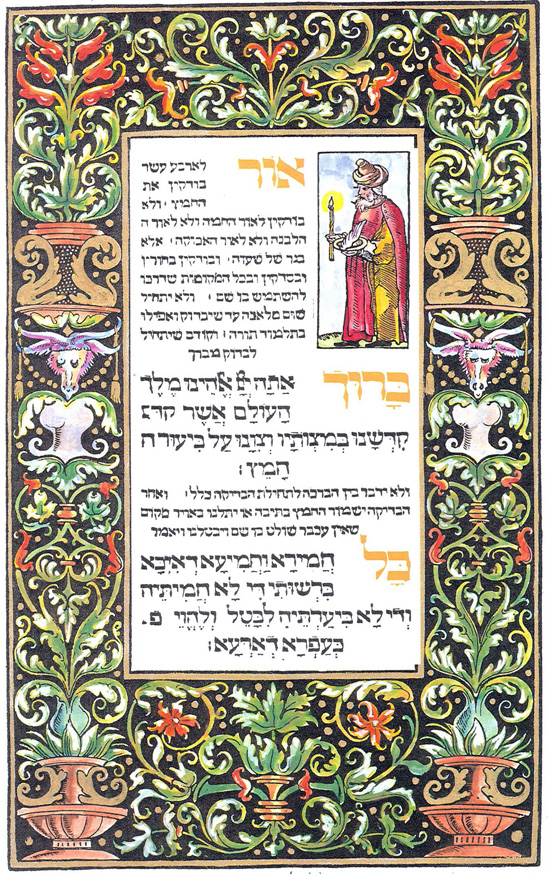
A Few Comments Regarding The First Woodcut Border Accompanying The Prague 1526 Haggadah

A Few Comments Regarding The First Woodcut Border Accompanying The Prague 1526 Haggadah

The Prague 1526 edition of the Haggadah is one of the most important illustrated haggadot ever published.  It is perhaps the earliest printed illustrated haggadah for a Jewish audience and served as a model for many subsequent illustrated haggadot.[1] The earliest printed haggadah with illustration was published in 1512 in Latin and for a non-Jewish audience. That haggadah contains six woodcuts, and was intended as a response to the infamous anti-Semite Pfefferkorn’s screeds against Judaism.[2]The woodcut accompanying the first page shows three Jews around the seder who have four cups in front of them.  Although the Talmud explicitly states that one is not required to have four distinct cups of wine, presumably the image is a crude method of indicating the four-fold nature of the wine during the seder rather than prescribing custom.

The Prague 1526 edition was published by Gershom and his brother Gronom Katz on Sunday, 26th of Tevet 5287 or December 30, 1526.[3] This detailed publication information does not appear on the title page, rather it appears at the end of the book and is  referred to as a colophon.  The colophon is a manuscript convention that was incorporated into earlier printed books. The Prague 1526 edition does not have a title page at all.  At that time, the usage of the title page was only in its early stages.[4]

  1.          The Earliest Hebrew Title Pages

As with non-Hebrew titles, the title page developed over time, both in terms of content as well as usage.[5]   The first Hebrew title page is that of the Sefer Rokeah published in Fano in 1505.[6] But that title page is really one of the more basic forms of the title page, known as a “label title page” providing only the title and author and no other ornamentation or information.[7] In that same year, an edition of Abarbanel’s Zevah Pesach was published in Constantinople.  This edition was the first to contain a border with the title and author, but no place or date of publication.[8] The first Hebrew book containing all the elements of a traditional title page, border, title, author, place and date is likely the 1511 Pesaro edition of the Talmud published by Soncino.[9]

Traditionally, the Hebrew title page is referred to as a “sha’ar” or gate.  The theory behind this description is that many title page borders are comprised of “gates,” the most common are the pillars that adorn many Hebrew books and are assumed to be those at Saint Peter’s Basillica in Rome.  Their inclusion in Hebrew books is perhaps linked to the (discredited) notion that the Catholic Church maintains certain portions of the Jewish Temple, and these pillars were actually in the Temple.  The first Hebrew book to use an architectural border is Daniel Bomberg’s edition of the Jerusalem Talmud published in 1522.[10]

  1. Illustrations in Hebrew Books

Returning to the Prague 1526 haggadah, as mentioned previously, this edition was copiously illustrated, including the first page of the book. This is not the first example of Hebrew printed illustrations.  The earliest illustration to appear in a Hebrew book is that of a lulav and a handful of other explanatory images accompanying the Rome edition of the Sefer Mitzvot Gedolot dated to before 1480.[11]


The first fully illustrated Hebrew book was published in the incunabula period as well, it is Isaac ben Solomon Ibn Sahula’s Meshal ha-Qadmoni, printed in Italy, circa 1491, by Gershom Soncino.[12]

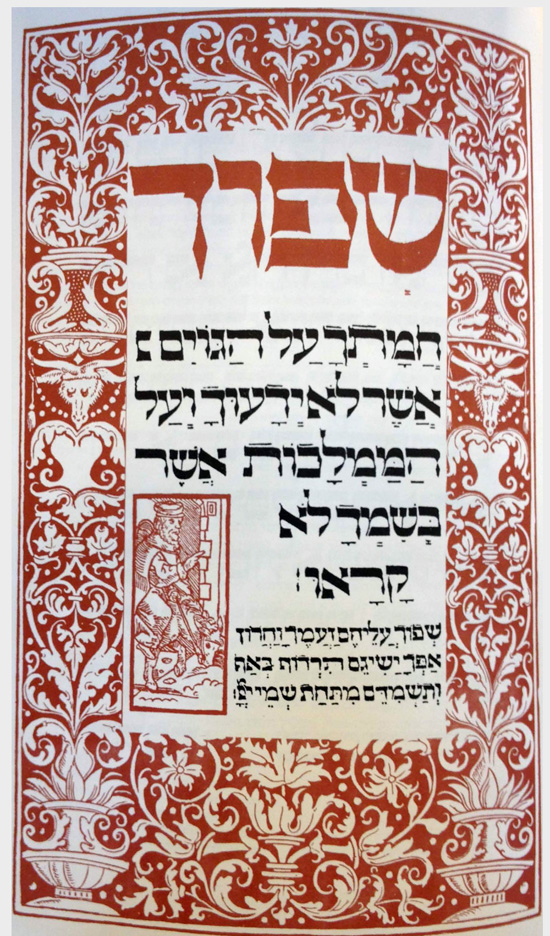
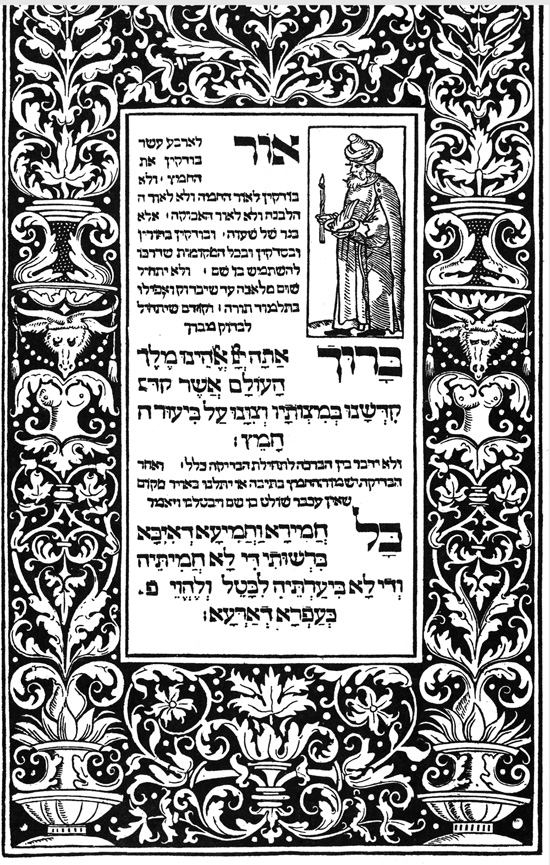
The border surrounding the first page of the Prague 1526 incorporates both Jewish as well as non-Jewish elements.  First, it is obvious that a Jew had a hand in the border as, in the inset, it displays someone performing bedikat hametz (searching for the bread) where he is using the traditional implements of a candle and chicken feather.  The outside border is less Jewish, and as many have noted, appears to be a copy of Italian/German renaissance borders.  The two most likely candidates for models for Prague are the border first used in the 1518 edition of Sacri Doctoris by Raymond Lulli (available here) or a border first used in 1519 for Paolo Ricci’s, Lepida et litere in Augsburg and reused in an Augsburg 1522 edition of Erasmus, Ad reverendum (available here).  Although we cannot pinpoint exactly which of these, if any, served as a model, what is clear is that among the images included in this border are bare-breasted women.

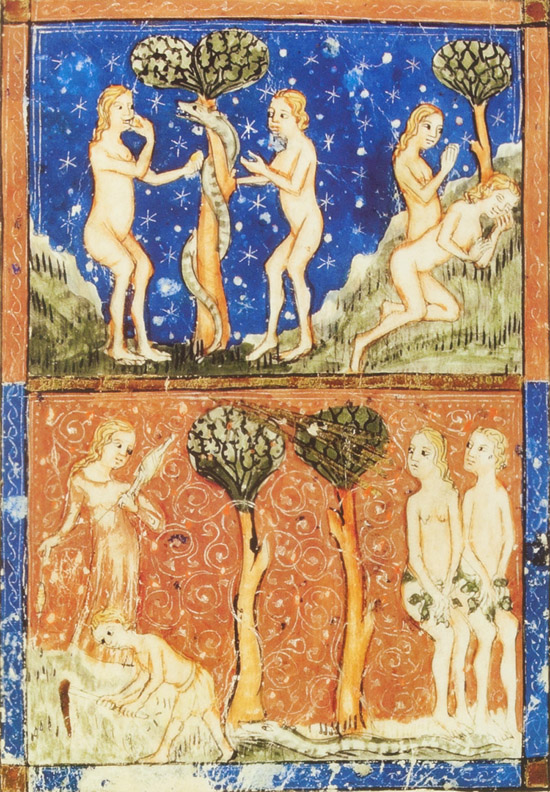
The use of bare breasted women to illustrate the haggadah is not limited to Prague. Both Charles Wengrov and Elliot Horowitz have pointed to earlier manuscript antecedents for Prague’s usage of such illustrations.[13] Aside from the printed example of the Prague 1526 Haggadah, this convention continued in manuscripts as well illuminated after 1526.  There are at least four such 16th century examples.[14] Additionally, and contrary to Horwitz’s contention that Spanish Jews were less accepting of such displays,[15] the Sarajevo Haggadah, which originated in Spain around 1350, includes two panels of Adam and Eve both depicting a bare-breasted Eve.


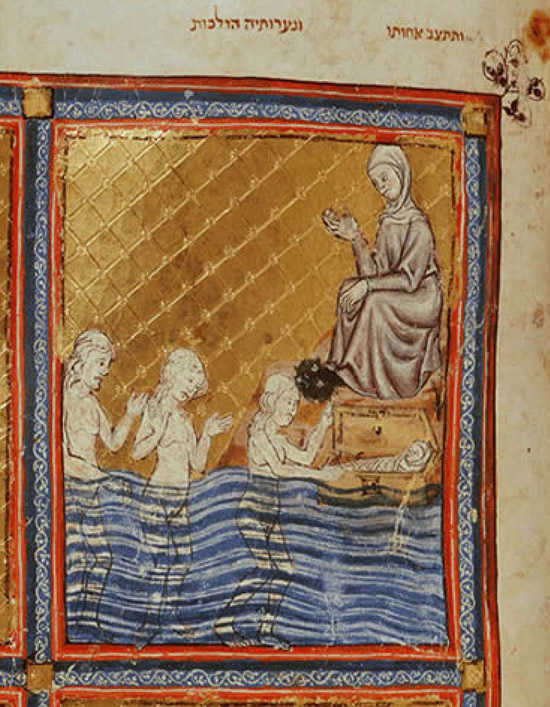
Likewise, the Golden Haggadah, 1320 Spanish manuscript includes the same form of illustration of the Adam and Eve scene.  Additionally, the Golden Haggadah includes images of nude bathers when it depicts Miriam standing from afar to see what will become of baby Moses.[16]

III.            Censorship in Modern Reprints of Prague 1526

            These historical antecedents notwithstanding, recent reprints of Prague 1526 have not been as accepting.  This initial border has been altered to airbrush and removes the bare breasts.  In 1989, a facsimile edition of Prague 1526 was published with the commentary of the Prague rabbi, Rabbi Yehuda Loew (Maharal). This border has been “touched up.”

Similarly, in 1998, a colorized facsimile edition of Prague 1526 was published.  Although the publishers took great pains to provide color where before there was black and white, they also altered this border.

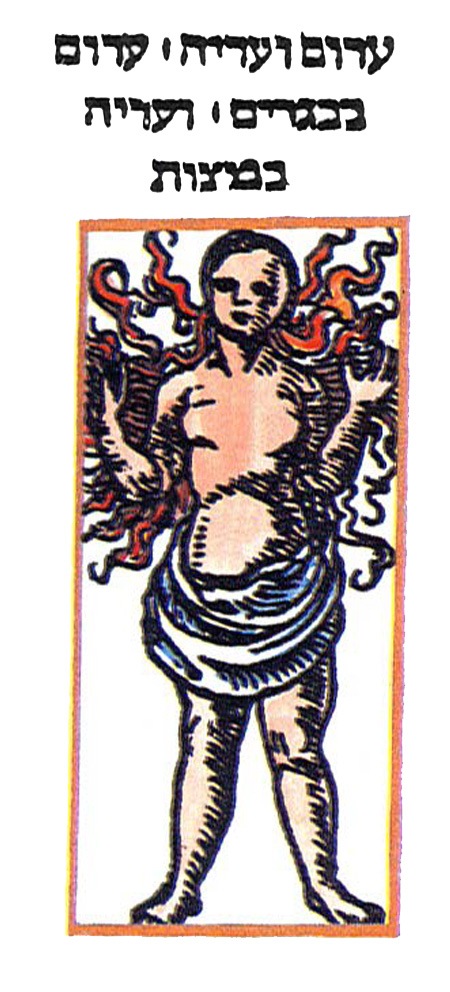
Oddly enough, although they found this image offensive, they decided to reproduce it in two other places in this reprint even though this image only appears once in the original. Here is the original:

Not only is the first border altered, but other instances of bare breasts have been removed; most notably the image accompanying the verse from Ezekiel 16:7 “I made you grow like a plant of the field. You grew up and developed and became the most beautiful of jewels. Your breasts were formed and your hair grew, you who were naked and bare.”

(As discussed previously here a later, Venice 1609, edition also altered this page.)  Again in 2001, a facsimile of Prague 1526 “published by the Religious Council of Efrat in honor of the settlement’s twentieth anniversary . . . . two illustrations are surreptitiously deleted: the bare breasted woman” accompanying the verse from Ezekiel.[17] Most recently, in 2009, the airbrushed image of this woman was reproduced in The Schechter Haggadah: art, history; commentary.[18]

[1] There may be an earlier illustrated print haggadah, however, only 12 leaves of this haggadah are extant making it difficult to date (or identify the country of origin).  For a bibliography regarding this fragment haggadah see Y. Yudlov, Otzar haHaggadot, Magnes Press, Jerusalem:1997, entry 9; and most recently, Eva Frojmovic, “From Naples to Constantinople: The Aesop Workshop’s Woodcuts in the Oldest Illustration Printed Haggadah,” in The Library, Sixth Series, Vol. XVIII, No. 2, June:1996, pp. 87-109.

[2]  See R. Cohen, Jewish Icons: Art & Society in Modern Europe, University of California Press, CA:1998, pp. 21-22; see also Y.H. Yerushalmi, Haggadah; History: A Panorama in Facsimile, Philidelphia:1978, plates 6-8.

[3] Aside from the edition discussed herein, there is at least one copy of another haggadah that is also published by Cohen in Prague that same year.  While both versions are substantially similar, some of the images and borders have been changed.  Relevant for our purposes, is that the image accompanying “Sefokh” which is a full
page border with images of bare breasted women, has been replaced with a more innocuous border found elsewhere in the haggadah.  See Yudlov, Otzar, entry 8; A. Ya’ari, Bibliography of the Passover Haggadah,
Bamberg & Wahrman, Jerusalem:1960, entry 7; Rabbi Charles Wengrov, Haggadah & Woodcut: an Introduction to the Passover Haggadah Completed by Gershom Cohen in Prague, Shulsinger Bros., New York:1967, pp. 78-9.

[4] The first Prague imprint to include a separate title page is in a 1526 edition of Yotzrot published by Cohen.  See Wengrov, Haggadah & Woodcut, p. 82 n.238.

[5] Although, with regard to the adoption of the title page, Jews appear to adopt this convention at or near the time as society at large, that was not the case with other literary advances.  While the majority of the western world adopted the codex and discarded the scroll some time in the third century, the first recorded Jewish reference to the codex does not occur until the late
eighth or the early ninth centuries.  See Anthony Grafton, “From Roll to Codex: A Christian Initiative,” in Crossing Borders, Hebrew Manuscripts as a Meeting-place of Cultures, ed. Piet van Boxel & Sabine Arndt, Bodleian Library:2012, pp. 15-20.

[6] A.M. Habermann, Title Pages of Hebrew Books, Museum of Printing Art, Safed:1969, pp. 8-9.

[7] For a discussion of the development of the title page as well as the different types, i.e., label, border, end-title, see M.M. Smith, The Title-Page its early development 1460-1510, The British Library & Oak Knoll Press, London & Deleware:2000.

[8] See M.J. Heller, The Sixteenth Century Hebrew Book: An Abridged Thesaurus, Brill, Leiden & Boston:2004, vol. I, pp. 6-7.

[9] The border used for the Pesaro Talmuds first appeared in Decachordum Christianum (The Christian Ten String Harpsichord) published in Fano, 1507 by Gershom Soncino.  See M.J. Heller, Printing the Talmud, pp. 104-117  Additionally, see Heller’s discussion, id. p. 113, regarding Soncino’s reuse of the Dechachaordum‘s frames.  In reality, although the frames were originally cut for Decachordum, they were first used on Gershom’s edition of Bahya ibn Pakua’s commentary on the Torah, published four months prior to Decachordum.  See M.J. Heller, The Sixteenth Century Hebrew Book: An Abridged Thesaurus, Brill, Leiden & Boston:2004, vol. I, p. 41; Smith, The Title-Page, supra, pp. 47-59 (discussing the use of the blank title page).

[10]  See A.M. Habermann, “The Jewish Art of the Printed Book,” in Jewish Art, An Illustrated History, ed. Cecil Roth [revised ed. by B. Narkiss], New York Graphic Society Ltd., Connecticut:1971, pp. 167-68.  In Habermann’s earlier work, Title Pages of Hebrew Books, p. 9, he erroneously asserts that the earliest works to include architectural title pages were Soncino’s Melitza le-Maskil and Bomberg’s Tanach, both published in 1524/25.

[11]  See Joshua Bloch, “The Library’s Roman Hebrew Incunabula,” in Hebrew Printing & Bibliography, ed. Charles Berlin, New York:1976, p. 140.  For a description of this work see S. Iakerson, Catalogue of Hebrew Incunabula from the Collection of the Library of the Jewish Theological Seminary of America, JTS, New York & Jerusalem:2005, entry 7.

[12] See A.M. Habermann, “The Jewish Art of the Printed Book,” supra, at 169.  Habermann appears to argue that this is first printed Hebrew book containing illustrations, is incorrect. As discussed above, the first was the Rome edition of Sefer Mitzvot Gedolot. He is not alone in this error.  Ursula Schubert makes the same error.  See Ursula Schubert, Jewish Book Art, From the Renaissance until Emancipation, [Hebrew], Kibbutz hami-Uchad, Tel Aviv:1994, p. 27.  Habermann, id., notes that the great Hebrew bibliographer, Mortiz Steinschneider, was tricked with regard to one of the illustrations contained in Meshal
ha-Qadmoni
.  Steinschneider, in a discussion about the alleged Christian origins of these illustrations, called attention to the fact that in one of them contains a monk wearing a crucifix. But, in the interim we have learned “that this last embellishment was a
practical joke played by a Christian scholar. . . [the crucifix] having been added by [a later] hand!”  Regarding the history and origins of the images included in Meshal ha-Qadmoni, see César Merchán-Hamann, “Fables from East to West,” in Crossing Borders, pp. 35-44; Ursula Schubert, Jewish Book Art, pp. 27-8.

[13]  Rabbi Charles Wengrov, Haggadah & Woodcut, p. 47 nn.112-13;Elliot Horowitz, “Between Cleanliness and Godliness,” in Tov Elem: Memory, Community & Gender in Medieval & Early Modern Jewish Societies, ed. E. Baumgarten, et al., Bialik Institute, Jerusalem:2011, *38-*39.

[14] Mendel Metzger, La Haggada Enluminée, E.J. Brill:1973, plate LIV, nos. 303-305; Chantily Haggadah, Musée Condé, Ms.
732, fol. 13, reproduced in Index of Jewish Art, eds. B. Narkiss & G. Sed-Rajna, Jerusalem-Paris:1976, vol. I, card no. 36.

[15] Horowitz, “Between Cleanliness,” at *38, (“One suspects that a Spanish Jew coming to Germany in the early 15th century would have been equally surprised to see an image of a naked woman” in a Hebrew manuscript.).

[16]  The Golden Haggadah, ed. Bezalel Narkiss, Pomegranate Artbooks, California:1997, figs. 17 & 24.

[17]  Id. n.37.  Horowitz only notes the 2001 example of censorship of Prague 1526, and apparently is unaware of the earlier
examples.  Additionally, he chastises the Efrat reproduction for erroneously indicating a 1527 publication date.  Efrat is not only in erring regarding the secular date.  The first facsimile edition (Berlin:1925), which includes a scholarly introduction, full title
is:  “Die Pessach Haggadah Des Gerschom Kohen Gedruckt Zu Prag 5287/1527.” Perhaps one can excuse the error as, in reality, it was completed on the eve of 1527, December 30, 1526.

[18] The Schechter Haggadah: Art, History & Commentary, [illustrations selected and annotated by David Golinkin], Schechter Institute of Jewish Studies, Jerusalem:2009, p. 36, fig. 16.1.


Carmi Horowitz: A Critique of Two New Reprints

A Critique of Two New Reprints
by Carmi Horowitz *

Two new works have recently appeared on the market: a new edition of Midrash Lekah Tov and a new edition of the Perush on Sefer Yezirah of R. Yehudah b. Barzilai Barceloni. The following is based on an initial perusal of the two works. I have not read through the entire volumes.

I.

The new edition of Lekah Tov consists of three volumes published by Zikhron Aharon Jerusalem with a forward by Yonatan Blier. The first volume is on Bereshit and Shemot, the second on Vayikra, Bemidbar and Devarim and the third the five Megillot. All three volumes are newly typeset, clearly and beautifully printed with the Biblical verses commented on printed in clear bold type on very good quality paper, and handsomely bound. The volumes are aesthetically attractive and elegant.

The first volume contains R. Salomon Buber’s edition of Lekah Tov on Bereshit and Shemot, with his introduction and comments. The only addition that has been added beyond the original Buber edition are the scattered comments of R. Yeruham Perlow (author of the encyclopedic commentary on R. Saadia Gaon’s Sefer Hamitzvot). If collected, the comments would make up not more than two or three pages at the most. Buber’s introduction was moved to the end of the third volume. The typesetters of the new volume obviously did not have Greek on their computers. Thus Buber’s Greek references in the introductory essay were simply skipped. The Greek references in the footnotes to the text were literally (physically) cut and pasted from a printed edition. Thus beyond the aesthetics there is almost nothing new in this volume.

The second volume of Lekah Tov contains Vayikra, Bemidbar and Devarim with the commentary of R. Aharon Moshe Padwe of Karlin, all reset from the original Vilna 5681-4 edition. In addition this volume contains newly printed the commentary by R. Avraham Palaggi, the son of R. Hayyim Pallagi (author of Kaf Hahayyim et al). The commentary itself has very little to do with the Lekah Tov. It is a series of derashot or pilpulim based mainly on the works of the Ketav Sofer and adds very little to the understanding of the work. This volume also has scattered comments of Rabbi Perlow.

The only volume that is really useful is the third volume which contains the Lekah Tov to all the five Megillot with whatever comments the original editors added. To the best of my knowledge the Lekah Tov to the Megillot has not been collected until now, and thus only in this volume is there some real added value beyond the new typesetting.

II.

The Perush Sefer Yezirah of R. Yehuda b. Barzilai Barceloni was published once before by Shlomo Zalman Hayyim Halberstam in Berlin in 1885 with a detailed introduction. The present edition was published in 5767 (2007) by Aharon Barzani and Son, Tel Aviv with an introduction by Amnon Gross. The book is clearly printed and well bound; the text is divided into sentences and paragraphs, which was not done in the original edition. The division into sentences and paragraphs is the main contribution of this edition. The original edition did not contain any footnotes or sources. It contained an introduction by Halberstam which was partially reprinted in this volume. The editor Amnon Gross eliminated form the introduction the list of R. Yehuda Barceloni’s sources saying that they are now noted in the new text and hence it is unnecessary to include them in the introduction (!!). Indeed Gross inserted source references in the text, but they are inserted on a haphazard and inconsistent basis.

The original edition of the commentary on Sefer Yezirah contained important appendixes of Halberstam, David Kaufmann and Jacob Reifman. Those appendixes were not reprinted in this volume although only some of the corrections in these appendixes were incorporated into the text, again on an inconsistent basis.

I did not check the integrity of the text itself to see whether Gross accurately reproduced Halberstam’s text; in light of all the other inconsistencies in the editing – hashdehu.

In summary both publications are disappointing. The first has very little that is new, and the second is edited in such a careless fashion as to make one prefer the original printing.

*Professor Carmi Horowitz received his semikhah at the Rabbi Isaac Elchanan Theological Seminary (RIETS), an affiliate of Yeshiva University, where he studied with R. Joseph B. Soloveitchik. He received his doctorate from Harvard University (1979) where he wrotes his dissertation was on “A Literary-Historical Analysis of the Sermons of R. Joshua Ibn Shu’eib,” under the direction of Prof. Isadore Twersky. He has published on that topic as well as on the Rashba, the Mabit and on the Derashah literature. After teaching at Ben Gurion University he headed Touro’s Graduate School of Jewish Studies in Jerusalem and is now Rector of Machon Lander in Jerusalem (an independent academic institution). This is his first contribution to the Seforim blog.


The Mysteries of Hoshana Rabbah

THE MYSTERIES OF HOSHANA RABBAH

By Eliezer Brodt


This article originally appeared last year in Ami Magazine (2016) This version has a many updates and corrections. I hope to revisit this subject shortly.


The sources of our Yomim Tovim are relatively easy to find, as one simply locates the relevant pesukim or Gemara and starts from there. However, one Yom Tov does not have such a starting point: Hoshana Rabbah. Its roots and numerous customs are shrouded in mystery. This article is an attempt to shed a bit of light on some of the early sources and customs behind this special day.[1]


A very early mention is in an anonymous attack against Yiddishkeit apparently written around the year 1500, where we already find Hoshana Rabbah under attack.[1a] At a later date we find in a work which records a debate about Kabbalah, written in 1825 that the origins of Hoshana Rabbah were also dealt with harshly.[1b]


The Name


Today we know this special day as Hoshana Rabbah, but it wasn’t always called by this name. In earlier sources, such as the Mishnah and Gemara, the Yom Tov is never called Hoshana Rabbah but “Yom Aravah” or “Yom Hoshana.” In a recent article, Rabbi Yaakov Stahl traces mentions of these names through numerous Geonim, Paytanim and Rishonim and concludes that the earliest known mention of the name “Hoshana Rabbah” is in the piyyutim of Rav Yosef Avitur, who passed away in 1024. However, it took a long time for the name to become popular.[2]


The Chayei Adam writes that the name Hoshana Rabbah references the many tefillos recited on this day that begin with the word “hoshana.”[3] This idea can be found as early as 1599 in the Seder Hayom. Rav Eliyahu Bachur writes in his Sefer HaTishbi that the aravos we take on Sukkos are called hoshanos because we call out hoshana, a contraction of the words hoshia na (please save), while holding them.[4]


YOM ARAVAH


In the fourth perek of Maseches Sukkah (42b-45a), the mishnayos and Gemara discuss the extra aravah that was used in the Beis Hamikdash in addition to the one included in the daled minim. Each day the kohanim would circle the mizbei’ach one time, and on the seventh day they would do so seven times. Rishonim differ as to whether they went around with both the aravah and the daled minim, or with the daled minim alone, as well as if the Yisraelim went around as well.[5]


On the seventh day, they would do chavatah on the ground with the aravos. Rashi (ibid. 44b) understands this to mean shaking the aravos, whereas the Rambam writes that it means to bang them two or three times on the floor or on a utensil[6] without making a brachah, in keeping with a minhag hanevi’im.[7] Since the destruction of the Beis Hamikdash, we go around with daled minim only, and not with the aravah, since it is not mentioned in the Torah.[8] The Rambam writes that nowadays we go around the bimah as a zecher l’Mikdash, where they circled the mizbei’ach.[9]


These mishnayos are the earliest sources for the hakafos we do once each day on Sukkos and seven times on Hoshana Rabbah. There are numerous sources from the Geonim onward about this.


It’s worth mentioning the powerful words of Rav Yosef Hahn Norlingen (1570-1637) in Yosef Ometz, first printed in 1723. He writes that one should make a great effort to go around each day with the lulav, to the extent that it’s worthwhile to spend a lot of money on the daled minim for this aspect of the mitzvah alone. He writes sharply against those who leave early and avoid hakafos and describes how he completed the circuit every day, even when there was a lot of pushing, especially on Hoshana Rabbah when the children pushed a lot.[10] A similar point is made by the anonymous work Chemdas Yomim.[11]


We see from this the great significance of completing a circuit around the bimah each day, which ties into zecher l’Mikdash, a concept that stands behind numerous halachos.[12]


But what else—besides for circling the bimah seven times and banging the aravos—is done differently on Hoshana Rabbah than the other days of Chol Hamoed Sukkos?


MISHNEH TORAH[13]


Many have the custom to hear Mishneh Torah, or Sefer Devarim, on Hoshana Rabbah night.[14]


Where did this custom originate?


Avudraham writes that in his time, a few people had the custom to read the whole Torah on the night of Hoshana Rabbah in case they didn’t complete shnayim mikra that year. He personally does not endorse this minhag and feels one should make up any missed shnayim mikra over Sukkos, or better yet, during the Aseres Yemei Teshuvah.[15] Tashbetz, a talmid of the Maharam MiRotenburg, is also wary of this custom, giving the strong opinion that it doesn’t help for anything.[16] However, the Shibolei Haleket writes that it is a worthy practice, and the Magen Avraham mentions it as well. The Shibolei Haleket links this custom to the fact that it is the yom hadin for water, and though the Gemara says one should really finish shnayim mikra before Yom Kippur, if one does not, now is a good time.[17]


The anonymous early Italian work Minhag Tov also describes this custom and says he has seen people practice it. His reasoning for it is interesting: on Rosh Hashanah, we are judged for life and death. In case death was decreed upon him, he will have reviewed his learning.[18] Agudas Eizov adds that through learning, one will be reminded to do teshuvah.[19]


Rav Yaakov Emden suggests that the reason for this custom is to remember the king’s Torah reading at Hakhel, but says that this may be a bit farfetched. He also points out that chumash is not generally to be learned at night.[20] However, he concludes “I bend my head to a custom that is already accepted.” However, he is discussing the Mishneh Torah, not the reading of the entire Torah mentioned by the Rishonim.[21] Rabbi Yosef Ginsburg also writes that the custom is to read only the Mishneh Torah.[22] What’s the source for this?


Shulchan Aruch HaArizal, first printed around 1660, writes that on the night of Hoshana Rabbah one should read Mishneh Torah.[23] Basically, the earliest source for the custom is the Arizal.[24]


The minhagim of the Arizal became widespread through various “bestseller” sefarim. [25] To point to just three “bestsellers,” that helped spread this minhag, one was the Tikunei Shabbos, first printed in 1613,[26] and another the Shaarei Tzion by Rav Nassan Hanover, first printed in 1662.[27] These two works saw dozens of editions and were extremely popular and widespread. Both contain a full Hoshana Rabbah learning seder, famously known as the Tikun Leil Hoshana Rabbah. These works inspired other versions based on Kabbalah.[28] A third work that also helped spread this seder was the very popular (and anonymous) Chemdas Yamim, first printed in 1731.


What was farfetched to Rav Yaakov Emden was fact for the Aderes, who writes in his anonymous[29] work on Hakhel that the reason behind the minhag of Mishneh Torah is for a remembrance of Hakhel.[30] Elsewhere, he writes that he himself would lein Mishneh Torah each year in his sukkah from his own sefer Torah.[31]


Rav Charlop did the same.[32] Many gedolim would also say this tikkun. For example, the Chida records this in his autobiography many times.[33] The Chasam Sofer would say tikkun and then go to sleep.[34]


Interestingly, Rabbi Chaim Benveniste (1603-1673) in Shiurei Knesses Hagedolah[35] and others[36] bring down that many have a minhag to say selichos on Hoshana Rabbah night.[37] Others say selichos during the hakafos in the morning and even blow shofar after each circuit of the bimah.[38]


By contrast, in Vilna it appears there were those who said selichos on Hoshana Rabbah night and the Gra wanted to abolish it because of Simchas Yom Tov. It’s even recorded that on Hoshana Rabbah night the Gra was noheg Simchas Beis Hashoeivah like the rest of the nights of Chol Hamoed but he stopped it after one  Hoshana Rabbah night someone died.[39a]


TEHILLIM


Other early sources, such as Rav Avraham Galante write that one should say the whole Sefer Tehillim on Hoshana Rabbah.[39] Rav Moshe Machir, in his classic Seder Hayom, cites such a custom, as does Rav Yuzpeh Shamash (1604-1678) of Worms[40] and Rav Yosef Hahn Norlingen. The Chasam Sofer would say the whole Sefer Tehillim and go to sleep,[41] as did R’ Shlomo Zalman Auerbach.[41a] Rabbi Hertz Scheir would pay people to say Tehillim the whole night.[42]


Rav Chaim Stein, Rosh Yeshivah of Telz, in his incredible World War II diary chronicling his great mesiras nefesh for whatever mitzvos he was able to do during that time, also writes that he and his friends stayed up saying all of Tehillim.[43]


The Butchasher Rav (1771-1841) gives an additional interesting reason for doing so: because Hoshana Rabbah is the ushpizin night of Dovid Hamelech. Dovid was known not to sleep for longer than sixty horse breadths,[44] and we try to emulate that.[45]


CHECKING SHADOWS[46]


Avudraham also records an elaborate Hoshana Rabbah custom: at night, some wrap themselves in sheets and go out to the shade of the moon. If they find their shadow complete, they are happy; if the head is missing, they assume they will die during the coming year. Depending on the appearance of the shadow, one can tell if other family members will survive the year. (A possible similarity can be found in Maseches Horayos.)


However, the Avudraham concludes not to do it.[47] This custom is found in numerous Rishonim—Ramban, Rav Yehudah Hachasid, Rokei’ach, Rikanati,[48] Tzioni, and Rav Aharon Hakohen Miluneil, to list a few. At the end of a manuscript written by Rav Eliyahu Bachur in 1515, he notes, “I completed this sefer on Hoshana Rabbah, when I saw my head in the shadows of the moon, so I know that I will not die this year.”[49] Rav Chaim Benveniste writes that the purpose of this custom is to do teshuvah, for if one sees that the shadows are not in his favor, he will daven for the decree to be abolished.[50]


Interestingly, Rav Yosef Karo makes no mention of this minhag, but the Rama in Darchei Moshe cites the Avudraham without giving his own opinion about it. However, in his glosses on Shulchan Aruch, he stresses not to do it,[51] writing that we do not understand exactly how to do it and in general it is not advisable to look into the future. Rav Yosef Hahn Norlingen and the Mateh Moshe[52] write the same. (It’s worth pointing out, though, that the Arizal was an adherent of this custom.)[53]


Returning to the previously mentioned minhag, that of reading the whole Torah throughout the night of Hoshana Rabbah, the Agudas Eizov adds that another reason to learn is to amass zechusim so that one’s shadow will be complete on Hoshana Rabbah. What lies behind this unique custom?


There are many more minhagim of Hoshana Rabbah, almost all for the same reason.


ECHOES OF YOM KIPPUR[54]


The Tur and numerous other Rishonim mention the lighting of candles. Leket Yosher writes that his rebbe, the Terumas Hadeshen, would use in part leftover candles from Yom Kippur.[55] Rav Zalman of St. Goar, in his work Sefer Maharil, writes that he observed his rebbe, the Maharil, doing the same.[56] Rav Isaac Tirna describes the same in his Sefer Minhagim.[57]


Another minhag echoing Rosh Hashanah and Yom Kippur is mentioned by Rav Zalman of St. Goar, who writes that he observed the Maharil wearing a kittel on Hoshana Rabbah.[58] The Rama cites a similar practice in Darchei Moshe and the Mapah. The Magen Avraham does the same, but says that the minhag in Poland is to wear Shabbos clothes, but not a kittel.[59] Rabbi Henkin writes that the minhag is only for the chazan to wear a kittel.[60]


Rav Isaac Tirna in his Sefer Minhaghim,[61] the Rama, Rav Yosef Hahn Norlingen and others bring that some go to the mikvah on the morning of Hoshana Rabbah.[62] Rav Chaim Benveniste writes in Shiurei Knesses Hagedolah that it’s better to do so in the evening. The Mateh Moshe,[63] Rabbi Yuzpeh Shamash (1604-1678) of Worms and others[64] write that it’s one of the five days of the year on which one should wake up early.[65]


The Tur and other Rishonim write that the minhag is to daven as on the morning of a Yom Tov, with a longer Pesukei Dezimrah.[66] However, it is unclear if they mean to include Nishmas. Numerous sources describe that the custom was to say it, such as in the French Work on Minhaghim written between 1360-1390 [66a], In the Zecher Yosef from 1467,[67] the Kabbalistic work Agudas Eizov,[68] Rav Chaim Benveniste’s description of Izmir, Turkey, in Shiurei Knesses Hagedolah, the Kaf Naki’s,[69] description of Morocco, and other descriptions of Italy.[70] However, the Rama says not to say Nishmas.


The Kitzur Shibolei Haleket writes that he heard some say Zachreinu L’chayim. Rav Chaim Benveniste cites others who had such a minhag.The Maharam would say Hamelech Hakadosh and Hamelech Hamishpat,[71] and in some early manuscripts, the tefillah of Unesaneh Tokef includes the words “Ub’Hoshana Rabbah yeichaseimun.”[72]


What is the common denominator of all these minhagim? The answer is simple. Hoshana Rabbah is a day of judgement. The question is, for what?


According to the Gemara (Rosh Hashanah 16a), it is a day of judgment for water. As the Taz[73] and Gra[74] point out, water is one of the most important human needs. The aravah grows by the water, says the Rokeach, so we take it up on this day. Of course it is well-known in Kabbalistic literature that this day marks the chasimah of the din handed down on Rosh Hashanah, but it is clear that sources who were not familiar with the Zohar also knew this. For example, the Manhig writes that the reason for lighting candles as on Yom Kippur, among other minhagim, is because on this day the judgment is sealed.[75] Some manuscripts of the Machzor Vitri write that we say Hashem hu haElokim seven times on Hoshana Rabbah, like we do on Yom Kippur, to symbolize the completion of judgment.[76] Others point to a cryptic line in the Yerushalmi in Rosh Hashanah to claim it as a final day of judgment.[77]


Based on these sources, it makes sense that all the many different minhagim are due to Hoshana Rabbah being a final day of judgment.[78] The question, though, is in the secrecy of it. Why are Rosh Hashanah and Yom Kippur openly discussed by Chazal as a day of judgment, while Hoshana Rabbah goes unmentioned? If it were such an important day, one would expect Chazal to let us in on the secret.[79]


Rav Yaakov Kamenetsky answers[80] this with an interesting idea, similar to one proposed by Rav Shlomo Zalman Auerbach.[81] They explain that Chazal felt that if the concept ever “got out,” it would disrupt simchas Yom Tov. At that time, the secret was only told to special people, but due to yeridas hadoros, it soon became clear that Hoshana Rabbah’s judgment would not affect simchah all that much. So the secret of the day’s tremendous significance was let out to the masses.
It is worth noting a similarly interesting statement from Rav Yehoshua Ibn Shuaib, talmid of the Rashba, that one of the reasons we do not find an open discussion of Rosh Hashanah’s judgment in the Torah is because such concepts are very hard to comprehend and discuss openly.[82]


STRANGE CUSTOM


In a letter in 1488, Rav Ovadiah miBartenura writes that in Italy, on Yom Kippur and Hoshana Rabbah nights, the aron was opened after davening and women would line up to kiss the Torah the whole night.[83] Rav Yehoshua Falk describes a similar practice in Pressburg. He links these customs, once again, to the fact of the final din.[84]


CHALLAH IN THE SHAPE OF A BIRD


Related to all of this, we find in a 19th-century Lithuanian memoir that white bread for Hoshana Rabbah was baked in the shape of a bird, because on this day, a final decision is made as to who will live or die that year. In folk tradition, this bird would fly to heaven and bring the determination on a scrap of paper.[85]  In Mattersdorf, the challahs of the Yomim Nora’im were baked in a round pan and stamped with a picture of a bird, probably for a similar reason.[86]


BANGING OF ARAVOS


After saying the hoshanos, we bang the bundle of aravos on the floor five times. The Chayei Adam[87] writes that children bang it until there are no leaves left, because of their exuberance for the mitzvah.[88] Rav Yair Chaim Bachrach of Worms (1638-1702) writes in the Mekor Chaim that fools bang it until no leaves are left. We bang it a few times, but why?


Rabbi Alexander Moshe Lapidos answers this question,[89] but to illustrate it clearly, some background is helpful. On Rosh Hashanah, we have a custom to eat various fruits and say accompanying tefillos. Numerous Acharonim [90] explain this minhag by pointing to a Ramban[91] that states that when an action is done in this world, it has an effect in shamayim, which in turn causes something to happen down here.[92] For instance, there is a custom among some to keep their hands open when reciting the words “Posei’ach es yadecha,” as though waiting to receive the parnasah.[93] This reasoning is in part what is behind the banging of the aravos.


THE FATE OF ARAVOS AFTER WE FINISH BANGING THEM


After we finish banging the aravos, what do we do with them? Many are noheg to place them on top of the aron kodesh, but it is not clear how far back this minhag can be traced, or if it is even permissible to do so.


Interestingly The Chayei Adam writes (153:3) one should burn the Aravos afterwards as does the Aruch Hashulchan (664:6).


The Munkatcher did not hold of throwing it onto the aron kodesh. However the Marsham points to a Malbushei Yom Tov which mentions that they did do so in his time. This work was written by the Tosfos Yom Tov (1579-1654) on the Levush, but was only first printed from manuscript in 1895.[94] However, this piece is already brought down by the Eliyhau Raba who had this work in manuscript and quotes from it often. [94a]


The sefer Tanya Rabbasi by Rav Yechiel HaRofei (1240-1289) records that “The custom we received from our fathers is that after we finish the mitzvah of aravah on Hoshana Rabbah, we take it home with us and put it next to our beds to show the love for mitzvos, and this is a kosher minhag.”[95] It is clear that in his time, the aravos were brought back home. The Mekor Chaim quotes the Tanya Rabbasi as saying that he heard that this practice serves as a protection when traveling.
We find segulos in numerous sefarim relating to saving a piece of the aravos, beginning with Derech Hayashar, written in Krakow in 1646. From there, it is also found in Uber Orach, Sefer Zechirah,[96] and Tzeidah Lederech, first printed in 1760.[97] It became famous in its Sefer Zechirah printing, as Rav Zechariah Simnar’s work was extremely popular in its time.[98] The custom is also found in the Chemdas Yomim.[99] All these sefarim write that one should use some of the candles of Yom Kippur for this practice to work, and that it saves one from robbery. Sefer Zechirah adds that you don’t need to carry the aravah on you for it to work, as long as you know where it is in your house.[100]


Numerous Rishonim and Acharonim advise that the aravos be saved and burned with the chametz,[101] because it is good to do mitzvos with objects already used for a mitzvah. None of these many sources mention throwing the aravos on top of the aron kodesh, even in passing.


SEGULAH WITH THE ESROG


One last famous Hoshana Rabbah segulah is the custom of women who are expecting to bite off the pitum of an esrog, daven that the birth not be painful, and then give tzedakah. The earliest source for this can be found in Rav Yaakov MiYanev’s classic Tz’ena Ur’ena.[102] This sefer, first printed around 1622, was reprinted over 200 times,[103] which explains why the minhag is so famous and popular. This practice is also cited by Rav Zechariah Simnar in Sefer Zechirah [104].


The reason for this minhag, as given by the Tz’ena Ur’ena, is because the fruit of the Eitz Hadaas that Chavah gave to Adam was an esrog. This caused the curse of painful childbirth. Since they did not pasel the esrog or eat from it all Sukkos, and do not do so even now that Sukkos is over, the tefillah of women is that they should not suffer because of Chavah’s sin, and instead have an easy labor.


May we all be zocheh to be inscribed in the sefer hachayim.


[1] For useful collections on this topic see; A. Berliner, Kesavim Nivcharim, 2, pp. 100-103; L. Zunz, Minhagei Tefah Upiut BiKhilot Yisrael, pp. 95-96,284- 288; R. Shlomo Y. Zevin, Moadim Bahalachah, pp. 142-149; Encyclopedia Talmudit, 8, pp. 527-535; Daniel Goldshmidt–Yonah Frankel, Machzor Sukkos, pp. 20-22; Daniel Goldshmidt, Mechkarei Tefillah Upiyut, pp. 392- 394; R’ Mordechai Spielman, Tiferes Tzvi, 3 pp.335-349; R’ Betzalel Landau, Machanayim 74 (1963), pp. 30-39; R’ Yechiel Goldhaver, Minhagei Hakehilot 2, pp. 136- 146; R’ Ovadiah Yosef, Chazon Ovadiah (Sukkos), pp. 438-450; R’ Ben Ish Chai, HaModiah (1999), pp. 14-15 [Thanks to R’ Menachem Silber for this source]; R’ Deblitsky, Kitzur Hilchos HaMoadim (Sukkos), pp. 224-237; R’ Tchezner, Sharei Chag HaSukkos, pp. 249-256, 450-458; Rabbi Tuviah Freund, Moadim L’Simchah,1, pp. 422- 451; Pardes Eliezer, Sukkos, pp. 227 and onwards; Luach HaHalachos Uminhaghim, pp. 102-111.I hope to return to all this more extensively in the near future in a hebrew work.
[1a] Bechinas haKabbalah, p. 50. See T. Fishman, Shaking the Pillars of Exile, 1997, p. 140; R’ Eliyahu Benamozegh, Tam LiShad, p.12, 29.
[1b] Shadal, Vikuach Al Chochmas Hakabbalah, introduction. On this work see Jordan Penkower, The Dates of Composition of the Zohar, pp.75-116.
[2] Yerushaseinu 9 (2016), pp. 155-201.
[3] 153:2.
[4] Sefer HaTishbi, Erech Hoshana.
[5] See Biur Hagra, 660;1, 664;12; R’ Shimon Horowitz, Biur Marsha (on Sefer Tanya Rabbasi), p. 198; R’ Elyukim Horowitz, Zichron Yerushalayim p. 50.
[6] See R’ Eliyahu Posek, Ki Ha’adam Eitz Hasadeh, p. 136.
[7] Hilchos Lulav 7:22. See also R’ Eliyahu Posek, Ki Ha’adam Eitz Hasadeh, p.136.
[8] See Beis Yosef, 664. See also Rama, 664:7. However the Taz (5) concludes one should hold both as does the Eliyhau Raba (11). See also R’ Henkin in Shut Gevurat Eliyahu, p.299.
[9] Hilchos Lulav 7:23. See R’ Yosef Dubovick, ‘MiTorat Rav Shmuel Ben Chafni Gaon: Inyanei Aravah Beyom Shvi’i Shel Sukkos,’Asifat Chachamim Boyan 12 (2013) pp. 13-22 R. Shlomo Y. Zevin, Moadim Bahalacha, pp. 142-146; Yosef Tabori, Moadei Yisrael Bitkufat HaMishnah V’haTalmud, 2000, pp. 190-194; R’ Shlomo Pick, Ilana D’Chaye Sarah (1986), pp. 51-61; Otzar Mefarshei Hoshanos (Machon Yerushalayim) 2003, pp. 19-34.
[10] Yosef Ometz, Siman 1048.
[11] Chemdas Yomim, 83b.
[12] See the work from the Aderet called Zecher L’mikdash, and Zichron Yerushalayim from R’ Elyakim Horowitz both devoted to this topic. See especially pp. 50-52 in Zichron Yerushalayim.
[13] R’ Yechiel Goldhaver, Minhagei Hakehilot, 2, pp. 136-137. See also R’ Weiss Binah L’itim, Tishrei, pp. 525-527 (staying up); see ibid, 527-530 (on finishing Chumash); Herman Pollack, Jewish Folkways in Germanic Lands (1648-1806), p.173; J. Lauterbach, Rabbinical Essays, pp. 328-329. For a very interesting article connecting this minhag to Coffee, see Elliott Horowitz, “Coffee, Coffeehouses, and the Nocturnal Rituals of Early Modern Jewry,” AJS Review 14:1 (Spring 1989), pp. 17-46; Assaf Nabarro, Tikkun from Lurianic Kabbalah to popular culture, Phd Ben Gurion University 2006, p. 87. See also R’ Aron Felder, Sh’eilot Aron, Siman 16 [Thanks to Menachem Butler for this source].
[14] It’s interesting that R’ Moshe Machir in Seder Hayom brings this minhag and the problems mentioned here for Simchas Torah at night. R’ Dovid Sasso writes in Masot Bavel (p. 197) that in Baghdad they would lein the whole Torah on Shmini Atzeres.
[15] Avudraham, Hoshana Rabbah.
[16] Tashbetz (Schneerson edition), siman 410.
[18] Shibolei Haleket, Siman 371.
[19] Minhag Tov, #76. On the dating of this work see Y. Ta Shema, Collected Writings 3, p. 248.
[20] p. 263
[21] R’ Henkin also raises this issue in Shut Gevurat Eliyahu, p.298
[22] Siddur R’ Yaakov Emden 2, p. 407
[23] Itim LeBinah, p. 220.
[24] The importance of this work was that it was one of the main sources for the Magen Avraham when quoting the Arizal. See Eliezer Brodt, Halachic Commentaries to the Shulchan Aruch on Orach Chayim from Ashkenaz and Poland in the Seventeenth Century, PhD, Bar Ian University) July 2015. pp. 191-198.
[25] See for example Sefer Kavanos HaYashan, Jerusalem 2014, p. 285.
[26] See also R’ Yechiel Goldhaver, Minhagei Hakehilot, 2, pp. 137-142.
[27] On the Significance and editions of this work see Eliezer Brodt, Halachic Commentaries to the Shulchan Aruch on Orach Chayim from Ashkenaz and Poland in the Seventeenth Century, PhD, Bar Ian University) July 2015, pp. 265-266. 29. [See the Appendix here]. See Assaf Nabarro, Tikkun from Lurianic Kabbalah to popular culture, PhD, Ben Gurion University, 2006, pp. 88-121. I hope to deal with this work in an article in the near future, iyH.
[28] See for example E. Landshuth, Amudei Ha’avodah pp. 218-220. See also Yosef Yahalom, Alei Ayin, pp. 130-143.
[29] He even gave a haskamah to his own work. See Yaakov Spiegel, Amudim Betoldot Hasefer Haivri, BiSharei Defus, pp. 35-36.
[30] Zecher L’mikdash, p. 19. See also Seder Eliyahu, Nefesh Dovid, p. 139.
[31] Seder Eliyahu, Nefesh Dovid, p. 139. R’ Moshe Feinstein was against leining from a Sefer Torah for Mishna Torah (Mesorat Moshe 2, p. 151).
[32] R’ Deblitsky, Binu Shnos Dor Vador, p. 63, 70
[33] Meir Benayahu, Ha-Chida, p. 533.
[34] See Zichronos Umesoros al HaChasam Sofer, pp. 205-206; Minhagei Raboseinu V’hilchosam, p. 170.
[35] He brings this from the Arizal, which is one of the only times he quotes him in his sefarim on Orach Chaim.
[36] R’ Yechiel Goldhaver, Minhagei Hakehilot, 2, pp. 138-139.
[37] See Avraham Yari, Toldos Chag Simchas Hatorah, pp. 292-295, about those who thought there was a custom to say Selichos on the night of Simchas Torah, when in reality they got confused and it was really on the night of Hoshana Rabbah. See Kaf Naki, Lud 2014, p. 108 who writes he could not find early sources for this minhag.
[38] See for example R’ Moshe Machir in Seder Hayom; R’ Meir Soloveitchick, Ha-Meir La’aretz, p. 104.
[38a] Aliyot Eliyahu, Maylot HaSulum 13, pp. 32-33.
[39] S. Schechter, Studies in Judaism, Philadelphia 1908, 2, p. 296. About this see Moshe Chalamish, HaKabbalah Betefillah Uminhag, pp. 332-355. See also Meir Benayahu, Dor Echad Ba’aretz, p. 268.
[40] Minhaghim D’Kehal Vermeiza, (1988), pp. 214
[41] See his own testimony in Sefer Zikaron, p.3 about a dream he had.
[41a] Halichos Shlomo (Tishrei), p. 241. See About R’ Moshe Feinstein, in Mesorat Moshe 1, p. 119 that he would “say” Mishnah Torah at night and finish Tehilim during the day. See also Mesorat Moshe 2, p. 151; R’ Henkin in Shut Gevurat Eliyahu, p.298.
[42] Turei Zahav, p. 16 (introduction).
[43] Mi-Telz Ad Telz, p. 276.
[44] See my Bein Kesseh LeAssur, pp. 173-215.
[45] Peninim Yekarim # 8 (printed in back of Da’as Kedoshim on Yoreh Deah, Tel Aviv 1959). Thanks to R’ Yehuda Spitz for this source.
[46] A. Berliner, Kesavim Nivcharim, 2, p. 101; R’ Eliyahu Benamozegh, Tam LiShad, p. 59, 217; Y. Weinstock, B’Maagalei Haniglah V’hanistar, pp. 245-269; Dov Sadan, Gilgul Moadim, pp. 163-178; R’ Lipshitz, Iyunim B’-Rabbeinu Bechaye, pp.327-331; Daniel Sperber, Minhagei Yisrael, 6, pp. 173-182; Daniel Speber, The Jewish Life Cycle, pp. 373-383; Ibid, Sefer Zikaron Heichal Hanefesh, pp. 369-376; Y. Ta-Shema, Ha-Niglah She-Benistar, pp. 30-31,120; R’ Yaakov Stahl, Sefer Gimatriyos, 2, Appendix pp. 866-874; Yisroel Ta-Shema, Kneset Mechkarim 4, p. 234. See this recent post.
[47] Avudraham, Hoshana Rabbah.
[48] He even mentions some trying to do it on a bird. The Mateh Moshe brings this down, but Mekor Chaim comments on this that it’s strange.
[49] About this passage see Y. Weinstock, B’Maagalei Haniglah V’hanistar, p.259; Dov Sadan, Gilgul Moadim, p.165. About R’ Eliyahu Bachur and Kabbalah see my Likutei Eliezer, pp. 71-72.
[50] Shiurei Knesses Hagedolah, 664. See also Sha’arei Tzion from R’ Nassan Hanover, p. 142. [51] See the Gilyon of the Magen Avraham here.
[52] Mateh Moshe, 957 (at the end). See the comments of R’ Chaim Ulma on Yosef Ometz (Mechon Yerushalayim ed.), p. 294.
[53] Sefer Kavanos HaYashan, Jerusalem 2014 pp. 286-287.
[54] See Herman Pollack, Jewish Folkways in Germanic Lands (1648-1806), p. 173; R’ Yechiel Goldhaver, Minhagei Hakehilot, 2, p.96,135.
[55] Leket Yosher,(2010), p. 334.
[56] Maharil, p.381.
[57] p. 125.
[58] Maharil, p. 381. See Yerushaseinu 3 (2009), pp. 90-93 about wearing a Kittel and saying Nishmas.
[59] Magen Avraham, 664;3. See Halichos Shlomo (Tishrei), p. 241 about what R’ Shlomo Zalman Auerach did.
[60] Shut Gevurat Eliyahu, p.298. See also R’ Deblitsky, Kitzur Hilchos HaMoadim (Sukkos), p. 229 Ftnt, 23 from Shar Mayim Rabim, p. 611. See also R’ Nosson Kamentsky, Making of a Godol, p. 131.
[61] p. 125.
[62] See what the Leket Yosher writes about his Rebbe the Terumas Hadeshen, p. 333.
[63] Matteh Moshe, 958.
[64] See for example the early collection of Minhagim in Genuzot 2 (1985), p. 14.
[65] Minhagim D’Kehal Vermeiza, (1988), pp. 214
[66] See Likutei Chaim (talmid of Minchas Chinuch), pp. 329-330. See also R’ Yitzchak Weiss, Shut Siach Yitzchak, Siman 318; Eishel Avraham (Butchatch) 664:1; Orchos Chaim (Spinka), about saying Mizmor Shir L’Yom HaShabbos.
[66 a] See the recent article from R’ Stahl, Yeshrun 37 (2017), p.185 where he printed parts of this manuscript for the first time. See also the additional early source from manuscript in footnote 47.
[67] Manuscript printed by Yaakov Spiegel, Moriah 30 (2011) 10-12 (358-360) p. 18. See also L. Zunz, Minhagei Tefah Upiut B’kehilot Yisrael, p. 285; Nevei Shalom, p. 27a.
[68] p. 264.
[69] Lud 2014, p. 108.
[70] Megilas Sedarim, (2002), p.85
[71] See Tiferes Shmuel end of Brachos (quoted by Da’as Torah, 664:1)
[72] A. Berliner, Kesavim Nivcharim, 2, p. 102. See the manuscript from 1560-1590 in  the recent article from R’ Stahl, Yeshrun 37 (2017), p.187 and Footnote 56.
[73] 664;1.
[74] 664:5. See R’ Dovid Cohen, Zeman Simchaseinu, pp. 87-97
[75] Sefer Hamanhig, 2, pp. 402-403.
[76] Machzor Vitri 3 (Goldsmidt ed,) , p. 876
[77] See Yerushalmi Rosh Hashanah 4:4. See also Yefeh Mareh; Mareh Panim. See R’ Meir Soloveitchik, Ha-Meir La’aretz, p. 104; R’ Zevin (above note 1), p. 147; R’ Reuven Margolis, Nefesh Chayah, 664; R’ Yissachar Tamar, Alei Tamar, Moed 2, pp. 226-227,128-129, 310; Y. Brand in B’Rosh Hashanah Yikaseivun (2003), p. 37-39 [Thanks to R’ Yakov Stahl for this source]. For more sources on it being the Gemar Din see: R’ Yaakov Emden, Shut Sh’eilat Yaavetz, 1, 33 (end); R’ Meir Don Polotzky (letter in back of Toldos HaRama Mifano, p. 87; R’ Eliyahu Posek, Shut Mor Oheles, p. 35a; R’ Dovid Hanazir, Kol HaNevuah, pp. 251-252. See also the recent article of R’ Urile Biner, HaOtzar 8, pp. 155-167; R’ Stahl, Yeshrun 37 (2017), p.184-185 footnote 44; See also his forthcoming work Minhag Avos where he deals with this at length tracing sources for this concept in early Paytanyim.
[78] See R’ Yitzchak Weiss, Shut Siach Yitzchak, Siman 315 who deals with why we say hallel if it’s a Yom Hadin.
[79] See R’ Eliyahu Nissim, Aderet Eliyahu, p. 29-30; R’ Eliyahu Benamozegh, Tam LiShad, pp. 19-21, 5; R’ Schick, Shut Rashban, Siman 252.
[80] Emes LeYaakov, pp.398-399. R’ Yaakov Kamenetsky writes an interesting language about the person who asked this question to him
הרגשתי בקושיא זו קושיא של קנטור כנגד דברי הזוהר
I once speculated that perhaps the reason for this comment was that R’ Yaakov had read the work of Shadal, VeKuach Al Chochomas Kabalah which begins with a debate between two people on Hoshana Rabba debating the origins of the Day and via this lead to a full fledged discussion of the origins of Kabbalah. However I have no evidence for the speculation that R’ Yaakov read or was familiar with this work.
[81] Halichos Shlomo (Tishrei), pp. 241, 428-435 See also Shalmei Moed, pp.169-170.
[82] Drasha L’Rosh Hashanah.
[83] Igrot Eretz Yisrael, p. 106. See also A. Grossman, Chasidus Umorodot, p. 302.
[84] Choshvei Machshavos, p. 71.
[85] Pauline Wengeroff, Memoirs of a Grandmother, 2010, p. 166. See also Herman Pollack, Jewish Folkways in Germanic Lands (1648-1806), p. 276 note 47.
[86] R’ Yechiel Goldhaver, Minhagei Hakehilot, 2, p. 28. See also R’ Yaakov Stahl, Yerushaseinu 9 (2016), p. 177.
[87] 153:3.
[88] See the Sefer Hakundos from 1824 in the 1997 edition, p. 66.
[89] See R’ Hirshevitz, Minhagei Yeshurun, p. 112; Toras Hagaon R’ Alexander Moshe Lapidos, p.430.
[90] See for example R’ Margolis in his Shut Machlos Hamachanayim, pp. 27b-28a
[91] Breishis, 12:6; 48:22
[92] See Daniel Sperber, Minhagei Yisrael, 3, pp. 113-172
[93] R’ Yosef ben Naim, Noheg BiChachmah, pp. 167-168. See Daniel Sperber, Minhagei Yisrael, 3, pp. 113-172.
[94] See Eliyhau Rabbah, 664:11: Darchei Chaim VeSholom, p. 292; Orchos Chaim (Spinka) 664:6; Luach HaHalachos Uminhaghim p. 109 – quoting Shut Marsham, 4:57 who mentions that they did this. See also  R’ Moshe Harari, Mikraei Kodesh, (Daled Minim), 2017 pp. 828-829.
[94a] This was one of many manuscripts used by the Eliyhau Rabba see R’ Tzi Leher, Yeshurn 35 (2106), pp.729-730.
[95] Siman 86, Brought in the Eliyhau Rabbah (13). See this recent article of R’ Yaakov Stal about this Minhag.
[96] p. 270-271.
[97] In 2001 edition p. 7.
[98] Sefer Zechira, p. 271. On this work see my Likutei Eliezer, pp. 13-25.
[99] Chemdas Yomim, p. 90b.
[100] See also R; Chaim Palagi, Ruach Chaim; Yifah LiLev; Segulot Yisroel, Erech Eyen, 61-62; Orchas Chaim (Spinka) 664:8; R’ Eliyahu Posek, Kie Hadem Etz haSudeh, p.139a.
[101] See for example sources brought in the Beis Yosef and Darchei Moshe here. See also my article in Yerushaseinu 2 (2008), p. 219.
[102] Bershis Jerusalem 1975, p. 34.
[103] See Introduction to Old Yiddish Literature, Jean Baumgarten, Oxford 2005, pp. 113-121; C. Shmeruk, Safrut Yiddish BePolin, pp. 147-164.

[104] Sefer Zechirah, p. 241; See also R’ Eliyahu Posek, Ki Ha’adam Eitz Hasadeh, p. 127b, 138b ; Chaim Uberachah, 228. See the extensive article from R’ Daniel Racah, Or Yisrael 41 (2006), pp. 167-188. On eating esrogim see A. Shemesh, Plants, Nourishments and ways of eating in Blessing Literature 1492-2000 (heb.) (2014), pp. 240-243.


Crafting the Commandments

Albert D. Friedberg’s Crafting the Commandments has just appeared. The Seforim Blog is happy to present the following excerpt from the book’s conclusion.
Scholars have ascribed far too much importance to Maimonides’ enumeration of the commandments and far too little to the motivations that lay behind his appropriation of R. Simlai’s aggadah as the basis for the enumeration and to the significance that Maimonides attached to this aggadah. The proximate reason for creating an enumeration was his need to have a reasoned and methodical outline of all Torah legislation in front of him, a reminder of topics to guide his preparation of the upcoming code of law, a massive and unique undertaking. Thus we find him saying in the introduction to the ShM [Sefer ha-Mitzvot]:
All this [I would do] in order to guard against omitting any topic [emphasis added] from discussion, for only by including them in the enumeration of the commandments [heading the various treatises] would I insure against such omission.
This sense is reinforced by some of the Rules, especially Rules 7 and 10-14, which are essentially taxonomic rules rather than definitions of what constitutes a mitsvah. I posited that the logically unnecessary identification of this outline with R. Simlai’s count of 613 commandments owed its existence to Maimonides’ desire to incorporate the two fundamental beliefs of the Jewish faith, God’s existence and His oneness, into the legal realm, and thus transform their intellection into obligations, a dramatic departure from the preceding geonic paradigm. I inferred this conclusion from a dispassionate and unapologetic assessment of the mitsvah count. Maimonides stretched the meaning of mitsvat ‘aseh well beyond its common rabbinic usage, relying uncharacteristically on an aggadah of questionable legal worth, a homiletic creation with didactic aims and no pretensions of being precise, and resorted to a contrived and hardly compelling logic to arrive at the numerical target, likely fully aware of the variant results that could be legitimately obtained.
The enumeration, qua a reasoned list of commandments, has diverted the attention of the countless students of his works ever since the ShM left his hands. But I posit that it was not R. Simlai’s dictum that 613 commandments were given to Moses at Sinai that was significant, but rather R. Hamnuna’s accompanying exegesis. Maimonides used R. Hamnuna’s midrashic exegesis that the verses I am the Lord thy God and Thou shalt have no other God before Me specifically formed part of the count of 613 commandments to prove that to intellect the existence of God and His oneness constituted a positive, performative obligation. The credibility of R. Hamnuna’s exegesis was even more firmly established when Maimonides inferred from its language what he believed was a theological truth: the nature of the commandments to believe in the existence of God and to believe in His oneness was categorically distinct from the nature and motivation underlying the rest of the commandments. He explained this distinction by averring that the former were philosophically demonstrable truths, capable of being apprehended without the medium of revelation, while the latter were only conventions, necessitating the mediation of a lawgiver and prophet.
The two articles of faith occupy the most prominent position in the MT, appearing in the opening lines of the Sefer ha-Madda’. In a letter to his disciple, Joseph b. Judah, Maimonides wrote that he undertook to compile a code of law in his zeal for the glory of God, “in seeing a nation bereft of a truly comprehensive book (diwan) of law, and bereft of clear and correct [theological] notions.”  Only the inclusion of these two beliefs in the canon of law could have satisfied the requirements of “a truly comprehensive book (diwan)” containing “correct theological notions.”  In sum, the unequivocal and unique statement found in R. Simlai’s aggadah, that the beliefs in God’s existence and His oneness constituted positive obligations, led Maimonides to appropriate the aggadah, adopt its numerical value of 613, and conflate it with the outline that he was preparing—all despite the constraints that it imposed.
In the second half of the book, I turned my attention to the sub-section of positive commandments and drew some conclusions from the way they are described and defined in the Halakhot. While my readings hinged on what Maimonides actually wrote, I recognized that, being human, Maimonides was bound to make the occasional mistake. That said, the exceptional (but more than occasional) omission of the formulaic phrase “X is a mitsvat ‘aseh” at the start of a topical discussion held my special attention because of the implausibility of it being forgotten: the phrase is rich, bold, highly informative, and consistent with Maimonides’ sustained interest for making categorical distinctions. Additionally, and just as importantly, my readings focused on how Maimonides expressed himself. The rhetoric, the literary presentation of his ideas, and the logic of composition mattered as much to me as the slight inferences one could arrive at by noting the absence or presence of a particular term, elements which have constituted the more traditional way of studying his works.
I began the book’s second section by noting that in the Halakhot, Maimonides moves away from the contrived artificiality adopted in the ShM of using the term mitsvat ‘aseh to designate all types of legal themes: here he applies the term to a very specific case, that of an absolute and unconditional obligation. Combing scriptural and rabbinic sources, Maimonides searches for clear indications of unconditional commands and imperatives to perform well-defined acts. These he designates boldly and prominently at the commencement of each topical
discussion, with a formulaic phrase that states that the directive at hand is a mitsvat ‘aseh. Where Maimonides withholds the mitsvat ‘aseh designation, I theorized that he must have done so because the scriptural and/or rabbinic evidence was insufficient to make such a determination. I tested for this evidentiary insufficiency, and when confirmed, I theorized further that under the influence of reigning Islamic legal theory (which was also heavily if not wholly influenced by rabbinic thinking), Maimonides opts for a softer definition. As a result, certain scriptural directives are categorized as recommendations rather than orders, wise pieces of advice rather than commands. Supporting these with scriptural proof texts, he labels them with the solo term mitsvah, a label that he also uses to designate rabbinical directives. The scriptural mitsvot include such prominent directives as to love and fear God, to imitate Him, to appoint a king, to heed the call of a prophet, to rebuke the sinner, to honor the wise, to testify in court, and a few others.
I conjectured further that Maimonides deliberately withheld the scriptural designation from certain commandments that had been labeled as scriptural in the ShM when the plain reading of the scriptural text did not appear to provide sufficient evidence for them, even when rabbinic interpretation suggested otherwise. To this end, he chose an artful but somewhat concealed literary device to designate them as such, the participle of correct practice. This is the case with such prominent practices as the recitation of the Shema, the binding of the tefillin, the writing and placing of the mezuzah and the study of Torah.
In the heavily politicized atmosphere of Cairo, where Rabbanites were both assiduously courted and continuously attacked by sectarian groups (largely Karaites) over the role of the oral law in interpreting Scripture, Maimonides chose to keep his radical opinions hidden yet recoverable. When applied to the legal sections of the Torah, Maimonides’ peshateh di-qera hermeneutics would likely raise hackles among his own co-religionists and, worse yet, give comfort to the deniers of the oral law. His carefully planted literary cues could lead the reader who is familiar with rabbinic terminology and unburdened by popular and superficial conclusions to discover the Master’s true opinion or at the very least sense his ambivalence.
Maimonides was informed by a hermeneutics of peshateh di-qera that was firmly and demonstrably anchored in the Andalusian tradition. His insistence on presumed philological validity, however, left him uneasily placed, uncomfortably close to sectarian investigation and interpretation. Ironically, this led him at times to mount a struggling defense of his own traditional Rabbanite views, well aware that the plain sense of Scripture did not lend convincing support for such a stance.
Consciously or unconsciously, Maimonides navigated his legal system between the Rabbanites and the Karaites, upholding the former’s respect for authoritative tradition and the latter’s insistence on relying only on philologically informed readings. Maimonides’ extraordinarily novel application of peshateh di-qera to the halakhic corpus threatened the very foundations of a Rabbanism, one that was intimately intertwined with the Talmud and its authority. Nahmanides understood this too well when he criticized Rule 2:
[F]or this book of the master, its content is delightful, full of love [based on Song of Songs 5:16] except for this principle, which uproots great mountains of the Talmud and throws down fortified walls of the Gemara. For the students of the Gemara, this notion is evil and bitter. Let it be forgotten and not said.
Of course, Maimonides would not have conceded this point: he would have maintained that his paradigm flowed quite naturally from the pages of the Talmud. Did not the Talmud’s quest for peshateh di-qera support the distinction between divine and man-made law? Did not the rabbis of the Talmud acknowledge that explicitly stipulated scriptural laws enjoyed an epistemic advantage over and a distinction from man-made laws? To Maimonides the answer to these two questions was a resounding yes.


Thanks to his remarkable codification, Maimonides left an indelible mark on Jewish law. Unfortunately, an important part of his jurisprudence, the exquisitely fine distinctions he made between divine and human law and between command and advice, was never fully appreciated, perhaps because of its radical import—or perhaps because Maimonides, for his own good reasons, hid many of these contributions behind formulaic omissions, terminological nuances, and subtle literary devices. It is this rich and layered nuancing that in some modest way I have tried to recover.


The Chanukah Omission

The Chanukah Omission

by Eliezer Brodt

    Every Yom Tov has its famous questions that show up repeatedly in writings and shiurim. Chanukah, too, has its share of well-known questions. In this article, I would like to deal with one famous question that has some not-very-famous answers. A few years ago I dealt with this topic on the Seforim Blog (here). More recently in Ami Magazine (# 50) I returned to some of the topics related to this. This post contains new information as well as corrections that were not included in those earlier articles. The question is, why there is no special masechta in the Mishna devoted to Chanukah, as opposed to the other Yamim Tovim which have their own masechta?[1] Over the years, many answers have been given, some based on chassidus, others based on machshava, and still others in a kabbalistic vein.[2] In this article, I will discuss a few different answers. While, answering this question I will touch on some other issues: what exactly is Megillas Taanis, when was it written, and what role did Rabbenu Hakadosh have in the writing of the Mishna.

A first source and the seven masechtos

At the outset, I would like to point out that the first source I have found thus far that deals with this question is Rabbi Yosef Karo in his work Maggid Mesharim.[3]It is interesting to note, that the most famous question related to Chanukah was also asked by Rabbi Yosef Karo, and is commonly referred to by the name of his sefer, as the “Bais Yosef’s Kasha.[4] That question, is: Why is Chanukah eight days? Since there was enough oil for one night, what exactly was the miracle of the first night? One of the answers given to the question is based on a famous Rambam that gives an important insight about what Rabbenu Hakodesh included in the Mishna. According to the Rambam, the halachos of tefillin, tzitzis, and mezuzos, as well as the nusach of tefillah and several other areas of halacha are not included in the Mishna at all because these halachos are well-known to the masses; there was no need to include them.[5]

אבל דיני הציצית והתפלין והמזוזות וסדר עשייתן והברכות הראויות להן וכן הדינים השייכים לכך והשאלות שנתעוררו בהן אין ממטרת חבורנו לדבר בכך לפי שאנחנו מפרשים והרי המשנה לא קבעה למצות אלו דברים מיוחדים הכוללים את כל משפטיהם כדי שנפרשם, וטעם הדבר לדעתי פרסומן בזמן חבור המשנה, ושהם היו דברים מפורסמים רגילים אצל ההמונים והיחידים לא נעלם ענינם מאף אחד, ולפיכך לא היה מקום לדעתו לדבר בהם, כשם שלא קבע סדר התפלה כלומר נוסחה וסדר מנוי שליח צבור מחמת פרסומו של דבר, לפי שלא חסר סדור אלא חבר ספר דינים (פירוש המשנה, מנחות פרק ד משנה א.

(There are some achronim who posit that this rationale applies to Chanukah, as well. That is, Chanukah was also well-known, and that’s why it was not necessary to include it in the Mishna.[6] Rabbi Yaakov Schorr has a problem with the statement by the Rambam that the laws and details of tefillin and mezuzah were well known—these mitzvos are very complicated and contain many details. Indeed, they are arguably much more complex than Kriyas Shema, which does have its own mesechta. To illustrate this point, the Chofetz Chaim’s son writes that his father spent months working on just two simanim of Hilchos Tefillin for his work, the Mishna Berura.[7] So too, there are many halachos related to Chanukah, and it is hard to believe that everyone knew all the halachos. However, the Maharatz Chayes, who bases his answer to the question on this same concept of the Rambam, adds an important point which would answer Rabbi Schorr’s problem. He says that the masses all knew about lighting the menorah. All the rest of the halachos of Chanukah which are discussed in the Gemara are from after the period of the Mishna, he says, and that is why Rebbe did not include them in the Mishna.[8] Rabbi Schorr resolves his own problem by suggesting that there was a Maseches Soferim devoted to the laws of tefillin, but it was lost. He claims that it forms the basis of the Maseches Soferim which we have today.[9] With this introduction, we can perhaps understand the following answers to our question, which are based on the assumption that there was a Maseches Chanukah which was lost. The Rishonim refer to “seven minor masechtos“; however, the earlier Achronim did not have these masechtos. Today, we do have “seven masechtos “, although, as we shall see, not everyone agrees that these are the same seven masechtos that the Rishonim had. During the period that these masechtos were unknown, there was some speculation as to what they contained. Rav Avraham Ben HaGra quotes his father, the Gra, in regard to what the exact titles of the seven masechtos were, and he told him that amongst the titles was Maseches Chanukah.[10]

אמנם שמעתי מאדוני אבי הגאון נר”ו שהשבע מסכות קטנות המה חוץ מאשר נמצא לנו והן מסכת תפלין ומסכת חנוכה ומסי’ מזוזה. (רב ופעלים הקדמה דף ח ע”א) As far as we know today, we have all the seven masechtos and none of them are about Chanukah.[11]

But it is possible that there was such a masechta which was lost. Rav David Luria (Radal) assumes as much and uses this assumption to understand the Teshuvos Hagaonim and says that it evidences additional masechtos that are no longer extant.[12]

ובא אלינו איש חכם וחסיד זקן ודרש בישיבה כתיב ופן תשא עיניך השמימה וראית את השמש זה נדר ואת הירח זו שבועה… וסדר משנה תוספת על סדרי שלנו ראינו בידו שהיה מביא ולא זכינו להעתיק שסבתו גדולה ונחפז ללכת ואתם אחינו הזהרו בענין זה וטוב לכם (שערי תשובה, סימן קמג).

The Vilna Gaon’s great-nephew reports that the Gra said there was even a masechta titled Maseches Emuna, which also appears to have been lost.[13]

ואמר לי איך ששמע מדו”ז הגאון מו”ה אלי’ ז”ל שהיו כמה וכמה מסכות על המדות כמו מסכתא ענוה ומסכתא בטחון וכדומה רק שנאבדה ממנו.

The one we already had

A different answer given by many [14] is that the reason why Rebbe did not have a whole masechta about Chanukah was because there was one already: Megillas Taanis! In fact, in one of the editions of Megillas Taanis (the original edition with the Pirush ha-Eshel), it says on the frontispiece: “Megillas Taanis, which is Masseches Chanukah.” The Perush ha-Eshel on Megilas Taanis wants to suggest that the Gra did not mean that there was a masechta titled Chanukah. Instead, the Gra meant Megillas Taanis. Indeed, in earlier printings of the Shas, Megillas Taanis was included with the Masechtos Ketanos.[15] Whether or not the Gra himself meant Megillas Taanis, many do say that Megillas Taanis is really Maseches Chanukah, since the most important and lengthy chapter is about Chanukah. Therefore the answer to why Rebbi did not include a masechta about Chanukah was simply because there was one already— Megillas Taanis. This answer is backed up with a statement found in the Behag, which says “that elders of Beis Shamai and Hillel wrote Megillas Taanis.”[16] זקני בית שמאי ובית הלל,… והם כתבו מגילת תעניות… To better understand this, an explanation about the nature of Megillas Taanis is needed. Megillas Taanis is our earliest written halachic text, dating from much before our Mishnayos. Some say it was so well-known that even children knew it by heart.[17] In the standard Megillas Taanis, there are two parts: one written in Aramaic, which is a list of various days which one should not fast or say hespedim on. This part is only two hundred and seventy words long. The other part was written in Hebrew and includes a lengthier description of each particular day. The longest entry in the latter part is about Chanukah. It contains reasons for the Yom Tov and some of the halachos. With this in mind, it’s not so strange to say that there is no need for a special masechta about Chanukah. Since in the earliest written text we have there is a lengthy entry about Chanukah, why would Rabbenu Hakodesh have to repeat it? The problem with this answer is that while Megillas Taanis dates from before our Mishnayos, it contains significant additions from a later time. The Maharatz Chayes and Radal say that the Aramaic part was written very early, at the point when it was not permissible to write down Torah Sheba’al Peh. At a later point, when it was permitted, the Hebrew parts were added. Maharatz Chayes says that it was after the era of Rabbenu Hakodesh. Earlier than him, Rav Yaakov Emden wrote (in his introduction to his notes on Megillas Taanis) that it was completed at the end of the era of the Tannaim. The bulk of the discussion regarding Chanukah that appears in Megillas Taanis is in the Hebrew part. It doesn’t make sense that Rebbi did not include Chanukah in the Mishna because of sections of Megillas Taanis that had yet to be written.[18] The Gedolim who first suggested that Megillas Taanis is the reason that Rabbenu Hakodesh did not include Chanukah in Mishnayos did not realize that it was written at two different time periods. However, Rabbi Dovid Horowitz in an article in Hapeles turns the historical difficulty on its head when he argues, based on Tosafos, that the person who wrote the Hebrew parts of Megillas Taanis was Rabbenu Hakodesh.[19] The problem with Rabbi Horowitz’s point is that it seems most likely that the Hebrew portion was written later than Rabbenu Hakodesh, and most do not agree with Tosafos on this point. [20] Therefore, this answer does not explain the omission of Chanukah from the Mishna according to most authorities.[21] Another answer in the same vein was suggested by Rabbi S.Z. Schick. Rav Schick conjectures that there was a Sefer Hashmonaim written by Shammai and Hillel which recorded the nissim of Chanukah, and therefore, there was no separate Mishna.[22] This seems to be based on the quote from the Behag we brought earlier. Others say this might be a reference to Sefer Makabbim or Megillas Antiyochus. Although it is likely that these two works are from early times, it is not clear how early.[23] As an aside, there is a book bearing the title Maseches Chanukah, but it was written as a parody, similar to Maseches Purim of Rav Kalonymus[24].

Rebellion, Romans, and the Power of Tradition

Another explanation for the Chanukah omission is from the Edos Beyehosef, who quotes a Yerushalmi[25] which relates the following: A child was born to the King Trajanus on Tisha B’av, and the child died on Chanukah. The Jews were not sure whether or not to light neros Chanukah, but in the end, they did. The king’s wife told him to come back from a war that he was in middle of fighting in order to fight the Jews who were rebelling against him!

בימי טרוגיינוס הרשע נולד לו בן בתשעה באב והיו מתענין מתה בתו בחנוכה והדליקו נירות שלחה אשתו ואמרה לו עד שאת מכבש את הברבריים בוא וכבוש את היהודים שמרדו בך חשב מיתי לעשרה יומין ואתא לחמשה אתא ואשכחון עסיקין באורייתא בפסוקא ישא עליך גוי מרחוק מקצה הארץ וגומ’ אמר לון מה מה הויתון עסיקין אמרון ליה הכין וכן אמר לון ההוא גברא הוא דחשב מיתי לעשרה יומין ואתא לחמשה והקיפן ליגיונות והרגן אמר לנשיהן נשמעות אתם לליגיונותי ואין אני הורג אתכם אמרון ליה מה דעבדת בארעייא עביד בעילייא ועירב דמן בדמן והלך הדם בים עד קיפרוס באותה השעה נגדעה קרן ישראל ועוד אינה עתידה לחזור למקומה עד שיבוא בן דוד (תלמוד ירושלמי,סוכה, פרק ה)

The Edos Beyehosef writes that Rabbenu Hakadosh chose not to include Chanukah in the Mishna. If a simple lighting of neiros caused such a reaction from our enemies, all the more so if this would be included in our crucial text—the Mishna.[26]

וכתיבת דיני נר חנוכה יש בה פירסום יותר מהדלקה מפני שהדלקה היא בבתי ישראל בזמן מועט חי’ ימים בשנה חצי שעה בכלל לילה ואפ’ זה סמיה בידן להדליק בפנים אם יש חשש סכנה אבל דבר בכתב קיים כל הימים ומתפשט בעולם על ידי כל אדם המעתיקם כל מה שרוצה… ומפני זה השמיט רבי כתיבת דיני חנוכה…

Rabbi Yehoshua Preil in Eglei Tal relates that the Roman emperor, Antoninus, was a good friend of Rebbi, and he allowed the Jews to start keeping Shabbos and other Mitzvos. However, since he had just become king, allowing the Jews to celebrate Chanukah was dangerous for his kingdom. Therefore, Rebbi did not speak about this Yom Tov openly. [27]

כי הנה אנדריונוס קיסר אחרי הכניעו את המורדים בביתר שפך כאש חמתו על כל ישראל וישבת חגם, חרשם ושבתם כי גזר על שבת ויום טוב מלה ונדה וכיוצא בו, אולם בימי המלך הבא אחריו אנטוניוס פיוס ידידו של רבי רוח לישראל כמעט, אך כנראה לא השיב את גזרת ההולך לפניו בדבר חנוכה, כי באמת יקשה גם על מלך חסיד כמוהו להניח חג לאומי כזה לעם אשר זה מעט הערה למות נפשו ואך בעמל רב נגרע קרנו זה שנות מספר, ועל כן לא היה יכול רבינו הקדוש נשיא ישראל לדבר בזה בפומי…

Rabbi Reuven Margolios answers, along these lines, that the Romans at the time were interested in the Torah She-be’al Peh, specifically concerned that there was nothing in Torah She-be’al Peh that was against the non-Jews. Thus, in order that the Romans shouldn’t have the wrong idea about the Jews’ loyalty to the government, Rebbi did not want to include Chanukah in the Mishna.[28]

ובכן כאשר תלמי המלך בזמנו צוה להעתיק לו התורה שבכתב לידע מה כתיב בה כן התענייה הנציבות לידע תוכן התורה שבעל פה … דרישה כזאת היא אשר יכלה להמריץ את נשיא ישראל להתעודד ולערוך בספר גלוי לכל העמים תורת היהודים וקבלתם יסודי התורה שבעל פה להתודע ולהגלות שאין בה הטחת דברים נגד כל אומה ולשון ולא כל תעודה מדינית. ואחר אשר חשב רבי שספרו יבוקר מאנשי מדע העומדים מחוץ ליהודת שיחרצו עליו משפטם לפני כס הממשלה המרכזית ברומא. נבין למה השמיט ממשנתו דברים חשובים עקרים בתורת ישראל … כן לא שנה ענין חנוכה והלכותיה במשנה, בעוד אשר להלכות פורים קבע מסכת מיוחדת, שזהו לאשר כל כאלו היו למרות רוח הרומיים שחשבום כענינים פוליטיים חגיגת הנצחון הלאומי ותוקת חפשיותו.

Rabbi Dov Berish Ashkenazi writes that since the Chanukah miracle was to show us the authenticity of the transmission of Torah from Moshe Rabbeinu, the story of Chanukah was not written down— it is just based on mesorah[29]. Along these lines, Rabbi Alexander Moshe Lapidos answers that the reason Chanukah isn’t written down is to show the power of Torah She-be’al Peh.[30]

לא נכתבה מגילת חנוכה, לפי שנתקנה להורות תוקף תורה שבעל פה, ותולדתיה כיוצא שלא נכתבה… חנוכה המורה על תורה שבעל פה ע”כ לא ניתנה להכתב…

(תורת הגאון רבי אלכסנדר משה, עמ’ רנו)

Rav Shlomo Zalman Auerbach says something similar. He answers that the main bris between us and Hashem is the Torah She-be’al Peh. The Greeks wanted to take this away from us, yet Hashem made miracles so that it remained with us. That is why this mitzvah is so special to us and that is why it is not written down openly.[31]

יש להבין אם מצוה זו כ”כ חביבה היא לנו, כמו שכתב הרמב”ם שמצוה חביבה היא עד מאד, למה באמת לא ניתנה ליכתב, אולם עיקר כריתת ברית שכרת הקב”ה עם ישראל הוא רק בעבור תורה שבעל פה כמו שכתב בגיטין ס’ ע”ב ומשום כך הואיל ומלכות יון הרשעה רצתה שלא יהי’ לנו ח”ו חלק באלקי ישראל, לכן נתחבבה מצוה זו ביותר שנשארה כולה תורה שבעל פה אשר רק על ידי תורה שבעל פה איכא כריתת ברית בינינו ובין ה’ ולכן אפילו במשניות לא נזכר כלל דיני חנוכה וכל ענין חנוכה כי אם במקומות אחדים בדרך רמז בעלמא.

Another answer given by Rav Alexander Moshe Lapidos is that when Torah She-be’al Peh was allowed to be written, not everything was allowed to be written. Only later on, the Gemara was allowed to be written. Rabbenu Hakadosh only wrote down things that had sources in the Torah, or gezeros (decrees) to make sure one kept things in the Torah. Chanukah does not fall into those categories. Only later on, in the times of the Gemara, was it allowed to be recorded.[32]

דבקושי התירו לכתוב תורה שבעל פה והיו פסקי פסקי. מתחלה סתימת המשנה בימי רבנו הקדוש. ואחר זה בימי רבינא ורב אשי חתימת התלמוד, והשאר היו נוהגין במגלת סתרים עד שלאחר זה הותר לגמרי לפרסם בכתב כל מה שתלמיד ותיק מחדש. ורבנו הקדוש לא הרשה רק מה שהוא לפירוש לתורה שבעל פה ומה שיש לו סמך בכתוב, או מה שהוא לסייג, כמו הלל וברכות, ערובין, נטילת ידים, נר שבת ומגלה (מחיית עמלק). אבל חנוכה שאיננו לא פירוש ואין לו סמך בכתוב, ולא לסייג, לא היה נהוג רק במגלת סתרים בבריתות דר”ח ור”א… רק נרמזה במשנה ב”ק סוף פ”ו ואחריה הורשה לפרסם בכתב בתלמוד.

Rav Shmuel Auerbach writes: ובזה יבואר החביבות המיוחדת שבנס חנוכה, והטעם שאינו מפורש במשנה. בהשתלשלות, כל שלב יסודו מהמצב הקודם, והמשנה שהיא השלב הראשון של תורה שבעל פה, יש לה שייכות לתורה שבכתב, כי היא ראשית החלק הגלוי של תושבע”פ. וחנוכה כל מהותה היא גילוי תושבע”פ בלי מפורש בתורה שבכתב´היינו מציאות שחסר גילו שכינה ונבואה, בזמן של חושך וחורבן, ולזה לא שייך בנס החנוכה כתיבה. ודוקא המציאות שנס חנוכה לא נכתבה במשנה היא הסימן לחביבות מיוחדת, והיינו שחלקי התורה הפחות כתובים הם עילאיים. ומצב של של נס שכולו בתורה שבעל פה, ולא בתורה שבכתב, הרי כל כולו בין הקב”ה לעמו ישראל, ולא מופיע בחלקי התורה שנקראים גם על ידי הגוים בשבעים לשון (אהל רחל, חנוכה, עמ’ ל-לא).

Another answer given by Rav Shmuel Auerbach is: ונתבאר בזה גם הטעם שרבי לא פירוש דיני חנוכה במשנה. אמרו חז”ל עה”פ אילת השחר, שאסתר סוף הנסים, ופירושו, סוף הנסים הכתובים בכתבי הקודש. והמשנה אע”פ שהיא תחילת תורה שבעל פה, מכל מקום דיני המשנה הם דינים שיש להם שורשים בתורה שבכתב, וכל ענינו של חנוכה אינו שייך לתורה שבכתב, אלא הוא כל כולו תושבע”פ, שהתקוף של גילוי האור של תושבע”פ היא דוקא במצב של חושך והסתר פנים, שכבר נפסקה הנבואה, וזכו לכך דווקא מתוך ובגלל החושך, שהוצרכו לעמל ומסירות נפש כדי לגלות את אור התורה (אהל רחל, חנוכה, עמ’ קיח).

The Chasam Sofer’s answer

One of the most famous answers given to this question is by the Chasam Sofer, who is quoted by his grandson Rabbi Shlomo Sofer in the Chut Hameshulash as having said many times that the reason why the miracle of Chanukah is not in the Mishna is because Rabbeinu Hakadosh was a descendant of David Hamelech and the miracle of Chanukah was through the Chashmonaim who illegitimately took away the kingdom from the descendants of David. Since this was not to his liking, he omitted it from the Mishna, which was written with Ruach Hakodesh.[33]

מרגלא בפומי’ כי נס חנוכה לא נזכר כלל במשנה ואמר טעמו כי רבנו הקדוש מסדר המשנה הי’ מזרע דוד המלך ונס חנוכה נעשה על ידי חשמונאים שתפסו המלוכה ולא היה מזרע דוד וזה הרע לרבנו הקדוש ובכתבו המשנה על פי רוח הקודש נשמט הנס מחיבורו (חוט המשולש, דף נ ע”א).

This statement generated much controversy, and many went so far as to deny that the Chasam Sofer said such a thing.[34] The bulk of the issues relating to this answer of the Chasam Sofer were dealt with by Rav Moshe Zvi Neriah in an excellent article on the topic.[35] The most obvious objection to the Chasam Sofer is that the issue is not that Chanukah is never mentioned in the Mishna—in fact, it is a few times. The question is why there isn’t a complete mesechta devoted to it. Another problem raised by Rabbi Neriah is that, as we have seen above, the Behag writes that the elders of Shammai and Hillel, an ancestor of Rebbi, did record the story of Chanukah. Due to these and other issues, some have tried to explain the words of the Chasam Sofer differently.[36] This is not the first statement in the Chut Hameshulash that has been questioned. A daughter of the Chasam Sofer is reported to have said that the work is full of exaggerations.[37] דע לך כי מה שכתוב הרב ר’ שלמה סופר, רבה של בערעגסאס בספרו חוט המשולש על אבא שלי זה מלא הגוזמות. However Rabbi Binyamin Shmuel Hamburger of Bnei Brak, an expert on the Chasam Sofer, writes that today we are able to defend all the statements of R. Shlomo Sofer from other sources, and that it is, indeed a reliable work.[38] This explanation of the Chasam Sofer seems to be based in part on the Ramban, who writes that although the Chashmonaim were great people and without them Klal Yisroel would have been destroyed, in the end they were doomed because they were not supposed to become kings, not being descendants of Yehudah.

זה היה עונש החשמונאים שמלכו בבית שני, כי היו חסידי עליון, ואלמלא הם נשתכחו התורה והמצות מישראל, ואף על פי כן נענשו עונש גדול, כי ארבעת בני חשמונאי הזקן החסידים המולכים זה אחר זה עם כל גבורתם והצלחתם נפלו ביד אויביהם בחרב. והגיע העונש בסוף למה שאמרו רז”ל (ב”ב ג ב) כל מאן דאמר מבית חשמונאי קאתינא עבדא הוא, שנכרתו כלם בעון הזה. ואף על פי שהיה בזרע שמעון עונש מן הצדוקים, אבל כל זרע מתתיה חשמונאי הצדיק לא עברו אלא בעבור זה שמלכו ולא היו מזרע יהודה ומבית דוד, והסירו השבט והמחוקק לגמרי, והיה עונשם מדה כנגד מדה, שהמשיל הקדוש ברוך הוא עליהם את עבדיהם והם הכריתום: ואפשר גם כן שהיה עליהם חטא במלכותם מפני שהיו כהנים ונצטוו (במדבר יח ז) תשמרו את כהונתכם לכל דבר המזבח ולמבית לפרכת ועבדתם עבודת מתנה אתן את כהונתכם, ולא היה להם למלוך רק לעבוד את עבודת ה’ (בראשית מט,י).

It should be noted that not everyone agrees with the Ramban. [i][39] R. Kosman shows[40] that there was some playing around with this piece of the Chasam Sofer. In the first edition it says:

מרגלא בפומי’ כי נס חנוכה לא נזכר כלל במשנה ואמר טעמו כי רבנו הקדוש מסדר המשנה הי’ מזרע דוד המלך ונס חנוכה נעשה על ידי חשמונאים שתפסו המלוכה ולא היה מזרע דוד וזה הרע לרבנו הקדוש ועל כן נשמט הנס מחיבורו

But in the second edition a piece was added to say:

מרגלא בפומי’ כי נס חנוכה לא נזכר כלל במשנה ואמר טעמו כי רבנו הקדוש מסדר המשנה הי’ מזרע דוד המלך ונס חנוכה נעשה על ידי חשמונאים שתפסו המלוכה ולא היה מזרע דוד וזה הרע לרבנו הקדוש ובכתבו המשנה על פי רוח הקודש נשמט הנס מחיבורו

Interestingly enough, the Chasam Sofer in his chiddushim on Gittin explains the Chanukah omission based on the Rambam we mentioned earlier that says that since Chanukah was well-known Rebbe did not include it in the Mishna.[41] Whether or not the Chasam Sofer did say the explanation quoted in the Chut Hameshulash, we have testimony from a reliable source that another gadol said it. The Chasdei Avos cites this explanation from the Chidushei Harim and he ties it to the Ramban mentioned above.[42]

דבשביל שהי’ לבם של בית הנשיא מרה על החשמונאים, שנטלו מהם המלוכה, והוא נגד התורה דלא יסור משבט יהודה, כמו שכתב ברמב”ן ויחי, לכן לא הזכיר רבנו הקדוש דיני חנוכה במשנה.

Rabbi Aryeh Leib Feinstein also offers this explanation on his own and uses it to explain many of the differences between the versions of the miracle of Chanukah found in the Gemara and Megillas Taanis, and to explain who authored the different parts (Aramaic and Hebrew) of Megillas Taanis.[43] Rabbi Avraham Lipshitz says that, based on the answer of the Chasam Sofer, it is possible to answer another famous difficulty raised by many, which is why we don’t mention Chanukah in the beracha of Al Hamichya. Rabb Liphsitz says that in Al Hamichya we mention Zion, which is Ir Dovid. Since the Chashmonaim took away the kingdom at that time from the descendants of Dovid, we do not mention Chanukah in connection to Zion.[44] Another answer suggested by Rav Chanoch Ehrentreu is that the Mishna is composed mostly of various parts from much before Rabbenu Hakodesh, from the time of the Anshei Knesses Hagedolah and onwards, which is before the story of Chanukah took place. When Rebbe began to compose the Mishna there was no place for the halachos of Chanukah, so he did not put them in.[45]With this he answers another problem – we find that the early Tannaim dealt with Chanukah as we see in a beraisa in Shabbos from Ziknei Beis Shammai and Hillel so why isn’t there a Massechtah devoted to Chanukah.

שגוף המשנה על חלקיה העיקריים הוא מעשה אנשי כנסת הגדולה… לאחר ימי אנשי כנסת הגדולה השלימו תנאים במקום שהיה טעון השלמה והוסיפו בשעה שנזקקו להוסיף, וחלקו על פירושה של משנה ראשונה וגם מסרו מחלוקות אלה לדורות. אך המשנה עצמה עתיקה מהלכות חנוכה. לכן ברור שתנאים שנו הלכות בענין חנוכה ונר חנוכה, אך כיון שכבר לא נמצא להם מקום בגוף המשנה נאספו אלה בברייתות

This answer is based on the assumption that there were parts of the Mishna that existed earlier than Rebbe, and that he was just the editor. This topic of when the Mishna was exactly written has been dealt with from the time of the Geonim and onwards and is beyond the scope of this article.[46] However, I would like to make one point that also relates to this and the Chasam Sofer’s answer discussed above. What was Rabbenu Hakodesh’s role in writing the Mishna? Was he an editor that just collected previous material, or did he add anything of his own? Rav Ishtori Haparchi writes in his Kaftor Vaferach that Rebbe never brings something that he does not agree with in the Mishna.

ורבנו הקודש לא יבא לעולם כנגד המשנה שהוא סדרה וחברה

(כפתור ופרח, פרק חמישי)

The Sefer Hakrisus disagrees. He says that Rebbe was mostly an editor. He gathered existing Mishnayos and, together with other Chachomim, chose what to include.[47] מצינו בלשון משנה על רבי הא דידיה הא דרביה… נראה אף על פי שרבי סדר המשניות היו סדורות קודם לכן אלא שסתם הילכתא, וגם על פי עשרים בני תלמידי חכמים זה היה אומר בכה וזה היה אומר בכה והוא בחר את אשר ישר בעיניו אבל המשנה והמסכתא לא זזה ממקומה וסדרה הוא כבראשונה… It would seem that the Chasom Sofer’s answer could only work according to the Kaftor Vaferach and Rabbi Ehrentreu’s answer is only possible according to the Sefer Hakrisus. According to the Sefer Hakrisus, even had Rabbeinu Hakadosh not wanted to include the story of Chanukah for some reason, it was not only his say that was important. This explanation of the Chasam Sofer was the accepted explanation for many years among Jewish historians as to why the Mishna omits the story of Chanukah. For example Zechariah Frankel wrote in his Darchei Ha-Mishnah[48]:

והנה גם מצות חנוכה באה לבד בדרך העברה … ולהדלקת נר חנוכה לא מצינו במשנה אפילו רמז (ועיין ב”ק פ”ו מ”ו). ואפשר שבזמן הבית לא חלקו כ”כ כבוד למצות זאת, כי גם מלכי בית חשמונאי אשר על ידי אבותיהם נעשתה התשועה לישראל, הכבידו עולם על העם ולא נחה דעת החכמים במלוכתם, ומצאו להם די בהזכרתם בתפילה חסדי השם עם עמו, ובמשך הימים כאשר נשכחו הצרות הראשונות תחת המלכים אלה נהגו בנר חנוכה, וגם אז נראה שלא לחובה כ”א למצוה, ונתנו המצוה ביד כל איש ואיש כפי דעתו…

(דרכי המשנה, עמ’ 321).

A while back, Gedaliah Alon wrote a classic article proving that this theory was not true at all. Subsequently, Shmuel Safrai backed this up. They both showed that there is positive mention of the Chashmonaim in many places in halachic literature. Therefore, this explanation does not suffice to explain the omission of Chanukah from the Mishna.[49]

Hidden halachos

The following answers relate to the concept found in the Gemarah numerous times, known as, chisura mechsara, something is missing, when trying to understand a specific statement in the Mishna. The Gemarah says that something is missing and really the Mishna should say this… The question asked by many is how did this happen. Many years ago I heard from one of my High school Rabbyim, Rabbi Lobenstein who heard from his Rebbi, Rav Hutner that this was done on purpose. The whole Heter to write down Torah She Bal Peh was a Horot Sho as Rabbenu Hakodesh saw that it was going to be forgotten. However he did not want all of it to be come accessible to all he wanted to retain a strong part of it to be dependent on Torah She Bal Peh on a mesorah from the past. Therefore he made that certain parts could only be understood based on a transmission from a previous generation. One of the ways he did that was to leave out certain sentences from the Mishna. I later found that Rav Hutner says this concept to explain why there is no special Mishna devoted to the Halchos of Chanukah:

ומקבלת היא נקודה זו תוספת בהירות מתוך עיון בכללי סדור המשנה ובמה שהורונו רבותינו בביאורם. בתוך כללי סידור המשנה נמצא כאלה שאינם נראה כלל כמעשי סידור, כגון אין סדר למשנה, חסורי מיחסרא… וכדומה. והורונו רבותינו בזה כי גם לאחר שהותרה כתיבתה של תורה שבעל פה, ומשום עת לעשות הוכרחו לכתבה או לסדרה לכתיבה, מכל מקום השאירום בשיעור ידוע כדברים שבעל פה גם לאחר שנכתבו, בכדי שגם הכתב יהא נזקק לסיוע של הפה, וסוף סוף לא תעמוד הכתיבה במקומה של הקבלה מפה לאוזן. ודברים הללו הם יסוד גדול בסדר עריכתם של דברי תורה שבעל פה על הכתב… מאורע מועד החנוכה יהא מופקע מתורת כתב, שכן כל עצמו של חידוש מועד החנוכה אינו אלא בנקודה זו של מסירות נפש על עבודת יחוד ישראל בעמים… ופוק חזי דגם במשנה לא נשנו דיני נר חנוכה, ולא נזכר נר חנוכה כי אם אגב גררא דענינים אחרים, והיינו כמו שהורונ רבותינו דגם לאחר שנכתבה המשנה עדיין השאירו בה מקום לצורת תורה שבעל פה על ידי החיסורי מיחסרא וכדומה, ובנר חנוכה בא הוא הענין הזה לידי השמטה גמורה, מפני שאורו של נר חנוכה הוא הוא האור שניתגלה על ידי מסירת נפש על אורות מניעת כתיבתם של דברים שבעל פה. בכדי שעל ידי זה תסתלק יון מלהחשיך עיניהם של ישראל על ידי תרגום דברים שבעל פה, כדרך שהחשיכה עיניהם של ישראל בתרגומם של דברים שבכתב

(פחד יצחק, עמ’ כח-כט).

A little different explanation of the concept of chisura mechsara without tying into Chanukah can be found in the incredible work from the Chavos Yair called Mar Keshisha where he writes as follows:

ובזה מצאנו טעם חכמי משנה שדברו דבריהם בקיצור נמרץ ובדרך זר ורחוק מתכלית הבנתו והמבוקש, וטעם שניהם להרגיל התלמידים בהתבוננות וחידוד, שיבינו דברים ששמעו אף כשהם עמוקים ועלומים, ומתוך כך יוסיפו מדעתם, ויבינו עוד דבר מתוך דבר… ובזה יישבנו גם כן מה שלפעמים דקדקנו בלשון התנא בסידור דבריו ובחיסור ויתור אות אחת… ולפעמים אמרינן חסורא מחסרא במשנה… והכל הוא להלהיב הלבבות ולחדדם ע”י שיעמיקו וידקדקו בלשון התנא, ולפעמים ליישב הדין והמבוקש… (מר קשישא, עמ’ כח-כט; שם, עמ’ נו).

The Rashash says:

ונראה דלפי שהיתר כתיבת המשנה לא היה רק משום עת לעשות וגו’ לכן לא באו בה רק עקרי הדינים בלבד בלי ביאור הטעמים, וכן לא בארה במחלקות הנמצאים בה טענות כל אחד מהצדדים ופעמים לא בארה גם עיקר הדין בשלמותו… וכן חסורי מחסרא והכי קתני, כי לא באה רק שעל ידה יזכרו לגרוס הענינים בשלימותם כפי הקבלה בעל פה, ולזאת תמצא ג”כ רבות שלשון המשנה איננו סובל את הענין כפי ישוב הגמ’ בה רק בדרך רחוק ודחוק, הכי רבינו לא היה יכול לדבר צחות ולבחור לשון ערומים.. שפעמים לא ביאר את הענין בדרך רמז… ויתכן לומר דלכן קראו לאיזו מהם מגילת סתרים

(נתיבות עולם,דף קי”א, ע”א).

Another answer to the mystery of the Chanukah omission is from Rabbi Gedaliah Nadel as I will explain this too has to do with the concept of chisura mechsara. There is a famous concept of various Rishonim and Achronim. Many times, the Gemara uses the phrase chisura mechsara, something is missing, when trying to understand a Mishna. Some Rishonim say that there is nothing actually missing in the Mishna. What appears to be missing is really there, but the naked eye cannot see it. That is what the Gemara means when it says something is missing and then adds the missing text. Just to list some sources for this concept: Rabbenu Bechayh writes:

ורבינו הקדוש שחבר המשנה ולמד אותם ברבים וכתבוה הכל בימיו, כונתו היתה כדי שלא תשכח תורה מישראל שראה הרשעה מתפשטת בעולם וישראל מתפזרין בגלות, על כן הותר לו לעשות כן משום שנאמר:

(תהלים קיט, קכו)

“עת לעשות לה’ הפרו תורתך”, וכתב וחבר המשנה שהיא תורה שבעל פה, ועל כן קראה “משנה” לפי שהיא שניה לתורה שבכתב ורובה לשון הקדש צח כתורה שבכתב… ואחרי כן נתמעטה החכמה וקצרו הלבבות ועמדו רבינא ורב אשי וחברו התלמוד שהוא פירוש המשנה, כי לרוב חכמת רבינו הקדוש וחכמת בני דורו היה פירוש התורה אצלם מבורר ופשוט מתוך המשנה, ואצל דורות רבינא ורב אשי היה עמוק וסתום מאד, ומזה אמרו בתלמוד על המשנה:

(ברכות יג ב)

חסורי מחסרא והכי קתני, שאין הכוונה להיות המשנה חסרה כלל חלילה, אבל הכוונה שהיא חסרה אצלנו מפני חסרון שכלנו מפני שאין אנו מגיעים לעומק חכמת דור של חכמי המשנה…

(רבנו בחיי, כי תשא, לד:כז).

Reb Avrhom Ben HaGra writes:

ומ”ש לפעמים חסורי מחסרא והכי קתני, שמעתי מא”א הגאון החסיד המפורסם נר”ו שאין במשנת רבי שום חסרון בלישנא ומה שהוסיפו הוא מובן בזך הלשון של רבינו הקדוש ז”ל, אפס כדי להסביר לעיני המון הרואים בהשקפה ראשונה לפיהם צריך להסביר יותר, והמעיין בדבריו יראה שהוא כלול בדבריו ביתרון אות אחת, ואחוה לך אחד לדוגמא… (רב פעלים, עמ’ 107).

Reb Yisroel Shklover also writes about the Gra: והיה יודע כל חסורי מחסרא שבתלמוד בשיטותיו דלא חסרה כלל בסדר שסידר רבינו הקודש המתני’

(פאת השלחן, הקדמה).

Rabbi Gedaliah Nadel says that most of Hilchos Chanukah can be found in the Mishna. The Mishna in Bava Kamma (62b) says that if a camel was walking in the public domain with flax, and the flax caught fire from a fire that was in a shop and did damage, the owner of the camel has to pay the damages. However, if the storekeeper’s fire was out in the public domain, then the storekeeper has to pay damages. Reb Yehudah says that if the fire was from neiros of Chanukah, then the storekeeper is not obligated to pay. From here, says Rabbi Nadel, we can learn the basic halachos of Chanukah: the neiros have to be lit outside, over ten tefachim and when people are passing by. The halachos of Hallel and Krias Hatorah are found in other places in the Mishna. The rest of the halachos are side issues.[50]

ולפי זה יש ליישב דענין נס חנוכה ומצות נרות וואדי היה מפורסם לחיוב ולא היה צריך להקדמה כלל, ואף דמ”מ היה צורך להכניס יסוד הדינים במשנה מ”מ לזה סגי לפרש הדברים בדרך רמז במשנה דב”ק. דאם נדקדק בדברי המשנה שם נמצא כל עיקר דין נר חנוכה דילפינן מינה דאיכא חיוב להניח הנר בחוץ ובתוך עשרה טפחים ושיהא בזמן שעוברים בשוק, ורק אנינים צדדים כמו מהדרין וכו’ לא חשש להזכיר. ודין דמדליקין מנר לנר וכו’ איכא למילף מדיני בזוי מצוה. ויתר הלכות חנוכה הוזכר אגב אורחא כל אחד במקומו, וכגון חיוב הלל גבי קרבן עצים (תענית פ”ד מ”ה). וחיוב קריאת התורה גבי דיני קרה”ת (מגילה פ”ג מ”ד ומ”ו), ודין אמירת על הנסים לא נזכר כמו שאר נוסחי תפלות שלא הוזכרו מפני שהיו ידועים ומוסרים

(ליקוט מתוך שעורי ר’ גדלי’, עמ’ מ).

I would like to suggest [51] that this answer is similar to the famous concept of various Rishonim and Achronim [52] mentioned above, nothing actually missing in the Mishna. What appears to be missing is really there, but the naked eye cannot see it. Similarly here, Chanukah is in the Mishna, but it’s not clear to the regular person. As Rav Nadel shows, the basic laws of Chanukah are hidden in the Mishna in Bava Kamma. The Chanukas Habayis, first printed in 1641, is a special work devoted to the halachos of Chanukah. This work explains how all of the halachos of Chanukah are found in a piece of Masseches Soferim—in Haneiros Hallalu.[53] Masseches Soferim, although it was composed at a late date, is really based on an earlier work from the time of Chazal. In other words, it contains halachos which date back to early times.[54] I would like to suggest that perhaps this piece was much earlier—from the times before Rabbenu Hakodesh composed the Mishna. And because it had hidden in it all of the laws of Chanukah, this could be another reason why Chanukah was not included in the Mishna, as there existed a halacha that had in it hidden all of the laws of Chanukah—Haneiros Hallalu.

A famous controversy

This whole issue of the Chanukah omission was a small part of a famous debate. In 1891, Chaim Selig Slonimski wrote a short article in Hazefirah (issue #278) questioning why there is no mention in Sefer Hashmonaim and Josephus of the miracle of the oil lasting eight days. Furthermore, he questioned why the Rambam omits the miracle of the oil when detailing the miracles of Chanukah. He contended that the answer is that a miracle did not actually occur, but the Kohanim created that impression to raise the spirits of the people. As can be expected, this article generated many responses in the various papers and journals of the time and even a few sefarim were written devoted to this topic. A little later, while defending his original article, Slonimski wrote that we do not find the halachos of Chanukah mentioned in the Mishna, only in the Gemara. Rabbi Ginsberg, in his work Emunas Chachimim, pointed out that the halachos are mentioned in Baba Kama.[55] Rabbi Lipshitz in his work Derech Emunah, written to deal with this whole issue, defended this omission based on Chanukah’s mention in Megillas Taanis, as mentioned above. Rabbi Y. Sapir also wrote such a defense.[56]

Appendix one: Megilat Taanis and Chanukah

Earlier I quoted some that some say that the reason why Rebbe did not have a whole masechta about Chanukah was because there was one already: Megillas Taanis! I would like to elaborate on what I wrote earlier and clarify a bit more on the work Megillas Taanis, especially its relationship to Chanukah. Megillas Taanis is our earliest written halachic text, dating from much before our Mishnayos. In the standard Megillas Taanis, there are two parts: one written in Aramaic, which is a list of various days which one should not fast or say hespedim on. This part is only four hundred and seventy words long. The other part was written in Hebrew and includes a lengthier description of each particular day. The longest entry in the latter part is about Chanukah. It contains reasons for the Yom Tov and some of the halachos. A few Achronim already used the MT for Chanukah to show that the famous Bais Yosef’s Kasha of why is Chanukah eight days has been asked by the author of the MT. [58] It would appear that the Bais Yosef did not have a copy of the MT.[59] Be that as it may when one compares the passages about Chanukah in the MT to the Bavli one will find some similarities and many differences. The question is which work influenced which, did the MT influence the bavli or vice versa. The Netziv writes: ת”ר נר חנוכה מצוה כו’ עיקרן של ברייתות אלו המה במגילת תעניות פ”ט, והוסיף שם ואם מתייראין מן הלצים מנחיה על פתח בית (מרומי שדה, שבת דף כא ע”ב). The Chida writes that the Bavli was aware of the MT: מאי חנוכה… דלא על עצם חנוכה שואל, דהרי המשנה סמכה על מגילת תעניות (חדרי בטן, עמ’ צז). There is an interesting little-known correspondence on this topic between the Aderes and R. Yaakov Kahana (Shut Toldos Yakov, Siman 29) about the topic of a Mesechet Chanukah and Megillat Tannis. Rav Kahana was bothered why the Bavli left out most of the MT from its discussion in regard to Chanukah.

וצ”ע מ”ה השמיטו הבעל הש”ס דידן האי בבא ממג”ת הלא דבר הוא… וקצ”ע על בעל הש”ס ירושלמי שלא הביאו האי עובדא דחנוכה המוזכר במג”ת פ”ט המובא בשבת כ”א ב’ וגם פלוגתת ב”ש וב”ה בנרות לא מוזכר שם.

The Aderes responded to R. Kahana: ומה שתמה על הש”ס למה לא הביאו האי בבא דמגילת תענית גם אנכי הערתי בזה ומצאתי תמי’ זו בהגהת הרצ”ה חיות ז”ל ובימי עולמו כתבתי מזה בס”ד ולא אדע אנה. ואשר התפלא מדוע לא נמצא הא דחנוכה בירושלמי באמת גם במשנה לא נמצא אולם בסוף פ”ו דב”ק שם נמצא וגם מעט בירושלמי בשלהי תרומות. ואנכי מתפלא מאד דגם מצות כתיבת ספר תורה לא נמצא במשנה…

R. Kahana wrote a lengthy response. He explained that it does not bother him that the Mishana does not mention this story of Chanukah from MT as the Bavli does not mention any of the incidences in MT. He is more bothered by the omission of the Yerushalmi of this story as found in the MT, as the Yerushlmi does mention other incidences of MT.[59] As to writing a sefer Torah not being mentioned in the Mishna R. Kahana gives a lengthy list of all the Mitzvos that are not discussed in the Mishna (and the list is long). Rabbi Lifshitz writes:

העתקתי כל דברי המגלת תענית כי יש ללמוד ממנו הרבה, האחד כי כל הברייתות המובאות בגמרא אינם ברייתות מאוחרות ודברי אגדה.. רק כולם המה לקוחים מהמג”ת הקדומה הרבה… דרך אמונה, עמ’ 17). Rav Zevin writes: הברייתא של מאי חנוכה שמקורה במגלת תענית והובאה בבלי… (המועדים בהלכה, עמ’ קפז).

We see from all these Achronim that it was obvious to them that the Bavli was written well after the MT. The question is when, was the MT written. Rav Yaakov Emden writes (in his introduction to his notes on Megillas Taanis) that it was completed at the end of the era of the Tannaim. The Chida writes it was written before the Mishna.[60] Earlier I mentioned that while Megillas Taanis dates from before our Mishnayos, it contains significant additions from a later time. Maharatz Chayes and Radal say that the Aramaic part was written very early, at the point when it was not permissible to write down Torah Sheba’al Peh. At a later point, when it was permitted, the Hebrew parts were added. Maharatz Chayes says that it was after the era of Rabbenu Hakodesh. But was it written before the Bavli or after? The Maharatz Chayes concludes that the Bavli did not have the same version of Chanukah as the MT as MT that part of MT was written later. The Maharatz Chayes observes that whenever the Bavli quotes the MT and it uses the words De-khesiv it is referring to the early part written in Aramaic when it says De-tanyah it is referring to the later part.[61] To answer this a bit of background is needed; MT as we have it was first printed in Mantua in 1514. Over the years various editions were printed some with Perushim on them. In 1895 Adolf Neubauer printed a version based on the manuscripts. In 1932 Hans Lichtenstein printed a better version based on the manuscripts.[62] S. Z. Leiman has already noted[63] that this work is to be used with great discretion. As late as 1990, Yakov Zussman noted in his classic article on Halacha and the Dea Sea Scrolls that a proper critical edition was still needed.[64] A little later a student of his, Vered Noam, began working on such a project and in 2003 a beautiful edition of this work was released by the Ben Tzvi publishing house.[65] Over the years Noam has written many articles about her finds unfortunately not all of these important articles are included in this final work printed in 2003.[66] Amongst the points discovered by Noam was that the scholion[67] part (as it was coined by Graetz) exists in two different manuscripts (besides for other fragments) and that each one of these versions are very different and include different things. At a later point these two independent works were combined into a hybrid version which is the basis of our printed text today. The hybrid version included both of the earlier versions and even added things not found in either version of the scholion. In her work, Noam deals with trying to identify when all this was done.[68] One of the key questions in her work is did the scholion have the Bavli or vica versa. She demonstrates that it is not a simple issue and each piece of MT has to be dealt with accordingly to compare the versions and the like. As far as Chanukah is concerned she concludes that most of the parts from the MT are from other sources but parts are from the Bavli but these parts from the bavli that are found in the scholion versions are from a later time. [69] Shamma Friedman argues on Noam’s conclusions in regard to Chanukah; he has many indications to show that as far as Chanukah is concerned the scholion was influenced by the Bavli.[70] One of indications for Friedman was that in one of the two additions of the scholion it says כדאיתא בבמה מדליקין! To clarify this point, in one version of the scholion it says: מצות נר חנוכה נר אחד לכל בית והמהדרין נר אחד לכל נפש והמהדרין מן המהדרין וכו’ כדאיתא בבמה מדליקין. However this passage does not appear at all in the other manuscript of the scholion but it does appear in the Hybrid version with changes. In the Hybrid version it says as follows:

מצות חנוכה נר איש וביתו והמהדרין נר לכל נפש ונפש והמהדרין מן המהדרין בית שמאי אומרים יום ראשון מדליק שמנה מכאן ואילך פוחת והולך ובית הלל אומרים יום ראשון מדליק אחד מכאן ואילך מוסיף והולך. שני זקנים היו בצידן אחד עשה כדברי בית שמאי ואחד כדברי בית הלל זה נותן טעם לדבריו וזה נותן טעם לדבריו זה אומר כפרי החג וזה אומר מעלין בקדש ואין מורידין. מצות הדלקתה משתשקע החמה ועד שתכלה רגל מן השוק ומצוה להניחה על פתח ביתו מבחוץ ואם היה דר בעליה מניחה בחלון הסמוך לרשות הרבים. ואם מתירא מן הגויים מניחה על פתח ביתו מבפנים ובשעת הסכנה מניחה על שלחנו ודיו.

As an aside over here we can see the differences between each version of the manuscripts of the scholion versions one has it in one line one does not have the passage at all and one has a very lengthy version of the passage. Now these words כדאיתא במה מדליקין are not the only factor for Friedman to reach his conclusions in regard to the sources of this passage of the scholion version of MT. He has many other points but just to list one more of them. Friedman has a whole discussion about the origins of the word “Mehadrin.” Louis Ginzburg noted that:

הברייתא שם, מצות חנוכה… והמהדרין וכו’ נראה שהיא בבלית שאין לשון מהדרין לשון חכמי המשנה שבארץ ישראל

(פירושים וחידושים, א, ברכות, עמ’ 279).

Friedman has an article with various proofs to show that this is true.[71] If this is so the fact that MT uses the word Mehadrin would be another indicator that at least in this case the MT was influenced by the Bavli. According to all this it would be impossible to answer that the reason why Rabbenu Hakodesh did not write a Mascetah about Chanukah was because he was relying on MT. As discussed here this part of the MT was written long after the Mishna and possibly even after the Bavli! I would like to conclude this section with some words about the Oz Ve-hador edition of Megilat Taanis. In 2007, the Oz Vehador publishing house released a new edition of Megilat Taanis. A few years back I wrote on the Seforim Blog about some of their censorships in regard to this work. Today I would like to turn to some other issues with this particular edition. In the introduction of this work they explain that one of the benefits of this work is that they used manuscripts and on the side of each page they indicate various differences based on the manuscripts. They write that they only include the differences that are important. They then include a nice long list of all the pieces of manuscripts and Genizah fragments that they used for this work. Ten such items were consulted and used they even give abbreviations for each one of the items in the list. The problem is as follows all this is plagiarized straight from Vered Noam’s edition of the MT printed in 2003. They copied her list and order, word for word, without bothering to even try to cover up their tracks. The reason this is obvious is that Noam made up abbreviations for each of the works, as is common in all critical editions to make it easier when quoting them. Now for whatever reason she decided to choose these abbreviations, for each one of the works Oz Ve-Hador happened to pick the exact same abbreviation. For example, for one genizah fragment she labeled, Gimel Peh and for another one she labeled it Gimel Aleph. Oz Ve-Hador did the same. Now what is interesting is Noam uses all these pieces in her work, as a quick look at her apparatus will show. Oz Ve-Hador only substantially quotes two manuscripts throughout their whole work, the Oxford MS and the Parma MS. They never use any Genizah fragments so why do they even mention them with abbreviations in their introduction? If that is the case, why did they bother to even copy this whole list from her, if they did not even bother to look at any other of the manuscripts or quote them? Why in the world are the abbreviations needed in the first place? The only reason why she has abbreviations is to make the usage of her scientific apparatus user friendly, something which Oz Ve-Hador does not even attempt to do. This would indicate that the person who copied the list did not even have a clue to what it was that he was copying. One other point is that almost all the changes seem to be a minor correction or spelling mistake. When one compares this to the apparatus in Noam’s addition this is absurd. What in the world was their basis for making corrections in the work, only correcting these few things when there are many, many things to correct or at least point out to the reader? Now a careful examination of the MT from Oz Ve-Hador will leave one wondering what exactly they did as far as using manuscripts are concerned. In the Chanukah piece of MT which there are many differences and pieces in each version they were able to come up with three differences! For example the important words כדאיתא בבמה מדלקין or that this whole long piece about Mehadrin etc. does not appear in one version of MT at all, and as explained earlier both of these issues are important. This would indicate to me even more, the person or persons involved in this part of their edition had no real clue to what he was doing, he chose some differences from the manuscripts and that was it. I would even go so far as to say that they did not bother to look at any of the actual manuscripts but rather just used Noam’s work and took a few differences from the two key manuscripts and put them in their work. However I do not have the patience to prove that so it will just remain a strong hunch for now. In short we have yet again another work of Oz Ve-Hador which shows how good and accurate they are in dealing with manuscripts.[72] Another small point of interest to me was that the Oz Ve-Hador edition was careful to never call the Hebrew part of MT the “scholion,” as that was a word coined by Maskilim. One last small point of interest to me in about the Oz Ve-Hador was that they seem to have no problem with the Maharatz Chayes as they quote his piece on the MT word for word with proper attribution. It would seem they argue (as do I) with Rebbetzin Bruriah David who concluded that the Maharatz Chayes was a Maskil.

[1] Chanukah is mentioned a few times in Mishnayos but the issue here is why there isn’t a whole mesechta devoted to it. See Machanayim 34:81-86 [See Tiferes Yeruchem pp. 60, 414]. As an aside, in the Zohar there is also no mention of Chanukah. See Tiferes Zvi (3:397,465) and Rabbi Yaakov Chaim Sofer in Beis Aharon ve-Yisroel (18:2, p. 110) and his Menuchos Shelomo (11: 43). [2] For chassidus sources: see Bnei Yissaschar , Ohev Yisroel and Moadim le-Simcha p. 38. For machshava sources see: R. Teichtal, Mishnat Sachir, Moadim, pp. 411-417; Sifsei Chaim (2:131); Pachad Yitzchak (pp. 29-32); Alei Tamar (Megilah p. 87); Rav Munk, Shut Pas Sadecha, (introduction, p. 7). As to kabbalah, the Yad Neman writes (p. 2b) that when he met Rabbi Dovid Pardo, author of the classic work on Tosefta, Chasdei Dovid, he told him a reason based on kabbalah. As to why the Sugyah of Chanukah in the Bavli is in Messechtas Shabbas, see Rabbi Shmuel Auerbach, Ohel Rochel, p.82, 113; N. Amenach, Sidra 14 (1998), pp. 59-76. For general sources on this topic see Rav Moshe Tzvi Neriyah, Shana Be-shanah 1988, pp. 159-68. It was then included in his Tznif Melucha pp. 177- 182 and then later translated into English in the journal Jewish Thought, Spring 5753, 2:2, pp.23-35. Rabbi Yona Metzger brings most of this piece in his Mayim Halacha (siman 111). (Thanks to my friend Yisroel Tzvi Ickovitz for bringing this and the Shana Be-shanah piece to my attention.) Rav Freund in Moadim Lisimcha relied heavily on this article of Rabbi Neriyah as he drops a few hints in middle of his piece on this topic such as on (p. 34 n.74), but of course without mentioning Rav Moshe Neriyah name as he was a Zionist. The Hebrew Kulmos of Mishpacha magazine, issue 19 (2005), p. 22-23 has a small article on this topic from R. Rosenthal which was then included and updated in his Kemotzo Shalal Rav. He definitely did not use Rav Neriyah article as he has a very small amount of sources on the topic. This year in the latest Hebrew Kulmos, issue 107 (2012), R. Kosman revisited this topic. His article is a rewritten version of Rav Neriyah article on the topic. He also buries the source of Rav Neriyah in one of the last footnotes of his article and does not really add anything to the story as Rav Neriyah presents it. I will mention one nice new point which he adds to this topic. There are also three very important, excellent articles related to this topic from M. Benovitz, See: Tarbitz, 74 (2005), pp. 5-20; Zion, 68 (2003), pp. 5-40; Torah Lishma, 2007, pp. 39-78. I have not included much of the important information found in these articles related to this topic. See also Y. Yerushalmi, Zakor, pp. 24-26. [3] This piece is not found in the regular editions of the Maggid Mesharim but only in one manuscript printed in Tzefunot, 6 (1990), p. 86. He writes: ומסכת מגילה גם כן נאמרה בסיני, כי הראה הקב”ה למשל דור ודור… וענין חנוכה אף על פי שהראהו הקב”ה בסיני, לא ניתן ליסדה בכלל המשנה, לפי שהיה אחר שנחתם חזון. I would like to thank Professor Shnayer Z. Leiman for bringing this important source to my attention. On this work in general see my Likutei Eliezer, pp. 90-118. [4] Although it has been pointed out that many rishonim and even the Megillas Taanis deals with this issue, it’s still called the Bais Yosef’s kasha. [5] Rambam, Perush Hamishna, Menochos 4. See also Melchemes Hashem, (Margolis ed.) p. 82. Regarding the Rambam’s comments in general, see Rabbi Reuven Margolis in Yesod Hamishna Vearichasa (pp. 22-23) who raises some issues with it. He shows that there are many sources that Jews were negligent in Tefilin so how can the Rambam say that there was no need to record the Halachos as they were well known. See my Bein Kesseh Lassur, p. 230. For additional sources on this Rambam see. Y. Brill. Movo Ha-Mishna, pp. 110-112, 156; Z. Frankel, Darchei Ha-mishna, p. 321. [6] The earliest source who gives this answer is Rav Chaim Abraham Miridna, Yad Neman, Solonika, 1804, p. 2b. Subsequently, many others give this answer on their own, such as the Maharatz Chayes (Toras Haneviyim p. 105), Rav Yaakov Reifmann (Knesses Hagedolah (3:90)), Pirish ha-Eshel on Megillas Taanis (p. 58b), Beis Naftoli son (#28), Yad Yitchach (#295) Rav Hershovitz in Minhagei Yeshurun (p. 48) Dorot Harishonim (4:46a) [see also Rav Eliyahu Schlesinger in Moriah (25:123) and in his Ner Ish Ubeso pp. 338-339]. [7] Michtivei Chofetz Chaim, p. 27. [8] Kol Kisvei Maharatz Chayes, vol. 1, pp.105-106. [9] Rav Y. Shor, Mishnas Ya’akov Jerusalem 1990, pp. 33-34. [10] Rav U’Pealyim, Intro, 8a. He also brings this down in his introduction to his edition of Midrash Agadah Bereishis. See also Yeshurun 4:228. On this work see here and Yeshurun, 24:447; Yeshurun, 25: 679-680. [11] See Heiger in his introduction to Masechtos Ketanos p. 6; M. Lerner in The Literature of the Sages, volume I, pp. 400-403; and Rav Brody, The Geonim of Babylonia and the Shaping of Medieval Jewish Culture, 1998, p. 109. [12] Sharei Teshuvah, siman 143; Radal notes to Midrash Rabbah Emor (22:1). See Rav Nachman Greenspan, Pilpulah Shel Torah p. 60 and his Maleches Machsheves p. 6. See also the Radal’s comments in Kadmus Hazohar at the end of section two; Rav Dovid Hoffman, Mishna ha-Rishona, pp.12-14;Yesod Hamishna ve-Arechsa p. 29 (and nt. 15) and 17. [13] See his introduction to his work on Avos, Bais Avos. [14] The earliest source who says this is Rav Yosef Hayyim ben Siman, Edos Beyosef, Livorno, 1800 (2:15). The Chida quotes this explanation in the collection of derashos entitled Devarim Achadim (derush 32). See also his Chedrei Beten, p. 97. Rabbi Lipshitz in Derech Emunah p. 24 also provides this explanation. See also Aishel Avraham in his introduction to his work on Megillas Taanis. [15] Pirush ha-Eshel p. 58, see also his introduction to MT. The piece on pg 58 is not found in the new Oz Vehadar edition as the Pirish Haeshel was printed only partially see this post. See what I wrote in Yeshurun, 25:456. [16] Behag, 3:335. On this statement see V. Noam, Migilat Tannis, pp. 383-385. [17] Rabbi M. Grossburg, Megilat Tannis, p. 26. [18] Mahritz Chayes, vol. 1, pp. 153-54; Radal, Kadmus Hazohar, p. 269. [19] Haples 1:182. On the authorship of the MT and Tosfoes, see: Chesehk Shlomo, RH. 19a; Shut Reishis Bikurim, p. 94; Sharei Toras Bavel, p. 60. [20] For more on all this see the Appendix. Rav Neriyha (above, note two), tries to answer how this answer can work out with the assumption that it was written at two different times but what he says is incorrect. [21] This is a brief explanation of the topic of Migilat Tannis. Here is a list of some of the sources on the time period of the Megillas Taanis and the two versions (and the nature of the work in general): see Y. Tabori, Moadei Yisroel Betekufos Hamishna Vehatalmud, pp. 307-22; Yesod Hamishna ve-Arechsa, p. 12 & n.26, p. 20 ; Rav N. D. Rabanowitz, Beno Shnos Dor Vedor, pp. 28-46; See also the nice introduction to the Oz Vehadar edition of Megillas Taanis; M. Bar Ilan, Sinai 98 (1986) pp. 114-37. See also the important points in Yechusei Tanaim ve-Amorim (Maimon edition) pp. 398-399. [22] Torah Shleimah 3:156a. See also his Shut Rashban, Siman 258 .On the statement of the Be-hag see V. Noam, Megilat Taanis, pp. 383-385. [23] On these works See Radal in his introduction to Pirkei De Reb Eliezer; Iyunim B’divrei Chazal Ubileshonam, p. 116; Binu Shnos Dor Vedor, pp. 121-150; N. Fried in Minhaghei Yisroel, vol. 5, pp. 102-20; Areshet vol.4 p. 166; Y. Tabori, Moadei Yisroel Betekufos Hamishna Vehatalmud, p. 390; Moadim le-Simcha p. 253-265, and Hasmonai U-Banav p. 2, On this Megilah in general see R. M. Strashun, Mivchar Kesavim p. 144; R. M. Leiter, Mamlechet Kohanim pp. 40-159. [24]The manuscript was printed in Areshet, 3:182-191. See also I. Davidson in Parody in Jewish Literature pg 39. One of the things we see from this parody is the widespread custom of playing cards on Chanukah. Another similar parody which also has in it a Masechta Chanukah was printed in New York in 1909 and was called Talmud Yankee. [25] Edos Beyosef (2:15) based on Yerushalmi, Succah 5:1. See Y. Tabori, Moadei Yisroel be-Tekufat ha-Mishna ve-HaTalmud, p. 373 [26] Rabbi Y. Buczvah in Shut Beis Halachmei (#4) does not like this answer as than other yom tovim also should not be included. Regarding this Yerushalmi, see: Yesod Hamishna ve-Arechsa p.22 nt.5; Ali Tamar, Sukkah p. 152; Tzit Eliezer, 19:26. [27] Eglei Tal pp.17-18. [28] Yesod Hamishna ve-Arechsa pp. 21-22. See also Rav Freidman in Machanayim 16:12 and Rav M. Cohen in Machanayim 37:43. [29] Nodeh Besharyim, 110b. [30] Toras Hagon Rebbi Alexander Moshe, p. 256. [31] Halechot Shlomo (p. 306 n.42). See also Shalmei Moed p. 254. [32]This answer is brought by R. Yakov Reiffmann in Knesses Hagedolah (3:90) where he brings that R. Alexander Moshe Lapidos wrote this answer to him. This is historically interesting as it shows that there was a connection between the two even though he was a known maskil (for more on R. Yakov Reiffmann ties with Litvish Gedoilm see here ). As an aside this piece of R. Alexander Moshe Lapidos is omitted from the otherwise excellent, recently printed, collection of all of R. Alexander Moshe Lapidos Torah in Torat Hagoan Reb Alexander Moshe. A similar idea to this is found in Tifres Zvi (3:465). [33] Chut Hameshulsesh, p. 50a. Others bring this answer without saying a source see Shut Beis Naftoli (# 28); Machanyim issue # 17:11. [34] See Mishmar Halevi (Chagigah #46-47); Or Torah (1991) p. 156); Zikhronos u-Mesoros Al ha-Chasam Sofer pp. 13-14; Otzros ha-Sofer (10:96); Hasmonai u-Banov pp. 111-112. [35] Shana Be-shanah 1988 (pp. 159-68, See above note 2. It seems that Rav Neriah was not aware that it was in the Chut ha-Meshulash as he cites only to the Ta’emi ha-Minhagaim (p. 365). [36] Shut MaHaryitz (#78). [37] Me-pehem, p. 171. [38] Rav B. Hamburger in his introduction to his Zikhronos u-Mesoros Al ha-Chasam Sofer, pp. 13-14. [39] Bereshis 49:10. For some sources see Yad Neman (p. 2b); Tzitz Eliezer (19:26), Rav Yaakov Kamenetsky, Emes le-Yaakov pp. 239-40, 271-73 and Chasmonai U-Banav pp.106-113. [40] Kulmos, above note two, p. 13. [41] Chasam Sofer, Chidushim on Gittin,78a. Some want (some of the sources at the end of note two above such as R. Neriyah and R. Kosman) to use this as proof that the Chasam Sofer could not have have said what the Chut ha-Meshulash brings in his name. I think this is a weak issue as the Chasam Sofer could have given different answers at different times. [42] Chasdei Avos (#17). In general on this passage from the Chasdei Avos see Benu Shneos Dor Vedor pg 52-71. [43] Kuntres Aleph Hamagen, pp. 69-72. [44] Yalkut Avrhom, p. 203. For more sources on this topic see Rabbi Reven Margolis, Hagadah Shel Pessach, Ber Miriam, 2002, p. 109; Rabbi Ovadia Yosef, Shut Yabbia Omer, 3:36. [45] Iyunim B’divrei Chazal Ubileshonam, p. 117. [46] This explanation and this whole issue in general gets involved with the famous discussion of what was Rebbe’s role in the writing of the Mishna. Just to list a few basic sources on the topic see: Rav Dovid Hoffman, Mishnah ha-Rishonah; Y.N. Epstein, Movo le-Nussach ha-Mishnah, 2: 692-706; C. Elback, Movo le-Mishna, pp. 99-116; Rav Margolis, Yesod Hamishna ve-Arechsa pp.59-64. Y. Sussman, Mechkarei Talmud, 3, pp. 209-384. See also the excellent doctorate of C. Gafni, The Emergence of Critical Scholarship on Rabbinic Literature in the Nineteenth-Century:Social and Ideological Contexts, pp. 41-111. See also this nice new book on this topic. A. Yoreb, Ha-Shelsheles Mish Lesefer. [47] Sefer Hakriesus, Part 5, Section 2:58. I just mention this issue here briefly for more on this see the important comments of Rabbi Yeruchem Fischel Perlow to the Kaftor Vaferach, pp. 141b- 114b. [48] On Using FrankeI’s work see my Likutei Eliezer, p. 35. I hope to return to the issue of using Frankel’s work shortly but for now see the interesting letter of the Sredei Eish who writes: כבר כתבתי לו כי אני מחוסר ספרים לגמרי… וכן ספרים במקצוע חכמת ישראל, כמו… דרכי המשנה… (יד יוסף, עמ’ תסב-תסג). [49] G. Alon, Mechkarim Betoldos Yisroel, 1:15-25; S. Safrai, Machanyim issue # 37 p. 51-58; M. Cohen, Machanyim issue #37 p. 43; Ben Zion Luria, in his introduction to his edition of Megillas Taanis p.20-32. See also Y. Tabori, Moedei Yisroel Betekufos Hamishna Vehatalmud, pp.372-373; Y. Gafni,Yemei Beis Chashmonyim, pp. 261-276. [50] Likut Me-toch Shiurei Reb Gedaliah, 2003, p. 40. On this work see Y. Shilat, Betoraso Shel Rav Gedaliah, p. 9. [51] Rabbi Nadel connects his answer to the Rambam mentioned in the beginning. The connection to the topic of chisura mechsara is mine. [52] Z. Frankel, Darchei Ha-mishna, p.295; Y.N. Epstein, Movo le-Nussach ha-Mishnah,1, pp. 595-598. [53] Chanukhas Habayis, p.21. [54] See Radal, Kadmus Hazohar, beginning of section three; Rav Dovid Zvi Rothstein, Sefer Torah Menukod, in Kovetz Ohel Sarah Leah, 1999, pp.773 and onwards; Higger, introduction to Masechtos Ketanos; M. Lerner in The Literature of the Sages, volume one pp. 396-403; Rav Brody, The Geonim of Babylonia and the Shaping of Medieval Jewish Culture, 1998, p. 112. [55] pp. 4a-4b. [56] Nes Pach Shel Shemen, p. 30.This controversy generated much discussion. See the article in Sinai, 100:202-09. Amongst those who responded about this was Rav Alexander Moshe Lapidos printed in Torat Hagoan Reb Alexander Moshe p. 456-58. A very sharp response against Slonimski was written by Rav Yaakov Reiffmann, printed from manuscript by M. Hershkowitz in Or Hamizrach (18:93-101). Hershkowitz wrote a bibliography on the topic which, unfortunately the editors Or Hamizrach did not include and, to the best of my knowledge, was never printed. I am currently working on an article collecting all the material on this controversy. A response (from manuscript) on the topic from the Aderes was printed where he wrote to his friend R. Reiffmann after seeing Reifmann’s response here הנני למלא רצונו להגיד לו דעתי על מאמרו הערות בעניני חנוכה, כי כל דבריו כנים ונאמנו בדבר הזה הייתי בר מזלי’, וחלילה לעלות על הדעת כי הרמב”ם לא האמין כלל בגוף נס השמן, וראיותיו צודקות ונאמנות, והחושב על הכהנים מחשבת פיגול במומו פוסל, כפי שידענו מן התורה נביאים וכתובים היו הכהנים העומדים בראש כל ישראל ומהם יצאה תורה לכל העם כולו והם הם שהיו המורים והשופטיםובכל זאת עליהם היו ממונים סנהדרין גדולה ששפטה אותם, ושטות ואולת גדולה לחשוב מה שכתב פלוני על אודות החשמונאים, והיא רק שיחה קלה להשיב לקלי דעת המאמינים לכל דבר ולא לתורתינו ועבדי’ חכמי התלמוד הנאמנים לד’ ולתורתו, אין ספק שמידי מעתיקי הרמב”ם בא אשמת החסרון בדבריו, ואין לדון מאומה מדברי ידידי מעכ”ת שי’ שהר”מ ז”ל האמין בלבבו הטהורה פשוטו כמשמעו, ככל המון בית ישראל, כפשטות ד’ הגמ’, וחלילה לנו להשליך דברי אלקים חיים מבעלי התלמוד אשר מימיהם אנו שותים אחרי גיוינו ולנוע אחרי ספרים חיצונים אשר לא בא זכרם בתלמוד הקדוש ומוקדש קודש הקדשים, ואין המאמר שוה להפסיד העת בבקורתו ילך לו בעל המאמר בשיטתו ואנחנו בשם אלקינו ועבדיו נזכיר אנחנו ובנינו אותו נעבוד כל ימינו לטוב לנו סלה” [57] See for example; Eliyhu Rabah, 670:9; Chida, Devarim Achadim (derush 32); Yemei Dovid, p. 142, 148; Zera Yakov, Shabbas, p.13a; Mahratz Chayis. Shabbas 21b; Shut Minchas Baruch, siman 109; Rav Tavyumi, Tal Oros, 1, p. 93-94. See also R. Illoy, Melchemet Elokyim, p. 203, 215. Rav Kook, Mitzvos Rayehu, (siman 670) [58] As far as a Bar Ilan search shows. See also the article in Ha-mayan 34 (1994), pp. 21-42, about the library of the Beis Yosef. [59] For more on the Yerushalmi’s omission see L. Ginsburg (Ginzei Schechter 2:476) who writes: וראוי להעיר שבתלמוד ארץ ישראל כמעט לא נזכרו דיני חנוכה כלל לא בדברי התנאים ולא בדברי האמוראים ורק בבבל שעובדי האש גזרו על מצוה זו וככל מצוה שמסרו ישראל נפשם עליה נתחזקה מאד בידיהם… See also G. Alon, Mechkarim Betoldos Yisroel, 1:15-2; M. Benovitz, Torah Lishma, 2007, pp. 39-78. [60] Shem Hagedolim, entry for MT. [61] Mahratz Chajes, vol. 1, pp. 153-54; Radal, Kadmus Hazohar, p. 269. The question is who said all this first Krochmal in his Moreh Nevuchei Hazeman (p. 254) brings this idea and adds the Maharatz Chayes proof from the way the Gemara quotes MT and on this last part he attributes it to the Maharatz Chayes. This indicates according to S. Friedman in Zion, 71 (2006), p. 33, in a Yakov Zussman like footnote, that Krochmal was the first to say this actual idea. On the close relationship between them see M. Hershkowitz, Rabbi Zvi Hirsch Chayes, pp. 233-275. However see, A. Rosenthal, Mechkarei Talmud, 2. p. 484. See also R. Elyaqim Milzahagi, Sefer Raviah, pp. 10b-11a, who said this idea himself around the same time. [62] H. Lichtenstein, ‘Die Fastenrolle – Eine Untersuchung zur jüdisch-hellenistischen Geschichte’, HUCA, VIII-IX (1931-2), pp. 317-351 [63] S.Z. Leiman, Scroll of Fasts: The Ninth of Tebeth, Jewish Quarterly Review 74:2 (October 1983), p. 174. [64] Tarbitz, 59 (1990), p. 43, Note 139. [65] For reviews on this work see here. M. Bar Ilan, Moed, 16 (2006), pp. 114-130. [66] See V. Noam in The Literature of the Sages volume two, pp. 339-62. It is worth noting that in 2008 another important page of a manuscript of MT was discovered from the 1300’s See Y. Rosenthal, Tarbiz, 77 (2008), pp. 357-410; V. Noam, Ibid, pp. 411-424. [67] On the name scholion, see S. Friedman, Zion 71 (2006), pp. 31-33. [68] The Scholion to the Megilat Ta‘anit: Towards an Understanding of Its Stemma, Tarbiz 62 (1992-93): 55-99 (in Hebrew); “Two Testimonies to the Route of Transmission of Megillat Ta‘anit and the Source of the Hybrid Version of the Scholion”, Tarbiz 65 (1995-96): 389-416 (in Hebrew). [69] The Miracle of the Cruse of Oil: A Source for Clarifying the Attitude of the Sages to the Hasmoneans? Zion 67 (2001-2): 381-400 (in Hebrew); The Miracle of the Cruse of Oil”, HUCA 73 (2003): 191-226. See also her MT, pp. 266-276. [70] Zion 71 (2006), pp. 5-40. [71] Leshonenu, 67 (2005), pp. 153-160. See also the articles of M. Benovitz cited above in note two. See the latest Hebrew Kulmos, issue 107 (2012), p. 36 for a small article on this topic which was obviously not aware of Friedman’s article on the topic. For more on this word see; Sefer Ha-Tishbi, Erech Hadar; ibid, Raglei Mevaser; Rav Teichtal, Shut Mishna Sachir, Siman 198 [= Mishna Sachir, Moadyim 1, p. 513]; M.B. Lerner, in Torah Lishma, 2007, p. 184. [72] For another recent example of such work by Oz Ve-Hador see the latest Yeshurun 25 (2011), pp. 724-735 in regard to the supposed work of the Malbim on Koheles which was printed from manuscript. [For an updated version of this piece one can e-mail me at Eliezerbrodt@gmail.com]


The American Yekkes

The American Yekkes[1]
By Yisrael Kashkin
As I march around town grasping my Hirsch Siddur, I sometimes am asked, “Are you a Yekke?” to which I answer, “I am an American Yekke.”[2]  This statement draws puzzled looks as if I had said that I were an Algonquin Italian. “America is a Germanic country and my family has lived here for a century,” I say, attempting to explain but provoking usually even more puzzlement. For those who want to hear more, I present my case. 
Consider the country’s language. English is technically a Western Germanic tongue. It started when Germanic tribes settled in Britain in the fifth century, displacing Common Brittonic, a native Celtic language, and Latin, which had been introduced by the Romans. The English that was formed then was called Old English. As Wikipedia describes it, “Old English developed from a set of Anglo-Frisian or North Sea Germanic dialects originally spoken along the coasts of Frisia, Lower Saxony, Jutland and Southern Sweden by Germanic tribes traditionally known as the Angles, Saxons, and Jutes. As the Anglo-Saxons became dominant in England, their language replaced the languages of Roman Britain…”[3] Frisia is a coastal region along the Southeastern corner of the North Sea which today sits mostly in the Netherlands. 
The Frisian languages are the closest to English. Wikipedia explains: 

The Frisian languages are a closely related group of Germanic languages, spoken by about 500,000 Frisian people, who live on the southern fringes of the North Sea in the Netherlands, Germany and Denmark. The Frisian dialects are the closest living languages to English, after Scots.[4]

The language of Scots mentioned here is also a Frisian tongue brought by the Germanic immigrants and not Scottish Gaelic, a Celtic language that people generally associate with Scotland.[5] 
Old English was followed by Middle English which started in the 11th century after the Norman Conquest and continued unto the late 15th century. While Modern English contains vocabulary from several languages, the second most prominent being French which arrived with the Normans, the basic vocabulary and grammar of English is Germanic. Of the 100 most commonly used English words, 97% are Germanic; of the 1000 most commonly used English words, 57% are Germanic.[6]
Look at this example. Here’s one way to say, “Hello, my name is Harold” in several languages, the first four being Germanic. 
Dutch: Hallo mijn naam is Harold. 
German: Halo mein numen ist Harold. 
Swedish: Hej, mitt namn är Harold 
English: Hello, my name is Harold. 
French: Je m’appelle Harold. 
Italian: Ciao, mi chiamo Harold. 
Latin: Salve nomen meum HOROLD. 
Russian: привет меня зовут Гарольд. 
Chinese: 你好,我的名字是哈羅德 
See what I mean? 
As mentioned, those Germanic tribes went by the names Angles, Saxons, and Jutes. While most people associate the term Anglo-Saxon with the American aristocracy and the British, the term actually finds its origins in those Germanic settlers of Britain as does the name of the language called English, which derives from the Angles specifically. The Encyclopedia Britannica sums it up as follows: 

Anglo-Saxon, term used historically to describe any member of the Germanic peoples who, from the 5th century ce to the time of the Norman Conquest (1066), inhabited and ruled territories that are today part of England. According to the Venerable Bede, the Anglo-Saxons were the descendants of three different Germanic peoples—the Angles, Saxons, and Jutes—who originally migrated from northern Germany to the island of Britain in the 5th century at the invitation of Vortigern, king of the Britons, to defend his kingdom against Pictish and Irish invaders.[7] 

The Venerable Bede was an 8th century English monk and historian whose book The Ecclesiastical History of the English People earned him the title “The Father of English History.” The name Bede is actually Anglo-Saxon, ie. Germanic, being built on the root bēodan or to bid or command.[8]  Thus, the father of English history has a Germanic Anglo-Saxon name. 
It is possible that a high percentage of the inhabitants of 5th century Britain were not only influenced by the Germanic invaders but were actually comprised largely of those Germanic invaders and their descendants. We see this in the spread of the Frisian-Germanic language throughout Britain. In “Empires of the World, A Language History of the World,” Nicholas Ostler traces the decline of Latin during the collapse of the Roman Empire against invading armies. Slavic languages took hold in Eastern Europe but Germanic-Frisian held sway in Britain. 

Perhaps something similar happened at the opposite end of the Roman dominions, for Britain too lost its Latin in the face of invasions in this period. It also lost its British. This event of language replacement, which is also the origin of the English language, was unparalleled in its age – the one and only time that Germanic conquerors were able to hold on to their own language.[9] 

Ostler cites a theory by researcher David Keys that the ravages of the bubonic plague facilitated the spread of the Frisian Germanic dialect as it wiped out a high percentage of the Britons who, unlike the Saxons, maintained trade routes with the Roman Empire, from which the plague entered the island. A Germanic language took hold because a large percentage of the populace was actually Germanic. 
Genetic studies support the theory. One study at the University College of London tracked a chromosome that is found in nearly all Danish and North German men to about half of British men.[10] It is not found in Welsh men of Western England where the Angles and Saxons did not invade. 
While anthropologists debate the percentages of the British populace that trace to the AngloSaxons, the sociological discussion is more relevant to the thesis. The Germanic Anglo-Saxons ruled the British Isles for centuries, and rulers tend to dictate cultural norms. The Wikipedia entry on the Britons sums up their demise with the pithy words: “After the arrival of the Anglo-Saxons the population was either subsumed into Anglo-Saxon culture, becoming “English”; retreated; or persisted in the Celtic fringe areas of Wales, Cornwall and southern Scotland, with some emigrating to Brittany.”[11] The point here is that the nationality called English is built on Anglo-Saxon or old Germanic culture. 
And again, pithily, Wikipedia sums up the entire cultural transformation of Britain under the Germanic invasion: 

The Anglo-Saxon settlement of Britain is the term traditionally used to describe the process by which the coastal lowlands of Britain developed from a Romano-British to a Germanic culture following the withdrawal of Roman troops from the island in the early 5th century. The traditional view of the process has assumed the large-scale migration of several Germanic peoples, later collectively referred to as Anglo-Saxons, from the western coasts of Europe prior to the establishment of the Anglo-Saxon kingdoms that came to dominate most of what is now England and lowland Scotland.[12] 

A connection between the aristocracies of Germany proper and England has endured to modern times. British Kings George I and II were born in Germany, spoke German, and belonged to the House of Hanover.13 Queen Victoria’s mother was born in Germany, and Prince Albert, the husband of Queen Victoria, also was born in Germany. Their son King Edward VII, was an uncle of Kaiser Wilhem II, the last German Emperor and King of Prussia. Mary, the Queen consort of King George V, was a princess of Teck, a German aristocratic line. The present British monarch, Queen Elizabeth II, inherited the throne from Edward VII’s grandson George VI. Thus, she too is part German as are the princes Charles and William, the current heirs to the throne. 
It should be no surprise that the British and other Germanic peoples have much in common. One sees it in their orderliness, rationalist mindset, industriousness, and emotional reserve. Similar too is the Anglo aristocracy that set up the USA, laid down its primary culture, and arguably continues to run the place or did so through the 1950s. The educated American reader certainly needs no overview of the British roots of the USA which started as a British colony. The connection is so strong that the term WASP or White Anglo-Saxon Protestant is generally used by Americans to designate a type of American even though, as I have shown, it traces back to the Germanic English and their German ancestors. While the USA is composed today of many ethnic groups, it is governed mostly in an AngloGermanic style, ie. rule-based and organized. 
So there’s the Germanic-English connection and its role in the founding of America. What about the American people? There we have an even more recent linkage via 19th century immigration. German Americans, some forty-nine million strong, are the largest ancestral group in the country.[14] By contrast, Irish Americans number thirty-five million and Italian Americans seventeen million. The 2010 census reports the top five as follows:
1      German      49,206,934      17.1% 
2      African      45,284,752      14.6% 
3      Irish      35,523,082       11.6%
4      Mexican      31,789,483      10.9% 
5      English      26,923,091      9.0% 
Incredibly, there are nearly twice as many Americans of German ancestry as English.[15] In 1990, fiftyeight million Americans reported German ancestry, constituting 23% of the entire country.[16] Between 1850 and 1970, German was the second most widely spoken language in the United States, after English.[17]
Germans immigrated in the greatest concentrations to the Midwest where the state legislatures of several of the North-Central states promoted their immigration with funding and support.[18] The area between Cincinnati, Milwaukee, and St. Louis was known as the German triangle.[19] By 1900, more than 40% of the major cities of Cleveland, Milwaukee, and Cincinnati were German American.[20] However, they landed also in large numbers in New York and Pennsylvania and went all the way to the West Coast. In 1790, a third of the residents of Pennsylvania were German immigrants.[21] The following map shows plurality ancestry, ie the largest groups of national origins, in each state in 2010: 
Plurality ancestry in each state.[22]
More states have a plurality ancestry of German than any other nationality, three times the number of the next highest group.[23] Moreover, significant German immigration started in the 1670s and continued in large numbers throughout the 19th century, whereas most of the other ancestral groups of significant numbers arrived much later into a more established culture into which they strove mostly to conform.[24] Africans, whose numbers come closest to the Germans, also arrived early but were not in a position to shape the national culture.[25] 
Now, the word German and any word that contains it such as Germanic are problematic for many Jews, particularly those who were most directly affected by the Holocaust. This is understandable. However, as we have shown, the term Germanic is not limited to Germany proper. Germanic languages are spoken in such places as Holland, Norway, Sweden, and Denmark, culturally similar countries from a global perspective, and sources of immigration to the USA, particularly the Midwest. All are considered Germanic peoples.[26] Switzerland and Belgium too are largely Germanic. While technically, English and German belong to the West German family of languages along with Dutch and Afrikaans, North Germanic languages include Norwegian, Danish, Swedish, Icelandic, and Faroese, which is spoken in the islands off the coast of Norway.[27] The adjective Germanic describes not just the culture of Germany but that of Northern Europe including large parts of Holland, Scandinavia, England, Switzerland, Luxembourg, and Iceland. The Danes who are famous for protecting Jews during World War II are Germanic, as were the Dutch business associates of Otto Frank, Anne Frank’s father, who assisted her family as they hid in the attic, as was the Swede Raoul Wallenberg, who, by the way, studied in the American Middle West, at the University of Michigan, before he risked (and likely lost) his life saving Jews during the Holocaust. 
Accordingly, England, Germany, and the United States are not culturally identical. The Germanic Anglo-Saxons merged with the Britons and Pics of the British Isles. The British colonialists cohabited the New World with French settlers, Native Americans, Africans, Dutch, Irish, and an idiosyncratic group of Germans who came to the New World in search of religious freedom. As the USA formed and evolved millions of immigrants from all over the planet joined them. Germans are more intense than the other two groups. The British have the best sense of humor. Americans are the least formal of the three. Additionally, Americans are the least class conscious, have by far the best record regarding treatment of the Jews and religious freedom in general, and lack the ethic of blind obedience to authority that once characterized the Germans and enabled the Holocaust. In fact, the phrase “question authority” originated in the USA during the sixties movement and is arguably traceable to American sensibilities in general. Nobody knows what the future holds, but as I write, America, though Germanic, is not Germany, even as it picked up many traits from German immigrants. The same applies to England. But all three societies start to look quite similar when you compare them to Italy, Greece, Ukraine, Turkey, India, China, Nigeria, or the Arab countries. 
Even though my great-grandparents, who I never met, lived their lives in shtetls in the Ukraine, I am more Western and Germanic in style than Eastern European. Many Jewish Americans of Eastern European extraction can claim the same since peak immigration occurred at the turn of the last century. In those days, immigrants were encouraged to Americanize. The situation might be somewhat different for the people who attended yeshivos in New York City and lived in enclaves there, but for those who lived “out of town”, moved to the suburbs, or attended public school, the culture could be quite distinct from that of Eastern Europe. In American public schools until very recently, literature classes consisted of British and American authors and history classes British and American leaders, the latter being of Anglo descent. 
Granted, America has many sub-cultures, some not Anglo at all. You can visit neighborhoods in Metropolitan New York City such as Spanish Harlem and Chinatown in Manhattan or Little India in Jersey City and experience the difference. However, many Jewish Americans were raised in the suburbs, and their culture was defined by the public education system which took its cues from the universities which themselves are Anglo-Saxon in style, at least they used to be. Consider the archetypal professor in a tweed jacket with elbow patches ‒ the British gentleman. So, too, are most corporations Anglo-Germanic in style with their command and control organizational structure. 
The German influence is seen from coast to coast. Some people argue that the whole notion of a public education, funded and administered by the government, comes from the Germans.[28] Elsewhere, schooling was a private matter. This may be one reason that the Midwest developed such strong public schools, as German American writer Kurt Vonnegut often noted[29], and such strong state universities. In the Northeast, private colleges are more prominent. The concept of kindergarten comes from Germany.[30] The concept of the research university, used by many of America’s most prominent institutions, comes from Germany, as does the practice of faculty following their interests and students choosing their courses – the model used in most colleges today.[31] The old British model called for a rigid curriculum. The prizing of home ownership, which is a strong American value, was common among German immigrants. In the words of La Vern J. Rippley, “There was a low rate of tenancy among early German immigrants, who purchased homes as early as possible. German Americans have traditionally placed a high value upon home ownership and prefer those made of brick.”[32] Not surprisingly, home ownership is highest in the Midwest.[33] And let us not fail to mention hamburgers with pickles and frankfurters with sauerkraut, German imports, named for German cities but as American as the flag. Few Americans have 4th of July picnics or any picnics without them. 
Even socially, America resembles Germany. I recall as a youth visiting Europe and noting the contrasting styles of the people in various societies, particularly in comparison to Americans. As I entered each new country, I felt as if I were meeting entire new breeds of people. For example, the English were more classy (more than me) and sticklers about social propriety. They had complex rules about social interactions that I had never heard before, when to call, when not to call, how long a visit should be, what topics to discuss and not to discuss. The French were more cultured and had rules about food, dining, and clothing, rules that I had never heard before. I was impressed by aspects of both groups but felt like an outsider. However, with the Germans I seemed to know the rules and to care about them as well. The smooth running of society was a central concern. Our very practical goals for education seemed similar. They were ambitious and interested in engineering, commerce, politics, and history. The gaps between their style and mine were the narrowest − even physical mannerisms and social cues seem to be the same. For example, while the British, French, and Germans all displayed senses of humor, the Germans tended to take serious topics more seriously and refrain from joking about them.[34] I felt much of the time that I was with Americans, which is not something I felt with any other group. 
Blogger Dana Blankenhorn makes a similar observation: 

Here is something you weren’t told in school.  

America is a Germanic country.  

Our food is German. Our dress is German. Our distances, both personal and urban, are German. Our sense of beauty is German, not French. Our bread and sweets are German. Our loud laughter is German. America has people of French and Spanish and Polish and English and Irish and a hundred other descents, but the Germans set the mood, and the mood remains the same.[35] 

On the darker side, some argue that the notion of compulsory peacetime military service and general militarism come from the Germanic kingdom of Prussia and lead to the World Wars.[36] As James Gerard, the US ambassador to Germany during World War I noted, “Prussia, which has imposed its will, as well as its methods of thought and life on all the rest of Germany, is undoubtedly, a military nation.”[37] Mirabeau the French orator said, “War is the national industry of Prussia” and Napoleon said that Prussia “was hatched from a cannon ball.”[38] The USA, with a larger military budget than the next fifteen nations combined and five times the budget of the second biggest spender, seems to have inherited much of this militaristic sensibility.[39] The USA, despite having oceans for natural boundaries, has military personnel in over one hundred countries, far exceeding the global military presence of any other country.[40] 
With all of this said, we can return to the term that I have set out to explain: American-Yekke. What is a Yekke? Is he or she a descendant of Yepeth, Gomer, Ashkenaz, and the Germanic tribes that migrated from Asia Minor to Central Europe, warring with and pushing out the Roman legions?[41] No, he or she is a descendant of Shem, Abraham, and Sarah who practiced Judaism in the countries built by those Germanic peoples, extracting some of their better qualities. An American-Yekke is a Jew who lives not in European Germanic countries such as Germany, Austria, Switzerland, or Holland but in Germanic America. 
Just this week, I received a phone call from a long, lost elder cousin. He was born in Cuba in the 1930s after my great-uncle immigrated there from a shtetl in the Ukraine. One brother gained entrance to the United States and the other to Cuba where he stayed until the communist takeover, immigrating eventually to Miami, Florida. My cousin was raised in Cuba and absorbed some of the best features of the Latin personality. He is easygoing and super-friendly, almost musical in his speaking manner. Certainly, I observed myriad universal Jewish qualities in my cousin and traces of Eastern Europe as you’ll find in me. But you can hardly call him an Eastern European even though his father, a wonderful man, was very much an old world yid from the shtetl. In talking to my cousin after a break of four decades, I could see how much we are shaped by the societies in which we are reared even as we retain Jewish identity and practice as he has. I have made similar observations of South African Jews whose parents are from Lithuania, British Jews whose parents are from Poland, and French Jews whose parents are from North Africa. We absorb much from the societies in which we live. I once had a Shabbos meal with a Haredi family in Paris. They served traditional Eastern European type food – chicken and kugel – but in tiny portions on large plates, in the manner of French cuisine.[42] After only one generation in France the influence was visible. 
So what are the repercussions of this? They are that some American Jews will be attracted to German Orthodoxy as it developed to suit the needs and reflect the sensibilities of pious Jews in Germanic lands. Each of the different camps of Orthodoxy work from the same literature, principles and laws. They are substantively the same, differing only in the margins, in style, via the parts of the Torah that they emphasize. 
I have observed a curious phenomenon. Many Russian Jewish baalei teshuvah thrive in the Eastern European portion of the Haredi world, looking completely at home there. They embrace the isolation from and lack of identification with the general society that characterizes much of that world. After all, they don’t even want you to call them Russian. “I am a Jew from Russia, not a Russian Jew,” they’ll say. Now, how many American Jews don’t want to be called American? Even those who make aliyah often still refer to themselves as American. Same with the British, Canadians, Australians, Swiss, and other Westerners. One can see in these recent immigrants from Russia how Eastern European Jewry in the 19th century put less emphasis on concepts like ‘light unto the nations’ and ‘tikun olam.’ This can happen when an entire nation is cast into an apartheid situation like the Pale of Settlement and mistreated there. 
By contrast, many American baalei teshuvah were attracted to Torah because of those ideas. One of the pillars of education in the USA is civics. Public school education in the United States of the 1920’s centered on the teaching of citizenship and civic service.[43] Scores of American youth envision for themselves careers in the public service. This is very American. Certainly before the 1970s it was.[44] It was German too.[45] Civic duty and national loyalty ‒ those were important parts of the culture in Germany. Certain nefarious people manipulated that value for wicked purposes as we know. One sees those values addressed in a constructive way in the writings of numerous German rabbis. In the words of Rav Joseph Breuer of Frankfurt, Germany: 

“And promote the welfare of the city to which I have exiled you; pray for it to God, for with its welfare, you too, will fare well” (Yirmeyahu 29:7). Because the Prophet has given this message to our people, banished from its homeland by the Will of God, each Jew, wandering through the world and faithful to the Torah, is obliged to keep faith towards the country which gives him refuge and a home.[46]

This idea being rooted in the Prophets is not alien to any Orthodox Jewish group but is emphasized in the German Jewish community. Rabbi Leo Jung, who attended the Hildesheimer Seminary in Berlin, wrote, “Judaism is a national religion in that it is the religion which God has given to Israel. According to the Torah, He has chosen us as His peculiar people, ‘to be a kingdom of priests and a holy nation.’ But Judaism is also universal, for that very choice implies that, as a priest to his congregation, the whole nation should be an example unto the gentile world of a life lived with God – upright, just, and kind. Our rabbis tell us that Judaism is the way of salvation for the Jew, but the righteous men of other religions will also partake of eternal salvation.”[47] 
Interestingly, I know one young woman who was born in the Ukraine but raised from a very young age in the United States. She even speaks fluent Russian but having been raised and educated in a Germanic country, the USA, she is attracted to the German Jewish approach on these matters. I know another that moved to the USA as an adult and she views both her native country Russia and her new host society the USA from the perspective of an outsider, with palpable suspicion and an often amusing derision. 
Of course, there are limits within German Orthodoxy to identification with one’s host country. If German Jews are anything, it is self-disciplined and they know where to draw the line. As Mordechai Breuer noted, “S.R. Hirsch was not alone in his aversion to Prussiandom and manifestations of German flag-waving. There were observant Jews in all parts of Germany who consciously distanced themselves from such display, either because they tended toward the old piety, where their ‘Jewishness’ did not leave room for German national consciousness, or because they shared an overriding affection for the local urban or rural surroundings.”[48] The idea within German Orthodoxy is to act with gratitude and loyalty towards one’s host country and to serve as a light when possible. But it is a host country; it is not our country. The very identification of it as a host puts us on the outside. 
Also appealing to the American sensibility is the order and decorum of the German Jewish approach. The first time that I walked into K’hal Adath Jeshurun the main synagogue of the German Orthodox community in Washington Heights, New York City, I was dazzled by the tidiness and order of the place. Their bank of light switches is numbered and color coded. It was a thing of beauty. The tefillah schedule is accurate and displayed outside the front door. The siddurim are grouped by type as they sit neatly on the shelves.[49] I cannot tell you how many times I have tidied up the sefarim in shuls around the world only to find them a mess again days later. In KAJ, I felt at home. I felt like I was back in the Midwest. 
The sense of discipline and order is found as well in the German approach to minhagim. The German Jewish loyalty to every detail of minhag avoseinu is well known and has served to safeguard authentic practice. In the words of Lakewood Mashigiach Matisyahu Salomon: 

As we know, over the years it became common to poke fun at the customs of the ‘Yekkes’, until someone proceeded to show the world that it is specifically the Yekkes who continue the ancient traditions, and that their customs originated during the time of the Geonim and Rishonim.[50]

Maintenance of the many details of minhagim right down to the nusach of fine points of the Siddur and piyutim requires a special kind of commitment and attitude. The Yekke beis ha-kenneses puts this all on display with its unique atmosphere of decorum, seriousness, and refined sentiment. 
One sees a similar sort of decorum in many American institutions from government to military to education much as one does in other Germanic countries. However, this does not mean that the German Jewish approach is to imitate the German gentiles. As Rav Joseph Breuer pointed out, “Extensive chapters in the Shulchan Aruch stress the vital importance of cleanliness, order, and dignity in the Synagogue. Thus, these aspects in themselves have little to do with a specific ‘German Jewishness.’”[51] According to Rabbi Avigdor Miller, the idea of order and punctuality as Jewish virtues traces back to the great generation of Har Sinai as depicted in the Chumash: 

But before Moshe, the Am Yisroel were so good that even Bilaam, al corchei had to praise them. Now it states, Vayisa Bilaam es einav. Bilaam lifted up his eyes. Now he wasn’t looking for good things in the Am Yisroel. You have to know that. If Bilaam could have found faults, he would have pounced on it like a fly pounces on a speck on the rotten apple. He was looking for faults. Vayar es Yisroel shochain l’shvatim. He saw Yisroel dwelling according to their shevatim. Now this I’ll say in passing although it’s not our subject. He saw that they were orderly. That they didn’t mix. Everything was done with a seder. Now that’s off the subject. Someday I’ll talk about the importance of the orderliness of the ancient Jewish people. The ancient Jewish people were punctual in time. It’s a mistake when you say Jewish time. It’s a big lashon hara. There’s a zman krias Shema and that’s the time. You got to be punctual. No fooling around with that time. And other things in Halacha. Oh no, Jewish time is the most punctual, precise time. They were baalei seder.[52]

While some people view German Jewish punctuality as a quaint idiosyncrasy, we see that it represents the preservation of ancient practice that predates the German golus by thousands of years. What is happening is that the environment of the host country allows for better enactment of important parts of halacha. This doesn’t mean that the gentile hosts are encouraging halachic excellence but it just so happens that their style works in our favor on occasion. 
The incentive apparatus for observance is another distinguishing trait of German Orthodoxy – at least the Hirschian portion of it – that works better for many Americans. One finds in some parts of the frum world an intense focus on divine wrath. It may work successfully for many people. However, it is not productive for some, particularly when administered in large doses. I know of people who literally suffered nervous breakdowns from the continuous feeling of failure and terror. Moreover, the “terror of Heaven” approach does not go well with the American sensibility of optimism, responsibility, selfrespect, and healthy ambition as primary motivations in life. 
Fittingly, we do not see a persistent terror-based approach in the writings of Rav Hirsch, not a continuous emphasis on it. One finds openly threatening talk towards people who take advantage of the innocent and the helpless (Horeb 353 for example), and certainly, Rav Hirsch often discussed divine judgment (Siddur, Pirkei Avos, 3:1; Horeb, chapter 8; Collected Writings, Vol. I, p. 216; Vol. II, p. 398, and Vol. IX, p. 123 are a few examples), warning us of the “stern justice in the hereafter weighing all in an unerring balance” (Judaism Eternal , Vol. 1, “Adar”). He even translated passages from the medieval work Sefer Chasidim, which, while presenting love of and obedience to God as the primary 9 motivations for its stringent call to piety (Sefer Chasidim 62, 63), reference palpable concern over divine reward and punishment as well. For example, “Whatever you may have done to give your neighbor even a moment’s grief will be subject to punishment by Divine judgment, for it is written (Ecclesiastes 11,9;12,14) that God will call you to account for all this, even for secret things.” (Sefer Chasidim 44 in Collected Writings, Vol. VIII, pp. 160-1). However, overall Rav Hirsch’s approach was multi-faceted, utilizing love and awe of God, self-respect, fear of Divine retribution, and yearing for Divine reward. He did not resort to fire and brimstone at every turn. In the words of the gaon R’ Yechiel Yaakov Weinberg:

Rav Hirsch reestablished the principle of the fulfillment of religious duties with a spirit of joy and love, that is, from a satisfaction of the natural yearning of the Jewish soul for authentic religious expression. Mitzvos, as understood by Rav Hirsch, are the conduit of the Divine blessing in this world, the cord which binds man’s soul to his Creator, and which binds his fundamental spiritual nature with his physical presence. Rav Hirsch constantly appealed for the living of a religious life enriched by spiritual vitality, not by fear of Divine retribution in this life and the next.[53]

According to Rav Weinberg, an excessive reliance on fear of punishment as motivation for religious observance was an unfortunate byproduct of antisemitism. In his article “The Torah of Life, As Understood by Rav S. R. Hirsch,” he said the following in a discussion of medieval European Jewry, which presumably included medieval Germany, and the effects of persecution, pogroms, banning of Jews from trades, and expulsions. 

Judaism no longer drew direct sustenance from life; it no longer was synonymous with the abundant power which dwells in the Jewish soil. Rather, it began to be viewed as being nourished by fear -‒ of death and of awesome punishments in the world to come. It is true that belief in reward and punishment is a fundamental of Judaism, and indeed, no religion worthy of the name can dispense with a concept which logically follows from the idea of an omniscient and omnipresent Supreme Being, as clearly elucidated by Saadia HaGaon in his Emunot V’deiot. However, the use of this belief as a central pillar or religious feeling and the sole motivating force for the fulfillment of one’s duty served only to cast a pall over religious sensibility and weakened any spiritual vitality, as decried by the Chassidic masters.[54]

One can become so accustomed to the punishment-only approach to Judaism that he or she may be surprised to find that there can be another. In Rav Hirsch one finds another. In drawing from the Torah to motivate German Jews of the modern era, he served Americans too. 
While gentile German immigration to the Americas started early by American historical standards, it transpired deep into European history, two centuries after the close of the Middle Ages. The Napoleonic Wars, which affected meaningful Jewish emancipation in Europe, particularly Germany, were a major impetus for immigration as they caused severe disruption in the Germany economy.[55] During the same period, France under Napoleon granted Jews full rights as citizens and this included the Jews living in the Rhine Valley, which had been annexed by France.[56] Thus, the German immigrants who formed so much of American culture were not the same people who had so intensely persecuted the Jews in Medieval times. They were for the most part 19th century contemporaries of Rav Hirsch. Thus, it makes sense that the approach to religious motivation and divine reward that Rav Hirsch formulated for Jews in 19th century German society would be meaningful to Jews who are raised in an American society that was shaped to a major extent by immigrants from 19th century Germany. 
As Rav Weinberg points out, Rav Hirsch accomplished this by returning to a traditional Jewish outlook. He did not invent something new. Says Rav Weinberg, “Nor were these ideas unique to him – they were as old as the founding Sages, who called this attitude הרוממות אהבת הרוממות יראת : awe and love of the Almighty’s elevated nature, and the greatness in man which it implies.” Rav Hirsch brought us back to where we stood before persecution “cast a pall over religious sensibility.” Since the multi-faceted approach is rooted basic Talmudic thought, Rav Hirsch was not the only one to turn to it. As Rav Weinberg noted, the Chassidic masters of Eastern Europe also pursued this approach, as did others. The same applies to many of the distinguishing traits of German Orthodoxy. They are not necessarily exclusive to German Jews. As mentioned, the differing styles of the various derachim often come down to a matter of emphasis. When I sing the praises of German Orthodoxy, I do not intend to slight other groups or discount the worth of their approaches, nor do I always intend to contrast them with the vast and magnificent world of Eastern European Judaism. Even when I do contrast West and East, I am pointing out only differences in style. Each has its merits and shortcomings. 
And of course the two groups are cousins. Ashkenazi Jews in general can count a long stay in Germany as part of their golus story. After the destruction of the Second Temple, the Romans took many Jews as slaves across the Mediterranean to Rome proper, which in our times is called Italy. Sometime after earning their freedom and building communities in Italy, they migrated to France and elsewhere in Southern Europe and then to Germany where the language of Yiddish, a German dialect was formed. After several hundred years persecutions drove them East to Poland and Russia. The vast majority of Ashkenazi Jews have German Jewish ancestry which is why they are called Ashkenazi, a term used since Medieval times for Jews living in the Rhine Valley in Germany. 
Another area of overlap between Germany and America is recognition of the value of secular studies. According to Professors Mordechai Breuer[57] and Marc Shapiro[58], openness to quality secular learning was nothing unusual in Germany. As Professor Mordechai Breuer wrote, “Among German Jewry, there had always been rabbis who had recognized the need for Jews to acquire some general culture and who saw no offense against tradition in this.” This makes sense given that there was much quality material.[59] The same applies in the United States, which, until recently, displayed in many quarters a distinct concern for morality and faith and a knack for memorializing them in literature and law. Accordingly, Torah observance need not stand in opposition to the best of “secular” knowledge. It is the next step above it. They are not always opposites. A person need not toss aside his secular education if that education was of a proper kind. This is an important idea for Americans as the USA is intensely focused on higher education. In the most recent Quacquarelli Symonds World University Rankings, 13 of the 25 top ranked universities are located in the USA[60] and in the London Times rankings 17 of the top 25 are in the USA.[61] Rav Hirsch stresses of course that “the knowledge of the Torah and the understanding we derive from it is to be our principle concern and…must be the yardstick by which we measure all the results obtained by other spheres of learning.” (R’ Hirsch on Vayikra 18:5)[62] 
Steven M. Lowenstein’s Frankfurt on the Hudson, which is a history of the German Jewish community of Washington Heights in Manhattan, discusses other Germanic qualities such as thrift.[63] Germanic peoples are known for it. Along with thrift comes savings. The book talks about immigrants who espoused the philosophy of “saving for a rainy day” even deep into their elder years when that rainy day had come.[64] Accordingly, the contemporary trend of forgoing job training for the young and living with no financial plan is quite alarming to many culturally Germanic Americans.[65]
Being practical-minded comes into play here too. As Russian immigrants encountered German immigrants at the turn of the last century, each formulated generalizations about the others. Polish born Educator Israel Friedlander summed them up as follows: 

The German Jews were deliberate, reserved, practical and sticklers for formalities, with a marked ability for organization; the Russian Jews were quick-tempered, emotional, theorizing, haters of formalities with a decided bent towards individualism (Israel Friedlander “The Present Crisis of American Jewry,” 1915)[66]

Sociological generalizations are considered not “politically correct” these days, but we all know that they often contain grains of truth. German Jews (and Germans) do tend to be concerned with the practical. Rav Hirsch uses the words “practical” and “practice” more than a dozen times in the eighteenth letter of his book Nineteen Letters. So, too, are the British and the Americans inclined towards the practical. 
The leaning towards practicality can play a role in an entire religious philosophy. In the Nineteen Letters, Rav Hirsch, apparently basing himself on the Kuzari, challenges a notion that developed in parts of Medieval Spanish Jewry that the goal of man was philosophic perfection for which mitzvos were a handmaiden, rather than the reverse. In Rav Hirsch’s view this approach was the result of an attempt to reconcile Judaism with Greek thought. Aristotle had said, “The highest individual perfection is speculative wisdom, the excellence of that purely intellectual part called reason.” (Comp. Aristotle, Ethics, I, 6.) Professor Harry Wolfson described this encounter with Greek thought as follows: 

Like Philo, the philosophers of the Middle Ages aimed at reconciling Jewish religion with Greek philosophy, by recasting the substance of the former in the form of the latter. The principles upon which they worked were (i) that the practical religious organization of Jewish life must be preserved, but (ii) that they must be justified and defended in accordance with the principles of Greek philosophy. Thus Hellenic theory was to bolster Hebraic dogma, and Greek speculation became the basis for Jewish conduct. The carrying out of this programme, therefore, unlike that of Pauline Christianity, involved neither change in the practice of the religion, nor abrogation of the Law. There was simply a shifting of emphasis from the practical to the speculative element of religion. Philo and the mediaeval philosophers continued to worship God in the Jewish fashion, but their conception of God became de-Judaized. They continued to commend the observation of the Law, but this observation lost caste and became less worthy than the “theoretic life.” Practice and theory fell apart logically; instead there arose an artificial parallelism of theoretic with practical obligations.[67]

This outlook was influential on kelal Yisrael, in Rav Hirsch’s view negatively so as it lead to a devaluation of mitzvos. It seems to me that parts of Jewry in general more enthusiastically embraced “the speculative element of religion.” By contrast, as Israel Friedlander described it, the Germans were “practical.” The term in this sense conveys the meaning of something that one puts into practice. Not surprisingly, Rav Hirsch repeatedly stressed the importance of putting study into practice. He wrote, “You must study for practical life — that is the fundamental principle of the law. With attentive mind and with receptive heart you must study in order to practice. You must aim at learning from the law a way of life, which is its true teaching; only then can you learn it properly, only then will it disclose to you its inmost meaning.” (Horeb 75, 493) And he wrote, “Knowledge of the Law alone is not enough to gain Paradise in world to come; if that Paradise is to be won and the earth is also to be transformed into a Paradise, this Law must be not only known but also observed. And there remains a very wide gap between the knowledge of the Law in theory and its observance in practice.”[68] And once again, let us remark that German Jewry is not unique in this value, ie., it is not the only group that emphasizes the putting of learning into practice.[69] However, it is one of the most fervent. 
As Rav Shimon Schwab tells us, Rav Hirsch did not create his derech out of thin air. He got it mostly from his rebbes (who were German Jews) who got it from their rebbes: “But Rav Hirsch also had behind him a solid mesorah from gadolim who showed him the way. From the time of Chazal through the period of the Geonim; the Rambam, the Chachmei Sepharad through the Talmidei Hagra all the way down to his own Rebbe the Oruch L’ner and his disciples. Rav Hirsch had his mesorah.” (Selected Speeches, p. 243).[70]
Aside from the Germanic trait of pragmatism, Friedlander mentioned also emotional reserve, deliberation in action, and formality. Lowenstein elaborates: 

Among the many formal values that were highly praised were dignity, discipline, punctuality, structure, and order. Spontaneity was less prized than stability. Many German Jews expressed disapproval of the loud wailing at eastern European funerals as undignified; at their own funerals, weeping was restrained and silent.[71] 

Conduct at funerals was not the only issue. The book goes on to describe actual confrontations at Simchas Torah celebrations where the old-timers from Germany struggled with attempts by the youth to bring Eastern European style boisterous dancing into KAJ and other German Orthodox synagogues in Washington Heights. As it stands now in the 21st century, shtick and exuberant dancing at weddings and other gatherings seems, well, Jewish. In actuality, it is Eastern European Jewish, probably Russian Jewish for the most part (along with numerous Sephardic groups). German Jews conducted themselves differently. 
None of this is intended to equate German Jews with German gentiles nor American Jews with American gentiles. I am saying only that we are influenced by our host societies, sometimes in negative ways, sometimes in neutral ways, and sometimes in positive ways. For example, many of us feel quite Jewish when we refer to horseradish as כרײן. But this word, like most in Yiddish, does not have a Hebrew etymology: 

The Southern German term Kren is a loan from a Slavonic tongue, where cognates of Kren are widespread (Czech křen, Sorbian krěn, Russian khren [хрен], Ukrainian khrin [хрін] and Polish chrzan) and ultimately of unknown origin. Some other non-Slavonic European languages have also borrowed that name, e. g., French cran, Italian cren, Yiddish khreyn [כרײן] , Romanian hrean and Greek chreno [χρένο].[72]

That would be a purely neutral influence. Then there are some that are mixed. Take for example the philosophy of Kant. Many Orthodox Jews have studied it and claim to have grown from it. Yet, Rabbi Joseph B. Soloveitchik noted the following problem with Kant: 

…the religious person is given not only a duty to follow the halakha but also a value and vision. The person performing the duty seeks to realize this ideal or vision. Kant felt that the duty of consciousness expresses only a “must” without a value. He demanded a routine form of compliance, an “ought” without aiming at a value. As a soldier carries out his duty to the commanding officer, one may appreciate his service or just obey through discipline and orders. Kant’s ethics are a “formal ethics”, the goal is not important. For us it would be impossible to behave this way. An intelligent person must find comfort, warmth, and a sense of fulfillment in the law. We deal with ethical values, not ethical formalisms. A sense of pleasure must be gained by fulfilling a norm. The ethical act must have an end and purpose. We must become holy.[73] 

So a German Jew is not a German, even this very distinguished German. Nevertheless, German Jews often possess certain sensibilities that may work best with German Orthodoxy. And so it goes for many American Jews. 
Rav Shraga Feivel Mendlowitz, ever sagacious, told his students, “I cannot understand how it is possible for an American yeshiva student to be Jewish without The Nineteen Letters.”[74] The Nineteen Letters, Rav Hirsch’s first published book, explained Torah Judaism to the Western world, particularly to German Jewish youth. Coming from Eastern Europe, Rav Shraga Feivel could see how Americans would take to its approach, would need its approach. 
Many observant Jews struggle to find a derech. Some leap from Haredism to Modern Orthodoxy in search of a home. They may like the seriousness of Haredism but are uncomfortable with the striving for complete isolation from general society. They may like the appreciation of secular studies in Modern Orthodoxy but deem the filtering process inadequate. They may like the Modern Orthodox inclusion of Nach in the educational curriculum but cannot wrap their minds around the image of teenage boys and girls studying it in the same classroom.[75] 
Round and round it goes. However, German Orthodoxy, particularly as practiced via Torah Im Derech Eretz, contains elements of both. It is an approach to Torah observant Judaism which, unfortunately, one does not see substantially in action nowadays. One has to seek it out. For many it may resolve much confusion vis à vis derech when the others, all noble paths if done in sincerity, remain an uncomfortable fit. 
It is not an easy road. As Rav Shimon Schwab noted, “Torah Im Derech Eretz is not a kulah but a chumrah.” (Not a leniency but a stringency.)[76] In other words, the goal of Torah Im Derech Eretz to bring holiness to all aspects of one’s life, including the ‘secular’ parts, even while engaging general society, is formidable. Perhaps it is handled best by the German Jewish character, with its discipline on all sides, its sense of balance and proportion, its pragmatism, and its concern for piety, propriety, politeness, and community. 
Now, German Orthodoxy is not necessarily equivalent to Torah Im Derech Eretz. Many German Jews dating back to Rav Hirsch’s day and through today, demonstrate a different approach to German Orthodoxy even as they carry many of the traits that produced Torah Im Derech Eretz. For example, many people in Eretz Yisroel who maintain minhag Ashkenaz do not involve themselves with secular studies. And many German Jews have taken on other derachim entirely. This article, which may seem to merge German Jewry and Torah Im Derech Eretz, is not intended to parse out and categorize all the subtle differences between them. Its purpose is to say that America is largely a Germanic country and the different strains of German Jewry may be appealing to Americans and to Jews from other Germanic countries. I would expect that Torah Im Derech Eretz would hold the broadest appeal. 
One may legitimately question whether contemporary American culture is still concerned with piety, propriety, politeness, and community. The same can be asked of contemporary Germany. What person who has laid his eyes on television or the NY Daily News could answer confidently in the affirmative? One wonders if any society in modern history, other than Germany in the 1930s, has changed as much as has the USA and the West in general over the last half-century. It’s truly night and day, just an astonishing collapse in values. 
Rav Hirsch warned us about the mutability of ‘Hellenic culture,” ie. culture that draws from the blessing of Noah’s son Japheth to ennoble human kind through the pursuit of knowledge, beauty, and symmetry in contrast to the fear, ignorance, and violence of idolatrous, pre-Hellenic societies. Rav Hirsch’s lengthy discussion of this complex topic can be found in the chapter “Hellenism, Judaism, and Rome” in the book Judaism Eternal. He tells us as follows: 

The Hellenic culture only stimulates the intellect, only creates the thirst for knowledge and truth, but is not capable in itself of assuring knowledge and producing truth. The mind indulges in surmises and conjectures, forms fanciful and hypothetical assumptions in order to solve the enigmas with which man is confronted both by the world outside and within himself and the solution of which his yearning soul passionately seeks. And as long as Hellenism assumes that the human mind alone-which, as reason, is created to “perceive” only the truthsimultaneously creates, reveals and dispenses truth, so long does the misty wisdom of the Hellenic spirit arrive at results which swing from one extreme to the other in everrecurring cycles, as has been evident in the history of human thought seeking wisdom for nearly 2,500 years in the Hellenic spirit.[77] 

Once upon a time, the USA, upon whose currency is emblazoned the creed “In God we trust,” was largely a faith-based society as was Germany. Arguably, those days are gone despite some superficial activity that is merely reminiscent of the past. At minimum, the departure from religion correlates with the collapse. It is more likely the primary cause as it left us vulnerable to the wild “swings” of Hellenistic based culture. As Rav Hirsch said, “Hellenic culture contains only one single fraction of that truth which some day will bring salvation to mankind. It is only a small preparation for that happiness which will some day flourish on earth through Shem’s “tents wherein God dwells”; and as long as it is not wedded to that Hebraic spirit, as long as it prides itself on being sublime and exclusive, it falls into error and illusion, degeneration and servitude.”[78] 
My maternal grandmother was from Uman in the Ukraine ‒ yes the actual Uman made famous by the Chassidic leader Rebbe Nachman. She returned to a Germanic land on the other side of our millennial family history. I would argue that my upbringing was more Germanic than that of many second generation German Jews from Washington Heights as that community started merging with the rich Eastern European yeshivish culture four decades ago. The America of my youth was much more distinctly Germanic for the most part. It should be no surprise that German Orthodoxy is the closest thing to it. I have met numerous others like me and am confident that there are many more out there, many more American Yekkes.
________________________________________________________
[1] Yekke is a colloquialism for German Jew. The term possibly originates in the German word Jacke (with the J pronounced as a Y) which means jacket as German Jews tended to wear shorter coats (jackets) than Eastern Europeans. Another theory posits that it stems from the Western European pronunciation of the name Jacob as Yekkef. (“Yekke,” Wikipedia) There are other explanations for the term. My apologies to those in the German Jewish community who are not fans of it. The usage here obviously is with affection and esteem as you shall see. 
[2] The Hirsch Siddur (Nanuet, New York: Feldheim, 2013) contains the commentary of R’ Samson Raphael Hirsch (1808-1888) of Frankfurt, Germany. 
[3] “Old English,” Wikipedia. 
[4] “Frisian languages,” Wikipedia. 
[5] “Scots Language,” Wikipedia: “Scots is the Germanic language variety spoken in Lowland Scotland and parts of Ulster (where the local dialect is known as Ulster Scots). It is sometimes called Lowland Scots to distinguish it from Scottish Gaelic, the Celtic language which was historically restricted to most of the Highlands, the Hebrides and Galloway after the 1500s. The language developed during the Middle English period as a distinct entity.” 
[6] Nation, I.S.P. (2001). Learning Vocabulary in Another Language. Cambridge University Press. p. 477 in “English Language,” Wikipedia. 
[7] “Anglo-Saxons,” Encyclopedia Britannica. 
[8] “Bede,” Wikipedia. 
[9] Nicholas Ostler, “Empires of the World, A Language History of the World,” (Harper Collins: New York, 2005), p. 312. 
[10] “Are the English really Germans or Spaniards?,” The Telegraph, 
[11] “The Britons,” Wikipedia. 
[12] “Anglo-Saxon invasion of Britain,” Wikipedia. 
[13] “Hanover,” English Monarchs . 
[14] 2000 US Census in Wikipedia, 
[15] “Race and ethnicity in the United States,” Wikipedia.org
[16] “The Germans in America,” Library of Congress (link).
[17] La Vern J. Rippley, “German Americans,” . The first recorded usage of the name “America” as the name of the New World is found on the 1507 map Universalis Cosmographica by German Cartographers Martin Waldseemuller and Matthias Ringmann. “Martin Waldseemuller,” Wikipedia.org. 
[18] “Waves of German Immigrants,” Energy of a Nation 
[19] “1890,” “The Germans in America,” Library of Congress (link). 
[20] “German Americans,” Wikipedia. 
[21] “Germans in America,” Library of Congress (link). 
[22] “Race and ethnicity in the United States, “ Wikipedia. 
[23] Ibid., Applysense – Map from Blank USA by Lokal Profil. Information and colors from USMapCommonAncestry2000.PNG by Porsche997SBS, who sourced the info from Census-2000-Data-Top-USAncestries-by-County.svg, copy permission granted. 
[24] “German American,” Wikipedia,. 
[25] “Sentiment among German Americans was largely anti-slavery, especially among Forty-Eighters.” “German American,” Wikipedia from Wittke, Carl (1952), Refugees of Revolution, Philadelphia: University of Pennsylvania press. 
[26] “Germanic Peoples,” Wikipedia. 
[27] “Germanic Languages,” Wikipedia. 
[28] “Henry Philip Tappan,” Wikipedia 
[29] In particular, see his last book “Man Without A Country.” 
[30] “The History of Kindergarten from Germany to the United States,” Christina More Muelle, Florida International University . Freidrich Froebel started the first kindergarten in Germany and German immigrants George Schurz and his wife Margaretha Meyer, a student of Froebel, transplanted it to the USA in 1855. 
[31] Steven Muller, “After Three Hundred Years: A Keynote Address in 1983,” “America and the Germans, An Assessment of a Three-Hundred Year History,” Edited by Frank Trommler and Joseph McVeigh (Philadelphia: The University of Pennsylvania Press, 1983), p. xxvi-xxviii. 
[32] La Vern J. Rippley, “German Americans,” . 
[33] “Homeownership in the United States,” Wikipedia. Interestingly, home ownership in 21st century Germany is relatively low by European standards. Amelie Constant, Rowan Roberts, Klaus Zimmerman “Ethnic Identity and Immigrant Homeownership.” September 2007, IZA DP No. 3050. [34] A similar observation is made in John Ardagh, “German and the Germans,” (Penguin: New York, 1991), p. 4. 
[35] Dana Blankenhorn 
[36] Irving Gordon, “World History Review Text,” (New York: Amsco Publications, 1988), p. 206. See also B. Ann Tlusty, “The Martial Ethic in Early Modern Germany: Civic Duty and the Right of Arms,” (New York: Palgrave Macmillan, 2011). The publisher’s book summary notes as follows: “For German townsmen, life during the sixteenth and seventeenth centuries was characterized by a culture of arms. Because the urban citizenry, made up of armed households, represented the armed power of the state, men were socialized to the martial ethic from all sides. This book shows how civic institutions, peer pressure, and the courts all combined to create and repeatedly confirm masculine identity with blades and guns. Who had the right to bear arms, who was required to do so, who was forbidden or discouraged from using weapons: all these questions were central both to questions of political participation and to social and gender identity. As a result, there were few German households that were not stocked with weapons and few men who walked town streets without a side arm within easy reach. Laws aimed at preventing or containing violence could only be effective if they functioned in accordance with this framework.” 
[37] James W. Gerard, “My Four Years in Germany.” (New York: George H. Doran Company, 1917), p. 75. 
[38] James W. Gerard, “My Four Years in Germany.” (New York: George H. Doran Company, 1917), p. 76. 
[39] CIA World Factbook, CIA.gov in GlobalFirepower.com (link) “Military budget of the United States,” Wikipedia. 
[40] “Ron Paul says U.S. has military personnel in 130 nations and 900 overseas bases,” Politifact.com here
[41] Binyamin Shlomo Hamburger, “The Migration of Torah Tradition from the Land of Israel to Ashkenazic Lands,” This explanation of the origin and migration of Germanic peoples to the Rhine Valley differs from that of many academic historians who argue that the Germanic tribes originated in Scandinavia. See Wikipedia, “Germanic Peoples.” 
[42] “French lessons: East petite, take your time,” Karen Collins R.D., NBCNews.com 
[43] Robert Reich, “The Next American Frontier” (New York: Penguin Books, 1983) pp. 55-56. See also Diana Owen, “Citizenship Identity and Civic Education in the United States,” Paper presented at Conference on Civic Education and Politics in Democracies, Center for Civic Education and the Bundeszentrale fur Politische Bildung, San Diego, September 26, 2004 (link). 
[44] See James Wilson, John DiIulio, Jr., Meena Bose “American Government, Essentials Edition,” (Boston: Centage Learning: 2015), p.83. They cite a study that shows Americans display higher rates of faith in their public institutions, belief in the imperative of civic duty, and sense that a citizen can affect government policies than people in several other countries. 
45 Joseph Breuer, “Our Way,” Rav Breuer His Life and Legacy (Nanuet, NY: Feldheim, 1998). EDiplomat.com, “Germany” writes “Germans value order, privacy and punctuality. They are thrifty, hard working and industrious. Germans respect perfectionism in all areas of business and private life. In Germany, there is a sense of community and social conscience and strong desire for belonging.” 
[46] Joseph Breuer, A Unique Perspective, “Our Duty towards America,” (New York: Feldheim, 2010) p. 310. Joseph Breuer (1882-1980). 
[47] Leo Jung, Between Man and Man (New York: Jewish Education Press, 1976) p. 150. Leo Jung (1892-1987). 
[48] Mordechai Breuer, Modernity Within Tradition (New York: Columbia University Press, 1992) p. 304. 
[49] R’ Joseph Breuer wrote, “Physically, the Kehilla’s German-Jewish character is immediately visible in the Synagogue. Extensive chapters in the Shulchan Aruch stress the vital importance of cleanliness, order, and dignity in the Synagogue. Thus, these aspects in themselves have little to do with a specific “German Jewishness.” “Our Way,” Rav Breuer His Life and Legacy, (Nanuet, NY: Feldheim, 1998). In other words, the cleanliness of the German Orthodox synagogue is rooted in the halakha. It is not merely a reflection of German traits. However, German Jews excel in observing the halachos on this matter. 
[50] Binyomin Shlomo Hamburger, Shorshei Minhag Ashkenaz, (Bnei Brak: Machon Moreshes Ashkenaz, 2010), p. 9. 
[51] “Our Way,” Rav Breuer His Life and Legacy, (Nanuet, NY: Feldheim, 1998). 
[52] Avigdor Miller, “True Modesty,” tape 412, 42:27. Rabbi Miller was born in Baltimore, studied at Slabodka Yeshiva in Lithuania in the early 1930s, and lived most of his life in Brooklyn, NY. He once remarked, “I have plenty to say about the German kehillah. I love the German kehillah. As a boy I davened every Shabbos in a German shul. I can sit four hours in the afternoon, Shabbos afternoon, in a German shul.” Loving His People 2, #528 1:06. 
[53] Yechiel Yaakov Weinberg, “The Torah of Life, As Understood by Rav S. R. Hirsch,” The World of Hirschian Teachings, ed. Elliott Bondi, (Nanuet, New York: Feldheim, 2008) pp. 102-3. 
[54] Yechiel Yaakov Weinberg, “The Torah of Life, As Understood by Rav S. R. Hirsch,” The World of Hirschian Teachings, ed. Elliott Bondi, (Nanuet, New York: Feldheim, 2008) pp. 102-3. 
[55] “Waves of German Immigrants,” Energy of a Nation . The beginnings of tolerance date from the Peace of Westphalia in 1648, a treaty granting tolerance to Christian minorities; although Vienna banned Jews in 1670 and Worms in 1689. “German Jewish History in Modern Times,” Leo Baeck Institute (link). 
[56] “German Jewish History in Modern Times,” Leo Baeck Institute, p. 13 . Prussia granted Jews the status of “native residents and Prussian citizens” in 1812. 
[57] Mordechai Breuer, Modernity Within Tradition (Columbia University Press: New York, 1992), p. 73. See also Marc Shapiro, “Great Figures in Rabbinic Judaism”, Classes on Samson Raphael Hirsch, www.TorahInMotion.org. See also Shnayer Leiman, Judaism’s Encounter with Other Cultures, ed. J.J. Schacter (Northvale, NJ: Aronson, 1997) “Rabbinic Openness to General Culture in the Early Modern Period in Western and Central Europe,” Sections on Isaac Bernays and Jacob Ettlinger. 
[58] Marc Shapiro, “Great Figures in Rabbinic Judaism”, Classes on Samson Raphael Hirsch, www.TorahInMotion.org. See also Shnayer Leiman, Judaism’s Encounter with Other Cultures, ed. J.J. Schacter (Northvale, NJ: Aronson, 1997) “Rabbinic Openness to General Culture in the Early Modern Period in Western and Central Europe,” Sections on Isaac Bernays and Jacob Ettlinger. 
[59] Consider this quotation from German-born Friedrich Frobel, the founder of the first kindergarten, “Education consists in leading man, as a thinking intelligent being, growing into self-consciousness, to a pure and unsullied, conscious and free representation of the inner law of Divine unity and in teaching him ways and means thereto.” “The History of Kindergarten from Germany to the United States,” Christina More Muelle, Florida International University . 
[60] Quacquarelli Symonds World University Rankings, 2014. 
[61] Times Higher Education World University Rankings 2014-2015 . 
[62] Samson Raphael Hirsch, The Pentateuch, Leviticus 18:5, translated by Isaac Levy (Gateshead: Judaica Press, 1989) 
[63] The Wikipedia article “Prussian Virtues” lists the following: austerity, bravery, courage. discipline, frankness, godliness, humility, incorruptibility, industriousness, loyalty, obedience, punctuality, reliability, restraint, self-denial, self-effacement, sense of duty, sense of justice, sense of order, sincerity, subordination, and toughness. Interestingly, Wikipedia does not have an article on Russian virtues but does have one on the “Russian Soul.” Certainly, Prussians have soul and Russians virtue. Both terms concern human ideals, but approach it in a different manner. 
[64] Steven M. Lowenstein, Frankfurt on the Hudson (Detroit, MI: Wayne State University Press, 1989). 
[65] kwintessential.co.uk, “German Society and Culture.” writes “In many respects, Germans can be considered the masters of planning. This is a culture that prizes forward thinking and knowing what they will be doing at a specific time on a specific day. Careful planning, in one’s business and personal life, provides a sense of security. Rules and regulations allow people to know what is expected and plan their life accordingly. Once the proper way to perform a task is discovered, there is no need to think of doing it any other way. “ See also“German Cultural Values” at . 
[66] Israel Friedlander “The Present Crisis of American Jewry,” 1915 in Steven M. Lowenstein, Frankfurt on the Hudson (Detroit, MI: Wayne State University Press, 1989). Friedlander (1876-1920) was a founder of the Young Israel movement. 
[67] Harry Wolfson, “Maimonides and Halevi: A Study in Typical Jewish Attitudes Towards Greek Philosophy in the Middle Ages” in Michael Makovi, “The Kuzari as Contrasted With Rabbi S. R. Hirsch’s Conception of Tiqun Olam – The Place of Universalism and Morality in Judaism.” . 
[68] Collected Writings, Vol. II, p. 398. 
[69] See for example the Ramban’s famous letter to his son. 
[70] Shimon Schwab, Selected Speeches (Lakewood: CIS, 1991) p. 243. 
[71] Steven M. Lowenstein, Frankfurt on the Hudson (Detroit, MI: Wayne State University Press, 1989), ebook, Loc 2480. 
[72] Gernot Katzer’s Spice Pages, “Horseradish (Armoracia rusticana G. M. Sch.) “, (link). 
[73] Joseph B. Soloveitchik, Mesorat HaRav Siddur (Jerusalem: Koren, 2011) p. 112-3. 
[74] Klugman, p. 66. 
[75] They may also jump to and from Chassidism, enjoying the emphasis on community and song. And we find this too in German Orthodoxy, particularly in Frankfurt and Washington Heights with its implementation of the complete kehilla and the choir. In Washington Heights, NY, Rav Joseph Breuer built a totally self-sufficient community with a huge synogogue, day school, kollel, beis din, mikva, kashrus organization, senior center, and chevra kiddushah. The feeling of community and togetherness is palpable there on Benett Ave. as is the dignity and good manners of its community members in a manner reminiscent of the musar movement. 
[76] Cited by R’ Yisroel Mantel, KAJ, “60th Anniversary Gathering.” . 
[77] Samson Raphael Hirsch, “Hellenism, Judaism, and Rome,” Judaism Eternal, Vol. 2 (London: Judaica Press, 1972) p. 191. 
[78] This is all most relevant for choosing educational strategies for the young people of today. I argue that Hirsch’s Torah Im Derech Eretz is still needed if only because it is not possible to hide from a wireless society and its equally invasive government. The Czars actually granted Jewish communities in Russia a fair amount of autonomy in comparison to ours. However, the exact form of Torah Im Derech Eretz for the 21st century likely needs to differ somewhat from that which may suit the people of my generation even as the basic principles as outlined by Rav Hirsch still apply. I recognize sadly that the America that many of us knew is largely but a memory. However, for some the memory is strong enough to inform their religious outlook.