Was Avraham a Lamdan?

Was Avraham a Lamdan?
By Ezra Brand

I would like to thank Eliezer Brodt for reviewing this article and discussing it with me, and my father for editing this article.

Some time ago there was a discussion in cyberspace regarding whether the Avos kept all of the mitzvos. The discussion was started when a video on Youtube made fun of the idea, and a response to the video was published on the Hirhurim blog (here), as well as counter-response (here). I’d like to discuss some of the basic issues involved.

The Mishnah at the end of Kiddushin says that Avraham kept the whole Torah.[1] The Rambam (Hil. Melachim 9:1) brings down the mitzvos that each of the Avos innovated. Many laws are learned from the stories in Bereishis even though they happened before the giving of the Torah.[2]

However, Chazal do not discuss any of the questions arising from the statement that the Avos “kept the Torah.”[3] Here and there, the commentators discussed some of the more obvious questions. For example, the Ramban in his commentary on the Torah (Gen. 26:5) famously asks how Ya’akov could have married two sisters, something prohibited by the Torah. This question in particular seemed to have intrigued many commentators.

The later commentators discussed whether the Avos and their children had the status of Jews or non-Jews, since they lived before Matan Torah. This question is discussed extensively by the author of the Mishneh L’melech in his sefer P’rashas D’rachim. Later, this was discussed at length by R’ Yosef Engel in the first volume of the encyclopedia he started to write, called Beis Ha’otzar, under the entry “Avos.” An interesting question that was first posed by R’ Pinchas Horowitz, one of the rebbeim of the Chasam Sofer, in his commentary on the Torah, Panim Yafos, is the following: According to the opinion that the Avos were inherently non-Jews, how could they keep the whole Torah, which includes keeping Shabbos? We know that a non-Jew is prohibited from keeping Shabbos, so what did they do? Many ingenious answers are given to this question.[4]

A few hundred years ago, a popular method of learning was the “pilpul” method. In short, this method consisted of explaining difficult passages in the Gemara by connecting the passage under discussion with other seemingly unconnected passages of Gemara in other places. This style was not limited to Gemara, but was also used when explaining the Chumash. This method was attacked by R’ Yair Chaim Bachrach, author of the Chavos Yair, as well as by others.[5] In any case, in these seforim pilpul was used to answer questions on the Avos’s actions.[6] To quote the Encyclopedia Judaica (1st edition, Volume 13, entry “Pilpul,” pg. 527): “Criticism was much more lenient regarding the application of pilpul to the exposition of the Bible and the homiletic literature, since this was considered irrelevant to a true understanding of halakhah. Consequentially, popular preachers used to strain their imagination by adducing the most complicated talmudic passages and controversies in order to throw new light on a story from the Bible or the Midrash.”

In the past 150 years, literature on the attempted synthesis of the Torah Shebichsav (Written Torah) and the Torah Shebal Peh (Oral Torah) has exploded. This literature was meant to show that the explanations of Chazal, Torah Shebaal Peh, are in truth hinted to in the Torah Shebichsav itself. Originally, the reason for this was the attacks of the maskilim on the tradition of Torah Shebaal Peh. This led to the commentaries of R’ Shamshon Rephael Hirsch, the Malbim, the sefer Haksav V’Hakabbalah, and the sefer Meshech Chochma. In addition, many anthologies of the words of Chazal regarding the written Torah were collected and put in the order of the Torah. Examples of this include the sefer Torah Temimah, as well as the still-incomplete Torah Shleimah. [7]

However, these commentaries, in their comments on Sefer Bereishis, do not systematically try to harmonize the actions of the Avos with the accepted halachah.[8] This is somewhat surprising, since the point of their commentaries is to harmonize the Torah Shebichsav with the Torah Shebaal Peh, and this would seem to be a part of that job description.

With the contemporary stress in the yeshivos on the learning of Gemara to the exclusion of almost everything else (excluding perhaps mussar seforim), and the great stress on “lomdus”, some recent seforim have followed the trend of harmonizing Torah Shebichsav with Torah Shebaal Peh to the extreme. (Lomdus is an expression used in yeshivos to refer to the Brisk analytic-style of identifying and analyzing concepts. The Yiddish term reid is also used to mean the same thing.) These modern seforim will treat the possuk like a piece of Gemara, ignoring possible theological or philological explanations, and only answer using lomdus. This lomdus can be taken to such extremes that it is often very similar to the pilpul commentaries on the Torah of the 17th century. These seforim basically spend a long time trying to answer a question in any possible way, without trying to actually fit the explanation into the passuk in any way.

The sefer Chavatzeles Hasharon by R’ Mordechai Carlebach (on Bereishis, Yerushalayim 5765) is the most popular of this genre. This sefer essentially contains essays of lomdus based on the parshah, including many questions on the halachic acceptability of the Avos’s actions. Even more recently, the sefer Arugas Habosem by R’ Menachem Ben Yakov (on Bereishis and Shemos, Yerushalayim 5772) is almost an exact copy of Chavatzeles Hasharon, not only in content but also in the physical layout. A sefer by a nephew of R’ Shlomo Zalman Auerbach, R’ Baruch Rakovski, called Birchas Avos (Yerushalayim 5750), is completely devoted to questions on the Avos’s actions, as is the sefer Mili D’Avos (by R’ Shmuel Yaffah, Lakewood 5770).

Recently, seforim which collect divrei torah on the parshah from different sources have gained popularity.[9] One of the first of this genre is the Pardes Yosef (by R’ Yosef Pazanavski, incomplete, Bereishis, Piotrkow 5690, Shmos and Vayikra, Lodz 5697).[10] This was followed many years later by R’ Yisachar Rubin’s very popular Talelei Oros (10 volumes, Bnei Brak 5753-5757). Another sefer of this genre is K’motzei Shallal Rav, which collects divrei torah on the parshah from places one would normally not expect to find them, such as in introductions to a halachic works. Since these divrei torah are in the context of a halachic work, many times they are very halachically oriented. Hence, these divrei torah also fall into the category of trying to synthesize. Pilpula Charifta, by R’ Natan Margolis (on Bereshis, volume 1, Yerushalayim 5755, volume 2, Yerushalayim 5750), also collects divrei torah in the same manner.

Are these kinds of explanations part of the “Seventy Faces of Torah”? Do the authors of these explanations themselves think there is any truth to the explanations they are presenting? The author of the Klei Chemda writes in his introduction that much of what he wrote in the sefer is “לחדודי בעלמא”, to sharpen the mind. This idea comes from the Gemara, which says that sometimes teachers who say a false din in order to get their students thinking, and ultimately to correct them.[11]

I think that a similar question has to be asked on many Chassidic explanations, as well as the common “vort.” Did the authors of these explanations really think this was a possible explanation of the text? I think not. In fact, many times authors will write that their explanation is “בדרך צחות”. So why do they bother writing them? There are two possible explanations. First of all, even if the explanation is not true, the parts leading up to it are. (Assuming there is more than one part to the explanation.) The vort is a fun way to teach people the intermediate parts. In addition, they will be able to remember the intermediate parts more easily, since they are logically connected to an interesting end.[12] A second possible explanation for why the authors wrote such explanations is that there is an underlying moral message (assuming there is an underlying moral message). As with the first explanation, the vort is an enjoyable, and therefore effective, way of getting across a moral lesson.

Would a Chassidic Rebbe admit that his “Toyreh” is not the true explanation of the verse? That is a question that I cannot answer.[13]

[1] also Yoma 28b; Yerushalmi Kiddushin Perek 2 Halacha 12; Vayikra Rabbah 50:10; Tanchuma Lech L’cha 11; and many more places. See Encylopedia Talmudit, Volume 1, entry “אבות”, pg. 36-37.

[2] See Encylopedia Talmudit, Volume 1, entry “אין למדין מקודם מתן תורה”, pg. 635ff. However, see the Encyclopedia Talmudit ibid. that quotes the Yerushalmi that says that we don’t learn laws from stories of events that happened before the giving of the Torah. See Encyclopedia Talmudit ibid. for various attempted explanations.

[3] See Sanhedrin 58b where the Gemara discusses some of the marriages of the Avos in the context of discussing the laws of incest for b’nei no’ach. However, the laws of b’nei no’ach are far less than what a Jew must keep. The Gemara in Yoma (referenced in note 1) says that Avraham even kept rabbinically mandated laws.

[4] Regarding all this see Encyclopedia Talmudit referenced in note 1. See also Maharatz Chayes in Toras Hanevi’im, Chapter 11, pg. 63-72; Nefesh Hachaim, Sha’ar 1, Chapter 21; Leket Yosef (available here); Steven Wilf, The Law Before The Law, Lexington Books, 2008 (here).

[5] R’ Bachrach attacked the pilpul method in Shu”t Chavos Ya’ir, siman 123, and at length in an unpublished sefer of his called Ya’ir Nesiv. Parts of it were published by Jellenik in the journal Bikurim, Vienna 5624, pg. 4. Pilpul was also attacked by the Maharal and the Shelah. See also the ostensibly anonymous K’sav Yosher, published in 5544, pg. 9b, (here). It’s author was Saul Berlin of Besomim Rosh infamy.

[6] I’d like to point out at this point that much of what I will write also applies to the Jews after matan torah. There are many questions on how their actions fit with the commonly accepted halacha. However, I am mainly focusing here on the actions of the Avos. As for the actions of the Bnei Yisroel after matan torah, the Gemara discusses these questions in many places. Many times the answer of the Gemara is that the action was a hora’as sha’ah, i.e. a temporary waiver of the prohibition. See at length Encyclopedia Talmudit, Volume 8, entry “הוראת שעה”. R’ Yitzchok Halevy in his monumental Doros Harishonim, in the volume discussing Tanach and aimed at refuting the Bible Critics, tries to answer many of the questions of the maskilim on the Torah Shebaal Peh based on Tanach. Another sefer that I am aware of that discusses these questions is the commentary Mussar Hanevi’im, on Nevi’im Rishonim (by R’ Yehuda Leib Ginzburg, Volume 1, St. Louis 5705, Volume 2, Yerushalayim 5736, available here and here).

[7] Interestingly, a hundred years before the publishing of the Torah Temimah, R’ Dov Ber Treves, who was on the beis din of Vilna at the time of the Gra, also wrote a commentary on the Torah bringing down many of the saying of the Gemara in order of the Torah. In fact, the Torah Temimah was accused of plagiarizing from the Revid Hazahav. Another little known work of this sort is the Be’er Heiteiv (Vayikra, Vilna 5627), available here. The Chazon Ish writes on this workוראיתי להגאון האדיר ר’ אריה ממינסק בספרו באר היטב… (חזון איש, קדשים ס’ כו אות טז).

[8] They do, however, discuss these questions in many places, especially the Meshech Chochma. The Netziv in his commentary on the Torah, Ha’amek Davar, also incorporates much from Torah Sheba’al Peh, and answers questions on the Avos’s actions.

[9] There is a similar phenomenon of seforim collecting the different explanations of the commentators on the Talmud, such as Machon Yerushalayim’s Otzar Mefarshei HaTalmud, Frankel’s Mafte’ach, and many others.

[10] For a description of the Pardes Yosef, see an earlier post on the Seforim Blog here.

[11] Eiruvin 13a, and other places. This is one of the contexts in which it is permitted to lie. See R’ Yosef Chaim, Shu”t Torah Lishmah, siman 364, Yerushalayim 5736, pg. 250 s.v. ובגמרא דעירובין. R’ Yosef Chaim in that response collects all the places in which it is permitted to lie. Contrary to popular belief, it permitted to lie in far more than the three places the Gemara in Bava Metzia 23b says. One of the most surprising cases in which it is permitted to lie, is the following: If a person knows that a certain halacha is true, but because of his low standing in people’s eyes, when he says it, it will not be accepted, he is permitted to say that a certain gadol said that halacha, even if that gadol never said such a thing! See at least four examples of this in Torah Lishmah there (pg. 250, s.v. ובגמרא דשבת; ibid. s.v. עוד שם בדף נא; pg. 251. s.v. ובגמרא דפסחים; pg. 252, s.v. עוד שם בדף כ. This would seem to cause problems for the mesorah of Torah Shebaal Peh, and was in fact one of the maskilim’s questions on the veracity of the mesorah. See I.H. Weiss, Dor Dor V’Dorshov, Part 1, Chapter 1, pg. 4.

[12] This is similar to what the Rambam writes in the introduction to his Peirush Hamishnah (Mossad HaRav Kook edition pg. 10) regarding asmachtos. He writes that the Gemara never intended to to say that asmachtos are true explanations of the verse. Rather, the asmachta is a formula to help people remember the halacha, as in the times of Chazal it was prohibited to write Torah Shebaal Peh. This view is atacked harshly by the Ritva, Rosh Hashonoh 17a. See Encyclopedia Talmudit, Volume 2, entry “אסמכתא”, pg. 106, footnote 16 and 28.

[13] A possible nafkah minah (halachic ramification) is whether it is permitted to learn the explanation in the bathroom, where learning Torah is generally prohibited. However, this nafkah minah is mostly theoretical, because, as was pointed out, even if the explanation itself is not true, many times the constituent steps are Torah. See Yisroel Bazenson, Messilat Hak’sharim (Tel Aviv 5766), (this sefer is written by a follower of Breslov and attempts to formulate “rules” for learning Likutei Moharan) pg. 153, where the author asks this question regarding the teachings of R’ Nachman of Breslov; he points out that many times R’ Nachman’s explanations even go so far as to contradict the simple meaning of the phrase he is coming to explain. Bazenson answers:

ברוב הפסוקים ומאמרי חז”ל שהוא שהוא מפרש על פי דרכו הפנימית , לאף שנראה כמשנה או אפילו כסותר הפירוש הרגיל , אם יזגה המעיין ישיג את המקום שבו שני הפירושים מתחברים ועולים בקנה אחד. ואז הפירוש הרגיל יקבל, כתוצאה מחיבור זה, תוספת בהירות שמעולם לא היתה לו.

Bazenson then goes on to bring three examples of such places in Likutei Moharan, and attempts to show how in fact the nistar complements the nigleh. (I would like to thank Eliezer Shore for pointing out this source to me.) I have not studied his explanations in depth to see if they are convincing.


Open Orthodoxy and Its Main Critic, part 1

Open Orthodoxy and Its Main Critic, part 1
Marc B. Shapiro

Please note: The conversation in the comments, while of importance, does not fit the focus of the Seforim Blog. Anyone who wishes to continue can email Dr. Shapiro or the conversation can be continued on a different website.
1. Those who follow Jewish debates on the internet have probably heard of Rabbi Avrohom Gordimer, who has assumed the mantle of defender of the faith. He sees his goal as exposing the non-Orthodox nature of Open Orthodoxy, and has spent many hundreds of hours reading everything written by Open Orthodox figures (and their spouses), looking for a problematic sentence in order to pounce on them. He not only attacks the Open Orthodox rabbis but also shows his contempt for them by generally refusing to even mention their names. Instead, he refers to an unnamed Open Orthodox rosh yeshiva or rabbi and you don’t know who he is speaking about until you click on the link. I realize he doesn’t respect these figures, but to even deny them the simple courtesy of mentioning their names, as if to do so is muktzeh mehamat mius, is in my opinion simply disgraceful (albeit a common writing style in the haredi world).
This obsession with the Open Orthodox reminds me of how in earlier centuries Christian zealots “could declare themselves ‘crusaders’, join a company of St. Peter Martyr, and assume a special responsibility for denouncing suspicious behaviour to the Holy Office.”[1] It also reminds me of how in previous years the right wing would constantly attack YU and Modern Orthodoxy. Now that the Open Orthodox are under attack, YU and Modern Orthodoxy re getting a pass. But make no mistake about it, if there wasn’t an Open Orthodoxy to kick around, YU and Modern Orthodoxy would once again be the focus. It appears to me, and many others, that all of Rabbi Gordimer’s attacks are pretty meaningless by now, as we get it, he doesn’t like Open Orthodoxy and he thinks that they are not “Orthodox” (a Christian term which perhaps it is time to jettison). Simply drumming this point continuously is not going to make it any clearer.[2]
R. Kook famously said that the righteous do not complain about heresy but add faith.[3] In other words, they always focus on the positive. Now the truth is that this quote, taken by itself, is problematic, as we have examples where R. Kook himself complained about heresy. I think that the passage therefore must be speaking in generalities. In other words, he doesn’t mean that the righteous never complain, but that their essential nature does not focus on the negative and finding the flaws in others. Rather, they are focused on adding faith in order to show the truth of their own position.
Rabbi Gordimer gives us a continuing list of controversial statements from people identified with Open Orthodoxy. As mentioned, he will spend hours and hours reading their material until he finally hits pay dirt. We are never told about any of the good things he sees in the writers he so often attacks, and how 99% of what he reads in their writings is not objectionable. I also find it most curious (but not unexpected) that it is only the left who are subjected to this type of detailed examination, all in order to find material with which to attack them. What about people on the right who also say objectionable things? Why are they not subjected to the same criticisms? How come he criticizes Open Orthodox figures for their liberal Zionism, but never says a word of criticism about the anti-Zionism found in Satmar and other haredi groups? The question is rhetorical.
Another problem is that while Rabbi Gordimer himself tries to stick to the issues, the comments to his posts, which have to be approved before being posted, sometimes do contain derogatory and insulting remarks about individuals. How can anyone view this as appropriate?
I have no difficulty if someone wants to criticize, even sharply, Open Orthodox writers, as long as there are no personal attacks. In fact, if the criticisms of Rabbi Gordimer and others were offered on a basis of friendship and common purpose, I can tell you without hesitation that the Open Orthodox writers would be grateful for the criticism and dialogue, as they want nothing more than to engage with all segments of the Jewish world, including the more right wing elements.
As mentioned above, I find it most objectionable that all of Rabbi Gordimer’s (and others’) criticism is of the left, never the right. I have made this point in a number of lectures. Occasionally, individuals have replied to me that it is unfair to compare Open Orthodox ideas with actions of people identified with the haredi world, as these actions are simply the result of people making mistakes and say nothing about haredi Judaism itself. Thus, they claim, if a criminal is haredi, this has nothing to do with the ideals or teachings of haredi society.
While there is some truth to this argument, it is not entirely true. For example, the widespread cover-ups of sexual abuse in haredi society, and the reluctance to go to the authorities, are directly related to haredi ideology. Yet Rabbi Gordimer has never commented on this. I also have no doubt that some financial crimes in the haredi world, including by institutions such as yeshivot, are often related to both the structure of haredi society, which leads many into poverty, and also haredi teachings that may downplay or even deny the halakhic prohibition of certain white collar criminal activity. And you don’t need me to say this. Haredim say the same thing all the time. I mention this only to stress that just as I would be the first to say that there is plenty to criticize in Open Orthodox thought, there is also plenty to criticize in haredi thought (and also in Centrist thought). In fact, as we shall soon see, one can find things written by those on the right that I think many readers, including haredim, would find even more objectionable than what Rabbi Gordimer has written about.
Before going further, let me note that there is much that Rabbi Gordimer criticizes that I don’t find at all objectionable, and I will give an example of this below. By the same token, there are aspects of the Open Orthodox critique of haredism and Centrism that I do not share, and I don’t expect either the haredim or the Open Orthodox to agree with everything I write either. But that is OK, as no one can expect everyone to agree on everything. Well-founded criticism is a vital part of any society and must be appreciated. Just as there is what to criticize in all camps, there is also a great deal to praise in all camps (and in some areas, in particular Torah study and respect for Torah scholarship, the haredi world is far superior to what is found among non-haredim in the United States).
As noted already, Rabbi Gordimer is an avid reader of Open Orthodox writings. In fact, I think he has read more such writings than anyone else (even more than the Open Orthodox!), and yet he is not able to come up with anything positive that they say or do. This shows me that he is not being fair, as I can give a long list of great things that Open Orthodox rabbis have done across the country, things that even the most right wing would applaud. I can do the same with haredi rabbis and I guarantee you that Open Orthodox rabbis would applaud. Contrary to the mean caricatures one finds online, the Open Orthodox are some of the most genuine and giving people I have ever met, and I say this as one who has never been an adherent of Open Orthodoxy. The Open Orthodox leadership and its rabbis show respect not only for those on their left (which leads Rabbi Gordimer and others to criticize them) but also for those on their right, as I can attest from many years of personal interaction. (When I speak of respect for those on their right, I am not referring to people like myself, but of Torah scholars firmly ensconced in the haredi world who do not reciprocate this respect.) In short, we must recognize there is a lot of good in all camps and we should support positive developments no matter where they originate.
Furthermore, it is important for the halakhic community to understand that there needs to be different paths for different people as not everyone has the same spiritual make-up. It is therefore important to have responsible halakhic authorities who can speak to the different communities. Rather than engaging in constant criticism, Rabbi Gordimer should be happy that the communities on the left are able to turn to an outstanding talmid chacham such as R. Dov Linzer, as he understands their situation and can provide proper guidance. I encourage people to examine some of R. Linzer’s recent halakhic writings here.
Returning to an earlier comment I made, if the point of all the criticism of Open Orthodoxy is the protection of authentic Judaism by countering the distortions on the left, then shouldn’t the distortions on the right also be countered? Aren’t these also dangerous, even more dangerous as they reach a wider range of people and are regarded as authentic Torah teachings by many? Since Rabbi Gordimer and others only look to criticize those to their left, never those to their right, they must ask themselves if the protection of Judaism is really their only goal, or if, unconsciously perhaps, their crusade against Open Orthodoxy also has other motivations.
When I have mentioned these points to various people, they always ask me to provide examples of what I am talking about, i.e., of writings from the haredi world that should be criticized by Rabbi Gordimer in the same way he criticizes what Open Orthodox writers are saying. There are lots of examples I could give (and readers can find some of them in previous posts), but let me choose a book that was actually removed from a synagogue library because of the views expressed in it.[4]
In 2007 Rabbi Dovid Kaplan published Major Impact.[5]
It has a chapter entitled “Jews and Goyim”. The chapter begins as follows:
Every Shabbos in Kiddush we declare that HaKadosh Baruch Hu chose us from all the nations. At every Havdalah we declare that we’re as different from them as day is from night. It’s always interesting to see examples of just how different we are. So read this chapter and then enjoy your next Kiddush and Havdalah.
Here are some examples from the chapter:

We once took our kids on a trip to the United States. A goy on the plane asked me how many children we have. I told him five. “How old are they,” he asked. “The oldest is eight, and the youngest is three months.” “Wow,” he said with a look of disbelief, “you have twins?”

COMMENT: The idea of bringing children into the world on a regular basis was utterly foreign to his way of thinking. 

The Polish maid brought her fiancé to meet her employer, Rebbetzin Ruchama Shain. “You have to treat your wife with respect,” she said. “Oh, don’t worry. I’ll only beat her if she disobeys me,” responded the big shaigetz.

COMMENT: And he’ll only steal if he doesn’t have enough money. And he’ll only kill if he’s upset. And he’ll only . . . 

Shechitah houses often employ goyim, big strong ones, to help with the animals. A friend related the following incident to me. A cow had just been shechted. One of the goyim walked over with an empty cup, filled it with blood that was oozing from the neck, and then drank it down.

COMMENT: For him there’s no issue. For us it’s unimaginable. 

I once saw a young boy sitting on a fence at the zoo. A little old goyish lady wearing a zoo maintenance outfit approached him. “Come on down off that fence honey,” she said, “cuz I don’t want you to fall.” Wow, I thought to myself. It’s nice of her to be so concerned. I was really impressed, but only briefly. “cuz if you fall there’ll be brains all over the place, and I don’t wanna hafta clean up no brains.”

COMMENT: Can you imagine a Jewish bubby ever talking like that? 

Dr. Jacobs was making his rounds through the ward accompanied by Dr. Obama [!], an African-American. “What’s happening with Mr. O’Neill?” he asked Dr. Obama. 

“Her blood pressure is up and she has a little edema. Other than that she’s fairly stable.”

“I asked about Mr. O’Neill.”

“And I answered. ”

“But why did you refer to him as ‘she’?”

“Oh, I guess you wouldn’t know. Mr. O’Neill is eighty-eight years old. Back in Africa our native tribe has a custom. Once a man passes eighty-five and can’t do much, he’s referred to as ‘she.’”

COMMENT: We place older people on a pedestal and make every effort to make them feel important. Anything that may even remotely reduce their dignity is by definition pasul. And them? Yuch![6]

I realize that most of these stories are made up in order to make non-Jews look bad, but this last one is really stupid, even as a racist story, since when was the last time you heard an African-American referring to the customs of his native tribe? Also, in case anyone missed it, the name “Obama” is probably not an accident.
I don’t think there is any need for me to elaborate on how offensive this material is. Everyone understands how we would react if the focus was Jews and if one were to extrapolate from a (phony) story with one Jew to the entire Jewish people. The ideology expressed in this book (and others like it) is in direct opposition to everything I was taught about how Torah is supposed to make one a more refined individual. I also wonder, how many potential baalei teshuvah who picked up this book were turned off to Judaism after reading what I have quoted?[7]
I have no doubt that Rabbi Gordimer agrees with me that the views expressed in this book are not in line with what we should stand for as a people. So will we see a condemnation of this book and of ones that express similar views, or do they get a pass because they emanate from the haredi world?
Despite my great opposition to this book, I am willing to acknowledge that other things the author has written can be valuable. Why can’t Rabbi Gordimer, despite his criticism of Open Orthodox writers, admit that even if he disagrees with them about certain things, they can still make valuable contributions in areas where he would agree with them? In sum, when Rabbi Gordimer begins criticizing the problems in the haredi and centrist worlds with the same enthusiasm (or even half the enthusiasm) as he takes on writers in the Open Orthodox world, then I and many others might begin to take him seriously as someone who can offer a valuable perspective.
I should note that R. Yitzchok Adlerstein has made some comments relevant to the matter I have just discussed:

Mean-spirited and racist remarks made on comboxes on websites catering to the Chassidic community turn up quoted on anti-Semitic and anti-Israel websites. . . . Enough material exists to make it easy for intelligent outsiders to get beyond the posturing of spokespeople and learn about attitudes often expressed by the masses. For decades, observant Jews of all persuasions could go about their business flying under the radar of their neighbors. If they stayed out of trouble with the law (or did a good enough job at keeping malefactors out of the headlines), they were more than tolerated by other Americans. There are no longer any secrets. Every small group is the subject of inquiry, and the free sharing of information means that outside investigators quickly learn what people speak about behind closed doors. 

Agudath Israel undertook an impressive program of community education to parts of its membership regarding dina demalchuta[8] and chillul Hashem[9] in the aftermath of too many high-profile scandals. It will not be enough. The next exposés (they have already begun) will not deal so much with criminal behavior as with rejection and contempt. Many Americans who are not anti-Semitic will still not take kindly to the thought that large numbers of people, albeit minorities even within their own communities, have little or no regard for them as human beings, and no concern for their welfare. Those who take the policy of hen am levadad yishkon to the limit will soon learn that there are minimum expectations placed upon citizens not by law but by popular sentiment. If they wish to live as equals in the United States, they will have to come to some sort of modus vivendi with other Jewish values like darkhei shalom and genuine regard for the tzelem Elokim in all people.[10]

Let me now turn to the reason I have been discussing Rabbi Gordimer in the first place, and that is his attack on R. Ysoscher Katz found here. Rabbi Gordimer claims that there is no such thing as Modern Orthodox pesak, and that decisions by Modern Orthodox poskim “should look no different than if [they] were adjudicated by a chareidi posek; process (research) and product (conclusion) should be indistinguishable.” This is simply false, as anyone who knows the writings of Modern Orthodox poskim can attest. A posek is not a computer. All sorts of meta-halakhic considerations go into his rulings and this explains why a Modern Orthodox posek will come to different conclusions than haredi poskim on many issues. I am not referring to whether a tea bag can be used on Shabbat, as in this sort of case there shouldn’t be any differences between haredi and Modern Orthodox poskim, but in matters concerning which the two camps differ (e.g., the role of women) there will obviously be differences among the poskim.
For Rabbi Gordimer, all poskim share the same “process”. Not only is this historically incorrect, it isn’t even “doctrine”. Does he really think that there are any haredim who believe that Modern Orthodox poskim operate the same way as haredi poskim? Of course they don’t, which is precisely the reason why they reject Modern Orthodox halakhists, because they know that their meta-halakhic values influence their halakhic decisions. The haredim don’t oppose meta-halakhic values per se. Meta-halakhah has a very prominent place in haredi halakhah. It is the particular Modern Orthodox meta-halakhic values that they see as problematic.
I realize that for people reading this post what I have just said is neither new or even controversial. Many of you are probably wondering why I am even wasting my time in making an obvious point. So let me mention some important sources that you might have been unaware of that illustrate what I have been saying.
In 1951 R. Joseph B. Soloveitchik was asked if it was permitted to volunteer to serve as a chaplain in the U.S. armed forces, as this might lead to various halakhic problems, in particular with regard to Shabbat. Before analyzing the halakhic sources, R. Soloveitchik gives us an insight into the meta-halakhic factors that are operating within him. He confesses his lack of objectivity in a way that directly contradicts his portrayal of how Halakhic Man operates. A haredi posek who did not see any value in participating in larger American society could never have penned the following words, which stand as a complete rejection of Rabbi Gordimer’s point:
I have undertaken the research into the halakhic phase of this problem, which is fraught with grave political and social implications on the highest level of public relations, with utmost care and seriousness. Yet, I cannot lay claim to objectivity if the latter should signify the absence of axiological premises and a completely emotionally detached attitude. The halakhic inquiry, like any other cognitive theoretical performance, does not start out from the point of absolute zero as to sentimental attitudes and value judgments. There always exists in the mind of the researcher an ethico-axiological background against which the contours of the subject matter in question stand out more clearly. In all fields of human intellectual endeavor there is always an intuitive approach which determines the course and method of the analysis. Not even in exact sciences (particularly in their interpretive phase) is it possible to divorce the human element from the formal aspect. Hence this investigation was also undertaken in a similar subjective mood. From the very outset I was prejudiced in favor of the project of the Rabbinical Council of America and I could not imagine any halakhic authority rendering a decision against it. My inquiry consisted only in translating a vague intuitive feeling into fixed terms of halakhic discursive thinking.[11]
R. Soloveitchik’s description does not only apply to himself, but is how all poskim operate, although, with the possible exception of R. Jehiel Jacob Weinberg, none of them have been as self-reflective as R. Soloveitchik. It would actually be a good project to interview different poskim and see how each of them formulate the role of intuition and their own “ethico-axiological background” in the formation of halakhic decisions. In R. Nachum Rabinovitch’s recently published Mesilot bi-Levavam,[12] he states that a posek who is not guided by broad ethical considerations, a pesak of his “is not worth the paper it is written on.” These ethical considerations will of course vary, depending on whether the posek is haredi or Modern Orthodox/Religious Zionist.
Here are two examples of what I am talking about from R. Jehiel Jacob Weinberg, and which shows how wrong Rabbi Gordimer is in his assumption that one’s ideology doesn’t affect one’s halakhic decisions. R. Weinberg was asked about the halakhic permissibility of autopsies in the State of Israel. He wrote as follows (Kitvei ha-Gaon Rabbi Jehiel Jacob Weinberg, vol. 1, p. 42):
והנה זה דבר ברור, שלעולם לא יגיעו בארץ ישראל לדעה אחת . . . ופתרון השאלה תלוי הרבה בהערכת המצב בעולם הרפואה, וביחס אל המדינה ומוסדותיה; וגם בהבנת המצב במחקר מדע הרפואי, וביחס אל החכמים העוסקים במדע זה, הן במחקר והן בשמוש למעשה.
R. Weinberg explicitly tells us that how one decides the halakhah depends on how one evaluates a series of non-halakhic matters. One of these is how one relates to the State of Israel. Obviously, a haredi posek who sees no real significance to the State of Israel will be inclined to rule one way, while a posek who regards Jewish self-rule as being of momentous significance will be inclined to rule differently. None of what I am saying is at all radical or controversial. It is simply obvious to anyone who studies halakhic literature.
Elsewhere, as we have seen in previous posts, R. Weinberg states that if there is a dispute among halakhic authorities we must reject the view that will bring the Torah into disrepute in people’s eyes (Kitvei ha-Gaon Rabbi Jehiel Jacob Weinberg, vol. 1, p. 60):
ואגלה להדר”ג [הגרא”י אונטרמן] מה שבלבי: שמקום שיש מחלוקת הראשונים צריכים הרבנים להכריע נגד אותה הדעה, שהיא רחוקה מדעת הבריות וגורמת לזלזול וללעג נגד תוה”ק.
Obviously, a posek from a closed haredi society is going to have a different view regarding whether a halakhic decision will bring the Torah into disrepute in people’s eyes. In fact, I would assume that such a posek would reject R. Weinberg’s statement completely, seeing it as giving in to modern values even when in opposition to Torah sources.
Although I can cite numerous other texts to support what I am saying, let me just add one more. The late R. Aharon Felder, She’elat Aharon, vol. 1, no. 12, responded to someone who claimed that R. Moshe Feinstein’s halakhic decisions were not at all influenced by his nature or surroundings. R. Felder completely rejects this claim and adds[13]:
לא נתנה תורה למלאכי השרת וזהו כלל גדול אף בקשר למנהיגי ופוסקי הדור.
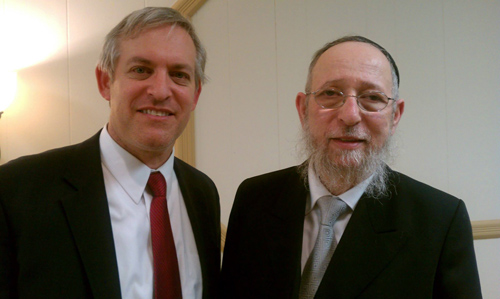
I mention R. Felder since I have very fond memories of a Shabbat I spent as scholar-in-residence in his shul not long before his untimely passing. I was fortunate to be able to spend hours talking with him over that Shabbat, and by telephone afterwards. While people generally knew him as a posek, he was also full of information about great rabbis, many of whom he knew personally, and he was happy to share this information. Here is a picture of us together.
One of the interesting things I learnt from speaking to him was that he had semichah from R. Shlomo Yosef Zevin. I think this is very unusual as I have never met anyone else who received semichah from R. Zevin. This connection to R. Zevin probably explained something else that happened over the Shabbat which was also very unusual. On Shabbat morning R. Felder spoke. Usually, when there is a scholar-in-residence the rabbi does not speak, but R. Felder had something he wanted to say. He devoted most of the derashah, which dealt with the importance of truth, to my post here on ArtScroll’s censorship of R. Zevin’s Ha-Moadim ba-Halakhah. Having a derashah focus on a Seforim Blog post was certainly a new one for me. In the derashah, R. Felder mentioned that when he first learnt of the censorship years ago, he told Rabbi Meir Zlotowitz that what ArtScroll did was completely wrong, and that while they are entitled to disagree with what R. Zevin wrote, they had no right alter his words.
To Be Continued
2. This past year we were told that it was Agudath Israel of America’s 93rd convention. This convention was significant as the Agudah finally threw in the towel and accepted the internet, setting up a website for the convention and broadcasting live. See here. The Agudah now has its own website here.
This new policy came in through the back door, with no explanation as to why something that until now has been forbidden is now permitted. This was typical for the Agudah, and years from now we will probably be able to read in the official history of Agudath Israel of America how the Agudah was among the first to recognize the great value of the internet for spreading Torah, and how the Agudah immediately seized this opportunity. Also of interest is that although the website just mentioned is the official Agudah website, and reports on all that is going on with Agudath Israel of America, it is called the Lefkowitz Leadership Initiative. Yet as anyone who examines the website can see, the Lefkowitz Leadership Initiative is only a small part of the website. Apparently, there is still a problem with calling the Agudah website by its proper name so they had to use a bit of false advertising by referring to it as the Lefkowitz Leadership Initiative.
What about the “93rd convention”? This would mean that the first Agudath Israel of America convention was in 1923 (as we are speaking about annual conventions). How is this possible if Agudath Israel in America was not formed until 1939 and its first convention was held on July 9-11, 1939?[14] See here for a 1950 news report which speaks of the 28th annual convention. This would mean that the first convention was indeed in 1923. Yet see here for a 1947 news report that speaks of Agudah’s 9th annual convention. This would mean that the first convention was in 1939, which is indeed correct. In years prior to 1947 the reports of the Agudah conventions also give 1939 as the year of the first convention.
So what happened between 1947 and 1950 and how did the Agudah start portraying itself as having conventions before Agudath Israel of America even existed? Rabbi Moshe Kolodny, the Agudah archivist, informed me that the 93rd year is a commemoration of the founding of the American branch of the World Agudat Israel on July 20, 1921. (As already mentioned, Agudah Israel of America was itself not founded until 1939). The problem with this explanation is that the 2015 convention should then be the 95th convention, not the 93rd. This is quite apart from the fact that I don’t understand how the Agudah can speak of 93 conventions when until 1939 there weren’t any annual conventions for Agudath Israel of America.
1923 as a year is significant in Agudah history, as it is the year when the first World Agudath Israel convention took place in Vienna. This is the convention from which we have the recently discovered video of the Chafetz Chaim. What I think happened is that between 1947 and 1950 some Agudah functionary decided that the annual Agudath Israel of America convention should be tied to 1923, and that is why this year’s convention was called the 93rd convention. The problem with this is, as mentioned, not only that Agudah Israel of America has not had 93 conventions, but that even if you date the conventions to 1923, you still don’t get 93 conventions. I say this because while the first world Agudah convention was held in 1923, this was not a yearly event. The next world convention was not held until 1929.
I have told this to a number of people and they are all surprised. Yet I find it hard to believe that I am the first person to point out that there have not been 93 annual conventions. Maybe some of the readers who attended the convention can weigh in. Can it really be that no one in attendance realized the problem involved in advertising it as the 93rd convention?
I realize that next year when the Agudah announces its 94th convention, opponents of the Agudah will, based on this post, write about how 94 is an incorrect number. But the more important point is that the Agudah actually has an annual convention. Mizrachi used to have an annual convention, but it is no more. Isn’t it significant that the Modern Orthodox have nothing to equal the annual Agudah convention?
3. A couple of months ago I was speaking to two people and one of them asked me why, if the right wing is so opposed to Open Orthodoxy, that they don’t just put its leaders in herem. I replied that in today’s day and age we don’t find anyone being put in herem. They will put books in herem but not individuals, as we saw with R. Nathan Kamenetsky and R. Natan Slifkin. Why don’t they put people in herem anymore? The answer usually given is that no one will pay attention to the herem.[15] Yet people don’t pay attention to the herems on books either, and that hasn’t stopped them from banning books.
In the discussion one of the people said that if they would put a herem on the leaders of Open Orthodoxy, they would have to also to put a herem on some women, and this would never work.  As he put it, the negative publicity would be too much, as the rabbis would be portrayed as big bullies coming after defenseless women. I have no idea if this is the reason why they haven’t put a herem on the Open Orthodox leadership, but I have to confess that I had never thought of the female angle. It probably is the case that putting women in herem would create a public relations nightmare that would equal what we have seen with the sexual abuse cover-ups and the declarations that basic historical and scientific knowledge is to be regarded as heresy. (In fact, I think that even putting men in herem in this day and age would lead to a big backlash.) That then got me thinking, how often in Jewish history have women been put in herem? I am only aware of the following cases: one in the Talmud,[16] two others discussed by R. David Ibn Zimra[17] and R. Meir Katzenellenbogen[18] respectively, and another two separate cases that involved many Italian rabbis.[19] Yet there must be others.
4. As I write this post, Yosef Mizrachi is in the news. It began with his unbelievably ignorant comments about the Holocaust and soon moved into other outrageous things he said, both about the Holocaust and in general.[20] Years ago I found another really offensive comment about the Holocaust, yet in this case the author was actually a well-known posek. In seeking to explain why the Holocaust occurred, R. Ovadiah Hadaya writes as follows, in words that sound like they could have been said by Mizrachi:[21]
לפעמים יש הרבה ממזרים בישראל שלא ידועים ואז הקב”ה מוכרח למחותם וכדי שלא יתביישו משפחתם אז הקב”ה נותן רשות למשחית להרוג גם טובים עמהם בכדי שלא יורגשו מי הם הממזרים.
Just think about the implications of this statement. 6 million pure Jewish souls, including 1 million children, are destroyed, and R. Hadaya suggests this was done to get rid of the mamzerim. Furthermore, in order not to embarrass the families of the mamzerim all the rest had to be killed as well, as if the omnipotent God couldn’t come up with some other way to take care of this. I don’t think that this passage can even be called “theodicy”, as theodicy is the defense of God’s goodness and omnipotence in the face of evil. The theology of this passage, if accepted as true, would actually lead people to doubt God’s goodness and omnipotence.
One day, not long after I found this passage, I was in the National Library of Israel reading room, and there, as usual, was Prof. David Weiss Halivni. I was very comfortable talking with him, but I wasn’t sure if I should tell him about what R. Hadaya said. I thought it might really unsettle him, seeing how a rabbi could give this explanation as to why all his loved ones were slaughtered in the most cruel way. In the end, I decided to share it with him. All Prof. Halivni said, and this is applicable to Mizrachi as well, is that when it comes to the Holocaust Sephardim simply don’t get it. What he meant was that not having the personal connection to the Holocaust, their discussions of it are without the emotional intensity one finds in the Ashkenazic world. In the Ashkenazic world, detached explanations of the sort offered by R. Hadaya and Mizrachi would be too offensive to even consider.
[1] Brian Pullan, The Jews of Europe and the Inquisition of Venice, 1550-1670 (London, 1997),  p. 100.
[2] If one looks at the attacks that have been made on Open Orthodoxy by Rabbi Gordimer and others, you will find the Open Orthodox placed together with Early Christians, Sadducees, Reform, and Conservative Jews. A friend commented that it is a wonder that they aren’t also compared to Sabbateans. I replied that this is probably only because the attackers are unaware of the fact that Shabbetai Zvi gave women aliyot, a step that Gershom Scholem describes as the “substitution of a messianic Judaism for the traditional and imperfect one.” See Sabbatai Zvi, p. 403.
[3] Shemonah Kevatzim 2:99.          
[4] It would be interesting to create a list of books removed from synagogue libraries for heresy or other reasons. When I was in yeshiva in Israel (and some of my classmates will probably remember this episode), Rabbi Alfred Kolatch’s Second Jewish Book of Why popped up in the beit midrash. This volume, and the others in Kolatch’s series, were extremely popular and sold more than 1.5 million copies. See here. Kolatch was a Yeshiva College graduate but he was ordained at the Jewish Theological Seminary. One of the teachers at the yeshiva insisted on having the book removed because the author was a Conservative rabbi. This teacher also wanted to show that Kolatch was an ignoramus. He pointed to a passage, p. 294, where Kolatch discusses why women are not obligated in tzitzit. Kolatch mentions that most assume that it is a mitzvat aseh she-ha-zeman gerama. He also offers another option, that in ancient times the four-cornered type of garment to which tzitzit were attached was a male garment, so women never adopted the practice of tzitzit. The teacher mocked the notion that tzitzit had anything to do with a male garment, and was adamant that the only reason women do not wear tzitzit is because it is a time-bound positive commandment. Unbeknownst to the teacher, and I didn’t feel comfortable mentioning it to him at the time as I thought he might not take it well after making such a public case against Kolatch, Targum Pseudo-Jonathan includes tzitzit (and tefillin) as male garments which women are forbidden to wear. See Targum Ps. Jonathan, Deut. 22:5.
[5] This book was called to my attention by Michael Steel.
[6] It is true that observant Jews place older people on a pedestal. Sometimes they may even go too far. R. Solomon Kluger, one of the most outstanding nineteenth-century poskim, has a passage that is very difficult to understand. It appears in his commentary on the Shulhan Arukh, Hokhmat Shlomo, Hoshen Mishpat 426.
According to R. Kluger, if one has to put oneself in a degrading situation or if it requires too much effort to save the life of another, then one doesn’t have to do it. In giving an example of טרחה יתרה he mentions an old person, who according to R. Kluger would not be obligated to trouble himself excessively to save the life of another. Many have discussed this strange passage (and surprisingly, a number of the discussions do not note that at the end R. Kluger appears to backtrack from his hiddush). R. Moshe Feinstein, Iggerot Moshe, Yoreh Deah 2, p. 290, uses the following very strong language regarding R. Kluger’s suggestion:
הוא טעות גמור ושרי להו מרייהו, דדברי חכמת שלמה הא ודאי ח”ו לאומרם.
As we have come to expect, at least one scholar questioned the authenticity of R. Kluger’s words, a phenomenon we find whenever a radical position is expressed. But in this case the scholar I am referring to is the great R. Reuven Margaliyot who should have known better. He writes (Nefesh Hayah, 13:3):
והנה על כגון דא בוודאי אמרו דחדש אסור מן התורה ותמה אני אם יצאו דברים הללו מפיו הקדוש.
When I first saw R. Kluger’s words, I thought of R. Moses Isserles, Shulhan Arukh Yoreh Deah 251:9:
ואפילו חכם לכסות ועם הארץ להחיות [החכם קודם] ואשת חבירו כחבר.
Many understand להחיות to mean literally to save from death. I think most will offer a sigh of relief that the Shakh writes:
בזמן הזה שאין תלמיד חכם . . . כל שכן דאין לדחות פקוח נפש מפניו.
[7] Contrast what appears in Kaplan’s book with what R. Ahron Soloveichik wrote:

Every human being, regardless of religion, race, origin, or creed, is endowed with divine dignity. Consequently all people are to be treated with equal respect and dignity.  

Anyone who fails to apply a uniform standard of mishpat, justice, tzedek, righteousness, to all human beings regardless of origin, color or creed is deemed barbaric.  

People who refuse to grant any human being the same respect that they offer to their own race or nationality are adopting a barbaric attitude.

The quotations all come from R. Soloveichik’s Logic of the Heart, Logic of the Mind (Jerusalem, 1991), and are discussed in Meir Soloveichik’s recent essay, “Founding Brothers”: The Rav, Rav Ahron, and the American Idea,” in Soloveichik, et al., eds., Torah and Western Thought: Intellectual Portraits of Orthodoxy and Modernity (New Milford, CT, 2015), pp. 96ff.
Torah and Western Thought is quite an interesting book and I highly recommend it. It also contains essays on R. Kook, R. Isaac Herzog, Nehama Leibowitz, R. Immanuel Jakobovits, R. Yehuda Amital, R. Aharon Lichtenstein, R. Norman Lamm, and Prof. Isadore Twersky. For obvious reasons the essay on Twersky, written by Carmi Horowitz, was of particular interest to me, and I was very happy to read, p. 258 n. 26, that Rabbi David Shapiro “is now editing and preparing for publication more than twenty years of Rabbi Twersky’s divrei Torah delivered at the Talner Beit Midrash.”
[8] As long ago as 1819, Leopold Zunz wrote about “the persistent delusion, contrary to law, that it is permissible to cheat non-Jews.” See Amos Elon, The Pity of It All: A Portrait of the Germany-Jewish Epoch, 1743-1933 (New York, 2002),  p. 113. In an earlier post here I wrote:

Isn’t all the stress on following dina de-malchuta revealing? Why can’t people simply be told to do the right thing because it is the right thing? Why does it have to be anchored in halakhah, and especially in dina de-malchuta? Once this sort of thing becomes a requirement because of halakhah, instead of arising from basic ethics, then there are 101 loopholes that people can find, and all sorts of heterim.

After writing this I heard R. Jeremy Wieder’s shiur on the topic of dina de-malchuta dina (available here) and he makes some very similar points.

[9] This is a mistake. It is not Hashem (with a capital “H”, implying “God”) but hashem (or ha-shem). I.e., it is not a desecration of God but of His name. Thus, one should writeחילול השם  not חילול ה’. See Lev. 22:32: ולא תחללו את שם קדשי. Nissim Dana titled his 1989 translation of one of R. Abraham Maimonides’ works ספר המספיק לעובדי השם. Yet the last two words should be ‘לעובדי ה.
Regarding the use the “Hashem”, I found something very confusing in the ArtScroll Stone Chumash. In place of the Tetragrammaton, ArtScroll does not use the word “Lord” but “HASHEM”, as this is how people pronounce the Tetragrammaton. While ArtScroll is the first translation to adopt this approach, it does have a certain logic. However, this logic breaks down a few times on p. 319 when the ArtScroll commentary attempts to explain what occurs at the beginning of parashat Va-Era. For example, “Or HaChaim comments that God’s essence is represented by the name HASHEM.” This makes no sense, as there is no name HASHEM. The commentary should have written that “God’s essence is represented by the four letter name of God.”
[10] “Digital Orthodoxy: The Making and Unmaking of a Lifestyle,” in Yehuda Sarna, ed., Developing a Jewish Perspective on Culture (New York, 2014), pp. 280-281.
[11] Community, Covenant and Commitment, ed. N. Helfgot (Jersey City, 2005), pp. 24-25. See also The Rav Speaks (Brooklyn, 2002), pp. 49-50: “I once said that there exists problems for which one cannot find a clear-cut decision in the Shulchan Aruch (code of Jewish law); one has to decide intuitively.” For another example where we see that R. Soloveitchik did not operate as Halakhic Man, see R. Menachem Genack, “My First Year in the Rav’s Shiur,” in Zev Eleff, ed., Mentor of Generations (Jersey City, 2008), p. 171:

I went to be menachem avel [console the mourner] at his home on Hancock Road in Brookline on Shushan Purim. His aveilus on Shushan Purim itself was something of a chiddush: although the Mechaber writes that one should sit shivah on Shushan Purim, the Remah rules that one should not. And Rav Soloveitchik said that, should he be asked to pasken the question, he would follow the opinion of the Remah. But he himself could not do otherwise than sit shivah on that day. Sitting shivah was the only way he could express himself that day – psychologically he could not do otherwise.

It is impossible to imagine that the Rav’s uncle, R. Isaac Zev Soloveitchik, would have ever consciously allowed his emotions to influence how he decided halakhah. See e.g., here where I write: “Another such example of this is the report that when one of R. Velvel’s sons died shortly after birth, and the family was crying, he was insistent that they stop their tears, since there is no avelut before thirty days.”

[12] (Ma’aleh Adumim, 2015), p. 512.                                                           
[13] R. Menahem Azariah of Fano even states that one can ignore a conclusion of R. Samuel Di Medina as he was angry when he wrote a particular responsum. See She’elot u-Teshuvot ha-Rama mi-Fano, no. 109.
                                                                                              
ואין לחוש לדברי הר”ש די מדינה שכתב ההפך מזה, כי נראין הדברים מתוך התשובה שבא לכלל כעס עם אחד העם שהיה מנהיג כך והוא מוחזק בעיניו שהיה עושה כן להתיהר ושלא לש”ש.
On the other hand, see here for the following story told by R. Eliezer Melamed in which R. Zvi Yehudah Kook turns his father into a religious robot, completely lacking any natural emotion.
פעם ליווה אבי מורי את הרצי”ה בלכתו מהישיבה לביתו, ואז סיפר לו הרצי”ה שלאחר פטירת הרב חיים עוזר גרודז’ינסקי מוילנא, קיימו לזכרו אזכרה בירושלים. אחד הספדנים אמר בתוך דבריו, שאצל רבי חיים עוזר האהבה לישראל לא קלקלה את השורה, והוא אהב את מי שצריך לאהוב. ומתוך דבריו נרמזה ביקורת על מרן הרב קוק, שנפטר שנים ספורות לפני כן, שכביכול אצלו האהבה קלקלה את השורה. דברים אלו ציערו וקוממו את הרצי”ה. זמן לא רב אח”כ התקיימה האזכרה השנתית של מרן הרב קוק, ואז הזכיר הרצי”ה את המשנה בברכות (לג, ב): “האומר על קן ציפור יגיעו רחמיך . . . משתקין אותו”. וזאת משום שהוא תופס את מידותיו של הקב”ה כאילו יש בהן חולשה אנושית של רחמנות שחורגת ממידת הדין והצדק, ואילו האמת היא שגם רחמיו של הקב”ה הם גזרות מדויקות. וכך הוסיף הרצי”ה: הצדיקים הגדולים ההולכים בדרכי ה’, הרחמים שלהם ואהבת ישראל שלהם אינם רגש אנושי שסובל מחולשה וטעות, אלא הם גזרות הנובעות מעומקה של תורה. וכל מי שאומר על הצדיקים שמידותיהם רחמים – “משתקין אותו”! וכך חזר כמה פעמים ואמר כלפי אותו ספדן “משתקין אותו”!
[14] For the founding of Agudath Israel of America and its first convention, see Aharon Rakeffet-Rothkoff, The Silver Era in American Jewish Orthodoxy (Jerusalem/New York, 2000), pp. 162-163.
[15] If they started putting individuals in herem, one of the questions that would be raised is does the banned person’s spouse and children also have to abide by the herem. It is hard to see how a couple could remain married if that was the case. This matter is actually discussed by R. Solomon ben Adret, She’elot u-Teshuvot ha-Rashba ha-Meyuhasot le-Ramban, no. 266. He informs us that R. Abraham ben David (Rabad) did not think that a wife has to observe the herem (we don’t know what he thought about the children). However, the Rashba disagrees and states the wife is indeed obligated to observe the herem.
[16] Nedarim 50b.
[17] She’elot u-Teshuvot ha-Radbaz, vol. 7, no. 50.
[18] See She’elot u-Teshuvot Maharam mi-Padua, no. 73.
[19] See Yakob Boksenboim, ed., Parashiyot me-Havai Yehudei Italyah ba-Meah ha-16 (Tel Aviv, 1986), pp. 29ff.; Nahum Rakover, “Shikulim be-Anishah: Hatalat Ones ke-she-ha-Avaryan Alul la-Tzet le-Tarbut Ra’ah o le-Hishtamed,” in Yitzhak Alfasi, ed., Ha-Ma’a lot li-Shelomo (n.p., 1995), pp. 367ff.
[20] R. Amnon Yitzhak actually spoke about Mizrachi’s statement before anyone else (someone obviously fed it to him). This youtube video was put up on October 25, 2015, two months before Mizrachi’s statement became an international scandal.

After the controversy broke, I looked around a bit and found that from a religious standpoint, Mizrachi has said something regarding the Holocaust that is much worse than what he was called to task over, as his comment defames many great rabbis. In the video below he has the chutzpah to think that he knows why so many tzadikim were killed in the Holocaust. He explains – I hope you are sitting down –  that they were not really complete tzadikim, and he identifies their supposed flaw. On the other hand, he states that the complete tzadikim were saved (and he makes the ridiculous statement that R. Aaron Kotler was a kiruv activist in Europe). Has anyone before Mizrachi ever made the appalling statement that survival of the Holocaust is proof that Rabbi X was more righteous than Rabbi Y who was murdered?

Contrast what Mizrachi said with what R. Jehiel Jacob Weinberg, a survivor of the Holocaust, said (Seridei Esh, vol. 1, p. 1):
רעדה תאחזני ובושה תכסה את פני לבוא ולספר על הנסים והנפלאות שנעשו עם אזוב קטן כמוני, אשר לא אדע במה לתלות נס-הצלתי, בוודאי לא מזכות יתירה, אלא ממיעוט זכות להמנות בין מקדשי השם הגדול והנורא
The only explanation R. Weinberg could give as to why he was miraculously saved was that he was not worthy enough to die al kiddush ha-shem.
In my Torah in Motion classes on R. Elchanan Wasserman I discuss the false claim that R. Elchanan returned to Europe “to die with his students.” I don’t know how this yeshiva myth arose. R. Elchanan left the United States in March 1939, more than five months before the German invasion of Poland. He didn’t know what was coming and would never have returned to Poland if he did. (R. Elchanan’s son, R. Simcha Wasserman, is reported to have made this exact point. See R. Ari Kahn’s post here.)

[21] Yaskil Avdi, vol. 8, p. 200. R. Hadaya was also a kabbalist but surprisingly he makes an obvious mistake, ibid., p. 97, as pointed out by R. Meir Mazuz in his just published Darkhei ha-Limud, p. 7. R. Chaim Vital, Sha’ar ha-Gilgulim, hakdamah 34, states:
והנה משה תחילה היה הבל בן אדם הראשון ואח”כ נתגלגל בשת ואח”כ בנח ואח”כ בשם בן נח
R. Hadaya writes:
הרי לך דעם שמשה היה אחרי כמה מאות שנים, מזמן הבל ושת ונח ובנו שם, עכ”ז נתגלגל בהם
According to R. Hadaya, what R. Vital is saying is that Moses was reincarnated into Abel, and then into Seth, Noah, and Shem, even though Moses lived many years after them. This would be a great mystery if R. Vital had said it, since how could a person be reincarnated into someone who lived before him? Yet this is not what R. Vital said. If you look at the quotation from Sha’ar ha-Gilgulim you can see that its point is that Abel was reincarnated as Seth, and then Noah, and then Shem, and in the end came Moses.


Leket Yosher – A Closer Appraisal in Light of a Recent Controversy

In a recent discussion in the journal Or Yisrael concerning the permissibility of using ArtScroll gemaras — for PDFs of the articles, see here — one source deserves closer scrutiny. In particular, some authorities who are against the use of ArtScroll gemaras cite to a passage in the Leket Yosher in support of their opinion. Thus, an examination of the Leket Yosher is appropriate.

The Leket Yosher was compiled by R. Yosef ben Moshe (1423-c.1490), a student of R. Israel Isserlein (1390-1460), the author of the Terumat HaDeshen. The Leket Yosher records R. Isserlein’s customs and rulings. The Leket Yosher was the first work to base itself on the four part division of the Turim, however, only the sections on Orach Hayyim and Yoreh Deah are extant. While it appears that there was a third part on Even haEzer which is no longer extant, it is unclear whether there ever was a part on Hoshen Mishpat. [1] Leket Yosher [2] was not published until 1903 (Orach Hayyim; and in 1904 Yoreh Deah was published) by R. Ya’akov Freimann from Munich manuscript in R. Yosef’s own hand.[3] It has been published at least three times and today is typically available as part of a set of three minhagim works, Leket Yosher, Yosef Ometz and Noheg KaTzon Yosef.

The passage used by some in the discussion in Or Yisrael regarding ArtScroll, records the disapproval of R. Isserlein of the practice of “spoiled, rich kids” who used a revolving table to avoid having to get up and get a book. (vol. 2, p. 39). The passage reads in full:

“אותם הבחורים העשירים המפונקים שעשו להם שולחנות כשיושבין במקומן הופכין השולחן לאי זה צד שירצו ועליו הרבה ספרים לא טוב הם עושים, אדרבה כשמבקש אחר הספר ובא לו בטורח גודל זכור באותו מעשה מה שרוצה ללמוד, כמדומה לי שמצאתי לו סמך ב[יורה דעה] בסימן ג’ (שפח) ‘ולא כאלו שלומדין מתוך עידון’ וכו”

“Those rich, spoiled students that had made a revolving table which allowed for them to turn the table to get which ever book they wanted [without having to get up] such behavior is inappropriate. Instead, one who gets up to get a book and exerts themselves will remember that they had to look for the book [and will remember what the book said]. It seems to me [R. Yosef] that support for this position [that frowns upon the turntable] can be found in Yoreh Deah where it says “one should not study in luxury.'”

Thus, argue those you compare the turntable to ArtScroll Talmuds, Torah study should not be easy, and one should struggle in preforming that commandment. In other words, because studying with Talmud with an ArtScroll is easy, it is inappropriate for Torah study. As an initial matter, the comparison is somewhat strained in that the Leket Yosher is referring to those who are lazy and does not necessarily speak to someone who uses ArtScroll because they cannot otherwise study gemara (or the additional commentaries that ArtScroll provides) at all. But setting aside this difficulty, it does not appear that the Leket Yosher’s opinion in this regard is agreed upon by all. For example, R. Yitzchak Hutner, in his approbation to the Otzar Mifarshei HaTalmud, explains why the Otzar is a good thing. As many are aware, the Otzar collects all (or almost all) the literature on a particular passage of the gemara (or mishna as is the case with the volume on Hallah). This avoids the need to look through many books to see what, if anything, they have to say on a particular passage. R. Hutner cites to a statement from the Hazon Ish, that “people confuse looking (hipush) with study” and, according to R. Hutner, the Otzar eliminates that problem. Thus, it can be argued that both according to R. Hutner and the Hazon Ish, there is no benefit or merit per se in the act of getting a book or looking to see if that book has anything relevant. This appears in conflict with the Leket Yosher.

Similarly, when the Vilna Shas was printed many years ago, the story goes that the printers said that whoever finds a mistake in this heavily invested shas will get rewarded. In the excellent book, Derech Etz Chaim (p. 568) about R’ Isser Zalman Meltzer, they record a story that a printer of a current Yerushalmi visited the Steipler with the idea to print a Yerushalmi in a similar format to the Talmud Bavli and to have, amongst other things, many commentaries in the back. When the Steipler heard this, he said that R. Meltzer used to complain that there’s a very big printing mistake in the Vilna Shas. Specifically, that in the Vilna Shas many commentaries in the back, but each commentary is 3 pages so you have to look 50 times for the same thing. R Isser Zalman wanted that they should put it in order of the Blatt, so he recommended that they not make the same mistake and do the same for the Talmud Yerushalmi.[4]

Setting aside R. Hutner and Hazon Ish, what is worthwhile to point out is the passage immediately preceding the above quoted passage in the Leket Yosher. The Leket Yosher records the following question and answer:
“ושאלתי לו קטן שהולך בדרך לא טובה כגון משכב זכר ועובר על לאו לא תגנוב אם מותר ללמדו תורה ואמר הן”

“And I asked [R. Isserlein] a student who sin, with sins such as homosexuality or stealing should they be taught Torah? Answer, Yes.”
To be clear, the the Leket Yosher allows for the teaching of homosexual students. Now, obviously this passage, although immediately preceding the discussion about the revolving table, is not germane to the later topic, but I have never seen this passage quoted anywhere else, even though it appears to be espousing a fairly unique position both in the realm of Jewish education and attitudes towards homosexuality. [I have been informed that it is mentioned in R. M. Ashkenazi, Hilkhot Talmud Torah, however, even so it is not well-known by any definition.]
Since we are on the topic of the Leket Yosher it is also worthwhile to point out some of the other interesting observations related to the Leket Yosher. Perhaps the most important fact to come from the Leket Yosher is that the assumption, first espoused by the Taz and expanded upon by others, that the Terumat HaDeshen was not the product of actual questions and answers and instead R. Isserlein made up the questions himself and therefore, according to some, the Terumat HaDeshen is not authoritative. As R. Freimann demonstrates, however, this is incorrect. Instead, actual events as recorded in the Leket Yosher can be matched with teshuvot in the Terumat HaDeshen thus demonstrating that the questions in Terumat HaDeshen were based upon actual events and were not fabricated.[5]

Perversely, the criticism of the Terumat HaDeshen was turned on its head and applied to the Leket Yosher. Specifically, the Sanzer Rebbi in his Divrei Yatziv (E.A. 39), claims that one cannot rely upon the Leket Yosher as it records actual events and one cannot decide halakha from events. This is inapposite of those who complain that the Terumat HaDeshen is not reliable because the questions do not relate to real events. It appears that the position of the Sanzer Rebbi has not been accepted as R. Moshe Feinstein (which is especially noteworthy in light of his general disapproval of newly discovered works), R. Ovadiah Yosef, Daayan Weiss, R. Shlomo Zalman Auerbach and many others all cite with approval the Leket Yosher. Moreover, the Sanzer Rebbi himself is at least five other places[6] in Divrei Yatziv cites with approval the Leket Yosher. In only one other instance does he couch his citation of the Leket Yosher (E.A. 78) with a disclaimer “that is is unclear whether the Leket Yosher is reliable.”

Other interesting comments in the Leket Yosher include: R. Yosef, in 1456, records that he saw Halley’s Comet [7] (vol. 2, pp. 17-8), R. Isserlein used to tell Torah riddles on the first days of Pesach and Shavous and Purim (vol. 1, pp. 103-4), R. Isserlein’s daughter-in-law, Redel, studied Torah (vol. 2, p. 37), and the restriction against walking behind a woman is no longer applicable (id.).

Notes:

[1] See Freimann’s introduction XIII. Friemann’s introduction appears at the beginning of volume two on Yoreh Deah. The first volume, on Orach Hayyim has no introduction.

[2] Aside from being unique in it use of the Turim’s division, the Leket Yosher, has another unique attribute. As Professor Y.S. Spiegel has pointed out the title employed, Leket Yosher, hints not only to the authors own name (as is a a somewhat common practice – see Spiegel for more on this practice) but also to R. Yosef’s teacher, R. Isserlein as well. Specifically, the numerical value of Leket Yosher and is ישראל יוזלין Yisrael is for R. Isserlein Yozlin is for Yosef. See, Y.S. Spiegel, Toldot Sefer haIvrei, vol. 2 p. 411.

[3] For additional biographical and bibliographical information see generally Freimann’s introduction. For some reason neither R. M.M. Kasher in Sa’arei HaElef or Glick in Kuntres HaTeshuvot HaHadash or in the earlier version by Boaz Cohen has an entry for Leket Yosher.

[4] It is, however, worth pointing out that R. Isser Zalman Meltzer held that part of ameilus batorah is getting up a taking a sefer out of the bookshelf. Thus he would never allow anyone to get him a sefer. He would get it himself. According to R’ Shach explained that there were 2 reasons for this. One is because he didn’t want anyone to help him, and two because of his ameilus batorah.

Likewise, in the same book (p. 181) they record that R. Aharon Kotler uses the Gemara in Menochot where Avumy forgot something that he said. He turned to his talmid R. Chisda to remind him how he explained a certain topic. The gemara asks why he didn’t send his talmid to come to him. Rashi says that it’s because of yegata u’motzasa (he worked and he found). R’ Aharon deduces that going yourself is part of the learning.

In an effort to avoid having to get up to get books R. Teichtel writes to his father R. Yissachar Teichtel, author of Am habonim Semacha, that when R. Yissachar visited R. Menachem Zemba, he had sitting on the table in front of him, a gemara with Rambam and all of chazal so that way he wouldn’t have to waste time and get up every time he needed to look up something. (letters in Tal Talpios, mentioned here, on page 44).

R. Meir Bar-Ilan, in a beautiful chapter of his classic MiVolozhin l’Yerushalayim (p. 269), in describing how his uncle, the R. Yechiel Michel Epstein, author of the Arukh HaShulhan, wrote his work said that R. Epstein also had a Rambam, shas and Shulchan Orach on the table and reference everything without having to move.

[5] See id. at XIV and id. note 40 discussing those who make the claim that the Terumat HaDeshen was not addressing actual cases and thus cannot be relied upon and specific statements in Leket Yosher that connect to the Terumat HaDeshen. R. Freimann discussed most of the literature on this topic only a few further cites should be added. To wit, Y.A. Dinari, Hakhme Ashkenaz be-Shelei Yemi HaBenayim, Jerusalem, 1984, pp. 303-5; Zevin, Soferim veSeforim, vol. Teshuvos, p. 14; R. P. Horowitz, Sefer HaBrit, p. 162, discussing the phenomenon of fictional responsa.

See also the comments of R. Munk in Pa’as Sadecha, who specifically rejects the notion that the Leket Yosher is not a reliable work. Instead, R. Munk states that the Leket Yosher was written with extreme care and can be relied upon.

In the newest edition of the Terumat HaDeshen, edited by Shmuel Avitan (Jerusalem, 1991), the editor is completely dismissive of R. Freimann. Although Avitan neither mentions Freimann by name nor explains why Freimann is wrong. This attitude is particularly striking in that R. Freimann devotes some 50 pages to an extensive and well documented introduction of the Leket Yosher as well as related topics. Avitan, on the other hand, is satisfied with a two page introduction that adds almost nothing to either the Terumat HaDeshen the work or R. Isserlein the person and in fact borrows heavily, many times without citation, from R. Freimann’s introduction. [It appears Avitan was not even aware of Dinari’s work.] For example, Avitan deals with when R. Isserlein refers to “one of the great ones – אחד מהגדולים” if R. Isserlein is referring exclusively to the Maharil. Freimann was the first to demonstrate that this reference is not exclusive to the Maharil. Avitan, also comes to the very same conclusion, without mentioning Freimann or even as Avitan is wont, “the introduction to the Leket Yosher.”

Aside from claiming that the responsa are fictional, others have made a distinction between the “teshuvot” and the “pesakim” of R. Isserlein. See Dinari, Hakhme Ashkenaz, p. 303-4 n. 223.

[6] Divrei Yatziv Orach Hayyim nos. 179, 236, 295, 297; Yoreh Deah 31.

[7] For a later mention of seeing a comet see Glikel Zikhronot, ed. C. Turnyanski, Jerusalem, 2006, p. 605 n. 314.


Do you recall Hrubieszow? Hrubieszow, Home to an Active Early Nineteenth Century Hebrew Press

Do you recall Hrubieszow?

Hrubieszow, Home to an Active Early Nineteenth Century Hebrew Press[1]

Marvin J. Heller

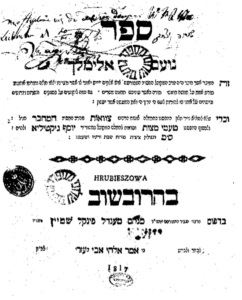
A barely remembered Hebrew press, one credited with as many as forty books, although that number is uncertain, was active in Hrubieszow (Hrubyesho), Lublin district, in southeastern, Poland from 1816 to1821 and then intermittently until 1827. The variance in the number of titles printed may be attributed to the manner in which books are recorded, some titles being a composite of three works. In some instances, the town or the printers’ names are omitted from the title-page due to censorship or book tariff payment. The books published by the press are relatively small varied books, designed to meet the community’s needs and interests. The first works printed include several Yiddish titles. Most of the books are small format, ranging from duodecimo (120) through quarto (40) formats. The article describes a small portion of the Hrubieszow imprints to give a sense of the press’s publications, their variety, indicative of the community and how, through their books, the press served it. The selected works are generally of a scholarly and specialized nature, primarily Hasidic works on the weekly parasha (Torah reading), ethical, and halachic tomes, although varied within each category. These works reflect both the composition and interests of the community.

A barely remembered Hebrew press, one that is credited by the Thesaurus of the Hebrew Book with as many as forty books in the early nineteenth century, was active in Hrubieszow (Hrubyesho), Lublin district, in southeastern, Poland.[2] Jewish presence in Hrubieszow dates to the first half of the fifteenth century, Jews being recorded there as tax farmers and merchants, doing business in such diverse areas as Walachia, Turkey, the Crimea, and Kiev.

In the 10th century, the Hrubieszow district had been part of the Polish state. In 981, however, it was seized by the Kievan Rus’, subsequently changing hands several times, even falling to the Mongol Empire in the mid-13th century. Even earlier, the founding of Hrubieszow dates to the early Middle Ages when there was a defensive ‘gord’ (a medieval Slavonic fortified settlement) on the Huczwa river island. Hrubieszow is mentioned as early as 1254, as a hunting settlement amid forests. In 1366, Hrubieszow, then known as Rubieszów, was recaptured by King Casimir III the Great, again becoming part of the Kingdom of Poland (see banner of early Polish monarchy, right). In about 1400, the town received a charter from Polish king, Władysław II Jagiełło. Hrubieszow (Rubieszów) was destroyed several times by Crimean Tatars, who raided the area in the 15th, 16th and 17th centuries, and by rebellious Cossacks.

In 1772, After the First Partition of Poland, Hrubieszow was annexed by Austria. In 1800, Stanisław Staszic founded the Hrubieszow Agricultural Society, the first cooperative organization in Europe, which existed until 1945. In 1802, the name Rubieszów was changed to Hrubieszow, the name by which it is known today. Seven years later, in 1809, after the Austro-Polish War, Hrubieszow became part of the short-lived Polish Duchy of Warsaw, subsequently becoming, in 1815, by the Congress of Vienna ,part of the Russian-controlled Congress Poland, within the Lublin Governorate.[3]

As noted above, Jews were active in Hrubieszow from the first half of the fifteenth century. At some point in that century, Jews in Hrubieszow received several privileges for wine trade and management of the town tax chamber. By 1551, thirteen Jewish residents occupied four houses, that number rising to 40 Jews living in 5 houses by 1560. That number continued to increase, so that from the 18th century until the beginning of the 20th century Jews comprised a considerable majority of Hrubieszow’s population, controlling trade, industry, and craft. In 1578, King Stephen Bahory granted the Jews in Hrubieszów extensive rights. Less than a century afterwards, during tah-ve-tat (the Chmielnicki massacres of 1648-49), the Jewish community was almost entirely destroyed. Soon afterwards, however, the Jewish community was reestablished – a yeshivah was opened, headed by R. Isaac ben Judah Charif. Hrubieszow would subsequently be home to a number of prominent rabbis and became influential in the Arba’ah Artzot (Council of the Four Lands).[4] In the 18th century the Hasidic movement became active in Hrubieszow, the city becoming a center of Berdichev Hasidism. Among its leaders was R. Joseph ben Mordecai Katzenelboigen (R. Mordechai of Neszhchiz), who relocated there in the 1790s.[5]

We now turn to our subject, Hebrew printing in Hrubieszow. As noted above, the Hrubieszow press is credited by the Thesaurus with as many as forty titles, although that number may be uncertain; in contrast, Avraham Yaari records only thirty-four titles for Hrubieszow.[6] Those works are relatively small varied books, designed to meet the community’s needs and interests, published from 1816 to1821 and then intermittently until 1827. This article will describe a small portion of those works, to give a sense of the press’s publications, their variety, indicative of the community and how, through their books, the press served it. To address a greater number would be tedious for both the reader and the writer.

Dr. N. M. Gelber and Avraham Yaari inform that attempts to establish a Hebrew press in Hrubieszow were made from 1792 through 1804, in the Austrian period, but that the matter was delayed, the privilege to do so not granted. In late 1816, a Hebrew press was established in Hrubieszow, now part of Congress Poland. The founder of the press was R. Menahem Mendel Finkelstein (Finkel Stein). He had partners, namely R. Moses Tzikor and R. Saul Moss Goldstein of Łaszczów. Finkelstein provided the financing, the latter two the necessary skills, being experienced printers, having been partners in the Hebrew press in Łaszczów. Management of the press changed in the following years. Goldstein left the press in 1819, returning to Łaszczów, Finkelstein left the press in 1821, leaving Tzikor in charge. Tzikor then took Solomon ben David as a partner. Eight master printers were employed by the press as compositors and press operators, namely Daniel Ze’ev ben Segal, Baruch Abraham ben David, both from Hrubieszow, Isaac ben David from Łaszczów, Hayyim ben Eliezer from Zhovkva, Israel ben Raphael, Menachem Mendel ben Baruch, Pesach Joseph from Łęczno, and Eliezer Segal, perchance from Hrubieszow.[7]

Printing began shortly after the privilege was granted, the first works being published, including several Yiddish titles. Vinograd records ten titles for 1816-17, beginning with Shir ha-Shirim (1816), Orhot Zaddikim, Gedolus David u-Malchus Shaul, Haggadah shel Pesah, Sefer Hasidim, Lekah Tov, a siddur Tefillas Nehora, Noam Elimelekh, Shivhei ha-Ba’al Shem Tov, and Tanna de-vei-Eliyahu. These are all small format books, ranging from duodecimo (120) through quarto (40) formats. These works are indicative of the variety of the Hrubieszow imprints and the community the press served. For example, R. Judah ben Samuel he-Hasid’s (c. 1150-1217) Sefer Hasidim, an ethical, mystical, and halakhic work; Tanna de-be-Eliyahu is an aggadic midrash attributed to Elijah the prophet as dictated to the third century amora Anan bar Rav: Noam Elimelekh by R. Elimelech of Lizhensk; Shivhei ha-Ba’al Shem Tov, collection of Hasidic tales about the founder of Hasidim, and in contrast to the prior works, Joseph ha-Efrati’s Gedolus David u-Malchus Shaul, a maskilic (enlightened) drama.[8]

Noam Elimelekh – We begin with R. Elimelech ben Eliezer Lippman (Lippa) of Lizhensk’s (1717-87) Noam Elimelekh, a classic and primary Hasidic work, representative of the press’s output and the communities’ interests. R. Elimelech was a student of R. Samuel Smelke Horowitz (Rebbe Reb Shmelke, 1726-78), and afterwards a disciple of R. Dov Baer the Maggid of Mezhirech (1704–72), as well as meeting by the latter R. Levi Yitzhak of Berdichev (c. 1740-1809). After the Maggid’s passing, Elimelech became the acknowledged head of the Hasidic movement and is considered the theoretician and creator of “practical zaddikism.”[9]
Noam Elimelekh was published as a 23 cm. work ([1], 94 ff.) The title-page begins with honorifics of Elimelech of Lizhensk and informs that in order that there should not be blank paper at the beginning of the book and for benefit of the public, they have published the testament of the author (see below), and at the end of the volume is R. Joseph Gikatilla’s Tamei Ha-Mitzvot. Not noted but also at the end of the volume are Likkutei Shoshana and Iggeret ha-Kodesh. The title page is dated with the chronogram “[for he said] the God of my father’s [house] was my help כי אמר אלקי אבי בעזרי (577 = 1817)” (cf. Exodus 18:4). Elimelech’s testament, entitled conduct (הנהגות) of a man is on the verso of the title-page and consists of twenty-one admonitions for a person.
The title-page states that Noam Elimelekh was published at the press of Menahem Mendel Finkelstein. According to Ch. B. Friedberg the references to the publisher on the title-page varies between books. He notes that initially references to the printer stated Menahem Mendel Finkel Stein and associates. Afterwards, however, he does mention the names of his partners.[10]

1817, Noam Elimelekh

The text, a hasidic Torah commentary on the weekly Torah portion, follows. It emphasizes the role of the zaddik in worship and divine service. At the end of the concluding section of the book are two decorative tail-pieces. These tail-pieces, particularly the one on the left, appear on title-pages of several Hrubieszow books.
Noam Elimelekh is a classic Hasidic work. First printed by his son after his death in Lvov 1788, Noam Elimelekh has proven to be an immensely popular work. This, the Hrubieszow printing, is the sixth edition. It is reported that more than 50 editions of Noam Elimelekh have been printed.[11]

Sefer Hasidim – R. Judah ben Samuel he-Hasid’s (c. 1150–1217) Sefer Hasidim, a different but computable work is, as noted above, an ethical, mystical, and halakhic work. Judah was a disciple of his father, R. Samuel (ben Kalonymous) he-Hasid (c. 1120-75) an eminent kabbalist and ascetic; portions of Sefer Hasidim are attributed to Samuel he-Hasid. They are among the most renowned members and leaders of the Hasidei Ashkenaz, the influential Jewish pietist movement in medieval Germany.

It is reported that when Judah’s mother was pregnant with him, she was walking along a path by a bet medrash (Torah study hall) when a wagon came bearing down upon her, with no place to turn, neither to the right nor to the left. Just as she was about to be crushed by the horses’ hoofs, the walls of the bet medrash opened saving her and her son. It is also told that Samuel he-Hasid witnessed the heavens opening; asked what kind of son he wanted, he replied, one of exemplary piety. Judah reputedly hosted the prophet Elijah, was able to revive the dead, and performed miracles, particularly saving Jews from oppressors. He practiced an ascetic form of mysticism, fasting two days for Yom Kippur, throughout the week, eating at night only, and often fasted on Shabbat, claiming that the change would cause him pain, detracting from his pleasure in Shabbat. It was said by a contemporary that if Judah had lived in the times of the prophets he would have been a prophet.
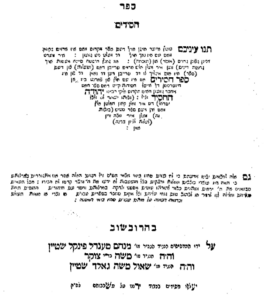
1817, Sefer Hasidim

The title-page of Sefer Hasidim, published is octavo format (80: [64] pp.) is in Yiddish, excepting the names of the printers and the publication date. All of the printers are cited here in bold letters, that is, Menahem Mendel Finkel Stein, Moses Tzikor and Saul Moss Gold Stein. The date in the chronogram, “Let the faithful exult in glory;
let them sing joyously upon their beds יעלזו בכבוד ירננו על משכבותם )577 = 1817).” (Psalms 149:5)

Sefer Hasidim is foremost an ethical manual, practical rather than theoretical, encompassing all aspects of life, including the minutiae of personal, family, and business matters. Numerous examples are cited, containing, considerable information about contemporary Jewish life. Advice is detailed and pragmatic, with the goal of achieving strict adherence to an ethical and pious life. These instructions, often based on kabbalistic teachings, have been influential because of the author’s great piety. Sefer Hasidim is also a mystical work, explaining biblical and talmudic passages.[12]

Gedolus David u-Malchus Shaul – A very different work is Joseph Ha-Efrati of Tropplowitz’s (c. 1770–1804) Gedolus David u-Malchus Shaul, a drama in Yiddish. Among the smallest Hrubieszow imprints, it was printed in duodecimo format (120) 29 ff.
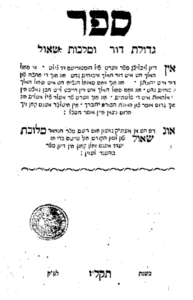
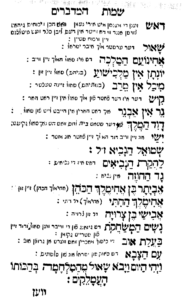
1817, Gedolus David u-Malchus Shaul

The author, born in Tropplowitz, Silesia, was a Hebrew poet, dramatist, and tutor. While working in the last capacity he wrote the first acts of the drama Melukhat Sha’ul from Melukhat Sha’ul completed in Prague in 1793. Gedolus David u-Malchus Shaul is a Yiddish translation, retitled. This version, that is the Yiddish translation, has been described as “part of the traditional Purimshpil (“Purim play”) in many Lithuanian and Polish towns . . . the first modern Hebrew drama of the Haskalah period, is noteworthy for its new egalitarian and humanistic ideas.” In writing Melukhat Sha’ul Ha-Efrati was reputedly influenced by Shakespeare, Goethe, Schiller, and von Haller, as well as M. H. Luzzatto. The primary characters, Saul. David, Jonathan, and Michal reputedly signify abstract ideas rather than lifelike characters, representing “the pathos of a suffering hero, ridden with envy and guilt, torn by fears and loneliness, and not merely a proud and jealous king.”[13]

The title-page is misdated, the date, given in a straightforward manner, is תקלז (= 1777). Depending on when the misdating was caught, it may have been corrected with a stop-press correction, that is, when an error was found the press would be stopped, the error would be quickly corrected and printing resumed. As one copy only of Gedolus David u-Malchus Shaul was seen it not known if that was done or if this is the sole uncorrected title-page for that work.[14] Friedberg writes that he has seen several of the press’s books that are misdated[15] For other examples, see below.

The text is in Yiddish excepting paragraph headers and, similarly, except here vocalized, the names of the participants in the drama on the verso of the title-page. This is the third edition of Gedolus David, the first having been printed in Lvov in 1801; It is a popular work, as many as fourteen editions are recorded for Gedolus David in the Bet Eked Sefarim and only twelve editions for Melukhat Sha’ul.[16]

The following year, 1818, saw the publication of five titles, primarily Hasidic works, among them such classics titles as R. Menahem Nahum Twersky of Chernobyl’s Me’or Einayim, homilies on the weekly Torah portions; R. Samuel ben Nathan Ha-Levi Loew Kolin’s Maḥaẓit ha-Shekel on the Shulḥan Arukh Oraḥ Ḥayyim and Yoreh De’ah; R. Jacob ben Solomon Habib’s Ein Ya’akov, collection of aggadah in the Talmud; R. Levi Yitzhak of Berdichev’s Hasidic classic Kedushat Levi discourses on the weekly Torah readings, and, in Vinograd’s listing, a second Hrubieszow edition of Noam Elimelekh.

Kedushat Levi – R. Levi Yitzhak of Berdichev’s Kedushat Levi, a classic Hasidic work of weekly discourses. was published in quarto format (40: [1], 78, 27, 15 ff.) in the year “Isaac pleaded [with the Lord] ויעתר יצחק (571= 1818)” (Genesis 25:21). R. Levi Yitzhak of Berdichev, who defended Hasidus against its opponents, settled in Berdichev, in 1785, residing there for the rest of his life. When he passed away, it seemed, to R. Nahman of Bratslav that “the light of the world had been extinguished.” Levi Yitzhak was held in the highest regard and affection by Jews. An example of his sensitivity, even to transgressors, is the following incident,

When he happened to meet “a young man eating in public on the fast of Tisha B’Av (the anniversary of the day on which both the first and second Temples were destroyed) the rabbi asked him mildly, “Have you forgotten that today is the Ninth of Av? Or are you perhaps unaware that it is forbidden to eat on the Ninth of Av?” “I have not forgotten what day it is and I am well aware of the prohibition,” answered the young man. “Possibly, my son, you are not in good health and have been advised by your doctor to eat?” the rabbi of Berdichev inquired further. No, I am in excellent health,” was the reply. “See, O Lord,” exclaimed the sage with joy, “how admirable Your children are! Even when they transgress Your Commandments, they do not stoop to falsehood.” [17]

Levi Yitzhak’s first published work, also entitled Kedushat Levi, is discourses on Hanukkah and Purim, printed in Slavuta in 1798. It was subsequently included in later editions of Kedushat Levi on the weekly Torah readings.
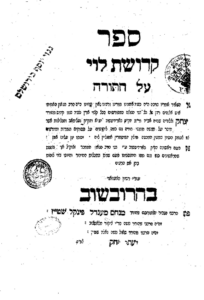
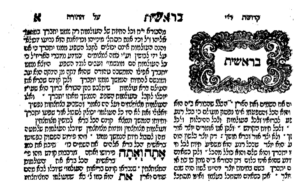
1818, Kedushat Levi

The title-page of this edition of Kedushat Levi begins with honorifics for R. Levi and then informs that it also includes additional material on various subjects. On the verso of the title pages is an approbation from four rabbis from Berdichev; R. David Shalit, R. Aaron Isaac ha-Kohen, R. Nathan Aryeh Davir, and R. Mordecai באאימו son of my lord, my father, teacher, and rabbi David Shalit. Below the approbation is the standard disclaimer that the people among whom the Jews reside today are not like those in the time of the Talmud, immoral idol worshippers, but today show respect for Torah and do justice and righteousness in their lands, The text follows, primarily on the weekly parsha, but also addressing other biblical books, festivals, and concluding with a final section addressing various subjects, including Pirke Avot. Kedushat Levi.

First published in Berdichev in 1811, this, the Hrubieszow edition, is the third printing of Kedushat Levi. A popular work, it has frequently been republished.

Sefer ha-Yashar – Among the books published in 1819 is R. Zerahiah ha-Yevani’s (13th or 14th century) popular ethical work Sefer ha-Yashar (Book of Righteousness). The title-page attributes the work to R. Jacob ben Meir Tam (Rabbenu Tam, c. 1100-1171), a not infrequent error, as well as it being attributed to R. Jonah Gerondi (13th century). The former did author a Sefer ha-Yashar (Vienna, 1811), but that is another work, consisting of responsa and novellae, while the style of the latter, who wrote ethical works, differs from this book. A number of manuscripts, however, name Zerahi ha-Yevani’s as the author. While many now accept him as the author, that attribution is not definite. Little is known about Zerahiah, except that he was a resident of the Byzantine Empire and that he is credited with Sefer ha-Yashar.

Sefer ha-Yashar was published in octavo format (80: [2], 40 ff.). The title-page begins that it is “the path of life and moral reproof, to go on a straight path. It is dated “it is [very] indeed upright וישר הוא מאוד (579 = 1819)” (cf. Deutronomy 32:4; Psalms 21:29). The printers names are given on the title-page as Menahem Mendel F. Sh. and Moses Tzikor,
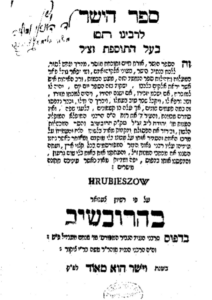
1819, Sefer ha-Yashar

There is an introduction, in which Zerahiah brings proof for the Torah and its precepts from both reason and from the prophets, and bemoans the pursuit of pleasure, wealth, and honor in his time, rather than religion and morality. Sefer ha-Yashar, with the purpose of directing one’s soul towards the correct worship of God, piety, and ethical content, is written in an easy style so that it will influence others to right conduct. Sefer ha-Yashar is comprised of material from earlier ethical works, although they are not mentioned in the text by name nor directly quoted. It is evident, from the book, that he was familiar with Jewish philosophic works. The most significant of the prior works, acknowledged in the introduction, is Bahya ibn Paquda’s Hovot ha-Levavot, studied by Zerahiah, but too long and complex for the average reader. It provides, in summary, the essence of several chapters. Another important influence, evident in the text, is Maimonides.

The text, divided into eighteen chapters which address, beginning with the creation of the world, worship, repentance, knowledge of God, the will of God, the world to come, complete repentance, the significance of the righteous, accountability of a person, remembrance of the day of death, and the distinction between the righteous and the wicked. Zerahiah’s primary subjects are the need to imitate God, conditions of proper prayer, both theoretical and practical; correct conduct and obstacles to be overcome to achieve it; and repentance.[18]

A popular work Sefer ha-Yashar was first printed in Constantinople (1540); this is the twenty-second edition, of slightly more than fifty recorded by the Bet Eked.Sefarim.[19]
Levushe Serad – Another different work, also published in 1819, is R. David Solomon Eybeschuetz’s (Eibenschutz) halachic Levushe Serad on the Shulhan Arukh Yoreh Deah, particularly on the laws pertaining to shechita (ritual slaughter). Printed as a folio (20: [2], 2-102 ff,) in the year “attired as thin beast לבושי השרד בהמה דקה (561 = 1801).” This date is certainly incorrect, a bet ב at the head of the word בהמה (beast) which make the verse meaningful but gives a date in error, as opposed to a kafכ which would read כהמה and would give the correct value of (579 = 1819) but be meaningless. I would suggest, and this is entirely speculative, that the printer wanted the meaning of beast even if that threw the date off. Support for this conjecture can be found in the correct date, immediately below the Hebrew date, in Arabic numerals, that is, 1819. This is the only title-page seen among the Hrubieszow imprints with an Arabic numeral date.

The author, R. David Solomon ben Yerachmiel Eybeschuetz, was born in Russia and studied under R. Moses Ẓevi Heller. He served as rabbi in several locations, among them Buzhanow, Soroki (Volhynia), and Jassy, (Rumania). Eybeschuetz made aliyah, that is, he went up to Eretz Israel, residing in Safed, where he died in 1812. Eybeschuetz was also a kabbalist as well as a Talmudist. His other works include responsa, Ne’ot Deshe (part one, Lvov, 1861), part two and manuscripts, including a commentary on the Torah and discourses.[20]

The title-page describes Levushe Serad as being comprised of three parts, the first explaining the laws pertaining to laws of falling and broken bones in cattle and fowl; the second, laws applying to lungs; and the third, applying to Yoreh De’ah. The printers are given here as Menahem Mendel Finkel Stein. and Moses Tzikor.

The verso of the title-page has an approbation from R. David Shalit. The text is comprised of the commentary in two columns. The text of this volume on Yoreh Deah varies from the previous volume on Orah Haim. Chaim Tchernowitz describes this volume as following R. Alexander Sender Shor’s (d. 1737) influential Simla Hadasha, also on shechita; Levushe Serad being described as the most important commentary on that work [21] It does not include the text of Yoreh De’ah, on which Levushe Serad comments and elucidates.
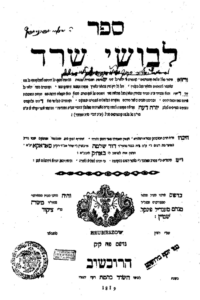
1819, Levushe Serad

Levushe Serad on Orah Haim was first published in Mohilev (1805). This volume, on Yoreh Deah is the third edition, it too having been printed previously in Mohilev (1812).[22]

Havvat Da’at – Among the books printed in 1820 was another work on Shulhan Arukh Yoreh Deah, but considerably different from Levushe Serad, that is, R. Jacob ben Jacob Moses Lorbeerbaum of Lissa’s (c. 1760–1832) Havvat Da’at. It was published as a folio (20: [1], 37 [should say 36], [34] ff.) in the year “Day to day makes utterance, night to night speaks out יום ליום יביע אומר ולילה ללילה יחוה דעת (470 = 1805) 19:3), This chronogram is also misdated, as is noted by the NLI catalogue, which records it as a circa 1820 imprint; which also states that the printer, who is not identified on the title-page, is unknown.
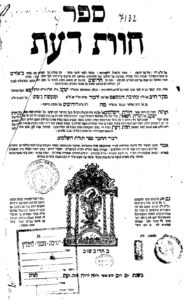
1820, Havvat Da’at

Jacob Lorbeerbaum of Lissa was a distinguished rabbi, who served in several communities, writing, in addition to Havvat Da’at other valued works. [23] However, his early days were difficult and troubled. His father, rabbi of Zborow, passed away prior to Lorbeerbaum’s birth; he was raised by R. Joseph Te’omim (Pri Megadim, 1727–1792), a relative. He initially combined learning and business, being a partner in a brewery but, when that failed, Lorbeerbaum became rabbi in Monasterzyska, founding a yeshivah there. He subsequently became rabbi of Kałusz writing many of his earliest works there, including Havvat Da’at which, reflecting his great humility, was originally published anonymously. When his authorship was subsequently identified ,Havvat Da’at became the name by which he is known.[24]

In 1809, Lorbeerbaum became rabbi of Lissa. Lorbeerbaum was an opponent of the Haskalah movement, their influence resulting in his leaving Lissa in 1822 and returning to Kalisz. Disputes there forced him, in 1830, to again relocate again finally settling in Stryj, serving there as rabbi until his death.

The title-page of Havvat Da’at states that it is on Shulhan Arukh Yoreh Deah, which is a tree of knowledge “desirable as a source of wisdom” (Genesis 3:6), for the pure and the impure. It continues that it is comprised of two parts, Biurim, explanations in depth based on prior commentaries and Hiddushim, novellae, interpretative explanations of statutes and critical analysis. On both sides of the pressmark is the standard disclaimer that the contemporary peoples among whom the Jews dwell today are not immoral idol worshippers as in the past.

The commentary, as described on the title-page, is in two parts, about the text of the Shulhan Arukh. Chaim Tchernowitz describes the subject matter of Havvat Da’at as being on such subjects as salting of meat, meat and milk, mixtures, interest, niddah, and other halakhot dealing with prohibitions such as Stam Yeinam (gentile wine), and treifus. He concludes that according to Havvat Da’at even with laws dealing with permitted and prohibited foods there is room for critical and analytical critique.[25]

Given the title-page variations of this edition, described above, it is not surprising that Avraham Yaari questions, concisely, whether Havvat Da’at is a Hrubieszow imprint. He suggests that it was published elsewhere, writing “one more book that is listed as having been published in Hrubieszow was actually published in Polonne. This is Chavat Da’at by Ya’akov of Lissa.”[26] While we have noted a number of variations in Havvat Da’at, such as the dating error in the chronogram, albeit not that unusual for Hrubieszow publications, the absence of the printers’ names, and a pressmark that is not common to Hrubieszow title-pages, there is also the fact, in contrast to these varoiances, that the place of printing is clearly given on the title-page as Hrubieszow. Furthermore, other bibliographic sources, such as Friedberg’s Bet Eked Sefarim and Vinograd’s Thesaurus record Havvat Da’at as a Hrubieszow imprint. An examination of a sample of Polonne and Sudylkow (also suggested) title-pages did not show any like images. The question of whether Havvat Da’at was a Hrubieszow imprint or was published elsewhere is a teku (u nresolved).

Another Hrubieszow imprint by Jacob Lorbeerbaum of Lissa is a folio edition of Beit Ya’akov, novellae and commentary on Shulchan Aruch, Even Ha–Ezer and tractate Ketubot. The printers are given as Moses Tzikor, of Laszczow, and Solomon, ben David Lev, of Laszczow, Menahem Mendel Finkel Stein having already left the press.

This is the fourth printing of Havvat Da’at. The first edition was published in Lvov (1799).

Avodat ha-Kodesh – Among the books printed in Hrubieszow in 1820 is Avodat ha-Kodesh by R. Ḥayyim Joseph David ben Isaac Zerachia Azulai (Hida, 1724-1807), a prominent kabbalist, rabbinic scholar, bibliophile, and prolific author. More than eighty works are attributed to him, sixty in print, on a wide variety of subjects on Torah, halachah, aggadah, and kabbalah.[27] Avodat ha-Kodesh, an 18 cm. octavo(80: 40 ff.) is comprised of three related works, Vinograd records each independently, that is, Avodat ha-Kodesh, Moreh be-Etzba, and Ziporin Shamir as separate entires. All three titles, kabbalistic explanations of customs, are in octavo format (80) and relatively small works. Shimon Vanunu, describes Avodat ha-Kodesh as a compilation of several of Hida’s prior works.[28]

Hida was born in Jerusalem to a prominent Sephardic family, descendant from exiles from Spain, and his great-grandfather was the kabbalist R. Abraham Azulai (c. 1570–1643, Hesed le-Avraham), originally from Fez, Morrocco and on his maternal side from R. Joseph Bialer, a German scholar. He was educated by leading rabbinic figures, among them R. Isaac ha-Kohen Rapoport, R. Shalom Sharabi, and R. Haim ibn Attar (Ohr ha-Haim). He served as rabbi in several communities and beginning in 1755, served as an emissary from Eretz Israel to Jewish communities in Europe.
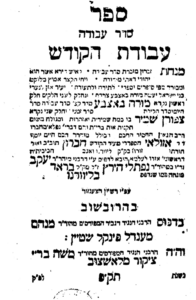
1820, Avodat ha-Kodesh

The title-page has the heading Avodat ha-Kodesh in large bold type and below notes the other two works, and then that the book was brought to press by R. Jacob ben Naphtali Hertz of Brod and that it had been printed previously in Livorno. The title-page is dated in a straightforward manner as (תק”פ = 1820). The verso of the title-page has the disclaimer that the non-Jews among

whom the Jews noted above that contemporary nations are unlike the earlier nations who were immoral idol worshippers, but today show respect for Torah and do justice and righteousness in their lands. It is followed by the tailpiece noted above that appears on the title-pages of several books. Examples of the text are:

147: all who say shirat ha-yam (Exodus 14:30 – 15:19) with joy as if he himself had been delivered from the sea, Pharoh, and his army, when they drowned in the sea, and says Shira with great feeling is forgiven his iniquities.

148: all who weep and mourn for a person who was kosher is forgiven his iniquiites.

149: all who pray erev Shabbat and say [the prayer] ויכלו “the heavens and earth were completed” (Genesis 2:1), two angles say to him turn your eyes and your sins will be atoned for.

The pressmark appears at the end of the book as a tail-piece.

Tomer Devorah – Another work published in 1820 is R. Moses ben Jacob Cordovero’s (Ramak, 1522-1570) popular and much reprinted Tomer Devorah. A small kabbalistic, ethical, and inspirational treatise, it was published as a 19 cm. octavo (14 ff).

Moses ben Jacob Cordovero was the first to describe the dialectical process through which the Sefirot pass in their development and to interpret the various stages of their emanation as manifestations of the Divine mind.[29] Based on his name, Cordovero appears to have been descended from Jewish exiles from the city of Cordova. It has been suggested, but this is uncertain, that he was born in Safed. Cordovero was a student of R. Joseph Caro (1488-1575) in nigleh (revealed, literal Torah) and, after heeding a heavenly voice that urged him to study Kabbalah, of his brother-in-law, R. Solomon Alkabez (Lekhah Dodi) in nistar (esoteric Torah, Kabbalah). Cordovero became a leader of the ascetic mystical community of Safed, preparing for it a list of rules of conduct, primarily instructions and commands. He served as a dayyan in Safed and founded a yeshivah there in about 1550, which he headed until his death in 1570.

Among Cordovero’s students were R. Elijah de Vidas (Reshit Hokhmah), R. Abraham Galante (ha-Kadosh), R. Samuel Gallico (Asis Rimmonim, an abridgement of Pardes Rimmonim), R. Hayyim Vital, and R. Isaac Luria (ha-Ari). Although Luria was Cordovero’s student for a short while only, and his system of Kabbalah would supplant that of Cordovero, Luria refers to Cordovero as his master and teacher, testifying that Cordovero was completely free of sin, that both the sages of the Mishnah and Elijah the Prophet appeared to him, and that at Cordovero’s funeral a pillar of fire preceded his coffin. Others, such as R. Menahem Azariah da Fano, although in Italy, considered themselves disciples of Cordovero. A prolific writer, he is responsible for several of the classics of Kabbalah.[30]

Tomer Devorah is entitled from “And she sat under the palm tree of Deborah (Tomer Devorah) between Ramah and Beth‑El in Mount Ephraim” (Judges 4:5). The title-page urges man to follow a straight path, to end his isolation and reflect on his ways, to cleave to the order of the sephirot. The printers are given as Menahem Mendel Finkel Stein and Moses Tzikor of Łaszczów, their names preceded by honorifics. The title-page is dated with the chronogram in the year “This is the Teaching that Moses placed before the children of Israel זאת התורה אשר שם משה לפני בני ישראל (580 = 1820)” (Deuteronomy 4:44).
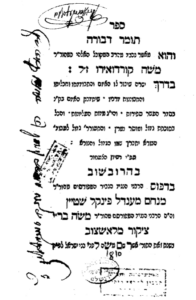
1820, Tomer Devorah

The text is comprised of ten chapters describing Divine qualities and how man should strive to emulate them. They are, 1) the Supernal Crown (Keter) and the thirteen attributes of higher mercy which belong to it; 2) the qualities of the crown, such as humility and kindness, eradicating pride from the heart; 3) wisdom (Hokhmah), love and care for all creatures; 4) understanding (Binah) and repentance; 5) on mercy (Hesed), the methods of performing mercy and assisting the Sefirot to function harmoniously; 6) power (Gevurah), utilizing the evil inclination to serve God; 7) beauty (Tiferet), the study of Torah and behavior appropriate to a scholar; 8) Endurance, Majesty and Foundation (Netzach, Hod and Yesod), support of Torah students and purity of life; 9) Sovereignty (Malkut), sacrifices for Torah and performing marital duties with holiness; 10) Man’s conduct so that he is never separated from the world of the Sefirot. An example of the text, from Keter, is:

Keter – Some major activities that are the main governance: Further for a person to resemble his Creator from the secret of the trait of the Crown (Keter), he must [do] some major activities – which are the main governance. The first: The trait of humility – which includes everything – because it is dependent on the Crown. As behold, It is a trait over all of the Traits, but it does not raise itself and become proud above [the others]. Indeed, It goes down and always looks downwards. And that is from two reasons: The one is that It is embarrassed to look at Its Cause, rather Its Emanator always looks down upon It to benefit It; and It looks down to the lower ones. So [too,] must a person be embarrassed from staring upwards, to be proud. Rather, he must always stare downwards, to diminish himself all that he can.[31]

The title page is followed by a brief introduction from R. Moses Basola, with the pressmark. He found the manuscript of Tomer Devorah in the library of R. Menahem Azriah, who gave it to Basola, in order to bring it to press to merit Israel.

Tomer Devorah is replete with allusions from Talmudic and kabbalistic sources, systemizing and vividly presenting abstruse concepts. It has been frequently republished and translated into other languages, among them English. Tomer Devorah was first published in Venice (1588); this the Hrubieszow edition, is the fourteenth. The Bet Eked Sefarim records thirty-two editions, several with annotations, and not recording translations.[32]

Ayyelet Ahavim – A rhetorical and poetic treatise on the Akedah (sacrifice of Isaac) by R. Solomon de Oliveyra (1633-1708). Ayyelet Ahavim was printed as a 19 cm. octavo (80: [4], 20, [1] ff.). It is dated in a straightforward manner as תקפ”א,ה ([5]581 = 1821).

R. Solomon de Oliveyra is accounted among the Sephardic sages of Amsterdam.[33] Oliveyra’s place of birth, whether Lisbon or Amsterdam, is uncertain. Albert Van Der Heide suggests that as Oliveyra’s parents were fugitive co1nversos, as documented in Amsterdam in 1628, he must have been born in the latter location. Also, based on the marriage certificate issued by the city of Amsterdam, Oliveyra married Rached Dias in 1660, when twenty-seven years old, again attesting to Amsterdam as his place of birth.[34] Oliveyra served as rabbi (hakham) and teacher in the Talmud Torah Etz Haim of the Keter Torah association of the Amsterdam Portuguese community, of which he later became president. He was a member of the rabbinical council, over which he presided after the death of R. Jacob Sasportas (c. 1610-98). In addition to these rabbinic positions, Oliveyra worked as a corrector in the printing-house of Uri Phoebus.[35] Oliveyra was the author of a number of varied multi-lingual works on grammar, lexicography, other philological subjects, poetry, and riddles. Van Der Heide has described Oliveyra as “the preeminent and omnipresent Hebrew poet of Jewish Amsterdam.” Oliveyra became, for a time, an adherent of Shabbetai Zevi, composing liturgical verse in his behalf as well as writing approbations

The primary publisher of Oliveyra’s books was David de Castro Tartas (c. 1625–c. 1700), active from 1662 to 1698 in Amsterdam. Their relationship began in 1665, when our subject work, Ayyelet Ahavim ws published. The title-page begins that it is Igeret: words of truth, “to understand a proverb, and a figure” (Proverbs 1:6). It is entitled Ayyelet Ahavim for it was “a precious vessel” (Hosea 13:15, Nahum 2:10, II Chronicles 32:27), “To receive the instruction of wisdom” (Proverbs 1:3), “He established it and searched it out” (Job 28:27), by the rav, the Sephardic sage SOLOMON ben DAVID Oliveyra, in the month of Ziv in the year תי”ז (1657, printed in Amsterdam in the year תכ”ה (1665). It adds that it has now been brought to press by R. Abraham Moses ben Solomon ha-Levi of Lublin: with the permission of the censor in Hrubieszow at the press of Moses ben Tzikor of Łaszczów.
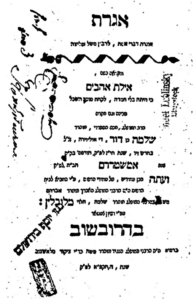
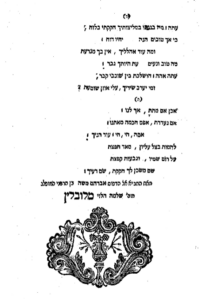
1821, Ayyelet Ahavim

Oliveyra’s introduction follows (2a-b) in which he states that he does not wish to delve into deep explanations nor to go up to the heights of discourse, but rather his heart wishes to speak of the greatness of that “righteous man, who quarried the fetters of love, of that which he formed יצורו for the love of the One Who formed him יוצרו.” Oliveyra’s intent is to investigate this holy and wondrous deed. Among the several reasons that he entitled this work Ayyelet Ahavim is that it is on the love of Abraham and his soul for God “As the hart longs for water streams” (cf. Psalms 42:2). The wide-ranging text is comprised of numerous aggadot, and including riddles and parables. In one section the alternating paragraphs of verse are between father and son. The prose text is accompanied by infrequent marginal references.

First printed in Amsterdam (1665) this is the third and last published edition Of Ayyelet Ahavim.[36]

Summation – Ten books have been described. The selected books give an insight to the type of works published by the Hrubieszow press. They are generally of a scholarly and specialized nature, primarily Hasidic works on the weekly parasha (Torah reading), ethical, and halachic tomes, although varied within each category. These works reflect both the composition and interests of the community. One book, Gedolus David u-Malchus Shaul, stands out, being of a contrary nature, that is, it has maskilic overtones. The provenance of one other work, Havvat Da’at, has been questioned. Also published were two editions of Shir ha-Shirim (1816, 1827), the former not seen, the latter (1820) with the commentaries of R. Eliezer ben Judah (Rokeah) and R. Moes ben Nachman (Ramban).

A lacuna in the press’s publications is the absence of Mishnaic and Talmudic volumes, attesting to the press’s emphases on small books, perchance the nature of its’ operations, a small publisher catering to and meeting a small market’s needs. It did, however, print an Ein Ya’acov, on the aggadot in the Talmud, this with the commentary Kotnot Or. The emphasis on small works does not in any way detract from the value of the press’s publications. Indeed, the books were well printed and attractive. Yaari, however, while approving of their appearance is not so positive as to the titles printed, writing “The books printed in Hrubieszow were elegant in appearance, but not of significant content. Most had been printed previously by other presses. These books were in great demand, such as popular Yiddish books.”

As noted above, the Thesaurus credits the Hrubieszow press with as many as forty titles, although that number appears uncertain, or perhaps exaggerated; Avraham Ya’ari recorded thirty-four titles only. Perchance, the difference in number can be attributed to the manner in which books are recorded. Avodat ha-Kodesh, for example, is a composite of three works, each listed independently in the Thesaurus but one entry only in Yaari’s listing. Summerly, there are three entries in the Thesaurus for Siddur Tefillat Nehora, a two-part prayer book designed so that it can be used for both Ashkenaz ads Sephardic rites. There is one listing only by Yaari, but more detailed. The entries in the Thesaurus for Tefillat Nehora are several years apart (1817, 1821, [1824]). To complicate matters, Yaari has several entries for Kotnot Or but the Thesaurus has one entry only for the Ein Ya’acov. The exact number of publications must remain then a teku (unresolved).

We have noted misdates and censors’ remarks. Yaari comments on this writing:

The names of the town or the printers are omitted from the title pages of several of the books printed in Hrubieszow. This is probably due to censorship, or book tariff payment. Sometimes the printers mentioned their names in some copies but not in others; sometimes they even inserted the name of a different town or stated a different year, to deceive the censor or the tariff–collector

No books omitting Hrubieszow were seen or noted.[37] Why then, printing with the censors’ approval they would omit their names is unclear. Indeed, the books described above, all, with the exceptions of Havvat Da’at all have the printers’ names. In conclusion, as already noted, the Hrubieszow press published small varied books covering a variety of subjects. The books served communal needs, were works of value, and attractively printed. A press only active for a brief period, it served the Hrubieszow community well. It deserves, should be remembered, in addition entries in bibliographic and historical records.
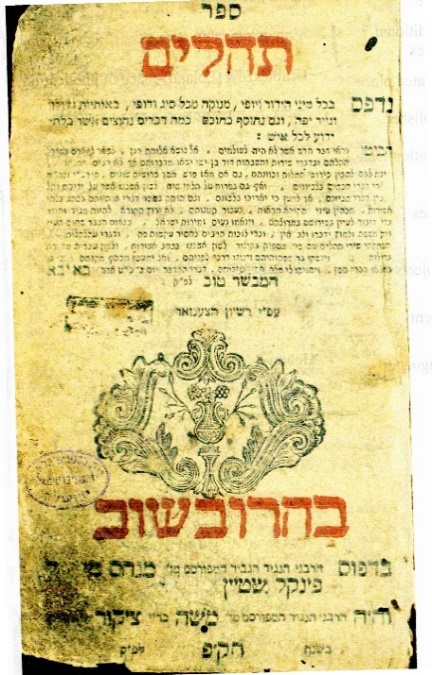
  1. I would like to express my appreciation to Eli Genauer for reading the article and his corrective comments, and Eli Amsel for his additional insights. All the title and text page images are courtesy of the National Library of Israel. The Polish monarchy banner is a public domain image.
  2. Vinograd, Yeshayahu. Thesaurus of the Hebrew Book. place, and year printed, name of printer, number of pages and format, with annotations and bibliographical references II (Jerusalem, 1993-95), p. 167 [Hebrew].
  3. https://en.wikipedia.org/wiki/Hrubiesz%C3%B3w
  4. The Encyclopedia of Jewish life Before and During the Holocaust, editor in chief, Shmuel Spector; consulting editor, Geoffrey Wigoder; foreword by Elie Wiesel I (New York, 2001), pp. 532-34; Polin: Virtual Shtetl https://sztetl.org.pl/en/towns/h/266-hrubieszow/99-history/137366-history-of-community; Dr. N. M. Gelber, Notes on the History of the Jews of Hrubieszow, tr. Yael Chaver, https://www.jewishgen.org/yizkor/Hrubieszow/hru021.html.
  5. Hurvitz Tzvi Ha–Levi Ish Hurvitz, “The Town of Hrubieszow and its Rabbis,” translated by Yael Chaver, Columns 51-52. https://www.jewishgen.org/yizkor/Hrubieszow/hru051.html
  6. Avraham Yaari, “The Hebrew Printing Press in Hrubieszow,” Kiryat Sefer, (Jerusalem, 1943–4), pp. 219–228 [Hebrew], tr. by Yael Chaver https://www.jewishgen.org/yizkor/Hrubieszow/hru051.html#Page57
  7. Dr. N. M. Gelber, Notes on the History of the Jews of Hrubieszow, tr. Yael Chaver, https://www.jewishgen.org/yizkor/Hrubieszow/hru021.html..
  8. Ch. B. Friedberg, History of Hebrew Typography in Poland from the bginning of the year 1534, and its development up to our days . . . Second Edition, Enlarged, improved and revised from the sources (Tel Aviv, 1950), pp.150-52 [Hebrew].
  9. Mordechai, Margalioth, ed., Encyclopedia of Great Men in Israel I (Tel Aviv, 1986), cols. 179-80 [Hebrew].Tzvi M. Rabinowicz, The Encyclopedia of Hasidism (Northvale, 1996), pp.111-12.
  10. Ch. B. Friedberg, History of Hebrew Typography in Poland, op. cit.
  11. Arnold Green, “Elimelekh of Lizhensk, “The Yivo Encyclopedia of Jews in Eastern Europe, Gershon David Hundert, ed. I (New Haven & London, 2008), p. 467; Rabinowicz, op. cit.
  12. Marvin J. Heller, The Sixteenth Century Hebrew Book: An Abridged Thesaurus II (Leiden, 2004) p. 697: Simcha Kogut, “The Language of Sefer Hasidim, Its Linguistic Background and Methods of Research,” in Studies in Medieval Jewish History and Literature, ed. Isadore Twersky, II (Cambridge, 1984), pp. 95-108; Reuben Margaliot, ed., Sefer Hasidim (Jerusalem, 1973), pp. 3-9 [Hebrew].
  13. https://www.encyclopedia.com/religion/encyclopedias-almanacs-transcripts-and-maps/ha-efrati-tropplowitz-joseph
  14. To replace a sheet with a single error would necessitate replacing several pages, the number depending on the book format. The normal practice, therefore, was to retain the original defective sheet and use both it and the corrected sheet in copies of the book. Due to cost factors, both of paper and labor, the sheet with the error would be replaced only if the error was substantial or substantive. It is therefore possible for books to consist of non-uniform copies, having several sheets with variant readings. For examples of such errors see Marvin J. Heller, “Who can discern his errors? Misdates, Errors, and Deceptions, in and about Hebrew Books, Intentional and Otherwise” Hakirah: The Flatbush Journal of Jewish Law and Thought 12 (2011), pp. 269-91, reprinted in Further Studies in the Making of the Early Hebrew Book, (Brill, Leiden/Boston, 2013), pp. 395-420.
  15. Friedberg, History of Hebrew Typography in Poland, p, 151 n. 1.
  16. Ch. Friedberg, Bet Eked Sefarim, (Israel n.d.), gimmel 128, mem 1922 [Hebrew].
  17. Rabinowicz, p. 61.
  18. Margalioth, Great Men, II col. 465-66; Meyer Waxman, A History of Jewish Literature (1933, reprint Cranbury, 1960), II pp. 276-79.
  19. Friedberg, Bet Eked.Sefarim, yod 1152.
  20. Louis Ginzberhg, N. T. London, “Eibenschutz, David Solomon,” Jewish Encyclopedia V (1New York, 901-06), pp. 75-78.
  21. Itzhak Alfassi “Schor, Alexander Sender ben Ephraim Zalman” v. 18 Encyclopedia Judaica (Jerusalem, 2007), p. 161; Chaim Tchernowitz, Toledoth ha-Poskim, III (New York, 1946), pp. 206-08 [Hebrew].
  22. Friedberg, Bet Eked.Sefarim, lamed 108.
  23. Lorbeerbaum’s other published works are Ma’aseh Nissim (Zolkiew, 1801), on the Passover Haggadah; Mekor Ḥayyim (ibid., 1807), novellae and expositions of the laws of Passover in the Shulḥan Arukh together with the glosses of R. David ben Samuel ha-Levi and Abraham Abele Gombiner on Oraḥ Ḥyyim and novellae to tractate Keritot; Netivot ha-Mishpat (ibid., 1809–16), on Ḥoshen Mishpat; Torat Gittin (Frankfurt on the Oder, 1813), the laws of divorce and novellae on tractate Gittin; Kehillat Ya’akov (1831), on Even ha-Ezer and sections of Oraḥ Ḥayyim; Derekh ha-Ḥayyim, an anthology of liturgical laws, first published with the prayer book (1828) and then separately (1860 or 1870); Naḥalat Ya’akov (1849), expositions of the Pentateuch; Emet le-Ya’akov (1865), expositions of talmudic aggadot; Imrei Yosher, commentaries on the five megillot, each published independently; his ethical will (1875); and Millei de-Aggadeta (1904), sermons and responsa (EJ, op. cit.). In a private correspondence Eli Amsel noted other such works, writing “Another Hrubieszow imprint by Jacob Lorbeerbaum of Lissa is a folio edition of Beit Ya’akov, novellae and commentary on Shulchan Aruch, Even Ha–Ezer and tractate Ketubot.”
  24. Haim Gertner, “Lorbeerbaum, Ya‘akov ben Ya‘akov Mosheh of Lissa, Yivo Encyclopedia, I pp. 1087-88; Ephraim Kupfer, “Lorbeerbaum, Jacob ben Jacob Moses of Lissa” Encyclopedia Judaica XIII pp. 191-92.
  25. Tchernowitz, Toledoth ha-Poskim, III, p. 258.
  26. The Polonne (Polonnoye) press was active from 1789 to approximately 1830, publishing as many as130 titles. Among them three editions of Havvat Da’at. An accompanying note in the Polonnoye entry references it as a Sudylkow imprint (Vinograd, p. 502). Two [1834] editions of Havvat Da’at are listed for that location.
  27. Yaakov Amsalem and Yisrael A. Groweiss, “The Hida’s Riddle,” Mishpaha, March 22, 2022.
  28. Shimon Vanunu, Encyclopedia Arzei ha-Levanon. Encyclopedia le-Toldot Geonei ve-Hakhmei Yahadut Sefarad ve-ha-Mizrah II 649-(Jerusalem, 2006), pp. 649-69 [Hebrew]. The works noted by Vanunu are Moreh be-Etzba, Ziporin Shamir, Kesher Gadol, Kaf Ahas, Yosef be_Seder, Sensen le-Ir, and Shomir Yisrael.
  29. Heller, The Sixteenth Century Hebrew Book, var. cit. ; Gershom S. Scholem, Major Trends in Jewish Mysticism (New York, 1960). Pp. 252-53.
  30. Concerning other works by Moses Cordovero see Marvin J. Heller, “His Hand did not Leave Hers Until he was Grown: Two Little Known Works from Moses Cordovero (Ramak)” Los Muestros no. 44 (Brussels, 2001), pp. 44-46, reprinted in Studies in the Making of the Early Hebrew Book (Leiden/Boston, 2008), pp. 278-83.
  31. https://www.sefaria.org/Tomer_Devorah.2.2?lang=bi&with=SidebarSearch&lang2=en.
  32. Friedberg, Bet Eked Sefarim, tav 484.
  33. Concerning see Marvin J, Heller, ” Solomon de Oliveyra:
    A Seventeenth Century Sephardic Sage,” Sephardic Horizons (v. 13: 1-2 Winter-Spring 2023), https://www.sephardichorizons.org/.
  34. Albert Van Der Heide, “Poetry in the Margin: The Literary Career of Haham Selomoh d’Oliveyra (1633-1708),” Studia Rosenthaliana 40 (2007-08), pp. 14.
  35. L. Fuks and R. G. Fuks-Mansfeld, Hebrew Typography in the Northern Netherlands 1585-1815 2 (Leiden, 1987), p. 247; Margalioth, col. 1264 [Hebrew].
  36. Friedberg, Bet Eked.Sefarim, alef 1626.
  37. While I did not see any such works, Eli Amsel also wrote “I have several in my collection, only TWO without the city mentioned in title, Bet Ya’akov, cityless; Pri Etz Chaim, with koretz as the city in very small font!!!”


Change Has Come To Modena

Change Has Come To Modena

By Eli Genauer

I would like to thank S. of “On The Main Line” for his assistance and insightful comments.

The Kitzur Shelah by Rav Yechiel Michel Epstein, was first published in Fürth in 1683.[1] It was not truly an abridgement of the Shnai Luchos HaBris, but rather a Sefer which stood on its own. It was used for many years by people in smaller communities as a guide for what to do at different times of the year.[2] As many know, it is reputedly the source of the actual Pesukim recommended for the custom of saying Pesukim Lishemot Anashim. [3]

I have an old copy of this Sefer (Amsterdam 1707) whose title page looks like this:

In fact, this custom of reciting a Pasuk associated with one’s name is recorded there at the very end.

Chapter 5 of Post Sabbatean Sabbatianism by Rabbi Dr. Bezalel Naor goes into the reasons why Rav Yakov Emden blacklisted this book. It is based on the Hakdamah which uses the expressions Mashiach Ha’Amiti and Y’Mot HaMashiach, which equal 814 and is also the Gematria for Shabbetai Zvi.[4] The copy I have from 1707 comes with the original quotation marks, functioning like italics, on both Mashiach Ha’Amiti and Y’mot Hamashiach. (Starting from the third line from the bottom with the word V’Yizku.)

Detail:

I was looking through the book to find the part that speaks about the Pesukim L’Shemot Anashim and found it at the very end. I was fascinated to see that immediately before the final section, Rabbi Epstein concludes his Sefer with a hope for the coming of Moshiach, and he refers to Moshiach as Nezer Rosheinu ( bottom line below).

I was curious about the words Nezer Rosheinu to describe Moshiach, and suspecting foul play, I did two things. Firstly, I wrote to Dr. Shnayer Leiman and asked him about the Kitzur Shelah and its use of the word Nezer Rosheinu. This is what Dr. Leiman answered (posted with permission).

“Briefly, Kitzur Shelah is a Sabbatian work. It is suffused with Sabbatian material, so one needn’t look for evidence just at the beginning and end. It was already identified as Sabbatian by R. Yehezkel Katznellenbogen in the first quarter of the 18th century. See also Krengil’s שם הגדולים השלם, vol. 2, p. 148, in הגהות עין חנוך, where the work is identified as Sabbatian.

נזר ראשינו (if that is the correct נוסח — one always need to check the first 3 editions; Amsterdam, 1707 is the 4th edition) is surely a reference to Sabbetai Zevi. The latter name in gematria totals 814, a sacred number for Sabbatians. נזר ראשינו adds up to 824. Either the author wrote נזר ראשנו which totals 814, and the printer misspelled it ראשינו; or, the total 824 stands for ה”ה שבתי צבי. Sabbatians regularly wrote ה”ה before his name. It is an abbreviation for המלך המשיח.

What really needs to be noted is that in a recent edition of קיצור של”ה (Ashdod, 1998), the offensive phrase has been censored and replaced.”

It appears then that Kitzur Shelah has Sabbatean allusions right from the Hakdamah ( which anyone can see for themselves by the use of Mashiach Ha’amiti, etc.) to the last lines which use the words Nezer Rosheinu. It is almost as if it is Koheles in reverse where “its beginning is words of Torah and its end is words of Torah” (Shabbat 30b).

I also did a search online putting in the words “Shabbetai Zvi” and “Nezer Rosheinu”. I got one pertinent hit and it brought up an entirely new issue. I found referenced an article from the Israeli publication HaMaayan published by Mossad Yitzchak Breuer in Tammuz of 5743 (1983).

There we find an article by Rav Yosef Yehoshua Apfel (a Dayan in Leeds, and a noted Talmid of the Seridei Eish) on Yom Kippur Kattan, where he writes about the connection between Nezer Rosheinu and Shabbetai Tzvi. Rav Apfel references the famed Siddur Avodas Yisroel printed in 1868 by Dr. Yitzchak (Seligmann) Baer:

and specifically the Piyyut Yom Zeh Yehi Mishkal Kol Chatasai, included in the Yom Kippur Kattan service which appears there.

He writes as follows

Rav Apfel is at first puzzled a bit as to why Modena would write a Piyyut for a Kabbalistic service (“Ha’Inyan Hu K’tzas Muzar”). He then tells us that Dr. Baer changed the last line of the Piyyut by exchanging the phrase “נא א-ל שלח נושא נזר ראשנו” for “נא א-ל שלח נושא הוד ראשנו”. Dr. Baer explains his reasoning for this change: because he wanted to restore the proper meter, and because he wanted to save the Piyyut from having a “Remez Passul.” Rav Apfel understands this to mean a hint of Shabbetai Zvi. Dr. Baer did this even though, as Rav Apfel writes, Rabbi Yehuda Aryeh MiModena could not have been referring to Shabbetai Zvi, because the Piyyut was written around 1614, and Shabbtai Zvi was only born in 1626. Rav Apfel writes that the Nussach of “נא א-ל שלח נושא נזר ראשנו” appears in many Siddurim (בהרבה סדורים). I recently looked at many Siddurim at the Library of Congress and found this to be true, especially in ones published pre-1868.

Rav Yakov Emden, who needed little prompting to find Sabbatean allusions, did not understand this phrase as referring to Moshiach, but rather to the Kohen Gadol. This booklet contains the Yom Kippur Katan service with the commentary of Rav Yakov Emden:

The Peirush of Rav Yaakov Emden on the words “נא א-ל שלח נושא נזר ראשנו” indicates as such. “שלח לנו כהן גדול הנושא הציץ כמו נזר”.

The phrase “נא א-ל שלח נושא נזר ראשנו” is also used in the following book which is generally based on Kisvei Yad of Modena found in the Bodleian Library, although this particular Piyut is not from a Ksav Yad. [5]

(דיואן – יהודה אריה ב”ר יצחק ממודינא, courtesy of Hebrewbooks.org)

In this book, Professor Simon Bernstein takes on the change in phrase matter and writes[6]:

Probably the best proof as to what the original Nusach really was comes from a book named Seder Shomrim LaBoker printed in Cracow in 1626, only 12 years after the Piyyut was probably written.

As you can see, not only is the phrase Nosei Nezer Rosheinu used, the commentary actually explains that it refers to Moshiach and not to the Kohen Gadol (נושא נזר ראשינו הוא משיח שלו נאה נזר עטרה)!

All the many Siddurim that I looked at in the post-1868 period also have the phrase which includes the words Nezer Rosheinu. The new ArtScroll Siddur printed in August of 2010 which includes for the first time the Yom Kippur Kattan service, has the Nussach of Nezer Rosheinu. It seems that in the end, that Nussach won out. The only one I could find who used Hod Rosheinu, following Dr. Baer, was T. Carmi in the Penguin Book of Hebrew Verse (1981):

I am not sure what Dr. Baer’s main reason for changing the Nussach from what seems was the normative one. Could it have mainly been the fixing of the meter and the Shabettai Zvi issue was brought along Agav Urchay?[7] He introduces his comment on his version of the text with the abbreviation כצ”ל . Does this mean that he had a written source for his version? In the introduction to his Siddur, Dr. Baer lists more than 25 post-1650 Siddurim that he consulted in the process of putting together his work. I am curious as to why he did not cite a source for this textual variation. As stated by Rav Apfel and Dr. Bernstein, it is clear that this phrase when written in 1614, did not originally refer to Shabbetai Zvi who didn’t “appear” until a few decades later. Was Dr. Baer reacting to a later development in history and changing the past to reflect the present? We have seen that quite often lately, and example of which was pointed out by Dr Shnayer Leiman above: “What really needs to be noted is that in a recent edition of קיצור של”ה (Ashdod, 1998), the offensive phrase has been censored and replaced”

[1] Encyclopedia Judaica, Keter Publishing House, Jerusalem, 1972. Article entitled “Epstein, Jehiel Michal Ben Abraham Ha-Levi” attributed to Dr. Yehoshua Horowitz
[2] Ibid.
[3] This matter is in contention and is based on the question of when the book was first printed. S. wrote me “When was the Kitzur first published? Like the Encylopedia Judaica, many sources state that the book was first published in 1683, Steinschneider contends that it was published in 1693. He claims that this is what the chronogram on the title page adds up to. Since this is a dispute about a yud, my guess is that he is correct. The first significant bibliographer before him, Julius Fuerst (Bibliotheca Judaica v. 1 pg. 246 under Eppstein) listed the year 1683. However, shortly afterward Steinschneider cataloged the Hebrew books in the Bodleian Library and there he writes that it’s 1693. He not only bases this on the chronogram, but also on the content of the haskamos. Following him is the next significant Jewish bibliographer, Isaac Benjacob, who in his Otzar Ha-seforim (pg. 535) agrees with Steinschneider. Whether or not Benjacob saw the book, I cannot say, but Steinschneider obviously did.

“What makes this interesting is that if this is true, then the Kizur Ha-shelah was actually published three years *after* the Sefer Ben Zion, (which lists actual Pesukim Lishmot Anashim) not seven years before. This would make the Ben Zion the first to list names and pesukim [that we know of so far].”

Be that as it may, here is an excerpt from the page on Names in my Kitzur Shelah (Amsterdam 1707):

[4] What I find fascinating is that the author of the Encyclopedia Judaica article cited above, completely ignores this point. He writes “It is very doubtful that he (Rav Epstein) had any associations with the Sabbatean movement, although he was suspected of it because of the wording of a certain passage in his Siddur”.
[5] Yom Zeh Yehi Mishkal, which is printed on page 199, is not from Modena’s Divan, which evidently didn’t include this pizmon. Rather, the poem was so famous that the editor evidently thought he simply had to include it. He copied it from a Siddur, the 1845 Prague edition of Seder Tefilat Yisrael edited by Wolfgang Wessely.
[6] In the Introduction to the Divan, Bernstein also writes:

[7] S.’s conclusion was that Dr. Baer’s primary concern was grammatical. There were at least two sources prior to him which alluded to a Sabbatean suspicion about Nezer Rosheinu in Yom Zeh Yehi Mishkal (and both of them reject it as absurd). If the concern was primarily about Sabbatianism, why then didn’t he change Nezer to Keter? The answer must be that this change would not fix the problematic meter, but Hod does. Thus under the cover of removing even a “Shemetz” of a doubt, despite it not even being a real issue, he makes the change which soothes his grammarian’s soul.


The sukkah on Shemini Atzeret controversy

The sukkah on Shemini Atzeret controversy
by William Gewirtz

Introduction: Arguments about eating in the sukkah on Shemini Atzeret outside of Israel have a long and somewhat baffling history.[1] While not the only example of practice in opposition to the Shulchan Aruch, it appears to be among the most argued. The gemara, Rambam, the Tur and the Shulchan Aruch, written in many locales, all seem to be as unambiguous as possible in requiring one to eat in the sukkah. The Gaon, incensed by the spreading Chassidic custom to eat outside the sukkah, perhaps lemigdar miltah, went so far as to mandate sleeping in the sukkah on the night of shemini atzeret, in opposition to the Maharil, the Magen Avraham and normative custom. Despite consensus among all major decisors to require eating in the sukkah, an undercurrent of opposition has existed from at least the times of the early rishonim. Support for that opposition has been based on a number of apparently legitimate points. However, despite some early and consistent opposition, despite the logic and halakhic rationale of those who did not sit in the sukkah, and despite the problematic nature of the gemara (as explained below), I hope to explain the basis for the concluding and declarative statement in the gemara: “we sit but do not make a berakha.” In fact, the assumption, explicitly found[2] as far back as the times of the rishonim, that the declarative ruling was interpolated at a later point, is fundamental to explain both sides of the controversy. Some, as early as the times of the rishonim, argue that we can discount such geonic interpolations in deference to the original text which, as will be demonstrated, concludes not to sit in the sukkah. My goal is to explain why the interpolation is to be followed despite its ostensible opposition to the remainder of the text. The major thesis proposed is that one has to differentiate between a period of doubt as existed in both the yerushalmi and bavli when rosh chodesh was declared based on the observation of witnesses and a later period when rosh chodesh was determined using a fixed calendar. The geonic interpolation into the text of the gemara occurred at that later point; its rationale and inconsistency with the texts of the gemara needs to be addressed from that perspective. If I am correct, then in the period when rosh chodesh was declared based on the observation of witnesses, as in the times of Rav Yochanon and Rav,[3] sitting in the sukkah was not always required. However, when the fixed calendar was in use, the rabbis (eventually) decreed that sitting in the sukkah on Shemini Atzeret was obligatory. It may well have been more akin to a gezairah required at their time versus a continuation of historic practice. The remainder of the paper focuses on:

  • An analysis of the primary texts of the gemarot that demonstrates opposition to sitting in the sukkah on Shemini Atzeret.
  • A conjecture that the level of doubt in the times of the gemara was minor.
  • Possible objections to sitting in the sukkah on Shimini Atzeret when not required and why they were perhaps considered overriding particularly given the level of doubt. Additionally, there are critical factors that differentiate Shemini Atzeret from other cases of yom tov sheni.
  • The interpolation by the geonim, and their insistence on sitting in the sukkah despite earlier halakhic rulings.
  • The objection to the gemara’s conclusion by some early authorities and their different practices.
  • Reasons that would exempt you from sukkah in general, would certainly exempt you on Shemini Atzeret; mitztayer and kabbalat penai rabbo are analyzed as bases for not sitting in the sukkah.
  • A summary and a modest proposal.

Section 1 – An analysis of the primary text of the gemarot demonstrates opposition to sitting in the sukkah on Shemini Atzeret. The sugya in the bavli masechet sukkah beginning on 46b contains three parts:[4] A. The disagreement of Rav Yochanon and Rav. R. Judah the son of R. Samuel b. Shilath citing Rav ruled: The eighth day which may be the seventh is regarded as the seventh in respect of the sukkah and as the eighth in respect of the benediction. R. Yochanon, however, ruled: It is regarded as the eighth in respect of both. B. Two approaches to interpreting the disagreement. FIRST APPROACH: That one must dwell [in the sukkah on the eighth day] is agreed by all, they only differ on the question of the benediction. According to him who regards the day as the seventh in respect of the sukkah, we also recite the benediction [of the sukkah], while according to him who holds that it is regarded as the eighth in respect of both, we do not recite the benediction [of the sukkah]. R. Joseph observed: Hold fast to the ruling of R. Yochanan, since R. Huna b. Bizna and all the notables of his age once entered a sukkah on the eighth day which may have been the seventh, and while they sat therein, they did not recite the benediction. But is it not possible that they were of the same opinion as he who laid down that once a man has recited the benediction on the first day, he has no more need to recite it? — There was a tradition that they had just come from the fields. SECOND APPROACH: (the ikka de’amri) There are some who say that the ruling that one must not recite the benediction [of the sukkah] is agreed upon by both, and that they only differ on the question whether one must sit [inthe sukkah]. According to him who ruled that it is regarded as the seventh day in respect of the sukkah, we must indeed sit in it thereon, while according to him who ruled that it is regarded as the eighth day in respect of both, we may not even sit in it thereon. R. Joseph observed: Hold fast to the ruling of R.Yochanan. For who is the authority of the statement? R. Judah the son of R. Samuel b. Shilath [of course], and he himself sat on the eighth day which might be the seventh outside the sukkah. C. A declarative ruling that “we sit but do not make a berakha.” And the law is that we must indeed sit in the sukkah but may not recite the benediction. A. The disagreement of Rav Yochanon and Rav: Rav states that Shemini Atzeret is treated as the seventh for “this” and the eighth for “that.” Rav Yochanon states it is the considered as the eighth for “this” and “that.” The two approaches differ as to what “this” and “that” refer.[5] B. Two approaches to interpreting the disagreement: The first alternative assumes that all agree that sitting in the sukkah is obligatory; the argument concerns whether to make a berakha. In this approach Rav is asserting that one makes a berakhaleishev ba’sukkah.” The phrase “the seventh for this” refers to this obligation for a berakha on sitting in the sukkah. “The eighth for that” refers to the fact that the other prayers of Shemini Atzeretkiddush and tefillah – mention only the eighth day and make no mention of Sukkot. Rav Yochanon asserts we make no reference to Sukkot, making no berakha when sitting in the sukkah on the eighth. It is the eight for “this” refers to sitting in the sukkah without a berakha; “the eighth for that” is interpreted identically to Rav. According to both opinions, “this” refers to whether or not a berakha is made when sitting in the sukkah on Shemini Atzeret. According to both opinions, “that” refers to the mention of only Shemini Atzeret in the prayers of the eighth day. This reading is rather forced in that there does not appear to be any disagreement about what holiday ought to be referred to in the various prayers and blessings of the eighth day. While the word “this” is informative, the word “that” is not. Stating both Sukkot and Shemini Atzeret in one prayer/blessing would be contradictory; declaring a day to be both Sukkot and Shemini Atzeret was never even raised as a possibility and for good reason. The first approach then quotes practice that supports the view of Rav Yochanon, suggesting that we are to follow the opinion of Rav Yochanon. The second approach assumes not making a berakha on sitting in the sukkah is undisputed; the argument is about even sitting in the sukkah. Thus the second part of the phrase – the eighth for “that” states that common view of both Rav and Rav Yochanon omitting a berakha on sitting in the sukkah. “This” refers to the obligation to sit in the sukkah. Rav maintains for “this” it is considered the seventh and hence one is obligated to sit in the sukkah. Rav Yochanon maintains it is the eighth for “this” as well with no obligation to sit in the sukkah. Note that in this approach of the ikaa de’amri, both parts of the sentence are informative. The second approach then also quotes practice that supports the view of Rav Yochanon, suggesting that we follow the opinion of Rav Yochanon Were the sugya to end at this point, the conclusion would be clear for two reasons. Each reason itself is two-fold, resulting from both a general principle as well as a detail present in this specific case.

  • First, generally, where there are two alternative approaches, the second, the ikaa de’amri, is assumed normative.[6] As well in this specific case, as indicated, the phrase of both Rav and Rav Yochanon is more informative in the formulation of the ikka de’amri.
  • Second, when there is a dispute between Rav and Rav Yochanon, we generally follow Rav Yochanon.[7]As well, in this specific case the text in both alternatives immediately includes an example of practice that follows the opinion of Rav Yochanon.

Taken together, we would assume to follow the second alternative and the opinion of Rav Yochanon – and not sit in the sukkah on Shemini Atzeret. According to many readings, this conclusion is made even more strongly by the yerushalmi.[8] While the bavli addresses the obligation to sit in the sukkah, the yerushalmi notes that one may not sit in the sukkah while making kiddush but one may enter the sukkah afterwards if he so desires. While some rishonim quote this yerushalmi as opposing the psak of the bavli,[9] others claim[10] that the yerushalmi is addressing a region of Israel where there was no doubt about what day the courts declared rosh chodesh. Rabbi Schacter, in support of the former opinion, observed that the yerushalmi uses the expression “leilai yom tov achron;” the plural, “leilai” is only relevant if there is a yom tov sheni on the ninth. Given this interpretation, the yerushalmi is making a rather strong point of equating the nights of the eighth and ninth, dismissing any possibility of an obligation to eat in the sukkah on the eighth.[11] C. A declarative ruling that “we sit but do not make a berakha:” Despite the reading of the gemara as outlined, the bavli concludes that “we sit but do not make a berakha.” This opinion is that of both Rav in the second alternative and Rav Yochanon in the first alternative. This ruling corresponds to two of four opinions quoted; the two alternative opinions – not sitting at all or sitting and making a berakha – are only supported by one amora and only according to one alternative. Despite that, this ruling is contradicted by the normal principles of psak where we would follow Rav Yochanon’s opinion in the second alternative, as well as the yerushalmi. The language of the gemarashemini safek shevii,” and in particular the various amoraim cited, place the gemara not in the period of calculation based on a fixed calendar, but still during a period where rosh chodesh was declared based on observation. During that period, yom tov sheni was observed because of real doubt and also, at some point, as a precaution even during those years where doubt did not exist. Given the establishment of a fixed calendar in 359 CE by Hillel II, it is not entirely clear in exactly what era yom tov sheni was firmly established and, more importantly, when it was extended to include sitting in the sukkah on Shemini Atzeret. It is entirely plausible, that this declarative ruling obligating sitting in the sukkah on Shemini Atzeret followed the period debated in the gemara by multiple centuries. This resolves the apparent contradiction in the text. Why this was not stated explicitly in the gemara is only problematic if one does not assume it was obvious. Section 2 – A conjecture that the level of doubt in the times of the gemara was minor. Returning now to the period of real doubt over which day was declared rosh chodesh, the question of why was sitting in the sukkah not considered mandatory? We will deal with a number of reasons that would argue against sitting in the sukkah in the next section. However, there are two factors that would reduce the level of doubt in the times of declaration based on observation.

  • First, atmospheric conditions in the Middle East around the beginning of Tishrai are normally excellent and the ability for a new moon crescent to be observed is very high.[12]
  • Second, the beit din had flexibility to reduce any doubt around Rosh HaShana. When necessary, the beit din could delay declarations of rosh chodesh Elul to guarantee that a moon’s crescent would always be present to be observed on the evening following the 29th of Elul.[13]

These two factors lowered the level of doubt considerably. In addition,

  • the late date in the month when Shemini Atzeret occurs and
  • the effort to determine Yom Kippur

would likely reduce the level of doubt even further. After fasting only on the 10th day of Tishrai as Yom Kippur, it is entirely possible that in spite of observing yom tov sheni on the first days of sukkot, the level of doubt was minimal and insufficient to overcome the objections covered in the next section.[14] Section 3 – Possible objections to sitting in the sukkah on Shemini Atzeret when not required and why they were overriding particularly given the level of doubt. Additionally, one can differentiate Shemini Atzeret from the more usual case of yom tov sheni on multiple grounds. There are two potential issues with sitting in the sukkah on Shemini Atzeret, tarti de’sasreh, acting in a contradictory manner[15] and violating the prohibition to add to a mitzvah, by adding an additional day of sukkah observance, particularly on Shemini Atzeret where sitting in a sukkah is not part of the observance.[16] In the case of sitting in the sukkah, a potentially neutral act, neither is violated if some aspect of performance is compromised; however, the degree of compromise required may be in dispute. Regardless of which of the two reasons[17] is invoked, in a case of limited doubt, one or the other or both may have been sufficient to make sitting in the sukkah on Shemini Atzeret either not obligatory or perhaps not even permitted without some restrictions. Both the yerushalmi and various opinions in the main text of the bavli, support this conclusion. At some point after a fixed calendar was established in the fourth century, a second day of yom tov was formalized (or maintained.)[18] As Rav Soloveitchik explained, an additional level of kedushat yom tov was applied to either an ordinary day (the day after a yom tov, isru chag) or the first day of chol hamoed because of sefaikah de’yoma. This additional level of kedusha, automatically invoked obligations for kiddush, tefillah, sippur yetziat mitzraim, etc. as well as prohibitions from work. Of course, such an approach could not be applied to Shemini Atzeret; it was already a holiday and one could not add to its kedusha, only change it. This was not done; note that we do not mention Sukkot nor do we observe the mitzvah of lulav. We simply sit in the sukkah without a berakha, something that is both different from a halakhic perspective from other observances of yom tov sheni that derive from the changed status of the day, and in Rav Soloveitchik’s opinion, less than satisfactory conceptually. He said, perhaps half-seriously, that despite his unwavering adherence to normative halakha, the position of the chassidim makes more sense. In any case, sitting in the sukkah is a unique observance with textual, historical and conceptual challenges. Section 4 – The interpolation by the geonim[19], and their insistence on sitting in the sukkah despite earlier halakhic rulings. I do not know the precise history of yom tov sheni. However, both reciting berakhot during yom tov sheni against normal halakhic practice,[20] as well as the assumed halakhic interpolation by the geonim requiring sitting in the sukkah on Shemini Atzeret may both have similar origin – the need to reinforce the observance of yom tov sheni. As Dr. Haym Soloveitchik points out,[21] the case of sukkah on Shemini Atzeret proves the wisdom of insisting on a berakha; the one mitzvah of yom tov sheni for which we do not recite a berakha, resulted in widespread non-observance. It seems more than likely that this interpolation was recognized as “outside the norm” if the practice during the period of doubt did not include sitting in the sukkah on Shemini Atzeret. Like berakhot, it may have been viewed as necessary particularly following a single day observance of Yom Kippur to strengthen the observance of yom tov sheni. One can only assume that the ruling’s discontinuity from the remainder of the text of the gemara was recognized and did not need elucidation; when first written, a then contemporary reader would recognize the change in practice. Section 5 – The objection to the gemara’s conclusion by some early authorities and their different practices. Given universal acceptance of the observance of yom tov sheni in the times of the rishonim, one would not have expected any deviation from the gemara’s definitive conclusion. Rabbi Schacter and Dr. Soloveitchik highlight a number of sources that illustrate the lack of universal acceptance of the gemara’s conclusion by Rashi’s rebbe and members of his family,[22] a distinguished member of the Maharil’s community,[23] and by a member of the Kolonymous family.[24] Citing the core sugya in the bavli and the yerushalmi, while certainly relevant does not in and of itself justify deviating from a clear conclusion even if it is of geonic origin. What is universally conjectured is that the cold climate of Northern Europe motivated a change. For the geonim omitting a berakha constituted enough of a heker to obviate either objection – either a tarti de’sasreh or violating a prohibition to add to a mitzvah by adding an additional day of sukkah observance. In a temperate climate, eating outside without a berakha renders sitting in the sukkah a more balanced act – clearly not a complete fulfillment of the obligation to sit in the sukkah, but, nonetheless, still honoring the institution of yom tov sheni shel galyot. However, in the cold climate of Northern Europe, even absent a berakha, either objection would, as it did in the times of real safek, make sitting in the sukkah (at least during kiddush) problematic. Note as well that the custom of returning to the sukkah during the day is consistent with this logic. During the day:

  • the temperature is milder,
  • there is no tarti de’sasreh from the recitation of kiddush, and
  • having been absent from the sukkah at night, as Rav Soloveitchik pointed out, creates a discontinuity of performance that renders sitting in the sukkah the following day a non-violation of adding to the mitzvah.

What is perhaps most surprising is that even after the period of the Tur and Shulchan Aruch, Rav Yosef Yuzpa, the dayan in Frankfurt am Mein around the end of the 16th and beginning of the 17th century, when Rav Isaiah Horowitz, the Shelah HaKadosh, was Rav, in his sefer Yosef Ometz was still able to state that a family, descendant of Troyes, who does not sit in the sukkah, “has on what to rely.”[25] Section 6 – Reasons that would exempt you from sukkah in general, would certainly exempt you on shemini atzeret; mitztayer and kabbalat penai rabbo are analyzed as bases for not sitting in the sukkah. Mitztayer would exempt one from sitting in the sukkah not just on Shemini Atzeret but also on Sukkot proper. However, mitztayer is likely not binary. At one extreme, by living unnaturally in the sukkah one may not even fulfill one’s obligation, regardless of intent, as would be the case in extreme cold or very rainy weather. If, however, it is somewhat uncomfortable given the elements, sitting in the sukkah may no longer be obligatory, while it would still remain a fulfillment of one’s obligation. It seems logical as well to differentiate further the notion of mitztayer as it might apply to Sukkot versus Shemini Atzeret. Perhaps a yet lesser degree of mitztayer, not sufficient to allow eating outside the sukkah on Sukkot, might nonetheless, be more than sufficient to override and invalidate the level of heker made by not reciting a berakha. I have not seen any discussion of this notion by poskim, despite its apparent logic.[26] By analogy, one might not be legally drunk, but nonetheless it would be wise not to drive a car. Similarly, one might argue for eating outside the sukkah on Shemini Atzeret in conditions that do not meet the halakhic definition of mitztayer on Sukkot proper. Thus, cold temperatures that might not justify eating outside the sukkah on Sukkot could nonetheless justify, and indeed perhaps mandate, not eating in the sukkah on Shemini Atzeret. Rav Soloveitchik, in an attempt to justify Chassidic practice, noted the importance of the night of Shemini Atzeret, following the “guten kvitel” that Kabbalists associated with the day of Hoshana Rabbah. Like the exemption accorded to the celebration of sheva berachot even on Sukkot, when the sukkah does not comfortably provide adequate room, one can argue that the large celebrations by Chassidim where they are mekabeil penai rabbom, would similarly provide an exemption. I would add that here as well, a lesser degree of need might again be seen as voiding any heker provided by just omitting a berakha. Of course, while this explains why a tisch was held outside the sukkah, it does not in any way justify a general practice of avoiding the sukkah that has become widespread in many Chassidic circles.[27] Section 7 – A summary and a modest proposal. The discussion in the gemara covered a period of history where there was real doubt about the declaration of rosh chodesh, although in the case of Shemini Atzeret, that doubt was minimal. In the face of minimal doubt, the reasons not to sit in the sukkah prevailed. The geonim, perhaps in order to strengthen the notion of yom tov sheini, instituted the practice that “we sit but do not make a berakha.” It is not my intent to give halakhic advice; some might suggest that perhaps we ought to not even ask a local rabbi as much as follow family practice. In any case, for those who eat in the sukkah, I would consider situations of partial mitztayer that might arise, where eating in the sukkah may not be appropriate. On the other hand, given widespread laxity, one might argue that the stringencies of the geonim and the Gaon might again be particularly relevant. Of course, most fundamentally for those whose ancestors ate outside the sukkah in Warsaw, conditions are rather different in Miami,[28] or even in Baltimore or Boston.

[1] Shiurim by Rav Joseph B. Soloveitchik ztl on the Bergen Torah Beis Medrash website, as well as by Rabbi Dr. Jacob Schacter on 10/02/2007 and by Rabbi Yosef Adler on 9/29/2009, both on the YU Torah website, provide important background. I benefited greatly from their analysis; elements of their perspective are reflected. Many of the sources referenced were assembled by Rabbi Schacter (including important sources cited by Dr. Haym Soloveitchik, whose seminal review essay is quoted extensively by Rabbi Schacter) in his comprehensive shiur on this subject. Most of the materials referenced below that are not available in standard editions of the gemara can be downloaded in the extensive maarei mekomot provided by Rabbi Schacter available on YU Torah in conjunction with his shiur.
[2] One might argue this was also known during the geonic period but assumed to be common knowledge.
[3] Certainly Rav Yochanon and Rav, the major disputants in the bavli as well as the text of the yerushalmi preceded the established use of a fixed calendar. We assume that the entire sugyah, quoting only Rav Yochanon and Rav and their students, was framed in the period prior to the determination of a fixed the calendar; the conclusions of the sugyah may have reflected practice that was followed for an even longer period.
[4] Translation below is from the Soncino Talmud.
[5] Analysis of the text of the gemara below, benefitted extensively from “Law and Custom in Hasidism” a translation by Shmuel Himelstein of Rabbi Dr. Aaron Wertheim’s original book, Ktav Publishing House, Hoboken, NJ. 1992, pages 279 – 286.
[6] See for example, Hasogot haRaavad, Taanit 11. Both the Rosh and Ran on Avodah Zarah 7a indicate that some geonim and rishonim always follow the second opinion. Others differentiate based on Torah, Rabbinic, monetary or religious law. For example, tosofot, s.v. Beshel Torah, in Avodah Zarah 7a, quotes Rashi in a case of an ikka de’amri as deciding according to the lenient view in cases of Rabbinic law. According to that view, given that sitting in the sukkah on Shemini Atzeret in times of Rav and Rav Yochanon may be a real safek with respect to Torah law, one might follow the stricter view, the first opinion. In the times of fixed calendar, however, presumably sitting in the sukkah on Shemini Atzeret is only Rabbinic, and we might also follow the second, more lenient view.
[7] Rif Baba Metziah, Chapter 4, 29a, in the dafei haRif.
[8] Sukkah Perek 4, halakha 5, 17b.
[9] Sefer HaPardes.
[10] Minhagim of Rabbeinu Yitzkhak MiDura.
[11] An uncontested view of the yerushalmi, versus contested views in the bavli, adds additional credence to a preference for the opinion of Rav Yochanon according to the second alternative – not to sit in the sukkah on Shemini Atzeret.
[12] Note that the gemara in Beitzah 4b-5a records a singular event where witnesses were delayed in coming on the 30th of Elul to declare that day as the 1st of Tishrai. In early times they [the Sanhedrin] admitted the testimony about new moon throughout the [whole] day. Once, however, the witnesses were late in arriving and the Levites erred in the chant. Given how rare it is for the moon to be obscured by clouds throughout the night in the environs of Jerusalem, normally, one could expect witnesses to arrive earlier in the day. The Hebrew of the text of the gemara – “pa’am achat” appears to denote a rare event.
[13] Perhaps in our fixed calendar Elul always has 29 days in commemoration of prior practice.
[14] Ritva, in complete opposition to this approach, assumed that prior to a fixed calendar, one would likely be dealing with standard case of doubt with respect to a biblical commandment and sitting in the sukkah would clearly be mandatory.
[15] The Ran, in his commentary on the Rif, adds the element of zilzul of Shemini Atzeret by acting in a manner that would equate a holy day to a day of chol hamoed. Zilzul adds an additional dimension; the activity is not just conflicting, a tarti de’sasre, but demeaning of Shemini Atzeret as well. Perhaps, unlike other cases of a tarti de’sasre, absent an element of zilzul, a day might legitimately have a dual character. Furthermore, my nephew, Joshua Blumenkopf, noted that tarti d’sasri is not an independent principle; it merely means that you cannot use two contradictory kulot at the same time, something not present in this case.
[16] Were it not Shemini Atzeret it would be no different than eating matzah on the eighth day of Pesach because of sefaikah de’yoma.
[17] A reason to justify sitting outside the sukkah on Shemini Atzeret, cited by Rabbi Werthheim, based on the Midrash Tanchuma, parshat Pinkhas, that one has to pray sincerely for rain, would appear to be more a rationalization than a halakhic factor.
[18] The history and details of this complex and controversial topic are not addressed. One could assume that detailed halakhot varied across the various possible periods of history including: the original period of uncertainty when rosh chodesh was declared based on observation, a later period where rabbinic rulings mandated yom tov sheni even prior to the period of the fixed calendar, the initial period of a fixed calendar and various later periods in the fixed calendar. Aligning various sugyot to those periods could shed additional light on this topic. For example, consider the gemara in Beitzah 4b. Is the gemara referring to a period when the fixed calendar was already established or is referring to an earlier period where knowledge of sod haibur was used to reduce doubt? The latter seems to be more consistent with language that refers to knowledge of as opposed to use of the sod haibur.
[19] The interpolation is often ascribed to Rav Yehudai Gaon.
[20] Not reciting berakhot on a minhag.
[21] Haym Soloveitchik, “Olam Ke-Minhago Noheg: Review Essay,” AJS Review 23:2 (1998): 223-234.
[22] Sefer HaPardes.
[23] Maharil – Minhagim, Hilkhot lulav – 6.
[24] Yekhusai Tannaim ve Amoraim, (ed. Y. L. Maimon), pages 329-330, cited by Dr. Soloveitchik, makes (a less complete version of) the textual arguments outlined in Section 1.
[25] Yosef Ometz – 1058.
[26] The Aruch HaShulchan attempts to justify various customs for only partially observance of sitting in the sukkah as creating a yet greater heker given cold temperatures.
[27] In addition to attribution of the trend to sit outside the sukkah on Shemini Atzeret to the Chassidic celebrations of the evening following Hoshana Rabbah, see as well Rabbi Dr. Aaron Wertheim’s “Law and Custom in Hasidism,” pages 279 – 286 for attribution to other kabbalistic sources.
[28] Miami is closer to the equator than cities in the Middle East.