A nay bintl briv: Personal Reminiscences of Rabbis Baruch ha-Levi Epstein and Aaron Walkin from the Yiddish Republic of Letters

A nay bintl briv:

Personal Reminiscences of Rabbis Baruch ha-Levi Epstein and Aaron Walkin

from the Yiddish Republic of Letters

Shaul Seidler-Feller

Editor’s note: The present post is part two of a two-part essay. Part one can be found here.

Second Letter

Approximately eight and a half years after his column on the Hafets Hayyim appeared, Rabbi Aaron B. Shurin penned another essay, entitled “The Mistake of the Austrian Emperor” and about the meaning behind the observance of the Three Weeks, which was published 18 Tammuz 5756 (July 5, 1996), a day after they had begun.[1] In the first line, he quoted Rabbi Baruch ha-Levi Epstein (1860–1941/1942) as citing a story about Austrian Emperor Franz Joseph I’s (1830–1916) negative response to a group of Hungarian nationalists who wished to establish a day of mourning for the loss of their independence in 1848, using the Jews’ observance of Tish‘ah be-Av as a model.[2] This prompted Simon Paktor to write in:
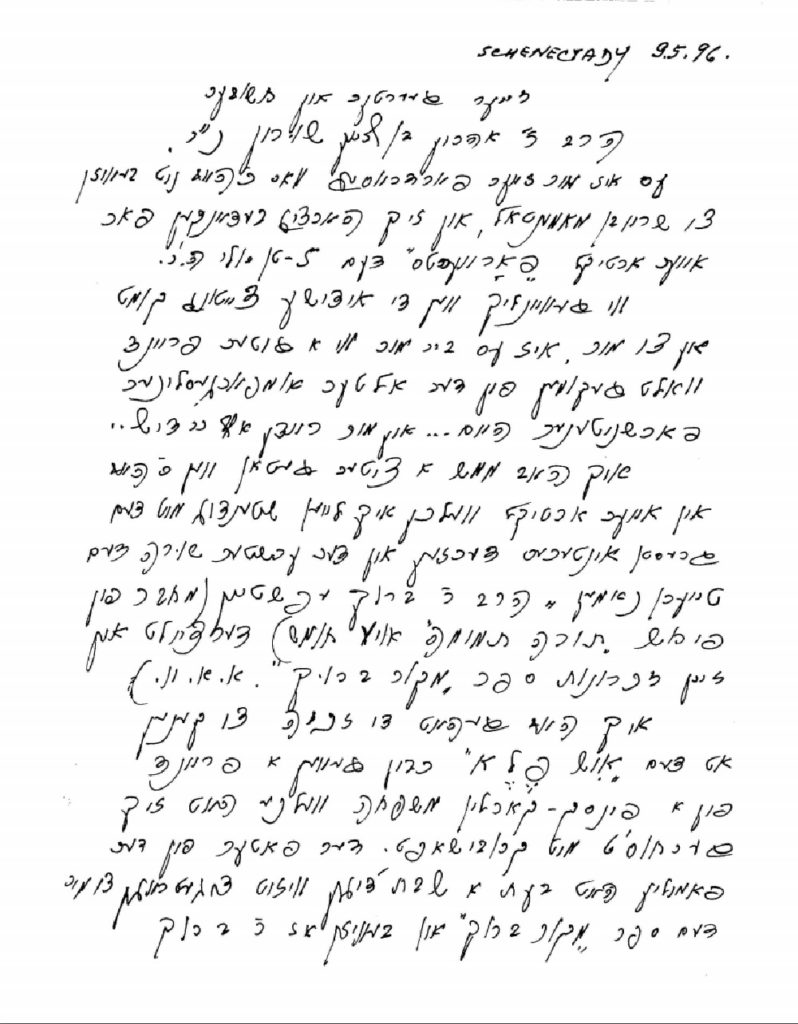


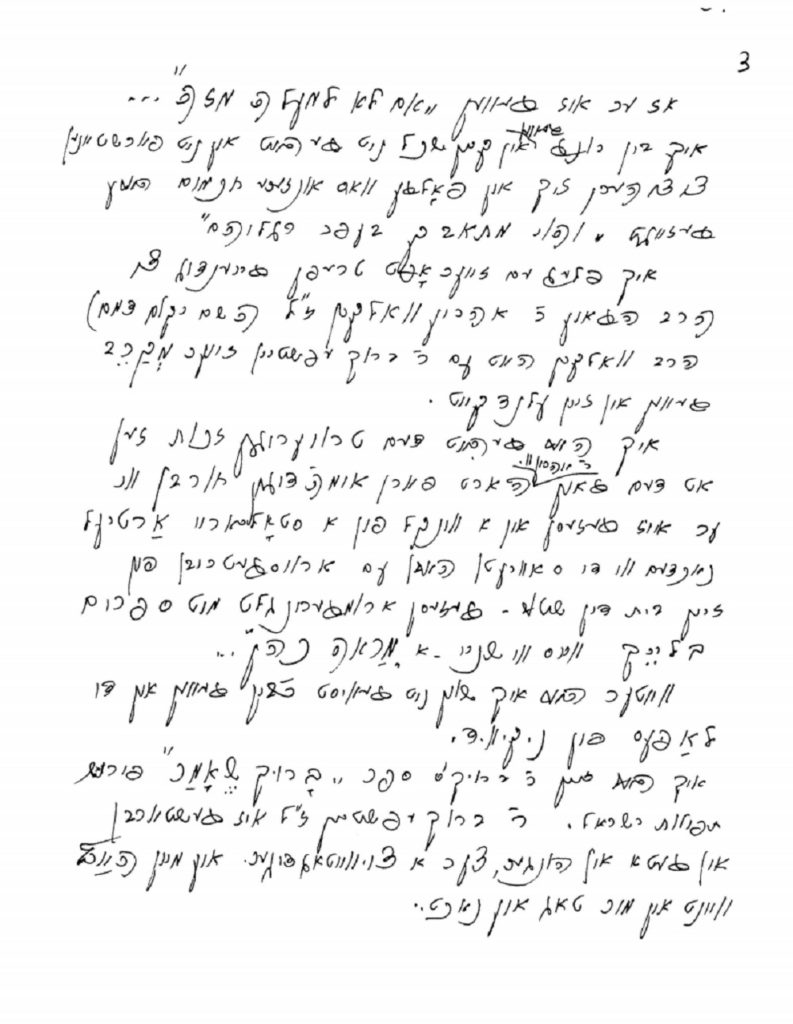
SCHENECTADY 9.5.96.

זייער געערטער און חשובער
.הרב ר״ אהרון בן ציון שוּרין נ״י


עס איז מיר זייער פארדראסיג וואס כ׳האב ניט בעוויזן
צו שרייבן מאמענטאל, און זיך הארציג בעדאנקען פאר
.אייער ארטיקל ״פאָרווערטס״ דעם 5-טן יולי ה.י

ווי געוויינליך ווען די אידישע צייטונג קומט
אן צו מיר, איז עס ביי מיר ווי א גוטער פריינד
וואלט געקומען פון דער אלטער אומפארגעסליכער
..פארשניטענער היים… און מיר ריידן א[וי]ף יידיש

איך האב ממש א ציטער געטאן ווען כ׳האב
אין אייער ארטיקל וועלכן איך לייען שטענדיג מיט דעם
גרעסטן אינטערעס דערזען אין דער ערשטער שוּרה דעם
טייערן נאמען ״הרב ר׳ ברוך עפשטיין (מחבר פון
פירוש ״תורה תמימה״ אויף חומש) דערציילט אין
[3](זיין זכרונות ספר ״מקור ברוּך״ א.א.וו

איך האב געהאט די זכיה צו קענען
אט דעם ״אִיש פֶלֶא״ כבין געווען א פריינד
פון א פינסק-קארלין משפחה וועלכע האט זיך
געיחוס׳ט מיט קרובישאפט. דער פאטער פון דער
פאמיליע האט בעת א שבת׳דיגן וויזיט צוגעטראגן צו מיר
דעם ספר ״מקור ברוך״ און בעוויזן אז ר׳ ברוך

2

ווייזט אן אז אין שׁימל פון ברויט ליגט
דער פאטער אלתר סלוּצקי .PENECiLiN רְפוּאָה ווי
איז געווען א לאַווניק אין שטאט ראַט און די טאכטער האט
געארבעט אין דער יידישער אפטיילונג. אזוי ווי פינסק
האט געהאט א פנקס פון 800 יאר האט זיך זי געהאט די
א מעגליכקייט אויסגעפינען און אנטקעגן קומען ר׳ ברוך עפשטיינס
ביטעס אין די ארכיווע אויסצוזוכן. ער פלעגט זיך שטענדיג
בעדאנקען צו איר דורך שיקן א ״באָמבאניערקע״
דא הייסט עס א באַקס שאקאלאד)… איך)
.מיט טרערן אין די אייגן און מוז א וויילע איבערייסן

.ער האט מיר אויסגעלערנט אן אריטמעטיג פארמוּלע
איך דערמאן זיך ווען כ׳האב שבת נאכן דאוונען אין פינסקער
גרייסער שוּל אראבגעגאנגען צום ברעג פון אונזער
און בעמערקט ר׳ ברוך עפשטיין ז”ל PiNA שיינער טייך
זיצט אויף א באַנק כ׳בין צוגעגאנגען צו עם און געזאגט

״גוט שבת ר׳ ברוּך גום ברוך יהיה״

ער האט געענטפערט ״גם אתם״ און צובייגענדיג צו מיר
געפרעגט ״אפשר האט איר די פאָלקס צייטונג״
(א בונדיסטישע צייטונג וואס איז ארויס אין ווארשע)
(ווען איך האב עס דערציילט א היגן רָב (ניט קיין ראביי
האט ער צו מיר געזאגט יעצט זע איך

3

…אז ער איז געווען ״אם לא למעלה מזה״
איך בין יונג געווען און קיין שכל ניט געהאט און ניט פארשטאנען
צו צוהערן זיך און פאָלגן וואס אונזערע חכמים האבן
געזאגט ״והוי מתאבק בעפר רגליהם״

איך פלעג עם זייער אָפט טרעפן גייענדיג צו
(הרב הגאון ר׳ אהרון וואלקין ז״ל השם יקום דמם
הרב וואלקין האט עם ר׳ ברוך עפשטיין זייער מְקַרֵב
.געווען אין זיין עלנדקייט

איך האב געהאט דעם טרויעריגן זכות זען
אט דעם גאון ר׳ אהרון וו. הארט פארן אימה׳דיגן חורבן ווי
ער איז געזעסן אין א ווינקל פון א סטאָליאריי אַרטיעל
נאכדעם ווי די סאוויעטן האבן עם ארויסגעטריבן פון
זיין בית דין שטוב. געזעסן ארומגערינגלט מיט ספרים
…בליֵיך ווייס ווי שניי. א ״מַראה כהן״

ווייטער האב איך שוין ניט געווּסט כ׳בין געווען אין די
.לאַפּעס פון נ.ק.וו.ד

איך האב זיין ר׳ ברוּך׳ס ספר ״בָרוּך שֶאָמַר״ פירוּש
תפילות ישראל. ר׳ ברוך עפשטיין ז״ל איז געשטארבן
אין געטא אין הונגער, צער א צוּווייטאגדיגער. און מיין האַרץ
..וויינט אין מיר טאג און נאכט

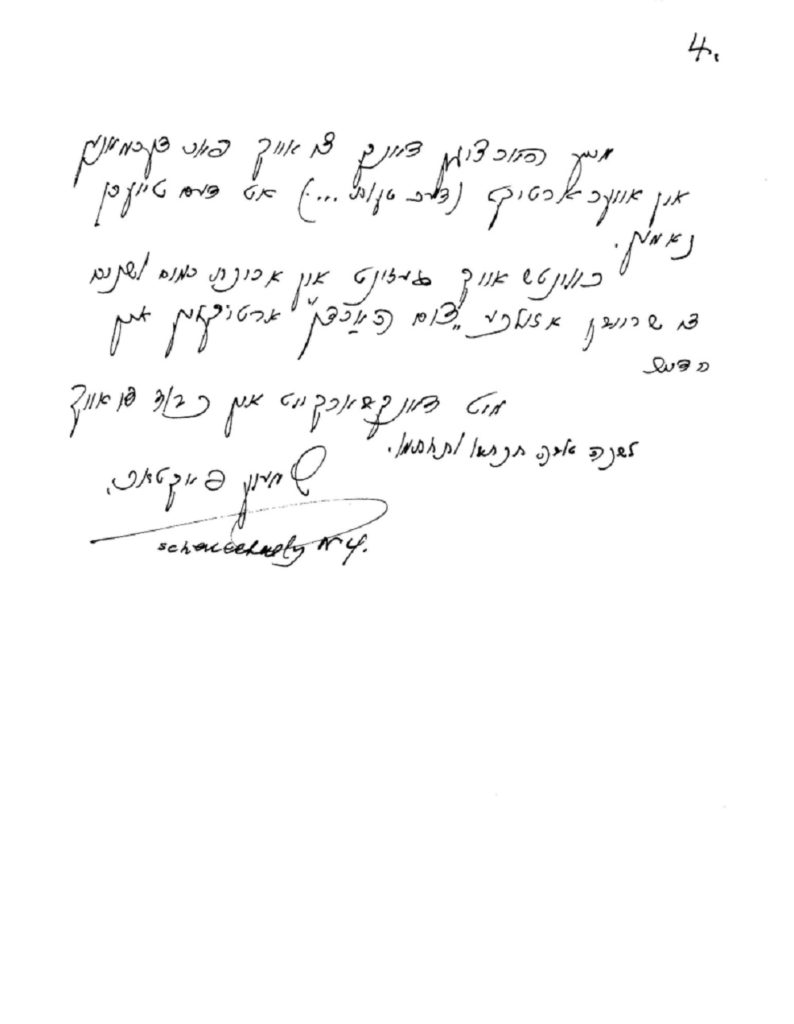
4

מיין הארציגן דאנק צו אייך פאר דערמאנען
אין אייער ארטיקל (דער טעות….) אט דעם טייערן
.נאמען

כווינטש אייך געזונט און אריכת ימים ושנים
צו שרייבן אזעלכע ״צום האַרצן״ ארטיקלען אין
יידיש

מיט דאנקבארקייט און כבוד צו אייך
.לשנה טובה תכתבו ותחתמו
.שמעון פאקטאר
Schenectady NY.

Schenectady 9.5.96

To the highly esteemed and eminent Rabbi Aaron Benzion Shurin, may his light shine,

I am greatly displeased that I did not manage to write immediately to offer my sincere thanks for your column in this year’s July 5th issue of the Forverts.

As is usual when the Yiddish newspaper is delivered, I felt then as if a good friend had arrived from the unforgettable, obliterated old country… and we were having a conversation in Yiddish…

I literally shuddered when I noticed in the first line of your column – which I always read with the greatest interest – the dear name “Rabbi Baruch Epstein (author of the Torah temimah commentary on the Pentateuch) relates in his memoir Mekor barukh,” etc.

I had the good fortune to know that “amazing man.” I was friendly with a family in Pinsk-Karlin that took pride in its kinship with him. The head of the family, during a visit of mine one Sabbath, brought me the book Mekor barukh and showed me that R. Baruch

2

points out that medicine akin to penicillin can be found in moldy bread.[4] The father, Alter Slutzky, was an alderman on the city council, and his daughter worked in its Jewish division.[5] Since Pinsk had a communal register going back 800 years,[6] she had the opportunity to learn of and accommodate R. Baruch Epstein’s requests to search in the archive. He would always thank her by sending a bombonierka (here, we would call it a box of chocolates)…[7] I write this with tears in my eyes and must pause for a moment.

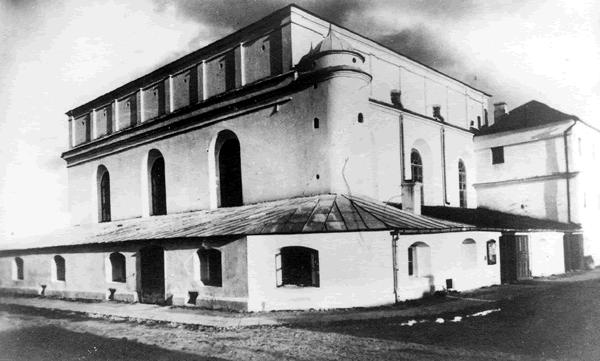
He taught me an arithmetic formula. I remember how one Sabbath, after services in the Great Synagogue of Pinsk,[8] I descended to the banks of our beautiful Pina River and caught sight of R. Baruch Epstein, of blessed memory, sitting on a bench.[9] I approached him and said, “Good Sabbath, R. Baruch – may you, too, be blessed [barukh].”[10] He responded, “The same to you”[11] and, leaning over to me, asked, “Maybe you have a copy of the Folkstsaytung?” (a Bundist newspaper published in Warsaw). When I recounted this story to a local rov (not some non-Orthodox rabbi),[12] he said to me, “Now I see

3

that he was ‘if not even higher than that’[13]…”[14] I was young and foolish and did not realize that I should really listen to and follow that which our Sages taught: “And sit in the dust of their feet.”[15]

I would very often meet him on his way to the ga’on Rabbi Aaron Walkin, of blessed memory (may God avenge their blood). R. Walkin drew quite close to R. Baruch Epstein in his loneliness.

I had the tragic fortune to see that ga’on, R. Aaron W., right before the horrific Holocaust, sitting in a corner of a carpentry workers’ cooperative after the Soviets had banished him from his rabbinic courtroom. He sat surrounded by books, his complexion pale white as snow, like leprosy shown to a priest…[16]

I knew nothing more of him; I was caught in the clutches of the NKVD.

I have R. Baruch’s book Barukh she-amar, a commentary on the Jewish prayers.[17] R. Baruch Epstein, of blessed memory, died in the ghetto a distressed man, starving and suffering. And my heart cries within me day and night…

4

My sincere thanks to you for mentioning in your column (“The Mistake…”) that precious name.

I wish you health and many long days and years so that you might continue writing such “heartwarming” columns in Yiddish.

With gratitude and esteem,
May you be inscribed and sealed for a good year,
Simon Paktor
Schenectady, NY

Although the author of our letter offers precious few details about himself in the body of the document, we know from other sources that he was born to Moishe and Gittel Paktor on January 18, 1913 in Pinsk (then part of Russia, now in Belarus).[18] At the time, Pinsk was one of the most Jewish (percentage-wise) of the major cities in Eastern Europe, with a Jewish population in 1914 of 28,063 out of 38,686 total residents (approximately 72.5%).[19] Presumably because Paktor was young and politically active, the NKVD (Soviet secret police) arrested him toward the beginning of World War II, when Pinsk was occupied by the Red Army, and sent him eastward to a Siberian labor camp, thereby inadvertently saving his life.[20] When he was released, he traveled to Munich where he met and married his first wife, Helen (1925–2019), and the two of them, together with their young son David Leon (b. 1949), immigrated to the United States in 1952.[21] Sometime thereafter the couple divorced, and in 1973 Simon moved to Schenectady to serve as the Ritual Director at Congregation Agudat Achim, a Conservative synagogue (located at 2117 Union Street).[22] There, in 1976, he married Anne Smuckler (1914–2014), whose own husband had passed away three years prior,[23] and continued serving the shul faithfully until his retirement in 1993.[24]

Paktor’s letter, like Dickman’s before it, transports us back in time, providing rare firsthand testimony that sheds light on several aspects of interwar Eastern European rabbinic culture. It deals primarily with the figure of R. Epstein, a brilliant Talmudist and polymath who decided not to enter the rabbinate but instead to support his family as a banker, all the while composing important Torah works in a non-professional capacity.[25] Perhaps the most eclectic of these is Sefer mekor barukh (Vilna, 1928), a multivolume compilation of his novellae and studies in various fields of Jewish scholarship, as well as personal reminiscences about members of his family. Paktor’s letter briefly discusses this book but also, en passant, and intriguingly, references Epstein’s research in the Pinsk Jewish communal archive; could he have been working there on his never-published bilingual (Hebrew and Yiddish) treatise on the history of Pinsk, written in the aftermath of World War I?[26]

Also interesting is Epstein’s request for a copy of the daily Folkstsaytung, not only on account of the paper’s strictly secular orientation – indeed, it, like the Forverts, was published on Shabbat and yom tov[27] – but also because halakhah, according to a number of interpretations, generally disapproves of reading printed matter like newspapers on Shabbat[28] (some would say during the week as well[29]). In apparently seeing nothing wrong with this practice, Epstein was following the example of his maternal uncle and eventual brother-in-law, Rabbi Naphtali Zevi Judah Berlin (Netsiv; 1816–1893), last rosh yeshivah of the famous yeshivah in Volozhin (present-day Vałožyn, Belarus), who, by Epstein’s own account, would regularly peruse a newspaper on Shabbat day.[30]

In addition, the letter opens a window onto the relationship between Epstein and Rabbi Aaron Walkin (alternatively spelled Wolkin; 1865–1941/1942).[31] By the period in question, Epstein had suffered a number of tragedies and personal setbacks: his wife Sophia (Sheyne), the daughter of Eleazar Moses ha-Levi Horowitz (Reb Leyzer Pinsker; 1817–1890), former chief rabbi of Pinsk, had passed away due to influenza in 1899 before the age of 40; the Mutual Credit Society, the large private bank at which Epstein had worked as an officer, closed at the beginning of World War I; and three of his four children were no longer in Pinsk.[32] Though his daughter Fania (Feygl) remained in the city,[33] Epstein was lonely and lived in a hotel.[34] Into this void stepped Walkin, who arrived in Pinsk circa 1923,[35] becoming its chief rabbi in 1933[36] and there growing close to Epstein. The two men had much in common: both had studied at the feet of Netsiv in Volozhin, married around the age of 18, endured great misfortune, visited America but decided to return to Europe, and sympathized (at least somewhat) with the Zionist movement.[37] As Paktor testifies, Epstein, who lived (as of 1930) at 89 Dominikańska (present-day Gor’kogo [renamed by the Soviets]) Street,[38] would often visit Walkin at his home at 71 Dominikańska, a claim confirmed by the latter’s son, Rabbi Samuel David (1900–1979),[39] who refers to Epstein on at least one occasion as yedidi ne’eman beitenu (my friend, a confidante of our household).[40]

Finally, the letter touches directly on the last years of Walkin’s and Epstein’s lives. Shortly after Soviet forces entered Pinsk on September 17, 1939, they banned Hebrew language instruction, abolished the traditional Sabbath and Jewish holidays, and converted the Great Synagogue into a theater.[41] We know from Paktor’s letter and other sources that Walkin, who had been imprisoned by the Russians previously,[42] largely escaped persecution at the hands of the Soviets and even managed to continue performing his rabbinic functions, including scholarly writing, in secret.[43] Epstein, by contrast, was evicted from the hotel in which he had been living and was forced to wander, further weakening him in his old age.[44]

With the Nazi advance into Pinsk on July 4, 1941, an already dire situation was made even more terrifying: Jews were wantonly robbed and beaten, forced to wear Stars of David, ordered to provision the German occupiers, forbidden to leave the city, and detained for labor or ransom. About a month later, on August 5–7, the first Aktion took place, in which the Nazis murdered approximately eight thousand Jewish men outside the city. The following May 1, a ghetto meant to concentrate the approximately twenty thousand remaining Jews was established in the poorest and most crowded part of town; this was later almost completely liquidated in the second Aktion of October 29–November 1, 1942.[45]

What became of Walkin and Epstein during this frightful time? Theories about each man’s demise abound. R. Samuel David refers to his father on several occasions with the acronym reserved for martyrs, H[ashem] y[ikkom] d[amo], following his name.[46] Indeed, at least two Pinsk natives have written that R. Aaron perished together with his flock (presumably in one of the two major Aktionen).[47] Others have hazarded guesses dating his passing to around Passover 1941 or to the summer of 1942.[48] Similarly, as surveyed recently in part by Shemaryah Gershuni, hypotheses regarding Epstein’s date of death range from 1940 to 1942 and, regarding the circumstances of his death, from natural to painful to violent.[49]

In his letter, Paktor himself could not say what had happened to Walkin, while with respect to Epstein, he claimed that he had died in the Pinsk ghetto (he, too, adds Hashem yikkom damam after mentioning them).[50] However, so far as I have been able to ascertain, and as already pointed out by Gershuni, the only eyewitness testimony to have come down to us – that of a nurse named Mila/Michla Ratnowska (b. 1916) who, together with her mother Zlata (1890–1962) and four others, survived the Nazi occupation of Pinsk in hiding – records that both men died (at home) due to illness in the winter of 1941–1942.[51] This timing is corroborated, if only implicitly, by the absence of Walkin and Epstein from the list of over eighteen thousand Jews living in the Pinsk ghetto, drawn up by the Germans “sometime in 1942.”[52] Until additional evidence surfaces, it would seem prudent to accept this as the most reliable version of the events leading up to the passing of these great men, about whom we can say (with a bit of poetic license) that they were “beloved and cherished in their lifetimes, and they never parted, even in death” (II Sam. 1:23).

Conclusion

Like the giants about whom they wrote, Shurin, Dickman, and Paktor have all passed on (in 2012, 2011,[53] and 2003, respectively). How fortunate we are, though, that their memories are preserved for us in this nay (new) bintl briv! Through these simple documents – penned in an age (not too long ago) when people still took the time to correspond thoughtfully with journalists after reading and reflecting on their essays – we are able to reconstruct, if only partially, the lives and deeds of some of the most prominent leaders of Eastern European Jewry in a prewar world now lost.


* I would like to thank Yehuda Geberer for respectfully commenting that he felt I had made a mistake in the first part of this essay, in which I had identified the Chaim Lieberman who assisted Shurin in landing a job at the Forverts as “the famed historian and bibliophile” who lived 1892–1991 (and who often spelled his name Haim Liberman in English). While Geberer is almost certainly correct that Shurin was actually helped by the man of the same name (1890–1963) who, according to his entry in the Leksikon fun forverts shrayber zint 1897, 42-43, worked as a teacher of Yiddish literature and Forverts Yiddish literary critic, I was influenced (apparently unduly so) in my (mis)identification by Yisroel Besser who, in his Mishpacha article (p. 30), writes as follows: “He went to meet the person he considers the greatest Orthodox writer of the century, Chaim Lieberman. Lieberman was a bibliophile, researcher, and historian, who suggested that young Shurin leave him some writings to peruse.”

I also wish to thank Yehudah Zirkind for kindly bringing to my attention another Yiddish-language memoir about the Hafets Hayyim, in which the author, a Radin native, tells a number of interesting stories about the great sage and also notes that he passed away “before reaching his ninety-fourth birthday”; see Abrashka-Kives Rogovski, “Der khofets-khayim in radin,” Oksforder yidish 3 (1995): 193-200, at col. 200.

[1] Aaron B. Shurin, “Der toes fun estraykhishn keyzer,” Forverts (July 5, 1996): 9, 20.
[2] See Baruch ha-Levi Epstein, Sefer mekor barukh, pt. 2 (Vilna: Romm, 1928), 515a-b, citing what he heard from Isaac Hirsch Weiss of Vienna (1815–1905). Epstein refers to the ruler as Franz Joseph II, but in point of fact the relevant Austrian emperor at the time was Franz Joseph I (whose official grand title, interestingly, included the style “King of Jerusalem”).
[3] The quotation of the original Yiddish here is not exact but is certainly close enough.
[4] I have so far been unable to locate the passage referred to.
[5] Jacob-Alter Slutzky was a prominent Orthodox lay leader of the Jewish community of Pinsk who was s/elected to serve on the city council at several points during the interwar period when Pinsk was under Polish rule; see Azriel Shohet, The Jews of Pinsk, 1881 to 1941, ed. Mark Jay Mirsky and Moshe Rosman, trans. Faigie Tropper and Moshe Rosman (Stanford: Stanford University Press, 2012), 469-470, 552-556, 559, 580-581. For the original Hebrew, see Wolf Zeev Rabinowitsch (ed.), Pinsk: sefer edut ve-zikkaron li-kehillat pinsk-karlin, vol. 1, pt. 2 (Tel Aviv; Haifa: Irgun Yotse’ei Pinsk-Karlin bi-Medinat Yisra’el, 1977; also available through the New York Public Library Yizkor Book online portal [accessed August 19, 2019]), using the index. See also Slutzky’s mini-bio in Nachman Tamir (Mirski) (ed.), Pinsk: sefer edut ve-zikkaron li-kehillat pinsk-karlin, vol. 2 (Tel Aviv: Irgun Yotse’ei Pinsk-Karlin bi-Medinat Yisra’el, 1966; also available through the New York Public Library Yizkor Book online portal [accessed August 19, 2019]), 538, where it is noted that Slutzky, like Epstein, was a member of Netsiv’s family (see below) and that he had two daughters, Zhenya and Eve. Based on a daf-ed filed by the former’s sister-in-law, Sonia Goberman (accessed August 19, 2019), it appears that Zhenya was the one who worked in the Jewish division. For Epstein’s endorsement of Slutzky during a campaign season, see “Eyn goldene keyt fun maysim toyvim,” Unzer pinsker lebn 3,42 (102) (October 16, 1936): 5.
[6] An old Pinsker tradition has it that the Jewish community was founded some time in the tenth century; see Benzion Hoffman (ed.), Toyznt yor pinsk (New York: Pinsker Branch 210, Workmen’s Circle, 1941), ix-x (notice the book’s title), and Tamir, Pinsk, 249, 252. Some have averred that an exact date for the start of the community cannot be established at present, given the number of times the Great Synagogue, and any historical documents it may have housed, burned down (on which, see n. 8 below); see, e.g., Saul Mendel ha-Levi Rabinowitsch, “Al pinsk-karlin ve-yosheveihen,” in Judah ha-Levi Levick and Dovberush Yeruchamsohn (eds.), Talpiyyot (me’assef-sifruti) (Berdychiv: Joseph Hayyim Zablinsky, 1895), 7-17, at p. 7. In any event, the current mainstream position holds that it began around 1506, the year in which a privilege issued by Fyodor Ivanovich Yaroslavich, Prince of Pinsk, granted local Jews land for a synagogue and cemetery in perpetuity; see Mordechai Nadav, The Jews of Pinsk, 1506 to 1880, ed. Mark Jay Mirsky and Moshe Rosman, trans. Moshe Rosman and Faigie Tropper (Stanford: Stanford University Press, 2008), 13-14.
[7] For a similar story, see Hillel Seidman, “Ha-rav r. barukh epstein – pinsk,” in Isaac Lewin (ed.), Elleh ezkerah: osef toledot kedoshei [5]700-[5]705, vol. 1 (New York: Research Institute of Religious Jewry, Inc., 1956), 142-149, at p. 145; reprinted with some variations in Seidman’s Ishim she-hikkarti: demuyyot me-avar karov be-mizrah eiropah (Jerusalem: Mossad Harav Kook, 1970), 108-116, at p. 111. Relatedly, see the Rosh Hashanah greetings sent to Epstein by the typesetters and printers of the Pinsker vort 2,40 (86) (September 30, 1932): 1, and of ibid. 3,38 (138) (September 20, 1933): 1.
[8] For some of the turbulent history of the Great Synagogue of Pinsk, which fell victim to fires on multiple occasions, see Nadav, The Jews of Pinsk, 1506 to 1880, 463-465; Shohet, The Jews of Pinsk, 1881 to 1941, 217-220, 300-301, 463, 648, 656; and Tamir, Pinsk, 249-252. For photographs of the synagogue, see here and here (accessed August 19, 2019). For a map of Pinsk from 1864 illustrating the location of the Great Synagogue, see Hoffman, Toyznt yor pinsk, 88-89 (in Yiddish), and Nadav, The Jews of Pinsk, 1506 to 1880, 498-499 (in English). For later maps of Jewish Pinsk, see Hoffman, Toyznt yor pinsk, 232-233, and Tamir, Pinskfoldout preceding p. 97.
[9] Epstein generally prayed not in the Great Synagogue but in the Pinsker Kloyz, a beit midrash with a firmly mitnaggedic orientation. Ze’ev Rabinowitsch reports that, “in years past, it was said that the walls of the Pinsker Kloyz do not give out in deference to R. Baruch Epstein…” (“Akhsanye shel toyre,” in Tamir, Pinsk, 264). See also Rabinowitsch, Pinsk, 412.
[10] See Gen. 27:33.
[11] In Yiddish, one appropriate response to a greeting like gut shabes! is gam atem!, using the plural atem even when only one person is being addressed. See Sol Steinmetz, Dictionary of Jewish Usage: A Guide to the Use of Jewish Terms (Lanham, MD: Rowman & Littlefield Publishers, Inc., 2005), 53.
[12] American Yiddish will often distinguish between Orthodox and non-Orthodox (particularly Reform) rabbis by referring to the former as rov/rabonim (singular/plural) and the latter as rabay/rabays (singular/plural). As essentially transliterations from the English, these terms for non-Orthodox rabbis are usually intended somewhat derogatorily in the mouths of frum Yiddish speakers.
[13] Oyb nisht nokh hekher or, as the phrase appears here in Hebrew, Im lo le-ma‘lah mi-zeh, is the title of a short story by the famous Yiddish and Hebrew classicist I.L. Peretz (1852–1915) about a Litvak who refuses to believe that the Nemirover Rebbe (a fictional character probably based on Rabbi Nathan Sternharz of Niemirów [1780–1845]) ascends on High during the annual period of selihot, as his Hasidim claim he does, instead of coming to the synagogue. Determined to find out where the Rebbe disappears to, he hides under the Rebbe’s bed one night and is amazed to discover that the Rebbe wakes early in the morning, dresses as a Polish peasant, and goes out to the forest to chop firewood for poor bedridden Jewish widows. He thereupon decides to join the Rebbe’s Hasidim, and from then on whenever anyone claims that the Rebbe flies up to Heaven to petition on behalf of his flock before Rosh Hashanah, this Litvak-turned-Hasid responds, “If not even higher than that.”

The story was first published in Yiddish in 1900 as “Oyb nisht nokh hekher! A khsidishe ertseylung,” Der yud 2,1 (January 11, 1900): 12-13. The following year, it appeared, in the author’s own Hebrew adaptation, as “Im lo le-ma‘lah mi-zeh,” Ha-dor 1,17 (1901): 207-211; for the Hebrew text, see here (accessed August 19, 2019). For editions using modern Yiddish orthography, see here and here (accessed August 19, 2019). For side-by-side Yiddish with English translation, see “Oyb nisht nokh hekher/And Maybe Even Higher,” in Itche Goldberg and Eli Katz (eds.), Selected Stories: Bilingual Edition, trans. Eli Katz (New York: Zhitlowsky Foundation for Jewish Culture, 1991), 270-281. For extensive discussions of the story’s subversive messages, historical sources, and inspirations, see Menashe Unger, “Mekoyrim fun peretses folkstimlekhe geshikhtn,” Yidishe kultur 7,3-4 (March–April 1945): 54-59, at pp. 56-57; Samuel Niger, Y.l. perets: zayn lebn, zayn firndike perzenlekhkeyt, zayne hebreishe un yidishe shriftn, zayn virkung (Buenos Aires: Confederacion pro Cultura Judia, 1952), 286-289; and Nicham Ross, Margalit temunah ba-hol: y.l. perets u-ma‘asiyyot hasidim (Jerusalem: Magnes Press, 2013), 17-83 (ch. 2).

In our context, the phrase is deployed by Paktor’s rabbinic interlocutor to express his realization that Epstein was even greater than he had originally thought.
[14] Paktor apparently also shared this story about Epstein and the Folkstsaytung with Mark Jay Mirsky; see the latter’s introduction to Shohet, The Jews of Pinsk, 1881 to 1941, xxix-xxx.
[15] mAvot 1:4.
[16] The Hebrew phrase deployed here is mar’eh kohen, a reference to the requirement that those afflicted with biblical tsara‘at must consult with a priest before the healing/atonement process can move forward (see Lev. 13). The expression, as used by Paktor, does double-duty by playing on the title of the well-known piyyut recited on Yom Kippur, which refers to the priest’s (radiant) appearance, not that of the biblical skin disease.
[17] Barukh she-amar was the last book Epstein printed before he passed away. It originally appeared in Pinsk in 1939 (publisher: Drukarnia Wolowełskiego), but, according to Aaron Z. Tarshish, Rabbi barukh ha-levi epstein[,] ba‘al “torah temimah” (Jerusalem: Mossad Harav Kook, 1967), 189, even though the work achieved great popularity within the city, it did not spread beyond. Epstein sent a single copy to the famous Strashun Library in Vilna, which then passed it on to YIVO, and the latter institution transferred it to its headquarters in New York (see the online catalog record for this copy here [accessed August 19, 2019]). This, then, was apparently the only exemplar of the book to survive the war, and when it was discovered at YIVO some time thereafter, it was used to print the photo-offset reproduction published in Tel Aviv in three parts: vol. 1 on the haggadah (1965), vol. 2 on Pirkei avot (1965), and vol. 3 on the siddur itself (1968). (For a slightly different account of Barukh she-amar’s original publication and rediscovery after the war, see Seidman, “Ha-rav r. barukh epstein,” 148. Based on a helpful personal communication from Lyudmila Sholokhova, Director of the YIVO Library, it would appear that Tarshish’s version of the story is the more accurate one.)

I assume that Paktor owned a copy of the Tel Aviv reprint, not the original Pinsk edition.
[18] See the obituary for Rev. Simon Paktor published in the Albany Times Union (March 2–3, 2003), available here (accessed August 19, 2019).

Franz J. Beranek, in his Das Pinsker Jiddisch und seine Stellung im gesamtjiddischen Sprachraum (Berlin: Walter de Gruyter & Co., 1958), discusses certain distinctive features of the dialect of Yiddish spoken in Pinsk. Upon examination of our letter, we find some of the markers of this litvish (Northeastern Yiddish) dialect reflected in such forms as eygn (eyes; see p. 33, §38, 1), greyser (large; see p. 25, §26), arobgegangen (descended; see p. 53, §48, 2a), em (him; see p. 21, §18, 1), etc. (I suspect that his use of the forms idishe [Jewish/Yiddish], reydn [to speak], and fardrosig/hartsig/shtendig/etc. [displeased/sincerely/always/etc.], instead of the expected yidisheredn, and fardrosik/harstik/shtendik/etc., is the result of Paktor following common journalistic orthographic conventions and is not reflective of his actual pronunciation of those words.) (For a recent look at Beranek’s relationship with some of his Yiddish scholarly contemporaries, see Kalman Weiser, “‘One of Hitler’s Professors’: Max Weinreich and Solomon Birnbaum confront Franz Beranek,” Jewish Quarterly Review 108,1 [2018]: 106-124.)
[19] See Mordechai Nadav, “Pinsk,” in Shmuel Spector (ed.), Pinkas ha-kehillot: polin, vol. 5 (Jerusalem: Yad Vashem, 1990), 276-299, at p. 276 (available in English translation here [accessed August 19, 2019]). See also Dov Levin, Tekufah be-sograyim, 1939–1941: temurot be-hayyei ha-yehudim, ba-ezorim she-suppehu li-berit-ha-mo‘atsot bi-tehillat milhemet ha-olam ha-sheniyyah (Jerusalem: Hebrew University of Jerusalem; Tel Aviv: Hakibbutz Hameuchad, 1980), 26, for a chart comparing the populations of cities in eastern Poland in 1931.
[20] See the aforementioned obituary for Paktor published in the Albany Times Union. On NKVD activity in Pinsk during the Soviet occupation, see Pesah Pakacz, “Shilton ha-soviyyetim be-pinsk,” in Tamir, Pinsk, 315-320, at pp. 317-320, and Shohet, The Jews of Pinsk, 1881 to 1941, 639-650. On NKVD activity among occupied Polish Jewry in general, see Yosef Litvak, Pelitim yehudim mi-polin bi-berit ha-mo‘atsot[,] 1939–1946 (Jerusalem: Hebrew University of Jerusalem; Tel Aviv: Ghetto Fighters’ House; Hakibbutz Hameuchad, 1988), 118-156. As noted by Eliyana R. Adler, the similar situation of Baltic Jews exiled to the east by the Soviets demonstrates that had they not suffered that fate, they most likely would have fallen victim to the Nazis when the latter invaded the Soviet Union on June 22, 1941; see her “Exile and Survival: Lithuanian Jewish Deportees in the Soviet Union,” in Michal Ben Ya’akov, Gershon Greenberg, and Sigalit Rosmarin (eds.), Ha-kayits ha-nora ha-hu…: 70 shanah le-hashmadat ha-kehillot ha-yehudiyyot be-arei ha-sadeh be-lita: historiyyah, hagut, re’aliyyah (Jerusalem: Efrata College Publications, 2013), xxvii-xlix, at pp. xlv-xlvi.
[21] See the Holocaust remembrance seminar announcement published in the Clifton Journal (October 30, 2015), p. 36 (available here [accessed August 19, 2019]; make sure to click “View Details”). The Air Passenger Manifest recording the Paktors’ arrival in New York, available to subscribers through the MyHeritage database (accessed June 20, 2019), is dated May 19, 1952; curiously, it lists Simon’s wife’s name as Sabina.
[22] According to Michael C. Duke, “Historian Is CBY Scholar In Residence, Oct. 8–10,” Jewish Herald-Voice (October 7, 2010) (accessed August 19, 2019), Paktor was trained as a rabbi. While I could find no direct corroborating evidence for this claim elsewhere, it is true that he is sometimes referred to in writing with the title “Reverend.” His work at the shul, for which he came to be well loved and respected, included serving as cantor and Torah reader, running the daily minyanim, preparing youth for their bar and bat mitzvahs, and even teaching Yiddish classes; Stephen M. Berk, Year of Crisis, Year of Hope: Russian Jewry and the Pogroms of 1881–1882 (Westport, CN; London: Greenwood Press, 1985), xv, credits Paktor with introducing him to the world of Yiddish scholarship. See also the aforementioned obituary in the Albany Times Union and the above article by Duke. I thank Robert Kasman, Stephen M. Berk, and Mendel Siegel for the information they provided me on Paktor’s life and service to the shul in personal communications.
[23] See the obituary for Anne Paktor published here (accessed August 19, 2019).
[24] Henry Skoburn, The Agudat Achim Chronicle: Commemorating 120 Years[,] 1892–2012 (Schenectady: Congregation Agudat Achim, 2012), 10, 12.
[25] The only book-length biography of Epstein is Tarshish’s (above, n. 17), though, as noted by Eitam Henkin, “Perakim be-toledot ba‘al arukh ha-shulhan: mishpahto ve-tse’etsa’av,” Yeshurun 27 (2012): 879-895, at p. 879, this work is in need of a thorough update that takes a scholarly-critical approach and considers the abundant literature on Epstein and his oeuvre that has appeared over the past fifty-plus years. For a shorter essay on Epstein’s life, see Seidman’s “Ha-rav r. barukh epstein” (above, n. 7). And for a famous photograph of Epstein in his younger years, see Hoffman, Toyznt yor pinsk, 335; reproduced (seemingly with modifications) as the frontispiece of Tarshish’s biography and in Zvi Kaplan, “Hiddushim ba-halakhah shel gedolei pinsk ve-karlin,” in Rabinowitsch, Pinsk, 367-406, at p. 393. (I find it hard to believe that the person in the portrait accompanying the Epstein mini-biography printed in Tamir, Pinsk, 489-491, is actually him but would be happy to be corrected.)
[26] See Baruch ha-Levi Epstein, Sefer mekor barukh, introduction (Vilna: Romm, 1928), 2 n. 1.
[27] The Folkstsaytung (People’s Paper) was the official organ of the General Jewish Workers Union in Poland, also known as the Bund. As such, it espoused a secularist, socialist Weltanschauung and polemicized against Communists, Zionists, and Orthodox Jews, among others. In addition to covering politics and workers’ issues, the paper devoted space to science and technology, sports, culture, and (Jewish and non-Jewish) literature. At its height in 1935, the Folkstsaytung had an approximate circulation of eighteen thousand. See Jacob Shalom Hertz, “‘Folkstsaytung’ 1918–1939,” in David Flinker, Mordechai Tsanin, Shalom Rosenfeld et al. (eds.), Di yidishe prese vos iz geven (Tel Aviv: Veltfarband fun di Yidishe Zhurnalistn, 1975), 151-169, and Boris Kotlerman, “Folks-tsaytung,” trans. I. Michael Aronson, in the digitized YIVO Encyclopedia of Jews in Eastern Europe (accessed August 19, 2019).

According to Seidman, “Ha-rav r. barukh epstein,” 144-145:

[Epstein] had an expansive [intellectual] horizon. He was interested in and familiar with all that was happening in the world. He read Russian and German newspapers. He also visited Vienna and Berlin in the ’20s, meeting with scholars and intellectuals there, and maintained an epistolary correspondence with the towering Jewish figures of the generation. When they visited Pinsk, he would host them. In 1914, Rabbi Hayyim Soloveichik visited Pinsk and stayed with Rabbi Baruch Epstein for Shabbat.

In addition to regularly reading the paper, Epstein also contributed to a number of (rabbinic and general Jewish) periodicals, including HavatseletYagdil torahHa-levanonHa-maggidHa-melits, and Ha-pardes; see Baruch ha-Levi Epstein, Sefer mekor barukh, pt. 3 (Vilna: Romm, 1928), 701b, and Shemaryah Gershuni, “Rabbi barukh epstein – ba‘al ha-torah temimah: beirur nesibbot petirato,” Yeshurun 29 (2013): 885-892, at pp. 886 n. 13, 889 n. 25. He even wrote a weekly column on the parashah for the Pinsker shtime; see Seidman, “Ha-rav r. barukh epstein,” 145, 148-149. While I have not examined issues of the Pinsker shtime, I know that Epstein’s parashah columns in a different local paper, Pinsker vort, were entitled Fun gebentshtn kval (=Mi-makor barukh); see the announcement in the February 20, 1931 edition, p. 1.
[28] For a summary of some of the halakhic literature on the topic and a defense (in most cases) of the widespread contemporary disregard of this prohibition, see Eitam Henkin, “Keri’at divrei defus be-shabbat be-yameineu le-or din shetarei hedyotot,” Melilot 3 (2010): 49-63 (the pagination in the printed version is slightly different from that of what I presume to be the prepublication copy available on Henkin’s website).
[29] Indeed, the Hafets Hayyim was particularly vociferous in his opposition to the practice of many of his contemporaries to regularly read newspapers, not only because of their often-improper content (heresy, scoffing, leshon ha-ra, licentiousness, etc.), but also due to the drain on one’s time involved in their consumption. See, e.g., Israel Meir ha-Kohen, Kunteres zekhor le-miryam (Piotrków: Hanokh Henekh Fallman, 1925), 8b; Aryeh Leib Poupko, Mikhtevei ha-rav hafets hayyim z[ekher] ts[addik] l[i-berakhah]: korot hayyav, derakhav, nimmukav ve-sihotav, 1st ed. (Warsaw: B. Liebeskind, 1937), 96-98 (second pagination; no. 42); ibid., 42-43 (third pagination; par. 82); idem, Mikhtevei ha-rav hafets hayyim z[ekher] ts[addik] l[i-berakhah], ed. S. Artsi, 2 vols. (Bnei Brak: n.p., 1986), 2:157-158. Relatedly, see also idem, Mikhtevei, 1st ed., 27-29 (second pagination; no. 9). It is clear, however, that the Hafets Hayyim was, at times, exposed to periodical literature; for a letter he sent to the Haredi paper Kol ya‘akov, responding to an earlier issue thereof, see idem, Mikhtevei, ed. S. Artsi, 1:297-298 (no. 122).
[30] See Baruch ha-Levi Epstein, Sefer mekor barukh, pt. 4 (Vilna: Romm, 1928), 895b, 897b-898a. Epstein’s report about his uncle’s behavior in this connection has aroused a good deal of controversy, as discussed by, e.g., Eliezer Brodt, “The Netziv, Reading Newspapers on Shabbos & Censorship,” Seforim Blogpt. 1 (March 5, 2014) and pt. 2 (April 29, 2015). Like Brodt, Marc B. Shapiro, “Clarifications of Previous Posts,” Seforim Blog (January 16, 2008) (accessed August 19, 2019), believes that one can rely upon this account. On the general question of the historical accuracy of Sefer mekor barukh, see, e.g., Eitam Henkin, “R. yehi’el mikhl epstein ve-ha-‘tsemah tsedek’ ba-adashat ha-sefer ‘mekor barukh’,” Alonei mamre 123 (Winter 2011): 189-215, and Moshe Maimon, “Od be-inyan ba‘al ha-torah temimah u-sefarav,” Kovets ets hayyim 12,1 (2018): 409-420 (among many others).
[31] Probably the two most authoritative biographies of Walkin to date are that appended to the beginning of the second volume of the New York, 1951 photo-offset edition of his responsa, Sefer she’elot u-teshuvot zekan aharon, composed by his son, Rabbi Samuel David (on whom, see below), and entitled “Toledot maran ha-ga’on ha-mehabber z[ekher] ts[addik] v[e-]k[adosh] l[i-berakhah]”; and Hillel Seidman, “Ha-rav r. aharon walkin – pinsk,” in Lewin, Elleh ezkerah, 64-71; reprinted with some variations in Seidman’s Ishim she-hikkarti, 20-28. Eliezer Katzman used these two sources in compiling much of his own profile of Walkin – “Ne‘imut ha-torah: ha-g[a’on] r[av] aharon walkin z[ekher] ts[addik] v[e-]k[adosh] l[i-berakhah,] a[v] b[eit] d[in] pinsk[,] ba‘al beit aharon, zekan aharon v[e-]ku[llei],” Yeshurun 11 (2002): 891-904; 12 (2003): 727-739 – but added some material not found in either. (It seems that unacknowledged verbatim use was made of Seidman’s and/or Katzman’s work in the Walkin biography printed in Daniel Bitton’s editions of Sefer beit aharon on Bava kamma [Jerusalem: Mekhon ha-Ma’or, 2003] and of Sefer hoshen aharon [Jerusalem: Mekhon ha-Ma’or, 2005].) For additional appreciations of Walkin’s Torah, see Kaplan, “Hiddushim ba-halakhah,” 399-406, an earlier version of which had appeared as “Ba‘al ha-‘battim’,” Ha-tsofeh 10159 (June 24, 1966): 5, 7; and of his religious persona, see the excerpt from Rabbi Joseph B. Soloveitchik’s letter to R. Samuel David, dated 8 Shevat [5]712 (February 4, 1952) and printed at the foot of the introduction to Aaron Walkin, Sefer beit aharon al massekhet gittin, 2nd ed. (New York: S. Walkin, 1955).

For photographs of Walkin, see Anon., “Shlukhim fun agudes yisroel shoyn do,” Yidishes tageblat (December 11, 1913): 8; Anon., “Visiting Rabbis Explain International Jewish Union,” The Pittsburg [sic] Press (January 27, 1914): 3; Anon., “Noted European Rabbis Greeted by Orthodox Jews of Greater Boston,” The Boston Post (February 7, 1914): 16; Kaplan, “Hiddushim ba-halakhah,” 399; Moshe Rosman, “Pinsk,” in the digitized YIVO Encyclopedia of Jews in Eastern Europe (accessed August 19, 2019); Marc B. Shapiro, “A Tale of Two Lost Archives,” Seforim Blog (August 12, 2008) (accessed August 19, 2019); the Jewish Pinsk memorial page here (accessed August 19, 2019) (Walkin is leading the Agudah procession); and David Zaretsky, “Rabbah ha-aharon shel pinsk: le-hofa‘ato me-hadash shel ha-sefer sh[e’elot] u-t[eshuvot] ‘zekan aharon’,” in Zikhram li-berakhah: ge’onei ha-dorot ve-ishei segullah (Israel: n.p., 2015?), 33-39.
[32] See Jacob Goldman’s obituary for Sophia Epstein, entitled “Allon bakhut,” in Ha-tsefirah 26,60 (March 24, 1899): 293. See also the report issued by Aaron Tänzer, “Von Brest-Litowsk nach Pinsk,” Allgemeine Zeitung des Judentums 80,1 (January 7, 1916): 6-10, at p. 9, in which he mentions Epstein’s widowhood and the bank closure. Of Epstein’s four children – Cecilia (Tsile), Meir, Eleazar Moses, and Fania – Tänzer makes specific reference only to the last, suggesting that the other three were no longer in Pinsk by that point. Indeed, we know that Cecilia’s husband Nathan (Nahum) Bakstansky (Bakst) arrived at Ellis Island in 1907 (see his Geni record here [accessed August 19, 2019]); that they and their children Aaron and Jacob were registered voters as of 1924 (see Anon., “List of Registered Voters for the Year 1924: Borough of Brooklyn—Sixteenth Assembly District,” The City Record [October 16, 1924]: 2); and that Cecilia is registered as the copyright holder for the New York, 1928 edition of her father’s Torah temimah (see Anon., Catalogue of Copyright Entries: Part 1, Group 1 […] for the Year 1929 [Washington: United States Government Printing Office, 1930], 1825-1826). In addition, according to family records made available to Henkin, Eleazar Moses had moved to Leningrad (present-day St. Petersburg, Russia) (see the corrections appended to the online version of his aforementioned article, “Perakim be-toledot”). And if Seidman is correct that one of Epstein’s sons wound up working as a physician in New York (see the Ishim she-hikkarti version of his article, p. 110), that may mean Meir, like Cecilia, made it to America as well. (I find the idea that Meir and Fania died in their youth, as reported on Henkin’s website, difficult to believe, considering that Tänzer makes no mention of this in 1916, based on a visit to Pinsk in November 1915; see also next note. But until additional information becomes available, this will be virtually impossible to definitively reject [or accept].) In this connection, see also Maimon, “Od be-inyan,” 418-419, for an interesting interpretation of a passage in Sefer mekor barukh, pt. 4.
[33] Fania was instrumental in founding a Jewish girls’ gymnasium in Pinsk in the fall of 1915, reportedly with her father’s approval. See Tänzer, “Von Brest-Litowsk,” 9, and Shohet, The Jews of Pinsk, 1881 to 1941, 34, 183, 350-351, 596-597; see also Tamir, Pinsk, 510-512. She apparently passed away during World War II, given that she (like her father) is listed among the martyrs of Pinsk in Tamir, Pinsk, 627. (It is unclear to me whether or not the Meir cited there was R. Baruch’s son.)
[34] As of Tänzer’s visit, it seems that Fania attended to the needs of her father’s house (“Von Brest-Litowsk,” 9). Tarshish notes, however, that at a certain point he began living in a local hotel, whose proprietors took care of him honorably and with dedication (Rabbi, 127; though cf. below, n. 38). Seidman adds that he ate his meals at a restaurant in the city while living in the hotel (“Ha-rav r. barukh epstein,” 144). Three hotels, all under Jewish ownership, are named in the “List of Subscribers of the Telephone Network of the Postal and Telegraph Directorate in Wilno in 1939” (select p. 52 from the drop-down menu) (accessed August 19, 2019). I have not been able to ascertain at which of these three Epstein lived.
[35] See Kaplan, “Hiddushim ba-halakhah,” 399; see also Ben-Mem, “Ha-ga’on r. aharon walkin z[ekher] ts[addik] l[i-berakhah],” in Tamir, Pinsk, 499-500, who notes that Walkin eulogized Rabbi Jacob Mazeh of Moscow (1859–1924) within the first year of his arrival in the city. Cf. the introduction to Aaron Walkin, Sefer beit aharon al massekhet bava kamma (Vilna: Shraga Feivel Garber, 1923), which the author signed (seemingly in 1923) while living in the Jewish community of Amtshislav (present-day Mscisłaŭ, Belarus). Cf. also Anon., “Horav r. arn wolkin vegn zayn raykher lebns-fargangenheyt,” Unzer grodner ekspres 2,79 (April 2, 1929): 1, the second part of an interview with Walkin, which claims that he emigrated from Russia in 1922; as well as Aaron B. Shurin, “Tsvey shayles utshuves sforim fun letstn pinsker rov,” Forverts (October 14, 1977): 3, 6, at p. 3, who writes that Walkin came to Pinsk in 1924. (On his way from Russia to Poland, he had an extended stopover in Danzig; see M. Lyubart, “Vegn yidishn lebn in danzig,” Pinsker vort 2,11 [57] [March 11, 1932]: 5.)
[36] See Anon., “Horav walkin oysgeveylt als rov fun pinsker kehile,” Pinsker vort 3,32 (132) (August 11, 1933): 6, and Shohet, The Jews of Pinsk, 1881 to 1941, 571. Cf. Ben-Mem, “Ha-ga’on r. aharon walkin,” 500, who gives the date as [5]688 (1927–1928). (His election to the rabbinate of neighboring Karlin had taken place over a year earlier; see Anon., “Horav walkin als karliner rov,” Pinsker vort 2,6 [52] [February 5, 1932]: 6.)

Relatedly, see Dov Rabin (ed.), Grodnah-Grodne (Jerusalem: Encyclopaedia of the Jewish Diaspora, 1973; also available through the New York Public Library Yizkor Book online portal [accessed August 19, 2019]), col. 352, on the brief period in 1929 when the Jews of Grodno – then part of Poland but now in Belarus – considered appointing Walkin as the chief rabbi of their community (an episode that deserves fuller historiographic exploration); see also Anon., “Kehile-rat geg[n] horav wolkin,” Unzer grodner ekspres 2,88 (April 12, 1929): 15.
[37] For Epstein, see Tarshish, Rabbi, 70-80 (relationship with Netsiv), 84-89 (marriage at approx. 18), 120-126 (visit to America), 134-135, 148-149 (Zionist sympathies) (all based primarily on passages in Sefer mekor barukh); Shohet, The Jews of Pinsk, 1881 to 1941, 536 (Zionist sympathies); and Gershuni, “Rabbi barukh epstein,” 890-892 (visit to America). For Walkin, see his undated introduction to Sefer beit aharon al massekhet bava kamma (visit to America); the postscript to his undated introduction to the commentary Saviv li-yere’av, vol. 1 (Pinsk: Drukarnia Wolowełskiego, 1935), and the wishes of nehamah printed in Dos naye pinsker vort 7,51 (356) (December 3, 1937): 6 (personal misfortune); his son’s “Toledot maran ha-ga’on ha-mehabber” (relationship with Netsiv, marriage at approx. 18, visit to America); and Ben-Mem, “Ha-ga’on r. aharon walkin,” 500, and Rabin, Grodnah-Grodne, col. 352 (Zionist sympathies). Relatedly, Walkin’s son Hayyim married the daughter of Rabbi Abraham Isaac ha-Kohen Kook (1865–1935); see the mazl tov wishes on the occasion of their engagement printed in Do’ar ha-yom 8,182 (April 28, 1926): 1, and in Ha-arets 9,2041 (May 2, 1926): 4.

For a lecture delivered in Yiddish during Walkin’s visit to the United States, undertaken December 1913–February 1914 in order to help establish Agudath Israel in America, see Aaron Walkin, Di printsipen un tsveke fun agudes yisroel: fortrog gehalten fir amerikaner idn (New York: Office of Agudath Israel, n.d.). (During his trip, Walkin visited the Rabbi Isaac Elchanan Theological Seminary at 156 Henry Street; for his comparison of the yeshivah with that of Volozhin [!], see Anon., “Agudes yisroel shlukhim in yeshives rabeynu yitskhok elkhonen,” Der morgen zhurnal [December 24, 1913]: 4. Cf. Anon., “Horav wolkin begaystert fun idishe anshtalten in amerika,” Der morgen zhurnal [January 13, 1914]: 4.)

Tragically, Epstein and Walkin shared another fate: each printed a sefer in 1939 in Pinsk, only one copy of which survived the war and was later used for photo-offset reprinting. On Epstein’s Barukh she-amar, see above, n. 17, and on Walkin’s Sefer beit aharon al massekhet gittin, see his son’s introduction to the 1955 edition.
[38] See the address given for Epstein on the title page of his Sefer tosefet berakhah ha-kolel he‘arot ve-he’arot le-sefer “megillat sefer” al hamesh megillot ha-kodem (Krakow: [Michael Horowicz], 1930) (the same address appears on the title pages of the five parts of Sefer gishmei berakhah that appeared at the same press in the same year). It is unclear to me at what point he moved into the hotel referred to by Tarshish (see above, n. 34), though it seems, based on the aforementioned “List of Subscribers,” that as of 1939 a fellow named Dawid Giler was living at Epstein’s former address on Dominikańska Street.
[39] For several biographical sketches of R. Samuel David, the only child of R. Aaron to survive the war, see Samuel David Walkin, Sefer ramat shemu’el al ha-torah: sefer be-reshit (Jerusalem: Walkin Family, 1982), 11-27; the unpaginated introductions to idem, Sefer shevivei or: likkutim, ed. Samuel David Walkin [the grandson], 2nd ed. (Jerusalem: n.p., 2011); and idem, Sparks of Light: Jewels of Wisdom from the Chofetz Chaim ZT”L (New York: Kol Publishers, 2012), 83-86. For descriptions of R. Samuel David’s efforts on behalf of his fellow Pinskers, see Rabinowitsch, Pinsk, 547, and Tamir, Pinsk, 598-599. Unsurprisingly, given the interconnectedness of Lithuanian rabbinic dynasties, R. Samuel David became close with both the Hafets Hayyim and R. Soloveitchik; for photographs of him with the former, see the plates at the end of Sparks of Light, and with the latter, see Marc B. Shapiro, “Assorted Matters,” Seforim Blog (February 17, 2016) (accessed August 19, 2019).
[40] See Samuel David Walkin, Sefer kitvei abba mari: hiddushim u-be’urim al tanakh u-midrashav, ed. Moishe Joel Walkin (Kew Gardens: Yeshiva Beth Aron, 1989), 345; see also pp. 73, 132, 160, 266, 497, 512. For other instances of R. Samuel David quoting Epstein, often preceded by honorifics, see idem, Sefer ramat shemu’el al ha-torah, 108-109, and idem, Sefer kitvei abba mari: hiddushim u-be’urim al massekhtot ha-shas, u-mo‘adei ha-shanah[,] ve-nosaf aleihem derashot ve-he‘arot be-inyanei de-yoma, ed. Moishe Joel Walkin (Kew Gardens: Yeshiva Beth Aron, 1982), 33, 176, 193, 277, 314. For a reproduction of a letter written by Epstein (on his own letterhead) to R. Samuel David on the occasion of the latter’s appointment to the rabbinate of Lukatsh (present-day Lokachi, Ukraine) in 1935, see Tamir, Pinsk, 490. On the relationship between Epstein and R. Aaron, see also Seidman, “Ha-rav r. barukh epstein,” 144, 149. (Seidman, “Ha-rav r. aharon walkin,” 69, notes that Walkin opened his home and heart “to anyone suffering or in pain.” See also Zaretsky, “Rabbah ha-aharon shel pinsk,” 36. For a similar description of R. Samuel David, see Aaron B. Shurin, “Horav hagoen r. shmul wolkin, vitse prezident fun agudes horabonim, iz nifter gevorn,” Forverts [August 29, 1979]: 1, 8, at p. 1.) Another home Epstein visited was that of Yankev Epstein in Minsk; see Devora Gliksman, A Tale of Two Worlds (Brooklyn: Mesorah Publications, ltd, 2009), 113-114.
[41] Shohet, The Jews of Pinsk, 1881 to 1941, 642, 648; see also Tamir, Pinsk, 319-320.
[42] Walkin himself refers to this, en passant, in the introduction to Sefer beit aharon al massekhet bava kamma, saying that he was jailed bi-shevil alilah, hattat ha-kahal hu (on account of libel; it is the sin of the community). R. Samuel David, in “Toledot maran ha-ga’on ha-mehabber,” explains that his father was one of those fighting to defend Jewish tradition against the edicts of the Bolsheviks and was therefore imprisoned for about half a year. Seidman, “Ha-rav r. aharon walkin,” 67, adds (perhaps by logical deduction) that the Yevsektsiya (Jewish section of the Communist Party) was responsible for informing on him to the authorities.
[43] For examples of Walkin’s wartime rabbinic activities, see Shohet, The Jews of Pinsk, 1881 to 1941, 649; Tamir, Pinsk, 320; and Seidman, “Ha-rav r. aharon walkin,” 69, 71. For his commitment especially to Torah study and creativity in this period, see the excerpt from the last letter R. Samuel David received from him printed in “Toledot maran ha-ga’on ha-mehabber,” as well as the excerpt from a letter by Rabbi Zalman Sorotzkin (1881–1966) reproduced in the introduction to Aaron Walkin, Sefer beit aharon al massekhet kiddushin, ed. Aaron ben Moishe Joel Walkin (Queens: Aaron Walkin, n.d.).
[44] See Tarshish, Rabbi, 127; see also p. 128 on Epstein’s avoidance of the Soviet authorities, even when it meant skipping meals. Zvi Gitelman, “Afterword: Pinsk in Wartime and from 1945 to the Present,” in Shohet, The Jews of Pinsk, 1881 to 1941, 652-659, at p. 653, notes that local leaders organized a committee to aid impoverished clergy, including Epstein, during this period.
[45] For harrowingly detailed accounts of the fate of Pinsk Jewry during the Nazi onslaught, see Nahum Boneh (Mular), “Ha-sho’ah ve-ha-meri,” in Tamir, Pinsk, 325-388 (a Yiddish translation by Leib Morgenthau appears on pp. 389-458 and an English translation by Ellen Stepak appears online here [accessed August 19, 2019]); Nadav, “Pinsk,” 294-298; Tikva Fatal-Knaani, “The Jews of Pinsk, 1939–1943, Through the Prism of New Documentation,” trans. Naftali Greenwood, Yad Vashem Studies 29 (2001): 149-182; Gitelman, “Afterword,” 652-654; and Katharina von Kellenbach, Nahum Boneh, and Ellen Stepak, “Pinsk,” in Martin Dean with Mel Hecker (eds.), The United States Holocaust Memorial Museum Encyclopedia of Camps and Ghettos, 1933–1945, vol. II, pt. B (Bloomington and Indianapolis: Indiana University Press, 2012), 1442-1444. For a map of the Pinsk ghetto, see Tamir, Pinsk, 334 (in Hebrew), and here (in English) (accessed August 19, 2019). For photographs of the memorials set up on the sites of mass murder, see here (accessed August 19, 2019).
[46] See, e.g., R. Samuel David’s introductions to Sefer she’elot u-teshuvot zekan aharon, vol. 2 (the one entitled “Hakdamat ben ha-mehabber maran ha-ga’on z[ekher] ts[addik] l[i-berakhah]”) and to Sefer beit aharon al massekhet gittin; see also the entries on R. Aaron maintained by Yad Vashem (1234) (accessed August 19, 2019). (I am aware that Hy”d is sometimes used even when a person was not literally killed by an enemy but rather died as a[n in]direct result of enemy persecution.) Strangely, Tamir, Pinsk, 636, does not list any members of the Walkin family among the martyrs of Pinsk.
[47] See Tamir, Pinsk, 500, and Zaretsky, “Rabbah ha-aharon shel pinsk,” 33, 37. For a relatively recent study of rabbinic leadership during the Holocaust, see Havi Dreifuss (Ben-Sasson), “‘Ka-tson asher ein lo ro‘eh’? rabbanim u-ma‘amadam ba-sho’ah,” in Asaf Yedidya, Nathan Cohen, and Esther Farbstein (eds.), Zikkaron ba-sefer: korot ha-sho’ah ba-mevoʼot la-sifrut ha-rabbanit (Jerusalem: Rubin Mass, 2008), 143-167.
[48] See Aaron B. Shurin, “Ha-rav aharon walkin: rabbah ha-aharon shel pinsk,” in Keshet gibborim: demuyyot ba-ofek ha-yehudi shel dor aharon, vol. 3 (Jerusalem: Mossad Harav Kook, 2004), 92-97, at p. 92 (ca. Passover 1941), and Seidman, “Ha-rav r. aharon walkin,” 71 (summer 1942).
[49] See Gershuni, “Rabbi barukh epstein,” 887-890. It seems that Tarshish’s version of the events (Rabbi, 128), according to which Epstein died in a Jewish hospital shortly after the Germans’ invasion in July 1941, has gained some traction. See, e.g., N.T. Erline’s epilogue in Baruch ha-Levi Epstein, My Uncle The Netziv, trans. Moshe Dombey, ed. N.T. Erline (Brooklyn: Mesorah Publications, 1988), 223; Prof. Meir Bar-Ilan’s family tree (accessed August 19, 2019); and Pnina Meislish, “Epstein, barukh, ben yehi’el mikhl,” Rabbanim she-nispu ba-sho’ah (accessed August 19, 2019). By contrast, Gitelman, “Afterword,” 728 n. 7, claims that “Epstein died a natural death in Pinsk in 1940,” while Ber Schwartz, Sefer artsot ha-hayyim (Brooklyn: B. Schwartz, 1992), 23, writes that Epstein was killed by the Nazis in 1942. Here again, Samuel David Walkin, Sefer ramat shemu’el al ha-torah, 108, refers to Epstein with the acronym Hy”d, suggesting martyrdom; see also the entries on Epstein maintained by Yad Vashem (123) (accessed August 19, 2019).
[50] Paktor could not have directly witnessed Epstein passing away in the ghetto, as by the time of its establishment he had long been exiled to Siberia by the Soviets. Interestingly, Aaron B. Shurin, in an article published about six years after Paktor sent this letter, also writes that Epstein died in the ghetto (“Ha-rav barukh epstein: mehabber ‘torah temimah’,” in Keshet gibborim, vol. 3, pp. 38-44, at p. 44). He adds (without citing a source) that Epstein was buried in the Karlin Jewish cemetery next to the grave of Rabbi David Friedman of Karlin (1828–1915). Unfortunately, the Karlin cemetery is no longer extant, making it difficult to verify this claim; see here (accessed November 24, 2019).
[51] Ratnowska’s account (committed to writing twenty years after the Holocaust) is cited by Boneh, “Ha-sho’ah ve-ha-meri,” 333. (Pnina Meislish, it should be noted, accepts this timing with respect to Walkin’s passing only; see “Walkin, aharon, ben yosef tsevi,” Rabbanim she-nispu ba-sho’ah [accessed August 19, 2019].) Cf. Rabinowitsch, Pinsk, 399 n. 3, where he quotes slightly conflicting testimony from Ratnowska, according to which Epstein passed away “suddenly” a few weeks before the establishment of the Pinsk ghetto (which sounds more like springtime than winter). In addition, according to her, Epstein was buried in the cemetery in Pinsk, not in the Karlin cemetery as posited by Shurin (see previous note). For Ratnowska’s description of life in hiding during the war, see Boneh, “Ha-sho’ah ve-ha-meri,” 357.

Interestingly, Irina Yelenskaya places both rabbis’ deaths more specifically in January 1942 in her article on Pinsk for the Shtetl Routes project (accessed November 4, 2019), though I do not know on which of her sources she bases this date.
[52] See the description of the Pinsk Ghetto Database available here (accessed August 19, 2019). By contrast, Rachel Walkin (1876–1942?), R. Aaron’s wife, is listed in the Database as living at 35 Polnocna (in German: Nord) Street (the present-day approximate equivalent is Leningradskaya Street). Also listed are Mila Ratnowska and Eve Slutzky (who is presumably to be identified with the daughter of alderman Jacob-Alter bearing the same name).
[53] See the May 2, 2011 funeral announcement published in the Chicago Tribune and currently available here (accessed August 19, 2019).


Taliban Women and More

Taliban Women and More

Marc B. Shapiro

1. In this post I am going to respond to a number of emails and requests to deal with certain topics. I can’t get to everything I was asked about, and will only touch on some topics, but here is a start.
Let’s begin with the common practice in the Israeli haredi world of ignoring what the Sages tell us in Kiddushin 29a and not teaching young men a trade so that instead they can devote themselves to Torah study.[1] People assume that this is a late twentieth-century phenomenon. While it is true that the numbers of people who currently follow this approach is much larger than ever before in history, it must be noted that even in previous years there were those who acted in the same fashion. We see this from R. Pinhas Horowitz’ strong words against this approach in his Sefer ha-Berit, vol. 2, ma’amar 12, ch. 10.
R. Meir Mazuz has recently suggested that this negative attitude towards work explains a passage in one of the most popular Shabbat zemirot.[2] The following lines appear in Mah Yedidot.

חפציך בו אסורים וגם לחשוב חשבונות, הרהורים מותרים ולשדך הבנות, ותינוק ללמדו ספר למנצח בנגינות
Artscroll, Family Zemiros, translates as follows:

Your mundane affairs are forbidden on it [Shabbat] and also to calculate accounts; Reflections are permitted and to arrange matches for maidens; To arrange for a child to be taught Scripture, to sing a song of praise.

(R. Jonathan Sacks, in his siddur, p. 388, translates the last words similarly: “singing songs of praise.”)
The first thing to note is that the translation is incorrect. The words למנצח בנגינות do not mean “to sing a song of praise”. The word למנצח is not an infinitive (that would be לנצח, patah under the nun). It is a noun with a prefix, and means “to the choirmaster” or something like that. Artscroll, in its Tanach (Ps. 6:1), translates למנצח בנגינות: “For the conductor, with the neginos.” The note tells us that neginos are a type of musical instrument.
I sympathize with Artscroll when confronted with the need to translate the words למנצח בנגינות in the song. It is obvious that the words make no sense. Until then the passage was speaking about what was permitted on the Sabbath and then you have למנצח בנגינות .
This is an old problem and while a couple of forced answers have been suggested, others have argued that what we have here a mistaken reading, and instead of למנצח בנגינות it should read וללמדו אומנות (perhaps even reading אומנות with a final holam in order to make it rhyme). The entire paragraph in Mah Yedidot is derived from Shabbat 150a, and there it states: משדכין על התינוקות ליארס בשבת ועל התינוק ללמדו ספר וללמדו אומנות. After seeing this, can anyone still have a doubt that the standard version is incorrect?

R. Mazuz is apparently unaware that others before him had already suggested that וללמדו אומנות was the original version,[3] but he is the only one to suggest why the text was changed. Although it strikes me as a bit far-fetched, he assumes that when people stopped teaching their sons a trade this verse became problematic, and therefore someone took it upon himself to alter the text.
After criticizing Artscroll’s translation (and in future posts I will have more such examples), let me now mention an instance where of all the translations I have consulted, only Artscroll gets it right.

Every Friday night we say the following (which is based on Isaiah 52:1):
התנערי מעפר קומי לבשי בגדי תפארתך עמי
Sacks translates: “Shake yourself off, arise from the dust! Put on your clothes of glory, My people.” All the translations I have consulted render along these lines. The problem, however, is obvious. If “My people” is being addressed, then why are the verbs and the suffix of תפארתך  feminine?
Artscroll recognized the problem and translates: “Shake off the dust – arise! Don your splendid clothes, My people.” The translation is explained in the note: “Jerusalem – your most splendid garment is Israel. Let the redemption come so that they may inhabit you in holiness once more.” In other words, Jerusalem is being addressed, not the people of Israel. “My people” is therefore identified metaphorically with “your splendid clothes.” The stanza thus needs to be read as a continuation of the prior stanza – מקדש מלך עיר מלוכה – which is also addressed to Jerusalem.
Furthermore, if you look at Isaiah 52:1, upon which the text is based, it reads: לבשי בגדי תפארתך ירושלים עיר הקודש  “Put on your beautiful garments, O Jerusalem, the holy city.” So we see that also in the original verse it is Jerusalem that is being addressed. Artscroll cites this interpretation in the name of Iyun Tefillah (found in Otzar ha-Tefilot) and refers to it as “novel”. This understanding (which is actually the peshat of the words) was also suggested by R. Kook[4] R. Baruch Epstein,[5] and R. David Hadad.[6] 
2. A long time ago I was asked to deal with the so-called Jewish Taliban women, who completely cover their faces when they go out. I know that everyone has downplayed their significance and referred to them as crazy. I think that this is too optimistic an assumption. Although I am not predicting it, I would not be surprised if this turned into a real phenomenon. All these women need is one somewhat respected Torah scholar to support them and they will then become just another faction in extremist Orthodoxy. You will then have groups that don’t allow women to drive (or smoke, or use a cellular phone, etc.), and another group that also requires that they cover their faces when they leave home. The real difference today is that while with the other groups we have men telling women how to behave for reasons of tzeniut, the Taliban group is completely female driven and led.

The truth of the matter is that the Taliban women make a certain amount of sense. They are part of a community that forbids women’s (and even little girl’s) pictures to appear in printed matter because seeing this might arouse sexual thoughts in men.[7] Even though these women never studied Talmud, we know that one doesn’t need to be talmid hakham to derive a basic kal va-homer. Even these uneducated women can conclude that if men’s souls can be destroyed by seeing a picture of a woman or a little girl, how much more so can they be driven to sexual frenzy by seeing a live woman or girl? As such, it makes perfect sense that when they go out on the street they are completely covered and only their husband and children are permitted see their faces.[8] It is their opponents in the haredi word who have to explain why it is permitted to see the faces of real live women but forbidden to see their pictures. It doesn’t make a lot of sense, as the Taliban women have rightly concluded.
I am sure that any rabbinic authorities that come to support the Taliban women will be able to find relevant sources to defend this lifestyle. I know this will surprise readers, especially as many rabbis have declared that the Taliban women are completely distorting Jewish rules of modesty. These rabbis have claimed that unlike Arabs, Jewish women have never dressed this way (unless they were forced to) as the face is not ervah. Therefore, these rabbis have asserted, Jewish tzeniut has never, has ve-shalom, seen it as a value for women to completely cover their faces.

Lines like this are good for applause in a Modern Orthodox (and even a haredi) shul, among people anxious to be reassured that these Taliban women couldn’t possibly have any sources in our tradition for their actions. The truth of the matter is that, whether we like it or not, there are sources that are strong supports for the Taliban women, and there is no reason to deny that they exist.[9] Sotah 10b is clearly praising Tamar when it mentions that she was so modest that she covered her face in her father-in-law’s house. R. Joseph Messas (Mayim Hayyim, vol. 2, Orah Hayyim no. 140) points out that Shabbat 6:6 refers to Arabian Jewish women going out veiled, which means that their entire face was covered except for their eyes. He also points to Shabbat 8:3: כחול כדי לכחול עין אחת, which as explained in the Talmud refers to those women who were so modest that they were completely veiled, with only one eye showing in order for them to see (see Rashi, ad loc. See also Rashi to Isaiah 3:19.) Messas tells us that in his youth he personally saw Jewish women who dressed like this: וכן ראינו בימי נעורנו. R. Meir Mazuz’s mother testified that brides in Djerba would only show one eye, also for reasons of modesty.[10]

Here we have evidence that the Taliban dress was actually a traditional Jewish dress, just the sort of material that can be used to support the new dress code. In fact, one doesn’t even need to look to Morocco or Djerba, or even to talmudic literature, to find sources that women dressed this way. It is found right in the Song of Songs 4:9. This verse states: “Thou has ravished my heart with one of thine eyes.” The Soncino translation explains: “It is customary for an Eastern woman to unveil one of her eyes when addressing someone.” In other words, normally, for reasons of modesty, the woman is entirely covered (although this covering would be see-through so she could walk properly), and only at certain times would she remove it to reveal one eye. I know some people are thinking that this is exactly the sort of explanation you can expect from Soncino, which loves to quote non-Orthodox and even non-Jewish commentators, and if you look at the various traditional commentaries they do indeed provide all sorts of allegorical meanings for this verse. Yet the Jerusalem Talmud, Shabbat 8:3, also understands the verse as giving an example of modest behavior on the part of the woman, that she only uncovers one eye. As explained by Korban ha-Edah:
מביא פסוק זה לראיה שדרך הצנועות לצאת באחת מעיניה מכוסה ואחת מגולה
(Korban ha-Edah and all the other traditional commentaries I have seen assume that the woman always goes with one eye uncovered, while Soncino explains that she only uncovers this one eye on special occasions.)
R. Baruch Epstein takes note of this passage in the Jerusalem Talmud in his commentary to Song of Songs, and adds.
לפנים בעת שהיו נוהגות הנשים ללכת עטופות היו מגלות רק עין אחת כדי לראות מהלכן, ומכאן רמז שמנהג כזה הוא מנהג כשר וצנוע, שהרי כן משבחה הכתוב שלבבתו בעין אחת.
If this practice is, as Epstein says, a מנהג כשר וצנוע, then I don’t think we should be surprised if some circles attempt to bring it back into style.
A few paragraphs above I quoted a responsum of R. Joseph Messas.[11] In this teshuvah he also explains why women can’t be given aliyotAs is well known, in earlier days this was permitted but the Sages later forbid it on account of kevod ha-tzibbur (Megillah 23a). There have been lots of interpretations of what kevod ha-tzibbur means, but Messas has a very original perspective. He claims that the reason women were banned from receiving aliyot is because this would lead to sexual arousal among the male congregants. Messas believes that this came from the actual experience of the Sages, who saw what happened when women received aliyot. He also assumes that these women would have been dressed in a Taliban-like fashion[12]: בהסתר פנים כמנהג נשים קדמוניות. But even such a woman, covered head to toe, still created problems with the sexually fixated men.[13]
ובדורות שאחריהם ראו שיש בזה מחשבת עריות, שהצבור היו שואלים זה לזה, מי זאת עולה . . . ואם היה קולה ערב מוסיף להבעיר אש היצר, ולכן עמדו ובטלו את הדבר.
Knowing how concerned the Sages were about avoiding situations that could lead to sexual thoughts, it makes sense that they would ban the practice if they thought that women’s aliyot would lead in this direction.[14] But Messas now has a problem, because the Talmud doesn’t give this as a reason for abolishing women’s aliyot. Instead, it states that they were abolished because of kevod ha-tzibbur. This leads Messas to offer one of the wonderfully original interpretations that can be found so often in his writings. He claims that because the Sages didn’t want to insult the (male) community by telling them the real reason why they abolished the aliyot, namely, that even during Torah reading men can’t control themselves from sexual thoughts, therefore they invented the concept of kevod ha-tzibbur! However, this is not the real reason, and therefore all attempts to explain the meaning of the term are irrelevant. The real reason is the male sexual desire which as Messas states, is always in need to being fenced in:[15]
וכדי שלא להראות את הצבור שחשדו אותם, תלו הטעם מפני כבוד הציבור, שלא תהא האשה הפטורה מן הדבר מתערבת עם האנשים המחוייבים בו וכן בכל דור היו גודרים גדרים בעריות
Based on this male weakness, Messas claims that the mehitzah has to be built in such a fashion that the men cannot see the women. He even has a most original way to explain to the women why they are placed in what amounts to a completely other room. Rather than being a sign of their insignificance, it is a sign of how important they are. The proof of this importance is that men are constantly drawn to look at them. Therefore, by building a high mehitzah we are able to save the men from themselves.
I haven’t yet mentioned the shawls that some women have started wearing (and which was the practice in the days of the Rambam; see Hilkhot Ishut 13:11) Most shawl-wearers are not so extreme as to completely cover their faces, and because of this the practice has been defended by some fairly mainstream people. According to R. Ovadiah Yosef’s son-in-law, R. Aharon Abutbol, and R. David Benizri, R. Ovadiah sees the practice in a positive light for those women who are able to take it on.[16] Among others who have spoken out in favor of the shawls are R. Yitzhak Ratsaby,[17] R. Avraham Baruch,[18] and R. Mendel Fuchs, a dayan for the Edah Haredit (who refers to the “heilige shawl”).[19] There is even a fairly recent book that discusses the matter in detail. It is Ahoti Kalah, by R. Avraham Arbel. Here is the title page.
Arbel is a great talmid hakham.[20] His book carries haskamot from mainstream figures, including R. Ovadiah, R. Neuwirth, and R. Nebenzahl. In the book, he explains the importance of the shawl, how women are not supposed to leave their home and if they must go out they should appear unattractive so that men are not drawn to them, and how it is absolutely forbidden for women to wear jewelry outside their home. (Recently, Arbel expanded the section of the book dealing with women’s tzeniut into a full-fledged book of its own.)

3. In the last post I quoted R. Kook’s comments about the holiness of the am ha’aretz. This is not a sentiment that has been widely shared among the rabbinic elite, and negative comments about the am ha’aretz abound in rabbinic literature from all eras. Most of these comments appear in non-halakhic contexts, but there are plenty that are found in classic halakhic works. See for example Shulhan Arukh, Yoreh Deah 198:48, where R. Moses Isserles states that if a woman coming home from the mikveh enounters a דבר טמא או גוי , if she is pious she will immerse again. This is obviously not so applicable today, as in any big city in the Diaspora, where people walk to the mikveh, it is impossible not to come across a non-Jew on the way home. The formulation of Rama was made in an era when Jews lived in their own quarters, and at night it wouldn’t be common to come into contact with non-Jews. On this halakhah, the Shakh quotes the Sha’arei Dura who expands the lists of things a woman hopes to avoid on the way home to include an am ha’aretz. (This formulation obviously troubled some, and Pithei Teshuvah quotes the opinion that only an am ha’aretz gamur is meant, i.e., one who doesn’t even recite keriat shema [due to his ignorance]. This definition of an am ha’aretz is found in Berakhot 47b and Sotah 22a. Examination of rabbinic literature shows that the term “am ha’aretz” has a variety of meaning, ranging from a simple ignoramus to one who is actually quite wicked and hates the Sages.)
Speaking of the am ha’aretz, here is something interesting, as it includes both a difficult comment of Rashi (actually, the commentary falsely attributed to Rashi) and what might be is an example of Artscroll purposely omitting mention of it because of how problematic it would be to explain. Nedarim 49a states: “Rav Judah said: The soft part of a pumpkin [should be eaten] with beet; the soft part of linseed is good with kutah. But this may not be told to the am ha’aretz.”
Why don’t we tell this to the am ha’aretz? Artscroll quotes the explanation of the Ran that if the boors knew about this, they would uproot the plants before they could be harvested. Tosafot claims that the ignoramuses won’t believe what we tell them and they will mock the teaching of the Sages. “Rashi” has a completely different explanation. He writes:
משום דדבר מעולה הוא לרפואה ואסור לומר להם שום דבר שיהנו ממנו
What this means is that we don’t let the am ha’aretz know about the medicinal property of this plant. In other words, we don’t want the am ha’aretz, even though he is another Jew, to benefit, and he is thus treated no differently than an idolater. (Tosafot cites this explanation and rejects it.) Even though “Rashi” is referring to a real am ha’aretz, as per the Talmud’s description in Berakhot 47b, it is still quite a shocking explanation. It is true that there is a passage in Pesahim 49b which states: “R. Eleazar said: An am ha’aretz, it is permitted to stab him [even] on the Day of Atonement which falls on the Sabbath . . . R. Samuel b. Nahmani said in R. Johanan’s name: One may tear an am ha’aretz like a fish.” Still, these passages are according to almost everyone not meant to be taken literally,[21] while “Rashi,” on the other hand, means exactly what he says.
[1] Many have discussed why Maimonides doesn’t explicitly record this halakhah in the Mishneh Torah. See the interesting approach of R. Hayyim Eleazar Shapira, Divrei Torah, Eighth Series, no. 18 (p. 974), which can be used to justify the Israeli haredi perspective.
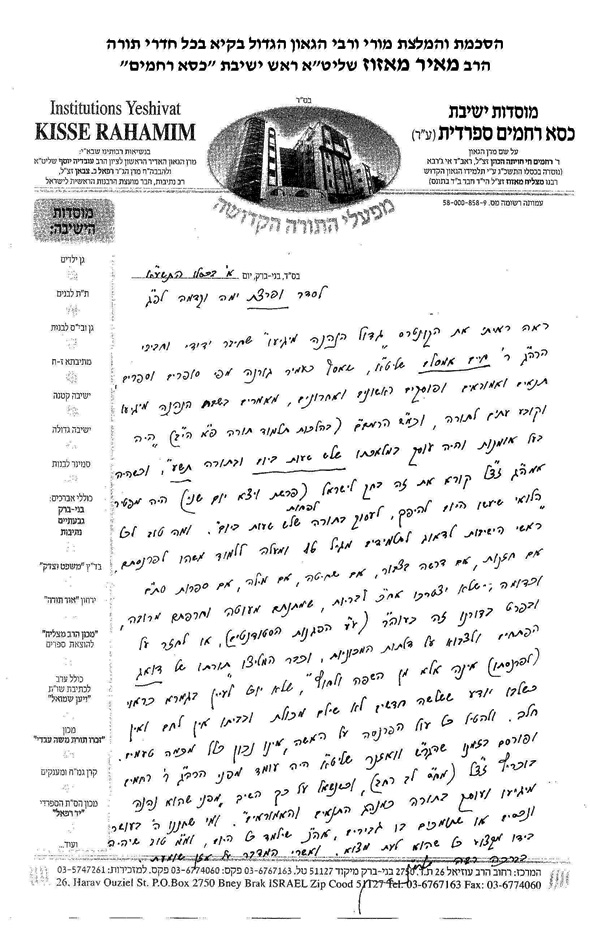
[2] See Or Torah, Heshvan 5772, pp. 169-170. R. Mazuz’s own attitude towards yeshiva students preparing themselves to earn a living is seen in his haskamah to R. Hayyim Amsalem’s Gadol ha-Neheneh mi-Yegio. The book is available here.
Here is R. Mazuz’s haskamah.

Here is the letter of R. Mazuz that appears at the end of the volume.

There are numerous texts I could bring in opposition to the approach of Amsalem and Mazuz (which I believe is also the approach of the Sages). One noteworthy one is found in Ateret Menahem, p. 23a, where R. Menahem Mendel of Rimanov is quoted as follows:

אם א’ אומר לחתנו היושב ולומד תורה בהתמדה שיתחיל לעסוק במו”מ עבור כי איתא [אבות פ”ב מ”ב] יפה ת”ת עם דרך ארץ וכו’, זה הוא מערב רב חו”ש
[3] See e.g., Naftali ben Menahem, Zemirot shel Shabbat (Jerusalem, 1949), p. 134.
[4] See Zev Rabiner, Or Mufla, p. 92.
[5] Barukh She-Amar, p. 238.
[6] See R. Meir Mazuz, Darkhei ha-Iyun, pp. 127ff.
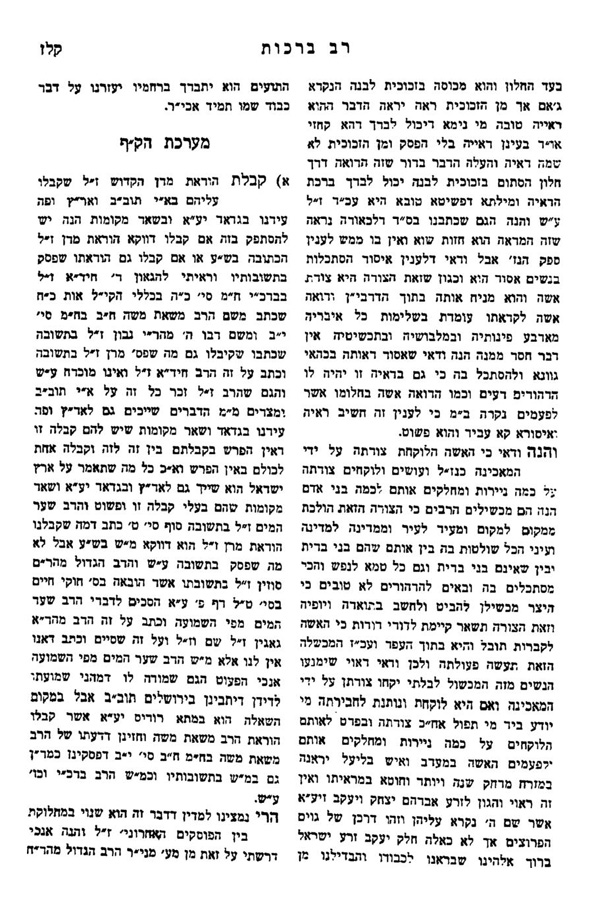
[7] Regarding not seeing women’s pictures, this position can also find sources to support it. R. Joseph Hayyim, Rav Berakhot, ma’arekhet tzadi (p. 137), writes quite strongly against women’s pictures, because men will come to look at them. Here is the page.

[8] For some, it is better if the women basically do not go out of the house at all at all. Such a position is held by R. Hayyim Rabbi, a mainstream Sephardic rabbi (who like all significant Sephardic rabbis, also has a website. See here).
Here is his haskamah to R. Hanan Aflalo’s, Asher Hanan, vol. 3, and see Aflalo’s response that a rabbi has to actually be part of a community and know its situation in order to properly decide matters for it.

While Aflalo’s reply is phrased very respectfully, his feeling that Rabbi is way off base comes through very clearly.

Rabbi’s position about a woman not leaving the house can find support in a variety of traditional texts (not least, the Rambam, Hilkhot Ishut 13:11). What makes it significant is that he offers this advice even today. While it is true that in the Islamic world Jewish women were more accustomed to stay inside than their co-religionists in Europe, we also find European rishonim who see this as something to strive for. See e.g.,, Radak to 2 Samuel 13:2: ודרך הבתולות בישראל להיות צנועות בבית ולא תצאנה החוצה. See also Rashi, Deut. 22:23: פרצה קוראה לגנב הא אלו ישבה בביתה לא אירע לה. For other relevant sources, see R. Mazuz’s comment in R. Raphael Kadir Tzaban, Nefesh Hayah, vol. 2, p. 267.
I was surprised to find that the Moroccan R. Raphael Ankawa, in the twentieth century, ruled that a husband could forbid his wife from leaving the house without his permission. If she didn’t listen, she would lose her ketubah. See Toafot Re’em, no. 3. In a letter of support for Ankawa by R. Shlomo Ibn Danan and R. Mattityahu Serero they go so far as to state that if the woman doesn’t go along with the husband’s command and take an oath binding herself in this matter, the husband can, if he wishes, refuse to divorce her and she will remain an “agunah” her entire life without any financial support from him! He, of course, will be given permission to remarry.
ואם לא ירצה לגרשה תשב עד שתלבין ראשה ונותנין לו רשות לישא אשה אחרת אחר ההתראות הראויות והיא אבדה כתוב’ ואין לה לא מזונות ולא פרנסה ולא שום תנאי מתנאי הכתובה.
(As late as 1965, another Moroccan posek, R. Yedidyah Monsenego, ruled that where the husband had reason to suspect his wife of being unfaithful, he could require her to never leave home without him, even to visit relatives, except when she had to go to work. See Peat ha-Yam, no. 24)
All I can say is that contemporary women should be thankful that the RCA beit din and many of the rabbinic courts in the State of Israel have realized that in modern times men and women must be treated equally in the divorce proceedings, and women can no longer be held prisoner in a dead marriage as was often the case in earlier times. With this in mind, let me remind people that in an earlier post, available here, I wrote as follows:
R. Hayyim Benveniste, Keneset ha-Gedolah, Even ha-Ezer 154, Hagahot Beit Yosef no. 59, in discussing when we can force a husband to give a divorce, writes:
ובעל משפט צדק ח”א סי’ נ”ט כתב דאפי’ רודף אחריה בסכין להכותה אין כופין אותו לגרש ואפי’ לו’ לו שחייב להוציא.
Can anyone imagine a posek, from even the most right-wing community, advocating such a viewpoint? I assume the logic behind this position is that even if the man is running after her with the knife, we don’t assume that he will actually kill her. He must just be doing it to scare her, and that is not enough of a reason to force him to divorce her. And if we are wrong, and he really does kill her? I guess the reply would be that this isn’t anything we could have anticipated even if we saw the knife in his hand, sort of like all those who have let pedophiles run loose in the yeshivot, presumably on the assumption that just because a man abused children in the past, that doesn’t mean that he will continue to do so.
(I will return to the issue of sexual abuse in a future post, because readers might recall that I expressed doubt that any rabbis would ever join the Agudah’s proposed rabbinic panel to determine if an accusation warranted going to the police. See here. The Agudah has just acknowledged that it was impossible to form such a panel precisely because of the legal jeopardy it would place the rabbis in. See here. Since it looks like all the public pressure will lead to clergy being made mandated reporters, it will be interesting to see what the Agudah response will then be. Will they instruct their followers to follow the law or expect them to go to jail in order to avoid mesirah?)
Regarding Aflalo’s point mentioned earlier in this note that a rabbi has to know the situation of a community, I recently found a very interesting comment by R. Levi Yitzhak of Berdichev, Kedushat Levi ha-Shalem (Jerusalem, 1958), Likutim, pp. 316-317. He asks why we say תשבי יתרץ קושיות ואבעיות, that in Messianic days Elijah will answer all problems. Since Moses will be resurrected, and he is the giver of the Torah, why don’t we say that he will provide the answers? R. Levi Yitzhak explains that only one who is living in this world knows what the situation is and how the halakhah should be decided. This is not the case with one who is dead and has lost his worldly connection. This explains why Elijah will provide all the answers, as he never died and was always part of the world. Therefore, unlike Moses, Elijah is the one qualified to decide matters affecting us. The lesson here is obvious, especially for those who think that every issue must be decided in Israel by authorities who really have really no conception of how American Jews live.

[9] I can’t tell you how often I have been with people (usually at Shabbat meals) who go on about how backwards the Muslims are, the proof being how they treat their women. This is usually contrasted to Judaism, which puts women on a pedestal. As an example of this “backwardness” people have pointed out that in Saudi Arabia (which is only one Muslim country, mind you), women are not even permitted to drive. I never have the heart to point out that there are hasidic sects, less than an hour away from where we are, that also don’t allow women to drive.
[10] See Ma’amar Esther, printed together with Va-Ya’an Shmuel (n.p., 2001), vol. 4, p. 19 (third numbering).
[11] Messas’ responsum is analyzed by Avinoam Rosenack, “Dignity of the Congregation” as a Defense Mechanism: A Halakhic Ruling by Rabbi Joseph Messas,” Nashim 13 (2007), pp. 183-206. On p. 201 n. 41, he provides references to scholarly literature that discusses medieval Jewish women’s adoption of Muslim modes of dress.
[12] Contrary to what Messas assumes, as far as I know there is absolutely no evidence that Jewish women generally dressed like this in the Rabbinic period. The fact that the Mishnah specifies the Arabian Jewish women shows that only one specific group dressed this way.
[13] Since he mentions women’s voices, let me return briefly to my second to last post which dealt with kol isha. I neglected to note the pesak of R. Abraham Yaffe-Schlesinger, Be’er Sarim, vol. 2, no. 54, who sees it as obvious that a woman is permitted to sing in front of non-Jews.
In the post, I mentioned three Modern Orthodox high schools that allow young women to sing solos. I was informed that the North Shore Hebrew Academy also has to be added to this list. See here.
My correspondent further wrote: “I wanted to let you know that the son of Rabbi _____ (former president of the RCA [name deleted by MS]) told me that his father used to go to see Broadway shows based on the Psak of the Rav, who felt that if you couldn’t totally make out the face of the female singer it would be permitted.”
One of the commenters on the post called attention to R. Yehudah Herzl Henkin, Bnei Vanim, vol. 4, no. 7. In this responsum, he says a couple of things very relevant to the post. To begin with, he writes that it is permitted to listen to the singing of a single woman if this is something that you are used it, and it will not be sexually arousing.
לע”ד מדינא מותר לשמוע קול שיר של בתולות אם רגיל בקולן שאז שמיעתן זהה לראיית שערן
This is the same viewpoint I quoted from R. Jacob Pardo, who distinguishes between married women, whose singing is always forbidden, and single women whose singing is only forbidden if it is sensual song. Also noteworthy is that R. Henkin rejects the viewpoint found in various aharonim that a post-pubescent female (i.e., niddah) has the same status as a married woman, and her singing is therefore forbidden:
וכיון שנהגו להקל בשערן של בתולות ולא חלקו בין נדות לטהורות הוא הדין בקולן, כל שהוא רגיל בו ואינו מהרהר.
He concludes his responsum by stating that if the song is not sensual, and the woman’s voice is heard on the radio or out of a loudspeaker, since this is not really “her” voice it is permissible to listen. What this apparently means is that any time a woman sings into a microphone, it is permissible to listen to her (assuming her very appearance is not arousing). This basically gets rid of the entire kol isha prohibition in our time (when the songs aren’t sensual), since today every event with a woman singer uses a microphone. Based on R. Henkin’s responsum, all Modern Orthodox high schools could once more return to having young women sing solos (even though I am certain that this is not his intention).. Here is his conclusion (emphasis added):
ולא מפני שאנו מדמים נעשה מעשה להתיר לכתחילה לשמוע קול אשה המזמרת לפננו לבדה, אבל בשירה ברדיו או דרך רמקול וכו’ שעל פי דין אינה קולה ממש ובצירוף עוד טעמים [ראה להלן מאמר כ’] ובתנאי שהשירה אינה של עגבים נראה פשוט להקל.
In Bnei Vanim, vol. 2, p. 211, he quotes his grandfather as even permitting watching a woman sing on the television, because again, the voice is not her actual voice. He also notes that his grandfather later expressed doubt on this point.
שמעתי מפיו הקדוש שקול אשה על הרדיו אינו נקרא קול אשה ומותר לשמעו [בפעם הראשונה ששאלתי אותו על זה אמר בפירוש שגם בטלביזיה אינו נקרא קול אשה ומותר לשמעו, אבל כשחזרתי ושאלתי אותו על זה אחרי זמן לא היה ברור אצלו – ואולי מפני חולשתו]

In vol. 4, p. 30, he refers to a woman singing the national anthem, which based on his argumentation would, I think, be quite easy to permit, even watching on television. As he notes, this is not the sort of song that arouses sexual thoughts:
ורבים מקילים לשמוע קול שיר של אשה ברדיו כשהיא אינה לפניהם, ואינה שרה שירי עגבים אלא שירי מולדת וכיוצא באלה ורחוק שיהרהרו בה ואינו תלוי באם מכירה או לא.
I would also like to share an email I received from Benny Hutman which relates to R. Moshe Feinstein’s opinion. In my post I called attention to a responsum of R. Moshe Feinstein which I claimed cast doubt on R. Mordechai Tendler’s assertion that according to R. Moshe kol isha is entirely situational and depends on whether or not someone is aroused.
Benny writes:

It seems to me that R’ Moshe must hold that the prohibition on Kol Isha depends on whether a person is used to hearing women sing. R’ Moshe holds like the Aruch Hashulchan that nowadays one can say Shema in front of a woman with uncovered hair because the reality is that we are constantly confronted with such hair and therefore it is no longer arousing. For this to make sense we need to understand the Gemara in Berachos when it says “sear b’isha erva” to mean that hair could be ervah, meaning I would have thought that ervah by definition could only refer to parts of her body, ka mashma lan that hair despite not being skin can be ervah. However it won’t actually be ervah unless it is normally covered. Since the language of the Gemara is exactly the same (as is the source) it follows that the gemara means that Kol Isha could be ervah despite not physically being attached to the body at all. However, just as R’Moshe says that our constant exposure to uncovered hair makes sear no longer be ervah, the same logic dictates that if someone has been listening to women sing all his life kol isha will not be ervah. Arguably it can also be situational so that if someone has been going to the opera all his life such singing will not be kol isha, but pop music will be. It seems to me that this heter should apply to almost all Modern Orthodox men. This would explain how Rabbi Tendler could say that R’ Moshe held that the prohibition is situational despite R’ Moshe’s tshuva apparently holding it is forbidden. It depends on who is asking the question and the time, place and manner of the singing.

Finally, R. Hayyim Amsalem, in his recently published Derekh Hayyim, p. 45, states that it is a well known fact that great Torah scholars and chief rabbis have in the past been present at various official events that included women singing, and they did not walk out. As he explains:
הם ידעו לחשב שכר “מצוה” כנגד הפסדה, ושגדול כבוד הבריות שדוחה לא תעשה שבתורה (ברכות דף יט ע”ב), שלא לדבר על העלבת פנים העלולה להגרם, והרי המלבין פני חברו ברבים אין לו חלק לעוה”ב (בבא מציעא דף נט ע”א), יתכן וכשהיו יכולים להשתמט מלהופיע בטקס כזה שידעו מראש שיכלול גם שירת נשים היו נמנעים מלהופיע, אבל היכן שההכרח אלצם להשתתף הרי שמעולם לא נשמע רינון אחריהם על השתתפותם, או על העלבת המעמד ביציאה פומבית.
[14] Rosenack writes (“Dignity”, p. 190): “Messas’s remarks allow the inference that he knew of an ancient tradition—either from the days of his own ancestors, or from the time of the talmudic sages—of women going up to the Torah, before the institution of the [talmudic] prohibition discussed here.” This is incorrect. What Messas is doing in this responsum is describing what he imagines the situation was like in the era that women received aliyot, and why this was later prohibited. There is not even the hint that he knew of any ancient tradition in this regard, and he certainly did not.
In terms of women’s aliyot, in my post here I called attention to R. Samuel Portaleone’s opinion that in theory it is permitted to give a woman an aliyah in a private synagogue. Without knowing of Portaleone’s view, R. Yehuda Herzl Henkin concluded that ”if done without fanfare, an occasional aliyyah by a woman in a private minyan of men held on Shabbat in a home and not in a synagogue sanctuary or hall can perhaps be countenanced or at least overlooked.” “Qeriat Ha-Torah by Women: Where We Stand Today,” Edah Journal 1:2 (5761), p. 6. (Henkin also assumes that women’s aliyot on Simhat Torah are permissible.) There is another source in this regard that has been overlooked by those arguing for women’s aliyot in so-called partnership minyanim (I hate this term!). R. Moses Salmon, Netiv Moshe (Vienna, 1899), p. 24 n. 112, sees no problem with women getting aliyot today. As mentioned already, women are denied aliyot because of kevod ha-tzibur. Yet according to Salmon, since today men who get aliyot no longer read from the Torah, kevod ha-tzibur is no longer a concern. This was all theoretical for Salmon, as no one in his Hungarian town was dreaming of calling women up to the Torah, but from the standpoint of pure halakhah, he saw no objection. He also claims that according to Maimonides, women can be counted in a minyan. See ibid., n. 111. Here is the page from Salmon.
[15] The same approach is adopted by R. Matzliah Mazuz, Ish Matzliah, vol. 1 no. 10. He writes:
לע”ד כבוד ציבור דהתם, אינו כפשוטו, אלא לישנא מעליא, ועיקר הכוונה כאותה ששנינו בסוכה דנ”א תיקון גדול

[16] See here and here.
[17] See here and here. See also his Shulhan Arukh ha-Mekutzar, vol. 6, pp. 246ff., and here for a placard signed by some leading Sephardic rabbis.
[18] See here. He thinks that a woman who refuses to say good morning to her male neighbor is demonstrating proper tzeniut.
[19] See here.
[20] Incidentally, in no. 328:2, he states that there is no longer a problem taking medicine on Shabbat, since people today do not grind their own medicine.

  • [21] See the numerous explanations of these passages in R. Moshe Zuriel, Leket Perushei Aggadah, ad loc. Tosafot, ad loc., quotes one opinion that does take the passage literally, but this opinion assumes that the am ha’aretz spoken of is a violent person suspected of murder


Azariah de’ Rossi’s Annotations on Sefer ha-Kuzari: Identification and Preliminary Analysis

Azariah de’ Rossi’s Annotations on Sefer ha-Kuzari: Identification and Preliminary Analysis

Yehuda Seewald

Abstract

This article presents the identification of annotations on a 1547 Venice edition of Sefer ha-Kuzari (The Kuzari) as the work of the Italian-Jewish scholar Rabbi Azariah de’ Rossi (min ha-Adummim). The identification is based on detailed paleographic comparison between these annotations and de’ Rossi’s verified notes on a manuscript of Maimonides’ Guide for the Perplexed (Paris, BnF MS hebr. 691). The article examines the nature of these annotations, their sources, and their significance for understanding de’ Rossi’s interpretative approach and his conception of the relationship between these two major philosophical works.

Introduction

Rabbi Azariah de’ Rossi (1511-1578), one of the most important Jewish scholars in 16th-century Italy, combined traditional Jewish learning with innovative Renaissance research methodologies in his major work Me’or Einayim (The Light of the Eyes).[1] His research spanned various fields, from historiography and chronology through philology and source criticism to philosophy and natural sciences.

Among the works that were central to de’ Rossi’s study were Maimonides’ Guide for the Perplexed and Judah Halevi’s Kuzari. He frequently quoted and referenced these two works in Me’or Einayim, using their ideas as a foundation for his discussions.[2] It appears that de’ Rossi not only quoted and discussed these works but also systematically edited and annotated them.

Chapter 1: Identification of the Annotations

The manuscript of the Guide for the Perplexed preserved in the National Library of France (hebr. 691) includes de’ Rossi’s explicit ownership signature: “This book, the Guide, gracious dweller of heights, belonged to me, Azariah son of Moses min ha-Adummim”.[3] Alongside this signature, numerous marginal notes appear, some signed with the initials “A.E.” (Amar Azariah). These notes provide a reliable reference point for identifying his handwriting.

In January 2025, two hundred Judaica items from Mr. Klagsbard’s estate were offered for sale at the Kedem auction house’s 100th public auction. Among them was lot 96, a copy of Sefer ha-Kuzari in Judah ibn Tibbon’s translation, second edition, Venice 1547. While browsing through the catalog and attached images, I was excited to identify the previously unidentified annotations as written by Rabbi Azariah de’ Rossi.[4] A detailed paleographic comparison between the notes on his copy of the Guide and those on the Kuzari confirmed this identification. The similarity is evident in all characteristics: writing style, letter forms (particularly alef, final mem, and qof), and consistent use of certain abbreviations.

Beyond the similarity in the handwriting itself, similar editorial patterns can be identified in both works. In both texts, de’ Rossi created detailed tables of contents at the beginning of the book, using the same system of notation and reference. Additionally, the notes in both works are organized similarly in the margins, with consistent use of square brackets to indicate additions and completions.

Providence arranged that while the copy was sold to a private collector, it was photographed and made publicly accessible in the “Ktiv” digital platform of the National Library of Israel.

Chapter 2: Nature and Sources of the Annotations

Analysis of the annotations on the Kuzari reveals several layers of corrections and notes. The annotations can be classified into two types, similar to his notes on the Guide for the Perplexed. The first type consists of brief interpretative notes, where he generally appears as a concise yet profound philosophical commentator. The second type comprises quotations from other commentators. In his notes on the Guide, he quotes from Narboni, Ibn Kaspi, and a previously unknown commentator named Rabbi Abraham Kashlar.5 In his notes on the Kuzari, he quotes from Abraham Ibn Ezra’s biblical commentary, from Rabbi Nathanel ibn Kaspi’s commentary on the Kuzari, and from other commentators. An example of a quotation from Ibn Kaspi appears in his note on the science of music in Book II:65, which is found in Ibn Kaspi’s autograph manuscript, as we shall discuss below.

In the Kuzari, we also find systematic and extensive corrections to Judah ibn Tibbon’s translation as it appeared in the 1547 Venice edition before him. The Ibn Tibbon family played a crucial role in medieval Hebrew translation: Judah ibn Tibbon (c. 1120-1190), known as “the father of translators,” established their translation tradition and produced the first Hebrew translation of the Kuzari. His son Samuel (c. 1150-1230) became renowned for his precise translation of Maimonides’ Guide for the Perplexed, while Samuel’s son Moses, though also active as a translator, was considered less rigorous than his predecessors.

De’ Rossi believed, as he explicitly stated in his work Imrei Binah,[6] that this Kuzari translation was flawed since it was not produced by Samuel ibn Tibbon, whom he considered the most authorized translator of philosophical works. Interestingly, de’ Rossi made a significant historical error: he was unaware that the translator was actually Judah ibn Tibbon, the patriarch of the family, and instead believed it was Moses ibn Tibbon, Samuel’s son, whose translation methodology he criticized. This misidentification led de’ Rossi to approach the text with particular critical attention, though ironically, he was correcting the work of the very founder of the translation tradition he admired.

In our copy, we can see that de’ Rossi’s corrections to the translation drew upon several distinct sources:

1. Translation corrections based on Judah ben Cardinal’s version, which was available to de’ Rossi.[7] A clear example of this is the correction of the term “Karaites” at the beginning of the book, which does not appear in the Venice edition but matches Cardinal’s translation.[8]

2. Corrections based on Judah ibn Tibbon’s own revisions, which were written as alternative readings. These corrections appear in the margins of various Kuzari manuscripts.[9]

3. Original translation suggestions by de’ Rossi himself, which were later incorporated into subsequent editions.[10]

To understand the sources of these corrections, we must first understand the history of Judah ibn Tibbon’s translation of the Kuzari. As David Zvi Baneth demonstrated in his foundational research, ibn Tibbon’s translation reached us in two distinct basic versions:

1. The first, which Baneth termed “Version T,” reflects ibn Tibbon’s original translation language.

2. The second, “Version S,” is a later adaptation.

Although the two versions are closely related, they differ in their translation methodology and language: Version S presents a more precise and consistent translation that strives to adhere to the Judeo-Arabic original and to translate each term uniformly.

Additionally, as Bar-Asher has shown, another layer of translation by Samuel ben R. Judah ben Meshullam entered ibn Tibbon’s translation. [11] This scholar initially intended to translate the entire book himself but, upon seeing ibn Tibbon’s translation, refrained from completing a full translation. The question of whether he translated the book based on ibn Tibbon’s translation or merely wrote corrections in the margins of ibn Tibbon’s translation remains unresolved.

Over the generations, these versions became intermingled, and later copyists combined them indiscriminately. This process gave rise to mixed and complex versions, which were also reflected in the first printed editions of the book.

Examination of de’ Rossi’s copy, with his annotations on the 1547 Venice edition, shows that he attempted to grapple with this complexity. He utilized various sources to determine the precise text – Judah ben Cardinal’s translation that was available to him, as he testifies in his book Imrei Binah, making his notes a potential source for identifying Cardinal’s largely lost annotations.[12] He also used the margins of Kuzari manuscripts that documented additional versions of ibn Tibbon’s translation, as well as adding notes of his own.

Chapter 3: The Influence of De’ Rossi’s Notes on Rabbi Judah Moscato’s Kol Yehudah

Professor Avishai Bar-Asher’s comprehensive study of the Hebrew translations of the Kuzari and the evolution of Judah ibn Tibbon’s translation[13] concludes with these words:

“It is to be hoped that the discovery of additional material—in other documents preserving translation fragments, in the extensive material preserved in the margins of manuscripts of ibn Tibbon’s translation in its various versions, or in secondary copies that have not yet been examined—will help to further evaluate the hypotheses and preliminary conclusions proposed in this study.”

It appears that one of the most important documents for understanding the evolution of ibn Tibbon’s translation from the edition published with the Kol Yehudah commentary onwards is this document containing de’ Rossi’s annotations.

We will examine two of de’ Rossi’s annotations that demonstrate his influence on Rabbi Judah Moscato, author of Kol Yehudah, which became the canonical commentary on the Kuzari from its first publication in Venice in 1594 until today.

The first concerns a textual matter. In the Kuzari, Book II:57, it states:

.אמר הכוזרי: אתם היום במבוכה גדולה מאלה החובות הגדולות, ואיזו עדה תוכל לשמור כל הסדר הזה

“The Khazar king said: You are today in great confusion regarding these great obligations, and which congregation could maintain all this order.”


De’ Rossi was convinced this translation was incorrect. In his Me’or Einayim, he criticizes it and rejects Ibn Kaspi’s attempt to justify it. He notes there that Ben Cardinal translated “in confusion” as “in quiet and rest”.[14] In the margins of his personal copy, he included ibn Tibbon’s alternative translation, “indeed in return and tranquility,” but also proposed his own correction: he crossed out the word “in confusion” and wrote above it “in rest.”

Notably, not by coincidence, the reading “in rest” appears in all editions of the Kuzari with Kol Yehudah onwards, to the puzzlement of Munk and other scholars who wondered about the source of this reading.[15]

It seems likely that de’ Rossi’s suggested correction found its way into Rabbi Judah Moscato’s work, as we find evidence of his influence in other places as well.

Here is another source that apparently shows such influence. In Book II:65, the Kuzari discusses the excellence of music, stating:

…אמר הכוזרי: שמה בלי ספק נגמרה ושמה היתה מעוררת הנפשות, כאשר יאמר עליה, שהיא מעתקת את הנפש ממדה אל הפכה

“The Khazar king said: There, without doubt, it was perfected and there it would stir the souls, as it is said of it that it transfers the soul from one disposition to its opposite…”

De’ Rossi writes in the margin:

כנגן דוד לפני שאול להעביר רוחו הרעה וכנגן אלישע בהסתלקות הנבואה. וכבר חשב האפודי שלזאת הסבה כתוב בקצת מזמורי תהלים למנצח, לפי שהיה השיר המיוחד למזמור ההוא ממה שינצח כח או כחות מה מהנפש להשיבם להיושר והנכון

“Like David’s playing before Saul to remove his evil spirit, and like Elisha’s playing when prophecy departed. The Efodi already thought that for this reason it is written in some psalms ‘To the chief musician,’ because the song designated for that psalm was among those that would overcome some power or powers of the soul to return them to uprightness and propriety.”

These words are not found in any of the Efodi’s known works, but it appears that in de’ Rossi’s memory, he confused the Efodi with Rabbi Nathanel ibn Kaspi. The latter writes in his commentary on this passage:[16]

כאשר ראינו משאול כאשר ביעתתהו רוח רעה והיה כנגן דוד לפניו סרה מעליו הרוח הרעה ההיא כמו שמבואר מהספור, והיה בהיות אלהים אל שאול ולקח דוד את הכנור ונגן בידו ורוח לשאול וכו’. וכן היתה חכמת המושאיקא מעוררת הנפשות, כי מצד התלות השכל האינושי בחומר ישיגהו פעמים עכירות ובהלה ושכחה, ובה יקנו יתרון המעלות ויקנו המדות ויחזיקו התכונות. וכן יסירו הנגונים חליי הנפש ויכוונוה לקבל רוח הקדש. ובזה ינוצחו קצת תכונות רעות שבנפש ויוכנעו לעבודת האל, על כן כתב למנצח מזמור לדוד. ולהיות חכמת הנגון בנוייה על סדר הערכים, ר”ל על סדר הערך והיושר מסודר ומתוקן כראוי, על כן אמר דוד שיר המעלות

“As we saw with Saul when an evil spirit troubled him and when David played before him the evil spirit departed from him, as is clear from the story, ‘And it happened, when the spirit from God was upon Saul, that David took a harp and played with his hand; then Saul would become refreshed,’ etc. Thus the science of music would stir the souls, for due to the attachment of the human intellect to matter, it sometimes experiences turbidity, confusion and forgetfulness, and through it they acquire excellence of virtues and acquire good traits and strengthen dispositions. Thus the melodies remove the illnesses of the soul and prepare it to receive the holy spirit. In this way certain evil dispositions in the soul are overcome and subdued to divine service, therefore it is written ‘To the chief musician, a psalm of David.’ And because the science of music is built on the order of proportions, that is, on the order of proportion and uprightness arranged and established properly, therefore David said ‘A Song of Ascents.'”

It seems quite clear that de’ Rossi summarized and abbreviated ibn Kaspi’s comments here, making them the source of his note, though he mistakenly attributed them to the Efodi.

Now, I can find no logical explanation for Rabbi Judah Moscato’s words elsewhere, unless we say that he saw de’ Rossi’s words in this note and understood them in an interesting way.

This is what Rabbi Judah Moscato writes in his book of sermons, Nefutzot Yehudah:[17]

ומקרא מפורש הוא, יבקשו איש יודע מנגן בכינור. והיה בהיות עליך רוח אלהים רעה, וניגן בידו וטוב לך. ועל כתפות האפודי היתה זאת שומה, אל מול פניו, לעומת מחברתו, כי על כן נאמר בקצת המזמורים למנצח, להיות השיר המיוחד אליהם מועיל מאד לנצח התכונות שבנפש, להכניעם ולהשיבם אל תיקון היושר לעבודת האל יתברך. הוא דבר בעל הכוזרי, בהפליגו בשבחי המוסיקה הנמצאת מאז באומתנו, וזו לשונו, מאמר ב, סימן סה: שמה, מבלי ספק, נגמרה ונשלמה, ושמה היתה מעוררת הנפשות, כאשר ייאמר עליה שהיא מעתקת את הנפש ממידה אל הפכה. ע”כ

“And it is an explicit verse, ‘Let them seek a man who is a skillful player on the harp. And it shall come to pass, when the evil spirit from God is upon you, that he shall play with his hand, and you shall be well.’ And upon the shoulders of the ephod this was placed, before him, opposite its joining, for therefore it is said in some psalms ‘To the chief musician,’ as the song designated for them was very beneficial for overcoming the dispositions of the soul, to subdue them and return them to proper rectification for the service of God, blessed be He. This is what the author of the Kuzari said, in his praise of the music found then in our nation, and this is his language, Book II:65: ‘There, without doubt, it was perfected and completed, and there it would stir the souls, as it is said of it that it transfers the soul from one disposition to its opposite.’ End quote.”

It is quite clear that these are the same ideas that originated in ibn Kaspi’s commentary. But how did the words “and upon the shoulders of the ephod this was placed” enter into R. Judah Moscato’s discussion? What does the ephod, and specifically “Efodi,” have to do with King David? It must be that de’ Rossi’s words were before him, and he interpreted the word “Efodi” as referring to David’s ephod.

Conclusion

The identification of Azariah de’ Rossi’s annotations on the Kuzari sheds light both on his interpretative approach and on his influence on subsequent generations. Analysis of the annotations reveals a scholar combining expertise in commentarial literature with meticulous textual criticism, drawing on various sources and traditions. Particularly interesting is his influence on Rabbi Judah Moscato, who incorporated some of his corrections into his Kol Yehudah commentary, which became the canonical commentary on the Kuzari. These annotations thus join a series of testimonies to de’ Rossi’s significant contribution to the development of Jewish exegesis in the late Renaissance period.

The discovery of his annotations on the Kuzari, alongside his known annotations on the Guide for the Perplexed, allows us to better understand his relationship to these two major philosophical works and his conception of the connection between them. Further research into these annotations may shed light on additional questions concerning the textual history of the Kuzari and the development of its interpretation.

[1] On Azariah de’ Rossi, see: Yom Tov Lipmann Zunz, “The Life of R. Azariah min ha-Adummim,” Kerem Hemed 5 (1841), pp. 131-158; 7 (1843), pp. 119-124; Benedetto Levi, Della vita e delle opere di Azaria de’ Rossi [The Life and Works of Azariah de’ Rossi] (Padua: Crescini, 1868); Isaac A. Twersky, “Azariah de’ Rossi 1511-1578,” Katif 6-7 (1969), pp. 175-185; Bezalel Safran, “Azariah de Rossi’s Meor Eynaim” (PhD diss., Harvard University, 1979); Robert Bonfil, “Reflections on the Place of Me’or Einayim by Azariah de’ Rossi in the Cultural Environment of Italian Renaissance Jewry,” Jewish Thought in the Sixteenth Century (1983), pp. 23-48; Meir Benayahu, “The Polemic Over Rabbi Azariah de’ Rossi’s Me’or Einayim,” Asufot 5 (1991), pp. 213-265; Hannah Liss, “The Art of Rhetoric as Peshat? Renaissance Jewish Biblical Exegesis in the Case of Judah Messer Leon and Azariah de’ Rossi,” Tarbut 9 (2000), pp. 103-124; Joanna Weinberg, The Light of the Eyes of Azariah de’ Rossi, New Haven: Yale University Press, 2001; Eadem, “On the Shoulders of Rabbis: The Study of Ancient History in Azariah de’ Rossi’s Writings,” Jewish Studies Quarterly 22 (2007), pp. 49-55; Carmi Horowitz, “Titus and the Gnat in Posen, Prague, and Ferrara: Polemics on Aggadic Interpretation in the Sixteenth Century,” Carmi Sheli [My Vineyard] (2012), pp. 99-116.
[2] See Azariah de’ Rossi, Me’or Einayim, ed. David Cassel (Vilna, 1866; repr. Jerusalem: Makor, 1970); Reuven Bonfil, The Writings of Azariah de’ Rossi, with Introduction and Notes (Jerusalem: Bialik Institute, 1991), pp. 11-130. See also Joanna Weinberg, ed., The Light of the Eyes: Azariah de’ Rossi (New Haven: Yale University Press, 2001), cited above n. 1, for de’ Rossi’s engagement with The Kuzari, as indicated in the index, pp. 789-790, and for his use of The Guide for the Perplexed, as referenced in the index, p. 793.
[3] Paris, Bibliothèque nationale de France, MS hebr. 691, fol. 1r.
[4] Another significant discovery related to Rabbi Azariah de’ Rossi emerged at a public auction: the actual ban (herem) issued by the rabbinical court of Rabbi Joseph Karo (the Beit Yosef) against de’ Rossi’s work Me’or Einayim. This remarkable document, bearing the signatures of eight sages from Safed, was found affixed to one of the surviving copies of Me’or Einayim and was subsequently offered for sale at the “Genazym” auction house. This artifact provides tangible evidence of the considerable controversy that surrounded de’ Rossi’s innovative historical-critical approach to rabbinic literature upon its publication, prompting formal condemnation from one of the most authoritative rabbinical courts of the sixteenth century.
[5] On his commentary to the Guide for the Perplexed and its identification through quotations in de’ Rossi’s notes, see Y. Seewald, ‘Abraham Kashlar’s Commentary on the Guide for the Perplexed: Its Identification, Circle, and Influence on Azariah de’ Rossi’ (in press).
[6] Yemei Olam chapter 36, Cassel edition p. 308 [with full translation of the Hebrew quote to follow]
[7] Yemei Olam, ibid.: “And I remember that I saw Judah ben Cardinal’s translation in part of the Kuzari…”
[8] Cf. Bar-Asher, “Hebrew Translations of the Kuzari,” Sefunot 13 (2023), pp. 185-189.
[9] Such is the annotation found in Ibn Kaspi’s autograph, to Kuzari II:57, “at this time in tranquility and rest” (Paris MS Heb. 677 fol. 47r), which is an annotation by ibn Tibbon, and de’ Rossi copies it in the margin. Similarly, in I:1 – “my soul, in my opinion,” documented in manuscripts as an “alternative version” by ibn Tibbon.
[10] Such is the annotation to Kuzari II:57, replacing “in confusion” with “in rest.”
[11] Cf. Reimund Leicht, “Shemuel ben Yehudah of Marseille: A 14th Century Provençal Translator and Re-Translator, and his Re-Translation of Judah ha-Levi’s Sefer ha-Kuzari” (in process); cited in Bar-Asher, note 7 above.
[12] See Bar-Asher, note 7 above, on the various sources for locating remnants of Cardinal’s translation.
[13] See note 7 above.
[14] See notes 5, 6, and 9 above.
[15] See note 9 above.
[16] See note 8 above, fol. 55v.
[17] First Sermon, Bnei Brak 2000, p. 5.


Rabbi Steinman and the Messiah, part 2

Rabbi Steinman and the Messiah, part 2

Marc B. Shapiro

Continued from here

1. R. Yehudah Herzl Henkin has a different perspective than what we have seen so far.[1] He rejects the notion that “waiting” for the Messiah means that one must believe that he can come at any second, for the Sages already said that the Messiah will not come at certain times. He writes:[2]

ובעיקר הענין הרביתי בראיות מן הגמרא שחז”ל לא ציפו שהמשיח יבוא בכל עת

Contrary to the Brisker Rav (whom he mentions by name), R. Henkin writes: “There is nothing in the Rambam requiring one to believe that the Messiah is ready to come at any moment.”[3] He claims that the Rambam’s real point is that one should not be at ease with the Messiah not having arrived, but rather one should be upset that he hasn’t yet come. A similar argument was made by R. Shmuel Yaakov Weinberg.[4] Unlike R. Shulzinger (see the previous post), R. Henkin does not find a problem with those who mentioned dates for the redemption (and this includes a few important figures[5]), since he suggests that the dates were never intended to be absolutely certain.

Yet R. Henkin adds that it is clear that the sages who gave dates for the Messiah—even if their suggested dates were not certain— did not have אמונה שלמה that the Messiah would come before the dates they predicted, and they obviously are not to be regarded as heretics. He sees this point as contradictory to the Brisker Rav’s claim (as it is usually understood) that one must hope for and await the Messiah’s arrival every day. R. Henkin’s explanation is certainly not in contradiction to the Rambam’s Principle. If the sages who gave dates for the Messiah did not deny that they could be wrong, and that the Messiah could come at any time, then they were not contradicting the Rambam’s Principle. The only thing they were contradicting is the version of the Principle in the siddur which adds the words באמונה שלמה. Yet these words not appear in the Rambam’s formulation.

R. Henkin adds that it is strange that the Brisker Rav would declare that anyone who does not have his understanding of the Twelfth Principle is a heretic, when his understanding is not explicitly found in the Torah, the Talmud, or the rishonim.[6]

ואפילו לדברי הגרי”ז שצריך להאמין שהנה ממש היום הזה הוא בא וכו’ עכ”ל, מן התימה על האי גאון וצדיק ז”ל להחזיק מי שאינו מאמין כן ככופר כיון שהדבר אינו מבואר לא במקרא ולא בחז”ל ולא בראשונים.

R. Henkin concludes that it is enough to believe that the Messiah will come even if you assume that he will not come today or tomorrow. He also cites his grandfather, R. Joseph Elijah Henkin, that “to wait for the coming of the Messiah” does not mean that you think he is ready to come at any instant.[7]

קושטא דמילתא המאמין באמונה שלמה בביאת המשיח ומחכה לו ומתאווה לבואו קדוש ייאמר לו אף על פי שסובר שלפי מאמרי חז”ל לא יבוא היום או מחר, וכן אמר מו”ז הגה”צ זצלה”ה שלחכות לביאת המשיח אין פירושו שעומד לבוא בכל רגע וכן עמא דבר.

In support of R. Henkin, we can cite R. Yohanan ben Torta, who when R. Akiva declared that Bar Kokhba was the Messiah, responded as follows: “Akiva, grass will be growing out of your cheeks and the Messiah will still not have come.”[8] As R. Meir Mazuz notes, R. Yohanan ben Torta believed in the concept of the Messiah, but he did not see any chance that the redemption would come in his generation.[9] In other words, he was not “actively waiting” for the Messiah.

R. Menachem Kasher has another approach. He understands Maimonides’ words that one must wait for the Messiah in a negative sense, namely, that if one despairs of the Messiah’s arrival he is in violation of Maimonides’ words, but not that there is a continuous obligation to wait for the Messiah’s arrival.[10] R. Yisrael Weinman also questions the Brisker Rav’s understanding (although he is not certain the Brisker Rav really said it), since according to some rishonim the Messiah cannot come on Shabbat and Yom Tov. He therefore assumes that it is enough to wait for the Messiah to arrive whenever he is able to come.[11]

R. Yaakov Nissan Rosenthal explains that the siddur’s version of Maimonides’ principle,

עם כל זה אחכה לו בכל יום שיבוא

does not mean that you must believe and expect every day that today is the day the Messiah will come. Rather, the meaning of בכל יום is that every day you must believe in the coming of the Messiah and await his arrival, whenever that will be.[12] He offered an example to illustrate this point: A man’s daughter married and moved to the Diaspora. The father waits every day for his daughter to return to Israel, but on every day he does not expect that all of a sudden he will hear a knock at his door and his daughter is standing there.[13]

אין המאמין מחכה דוקא שלפתע פתאום יבוא האדון אל היכלו באופן ניסי ושיודיעו לו שהיום בא המשיח, אך הוא כן מחכה בכל יום לביאת המשיח

Significantly, R. Shlomo Zalman Auerbach agreed with R. Rosenthal and didn’t even think this was a hiddush, but rather the simple meaning of the words אחכה לו בכל יום שיבוא. R. Rosenthal then tells about how he was at a meeting with R. Shlomo Zalman and other rabbis, and he presented his understanding. A few of the hasidic rebbes present started screaming that what he said was wrong and in contradiction to one of the Principles of Faith. R. Shlomo Zalman didn’t say a word. After the meeting R. Rosenthal asked R. Shlomo Zalman why he didn’t defend him from the attacks of the hasidic rebbes. R. Shlomo Zalman replied that you shouldn’t start up with Hasidim

עם חסידים לא צריך להתחיל

R. Rosenthal couldn’t recall if the following witticism was said to him by R. Shlomo Zalman or someone else later told it to him: In the Amidah we say: על הצדיקים ועל החסידים. We see that the word צדיקים goes before חסידים

כי לא “מתחילים” עם חסידים

It is noteworthy that according to the Vilna Gaon’s understanding, if the Messiah does not come in a “hastened” fashion (see Sanhedrin 98a), it certainly seems that no one would be able to hope for the Messiah to arrive in Tishrei. The reason I say this is because of how the Vilna Gaon describes the terrifying things that will happen if the Messiah arrives in its “due time,” and this is in Tishrei.[14]

אם חלילה לא יזכו ותהיה “בעתה” ואז אם היתה הגאולה בתשרי לא היה להם תקומה ח”ו ולא היו נשארים חלילה אלא אחד מעיר ושנים ממשפחה מפני שמדת הדין שולט בתשרי

Also of interest is the report of how R. Jacob Kamenetsky told someone that the Messiah would not be arriving soon. A certain man had been convinced by people in Chabad that the Rebbe would soon reveal himself as the Messiah, and this had led him to start observing Shabbat. However, R. Kamenetsky thought that it was important to uproot the man’s belief that the Messiah would soon be here, as he worried about the negative consequences to the man’s Judaism when the Messiah did not arrive as he had been expecting.[15]

אל תאמין להם. משיח, לצערנו, עדיין אינו עומד לבוא . . . [רי”ק הסביר לתלמידיו] מה שהשיגו אנשי חב”ד הוא הישג מדומה, שיצא שכרו בהפסדו. בעתיד הקרוב, כשיראה יהודי זה שההבטחה לא נתמלאה והמשיח לא הגיע, יתחיל שוב לחלל את השבת. יתרה מכך, עד עכשיו הוא האמין בתמימות מוחלטת בביאת המשיח, ואם יתאכזב, יפסיד את אחד היסודות החשובים ביהדות – האמונה בביאת המשיח.

Based on this, I think we can say that R. Kamenetsky did not expect the Messiah to arrive in the near future.

Some Jewish traditions speak of a great war that will occur before the coming of the Messiah, and even of the death of Messiah ben Joseph in this war.[16] Other traditions see this great war as occurring after the coming of the Messiah. R. Hayyim Soloveitchik is reported to have said that if the messianic era will bring even one Jewish death, then he doesn’t want it, and if we had a choice in the matter the halakhah would require us to reject the Messiah in such a circumstance. I wonder, therefore, if R. Hayyim was really able to look forward to the messianic era, knowing that its arrival would bring the possibility of Jewish death.

Here is how R. Hayyim is quoted by R. Dov Katz.[17]

מספרים בשמו של ר חיים סולובייצ’יק מבריסק, הגאון של הדור הקודם, שבימי המלחמה כשנפלו כל כך הרבה חללים בחזית המלחמה וסבלו כל כך הרבה, אמרו לו פעם בשיחה, שלוא היתה לכל הפחות מביאה המלחמה הזו את הגאולה, כי אז היה אולי כדאי הדבר. גער בהם ר’ חיים ואמר להם: “תדחינה מאות גאולות ואל תפול נפש אחת מישראל, כי אם היתה באה שאלה לפנינו שאם על ידי קרבן של אדם אחד יבא המשיח, בודאי שהיינו פוסקים שלא יבוא המשיח ולא תמות נפש אחת, כי הלא פיקוח נפש דוחה כל התורה כולה, ואף המשיח והגאולה בכלל.”

I have no reason to doubt the accuracy of this report. It is very much in line with what we know about R. Hayyim’s views both about the value of human life, and also about the downplaying of messianism. R. Joseph B. Soloveitchik stated: “To R. Chaim, a good chidush in Torah and Kodshim – if I may say so, perhaps I shouldn’t say it – was more important than the whole beis ha-mikdash, in his intuitive weighing.”[18] R. Soloveitchik had some hesitations about what he said, because he knew it would be shocking to people, but he said it anyway. R. David Holzer, in his note on this sentence, writes: “Obviously, the Rav is speaking derech guzma, just to express the concept.” Even if the Rav is exaggerating his point is clear, namely, that Torah study is much more important than what will take place in the future Temple.

I think the Rav’s point is that an Ish Halakhah is simply not interested in the messianic era in any practical way. He believes it will come (and thus fulfills Maimonides’ requirement), but he doesn’t focus on it, for he has everything he needs in a non-messianic world, namely, the study of Torah and the fulfillment of mitzvot. As for the study of Torah, as the Rav said, creating a chiddush about the laws of sacrifices is more important than the sacrifices themselves, because at the end of the day Torah study is the focus of our lives, not sacrifices which we have been without the last two thousand years.

Even though I said that I have no reason to doubt what is reported in the name of R. Hayyim, and this report is also cited by R. Ovadiah Yosef,[19] I must note that R. Eliyahu Zini completely rejects the reported statement which he sees as absolute nonsense.[20]

טענות אלו דברי תימא גדולים הן. הלא הן סותרות כל מלחמה יזומה, אף כל מלחמת מצוה, וכ”ש מלחמת רשות! ואם נקבל אותן, נצטרך לגזור אומר, שגם כבוש הארץ בזמן יהושע איסור גמור היה, ושהיה עדיף להשאר במדבר כדי לחסוך בחיי יהודים רבים. ואסור להאמין שגדול בישראל אמר דבר כזה, שהרי טענות מרגלים יש כאן, מסוג “ארץ אוכלת יושביה היא וכל העם אשר ראינו בתוכה אנשי מידות”. ואם נאמץ אותן, עלינו לומר שהיה אף אסור לצאת ממצרים, כי יציאת מצרים הביאה למות דור שלם, ולכן היה עדיף לדחות אפילו גאולת מצרים!

לכן אסור להאמין לעדות זו. וגדול כר’ חיים מבריסק לא יאמר דברי הבל כאלו ויש כאן הוצאת דיבה על גאון זה, ובפרט שעדות זו מוכחשת ממה שכתב במפורש ר’ חיים עצמו [שלפי ר’ חיים אין דין פיקוח נפש חל בשעת מלחמה], והבאנו אותה כבר פעמיים לעיל

I don’t believe that R. Zini’s words, which come from a right-wing religious Zionist perspective, create any difficulty in believing that which R. Hayyim is quoted as saying, namely, given the choice between a Messiah which will require the loss of human life or no Messiah, that he would prefers the latter. What about R. Zini’s point that according to what is reported in R. Hayyim’s name, that human life stands above all, that the concept of milhemet mitzvah makes no sense? I think the answer is clear, namely, that R. Hayyim obviously acknowledged that in a halakhically valid war, and certainly in a war commanded by God (such as to conquer the Land of Israel), human life will be lost and we cannot have “conscientious objection.” (It is, however, hard to imagine how R. Hayyim would have been able to support a milhemet reshut.) 

Yet there is no halakhic imperative to bring the Messiah, and if given a choice between the Messiah with loss of life or no Messiah, R. Hayyim would forego the Messiah. Given the choice between a Jewish state that will require the loss of life—even a state that functions according to halakhah—or no state, R. Hayyim would forego the state. This was one of the two reasons for the anti-Zionism of R. Isaac Zev Soloveitchik, namely, that the actions of the Zionists endangered Jewish life. His other reason was that he believed that the Zionists would persecute religious Jews in a Zionist controlled state.

To be continued

Excursus

The old question is why did rabbis give dates for the Messiah’s arrival when the Talmud, Sanhedrin 97b, states: “Blasted be the bones of those who calculate the end (i.e., the Messiah’s arrival).” Maimonides actually mentions a family tradition as to when prophecy will be renewed, and this will precede the messianic era. See Iggerot ha-Rambam, ed. Sheilat, vol. 1, pp. 152-153.

On the second day of the Ten Days of Penitence, one of the selihot we read (Tohelet Yisrael) states:

חשבון אחר חשבון עמך יפתור

“Thy people interpret reckoning after reckoning.” This refers to predicted dates of the Messiah’s arrival. R. Zev Wolf Leiter sees this as a proof that there is no prohibition in offering dates for the Messiah as long as one does not lose faith in the messianic principle if the projected date comes without the Messiah’s arrival. See his Kevod Melakhim, Hilkhot Melakhim 12:2, found here and on Otzar haChochma.

In agreement with R. Leiter’s perspective, R. Menasheh Grossberg, Shevet Menasheh, no. 46, also suggests that there is no problem in giving dates of the Messiah’s arrival, and what the Talmud is criticizing is those who, if the Messiah does not come on the predicted arrival date, would then deny the principle of messianic redemption. His proof for this interpretation is the passage that comes directly after what I quoted above from Sanhedrin 97b: “For they would say, since the predetermined time has arrived, and yet he has not come, he will never come.” Thus, we see that the Talmud itself explains the reason for the curse of those who predict the Messiah’s arrival, and it is because if the Messiah does not arrive at the predicted date it will lead to heresy in that people will completely deny the principle of the Messiah. R. Grossberg goes so far as to write:

הנה הראשונים שהיו כמלאכים או כבני אדם מאמינים באמונה שלמה להם ראוי לחשוב בקצין ולחקור באמונה

R. Joseph Kafih states that the reason why sages gave dates for the Messiah’s arrival, or in Maimonides’ case the renewal of prophecy, was only in order to strengthen the people, that they not despair of redemption. In other words, the sages themselves did not take the dates seriously, as the point of publicizing this information was for an entirely different purpose. In R. Kafih’s words:

לא פעל רבינו כפי ההלכה לכתחילה, אלא בכדי לעודד את העם

See Teshuvot ha-Rav Yosef Kafih le-Talmido Tamir Ratzon (Kiryat Ono, 2018), p. 389.

This is the very same reason Maimonides gives for R. Saadiah’s messianic calculations. Maimonides writes as follows in his Letter to Yemen (Abraham Halkin and David Hartman, Crisis and Leadership: Epistles of Maimonides [Philadelphia, 1985]), p. 116):

As for Rabbi Saadiah’s calculations, there are extenuating circumstances for them though he knew they were disallowed. For the Jews of his time were perplexed and misguided. The divine religion might have disappeared had he not encouraged the pusillanimous, and diffused, disseminated, and propagated by word of mouth and the pen a knowledge of its underlying principles. He believed, in all earnestness, that by means of the messianic calculations he would inspire the masses with hope to the Truth. Verily all his deeds were for the sake of heaven. Consequently, in view of the probity of his motives, which we have disclosed, one must not decry him for his messianic computations.

R. Meir Leibush Malbim also provided dates for the messianic era. He believed that the initial stage of the Redemption would be between 1868 and 1913. The Temple would be rebuilt in 1925, sacrifices would begin to be offered in 1928, and the resurrection of the dead would take place in 2203. See Noah Rosenbloom, Ha-Malbim (Jerusalem, 1988), pp. 159-160.

R. Judah Leib Maimon reports that his father asked the Malbim how he could offer such dates in opposition to the talmudic statement against this. He replied that the proscription against offering dates was only in the early years after the destruction of the Temple, when the path until the end was still long. However, as we are now close to the end of the Exile it is permitted to give dates. See Maimon, Le-Ma’an Tziyon le Ehesheh (Jerusalem, 1954), p. 19. The same answer in the name of the Malbim is found in R. Yissachar Dov Teichtal, Em ha-Banim Semehah (Jerusalem, 1998), pp. 150-151. In both sources, in order to offer a parable explaining his point, the Malbim tells the story of a father and son taking a long journey. At the beginning of the journey, when the son asks if they almost there, the father is annoyed with him. However, after much time on the road, when the father asks the coachman the same question, he explains to his son that now that they have journeyed far the question is appropriate. It is the same with the exile, the Malbim explains. At the beginning, it was improper to offer predictions of its end. However, now that we are almost near the end, it is OK to do so. (In the version of the story told by Maimon, the young son is none other than the Malbim himself, and the answer comes from his father.)

R. Jacob Isaac Horowitz, the Chozeh of Lublin, is quoted as saying that those who, based on hints in the Torah, predicted dates for the Messiah’s arrival were really just offering a strong suggestion to God that it is time for Him to redeem the Jews. This is just like a son does not explicitly tell his father that he is doing something wrong, but instead shows him the Torah source so his father can draw the proper conclusion.

כי עפ”י הלכה באם בן רואה לאב שאינו עושה חלילה כיאות אז משום כיבוד אב לא יוכל לומר לו שאינו עושה כשורה רק החיוב להראות לו הדין בתורה ופוסקים ולומר לו אבא כך כתוב בתורה (עיין יור”ד סימן ר”מ סעיף י”א מש”ס קידושין דף ל”ב) וכיון שאנו רוצים לחות דעתינו לאבינו שבשמים שירחם על בניו ויגאל אותנו בקרוב וכי אין מן היושר כביכול שיסבלו עוד עול גלות לכן צדיק הדורות מחדשים איזה קץ משיח ועושים על זה רמז באיזה פסוק בתנ”ך איך שבשנה זו יבוא משיח צדקינו והוא להראות לאבינו הבורא ית”ש אבא כך כתוב בתורה היינו דבאותו מקום בתוה”ק כתוב שבשנה זו יבוא משיח בב”א

See R. Moshe Menahem Mendel Walden, Or ha-Niflaot, p. 12a, included in Ohel ha-Rabbi (Petrokov, 1913); Mendel Piekarz, Ha-Hanhagah ha-Hasidit (Jerusalem, 1999), p. 190.

******************

2. In the last post I mentioned Elliot Wolfson’s argument that the Lubavitcher Rebbe’s secret teaching is that there will be no physical redeemer, but the messianic redemption is able to occur within each person. A number of people were surprised to hear about this, as there is, I believe, literally not one person in Chabad who accepts this argument. While I do not believe that Wolfson is correct, it is important to note that one does find in Hasidic thought the concept of inner redemption.[21] Although this is not intended to replace the ultimate physical redemption, these Hasidic teachings do turn passages in the Talmud on their head. For instance, R. Meir of Apta asks why we need to pray for redemption if God has promised that he will redeem us. He quotes the Chozeh of Lublin who said that the Talmud, Megillah 16a, mentions that if you repeat a teaching in the name of someone else, you “bring redemption to the world.” The Chozeh points out that this is difficult, as every page of the Talmud has someone repeating a teaching in the name of someone else, and yet the redemption still has not come. The Chozeh replies that the redemption being spoken about is a personal redemption, that one is delivered from his difficult circumstances. Similarly,  when we pray for redemption, it is a prayer for personal redemption.[22]

דהנה השי”ת הבטיח לנו לפדותינו ולגאלינו מהגלות המר, ולכאורה יפלא מה צורך להתפלל על הגאולה, ההוא אמר ולא יעשה. אך ששמעתי [!] מרבינו הקדוש מוהרי”י זצללה”ה מלובלין על הגמרא כל האומר דבר בשם אומרו מביא גאולה לעולם, והתמיה נשגבה, כי בגמרא מצינו ממש בכל דף שאומר התנא דבר בשם חבירו או בשם רבו, ומדוע עוד לא נושענו מהגלות. ותירץ, כי הבאת הגאולה הוא גאולה פרטית לאיש ישראל ממצוקותיו, כאשר אמרנו, ותקם בעוד לילה שבהגלות יוושעו ישראל ויקומו בהרחבה והרוחה, וע”ז אנו מתפללים, וזה בכלל גאולה

3. In recent months there have been a number of discussions about epidemics in Jewish history and how the rabbis responded. No one has yet cited what the great R. Elijah Klatzkin wrote.[23] You can see this in R. Klatzkin’s Miluim le-Sefer Devar Halakhah (Lublin 1923), pp. 126-128. For some reason, the copy of this book on Otzar haChochma is missing the second half of the book. However, the complete work is available on hebrewbooks.org here.

R. Klatzkin prints an open letter he wrote in 1916 to his community in Lublin, when they were suffering a typhus epidemic. It originally was published in Yiddish and Polish. He obviously thought it was important that his message should be preserved for posterity, and over a hundred years later what he says unfortunately remains relevant to us.

R. Klatzkin tells the community that he has to write to them, rather than speak to them, as due to the danger they can no longer gather together in the synagogue. He mentions that although the government established rules to keep people healthy, nevertheless there are many who are ignoring the laws. (To this I would add, the more things change the more they stay the same.)

R. Klatzkin stresses that the various government rules are also required according to the Torah, and one who violates the rules, which bring danger to him and his neighbors, “his sin is too great to bear.” R. Klatzkin expresses wonder that he needs to warn people about these matters, which relate to their health and the health of their families. What he observed over a hundred years ago has of course repeated itself in our time, when for incomprehensible reasons entire communities simply ignored basic health guidelines which allowed the virus to spread very quickly, leaving a terrible toll.

R. Klatzkin states that he wouldn’t need to warn people to watch over their money, so how is it that people treat their health with less concern than their money? He then turns to the issue of hillul ha-shem, and we see that in his day it was also the case that there were Jews who created a hillul ha-shem in how they responded to the crisis. R. Klatzkin notes that even repentance, Yom Kippur, and personal suffering do not atone for hillul ha-shem.[24] “If we would behave in accordance with the Torah, then we would be a light unto the nations and would sanctify the name of heaven and the honor of the holy Torah.” In R. Klatzkin’s day, one of the reasons for the spread of the epidemic was the unsanitary conditions that the poor lived in, and he concludes his letter by appealing to the wealthy to support the poor so they can improve their living conditions.

In his open letter R. Klatzkin states that he spoke about the issue of hillul ha-shem and kiddush ha-shem in his book אמ”ש. This refers to his responsa Imrei Shefer which appeared in 1896, and he has in mind no. 92 in this book. In this responsum he makes a number of noteworthy points. To begin with, R. Klatzkin makes very clear that when it comes to halakhah there is a great distinction between real idolaters and the nations among whom Jews currently live. He cites the Meiri to back up this position and the entire lengthy responsum is in support of this point.

ורבים טועים ומתעין עצמם לחשוב שכל מה שמבואר בספרים להחמיר בטעות ואונאת אינו יהודי הוא רק מפני איבה ובאמת לא כן הדבר והוא איסור גמור . . . ומזה מבואר דכל מקום שכתוב בטור ושו”ע עכו”ם היינו בדיוק עובדי כוכבים ממש ואינו מדבר כלל מהאומות שבזמנינו המאמינים בהשגחה ושכר ועונש וכמו שמפורש במאירי

This shows that he really means what he says, unlike other works that include a comment at the beginning of the book saying that any time non-Jews are referred to it means idolaters who live in places like India and China. Comments like this were never taken seriously. In fact, the very existence of these comments was said by R. Moshe Feinstein to be a proof, contrary to R. Solomon Luria, that one is allowed to alter Torah teachings in the face of danger.[25]

R. Klatzkin begins his responsum by calling attention to a passage in R. Joseph Albo, Sefer ha-Ikkarim 3:25, where Albo states that one is not allowed to charge interest to a ger toshav. The problem is that this contradicts an explicit Mishnah, Bava Metzia 5:6, as well as the talmudic explanation of this Mishnah, Bava Metzia 71a.[26] R. Klatzkin offers an original explanation that when the Talmud says that you can charge a ger toshav interest this refers to one who is wealthy, but if a ger toshav is poor, and he needs the money to survive, then he is not to be charged interest. Also significant is R. Klatzkin’s point that in this matter, and similar things, contemporary non-Jews who observe the Noahide laws fall into the category of ger toshav. He assumes that Christians are not to be regarded as idolaters, so they too fall into this category.

R. Klatzkin discusses R. Moses Isserles’ responsum in which he tries to find some justification for the practice in Moravia to drink non-Jewish wine.[27] R. Klatzkin suggests that this leniency arose due to theological reasons, because most of the inhabitants of Moravia were followers of Jan Hus (i.e., Hussites) who rejected many Catholic practices, including the veneration of images. In other words, they were distant from any “idolatrous” practices, and thus there was a reason in people’s minds why the prohibition on non-Jewish wine should not apply to them.

R. Klatzkin also takes up the issue of darkhei shalom. He cites the Talmud and Maimonides that when it comes to non-Jews – even idolaters – the Sages said to bury their dead, visit their sick, and support their poor because of darkhei shalom. After mentioning this, Maimonides also quotes Psalms 145:9: “The Lord is good to all; and His tender mercies are over all His works,” and Proverbs 3:17: “Her ways are ways of pleasantness, and all her paths are peace.”[28] R. Klatzkin derives from this that the expression מפני דרכי שלום does not mean that Jews behave a certain way to avoid non-Jewish enmity. Rather, it means that by Jews acquiring the trait of mercy for all people, there will be peace on Israel. He cites the Jerusalem Talmud, Eruvin 7:9, which states:

מפני מה מערבין בחצרות מפני דרכי שלום

In this passage it is obvious that darkhei shalom means something positive, to create neighborliness. R. Klatzkin claims that this is exactly what the expression means when dealing with non-Jews, He states that when Jews extend themselves for non-Jews in the ways mentioned by the Talmud, there will be real peace – in a positive sense – between Jews and non-Jews.[29]

ומוכח מזה דמ”ש מפני דרכי שלום, אין הכוונה שלא ינטרו שנאה לישראל, אלא דקאמר שעי”ז שידבקו ישראל במדת החמלה ורחמים על כל יציר נוצר, יהיה שלום לישראל . . . הרי דפירוש מפני דרכי שלום, היינו שעי”ז אוהבין זא”ז ונעשה ביניהם שלום אמת, וה”נ הפירוש שיהא שלום אמת עם העמים, כאשר ידבקו ללכת בדרכי ה’ המרחם על כל מעשיו

******************

3. In my last post I had a quiz with two questions. A number of people got one of the questions correct, but only a few individuals got them both correct. I won’t mention any names because one of those who answered correctly asked to remain anonymous.

The first question was: Where in Rashi’s commentary on the Talmud does he say that a certain individual knew all of Shas?

In Beitzah 24b s.v. ולערב, Rashi writes about R. Kalonymus ben Shabbetai of Rome who had journeyed from Rome to Worms:[30]

גם עתה בא אלי מכתב מגרמיי”ש שבא לשם אדם גדול זקן ויושב בישיבה מן רומא ושמו ר’ קלונימוס ובקי בכל הש”ס

I took this question from R. Shlomo Schneider, author of the responsa volume Divrei Shlomo. In a work that has not yet been published he has a number of “quiz questions,” and in future posts I will cite more of them.

In terms of “knowing Shas,” it is noteworthy that today we hear about different great rabbis who have completed Shas twenty or thirty times, or even more than this. Yet in earlier days we see that the achievements of great rabbis are described in much more limited fashion. R. Joseph Karo’s maggid said to him that he would finish Shas three times, and that was thought to be a great blessing.[31] This was not just the prediction of the maggid, as R. David Conforte quotes the grandson of R. Karo that when his grandfather was on his deathbed he, too, said that he merited to complete the Talmud three times.[32] R. Karo also testified as to how rare it was in his day for anyone to complete the Talmud:[33]

בדורות אלו לא ימצא מי שלמד כל התלמוד כי אם אחד מעיר

Of course, it must be noted that when R. Karo speaks of completing the Talmud he is not referring to daf yomi style, but rather an in-depth study of every page.

Just like with have seen with R. Karo, in a letter to R. Betzalel Ashkenazi, the author of Shitah Mekubetzet, R. Moses Galante of Safed (1620-1689) writes that he has finished the Talmud three times.[34]

In describing the unique greatness of his teacher, R. Nissim of Gerona, R. Isaac ben Sheshet states that he was expert in three sedarim of the Talmud. Today, saying this about a leading sage would not be viewed as a compliment, as what about the other three sedarim, is he not also an expert in them? But this is what the Rivash writes.[35]

ה’ צב-אות הותיר לנו שריד דַבָּר אחד לדור הוא מורנו הרב הגדול רבינו נסים נ”ר היה כאחד מהם לדעת טוב טעם ודת בקי בשלשה סדרים ודמו לי’ כמאן דמנחי בכיסתיה ודעתו רחבה מני ים ושכלו זך וישר אין ערוך אליו בכל חכמי ישראל

For the other quiz question, I asked about the letters שב that are found after the first and second set of shofar blasts. What is this about?

I was going to discuss this matter and present various sources. However, Moshe Babad alerted me to the existence of a comprehensive article that recently appeared on this very topic, and thus there is no need for me to go into any detail. The article is by R. Yehudah Aryeh Markson and appears in the journal Etz Hayyim 30 (Elul 5778), pp. 408-437 (it is not yet on Otzar haChochma). The title of the article is

שב בני שב – לגלגוליו של מנהג קדמון שנשתכח

R. Markson begins by noting that he, like everyone else, simply paid no mind to the word שב that appears together with tekiat ha-shofar. It was only after he was asked what the meaning of שב is that he investigated the matter. This led him to uncovering the story of what used to be a widespread minhag that for some reason simply disappeared and was almost entirely forgotten from Jewish communal memory (with the exception of a few “pure” German minyanim, such as KAJ in Washington Heights).

R. Markson mentions various explanations that have been offered for שב including the incorrect suggestion that it is one of the holy names that you need to have in mind before shofar blowing. Another incorrect explanation was offered by R. Simhah Bunim of Peshischa that שב is an abbreviation for שוטה בלאז – “Idiot, blow.” In other words, blow the shofar without any special kavvanot and just have in mind to fulfill the mitzvah. (I am sure that R. Simhah Bunim didn’t really think that this is the meaning of שב but was only offering a “midrashic” understanding. This is probably also the case with those who explain the letters to mean שוואנץ בלאז.) A third incorrect explanation is that שב is related to תשובה and is directed to the people to urge them to do teshuvah. A fourth incorrect explanation mentioned by R. Markson is that שב should be read שֵב, as in שב ועל תעשה, and the meaning is that the person who blows the shofar should cease his blowing and wait a bit before resuming the next set of shofar blasts. According to this explanation, the reason for waiting is to give him time for silent prayer or to separate the different groups of shofar blasts. R. Markson records other incorrect explanations as well.

The fourth explanation mentioned in the previous paragraph is closest to the truth, which, as R. Markson shows, has its origin in medieval Ashkenazic minhag where it is first mentioned by Maharil. The word שב should indeed be read שֵב, and it means “sit”. The one calling out the shofar sounds was telling the blower to sit down between the series of blasts. R. Markson, p. 426 n. 71, refers to Maharil as ‘אבי ומייסד מנהג אמירת ה’שב. However, I don’t know on what basis one can say this, as opposed to assuming that Maharil is simply recording a minhag that was already practiced in his day. After all, as R. Markson notes, R. Meir of Rothenburg records the practice of the shofar blower to sit between the series of blasts, though there is no mention of the shofar blower being told שב.

Why is the person blowing the shofar told to sit? R. Markson presents a variety of explanations such as to show that the three groups of shofar blasts are separate from each other, to show that these blasts are the tekiot di-meyushav, to give the shofar blower a chance to focus on teshuvah or just to rest, or to confuse the Satan.

*************

The Seforim Chatter podcasts are fascinating shows conducted by a skilled interviewer. I think Seforim Blog readers will especially enjoy the show focused on Dan Rabinowitz’s book on the Strashun Library. See here.

On December 24, 2020, 9pm Eastern Time, I will be giving a Zoom class on the topic: “Christmas Eve: Is it a Time for Torah Study?” Those interested can sign up here. Those who are interested in my continuing series of classes can sign up at Torah in Motion here, and you can also download my previous classes on the website. The current series is being placed on YouTube here.

Coming soon:

Rabbi Steinman and the Messiah, part 3

Fighting Over the Rav’s Legacy in the Algemeiner

Response to Criticism, part 4

*************

Notes


[1] Benei Vanim, vol. 3, pp. 181ff.

[2] Benei Vanim, vol. 3, p. 42.

[3] Benei Vanim, vol. 3, p. 182.

[4] See R. Yohanan Meir Bechhofer, Even Shetiyah (Ramat Beit Shemesh, 2005), p. 98:

ומו”ר זצ”ל חידש כי המלה “חכה”, אין פירושה להמתין, אלא ר”ל לקוות וליחל לבואו. ומה שבא רבינו לומר כאן הוא שכל יהודי חייב להרגיש בחסרון של העדר המשיח, ולקוות וליחל לבואו ולא להתיאש ממנו אף אם יתמהמה, ולא שאנו צריכים להיות ודאים שהוא יבוא בשעה הקרובה

[5] See Excursus.

[6] Benei Vanim, vol. 3, p. 182.

[7] Benei Vanim, vol. 3, p. 184.

[8] Yerushalmi, Ta’anit 4:5 (24a).

[9] Bayit Ne’eman, no. 222 (18 Av 5780), p. 2.

[10] Ha-Tekufah ha-Gedolah, p. 380.

[11] Mishnat Yisrael, p. 416. He concludes that if the Brisker Rav really said that which is attributed to him, then he retracts what he wrote.

[12] See, similarly, R. Mordechai Peterfreund, “Nusah Yud Gimmel Ikkarim va-‘Ani Ma’amin,’” Yeshurun 22 (2010), p. 711 (called to my attention by Nochum Shmaryohu Zajac).

[13] R. Nahum Stepansky, Ve-Aleihu Lo Yibol, vol. 3, pp. 369-370.

[14] Even Shelemah (Jerusalem, 2013) p. 177 (ch. 11). Many vocalize this as Even Shlomo, and I have also done so in the past. However, based on what the editor, R. Samuel Maltzan, writes in the introduction, it is clear that Even Shelemah is correct.

וקראתי שם הספר הזה אבן שלמה על שם ענינו כי הוא אבן שלמה וצדק לפלס בו דרכי העבודה, וגם ע”ש מרן הגר”א ז”ל אשר ממעינות חכמתו שאבתי בששון הדברים הקדושים האלה וכמ”ש בהקדמה לספר פאת השולחן בשם מרן הגר”א ז”ל כי שמו מרומז בתורה בפ’ כי תצא בתיבות אבן שלמה שהוא ראשי תיבות אליהו בן שלמה, וכמו שאל”ף הוא פל”א ונעלם כך תורתו נסתרת ונעלמת, ולכן שמו בהעלם בראשי תיבות.

This is also how the words are transliterated in Russian on the title page of the first edition (Vilna, 1873).

[15] Shlomo Lorincz, Bi-Mehitzatam (Jerusalem, 2008), vol. 2, p. 588.

[16] R. Judah Leib Landesberg, Hikrei Lev (Satmar, 1905), vol. 1, p. 67, suggests that the entire tradition of Messiah ben Joseph has been misunderstood, and that it really refers to Bar Kokhba. After his defeat, due to fear of the Romans the Sages did not wish to mention him by name. So instead they referred to Bar Kokhba as משיח בן יוסף, which should be understood as “Messiah of the son of Joseph,” and “son of Joseph” refers to R. Akiva, whose father’s name was Joseph. After mentioning this provocative idea, R. Landesberg immediately says that it should be retracted. But this is obviously done so as to prevent him from being attacked for his new idea, since if he really wanted it to be retracted, he would not have published it in the first place.

ויש מן החכמים כמו ר”י בן תורתא היה מקוראי תגר על בר כוכבא עד שאמר לר”ע: עקיבא! יעלה עשבים בלחייך ועדיין משיח לא יבא! אולם ר”ע לא שת לבו ולא השגיח לדבריהם, ובכל עוז עמד למשען לו וקרא עליו: דין הוא מלכא משיחא! ואחרי כי זה ב”כ עלה והצליח שנתיים ימים על במות ההצלחה, רק בהשתדלות ר’ עקיבא “בן יוסף”, נקרא אח”כ בפי חז”ל בשפה הנעלמה, כי יראו באמת לישא שמו על שפתיו מפחד הרומיים – משיח בן יוסף, ר”ל: משיח של “בן יוסף” יען רק ר’ עקיבא בן יוסף גדלוהו ורוממוהו והכתירוהו בכתר משיח – אמנם רק השערה בעלמא הוא התלוי’ בשערה ובדמיון. ועל כגון דא הנני אומר: אל תגעו במשיחי וחלילה לפרש נגד המסורה הטהורה שקודם ביאת המשיח צדקנו יתראה לפניו בהדר גאונו משיח בן יוסף.

[17] Divrei Hagut u-Reut (Jerusalem, 1979), vol. 1, p. 170.

[18] The Rav Thinking Aloud, pp. 174-175.

[19] Masa Ovadiah, p. 340.

[20] Eretz Hemdatenu, p. 131.

[21] See e.g., Gershom Scholem, The Messianic Idea in Judaism and Other Essays on Jewish Spirituality (New York, 1971), pp. 176-202. Regarding hasidic thinkers, Mendel Piekarz, Ha-Hanhagah ha-Hasidit, p. 320, calls attention to the interesting view of R. Shalom Perlow of the Koidanov hasidic dynasty. R. Perlow states that things are better now than they will be in the messianic era, because at present we have free will. Thus, we can perform mitzvot in the proper way, which will not be possible in the messianic era. He also states that the delay in the redemption is to lessen the birth pangs of the Messiah. In other words, it is good for the messianic era to be delayed. This delay also has spiritual benefits for those souls that need a tikun. There appears to be some real ambivalence here about the messianic era, and R. Perlow was not interested in “Moshiach now”. See his Shem Aharon (Warsaw, 1910; bound with R. Pinhas of Koretz, Midrash Pinhas he-Hadash), pp. 5-6:

הנה המון ישראל נכספים ומתגעגעים לביאת המשיח מצד ההטבה, ובאמת עתה יותר טוב, כי ברוחניות הלא ארז”ל ע”פ אשר תאמר אין לי בהם חפץ אלו ימות המשיח, וכוונתם שתתחלש [!] הבחירה והעיקר הוא הבחירה, ע”כ ארז”ל יפה  שעה אחת בתשובה ומעש”ט בעוה”ז מכל חיי העוה”ב, ורבי’ הק’ אמר קודם פטירתו על תורה ומצות קא בכינא, ואם על טובת הגשמיות הלא אם נעיין בדחז”ל התנהגות ביאת המשיח הלא אנשי’ כערכנו תסמר שערות ראשנו, אך באמת אין אנו צריכים להשגיח ע”ע כלל רק צריך לחכות ולצפות לגאולה בשביל שכינתו ית’ וכבוד שמו המחולל, והקב”ה כביכול אינו משגיח על כבוד שמו ומלכותו, ומאחר את הגאולה בשביל טובת ישראל ברוחני וגשמי, כי ידוע מספה”ק שע”י אריכות הגלות ואיחור המשיח יתמעט חבלי משיח, וגם ברוחני ידוע מס”צ אשר הקב”ה חשב מחשבות לבלתי ידח ממנו נידח, ע”כ הקב”ה חס על הנשמות שאינם מתוקנים שיתתקנו [!] קודם ביאת המשיח
 
Piekarz, Hasidut Polin (Jerusalem, 1990), p. 212, cites R. Israel Friedman of Chortkov, who cited his father, R. David Moses, the founder of the dynasty that the hasidic leaders don’t want the Messiah to come so quickly, as they still have a lot of spiritual work to do. See Ginzei Yisrael (Jerusalem, 1986), vol. 1, p. 167:
 
אקדים מה ששמעתי מכ”ק אאמו”ר הקדוש זצ”ל, שאמר פעם, אחר הסדר אומרים העולם, משיח כבר היה בא, לולא הצדיקים שאינם מניחים אותו לבוא. נבאו ולא ידעו מה נבאו. דהאמת היא כן, כי הנה כתיב (ש”ב יד, יד) “כי לא ידח ממנו נדח”, וע”כ הצדיקים חסים שאם יבא משיח קודם הבירור האמתי, מה נעשה איפוא עם הנשמות האלה, על כן מאחרים הם את ביאת המשיח, אולי בינתיים יתוקנו כל הנשמות
 

[22] Or la-Shamayim (Jerusalem, 2003), p. 214 (parashat Be-Hukotai).

[23] I also haven’t seen anyone refer to R. Isaac ben Todros (fourteenth century), who wrote a work Be’er Lahai dealing with a plague in Avignon. This was published in Jubelschrift zum Neunzigsten Geburtstag des Dr. L. Zunz (Berlin, 1884), pp. 91-126 (Hebrew section).

[24] Regarding hillul ha-shem, R. Menachem Genack has recently written:

What we are witnessing in parts of the Orthodox Jewish world today is the greatest desecration of God’s name — chillul Hashem — I have witnessed in my lifetime. Asked by friends outside our community to explain the actions of some within it, I have been at a complete loss. For some reason that I cannot fathom, parts of the Orthodox community today act as if the principle of pikuach nefesh no longer applies and disregard the government regulations enacted to protect their own lives and those of their neighbors.

For R. Mayer’s Twersky’s recent comments about Covid-19 and hillul ha-shem, see here.

[25] See Changing the Immutable, p. 42.

[26] See also Mishneh Torah, Hilkhot Malveh ve-Loveh 5:1.

[27] See Changing the Immutable, pp. 81-82.

[28] Mishneh Torah, Hilkhot Melakhim 10:12.

[29] The same idea is famously expressed by R. Isser Yehudah Unterman, Shevet mi-Yehudah, vol. 3, no. 70.

[30] See Avraham Grossman, Hakhmei Ashkenaz ha-Rishonim (Jerusalem, 1981), pp. 348ff.

[31] Maggid Meisharim (Petah Tikvah, 2000), p. 182 (parashat Va-Yakhel).

[32] Kore ha-Dorot (Modi’in Ilit, 2008), p. 128 (ch. 3).

[33] Avkat Rokhel, no. 202.

[34] Mikavtzi’el 37 (2011), p. 546. This is how the name of the journal is to be transliterated, and this is also how the Ben Ish Hai’s book מקבציאל is to be pronounced. Yet when the word appears in the Bible, 2 Sam. 23:20, it is written מקבצאל with a shewa under the צ, not a hirik. See the discussion here.

[35] She’elot u-Teshuvot ha-Rivash, no. 375.


Abraham Rosenberg, R. Chaim Heller, R. Shlomo Zalman Auerbach on Conversion, Abortion, Mercy Killings, and new pictures and videos of R. Jehiel Jacob Weinberg

Abraham Rosenberg, R. Chaim Heller, R. Shlomo Zalman Auerbach on Conversion, Abortion, Mercy Killings, and new pictures and videos of R. Jehiel Jacob Weinberg

Marc B. Shapiro

1. In my post here I discussed the enigmatic plagiarizer Abraham Rosenberg. As we saw, in 1923 and 1924 Rosenberg published articles on the Jerusalem Talmud in the Orthodox journal Jeschurun, and he later published Al Devar Tikunei Nushaot bi-Yerushalmi. In this last work, Rosenberg refers to R. Chaim Heller as his friend. I and so many others assumed that “Rosenberg” was a pseudonym, but Moshe Dembitzer, the expert on everything related to R. Heller, has pointed out to me that this appears not to be the case. Here is a letter Dembitzer found in the JDC archives from R. Heller to Cyrus Adler. As you can see, R. Heller mentions A. Rosenberg—the letter that is unclear must be an “A”—and one of his essays on the Jerusalem Talmud. He also mentions that Rosenberg “is considered only one of the ordinary students.”

Dembitzer also found another connection between R. Heller and Rosenberg. Here is a note from R. Charles B. Chavel’s edition of Hizkuni’s commentary on the Torah, p. 525.

Here is Rosenberg’s Al Devar Tikunei Nushaot bi-Yerushalmi, p. 102, where he cites the same explanation that Chavel cited in the name of R. Heller (but Rosenberg takes credit for it himself).

Regarding the plagiarisms of Rosenberg, I must also thank Gershon Klapper who alerted me to other examples. He wrote to me:

Rosenberg’s first article (לחקר תלמוד הירושלמי) opens אין מן הצורך לשנות את הידוע כי תלמוד הבבלי שנחתם לא זזה ידם של חכמי ישראל ממנו, very similar to how R. Heller’s ע”ד מסורת הש”ס בירושלמי begins, אין מן הצורך לשנות את הידוע כי תלמוד הירושלמי הוא עדין כשדה שאין עובד בו. But the next part of his introduction to that article is taken, slightly rearranged, from Steinschneider’s ספרות ישראל vol. 2, p. 103 (it reappears at the beginning of ע”ד תקוני נוסחאות בירושלמי, which includes most of this article’s content), as is the line beginning פעולתם של הגאונים. He does paraphrase some other language from R. Heller in the introduction, but again it isn’t word-for-word.

His second article (פסוקי המקרא שבתלמוד) opens

כי חכמי התלמוד היו בקיאים בכל ספרי התנ”ך עד להפליא, – דבר זה ידוע לכל מי שלמד גמרא, ואפילו למי שהצליף בה סקירה שטחית. כמעט מכל דף ודף שבתלמוד נראה, כי פסוקי התנ”ך, ואפילו המקראות “האובדים והנדחים” שברשימות השמות בעזרא ובדברי הימים היו שגורים על פי התנאים והאמוראים בתכלית הדיוק. בעלי התוספות (ב”ב ד’ קי”ג בד”ה תרוייהו) לא חששו להחליט, שהאמוראים פעמים שלא היו בקיאים בפסוקים. אבל כבר הודו שם בעלי התוס’ עצמם שאין החלטה זו מוכרחת וכמו שכתב הרשב”ם שם. וגם הראיה שהביאו מדברי ר’ חייא בר אבא, שאינו יודע אם נאמר בי’ הדברות טוב או לא (ב”ק נה.) אינה מוכרחת שהרי ברור הדבר, כי דברי רחב”א, אינם אלא דברי בדיחותא, כדי לדחות את השואל.

Almost every word of this comes from an article of the same title by Yisrael Chaim Tawiow which appeared in HaShiloach 29 (July-Dec. 1913). The rest of the second article is taken from Baer Ratner, סדר עולם רבא pp. 103ff. and Samuel Rosenfeld, משפחת סופרים pp. 98, 100, 105, etc.

Klapper also called my attention to Rosenberg’s plagiarism of part of a paragraph in R. Heller’s article that appears in Le-David Zvi (David Zvi Hoffmann Jubilee Volume, Hebrew section). Compare p. 56 there with Rosenberg, Al Devar Tikunei Nushaot bi-Yerushalmi, p. 11. As Klapper notes, it is quite ironic that Rosenberg leaves out the following sentence from R. Heller that occurs in the middle of the passage he plagiarizes:

ויש שיועיל לנו הציון לברוח מן העבירה ולעשות מצוה לאמר דבר בשם אומרו

While on the topic of R. Chaim Heller, first let me share this wonderful picture from R. Ahron Soloveichik’s wedding in which one can see the Rav, R. Heller and R. Yaakov Kamenetsky. As far as I know, this picture has never appeared online. I thank Yoel Hirsch for providing me with the picture.

From R. Kamenetsky’s recently published Emet le-Yaakov al Nakh, vol. 1, p. 185 n. 2, we learn that in 1937 R. Kamenetsky visited Boston to discuss with R. Soloveitchik opening a yeshiva together.

In 1924 R. Heller published his study of the Samaritan version of the Torah, Ha-Nusah ha-Shomroni shel ha-Torah (Berlin, 1924). In 1972 Makor, which published so many valuable reprints of old seforim, decided to also reprint R. Heller’s Ha-Nusah ha-Shomroni. The problem was that R. Heller had an heir, and she was the only one with the legal right to reprint his books. This led to the following letters sent by Miriam Heller’s attorney (the letters are found in the Israel State Archives, 14924/3, available here [before the recent cyber attack on the archives], pp. 35ff.). From these letters, we learn that there were other unauthorized reprints of R. Heller’s works.

One final point about R. Heller is the following: In 1912 he was appointed rav of the city of Lomza. Here is a report on his appointment from the newspaper Ha-Mitzpeh, March 29, 1912.

The writer is simply amazed that a Polish city, full of Hasidim, would hire as its rav a “Rabbi Dr.” Of course, R. Heller was a very unique “Rabbi Dr.”

2. Because I discussed conversion in the last post, I would like to call attention to R. Yoel Amital’s discovery of how R. Shlomo Zalman Auerbach’s view on the matter has been presented.[1] The issue R. Amital focuses on is whether a conversion for someone who does not observe mitzvot takes effect. I am referring to one who tells the beit din at the time of conversion that he accepts the mitzvot, but we see later that this was not the case.

In his letter in R. Zvi Cohen’s Tevilat Kelim (1975), R. Auerbach is clear that ex post facto such a conversion is still valid.

The crucial words are:

בכגון דא נלענ”ד שכל המסייעים לגירות כזו, אף שבדיעבד הם גרים גמורים, אפי”ה המגיירים אותם עוברים בלאו של לפני עור וגו’

According to R. Auerbach, because be-diavad such converts are Jewish, to convert them is a violation of lifnei iver. As R. Auerbach explains, before conversion, these people could work on Shabbat and eat non-kosher, but now that they are Jewish they are forbidden to do so. By converting people who will be committing these and other sins, the beit din has violated the prohibition of lifnei iver.

As R. Amital shows, in subsequent printings of R. Cohen’s book, R. Auerbach’s letter is printed with a significant addition (here underlined):

בכגון דא נלענ”ד שכל המסייעים לגירות כזו, אף שהם טועים לחשוב שבדיעבד הם גרים גמורים, אפי”ה המגיירים אותם עוברים בלאו של לפני עור וגו’

And

בכגון דא נלענ”ד שכל המסייעים לגירות כזו, אף אם הם טועים לחשוב שבדיעבד הם גרים גמורים, אפי”ה המגיירים אותם עוברים בלאו של לפני עור וגו’

When this letter was printed in R. Auerbach’s Minhat Shlomo, vol. 1, no. 35:3, the wording was altered further:

בכגון דא נלענ”ד שכל המסייעים לגירות כזו, אף דהם טועים לחשוב שהם גרים גמורים, אפי”ה גם לשטתם המגיירים אותם עוברים בלאו של לפני עור וגו’

In Ha-Ma’yan 56 (Nisan 5776), p. 89, in response to R. Amital’s article, R. Aharon Goldberg, a grandson of R. Shlomo Zalman, published a picture of R. Auerbach’s original letter. The wording is identical to what appears in the first edition of R. Cohen’s book. So how to explain the later additions? R. Goldberg states that it is possible that the later changes were made with the consent of R. Auerbach. Although there is no evidence of this, I find it unlikely that R. Cohen would have altered R. Auerbach’s letter while R. Auerbach was still alive. A general rule of censorship and alteration of texts is that it is done after the author is no longer alive.

Leaving aside the updated version of the letter, there is still a problem that R. Amital confronts. According to R. Auerbach’s original letter, those who convert but do not become religious, their conversion is still valid. However, R. Auerbach also signed a public letter together with the Steipler, R. Shakh, and R. Elyashiv, which states that such a conversion has no validity. So which is it?

R. Mordechai Halpern has shown that R. Auerbach sometimes presented a “public” halakhah that was stricter than his true opinion, but which for some reason he did not wish to publicize.[2] R. Amital suggests that in this case we have a similar example where R. Auerbach publicly advocated a “strict” position regarding conversion that was not in line with his true opinion. (I put “strict” in quotes because while this position is strict in not regarding a conversion as valid, it is also “lenient” in that it tells someone who converted and did not intend to become religious that she can leave her husband without a get, does not need to fast on Yom Kippur, etc.)

R. Amital also claims, implausibly in my opinion, that the public letter R. Auerbach signed does not really stand in contradiction to the letter he sent to R. Cohen. How so? The public letter speaks of people who convert without accepting to observe mitzvot, while R. Auerbach in his letter to R. Cohen is referring to people who in front of the beit din do accept to observe mitzvot, but in their inner heart do not really have such an intention.

Contrary to R. Amital, this is clearly not what the public letter means. It is referring to people who converted in a beit din, but never intended to follow halakhah. It is simply impossible to read this public letter as referring to, in the words of R. Amital: גרים שלא קיבלו עליהם כלל בבית דין לקיים תורה ומצוות. There is no beit din in the world that does not require converts to accept Torah observance. The issue the letter was addressing is converts who, despite their verbal acceptance of mitzvot, do not follow through in practice. According to the letter, such a conversion is not valid. This is so obvious that one wonders how R. Amital could have ever offered his suggestion to explain the contradiction.

R. Halpern himself notes that he knows that R. Auerbach never backed away from his earlier position, as seen in his letter to R. Cohen, that someone who was converted by a proper beit din, but did not intend to observe mitzvot, ex post facto the conversion is still valid. Yet he states that R. Auerbach later concluded that this liberal approach should not be publicized.[3]

Even with the initial two “corrected” versions of R. Auerbach’s letter, R. Auerbach mentions that rabbis who convert people who have no intention of observing Torah violate the prohibition of putting a stumbling block before the blind. R. Auerbach states that until now the person converting violated Shabbat and ate non-kosher food and these were not sins. But now, after the conversion, he is violating the Torah. R. Auerbach concludes his letter as follows:

נמצא שכל המגיירים והמסייעים לכך הו”ל כגדול המחטיאו, ועוברים בלאו של ולפני עור לא תתן מכשול

The implication of this is that ex post facto the conversion is indeed valid, as otherwise there would be no sin committed by the convert and there would be no issue of putting a stumbling block before the blind. In the words of R. Yisrael Rozen:[4]

למדנו מדבריו שהגירות חלה, דאי לאו הכי אין כאן מכשול, שהרי נשאר בגיותו

In fact, we find many poskim who say that we should not convert people who do not intend on observing mitzvot, because then they will be punished for their sins. This shows that these poskim regard a conversion without intent to observe mitzvot as valid ex post facto. In a previous post here I cited a number of examples of this, and here is one more.

R. Raphael Shapiro, Torat Refael, vol. 3, no. 42, has a short responsum about whether to convert a woman who will not be observant. It was sent to R. Mordechai Klatchko of Volozhin, who would later come to the U.S. and serve as a rav in Boston.[5] R. Klatchko was clearly a fine talmid hakham, as can be seen from the two volumes of his Tekhelet Mordekhai. R. Klatchko wrote to R. Shapiro arguing that the woman should be converted even if she was not going to be observant so that her intended husband (or perhaps current husband) could fulfill the mitzvah of procreation (which he could not do if his children would not be halakhically Jewish). R. Shapiro disagrees and states that it is forbidden to convert her, as she will certainly not observe the niddah laws, and this will cause them both to violate a Torah prohibition.

What is important for our purposes is that both R. Klatchko and R. Shapiro assume that one who converts without intending to observe Jewish law is regarded as a valid convert. As long as the person goes through a halakhically proper conversion ceremony, that is what activates the conversion. It is hard for people today to understand how R. Shapiro never even raises the possibility that a conversion is invalid if the person converting intends to routinely violate fundamental Jewish laws by living an irreligious lifestyle. But as can be seen in so many different examples, a widespread view in prior generations—I don’t know if it was the majority view or not—was that as long as the conversion is carried out properly, what happens later, and what is in the convert’s heart at the time of the conversion ceremony, have no legal significance.[6]

Here is one further example of this approach, Be-Mar’eh ha-Bazak, vol. 4, no. 96.[7]

As you can see, the approach of Kollel Eretz Hemdah is that there is no possibility of voiding a conversion carried out by a proper beit din, even if the people converting had no intention of observing mitzvot. At the beginning of the volume, it states that the responsa were reviewed by R. Zalman Nehemiah Goldberg, R. Nachum Rabinovitch, and R. Yisrael Rozen, all significant figures in their own right.

Finally, it is also worth noting that no less a figure than R. Isaac Jacob Weiss refused to void a conversion even though the woman who converted never observed mitzvot. See Minhat Yitzhak, vol. 1, nos. 121-123.

I have a good deal more to say about conversion, but in the interest of space, let me just call attention to a couple of interesting things I recently saw. The first is that R. Moses Sofer states that non-Jews are rewarded in this world if they convert to Judaism.[8] I do not know of anyone else who says that there is a divinely ordained reward for one who converts.

The second interesting discussion about conversion I recently saw is R. Aviad Sar Shalom Basilea, Emunat Hakhamim, ch. 24 (pp. 264-265 in the Jerusalem, 2016 edition). Adopting the type of anachronistic explanation that some commentators have been fond of, R. Basilea assumes that Mahlon converted Ruth and married her with huppah and kiddushin. But this creates a problem, because if Ruth was Jewish, why did Naomi push her away? R. Basilea offers a possible answer: Naomi held like the Rif and the Rambam that since Ruth’s immersion in the mikveh was not before three men, it was invalid even be-diavad. However, Mahlon held like the other poskim that be-diavad, tevilah by oneself if valid.

והנה נעמי היתה סוברת כרי”ף והרמב”ם שאפילו בדיעבד אינה גיורת ולכן השתדלה להרחיקה, ומחלון היה סבור כאותם הפוסקים הסוברים כי גיורת גמורה היתה ולכן נשאה

Does anyone, even from the most traditional communities, still offer explanations along these lines? Here is what R. Shimon Shkop wrote in a different context, and you can see that he was not a fan of this type of explanation.[9]

ודבר זה מביא לידי גיחוך, כעין הפלפולים אם פרעה היה סובר שעבודא דאורייתא

Some time ago I was looking at Abba Appelbaum’s book Rabbi Azariah Figo (Drohobycz, 1907), and he offers the following examples of anachronistic explanations (p. 54):[10]

R. Gershon Ashkenazi (1618-1693), one of the greatest halakhists of his day, also wrote a work of homiletics, Tiferet ha-Gershuni. In his derashah for parashat Mas’ei (p. 236 in the 2009 edition) he portrays the daughters of Zelophehad as arguing from halakhic logic.

In his derashah for parashat Va-Yera (p. 48), in discussing the descendants of Ishmael, R. Ashkenazi suggests that they held that the law of ketubah is rabbinic.

אם כן בני ישמעאל היו סבורים כתובה מדרבנן

Appelbaum also calls attention to R. Meir Schiff’s elaboration at the end of his commentary to Bava Kamma (found in the Vilna Shas). He portrays the incident of Esau selling his firstborn status from a halakhic angle. As such, Jacob’s thoughts were no different than those of a later halakhic scholar:

ונסתפק יעקב באומרו כיום מחמת שני דברים, שגריעותא דבכורה מחמת דבר שלא בא לעולם ומחמת אונאה . . . ויעקב נתיירא או למד הפשט כרש”י ולזה אמר ויאמר השבע לי כמ”ש בח”מ סי ר”ט ס”ד בהגה”ה

Another example, not mentioned by Applebaum, is R. Samuel Edels (Maharsha) in his aggadic commentary to Sanhedrin 57b. R. Edels wonders why Pharoah commanded the Hebrew midwives to kill the newborn Hebrew children, as it would have made much more sense to have Egyptian midwives do this. He explains that the children were to be killed before birth and for non-Jews this would be regarded as murder, which Pharoah wanted to avoid.[11] He thus turned to Hebrew midwives as for them it is not murder to kill an unborn child.

Quite apart from the far-fetched nature of the explanation, as well as its assumption that even before the giving of the Torah the Israelites were bound by Jewish law, not Noahide law, I don’t think any reader of the biblical story would find it reasonable that Pharoah was concerned about anyone violating the commandment against murder. However, the passage is also of interest in seeing how Maharsha regarded the prohibition against abortion.[12] He even portrays Pharoah as thinking that there is no prohibition for Jews to abort a fetus, including right before birth.

דודאי פרעה לא שאל מהם להרוג הזכרים בידים דבן נח מוזהר על שפיכות דמים ולכך לא אמר כן למילדות המצריות שהוזהרו על שפיכות דמים אפילו בעוברים אבל למילדות העבריות אמר שהותר לכם להרוג עובר במעי אמו וראיתם על האבנים קודם שיצא לאויר העולם אם בן הוא וגו’ וכיון שאי אפשר בהם לפטור משפיכות דמים רק בתחילת יציאת הולד קודם שיצא ראשו או רובו הוצרך לתת להם סימנין כמו שכתוב בפרק קמא דסוטה [יא ע”ב]

There has been a good deal of discussion as to how to understand the Maharsha’s words שהותר לכם. Some assume that he meant that Pharoah was in error in thinking that there is no prohibition for Jews to abort a fetus.[13] It is also possible to explain that the prohibition against abortion for Jews is only rabbinic,[14] so at that period of time there was no prohibition. R. Yaakov Farbstein states flatly:[15]

ומבואר במהרש”א דאין איסור לישראל בהריגת העוברים

This notion, that the Maharsha is saying that there is no prohibition for Jews to abort a fetus, is not in line with the overwhelming majority view beginning with the rishonim. However, in one Tosafot, Niddah 44a-b, s.v. ihu, it does state that abortion is permitted for Jews, and it does not mention that there needs to be a good reason for this or provide a timeline after which abortion is not allowed.

וא”ת אם תמצי לומר דמותר להורגו בבטן . . . וי”ל דמכל מקום משום פקוח נפש מחללין עליו את השבת אף ע”ג דמותר להרגו

Pretty much every halakhist who deals with abortion struggles with this Tosafot, as they have found it very hard to accept that any rishon could permit abortion without restrictions. One approach offered is that Tosafot is saying that there is no Torah prohibition, but there would still be a rabbinic prohibition.[16]

R. Moshe Feinstein, in his classic responsum on abortion, claims that there is a mistake in Tosafot, and instead of the two appearances of דמותר it should instead say דפטור ההורגו in both places.[17] This is in line with the phenomenon I have discussed on a few occasions, where R. Moshe is prepared to deny the authenticity of problematic texts. R. Eliezer Waldenberg offered a strong rejoinder to R. Moshe.[18]

והנה עם כל הכבוד, לא אדוני, לא זו הדרך, וחיים אנו עפ”ד גאוני הדורות, והמה טרחו כל אחד ואחד לפי דרכו לבאר ולהעמיד כוונת דברי התוס’ בנדה וליישבם, ואף אחד מהם לא עלה על דעתו הדרך הקלה והפשוטה ביותר לומר שיש ט”ס בדברי התוס’ ובמקום מותר צריך להיות אסור [צ”ל פטור]

While no other authorities agree with R. Moshe that the Tosafot contains a mistaken text, many regard the language of Tosafot as not exact.[19]

Returning to R. Shlomo Zalman Auerbach, I know of another example where he did not want a view of his to be widely shared. R. Amit Kula discusses R. Avigdor Nebenzahl’s argument that according to a variety of sources one who is suffering greatly is allowed to commit suicide. He further adds that it would be permitted to kill another in this circumstance (active euthanasia), for if you are allowed to kill yourself for a good purpose, you can do it to another as well. R. Nebenzahl adds that some of what he says comes from R. Shlomo Zalman Auerbach. He also quotes R. Auerbach that one can take medicine to reduce pain even if it will shorten one’s life.[20]

This information, which appeared in the first edition of R. Nebenzahl’s Be-Yitzhak Yikare, is not found in subsequent editions. R. Kula tells us that in these editions R. Nebenzahl inserted a note that the section was removed at the instruction of an unnamed scholar, and R. Mordechai Halpern quotes R. Nebenzahl that this scholar was none other than R. Auerbach.[21]

I find this of interest because if there is one thing that everyone knows, it is that Judaism does not allow active euthanasia (mercy killing). As is usually the case, matters are more complicated as has recently been shown by R. Yitzchak Roness in an article in Ha-Ma’yan.[22] He notes that R. Moshe Sternbuch does not believe that there is any prohibition for non-Jews to engage in mercy killing, since it is carried out for a good purpose. R. Yitzhak Zilberstein also inclines towards this position, and R. Moshe Feinstein suggests this as well, writing:[23]

אפשר שבן נח אינו אסור ברציחה שהוא לטובת הנרצח ושאני בזה האיסור לישראל מהאיסור לבן נח

R. Moshe and others specifically have in mind a non-Jew engaging in mercy killing of a Jew. The proof brought is the famous story of the death of R. Hanina ben Teradyon (Avodah Zarah 18a) where R. Hanina permits the executioner to raise the flame and remove the wool from his heart, thus actively hastening his death. R. Shaul Yisraeli goes the furthest, and for someone suffering greatly, and near death, he thinks that active euthanasia is permitted even if performed by a Jew.

R. Roness then notes that there is a dispute if one suffering great pain is allowed to commit suicide. For the side that permits this, R. Zilberstein adds that if it is permitted for the suffering individual, it will also be permitted for another to assist (active euthanasia). R. Roness also cites R. Hershel Schachter who states that active euthanasia, with the agreement of the patient, is not to be regarded as murder. He even suggests that for one suffering greatly, active euthanasia should be permitted:[24]

ההורג את חברו ברשותו יש לומר דאין בו לאו דרציחה אלא רק לאו דאך את דמכם, דלא גרע הורג חברו ברשותו מההורג את עצמו . . . ולמנוע א”ע מלסבול ייסורים דינו כפקו”נ, וכמשמעות התוס’ הנ”ל. ואם באמת כ”ה גדר היתר זה, א”כ אף בחולה הסובל יסורים קשים ומתחנן לאחרים ליטול את נפשו, אם נאמר כנ”ל, דבכה”ג אין לומר דבטלה דעתו וכו’, ג”כ הי’ צ”ל מותר מטעם פקו”נ ועיין בזה

And finally, here is what R. Chaim Kanievsky responded when asked if a Jewish patient near death could allow a non-Jew to end his life. R. Chaim does not say this is murder. On the contrary, he is inclined to permit it.[25]

אם שוהה אדם בבית חולים דעכו”ם ויש לו יסורים רבים במחלתו האנושה, ורוצה הרופא לחסוך לו היסורים ולקרב מותו ושואל ממנו רשות, האם מותר לו להסכים לזאת. והשיב רבנו שליט”א “יתכן שיש ללמוד זה ממעשה דרחב”ת” . . . והיאך הסכים רחב”ת שהעכו”ם יקרב מותו, והשיב רבנו: “איפה שהחולה מרגיש שזה טובתו יתכן שמותר כמו שמותר להתפלל עליו שימות.”

My question is, how come the “liberal” views I have mentioned are not better known?

7. In my last post here I included the first-ever color pictures of R. Jehiel Jacob Weinberg. These went around the world very quickly, and as is the nature of the internet, where the pictures came from was soon forgotten. In fact, within 24 hours someone who does not read the Seforim Blog sent them to me as a great new discovery. When I told him that I am the one who published the pictures he was at first incredulous, stating that he just got them from his cousin.

Here are two more pictures of R. Weinberg that he sent to his family. They are from before World War II when he was still in Germany. In the picture where he is lying the ground, I do not know who the couple next to R. Weinberg is.[26]


And for an extra treat, here are the only known videos of R. Weinberg, and one of them is in color. I thank Noam Cohn for putting this together, at my request, from his family’s collection. The first part has R. Weinberg with R. Arthur Ephraim Weil, the rav of Basel, and R. Leo Adler who succeeded Weil as rav of Basel in 1956. The second video, in which you can see R. Weinberg in color together with R. Samuel Brom, the rav of Lucerne, is from winter 1958-1959 at the Silberhorn kosher hotel in Grindelwald. The hotel had just inaugurated its new mikveh, and it was important to the family who owned the hotel that R. Weinberg give his approval to the mikveh.[27] At 1:12 and 3:20 you can also see the famed educator and student of R. Weinberg, Dr. Gabriel H. Cohn. Here is a picture from the event and you can see R. Brom and Dr. Cohn standing next to R. Weinberg.

Regarding R. Adler, before coming to Basel he studied ten years at the Mir Yeshiva, including in Shanghai. After the war he was in New York where he taught Torah at Yeshiva University.[28]

8. In my last post here I had the following quiz questions.

Please identify the following and email me your answers:

1. There are two se’ifim in the Shulhan Arukh that only contain two words.

2. There is one siman in the Shulhan Arukh whose number is the gematria of the subject of the siman.

The answer to no. 1 is Yoreh Deah 65:6: נוהג בכוי, and Even ha-Ezer 126:42: מותרת בויו

The answer to no. 2 is Orah Hayyim no. 586. This is the laws of shofar, and the gematria of shofar is 586. This was noted by R. Jacob Emden and I mentioned this in my article “‘Truth’ and Authorial Intent in the Study of Torah,” available here.

A number of people provided the correct answers for no. 1 and no. 2, but no one got both of my intended answers. However, Moshe Schwartz got no. 2 right with a different answer than I was thinking of (meaning he answered both questions correctly). He noted that Yoreh Deah 107 speaks about cooking eggs, and the gematria of ביצה is 107.[29] Also, shortly before this post was completed, Sol Reich provided another example: Yoreh Deah 334 is about הלכות נידוי וחרם and the gematria of נידוי וחרם is 334.

9. Information about my summer tours with Torah in Motion to Central Europe and Spain is available here.

* * * * * * *

[1] “Ha-Im Giyuram shel Gerim she-Einam Shomrim Mizvot Hal Be-Diavad? Berur Da’at ha-Gaon Rabbi Shlomo Zalman Auerbach ZTL,” Ha-Ma’yan 56 (Tishrei 5776), pp. 43-46.
[2] Halpern, Refuah, Metziut ve-Halakhah (Jerusalem, 2011), pp. 35ff.
[3] Amital, “Ha-Im Giyuram,” p. 45.
[4] Ve-Ohev Ger (Alon Shvut, 2010), p. 161 n. 1.
[5] See R. Hayyim Fischel Epstein, Teshuvah Shelemah, vol. 2, Even ha-Ezer, nos. 29-30, and R. Elijah Klatzkin, Hibbat ha-Kodesh, no. 11, where they respond to R. Klatchko’s question about a get written in Roxbury (a neighborhood in Boston), but the get only mentioned “Boston”. This is mentioned by Hayyim Karlinsky, Rabbi Hayyim Fischel Epstein (New York, 1963), pp. 26-27.

This R. Klatchko should not be confused with an earlier R. Mordechai Klatchko of Lida who also wrote a book titled Tekhelet Mordekhai. It is noteworthy that R. Klatchko of Lida wrote a lengthy haskamah for the Mishnah Berurah. Regarding R. Klatchko of Lida, see here.[6] For another example, see R. Dov Cohen, Va-Yelkhu Sheneihem Yahdav (Jerusalem, 2009), pp. 333-334. Here R. Cohen describes how, at the direction of R. Isser Yehudah Unterman, he converted a woman intent on marrying a completely irreligious Jew. This is the sort of conversion that today would not be allowed in Israel or in any of the batei din recognized by the Israeli Chief Rabbinate. See also R. Avraham Shapiro, Kuntres Aharon in his edition of R. Isaac Jacob Rabinowitz, Zekher Yitzhak (Jerusalem, 1990), p. 396, who suggests that according to Maimonides, when it comes to conversion and acceptance of mitzvot,  כיון שקבל בפה אין דבריו שבלב דברים.

For a convert who is not observant, there is one halakhic consequence, at least according to many authorities: When they divorce the get should not say ben (or batAvraham avinu, but ploni ha-ger. See R. Shimon Yakobi, Bitul Giyur Ekev Hoser Kenut be-Kabbalat ha-Mitzvot (Jerusalem, 2009), pp. 103ff. (This is an official publication of the Israel rabbinical courts.) See also ibid., p. 105, for the shocking statistic that from 1996-2008, 97% of converts who divorced in the State of Israel were irreligious. There is no reason to doubt that the number of non-divorced converts who are irreligious is similar. If only 3% of converts in Israel are religious, then, as Yakobi rightly notes, it raises serious concerns about the conversion process.
[7] A similar responsum dealing with the same case appears in Be-Mar’eh ha-Bazak, vol 3, no. 89.
[8] Derashot Hatam Sofer, vol. 2, p. 301c. s.v. yeshalem.
[9] Hiddushei Rabbi Shimon ha-Kohen (Jerusalem, 2011), vol. 4, p. 324 (Kuntres Likutim, no. 5).
[10] I can’t say whether there is any plagiarism in this book, but another publication of Appelbaum was plagiarized from Abraham Berliner. See Nehemiah Leibowitz, “Al Devar ha-Takanah be-Venetzia,” Ha-Tzofeh le-Hokhmat Yisrael 13 (1929), p. 90.

Regarding anachronistic explanations, I think most would also include in this category R. Moses Sofer’s statement that Joseph wished to pray with a minyan rather than pray vatikin by himself. See Hatam Sofer al ha-Torah, vol. 1, p. 227.
[11] The same approach is independently suggested by R. Judah Rosanes, Parashat Derakhim, Derush 17, and R. Pinhas Horowitz, Panim Yafot, Ex. 1:15.

R. Ishmael holds that abortion is treated as murder for non-Jews (Sanhedrin57b) and Maimonides rules this way (Mishneh Torah, Hilkhot Melakhim9:4). This halakhah has often been cited as proof that the crime of abortion is stricter for non-Jews than Jews, and that public policy should be in line with this. Yet in Sanhedrin 57b the Tanna Kamma disagrees with R. Ishmael and does not regard abortion as murder. In fact, according to the Tanna Kamma, abortion would seem to be permissible for non-Jews. R. Jeremy Wieder has raised the question, which I would like someone to offer a serious reply to, that while Maimonides and other authorities accept R. Ishmael as the binding decision, who says that non-Jews have to accept this? Why can’t non-Jews “poskin” like the Tanna Kamma? See here at minute 35:30.

R. Shneur Zalman Fradkin,Torat Hesed, Even ha-Ezer, no. 42:5 (in the note), suggests that Tosafot,Niddah 44a, that I discuss in the text, adopts the Tanna Kamma’s position, not the view of R. Ishmael. See Tzitz Eliezer, vol. 14, p. 184. The implications of this with regard to non-Jews are obviously significant.

See also R. Jacob Emden, Em la-Binah (Jerusalem, 2020), p. 197:

בילדכן את העבריות: לא גזר על שפיכות דמים אלא על העוברים

R. Emden seems to be saying that abortion is not regarded as murder for non-Jews. Perhaps relevant to this, it is worth noting that R. Meir Mazuz states that one should encourage a non-Jewish woman pregnant by a Jewish man to have an abortion. SeeMakor Ne’eman, vol. 3, no. 1509. See also R. Hanan Aflalo,Asher Hanan, vol. 8, no. 74. R. Joseph Babad, Minhat Hinnukh, 296:7, states that abortion is not murder for non-Jews, and therefore there is no law of rodef when it comes to a non-Jew seeking to kill a fetus. (Since later in this post I mention suicide, it is worth noting that R. Babad also states that non-Jews are not prohibited from committing suicide. See Minhat Hinnukh 34:8.)

Regarding abortion for Jews, R. Hershel Schachter has an interesting shiur here. His approach is, I think, the most lenient among contemporary poskim, as he states that for the health of the mother abortion is permitted up until the end of pregnancy, which is long after the time that the fetus is viable.

R. Schachter’s approach might be identical with the very lenient perspective of R. Abraham Isaac Bloch. See R. Mordechai Gifter,Milei de-Iggerot, vol. 7, p. 341:

בגדר האיסור דהריגת עוברין בישראל, שמעתי מאדמו”ר הגאב”ד ור”מ דטלז ז”ל הי”ד, שהוא מגדר בל תשחית, אשר לפי”ז כל שהוא לצורך רפואה או פגם משפחה, אין בזה גדר האיסור דהשחתה

[12] I would have thought that the Maharsha’s words could have halakhic significance, but R. Nahman Yehiel Michel Steinmetz states otherwise, noting אין לומדים הלכה מדברי הגדה. See Meshiv Nevonim, vol. 6, p. 250. See also R. Weinberg’s comments regarding the Maharsha in Seridei Esh, vol. 3, no. 126.
[13] See e.g., Siftei Maharsha: Shemot, pp. 16-17.
[14] For opinions that the prohibition against abortion is only rabbinic, see R. Yishai Yitzhak Shraga, Torat ha-Ubar (Jerusalem, 2017), pp. 72ff.
[15] Ohalei Yaakov: Shemot, p. 1.
[16] See R. Eliezer Waldenberg, Tzitz Eliezer, vol. 9, p. 231, vol. 14, p. 184.
[17] Iggerot Moshe, Hoshen Mishpat 2, p. 295. There are a couple of strange things in this responsum, which first appeared in the R. Yehezkel Abramsky Memorial Volume. For example, see p. 298 how R. Moshe describes R. Joseph Hayyim’s responsum in Rav Pealim. (The word שהחכם in the bottom line right column should be שהתחכם, as it appears in the R. Abramsky Memorial Volume.) Yet as R. Waldenberg points out, Tzitz Eliezer, vol. 14, p. 186, R. Moshe’s summary of Rav Pealim is inaccurate and he also does not show much regard for R. Joseph Hayyim, leading R. Waldenberg to write: והוא פלאי, ושרי ליה מריה בזה. See Tzitz Eliezer, vol. 14, p. 186. (R. Moshe actually ends his own responsum by saying ושרי ליה מריה בזה about R. Waldenberg.)

R. David M. Feldman wrote to R. Waldenberg that R. Moshe did not write the responsum on abortion, and that could explain what he saw as various problems in this responsum. SeeTzitz Eliezer, vol. 20, p. 140.

I find this approach completely untenable, although in conversation with me R. Feldman insisted on it. Some might suggest that others were involved in writing the responsum, and that explains the passage dealing with Rav Pealim. I find this impossible to accept, and would prefer to assume that at least with regard to the inaccurate Rav Pealim description, that R. Moshe did not have the text in front of him and was citing from memory from what had earlier been shown to him. As such, it is easy to imagine how he could have forgotten the details, as we have all had similar experiences. For more on this responsum, see my post here.
[18] Tzitz Eliezer, vol. 14, p. 183.
[19] See R. Zvi Ryzman, Ratz ke-Tzvi, vol. 2, p. 295.
[20] Tehumin 37 (2017), p. 124.
[21] Refuah, Metziut, ve-Halakhah, p. 28.
[22] “Ha-Im Muteret ‘Hamatat Hesed’ al Yedei Amirah le-Goy,” Ha-Ma’yan 62 (Tamuz 5782), pp. 54-64.
[23] Iggerot Moshe, Hoshen Mishpat 2, p. 313.
[24] Ginat Egoz, p. 74.
[25] R. Yosef Aryeh Lorintz, Mishnat Pikuah Nefesh, p. 26.
[26] The pictures in this post are now kept at Ganzach Kiddush Hashem in Bnei Brak.
[27] All the big rabbis stayed and ate at the Silberhorn hotel, and yet until 1975 it had no hashgachah. People knew the family that owned it to be absolutely reliable in matters of kashrut, and like the other kosher hotels in Switzerland, the kashrut was trusted without any hashgachah. In 1974 the Swiss rabbinate informed the various kosher hotels that they would need to acquire a hashgachah, thus ending the era of religious owners’ kashrut being trusted without any outside supervision. (Thanks to Dr. Joshua Sternbuch who passed on this information from the family who owned the Silberhorn hotel.)

Regarding R. Weil of Basel, R. Weinberg thought very highly of him. In one letter to R. Joseph Apfel (the date is unclear), R. Weinberg writes:
 
הרב ד”ר ווייל הוא אדם מצוין מאד בהשכלתו ובמדותי’. הוא מתלמידי בית מדרשנו מזמנו של הגרע”ה והגרד”ה ז”ל
In R. Weinberg’s letter to R. Apfel, March 16, 1952, he writes:
 
הרב דשם ד”ר ווייל (מתלמידי בית מדרשנו) הוא אדם תרבותי ובעל מדות

[28] Letter from Adler to Weinberg, Aug. 31, 1954.
[29] Already in elementary school I heard this word, as the name of the talmudic tractate, pronounced “beah”. I never understood why, and the rebbe probably wouldn’t have explained it if I asked. R. Solomon Luria states that we avoid the word beitzah as it also has a crude meaning (testicle), and therefore we use another word in its place. Yet it is reported that both the Vilna Gaon and the Hatam Sofer, as well as many others, did not accept this idea and used the word “beitzah”. See Otzrot ha-Sofer 18 (5768), pp. 82-83; R. Aharon Maged, Beit Aharon, vol. 11, pp. 254ff., R. Mordechai Tziyon, She’elot ha-Shoel, vol. 2, pp 350ff. (for many modern authorities).

Regarding the pious practice of eating eggs at seudah shelishit, see Kaf ha-Hayyim 289:12.


Stet in the Beit Yosef: Fish and Milk, from Typographical Error to Typological Exemplar

Stet in the Beit Yosef: Fish and Milk, from Typographical Error to Typological Exemplar
Aton M. Holzer

Rabbi Dr. Holzer is Director of the Mohs Surgery Clinic in the Department of Dermatology, Tel Aviv Sourasky Medical Center, and is an assistant editor of the recent RCA Siddur Avodat HaLev. ORCID ID: 0000-0001-9852-3958/ 28 Binyamin, Beit Shemesh, Israel 9952200/ Aton.holzer@gmail.com

A passage in the magnum opus of R. Joseph Karo (Maran, or the Mehaber, 1488-1575), the Beit Yosef (YD 87:5) tends to be reckoned among the more consequential scribal errors in Jewish legal texts.

[ה] ”דגים וחגבים מותר לאכלן בחלב“. ריש פרק כל הבשר (קג:) ”(כל הבשר) אסור לבשל בחלב, חוץ מבשר דגים וחגבים“. וכתב הר”ן דכיון דלבשלן שרי משמע דלאכלן בחלב נמי שרי, דאיסור בשר בחלב בלשון בישול אפקיה רחמנא, וכן כתב הרמב”ם והרשב”א דלאכלן בחלב נמי שרי. ומכל מקום אין לאכול דגים בחלב מפני הסכנה, כמו שנתבאר בספר אורח חיים סימן קע”ג.

“Fish and locusts, it is permitted to eat them in milk.” In the beginning of the chapter kol basar (bHullin 103b) [it is written]: “(all flesh) it is prohibited to cook in milk, except for the flesh of fish and locusts.” And R. Nissim wrote that since cooking them is permitted, it implies that to eat them in milk is also permitted, for the prohibition of meat in milk was set out by the Torah in the semantics of cooking, and likewise did Maimonides and R. Shlomo ibn Adret write, that to eat them in milk is also permitted. And in any event, one should not eat fish in milk because of the danger, similar to what was elucidated in Orah Hayyim 173.

In his 2014 “A Guide to the Complex,”[1] Shlomo Brody highlights this passage – which invokes a heretofore ostensibly unknown ‘danger’ regarding consumption of fish in milk, and which makes reference to a chapter that deals with measures that must be taken with regard to the ‘dangerous mixture’ of fish and meat[2] – as a banner example of the ‘impact of inaccurate texts on Jewish law.’ He adds that ‘Ancient manuscripts regularly suffered from poor penmanship, slipping of the eyes, and misunderstandings by unlearned or confused copyists.’ The first to make this sort of observation regarding this passage was none other than R. Karo’s younger contemporary and interlocutory commentator R. Moses Isserles (Rama, 1530-1572), who puts it humorously (Darkei Moshe, Tur YD 87:4):

.ולא ראיתי מימי נזהרין בזה וגם בא”ח סימן קע”ג אינו אלא שלא לאכלו בבשר משום סכנה אבל בחלב שרי ועי”ל סימן קי”ו ולכן נראה שנתערב להרב בשר בחלב

And in all my days I have never seen [anyone] take care with regard to this, and also in Orah Hayyim 173 there is not but not to eat [fish cooked] in meat because of danger, but in milk it is permitted, and see earlier in chapter 116, and therefore it appears that the Rabbi has confused (mixed) meat and milk.

As neat as this solution appears, there remain some problems. For one thing, in context, the Beit Yosef discusses the consumption of various forms of flesh – fish and locust – in milk, not meat; replacing the word ‘milk’ for ‘meat’ would render the ultimate sentence a nonsequitur with regard to the full passage.

For another, the idea of danger attendant to mixtures of fish and dairy is not entirely unprecedented. R. Bahye b. Asher (1255-1340), who hailed from R. Karo’s native Christian Spain two centuries earlier (but from Zaragoza, quite a ways from Toledo), seems to make reference to such a practice in his commentary to Exodus 23:19:

.וכן דעת הרופאים בתערובת דג וגבינה שנתבשלו כאחד שמוליד תכונה רעה וחולי הצרעת

And so is the view of the physicians regarding the mixture of fish and cheese that were cooked together, that they beget a bad character and the illness of tsara’at (biblical ‘leprosy’).

To be sure, this is a lone statement, found in a decidedly non-Halakhic work, at a distance of two centuries and one continent from R. Karo’s work, which was completed in Ottoman Safed.

A third is that it is difficult to ascribe scribal error to the Mehaber’s project, if only because Beit Yosef was not transmitted in manuscript, and does not exist in manuscript – at least not beyond the author’s autograph. The four volumes of Tur with Beit Yosef were printed in different Italian publishing houses over the course of the 1550’s, in the author’s own lifetime, and he lived to see several printings of the Beit Yosef and Shulhan Arukh, the precis of the conclusions of halakhic discussions in the Beit Yosef. In fact, printing, and particularly choosing to do so in Renaissance Italy – where there was a Christian censor but superior presses to what was available in Ottoman Turkey, but more importantly, where (Jewish exile) cultures met and wide dissemination was guaranteed[3] – was central to R. Karo’s stated mission, a messianic objective of a piece with his participation in reconstituting the Sanhedrin to administer corporal punishment.[4] Taking a page from the messianic project of Sultan Suleiman, Kanuni or “the lawgiver,”[5] his project would complete Maimonides’ project[6] to unify the Jewish people under a uniform system of law in anticipation of redemption. And indeed, in his own lifetime, Beit Yosef and Shulhan Arukh enjoyed wide dissemination and readership, if not universal acceptance.[7] 


Figure 1: 87:5 in its first printing (Venice, 1551)

Given this, if “milk” is an error, it is much more likely typographical than scribal, and not the best example of the phenomenon R. Brody describes. But more importantly: given that the printed versions were available to the author, and were widely read and used, in his presence, for more than twenty years, the possibility that a typographical error of such consequence would go unnoticed by the author or his immediate milieu is at least somewhat diminished. The author himself issued a work called Bedek ha-Bayit with corrigenda and addenda, and there is a gloss on siman 86, but not 87.

Muhammad ‘Abd al-Ra’ūf al-Munāwī (1545-1621), a renowned scholar in Ottoman Cairo whose hadith commentary is still popular in Sunni Islam, also composed a compendium of fundamental, practical scholarly-spiritual knowledge related to a number of everyday issues[8] – a sort of Islamic Orah Hayyim, as it were – known as Tadhkirat ūlī al-albāb bi-maʻrifat al-ādāb. This work is significant as a snapshot of the cultural climate in Early Ottoman Cairo, and has traces of persistent Mamluk attitudes, reconfigured in light of Ottoman sensibilities and cutting-edge intellectual trends in his time in Cairo, which, under the Mamluks, had long been a hub of science and the occult (which, at the time, were also deemed ‘sciences’) in the Islamicate world.[9]

In his compendium,[10] there is a fascinating discussion of food mixtures, launching off a discussion of Galenic medicine and the inadvisability of combining food that relate to different humors/elements (moisture/water, dryness/air, coldness/earth and hotness/fire). In pertinent part:

يعسر علينا اثبات كثير من ذلك بالقياس فمن ذالك انه لا يجمع بين سمك و لبن فإنه يولد أمراضا مزمنة كالجدام والبرص والفالج

It is difficult for us to prove much of this by (syllogistic) reason. For example, that combining fish and milk causes chronic diseases such as leprosy, vitiligo, and paralysis.


Figure 2: Tadhkirat ūlī al-albāb bi-maʻrifat al-ādāb,folio 14a (Yale, Landberg MSS 163)

Paulina Lewicka, a Polish scholar who studied foodways in Mamluk and Ottoman Cairo,[11] highlights this passage and notes that it represents a novelty on the Egyptian scene.

In fact, there seems to be no evidence that avoidance of mixing fish and milk products had been observed in Egypt of the Mamluk period, or in the medieval Middle East in general. This combination, which is considered unhealthy today, appeared in a number of old Arabic-Islamic recipes where fish and yoghurt were put together. Al-Munāwī’s remarks may have reflected, then, a new trend in medico-culinary thinking.[12]

Lewicka also notes in al-Munāwī’s treatment of Galenic medicine an interesting development: even though Galen’s theory of humors had formed the basis of Islamicate medicine for centuries, in the Muslim-Sufi environment of early Ottoman Cairo there was discomfort with use of pagan theories and concepts. Instead, al-Munāwī traces the theory of humors to Kitāb al-Tawrāt, the Torah,[13]  where, according to him, Adam was created with dry soil, wet water, heat (nefesh/nafs) and cold (ru’ah/rūḥ).

R. Yosef Karo, living in the same territorial-ideological expanse as al-Munāwī – with frequent interchange between Safed and Cairo by figures no less than R. David abi ibn Zimra, R. Bezalel Ashkenazi, and R. Isaac Luria – had ample access to the developments in Cairene medicine that inspired the Tadhkirat passage.

His relationship with classical philosophy – the ostensible basis for Galenic (as opposed to prophetic) Cairene medicine – is complicated. In his mystical diary Maggid Meisharim (80a-b), he cites his angelic guide who allows that, pace the view of other Kabbalists of his day, Maimonides was not condemned to reincarnate as a worm because of his philosophical views – but only because he was saved from this fate by his Torah and good deeds, and thus was allowed to reincarnate in a usual way before ascending to join the souls of the righteous. However, there is evidence that he himself was more accepting and even dabbled in philosophy – but assigned it a decidedly secondary or tertiary position to the study of Talmud and Halakhah, either behind or on par with Kabbalah, which also took a backseat to Halakhic sources in terms of study and Halakhic decision/pesak.[14]

The case of milk and fish may serve as something of an acid test for medical science. R. Karo includes it in his Beit Yosef, but as an ayn le-ekhol – it should not be eaten – rather than ‘it is forbidden.’ Clearly R. Karo prohibits it, as perhaps a contemporary posek (if not for the Igrot Moshe) might prohibit smoking, but does not share al-Munāwī’s view that humoral medicine is a de’orayta. And while cutting edge Galenic knowledge merits mention in Beit Yosef, the Mehaber omits it from the Shulhan Arukh (87:3), the repository of pesak, regarding which, just as for Kabbalah,[15] the Talmudic sources – which explicitly permit such a mixture (kutah, e.g. Pesahim 76b) – trump all.

Thanks to Prof. Tzvi Langermann and Prof. Daniel Lasker for their erudite comments and corrections. Thanks to Prof. Markham Geller, R. Judah Kerbel, and R. Noam Horowitz for insights and source materials, and R. Jonathan Duker and R. Dr. Ari Zivotofsky for being a sounding board for these ideas.

[1] Shlomo Brody, A guide to the complex: contemporary halakhic debates (Maggid, 2014), 297-299.
[2] The origin of the prohibition of consuming meat with fish is Pesahim 76b, where fish cooked with meat is said to pose a risk for ‘odor’ and “something else,” davar aher. Commentators uniformly understand the referent of the latter to be tzara’at, biblical leprosy, and thus the Talmudic statement is medical in nature. Fred Rosner notes that this danger is absent from Hippocratic or Galenic medicine – se his “Eating Fish and Meat Together: Is there a Danger?.” Tradition: A Journal of Orthodox Jewish Thought 35.2 (2001): 36-44. On the other hand, medical teachings in the Talmud often preserve ancient Babylonian medicine, a more empiricist approach than the Hellenistic humor theory that replaced it. Even so, Markham Geller, a specialist in Babylonian medicine, suggests that the Talmudic passage is not health-related at all but aesthetic, and the ‘davar aher’ is more properly understood as pig in its original context – to wit, perhaps, that fish-infused meat is forbidden because of its odor and its possible close resemblance to pork (personal communication). In any event, by R. Karo’s time, the medical understanding of fish-meat mixture prohibition was universal and in that regard it was a fitting analog to fish-milk mixtures.
[3] Mor Altshuler, The Life of Rabbi Yoseph Karo (Tel Aviv University Press, 2016), 323.
[4] Amnon Raz-Krakotzkin, “From Safed to Venice: the” Shulhan ‘Arukh” and the censor.” In Chanita Goodblatt and Howard Kreisel, eds., Tradition, Heterodoxy and Religious Culture: Judaism and Christianity in the Early Modern Period (Ben Gurion University, 2006), 91-115; Roni Weinstein, “Jewish Modern Law and Legalism in a Global Age: the Case of Rabbi Joseph Karo.” Modern Intellectual History 17:2 (2020), 561-578.‏
[5] See Weinstein, ibid.
[6] Israel Jacob Yuval, “Moses redivivus — Maimonides as a ‘Helper to the King’ Messiah” [Hebrew], Zion 72 (2007) 161-188.
[7] Yaron Ben-Naeh, Hagai Pely and Moshe Idel, Rabbi Joseph Karo: History, Halakhah, Kabbalah (The Zalman Shazar Center, 2021), 234.
[8] Paulina B. Lewicka, “Challenges of Daily Life in Early-Ottoman Cairo: a Learned Sufi’s Perspective. Preliminary Remarks on al-Munawı’s Memorandum on Decent Behavior,” in Stephan Conermann and Gül Şen, eds., The Mamluk-Ottoman Transition (V&R Academic, 2017): 59-85.
[9] Matthew Melvin-Koushki, “Taḥqīq vs. Taqlīd in the renaissances of western early modernity.” Philological Encounters 3.1-2 (2018): 193-249.‏
[10] Folio 14a in the Yale MS; it also exists in at least two other manuscripts in Cairo where the passage is identical (folios 22b and 16a, respectively).
[11] Paulina Lewicka, Food and foodways of medieval Cairenes: Aspects of life in an Islamic metropolis of the eastern Mediterranean. (Brill, 2011).
[12] Lewicka, “Challenges of Daily Life,” 71-72.
[13] Or, more usually, collections of unusual hadiths that Islamic scholars mistook for the Torah. I am indebted to Prof. Langermann for this insight.
[14] See Ben-Naeh et al., Rabbi Joseph Karo, 136-140.
[15] Jacob Katz, “Post-Zoharic Relations between Halakhah and Kabbalah,” in Bernard Dov Cooperman, ed., Jewish Thought in the Sixteenth Century (Harvard University Center for Jewish Studies, 1980), 283-307.‏