Legacy Auction Judaica is holding its Spring auction on May 30th (link) and it provides us the opportunity to discuss some interesting bibliographical and historical books and items.
Item #7 is the first edition of Charedim printed in 1601. This is the first appearance of R. Elazar Azkiri’s song Yedid Nefesh in print. For a full discussion of this Tefilah see Bentcy Eichorn, Zemirot Zion, pp. 91-106. This volume also has many unidentified glosses.
Another entry of note is Item #147, the Hida’s copy of the 1545 edition of the Sifra with what may be his marginalia.
An item with important glosses is Item #160 which has the notes of R’ Chaim Sofer known as ‘the Hungarian R’ Chaim,’ on the work Sharei Torah. See also Item #61 which has glosses from R’ Hirsch Berlin.
Item #79, is the first edition, Seder Zera’im. While small portions of the Tiferes Yisrael commentary on the Mishna proved controversial, this volume contains the approbation of R. Akiva Eiger, who is also listed on the subscriber list.
Another controversial work, the late R. Nosson Kamenetsky’s Making of a Godol, is Item #97. This is the first edition, not the later edition which censored material from the first. We discuss some of the controversy, bans, and differences between the editions, in a series of articles here, here, here, and here.
Also a controversial work is Item #100, Pulmus haMussar which discusses the dispute regarding the Mussar movement. Revealing the inner machinations between the parties proved controversial itself and Pulmus was printed just once and it has never been reprinted. Regarding this work, see Eitam Henkin, Ta’arokh le-fani Shulkhan, 123-139.
Item #136’s description contains an interesting cryptic note about the copy of Pe’as Hashulchan: “Includes the rare final page of corrections and polemics”.
Here is the story behind this sentence: In 1799 one of the earliest authorized works of the Gra printed was the Shenos Eliyahu. In the back there was a section called Likutim.
Here is the text of the Gra Related to Mesorah:
In 1821 R’ Wolf Heidenheim wrote about this:
This is what R’ Shklover is referring to in the last page of his work without naming who he was referring to:
Interestingly enough R’ Yitzchaki of Bnei Brak in an article in Yeshurun 5 (1999) pp. 535-537 concludes that R’ Heidenheim was correct. In later editions of the Pe’as Hashulchan has the piece of R’ Shklover added into the proper place in the important introduction of the work. (Thanks to Y. Yankelowitz for his sources and materials).
Another work of the Gra is the first edition of the Biur ha-Gra on Shulhan Orakh (Item #137). This edition removed many standard commentaries (Taz, etc.) but not the Be’er ha-Goleh because he was related to the Gra. A Shulhan Orakh with just the Gra’s commentary proved not viable because when people purchased a Shulhan Orakh they wanted all the standard commentaries in addition to the Gra’s. In the middle of the publication of the Even ha-Ezer volume the publishers decided that they would include the other commentaries even if it meant moving the Gaon’s commentary to the bottom, they received permission from R. Chaim Volozhin to do so.
About Item #18 Messechtas Purim see our discussion earlier on the blog here.
Item #25 is Peirush Megilas Achashverosh, Venice 1565. The description states:
R. Zechariah ben Saruk (1450-c. 1540), was one of the great Chachamim of Spain… With an important introduction, which provides a rare historical glimpse into the travails of Jews who were exiled from Spain as well into as other challenges of that period.
Worth quoting is part of another piece from this interesting introduction:
שהראשונים הניחו לנו לדבר אבל לא לקנטר ואני תמה מאד מן החכם העניו ה”ר שמואל די בידאש נ”ע איך נפל ברשת מאמר האומר אין משיבין על הארי אחר שמת? וזה לשתי סבות הא’ שהוא ידוע לקטני עריסה [רץ המונחים בעריסה] כי קטנם עבה ממתנינו, וההקש והערך שיש בין ידיעתם לידעתנו הוא בערך גלגל ערבות אל נמלה אחת, השנית שהחכמים ההם ע”ה שחברו מה שחברו, האירו לנו בחיבוריהם מפיהם אנו חיים, אם כן מה נהיה כפויי טובה ששתינו מים זכים מבורם ועתה נקנטר כנגדם. ובעת שאמר החכם הנזכר על בעל העטור והרא”ש והרמב”ם ז”ל שהוכו בסנורים, ודברים אחרים, זרים לכל חכם לב לאומרם מאשלי רברבי. ותמהני מחכמתו שאני הייתי מכיר אותו היטב שהוא חכם ועניו איך אמר בהקדמת ספרו מה שסתר אחר כך בספרו? כי אמר בהקדמתו שהסתירה אשר לא יכוןי הסותר לבייש את האשר נעלם ממנו דבר, כי אין זה מורידו מחזקתו. והאמת כן הוא. ובספרו, כשחלק על הגאונים הנזכרים אמר שהוכו בסנורים
ונראה לי דילמא מר נאים כדנפק שמעתתיה מפומיה, כמו שאמרו על רבי יהושע בן לוי, כדאיתא במסכת נדה פרק המפלת. ולא זו בלבד הזהיר לנו חז”ל, אבל גם כן אמרו במוסריהם שלא יחלוק אדם על רבו אפילו בעודו בחיים חייתו, ולכן אמרו בירושלמי לית ריש לקיש מתריס כלפי רבי יוחנן, למפיגל עליה לאפוקי מיניה עובדא. העובדא היה שהוראה רבי יוחנן לתלמידו ריש לקיש שהצפורן אינה מטמא, כמו שהמחלוקת הוא בירשלמי במסכת הורית פרק כהן משוח
ובעבור שזה האיש היה חשוב במדותיו, נאמר שזה היה כשגגה שיוצא מלפני השליט ולכן בכל מה שחלק כנגד גאונים עולם, לא אדבר אלא באחד, בעבור שנשבעתי ואקיימה להיות כנגד כל איש שיחלוק נגד הרא”ש והרמב”ם ז”ל וכו’
על כל שאר הדברים שהטיח כנגדם, ובפרט נגד הראב”ע ז”ל אשר אחר חתימת התלמוד היה רשום ככל הגאונים, אף אלפי שהיה הוא גאון, וראו מה שכתב עליו הרמב”ם לבנו, והוא היה חכם כולל ושלם בכל חכמה. ואנכי ראיתי חדושי הראב”ע ממסכת קידושין [ותוס’ הביאו בקידושין לו א], והם בתכלית הדקות האימות, ובא החכם ר’ שמואל די וידאש, האל יכפרהו לומר עליו, ולא אמר אמת ואינו נכון ודברים אחרים, שאינם ראויים לדבר כנגד האשל הגדול הראב”ע. ומה שאמרתי לא הייתי אומר, אלא שנקרת בפי’ אחד שלו מהמגלה הזאת
Last year this rare work was reprinted based on the first edition and manuscripts with notes and a useful introduction about the work.
Item #37 is the rare work Tal Oros. This work is almost completely unknown to most poskim. One important exception was the Magen Avraham who quoted it numerous times in his classic work on Shulchan Aruch. For additional information about this author see this earlier post on the blog (here).
Previously we have mentioned how we can learn about works found in different people’s libraries. Item #163 is the Beis Halevi’s copy of the classic work of the Malbim on Orach Chaim which sadly was never completed.
An interesting bibliographical scoop about this work can be found in an interview in Mishpacha Magazine in the September 4, 2019 (Issue #776, p. 50) by Rabbi Yonason Sacks. He describes purchasing the Malbim’s own copy which had an important gloss to a specific passage.
The catalog’s letters section is always an important way to learn about interesting unknown historical documents and the like.
Item #229 we learn about a newspaper written in Yeshivas Telz for Purim. This tradition is found already in Volozhin as described by Shaul Stampfer and continues until today.
Item #182 is another Letter of R. Yehiel Mikhel Epstein, author of the Orakh ha-Shulhan.
This letter has a very interesting passage (which the entry downplays) we already wrote about back in 2007 (here). In this letter he wrote not to write to R’ Spektor as he is מוקף מסביב and write to the Netziv even though he is sick.
Shockingly enough R’ Chaim Kanievskey advised R’ Horowitz, the editor of this edition, not to edit out this line.
Item #224 must be highlighted as this is an incredible manuscript, which relates to the famous controversy in Yerushalayim in the 1880’s.
This is a letter from 1887 written by R. Yosef Dov ha-Levi Soloveitchik, the author of the Bes ha-Levi, to his friend R’ Hildesheimer. The catalog description states in part:
During the late 1880’s the old Yishuv of Yerusholayim, then led by the great R. Yehoshua Leib Diskin, was supported by the “Chalukah” system, which was funded by Jews from the Diaspora… He continues that there is still one place that the plague of secular studies has not infiltrated and that is Yerusholayim, and despite the fact that scoffers want to implement secular studies there, the Yishuv, under the leadership of “Rabbeinu HaGadol Me’or Ha’Golah Yochid B’Doreinu B’Torah V’Yirah HaGaon MaHaRIL Diskin Shlit”a, have prevailed and held on to their sacred tradition. However, those who are opposed to the Chachomim are totally persistent in their publications against the Yishuv and the MaHaRIL”. The Beis Ha’Levi therefore requests that R. Hildesheimer publicize that he disagrees with this view, and that he reaffirm that it is forbidden for the school system in the Old Yishuv, which was constituted primarily of students with Lithuanian backgrounds, to implement these changes…
In this letter we see the incredible respect that the Beis Halevi had from R’ Yehoshua Leib Diskin, something known to us from many other sources.
R’ Hildesheimer’s role in this controversy has been discussed a bit by David Ellenson, Rabbi Esriel Hildesheimer and the Creation of a Modern Jewish Orthodoxy, pp. 110-112,123-126.
Many aspects of this fascinating controversy have been dealt with by R’ Eitam Henkin HY”d in various articles.
One important point is from the Beis Halevi letter it sounds like all Lithuanian Gedolim sided with R’ Diskin but this is not so simple at all. R’ Shmuel Salant definitely did not agree with R’ Diskin on this. IYH this will be discussed at greater length in the future.
Tobacco and the Hasidim and a Comment on Artscroll
Pursuing the Quest: Selected Writings of Louis Jacobs has just appeared. The Seforim Blog is happy to present the following excerpts from the book. (The Note on Artscroll is part of a longer article.)
Tobacco and the Hasidim and a Comment on Artscroll
Louis Jacobs
References in literature to the use of tobacco by hasidic Jews are numerous [1]. Although there is little direct evidence to indicate how widespread it was, the references suggest it was fairly extensive. Let us examine some of these. In his autobiography Solomon Maimon (d. 1800) describes a youthful visit to the court of Dov Ber of Mezhirech, the founder of the hasidic movement. Maimon remarks:
‘Some simple men of this sect, who saunter about
idly the entire day, pipe in mouth, when asked what they were thinking about,
replied, “We are thinking about God”.’ [2]
There is no reason to doubt the accuracy of Maimon’s report, which is substantiated by other early sources. For example, Shivhei Habesht, [3] the legendary biography of the Baal Shem Tov, refers to the famous lulke [4] which the founder of the hasidic movement used to smoke. While recent scholarship [5] tends to treat this work with less scepticism than did earlier scholars, even if all references to the Baal Shem Tov smoking tobacco [6] are fabrications, it is true that hasidim were known to smoke, for their early opponents, the mitnagedim, repeatedly castigated them for wasting time on smoking, which the hasidim believed prepared them for prayer.
One characteristic example in an anti-hasidic polemic is the statement in Zemir aritzim veharvot terurim (published in Alexnitz near Brody in 1772). This work criticizes the hasidim for delaying their prayers in the morning so that they can ‘place incense in their nostrils’. [7] In a letter written from Vilna in 1772, the mitnagedim say of hasidim: ‘They wait many hours before reciting their prayers . . . and they spend all their days in the smoke which proceeds from their mouth.’ [8] In all these early sources smoking as an aid to prayer does not have any special hasidic significance: it is only a means to contemplation. This is probably also true for the hasidic tradition, [9] which holds: ‘When the Baal Shem Tov wished to proceed to the upper worlds he would inhale tobacco and at each puff he would proceed from world to world.’ [10]
There do not seem to be any references to tobacco in the classical hasidic works of doctrine, the hasidic Torah. Their absence from these sources may be because aids to contemplation (such as tobacco) were considered irrelevant to the ideal itself, although contemplation was clearly important in hasidic thought. Rabbi Phinehas of Koretz (Korzec) (1725-91), an associate of the Baal Shem Tov, reportedly observed:
With regard to imbibing tobacco, anything the body requires for it to be healthy is the same for all men. Therefore, since not everyone imbibes tobacco, it follows that it is not a permanent feature in
creation, but only has healing powers for some. It has no healing power, and can do harm, to the majority of men, since it dries up the [bodily] fluid. [11]
Similarly, another reliable source records that Jacob Isaac Horowitz, the Seer of Lublin (1745-1825), used to take snuff during his prayers as an aid to concentration [12] It was not until the middle of the nineteenth century that various mystical and specifically hasidic ideas were imputed to smoking tobacco. While the mitnagedim state that hasidim ‘place incense in their nostrils’, the reference to this is no more than an extrapolation on the verse ‘They shall put incense before Thee’ (Deut. 33: 10). It is not itself conclusive evidence that early hasidim associated smoking with offering incense in the Temple. [13] In Sperling’s Ta’amei haminhagim (a very late work), [14] however, we find that the disciples of the Baal Shem Tov believe that ‘the weed known as tobacco is considered by the zaddikim to be like incense’. Moreover, following from the mystical idea of ‘raising the sparks’ that had fallen to the realms of the demonic powers [15] smoking was thought to be necessary to elevate the very subtle sparks that reside in tobacco. Unlike the sparks in food, which can be elevated when someone who is in a spirit of holiness eats the food [16] tobacco sparks cannot rise that way. Those subtle sparks can only be rescued for the holy by smoking or taking snuff.
A passage from the Talmud (Keritot 6a) states that a minute quantity of ‘smoke-raiser’ (a herb that causes smoke from the incense to rise) was added to the incense in the Temple. This passage is interpreted to mean that smoking tobacco raises the very small holy sparks which cannot be raised any other way. Sperling also refers to the healing properties of tobacco, which he calls segulah, a quasi-magical method. [17] If a woman finds it difficult to give birth, she should be given a pinch of snuff and this will help ease the birth. Nevertheless, Sperling was unable to discover a single reference to tobacco in classical hasidic works.
Rabbi Abraham Judah Schwartz (1827-83), a prominent non-hasidic Hungarian rabbi, was eventually won over to Hasidism. In the biography written by Dov Beer Spitzer (Schwartz’s grandson), [18] we read:
My grandfather, of blessed memory, used to smoke tobacco (including cigars) to the extent that, occasionally, when he was engrossed in his studies and also when he taught his pupils in the beit midrash, it was as if he stood in the midst of a cloud so that it was impossible to come near to him. His son Naphtali Hakohen, of blessed memory, repeated in his name that the zaddikim intend great tikunim [19] and have the following in mind. [20] The pipe is made of clay, which is a mineral. The wood stem represents the plant. The bone mouthpiece comes from an animal. The smoker is a speaking creature [medaber, a human being, and fourth among the categories of mineral, plant, animal, and human] and he elevates all the stages beneath him (mineral, plant, and animal) to the stage of the speaking creature. For the zaddikim never carry out any empty act, Heaven forbid, but have their hearts concentrated on Heaven.
It is also reported that Rabbi Henikh of Olesko (1800-84), son-in-law of Rabbi Shalom Roke’ah of Belz (1779-1855), would take his snuff-box in his hand and inhale the snuff on Friday nights when he recited ‘Kegavna’, the kabbalistic prayer. [21] He would sing certain tones as he inhaled, and if any people were present who were ill or possessed by a dybbuk, a wandering soul which enters the body of a human being as a refuge from the demons which pursue it, they would begin to dance and move while the rabbi inhaled the snuff [22]. Those close to him realized that it was an especially propitious time. Further, Rabbi Eliezer Zevi of Komarno (d. 1898) was reported to have said that the letters of the word tabak have the same numerical value (112) as those of the word yabok, which stands for yihud, berakhah, kedushah (‘unification’, ‘blessing`, and ‘holiness’) and also ya’anenu beyom korenu (‘He will answer us on the day we call’). [23] Thus, he believed that tobacco helped the zaddik to achieve union, bestow blessings on his followers, and raise himself to greater heights of holiness, as well as predispose God to answer his prayers.
Although the hasidic master Rabbi Solomon Shapira (1832-93) is reported to have smoked only at the close of Simhat Torah, on Purim, and on Shushan Purim, [24] on those occasions he would smoke heavily.
In his later years he was also reported to have smoked at the festive meal to celebrate the completion of a talmudic tractate and during Hanukah. At the celebratory meal following a circumcision he was also known to have smoked. Besides the reports of smoking on religious holy days, when Shapira was under severe stress he would smoke cigars in moderation to calm him and keep him from having a nervous breakdown. On the other hand, he was known to have smoked heavily when he travelled: on those occasions he never took a book with him to read and would seldom speak. As he smoked he appeared to be lost in contemplation.
A hasid who knew that Shapira had smoked heavily in his youth once asked him why he gave up the habit when he grew older. The hasid added that since Rabbi Hayim Halberstam of Sanz (1793-1876) used to smoke very heavily, he wondered why Shapira did not follow his example. [25] Shapira replied that Halberstam was reputed to have been ‘one of the serafim’ (Isaiah 6: 6); he was a seraf (fiery angel) and none could match him. But the real reason for giving up smoking, Shapira said, was that it wasted time; it
was better to achieve union through study of the Torah and follow its precepts, engaging in practices essential for bodily strength rather than in luxuries like smoking, which one can live without.
There is a tendency among hasidic masters and hasidim generally to minimize the importance of smoking. In Rahamei ha’av, [26] a short work that first appeared in Lvov in 1868, the author, Jacob Klein (d. 1890), states that young men should not smoke cigars because such a practice is only vanity. [27] Klein also refers to the suggestion ‘in the holy books of the disciples of the Baal Shem Tov’ that tobacco is like incense, even
though that motif cannot be found in the classical hasidic works. He adds that although Rabbi Shalom Roke’ah of Belz used to smoke as a young man, he gave it up when he noticed that a colleague in the beit midrash spent a great deal of time cleaning his pipe, while he (Shalom) could study an entire page of Talmud in the time his colleague took to clean his pipe. Klein also reports that the hasidic master Rabbi Moses ben Zvi Teitelbaum of Ujhely (1759-1841) never smoked.
Rabbi Israel of Ruzhin (1797-1850) was known to have been a heavy smoker. [28] When Rabbi Moses ben Israel Polier of Kobrin visited the rebbe of Ruzhin on the eve of the Sabbath, he found him with a pipe in his hand in a smoke-filled room. Noticing his guest’s surprise, the rebbe of Ruzhin told the following story. A pious Jew lost his way just as the Sabbath was about to begin. Seeing a house in front of him, he went inside. To his alarm he saw there a notorious bandit sitting at a table upon which there rested a frightening blunderbuss. The man thought: if I try to run away, the bandit will shoot me in the back, but if I stay here he will probably kill me. The only way out seemed to be to seize the gun and fire at the bandit. If I succeed in killing him, he thought, well and good. But, even if I miss, the room will be filled with smoke and I will be able to escape in the confusion. Then the rebbe of Ruzhin laid his pipe aside and said: now it is the Sabbath. Thus, for the rebbe of Ruzhin the pipe was a smoke-screen against the blandishments of the yetzer hara (the evil inclination). Smoking is a diversion, a risky indulgence through which the zaddik can gain the upper hand over his enemy, the yetzer hara.
The early hasidim undoubtedly used tobacco as an aid to concentration; their smoking was only unusual in the amount of time they allotted for it. Although tobacco was brought to Europe from the New World, where it had been used as part of the American Indian religious ceremonies, [29] the hasidim (and Western smokers in general) did not use it in this sense. Rather, the early hasidim smoked tobacco as an aid to concentration. It was only much later that the incense motif and the idea of raising holy sparks were
introduced. Zaddikim such as Hayim Halberstam of Sanz and Rabbi Israel of Ruzhin were heavy smokers, while others such as Rabbi Shalom Roke’ah of Belz and Rabbi Moses ben Zvi Teitelbaum either gave up smoking or had never smoked at all.Today, despite the acknowledged health dangers of smoking, there is no evidence that the hasidim have given up the habit, and it is too early to say if they will (a speculation equally valid for those who are not hasidim). In any event, smoking tobacco was always peripheral for the hasidim; in the hasidic literature it had no special significance.
A Note on Artscroll’s Commentary to Psalms ch. 137
On verse 1: “By the rivers of Babylon”, the Artscroll refers to the Midrash Pesikta Rabbati (28) where R. Johanan says that the Jewish people, accustomed to the pure water of their homeland, were now forced to drink the insanitary waters of the Euphrates from which many of them died. Here again the Artscroll fails to see the historical background to R. Johanan’s saying. To anyone with an historical sense it is obvious that R. Johanan, a Palestinian, was reading homiletically into the Biblical text the superiority, even in matters of health, of the Holy Land over Babylonia, the land of the rival Babylonian Rabbis. There are numerous instances of the Rabbis applying the Biblical texts to conditions of their own day. R. Johanan’s comment tells the historian nothing about what the Psalmist meant by “the rivers of Babylon” but everything about R. Johanan’s views, in the third century CE, regarding the desirability for Jews not to leave the Holy Land to reside in the apparently more salubrious Babylonia. It is not so, declares R. Johanan, the Holy Land is superior not only with regard to the study of the Torah but also with regard to its health-giving properties. R. Johanan’s comment has its place in a study of third-century Jewry. It has no place at all in a commentary to the Bible.
Notes1. On the halakhic problems connected with
smoking, see I. Z. Kahana, ‘Hatabak besifrut hahalakhah’, in his Mehkarim
besifrut hahalakhah (Jerusalem, 1973). The earliest discussion of these
questions is found in the works of the Turkish rabbi Hayim Benveniste
(1603-73), and Mordecai Halevy (d. 1684), who was dayan and a halakhic
authority in Cairo for more than forty years. They discuss the issue as part of
their treatment of the Turkish narghile, or hookah, in which the smoke
passes through water, hence the expression (later used for smoking a pipe and
taking snuff) ‘drinking titon’ (the Turkish (and Polish) name for
tobacco).
2. See Gershon David Hundert (ed.), Essential
Papers an Hasidism: Origins to the Present (New York, 1991), which contains
an Eng. trans. of Maimon’s account, pp. 11-24. The reference to the pipe-smoker
is on p. 17.
3. On this discussion, see the less than
adequate Eng. trans. of the Shivhei Habesht in In Praise of the Baal
Shem, trans. Dan Ben-Amos and Jerome R. Mintz (Bloomington, Ind., l970).
4. Ibid. where the Persian word is
transliterated incorrectly as lolkeh. On p. xxvi, puzzled by the
reference to ‘one lulke’ in the story related on p. 105 (no. 80), Mintz
interprets lulke to mean ‘a hand-rolled cigarette’. The lulke is really
a pipe with a long stem-a churchwarden’s pipe-and ‘one lulke’ simply
stands for a single pipeful or a single turn at the pipe. See ibid., index,
s.v. lolkeh for a list of all references to the pipe of the Besht and
others.
5. Murray J. Rosman, ‘Miedzyboz and Rabbi Israel
Baal Shem Tov’, in Hundert (ed.), Essential Papers on Hasidism.
6. Yaffa Eliach, ‘The Russian Dissenting Sects
and their Influence on Israel Baal Shem, Founder of Hasidism’, Proceedings
of the American Academy for Jewish Research, 36 (1968), 57-88, suggests
that the Baal Shem Tov’s lulke was a kind of tube filled with a far less
innocent substance than tobacco (pp. 80-1). There is no foundation for implying
that the Baal Shem Tov took drugs.
7. Mordecai Wilensky, Hasidim umitnagedim
(Jerusalem, 1970), i. 54. In the first letter quoted in Joseph Perl’s Megaleh
temirin (Vienna, 1819), 3a, an imaginary hasid tells how he handed the
zaddik his lulke but did not have the merit to light it for him.
8. Wilensky, Hasidim umitnagedim, i.
36-9. Cf. Wilensky’s index, s.v. ishun bemikteret, and his note on
hasidim and smoking on p. 39 n. 20.
9. Simeon Ze’ev of Meyenchov, ‘Doresh Tov’,
in Sefarim hakedoshim mikol talmidei habesht hakadosh, i (Brooklyn,
1980), no. 17, p. 111.
10. On the ascent of the Baal Shem Tov’s soul,
see the letter at the end of Jacob Joseph of Polonoye, Ben porat yosef
(Korzec, 1871). There is a translation of this in Louis Jacobs, Jewish
Mystical Testimonies (New York, 1977), 148-55. There is, however, no
mention that the ascent was achieved through smoking a pipe. On the ascent of
soul, see Moshe Idel, Hasidism: Between Ecstasy and Magic (Albany, NY,
1995), 104-5.
11. M. Spiegel (ed.), Tosefta lemidrash
pinhas (Lvov, 1896), no. 167, p. 16a.
12. Samuel of Shinov (Sieniawa) (ed.), Ramatayim
tsofim (Jerusalem, 1970), 51a n. 13.
13. That Jews have not used incense in the
synagogue is probably intended to distinguish worship in the synagogue from
worship in the Temple. Nevertheless, the later hasidic identification of
smoking with incense suggests that some hasidim did see smoking as similar to
the incense of the Temple. I knew a hasidic rabbi who would regularly smoke a
Turkish cigarette before reciting the afternoon prayer, in which in hasidic
practice the biblical and talmudic passages about incense are recited.
14. Abraham Isaac Sperling (ed.), Ta’amei
haminhagim umekorei hadinim (Jerusalem, n.d.), 102. Cf. Aaron Wertheim, Halakhot
vehalikhot behasidut (Jerusalem, 1960), 224-5. Wertheim, like Sperling, can
produce only very few references to smoking among hasidim.
15. On the Lurianic doctrine of the sacred
sparks, see I. Tishby, Torat hara vehakelipah bekabalat ha’ari
(Jerusalem, 1965).
16. Louis Jacobs, ‘Eating as an Act of Worship
in Hasidic Thought’, in Siegfried Stein and Raphael Loewe (eds.), Studies in
Jewish Religious and Intellectual History Presented to Alexander Altmann
(Tuscaloosa, Ala., 1979).
17. Sperling (ed.), Ta’amei haminhagim,
581.
18. Eliezer Ehrenreich (ed.), Toledot kol
aryeh (2nd edn. Brooklyn, 1976), no. 36, pp. 27-8.
19. As in kabbalistic thought generally, the
doctrine of tikun, that human activities have a cosmic effect and can
‘put right’ the flaws on high, looms large in Hasidism.
20. This is probably the meaning of the
expression po’el bedimyono.
21. Zvi Moskovitch, Otzar hasipurim, xiv
(Jerusalem, 1955), no. 6, pp. 70-1.
22.
See Gershon Winkler, Dybbuk (New York, 1981), on the dybbuk and
exorcism.
23. Moskovitch, Otzar hasipurim.
24.
Ibid. p. 32, nos. 8 and 9.
25. On Hayim Halberstam as a heavy smoker, see
Yosef David Weisbert, Rabenu hakadosh mizantz (Jerusalem, 1976), 197,
211, and Yosef David Weisbert, Otzar hahayim (Jerusalem, 1978), 20. In
Isaac Landau’s account in Zikaron tov (Piotrkow, 1882), 16-17, no. 17,
Isaac of Neskhiv was another hasidic rebbe who smoked in his youth but gave it
up later. This account contains a puzzling statement that when Isaac did smoke in
his youth he was advised not to use Turkish tobacco by Levi Isaac of Berdichev,
possibly because of the association with the Turkish pretender Shabbatai Zvi.
26. (Jerusalem, 1977), no. 11, pp. 8b-9a, under ga’avah.
27. Although the book was first published
anonymously, it later became known that the author was Klein, a Hungarian rabbi
with hasidic leanings, though not himself a follower of any particular zaddik.
The passage is also quoted by Moskovitch, Otzar hasipurim, no. 7, p. 31.
28. Reuben ben Zvi David (ed.), Keneset
yisra’el (Warsaw, 1905), 16.
29. See Mircea Eliade (ed.), Encyclopedia of
Religion (New York, 1987), s.v. ‘smoking’, vol. xiii, pp. 365-70, and
‘tobacco’, vol. xiv, pp. 544-6.
The Origins of Hamentashen from the Evidence of Jewish Literature: A Historical-Culinary Survey Revisited (yet again)
The Origins of Hamentashen From the Evidence of Jewish Literature: A Historical-Culinary Survey Revisited (yet again)
By: Eliezer Brodt
Eleven years ago I wrote about the origins of Hamentashen in Jewish Literature (here). A year later I revisited the topic (here). Two years ago, I rewrote parts of it for Hebrew Kulmos magazine with some new important material.
See here for previous posts on Purim and here for a Purim Round up.
ויאכלו את המן: מנהג אכילת אזני המן, מקורותיו והטעמים השונים שניתנו לו
מאת: אליעזר יהודה בראדט
מה לנו עם אזניו של המן, ומדוע אנו מהדרים לאכלם כשהם מלאים במיני מתיקה? * האם המן היה חרש? או שמא אזניו היו משולשות? * מעקב רב-עניין אחר מקורותיו של מנהג אכילת “אזני המן” והטעמים השונים שניתנו לו
כמו כל חג, גם ימי הפורים עשירים במאכלים מיוחדים שנהגו בהם בני ישראל, להדרם ולאכלם בשפע ובשמחה. בין מאכלי יום הפורים, ידוע מכולם הוא ‘אזני-המן’ או ה’המן-טשאן’. על חקר המאכלים היהודיים בכלל, כבר הצטער החכם מרדכי קוסובר שחכמת ישראל “לא נדרשה, לצערנו, לעניין מזונות ומאכלים במידה הראויה להם, ומעטים מאוד הם החכמים שעסקו בכך” (“על המזון, ברכת המזון וכיוצא בהם”, ניו יורק תשכ”ה, עמ’ 7), והדברים נכונים גם לעניין אזני-המן. מדוע נהגו לאכלם? מה באו לסמל? אימתי נוסד המנהג והיכן פשט? ננסה להטות אוזן אל המקורות ולהתחקות אחר מנהג ישראל תורה.
אך ראש לכל, ראוי לשים לב לאופייה של הספרות הדרושה למחקרנו. כדי למצוא מקורות למנהגים ומסורות העוסקים במאכלי החגים ומאכלים בכלל, עלינו להרחיק בדרך כלל אל ספרות היומנים והזכרונות. כתיבה אוטו-ביוגרפית אמנם לא הייתה נפוצה בישראל בזמנים קדומים, אך נותרו בידינו אי-אלו ספרי זכרונות, כספריהם של גליקל מהאמלין (1646-1724), רבי פנחס קצינעליבוגין ורבי יעקב עמדין זצ”ל ועוד. בספרים מעין אלו נמצאים דברים חשובים על חיי היהודים ונכללים בהם פרטים שונים, שלא מצינו בספרי הלכה ודרוש למיניהם.
בזכרונותיו של חכם אחד המספר על חייו, בשנת תק”פ (1820) לערך, מצינו שהכותב העיד: “בארבע עשר לחודש ניסן עשה אבי ז”ל משתה כי בכור היה… ממיני מתיקה מעשה אופה, אשר נשאר מיום הפורים הנקראים בפי ההמון כרים (קישעלך) וכיסי המן…” (א”ב גוטלובר, זכרונות ומסעות, ירושלים תשל”ו, עמ’ 82).
על הנהוג בערי גליציה מספר חכם אחר: “ביום הפורים היה לו לרבי שליח מיוחד משנה לשנה שהיה הולך… ומביא להם משלוח מנות שלו, כיסי המן אחדים ושאר מיני מגדנות כאלה…” (זכרונות אב ובנו, עמ’ 24).
גם אצל יהודי רוסיה וליטא אכלו ושלחו ‘אזני-המן’ בפורים. כך, למשל, מספר רבי אברהם אליהו קפלן: “הרבנית… מחמשה עשר בשבט ואילך כבר אפשר להשיג אצלה אזני-המן… רמז ליום פורים הממשמש ובא” (בעקבות היראה, עמ’ קמ). ורבי שמחה זיסל מקלם כתב: “אזני המן מנחה שלוחה לבני היקרים לכבוד פורים… הנה האזני-המן, המן-טאש הלז, צריך לאפות אותו יפה יפה…”, ולאחר הקדמה זו הוא מעלה על הכתב רעיון תורני (אור רש”ז, ב, עמ’ קטז).
מסיפורו של רבי ברוך עפשטיין (בעל “תורה תמימה”) על סבו רבי יעקב ברלין (אבי הנצי”ב מוואלוז’ין), ניתן ללמוד כמה היה מנהג זה חשוב בעיניו: פעם אחת, בתחילת חודש אדר, השגיח ר’ יעקב ברלין בכך שלא מכרו את ה’המן-טשאן’ כבכל שנה. לאחר בירור נודע לו הטעם, לפי שמחיר הקמח היה יקר מאוד באותה עת. הלך ר”י ברלין ונתן כסף לאופים לקנות קמח, ועל ידי זה היה המן-טשאן. רבי ברוך עפשטיין מציע טעם להקפדה זו על המנהג, לפי שמשנכנס אדר מרבים בשמחה, וכפי שבפסח נותנים לקטנים אגוזים וקליות כדי שישמחו, כך בפורים נותנים להם אזני-המן לשמחם (מקור ברוך, ב, עמ’ 974).
במקור אחר מסוף המאה ה-19, מספר הכותב על אחד שרבו נהג להענישו ולצערו כל השנה, ובפורים, ‘לאות נקמה’, הכין התלמיד לרבו אוזן-המן מלאה בפלפלים ודברים חריפים, כדי לצערו… (Between Worlds, pp. 37-38).
נוצרי שטייל בארץ ישראל בשנת 1865 בערך, מתאר בספר המסעות שלו כיצד בפורים קיבל מן היהודים מעדנים בעלי צורה משונה (מסעי נוצרים לארץ ישראל, עמ’ 725).
חיים המבורגר, איש ירושלים, כתב בזכרונותיו על ירושלים בתחילת המאה ה-20: “בפורים… והגברות נותנות לתוכה עוגה… אזני המן וכו’, ותוך כדי נתינה מבקשת להשגיח על מעשה ידיה (שלשה עולמות, ג, עמ’ כב). כמו כן בחיבור אחר “ליום הפורים הייתה בעלת הבית אופה עוגות אזני המן… (זכרונות הראשונים, עמ’ 54). גם אצל יהודי אמשטרדם (מנהגי אמשטרדם, עמ’ 149) ויהודי בוכארה (ילקוט המנהגים, עמ’ 210) מצינו שאכלו מאכלים הדומים לאזני-המן.
חוקרי רדיפות הנוצרים גילו כי ממקורות משנת 1803 עולה שהגויים העלילו על היהודים ששמים דם בתוך ‘אזני-המן’! (ראה על כל זה אצל E. Horowitz, Reckless Rites: Purim and the Legacy of Jewish Violence 2006, pp. 9. 218-219, 228 ).
אנו רואים אפוא שמנהג אכילת ‘אזני-המן’ בפורים רווח ברבות מאוד מקהילות ישראל, כבר מתקופות קדומות, ועדיין השאלה במקומה עומדת: מדוע? מה טיבו של מאכל זה, ומה הוא מסמל?
ומדוע הוא נקרא “אזני המן”? בעיתון הנפוץ ביותר בתחום-המושב בפולין וברוסיה, “הצפירה”, תהה כותב אחד בשנת 1912, מדוע ה”עברית המודרני” בחרה את השם “אזני המן” לתרגום המונח “המן טשאן”? האם אכן, רק ה”עברית המודני” היא שהמציאה את הכינוי ‘אזני המן’?
הצגות והעלאת מחזות בפורים
נניח לספרות הזכרונות, ונפנה אל ספרות המחזות. אף זו סוגה שאינה רווחת בישראל, ואולם אף גדולי עולם כרבנו הרמח”ל ורבי משה זכות עסקו בכתיבת מחזות, ומכל מקום – לענייננו, עשויה להימצא לנו תשובה מעניינת לשאלתנו, דווקא מתוך ספרי מחזות, שהשימוש בהם רווח יותר בימי הפורים.
הפוסקים כבר עמדו על השאלה מדוע לא הובאה ב”שולחן ערוך” ההלכה, שמשנכנס אדר מרבים בשמחה. אולם, אף שבשולחן ערוך לא הוזכרה הלכה זו, מכל מקום עמא דבר לנהוג במיני שמחה משנכנס חודש אדר. רבי יששכר תמר הציע שהטעם שבתי כנסיות תולים תמונות עם משפט זה ועם תמונה של בקבוקי יין וכדומה, בימים שקודם הפורים, הוא לפרסם דין זה (עלי תמר, מגילה, עמ’ ג).
דבר נוסף שעשו להרבות בשמחה הוא כתיבת חיבורי מחזות. לא רק שכתבו מחזות, בקהילות מסוימות נהגו אף להעלותם על במה ולהציגם בפני הציבור. יש לכך עדיות רבות בספרי הזכרונות, והד בלשונו של ה”מגן אברהם” בהלכות שבת (סימן שז, ס”ק כב) המרמז לזה: “והוא הדין ההולך לטרטיאות וקרקסיאות, והם מיני שחוק כדאיתא בעבודה זרה דף י”ח, ומיני תחבולה, ולא ידענא מי התיר להם בפורים, ואפשר שנמשך להם משחוק שעושים זכר לאחשורוש…”.
רבי יעקב עמדין כתב על הגמרא המפורסמת במגילה (ז, ב): “קם רבה ושחטיה לרב זירא”, שרבים התקשו להבינה כפשוטה: “נראה לי שלא שחטו ממש, אלא כל זה הענין לפי שהיו שמחים מאוד, וכתיב בכל עצב יהיה מותר, לכן עשה זאת להעציבן… ובאחיזת עינים שחטו רבה לרבי זירא… שהרואים היו סבורים ששחטו באמת…” (הגהותיו למגילה ז, ב). דהיינו שעשו הצגה!
מתוך עיון בחיבורים אלו האריך ישראל דוידזון בספרו הגדול ‘על פרודיס’, והראה כיצד ניתן ללמוד מהם הרבה על חיי היהודים באותן תקופות בכלל, ועל מנהגי ימי הפורים בפרט.
אחד החיבורים הראשונים והמפורסמים שנכתבו בסגנון זה, הוא “מסכת פורים”, שנכתב על ידי קלונימוס בן קלונימוס (1286-1328). סמוך מאוד לכתיבתו הופיע ספר דומה, בשנת 1319, אשר היום ידוע כי נכתב על ידי הרלב”ג. בחיבורים אלו המחברים מביאים דברים יפים בהומור קל, כתובים בסגנון התלמוד ומדרשי ההלכה.
מאות שנים אחר כתיבת ספרים אלו קמה להם התנגדות על ידי רבנים שונים, כמו רבי שמואל אבוהב (דבר שמואל, סימן קצג), חמדת ימים, ברית מטה משה והחיד”א (ראה מאמרו של רצ”י ליפשיץ, ‘מלך ליום אחד’, בגליון זה), שהגיעה עד כדי שריפת עותקים מהם (ספר וסייף, עמ’ 248). אבל כבר העיר החוקר א”מ הברמן, שספרים אלו היו קיימים זמן רב בטרם נשמעה ההתנגדו להם, וזאת מתוך שהובנו מתחילה כספרים הנועדים להרבות שמחה ולא לזלזול וליצנות ח”ו. גם ר’ קלונימוס עצמו כתב בסוף “מסכת פורים” אשר לו: “ולמה השלים המסכתא בפרק אין קורין? לפי שאין קורין בו אלא בשעה שאינו לא יום ולא לילה, שלא נכתב אלא לשחוק בעלמא, לשחוק האנשים ביום פורים, והקורא בו לא הפסיד אלא כמי שקורא בספרי רפואות ובדברים המועילים לגוף ואינן מזיקין לנפש…”.
והנה, שנינו ב”מסכת פורים” לרבי קלונימוס: “רב מרדכי אמר, עשרים וארבע מיני סעודות נאמרו למשה בסיני, וכולם חייב אדם לעשותם בפורים, ואלו הן קשטי ומולייתות, וטורטולי… אין פוחתין מהן אבל מוסיפין עליהם…”. בעיון ברשימת מיני הסעודות שמנה ‘רב מרדכי’, קשה לדעת אם רמז בדבריו גם ל’המן-טשאן’ שלנו. אולם במחזה מאוחר יותר, בן המאה ה-16, כבר ישנה התייחסות ישירה.
המחזה הראשון שנכתב בעברית הוא “צחות בדיחותא דקידושין”, מאת יהודה סומו (1592-1527). בהקדמה מתואר אופיו של הספר: “הוא ספר חדש מדבר צחות, אשר בדה מלבו פ’ בימי בחרותו, לצחק בו בימי הפורים ובשעת חדוה, להראות לכל עמי הארץ כי יש מילה בלשוננו הקדוש לכתוב כל מיני חבורים אשר בהם יתפארו חכמי יונים… ללשוניהם בארצותם…”.
בתוך דבריו אנו קוראים (עמ’ 67):
“יאיר: אם בדברים כאלה אכפרה פניו, כבר יש לי קושיא אחת אשר ייעפו כל תוספי התורה להתירה, כי הנה כתוב במגילת פורים: “ויתלו את המן”, ובפרשת בלק נכתב בפירוש “ויאכלו בני ישראל את המן”. ואיך יאכלו היהודים הנשמרים מכל רע את נבלת התלוי ההוא, ואל הכלב לא ישליכו אותה?
יקטן: גם זה ראיתי אני, וכבר תרץ הקושיא הזאת רב בלעם בן ביבי בשם אביו: כי מה שאמרה התורה “ויאכלו את המן” היא אזהרה וציווי לנו שנאכל בימי הפורים האלה מאזני המן – הן המה הרקיקים הנעשים בסולת בלולה בשמן, וזהו שאמר אחרי כן “וטעמו כצפיחית בדבש”.
יאיר: יפה פירוש בן ביבי זכור לטוב!” (פרופ’ חיים שירמן, שהדפיס את המחזה מכתב-יד, מעיר שהשם ‘רב בלעם בן ביבי’ הוא אחד משמות האנשים המוזכרים בחיבור ‘מסכת פורים’ של ר’ קלונימוס בן קלונימוס).
לאור דברי יהודה סומו אפשר להבין דבר נוסף: בספר ‘התשבי’ מאת ר’ אליהו בחור (1468-1549), שנדפס לראשונה בשנת 1541, כתב בערך ‘מנלן’: “מנלן להמן מן התורה שנאמר ויאכלו את המן; גם זו מלה מורכבת מן שתי מלות: אן ולן…”. כדוגמה לשימוש במילה ‘מנלן’ מביא ר’ אליהו בחור לשון חז”ל שאינה מופיעה בשום מקום, וכבר העיר על כך רבי ישעיה פיק בהגהותיו לספר התשבי: “בחולין איתא ‘המן מן התורה מנלן, המן העץ’. ואולי מצא המחבר דבר זה מפורש במדרש, ואגב דאתיא ליה ממדרש חביבא ליה לאתנויה, אף על גב דהוה ליה להביא מן הגמרא…”.
על כך מעיר רבי מאיר מזוז שליט”א (בהערותיו לספר התשבי): “קרוב לודאי שאין דרשה זו לא בגמרא ולא במדרש כלל, רק היא הלצה אשכנזית על המנהג שאוכלים אזני המן בפורים…”. דבריו מסתברים מאוד לאור העובדה שגם ר’ אליהו בחור עצמו עסק בכתיבת חיבורים מעין אלו, והלשון שהבאנו מן המחזה של יהודה סומו מסייעת לכך.
אך את השם “אזני המן” אנו רואים גם במקור איטלקי נוסף. בשיר של ר’ יעקב פרנסיש (1618-1703) מצינו: “אמנם נזרק העט ונקצר ענינים / כי יום פורים זה בא, נכין לו מעדנים / נכין מרקחות ממתקים מכל מינים / נגדיל אזני המן מאזני השכנים” (כל שירי יעקב פראנסיש, עמ’ 363).
במכתב של רבי מרדכי שמואל גירונדי (1799-1852), רבה של פאדובה, מצינו שכתב: “בעת ששון ימי פורים הלא אדרשה אחי… ותשלח נא אל עבדך מעט מגדי מעדניך… מעט חמאה מעם לחם וחלות רקיקי אזני המן ואסעד” (כתב-יד, הובא אצל מ’ שטיינשטנדר במאמרו “Purim Und parodie”).
נוכל אם כן לסכם שזמן רב לפני ה”עברית המודרני” כבר הכירו את הביטוי “אזני המן” באיטליה, כמאכל מיוחד לפורים.
בין סופגניות לאזניים, ולמה המן לא היה חרש?
מאכל הנקרא בשם “אזניים”, כבר מוזכר בפירושו לתורה של רבי יצחק אברבנאל (1437-1508), בפרשת בשלח (סוף פרק טז): “וצפיחית הוא מאכל הקמח מבושל בשמן, כצורת צפחת המים, והנאכל בדבש. והוא כמו הרקיקים העשוים מן הבצק כדמות אזנים, מבושלים בשמן ויטבלו אותם בדבש, ויקראוהו אזנים – ככה הוא צפיחית בדבש”.
אמנם האברבנאל אינו מדבר על מאכל שנאכל בפורים דווקא, אך אנו מוצאים כאן את תיאורו של מאכל הנקרא “אזניים”, בזמנים קדומים. ייתכן אף שהמקור קדום יותר, כיון שמקור דבריו אלו בפירושו של האברבנאל הוא בדבריו של רבי יוסף אבן-כספי (אשר פרט למקומות שבהם הוא חולק עליו, רבי יצחק אברבנאל אינו מזכירו בשמו), וזה נפטר בשנת 1340! (על נקודה זו העירני רבי שמואל אשכנזי שליט”א).
רמ”מ הוניג העיר לי שהמקור כנראה קדום יותר, כי הן ר”י אברבנאל והן ר”י אבן-כספי הכירו את המנהג הקדום לאכול סופגניות בחנוכה, וכפי שכתב רבנו מיימון אבי הרמב”ם: “אין להקל בשום מנהג ואפילו מנהג קל, ויתחייב כל נכון לו עשיית משתה ושמחה ומאכל לפרסם הנס שעשה השם יתברך עמנו באותם הימים. ופשט המנהג לעשות סופגנין, בערבי אלספינג, והם הצפיחיות בדבש, ובתרגום האיסקריטין הוא מנהג הקדמונים משום שהם קלויים בשמן, לזכר ברכתו (כלומר לנס שבפך שמן)”. בדומה לזה מצאנו במחברת עמנואל (עמ’ 168): “בכסליו… ואחרת תבשל הרקיקים, וצפיחית ומעשה החבתים”.
אולם לאור דברי יהודה סומו שהובאו לעיל, שכתב לעניין אזני-המן: “שנאכל בימי הפורים האלה מאזני המן – הן המה הרקיקים הנעשים בסולת בלולה בשמן, וזהו שאמר אחרי כן ‘וטעמו כצפיחית בדבש'”, אפשר לומר שלכך התכוין אבן-כספי, ולא לסופגניות.
ובכלל, נראה שכוונת כולם לתיאור כללי יותר, של מאפה ממולא, מעין “קרעפלאך”, הנעשה כמה פעמים בשנה, ביניהן חנוכה ופורים, כשלעיתים הוא מבושל במים, נאפה בתנור או מטוגן בשמן. אך מדוע בחג הפורים כינו אותו “אזני המן”?
דב סדן מספר שבילדותו שמע פעמים רבות את הפתגם ‘חרש כמו המן’ (ש”י עולמות, עמ’ 25). מה פשר הכינוי?
במחברת עמנואל הרומי (1261-1336) מצאנו: “מה אומר המן? לכל זמן. וזרש? לא תקלל חרש!” (עמ’ 109). ושוב: “ואם אמר: ארור המן וזרש! ישיבון: אל תקלל, דוד, לחרש!” (עמ’ 169). בעת שעסק בהכנת מהדורה מדעית של הספר “מחברת עמנואל” וחיפש מקורות ומקבילות לכל דבריו, פירסם דב ירדן מאמר קטן ובו דברים שלא מצא להם מקור במדרשים. אחד מן הדברים היה שורות אלו (ידע העם, ג, עמ’ 70). לאחר מכן ציין ירדן שמ”ד קאסוטו קישר דברי עמנואל למנהג אכילת אזני המן (לשוננו יז, תשי”א, עמ’ 148-149), ואף הביא דברי ה’כתר שם טוב’: “ובארץ ישראל… נותנים ביד כל הילדים כמין אוזן עשויה מעץ ובעת שהילדים מסבבים אותו משמיע קול…” (כתר שם טוב, א, עמ’ תקמב). אבל דב ירדן ודב סדן לא הצליחו למצוא מקור או מקבילה לדברי עמנואל הרומי.
אנו מתקרבים אפוא לזיהוי המקור, ודווקא בכתביו של עמנואל הרומי. על כך יש להעיר שתי הערות חשובות: א. פעמים רבות דברי עמנואל הרומי מבוססים על מדרשים וספרי חז”ל, אך בלא מעט פעמים אחרות, הוא הכניס בתוך דבריו דברי ליצנות, ובשל כך פסק ה”בית יוסף” שאסור לקרוא את מחברותיו אף בימות החול. ומכל מקום, אין זו הפעם הראשונה שדברי הבאי ממחברות עמנואל הפכו לדברים שגורים ואף נכנסו למקורות (ראה בדברי ר’ שמואל אשכנזי, אלפא ביתא תנייתא, עמ’ 210-214); ב. גם חשוב לציין, שעמנואל הרומי לא היה קל-דעת מפשוטי העם, כי אם מן החכמים הנכבדים שבדורו. החיד”א כותב ב”שם הגדולים” (מערכת ספרים, אות ב, בסוף, בערך קונטרס אחרון): “שמעתי שאמרו על הפירושים, שבאיוב יקרא האדם פירוש רלב”ג וירוה צמאונו, ובמשלי יקרא פירוש עמנואל, ובתהלים יקרא פירוש רבי דוד קמחי, ואתנח סימנא: שפת אמת תכון לעד. אמת – ראשי תיבות איוב משלי תהלים, לעד – ראשי תיבות לוי עמנואל דוד, והם כסדרן”.
אך יש להוסיף לכל זה מקור נוסף. רבי שמעון חיים נחמני (1707-1779), תלמיד-חכם ומקובל גדול שהרביץ תורה בקהילות סיינה וריגייה, כתב בספרו המפורסם “זרע שמשון”: “וכנגד עשיית העץ שעשה המן למרדכי בשביל שנטה אוזן לעצת אשתו, משום הכי אנו אוכלים מיני מתיקה וקוראים אותם אזנים של המן, שעיקר הנס בא מחמת עשייתו העץ שחרה אף המלך עליו ואמר תלוהו עליו…” (זרע שמשון, ב, עמ’ שכא).
לאור זה יש לנו מקור חדש, שאפשר שהוא כוונת עמנואל הרומי והפתגם ‘חרש כמו המן’: המן היה חייב שלא לשמוע לעצת אשתו, אבל בגלל ששמע – נגרמה נפילתו. לאור זה, דברי עמנואל לא היו דבר ליצנות כלל.
בספרים מאוחרים מצאנו טעמים נוספים, על דרך דרש, למנהג אכילת אזני המן. רבי אברהם הירשאוויץ מביא בספרו “מנהג ישורון” (עמ’ 131): “הטעם כדי שיזכור כי המן צורר היהודים ביקש להשמיד… והמושיע עשה שתש כחו ולא יכול לעשות רע לכן נקרא המן תש – תש כחו”.
רבי מרדכי זק”ש כתב: “ומכאן החשיבות המיוחדת לסמל מגן דוד שנתקבל בכל תפוצות ישראל, לקבוע על הפרכות של ארוני הקדש בבתי הכנסת… כי המגן דוד הוא הסמל לעם ישאל ולסוד קיומי, כי הרי למגן דוד ישנם ששה ראשי תור לכל שש קצותיו וכן הוא עם ישראל המפוזר בכל ששת קצוות תבל… ובכל ששת הקצוות יש לו ראש תור להבליט את בדידותו מן העמים לבדד ישכון ולא ישכח את יחודו. וייתכן כי מכאן המקור למנהג של אכילת אזני המן בפורים, כי הם משולשים כראש תור, וזהוי התשובה הניצחת… לכל ‘המנים’ שבעולם, למען יאזינו היטב וידעו ויבנו כי עם ישראל הוא עם הנצח…” (מילי דמרדכי, עמ’ צב).
רבי יעקב קמנצקי כתב: “משום דאכילה הוא מעין איבוד של הדבר הנאכל, ובזה יש קיום של מחיית זכר עמלק, שהרי אנו מאבדין גם את המאכלים הנקראים על שמו” (במחיצת רבינו, עמ’ קמב).
אכילת זרעונים ומילוי הפרג
נוכל לומר עתה שמקורן של “אזני-המן” הולך ומתבהר, מן המסורת הקדומה המציינת את שמיעתו לרעה של המן בעצת אשתו. אך מדוע ממלאים את האזניים בפרג? וממתי החלו לנהוג כך?
רבי אהרן הכהן מפרובנס, בספרו “ארחות חיים” כתב: “והולכין לבתיהן לשלום ואוכלין סעודתן, והמנהג לאכול זרעונים באותה לילה זכר לזרעונים שהיו אוכלין בבית המלך דניאל וחבריו, כמו שכתוב ויתנו לנו מן הזרעונים”. דברי ה”ארחות חיים” הובאו ב”בית יוסף” בהלכות פורים. הרמ”א, בספרו “דרכי משה”, מביא רעיון דומה מספר “כל בו”, אף הוא מאת רבי אהרן הכהן מפרובנס, ואף ציין את המנהג במפתו לשולחן ערוך, סימן תרצה. על דברים אלו העיר ה”פרי חדש” (שם): “וטפי הווה ליה למימר זכר לזרעונים שאכלה אסתר, דאמרינן פרק קמא דמגילה, וישנה את נערותיה לטוב – האכילה זרעונים…”.
לפרש מנהג זה קצת, כתב ב”יוסף אומץ” (סימן תתרצט): “חיוב סעודת פורים הוא דוקא ביום, ולפחות עיקרה ביום אף אם יהיה סופה בלילה, וטוב לב משתה תמיד להרבות קצת בסעודה בליל כניסת פורים בין מגילה למגילה. אכן טוב לאכול מיני קטניות, שלא יהא נראה שהיא הסעודה העיקרית, גם הוא זכר לזרעוני דניאל”.
ומקובל זה מכבר שהשומשום או הפרג הניתן באזני המן הוא כדי לצאת ידי המנהג לאכול זרעונים, מבלי להיכנס לשאלה מדוע נקראים אלו ‘זרעונים’ (ראה “מנות הלוי” ב, ט; ש’ קרויס, “קדמוניות התלמוד”, ב, עמ’ 229-233). אך ממתי החלו לעשות כן?
בספר הנפלא “מנוחה וקדושה” שנדפס לראשונה בשנת 1864 בווילנא, מאת אחד מתלמידיו הגדולים של רבי חיים מוואלוז’ין, הוא רבי ישראל איסר מפאניועז שאף זכה לשמש את רבו, מצאנו דברים מעניינים על מנהג מילוי אזני-המן. אלו דבריו:
“ולחמי פורים בודאי מנהג ותיקין, שמוזכרים בתוספות במסכת ברכות. ונראה לי הטעם, שעד אותו הזמן היינו מורגלים בניסים מגולים, כמו מפלת סנחריב, סיסרא והרבה כמותם, וזה הנס היה נראה לכל שהוא על פי טבע… שטבע האיש לבטל דעתו לאהבת אשתו, כן מרדכי ושאר הקרובים למלך ידעו בברור שטבע אחשורוש שלא לחזור מדבריו בשום אופן, והבינו שהיה נס גדול, גם שהיה מוצנע בתוך הטבע ועיקרו הוא נס. לכן לזכר זה התקינו הלחמים שעיקרם המילוי (עיין במגן אברהם, סימן קסח, ס”ק טו) ומוסתר בתוך הבצק, כהצלתם נס מוסתר בתוך הטבע. ובחרו בזרעונים, טעם מפורש בשו”ע לאכול זרעונים בפורים, זכר לדניאל וחבירו… וטעם צורתם משולש כי מחלוקת יש בגמרא מהיכן קריאתה? רשב”י אומר מבלילה ההוא, ועוד שלש דעות, אחד מוסיף מ”גידל המלך את המן”, שני מוסיף מ”איש יהודי”, שלישי כולה, ונפסקה ההלכה לקרוא כולה. נמצא מ”בלילה ההוא” מחויבים לכל הדעות. ועוד נפסקה ונחתכה ההלכה להחמיר עוד כשלושתן, ולזכר זה חותכים הלחמים בשלוש הקצוות לזכור שנחתכה ההלכה כאלו השלושה…”.
ה”מנוחה וקדושה” ממשיך ומציין טעם נוסף: “ועוד אפשר להיות טעם מילואם… שמחמת יראת המלך לכתוב ולשלוח למרחקים בזיונו, עשו בחכמה לאפות לחמים ולהטמין המכתב בתוכם, ומי יעלה על דעתו לחפש בתוך הלחמים שאדם שולח דורון לחברו, ועל ידי זה ניצלו מסכנה. ואם כן היה מוכרח תיקון מילוי לחמים לזכרון זה הנס שנשלחו הכתבים מקצה העולם עד קצהו, ולא נתודע הדבר אל המלך” (מנוחה וקדושה, עמ’ רעא-רעב).
המעניין בדבריו הוא שלא הזכיר בדבריו אף לא פעם אחת, את השם “אזני המן” או “המן טאשן”, כי אכן כל דבריו שייכים גם על ‘קרעפלך’, ואף ציין לדברי ה”מגן אברהם” בסימן קסח, הדן במאכל זה.
גם בספרות הפארודיה לפורים, שהוזכרה לעיל, אנו מוצאים התייחסות למילוי “אזני-המן” בשומשמים. ב”מסכת פורים” מן “תלמוד שכורים” שנדפס לראשונה בשנת 1814, אנו מוצאים: למזבן שומשמין… ונראה למורי דמלתא אגב אורחא קא משמע לן דסמוך לפורים היה, והיה מזבין לעשות מהן למלייתא לבבות ולחמניות, שקורין בלשון אשכנז המן טאש”.
בספר אחר, בשם “כל בו לפורים”, שנדפס לראשונה בשנת 1855, מופיעה שאלה: “נחתום חדש בא לקהלתנו ורוצה לחדש מנהג חדש שלא היה בישראל עד עתה, והוא לעשות לחמניות של פורים שקורין המן טאשין מרובעים ולא משולשים, ולמלא אותם בשומשמין, ורבים מרננים עליו ואומרים דפורץ גדר הוא. תשובה… ועתה הם רוצים להוסיף חטא על פשע לשנות כמנהג אבותיהם ולעשות המן טאשין מרובעים בפורים או לאזנים שכך שומעות… מלבד זו הלחמניות המרובעים האלו חייבין בציצית, כדין כל כסות בת ד’ כנפות, והמן טאשין לאו כסות לילה הם דמצותם כל היום… אבל אותן השומשמין אשר רוצה למלא אותם דעתי נוחה ממנו…”.
מעניין לציין שמנהג אכילת “אזני-המן” לא היה ידוע באשכנז, אבל מאכלי המן אחרים היו והיו. רבי יאיר חיים בכרך מביא בספרו “מקור חיים” (סימן תצ, סעיף ט): “מדקדקים אוכלים בבוקר יום שני של פסח בשר יבש חתיכה הראוי להתכבד, ונקרא בלשון אשכנז המן, זכר לתליית המן בט”ז בניסן”. קודם לך אנו מוצאים בספר המוסר “מסה ומריבה”, מאת רבי אלכסנדר ב”ר יצחק פאפין-הופין, שנכתב בשנת 1627 בעברית וביידיש כשיר ויכוח בין שני מתדיינים, אחד עשיר ואחד עני: “…ברוט עשטו ואר איין ועטין המן”. תרגום: “…לחם אתה אוכל לפני “המן” שמן (מסה ומריבה, ירושלים תשמ”ה, עמ’ 319). המהדירה, ח’ טורניאנסקי (שם, עמ’121) כתבה לפרש כוונתו: “לחג הפורים היה קשור גם המנהג לאכול “המן”. זהו שמו של בשר מעושן שאכלו בחג זה באיזור אלזאס… ייתכן כי שם המאכל ומנהג אכילתו בפורים יסודם בנוהג לתלות את הבשר המעושן לייבוש… ולא שמו של המאפה שנאכל באזורים אחרים, ואפילו קרובים…” (ככל הנראה, גם דבריו של רבי חיים פלאג’י בספר מועד לכל חי, פורים, סימן מד: “גם מה שעושין מעיסה צורת המן ואוכלים הקטנים מהם נמצא כתוב בספר”, מכוונים למנהג זה).
מקורות: דב סדן, ש”י עולמות, עמ’ 25-38; Israel Davidson, Parody in Jewish Literature New York, 1907
The Vilna Gaon, part 3 (Review of Eliyahu Stern, The Genius) by Marc B. Shapiro
The Vilna Gaon, part 3 (Review of Eliyahu Stern, The Genius)
by Marc B. Shapiro
In honor of Sean Penn and Mark Wahlberg, who understand what pidyon shevuyim is all about.
Continued from here.Returning to R. Sternbuch’s Ta’am ve-Da’at, vol. 1, earlier in this book, p. 88, we find the following passage.
שמעתי ממרן הגריז”ס זצ”ל (הגאב”ד דבריסק) שאברהם אבינו לא היה עצבני וחושש ומפחד שהולך לשחוט בנו יחידו, אלא היה לו הלילה שלפני העקדה ככל הלילות, ולא נתרגש מצווי זה וקם בבוקר לקיים המצוה כשם שמקיימים כל מצוה, והשכים כזריזין שמקדימים למצוות, ושש ושמח לקיים מצות בוראו
According to R. Velvel Soloveitchik, Abraham was not emotionally affected by the command to sacrifice Isaac, and on the night before he was to go to Mt. Moriah he slept as well as on any other night. He approached this commandment like any other commandment, and was ready to do it with joy. It is hardly an accident that the Abraham described by R. Velvel very much resembles R. Velvel himself. See also my earlier post here. [1]
Yet doesn’t R. Velvel’s understanding conflict with the notion that the Akedah was a test or trial? What kind of test was it if Abraham related to this command just like any other?
The Gaon is quoted as having a different perspective on the Akedah.[2] According to him, since Abraham was engaged in acts of loving kindness all the time, this commandment was designed to develop in him the attribute of cruelty, which is also required at times.
וז”ש כאן בעקידה עתה ידעתי כי ירא אלקים אתה, לפי שקודם לכן לא היה אלא רחמן מאד שהיה מכניס אורחים וגומל חסדים. אבל המדה של אכזריות ולכוף א”ע ולקיים מצות הבורא ית’ עדיין לא היה ניכר בו והיו יכולים לומר שאברהם איננו צדיק גמור ח”ו. אבל בעקידה שעשה ג”כ מדת אכזריות שרצה בכל אות נפשו לקיים מצות הבורא ולשחוט את בנו יחידו אשר בו תלוי כל חיותו א”כ עתה נשלם וניכר שהוא צדיק גמור
The Gaon connects this to the commandment to send away the mother bird before taking the eggs. In the Guide 3:48, Maimonides understands this as designed to avoid cruelty to the mother bird. However, the Gaon has the exact opposite interpretation. He assumes that sending away the mother is very cruel, and that is the entire point of the commandment. He points out that in only two commandments does the Torah promise long life. One is respect for parents, which is about compassion. The other is sending away the mother bird, which is about cruelty, The complete personality, i.e., the tzaddik, needs to have both of these characteristics.
לפי שאין השלימות ניכר באדם אלא כשיש לו מדות הפוכות, כגון מדת רחמנות ואכזרות
As the Gaon explains, if someone had only one of these characteristics, you could say that this was just his nature. However, when you see in the same person the opposite characteristics of compassion and currently, applied at different times, this shows that the person is a tzaddik. This also explains why God gave commandments that are characterized by compassion as well as commandments that cause one to act with cruelty.(R. Moses Cordovero writes that “kindness is not valued in an individual who is naturally kind, only in a person who overcomes his inclination to act contrary [to the dictates of kindness].” See Or Yakar, Hayyei Sarah, p. 110, translation in Paul B. Fenton, “The Banished Brother: Islam in Jewish Thought and Faith,” in Alon-Goshen-Gottstein and Eugene Korn, eds. Jewish Theology and World Religions [Oxford, 2012], p. 251.)
Directly before this explanation in Divrei Eliyahu, the Gaon discusses God’s commandment to Abraham to circumcise himself and every newborn boy. According to the Gaon, Abraham was in doubt whether he should fulfill the commandment, since the requirement of such a practice would discourage the pagans from conversion. He thought that perhaps it would be better for him to disobey God’s command, and give up his heavenly reward, in order to increase believers in the world.
נתיירא אאע”ה שמא עי”ז לא ימשכו אחריו הבאים להתגייר ונוח היה לו להפסיד לעצמו משכרו הטוב ורק לקבץ מאמינים בעולם
Not knowing what to do, Abraham consulted with Aner, Eshkol, and Mamre, and the first two advised not doing the circumcision, but Mamre advised him to listen to God and that is what he did.
This is a development of an older theme that appears in a number of midrashim and is alluded to in Rashi, Genesis 18:1. According to these sources, Abraham was indeed unsure whether to listen to God, but none of the midrashim offer a reason for Abraham’s hesitation. [3] The midrashic notion that Abraham hesitated over following God’s command is quite startling, and many commentators deal with it in all sorts of creative ways.[4] The Gaon softens the difficulty somewhat by explaining that Abraham was not in doubt regarding whether to follow God’s command because he was afraid of the procedure, but his motivation was much more exalted. Yet the Gaon’s explanation is somewhat difficult because the midrashim have Mamre convincing Abraham to do the procedure by reminding him how God saved him from the fiery furnace or how in general God has always watched over him, and there is thus no justification for ignoring His command. This implies that Abraham’s reason for hesitation was fear over the operation rather than concern that his proselytizing efforts would suffer.
I would love to know what R. Velvel would say about these midrashim, which show Abraham in a very different light than the way he describes the Patriarch.
Finally, let me mention a story famous in Habad and recorded by the Lubavitcher Rebbe in various places. It shows an attitude entirely at odds with the sort of piety we saw in the last post. Here is a selection from the Rebbe’s letter in Iggerot Kodesh, vol. 22, no. 8558 (p. 366). The translation is taken from here.
The Alter Rebbe shared his house with his oldest married son, Rabbi Dov Ber (who later succeeded him as the Mitteler Rebbe). Rabbi Dov Ber was known for his unusual power of concentration. Once, when Rabbi Dov Ber was engrossed in learning, his baby, sleeping in its cradle nearby, fell out and began to cry. The infant’s father did not hear the baby’s cries. But the infant’s grandfather, the Alter Rebbe, also engrossed in his studies in his room on the upper floor at the time, most certainly did. He interrupted his studies, went downstairs, picked the baby up, soothed it and replaced it in its cradle. Through all this Rabbi Dov Ber remained quite oblivious.
Subsequently, the Alter Rebbe admonished his son: “No matter how engrossed one may be in the loftiest occupation, one must never remain insensitive to the cry of a child.”[5]
In the last post I showed examples of removing material from the English translation of a Hebrew book, so as not to scandalize the English reader. Here is another example. The Hebrew text comes from Shimon Yosef Meller’s biography of R. Velvel Soloveitchik, Ha-Rav mi-Brisk (Jerusalem, 2006), vol. 2, pp. 546-547. I previously mentioned this passage here.
Here is the relevant page in the translation, The Brisker Rav (Jerusalem, 2009), vol. 2, p. 573, and you can see that the story I am referring to has been removed.
For another story about vomiting, see the following passage which comes from the introduction of the Gaon’s sons to his commentary on the Shulhan Arukh.
Here is a similar story recorded about R. Yisrael Salanter.[6]
Whether these stories actually happened is not important. What is important is that they were regarded as examples of piety in those days, while today if someone would act this way people would feel revulsion. In fact, since people had such a different response years ago, there is no need to assume that the stories did not happen simply because today the stories seem impossible. When it comes to what people regard as appropriate, one sees enormous changes between generations and cultures. An obvious example is the matter of homosexuality. While a century ago this was pretty much universally regarded as repulsive, among today’s younger generation of college educated people you would be hard pressed to find anyone to say this (as I can attest from interactions with hundreds of college-age students). Even among the halakhically observant, i.e., those who accept the prohibition on homosexuality, many do not regard it as inherently repulsive.
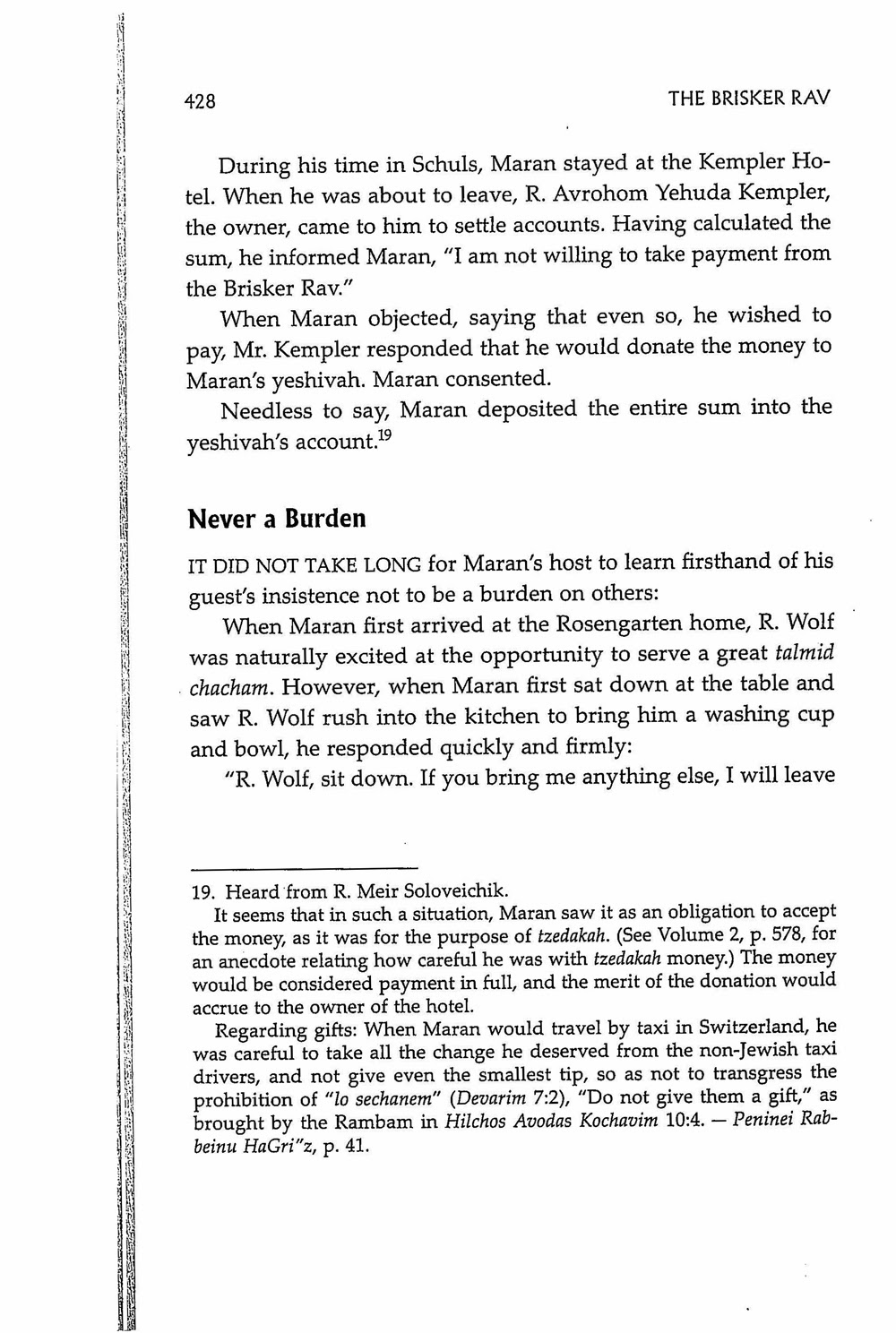
When it comes to The Brisker Rav, I have to confess that I was also certain that another passage would be removed, and it was not. I have in mind vol. 3, p. 428 n. 19 (the last paragraph).[7]
P. 140: Stern cites a comment that appears on every other page in R. Israel Salanter’s journal Tevunah:
All laws concerning monetary transactions have absolutely no practical authority. For we follow the law of the land. And this is the meaning of the great principle of “the law of the land is final.” We study, analyze, and debate monetary topics in the same way in which we study the laws of donations to the temple, tithes, sacrifices and purities, which are not practiced today. They are discussed only in terms of fulfilling our duty to study the Torah.
Upon this, Stern remarks, “While one cannot discount the pressures of governmental censorship that may have contributed to this position, still it marks an important development in rabbinic history. As Elchanan Reiner correctly notes, ‘Diverting attention from the actual ruling to the text itself, namely to the very practice of interpretation, constitutes a dramatic shift in the history of knowledge.’”
I don’t accept this at all. There is no question that the words quoted from Tevunah were directed towards non-Jewish governmental authorities, if not in Germany (where the journal was published), certainly in Russia, where the journal would find its major readership. How is this an important development, and how does it relate to Reiner’s point (made in an entirely different context) when every Jew who read these words understood that that they were not to be taken seriously, any more than the passages on the second page of many rabbinic books stating that all references to non-Jews only refer to pagans in places like China and India?
Let me make just a few more comments about the Gaon. Some people refer to him as Rabbi Elijah Kramer. When I first saw this name a number of years ago, I didn’t know who was being referred to since I had never heard of any Elijah Kramer. The first reference in print to Elijah Kramer (or Kremer) that I have been able to discover is Maurice Samuel’s 1963 book, Little Did I Know, p. 257. (If anyone is aware of an earlier reference, please let me know) The name was later made popular after appearing in the title of Yaacov Dovid Shulman’s 1994 book, The Vilna Gaon: The Story of Rabbi Eliyahu Kramer.[8]
If this post does nothing else, I hope it puts an end to this mistaken practice. The Vilna Gaon was not named Kramer! He was descended from someone named R. Moses Kramer (his great-great grandfather), but the Gaon never used this name and no one ever used it about him, so it is a mistake to call him this.[9] See also note 1 in S.’s post here.
The mistake of referring to the Gaon as Kramer appears in a 2012 book by Rabbis Berel Wein and Warren Goldstein, The Legacy: Teachings for Life from the Great Lithuanian Rabbis, p. 130. The particular chapter I refer to was written by Wein, and on the same page that he mentions Kramer he refers to the Gaon’s foremost student as “Rabbi Chaim Rabinowitz”. As far as I know, this is the first time R. Chaim of Volozhin has been given the last name Rabinowitz, and I have no idea what led Wein to write this. Perhaps there was some confusion between R. Chaim of Volozhin and R. Chaim Rabinowitz of Telz.
This book (which I do recommend) has an approbation by R. Shmuel Kamenetsky in which he writes that “everything in it is true.” I am inclined to think that R. Kamenetsky was only referring to the larger issues discussed in the book rather than attesting to the accuracy of every fact. There is an old saying
כשם שאין בר בלא תבן כך אין ספר ללא טעויות
We can update this saying by adding the word “blog post” after the word “sefer”.
Bezalel Naor has published the following letter he wrote to Elliot Wolfson.
Have you read the new book by Eliyahu Stern, The Genius: Elijah of Vilna and the Making of Modern Judaism (New Haven: Yale University Press, 2013)? In a lengthy endnote on pp. 196-198 (note 19), Stern polemicizes against your reading of the Vilna Gaon’s interpretation of “sefer ve-sefer ve-sippur” (Sefer Yetsirah 1:1). Stern refers to your essay “From Sealed Book to Open Text: Time, Memory, and Narrativity in Kabbalistic Hermeneutics,” Interpreting Judaism in a Postmodern Age, ed. Steven Kepnes (New York: New York University Press, 1996), pp. 145-178, especially footnote 14.
Not wishing to rely on memory alone, I consulted the beginning of the Bi’ur ha-GRA le-Sifra di-Tseni’uta:
Sifra–A book (sefer) is the revelation of the thought, for the thought is closed within man and is revealed only by his speech or by his writing. And so En Sof was revealed, and created the world for [the purpose of] revelation and to make Himself known, as it says in the Zohar, and so the tikkunim that are explained in the continuation [of Sifra di-Tseni’uta] also [come about] through these two things, as it says in Sefer Yetsirah (The Book of Creation), “and [He] created His world with book, book and narrative (sefer ve-sefer ve-sippur). The matter of the two books and [single] narrative is due to the fact that in speech, at one stroke his thought is revealed, whereas in a book it takes two times: once when he writes and his thought is revealed in the world, but the book is yet closed; and a second time when the book is read and then revealed. But in speech, both are included at one time.” (Elijah of Vilna, Bi’ur ha-GRA le-Sifra di-Tseni’uta, ed. Bezalel Naor [Jerusalem, 1997], 1a)Elliot, your understanding of the passage is sound. On the other hand, Stern’s translation of the first term ”sefer” (which he is forced to revocalize “sefar”) as “mathematics,” would appear to be without foundation. As for the revocalization from sefer to sefar, Stern has drawn on Yosef Avivi, whom he cites. (See Yosef Avivi, Kabbalat ha-GRA [Jerusalem: Kerem Eliyahu, 1993], pp. 32-35.) Yet even Avivi did not have the audacity to inject into the Gaon’s commentary the concept of “mathematics.” This mathematicization of Elijah’s worldview awaited Leibniz.
I am not qualified to express an opinion on the merit of Stern’s opinion vs. that of Wolfson when it comes to understanding what the Gaon says. However, when it comes to the Sefer Yetzirah text, we should not assume that Yosef Avivi and Stern are the first ones to revocalize ספר as sefar. This passage in Sefer Yetzirah appears in R. Judah Halevi, Kuzari 4:25, and Hartwig Hirschfeld, in his translation, writes “S’far Sefer, and Sippur.” Also, here is a page from the edition of the Kuzari with the commentary of R. David Cohen, the Nazir (Jerusalem, 2002), p. 227, and you can see this vocalization. (On the previous page, he, like Hirschfeld, vocalizes the word sefar in the text of the Kuzari).
R. Joseph Kafih also vocalizes the word as “sefar” in his edition of the Kuzari.Naor is mistaken when he states that understanding sefar as referring to “mathematics” is without foundation. While it is true that contrary to the implication of Stern, p. 196 n. 19, Avivi does not say anything about mathematics, there are others who do. Returning again to R. Judah Halevi, Kuzari 4:25, here is Hirschfeld’s translation:
As to sefar, it means the calculation and weight of the created bodies. The calculation which is required for the harmonious and advantageous arrangement of a body is based on a numerical figure. Expansion, measure, weight, relation of movements, and musical harmony, all these are based on the number expressed by the word sefar.
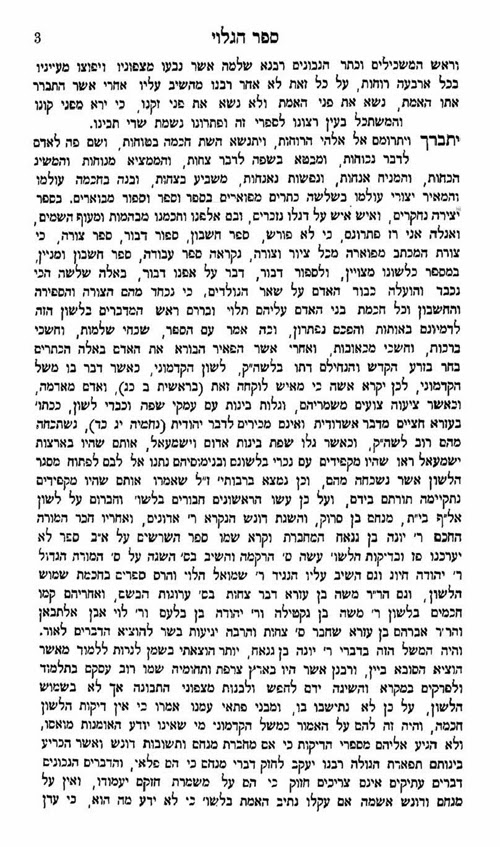
See also the page from R. David Cohen above, where he quotes R. Judah Barceloni who states: וספר – זה חשבון והוא המספרHere is another text woth noting. It is from R. Joseph Kimhi’s Sefer ha-Galui (Berlin, 1887) p. 3.
Kimhi tells us that he is going to let us into the secret of this text, which hasn’t yet been explained, and he writes: ספר חשבון ומניין. He then explains that this is one of the wisdoms that only humans are privy to. See also the anonymous commentary on Sefer Yetzirah, published by Israel Weinstock (Jerusalem, 1984), which explains ספר ספר וספור as follows:
לעיין תמיד בספרים, ולספור דרכי המספרים, ולחשוב בם תמיד
There are other sources that can be cited, but I think this suffices to show that Stern’s reading has to be taken seriously.
Let me conclude by mentioning something already well known, that the Gaon’s writings are full of original views. Stern deals with some of them, and there are many others. In TheLimits of Orthodox Theology, p. 14 n. 55, I already note that the Gaon apparently believed that of the Thirteen Principles, only the first and second were real dogmas (in the Maimonidean sense).
Needless to say, each of the views I will now mention could have a detailed post of its own. There are obviously many other unique views of the Gaon, but for now I think these few will be of interest to readers as they are not that well known.
1. The Gaon did not wear R. Tam tefillin. We are told that he didn’t want to be without tefillin for even a small amount of time. Since the halakhah is in accordance with Rashi, the time spent wearing R. Tam tefillin would be regarded as bitul mitzvat tefillin.[10] R. Elijah Rabinowitz-Teomim writes[11]:
מתחרט אני כל פעם בלבי, על שהנהגתי בתפלין של רבנו תם, בראותי דעת רבינו הגר”א זצ”ל בזה, ככתוב בס’ שערי רחמים משמו, אך אי אפשר לי שלא להניח עוד
2. According to the Gaon, non-Jews in the Land of Israel have to observe all the mitzvot. I know this will be hard for people to believe, so here is the text to see with your own eyes. It comes from the first edition of Aderet Eliyahu (Halberstadt, 1859-1860), Deut. 32:9.This is a very unusual position, and I don’t know of any precedent for it.[12] It is so unusual, in fact, that the next printing, Warsaw 1887, simply cut this section out. Here is how the page looks in the Warsaw edition.
Raphael Shuchat notes that in a manuscript version of the Aderet Eliyahu text there is an important addition, which I have underlined:[13]
ואפילו הגוים הדרים בא”י צריכים לקיים כל המצוות, לפי שכל המצוות תלויים בארץ ישראל
But even with this addition the text is still very difficult, and no one has been able to find a source for the notion that Gentiles have to observe all the mitzvot in the Land of Israel, meaning that the idea is probably original to the Gaon. Shuchat offers two suggestions neither of which really fit with the Gaon’s words. One is that the Gaon means to say that since today there is no longer a law of ger toshav, any non-Jew who wishes to live in the Land of Israel has to convert. According to Shuchat, that is what he means when he says that non-Jews in the Land of Israel have to observe all the mitzvot. His other suggestion is that while there is no halakhic obligation for non-Jews to observe the mitzvot, by not doing so they are not respecting the sanctity of the Land.
שנכרי אינו חייב מצד ההלכה במצוות בארץ, אך מצד קדושת א”י הוא פוגם אם לא יקיים את המצוות בארץ
R. Eliezer Waldenberg also takes note of the passage in Aderet Eliyahu, and seeing no way to explain it assumes that the text is a mistake – מפי שמועה לא נכונה.[14]
Yet R. Waldenberg was unaware that in Aderet Eliyahu, Deut. 1:5, the Gaon says the exact same thing, namely, that in the Land of Israel non-Jews are obligated in all the mitzvot.[15]
ולכן נענשו אפי’ נכרים מפני שלא שמרו את התורה בארץ כמ”ש (מ”ב י”ז) לא ידעו את משפט א-להי הארץ, שישראל מצווה על כל התורה בח”ל ובארץ מצווה אפי’ נכרי
This text appears in full even in the second edition of Aderet Eliyahu, which is the edition that censored the comment to Deut. 32:9. R. Elijah Dessler used the censored Aderet Eliyahu so he didn’t know the Gaon’s comment to Deut. 32:9, but he noted the comment to Deut. 1:5 and expressed his great surprise.[16]
וזה דבר פלא לאמר דע”פ דין תורה כל נכרי הדר בא”י יהי’ מחוייב בכל המצוות כל זמן שבחפצו לדור בה, ותו מה יהי’ בדבר שמירת שבת, שהרי הגוי אסור בשמירתה, ומה יהי’ באכילת קרבן פסח, וכדומה.
While I don’t know of any talmudic or midrashic sources to support the Gaon’s position that a non-Jew in the Land of Israel has to observe all mitzvot,. there are some earlier texts that place additional obligations on non-Jews than what we normally assume.
Midrash Tanhuma (ed. Buber), Metzora 13, states that non-Jews are punished with karet if they violate the laws of Niddah.[17]
Ibn Ezra, Ex. 13:7, 20:8, Lev. 17:13-14, 20:25, states that a non-Jew living in the Land of Israel (i.e., a ger toshav) is obligated to observe Shabbat. He is also not to work on Yom Kippur, to refrain from eating hametz on Passover, and to only eat kosher food. This is Ibn Ezra’s understanding of the peshat of the Torah, but the Talmud records no such laws.The most significant of the sources I can cite, and the one closest to the Gaon’s position, is found in Avodah Zarah 64b. Here the Talmud quotes אחרים as saying that a ger toshav has to observe all the mitzvot with the exception of ritually slaughtered meat. The Hazon Ish, Yoreh Deah 65:6 wonders about this position, since does it mean that a non-Jew must wear tefillin and eat in a sukkah? He assumes that the talmudic passage means that non-Jews in the Land of Israel are only obligated in the negative commandments, and this is required so that Jews not be negatively influenced by their non-Jewish neighbors. See also R. Asher Weiss, Minhat Asher, Bereishit, p. 19.
Subsequent to the Gaon, the Hatam Sofer claims, based on a comment of Tosafot,[18] that when the Torah forbids something for Jews, it is praiseworthy for non-Jews to also abstain from this. See Hatam Sofer al ha-Torah, ed. Stern, vol. 1, p. 216:
דמה שהוא מדינא אסור לנו, נכנס עכ”פ בגדר החסידות גבי ב”נ
*******
1. If, after all I have written, people are still not motivated to read Stern’s book, or they simply don’t have the time, you can watch him discuss the topic here.
Quite apart from Stern’s work on the Gaon, Shlomo Pick wrote the following in his just published article, “Al Prof. Shaul Lieberman ve-ha-Makhon ha-Gavoah[19] le-Torah she-Al Yad Universitat Bar-Ilan – Perek me-Hashkafato,” Badad 28 (Kislev, 5744), p. 10 n. 10.
2. On a recent trip to Toronto I had the pleasure meeting the indefatigable Yehuda Azoulay. Anyone who is interested in the history of great Sephardic rabbis should check out his books here.
3. In the previous post I wrote about the title of the newspaper Yated Ne’eman, and how yated is actually a feminine noun. All that I wrote in that section was tongue in cheek, as I think readers realized, but by mistake I didn’t include a footnote that was supposed to go in. In that note I pointed out that despite what the grammarians might say about the word yated, there are plenty of sources, from long before the newspaper came into existence, that use yated as a masculine noun. The following passage, which has both masculine and feminine,[20] appears in Teshuvot ha-Rashba, ed. Dimitrovsky, vol. 2, p. 529:
ובמלאת הימים האלה יהיה היתד הנאמן תקועה בלבם יתד לא תמוט
4. In the last post I referred to R. Mordechai Agasi’s Asurei ha-Melekh, a recent book dealing with the halakhot of being in prison. One of the commenters noted that this is an example of “life imitating art”, and he referred to a parody of Artscroll available here here where you can see the imaginary new English sefer The Laws of Incarceration. (I recommend also clicking on the links at the bottom of phony Artscroll website.)
Yet what we see from Asurei ha-Melekh is that this is anything but a joke. The parody has as one of the questions answered by the fake Artscroll book, “What are the requirements for conducting Bedikas Chometz in one’s cell?” In Asurei ha-Melekh, vol. 1, pp. 161-162, Agasi, discusses this very case. (All references to Asurei Melekh will be to vol. 1 unless otherwise mentioned).
Believe me when I tell you that pretty much all the possible halakhic problems a prisoner can think of are dealt with in the book. He even deals with some very far-fetched cases. For example, on p. 17 he discusses how one is to put on tallit and tefillin if his hands are in chains. His answer is that a non-Jew can put them on the prisoner, and the prisoner can still make the blessing.
I know that many people have made a joke of Asurei ha-Melekh. But this is a very serious book that serves a real purpose. It also comes with a letter of approbation from R. Shalom Lipskar. He heads the Aleph Institute, one of whose purposes is to reach out to Jews in prison. With the great increase in haredi prisoners, it is important for them to be given halakhic guidance, and the way to do this is with a sefer. (The Modern Orthodox will need an English language book.) Just because someone makes a mistake and has to go to prison doesn’t mean that he should make matters worse and give up Torah observance. There are also new halakhic problems that have to be dealt with. For example, Agasi, p. 123, discusses the case of one who is under house arrest but is permitted to go to synagogue. To enforce the house arrest, the man has to wear an electronic monitor. Is one permitted to go to synagogue on the Sabbath with the electronic monitor since as soon as he leaves his house it starts to record his movements and causes various LED lights to go on? Agasi’s answer is that the man must not leave his house on the Sabbath.
The federal government has made matters easier for observant prisoners by turning Otisville Federal Penitentiary into the place where many non-violent haredim (and other Orthodox Jews) are sent if they are convicted of a federal crime. It has a full-time Jewish chaplain and kosher kitchen.[21] The prison commissary list of food[22] helpfully notes those that are kosher (regular hashgachah) and also those that are “super-kosher” under the hashgachah of the CRC (Central Rabbinical Congress, i.e., Satmar).
Returning to Agasi’s book, while it has certain value, as I indicated, it also has great problems. Let me begin, however, by noting something positive. On p. 42 he states in no uncertain terms that one must follow the Law of the Land, and this includes taxes, traffic, and building laws. He states that violation of the Law of the Land is a Torah prohibition.
Yet I must also state that the book is biased against the American justice system, which he thinks is putting away too many haredim. He tells us that Jewish law, unlike secular law, does not sentence people to prison as a punishment (p. 11). Historically this has been true, but that is because the Jewish communities didn’t have real prisons. At most they had small jails to keep people for limited periods of time. (See R. Ephraim ha-Cohen, Sha’ar Ephraim, no. 83, who discusses if the communal jail needs a mezuzah.) If they were dealing with a real criminal who had to be stopped, they turned him over to the non-Jewish authorities or they dealt with him through physical punishments. Jewish courts in Spain would deal very harshly with those they wanted to punish. They even cut off tongues and noses as forms of punishment. Considering the alternative, one would think that Agasi would be happy that we have progressed to prisons, which seem much more humane than how medieval Jews dealt with troublemakers. Yet from Agasi’s standpoint, long prison sentences are what he regards as cruel and unusual punishment.
מאסר למשך זמן רב הינו עונש עינוי אכזרי מתמשך ביותר
He also states that prison is not a deterrent. But his real problem with prison is that the Jewish prisoner, once he is incarcerated, can’t fulfill his appropriate spiritual tasks (p. 12).
המאסר שולל ממנו את החירות הדרושה לו כדי למלא את תפקידו הרוחני בעולם הזה, וכיון שכך, הינו מעכב את טובתו
Agasi contrasts the moral bankruptcy of prison with the Jewish approach, which doesn’t sentence a thief to jail but forces him to become a slave. And when someone kills accidentally, he is not sent to jail but instead has to live in a City of Refuge.[23] Agasi tells those unfortunate enough to be sentenced to prison that they should reflect on the fact that this is not the Torah way (p. 23):
אם חלילה נגזר עלינו לשהות בו תקופה ממושכת, בגין כל סיבה שרק תהיה, יש לנו להתבונן בהבדל המשמעותי שבין תורת ישראל לבין חוקי כל עם ולשון, בבחינת “ראו מה בין בני לבן חמי.”
In order that the prisoner not feel alone in his predicament, Agasi includes a long list of stories so the prisoner can read about how others had also been improperly incarcerated. Among the figures to read about include Joseph, Samson, R. Meir of Rothenburg, R. Yom Tov Lippman Heller, R. Shneur Zalman of Lyady, R. Yehezkel Abramsky, and many others.
At the beginning of vol. 2, pp. 1-2, he notes that many of those sitting in prison are wondering what they are doing there when lots of non-Jews who did worse are free. Agasi’s response is to blame anti-Semitism. The non-Jews have it in for the haredim and that is why they are putting them in jail.
מאז ומקדם היו אומות העולם שונאים לבני יעקב. . . . נהנים ומתענגים לראות את בני ישראל שבורים ברוחם ורצוצים בגופם
His reply to the anti-Semites is that while they can imprison the Jew’s body, they can’t destroy his soul (p. 4):
עם ישראל לכל אורך הדורות תמיד ידע דבר אחד: אפשר לכלוא את גופם בתא מאסר, אפשר להצר את רגליהם מלכת, אפשר לאסור באזיקים את ידיהם, אפשר להשליכם אל צינוק חסר אוויר, אך, אי אפשר לכלוא את רוחם ונשמתם של בני מלכים הדבוקה בחי העולמים, אי אפשר להגיע אל נקודתם הפנימית המקושרת תמיד בבורא כל עולמים.
On p. 43 he states that according to Jewish law you can’t punish someone without two witnesses, even if you have clear proofs: הוכחות אפילו ברורות ביותר
Since the U.S. government is not obligated to operate according to Jewish law, I don’t know why this is relevant (unless he assumes that lacking witnesses the government only has the right to charge non-Jews). I have said it before, and let me now say it again. The Torah obligation for two witnesses was never how Jewish society operated. As has been pointed out by many, it is impossible to run a society that would require two male witnesses – not to mention the requirement of warning a perpetrator – in order to punish criminals, as such a system would not be able to convict anyone and thus would not have any power of deterrence. (Why the Torah has rules and procedures for criminals that can’t be implemented in the pre-Messianic world is a topic for a future post.) Jewish courts always did what they thought was necessary in order to secure order, and halakhah gives them this authority. To say otherwise is itself a hillul ha-shem because it means that when it comes to dealing with crime Jewish law is unworkable, while the truth is that Jewish law can deal with every possible situation.
Here is what the Rashba says on this issue (Teshuvot vol. 3, no. 393), and his words have been quoted again and again. Note expecially his strong language that insisting on Torah requirements will “destroy the world”.
ורואה אני שאם העדים נאמנים אצל הברורים רשאים הן לקנוס קנס ממון או עונש גוף, הכל כפי מה שיראה להם, וזה מקיום העולם, שאם אתם מעמידין הכל על הדינין הקצובים בתורה ושלא לענוש אלא כמו שענשה התורה בחבלות וכיוצא בזה נמצא העולם חרב, שהיינו צריכים עדים והתראה, וכמו שאמרו ז”ל לא חרבה ירושלים אלא שהעמידו דיניהם על דין תורה, וכ”ש בחוצה לארץ שאין דנין בה דיני קנסות ונמצאו קלי דעת פורצין גדרו של עולם ונמצא העולם שמם
See also R. Hayyim Ozer Grodzinski, Iggerot R. Hayyim Ozer, vol. 2 nos. 833, 837.On p. 58, Agasi writes:
הנוגע בנכרי ובכל חפץ של עבודה זרה או הנוגע בישראל מומר יש להחמיר ליטול ידיו
Something tells me that this is not exactly the type of “humra” to be adopted when one goes to prison. Heaven help the Jewish prisoner if the non-Jew or non-observant Jew figures out what’s going on. To put it another way, I wouldn’t want to be in the prison yard when the good ol’ boys hear that Yankel has a problem shaking their hands.
I also wonder how smart it is for Agasi to tell the haredi prisoner the following:
אוכל נבילות להכעיס הרי הוא אפיקורס, והאפיקורס או ישראל המחלל שבת בפרהסיא אסור להחזיר להם אבידה, כעובד כוכבים.
Agasi does add that there are times when the lost object should be returned, but still, why even create the possibility that someone might want to be mahmir? Again, I wouldn’t want to be there when the non-Jew or non-observant Jew figures out who has taken their lost property.
I also don’t know how practical the following halakhah is, since prisoners don’t get to choose who their cellmate is (p. 58).
לא יתייחד ישראל עם נכרי, מפני שחשודים על שפיכות דמים
Finally, on p. 184 he gives us the following halakhah:
אסיר שברח מבית הסוהר, מברך ברכת הגומל, שאף אם ייתפס וייאסר פעם נוספת אין זה המשך המאסר הקודם אלא מאסר חדש, ואין לומר דכיון שיש חשש שמא ייתפס עדיין לא מקרי שישתחרר לגמרי.
When I told a friend this halakhah, he assumed that I was pulling his leg, just like the story of the man who had to be unburied since his tachrichin were made of sha’atnez, which was around the same time as the sha’atnez in the baseball gloves.
[1] Among the stories I record in this post is that when one of R. Velvel Soloveitchik’s sons died shortly after birth, and the family was crying, R. Velvel insisted that they stop their tears, since there is no avelut before thirty days. This sort of response can also be found in medieval times. In thirteenth-century England, R. Moses the Pious’s son hanged himself before Shavuot. R. Moses “did not leave his room nor did he shed a tear, but studied in his library as if no evil had befallen him, asserting that his son had caused his own death.” See Elliot Horowitz, Reckless Rites (Princeton, 2006), p. 154.
[2] See Divrei Eliyahu (Israel, n.d.), parashat Va-Yera. The two passages I quote also appear in Kol Eliyahu (Petrokov, 1905)
[4] For one creative solution, see R. David Halevi (the Taz), Divrei David to Gen. 18:1, that Abraham was never actually commanded to circumcise himself!
אין מצוה זו לאברהם דרך צווי כשאר מצות, אלא נתן לאברהם הברירה אם חפץ הוא שיתקיים העולם ימול, ואם לאו שאינו חפץ לימול לא יתקיים העולם, וא”כ אין הכרח שימול עצמו, לזה ביקש עצה מג’ אוהביו מה יבחר לו
R. Judah Kahana (died 1819), Terumat ha-Kari (Jerusalem, 1997), Introduction, claims that Abraham never had any doubt that he would follow God’s command. However, he wanted his companions to attempt to convince him not to circumcise himself, as his fulfillment of the commandment in the face of such arguments would therefore be a higher level of service of God, as the Sages tell us: לפום צערא אגרא. This is a strange position, since when is one supposed to purposely test oneself in such a way? Just as strange is R. Yisrael Yaakov Fisher, Even Yisrael al ha-Torah (Jerusalem, 2007), pp. 19-20. He argues in a similar fashion as R. Kahana and claims that just as Maimonides in Shemonah Perakim, ch. 6, tells us that the highest level is one who desires to commit (certain) sins but overcomes his inclination, so too one should feel a desire not to observe positive commandments and nevertheless overcome this desire. Since Abraham had no evil inclination, and was obviously going to observe God’s command, he wished to create the equivalent of an evil inclination by having his colleagues argue against circumcision.
מעתה מבואר היטב הא דנטל אברהם אבינו עצה על המילה, דהרי אמרו חז”ל בב”ב (יז ע”א) שלשה לא שלט בהן יצה”ר אברהם יצחק ויעקב, וא”כ כשנצטוה על המילה לא היה לו יצה”ר להסיתו שלא יעשה ויהיה כוסף שלא לעשות, ואח”כ יעשה, כי הוא המעולה והמשובח כמש”כ הרמב”ם, ולכן הלך אצל ג’ אוהביו כדי שהם יסיתוהו שלא יעשה ואח”כ יעשה כי הוא המשובח והמעולה.
Try to imagine going through life thinking that the positive commandments you do (wearing tzitzit, eating matzah, taking a lulav, etc.) you really don’t want to do but only do so because you are commanded. This is not exactly a recipe for making Judaism appealing, however much it might please Yeshayahu Leibowitz.
[5] One day during the forced evacuation of Amona, R. Avraham Shapiro was unable to deliver his shiur. He told the story of R. Shneur Zalman and his son and concluded, “I too cannot teach at a time when children in Israel are crying from the cruel blows delivered by their brothers.” Yitzhak Dadon, Rosh Devarkha, p. 160. See also Daniel Sperber, On the Relationship of Mitzvot Between Man and His Neighbor and Man and His Maker (Jerusalem, 2014), pp. 57-58.
[6] The story appears in R. Ephraim Zaitchik, Ha-Meorot ha-Gedolim (Jerusalem, 1969), p. 38 (no. 108).
[7] This last paragraph brings up an issue that I have discussed quite a bit on this blog. Recently, the news was awash with the great kiddush ha-shem performed by Rabbi Noah Muroff when he returned a bag containing nearly $100,000 to its rightful owner. I then listened to his talk at the Agudah convention here.
I am curious if anyone else had my reaction. While his return of the money was definitely a kiddush ha-shem, I think that his speech has the potential to be a hillul ha-shem, nullifying the kiddush ha-shem. First of all, he lets the world know that there are those who told him that it was forbidden (!) to return this money. He then tells the audience that his justification of returning the money was in order to make a kiddush ha-shem. This approach, which received applause at the convention (but not from those on the dais!), is not what he explained in a prior interview with the Los Angeles Times that his reason was “to do what is right, and thinking about the feelings of others. It’s looking out for one’s fellow man, and not just for one’s self.” (I assume this is how he really feels, not how he expressed himself at the convention.)
Let’s leave aside the point that as best as I can determine, according to secular law one is indeed obligated to return lost property of this sort. I understand that for those who don’t accept the Meiri, the halakhah Muroff is discussing can be quite a challenge in modern times. But I wonder what is going through the heads of the Agudah leadership. Do they really want the entire world to know that their approach in this matter has nothing to do with helping one’s fellow man, but is about doing what will make Jews look good in people’s eyes? Isn’t this the sort of thing that would be best not spoken about in public?
[8] R. Nathan Kamenetsky, Making of a Godol, vol. 2, p. 1261, refers to R. Eliyahu “Kremmer”.
[9] A great nephew of the Gaon was named Elijah Kramer. See R. Avraham Benedikt, “Ha-Gaon Rabbi Yaakov Zvi Neiman,” Moriah 10 (Heshvan 5742), p. 82.
[10] See R. Asher ha-Kohen, Keter Rosh (Jerusalem, 2012), no. 13. See the discussion of the Gaon’s opinion in R. Hayyim Eleazar Shapira, Divrei Torah, vol. 7, p. 865, and in Ot Hayyim ve-Shalom 34:2.
[11] Nefesh David, p. 123, published with Seder Eliyahu (Jerusalem, 1983).
[12] For Karaites who held this position, see David Sklare, “Are the Gentiles Obligated to Observe the Torah,” in Jay M. Harris, ed., Be’erot Yitzhak (Cambridge, MA, 2005), pp. 311-346.
[13] “Eretz Yisrael be-Mishnat ha-Gra,” Ha-Ma’ayan (Tamuz 5758), p. 16.
[14] Tzitz Eliezer, vol. 16, no. 60. (In Hilkhot Medinah, vol. 3, p. 6, R. Waldenberg quotes this text of the Gaon and doesn’t raise any questions about its authenticity.)
This is the exact sort of approach that R. Waldenberg criticized R. Moshe Feinstein for adopting when confronted with a difficult Tosafot. R. Moshe argued that the text should be emended. R. Waldenberg responded forcefully (Tzitz Eliezer, vol. 14, no. 100):
והנה עם כל הכבוד, לא אדוני, לא זו הדרך, וחיים אנו עפ”ד גאוני הדורות, והמה טרחו כל אחד ואחד לפי דרכו לבאר ולהעמיד כוונת דברי התוס’ בנדה וליישבם, ואף אחד מהם לא עלה על דעתו הדרך הקלה והפשוטה ביותר לומר שיש ט”ס בדברי התוס’ ובמקום מותר צריך להיות אסור.
I have earlier commented on how on a number of occasions R. Moshe discarded sources that did not fit in with his understanding. See The Limits of Orthodox Theology, p. 101 n. 73. See also R. Yehoshua Mondshine’s discussion in Beit Aharon ve-Yisrael 21 (Tishrei-Heshvan 5766), pp. 150-151. Mondshine discusses a text of R. Jacob Emden that R. Moshe declared inauthentic, yet we have the text in question in Emden’s own handwriting.
New information on R. Moshe’s outlook can be found in the recently published Mesorat Moshe (Jerusalem, 2013). Not only was R. Moshe’s approach in this area not scientific, but it is quite untraditional, even radical. See ibid., pp. 506, 507, 508, 520, 522, 525, 590, where R. Moshe rejects the authenticity of comments of Rashbam, “Rashi” on Chronicles, Ramban, and Sforno. Regarding the Ramban, he thought that real heresy had maliciously been inserted into the commentary, a view that as far as I know has never before been suggested. In other cases where he rejected the authenticity of comments of Rashbam and Or ha-Hayyim, he only retracted his view when he saw that there was midrashic support for these comments.
After seeing all this, I think it is impossible to take seriously R. Betzalel Deblitsky’s assumption that when R. Moshe referred to a text as inauthentic, it is likely that he didn’t mean this literally but was merely adopting a respectful way of disagreeing with an earlier authority. See Deblitsky, Beit Aharon ve-Yisrael 21 (Kislev-Tevet 5766), p. 170:
והכל יודעים שברוב המקומות אין לשון זו אמורה אלא כלפי דברים הדחוים מחמת עצמם אם מסברא ואם ממשנה. ולשון כבוד הוא, כאומר שאין לתלות האשמה במחבר עצמו ובודאי תלמיד טועה כתבו. הנסיון לאמת קביעה זו של “תלמוד טועה כתבו” בבדיקה בכת”י, משול כמעט למי שילקט לשונות “כי ניים ושכיב אמרה”, ויברר ע”פ מקורות נאמנים כי אותו חכם אשר עליו נאמר לשון זה, אמר לההיא שמעתתא בשעת צילותא ולא כמתנמנם.
See also the discussion here.Finally, R. Hillel Goldberg called my attention to the Gaon’s commentary to Yoreh Deah 201:1 where he writes: וכתבו בספרי הטבע. This is further evidence that the Gaon read scientific works. Goldberg also called my attention to the Hazon Ish, Mikvaot 7:4 (first series) who refers to the Gaon’s commentary ad loc., and writes: ונראה שאין זה ממשנת הגר”א ז”ל. Yet this is incorrect as the Gaon’s commentary was printed from his manuscript without any changes being inserted. Goldberg discusses the Hazon Ish’s comment in his Hallel ha-Gadol (Denver, 2008), p. 20. See also Betzalel Landau, Ha-Gaon he-Hasid mi-Vilna (Jerusalem, 1978), p. 220, who cites a hasidic author, R. Abraham Joshua Freund, who stated that this passage was not written by the Gaon, “but some mistaken student wrote it in his name.”
[15] For earlier statements regarding Aderet Eliyahu, and the assumption that certain passages were actually authored by his son R. Avraham and others, see Dovid Kamenetsky, “Kitvei ha-Gra bi-Defus u-vi-Khetav Yad,” Yeshurun 24 (2011), pp. 940-951. R. Avraham denied the accusation that his words are included in the commentary. See Yeshurun 4 (1998), pp. 2-3. Regarding the general issue of citations of the Gaon in later works, including their reliability, see Yaakov Shmuel Spiegel, “Kuntres Amar Eliyahu,” Yeshurun 6 (1999), pp. 734-762, ibid., 7 (2000), pp. 707-734. (Here is good place to note that many writers use Spiegel’s research without acknowledgment.)
[16] Sefer ha-Zikaron le-Ba’al Mikhtav me-Eliyahu (Bnei Brak, 2004), vol. 1, p. 45. R. Dessler mentions which edition of Aderet Eliyahu he used.
[17] See R. Yaakov Hayyim Sofer, Kerem Yaakov (Jerusalem, 1989), pp. 92-93.
[18] Ta’anit 11a s.v.אסור
[19] According to some, including the Gaon, this is how the word גבוה is pronounced. See the Gaon’s Dikdukei Eliyahu (Lodz, 1939), p. 22. Others think it should be pronounced “gavowah”. See R. Ben Zion Cohen, Sefat Emet (Jerusalem, 1987), p. 59. It is a mistake to pronounce it “govoha” (as in the official name of the Lakewood yeshiva, Beth Medrash Govoha).
[20] It is corrected to all masculine in one of the manuscripts. See Dimitrovsky’s note, ad loc.
[23] R. Yissocher Frand has a similar approach to that of Agassi. See his essay here where he writes:
Torah justice differs significantly from today’s legal systems. Modern justice attempts to go beyond the actual crime, into the mind of the criminal, to determine why he committed the crime. Was he abused as a youngster? Perhaps the discrimination suffered by people of his race caused him to commit the crime? Was he fully coherent when he committed the crime? Maybe he was insane at the time… Hundreds of criminals are freed each year because the jury or judge trying their case felt that they were able to evaluate the motives of the criminal, and based on their evaluation, the criminal should not be punished for his crime.
Truthfully, however, we mortals have no way of determining most people’s motives. In the Torah justice system, the dayanim (judges) are required to rule cases based on cool, calculated examination of the evidence, with absolutely no leniency for what they might consider to be extenuating circumstances.
This is a complete distortion of how Jewish courts operated. There was a reason why it was so rare that the courts executed someone. It was precisely because they did not rule cases “based on cool, calculated examination of the evidence.” Based on what I have quoted, it appears that Frand believes that Jewish courts are supposed to execute someone even if he was not fully coherent. Some people assume that the reason the Sages set up so many roadblocks in the way of executing someone was because they wanted to prevent possible execution of an innocent man. Yet Gerald Blidstein suggests that it might be because they didn’t want to execute a guilty man. See his “Capital Punishment – The Classic Jewish Discussion,” in Menachem Kellner, ed., Contemporary Jewish Ethics (New York, 1978), p. 316.
The Vilna Gaon, Part 1: How Modern Was He?
The Vilna Gaon, Part 1 How Modern Was He?
by Marc B. Shapiro
Eliyahu Stern, The Genius: Elijah of Vilna and the Making of Modern Judaism (New Haven, 2013)
Eliyahu Stern has set for himself a daunting task and argues his case with conviction. He intends to correct a widespread assumption shared not only by the general public, but by the scholarly community as well. According to this narrative, the Vilna Gaon (hereafter the Gaon) should not be seen as a traditionalist defender of the past, but actually a modern Jew and one who helped usher in the modern era in Jewish history. In Stern’s words, “I [have] come to believe that [Jacob] Katz’s and [Michael K.] Silber’s notion of tradition and traditionalism fails to explain the experience of the overwhelming majority of eighteenth- and nineteenth-century eastern European Jews who did not spend their days either combating the Western European secular pursuit of science, philosophy and mathematics or holding onto the same political and social structures of their sixteenth- and seventeenth-century ancestors. Katz and Silber might have been right about [R. Moses] Sofer. . . . But figures such as the Gaon of Vilna or Hayyim of Volozhin (the Gaon’s student and Sofer’s contemporary), who did not express hostility toward modernity, elude their grasp” (p. 7).
This is quite a claim, and it would be a major revision of the historical picture if Stern could prove the point. Stern also argues that the Gaon’s notes to the sixteenth-century legal code Shulhan Arukh were influential in Jews moving away from a “code-based learning culture supported by the kehilah” (p. 11).[1]
By focusing on Talmud study for its own sake rather than for the sake of determining the halakhah, a paradigm shift occurred in which commentary replaced code. This occurred at the very time that the yeshiva took the place of the kehilah, as seen in the establishment of the Volozhin yeshiva by the Gaon’s disciple, R. Hayyim. Thus, the hierarchy of religious authority was restructured, which leads to what Stern refers to as “religious privatization” (p. 11). As he sees it, “The Volozhin yeshiva was founded not in opposition to the cultural and intellectual upheavals of the nineteenth century. It was itself built on the most modern of assumptions, the separation of public and private spheres” (p. 141). Stern even makes the bold claim that in certain respects the Gaon was more modern than Mendelssohn, arguing that “it was the Gaon’s hermeneutic idealism that called into question the canons of rabbinic authority, while Mendelssohn tirelessly defended the historical legitimacy of the rabbinic tradition to German-speaking audiences” (p. 64). In seeking to turn the Gaon into a more modern Jew, one who is not, as standard scholarship assumes, an opponent of philosophy, Stern even argues that the Gaon did not believe in “demons, magic, [and] charms” (p. 129).[2]
After mentioning that the Gaon is embodied in the Jewish residents of Tel Aviv and New York, who live as though they are majorities, Stern concludes his book with this striking assertion: “From the birth of the State of Israel, to the Jews’ involvement in radical anti-statist modern political movements, to the creation of a robust vibrant Jewish life in the United States, Jewish modernity derives much of its intellectual dynamism, social confidence, and political assertiveness from an astonishing source: the brilliant writings and untamed personality of Elijah ben Solomon” (p. 171).
As with all revisionist theses there is bound to be reluctance to accept a new paradigm. The successful revisionist thesis is the one able to withstand the initial skepticism. Does Stern’s thesis fall into this category? Despite his enthusiastic and tempting arguments, I am not convinced. Reading the book, I could not help wonder if, for example, drawing contrasts with the thought of Leibniz offers any real insight into the thought of the Gaon. We know that the Gaon was fearless in emending rabbinic texts, but for Stern, “Elijah’s emendation project addresses the charge that Leibnizian idealism leaves no room for the possibility of progress, redemption, and critique. . . . Elijah embroidered the theological concept of evil around the idea of textual error” (p. 61). Isn’t this reading too much into what the Gaon had in mind? Why does the approach of the Gaon have to be given such theological weight that Stern can conclude that “emendation is the path toward redemption and a restored original harmony” (p. 62)?[3]
In another example of his revisionist approach, Stern argues that the Gaon did not oppose philosophy. Rather, “Elijah’s problem with Maimonides revolves around issues of linguistics, interpretation, and hermeneutics and not whether it is permissible to read secular philosophy” (p. 130). As noted already, Stern also assumes that the Gaon did not really believe in “demons, magic, charms and other irrational objects” (p. 129). There is no question in my mind that Stern is in error here. Because the Gaon was a traditional Jew, whose approach to the classical rabbinic texts was not influenced by rationalist philosophy, this is precisely why he believed in demons, magic, and charms. The only reason to reject these things, as did Maimonides, is because one is influenced by rationalist thought.
I see no evidence that the Gaon was influenced in any substantial way by such knowledge, and his occasional use of Aristotelian terminology does not by itself indicate real influence. Furthermore, everything in his writings leads one to believe that when it came to the occult his mental universe was no different than the great rabbis of his time and subsequent to him, for whom demons did indeed exist. In his famous attack on Maimonides, found in his comment to Shulhan Arukh,Yoreh Deah 179:13, he specifically mentioned the efficacy of magic, and contrary to Stern this is to be taken literally.[4]
In fact, a few notes later, 179:26-28, which are not mentioned by Stern, the Gaon again wrote about demons, mentioned that one is permitted to consult with them if it is not the Sabbath, and cited talmudic and midrashic texts that show humans interacting with demons.[5] The Gaon’s position in this matter does not need to be explained. Pretty much every traditional Jew in his day believed in demons, and he did as well. It is Maimonides’ opinion that is not traditional.
Stern leaves it as an open question whether the Vilna Gaon called philosophy “accursed” (p. 245). This is obviously an important issue, since if Stern is correct that the Gaon was not really opposed to philosophy, one would not expect him to use the word “accursed.” Yet there is no doubt that the Gaon did indeed use this word. It appears in the first printing of the Gaon’s commentary to the Shulhan Arukh, and its authenticity was attested to by R. Samuel Luria whoexamined that actual manuscript. Only later was the word removed bythe publisher. Contrary to what Stern states, Samuel Joseph Fuenn,Matisyahu Strashun, and Hillel-Noah Maggid Steinschneider do notclaim that later editors put in this phrase. The one to make thisassertion was R. Zvi Hirsch Katzenellenbogen, and he was hardly aneutral observer.[6]
Several other issues emerge in the book. Stern quotes Aliyot Eliyahu as stating that before the age of thirteen the Gaon was “studying books on engineering for half an hour a day” (p. 38). I am not sure why Stern mentions anything about “thirteen,” as the text is explicit that he was around eight years old. Furthermore, the text says nothing about “engineering.” Rather, it states that the Gaon studied astronomy (tekhunah).
Stern writes that the Gaon “rejected outright” the Shulhan Arukh (p. 60). This is a strange statement being that the Gaon wrote a commentary on the Shulhan Arukh. Furthermore, this commentary was designed to show the earlier rabbinic sources upon which the ShulhanArukh‘s laws were based. It is true that there are many times when the Gaon disagreed with the Shulhan Arukh. However, what is significant with the Gaon is precisely that he accepted the Shulhan Arukh. He had the stature to reject it had he chosen, and to writehis own code, yet he did the exact opposite. By attaching his notesto the Shulhan Arukh he was affirming the work. He personally didnot need the Shulhan Arukh and would decide halakhah from theTalmud and rishonim. But when the Shulhan Arukh decided thehalakhah correctly, he was content to show the sources for the law,meaning that the work had value and that is why he affirmed it.[7]
Contrary to Stern (pp. 77-78), there is no evidence that the Gaon was influenced by Elijah Levita and the Gaon never mentioned him. When the Gaon wrote that the Masorah disagreed with the Talmud, he was referring to how to spell certain words, and this formulation comes from the Tosafists. He was not in any way identifying with Levita’s notion that the Hebrew vowels originated in post-talmudic times, and was certainly not addressing “the veracity of the cantillations of the Bible” (p. 78). When the Gaon’s son cited Levita, he was also not referring to his view of the vowels, only of the spelling of words.
I do not know what Stern means by “following Nachmanides, the Gaon argues that the book of Deuteronomy was written later than the other four books of the Bible” (p. 80). Quite apart from Nahmanides, this position is found in Gittin 60a, where one view is that the Torah was given “scroll by scroll.” Also on p. 80, Stern states that “the Gaon, in contrast, builds on the historical position laid down by Ibn Ezra that the last verses, though inspired by Moses, were actually ‘arranged’ by Joshua.” This has nothing to do with Ibn Ezra as the Talmud already contains the view that the last verses were written by Joshua (saying nothing about being “inspired” by Moses. [Ibn Ezra also says nothing about the last verses being “inspired” by Moses])
On page 133, Stern quotes a passage from the introduction to R. Judah Epstein’s Minhat Yehudah (Warsaw, 1877) where he writes of “thousands who came to study and the miracle it would take for one to emerge with any teaching ability.” In the Hebrew the final words are “yatza le-hora’ah.” This has nothing to do with teaching but refers to theability to decide halakhic questions. The expression originates in Kohelet Rabbah 7:49.
Finally, he writes that “when the Volozhin yeshiva opened its doors in 1802, it was the first time that young men from all economic and social backgrounds were afforded the opportunity to study” (p. 150, see also p. 162). I know of no evidence to support this assertion. Both before the Volozhin yeshiva’s opening and after, opportunities for study were limited to those who could afford to support a child away from home, and give up the income he would bring in for the family.
Even though I am not convinced by Stern’s thesis, there is no doubt that this book is filled with learning and insight and has understandably created a good deal of excitement. To appreciate Stern’s efforts and ingenuity, one must read very carefully, and this reading will be rewarded in many ways.
******
The review you have just read (with the exception of notes 1-5, 7, and one sentence in brackets) appeared on the H-Judaic listserv on July 19, 2013. In the review I was limited in terms of space and I also could not use Hebrew. So let me now add some additional points and corrections that could not be included in the original. Before doing so I want to stress that I enjoyed Stern’s book a great deal, and I also learnt much from it. The Gaon’s scholarship is so wide-ranging that anyone who attempts such a daunting task as to write on him must be commended.[8]
Stern should also feel gratified that so many people have chosen to use their precious time to write about his book, even if they disagree with him.
Stern’s first chapter, which puts the Gaon and Vilna in historical perspective, was particularly interesting to me. How many people, for instance, are aware of the following (p. 70): “The roughly 5,500 Jews in and around Vilna (Wojewoda) made up nearly 30 percent of the population, and the 3,500 to 4,000 Jews living within Vilna proper formed an overwhelming majority of the local population.”
I strongly recommend that people read the book, if only to see how the talented author attempts to create a completely new perspective on the Gaon. Almost every page of Stern’s book raises issues that I can comment on, and I could easily have written a hundred page post. I agree with much in the book, and can cite sources in support of a number of points Stern makes. Yet this does not change the fact that I was not convinced by his major arguments. Rather than cite all the things I agree with, let me offer some more comments correcting errors, or offering different interpretations, as well as some tangential observations.
P. 14. Stern tells us that the Gaon’s mother was from Slutzk, and on p. 181 he cites a source that supposedly claims that the Gaon was also born in Slutzk. Yet this is incorrect. The town referred to is not Slutzk but סעלץ. This is the shtetl Selets (or Selcz) around 150 kilometers south-east of Brisk.[9]
This information is also found in the Encyclopaedia Judaica entry on the Gaon. There is another Selets in Belorussia, some eight hundred kilometers away,[10] but this is not the town associated with the Gaon. There is no actual proof that the Gaon was born in Selets, but that was the tradition of the town.[11]
P. 15. Stern records how the Gaon wanted to study medicine but was discouraged by his father who wanted his son to devote himself to Torah study. I don’t know if this has any relationship to the Gaon’s unusual (but not unique) view in opposition to using doctors as opposed to turning to God. According to one report, the Gaon only had this view when it came to internal medical problems, but not external ones (e.g., a burn).[12]
P. 17. Stern mentions the report by R. Samuel Luria that the Gaon travelled throughout Europe to find rabbinic manuscripts. Among the legends of these travels is one recorded in the name of R. Joseph Hayyim Sonnenfeld, quoting R. Joshua Leib Diskin, that when the Gaon visited the Munich library and saw the famous manuscript of the Talmud, he said that he would give all the money in the world in order to put it in genizah, because this Talmud was only R. Ashi’s first version (and thus of no authority). This story appears in Menahem Mendel Gerlitz’s Mara de-Ar’a Yisrael (Jerusalem, 1969), vol. 1, p. 57 n. 49. I can’t say whether or not R. Sonnenfeld ever made this comment (and Gerlitz’s book in general is quite unreliable). What I can say is that the story never happened as described for the simple reason that the manuscript only arrived in Munich in 1806, as noted by R. Raphael Rabbinovicz in the introduction to Dikdukei Soferim, vol. 1, p. 35.[13]
P. 44. “He [the Gaon] and his students reinterpreted a strand of kabbalah developed by Abraham Abulafia. . . . Elijah’s circle borrowed heavily from his ideas regarding the mathematical underpinnings of the world.” Unfortunately, this influence is never sufficiently explained and there is confusion about an important text. Thus, Stern writes:
As Menachem Mendel of Shklov wrote, “The word cheshbon [calculus] comes from the word machshava [thought] and this [calculus] is the first form that emerges from the essence of thought.”[14]
To begin with, I don’t know why cheshbon should be translated as “calculus.” I assume it means mathematics.[15] But that is a minor point, as the general meaning of the passage is clear and R. Menahem Mendel of Shklov tells us that this approach was shared by the Gaon. The more important point, however, is that the sentence quoted as having been stated by R. Menahem Mendel was not stated by him at all. R. Menahem Mendel tells us explicitly that the sentence comes from an early book, one that predates R. Isaac Luria. What we learn from Moshe Idel is that this is actually a quotation from Abulafia.[16] Yet this information does not appear in Stern’s book, even though it would have strengthened his case.
Stern also states: “Elijah’s son Avraham approvingly cites the much-maligned Abulafia, and bestows the honorific “z”l” (the Hebrew acronym for “may his memory be blessed”) on the controversial medieval thinker.”
Here is the page in R. Avraham’s Rav Pealim.
Unfortunately, Stern must have read too quickly and instead of וז”ל [= וזה לשונו] he read the abbreviation as ז”ל, or perhaps he mistakenly connected the ז”ל on the previous line to ר’ אברהם הרואה
Pp. 44ff. Stern argues that according to the Gaon, matter existed eternally and the world was created from this eternal matter. If this was the case, it would be quite significant. Yet I believe that Stern misunderstands what the Gaon is saying. Stern himself quotes the Gaon as explaining that creation means “created from that which exists above.” As I see it, what this means is that matter “found” in the Divine was brought into the world, e.g., through emanation. But this is not the same as speaking of eternal matter, even eternal matter that is lacking form, as these exist apart from God.
With regard to the Gaon and creation, see also R. David Luria’s commentary to Pirkei de-Rabbi Eliezer, ch. 51 n. 17, where he cites a manuscript comment of the Gaon that the world is eternally created. This same viewpoint is shared by R. Hayyim of Volozhin, Nefesh ha-Hayyim ch. 13. I don’t see how this can be reconciled with the Gaon’s comment at the beginning of Aderet Eliyahu that time itself is a creation, and he further speaks of an actual moment of the world’s creation:
בראשית: ב’ הוא ב’ הזמניי. כמו ביום. מפני שהזמן עצמו נברא והב’ מורה על עת הבריאה שהיה בחלק הראשון מהזמן הנברא
If matter is eternal, as Stern claims, or even eternally created, then time is also eternal. But this is clearly not what the Gaon says in the text just quoted.
P. 80. Stern notes that the Gaon’s interpretation of the Mishnah was not bound to how the Talmud explained matters. This is correct, and many people have written on the matter. I mention this only to call attention to the comments of the great genius, R. Meshulam Roth, in his Kol Mevasser, vol. 2, pp. 120-121, 128-129, who felt constrained to argue against this notion. I think it will be obvious to readers that R. Roth’s interpretations of the Gaon are based on his own dogmatic assumption, which he states explicitly, that it is unacceptable to interpret the Mishnah in a way that diverges from the talmudic interpretation.
P. 97. Stern writes:
Contrast Elijah’s vision with the picture of intimacy expressed by Rabbi Pinchas of Korzec (1726-1791): “Prayer is like intercourse with the Divine Presence. At the beginning of intercourse there are motions. Similarly, there is a need for motion in prayer. One should move when beginning to pray. Later on, one can stand without moving, attached to the Divine Presence with a powerful bond. As a result of the motions alone one can attain dvekut.”
In the note the source for this quotation is given as Likutim Yekarim, 18, and the bibliography tells us that the edition used is Lemberg, 1792 (the first edition). Yet there is some confusion here. R. Pinchas of Koretz indeed wrote a book entitled Likutim Yekarim, but the book where the passage cited comes from is another Likutim Yekarim, one that records the teachings of other early Hasidic teachers. Here is the title page.
Furthermore, the reader looking at page 18 in the first edition of (the correct) Likutim Yekarim will not find anything, as the text is on page 1a. In the 1974 edition the text is found in section 18, but as far as I can tell, these sections were only added in this edition.[17]
Here is the relevant page from the first edition, and the comment referred to is in the last paragraph. The last sentence of the translation quoted above (“As a result . . .”) is not an accurate rendering of the Hebrew sentence that begins מכח מה שמנענע
P. 102: “While it is doubtful that Elijah endorsed or defended Eibeschuetz’s or Luzzatto’s Sabbatian tendencies, he never publicly condemned their works.” Instead of the word “doubtful,” which leaves some room for question, the sentence should say that “it is certain that Elijah never endorsed or defended . . .” I leave aside for now the question of why Stern is so certain that Luzzatto had Sabbatian tendencies, and simply note that the Gaon would have rejected such an assumption in the strongest terms. The Eibeschuetz case is more complicated,[18] but I don’t understand how “Eibeschuetz’s Sabbatian proclivities were revealed when his son Wolff was unmasked as a closet Sabbatian” (p. 99). Since when do the actions of a son determine the stance of a father?
Let us now return to the issue of the Gaon’s view of philosophy, which was mentioned earlier in this post, and when I refer to philosophy I have in mind rationalism. Stern, p. 129, argues that the Gaon was not opposed to philosophy and as evidence for this proposition notes that the Gaon uses Aristotelian terms, cites the Guide once in his Aderet Eliyahu, and procured a copy of Aristotle’s Ethics. He then writes, “This evidence has led some to suggest that Elijah objected to a materialistic or epicurean lifestyle often associated with philosophy, but not to philosophy’s heuristic value.”
While I think that Stern is indeed correct that the Gaon saw heuristic value in philosophy, I was still quite surprised when I read this sentence, since I had never heard of anyone who argued that the Gaon’s only concern with philosophy was the materialistic lifestyle associated with it. When I looked in Stern’s note (p. 246 n. 55) it didn’t help. This is what appears in the note:
See Moshe Philip, ed., Sefer Mishlei im Biur ha-Gra (Petach Tikvah: 2001), 441 and Eliyahu Stern, “Philosophy and Dissimulation in Elijah of Vilna’s Writings and Legacy,” Revue Internationale de Philosophie (forthcoming). On Elijah reading Aristotle, see his letter to Rabbi Shaul of Amsterdam recorded in Tzvi ha-Levi Horowitz, Kitvei ha-Geonim (Warsaw: 1938 [should be 1928]), 3-10.
I don’t know what is intended by the first reference, as there is a typo since the volume does not contain 441 pages. Stern’s forthcoming article can only be discussed when it appears in print, but the book under review does not give any reference to others who argued that the Gaon had no substantive opposition to philosophy. Also, contrary to what Stern states here, the Gaon did not write to R. Saul of Amsterdam asking him to send him the Ethics. The letter Stern refers to was actually written by the Gaon’s brother, R. Yissakhar Ber.[19]
See Kitvei ha-Geonim, p. 4a. On p. 44, Stern states that the letter was written by both the Gaon and his brother. This, I think, is closer to the truth. I say this because the Gaon’s brother requested לקנות בשבילנו ולשלוח לנו, although this could also just be the writing style he used. However, there are lots of reasons why people read books, and this alone does not mean that one is positively inclined to a subject. The greatest of all Jewish philosophers, Maimonides, tells us that he read all the works of Sabian idolatry that he could get his hands on (Guide 3:29). It would also be more significant if instead of the Ethics, the book requested of R. Saul of Amsterdam was Aristotle’s Metaphysics. But I don’t want to make too much of this, since I am convinced by Stern that the Gaon saw some value with philosophy. But contrary to Stern, I would add that the Gaon also saw great dangers in philosophy.
In the note directly following the one just referred to, Stern concludes based upon the introduction of R. Menahem Mendel of Shklov to the Gaon’s commentary to Avot and R. Israel of Shklov’s introduction to his Peat ha-Shulhan that “Elijah was secretly positively inclined to the study of philosophy.” He again refers to his forthcoming article where he develops this point. As mentioned already, discussion of this article must wait until it appears in print. In the meantime, however, it is difficult to accept this point without a clear articulation of what exactly Stern means by “study of philosophy”, since in R. Israel of Shklov’s introduction to Peat ha-Shulhan he writes as follows:
ועל חכמת הפילוסופי’ אמר [הגר”א] שלמד אותה לתכליתה ולא הוציא ממנה רק ב’ דברים טובים . . . והשאר צריך להשליכה החוצה.
R. Israel of Shklov also notes that the Gaon knew חכמת הכישוף which contradicts Stern’s statement that according to the Gaon “references to demons, magic, charms, and other irrational objects and ideas cannot be ignored—though not per se because he thinks they actually exist.” (p. 129).
See also Ma’aseh Rav (Jerusalem, 1906), Siah Eliyahu, p. 21b (no. 61(, which states that the Gaon would not study R. Bahya Ibn Paquda’s philosophically based Sha’ar ha-Yihud (in the Hovot ha-Levavot):
והי’ מחבב הגר”א ז”ל ס’ מנורת המאור וס’ חובת הלבבות זולת שער היחוד ובמקום שער היחוד הי’ אומר שילמדו בס’ הכוזרי הראשון שהוא קדוש וטהור ועיקרי אמונת ישראל ותורה תלוין בו.
There is another passage that is relevant, but as far as I know has not been cited in any of the scholarly discussions about the Gaon and philosophy. R. Hillel Rivlin, Kol ha-Tor (Bnei Brak, 1969), ch. 5:2, quotes the Gaon as saying the following about philosophy, and you can’t get any clearer than this:
את חכמת הפילוסיפיה למדה לתכליתה ולא מצא בה כי אם דברים אחדים שמקורם לוקח מחז”ל ועל השאר אמר, שאין בה לא הגיון ולא צדק ומיוסדת על אפיקורסות אווילית.
As mentioned, you can’t get any clearer than this, but I realize that this is not the Gaon speaking but rather a student, so it is possible to argue that he, and also R. Israel of Shklov, didn’t properly portray their teacher.
The passage that creates so many problems for Stern’s thesis is found in the Gaon’s commentary to Yoreh Deah 179:13. In this text, the Gaon famously attacks Maimonides for being led astray by “accursed philosophy.”
Stern argues that the Gaon does not oppose the study of (even rationalist) philosophy per se. Rather, his opposition is directed at how “a philosophical approach may ignore linguistic nuance” (p. 129). I think this is very unlikely, and it appears to me that Stern is trying to force his interpretation into the words of the Gaon when the more likely, and natural, interpretation is that the Gaon indeed opposes the study of (rationalist) philosophy.[20] (On p. 130 Stern claims that the Gaon was not opposed to the study of “secular philosophy” which is an even more far-reaching claim.) Beyond what the Gaon writes in his comment on the Shulhan Arukh, there is the way he writes it, which unfortunately is not reflected in Stern’s translation. Here is how Stern renders the first part of the text:
All those who came after Maimonides differed [because they did not use his rational allegorical interpretive technique]. For many times we find magical incantations mentioned in the Talmud. Maimonides and philosophers claimed that such magical writings and incantations, and devils, are all false. However, he [Maimonides] was already reprimanded for such an interpretation. For we have found many accounts in the Talmud about magical incantations and writings. . . . Philosophy is mistaken in a majority of cases when it interprets the Talmud in a superficial manner and destroys the sensus literalis of the text. But one should not think that I in any way, Heaven forbid, actually believe in them or in what they stand for.
In this comment the Gaon writes:
והוא נמשך אחר הפלוסופיא הארורה .
This means that Maimonides “followed after the accursed philosophy.” However, Stern mistakenly translates these words: “Maimonides and philosophers claimed.”
Later in his comment the Gaon writes:
והפלסופיא הטתו ברוב לקחה לפרש הגמרא הכל בדרך הלציי
Stern translates this as “Philosophy is mistaken in a majority of cases when it interprets the Talmud in a superficial manner.” This too is a incorrect translation. What the Gaon is saying is that philosophy misled Maimonides to falsely explain the Talmud. So again, we see the great dangers of philosophy, and how it was able to lead astray even Maimonides. (There is nothing in the Gaon’s comment about “a majority of cases”). The final words quoted from the Gaon, בדרך הלציי, do not mean “superficial manner.” They mean “in a figurative sense.”
What can we say about the Gaon and Maimonides’ Guide? Although I hadn’t investigated the matter properly, for awhile I thought that the Gaon didn’t study the Guide in a serious manner. Anyone who reads Stern will see that this is incorrect. In fact, the Guide was even studied in Vilna during the Gaon’s time. The following passage from Aliyot Eliyahu (Vilna, 1892), p. 13a, should have been cited in the text by Stern as exhibit no. 1, as it is a strong piece of evidence in support of his position. For some reason, it is only summarized in a note (p. 246 n. 58):
וסיפר לי הרב כו’ הישיש מ’ ישראל גארדאן רב בווילנא (אשר היה מכיר היטב את הגאון נ”ע ודירתו היה בחומת אביו וקודם פטירתו היה דר הגאון בחצר בהכנ”ס) אשר היה נכנס ויוצא כפעם בפעם בבית הגאון נ”ע ושמע פ”א אשר בא הרב ר’ טרייטיל ז”ל לפני הגאון והרעיש על אשר ראו עיניו שאנשים קבעו למודם בבהמ”ד בספר מורה נבוכים וביקש שהגאון ימחה בידם והגאון השיבו בחרי אף ואמר ומי יעיז לדבר נגד כבוד הרמב”ם וספרו אשר מי יתנני ואהיה עמו במחיצתו בגן עדן.
There is no question that this report complicates the picture and shows that the Gaon’s view of the Guide was more complex than often portrayed. We see from it that unlike others, the Gaon, despite his strong criticism of Maimonides and general opposition to rationalist philosophy, nevertheless believed that the Guide had value and qualified scholars should not be prevented from studying it.
After quoting this passage in Aliyot Eliyahu, R. Shlomo Korah adds, “There is a story about someone who asked his rebbe if it is permitted to study the Guide. He replied, ‘The Rambam permits it —הרמב”ם מתיר ”.[21]
Alan Brill has also made the case that the Gaon saw value in philosophy and calls attention to the fact that in a text attributed to the Gaon, there is a summary of a section of the Guide. See his “Auxiliary to Hokhmah: The Writings of the Vilna Gaon and Philosophical Terminology, in Moshe Hallamish, et al., eds., Ha-Gra u-Veit Midrasho (Ramat Gan, 2003), p. 10. This shows that philosophy has value, as I too acknowledge, but this has nothing to do with rationalism, which the Gaon strongly opposed.
It is also worth noting that R. Shneur Zalman of Lyady, in responding to the reported theological objections that the Gaon expressed about early hasidut, wrote as follows[22]:
ומי יתן ידעתיו ואנחהו ואערכה לפניו משפטינו להסיר מעלינו כל תלונותיו וטענותיו הפילוסיפיות אשר הלך בעקבותיהם, לפי דברי תלמידיו הנ”ל, לחקור אלקות בשכל אנושי
In other words, and this is really ironic, R. Shneur Zalman assumes that Gaon was led astray by philosophy and that explains his objections![23]
The reason I had my mistaken assumption that the Gaon didn’t study the Guide in any significant way was because the Gaon didn’t refer to it in his commentary to the Shulhan Arukh, even when he had the opportunity, such as in his note to Yoreh Deah 179:13. Another place where he could have referred to the Guide is in the very first halakhah in Orah Hayyim. R. Moses Isserles is quoting from Maimonides’ Guide, and rather than refer the reader to this, the Gaon offers sources for the Rama’s formulation from rabbinic literature. Yet even before reading Stern’s book I should have seen that the Rama in Darkhei Moshe tells us that he is quoting the Guide, and one should assume that the Gaon saw this text.
This is how R. Isserles begins the Darkhei Moshe (and he begins the Shulhan Arukh similarly):
כתב הרמב”ם בספר מורה הנבוכים חלק ג’ פרק נב שמיד שאדם ניעור משנתו בבוקר מיד יחשוב בלבו לפני מי הוא שוכב וידע שהמלך מלכי המלכים הקב”ה יתעלה חופף עליו שנאמר (ישעיה ו, ג) ) מלא כל הארץ כבודו.
R. Isserles quotes Maimonides as saying that as soon as you wake up in the morning you should think about God. Yet if you look at Guide 3:52 that he is quoting you find something interesting. Here is the passage in Ibn Tibbon’s translation (which is what the Rama used).
מי שיבחר בשלמות האנושי ושיהיה איש הא-להים באמת יעור משינתו וידע שהמלך הגדול המחופף עליו והדבק עמו תמיד הוא גדול מכל מלך בשר ודם ואילו היה דוד ושלמה, והמלך ההוא הדבק המחופף הוא השכל השופע עלינו שהוא הדבוק אשר בינינו ובין הש”י . . . וכבר ידעת הזהירם מלכת בקומה זקופה, משום מלא כל הארץ כבודו.
Where does the Rama get his formulation that as soon as one awakes – מיד שאדם ניעור משנתו – he should think of God? It comes from Maimonides’ words we just read: יעור משינתו. As pointed out by Raphael Speyer,[24] it seems that the Rama simply misunderstood what Maimonides (in Ibn Tibbon’s translation) was saying. The words יעיר משינתו have nothing to do with awakening from sleep in any literal sense. Rather, the expression simply refers to people who are figuratively awakening from their slumber and can now recognize God’s presence. Therefore, there was no need for the Rama in seeking to make his point to include anything about getting up in the morning.
In the Datche’s editor’s response to Speyer, he pointed out another problem with the Rama’s formulation. While the Rama writes of מלך מלכי המלכים הקב”ה יתעלה חופף עליו, this is not what Maimonides says. According to Maimonides, “this king who cleaves to him and accompanies him is the intellect that overflows toward us and is the bond between us and Him, may He be exalted.” In other words, Maimonides is speaking about the Active Intellect yet the Rama turns this into God Himself. It is because of things like this that Yeshayahu Leibowitz was led to declare that the Rama “didn’t understand philosophy and didn’t understand the Guide of the Perplexed.” He also referred to the Rama’s Torat ha-Olah as a work of “pseudo-philosophy.”[25]
This might seem like an unfair statement, and I am sure that Yonah Ben Sasson would reject it,[26] but consider the following. No one could be regarded as a rabbinic scholar if all he studied was the Mishneh Torah, without examining the talmudic passages upon which the Mishneh Torah is based. In fact, I think all would agree that one can’t really understand the Mishneh Torah without knowing the talmudic sources. By the same token, one can’t really understand the Guide without knowing the Aristotelian sources upon which so much of Maimonides’ words are based. Yet the Rama tells us, in his famous letter to R. Solomon Luria,[27] that he never actually studied Aristotle and his only knowledge of him comes from Maimonides’ Guide and other Jewish sources.
כי אף שהבאתי מקצת דברי אריסטו מעידני עלי שמים וארץ שכל ימי לא עסקתי בשום ספר מספריו רק מה שעסקתי בספר המורה שיגעתי בו ומצאתי ת”ל [תהלה לא-ל] ושאר ספרי הטבע כשער השמים וכדומיהין, שחברו חז”ל ומהם כתבתי מה שכתבתי מדברי אריסטו.
Interestingly, I found one place, Torat ha-Olah 3:47, where the Rama speaks very disrespectfully of Maimonides’ philosophical knowledge, referring to it as foolishness.
ואין לך סכלות חכמתו גדולה מזה
Nevertheless, the Gaon placed the Rama together with Maimonides in his other sharp criticism of the latter[28]:
אבל לא ראו את הפרדס, לא הוא [הרמ”א] ולא הרמב”ם
To be continued
* * * *
Information about my summer trips to Spain, Central Europe, and Italy will be available soon. Anyone interested should check out the Torah in Motion website. Marc Glickman, one of the participants on last year’s tour to Central Europe, described it as follows: “It was great to meet Marc and he was a fantastic guide. The trip was like a living Seforim Blog post (I follow his posts religiously).” Thank you Marc!
Also for those interested, I will be speaking on R. Ovadiah Yosef at Ohab Zedek in NYC on December 17 at 8:15pm.
[1] Regarding how influential the Gaon was on Lithuanian rabbinic scholarship, see Gil Perl, The Pillar of Volozhin: Rabbi Naftali Zvi Yehuda Berlin and the World of Nineteenth-Century Lithuanian Torah Scholarship (Boston, 2012), pp. 127ff. Perl disputes with Immanuel Etkes and Shaul Stampfer who have argued that the Gaon’s influence has been exaggerated. In terms of the Gaon’s influence on Jewish practice, R. Yaakov Kamenetsky claimed that there were only two places in Lithuania that followed the Gaon’s minhagim, and one of these places was the Gaon’s beit midrash/synagogue (kloiz) in Vilna. See R. Yehoshua Geldzahler, Kodshei Yehoshua (Jerusalem, 1999), vol. 5, p. 1758 (Geldzahler forgot the second place mentioned by R. Kamenetsky.) See also Nathan Kamenetsky, Making of a Godol (Jerusalem, 2002), vol. 1, p. 655.
[2] “In Elijah’s view, references to demons, magic, charms, and other irrational objects and ideas cannot be ignored—though not per se because he thinks they actually exist. (Elijah’s admirer Menashe Illya [1767-1831] recalled ‘that according to his memory,’ Elijah actually ‘criticized those who interpreted Midrash according its [!] literal sense when the Midrash went against reason.’) Elijah’s criticism against Maimonides was based on the belief that one cannot simply deny or gloss over the anti-rational elements that consistently appear in rabbinic literature. Either they belong in the text or they do not; if they do belong, they must be explained. By not including or explaining them, Elijah contends, Maimonides and ‘philosophers’ fail to take seriously the very words and signs that make up the rabbinic tradition.”
[3] In R. Isaac Herzog’s letter about the authority of the Zohar, published by me in Milin Havivin 5 (2010-2011), he quotes R. Abba Werner as saying the following about the Gaon (p. 16):
שהגר”א בבאורו על הזוהר הוא המבקר היותר קשה על הטקסט של הזוהר
R. Mordechai Friedman called my attention to R. Hanokh Ehrentreu, Iyunim be-Divrei Hazal u-ve-Leshonam (Jerusalem, 1978), pp. 184ff., where Ehrentreu prefers a textual emendation of R. Wolf Heidenheim over the emendation suggested by the Gaon. Since I will be dealing with R. Chaim Kanievsky in the next installment, let me mention that he has a tradition that R. Hayyim of Volozhin stated that one of the Gaon’s emendations was mistaken: הגר”א טעה. See R. Hayyim Shalom Segal, Berurei Hayyim (Bnei Brak, 2004), vol. 3, p. 924.
[4] In Aderet Eliyahu to Nahum 3:4, the Gaon writes:
בשלשה דברים ישחית איש את רעהו . . . בכשפים: במיני קטורת ממשיכים כחות העליונות אשר מקושרים בלבות בני אדם
[5] See also Aderet Eliyahu toNumbers 23:22 and Hosea 2:20 for other discussions of demons. In Yahel Or (Vilna, 1882), p. 38b (second numbering), the Gaon writes:
ואמרו כי אמן של שדים נעמי [צ”ל נעמה] הולידה אותן מהנפילים לכן חציין מצד אביהן דומה למלה”ש ומצד אמן לב”א
[6] See Samuel Joseph Fuenn, Kiryah Ne’emanah (Vilna, 1860), p. 160. In Stern’s book the page number is mistakenly given as p. 169.
[7] Regarding the Gaon and the Shulhan Arukh, see R. Yaakov Hayyim Sofer, Menuhat Shalom (Jerusalem, 2003), vol. 11, pp. 51-52, who shows that because the Gaon did not have access to the early editions of the work, he mistakenly assumed that a word stated by R. Joseph Karo really belonged to R. Moses Isserles. Although there is no question that Sofer is correct, since we are dealing with the Gaon, here is how Sofer prefaces his correction (which also includes the claim that a reference offered by the Gaon is incorrect).
אמנם עם שאיני כדאי כלל וכלל, עפר יעקב, אומר אני אחר נטילת הרשות, שדברי קדשו של רבינו הגדול הגר”א ז”ל, שגבו ממני, ובאפיסותי לא זכיתי להבין דברות קדשו של הגר”א ז”ל.
[8] Regarding the Gaon, many interesting articles appear in Yeshurun 5 (1999) and 6 (1999). R. Dovid Yitzchaki’s contribution, “Havanat Divrei ha-Gra al Da’at Omram,” Yeshurun 5, pp. 502-537, is of particular value. Jacob Israel Dienstag’s bibliography of writings by and about the Gaon is still worth consulting. See Talpiot 4 (1949), pp. 269-356.
[12] See R. Moshe Zuriel, Otzrot ha-Gra (Bnei Brak, 2000), pp. 242f.
[13] See R. Yaakov Wreschner, Seder Yaakov (Jerusalem, 2010), vol. 1, p. 35 (first pagination).
[14] Derekh ha-Kodesh (Jerusalem, 1999), p. 4.
[15] Stern himself translates it as “math” on p. 198 n. 19. Regarding mathematics, in the next post (or maybe the one after) I will defend Stern’s reading of a passage in opposition to the critique of Bezalel Naor here.
[16] See Idel, “Bein ha-Kabbalah ha-Nevuit le-Kabalat R. Menahem Mendel mi-Shklov,” in Moshe Halamish, et al., eds., Ha-Gra u-Veit Midrasho (Ramat Gan, 2003), p. 174-175.
[17] The text were are discussing is also found in Tzava’at ha-Rivash (Brooklyn, 1998), p. 28 no. 68.
[18] See Sid Z. Leiman, “When a Rabbi is Accused of Heresy: The Stance of the Vilna Gaon in the Emden-Eibschuetz Controversy,” in Ezra Fleischer, et al., eds. Meah Shearim: Studies in Medieval Jewish Spiritual Life in Memory of Isadore Twersky (Jerusalem, 2001), pp. 251-263.
[19] The Gaon had five brothers. See Chaim Freedman, Eliyahu’s Branches (Teaneck, 1997), p. 12.
[20] Let us not forget that the Gaon claimed to have had visions of Jacob and Elijah. This comes from a text written by the Gaon and recorded by R. Hayyim of Volozhin in his introduction to the Gaon’s commentary to Sifre de-Tzeniuta. R. Hayyim also reports that the Gaon said that before he was thirteen years old he started to make a golem, before he concluded that Heaven did not want him to continue. The Gaon further told R. Hayyim that he was visited by R. Shimon Ben Yohai and R. Isaac Luria. All of these things are not characteristic of one with a positive attitude towards philosophy.
[21] Sefat Melekh, vol. 1 (commentary to Mishneh Torah, Sefer ha-Mada [Bnei Brak, 1998], p. 53. R. Korah, Sephardic Chief Rabbi of Bnei Brak, is one of the few Yemenites (are there any others?) who studied under R. Aaron Kotler. See his recollections at the beginning of his Haggadah shel Pesah (2003).
[22] David Zvi Hillman, ed., Iggerot Ba’al ha-Tanya u-Venei Doro (Jerusalem, 1953), p. 97.
[23] See R. Matisyahu Strashun, Mivhar Ketavim (Jerusalem, 1969), p. 125 n. 1.
[24] Datche 55 (17 Av 5769), p. 6.
[25] See his Sihot al Pirkei Ta’amei ha-Mitzvot (Jerusalem, 2003), pp. 723-724.
[26] See his Mishnato ha-Iyunit shel Ha-Rama (Jerusalem, 1984).
There are three upcoming auctions, Kestenbaum , Asufa, and Jerusalem Judaica. The first two have their catalogs online while the final one is only available in hardcopy. Kestenbaum has two very rare and thus highly prized pieces, one the 1526 Prague Haggadah. (Lot number 124) This edition, which is the first complete (there were some leaves found in a binding containing illustrations that may or may not be earlier, but, in all events, it was not a complete copy), illustrated Haggadah. We have discussed this edition here and here. Additionally, we have mentioned that the illustration that adorns shefoch was used as the title page for the Levush and, most recently, was censored. This haggadah is particularly rare (and expensive). There are five known complete copies to exist and there are one or two copies complete copies on vellum (I have seen both numbers quoted). The Valmaddona Trust owns a vellum copy, and at the time it was purchased in 1982 it was the most expensive printed Hebrew book sold when it sold for $143,000. In 1995 a paper copy of this edition sold for $300,000. It is my understanding that today, the record for the highest price paid for Hebrew book is for the Shabbtai Sofer Siddur with the various autographs, although, if one counts the 11 volumes of the Bomberg Talmud printed on blue paper as one lot, those were recently sold for close to $2 million in the aggregate. But, it is not only the amount of money paid that makes this haggadah important, many of the illustrations became the protype for subsequent haggadah illustrations. The second very rare book at Kestenbaum is the first edition of the Ibn Ezra's commentary to the Pentateuch, which is an incunabula, printed in Naples, 1488. (Lot number 38). This particular copy is a wide margin copy and is described as the finest copy to come up for auction in decades. Additionally, the first edition of two important siddurim are here as well. The Siddur Sha'ar ha-Shamayim from R. Isaiah Horowitz, the Shelah (lot no. 174) and R. Y. Emden's Siddur, (lot no. 101). Another important first edition of a liturgical work is R. Meir Ibn Gabbai's Tola'ath Ya'akov (lot no. 187) with the rare poem page. Another work that contains a rare page is the Hon Ashir from R. Immanuel Ricci. (Lot no. 195) This work, a commentary on the Mishna, was printed in 1731, however, only some copies contain the final page that has musical notes and an accompanying poem. Finally, for those interested in forgery, Friedlander's Yerushalmi on Kodshim is lot number 224.
On the manuscript front. The Hida's manuscript of Birkei Yosef with some variants from the printed text. (Lot 253). An autographed manuscript signed by R. Yonathan Eybescheutz that is "an unrecorded engagement proposal of" R. Eybescheutz daughter. (Lot no. 267). There is a letter relating to R. J.B. Soloveitchik's failed bid for Chief Rabbi of Tel Aviv from his father, R. Moshe. (Lot no. 296).