New Writings from R. Kook and Assorted Comments, part 5

New Writings from R. Kook and Assorted Comments, part 5
by Marc B. Shapiro
Continued from here.
The next post (or perhaps the one following) will return to my analysis of R. Kook’s recently published Li-Nevokhei ha-Dor with which this series began. Yet before doing so, there are a number of other points I would like to make and respond to some comments and questions.

1. In previous installments I have mentioned how R. Kook compares the Torah scholars and the masses, and how the masses have elements of natural morality that are not to be found among the scholars. This is not the only provocative distinction R. Kook makes. He also distinguishes between the great tzadikim and everyone else. These two groupings are, of course, different in many ways. Yet one of the most interesting distinctions R. Kook makes—and one can find parallels to this in Ibn Caspi and hasidic texts— is that for the elites the nitty-gritty of halakhic study can have a negative affect on their spiritual life. Here is what he writes in Shemonah Kevatzim 1:412:

האדם הגדול כשהוא מכניס את עצמו יותר מדאי במדת הפרטים, בין בלימודם בין בחרדתם, הרי הוא מתקטן, ומעלתו מתמעטת, וצריך לשוב בתשובה מאהבה, מתוך גדלות הנשמה, לקשר את תוכן חיי נשמתו בענינים גדולים ונשגבים.

R. Kook goes so far as to say that for these elites the very practice of mitzvot is not part of their spiritual identity per se. They have, as it were, moved beyond this, and their involvement with the practical sphere of mitzvot is based on their connection to the larger world.[1] I think that this passage, from Shemonah Kevatzim 1:410, is the most antinomian in all of R. Kook’s writings. In it we also see how problematic the halakhic details of life are to the special personality who wants to soar the heights of spirituality and yet has to be involved with practical halakhic matters. I think it obvious that R. Kook is reflecting his own personal spiritual struggle here. On the one hand, he wants to lose himself in love of and experience of God, to bind his soul with the divine. On the other hand, as a practicing rabbi he was called upon day in and day out to answer all sorts of everyday halakhic questions. One can imagine him alone in his study, enraptured in mysticism, even nearing prophetic insights, and someone comes to his door asking him to determine the kashrut of a dead chicken. With this he is brought down to the mundane halakhic world.[2]
ישנם אנשים גדולים כאלה, שמהלך רוחם הוא כל כך נשא, עד שמצדם אם כל העולם היה במעמדם, היו המצות בטלות כמו שיהיה לעתיד לבוא, לימות המשיח או תחיית המתים. והם בכל זאת מקושרים הם במצות הרבה מאד, לא למענם, כי אם למען העולם כולו, המקושר עמם. וכשהם באים אל הפרטים, לעסוק בהם מצד עצמם, מוצאים הם סתירות נפשיות גדולות האלה, שהם נמוגים מרוב יגונם. וכשבאים לעסוק בתורה ובמצות בפרטיות בשביל העולם, יושפע עליהם מעין של גבורה ושל קדושה, שאין דומה לו.
Let me also return to the issue of the Jewish masses’ natural morality vs. the rabbinically tuned morality of the scholars, and how according to R. Kook the former is superior to that of the latter. I was asked if I can provide some examples of this. I think the most obvious such example is the response to sexual abuse that we have witnessed in the Orthodox world. While the natural impulse of the masses was that abusers must be immediately removed from any contact with children, many of the learned rabbis were able to come up with all sorts of reasons why this was not necessary, and why the police should not be called. Over time the view of the rabbinic class has evolved and many of them now advocate a strong response to sexual abuse. However, what took them a long time to get to was immediately understood by the Jewish masses, and they understood it intuitively. Years from now people will wonder how it was that rabbis refused to protect children. It will be incomprehensible to them how this could have happened. We who lived through this experience know that it was precisely the pressure on the ground, from the Jewish laypeople (and the bloggers and newspapers), that forced changes in this matter.[3] Here I think is a good example where talmudic learning led scholars לטהר את השרץ בק”ן טעמים, while the Jewish masses, with their intuitive natural morality, saw that evil must be exposed and they emerged victorious.[4]

The same phenomenon was seen in the Leib Tropper affair, where once again it was the masses, together with a couple of indefatigable bloggers, who saw what was really going on, and forced the issue. This happened while many leading rabbis continued to stand by Tropper. They were oblivious to what was unfolding before their eyes and what was obvious to everyone but them.[5] And let’s not forget about all the gedolim who signed a letter in support of the monster Elior Chen.[6] It is difficult to make sense of these terrible lapses of rabbinic judgment with a haredi Daas Torah perspective, but with R. Kook’s analysis all becomes clear.

I thought of R. Kook’s comments on the intuitive morality of the masses after hearing a few shiurim on the subject of lo tehanem. One of them has since been removed from the site. Listening to these shiurim was shocking to me, not simply because I found the views discussed at odds with what everyone in my community regards as basic Jewish values (and matters about which we would be quick to criticize non-Jews if they ever spoke this way). What was particularly surprising was how the speakers, all learned talmudically, have fallen into what I would call the textualist trap of Centrism. What this means is that the written word has become so sanctified that they feel it is their obligation to resurrect every halakhah recorded in the standard codes in order improve the masses’ behavior.

Yet for all their learning, these rabbis don’t appreciate that there are some halakhot that simply fell out of practice. This happened in pre-modern times, before there were Reform and Conservative movements. In other words, it happened at a time when communities had the status of kehillah kedoshah. Because of this, historically the poskim generally tried to be melamed zekhut on the actions of the people, on the assumption that kol hamon ke-kol sha-dai, which is in line with how R. Kook understood the pious Jewish masses. That explains why, to give just one example, confronted with the fact that pious people did not wash before eating wet food, the vast majority of poskim tried to find a justification for this. They did not lecture the people about how they were sinning and try to resurrect a practice that had fallen out of fashion. Their assumption was that there must be some justification for the practice of the masses, even if it is not readily apparent.[7]

As Haym Soloveitchik discussed in “Rupture and Reconstruction,” there is today no faith in the practice of the masses. Therefore, instead of justifying the practices which oppose the textual tradition, the rabbis are attempting to reestablish the textual tradition. The problem with this is that there is also what I call an aggadic tradition, where values and morality were passed on, and this sometimes was in tension with the letter of the law. The Jewish people, acting with their innate Torah-intuitive morality, developed an approach, and this was recognized as legitimate until recent times.[8] So we now have a situation where shiurim are being given on the prohibition of lo tehanem telling people all sorts of things about how to relate to non-Jews that no one, and this includes great rabbis, ever paid attention to (e.g., one can’t say that X is a good baseball player!).

I am not going to get into the halakhic justification which can be offered as to why the pious Jewish people didn’t follow the letter of the law. There is indeed halakhic justification. (See R. Eliezer Waldenberg, Tzitz Eliezer, vol. 15 no. 47.) Yet my point is that the Jewish people didn’t need any specific halakhic justification, because they knew from their intuitive natural morality what was proper. This is what R. Yehudah Amital meant when he said that growing up in Hungary he never heard anyone talk about “halakhah this, and halakhah that”.[9] As R. Amital pointed out, the people who speak like this, who have an endless focus on halakhic particulars, are those who have lost touch with the tradition. In a traditional society there is no need for one to delve into endless halakhic details, as simply by growing up in this society one knows how to conduct oneself. In a traditional society, you don’t need books to tell you, for example, how big the matzah needs to be and how much water you need to wash your hands, and by the same token you don’t need books to tell you what you can and can’t say about the Mets’ leading slugger or whether or not you can give your maid a gift on her birthday. There has been so much discussion about how Haredism is a modern invention, but the truth is that Centrism, with its Pan-Halakhism, is just as much a modern invention as haredism. Looking around, it is actually some groups of Hasidim who are the only real traditionalists, the ones who have a mesorah and who don’t need to constantly look into a book to tell them how they should live. As the great Hungarian scholar Ludwig Blau put it, “A drop of tradition is worth more than a ton of acumen.”[10]

2. In my last post I summarized R. Eleazar Ashkenazi’s position in his Tzafnat Paneah, pp. 29-30, as follows:

He also offers another explanation for the lengthy lifespans [in the Torah], namely, that the Torah recorded what the popular belief was, no matter how exaggerated, and Moses was not concerned about these sorts of things. In other words, just like today people say that the Torah is not interested in a scientific presentation of how the world was created, R. Eleazar’s position is that the Torah is not interested in a historically accurate presentation.
Dr. Eric Lawee, who has a chapter on Ashkenazi in his forthcoming book, wrote to me that he reads Ashkenazi differently than I did. I went back to the text and thanks to Lawee, I would like to clarify some of what I wrote.[11] It appears that the first part of Ashkenazi’s comment is merely stating that the Torah recorded exaggerated numbers as figures of speech, much like the Land of Israel is described as flowing with milk and honey which was never meant to be understood literally. Although it is true that people understand the lifespans literally, Ashkenazi sees this as a misinterpretation of the Torah. In other words, it is not correct to say that the Torah recorded the exaggerated numbers because that was what the people believed.

Yet in this very discussion, Ashkenazi also states that the exaggerated numbers are only found in the very ancient stories. However, with regard to events closer to Moses’ time the latter was more careful about recording the details accurately. It is because of this comment that I wrote that Moses left the stories of the distant path cloaked in legend. I should have also clarified that Ashkenazi is only referring to the ענייניהם ושנותיהם of the ancients who are not part of the prophetic tradition which includes Adam, Noah, and the Patriarchs. Here Ashkenazi does seem to be saying that the Torah records popular conceptions, for if not from these conceptions, where did Moses get the inaccurate information that he recorded?

It is possible to explain that the lengthy lifespans of people like Adam and Noah, whom Ashkenazi stresses were of concern to Moses and he was therefore careful with regard to their details, were always intended be understood figuratively. However, with regard to the others mentioned in the early chapters of Genesis, Ashkenazi speaks of הגוזמות הספוריים הבלתי מדוקדקים , and here it seems that he does advocate the notion that the Torah is including material that was popularly believed, even if not accurate.[12] He also writes about how certain matters in the Torah were recorded בבלבול ובקיצור מופלג ומקומותיהם ומקריהם שלא בדקדוק One such matter is the genealogies, about which he writes: לא היתה הכוונה לדקדק במספר שנות חיי כל איש כי אם על דרך כלל

Ashkenazi’s viewpoint is interesting because he acknowledges that in certain factual matters the Torah is not exact, and indeed this is not a concern of the Torah. This sounds very similar to how many people explain the first few chapters of Genesis. Yet it is much less common for Orthodox spokesmen to extend this approach to later chapters of the Torah, e.g., to say that say the genealogies recorded are not accurate. But is there a conceptual difference between saying that the Torah is not interested in presenting creation in a historically accurate form, and that is why there is no mention of billons of years or of evolution, and saying that the Torah is not interested in exact genealogies, but simply presents what was commonly thought and this explains the lengthy lifespans? If there is no conceptual difference, where does one draw the line? Surely there are some parts of the Torah in which factual history must be assumed. This is an issue that has not yet been adequately dealt with, and I will soon be publishing a letter by a great Torah scholar which refers to this problem.

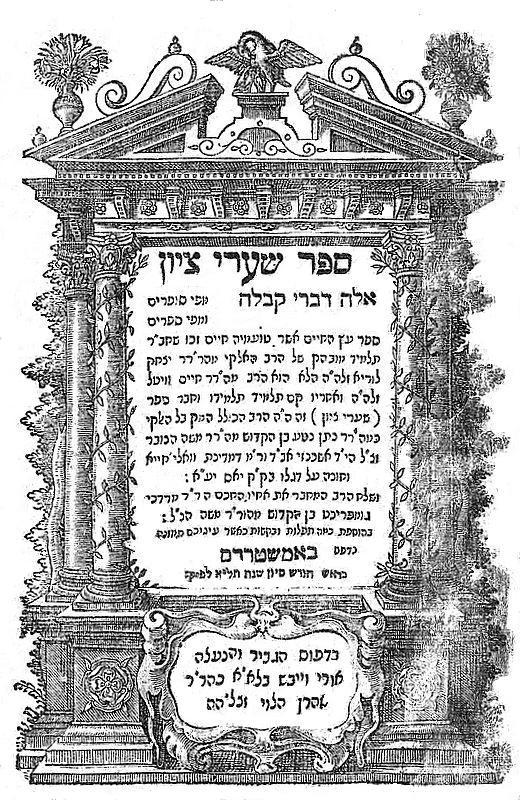
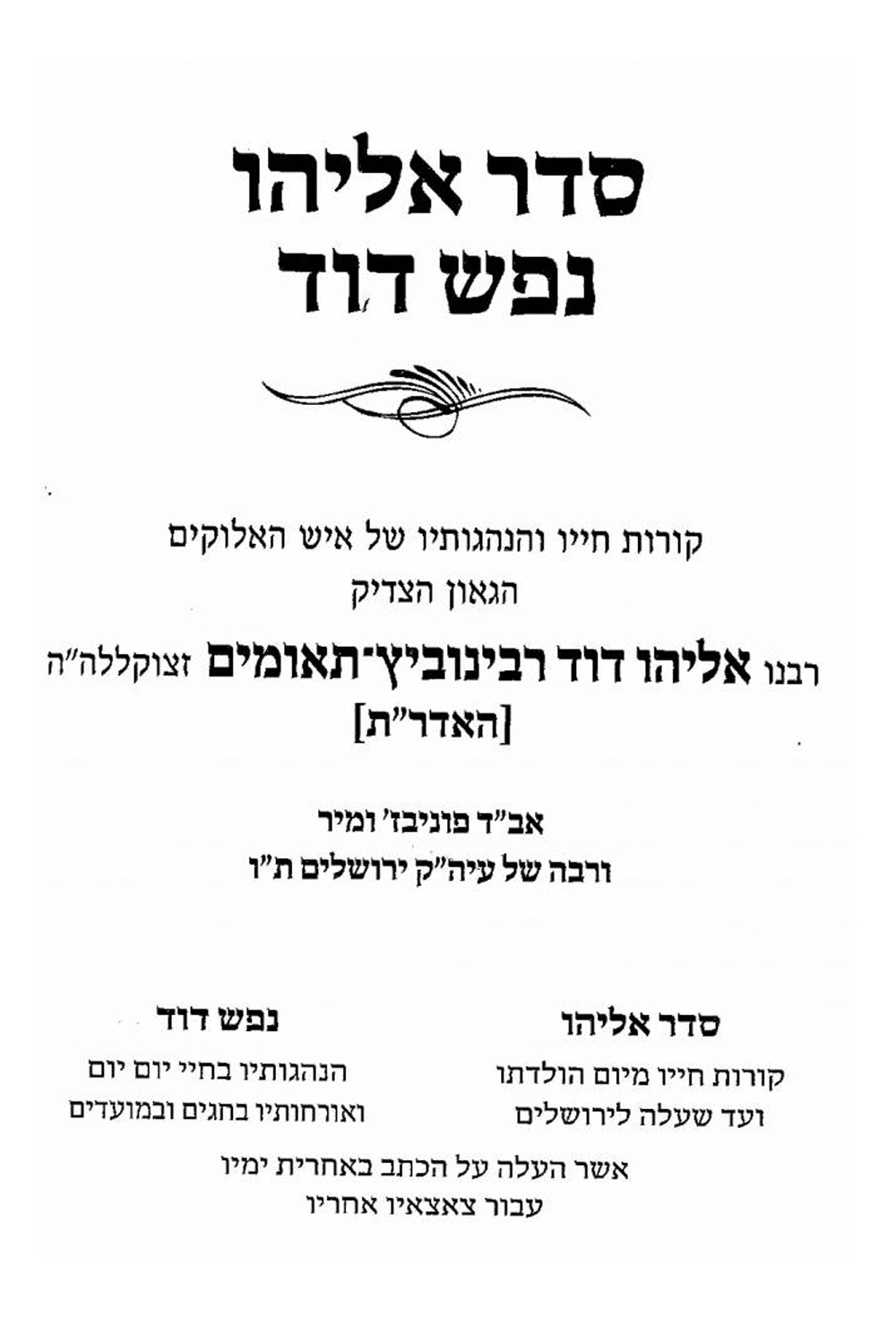
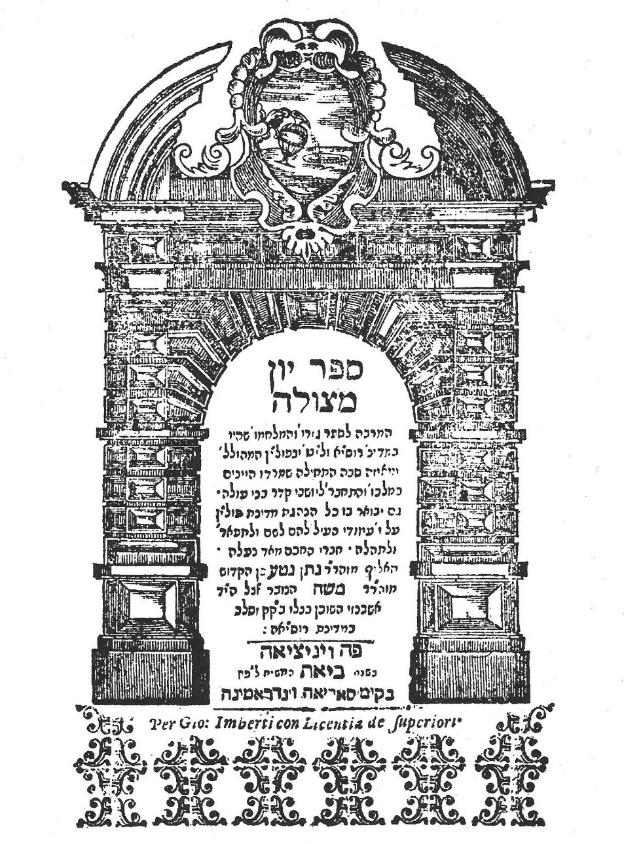
3. In the last post I cited an example where R. Shalom Messas was criticized for not understanding an Aggadah literally. More than one person thought that I should have cited sources showing how foolish it is to take bizarre aggadot literally. It is, of course, easy to cite such sources, beginning with the Rambam’s Introduction to Perek Helek.[13] Most of these are quite famous, so let me call attention to a book not so well known. It is R. Eliezer Lippmann’ Neusatz’ Mei Menuhot, published in 1884. Here is its title page.
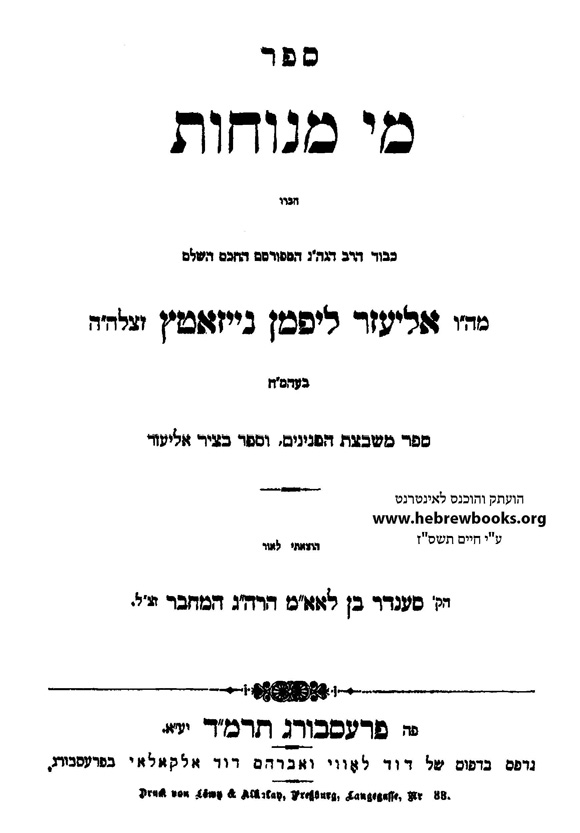
Neusatz was a student of the Hatam Sofer, and this book appears with the approbation of R. Simhah Bunim Sofer (the Shevet Sofer).
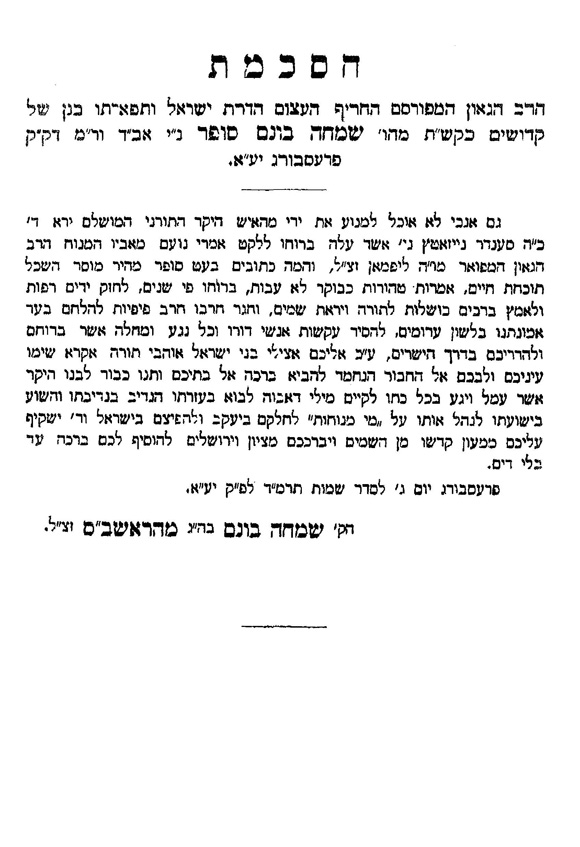

Here is the first page of the approbations to his book Be-Tzir Eliezer. Pay careful attention to how R. Abraham Samuel Sofer (the Ketav Sofer) describes Neusatz’ standing as a student of the Hatam Sofer.
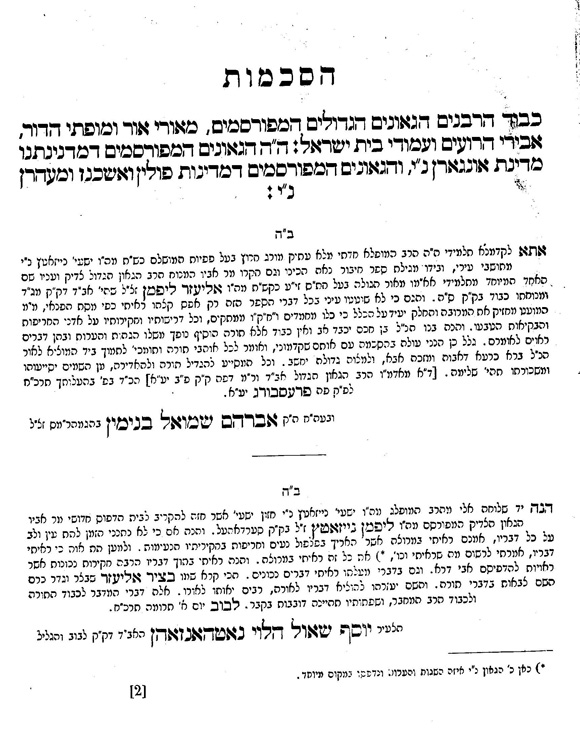
On p. 16a, after citing Maimonides’ words that the majority err in understanding aggadot literally, Neusatz comments that this was the situation in earlier times, which were less religiously sophisticated than later generations. The proof that the earlier generations were religiously naïve is that belief in divine corporeality was widespread then. According to Neusatz, people who were so mistaken about God that they imagined him as a corporeal being would obviously not be able to understand Aggadah in a non-literal fashion. He contrasts that with the generation he lived in, which was able to properly understand Aggadah.

אמנם בדורנו זה נזדככו יותר הרעיונות ונלטשו הלבבות והמושגים האלהיים הנשגבים האלה מצטיירים בלבות המאמינים בטוהר יותר ורוב זוהר, ונתמעטו אנשי הכת הזאת, ותה”ל רובם יודעים שחז”ל כתבו אגדותיהם ע”ד משל ומליצה וחדות וכפי הצורך אשר היה להם לפי ענין הדורות אשר היה לפניהם, פנימיותם הם ענינים אמתיים נשגבים עומדים ברומו של עולם.
I assume that Neusatz would say that the traditional notion of the generations declining only refers to the scholars, as it is obvious from his words that when it comes to the masses the generations have been getting better.

Neusatz also has an interesting explanation as to why certain prophecies, in particular those of Ezekiel, are not written in proper grammatical Hebrew. This was already commented on by Abarbanel. Abarbanel simply attributes this to Ezekiel’s and Jeremiah’s unpolished Hebrew skills![14] He further claims that this is why there are an abundance of keri u-khetiv, ketiv ve-lo keri etc. in the book of Jeremiah. The original Hebrew had to be corrected!

Neusatz has a different approach to explain certain prophets’ apparent deficiencies in the Hebrew language. He explains that since the prophets were speaking to the lower classes, and they wanted their message to sink in, they adjusted their language accordingly. (Mei Menuhot, pp. 13b, 34b). This is also how he explains certain passages in the book of Ezekiel which would appear to be at odds with modest and proper speech. Since the prophet was speaking to the masses, he had to use their coarse language (p. 35a). This is no different than politicians today, who adopt a certain mode of speech to connect with the listeners. It also explains many of R. Ovadiah Yosef’s outrageous comments. In speaking to the masses he forgets who he is, and uses the sort of lower class language that allows him to connect with his listeners, but that is not acceptable for someone in his position.

Neusatz calls attention to R. Joseph Albo’s comment, Sefer ha-Ikarim 3:25, that even the Torah was written so as to speak to its various audiences, which included not just the wise people but also the foolish ones:

לפי שהתורה לא נתנה לחכמים ולמשכילים בלבד, אבל לכל העם מקצה גדולים וקטנים חכמים וטפשים, ראוי שיבואו בה דברים מוכנים [צ”ל מובנים כמ”ש במהדורת הוזיק] לכל.
Neusatz is also explicit that very few aggadot are actually the result of the Sages’ ruah ha-kodesh (p. 32a). He states that Maimonides’ astronomical views in the Mishneh Torah do not come from a holy source, but from the Greeks, and in our day must be rejected (p. 38a). He also acknowledges that at times the Sages’ opinions were based on the best scientific knowledge of their time, which we now know is mistaken (pp. 36a-36b, 38a-38b). On page 39b he discusses Maimonides’ rejection of astrology. The problem with Maimonides’ position is that the Talmud clearly accepts astrology. In Studies in Maimonides and His Interpreters I argue that Maimonides must have assumed that the greatest of the Sages rejected astrology. Yet the problem is that although Maimonides might assume this, is there any rabbinic source to justify this assumption? Neusatz argues that there is. There is a famous rabbinic statement in Shabbat 156a: אין מזל לישראל This means that Israel is not under the planetary influence. However, the statement is not a denial of the efficacy of astrology per se, and indeed assumes that the nations of the world are under the planetary influences. In very original fashion, Neusatz argues for a different understanding of the statement that he believes was shared by Maimonides:

והנה ידוע דעת הרמב”ם שהמזל אינו פועל כלל ונ”ל דס”ל שזה הוא כונת ר’ עקיבא ור’ יוחנן ורב ושמואל ורב נחמן ב”י בסוף מסכת שבת שאמרו אין מזל לישראל, וכונתם שאין ראוי לישראל עם חכם להאמין שמזל פועל.

In other words, אין מזל לישראל means that it is not proper for a smart people like the Jews to believe in the efficacy of astrology!

Neusatz also discusses Maimonides’ general attitude towards superstition, and argues that today, when all the superstitious beliefs have been proven false, it is a religious requirement to advocate Maimonides’ approach in these matters (p. 40b). As to why the Sages appear to believe all these superstitions, Neusatz assumes that they had to deal with the masses who were enmeshed in these notions, and that as long as the superstitious ideas were not idolatrous, the Sages were willing to tolerate them (p. 41ff. This is exactly Meiri’s view with regard to Zugot, but Neusatz had no way of knowing this as this section of the Meiri had not yet appeared in print.) Neusatz adopts the same view with regard to demons, which like Maimonides he too sees as non-existent (pp. 43ff.).[15]

Neusatz sees no harm in the Sages using common figures of speech if they never actually took them literally. Just as today we use expressions such as “the devil is in the details,” so too the Sages would refer to phenomena as due to a demon even though they didn’t believe this literally. To support this assumption, he brings a very interesting example where the Sages even used a mythological image (p. 45a). Pirkei de-Rabbi Eliezer, ch. 6, in speaking of the sun, writes: “The sun rides in a chariot and rises, crowned as a bridegroom.” This is obviously taken from the Greek myth of Helios, the god who drives the chariot of the sun across the sky every day. Yet despite this mythological origin, which Neusatz assumes must have been known to the Sages, the image appears in a Midrashic text. Neusatz writes:

ומי לא יבין? שרק על צד יופי הדבור והמשל אמרו כן לציירה כפי פעולתה, באשר מימי קדם ועד היום מפורסם משל זה לפעולת השמש ניתן לה מאת בעלי הממשילים (קראם הרמב”ם טלסמאות ובל”א מיטאלאגיע) ועד היום מציירים הממשילים את פעולת השמש בתמונה זו וכנודע.
It is in his discussion of demons that Neusatz brings amazing testimony from the Hatam Sofer, rejecting the authenticity of the vast majority of what is included in the book known as the Zohar.[16] Before quoting it, let me repeat that this book has the haskamah of the Hatam Sofer’s grandson, R. Simhah Bunim Sofer (the Shevet Sofer). Here is what Neusatz writes on p. 43b:
בפירוש שמעתי כן מפה קדוש אדומ”ו גאון ישראל קדוש ד’ מכובד מוהר”ר משה סופר זצוק”ל אב”ד ור”ם דק”ק פרעשבורג שאמר בפני רבים מתלמידיו, אלו היה יכולת ביד אדם להעמיד מדרשי רשב”י על טהרתן לבררם מתוך מה שנתחבר אליהם מחכמי הדורות שאחריו לא יהיה כולו רק ספר קטן הכמות מאד מחזיק דפים מעוטים.
The Hatam Sofer is often portrayed as both a religious extremist as well as lacking a critical sense. The first assumption, that he was an extremist, is absolutely false and is a creation of the nineteenth-century Reformers. I won’t go into it here, but suffice it to say that the Hatam Sofer was often a very lenient posek, the exact opposite of what people mean by “extremism”.

As for not having a critical sense, this too is false. I am not saying that he viewed matters as did R. Zvi Hirsch Chajes or R. Solomon Judah Rapoport,[17] but the quotation from Neusatz shows that the Hatam Sofer was much more complex than he was caricatured by his opponents. There are numerous examples that could be cited to illustrate this. In Limits of Orthodox Theology I mentioned that the Hatam Sofer leaned towards Ibn Ezra’s view that the entire last chapter of Deuteronomy was not written by Moses. He also wondered whether the Targum on Ruth was of Sadducean origin.[18] Another example relates to what was discussed in this post regarding the Jerusalem Talmud’s view that there is a mistake in the book of Jeremiah. (I neglected to mention that the J. Talmud there also states that there is a mistake in the book of Ezekiel.) According to the Hatam Sofer, the mistake in our book of Jeremiah is due to an erroneous emendation that dates back to biblical times.[19]

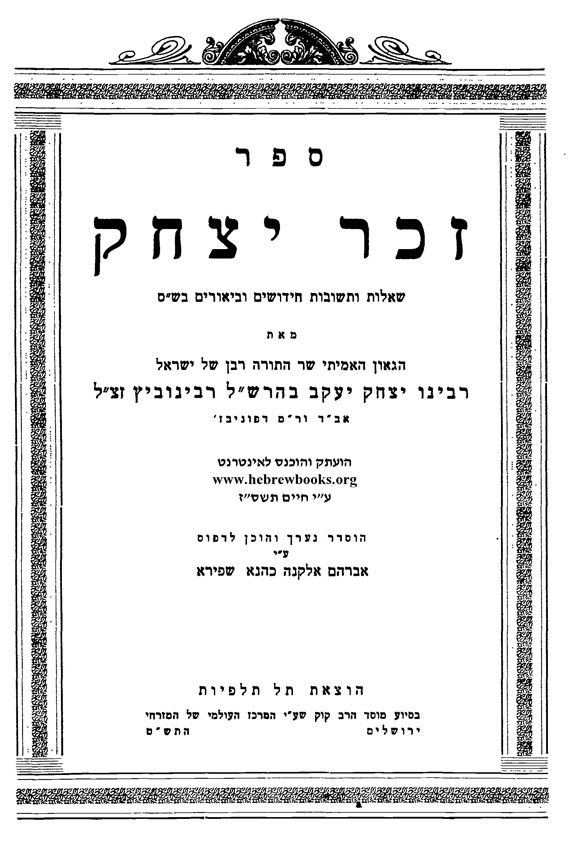
4. In my last post I quoted what R. Itzele of Ponovezh said about the superiority of the religious masses’ outlook to the Daas Torah of the gedolim. I had originally quoted this in an earlier post and referred to what R. Avraham Shapiro said about it. R. Avraham, before he became known as the Rosh Yeshiva of Merkaz ha-Rav and Chief Rabbi of Israel, had published R. Itzele’s teshuvot, Zekher Yitzhak, in 1949. Here is the title page of the book (taken from hebrewbooks.org).
Unfortunately, the version on Otzar ha-Hokhmah has been censored. Here is the title page at it appears on Otzar ha-Hokhmah, with no indication as to who brought the book to publication.
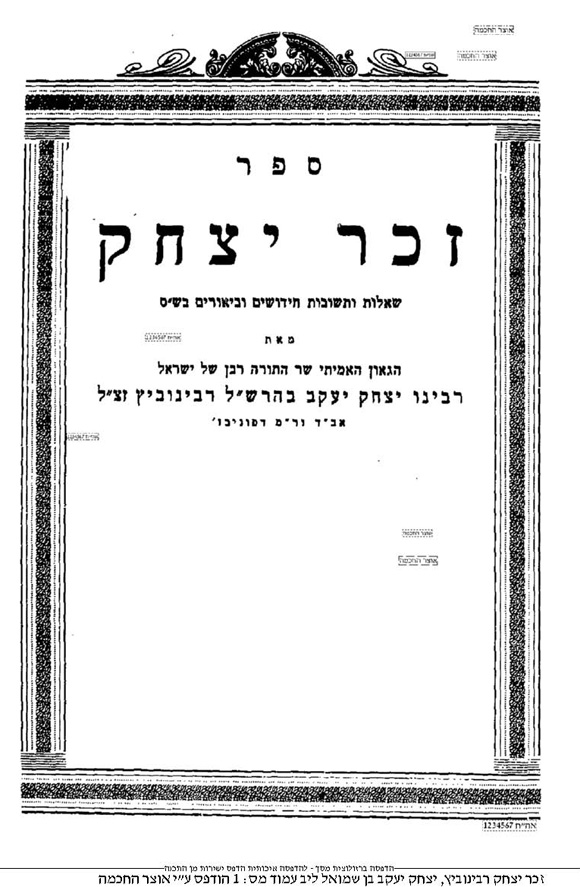
The Otzar ha-Hokhmah version is also missing R. Avraham’s learned introduction. I have no doubt that Otzar ha-Hokhmah is innocent in this matter, and was unaware that the volume it put online had been tampered with. (If you have Otzar ha-Hokhmah there is actually no reason to use the first edition of Zekher Yitzhak, as a second edition, with an additional volume, was published by Machon Yerushalayim in 2000, and this is also found on the Otzar.)

All this is by way of introduction to saying that a couple of people wondered if R. Avraham had any interesting ideas in addition to being a posek and Talmudist.. Many people indeed only see him in the latter mold. I remember some years ago when I asked an acquaintance in Israel how it was possible that some people in Merkaz ha-Rav were willing to go against the Rosh Yeshiva, R. Avraham, and establish Yeshivat Har ha-Mor. It was explained to me that “if you want to know if something is muktzeh, then you should ask R. Avraham. But in terms of hashkafah, R. [Zvi] Tau is the one to follow.”

Yet I think this is an exaggeration, and those who are interested in R. Avraham can find lots of interesting things in his book Morashah, as well as in the two volumes published on R. Avraham by R. Yitzhak Dadon, Imrei Shefer and Rosh Devarkha. (Dadon is the man – ספרא וסייפא – who killed the terrorist who attacked Merkaz a few years ago.) I have also given two lectures on R. Avraham at Torah in Motion that can be downloaded.

R. Avraham knew an enormous amount about the history of great Torah scholars, and while he didn’t have a critical sense, he knew when a story was nonsense.[20] For example, R. Shalom Schwadron told a story about how when R. Kook, R. Isser Zalman Meltzer, and R. Moshe Mordechai Epstein were together once, they decided that each one should repeat a tractate of Talmud by heart.[21] That was the extent of their conversation. R. Avraham thinks that the story is, to put it bluntly, crazy. No normal person could sit and listen to someone else rattle off an entire tractate. Furthermore, are we supposed to think that these gedolim had no Torah to speak to each other about and that they would be happy to just sit and listen to the other repeat the Talmud? (Imrei Shefer, p. 269).

A valuable story is recorded in Imrei Shefer, p. 34. One of the students asked as follows: If when peeling a cucumber he mistakenly took off some of the cucumber itself, is that is regarded as ba’al tashhit? The students started laughing upon hearing this question, but R. Avraham became very serious. He replied:
זו שאלה של “עצבנות”, יש עצבנות ביראת-שמים, לכן מגיעים לשאלות כאלה. אדם נורמאלי מקלף וזהו! אסור לבחורים להגיע למצב של שאלות כאלה.
We see from here that R. Avraham was aware that there is a fine line between religious practice and obsessive-compulsive behavior. Many readers have probably come into contact with individuals who unfortunately have crossed the line. It is interesting to speculate if observance of halakhah can sometimes lead to obsessive-compulsive behavior or if it is simply that an obsessive-compulsive personality is able to function very well in the halakhic system. As for humrot and hiddurim, which many critics see as connected with obsessive-compulsive behavior, R. Avraham had a simpler approach. He believed that the humrot we see are simply because people have more money today than in the past. When you have money, you can adopt hiddurim that no one dreamed about years ago.[22]

Since many people who read this blog are very interested in R. Joseph B. Soloveitchik and his family, let me mention something fascinating in Imrei Shefer, p. 251. R. Yehoshua Magnes, one of R. Avraham’s leading students, is quoted as follows (and the information certainly come from R. Avraham): R. Moses Soloveitchik supported R. Isaac Rubenstein. The extremists wanted to put R. Moses in herem until R. Baruch Ber Leibowitz told them in no uncertain terms that one doesn’t put “the son of the Rebbe” in herem!

This is referring to the great dispute in Vilna over the chief rabbinate in the late 1920s. The Mizrachi decided to put forth their own candidate, Rubenstein, who emerged victorious. This was seen as a terrible slap in the face to R. Hayyim Ozer Grodzinski, who until then was regarded as the unofficial chief rabbi of Vilna. The election of Rubenstein was also a rejection of the tradition that, since the late eighteenth century, there was no chief rabbi in Vilna.[23]

This story, assuming it is true, answers a perplexity I had for some time. Making of a Godol, p. 749, relates how some Polish rabbis were so upset at R. Moses Soloveitchik that they threatened to put him in herem. In response to this threat, R. Baruch Ber is quoted as saying that one doesn’t put the son of the Rebbe in herem. The story quoted by Kamenetsky has to do with a rabbinical dispute between a certain Agudist rabbi and a Mizrachi shochet. We are told that R. Moses opposed R. Zvi Hanokh Levin’s support of the rabbi. Yet why would this occasion a herem? Others have assumed that the rabbis may have wanted to place him in herem for accepting the position at the Warsaw Takhkemoni, the Mizrachi school. Yet again, why would this lead to a herem? R. Hayyim’s great student, R. Shlomo Polachek, the Meitchiter, also taught at a Mizrachi school.

Assuming the information in Imrei Shefer is correct, all is understandable. If R. Moses supported R. Isaac Rubenstein, then the herem would make perfect sense. Here was an issue in which the entire rabbinic world had joined together to support R. Hayyim Ozer. The great dayan of Vilna, R. Henokh Eiges, the Marheshet, resigned from the Mizrachi on account of the slight to R. Hayyim Ozer’s honor. R. Aaron Rabinowitz, the son-in-law of R. Reines, the founder of Mizrachi, did likewise.[24] To support Rubenstein would thus be viewed as a terrible betrayal of rabbinic solidarity, which in the rabbinic mind would be deserving of a herem.

Why would R. Moses have supported Rubenstein? Presumably this was tied in with his opposition to Agudat Israel. It is known that he was quite opposed to the Agudah, claiming that in this opposition he was simply following in the path of his father, R. Hayyim .[25] In fact, this opposition explains another interesting point. In Keneset Yisrael 10 (1932), a journal published by the Hazon Ish’s brother and brother-in-law, there appears an article by “Shlomo Kohen.” Kohen was one of the Hazon Ish’s students, but the article was by the Hazon Ish. Why did the Hazon Ish not want to sign his own name to it? The article is directed against another article published by R. Moses Soloveitchik in Ha-Pardes, in which he cited the hiddushim of his son, R. Joseph Baer. As the Steipler explained, the Hazon Ish wanted to disprove what R. Moses wrote (in the name of his son) because R. Moses was associated with the Mizrachi (teaching at Takhkemoni) and he therefore wanted to diminish his stature (לבטלו).[26] In other words, the fact that the Hazon Ish decided to dispute with R. Moses (and he rarely disputed with contemporaries) was not because he so respected the latter, but the exact opposite.[27]

With regard to Mizrachi rabbis, let me quote something else repeated by R. Avraham Shapiro: The Hafetz Hayyim once wrote to a certain Mizrachi rabbi with all sorts of elaborate titles. When R. Velvel Soloveitchik was asked how the Hafetz Hayyim could write with such respect to a Mizrachi rabbi, R. Velvel responded that this is what happens when you don’t listen to any lashon ha-ra! (Imrei Shefer, p. 271). He said this as a criticism of the Hafetz Hayim. In other words, sometimes you need to listen to lashon ha-ra in order to know how to properly evaluate people. (R. Avraham was very upset with this story and doubted its veracity, although the comment is very much in line with how R. Velvel would express himself.)

Regarding Imrei Shefer, I was very happy to see on p. 267 that R. Avraham studied Kitvei R. Weinberg, which I published a number of years ago. Both volumes of this work are now available on hebrewbooks.org.

5. People continue to write to me about my earlier posts on R. Kook.[28] Many are fascinated with R. Kook’s position on sacrifices that I discussed here.
Let me therefore call attention to another recently published text, found in R. Tsuriel’s Peninei ha-Re’iyah, p. 212. (It earlier appeared in Meorot ha-Re’iyah, Haggadah shel Pesah, p. 225.). This is actually the text from which R. Kook’s famous words in Olat ha-Re’iyah, p, 292, are taken. There R. Kook envisions a future of vegetable sacrifices.


Olat ha-Re’iyah was published in 1939, after R. Kook’s death. Now that the original text of R. Kook’s words has been published, we can see how R. Zvi Yehudah did not merely “abridge” his father’s text, as Tsuriel puts it, but clearly censored it to soften its radicalism, which is a pattern seen again and again in R. Zvi Yehudah’s editing.

What appears in R. Kook’s original text is further elaboration about how in Messianic days the animals will be raised in intelligence to the level of man, and he even brings a biblical verse in support of this notion. Isaiah 43:20 reads: “The beasts of the field shall honor Me, the jackals and the ostriches.” The fact that animals are portrayed as honoring God shows that they will move beyond behavior based purely on instinct. Then R. Kook writes as follows, and pay careful attention to what I have underlined, which is undoubtedly the reason why R. Zvi Yehudah thought he had to censor the text.
אם כן יהיה כערך האדם עכשיו. על כן לא יהיה צריך לקרב מהם ולהקריב, ויהיה איסור בזה, ותהיה ההקרבה רק מנחה מהצומח, שהוא לא ישכיל עוד על שיעלהו בפועל. על כן תערב המנחה, ולא שאר קרבן מהחיים.

Here R. Kook isn’t just expressing a preference for vegetable sacrifices, but telling us that it will actually be forbidden to offer animal sacrifices.

Regarding Tsuriel’s Peninei ha-Re’iyah, some of the passages from R. Kook cited from manuscript are quite valuable. See e.g., p. 385, where R. Kook states that when it comes to a war to defend the Jewish people even the tribe of Levi goes out to fight. What this means, of course, is that R. Kook would be opposed to any draft exemption for yeshiva students.

In addition, Tsuriel has selected passages from R. Kook’s writings and arranged them in order of the various parshiyot, so that one can always find a good piece for a devar Torah. For parashat Metzora (p. 231), he quotes R. Kook’s statement in Ezrat Kohen, no. 21, that even if one expresses heretical thoughts, this doesn’t mean that he really is a heretic. Rather, it could be that he is simply trying to show that he is in line with what “the world” is saying, but it doesn’t mean that he really believes it.

This is just one more angle whereby R. Kook tries to defend the modern free-thinkers. His most famous defense is that modern heretics have the status of onsin, in that the environment today almost forces them into their false beliefs so that they cannot be held responsible for their views. He also states that those who express heretical beliefs are not really certain of their heresy, and it is only one who is certain in this who is to be regarded as a heretic.

With the publication of Shemoneh Kevatzim we see that R. Kook goes even further and completely removes the orthoprax individual from the status of heretic. I quoted the relevant passage here.
We see from R. Kook that one who holds a heretical belief, but lives as an observant Jew in his daily life, is regarded as part of the Torah community. As I put it in my earlier post: Two important things stand out. First, while not condoning orthopraxy, R. Kook states that one who is observant, despite the fact that he denies ikkarim, is to be regarded as an erring Jew, not as a heretic. R. Kook’s position is a complete rejection of the idea that people who are shomrei Torah u-mitzvot can be read out of the fold and be regarded as heretics because of their incorrect beliefs. The second important point is that he rejects the Rambam’s entire theological conception of Principles of Faith and aligns himself with the Ra’avad, showing once again that the Rambam’s position has not attained unanimity.[29]

Had R. Zvi Yehudah printed this text, we might have been spared some of the heresy hunting in the religious Zionist world, and discussions of whether one can drink this or that observant Jew’s wine due to the fact that he might have some heretical thoughts. In fact, it is only with the publication, uncensored, of R. Kook’s writings that the “lights” of his soul are revealed in all their grandeur. What other spiritual leader with unconventional views could declare that he is ready to fight the entire world for the truth as he sees it, to proclaim his views without any compromises and without worrying about what the “world” will say? While I greatly respect R. Herzog, R. Weinberg, and R. Soloveitchik, they certainly could never say the following (Pinkasei ha-Re’iyah [2010], vol. 2, p. 201):

“אם אני מוכרח להיות איש ריב לכל העולם מצד הנטיה של האמת העמוקה שבנפשי, שאינה סובלת שום הטיה של שקר, אי אפשר לי להיות איש אחר. וצריך אני להוציא מן הכח אל הפועל רק את יסודות האמת העקריים הצפונים ברוחי, בלא שום התחשבות עם מה שחושב העולם בכל הסכמותיו.” זהו הפתגם של דורש האמת, המתעורר בגבורתו העליונה.

See also ibid., p. 208, where we see his self-image as a prophet of old, and that no one other than he can see clearly what is taking place in the world:

מה יש עכשיו בעולם? וכי מפני שאין שום איש, ושום למדן ביחוד, רוצה להביט מה שיש עתה בעולם, וכי בשביל כך, גם אנכי לא אביט? לא! אני אינני משועבד להרבים. הנני הולך במסילתי, בדרך הישרה, ישר אביט.
R. Kook’s commitment to his path, despite the controversy that ensued, was a trait also seen in R. Shlomo Goren, with all the tragic consequences, both personal and professional. Perhaps the Lubavitcher Rebbe is the only one after R. Kook who was able to successfully chart a path undisturbed by the opposition, and without any need for compromise.

One other passage from R. Kook’s recently published Pinkasei ha-Re’iyah vol. 2, p. 207, is worth noting. While tolerance of opposing viewpoints is often viewed as characteristic of a watered-down commitment to one’s own belief, R. Kook adopts a different perspective:

הסבלנות בדעות, כשהיא באה מלב טהור ומנוקה מכל רשעה, אינה עלולה לקרר את להבת רגש הקודש שבתוכן האמונה הפשוטה, מקור אושר החיים כולם, כ”א להרחיב ולהגדיל את יסוד ההתלהבות המקודשת לשמים.


To be continued.
[1] For a different perspective, see the recently published Pinkesei ha-Re’iyah, vol. 3, p. 69, where R. Kook states that one might have expected non-Jewish philosophers, since they are not involved with practical mitzvot, to be able to attain a higher grasp of theological truths, as they can devote themselves exclusively to this. Yet R. Kook explains that this is not the case.
[2] In R. Soloveitchik’s Halakhic Man we also see his dissatisfaction with practical halakhic decision-making. His alternative to this is theoretical halakhic study, which is very different than what R. Kook saw as his goal. In the hasidic world, the communal rav was relegated to the role of halakhic technician, while the focus of spiritual leadership was the Rebbe, who did not involve himself in practical halakhic rulings.
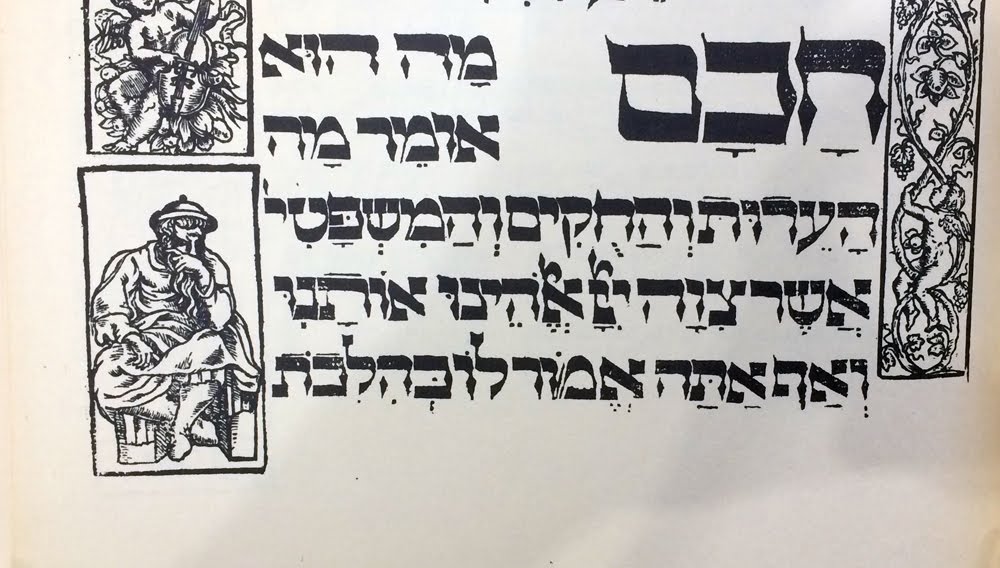
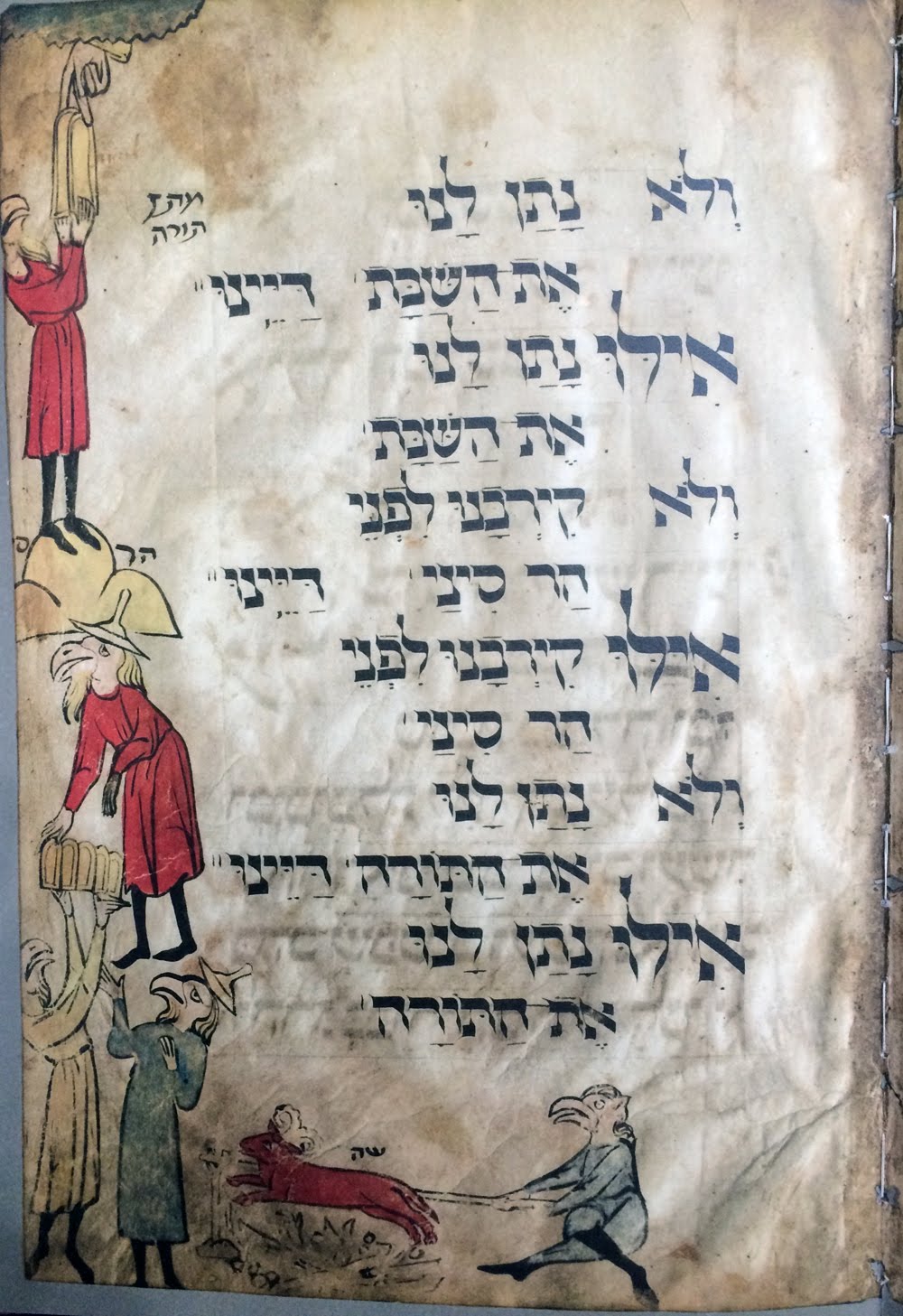
[3] Together with the crackdown on sexual abuse, there have been other changes as well. In my youth there were teachers who would punish students physically. This was, in fact, the traditional method of disciplining students, and is mentioned in Makkot 2:2, Bava Batra 21a, Mishneh Torah, Hilkhot Talmud Torah 2:2, Rotzeah u-Shemirat ha-Nefesh 5:6, and Shulhan Arukh, Orah Hayyim 551:18, Yoreh Deah 245:10. See also the picture from the 1395 Coburg Pentateuch, of a teacher with his whip, available here.
It is clear from the rabbinic sources that the physical punishments were not designed to inflict real pain, although one wonders whether the picture from the Coburg Pentateuch reflects a harsher reality. See Elliot Horowitz, “The Way We Were: ‘Jewish Life in the Middle Ages,’” Jewish History 1 (Spring 1986), pp. 81-82. In any event, today, what parent will allow the teacher to lay a hand on his child, even if the pain is minor?
Even though, as mentioned, teachers were never supposed to inflict real pain, I think it is fair to say that the physical punishments over the generations sometimes did get out of hand (see next note). I recall vividly one rebbe who would squeeze kids’ arms and even throw them against the wall. Today, in every Modern Orthodox school and even some haredi schools, that type of behavior would be grounds for immediate termination. Regarding how students were physically punished in the great yeshivot, we have reports of Roshei Yeshiva and mashgichim who would slap students in the face. See e.g., Moshe Tzinovitz, Mir (Tel Aviv, 1981), p. 464; Shaul Stampfer, Ha-Yeshivah ha-Litait be-Hithavutah (Jerusalem, 2005), p. 335 n. 76. Even R. Naftali Zvi Judah Berlin, who was a very gentle person, would occasionally slap a student in the face. On one occasion this even led to the students going “on strike” (i.e., ceasing all Torah study) in protest against the Netziv’s action. They viewed the slap as an insult to the entire student body since this was the sort of thing one would expect a melamed to do in a heder, not the rosh yeshiva of the great Volozhin. The Netziv was forced to publicly apologize to the entire student body. See M. Eisenstadt, “Revolutzyah ba-Yeshivah,” Ha-Tzefirah, 1 Sivan 5676; Stampfer, Ha-Yeshivah ha-Litait, pp. 128-129, 149.
On at least one occasion, a student certainly deserved being slapped in the face. It happened at Telz in 1905. At this time there were two mashgichim, and as was often the case at the great yeshivot, the students were very opposed to the mashgichim. (A few years earlier the students had gone on strike due to the invasive actions of a previous mashgiach, R. Aryeh Leib Hasman. See Stampfer, Ha-Yeshiva ha-Litait, p. 334.). One of the students waited above and when given the signal poured a bucket of fish sauce upon the mashgiach. R. Eliezer Gordon, the Rosh Yeshiva, slapped the suspected student on the face. Simcha Assaf, who records the story, tells us that this was the only time Gordon ever did such a thing. See Assaf, “Shenot ha-Limudim sheli bi-Yeshivat Telz (5665-5668),” in Immanuel Etkes and Shlomo Tikochinski, eds., Yeshivot Lita (Jerusalem, 2004), p. 235.

I have seen haredi authors who argue that opposition to physical punishment in school is a sign that people have moved away from “Torah values” in favor of modern psychology. See R. Chaim Rapoport’s response to this approach in his wonderful discussion of the issue in Datche 41 and 41 (2008). See also R. Avraham Steinberg, Encyclopedia Hilkhatit Refuit, vol. 6 cols. 767-768.

Another change in our era is that signs of physical affection between a rebbe and student, which at one time were very important especially as the rebbe served as a father figure, are no longer acceptable. A student cannot even sit on his rebbe’s lap, as was done in years past. It is reported that when R. Hayyim Soloveitchik visited his great student, R. Baruch Ber Leibowitz, who at this time was serving as rosh yeshiva of Keneset Beit Yitzhak in Slobodka, R. Baruch Ber sat on R. Hayyim’s lap. Just like he sat on R. Hayyim’s lap when he was a young student, R. Hayyim wanted R. Baruch Ber to sit on his lap when he was a grown man. See Making of a Gadol, p. 87. The fact that we could never imagine something like this happening today shows how different our mindset is. There are loads of stories of rebbes kissing their students. R. Zvi Yehudah Kook was known in particular for this. See e.g., Iturei Yerushalayim, no. 55 (2011), p. 4. Here are three stories from R. Shlomo Riskin’s recently published memoir, Listening to God, which also bring us back to a more innocent time.
I couldn’t wait to share my discovery [of Darwin’s theories and how they could help explain the Torah] with my rebbe, Rav Mandel, that Monday morning. I brought him the book, and showed him the relevant passages—totally ignorant of the “red flag” raised in religious circles by the mere mention of Darwin. Rav Mandel barely took the book in his hand; he slapped my face, and then kissed my forehead. “Your interpretations are magnificent, but it is forbidden to read such heretical literature,” he said gently. I smarted at the slap, felt vindicated by the kiss, and continued to adore my rebbe. . . . “ (p. 51)
Riskin describes being tested by Dr. Samuel Belkin.
He asked me which Talmudic tractate I was studying, spoke to me “in learning,” and gave me a section of Gemara and the Tosafot commentary to read. He then came around the desk where I was sitting, kissed me on the forehead, and said to Tante, “you’re right, He can have a full scholarship to Yeshiva University.”(pp. 67-68)
After Riskin passed the examination to become a city rabbi in Israel, “Rabbi [Shaul] Yisraeli rose—and visibly moved—kissed me on the forehead.” (p. 369)
In general, I have to say that Riskin’s book is quite interesting. I must note, however, that in a number of places where he is critical of people or tells a story that might be embarrassing, Riskin refers to individuals by their initials. If he did so in order to leave the figures anonymous, he was not entirely successful, since in a few cases it is not that hard to figure out whom he had in mind.
[4] Unfortunately, refusal to protect children is not a new thing. See this post where I mentioned even allowing rapists to go free.
What is new is that parents are now beginning to stand up. Here is a passage from a nineteenth-century memoir from which we see that in the past even murder was covered up. (The case described is definitely not manslaughter, which is what is described in Makkot 2:2 and Rambam, Hilkhot Rotzeah u-Shemirat ha-Nefesh 5:6. Incidentally, the latter two sources are only speaking about a society in which teachers were permitted to hit the students, and have no applicability today vis-à-vis most of the Orthodox world.)
One of the angry teachers I mentioned was nicknamed David with the tangled hair, as his head was covered with a mass of knotted hair. He was hot-tempered and frightening, and often came to within an inch of killing a pupil. When particularly enraged, he would lift a child up and ferociously throw him to the ground, so that he landed like a corpse. That actually did happen once. After the funeral the parents of the deceased never dared accuse him of murdering their child. They accepted it as preordained that their son should die while learning Torah, and so did the rest of the community. No one considered the melamed a murderer. Even the sons of M.S. who made it their business to ferret out sinners in the town, in order to cause strife and contention, kept silent on this matter, and David the melamed kept on teaching as if nothing had happened.
Yekhezkel Kotik, Journey to a Nineteenth-Century Shtetl (Detroit, 2002), p. 145. On p. 431, David Assaf, the editor, calls attention to a different memoir which tells of a child dying as a result of his melamed’s beating. On p. 145, Kotik also speaks of another melamed who “would take all his anger out on that particular part of the boy’s anatomy that is generally not mentioned in print.”
(In some segments of the hasidic world the cover-ups unfortunately also continue. Had the New Square madman succeeded and killed the five people in the house he was intent on burning down, does anyone think that the community would have assisted the police in finding the murderer? In a future post I will mention cases of murder and attempted murder carried out for “pious” reasons.)
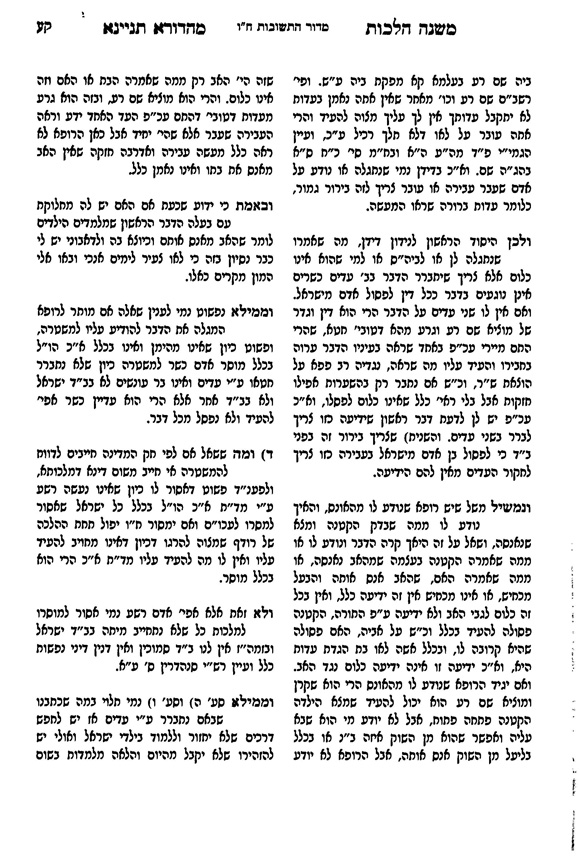
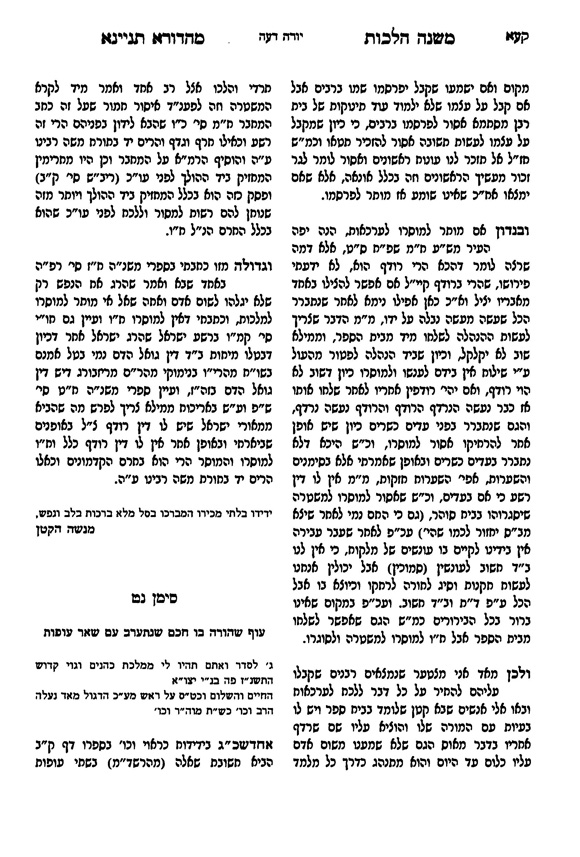
After my previous post on ultra-Orthodox tolerance of sexual abuse, there were some who doubted that there is any rabbinic support for this. Those who can read Hebrew, please read the following responsum from R. Menasheh Klein, Mishneh Halakhot, vol. 16, pp. 169-171.
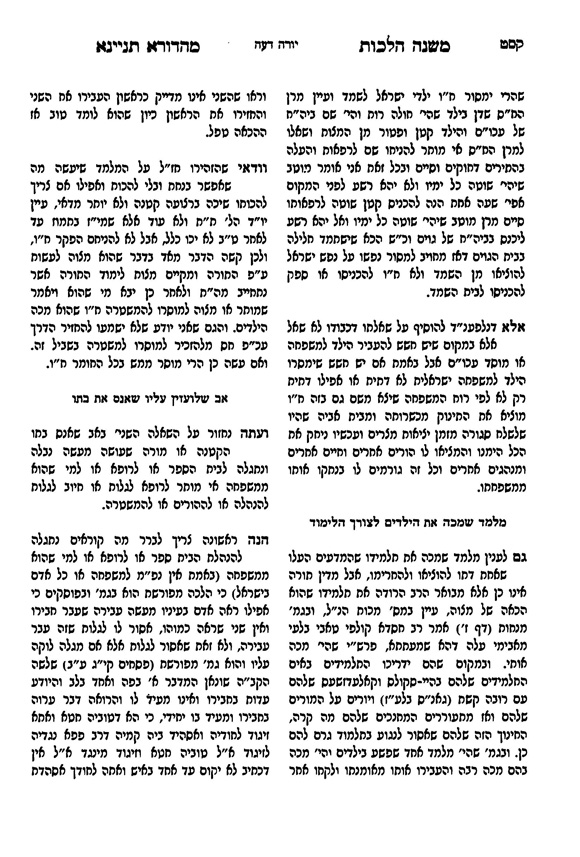
According to Klein, there is never a time when sexual abuse can be reported to the police, even if a child is being continuously raped. That is because there are never two male witnesses who see the abuse. If someone does report the abuse, it is a mitzvah to kill the moser. If anyone has a difficult time understanding why a segment of the hasidic world time and again offers support for the perpetrator and ostracizes the victim, this is all the explanation you need. From their perspective, the victim who goes to the police is worse than the sexual abuser. Based on Klein’s understanding, I don’t think there is a “heter” for a woman who has been raped by a Jew to go to the police, because there is no halakhic evidence of a crime. (He also says that it is forbidden to turn in a murderer. In case anyone needs to be reminded how crazy this viewpoint is, I am writing these words only a few hours after the monster who killed Leiby Kletzky was identified.)

A friend insists that there is no difference between Klein’s position and that of Agudat Israel. This is not true at all. Whereas Klein states that someone can never be turned in to the police, the Agudah position is that a molester can be turned in, but only after a rabbi gives approval. The Agudah position continues to develop, and I have no doubt that in the end the Agudah will end up holding a position identical to that of the RCA. I also think that it is public pressure that will move Agudah in this direction, as public pressure has been responsible for all the adjustments in the Agudah’s position that we have seen until now.
Yet even without public pressure, the current Agudah position is so untenable, that it will have to be updated. For one, it asks people to violate the law. The law is clear that some people are obligated to contact the police when they suspect child abuse. By insisting that a rabbi be consulted before doing so, mandated reporters are being put in the position of being told by a rabbi to refrain from doing something that the law requires. Do the Agudah constituents realize that listening to the rabbi in these circumstances can open them up to both criminal and civil penalties?

As for the rabbis, I can’t imagine who would agree to be on the Agudah’s panel of rabbis that will examine accusations of abuse in order to determine if it is permitted to go to the police. If one of these rabbis rules that the evidence is not compelling and it is therefore forbidden to go to the police, and the rabbi is wrong, he opens himself (and the mandated reporter) to a lawsuit by the parents of the molested child. Whatever the ultimate verdict, the lawyer fees alone will end up bankrupting the rabbi. Is the Agudah prepared to set up a fund to defend rabbis sued by parents of molested children? Certainly not, which is why no rabbi who is thinking straight will ever agree to put himself in such a circumstance. The Agudah’s position also leaves the organization itself vulnerable to a lawsuit by parents of victims.

Finally, unlike so many of the cynics in our community, I don’t think the Agudah position is all about protecting rabbis, guilty or not. I really do believe that the Agudah recognizes that there is a problem. It is convinced that the rabbis it will charge with examining abuse cases will indeed make sure that molesters are turned in. The problem, however, is that we have seen all this before. We have seen over and over again that it is precisely the rabbis who have failed in this matter, often because they are not willing to turn on their own. It was precisely because of this that the community of laypeople rose up and said “No more.” One doesn’t need to be a prophet to see that by relying on individual rabbis to determine if an accusation of sexual abuse is credible, there will continue to be cover-ups. (Am I wrong in assuming that these cover-ups never would have happened if women were in charge? Would mothers ever have permitted child molesters to continue to prey on the young?)
The Agudah position is thus both a public relations and legal disaster in the making. The Church tried such an approach already and it doesn’t work. I don’t understand why such smart people in the Agudah don’t see how their new position is doomed to failure.
[5] See here where I attribute the rabbinic silence to the money Tropper was handing out. I also brought proof that even great rabbis are not immune to being influenced by money. Regarding this point, see the recent biography of R. Zvi Pesach Frank written by Shabbetai Dov Rosenthal, Geon ha-Hora’ah (Jerusalem, 2011),, vol. 1, pp. 410-411. A letter from R. Frank is published in which he criticizes members of the Israeli Chief Rabbinate (of which he was a member). The subjects of his criticism were gedolei Yisrael, and yet he accuses them of being improperly influenced by Israeli government money. He adds:
מי לנו גדול מהכהן הגדול שלא צירפוהו לדון בענין עיבור השנה, שהיה חשש נגיעה שמפני הקור יכריע שלא לעבר השנה
[6] See e.g., here.
[7] I hope to treat this phenomenon in great detail when I am able to complete my article on contemporary halakhic practices in opposition to the Shulhan Arukh.
[8] There are loads of sources that speak of the great weight to be assigned to the practices of the Jewish people, even when these practices appear to violate the textual halakhah. For one example, see R. Solomon Laniado, Beit Dino shel Shlomo (Jerusalem, 1986), Orah Hayyim no. 17 (p. 96): שכל מה שנהגו ישראל שכינה מוסכמת עמהם
Laniado (died 1793) was the chief rabbi of Aleppo.
[9] See my post here.
[10] Moshe Carmilly-Weinberger, ed., The Rabbinical Seminary of Budapest 1877-1977 (New York, 1986), p. 77.
[11] I would also like to mention a recent article by Lawee that deals with some issues relevant to earlier installments of this series, such as the possibility of errors in the biblical text. See Lawee, “Isaac Abarbanel: From Medieval to Renaissance Jewish Biblical Scholarship,” in Magne Saebo, ed., Hebrew Bible/Old Testament (Goettingen, 2008), vol. 2, p. 210, who calls attention to Ibn Ezra, Ex. 25:29, who claims that there is a mistake in the Book of Chronicles. He also notes Abarbanel’s commentary to I Kings 10:22, which suggests another error in Chronicles, due to Ezra misunderstanding a verse in the Book of Kings.
[12] Elsewhere, Ashkenazi speaks of Moses having access to historical records, but there he assumes that these records are accurate. See Epstein, Mi-Kadmoniyot ha-Yehudim, p. 136:
כי כל התורה ברוח הקדש כתבה משה וידע שמות אלופי אדום ומשכנותם ומלכיהם ידועה [!] גמורה מפי ספרים ומפי סופרים ונודע לו האמת ונכתב בספר.
[13] See also this earlier post of mine.
[14] See Abarbanel’s introductions to Jeremiah, p. 298, and Ezekiel, p. 434. In the latter source he writes:
הן אמת שיחזקאל הנביא לא היה בקי בלשון הקדש ולא בכתיבתו
For other references, see Eric Lawee, Isaac Abarbanel’s Stance Toward Tradition )Albany, 2001), p. 276 n. 46.
[15] On p. 46a he offers a different perspective which I don’t think can be brought into line with what he says earlier. Here he accepts the existence of some sort of demonic beings, and claims that the superstition is only that humans can interact with and influence them. Neusatz’ book was published posthumously, and it is possible that had the author been alive he would have worked out a more consistent theory.
[16] In the next issue of Milin Havivin, I deal with Orthodox views of the Zohar. In the meantime, I was surprised to find that R. Berel Wein describes the Zohar in an unsympathetic manner. Although some may claim that Wein was only presenting the history, his less than reverential attitude towards the book comes across very clearly, even if he didn’t consciously intend this. See the video here.

For another surprising piece by Wein (called to my attention by Mel Barenholtz), see here.
Wein describes Midrash as “legend.” While this might be a term used by academics (and is in the title of Louis Ginzberg’s great work), the Yeshiva World has always rejected the word as a proper description. Wein’s entire article can be seen as a reflection on the fact that rabbis, in their sermons, quote all sorts of Midrashim as if they are historical, which they are of course not. So what value do these “legends” have, and why should we use them to fill in the “missing parts” of the biblical text? That is the question Wein deals with.
In fact, Wein’s entire article, with its demand for truth in history and the need to abandon fantasy, is the sort that in today’s day and age could generate a herem. Here, for example, is one very provocative sentence: “Many times legend becomes myth. Myth is a sense of human recognition that the story being told is not factual but it nevertheless changes legend from history or biography into literature and philosophy – sometimes sacred holy literature and philosophy.” (emphasis added). And how about this paragraph, which uses the word “mythology,” certainly knowing the knee-jerk reaction it will provoke among people.

The Torah does not deal with myth per se. Yet the Flood and Noah’s ark, the Tower of Babel, the centrality of the land of Israel, factual as they all are in the biblical narrative, nevertheless were all combined to create a basis for the holy mythology of the Jewish people. In addition, the idea that the “events of the works and decisions of our founders, the fathers of Israel, are a sure guidepost for their descendants” helped strengthen a mythology that binds the Jewish generations together and gives us insights into the values of Judaism and historical events, past and present (emphasis added).

In speaking of the Flood, Noah’s Ark and the Tower of Babel, Wein states that they are factual “in the biblical narrative.” Does this mean to imply that they are really not historical events, but it is only in the biblical narrative that they are regarded as factual? Since these events, Wein tells us, are among the great myths of Judaism, and he just finished telling us that myth is not factual, this seems to be what he is saying.
[17] These two scholars would never have said, as did the Hatam Sofer, that Yiddish was invented by the medieval Jewish sages to keep Jews separate from non-Jews. See She’elot u-Teshuvot Hatam Sofer, Even ha-Ezer, vol. 2 no. 11. There are many other examples that show that the Hatam Sofer was still very much part of the medieval worldview, which is why I state that he is a complex figure. For instance, he still leaned towards Ptolemaic astronomy, centuries after Copernicus (although he acknowledged that the issue was complicated). See Eliezer Brodt’s post here.
Another example is the Hatam Sofer’s famous comment that he doesn’t understand the value of Jews training to be doctors in medical schools where they dissect non-Jewish bodies. Since Jews keep kosher, how can the information obtained from non-Jewish bodies be applicable to them? See Hiddushei Hatam Sofer, Avodah Zarah 31b. Yet I think it is more important is that in this very passage the Hatam Sofer also laments how there is no Jewish medical school.
[18] See Lishkat Soferim to Even ha-Ezer 17:43 (found in standard editions of the Shulhan Arukh).
[19] Derashot Hatam Sofer, vol. 1, p. 331b. This text is discussed here.
[20] The same was true with R. Moshe Feinstein. See R. Aharon Felder’s recently published Rishumei Aharon, pp. 18-19. This book has lots of interesting stories about R. Moshe. Felder is not afraid to point out how R. Moshe, unlike other Roshei Yeshiva, had a more moderate viewpoint when it came to attending college. See pp. 19-21. See also p. 21 for the following story, which shows R. Moshe as a real down-to-earth person, who was far removed from “frumkeit” and had little patience for the aspiring pietist:
פעם ניגש למו”ר זצ”ל חתן ביום חתונתו וביקש לדעת איזו כוונה צריך לכוין בשעת ביאת מצווה. פנה אליו מו”ר זצ”ל וענה “איני מאמין שתוכל לכוין כלל וכלל”. והוא לא הסתפק והמשיך לשאול שוב את שאלתו, אם אני יכול לכוין מה הכונה הראויה לאותו זמן? ומו”ר זצ”ל לא הגיב, ורק המשיך ללכת לדרכו.

For another such story, see p. 20 where he records how R. Moshe told a certain Rosh Yeshiva that it was inappropriate for him to refuse to be mesader kidushin just because there would be mixed seating at the wedding. See also p. 22 that R. Moshe refused to write a letter to the judge on behalf of one who was to be sentenced for drug dealing. R. Moshe told the criminal’s father that his son damaged people’s lives and therefore “Let him sit in prison.” On p. 28 he quotes R. Moshe’s positive view of R. Kook. On p. 73 he quotes R. Moshe that a male massage therapist can massage a woman if he does not have a continuing professional relationship with her (!), a man can cut a woman’s hair, and a male teacher or principal can be present when girls in the school sing as the assumption is that he is involved with other things and not paying attention.
What many will regard as a surprising pesak appears on p. 36:
מותר להיות Wine Tester ולטעום סתם יינם, באופן שפולט ואינו בולע
I assume this pesak is based on Rama, Shulhan Arukh, Yoreh Deah 108:5, who is speaking about יין נסך, implying that it is permitted to taste but not swallow סתם יינם. See also Pithei Teshuvah, Yoreh Deah 98:1, for the view that it is permitted to taste, but not swallow, things forbidden by the Sages.
(Regarding tasting without swallowing, see Shulhan Arukh, Orah Hayyim 567:1-3. Based on the Rama in 567:3 it would appear that it is permissible to chew gum on a fast day other than Yom Kippur.)
Although I can’t be certain, I find it hard to believe that R. Moshe would require the wine taster to make a blessing on the non-kosher wine. If so, then R. Moshe would presumably agree with those poskim who have ruled that one does not make a blessing on gum and that you can chew it before morning tefillah. See what I wrote here.
See R. Yitzhak Barda, Yitzhak Yeranen, vol. 2, no. 11, and R. Moshe Levi, Birkat ha-Shem, vol. 2, pp. 41ff., vol. 5, pp. 537ff., for complete discussions of the topic. R. Meir Mazuz also holds that one does not make a blessing on gum. See Or Torah, Tamuz 5771, p. 973. The logic of this viewpoint is explained by the Beit Yosef, Orah Hayyim 210:
ולי נראה דברכה לא בטעימת חיך תליא אלא באכילה תליא כדכתיב ואכלת וברכת ואכילה היינו הנאת מעיים כדברי הרא”ש ז”ל
Speaking of gum, I wonder if R. Moshe would agree with R. Yitzhak Abadi that all the standard gums (Wrigleys, Trident, etc.) are kosher. See Or Yitzhak, vol. 1, Yoreh Deah no. 24:
כפי שבררנו החלק הטעים והמתוק שבו אין בו שום שאלה, ומה שנשאר הגומי אח”כ וממשיכים ללועסו אין בו לא טעם ולא ריח, והרי הוא כעץ בעלמא ושרי ללועסו כל היום כולו אף אם עירבו בו מדברים האסורים.
The kashrut organizations assume that gum needs a hashgachah. Here is what R. Zushe Blech has to say on the subject
The need for reliable Hashgacha for gum stems from many ingredient concerns. Plasticizers can be pure lard or tallow and emulsifiers are also often made from animal fats. Flavors and glycerin can also be completely non-Kosher. Even if all of the ingredients in a Kosher gum were acceptable, the equipment on which the product is made requires a Kashering from non-Kosher productions. Although the gum itself is not swallowed, these fats and flavors migrate from the gum into the mouth.
See here. (What does Blech mean by “reliable Hasghacha”? Does it mean that hashgachot that disagree with his understanding are not “reliable”?)
Let’s leave flavors out, as none of the flavors in the major gums are non-kosher. Let’s also leave out the issue of equipment, since this is not a real halakhic concern (as anyone who has ever lived in a place other than Israel and America, and thus has to buy foods without hashgachah, is well aware.) The issue is glycerin, emulsifiers etc. I don’t understand why this should be a problem. Even assuming that it is forbidden to swallow these things as part of a food, why would it be prohibited to simply chew on these tasteless items? Is there any kashrut problem when my son chews on his pigskin baseball glove while waiting patiently for a ball to be hit to him?
Returning to Felder, I give him credit for not being embarrassed to tell us how he once asked R. Moshe the following idiotic question (p. 20):
פעם הלכתי עם מו”ר זצ”ל לניחום אבלים, ולפני שנכנסנו לרכב ביקש ר”מ אחד מישיבת “רבינו יצחק אלחנן”, אם יכול להצטרף לנסיעה כי בית האבלים היה בקרבת מקום לשכונה של הישיבה הנ”ל. ושאלתי את מו”ר זצ”ל האם מותר לנו לקחת את אותו ר”מ לאותה ישיבה? וענה לי “למה לא, הרי נמצאים שם הרבה גדולי ראשי ישיבה שמלמדים תורה”.
Could it be that Felder didn’t know that R. Moshe’s great student, R. Nissan Alpert, taught at YU, or that his son-in-law, R. Moshe Tendler, likewise did? Did he not know that R. Moshe had close relationships with many of the Roshei Yeshiva at YU, and was colleagues with them in Agudas ha-Rabbonim?
While on the subject of teachers at YU, here is a page of a letter, never before published, by R. Yaakov Kamenetsky. It was sent to his son, R. Nosson, whom I thank for giving me permission to publish it. (The notations on the side of the letter are by R. Nosson.) In the letter, R. Yaakov admits that it would have been better for him to teach at YU, since the YU musmachim have a much more significant role in American Orthodoxy than those he was teaching. However, what prevented him from doing so is how this would appear to his sons. They would wonder, if YU was good enough for him to be part of the faculty, why did he think it so important to send his sons to haredi yeshivot?
[21] Kol Hotzev (Jerusalem, 1999), pp. 178-179.
[22] Among my children’s generation, many kids believe that there is a halakhic requirement to have two sinks. Some of these kids have literally never been to a kosher home which doesn’t have this. If they saw such a home, they would probably assume that there must be a heter for one sink, but only for those who can’t afford to redo their kitchens.
[23] R. Joseph B. Soloveitchik wrote of the difficulties R. Hayyim Ozer had, and strongly identified with the latter. See his hesped for R. Hayyim Ozer in Divrei Hagut ve-Ha’arakhah (Jerusalem, 1982), p. 194:
הגאון ר’ חיים עוזר לחם על זה בחרוף נפש. הוא סבל הרבה בעטיה של שיטה זו, סבל יסורי נפש ורוח. בשעה שהרבה מאחינו נכונים היו למסור את החושן לידי זרים ולהסתפק בציץ. עמד הוא בפרץ ומחה נגד זה.
The truth is that R. Soloveitchik is incorrect when he writes עמד הוא בפרץ ומחה נגד זה R. Hayyim Ozer did not protest the slight to his honor, or lead the opposition to Rubenstein. It was the other sages, including the Hafetz Hayyim and the Hazon Ish, who took the reins in this matter. Regarding the Hazon Ish, see Binyamin Brown, Ha-Hazon Ish (Jerusalem, 2011), p. 53.
[24] See Aharon Sorasky, Rabban shel Yisrael (Bnei Brak, 1971), p. 115; Moshe Tzinovitz, Ishim u-Kehilot (Tel Aviv, 1990) p. 240. Rabinowitz was the father-in-law of R. Avigdor Zyperstein, who taught at YU. In Vilna, the center of European Jewish scholarship, an Agudah rav, Grodzinski, and a Mizrachi rav, Eiges, sat on the same beit din and worked closely together. In Europe, every small town had a rav. Sometimes the rav was an adherent of Agudah, and other times a follower of Mizrachi. But as far as the townspeople were concerned, that didn’t matter. He was the rav and if there were halakhic questions in the town he was the one to decide them. If you were an Agudist and the rav was a Mizrachi man, when you had a halakhic question you would go to your rav. The politics of the Jewish world did not interfere when it came to halakhah. Furthermore, the various Agudat Rabbanim in Europe (and also in the U.S.) welcomed all rabbis, regardless of where one stood in the Agudah-Mizrachi dispute. In the post-World War II world, however, the haredi world has entirely changed all this and rewrote the rules. They were able to convince their followers that unless a rav follows the haredi Daas Torah he is not a reliable rav, and therefore he should not be consulted on halakhic matters. In other words, the halakhic competence of a rav was made dependant on his political outlook. This is a complete break with Jewish tradition, as it existed in Europe. While some might regard this development as simply another example of haredi “shtick”, I think it is more significant as it illustrates once again that haredi Judaism can be just as modern and revolutionary as that which it sees itself as fighting against.
[25] See Zvi Weinman, Mi-Katovitz ad Heh be-Iyar (Jerusalem, 1995), pp. 52ff.
[26] E. Horowitz, Orhot Rabbenu (Bnei Brak, 2005), vol. 5, p. 169
[27] See Brown, Ha-Hazon Ish, pp. 55-56.
[28] One well-known haredi rav wrote to me as follows:
I just read your post . . . regarding the abolishment of animal sacrifices. Barukh sheKivanti l’Da’ato shel Harav Kuk when I once told my students at . . . (and advised them to keep it under wraps) that perhaps a future Sanhedrin will find a drash to do that. But I had a caveat in that our present moral sensitivities were formed during the Exile in which we were enslaved to general, non-Jewish thinking. Therefore, after the Messiah arrives and we are able to think independently, and until we are on own long enough to form our own, Jewish ideas, all we will be able to do is continue from where we left off at the Destruction of Ba’yit Sheni. Only after some time has passed may the Sanhedrin decide that animal sacrifices ought to be abolished. This approach explains why the Rambam sets down Hilkhot Korbanot though he may have been prepared to abolish them had he been sitting on the Sanhedrin. It’s for that interim time — between the arrival of Mashiah and whenever the Sanhedrin makes its Judaism-inspired [changes].
He then added the following critical note:
Within the blog you used a term which ruffled my sensibilities: “Messianic Judaism.” Simply because that term has been usurped and corrupted by Christians who call themselves “Messianic Jews,” you should have written “Messianic-Era Judaism”.
[29] R. Isaac Hutner is quoted saying something very similar to that of R. Kook.. See R. Yitzhak Alster, Olat Yitzhak (Jerusalem, 2003), vol. 1, p. 188 (referred to by Bezalel Naor, The Limit of Intellectual Freedom [Spring Valley, 2011]):
שאין דנים הכופר עפ”י מחשבתו ודבורו לחוד עד שעושה מעשה מומרות. וכך היה לשונו: איך וואלט ניט געפסקנט אויף אימיצר אז אעהר איז אן אפיקורס סיידן איך וואלט געזעהן א ריעותא אין זיין מצוות מעשיות, כאיטש אפילו אפיקורסוס איז נישט תלוי אין מעשים, אבער מעלע וואס א מענטש רעדט – ער גלויבט אליין נישט וואס ער רעדט
R. Nathan Nata ben Moses Hannover: The Life and Works of an Illustrious and Tragic Figure

R. Nathan Nata ben Moses Hannover:
The Life and Works of an Illustrious and Tragic Figure
by
Marvin J. Heller[1]
Save me, O God; for the waters have come up to my soul. I sink in deep mire (yeven mezulah), where there is no standing; I have come into deep waters, and the flood sweeps over me. I am weary of my crying; my throat is parched; my eyes fail while I wait for my God. Those who hate me without cause are more than the hairs of my head; those who would destroy me, who are my enemies wrongfully, are mighty. (Psalms 69:2-4).
In 1683, R. Nathan Nata ben Moses Hannover, dayyan in Ungarisch Brod, was murdered while at prayers by a stray bullet fired by raiding Turkish troops. Thus was the untimely death of a multifaceted individual, author of highly valued and varied books, congregational rabbi and dayyan, who recorded the tribulations of late seventeenth century Jewry
Hannover’s birthplace and early background is uncertain. Varied locations and accounts are given for Hannover’s origin and early background. Nepi- Ghirondi suggests that Hannover was from Cracow and, based on references in Yeven Mezulah, that he was a student of the kabbalist R. Hayyim ben Abraham ha-Kohen (Tur Bareket c. 1585-1655). Moritz Steinschneider demurs, writing “Nostrum cum Natan Cracoviensi confundit Ghirondi,” that is, Ghirondi is in error and Hannover is not to be confused with R. Nathan of Cracow. William B. Helmreich writes that “Hannover was born in Ostrog, Volhynia in the early twenties of the seventeenth century.
According to Helmreich, Hannover’s parents left Germany at the end of the previous century when the Jews were expelled from Germany. He suggests that they likely lived in Hanover as it was common practice for Jews to take the name of the community in which they resided. He adds that Ostrog was a center of Torah studies and that after studying with his father, apparently a learned man, who perished in the Chmielnicki massacres, Hannover studied in the Ostrog yeshiva headed by R. Samuel Edels (Maharsha, 1555 – 1631). He is also reported to have learned Kabbalah with R. Samson Ostropoler of Polonnoye (Volhynia) who died on July 22, 1648 at the head of his community in the Chmielnicki massacres.[2]
Hannover married the daughter of R. Abraham of Zaslav, had two daughters, it is not known whether he had other children, and delivered sermons and discourses, often based on kabbalistic works. Hannover’s residence in Zaslav, Volhynia, apparently peaceful and untroubled, came to an end with the Chmielnicki massacres of 1648-49 (tah ve-tat), witnessed and recorded by him in Yeven Mezulah. He subsequently wandered throughout Europe, travelling from southeastern Poland to Germany, Amsterdam, Venice, Livorno (Leghorn), and Moldavia. In Venice, Hannover studied Lurianic Kabbalah with Italian and Safed kabbalists then in Italy. For a time, Hannover served as rabbi in Livorno, before accepting several positions in Eastern Europe, the last as dayyan in Ungarisch Brod, Moravia, where, he was murdered by a stray bullet while at prayers, as noted above.[3]
In explaining these peregrinations, David B. Ruderman writes that the many migrations of Jewish intellectuals at this time “especially the large and conspicuous movements of persecuted or economically deprived Jews, constituted a vital dimension of early modern Jewish culture,” citing Hannover as one of many examples.[4] This article, both historical and bibliographic in nature, will describe the books authored by Hannover and the presses that published them. We begin, however, with a brief background as to the events that preceded and caused Hannover’s itinerant life, and are described in detail in Yeven Mezulah.
I
Jewish life in the sixteenth and first half of the seventeenth century Poland was noticeably better than elsewhere in contemporary Christian Europe, resulting in considerable Jewish immigration to Poland, for example, Hannover’s family relocation from Germany to Poland. This is reflected in the correspondence and responsa of the time. Bernard D. Weinryb quotes from R. Moses Isserles (Rema, 1530-90) and R. Hayyim ben Bezalel (c. 1520–1588) to bring contemporary sources in support of this position. Two examples, the Rema and Hayyim ben Bezalel, respectively write,
In this country [Poland] there is no fierce hatred of us as in Germany. May it so continue until the advent of the Messiah.’ He also says: `You will be better off in this country . . . you have here peace of mind. . . .
It is known that, thank God, His people is in this land not despised and despoiled. Therefore a non-Jew coming to the Jewish street has respect for the public and is afraid to behave like a villain against Jews, while in Germany every Jew is wronged and oppressed the day long. . . .[5]
This is not to say that disabilities were not recognized and anti-Semitism was not present. Salo Wittmayer Baron writes, for example, that Jesuit colleges frequently became the centers of agitation and disturbances directed against the Jews. Jewish pedestrians passing the Jesuit college in Cracow were required to pay 4 groszy, if on horseback 6 groszy, and if passing with horse and buggy 12 groszy.[6] Nevertheless, Jewish life in Poland at the time was still understood to be better than elsewhere. All of this changed in 1648 with the Chmielnicki massacres of 1648–49 (gezerot taḥ ve-tat תחתט), led by Bogdan Chmielnicki (1595–1657) head of a Cossack and peasant uprising against Polish rule in the Ukraine in which the Cossacks and Tartars “acted with savage and unremitting cruelty against the Jews.” Chmielnicki is regarded as “one of the most sinister oppressors of the Jews of all generations.”[7]
The sources vary in their accounts of the number of victims. Among the sources quoted by Israel Zinberg those who perished are estimated by R. Mordecai of Kremsier (Le-Korot ha-Gezerot) at 120,000 and R. Samuel Feivish Feitel (Tit ha-Yaven) at 670,000.[8] In contrast, a contemporary writer, Shaul Stampfer, writes that “The number of Jewish lives lost and communities destroyed was immense. However, the impression of destruction was greater than the destruction itself” suggesting that the true number “appears to be no more than 18,000-20,000 out of a population of about 40,000.”[9]
Jonathon Israel, while noting that the Chmielnicki massacres of 1648 was “a horrific episode which dwarfed every other Jewish tragedy between 1492 and the Nazi Holocaust.” He concludes, in contrast to most other historians of the period, that it “was less a turning-point in the history of Polish Jewry than a brutal but relatively short interruption in its steady growth and expansion.” The traditional position that it was a “decisive turn for the worse” for Polish Jewry is, based on more recent research, to place “events in a misleading light.”[10]
In counterpoint, Simha Assaf quotes R. Shabbetai Sheftel Horowitz, son of R. Isaiah Horowitz (Ha-Shelah ha-Kadosh, c.1565–1630), who writes concerning gezerot taḥ ve-tat that the “third Churban (destruction of the Temple) done in our days in the years taḥ ve-tat . . . truly was comparable to the first and second Churban.” Assaf notes that from that time and on the Jews of Poland left to fill positions in the west, especially in Germany. In Poland communities remained depleted, impoverished, and even intellectually in decline until the nineteenth century.[11]
II
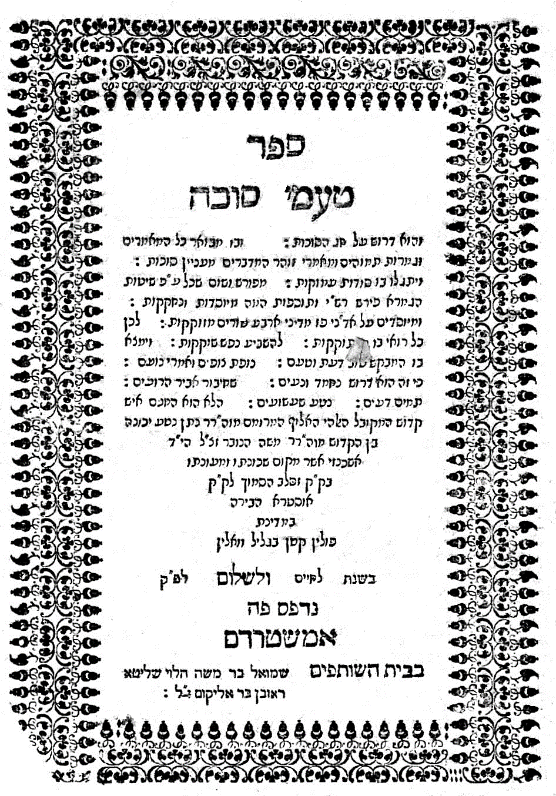
All of this is reflected in Hannover’s itinerant life and, as the chronicler of these events, in his Yeven Mezulah. Nevertheless Hannover’s first published work, Ta’amei Sukkah, is quite different. Based on a sermon delivered in Cracow in 1646 it was published in Amsterdam in 1652 at the press of Samuel bar Moses and Reuben bar Eliakim. In format it is a medium quarto (40: 12 ff.).[12] Samuel bar Moses ha-Levi was, together with Judah [Leib] ben Mordecai ben Mordecai [Gimpel] of Posen, the first Ashkenazi printers in Amsterdam. After their partnership ended in 1651, Samuel ben Moses continued to publish for a brief period in partnership with Reuben ben Eliakim of Mainz. Among their publications is Ta’amei Sukkah.
 
As the title-page makes clear, Ta’amei Sukkah is a discourse on the festival of Sukkot, explaining Talmudic statements by way of esoteric allusions. The title-page states that in the discourse,
are explained all of the hard-to-understand sayings and Talmudic adages, and the accounts in the Zohar related to Sukkot. In it are revealed deep esoterica, explained and made intelligible according to and based on the Talmud, Rashi, and Tosafot and; “set upon sockets of fine gold” (Song of Songs 5:15). . . . to satisfy the soul’s yearning. In it the seeker will find “good judgment and knowledge” (cf. Psalms 119:66), “the honeycomb” and “pleasant words” (Psalms 19:11, Proverbs 15:26, 16:24), for this is a treasured and desirable discourse. . . .
The title page is dated “to life and to peace ולשלום” (412 = 1652″; the colophon dates completion of the work to the month Menahem (Av) Zion and Israel “And this is the Torah וזאת התורה אשר (412 = July/August 1652) which Moses set before the people of Israel” (Deuteronomy 4:44). Hannover’s introduction (1b) follows. He emphasizes his youth and informs that he has written discourses on the entire Torah and festivals, entitled Neta Sha’ashu’im because it contains his name.
Lack of funds have prevented Hannover from publishing the entire work; therefore, at this time he is printing this discourse only, delivered in Cracow in 1646. Hannover’s plaint that due to a lack of funds he has been unable to publish the entire book and at this time is printing one discourse only, really just a pamphlet, that is, Ta’amei Sukkah, is not unique. Indeed, what makes Hannover different from other authors with like difficulties is that in contrast to the other authors, who are printing medium excerpts of their works in hopes of finding a patron to support publication of the larger tome, those authors are today unknown except for their medium works. Hannover, in contrast is relatively well known, if only because of his other published titles.[13]
Hannover entitles this discourse Ta’amei Sukkah because it is on Sukkah and the arba’ah minim; it explains wondrous midrashim and sayings in the Zohar and Talmud relating to Sukkot; and furthermore, the numerical value of Ta’amei טעמי (129) equals his name Nata נטע (129). The text follows, set in two columns in rabbinic type with leaders in square letters. Ta’amei Sukkah is a multi-faceted work with kabbalistic and midrashic content. Within the text are several headings in which Hannover notes that, based on the prior section, he will now explain a Midrash RabbahZohar, or other work, such as the Alshekh. At the end of Ta’amei Sukkah, after the colophon is a tail-piece, the bear pressmark.[14] Ta’amei Sukkah has been reprinted once, in Podgorze (1902).
III
The following year, continuing his peripatetic movements, Hannover was in Venice where he published Yeven Mezulah, his detailed chronicle of the horrific experiences of Polish Jewry during the Chmielnicki massacres of 1648-49 (tah ve-tat) in which, according to contemporary sources, as many as several hundred thousand Jews were murdered and hundreds of communities destroyed.[15] This, the first edition of Yeven Mezulah, is based on first person accounts taken from oral testimony and other contemporary works. It was printed at the Vendramin press in 1653, also in quarto format (40: 24 ff.). Founded in 1630 by Giovanni Vendramin this press, broke the monopoly enjoyed until then by Bragadin. For the first ten years the press operated under the name of its founder, but after his death it became known by the names Commissaria Vendramina and Stamparia Vendramina. The press eventually joined with that of Bragadin and the combined presses continued to operate well into the eighteenth century.[16]
The title is from, “[I sink in] deep mire (yeven mezulah), [where there is no standing; I have come into deep waters, and the flood sweeps over me]” (Psalms 69:3). The title page, which has an architectural frame and is dated “coming ביאת (413 = 1653) of the Messiah,” states that it comes to relate the decrees and wars in the lands of Russia, Lithuania, and Poland. There is an introduction from Hannover, which begins,
I am the man who has seen affliction by the rod of his wrath” (Lamentations 3:1), when the Lord smote His people Israel, His first born. He cast down from Heaven to Earth His glory, the land of Poland, His delight. “Beautiful for situation, the joy of the whole earth” (Psalms 48:3) “The Lord has swallowed all the habitations of Jacob without pity” (Lamentations 2:2) “the lot of his inheritance” (Deuteronomy 3 2:9) “and remembered not his footstool in the day of his anger!” (Lamentations 2:1). All of this was foreseen by King David )may he rest in peace( when he prophesied the joining of the Kadarim (Tartars) and the Greeks to destroy Israel His chosen people in the year זאת (408 = 1648).
Hannover has entitled the work Yeven Mezulah because the events that transpired it are alluded to in Psalms. Also, yeven (yavanim – Greeks) refers to the Ukrainians, who belonged to the Greek Orthodox Church. Hannover writes that he has recorded both major and minor occurrences, all the decrees and persecutions, and their dates, so that families can calculate when their relatives perished. He also describes the customs of Polish Jewry, their religious devotion, based upon the pillars that support the world (ref. Avot 1:2, 18), and notes the high level of Torah scholarship, unmatched elsewhere. Yeven Mezulah has been described as “a complex work that recounts not only the cruel fate of Ukrainian Jewry, but also the socioeconomic and political factors that led up to the rebellion. . . . it is noteworthy that he is able to give details of various political and military developments within the Polish camp.”[17]
The introduction concludes with a request that the book be purchased to enable him to publish Neta Sha’ashu’im, a work that, as noted above, was never published. It then records in detail the tribulations that befell Eastern European Jewry, concluding with a description of the inner life of the Jews, how they lived in accordance with the pillars of Torah, Divine Service, charity, truth, justice, and peace, set forth in AvotYeven Mezulah is organized by community, describing what befell them, excepting an intermediate section on Chmielnicki. Two examples, the first a description of what occurred in 1Nemirow, relating how Chmielnicki and his followers gained entry by the ruse of flying Polish flags and thus passing themselves off as a relief force.
The people of the city were fully aware of this trickery, and nevertheless called to the Jews in the fortress: “Open the gate. This is a Polish army which has come to save you from the hands of your enemies . . . No sooner had the gates been opened than the Cossacks entered with drawn swords, and the townspeople too, armed with spears and scythes, and some only with clubs, and they killed the Jews in large numbers. Women and young girls were ravished, but some of the women and maidens jumped into the moat surrounding the fortress in order that the uncircumcised should not defile them. . . . but the Ukrainians swam after them with their swords and their scythes, and killed them in the water. Some of the enemy shot with their guns into the water, and killed them till the water became red with the blood of the slain. . . . The number of the slain and drowned in the holy community of Nemirow was about six thousand. They perished by all sorts of terrible deaths. . . . May God avenge their blood.
The second example, concerns R. Samson Ostropoler of Polonnoye (Volhynia), and his community,
Among them was a wise and understanding divinely inspired Kabbalist whose name was, Our Teacher and Master Rabbi Samson of the holy community of Ostropole. An angel would appear to him every day to teach him the mysteries of the Torah. . . . He preached frequently in the synagogue and exhorted the people to repent so that the evil would not come to pass. Accordingly all the communities repented sincerely but it did not avail, for the evil decree had already been sealed.
When the enemies and oppressors invaded the city, the above mentioned mystic and three hundred of the most prominent citizens, all dressed in shrouds, with prayer shawls over their heads, entered the synagogue and engaged in fervent prayer. When the enemies arrived they killed all of them upon the sacred ground of the synagogue, may God avenge their blood. Many hundreds who managed to survive were forced to change their faith and many hundreds were taken captive by the Tartars.[18]
A critical view of Yeven Mezulah is expressed by Edward Fram who writes that Hannover, in describing the massacre of Jews in Tulczyn, copied from other works, particularly Zok ha-Ittim, at times paraphrased those works, and “in some instances he took events said to have happened elsewhere and wove them into his own tale of Tulczyn,” without acknowledging his debt, melding them into his own tale of the massacre in Tulczyn. Fram suggests that Hannover did so because Zok ha-Ittim was not compelling enough to emphasize Jewish martyrdom and “place 1648 in the tradition of past tragedies, [therefore] a more resolute image of martyrdom would be necessary.”[19]
Nevertheless, Yeven Mezulah is regarded as the classic and most important work on tah ve-tat and has been frequently reprinted as well as having been translated into Yiddish, French, German, Russian, Polish, and English.
IV
We next, in terms of Hannover’s publications, find him in Prague, where he published Safah Berurah, a popular four language, Hebrew-German-Latin-Italian, glossary for conversation and as a guidebook for travelers. Printed at the renowned press of the Benei Jacob Bak, opened as early as 1605. Safah Berurah is a medium format book (80: [44] ff.). The title is from, “For then I will convert the peoples to a clear language (safah berurah)” (Zephaniah 3:9). The title page states,
Behold, and see” (Lamentations 1:12) this new thing that was not before. The holy tongue (Hebrew), Ashkenaz, Italian, and Latin spread out flawlessly. It is good for women and men, the aged and elderly, adolescents and young, teacher and businessmen and also before the uneducated, who travel through all lands, “And you shall teach them to your children, speaking of them, so that your days may be multiplied” (cf. Deuteronomy 11:19,-21), and in this merit may He send to our Messiah speedily in our day. Amen Selah.
The Lord grant us the merit to come soon to the holy land הקדושה (420 = 1660).
 
The introduction follows, in which Hannover repeats the description of the book from the title-page and adds that it is based on the words in the Torah, the twenty-four books of the Bible, and some words from the six Sedorim (Mishnayot). He follows “after the reapers” (Ruth 2:7), gleaning every strange word in the sheaf: from concordances, Mirkevet ha-Mishneh, and commentaries.[20] Safah Berurah is so entitled because from this straightforward work all four languages will be pure and clear. In the second paragraph, in a mediumer font, Hannover explains the structure of the work, and that the Ashkenaz is not, with rare exception, that of the gentiles but of the Jews (Yiddish), but that the Latin is of the highest order, in order to be able to speak before kings and nobles.
This is followed by a list of the twenty she’arim that make up Safah Berurah, that is, the divisions of the book, which is not alphabetic but by subject. This arrangement was apparently followed because Hannover believed that it would be more convenient for conversation to be able to locate words related by subject. The first two she’arim include terms dealing with the Divine and Torah; the next three with earthly objects; six through nine, fish, birds, animals and humans; continuing with material objects; such as clothing, jewelry, metal, arms, tools, nations, including proper forms of address, business, arithmetic, calendar, and grammar.
The approximately 2,000 words comprising the text follow, in four columns, from right to left, of Hebrew, Ashkenaz, Italian, and Latin, all in square vocalized Hebrew letters. At the end of the book are errata by language and a colophon in which Hannover thanks Gabriel Blanis and Jacob Szebrsziner for their assistance with the Italian and Latin, and notes that it was necessary to reduce the size of the glossary due to conditions in Poland, where there are no buyers.[21]
Safah Berurah has also been republished several times, beginning with an edition prepared by Jacob Koppel ben Wolf that included French at the press of Moses ben Abraham Mendes Coitinho (Amsterdam, 1701), and even an edition with Greek and Turkish (lacking place and date.[22]
Sha’arei Ziyyon, Hannover’s, last published title, is a collection of Lurianic kabbalistic prayers, particularly for Tikkun Hazot (midnight prayers). First printed in Prague in the year “The trees of the Lord have their fill; the cedars of Lebanon, which he has planted ישבעו עצי י’י ארזי לבנון אשר נטע (422= 1662)” (Psalms 104:16), also at the press of Benei Jacob Bak. Sha’arei Ziyyon is a medium work set in octavo format (80: [38] ff.). The title is from “The Lord loves the gates of Zion (sha’arei Ziyyon) more than all the dwellings of Jacob” (Psalms 87:2).
The following text and images are from the Amsterdam 1671 edition, published by Uri Phoebus ben Aaron ha-Levi in quarto in format (40: 54 ff.). Similar but not identical to the earlier Prague printing this edition is dated Rosh Hodesh Sivan 431 (Sunday, May 10, 1671). The title-page has an architectural frame with an eagle at the apex surrounds the text.[23] The text states,
These are the words of Kabbalah according to the scribes and according to the texts, Sefer Etz Hayyim, those who taste it merit life, written by the foremost student of the Godly rav, R. Isaac Luria, that is, R. Hayyim Vital. After him rose up students of his students and wrote this work (Sha’arei Ziyyon) . . .
The author sent his brother R. Mordecai Gumpricht ben Moses with many additional prayers and supplications, as can be seen . . .
The title-page is followed by the approbations reprinted from the first Prague edition, from R. Nahman ben Meir Kohen of Keremenec, R. Samuel ben Meir of Ostrow, and R. Israel ben Aaron Benzion of Satanow. They are followed by Hannover’s introduction, which concludes with a description of the seven sha’arim comprising Sha’arei ZiyyonTikkun Hazot based on R. Hayyim Vital’s Etz ha-HayyimTikkun ha-Nefesh, to be said after Tikkun Hazot with Yedid NefeshTikkun ha-Tefillah according to Kabbalah; Tikkun Kriat ha-TorahTikkun Kriat Shema with the appropriate kavvanotTikkun shel Erev Rosh Hodesh; and Tikkun Malkhut on Rosh Ha-Shanah and Yom ha-Kippurim.
Text is in a single column in rabbinic type, with headers, initial phrases, and some limited text in square letters. The volume concludes with an epilogue dating the conclusion of the work to “half of (15) Kislev, ‘And he shall judge the world תבל (Tuesday, November 17, 1671) in righteousness’ (Psalms 9:9) and compassion.” Printing was supervised by Mordecai Gumpricht ben Moses, Hannover’s brother.[24]
Sha’arei Ziyyon is primarily a compilation of existing prayers assembled into one work. Prayers such as Ribbono shel Olam, recited today prior to the removal of the Torah from the Ark by R. Jeremiah of Wertheim and the Yehi Ratzon after the priestly blessing are taken from Sha’arei Ziyyon. This edition, as stated on the title-page, is much expanded from the first edition (80 38 ff.). It contains additional prayers, piyyutim, and supplications, some of considerable length, among them prayers for someone incarcerated, for those who are ill, and has verse for the dedication of a new Torah scroll in the synagogue.[25]
Gershom Scholem, in describing the influence of Kabbalah on Jewish life writes that one of the areas in which it had the greatest influence was prayer. Among the most influential books in this sphere was Sha’arei Ziyyon in which Lurianic doctrines “of man’s mission on earth, his connections with the power of the upper worlds, the transmigrations of his soul, and his striving to achieve tikkun were woven into prayers that could be appreciated and understood by everyone, or that at least could arouse everyone’s imagination and emotion.”[26]
The popularity of Sha’arei Ziyyon is such that it has been described by Sylvie-Anne Goldberg as “one of the most widely read books in the Jewish world.”[27] Indeed, Sha’arei Ziyyon was reprinted in Prague three times in the seventeenth century (1682, 1688, 1692), and three additional times within a decade, in Dyhernfurth ([1689]), Wilhermsdorf (1690) and Dessau (1698). The Bet Eked Sefarim enumerates fifty-four editions through 1917.[28]
Hannover’s life reflects the times in which he lived, both in the adversity and travail he faced but also in how he overcame them. Just as the Jews of mid-seventeenth century Europe had their lives uprooted but survived to rebuild thriving communities so too Hannover’s accomplishments stand out. Not only did he both live and survive to chronicle the struggles and turmoil of gezerot tah ve-tat in Yeven Metzulah but he also wrote such varied books as Safah Berurah, a lexicography, and Sha’arei Ziyyon, a liturgical work, all three important and much reprinted titles. In addition, Hannover was the author of Neta Sha’ashu’im, noted above; Neṭa Ne’eman, a Kabbalistic work; a discourse on Purim, extant in manuscript, and a commentary on Otiyyot de-Rabbi Akiva, no longer extant. In addition to the printed editions of his books Hannover’s works were sufficiently popular that they were often copied by hand and numerous manuscripts of his works are extant. KTIV, the International Collection of Digitized Hebrew Manuscripts records twenty-six entries under Nathan Hannover, the most popular being by far being Sha’arei Ziyyon.[29]
Despite experiencing suffering and tragedy, Nathan Nata Hannover survived to live a life of meaning and leave us a legacy of value. Yeven Metzulah concludes that the Jews who escaped from the swords of their enemies were treated with kindness in Moravia, Austria, Bohemia, Italy, and especially Germany, given food, drink, lodging, garments, and gifts “each according to his importance,”
May their justice appear before God to shield them and all Israel wherever they are congregated, so that Israel may dwell in peace and tranquility in their habitations. May their merit be counted for us and for our children, that the Lord should hearken to our cries and gather our dispersed from the four corners of the earth, and send us our righteous Messiah, speedily in our day. Amen, Selah..
 
Seforim Blog Editors’ note:
 
For more sources on the significance of the work Sha’arei Ziyyon see Eliezer Brodt’s post on the Seforim Blog here specifically the section headed שערי ציון. Footnote 33 has some more current Hebrew literature on the sefer, and also of interest is the appendix where Brodt has a whole new look at  the relationship between this work and the Magen Avraham.
 
In addition, it’s worth noting that a beautiful new edition of the Sha’arei Ziyyon was printed in 2012 based on the first edition, and the volume includes his Ta’amei Sukkah. The Yeven Mezulah also has also been reprinted a few times in recent years.
[1] I would like to express my appreciation to Eli Genauer for reading the article and his comments. Images are courtesy of the Library of Congress, the Jewish National and University Library, the Valmadonna Trust Library, Ozar ha-Hochmah, and of Virtual Judaica.
[2] Ḥananel Nepi, Mordecai Samuel Ghirondi, Toledot Gedolei Yisrael (Trieste, 1853), p. 270 [Hebrew]; Moritz Steinschneider, Catalogus Liborium Hebraeorum in Bibliotheca Bodleiana (CB, Berlin, 1852-60), col. 2044; and William B. Helmreich, forward to Nathan Nata Hannover, Abyss of Despair (Yeven Metzulah), translator Abraham J. Mesch, (New York, 1950; reprint, New Brunswick, London, 1983), pp. 13-15; Israel Zinberg, A History of Jewish Literature IV (New York, 1975), translated by Bernard Martin, pp. 122-23.
[3] Hersh Goldwurm, ed. The Early Acharonim (Brooklyn, 1989), p. 194; Mordechai Margalioth, ed., Encyclopedia of Great Men in Israel IV (Tel Aviv, 1986), cols. 1181-82 [Hebrew].
[4] David B. Ruderman, Early Modern Jewry: A New Cultural History (Princeton, N. J., 2011), pp. 41, 51.
[5] Bernard D. Weinryb, The Jews of Poland; a Social and Economic History of the Jewish Community in Poland from 1100 to 1800 (Philadelphia, 1972), p. 166.
[6] Salo Wittmayer Baron, A social and religious history of the Jews XVI (Philadelphia, 1976), p. 98.
[7] Shmuel Ettinger, “Chmielnicki (Khmelnitski), Bogdan,” Encyclopaedia Judaica, edited by Michael Berenbaum and Fred Skolnik, vol. 4 (2007), pp. 654-656.
[8] Zinberg, p. 122.
[9] Shaul Stampfer, “What Actually Happened to the Jews of Ukraine in 1648?” Jewish History, 17:2 (2003), pp. 221-222.
[10] Jonathon Israel, European Jewry in the Age of Mercantilism 1550-1750 (London ; Portland, Or, 1998) p. 99.
[11] Simha Assaf, “The Inner Life of Polish Jewry (Prior to the Period of the Haskalah” Be-Ohole Yaʻaḳov: Peraḳim me-hHaye ha-Tarbut shel ha-Yehudim bi-Yeme ha-Benayim (Jerusalem, 1943), p. 80 [Hebrew].
[12] L. Fuks and R. G. Fuks Mansfeld, Hebrew Typography in the Northern Netherlands 1585 – 1815 (Leiden, 1984-87), I p. 197 no. 275.
[13]  Concerning such medium books published as a prospectus see my “Books not Printed, Dreams not Realized,” in Further Studies in the Making of the Early Hebrew Book (Brill, Leiden/Boston, 2013), pp. 285-303.
[14] Concerning the varied usage of the bear pressmark see my “The Bear Motif on Eighteenth Century Hebrew Books” The Papers of the Bibliographical Society of America 102:3 (New York, N. Y., 2008), pp. 341-61, reprinted in Further Studies, pp. 57-76.
[15] Other contemporary works describing the horrors of tah ve-tat are R. Samuel Feivush ben Nathan Feitel’s Tit ha-Yaven (Venice, c. 1650), R. Meir ben Samuel of Shcherbreshin’s Zok ha-Ittim (Cracow, 1650), and R. Jacob ben ha-kodesh (the holy, suggesting that he was among the murdered) Simeon of Tomashov’s Ohel Ya’akov (Venice, 1662). The latter writing ““Light became darkness” (Job 18:6) for me, for they killed my wife and three sons, “and I lived in the land of Nod” (cf. Genesis 4:16) until 1656. In that year arose grievous troubles, old and also new, and I came uponmidat ha-din (strict justice) and “Disaster upon disaster” (Ezekiel 7:26), plunder after plunder, until finally I encountered pestilence, sword, famine, and captivity and every day was worse than before. Also to be noted are selihot commemorating tah ve-tat (1648-19) such as R. Gabriel ben Joshua Heschel Schlussburg’s Petah Teshuvah ([1651], Amsterdam) selihot and lamentation on the Jews massacred in tah ve-tat (written as a commentary on the book of Lamentations and R. Shabbetai ben Meir ha-Kohen (Shah)’s Selihot ve-Kinnot (Megillat Eifah, 1651, Amsterdam).
[16] David Amram, The Makers of Hebrew Books in Italy (Philadelphia, 1909, reprint London, 1963), p. 372; Joshua Bloch, “Venetian Printers of Hebrew Books,” in Hebrew Printing and Bibliography (New York, 1976), p. 86.

[17] Adam Teller, “Hannover, Natan Note,” YIVO Encyclopedia of Jews in Eastern Europe 1 (New Haven & London, 2008), p. 656.

[18] Both translations are from Mesch, pp. 51, 63-64 respectively.
[19] Edward Fram, “Creating a Tale of Martyrdom in Tulczyn, 1648,” Jewish History and Jewish MemoryEssays in Honor of Yosef Hayim Yerushalmi, ed. Elisheva Carlebach, John M. Efron, David N. Myers (Hanover, 1998), pp. 90-91.
[20] Mirkevet ha-Mishneh (Cracow, 1534), by Asher Anshel of Cracow, is a concordance and glossary of the Bible. Published by Samuel, Asher, and Elyakim, sons of Hayyim Halicz, it was the first Yiddish book printed in Poland. Concerning Mirkevet ha-Mishneh see Marvin J. Heller, The Sixteenth Century Hebrew Book: An Abridged Thesaurus I (Brill, Leiden, 2004), pp. 216-17.
[21] Shimeon Brisman, History and Guide to Judaic Dictionaries and Concordances (Hoboken, 2000), pp. 44-46.
[22] Ch. B. Friedberg, Bet Eked Sepharim, (Israel, n.d.), shin 2223 [Hebrew].
[23] “The Eagle Motif on 16th and 17th Century Hebrew Books,” Printing History, NS 17 (Syracuse, 2015), pp. 16-40.
[24] Fuks and R. G. Fuks Mansfeld, II pp. 263-64 no. 32.
[25] A. Z. Idelsohn, Jewish Liturgy and Its Development (1932, reprint New York, 1995), pp. 55, 80, 259.
[26] Gershom Scholem, Kabbalah (NewYork, 1973), p. 193.
[27] Sylvie-Anne Goldberg, Crossing the JabbokIllness and death in Ashkenazi Judaism in Sixteenth through Ninteenth-Century Prague (Berkeley, 1996), p. 88.
[28] Friedberg, Bet Eked Sepharimshin 2148.
[29] I would like to thank Eli Genauer for bringing this to my attention. The address for KTIV is http://web.nli.org.il/sites/nlis/en/manuscript.


Running on the Inclined Plane of the Altar in the Second Temple

Running
on the Inclined Plane of the Altar in the Second Temple

by Chaim Katz
בראשונה … 
רצין ועולים בכבש, וכל הקודם את חברו לתוך ארבע אמות זכה
 We read in the Mishna:
[The priests used to
compete for the honor of separating and removing ashes from the altar] by
sprinting up the ramp. Whoever was the first to reach the top four cubits was
entitled to remove the ashes.  Mishna
Yoma 2:1
One
of the first authorities to question the practice described in this mishna was
Eliezer ben Samuel of Metz who lived in the 12th century. He was a Tosafist and
a student of Rabbenu Tam. In his Sefer Yereim 
(Negative 311), he compared the description given in this mishna with a
conflicting description given in the Mekilta DeRabbi Yishmael: (Masechta
d’bhodesh parsha 11):
  מה ת״ל אשר לא
תגלה ערותך עליו שלא יפסיע פסיעה גסה אלא עקב בצד גודל וגודל בצד עקב
What do you learn from
the verse “don’t go up to my altar by stairs so that your nakedness isn’t
revealed near it” (Ex. 20:23) [1] – that one doesn’t take large strides when
stepping up to the altar, rather heel-next-to-toe and toe-next-to-heel.
Apparently,
the Mekilta DeRabbi Yishmael forbids not only running on the ramp, but even
forbids regular, normal, walking on the ramp.
Another
Tosafist, R. Moshe of Coucey (13th century) in his Tosafot Yeshanim on Yoma 22b
re-raised the problem. Over the years and centuries, many others suggested ways
of resolving this difficulty. [2]
A
solution occurred to me based on the idea that maybe the priests who sprinted
to the top of the ramp were acting improperly and not following the teaching of
the sages. Our sources report a number of temple practices that were initiated
by groups who followed their own teachings. For example: the practice of
lighting incense outside the kodesh ha kedoshim on Yom Kippur (Yoma 19b), the
practice of not offering the water libation on the altar on sukkot  (Yoma 26b), the practice of following a
different calendar and bringing the omer offering on Sunday (Menahot 65). [3]
Although
I don’t have a proof that the races on the ramp were improper, the Talmud
itself encourages this perception (Yoma 23a):
ת”ר מעשה
בשני כהנים שהיו שניהן שוין ורצין ועולין בכבש קדם אחד מהן לתוך ארבע אמות של
חבירו נטל סכין ותקע לו בלבו עמד רבי צדוק על מעלות האולם ואמר אחינו בית ישראל שמעו … געו כל העם בבכיה בא
אביו של תינוק ומצאו כשהוא מפרפר אמר הרי הוא כפרתכם ועדיין בני מפרפר ולא נטמאה סכין
We read in a baraita. It
once happened that two priests were racing up the ramp … when  one got close to the other and stabbed him …
R. Zadok stood on the steps of the temple and eulogized the slain priest:
Listen my brothers the house of Israel … All the people burst into tears. The
father of the young priest had meanwhile found his slain son in his death
throes, “The knife is still ritually clean”
The
obvious contrast between the father who “cared more about the purity of the
temple vessels than about the murder” and the people who were present listening
to R. Zadok and weeping, demonstrates that the priest (the father) didn’t see
himself as part of the community who was present in the temple nor did he share
the priorities of the rabbis. [4]
If
so, there really is nothing to reconcile: a priest is never allowed to run on
the ramp. Historically, there was a time when the rabbis had little control
over what the priests did. The Mishna is describing one of those times.
However, when the circumstances changed and the rabbis had the opportunity,
they stopped the racing and substituted the lottery in its place. [5]

Standing
in Prayer

The
Mekilta’s teaching is not quoted in the Babli, but is quoted in the Yerushalmi,
albeit in a different context. We read in the Yerushalmi (Talmud Berakot 1:1):
זהו שעומד ומתפלל צריך להשוות את רגליו.  תרין אמורין רבי לוי ורבי סימון חד אמר
כמלאכים וחד אמר ככהנים.  מאן דאמר ככהנים
לא תעלה במעלות על מזבחי שהיו מהלכים עקב בצד גודל וגודל אצל עקב.  ומאן דאמר כמלאכים  ורגליהם רגל ישרה.
One who stands up to
pray must hold his feet together. Two teachers: R. Levi and R. Simon. One of
them says: like angels. The other one says: like priests. The one who refers to
priests quotes:  “Don’t go up to my
altar by stairs” (Ex. 20:23).  They walked
with heel-next-to-toe and toe-next-to-heel. The one who refers to angels quotes:
“Their legs were as one straight leg” (Ez. 1:7)
It
isn’t very clear how to visualize that the kohen walking on the ramp towards
the altar, serves as a source and paradigm for the custom of standing with
one’s feet together during the amidah prayer. Many commentaries therefore,
found a practical difference between these two opinions: if we compare
ourselves to angels, then we stand with our feet together and parallel to each
other; however if we compare ourselves to priests, then we stand in prayer with
one foot in front of the other. [6]
The
Oxford manuscript of the Mekilta has a slightly different description of the
way the priest walked up the ramp. Based on the manuscript and a careful
reading of the rest of the passage in the standard editions, the comparison
between walking on the ramp and standing with our feet together in prayer is
much more straightforward: 
אלא גודל בצד
עקב ועקב בצד עקב ועקב בצד גודל
Rather toe-next-to-heel
and heel-next-to-heel and heel-next-to-toe
According to the
manuscript, the priest stood with his feet together before taking every step.
Instead of taking a full step (moving his heel about 20 inches) he took half
steps (moving his heel about 10 inches each time). [7]
In
addition, when the Mekilta teaches that the priest walked heel next to (בצד)
toe,  it doesn’t mean that he moved one
foot completely ahead of the other, with the back of the heel of one foot
touching or parallel to the top of the toe of the other foot. Rather the priest
took even smaller steps so that the length of the big toe of one foot was “next
to” or parallel to the heel and lower instep of his other foot. I experimented
and found for me, at each step my heel only moved forward  about 6 inches.  At this pace the legs are hardly parted.
This
is all to say that if you were present in the courtyard of the Israelites
(about 50 feet away from the priest walking up the ramp), you would see the
priest standing with his legs held together heel to heel 50% of the time
(assuming all steps took an equal length of time). Even when he was “walking”,
he moved his legs so slightly apart that he would appear to be standing still.
The long robe he wore that reached down to his ankles also helped to conceal
his movement. Picture the priest walking up the ramp as someone standing still
on a slowly moving sidewalk or some similar example. He looks almost
motionless, as he inches forward smoothly towards the top of the altar.  (I did a test on level ground.  Walking this way, it took me a little more
than three minutes to cover about 32 cubits).
It’s likely that both
amoraim in the Yerushalmi agree that we pray with feet held together parallel
to each other. They each  cite a
different pasuk, but they’re expressing the same idea.[8]
On the level of the aggadah,
there may be a different lesson from each teaching. We’re fortunate to have R.
Kook’s aggadic interpretation on the meaning behind aligning one’s feet
together in prayer like the angels: [9] 
המתפלל צריך שיכוין רגליו, שנאמר ורגליהם רגל
ישרה. הרגלים משמשים פעולת ההליכה ופעולתהעמידה. לפעולת ההליכה עיקר שימושם הוא
במה שהם נפרדים, בפעולת העמידה עיקר שימושם הואבמה שהם מתאחדים. במהלך שלמות האדם
יש הליכה, להוסיף לקנות שכליות ומעלות מדותיות. וישעמידה, היינו שהדברים שקנה יהי’
קנינם חזק בנפשו, לא יפסידם איזה שינוי וגירעון במצבו…
ובזההאדם
מתדמה לפי יכולתו לשכלים העליונים, שקניני שלמותם חזקים במציאותם, בהיות ג”כ
עיקרתעודתם לעמוד בשלימותם ולא להוסיף עליו.ובזה ג”כ
נכללת השתדלות האדם בתפילה שתהיינה מעלותיו קנויות אצלו ומוטבעות
Legs are used for
walking and standing. In the activity of walking, the legs’ usefulness consists
in their being parted; in standing, in being held together. To advance towards
perfection, to progress in virtuous conduct and intelligence, man must move. To
entrench in his personality what he has already acquired, man must stand still.
He must not allow any change for the worse in his circumstances to let him lose
what he possesses…Torah is essentially designed to increase man’s perfection
and exaltation. It is referred to as ‘a path’… Tefillah impresses virtues
already acquired making them stable and enduring. Here man is likened, to the
extent that he is capable, to the supreme intelligences whose perfection is
firmly ingrained in their selves – their intrinsic function being to preserve
their perfection, not to add to it [10]
I’m
not capable of extrapolating a similar lesson from the comparison with priests
walking up the ramp. However, I feel that we have a enough  key words to associate the way the priests
walk up to the altar with ideas like refinement, growth and free choice on one
hand, and ideas like slow change on the other. 
With this in mind we can at least get a fuzzy feeling for the difference
between standing with our feet together in prayer like angels and standing with
our feet together like priests walking up the ramp.
__________________________________________________
[1] I notice that in some humashim the pasuk is numbered 22 instead of 23. I was looking in some modern editions of Moreh Nebukhim, and saw two editions that reference this pasuk as 26 (following non-Jewish chapter and verse (?)).
[2] The common approach to synchronizing the two taanaitic sources is a compromise.  Kohanim may run or walk quickly on the ramp but must take smaller than normal strides. Another approach claims that the mekilta’s opinion is rejected and priests may run normally on the ramp.  Some present an opposite view and understand the mishna as a description of priests running towards the ramp, but not running on the ramp. And some interpret the mekilta to be talking about the altar itself – the kohanim may run on the ramp but may not take big strides when walking on the top of the altar.  I’m sure there are more solutions.
[3] Racing or competing seems very Hellenistic. Megillat Taanit lists a number of semi-holidays that were established when the rabbis prevailed over the temple priests. 
[4] Maybe this obsession with purity in the
temple identifies these priests as Sadducees as in the Mishna Para 3:6 “they
would touch the kohen who was about to prepare the ashes of the red heifer
because the Sadducees believed…”. But even if the priests weren’t Sadducees or
Boethusians, they might still have been ignorant of the teaching of the Rabbis.
The Mishna mentions high-priests who were illiterate. The Sifra mentions
priests who had to rely on the sages to tell them if a leprous mark was clean
or unclean.
[5] The Talmud explains that running up the ramp
was discontinued because it was too dangerous. It doesn’t say that the race was
improper on unlawful.  However, R. Saul
Lieberman discusses something similar in Hellenism in Jewish Palestine page 139
in the chapter about The Three Abrogations of Johanan the High Priest. He
writes that “the Rabbis were sometimes reluctant to reveal the reasons which
moved them to enact a new law. Moreover, in order to make the people accept a
new ordinance the Rabbis occasionally substituted some formal legalistic
grounds for the real motive.” He’s speaking there, (in one of the examples),
about the knockers who stunned the animal by hitting it on the head before
slaughtering it. The Talmud says the reason this practice was abolished,
because it made the animal treif, but the Tosefta gives a different reason for
abolishing the practice – because it mimicked what was done in the heathen
temples. 
[6] One of the first to present this
interpretation is the Talmidey Rabbenu Yona page 5a of the Rif on Berakhot .
Many commentators of the Yerushalmi have given the same explanation.
[7] This variant is quoted in the Mekilta, Horowitz-Rabin
edition, (end of Yitro) p. 245 (line 2) and is visible online here.   R. E.Z. Melamed in Essays in Talmudic
Literature (Heb.)  Iyunim b’Sifrut
HaTalmud) published in Jerusalem by Magnes press in 1986, (the original article
was published in Tarbitz in 1935), demonstrates that the Oxford manuscript is
much more accurate and authentic than the early print of the Mekilta that
Horowitz reproduced as the main text of his edition. On the other hand, the two
other manuscripts of the Mekilta, which are displayed on the web site mentioned
above, are identical to the printed version with respect to this sentence.
According to the Oxford Mekilta manuscript the
Kohen walked this way on the ramp: stand with your left foot ahead of your
right foot. Take a small step forward with your right foot until your two feet
are aligned.  Move your right foot
forward again so that it is ahead of your left foot. Now move your left food
forward until your two feet are aligned. 
Move your left foot forward again. Note that you’re moving the same foot
two times in a row.
[8] compare (for example):
Zeiri of Dihavet said to Rabhina, “You derive that idea from that pasuk and we
derive the same idea from this pasuk.” – Taanit 7b
[9] The Babli, Berakot
10b, has the comparison to angels but not the comparison to priests. R. Kook’s
comment is printed in the Siddur Olat Ray”h , (in the anthology portion)
just before the Amidah.  This section was
probably taken from his Ayn Ay”h commentary on Babli Berakot #153. I don’t
have access to the printed Ayn Ay”h. The online version (without the editor’s
notes) is here.

[10] This paragraph is
the work of Rabbi Leonard Oschry, in his English translation of Netiv Binah
called Meditations on the Siddur by B.S. Jacobson, published by Sinai
Publishing, Tel Aviv, Israel 1966. There is also an English translation of R.
Kook’s explanation by Rabbi Chanan Morrison here.


Censorship: The Autobiography of R. Eliyahu David Rabinowitz, ADeReT

Censorship: The Autobiography of R. Eliyahu David Rabinowitz, ADeReT

There are a handful of rabbinic autobiographies, R. Yehuda Areyeh of Modena, Hayyei Yehudah, R. Yaakov Emden, Megillat Sefer, and a few others.[1]  One of the more recent rabbinic autobiographies is that of R. Eliyahu David Rabinowitz, otherwise known as Aderet.  This work, was first published in the journal, Ha-Peles edited by Aderet’s nephew, Eliyahu Akiva Rabinowitz.  Only a portion of the autobiography appears in Ha-Peles. However, the editor did give us the title of this work for posterity.  Although Aderet did not title the work, in Ha-Peles it appears under the title, Seder Eliyahu, this title remains today.[1a] In reality, Seder Eliyahu is one part of three part work, the second part, Nefesh David, records various customs (and has been reprinted a few times), and the third part, regarding how to handle Aderet’s body after his death, Achar Eliyahu or Acharei David, apparently was never written. 

Aderet’s autobiography was first published in its entirety in 1983 by Mossad ha-Rav Kook.   The Mossad received the manuscript from Aderet’s grandson.  As will become apparent, much of what was written, prior to 1983, regarding Aderet is lacking because  prior to its publication in 1983,  his autobiography was virtually unknown.  As an aside, the New Encyclopaedia Judaica reuses the article on Aderet from the original Encyclopaedia Judaica and is but one example of the shortcomings of the New Encyclopaedia, for more examples see Dr. Leiman’s critique here, and Dr. Havlin’s critique here, and Dr. Richler’s critique here of the New Encyclopaedia Judaica. 

The 1983 edition, however, has been out-of-print for years, and this year, some of Aderet’s desendents republished Seder Eliyahu (additionally, they also reprint Nefesh David in this volume).  The editors of this new edition thank Mossad ha-Rav Kook for allowing them to reprint this work.  But, in their introduction, they argue that Aderet “never intended to publish this work and allow others to read it, instead, it was meant for his family.” Seder Eliyahu, Jerusalem, 2010, at 7 (“Jer. ed.” or “New Edition”).  Based upon this assertion, the editors of this edition justify “removing various passages that were never intended for outsiders to read.”  Id. at 9.  They explain that whenever they removed text “three lines (- – -) serve to indicate missing text.”  Id.  As we shall see they are inconsistent at best at using the three dash device and many instances of removal are not noted. 

Regarding the claim that Aderet never intended this book to be published. The original publication in 1983 includes the entire text with no omissions.  Recall that this text was obtained by Mossad ha-Rav Kook from Aderet’s grandson, we have no indication that he objected to publishing the entire text.  Moreover, the first time the autobiography (partially) appeared in Ha-Peles much of the “offensive” material was included. Recall that Aderet’s nephew was the editor of Ha-Peles  and he saw no need to censore anything. Finally, although there may be some indications that an autobiography was merely written for family members and not intended for broader publication, this device is common in autobiographies.  R. Emden also implies that he didn’t intend his autobiography to be widely distributed, but as Dr. Schacter demonstrates, Emden wanted others to read it.[2]  Indeed, according to Schacter, R. Emden’s autobiography can be classified as “that of ‘autobiography as polemic.'”  As Emden writes of his purpose, “[i]n order that the sun of my righteousness should shine forth . . . [and because] many of [my enemies] libelous writings will certainly remain extant in the world for some time.  Therefore, necessity has compelled me to clarify my case before God and man. . . . Behold [this autobiography] will serve as a vindication for me, for my children and my descendants.”[3] Thus, “there is equally no question that the overriding primary impetus behind Megillat sefer was a desire on the part of Emden to clear his name and vindicate himself in his controversy with Eybeschutz,” and “[t]here is no doubt that it is the Emden-Eybeschutz controversy that serves as the ‘center of gravity’ for” Megillat Sefer.[4]  Of course, for R. Emden to be publicly vindicated, presumably the public would need to be aware of the work.[5]

With Emden’s motives in mind, it is important to distinguish Aderet’s work.  While Aderet includes descriptions of others in his work, and, at times, some of these descriptions are far from flattering, it does not appear that Aderet was looking for vindication or had a polemic motive in mind.  While Aderet did not get along with his constituents in Ponovitch, that dispute was mainly surrounding Aderet’s salary and how the community treated him.  Aderet wasn’t involved in any global disputes like the Emden-Eybeschutz controversy and thus Aderet wasn’t required to vindicate himself.  Moreover, Aderet ultimately came out on top, becoming Chief Rabbi of the Ashkenazim in Jerusalem.  Thus, he was well-respected and had no reason to resurrect his image – his image was already good.

Perhaps a better understanding of some of the material as it relates to others in Seder Eliyahu may be better understood by looking at Marcus Mosley’s comments[6] and quote from Rousseau: 

Autobiography operates upon an entirely different set of criteria. For the autobiographer, the significance of the other is determined solely by the role that he or she plays in the formation of the self, regardless of social standing. Thus Rousseau, in the “Neuchatel” variant of the preamble to the Confeinddow: “The relationships I have had with several people compel me to speak as freely of them as of myself. I can only succeed in making myself known by making them known also.” Many of the more decisive encounters with the other in the shaping of the autobiographer’s self occur in the years of childhood and adolescence. Parents, teachers, schoolmates, and domestic staff may thus achieve a prominence in the autobiography that would, in the memoir, be reserved for generals and prime ministers, renowned men of letters, and so on. This is not to say that the formative encounters with the other in an autobiography are restricted to the historically obscure. But when the great do drift in and out of the pages of an autobiography, it is often not on account of the qualities that granted them this status that they are recalled.
Thus, Aderet’s comments about others, most notably regarding R. Yitzhak Elchonon Spector, may be understood as merely providing insight into Aderet’s own life rather than commenting on R. Spector, for example.

The new edition of Seder Eliyahu, however, leaves out much of Aderet’s comments about others, depriving the reader of fully understanding the Aderet as well as distorting history.  We will provide all the examples of where the new edition has altered or removed material from the 1983 edition. 

Biography of Aderet

The basic outlines of Aderet’s biography are not in dispute.  Here are the highlights.  Aderet was born, with his twin, on the first day of Shavout in 1843.  His father was a rabbi and Aderet’s family were descendant from famous rabbinic figures from both his father’s and mother’s side.  When he was five, his mother died and his father remarried.  At twelve, Aderet began writing his first sefer, and began wearing tefflin for his entire twelth year.  At thirteen, he had his bar mitzvah and, contrary to the custom, was allowed to read the haftorah for the first day of Shavout. This haftorah is typically reserved for the rabbi or a talmid hakham due to the content of the haftorah.  But, Aderet’s father argued that it was appropriate for his son to read the haftorah.  Soon after his bar mitzvah he completed his first work with his twin brother, Shevet Achim.  At fifteen he became engaged to girl, and soon after was appointed rabbi of Ragali.  The engagement didn’t end well. His fiancee’s mother died and the step-mother was lax in her observance and the marriage was called off.  But, in due course, Aderet was engaged again to the daughter of a prominent family in Ponovitch.  This time, Aderet went through with the wedding.  He remained in Ponovitch, supported by his in-laws, and studied in a small bet midrash.  In 1875, Aderet was selected to be the rabbi of Ponovitch.  In 1893, the town of Mir approached Aderet to become its rabbi.  Aderet accepted.  Ponovitch, however, wanted its rabbi to remain, but, after receiving advice from various rabbis, eventually, Aderet left and went to Mir.  In 1901 he was invited and accepted to become Chief Rabbi of the Ashkenazim in Jerusalem.  On the 3rd of Adar I, 1905, Aderet died in Jerusalem.

Aderet is known as having a phenomenal memory.  He was also a prolific author, but much of his writings remained in manuscript.  In the last decade or so, many of his books have been published, a bibliography of which will appear soon. 

The above provides a basic outline of Aderet’s biography, but a close examination of his autobiography provides additional detail.    

Autobiography of Aderet

There are a few important gaps in Aderet’s biography that can be filled only by utilizing his autobiography.  For example, Aderet’s father’s second wife.  If one reads some of the biographies, she is mentioned only in passing.  But, Aderet explains she was no minor figure.  To the contrary, it appears that Aderet’s step-mother and his father had a horrible marriage.  Indeed, Aderet couldn’t stand her and he was especially bothered the way she treated his father.  After Aderet’s father died, Aderet immediately left town as he couldn’t bear remaining with her.  He turned down his father’s position as rabbi of Vilkomer because that would mean he would have to live in the same city as his step-mother.  Aderet recalls bitterly how he sped home once and therefore missed out on meeting various rabbis only to find out that his step-mother hadn’t told anyone he was coming and no one was there when Aderet returned causing him to miss meeting the rabbis and not seeing family.

Some biographies make it appear that Aderet had a great relationship with the people of Ponovitch.  These biographies point to the fact that when Mir approached him, Ponovitch tried its hardest to keep Aderet. But, in his autobiography Aderet explains how horrible the people of Ponovich were to him.  They paid him almost nothing and even that little amount wasn’t always timely.  He was so poor that he didn’t have his own bed and had to sleep on a few chairs.  Although Aderet had some of his children die and others were sick, for the most part, the people of Ponovitch made his life even more difficult.  The town didn’t help when he had sick children.  One particularly shocking incident was one of the Ponovitch community members became gabbi.  Aderet didn’t like waiting between Kabbalat Shabbat and Ma’ariv because waiting only meant that people ended up talking and not acting as one should in Shul.  The gabbi, however, wanted to talk and wanted a break.  Thus, when Aderet asked the hazzan to immediately begin ma’ariv, the gabbi told the hazzan “it’s not time yet.”  This type of maltreatment by the Ponovitch community members was not uncommon.  Therefore, when Mir came knocking, and, although Mir was a significantly smaller community, Aderet wanted to get out of Ponovitch and accepted Mir’s offer.

As Aderet was almost always looking to leave Ponovitch, he competed for a job in Riga.  And, although he was the most qualified candidate, the position was given to someone else. Aderet lost out on the position because R. Yitzhak Elchonon Spector backed Aderet’s rival.  Aderet was extremely upset at R. Yitzhak Elchonon and even sent a very nasty letter to R. Yitzhak Elchonon.  R. Yitzhak Elchonon’s reaction was that “the letter was so disrespectful that but for Aderet’s reputation as a talmid hakham, he [R. Yitzhak Elchonon] would see to it that Aderet couldn’t even get a job a beadle in a bet midrash.”  Aderet was so embittered by this episode he remarks that he never forgave R. Yitzhak Elchonon. This was not the only time Aderet had a falling out with R. Yitzhak Elchonon.  At a rabbinic conference, led by R. Yitzhak Elchonon, there was a miscommunication which R. Yitzhak Elchonon took personally.  As such, R. Yitzhak Elchonon refused to entertain anything else during the conference and the conference was totally unsuccessful. Aderet was appalled that R. Yitzhak Elchonon’s personal feelings didn’t allow the conference to produce anything of value. 

Aside from making Aderet’s life miserable, the treatment of the town of Ponovitch also forced Aderet to allow his son-in-law, R. Abraham Isaac Kook, to leave and take up his own rabbinic position.  Although Ponovitch had promised Aderet a higher salary, the town never came through and thus Aderet couldn’t support his daughter and son-in-law.  In his autobiography, he describes how heartbroken he was when his son-in-law and daughter left. 

Comparison of the New Edition and 1983 Edition of Aderet’s Autobiography


As noted above, the editors of the New Edition provide that they have removed material from Seder Eliyahu, and that they have noted any time anything is removed.  This is false.  Although it is true that the editors have removed material but they have not always noted when they did so.  At times removed material is noted by “- – – ” in the text, many times there is no indication that anything is missing.  Moreover, the editors are inconsistent when they alter the text.  That is, in correcting typos or when removing abbreviation, sometimes they note they are altering the text and other times they do not.  Of course, this omission is less serious than wholesale removal of text, but consistency is still important.  For example, in the 1983 edition many persons are only referred to in abbreviated form, while in the New Edition their full name is used; thus the original reads “my uncle רפ”ק” while in the New Edition it reads “my uncle Rabbi Pinchus Cantor.”  The editors don’t note that they have inserted his full name; however, whenever the text uses an abbreviation to refer to R. Shmuel Mohilever – “הגרש”מ” in the New Edition they provide his full name but do so in brackets indicating an insertion into the text. Compare 1983 ed. pp. 84 &  92 & Jer. ed. at 71 & 76. It is unclear why they decided to consistently indicate this insertion and not others.

Turning the censored materials. These materials can roughly be divided into three categories.  (1) materials that mention Zionism or are related to Zionism; (2)  in this category we include what is best described as negative comments about women and marriage; and (3) personal attacks or observations about other Rabbis.  We must note that many of these omissions have been cataloged here as well.

First Category – Zionism

Items from this category include material that appears in the footnotes to the 1983 edition as well as items in the text itself.  The New Edition resuses almost all the footnotes that appear in the 1983 edition but leave out information when that information relates to Zionism.  Thus:

1983 ed. (p. 17 n.5) provides a footnote when the text mentions R. Moshe Telsher “for more information see Sefer Zikhron le-[Rabbi Abraham Isaac Kook] 1945″  Jer. Ed. (p. 15) doesn’t include this note at all. 
1983 ed.  (p. 28 n.14) contains a citation to Maimon’s Sa’arei ha-Meah, Jer. ed. (p. 26 n. 17) removes citation no notation anything is missing.
1983 ed. (p. 29 n.16) explains that R. Mordechai Gimpel Yaffo “was one who espoused emigration to Israel and himself emigrated in 1888”, Jer. ed. (p. 23 n.19) removes this text without notation.
1983 ed. (p. 59 n.46) regarding R. Mordechai Elisberg, the note explains “one of the leaders of the Hovvei Tzion movement,” Jer. ed. (p. 57 n.55), removes this text, no notation.
1983 ed. (p. 72 n.57) regarding R. Shmuel Mohliver “was the head and founder of the Hovvei Tzion movement,” Jer. ed. (p. 69 n.68) removes this text, no notation.
1983 ed. (p. 102 n.78) explaining that the author of Chavush Pe’ar “is R. Kook,” Jer. ed. (p. 96) the note is missing.

We should noted that the editors of the Jerusalem edition didn’t excise every Zionistic mention.  Instead, they retain the sentence “the Hovvei Tzion chapter in Bialystok requested that I [Aderet] give a derasha.”  Jer. ed. at 81.  Similarly, Aderet describes how heart broken he was when his son-in-law and daughter had to leave because Aderet couldn’t support them and how happy Aderet was when he met up with his son-in-law later that year and spent time together.  In the text, however, Aderet doesn’t identify by name his son-in-law.  The New Edition retains the footnote from the 1983 edition which identifies the son-in-law as “The Gaon R. Abraham Isaac Kook ZT”L.”  Jer. ed. at 60 n.57.

Second Category – comments about women

The vast majority of these changes relate to women, and specifically, when there was martial discord or divorce.  There are essentially two women whose mention is censored, Adert’s step-mother and Aderet’s nephew’s first wife.  As mentioned above, Aderet had serious issues with his step-mother and he is very vocal about those problems in his autobiography.  Additionally, Aderet’s nephew’s first marriage didn’t work out.  The first wife was the daughter of R Eliezer the chief rabbi of Anchin but she was uninterested in leading a religious life and thus this marraige ended in divorce.  Whenever mention of either of these two women occurs in Seder Eliyahu the Jerusalem edition leaves them out.  Thus, there is no mention in the Jerusalem edition that Aderet didn’t get along with his step-mother and that the nephew’s first wife wasn’t religious. Rather than explain what is missing each time, as the excised portions are generally similar, we have indicated where a passage relating to Aderet’s feelings about his step-mother is missing and where the excised passage relates to the non-religious first wife of Aderet’s nephew.  We will, however, indicate where there is missing text and the editors of the new edition fail to note that they have removed text.

Step-mother
1983 ed. (18-19) lacking in Jer. ed. (16) noted with – – –
1983 ed. (23) lacking in Jer. ed. (21) no notation
1983 ed. (35) lacking in Jer. ed. (33) noted with – – –
1983 ed. (37) lacking in Jer. ed. (35) noted with – – –
1983 ed. (46) lacking in Jer. ed. (44) noted with – – –
Non-religious wife
1983 ed. (64) lacking in Jer. ed. (60) no notation
1983 ed. (71) lacking in Jer. ed. (68) noted with – – –

There is one final example that arguably fits in this category although it relates to neither of the above mentioned women.  Instead, this instance relates to Aderet spening time in Vienna and meet R. Shlomo Netar.  As part of their conversation R. Netar related some of his problems to Aderet.  One related to his wife who is described – in the 1983 ed. (42)- as “the really horrible woman, may God save us, who is the granddaughter of R. Simcha Bunim Peshischa (or so I [Aderet] recall).” This quote is lacking in the Jer. ed. but is noted with – – -.

We should note that much of the material regarding Aderet’s step-mother appears, in toto, in a separate biography of Aderet that is appended to the beginning of Hiddushei ha-Gaon ha-Aderet, Machon Kitvei Yad ha-Aderet be-Artzot ha-Brit, Israel, 2003.  This is somewhat ironic in that this biography is very careful what it mentions, or doesn’t mention.  Specifically, although Aderet’s son-in-law (and, ultimately, after the untimely death of Aderet’s daughter and remarrying Aderet’s niece, became Aderet’s nephew), R. Abraham Isaac Kook, wrote a fine biography of Aderet, Adar ha-Yakar, and Kook’s biography is used in the biography appearing in Hiddushei, R. Kook’s name is never mentioned.  That is, the mention of R. Kook was controversial (this may be related to the fact that the publisher of this volume is a member of the Satamar sect).[7]  But, regarding Aderet’s step-mother, all that material appears in the biography in HiddusheiSee Hiddushei, at pp. 4, 6, 8 and 10 almost all of which are taken, almost verbatim, from the autobiography. Thus, even without access to the autobiography, any reader can find the relevant passages. 

Third Category – personal observations or attacks on other rabbis

Some of these negative assesments relate to R. Yitzhak Elchonon although comments about other rabbis are also censored. 

1983 ed. (60-61) discussing Aderet’s failed bid to become Riga’s chief rabbi, and, specifically, how R. Yitzhak Elchonon sunk Aderet’s bid.  Additionally, Aderet notes that he sent R. Yitzhak Elchonon a very nasty letter explaining how disappointed Aderet was with R. Yitzhak Elchonon’s involvement and decision to pick someone else.  Jer. ed. (68) the entire story is missing and there is no notation anything was removed.  
1983 ed. (62) Aderet expresses his displeasure with some Ponovitch residents regarding salary negotiations and essentially calls them animals.  Jer. ed. (69) lacking the name calling, no notation anything is missing.
1983 ed. (78) Aderet records the comments of a beadle who questioned R. Yitzhak Elchonon’s authority.  Jer. ed. lacking but noted with – – – .
1983 ed. (79) Aderet meets someone who is wearing two pairs of teffilin neither of which are in their proper place.  Aderet goes on to explain while this person passed himself off as a miracle worker, in reality he was a fraud.  Aderet says the person “is the author of the book Kav Chen.”  This must be incorrect.  The author of Kav Chen, R. Noach mi-Koruv, died in 1855, but Aderet says this meeting took place in 1890. What is more likely is that Aderet was referring to the publisher of Kav Chen, R. Noach’s grandson, R. Hayyim Moshe Ze’ev.  In all events, rather than attempting to correct or ascertain who Aderet is referring to, the Jer. ed. (75) “solves” the problem by removing the passage “the author of the book Kav Chen” and replace it with – – -. 
1983 ed. (83) Aderet mentions “Leib Grabman” who involved the secular authorities in a communal dispute.  Jer. ed. removes “Leib Grabman” and replaced with – – -.  
1983 ed. (87-88) Aderet discusses a rabbinic conference he attended.  In attendence was also R. Yitzhak Elchonon who became personally insulted after a miscommunication.  As such, R. Yitzhak Elchonon refused to allow passage of any of the many “good ideas” the conference attendees offered.  To add insult to injury, in the Jewish press, R. Yitzhak Elchonon blamed the poor result on everyone else.  Jer. ed. (84) removes the entire story and replaced it with – – -.  
1983 ed. (91) Aderet describes some rather insulting behavior directed at him by members of the Ponovitch community, including the gabbi ignoring Aderet.  Jer. ed. (85) leaves out these stories and replaces them with – – -.
1983 ed. (93) after the Aderet leaves Ponovitch a very prominent member of the Ponovitch community died suddenly and “some people said his death was because he failed to show Aderet proper respect and to pay Aderet on time.  As such Aderet is said to have cursed the dead man and his family.”  Jer. ed. (86) removed and replaced with – – -.  
1983 ed. (98) discusses a plan, by persons unconnected to Aderet, to trick R. Yitzhak Elchonon that was ultimately unsucessful. Jer. ed. (91) removed and replaced with – – – .
1983 ed. (99) Aderet details how various rabbis/roshei Yeshiva of Mir weren’t completely honest with Aderet.  Aderet refers to these persons by name.  Jer. ed. (92) removed entirely and replaced with – – -.
1983 ed. (103-04) Aderet details attempts at thwarting him from becoming a teacher at Yeshivat Mir.  Jer. ed. (97) removed and replaced with – – -.  Inetrestingly, much of the background and history of this incident is found in Pinchus Lipschutz’s – the editor of Ya’ated Ne’eman – book Peneni Chen, Monsey, 2000, p. 17 (thanks to a Seforim Blog reader for this citation).  

Additional Comments Regarding Aderet’s Autobiography

Aside from the issues raised above, it should be noted that Aderet’s biography is full of facinating information both about him and his contemporaries as well as of general interest to students of Jewish history, custom, and law. While we intend to devote an entire post to the full contents of Seder Eliyahu we wanted to provide a few particularly interesting passages from Seder Eliyahu.  All of the following examples appear in both editions of Seder Eliyahu.  As mentioned above, Aderet, when he was in Vienna, met R. Shlomo Netar, who was also bookseller and who studied in the Yeshiva of Hatam Sofer.  R. Netar related that he was in class with Hatam Sofer’s son, R. Shimon Sofer (eventual author of Michtav Sofer), was in the same class.  R. Shimon Sofer “was often hit with sticks [by the teacher] and this was at the request of R. Shimon’s father,” Hatam Sofer.  1983 ed. at 42; Jer. ed. at 40.

A few halacha/custom related items.  Aderet records that when he travelled by ship, once the gangplank was lifted and the ship was underway he recited tefillat ha-derekh.  Someone on board the ship questioned this practice arguing that since the ship hadn’t left the city limits, one cannot recite teffilat ha-derekh.  Aderet, however, responded by distinguishing between normal overland transport and ships (and presumably airplanes).  Aderet explained that when going overland there is a fear that one may decide to return home thus one needs to wait until leaving the city limits, the point of no return.  But, once one is onboard a ship and the gangplank is removed one can’t leave and therefore one can immediately recite teffilat ha-derekh. 1983 ed. at 42; Jer. ed. at 40.

Another time, Aderet also advocated for a novel halachic position.  In this case, Aderet wanted to personally perform the circumcision of his son. But, the circumcision fell on Saturday, and, as Aderet hadn’t ever performed a circumcision previously, the rule is that one cannot perform their first circumcision on Saturday.  Aderet, however, argued that the prohibition on performing one’s first circumcision on Saturday applies if one is circumcising someone other than their own child. That is, as there is a unique obligation to circumcise one’s child that trumps the prohibition against performing the first circumcision on Saturday.  Aderet marshalled various sources that supported his position and presented his argument to R. Yosef Zechariah Stern (an equally impressive contemporary) who rejected Aderet’s argument.  Aderet concludes that he “decided to refrain from deciding law in way that runs counter to Shulchan Orach and thus would appear strange to the public.”  1983 ed. 52; Jer. ed. at 51.  

On one Saturday, there was a communal rift which resulted in the secular authorities confiscating the shul’s sefer torah.  Thus, the shul didn’t complete the weekly mandatory reading.  Although Aderet ended up hearing the reading in another shul, Aderet argued that the shul whose sefer torah was confiscated was required the next week to make up the reading it missed.  He argued this position to R. Aaron Halberstam, son of R. Hayyim Halberstam, the Sanzer Rav.  R. Aaron disagreed.  He explained that the torah reading obligation is communal in nature and so long as a community shul recited the proper reading, those in the community that missed it need not repeat it.  Aderet, however, argued that while one needs a minyan and thus is communal in nature, there is an individual obligation to read the weekly portion and if one shul didn’t hear the weekly portion then they need to recite it the next week.  [Hida in his diary/travelouge seems to support Aderet’s postion, see Ma’agel Tov ha-Shalem when he too missed the torah reading].  1983 ed. at 80; Jer. ed. at 77.

One final story relating to custom.  Aderet spends some time on why he picked particular names for his children. One name, however, is particularly noteworthy.  Aderet named one of his sons Mordechai Yonah.  Aderet explains that he picked Yonah because “of [his] mother’s name” Tova which is the Yiddish equivalent of Yonah.  This practice indicates that Aderet wasn’t bothered giving a boy a woman’s name or that naming for someone does not necessarly means using the same form as the original name.  1983 ed. at 51; Jer. ed. at 50.

Post Script Regarding Aderet’s Works & Works About Aderet

Besides for not using the Aderet’s autobiography at all or enough. It is worth pointing out that in the past recent years there has been a virtual explosion of the Aderet’s works which, until now, have remained in manuscript.  The Aderet authored over one hundred works although most still remain in manuscript and are scatered all over the world in various collections.

A few notable works of Aderet that have recently been published.  Mechon Ahavat Shalom has printed eight volumes of Aderet’s works, and, in addition, have published many shorter pieces  in their journal Mekabziel. Worth noting is the recent lengthy correspondence which Machon Ahavat Shalom printed between the Aderet and Yakov Reifman. Mechon Yerushalayim has printed three volumes of the Aderet’s comments on Humash aside from the many pieces they have printed in their journal Moriah. Additionally, there are some other volumes that have been printed from manuscripts. One worth mentioning is the Over Orach which was printed by Mechon Me’or the editor of this work proudly told me how he took out many pieces from this manuscript before printing it for the public as he felt it was not “kovod” for the Aderet. Now this censorship isn’t mentioned anywhere in the work.  Besides for the significance of the Torah found in these works which will be the subject of its own post including a in depth bibliography and description of the works. There is also much important material about Aderet’s life that can be gleaned from these recently published works. 

Below is a (non-comprehensive) list of articles discussing Aderet’s biography, although some are better than others:

Ehad be-Doro, vol. 1, 191-202
Seder Parsheyot le-Aderet, vol. 1, Machon Yerushalyim, Jerusalem, 2004, 329-99 (includes bibliography)
Shlomo Albert, Aderet Eliyahu, Jerusalem, 2003
Hiddushei ha-Gaon ha-Aderet, Machon Kitvei Yad ha-Aderet be-Artzot ha-Brit, Israel, 2003, Katzman 1-42.
Moshe Tzinovitz, Ishim u-Kehilot, Tel Aviv, 1990 128-30
Moshe Tzinovitz, Mir, Tolodot Yeshivat Mir, Tel Aviv, 1981, 175-83
Rabbotenu she-beGoleh, Jerusalem, 1996, vol. 1, 121-28
Asher Yetzaveh, Mechon Ahavat Shalom, Jerusalem, 2004, vol. 1, pp. 395-425 (Nefesh David is reprinted in this work, however, the editors fail to mention that they copied it from the 1983 ed.). 

  
Notes:
[1]  See Jacob J. Schacter, “History & Memory of Self:  The Autobiography of Rabbi Jacob Emden,” in Jewish History & Jewish Memory, Essays in Honor of Yosef Hayim Yerushalmi, eds. E. Carlebach, J. Efron, D. Myers, Brandeis University Press, 1998, 429 and nn. 6-8 discussing these autobiographies and providing additional examples. Emden’s autobiography, the Kahana edition is available online at here, and here with Gershom Scholem’s notes. Scholem penned his own autobiography (although it only covers a small portion of his life), Gershom Scholem, From Berlin to Jerusalem, tr. Harry Zohn, New York, 1980. Elliot Horowitz discusses Scholem’s autobiography in Horowitz’s article, “Confessions of a Jewish Autobiography Reader,” in JQR (n.s.), 95 (1), Winter 2005, pp. 74-80 & Saverio Campanini, “A Case for Sainte-Beuve, Some Remarks on Gershom Scholem’s Autobiography,” in Creation & Re-Creation in Jewish Thought, eds. R. Elior & P. Schafer, Paul Mohr Verlag, 2005, pp. 363-400.  More recently, Scholem’s diaries have also been published, Lamentations of Youth:  The Diaries of Gershom Scholem 1913-1919, ed. & tr. A.D. Skinner, Cambridge, Mass, 2007, a review appears here.   
Returning to Emden’s autobiography aside from the Kahana edition linked to above, there is another edition published by Abraham Bick-Shauli in Jerusalem in 1979, however, Schacter has serious reservations about this edition.  Schacter’s assesment of Bick-Shauli’s edition is that it “is absolutely and totally worthless.”  Schacter, id. at 446 n.13.  Of late, someone attempted to question the authenticity of Emden’s autobiography, Schacter’s comments are equally appropriate regarding this work as well.
Regarding Modena’s autobiography, see also Ariel Rathaus, “Leon Modena’s Autobiography & His Realistic Poetics,” in Italia, ed. Robert Bonfil, Conference Supplement Series, 1, Magnes Press, Jerusalem, 2003, 131-42. Of course, regarding Modena one should always consult Howard Ernest Adelman, Success & Failure in the Seventeenth Century Ghetto of Venice:  The Life of Leon Modena, 1571-1643, unpublished doctoral dissertation, Brandeis Univ., 1985, and this post by Yitzhak and this follow-up post on Ishim ve-Shitos. Modena’s autobiography is available in excellent editions in both Hebrew and English (part of which is online at Google books here), The Autobiography of a Seventeenth-Century Venetian Rabbi: Leon Modena’s Life of Judah, ed. Mark R. Cohen, Princeton Univ. Press, 1998 (English) & Sefer Hayyi Yehuda, ed. Daniel Carpi, Tel Aviv Univ., Tel Aviv, 1985. 
Additionally, regarding Jewish autobiography generally this discussion here, and see  M. Stanislawski, Autobiographical Jews, Essays in Jewish Self- Fashioning, Univ. Washington Press, 2004.  Thanks to both Menachem Butler and Eliezer Brodt for providing many of these sources.
[1a] The Ha-Peles piece has a very nice footnote where Aderet’s sister’s erudition is described.  “She knew Hebrew and the Talmudic language. During the winter, on Friday nights, she would sit by the fire and study the responsa literature of the rishonim, such as the responsa of Rashi, Rambam, Rosh and similar titles that don’t contain pilpul. She was fluent in many responsa.  She also studied the Sefer Hassidim daily.”  She was so well-versed in Sefer Hassidim that her father, when he was unsure of a citation in Sefer Hassidim would ask her. Eliyahu Akiva Rabinowitz also records that after Aderet published an article in Yagdil Torah she read it and asked an insightful question, which Aderet subsequently published, in her name, in Yagdil TorahSee ha-Peles, 720 n.2.
[2]  See id. at 438 and nn. 58-59 (Schacter offers citations to other similar works who employ this device).
[3] Id. at 431 quoting Megillat Sefer, Kahana ed. (“with slight corrections from the manuscript”) pp. 54-55. 
[4] Id. at 433.  
[5] Assuming that Schacter is correct regarding Emden’s motives, the lingering question is why wasn’t Megillat Sefer published during Emden’s lifetime or soon after? Emden had his own press and was not shy about publishing his own works that defended his position, no matter how controversial those works were.  Why didn’t Emden do the same with his autobiography?  Unfortunately, Schacter doesn’t address this question, perhaps in his forthcoming translation of Megillat Sefer, he will provide more background regarding the publication of Megillat Sefer.
[6] Marcus Mosley, “Jewish Autobiography:  The Elusive Subject,” in JQR (n.s.), 95, 1 (Winter 2005), 25.   
[7] The author of this biography, however, is not Satmar.  The author of the biography portion is R. Eliezer Katzman who is perhaps the only person who has demonstrated the similarities between various positions of R. Abraham Isaac Kook and the Satmar Rebbi.  See Eliezer Katzman,  in Ketonet Yosef, ed. D. Gotlieb et. al. New York, 2002.   


Everything is Illuminated: Mining the Art of Illustrated Haggadah Manuscripts for Meaning

Everything is Illuminated: Mining the Art of Illustrated Haggadah Manuscripts for Meaning
            We have discussed haggadah illustrations in the past (see the links at the end of this post) and we wanted to expand and update upon that discussion for this year. In this post we focus on Hebrew illuminated haggadah manuscripts, and in the follow-up post will turn our attention to printed illustrated haggadot.
            While there is not as large of a body of Jewish art as that of art in general, historically Jews have appreciated the visual arts early in their evolution into a nation.  Aside from the biblical forms, we have evidence of art dating to the second century of the common era in the well-known frescos at the Dura-Europos synagogue.[1] But, such appreciation was not limited to second century Palestinian Jews, as evidenced from the discussion below, this appreciation continued, almost unabated, until the modern period.  It was not just the artist class or wealthy acculturated Jews that were exposed to and admired this medium.  For example, in the 1560 Mantua haggadah, one of the more important printed illustrated haggadot, the wise son appears to be modeled after Michelangelo’s Jeremiah in the Sistine Chapel (view it here: link). 
            

Lest one think that it is highly unlikely that a 16th century Italian Jew would have even entered the chapel, let alone been familiar with this painting, a contemporaneous account of Jewish art appreciation disabuses those assumptions.  Specifically, Giorgi Vasari, the 16th century artist and art historian, in his Lives of Excellent Painters (first published in 1560), records regarding Michelangelo’s statute of Moses – that is a full statute depicting the human form and was placed in the church of San Pietro in Rome – that “the Jews [go] in crowds, both men and women, every Saturday, like flocks of starlings, to visit and adore the statue.” That is, the Sabbath afternoon activity was to go to church to admire the statute of Moses, that is more famous for having horns than its Jewish visitors.[2]

Hebrew Manuscripts Background  
A brief background regarding Hebrew manuscripts before delving into the illuminated haggadah manuscripts. Details regarding manuscripts, the name of the copyist, the date, and the place where the manuscript was written, were supplied not at the beginning of the book – as is the convention with printed books and title pages –  instead in manuscripts this information is provided at the end. For this reason, the scribe’s note containing the information was called a colophon – from the Greek word kolofon, meaning “summit” or “final point.”[3]
Number of Hebrew mss.

A cautious guess of the number of extant Hebrew manuscripts in existence is between 60,000 -70,000 “but no more than 30-40 thousand of them predate the middle of the sixteenth century.”[4] Of the 2-3 hundred thousand Hebrew manuscripts presumed in existence in Europe at the beginning of the fourteenth century, probably no more than four to five thousand are extant today, possibly even less. “From the tenth century (before which information is very scarce) to 1490 (when the influence of printing books began to be felt)” there are an estimated one million manuscripts, meaning, “that 95 per cent of manuscripts have disappeared.”[5]  In addition, the early printed books – incunabula – had similar survival rates.

            The dearth of manuscripts has left a significant hole in our knowledge of major Jewish texts.  For example, there is only one complete manuscript of the Palestinian Talmud (1289) and two partial manuscripts. The Babylonian Talmud fared slightly better, with one complete manuscript (1342) and 63 partial manuscripts in libraries, with only 14 dating from the 12th & 13th centuries.[6] 
One of the partial TPs is known as the Vatican Codex 133 – and worth mentioning is the Vatican and its role regarding Hebrew manuscripts.  While there is no doubt that the Church had a significant hand in reducing the number of manuscripts – in reality the destruction of Hebrew manuscripts was the work of the Jesuits and not the Roman Catholic Church. Indeed, the Church confiscated and, thus in some instances preserved Hebrew manuscripts.  Consequently, we have a number of important Jewish texts that survive in the Vatican library.  Today, many of these manuscripts have been published.  The incomplete manuscript of the TP is but one example.  Additionally, regarding the use of (rather than just reprinting) the Vatican library, for at least late 19th century, Jews had access to the library.  For example, R. Raphael Nathan Rabinowitz, who authored a monumental work on Talmudic variants provides that “I prayed to God to permit me entrance to the Vatican library to record variant readings” his prayer was answered, and he received permission not only to use it during regular hours but “even on days that it was closed due to Christian holidays, when the library was closed to all, and even more so Jews.”[7] In total he spent close to 9 months in the library. In addition, Rabbi Rabinowitz’s presence and special status at the Vatican library was instrumental for the editing of the Vilna Talmud, where he secured permission for the Romm-employed copyists to work with manuscripts of the commentary of Rabbenu Hananel, even though they arrived in Rome during the summer season when the library was closed.
            Of the estimated one million Hebrew manuscripts from the 10th century until 1490, approximately 5% have survived.  As mentioned, religious persecution was one reason, but the main reasons are (1) deterioration from use, (2) accidents, and (3) reuse.  The first two are self-explanatory, the third requires a bit of explanation.  From the times that manuscripts were written on papyrus, unwanted manuscripts were scraped or washed and then reused.  (This papyrus recycling was not confined to reusing for books, papyrus was used from wrapping mummies, burned for its aroma, and used, according to Apices, to wrap meat for cooking). Similarly, leather and parchment were recycled, in the more egregious examples for shoe leather but in many cases for book bindings.  The latter reuse would be critical to the survival of numerous Hebrew manuscripts which have now been reclaimed from bindings.  It is estimated that there are 85,000 such binding fragments.  “The commonest use of written folios, however, was in bindings, whether for binding strips, end papers, or covers.”[8]   
Illuminated Hebrew Manuscripts

            The “earliest examples of Jewish book illumination are tenth-and eleventh-century Bible codices written in the Orient or Near East.  The illuminations are not figurative but consist of a number of decorative carpet pages adorned with abstract geometric or micrographic designs preceding or following the Biblical text.”[9] While these early illuminated manuscripts did not contain human figures, they did contain the first iterations of something unique to Jewish manuscripts, “one form of manuscript depiction unique to Jewish manuscripts is micrography with the earliest examples of this art may be found in the tenth-century Bibles written in the Orient.”[10]  A beautiful example of this art can be seen in the carpet pages for the Leningrad Codex. 


Similar non-representational geometric art was incorporated into Islamic art to avoid graphic representation.  Consequently, symmetrical forms were created which required advances in math theory to accommodate the ever more complex art.
Hebrew manuscripts did not adopt the Islamic convention – for the most part – and the earliest illustrations of human figures appear in Franco-Ashkenazic manuscripts – bibles – of the thirteenth century.
The earliest extant illustrated haggadah[11] is what is known as the Birds’ Head Haggadah dated to the early 1300s. The moniker “Birds’ Head” comes from the fact that the illustrator used birds heads/griffins in place of human heads. This manuscript is not the only Jewish manuscript to use zoophilic (the combination of man and beast) images. Zoophilic images can be found in a variety of contexts in Jewish manuscripts. For example, in the manuscript known as Tripartite Machzor, men are drawn normally while the women are drawn with animal heads.[12]  The name of this Machzor comes from the random fact that the manuscript was split up into three.  At times manuscripts are titled by location (Leipzig Mahzor), history (tripartite) or owner.  In one example, the “Murphy Haggadah” “ suffered a fate all too common to many Hebrew texts.  Before the Second World War the manuscript belonged to Baron Edmond de Rothschild.  During the war it was stolen and sold to an American, F.T. Murphy, who bequeathed it to Yale University, his alma matter.  For years it was known as the “Murphy Haggadah” until, in 1980, a Yale scholar, Prof. J. Marrow, identified as belonging to the Rothschilds.  The manuscript was returned to the Rothschild family and presented by the Baroness Dorothy to the Jewish National Library.[13]
            When it comes to the Birds’ Head manuscript, a variety of reasons have been offered for its imagery, running the gamut from halachik concerns to the rather incredible notion that the images are actually anti-Semitic with a bird’s beak standing in for the Jewish nose trope and the claim that the ears on the “birds” are reminiscent of pigs’ ears. Generally, those claiming halackhic, or more particular pietistic reasons, do so because they are unable “to conceive of such a bizarre and fanciful treatment of the human image as emerging from anywhere other than the twisted and febrile imagination of religious fanatics.”[14] But, in reality the use of bird’s head in lieu of human “reflects a liberal halakhic position rather than an extreme one.”[15]  The camp of Yehuda ha–Hassid would ban all human, animal and celestial depictions, a more liberal position from this perspective permits animal images.  And, while that position doesn’t explicitly permit a depiction half-animal half-human, the zoophilic images appear to show they were allowed, as the illuminator and owner of the Birds Head Haggadah agreed with that position.
            Aside from halakha, and the meaning or lack thereof behind “birds”, a close examination how the illuminator used this convention yields surprising nuance and commentary.      
While most of the images carry a bird’s head, there are a few exceptions. Most notably, non-Jews, both corporeal and spiritual do not. Instead, non-Jewish humans as well as angels have blank circles instead of faces. But, there is one scene that poses a problem. One illustration shows the Jews fleeing Egypt (all with birds’ heads), being pursued by Pharaoh and his army. Pharaoh and his army are depicted faceless.

  But, unlike the rest of the figures in Pharaoh’s army, two figures appear with birds’ heads. Some write this off to carelessness on the illustrator’s part. Epstein, who credits his (then) ten-year old son for a novel explanation, offers that these two figures are Datan and Aviram, two prominent members of the erev rav, those Jews who elected to remain behind. Indeed, they are brandishing whips indicative of their role as nogsim (Jewish taskmasters, or the precursor to Jewish Sonderkommando). While the illustrator included them with the Egyptians, he still allowed them to remain with their “Jewish” bird’s head.  This is a powerful idea regarding the idea of sin, and specifically, the Jewish view that even when a Jew sins, they still retain their Jewish identity – their “birds head.”   Sin, and including sinners as Jews, are motifs that are highlighted on Pesach with the mention of the wicked son and perhaps is also indicated with this illustration. The illustrator could have left Datan and Aviram out entirely or decided to mark them some other way rather than the Birds’ head. Thus, utilizing this explanation allows for the illustrator to enable a broader discussion about not only the exodus and the Egyptian army’s chase, but expands the discussion to sin, repentance, Jewish identity, inclusiveness and exclusiveness and other related themes.[16]

            Once we have identified the Jews within the haggadah, we need to discuss another nuance in their depiction.  The full dress of the adult male bird is one with a beard and a “Jewish hat,” pieus conutus – a peaked hat, or the Judenhut.  Children and young servants are bareheaded.  But, there are three other instances of bareheadness that are worthy of discussion.  (1) Joseph in Egypt, (2) the Jews in Egypt and (3) Datan and Aviram.  The similarity between all three is that each depicts a distance from god or Jewish identity.  Joseph, unrecognizable to his brothers, a stranger in a strange land, and while inwardly a Jew, externally that was not the case.

            The Jews in Egypt had sunk to the deepest depths on impurity, far from God. Finally, as we discussed previously, Datan and Aviram are also removed from god and the Jewish people.  Again, the illustrator is depicting Jews – they all have the griffin heads – but they are distinct in their interaction with god and the Jewish people.[17]  

Using this interpretation of the griffin images, yields yet another subtle point regarding inclusion, and also injects some humor into the haggadah.  The dayenu panel has splitting of the sea, the manna and the giving of the Torah.  The middle panel is less clear. Some posit that it is the Jews celebrating at the sea, but there is no indication of that because in most manuscripts, that includes Miriam, and the Egyptians drowning, not just five random images.

   
Instead, it appears that the person to the left is speaking (his hand is over his heart a medieval convention to indicate speech), and they are approaching the older figure on the left.  All are griffin headed and Judenhut attired – so Jews and regular ones. Between the splitting of the sea and the manna and quails the Jews complained to Moses.  Its possible that this is what is being depicted here, the complaining Jews, and the illustration serves as a testament to God’s patience and divine plan, the theme of dayenu, that even though we complained and did X, God still brought the manna, quail and Torah.[18] 

            If these are in fact the complainers, we can theorize about another detail of the image.  Above the figure at the left and the right, is faint cursive (enhanced here for visibility as much as possible) that reads: “Dass ist der Meirer (this is Meir) Dass ist der Eisik (this is Issac).”[19]  Thus Meir and Issac are being chided – but not kicked out – for complaining too much (rather than representing an unclear image of the Jews celebrating at the sea or just evidencing poor dancing). 


            Continuing through the dayenu we get to the giving of the Torah, and again, the nuance of the illustrator is apparent

.

            Two tablets were given at Sinai, but the actual Pentateuch is comprised of 5 books.  Thus, to capture that the 5 are a continuity of the two, as they are transmitted down, they transform into five tablets.  What about the ram/lamb at the bottom?  Some have suggested that it is the Golden Calf. But it is unlikely that such a negative incident would be included.  Instead, assuming that continuity or tradition is the theme, this lamb is representative of pesah dorot that is an unbroken tradition back to Sinai and unconnected with the Christian idea of Jesus as a stand in for the lamb.  Immediately prior to dayenu we have the Pesach mitzrayim with the figure’s cloak blowing back due to the haste.

       Thus, the dayenu is bracketed by the historic Pesach and the modern one – all part of the same tradition. [20]  

            It is worth mentioning that the Birds’ Head Haggadah is currently in the news. An item recently appeared about how the heirs of Ludwig Marum and his wife Johanna Benedikt, the owners of the haggadah prior to the Nazi era, are pressing the Israel Museum to recognize their family’s title, and pay them a large sum of money (but only a fraction of its estimated value). The Israel Museum acquired the haggadah for $600 from a German Jewish refugee in 1946.  (link).

            Turning to Spain, one of the most beautiful illuminated haggadot is the “Golden Haggadah.”  Just as the Ashkenazi Bird’s Head has depth to the illustrations, the Golden Haggadah can be mined for similar purpose.  Each folio is comprised of four panels.  And while they appear to simply depict the biblical narrative, they are so much more. 

            In an early panel we have Nimrod throwing Abraham into the fire and later Pharaoh throwing the males in the Nile, both Nimrod and Pharaoh are similarly depicted, on the throne, with a pointed finger indicating their equivalence in denying god. 

            The folio showing the Joseph story has the brothers pointing in the same manner as Pharaoh and Nimrod – the illustrator showing his disdain for the mistreatment and betrayal and equating it with the others.

            But, that is not all.  Counting the panels there are 9 between Nimrod and Joseph and 9 between Joseph and Pharaoh.  Taken together, these illustrations “renders an implicit critique of the attitude of that Jewish history is nothing but an endless stream of persecution of innocent Israel by the bloodthirsty gentiles.  Yes, it is acknowledged, these gentile kinds might behave villainously in their persecution of Jews.  But groundless hatred between brother and brother is on par with such terrible deeds, and sometimes sinat hinam can precipitated treachery as destructive as persecution by inveterate enemies.”[21]

            One other striking feature of the Golden Haggadah is the inclusion of women. There are no fewer than 46 prominent depictions of women in the haggadah.  Indeed, one reading of the exodus scene has a woman with a baby at the forefront leading the Jews out of Egypt behind Moses.

            This may be a reference to the midrash that “in the merit of the righteous women the Jews were redeemed.”[22]  The difference in the exodus scene is particularly striking if one compares it to the Ashkenaz Haggadah – Moses clearly at the front, and the most prominent woman in the back.


Of course, it is completely appropriate for the inclusion of women in the haggadah as women and men are equally obligated to participate in the seder. Another example of the prominence that woman play in the Golden Haggadah iconography is the scene of Miriam singing includes the largest images in the haggadah, the women occupying the full panel.  We don’t know why the illustrator chose to highlight women – was it for a patron or at a specific request.[23] 
The Golden Haggadah is not the only manuscript that includes women in a prominent role in the illustrations.  The Darmstadt Haggadah includes two well-known illuminations that place woman at the center.  The illuminations adoring other Darmstadt serve a different purpose than the Golden or Birds’ Head, they are purely aesthetic.[24]  Thus, the inclusion of women may not be linked to anything in particular.  At the same time, it is important to note that in terms of reception, that is, how the reader viewed it, the focus on women was not cause for consternation. One other note regarding the haggadah, the last panel is a depiction fountain of youth.  Note that men and woman are bathing – nude – together, which seems odd to a modern viewer (and, again, apparently did not to the then contemporary reader).  And, while admittedly not exactly the same, the 14th century R. Samuel ben Baruch of Bamberg (a teacher of R. Meir of Rothenberg) permitted a non-Jewish woman to bath a man so long as it was in public to reduce the likelihood of anything untoward occurring.[25] 

Before we leave the Darmstadt Haggadah, we need to examine the panel facing the Fountain of Youth. This panel depicts a deer hunt.

 As mentioned above, this image is not connected to the text and instead is solely for aesthetic purposes.  The hunting motif is common in many medieval manuscripts, and in some a unicorn is substituted for a deer.  While the unicorn has Christological meaning, on some occasions it also appears in Hebrew manuscripts.[26]

While the use of the hunting scene in the Darmstadt Haggadah was unconnected to the haggadah, in others it was deployed for substantive purpose.[27] [As an aside, it is possible that Jews participated, possibly Rabbenu Tam, in hunting, or at least its falconry form.[28]] As is well-known, the inclusion of the hare hunt is to conjure the Talmudic mnemonic regarding the appropriate sequence over the wine, candle, and the other required blessings, or YaKeNHaZ.  “To Ashkenazic Jews, YaKeNHaZ sounded like the German Jagen-has, ‘hare hunt,’ which thereby came to be illustrated as such in the Haggadah.”[29]

 Generally, Jews seem to have issues with botany.  We struggle to identify which of the handful of fruits and vegetables mention in the Bible and Talmud. But on Passover, the marror an undefined term, proves particularly illusory. Today, there is no consistency regarding what is used for marror with it running the gamut from iceberg lettuce to horseradish root. While we may not be able to identify it with specificity, we know what its supposed to taste like – bitter.  Manuscripts may provide some direction here.  There are two depictions in illuminated haggadot.  One of a leafy green, found in numerous examples, from a fragment from the Cairo Geniza to the Birds’ Head, and that of an artichoke.[30]  If it is a leafy green, it must be a bitter one – and that changes based upon time, place and palate.  For example, 30 years ago romaine lettuce was only the bitter lettuce widely available. But, among lettuces, it is far from bitter, and today, there are a variety of truly bitter lettuces available, arugula, mustard greens, dandelion, mesclun, etc.  Another leafy and very bitter option that is found in illuminated haggadot is the artichoke.  The artichoke is extremely bitter without proper preparation.  Indeed, from just touching the leaves and putting them in your mouth you can taste the bitterness.  The Sarajevo Haggadah and brother to the Rylands both have artichokes.

            The association of the artichoke with Passover is more obvious when one accounts for Italian culinary history.  Specifically, artichokes are associated with Jews and Passover. Carcoifi alla giudia – literally Jewish style artichokes “is among the best known dishes of Roman Jewish cuisine.” Artichokes are a spring thistle and traditionally served at Passover in Italy.  Whether or not from a culinary history this dish sprung from the use of raw artichoke for marror is not known, but we can say with certainty that artichokes have a considerable history when it comes to Passover. 

Horseradish only became popular, in all likelihood, because an early Pesach, would be too soon for any greens and thus they were left with horseradish – which is not bitter at all, instead it is spicy or more particularly hot.  In Galicia in the 19th century the use of horseradish was so ingrained that  permission was even granted and affirmed for people to use less than a kezayit  and still recite the blessing. In light of this, the custom yields the possibility that all sort of other spicy items be used for marror including very hot jalapeño peppers, for example.[31] Since we are discussing herbs, it is also worth noting that recently rulings regarding the use of marijuana and Pesach have been issued both in Israel and the United States (here), for our discussion on marijuana and Pesach please see here.

            One manuscript captures the uncertain identification of marror.  In the Tubingen Haggadah, the place where the illustration for marror is left blank, presumably to permit the owner to fill in what they are accustomed to use.

            Marror is not the only vegetable that is eaten during the seder, another difficult to identify is the karpas.  Today there are a variety of items used, and in reality, any dip-able vegetable will suffice, historically, it seems that lettuce or celery was used. The Birds Head provides that “lattich (lettuce) and eppich (celery) should be used. These are traditional salad foods, which, in the normal course of things, would be dipped or tossed with a dressing.  A dressing can be a simple as vinegar, and indeed, in many medieval haggadot, hometz or vinegar is used to dip.  We can trace the change from the more obviously salad oriented vinegar to saltwater where in the Darmstadt Haggadah, a later hand wrote on top of hometz – mei melekh.  While it appears nearly universal that hometz was used, its disfavor may be connected to a rule unrelated to Passover.  Since the Middle Ages, there is a dispute whether or not vinegar falls under the ambit of stam yenam.  Thus, the change to saltwater may be more of a reflection about views on what constitutes stam yenam and less to do with tears.

            One final food item is the haroset preparation.  Apples are familiar and linked to the midrash regarding birthing under an apple tree, in the Rothschild Machzor and the 2nd Nuremburg haggadah, cinnamon is called for because “it resembles straw.”  It also concludes that “some incorporate clay into the haroset to remind them of the mortar. For those wanting to replicate this addition, edible clay, kaolin, is now easily procured, and there is even a preparation that creates stone-like potatoes, perfect for the seder.
            To be continued… but until then see these posts Halakha & Haggadah, and regarding some illustrations in the iconic Prague 1526 Haggadah, here and also Elliot Horowitz’s discussion.

[1] E.L. Sukenik, The Dura-Europa Synagogue and its Art, Bialik Press, Jerusalem:1947. See also, Gabrielle Sed-Rajna, Jewish Art, transl. Sara Friedman & Mira Reich, Harry N. Abrams, Inc., New York: 1997, 9-13; 20-29;114-39.
[2] Two Prague Haggadahs, Valmadonna Trust Library, Italy:1978, 16 n.16 (the citation should read p. 435, not p. 345)
[3] Binyamin Richler, Hebrew Manuscripts: A Treasured Legacy, Cleveland/Jerusalem: Ofeq Institute, 1990, 20.
[4] Id. at 58.
[5] Colette Sirat, Hebrew Manuscripts of the Middle Ages, ed. & transl. Nicholas de Lange, New York: Cambridge University Press, 2002, 234.
[6] Id. 242-43.
[7] R. N. Rabinowitz, Dikdukei Soferim, Munich: E. Hovner, 1881, vol. 11, Tractate Baba Bathera, 7. 
[8] Sirat, Hebrew Manuscripts, 235-38.
[9] Richler, Hebrew Manuscripts, 45.
[10] Id. 48.
[11] Interestingly, illuminated haggadot did not end with the introduction of printing, there are a number from the 18th century and beyond.
[12] See B. Narkiss, Hebrew Illuminated Manuscripts, Jerusalem: Keter Publishing House, 1969, 106.
[13] Richler, Hebrew Manuscripts, 47.
[14] Marc Michael Epstein, The Medieval Haggadah: Art, Narrative, and Religious Imagination, New Haven & London: Yale University Press, 2011, 50-51. See the other discussions of this book, here.
[15] Id. 51.
[16] Id. 51-53, 71-72.  Much of the discussion regarding this haggadah and the Golden Haggadah is reliant upon Epstein’s thorough analysis of these manuscripts.
[17] Id. 65-68, 71-72.
[18] Id. 87-90.
[19] M. Spitzer & B. Narkiss, “General Description of the Manuscript,” in The Bird’s Head Haggada of the Bezalel National Art Museum in Jerusalem, ed. by M. Spitzer, Tarshish Books: Jerusalem, 1967, 23.
[20] Epstein, The Medieval Haggadah, 90-91.
[21] Id. 162.
[22] Id. 178.
[23] Id. 185-86.
[24] Narkiss, Hebrew Illuminated Manuscripts, 126.
[25] Elliot Horowitz, “Between Cleanliness and Godliness,” in Tov Elem: Memory, Community & Gender in Medieval & Early Modern Jewish Societies, ed. E. Baumgarten, et al., Bialik Institute, Jerusalem:2011, *38-*39.
[26] Piet van Boxel, “The Virgin & the Unicorn: A Christian Symbol in a Hebrew Prayer Manuscript,” in Crossing Borders, Hebrew Manuscripts as a Meeting-place of Cultures, ed. Piet van Boxel & Sabine Arndt, Bodleian Library, University of Oxford:2009, 57-68.
[27] The hare hunt image appears in Seder Zimerot u-Birkat ha-Mazon, Prague 1514, in the Shevuot portion.  Of course, the mnemonic applies to any holiday that potentially falls on a Saturday night.  See B. Roth, “Printed Illustrated Hebrew Haggadot,” Areshet, vol. 3 (1961), 8.  
[28] See Leor Jacobi, “Jewish Hawking in Medieval France: Falconry, Rabbenu Tam, and the Tosefists,” in Oqimta 1 (2013) 421-504, available here.
[29] Y. Yerushalmi, Haggadah & History, The Jewish Publication Society, United States:1997, plate 15.
[30] The various manuscript depictions of marror are collected in Mendel Metzger, La Haggada Enluminee, Brill, Leiden:1973, figs. 242-65.
[31]  Levi Cooper, “Bitter Herb in Hasidic Galicia,” Jewish Studies, an Internet Journal, vol. 12, 2013 (available here). 


A Woman's Place Is In The Home

A Woman's Place Is In The Home

by: Yitzhak, of בין דין לדין

The Sons of Korah declare:כָּל-כְּבוּדָּה בַת-מֶלֶךְ פְּנִימָה; מִמִּשְׁבְּצוֹת זָהָב לְבוּשָׁהּ.[1][And see here for various nineteenth and twentieth century references to our titular aphorism, and see this essay.] But is the verse indeed a normative injunction toward modesty, for women in general, or at least Jewish women in particular, as it is commonly understood? And if so, exactly what standard of behavior is being enjoined?

Cultural Norms – Twelfth Century Egypt, Twentieth Century Jerusalem and Twenty First Century Kabul

Rambam's rather extreme (by contemporary Western standards) formulation, directing a husband to "prevent his wife" from being a gadabout, and instructing him to "only allow her out around once or twice a month, as necessary", is well known: מקום שדרכן שלא תצא אשה לשוק בכפה שעל ראשה בלבד עד שיהיה עליה רדיד החופה את כל גופה כמו טלית נותן לה בכלל הכסות רדיד הפחות מכל הרדידין. ואם היה עשיר נותן לה לפי עשרו כדי שתצא בו לבית אביה או לבית האבל או לבית המשתה. לפי שכל אשה יש לה לצאת ולילך לבית אביה לבקרו ולבית האבל ולבית המשתה לגמול חסד לרעותיה או לקרובותיה כדי שיבואו הם לה. שאינה בבית הסוהר עד שלא תצא ולא תבוא. אבל גנאי הוא לאשה שתהיה יוצאה תמיד פעם בחוץ פעם ברחובות. ויש לבעל למנוע אשתו מזה ולא יניחנה לצאת אלא כמו פעם אחת בחודש או כמו פעמים בחודש לפי הצורך. שאין יופי לאשה אלא לישב בזוית ביתה שכך כתוב כל כבודה בת מלך פנימה:[2]Of course, this passage must be placed within the context of its author's milieu, a rigidly traditional Islamic society. Indeed, this attitude is still present in some modern day Muslim societies: KABUL — On a recent day when the sun was finally strong enough to dry the Afghan capital's muddy streets, Habiba Sarwe sought her husband's permission to visit a spot that her daughter and all the neighborhood wives were talking about: a park, with swings, benches, flowers and a gazebo. A park for women only. "Please, let me go," begged Sarwe, who is 44 but whose tired eyes make her look far older. "It's a good place." Her husband decided it would be okay. So that afternoon, Sarwe put on her favorite fitted gray wool suit under her shapeless, head-to-toe burqa and set out with three of her children for the dusty park on the edge of Kabul. "This is the one place that's ours," said an out-of-breath Fardia Azizmay, 19, Sarwe's older daughter, as she jumped off a swing and looked over a pile of a dozen blue burqas, tossed off by women as they entered. "For us, home is so boring. Our streets and shops are not for women. But this place is our own." The small park, protected by a half-dozen gun-toting guards, has become a favorite destination for Kabul women wanting a safe, quiet place to meet with friends, complain about their husbands, discuss their kids, line one another's eyes with black kohl or just shed their burqas and play, female activists here say. … Although women make up more than half of Afghanistan's population, fear of fundamentalist militant groups has caused them to nearly disappear from public life, especially in the rural south, where U.S.-led forces are trying to root out Taliban fighters. Some of those insurgents still pressure women to cover up and to avoid schools and workplaces, defying the Afghan constitution's guarantee of equal rights for both sexes. "I get threatening calls almost every day asking why I think I am important enough to work in an office," said Fouzia Ahmed, 25, a government secretary in Kabul. "The truth is, no women feel safe here. We are always threatened. That's why we need the eyes of the world." And the great Rav Ya'akov Yeshayah Blau gives us the not entirely dissimilar Yerushalmi perspective on women working outside the home. He takes a rather dim view of this modern trend, and maintains that the husband may not compel his wife to do so: [רוב] נשים העושות מלאכה הוא בפקידות או בהוראה, … דלא מסתבר שיוכל הבעל לכוף לאשתו לצאת לשוק בזמן שכל ההיתר לנשים לצאת לשוק אינו לפי רוח חכמים (עיין פרק ט הערה קכז מדברי הרמב"ם), ובפרט כשהרבה מלאכות כגון לעמוד בחנות או לעבוד בפקידות רחוק ממדת הצניעות, וידוע שבעוה"ר הרבה מכשולים יוצאים מזה, ובודאי שמצוה גדולה לאדם שלא יתן לאשתו להמצא בשוק כל כך, ודי לנו במה שהן מוכרחות (וזכורני שלפני עשרות שנים הרבה מנקיי הדעת בירושלים היו יוצאים בעצמם למכולת ולשאר דברים שהם צרכי הבית, וויתרו על כבודם וטרחתם משום צניעות), ועיין שו"ת רדב"ז ח"ג סימן תפ"א, ועל כן נלענ"ד שאין שום דין כפיה לאשה לצאת ולהרויח, ואדרבא, חייב למונעה מכך, ובעוה"ר נחשב הדבר כמעלה בשידוך שיש לאשה מקצוע, וכל שכן משרה שתוכל לצאת ולהרויח,[3]There are at least three Talmudic invocations of our verse as a basis for modesty, but their exact import, and even their very normativeness, are not entirely clear, as we shall see.

Talmudic Sources

Gittin

שאם ירצה שלא לזון כו': שמעת מינה יכול הרב לומר לעבד עשה עמי ואיני זנך הכא במאי עסקינן דא"ל צא מעשה ידיך למזונותיך דכוותה גבי אשה דאמר לה צאי מעשה ידיך במזונותיך אשה אמאי לא אשה בדלא ספקה עבד נמי בדלא ספיק עבדא דנהום כרסיה לא שויא למריה ולמרתיה למאי מיתבעיתא שמע עבד שגלה לערי מקלט אין רבו חייב לזונו ולא עוד אלא שמעשה ידיו לרבו ש"מ יכול הרב לומר לעבד עשה עמי ואיני זנך הכא במאי עסקינן דאמר לו צא מעשה ידיך למזונותיך אי הכי מעשה ידיו אמאי לרבו להעדפה העדפה פשיטא מהו דתימא כיון דכי לית ליה לא יהיב ליה כי אית ליה נמי לא לישקול מיניה קמ"ל ומ"ש לערי מקלט סד"א (דברים ד) וחי עביד ליה חיותא טפי קמ"ל והא מדקתני סיפא אבל אשה שגלתה לערי מקלט בעלה חייב במזונותיה מכלל דלא אמר לה דאי אמר לה בעלה אמאי חייב ומדסיפא דלא אמר לה רישא נמי דלא אמר ליה לעולם דאמר ליה ואשה בדלא ספקה והא מדקתני סיפא ואם אמר לה צאי מעשה ידיך במזונותיך רשאי מכלל דרישא דלא אמר לה ה"ק ואם מספקת ואמר לה צאי מעשה ידיך במזונותיך רשאי מספקת מאי למימרא מהו דתימא (תהילים מה) כל כבודה בת מלך פנימה קמ"ל[4]The Gemara states that we might have thought that the principle of כל כבודה prevents a husband from declaring צאי מעשי ידיך במזונותיך and thereby requiring his wife to work, but then concludes "קא משמע לן" that this is not the case. Why, indeed, is this not the case? There are various theories offered, as we shall see.

Yevamos

א"ל דואג האדומי עד שאתה משאיל עליו אם הגון הוא למלכות אם לאו שאל עליו אם ראוי לבא בקהל אם לאו מ"ט דקאתי מרות המואביה א"ל אבנר תנינא עמוני ולא עמונית מואבי ולא מואבית אלא מעתה ממזר ולא ממזרת ממזר כתיב מום זר מצרי ולא מצרית שאני הכא דמפרש טעמא דקרא (דברים כג) על אשר לא קדמו אתכם בלחם ובמים דרכו של איש לקדם ולא דרכה של אשה לקדם היה להם לקדם אנשים לקראת אנשים ונשים לקראת נשים אישתיק מיד ויאמר המלך שאל אתה בן מי זה העלם התם קרי ליה נער הכא קרי ליה עלם הכי קא אמר ליה הלכה נתעלמה ממך צא ושאל בבית המדרש שאל אמרו ליה עמוני ולא עמונית מואבי ולא מואבית אקשי להו דואג כל הני קושייתא אישתיקו בעי לאכרוזי עליה מיד (שמואל ב יז) ועמשא בן איש ושמו יתרא הישראלי אשר בא אל אביגיל בת נחש וכתיב (דברי הימים א ב) יתר הישמעאלי אמר רבא מלמד שחגר חרבו כישמעאל ואמר כל מי שאינו שומע הלכה זו ידקר בחרב כך מקובלני מבית דינו של שמואל הרמתי עמוני ולא עמונית מואבי ולא מואבית ומי מהימן והאמר רבי אבא אמר רב כל תלמיד חכם שמורה הלכה ובא אם קודם מעשה אמרה שומעין לו ואם לאו אין שומעין לו שאני הכא דהא שמואל ובית דינו קיים מכל מקום קשיא הכא תרגמו (תהילים מה) כל כבודה בת מלך פנימה במערבא אמרי ואיתימא ר' יצחק אמר קרא (בראשית יח) ויאמרו אליו איה שרה אשתך וגו'[5]

Shevuos

תניא אידך ועמדו שני האנשים בעדים הכתוב מדבר אתה אומר בעדים או אינו אלא בבעלי דינין אמרת וכי אנשים באין לדין נשים אין באות לדין ואם נפשך לומר נאמר כאן שני ונאמר להלן שני מה להלן בעדים אף כאן בעדים מאי אם נפשך לומר וכי תימא אשה לאו אורחה משום (תהילים מה) כל כבודה בת מלך פנימה נאמר כאן שני ונאמר להלן שני מה להלן בעדים אף כאן בעדים[6]

Blaming the Victim

Hasam Sofer has a remarkable responsum in which he classifies a wife who hypothetically lets herself get kidnapped as an עוברת על דת or a מורדת, since the abduction would not have occurred had she behaved properly and not wandered off alone into dangerous regions: שאלתו אודות איש א' אחר ב' שנים לנישואי אשתו ברחה מעמו ונעלמה מעין כל חי ולא מחמת קטטה כלל … רק בפתע פתאום נעלמה וזה חמש שנים לא נודע מה היה לה אחר כמה חקירות ודרישות בכל אופן האפשרי … על כן רוצה שנעיין בדינו למצוא היתר לישא אשה …תשובה. הנה אשה זו הנעלמה מעינינו יש להסתפק כמה ספיקות מה היה לה. א' אולי מתה כבר מדלא באה לביתה מקום חיותה ואם מתה הבעל מותר לישא אחרת בלי ספק:ב' אולי המירה דתה …ג' אולי נשטית מחמת שטות ברחה ולא חזרה …ד' אולי מחמת מרד ומעל ברחה ולא חזרה …ומעתה נבוא אל העיון הנה יש כאן כמה ספיקות וספק ספיקא להתיר ורק ספק א' לאסור דלמא אשתבאית … אלא שיש לומר נוקמא אחזקת חי ובחזקת צדקת שלא המירה ושלא תמרוד על בעלה בלי שום קטטה ובחזקת הגוף שלא נולד בה מום ובטלו כל הספיקות ונאמר אשתבאית בודאי ואף על גב דלכאורה שבויה על ידי אונס הוה מיעוטא דידיע הוא במדינתנו לא שכיחא שביה כלל ואפילו בשיש מלחמה בעולם ויש אלהים שופטים בארץ ואפילו באו קדרים מרחוק ונטלוה מכל מקום בעברה דרך עיירות ומקומות מדינתינו אם תזעק בחבליה יעשו לה דין ואם לא צוחה ושתקה היינו מומרת ברצון וכדאמרינן בגיטין כח: אין אנפרות בבבל ולא משכחת ליה אלא בדרך רחוקה ונפלאה וליכא אלא מיעוטא ומכל מקום נימא סמוך מיעוטא לחזקה ואיתרע ליה רובא והוה ליה פלגא ופלגא ומספיקא לא נתיר חרם רבינו גרשום:לזה נאמר שהאי ספיקא דשביה אפילו מיעוטא דמיעוטא לא הוה דודאי אם יצאה מדעת למקום יערות ושכיחא שיירות ושוללים שלא מדעת הבעל ויצאה מחזקת בנות ישראל הכשרים אשר כר' בני כל כבודה בת מלך פנימה דאף על גב דאמרינן בגיטין (יב:) [צ"ל יב.] מהו דתימא כל כבודה בת מלך פנימה קמ"ל משמע דלא אמרינן הכי ויש לומר לזה כתב רש"י כל ישראל בני מלכים הם ור"ל דהא תליא בשיטה דכל ישראל בני מלכים בשבת קכח. ולא קיימא לן כשיטה אבל כד מעיינת שפיר הא ליתא דסתמא דתלמודא דיבמות עז. קיימא לן הלכתא הך חזקה אפילו בנשי א"י הדיוטות שאינם בני מלכים כל שכן בנות ישראל הצנועות ודאמרינן בגיטין קמ"ל ר"ל דאפילו הכי מצי למימר צאי מעשי ידיך אבל האמת דכל כבודה בת מלך פנימה ודברי רש"י דתליא בשיטה צ"עולפי זה אם יצאה מדעת ונשתבאית אף על פי שעתה חזרה בה ורוצית לשוב לבעלה אלא שעומדת במאסרתה מכל מקום הוה ליה תחלתה בפשיעה ועדיין בתמרורתה עומדת ודינה כמורדת או כעוברת על דתולומר שבאו שבאים לביתה ושבוה היינו אונסא דלא שכיחא כלל שלא ידע אדם מזה דבר ולא צעקה בעיר ולא נודע מעולם שבאו שוללים לעיר ולוקחי נפשות במדינתנו ליכא ולומר שנשתטית ויצאה מדעתה והוציאה רוח רעה אל מקום לסטים ושבוה ועתה נתרפאית ועומדת בשביה אם כן היינו מיעוטא דמיעוטא דלא שכיחא כלל …[7]So Hasam Sofer, although initially suggesting that the Maskana in Gittin is that כל כבודה is not normative, ultimately concludes that it is, based on Yevamos, and explains the the former passage to mean merely that the כל כבודה imperative is not strong enough to deny the husband his right to say צאי מעשי ידיך במזונותיך. Rav Avraham Ya'akov Ha'Levi Horowitz rejects this position of Hasam Sofer, that a woman who leaves the safety of her house has necessarily acted improperly, and he argues that this is exactly the point of the Maskana in Gittin, that a woman who has a reason to leave her home, such as the need to support herself, is not violating כל כבודה:האמנם בשו"ת חת"ם סופר .. כתב דיצאה מחזקת כשרות במה שהרחיקה נדוד שאינה כבנות ישראל הכשרות דכל כבודה בת מלך פנימה לא כתב זה רק לסניף והערה בעלמא דאיך נוכל להוציאה מחזקת כשרות אולי יצאה לאיזה סבה ואפילו ביצאה לסבה לא טובה אולי אחר כך נולד לה אונס ודעתה לחזור.ובש"ס גיטין … הרי דמשום דצריכה לצאת למזונותיה לא שייך כל כבודה רק דסלקא דעתא דמשום דכל ישראל בני מלכים אפילו בכה"ג שייך כל כבודה כמו שכתב רש"י שם ולמסקנה קמ"ל דלא קיימא לן דכל ישראל בני מלכים דקיימא בשיטה בש"ס שבת (קכ"ח) ובש"ס יבמות (ע"ז) דאמרינן אפילו בעכו"ם כל כבודה כו' משום דשלא לצרכה אין דרכה לצאת ובחנם נתקשה בשו"ת חת"ם סופר שם בזה ולע"ד פשוט כמו שכתבתי: [ועיין שם עוד במה שהוכיח מעוד פוסקים שאין לדונה כמורדת בכה"ג.][8]

The Tosaphists as Pashtanim

Another application of כל כבודה appears in a number of commentaries of the Tosaphists, as well as that of the Tur, to Parshas Mishpatim, which explain the verse לא תצא כצאת העבדים, in the context of the אמה עבריה, to mean that it is inappropriate for her to work outside of her master's home, and that he may not demand that she do so: לא תצא. פירש רבי אברהם אבן עזרא ז"ל שאין האדון יכול לכופה לעשות מלאכה הצריכה לצאת חוץ, אלא בתוך הבית:[9]לא תצא כצאת העבדים. לפי פשוטו למדה תורה דרך ארץ שלא תהא יצאנית כמו העבד שרבו משגרו בשליחותו ביום ובלילה בעיר ובחוץ לעיר, וכל זה גנאי לאשה, רק שעבוד בית משום כל כבודה בת מלך פנימה, ועוד שהיא קטנה.[10]לא תצא [כצאת] העבדים. הפשט שאינו יכול להכריחה לעשות מלאכתו בחוץ כמו שהעבדים יוצאים בחוץ לשאוב מים או לטחון. או שאר מלאכות בחוץ כי אם בבית כי כל כבודה בת מלך פנימה.[11]לא תצא כצאת העבדים. … אי נמי כפשטיה, לא תצא כצאת העבדים שלא ישלחנה בחוץ לעשות לו מלאכתו אלא תשמשנו בביתו:[12]A correspondent of Rav David Menahem Manis Babad of Tarnipol was apparently bemused by this Tosaphist exegesis, presumably because the Talmud understands the verse differently, and does not mention such a restriction on the master of the אמה העבריה.  Rav Babad points out that this sort of thing is common enough for "the early commentators", and adds that this rule does actually have some basis in the standard Halachah:ומה שפלא בעיניו דברי הרבי אברהם שהביא בדעת זקנים … והוא פלא בעיניו. פליאות כאלה ימצא הרבה במפרשי התורה הקדמונים. אך באמת זה אינו פלא כל כך. כיון דהוזהרנו שלא לעבוד בעבד עברי עבודת פרך ועבודת עבד. וכיון דאשה כל כבודה בת מלך פנימה. אינו יכול לעבוד בה מלאכת חוץ שלא לרצונה:[13][On the issue of medieval atalmudic exegesis, I have elsewhere noted Rav Menahem Kasher's claim that it is actually Ibn Ezra, "the chief of the Pashtanim", who frequently insists that we explain Halachic Scriptural passages only in a manner consistent with the Talmud, while "the pillars of the Halachah", i.e., the Tosaphists, are often quite flexible in their exegesis – as we see here.]Rav Yisrael of Bruna considers this Tosaphist idea to be normative Halachah, but he distinguishes between married and single women (similarly to Hizkuni above, who suggests that we may be particularly concerned about the אמה עבריה, since she is a minor):נשאלתי השוכר משרתת אשה או נערה בתולה וראובן שולח אותה על השוק ובבתי הגויים יחידית והמשרתת אומרת השכרתני לשרת כדרך המשרתות בבית ולא כדרך האנשים היוצאים בחוץ:והשבתי כן הנשים דוברות. אין ראובן יכול לכופן ליכנס יחידית בבתי הגויים ואף יש איסור בדבר משום יחוד, ואף במקום שרבים רגילים ליכנס שם נהי דאיסור ליכא מכל מקום אינו יכול לכופן, דיש נשים צנועות נוהגות בצניעות או יראות מרוב שנאה שלא יטילו עליה שם רע או כהאי גוונא.אמנם על השוק בגילוי, רגילות הנשים לילך אבל הבתולות אין דרכן לצאת לשוק ואינו יכול לכוף, ונראה לי דאף איסור יש בדבר שנאמר לא תצא כצאת העבדים. וכתב בפירוש התורה לר' יעקב בן אשר ז"ל שנקרא נזיר[14] … והתורה בבתולה קאי ובבתולה מיירי אבל נשים לא כדפרישית,אף על גב דכתיב כל כבודה בת מלך פנימה מכל מקום אשכחן בפרק קמא דגיטין דשכיח כדאמרינן מהו דתימא כל כבודה בת מלך פנימה קמ"ל, ובפרק המוצא תפלין (ערובין ק:) אמר גבי יו"ד קללות שנתקללה חוה וחבושה בבית האסורים ואידך הנך שבח הוא לה דכתיב כל כבודה בת מלך פנימה, והטעם כל ישראל בני מלכים הם. ולית הלכתא הכי. דאמרינן בפרק המקבל (בבא מציעא קיג.) אמר אביי כולהו סבירא להו כל ישראל בני מלכים הם, וכל היכא דאמר אביי הכי כולהו בחד שיטה לית הלכתא כחד מינייהו, כדפסק האשירי בכמה דוכתין, ואף על גב דבפרק ח' שרצים (שבת קכו:) פסק רב הלכתא כרשב"ג דאמר הכי מפרש התם הלכתא כוותיה ולא מטעמיה ע"ש, וכן פסק האשירי בהדיא בפרק מפנין, נאם ישראל מברונא:[15]So while the Ashkenazic Rishonim that we have seen might be construed as supporting Rav Blau's position that a husband may not compel his wife to work outside the home, Rav Yisrael of Bruna limits their rule to unmarried women.Note that many of these sources are taken from a discussion of our topic by the erudite Rav Ze'ev Wolf Leiter in his מתורתן של ראשונים.‎[16]Although apparently unknown to all the aforementioned Rishonim and Aharonim, there is actually Medrashic support this interpretation of the verse לא תצא כצאת העבדים – the מכילתא דרבי שמעון בן יוחאי attributes such an explanation to R. Elazar (or Eliezer):לא תצא כצאת העבדים שלא תהא נוטלת אחריו דלאים ובלוריות למרחץ דברי רבי אל<י>עזראמר לו רבי עקיבא מה אני צריך והלא כבר כבר נאסר לא תעבוד בו עבודת עבד מה תלמוד לומר לא תצא כצאת העבדים שלא שלא תהא יוצאת על השן ועל העין כעבדים …[17]Below we shall see another possible Medrashic basis for this interpretation.

Ibn Ezra

A perplexing point is the attribution of this idea to Ibn Ezra (in the first of the Tosaphist paragraphs above).  As has already been noted by R. Ya'akov Gellis,[18] no such exegesis is found in our editions of Ibn Ezra.  We do, however, have this not atypically cryptic passage:וכי ימכור איש. זה האיש הישראלי. ואין משפט יציאתה לחופש כזכרים. ואין צורך לפירוש הגאון לא תצא לא תשב.[19]The reference to the “explanation of the Gaon” is apparently to the first one in this passage of the commentary of רב סעדיה גאון:ואחר זה נאמר שדיבורו לא תצא כצאת העבדים סובל שני פירושים: האחד לא תדור בהיותה אצל אדוניה במצב של עבדים. כי המלה יציאה פעמים משמשת בהוראת מגורים, כמו שאמר דויד למלך מואב יצא נא אבי ואמי אתכם (שמואל-א כב:ג), וכמו שיש לפרש ויצא בן אשה ישראלית (ויקרא כד:י).הפירוש השני – שלא תצא כצאת העבדים העברים, שנאמר עליהם ובשביעית יצא (כא:ב). אבל היא דרה אצל אדוניה עד שתגדל, בין בזמן קרוב ובין בזמן רחוק.[20]This is still not very clear.  R. Yehudah Leib Krinsky understands the Gaon thus:פירוש אם רעה היא בעיניו ואינו רוצה ליעדה אין ראוי שתשב בביתו להשתמשות לבד, כי אסור לו להניחה עוד ביד האדון מעת שיאמר לא חפצתי לקחתה:[21]R. Yehudah Leib Fleischer finds this explanation baseless, and offers an alternative:כתב בעל "מחוקקי יהודה" … ואין אני יודע מאין לקח את הפירוש הזה.והנה בתרגומו הערבי של רבנו סעדיה גאון ז"ל (הוצאת דירינבורג, פאריס תרנ"ג) מצאתי: “פלא תכרג כאלעביד". ותרגומו: “לא תצא כעבדים". אבל הח' המו"ל מביא שם גרסא אחרת, מדפוס קונסטיטינא (שנת ה' אלפים ש"ו ליצירה) ושם הנוסחא: “לא תקים מקאם אלעביד". ותרגומו: “לא תשב במקום העבדים". ולזה שבים דברי ראב"ע ז"ל. ומזה ראיה כי הנוסחא של דפוס קונסטיטינא הנכונה.[22]Still not very clear, but Rav Kasher understands this to mean that רב סעדיה is explaining the verse in the manner of the Tosaphists.[23]  He also suggests another Medrash in support of this exegesis:[24]לא תצא כצאת העבדים, בת אחת היתה לי ומכרתיה להם [לאמה] שאין אתם מוציאין אותה אלא חבושה בארון [שנאמר] לא תצא כצאת העבדים, נהגו בה כבוד, ששביתם אותה מאצלי שנאמר עלית למרום שבית שבי וכו' (שמות רבה פ"ל ד.)מובא בילהמ"כ ישעיה דף סג. ותהלים דף קסח. ובשינויים בכד הקמח אות האמונה: וכן אמרו במדרש וכי ימכור איש את בתו לאמה לא תצא כצאת העבדים, וכי ימכור איש זה הקב"ה שנאמר ד' איש מלחמה, את בתו לאמה זו התורה שמכרה לישראל, מוציאין אותה חבושה בארון, לא תצא כצאת העבדים הזהרו בה שלא תנהגו בה מנהג בזיון והפקר, …ויש להעיר שבדברי חז"ל כאן: נהגו בה כבוד. וגירסת כד הקמח: שלא תנהגו בה מנהג בזיון והפקר, יש מקור למה שכתבו הרס"ג ושאר הראשונים בפשטא דקרא: לא תצא כצאת העבדים, כלומר שלא יכריחה לעשות מלאכתו בחוץ כמו עבדים ולא תשב במקום העבדים. ע"כ.[25]Rav Kasher also notes that Rav Avraham Menahem b. Ya'akov Rapa of Porto (who later changed his name to 'Rapaport') also offers a similar interpretation of our verse, apparently independently:לא תצא כצאת העבדים. לא תהא יצאנית לרוץ בשוק הנה והנה כדרך צאת העבדים והא צחות. וכל מקום שנאמר עבדים סתם בכנענים הכתוב מדבר שאין עבד עברי נקרא עבד סתם:[26]

Feminist and Feminine Perspectives

Rav Yehudah Herzl Henkin, always interesting on femininity and feminism, has a careful analysis of the contours of כל כבודה, of which we shall merely cite one brief excerpt, in which he argues that the loss of honor consequent to a woman's leaving her home is due to the fact that she may err and sin, and this is therefore only true in the general case, but a particular woman who can remain an אשת חיל and God-fearing is permitted to leave her home:מכאן למה שהספדתי בענין מקומה של אשה שסיימתי בו הגם שהכתוב תאר וחכמים הזהירו על סתם נשים שתשארנה בבתיהן, כל זה אמור לגבי רוב נשים, אבל יחידה שיכולה להיות גם אשת חיל ואשה יראת ד' יכולה לצאת.וכתבתי שהדבר נובע מן המציאות ומן הרגילות ומוסב על אזהרת חכמים שהאשה היוצאת מתקלקלת, וגם דברי הכתוב יש לפרש כן, שכיון שהמציאות כן ממילא כבודה של אשה היא פנימה כדי שלא תתבזה ביציאתה שהלא אם תכשל אין לה גנאי יותר מזה. …[27]We began this essay with Psalms; we give the last word to she who has been called "a psalmist for the 21st century", the incomparable אתי אנקרי, who used to insist, in the powerful, haunting, beautiful titular song of her breakout album, רואה לך בעינים, that confinement within walls and self-abnegation are just too high a price to pay, even for love: אני רואה לך בעיניים
אני רואה את הכל
היית עוטף אותי בבית וחוםרואה לך בעיניים,
רואה את הכל
היית סוגר אותי, אם היית יכול רואה לך בעיניים
שכלום לא חשוב
רק אתה, אני ואתה שוב ושוב רואה לך בעיניים
שיותר מהכל –
היית סוגר אותי, אם היית יכולהיית בונה לי קירות
היית מתקין לי מנורות
שיהיה לי אוררואה לך בעיניים,
זה כתוב בגדול
היית מרשה לי, מוחל על הכלאני רואה לך בעיניים,
רואה את הכל
היית אוהב אותי כמו שאיש לא יכולהייתי משוטטת בין הקירות
הייתי עושה בם צורות –
שיהיו לי שמייםאני רואה לך בעיניים
אני רואה את הכל
היית עוטף אותי בבית וחוםאני רואה לך בעיניים
אני רואה את הכל –
רק אותי לא רואה בתוך הכחולהלכתי לפני שעות
וטוב לי מחוץ לקירות
להתגעגע לבית[Explanation and (feminist) analysis.]I say “used to”, of course, since this is early Ankri, in her edgy, התרסה periodCurrent, tichel-wearing Ankri, who understands the great, paradoxical religious truth that real freedom requires discipline and subservience to a Higher law, has, indeed, explained that “it is sometimes difficult for me to to connect” to her great, early classics רואה לך בעינים and לך תתרגל איתה (although she insists that this is due to her personal maturation, rather than her religion).  And musical genius that she is, she apparently occasionally manages to nevertheless perform רואה לך בעינים, while investing it with an entirely new atmosphere:"רואה לך בעיניים" כמו שלא נשמע מעולםואז אנקרי מפתיעה. היא אומרת: "לא תאמינו, אבל תאמינו", ומתחילה לנגן בגיטרה את "רואה לך בעיניים", שיר שטבוע עמוק עמוק בדי.אן.איי המוזיקלי הישראלי. גם הפעם הוא מרגש, אבל דרך הביצוע העכשווי שלו ניתן להבין את עוצמת השינוי שחל באנקרי. משיר שתמיד היה נשמע כעוס וכואב יוצאת פתאום אתי אנקרי אחרת – מפויסת, שלמה, שלווה, במשמעות הפוכה לביצוע המקורי.[Note: this essay has its roots in a discussion that occurred on the Areivim and Avodah mailing lists; see this אישים ושיטות post, and my comment thereto.][1]              תהילים מה:יד – קשר[2]              משנה תורה – יד החזקה אישות יג:יא – קשר[3]              פתחי חושן ירושה ואישות פרק י' הערה ט' ד"ה ומהו שיעור המלאכות, ועיין לעיל שם הערה ג'[4]              גיטין יב. – קשר[5]              יבמות עו: – עז. – קשר[6]              שבועות ל. – קשר[7]              שו"ת חת"ם סופר אה"ע חלק ב' סימן צ"ט – קשר[8]              שו"ת צור יעקב סימן ע"ה – קשר[9]              דעת זקנים מבעלי התוספות שמות כא:ז, ועיין תוספות השלם (גליס) אותיות ט וי"ט[10]              פירוש החזקוני שם[11]              פירוש התוספות, נדפס בספר הדר זקנים (ליוורנו ת"ר), והובא בחומש אוצר הראשונים, שם – קשר[12]              פירוש על התורה מרבינו יעקב בן כבוד מרנא ורבנא רבינו הרא"ש זלה"ה (הנובר תקצ"ט), שם – קשר [עמוד  19]‏[13]              שו"ת חבצלת השרון, תנינא סימן י' – קשר[14]              איני יודע פירוש מילים אלו[15]              שו"ת מהר"י ברונא, סימן רמ"ב – קשר[16]              גיטין שם – קשר[17]              מכילתא דרבי שמעון בן יוחאי (מהדורת אפשטיין), שם, עמוד 165 – קשר, הובא בתורה שלמה אות קס"ג[18]              תוספות השלם, שם, עמוד קע"ג. I am indebted to Andy for bringing this to my attention.[19]              אבן עזרא (מהדורת וייזר), פירוש הקצר שם, עמוד רצא[20]              פירושי רב סעדיה גאון לספר שמות (מהדורת רצהבי), שם, עמוד ק"י[21]              מחוקקי יהודה, שם, יהל אור אות רי"ח – קשר[22]              משנה לעזרא, שם, עמוד 161 – קשר[23]              תורה שלמה, שם, אות קס"ג[24]              I do not understand why Rav Kasher adduces this Medrash, since he himself has earlier cited the מכילתא דרשב"י which would seem to be much more directly supportive of the Tosaphist position.[25]              שם, אות קס"ו[26]              מנחה בלולה (ווירונה תשנ"ד), שם – קשר[27]              שו"ת בני בנים, חלק א' סימן מ' ד"ה מכאן למה שהספדתי – קשר