Eliezer Brodt: The Chanukah Omission

The Chanukah Omission
by Eliezer Brodt

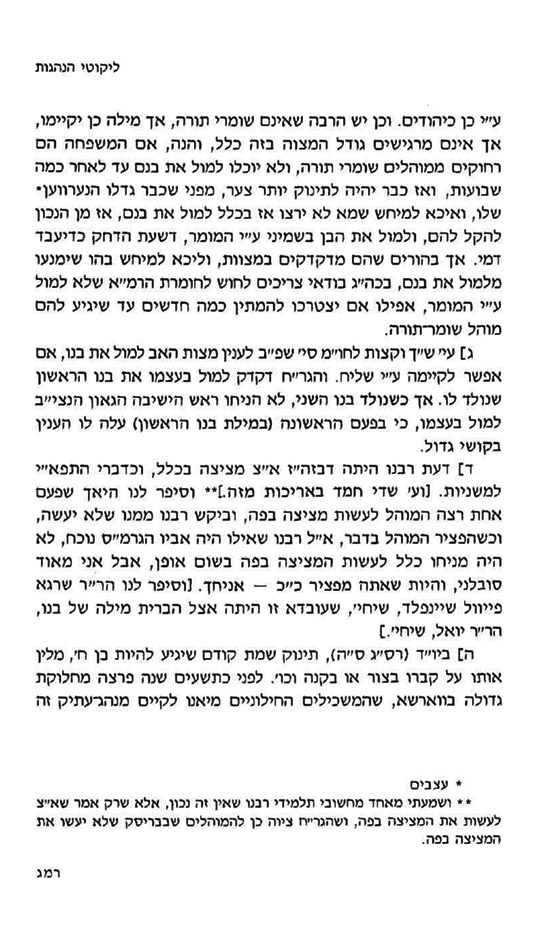
Every Yom Tov we celebrate has different questions relating to it which become famous and are discussed from all different angles. Chanukah too has its share of famous questions. In this post I would like to deal with one such question which is famous but the answers are mostly not. The question is why is there no special Meshecta devoted to Chanukah as opposed to all other Yom Tovim [1]. Over the years many answers have been given some based on hassidus, others based on machshava, and still others in a kabablistic vein [2]. In this post I will try to discuss a few different approaches to answer the question. In dealing with this question I will touch on some other topics amongst them what is Megilat Taanis, when was it written, and what Rabbenu Hakodesh did in regard to the writing of the Mishna.   One of the answers given to this question of why there is no Mishna on Chanuka is based on the famous Rambam who writes:

אבל דיני הציצית והתפלין והמזוזות וסדר עשייתן והברכות הראויות להן וכן הדינים השייכים לכך והשאלות שנתעוררו בהן אין ממטרת חבורנו לדבר בכך לפי שאנחנו מפרשים והרי המשנה לא קבעה למצות אלו דברים מיוחדים הכוללים את כל משפטיהם כדי שנפרשם, וטעם הדבר לדעתי פרסומן בזמן חבור המשנה, ושהם היו דברים מפורסמים רגילים אצל ההמונים והיחידים לא נעלם ענינם מאף אחד, ולפיכך לא היה מקום לדעתו לדבר בהם, כשם שלא קבע סדר התפלה כלומר נוסחה וסדר מנוי שליח צבור מחמת פרסומו של דבר, לפי שלא חסר סדור אלא חבר ספר דינים

(פירוש המשנה, מנחות פרק ד משנה א).

Thus, according to the Rambam, things that are well known were not required to be mentioned in the Mishna.  There are those who posit that this rationale applies to Chanukah.  That is, Chanukah was also well known that’s why it was not necessary to be written. [3] [Regarding the Rambam’s comments in general see R. Reuven Margolis in Yesod Hamishna Vearichasa pp. 22-23].   The problem with this answer would be best illustrated with R. Yakov Shor’s comments on this statement of the Rambam. [See R. Y. Shor, Mishnas Ya’akov Jerusalem:1990; 33-34]. R. Shor questions the entire premise of the Rambam that the laws and details of teffilin were well known when these mitzvot are very complicated with many details.  Indeed, they are arguably much more complex than kriyat Shema which does have its own mesechtah. To answer this, R. Shor suggests that there was a Mesectah Soferim devoted to the laws of teffilin – this is lost but forms the basis of our Mesectah Sofrim which we have today.   With this introduction we can perhaps understand the following answers to the question about Chanukah, of which the assumption is there was a Mescatas Chanukah but has been lost.   The Rishonim refer to “Seven Minor Meschetot,” however, the earlier Achronim did not have these Meschetot.  Today, we do have “Seven Meschetot,” although as we shall see not all agree that these are the same that the Rishonim had.  During the period these Meschetot were unknown there was some speculation as to what they contained.  R. Avraham Ben HaGra quotes his father about which were the titles of the שבע מסכות  אמנם שמעתי מאדוני אבי הגאון נר”ו שהשבע מסכות קטנות המה חוץ מאשר נמצא לנו והן מסכת תפלין ומסכת חנוכה ומסי’ מזוזה.

(רב ופעלים, הקדמה דף ח ע”א)

He repeats this in his introduction to Medrash Aggadah Bereshis (see also Yeshurun 4:228).   We see that the Gra held that there was a Mesechet titled Chanukah. Now as far as we know today none of the seven Meschetot are about Chanukah. [4]But it could very well be there was such a Mesechet which was lost.  R. David Luria (Radal) [5] assumes as much and uses this assumption to understand the Teshuvos Hageonim which states:

ובא אלינו איש חכם וחסיד זקן ודרש בישיבה כתיב ופן תשא עיניך השמימה וראית את השמש זה נדר ואת הירח זו שבועה… וסדר משנה תוספת על סדרי שלנו ראינו בידו שהיה מביא ולא זכינו להעתיק שסבתו גדולה ונחפז ללכת ואתם אחינו הזהרו בענין זה וטוב לכם.

(שערי תשובה, סימן קמג)

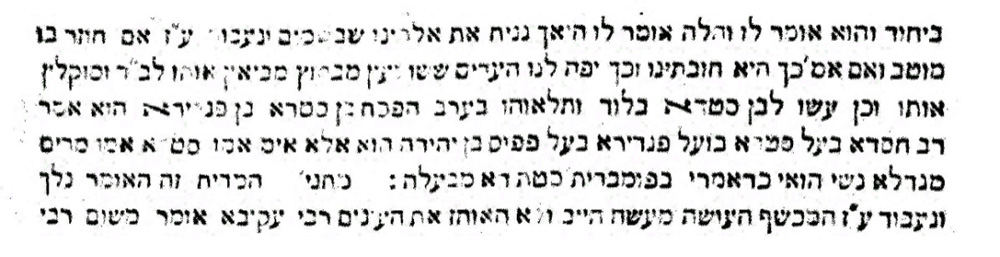
That is, this Geonic statement evidences additional Meschetot that are no longer extant.A different answer given by many [6] is that the reason why Rebbe did not have a whole Mesechet about Chanukah was because there was one already Megilat Tannis!   The Pirish ha-Eshel on Megilat Tannis (p. 58) wants to suggest that the Gra did not mean that there was a Mesechet titled Chanukah.  Instead, the Gra mean to reference Megilat Tannis.  Indeed, in earlier printings of the Shas it was included with the Meschetot Ketanyot. [7]   Whether or not the Gra meant Megilat Tannis many do say that Megilat Tannis is really Mesechet Chanukah as the most important chapter and lengthy entry is about Chanukah and therefore the question why Rebbi did not include a Meschet about Chanukah was simply because there was one already – Megilat Tannis.    This answer was backed up with a statement found in the Behag which says:

זקני בית שמאי ובית הלל,… והם כתבו מגילת תעניות

The problem with this answer is that while Megilat Tannis is our earliest written text (besides for Pirkei De-Reb Eliezer, see Radal’s introduction to his edition of the Pirkei De-Reb Eliezer) dating from much before our Mishnayot, Migilat Tannis contains significant additions from a later time. To clarify, in the standard Megilat Tannis there are two parts one written in Aramaic which are various fast days and one part written in Hebrew which includes a lengthier description of the topic. The Mahritz Chiyus and Radal say that the Aramaic part was written very early when it was not permissible to really write Torah Shel Bal Peh but at a later point when it was permitted to write than the Hebrew parts were added. Mahritz Chiyus says it was after the era of Rabenu Hakodesh. Earlier than him R. Yakov Emden writes in his introduction to his notes on MT that it was completed at the end of the era of the Tanaaim. Now, the bulk of the discussion regarding Chanukah that appears in MT is in the Hebrew part. Thus, historically, it doesn’t make sense that Rebbi did not include Chanukah in the Mishna because of sections of MT that had yet to be written.Indeed, the Gedolim who first suggested that MT is the reason why Rabbenu Hakodesh did not include it in Mishnayois were not aware of this point that it was written at two different time periods. However R. D. Horowitz in an article in Haples turns the historical difficultly on its head when he argues that the person who wrote those Hebrew parts was Rabbenu Hakodesh. [8] In fact, in one of the editions of Megilat Tannis it says on the Shar Blat Megilat Tannis which is Mesechet Chanukah (the original edition with the Pirush ha-Eshel). The problem with R. Horowitz point is that it seems most likely that it was later than Rabbenu Hakodesh.[9]

Another answer in the same vein as above was suggested by R. Schick (Torah Shleimah 3:156a).  R. Schik argues that there was a Sefer Hashmonaim which recorded the nissim etc written by Shamei and Hillel and therefore there was no separate Mishna. This seems to be based on the quote (quoted partially earlier) mentioned from the Behag which says:

זקני בית שמאי ובית הלל, הם כתבו מגלית בית חשמונאי

Others say this might be a reference to Sefer Makabeyium or Megilat Antiyucus. However although it is likely what we have is from early times but it is not clear at all how early it is from. [See Radal in his introduction to Pirkei De Reb Eliezer, Binu Shnos Dor Vedor, pp. 121-150; N. Fried in Minhaghei Yisroel, vol. 5, pp. 102-20; Areshet vol.4 p. 166; Y. Tabori, Moadei Yisroel Betekufos Hamishna Vehatalmud, p. 390; Moadim le-Simcha p. 253-265, and Hasmonai U-Banav p. 21].

Just for its bibliographical purpose in truth there is a book bearing the title Mesechet Chanukah but it was written in a parody form similar to Mesechet Purim of R. Klonymus the manuscript was printed in Areshet (3:182-191) [See also I. Davidson in Parody in Jewish Literature pg 39].  One of the things we see from this parody is the widespread custom of playing cards on Chanukah.     There is a interesting unknown correspondence on this topic between the Aderes and R. Yakov Kahana (Shut Toldos Yakov, Siman 29) about the topic of a Mesechet Chanukah.  The Aderes wrote to R. Kahana:

ומה שתמה על הש”ס למה לא הביאו האי בבא דמגילת תעניות גם אנכי הערתי בזה ומצאתי תמי’ זו בהגהת הרצ”ה חיות ז”ל ובימי עולמו כתבתי מזה בס”ד ולא אדע אנה. ואשר התפלא מדוע לא נמצא הא דחנוכה בירושלמי באמת גם במשנה לא נמצא אולם בסוף פ”ו דב”ק שם נמצא וגם מעט בירושלמי בשלהי תרומות. ואנכי מתפלא מאד דגם מצות כתיבת ספר תורה לא נמצא במשנה…

R. Yakov Kahana wrote a lengthy response.  He explained that it does not bother him that the Mishana does not mention this story of Chanukah from MT as the Bavli does not mention any of the incidences in MT. He is more bothered by the omission of the Yerushalmi of this story as the Yerushlmi does mention other incidences of MT.  As to writing a sefer Torah not being mentioned in the Mishana R. Kahana  gives a lengthy list of all the Mitzvos that are not discussed in the Mishna (and the list is long).     L. Ginsburg (Ginzei Schechter 2:476) writes :

וראוי להעיר שבתלמוד ארץ ישראל כמעט לא נזכרו דיני חנוכה כלל לא בדברי התנאים ולא בדברי האמוראים ורק בבבל שעובדי האש גזרו על מצוה זו וככל מצוה שמסרו ישראל נפשם עליה נתחזקה מאד בידיהם…

Another answer based on historical information is from the Edos Beyosef (2:15) who quotes the following Yerushalmi which says:

בימי טרוגיינוס הרשע נולד לו בן בתשעה באב והיו מתענין מתה בתו בחנוכה והדליקו נירות שלחה אשתו ואמרה לו עד שאת מכבש את הברבריים בוא וכבוש את היהודים שמרדו בך חשב מיתי לעשרה יומין ואתא לחמשה אתא ואשכחון עסיקין באורייתא בפסוקא ישא עליך גוי מרחוק מקצה הארץ וגומ’ אמר לון מה מה הויתון עסיקין אמרון ליה הכין וכן אמר לון ההוא גברא הוא דחשב מיתי לעשרה יומין ואתא לחמשה והקיפן ליגיונות והרגן אמר לנשיהן נשמעות אתם לליגיונותי ואין אני הורג אתכם אמרון ליה מה דעבדת בארעייא עביד בעילייא ועירב דמן בדמן והלך הדם בים עד קיפרוס באותה השעה נגדעה קרן ישראל ועוד אינה עתידה לחזור למקומה עד שיבוא בן דוד

(תלמוד ירושלמי, סוכה, פרק ה)

Based on this he [10] writes:

וכתיבת דיני נר חנוכה יש בה פירסום יותר מהדלקה מפני שהדלקה היא בבתי ישראל בזמן מועט חי’ ימים בשנה חצי שעה בכלל לילה ואפ’ זה סמיה בידן להדליק בפנים אם יש חשש סכנה אבל דבר בכתב קיים כל הימים ומתפשט בעולם על ידי כל אדם המעתיקם כל מה שרוצה… ומפני זה השמיט רבי כתיבת דיני חנוכה..

Another answer based on historical information is from R. Yeshouyah Preil in Eglei Tal who writes (pp. 17-18)

כי הנה אנדריונוס קיסר אחרי הכניעו את המורדים בביתר שפך כאש חמתו על כל ישראל וישבת חגם, חרשם ושבתם כי גזר על שבת ויום טוב מלה ונדה וכיוצא בו, אולם בימי המלך הבא אחריו אנטוניוס פיוס ידידו של רבי רוח לישראל כמעט, אך כנראה לא השיב את גזרת ההולך לפניו בדבר חנוכה, כי באמת יקשה גם על מלך חסיד כמוהו להניח חג לאומי כזה לעם אשר זה מעט הערה למות נפשו ואך בעמל רב נגרע קרנו זה שנות מספר, ועל כן לא היה יכול רבינו הקדוש נשיא ישראל לדבר בזה בפומי

R. Reven Margolis [11] has a very interesting answer to this question:

ובכן כאשר תלמי המלך בזמנו צוה להעתיק לו התורה שבכתב לידע מה כתיב בה כן התענייה הנציבות לידע תוכן התורה שבעל פה … דרישה כזאת היא אשר יכלה להמריץ את נשיא ישראל להתעודד ולערוך בספר גלוי לכל העמים תורת היהודים וקבלתם יסודי התורה שבעל פה להתודע ולהגלות שאין בה הטחת דברים נגד כל אומה ולשון ולא כל תעודה מדינית. ואחר אשר חשב רבי שספרו יבוקר מאנשי מדע העומדים מחוץ ליהודת שיחרצו עליו משפטם לפני כס הממשלה המרכזית ברומא. נבין למה השמיט ממשנתו דברים חשובים עקרים בתורת ישראל … כן לא שנה ענין חנוכה והלכותיה במשנה, בעוד אשר להלכות פורים קבע מסכת מיוחדת, שזהו לאשר כל כאלו היו למרות רוח הרומיים שחשבום כענינים פוליטיים חגיגת הנצחון הלאומי ותוקת חפשיותו.

R. Alexander Moshe Lapidos answers:

לא נכתבה מגילת חנוכה, לפי שנתקנה להורות תוקף תורה שבעל פה, ותולדתיה כיוצא שלא נכתבה… חנוכה המורה על תורה שבעל פה ע”כ לא ניתנה להכתב…
(תורת הגאון רבי אלכסנדר משה, עמ’ רנו).

Another answer given by R. Alexander Moshe Lapidos [12]:    דבקושי התירו לכתוב תורה שבעל פה והיו פסקי פסקי. מתחלה סתימת המשנה בימי רבנו הקדוש. ואחר זה בימי רבינא ורב אשי חתימת התלמוד, והשאר היו נוהגין במגלת סתרים עד שלאחר זה הותר לגמרי לפרסם בכתב כל מה שתלמיד ותיק מחדש. ורבנו הקדוש לא הרשה רק מה שהוא לפירוש לתורה שבעל פה ומה שיש לו סמך בכתוב, או מה שהוא לסייג, כמו הלל וברכות, ערובין, נטילת ידים, נר שבת ומגלה (מחיית עמלק). אבל חנוכה שאיננו לא פירוש ואין לו סמך בכתוב, ולא לסייג, לא היה נהוג רק במגלת סתרים בבריתות דר”ח ור”א… רק נרמזה במשנה ב”ק סוף פ”ו ואחריה הורשה לפרסם בכתב בתלמוד.

An interesting addition to this could be based on R. Shlomo Zalman Auerbach [13] who said:

 יש להבין אם מצוה זו כ”כ חביבה היא לנו, כמו שכתב הרמב”ם שמצוה חביבה היא עד מאד, למה באמת לא ניתנה ליכתב, אולם עיקר כריתת ברית שכרת הקב”ה עם ישראל הוא רק בעבור תורה שבעל פה כמו שכתב בגיטין ס’ ע”ב ומשום כך הואיל ומלכות יון הרשעה רצתה שלא יהי’ לנו ח”ו חלק באלקי ישראל, לכן נתחבבה מצוה זו ביותר שנשארה כולה תורה שבעל פה אשר רק על ידי תורה שבעל פה איכא כריתת ברית בינינו ובין ה’ ולכן אפילו במשניות לא נזכר כלל דיני חנוכה וכל ענין חנוכה כי אם במקומות אחדים בדרך רמז בעלמא.

R. Dov Berish Askenazi writes:

ולכן לא נכתב נס חנוכה בכתבי קודש רק הוא מקובל לנו מאבותינו הקדושים שכל עצמו של אותו נס לא בא רק להורות על אמתת הקבלה אשר מורשה היא לנו איש מפי איש עד משה רבינו מסיני…
(נודע בשערים, דף קי ע”ב).

Another answer suggested by R. Chanoch Ehrentreu [14]is that:

שגוף המשנה על חלקיה העיקריים הוא מעשה אנשי כנסת הגדולה… לאחר ימי אנשי כנסת הגדולה השלימו תנאים במקום שהיה טעון השלמה והוסיפו בשעה שנזקקו להוסיף, וחלקו על פירושה של משנה ראשונה וגם מסרו מחלוקות אלה לדורות. אך המשנה עצמה עתיקה מהלכות חנוכה. לכן ברור שתנאים שנו הלכות בענין חנוכה ונר חנוכה, אך כיון שכבר לא נמצא להם מקום בגוף המשנה נאספו אלה בברייתות.

This answer is assuming that there were parts of the Mishna that existed earlier than Rebbe and he was just an editor, this leads us to the next explanation.One of the most famous answers given to this question was by the Chassam Sofer who is quoted to have said:

מרגלא בפומי’ כי נס חנוכה לא נזכר כלל במשנה ואמר טעמו כי רבנו הקדוש מסדר המשנה הי’ מזרע דוד המלך ונס חנוכה נעשה על ידי חשמונאים שתפסו המלוכה ולא היה מזרע דוד וזה הרע לרבנו הקדוש ובכתבו המשנה על פי רוח הקודש נשמט הנס מחיבורו (חוט המשולש, דף נ ע”א).

Others bring this answer without saying a source [15]. This statement generated much controversy where many went so far as to deny that the Chasam Sofer said such a thing.[16] The bulk of the issues with this answer were dealt with by R. Moshe Zvi Neriah in an excellent article on the topic [17]. The most obvious being that Chanukah is mentioned in the Mishnah a few times the question is just why there isn’t a complete mesectah devoted to it.  The explanation in the Chasam Sofer seems to be based in part on the Ramban (not everyone agrees to this Ramban [18]) who writes:

זה היה עונש החשמונאים שמלכו בבית שני, כי היו חסידי עליון, ואלמלא הם נשתכחו התורה והמצות מישראל, ואף על פי כן נענשו עונש גדול, כי ארבעת בני חשמונאי הזקן החסידים המולכים זה אחר זה עם כל גבורתם והצלחתם נפלו ביד אויביהם בחרב. והגיע העונש בסוף למה שאמרו רז”ל (ב”ב ג ב) כל מאן דאמר מבית חשמונאי קאתינא עבדא הוא, שנכרתו כלם בעון הזה. ואף על פי שהיה בזרע שמעון עונש מן הצדוקים, אבל כל זרע מתתיה חשמונאי הצדיק לא עברו אלא בעבור זה שמלכו ולא היו מזרע יהודה ומבית דוד, והסירו השבט והמחוקק לגמרי, והיה עונשם מדה כנגד מדה, שהמשיל הקדוש ברוך הוא עליהם את עבדיהם והם הכריתום: ואפשר גם כן שהיה עליהם חטא במלכותם מפני שהיו כהנים ונצטוו (במדבר יח ז) תשמרו את כהונתכם לכל דבר המזבח ולמבית לפרכת ועבדתם עבודת מתנה אתן את כהונתכם, ולא היה להם למלוך רק לעבוד את עבודת ה’: (בראשית מט,י)

R. Weinberger [19]says that what the Chasam Sofer meant was:

 דגם זה עשה רבינו הקדוש לשם שמים כמו דכל מעשיו היו לשם שמים, כלומר מאחר דחשמונאים דעל ידיהם נעשה הנס, והמה עי”ז עשו שתפסו המלוכה מזרע דוד, ולהכי לא הזכירם במשנה ולא מחמת כבודו וכבוד בית אבותיו.

Interestingly enough the Chasam Sofer in his Chidushim on Gittin (78a) writes:

ואל תתמה שהרי בשום מקום במשנה לא נזכר שיניח אדם תפלין… ולא תנן חייב אדם להדליק נר חנוכה אל גץ… ונר חנוכה גופא היכי הוזכר במשנה אלא רגילים הי’ בכך ולא הזכיר…

Whether the Chasam Sofer did say it or not we have testimony from a reliable source that another godol said it as is recorded by Chasdei Avos [20]who is citing the Chidushei Harim:

דבשביל שהי’ לבם של בית הנשיא מרה על החשמונאים, שנטלו מהם המלוכה, והוא נגד התורה דלא יסור משבט יהודה, כמו שכתב ברמב”ן ויחי, לכן לא הזכיר רבנו הקדוש דיני חנוכה במשנה.

This explanation of the Chasam Sofer (nothing to do with him saying it) was the accepted explanation in most of academic literature for many years  as to why the Mishna omits the story of Chanukah. A while back G. Alon wrote a now classic article proving that this was not true at all. A little later on S. Safrai backed this up. They both showed that there is positive mention of the Chasmonim in Halacha.[21] To conclude this recently a very through and important article was written on the topic by M. Benovitz  printed in Torah Lishmah (pg 39-78) showing how the Yom Tov of Chanukah developed over time. But due to lack of time I can not discuss what he says. [Thanks to M.M. Honig for this source]. This whole issue was a small part of a famous debate started a while back. In 1891, Chaim Slonimski wrote a short article in Hazefirah (issue #278) questioning why there is no mention in Sefer Hasmonaim and Josephus of the miracle of the oil lasting eight days. Furthermore, he questioned why the Rambam omits the miracle of the oil when detailing the miracles of Chanukah. [The truth is this general question was raised much earlier by the Meor Eynayim (ch. 51, p. 429)] As can be expected this article generated many responses in the various papers and journals of the time and even a few seforim. A little later while defending his original article Slonimski wrote:

וכל דיני הלכות חנוכה לא מצינו בדברי בעל המשנה רק מן האמוראים שגמרא שבת…

R. Ginsberg in his Emunat Chachimim (pg 4a-4b) already points out that it is mentioned in Baba Kama. But I think his point was more about sefer Chashmonim and Yosefin. R. Lipshitz in Derech Emunah defended this based on MT as quoted above. R. Y. Sapir (Nes Pach Shel Shemen, pg 30) also wrote such a defense. But Slonimski said that the MT is a late addition.[22]


Notes: *I would like to thank to Professor Spiegel, M.M. Honig and Dan Rabinowitz for their help with this post.

[1] Chanukah is mentioned a few times in Mishnayos but the issue here is why isn’t there a whole Mesechet devoted to it. See Machnayim 34:81-86 [See Tifres Yeruchem pg 60, 414]. As an aside, in the Zohar there is also no mention of Chanukah see Tifres Zvi (3:397,465) and R. Yakov Chaim Sofer in Beis Aron ve-Yisroel (18:2, pg 110) and his Menuchos Shelomo (11: 43). [2] Chasidus sources: see Bnei Yissaschar , Ohev Yisroel and Moadim le-Simcha p. 38. For machashava sources see Sifsei Chaim (2:131); Pachad Yitzchak (pp. 29-32); Alei Tamar (Megilah p. 87); R. Munk, Shut Pas Sadecha, (introduction, p. 7). As to Kabblah the Yad Neman writes (p. 2b) that when he met R. Dovid Pardo author of the classic work on Toseffta Chasdei Dovid he told him a reason based on kabblah.     [3] The earliest sources who says this answer is R. Hayyim Abraham Miridna, Yad Neman, Solonika, 1804, p. 2b.  Subsequently, many others give this answer (all on their own) such as the Mahritz Chiyus (Toras Haneviyim p. 105), R. Yakov Reiffmann (Knesses Hagedolah (3:90)), Pirish ha-Eshel on Megilat Tannis (p. 58b) Beis Naftoli son (#28), Yad Yitchach (#295) R. Hershovitz in Minhagei Yeshurun (pg 48) Dorot Harishonim (4:46a) [see also R. Eliyhu Schleiseinger in Moriah (25:123) and in his Ner Ish Ubeso pg 338-339].  [4] See Heiger in his introduction to Mesechtot Ketanot p. 6 and M. Lerner in The Literature of the Sages volume one pg 400-403 (thanks to P. Roth for this source).    [5] Radal notes to Midrash Rabbah Emor (22:1). See R. Nachman Greenspan, Pilpulah Shel Torah p. 60 and his Melechet Machshevet p. 6. See also the Radal’s comments in Kadmus Hazohar at the end of section two;  R. Dovid Hoffman, Mishnah ha-Rishonah, pp.12-13;Yesod Hamishna ve-Arechsa  p. 29 (and nt.15) & 17.  [6] The earliest source who says this is R. Yosef Hayyim ben Siman, Edos Beyosef, Livorno, 1800 (2:15). The Chida quotes this explanation in his dershos Devarim Achadim (derush 32) R. Lipshitz in Derech Emunah p. 24 also provides this explanation.  [7] Pirush ha-Eshel p. 58 see also his introduction to MT. The piece on pg 58 is not found in the new Oz Vehadar edition as the Pirish Haeshel was printed only partially see this post. It would appear that the Gra held there was a real meschatah called Chanukah like the Radal seems to understand him as his great nephew brings in his introduction to his work on Avos Beis Avos writes:   ואמר לי איך ששמע מדו”ז הגאון מו”ה אלי’ ז”ל שהיו כמה וכמה מסכות על המדות כמו מסכתא ענוה ומסכתא בטחון וכדומה רק שנאבדה ממנו.   [8] Mahritz Chiyus, vol. 1, pp. 153-54; Radal, Kadmus Hazohar, p. 269.  Haples vol. one pg. 182[9] The time period of the MT and the two versions (and the nature of the work in general) have been discussed by many just to cite some of the important sources: see Y. Tabori, Moadei Yisroel Betekufos Hamishna Vehatalmud, pp. 307-22; Yesod Hamishna ve-Arechsa , p. 12 & n.26, p. 20 ;R. N. D. Rabanowitz, Beno Shnos Dor Vedor, pp. 28-46; V. Noam in The Literature of the Sages volume two, pp. 339-62; see also the introduction to her excellent edition of Megilat Tanit. See the nice introduction to the Oz Vehadar edtion of MT. See also M. Bar Ilan, Sinai 98 (1986) pp. 114-37. See also the important points in Yechusei Tanaim ve-Amorim (Maimon edition) pp. 398-399.  [10] R.Y. Buczvah in Shut Beis Halachmei (#4) does not like this answer as than other yom tovim also should not be included. Regarding this Yerushalim, see: Yesod Hamishna ve-Arechsa p.22 nt.5; Ali Tamar, Sukkah p. 152; Y. Tabori, Moadei  Yisroel be-Tekufat ha-Mishna ve-HaTalmud, p. 373; Tzit Eliezer, 19:26.  [11] Yesod Hamishna ve-Arechsa pp. 21-22. See also R. Freidman in Machanayim 16:12 and R. M. Cohen in Machanayim 37:43. [12] This answer is brought by R. Yakov Reiffmann in Knesses Hagedolah (3:90) where he brings that R. Alexander Moshe Lapidos wrote this answer to him. This is historically interesting as it shows that there was a connection between the two even though he was a known maskil (for more on R. Yakov Reiffmann ties with Litvish Gedoilm see here ). As an aside this piece of R. Alexander Moshe Lapidos is omitted from the otherwise excellent, recently printed, collection of all of R. Alexander Moshe Lapidos Torah in Torat Hagoan Reb Alexander Moshe.  A similar idea to this is found in Tifres Zvi (3:465). [13] Halechot Shlomo (p. 306 n.42). See also Shalmei Moed p. 254.[14] Iyunim B’divrei Chazal Ubileshonam pg 117. This explanation and this whole issue in general gets involved with the famous discussion of what was Rebbe’s role in the writing of the Mishna. Just to list a few basic sources on the topic see:R. Dovid Hoffman, Mishnah ha-Rishonah; Y.N. Epstein, Movo le-Nussach ha-Mishnah, 2: 692-706; C. Elback Movo le-Mishna pg 99-116; R. Margolis Yesod Hamishna ve-Arechsa pp.59-64. See also the excellent doctorate of C. Gafni, The Emergence of Critical Scholarship on Rabbinic Literature in the Nineteenth-Century:Social and Ideological Contexts, pp. 41-111. [15] Shut Beis Naftoli (# 28); Machanyim issue # 17:11. [16] See Mishmar Halevi (Chagigah #46-47) and Or Torah (1991 p. 156) Zikhronos u-Mesoros Al ha-Chasam Sofer pp. 13-14; Otzros ha-Sofer (10:96); Hasmonai u-Banov pp. 111-12. This is dependent on another general topic about the credibility of the sefer Chut ha-Meshulash see the excellent introduction of R. B. Hamburger to his Zikhronos u-Mesoros Al ha-Chasam Sofer where he shows that Chut haMeshulash is an authentic and reliable sefer. In the recent sefer Me-pehem (p. 171) they reproduce a passge from the Chatam Sofer’s daughter against the Chut ha-Meshulash: דע לך כי מה שכתוב הרב ר’ שלמה סופר, רבה של בערעגסאס בספרו חוט המשולש על אבא שלי זה מלא הגוזמות.[17] Shana Be-shanah 1988 (pp. 159-68). It was than included in his Tznif Melucha pg 177- 182.  R. Yona Metzger brings most of this piece in his Mayim Halacha (siman 111) [Thanks to my friend Yisroel Tzvi Ickovitz for this source]. R. Freund in Moadim Lisimcha relied heavily on this article of R. Neriah as he drops a hint in middle of his piece on this topic (p. 34 n.74). It seems that R. Neriah was not aware that it was in the Chut ha-Meshulash as he cites only to the Ta’emi ha-Minhagaim (p. 365).  [18] For some sources see Yad Neman (p. 2b); Tzitz Eliezer (19:26),  R. Yakov Kamenetsky, Emes le-Yakov pp. 239-40, 271-73 and Chasmonai U-Banav pp.106-113.  [19] Shut MaHaryitz (#78) interestingly R. B. Hamburger quotes this in his Zichronis u-Mesoros Al ha-Chasam Sofer pg 14 but attributes this incorrectly to R. Dushintsky.  [20] Chasdei Avos (#17). In general on this passage from the Chasdei Avos see Benu Shneos Dor Vedor pg 52-71.[21] G. Alon, Mechkarim Betoldos Yisroel, 1:15-25; S. Safrai, Machanyim issue # 37 p. 51-58; M. Cohen, Machanyim issue #37 p. 43; Ben Zion Luria, in his introduction to his edition of MT p.20-32. See also  Y. Tabori, Moedei Yisroel Betekufos Hamishna Vehatalmud, pp.372-373.[22] This controversy generated much discussion. See the article in Sinai, 100:202-09. Amongst those who responded about this was R. Alexander Moshe Lapidos printed in Torat Hagoan Reb Alexander Moshe p. 456-58. A very sharp response against Slonimski was written by R. Yakov Reiffmann, printed from manuscript by M. Hershkowitz in Or Hamizrach (18:93-101). Hershkowitz wrote a bibliography on the topic which, unfortunately the editors Or Hamizrach did not include and, to the best of my knowledge, was never printed. A response (from manuscript) on the topic from the Aderes was printed where he wrote to his friend R. Reiffmann after seeing Reifmann’s response here  הנני למלא רצונו להגיד לו דעתי על מאמרו הערות בעניני חנוכה, כי כל דבריו כנים ונאמנו בדבר הזה הייתי בר מזלי’, וחלילה לעלות על הדעת כי הרמב”ם לא האמין כלל בגוף נס השמן, וראיותיו צודקות ונאמנות, והחושב על הכהנים מחשבת פיגול במומו פוסל, כפי שידענו מן התורה נביאים וכתובים היו הכהנים העומדים בראש כל ישראל ומהם יצאה תורה לכל העם כולו והם הם שהיו המורים והשופטיםובכל זאת עליהם היו ממונים סנהדרין גדולה ששפטה אותם, ושטות ואולת גדולה לחשוב מה שכתב פלוני על אודות החשמונאים, והיא רק שיחה קלה להשיב לקלי דעת המאמינים לכל דבר ולא לתורתינו ועבדי’ חכמי התלמוד הנאמנים לד’ ולתורתו, אין ספק שמידי מעתיקי הרמב”ם בא אשמת החסרון בדבריו, ואין לדון מאומה מדברי ידידי מעכ”ת שי’ שהר”מ ז”ל האמין בלבבו הטהורה פשוטו כמשמעו, ככל המון בית ישראל, כפשטות ד’ הגמ’, וחלילה לנו להשליך דברי אלקים חיים מבעלי התלמוד אשר מימיהם אנו שותים אחרי גיוינו ולנוע אחרי ספרים חיצונים אשר לא בא זכרם בתלמוד הקדוש ומוקדש קודש הקדשים, ואין המאמר שוה להפסיד העת בבקורתו ילך לו בעל המאמר בשיטתו ואנחנו בשם אלקינו ועבדיו נזכיר אנחנו ובנינו אותו נעבוד כל ימינו לטוב לנו סלה”.


Rabbis &amp: History A Review of the Koreh HaDorot, Ahavat Shalom ed

Rabbis & History: A Review of the Koreh HaDorot, Ahavat Shalom ed. by Eliezer Brodt  This is the first post in what I hope to be a series on various attitudes towards studying history.  The prism through which we will examine this issue is that of the many works written by gedolim discussing history.  The subject of this post is a new edition of the classic work Koreh Hadoros (KH) by R. Dovid Conforte (printed recently by Ahavat Sholom).  After discussing the actual sefer and its author,  I will conclude with a few comments about this recently printed edition.   R. Conforte was born in Salonika around 1617 and died sometime after 1678. Throughout his life he traveled to many places (including Eretz Yisroel), and in KH he describes his meetings with many great personalities, including R. Menachem Lonzano, author of Sheti Yadot, and R. Hayyim Benevisti, author of the Keneset Hagedolah. As he enumerates throughout the book, R. Conforte studied with R. Moredcahi Kalai and many others (see, for example, pg. 163, 175, 176, 179; all page references are to the new edition).  At times he also emphasizes with whom and when he studied Kabalah (pg. 172-73), which he started to learn at the young age of seventeen (p. 150). He seemed to have authored a few other works, most of which are lost. Recently, a responsum of his was printed in the journal Yeshurun (vol. 7, pg. 55ff). [In that article, the authors write of a plan to collect all R. Conforte's torah as well as to reprint the KH]. In Sinai (28:279-295), R. Toledano published a manuscript called Zikhron Yerushalim about gravesites in Eretz Yisroel, which the author proves was written by R. Conforte.   The KH is one of the most famous historical works written by a talmid chacham and continues to be studied to this day. This sefer was printed a few times (once even under a mistaken name –  see R. M. Strashun, Mivchar Kesavim, p. 240), and remains very popular amongst gedolim and scholars alike. Most notably, the Chida quotes this work extensively in all his seforim (as an aside, it's rather strange that his entry on R. Conforte in Shem Hagedolim is very small and uninformative). Indeed, when, many years ago, R. Meshulam Roth created a curriculum for his yeshiva, he included the Koreh Hadoros as an essential sefer for his talmidim to read (among other interesting things in the program; see Mivasar Ezra, pg. 176, and Mivasar Vomer, pg. 119); R. Meir Shapira even asked R. Roth if he could use the latter's curriculum for Yeshivat Chachemei Lublin (see Mivasar Ezra, pg. 172).  Even today scholars use this work extensively; check the index of almost any of the works of Meir Benayhu and one can see how often he quotes the KH.    KH begins with the era of the Rabbonan Savorei ("Saboraim"), continues with the geonic period and the rishonim, and ends with R. Confotre's own generation, in total covering a period of a few hundred years. The idea of this work is to list the different gedolim from each period and include basic information about them, such as when they were born and died, with whom they stiudied, and what they wrote. At times the KH includes a more lengthy entry on a specific person. Much of this information, especially that of R. Conforte's own period, is very important,  as we have no other such sources for it.  Much of the other material is taken from other classic "history" works, as R. Conforte himself notes (e.g. Igerres R. Shreriah Goan, Sefer Hakablah l'Ha'Ra'avad, Sahlsheles Hakablah, and Sefer Yuchsin, all of which will hopefully be subjects of their own posts in the future); yet, though R. Conforte uses these works extensively, he will at times disagree with these works. One work which, for some unknown reason, R. Conforte does not use, and which R. D. Kassel already pointed out, is the Zemach Dovid, obvious from the fact that the section on Askenaz achronim is quite weak. Finally, throughout the sefer he quotes many interesting things he heard from purportedly reliable sources, rare seforim, and manuscripts which he saw. In the recent Ahavat Sholom edition, they discuss about fifty such works which R. Conforte mentions. Indeed, Koreh HaDoros shows an incredible bikiyut in shas, rishonim, and achronim (and all of this in the pre-Bar-Ilan days!).   In 1842, D. Kassel printed an annotated version of KH. Though he included many short notes on various points in the sefer, his additions included nothing extensive. Among the reasons Kassel provides for this is that he was told Leopold Zunz was working on his own edition.  However, Zunz never ended up publishing his own edition and, as such, Kassel's edition, which still left room for much work, became the standard edition. More recently, this sefer was reprinted by Ahavat Sholom. One of the benefits of the Ahavat Shalom edition is that it collects all the Chida's comments on the sefer (scattered throughout his writings) and prints it here in the proper places. The truth is that Kassel already references when and where the Chida discusses particular points in KH; still, the Kassel edition only includes citations to the Chida's works without reproducing what the Chida says.  The Ahavat Shalom edition, on the other hand, includes the full text of the Chida's relevant comments. To be sure, even a cursory Bar-Ilan project search shows that the Ahavat Shalom edition missed a few of the Chida's comments, and I am sure that this is true of the many other seforim of the Chida not included the in the Bar-Ilan database.  Another plus of their edition are the indexes, which are very extensive- over a hundred pages (which include every time any sefer or name is mentioned)! Finally, the edition also has a retyped set,  making the sefer  more readable and clearly marking paragraph and topic breaks. They were also kind enough to reference pages numbers of the first edition, a useflul tool in tracking down quotes from the original edition. Another positive aspect of this edition is a very thoroughly researched introduction about the author and the sefer. The Ahavat Shalom printing includes an entire section devoted to many of the manuscripts and seforim that R. Conforte may have seen (discussing what happened with the seforim if they were printed since then, etc.). Just to point out some additions to their discussion: The KH mentions a sefer from R. Yisroel Nigra which is a collection of his derashos called Mikveh Yisroel. They write (p. 35) that it exists in many manuscripts and that one derasha was printed already in Yeshrun (10:134). The truth is that this manuscript was printed partially in the early 1900s, but, more recently, S. Regev printed all the dershos (Bar Ilan Press, 2004) in a critical edition (675 pgs.), including an excellent introduction to the work Interestingly, R. Y. Goldhaver seems not to have been aware of this edition as he only quotes the manuscript (see his Minhaghei Hakehilos, 1:287). Another sefer that the KH mentions, also authored by R. Yisroel Nigra, is Sheris Yisroel, which is a collection of Nigra's songs. In the Ahavat Sholom introduction they mention that it exists in manuscript. It is interesting to note that the manuscript was in the collection of R. Aryeh Lipshiz, as mentioned in his Avos Atrah Lebanim (p. 109).                                                                                                             The main weakness of this new edition are the notes. Aside for putting in all the comments of the Chida taken from Shem Hagedolim, there is almost nothing as far as notes go. On the one hand, one could argue that Ahavat Shalom did not feel it is necessary to put in more notes than they did. However, in a recent issue of a journal called Mikabsel (# 32) – published by Ahavat Shalom – the editors include the introduction to KH, including the history of the author and a sampling of over fifty notes on various topics in the sefer. Even these notes, too, could have been more comprehensive, they are still very useful. For some odd reason, most of these notes were not included in the published edition of KH. In sum, Ahavat Sholom should be thanked for printing an important sefer which has not been around for some time; nevertheless, a critical edition is definetely still needed and eagerly awaited.  I would just like to give a list of some of the many points and discussions which R. Conforte brings up in the sefer. As previously mentioned, he deals with the Geonic period, mostly basing himself on the earlier works available to him such as Iggerot R. Sherirah Gaon and Sefer Hakablah of the Ra'avad.     He records the famous puzzling statement about the death of R. Sherirah Goan that: ונתלה רב שרירא מידו אחת והוא כבן מאה שנה, ולא הוסרו מגאונות.   For a recent summary of the discussions of this statement and a new suggestion as to its interpretation, see R. Nosson Dovid Rabonvitz, Rishumot Teshuvos R. Sherirah Gaon, pp. 42-45.   Another one of the interesting things R. Conforte brings up, and which is rather famous (and hopefully the subject of its own post shortly), is the dictum:  ומצאתי כתוב שיש אומרים כי הגאונים נקרא כל אחד מהם בלשון גאון על שם שהיה יודע שם ס' מסכתות כמנין תיבת גאון (עמ' יח).   In a footnote of the Ahavat Sholom edition, the editors note that the Meiri makes the same point in his Seder Hakablah. In the introduction, they note (p. 31) that the KH probably saw this in the Meiri's  manuscript. However, from R. Conforte's discussion of the Meiri, it appears to me that he never saw the sefer (see p. 83). Furthermore, if he had seen this particular sefer of the Meiri (which, parenthetically, could have helped him much in this work), he would have quoted it as he quoted from his other sources. A more likely source where R. Conforte could have seen this phrase is from the Sefer HaTishbi (pg. 122), which he did see and from which he often quotes.    He includes a nice amount of information on the Rambam, including the famous legend regarding him being buried in Tevariah (Tiberias) and why the Ra'avad wrote a critical work on the Rambam. One of the things R. Conforte points out (as do many others) is that the Rambam studied under the Ri Migash (though the Chida comments that this is not chronologically possible).  What is less well known is what R Avraham Ben Ha-Rambam wrote about this:  ואבא מארי זצ"ל למרות היותו נמנה עליהם וקורא להם בחיבורו הגדול רבותי משום שאביו שהוא רבו הנו תלמידו של רבינו יוסף ז"ל  (המספיק לעובדי השם מהדורת נ' דנה עמ' 177-178).  KH mentions the famous legend about the death of R. Yehudah Halevi (already discussed previously here ). He also includes many interesting points about Rashi. Amongst them, he deals with a famous question that many ask: if Rashi died in middle of writing his work on Baba Basra, how is it that others say he died while working on Makos? R. Conforte's seemingly obvious answer is that Rashi must have been working on both at the same time (p. 56).  He includes an extensive list (almost fifteen pages) of all the various Rishonim quoted by Tosofos, including places where they quote from the Rambam and Ibn Ezra., further portraying the author 's tremendous bekiyut in Shas. In the new Ahavat Sholom edition, the editors actually provide the exact sources for all these pages.   The KH writes a very interesting possibility about the authorship of the Kol Bo: ושמעתי אומרים שאשה חכמה חברה ספר זה, אבל אין דעתי נוטה לזה, מפני שחכמת הספר ההוא אינו מדעת אשה אלא מדעת איש חכם גדול ורב מובהק, ומחמת ענוה יתירה שהיה בו לא רצה להזכרי ולפרסם שמו בתוך הספר. For more on this point, see Y. Levine in her introduction to Simchat Torah L'yad Rivkah Tiktiner, pg. 17 (as well as my Ben Keseh Lassur, pg. 143). Although the possibility is mentioned (and dismissed) by the KH that a woman wrote this work, A. Grossman's excellent book Chasidos U'morodos (pp. 282-289) does not mention it at all, though he provides a lengthy list of many of the learned woman in times of Rishonim (as an aside, I did not see a discussion of this list in the Sefer Toras Emechah, which deals with at length with the issur to teach Torah to women).   The KH has a lengthy discussion of the authorship of the Sefer Tanya, as it is well known that it appears to be a direct copy of the Shibbolei Ha-leket (pg. 76-77). In the latest volume of Yeshurun (20:696-697), R. Yakov Chaim Sofer goes so far as to discuss whether a similar point made by both the Shibbolei Ha-leket and the Sefer Tanya can "count" as two Rishonim or only as one. He proves at the end that the Eliyahu Rabah (in many places) counts them as two Rishonim. R. Conforte concludes that the author was most likely R. Yecheil, the author of the Malos Hamidos, and perhaps more famous as the sofer who copied the Yerushalmi Leiden. Throughout the past few centuries, the authorship of this sefer has been constantly aruged and discussed. Recently, Profesor Feintuch (Mesoros Venuscos B'talmud, pp. 65-76) proved conclusively that the KH is certainly correct (see also, I. Ta-Shma, Creativity and Tradition, pp. 77-79).   When discussing the place where the Reshis Chochma is buried, he mentions, as an aside, that the Matnes Kehunah is buried next to him (p. 146). Others disagree on this point, showing that the Matnes Kehunah was actually buried in Poland (see Zev Gris, Safrus V'hanhagos, pp. 41-42).   When talking about R. Shlomo Halevi, R. Conforte writes (p. 165):  וצוה בשעת פטירתו… שהספסל שהיה משים עליו הספרים כשהיה לומד, שיעשו ממנו ארון כדי לקוברו בו.     On this topic of burying one using the table on which one studied, see the many sources of R. S. Askenazi in his notes on the Kav Hayashar, and his updates in his Alpha Beta Kadmidta Deshmuel Zeria, pp. 487-93.   When discussing the Lechem Mishna, R. Conforte brings down an incredible story which he heard (pg. 153):  ושמעתי מפי זקנים כי נפטר בערב שבת במגפה ונקבר בין השמשות ובא השמש, והתחילו מצטערים לומר שחללו את השבת. וכשחזרו מבית הקברות לבתיהם זרחה השמש והאיר להם היום ושמחו על שלא חללו את השבת.   As D. Tamar notes (Areshet, Vol. 1, p. 474), the KH is the first historical sefer (p. 127) to attribute the Magid Mesahrim to R. Yosef Karo (contrary to what R. Y. Greenwald writes in his book R. Yosef Karo Ve'doro, pg. 192). Of course today we have much earlier and excellent proof as to the authenticity of this work; see, in partiuclar, the works of R. J.Z. Werblosky and M. Benayhu (in Yosef Becherei).   The KH also brings (p. 128) an incredible tidbit about the Beis Yosef which he heard from the Beis Yosef desendants:  ספר לנו קצת משבחי זקנו ז"ל, ובכלל שבחיו אמר לנו שהרב זקנו אמר בשעת פטירתו שזכה ללמד התלמוד כלו שלשה פעמים.    In the introduction to the Ahavat Sholom edition, the editors note that this sefer was also used to learn halacha, such as in the discussion of teaching torah to Karaties. They reference, for example, how the first source on this topic in the Sdei Chemed is the KH (Sdei Chemed, Klal Beis, Siman 34:13). While it is true that the Sdei Chemed does quote the KH, in reality he is only quoting Shut Mizrachi as brought in the KH. However, a Bar-Ilan search does show a few cases where the Shut Minchat Yitzcahk uses this sefer in his works. As far as Halachos of Klalei Ha'pesak, I am certain that KH could play a role.   In the recent ("controversial") book Reckless Rites Elliot Horowitz has a excellent extremely comprehensive chapter on local Purims throughout history. One of the Purims he discusses is the Purim of Cairo (pp. 286-89) he mentions that we have various sources showing it was observed over several centuries. Another source, not mentioned by Horowitz, is that a reference to this Purim can be found in the KH where he mentions that in his times it was also celebrated (p. 119).   One last point of great interest about R. Conforte is that although he lived in the time of Shabetai Tzvi, no mention of Shabetai Zvi can be found in the entire sefer. This point was made by B. Deblitski in his article in Mekabseil (pg. 606); however, the introduction of the Ahavat Sholom edition omits this very important and interesting point.        


Churches, Ronald McDonald, and More

Churches, Ronald McDonald, and More

Marc B. Shapiro
1. In a recent post I mentioned R. Leon Modena, so let me note the following. In my article on entering churches,[1] available here, I mention that R. Modena entered churches to hear the sermons. I also quote R. Eliezer Waldenberg’s description of R. Modena as an איש הפכפך. Only after my article appeared did I find that R. Solomon Scheinfeld uses similar language in describing R. Modena[2]:

הוא היה גדול בתורה וחכמת העולם, היה גאון בטבעו, אבל כדרך הרבה גאונים שהם קרובים לפעמים אל השגעון, היה הפכפך, איש זר בכל דרכי חייו, איש שאין בו נכונה, אמונה וכפירה התרוצצו בו.

R. Scheinfeld’s point about some great Torah scholars (he actually says “many geonim”), that often they have, let’s call it “unusual” characteristics (R. Scheinfeld actually uses a different term), is certainly worthy of note. I first heard this almost thirty years ago from the late R. Herschel Cohen of West Orange, N.J., who in his youth had studied under R. Judah Leib Chasman. As a young man I used to visit him, and one day he showed me a certain sefer. He very much enjoyed the book, but also commented that the author was a “meshugena.” I replied: “But he is a gaon,” and R. Cohen shot back: “There is often a very fine line between a gaon and a meshugena.”[3] In this regard, I would add that R. Moshe Feinstein was wary of geniuses, commenting that אין לנו הרבה נחת מהעילוים.[4]
Regarding R. Modena, it is also worth noting that R. Mordechai Spielman, who knew exactly who R. Modena was, refers to him as הגאון ר’ יהודה ארי’ ממודינא ז”ל. This reference comes from R. Spielman’s Tiferet Tzvi, vol. 6, p. 99. I don’t know how many readers are aware of this significant work on the Zohar, and it is unfortunate that it is not found on either hebrewbooks.org or Otzar ha-Hokhmah. In fact, Tiferet Tzvi is one of the most important works of Torah scholarship not to be found on either of these two sites.
Regarding going into churches to hear sermons, it appears that this is mentioned by R. Isaac Arama. At the beginning of his introduction to Akedat Yitzhak, in speaking of Christian preachers speaking to the population, he writes:

ובני ישראל באו בתוך הבאים ושמעו אמריהם כי נעמו נתאוו להם להרים דגל כמותם. אומרים אמור היו יהיה חכמיהם ומביניהם שואלים ודורשים במדרשיהם ובבתי תפלתם ונתנם טעם לשבח על התורה ועל הנביאיםם  ככל חכמי הגוים לאומותם. 

In Hazut Kashah, beginning of sha’ar 4, he writes:

חכם אחד מחכמי הגוים בתוך דבריו אשר דבר במקהלות עם רב ובאזני קצת גוברין יהודאין אשר קרא לנו לשמוע מפיו דבר כמנהגם.

In the introduction to his edition of Akedat Yitzhak, note 6, R. Hayyim Joseph Pollak, suggests that R. Arama is referring to sermons that Jews were forced to attend, but in the first source this doesn’t seem to be what he is referring to.
Returning to my article on entering churches, I am honored that Rabbi J. David Bleich used some of the sources I collected and mentioned a couple of my comments in his own article on the topic that appeared in Tradition 44:2 (2011), pp. 73-101 (available here, and it has also just appeared in Contemporary Halakhic Problems, vol. 7).[5] I now have some additional sources to add. With regard to R. Modena, in my article I neglected to refer to his autobiography where he also describes being present for a sermon in the San Geremia church in Venice, which is very close to the Jewish ghetto.[6]
In my listing of those rabbis known to have entered churches,[7] I referred to R. Jacob Meir, who served as Rishon le-Tziyon. Unfortunately, one word (בכנסיה) was mistakenly omitted from the quotation, and readers might therefore have wondered why I assumed that R. Meir entered the church. Here is the full quotation, with the crucial word underlined. It comes from Gad Frumkin, Derekh Shofet bi-Yerushalayim (Tel Aviv, 1954), p. 294:

באותו זמן, נתתי דעתי בתחום אחר לגמרי, והוא למצוא ביטוי חגיגי ברוח לאומית לרגש אשר עטף אותנו לרגל שחרור ירושלים מעול העותומני, כצעד ראשון לגאולה השלימה. סיר רונלד סטורס, כמושל ירושלים, הנהיג לחוג ברוב פאר שנה שנה את יום כניסת צבאות אלנבי לירושלים, בתשיעי לדצמבר. בבוקר היו מתפללים לכבוד היום הזה בכנסית סט. ג’ורג’, ולאחר הצהריים היה מקבל אורחים בביתו. גם היהודים השתתפו בטכס בכנסיה ובין הבאים היה הרב יעקב מאיר בתלבושתו הרשמית ענוד אותות הכבוד שנתכבדד בהם על ידי  השולטן ומלכי יוון ואנגליה.

In fact, the mistaken omission of the word בכנסיה created another problem. When I read over the article just before publication, I didn’t realize that the word בכנסיה had been mistakenly deleted. I therefore added a note that maybe the meaning of the passage is that R. Meir only went to the home of Ronald Storrs, who was the Jerusalem Military Governor. (R. Bleich quotes my mistaken assumption.[8]) I also changed my formulation prior to the quotation to say that R. Meir “appears” to have entered a church. However, as we can see from the passage, Frumkin is clear that R. Meir indeed entered the church for the event.
R. Immanuel Jakobovits was asked if he would go into a church. He replied: “Perhaps for a visit, but not during prayers or a religious ceremony.” He also recounted a time when while visiting Russia it seems that he got stuck in a church during a prayer service:

On Sunday I visited Zagorsk, the repository of the treasures of the Russian Orthodox Church, where there are wonderful cathedrals in which many choirs chant. They seated me at a pulpit, where it was difficult to leave in the middle of the service, apparently so I would cancel my visits to the refuseniks in Moscow later that afternoon.[9]

As mentioned in note 7, the British chief rabbis will enter churches for various official events. As R. Jakobovits wrote on another occasion, this policy has the approval of the London Beth Din.

Another relevant text is from R. Shlomo Riskin who wrote as follows[10]:

Question:
Am I allowed to attend my friend’s wedding in a church? Are Jews allowed to enter churches at all?

Answer:
Evangelical churches do not have icons or statues and it is certainly permissible to enter Evangelical churches.[11] Catholic and most Protestant churches do have icons as well as paintings and sculptures. If you enter the church in order to appreciate the art with an eye towards understanding Christianity and the differences between Judaism and Christianity so that you can hold your own in discussions with Christians, then it is permissible.[12] Participating[13] in a church religious service is forbidden unless it is for learning purposes or unless it would be a desecration of God’s name if you don’t attend, as in the case of Chief Rabbi Sacks’ attendance at Prince William’s wedding.

R. Asher Weiss here provides support, bediavad, for R. Haskel Lookstein’s attendance at a prayer service in a church which was part of the celebrations following President Obama’s inauguration.
In my article on entering churches I refer to R. Joseph Messas’ responsum in which he mentions going into a church. I subsequently found that in his Otzar ha-Mikhtavim, vol. 1, no. 280 (p. 133), he tells of a visit to Malaga, Spain, where he also entered a church. Earlier, while still in Spanish Morocco, he explained to some non-Jews that Jews do not hold a grudge against Spain and do not hate contemporary Spaniards because of what their forefathers did. He then said something very strange (p. 131), namely, that contemporary Jews have to be thankful to the earlier Spaniards for how they persecuted the Jews of their time, since this enables everyone to see how connected Jews are to God, that despite the persecution they did not give up their faith! Is there any other rabbinic text that lets murderers “off the hook” so easily?

לדעתי, ראוי להחזיק טובה לאבותיכם על כל הרדיפות וכו’, כי על ידם נודע, שאנחנו עבדים נאמנים לא-להינו, ואף כל מיני ענויים ומיתות משונות לא הפרידו בינינו ובין א-להינו.

R. Messas finds other ways to be “melamed zekhut” on those who persecuted and even killed Jews in Spain, and if I didn’t know that he was a truly great rabbinic authority,[14] I might think that what he writes comes from the pen of a Catholic apologist for the Spanish Inquisition.[15]

שכל הרדיפות היו מפני שנאת הדת, שהנוצרים היו אוהבים מאד את דתם, ולכן היו שונאים כל בעל דת אחרת, והיהודים מאהבתם ג”כ לדתם, לא ידעו [ל]כלכל את מעשיהם, והיו ההדיוטים שבהם אומרים בפה מלא, שדת יהודית היא האמת, וזולתה שוא ודבר כזב, וזה הוסיף אש ועצם על המדורה, ובפרט המומרים מאהבת הכבוד, או מאהבת נשים, אשר אחיהם היהודים הקילו בכבודם על תמורתם, הלשינו אותם ואת דתם בדברים שלא היו ולא נבראו, כדי לנקום מהם חלול כבודם, וא”כ הא למה זה דומה, למי שיש לו בן, הוא חביב עליו מאד, ודאי ישנא כל אשר ישנאהו וכל המדבר עליו תועה, ואם תמצא לאל ידו, יהרגהו, והנוצרים היתה לאל ידם, והרגו כל השונא את דתם שהיא חביבה עליהם כבן יחיד, ואף שאין זה שכל ישר, מ”מ דעת אנשי אותו הזמן היתה כך, ואין להאשימם.

Regarding entering churches, also of interest is the report of the sixteenth-century painter and writer, Giorgio Vasari, that Roman Jews would come on the Sabbath to the Church of San Pietro in Rome to stand before Michelangelo’s statue of Moses.[16]
A number of years ago, R. Dov Linzer gave a shiur on this very topic of entering churches. At the time, I called his attention to some responsa that do not deal with this matter, but which permitted Jews to donate money to assist in building a church. These responsa are R. Mordechai Horowitz, Mateh Levi, vol. 2, Yoreh Deah, no. 28, R. Isaac Unna, Shoalin ve-Dorshin, no. 35, R. Shalom Messas, Shemesh u-Magen, vol. 3, Orah Hayyim, nos. 30-31. When there is fear of enmity (and only in this circumstance), R. Yehudah Herzl Henkin, Benei Vanim, vol. 3, no. 36, also permits donating money for the building of a church, as long as the building can be built without the Jew’s donation or his donation is merely symbolic. R. Henkin also suggests that the person donating the money make it a condition that the money go to building the parking lot or something not connected to worship. (He concludes that these suggestions will also allow one to donate to a Reform or Conservative synagogue if not doing so could arouse enmity.) In the interest of full disclosure I should mention that the first responsum of R. Messas as well as R. Henkin’s responsum were sent to me.
Some time after I showed R. Linzer these responsa, there was an attack on a church in Charleston where nine people were killed. The very next day there was an arson attack by a radical Jew (or perhaps more than one individual) against a church in the Galilee. This followed other acts of vandalism directed against churches in Israel in recent years. R. Linzer sent out the following email.
Rabbosai,
Given the recent horrific attack in Charleston and the terrible burnings of churches that has occurred in the last few days, I encourage all of you to show your support for those who have been attacked, and to act in a way of kiddush shem Shamayim to counteract these terrible hate crimes.
One way you can do this is by donating money to help in the rebuilding of these churches. While there are poskim who rule otherwise (see Melamed li’hoyil 188:2), a number of recent poskim have dealt with this issue on a halakhic basis and ruled that it is totally permissible and at times even obligatory.[17] This is based on the widely accepted ruling that Christianity is not avoda zara for non-Jews. Thus, helping non-Jews in their permissible worship of God can in no way be considered מסייע לדבר עבירה, a form of aiding transgressive behavior. Some of these teshuvot have pointed out that church buildings are often repurposed as synagogues, and this again points to the non-halakhically problematic status of these buildings. Relatedly, Rav Moshe (YD 1:68) ruled that an architect can draw up the plans for the construction of a church, and that mi’ikar ha’din it is permitted to actually participate in the building of a church (and this is even without the argument that it is not avoda zara for them!).
There are some halakhic issues when giving to avoda zara directly implicates the giver in the avoda itself (see YD 149:4 and 143), but that is not relevant to this case.
I am attaching 3 contemporary teshuvot, all thanks to Marc Shapiro, who is the shoel of the teshuva of Rav Meshash [!], and who make the argument as outlined above.
I would like to quote in particular from the teshuva of the Mateh Levi, both the question and a section from the beginning and end of the answer:

ביום א’ של שבוע זה נאספו פה אנשים אשר לא בני בריתנו המה (קאטהאליקים) ובאסיפה זאת נגמר בדעתם לבנות להם בית תפילה בעירנו. ובאשר הם מתי מספר מעט מזעיר זאת העצה היעוצה להם לשאול מאת היהודים אשר פה נדבות אחדות לבנינם ובטח גם אלי יפנו בימים הבאים. לכן הנני בבקשתי שייטיב ידידי להודיעני אם מותר לתת נדבה לדבר זה כי קדוש ה’ הוא אחרי אשר הכהן הקאטהאלי מלא פיו שבח והודיה לנדבת לב בני ישראל לסמוך ידי אחיהם בדברים של קדושה. אמנם ללמוד אני צריך וכדבריו כן אעשה… דן בנרש 

תשובה: ידעת גם ידעת ידידי נ”י כי רבים וכן שלמים מגדולי הקדמונים התירו והקילו בענינים האלה משום דרכי שלום ומשום איבה וע”י כך נעשו בין האחרונים שתי דרכים נפרדות שאף אותם הגדולים שכתבו להחמיר לא כתבו רק להלכה ולא למעשה… ואני כל ימי ראיתי שאין אמת אלא אחת ומה שאינו עולה יפה למעשה גם להלכה אינו. על כן אני אומר אין אני זז מן האמת לא משום דרכי שלום ולא משום איבה. אבל לאחר העיון נראה שהדין דין אמת וכל דרכי התורה לאמתה דרכי נועם וכל נתיבות הדין שלום… 

ועל כל הדרכים האלה נגיע לתכלית הדבר ופשוט אצלנו שאין כאן שום איסור כלל וכיון שאיסורא ליכא ממילא הדין עם ידידי נ”י שמצוה נמי איכא היינו מצות קדוש שמו הגדול [וידוע כי שר הגדול בישראל אשר לא ישכח שמו במחנה העברים כש”ת מוה’ משה מנטפיורע ז”ל קדש ש”ש ע”י זה שבנה להם בית תפלה ברמסגט] על ידי עמו ישראל ויראו כל עמי הארץ שאנחנו יהודים נאמנים עתידים בכל שעה למסור את נפשנו באהבה בעד קידוש השם שהוא ד’ אחד ושמו אחד ולהשליך את כל יהבנו ואת כל כבודנו בעולם הזה בעבור אמונתנו הקדושה…וכלנו מודים שכל מי שאינו ישראל יכול להיות אחד מחסידי וגדולי עולם ובני עולם הבא…

R. Linzer was attacked after this email was sent out, and some people made it seem as if he had come up with a crazy idea. Yet the truth is that what he suggested – donating to a church – had already been approved by a couple of recognized gedolei Yisrael. Even his point about making a kiddush ha-shem has a precedent in R. Mordechai Horowitz, the Matteh Levi, who said exactly this in discussing Moses Montefiore’s donation to a church, and this is quoted in R. Linzer’s email.
Regarding kiddush ha-shem, even if we don’t go as far as R. Linzer, I think that one can make a good case that donating to a church can be a sanctification of God’s name if, as happened in Israel, the church was set on fire by a radical Jew (or Jews). We cannot have the spectacle of Jews burning down churches in Israel, and the damage this can do to Jews worldwide is immense. Would it be out of line to argue that if Jews burn down a church, that at least to prevent enmity Jews should also help rebuild it? It is easy to see how such an action can be regarded as a kiddush ha-shem, even if most poskim would see it as technically forbidden. (I wonder, can something be both a kiddush ha-shem and a violation of halakhah?) In fact, after the church was burnt in Israel, a number of rabbis, including the great R. Nachum Rabinovitch, helped raise money to repair it.[18] What this shows is that the matter is not as clear-cut as might appear at first glance.
Speaking of Jewish donations to churches, it is of interest that Mordechai Maisel (1528-1601), the leader of the Prague Jewish community, donated to the St. Salvator Church, which is very close to the Jewish Quarter. Rachel L. Greenblatt writes that this was “an alliance-seeking neighborly act not as unusual as it might sound.”[19] Yet I do not know of any other case like this in the sixteenth century or prior, so it certainly sounds unusual to me. Unfortunately, it is not known if any of the Prague rabbis approved of Maisel’s donation, which Maisel must have assumed would create a lot of good will with the non-Jewish population, good will that might later save the community from an expulsion or even a pogrom. Two hundred years later, Meyer Amschel Rothschild (1744-1812) donated money to build a church in Kassel. The local ruler required this in order for Rothschild to be regarded as a “protected Jew” in Kassel, where he often stayed while conducting business.[20]
I have a lot I would like to say about Christianity and its impact on Judaism, in particular when it comes to seforim. For  now, here is something that I very recently found and I am not sure if it is a conscious distortion. In R. Moses Hayyim Luzzatto’s Tikunim Hadashim (Jerusalem, 1958), p. 10, as part of his messianic vision he states as follows:

כלא יתקשר ברישא דברך יחידאה מלכא משיחא לשלטאה ביה על כל עלמא ולאתגלאה נהורך עד סופא  דכלא. וכל רע יתעבר מעלמא ויתהדר כלא לאשתעבדא קמך.

R. Mordechai Chriqui has edited numerous works of Ramhal. In 1986 he published Yesod Olam, which a short book on Ramhal’s life and thought. On p. 43 he provides the following Hebrew translation of part of the Aramaic text just cited:

והכל יתקשר בראש דבריך. המיוחד מלך המשיח שלוט על כל העולם.

Yet this translation is completely mistaken. I wonder if this is an innocent mistake or was intentional so that the reader not see a text that sounds Christian (although Ramhal was not referring to Jesus). What the Aramaic text really means, and I have underlined the crucial part, is that all will align themselves with your only son, the Messiah. I am curious to hear what readers think about this (and maybe someone will even want to defend Chriqui’s rendering).[21]
Further on the subject of Christianity, R. Chaim Rapoport published an interesting responsum by R. Hayyim Galipapa (fourteenth century) of Spain.[22] In this responsum, R. Galipapa states that the Trinity is not to be regarded as avodah zarah. (R. Rapoport claims that he only means that it is not avodah zarah for non-Jews, who are not obligated to have an absolutely pure conception of God, but is indeed to be regarded as avodah zarah as far as Jews are concerned.) Here are R. Galipapa’s words:

וענין השלוש לאו ע”ז היא, אלא שהא-להות אינו מקובל עליהם כראוי, ולדעת חז”ל נקראים הם וכיוצא בהם “קוצצים בנטיעות”, וזה ברור. וכן פי’ קצת המפרשים ע”ז [= על זה], ר”ל על השלוש, הכתוב בדניאל (י”א ל”ו): “ועל א-ל אלים ידבר נפלאות”, כלו'[מר] שמדברים ומאמינים הם בא-ל אלים, רק שמדברים בו נפלאות ונמנעות והוא השלוש.

Finally, in my article on entering churches I noted that R. Jacob Meir, the Rishon le-Tziyon, wore a ceremonial medallion in the shape of a cross (I am not sure which government awarded this to him). 
You can see it here.
Here is an Israeli stamp with R. Meir on it, and you can see the medallion.
Yehudah Mirsky called my attention to this picture of R. Kook that is found in Mar’eh Kohen (Jerusalem, 2002), p. 52. The British medallion, awarded by King George V, is not completely showing.[23] I would assume, and Mirsky agrees,[24] that this was intentional.

2. In his post here, Eliezer Brodt mentioned the new book Ha-Gedolim (available here). My article in the volume is on the Steipler. As you can see from the table of contents posted by Brodt, they wanted to give each article a catchy title. One of the editors suggested Ha-Tamim for the title of my article, and I thought that this was a good suggestion. In traditional rabbinic literature תמים has the connotation of pure and unblemished, and this is how one can describe someone who has a simple, unquestioning faith. This, I thought, was a great description of the Steipler who was opposed to philosophical investigation of Judaism and even opposed polemicizing with the non-Orthodox for fear that this might expose readers to non-Orthodox ideas. (Chabad yeshiva students are also referred to as tamim.)
However, the word tamim can also have the connotation of “unsophisticated”. Even though this is clearly not what I had in mind, since at least a few people wondered about the word, I clarified it in a comment to Brodt’s post. I also asked if anywhere in rabbinic literature does the word tamim mean anything other than what I have written. From the responses I received, I have to say that the answer is no. While the word tam is used to mean “unsophisticated,” the word tamim only has a positive connotation. At least that is the opinion of everyone I have discussed the matter with. I also searched Otzar ha-Hokhmah where I found references to rabbis referred to as הגאון התמים. Otzar ha-Hokhmah also reminded me of how R. Jehiel Jacob Weinberg described his deceased student, R. Saul Weingort[25]:

בהנהגתו, באופני מחשבתו ובהילוכו עם הבריות הי’ טיפוס נעלה של יהודי תמים ונאמן לאלוקיו ולתורתו.

The Maharal writes[26]:

והתמים הוא שהולך בדרך הישר מעצמו בלי שום התבוננות, רק הולך בדרכו בתמימות.

One of the Seforim Blog readers was helpful in sending a number of relevant texts, illustrating the original meaning of tamim. Among these texts is one from the 1980s by R. Shlomo Tzadok who actually laments how the word tamim, which is supposed to have a positive connotation, has been turned into a negative term.[27]

ומדהים לראות שאף המלה תמים שנקטה תורה כאן סולפה משמעותה האמיתית בפי ההמון, וכשרוצים לקרוא למי שהוא לאיזה אמונה בלי דעת וחכמה ובלי הבנה, אומרים לו תמים תהיה! (אולי בעקבות השמוש השלילי בלשון חז”ל באגדה, תם, היפך חכם).

2. Seth Rogovoy published an article in the Forward titled “The Secret Jewish History of McDonald’s.” What precipitated the article was the recent appearance of the movie “The Founder” about Ray Croc of McDonald’s fame. Rogovoy focuses on Harry Sonneborn, the first President of McDonald’s, who came up with the idea of turning McDonald’s into a real estate empire, by owning the land under the restaurants and leasing it to the franchisees.
There is another “secret” Jewish history of McDonald’s, one which I think is of much greater interest. Ronald McDonald is the world’s most widely recognized commercial mascot, and he has “a recognition factor among children equaled only by Santa Claus.”[28] How many people know that it was a Jewish man, Oscar Goldstein, who was responsible for Ronald McDonald? The story is told in a number of places, most comprehensively in John F. Love’s McDonald’s: Behind the Arches from which I am taking the following description.
The most successful McDonald’s operation in the company’s history is that of Goldstein and his partner John Gibson. In 1956 they made a deal with Kroc for an exclusive franchise for the Washington, D.C. area. Gibson was behind the scenes focusing on financial and real estate matters, while Goldstein was running the actual restaurants which eventually reached 53. (Love says that there were 43 restaurants, but I was given other information.) As part of Goldstein’s advertising campaign, he sponsored a television show in the Washington market called Bozo’s Circus. The person who played Bozo was none other than Willard Scott, who would later find fame on the Today show.
When Bozo’s Circus went off the air, Goldstein decided that he needed another clown to appeal to the children. His ad agency came up with a clown which it proposed to call Archie McDonald. Willard Scott suggested the name Ronald McDonald, which was chosen, and Scott played the first Ronald McDonald. (Scott has often claimed that he invented Ronald McDonald, while in truth all he did – significant in and of itself – is to come up with the name.)
By the mid-1960s, the McDonald’s franchise in Washington was spending $500,000 a year on advertising – most of it on Ronald McDonald. It was more than any other local or national fast-food chain was spending on advertising, more than even McDonald’s Corporation itself. Goldstein also used Ronald McDonald to open each new store it built, and his personal appearances never failed to create traffic jams.

By 1965, Goldstein was convinced that he had discovered in Ronald McDonald the perfect national spokesman for the chain, and he offered the clown free of charge to Max Cooper, the publicist who by then had been hired as McDonald’s first director of marketing. Surprisingly, Cooper turned him down. “I told him the outfit was too corny and not up to our standards,” Cooper recalls. “Goldstein reminded me that his was the most successful market in the system.” After reflecting on that, Cooper decided not to argue, and he proposed a national Ronald McDonald to Harry Sonneborn.[29]

Here is a picture from Love’s book. Goldstein is second from the right. Harry Sonneborn is on the far right. Ray Kroc is standing in the middle.

I am certain that other than members of my family and old friends, all other readers are wondering why I have such an interest in McDonald’s. The answer is that Oscar Goldstein was my grandfather, my mother’s father. Jews are well known for being responsible for so much in American culture, but for some reason, Ronald McDonald as a Jewish creation has slipped through the cracks. Hopefully that will now change.
One final point: Why do I say that my grandfather owned 53 stores when Love puts the number at 43? Because that is what I heard from my grandmother, Gwendolyn Goldstein Freishtat, who passed away in January 2015 at the age of 99. When I questioned if she was sure it was 53, she insisted that there was no doubt. “I knew every one of those stores,” she said.
3. In my recent interview in the fascinating Der Veker, available here, I mention that I have a forthcoming article dealing with Modern Orthodoxy and modern biblical scholarship. Once the article appears I will have more to say about it on the blog. For now, let me just note that in the article I try to show how in some segments of liberal Modern Orthodoxy there has been a reinterpretation of the core theological principle of Torah mi-Sinai so as to align it with modern scholarship. I see this as a major theological development. There is no need to speak more about this now, as once the article appears readers can evaluate the evidence and see whether they think I am on to something.
One significant publication that appeared too late to be mentioned in the article is a new book by Jerome Yehuda Gellman, This Was From God: A Contemporary Theology of Torah and History. This book is precisely the sort of evidence I cite in the article to illustrate the changes that have taken place in recent years. Rather than summarize the book, let me just quote the first two paragraphs.
Increasingly, well-informed traditional Jews may find themselves distrustful of the reliability of Torah as history because of the conclusions of scholarly research from natural science, history, linguistics, Bible criticism and archaeology. And, they may not be swayed by attempts to restore their trust. If they do not have a fitting theology for their new predicament, they may well give up on Judaism altogether or else give up on their traditional Judaism. Or, they may simply repress their difficulty because they see no way of dealing with it that will allow them to retain their traditional religious loyalty. They will carry on as if they believed in the historical veracity of the Torah, when in fact they do not.
As one who has lived with this problem, I want to now propose that a person with prior emunah, belief and faith/loyalty in God and in the holiness of the Torah remain faithful to keeping God and the holiness of the Torah at the center of his or her life. What is needed is a theology that appreciates the force of the challenge to Torah as history and preserves one’s traditional religious loyalty. That is the task of the present book.
Gellman’s arguments are original and he even makes use of hasidic texts. Particularly interesting is his critique of the so-called Kuzari Argument that is sometimes used in support of the revelation at Sinai.
I mentioned Gellman’s book to someone and expressed the opinion that even if another ten theologians were to write similar books, I don’t see this as having any real impact on the ground – although it will be appealing for certain intellectuals – because at the end of the day traditional Judaism is a religion of halakhah and its leaders are talmudists and halakhic authorities. If a new theological approach does not have the imprimatur of even one outstanding religious authority – gadol for lack of a better term – I don’t see how it can gain traction in the community at large. In previous years I have made the same point about changes in women’s roles and so-called partnership minyanim. These phenomena are also having trouble making headway because they too are lacking the necessary imprimatur. Interestingly, years ago someone responded to me that my point was not valid because I was operating under an outdated “paradigm” in assuming that changes in religious life, and now we can say in theology as well, needed the imprimatur of a gadol. Yet I would like to see one example of a significant change in theology or religious life that reached wide acceptance without such an imprimatur.
4. Among other new books worth mentioning is R. Yonason Rosman’s Petihat ha-Iggerot available here. This book goes through R. Moshe Feinstein’s Iggerot Moshe and records discussions and criticisms of R. Feinstein’s points. It is like the Likutei Hearot on the Hatam Sofer’s responsa with one crucial difference: R. Rosman does not limit himself to citing traditional rabbinic works, but he also refers to English language halakhic writings and even academic works. The Seforim Blog is also mentioned a number of times.

[1] Milin Havivin 4 (2008-2011), pp. 43-50.
[2] Olam ha-Sheker (Milwaukee, 1936), p. 44. R. Solomon Judah Rapoport thought very highly of R. Modena. See Iggerot Shir (Przemysl, 1885), p. 71. As a result of this, he was worried that if R. Modena’s autobiography was published, which showed that he was addicted to gambling, it would destroy his reputation. See ibid., p. 120, where he writes to Samuel David Luzzatto:
עוד הכני לבי פן תגלה ח”ו חרפת הבונה בקהל רב, על דבר תאותו אל השחוק, ותתן מקום לשחוק וללעוג באדם יקר אחד מאלף, ולבזות את הנכבד כפי נטות לבך. ואולי תשלחהו ח”ו לבעלי ציון לבנות ציון תמרור על חרבות גבר מצויין, ותתן קברו את רשעים השמחים אלי גיל ישישו כי ימצאו קבר לגבר אשר דרכו נסתרה עד כה בענין אחד, ויסך אלוקי בעדו, ותשפוך דם נקי בקרב ישראל.
Every summer for the last five years I have led groups to Venice where I tell the story of R. Modena. I tell part of the story when standing in front of his tombstone (his actual burial place is unknown). Rather than losing respect for R. Modena because of his gambling addiction, I think people learn to appreciate that even very learned rabbis can have weaknesses.
[3] When he used the term “meshugena,” he did not mean “insane” in a clinical sense. I mention this because there is some recent research supporting the notion that there is indeed a thin line between genius and mental illness. See here.
[4] R. Michel Shurkin, Meged Giv’ot Olam ( Jerusalem, 2005), vol. 2, p. 23. R. Shurkin also quotes R. Leib Malin as saying that it is not good to be an illui. See Mesorat Moshe, vol. 2, p. 404, where R. Moshe notes another problem with iluyim.
[5] In his article, p. 74, in speaking of shituf and the famous Tosafot concerning it, R. Bleich states that “in historical context, it is obvious that the doctrine which the Tosafot seek to legitimize for non-Jews is Trinitarianism.” I don’t know how R. Bleich can say “it is obvious” when not only do many halakhic authorities not interpret Tosafot in this fashion, but great scholars such as Jacob Katz, Louis Jacobs, and David Berger have also stated that they do not think that Tosafot is in any way legitimizing Trinitarianism for non-Jews, but only permitting a non-Jew to take an oath in which he associates another being, such as Jesus, with God. On p. 74 R. Bleich himself notes that R. Ezekiel Landau, Noda bi-Yehudah, Mahadurah Tinyana, Yoreh Deah, no. 148, has the same view as Katz, Jacobs, and Berger. I would only add that the responsum in Noda bi-Yehudah that R. Bleich refers to was not written by R. Ezekiel Landau but by his son, R. Samuel Landau. For Katz, see his Exclusiveness and Tolerance (Oxford, 1961), p. 163. For Jacobs, see his A Tree of Life (London, 2000), p. 82 n. 12. Berger has expressed his opinion orally on a number of occasions, and see also his “How, When, and To What Degree was the Jewish-Christian Debate Transformed in the Twelfth and Thirteenth Centuries?” in Elisheva Baumgarten and Judah D. Galinsky, eds., Jews and Christians in Thirteenth-Century France (New York, 2015), p. 135 n. 31.
On pp. 80-81, R. Bleich states that R. Isaac Herzog’s acceptance of the Meiri’s view of the halakhic status of non-Jews was only a “hypothetical acceptance,” and he criticizes Itamar Warhaftig for assuming otherwise. In this matter, I see no way to read R. Herzog as R. Bleich has interpreted him, and thus agree with the understanding of Warhaftig that R. Herzog indeed accepted the Meiri’s view. On p. 81, R. Bleich interprets the words of R. Eliezer Waldenberg so that he also is not really accepting the Meiri. Here too, I see no way of reading R. Waldenberg as R. Bleich advocates, and I agree with David Berger’s understanding (Berger is mentioned by R. Bleich.) See Berger, “Jews, Gentiles, and the Modern Egalitarian Ethos: Some Tentative Thoughts,” in Marc D. Stern, ed., Formulating Responses in an Egalitarian Age (Lanham, MD, 2005), p. 100.
[6] Hayyei Yehudah, ed. Carpi (Tel Aviv, 1985), p. 63.
[7] R. Bleich, p. 98, writes: “Omitted from Shapiro’s list of rabbinic figures who have entered Christian houses of worship are the British Chief Rabbis who have done so on state occasions.” I did not mention the British Chief Rabbis as this is well known, and as I wrote I wanted to call attention to lesser known examples.
[8] Bleich mistakenly refers to Storrs as the High Commissioner of Palestine.
[9] Michael Shashar, Lord Jakobovits in Conversation (London, 2000) pp. 83, 103.
[11] If we assume that an Evangelical church is a place of avodah zarah, I do not see why the absence of icons or statues has any significance.
[12] Lots of people want to enter churches in order to appreciate the art or to understand Christianity. I have never heard of anyone doing so in order to be able to “hold his own” in discussions with Christians. If R. Riskin’s heter depends on this element being present, then according to him pretty much no one would be permitted to enter a church with icons or statues.
[13] I have no doubt that what R. Riskin meant to say is “Attendance at a church religious service,” since there is no possible way that a Jew is ever permitted to “participate” in a church religious service.
[14] R. Hayyim Amsalem’s just published book is titled Tokpo shel Yosef Messas. R. Amsalem sees R. Messas’ importance as providing a stellar example of the old Sephardic tradition, one that stands in opposition to the haredi ethos which has recently also taken root in some parts of the Sephardic world. For an example of what R. Amsalem is fighting against, here is a proclamation that appeared before Purim, signed by a number of Sephardic rabbis including a member of the Shas Council of Torah Sages. In addition to declaring that children cannot dress up as soldiers or policemen, it also states that “all the gedolei Yisrael” have forbid yeshiva students from enlisting in the army or in any program of national service.

This prohibition is not directed towards women but men. Can anyone imagine a Sephardic sage from earlier years declaring that it is forbidden for yeshiva students to enlist in the army or to do national service? It is this type of extremism, so far from the traditional Sephardic mentality, that has enabled R. Meir Mazuz to develop the largest following among the Sephardic masses. When R. Mazuz explains how important it is to bless the soldiers, as he did again the same week that the anti-army declaration came out, it is this sort of attitude that resonates with Israel’s Sephardic community, all of whom have family members who have served in the army. For the video of R. Mazuz’s most recent statement, see here.
[15] When reading what R. Messas wrote, I was reminded of R. Abraham Reggio’s strange claim that Christians should love Jews because according to them, the Jews’ killing of Jesus is what allowed Original Sin to be forgiven. See his letter to R. Mordechai Samuel Ghirondi published in Asupot 14 (2002), p. 306:
שיחוייבו לאהוב אותנו, יען כי בגללינו, לפי דעתם, נסלח עון אדה”ר [אדם הראשון] אחר פטרת משיחם, שאם לא היה נמצא אז בעולם מי שימיתהו, עדיין עונם על ראשם.
Just as strange are the reasons he gives why Jews must love non-Jews:
וגם אנחנו צריכים לאהוב אותם, שאילולי הם היינו חולים ומתים בשבתות ימי הקור, וגם ע”י שאוכלים כמה בעלי חיים האסורים ואילולי הם לא היתה הארץ יכולה להכיל כמה בהמות טמאות שרבו מארבה.
[16] Hermann Vogelstein, Rome, trans. Moses Hadas (Philadelphia, 1940), p. 263; Cecil Roth, The History of the Jews of Italy (Philadelphia, 1946), p. 195. R. Shlomo Goren recalled that on Tisha be-Av he used to pray on the roof of a church on Mt. Zion so that he could see the Temple Mount. He then began to have doubts about the appropriateness of using a church in this fashion so he moved to another place. See his autobiography, Be-Oz u-ve-Ta’atzumot, ed. Avi Rath (Tel Aviv, 2013), p. 217. (This book has recently appeared in English.) Regarding whether a synagogue can share the same building with a church, see R. Abraham Moses Fingerhut, She’elot u-Teshuvot (Jerusalem, 1964), no. 2.
[17] I don’t see where any of the teshuvot that permit donating to churches regard this as obligatory at times, unless we assume that when R. Horovitz writes that it is a mitzvah because of kiddush ha-shem that he means that it is obligatory. The only circumstance I can imagine where such a donation could be obligatory  would be if Jews themselves had damaged a church and posekim thought that to prevent enmity it was vital that Jews therefore help repair it.
[18] See here
[19] To Tell Their Children: Jewish Communal Memory in Early Modern Prague (Stanford, 2014), p.  25.
[20] See Amos Elon, Founder: A Portrait of the First Rothschild and His Time (New York, 1996), pp. 119-120.
[21] While on the topic of R. Moses Hayyim Luzzatto, R. Jeremy Rosten recently showed me page 14 n. 14 from the 1992 Bnei Brak edition of Kalah Pithei Hokhmah.

As you can see, material has been removed from the work on the advice of certain unnamed gedolim.
R. Rosten also showed me that a famous comment of Sforno to Lev. 13:47 has been censored.

In this passage Sforno states that most Jews, and all (!) non-Jews, are not subject to individual divine providence, but are only under general providence, just like the animal kingdom. These words were removed from the older Mikraot Gedolot.

At first glance, I thought that this censorship was because of the description of non-Jews. Rosten, however, believes that this is a theologically based censorship. In other words, Sforno’s view that most people are not subject to individual providence was viewed as religious objectionable and was thus deleted. My only problem with this suggestion is that even the censored version refers to the נרדמים, i.e., people who are not subject to individual providence, so the theological problem is not “solved” by what was removed.
[22] Se Or Yisrael 56 (Tamuz 5769), pp. 6ff.
[23] For details on R. Kook being awarded the medallion, see Natan Ophir’s note here (called to my attention by Mirsky).
[24] Rav Kook (New Haven, 2014), p. 172.
[25] Yad Shaul (Tel Aviv, 1953), p. 18.
[26] Netivot Olam, ed. Pardes (Jerusalem, 1988), p. 508.
[27] Shulhan Shlomo (Jerusalem, n.d.), p. 249.
[28] John F. Love, McDonald’s: Behind the Arches (Toronto, 1986),  p. 224.
[29] Love, McDonald’s, p. 223.


Hakirah, Metzitzah, and More


Hakirah, Metzitzah
, and More
Marc B. Shapiro

Hakirah has performed a valuable service in dealing forthrightly with the matter of homosexuality. Issue no. 13 (2012) contains R. Chaim Rapoport’s “Judaism and Homosexuality: An Alternative Rabbinic View,” which I think is an outstanding presentation of the alternative to what has seemingly become the “official” haredi position in this matter. This “official” position is, in my opinion, so misguided that I would like to say a few words on the topic, since R. Rapoport did not go far enough in his criticism.
To remind readers, Hakirah no. 12 had a discussion on homosexuality with R. Shmuel Kamenetsky. This was followed by the publication of a document signed by many rabbis which follows R. Kamenetsky’s approach. It is available here. (The document is also signed by an assortment of mental health professionals,  rebbitzens and “community organizers”.)
There are so many problems with the approach found in this document (called a “Torah Declaration”), some already noted by R. Rapoport in his response to R. Kamenetsky, that it would take a lengthy piece to go through them all. Let me just call attention to a few points that I don’t think have been made yet. To begin with, while many rabbis have signed this document, including a number that I know personally, I have yet to speak to someone who actually believes what the document says, and this includes the people who have signed it! Many will regard what I have just said as pretty shocking, in that I have declared that people who signed the document do not believe what it says. Yet I know this to be true, at least with regard to some of the signatories (those that I know personally), and I suspect that other than R. Kamenetsky, it might be that no one who signed the document really believes what it says (and it wouldn’t be the first time that people sign declarations that they really don’t believe in).
Let me explain what I mean. According to the document,
Same-Sex Attractions Can Be Modified And Healed. From a Torah perspective, the question whether homosexual inclinations and behaviors are changeable is extremely relevant. . . . We emphatically reject the notion that a homosexually inclined person cannot overcome his or her inclination and desire. . . . The only viable course of action that is consistent with the Torah is therapy and teshuvah. The therapy consists of reinforcing the natural gender-identity of the individual by helping him or her understand and repair the emotional wounds that led to its disorientation and weakening, thus enabling the resumption and completion of the individual’s emotional development.
The ideas just quoted are the very foundation of the Torah Declaration, and as we see in his Hakirah interview, R. Kamenetsky has been convinced by the dubious proposition that homosexuals can change their sexual orientation. He goes so far as to say that “no one is born gay with an inability to change” (p. 34 [emphasis added]. Not long after the appearance of the interview and the Torah Declaration, the man most prominently identified with the notion that gays can change publicly rejected his earlier viewpoint.)
Whether people can change their sexual orientation is a scientific or psychological issue, no more and no less. The first objectionable point of R. Kamenetsky’s approach is turning this into a matter of theology. Indeed, R. Kamenetsky has created a new dogma in Orthodoxy. According to him, believing that a homosexual can change his orientation is a basic Torah value. The reason for this is stated in the document: “The Torah does not forbid something which is impossible to avoid. Abandoning people to lifelong loneliness and despair by denying all hope of overcoming and healing their same-sex attraction is heartlessly cruel. Such an attitude also violates the biblical prohibition in Vayikra (Leviticus) 19:14 “and you shall not place a stumbling block before the blind.”[1]
There you have it. Human beings are deciding what God can and cannot do and declaring that it is impossible for someone to be created with an inalterable homosexual nature. That this is completely incorrect is acknowledged by none other than the most extreme advocates of reparative therapy. They themselves acknowledge that there is a significant percentage of people who cannot change their orientation. They have never claimed that everyone can change. What the document gives us, therefore, is a theological statement that is rejected by all scientists and psychologists, including the ones who provide the very basis for reparative therapy. That itself should be reason enough to reject it. (On Nov. 29, 2012 the RCA acknowledged “the lack of scientifically rigorous studies that support the effectiveness of therapies to change sexual orientation.” See here.)
This relates to my point above that no one really believes what they signed. To those who doubt what I say, do the following experiment and report back if your results differ. Ask someone who signed the document if he really believes that every homosexual can change his sexual orientation. The answer you will get will be “Of course not everyone. You can never speak about everyone. But many (or most) can change.” In other words, the signatories will acknowledge that they diverge from the document on a basic point. You will have to ask them why they signed a document if they don’t accept everything it says, and the response will probably be that there is much about the document that they do accept, and that is why they signed it. But I repeat my point that this is an unusual document in that I don’t think that there is any signatory, with the possible exception of R. Kamenetsky, who accepts the Torah Declaration on Homosexuality in its entirety.

Furthermore, it is not a “liberal” idea to say that people can’t change their sexual inclinations. By looking at another example we can see that it is indeed nonsense to say that everyone can change their sexual orientation and recreate themselves as typical heterosexuals. There are some men who have strong urges for pedophilia. No matter what they do, and how much therapy they get, they can’t get rid of these urges. (I am obviously not comparing homosexuals with pedophiles, or implying that there is any connection between the two. I am only using the example of pedophiles to make a point.[2]
) If we adopt the theology of the Torah Declaration, it means that even hardened pedophiles, who have abused lots of children, can change, because God wouldn’t create someone without a possibility for a healthy sex life. Yet we know that this isn’t the case, and some people simply can’t change. They might be able to control their urges, but as they have told us again and again, the urges don’t go away. It is hardwired into them. (Is it perhaps the false theological notion expressed in the Torah Declaration that explains why yeshivot continued to allow known pedophiles to work? That is, did the rabbis assume that just because someone sexually abused children last week, there is no reason to think he can’t repent and cease to be a danger this week?)
And what about the people who are created with uncontrollable urges to kill? We know about these people, as they usually become murderers. And what about the people who are created with diseases that kill them before they are able to marry and have children, or the ones created without arms so they can’t wear arm tefillin[3]? In other words, sometimes people are created a certain way and they are not what we regard as normal. That is the world, and we simply can’t understand why things are the way they are. But one thing I would hope that we can agree on is if people can keep their faith in a good God even while knowing that some children are born with terrible illnesses that will cause their death, it certainly should not shake their faith to believe that some people are born with inalterable homosexual urges. A homosexual who can’t be changed hardly presents a challenge to theodicy the way a child with cancer does, so I can only wonder why the Torah Declaration feels that only the former is theologically untenable.
All traditional sources cited in support of the Torah Declaration’s assumption that people can change their orientation only refer to behavior. That is, it is an accepted belief that all people have the ability to control their behavior. Without this belief, the notion of a mitzvah doesn’t make sense. This distinction between orientation and behavior is so obvious that I don’t know how so many learned rabbis overlooked the document’s collapsing the two categories.
The more problematic element of the document, which I have already mentioned and which verges on the blasphemous, is that the Torah Declaration presumes to tell God what he can and cannot do. Based on the human intellects of the authors of the document, they establish as dogma that God would never create someone whose only sexual attraction is to his own gender. This is all very nice, but since when can humans dictate to God what he can and cannot do? If God “wants” to create a person who only has same-sex attraction, He can, and the proper response is silence, since we can’t understand why God would do that. Humans don’t have all the answers, and the Torah Declaration should stop pretending that we do. Whether homosexuality is nature or nurture is something the scientists and psychologists can discuss, but contrary to the document, all of the evidence is that there are plenty of people who cannot be “fixed.”
2. In my last post I mentioned that Agudat Israel has transformed itself into a lobbying organization. One of the areas they have been involved with is metzitzah ba-peh, so let me say a few things about this. It is really incredible how for many the debate around metzitzah ba-peh has become one in which the Modern Orthodox are one side, and the traditionalists on the other. I say this because the truth is that the virtually all of the rabbinic greats of Lithuania approved of metzitzah without oral contact. Alexander Tertis’ Dam Berit is a valuable resource that all interested in this matter must consult. Here is the title page.
On p. 33, R. Shlomo Cohen, the famed dayan of Vilna, says the following about metzitzah, which is very relevant to what we ourselves have seen (namely, the rejection of the firm opinions of countless doctors and scientists on the matter, all in the name of tradition).
דבר הזה אינו שייך לרבנים רק לרופאים המומחים ולכן אין לי מה להשיב על שאלתו
According to R. Shlomo, the question of how to perform metzitzah is entirely a medical issue, and the rabbis therefore have nothing to say on this matter, much like in all other halakhot dealing with medical issues the opinions of the doctors are determinative. (It hardly needs to be said that in matters of pikuah nefesh the opinions of thousands of experts, including the world’s most outstanding authorities, cannot be overruled by one idiosyncratic figure who appears to be motivated by non-scientific concerns.) 
Also of interest is that in 1906 R. Hayyim Ozer Grodzinski reported that in Vilna virtually all of the mohalim did metzitzah with a sponge. He wasn’t happy with this, but this was the reality.[4]
An interesting tidbit regarding metzitzah ba-peh is found in the Taz, Orah Hayyim 584:2. Here he mentions that he heard that R. Feivish of Cracow, when he circumcised on Rosh ha-Shanah, would not clean the blood out of his mouth. Rather, he would blow the shofar with the blood in his mouth so that the mitzvot of milah and shofar were joined.
Finally, for those who want to understand why it was only in the nineteenth century that metzitzah came to be regarded as central to the mitzvah of milah, Jacob Katz’s article “Polmos ha-Metzitzah” in his Ha-Halakhah ba-Metzar is crucial. In short, the centrality of metzitzah, and its description as a basic part of milah, is a product of the Orthodox defense of metzitzah in the face of Reform attacks. I think we are seeing something similar today. The digging in of haredi heels in defense of metzitzah ba-peh, complete with over-the-top rhetoric, is understandable (to a certain extent) and due precisely to the fact that it is an outside force that is threatening the practice. Had their own poskim suggested what the government is now insisting on, we would not have seen the same reaction. Yet it is still difficult for outsiders to grasp why some rabbinic leaders of these communities seem entirely oblivious to any medical dangers associated with the practice,  וסלחת לעונם כי רבנים המה
Let me say a few more things about metzitzah ba-peh. 

1. I saw on one of the blogs (I can’t locate it at present) that someone stated as self-evident that metzitzah ba-peh is only done with babies, not adults. The truth is that while the accepted opinion is indeed that metzitzah ba-peh is only done on babies (and maybe also on older child converts – I haven’t been able to find an answer to that), there are indeed opinions that even adult converts have to have metzitzah ba-peh performed on them. R. Moshe Klein (the son of R. Menasheh), Mishnat ha-Ger, p. 71, states without qualification that a convert has to have metzitzah, and if the mohel is afraid of catching a disease he should inquire of a posek if it can be done without the mouth. However, R. Yitzhak Yosef, Yalkut Yosef, Hilkhot Milah 6:1, rejects this viewpoint and states that there is no metzitzah, ba-peh or otherwise, with an adult convert.

2. According to R. Marcus Horovitz, Mateh Levi, vol. 2, Yoreh Deah no. 60, R. Samson Raphael Hirsch was prepared to accept the government’s abolishment of metzitzah without objection. It is difficult to square this assertion with Hirsch’s writings on the topic that show him as a strong defender of the practice.[5] Is it possible that Horovitz’s comment, meant as a criticism of Hirsch, reflects the difficult relationship these two men had?
3. In Iggerot Moshe, Yoreh Deah I, no. 223, R. Moshe Feinstein, in writing to a hasidic rebbe, expresses the standard viewpoint that metzitzah is only a medical procedure and has nothing to do with the mitzvah of milah. There is nothing surprising here. However, his correspondent had written otherwise, that metzitzah was an essential part of the mitzvah. In response to this, R. Moshe writes: חושב אני שהוא רק פליטת הקולמוס. The language R. Moshe uses implies that he did not know that among the hasidim metzitzah isindeed viewed as part of the mitzvah. Is it possible that R. Moshe was unaware of this? I don’t think so. It would appear, therefore, that the words I just quoted are a polite way of R. Moshe telling his correspondent that “what you wrote is without any substance.”
4. In 1994 R. Schachter’s Nefesh ha-Rav appeared. On p. 243 he states that R. Soloveitchik thought that today there is no need for metzitzah at all, not just metzitzah ba-peh. I remember how shocked I was when I read this, and was certain that it had to be wrong. As far as I know, no Orthodox authority has ever agreed to abandon metzitzah entirely, and I therefore couldn’t believe this report. My doubts were strengthened by the fact that R. Schachter quotes the Tiferet Yisrael as agreeing that metzitzah could be abandoned, when the truth is that the Tiferet YisraelShabbat 19:2, says the exact opposite, that metzitzah must be continued no matter what the doctors say.
As part of this post I wanted to include this page of Nefesh ha-Rav, so I went to Otzar ha-Hokhmah to download a PDF. Here it is.

Lo and behold, the copy on Otzar ha-Hokhmah is the third edition published in 1999, and there is a note on this page in which R. Schachter states that he has been told that what he wrote was incorrect, and that R. Soloveitchik only opposed metzitzah ba-peh. This makes much more sense and is what I assumed all along, so I was happy to see that my suspicions were confirmed.

R. Schachter recently spoke publicly about metzitzah ba-peh, and he is entirely opposed to it.[6] You can listen to his talk here.
Some might be surprised to hear R. Schachter say, after explaining that the Sages followed the most advanced medicine of their times, “When we look back at Chazal, look at medical statements in the Gemara, we laugh. . . . So you look back in the Gemara, it’s ridiculous, but the Gemara, in the days of the Tannaim, they were following the latest information of the doctors of their generation, of the scientists of their generation.”
I have to say, however, that R. Schachter is mistaken in his description of how the Hasidim understand metzitzah ba-peh. He incorrectly assumes that no one really regards it as a basic part of the mitzvah, i.e., halakhah le-Moshe mi-Sinai. “You know and I know and we all know that it is not halakhah le-Moshe mi-Sinai.” He claims that all those who do say it is halakhah le-Moshe mi-Sinai are exaggerating for rhetorical purposes, much like the expression yehareg ve-al yaavor is used for all sorts of things but is not meant to be taken literally. (R. Schachter himself created a good deal of controversy a couple years ago when he said that the refusal to ordain women was a matter of yehareg ve-al yaavor.)
Finally, I would like to make a general statement about how many in the Modern Orthodox world have been relating to metzitzah ba-peh. There is no question that for those in this segment of Orthodoxy, metzitzah ba-peh should not be done, both for medical reasons and also, I have learnt, for aesthetic reasons. With regard to the latter point, there is a sense among many in the Modern Orthodox world, and I myself have heard this and seen it in writing, that metzitzah ba-peh is “disgusting”. I understand that this is how people feel, but it is an improper feeling. Until the nineteenth century, metzitzah ba-peh was universal at every circumcision. How can observant Jews regard a practice that was basic in every Jewish community of the world as “disgusting”? I understand that it doesn’t fit in with today’s aesthetic sense, and that itself is perhaps reason enough for people not to do metzitzah ba-peh. However, everyone should be careful to avoid any denigration of metzitzah ba-peh that does not originate in medical concerns.
Don’t get me wrong, as I don’t mean that every practice that we find in Jewish communities throughout history should get such a “pass”, but here we are talking about a universal practice over thousands of years. It can’t be denied that there were “repulsive” and “gruesome” practices in Jewish communities.[7] Here are two cited by Shlomo Sprecher in his article mentioned in note 6: 1. Barren women would swallow the foreskin of newly circumcised boys as a segulah so that they could become pregnant. 2. Epileptics drank a potion that contained a girl’s first menstrual blood as a segulah to cure them of their epilepsy.[8]
I recently found another bizarre segulah that also falls under the rubric of “repulsive”, and I think that it would probably also be regarded by law enforcement as a form of sexual abuse. It comes from R. Zvi Hirsch Kaidonover (1646-1712), Kav ha-Yashar, ch. 51. For obvious reasons I am not going to translate this into English.
ועוד סגולה נפלאה לתינוק הנולד שלא יקרה עליו חולי נכפה בר מינן, מיד כשנולד ישימו בפיו ברית קודש של תינוק ויהיה ניצול כל ימיו מחולי נכפה
3. Following one of my previous posts I had correspondence with a reader and the discussion turned to the issue of how much of rabbinic literature is inner directed, that is, from intellectuals to other intellectuals.[9] I assume that this was the mindset of the Sages, and this explains some texts that I don’t think would have been recorded had there been an expectation that the masses would ever see them. In particular, I have in mind the talmudic stories that do not reflect well on certain rabbis. If we understand these texts as scholars talking to other scholars, then it makes sense that they would criticize each other, and even make fun of one another.[10] People in a closed community (in this case, the rabbinic elite) converse with one another in a different way than when outsiders are allowed in.[11] The problem is when the masses are studying Talmud, as today, that they have a difficult time with these texts, and Artscroll needs to explain them in an appealing fashion.
Here is one example of the sort of story I am referring to, that I assume was designed for internal consumption only, as it doesn’t reflect well on one of the Sages who is portrayed as being quite rude and insensitive. Taanit 20a-20b:
Our Rabbis have taught: A man should always be gentle as the reed and never unyielding as the cedar. Once R. Eleazar son of R. Simeon was coming from Migdal Gedor, from the house of his teacher, and he was riding leisurely on his ass by the riverside and was feeling happy and elated because he had studied much Torah There chanced to meet him an exceedingly ugly man who greeted him, “Peace be upon you, Sir”. He, however, did not return his salutation but instead said to him, “Raca,1 how ugly you are. Are all your fellow citizens as ugly as you are?” The man replied: “I do not know, but go and tell the craftsman who made me, ‘How ugly is the vessel which you have made’.” When R. Eleazar realized that he had done wrong he dismounted from the ass and prostrated himself before the man and said to him, “I submit myself to you, forgive me”. The man replied: “I will not forgive you until you go to the craftsman who made me and say to him, ‘How ugly is the vessel which you have made’.” He [R. Eleazar] walked behind him until he reached his native city. When his fellow citizens came out to meet him greeting him with the words, “Peace be upon you O Teacher, O Master,” the man asked them, “Whom are you addressing thus”? They replied, “The man who is walking behind you.” Thereupon he exclaimed: “If this man is a teacher, may there not be any more like him in Israel”! The people then asked him: “Why”? He replied: “Such and such a thing has he done to me.” They said to him: “Nevertheless, forgive him, for he is a man greatly learned in the Torah.” The man replied: “For your sakes I will forgive him, but only on the condition that he does not act in the same manner in the future.” Soon after this R. Eleazar son of R. Simeon entered [the Beth Hamidrash] and expounded thus, A man should always be gentle as the reed and let him never be unyielding as the cedar. And for this reason the reed merited that of it should be made a pen for the writing of the Law, Phylacteries and Mezuzoth.[12]
It appears that we see a continuation of this internal conversation in post-talmudic times. For example, I don’t think the rishonim who so harshly criticize their colleagues — I am referring to the colleagues they respected — would speak this way in a derashah before the common man. However, in internal dialogue they exercised more freedom. I think this can also explain the strange way that R. Isaac of Corbeil, the author of Sefer Mitzvot Katan, is referred to. He is called בעל החוטם. According to tradition, he was called this לפי שהיו לו שערות על החוטם.[13] Here too, I think that this was a humorous nickname that his colleagues knew him as, but not something that the average person would be expected to use. (Those who went to BMT will probably recall how various rabbis would speak of “Whitey Horowitz”. I don’t recall students ever referring to R. Moshe Horowitz this way.)  
I came across another example of what appears to be “internal conversation” from modern times that I think readers will find interesting. Both are found in R. Pinchas Miller’s Olamo shel Abba. Miller’s father, R. Asher Anshel Yehudah Miller, was a posek and author of seforim. I can’t imagine that the following comment, cited in the name of R. Shmelke of Nikolsburg, was something Miller, or R. Shmelke, wanted the masses to hear. Rather, I assume that it was an insider’s joke, designed to be shared among colleagues.
Shabbat 118b states that if Israel observes two Sabbaths properly they will immediately be redeemed. R. Shmelke explained that this refers to Shabbat ha-Gadol and Shabbat Shuvah. It is traditional that on these Sabbaths the rabbis give derashot before the community. R. Shmelke added that the rabbis act as if what they are saying is original to themselves, even though they have taken it from others. The Sages say that if you repeat something in the name of one who said it, you bring redemption to the world (Avot 6:6). Based on this text in Avot, R. Shmelke explained the above talmudic passage as follows: “If Israel observes two Sabbaths properly”, that is, if the rabbis who give the derashot on Shabbat ha-Gadol and Shabbat Shuvah (“two Sabbaths”) actually acknowledge where they get their ideas from (“repeat something in the name of one who said it”), “immediately Israel will be redeemed” (p. 501). This is such a provocative text because not only does it accuse the rabbis of plagiarism, but it states that the redemption itself is being delayed because of their behavior. If it was repeated by the masses it would be regarded as terribly degrading of the rabbis, but seen as a somewhat playful “derashah” to be shared among rabbinic colleagues, it loses much of its sharpness.[14]
There is another interesting passage on p. 326, which despite being humorous, I would have also assumed could only be said among colleagues. Yet Miller’s son tells us that his father used to repeat the following in his derashah at weddings: We know that it is a mitzvah to help the bride and groom to rejoice, but the rabbis come to weddings and instead of doing this, they deliver a long derashah and speak words of mussar to the young couple and thus disturb their joy.[15] That is why at the sheva berakhot we state שמח תשמח רעים האהובים כשמחך יצירך בגן עדן מקדם. In other words, we wish the bride and groom that their joy should be complete like the joy Adam felt when Eve was created for him, because in their time, in the Garden of Eden, there were no rabbis around who were able to disturb their joy!
* * * *
4. I want to call attention to a book that has just appeared. Its English title is Jewish Thought and Jewish Belief and it is edited by Daniel J. Lasker. You can read more about it here. It is available for purchase at Bigeleisen.
This is just the latest in a series of valuable books published by Ben Gurion University Press as part of the Goldstein-Goren Library of Jewish Thought. The articles that I think readers of this blog will find particularly interesting are David Stern, “Rabbinics and Jewish Identity: An American Perspective;” David Shatz, “Nothing but the Tuth? Modern Orthodoxy and the Polemical Uses of History,” Baruch J. Schwartz, “Biblical Scholarship’s Contribution to the Concept of Mattan Torah Past and Present;” Menachem Kellner, “Between the Torah of Moses and the Torah of R. Elhanan;” Tovah Ganzel, “‘He who Restrains his Lips is Wise’ (Proverbs 10:19) – Is that Really True?” and the symposium on Jewish thought in Israeli education, with contributions from R Moshe Lichtenstein and Adina Bar Shalom (R. Ovadia Yosef’s daughter).
Here are a few selections from Shatz’s article:
To be clear, academics, I find, generally shun blogs that are aimed at a popular audience because the comments are often, if not generally, uninformed (and nasty). A few academics do read such blogs, but do not look at the comments. One result of academics largely staying out of blog discussions is that non-experts become viewed as experts. Even when academics join the discussion, the democratic atmosphere of the blog world allows non-experts to think of themselves as experts and therefore as equals of the academicians. Some laypersons, though, as I said earlier, are indeeed experts in certain areas of history.
(In this quotation, one could also substitute “rabbis” or perhaps better, “poskim”, for “academics”, and “areas of halakhah” for “areas of history.”) Shatz is specifically speaking about historians, and contrasting experts vs. non-experts in this area. Yet when it comes to the sort of things I often write about here, I can attest that it is usually non-academics who are the real experts. Time and again I am amazed at the vast knowledge of so many of the people who read this blog. As for the general phenomenon of blogs, there are many people who for whatever reason (usually lack of interest, ability, or patience) are not going to write lengthy articles. Yet they often have a great deal to contribute, much of which is very important to the world of scholarship (almost always in terms of uncovering unknown sources and correcting earlier errors, as opposed to offering new interpretations or original theories). Academics ignore this to their own loss.[16]
In my future book I refer to numerous blog posts, and posts from the Seforim Blog have already been mentioned in a number of scholarly publications. My own reason for writing posts is because most of the material I discuss is, I think, interesting and sometimes even important. While this material is often not of the sort that can be included in a typical article, the genre of the blog post suits them just perfectly. Speaking of the Seforim Blog in particular, its readership encompasses a very large percentage of English speaking traditionally learned Jews of all backgrounds, beliefs, and professions (from Reform rabbis to Roshei Yeshiva and poskim, and everything in between). Thanks again are due to Dan Rabinowitz for providing this unique and wonderful platform.
Here are two more quotes from Shatz:
Be the causes what they may, there is an intramural struggle among the Orthodox, a competition for the soul of Orthodox Judaism, and the primary weapon with which it is being waged is history. For Modern Orthodox Jews today, instead of history being a threat to belief, as in earlier periods, it has become a way of arguing for one version of Othodoxy over another. And it is used for polemical purposes far more than philosophy. There are today few Orthodox philosophers, but comparatively many Orthodox academically trained historians.
Can the Modern Orthodox explain why it is admissible for Hummash and the Sages (in aggadot) to write non-accurately and provide inspiration and memory, but inadmissible for those on the right to write in that genre?
My article in Jewish Thought and Jewish Belief is entitled “Is there a ‘Pesak’ for Jewish Thought.” Those who publish know that it is often the case that only after it is too late does one realize that one’s article or book omits something important. Here too that was the case. In the article I discuss Maimonides’ view in Guide 3:17 that there is no punishment without transgression. That is, he rejects the notion of yissurin shel ahavah. I note that Maimonides claims that this is the opinion “of the multitude of our scholars,” and he cites R. Ammi’s opinion in this regard from Shabbat 55a. What is significant is that later in the sugya the Talmud states that R. Ammi’s opinion was refuted. Maimonides ignores this rejection, and even states that R. Ammi’s opinion is the majority view. This illustrates how Maimonides felt free to reject a talmudic viewpoint in a non-halakhic matter, even when it seems that the opinion is deemed authoritative by the Talmud.
What I unfortunately neglected to mention is that in Guide 3:24 Maimonides also deals with yissurin shel ahavah. Here he acknowledges that there are talmudic sages who accept this notion, but he adds that his own opinion, i.e., the rejection of yissurin shel ahavah, “ought to be believed by every adherent of the Law who is endowed with intellect.” In our own language, we might say that this viewpoint should be obvious to anyone with “half a brain.” Yet this is quite a shocking statement when one considers that there were talmudic sages who had a different perspective. Did Maimonides regard them as lacking intellect?
Here is another point I would like to add: In my Limits of Orthodox Theology I argue that it is most unlikely that Maimonides would choose to establish something as a dogma if it was a matter of debate among the Sages. (If establishing dogma was simply part of the halakhic process, this would not be problematic.) I see that R. Shlomo Fisher apparently has the same perspective, as he writes in his Hiddushei Beit Yishai, no. 107 (p. 413):
וגוף הדברים שכתב הרמב”ם בפה”מ ועשאן עיקר גדול תמוהין מאד. חדא, אם הם עיקר גדול היכי פליג עלה ר’ יהודה.
The issue of deciding matters of hashkafah in a halakhic fashion has also recently been discussed by R. Yaakov Ariel in his new book Halakhah be-Yameinu, pp. 18ff. I have to say that the more I read by Ariel the more impressed I am, as everything he writes is carefully formulated and full of insight. He strikes me as very open-minded with a good grasp of Jewish philosophy. He is, of course, also an outstanding posek. I now understand why it was so important for the haredim, under R. Elyashiv’s lead, to prevent him from being elected Ashkenazic Chief Rabbi of the State of Israel. What the haredim wanted, and were successful in this, was to destroy the Chief Rabbinate as a force to be reckoned with. The way to do this was to make sure that its occupant would be nothing but a “crown rabbi”. That is, they wanted to appoint a chief rabbi who is a figurehead, who interacts with the government on behalf of the haredi leadership, who goes around the world speaking about Jewish topics to the masses, and who can deal with non-Jews. What they absolutely did not want in a chief rabbi was a figure who had any rabbinic standing and who could thus challenge haredi Daas Torah.
At a time when much of the right wing religious Zionist world appears to have gone off the deep end, R. Ariel stands as a voice of sanity. Be it his attack on Torat ha-Melekh (a book which I still plan on discussing) or his strong rejection (together with R. Aharon Lichtenstein and R. Nachum Rabinovitch) of the outrageous letter written by Rabbis Tau, Aviner and others in support of Moshe Katzav, or his defense of women voting (arguing that today R. Kook would not be opposed; Halakhah be-Yameinu, p. 189) he shows that right wing religious Zionism need not be identified with the craziness we have been accustomed to see in recent years. 
Let us return to his recent essay where he argues, in opposition to what I wrote in my article, that Maimonides often does “decide” in matters of hashkafah no different than in halakhah. To illustrate his point, Ariel notes that there is a dispute among the Sages about whether there are reasons for commandments. He claims that Maimonides מכריע ופוסק  in accord with the position that there are reasons. He concludes:
אף על פי שלדעתו כללי ההלכה אינם חלים בענייני אמונה, בכל זאת ניתן להכריע את האמונה על פי דרך הלימוד הנקוטה גם בהלכה.
The notion of a pesak emunah, if it is to be parallel to a pesak halakhah, would mean that after Maimonides gives his pesak, in his mind it is now forbidden to adopt the other viewpoint (just as when Maimonides rules that something is forbidden on Shabbat) .Yet where does Maimonides ever say that there is an obligation to accept his viewpoint about reasons for the commandments? What Maimonides does is show why his viewpoint is correct, and Ariel cites these sources. But just because Maimonides wants his readers to adopt his own viewpoint, in what way is this a “pesak emunah”? Maimonides is simply expressing his strongly held belief. He is not ruling alternative positions out of bounds, as he does in deciding halakhah. This appplies as well to the other examples Ariel brings to prove his point. All he has established is that Maimonides argues for a position in matters such as the nature of prophecy and providence, but that is far removed from the notion that Maimonides saw his opinions as halakhically binding. On the contrary, just because Maimonides tells us what he thinks the Torah’s position is in a matter such as providence, he had no expectation that the masses would (or in some cases even should) follow him in this, and he was fully tolerant of the masses holding to their errant opinions as long as the matter was not an authentic dogma.
5. I have now finished my book on censorship. I can’t say when it will appear as it still has to be properly edited, typset etc., but hopefully this won’t take too long. I have loads of interesting material that for various reasons I was unable to include in the book, so the Seforim Blog will give me a good opportunity to bring it to the public’s attention. Let me begin with something sent to me by Rodney Falk.
Professor Louis Henkin, the son of R. Joseph Elijah Henkin, died in 2010. Here is his obituary as it appeared in Ha-Modia.


Notice what is missing! The obituary won’t even mention who his father was. Had Louis Henkin been a businessman or a doctor this information would not have been excluded, of this there is no doubt. But it is considered a disgrace to R. Henkin’s memory that his son was an intellectual, one who lived the life of the mind, and yet he didn’t become a rav or a rosh yeshiva . People in the haredi world can understand how not everyone is cut out to be a rosh yeshiva or sit in kollel, and these “unfortunates” are therefore forced choose a profession. But apparently, the notion that one who has the brains and intellectual stamina to become a great scholar might choose to devote himself to non-Torah subjects borders on the blasphemous for Ha-Modia. As such, while Louis Henkin can be acknowledged for his achievements, he has to be severed from his father’s house (the same father who sent him and his two brothers to Yeshiva College).
I think Yoel Finkelman has put the matter quite well in discussing the larger issue of which this example is  part and parcel of:
Haredi writers of history claim to know better than the great rabbis of the past how the latter should have behaved. Those great rabbis do not serve as models for the present. Instead, the present and its ideology serve as models for the great rabbis. Haredi historiography becomes a tale of what observant Jews, and especially great rabbis, did, but only provided that these actions accord with, or can be made to accord with, current Haredi doctrine. The historians do not try to understand the gedolim; they stand over the gedolim. Haredi ideology of fealty to the great rabbis works at cross purposes with the sanitized history of those rabbis.[17]
6. Rabbi Jason Weiner, a fine musmach from Yeshivat Chovevei Torah, has recently published a Guide to Traditional Jewish Observance in a Hospital. Formerly assistant rabbi at the Young Israel of Century City, he now serves as Senior Rabbi and Manager of the Spiritual Care Department at Cedars-Sinai Medical Center in Los Angeles. The book comes with approbations from R. Asher Weiss and R. Yitzchok Weinberg, the Talner Rebbe, and the halakhot in the book have been reviewed by Rabbis Gershon Bess, Nachum Sauer, and Yosef Shuterman. The book can be downloaded here.
7. Some readers have asked me about upcoming shul lectures. Here is what is on my schedule through Passover.
Feb. 15-16: Sephardic Institute of Brooklyn
March 1-2: Beth Israel, Miami Beach
March 8-9: Shearith Israel, New York
March 15-16: Beth Israel, Omaha
If any readers are interested in having me speak at their shuls, please be in touch.
8. No one got the answer to the last quiz, so let me do it again. The winner gets a copy of one of the volumes of R. Hayyim Hirschensohn’s commentary on Rashi. If you know the answer to the question, send it to me at shapirom2 at scranton.edu.

What was the first Hebrew book published by a living author?

[1] What does this last sentence mean? How can an attitude violate a biblical prohibition?

[2] As a good illustration of changes in attitude in the last forty years, here is what R. Norman Lamm wrote in his classic article on homosexuality in the 1975 yearbook of the Encyclopaedia Judaica. Such a sentence would, today, be quite politically incorrect, and regarded by gays as incredibly offensive: “Were society to give its open or even tacit approval to homosexuality, it would invite more aggresiveness on the part of adult pederasts toward young people.” 
[3] R. Meir Schiff (Maharam Schiff) is unique in believing that one without arms should put the tefillin shel yad on the head, together with the tefillin shel rosh. This is the upshot of his comment to Gittin 58a.
[4] See R. Sinai Schiffer, “Mitzvat ha-Metzitzah,” p. 106 (printed together with R. Sinai Adler, Devar Sinai [Jerusalem, 1966])
[5] See Eliyahu Meir Klugman, Rabbi Samson Raphael Hirsch, pp. 292-293.
[6] “Following in the Footsteps of Our Fathers,” Nov. 13, 2012.
[7] The words are those of Shlomo Sprecher from his article on metzitzah in Hakirah 3 (2006), p. 51.
[8] Speaking of drinking, take a look at this strange passage. It appears in R. Hayyim Rabbi’s letter at the beginning of R. Haggai Ben Hananyah’s Nimukei Levi (Ashdod, 2008), p. 2. Add this to the long list of texts that I refuse to translate.
בדין חלב אשה. נשאלתי פעם, אם בזמן תשמיש עם אשתו, החלב שלה אסור עליו, או שבעל ואשתו כגופו, ואין בו דין של יונק שרץ. ובפרט לטעם שמא יינק מבהמה טמאה, ובאשתו כגופו שהתירו לו בשעת פיוס וכו’, לא גזרו בזה. ויתכן שמותר כדין פסיק רישיה בדרבנן. ובנידון כזה, שזה חשש גזירה, גם בניחא ליה יש מקום להתיר. כן נראה לכאורה.
[9] The previous post is found here.
In the comments, Yehudah Mirsky wrote:

Fwiw, as I recall, Steve Wald in his book on Eilu Ovrin shows that the genuinely awful am-haaretz passages in Pesachim are a later stammatic addition, and that Jeff Rubinstein argues has a chapter on this in his “The Culture of the Babylonian Talmud” where he argues both that that sugya in Pesachim is sui generis in Hazal and – interestingly – reflects the Stammaim’s needing to justify their very scholastic lifestyle vis-a-vis people who were working for a living. Rubinstein cautions that the whole sugya may have been intended as a series of private jokes and need not necessarily reflect actual social relations between the stammaim and their surrounding society.

[10] Yeshayahu Leibowitz quipped that the Sages must have had a good sense of humor, since they included the following passage in the Talmud: תלמידי חכמים מרבים שלום בעולם. See Sihot al Pirkei Ta’amei ha-Mitzvot (Jerusalem, 2003), p. 289. In all seriousness, however, there are indeed humorous passages in the Talmud, as pointed out by R. Moses Salmon, Netiv Moshe (Vienna, 1897), pp. 45-46. Here is one example he gives (Bava Batra 14a).:
The Rabbis said to R. Hamnuna: R. Ammi wrote four hundred scrolls of the Law. He said to them: Perhaps he copied out the verse  תורה צוה לנו משה
Salmon claims that anyone with a bit of sense can see that R. Hamnuna’s reply is a wisecrack made in response to the obvious exaggeration about R. Ammi.
Nehemiah Samuel Leibowitz states that even in the Zohar we have passages that show a humorous side. One of the many examples he points to is Zohar, Bereshit, p. 27a:
וימררו את חייהם בעבודה קשה בקושיא. בחומר קל וחומר. ובלבנים בלבון הלכתא. ובכל עבודה בשדה דא ברייתא. את כל עבודתם וגו’ דא משנה.
See Leibowitz, “Halatzot ve-Divrei Bikoret be-Sefer ha-Zohar,”Ha-Tzofeh le-Hokhmat Yisrael 11 (1927), pp. 33-45. For more on humor in the Talmud, see Yehoshua Ovsay, Ma’amarim u-Reshimot (New York, 1946), ch. 1; R. Mordechai Hacohen, “Humor, Satirah, u-Vedihah be-Fi Hazal,” Mahanayim 67 (5722), pp. 8-19.
[11] Such a community also establishes special rules for itself, of which I can cite many examples. Here is one, from R. Solomon Luria, Yam Shel Shlomo, Bava Kamma 8:49:
ואם חוזר בפעם השלישי א”כ הוא משולש בחטא, אזי אין מניחין כלל לפדותו מן המלקות אלא ילקה בב”ד ודיו, אם לא שהוא בר אורין שאין ראוי להלקותו
After all we have seen in the last few years, I am quite certain that today the average person would not accept that when it comes to criminal matters that the rabbis should be given special privileges and exemptions.
[12] See also Va-Yikra Rabbah 9:3 where it describes how R. Jannai called his host “a dog”, and then learnt how wrong he was.
[13] See the introduction to the Constantinople 1510 edition of the work, reprinted in the Jerusalem, 1960 edition.
[14] On p. 187 Miller offers a different perspective. Here he quotes another rabbi who said that if necessary it is OK for one to repeat another’s hiddushim in the Shabbat ha-Gadol derashah, because the Sages tell us (Pesahim 6a): שואלין ודורשין בהלכות פסח.  This means:
מותר “לשאול” מאחרים בשעת הדחק ולדרוש בהלכות פסח
[15] I am told that it is still the practice in certain communities for the rabbi to deliver a derashah at a wedding..
[16] I think in particular of S.’s wonderful blog On the Main Line, which routinely provides important, and until now unknown, primary sources that are vital to a wide range of areas of scholarship.
[17] Strictly Kosher Reading, p. 122.


Who can discern his errors? Misdates, Errors, Deceptions, and other Variations in and about Hebrew Books, Intentional and Otherwise: Revisited

Who can discern his errors?
Misdates, Errors, Deceptions, and other Variations in and about Hebrew Books, Intentional and
Otherwise: Revisited[1]
by Marvin J. Heller

Marvin J. Heller is the award winning author of books and articles on early Hebrew printing and bibliography. Among
his books are the Printing the Talmud series, The Sixteenth and Seventeenth Century Hebrew Book(s): An Abridged Thesaurus, and collections of articles.

R. Eleazar once entered a privy, and a Persian [Roman] came and thrust him away. R. Eleazar got up and went out, and a serpent came and tore out the other’s gut. R. Eleazar applied to him the verse, “Therefore will I give a man (אָדָם adam) for thee (Isaiah 43:4).” Read not adam [a man] but אֱדֹם edom [an Edomite = a Roman] corrected by the censor to “but a Persian.” (Berakhot 62b)
 “R. Eleazar said: Any man who has no wife is no proper man; for it is said, Male and female created He them and called their
name Adam” corrected by the censor to “any Jew who is unmarried” (Yevamot 63a).[2]
Sensitivity to the contents of Jewish texts by non-Jews, and apostates in their employ, was a feature of Jewish life at various periods, one particularly notable and noxious time being in the sixteenth century when, during the counter-Reformation, the Church undertook to censor and correct those Hebrew books that were not placed on the index and banned in their entirety. In the first example, the understanding based on the reading of adam אָדָם as edom אֱדֹם (Rome) is completely lost by the substitution of Persian for Edom. In the second example “Any man who has no wife is no proper man” was deeply offensive to a Church that required an unmarried and celibate clergy. In both instances the text was altered to adhere to the Church’s sensibilities despite the fact that not only was the original intent lost but that, particularly in the first case, it ceased to be meaningful.
            Books, and even more so Hebrew books, often underwent modifications, textual changes, due to the vicissitudes and complexities of the Jewish condition, frequently involuntary. The subject of “Misdates, Errors, Deceptions, and other Variations in and about Hebrew Books, Intentional and Otherwise,” addresses textual changes, as well as other errors, intentional and unintentional, that may be found in Hebrew books. Addressed previously in Hakirah, this is a companion article, providing additional examples of book errors, variations, and discrepancies. As noted previously, errors “come in many shapes and forms. Some are significant, others are of little consequence; most are unintentional, others are purposeful. When found, errors may be corrected, left unchanged, or found in both corrected and uncorrected forms. . . . Other errors are not to be found in the book per se but rather in our understanding of the book. This article is concerned with errors in and about Hebrew books only. It is not intended to be and certainly is not comprehensive, but rather explores the variety of errors, some of consequence, most less so, providing several interesting examples for the reader’s edification and perhaps enjoyment.”[3]
Among the errors discussed in this article are 1) those dealing with the expurgation of the Talmud; 2) expurgation of other Hebrew works; 3) internal censorship, that is, of Hebrew books by Jews; 4) accusations of plagiarism and forgery; 5) misidentification of the place of printing; 6) confusion due to mispronunciations.
I
            Returning to the beginning of the article, the Talmud, initially banned in 1553 and placed on the Index librorum prohibitorum in 1559, was subsequently permitted by the Council of Trent in 1564, but only under restrictive and onerous conditions. Reprinted in greatly censored form, the introductory quote refers to modifications in the Basle Talmud (1578-81). A condition of the Basle Talmud was that the name “Talmud” be prohibited. Heinrich Graetz explains the Pope’s and Council’s considerations in forbidding the name.
the Council only approved the list of forbidden books previously made out in the
papal office, the opinion of the pope and those who surrounded him served as
a  guide in the treatment of Jewish writings. The decision of this point was left to the pope, who afterwards issued
a bull to the effect that the Talmud was indeed accursed – like Reuchlin’s ‘Augenspiegel
and Kabbalistic writings’ – but that it would be allowed to appear if the name
Talmud were omitted, and if before its publication the passages inimical to
Christianity were excised, that is to say, if it were submitted to censorship
(March 24th, 1564). Strange, indeed, that the pope should have allowed the
thing, and forbidden its name! He was afraid of public opinion, which would
have considered the contradiction too great between one pope, who had sought
out and burnt the Talmud, and the next, who was allowing it to go untouched. At
all events there was now a prospect that this written memorial, so
indispensable to all Jews, would once more be permitted to see the light,
although in a maimed condition.[4]
            Among the most egregious examples of censorship of the Talmud is Bava Kamma 38a. That amud (page) of the Talmud, dealing with financial relations between Jews and non-Jews, was expurgated, almost in its entirety. Prior to the much censored Basle Talmud (1578-1581) the text was completely printed, for example, in the 1519/20-23 Venice edition of the Talmud published by Daniel Bomberg. After the censored Basle Talmud was published, initially, rather than contract the text, large blank spaces were left, clearly indicating that text had been expurgated.
            Abraham Karp notes that in some editions of the Talmud “many expurgated passages are restored, and where deletions are retained, blank spaces are left to indicate the omission to the reader and, no doubt, to permit him to fill in by pen what they dared not to print.”[5] An example of the blank spaces can be seen from the Frankfurt an der Oder Talmud 1697-99, printed by Michael Gottschalk. Such omissions are to be found in almost all seventeenth and early eighteenth editions of the Talmud, a notable exception being the Benveniste edition (Amsterdam, 1644-47).[[6]  Rabbinovitch too notes that blank spaces were left for expurgated text, those omissions being consistent with the Basle Talmud. He adds, however, that this policy was followed until the 1835 Vilna Talmud. At that time government officials prohibited the practice so that the omissions would not be so obvious.[7]  In fact, text was consolidated much earlier, as evidenced, by the illustrations of Bava Kama 38a from the 1734‑39 Frankfurt an der Oder Talmud. This expurgated material is restored in current editions of the Talmud.
Frankfurt an der Oder – 1697-99
Frankfurt an der Oder – 1734-39

Another example of interest, one that has not fared as well, the text not yet restored in most editions of the Talmud, is to be found in Shabbat 104b and Sanhedrin 67a. The reference there is to Ben Satda, beginning, in the latter tractate “and so they did to Ben Satda
in Lod, and hung him on erev Pesah. Ben Satda? He was the son (ben) of Padera . . .”[8] Popper notes that Gershom Soncino, when publishing “a few of the Talmudic tracts at Soncino during the last decade of the fifteenth century, he took care not to restore any of the objectionable words in the MSS. from which he printed.”[9] Here too the text is complete in the Bomberg Talmud. Two subsequent exceptions in later editions of Sanhedrin where the Ben Satda entries do appear are in the Talmud printed by Immanuel Benveniste and in the edition of Sanhedrin printed in Sulzbach in or about 1696.

Sanhedrin 67a, Benveniste Talmud
However, in two complete editions of the Talmud (1755-63, 1766-70) printed in Sulzbach, the Ben Satda entries are omitted, as is the case of most modern editions of the Talmud.[10]
II
            The Talmud isn’t the only work to have been censored. Amnon Raz-Krakotzkin provides several examples of text in books
that were modified due to the censor’s ministrations. Among them is R. Abraham ben Jacob Saba’s (d. c. 1508) Zeror ha-Mor, a commentary on the Pentateuch based on kabbalistic and midrashic sources.[11] On the passage “They would slaughter to demons without power, gods whom they knew not, newcomers recently arrived, whom your ancestors did not dread” (Deuteronomy 32:17), referring to “Christians in general and priests in particular as ‘demons’ (shadim): ‘For as the nations of the world, all their abominations and vanities come from the power of demons, hence, the monks would shave the hair of their heads  and leave some at the top of the head as a stain.’” This passage continues, referring to bishops and popes, concluding that their entire heads are shaved like a marble with only a bit of hair about their ears, so that they have the appearance of demons, hairless, and like demons, provide no blessings, are like a fruitless tree, and “thus, it is fitting that they bear no sons of daughters.” Raz-Krakotzkin informs that this passage appeared in the first two editions of Zeror ha-Mor printed by Bomberg, and the Giustiniani edition (1545) but was already expurgated by the Cavalli edition (1566), a blank space in place of the text. That space subsequently disappeared and, although a Cracow edition based on the Bomberg Zeror ha-Mor restored the text it remains missing from most later editions.[12] Raz-Krakotzkin continues, citing additional examples.
            Early halakhic works were also subject to the ministrations of the censor.[13] Among them are such works as R. Samson ben Zadok’s (thirteenth century) Sefer Tashbez (Cremona, 1556). Samson was a student of R. Meir of Rothenburg (Maharam, c. 1220-1293). When the latter was imprisoned in the tower of Ensisheim, Samson visited him regularly, serving as his attendant and carefully recording in Tashbez Maharam’s teachings, customs, and daily rituals, as well as what he heard and observed, from the time Meir rose in the morning until he retired at night, on weekdays, Sabbaths, and festivals. Although a relatively small work (80: [6], 55 leaves), it consists of 590 entries beginning with Sabbath night (1-17), Sabbath day (18-98), followed by festivals, Sefer Torah, priestly benedictions, prayer, slumber, talis and tefillin, benedictions, issur ve-heter (dietary laws), redemption of the first born, hallah, vows, marriage and divorce, monetary laws, and piety. Expurgation by the censor of Tashbez was done sloppily, for terms such as meshumad and goy, normally excised, remain, but with a disclaimer near the end that they refer to idol worshipers only.[14]
III
Not all errors are due to the ministrations of the censor. Jews, too, at times, have taken their turns at modifying the text of books.
            A recent and perhaps quite surprising example of internal censorship is to be found in R. Solomon Ganzfried’s (1804–1886) Kizzur Shulḥan Arukh. First printed in 1864, that work an abridgement of the Shulhan Arukh for the average person, went through fourteen editions in the author’s lifetime, and numerous editions since then, as well as translations into many languages and has been the subject of glosses.[15] Marc B. Shapiro informs that in the Lublin (1904) edition of the Kizzur Shulḥan Arukh and several other editions the entry (201:4) that “apostates, informers, and heretics –for all these the rules of an onan and of mourners should not be observed. Their brothers and other next of kin should dress in white, eat, drink, and rejoice that enemies of the Almighty have perished,” the words “apostates, informers, and heretics” have been removed. In the Vilna edition (1915) the entire paragraph is removed and the sections renumbered from seven to six. In the Mossad Harav Kook vocalized edition a new halakhah was substituted, but that has since been corrected to reflect the original text. The reason, according to Shapiro, is that with the expansion of Jewish education to include girls, it was felt that schoolchildren, with assimilated relatives, would see this as referring to family members.[16] Several recent editions of the Kizzur Shulḥan Arukh that were examined, in both Hebrew and English, have the original text.
            R. Abraham Isaac Kook (1865–1935), chief rabbi of Jerusalem and first Ashkenazic chief rabbi in Israel (then Palestine),
was a profound, influential, and mystical thinker. Highly regarded by his contemporaries, his strongly Zionist views also resulted in some opposition, but even most of his contemporaries who disagreed with him held him in high regard. Shapiro notes that with time, Kook’s reputation changed. Despite the fact that such pre-eminent rabbis as R. Solomon Zalman Auerbach (1910-95) and R. Joseph Shalom Elyashiv (1910-2012) were unwavering in their high regard of Kook, strong anti-Kook sentiment developed later in religious anti-Zionist circles. Shapiro notes that “Kook has been the victim of more censorship and simple omission of fact for the sake of haredi ideology than any other figure. When books are reprinted by haredi and anti-Zionist publishers Kook’s approbations (hascomas) are routinely omitted.” One of several examples of this modified opinion Shapiro cites is a lengthy eulogy delivered by R. Isaac Kossowsky (1877-1951) praising Kook. When the eulogy was reprinted in She’elot Yitzhak, a collection of Kossowsky’s writings, the name of the subject of the eulogy, Rav Kook, was omitted. In the reprint of She’elot Yitzhak the eulogy is deleted in its entirety.[17]
            Shapiro’s observation about Rav Kook’s approbations is confirmed in several books. R. Eliezer Mansour Settehon’s (Sutton, 1860-1937) Notzar Adam: Hosafah Notzar Adam (Tiberius, 1930), discourses on spiritual development, has approbations from R. Abraham Abukzer, R. Moses Kliers, and R. Jacob Hai Zerihan, and R. Abraham Isaac ha-Kohen Kook. In a description of Notzar Adam in in Aleppo, City of Scholars (Brooklyn, 2005), Kook’s name, Kook’s name is omitted from a list of the book’s approbations.[18]

In a variation of this, two internet sites that reproduce the full text of Hebrew books both include Rav Isaac
Hutner’s (1906-80) Torat ha-Nazir (Kovno, 1932). This, the first edition, has three approbations; a full page hascoma from R. Hayyim Ozer Grodzinski (1863–1940), and the following page two approbations, side by side, from R. Abraham Duber Kahana (1870–1943) and Rav Kook. The first internet site, with more than 53,000 books for free download, follows R. Grodzinski’s approbation with a blank page and then the text. The second, a subscription site with more than 76,000 scanned books, goes directly from R. Grodzinski’s hascoma to the text, dispensing with the blank page, also not reproducing the second page of approbations. It is not clear whether the copies scanned were faulty, the scanning incomplete, or the omission intentional. Nevertheless, to conclude this section on a positive note, surprisingly, given the omission of Rav Kook’s approbation in both scans of Torat ha-Nazir, both sites list and provide an extensive number of Rav Kook’s works.
IV
Accusations of plagiarism accompany the publication of two works by and/or attributed to R. Nathan Nata ben Samson Spira (Shapira, d. 1577). Spira, born to a distinguished family that was, according to the Ba’al Shem Tov, one of the three pure families throughout the generations in Israel (the others being Margulies and Horowitz), served as rabbi in Grodno (Horodno) until 1572, when he accepted a position in Posnan. His grandson was R. Nathan Nata ben Solomon Spira (Megalleh Amukkot, c. 1585-1633). Among Nathan Nata Spira’s works is Imrei Shefer (20: [1], 260 ff.), a super-commentary on Rashi and R. Elijah Mizrahi (c. 1450–1526). The book was brought to press by Spira’s son R. Isaac Spira (d. 1623), Rosh Yeshiva in Kovno and afterwards in Cracow. Work on Imrei Shefer began in Cracow in 1591 but before printing was finished Isaac Spira accepted a position in Lublin where publication was completed at the press of Kalonymus ben Mordecai Jaffe (1597).[19]
The title-pages states that Spira, “gives goodly words (Imrei Shefer)’ (Genesis 49:21) and he gives, ‘seed to the sower, and bread לזורע ולחם (357=1597) to the eater’ (Isaiah 55:10) of Torah.” In the introduction, Isaac informs that the work is entitled Imrei Shefer from the verse, “he gives goodly words” (and the word “he gives הנתן” in the Torah is without a vav), implying the name of the author [Nathan נתן] and Shefer שפר is language of Spira שפירא the family name of the author. Isaac then addresses the existence of an unauthorized and fraudulent edition ascribed to his father, printed in Venice (Be’urim, 1593),
found and brought out by men who lack the yoke of the kingdom of heaven. A work discovered, who knows the identity of the author, perhaps a boy wrote it and wanted to credit it to an authoritative source אילן גדול), [my father my lord]. God forbid that his holy mouth should bring forth words that have no substance, vain, worthless, and empty, a forgery, “[And, behold], it was all grown over with thorns, and nettles had covered it over” (Proverbs 24:31).
Isaac Spira took his complaint to the Va’ad Arba’ah Artzot (Council of the Four Lands), requesting they prohibit the distribution of the Be’urim in Poland. The response of the Va’ad is printed at the end of the introduction,
It has been declared, by consent of the rabbis, and the [communal] leaders of these lands,
that these books shall neither be sold nor introduced into [any Jewish] home in
any of these lands. Those who have [already] purchased them shall receive their
money back and not keep [such] an evil thing in their home.
What was and who wrote the Be’urim, the reputedly plagiarized copy of R. Nathan Nata ben Samson Spira’s Imrei Shefer? The title-page of the Be’urim (40: 180 ff.), printed in Venice in 1593 “for Bragadin Giustiniani by the partners Matteo Zanetti and Komin Parezino at the press of Matteo Zanetti,” states that it was written by ha-Rav, the renowned, the gaon, R. Nathan from Grodno in the year, “For you shall go out with joy בשמחה (353=1593), and be led forth with peace” (Isaiah 55:12). Be’urim does not have an introduction nor a colophon that provides any additional information.
Isaac Spira’s accusation that the Be’urim is a forgery, not to be ascribed to his father, but rather was written by an unknown young man who then attributed it to Spira, is confirmed by R. Issachar Baer Eylenburg (1550-1623), who writes in his responsa, Be’er Sheva (Venice, 1614) and also in his commentary on Rashi, Zeidah La-Derekh (Prague, 1623) that it is obvious that the Be’urim were not the work of the holy Spira, but rather of an erring student “who hung (attributed it) to himself, hanging it on a large tree” (cf. Pesahim 112a).[20]
Among the distinguished sages of medieval Sepharad is Rabbenu Bahya ben Asher ben Hlava (c. 1255-1340). Best known for his popular, multi-faceted, and much reprinted Torah commentary, written in 1291 and first published in Naples (1491),  Rabbenu Bahya was also the author of Kad ha-Kemaḥ (Constantinople, 1515) and Shulḥan shel Arba (Mantua, 1514). The former, Kad ha-Kemaḥ, is comprised of sixty discourses on varied subjects, among them festivals, prayer, faith, and charity, all infused with ethical content. Among the numerous editions of Kad ha-Kemaḥ is a scholarly edition entitled Kitvei Rabbenu Baḥya (Jerusalem, 1970) edited and with annotations by R. Hayyim Dov Chavel (1906–1982).
Among the essays in Kad ha-Kemaḥ is one entitled Kippurim, on Yom Kippur. Part of that discourse includes a commentary on the book of Jonah, read on Yom Kippur. Chavel, in the introduction to his annotations on Rabbenu Bahya’s commentary on Jonah, suggests that Rabbenu Bahya took his commentary from R. Abraham ben Ḥayya’s (d. c. 1136) Hegyon ha-Nefesh, first published by E. Freimann (Leipzig,
1860). Abraham ben Ḥayya, a resident of Barcelona, was a philosopher, mathematician, and astronomer, reflected in his several works, including translations from the Arabic. Hegyon ha-Nefesh “deals with creation, repentance, good and evil, and the saintly life. The emphasis is ethical, the approach is generally homiletical – based on the exposition of biblical passages – and it may have been designed for reading during the Ten Days of Penitence.”[21] Kitvei Rabbenu Baḥya and Hegyon ha-Nefesh are sufficiently alike to support Chavel’s contention that
Rabbenu utilized the Sefer Hegyon ha-Nefesh (or Sefer ha-Mussar) of the earlier sage R. Abraham ben Ḥayya ha-Nasi, known as ṣāḥib-al-shurṭa . . . In it is found this commentary on the book of Jonah. This was already noted by the author of Zaphat ha-Shemen – the usage by Rabbenu of this book is comparable to his use of other works: according to his needs. The reason that he does not mention it in his commentary is, perhaps, because the books of R. Abraham ha-Nasi were well known, and the leading sages, such as the Rambam, Ramban and other leading rabbis utilized it, comparable to “Joshua was sitting and delivering his discourse without mentioning names, and all knew that it was the Torah of Moses” (Yevamot 96b).[22].
We leave accusations of plagiarism and turn to forgery, a well-known case involving a person of repute, Saul Hirsch (Hirschel)
Berlin’s (1740-94) Besamim Rosh.[23] Berlin was a person of great promise; the son of R. Hirschel Levin (Ẓevi Hirsch, 1721–1800), chief rabbi of Berlin, ordained at the age of twenty and in 1768 av bet din in Frankfurt an der Oder. At some point Berlin became disillusioned with what he believed to be antiquated rabbinical authority. He gave up his official rabbinic position in Frankfurt, removing to Berlin. There Berlin was an associate of Moses Mendelssohn (1729–1786), providing, in 1778, an approbation for Mendelssohn’s Be’ur (Berlin, 1783) and was a supporter of the enlightenment figure Naphtali Herz Wessely (1725–1805), writing an anonymous pamphlet in defense of  Wessely’s
Divrei Shalom ve-Emet (Berlin, 1782) entitled Ketav Yosher (1794).[24]
An earlier forgery of Berlin, described by Dan Rabinowitz, this under the pseudonym of Ovadiah bar Barukh Ish Polanya, was Berlin’s Mitzpeh Yokteil (1789), a vicious attack on R. Raphael Kohen, rabbi of the three communities, Altona-Hamburg-Wansbeck, who had opposed Mendelssohn’s Be’ur, and on Kohen’s Torat Yekuteil (Amsterdam, 1772) on Yoreh Deah. The Communities’ beit din placed Ovadiah, the presumed author, under a ban. The ban’s proponents approached R. Tzevi Hirsch, the chief rabbi of Berlin and Saul Berlin’s father, seeking his signature on the ban.[25] It appears that Tzvi Hirsch initially concurred with the ban, but, as he was close to deciding in favor of signing the ban, someone whispered in his ear the verse “woe is me, my master, it is borrowed שאול” (II Kings 6:5), – which he understood to be a play on שאול (borrowed), referring to his son, Saul, the true author of Mitzpeh Yokteil.[26]
 

Turning to Besamim Rosh Saul Berlin’s infamous forgery, it claims to be the responsa of R. Asher ben Jehiel (Rosh, c. 1250–1327), among the most preeminent of medieval sages of European Jewry. The title-page describes it as the responsa Besamim Rosh, 392 responsa from books from the Rosh and other rishonim (early rabbinic sages) compiled by R. Isaac di Molina and with annotations Kasa de-Harshana by the young Saul ben R. Ẓevi Hirsch, av bet din, here (Berlin).[27] It is dated “and will keep you in all places where you goושמרתיך בכל אשר תלך   553 = 1793)” (Genesis 28:15), note Asher אשר in the date. In Besamim Rosh Berlin, having become an adherent of the haskalah, presents ideas inconsistent with and at variance with traditional halakhic positions. Among the novel responsa are removing the prohibition on suicide due to the difficult conditions of Jewish life; permitting shaving on Hol ha-Mo’ed; requiring a shohet to test the sharpness of his knife on his tongue; saying a blessing over non-kosher food; disregarding commandments that are upsetting; not taking Megillat Esther seriously; and that Jews beliefs can change. An example of the responsa, albeit a brief one and without Berlin’s Kasa de-Harshana, is the much quoted responsum concerning “legumes, rice, and millet which some Ashkenazic rabbis prohibit and is the practice in some communities. . .” (105b: no. 138): The responsum states:

This is very strange, for the Talmud permits it and no bet din is known to have made such an enactment. It is not for us to inquire why such an enactment was made and why it was followed by some. Possibly because of the exiles and the confused גירושים והבלבוחים, weighed down in poverty . . . and also due to the small community of Karaites in their midst who were also exiled. . . . unable to distinguish between bread and bread and all leavening from which it is possible to make flour and bread. But, God forbid, that we freely prohibit that which is permitted, and all the more because of the poor and needy, who lack sufficient meat and bread all the days of the festival. . . . “who eat [but] a litra of vegetables for at a meal” (Sanhedrin 94b). Also “a leap year is not intercalated in the year following a Sabbatical year for this reason.” All the more (kal ve-homer) to prohibit most types of food to the poor and needy on festivals and the overly strict (mahmerin) will have to answer on the day of judgement.
            How has Besamim Rosh been received? Soon after its publication R. Wolf Landsberg, in Ze’ev Yitrof (Frankfurt an der Oder, 1793), stated that Besamim Rosh was a forgery, and R. Mordecai Benet (1753-1829) wrote to Berlin’s father, that Besamim Rosh was “from head to foot only wounds and grievous abscesses from sinful, vile men.”[28] R. Hayyim Joseph David Azulai (Hida, 1724–1806) in his Shem ha-Gedolim, one of several works in which he mentions Besamim Rosh, states “I have heard ‘a voice of a great rushing’ (Ezekiel 3:12) that there are in this book strange things. . . . Therefore the reader should not rely on it.”[29] The Hatam Sofer (R. Moses Sofer, 1762–1839), based on the responsum on suicide, also concluded that Besamim Rosh was a forgery.[30] Among the varied modern authorities who quote Besamim Rosh, albeit critically, are R. Solomon Joseph Zevin (1885–1978) and R. Ovadia Yosef (1920-13) the latter writing an approbation for the 1984 edition of Besamim Rosh.[31]
How influential was Besamim Rosh? Fishman writes that “Besamim Rosh is of itself cast as a work of rabbinic literature, a Trojan horse of sorts, capable of injecting reformist viewpoints directly into the camp of halakhic discourse. Indeed, the sheer frequency with which Besamim Rosh has been cited in subsequent halakhic writings [documented by Samet] raises the question of whether the work may not have been effective in introducing unconventional perspectives into rabbinic thought.”[32] Similarly, Shmuel Feiner notes that “Some scholars
regard Besamim Rosh as the beginning of the reform of Judaism.”[33] Finally, knowledge that Besamim Rosh was a forgery was so widespread, that it is even so described in a book dealers catalogue, that of Jakob Ginzburg, in Listing of Rare and Valuable Books (Minsk, 1914), stating “565 Besamin Rosh attributed to the Rosh, poor condition Berlin, 1792, 50 1.”
V
Of less consequence is a common error, if it may be so described, that is, the misleading identification of the place of printing on the title-pages of late seventeenth through the early nineteenth century books. Amsterdam, from the early seventeenth century, was the foremost center of Hebrew printing in Europe. Its reputation was such that printers in other lands, often with the only the most tenuous, if any, connections with Amsterdam, attempted to associate their imprints with that city. In a wide variety of locations the actual place of printing is minimized; what is enlarged is that the letters are באותיות אמשטרדם Amsterdam letters. Mozes Heiman Gans describes this practice,
Amsterdam may have had an embarrassing lack of rabbinical training facilities, but thanks to the Hebrew printing works it nevertheless had a great name in the world of Jewish scholarship. Moreover, the haskamot (certificate of fitness) was also sought by Jewish printers abroad, and so highly-prized were books ‘printed in Amsterdam’ or ‘be-Amsterdam’ that cunning rivals invented the phrase ‘printed ke-Amsterdam’, i.e. in the manner of Amsterdam, hoping to deceive the readers by relying on the similarity of the Hebrew k and b.[34]
            An early example of this practice is in Dessau, where the court Jew, Moses Benjamin Wulff, established a Hebrew press in Anhalt-Dessau.[35] Approval for the press was given on December 14, 1695 by Princess Henriette Catherine of Orange, Prince Leopold I’s mother, acting as regent in her son’s frequent absences in the service of the Prussian army. The first books were published in 1696, among them R. Jacob ben Joseph Reischer’s (Jacob Backofen, c. 1670–1733) Hok Ya’akov and Solet le-Minhah ve-Shemen le-Minhah, and the following year R. Shabbetai ben Meir ha-Kohen’s (Shakh, 1621–1662) Gevurat Anashim, each with a title-page, with a pillared frame topped by an obelisk and the statement,
Printed here [in the holy congregation of] Dessau with AMSTERDAM letters
Under the rule of her ladyship, the praiseworthy and pious Duchess, of distinguished birth HENRIETTE CATHERINE [May her majesty be exalted]
Another notable instance are the title-pages of R. Judah Leib ben Enoch Zundel’s (1645–1705) Hinnukh Beit Yehudah (Frankfurt am Main, 1708), a collection of one hundred forty-five responsa, among them several by the author. Zundel (1645–1705), who succeeded his father as rabbi of the district of Swabia in 1675, subsequently relocated to Pfersee, where he remained until his death. Judah Leib was also the author of Reshit Bikkurim (Frankfurt, 1708), homilies by Judah Leib and his father. The sermons in that work are on festivals and Sabbaths based upon R. Joseph Albo and includes excerpts from a commentary on the Bible which Judah Leib had intended publishing.[36]

 The publisher of these books was Johann Koelner, the distinguished Frankfurt am Main printer (1708-27), credited with publishing half of the Hebrew books printed in Frankfurt up to the middle of the nineteenth century as well as a fine edition of the Babylonian Talmud.[37] Koelner began printing with Hinnukh Beit Yehudah; it is unusual in that there are two title-pages for the book, one noting that it was printed in Frankfurt am Main, the other stating that Hinnukh Beit Yehudah was printed, in an enlarged font with, Amsterdam, in a smaller font, letters, and the place of printing, Frankfurt am Main, also set in a smaller font.[38]
Another way of emphasizing Amsterdam fonts rather than the city in which a book was printed is evident from R. Jacob Uri Shraga Feival’s ben Menahem Nachum’s Bet Ya’akov Esh (Frankfurt an der Oder, 1765) on Job. Here, somewhat unusually, even the reference to the source of the fonts is highlighted, saying with Amsterdam letters. The place of printing is given below in abbreviation in a slightly smaller font as printed here פ”פ דאדר (Frankfurt an der Oder).
In addition to several locations in Germany, such as Hamburg and Jessnitz, we also find this practice in such varied locations as in Zolkiew, for example, R. Aaron Moses ben Zevi Hirsch of Lvov (Lemberg) Ohel Moshe (1765) on grammar; in Lvov, on the title-page of R. Jacob ben Baruch of Tyczyn’s (c. 1640-1725) Birkat Yosef (1784) on Shulhan Arukh Hoshen Mishpat; and with a mahzor that states, in large red letters, that it was printed in Slavuta and, in a small font in German only, that is, it was printed (gedrukt) in Lemberg. We also find this done, somewhat far afield, in Livorno; the title-page of Seder Nezikin of the Jerusalem Talmud (1770), printed with a frame that is like but not exact of the Amsterdam edition of Seder Nashim (1754), by Carlo Giorgi, stating “printed here, Livorno, with Amsterdam letters.
            And then there are inadvertent errors, such as misreading a colophon. Popular books, frequently reprinted, go through numerous editions. At times it is difficult to identify early editions and, as might be expected, books are occasionally misidentified, attributed to the wrong press, misdated, and there are instances when editions are recorded that never existed. All of these errors can be found in R. Leon Modena’s (Judah Aryeh, 1571-1648) Sur me-Ra.[39]
Sur me-Ra, a popular and much reprinted tract opposing the snares and consequences of gambling, was written by Modena when, according to his autobiography, he was only twelve or thirteen years old. Paradoxically, Modena would later become a compulsive gambler, even gambling away his daughters’ dowries. Translated into Latin, German, Yiddish, French, and English, Sur me-Ra is not a straightforward denunciation of gambling but rather a dialogue between two friends, one opposed to games of chance, the other a proponent of such games, both positions well argued, accounting for its popularity. It was first published in Venice in the year בשמחה (with joy, [5]355 = 1594/95) by the Venetian press of Giovanni di Gara as an anonymous tract on the evils of gambling, Modena initially choosing to be anonymous. Sur me-Ra was republished, not long afterwards, twice, according to several bibliographic sources, in 1615. One edition, attributed to a Venice press, appears to be dubious, it not being recorded in any library collection and the sources that list it do so without descriptive details.[40]
The two 1615 Prague editions are recorded in a library listing, one published at the press of Moses ben Bezalel Katz, octavo in format, here consisting of ten unfoliated leaves. The second Prague edition, a bi-lingual Hebrew-Latin edition, is not so much dubious as mislabeled, having been printed several decades later and elsewhere. The Katz edition has an introduction from R. Jacob ben Mattias Treves which concludes “And it came to pass, because the midwives feared God, that he made them houses” (Exodus 1:21) at a goodly בשע”ה (375 = 1615) time, “a time to cast להשלי”ך (75 = 1615) away stones” (cf. Ecclesiastes 3:5).
A bi-lingual Hebrew-Latin edition of Sur me-Ra was purportedly printed in Wittenburg in 1665 by Johannis Haken. This edition is physically small, octavo in format, measuring 18 cm.; otherwise it is an expanded edition of Sur me-Ra, being comprised of [134] pp. and ending on quire Q3 followed by several index pages. There is a Latin title-page with a Hebrew heading, giving the place of printing, printer’s name, and date, followed by considerable preliminary matter in Latin. There is a second Hebrew-Latin title page, lacking all of these particulars about the edition and with a somewhat dissimilar briefer Latin text.
This Wittenburg edition of Sur me-Ra has been incorrectly recorded in at least one major library as a second 1615 Prague Hebrew-Latin edition of that work. The reason for the error appears to be twofold. First, the library copy lacks the first descriptive title-page and the second title page, as noted, lacks identifying information. Moreover, the introduction to the Prague edition is included, with its reference to Prague at the beginning and, at the end, two highlighted dates, although the first “at a goodly בשע”ה (375 = 1615) time” is not highlighted here and a close reading indicates that the second date was set improperly, that is, the Prague edition which concludes with the date “a time to cast להשלי”ך (375 = 1615)” here, reading להשלי”ך, the final khaf being emphasized as if to be included in the enumeration of the letters, which likely misled a reader looking at it too casually, as it results in a figure (395) too large for the Prague edition and too small for the Wittenburg edition.[41]
Another edition of Sur me-Ra was printed in Leiden by Johannes Gorgius Nisselius. An orientalist, Nisselius, poor and unable to obtain a post as a teacher, became a printer. The title-page is misdated תנ”ו (456 = 1696) instead of 1656, attributed by L. Fuks and R. G. Fuks‑Mansfeld to Nisselius’ unfamiliarity with Hebrew chronology, and causing Moritz Steinschneider to describe it as an “edition negligenitissime curate (a very slipshod edition).[42]
Three reported bi-lingual editions of Sur me-Ra, Hebrew with Latin translation, quarto format, are recorded in bibliographic sources. The dates given are 1698, 1702, and 1767. These editions are listed, without further details, in Julius Fürst’s Bibliotheca Judaica, Benjacob’s Otzar ha-Sefarim, and Vinograd’s Thesaurus of the Hebrew Book, each likely repeating the entries in the previous earlier work.[43] That three editions of Sur me-Ra were printed in Oxford within this time frame seems highly unlikely, given that from the first Hebrew book reported for Oxford, Maimonides’ commentary on Mishnayot, with Latin, printed in 1655, concluding with a Bible in 1790, only sixteen titles with Hebrew text are reported. One printing of Sur me-Ra seems reasonable, two less so, three unlikely.
VI
            Mispronunciations and misunderstandings are the source of numerous errors, a problem that persists from biblical times, as in the following passage from Judges (12:36)
And the Gileadites took the passages of Jordan before the Ephraimites; and it was so that when those Ephraimites who had escaped said, Let me cross over; that the men of Gilead said to him, Are you an Ephraimite? If he said, No; Then said they to him, Say now Shibboleth; and he said Sibboleth; for he could not pronounce it right. Then they took him, and slew him at the passages of Jordan; and there fell at that time of the Ephraimites forty two thousand.
R. David Cohen observes that not all typesetting errors can be attributed to the compositor selecting the wrong letters. In Kuntres ha-Akov le-Mishor: le-Taken ta’uyot ha-Defus shel ha-Shas Hotsa’at Vilna he observes that there are mistakes that can only be attributed to hearing. Many printers realized that it was possible to save hours of labor by having type set by a pair of workers, one reading to the setter, who either did not hear correctly or misunderstood due to different dialects. Cohen provides several examples from the 1880-86 Vilna Talmud, for example, פסח in place of פתח, and comments that much ink has been has been spent resolving apparent difficulties that are in reality nothing more than printers’ errors. Among the numerous examples are:[44]
Rosh HaShanah 14a: Rashi בקוביא (dice-playing) – a piece of עצם (bone) . . . other reading עצים (wood).
Megillah 14a: Many prophets arose for Israel מי-הוה, (it should say מיהוי) [double the number of [the Israelites]
who came out of Egypt].
Zevahim 48a: Rashi Midrasha – (Leviticus 4) . . . Should say 6.
           
Similarly, R. Menahem Mendel Brachfeld (Brakhfeld, 1917-84), in his two volume work, Yosef Halel, based on the Reggio di Calabria (1475) and other early editions, provides a lengthy listing of emendations to current texts of Rashi. He informs that numerous errors in more recent editions of Rashi are due to errors in transmission, frequently compounded by editors, printers, and the unkind modifications of censors. Indeed, R. Solomon Alkabetz, the grandfather of the eponymous author of Lekhah Dodi, in his edition of Rashi’s Torah commentary (Guadalajara, 1476), admittedly corrected it according to his own reasoning. Furthermore, explanations of Rashi are often based on these faulty editions.[45] At the beginning of each volume are the detailed emendations and at the end a brief summary of the changes, for example:
Leviticus 10: 16) The goat of the sin-offering, the goat of the additional service of the month and the three goats of sin-offering sacrificed on that day, the he-goat, the goat of Nahshon, and the goat of [Rosh Hodesh], etc. According to this version it is not clear what Rashi is suggesting by the he-goat. In the first edition (Reggio di Calabria) and the Alkabetz edition, the text is three goats of sin-offering sacrificed on that day, take a he-goat and the goat of Nahshon, etc. and with this Rashi alludes to the verse at the beginning of the parasha that speaks about the obligatory offerings of the day, writing take “a he-goat.”[46]
Leviticus 26: 21) Sevenfold according to your sins, seven other punishments, etc. Seven שבע is in the feminine,
and others ואחרים is male. In the first edition and in the Alkabetz edition the text is seven other punishments, as the number of your sins חטאתיכם.[47]
Our text
16) the he-goat, the goat of Nahshon,  and
the goat of [Rosh Hodesh].
21) Sevenfold according to your sins, seven other punishments,
Text first edition
16) take a he-goat and the goat (RH) of Nahshon, the goat of Rosh Hodesh.
21) seven other punishments as the number of your sins.[48]

            Another, quite different, inadvertent, error is of interest. In the late seventeenth- early eighteenth century a small number of printers of Hebrew books employed monograms, formed from the Latin initials of the Hebrew printer’s name, as their devices. Several were mirror-image monograms, which can be read directly and in reverse (mirror) image, resulting in more attractive and certainly more complex pressmarks than the simple interlacing of letters; perhaps graphic palindromes.[49] They are, however, often difficult to interpret; the undiscerning reader is often unaware that the mark is a signet rather than an ornamental device.
 

Gottschalk device correct usage – Frankfort am Main
 Gottschalk device inverted – Zolkiew


The first usage of a monogram in a Hebrew book is that of the Frankfurt-am-Oder printer, Michael Gottschalk, noted above. Over several decades his mirror-image monogram appears in  all of his Talmud editions, in three forms, all consisting of Gottschalk’s initials interwoven in straight and mirror images (MG), that is, it can be read in straight and reverse images. The last of his mirror-image monograms, employed on the title-pages of the Berlin and Frankfurt an der Oder Talmud editions (1715‑22, 1734‑39) is an elongated form of his initials. Gottschalk’s place in Frankfurt was taken by Professor F. Grillo, who, in association with the Berlin printer Aaron ben Moses Rofe of Lissa, completed the third Talmud. The printer’s device on the title pages of this edition is the elongated Gottschalk Mirror-monogram.  It is correctly placed on most tractates but inverted on tractate Niddah.  The error was quickly corrected, for on the title page of Seder Tohorot, printed immediately after and bound with Niddah, the monogram is right side up. We also find the elongated Gottschalk monogram, inverted, employed in Zolkiew on the title-page of  the responsa of R. Saul ben Moses of Lonzo’s Givat Shaul (1774) by David ben Menahem, who, in this instance, likely did not realize that it was comprised of Gottschalk’s initials.[50]
            At the beginning of the article it was stated that “this article is concerned with errors in and about Hebrew books only.” While the following example might tend to belie that statement, that is so only if the reader does not accept that the Bible is a Hebrew book, even if in translation. With that caveat, we bring an interesting and, from the printer’s perspective, an especially unfortunate error. For centuries the King James Bible was the authoritative English translation of the Bible by and for English speaking non-Jews. First published in 1611 by Robert Barker, it was reissued in 1631 by Barker, together with Martin Lucas, then the royal printers in London. This edition of the King James Bible is now best known as the Wicked Bible, but is also referred to as the Adulterous Bible or Sinners’ Bible. The error is in the Ten Commandments, in which the prohibition against adultery (Exodus 20:14; Heb. Bible 20:13) reads “Thou shalt commit adultery,” the “not” having been omitted, thus accounting for this edition of the King James Bible being referred to as the wicked Bible.
King Charles I was made acquainted with the error and the printers were called before the Star Chamber, where, upon the facts being proved, the printers were fined £3,000 about 34,000 pounds today). Subsequently, Barker and Lucas lost their printer’s licenses. The Archbishop of Canterbury, angered by the mistakes in this edition of the Bible, stated:
I knew the tyme
when great care was had about printing, the Bibles especially, good compositors
and the best correctors were gotten being grave and learned men, the paper and
the letter rare, and faire every way of the beste, but now the paper is nought,
the composers boyes, and the correctors unlearned.[51]
Printed in a press run of 1,000 copies, the wicked Bible was subsequently ordered destroyed; a handful of copies only are extant today.[52]
This article began with censorship, primarily of the Talmud and other Hebrew books, followed by internal censorship of Hebrew books, plagiarism and forgery, errors intentional (misleading) and unintentional, of varying levels of consequence. As noted in the previous article, “what they have in common is the consequence of inadvertently or deliberately misleading the reader. This is a subject that fascinates and certainly deserves further study. Nevertheless, even this overview should caution the reader that not everything in print, no matter how innocuous or well received, is necessarily so, for,”
Who can discern his errors? Clean me from hidden faults. Keep back Your servant also from presumptuous sins; let
them not have dominion over me; then shall I be blameless, and innocent of great transgression (Psalms 19:13-14).[53]


[1] I would like to express my appreciation to Eli
Genauer for reading the article and for his many corrections, my son-in-law, R.
Moshe Tepfer at the National Library of Israel, Israel Mizrahi of Mizrahi Book
Store, and R. Yitzhak Wilhelm and R. Zalman Levine, reading room librarians,
Chabad-Lubavitch Library for providing me with facsimiles of the rare books
described in this article.
[2] William
Popper, The Censorship of Hebrew Books (New York, 1899, reprint New
York, 1968), pp. 59, 60.
[3] “Who can
discern his errors? Misdates, Errors, and Deceptions, in and about Hebrew
Books, Intentional and Otherwise” Hakirah: The Flatbush Journal of Jewish
Law and Thought
12 (2011), pp. 269-91, reprinted in Further Studies in the Making of
the Early Hebrew Book
(Brill, Leiden/Boston, 2013), pp. 395-420.
[4] Heinrich
Graetz, History of the Jews IV (Philadelphia, 1956), p. 589.
[5] Abraham J. Karp, From
the Ends of the Earth. Judaic Treasures of the Library of Congress
(Washington,
1991), p. 47.
[6] Despite having a more accurate text than later seventeenth
and eighteenth editions, the Benveniste Talmud is, with exceptions, not always
highly regarded due to its small size. An
interesting early example of this relates to the handsome Lublin Talmud
(1617-39), from the perspective of the seventeenth century. In correspondence
between a representative of Duke Augustus the Young of Braunschweig [1635-66], founder
of the Ducal Library in Wolfenbuettel and R. Jacob ben Abraham Fidanque, author
of a super-commentary on the Abarbanel’s commentary on Nevi’im Rishonim and a dealer,
Fidanque writes “My lord’s letter arrived today, Wednesday, Erev Rosh Hodesh
Tevet, concerning the Lublin edition of the Talmud. I have one to sell, and it
is very fine in its beauty and its paper, in sixteen volumes and new. If my
lord wishes to give me 40R, that is, forty R. I will send it to him immediately
upon receipt of his response. I will sell it for less, but if my lord wants to
purchase an Amsterdam edition I will sell it for 14R. . . .” (K.
Wilkelm, “The Duke and the Talmud” Kiryat Sefer, XII (1936), p. 494
[Hebrew).
[7] Rabbinovicz, p.
100.
[8] Ben Satda, a
surname of Jesus of Nasereth, is, according to Marcus Jastrow, A Dictionary
of the Targumim, the Talmud Babli and Yerushalmi, and the Midrashic Literature

(Brooklyn, N.Y., n. d.), p. 972, probably of Greek origin. The section on Ben
Satda (Sanhedrin 67a) begins “and so they did to Ben Satda in Lod, and
hung him on erev Pesah. Ben Satda? He was the son (ben) of Padera . . .,
Padera being a name given to both the mother and father of Jesus.” As noted
above, neither this or comparable entries appear in many current editions of
the Talmud.
[9] Popper, p. 21.
[10] A somewhat inconsistent exception is
the Soncino translation of the Talmud. In the edition of Sanhedrin
published by the Traditional press (New York, n. d.) the Ben Satda entry is
omitted from both the Hebrew and English text. However, in the Judaic
and Soncino Classic Library (Judaica Press, Brooklyn, NY) edition, translator
David Kantrowitz, the Ben Satda entry is
available in Hebrew but not in English. However, in the Rebecca Bennet
Publications (1959) Soncino edition of Shabbat and the Judaic and
Soncino Classic Library edition of that tractate the Ben Satda text appears in both the Hebrew and in the English
translation, as well as in the Art Scroll Schottenstein edition of Shabbat.
That entry, however, is incomplete, and the Hebrew portion of the Judaic
and Soncino Classic Library edition notes that the censor has removed part of
the text.
[11] Abraham
Saba rewrote Zeror ha-Mor in Portugal from memory, having lost his writings
after the expulsionof the Jews from Spain.. Saba was imprisoned in Portugal for
refusing to accept baptism. Eventually released, he resettled in Morocco. Less
well known is what occurred afterwards. R. Hayyim Joseph David Azulai (Hida,
1724–1806) informs that Saba, after residing in Fez for ten years, traveled to
Verona, Italy. En route, a storm arose. The captain, in despair, requested Saba
pray for the ship’s safety. He agreed, but on the condition that, if he were to
die at sea, the captain should not bury him at sea, but rather take him to a
Jewish community for proper burial. The captain agreed, Abraham Saba’s prayed
and the storm abated. Two days later, on the eve of Yom Kippur, Saba died. The
captain took his body to Verona, where the Jewish community buried him with
great honor. (Hayyim Joseph David Azulai, Shem ha-gedolim ha-shalem with additions by Menachem Mendel Krengel
I (Jerusalem, 1979), pp. 13-14 [Hebrew].
[12] Amnon
Raz-Krakotzkin, The Censor, the Editor, and the Text: the Catholic
Church and the Shaping of the Jewish Canon in the Sixteenth Century
,
translated by Jackie Feldman (Philadelphia: University of Pennsylvania
Press, 2007), pp. 142. My edition of Zeror ha-Mor,
published by Heichel ha-Sefer (Benei Brak,1990) includes this passage.
[13] Among other censored halakhic works are R. Menahem ben Aaron ibn
Zerah’s (c. 1310-1385) Zeidah la-Derekh (Ferrara, 1554). The entry in Zeidah
la-Derekh
on malshinim (slanderers, informers), comprising almost an
entire leaf, was removed and the enumeration of the prayers comprising the Amidah
was correspondingly adjusted when the second edition (Sabbioneta, 1567) was
printed. The expurgated material has not been restored in subsequent editions. Another
contemporary halakhic work that was also censored is R. Isaac ben Joseph
of Corbeil (d. 1280) of the Ba’alei Tosafot’s Amudei Golah (Cremona,
1556), in which objectionable terms, and occasionally entire paragraphs, were
either substituted or suppressed. Concerning Zeidah la-Derekh and Amudei
Golah
see my “Concise and Succinct: Sixteenth Century Editions of Medieval
Halakhic Compendiums,” Hakirah: The Flatbush Journal of Jewish Law and
Thought
15 (2013), pp. 122-24 and 114-16 respectively.
[14] Isaiah
Sonne, “Expurgation of Hebrew Books,” in Hebrew Printng and Bibliography, Editor
Charles Berlin (New York, 1976), p. 231.
[15] Jacob S. Levinger, “Ganzfried, Solomon ben Joseph,” Encyclopaedia
Judaica
. Ed. Michael Berenbaum and Fred Skolnik, 7 (Detroit, 2007),
379-380.
[16] Marc B.
Shapiro, Changing the Immutable: How Orthodox Judaism Rewrites its History
(Oxford, Portland, 2015), p. 85-89.
[17] Shapiro, pp. 142 ff.
[18] David Sutton, Aleppo, City of Scholars
(Brooklyn, 2005), p. 334 no. 539.
[19] 1575, Birkat
ha-Mazon
, Lublin – Birkat ha-Mazon, facsimile reproduction
(Brooklyn, 2000), with introductions by Dovberush Weber and Eliezer Katzman,
pp. 6-23, 1-10 [Hebrew].
[20] Katzman, facsimile, p. 3; Meijer Marcus Roest, Catalogue
der Hebraica und Judaica Rosenthalishen
Bibliotek. Bearbetet von M. Roest,
with Anhang by Leeser Rosenthal (Amsterdam, 1875, reprint Amsterdam,
1966), II p. 42 n. 243  [Hebrew].
[21] Geoffrey Wigoder, “Abraham Bar Ḥiyya,” EJ 1, pp. 292-294.
[22] Hayyim Dov Chavel, “Kitvei Rabbenu Baḥya (Jerusalem, 1970), pp. 213-14 [Hebrew]. These remarks
are preceded by Chavel in the introduction to Kitvei Rabbenu Baḥya (p.
13), where he writes similarly that “the entire commentary on Jonah (in the
essay on Kippurim) is from this author (R. Abraham
ben Ḥayya). It is not clear to me why he concealed his name. Perhaps the reason
is that his books were very well known. . . .”
[23] Besamim
Rosh
was briefly referred to in “Who can discern his errors? . . .” in
footnote (25). It is addressed here in greater detail. Besamim Rosh has
been the subject of considerable interest. A sample biography includes the
following: Raymond Apple, “Saul Berlin (1740-1794) – Heretical Rabbi,”
Proceedings of the Australian Jewish Forum held at Mandelbaum House, University
of Sydney, 8-9 February 2004, Mandelbaum Studies in Judaica 12,
published by Mandelbaum House,
here; Samuel
Joseph Fuenn, Kiryah Ne’emanah (Vilna, 1860). pp. 295-98 [Hebrew];
Reuben Margaliot, “R. Saul Levin Forger of the book ‘Besamim Rosh’,” Areshet,
ed. Isaac Raphael, (1944) pp. 411-418 [Hebrew]; Moses Pelli, The age of
Haskalah, (Lanhan, 2010) pp. 171-89; idem., “Intimations of Religious
Reform in the German Hebrew Haskalah Literature” Jewish Social Studies 32:1
“(Jan. 1970), pp. 3-13); “No Besamim in this Rosh,” On the Main Line May
12, 2007, here; Dan
Rabinowitz, “Besamim Rosh,” The Seforim Blog, October 21, 2005, here;
Moshe Samet, “The Beginnings of Orthodoxy,” Modern Judaism, 8: 3
(1988), pp. 249-269;
[24] Abraham
David, “Berlin, Saul ben Ẓevi Hirsch Levin,” EJ 3, 459-460.
[25] The ban called for Mitzpeh Yokteil to be
burned  and destroyed with “great shame,”
and, in Berlin, it was so burned in the old synagogue courtyard (Israel
Zinberg, A History of Jewish Literature VIII (New York, 1975),
translated by Bernard Martin, p. 195.
[26] Dan
Rabinowitz, “Benefits
of the Internet: Besamim Rosh and its History
,” The Seforim Blog,
April 26, 2010, here.
[27] Talya
Fishman suggests that Berlin selected di Molina because little was known about
him and “it is probably of significance that this halakhist was ridiculed by
the Shulhan arukh’s (sic) author as one who failed to understand
the teachings of his predecessors and who said things of his own opinion, as if
‘prophetically, with no basis in Gemara or poskim [i.e. decisors]’.
Halakhically erudite readers of Besamim Rosh who learned that it was discovered
and compiled by R. Isaac di Molina might not have suspected the volume’s
dubious provenance, but they might well have been negatively prejudiced in
their assessment of its reliability as a legal source.” (Talya Fishman,
“Forging Jewish Memory, Besamim Rosh: and the Invention of
Pre-Emancipation Jewish Culture” in Jewish History and Jewish Memory: Essays
in Honor of Yosef Hayyim Yerushalmi
, ed. Elishiva
Carlebach
, John
M. Efron
, David
N. Myers
, pp. 78). Zinberg (p. 197) suggests that this
di Molina is a fabricated person, noting that the gematria
(numerical value) of di Molina equals di Satanow,
(137), a maskilic collaborator of Berlin.
[28] Zinberg, p. 197.
[29] Azulai, Shem
ha-Gedolim
II, p. 34 no. 127.
[30] Dan Rabinowitz, “Benefits
of the Internet.”
[31] Fishman, p. 75.
[32] Fishman, p. 81.
[33] Shmuel Feiner, The
Jewish Enlightenment
, tr. Chaya Naor (Philadelphia, 2011), p. 336.
[34] Mozes
Heiman Gans, Memorbook. History of Dutch Jewry from the Renaissance to 1940
with 1100 illustrations and text
(Baarn, Netherlands, 1977), p. 140.
[35] Concerning
Moses Benjamin Wulff see Marvin J. Heller, “Moses Benjamin Wulff – Court Jew in
Anhalt-Dessau,” European Judaism 33:2 (London, 2000), pp. 61-71,
reprinted in Studies in
the Making of the Early Hebrew Book
(hereafter Studies, Brill, Leiden/Boston,
2008), pp. 206-17.
[36]  Yehoshua Horowitz, “Judah Leib ben Enoch Zundel,” EJ 11.

[37] Richard Gottheil,
A. Freimann, Joseph Jacobs, M. Seligsohn,
“Frankfort-on-the-Main,” JE.

[38] The left
image is courtesy of Israel Mizrahi, Mizrahi Book Store.
[39] For a more detailed discussion of Leon (Judah Aryeh) Modena and Sur
me-Ra
see my “Sur me-Ra: Leone (Judah Aryeh) Modena’s Popular and
Much Reprinted Treatise Against Gambling” (Gutenberg-Jahrbuch, Mainz,
2015), pp. 105-22).
[40] Isaac Benjacob,
Otzar
ha-Sefarim: Sefer Arukh li-Tekhunat Sifre Yiśraʼel Nidpasim ṿe-Khitve Yad
(Vilna, 1880), p. 419, samekh 314 [Hebrew];
Ch. B. Friedberg, Bet Eked Sefarim, (Israel, n.d.), samekh
331 [Hebrew]; Yeshayahu Vinograd, Thesaurus of the Hebrew Book. Listing of
Books Printed in Hebrew Letters Since the Beginning of Printing circa 1469
through 1863
II (Jerusalem, 1993-95), p. 266 no. 1084 [Hebrew].
[41] The library in question was contacted and has since
modified their catalogue.
[42] L. Fuks
and R. G. Fuks‑Mansfeld, Hebrew Typography in the Northern Netherlands 1585
– 1815
(Leiden, 1984-87), I pp. 47-48 no. 53; Moritz Steinschneider, Catalogus Liborium Hebraeorum in Bibliotheca
Bodleiana
(CB, Berlin, 1852-60), no. 5745 col. 1351:24.
[43] Isaac Benjacob,
Otzar ha-Sefarim, p. 419, samekh
317 [Hebrew]; Julius Fürst, Bibliotheca Judaica: Bibliographisches Handbuch
der Gesammten Jüdischen Literatur . .
.II (1849-63, reprint Hildesheim,
1960), p. 384; Vinograd, Thesaurus of the Hebrew Book. II pp. 14-15 nos.
6, 8, 15.
[44] David
Cohen, Kuntres ha-Akov le-Mishor: le-Taken ta’uyot ha-Defus shel
ha-Shas Hotsa’at Vilna
(Brooklyn, 1983), pp. 4, 18, 22, 40.
[45] Menahem Mendel Brachfeld, Yosef Halel I (Brooklyn,
1987), pp. 8-9.
[46] Brachfeld, II p. 36. An accompanying footnote notes
that this is also the order in the Rome, Soncino, and Zamora editions, as well
as in many manuscripts on parchment.
[47] Brachfeld, II p. 102. The accompanying footnotes
states that this is also the text in the Rome and Zamora editions.
[48] Brachfeld, II, pp. 13, 33.
[49] A
palindrome is a word, line, verse, number, sentence, etc., reading the same backward as forward, for example, Madam, I’m Adam; able was I ere I saw Elba; and mom.
[50] Concerning
the usage mirror-image monograms see Marvin
J. Heller, “Mirror-image Monograms as Printers’ Devices on the Title
Pages of Hebrew Books Printed in the Seventeenth and Eighteenth Centuries,” Printing
History
40 (Rochester, N. Y., 2000), pp. 2-11, reprinted in Studies, pp. 33-43. The
title-page of Givat Shaul, as does other of works printed in various
locations, as noted above, states that it was printed, in Zolkiew, in small
letters, with fonts, again small letters, and then Amsterdam, in a very large
font.
[51] Louis Edward Ingelbart, Press
Freedoms: a Descriptive Calendar of Concepts, Interpretations, Events, and
Courts Actions, from 4000 B.C. to the Present
, (Greenwood Publishing,
1987), p. 40.
[52] A copy was
recently offered for sale for $99,500. here.
Among other errors in early editions of the Bible are the “Cannibal Bible,”
printed at Amsterdam in 1682, with the sentence “If the latter husband ate her
[for hate her], her former husband may not take her again” (Deuteronomy
24:3); a 1702 edition has the Psalmist complaining that “printers [princes]
have persecuted me without a cause” (Psalm 119:161); and  an edition published in Charles I’s reign,
reads “The fool hath said in his heart there is a God” (Psalm 14:1) here.
[53] Having pointed out the errors of others, I thought, in
all fairness, to note some errors in my own work, both those of consequence and
those less so. Those errors, however, in both categories, being too numerous,
might, given the length of this article, prove excessive and tedious for the
reader. They need, therefore, to be saved for a later day, for a possible
future article.


Gettting Kabbalah Customs Wrong, Removing Teffilin on Hol HaMoad

On the Main Line had a discussion regarding whether one should or should not follow customs based upon kabbalah. He brought up the custom of removing teffilin on Rosh Hodesh “before Mussaf.” However, what is facinating about this custom of removing the teffilin is that most people actually get it wrong. That is, according to just about everyone that discusses this one should not remove ones teffilin right before mussaf.

The first to address this custom in a meaningful manner was R. Azariah m’Fano, one the leading kabbalists of his day.

This is what one should do if they want to properly remove their teffilin on Rosh Hodesh. One should remove the teffilin right after shemoneh esreh and one should not wait until after u’va l’tzyion like other days . . . it is proper to remove them before one reads from the torah the portion discussing the mussaf sacrifice . . . and if one removes them before hallel this is even better . . . u’va l’tzyion on the day of Rosh Hodesh is really part of the mussaf . . . and it is wholly improper to wait to remove the teffilin right before one is going to start mussaf as this is worse than Yeravam who removed his teffilin before the king (Sanhederin 101b), there he only removed them in front of an earthly king but one who waits to remove his teffilin until right before mussaf is doing so in front of God.

Thus, R. Fano has two basic points. First, one should not wear teffilin for any portion of the prayers connected with Rosh Hodesh and therefore one should preferably remove them before hallel but at the very least before reading the Torah. Second, one should certianly not remove them right before starting mussaf as this is highly disrespectful to God.

R. Mordechi Yaffo, in his Levush also says that one should remove them before the reading of the torah. R. Eliyahu Shapiro in his Eliyahu Rabba and Zuta quotes R. Fano and agrees that one should not remove them right before mussaf. R. Karo in Shulchan Orakh just states that one shouldn’t wear them for mussaf but does not say when one should remove them. R. Moshe Isserles does the same. In fact, on Hol HaMo’ad, those who wear teffilin remove them not right before mussaf but instead before hallel.

So one may be asking themselves, well if everyone that disucsses when one should take them off says to do so much earlier than we do, how come no one does that now. And for that, we need to turn to R. Avroahom (hamechune Abeli) Gombiner in his Mogen Avrohom. The Mogen Avrohom cites a passage which is attributed to R. Issac Luria that one should wait to remove the teffilin until after the reading of the torah. Now, asute readers will realize that even according to this, one can still fullfill all the opinions (or close enough) and wait to remove the teffilin until after the torah reading but long before mussaf. However, again, most don’t do this, instead they wait until right before mussaf, right at the time R. Fano, no lightweight said one is disrespecting God.

So we now turn to the another passage in the Magen Avraham for the answer. There is a custom to have the teffilin on for 4 kaddashim and 3 keddusot (kedusha in yotzer, kedusah in Shemoneh esreh, and the kedusah of u’va l’tzion). So the question becomes what does one have to do on Rosh Hodesh. Does one need to leave the teffilin on for those kaddashim or because of these other reasons, namely the mussaf can one ignore that requirement on Rosh Hodesh. The Mogen Avrohom says that Rosh Hodesh is different than Hol haMo’ad and on Rosh Hodesh one can not ignore that requirement and therefore one must keep the teffilin on until after the kaddish following u’va l’tzyion.

But here is the issue with the Mogen Avrohom, R. Yeshaya Horowitz (Shelah) holds that really this requirement is switched and one only need 3 kaddashim and 4 kedushot (he counts barakhu as the fourth). So according to him, one has already gotten their three kaddashim after the reading of the Torah.

So to recap, in order for one to require removal of the teffilin right before mussaf one needs to ignore R. Fano (and others who follow him), and ignore R. Horowitz as well.

[As an aside, R. David ben Levi in his Taz says that one need not remove his teffilin at all. R. Joseph Baer Soloveitchik held that if one doesn’t have time to wrap them before begining mussaf one should follow the Taz and just say mussaf with them on.]

Sources and further reading: Shu’t Rama M’Fano no. 108 (reprinted in Siddur R. Shabtai Sofer, vol. 2 p. 238-39; R. Mordechi Yaffo, Levush, Orakh Hayyim, no. 25 (at the end) and no. 423; R. E. Shapiro, Eliayhu Rabba, Zuta on the Levush; R. Y. Karo, Shulchan Orakh, no. 423:4; R. M. Isserlles Rama, 25:13; Shulchan Orakh Ari”zal, no. 423; R. A. (hamechune Abeli) Gombiner, Mogen Avrohom, no. 25:28; id. at 30; 423:6; R. Nerelanger, Yosef Omets, no. 696; R. J. Kierchheim, Minhagai Vermisia, p. קפג; R. B. Hamburger, Gedoli HaDorot ‘al Mishmar Minhagi Ashkenaz, p. 102-03; R. Yom Tov Lippman Heller, Hilchot Teffilin, Ma’adeni Yom Tov. no. 74