Eliezer Brodt: A Censored Work by a Student of R. Hayyim of Volozhin: The Case of Menuchah u-Kedushah

A Censored Work by a Student of R. Hayyim of Volozhin:
The Case of Menuchah u-Kedushah
By Eliezer Brodt

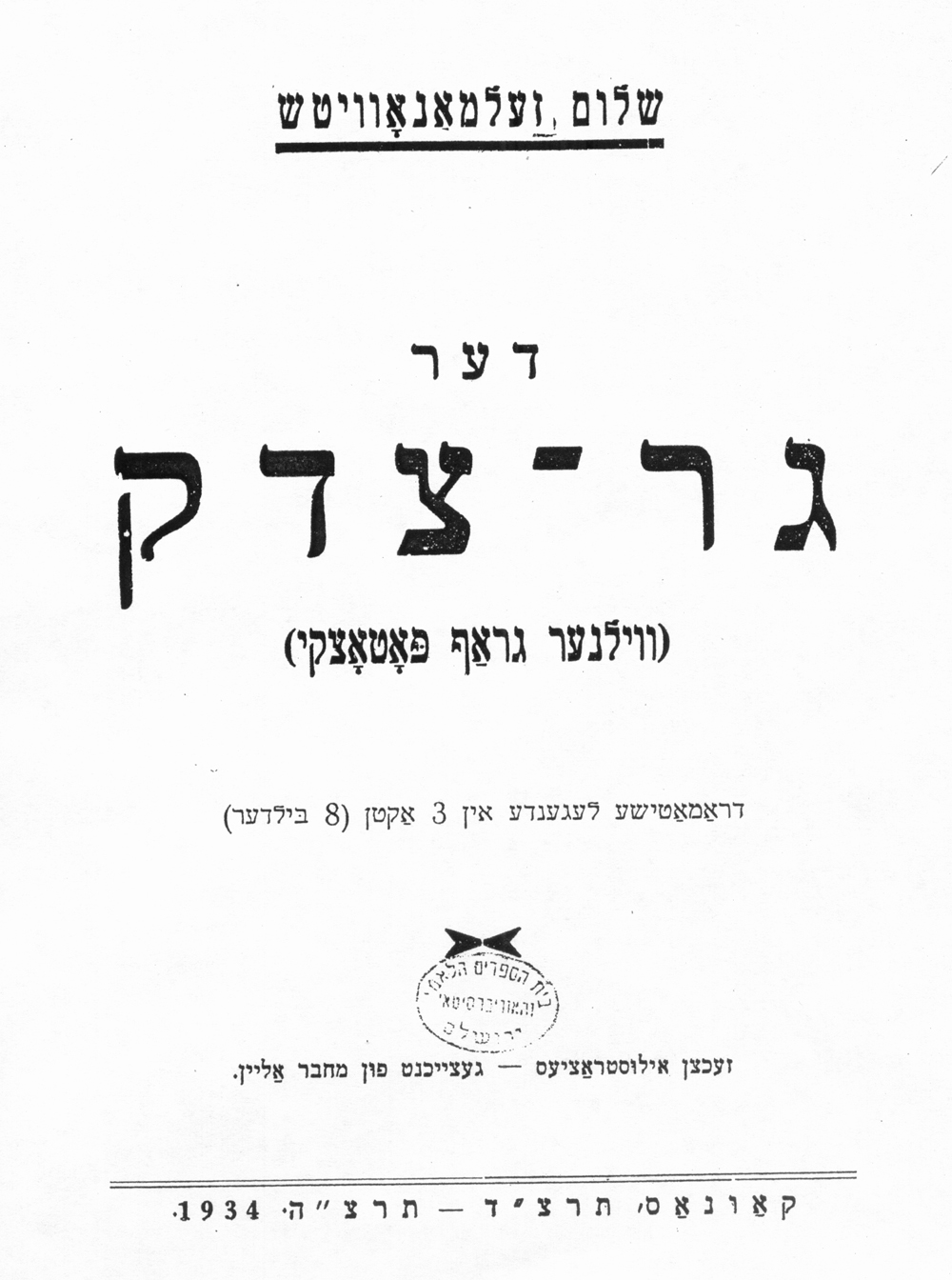
A few years ago (c2000) a fascinating sefer was reprinted called Menuchah u-Kedushah. The sefer was written by R. Yisrael Isserl from Ponevezh. Not much is known about the author except that he was a talmid of R. Hayyim of Volozhin. It’s clear from the sefer that he was a very special person and a big talmid hakham. The haskamot that he received from the R. Naftali Zevi Yehudah Berlin (Neziv), R. Bezalel HaKohen and R. Avraham Eisenstadt, author of the Pitchei Teshuva, show that he was a very prominent, well-known person (for some reason these haskamot were omitted in the reprinted edition). R. Shlomo Elyashiv, the author of the Leshem, also writes that he was an Ish Kadosh, a Holy Man. It appears that he was a melamed [teacher], and (as we will see) it seems that he must have been an excellent one. In the recent reprint, R. Shmuel Auerbach writes that the sefer was famous in particular as a guide in raising children and many followed it and became true Ovdei Hashem. Interestingly, the sefer was originally published anonymously (Vilna, 1864).

In this post I would like to discuss this sefer a bit. The author in his introduction (which, oddly enough, was omitted in the newest reprinted version of the sefer) outlines very clearly what he had wanted to accomplish with this work. Divided into three parts, the first is called Sha’ar HaTefillah, an explaining as to what one should do in order for his tefillot to be accepted. Included are many explanations on different parts of Tefillah. The second part is called Sha’ar HaTorah, which is the way the author feels one should teach children. The third part is called Sha’ar Yichud HaMa’aseh which includes advice how to battle the Yetzer Hara in all different situations.

The sefer reviews many interesting things especially vignettes from R. Elijah Gaon of Vilna (the Gra) and R. Hayyim of Volozhin. Also, included are many beautiful explanations on different areas of Tanakh and Aggadah. Aside from the explanations, this the sefer also includes many halakhot and minhagim. The sefer begins with a nice collection of halakhot of kavod seforim including that the prohibition to use one sefer under another one to bring it closer to you, or leaning completely on seforim like a shtender. To list a few examples of Ta’amei Minhagim brought throughout the sefer: the reason behind the mitzvah to eat on Erev Yom Kippur (pg 51) and giving tzedakah (pg 204). He is very against talking at all during davening; even talking in learning between aliyot (pg 75). The author also wrote a lengthy discussion regarding the proper time to light the Chanukah menorah; opining to light after ma’ariv. The author states that the only reason why R. Elijah Gaon of Vilna lit earlier was because of concern that if he would have waited until after ma’ariv he would have this on his mind the throughout davening, similar to a groom who is exempt from kriat shema (pg 160) due to his preoccupation. When he discusses sitting shiva on ones parents he exclaims ‘do not just sit there making the same mistake most do’; namely, they claim that since it is prohibited for a mourner to learn Torah, they leave a Sefer Iyyov on the stool nearby just to glance at from time to time and fall asleep. Rather, one is supposed to learn the topics that a mourner is allowed to so that one could give one’s parent many merits; there is enough material to learn for three weeks (pp. 88-89)! He writes to his son any shiur that he goes to after he dies he should always say the kaddish de’rabbanan for him; not only the first year (pg 95-96).

Many interesting discussions on various topics, such as the Neshama Yetairah that one gets on shabbat (pp. 49-50) are found throughout the sefer. He also has a lengthy discussion on the now-famous topic (in light of all the biographies on the gedolim) that no great person achieved anything great in life without working very hard for it. The talmudic use of the term “Noch Nafshei” a term of resting, was not hapenstance. Instead, it was used to demonstrate that, in many instance, those persons did not have easy lives, and thus only after death is it approriate to use a term of rest – hence Noch Nafshei. This is in reference to Tana’aim and Amoraim; how much more so in regard to regular people (pp. 79-82). Elsewhere in the sefer he has a long discussion on chumrot, writing very strongly: “one should be concerned that the yetzer hara is bribing him and allowing him to do them so he will be too occupied to observe the ikkar.” As an example for this he gives, he points out that in Minhagei Ha-Gra that he had eaten Matzah Shemurah the whole Pessach. Whereas the author realizes that if because of this chumrah he will have to eat separately from the rest of his family and not have proper simchat yom tov which is a de’oraita, he should not be makpid on eating matzah shemurah which is just a pious action (pp. 155-156).

Another point of interest that he writes is that the Messilat Yesharim was written with ruach hakodesh so listen to what he says (pg 158). When he talks about the sefer Nefesh Ha-Hayyim from his teacher R. Hayyim of Volozhin, he writes “listen to his holy mouth as the sefer is exactly like its name ‘life for the soul’ and one should know that ruach hakodesh is in all the words in the sefer so that it should be accepted by its readers” (pg 69).

After reading all this it would seem to appear that this is a very good work and there should be no problems with anything written in it. However this is not the case. The people who printed it write that in the section called “Sha’ar HaTorah” we were advised by gedolim not to print some parts. This is very strange because as mentioned earlier he had very prominent haskamot from some big gedolim and as the Leshem writes he was a Holy Man, and he was also a known student of R. Hayyim of Volozhin. One is left wondering what in the world could have been wrong with what he had written prompting censor?

In the 1967 reprint of the original edition by Meir Kleiman, the missing pages are included, about five all together. In short, what the deleted material is as follows, he saw many people who had no business becoming teachers taking the job only for the money. He writes that he was a teacher and he would spend a few weeks trying to understand each student what was the best way to deal with him. Another thing he writes is the importantance that boys have a proper understanding of the Hebrew language; not that he has to be a baki in dikduk just to know the basics than it’s easier to learn chumash. Once the boy knows chumash only than should you go on to learn Gemara. When he begins this limud, be careful to go slowly so as not to over burden him. The main point is not to learn enmass, rather emphasis on making sure the student fully understands everything before going further. Instead what happens is the boy only knows how to parrot what the teacher says and on shabbos he shows this off to the father; however nothing of value ever comes out of this. Another thing he writes is in regard to the failure to teach the boys tanakh; not only Gemara as the study of Tanakh is extremely important. Professor Simha Assaf brings much of this edited part in his Mekorot le-Toledot ha-Hinnukh be-Yisrael (vol. 1 Pg 607-613). R. Yitzchak Abadie discusses this whole section in his Teshuvot Ohr Yitzchak (pp. 444-450), available for download at www.HebrewBooks.org.

Reading all of the above, one can only wonder as to what was wrong with printing these parts; the author can not be accused of having haskalic leanings for a few reasons: One, if he did have haskalic leanings, then why allow the rest of the sefer be reprinted. In all honesty, the very thought is quite ridiculous; the Leshem writes he was a Holy Man and a reading of the sefer will show how true that is. Also he was very against learning philosophy saying that only the Rishonim were they on the level to learn it (pg 47).

What’s interesting about all this is many schools in the United States would do well to follow this advice in their educational methods; I am sure it would help many. Not that it’s the solution to all the problems with the children of today but it’s certainly a good start. Interestingly enough R. Yakov Horowitz in a recent article in his column ‘Chinuch Matters’ in the English Mishpacha 143 (Pg 10) called ‘It Doesn’t Start in Tenth Grade‘ writes the same point. R. Yakov Horowitz continues with this theme in the next issue in an article called ‘Training Wheels‘. Of course these columns have been met with opposition. One reader writes (English Mishpacha 145, pg 6) “Torah is acquired thru yegia through no other method can Torah become yours. Making torah easy at the beginning only makes it harder later on. The author mentioned that he is backed by various Achranoim who have suggested alternative methods for teaching torah. It should definitely be mentioned that these methods were unaccepted in Klal Yisroel. Mesorah means tradition passed on Midor Ldor not looking in seforim for unaccepted methods.”

One only wonders what this reader is talking about as shown here a Holy Man and talmid of R. Hayyim of Volozhin wrote these same suggestions as R. Yakov Horowitz and received good haskamot from important known gedolim. Further more as I have mentioned R. Shmuel Auerbach writes that the sefer was famous, in particular, as a guide in raising children and many followed it and became true Ovdei Hashem.


A selection from Strictly Kosher Reading by Yoel Finkelman

The Seforim Blog is happy to present this selection from Yoel Finkelman’s recent book, Strictly Kosher Reading: Popular Literature and the Condition of Contemporary Orthodoxy.

Coalescence
The first function of Haredi popular literature involves the “coalescence” of the Jewish and the non-Jewish. In defining coalescence, Sylvia Barack Fishman distinguishes it from two other common ways of describing relationships between Judaism and general culture. First, “compartmentalization” involves a situation in which the Jewish tradition holds sway in its own spheres, such as the synagogue or Shabbat table, while non-Jewish culture dominates in other areas of life, such as the workplace or the theater. Despite its conceptual clarity, Fishman claims that “compartmentalization” does not accurately describe actual American Jewish practice, since contemporary American Jews are too Americanized and America is too welcoming of Judaism for such neat divisions to have much explanatory power. Second, “adaptation” involves a situation in which the Jewish and the non-Jewish exist side by side. Tension between the two remains, and the individual or community “privileges one or the other as the situation seems to demand.”[1] Adaptation, she explains, “implies a continuing awareness of difference” between Jewish and general values and an attempt to negotiate these differences.
Yet, claims Fishman, many American Jews have lost an awareness of differences between Jewish and American values.
During the process of coalescence… the ‘texts’ of two cultures, American and Jewish, are accessed simultaneously…. These values seem to coalesce or merge, and the resulting merged message or texts are perceived not as being American and Jewish values side by side, but as being a unified text, which is identified as authoritative Judaism…. Many American Jews – including some who are very knowledgeable and actively involved in Jewish life – no longer separate or are even conscious of the separation between the origins of these two texts.[2]
Haredi popular literature, like much of Haredi popular culture, seamlessly merges aspects of the Jewish tradition with contemporary American cultural norms and styles. In coalescence, normative Judaism becomes a hybrid or syncretic combination of the Jewish and the American, the traditional and the modern, the past and the present. For example, Haredi music takes its lyrics from traditional Jewish texts, but its musical style imitates contemporary pop music.[3] Haredi self-help books, as we shall discuss, present contemporary values of individualism, personal happiness, self-expression, and (according to some critics) self-absorption as Jewish values, supposedly in the self-improvement tradition of musar.[4] Haredi novels borrow literary genres and formulas from the general best-sellers and fill them with Haredi characters and values. [5]
Given Haredi commitment to isolationism and rejection of non-Haredi culture, Haredi coalescence seems surprising. Still, Haredi Jews are genuinely acculturated, and the same cultural forces that make a genre or idea popular among the general public make it popular among Haredi Jews as well. Community members may prefer a Haredi version of a literary genre, such that it will more precisely match their values and style. In addition, imitating the most contemporary styles helps make the tradition seem sophisticated and up-to-date. This allows Haredi Judaism to respond to modernity and its perceived anti-Orthodox biases on modernity’s own terms.[6]
Take the example of Yaakov Levinson’s book, The Jewish Guide to Natural Nutrition. According to Levinson, there are “Jewish roots to natural nutrition.” Holistic health and natural foods are presented as traditional Jewish values. Levinson works to “combine a system for healthy living and eating with a strong connection to our important Jewish heritage.” He rhetorically grounds his work in traditional Judaism, explaining that “Rambam’s [Maimonides’] medical writings contain the Jewish roots of today’s system of natural nutrition. Our modern approach is basically an extension of his main principles and teachings.” [7]
Yet, the author says little about Maimonides’ specific nutritional advice or his medieval biology, and Levinson quotes from Maimonides’ medical writings only very rarely. Instead, Levinson focuses on contemporary scientific concepts such as cholesterol, vitamins, and the USDA food pyramid. Maimonides does not serve as an authority on the workings of the body. Rather, he is an authoritative precedent for the borrowing of contemporary medical advice. Levinson is, to a great degree, aware of and articulate about the fact that the medical and nutritional advice he suggests does not come from Torah, but from modern science. He dances a cautious dance between the new and the old, the modern and the traditional. Maimonides’ “medical writings were based on Jewish Talmudic sources as well as on secular, non-Jewish teachings.”[8] In other words, Levinson argues that it is authentically and traditionally Jewish for today’s Haredi Jews to self-consciously adapt contemporary scientific theories, just as Maimonides did in his day. Maimonides is important to Levinson not as a source of information about eating and health, but as a figure whose very name and reputation can help make the book seem authentically Jewish and grounded in the tradition, even if the book’s content is not actually derived from his writings.
The dust jacket of The Jewish Guide to Natural Nutrition clearly articulates coalescence. The author’s biography on the dust jacket celebrates his extensive Torah studies as well as his accomplishments in the field of medicine. Photographs visually reinforce this. The front cover shows a professional studio photograph of a bearded man – presumably the author – carrying a large, attractive basket of fresh green apples and dressed in a clean white lab coat. The apples signify the value of natural and healthy eating, while the lab coat symbolizes the scientific validity and authority of the book’s nutritional suggestions. The back cover includes a parallel photo of the same man dressed in Hasidic garb carrying a stack of Maimonides’ halakhic writings. Science and Jewish religion, including both its mystical-Hasidic and its rationalistic-legal-Maimonidean strands, are not only compatible with one another, but mutually enforcing. The authority of science is backed, symbolically and visually, by Torah, and Torah leads to an appreciation of contemporary nutritional science. Not accidentally, the book opens with three almost identical approbations: two by well-known yeshiva deans and one by a professor at a Jerusalem medical school. The approbation from the medical doctor praises coalescence, in that the book “melds an expert’s view of nutrition and disease with its special implication and application to religious Jewish tradition.”[9]
Levinson’s coalescence goes further. He not only provides standard American nutritional advice for Haredi readers, but also claims that following that advice is fundamentally a spiritual experience and religious obligation. Here Levinson goes beyond his Maimonidean precedent. For Maimonides, maintaining one’s health is a means to an end, a requirement so that illness or weakness would not distract the
individual from the higher values of study and religious self-development. “It is impossible to understand or know anything of the knowledge of the Creator when one is ill. Therefore a person must distance himself from things which damage the body and a person should become accustomed to things which make one healthy.” For Levinson, in contrast, health is not merely a means toward a higher end; rather, there is an inherent “spirituality in eating.”[10] Combining kabbalistic language and basic biology of the digestive system, Levinson explains that healthy eating exemplifies a central religious goal of separating the “good” from the “evil” in creation. The “nutrients” are good and therefore associated with the holy “sparks” of the Kabbalah, while the “waste” is the evil, associated with the evil kabbalistic “husks.” “The separation of nutrients from waste in the act of eating has its spiritual counterpart in the extraction of the sparks of holiness which are contained in food. And is not the physical and spiritual separation of good from evil the very meaning of human existence?”[11]
Levinson also hints that the foods people eat and how they eat them are not value free, but exemplify their cultural identity. “Foods are much more than just a collection of nutrients; they are a wealth of influences and connotations…. The various religions use foods to connote their special approach to life.” Levinson’s health advice exemplifies this point, perhaps more clearly than he intended. While he intends to underscore the inherent spirituality, according to Judaism, in eating, he also implies that eating like an American means having absorbed American mores and sensibilities. He advocates a “healthier, lighter style of eating,” which became a virtual American infatuation in the nutrition discourse of late twentieth and early twenty-first centuries (even as Americans grew fatter).[12] Levinson’s concern with calorie counting, weight-loss, and balanced consumption of nutrients reflects the biological knowledge and cultural aesthetics of contemporary America, a community of plenty with an almost infinite variety of foods to choose from, with a deep concern with the long-term health impact of overeating, and an aesthetic that celebrates thinness. For almost all of human history, the central culinary dilemma facing humans involved procuring enough food to fend off starvation or at least chronic hunger. In contrast, Levinson and his American Haredi readership share with other middle-class Americans a challenge of negotiating an almost unlimited quantity and variety of food.[13] The late twentieth-century American infatuation with light, healthy eating, which Levinson exemplifies, supports values that Haredim and the general population share and which are reflected in their culinary culture and popular literature. Levinson’s book suggests that religious people, even those profoundly committed to a given canon, read and interpret their scripture and tradition not only in their own terms, but “in order to make sense of their lived experiences.”[14]
That Haredi Jews share a culinary culture with their neighbors, and that they follow the best medical and health advice available, are relatively unproblematic notions from a Haredi perspective. After all, the Jewish tradition for the most part supports the idea that Jews should seek quality medical treatment,[15] and Maimonides indeed advocated learning from the best available science. However, other examples of coalescence raise significant ideological and religious challenges.
For example, Haredi popular literature, like its devout Christian counterparts, adopts the modern notion of the “companionate marriage.” Here the coalescence appears in a matter of profound ideological and religious significance, since, as Helen Hardcare explains about Protestant Fundamentalists, the family is a “primary unit for ritual observance as well as an influential site of religious education and the transmission of religious knowledge from one generation to the next.”[16] Or, as one Haredi author puts it, “The Jewish family [is] a vital force in insuring our people’s continued existence.”[17] Popular Haredi works identify the Torah’s “timeless formula for marriage,” and contrast that with the “non-Jewish system” that is “floundering in its own confusion” and therefore “has nothing to offer the Jew.”[18] Yet, a brief historical comparison reveals how acculturated Haredi families have become, and how the Haredi popular literature coalesces by presenting the modern, monogamous, suburban nuclear family as part and parcel of the tradition.
Both the contemporary Haredi family and the pre-modern Ashkanazic one share a commitment to strict monogamy, as opposed to the polygamy of ancient Judaism and at least some of historical Sephardic culture. Yet, in pre-modern Ashkenaz, parents contracted marriages for their children, often with the help of professional matchmakers. When choosing a partner for their child, parents paid less attention to emotional or romantic compatibility and more to finding a spouse who could offer the greatest socio-economic advantage. Often, marriages were arranged, if not always consummated, when the children were in their mid-teens. This marriage was more of an economic agreement than a romantic one, certainly at the outset. The couple might continue to live with the bride’s family for some time, until they became financially and socially independent. In this constellation, “personal compatibility not to speak of romantic attachment [between the couple] were not taken into account at all.” [19] On occasion, feelings of love and mutual attraction would push a young couple to choose one another as marriage partners, but rabbis and community members saw this as a rebellion against communal values rather than a fulfillment of them.[20]
Today, Haredi couples, usually in their early 20s, care deeply about emotional compatibility and therefore search for marriage partners through dating. This period of courtship allows the young couple to determine if they are emotionally compatible and romantically suited. Under these circumstances, when courtship and emotional compatibility have become central to Haredi images of marriage, Haredi authors write dating guidebooks for such young people, providing “guidelines for dating and courtship,” so that the dating couple can most effectively determine if they share the same values, if they have the same expectations from married life, and if their “personalities” will enable “the couple to get along with each other.”[21]
Furthermore, for medieval Ashkenazic Jews the home was a center of economic life, because merchandise and services were produced in the home for the use of its residents as well as for trade with others. Women, though also mothers, played central roles in the medieval Jewish marketplace, at a time and place when parenthood was not considered a full-time endeavor and where raising children was perceived as requiring less moment-to-moment vigilance than it does today.
For contemporary Haredi rhetoric, in contrast, the “Jewish home” rather than being a locus of economic production, serves as a “haven in a heartless world,” a domestic shelter from the dangers of the marketplace and the outside culture.[22] It is a modern, middle-class, child-centered, nuclear family. In these families, rearing offspring, who require full-time attention and continuous nurturing, requires parents primarily and educators secondarily to be sensitive, vigilant, and loving toward children more or less on a constant basis. Women are, therefore, encouraged by Haredi literature to dedicate themselves first and foremost to being mothers and wives, and to go to work only if the family’s financial situation requires it.[23]
As numerous historians of both the Jewish and non-Jewish family have noted, these modern family patterns, in broad terms, developed with the rise of the middle class, under conditions of urbanization and industrialization.[24] In their popular literature, acculturated contemporary Haredim describe, analyze, and celebrate this modern family. In particular, Haredi popular literature celebrates one particular aspect of this modern family: what historians and sociologists have come to refer to as the “companionate marriage.” In this modern family, marriage ought to lead to self-fulfillment, happiness, and the satisfaction of the psychological need for friendship and emotional closeness.
The ideal of companionate marriage came to dominate discussions of marriage in twentieth-century America…. It elevated anticipation of achieving emotional, sexual, and interpersonal fulfillment in marriage. The goal of marriage was no longer financial security or a nice home but emotional and sexual fulfillment and compatibility. Though marriages were not expected to be conflict and tension free, it was hoped that disagreements could be overcome if husbands and wives talked about their feelings, recognized the existence of conflicts, and worked out their problems through close “communication.”[25]
The norm of the companionate marriage has penetrated Haredi circles, and Haredi books which guide couples to achieving that kind of relationship serve as prime examples of coalescence. For medieval Ashkenazic Jews, there was “an absence of any philosophy promising happiness in marriage.”[26] Today’s Haredi books on marriage view happiness and self-fulfillment as the central goals of married life. These works focus particularly on communication skills between couples, in order to assure that the couple will remain emotionally responsive to one another. “A healthy relationship is built on clear and honest communication. Listening, understanding and conversing all contribute to the empathy so vital to a marriage.”[27] Furthermore, “Marriage… creates the possibility of the closest emotional relationship that can exist between living beings, the love between husband and wife.” “Happiness in marriage” can be achieved by “building trust,… maintaining affection,… [and] creating intimacy.” Ultimately, “Marriage is a primary catalyst for the development of each partner’s individual potential to the utmost.”[28]
The adoption of the model of the companionate marriage relates closely to another very popular genre of Haredi popular literature, namely the parenting guide. Here, too, coalescence prevails, with these parenting guides presenting images of child rearing as part and parcel of the Jewish tradition. And here too the coalescence appears in discussions of central religious values: how to raise children to become Torah-observant and God-fearing Jews. Hence, one might expect a greater reliance on traditional sources and a more suspicious stance toward contemporary norms. Still, Haredi parenting guides, even those that claim to reject so-called “modern” approaches to parenting, adopt the strategy of coalescence and share much of their style and content with their non-Haredi counterparts.
Lawrence Kelemen’s parenting guide, To Kindle a Soul, for example, claims in the subtitle to contain “ancient wisdom.” “At the foot of a mountain in the Sinai desert, the Creator of the universe directly revealed His profound wisdom to approximately three million people…. Those present received… a comprehensive guide for raising great human beings.” The book attempts to describe “this ancient, Torah approach to education” which is “more comprehensive and effective… than any of the schools of child psychology I studied at university.” Kelemen describes the “significant” differences between these supposedly “ancient traditions” and the practices of contemporary parents.[29]
Yet Kelemen’s parenting approach fits neatly within late twentieth-century American parenting discourse, and it differs significantly from that of pre-modern Jewish sources. Kelemen combines an American religious-right critique of supposedly decadent American family life with a child-centered parenting approach advocated by endless American mass-market parenting guides in the 1990s. Criticism of American materialism and permissiveness; advocacy of limiting the mother’s time at work; polemics against spanking; emphasis on good nutrition, proper sleep time, and bedtime routine; concerns about the adverse impact of television viewing; claims to provide a “system” for raising moral children; and advocacy of “quality-time” for empathy and close communication between parents and children, all characterized American experts’ suggestions to worried middle-class parents at the end of the twentieth century. Even Kelemen’s claim that his approach derives from the Bible follows the pattern of American religious parenting guides. Indeed, the book’s unstated assumptions – that parenting is a full-time endeavor, and that parents should actively monitor their children’s moment-by-moment lives – typify experts’ advice and popular assumptions in America during the so-called “century of the child.” [30]
Not only does Kelemen’s approach match that of contemporary parenting experts, but it differs from traditional Jewish sources on the topic. While a complete history of Jewish approaches to children and family has yet to be written, it is enough in this context to note that traditional Jewish literature speaks of childhood and parenting in spotty and unsystematic ways, scattered in works focused on other topics.[31] This reflects a historical past in which families were considerably less child-centered than they are today, and parents learned how to parent more by imitation, instinct, face-to-face conversation, and osmosis than from the written word of experts. Pre-modern Jews did not write parenting manuals since they assumed that knowing how to parent was an intuitive or natural thing.[32]
Take the example of Kelemen’s approach to corporal punishment and spanking. This is a particularly important example because traditional sources do say quite a bit on the topic, and what do they say clashes rather dramatically with the approach of contemporary Haredi parenting literature. Kelemen polemicizes against corporal punishment of children, and even harsh verbal reprimands. Instead – reflecting both contemporary notions of individual autonomy and the voluntary nature of modern religious commitments, which make it difficult to coerce people into religious conformity – he insists that parents should calmly explain to their children what is proper and improper. Parents should then serve as living role models of the proper, hoping thereby to help children come to their own appreciation of and identification with the parents’ values. While Kelemen advocates setting clear and consistent boundaries on children’s behavior, he claims that enforcing those boundaries with violence and verbal harshness undermines the child’s respect for the parents and prevents children from being receptive to higher values. “Yelling and hitting usually flips [sic] children out of the learning mode… which is characterized by a relaxed and happy state that facilitates accepting the educator’s values… and into the obedience mode… which is characterized by a nervous, distrusting or rebellious state.” Spanking is part of an “authoritarian” approach typical of “dictatorships,” which leads to uninspired obedience in which youth do not come to identify with the values of the parents. Ultimately, “harshness” leads to “rebellion.” Kelemen also argues for the importance of parental affection. “Affection is more than just attention. Attention just requires being responsive to a child’s needs. Affection is the next step. It is warm and it is the most powerful medium we possess for communicating love.” Kelemen teaches that, “If we want to produce people with integrity, internally driven by a specific value system, we must utilize gentle means.”[33]
This advice stands in stark contrast to traditional Jewish sources on child rearing, which explain that spanking does not promote rebellion but prevents it. In a typical passage, the ancient Jewish text, Midrash Rabbah, quoting the book of Proverbs, relates that, “‘He who spares his rod hates his child.’ This teaches that preventing physical punishment (mardut) leads [the child] to bad culture.”[34] R. David Altschuler, the seventeenth century Galician author of the Biblical commentary Metzudat David, goes further in commenting on the same verse: “Do not refrain from making [your son] suffer even if you see that this is not effective, because there is hope that much reproof will be effective.”[35] Sources, particularly from early-modern Ashkenazi culture but from other contexts as well, openly polemicize against fatherly affection. For example, R. Alexander Ziskind of Grodno, the eighteenth century mystic, explained that, “Even though I had many sons, I never kissed even one of them, and never held them in my arms, and never spoke with them of frivolous things, God forbid.”[36] The seventeenth century rabbi, Yeshayahu Horowitz (the Shlah), states: “If the father rebukes his son early in his life with the staff… and uses fear while he is young… then he [the son] will be accustomed to fear his father always.… If in childhood the father displays great affection… then later when he matures he will not listen.… Mothers are… not to spare the rod but to strike their sons even if they scream.… Women who are compassionate with their children… murder them.”[37]
In the next chapter we will examine the complex ways in which Kelemen defends the idea that his approach derives from the ancient tradition. Here it is enough to note the way in which his book reflects the strategy of coalescence: identifying contemporary American values as being authentically Jewish. To Kindle a Soul, like other contemporary Haredi books on parenting, shares more with contemporary American mass-market parenting guides than it does with pre-modern Jewish sources on parenting. However, a close examination of other aspects of these works on families reveals that coalescence is not the whole story. Haredi works may borrow the companionate marriage and child-centered parenting from contemporary culture, but they borrow selectively. This leads to a second function of Haredi popular literature in mediating the tension between isolation and acculturation: filtering.
[1] Ibid.
[2] Ibid.
[3] Haym Soloveitchik, “Rupture and Reconstruction,” 75.
For internal Haredi discussion regarding this issue, see Mordechai Schiller,
“Chasidus in Song – Not for the Record,” The Jewish Observer
10:8 (March, 1975), 21; Breindy Leizerson, “Set the Record Straight,”
The Jewish Observer 20:4 (May, 1987), 40-41; Dovid Sears, “Who Took
the ‘Jewish’ Out of Jewish Music?,” The Jewish Observer 29:10
(January, 1997), 12-16; Yosef C. Golding, “How to Get the Entire Jewish Music
World Angry at Me… Or a Parent’s Guide to What Your Children Listen To,” The
Jewish Observer
40:4 (May, 2007), 36-37.
[4] Stolow, Orthodox by Design, 132-142; Andrew R.
Heinze, “The Americanization of ‘Mussar’: Abraham Twerski’s Twelve Steps,” Judaism
48:4 (1999), 450-469. On the self-absorption of this therapeutic self-help
literature, see Wendy Kaminer, I’m Dysfunctional, You’re Dysfunctional: The
Recovery Movement and Other Self-Help Fashions
(New York: Vintage Books,
1993).
[5] See below and Yoel Finkelman, “Medium and Message in
Contemporary Haredi Adventure Fiction,” The Torah U-Madda Journal 13 (2005), 50-87.
[6] The academic literature has focused on this trend
primarily regarding the development of Orthodox historiography. See below,
Chapter Four, n. 4.
[7] Yaakov Levinson, The Jewish Guide to Natural
Nutrition
(Jerusalem and New York: Feldheim, 1995), 4-5. Much of the
following analysis could be duplicated for the issue of The Jewish Observer
entitled “A Healthy and Productive Life as a Torah Jew,” 40:8 (November, 2007)
and for David J. Zulberg, The Life-Transforming Diet: Based on the Health
and Psychological Principles of Maimonides and Other Classical Sources

(Jerusalem and New York: Feldheim, 2007).
[8] Levinson, Natural Nutrition, 5. Zulberg, The
Life-Transforming Diet
, quotes more extensively from selected passages from
Maimonides’ medical writings, those in line with contemporary sensibilities.
[9] Unpaginated approbation of Prof. Leon Epstein.
[10] Maimonides, Mishneh Torah, Hilkhot De’ot,
4:1; Levinson, Natural Nutrition, 128.
[11] Levinson, Natural Nutrition, 136.
[12] Ibid., 4. Maimonides did advocate eating until not
fully satiated, though Levinson’s language, as noted, derives from modern, not
Maimonidean categories. See Maimonides, Mishneh Torah, Hilkhot De’ot,
4:2.
[13] Harvey Levenstein, Paradoxes of Plenty: A Social
History of Eating in Modern America
(New York and Oxford: Oxford University
Press, 1993), Chap. 16. For further reflections on the contemporary Orthodox
diet, see Brill, “Judaism in Culture,” 3 and Stolow, “Aesthetics/Ascetics:
Visual Piety and Pleasure in a Stricly Kosher Cookbook,” Postscripts 2:1
(2006), 5-28 (some of which also appears in his Orthodox by Design).
Levinson does not put as much emphasis as American general culture on the
aesthetic aspects of weight loss, perhaps because he does not perceive looking
attractive as a religious goal. In this, Zulberg’s The Life-Transforming
Diet
comes closer to the general American concern with body-image and
aesthetics.
[14] Molly Worthen, “Housewives of God,” The New York
Times Magazine
, November 12, 2010, available here  viewed November, 2010.
[15] See, for example, Shulhan ‘Arukh, Yoreh
De’ah
, 336:1. The ambivalence about seeking doctors, on the theory that divine
providence governs illness and heath, was generally of theoretical import only,
and usually did not have practical implications. See the commentary of the Taz,
ibid.
[16] Helen Hardcare, “The Impact of Fundamentalism on
Women, the Family, and Interpersonal Relations,” in Fundamentalisms and
Society
, Eds. Martin E. Marty and R. Scott Appleby (Chicago and London:
University of Chicago Press, 1993), 129. On similar Christian conflation of
modern notions of marriage with traditional ones, see James Davison Hunter, Evangelicalism:
The Coming Generation
(Chicago and London: University of Chicago Press,
1987), 76-93.
[17] Avraham Pam and Tzvi Baruch Hollander, “The Jewish
Family – In Its Glory and in Crisis,” The Jewish Observer 29:4 (May,
1996), 6.
[18] Yirmiyohu Abramov and Tehilla Abramov, Two Halves of
a Whole: Torah Guidelines for Marriage
(Southfield, MI: Targum/Feldheim,
1994), 158.
[19] Jacob Katz, Tradition and Crisis: Jewish Society
at the End of the Middle Ages
(New York: Schocken, 1971), 141-142.
Unfortunately, a systematic history of the Jewish family has yet to be written.
But see, Elisheva Baumgarten, Mothers and Children: Jewish Family Life in
Medieval Europe
(Princeton: Princeton University Press, 2004); ChaeRan
Freeze, Jewish Marriage and Divorce in Imperial Russia (Hanover, NH:
Brandies University Press, 2004); David Kraemer, Ed., The Jewish Family:
Metaphor and Memory
(New York and Oxford: Oxford University Press, 1989);
Avraham Grossman, Pious and Rebellious: Jewish Women in Medieval Europe,
Trans. Jonathan Chipman (Waltham, MA: Brandeis University Press, 2004), Chaps.
2-4.
[20] David Biale, Eros and the Jews (New York:
Basic Books, 1992), Chap. 3.
[21] Meir Winkler, Bayis Ne’eman b’Yisrael: Practical
Steps to Success in Marriage
(Jerusalem and New York: Feldheim, 1988), 53,
57.
[22] The expression comes from Christopher Lasch, Haven
in a Heartless World: The Family Besieged
(New York: Basic Books, 1977).
[23] Ironically, in the early modern period, the Haskalah,
rather than the tradition, called for marriages based on love and compatibility
rather than socio-economic advantage, and called to protect women from the
marketplace by carving out for them a domestic role in which they could spend
more of their time and energy on child-rearing. The central Jewish polemic
against marriage as a financial arrangement and against women’s role in the
workplace came from Haredi popular literature’s rhetorical enemies, the maskilim.
See Biale, Eros and the Jews, 159-161.
[24] Lawrence Stone, The Family, Sex, and Marriage in
England 1500-1800
(New York: Harper and Row, 1977); Steven Mintz and Susan
Kellogg, Domestic Revolutions: A Social History of American Family Life
(New York: Free Press, 1988).
[25] Mintz and Kellogg, Domestic Revoluations, 115,
describing the particular model of companionate marriage advocated by early
twentieth century progressives in America. Also see 186. Haredim, like these
progressives, advocate “divorce by mutual consent… on the grounds of incompatibility,”
at least as an unfortunate consequence of the failure of the companionate
marriage (ibid.). Yet, Haredim are less likely than these progressive to
support free use of contraception and open sex-education. Haredim also remain
attached to Victorian sensibilities that distinguish between the
feminine/domestic/secure sphere and the masculine/public/dangerous sphere, a
distinction against which progressives polemicized.
[26] Katz, Tradition and Crisis, 141-142.
[27] Abramov and Abramov, Two Halves, 65.
[28] Aharon Feldman, The River, the Kettle and the
Bird: A Torah Guide to Successful Marriage
(Israel: CSB Publications,
1987), 11; Radcliff, Aizer K’negdo: The Jewish Woman’s Guide to Happiness in
Marriage
(Southfield, MI: Targum/Feldheim, 1988), 11. Abramov and Abramov, Two
Halves
, 19. Also see Malka Kaganoff, Dear Kallah: A Practical Guide for
the New Bride
(Jerusalem and New York: Feldheim, 1993); Winkler, Bayis
Ne’eman
.
[29] Lawrence Kelemen, To Kindle a Soul: Ancient Wisdom
for Modern Parents and Teachers
(Southfield, MI: Targum Press and Leviathan
Press, 2001), 19-21. Some of Kelemen’s formulations, as well as one of the
book’s central metaphors – that parenting consists of “building” and “planting”
– come from the parenting guide of the twentieth-century Israeli Haredi rabbi,
Shlomo Wolbe, which Kelemen had been involved in translating into English.
Wolbe’s ideas themselves are influenced by modern psychological and cultural
categories, though the influence of modern psychology on contemporary
musaristis like Wolbe has yet to be studied, to the best of my knowledge. See
R. Shlomo Wolbe, Zeri’ah U’Vinyan BeHinnukh (Jerusalem: Feldheim, 1995),
23-24, and his Planting and Building: Raising a Jewish Child, Trans.
Leib [Lawrence] Kelmen (Jerusalem and New York: Feldheim, 2000).
[30] See Peter N. Stearns, Anxious Parents: A History
of Modern Childrearing in America
(New York and London: New York University
Press, 2003), and Ann Hulbert, Raising America: Experts, Parents, and a
Century of Advice About Children
(New York: Vintage Books, 2003), Chap. 11.
[31] On the difficulties in determining ancient Jewish
attitudes toward child rearing, see David Kraemer, “Images of Childhood and
Adolescence in Talmudic Literature,” in his Ed., The Jewish Family,
65-68.
[32] Baumgarten, Mothers and Children, 155.
[33] Kelemen, To Kindle a Soul, 129-152. Quotes
from 109, 130, 132-133.
[34] Shemot Rabbah, 1 s.v. Ve’eleh Shemot,
quoting Proverbs 13:24
[35] Also see B.T. Makkot, 8a, Bava Batra 21a;
Midrash Tehillim, Buber, 6; Midrash Tenaim, Devarim 25:3;
Rashi on Mishlei 13:24 and on 19:18; Rambam, Mishneh Torah, Hilkhot
Talmud Torah
, 2:2; Shulhan ‘Arukh, Yoreh De’ah, 240:20 and
Rama, 245:10; Sefer Hasidim, 302, cited in Baumgarten, Mothers and
Children
, 162; R. Yeshayahu Horowitz, Shenei Luhot HaBerit
(Jerusalem: n.p., 1975), Letter Daled, paragraph 23-32; The Gaon of Vilna, Even
Shelemah
(n.p.: n.d., n.d.), 6:4. When Shulhan ‘Arukh, Yoreh
De’ah
, 240:20 insists that one not beat his older children (according to
Rama, 22-24 years old), this is not due to any opposition to corporal
punishment per se, but, following his source (BT Mo’ed Qatan 17a),
because the son might retaliate and violate the more serious prohibition of
injuring one’s parent.
[36] R. Alexander Ziskind of Horodno in his ethical will,
quoted in Simhah Asaf, Meqorot LeToldot HaHinnukh BeYisrael (New York
and Jerusalem: Jewish Theological Seminary, 2002), Vol. 1, 688. Also see
Yitzchak ben Eliakim, author of Sefer Lev Tov (published in Prague in
1620), who insists that parents “not reveal their love [of their children] in
their presence because then the children would not fear them and would not obey
them.” Cited in Gerson David Hundert, “Jewish Children and Childhood
in Early Modern East Central Europe,” in Kraemer, Ed. The Jewish Family,
82. Also see the related sources quoted in Hundert, 83, and Ephraim Kanarfogel,
“Attitudes Toward Childhood in Medieval Jewish Society,” in Approaches
to Judaism in Medieval Times
, Ed. David R. Blumenthal (Chico, CA: Scholars
Press, 1985), Vol. 2, 1-34.
[37] Horowitz, Shnei Luhot HaBerit, Letter Daled,
para. 23-25.


Pini Dunner — Mercaz Agudat Ha-Rabbanim Be-Lita, Kovno, 1931

Pini Dunner B.A (Hons), formerly rabbi of London’s Saatchi Synagogue, is an avid collector of polemical and controversial Hebraica, with a very large, diverse private collection of such material. Many items in his collection are unknown and unrecorded, and relate to long forgotten, obscure controversies.

This is his first post at the Seforim blog in a series about rare polemical pieces from his personal collection.

Mercaz Agudat Ha-Rabbanim Be-Lita, Kovno, 1931
Pini Dunner
(London, England)

In the mid-1920s the rabbi and rosh yeshiva of Slabodka, R. Moshe Mordechai Epstein (1866-1934), left Lithuania to lead the newly established branch of his yeshiva in Chevron. In his place as rabbi of the Slabodka community he left his son-in-law, R. Yosef Zusmanowitz (1894-1942), renowned in the Lithuanian yeshiva world as the ‘Yerushalmi Illuy’. R. Zusmanowitz was a scholar of repute and a great communicator. The heads of the yeshiva, R. Boruch Horowitz (R. Epstein’s brother-in-law) and R. Yitzchak Isaac Sher (1875-1952; son-in-law of the Alter of Slabodka), were concerned that the young R. Zusmanowitz would also try and take over the yeshiva. They were totally opposed to his involvement in the yeshiva, especially as he was not enamoured with the strong concentration on mussar. Instead they appointed R. Zalman Osofsky as the rabbi of the town.

A fierce controversy erupted between the 2 factions. R. Zusmanowitz’s most vociferous supporter was R. Nota Lipshitz, son of the famous secretary to R. Yitzchak Elchanan Spektor, R. Yaakov Lipshitz. The fight became so personal that R. Lipschitz’s nephew was effectively expelled from Slabodka yeshiva simply because of his uncle’s support for R. Zusmanowitz. As a result, the nephew, and others, began to learn together with R. Zusmanowitz, thereby starting a rival Slabodka yeshiva. At its height the yeshiva had 50 students. Frightened of the competition, and of the fundraising confusion that was impacting on their income (Zusmanowitz fundraisers included the 2 Teitz boys from America), R. Horowitz and R. Sher arranged for the Agudat Ha-Rabbanim (R. Horowitz was chairman) to issue a psak that R. Zusmanowitz had to close his yeshiva. This decision was met with anger and derision by its supporters, but the yeshiva closed. None of the 50 students were allowed back into Slabodka yeshiva – except for R. Ephraim Oshry (1914-2003), and he was subsequently suspected of being a spy who had been planted by the Slabodka yeshiva in R. Zusmanowitz’s yeshiva.

In this stencilled poster, the Agudat Ha-Rabbanim vigourously deny that they had reported R. Zusmanowitz to the authorities as a subversive, as he and his supporters were claiming in posters, pamphlets and correspondence. They also explain that as R. Zusmanowitz refused to sign that he would not open a yeshiva if he won the elections that had been scheduled as a way to resolve the dispute, he had effectively ruled himself out of the election. The status-quo that established itself during this time was that R. Osofsky was the rabbi for the Slabodka yeshiva community and R. Zusmanowitz was the rabbi for the rest of the town. The whole controversy was viewed very negatively by those not involved, and particularly because R. Zusmanowitz’s opponents – who used a variety of nefarious tactics to get their way – were meant to represent the mussar movement and its ethical ideals.

R. Zusmanowitz later became the rabbi of Wilkomir – a position for which R. Yaakov Kamenetsky had been vying, and thought he had secured – when the previous rabbi, R. Arye Leib Rubin, father-in-law of the Ponevezher Rov, died in 1937. It was as a result of this that R. Kamenetsky came to America. He would later say that what had at the time seemed like a tragic failure had in fact saved his life and the lives of his family as he was spared from the Holocaust as a result. R. Zusmanowitz was not so lucky. He was killed in 1942. (With thanks to Rabbi Eliezer Katzman for much of the information concerning this controversy).


Jacob’s Dream: Reproducing a Talismanic Illustrated Title Page

Jacob’s Dream: Reproducing a Talismanic Illustrated Title Page

(Illustrations are from the following sources: the Edut Be Yosef, Rabot, Shivim Tekunei Zohar, and Yefeh Anaf are from the Gross Family Collection.  The Minhat Shai is from Dan Rabinowitz’s personal collection, and the rest are courtesy of the internet.)

One of the earliest examples of Jewish art are the biblical paintings at the Dura Europos Synagogue, completed in 244-5 C.E. Among those images is that of Jacob’s dream. The importance of the Dura Europos iconography in the development of Jewish art is hard to overestimate. “The iconographic formulas, seen for the first time in the Dura synagogue would recur both in Jewish art and Christian art, in widely differing media – manuscripts, murals, mosaics, ivories and silver utensils – frequently without modification, or with only the modifications necessitated by different materials or techniques, or the need to emphasize a new theological perspective.”[1]

By the time of its discovery in the 1920s, only a fragment of Jacob’s dream scene remained visible. Nonetheless it is possible to discern the subtly of the artist. In the fragment, Jacob is depicted as a figure wearing Greek costume – the then contemporary dress – leaning on his elbow, in the posture of Palmyrene funerary reliefs. Only the body is preserved, the head and upper body are lost. Near the figure is planted an inclined ladder, which one or perhaps two (it is unclear) personages in Persian dress are ascending. This custom, consisting of a short-belted tunic adorned with braid at the throat and hem, and wide trousers gathered into short supple boots, represents in the language of the Dura painter the garb of kings and princes, and court temple  personnel.[2] 

Scholars have voiced a number of opinions to explain the Persian court dress. According to one scholar the artist was referencing a midrash that appears in Pirkei de-Reb Eliezer. The angels, rather than merely serving as Jacob’s protection, also allude to “the four kingdoms that would conquer and subjugate the Jews, each as represented by its prince.”[3]One of the kingdoms is Persia. Thus, the artist’s choice of iconography was deliberate.

Jewish Title Pages

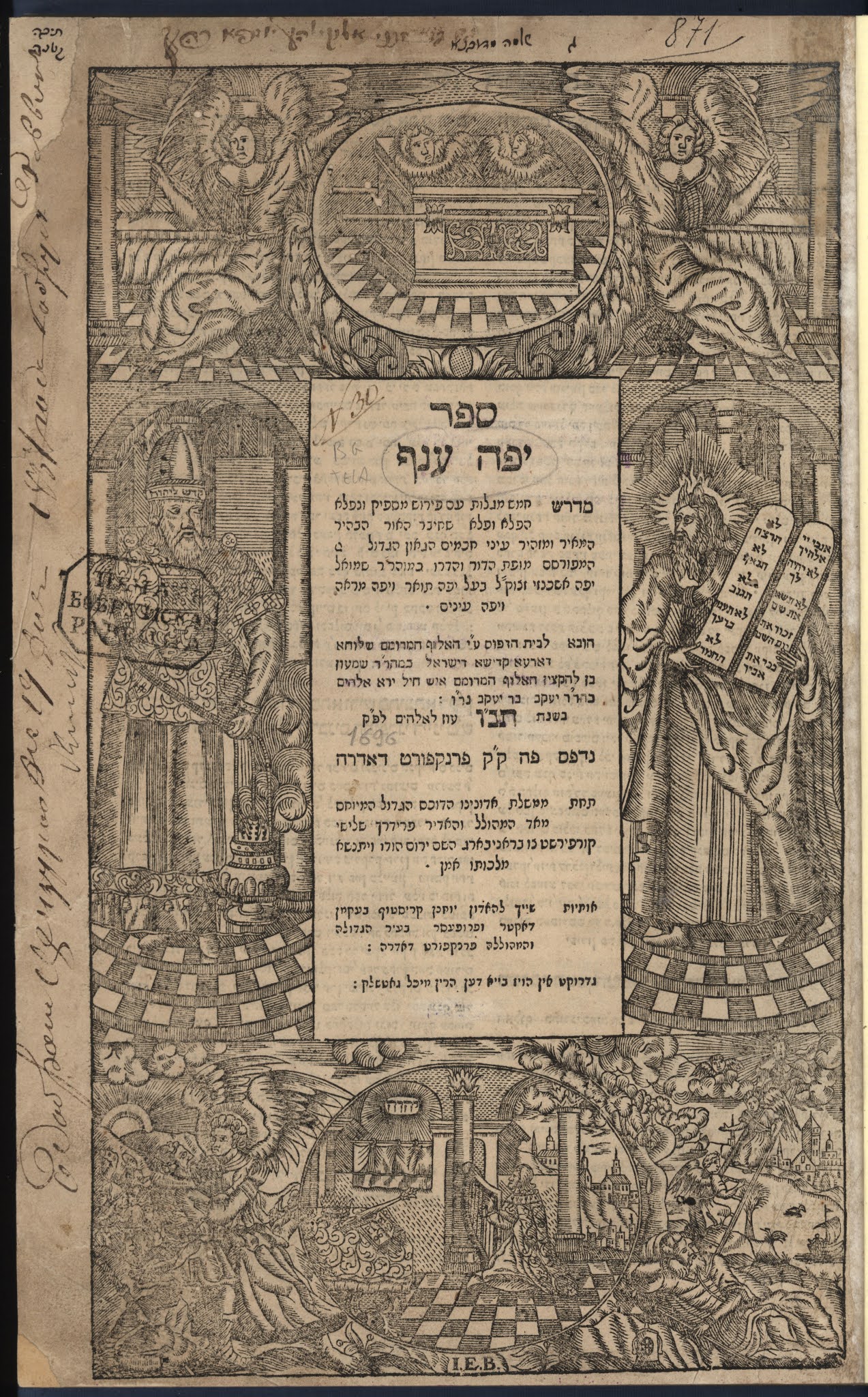
The first illustrated Jewish title pages appeared in the early seventeenth century. In 1693, the first depiction of Jacob’s dream graced a Jewish title page. That book, Sefer Rabbot, Midrash Rabba, with the commentary of R. Yisachar ben Naftali Katz, printed in Frankfurt on the Oder by Michael Gottschalk.


He was a local bookbinder and bookdealer who took over the management of Johann Christoph Beckman’s printing press in Frankfort d.O. in 1693, and led the press for almost forty years.[4]  Sefer Rabbot’s title page includes Moses and Aaron (who first appear in the 1610 edition of the She’a lot u-Teshuvot Mahril, printed in Hanau (see “Aaron the Jewish Bishop”), at the top, angels around the ark, and at the bottom, three biblical scenes, Jacob wrestling with the angel, David praying, and Jacob’s dream. It is obvious that these images are modeled after Matthaeus Merian’s engravings of biblical scenes that accompanied his Icones Biblicae printed between 1625-1630. All three of these images can be traced to Merian based upon a number of similarities and artist conventions.

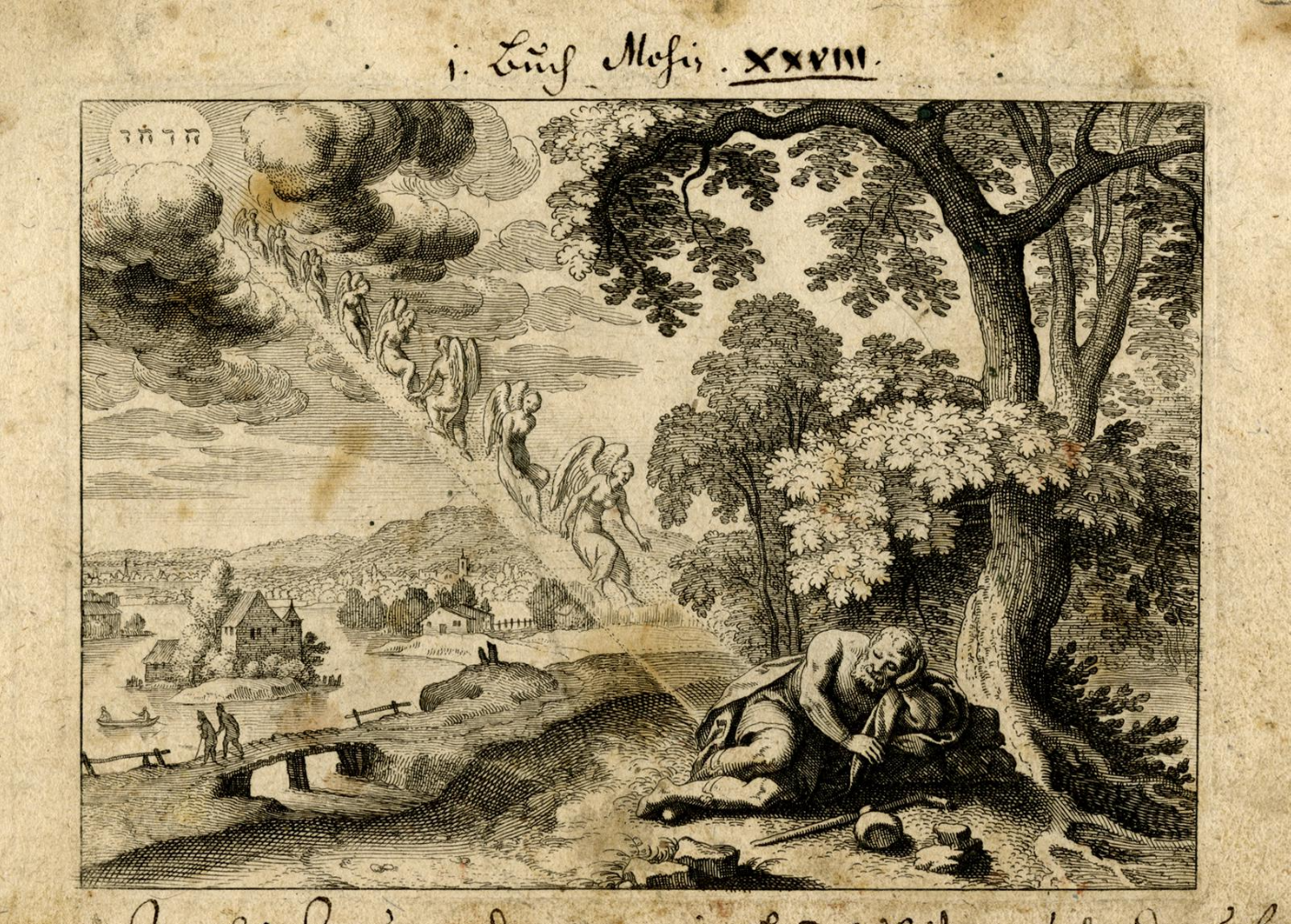
The image of Jacob’s dream depicts, in both instances, Jacob laying next to a tree, boats and houses appear in the background, and angels’ hands are outstretched to greet Jacob. There is one significant puzzling difference. In Merian’s depiction, he substitutes the letters (reversed) of tetragram for God. In the Jewish book, God is depicted as an old man with a beard wearing a crown. This, despite Judaism’s strong prohibition on depicting God in a human form.

(This is not the only instance of a Jewish book containing a human image for God. The title-page of the first edition of R. Yedidia Shlomo of Norzi’s commentary on the biblical mesorah, Minhat Shai, Mantua, 1742-44, includes a depiction of God with a human face.   The images on the title page are various biblical vignettes and in the one for the resurrection of the “dry bones” that appears in Yehkezkel, God is shown as an old man with a white beard.)

Here is that image in detail:

Michael Gottschalk reused the Rabot title page at least five times; in 1695, for R. Shmuel Yaffe, Yafe Anaf, in 1696, Mattityahu ben Asher Lemle Liebermann, Mattat Yah, in 1698 in R. Benjamin Ze’ev Wolf ben Samuel Romaner’s Ir Binyamin,  in 1699 in Ohel Yaakov, and in 1602 in Yisrael b. Aaron Yaffa, Or Yisrael.


These title pages are just a few of Gottchalk’s illustrated title pages. Gottshalk artistic sensibilities are on full display in his 1697-99 edition of the Talmud, a work for which the Frankfurt press is best known to this day. It contains arguably the most magnificent Talmudic title page ever printed.

In 1695, the first illustrated copperplate Haggadah was published in Amsterdam. All the images are modeled based upon Merian. The title page too contains a number of biblical scenes in circular medallions. One of which is Jacob’s dream.

The next title page that depicts Jacob’s dream appears in Tzvi Hirsch ben Rachmiel Chotsh’s, Shiv’im Tikunei ha-Zohar, Hemdat Tzvi, Amsterdam, Moshe ben Avraham Mendes Coutinho, 1706.[5] Like the Gottchalk’s image that includes heretical iconography, those of Shiv’im Tikunei ha-Zohar would prove equally problematic.[6]

Despite Hemdat Tzvi’s impressive approbations, R. Jacob Emden accused Chotsh, and specifically this book, of holding and expressing Sabbatian beliefs.[7] It has been conclusively demonstrated that indeed Chotsh’s book contains Sabbatian ideas.[8] Evidence of Chotsh’s embrace of Sabbateanism is identifiable amongst the title page images. Indeed, Chotsh calls attention to the larger meaning of the title page’s images. At the bottom of the title page Chotsh provides that “whosoever wishes to know the secret of the above frontispiece, should see the introduction to the Tikkunim at the beginning of the first article.” An inspection of that section yields likely Sabbatian passages. Thus, Chotsh is indicating that like the introduction, the title page also contains allusions to Sabbateanism.

The title page depicts a variety of biblical figures and Jacob’s dream appears at the top center of the page. Above that are two deer holding a crown with the verse from Isaiah 28:5, “On that day will the Lord of the hosts be for a crown of glory, and for a diadem of beauty.” The “crown of glory” or in Hebrew “Ateret tzvi” has a double meaning here, “glory” and “deer” and, of course, is alluding to Sabbatia Tzvi, who, “on that day” will be presumably wearing the crown.[9]

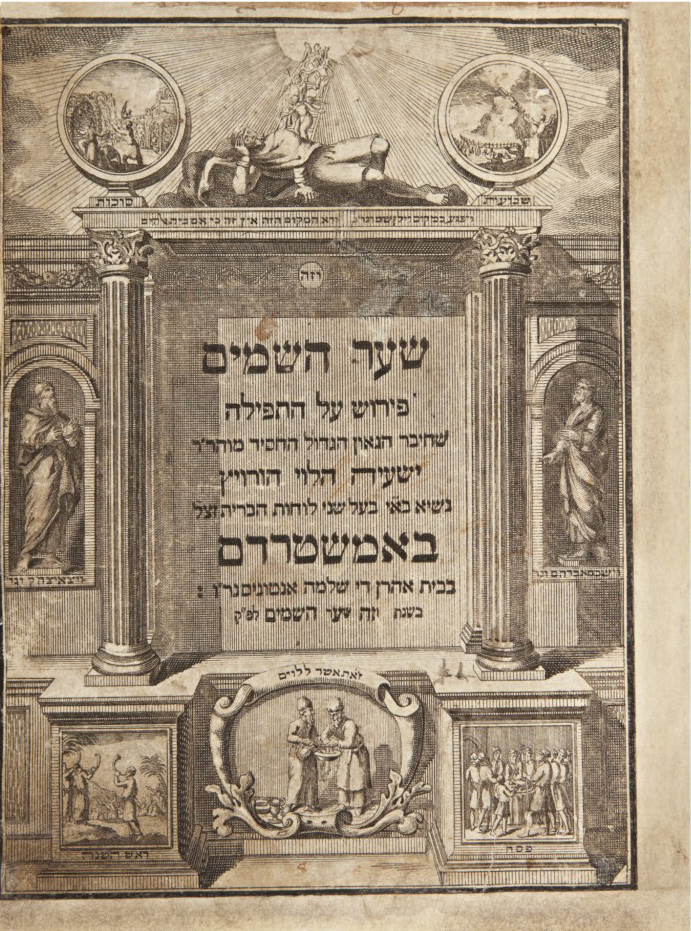
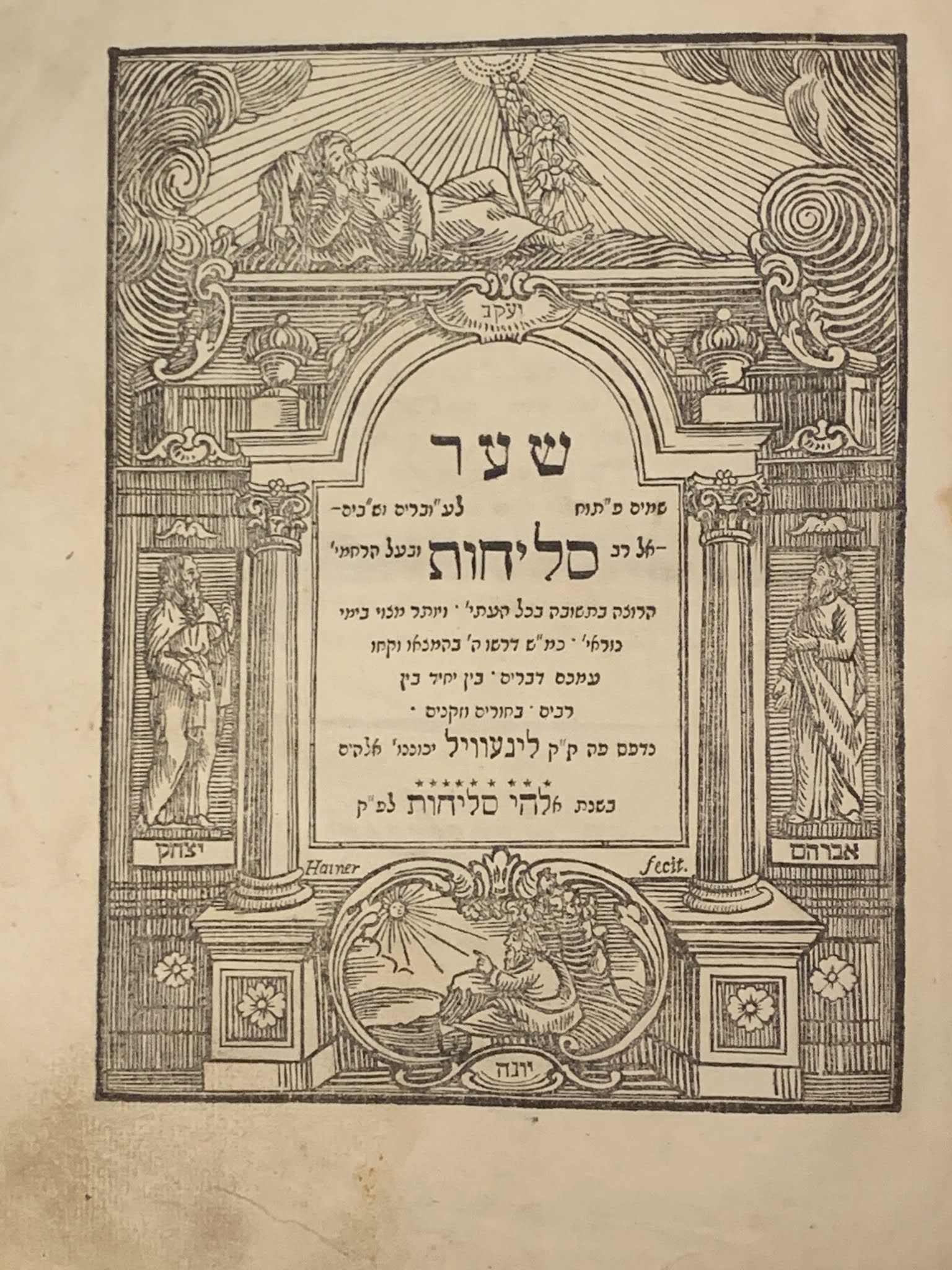
The most long-lasting depiction of Jacob’s dream is that which appeared in Siddur Shaarei Shamyim from R. Isaiah ha-Levi Horowitz (Shelah), Amsterdam, 1717.[10]

This title page is notable in that the accompanying images that align with the book which was not always the case. This is a complete machzor and as such four holidays, Sukkot, Pesach, Shavout, and Rosh Hashana, are represented on the top encased in circles, and underneath the columns. On one side of the bottom of the pillars. On either side is a niche, on the right with Abraham with the legend and on the left, Isaac, underneath each is a verse corresponding to prayer. Displayed prominently at top center, depicting his dream, with the verse from which the book’s title is derived. Underneath the title is a depiction of the Levites pouring water over the priest’s hands with the legend above, Ze hasher la-leviim. This is a reference to R. Horowitz’s lineage. All of the biblical images correspond with Merian’s depictions.

This title page, with small modifications, was repeatedly copied and is found in books from across Europe. One explanation for the ubiquity of this title page is that the Siddur ha-Shelah was imbued with talismanic effect. R. Yoel Sirkes in his approbation assures that whoever prays from this book their prayers would be answered. As evidence of the talismanic effect of the book one only needs to look to recent auctions where the book is regularly sold for tens of thousands of dollars. Perhaps printers looking to capitalize on the aura surrounding the Siddur ha-Shelah incorporated the images in their books.

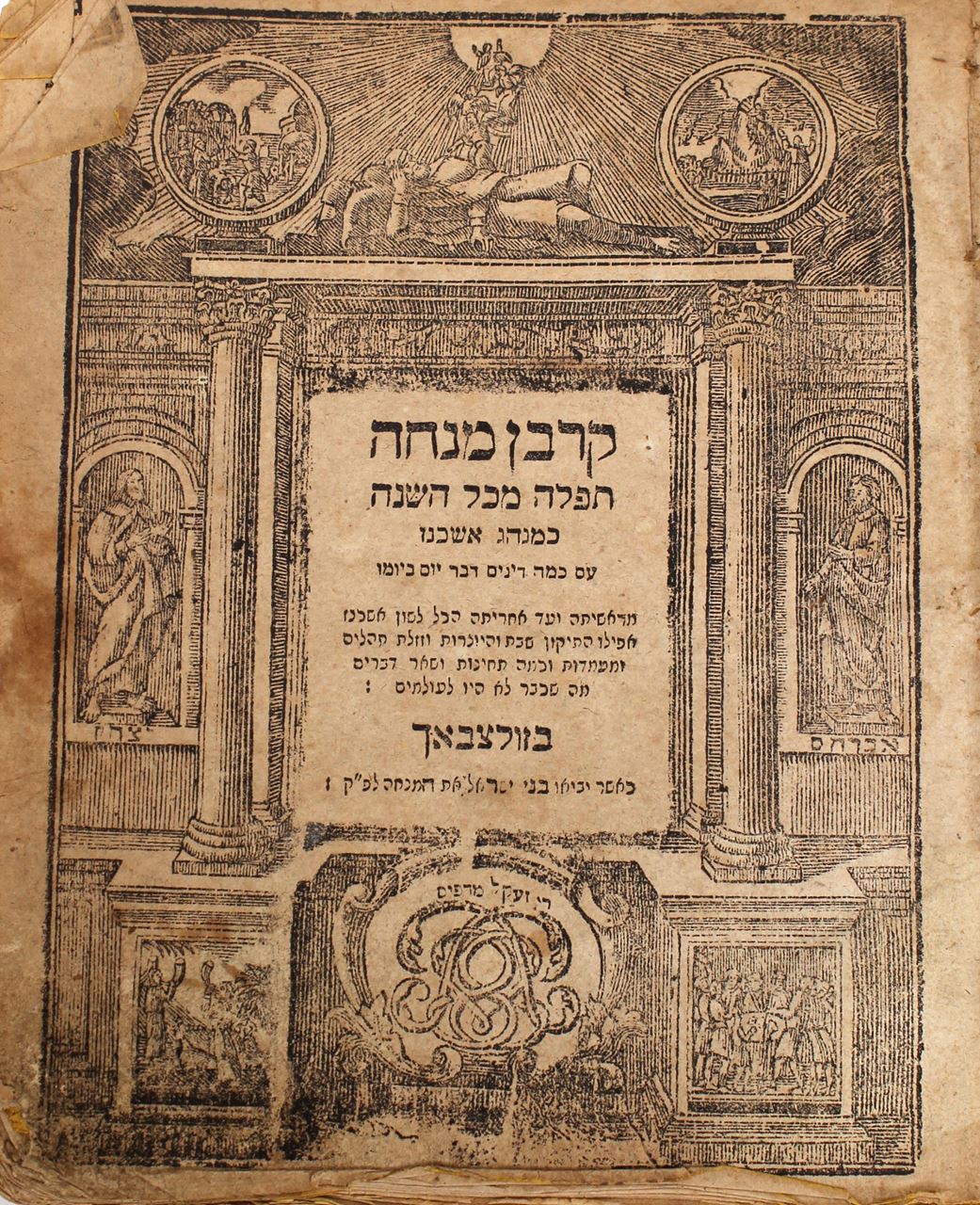
For example, the title page appears in Edut be-Yaakov, Sulzbach, 1741,[11] in 1765, Furth, Siddur Korban Minha, and in 1797, in the north west of France in Luneville, Sha’ar Selihot ve-Tahanunim. In the latter, the Levite is substituted for Jonah as that is more aligned with the High Holiday themes of the book, and the four depictions of the holidays are removed because they conflict with the singular nature of the book.

Illustrated Hebrew title pages are perhaps the most ubiquitous, and certainly the most accessible form of Jewish art. Yet, the study of the art of the Hebrew title page has not attracted commensurate scholarly interest. Our example, tracing the depiction of Jacob’s dream, is but one instance that illustrated Hebrew title pages fit within the larger history of Jewish art. Here, the Hebrew title pages seventeenth- and eighteenth-century Hebrew books harken back to the iconography identified at Dura Europos that continued to appear in Jewish artistic forms, in this instance books.

[1] Gabrielle Sed-Rajna, Jewish Art (New York: Harry N. Abrams, Inc., 1997), 127.

[2] Gabrielle Sed-Rajna, Jewish Art (New York: Harry N. Abrams, Inc., 1997), 559.

[3] E.L. Sukenik, Bet-haKeneset shel Dura-Europa ve-Tserayav (Jerusalem: Mossad Bialik 1947), 112-3.

[4] B. Friedberg, History of Hebrew Typography in Central Europe (Antwerp, 1935), 35-49.

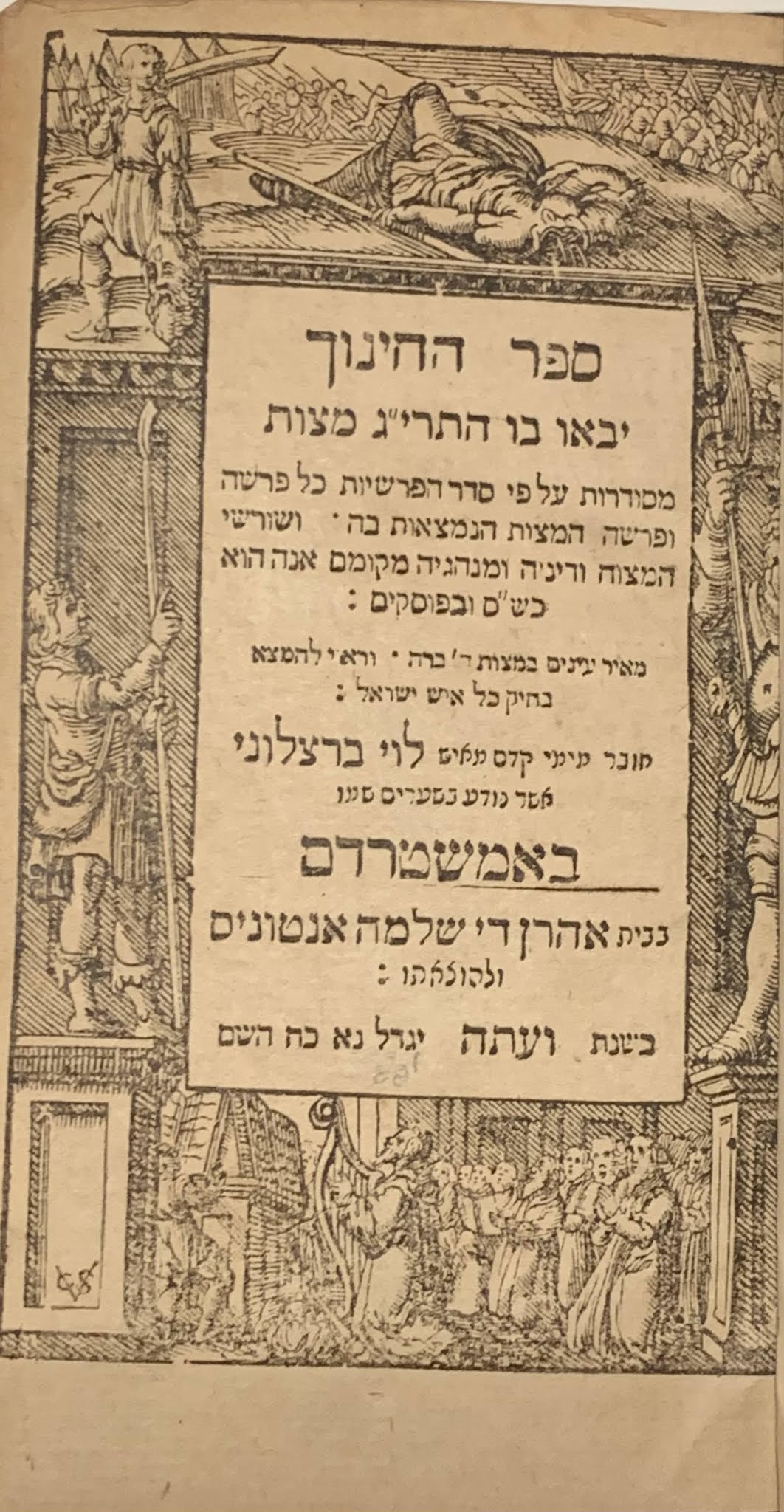
[5] Like Gottschalk, Coutinho also produced a number of other illustrated title pages with biblical images.In 1696, the year before he published the siddur, he published at least two books with illustrated title pages, Sefer Hinukh and the Mishna. This title page was reused in Coutinho’s 1698 edition of R. Hayim Moshe Karinal, Yemin Moshe.   

[6] Bezalel Naor, Post-Sabbatian Sabbatianism, (Spring Valley, NY: Orot, 1999),79-82.

[7] See Shnayer Leiman, “Sefarim ha-Hashudim be-Shabbta’ot: Rishimat shel ha-Gaon Yavet”z Tzal,” in Sefer ha-Zikhron le-Rebi Moshe Lifschitz, (New York, 1996), 890

[8] See Naor, Post-Sabbatian, 80-81 and the sources cited therein.

[9] Of course, Shabbatai Tzvi is not the only “Tzvi,” Chotsh’s first name is Tzvi. Perhaps the image is an allusion to his name – a somewhat common theme in Hebrew title page illustrations. Recently, however, one scholar noted that the deers are not the only Sabbatian reference. According to his theory, the layout of the biblical figures aligns with kabbalistic representations of the sefirot.  See Naor, 81.

[10] Horowitz’s other book, Sheni Luhot ha-Brit, Amsterdam, 1698, also contains a beautifully illustrated title page.

[11] The title page was reused for decades in the Sulzbach presses. As late as 1794, there are examples of the title page. See, e.g. Tsenah u-Renah, Sulzbach, 1794.


Was Professor Saul Lieberman “Orthodox” or “Conservative”? [1]

Was Professor Saul Lieberman “Orthodox” or “Conservative”? [1]
by David Golinkin
Saul Lieberman (1898–1983) is universally regarded by Talmud scholars as the foremost talmudist of his generation, and some regard him as one of the foremost talmudists of all times.
Immanuel Low wrote to him in Hebrew in 1938: “In the depth of your articles there are many sparks of the spirit of the Gaon of Vilna.” E. S. Rosenthal wrote in Hebrew in 1963: “… until we can almost say about him: there was no king like him before him, according to his custom and his method.” Jacob Neusner, who later attacked Lieberman after Lieberman had panned Neusner’s Yerushalmi translation, wrote to Lieberman on December 10, 1981: “I am enjoying Hayerushalmi Kifshuto so much, that I wanted to tell you so…. It reminds me of why I have long ago concluded you are the greatest exegete of rabbinic texts of the twentieth century and among the true greats among the ones I have studied and used—of all times.” Yitzhak Rafael wrote in Hebrew in 1983: “I am not authorized nor do I dare assert that Professor Rabbi Saul Lieberman z”l was the greatest Talmud scholar in recent generations, but it seems that no one would attempt to dispute this assertion.” David Weiss Halivni wrote in 1986: “Professor Lieberman was not only a yahid b’doro, unique in his generation, but a yahid b’dorotav, unique in all generations.” Elijah Schochet wrote in 1988: “Rabbeinu Eliyahu, the Gaon of Vilna, was born on the first day of Pesah, 1720. Rabbeinu Shaul, our own Gaon, was laid to rest on the eve of Pesah, 1983. Between them, there was no other like Saul Lieberman.”[2]
Finally, in 2002, Israel Ta-Shema recounted an amazing story that took place in 1981, in which he asked Professor Lieberman a riddle about the Yerushalmi. Ta-Shema had heard the riddle from Rabbi Shlomo Goren in 1961 and since then had been unable to find the answer. Professor Lieberman spent about three minutes in silence, during which he opened one volume of the Yerushalmi and closed it. Finally he returned to the bookshelf, pulled out Yerushalmi Sotah 2:1, and showed Ta-Shema the correct answer. Lieberman later explained to Ta-Shema that “in my youth, I would have answered immediately that the answer is not in the Yerushalmi at all. But now that I am old, I do not rely on my memory, which is already weakened; and therefore I decided to flip through all the pages of the Yerushalmi in my mind, in order to make certain that it is not found in any place. And when I arrived at chapter 2 of Sotah, I found the place and showed you.” Ta-Shema concluded the story: “I had the merit over the course of the years to be a frequent visitor to the houses of quite a few of the greatest talmidei hakhamim [scholars] of the generation and among the beki’im [those who possess encyclopedic knowledge] in their generation … but [bekiut] of such magnitude I have never seen, not before and not after, and the memory of that Shabbat has not departed from me until today.”[3]
In addition to his amazing memory and breadth of knowledge, Lieberman was one of the most prolific Talmud scholars of all times. He published 225 books and articles, for a total of approximately 11,500 pages—devoted, for the most part, to the explication of rabbinic texts.[4] Finally, he published books and articles related to almost every area of Jewish studies, including Bible, Dead Sea Scrolls, Mishnah, Tosefta, Yerushalmi, Bavli, ancient piyyut, Hellenism, Greek, Latin, and medieval rabbinic literature.[5] Therefore, it is not surprising that over eighty books and articles have been devoted to Lieberman and his œuvre between 1948 and 2008.[6] Indeed, three entire books have been published about Lieberman since 2002.[7]
This essay will respond to the most recent monograph, Marc Shapiro’s Saul Lieberman and the Orthodox.[8] Professor Shapiro has shown in his writings that he is adept at archival research.[9] This monograph is no exception; it quotes and/or publishes at least twenty-five letters related to Lieberman. Indeed, it should be entitled “What the Orthodox Thought of Saul Lieberman,” since it quotes the opinions of Rabbis Yaakov Halevi Herzog, Yitzhak Nissim, Shlomo Goren, Isser Yehuda Unterman, Abraham Isaac Hakohen Kook, Meir Ben-Zion Hai Uziel, Ḥayim Ozer Grodzinsky, Isaiah Karelitz, Pinchas Hirshprung, Meshulam Rathe, Mordechai Gifter, Yehiel Yaakov Weinberg, Yehudah Leib Maimon, Yaakov Yisrael Kanievsky, David Zvi Hillman, Yaakov Kamenetski, Aaron Kotler, Menahem Mendel Kasher, Shlomo Yosef Zevin, Menahem Mendel Shneerson, Ze’ev Wolf Leiter, Samuel Belkin, Yosef Dov Soloveitchik, and She’ar Yashuv Cohen. We are in debt to Marc Shapiro for this very useful anthology based on archival sources.
However, it would appear that Shapiro has missed the mark regarding three critical points: (1) the character of the Jewish Theological Seminary from 1940 and following, (2) Lieberman’s motives for accepting a position at JTS and remaining there, and (3) whether Lieberman consider himself “Orthodox” or “Conservative.” This essay will address these three critical issues in Lieberman’s biography.
The Character of the Jewish Theological Seminary from 1940 and Following

Shapiro’s basic assumption is that Lieberman was “Orthodox” and JTS was “Conservative.” Thus, he writes: “It can be imagined what a shock it was for the Orthodox when in 1940 the internationally renowned Jerusalem illui Saul Lieberman accepted an invitation to join the Seminary faculty.”[10] This assumption about JTS, which repeats itself throughout the monograph, is basically incorrect, for the following nine reasons:
1.   During most of the years that Lieberman taught at JTS (1940–1983), almost all of the Talmud faculty at JTS were “Orthodox” or strictly observant Jews, including Rabbis Alexander Marx, Louis Ginzberg, Louis Finkelstein, Moses Hyamson, Abraham Sofer, Moshe Zucker, H. Z. Dimitrovsky, A. S. Rosenthal, Yehezkel Kutscher, Mordechai Margaliot, Jose Faur, David Weiss Halivni, Dov Zlotnick, Israel Francus, and Shamma Friedman.
2.   During the 1940s and 1950s, most of the students at JTS were observant Jews; a large percentage of them came from Orthodox homes and/or were graduates of Yeshiva College. This point is stressed by Schochet and Spiro in their recent biography of Lieberman, and more importantly, it is stressed by Shapiro himself: Between 1946 and 1957, 60% of JTS rabbinical students came from Orthodox homes and 30% were graduates of Yeshiva College.[11] Similarly, both Rabbi Isaac Klein and my father, Rabbi Noah Golinkin z”l, began their studies at Yeshiva University in the 1930s and then transferred to JTS. Rabbi Klein said that he did so in order to learn the critical methodologies of Professor Louis Ginzberg. Indeed, he received s’mikhah yoreh yoreh yadin yadin from Ginzberg. He certainly was not looking for a more lax halakhic approach.[12]
3.   From 1940 to the late 1950s, the division between Orthodox and Conservative Judaism was not at all clear. Indeed, this was pointed out by Shapiro himself as well as by other scholars, such as Jonathan Sarna.[13]
4.   Beginning in the 1950s, the mehitzah become the main dividing line between Orthodox and Conservative Judaism,[14] but the Seminary synagogue maintained separate seating for men and women from the days of Solomon Schechter until Professor Lieberman passed away in 1983.[15]
5.   During all of the years that Lieberman taught at JTS, the Seminary synagogue did not use any of the siddurim produced by the Rabbinical Assembly and edited by Rabbis Silverman, Hadas, or Harlow. It used, instead, a rather obscure Orthodox prayer book edited by Rabbi A. Th. Philips. Indeed, I was informed by someone who prayed in the Seminary synagogue with Professor Lieberman for nine years that at one point, two of the students told Professor Lieberman that the Philips siddurim were falling apart. They, of course, wanted to replace Philips with a more modern siddur. Professor Lieberman said that he would take care of the problem. He then proceeded to purchase two boxes of brand new Philips siddurim! [16]
6.   From 1940 until 1959, Higher Criticism of the Bible was not taught at JTS.[17] This opposition began way back in the days of Sabato Morais, who headed JTS from 1887 until 1897.[18] Solomon Schechter, who served as president of JTS from 1902 until 1915, called Higher Criticism “Higher Anti-Semitism.”[19] Cyrus Adler, who was president of JTS from 1915 until 1940, was also opposed to Biblical Criticism; in his day, Bible was taught at JTS with medieval Bible commentators.[20] Finally, Louis Finkelstein, who headed JTS from 1940 until 1972, was also opposed to Higher Criticism.[21] In 1944, he asked Lieberman to “gently” tell H. L. Ginsberg to write his article on biblical history in a proposed volume entitled Judaism and the Jews “from an extremely conservative point of view,” so as to “avoid various pitfalls of higher criticism.”[22]
7.   Furthermore, in the 1940s when Lieberman started teaching at JTS, the rabbinical students dressed just like rabbinical students at Yeshiva University.[23]
8.   More importantly, Louis Finkelstein, who together with Louis Ginzberg invited Lieberman to teach at JTS in 1940, saw JTS—as had Solomon Schechter and Cyrus Adler before him[24] —as an institution for k’lal yisrael, the collective Jewish people, and not just of the Conservative Movement. Finkelstein stated in 1941: “If someone calls us traditional, orthodox or conservative, it is he who makes a division in Judaism, not us … I think that the members of the faculty generally prefer the term ‘traditional Judaism’….”[25] After quoting this passage, Schochet and Spiro add: “Finkelstein preferred viewing JTS as an umbrella institution for all traditional Jews, which he hoped would attract to it Orthodox Jews, rather than one reflecting a specific denominational ideology. Finkelstein made no secret of the fact that he hoped that Orthodoxy would eventually find a home at the Seminary. He would therefore counsel his associates, ‘Let’s not be too Conservative; let’s not prevent [Orthodox Jews] from coming.’”[26]
Indeed, Shapiro himself stresses[27] that when Haim Zalman Dimitrovsky came to study with Lieberman at JTS in 1951, he did not even know that JTS had a connection with the Conservative Movement!
9.   Finally, Shapiro himself[28] quotes a letter written by Rabbi Yehiel Yaakov Weinberg in 1948, when he was informed by someone supposedly “in the know” that Finkelstein was interested in him joining the faculty, alongside Ginzberg and Lieberman. Weinberg wrote to his friend Samuel Atlas (in Hebrew): “How could it be possible that they are asking me, when they have two great teachers like L. Ginzberg and Sh. Lieberman?” Weinberg did not say that he could not teach at JTS because it was Conservative or heretical; he simply said that they did not need him, because they already had Ginzberg and Lieberman.
Thus, from 1940 when Lieberman began to teach at JTS, until 1959—and, to a large extent, until 1972, when Louis Finkelstein retired—it was difficult to call JTS a Conservative institution. The faculty and students were mostly Orthodox or traditional; the lines between the movements were not clearly drawn; the Seminary synagogue maintained separate seating and used an Orthodox prayerbook; Higher Criticism was not taught; and the students at JTS even dressed like the students at YU. Louis Finkelstein viewed JTS as an institution for k’lal yisrael and even Rabbi Weinberg had no ideological objections to teaching at JTS.
Thus, there is no basis for Shapiro’s surprise that an “Orthodox” Jew like Lieberman accepted a position teaching at a “Conservative” institution.
Lieberman’s Motives for Leaving Israel, Accepting a Position at JTS, and Remaining There Until the End of His Life

Shapiro says[29] that Lieberman’s main motives were economic security, which he did not have in Jerusalem, and a desire to draw the students at JTS nearer to Torah and Judaism. These points are undoubtedly true, but I believe that there are at least six reasons why Lieberman left Israel, came to JTS, and stayed there for forty-three years:
1.   Saul Lieberman could not earn a living in Jerusalem. This is what Rabbi Meir Bar-Ilan, Lieberman’s father-in-law, told Rabbi Aaron Pechenik and others,[30] and this was the reason that Lieberman later gave Pechenik for remaining there.[31] Indeed, while in Israel (1927–1940), Lieberman worked as a clerk at the Tel-Aviv Chamber of Commerce, as a teacher in Herzlia, as a part-time lecturer at the Mizrahi Teachers Institute.[32] as a secretary at Yeshivat Shaar Hashamayim, as a Talmud teacher at Hebrew University (from 1932–1937, a position from which he was fired and only received severance pay a year later),[33] and as Dean of the Harry Fischel Institute for Talmudic Research.[34]
2.   Shapiro also says that Lieberman wanted to draw the students at JTS closer to Torah and Judaism,[35] as indicated by his brother Meir, by Pnina Herzog, and in a letter to Gershom Scholem from 1941. Furthermore, Lieberman himself said this in a Hebrew letter to Hapardes in 1945, which Shapiro published in 2003. There he says: “Young Jewish men are innocent (t’mimim) and there is nothing that will influence them more than the light of Torah planted by a teacher who believes in the holiness of the Torah.”36] 
3.   At Hebrew University, Lieberman’s Talmud course in the 1930s shrank from six to two students, he was fired, and Hebrew University refused to award him a Ph.D. for Talmuda Shel Kisrin or Tosefet Rishonim.[37] The Harry Fischel Institute, which Lieberman headed for five years, was not an academic institution. Indeed, Lieberman himself spelled out in 1937 the requirements for Talmud scholarship; the students at Harry Fischel did not possess many of those qualifications.[38] In other words, at Hebrew University he had scholars to talk to but no job, while at Harry Fischel he had a job but no one to talk to. Thus, in 1940, JTS was the only serious academic center of Jewish studies in the world, as Lieberman himself wrote to Louis Ginzberg in Hebrew on April 30, 1940: “And I also hope that I could bring benefit to your Bet Midrash, which is now the only scientific institution [i.e., of Jewish studies] in our world.”[39]
4.   In 1940, and for most of the years that Lieberman taught there, JTS had the best Jewish library in the world, with a large collection of manuscripts and Genizah fragments.[40] Schochet and Spiro relate that Seminary librarian, Nahum Sarna, advised Menahem Schmelzer, his successor, to open the Rare Book Room at any time so that Lieberman could consult the thirteenth-century manuscript of the Mishneh Torah, which was placed on a table there especially for his use.[41] 
5.   Lieberman had a very warm relationship with Louis Ginzberg of JTS.[42] They met in 1929 when Ginzberg served as visiting lecturer at Hebrew University and Ginzberg asked Lieberman to prepare for publication Ginzberg’s lecture, “The Significance of Halakhah for Jewish History.” They then corresponded from 1930 to 1940. Louis Finkelstein explicitly praised Ginzberg for his indefatigable efforts to persuade Lieberman to come to JTS. This special relationship is evident from a Hebrew letter from Lieberman to Ginzberg from 1940.[43]
6.   Finally, Lieberman had an incredibly close relationship with Louis Finkelstein, who gave Lieberman whatever he needed and treated him like a king. Their relationship has been dealt with at length by Schochet and Spiro.[44] A few examples will suffice: Rabbi Bernard Mandelbaum, long-time Vice President of JTS, said: “Finkelstein gave Lieberman whatever he needed.”[45] Lieberman said as much in his Hebrew introduction to Hilkhot Hayerushalmi in 1947: “And last but not least is my friend, Rabbi E. A. Finkelstein, the President of our Bet Midrash, who provides me with special conditions for Talmud Torah and work with all possible convenience.”[46]
But their relationship went way beyond one of providing scholarly needs. Finkelstein viewed Lieberman as the most important Talmud scholar in the world and he told him so, both privately and publicly, on a regular basis. He referred to Lieberman’s arrival in the United States as “a historic one in the development of American Judaism … Even if the Seminary across the years had done nothing else than lay the foundation for such a work [=Tosefta Kifshutah on Zera’im], the institution would have justified itself.”[47] Finkelstein further stated that “Professor Lieberman does not exist for the Seminary; the Seminary exists for Professor Lieberman.” Faculty member Professor Judah Goldin once said, “Finkelstein believed in God and worshipped Lieberman.”[48] 
On December 1, 1959, Finkelstein informed Lieberman that he would become Rector of JTS, with all the powers and no administrative responsibilities: “It seems obvious to me that with your increasing preoccupation with the Tosefta Kifshutah (which …will turn out to be probably the most significant single accomplishment of the Seminary) …”[49] In a letter to Edward B. Lawson, American Ambassador to Israel, in 1955, Finkelstein introduced Lieberman as “Professor of Talmud in the Seminary and one of the most learned men in the world.”[50] Finally, when Finkelstein got Lieberman involved in the agunah dilemma in 1953, he introduced the Lieberman ketubah at the Rabbinical Assembly Convention in hyperbolic terms and compared it to the accomplishments of the tannaim.[51]
Thus, it appears that Lieberman came to JTS and stayed there for six reasons: because he could not earn a living in Jerusalem; in order to draw the students closer to Torah and Judaism; because JTS was the only scientific institution of Jewish studies in the world; because JTS had the best Jewish studies library in the world, to which he had open access at all times; because of his warm relationship with Louis Ginzberg between 1929 and 1953; and because of his unique relationship with Louis Finkelstein from the 1930s until 1983.
Did Lieberman Consider Himself “Orthodox” or “Conservative”?

Shapiro claims that Lieberman “regarded himself as an Orthodox Jew”[52] and he faults me[53] for categorizing Lieberman as a Conservative rabbi,[54] but he himself writes: 
In 1959, Lieberman became rector of the Seminary, and one of his responsibilities was “guarding the general religious policy of the institution.” Thus, there is certainly justice in the assertion that whatever his personal religious commitments, Lieberman had become part and parcel of the Conservative Movement and was assisting it at the time that the Orthodox were attempting to expose what they regarded as the Conservatives’ distortion of halakhah.[55]
Shapiro’s confusion is well-justified; I myself have debated whether Lieberman considered himself Orthodox or Conservative.[56]
On the one hand, he taught at the only Conservative rabbinical seminary from 1940 until 1983, and he served as its rector from 1959 until 1983. When he proposed his takkanah regarding the ketubah to the Conservative Rabbinical Assembly in 1953, he attacked “the Orthodox rabbis”:
I saw that some of you were accused of being frightened by the Orthodox rabbis. I want to tell you that I am not frightened by them at all. I want, therefore, to give you a point of information. In truth, they were frightened, and I want you to know why they were frightened. They weren’t afraid that the Bet Din would issue some takkanot. No, not at all. They were afraid that the Bet Din will issue takkanot in accordance with the law.
As a matter of fact, one of the very important members of the Orthodox rabbis said so in many words: If this Bet Din of the Rabbinical Assembly will issue atakkanah, that will be takkanato kalkalato. It will be a great misfortune because they will get authority and that is the reason why they oppose this. Many of them think that [if] that Bet Din will begin to move in this line, the movement can become strong and it will affect them.[57] 
When, during the negotiations about a Joint Bet Din, the Orthodox insisted that the RA sanction rabbis who perform a wedding even without aget, “Lieberman’s spontaneous response was that the Conservative Jews do not like inquisitions …”[58] He also wrote a letter that enabled Rabbi Theodore Friedman, a leading Conservative rabbi, to receive permission to perform weddings in Jerusalem, and another letter to Chief Rabbi Unterman in 1964, which defended the gittin performed by Rabbi Israel Silverman and other Conservative rabbis.[59]
On the other hand, Schochet and Spiro cite an undated interview in the Jerusalem Post in which “Lieberman explicitly stated that he himself was not a Conservative Jew; however, he praised Conservative Jews for their sincerity and their success in appealing to young people.”[60] Furthermore, in 1974, the Israeli daily Maariv published an article claiming that Golda Meir had asked Lieberman to influence the Conservative Movement to accept a compromise on the “Who Is a Jew” issue. Lieberman was described there as “one of the leaders of the Conservative Movement and as the Vice-President of the Jewish Theological Seminary in New York.” Lieberman wrote an indignant letter to the editor in Hebrew in which he denied the whole story and in which he said:
I am not one of the heads of the Conservative Movement and I am not, nor have I ever been, the Vice President of the [Jewish] Theological Seminary. I teach Torah to the Jewish people and I don’t understand much about politics.[61]
Finally, when a group of Seminary professors, graduates, and students held a “Conference on Halakhic Process” in 1979 in order to urge JTS not to ordain women, Lieberman wrote a letter to the Conference praising them for deciding to discuss “how to guard the last spark of the halakhah, that it should not be extinguished.”[62]
There are three possible ways to interpret this contradictory data. The first approach is followed by Hillel Goldberg, who, in a nasty review of Schochet and Spiro’s biography, would have us believe that Lieberman was Orthodox and taught and stayed at JTS simply because it was a cushy job which allowed him to do his research.[63] This approach contradicts everything we know about Lieberman’s piety and integrity, and barely merits a response. The second approach is put forth by Marc Shapiro, who maintains throughout his monograph that Lieberman was “Orthodox.” When he defended Conservative rabbis during the attempts to set up a joint Bet Din, “Lieberman was only reflecting on the mindset of the Conservative rabbinate, not describing his own feelings.”[64]
There is, however, a third way to interpret the data. I agree with Shapiro that Lieberman did not consider himself “Conservative.” However, neither did he consider himself “Orthodox.” An “Orthodox” Jew would not have spoken about Orthodox rabbis in the third person and in such a critical tone as Lieberman used in the 1950s. Furthermore, neither Shapiro nor Schochet and Spiro adduce even one text in which Lieberman himself calls himself “Orthodox.” Shapiro[65] simply refers to Schochet and Spiro.[66] but the latter offer no such proof. They quote Rabbi Berel Wein, who said that Lieberman “was personally an observant Jew.” They quote Rabbi Emanuel Rackman who said that Lieberman was “a Jew whose Orthodoxy was beyond question.” They themselves say: “These citations from prominent Orthodox rabbis reflect the common perception that Saul Lieberman was indeed ‘Orthodox’ in his religious practices” (emphasis added). They then cite numerous instances of “his firm adherence to halakhic practice and accepted custom.” They later quote someone who said that Lieberman “stressed that he wanted to be known as ‘Orthodox’ (note 266), but Lieberman himself never wrote such a thing.”
Furthermore, Shapiro mistranslates a key passage in Lieberman’s important Hebrew letter to Hapardes from 1945, which Shapiro himself published in 2003. Shapiro writes:
In his letter, Lieberman states that at the Seminary he is permitted to teach what he wishes. He also mentions that if another two or three Orthodox teachers joined the faculty (italics added), they could turn it into a wonderful place.[67]
However, that is not what Lieberman wrote. He wrote:
זהו מוסד חשוב שלו היו נכנסים לשם עוד שנים שלשה מורים משלומי אמוני ישראל היו מהפכים אותו לבית ספר למופת
This is an important institution. If two or three teachers “who seek the welfare of the faithful in Israel” [cf. II Samuel 20:19] would enter it, they would turn it into an exemplary school.[68]
Similarly, in his 1964 letter to Rabbi Unterman defending the gittin of Rabbi Israel Silverman.[69] he states that “Rabbi Silverman, when he was my student, observed Torah and mitzvot as is fitting.”
היה שומר תורה ומצוות כראוי וכיאות
He goes on to say
that it is essential to arrange matters related to gittin in America, and if there is good will on all sides, it is possible to arrive at a mutual agreement. Otherwise, I am afraid that chaos will take over this profession too and we will come to a similar situation to giving a hekhsher to a treif kitchen in an Israeli boat. And behold this hekhsher was not given by the Conservatives (who rejected the offer with disgust), but by an irresponsible group which calls itself Orthodox, and this group also performs gittin!
The picture that emerges from Lieberman’s letter to Hapardes in 1945, from his attempt to set up a joint Bet Din in 1953, and from his letter about gittin in 1964, is that Lieberman meant exactly what he said in his letter to Maariv in 1974: “I teach Torah to the Jewish people and I don’t care much about politics—that is: I am neither ‘Orthodox’ nor ‘Conservative.’ There are “Conservative” rabbis who are halakhic and there are ‘Orthodox’ rabbis who are not. I care that the teachers at JTS should be sh’lomei emunei yisrael and that the students and graduates should beshomrei torah u-mitzvot ka-rauy v’khayaut.” Lieberman did not care about labels but rather about substance, and in this he was a true disciple of Rabbi Judah the Prince who said: Al tistakkeil ba-kankan, ella b’mah she-yeish bo—do not look at the vessel, but rather at its substance.[70] 
Notes

[1] This article is based on a lecture given in Hebrew in Jerusalem on Professor Lieberman’s 30th Yahrzeit, 9 Nisan 5773 (2013). It originally appeared in Conservative Judaism 65 (Summer 2014), pp. 13-29, published here with the permission of The Rabbinical Assembly.
[2] The first quotation is from Elijah J. Schochet and Solomon Spiro, Saul Lieberman: The Man and His Work (New York: Jewish Theological Seminary, 2005), p. 303 (and cf. pp. 53, 139). The other quotations are from David Golinkin, “The Influence of Seminary Professors on Halakhah in the Conservative Movement, 1902–1968,” in Jack Wertheimer, ed., Tradition Renewed: A History of the Jewish Theological Seminary, vol. 2 (New York: Jewish Theological Seminary, 1997), p. 473, n. 36. For Lieberman’s attack on Neusner’s translation of the Yerushalmi, see Journal of the American Oriental Society 104:2 (April–June 1984), pp. 315–319. For Neusner’s counterattacks against Lieberman, see History and Theory 27:3 (1988), pp. 241–260 = Jacob Neusner, Wrong Ways and Right Ways in the Study of Formative Judaism (Atlanta: Scholars Press, 1988), pp. 3–27; and idem, Why There Never Was a Talmud of Caesarea: Saul Lieberman’s Mistakes (Atlanta: Scholars Press, 1994).
[3] Ta-Shema in Meir Lubetski, ed., Saul Lieberman (1898–1983): Talmudic Scholar and Classicist (Lewiston, Queenston, Lampeter: The Edwin Mellen Press, 2002), pp. 88-90 = Israel Ta-Shema, Knesset Mehkarim, vol. 4 (Jerusalem: 2010), pp. 337–339 (Hebrew). See Shamma Friedman in Lubetski, pp. 91–95, for an explanation of the riddle.
[4] A. S. Rosenthal wrote in Proceedings of the American Academy for Jewish Research 31 (1963), Hebrew section, p. 1, that Lieberman wrote 10,000 pages. A careful count of Tuvia Preschel’s 1993 bibliography of Lieberman in Shamma Friedman, ed., Sefer Hazikaron L’rabbi Shaul Lieberman (New York and Jerusalem: Jewish Theological Seminary, 1993), pp. 1–28, adds up to approximately 11,500 pages.
[5] See Preschel’s bibliography (above, n. 4) as well as the essays in the Lubetski volume.
[6] See Golinkin, pp. 472–473, n. 35, for a listing of thirty items and Elinor Grinet, “A Bibliography About Saul Lieberman: The Man and His Work,” in Lubetski, pp. 91–96, for seventy-seven items (some of them overlap). More recent works include: Aviad Hacohen, Madda’ei Ha-yahadut 42 (5763–64), pp. 289–301; a letter from Lieberman to the editor of Hapardes from 1945, published by Marc Shapiro in Kitvei Ha-Gaon Rabbi Yehiel Yaakov Weinberg, vol. 2 (Scranton: University of Scranton Press, 2003), pp. 449–450; review of new edition of Hayerushalmi Kif-shuto edited by Menahem Katz (New York and Jerusalem, 2008), by Yehoshua Schwartz in Makor Rishon Hatzofeh,April 11, 2008, pp. 10, 13; Naomi G. Cohen, “In Memoriam: Chana Safrai (1946–2008), Friend and Colleague,” in Nashim 15 (Spring 5768/2008), pp. 198, 201. For reactions to Schochet and Spiro’s book, see: Hillel Goldberg, Tradition 40:3 (Fall 2007), pp. 69–75; Aaron Rakefet, Tradition 40:4 (Winter 2007), pp. 68–74; and Bernard Septimus and David Horwitz, Tradition 41:1 (Spring 2008), pp. 114–115.
[7] The books are Lubetski (n. 3 above), Schochet and Spiro (n. 1 above), and Shapiro (n. 8 below).
[8] Marc B. Shapiro, Saul Lieberman and the Orthodox (Scranton: University of Scranton Press, 2006).
[9] See, for example, his book Between the Yeshiva World and Modern Orthodoxy: The Life and Works of Rabbi Jehiel Jacob Weinberg, 1884–1966 (London and Portland: Littman Library of Jewish Civilization, 1999); Kitvei Ha-gaon Rabbi Yehiel Yaakov Weinberg, 2 vols (Scranton: University of Scranton Press 1998 and 2003); and “Scholars and Friends: Rabbi Jehiel Jacob Weinberg and Professor Samuel Atlas,” in The Torah Umadda Journal 7 (1997), pp. 105–121.
[10] Shapiro, p. 16.
[11] Schochet and Spiro, p. 22, and Shapiro, p. 16. Both base themselves on Jeffrey S. Gurock, “Yeshiva Students at the Jewish Theological Seminary,” in Wertheimer (n. 2 above), vol. 1, p. 473.
[12] Regarding Rabbi Isaac Klein, see what I wrote in my introduction to his Responsa and Halakhic Studies, second revised and expanded edition (Jerusalem: Schechter Institute of Jewish Studies, 2005), p. xii.
[13] Shapiro, pp. 14–15; Jonathan Sarna, American Judaism: A History (New Haven and London:Yale University Press, 2004), pp. 237ff. Shapiro, pp.14–15.
[14] See my book The Status of Women in Jewish Law: Responsa (Jerusalem: Schechter Institute of Jewish Studies, 2012), pp. 14–15, and n. 27; p. 31, n.3; pp. 308–340.
[15] See JTS Semi-Centennial Volume (New York: Jewish Theological Seminary, 1939), p. 59; Jonathan Sarna, “The Debate Over Mixed Seating in the American Synagogue,” in Jack Wertheimer, ed. The American Synagogue: A Sanctuary Transformed (Cambridge: Cambridge University Press, 1987), pp. 379–380; David Golinkin, ed., The Responsa of Prof. Louis Ginzberg (New York and Jerusalem: Jewish Theological Seminary, 1996), pp. 85–100; Wertheimer, vol. 1, p. 395, Harvey E. Goldberg, “Becoming History: Perspectives on the Seminary Faculty at Mid-Century”, Schochet and Spiro, p. 22.
[16] Personal communication from Dr. Baruch Schwartz, April 13, 2008. The siddur was entitled Daily Prayers with a Revised English Translation (New York: Hebrew Publishing Co., 1914), and reprints.
[17] David Ellenson and Lee Bycel, “A Seminary of Sacred Learning: The JTS Rabbinical Curriculum in Historical Perspective,” Wertheimer, vol. 2, p. 559.
[18] Ibid., pp. 536, 656.
[19] Solomon Schechter, Seminary Addresses and Other Papers (New York: The Burning Bush Press, 1959), pp. 35–39 and cf. pp. 1–7.
[20] David Ellenson and Lee Bycel, “A Seminary of Sacred Learning: The JTS Rabbinical Curriculum in Historical Perspective,” Wertheimer, vol. 2, p. 546.
[21] JTS Semi-Centennial Volume, p. 25.
[22] Schochet and Spiro, p. 29.
[23] Compare the pictures in Jeffrey Gurock, The Men and Women of Yeshiva (New York: Columbia University Press, 1988), after p. 120; to the pictures in Baila R. Shargel, “The Texture of Seminary Life During the Finkelstein Era,” Wertheimer, vol. 1, pp. 527, 535.
[24] Regarding Schechter, see Mel Scult, “Schechter’s Seminary,” in Wertheimer, vol. 1, pp. 58–59; Michael Panitz in Robert Fierstien and Jonathan Waxman, eds., Solomon Schechter in America: A Centennial Tribute (New York: The Joint Convention Committee, 2002), p. 14; and Solomon Schechter, Seminary Addresses and Other Papers, pp. 48–49. Regarding Adler, see Schochet and Spiro, p. 17, which is based on Mel Scult (in Wertheimer, vol. 1), pp. 85–88.
[25] Schochet and Spiro, pp. 21–22.
[26] Ibid., p. 22. Regarding Finkelstein’s desire for JTS to serve all denominations, see Michael B. Greenbaum, “The Finkelstein Era,” in Wertheimer, vol. 1, pp. 163ff.; Jack Wertheimer, “JTS and the Conservative Movement,” in Wertheimer, vol. 2, pp. 419–420; and Michael B. Greenbaum, Louis Finkelstein and the Conservative Movement: Conflict and Growth (Binghamton: Global Publications, 2001), pp. 48, 60–67. Ibid., p.22.
[27] Shapiro, p. 48.
[28] Ibid., p. 9, n. 30.
[29] Shapiro, pp. 17–18.
[30] Ibid., p. 17.
[31] Ibid.
[32] See Saul Lieberman, Mehkarim B’torat Eretz Yisrael, ed. David Rosenthal (Jerusalem: Magnes, 1991), pp. 601–602, for a beautiful vignette from that period of time.
[33] Schochet and Spiro, pp. 8–10.
[34] Ibid., pp. 10–11.
[35] Shapiro, p. 18.
[36] Shapiro, Kitvei Ha-gaon Rabbi Yehiel Yaakov Weinberg, vol. 2 (Scranton: University of Scranton Press, 2003), p. 449.
[37] Schochet and Spiro, pp. 9–10.
[38] Ibid., pp. 10–11; and cf. Lieberman’s English introduction to Harry Fischel Institute Publications, Section III, Rishonim, vol. 1 (Jerusalem: Harry Fischel Institute Press, 1937), pp. vi-viii, where he spells out the qualities necessary to do scientific talmudic research. My thanks to Professor Shamma Friedman, who called my attention to this passage a number of years ago. Cf. Preschel (n. 4 above), who lists this article in item 36 even though the Hebrew and English introductions to that volume are totally different. Ibid., pp.10–11.
[39] Shapiro, Hebrew side, p. 17, also quoted in the English side, n. 64.
[40] Regarding the Seminary library, see Alexander Marx in The JTS Semi-Centennial Volume, pp. 87–120; Menahem Schmelzer, ed., Alexander Marx, Bibliographical Studies and Notes, (New York: Jewish Theological Seminary and Ktav, 1977); Herman Dicker, Of Learning and Libraries: The Seminary Library at One Hundred (New York: Jewish Theological Seminary, 1988); and Menahem Schmelzer, “Building a Great Judaica Library—At What Price?” in Wertheimer, vol. 1, pp. 678–715.
[41] Schochet and Spiro, p. 16.
[42] Ibid., pp. 9, 18–20.
[43] Shapiro, Hebrew section, pp. 17–18.
[44] Schochet and Spiro, pp. 23–39.
[45] Ibid., p. 16.
[46] Saul Lieberman, Hilkhot Hayerushalmi L’harambam (New York: Jewish Theological Seminary, 1947), p. 3
[47] Schochet and Spiro, p. 24.
[48] Both quotations are from Schochet and Spiro, p. 26.
[49] Ibid., p. 37.
[50] Ibid., p. 40.
[51] David Golinkin, ed., Proceedings of the Committee on Jewish Law and Standards of the Conservative Movement 1927–1970 (New York and Jerusalem: The Rabbinical Assembly and the Institute of Applied Halakhah [of the Schechter Institute], 1997), vol. 2, pp. 825–829.
[52] Shapiro, p. 26.
[53] Ibid., p.20, n. 72
[54] Golinkin, Proceedings, vol. 1, p. v.
[55] Ibid., p. 24.
[56] Golinkin, “Influence,” pp. 451–452. Golinkin, “Influence,”pp.451–452.
[57] Shapiro, pp. 26–27 = Proceedings of the Rabbinical Assembly 17 (1953), pp. 75–76 = Golinkin, Proceedings, vol. 2, pp. 810–811.
[58] Rabbi Wolfe Kelman, unpublished letter to Sheldon Engelmayer, May 14, 1987. I received a copy from Professor Jack Wertheimer and I gave a copy to Marc Shapiro, who quotes from the letter in his monograph, p. 20.
[59] Golinkin, “Influence,” p. 452, n. 55. Shapiro published the second letter on the Hebrew side of his book, pp. 33–34.
[60] Schochet and Spiro, p. 99, end of n. 163.
[61] I quoted this letter in Golinkin, “Influence,” p. 452. Shapiro published the entire letter in Shapiro, Hebrew side, pp. 35–36 and discusses it on the English side, p. 20, n. 72.
[62] Shapiro, Hebrew side, p. 40.
[63] See above, n. 5.
[64] Shapiro, p. 20, n. 72.
[65] Ibid.
[66] Schochet and Spiro, pp. 66 ff., 99 n. 163.
[67] Shapiro, p. 22.
[68] Shapiro, Kitvei Ha-gaon Rabbi Yehiel Yaakov Weinberg, vol. 2 (Scranton: University of Scranton Press, 2003), pp. 449.
[69] Shapiro, Hebrew section, pp. 33-34
[70] Pirkei Avot 4:20.


In Praise of Ephemera: A Picture Postcard from Vilna Reveals its Secrets More than One Hundred Years after its Original Publication

In Praise of Ephemera:
A Picture Postcard from Vilna Reveals its Secrets
More than One Hundred Years after its Original Publication*

by Shnayer Leiman

I belong to a small group of inveterate collectors of Jewish ephemera. We collect artifacts that many others consider of little or no significance, such as postage stamps; coins and medallions; old posters, broadsides, and newspaper clippings; outdated New Years cards; wine-stained Passover Haggadot; Jewish ornaments, objects (e.g., Chanukkah dreidels) and artwork of a previous generation; photographs and postcards; and the like. The items we collect – all of Jewish interest – take up much space in our homes; they can also be costly at times. Often, we end up paying much more for an item than it is really worth, especially if it completes a set. Collectors of ephemera suffer from a disease that has no known remedy. The only respite we have from the disease is when we write scholarly essays about what we have collected, for – as I know from experience – it is not possible to write scholarly essays and actively collect ephemera at the same time.

The Picture Postcard.

Several years ago, I acquired the following postcard. It measures 5½ inches by 3½ inches, a standard size for its time. It is a mint copy, meaning that no message was penned on its back and it was never mailed. Thus, I cannot date the postcard by a recorded date or postmark on its reverse side (but see below). We present the obverse and the reverse of the postcard for the benefit of the reader:

Obverse. The obverse presents a black and white photograph, also standard for its time. It features a tombstone with a Hebrew inscription; a mausoleum behind the tombstone, with a brief Hebrew inscription; and what appears to be a cemetery attendant, with his hand atop the tombstone. Most important, it contains a German heading under the photograph, which reads in translation: “From the Eastern Front of the Theater of War, Wilna, An Old Jewish Tombstone [with Inscription].”

Reverse. The reverse prints the name of the publishing company that produced the postcard: “The Brothers Hochland in Koenigsberg, Prussia.”

Historical Context.

In terms of historical context, the information provided by the postcard (a German heading; Vilna is defined as the eastern front of the theater of war; the postcard was produced in Koenigsberg) can lead to only one conclusion, namely that the postcard was produced on behalf of the German troops that had occupied, and dominated, Vilna during World War I. German troops occupied Vilna on September 18, 1915 and remained in Vilna until the collapse of the Kaiser’s army on the western front, which forced the withdrawal of all German troops in foreign countries at the very end of 1918. Thus, our photograph was taken, and the postcard was produced, during the period just described. Its Sitz im Leben was the need for soldiers to send brief messages back home in an approved format. The ancient sites of the occupied city made for an attractive postcard. (This may have been especially true for Jewish soldiers serving in the German army.)

Due to a wonderful coincidence, a distinguished scholar of Yiddish and a dear colleague, Professor Dovid Katz, recently published a copy of the very same postcard we publish here.[1] Unlike my copy, his copy includes on the reverse side a dated message penned by the German soldier who mailed it, as well as a dated postmark. The message was written on December 3, 1917 and postmarked the next day, on December 4. Thus, we can narrow the timeline somewhat, and suggest that the postcard was almost certainly produced circa 1916 or 1917.

The Old Jewish Cemetery.

The old Jewish cemetery was the first Jewish cemetery established in Vilna. According to Vilna Jewish tradition, it was founded in 1487. Modern scholars, based on extant documentary evidence, date the founding of the cemetery to 1593, but admit that an earlier date cannot be ruled out. The cemetery, still standing today (but denuded of its tombstones), lies just north of the center of the city of Vilna, across the Neris River, in the section of Vilna called Shnipishkes (Yiddish: Shnipishok). It is across the river from, and just opposite, one of Vilna’s most significant landmarks, Castle Hill with its Gediminas Tower. The cemetery was in use from the year it was founded until 1831, when it was officially closed by the municipal authorities. Although burials no longer were possible in the old Jewish cemetery, it became a pilgrimage site, and thousands of Jews visited annually the graves of the righteous heroes and rabbis buried there, especially the graves of the Ger Zedek (Avraham ben Avraham, also known as Graf Potocki, d. 1749), the Gaon of Vilna (R. Eliyahu ben R. Shlomo, d. 1797), and the Hayye Adam (R. Avraham Danzig, d. 1820). Such visits still took place even after World War II.

The cemetery, more or less rectangular in shape, was spread over a narrow portion of a sloped hill, the bottom of the hill almost bordering on the Neris River. The postcard captures the oldest mausoleum and rabbinic grave in the old Jewish cemetery, exactly at the spot where the bottom of the hill almost borders on the Neris River. It was an especially scenic, and historically significant, site in the old Jewish cemetery, and it is no accident that the photographer chose this site for the postcard.

The Tombstone and its Hebrew Inscription.

The tombstone is that of R. Menahem Manes Chajes (1560-1636). He was among the earliest Chief Rabbis of Vilna. Indeed, his grave was the oldest extant dated grave in the Jewish cemetery, when Jewish historians first began to record its epitaphs in the nineteenth century. R. Menahem Manes’ father, R. Yitzchok Chajes (d. 1615), was a prolific author who served as Chief Rabbi of Prague. Like his father, R. Menahem Manes published several rabbinic works in his lifetime, and some of R. Menahem Manes’ unpublished writings are still extant in the Bodleian Library at Oxford University. His epitaph reads:[2]

The Mausoleum and its Hebrew Inscription.

In the old Jewish cemetery, many of the more famous rabbis were buried in mausoleums. All rabbis buried in mausoleums were buried underground. The mausoleum itself served as an honorific place of prayer that a visitor could enter and then pray at the grave of the rabbi of his choice. All tombstones were placed outside the mausoleum, and were affixed to its outside wall, directly opposite the body of the deceased rabbi named on the tombstone (but buried inside the mausoleum). Often, the names of famous rabbis were painted on the outside wall of the mausoleum (much like street signs) identifying who was buried in it. The mausoleums sometimes contained the graves of several famous rabbis. R. Menahem Manes Chajes was buried in the mausoleum that can be seen behind his tombstone. A famous rabbi buried in the same mausoleum was R. Moshe Rivkes (d. 1672), author of באר הגולה on the Shulhan Arukh.[3] The inscription on its wall, and above the tombstone of R. Menahem Manes, reads:

פה מצבת הגאון הגדול ר‘ מאנש חיות

Here is the tombstone of the great Gaon, R. Manes Chajes

The Cemetery Attendant.

What has remained a mystery for more than one hundred years is the identity of the cemetery attendant. We shall attempt to identify him, and to restore him to his proper place in Jewish history.

The reader will wonder how I know that the person in the photograph was a cemetery attendant. Perhaps he was a tourist who just happened to be there on the day the Hochland Brothers Publishing Company arranged for a photograph to be taken for its postcard collection?

Initially, it was simply a hunch, largely due to ephemera, that is, other photos of visitors to the old Jewish cemetery in the interwar period. I have a collection of such photos, and either they feature the tourist (who handed his camera to the tour guide or to the cemetery attendant, and asked that his picture be taken in front of the Vilna Gaon’s tombstone or at the Ger Zedek’s mausoleum), or they feature a cemetery attendant who stands in those places, while the tourist, who knows how to use the camera, takes the photo. The tourists can always be recognized by their garb, which matches nothing worn by anyone else in Vilna. The cemetery attendants, functionaries of a division of the Jewish Kehilla (called Zedakah Gedolah at the time), all wear the same dress, a “Chofetz Chaim” type cap and a long coat, both inevitably dark grey or black. While I am not aware of another old Jewish cemetery photograph featuring the specific cemetery attendant seen in our postcard, his dress is precisely that of all the other cemetery attendants whose photos have been preserved.

But there is no need for guesswork here. Sholom Zelmanovich, a talented artist and Yiddish playwright, published his דער גרצדקווילנער גראף פאטאצקי  in 1934.[4]

This three-act play commemorates the life and death of the legendary Ger Zedek of Vilna in a new and mystical mode.[5] The volume includes sixteen original drawings by Zelmanovich. Several of the drawings preserve details of Vilna’s old Jewish cemetery with seemingly incredible accuracy. Thus, for example, Zelmanovich depicts the northern entrance gate to the old Jewish cemetery, as well as the nearby Jewish caretaker’s house on the cemetery grounds, even though few photographs are extant that even begin to capture the details of those sites. His depiction of the Ger Zedek’s grave (and the human-like tree that hovered over it) is perfectly located in the south-eastern corner of the old Jewish cemetery, and is surrounded by the wooden fence that existed in that corner prior to 1926. Only someone who spent quality time in Vilna’s old Jewish cemetery could have known exactly where to place the entrance gate, the caretaker’s house, and the Ger Zedek’s grave.

One other matter needs to be noticed. Zelmanovich dedicated the volume in memory of his deceased parents, Meir Yisrael son of Mordechai and Sheyne daughter of Broyne.[6]

In the summer of 1935, the municipal authorities of Vilna, then under Polish rule, announced their plan to demolish Vilna’s old Jewish cemetery and replace it with a soccer stadium. Vilna – and worldwide – Jewry did not stand idly by. Instead, they engaged in an extensive, and ultimately successful, battle against the municipal authorities. As part of its efforts to win over the municipal authorities, the Vilna Jewish community charged a young Jewish scholar, Israel Klausner,[7] with writing a history of the old Jewish cemetery. It would offer clear documentation and prove beyond doubt that various Polish kings and municipal authorities throughout the centuries had authorized the Jewish community to construct the cemetery and maintain it. The cemetery was legally the property of Vilna’s Jewish community. Klausner’s monograph, entitled קורות בית-העלמין הישן בוילנה (Vilna, 1935), includes a discussion of the Ger Zedek’s grave. In a footnote,[8] Klausner mentions in passing Sholom Zelmanovich’s “recently published drama on the Ger Zedek,” and adds that Zelmanovich was the son of the caretaker of the old Jewish cemetery (Hebrew: בן בעלהקברות ), Meir Yisrael Zelmanovich! The plot thickens.

The full force of the Hebrew term בעלהקברות is not really captured by the English term “caretaker.” There were a variety of cemetery attendants who worked in the old Jewish cemetery in various capacities (such as guiding visitors and leading them to the graves they wished to visit, reciting prayers at the graves, ground-keeping, repairing broken tombstones and re-inking their inscriptions, and guard duty). But one cemetery attendant was in charge of all the other attendants, and as we shall see, he and his family lived in the house on the cemetery grounds. He was called: בעלהקברות, perhaps best rendered as: “Cemetery Keeper” or “Managing Director” of the old Jewish cemetery. We have established that Meir Zelmanovich served in that capacity. But who was he when did he live?

Meir Zelmanovich.

Sadly, almost nothing is known about the life of Meir Zelmanovich. He published no books and wrote no essays. As best I can tell, only one newspaper report mentions his name during his lifetime.[9] The report itself is significant. It records a complaint made by Meir Zelmanovich in 1919 that the Polish legionnaires had desecrated the old Jewish cemetery. But it would be Zelmanovich’s tragic death in 1920 that would perpetuate his memory. Here, we need to provide some historical context. Israel Cohen begins his discussion of the impact of World War I on Vilna, as follows:[10]

Within the small space of eight years, from 1914 to 1922, the Jews of Vilna tasted of the blessings of nine different governments, and suffered from a combination of other evils even more noxious. They became a prey to economic depression, military requisitions, unemployment, famine and disease; thousands of them were subjected to forced labor, imprisonment, plunder and brutal attacks; and physical and material deterioration inevitably engendered a certain degree of social demoralization. All the variegated differences of principle, of religious outlook and sociological doctrine, were now forgotten in the inferno created by the common foe. The long protracted fight for civil and political rights had to yield to the more primitive and desperate struggle for mere existence.

Almost certainly, the greatest concentration of Jewish suffering in this period came in April of 1919, when the Polish legionnaires unleashed a pogrom against Vilna’s Jews. Israel Cohen describes the horrors that followed:[11]

The [Polish] legionnaires[12] defiled and desecrated the [old Jewish] cemetery, smashed the tombstones, and opened the graves (including some of Vilna’s earliest rabbis) in the belief that they would find in them arms and money. Disappointed in their search, the Poles transferred their attentions from the dead to the living and ran amuck in the Jewish quarter. For three days they seized Jews in the streets, dragged them out of their homes, bludgeoned them savagely, and looted their houses and shops. About 80 Jews were shot, mostly in the suburb of Lipuvka, where some were ordered to dig their own graves; others were buried alive, and others were drowned, with their hands tied, in the Vilia [now: Neris] River… All sorts of outrages were committed in those days by the Poles in celebration of their victory. They tied a Jew to a horse and dragged him through the streets for three miles. They took a sadistic delight in cutting off the beards and earlocks of pious Jews. They even arrested, assaulted and humiliated Rabbi Rubinstein and Dr. Shabad. Altogether, thousands of Jews in Vilna, as well as in Lida and Bialystock were imprisoned in various concentration camps where they were ill fed and beaten, and where they suffered from hunger and typhoid. Moreover the total loss due to destruction and pillaging of Jewish people in the pogrom, in Vilna alone, was estimated at about 20 million roubles (about $10,000,000).

Polish rule of Vilna came to an end when the Russians recaptured Vilna on July 14, 1920. Russian rule lasted for six weeks, after which the Russians retreated and left Vilna in the control of the Lithuanians. Lithuanian rule lasted until October 8, 1920, when the Poles once again recaptured Vilna. One can only imagine the fear that gripped the Jewish community in Vilna, when they heard the sounds of the approaching Polish legionnaires. In fact, hundreds (some claim: thousands) of Vilna’s Jews fled on October 8 to Kovno, then part of Independent Lithuania.[13] Indeed, there was what to fear, for the Polish legionnaires were free again to wreak havoc with Jewish lives. And although the severity of the pogrom of 1919 did not repeat itself, the indiscriminate murder, rape, and looting of Jews that took place in Vilna between October 8-10, 1920 was, at least in the eyes of the victims, yet another pogrom.[14] Briefly, eye-witness Yiddish accounts[15] record that at least 6 Jewish men and women were murdered, numerous women were raped, and some 80 Jews were mugged and robbed. No one was brought to justice for committing these crimes! On October 10, 1920 Meir Zelmanovich, Cemetery Keeper of the old Jewish cemetery in Vilna was murdered by the Polish legionnaires. He was 70 years old when he died. The official Jewish record of his death lists his home address as “Derewnicka 3.” This is the address of the house on the grounds of the old Jewish cemetery. It is no wonder that Sholom Zelmanovitch could depict so vividly the northern entrance gate to the cemetery, its nearby caretaker’s house, and the human-like tree hovering over the Ger Zedek’s grave. His childhood playground was the old Jewish cemetery in Vilna.

On the picture postcard from 1916-1917, one sees an elderly Jew. One possibility is that it depicts none other than Meir Zelmanovitch, the Cemetery Keeper of the old Jewish cemetery until his death in 1920 at age 70. I suspected that this was the case, but could not prove it until recently — when a small miracle occurred.

Miracles Sometimes Do Occur.

In March of this year, out of the clear blue sky, I was contacted by Laurie Cowan, who introduced herself as a great-granddaughter of Meir Zelmanovich! She basically was interested in any information I could provide about her great-grandfather that she didn’t already know. I was delighted to make her acquaintance, but wondered what led her to me. It turns out that both of us were seeking information about the same person – Meir Zelmanovich – from the Lithuanian State Historical Archives in Vilnius. An alert researcher at the Archives noticed this, and made the “shidduch” between us. I shared with Laurie whatever I knew about her great-grandfather. In turn, I asked her to send me copies of whatever documents she had relating to her great-grandfather. She sent me a scan of the following photograph of her great-grandmother and great-grandfather, Sheyne[16] and Meir Zelmanovich:

Never has it been so easy to identify an unidentified picture on a one-hundred year old picture postcard! One suspects that the picture postcard company representative, and a photographer, met with the Cemetery Keeper Meir Zelmanovich at the old Jewish cemetery in Shnipishok. He led them to the mausoleum of R. Menahem Manes Chajes, and was asked to pose at the tombstone just outside it. He graciously accepted the invitation. This may well have been the last photo taken of Zelmanovich, and it preserves, together with the photo provided by Laurie Cowan, the likeness of a martyr who fell during the October 1920 mini-pogrom in Vilna.[17]

At least six Jews were murdered between October 8-10 in 1920 in Vilna. They died for one reason only, namely, because they were Jews. Such Jews are regarded as martyrs and their names, at the very least, deserve to be recorded and remembered. Until now, none of the names of the Vilna martyrs of 1920 have been published in any public Jewish record, whether in a contemporary Jewish newspaper, or a Jewish historical essay or book, or an online posting. Having examined the extant records in the Lithuanian State Historical Archives, I have been able to retrieve the 6 names of the Jewish victims who were murdered in Vilna in October of 1920. In each case, the Jewish Kehillah records of Vilna in 1920 state clearly in Hebrew that the cause of death was either נהרג or נהרגה (i.e., murdered). The names are:

1. Shmuel ben Mendel Katz, age 56, died October 9.

2. Etel Natin, age 36, died October 9.

3. Basya Natin, age 32, died October 9.

4. Rokhl Blume Shuster, age 45, died October 9.

5. Meir Zelmanovich, age 70, died October 10.

6. Shlomo Abramovich, age 17, died October 12.[18]

May the memory of these martyrs be forever for a blessing! [19]

NOTES:

עם הספר, the People of the Book the world over, mourn the death of R. Shmuel Ashkenazi in Jerusalem, at the age of 98. He was שר הספר, the consummate master of the Hebrew book. Bibliographer, bibliophile, and book collector, his encyclopedic knowledge of all of Hebrew and Yiddish literature remains unparalleled in our time. His most recent contributions appeared in three massive volumes, replete with some 1,794 pages of immaculate scholarship. He never wasted a word; he wrote with precision and parsimony. Among his many accomplishments, he edited the Kasher Passover Haggadah, one of the most significant scholarly editions of the Passover Haggadah ever published. He was largely responsible for the single most accurate bibliography of Hebrew books ever produced, מפעל הביבליוגרפיה העבריתThe Bibliography of the Hebrew Book 1473-1960. Aside from his scholarly distinction, R. Shmuel Ashkenazi wrote in an elegant Hebrew with its own special charm. Not only did he advance discussion, but he did so in an aesthetically pleasing manner. For those of us who knew him personally, he evinced the same charm in his personal relationships that he did in his writings. He set a standard of excellence that we can only strive to emulate, but never really replicate. יהא זכרו ברוך!

This essay is dedicated to his memory, a token of appreciation for all he has taught me.

[1] Dovid Katz, “World War I Postcard of the Grave of Rabbi Menachem Manes Chayes (1560-1636) in the Old Vilna Jewish Cemetery,” Defending History (11 March 2020), available here) A copy of our postcard can also be seen online at ‘YIVO 1000 Towns’, record ID 10743 (http://yivo1000towns.cjh.org).
[2] For a fuller discussion of R. Menahem Manes Chajes and his epitaph, see S. Leiman, “A Picture and its One Thousand Words: The Old Jewish Cemetery of Vilna Revisited,” The Seforim Blog, January 14, 2016, especially notes 7-11, online here.
[3] Aside from his pivotal commentary on R. Joseph Karo’s Shulhan Arukh, R. Moshe Rivkes was a great-great grandfather of the Vilna Gaon.
[4] Precious little is known about Sholom Zelmanovich (1898-1941). See the brief biographical entry in לעקסיקאן פון דער נייער יידישער ליטעראטור (Martin Press: New York, 1960), vol. 3, column 670, which mistakenly lists him as being born in a town near Kovno, circa 1903. He was born in Vilna in 1898 (JewishGen) and died during one of the first Nazi aktions in the Kovno Ghetto.
[5] In general, see Joseph H. Prouser, Noble Soul: The Life and Legend of the Vilna Ger Tzedek Count Walenty Potocki (Gorgias Press: Piscataway, 2005). Prouser’s excellent monograph is a study of the many literary reworkings of the legends surrounding the Vilna Ger Zedek, with primary focus on 20th century Jewish literary contributions. Strangely, he offers no discussion of Zelmanovich’s contribution.
[6] On the feminine Yiddish name “Broyne,” see Alexander Beider, Dictionary of Ashkenazic Given Names (Avotaynu: Bergenfield, 2001), pp. 484-486.
[7] Klausner (1905-1981) settled in Palestine in 1936 and continued to be a prolific author of studies and books on the history of Vilna’s Jewish community. Aside from several important monographs, like his history of the old Jewish cemetery, he wrote a two-volume history of Jewish Vilna entitled 1939-1881 וילנה ירושלים דליטאדורות האחרונים (Ghetto Fighters’ House: Tel-Aviv, 1983), to which a third volume treating 1495-1881 was added posthumously, based largely on studies previously published by Klausner.
[8] קורות ביתהעלמין הישן בוילנהp. 45, note 1.
[9] See Vytautas Jogela, “The Old Jewish Cemetery in the Nineteenth and Twentieth Centuries,” Lituanus, vol. 61, no. 4 (2015), pp. 81-82.
[10] Israel Cohen, Vilna (Jewish Publication Society: Philadelphia, 1943), pp. 358-359.
[11] Ibid., pp. 378-379.
[12] Cohen regularly spells the word: “legionaries.” For the sake of consistency, I have spelled the word “legionnaires” throughout this essay.
[13] See, e.g., Boaz Wolfson, “מיטלליטע” in פנקס פאר דער געשיכטע פון ווילנע אין די יארן פון מלחמה און אקופאציע (B. Zionson: Vilna, 1922), column 387.
[14] There are probably as many definitions of “pogrom” as there are scholars and politicians. Since it is unclear whether the crimes committed on October 8-10, 1920 were planned and implemented by either a government or a political action committee, and since the duration of the attacks was short and rather swiftly brought under control, historians are reluctant to refer to the events that occurred on October 8-10, 1920 as a pogrom. On the other hand, to label those events a mere “disturbance” does not begin to capture the malevolent intent of the perpetrators directed specifically against Jews, and does not address the intensity of Jewish suffering at the time. For some of the different views regarding the definition of “pogrom,” and how the term has been manipulated by political interests, see Szymon Rudnicki’s forthcoming essay “The Vilna Pogrom of 19-21 April 1919,” to appear in Polin 33 (2020). Professor Rudnicki kindly allowed me to see a pre-publication copy of his lucid and informative essay.
[15] Wolfson, loc. cit. Cf. Jacob Wygodski, אין שטורם (B. Kletzkin: Vilna, 1926), pp. 217-221.
[16] Sheyne Zelmanovich died in Vilna on October 26, 1921, at age 68 (JewishGen). She lived in her home on the old Jewish cemetery grounds until her death. In a personal communication, Laurie Cowan informed me that the Zelmanoviches had 10 children who survived to adulthood. The 6th child, Beirach (popularly called: Berik; and later, Ben), was her grandfather, an older brother of Sholom mentioned above.
[17] The only other extant likeness of Meir Zelmanovich (known to me, and recovered on July 15, 2020) is an undated passport photo (circa 1916) preserved in the Lithuanian State Historical Archives. During the German occupation, all residents of Vilna were required to have – and to carry at all times – a German passport (we would call it: an Identity Card). Meir Zelmanovich’s German passport photo confirms the identity and authenticity of the photos of Zelmanovich published in this essay. All three photos are of one, and the same, person.
[18] One suspects that Abramovich may have been shot or beaten on October 9 and 10, like the others, but did not die from his wounds until the 12th.
[19] This essay could not have been written without the help of Regina Kopilevich, researcher (and tour guide) extraordinaire, who located whatever documents I sought at the Lithuanian State Historical Archives (Lietuvos Valstybes Istorijos Archyvas) in Vilnius. I am indebted to the librarians at the Archives for allowing her and me to examine these and other documents during my visits to Vilnius. Next to Google, JewishGen is a modern Jewish historian’s best friend, and we are grateful to all who contribute to making JewishGen the great historical resource that it is. Matt Jelen’s careful reading of an earlier draft has significantly improved the final version. I alone am responsible for whatever errors appear in this essay.