Halakhah and Haggadah – Manuscript Illustrations and their Halakhic and Customary Significance

This post is part of a series of posts regarding illustrations adorning manuscript and print Haggadot. Our first post dealt with a new work on the topic and can be viewed here. In this post we will focus upon the some of the Halachik implications of these illustrations. In many Ashkenazic manuscripts, the Passover illustrations begin chronologically earlier than the Seder. Many begin with the preparation of the matzah. For example, in the Second Nuremberg Haggadah[1], (the manuscript is online here) a 15th century Ashkenazic haggadah, contains ten scenes devoted to the matzah process. A similar haggadah, likely illustrated by the same artist, also includes numerous matzah baking scenes. All of these, however, begin with the bringing of the grain to the miller. This is in contrast to today’s practice whereby the matzah producing process begins earlier, with the cutting of the wheat.
(All images may be clicked for larger viewing.)
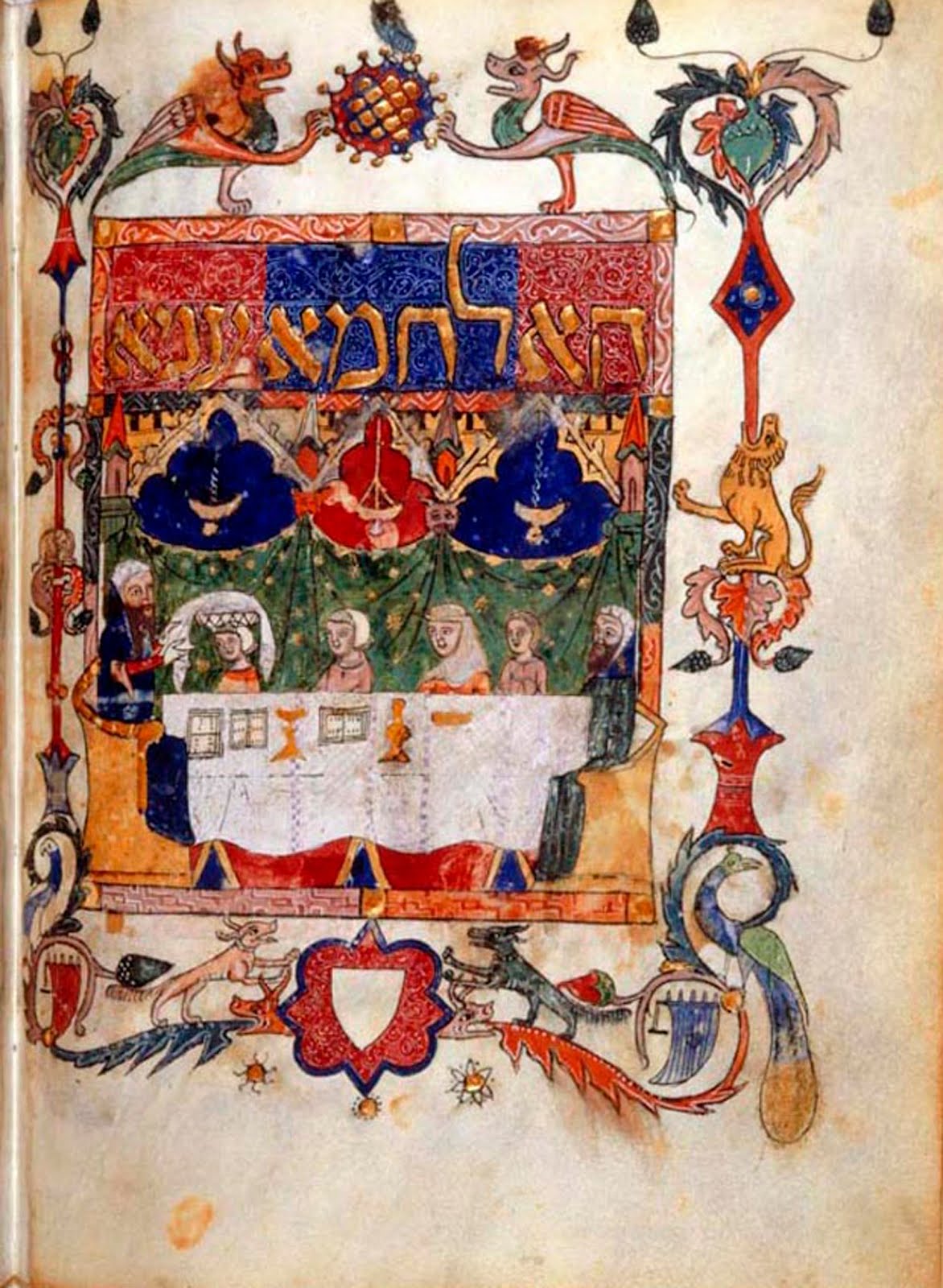
That is, for many today, matzah shmurah means shmurah (watched) from the time of harvest and not from the time of grinding. But, in reality the reason for the illustrations beginning where these haggadot do, is simply because they reflect the practice in Ashkenaz, based upon the R. Ya’akov ben Asher, the author of the Tur, that only from the time of grinding is it necessary to “watch” the grain. Matzah Shmurah in Ashkenaz in the medieval period meant grain which had been watched from the time of grinding not cutting.[2] Turning to a Sefardic custom, the Barcelona Haggadah, produced after 1350, is the earliest record of the custom to place the Seder Plate on someone’s head during the recitation of Ha Lahma Ania (Ashkenazim remove the plate from the table).Only some three hundred years later is this custom mentioned in printed sources. Additionally, there is a difference between the Sefardic and Ashkenazic haggadot regarding what the Seder Plate actually was, with the Ashkenaz depicting a plate, whereas the Sefardic manuscripts depict a basket.[3]
When it comes to marror and what vegetable that is, we have at least two different types depicted in various manuscripts. In the Brother to the Rylands Haggadah, marror is depicted as an artichoke, as is in the case with the Sarajevo Haggadah.

While in many manuscripts, marror is a leafy vegetable.[4]
Setting aside the issue of what marror is, another custom related to marror can be found in both printed and manuscript haggadot. In the Prague, 1526, the first illustrated printed haggadah, there is a picture of a man pointing at his wife with the legend, “there is a custom that a man points to his wife when mentioning marror based upon the verse Ecclesiastes 7:26 “Now I find woman more bitter than death.”
A.Y. Hyman the scholar of Jewish liturgy was appalled when he came across this. In his autobiography, he claims that there is no basis whatsoever for this “custom.” Hyman is wrong.[5] If you look at the Brother to the Rylands Haggadah you can see that it shows this custom. As does the Washington Haggadah. Likewise, the Rothschild Miscellany shows the same custom.

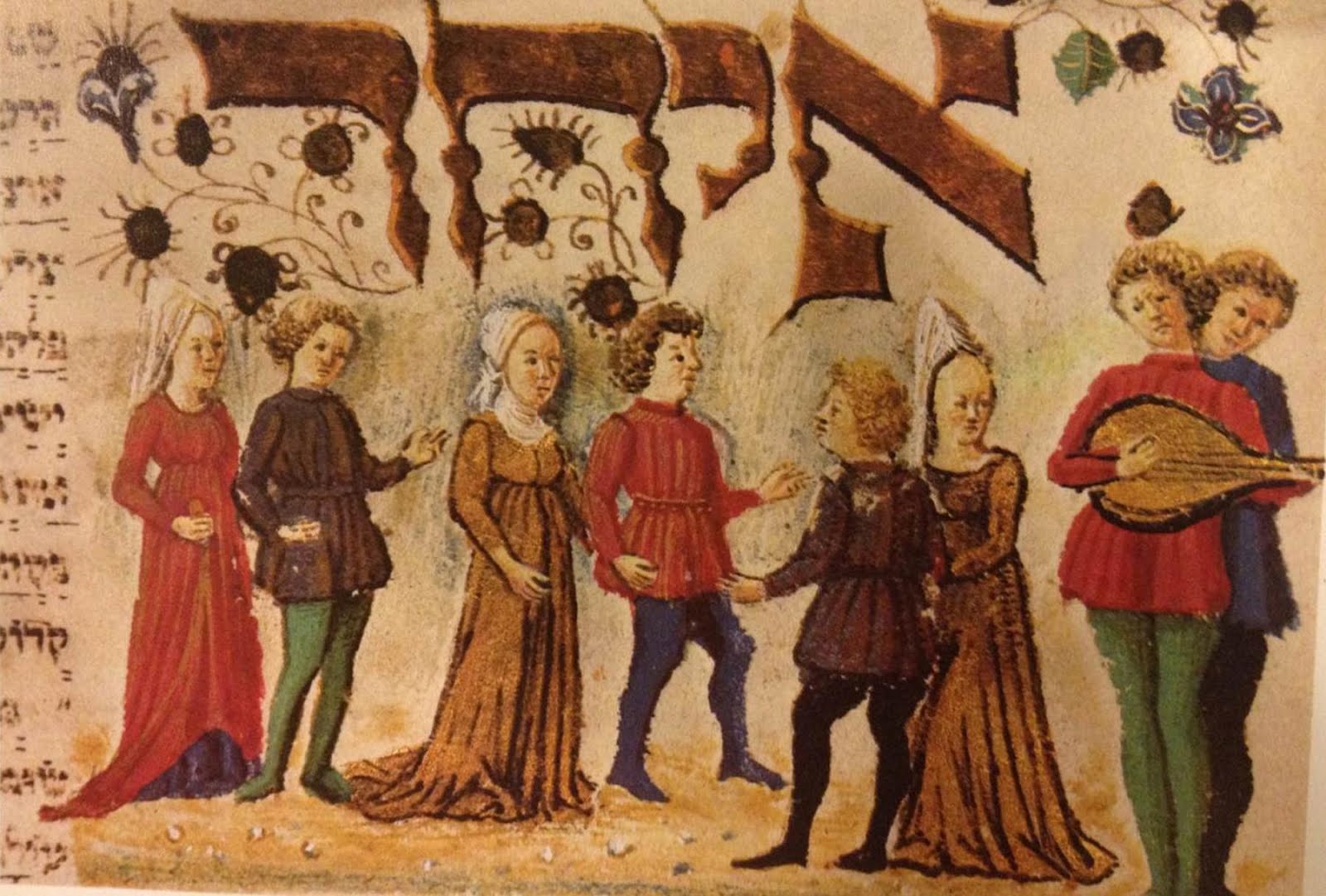
It’s worth noting that the Rothschild Miscellany shows another custom at the time, mid-14th century, that of mixed dancing.

The mixed dancing is that of couples, husband and wives dancing with each other, and not that of unmarried men and women dancing[6] In Italy, where this manuscript was composed, mixed dancing was apparently common during this period.[7] Returning to the gesturing at one’s wife at marror, in the Hiluq and Biluq Haggadah this custom takes on a somewhat more humorous dialogue with the wife no longer passive but instead returns the compliment. In that haggadah it includes speech balloons and they record the following: The husband states “touching marror I must recall that this one, too is bitter [as gall].” To which the wife replies, “It is you [my husband] is one of the causes of bitterness as well.” After which, we have a play on the 13 attributes of Rabbi Yishmael and the haggadah provides that “the third comes between them [perhaps the marror itself] and makes a stink” – or in Hebrew ve-yavo ha-shlishei ve-yakhriach benehem.[8]


Similarly, in some Ashkenazic haggadot manuscripts, they show the the husband and wife pointing at one another.[9] Finally we get to a halachik error in a manuscript haggadah. The Washington Haggadah was written by a scribe calledJoel ben Simon. This haggadah was first printed as part of the Diskin Orphan House haggadah series in 1965. The Library of Congress didn’t publish its facsimile edition until 1991, and last year another facsimile edition of this haggadah was published as well.[10] Although this haggadah was written close to 300 years prior to Diskin publishing it, until that time a significant scribal error escaped notice. Specifically, in the text for eruv tavshilin rather than just saying “with this eruv I am allowed to cook from Yom Yov for Shabbat,” it continues and says “and on Shabbat for Yom Tov.”


Needless to say this did not escape the eagle eyes of some who feared that someone may use this haggadah (we note that contrary to the other reproductions mentioned, the Diskin version is a poor copy) and inadvertently think it is permissible to cook on Shabbat. So, the ever wise Aggudat ha-Rabbonim took out ads in the Yiddish daily, Der Tag, and the Forward to let its readers know of this error. The publishers took this one step further and mailed out a letter, with the provocative title, “Heresy or Blunder,” after Passover indicating the error and also included a letter from Cecil Roth, who had written about manuscript haggadot.


In his letter he indicates that indeed this was most likely inadvertent and that Joel did not have a different tradition regarding eruv tavshilin. Indeed, we know from Joel’s other manuscripts, where he records the correct blessing, that the Washington Haggadah’s version was simply a scribal error.

This is not the only error related to halakha and haggadah illustrations. R. S.H. Kook, criticizes two aspects of illustrations that appear in the Prague 1526 Haggadah. Both of these issues center around how the wine glass is depicted. Specifically, he takes issue with the fact that in many of the illustrations show the wine glass in the left hand and not the right. Additionally, he complains that the illustration show the holder grasping the glass at the stem and not at with his fingers cupping the bottom of the glass.
Regarding the first issue, that of left handedness, this anomaly may be attributed to the fact that this was the first completely illustrated woodcut haggadah. And, as it was the first, it was not necessarily perfectly executed. But, before we continue we must digress and explain about woodcuts in order to get to the left handedness. A woodcut when inked and put on paper produces a mirror image of whatever the woodcut depicts. Thus, if the woodcut was of a right hand, when pressed on paper would produce a left handed image. Additionally, when copies were made, the copyist were not careful and would reverse the images. That is, they were working off the printed image and would copy it directly rather than accounting for reversing the image to ensure that when it was used it would produce the same and not a mirror image. So, as has been explained, during the early history of woodcuts “copies [of woodcuts] were constantly being made, with or without leave, for copyright hardly existed, and the same printer would often have to replace worn cuts by new blocks in successive editions. It is not always an easy task to distinguish copy from original. Immediately recognizable as from different blocks are subjects which appear in reverse directions, for the copyist who does not take the trouble to reverse his drawing from the original print, will make a block that will print the subject reversed.”[11] We can now explain why the images are left handed, presumably, they were copied and the woodcutter was not careful to reverse the image, thus producing a left handed image. As an aside, another example of copying which reverses the images may be seen when the Prague 1526 Haggadah was itself used as a model for a woodcut. The border surrounding Shefokh was reused in the Levush. As is apparent, the images are that appear on the right in the Prague 1526 Haggadah appear on the left in the Levush. And, those on the left appear on the right.

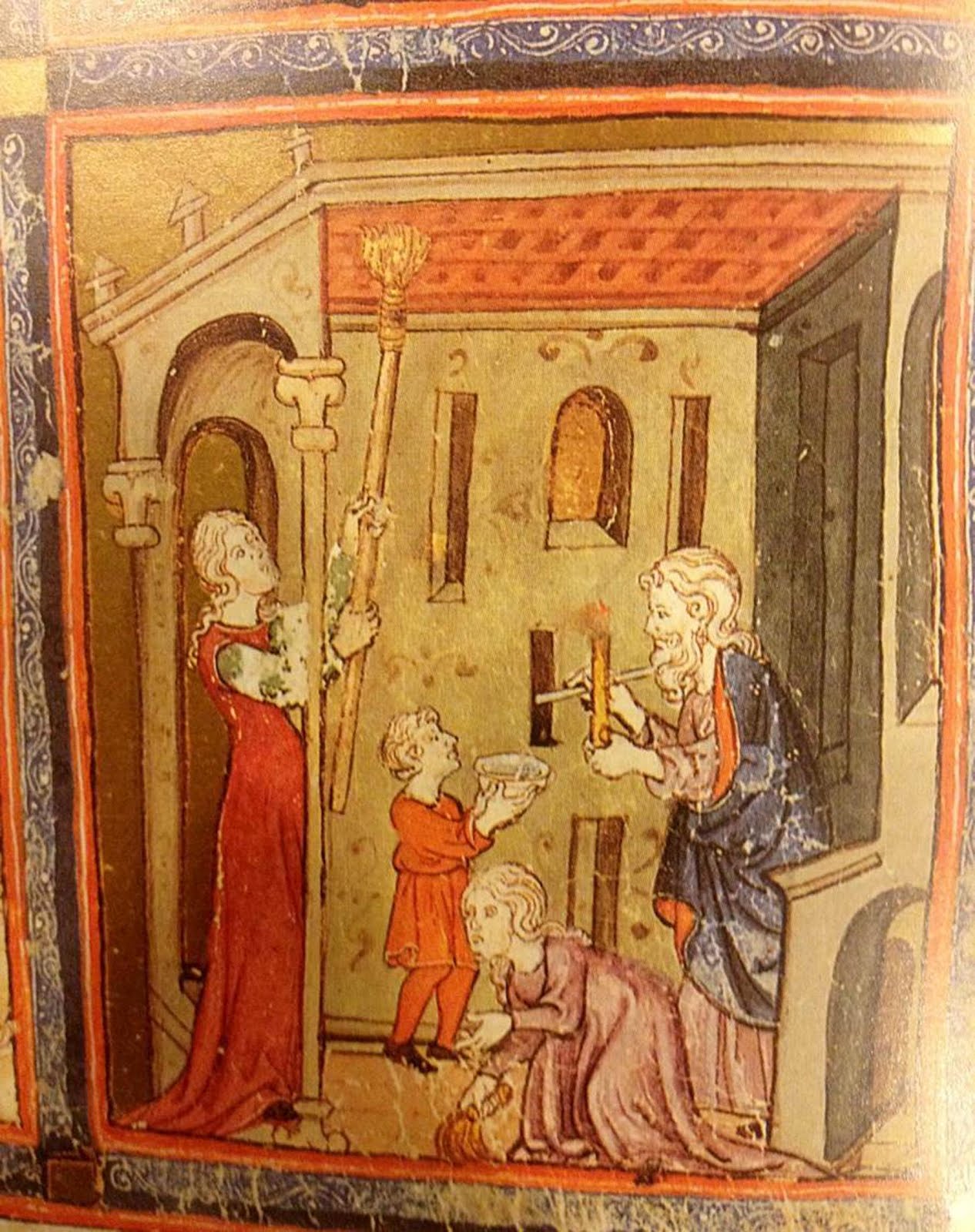
Regarding the second point, the failure to cup the glass rather than grasp the stem, this can be attributed to an error on R. Kook’s part and not the woodcutter. While today it may be commonplace to cup the glass, this was only popularized by R. Yeshaya Horowitz, in his book, Shnei Luchot ha-Brit, (Shelah). R. Horowitz wasn’t born when the Prague 1526 Haggadah was printed – he lived between 1565-1630. Moreover, his book was published posthumously, in 1648, more than 120 after the Prague 1526 Haggadah was published. Thus, it is unremarkable that the Prague 1526 Haggadah failed to account for a custom that didn’t exist at that time. This is another example of why bibliography is important, for other examples see here. Finally, we conclude this part of the series regarding halachot and Passover in general, and specifically, the notion that on Passover we are stricter than normal. At times it appears that some go overboard with the various humrot on Passover as well as cleaning all sorts of items that seemingly don’t require cleaning. But, from the evidence of manuscript illustrations, this notion of stringency is not a new one. The Golden Haggadah, circa 1320, includes this very nice image of cleaning and searching for leaven. If one looks closely they will note that the woman on the left is apparently sweeping the ceiling! Thus, indicating that perhaps going overboard has been the case for some while. Also of note is that the father is performing bedikat hametz and he is bareheaded (as is the son).[12]
[1] Its title is a reference to the fact that from the mid-nineteenth century until 1957 it was housed in Nuremberg, after which it moved to the Schocken Library, and then to a private collector. The reason it is the the Second, is because Nuremberg also had another manuscript haggadah – now known as the First Nuremberg Haggadah. It too is no longer in Nuremberg. Today it is in the Israel Museum.
[2] See Steven Fine, “The Halakhic Motif in Jewish Iconography: The Matzah-Baking Cycles of the Yahuda and Second Nurnberg Haggadahs,” in A Crown for a King, Gefen, Jerusalem-New York: 2000, pp. 106-07. [3] See Evelyn M. Cohen, “Seder Foods & Customs in Illuminated Medieval Haggadot,” in The Experience of Jewish Liturgy, D.R. Blank ed., Brill, Leiden:2011, 24-25. We note that while this article provides a summary of some of the images and text accompanying medieval haggadot, the article provides little context for various practices. Indeed, the article fails to provide sources which support many of the illustrations and texts and instead merely parrots what the the manuscripts say or depict. [4] On this issue of which vegetable is preferable for marror see Zohar Amar, Merorim, n.p., 2008. [5] His comments appear in the Misrad Hasikon 1965 reprint of the Prague 1526 Haggadah at pp. 14-15. [6] See Therese & Mendel Metzger, Jewish Life in the Middle Ages, Chartwell Books, Inc.:1982, 216-17. [7] See the sources collected by R. Henkin, Shu”t Benei Banim, vol. 1, Jerusalem: 1998, no. 37, esp. section 5 where he discusses Italian sources. Thanks to R. Weinfeld for bring this source to our attention. [8] See Bezalel Narkiss, “Art of the Washington Haggadah,” in The Washington Haggadah, Commentary, M. Weinstein, ed., Washington D.C.: 1991, pp. 73-75, discussing manuscripts that contain the marror/wife images, as well as the source in the following note. [9] See R. Yisrael Mordechi Peles, “Controversies Regarding Customs That Can Be Gleaned from Haggadot,” in HaMaayan, Nissan: 5771 (51,3), pp. 13-14, available here. [10] The 1991 edition was accompanied by a commentary volume. The 2011 edition also includes some articles with the color reproduction of the haggadah. [11] Arthur M. Hind, An Introduction to the History of Woodcut, Boston: 1935, vol. 1, pp. 284-85, quoted in R. Charles Wengrov, Haggadah and Woodcut, New York: 1967, pp. 87-88. In general Wengrov’s book provides a wealth of information regarding the images contained in the Prague 1526 Haggadah.[12] Mendel Metzger, Jewish Life in the Middle Ages, supra, p. 148 discussing generally medieval manuscripts and depictions of headcovering or lack thereof.


Abraham Rosenberg, R. Chaim Heller, R. Shlomo Zalman Auerbach on Conversion, Abortion, Mercy Killings, and new pictures and videos of R. Jehiel Jacob Weinberg

Abraham Rosenberg, R. Chaim Heller, R. Shlomo Zalman Auerbach on Conversion, Abortion, Mercy Killings, and new pictures and videos of R. Jehiel Jacob Weinberg

Marc B. Shapiro

1. In my post here I discussed the enigmatic plagiarizer Abraham Rosenberg. As we saw, in 1923 and 1924 Rosenberg published articles on the Jerusalem Talmud in the Orthodox journal Jeschurun, and he later published Al Devar Tikunei Nushaot bi-Yerushalmi. In this last work, Rosenberg refers to R. Chaim Heller as his friend. I and so many others assumed that “Rosenberg” was a pseudonym, but Moshe Dembitzer, the expert on everything related to R. Heller, has pointed out to me that this appears not to be the case. Here is a letter Dembitzer found in the JDC archives from R. Heller to Cyrus Adler. As you can see, R. Heller mentions A. Rosenberg—the letter that is unclear must be an “A”—and one of his essays on the Jerusalem Talmud. He also mentions that Rosenberg “is considered only one of the ordinary students.”

Dembitzer also found another connection between R. Heller and Rosenberg. Here is a note from R. Charles B. Chavel’s edition of Hizkuni’s commentary on the Torah, p. 525.

Here is Rosenberg’s Al Devar Tikunei Nushaot bi-Yerushalmi, p. 102, where he cites the same explanation that Chavel cited in the name of R. Heller (but Rosenberg takes credit for it himself).

Regarding the plagiarisms of Rosenberg, I must also thank Gershon Klapper who alerted me to other examples. He wrote to me:

Rosenberg’s first article (לחקר תלמוד הירושלמי) opens אין מן הצורך לשנות את הידוע כי תלמוד הבבלי שנחתם לא זזה ידם של חכמי ישראל ממנו, very similar to how R. Heller’s ע”ד מסורת הש”ס בירושלמי begins, אין מן הצורך לשנות את הידוע כי תלמוד הירושלמי הוא עדין כשדה שאין עובד בו. But the next part of his introduction to that article is taken, slightly rearranged, from Steinschneider’s ספרות ישראל vol. 2, p. 103 (it reappears at the beginning of ע”ד תקוני נוסחאות בירושלמי, which includes most of this article’s content), as is the line beginning פעולתם של הגאונים. He does paraphrase some other language from R. Heller in the introduction, but again it isn’t word-for-word.

His second article (פסוקי המקרא שבתלמוד) opens

כי חכמי התלמוד היו בקיאים בכל ספרי התנ”ך עד להפליא, – דבר זה ידוע לכל מי שלמד גמרא, ואפילו למי שהצליף בה סקירה שטחית. כמעט מכל דף ודף שבתלמוד נראה, כי פסוקי התנ”ך, ואפילו המקראות “האובדים והנדחים” שברשימות השמות בעזרא ובדברי הימים היו שגורים על פי התנאים והאמוראים בתכלית הדיוק. בעלי התוספות (ב”ב ד’ קי”ג בד”ה תרוייהו) לא חששו להחליט, שהאמוראים פעמים שלא היו בקיאים בפסוקים. אבל כבר הודו שם בעלי התוס’ עצמם שאין החלטה זו מוכרחת וכמו שכתב הרשב”ם שם. וגם הראיה שהביאו מדברי ר’ חייא בר אבא, שאינו יודע אם נאמר בי’ הדברות טוב או לא (ב”ק נה.) אינה מוכרחת שהרי ברור הדבר, כי דברי רחב”א, אינם אלא דברי בדיחותא, כדי לדחות את השואל.

Almost every word of this comes from an article of the same title by Yisrael Chaim Tawiow which appeared in HaShiloach 29 (July-Dec. 1913). The rest of the second article is taken from Baer Ratner, סדר עולם רבא pp. 103ff. and Samuel Rosenfeld, משפחת סופרים pp. 98, 100, 105, etc.

Klapper also called my attention to Rosenberg’s plagiarism of part of a paragraph in R. Heller’s article that appears in Le-David Zvi (David Zvi Hoffmann Jubilee Volume, Hebrew section). Compare p. 56 there with Rosenberg, Al Devar Tikunei Nushaot bi-Yerushalmi, p. 11. As Klapper notes, it is quite ironic that Rosenberg leaves out the following sentence from R. Heller that occurs in the middle of the passage he plagiarizes:

ויש שיועיל לנו הציון לברוח מן העבירה ולעשות מצוה לאמר דבר בשם אומרו

While on the topic of R. Chaim Heller, first let me share this wonderful picture from R. Ahron Soloveichik’s wedding in which one can see the Rav, R. Heller and R. Yaakov Kamenetsky. As far as I know, this picture has never appeared online. I thank Yoel Hirsch for providing me with the picture.

From R. Kamenetsky’s recently published Emet le-Yaakov al Nakh, vol. 1, p. 185 n. 2, we learn that in 1937 R. Kamenetsky visited Boston to discuss with R. Soloveitchik opening a yeshiva together.

In 1924 R. Heller published his study of the Samaritan version of the Torah, Ha-Nusah ha-Shomroni shel ha-Torah (Berlin, 1924). In 1972 Makor, which published so many valuable reprints of old seforim, decided to also reprint R. Heller’s Ha-Nusah ha-Shomroni. The problem was that R. Heller had an heir, and she was the only one with the legal right to reprint his books. This led to the following letters sent by Miriam Heller’s attorney (the letters are found in the Israel State Archives, 14924/3, available here [before the recent cyber attack on the archives], pp. 35ff.). From these letters, we learn that there were other unauthorized reprints of R. Heller’s works.

One final point about R. Heller is the following: In 1912 he was appointed rav of the city of Lomza. Here is a report on his appointment from the newspaper Ha-Mitzpeh, March 29, 1912.

The writer is simply amazed that a Polish city, full of Hasidim, would hire as its rav a “Rabbi Dr.” Of course, R. Heller was a very unique “Rabbi Dr.”

2. Because I discussed conversion in the last post, I would like to call attention to R. Yoel Amital’s discovery of how R. Shlomo Zalman Auerbach’s view on the matter has been presented.[1] The issue R. Amital focuses on is whether a conversion for someone who does not observe mitzvot takes effect. I am referring to one who tells the beit din at the time of conversion that he accepts the mitzvot, but we see later that this was not the case.

In his letter in R. Zvi Cohen’s Tevilat Kelim (1975), R. Auerbach is clear that ex post facto such a conversion is still valid.

The crucial words are:

בכגון דא נלענ”ד שכל המסייעים לגירות כזו, אף שבדיעבד הם גרים גמורים, אפי”ה המגיירים אותם עוברים בלאו של לפני עור וגו’

According to R. Auerbach, because be-diavad such converts are Jewish, to convert them is a violation of lifnei iver. As R. Auerbach explains, before conversion, these people could work on Shabbat and eat non-kosher, but now that they are Jewish they are forbidden to do so. By converting people who will be committing these and other sins, the beit din has violated the prohibition of lifnei iver.

As R. Amital shows, in subsequent printings of R. Cohen’s book, R. Auerbach’s letter is printed with a significant addition (here underlined):

בכגון דא נלענ”ד שכל המסייעים לגירות כזו, אף שהם טועים לחשוב שבדיעבד הם גרים גמורים, אפי”ה המגיירים אותם עוברים בלאו של לפני עור וגו’

And

בכגון דא נלענ”ד שכל המסייעים לגירות כזו, אף אם הם טועים לחשוב שבדיעבד הם גרים גמורים, אפי”ה המגיירים אותם עוברים בלאו של לפני עור וגו’

When this letter was printed in R. Auerbach’s Minhat Shlomo, vol. 1, no. 35:3, the wording was altered further:

בכגון דא נלענ”ד שכל המסייעים לגירות כזו, אף דהם טועים לחשוב שהם גרים גמורים, אפי”ה גם לשטתם המגיירים אותם עוברים בלאו של לפני עור וגו’

In Ha-Ma’yan 56 (Nisan 5776), p. 89, in response to R. Amital’s article, R. Aharon Goldberg, a grandson of R. Shlomo Zalman, published a picture of R. Auerbach’s original letter. The wording is identical to what appears in the first edition of R. Cohen’s book. So how to explain the later additions? R. Goldberg states that it is possible that the later changes were made with the consent of R. Auerbach. Although there is no evidence of this, I find it unlikely that R. Cohen would have altered R. Auerbach’s letter while R. Auerbach was still alive. A general rule of censorship and alteration of texts is that it is done after the author is no longer alive.

Leaving aside the updated version of the letter, there is still a problem that R. Amital confronts. According to R. Auerbach’s original letter, those who convert but do not become religious, their conversion is still valid. However, R. Auerbach also signed a public letter together with the Steipler, R. Shakh, and R. Elyashiv, which states that such a conversion has no validity. So which is it?

R. Mordechai Halpern has shown that R. Auerbach sometimes presented a “public” halakhah that was stricter than his true opinion, but which for some reason he did not wish to publicize.[2] R. Amital suggests that in this case we have a similar example where R. Auerbach publicly advocated a “strict” position regarding conversion that was not in line with his true opinion. (I put “strict” in quotes because while this position is strict in not regarding a conversion as valid, it is also “lenient” in that it tells someone who converted and did not intend to become religious that she can leave her husband without a get, does not need to fast on Yom Kippur, etc.)

R. Amital also claims, implausibly in my opinion, that the public letter R. Auerbach signed does not really stand in contradiction to the letter he sent to R. Cohen. How so? The public letter speaks of people who convert without accepting to observe mitzvot, while R. Auerbach in his letter to R. Cohen is referring to people who in front of the beit din do accept to observe mitzvot, but in their inner heart do not really have such an intention.

Contrary to R. Amital, this is clearly not what the public letter means. It is referring to people who converted in a beit din, but never intended to follow halakhah. It is simply impossible to read this public letter as referring to, in the words of R. Amital: גרים שלא קיבלו עליהם כלל בבית דין לקיים תורה ומצוות. There is no beit din in the world that does not require converts to accept Torah observance. The issue the letter was addressing is converts who, despite their verbal acceptance of mitzvot, do not follow through in practice. According to the letter, such a conversion is not valid. This is so obvious that one wonders how R. Amital could have ever offered his suggestion to explain the contradiction.

R. Halpern himself notes that he knows that R. Auerbach never backed away from his earlier position, as seen in his letter to R. Cohen, that someone who was converted by a proper beit din, but did not intend to observe mitzvot, ex post facto the conversion is still valid. Yet he states that R. Auerbach later concluded that this liberal approach should not be publicized.[3]

Even with the initial two “corrected” versions of R. Auerbach’s letter, R. Auerbach mentions that rabbis who convert people who have no intention of observing Torah violate the prohibition of putting a stumbling block before the blind. R. Auerbach states that until now the person converting violated Shabbat and ate non-kosher food and these were not sins. But now, after the conversion, he is violating the Torah. R. Auerbach concludes his letter as follows:

נמצא שכל המגיירים והמסייעים לכך הו”ל כגדול המחטיאו, ועוברים בלאו של ולפני עור לא תתן מכשול

The implication of this is that ex post facto the conversion is indeed valid, as otherwise there would be no sin committed by the convert and there would be no issue of putting a stumbling block before the blind. In the words of R. Yisrael Rozen:[4]

למדנו מדבריו שהגירות חלה, דאי לאו הכי אין כאן מכשול, שהרי נשאר בגיותו

In fact, we find many poskim who say that we should not convert people who do not intend on observing mitzvot, because then they will be punished for their sins. This shows that these poskim regard a conversion without intent to observe mitzvot as valid ex post facto. In a previous post here I cited a number of examples of this, and here is one more.

R. Raphael Shapiro, Torat Refael, vol. 3, no. 42, has a short responsum about whether to convert a woman who will not be observant. It was sent to R. Mordechai Klatchko of Volozhin, who would later come to the U.S. and serve as a rav in Boston.[5] R. Klatchko was clearly a fine talmid hakham, as can be seen from the two volumes of his Tekhelet Mordekhai. R. Klatchko wrote to R. Shapiro arguing that the woman should be converted even if she was not going to be observant so that her intended husband (or perhaps current husband) could fulfill the mitzvah of procreation (which he could not do if his children would not be halakhically Jewish). R. Shapiro disagrees and states that it is forbidden to convert her, as she will certainly not observe the niddah laws, and this will cause them both to violate a Torah prohibition.

What is important for our purposes is that both R. Klatchko and R. Shapiro assume that one who converts without intending to observe Jewish law is regarded as a valid convert. As long as the person goes through a halakhically proper conversion ceremony, that is what activates the conversion. It is hard for people today to understand how R. Shapiro never even raises the possibility that a conversion is invalid if the person converting intends to routinely violate fundamental Jewish laws by living an irreligious lifestyle. But as can be seen in so many different examples, a widespread view in prior generations—I don’t know if it was the majority view or not—was that as long as the conversion is carried out properly, what happens later, and what is in the convert’s heart at the time of the conversion ceremony, have no legal significance.[6]

Here is one further example of this approach, Be-Mar’eh ha-Bazak, vol. 4, no. 96.[7]

As you can see, the approach of Kollel Eretz Hemdah is that there is no possibility of voiding a conversion carried out by a proper beit din, even if the people converting had no intention of observing mitzvot. At the beginning of the volume, it states that the responsa were reviewed by R. Zalman Nehemiah Goldberg, R. Nachum Rabinovitch, and R. Yisrael Rozen, all significant figures in their own right.

Finally, it is also worth noting that no less a figure than R. Isaac Jacob Weiss refused to void a conversion even though the woman who converted never observed mitzvot. See Minhat Yitzhak, vol. 1, nos. 121-123.

I have a good deal more to say about conversion, but in the interest of space, let me just call attention to a couple of interesting things I recently saw. The first is that R. Moses Sofer states that non-Jews are rewarded in this world if they convert to Judaism.[8] I do not know of anyone else who says that there is a divinely ordained reward for one who converts.

The second interesting discussion about conversion I recently saw is R. Aviad Sar Shalom Basilea, Emunat Hakhamim, ch. 24 (pp. 264-265 in the Jerusalem, 2016 edition). Adopting the type of anachronistic explanation that some commentators have been fond of, R. Basilea assumes that Mahlon converted Ruth and married her with huppah and kiddushin. But this creates a problem, because if Ruth was Jewish, why did Naomi push her away? R. Basilea offers a possible answer: Naomi held like the Rif and the Rambam that since Ruth’s immersion in the mikveh was not before three men, it was invalid even be-diavad. However, Mahlon held like the other poskim that be-diavad, tevilah by oneself if valid.

והנה נעמי היתה סוברת כרי”ף והרמב”ם שאפילו בדיעבד אינה גיורת ולכן השתדלה להרחיקה, ומחלון היה סבור כאותם הפוסקים הסוברים כי גיורת גמורה היתה ולכן נשאה

Does anyone, even from the most traditional communities, still offer explanations along these lines? Here is what R. Shimon Shkop wrote in a different context, and you can see that he was not a fan of this type of explanation.[9]

ודבר זה מביא לידי גיחוך, כעין הפלפולים אם פרעה היה סובר שעבודא דאורייתא

Some time ago I was looking at Abba Appelbaum’s book Rabbi Azariah Figo (Drohobycz, 1907), and he offers the following examples of anachronistic explanations (p. 54):[10]

R. Gershon Ashkenazi (1618-1693), one of the greatest halakhists of his day, also wrote a work of homiletics, Tiferet ha-Gershuni. In his derashah for parashat Mas’ei (p. 236 in the 2009 edition) he portrays the daughters of Zelophehad as arguing from halakhic logic.

In his derashah for parashat Va-Yera (p. 48), in discussing the descendants of Ishmael, R. Ashkenazi suggests that they held that the law of ketubah is rabbinic.

אם כן בני ישמעאל היו סבורים כתובה מדרבנן

Appelbaum also calls attention to R. Meir Schiff’s elaboration at the end of his commentary to Bava Kamma (found in the Vilna Shas). He portrays the incident of Esau selling his firstborn status from a halakhic angle. As such, Jacob’s thoughts were no different than those of a later halakhic scholar:

ונסתפק יעקב באומרו כיום מחמת שני דברים, שגריעותא דבכורה מחמת דבר שלא בא לעולם ומחמת אונאה . . . ויעקב נתיירא או למד הפשט כרש”י ולזה אמר ויאמר השבע לי כמ”ש בח”מ סי ר”ט ס”ד בהגה”ה

Another example, not mentioned by Applebaum, is R. Samuel Edels (Maharsha) in his aggadic commentary to Sanhedrin 57b. R. Edels wonders why Pharoah commanded the Hebrew midwives to kill the newborn Hebrew children, as it would have made much more sense to have Egyptian midwives do this. He explains that the children were to be killed before birth and for non-Jews this would be regarded as murder, which Pharoah wanted to avoid.[11] He thus turned to Hebrew midwives as for them it is not murder to kill an unborn child.

Quite apart from the far-fetched nature of the explanation, as well as its assumption that even before the giving of the Torah the Israelites were bound by Jewish law, not Noahide law, I don’t think any reader of the biblical story would find it reasonable that Pharoah was concerned about anyone violating the commandment against murder. However, the passage is also of interest in seeing how Maharsha regarded the prohibition against abortion.[12] He even portrays Pharoah as thinking that there is no prohibition for Jews to abort a fetus, including right before birth.

דודאי פרעה לא שאל מהם להרוג הזכרים בידים דבן נח מוזהר על שפיכות דמים ולכך לא אמר כן למילדות המצריות שהוזהרו על שפיכות דמים אפילו בעוברים אבל למילדות העבריות אמר שהותר לכם להרוג עובר במעי אמו וראיתם על האבנים קודם שיצא לאויר העולם אם בן הוא וגו’ וכיון שאי אפשר בהם לפטור משפיכות דמים רק בתחילת יציאת הולד קודם שיצא ראשו או רובו הוצרך לתת להם סימנין כמו שכתוב בפרק קמא דסוטה [יא ע”ב]

There has been a good deal of discussion as to how to understand the Maharsha’s words שהותר לכם. Some assume that he meant that Pharoah was in error in thinking that there is no prohibition for Jews to abort a fetus.[13] It is also possible to explain that the prohibition against abortion for Jews is only rabbinic,[14] so at that period of time there was no prohibition. R. Yaakov Farbstein states flatly:[15]

ומבואר במהרש”א דאין איסור לישראל בהריגת העוברים

This notion, that the Maharsha is saying that there is no prohibition for Jews to abort a fetus, is not in line with the overwhelming majority view beginning with the rishonim. However, in one Tosafot, Niddah 44a-b, s.v. ihu, it does state that abortion is permitted for Jews, and it does not mention that there needs to be a good reason for this or provide a timeline after which abortion is not allowed.

וא”ת אם תמצי לומר דמותר להורגו בבטן . . . וי”ל דמכל מקום משום פקוח נפש מחללין עליו את השבת אף ע”ג דמותר להרגו

Pretty much every halakhist who deals with abortion struggles with this Tosafot, as they have found it very hard to accept that any rishon could permit abortion without restrictions. One approach offered is that Tosafot is saying that there is no Torah prohibition, but there would still be a rabbinic prohibition.[16]

R. Moshe Feinstein, in his classic responsum on abortion, claims that there is a mistake in Tosafot, and instead of the two appearances of דמותר it should instead say דפטור ההורגו in both places.[17] This is in line with the phenomenon I have discussed on a few occasions, where R. Moshe is prepared to deny the authenticity of problematic texts. R. Eliezer Waldenberg offered a strong rejoinder to R. Moshe.[18]

והנה עם כל הכבוד, לא אדוני, לא זו הדרך, וחיים אנו עפ”ד גאוני הדורות, והמה טרחו כל אחד ואחד לפי דרכו לבאר ולהעמיד כוונת דברי התוס’ בנדה וליישבם, ואף אחד מהם לא עלה על דעתו הדרך הקלה והפשוטה ביותר לומר שיש ט”ס בדברי התוס’ ובמקום מותר צריך להיות אסור [צ”ל פטור]

While no other authorities agree with R. Moshe that the Tosafot contains a mistaken text, many regard the language of Tosafot as not exact.[19]

Returning to R. Shlomo Zalman Auerbach, I know of another example where he did not want a view of his to be widely shared. R. Amit Kula discusses R. Avigdor Nebenzahl’s argument that according to a variety of sources one who is suffering greatly is allowed to commit suicide. He further adds that it would be permitted to kill another in this circumstance (active euthanasia), for if you are allowed to kill yourself for a good purpose, you can do it to another as well. R. Nebenzahl adds that some of what he says comes from R. Shlomo Zalman Auerbach. He also quotes R. Auerbach that one can take medicine to reduce pain even if it will shorten one’s life.[20]

This information, which appeared in the first edition of R. Nebenzahl’s Be-Yitzhak Yikare, is not found in subsequent editions. R. Kula tells us that in these editions R. Nebenzahl inserted a note that the section was removed at the instruction of an unnamed scholar, and R. Mordechai Halpern quotes R. Nebenzahl that this scholar was none other than R. Auerbach.[21]

I find this of interest because if there is one thing that everyone knows, it is that Judaism does not allow active euthanasia (mercy killing). As is usually the case, matters are more complicated as has recently been shown by R. Yitzchak Roness in an article in Ha-Ma’yan.[22] He notes that R. Moshe Sternbuch does not believe that there is any prohibition for non-Jews to engage in mercy killing, since it is carried out for a good purpose. R. Yitzhak Zilberstein also inclines towards this position, and R. Moshe Feinstein suggests this as well, writing:[23]

אפשר שבן נח אינו אסור ברציחה שהוא לטובת הנרצח ושאני בזה האיסור לישראל מהאיסור לבן נח

R. Moshe and others specifically have in mind a non-Jew engaging in mercy killing of a Jew. The proof brought is the famous story of the death of R. Hanina ben Teradyon (Avodah Zarah 18a) where R. Hanina permits the executioner to raise the flame and remove the wool from his heart, thus actively hastening his death. R. Shaul Yisraeli goes the furthest, and for someone suffering greatly, and near death, he thinks that active euthanasia is permitted even if performed by a Jew.

R. Roness then notes that there is a dispute if one suffering great pain is allowed to commit suicide. For the side that permits this, R. Zilberstein adds that if it is permitted for the suffering individual, it will also be permitted for another to assist (active euthanasia). R. Roness also cites R. Hershel Schachter who states that active euthanasia, with the agreement of the patient, is not to be regarded as murder. He even suggests that for one suffering greatly, active euthanasia should be permitted:[24]

ההורג את חברו ברשותו יש לומר דאין בו לאו דרציחה אלא רק לאו דאך את דמכם, דלא גרע הורג חברו ברשותו מההורג את עצמו . . . ולמנוע א”ע מלסבול ייסורים דינו כפקו”נ, וכמשמעות התוס’ הנ”ל. ואם באמת כ”ה גדר היתר זה, א”כ אף בחולה הסובל יסורים קשים ומתחנן לאחרים ליטול את נפשו, אם נאמר כנ”ל, דבכה”ג אין לומר דבטלה דעתו וכו’, ג”כ הי’ צ”ל מותר מטעם פקו”נ ועיין בזה

And finally, here is what R. Chaim Kanievsky responded when asked if a Jewish patient near death could allow a non-Jew to end his life. R. Chaim does not say this is murder. On the contrary, he is inclined to permit it.[25]

אם שוהה אדם בבית חולים דעכו”ם ויש לו יסורים רבים במחלתו האנושה, ורוצה הרופא לחסוך לו היסורים ולקרב מותו ושואל ממנו רשות, האם מותר לו להסכים לזאת. והשיב רבנו שליט”א “יתכן שיש ללמוד זה ממעשה דרחב”ת” . . . והיאך הסכים רחב”ת שהעכו”ם יקרב מותו, והשיב רבנו: “איפה שהחולה מרגיש שזה טובתו יתכן שמותר כמו שמותר להתפלל עליו שימות.”

My question is, how come the “liberal” views I have mentioned are not better known?

7. In my last post here I included the first-ever color pictures of R. Jehiel Jacob Weinberg. These went around the world very quickly, and as is the nature of the internet, where the pictures came from was soon forgotten. In fact, within 24 hours someone who does not read the Seforim Blog sent them to me as a great new discovery. When I told him that I am the one who published the pictures he was at first incredulous, stating that he just got them from his cousin.

Here are two more pictures of R. Weinberg that he sent to his family. They are from before World War II when he was still in Germany. In the picture where he is lying the ground, I do not know who the couple next to R. Weinberg is.[26]


And for an extra treat, here are the only known videos of R. Weinberg, and one of them is in color. I thank Noam Cohn for putting this together, at my request, from his family’s collection. The first part has R. Weinberg with R. Arthur Ephraim Weil, the rav of Basel, and R. Leo Adler who succeeded Weil as rav of Basel in 1956. The second video, in which you can see R. Weinberg in color together with R. Samuel Brom, the rav of Lucerne, is from winter 1958-1959 at the Silberhorn kosher hotel in Grindelwald. The hotel had just inaugurated its new mikveh, and it was important to the family who owned the hotel that R. Weinberg give his approval to the mikveh.[27] At 1:12 and 3:20 you can also see the famed educator and student of R. Weinberg, Dr. Gabriel H. Cohn. Here is a picture from the event and you can see R. Brom and Dr. Cohn standing next to R. Weinberg.

Regarding R. Adler, before coming to Basel he studied ten years at the Mir Yeshiva, including in Shanghai. After the war he was in New York where he taught Torah at Yeshiva University.[28]

8. In my last post here I had the following quiz questions.

Please identify the following and email me your answers:

1. There are two se’ifim in the Shulhan Arukh that only contain two words.

2. There is one siman in the Shulhan Arukh whose number is the gematria of the subject of the siman.

The answer to no. 1 is Yoreh Deah 65:6: נוהג בכוי, and Even ha-Ezer 126:42: מותרת בויו

The answer to no. 2 is Orah Hayyim no. 586. This is the laws of shofar, and the gematria of shofar is 586. This was noted by R. Jacob Emden and I mentioned this in my article “‘Truth’ and Authorial Intent in the Study of Torah,” available here.

A number of people provided the correct answers for no. 1 and no. 2, but no one got both of my intended answers. However, Moshe Schwartz got no. 2 right with a different answer than I was thinking of (meaning he answered both questions correctly). He noted that Yoreh Deah 107 speaks about cooking eggs, and the gematria of ביצה is 107.[29] Also, shortly before this post was completed, Sol Reich provided another example: Yoreh Deah 334 is about הלכות נידוי וחרם and the gematria of נידוי וחרם is 334.

9. Information about my summer tours with Torah in Motion to Central Europe and Spain is available here.

* * * * * * *

[1] “Ha-Im Giyuram shel Gerim she-Einam Shomrim Mizvot Hal Be-Diavad? Berur Da’at ha-Gaon Rabbi Shlomo Zalman Auerbach ZTL,” Ha-Ma’yan 56 (Tishrei 5776), pp. 43-46.
[2] Halpern, Refuah, Metziut ve-Halakhah (Jerusalem, 2011), pp. 35ff.
[3] Amital, “Ha-Im Giyuram,” p. 45.
[4] Ve-Ohev Ger (Alon Shvut, 2010), p. 161 n. 1.
[5] See R. Hayyim Fischel Epstein, Teshuvah Shelemah, vol. 2, Even ha-Ezer, nos. 29-30, and R. Elijah Klatzkin, Hibbat ha-Kodesh, no. 11, where they respond to R. Klatchko’s question about a get written in Roxbury (a neighborhood in Boston), but the get only mentioned “Boston”. This is mentioned by Hayyim Karlinsky, Rabbi Hayyim Fischel Epstein (New York, 1963), pp. 26-27.

This R. Klatchko should not be confused with an earlier R. Mordechai Klatchko of Lida who also wrote a book titled Tekhelet Mordekhai. It is noteworthy that R. Klatchko of Lida wrote a lengthy haskamah for the Mishnah Berurah. Regarding R. Klatchko of Lida, see here.[6] For another example, see R. Dov Cohen, Va-Yelkhu Sheneihem Yahdav (Jerusalem, 2009), pp. 333-334. Here R. Cohen describes how, at the direction of R. Isser Yehudah Unterman, he converted a woman intent on marrying a completely irreligious Jew. This is the sort of conversion that today would not be allowed in Israel or in any of the batei din recognized by the Israeli Chief Rabbinate. See also R. Avraham Shapiro, Kuntres Aharon in his edition of R. Isaac Jacob Rabinowitz, Zekher Yitzhak (Jerusalem, 1990), p. 396, who suggests that according to Maimonides, when it comes to conversion and acceptance of mitzvot,  כיון שקבל בפה אין דבריו שבלב דברים.

For a convert who is not observant, there is one halakhic consequence, at least according to many authorities: When they divorce the get should not say ben (or batAvraham avinu, but ploni ha-ger. See R. Shimon Yakobi, Bitul Giyur Ekev Hoser Kenut be-Kabbalat ha-Mitzvot (Jerusalem, 2009), pp. 103ff. (This is an official publication of the Israel rabbinical courts.) See also ibid., p. 105, for the shocking statistic that from 1996-2008, 97% of converts who divorced in the State of Israel were irreligious. There is no reason to doubt that the number of non-divorced converts who are irreligious is similar. If only 3% of converts in Israel are religious, then, as Yakobi rightly notes, it raises serious concerns about the conversion process.
[7] A similar responsum dealing with the same case appears in Be-Mar’eh ha-Bazak, vol 3, no. 89.
[8] Derashot Hatam Sofer, vol. 2, p. 301c. s.v. yeshalem.
[9] Hiddushei Rabbi Shimon ha-Kohen (Jerusalem, 2011), vol. 4, p. 324 (Kuntres Likutim, no. 5).
[10] I can’t say whether there is any plagiarism in this book, but another publication of Appelbaum was plagiarized from Abraham Berliner. See Nehemiah Leibowitz, “Al Devar ha-Takanah be-Venetzia,” Ha-Tzofeh le-Hokhmat Yisrael 13 (1929), p. 90.

Regarding anachronistic explanations, I think most would also include in this category R. Moses Sofer’s statement that Joseph wished to pray with a minyan rather than pray vatikin by himself. See Hatam Sofer al ha-Torah, vol. 1, p. 227.
[11] The same approach is independently suggested by R. Judah Rosanes, Parashat Derakhim, Derush 17, and R. Pinhas Horowitz, Panim Yafot, Ex. 1:15.

R. Ishmael holds that abortion is treated as murder for non-Jews (Sanhedrin57b) and Maimonides rules this way (Mishneh Torah, Hilkhot Melakhim9:4). This halakhah has often been cited as proof that the crime of abortion is stricter for non-Jews than Jews, and that public policy should be in line with this. Yet in Sanhedrin 57b the Tanna Kamma disagrees with R. Ishmael and does not regard abortion as murder. In fact, according to the Tanna Kamma, abortion would seem to be permissible for non-Jews. R. Jeremy Wieder has raised the question, which I would like someone to offer a serious reply to, that while Maimonides and other authorities accept R. Ishmael as the binding decision, who says that non-Jews have to accept this? Why can’t non-Jews “poskin” like the Tanna Kamma? See here at minute 35:30.

R. Shneur Zalman Fradkin,Torat Hesed, Even ha-Ezer, no. 42:5 (in the note), suggests that Tosafot,Niddah 44a, that I discuss in the text, adopts the Tanna Kamma’s position, not the view of R. Ishmael. See Tzitz Eliezer, vol. 14, p. 184. The implications of this with regard to non-Jews are obviously significant.

See also R. Jacob Emden, Em la-Binah (Jerusalem, 2020), p. 197:

בילדכן את העבריות: לא גזר על שפיכות דמים אלא על העוברים

R. Emden seems to be saying that abortion is not regarded as murder for non-Jews. Perhaps relevant to this, it is worth noting that R. Meir Mazuz states that one should encourage a non-Jewish woman pregnant by a Jewish man to have an abortion. SeeMakor Ne’eman, vol. 3, no. 1509. See also R. Hanan Aflalo,Asher Hanan, vol. 8, no. 74. R. Joseph Babad, Minhat Hinnukh, 296:7, states that abortion is not murder for non-Jews, and therefore there is no law of rodef when it comes to a non-Jew seeking to kill a fetus. (Since later in this post I mention suicide, it is worth noting that R. Babad also states that non-Jews are not prohibited from committing suicide. See Minhat Hinnukh 34:8.)

Regarding abortion for Jews, R. Hershel Schachter has an interesting shiur here. His approach is, I think, the most lenient among contemporary poskim, as he states that for the health of the mother abortion is permitted up until the end of pregnancy, which is long after the time that the fetus is viable.

R. Schachter’s approach might be identical with the very lenient perspective of R. Abraham Isaac Bloch. See R. Mordechai Gifter,Milei de-Iggerot, vol. 7, p. 341:

בגדר האיסור דהריגת עוברין בישראל, שמעתי מאדמו”ר הגאב”ד ור”מ דטלז ז”ל הי”ד, שהוא מגדר בל תשחית, אשר לפי”ז כל שהוא לצורך רפואה או פגם משפחה, אין בזה גדר האיסור דהשחתה

[12] I would have thought that the Maharsha’s words could have halakhic significance, but R. Nahman Yehiel Michel Steinmetz states otherwise, noting אין לומדים הלכה מדברי הגדה. See Meshiv Nevonim, vol. 6, p. 250. See also R. Weinberg’s comments regarding the Maharsha in Seridei Esh, vol. 3, no. 126.
[13] See e.g., Siftei Maharsha: Shemot, pp. 16-17.
[14] For opinions that the prohibition against abortion is only rabbinic, see R. Yishai Yitzhak Shraga, Torat ha-Ubar (Jerusalem, 2017), pp. 72ff.
[15] Ohalei Yaakov: Shemot, p. 1.
[16] See R. Eliezer Waldenberg, Tzitz Eliezer, vol. 9, p. 231, vol. 14, p. 184.
[17] Iggerot Moshe, Hoshen Mishpat 2, p. 295. There are a couple of strange things in this responsum, which first appeared in the R. Yehezkel Abramsky Memorial Volume. For example, see p. 298 how R. Moshe describes R. Joseph Hayyim’s responsum in Rav Pealim. (The word שהחכם in the bottom line right column should be שהתחכם, as it appears in the R. Abramsky Memorial Volume.) Yet as R. Waldenberg points out, Tzitz Eliezer, vol. 14, p. 186, R. Moshe’s summary of Rav Pealim is inaccurate and he also does not show much regard for R. Joseph Hayyim, leading R. Waldenberg to write: והוא פלאי, ושרי ליה מריה בזה. See Tzitz Eliezer, vol. 14, p. 186. (R. Moshe actually ends his own responsum by saying ושרי ליה מריה בזה about R. Waldenberg.)

R. David M. Feldman wrote to R. Waldenberg that R. Moshe did not write the responsum on abortion, and that could explain what he saw as various problems in this responsum. SeeTzitz Eliezer, vol. 20, p. 140.

I find this approach completely untenable, although in conversation with me R. Feldman insisted on it. Some might suggest that others were involved in writing the responsum, and that explains the passage dealing with Rav Pealim. I find this impossible to accept, and would prefer to assume that at least with regard to the inaccurate Rav Pealim description, that R. Moshe did not have the text in front of him and was citing from memory from what had earlier been shown to him. As such, it is easy to imagine how he could have forgotten the details, as we have all had similar experiences. For more on this responsum, see my post here.
[18] Tzitz Eliezer, vol. 14, p. 183.
[19] See R. Zvi Ryzman, Ratz ke-Tzvi, vol. 2, p. 295.
[20] Tehumin 37 (2017), p. 124.
[21] Refuah, Metziut, ve-Halakhah, p. 28.
[22] “Ha-Im Muteret ‘Hamatat Hesed’ al Yedei Amirah le-Goy,” Ha-Ma’yan 62 (Tamuz 5782), pp. 54-64.
[23] Iggerot Moshe, Hoshen Mishpat 2, p. 313.
[24] Ginat Egoz, p. 74.
[25] R. Yosef Aryeh Lorintz, Mishnat Pikuah Nefesh, p. 26.
[26] The pictures in this post are now kept at Ganzach Kiddush Hashem in Bnei Brak.
[27] All the big rabbis stayed and ate at the Silberhorn hotel, and yet until 1975 it had no hashgachah. People knew the family that owned it to be absolutely reliable in matters of kashrut, and like the other kosher hotels in Switzerland, the kashrut was trusted without any hashgachah. In 1974 the Swiss rabbinate informed the various kosher hotels that they would need to acquire a hashgachah, thus ending the era of religious owners’ kashrut being trusted without any outside supervision. (Thanks to Dr. Joshua Sternbuch who passed on this information from the family who owned the Silberhorn hotel.)

Regarding R. Weil of Basel, R. Weinberg thought very highly of him. In one letter to R. Joseph Apfel (the date is unclear), R. Weinberg writes:
 
הרב ד”ר ווייל הוא אדם מצוין מאד בהשכלתו ובמדותי’. הוא מתלמידי בית מדרשנו מזמנו של הגרע”ה והגרד”ה ז”ל
In R. Weinberg’s letter to R. Apfel, March 16, 1952, he writes:
 
הרב דשם ד”ר ווייל (מתלמידי בית מדרשנו) הוא אדם תרבותי ובעל מדות

[28] Letter from Adler to Weinberg, Aug. 31, 1954.
[29] Already in elementary school I heard this word, as the name of the talmudic tractate, pronounced “beah”. I never understood why, and the rebbe probably wouldn’t have explained it if I asked. R. Solomon Luria states that we avoid the word beitzah as it also has a crude meaning (testicle), and therefore we use another word in its place. Yet it is reported that both the Vilna Gaon and the Hatam Sofer, as well as many others, did not accept this idea and used the word “beitzah”. See Otzrot ha-Sofer 18 (5768), pp. 82-83; R. Aharon Maged, Beit Aharon, vol. 11, pp. 254ff., R. Mordechai Tziyon, She’elot ha-Shoel, vol. 2, pp 350ff. (for many modern authorities).

Regarding the pious practice of eating eggs at seudah shelishit, see Kaf ha-Hayyim 289:12.


The Valmadonna Broadside Collection: a Review Essay

The Valmadonna Broadside Collection: Review essay
By Eliezer Brodt and Dan Rabinowitz

The Writing on the Wall: A catalogue of Judaica Broadsides from the Valmadonna Trust Library, edited by Sharon Liberman Mintz, Shaul Seidler-Feller and David Wachtel, London-New York: 2015, 320 pp.

Jews have been collecting books or manuscripts for centuries. A related category that is collected by fewer is ephemera, including broadsides, documents and letters of historical significance. Of late, a few annual auctions have included some of these documents among the other objects to be auctioned. Sadly, after their appearance in the auctions’ catalogs, most of the rare items disappear in to private collections and are invariably almost impossible to track down post-auction. The result is that a valuable amount of historical information is lost to the public. Moreover, to date, there is no database that tracks or records these items.[1]
First, a definition of the type of material – broadsides; they “are all around us whether we recognize them as such or not. Walking down the street… entering the lobby of a public building… we daily even hourly see flyers for event, advertising posters, public announcements and more.” Using “the most expansive conception we can say that the broadside has been with us since antiquity… The public display of information… has been ubiquitous for a very long time.” (p. 6).
In an important and excellent essay on Jewish bibliography written in 1976,[2] Professor Israel Ta-Shema remarks that because broadsides were intended and read by “thousands and potentially hundreds of thousands” they are among the “important sources for both Jewish history and the history of Hebrew printing.”

ענין לעצמו שלא זכה למיטב ידיעתי לשום טיפול עד עצם היום הזה, הוא רישומם הביבליוגרפי של ‘הדפים הבודדים’. לפי הערכות שקולות מגיע מספרם של אלה לאלפים רבים, ואולי עד כדי רבבה, וחשיבותן הן לידיעת תולדות ישראל והן לידיעת קורות הדפוס העברי גדולה ביותר. בדרך כלל קשורים דפים אלה במריבות בין חשובי הקהל ורבניהם, סכסוכי משפחות, בנים נודדים, פולמסים דתיים וכו’. דפים אלה שנתלו או הודבקו על קירות בתי הגיטו או בבתי הכנסת וכד’ אבדו ברובם המכריע, וכל מה שנשתמר מהם הוא בגדר יוצא מן הכלל. ערך ביוחד יש לסוג ספרותי זה ביחס לפולמוסים הפנים-חסידיים והמתגנגדיים. לסוג זה יש לצרף את המודעות והכרזות עד לתקופתנו אנו, כולל כרוזי המחתרות האנטי היטלריסיות בחו”ל והאנטי מנדטריות בארץ ישראל, כרוזי נטורי קרתא וכד’, שהם רבים מאוד. מלבדם נדפסו על דפים בודדים, קמיעות וסגולות, לוחות קיר, דברי פרסומת, הסכמות נפרדות ועוד, ויש ביניהם גם מעשיות עממיות קצרות על דף אחד. [מצוי ורצוי בביבליוגרפיה העברית, יד לקורא טו (תשל”ו), עמ’ 79-7 ].        

History is not the only subject to benefit from broadsides.  The prolific author, R. Eliyahu David Teomim (Aderet), published and annotated a broadside recording the customs of the Great Synagogue of the Austria, whose Rabbis had included R. Shmuel Edels (Maharsha).[3]  
Recently some of collectors of broadsides have begun printing and reproducing these priceless treasures.[4] The Valmadonna Trust Library (see here), still one of the most significant private Hebraica libraries (for an appreciation of the Valmadonna Library, penned by its librarian and published at the Seforim blog in 2009, see here), published a catalog of the broadsides in its collection, The Writing on the Wall: A catalogue of Judaica Broadsides from the Valmadonna Trust Library, edited by Sharon Liberman Mintz, Shaul Seidler-Feller and David Wachtel (see here). In conjunction with the publication of the catalog, the Trust also made available online (here) all of the documents in its collection for further study. The collection is comprised of broadsides from the sixteenth to twentieth centuries and incorporates items from Italy (the library generally focused on Italy and Italian items and broadsides are no exception, with Italian broadsides being the largest of the collection), and elsewhere in Europe, Israel, Yemen, Iraq, Constantinople, India, and even one from America.
The book consists of a few parts. It begins with five scholarly essays on specific subjects by various experts. Following are excellent full-page reproductions of thirty-six highlights from the collection, including a description explaining the significance of the specific document. A full catalog of the collection is included and is divided into six main categories; each category is chronologically ordered. The six categories are: Poems, Prayers, Documents from Within the Jewish Community, Documents from Outside the Jewish Community, Calendars and Education. Each entry includes a description of the item, the title, author place and date of printing, printer, size and language. Some entries include additional bibliographical sources; others provide a small image of the item. Additionally, the non-English broadsides included in the highlight section are translated. The volume concludes with various other useful indexes.
The first introductory essay is an excellent overview of Jewish broadsides by Adam Shear. Shear asks and answers the basic questions that come to mind, such as: “What was the purpose?”, “Who was the audience?”, “Where were they displayed?” and the like, none of which can be answered singularly.  
The second essay is by Elisheva Carlebach and focuses on the Jewish wall calendars in the collection.[5] She explores what can be learned from tracing the cultural history of one of the printers of these calendars through various calendars he printed. Some of these calendars were very sophisticated and it’s unclear who the targeted audience was. Emphasizing calendar broadsides’ unique value, she concludes that “the most ephemeral of forms, broadside calendars preserve a glimpse of the printshop as workspace, the spirit of entrepreneurship and the enduring values of the creators of these humble yet precious objects” (p. 30).
The third essay is written by Ruth Langer and focuses on the Liturgical Broadsides of the collection.  Some are prayers for current events, one of interest (printed on p.33) is for a memorial service for a building that collapsed in Mantua in 1776 where three weddings were taking place simultaneously.[6] Also discussed are the prayers for various civic events (p. 35) and for the various governing powers, a subject which still needs to be explored in depth. Some of these broadsides were clearly displayed in shuls; one includes the language of the prayers, defusing the power of bad dreams and request for substance, that are recited along with Birchat Cohanim (p.15), others include prayer that are recited during Selichot (p.14). One broadside, printed in Izmir in 1890, contains the Vidduy of Yom Kippur, printed with each entry of the Aleph Beis featuring other sins under that letter, very similar to the sheets given out in various shuls today (p.44). Not all were intended for the public display, the following broadside from Venice 1607 (Item # 153) appears to have been hanging in the house, for the owners’ personal use.
The next essay, by Dvora Bregman, focuses on the Hebrew poems in the collection (mostly from Italy). This section also highlights various pieces of historical interest. Reading through it, one is amazed how poems were written for literally every occasion – completion of Mishna, Venice, 1630 (p.55), receiving a medical degree (p.51, there are sixteen examples in the collection), in honor of R. Israel Chazan’s[7] visit to the old Greek synagogue in Corfu in 1853 (item # 134) (see below). Some of the poems were written after the deaths of prominent people such as an Italian elegy for R’ Moshe Zacuto which is reproduced in full and translated from Italian to English. Other elegies include one for R’ Yehudah Aryeh Modena (see below) and for R’ Mordechai Gerondi, the latter written by his friend Shadal (see below). There are also many “wedding riddles” in the collection – providing evidence of another rich and diverse aspect of Jewish life in Italy. 

The next section, originally written in Hebrew by Nachum Rakover and translated into English for this volume by Shaul Seidler-Feller, focuses on the Takanot broadsides found in this collection. Sumptuary edicts, limiting the size of a celebratory affair and the amount of people invited, the amount of food to be served, or the amount of money to be spent on various sorts of occasions were commonplace from the medieval until the modern period.  For example, we note that the Nodeh Beyhehudah and his beis din in Prague issued a list of such Takonot.[8] Rakover is in middle of preparing for publication a thorough study on the subject. In the volume under review, his article deals with the seventeen Italian broadsides related to sumptuary laws in the Valmadonna Collection from 1598-1794. The article is impressive in its sweeping review of the topic and the placement of these items within the larger narrative. What is apparent from the examples in the collection is that sumptuary laws have been persistent. Indeed, recently the cudgel has been taken up anew and a new round of such edicts by numerous rabbis and Hasidic leaders to limit spending has been promulgated. 
                                                  
Exploring the Collection
The introductory essays are only the beginning in what can be uncovered in a collection as rich as this one.  By providing online access, the Trust has insured that can occur.  To begin that exploration, we discuss a few choice examples.
As was recently the case with American Pharaoh, Jewish have been involved in sport, and specifically horse racing.  The collection includes two Italian broadsides discussing the horses and the Jewish sponsorship of a horse race. (Nos. 311 & 328).
One surprising and lengthy – some ninety lines – ode was composed in Hebrew (ca. 1740) and is a “poem of praise and supplication addressed to Angelo Maria Quirini (1680-1755), an Italian Cardinal.”  This item is “a single bi[-]folio excised from a larger work, most likely a pamphlet,” and is “not a true broadside.” (No. 130). No additional information is provided on this intriguing item.[9]

Friday Night Candle Lighting Prayers

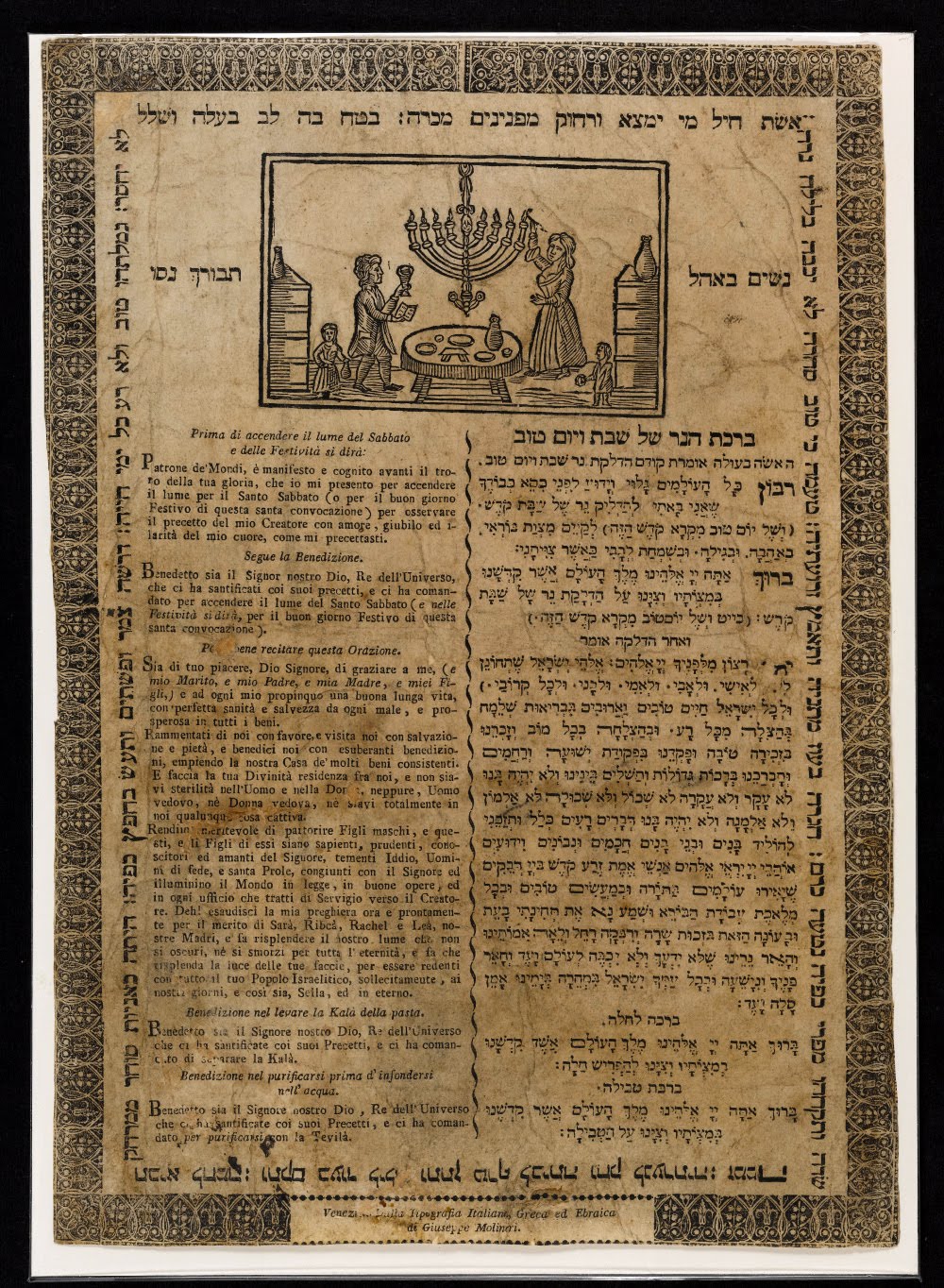
The following broadside from Venice 1835, (reproduced on p. 17), contains the text of the prayers that were customarily recited by women on Friday evening during the candle lighting ceremony.

The illustration depicts a woman lighting eight candles. The Rishonim, including Italian sources, Shibolei Haleket (Siman 59) and Sefer Hatadir (p.196), only require and discuss two candles for Shabbos.[10] The question is when exactly did people start lighting more? The exact time when this began is unknown. However, in the “Shulchan Aruch” from R’ Yehudah Aryeh Modenah (1571-1648) he describes the Italian custom of lighting multiple candles:
והנשים חייבות להדליק בבית נר של שמן ובתוכו לכל הפחות ארבע או שש פתילית להאיר בערב עד עבור חלק גדול מהלילה [עמ’ 54].
Some continued to advance the numbers and in the 19th century, one author records the custom of lighting 31, 45, and 52 candles weekly.
מה מאוד היה מכבד שבת ויום טוב והיה מנהגו להדליק בכל שבת ל”א נרות כמנין אל כי בו שבת אל מכל מלאכתו, ובסוף ימיו מ”ה נרות, ולפני מותו היה מצווה להדליק בשנה ראשונה בחדר שהיה לומד בו נ”ב נרות כל שבת [מה שהעידו על ר’ הירץ אברהם נפתלי שייאר בהקדמת נכד המחבר לפירושו תורי זהב, (על שיר השירים), ירושלים תשס”ג, עמ’ טז].
Corporal Punishment
The following broadside poster for the instruction of children is from Italy 1846 (125):[11]


One striking part of the image is of the teacher hitting children in school. This sort of practice is recorded in a number of Jewish texts.[12]  For example:
A 17th century autobiography recounts that “the new teacher was of an irritable temper… he hit me and put me to shame…”. [Alexander Marx, Studies in Jewish History and Booklore, New York 1944, p. 193].

R’ Yaakov Emden writes in his autobiography:
בשנות הילדות… אזכיר איזה גרגרים, שלשה דברים נוראים שקרו לי בימי ילדותי הרכות. … ומלבד המכות אשר הוכיתי בית מאהבי המלמדים אשר נמסרתי בידיהם ללימוד, היו על פי רוב אכזרים, היכוני בלי חמלה… [מגלת ספר, עמ’ 84].
Saul Berlin writes in his satirical work:
ומתועלת ההכאה עוד, כי הוא צד היתר למלמדים לקבל שכר, כי על הלמוד לבד אסור לקבל שכר, משום קרדום לחתו בו, ואם כן כל מלמד המרבה להכות הרי זה משובח… ועוד רבה התועלת ע”י ההכאה אשר הילדים מכים ולוקים בבית הספר, כי ליראתם את המכות קרבת מוריהם יחפצו וירבו עליהם מוהר ומתן למען חנות אותם, ובהגיע חודש ומועד יפצירו הילדים באבותם לתת להם משאת רב, להביא אל רבם לתתם לו כופר נפשם…”. [כתב יושר, [בתוך: יהודה פרידלנדר, פרקים בסאטירה העברית בשלהי מאה הי”ח בגרמניה, תל אביב תש”ם], עמ’  98].
R’ Yosef Kara writes:
שבהיותי בצוותא חדא אם כבוד ידידי הגאון הצדיק מו”ה שמעון סופר אב”ד דק”ק קראקא… והוא אמר ז”ל כי זה רע חולי שאין חפץ לגדולי לומדי תורה להיות מקרי דרדקי, כי הוא חרפה להם ע”כ מוכרחים אבות הבנים ליתן בניהם הקטנים אל איש אשר לא ידע ספר קרוא מקרא ודקדוק אך ידע להכות הבנים ולזעוק בקול גדול… [קול אמר קרא, פ’ פנחס, עמ’ 20].
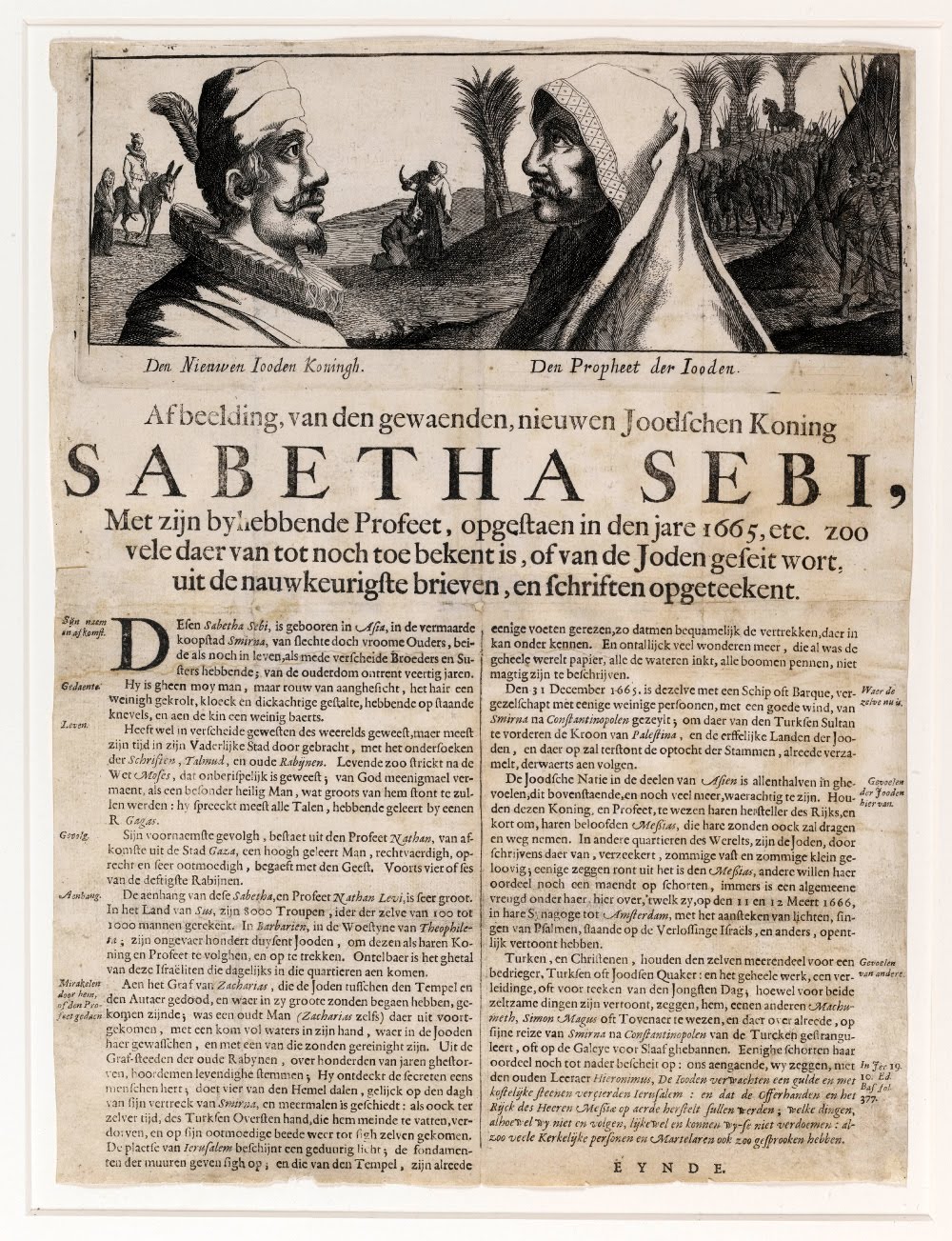
This broadside from Amsterdam 1666 is a little more famous, as it’s a supposed depiction of Shabbetai Tzvi. A complete translation for the Dutch is provided in at the appendix (pp.264-65).

Gershom Scholem writes that this portrait of Tzvi is fictitious – one of a number of imaginary portraits. (Sabbatai Sevi, pp. 190-191, 158). The only picture of Shabbetai Tzvi believed to be authentic (that is, drawn by a witness) is the one found in the beginning of Thomas Coenen’s book Ydele Verwachtinge der Joden, Amsterdam 1669.[13] There might be others as well, but King Jan Casimir ordered all pictures of him to be destroyed (id., p. 597). This one, fortunately, was published.

(This is from Scholem’s personal copy.)

Kabbalistic Tefilos for Rosh Hashanah


This broadside from Mantua 1790, reproduced in the book (p.43), is of interest for several reasons. First, the top part of the broadside has the twenty fourth chapter of Tehilim, said by many Kehilot on Rosh Hashanah as a segulah for Parnasa.[14] In a work written around 1700, recently printed from manuscript, we find the author writes:

אחר ערבית, יש לי תוכחת מגולה ומסותרת אם קצת משכילים, שהנהיגו לקרות בבית הכנסת בציבור אחר עלינו לשבח בלילי ר”ה, מזמור לה’ הארץ ומלואה, ולכוין הנקוד של השם, ככתוב בספר שערי ציון, שהוא מסוגל לפרנסה, שלא יפה הם עושים, כי לא כן צוה הרב המגיד לנו סוד זה, והצנועים נהגו לאמרו בשני הלילות שתי פעמים בכל לילה תכופים זה לזה… והקריאה על שולחנו קודם ברכת מזון… דבר הלמד מענינו, בהצנע לכת עם אלקיך. על כן אמרתי ימים ידברו, להויע ידידי הקורא שדבר בדוק ומנוסה שכל סגולה הנעשית על ידי תפלה בשום כוונה או שם, שאין לך לפרסמו ברבים. ולא לגלותו כי אם לתלמיד הגון ירא חטא ובלחישה, לבל היה מוליך רכיל מגלה סוד, שאז תהיה הפעולה חלושה… [ר’ כליפא בן מלכה, כף נקי, [לוד תשע”ד] עמ’ 167].

The second part of this broadside is also of interest, as it has the tefilos said before, during and after the shofar blowing, including some of the Kabblastic tefilos with names of angels. Of note is what is omitted here, those parts said between the various sets of Shofar blowing, which has been the subject of lots of literature[15], as it includes a very strange phrase, that seemingly evokes Jesus: ישוע שר הפנים””.
Here is an article written on this topic by R’ Shmuel Ashkenazi written in 1944 (!) under one of his pen names:

One more point related to this topic is a case of censorship. R’ Chaim Kraus writes:
 הנה בזכר יהוסף… מתיחס לזה שבדפוסים האחרונים בשו”ת תשובה מאהבה הושמט הענין הנ”ל שכתב בחריפות נגד אמירת היהי רצון שמות המלאכים… [מכלכל חיים בחסד, עמ’ סד].
However, upon checking the sources to see when in the printing of the sefer Teshuvah M’Ahavah this censorship took place, one is hard pressed to find it, as it’s simply not there. The actual issue is a bit different; Kraus misunderstood R’ Yosef Zechariah Stern’s teshuvah.
In an extraordinary teshuvah dealing with these prayers (Zecher Yehosef, Siman 210), R’ Yosef Zechariah Stern mentions a certain case of censorship:
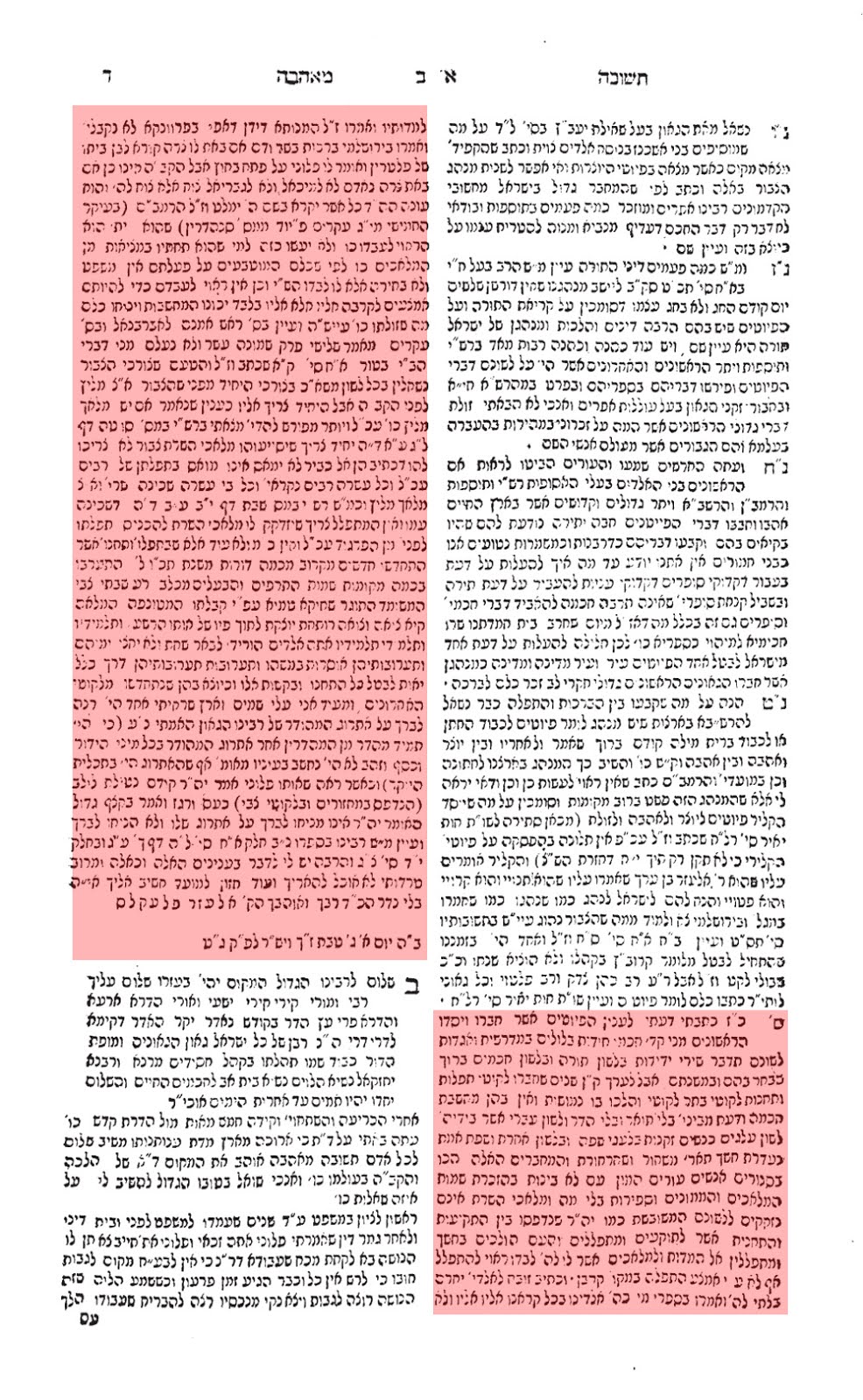
ובתשובה מאהבה ח”א סי’ א שהועתקה תשובתו בדבר הפיוטים ברוב המחזורים.. והמדפיסים להפיס דעת ההמון שהורגלו באמירת היהי רצון שבתקיעות השמיטו מה שהזכיר בסוף התשובה אות ס’ שמרעם בהזכרת שמות המלאכים… וכן השמיטו המדפיסים בהעתקתם מהתשובה מאהבה מה שהעיד מהנודע ביהודה שאחד היה רוצה לברך על אתרוג המהודר שלו וכשראה שאומר היהיה רצון… אמר איני מניחו לברך על אתרוג שלי…
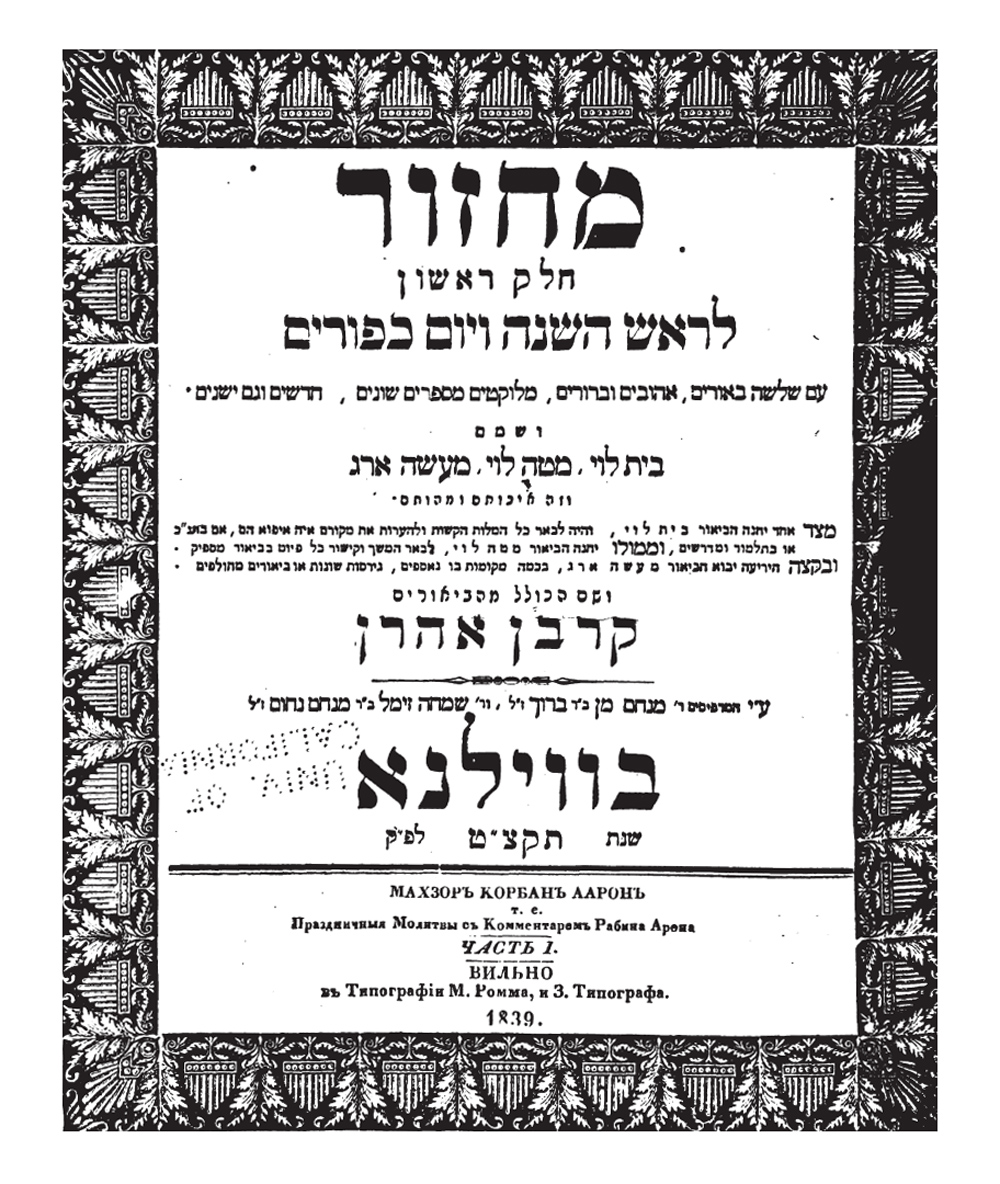
This Teshuvah was printed in various Machzorim at the time and that is where these parts of the teshuva were indeed bowdlerized. See the following images for the pages as they appear in the Korbon Aharon Machazor printed in Vilna in 1839 and compare with the first print of the teshuvah (Prague, 1809).

Amulet Broadsides


This image from Jerusalem 1870 (pp. 130-131) highlights another notable part of this collection – the Amulet section. It contains numerous broadsides against the “evil eye”, aimed at protecting the newborn mother from Lilith and the like (pp. 132-135, 141-143, 194-197). This is yet an additional set of documents which demonstrate how widespread it was for people to use amulets and the fear of the “evil eye” and the like.
There are numerous sources on regarding amulets, some mentioned here.[16] One source, that was only recently published in English, is from a fascinating memoir by Pauline Wengeroff, who writes: “for the same purpose of protecting the newborn, Jews used to affix kabbalistic prayers called shemaus over the head of the new mother, a second page on the door and a third between the cushion of the child.”[17]
Controversy against R’ Shlomo Ganzfried – Author of Kitzur Shulhan Aruch

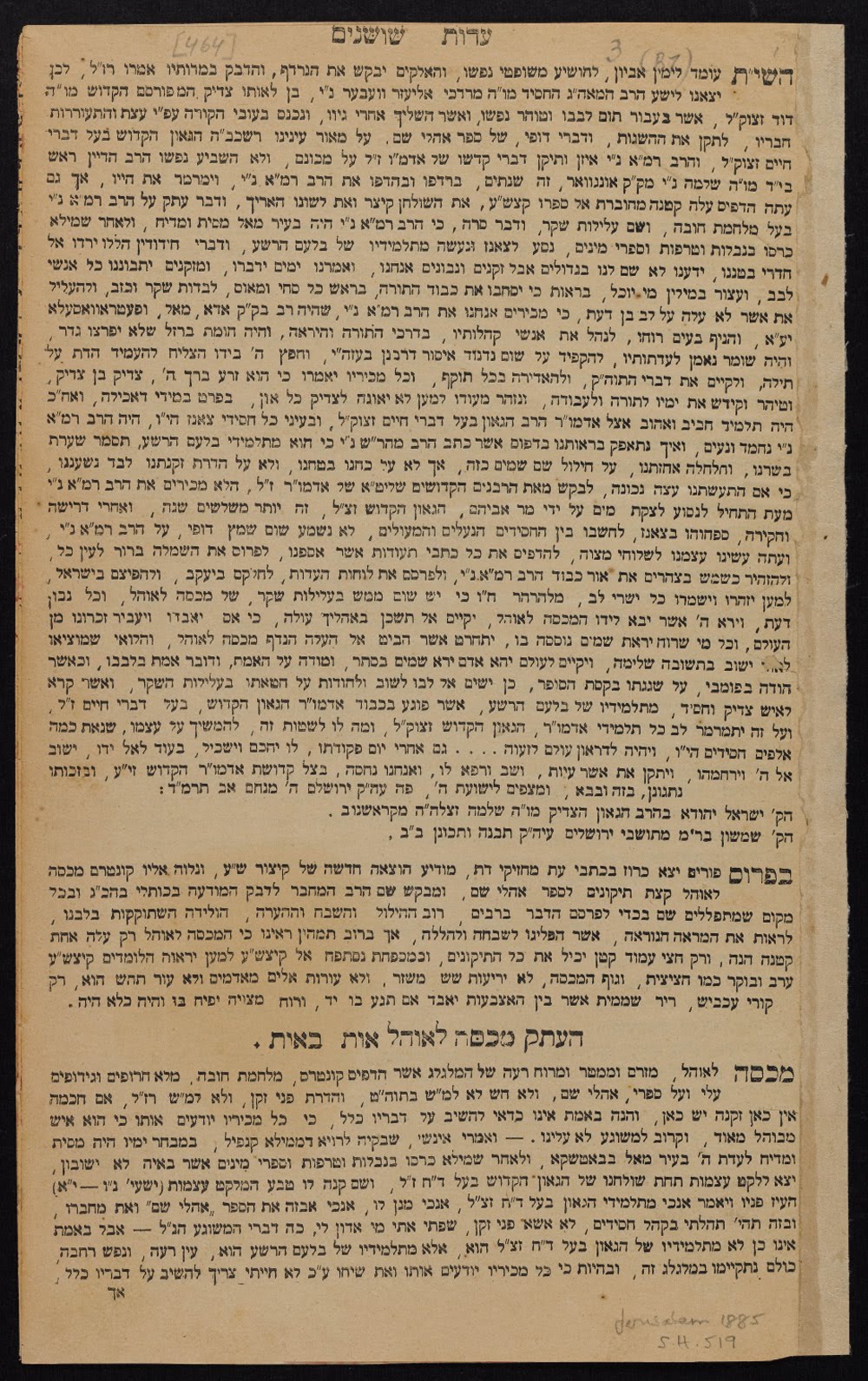
This document relates to a controversy between R’ Shlomo Ganzfried and the R’ Chaim Halberstamm, the Divrei Chaim. In his work Ohali Shem on Gittin, R’ Ganzfried took issue with some legal rulings of the Divrei Chaim. This erupted into a series of small works from R’ Weber, starting in 1882, defending the honor of the Divrei Chaim. R’ Ganzfried responded to one of them in the back of the 1884 edition of his Kitzur Shulchan Aruch.
This broadside (above) from R’ Weber against R’ Ganzfried, found in the Valmadonna Collection, is very rare (p. 217 #360).[18] 
The Valmadonna Collection has another rare broadside from R’ Weber (below), related to the famous controversy of the Corfu Esrogim (p. 219 # 369).[19] This is not included in Naftali Ben Menachem’s otherwise comprehensive article regarding R’ Weber.

Regarding this broadside, it’s worth quoting the great historian[20] and native of the Old Yishuv, Eliezer Malachi:
ור’ מרדכי אליעזר וובר, הרב דאדא, זה האחרון היה אש לוהטת, ובקנאותו לא ידע גבול, עד שבשנת תרנ”א אסרו את אתרוגי קורפו לטובת אתרוגי ארץ ישראל, נלחם הוא להתיר אתרוגי קורפו ולאסור את אתרוגי ארץ ישראל שגדלים בפרדסי המושבות של חובבי ציון [מנגד תראה, עמ’ 225].
The volume is beautifully produced, the reproductions are excellent, and is available in a larger format “coffee table” size. This is a great volume, for collectors of books and history. It is available for purchase here and at the YU Seforim sale here.

[1] The Otzar Ha-Hochma database should be commended for including some auction catalogs in its archive, and even some broadsides, which will provide at least fragmentary information regarding the existence of these invaluable documents.
[2] This essay does not appear in Ta-Shema’s four volume collected writing, it is unclear why it was excluded. 
[3]  For more on this see: Eliezer Brodt, Likutei Eliezer, pp. 11-12.
[4] We discuss two broadsides related to the election of the Vilna chief rabbi between R. Hayyim Ozer and R. Y. Rubenstein (here).The Israel Musuem mounted an exhibit of broadside regarding Haredim.  See Pashkevilim, Wall Announcements and Polemic Posters in the Ultra-Orthodox Street, Israel Museum-Yad Ben Tzvi, Jerusalem: 2005 (Hebrew). This volume contains a number of introductory essays, and germane here, Menachem Friedman’s essay “The Pashqevil (Pasquinade) and Public Wall Poster/Bulletin Board Announcements in  Haredi (Ultra-Orthodox) Society” is especially important, although it is not cited in the Valmadonna volume.
[5] See the lengthier treatment of the topic in her book, Elisheva Carlebach, Jewish Calendar and Culture in Early Modern Europe (Cambridge, Mass.: Belknap Press of Harvard University Press, 2011.
[6]  See also p. 210 # 332.
[7]  On this great person, it is well worth quoting Professor Yaakov Sussman’s assessment in a footnote, in a book-length (175 pp) essay – one of the most important ones written in the past decade on the writing of Torah She-Bal Peh – where writes:

מסה מרשימה ביותר בבקיאותו, בחריפותו, בפלפולו בתקיפותו של המחבר לאורך כמאה עמודים גדושים, שבה סיכם כמעט כל מה שנאמר לפניו בנושא… בתשובה זו מתגלה המחבר כחכם בקי, תמים ובעל חושב ביקורתי כאחת, שכל רז לא אניס ליה, לא בספרות הרבני ולא במחקרי זמנו, והוא מצליח לגייס את ידיעתיו להגצת עמדתו… ואין פלא כלל שתשובה מרשימה זו כבשה במהרה את הלבבות והייתה למילה אחרונה בנושא ודעתו נתקבלה כמעט על כל החוקרים [מחקרי תלמוד, ג, עמ’ 235].
[8]  See Mofas Hador, pp. 37-40. See also Yerushaseinu 5 (2011), pp. 265-299; R’ Betzael Landau (here).
[9] We doubt that the composer was Jewish or the text was intended for a Jewish audience. Instead, similar odes – in Hebrew and the subject is Christian – appear in a number of Latin translations of Hebrew texts. See, for example, Coccejus’ Latin translation and abridgement of tractates Sanhedrin and Makkot, includes Hebrew poems in his own honor and that of his teacher. Duo Tituli Thalmudici Sanhedrin et Maccoth, ed. Joanne [Coccejus], Amsterdam, 1629, unpaginated introduction.
Another notable example of clerical citation is Cardinal Egidius de Viterbo who appears in Elijah Levita’s works.  See Solomon Buber, Tolodot Eliyahu ha-Tishby, Leipzig, 1856, nn. 15-18.
[10]  For more sources on this, see: Rabbi Oberlander, Minhag Avosenu Beyadneu, (Shonot), pp. 11-19; R’ Yechiel Goldhaber, Minhaghei Hakehilot, 1, pp. 174-175; Eliezer Brodt, Yerushaseinu 2 (2008), pp. 203-204; Rabbi Y.M. Dubovick, Minucha Sheleimah (2014), pp.26-27.
[11] The full document is translated in the appendix of the book (pp. 288-290).
[12] For additional sources on this subject, see S. Assaf, Mekorot le-Tolodot ha-Chinuch be-Yisrael, s.v. makot.
[13] Coenen’s book is a very important contemporaneous account of the messianic fervor surrounding Tzvi.  The book was translated from Dutch into Hebrew, Tzepiot Shav shel ha-Yehudim Kefi she-Hetgalu be-Demuto shel Shabbati Tzvi, Merkaz Dinur, Jerusalem, 1998. 
[14]  On this see: R’ Yechiel Goldhaber, Minhaghei Hakehilot, 2, pp. 31-33; Eliezer Brodt, Yerushaseinu 2 (2008), p. 211.
[15]  See R’ Yechiel Goldhaber, Minhaghei Hakehilot, 2, pp.61-65, where he traces how far back the custom of saying these Tefilos can be dated. See also Eliezer Brodt, Yerushaseinu 2 (2008), p. 214. The main work on this subject, collecting vast material, is R’ Chaim Kraus, MiChalkel Chaim Bechesed 2, (1982). See also R’ Zev Rabinowitz, Sharei Toras Bavel, p.12; R’ Chaim Lieberman, Ohel Rochel, 1, pp. 511-515; Y. Leibes, Mechkari Yerushalayim Bimachshevet Yisrael 6 (1986), pp. 171-195.
[16]  See also Eliezer Brodt, Likutei Eliezer, pp. 13-22, 69-72; Jewish Magic through the ages: Angels and Demons, edited by Filip Vukosvoviv, Bible land Museum, Jerusalem 2010.
[17]  Pauline Wengeroff, Memoirs of a Grandmother, 2, 2014, p. 89.
[18] On R’ Ganzfried, see R’ Y. Rubinstein, HaMayan 11:3 (1971), pp. 1-13; ibid. 11:4. pp. 61-78. See also Naftoli Ben Menachem, HaMayan 12 :1 (1972) pp. 39-42.  On this controversy, see R’ Rubenstein, ibid. pp. 10-11. On R’ Weber, see Naftoli Ben Menachem, in: Studies in Jewish bibliography, history, and literature in honor of I. Edward Kiev, Charles Berlin (editor), New York 1971, pp. 13-20. On this broadside, see Shoshanna Halevy, Sifrei Yerushlayim Ha-Rishonim, p. 188. On the other works by R’ Weber related to this issue, see ibid, pp. 156-157, 186-187, 219-220. See also Moshe Carmilly, Sefer VeSayif, pp. 264-265.
For an additional controversy between the Divrei Chaim and R’ Ganzfried see David Assaf, HeTzitz Unifgah, (2012) pp. 362-367.
About R’ Ganzfried and Chasidim, see Heichal HaBesht 3 (2003), pp. 105-117. For more on the Divrei Chaim’s methods of Pesak, see Iris Brown, Rabbi Hayyim Halberstam of Sanz: His Halakhic Ruling in view of his Intellectual world and the challenges of his time, (PHD Bar Ilan University) 2004 (heb.).
[19]  This is the subject of a future article. For now, see R’ Yosef Zechariah Stern, Zecher Yehosef, siman 232.
[20]  About Malachi, see Jacob Kabakoff, “Some Notable Bibliographers I have Known”, Judaica Librarianship, Vol.11 :1-2, (2003), p. 67-75.


Elliott Horowitz — Isaiah Berlin on Meir Berlin (Bar-Ilan) and Saul Lieberman

In a previous post at the Seforim blog, Prof. Elliott Horowitz of Bar Ilan University and co-editor of Jewish Quarterly Review, described Edmund Wilson’s unique Christmas card and some thoughts on the Talmud [see here].

This is his third contribution to the Seforim blog. We hope that you enjoy.

Isaiah Berlin on Meir Berlin (Bar-Ilan) and Saul Lieberman
Elliott Horowitz

Although there have been some fine reviews of the collection of letters by Isaiah Berlin published in England under the title Flourishing: Letters 1928-1946 (Chatto and Windus, 2004), and in the United Sates (by Cambridge University Press) under the subtitle of the British edition,[1] not much attention has been given to the candid comments included therein about some of the twentieth century’s leading rabbis and Jewish scholars. Moreover, although one of the reviewers (Ilan Stavans in Forward) commented on the “overzealousness of its editor” Henry Hardy in annotating and contextualizing Berlin’s letters “to the point of dizziness,” this zealousness is less than excessive in his annotations of the letter written by Berlin, who had recently become the first Jew to be elected to a fellowship at Oxford’s All-Souls College, from Jerusalem to his parents in London on the first day of Rosh Ha-Shana, 1934 (pp. 96-98). Among the Jerusalemites he mentions having met since arriving a week earlier are “Dr. Scholem the Kabbalist,” “Baneth of the University,” and “Meir Berlin” – all of whom are dutifully identified by Hardy. The Volozhin-born Berlin, who settled in Jerusalem in 1926 and later changed his name to Bar-Ilan, is described by Isaiah (to whom he was not related) as a “clever cunning man with an unpleasant son in law, who teaches the Yerushalmi at the University.” Hardy informs the reader that the Yerushalmi is “the Jerusalem or Palestinian Talmud,” but he has not been as “overzealous” about identifying the “unpleasant son in law,” who, as most readers of the Seforim blog have already recognized, was Saul Lieberman, who completed his MA at the Hebrew University in 1931 and married the former Judith Berlin in the following year.

In April of 1943, while serving at the British Embassy in Washington, Isaiah dryly informed his parents that “there were some serious social complications about the Sedarim this year (428).” Among those who had invited him were Chaim Weizmann (sometimes referred to as “Charles” in Berlin’s letters), the latter’s “factotum, a certain Weisgal,” and “Meyer (sic) Berlin and his daughter Judith.” Hardy explains what “Sedarim” are, identifies “[Meyer Wolf] Weisgal,” and provides the information that Judith Berlin Lieberman was “married to talmudic scholar Saul Lieberman. (428-29)” Somehow, however, he fails to connect this son-in -law of Berlin’s, who by that time had become a professor at New York’s Jewish Theological Seminary, with the “unpleasant” man who during the previous decade had taught Yerushalmi at the Hebrew University. One of the factors complicating Isaiah’s decision as to where to spend the Sedarim of 1943 was that three of his potential hosts – Meir Berlin, Vera Weizmann, and Tamar de Sola Pool (wife of Rabbi David de Sola Pool and president of Hadassah) – were “reciprocally not on speaking terms,” and thus “to go to one is to insult the other two automatically.” He spent the first Seder with the Weizmann’s and the second, which was “fantastic,” with Meyer Weisgal. Consequently, as he explained to his parents, he found himself in the position of having to “grovel to Rabbi Meyer Berlin…and Mrs Tamar de Sola Pool, great Zionist powers with whom diplomatic relations must be preserved. (430-31).”

In a subsequent letter to the British diplomat Angus Malcolm, however, Berlin referred the Mizrachi leader less charitably as “Rabbi M. Berlin of Palestine and Riverside Drive, an enemy of Weizmann and a clerical maximalist (438).” Although Weizmann (who died in 1952) and Bar-Ilan (who died three years earlier) had their differences, both now have universities named after them – in only one of which, it may be added, is the Yerushalmi taught.

Note:
[1] See, for example, Geoffrey Wheatcroft, “The Book of Isaiah,” The New York Times (June 27, 2004): 11; Simon Schama, “Flourishing,” The New Republic (January 31, 2005): 23-30.


The Meaning of the Name “Maccabee”

The Meaning of the Name “Maccabee”[1]

Mitchell First

     In a previous post at the Seforim blog, Dan Rabinowitz dealt with the topic of the origin of the name “Maccabee,” and made many interesting points,[2] although he did not adequately address the issues. My intention in this essay is to offer a more thorough discussion. The name מכבי/מקבי is not found in classical Tannaitic or Amoraic literature.[3] But this is not surprising. The name was originally an additional name for Judah only and there are no references to Judah in classical Tannaitic or Amoraic literature.[4] The earliest sources that include the name in some form are works preserved by the Church: I Maccabees and II Maccabees. (These are not the original titles of these works.) I Maccabees was originally written in Hebrew,[5] but what has survived is only a Greek translation from the Hebrew (and ancient translations made from this Greek translation). II Maccabees, an entirely different work, was written in Greek. In the early Church, I and II Maccabees were considered part of the Bible.[6] I Maccabees (2:2-5) tells us that Mattathias (=Matityahu) had five sons, and that each had another name. For Joudas (=Judah), the name was Makkabaios (Gr: Μακκαβαîος.)[7] The additional names were probably given to the sons to help distinguish them from others with the same name.[8] In I Maccabees, Makkabaios is used for Judah six times. In II Maccabees, it is used for him twenty-three times.[9] To determine whether the earliest spelling of the name in Hebrew was with a כ or a ק, one must guess from the double kappa in Makkabaios what the original Hebrew letter (or letters) would have been. Fortunately, this is not hard.

Although there are exceptions, there is a general pattern in the Greek translation of the Bible of transliterating כ with chi (χ), and ק with kappa (k).[10] Usually ק is transliterated with one kappa, but sometimes two kappas are used.[11] A transliteration of כ with two kappas is very rare.[12] These same patterns hold true in I and II Maccabees. For example, if we focus on I Maccabees,[13] and look at the Greek transliteration of names, places, and months whose Hebrew spelling is known from the Bible, we find: -transliterated with χ are: כלב, זכריה, מכמש, כתים, and כסלו; -transliterated with one kappa are: יעקב, עקרבים, תקוע ,אשקלון, קדש, and קרנים; -transliterated with two kappas are: [14]עקרון and [15]הקוץ. At no time in I Maccabees is כ transliterated with kappa.[16] Thus, the spelling of Makkabaios with two kappas points strongly to a ק in the original Hebrew or Aramaic,[17] and does not mandate assuming a קק. Moreover, an original מקקב would be extremely unlikely. Hebrew and Aramaic words do not ordinarily have 4 letter roots. If we make the alternative assumption that the initial mem was not a part of the root, this does not help either. There is no root קקב in either Hebrew or Aramaic.[18] The double kappa just confirms our supposition that the original reading was ק, and not כ.[19] Based on this spelling, it seems reasonable to agree with the oft-proposed suggestion that the name is related to the Hebrew and Aramaic words מקבת and מקבא, which mean hammer.[20] As to why Judah was called by this name, one view is that the name alludes to his physical strength or military prowess.[21] But a מקבת/מקבא is not a military weapon; it is a worker’s tool.[22] Therefore, it has been suggested alternatively that the name reflects that Judah’s head or body in some way had the physical appearance of a hammer.[23] Interestingly, the Mishnah at Bekhorot 7:1 lists one of the categories of disqualifed priests as המקבן, and the term is explained in the Talmud as meaning one whose head resembles a מקבא.[24] Naming men according to physical characteristics was common in the ancient world.[25] Is it possible that Makkabaios and the other four names were Greek names?[26] The additional names for the other sons were: Gaddi (Γαδδι), Thassi (Θασσι), Auaran (Αυαραν) and Apphous (Απφους).[27] Perhaps it would have been beneficial for a Jew even as early as the age of Mattathias to have had an additional name in the Greek language. It is seen from the reference to Antigonus at M. Avot 1:3 that a “traditional” Jew circa 200 BCE could have borne a Greek name. (In the period after Judah, we know of many prominent Jews who had both a Hebrew/Aramaic name and a Greek name.[28] For example, Simon’s son John was also called Hyrcanus,[29] John’s son Judah was also called Aristobulus,[30] John’s son Yannai was also called Alexander,[31] and Yannai’s wife Shelomtziyon was also called Alexandra.[32]) But the letters μ,κ,β or μ,κ,κ,β, with any combination of vowels in between them, do not seem to correspond to any known word in ancient Greek.[33] Moreover, the two kappas also suggest that the name is not Greek. Two consecutive kappas are not typical in a Greek word.[34]
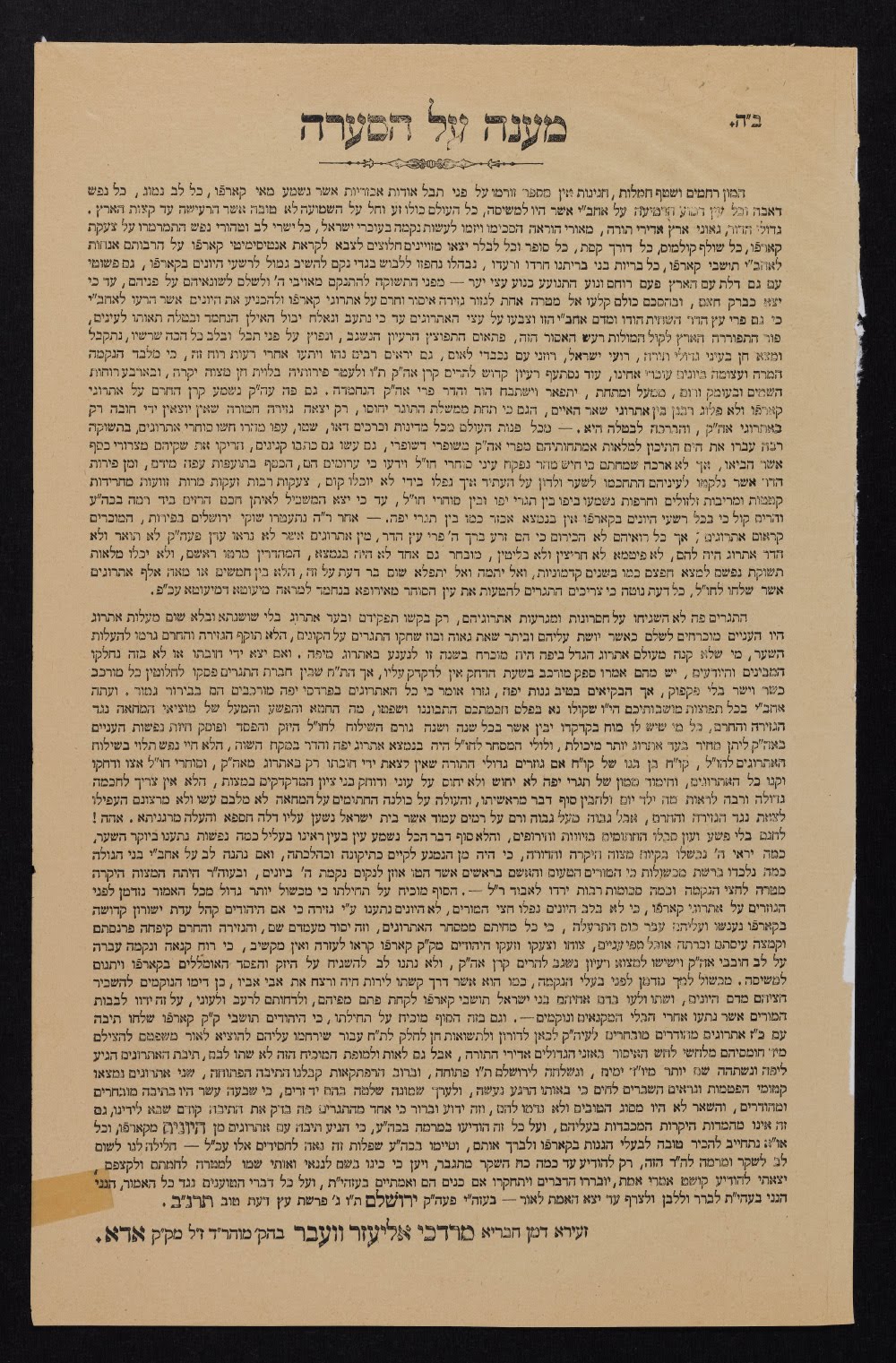
Finally, there are no non-Jewish figures from this period or any earlier period with a name like Makkabaios. This is strong evidence that the name is not a Greek one. However, our task of determining the original spelling and meaning of the additional name of Judah is not that simple. Two further issues present themselves. First, assuming that Makkabaios is a Greek representation of a Hebrew or Aramaic name, we still do not know whether the authors of I and II Maccabees knew how Judah himself, who died in approximately 160 BCE, spelled his name.

I Maccabees, which covers the period 175-134 BCE, was probably composed after the death of John Hyrcanus in 104 BCE, or at least when his reign was well advanced. This is seen from the last two sentences of the work.[35] After describing the murder of Simon and the attempted murder of Simon’s son John, the book closes with the following statement (16:23-24): As for the remainder of the history of John, his wars and his valorous deeds and his wall building and his other accomplishments, all these are recorded in the chronicle of his high priesthood, from the time he succeeded his father as high priest. [36] With regard to II Maccabees, we are told by the unknown author that it is an abridgement of an earlier work by someone named Jason of Cyrene. Cyrene is in Libya, but presumably Jason spent some time in Judea.[37] He is otherwise unknown.[38] The prevailing view is that Jason was a contemporary of Judah.[39] For example, the abridgement ends with a description of a military victory by Judah in 161 BCE, suggesting that the original work ended around this time as well. But it can be argued that the abridger ended his work before Jason did.[40] For example, the abridger writes that Jason narrated the history of Judah “and his brothers” (II Macc. 2:19). Based on this, an argument can be made that Jason’s work continued long after 161 BCE. It has also been argued that Jason wrote his work as a response to I Maccabees.[41] Even if we adopt the prevailing view that Jason was a contemporary of Judah, this does not necessarily mean that Jason knew how Judah himself spelled his name.[42]

The second issue that presents itself arises from the fact that the name is written “Machabaeus” in the Latin translation of I and II Maccabees composed by the church father Jerome (c. 400 CE).[43] There is a question whether this spelling reflects Jerome’s own spelling choice, which was perhaps made after he consulted the original Hebrew of I Maccabees,[44] or whether this was the conventional spelling of the name in the earlier Latin translations made from the Greek, which Jerome simply let stand. If this spelling was Jerome’s own and he made it after consulting with the original Hebrew of I Maccabees,[45] this would strongly suggest that the Hebrew text that he had before him spelled the name with a כ. In his translation of the Bible into Latin, Jerome almost uniformly used “ch” to represent כ.[46] Alternatively, if the “ch” spelling originated in the Latin translations before Jerome, or if it originated with Jerome, but not in consultation with the original Hebrew of I Maccabees, it would seem to be based on a Greek text which spelled the name with chi. This too would seem to reflect an original Hebrew spelling of the name with a כ. Thus, although we saw earlier that the double kappa in the Greek translation of I Maccabees suggests a ק in the original Hebrew, the evidence from Jerome’s Latin translation points in the opposite direction. Perhaps already in an early stage there were two different Hebrew spellings of the name.[47] If the Hebrew name was spelled with a כ, the meaning that suggests itself is “the extinguisher.”[48]

* * * * * * The spelling of Maccabee with a כ that is prevalent in Jewish sources today is not evidence of an original כ spelling. It is only the consequence of the spelling choice made by the author of Yosippon in the 10th century.[49] Yosippon is a historical work of anonymous authorship that was based in large part on a Latin translation of the works of Josephus.[50] Among the other sources that the author of Yosippon had before him was a Latin translation of I and II Maccabees. In the Latin translation of I and II Maccabees that was before him, Judah’s additional name was spelled “Machabaeus.” Based on this, the author of Yosippon decided to spell the name with a כ. He spelled it מכביי.[51] This spelling with a כ influenced the Rishonim thereafter. There never was a group by the name Maccabees in ancient times. How did the references to this non-existent group ever arise and how did the books get their titles? II Maccabees focuses in large part on Judah. Jonathan Goldstein, the author of I and II Maccabees in the Anchor Bible series, explains further:[52] Clement of Alexandria and Origen, the earliest of the Church Fathers to mention the books by name, call them Ta Makkabaïka, “Maccabaean Histories,” from which title persons who spoke loosely probably turned to call all the heroes in the stories “Maccabees.”[53]

The first datable occurrence of such use of “Maccabees” for the heroes is in Tertullian…ca. 195 C.E.[54] Finally, it must be pointed out that מקבי seems to be the original reading in the work now commonly referred to as Megillat Antiochus.[55] But this work is replete with errors: -It associates the name מקבי with Yochanan (John), while according to I and II Maccabees, this name is only associated with Judah. -It describes Yochanan as killing the general Nikanor in a private encounter in the area of the Temple. According to I and II Maccabees, Nikanor was killed by Judah and his forces in a battle that took place outside of Jerusalem. -It describes Judah as being killed before the Temple was retaken and describes Mattathias as stepping in to fight with the other brothers. According to I Maccabees, Mattathias died before the Temple was retaken and Judah led the brothers in battle. II Maccabees does not even mention Mattathias and describes Judah as leading the brothers in battle. -In its dating of the story of Chanukah, it erroneously assumes that the retaking of the Temple coincided with the beginning of Hasmonean rule in Palestine. In actuality, over two decades separated these events. Because of these and other errors, it is hard to treat this work as a reliable historical source on any issue.[56]

* * * * * * Some of the other, more remote, possibilities for the origin of the name are: a derivation from מקוה (hope),[57] from מחבה (one who hides),[58] or from מכאב (one who causes grief).[59] The name has also been interpreted in various ways as an acrostic.[60] Finally, on a lighter note, the suggestions of Franz Delitzsch and Filosseno Luzzatto (son of Samuel David Luzzatto) deserves mention. Delitzsch suggests that the name is a contraction of the exclamation mah ke-avi! (=who is comparable to my father!)[61] Luzzatto observes that there is a Greek term βιαιο-μάχας (biaio-machas) which means “fighting violently.”[62] If one places these words in reverse order, one gets something close to Judah’s additional name![63]

Conclusion

The two kappas in the name in the Greek translation of I Maccabees suggest that the original Hebrew from which this translation was made spelled the name with a ק. That the two kappas stem from an original כ is extremely unlikely. A ק spelling would suggest that the name is related to the Hebrew and Aramaic words מקבת and מקבא, and that the name was assigned to Judah based on either his physical strength/military prowess or based on his physical appearance. But it is also possible that neither the authors of I or II Maccabees nor Jason knew how Judah spelled his own name. Also, the fact that the name is spelled with a “ch” in Jerome’s Latin translation suggests that there may also have been a Hebrew version of I Maccabees that spelled the name with a כ.[64]

[1] I would like to thank Sam Borodach for reviewing the draft. All translations from I and II Maccabees are from the editions of Jonathan A. Goldstein (Anchor Bible, vols. 41 and 41A, 1976 and 1983). All citations to the Encyclopaedia Judaica (EJ) are to the original edition.
[2] Dan Rabinowitz, “The Name Machabee,” the Seforim blog (21 December 2008), available here.
[3] I am not considering Megillat Antiochus (“MA”) to be within “classical rabbinic literature.” I will discuss this unusual work at the end.
[4] Aside from the references in MA, the earliest reference to Judah in rabbinic literature is a reference in an 8th century work, Mishnat R. Eliezer (also known as Midrash Agur). This reference seems to be based on MA. This will be discussed below. Judah is also referred to in two of the three midrashim on Chanukkah published by Adolf Jellinek in the mid-19th century, and republished by Judah David Eisenstein in his Otzar Midrashim (1915). See Eisenstein, pp. 190 and 192. These midrashim are estimated to date to the 10th century. See EJ 11:1511.
[5] There are many factors that point to the fact that the Greek is only a translation. See, e.g., EJ 11:657, and Goldstein, I Maccabees, p. 14. For example, many Hebrew idioms are used. The church father Jerome (fourth cent.) clearly implies that the Greek version of I Maccabees is only a translation. He writes: “I have found the First Book of Maccabees in Hebrew; the Second is a Greek book as can also be proved from considerations of style alone.” Goldstein, I Maccabees, p. 16. An earlier church father Origen (third cent.) mentions an extra-biblical book used by the Jews which is a “Maccabean History which bears the title ‘sarbêthsabanaiel.’ ” Since this title is in Hebrew or Aramaic, this suggests that the book he is referring to, almost certainly I Maccabees, was composed in Hebrew or Aramaic. As to the meaning of this title, see Goldstein, I Maccabees, pp. 16-21 and J. Taanit 4:5 (68d). Jerome is the last individual to refer to the original Hebrew of I Maccabees. Neither I or II Maccabees is referred to or alluded to in either Talmud.
[6] For example, they were included in codices of the Septuagint. Judah and his brothers were seen as heroes by the early church. Centuries later, the Protestant church denied the sanctity of I and II Maccabees and of all the other books known today as the Apocrypha. But the Apocrypha are still part of the canon of the Roman Catholic and Greek Orthodox churches. The Biblical canon may have been considered closed by Jewry even before I Maccabees was composed. See Sid Z. Leiman, The Canonization of Hebrew Scripture (1976), pp. 29-30 and 131-32. Even if the canon was still open (see, e.g., Lawrence H. Schiffman, Reclaiming the Dead Sea Scrolls, 1994, pp. 162-169, and M. Yadayim 3:5 and M. Eduyyot 5:3), a strong argument can be made that I Maccabees was never a candidate for canonization since it did not claim to be a book composed before the period of prophecy ended. II Maccabees would never have been a candidate for canonization since it was composed in Greek.
[7] As is evident from the names Mattathias, Joudas, and Makkabaios, Greek often adds an “s” at the end of foreign names. That is why משה became “Moses” in the Septuagint, and why there is an “s” at the end of the name “Jesus.”
[8] Goldstein, I Maccabees, p. 230.
[9] In II Maccabees, the name is usually used alone, without the name Judah. In I Maccabees, the name is used alone one time. Although the name is spelled with two kappas each time, the “s” at the end is not there each time. In Greek, the ending of the name varies depending on the how the name is being used in the sentence.
[10] The First Book of Maccabees, tr. by Sidney Tedesche, intro. and comm. by Solomon Zeitlin (1950), p. 250, and Samuel Ives Curtiss, Jr., The Name Machabee (1876), p. 8.
[11] See, e.g., the transliteration of the name בקי at Ezra 7:4, and the transliteration of the city עקרון (many times).
[12] Curtiss, who seems to have gone through the Septuagint very carefully, can cite only one such case: תכן at I Ch. 4:32. See Curtiss, p. 9. But even here, there is another reading in which the transliteration is with two chis.
[13] In II Maccabees, the occurrence of names and places whose Hebrew spelling is known from the Bible is very limited. (Unlike I Maccabees, II Maccabees does not provide many geographic details.) In II Maccabees, transliterated with chi are כסלו and מרדכי. Transliterated with kappa are יעקב, חזקיה and קרנים.
[14] I Macc. 10:89.
[15] I Macc. 8:17: “Judah chose Eupolemus son of John of the clan of Hakkoz…” I am making the reasonable assumption that Hakkoz is the same as the priestly clan הקוץ mentioned at I Chr. 24:10. (Although the reading of the majority of Septuagint manuscripts is Ακκως, there is another reading: ακχως.)
[16] This is true in II Maccabees as well. Admittedly, in most of the instances I have listed, the authors of I and II Maccabees were not deciding on their own how to transliterate these names and places, but were following already established conventions.
[17] The name could be an Aramaic one, even assuming that I Maccabees was composed in Hebrew.
[18] Semitic languages (other than Akkadian) do not have roots with identical consonants in the first two positions. Eduard Yechezkel Kutscher, A History of the Hebrew Language (1984, 2d ed.), p. 7.
[19] The Syriac translation of I Maccabees also spells the name with a ק. The Syriac translation of the Bible was generally based on the Greek translation, but it has been argued that sometimes the translators consulted the original Hebrew and that perhaps the Hebrew original was consulted here. See Felix Perles, “The Name ΜΑΚΚΑΒΑΙΟΣ,” JQR 17 (1926-27), pp. 404-405.
[20] See, e.g., Emil Schürer, The History of the Jewish People in the Age of Jesus Christ, revised and edited by Geza Vermes, Fergus Millar, and Matthew Black, vol. 1 (1973), p. 158, Zeitlin, pp. 250-52, Nosson Dovid Rabinowich, Binu Shenot Dor va-Dor (1985), pp. 184-87, and Ernest Klein, A Comprehensive Etymological Dictionary of the Hebrew Language for Readers of English (1987), p. 377. For references to earlier scholars who argued for this approach, see Curtiss, pp. 18-20 and Ralph Marcus, “The Name ΜΑΚΚΑΒΑΙΟΣ” in The Joshua Starr Memorial Volume (1953), p. 62. מקבת is found in the Tanakh at Judges 4:21. (See also Is. 51:1.) It is also found in Tanakh in the plural מקבות, at I Kings 6:7, Jer. 10:4, and Is. 44.12. It is usually viewed as deriving from the root נקב, since it is a tool which is used to penetrate.
[21] There are various ways of understanding the metaphor. Some reasonable suggestions are: 1) he was as strong as a hammer, 2) he dashed the enemy into pieces, and 3) he penetrated the enemies’ forces. As many scholars have noted, another historical figure with such an additional name was Charles Martel, ruler of the Franks in the 8th century. Martel is French for “hammer.” He was given this additional name following his victory over the invading Muslim army at Tours in 732 CE. This victory halted northward Islamic expansion in Western Europe. Judah is described by the name Makkabaois before he battled the forces of Antiochus IV. But this is not a difficulty. According to I Macc. 2:66, he was “a mighty warrior from his youth.”
[22] See M. Kelim 29:5 and 29:7, referring to a מקבת used by stonecutters. See also M. Parah 3:11 and Tosefta Shab. 13:17 (ed. Lieberman). Marcus (p. 63, n. 3) notes that at Ber. 28b, when one of the Sages is called a “strong hammer” (patish ha-chazak), it is the word פטיש, and not מקבת, that is used.
[23] See, e.g., Schurer, vol. 1, p. 158 and Zeitlin, pp. 250-252. Exactly how to understand this is open to interpretation. Was it the shape of his skull that looked like a hammer? something about his face? something about his neck? something about his body? something about the relationship of these objects to one another? For some possible understandings, see Rashi to Bekh. 43b, and the commentaries to M. Bekhorot 7:1 of Rambam and Tiferet Yisrael. It has also been suggested that the reference to a hammer alludes to Judah’s having an occupation as a blacksmith. It has also been observed that מקבא means “nostril” in Syriac and that perhaps Judah possessed uncommon nostrils. Perles, p. 405. Bezalel Bar-Kochva, Judas Maccabaeus (1989), p. 147, attempts to support the view that the name refers to some flaw in Judah’s physical appearance by noting that I and II Maccabees nowhere laud Judah’s physical stature or beauty.
[24] Bekh. 43b. Although the printed edition of the Talmudic passage reads למקבן here (just like the word in the Mishnah), Rashi’s text read למקבא. This would seem to be the correct reading .
[25] See Zeitlin, The Rise and Fall of the Judaean State (1962), vol. 1, p. 96 for some examples. Josephus tells us (Life, para. 3) that one of his ancestors (a contemporary of John Hyrcanus) was called Simon Psellus= Simon, the stammerer.
[26] This suggestion is made at EJ 12:808.
[27] These are the additional names for John, Simon, Eleazar, and Jonathan, respectively. Of the four names above, Gaddi is the easiest to relate to a known Hebrew or Aramaic word. It can be related to the Hebrew and Aramaic word גד, “fortune.” See, e.g., Gen. 30:11. For some attempts to give meaning in Hebrew or Aramaic to the other names, see Goldstein, I Maccabees, p. 231, Rabinowich, p. 186, and Ralph Marcus, Josephus (Loeb Classical Library), vol. VII, pp. 138-39.
[28] For an extensive discussion, see Tal Ilan, “The Greek Names of the Hasmoneans,” JQR 78 (1987), pp. 1-20.
[29] Josephus, Antiquities, XIII, para. 228.
[30] Josephus, Antiquities, XX, para. 240.
[31] Josephus, Antiquities, XIII, para. 320.
[32] Ibid. Perhaps she was given this name after her marriage to Alexander. The Hebrew name of Yannai’s wife was transmitted in rabbinic sources in various forms. See Schurer, vol. 1, p. 229, n. 2 and Ilan, p. 7, n. 28. That the original Hebrew form was שלמציון has now been shown by two Dead Sea texts: 4Q331 and 4Q332. See Discoveries in the Judaean Desert XXXVI (2000), pp. 277 and 283.
[33] I make this statement based on my examination of the following work: An Intermediate Greek-English Lexicon, founded upon the seventh edition of Liddell and Scott’s Greek-English Lexicon (1889). In contrast, many Greek words related to fighting begin with “μαχ.” Also, the Greek word for knife or dagger begins with these letters. (This is mentioned by Rashi at Gen. 49:5, מכרתיהם, citing Midrash Tanchuma.) Even though the letters μ,κ,β or μ,κ,κ,β do not seem to correspond to any known word in ancient Greek, we do find Azariah de Rossi (16th cent.), in his Meor Einayim, Imrei Binah, chap. 21, adopting the suggestion of a 16th century monk that the name is a Greek one and that the meaning is the equivalent of the Italian “paladino” (=hero, champion). Also, R. David Ganz (16th cent.), Tzemach David, p. 69 (ed. Breuer), writes that מכבאי in the Greek language is a gibor and ish milchamah. Of course, it is possible that the names of Judah and of some of the other brothers were Greek and what is recorded in I Maccabees are only shortened forms of names that originally combined two Greek words. Also, if the additional names originated as affectionate nicknames, whether in Greek, or in Hebrew/Aramaic, such names are often substantially altered forms of the original proper name. (In English, note Dick for Richard, Jack for John, and Billy for William.) It has been speculated that “Chashmonai” was the additional name of Mattathias. See Goldstein, I Maccabees, pp. 18-19. (“Chashmonai” seems to have been an alternative way of referring to Mattathias. See, e.g., M. Midot 1:6. But this does not necessarily imply that it was his additional name.) “Chashmonai” sounds like a Hebrew or Aramaic name. See Josh. 15:27, Num. 33:29-30, and Psalms 68:32. (We might expect Josephus to know the origin of the term “Chashmonai,” since he was from this family. But the various statements in Josephus are not consistent. See Goldstein, I Maccabees, p. 19, n. 34.)
[34] Curtiss, pp. 8-9, theorizes that the original Greek spelling was with only one kappa. He writes that letters which are single in earlier Greek manuscripts often end up being doubled in later ones. Curtiss, p. 9, n. 1.
[35] It has been suggested that the last three chapters of I Maccabees were added later, because Josephus never uses them. But the failure of Josephus to use these chapters can be explained in other ways. See, e.g, Marcus, Josephus (Loeb Classical Library), vol. VII, pp. 334-335.
[36] Goldstein, I Maccabees, p. 62. There is another comment which perhaps suggests that the book was composed long after the events described. I Macc. 13:30 reads: “This tomb, which [Simon] erected in Modeϊn, still exists today.” The positive attitude towards the Roman Empire in the book strongly suggests that the book was composed before 63 BCE. See, e.g., I Macc. 8:1: “Judas had heard about the Romans: that they were a great power who welcomed all who wished to join them and established ties of friendship with all who approached them.”
[37] Most likely, he is called Jason “of Cyrene,” i.e., from Cyrene, because he flourished elsewhere (e.g., Judea or Egypt) after having been raised in Cyrene. But Victor Tcherikover, Hellenistic Civilization and the Jews (1959), p. 387, raises another possibility: Jason was a native of Palestine who left after the death of his hero Judah, and found a new homeland in the Jewish community of Cyrene.
[38] It has been suggested that he is to be identified with Jason son of Eleazar who is mentioned in I Macc. 8:17 as having been sent by Judah on a mission to Rome. But this identification is only conjecture.
[39] See Daniel Schwartz, Sefer Makabim ב (2004), p. 19, n. 23. Schwartz agrees with this position. He argues that it is evident from II Maccabees that Jason composed his work before the establishment of the temple of Chonyo in Egypt. This temple was established in 145 BCE at the latest.
[40] The abridger does not state that he ended his work before Jason did. But if the abridger had followed Jason to the end, the abridger would have ended with something like: “Since Jason ended his work at this point, my work, too, is done.” Goldstein, I Maccabees, p. 5. Instead the abridger ends: “Such was the outcome of the affair of Nicanor. From that time on, the city has been held by the Hebrews. Therefore, I myself shall bring my account to a stop at this very point…”
[41] Goldstein, I Maccabees, pp. 62-89 and II Maccabees, pp. 82-83. If this theory would be correct, we cannot view the similar spelling, Makkabaios, as an independent confirmation of this spelling, since perhaps the later work merely adopted the spelling of the former. It has also been theorized that I Maccabees was a response to or a rewriting of Jason’s work.
[42] I am willing to assume that the abridger followed the spelling used by Jason. (It is not known for certain that Jason composed his work in Greek, but this seems very likely. The abridgement begins with an introduction, and the abridger did not say anything here about changing the language of Jason’s work.)
[43] Curtiss, p. 7.
[44] Throughout his Latin translation of the Bible, Jerome seems to have consulted the Hebrew and corrected earlier erroneous transliterations found in the Greek translation. Curtiss, pp. 6 and 31. Jerome was more advanced in Hebrew than of any of the other church fathers.
[45] It is only speculation that Jerome consulted the original Hebrew of I Maccabees here. Even though Jerome refers to this work (see above, n. 5), he may not have had access to it and may not have remembered all of its spellings at the time he composed his Latin translation of I Maccabees. It sounds like he was referring to a work that was rare and not easily accessible.
[46] Curtiss, p. 7. Jerome transliterated ק with “c” or “cc” 188 times. There were only two occasions when Jerome transliterated ק with “ch”. (Curtiss attempts to explain what led Jerome to make exceptions in these instances. See pp. 7 and 32).
[47] Curtiss (pp. 8-9) tries to get around this scenario by postulating that the original Greek text only had one kappa, and that it was only later that the kappa was doubled. An original כ could have been transliterated with one kappa.
[48] See, e.g., Curtiss, pp. 25-29.
[49] David Flusser, Sefer Yosippon, vol. 1, p. 79, note to line 56.
[50] EJ 10:297. The author of Yosippon could not read Greek.
[51] Flusser, vol. 1, pp. 79 and 80. (Flusser writes that this is the reading in the better manuscripts of Yosippon.) This spelling is also found in another work from around this time, a Hebrew translation and adaptation of I Maccabees. This work was perhaps authored by the author of Yosippon. See Flusser, Sefer Yosippon, vol. 2, p. 132. Much later in his work, in a different context, the author of Yosippon calls the group המקווים. Flusser, vol. 1, p. 342.
[52] Goldstein, I Maccabees, pp. 3-4.
[53] A similar development seems to have occurred with the name חשמונאי. One can easily interpret all the references to חשמונאי in Tannaitic and Amoraic literature as references to Mattathias alone. (The only exception being the reference at Meg. 11a, but there are variant readings here.) It is only after the Talmudic period that references to חשמונאים begin to appear. See, e.g., Midrash Eser Galuyot, and Midrash Shocher Tov, chaps. 5 and 93. Jastrow, in his entry חשמונאי, writes that the plural form is found in some editions of BK 82b. But I suspect that the plural form is not the original reading here.
[54] Goldstein, I Maccabees, p. 4, n. 1, also suggests a possible earlier occurrence.
[55] Some manuscripts of MA read מכבי. But the Yemenite manuscripts of MA, which reflect ancient traditions, read מקבי. If we look at the three oldest manuscripts of MA (Turin 111, Huntington 399, and Paris 20, all of which date from around 1300 and none of which are Yemenite manuscripts), two read מקבי and one reads מקוי. See Menachem Tzvi Kadari, “Megillat Antiochus ha-Aramit,” Bar Ilan 1 (1963), p. 93, and Curtiss, pp. 37-41. (There are also a few manuscripts of MA in which the word is omitted.) In the manuscripts of MA, the term מקבי/מכבי is usually followed by words like תקיפין קטלא (=killer of strong men), perhaps implying that that the author of MA viewed this as its definition.
[56] I would not have phrased it in this manner, but the EJ entry “Scroll of Antiochus” (14:1046-47) includes the following statement: “[T]he author was totally ignorant of the historical circumstances at the time of the Maccabees and made no use of any reliable sources on the period.” The first source to mention MA is the Halakhot Gedolot (mid-9th cent., who calls it Megillat Beit Chashmonai) but it is possible that the work was composed as early as the 1st century CE. That it was composed in the Talmudic period or the post-Talmudic period is also possible. The work was probably composed in Palestine, even though it may have been edited in Babylonia. It was originally composed in Aramaic; the widely known Hebrew version (included, for example, in the Siddur Avodat Yisrael, the Siddur Otzar ha-Tefillot, and the Birnbaum Siddur) is only a later translation. For references to sources which refer to MA and to practices of reading it on Chanukkah, see Natan Fried, Al Minhag Kriyat Megillat Antiochus be-Chanukkah, in Daniel Sperber, Minhagey Yisrael, vol. 5, pp. 102-113, and Rabinowich, pp. 138-146. Even though the first source to mention MA is the Halakhot Gedolot (and the import of his statement is unclear), a statement in Mishnat R. Eliezer, an 8th century work, seems to be based on MA. The statement (p. 103, ed. Enelow) refers to four sons of Chashmonai after Judah, the eldest, was killed. These details match the scenario depicted in MA. One of the midrashim on Chanukkah first published by Jellinek (see above, n. 4) is clearly based on MA but the midrashim published by Jellinek are estimated to date to the 10th century. See EJ 11:1511. (The midrash that is based on MA is the one that Eisenstein refers to as Maaseh Chanukkah Nusach ‘ב.)
[57] Marcus, pp. 64-65. His suggestion is that Judah was thought of as living proof that God was Israel’s hope. Marcus makes the interesting argument that if the name was derived from the Hebrew מקבן, the Greek form could have been Μακκβάν. There would have been no reason for the Greek form to have changed the ending, since names can end with “an” in Greek. The additional name of Eleazar was Auaran (Αυαραν). The problem with Marcus’ suggestion is that the Greek letter beta usually corresponds to ב. But Marcus finds some examples of beta being used to transliterate vav. Marcus did not realize it, but he was preceded in his attempted solution by Yosippon. There is one place where the author of Yosippon calls the group המקווים. See Flusser, vol. 1, p. 342.
[58] See Curtiss, p. 13 and Jewish Encyclopedia, “The Maccabees.” Mattathias and his sons had fled and hid in the mountains during the period of persecution by Antiochus IV. But Judah seems to have had this name even before the persecution by Antiochus IV.
[59] See Curtiss, p. 13 and Ezek. 28:24.
[60] See Curtiss, pp. 14-17.
[61] Curtiss, p. 23.
[62] See, e.g., An Intermediate Greek-English Lexicon, p. 150.
[63] Curtiss, p. 14.
[64] I cannot end this study without mentioning that the word “macabre” perhaps has its origin in the name “Maccabee.” See, e.g., Klein, A Comprehensive Etymological Dictionary of the Hebrew Language for Readers of English, p. 377, מקברי.


Eliezer and Joseph ben Naphtali Hertz Treves: Hebrew Publishers, briefly, in the Mid-Sixteenth Century

Eliezer and Joseph ben Naphtali Hertz Treves:
Hebrew Publishers, briefly, in the Mid-Sixteenth Century
[1]

Marvin J. Heller

A Hebrew press was briefly active in Thiengen (Tiengen) in 1560. The publishers, from the distinguished rabbinic Treves family, were Eliezer and Joseph ben Naphtali Hertz Treves. The brothers only published six (possibly seven) books before being forced to close by a meeting of the leaders, both Protestant and Catholic, of the Swiss Confederation in June 1560, who feared that they were about to print the Talmud.[2]

The Treves family was noted for the many rabbinic scholars and communal leaders it produced over several centuries. Yehoshua Horowitz, in his description of the family history, informs that the family origin may have been in Troyes, France and subsequently in Italy and Germany. A second possibility is Treviso near Venice, Italy, in the 14th century, and yet another is that the family came from Trier, Germany (Trèves in French).[3] Isidore Singer, et. al., record forty-one distinguished members of the family, writing that “No other family can boast such a continuous line of scholars as this one, branches of which have been known under the names Treves, Tribas, Dreifuss, Trefouse, and Drifzan. There exists, however, no means of tracing the connection of these various branches, which even as early as the fourteenth and fifteenth centuries were already scattered over Germany, Italy, southern France, Greece, Poland, and Russia.”[4]

The earliest known Treves is Johanan ben Mattithiah Treves, chief rabbi of France (c. 1385 – 1394), who, after the expulsion of the Jews from France in 1394, resettled in Italy, where he passed away on July 21, 1439. A responsum on the prayers of orphans for their deceased parents, and a letter addressed to the community of Padua, are still extant in manuscript in the Florence Library (Bibliothecæ Hebraicæ Florentinæ Catalogus, p. 426). Several members of the family were employed in printing presses in Italy, among them Johanon Treves at the Bomberg, Sabbioneta and Bologna presses (and later partnered with Ovadiah Seforno. As well as a scholar in his own right. Like his relative, Yochanan authored a commentary to the Siddur that was published in Bologna in 1540 and Raphael ben Johanon, rabbi of Ferrara, as editor and proofreader in Sabbioneta.[5]

Our Treves of primary interest are Joseph and Eliezer ben Naphtali Hertz Treves (1495–1566),[6] who operated the press in Thiengen. The latter served in the rabbinate in Frankfurt am Main for approximately twenty-two years. He was considered among the leading rabbis of his generation. In 1558, Kaiser Friedrich I assigned Eliezer to a committee of three rabbis to resolve the controversy surrounding the election of the chief rabbi position in Prague. committee to register the votes of Prague Jewry for the chief rabbi position. A renowned Talmudist and a Kabbalist, Eliezer became an adherent of several pseudo-Messiahs, namely Asher Lemlein (Lemmlein), who appeared in the sixteenth century; Eliezer attributed the non-fulfilment of Lemmlein’s prophecy concerning the Messiah to “circumstances other than fraud.”[7] In 1561, Eliezer, a collector of manuscripts, went to Cracow, where he transcribed Solomon Molko’s commentaries.[8][9]

Eliezer had printed previously, briefly, in Zurich. His imprints were an all-Yiddish Josippon and Sefer Hayira (both 1546), as well as a Yiddish Psalms. Dr Moshe Nathan Rosenfeld informs that the same vignette was used in Zürich with the Yiddish Psalms (1558), as well as in Tiengen. He writes that “at a meeting of the Eidgenossenschaft in Baden the Catholic representatives of Luzern, accused their Zürich colleagues of allowing the sale of anti-Christian pamphlets in the streets of Zürich.” This resulted in Treves relocating to Thiengen, with the permission of the Count of Sulz, leaving his Yiddish types behind.[10]

Joseph Treves, born in 1490, added an introduction and glosses to their father’s prayer-book, which they published, as well as the publication of the Midrash Ha-Ne’elam on Ruth, under the title Yesod Shirim.

Their father, Naphtali Hirz or Hirtz Shatz (1473-c.1540)[11] was a kabbalist and rabbinic scholar, who served as hazzan and rabbinic judge in Frankfurt am Main. He authored a kabbalistic commentary on the prayer-book, entitled Dikduk Tefillah, printed with the prayer-book, Malah ha’Aretz Deah and Naftulei Elokim (Heddernheim, 1546) and a super commentary and index on R. Bahya ben Asher (1255-1340) on the Pentateuch.[12] The former work, Dikduk Tefillah, a kabbalistic interpretation of the prayer book, reflects the rise in messianic and Kabbalah currents in Ashkenazic Jewry. As Michael A. Meyer writes, “Dikduk Tefillah (The Precise Interpretation of Prayer, 1560), reflects a rise in such tendencies.”[13] These tendencies are evident in Eliezer’s interests, as shown above.

Naftulei Elokim

Turning to Thiengen, now Waldshut-Tiengen, home to our press of interest. It is located in Baden Germany, that is southwestern Baden-Württemberg at the border of Switzerland, north of Zurzach. Jews were likely resident there in the 14th century. In 1650, eight Jewish families received a letter of protection allowing them to conduct trade but not open stores. There was continuous friction with the local population through the 18th century. Jews were only welcome in public from 1870.[14]

Eliezer, together with his brother, Joseph,[15] established their Hebrew press in the small town of Thiengen in 1559 to print kabbalistic treatises, but primarily their father’s commentary, Malah ha’Aretz Deah. As noted above, the press was active for one year only, issuing six books in 1560 and, perchance, one title in 1566, a reprint of the previous edition of the piyyut (liturgical hymn) Shir ha-Yihud (Hymnerchandce, Divine Unity).[16] Printing in Thiengen had been permitted by the Count of Sulz. However, complaints were brought by the burghers, afraid of damages because of the press, to the Bishop of Constance. He initially, in a vague response, permitted the press to continue to operate. However, when, the matter was brought before a meeting of the leaders of the Swiss Confederation in June, 1560, to which Thiengen was subject, they demanded its closure, fearing that the Talmud was to be printed there.

Another brother was Samuel, who relocated to Russia and took the family name of Zevi. He was the author of Yesod Shirim (below) on the Book of Ruth. Samuel’s sons were Eliezer, author of distinguished works, among them Dammesek Eliezer (Lublin, 1646) on tractate Hullin and Si’ah ha-Sadeh (ibid., 1645), a collection of prayers.

Kimḥa de-Avishuna

Another Treves of interest, although his relationship to our Treves family is not clear, is R. Johanan ben Joseph Treves (c. 1490–1557). A peripatetic rabbi, he wandered for twenty years in northern and central Italy, where he served as a religious instructor and rabbi in various communities in northern and central Italy. An author and publisher, Johanan Treves wrote responsa, is credited with the commentary, Kimha de-Avishuna (Bologna, 1540) on the Roman rite festival prayer book, published anonymously, as well as several halakhic works, among them glosses to the Alfasi and commentary on the laws of shehitah au-vedikah. Johanan Treves reputedly was employed in the Hebrew press in Bologna from 1537 to 1541 and, perchance, from 1545–46, as a proofreader in Daniel Bomberg’s press in Venice (noted above).[17]

The books published in Thiengen are few in number. Yeshayahu Vinograd, in the Thesaurus of the Hebrew Book, records seven titles only, all but one printed in 1560, and a single title published in 1566, which, as noted above and we shall see below, is questionable. The varied books printed in Thiengen, in alphabetical (Hebrew) order, are:

אדם שכלי Adam Sedkheli – Kabbalistic and philosophic treatise by R. Simeon ben Samuel. Of French or German birth, Simeon ben Samuel lived in the fourteenth – fifteenth centuries. Adam Sedkheli was published in quarto format (40: 24 ff.).

Adam Sedkheli
Courtesy of the National Library of Israel

The text of the title page is set within a woodcut architectural frame. The two upper corners have shields, the right shield with a key, the left a double-headed eagle, the symbol of the Holy Roman Empire, likely indicating that Thiegen was not a free city but under the direct auspices of the Empire. Simeon added the subtitle, Hadrath Kodesh, because his name, given as שמעון בן שמואל ז”ל יסדו (1012) plus the number of letters in the title (7) equals the phrase Hadrath Kodesh הדרת קודש (=1019).[18] It is that name that appears as the header in the volumes’ text pages. The intent of the book, as stated on the title page, is to save souls from destruction.

Adam Sedkheli is on the Decalogue, thirteen attributes of God (shelosh esreh middot), thirteen articles of faith, and resurrection, with a commentary by the author. The book, written about 1400, is completed with a poetic kabbalistic entreaty, Or Kadmon, which exhorts God to “[further] rescue us from the cruel decrees [following] the four miracles [performed] for us this year [1400].”[19] The miracles are enumerated as:

Salvation from a decree of death in the Jubilee year

Rescue from thousands, all dressed in white

Deliverance from the murderous brigades of Geislsler

the abdication of the “Shameful King [Wentzel], who persecuted us for many years.

The printers’ names do not appear on Adam Sedkheli nor on several of the other books printed in Thiengen. In the absence of another press in this small community, however, it may be assumed that they were responsible for those works as well. David Gans, in Zemah David, notes that Eliezer died in Frankfort in 1563.[20]

Adam Sedkheli has been reprinted several times. Ch. B. Friedberg records seven editions in the Bet Eked Sepharim, beginning with a Lublin (1599) edition through a Warsaw (1915) edition.[21]

בגידת הזמן (משכיל על דבר ימצא טוב) Begidat Hazman – An allegoric maqāma (a poetic narrative in rhymed prose) by Mattathias (Mattityah ben Moses), a 15th century Spanish or Provençal Hebrew poet or Mattathias ha-Yiẓhari, a representative of the Jewish communities of Aragon at the Tortosa disputation (1413–14). This, the first edition of Begidat Hazman, was published in octavo format (80: [26] pp.).

Begidat Hazman
Courtesy of the National Library of Israel

The title page, with a pillared frame with cherubim, has the heading “מַשְׂכִּ֣יל עַל־דָּ֭בָר יִמְצָא־ט֑וֹב וּבוֹטֵ֖חַ בַּיהֹוָ֣ה אַשְׁרָֽיו He who is adept in a matter will attain success; Happy is he who trusts in the Lord (Proverbs 12:20).” Below it the text continues “For I will give all good things, and I will give the way of traitors. I will pour out my spirit, and I will declare to the multitude my words of the betrayal of time בגידת הזמן (Begidat Hazman); the words of Mattathias from captivity.” Here too the title-page header is not the book title.

Begidat ha-Zeman was written in c. 1450. It is described as having “a clear pedagogic, apologetic, and moral purpose. . . . It is written in the first person and the personal element is important. The author repents the sins of his youth, describing his experiences, writing that he speaks from his heart, so that his tale might serve as a warning.”[22]

Mattathias is also credited as being the author of Ahituv ve-Zlmon, also a maqāma, similar in style to Begidat ha-Zeman, written prior 1453, inspired by the religious disputations held in Spain. He is also credited with a commentary on Psalm 119 with references to the disputation, and a commentary to Pirkei Avot (preserved in part only).

Ch. B. Friedberg records three subsequent editions of Begidat ha-Zeman, published in Prague (1609), Amsterdam (1650), and Offenbach (1714).[23]

יסוד שירים Yesod Shirim – Our next title, Yesod Shirim, was written by Naphtali Hirz’s son Samuel. He was, as noted above, the brother who settled in Russia. Samuel authored Yesod Shirim, a kabbalistic commentary on the Book of Ruth, literal and kabbalistic explanations.[24] It was published in 19 c. ([32] ff.).

Yesod Shirim
Courtesy of the National Library of Israel

Here too the title-page has a pillared frame with images of cherubim, unlike those employed on the title-pages of Begidat ha-Zeman (above), and Malah ha-Aretz De’ah and Shir ha-Yihud (below). The header on the title-page, in large bold letters, is given as Tapuchei Zahav, from “Like golden apples (Tapuchei Zahav) in silver showpieces is a phrase well turned (Proverbs 25:11).” Below the brief title-page text continues “behold, this is a new thing… and hidden secrets, the taste of Marut, the secret of the Kingdom of the House of David, head of the poets. Therefore, I entitled it Yesod Shirim.” Within the text, set in a single column in rabbinic letters, the page header is Yesod Shirim.

Yesod Shirim, as noted above, is on Megillat Ruth. But it is not a commentary, rather it is Midrash ha-Ne’elam, the first printing of that section of the Zohar on Ruth. The colophon states that it was printed in Thiengen by the oppressed Joseph ben Naphtali on Sunday, 23 Teves 320 (January 10, 1560). Why oppressed (עשוק) is unclear.

מלאה הארץ דעה Malah ha-Aretz De’ah – The siddur (prayerbook) prepared by R. Naphtali Hirz Treves. Malah ha-Aretz De’ah was published in octavo format (80: [242] pp.). The text of the title-page has an attractive frame with cherubim at the sides.

Malah ha-Aretz De’ah
Courtesy of the National Library of Israel

The title מלאה הארץ דעה is from “For the land shall be filled with devotion (malah ha-aretz de’ah) [to God]” and below it the verse continues “As water covers the sea” (Isaiah 11:9).[25] The text of the title-page continues that it is tefillah (prayer) for the entire year with an attractive commentary as well as a commentary in a kabbalistic manner by R. [Naphtali] Hirz [Treves]. Malah ha-Aretz De’ah is an Ashkenaz rite siddur. The text of the volume is in vocalized square letters accompanied by the commentary in rabbinic letters.

In addition to Naphtali Hirz Treves’ use of kabbalistic works in preparing his commentary to the siddur, he utilized several other sources, among the most important of which was R. Eleazar of Worms (c. 1176–1238) Sefer ha-Rokeah, an important and classic halachic and kabbalistic work.[26] Among his other sources was the Maharil (R. Jacob Moelin (c. 1365 –1427) and R. Bahya. Malah ha-Aretz De’ah closely follows the liturgy of Hasidei Ashkenaz. The commentary is extensive and lengthy.

Malah ha-Aretz De’ah was reprinted three times; two editions in Beni Brak, 1971 and 2004 and by Renaissance Hebraica c. 2000. The Renaissance Hebraica edition includes an alternative title page border. It reuses the border from Begidat Hazman.

מלכיאל Malkiel – A multi-faceted philosophical and ethical work on the afterlife, reward and punishment, and comforting Zion by R. Malkiel Hezkiah ben Abraham. Printed in quarto format (40: 22 pp.), the text of the title-page is concise, set in a decorative border. The purpose of Malkiel is described as being intended to understand the words of the sages.

Malkiel
Courtesy of the Library of Agudas Chassidei Chabad Ohel Yosef Yitzhak

Malkiel addresses such subjects as Gan Eden and Gehinom for the souls and body after death. The concealed meaning of pairs is explained, and the issue of “the tree of knowledge of good and evil” (Genesis 2:9) that the Lord prohibited to the first man and the reasons for his sin. Also explicated are the Garden of Eden, the Tree of Knowledge, Og King of Bashan and additional enigmatic aggadic materials. Additional subjects based on the words of the sages in the Talmud and Midrashim are addressed. The text is in a single column in rabbinic letters.

This is the first printing of Malkiel. Friedberg records seven later editions, beginning with Offenbach (1715) through Vilna and Grodno (1819).[27]

שיר היחוד Shir ha-YihudShir ha-Yihud (Hymn of Divine Unity) is an anonymous piyyut (liturgical poem) written in the mid-twelfth century, most often attributed to Samuel ben Kalonymus he-Hasid (c. 1130-1175), less often to his son, Judah ben Samuel he-Hasid (c. 1150-1217), author of the Sefer Hasidim, both among the foremost representatives of the Hasidei Ashkenaz, and, on occasion, to yet others. This edition was published in quarto format (40: 20 ff.). The title-page has the same frame with cherubim as Begidat Hazman (above).

Although there exist several piyyuttim entitled Shir ha-Yihud, this is the most well-known. Unlike most early manuscript versions of the Shir, which were divided into chapters, later versions, and all printed editions, are divided by the days of the week, one for each day, praising God and his uniqueness, in contrast to the insignificance of man. Lines are divided into rhymed couplets, with four beats to a couplet The fourth day differs from the other days in that it is the only day for which the verses are arranged in alphabetic order; however, the number of lines to a letter are not equal. Shir ha-Yihud is, philosophically, based on the Sefer ha-Emunot ve-ha-De’ot of R. Saadiah Gaon (882-942), a fact acknowledged on the title page.

Shir ha-Yihud
Courtesy of the National Library of Israel

It is customary, today, to recite Shir ha-Yihud on Yom Kippur eve, at the end of services, its more frequent repetition being opposed by a number of rabbinic figures, such as R. Jacob Emden (16971776), R. Solomon Luria (1510-1574) and Rabbi Judah Loew (Maharal, 1525-1609). The latter restricting it to Yom Kippur only, a “day set aside for praise of God, when a person is on a higher level, comparable to an angel” (Netivot Ovodah ch. 12, Netivot Olam).

The text of Shir ha-Yihud is accompanied by the commentary of Yom Tov Lipman Muelhausen (14th-15th centuries). Muelhausen was a dayyan in Prague, a highly respected halakhist and kabbalist. His most famous work is the Sefer ha-Nizzahon, a polemic against Christianity, passed down by hand from generation to generation, until a monk, Theodore Hackspan, seized a copy from the rabbi of Schneittach. Hackspan translated Nizzahon into Latin, added notes in attempt to refute its arguments, and had it printed (Altdorf, 1644). A Jewish edition did not appear until 1701. In a brief introduction to Shir ha-Yihud, Muelhausen writes that he has seen many commentaries on this holy work, but found them to be “straw mixed with grain.” Noting that these are inadequate, not explaining the intent of the author, he asks, “help from the Helper, my Rock, the Almighty, and I will write here all that I received, “mouth to mouth” (Numbers 12:8) from those who know the truth.” [28]

1566 שיר היחוד Shir ha-Yihud – A improbable edition of Shir ha-Yihud is listed in the Thesaurus as the seventh Thiengen imprint. It is also recorded by Isaac Benjacob in Otzar ha-Sefarim (Vilna, 1880) together with the previous 1560 printing.[29] Nevertheless, it is improbable that six years after the press was forced to close it should reopen and publish a single work, identical to one of its previous titles. Furthermore, no library records a copy of this edition. Perchance, the entry was a misreading of the early printing, copied by bibliographers and then recopied, so that in some circles it was accepted as a valid edition.[30]

The books printed in Thiengen, small in number, are nevertheless diverse. Subject matter is varied, encompassing kabbalistic and philosophic works, an allegoric maqāma, a kabbalistic commentary on the Book of Ruth, the siddur prepared by R. Naphtali Hirz Treves, and a liturgical poem. An unusual and interesting aspect of several of the Thiengen imprints is that the large lead phrase on the title-page is not the book title, which follows later in a smaller text font.

The publishers were prominent rabbis from a distinguished rabbinic family. The books printed within the span of one year, to be repetitive, are rich and varied. Thiengen, as so many other small short-lived presses, deserves to be recalled, having made a short lived but valuable contribution to Hebrew literature.

  1. Once again, I would like to express my gratitude and appreciation to Eli Genauer for his insightful comments.
  2. Stephen G. Burnett, “The Regulation of Hebrew Printing in Germany 1555-1630” in Infinite Boundaries: Order, Disorder and reorder in early Modern German Culture, ed. M. Reinhart & T. Robisheux, Sixteenth century Essays and Studies, no. 40 (Kirksville, 1998), pp. 329-30.
  3. Yehoshua Horowitz, “Treves,” Encyclopedia Judaica, (Jerusalem, 2007), vol. 20 pp. 134-35. See generally, Marcus Horovitz, Rabbanei Frankfurt (Jerusalem, 1972), 21-26; Nahum Brüll, “Das Geshiechet der Treves,” in Jahrbücher für jüdische Geschichte und Litteratur (Year 1, 1874), 87-122; and his additions, id., (Year 2, 1876), 209-10; Tzvi Lehrer, Tolodot Naphtali Hertz Treves,” in Hetzei Geborim, 7, (2014), 485-95.
  4. Isidore Singer, Schulim Ochser, Frederick T. Haneman, Richard Gottheil, Isaac Broyde, “Treves,” Jewish Encyclopedia vol. 12 (New York, 1901-06), pp. 243-48.
  5. David Amram, The Makers of Hebrew Books in Italy (Philadelphia, 1909, reprint London, 1963), pp. 205, 291.
  6. There is uncertainty about his birth and death dates. Horovitz, Rabbanei, 191-92.
  7. According to R David Gans, Eliezer attributed the failure to “the sins of the generation.” David Gans, Zemah David (Prague, 1592), Asher Lemlein (Lammlin) (16th century) was a false messiah active in 1500–02. Of Ashkenazi origin, Lemlein began his activities in northeast Italy, continuing in Germany. He claimed that, the redemption was approaching because the Messiah, Lemlein himself, had already come. Even some Christians accepted his Messianic prophecy. After his passing his movement ceased. Richard Gottheil, Isaac Broydé, “Lemmlein (Lammlin), Asher,” vol. 7, Jewish Encyclopedia, p. 680; “Lemlein (Lammlin), Asher,” vol. 12, Encyclopedia Judaica, p. 638. Dan Rabinowitz informed that Eliezer was living in Cracow already and transcribed the letters because he was caught up in the Messianic speculation. In 1531, he wrote to his father Naphtali, about the religious fever Molcho introduced into the general public. See Naphtali Hertz Treves, Malah ha-Aretz De’ah.
  8. Mordechai Margalioth, ed., Encyclopedia of Great Men in Israel I (Tel Aviv, 1986), col. 190 [Hebrew]; Isidore Singer, Schulim Ochser, Frederick T. Haneman, Richard Gottheil, Isaac Broyde, “Treves,” Jewish Encyclopedia vol. 12 (New York, 1901-06), pp. 243-48. Horovitz, Rabbanei 22-28, who provides the most comprehensive discussion regarding Eliezer.
  9. Solomon Molcho (1500-32) was born Diogo Pires to Marrano parents. He circumcised himself, became a follower of David Reubeni, who claimed to be the son of a King Solomon and brother of a King Joseph ruler of the lost tribes of Reuben, Gad, and half Manasseh in the desert of Habor. At some point he too claimed to be the Messiah. His sermons were published, Derashot (Salonika, 1529) and subsequently as Sefer ha-Mefo’ar. In 1532, Molcho went to Ratisbon, where the emperor Charles V imprisoned him. An ecclesiastical court sentenced Molcho to death by fire for Judaizing. He was offered a pardon by the emperor on the condition that he recant and return to the church. Molcho refused, choosing a martyr’s death. (Isidore Singer, Philipp Bloch, “Molko, Solomon,” vol. 8 JE, p. 651); Joseph Shochetman] “Molcho, Solomon,” vol. 14 EJ pp. 423-24. Elisheva Carlebach, “Messianism,” The YIVO Encyclopedia of Jews in Eastern Europe, Gershon David Hundert, ed. Vol. 1 (New Haven & London, 2008), p. 1160, informs that Molcho left a deep impression on Ashkenazic Jews. His messianic flag and caftan were preserved by the Jews of Prague and can still be seen there today. Concerning both false messiahs also see Moses Idel, Messianic Mystics (New Haven & London, 1998) and Gershom S. Scholem, Sabbatai Sevi; the Mystical Messiah (Princeton, 1973), var. cit.
  10. Dr Moshe Nathan Rosenfeld, “The Identity of an unknown Yiddish Prayer Book (From Zürich to Zürich),” Seforim Blog (February 18, 2025).
  11. He died prior to 1546 because, in Yesod Shirim, published that year, he is referred to as already deceased. But the exact year of his death is unknown. See Lehrer, Tolodot, 494n106.
  12. https://en.wikipedia.org/wiki/Naphtali_Hirsch_Treves. See also, Horovitz, Rabbanei, 21. Naftulei Elokim is one of two books printed in Heddernheim, a quarter of Frankfurt am Main. the other work being a Selihot, also printed in 1546, both published by a Hayyim ben Joseph (Yeshayahu Vinograd, Thesaurus of the Hebrew Book. Listing of Books Printed in Hebrew Letters Since the Beginning of Printing circa 1469 through 1863 II (Jerusalem, 1993-95), p. 158.
  13. Michael A. Meyer, editor, German Jewish History in modern Times, vol. 1 Tradition and Enlightenment 1600-1780 (1996 New York) p. 72.
  14. “Tiengen,” The Encyclopedia of Jewish life Before and During the Holocaust, editor in chief, Shmuel Spector; consulting editor, Geoffrey Wigoder; foreword by Elie Wiesel, vol. 3, p.1306.
  15. Some question whether they were related or just shared similarly named fathers. See Lehrer, “Tolodot,” 295n110.
  16. Friedberg, Ch. B. History of Hebrew Typography of the following Cities in Europe: Amsterdam, Antwerp, Avignon, Basle, Carlsruhe, Cleve, Coethen, Constance, Dessau, Deyhernfurt, Halle, Isny, Jessnitz, Leyden, London, Metz, Strasbourg, Thiengen, Vienna, Zurich. From its beginning in the year 1516 (Antwerp, 1937), [Hebrew]; Vinograd, Thesaurus of the Hebrew Book. II p. 3394
  17. Yehoshua Horowitz, “Treves, Johanan ben Joseph,” EJ, vol. 20, p. 135.
  18. Executive Committee of the Editorial Board.,M. Seligsohn, “Simeon ben Samuel,” Jewish Encyclopedia vol. 11, p. 357.
  19. Marvin J. Heller, The Sixteenth Century Hebrew Book: An Abridged Thesaurus vol. II (Brill, Leiden, 2004), pp. 504-05.
  20. David Gans, Zemah David (New York, n. d.), I, yr. 1563 [Hebrew].As Brüll notes, this is an error. Likely reversing the letter “gimal” and “zayin.”
  21. Ch. B. Friedberg, Bet Eked Sepharim, (Israel, n. d), alef 629 [Hebrew].
  22. Yonah David/Angel Sáenz-Badillos, “Mattathias (or Mattityah ben Moses?)” vol. 13 EJ, pp. 685-86.
  23. Friedberg, Bet Eked Sepharim, bet 243. Concerning the Prague edition, Gavin McDowell, “A Genealogy of Errors: Targum Pseudo-Yonatan’s Commentary Tradition” (https://books.openedition.org/ephe/2868?lang=en) informs that Shabbetai Bass (1641-1718), author of the first bibliography of Hebrew books by a Jewish author, in his Siftei Yeshenim (Amsterdam, 1680) misdated Begidat ha-Zeman. Acording to McDowell “The tally of the numeric value of these letters is 369 (80 + 5 + 80 + 200 + 1 + 3), which is 1608/09 of the Christian calendar. Bass forgot to count the word פה, reducing the date by 85 years and resulting in the year 284, which is 1524 CE.”
  24. Yehoshua Horowitz, EJ vol, 20 p. 134.
  25. The exact title is subject to some confusion and debate. The enlarged words on the title page, Malah ha-Aretz De’ah, would normally indicate it is the title. But, some of the other Thengin prints like Sod Yesharim, the enlarged letters, in that instance, Tapuchei Zahav, are not the title. Following Ben Jacob, Friedberg, in Bet Eked Sepharim refers to it Tefilot me-Kol ha-Shana Minhag Ashkenaz. Friedberg, Bet Eked Sepharim, Taf 1711. Yet, he is cited in many rabbinic texts as Siddur Rav Hirtz Shatz, and the two Beni Brak reprints use that title. See Lehrer, Tolodot, 492. Naphtali, in his introduction, titles the work Dikduk Tefilah. Unlike the printer’s introduction that precedes the work, Naphtali’s does not appear until after P’sukei D’Zimra, and may have been overlooked.
  26. The entire commentary for P’sukei D’Zimra are from Eleazar. See “Editor’s Note,” Hetzei Geborim, 8(2015), 1121.
  27. Friedberg, Bet Eked Sepharim, mem 2094.
  28. Heller, The Sixteenth Century Hebrew Book, p. 518-19; Joseph Dan, ed., Shir Hayihud (Jerusalem, 1981), pp. xii-ix and 7-26 [Hebrew with English introduction]; and A. M. Habermann, Shir ha-Yihud ve-ha-Kovod (Jerusalem, 1958), pp. 11-12 [Hebrew]. See also Abraham Berliner, “Shir ha-Yihud,” in Ketavim Nivharim I (Jerusalem, 1945), pp. 145-70 [Hebrew].
  29. Isaac Benjacob in Otzar ha-Sefarim (Vilna, 1880), p. 183 no. 475 [Hebrew].
  30. Concerning the misdating and other errors in the publishing of Hebrew books see Marvin J. Heller, “Who can discern his errors? Misdates, Errors, and Deceptions, in and about Hebrew Books, Intentional and OtherwiseHakirah: The Flatbush Journal of Jewish Law and Thought 12 (2011), pp. 269-91, reprinted in Further Studies in the Making of the Early Hebrew Book (Leiden/Boston, 2013), pp. 395-420; ibid. “Who can discern his errors? Misdates, Errors, Deceptions, and other Variations in and about Hebrew Books, Intentional and Otherwise: Revisited,” Seforimblog, Sunday, July 03, 2016, reprinted in Essays on the Making of the Early Hebrew Book (Leiden/Boston, 2020, pp. 507-36.