Some Assorted Comments and a Selection from my Memoir. part 1

Some Assorted Comments and a Selection from my Memoir, part 1
By  Marc B. Shapiro
1. Fifty years ago R. Jehiel Jacob Weinberg spoke about the fraudulence that was found in the Orthodox world. Unfortunately, matters have gotten much worse since his time. I am not referring to the phony pesakim in the names of great rabbis that appear plastered all over Jerusalem, and from there to the internet. Often the damage has been done before the news comes out that the supposed pesak was not actually approved by the rav, but was instead put up by an “askan” or by a member of the rabbi’s “court”. I am also not referring to the fraudulent stories that routinely appear in the hagiographies published by Artscroll and the like, and were also a feature in the late Jewish Observer. These are pretty harmless, and it is hard to imagine anyone with sophistication being taken in. Finally, I am also not referring to the falsehoods that constantly appear in the Yated Neeman. I think everyone knows that this newspaper is full of lies and in its despicable fashion thinks nothing of attempting to destroy people’s reputations, all because their outlooks are not in accord with whatever Daas Torah Yated is pushing that week.[1]
I am referring to something much more pernicious, because the falsehoods are directed towards the intellectuals of the community, and are intended to mislead them. There was a time when in the haredi world a distinction was made between the masses, whom it was permitted to mislead with falsehoods, and the intellectuals who knew the truth and who were part of the “club” that didn’t have to bother with the censorship that is ubiquitous in haredi world.
Yet I have recently seen many examples that show that even in the world of the intellectuals, fraudulence has begun to surface. Let me note an example that was recently called to my attention by Rabbi Yitzchak Oratz, and it is most distressing precisely because it is a son who is responsible for the lie. In an issue of the popular journal Or Yisrael, R. Yehudah Heller from London mentioned that the late R. Yerucham Gorelik, a well-known student of R. Velvel of Brisk, had taught Talmud at Yeshiva University.[2] Heller used this example to show that one can teach Torah in an institution even if the students’ devotion to Torah study leaves something to be desired.
 In the latest issue of Or Yisrael (Tishrei, 5770), p. 255, Heller publishes a letter in which he corrects what he had earlier written. He was contacted by Gorelik’s son, R. Mordechai Leib Gorelik. The only thing I know about the younger Gorelik is that he appears to be quite extreme. He published an essay in Or Yisrael attacking the Artscroll Talmud and his reason was simply incredible. He claimed that anything that tries to make the study of Talmud easier is to be condemned. He also argued that Talmud study is not for the masses, but only for the elite. Obviously, the latter don’t need translations. According to Gorelik, if the masses want to study Torah, they can study halakhah or Aggadah and Mussar. If they want to study Talmud, then they must do it the way it used to be studied, with sweat, but they have no place in the beit midrash with their Artscroll crutches.[3]
Apparently it bothers Gorelik that his colleagues might think that his father actually taught Talmud at YU. So he told Heller the following, and this is what appears in Or Yisrael: R. Yerucham Gorelik never taught Talmud at YU, and on the contrary, he thought that there was a severe prohibition (issur hamur) in both studying and teaching Talmud at this institution, even on a temporary basis, and even in order “to save” the young people in attendance there. The only subject he ever taught at YU was “hashkafah”.
The Sages tell us that “people are not presumed to tell a lie which is likely to be found out” (Bekhorot 36b). I don’t think that they would have made this statement if they knew the era we currently live in.[4] Here you have a case where literally thousands of people can testify as to how R. Gorelik served as a Rosh Yeshiva at YU for forty years, where you can go back to the old issues of the YU newspapers, the yearbooks, Torah journals etc. and see the truth. Yet because of how this will look in certain extremist circles, especially with regard to people who are far removed from New York and are thus gullible in this matter, R. Gorelik’s son decides to create a fiction.
I understand that in his circle the younger Gorelik is embarrassed that his father taught Talmud at YU. I also assume that he found a good heter to lie in this case. After all, it is kavod ha-Torah and the honor of his father’s memory, because God forbid that it be known that R. Gorelik was a Rosh Yeshiva at YU. However, I would only ask, what happened to hakarat ha-tov? YU gave R. Gorelik the opportunity to teach Torah at a high level. It also offered him a parnasah. Without this he, like so many of his colleagues, would have been forced into the hashgachah business, and when this wasn’t enough, to schnorr for money, all in order to put food on the table.
This denial of any connection to YU is part of a larger pattern. In my last post I mentioned how R. Poleyeff’s association with the school was erased. Another example is how R. Soloveitchik appears on the title page of one sefer as “Av Beit Din of Boston.” And now R. Gorelik’s biography is outrageously distorted.[5] Yet in the end, it is distressing to realize that the rewriting of history might actually work. In fifty years, when there are no more eyewitnesses alive to testify to R. Gorelik’s shiurim, how many people will deny that he ever taught at YU? Any written record will be rejected as a YU-Haskalah forgery, or something that God miraculously created to test our faith, all in order to avoid the conclusion that an authentic Torah scholar taught at YU.[6] I have no doubt that the editor of Or Yisrael, coming from a world far removed from YU, is unaware of the facts and that is why he permitted this letter to appear. I am certain that he would not knowingly permit a blatant falsehood like this to sully his fine journal.
2. Since I spoke so much about R. Hayyim Soloveitchik in the last two posts, let me add the following: The anonymous Halikhot ha-Grah (Jerusalem, [1996]), p. 4, mentions the famous story recorded by R. Zevin, that in a difficult case of Agunah R. Hayyim asked R. Yitzhak Elhanan’s opinion, but all he wanted was a yes or no answer. As R. Zevin explained, quoting those who were close to R. Hayyim, if R. Yitzhak Elhanan gave his reasoning then R. Hayyim would certainly have found things with which he disagreed, but he knew that in terms of practical halakhah he could rely on R. Yitzhak Elhanan.[7] Halikhot ha-Grah rejects R. Zevin’s explanation. Yet the same story, and explanation, were repeated by R. Joseph B. Soloveitchik.[8] In addition, a similar story, this time involving R. Hayyim and R. Simcha Zelig, is found in Uvdot ve-Hangagot le-Veit Brisk, vol. 4, pp. 35-36. Thus, there is no reason to doubt what R. Zevin reports.[9] Mention of Halikhot ha-Grah would not be complete without noting that it takes a good deal of material, without acknowledgment and sometimes word for word, from R. Schachter’s Nefesh ha-Raf. Of course, this too is done in the name of kavod ha-Torah.
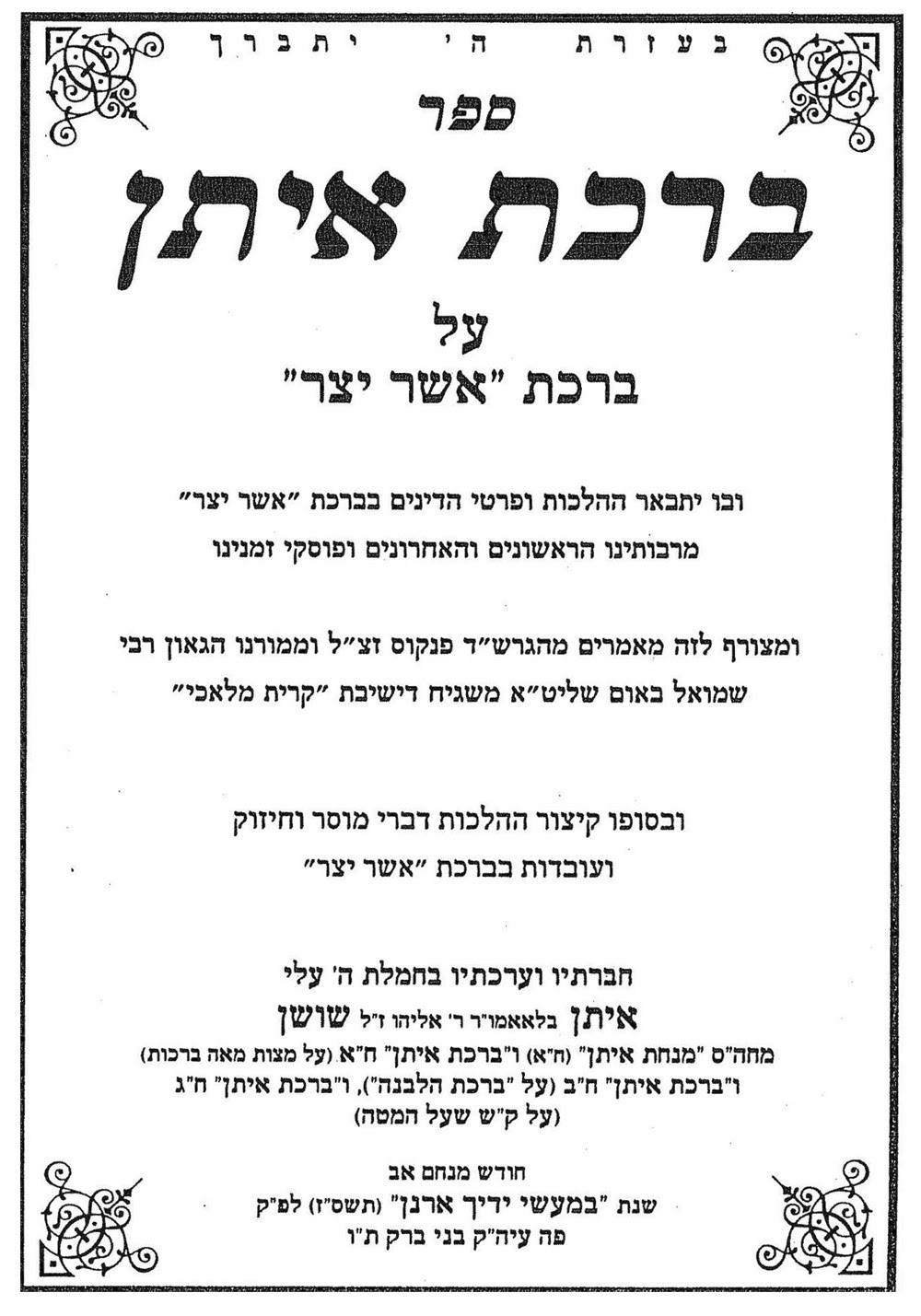
3. Many posts on this blog have discussed how we now have entire books on topics concerning which until recent years a few lines sufficed. Haym Soloveitchik also made this point in “Rupture and Reconstruction.” Here is another example, the book Birkat Eitan by R. Eitan Shoshan.


This is a 648 page (!) book devoted to the blessing Asher Yatzar, recited after going to the bathroom. Shoshan has an even larger book devoted to the Shema recited before going to sleep.
4. In a previous post[10] I mentioned that R. Moshe Bick’s brother was the Judaic scholar and communist Abraham Bick (Shauli). Before writing this I confirmed the information, but as we all know, oftentimes such “confirmations” are themselves incorrect. I thank R. Ezra Bick for providing me with the correct information, and the original post has been corrected.
R. Moshe and Abraham were actually somewhat distant cousins.[11] Abraham was the son of R. Shaul Bick (and hence the hebraicized last name, Shauli), who was the son of R. Yitzchak Bick, who was the chief rabbi of Providence, RI, in the early 1930’s. R. Yitzchak was the son of R. Simcha Bick, who was rav in Mohiliv, Podolia. R. Simcha Bick had a brother, R. Zvi Aryeh Bick, who was rav in Medzhibush. His son was R. Hayyim Yechiel Mikhel Bick, was also rav in Medzhibush (d. 1889). His son was also named Hayyim Yechiel Mikhel Bick (born a few months after his father’s premature death), and he was rav in Medzhibush from 1910 until 1925, when he came to America. His son was R. Moshe Bick.
R. Ezra Bick also reports that after the Second World War, when Abraham Bick was in the U.S. working as an organizer for communist front organizations, he was more or less cut off by his Orthodox cousins in Brooklyn.
R. Moshe Bick’s brother, Yeshayah (R. Ezra’s father), was a well-known Mizrachi figure. In his obituary for R. Hayyim Yechiel Mikhel Bick, R. Meir Amsel, the editor of Ha-Maor, mentioned how Yeshayah caused his father much heartache with his Zionist activities.[12] This article greatly hurt R. Moshe Bick and he insisted that Amsel never again mention him or his family in Ha-Maor. In fact, as R. Ezra Bick has pointed out to me, rather than causing his father heartache, R. Hayyim Yechiel actually encouraged Yeshayah in his Zionist activities.
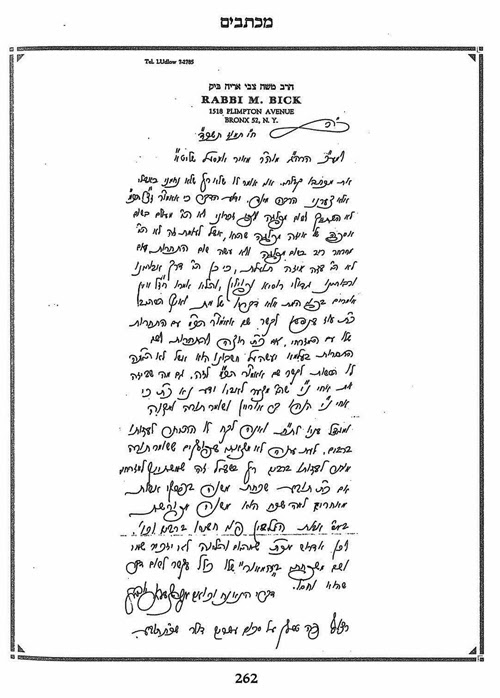
 

R. Bick’s letter is actually quite fascinating and I give the Amsel family a lot of credit for including it in a recent volume dedicated to R. Meir Amsel. I have never seen this sort of letter included in a memorial volume, as all the material in such works is supposed to honor the subject of the volume. Yet here is a letter that blasts Amsel, and they still included it.[13] They also included a letter from R. Jehiel Jacob Weinberg in which he too criticizes Amsel for allowing personal attacks to be published in his journal. It takes a lot of strength for children to publish such letters and they have earned my admiration for doing so.
When I first mentioned R. Moshe Bick, I also noted that he was opposed to young people getting married too quickly. He therefore urged that boys and girls go out on a number of dates before deciding to get engaged. Needless to say, the haredi world was furious at this advice. R. Dovid Solomon reported to me the following anecdote: When the Klausenberger Rebbe told R. Bick how opposed he was to the latter’s advice, R. Bick responded: “That’s because you are mesader kidushin at all the marriages. But I am the one who is mesader all the gittin!”
5. In previous postings I gave three examples of errors in R. Charles B. Chavel’s notes to his edition of Nahmanides’ writings. For each of these examples my points were challenged and Chavel was defended. Here is one more example that I don’t think anyone will dispute. In Kitvei ha-Ramban, vol. 1, p. 148, Nahmanides writes:


 ובזה אין אנו מודים לספר המדע שאמר שהבורא מנבא בני אדם.
In his note Chavel explains ספר המדע to mean:
לדבר הידוע, יעללינעק מגיה פה שצ”ל: לרב הידוע.
Yet the meaning is obvious that Nahmanides is referring to Maimonides’ Sefer ha-Mada, where he explains the nature of prophecy.[14]
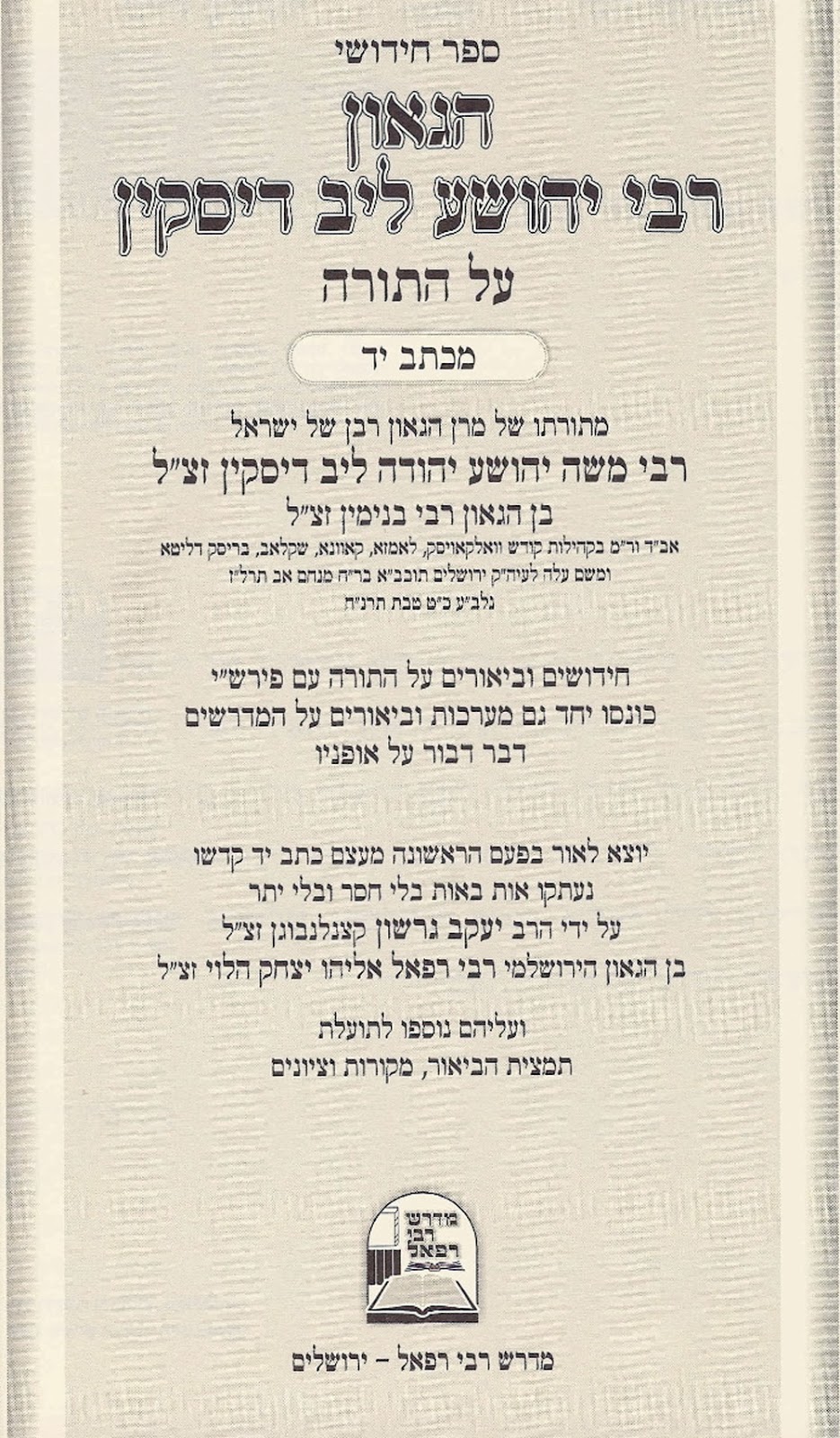
5. In 2008 a Torah commentary from R. Joshua Leib Diskin was published. Here is the title page.
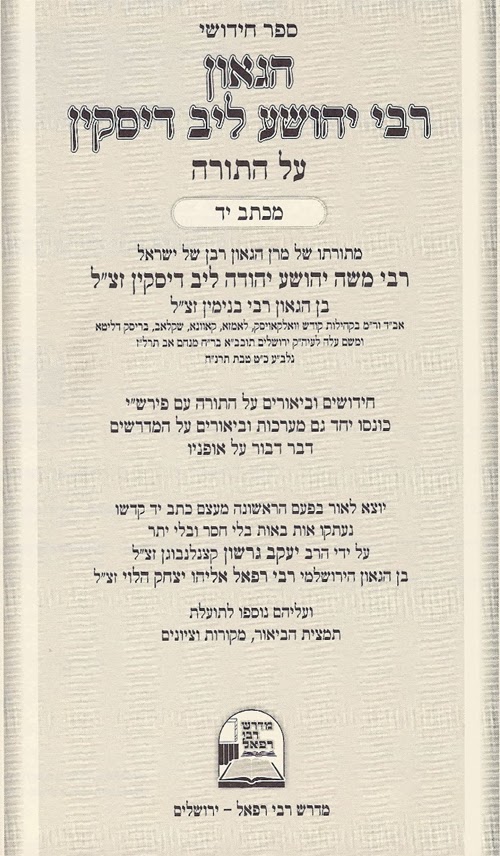
The book even comes with a super-commentary of sorts. This is completely unnecessary but shows how greatly the editor/publisher values the work. Diskin is a legendary figure and was identified with the more extreme elements of the Jerusalem Ashkenazic community. For this reason he often did not see eye to eye with R. Samuel Salant.
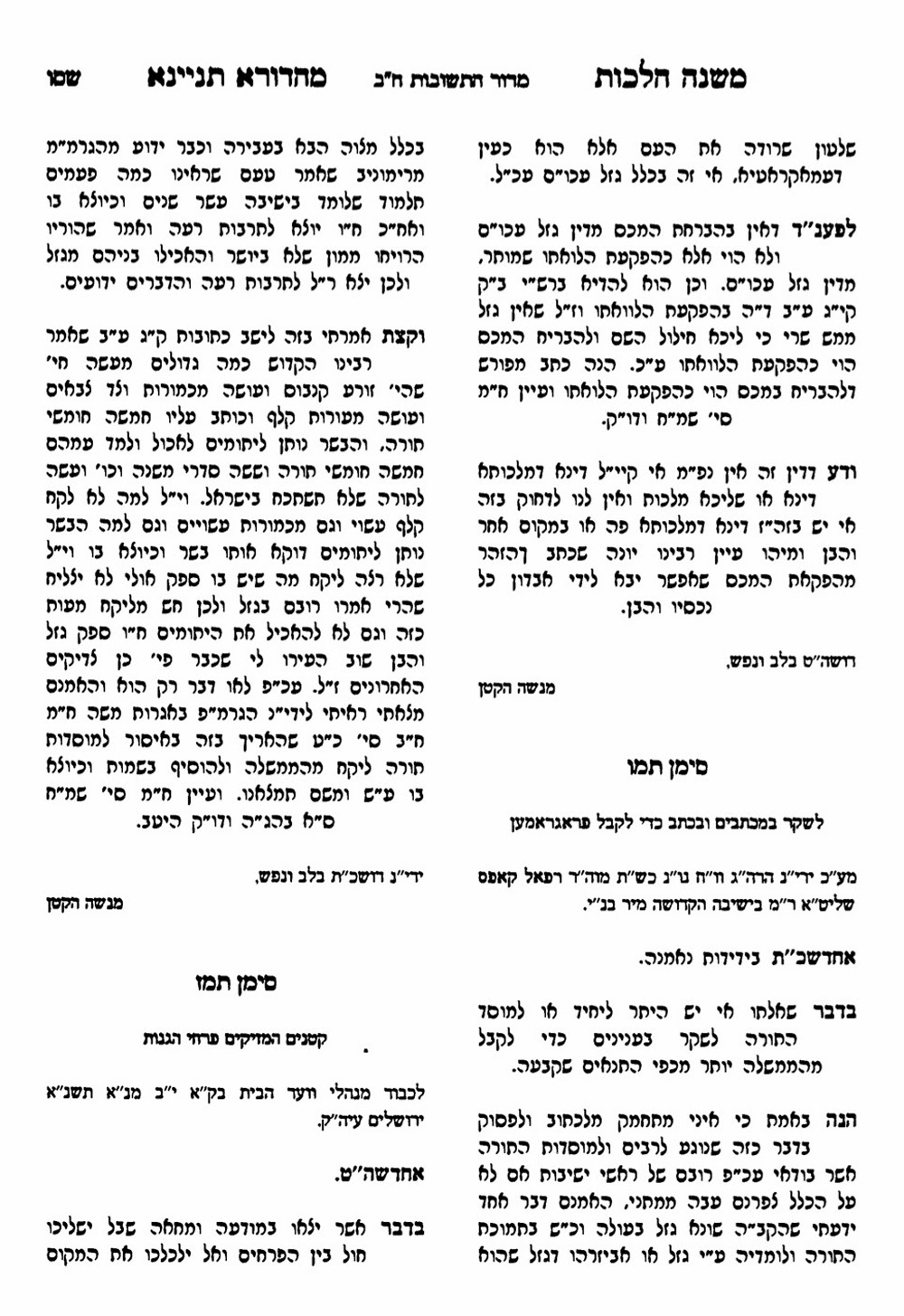
Here is a page from this new commentary.
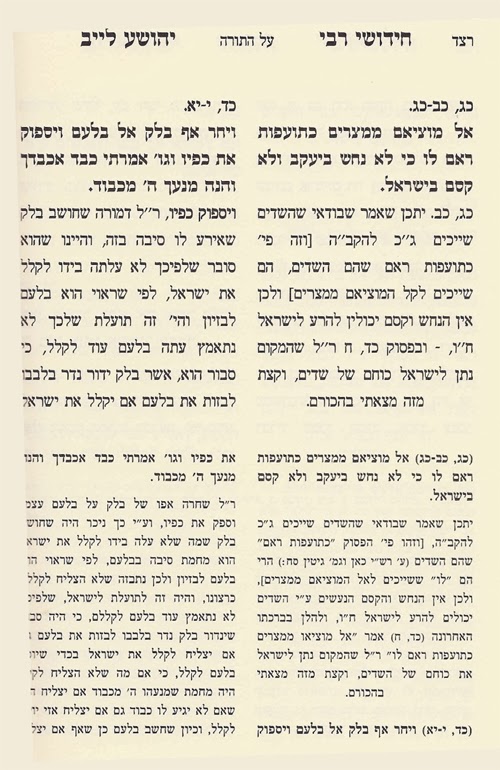
In his comment to Num. 23:22-23, Diskin quotes a book called Ha-Korem. This is a commentary on the Torah and some other books of the Bible by Naphtali Herz Homberg, a leading Maskil who worked for the Austrian government as superintendent of Jewish schools and censor of Jewish books. This is what the Encyclopedia Judaica says about him:

Homberg threatened the rabbis that if they did not adapt themselves to his principles the government would force them to do so. . . . Homberg was ruthless in denouncing to the authorities religious Jews who refused to comply with his requirements, and in applying pressure against them. In his official memoranda he blamed both the rabbis and the Talmud for preventing Jews from fulfilling their civic duties toward the Christian state. . . . Homberg recommended to the authorities that they disband most traditional educational institutions, prohibit use of the Hebrew language, and force the communal bodies to employ only modern teachers. . . In his book Homberg denied the belief in Israel as the chosen people, the Messiah, and the return to Zion, and tried to show the existence of an essential identity between Judaism and Christianity. . . . Homberg incurred the nearly universal hatred of his Jewish contemporaries.
Incredibly, it is from his commentary that Diskin quoted. The editor didn’t know what Ha-Korem was, but almost immediately after publication someone let him in on the secret. All copies in Israeli seforim stores were then recalled in order that the offending page be “corrected”. I am told that the first printing is now impossible to find in Israel. When I was informed of this story by R. Moshe Tsuriel, I contacted Biegeleisen who fortunately had just received a shipment from Israel, sent out before the books were embargoed. Presumably, my copy will one day be a collector’s item.
The one positive thing to be said about Homberg is that he wrote a very good Haskalah Hebrew. I was therefore surprised when I saw the following in David Nimmer’s otherwise fantastic article in Hakirah 8 (2009): “We begin with Herz Homberg, a minor functionary who wrote in German since his Hebrew skills were poor” (p. 73). Since German was the last language Homberg learnt, I was curious as to how Nimmer was misled. He references Wilma Abeles Iggers, The Jews of Bohemia and Moravia (Detroit, 1992), p. 14. Yet Nimmer misunderstood this source. Iggers writes as follows, in speaking of the mid-eighteenth century: “Use of Hebrew steadily decreased, even in learned discussions. Naftali Herz Homberg, for example, asked his friend Moses Mendelssohn to correspond with him in German rather than in Hebrew.” All that this means is that Homberg wanted to practice his German, and become a “cultured” member of Mendelssohn’s circle, and that is why he wanted to correspond in this language. In this he is little different than so many others like him who arrived in Berlin knowing only Hebrew and Yiddish. Each one of them had a different story as to how they learnt German. According to the Encyclopedia Judaica, in 1767, when he was nineteen years old, Homberg “began to learn German secretly.”
6. In a previous post I noted the yeshiva joke that R. Menasheh Klein’s books should be called Meshaneh Halakhot, instead of Mishneh Halakhot. Strangely enough, if you google “meshaneh halakhot” you will find that the books are actually referred to this way by a few different people, including, in what are apparently Freudian slips, B. Barry Levy and Daniel Sperber. In fact, Klein’s books are not the first to be referred to in this sort of way. In his polemic against Maimonides, R. Meir Abulafia writes (Kitab al Rasail [Paris, 1871), p. 13):
הוא הספר הנקרא משנה תורה, ואיני יודע אם יש אם למסורת ואם יש אם למקרא.

Abulafia is mocking Maimonides’ greatest work, and wondering if perhaps it should be called Meshaneh Torah! As for Klein, there is a good deal that can be said about his prolific writings, and they await a comprehensive analysis. When thinking about Meshaneh Halakhot, I often recall following responsum, which appears in Mishneh Halakhot, vol. 5, no. 141, and which I am too embarrassed to translate.
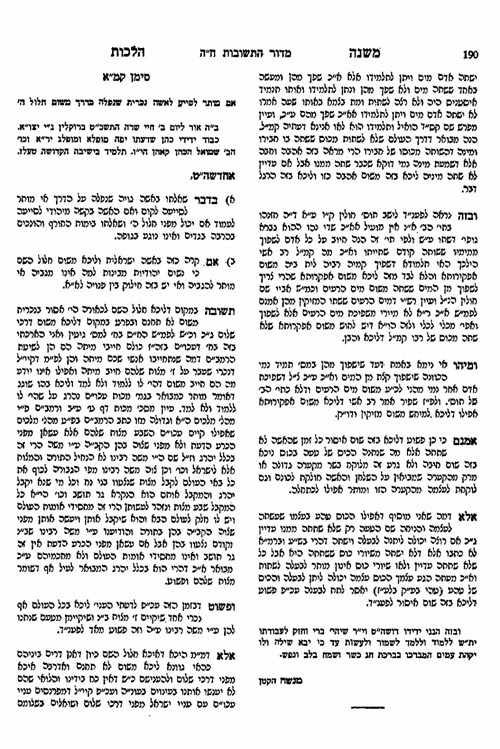
A well-known talmid hakham pointed out to me something very interesting. Normally we understand hillul ha-shem to mean that a non-Jew will see how Jews behave and draw the wrong conclusions of what Torah teachings are all about. However, in this responsum we see the exact opposite. The hillul ha-shem is that the non-Jew will draw the right conclusion! Yet the truth is that this understanding of hillul ha-shem is also very popular and is used by R. Moses Isserles, as we will soon see..
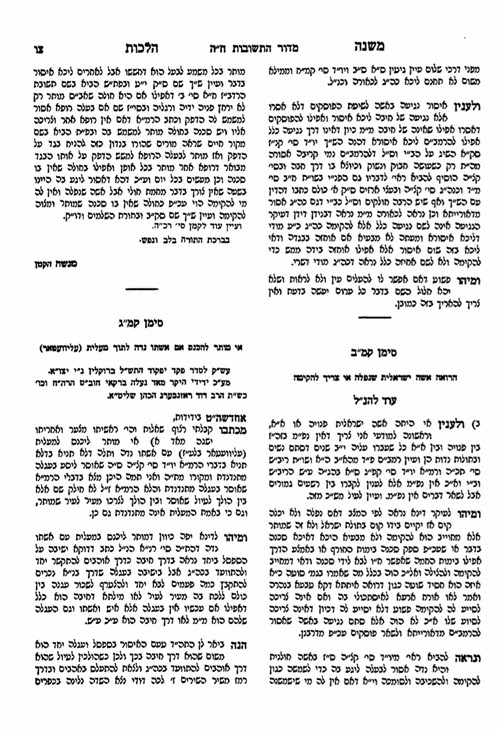
Here is another responsum that will blow you off your seats, from Mishneh Halakhot, New Series, vol. 12, Hoshen Mishpat no. 445.


If you want to understand why three hasidic kids are sitting in a Japanese jail, this responsum provides all you need to know. Can anyone deny that it is this mentality that explains so much of the illegal activity we have seen in recent year? Will Agudat Israel, which has publicly called for adherence to high ethical standards in such matters, condemn Klein? Will they declare a ban on R Yaakov Yeshayah Blau’s popular Pithei Hoshen, which explains all the halakhically permissible ways one can cheat non-Jews? You can’t have it both ways. You can’t declare that members of your community strive for the ethical high ground while at the same time regard Mishneh Halakhot, Pithei Hoshen, and similar books as valid texts, since these works offer justifications for all sorts of unethical monetary behavior. The average Orthodox Jew has no idea what is found in these works and how dangerous they are. Do I need to start quoting chapter and verse of contemporary halakhic texts that state explicitly that there is no prohibition to cheat on one’s taxes?[15] Pray tell, Agudah, are we supposed to regard these authors as legitimate halakhic authorities?
I have no doubt that there was a time that the approach found here was acceptable. In an era when Jews were being terribly persecuted and their money was being taken, the non-Jewish world was regarded as the enemy, and rightfully so. Yet the fact that pesakim reflecting this mindset are published today is simply incredible. Also incredible is that R. David Zvi Hoffmann’s Der Schulchan-Aruch und die Rabbinen über das Verhältniss der Juden zu Andersgläubigen, a classic text designed to show that Jewish law does not discriminate monetarily against contemporary Gentiles, has not yet been translated. Hoffmann’s approach was shared by all other poskim in Germany, who believed that any discriminatory laws were simply no longer applicable.[16] R. Jehiel Jacob Weinberg stated that we must formally declare that this is what we believe. Can Agudah in good conscience make such a declaration, and mean it?
The truth is that there is an interesting sociological divide on these matters between the Modern Orthodox and the haredi world. Here is an example that will illustrate this. If a Modern Orthodox rabbi would advocate the following halakhah, quoted by R. Moses Isserles, Hoshen Mishpat 348:2,[17] he would be fired.[18]
טעות עכו”ם כגון להטעותו בחשבון או להפקיע הלואתו מותר ובלבד שלא יודע לו דליכא חילול השם.
If I am wrong about this, please let me know, but I don’t believe that any Modern Orthodox synagogue in the country would keep a rabbi who publicly advocated this position.[19] Indeed, R. Moses Rivkes in his Be’er ha-Golah on this halakhah wants people to know that they shouldn’t follow this ruling.[20] See also Rivkes, Be’er ha-Golah, Hoshen Mishpat 266:1, 383:1, and his strong words in Hoshen Mishpat 388:12 where he states that the communal leaders would let the non-Jews know if any Jews were intent on cheating them. Today, people would call Rivkes a moser.
I believe that if people in the Modern Orthodox world were convinced that Rama’s ruling is what Jewish ethics is about, very few of them would remain in Orthodoxy. In line with what Rivkes states, this halakhah has been rejected by Modern Orthodoxy and its sages, as have similar halakhot. As mentioned, Hoffmann’s Der Schulchan-Aruch is the most important work in this area. Yet today, most people will simply cite the Meiri who takes care of all of these issues, by distinguishing between the wicked Gentiles of old and the good Gentiles among whom we live. Thus, whoever feels that he is living in a tolerant environment can adopt the Meiri’s position and confidently assert that Rama is not referring to the contemporary world.
Yet what is the position of the American haredi world? If they accept Rama’s ruling, and don’t temper it with Meiri, then in what sense can the Agudah claim that they are educating their people to behave ethically in money matters? Would they claim that Rama’s halakhah satisfies what we mean by “ethical” in the year 2009? Will they say, as they do in so many other cases, that halakhah cannot be compared to the man-made laws of society and cannot be judged by humans? If that is their position, I can understand it, but then let Aish Hatorah and Ohr Sameach try explaining this to the potential baalei teshuvah and see how many people join the fold. If this is their position, then all the gatherings and talks about how one needs to follow dina de-malchuta are meaningless, for reasons I need not elaborate on. Furthermore, isn’t all the stress on following dina de-malchuta revealing? Why can’t people simply be told to do the right thing because it is the right thing? Why does it have to be anchored in halakhah, and especially in dina de-malchuta? Once this sort of thing becomes a requirement because of halakhah, instead of arising from basic ethics, then there are 101 loopholes that people can find, and all sorts of heterim as we saw in Klein’s responsum. I would even argue that the fact that one needs to point to a halakhic text to show that it is wrong to steal is itself a sign of our society’s moral bankruptcy.[21]
7. In Studies in Maimonides and His Interpreters I stated that Maimonides nowhere explicitly denies the existence of demons, yet this denial is clearly implied throughout his writings. It was because Maimonides never explicitly denied them that so many great sages refused to accept this, and assumed that Maimonides really did believe in demons. (In my book I cited many who held this position.) I first asserted that Maimonides never explicitly denied demons in my 2000 article on Maimonides and superstition, of which the second chapter in my new book is an expanded treatment. While working on the original article I was convinced that Maimonides indeed denied demons in his Commentary to Avodah Zarah 4:7. However, I had a problem in that so many who knew this text did not see it as an explicit rejection. In fact, I was unaware of anyone actually citing this text to prove that Maimonides denied the existence of demons. (Only a couple of months ago did R. Chaim Rapoport call my attention to R. Eliezer Simhah Rabinowitz, She’elot u-Teshuvot ve-Hiddushei Rabbi Eliezer Simhah [Jerusalem, 1998], no. 11, who does cite this text as an explicit rejection of the existence of demons. I also recently found that R. Avraham Noah Klein, et. el., Daf al ha-Daf [Jerusalem, 2006), Pesahim 110a, quotes the work Nofet Tzufim as saying the same thing. Unfortunately, as far as I can tell, Klein doesn’t have a list of sources, so I don’t know who the author of this work is.)
Seeing that R. Zvi Yehudah Kook was quite adamant that Maimonides believed in demons,[22] I turned to R. Shlomo Aviner, who published R. Zvi Yehudah’s work, and asked him about Maimonides’ words in his Commentary to Avodah Zarah. Aviner convinced me that Maimonides should be understood as only denying that occult communication with demons is impossible, not the existence of demons per se. He wrote to me as follows:
הרמב”ם לא כתב שם בפירוש שאין שדים, אלא ששאלה בשדים היא הבל, וכך אנו רואים מן ההקשר שהוא מגנה שיטת שונות להשיג דברים או ידיעות, כגון “כשוף וההשבעות והמזלות הרוחניות, ודבר הכובכים והשדים והגדת עתידות ומעונן ומנחש על רוב מיניהם ושאלת המתים.”


I was still not 100 percent sure, but the fact that so many great scholars who knew the Commentary to Avodah Zarah assumed that Maimonides indeed believed in demons gave me confidence that Aviner was correct.[23] Even R. Kafih, in speaking of Maimonides denial of demons, does not cite the Commentary,[24] and this sealed the matter for me. I therefore assumed that all Maimonides was denying in his Commentary to Avodah Zarah 4:7 was the possibility of conversation with demons, and not demons per se. (R. Aviner doesn’t speak of simple conversation, but this was my assumption.)
Following publication of the article in 2000 no one contacted me to tell me that I was incorrect in my view of Maimonides and demons. So once again I was strengthened in my assumption, and repeated my assertion in Studies in Maimonides. Not too long ago I received an e-mail from Dr. Dror Fixler. Fixler is one of the people from Yeshivat Birkat Moshe in Maaleh Adumim who is working on new editions of Maimonides’ Commentary on the Mishnah. I will return to his work in a future post when I deal with the newly published translation of the Commentary. For now, suffice it to say that he knows Arabic very well, and he asserts that there is no doubt whatsoever that in the Commentary to Avodah Zarah 4:7 Maimonides is denying the existence of demons. So this brings me back to my original assumption many years ago, that Maimonides indeed is explicit in his denial. If there are any Arabists who choose to disagree, I would love to hear it.
8. I recently sent a copy of the reprint of Kitvei R. Yehiel Yaakov Weinberg (2 vols.) to a famous and outstanding Rosh Yeshiva. In my letter to him I mentioned that the books were a donation to the yeshiva library. He wrote back to me as follows:
מאשר בתודה קבלת כתבי הגאון רבי יחיאל יעקב וויינברג זצ”ל בשני כרכים. מלאים חכמה ודעת בקיאות וחריפות ישרה, ולפעמים “הליכה בין הטיפות” מתוך חכמת חיים רבה. אולם בכרך השני יש דברים שקשה לעכל אותם, כגון לימוד זכות על מתבוללים ממש (הרצל ואחה”ע [אחד העם] בגרון ועוד) למצוא בהם “ניצוצות קדושה”. ומי שיראה יחשוב כי מותר לומר לרשע צדיק אתה. לכן כרך ב’ נשאר אצלי וכרך א’ לעיון התלמידים הי”ו.


I don’t think that any Rosh Yeshiva in a Hesder yeshiva would say that we should shield the students from the words of a great Torah scholar, but maybe I am wrong. I would be curious to hear reactions. In response to his letter, I sent this Rosh Yeshiva R. Abraham Elijah Kaplan’s essay on Herzl, to show him that Weinberg’s views in this regard were not unique.
Interestingly, in his letter to me the Rosh Yeshiva also wrote:


מה מאד נפלא מ”ש בסוף עמוד ריט על שיטת הגר”ח מבריסק לעומת שיטת הגר”א. מבחינה זו אנו לומדים בישיבה בשיטת הגר”א.


He was referring to this amazing letter from Weinberg:
קראתי את מאמרו של הגרי”ד סולובייציק על דודו הגרי”ז זצ”ל. השפה היא נהדרה ונאדרה והסגנון הוא מקסים. אבל התוכן הוא מוגזם ומופרז מאד. כך כותבים אנשים בעלי כת, כמו אנשי חב”ד ובעלי המוסר. מתוך מאמרו מתקבל הרושם כאלו התורה לא נתנה ע”י מרע”ה חלילה כי אם ע”י ר’ חיים מבריסק זצ”ל. אמת הדברים כי ר’ חיים הזרים זרם חדש של פלפול ע”ד ההגיון לישיבות. בהגיון יש לכל אדם חלק, ולפיכך יכולים כל בני הישיבה לחדש חידושים בסגנון זה, משא”כ בדרך הש”ך ורעק”א צריך להיות בקי גדול בשביל להיות קצת חריף ולכן משכל אנשי הישיבות מתאוים להיות “מחדשים” הם מעדיפים את ר’ חיים על כל הגאונים שקדמו לו. שאלתי פעם אחת את הגרי”ד בהיותו בברלין: מי גדול ממי: הגר”א מווילנא או ר’ חיים מבריסק? והוא ענני: כי בנוגע להבנה ר’ חיים גדול אף מהגר”א. אבל לא כן הדבר. הגר”א מבקש את האמת הפשוטה לאמתתה, ולא כן ר’ חיים. הגיונו וסברותי’ אינם משתלבים לא בלשון הגמ’ ולא בלשון הרמב”ם. ר’ חיים הי’ לכשלעצמו רמב”ם חדש אבל לא מפרש הרמב”ם. כך אמרתי להגאון ר’ משה ז”ל אבי’ של הגר”יד שליט”א.


9. My last two posts focused on R. Hayyim Dov Ber Gulevsky. With that in mind, I want to call everyone’s attention to a lecture by R. Aharon Rakefet in which he tells a great story that he himself witnessed, of how students in the Lakewood yeshiva were so angry at Gulevsky that they actually planned to cut his beard off. It is found here  [25] beginning at 65 minutes. The clip has an added treat as we get to hear the Indefatigable One, who mentions travelling to Brooklyn together with a certain “Maylech” in order to visit Gulevsky.
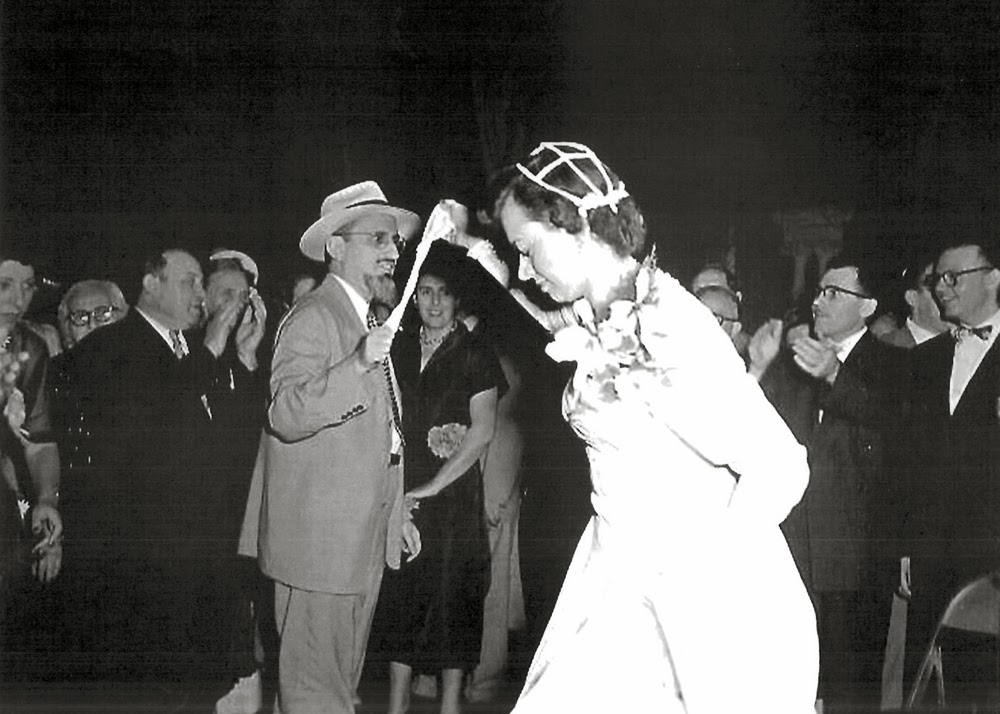
10. And finally, apropos of nothing, here is a picture that I think everyone will get a kick out of. The bride is Gladys Reiss. It shows the Rav in his hasidic side. (Thanks to David Eisen and R. Aharon Rakefet for providing the picture.)

[1] Some of the lies of this paper have been dealt with by R. Moshe Alharar, Li-Khvodah shel Torah (Jerusalem, 1988). Here are two condemnations of Yated printed in Alharar’s book.


For examples of the paper’s most recent outrages, take a look at two articles from the issue that appeared during the Ten Days of Penitence (!). The articles are available here and here.


The first is a vicious attack on the Shas MK R. Hayyim Amsellem for his authorship of a halakhic study arguing that those non-Jews who serve in the Israeli army should be converted using a less strict approach than is currently in practice. Amsellem, who is a student of R. Meir Mazuz and an outstanding talmid hakham, wrote this piece and sent it to some leading poskim to get their opinions. Amselem also discussed his approach in an interview.


What did Yated do? It attacked the “nonsensical, heretical remarks” of Amsellem, knowing full well that his article was not a practical halakhic ruling, but a work of Torah scholarship sent out for comment. And why is what he wrote “nonsensical” and “heretical”? Because it contradicts the viewpoint of “Maranan ve-Rabbanan Gedolei Yisrael,” the papacy that Yated has created.  As with every papacy, no one is permitted to have a different viewpoint. We see that clearly in the next article I linked to. Here the paper deals with the great sages who have permitted brain death. Obviously, Yated has started to believe its own papal rhetoric, since rather than offer any substantive comments, all it can do is refer to R. Elyashiv and unnamed former and current gedolei Yisrael. From Yated’s papal perspective, this is supposed to silence all debate, as if Judaism is a religious dictatorship. Yet it is not, and although Yated will never admit it, there are also former and current gedolei Yisrael who do accept brain death.
[2] “Be-Inyan ha-Gemarot ha-Mevuarot ha-Hadashim,” Or Yisrael 50 (Tevet, 5768), p. 42.
[3] “Be-Inyan Hadpasat ha-Gemara im Targumim u-Ferushim Hadashim,” Or Yisrael 50 (Tevet, 5768), pp. 39-40. Gorelik even claims that the only reason the Hafetz Hayyim agreed to support the Daf Yomi program was as a defense against the Haskalah and Reform. R. Chaim Rapoport responded to Gorelik, ibid., pp. 57ff.
[4] For the Lubavitcher Rebbe’s take on this, see here beginning at 8 minutes (called to my attention by a friend who wishes to remain anonymous). The Rebbe’s words are very strong: Since we know that “people” do not tell a lie that is likely to be found out, it must be that the liars are not in the category of “people” i.e., human beings!
[5] The phenomenon of children distorting their father’s legacy is also something that deserves a post of its own. One thinks of the efforts of the children and grandchildren of R. Gedaliah Nadel and R. Eliezer Waldenberg in opposition to the publication of Be-Torato shel R. Gedaliah and the reprinting of Hilkhot ha-Medinah. R. Nadel’s children were even successful in having Be-Torato removed from Hebrewbooks.org. There are many other such examples, some of which relate to the Rabbinical Seminary of Berlin, which like Yeshiva University was sometimes a place to be forgotten after one left the world of German Orthodoxy. For example, see R. Shmuel Munk’s biographical introduction to the work of his father, R. Shaul Munk, Bigdei Shesh (Jerusalem, 1973). There is no mention that R. Shaul studied at the Rabbinical Seminary. If that wasn’t enough, R. Shmuel, in the introduction, p 19, even attacks the German Orthodox practice of reading German poetry, going so far as to say that no one [!] has permitted this. As with the Yated, “no one” means “no one we regard as significant.” For an earlier post that deals with a posthumous removal of the Rabbinical Seminary from one graduate’s biography, see here.


None of the obituaries of R. Shlomo Wolbe mentioned that he studied at the Rabbinical Seminary of Berlin for a short while, but in this case I assume that the writers were unaware of this. The entry on Wolbe in Wikipedia does mention it, and I was the source for this information. My source is Weinberg’s letter to Samuel Atlas, dated June 10, 1965:


כך סיפר בן אחיו של וולפסון, מר אביעזר וולפסון, תלמיד מונטרה לפנים, ואח”כ תלמיד ישיבת באר יעקב, שבה משמש המנהל רוחני מר וולבה, יליד ברלין, בנו של סופר חילוני וכופר גמור. למד בכתות הנמוכות של בית מדרשנו, ואח”כ הלך לישיבת מיר ונעשה לחניכו של ר’ ירוחם ז”ל, המשפיע המוסרי הגדול.


The point mentioned by Weinberg, that Wolbe was raised in a non-Orthodox home, was never a secret. Some additional details of his turn to Orthodoxy were related by Anne Ruth Cohn, Dayan Grunfeld’s daughter. See here


Yet, as we have come to expect, the Yated cannot be honest with its readers. Thus, in its obituary here. It writes: “Shlomo Wolbe was born in Berlin to R’ Moshe in Tammuz 5674,” making it seem that he was from an Orthodox home. The obituary continues with more falsehoods: “As a child he studied in his home city and at a young age was sent to Yeshivas Frankfurt.” Needless to say, there is also no mention of Wolbe’s university studies.


Another example worth mentioning is the following: Those who read Making of a Godol will recall the description of R. Aaron Kotler’s irreligious sister who tried to convince him to leave the world of the yeshiva. Yet in Yitzchok Dershowitz’ hagiography of R. Aaron, The Legacy of Maran Rav Aharon Kotler (Lakewood, 2005), p. 63, this communist sister is described as “religious, but ‘secular education’ oriented.” See Zev Lev, “Al ‘Gidulo shel Gadol,’” Ha-Ma’ayan 50 (Tishrei, 5770), p. 104.


The absolute best example of this phenomenon relates to the Lubavitcher Rebbe’s brother, Yisrael Aryeh Leib. He was completely irreligious. There are people alive today who can testify to his public Sabbath violation. He even kept his store open on Shabbat. See Shaul Shimon Deutsch, Larger than Life (New York, 1997), vol. 2, ch. 7. Deutsch was even able to speak to his widow. Yisrael Aryeh Leib also has a daughter who presumably would be willing to describe what her father’s attitude towards religion was, if anyone is really interested in knowing the truth. I think it is very nice that Chabad in England commemorates his yahrzeit, see here, and this is very much in line with Chabad’s ideology that every Jew is precious. Yet what is one to make of this “institute”?


Here Yisrael Aryeh Leib, “the youngest brother of the Rebbe, Melech HaMoshiach, who lives forever,” is turned into a rabbi and devoted chasid. I actually contacted the person who runs the “institute” and asked him how he can so blatantly distort the historical record. Communicating with him was one of the most depressing experiences I have had in a long time. It is one thing for a person to believe foolish things, but here was a guy who had drunk an extra dose of the Kool Aid, and with whom normal modes of conversation were impossible. This is actually a good limud zekhut for him: unlike many other cases where the people distorting the historical record are intentionally creating falsehoods, in this case the distorter really believes what he is saying.
[6] R. Mark Urkowitz, who was a student of R. Gorelik, told me that at the end of his life Gorelik commented to him that he was very happy he taught at YU, since this was the only yeshiva whose graduates were bringing Torah to all corners of the United States. When Urkowitz later told this story to another of Gorelik’s son, he denied that his father could ever have said this. Urkowitz and one other person recalled to me how at Gorelik’s funeral YU was never mentioned in any of the eulogies. It was as if the major part of Gorelik’s life for forty years had never existed.
[7] Ishim ve-Shitot (Tel Aviv, 1952), pp. 58-59.
[8] Aaron Rakeffet-Rothkoff, The Rav, vol. 1, p. 227.
[9] This is Zevin’s preface to the story (translation in Louis Jacobs, A Tree of Life [London, 2000], pp. 54-55, n. 49):


Why did R. Hayyim refuse to write responsa? Some think that his remoteness from the area of practical decisions stemmed from the fact that he belonged to the ranks of “those who fear to render decision,” being afraid of the responsibility that it entails. But this is not so. The real reason was a different one. R. Hayyim was aware that he was incapable of simply following convention and that he would be obliged, consequently, to render decisions contrary to the norm and the traditionally accepted whenever his clear intellect and fine mind would show him that the law was really otherwise than as formulated by the great codifiers. The pure conscience of a truthful man would not allow him to ignore his own opinions and submit, but he would have felt himself bound to override their decisions and this he could not bring himself to do.
[10] See here.
[11] For more on Abraham Bick the communist, and his relationship with R. Moshe Bick, see here for the following report:


אברהם ביק הכרתי בפעם הראשונה כהרה”ר של רוסי’ בא לבקר לארה”ב בשנת תשכ”ח ביזמת הרב טייץ מאליזאבעט נוא דזשערזי. וכבוד גדול עשו לו וכל גדולי ארצינו באו לבקר אותו ולחלוק לו כבוד — הוא למד בסלאבאדקא והי’ ממלא מקומו של הרב שלייפער, וניהל בחכמה ובתבונה את רבנתו ועמד על משמרתו הוא בא ביחד עם החזושל לענינגראד -השומר- בבארא-פארק עשו פאראד גדול וכל הישיבות והבית-יעקב יצאו לרחובה של עיר לחוק כבוד להעומד על משמרת היהדות ברוסי’ משם נסעו לישיבת תורה-ודעת שכל הגדולים דברו וחיזקו את הרב לעווין .משם נסעו לאליזאבעט מקום הרב טייץ — שחלקו רב בענייני יהדות רוסי’ —  וגם שם הי’ פאראד גדול. והרב לעווין הי’ מאוד מרוגש .ודמעות נזלו מעיניו. נחזור לביק-הוא הי’ קאמאניסט. והי’ מכונה הרב של הקאמאניסטים. הוא כתב מאמרים בשבועון שלהם ותמיד המליץ טוב על הקאמאניסטים שהם לא רודפים את הדת. וכשהרב לעווין הי’ כאן הוא הי’ מראשי המחותנים שם. ואז דברתי איתו בפעם הראשונה. אח”כ הוא עלה לארה”ק ועבד במוסד הרב קוק ומצאתיו שם אך לא רציתי להכאיבו ולא דברנו על העבר. אז נתן לי שני ספרים א] זהרי-חמה הגהות על הזוה”ק מהיעב”ץ. ועוד ספר למוסרו לש”ב הרה”ג רמצ”א זצ”ל ביק — הוא פשוט רצה להתפייס איתו כי הם לא היו שוה בשוה-וכשהבאתי את הספרים להרב ביק דברתי איתו על אברהם ביק ואביו הרה”ג שהי’ חתן המשמרת שלום מקאדינאוו, והי’ בעל הוראה מובהק. בקיצור לאחר זמן חזר לארה”ב בגין אישתו וביתו שלא היו בקו הבריאות — הוא הי’ דמות טראגית — אביו שלחו מארה”ב ללמוד לארה”ק. אך הי’ תמיד שומר תורה ומצוות הי’ אידאליסט ולא הי’ בן יחיד במחשבתו שהקאמאניזום יציל את האנושות והיהדות .הוא לא עשה זאת מטעם כסף .הוא לא הי’ מאטראליסט. והשם הטוב יכפר בעדו.


[12] Ha-Maor, Tamuz 5726, p. 18.
[13] Ha-Gaon ha-Rav Meir Amsel (Monsey, 2008), p. 262.
[14] See R. Yaakov Hayyim Sofer in Moriah, Nisan 5769, p. 150.
[15] R. Chaim Rapoport provides some of these sources in his article in Or Yisrael, Tishrei 5770.
[16] For R. Abraham Elijah Kaplan’s view, see his Mivhar Ketavim (Jerusalem, 2006), pp. 287-288.
[17] After quoting this halakhah, Rama cites an opposing view, but this is cited as יש אומרים, meaning that the first ruling is the one Rama accepts. Even this view is not something that would go over well in the Modern Orthodox world: וי”א דאסור להטעותו אלא אם טעה מעצמו שרי
[18] Although he might not be fired, any Modern Orthodox rabbi who stated as follows would also be in hot water, as the congregation would be outraged: “One is not allowed to admire gentiles or praise them.” The writer of these words goes on to say that collecting baseball cards is also forbidden. “While it may be that some people trade them only for financial gain, the reason for collecting the cards is more likely because of an appreciation and admiration for the personalities depicted on them. This is forbidden.” Quite apart from the terrible lack of judgment in putting the first sentence (“One is not allowed to admire gentiles or praise them”) into an English language book (for obvious reasons), should we be surprised that a halakhist who thinks baseball cards are forbidden is one of the poskim of the formerly Modern Orthodox OU? See R. Yisrael Belsky, Shulchan Halevi (Kiryat Sefer, 2008), pp. 132, 133. (For another ruling against baseball cards, see R. Yitzhak Abadi, Or Yitzhak, Yoreh Deah no. 26.) In discussing the issue of praising Gentiles and the prohibition of le tehanem, Meiri writes as follows, in words that have become basic to the Modern Orthodox ethos (Beit ha-Behirah: Avodah Zarah 20a):


כל שהוא מן האומות הגדורות בדרכי הדתות ושמודות בא-להות אין ספק שאף בשאין מכירו מותר וראוי.


[19] Samuel Cohon discusses Rama’s ruling in Faithfully Yours (Jersey City, 2008), pp. 87-88.
[20] See similarly R. Shneur Zalman of Lyady, Shulhan Arukh, Hilkhot Ona’ah, no. 11.
[21] Along these lines, see here for a recent article by R Binyamin Lau dealing with a husband who wanted to know if he was halakhically permitted to hit his wife.
[22] Sihot ha-Rav Tzvi Yehudah: Bereishit, ed. Aviner (Jerusalem, 1993), pp. 295-297, 310-312.
[23] In Studies in Maimonides I cite numerous examples. Here is one more to add to the list. R. Tzefanyah Arusi, “’Lo ba-Shamayim Hi’ be-Mishnat ha-Rambam,” Mesorah le-Yosef 6 (2009), p. 396:


מה שהשיג הגר”א בעניין השדים והכשפים, יש להשיב על כל דבריו: וכי מניין לו שלדברי רבנו אין מציאות לשדים ולמכשפים וכיו”ב.
 

[24] See his Ketavim (Jerusalem, 1989),  vol. 2, pp. 600-601.
[25] “The Bracha for Kidush Ha-Shem,” Sep. 21, 2008.


The 1526 Prague Haggadah and its Illustrations

The 1526 Prague Haggadah and its Illustrations
By ELIEZER BRODT

This piece was originally printed in Ami Magazine’s Kunteres 9 Nisan 5777 – April 5, 2017

The topic perhaps most written about in Jewish literature is the Haggadah shel Pesach. There are many kinds in many languages and with all kinds of pirushim and pictures. Whatever style one can think of, not one but many Haggados have been written—be it on derush, kabbalah, halachah, mussar or chassidus. There are people who specialize in collecting Haggados, even though they don’t regularly collect sefarim. In every Jewish house today one can find many kinds of Haggados. Over the years, various bibliographers collected and listed the various Haggados. In 1997, Yitzchak Yudolov printed The Haggadah Thesaurus, which contains an extensive bibliography of Haggados from the beginning of printing until 1960. The final number in his bibliography listing is 4,715! Of course, many more have been printed since 1960. New Haggados are printed every single year. Even people who never wrote chiddushim on the Haggadah have had one published under their name based on their collected writings. When one goes to the sefarim store before Pesach, it has become the custom to buy at least one, although it is very easy to become overwhelmed, not knowing which to pick.
The one I would like to focus on in this article was printed in Prague in 1526.[1] The Prague  edition of the Haggadah is considered by experts to be one of the most important illustrated Haggados ever published. It is perhaps the earliest printed[2] illustrated Haggadah for a Jewish audience, and it served as a model for many subsequent illustrated Haggados. Some insist that it is the greatest single Haggadah ever printed. “Certainly it is one of the chief glories in the annals of Hebrew printing as a whole and for that matter in the history of typography in any language.”[3] Printing came to Prague in 1487 (around 40 years after its invention), and the first Hebrew book was printed there in 1518. The Prague 1526 edition was published by the brothers Gershom (Cohen) and Gronom Katz on Sunday, 26 Teves 5287 or December 30, 1526.[4]
This Haggadah contains many of the halachos of the Seder beginning with bedikas chametz, a collection of pirushim on various parts of the Haggadah, and 60 illustrations made from woodcuts. However, we do not know who authored these halachos and divrei Torah (which are full of interesting ideas). The halachos written here are very significant, as they were written and printed before the Shulchan Aruch. The illustrations are also significant, as they had a tremendous impact on the illustrated Haggados printed afterward.
I would like to discuss some of the interesting things we can learn about the Seder and Haggadah via this Haggadah and some of its illustrations.
The first general question is why they chose to illustrate the Haggadah. Who was their intended audience? Various people who studied this Haggadah have debated this issue,[5] but to me it’s pretty clear that it had to do with one of the most important parts of the Seder night—the special audience—the children. This was a tool to help enable us to fulfil the important obligation of v’higadeta l’vincha. Last year, in an article in this magazine, I outlined many customs done during the Seder with the underlying theme to get the children “into” the Seder. One of the best ways to get kids “into” it is via visual aids, showing them pictures or acting out certain things.  Simply reciting the Haggadah and just saying “some Torah” is not as effective. It would seem to me that this was their intention when they illustrated the Haggadah. It could be that some of the pictures were to lighten it up for the adults too, as I will soon explain.
The significance of this point is that Rav Shlomo Zalman Auerbach, zt”l, raises possible issues with looking at illustrated Haggados on Pesach based on the halachos in the Shulchan Aruch (307:15) dealing with reading captions of images on Shabbos.[6]
If we are correct that the purpose is to educate the children, it might be a possible reason to permit looking at these images. To be sure, some of the Haggados with images were printed with the involvement of great gedolim, such as the illustrated 1590 Prague Haggadah, which had a kitzur of the Zevach Pesach of the Abarbanel written by Rav Yitzchak Chayis (1538-1610).
Just to emphasize the significance of visual aids when learning, in a haskamah for a work about shechitah that was written but never printed, the Aderes stresses the benefit of the numerous diagrams and illustrations of animals in the book for the understanding of the various complex halachos of shechitah.[7]
Similarly, Rav Belsky dissected an animal on video to give a visual aid for those learning Maseches Chulin. It is also related that when the Minsker Gadol, Rav Yerucham Perlman, zt”l (1835-1896), first became rav he made it his business to go to the head shochet of the city to learn all the aspects of animals for the laws of treifos and the like. The shochet asked him how he could possibly teach the rav anything. The Minsker Gadol replied, “It’s one thing to learn the halachos in sefarim, but when it comes to psak halachah one needs to know the exact aspects as they are on the actual animal.[8]
Additionally, there is a great benefit for us to analyze the pictures nowadays, as it can give us a glimpse into how they conducted the Seder in those days.
Halachos
One of the first parts of the Seder is the eating of karpas. Nowadays, for the most part, the custom is for the children to say, “We wash our hands, but we don’t say the brachah for this washing.” In the instructions to the Prague Hagadah it says to say the brachah for washing.[9] In fact, there are a number of Rishonim who say that one should say the brachah of al netilas yadayim.
Who pours the wine?
After saying Ha Lachma Anya the cups of wine are refilled. There is a picture of someone refilling the wine with a caption stating that the servant should refill the wine. The Rama in Darchei Moshe says that the person who is conducting the Seder should not fill the cups of wine; rather, someone else should do it for him.[10] This would appear to be an earlier writter source with the same idea.[11] Interestingly enough, the Aruch Hashulchan writes that we do not do this. The leader can pour the wine for himself, and there is no reason that his wife should have to pour for him.[12] Rav Yitzchak Chayis writes in Siach Yitzchak—which is a halachic work about the Seder night first printed in Prague in 1587—that one should train his six or seven-year-old child to do this mitzvah.[13] Perhaps another minhag related to this statement of the Rama is that the one leading the Seder does not get up to wash his hands; rather, the water is brought to him.[14]
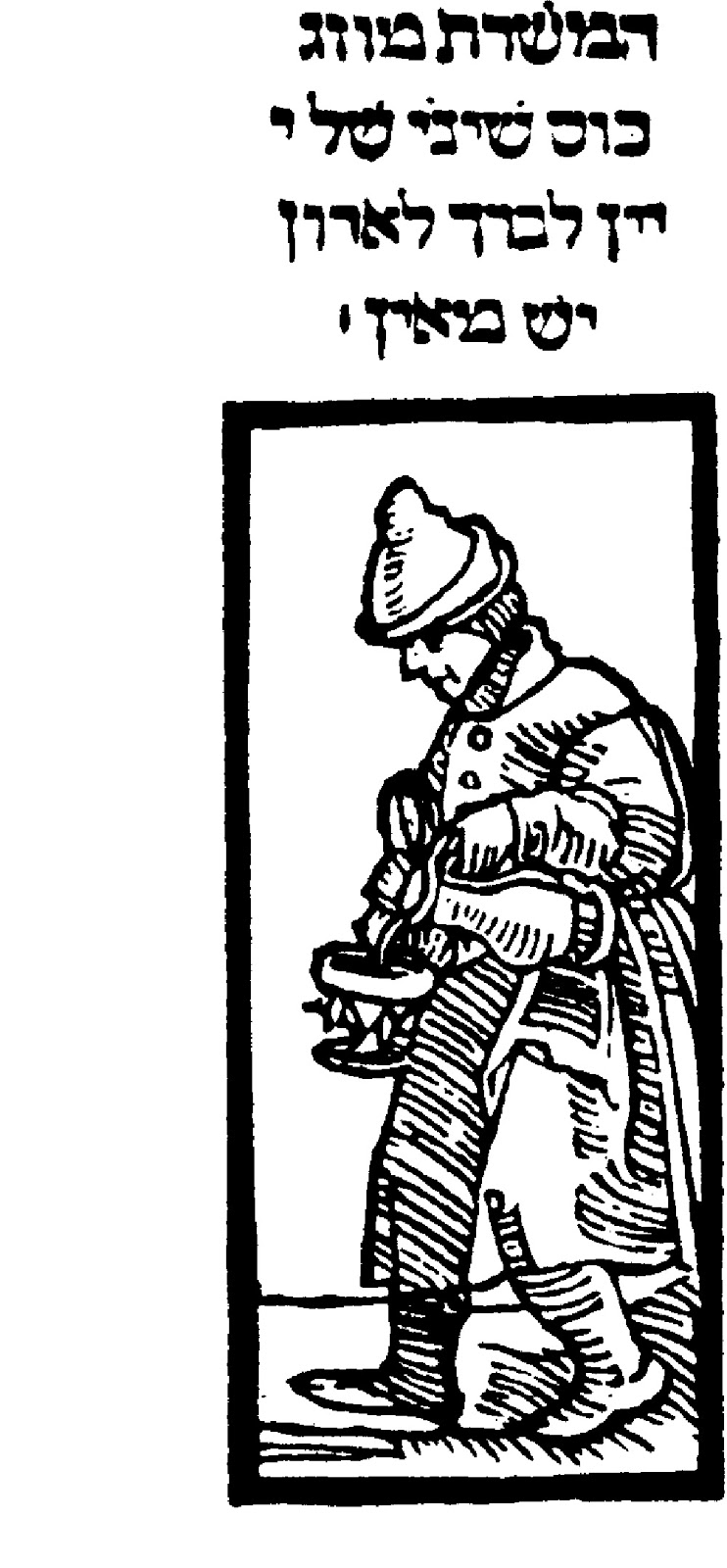
Pouring out the wine for the Ten Makkos
 
After saying Ha Lachma Anya the cups of wine are refilled. There is a picture of someone refilling the wine with a caption stating that the servant should refill the wine. The Rama in Darchei Moshe says that the person who is conducting the Seder should not fill the cups of wine; rather, someone else should do it for him.[10] This would appear to be an earlier writter source with the same idea.[11] Interestingly enough, the Aruch Hashulchan writes that we do not do this. The leader can pour the wine for himself, and there is no reason that his wife should have to pour for him.[12] Rav Yitzchak Chayis writes in Siach Yitzchak—which is a halachic work about the Seder night first printed in Prague in 1587—that one should train his six or seven-year-old child to do this mitzvah.[13] Perhaps another minhag related to this statement of the Rama is that the one leading the Seder does not get up to wash his hands; rather, the water is brought to him.[14]
Another minhag found in this Haggadah is the famous custom of dipping the fingers into the wine when saying the Ten Makkos. In this section of the Haggadah there is an illustration of someone dipping his finger into his cup and there is also a caption under the picture stating that some dip with the pinky, followed by a reason for this custom.[15]
The earliest known source for this minhag can be found in a drashah of the Rokei’ach, recently printed from a manuscript by Professor Simcha Emanuel.[16] But this source speaks about dipping the index finger. The Rama also writes to dip the index finger. Interestingly, the Magen Avraham says to dip with the kemitzah, which is the ring finger.
Walking with a sack on the back
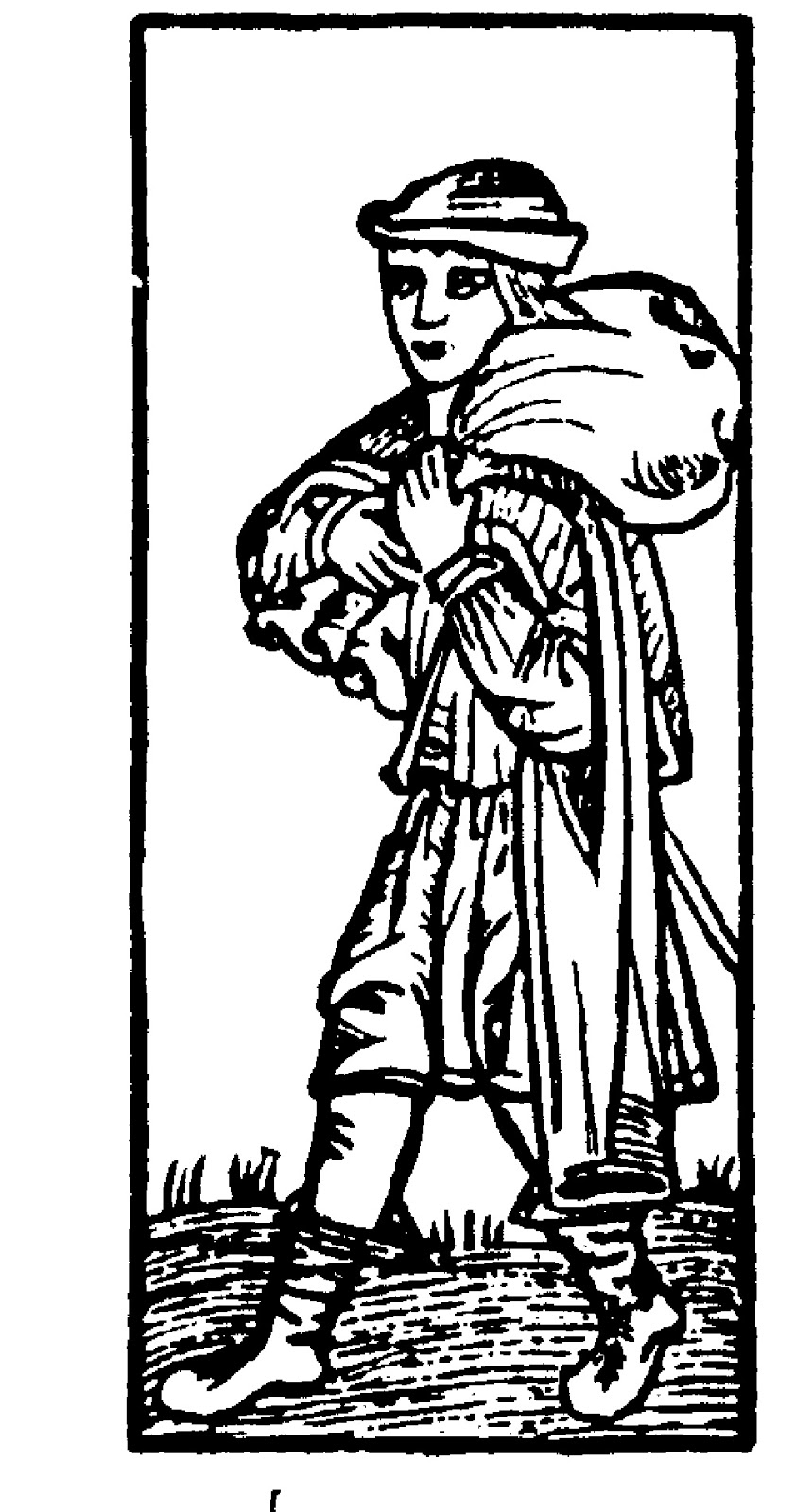
There a few places in the Haggadah, such as near the paragraph of B’chol dor vador, where we find an illustration of someone walking with a sack (of matzah) on his back. The source for this can be found in some of the Rishonim and early Acharonim. After mentioning breaking the matzah in their description of Yachatz they add that the leader of the Seder puts it on his shoulders and walks with it for a bit; others do this only later on when they eat the afikoman.[17]
Eliyahu Hanavi coming to the Seder
I traced the sources for this in a previous article in Ami Magazine. When discussing the sources for this, Rabbi Sperber notes[18] that in a few of the illustrated Haggados there are pictures of a man on a donkey near Shefoch Chamascha. In some of them he is being led by someone else; for example, in the Prague Haggadah of 1526.
I also noted that Rabbi Yuzpeh Shamash writes that mazikin run away from any place where Eliyahu’s name is mentioned. He says that because of this some make a picture of Eliyahu and Moshiach for the children, so that the children seeing it will say “Eliyahu,” causing the mazikin to disappear.[19] This could indicate that the illustrations were shown specifically to the children, as I claimed earlier.
Nusach of the Haggadah
The actual nusach of the Haggadah is its own large topic, starting from the Gemara and moving onward to manuscripts and discussions among the poskim. In the beginning of the Haggadah we begin with the famous Aramaic passage of Ha Lachma Anya. Much has been written about different aspects of this passage. One aspect is whether the exact nusach should be Ha Lachma Anya or K’ha Lachma Anya. The Rama quotes Rav Avraham of Prague, who says to specifically say Ha Lachma Anya and not K’ha Lachma Anya. The Maharal says the same. We see that two great sages from the city of Prague paskened that we should say Ha Lachma Anya.
Who was this Rav Avraham of Prague quoted by the Rama?
Rav Dovid Ganz (a talmid of the Maharal) writes in his historical work Tzemach Dovid that he was the rosh yeshivah and av beis din of Prague in the 1520s. He also authored some notes to the Tur, which were printed by Gershom (Cohen) Katz in Prague in 1540.[20] Thus, it is interesting that in the Haggadah the nusach was different from that of the av beis din of the city. Interestingly enough, his sons printed two more Haggados (1556 and 1590) in Prague and there too the nusach is different from that of Rav Avraham. Ultimately, the Magen Avraham concludes that whichever nusach one says is fine.[21]
What to use for maror
Another interesting picture is of the maror. In two places in the Haggadah the illustration used for maror is that of a lettuce—chasah. This is chazeret, which is the first of the five types enumerated in the Mishnah that one can use for maror.
There is a famous teshuvah from the Chacham Tzvi where he writes at length that this is the ideal item to be used for maror, as it’s the first in the list of the Mishnah.[22] We also find that the Netziv wrote a letter to his son, Rabbi Chaim Berlin, urging him to use it for maror instead of sharper vegetables, especially after fasting and drinking wine.[23] There are also numerous earlier illustrated manuscripts that show pictures of lettuce for the maror.[24]
More on maror
Speaking of maror, the inscription next to the picture is of great interest. It says, “There is a custom when saying maror that the man points to his wife, as it says ‘An evil wife is worse than death.’” Much has been written about this illustration. Some have written that it is ridiculous and there cannot be such a custom. On the other hand, Rabbi Wengrov and, more recently, Rabbi Yisroel Peles,[25] have demonstrated that there are pictures of a man pointing to his wife near the paragraph of maror in various illustrated Haggadah manuscripts. It is clear, however, as Rabbi Wengrov writes, that this was done in a joking manner to lighten up the Seder, but it isn’t serious, chas v’shalom. Rabbi Wengrov demonstrates that other pictures found in these Haggados show that the authors had a sense of humor and drew certain illustrations to lighten up the mood.[26]
Explanation via illustration
 
 
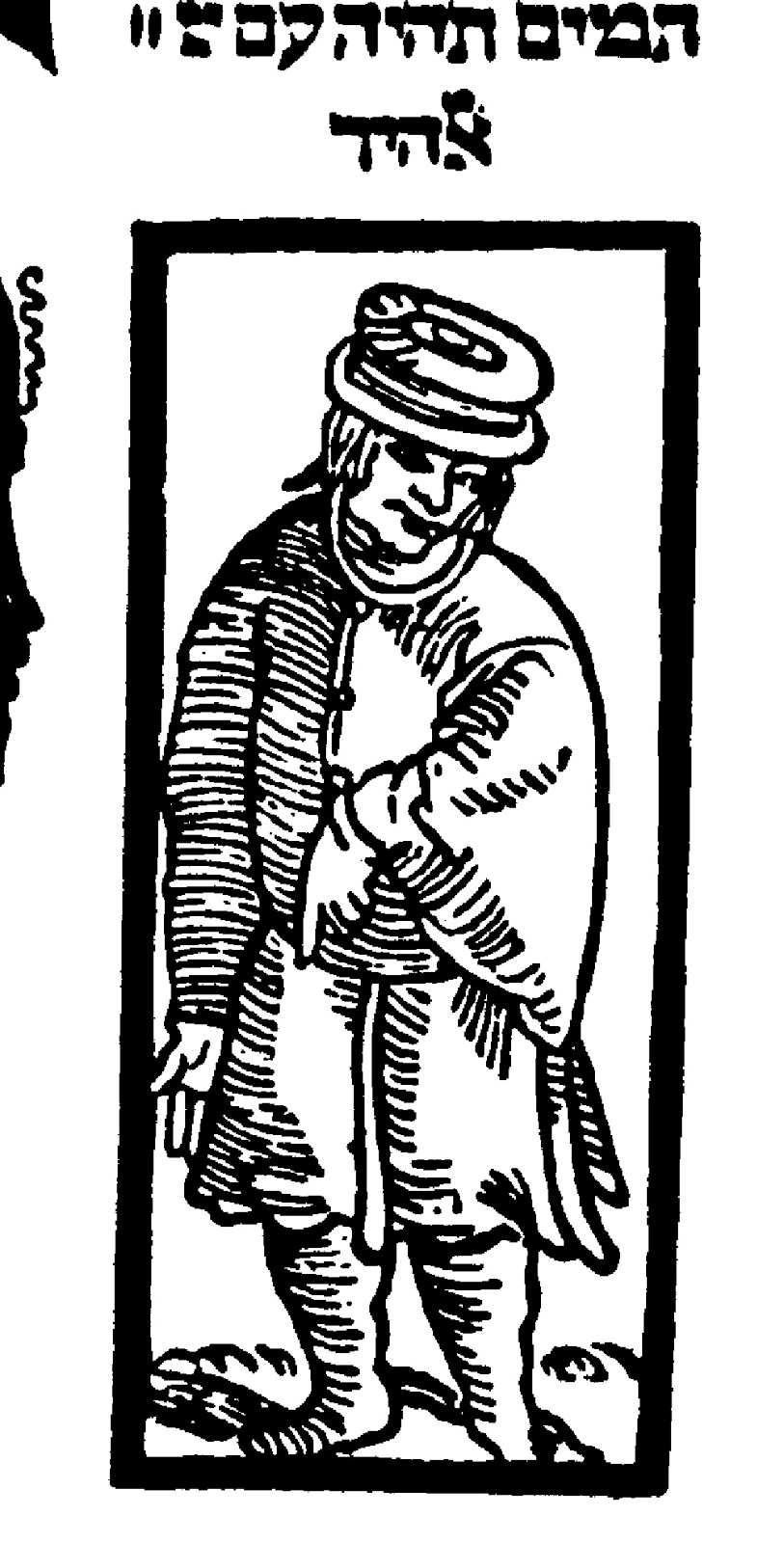
Some of the pictures in the Haggadah are to explain a particular passage. One such example is the image of the four sons. The tam is often translated as a derogatory term—the foolish son. However, the caption above the picture says, “Tamim tihyeh im Hashem” – always be complete with Hashem, which means that they understood the tam to be a man of piety.[27]
Omission
At the end of the Haggadah we conclude the Seder with a few songs, such as Echad Mi Yodei’a[28] and Chad Gadya. The authors and earliest sources for reciting them are unknown.[29] Rabbi Shemaryah Adler suggests that Chad Gadya may have been written by Daniel.[30] Rabbi Yedidyah Tiyah Weil writes in Marbeh L’sapeir on the Haggadah that he heard that these two songs were found in a manuscript from the beis midrash of Rav Elazar Rokei’ach. Numerous pirushim have been written about Chad Gadya, based on all the methods of learning Torah.[31] Be that as it may, many have noted that they are not found in this Haggadah. The first time they appear in print are in the Haggadah printed in Prague in 1590.
Another notable omission is the stealing of the afikoman. I wrote in the past in this magazine that one of the earliest sources in print can be found in the Siach Yitzchak, which mentions stealing the afikoman, but not in the same way as we do it nowadays.[32] It would seem that since no mention of it is made in the instructions of the 1526 Haggadah that it was not yet a widespread custom at that time.
Kiddush and Hunting
 

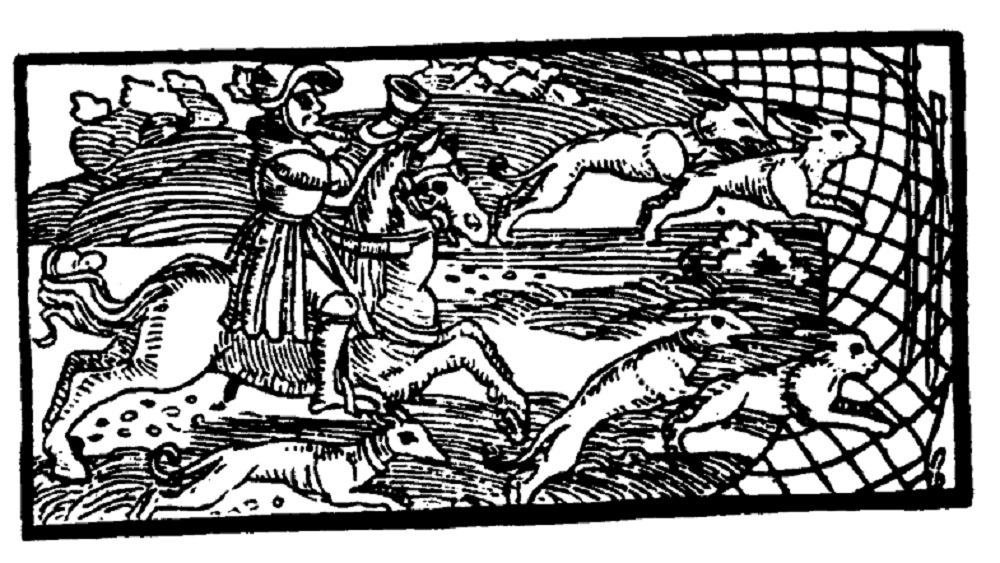
In the beginning of the Haggadah, on the bottom of the page of Kiddush, we find a mysterious picture of someone hunting hares with a horn and dogs. This picture can also be found in a bentcher printed by the Katz brothers in Prague a few years earlier. The question is obvious: What in the world does this have to do with Kiddush, especially as it is not a Jewish hobby? One of the answers suggested is that when Yom Tov occurs on Motzaei Shabbos we use an abbreviation known as Yaknehaz to remember the order in which to say Kiddush and Havdalah. The pronunciation of Yaknehaz is similar to jagen hasen, which is German for hunting hares, so this picture is meant to serve as a reminder of the abbreviation.[33]
Moreon Kiddush
Throughout the Haggadah there are illustrations of people holding cups of wine; sometimes the one holding the cup is dressed like a king. It would appear that this is to reflect the halachah to act like a king on the Seder night as part of the celebration of our freedom.
At other times the image is of an older man holding the cup either in his left hand or in his right. Rabbi Shaul Kook points out that some of the time it’s in the palm of his hand, which is the way it should be held according to various mekubalim, while at other times he holds the cup by its stem. He suggests that near the passage where Rabbi Elazar ben Azaryah says, “I am like someone who is 70 years old,” he is depicted as holding the cup in his left hand while stroking his white beard with the other to show that he’s really not that old.[34] At that point in the Haggadah one would not be holding the cup for the purpose of drinking one of the four kosos and that’s why he’s not holding it in his palm. Whereas in the pictures near where one would hold the cup for drinking he is holding it in the palm of his right hand. However, there is another picture on the page of Kiddush that is similar to the one of Rabbi Elazar holding the cup in his left hand and stroking his beard. Rabbi Kook says that this is because the printer was not educated and, not realizing the reasons for the difference, used the wrong woodcut.[35]
 
The problem with this is that the earliest source we have for holding the cup of wine specifically in the palm of the hand is in the Shalah HaKadosh, which was first printed in 1648—long after this Haggadah was printed.[36] It is, however, very possible that mistakes were made because printing with woodcuts is very difficult and confusing.
Sitting during Kiddush
Other customs that we can possibly learn from the illustration of Kiddush are that the person is both sitting and looking at the cup. These are also mentioned by various poskim in regard to the halachos for how Kiddush should be said.[37] There are other halachos of Kiddush that can perhaps be learned from these illustrations, but one has to be careful as to how much to “read into” them.
[1] On this Haggadah, see A. Yaari, Bibliography Shel Haggadot Pesach, p. 1. Y. Yudolov, Otzar Haggados, p. 2, # 7-8; the introduction to the 1965 reprint of this Haggadah; Yosef Yerushalmi, Haggadah and History, plate 13; Yosef Tabori, Mechkarim B’toldos Halachah (forthcoming), pp. 461-474. See especially the excellent work of Rabbi Charles Wengrov, Haggadah and Woodcut, (1967), which is completely devoted to this Haggadah. Another recent work devoted to this Haggadah was printed this year by R’ Yehoshua Goldberg, Haggadas Prague. Many thanks to my friend Dan Rabinowitz for the discussions about this Haggadah over the past few years. Here are two earlier posts by Dan on manucript Haggados and the 1526 Prague Haggadah: here and here. Thanks also to Mr. Yisroel Israel for his help with the images.
[2] As there are numerous illustrated manuscript haggadas.
[3] Yerushalmi, Haggadah and History, p. 30.
[4] This detailed publication information does not appear on the title page; rather, it appears at the end of the book in what is referred to as the colophon. On the printers see Chaim Friedberg, Toldos Hadefus Haivri, pp. 1-10. On various aspects about printing in these years in Prague, see Hebrew Printing in Bohemia and Moravia (Prague 2012).
[5] Richard Cohen, Jewish Icons, (1998), pp. 94-97; Chone Shmeruk, The Illustrations in Yiddish Books of the Sixteenth and Seventeenth Centuries (Heb. 1986).
[6] Halichos Shlomo (Pesach), pp. 267-268.
[7] Intro to Shu”t Ohel Yosef, 1903.
[8] Hagadol MiMinsk, p.51.
[9] Drashah L’Pesach L’Rabbi Elazar MiVermeiza, p. 96. See: Haggadah Shevivei Eish, p. 152; Y. Tabory, Pesach Dorot, pp. 216-244. See also what I wrote in my work Bein Kesse Le’assor, pp. 148-153.
[10] Darchei Moshe, 486:1.
[11] See also Siach Yitzchak (Brooklyn 2016), p. 241.
[12] Aruch Hashulchan, 473:6.
[13] Siach Yitzchak, p. 239, 252.
[14] Siach Yitzchak, p. 239.
[15] On this minhag see Zvi Ron, Our Own Joy is Lessened and Incomplete; The History of an Interpretation of Sixteen Drops of Wine at the Seder, Hakirah 19 (2015), pp. 237-255. I hope to return to this in the future.
[16] Drashah L’Pesach L’Rabbi Elazar MiVermeiza, p. 51, 101, 127.
[17] Rabbi Wengrov (above note 1), p. 60. See also Hanhagot HaMaharshal, pp. 10-11; Magen Avraham, 473:22; Chidushei Dinim MeiHilchos Pesach, p. 38. See Rabbi Chaim Benveniste, Pesach Me’uvin, 315; Vayageid Moshe, pp. 116-117.
[18] Minhagei Yisroel 4, pp. 168-170.
[19] Minhaghim Dik’hal Vermeiza, p. 86
[20] Tzemach Dovid, p. 139. See also Tzefunot 7 (1990) pp. 22-26.
[21] See also Siddur R’ Shabsei Sofer, 1, p. 5; Rabbi Yosef Zechariah Stern, Zecher Yosef, p. 4. [22] Chacham Tzvi, 119. On using this even though it is not bitter see also Dovid Henshke, Mah Nishtanah (2016), pp. 250-255, 215-220, 224-227, about Maror being bitter.
[23] Meromei Sadeh Pesachim 7b, See also Arthur Schaffer, History of Horseradish as the Bitter Herb of Passover, Gesher 8 (1981) pp. 217-237; Levi Cooper, Bitter Herbs in Hasidic Galicia, JSIJ 12 (2013), pp. 1-40; Z. Amar, Merorim, pp. 67-83. See also Rabbi Yehudah Spitz, Maror Musings, the not so bitter truth about Maror, Ami Magazine (2014), pp. 230-234.
[24] See Rabbi Wengrov (above note 1), p. 54. See also Rabbi Dovid Holtzer, Eitz Chaim 25 (2016), pp. 285-292.
[25] Hamaayan 51 (2011), pp. 11-14.
[26] On this and other pictures related to humor in the Haggadah see Rabbi Wengrov (above note  1),pp. 54-59.
[27] See also Rabbi Wengrov (abovenote 1), pp. 43-44; HaggadasMidrash B’chodesh (2015) of Rav Eliezer Foah (talmid of the Rama MiFano), p.135; R’ Elazer Fleckeles, Maaseh B’Rabbi Elazar, p. 63-64. See also Dovid Henshke, Mah Nishtanah (2016), pp. 358-359.
[28] See Rabbi Toviah Preshel, Kovetz Maamarei Tuviah 2, pp.64-65.
[29] See Chone Shmeruk, “The Earliest Aramaic and Yiddish Version of the Song of the Kid (Khad Gadye),” in The Field of Yiddish, 1 (New York 1954), pp. 214-218; Chone Shmeruk, Safrut Yiddish,pp. 40-42, 57-60; Asufot, 2 (1988), pp. 201-226; Rabbi Yisroel Dandrovitz, Eitz Chaim 23 (2015), pp. 400-416. Shimon Steinmetz discusses the origin of Chad Gadya here.
[30] Minchas Cohen, p. 73. Many thanks to my friend Rabbi Shalom Jacob for sending copies of this extremely rare work.
[31] Marbeh L’Sapeir, p. 140, 151. See also Rabbi Yosef Zechariah Stern in his Haggadah Zecher Yosef (p. 30), who writes that he did not find this piyut printed before the sefer Maasei Hashem. See also the Haggadah Shleimah ad. loc.; Assufot, vol 2 pp. 201-226; Mo’adim L’simcha vol. 5 ch. 11; Y. Tabory, Pesach Doros, pp. 341-342 and the note on pp 379.
[32] Siach Yitzchak, p. 21a. About this gaon see the introduction of Rabbi Adler in his recent edition of Pnei Yitzchak – Apei Ravrevi.
[33] See Rabbi Wengrov (above note 1), pp. 36-37.
[34] See Rabbi Yosef Zechariah Stern, Zecher Yosef, pp. 5a-6a.
[35] See Yeida Haam 2 (1954), p. 148; Iyunim Umechkarim, 1 pp. 81-83.
[36] See also R’vid Hazahav, Vayeishev (Kaf Paroh); Rabbi Mordechai Rosenbalt, Hadras Mordechai, Bereishis, 259. See also Shu”t Beis Yaakov, (1696) 174 who quotes such a custom from the Arizal.
[37] See Rabbi Dovid Deblitsky, Birchos L’rosh Tzaddik, pp. 25-31.


April Fools! Tracing the History of Dreidel Among Neo-Traditionalists and Neo-Hebraists

April Fools! Tracing the History of Dreidel Among Neo-Traditionalists and Neo-Hebraists

These explanations [for playing with the sevivon] are far from reality. Why do no sources dating from the Maccabean period, and only in the last few hundred years, mention playing sevivon? If “Hakhamim” decreed it, or it was the custom in ancient times, of if “Beis Din shel Hashmonaim” established it, why is it not mentioned for all these generations?

Yitzhak Tesler, “Ha-Dreidel (Sevivon) be-Chanukah: Mekoroseha, Ta’amyah, u-Minhagyah,” Or Yisrael, 14 (1999), 50.

I have seen a toy in London called a Teetotum. It is exactly like a Hanucah Trendel with English letters instead of Hebrew on it. But why it is called by its peculiar name, no one can tell me. Of course, the name comes from the letter T, which is inscribed on one of the four sides of the toy; thus T Totum or T takes all. This reminds me of the noted Latin epigram addressed by the boy to the twirling Teetotum Te, totum, amo, amo, te, Teetotum.

Leopold Dukes to Leopold Löw, September 1864.

Only two mitzvot of Chanukah are mentioned in Rabbinic sources: lighting candles and reciting the full Hallel. Over the centuries, many other practices came to be associated with Chanukah. Some are unique to specific geographic regions, while others saw universal adoption. One that is lesser-known today is the custom of Venetian Jews to travel on gondolas, rowing through the city, and greeting each house with a blessing and “a merry Hebrew” carol. Or the custom in Avignon, France, recorded in 1779, that women were permitted in the men’s section of the synagogue during the eight days of Chanukah.[1] Many Jews accept these as the evolution of Jewish practice without requiring any sacred reasons; others are unwilling to do so. These neo-traditionalists locate the practices within the rubric of Jewish ritual and even claim historical legitimacy when there is none. The dreidel is an example of this phenomenon.

The dreidel toy is not Jewish in origin. Instead, dreidel is the ancient game of teetotum that remained popular until at least the twentieth century. Teetotum, at its most basic, is a four-sided dice with a stick in the middle. While some versions use dots or numbers to denote players’ actions, letters are the most commonplace. The letters vary based upon the vernacular, with the name teetotum from the Latin version of T (totum-all), and the remaining letter instructions, A (aufer-take), N (nihil-nothing), D (depone-put down). Even the Hebrew letters are merely a transliteration of the German version: G (ganz-all), H (halb-half), N (nischt-nothing), and S (schict-put).

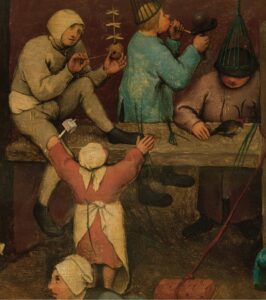
Figure 1 Detail: Pieter Bruegel, Children’s Games, Kunsthistorisches Museum, Vienna

Teetotum is documented in Vienna’s Kunsthistorisches Museum displays Pieter Bruegel the Elder’s (1525/30-1569) masterpiece, “Children’s Games” (1560). Another of his works in the museum is the “Tower of Babel,” which is the subject of a forthcoming post. Children’s Games depicts over two hundred children playing eighty different games. Bruegel’s encyclopedic pictorial catalog of games is unique in the annals of art. A small child is at the bottom left corner, her arms raised, holding a teetotum. (See here for a detailed view and here for Amy Orrock’s excellent article, “Homo ludens: Pieter Bruegel’s Children’s Games and the Humanist Educators,” discussing the purpose and interpretation of the painting within Erasmus’s views on the benefits of play.) Teetotum also appears in the list of games of Bruegel’s near contemporary French author François Rabelais’s (d. 1553) satirical work, Gargantua. The Oxford English Dictionary identifies it as “a favorite Victorian toy.” It appears in well-known English literature such as Lewis Carol’s Through the Looking Glass, where the White Queen (then a white sheep) asks Alice, “Are you a child, or a teetotum.” Other examples are Charles Dickens’ Our Mutual Friend, Edgar Allen Poe’s The System of Doctor Tarr and Professor Fether, and James Joyce’s Finnegans Wake as “finfoefom” (based on Joyce’s unique lettering system).[2]

Despite the widespread awareness of teetotum in Europe from at least the 1500s, the earliest Jewish sources connecting it with Chanukah date to the nineteenth century. Other Chanukah games boast much earlier recognition. For example, R Yosef Yuspa Nördlinger Hahn (1570-1637) mentions chess, tic-tac-toe, cards, and possibly backgammon.[3] Likewise, a 1638 herem banned cards and dice on Chanukah, although chess was excepted.[4] In subsequent Jewish literature, card playing has the most mentions, but that is due to their moral and ethical concerns rather than approval. None of these mention dreidel or any similar game.

The lack of historicity and mesorah was no barrier for 19th-century rabbis, nearly all Hassdic, from asserting Jewish relevance and stating that it is among the customs that qualify as minhag Yisrael Torah. R. Tzvi Elimelech Spira of Dinov is perhaps the most well-known example. In his Bnei Yissaschar, he contrasts the operation of the dreidel with the other Jewish play toy, the Purim gragger. The dreidel is activated from the top, symbolic of the heavenly source of the Chanukah miracle. The gragger is turned from the bottom because the catalysts of the miracle were Mordechai and Ester.

Others explain the symbolism of the dreidel’s letters, נ, ג, ה, ש. According to one explanation, these allude to the two rabbinically sanctioned mitzvot that we have on Chanukah, נרות שמונה (candles all eight nights) and הלל גמר (the complete Hallel). Others note the gematria (numerical value) of the letters, which correspond to the same gematria as משיח (the Messiah). Others still link the letters with גשנה the city Yosef secured for his family in Egypt that appears in the weekly Torah reading that coincides with Chanukah.[5]

None of these, however, locate the dreidel within the Chanukah story, and for that, we need to wait until the early twentieth century. According to this modern origin story, after the Greeks prohibited Torah study, Jewish teachers and students continued to do so surreptitiously in caves. When the authorities discovered these groups, they quickly switched from studying to playing dreidel.

The first appearance of this account appears in a collection of customs published in 1917 in Saint Louis. R. Avraham Eliezer Hirshovitz (1859-1924), originally from Kovno (today Kaunas), Lithuania, and in 1908 emigrated to the United States and was the preacher of Shaary Torah and taught children in Pittsburg, PA.[6] In 1892, he published the first edition of his book on Jewish customs, Minhagei Yeshurun, in Vilna. It includes three haskamos (approbations). The only discussion regarding Chanukah is the source of the name. Seven years later, he published an expanded second edition in Vilna, with 280 customs and now eight additional approbations (he omitted one from the first edition), most notably one from R Yitzchak Elchanan Spektor. R Spektor caveats that he only had time to read a few lines but that “it is a nice work.” Another approbation is from the maskil, Kalman Schulman.[7] We are unaware of any other religious book that bears his approbation. Hirshovitz provides that he obtained “many other approbations and letters of support” that he did not include. Neither of these editions discusses dreidel.

In 1899, Hirshovitz published a further expanded version in Yiddish in Vilna. By then, he had emigrated to the United States. He discusses game playing on Chanukah for the first time, although only cards. He explains that some play cards as it is like war, evoking the military victory over the Greeks. Nonetheless, he disapproves of playing cards, noting that cards are non-Jewish (he does not mention any halakhic reasons or the numerous Jewish sources that explicitly prohibit cards and other forms of gambling on Chanukah).

Finally, in the first American edition, published in Saint Louis in 1918, now with approximately 500 customs, Hirshovitz addresses the custom of playing dreidel. He does not mention any of the Hassidic explanations. Instead, he tells the story of the dreidel and how it was used to hoodwink the Greeks.[8] Despite the complete lack of evidence and the absurdity of the Greeks falling for such a simplistic and completely unrealistic ruse, Hirshovitz’s narrative quickly entered the Jewish collective consciousness. For example, in the collection of customs, Pardes Eliezer devotes an entire chapter to dreidel and explains “that despite the fact dreidel doesn’t appear in the sifrei ha-achronim it does not prove it is a recent custom.” Rather, “kama hokerim” (many scholars) describe it as “an ancient custom, dating to the Hasmonic period,” and then uses Hirshovitz’s story. Or, in the book Minhag Yisrael Torah, Hirshovitz’s narrative is “the simple” explanation.[9] Today, if one does a cursory search on the internet, there are articles from the Aish.com website regarding dreidel entitled “A Serious Game,” or on Chabad.org that describes Hirshovitz’s rationale as “the Classic” and “common” reason, and many others.

Not all were so taken with Hirshovitz’s work. R Shmuel Kraus published a highly critical article in Kiryat Sefer in 1933 that highlights numerous methodological issues with Hirshovitz’s work.[10] While Kraus notes the book was sloppily published with omissions and other defects, he reserves the bulk of his article is devoted to Hirshovitz’s hallucinatory customs and corresponding sources. While the article does not discuss the dreidel, it criticizes Hirshovitz for identifying sources for the “custom” to trick people on April 1, the word “daven” that is identified as either Aramaic or from the English word Dawn and provides a reason why in Europe a Bar Mitzvah boys give a “derasha,” but in the United States a “speech.” Hirshovitz sometimes tries to adopt a more substantive and historically defensible explanation, even citing an article from JQR regarding the Magen David.[11]

While Hirshovitz’s explanation is unsupportable, one hypothesis is worth mentioning. Israel Abrams, in an article that initially appeared in The American Hebrew and republished in his collection Festival Studies, posits that Teetotum:

It is a very ancient game, known to the Greeks and Romans. But why was it specially favoured on Hanucah? No answer has ever been given to this natural question. It may be that the Teetotum was regarded as a very innocent form of gambling, if that be not altogether too harsh a word to use. Many pious people never played cards or any other game of chance, but they may have felt that so simple a game as this was lawful enough. But I can now supplement this with a new suggestion. Teetotum is still in parts of Ireland the indoor recreation of the peasantry at Christmas tide. Now it is well known that such games seldom change their seasons. I should wonder if the Teetotum was a favourite toy elsewhere at Christmas. If so, the Jews may have transferred it to Hanucah. For they never invented their own games, except those of intellectual species such as Hanucah Ketowes [riddles]. The Ketowes even gave rise to a folk proverb: “Zechus Owes, Kein Ketowes,” i.e., I suppose merit of the fathers is not the solution of life’s riddle. Indeed, the moral of Hanucah, is after all, that Judaism must rely on present effort of the children as well as on the past merits of their sires, if it is to remain in any true sense a “Feast of Light.”[12]


The Case of the Origin Story of the Creation of the Word Sevivon

Another mythical story associated with dreidel occurs with the origin of the modern Hebrew word for the toy, sevivon. The most well-known history is found in the autobiography of Eliezer Ben Yehuda’s son, Itamar ben Avi (1882-1943), Im Shahar Atzmotenu, published in 1961. Rochel Berlov, in her article “Me Hidush ha-milah ‘Sevivon’?”, however, demonstrated that the term long predated Itamar. (See also Ester Goldenberg’s article).  David Yeshayahu Silberbusch coined it and first appeared in Hayyim Zelig Slonimski’s journal Ha-Tzefirah on December 24, 1897 (See Zerachyah Lict’s comprehensive article regarding Slonimski’s challenge to the miracle of the oil and Marc Shapiro’s subsequent discussion). A week and a half later, Silberbusch used the word as the title of a satirical article, and it subsequently regularly appeared in the newspaper. In 1923, Levin Kipnis published his now famous song, sevivon, sov, sov, sov. Itamar wrote his autobiography when he was fifty, and it was published posthumously. He tells the story of how

one day, when he and his family were preparing to go on a trip outside the city, outside the wall, I suddenly jumped towards my parents: Mother! Mother! I found a sevivon for Chanukah. My mother hugged and kissed me with admiration. “How beautiful is the word you created, my son!” This is how the word sevivon was created and became standard for decades among all Jewish children. I, the writer of these memories and the one who created it when I was a child, among countless other words that are now incorporated into our language, but [not everyone] recognizes who created them.

Despite this story, the word does not appear in any newspapers his father, Eliezer Ben Yehudah, edited. Moreover, Ben Yehudah did not include it in his monumental dictionary of modern Hebrew. Nonetheless, Itamar’s story was retold countless times in children’s books and treatments of Itamar (and some still think the issue remains unsettled). Zohar Shavit’s assessment of Itamar’s book, which can be equally applied to Hirshovitz’s dreidel origin story, aptly sums up the willingness to accept such tall tales:

Above all, he understood the importance of creating an interesting and fascinating story, apparently even at the expense of historical credibility… It is quite clear that in some of his personal stories, Ben-Avi prefers the interesting story over fidelity to the facts.

Notes:

[1] Recorded in Israel Abrahams, “Hanucah in Olden Times,” in Festival Studies Being Thoughts on the Jewish Year (Philadelphia, 1906), 146, 152.

[2] Joseph Shipley, The Origins of English Words: A Discursive Dictionary of Indo-European Roots (Johns Hopkins University Press, 2001), 411; John P. Anderson, Joyce’s Finnegans Wake: The Curse of Kabbalah (Universal Publishers, 2008), 211-12.

[3] Yosef Kosman, Noheg ka-Tzon Yosef, (Tel Aviv, 1979), 188 n.12; Herman Pollack, Jewish Folkways in Germanic Lands (1648-1806): Studies in Aspects of Daily Life (MIT Press, 1971) 181, 330n184.

[4] Minhagei DK”K Vermisia, Yitzhak Zimmer, ed., vol. 1 (Mefal Toras Hakhmei Ashkenaz, 1988), 238-39.

[5] See R. Yitzhak Tesler, “Ha-Dreidel (Sevivon) be-Chanukah: Mekoroseha, Ta’amyah, u-Minhagyah,” Or Yisrael, 14 (1999), 50-60 (collecting these and other sources).

[6] For biographical and complete bibliographical information, including a discussion of variant versions, see Yosef Goldman, Hebrew Printing in America 1735-1926: A History and Annotated Bibliography (Brooklyn, 2006) n583&622 (see here and here for our review of this work).

[7] For biographical information, see Hillel Noah Steinschneider, Ir Vilna, vol. 2, Mordechai Zalkin, ed. (Hebrew University Magnes Press, Jerusalem, 2002), 182-83.

[8] Avraham Hirshovitz, Otzar Kol Minhagei Yeshurun (St. Louis, 1918), 57. Hirshovitz cites “HaRav Ziv” as his source. But otherwise, it provides no information regarding this person. Two authors from that period use “Ziv,” Yehoshua ben Aba Ziv, who wrote a book of songs and a fictional work in Yiddish on the life of a Yeshiva student. The book of songs, Asifas Shirim: Al Mo’adei ha-Shana (Vilna, 1875), 13-15, includes a song for Chanukah but does not mention dreidel. The other possibility is Nehemiah Shmuel Libowitz, who used the pseudonym “Ziv.” Libowitz was a contemporary of Hirshovitz in America, and although we have not discovered any evidence, it’s possible they met in the United States. That may account for Hirshovitz’s inclusion of the dreidel story in his U.S. edition. Nonetheless, none of Libovitz’s published works include Hirshovitz’s Dreidel story, which includes the book Herod and Agrippa, which touches upon the Hashmonim.

[9] Kollel Damesek Eliezer, Pardes Eliezer, Hanukah, vol. 2 (Machon Damesek Eliezer, Brooklyn, 2004), 650-51; Yosef Lewy, Minhag Yisrael Torah, vol. 3 (Brooklyn, 1997), 216. Gavriel Zinner  however, in his extensive discussion of Chanukah customs and dreidel in his Neta Gavriel, does not mention Hirshovitz’s reason.

[10] Shmuel Kraus, “A.Y. Hirshovitz, Otzar kol Minhagei Yeshurun,” in Kiryat Sefer 11,3 (1934), 311-12.

[11] See Hirshovitz, Otzar Kol Minhagei Yeshurun, 4 (April fools), 28 (speech versus derasha), 88 (JQR).

[12] Abrahams, “Hanucah,” 154-55.


The Twice Told Tale of R’ Yonasan Eybeshutz and the Porger

The Twice Told Tale of R’ Yonasan Eybeshutz and the Porger[1]

Moshe Haberman

Moshe Haberman currently lives in Los Angeles and is a businessman. Originally from New York, he learned in Brisk and publishes the Torah journal Chitzei Giborim.

Introduction

The only Halachic sefer[2] published in the lifetime of R’ Yonasan Eybeshuts was the ספר כרתי ופלתי which is a פירוש on Shuchan Aruch Yoreh Deah, dealing with issues of treifos, basar b’chalav, taaruvos, etc. The sefer was published in 1763, a year before his death in 1764 in Altona, which at that time was in the dominion of the King of Denmark.

In his preface to כרתי ופלתי, R’ Yonasan explains that he had already written other seforim, including Urim Vtumin, B’nei Ahuva, and Ya’aros Dvash. However due to the difficult situation he found himself in over the controversies regarding Kameos ascribed to him, that were allegedly Sabbatean in nature, he felt it was impolitic to publish his works earlier in his lifetime. He also shied away from getting the approbations customary upon the publication of a work, and כרתי ופלתי was published without any haskamos.

Despite the seriousness of the Sabbatean allegations, there is no doubt that he was considered to be a genius in Torah, and his influence over his many students was immense. His works are widely used by later generations of Halachic decisors; in many halachic issues, his views are considered normative.

In סוף סימן ס’ה, which is focused on the issur of Gid Hanasheh, the “displaced” nerve that is not allowed to be eaten, he discusses a story illustrative of how difficult the removal of the nerve can be, ie. Porging. There was someone considered to be a Talmud Chochom and expert in porging that claimed that the nerve that the general practice to remove was in actuality the wrong one, and he was being taken seriously in the German communities. When he came to Prague, he met with R’ Yonasan, who was the acknowledged Posek in this field, and (as R’ Yonasan relates the story) he was told by R’ Yonasan that he was wrong, the nerve that this expert was referencing was only found in male animals and not in female animals. R’ Yonasan showed him in the Semag[3] that Gid Hanashe applies to males and females. Apparently this expert accepted this authority and stopped his agitation.

The problem with this is that there is no such סמ”ג. The סמ”ג does not mention anything about males or females in his section on Gid Hanashe at all.

Worse, due to the fact that the סמ”ג is a sefer that counts and expounds on the 613 Mitzvos, many understood the structure of the סמ”ג to be similar to other Sifrei Hamtizvos (such as the Chinuch) where there is a listing of who the Mitzva applies to. Therefore, it was understood that what R’ Yonasan was actually saying was that since the Mitzva applies to male and female people, it should also apply to male and female animals.

This is a strange logic to say the least. It almost seems that he made a mistake where he fundamentally does not understand the issues.

This was the conclusion of R’ Yechezkel Feivel in his sefer, Toldos Adam[4] that R’ Yonason Eybeshutz just made a mistake and that mistakes just sometimes happen, and he goes on to discuss a number of mistakes that he found in Rabbinic literature.

In his article on this subject, R’ Shnayer Leiman[5] lists a number of Maskilim that used the list of mistakes that are mentioned in Toldos Adam to undermine the authority of the rabbinical leadership, stating surprise how one that studies these texts day and night could possibly make such a grave error, one that a child should be able to spot.

Many other authorities discuss this issue. Some take the approach that an emendation is needed, and that the reference is meant to be to a different sefer with a similar acronym such as Semak[6] or possibly Behag.[7]

Most prominently among these rabbinic authorities, the Chasam Sofer[8] grapples with this issue. He also seems to understand the issue as described, that the סמ”ג does make mention of males and females, however referring to male and female people. He also contemplates the possibility that since the proof that R’ Yonason provided was not correct, maybe we should be careful and not eat the other nerve as well.

Based on this question the Chasam Sofer states that as a general rule men and women are included in any מצות לא תעשה as there is no reason to exclude them, however when there is a reason to exclude women, there would need to be some kind of extra לימוד to include them. Therefore if the nerve is particular to the male animal then that would serve as a reason to exclude women, and there would need to be a לימוד to include them, which we do not have.

I believe that the proper understanding of the Chasam Sofer requires one to look at the source of the reasoning behind why the Gid Hanashe is proscribed in the first place. Yaakov was fighting with the angel of Esav, his brother, and his nerve was displaced due to a blow from that angel. The Torah then states, therefore B’nei Yisroel do not eat the Gid Hanashe (עַל־כֵּ֡ן לֹֽא־יֹאכְל֨וּ בְנֵֽי־יִשְׂרָאֵ֜ל אֶת־גִּ֣יד הַנָּשֶׁ֗ה אֲשֶׁר֙ עַל־כַּ֣ף הַיָּרֵ֔ךְ עַ֖ד הַיּ֣וֹם הַזֶּ֑ה כִּ֤י נָגַע֙ בְּכַף־יֶ֣רֶךְ יַעֲקֹ֔ב בְּגִ֖יד הַנָּשֶֽׁה). If this nerve was only in males (animals and people), it would make sense that women would be excluded, as the whole reasoning has nothing to do with them.

This logic was disputed by R’ Shlomo Kluger[9] for a couple of reasons. One, he doesn’t believe that the type of logic is appropriate to apply to R’ Yonason, who would have explained his thought process more clearly, and second, the logic of the Chasam Sofer should also apply to Shabbos, for example, as it is a Mitzvas Aseh with a set time, which as a general rule women are excluded from, women should not be included in the negative prohibitions of Shabbos without a limud, based on the principle explained by the Chasam Sofer. Especially as in the prohibition regarding Shabbos it also says “speak to the Bnei Yisroel” why would we not exclude the women?

In 1930 in a publication from Chicago known as Hapardes[10], there was an article written by R’ Shlomo Michoel Neches of Los Angeles. He writes that in his possession (אצלי) he has a first print of the כרתי ופלתי, and R’ Yonasan, the author, emends the סמ”ג to סה”נ and then writes Seder Hilchos Nikkur. It is not entirely clear which Sefer this refers to, as there is no sefer of that exact name.

This answer was picked up by the Pardes Yosef[11], and it appeared to be the final word on the matter. As a matter of clarity, this answer rings true as to what the author’s original intent was, for the following reasons;

  1. This “expert” that came to Prague appeared to be satisfied with the answer given to him by R’ Yonason. It is doubtful that someone that went through all that trouble would accept a source that is non-existent, or logic that appears to be dubious.

  2. It is clear that R’ Yonasan himself was not the one that prepared the text for printing. It was a student named R’ Ahron Katz[12] .I have in my possession a 1763 Altona edition, and there are many annotations that would point out where there is a good question or a good answer. Here is an example:

It is highly unlikely that R’ Yonasan himself would write in his own sefer “good answer”.

Rabbi Neches was born in Jerusalem and came to Los Angeles in 1910. He was the Rabbi of the famous Breed Street Shul in Boyle Heights (now listed on the national register of historic places) and was the founder of what is now Sharei Tfilah, a shul in the Hancock park area of Los Angeles. He was a collector of seforim and he published articles in Torah journals.

When I moved to Los Angeles it became a mission of mine to track down this volume of the כרתי ופלתי with emendations in R’ Yonasan’s own hand. I spoke with those that had attempted to find this sefer and had been unsuccessful. Apparently Rabbi Neches’s collection was auctioned off after his death and parts of it were donated to the Jewish Federation. No records of this volume were found.

I was able to track down one of the old librarians of the Federation and she told me that most of what they had went to AJU, but she did remember there were boxes of notebooks and other items that were never cataloged. I went to the AJU library and indeed they had boxes that appeared to be never opened. I spent an afternoon going through everything they had, and alas, no כרתי ופלתי.

However, I did find a handwritten catalog of the seforim that Rabbi Neches had in his collection, it was hard to tell if there were more pages due to the degraded condition, however there was no Kreiti Upleiti listed. Not only that but I started to notice that there were no first prints or older seforim on the list. It appeared to be that he was primarily collecting seforim that were printed contemporaneously.

This got me thinking, what if he never had it in his collection? Maybe he saw it in someone else’s collection? There weren’t too many seforim collectors in Los Angeles in the 1920’s but maybe someone had it in his possession as a family heirloom. I decided to look at the academic libraries in California and see if they had a 1763 edition of the Kreiti Uplaiti. With the help of R’ Yaakov Yitzchak Miller, we found it in the Theodore E. Cummings Collection in UCLA[13].

Just as advertised, the Shaar Blat showed the signature of R’ Yonasan Eybushutz, and the emendation was there in siman 65. However, something was wrong. The signature was from R’ Yonasan Halevy Eybeshutz of Leshitz. The author of כרתי ופלתי wasn’t a Levi, nor was he from Leshitz.

This volume wasn’t the personal property of the author of כרתי ופלתי, who fixed an unintentional error, it was the property of an entirely different person, albeit with the same name, that lived 150 years later.

This information, that Rabbi Neches provided was wrong, and therefore the issue of R’ Yonason’s mistake was back in play, was made public a few years back[14], and it would appear that we are back to square one, that this apparent mistake has other potential answers, including that of the Chasam Sofer.

Is it possible that Rabbi Neches simply made a mistake? It did not appear likely to me as it is pretty clear what it says, and he would know that R’ Yonasan, the author, was not a Levi.

Furthermore, in the private collection of Dr. Steven Weiss, there is a sefer, Shaar Yonason written by R’ Yonasan Eybeshutz of Leshits, that was acquired from the collection of Rabbi Neches, and it has the distinctive binding that Rabbi Neches would put on his seforim, so Rabbi Neches clearly knew of that there was another R’ Yonasan Halevi Eybesutz of Leshitz.(See Appendix B)

Rabbi Neches was right.

Rabbi Neches did not make a mistake. Incredibly, this particular volume that was owned by Rabbi Yonasan Halevi Eybeshutz of Leshitz, was also owned by Rabbi Yonason Eybeshutz, the author of כרתי ופלתי.

The odds would appear to be stacked against this, however if you look at the Shaar Blatt of the volume, reproduced here you can see two distinct handwritings, both say “Yonason Eybeshutz”, one appear to be more elongated and cursive and the other more rounded and of an older type, where each letter was not formed in one continuous stream.

Towards the top middle you can see under the first signature reproduced here

And on the left side center you can see a very different autograph, reproduced here

I was able to obtain with the kind assistance of R’ Shnayer Leiman images of signatures that have been verified to be R’ Yonasan Eybeshutz (see Appendix A), and if you put them together, the conclusion is inescapable.

From a receipt for money received that is verified to be R’ Yonason Eybeshutz, the author. (Appendix A)

From the Shaar Blatt of the כרתי ופלתי in UCLA.

This is clear evidence that this volume was the personal copy of the author himself.

Now let’s turn to the emendation, reproduced here

The letters are the rounder letters that are consistent with the author’s writing than the angular writing of the other R’ Yonason Eybeshutz.

It turns out that my thought process in tracking down this volume was actually wrong. The Cummings collection in UCLA was not donated by a local collector, it was actually purchased in 1963 from Israel, from the defunct publishing firm of Bamberger and Wahrman.[15] Mrs. Cummings merely footed the bill for the acquisition in honor of her husband.[16] I corresponded with Arnold Band, who was in charge of the acquisition, and he confirmed that it only made it to Los Angeles in 1963, and he had personal knowledge that the Kreiti Upleiti was part of the acquired collection. As Rabbi Neches moved to Los Angeles in 1910 and his article was published in 1931, he must have been working off of memory or notes that he took from when he saw it in Israel.

The only issue with that is the language Rabbi Neches used in the article, which that it was in his possession (אצלי), which it clearly wasn’t.

Sefer Hilchos Nikkur

There are a number of candidates for this sefer. Although there are no seforim with this exact title, Leiman[17] makes a persuasive case that the reference is to a 1577 volume printed in Cracow with the title הלכות הניקור , with the section title of סדר הניקור . With the conflation of the two titles, this is probably what R’ Yonason is referring to. The annotations were made by Rabbi Zvi Bochtner, who states that he consulted with Rabbi Moshe Isserles, the Rema, on his conclusions.[18]

This is a sefer that is unusual in that it is highly focused on one area of halacha, annotated by someone that wrote no other sefer and is not a well-known Rav, yet has authority. This sefer would be familiar to those that were in the practical business of porging, however would be unknown to the general learned public. The Rema’s endorsement, of course as the Posek of the German communities would be accepted by the expert as dispositive.

Conclusion

Despite the many twists and turns of this tale, it appears that R’ Yonason Eybeshutz did not make a mistake. The person that prepared the manuscript for printing made an understandable error due to the very unique nature of this particular sefer, and misunderstood which sefer the author was referencing, and subsequently the author himself fixed the issue. Rabbi Neches also did not make a mistake, although some confusion still exists how he actually saw this volume. To use the phrase that Rabbi Neches wrote in his article regarding his discovery of the emendation in R’ Yonason’s own hand, it is a mitzva to publicize this fact.

Appendix A


Appendix B


[1] Porging, or the act of removal of a nerve to make an animal kosher, is actually an English word, it is both in the Oxford English dictionary and Merriam-Webster. The source given is based on Judeo-Spanish. It appears to be highly unusual that a word would be extant in the English language that is specifically related to Jewish halacha, yet does not derive from either Yiddish (טרייבער) or Hebrew (מנקר).
[2] There was a sefer published to defend his case against R’ Yakov Emden called Luchot Edut, published in Altona 1755, and another called V’evoh Hayom El Ha’ayin which had disputed authorship.
[3] Rabbi Moshe of Coucy’s (d.1260) ספר מצוות גדול.
[4] Feivel, Rabbi Yechezkel, “Toldos Adam Chelek Bais”, Vilna 1884, pg. 43.
[5] Leiman, Rabbi Dr. Shnayer Z. “Judaic Studies” No. 4 Fall 2004, “Rabbi Jonathan Eybeshuetz and the Porger” pg. 16.
[6] Rabbi Isaac of Corbeil’s (d. 1280)’s ספר מצוות קטן.
[7] Rabbi Simon Kayyara’s  (d. 8th Century) הלכות גדולות, known in halachic literature as the בעל הלכות גדולות.
[8] In שו”ת חתם סופר סימן ס”ט.
[9] In ‘שו”ת טוב טעם ודעת סימן ק.
[10] Hapardes No. 4 Vol 1 (1930) pg. 18-19.
[11] Pozonovsky, Rabbi Yosef, פרדס יוסף פרשת וישלח.
[12] Introduction to the Kreiti Upleiti, Altona, 1763.
[13] Charles E. Young Research Library, UCLA, “Kereti U’Feleti”, Eybeschuetz, Jonathan, H0000017129.
[14] Wild Wild West-Orthodox Jewish Pioneers in LA, https://youtu.be/LEysLjApKOU ; “Kovetz Hama’eyan” (vol. 215; Tishrei 5776, pg 100 – 102).
[15] https://www.jta.org/1963/04/19/archive/university-of-california-gets-collection-of-33520-books-from-israel
[16] Her son Theodore Cummings served as Ambassador to Austria in the Reagan administration.
[17] Ibid, pg. 27,
[18] Valmadonna Trust London England 4822, שחיטות / של מוהר”ר יעקב ווייל, עם ההגהות והחדושים שליקט ואסף הר”ר צבי בר יצחק יעקב, ממה שבא לידו ובדק ונסה זה כמה שנים, והוגה אות באות על פי מוהר”ר משה איסרליס, בי הירש בן יצחק יעקב, מקראקא.


Non-Jewish Iconography in Hebrew Books

As we have discussed on numerous occasions, Hebrew books contain a fair amount of non-Jewish iconography and imagery that is of non-Jewish origin.  See, for example, here, here, here and here.  Of course, Marvin Heller's article on Mars and Minerva appearing on Hebrew title pages, Marvin Heller, "Mars and Minerva on the Hebrew Title-Page," in Papers of the Bibliographical Society of America, 98:3, Sept. 2004, reprinted in Heller's collected articles Studies in the Making of the Early Hebrew Book (which will be reviewed separately in the very near future), is the starting point for much of this discussion. There is an article in this week's Jewish Press that also discusses this issue.  The article is available here

It is, however, worth noting a few things.  First, the article discusses the hare hunt motif that is found in various Jewish books, most notably in the Prague 1526 haggadah and the Mantua 1560 haggadah.  This illustration appears in manuscripts as well, and in the Darmstadt Haggadah, it is not a hare hunt but a deer hunt.  The deer, of course, is a more well known Jewish motif and thus would obviate the issue of representing Jews as a hare.  That said, it is unlikely that the deer hunt in the Darmstadt haggadah can be used to explain the hunting motif as it is likely that the illustrations in that haggadah are of non-Jewish origin.  Indeed, Gutmann notes that the illustrations accompanying this haggadah have no connection to the text and are likely non-Jewish. 

Additionally, it is worth noting,with regard to the Prague 1526 haggadah and its illustrations, there is a book that is devoted to explaining the history and meaning of the Prague 1526 haggadah, Charles Wengrov, Haggadah and Woodcut, Shulsinger Bros., New York, 1967.  Wengrov discusses all the illustration in this, seminal, haggadah.  Additionally, he discusses the history of the various woodcuts, both in their forms in the Prague haggadah as well as the motifs they employ.  Wengrov's discussions encompass both printed and manuscript haggadahs.

Returning to non-Jewish iconography, a most radical but intriguing theory related to this topic can be found in Ruth Mellinkoff, Antisemitic Hate Signs in Hebrew Illuminated Manuscripts from Medieval Germany, Center for Jewish Art -Hebrew University, Jerusalem, 1999.  Mellinkoff offers a completly different theory for the bird's heads in the famous Bird's Head Haggadah. Mellinkoff opines that in reality these are not bird's heads but bird's beaks on human heads.  Thus, she offers that the bird's beaks are substitutions for large or beak-like noses.  She explains that in reality these illustrations are the work of a non-Jewish illustrator who was attempting to subtly use well know anti-Semitic tropes like large noses and, in some illustrations, pigs ears.  See id. pp. 11-29, 35-37.  Aside from the Bird's Head Haggadah, Mellinkoff provides other Hebrew manuscripts that apparently have similar anti-Semitic signs as well. 


Borders, Breasts, and Bibliography


Borders, Breasts, and Bibliography
By Elliott Horowitz
Dan Rabinowitz has provided us which a characteristically learned pre-Passover post on the Prague 1526 Haggadah, specifically concerning the illustrations on its borders, and from those borders continues on to the always contentious subject of breasts, a bare set (or rather, two bare sets) of which he claims may be found on the title page of that edition. Indeed, on both the right and left borders of the title page may be found rather curious figures with non-human faces but quite human- looking breasts; yet those breasts are not bare, but rather bound in form-fitting corsets from which the nipples peek out. Readers may search on their own, online or elsewhere, for images of such nipple -revealing bodices, which were popular in English masque costumes of the early seventeenth century,[1] but I will provide only a quotation from the celebrated English traveler Fynes Moryson (1566-1630) on the women of late sixteenth-century Venice who “weare gowns, leaving all of the neck and brest bare, and they are closed before with a lace….they show their naked breasts, and likewise their dugges, bound up and swelling with linnen, and all made white by art.”[2]
Here is the title page::

From the breasts on the borders of the Prague Haggadah’s title page Rabinowitz moves on to the less contentious pair to be found in the Haggadah itself, appropriately accompanying the quotation from Ezekiel 16. He charitably notes that “both Charles Wengrov and Elliot[t] Horowitz have pointed to earlier manuscript antecedents of Prague’s usage of such illustrations,” but then takes issue with “Hor[o]witz’s contention that Spanish Jews were less accepting of such displays.” To that end he presents, in living color, two panels from the so-called “Sarajevo Haggadah,” illustrated in fourteenth-century Spain, depicting “a bare-breasted Eve,” and another illustration from the “Golden Haggadah,” – of similar provenance – depicting female bathers in a scene of the finding of Moses.
Yet in all those instances the semi-nude women are shown either in profile with partially covered breasts, or with breasts of rather adolescent dimensions – in contrast to the more amply-bosomed maiden depicted frontally in the Prague Haggadah (and uncensored facsimiles thereof), but not in Rabinowitz’s otherwise amply illustrated post. Moreover, in contrast to the rather demure female figures in the late medieval Spanish haggadot, the “Prague Venus” (as I shall call her) gazes directly at the viewer – in a manner reminiscent of Titian’s “Venus of Urbino,” completed a dozen years after the 1526 Haggadah was published. It may be noted that two bare-breasted mermaids are frontally depicted on a bronze Hannukah lamp from sixteenth-century Italy in the Israel Museum’s Stieglitz collection.[3]
As far as the Prague Haggadah’s date, Rabinowitz (gently) chides me for taking Efrat’s Religious Council to task not only for deleting the semi-nude scene from the 2001 facsimile edition in honor of their settlement’s twentieth anniversary, but for giving the Haggadah’s date as 1527 rather than 1526. Rabinowitz justifies that error by noting that the (uncensored) Berlin facsimile – whose date he gives erroneously as 1925 rather than 1926 – gave the Haggadah’s date as “5287/1527.” This is indeed true of its frontispiece, but in my battered copy of the Berlin facsimile a previous owner helpfully left behind a double-side flyer for the Haggadah which includes the more accurate information: “GEDRUCKT ZU PRAAG, 5287/1526.”

In my modest collection of haggadot the Berlin facsimile of the Prague Haggadah sits next to an octavo-size paperback of that same Haggadah issued in 1965 by Israel’s Ministry of Housing. It’s frontispiece reads:
שי לחג הפסח מוגש ע”י מפעל החסכון לבנין
לחוסכים במפעלי החסכון
Although the date of the Haggadah is there too given erroneously as 1527, Israel’s Mapai-controlled Housing Ministry of 1965 saw no reason to make the same breast-related deletions as Efrat’s Religious Council thirty six years later – or perhaps did not yet have (or afford) the technical ability to do so. The minister of housing before Passover of  that year  was Yosef Almogi, who had  been general secretary of Mapai during the early 1960’s but joined Ben-Gurion’s renegade Rafi party before the November elections of 1965, after which he was  replaced by Levi Eshkol. The copy in my possession previously belonged to David Zakkai (1886-1978), who was briefly general secretary of the Histadrut before David Ben-Gurion assumed that position  in 1921, and after the founding of Davar in 1925 wrote for that newspaper for many years under the pen-name “Z. David.”  He won the Sokolov prize for journalism in 1956. Some three decades later many of the books previously in his possession were being sold off as duplicates by the library of Ben-Gurion University, which was named after yet another Mapai politician –  Zalman Aranne (1899-1970), who had also been general secretary of the party, and later served( twice) as  Israel’s secretary of education and culture.
The old days of Mapai dominance are well behind us, but so are the days when  Israel’s housing ministry could reprint a Haggadah showing bare breasts. As I write, the newly installed minister of housing is  Uri Ariel of the Jewish Home, whose predecessor was a member of Shas. Perhaps the additional funds that are now expected to come Efrat’s way will allow its Religious Council to put out another facsimile edition celebrating yet another expansion of that venerable settlement. My own suggestion is Ze’ev Raban’s illustrated Shir ha-Shirim, also suitable for Passover, but not yet available in a kosher edition. It will certainly keep their censorship committee busy.

[1] See recently Barbara Ravelhofer, The Early Stuart Masque: Dance, Costume, and Music (2009).
[2] F. Moryson, An Itinerary…(1617, reprint 1907-8), recently quoted in M. F. Rosenthal, “Cutting a Good Figure…,” in M. Feldman and B. Gordon eds. The Courtesan’s Arts: Cross-Cultural Perspectives (2006), 61. See there also illus. 2.2.
[3] For reproductions of the image see Chaya Benjamin ed., The Stieglitz Collection: Masterpieces of Jewish Art (1987), 157; Elliott Horowitz, “Families and their Fortunes: The Jews of Early Modern Italy,” in David Biale ed., Cultures of the Jews (2002), 578.  

Appendix by Dan Rabinowitz:

In addition to the censored reproductions discussed in the post and the one provided by Elliott Horowitz, we provide an additional example in this ever growing genre. One of the more well-known series that reproduce facsimile haggadot are those published on behalf of the Diskin Orphan Hospital Ward of Israel. As a fundraiser, they publish and distribute a different reprint of an earlier haggadah both print and manuscript. (See here discussing the Washington Haggadah reprint that led to accusation of heresy ). The first haggadah reprinted in this series is the Prague 1526. But, there are numerous errors and significant omissions in this reproduction. First the title, “The First Known Printed Passover Haggadah by Gershom Kohen Prague 5287/1527.” This edition of the haggadah is not the first known printed haggadah, that is likely circa 1486, by Soncino (see Yerushalmi, Haggadah & History, plates 2-3; Issakson, no. 29), and the first illustrated is the 1512 Latin. In the introduction written by Dr. Aaron Rosmarin, he offers that Prague 1526 is “the oldest printed Hagadah graced with woodcuts.” Again that is wrong. The 1486 haggadah already includes a handful of woodcuts.

Instead, at best, Prague 1526 is the first fully illustrated haggadah for a Jewish audience. The title also contains an error regarding the secular date, giving it at 1527. Rosmarin compounds this error. First he hedges on the secular year, when he explains that this editions was “printed by Gershom ben Shlomoh ha-Kohen and his brother Gronem in Prague 1526/27” but then zeros in on exactly when it “was completed on Sunday, the 26th of the month of Teves, 5287 (in January 1527).” It was December 30, 1526 and not some time in January 1527.

Additionally, regarding the nude image accompanying Ezekiel 16:7 that is omitted in its entirety. Although this omission (as well as a two other seeming non-offensive images) is not noted in the introduction, Rosmarin is careful to explain (without irony) that the 1526 edition contains some minor textual variants and omits the songs Ehad mi Yodeh and Had Gadyah, therefore this facsimile is not being reproduced to be used at the seder as “there are Hagadahs in abundance” for that purpose. Instead, the reason for reproducing Prague 1526 is because “this Hagadah is of great value for its art and uniqueness.”