Beyond the Masthead of the Beys Yaakov Journal, 1923-1980 – Part 2: ‘Abomination’ or Scandal? Mistranslation, Journalism, and the Halivni Controversy

Beyond the Masthead of the Beys Yaakov Journal, 1923-1980 – Part 2:
‘Abomination’ or Scandal? Mistranslation, Journalism, and the Halivni Controversy

By Dan Rabinowitz and Menachem Butler

In Part 1 of this study, it was argued[1] that the Beys Yaakov Journal cannot be understood simply as an ideological mouthpiece of Agudath Israel, nor as an instrument of Orthodox withdrawal. Across decades, its editors repeatedly confronted intellectual challenges in public, publishing voices and materials that lay beyond the formal boundaries of Agudah authority and resisting the impulse toward protective silence. That does not mean it adopted liberal positions; rather, its conclusions fit squarely within the traditions of Ultra-Orthodox theology. The journal’s Orthodox commitments were genuine, but they were not understood to require insulation from controversy or the suppression of methodological dispute. In this second installment of “Beyond the Masthead of the Beys Yaakov Journal, 1923-1980,” the controversy surrounding Rabbi Professor David Weiss Halivni serves as an especially revealing test case for these dynamics.

Rabbi Professor David Weiss Halivni passed away on June 28, 2022. On July 17, the New York Times published a lengthy obituary under the headline and subheadline:

“David Weiss Halivni, Controversial Talmudic Scholar, Dies at 94. He was considered too radical by many Orthodox rabbis and too regressive by many Conservative Jewish leaders. But his work was widely praised.”[2]
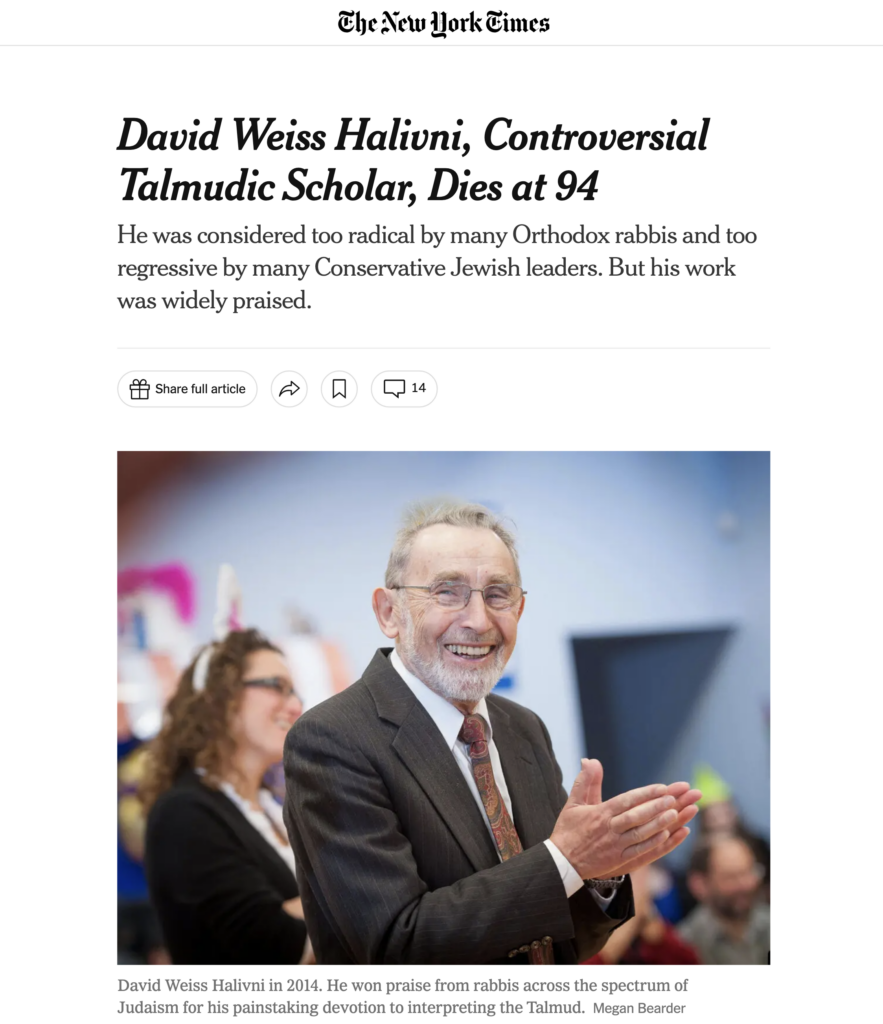
NY Times July 17, 2022 Obituary

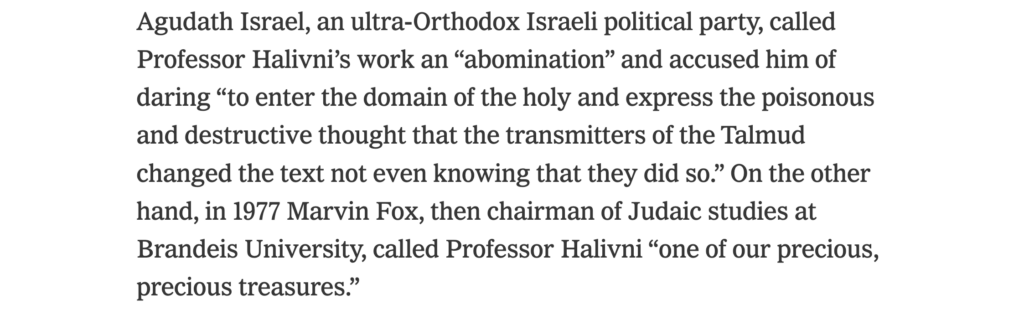
The framing is revealing. Halivni is positioned between two opposing camps, too radical for one and too regressive for the other. This symmetrical construction reduces a complex methodological dispute to a narrative of ideological extremity and obscures the substantive nature of Orthodox objections. The obituary further characterized Halivni’s scholarship as grounded in the “controversial idea” that the Talmud is “riddled with inconsistencies and incongruities” resulting from the vulnerabilities of largely oral transmission, “subject to the flaws resulting from fallible memories.” It reproduced Agudath Israel’s denunciation of his work as an “abomination,” accusing him of daring “to enter the domain of the holy” and to suggest that the transmitters of the Talmud altered the text unknowingly. At the same time, Halivni was quoted defending his position: “divine origin does not preclude critical study, since critical study seeks to purge the text of human error.”
Beyond this polemical exchange, the obituary devoted substantial attention to Halivni’s innovative approach to Talmudic study, illustrating it through an extended discussion of a sugya in Mo’ed Katan. What was “pioneering” about Halivni’s work, the obituary explained, was his effort to “burrow[…] deeply into the history of how the Talmud … came to be compiled,” and to argue that its transmission, “for generations, largely oral,” was inevitably “subject to the flaws resulting from fallible memories.” Halivni therefore sought to “restore the pristine state of the Talmud,” in one student’s formulation, by identifying “incorrect editorial surmises” and exposing moments in which later transmitters resorted to “forced readings” in order to reconcile contradictions. As the obituary emphasized, Halivni’s method aimed to “iron out the inconsistencies and gaps and restore logical coherence” by tracing a concept’s provenance and, where necessary, reconstructing earlier textual strata. This methodological claim entailed a far-reaching reassessment of traditional assumptions about the formation and internal coherence of the Talmud.[3]

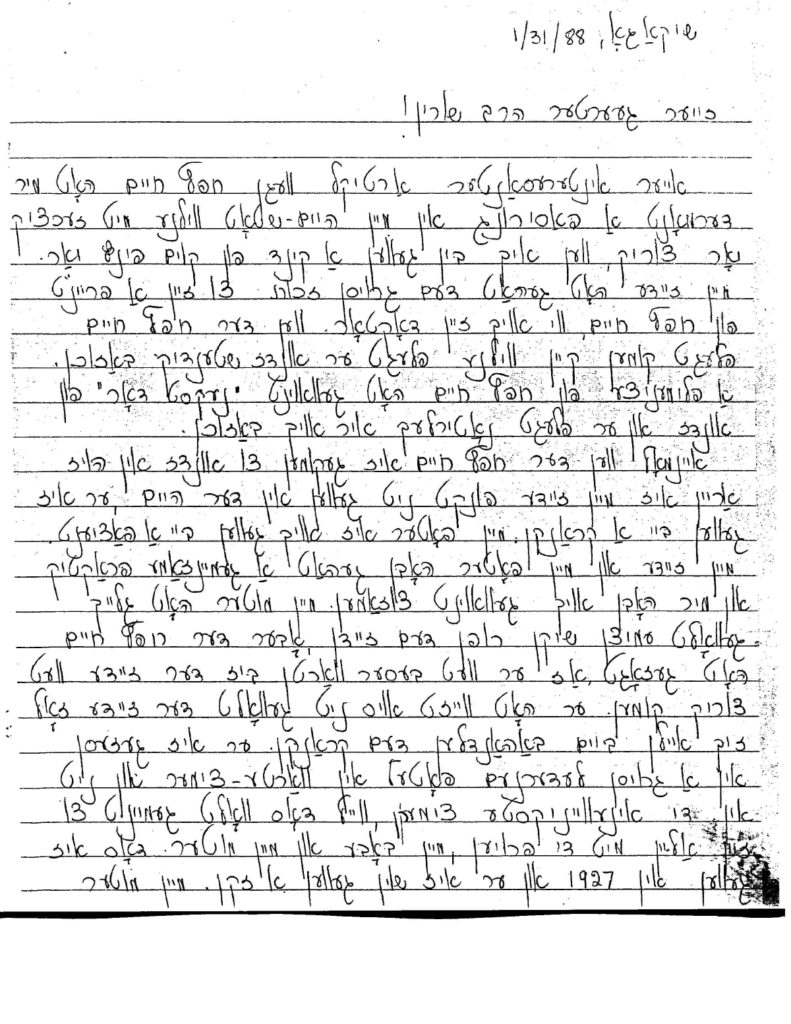
David Weiss Halivni (1927-2022) was born in Poljana Kobilecka in interwar Czechoslovakia and received rabbinic ordination in Sighet at the age of fifteen. Deported to Auschwitz in 1944, he survived the camps as the sole remaining member of his family.[4] After immigrating to the United States in 1947, he combined advanced yeshiva learning with formal academic study, ultimately joining the faculty of the Jewish Theological Seminary and later Columbia University.[5] In his later years he made aliyah and taught at Bar-Ilan University. Beginning in 1969, he published the first volume of his monumental Mekorot u-Mesorot,[6] which developed a sustained program of source-critical Talmudic interpretation,[7] aimed at distinguishing between tannaitic dicta and later amoraic and editorial strata.[8] It was this methodological ambition, more than questions of biography or institutional affiliation, that made Halivni a focal point of Orthodox critique.

Such sustained engagement with technical Talmudic scholarship is unusual for The New York Times. Yet this was not the paper’s first encounter with Halivni’s work. On the eve of Rosh Hashanah in 1977, The New York Times Magazine published a lengthy profile of Halivni by Israel Shenker under the title “A Life in the Talmud.”[9] There, Shenker described Halivni as “a respected public enemy at the pinnacle of modern scholarship” and reported that “The ultra-Orthodox Israeli political party Agudath Israel called it an ‘abomination,’” citing an editorial in Beys Yaakov Journal. The juxtaposition of scholarly daring and religious denunciation supplied the dramatic architecture that the 2022 obituary would later reprise.
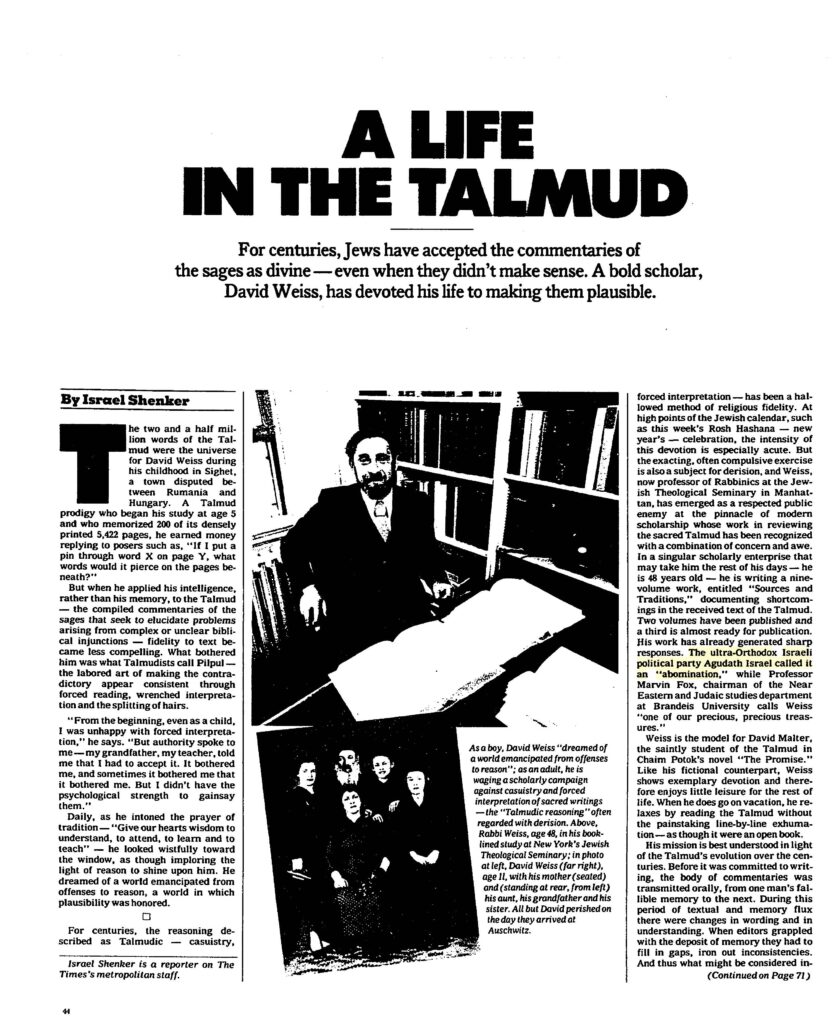
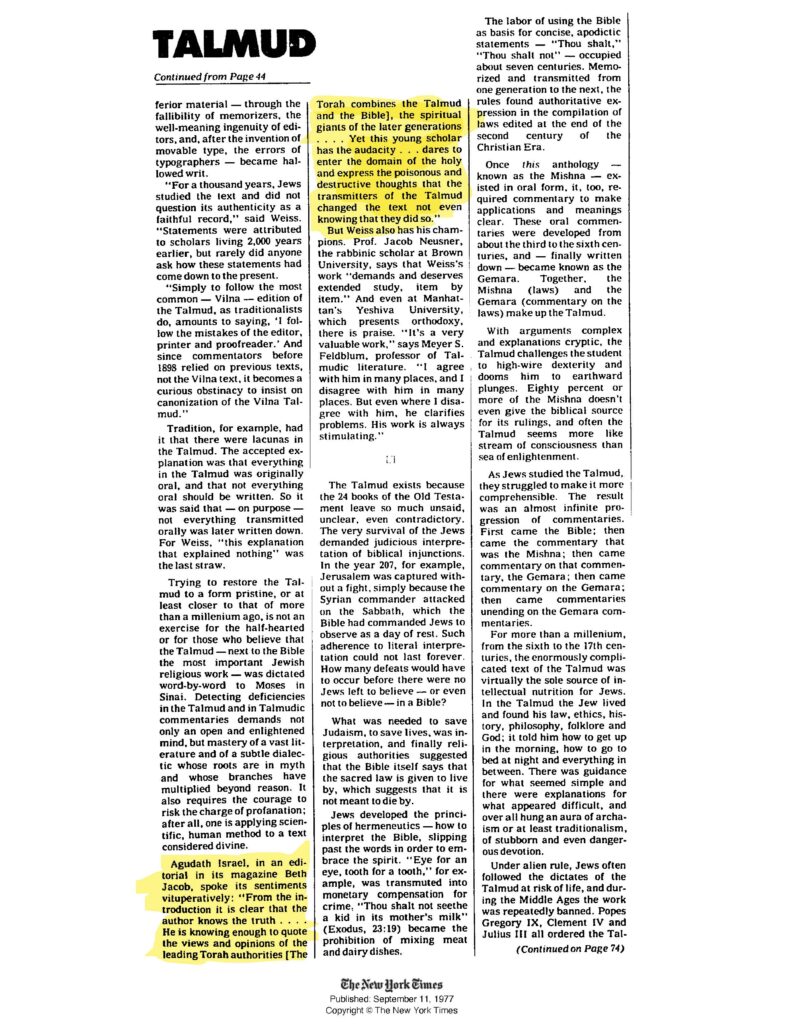
The New York Times narrative, however, is fundamentally flawed. It misidentifies the institutional character and editorial posture of the Beys Yaakov Journal, misconstrues the nature of its engagement with contested scholarship, and rests on a tendentious, if not deliberate, mistranslation of a pivotal passage. More importantly, it mislocates the center of Orthodox resistance to Halivni’s work. The critique in that article in Beys Yaakov Journal, and the journalistic distortions surrounding it, should not be mistaken for the principal arena of Orthodox opposition. The more consequential controversy unfolded within the American Modern Orthodox world, particularly at Yeshiva University and among its associated intellectual networks, circles far more familiar to the Times readership and far more central to the internal struggles of American Judaism during the period under review. As we will demonstrate in a subsequent installment of this series, it was there, rather than in Israeli party politics, that the most sustained and institutionally significant resistance to Halivni took shape.

Israel Shenker: A Scholar “Trapped in a Newsman’s Body”

To grasp the significance of Israel Shenker’s mischaracterization of the Beys Yaakov Journal, one must first understand Shenker himself. He was no ignorant sensationalist, no journalist stumbling blindly into a world he did not understand. On the contrary, he was widely (and aptly) described as “a scholar trapped in a newsman’s body.”[10] Fluent in Hebrew and Yiddish and possessed of formidable erudition, Shenker moved comfortably among texts, languages, and learned worlds that lay beyond the reach of most reporters.

That independence was visible early. While enrolled at the University of Pennsylvania, Shenker reportedly completed his degree without attending classes, preferring to work alone in the library and appearing only for examinations. As his niece later recalled, he “did not attend classes because he did not need to,” a habit that remained a defining feature of his intellectual life: self-directed, book-centered, and impatient with institutional mediation.[11]

Across several decades at The New York Times, Shenker profiled an extraordinary range of cultural and intellectual figures. Yet the range was not random. He gravitated toward individuals who combined mastery with eccentricity, authority with paradox: Groucho Marx,[12] whose comic persona masked a sharp literary intelligence; Jorge Luis Borges,[13] blind yet hyper-lucid; Noam Chomsky,[14] the dissident linguist who destabilized both politics and grammar; Vladimir Nabokov,[15] the aristocratic stylist and relentless classifier; Pablo Picasso,[16] whose genius lay in permanent disruption. Alongside them appeared scientists and system-builders such as Isaac Asimov, polymaths of prodigious output and explanatory ambition.[17]

Shenker brought the same sensibility to Jewish intellectual life. He wrote about scholars such as Uriel Simon,[18] Salo Wittmayer Baron,[19] and Solomon Zeitlin,[20] figures whose authority derived not from popular appeal but from textual mastery and historical depth. He became one of the Times’ principal correspondents on Jewish culture, though with telling selectivity: the Jewish Theological Seminary consistently dominated his institutional coverage,[21] while nearly every other yeshiva or rabbinical seminary in New York went largely unremarked[22]; the Second Avenue Deli became his emblem of Jewish urban life,[23] while nearly every other Jewish restaurant remained invisible.[24] Shenker’s choices reveal a consistent pattern: he favored sites and figures that condensed Jewish meaning into legible symbols.[25]

Much of his Jewish writing was light in tone but not trivial. He reported on a snobbish kosher hotel in England[26]; obscure and declining Jewish communities[27]; the phenomenon of “miraculous” pareve cheesecake[28]; the Twerski rabbinic dynasty[29] and other Hasidic groups[30]; itinerant soferim repairing pesul Torah scrolls[31]; Hebrew book publishing[32]; dreydl manufacturers[33]; the economics of yarmulkes and skullcaps[34]; the professional culture of kosher certification and supervision[35]; and prayer groups on El Al flights so numerous they gathered at the rear of the plane and disrupted its altitude.[36] These were not throwaway curiosities. They were chosen because they dramatized ingenuity, adaptation, and excess.

Other pieces were more substantial. Shenker produced one of the most comprehensive journalistic profiles of Isaac Bashevis Singer,[37] wrote with open admiration about Harry Austryn Wolfson, the legendary Harvard scholar of Jewish philosophy,[38] and reported sympathetically on the Lubavitcher Rebbe’s public call for kindness on the occasion of his seventieth birthday.[39] He covered Holocaust conferences, theological debates, Jewish cultural institutions, and scholarly gatherings with genuine seriousness.[40] Many of these essays were later revised and collected in his 1985 volume Coat of Many Colors, a book that stands as the fullest expression of his intellectual commitments.[41]

Shenker’s first sustained engagement with talmudic scholarship came in 1971, with a profile of Rabbi Adin Steinsaltz,[42] then deeply immersed in producing a new edition of the Talmud.[43] The article was largely respectful, yet it included a pointed dismissal attributed to Rabbi Louis Finkelstein, chancellor of the Jewish Theological Seminary, belittling Steinsaltz’s achievement.[44] The move is revealing. Even where admiration was warranted, Shenker could not resist inserting institutional tension, foregrounding controversy where extended methodological explanation might have sufficed.

That instinct became even more pronounced in Shenker’s 1975 feature, “Responsa: The Law as Seen by Rabbis for 1,000 Years,” based on interviews with Rabbi Moshe and Rabbi Solomon B. Freehof.[45] The pairing itself was astute, recognizing responsa as a transdenominational genre spanning Orthodox and Reform authority. Yet the article in The New York Times was framed by a prominent callout box – “A Responsum Sampler” – that juxtaposed grave contemporary questions, such as homosexuality and women wearing pants, with deliberately quirky cases,[46] including ritual slaughter under hypnosis[47] and a woman who swallowed a fly.[48] Responsa appeared less as a discipline of burdened responsibility than as a theater of ingenuity and oddity. The irony is that Rabbi Feinstein explicitly rejected such a portrayal. “You can’t wake up in the morning and decide you’re an expert on answers,” he insisted, stressing that authority emerges only through long recognition of sound judgment. More pointedly, he framed pesak as religious accountability: “A rabbi who replies to people’s questions works harder than a doctor dealing with a case of life and death. The doctor is responsible only to his patient, but the rabbi is responsible to God.” This ethic of burdened responsibility, articulated in the interview itself, stands in tension with the broader journalistic framing. Rabbi Feinstein articulated the same conception programmatically in the introduction to the first volume of Iggerot Moshe,[49] where he repeatedly describes his rulings not as demonstrations of mastery but as obligations imposed by circumstance. His responsa, he writes, emerge from “darkness,” composed only because he felt compelled to give instruction; the decisor must rule according to “what his eyes see and what appears true to him,” even amid doubt and fear of error. Authority, in this account, lies not in brilliance or certainty but in the willingness to assume responsibility for guidance. This was an ethic that closely parallels his insistence in the Times interview that “the rabbi is responsible to God,” not to ingenuity or acclaim. [50]
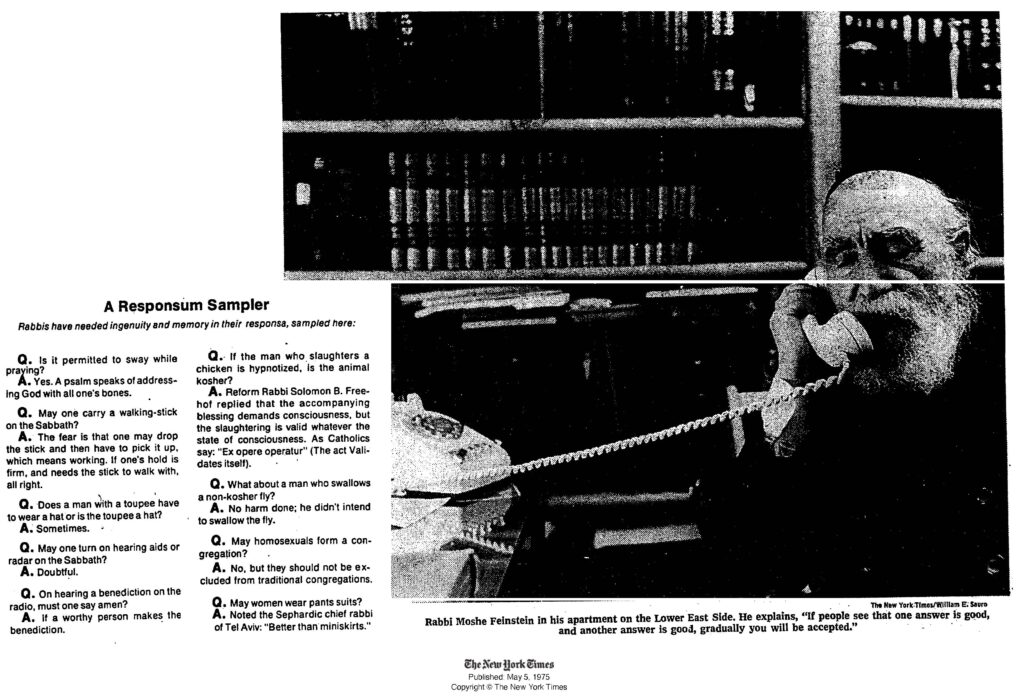
Shenker was plainly fascinated by the genre; he devoted nearly thirty pages to responsa literature in Coat of Many Colors. Whether the emphasis on eccentricity reflected his own priorities or editorial intervention is difficult to determine. Shenker’s own reflections offer some guidance. In a 1986 profile, he described himself as writing “as a reporter more than anything else,” insisting that he was “not interested in arguing any ideas of [his] own.”[51] Baruch Halpern’s account is especially suggestive. A leading scholar of the Hebrew Bible and ancient Israel, he explains that when Shenker worked for Time in postwar Europe, managing its Paris bureau, Shenker deliberately forwent by-lines out of a “corporatist sense of mission,” valuing collective authorship over individual credit.[52] Only later, at The New York Times, did Shenker embrace what Halpern memorably termed “that sacred by-line,” situating his career within a broader shift toward intellectual individuation.[53]

Shenker openly admired religious intellect even while identifying as a nonbeliever. He spoke candidly of his fascination with rabbinic literature – not for its piety, but for what he called “the determination to find excuses for impossible things.” Talmud and responsa were, in his words, “endlessly fascinating.” This posture, respectful yet detached, drawn to paradox rather than normativity, helps explain both his genuine engagement with Jewish learning and his recurrent tendency to foreground eccentricity or scandal at the expense of internal meaning.[54]

That stance was reflected not only in Shenker’s writing but also in the manner in which he chose to live. In his later years he withdrew from institutional journalism altogether and settled in rural Scotland, where his wife Mary, born into the Sagman family of Glasgow, had familial roots. There he described himself as a solitary reader moving from library to library, drawn to places that functioned as what he called “intellectual hospices.”[55] Writing in 1985 about a residential library in Wales founded by William Gladstone, Shenker offered an implicit self-portrait: a scholar without a pulpit, a journalist without a platform, committed less to intervention than to observation, and to books rather than communities. From that deliberately marginal and proudly nonconfessional vantage point, Judaism appeared not as a living system governed by internal norms, but as a repository of endlessly fascinating textual ingenuity. This orientation is also visible in Shenker’s books. Beyond Coat of Many Colors, Shenker published a series of substantial monographs that further attest to the breadth and seriousness of his intellectual interests, including studies of lexicography and the history of language,[56] literary travel[57] and eighteenth-century intellectual culture,[58] and contemporary Jewish and Israeli public life.[59]

Seen against this background, Shenker’s treatment of David Weiss Halivni cannot plausibly be dismissed as a product of ignorance or linguistic incapacity. He possessed the philological competence to read the Hebrew of the Beys Yaakov Journal accurately and the cultural literacy to recognize the specifically Orthodox stakes of Halivni’s project. The resulting mischaracterization was therefore interpretive rather than inadvertent: a reframing of a bounded intramural methodological dispute in the idiom of public scandal. In this instance, Shenker’s erudition did not guard against distortion but conferred authority upon it.

To see why this reframing proved so consequential requires closer attention to the article itself and to the broader Orthodox debate over the academic study of the Talmud in which it intervened. Only within that broader context does the inadequacy of the binary framework later imposed upon Halivni come into focus. In a subsequent installment of this series, we will examine specific episodes in his life, consider his distinctive approach to Talmudic study, and then turn to the controversy it provoked. His trajectory across worlds often presumed to be mutually exclusive, including the traditional yeshiva culture of Eastern Europe, the postwar Orthodox institutions of America, and the emerging academic study of rabbinic literature, forms an essential backdrop to that debate.

The 1969 Beys Yaakov Journal Article: Engaging the Challenge

In early 1969, the Beys Yaakov Journal published “A Cry of Alarm Concerning the New School of ‘Talmud Critics’!”[60] by “Harav Yitzhak M. Shmueli” (almost certainly a pseudonym).[61] The article appeared in issue no. 116, shortly after the publication of the first volume of Halivni’s Mekorot u-Mesorot (1969).[62] It was not a reflexive polemic or an immediate rebuttal, but a considered response to a scholarly methodology that had already begun to exert influence within academic and semi-academic Jewish discourse.[63] Shmueli’s article reflects the Journal’s longstanding editorial posture: the intellectual challenges of modernity, particularly those circulating in print and academic venues, cannot be met with silence or denial. Rather than ignoring them, the Beys Yaakov Journal insisted on direct and public engagement.[64]
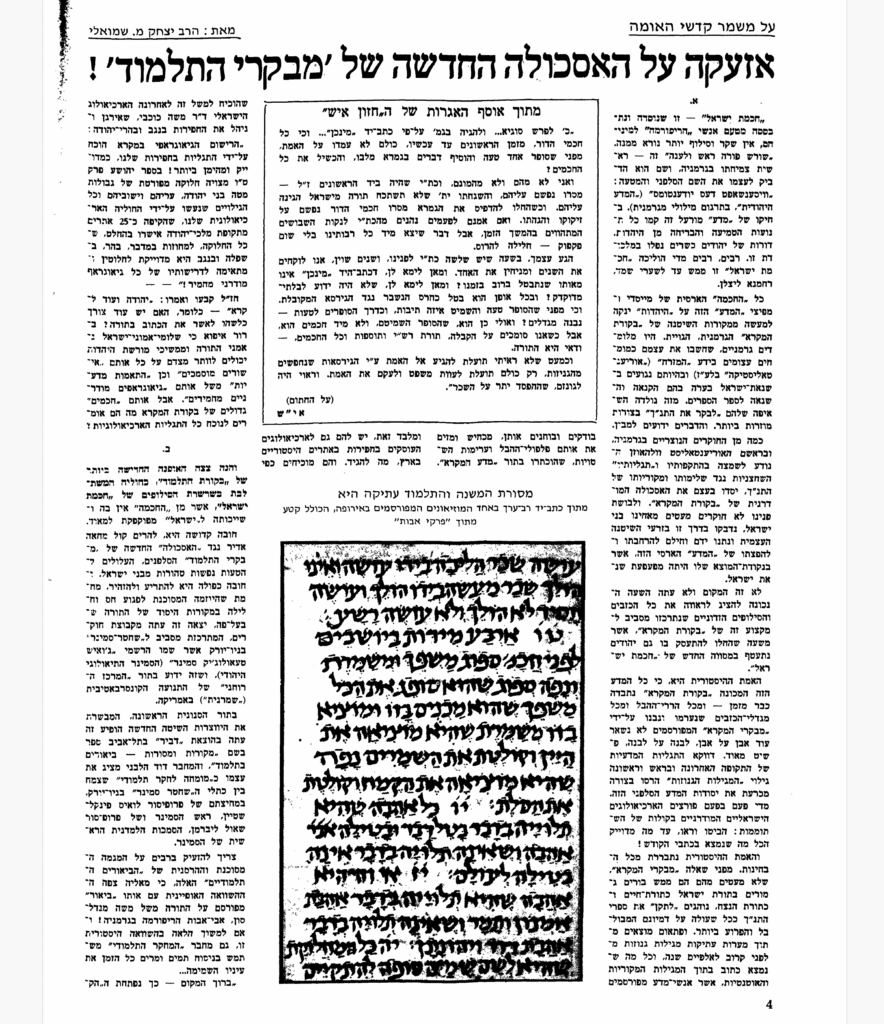
The article offers a sweeping critique of the Jewish Theological Seminary (JTS) and its Talmudic scholarship, with Halivni serving as the central exemplar. After briefly dismissing academic biblical criticism as a spent and methodologically compromised enterprise, Shmueli turns to what he presents as a more urgent danger: the emergence of academic Talmudic criticism within the Jewish Theological Seminary. He notes that Mekorot u-Mesorot bears the subtitle Biʾurim Talmudiyim and explicitly links this nomenclature to the Biʾur associated with Moses Mendelssohn, whom he identifies, in conventional Orthodox polemic, as a progenitor of German Reform Judaism.[65] The terminological parallel is presented as symptomatic rather than incidental.

Shmueli’s extended polemic against biblical criticism should be read less as his operative argument than as a genealogical warning. By tracing “Ḥokhmat Yisrael” back to German biblical criticism and Wissenschaft des Judentums, he establishes a historical cautionary tale rather than mounting a detailed refutation.[66] Once the discussion turns to Talmud, however, the tone shifts markedly: denunciatory generalizations give way to named books, cited introductions, concrete methodological claims, and extended quotation of traditional authorities. The rhetorical genealogy sets the stage; the argument itself unfolds as a focused dispute over the limits of legitimate Talmudic method.

Beyond an Internal Scholarly Debate

Shmueli’s concern, however, was not confined to an intramural scholarly dispute that might otherwise have remained limited to a narrow academic readership. The urgency, he argued, arose from Halivni’s entry into the broader intellectual public. In 1963, Halivni authored the Encyclopaedia Britannica entry “Source Criticism,” appended to the encyclopedia’s discussion of the “Talmud.” There he did not merely note philological problems in passing, but presented “source criticism” as a discrete scholarly method whose central task was to distinguish between the original statements of rabbinic authorities and the forms those statements assumed through oral transmission. A paragraph from that Britannica entry was later reprinted on the inside cover of Mekorot u-Mesorot: Seder Nashim (1969) under the heading, “From the author’s statement in the Encyclopaedia Britannica.” It reads:

“Source criticism seeks to differentiate between the original statements as they were enunciated by their authors and the forms they took as a consequence of being orally transmitted; that is, between the sources and their later traditions. It is not to be confused with the kind of analysis – frequently carried out by the rabbis or the Talmud – which merely traces the historical sources of a given passage without judging whether or not the passage faithfully reflects these sources. Source criticism claims that the transmission of the Talmud was not, and perhaps could not have been, verbatim, and that the text became altered in transmission, with the result that many statements in the Talmud have not come down in their original form. Instead, what survives is the form assumed in the last phase of transmissional development. While such a study is pertinent to most ancient texts, it is particularly relevant to the Talmud, which primarily consists of quotations and their interpretations.”[67]

On Halivni’s account, talmudic transmission “was not, and perhaps could not have been, verbatim,” with the result that many passages survive only in the form assumed in the final phase of transmissional development. The Talmud, he argued in that encyclopedia entry, is therefore particularly susceptible to such analysis, since it largely consists of quotations and interpretive strata. By articulating this claim in the idiom of general textual criticism and situating it within a major English-language reference work addressed to a broad, non-confessional readership, Halivni effectively relocated questions of talmudic authority from the internal norms of the beit midrash to the evaluative jurisdiction of modern academic scholarship. What might otherwise have remained an internal scholarly controversy was thus recast as a public representation of the Talmud within a wider intellectual culture.

It is precisely this public and methodological self-positioning that made the volume contentious. By placing the critical premise at the threshold of the book, Halivni indicated that the issue at stake was not merely philological refinement but the conceptual framework within which the Talmud itself would be understood. The decision to reproduce this paragraph prominently on the inside cover of Mekorot u-Mesorot was therefore more than bibliographic notice. It framed the book from the outset as an intervention in the academic discourse of textual criticism and positioned its central thesis as a methodological claim rather than an incidental observation. Before encountering Halivni’s detailed readings, the reader is confronted with a declaration about the nature of talmudic transmission and the legitimacy of critical reconstruction. In this sense, the reprinted Britannica passage functions as a programmatic preface, signaling that the project’s claims about the Talmud’s layered development are not ancillary but foundational.

This concern about public legitimation was not new. Long before the appearance of Halivni’s Mekorot u-Mesorot, Orthodox critics had already accused JTS, particularly under Finkelstein, of attempting to translate rabbinic tradition into a civic idiom aimed at American elites, a trajectory that would later culminate in highly visible episodes such as the Seminary’s 1957 convocation attended by Chief Justice Earl Warren.[68] This dynamic can already be seen by the early 1930s, such critiques had evolved from responses to discrete initiatives into a sustained indictment of Finkelstein’s leadership. In a widely circulated Yiddish pamphlet responding to the accumulated controversy surrounding the Seminary,[69] Dr. Aaron Rosmarin retrospectively gathered earlier charges, first voiced in The Jewish Forum,[70] Der Tog,[71] and The Jewish Spectator ,[72] into a comprehensive critique of what he presented as a coherent institutional strategy: the deliberate public repositioning of JTS through interfaith initiatives and universalist ethical rhetoric, designed to render Judaism intelligible and respectable to Christian and civic authorities while eroding the internal boundaries of rabbinic tradition.[73] Read in this longer perspective, the anxieties later articulated by Shmueli in the late 1960s appear not as episodic reactions to a single event, but as the continuation of an established polemical grammar through which the Seminary had long been contested within Haredi and Orthodox circles.

Yet the controversy did not unfold solely in the register of political denunciation or institutional suspicion. It also took the form of an internal methodological dispute over the norms of Talmudic scholarship.

Substantive Scholarship, Not Political Condemnation

Shmueli did not confine his critique to rhetorical denunciation. The article prominently featured, in a separate callout box at the top center of the page, the complete four-paragraph letter of the Ḥazon Ish addressing the use of manuscripts and textual emendation in Talmudic interpretation.[74] Given the Ḥazon Ish’s stature as one of the most authoritative scholars of his generation, his methodological positions were widely regarded as normative and were adopted, explicitly or implicitly, by many traditional Orthodox rabbis and scholars. Crucially, the Ḥazon Ish does not reject manuscript evidence as such; rather, he rejects its elevation into a corrective authority over the received text as transmitted and interpreted through the classical rabbinic canon. By foregrounding the Ḥazon Ish’s objections instead of invoking partisan rhetoric or institutional polemic, Shmueli cast the controversy as a serious methodological dispute internal to the discipline of Talmud study.
The letter reads in full:

“To interpret a sugya and to emend the Gemara on the basis of the ‘Munich’ manuscript – does this mean that all the sages of the generation, from the time of the Rishonim until now, all failed to apprehend the truth, because a single scribe erred and added material to the Gemara of his own accord, thereby causing all the sages to stumble?

I am not of them nor of their multitude. The manuscripts that were in the hands of the early authorities of blessed memory – they gave their lives for them, and the providence of the Blessed One, that the Torah not be forgotten from Israel, hovered over them. And when they began to print the Gemara, the sages of the generation gave their lives for its refinement and correction. And even if, at times, one may benefit from manuscripts to cleanse corruptions that arise over the course of time, with regard to a matter that issued from the hands of all our masters without any hesitation – Heaven forbid to disturb it.

Consider this yourself. When there are three manuscripts before us and two agree, we follow the two and set aside the one. And who can say to us that the ‘Munich’ manuscript is not from that one that was nullified by the majority in its own time? And who can say that it was not known to those lacking precision? In any case, it is null and void, like a broken potsherd, in the face of the received version.

And because a scribe erred and omitted a few words, as scribes are wont to err – shall we build towers? Perhaps indeed it is so, that the scribe omitted them and it is not from the sages, but when we rely on the tradition, the Torah of Rashi and Tosafot and all the sages – certainly this is the Torah. And I have almost never seen any benefit in arriving at the truth through variant readings uncovered from the genizot. Rather, they are all a benefit for distorting judgment and perverting the truth. It would have been fitting to consign them to burial, for the loss outweighs the gain.”

By reproducing this letter in full, Shmueli makes clear that his opposition to Halivni’s methodology rests on principled epistemological and methodological grounds rather than on ideological reflex. The Ḥazon Ish’s critique does not deny the existence of manuscript variation or the occasional value of textual witnesses; rather, it rejects the privileging of isolated manuscripts over the cumulative authority of the received tradition as transmitted and interpreted through generations of rabbinic scholarship.[75]
Crucially, Shmueli explicitly acknowledges that multiplicity, difficulty, and textual variation are intrinsic features of Torah she-baʿal peʿh. He concedes that variant readings and unresolved tensions have always belonged to the tradition, and he invokes major figures such as the Ḥatam Sofer and R. Israel Salanter to underscore that truth in Torah does not reside in surface simplicity. This concession sharply distinguishes his position from any naïve textual absolutism. What he rejects is not complexity itself, but the elevation of conjectural reconstruction into a corrective authority over the received text and its interpretive canon. In this way, Shmueli situates his argument squarely within a substantive Talmudic debate. He contends that even academically rigorous methods, supported by extensive philological evidence, remain subject to serious internal critique from within the Orthodox scholarly tradition itself. The article therefore represents intellectual engagement rather than political denunciation or fundamentalist rejection.

A full reading of Shmueli’s article makes clear that his deepest concern is not the existence of critical hypotheses as such, but their translation into public authority. Again and again, the danger he identifies lies in institutional legitimation: a book published by a major Israeli press, authored by a faculty member of the Jewish Theological Seminary, and disseminated to a broad readership through venues such as the Encyclopaedia Britannica. For Shmueli, the methodological question becomes urgent precisely at the point where speculative reconstruction threatens to become normative representation. The issue, in other words, is not academic experimentation behind closed doors, but the public pedagogy of Judaism to Jews and non-Jews alike.

Acknowledging Lieberman’s Authenticity

One of the most revealing features of Shmueli’s polemic is his careful distinction between Halivni and Saul Lieberman. Despite the breadth and intensity of his critique of the JTS approach, he is markedly restrained in his treatment of Lieberman. This restraint is deliberate. Lieberman’s Orthodox credentials were exceptionally strong and widely recognized across multiple sectors of the Orthodox world.[76] Upon his arrival in Palestine in 1928, he was appointed director of Machon Harry Fischel, a flagship Orthodox research institute devoted to advanced talmudic and halakhic scholarship, an appointment facilitated by leading rabbinic figures, including R. Isser Zalman Meltzer and R. Avraham Yitzhak Hacohen Kook.[77] At the same time, Lieberman pursued rigorous academic training at the Hebrew University under Prof. Jacob Nahum Epstein, the foremost architect of modern academic Talmud. Far from disqualifying him, this dual formation reflects the still-open willingness of segments of the Orthodox rabbinic elite in the interwar period to recognize exceptional Torah mastery even when pursued through unconventional scholarly frameworks.[78]

This standing remained intact even as Lieberman later contemplated accepting a position at the Jewish Theological Seminary. Before doing so, he consulted major Orthodox authorities, among them R. Isser Zalman Meltzer and R. Yaakov Moshe Charlap. Their responses ranged from principled refusal to issue a ruling to cautious, conditional acquiescence, but none denied Lieberman’s stature as a preeminent talmid ḥakham.[79] As Marc B. Shapiro has shown, Lieberman’s move to JTS did not erase his reputation within elite Orthodox circles; rather, it exposed unresolved tensions within Orthodoxy itself concerning the boundaries between institutional affiliation, scholarly method, and personal halakhic authority.[80] Lieberman thus occupied a liminal position: fully embedded in the Lithuanian rabbinic elite, deeply shaped by its intellectual ethos, yet operating at the outer limits of what Orthodoxy could comfortably accommodate.

It is precisely this status that explains Shmueli’s careful tone. To indict Lieberman directly would have required confronting not a marginal figure but a scholar whose legitimacy had been affirmed – explicitly or tacitly – by many of Orthodoxy’s leading authorities. Shmueli’s restraint therefore reflects less an endorsement of Lieberman’s methodology than an acknowledgment of the exceptional difficulty of dislodging a figure whose authority derived not from institutional politics alone, but from recognized and formidable Torah greatness. Shmueli’s own rhetoric reflects this distinction with care. He refers to Lieberman explicitly as a “renowned scholar, erudite in Torah she-baʿal peh,” even as he directs his most sustained and forceful criticism toward Halivni and the methodological program embodied in Mekorot u-Mesorot. This differentiation is significant. It underscores the Beys Yaakov Journal’s capacity for discriminating judgment rather than indiscriminate rejection of academic scholarship.
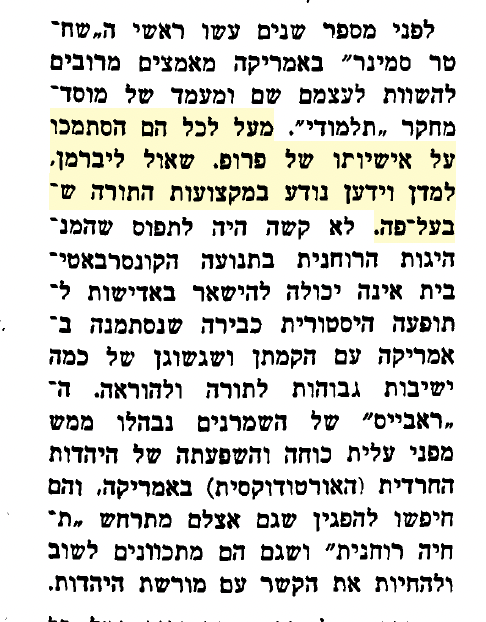
This, despite the fact that Lieberman’s earliest major work, Al ha-Yerushalmi, had already exemplified a disciplined form of textual criticism, drawing on manuscripts, parallel traditions, and internal philological analysis to clarify and correct the text of the Jerusalem Talmud. This could easily have provided fodder for Shmueli, yet he remained silent regarding Lieberman’s method. Recently published letters show that even the Ḥazon Ish engaged Lieberman seriously on these questions. Their correspondence reveals a principled disagreement over method, particularly regarding emendations grounded in manuscript evidence, while also demonstrating that such philological argumentation could be treated as a legitimate subject of rabbinic dispute rather than dismissed outright as heresy. Of course, since this correspondence had not yet been published, it cannot explain Shmueli’s silence on Lieberman’s approach.[81]
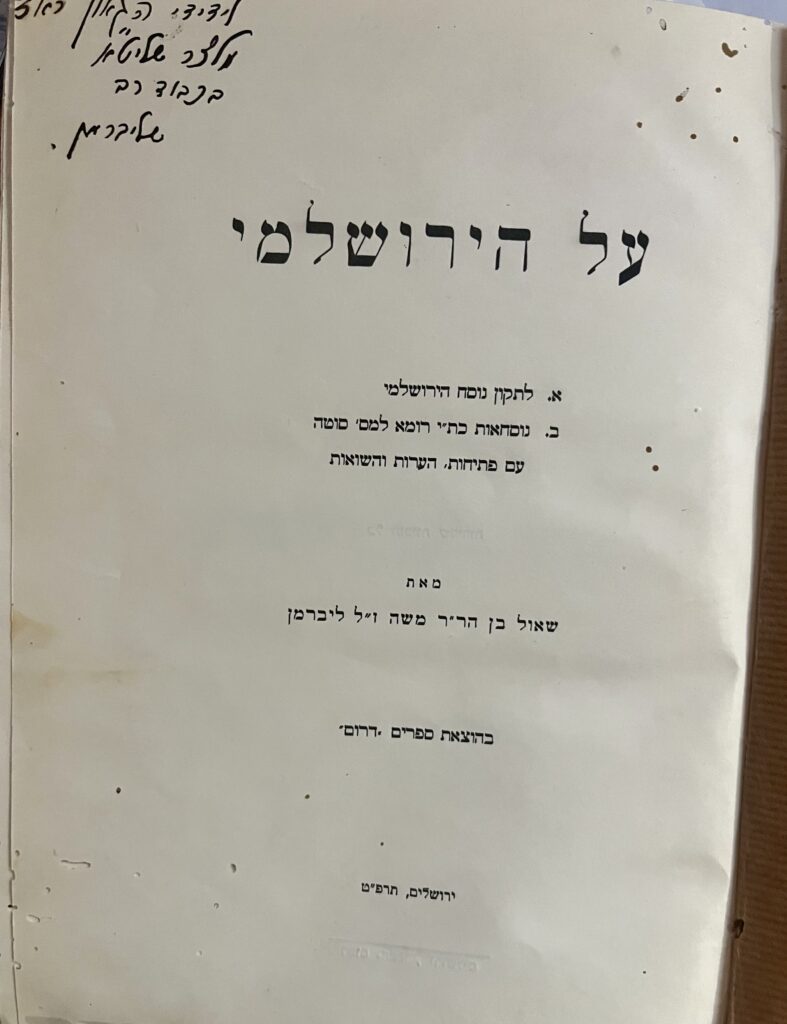
Copy of Al ha-Yerushalmi Gifted to R. I.Z. Meltzer from Lieberman

This nuance is essential for understanding the Beys Yaakov article’s invocation of the Ḥazon Ish. Lieberman is not cast as a theological threat or ideological provocateur, but as a formidable talmid ḥakham whose methods, though troubling to some, remained bounded within an elite scholarly discourse. Halivni, by contrast, is portrayed as extending those methods in a more expansive and publicly consequential direction, one that, in Shmueli’s view, exceeded the implicit safeguards that had contained earlier forms of academic intervention. The result is a portrait of Orthodox engagement with academic Talmud that is internally differentiated, historically self-aware, and intellectually serious, far removed from caricatures of reflexive or indiscriminate rejection.

That differentiation, however, depended upon the boundaries of scholarly containment. It held only so long as the debate remained internal to a learned community. Nowhere does Shmueli’s anxiety emerge more sharply than in his discussion of Halivni’s contribution to the Encyclopaedia Britannica.[82] Written in English for a general readership unfamiliar with the internal conventions of Talmudic study, Halivni’s article marks, in Shmueli’s view, the point at which an intramural scholarly debate enters the public register. At that point, silence becomes irresponsible. What is at stake is no longer a disputed method within a learned guild, but the public representation of the Talmud itself: its authority, coherence, and standing before a wider audience.

Yet the subsequent reception of the controversy would hinge less on Shmueli’s carefully drawn distinctions than on the interpretation of a single line in the Beys Yaakov article itself.

The Mistranslation That Changed Everything

After developing its substantive critique, the Beys Yaakov article closes with a pointed rhetorical question:

!?האפשר לשתוק נוכח שערוריה נוראה מעין זו

The phrase is best rendered: “Is it possible to remain silent in the face of such a terrible scandal?”
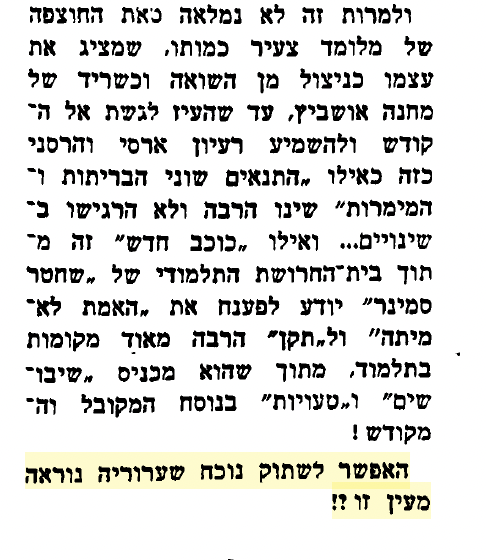
Here we arrive at Shenker’s most consequential error. Shenker isolated the noun שערוריה (sha’aruriyah) and translated it as “abomination.” This was not a neutral lexical choice, but a serious mistranslation with far-reaching interpretive consequences.

In classical and rabbinic Hebrew, as well as in modern Hebrew, שערוריה denotes a scandal or public outrage, an event or claim that provokes alarm, indignation, and moral disquiet. Rooted in the semantic field of סער and סערה, it evokes turbulence and upheaval, suggesting commotion and protest rather than ritual pollution or theological deviance.[83] The term therefore belongs to the register of public scandal and polemical critique, not to the technical vocabulary of halakhic or theological condemnation. It conveys gravity, even urgency, but it does not imply that the object in question lies beyond the bounds of religious legitimacy. By contrast, Biblical and rabbinic Hebrew possess precise and well-established terms for “abomination,” most prominently תועבה (toʿevah) and the ש־ק־ץ family (שקץ, sheqets; שיקץ, shiqets). These terms function as technical markers of religious repugnance and exclusion.[84] תועבה denotes what is abhorrent before God, a term reserved for practices that are religiously intolerable, most prominently idolatry and acts explicitly proscribed as violations of the divine order. שקץ, by contrast, marks what is ritually defiling and categorically repugnant, designating objects or acts that are not merely objectionable but intrinsically contaminating within the cultic and halakhic system. In such usage, these terms do not merely register protest or indignation. They function as categorical markers of religious illegitimacy, designating acts or objects as intrinsically defiling and wholly intolerable within the normative order of divine law.

An Orthodox polemicist seeking to convey that level of categorical condemnation would almost certainly have employed one of these terms. Shmueli does not. His diction is emphatic but restrained, signaling moral alarm and scholarly urgency rather than theological excommunication. Translating שערוריה as “abomination” imputes to the article a category of judgment absent from the Hebrew. The difference is not rhetorical but semantic: the mistranslation shifts the text from protest to proscription, from scandal to heresy. One is reminded of the rabbinic topos of qotzo shel yod, the barely perceptible stroke of the yod (understood by Rashi as its right leg and by Rabbeinu Tam as its curved crown) whose alteration can overturn an entire halakhic construction.[85] Shenker’s substitution performed precisely such a transformation. There is no plausible pathway by which the language of “abomination” could have entered the public narrative surrounding Halivni other than through this mistranslation. In doing so, it recast an argument urging engagement with a grave scholarly challenge as a declaration of religious intolerance and obscured the article’s actual posture, which was not to brand Halivni’s work as heretical but to insist that a development of profound intellectual and communal consequence cannot responsibly be met with silence.

The consequences of this lexical substitution extended far beyond Shenker’s 1977 profile. Once “abomination” entered the New York Times archive as the purported Orthodox verdict on Halivni, it became available for repetition as journalistic fact. Thus, when the Times published its 2022 obituary of Halivni, it reproduced Shenker’s framing and relied on the same source. The obituary’s headline, casting Halivni as a “controversial” scholar rejected by “many Orthodox rabbis,” thus rested in part on a mistranslation that had already transformed a bounded Hebrew critique of scholarly method into a sweeping theological denunciation. In this way, a single erroneous word became the pivot of a durable public narrative.

The Effect of Sensationalism

Israel Shenker’s mistranslation did not merely distort a phrase; it altered the character of the intellectual activity in which the Beys Yaakov Journal was engaged. The original article undertook a demanding and careful task: it presented a sophisticated academic methodology to an Orthodox readership, explained why that methodology posed serious difficulties within the traditional epistemology of Talmudic study, marshaled substantive scholarly objections, above all the position of the Ḥazon Ish, acknowledged internal differentiation within Orthodoxy, and articulated strong disagreement grounded in textual and methodological analysis. By rendering the article’s culminating language as invoking an “abomination,” Shenker recast sustained scholarly critique as fundamentalist denunciation, collapsing methodological dispute into theological outrage and substituting caricature for argument.

This inversion is especially consequential in light of the documented record of the Beys Yaakov Journal of reflective engagement with modernity, both in its prewar Polish incarnation[86] and in its postwar Israeli continuation.[87] Beys Yaakov was not a polemical broadsheet but an educational and intellectual forum that repeatedly confronted modern scholarship rather than retreating from it. Shenker’s portrayal effaced that history and compounded the distortion by mischaracterizing the journal as “an official publication” of Agudath Israel. It was not. Published by the “Central Beys Yaakov of Israel” and later by the “Bais Yaakov Women’s College,” the journal functioned as an educational organ aligned with Agudah but not as a party instrument. The distinction is substantive. Educational journals cultivate explanation and debate; party organs enforce discipline.

The encounter with Rabbi Professor David Weiss Halivni was therefore neither a reflexive ban nor an eruption of obscurantism, but a serious internal reckoning with a scholarly development understood to carry public and pedagogical consequences. The episode demonstrates how readily Orthodox intellectual life in the mid-twentieth century has been recast through external narratives that confuse methodological dispute with theological denunciation. To understand the controversy properly requires moving beyond journalistic distortion to the jurisprudential problem Halivni’s scholarship forced into view. The debate was not about temperament or piety, but about first principles: whether historical reconstruction can be insulated from normativity; whether halakhic authority rests on procedural continuity or on claims of historical transparency; and whether Orthodox institutions possess mechanisms capable of absorbing critical candor without destabilizing the structures of authority they seek to preserve. It is to that institutional and conceptual terrain that we now turn.

[to be continued…]

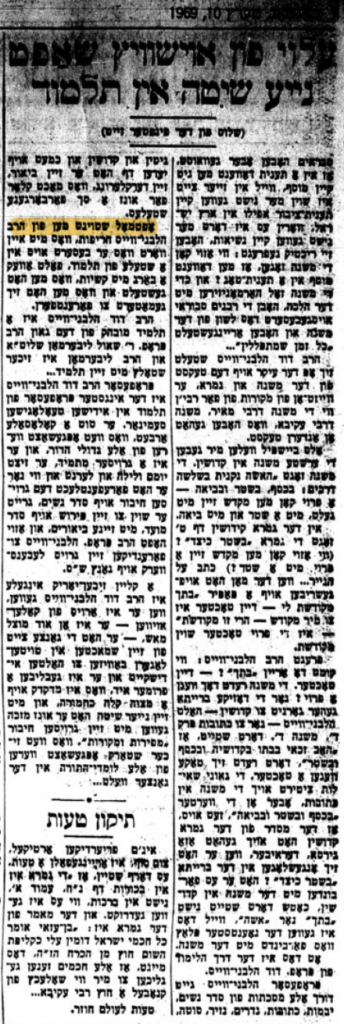
Appendix 1: Yitzhak M. Shmueli, “A Cry of Alarm Concerning the New School of ‘Talmud Critics’!” Beys Yaakov, vol. 10, no. 4 [#116] (1969): 4-5 (Hebrew), available here:

Yitzhak M. Shmueli,

“A Cry of Alarm Concerning the New School of “Talmud Critics”!

Beys Yaakov, vol. 10, no. 4 [#116] (1969): 4-5 (Hebrew)

I.

“Ḥokhmat Yisrael” – that enterprise which was founded and ardently desired at the initiative of the various exponents of “Reform,” in all its forms – there is no falsehood and distortion more dreadful than it. This “root that bears gall and wormwood” – its earliest growth began in Germany, and there it affixed to itself the flattering yet deceptive name: “Wissenschaft des Judentums” (“the Science of Judaism,” in a literal translation from German). Within the bosom of this poisoned “science” arose all the movements of assimilation and derision away from Judaism. Generations of upright Jews fell into this trap. Many – far, far too many – this very “Ḥokhmat Yisrael” led all the way to the gates of apostasy, Heaven forfend.

All the venomous “wisdom” of the founders and disseminators of this “science” concerning “Judaism” in fact drew its sustenance from the sources of malice inherent in German, gentile “Biblical Criticism.” There were German scholars who regarded themselves as immense experts in the knowledge of the “East” (“Orientalistics,” in the foreign tongue), and, being afflicted with hatred of Israel, jealousy and the impulse of enmity toward the Book of Books burned within them. From this was born their aspiration “to criticize the Bible” in the most bizarre forms. And the matter is well known to the discerning. Several of the Christian researchers in Germany, foremost among them the orientalist Wellhausen – notorious for his attacks and his arrogant “discoveries” against the integrity and originality of the Bible – in fact founded the modern school of “Biblical Criticism.” And to our shame, even a few scholars from among our brethren, the Children of Israel, adhered to this path, taking hold of the seeds of self-directed malice, and lent their hand and their strength to the expansion and dissemination of this poisonous “science,” whose very point of departure was permeated with hatred of Israel.

This is neither the place nor the proper hour to display publicly all the falsehoods and malicious distortions that have accumulated around this discipline of “Biblical Criticism,” which, from the moment Jews too began to engage in it, cloaked itself in the new guise of “Ḥokhmat Yisrael.”

The historical truth is that this entire “science” known as “Biblical Criticism” has long since been exposed as false – and of all the mountains of nonsense and all the towers of lies that were heaped up and constructed by the celebrated “Biblical critics,” there remains no longer one stone upon another, one brick upon another, most evidently so. Indeed, it is precisely the scientific discoveries of the most recent period – and first and foremost the discovery of the “hidden scrolls” – that have decisively demolished the foundations of this deceptive “science.”

From time to time, modern Israeli archaeologists burst forth in cries of astonishment: Behold and see, to what degree everything found in the Holy Scriptures is precise!

And the historical truth is being clarified from every perspective. For these “Biblical critics,” not a few of whom are in fact complete ignoramuses regarding the Torah of Israel as a Torah of life and as the Torah of eternity, are accustomed to “correcting” the books of the Bible in accordance with whatever arises from their most confused and wildly unrestrained imagination. And suddenly, from ancient caves, hidden scrolls are found dating from nearly two thousand years ago, and everything written within those original and authentic scrolls – which renowned scholars examine and scrutinize – contradicts and refutes those sophistic vapidities and heaps of nonsense that were crowned with the title “Biblical science.”

And beyond this, the archaeologists engaged in excavations at historical sites in the Land also have something to say. And they demonstrate – as, for example, the Israeli archaeologist Dr. Moshe Kochavi recently demonstrated, who organized and directed the excavations in the Negev and in the Judean Mountains:

“The geographical record in Scripture has been proven by the discoveries in our excavations to be an exceptionally precise and reliable measure! In the Book of Joshua, chapter 15, there is found a detailed delineation of the boundaries of the tribe of the sons of Judah, their cities and their settlements, and all the discoveries made by our archaeological unit, which encompassed approximately twenty-five sites from the period of the kings of Judah, definitively confirmed that the entire division into districts – in the wilderness, in the hill-country, in the lowland, and in the Negev – is completely accurate; it accords with the standards demanded by every rigorous modern geographer!”

Ḥazal already said: “Yehudah ve-‘od la-qera” – that is, is there any further need whatsoever to confirm what is written in the Torah? In this generation, therefore, the whole-hearted faithful of Israel – loyal to the Torah and continuers of the heritage of Judaism – can, for their part, dispense with all those “authoritative confirmations” as well as the “scientific corroborations” of those “rigorous modern geographers.” But those great “sages” of Biblical Criticism – what answer can they possibly offer in the face of all the archaeological discoveries?

II.

And behold, there has emerged the newest fashion of “Talmud Criticism,” as a link integrated into the chain of distortions of “Ḥokhmat Yisrael” – which contains no “wisdom,” and whose association with “Israel” is exceedingly dubious.

It is a sacred obligation to raise a mighty voice of protest against the new “school” of the pretentious “Talmud critics,” who are liable to mislead pure souls among the Children of Israel. It is a double obligation to sound the alarm and to warn, since the dangerous initiative to harm – Heaven forbid – the foundational sources of the Oral Torah has now issued forth from a group of scholars concentrated around the “Schechter Seminary” in New York, whose official name is the “Jewish Theological Seminary,” and which is known as the “spiritual center” of the Conservative (“traditionalist”) movement in America.

As the first swallow heralding the emergence of the new method, there has now appeared, published by “Dvir” in Tel Aviv, a book entitled Sources and Traditions – Explanations in the Talmud. Its author, David Halivni, presents himself as an “expert in Talmudic research” who grew up within the walls of the “Schechter Seminary” in New York, in the company of Professor Louis Finkelstein, head of the Seminary, and Professor Saul Lieberman, the Seminary’s chief scholarly authority.

A public alarm must be sounded regarding the dangerous and destructive tendency of these “Talmudic explanations,” for of itself there surfaces the characteristic comparison with that famous “commentary” on the Torah by Moses Mendelssohn, the founding father of Reform in Germany! And if one extends this historical comparison further, the author of this “Talmudic research” likewise employs an innocent formulation and continually lifts his eyes heavenward…

“‘Blessed is the Omnipresent’ – thus opens the book’s ‘Preface’ – ‘who has merited me to see in print my explanations… May it be His will that just as He has merited me to see in print my explanations on the Order of Nashim, so may He merit me to see in print my explanations on the other orders and other books.’”

As it appears, the destructive hand is raised openly, and the plan is rather broad: to attack all the orders of the Shas and the other sources of Ḥazal, by means of that rusted and poison-saturated weapon called “Sources and Traditions”…

In the author’s scientific idiom this is called “textual truth,” since he strives to demonstrate that the Talmud is supposedly filled and replete with “inaccuracies,” “changes in sources,” “deviations from the simple interpretation,” and the like – claims and arguments that were habitual upon the tongues of all the “Biblical critics.”

From the words of the “Introduction” it is plainly evident that the author knows the truth, and merely intends to rebel against it! He himself writes that variations in textual versions, together with the difficulties bound up with them, have long since become part of the traditions… and indeed, one who has grown accustomed to this – precisely in this he perceives the distinctiveness of the Torah, and that its very diversity is its superior virtue…

The author even knows how to cite the words and opinions of the great Torah authorities, the giants of spirit of the later generations, such as the Ḥatam Sofer or Rabbi Israel Salanter, who explained that the essence of the distinctiveness of the Oral Torah lies precisely in this: that not everything appears revealed and simple at first glance…

This was the considered view of the author of the Ḥatam Sofer (in his novellae to tractate Ketubbot):

“The forced explanations (the resolutions offered to account for the difficulties arising in the comparison of the words of Ḥazal) – most of them are true… however, the rationalizations and inventions – most of them are false, and they are what cover over the face of truth.”

And Rabbi Israel Salanter, founder of the Mussar movement, stated this explicitly (in the introduction to his work Tevunah):

“What is truth? Truth does not live by simplicity alone, for simplicity is but one branch among the ways of proof; and for the most part the cherished difficulties stand ready to wage war against simplicity and to dislodge it…”

And despite all this, the arrogant audacity of a young scholar such as he has not been satisfied – a man who presents himself as a survivor of the Holocaust and as a remnant of the Auschwitz camp – to the point that he dared to approach the holy and to voice such a venomous and destructive notion, as though “the tannaim who transmitted the baraitot and dicta” altered much and did not even sense the alterations… whereas this “new star” from the Talmudic factory of the “Schechter Seminary” knows how to decipher “the truth in its truest sense” and to “correct” very many passages in the Talmud, by inserting “corruptions” and “errors” into the accepted and sanctified text!

Is it possible to remain silent in the face of such a terrible scandal?

III.

The source of a great danger has been exposed – one that is public-spiritual in character, and not merely literary-scholarly. We have no dispute with the author of this “collection of explanations,” who, notwithstanding everything, is himself compelled to concede that this is in essence not a new invention of his own, and that there have already been such researchers within the domain of “Ḥokhmat Yisrael” who attempted to “explicate” the sugyot of the Shas by a textual “critical method”…

The gravity of the danger is inherent in this fact: that it is an “official product” of the “Schechter Seminary,” and consequently it will be recognized and accepted as a “scientific discovery,” and perhaps even as a “scientific challenge” on the part of the Conservative movement in America.

Several years ago, the heads of the “Schechter Seminary” in America made numerous efforts to confer upon themselves a name and standing as a “Talmudic” research institution. Above all, they relied upon the personality of Professor Saul Lieberman, a renowned scholar and master of knowledge in the disciplines of the Oral Torah. It was not difficult to grasp that the spiritual leadership of the Conservative movement could not remain indifferent to the mighty historical phenomenon that became apparent in America with the establishment and flourishing of several advanced yeshivot for Torah study and rabbinic instruction. The “rabbis” of the Conservatives were truly alarmed by the rise of the power and influence of Haredi Judaism (Orthodox Judaism) in America, and they sought to demonstrate that among them too a “spiritual revival” was taking place, and that they too intended to return and to revivify the connection with the heritage of Judaism.

In accordance with the manner of the Conservatives and of all varieties of Reform, who are oriented primarily outward and whose chief concern is to find favor in the eyes of the gentiles, so they then arranged (some years ago) a grand celebration “in honor of the Talmud,” to which the Chief Justice of the Supreme Federal Court in Washington, Earl Warren, was invited. And the great surprise of the celebration was that the Chief Justice of the highest judges in America delivered an enthusiastic address concerning “the ethics of the Talmud,” and set forth several of the principles of Talmudic ethics as a model and exemplar of justice and uprightness!

The speech of the Chief Justice was not an isolated occurrence in America, where in recent times interest in the sources of Judaism has grown. Thanks to authoritative English translations, Christian scholars obtained some access to the treasures of the Talmud. One scholar, an expert in international law, a gentile from birth, published in the pages of an important scholarly journal a special study on the “spirit of true democracy” which he discovered in the Talmud.

And it is an interesting matter that the scholar paid attention there to that foundational principle in halakhic clarification in the Talmud: that “these and those are the words of the Living God.” The expert in international law translated this into his own terms, as an expression of democracy and freedom of expression – that one does not silence the “minority opinion” and does not disregard the rational arguments of the “opposing side,” but rather grants (as is done in the Talmud!) full right even to the minority opinion to explain its outlook. Even after the ruling has been decided on the basis of the majority view – which precisely accords with formal democracy – the “Talmudic sage” continues to voice and present his opinion upon the pages of the Talmud!

In various forms and through various channels, some of the perspectives of the Talmud began to penetrate American society. The growth in the number of yeshiva students in America – many of whom are regarded as authoritative experts in the domains of modern science – transmitted many of the moral principles of the Oral Torah into the broader world.

Until there arose a young “Talmudic researcher,” among the trainees of the “Schechter Seminary,” and proclaimed from every possible platform that fidelity to the text of the Talmud is doubtful, and that one must begin “Talmudic criticism”…

This matter did not suffice with the preparation of the anthology of “Sources and Traditions,” whose entire purpose is to obscure the sources and to undermine the traditions, but he even offered his “merchandise” (apparently upon the recommendation of the heads of the “Schechter Seminary”) to the editorial board of the world-renowned Encyclopaedia Britannica.

From his pen emerged the article “Source Criticism,” appended to the entry “Talmud” in volume 21 of the Encyclopaedia Britannica. What is the entire tendency of this article – particularly when it appears in English and is directed to the general public and to scholars for whom both the sources of the Talmud and the spirit of the Talmud are foreign – what can it lead to? Destructive views such as these: “that one should not lose one’s reason because of the analyses of the sages of the Talmud, who were not precise in the historical sources.” Both absolute ignorance is embedded in them, and an evil spirit of slander and self-degradation drips from them!

IV.

This figure did not emerge merely to testify concerning himself; rather, he also serves to testify concerning the entire “Schechter Seminary.” And the matter exceeds the limited framework of “literary activity” in the domain of “Talmud Criticism.” The “Schechter Seminary” embodies the “fortress of spirit” of the Conservative movement in America – and not only in America.

In recent years, the “Conservative” leaders have revealed an aspiration for “conquest,” and they seek precisely to transform themselves into a “global spiritual movement.” Concurrently, part of their leadership issues “public declarations,” as though their entire purpose is “to preserve and to draw from the sources of Judaism.”

It is indeed true that the great Torah authorities in America, foremost among them the Gaon Rabbi Aharon Kotler, of blessed memory, related from the outset with great suspicion to all “signs of rapprochement” on the part of the Conservatives, since, according to da‘at Torah, even their “tendencies” bear a pronounced character of Reform. The great Torah authorities in America therefore warned that rabbinic organizations in the United States should not blur the “dividing line” between the Jewish communities and the Conservative associations. A fierce spiritual campaign was waged on this matter in the public consciousness of American Jewry. And now one sees plainly what may be expected even from the learned “masters of sources” within the Schechter Seminary.

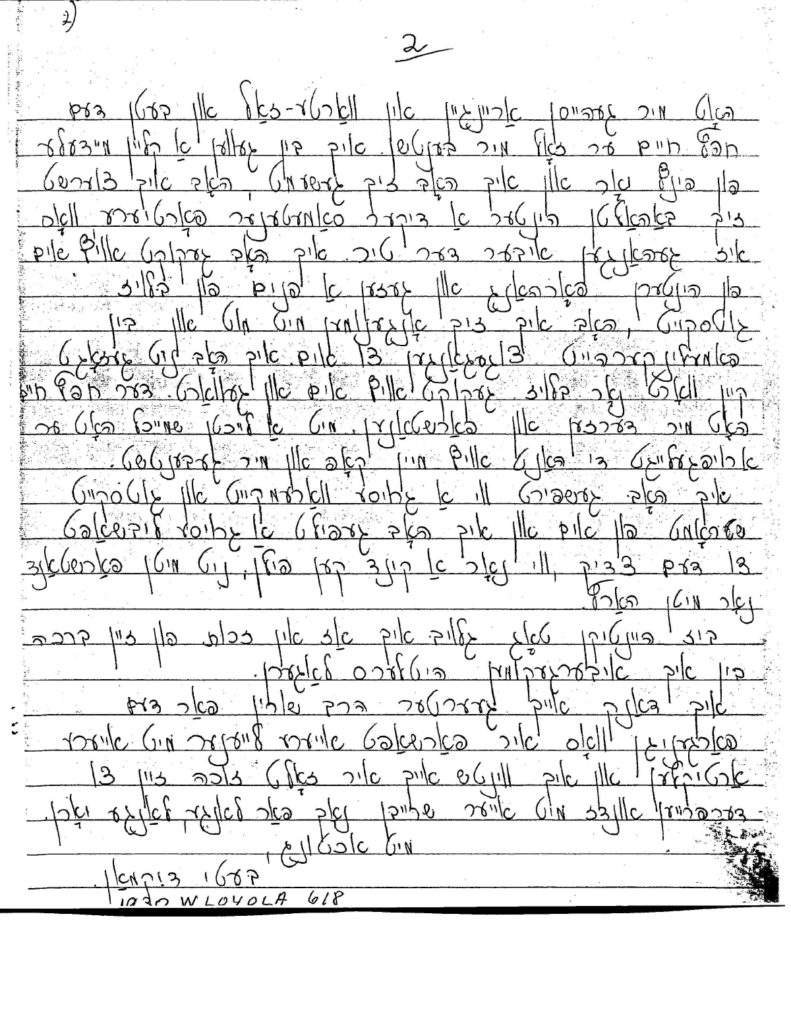
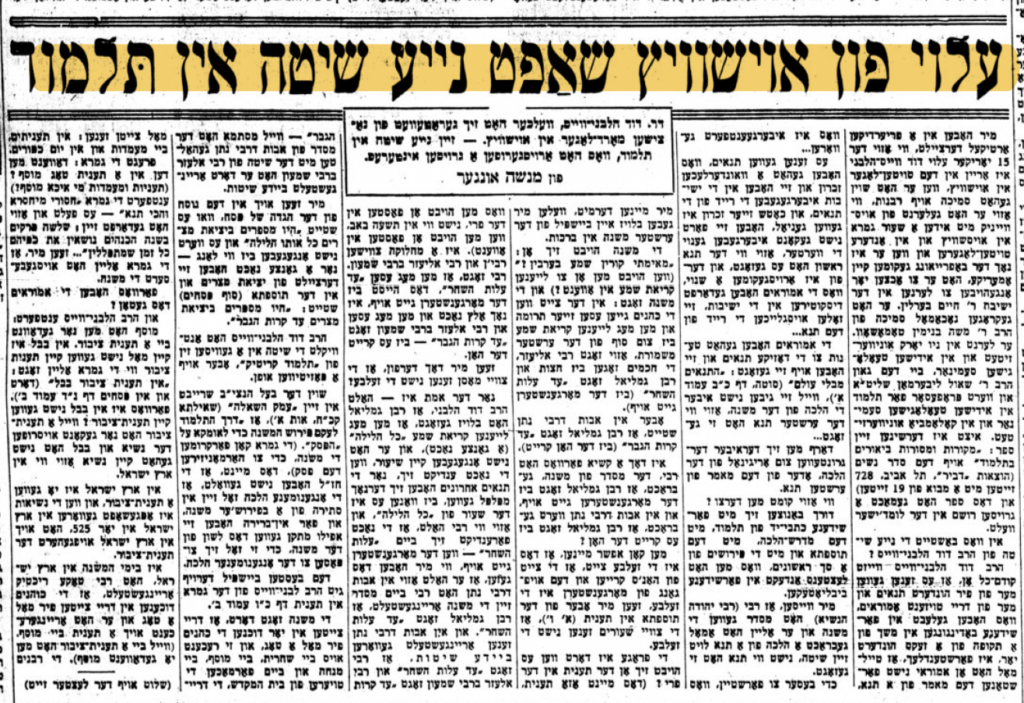
Appendix 2: Menashe Unger, “A Survivor of Auschwitz Creates a New Method in Talmudic Interpretation,” Der Tog (10 March 1969): 5-8 (Yiddish)

Menashe Unger,

“A Survivor of Auschwitz Creates a New Method in Talmudic Interpretation”

Der Tog (10 March 1969): 5-8 (Yiddish)

Dr. David Halivni Weiss, a survivor of the Nazi extermination camp at Auschwitz, has developed a new method in the study of the Talmud, a method that has aroused wide and serious interest.

In an earlier article we described how the fifteen-year-old Eliyahu David Weiss Halivni was sent to the death camp at Auschwitz already possessing rabbinic ordination; how, under conditions of mortal danger, he studied Gemara together with fellow Jews in Auschwitz and in other death camps; and how, after liberation, he arrived in America. At the age of eighteen he began studying at the Rabbi Chaim Berlin Yeshiva, where he again received rabbinic ordination, this time from Rabbi Moshe Binyamin Tomashov. He later pursued studies at New York University and at the Jewish Theological Seminary, under the guidance of the eminent scholar Rabbi Professor Saul Lieberman. He ultimately became professor of Talmud at the Jewish Theological Seminary and at Columbia University.

His book has now appeared: Mekorot u-Mesorot: Biʾurim ba-Talmud (Sources and Traditions: Explanations in the Talmud), on the Order Nashim, published by Dvir in Tel Aviv. The volume comprises 728 pages, with an introduction of nineteen pages. The book has made a powerful impression in the world of Talmudic scholarship.

What constitutes the new method of Rabbi David Halivni Weiss?

Rabbi Halivni Weiss first emphasizes that more than four hundred Tannaim and more than three thousand Amoraim lived under widely differing historical and social conditions over a period of approximately six hundred years. It is therefore understandable that at times an Amora did not fully comprehend a teaching of a Tanna transmitted to him. There were Tannaim who possessed extraordinary memories and transmitted the teachings of earlier authorities in the academies. Yet even when their memory was exceptional, they were not always able to convey the precise wording exactly as the original Tanna had formulated it. As a result, discrepancies arose, and the Amoraim were compelled to discuss these matters in the academies in order to reconcile the transmitted teachings.

The Amoraim even leveled accusations against such Tannaim, declaring: “The Tannaim are destroyers of the world” (Sotah 22a), because they failed to transmit the halakhah of the Mishnah exactly as the earliest Tanna had stated it. Accordingly, one must strive to return to the original formulation of the halakhah, or to the original statement of the earliest Tanna.

How is this accomplished? By making systematic use of variant manuscripts of the Talmud, Midrash Halakhah, the Tosefta, and the interpretations of many early authorities that have been discovered in recent times in various libraries. We know that Rabbi Judah the Prince, the redactor of the Mishnah, himself sometimes transmitted a halakhah according to his own conceptual framework, and not exactly as the Tanna had originally stated it, in order to render it more intelligible.

To clarify this approach, we will offer one example, drawn from the first Mishnah in Tractate Berakhot. The Mishnah opens: “From when does one recite the Shema in the evening?” It states that from the time the priests enter to eat their terumah one may recite the Shema until the end of the first watch, according to Rabbi Eliezer. The Sages say until midnight, and Rabban Gamliel says “until the rise of dawn.” However, in Avot de-Rabbi Natan it is stated that Rabban Gamliel says “until the rooster crows.”

This raises a difficulty: why did Rabbi, the redactor of the Mishnah, transmit Rabban Gamliel’s opinion as “until the rise of dawn,” whereas Avot de-Rabbi Natan reports it as “until the rooster crows”? One might assume that these refer to the same point in time, that the crowing of the rooster coincides with the appearance of the morning star. Yet from the Tosefta in Tractate Taʿanit (1:6) we see that these two temporal markers are not identical.

The discussion there concerns a fast that begins in the morning, as distinct from fasts such as the Ninth of Av, which begin in the evening. A dispute is recorded between Rabbi and Rabbi Eliezer ben Rabbi Shimon. Rabbi maintains that one may eat “until the rise of dawn,” meaning until the appearance of the morning star, which is still considered night, whereas Rabbi Eliezer ben Rabbi Shimon rules “until the rooster crows.” From this it is evident that the two times are not the same.

Rabbi Halivni Weiss therefore concludes that Rabban Gamliel originally stated only that one may recite the Shema “throughout the entire night,” without specifying any precise endpoint. The later Tannaim then debated how long the measure of “the entire night” extended. Since Rabbi held that night ends with the rise of dawn, and since Avot de-Rabbi Natan indicates that he indeed held this position, Rabbi incorporated into the Mishnah the formulation that Rabban Gamliel says “until the rise of dawn.” In Avot de-Rabbi Natan, however, both views were preserved: Rabbi’s position, “until the rise of dawn,” and that of Rabbi Eliezer ben Rabbi Shimon, “until the rooster crows,” because the redactor of Avot de-Rabbi Natan apparently accepted the latter view and therefore recorded both.

A similar phenomenon appears in the text of the Passover Haggadah, where it states: “They would recount the exodus from Egypt all that night,” without specifying an endpoint. By contrast, the Tosefta at the end of Tractate Pesahim states: “They recount the exodus from Egypt until the rooster crows.”

Rabbi David Halivni Weiss has thus developed a method that may be described, in a certain sense, as Talmudic textual criticism, but in a positive and constructive manner. Already the Netziv writes in his Haʿamek Sheʾelah (Sheʾiltah 136, section 1) that “it is the way of the Talmud to reinterpret the Mishnah so as not to uproot the halakhic ruling.” That is, the Sages did not wish the accepted halakhah to stand in contradiction to an explicit Mishnah, and where necessary they even corrected the wording of the Mishnah so that it would conform to the accepted halakhah.

Rabbi Halivni Weiss presents a striking illustration from Tractate Taʿanit (26b). The Mishnah there states that on three occasions during the year the priests raise their hands in blessing four times a day, and it enumerates Shaharit, Musaf, Minhah, and the closing of the Temple gates. These occasions are fast days, Maʿamadot, and Yom Kippur. The Gemara asks: is there a Musaf prayer on a fast day? It answers: “Something is missing, and this is how it should read: On three occasions during the year the priests raise their hands whenever they pray.” We thus see that the Gemara itself emended the Mishnah.

Why did the Amoraim do this? Rabbi Halivni Weiss explains that Musaf was recited only on a communal fast. In Babylonia there was never a communal fast, as the Gemara itself notes, because only the Nasi could proclaim such a fast, and Babylonia lacked a Nasi, unlike the Land of Israel. In the Land of Israel, communal fasts did exist, but after the abolition of the Nasiate in the year 425 they ceased there as well. In the Mishnaic period, however, Rabbi correctly included Musaf among the prayers recited on such days.

Later Amoraim, who lived in Babylonia and knew no communal fasts even in the Land of Israel, were perplexed by the Mishnah’s implication that Musaf was recited on a fast day. In order to harmonize the Mishnah with the accepted halakhah, they therefore emended its wording and inserted the phrase “whenever they pray.”

Rabbi David Halivni Weiss places primary emphasis on the textual foundations of the Mishnah and the Gemara. He demonstrates, on the basis of early sources, that there existed variant versions of the Mishnah, such as the Mishnah of Rabbi Meir and the Mishnah of Rabbi Akiva, which differed in wording.

As an example, he points to the opening Mishnah in Tractate Kiddushin: “A woman is acquired in three ways: by money, by document, and by intercourse.” The Gemara in Kiddushin (9a) asks: “By document, how?” and answers that if a man writes, “You are betrothed to me,” the woman is betrothed. Rabbi Halivni Weiss asks how the formulation “your daughter” enters the discussion, when the Mishnah speaks of a woman. He explains that this baraita originally referred not to Kiddushin but to Ketubbot, chapter four, where the Mishnah states that a father has rights over his daughter’s betrothal by money or by document. The redactor of the Gemara in Kiddushin apparently possessed such a version and connected the baraita to the Mishnah in Kiddushin because it was the closest relevant context.

This, then, is the path of study of Professor David Halivni Weiss. He proceeds through all the tractates of the Order Nashim, Yevamot, Ketubbot, Nedarim, Nazir, Sotah, Gittin, and Kiddushin, offering on every folio his elucidations and explanations, thereby clarifying many passages that have long remained obscure. At times a single incisive observation resolves a complex Talmudic difficulty and causes an entire accumulation of questions, which scholars had struggled to answer, to fall away.

Rabbi David Halivni Weiss is an outstanding disciple of the eminent Rabbi Professor Saul Lieberman, who takes great pride in his student. Professor Rabbi David Halivni Weiss is the youngest professor of Talmud at the Jewish Theological Seminary. He is engaged in a monumental scholarly undertaking that will be appreciated by all the leading Torah scholars of the generation. Having published his major work on the Order Nashim, he is already preparing a commentary on the Order Moʿed, with the aim of completing a comprehensive work on the entire Talmud.

Rabbi David Halivni Weiss emerged from the valley of death as a fragile child, a living remnant who endured the years of torment in the death camps while preserving his Jewish identity. He has remained a deeply observant Jew, meticulous in every detail of halakhic observance. Through his new method he has conferred a great benefit upon the world of Torah scholarship with his work Mekorot u-Mesorot, which will surely be highly esteemed by all students of Torah throughout the world.


Appendix 3: The 1957 Warren Convocation and the Circulation of Talmudic Self-Incrimination Discourse

Shmueli notes in his article in the Beys Yaakov Journal the wider efforts of JTS to translate talmudic discourse into a public idiom of modern legal and ethical relevance, and specifically a visit by Chief Justice Earl Warren.[88] During the 1950s, under the leadership of JTS Chancellor Louis Finkelstein, the Seminary promoted what it termed an “ethics of the Talmud,” presented as a normative program rather than antiquarian scholarship. Finkelstein described this enterprise as a kind of “fifth Shulḥan Arukh,” positioning the Talmud as a source of authoritative guidance for contemporary life.

The scope and aims of this project are documented in a substantial exchange between Finkelstein and Saul Lieberman in the mid-1950s.[89] In a detailed letter dated July 22, 1955, Finkelstein outlined his ambition to develop what he explicitly termed a “fifth Shulḥan Arukh,” by which he meant a systematic exposition of rabbinic ethics derived from the talmudic corpus. The letter makes clear that the two had discussed the matter repeatedly and that Finkelstein regarded Lieberman as indispensable to its realization. He credited Lieberman not only for scholarly guidance but for shaping his understanding of the ethical dimensions of rabbinic literature, remarking that he sought to render “Professor Lieberman as an institution” into a durable intellectual framework. Lieberman’s reply articulates a distinctive conception of legal-ethical obligation. Jewish law, he argued, establishes only the minimal standards necessary for social existence; genuine ethical responsibility begins beyond that threshold. Ethical expectations vary according to intellectual and moral stature. Conduct that might be considered blameless in an ordinary individual could be ethically culpable in a scholar. Rabbinic literature, he maintained, preserves numerous episodes illustrating such graduated responsibility, and only a sustained analytical study of the entire corpus could yield a systematic code of rabbinic ethics. He wrote:

“I might have stated to you my position on Jewish law and legal ethics. I believe that they are only the minimum without which no society can exist. The real legal ethics begin beyond this minimum. Each individual is legally bound by an ethical system conditioned to his individual character, temperament and general stature. A certain behavior on the part of an ordinary man may rightly be considered blameless under the circumstances, but the same behavior on the part of a learned man should be considered ethically criminal. In between the ignorant small man and the learned great man there are numerous gradations of ethical principles which correspondingly should guide the individual according to his status. Rabbinic literature abounds in episodes which highly illuminate the particular ethical principles with which we are concerned. The general idea is that none is exempt from the moral duty to aspire for perfection, thus raising the standards of the ethical principles required by the law for the particular individual.”[90]

This initiative took institutional form in September 1957 with the inauguration of the Lehman Institute of Ethics,[91] marked by a scholarly convocation on “Law as a Moral Force,”[92] attended by Chief Justice Earl Warren and described by one speaker as graced by the presence of “the most beloved citizen of our land.”[93]

Contemporary coverage makes clear that the convocation was designed not only as an internal scholarly gathering but as a publicized civic event. Reporting on the occasion, The New York Times noted that Warren had “enrolled” at the Seminary for a three-day convocation held over the weekend of September 13-14, 1957, devoted to Jewish law and its relevance to contemporary legal problems, and described both his participation in scholarly discussions and his attendance at Sabbath eve services. Finkelstein was quoted as framing the event as a gesture of civic-cultural deference: the Seminary, he declared, sought to honor Warren by sharing with him “our most treasured possession – the Talmud and its teaching.”[94] The report further translated rabbinic jurisprudence into American legal idiom, describing the Mishnah’s interpretive authority as “analogous to a Supreme Court decision,” and noting that Saul Lieberman’s Friday night lecture addressed procedural doctrines, especially self-incrimination and double jeopardy, that resonated directly with American constitutional discourse.[95] A contemporaneous Jewish Telegraphic Agency report similarly quoted Warren as remarking that several American constitutional safeguards, including those against self-incrimination and double jeopardy, appeared to derive from talmudic law. While noting that protection against self-incrimination was “perhaps not as sacred now as in ancient times,” Warren nonetheless affirmed its continuing place within American jurisprudence.[96] The episode illustrates the dynamic that Shmueli sought to resist: talmudic law presented as a moral-jurisprudential resource whose public legitimacy is ratified through elite American recognition.

According to Louis Finkelstein’s later recollection, Warren was so struck by Lieberman’s lecture that, despite an understanding that he would not speak publicly, he insisted on addressing the assembled audience. Warren reportedly expressed astonishment that such teachings were “almost a secret,” asking how it was that “nobody knows about it.” Public attention followed quickly. Finkelstein recalled that former President Harry S. Truman, then visiting New York, read the New York Times account of the event and declared, “If it is good enough for him, it is good enough for me,” before arriving at the Seminary together with Judge Samuel Rosenman, himself not merely a jurist but a leading Democratic insider and former presidential adviser closely associated with Roosevelt and Truman. Shmueli’s polemic thus draws upon a real and widely publicized episode in which the Talmud was presented to prominent representatives of the American political and legal establishment as a jurisprudential and ethical resource.[97]

Although the text of Lieberman’s lecture, “Law as a Moral Force in Rabbinic Literature,”[98] has not been preserved (and no recording was made, as it was delivered on the Sabbath eve), the intellectual aims of the convocation inaugurating the Herbert H. Lehman Institute of Ethics are articulated with unusual clarity in the published preface to Professor Shalom Spiegel’s address, Amos versus Amaziah.[99]

The conclave was explicitly convened to explore the moral dimensions of law as articulated in ancient Hebrew sources and to assess their relevance to contemporary legal and civic problems. Chief Justice Earl Warren and former President Harry S. Truman were among the featured participants, and Warren was quoted as remarking on the “sense of humility” that follows from recognizing that “most of the good things that we find in our law and in our own institutions come from the wisdom of men of other ages.” Spiegel’s address, identified in the prefatory material as one of the principal lectures of the weekend, framed prophetic confrontation and biblical justice through the idiom of constitutional adjudication and judicial review; Truman reportedly described it as “one of the best [lectures] I have ever heard in my life.”[100] In this respect, Spiegel’s published address offers a reliable index of the conceptual register within which Lieberman’s now-lost lecture was heard.

The episode circulated widely beyond the English-language press. Coverage in the Yiddish press highlighted the unusual image of the Chief Justice of the United States Supreme Court sitting in the Seminary, wearing a yarmulke and studying Talmud together with Finkelstein and Lieberman.[101] It was largely through this reportage that the episode entered the retrospective memory of circles associated with Yeshiva University. Decades later, Rabbi Hershel Schachter recalled in writing that R. Joseph B. Soloveitchik reacted sharply to Yiddish newspaper accounts of Lieberman’s talmudic exposition, particularly the suggestion that repentance could nullify liability to punishment in an earthly court, a claim difficult to reconcile with Makkot 13b. He reportedly dismissed such reports as devarim betelim (‘idle talk’) and invoked the Ra’avad’s critique of Maimonides.[102]

Samuel J. Levine has recently suggested that Chief Justice Warren’s later invocation of Jewish law in Miranda v. Arizona (1966) may be traced to his widely reported 1957 visit to the Jewish Theological Seminary. According to Levine, the JTS encounter helped prepare the conceptual ground for Miranda, as contemporary accounts of the visit already portrayed Jewish law as an antecedent to Anglo-American constitutional protections, particularly in the area of self-incrimination.[103] That framework, however, was already in circulation at least a year earlier and cannot be attributed solely to the 1957 Seminary visit.

Newly available correspondence complicates any linear account of influence running from Warren’s 1957 visit to the Seminary to Miranda (1966). In early 1956, Rabbi Norman Lamm, then a pulpit rabbi in Springfield, Massachusetts, published in Judaism a substantial essay written at the height of public controversy over the Fifth Amendment, explicitly framing ein adam mesim atzmo rasha (“no man can render himself legally wicked”) as the halakhic analogue of the constitutional privilege against self-incrimination.[104] Far from offering a casual comparison, Lamm argued that halakhah went beyond the Fifth Amendment by rendering all criminal confessions inadmissible, even if voluntarily offered.[105] This was the argument Warren would later cite in his majority opinion.

On March 19, 1956, more than a year before Warren’s appearance at the Seminary, Justice William O. Douglas wrote to Lamm that he had read the essay and found it “uncommonly suggestive,” praising its “penetrating analysis.”[106] The letter demonstrates that Lamm’s comparative formulation had already circulated within the Court at the moment of its publication, independently of the later public staging of the JTS symposium. Although the precise circumstances under which Warren first encountered the essay remain unknown, Douglas’s correspondence establishes that the argument had entered the Court’s intellectual orbit well before the 1957 visit.[107]

Contemporary Jewish press coverage of Miranda indicates that Warren’s footnote was promptly read in genealogical terms. An editorial in the Wisconsin Jewish Chronicle, titled “Grandpappy of the Fifth Amendment,” presented the decision as evidence that “the ancient Talmudic law” lay at the root of modern constitutional protections. Citing Lamm’s formulation of ein adam mesim atzmo rasha, it described the Talmud as the “great, great, great grandpappy” of the Fifth Amendment and treated the Court’s ruling as a contemporary reaffirmation of an ancient legal principle.[108] Similarly, the St. Louis Jewish Light interpreted Warren’s reference to “ancient times” as an acknowledgment of Lamm’s 1956 formulation, stressing that halakhah not only anticipated but surpassed the Fifth Amendment in stringency.[109] In both instances, a comparative footnote was taken as evidence of a historical lineage linking Jewish jurisprudence to American constitutional doctrine.

The JTS episode should therefore be understood not as the origin of Warren’s engagement with Jewish law, but as a conspicuous public moment that consolidated and legitimated a line of juridical reflection already underway.

This pattern of influence and circulation is also visible, albeit indirectly, in the later secondary literature produced within the Seminary’s own intellectual milieu. Aaron Kirschenbaum, whose Self-Incrimination in Jewish Law emerged from the JTS faculty orbit,[110] neither mentions Warren’s widely publicized 1957 visit to the Seminary nor notes Warren’s later reliance on Norman Lamm’s 1956 essay in his majority opinion in Miranda v. Arizona. He does, however, call attention to Warren’s use of other secondary legal scholarship.[111] The omission is striking, since Enker and Elsen themselves cite Lamm’s essay on the halakhic analogue to the Fifth Amendment,[112] thereby situating Lamm’s argument squarely within the very body of legal literature on which Warren drew.

Indeed, Kirschenbaum explicitly situates his own engagement with self-incrimination in the political and legal climate of the early 1950s. Reflecting on his years at JTS, he recalls how he and his fellow students felt an almost compulsive need to render Moses, Hazal, and Maimonides “relevant,” reading classical sources through the selective lens of modern rights discourse. Under the pressures of the McCarthy era, he writes, congressional investigations and compelled testimony rendered the constitutional privilege of silence a matter of urgent moral significance. The formula “I refuse to answer… because my response would constitute self-incrimination” became, for him, not merely a legalism but a moral idiom. It was precisely this Fifth Amendment protection, he explains, that “captivated” him and first drew him into the surrounding legal literature.[113]

Whatever the precise channels through which Jewish legal analogies entered American constitutional discourse, the Lehman Institute convocation represented a highly visible attempt to stage talmudic law as a public moral resource within elite American civic culture, and it was precisely this institutional posture that drew Orthodox critique. Yet the controversy surrounding the Lehman Institute and the 1957 Warren convocation was not without precedent. From the mid-1930s onward, Louis Finkelstein’s efforts to reposition the Jewish Theological Seminary as a locus of public moral and cultural authority had already provoked sustained criticism from Orthodox and right-wing observers, who viewed such initiatives as compromising rabbinic integrity in pursuit of external validation. Programs aimed at engaging Christian intellectuals or framing Judaism in universal ethical terms were repeatedly denounced in the Orthodox and Yiddish press as apologetic accommodation, and at times as missionary entanglement. Figures such as Aaron Rosmarin cast these projects as oriented less toward the cultivation of internal rabbinic tradition than toward securing legitimacy before non-Jewish audiences and American cultural elites.

Notes

  1. Throughout this article, individuals are occasionally referred to by surname alone, in keeping with established scholarly convention. This practice is adopted solely for stylistic consistency and carries no implication of disrespect.
  2. Joseph Berger, “Rabbi David Weiss Halivni, Scholar Devoted to the Talmud, Dies at 94,” The New York Times (18 July 2022): A17.
  3. Ibid.
  4. See David Weiss Halivni, The Book and The Sword: A Life of Learning In The Shadow of Destruction (New York: Farrar Straus and Giroux, 1996); and Netiʻot Ledavid: Jubilee Volume for David Weiss Halivni, eds. Yaakov Elman, Ephraim Bezalel Halivni, and Zvi Arie Steinfeld (Jerusalem: Orhot Press, 2004).
  5. For the fullest methodological exposition of his theory of Talmudic redaction, see David Weiss Halivni, The Formation of the Babylonian Talmud, trans. Jeffrey L. Rubenstein (Oxford: Oxford University Press, 2013). See also H.A. Alexander, “David Halivni and Shamma Friedman: Conflicting Trends in Talmud Criticism,” Conservative Judaism, vol. 39, no. 3 (Spring 1987): 45-57; Ari Bergmann, Halevy, Halivni and the Oral Formation of the Babylonian Talmud (PhD diss., Columbia University, 2014) and Ari Bergmann, The Formation of the Talmud: Scholarship and Politics in Yitzhak Isaac Halevy’s Dorot Harishonim (Berlin: de Gruyter, 2021); and earlier in Irwin H. Haut, The Talmud as Law or Literature: An Analysis of David W. Halivni’s ‘Mekorot Umasorot’ (New York, Bet Sha’ar Press, 1982). A fuller treatment of Halivni’s method and its reception will be presented in subsequent essays in this series.
  6. For the subsequent editions in this series, see David Weiss Halivni, Mekorot u-Masorot: Seder Nashim (Tel-Aviv: Devir, 1969; Hebrew); David Weiss Halivni, Mekorot u-Masorot: Seder Moed, from Yoma to Hagiga (Jerusalem: Jewish Theological Seminary, 1975; Hebrew); David Weiss Halivni, Mekorot u-Masorot: Shabbat (Jerusalem: Jewish Theological Seminary, 1982; Hebrew); David Weiss Halivni, Mekorot u-Masorot: Eruvin-Pesahim (Jerusalem: Jewish Theological Seminary, 1982; Hebrew); David Weiss Halivni, Mekorot u-Masorot: Seder Nashim, second edition (Toronto: Otsereinu, 1992; Hebrew); David Weiss Halivni, Mekorot u-Masorot: Bava Kamma (Toronto: Otsereinu, 1993; Hebrew); David Weiss Halivni, Mekorot u-Masorot: Bava Metzia (Jerusalem: Magnes, 2002; Hebrew); David Weiss Halivni, Introduction to ‘Mekorot u-Masorot’, first edition (Jerusalem: Magnes Press, 2009; Hebrew); David Weiss Halivni, Introduction to ‘Mekorot u-Masorot’, second edition (Jerusalem: Magnes Press, 2012; Hebrew); David Weiss Halivni, Mekorot u-Masorot: Sanhedrin, Shavu’ot, Makot, Avodah Zarah, Horayot (Jerusalem: Magnes, 2012; Hebrew); David Weiss Halivni, Mekorot u-Masorot: Zevahim-Menahot (Jerusalem: Magnes Press, 2023; Hebrew); and see David Weiss Halivni, The Formation of the Babylonian Talmud, ed. and trans. Jeffrey L. Rubenstein (Oxford: Oxford University Press, 2013).
  7. David Weiss Halivni, Mekorot u-Mesorot: Seder Nashim (Tel-Aviv: Devir, 1969; Hebrew).
  8. A comprehensive bibliographical listing of Halivni’s writings, including digitized scans, is available on the Academia.edu page (here) curated by Menachem Butler in collaboration with Professor Halivni’s family.
  9. Israel Shenker, “A Life in the Talmud,” The New York Times Magazine (11 September 1977): 44-45, 74-82, available here.
  10. Margalit Fox, “Israel Shenker, 82, a Reporter With the Instincts of a Scholar,” The New York Times (17 June 2007): 23.
  11. Ibid.
  12. Israel Shenker, “Groucho, at 81, Discusses Favorite Topic- Women,” The New York Times (4 May 1972): 50; Israel Shenker, “Groucho Marx Uses Room Service to Press Suit,” The New York Times (5 June 1975): 40.
  13. Israel Shenker, “Borges, a Blind Writer With Insight,” The New York Times (6 April 1971): 48.
  14. Israel Shenker, “Former Chomsky Disciples Hurl Harsh Words at the Master,” The New York Times (10 September 1972): 70.
  15. Israel Shenker, “The Old Magician at Home,” The New York Times Book Review (9 January 1972): 2.
  16. Israel Shenker, “Picasso, 90 Today, Assayed By Critic, Curator, 3 Artists,” The New York Times (25 October 1971): 42.
  17. Israel Shenker, “Asimov, ‘on Fire to Explain,’ Writes 100th Book – About Himself,” The New York Times (18 October 1969): 35; Israel Shenker, “I.B. Singer As Traveler,” The New York Times (13 March 1983): 66-70.
  18. Israel Shenker, “A Religious Zionist Urges Compromise on Occupied Lands,” The New York Times (15 June 1978): 12. For contemporaneous coverage of the Oz V’Shalom movement – founded in response to Gush Emunim – see “Orthodox Group in Israel Forming Peace Movement to Oppose Gush Emunim,” The Jewish Week (11 June 1978): 24.
  19. Israel Shenker, “Professor, 80, Looks to Volume 18 of Jewish History,” The New York Times (26 May 1975): 31.
  20. Israel Shenker, “Solomon Zeitlin, Long a Professor of History and Rabbinics, Dies,” The New York Times (30 December 1976): 26.
  21. Israel Shenker, “Shabuoth Group Sifts Gossamer Threads of Torah, Particularly the Ten Commandments,” The New York Times (24 May 1969): 25; Israel Shenker, “Rabbi Gives Views on Birth Control: Cites Jewish Law and Bible on Marital Ethics,” The New York Times (30 November 1969): 50; Israel Shenker, “Rabbi Finkelstein to Retire; Joy of Study Undiminished,” The New York Times (28 September 1971): 41; Israel Shenker, “Two Are Named as Heads of the Jewish Theological Seminary,” The New York Times (28 October 1971): 43; Israel Shenker, “Rabbi to Give Nixon a Kingly Blessing,” The New York Times (19 January 1973): 16; Israel Shenker, “Adele Ginzberg, at 90, Says, ‘So What?’,” The New York Times (16 May 1976): 50; Israel Shenker, “Japanese Christian Is Awarded A Doctorate by Jewish Seminary,” The New York Times (31 May 1977): 33.
  22. See also Shenker’s profile of Rabbi Benjamin Kamenetzky, son of the renowned Torah scholar Rabbi Yaakov Kamenetsky, who fielded religious inquiries through a public telephone ‘Hot Line to the Rabbi’, in Israel Shenker, “On Wednesday, the Rabbis Answered the Phones,” The New York Times (19 May 1978): B1.
  23. See also Israel Shenker, “Deli Waiters Turn Polite for the 4th,” The New York Times (5 July 1969): 38; Israel Shenker, “Delicatessen Puts Clock Back 20 Years,” The New York Times (12 March 1974): 41; Israel Shenker, “For Customers Over 65, The Food Is Half-Price,” The New York Times (25 September 1974): 46; and Israel Shenker, “In Delis, 2d Ave. Is a Palace,” The New York Times (22 April 1977): C19.
  24. There were, of course, rare exceptions. See, for example, Israel Shenker, “Knishes and Latkes, Yes! But Chicken Wellington?” The New York Times (10 March 1971): 45; Israel Shenker, “Taste for Business Builds Brooklyn Knish Empire,” The New York Times (9 May 1971): 80; and Israel Shenker, “They Sing in Praise of Matzoh Brei,” The New York Times (19 November 1973): 44.
  25. Including, for example, Israel Shenker, “Ideological Labels Changing Along With the Label-Makers,” The New York Times (12 November 1970): 45,48; Israel Shenker, “Man and Machine Match Minds at M.I.T.: 5th Conference on Artificial Intelligence Seeks Ways to Smarter Computers,” The New York Times (27 August 1977): 8; Israel Shenker, “Lowell’s Sacco-Vanzetti Papers Are Opened After 50 Years,” The New York Times (10 December 1977): 12; Israel Shenker, “Freiheit Editor’s 75th Birthday Party Is in a Class by Itself: ‘Preserving the Language’,” The New York Times (12 February 1978), 48; Israel Shenker, “Webster, Noah (1758-1843): A Clearly Defined Reputation,” The New York Times (14 April 1978): B1, B5.
  26. Israel Shenker, “Behind the Scenes at the Savoy,” The New York Times (23 June 1985): 19, 36.
  27. Israel Shenker, “Lonely Sea Gate’s Streets Still Belong to Its People,” The New York Times (2 January 1972): A6; Israel Shenker, “Despair Fills Lower East Side Synagogues,” The New York Times (19 March 1974): 4; Israel Shenker, “What’s Nu? Bagel-and-Bus Tours of Jewish New York,” The New York Times (5 May 1976): 89.
  28. Israel Shenker, “The Miraculous Cheeseless Cheesecake: The Cheesecake Without Cheese,” The New York Times (5 July 1978): C1, C7.
  29. Israel Shenker, “The Twerski Tradition: 10 Generations of Rabbis in the Family,” The New York Times (23 July 1978): 38. See also Edward Reichman and Menachem Butler, “The Medical Training and Yet Another (Previously Unknown) Legacy of Rabbi Dr. Abraham J. Twerski, zt”l,” The Seforim Blog (2 February 2021), available here.
  30. Israel Shenker, “Hasidic Group Marks Its 100th Year,” The New York Times (2 June 1971): 46; Israel Shenker, “Hasidic Feat: Simple as Aleph, Beth, Gimel,” The New York Times (3 November 1977): A18.
  31. Israel Shenker, “Brooklyn Brothers Use Scribes’ Ancient Art in Torah Repairs,” The New York Times (27 July 1977): B1.
  32. Israel Shenker, “It’s Onward and Uptown For Hebrew Publishing,” The New York Times (1 August 1976): 40.
  33. Israel Shenker, “Dreydl Makers in City Preparing for What’s a Dreydl? You Shouldn’t Ask,” The New York Times (28 September 1970): 45; and Israel Shenker, “C.C.N.Y’s President Loses Dreydl Crown in Spin-Off,” The New York Times (7 December 1972): 106.
  34. Israel Shenker, “Brides and Bar Mitzvahs Bring a Rush on Yarmulkes,” The New York Times (20 June 1977): 31
  35. Israel Shenker, “The Day the Waldorf Went Kosher,” The New York Times (23 Dec 1977); 20; and Israel Shenker, “With Them, It’s Always Strictly Kosher,” The New York Times (15 April 1979): 32-33, 36-38, 40, 42.
  36. Israel Shenker, “On El Al, They’d Rather Walk: It’s Up and Down the Aisles, Even at Meal Times,” The New York Times (15 November 1968): 93.
  37. Israel Shenker, “Isaac Singer’s Perspective on God and Man,” The New York Times (23 October 1968): 49, 94; Israel Shenker, “A Bit of Reality by I.B. Singer and Son,” The New York Times (17 April 1970): 44; and Israel Shenker, “The Man Who Talked Back to God: Isaac Bashevis Singer, 1904-91,” The New York Times Book Review (11 August 1991): 11.
  38. Israel Shenker, “Harvard’s Resident Sage Marks 85th Birthday Today,” The New York Times (2 November 1972): 45, 86, available here. He later wrote Wolfson’s obituary in Israel Shenker, “Harry Wolfson, 86, Philosopher of Religion at Harvard, is Dead,” The New York Times (21 September 1974): 32, available here. For another contemporaneous tribute, see Mark Jay Mirsky, “Our Greatest Sage: Elegy for Harry Wolfson,” The Village Voice (13 January 1975): 39-41, available here.
  39. Israel Shenker, “Lubavitch Rabbi Marks His 70th Year With Call for ‘Kindness’,” The New York Times (27 March 1972): 39.
  40. Israel Shenker, “Israeli Historian Denies Jews Yielded to the Nazis ‘Like Sheep’,” The New York Times (6 May 1970): 2; Israel Shenker, “How Yiddish Survives At 2 New York Schools,” The New York Times (16 January 1974): 68; Israel Shenker, “An Awesome Reliving of Auschwitz Unfolds at St. John’s,” The New York Times (4 June 1974): 39; Israel Shenker, “The Holocaust: Did God Want It?” The New York Times (6 June 1974): 38; Israel Shenker, “The Holocaust Was ‘Radical Counter-Testimony’ to Religion,” The New York Times (9 June 1974): E5; Israel Shenker, “Scholars at Holocaust Conference Here Seek Answers to the Unanswerable,” The New York Times (4 March 1975): 13; Israel Shenker, “Jewish Cultural Arts: The Big Debate,” The New York Times (13 January 1976): 42; Israel Shenker, “Diverse Views Given on U.S. Jewish Experience,” The New York Times (22 March 1976): 55; and Israel Shenker, “Conference Ponders Who’s a Jew and Why,” The New York Times (26 May 1976): 18;
  41. Israel Shenker, Coat of Many Colors: Pages from Jewish Life (Garden City, NY: Doubleday, 1985).
  42. Israel Shenker, “Israeli Scholar Preparing New Edition of Talmud,” The New York Times (19 September 1971): 78.
  43. And on the controversy two decades later on Rabbi Adin Steinsaltz’ edition of the Talmud, see Haim Shapiro, “Talmudist Continues Down Path of Peace,” The Jewish Week (25 August 1989): 2, 31; Leon Wieseltier, “Unlocking the Rabbis’ Secrets: Review of ‘The Talmud’, by Adin Steinsaltz,” The New York Times Book Review (17 December 1989): 3, 31; Haim Shapiro, “Moving Up The Charts: Rabbi Adin Steinsaltz’s English Translation of the Talmud is Becoming A Surprisingly Hot Seller Abroad,” The Jerusalem Post Magazine (9 March 1990): 7-8; Jonathan Sacks, “Steinsaltz the Polymath,” The London Jewish Chronicle (2 March 1990): 27; Jacob Neusner, “Letter – Steinsaltz’s Say-So,” The Forward (7 December 1990): 6; Jacob Neusner, “Along with the Sizzle, Plenty of Beef: Review of ‘The Talmud: The Steinsaltz Edition, vol. 1: Tractate Bava Metzia. Part 1’, by Adin Steinsaltz,” in Jacob Neusner, ed., Approaches to Ancient Judaism: New Series, vol. 2 (Atlanta: Scholars Press, 1990), 57-65; Emanuel Rackman, “Carved in Stone: Some Powerful Rabbis Won’t Accept New Talmud Interpretations,” The Jewish Week (22 February 1991): 31; and Chaim Rapoport, “On Publishing the Talmud in Translation and With New Commentaries,” Ohr Yisroel, vol. 13, no. 2 (December 2007): 53-88 (Hebrew).
  44. Israel Shenker, “Israeli Scholar Preparing New Edition of Talmud,” The New York Times (19 September 1971): 78. Professor Louis Finkelstein held a very different view on another aid to Talmudic study, a concordance of the Talmud. In that instance, he praised the work describing it as “important as the Dead Sea Scrolls,” because “except for the rare scholar” it was nearly impossible to identify parallel, and potentially related, Talmudic terms. Perhaps JTS sponsorship of the concordance may account for the different treatments of the two works. See Harry Gilroy, “Index to Talmud is Reported Half Finished,” The New York Times (1 April 1968): 42. As well, JTS was involved in the publication of the El Am Talmud. See Moses Eskolosky, “New Key to Talmud’s Treasure Trove,” The United Synagogue Review, vol. 18, no. 1 (July 1965): 14-17; and Elie Wiesel, “A Proposal on How to Learn Talmud with Children,” Forverts (22 September 1967): 2, 5 (Yiddish).
  45. Israel Shenker, “Responsa: The Law as Seen by Rabbis for 1,000 Years,” The New York Times (5 May 1975): 33, 61.
  46. Israel Shenker, “Hats Are Off to Kremlinologists, an Endangered Species in Era of Détente,” The New York Times (20 September 1974): 41, 77.
  47. Israel Shenker, “When a Patient’s Dreams Put Him to Sleep, He May Defy Analysis,” The New York Times (17 December 1976): 29.
  48. Israel Shenker, Coat of Many Colors: Pages from Jewish Life (Garden City, NY: Doubleday, 1985), 74.
  49. Moshe Feinstein, “Introduction,” in Iggerot Moshe, vol. 1 (New York: New York: Noble Book Press Corp., 1959), 3-4 (Hebrew).
  50. See also Tovia Preschel, “Profile of Rav Moshe Feinstein,” The Jewish Press (27 July 1962): 3; Emanuel Rackman, “Halachic Progress: Rabbi Moshe Feinstein’s Igrot Moshe on Even ha-Ezer,” Judaism: A Quarterly Journal, vol. 13, no. 3 (Summer 1964): 365-373; Aaron Kirschenbaum, “Rabbi Moshe Feinstein’s Responsa: A Major Halachic Event,” Judaism: A Quarterly Journal, vol. 15, no. 3 (Summer 1966): 364-373, available here; “Orthodox Jewish Leader Points To A Remedy For Today’s Many Problems,” The American Examiner (16 April 1970): 1-2; Marvin Schick, “Rabbi Moshe Feinstein: A Genius in Learning, Service and Loving Kindness,” The Long Island Jewish World (17 April 1986): 6-7; Harel Gordin, “Torah Sage of America: Rabbi Moses Feinstein,” in Benjamin Brown and Nissim Leon, eds., The Gedolim: Leaders Who Shaped the Israeli Haredi Jewry (Jerusalem: Magnes Press, 2017), 430-455 (Hebrew); and Aviad Hacohen, “Everything Is according to the American Custom: A New Custom for a New Country,” in Joseph Isaac Lifshitz, Naomi Feuchtwanger-Sarig, Simha Goldin, Jean Baumgarten, and Hasia Diner, eds., Minhagim: Custom and Practice in Jewish Life (Berlin: de Gruyter, 2019), 235-324, available here.
  51. Ira Wolfman, “Israel Shenker, A Jewish Writer, Sweet and Sour,” The Long Island Jewish World (24 July 1986): 16.
  52. Baruch Halpern, From Gods to God: The Dynamics of Iron Age Cosmologies (Tübingen: Mohr Siebeck, 2009), 7.
  53. Margalit Fox, “Israel Shenker, 82, a Reporter With the Instincts of a Scholar,” The New York Times (17 June 2007): 23.
  54. Ira Wolfman, “Israel Shenker, A Jewish Writer, Sweet and Sour,” The Long Island Jewish World (24 July 1986): 16.
  55. Israel Shenker, “In Wales, A Bookworm’s Holiday,” The New York Times (2 June 1985): 32.
  56. Israel Shenker, Words and Their Masters (Garden City, NY: Doubleday, 1974); Israel Shenker, Harmless Drudges: Wizards of Language: Ancient, Medieval, and Modern (Bronxville: Barnhardt, 1979).
  57. Israel Shenker, Following Tocqueville through Joyce’s Dublin (New York: Random House, 1972).
  58. Israel Shenker, In the Footsteps of Johnson and Boswell (Boston: Houghton Mifflin, 1984).
  59. Israel Shenker and Mary Shenker, As Good as Golda: The Warmth and Wisdom of Israel’s Prime Minister (New York: Random House, 1970).
  60. Yitzhak M. Shmueli, “A Cry of Alarm Concerning the New School of ‘Talmud Critics’!” Beys Yaakov, vol. 10, no. 4 [#116] (1969): 4-5 (Hebrew), available here, with translation in Appendix 1 below.
  61. See Shmuel Ashkenazi, Iggeret Shmuel, vol. 1 (Jerusalem, 2021), 404 (Hebrew), who subjects another article by “Rabbi Yitzhak M. Shmueli” to sustained critique, describing it as a conspiratorial construction lacking evidentiary support. Through close examination of manuscripts, historical context, and philological detail, Ashkenazi argues that Shmueli’s claim of deliberate textual manipulation for anti-Hasidic purposes is unsupported and rests on conjecture rather than demonstrable proof; see ibid., 401–404. The episode is instructive insofar as it illustrates a broader feature of Shmueli’s polemical style. Apart from this case, Shmueli published only a small number of additional essays on the same figure, most of which are similarly rhetorical and accusatory in tone rather than analytically substantiated; see Beys Yaakov, nos. 113–114 (September 1968): 28-30, 36 (Hebrew); and Beys Yaakov, nos. 160–161 (May 1973): 4-6 (Hebrew).
  62. David Weiss Halivni, Mekorot u-Mesorot: Seder Nashim (Tel-Aviv: Devir, 1969; Hebrew).
  63. Yitzhak M. Shmueli’s article against Halivni in Beys Yaakov constitutes an explicit counter-intervention to the laudatory presentation of David Weiss Halivni’s work published days earlier in Menashe Unger, “A Survivor of Auschwitz Creates a New Method in Talmudic Interpretation,” Der Tog (10 March 1969): 5-8 (Yiddish), translated below in Appendix 2. Unger’s review introduced Mekorot u-Mesorot to a broad Yiddish-reading public, highlighting Halivni’s Holocaust biography, his punctilious Orthodox observance, and, above all, his standing as a distinguished disciple of Professor Saul Lieberman. Framed in these terms, the article suggested that Halivni’s method warranted acceptance within Orthodox circles, treating Lieberman’s imprimatur and Halivni’s personal piety as sufficient markers of legitimacy. It is precisely this public strategy of legitimation, rather than the mere circulation of a scholarly monograph, that the Beys Yaakov article appears designed to contest.
  64. See, for example, the Dan Rabinowitz, “Between Authority and Inquiry: Beyond the Masthead of the Beys Yaakov Journal, 1923-1980 – Part 1,” The Seforim Blog (22 December 2025), available here.
  65. On this motif, see Zev Eleff and Menachem Butler, “Moses Mendelssohn and the Orthodox Mind,” The Lehrhaus (9 January 2017), available here; see, now, Yoav Schaefer, “Haskalah in Berlin: Moses Mendelssohn, Immanuel Kant, and the Foundations of Reform Judaism,” in Stanley M. Davids and Leah Hochman, eds., Re-forming Judaism: Moments of Disruption in Jewish Thought (New York: CCAR Press, 2023), 147-164.
  66. For a more differentiated historical account of Wissenschaft des Judentums and its complex relationship to modern biblical criticism, see Edward Breuer and Hanan Gafni, “Jewish Biblical Scholarship between Tradition and Innovation,” in Magne Sæbø, ed., Hebrew Bible-Old Testament, The History of Its Interpretation, vol. 3: From Modernism to Post-Modernism (The Nineteenth and Twentieth Centuries) (Göttingen: Vandenhoeck & Ruprecht, 2013), 262-303.These studies present a more differentiated genealogy than the schematic lineage invoked by Shmueli.
  67. David Weiss Halivni, “Talmud: Source Criticism,” Encyclopedia Britannica, vol. 21 (1963): 645, available here.
  68. For documentation of the 1957 Lehman Institute convocation inaugurating the Lehman Institute of Ethics, including Chief Justice Warren’s participation, contemporaneous press coverage, later recollections, and the subsequent circulation of talmudic self-incrimination discourse within Supreme Court circles, see Appendix 3 (“The 1957 Warren Convocation and the Circulation of Talmudic Self-Incrimination Discourse”).
  69. Aaron Rosmarin, An Answer (To the Polemic surrounding the Jewish Theological Seminary) (New York: 1943; Yiddish).
  70. Aaron Rosmarin, “Whither the Jewish Theological Seminary?” The Jewish Forum, vol. 17, no. 8 (September 1934): 239-246; Aaron Rosmarin, “Whither the Jewish Theological Seminary?” The Jewish Forum, vol. 17, no. 10 (November 1934): 315-319; Aaron Rosmarin, “Whither the Jewish Theological Seminary?” The Jewish Forum, vol. 18, no. 1 (January 1935): 6-8.
  71. Aaron Rosmarin, “‘Hold-up’ on Sukkot,” Der Tog (28 September 1934): 9 (Yiddish).
  72. Aaron Rosmarin, “American Jewry Awake,” The Jewish Spectator, vol. 4, no. 1 (November 1938): 18-21; Aaron Rosmarin, “Editorial: Missionaries in a Rabbinical Seminary,” The Jewish Spectator, vol. 7, no. 2 (December 1941): 4-5; Aaron Rosmarin, “Is The Jewish Theological Seminary of America Becoming A Den of Missionaries?” The Jewish Spectator, vol. 7, no. 3 (January 1942): 13-16; Aaron Rosmarin, “Editorial: ‘Honors’ for Dr. Finkelstein,” The Jewish Spectator, vol. 13, no. 2 (December 1947): 5; Louis Feinberg and Aaron Rosmarin, “Post-Scripts to the Finkelstein Controversy,” The Jewish Spectator, vol. 13, no. 4 (February 1948): 29-30.
  73. Dr. Aaron Rosmarin’s polemical posture is further complicated by the later fact that he refused to grant his wife a gett, a biographical episode that bears directly on the themes of halakhic coercion and moral accountability that animate his broader critique of rabbinic authority. See Marc B. Shapiro, “Saul Lieberman and his Ketubah, Driving on Shabbat, an Unusual Marriage Practice, Girls born on Friday, and More,” The Seforim Blog (28 January 2026), available here, and the forthcoming essay by Aviad Hacohen and Menachem Butler, “Trude Weiss-Rosmarin as a Philosopher of Halakhic Accountability: The Agunah Crisis and the Lieberman Clause in Postwar America,” which situates Weiss-Rosmarin’s polemic against rabbinic institutional impotence within the longer history of Orthodox–Conservative conflict over authority, jurisdiction, and moral responsibility in Jewish divorce law. Although Rosmarin’s anti-JTS campaign spanned more than a decade and generated a substantial polemical corpus across Yiddish and English venues, it has not yet been reconstructed systematically as an object of intellectual or institutional history; a full study of his sustained polemic against the Seminary remains a scholarly desideratum.
  74. For extended discussion of the Ḥazon Ish’s approach to manuscripts and textual emendation, see Moshe Bleich, “The Role of Manuscripts in Halakhic Decision-Making: Hazon Ish, His Precursors and Contemporaries,” Tradition: A Journal of Orthodox Jewish Thought, vol. 27, no. 2 (Winter 1993): 22-55; Benjamin Brown, “The Method of Study of the Ḥazon Ish in Contrast to the Approach of Critical Scholarship,” in The Ḥazon Ish: Halakhist, Believer and Leader of the Haredi Revolution (Jerusalem: Magnes Press, 2011), 384-397 (Hebrew); and Hannah Kehat, “Fortifying the Status of Torah in the Thought of the Ḥazon Ish,” in Aviad Hacohen, Yitzchak Avi Roness, and Menachem Butler, eds., Milḥemet Mitzvah, vol. 2: Religious Leadership and Halakhic Responsibility in the Military Service Debate (Cambridge, MA: The Institute for Jewish Research and Publications, 2025), 157-241.
  75. The Ḥazon Ish’s position will be analyzed in greater detail in our forthcoming article at The Seforim Blog.
  76. See David Golinkin, “Was Professor Saul Lieberman ‘Orthodox’ or ‘Conservative’?” The Seforim Blog (2 December 2014), available here; and Tuvia Preschel, “R. Saul Lieberman and His Scholarly Work,” in Ma’amarei Tuvia: Reshimot u-Ma’amarim, vol. 2 (Jerusalem: Mossad HaRav Kook, 2017), 155-56. Preschel’s study remains, to date, the most reliable biographical treatment of Lieberman, albeit partial. By contrast, Elijah J. Schochet and Solomon J. Spiro, Saul Lieberman: The Man and His Work (New York: Jewish Theological Seminary of America, 2005), authored by two of Lieberman’s students, fails to do justice to either the man or his scholarship. Despite its publication by an academic press, the volume is largely hagiographic in character, relying heavily on unverified anecdotes and making little effort to reconcile these with the historical record. The authors’ uncritical devotion to Lieberman results in significant apologetic distortion, aimed at rehabilitating his standing among his students and within segments of the Orthodox world. For a more balanced and methodologically rigorous analysis of Lieberman’s complex relationship with Orthodox Judaism, see Marc B. Shapiro, Saul Lieberman and the Orthodox (Scranton: University of Scranton Press, 2007).A comprehensive critical biography of Lieberman and a full assessment of his scholarly legacy remain a desideratum. For now, see the Festschriften for Saul Lieberman in ha-Doar, vol. 43, no. 23 (5 April 1963; Hebrew); Researches in Talmudic Literature in Honor of the Eightieth Birthday of Saul Lieberman (Jerusalem: Israel Academy of Sciences and Humanities, 1983), (Hebrew); Saul Lieberman Memorial Volume (Jerusalem: Israel Academy of Sciences, 1983; Hebrew); Saul Lieberman Memorial Volume, ed. Shamma Friedman (New York and Jerusalem: The Jewish Theological Seminary of America, 2005; Hebrew); Saul Lieberman (1898-1983): Talmudic Scholar, ed. Meir Lubetski (Lewiston: The Edwin Mellen Press, 2002), and see also Elijah J. Schochet and Solomon Spiro, Saul Lieberman: The Man and His Work (New York: The Jewish Theological Seminary of America, 2005), and Marc B. Shapiro, Saul Lieberman and the Orthodox (Scranton: University of Scranton Press, 2007).Professor Aviad Hacohen is at work on a biography of Professor Saul Lieberman; for now, see Aviad Hacohen, “Two Scholars Who Were in Our City: Correspondence between Saul Lieberman and Jacob David Abramsky,” ha-Tsofeh Literary Supplement (21 April 1984): 5 (Hebrew), available here; Aviad Hacohen, “Schlemiel, Schlimazel, and Nebbich: Letters from Saul Lieberman to Gershom and Fania Scholem,” Haaretz Literary Supplement (25 April 2000): H1 (Hebrew) , available here; Aviad Hacohen, “The Tannah from New York: A Selection of Professor Saul Lieberman’s Letters,” Jewish Studies, no. 42 (2003): 289-301 (Hebrew), available here; Aviad Hacohen, “Six Days and Seven Gates: Between Israeli President Izhak Navon and Professor Rabbi Saul Lieberman,” Oneg Shabbat (9 June 2023), available here; Aviad Hacohen, “Lieberman Kifshuto: Personal Letters Revealing the Sensitive and Playful Side of a Talmudic Genius, On the 40th Yahrzeit of Professor Saul Lieberman,” Makor Rishon, Sabbath Supplement, no. 1338: Parashat Tzav (31 March 2023): 8-11 (Hebrew), available here; Aviad Hacohen, “The Generation Did Not Appropriately and Duly Appreciate Mr. Schocken [Eulogy by Rabbi Prof. Saul Lieberman for Shlomo Zalman Schocken, March 1960],” Haaretz Literary Supplement (28 April 2024): 1 (Hebrew), available here; Aviad Hacohen, “The Story of the Rabbi Who Rejected the Maxim: ‘Torah Scholars Increase Peace in the World’,” Haaretz Literary Supplement (25 May 2023): 8 (Hebrew), available here; and Aviad Hacohen, “‘A Lithuanian Mind in Its Lithuanian Essence, From Volozhin to Jerusalem’: R. Shaul Lieberman’s Intellectual Kinship with the Legacy of Lithuanian Torah & Its Bearers,” in Martin S. Cohen, ed., Essays in Jewish Studies in Honor of Rabbi Prof. David Golinkin (Jerusalem: Schechter, 2025), 101-139 (Hebrew), available here.
  77. See Ari (Yitzchak) Chwat, “‘Hokhmat Yisrael in Its Holiness’: Rav Kook’s Vision for True Critical-Scientific Study,” Talelei Orot, vol. 13 (2007): 943-976 (Hebrew); and Ari (Yitzchak) Chwat, “Rabbi Kook’s Connections with Prof. Rabbi Saul Lieberman as a Model for His Attitude Towards Critical Torah Research,” Tzohar, vol. 35 (2009): 59-66 (Hebrew), among other sources.
  78. Aviad Hacohen, “‘A Lithuanian Mind in Its Lithuanian Essence, From Volozhin to Jerusalem’: Rabbi Shaul Lieberman’s Intellectual Kinship with the Legacy of Lithuanian Torah and Its Bearers,” in Martin S. Cohen, ed., Shir Ha-Ma’alot L’David: Essays in Jewish Studies in Honor of Rabbi Prof. David Golinkin (Jerusalem: Machon Schechter, 2025), 101-139, available here.
  79. Saul Lieberman, “Letter to S.A. HaLevi and the editors of ha-Pardes,” in Jehiel Jacob Weinberg, Kitvei ha-Gaon Rabbi Yehiel Ya’akov Weinberg, vol. 2, ed. Marc B. Shapiro (Scranton: University of Scranton Press, 2003), 449-450 (Hebrew).
  80. Marc B. Shapiro, Saul Lieberman and the Orthodox (Scranton: University of Scranton Press, 2006), esp. chs. 2-4.
  81. See Shmuel Glick and Menachem Katz, “‘A Threefold Cord’: On Saul Lieberman and His Relationship with the Hazon Ish and Jacob Nahum Epstein,” in Shmuel Glick, Evelyn M. Cohen, Angelo M. Piattelli, et al., eds., Meḥevah le-Menaḥem: Studies in Honor of Menahem Hayyim Schmelzer (Jerusalem: Schocken, 2019), 269-289 (Hebrew).
  82. David Weiss Halivni, “Talmud: Source Criticism,” Encyclopedia Britannica, vol. 21 (1963): 645, available here.
  83. See Ludwig Koehler and Walter Baumgartner, The Hebrew and Aramaic Lexicon of the Old Testament (Leiden: Brill, 1994), s.v. סער, סערה; cf. modern Hebrew dictionaries, s.v. שערוריה, which define the term as scandal, public outrage, or moral tumult.
  84. Koehler and Baumgartner, Hebrew and Aramaic Lexicon, s.v. תועבה (denoting what is religiously abhorrent, especially in contexts of idolatry or forbidden practice); s.v. שקץ (a detestable or ritually impure object, frequently in cultic contexts).
  85. See b. Menahot 29a, Rashi and Tosafot ad loc., s.v. Qotzo shel yod. For the modern afterlife of this rabbinic proverb, see Ben-Ami Feingold, “Kotzo Shel Yod: The Anatomy of a Satire,” Jerusalem Studies in Hebrew Literature, vol. 2 (1983): 73-103 (Hebrew); and Michael Stanislawski, For Whom Do I Toil? Judah Leib Gordon and the Crisis of Russian Jewry (New York: Oxford University Press, 1988), 125-128.
  86. See Yossef Fund, A Banner for Youngsters: The Agudat Israel Children’s Press (Jerusalem: Carmel, 2021), 67-71 (Hebrew).
  87. See Yossef Fund, Separation or Participation? Agudat Israel Confronting Zionism and the State of Israel (Jerusalem: Magnes, 2009; Hebrew); and Yossef Fund, Assemble Youngsters of Yehuda!: The Youth Movements of Agudat Israel (Jerusalem: Carmel, 2023; Hebrew).
  88. For a foundational analysis of the internal intellectual dialectic at JTS, between an elite philological-textual tradition and a more publicly engaged mode of scholarship oriented toward translating rabbinic learning into contemporary civic and ethical discourse, and for an account that explicitly situates Finkelstein’s mid-century initiatives within that institutional tension, see Jonathan D. Sarna, “Two Traditions of Seminary Scholarship,” in Jack Wertheimer, ed., Tradition Renewed: A History of the Jewish Theological Seminary, vol. 2: Beyond the Academy (New York: Jewish Theological Seminary of America, 1997), 54-80.
  89. See Elijah J. Schochet and Solomon Spiro, Saul Lieberman: The Man and His Work (New York: The Jewish Theological Seminary of America, 2005), 197-199.
  90. Letter quoted in Ibid., 197-198.
  91. Harvey E. Goldberg, “Becoming History: Perspectives on the Seminary Faculty at Mid‑Century,” in Jack Wertheimer, ed., Tradition Renewed: A History of the Jewish Theological Seminary, vol. 1: The Making of an Institution of Jewish Higher Learning (New York: The Jewish Theological Seminary of America, 1997), 355-437, esp. 371.
  92. Louis Finkelstein, “Earl Warren’s Inquiry into Talmudic Law,” in Earl Warren: The Chief Justiceship (Berkeley: The Regents of the University of California, 1977), 1-24, esp. 4-5, recalling Warren’s weekend at JTS and describing Saul Lieberman’s lecture on the talmudic prohibition of self-incrimination and its relevance to Anglo-American constitutional protections.
  93. For the address delivered by the event’s principal patron, emphasizing the civic and moral framing of the convocation, see Simon H. Rifkind, “The Law as a Moral Force,” The Reconstructionist, vol. 23, no. 13 (1 November 1957): 8-12; reprinted in full, including the complete opening remarks, in Simon H. Rifkind, One Man’s Word: Selected Works of Simon H. Rifkind, vol. 1, eds. Adam Bellow and William Keens (New York: Keens Co., 1986), 367-374. Rifkind opened: “The annual convocations of this institution of higher learning are always grand occasions. To this convocation, however, I should like to attribute special virtues. First, because it is graced by the presence of the Chief Justice of the United States, who is also the most beloved citizen of our land. Second, because of its theme, since it is dedicated to the concept of the ‘law as a moral force.’ I feel obliged to recite the traditional prayer of gratitude. She-heḥeyanu ve-kiyyemanu ve-higgiʿanu la-zeman ha-zeh.
  94. Richard Amper, “Warren Studies Talmudic Law Here,” The New York Times (14 September 1957): 1, 10, reporting that Chief Justice Earl Warren “enrolled” at the Jewish Theological Seminary for a three-day program on Jewish law and its contemporary relevance, including lectures by Louis Finkelstein and Saul Lieberman and Warren’s attendance at Sabbath services.
  95. Ibid.; and see Harvey E. Goldberg, “Becoming History: Perspectives on the Seminary Faculty at Mid‑Century,” in Jack Wertheimer, ed., Tradition Renewed: A History of the Jewish Theological Seminary, vol. 1: The Making of an Institution of Jewish Higher Learning (New York: The Jewish Theological Seminary of America, 1997), 355-437, esp. 371-372.
  96. “Truman, Chief Justice Warren Attend Jewish Seminary Lectures,” JTA Daily New Bulletin, vol. 24, no. 178 (16 September 1957): 4.
  97. For contextual discussion of the Warren-JTS episode as part of a broader mid-century encounter between American legal culture and Jewish studies, see Shira Billet, “Harry S. Truman’s Bible and Earl Warren’s Talmud: A Forgotten Story in the Encounter between American Law and Jewish Studies,” Dine Israel, vol. 38 (2024): 11*-36*, available here.
  98. The title of this lecture was noted in “To Discuss Moral Force,” New Jersey Jewish News (13 September 1957): 2, available here.
  99. Shalom Spiegel, Amos versus Amaziah: Address Delivered at the Jewish Theological Seminary of America Weekend Convocation on “Law as a Moral Force,” September 14, 1957 (New York: Jewish Theological Seminary of America, 1957).
  100. See also Harry S. Truman’s letter to Louis Finkelstein, Sept. 17, 1957, as found in the Library of the Jewish Theological Seminary of America, in which Truman wrote that he had long known Amos 7 “word for word” and added: “I wish you would tell that able and distinguished rabbi [Shalom Spiegel] that I have never had a more pleasant experience than listening to his lecture.” This letter is quoted in Shira Billet, “Harry S. Truman’s Bible and Earl Warren’s Talmud: A Forgotten Story in the Encounter between American Law and Jewish Studies,” Dine Israel, vol. 38 (2024): 11*-36*, esp. 12*n9, available here.
  101. “Earl Warren, Chief Justice of the Supreme Court, Studies Gemara at the Jewish Theological Seminary,” Der Tog (15 September 1957): 1-2 (Yiddish).
  102. See Hershel Schachter, MiPninei HaRav (Jerusalem: Flatbush Beth Hamedrosh, 2001), 223 (Hebrew), and then further in Hershel Schachter, “In a Court of Law, a Person Cannot Render Himself an Evildoer,” in Eretz ha-Tzvi (New York: The Michael Scharf Publication Trust of Yeshiva University Press, 1992), 237-240 (Hebrew). In an essay at The Seforim Blog, Yaacov Sasson notes that Lieberman’s reported explanation is difficult to square with Makkot 13b, which states explicitly that repentance does not absolve one from liability to capital punishment administered by an earthly court. He suggests a possible distinction between repentance prior to gmar din and repentance after sentencing, but stresses that such a harmonization is strained, departs from the plain sense of the sugya, and sits uneasily with the dominant trajectory of later halakhic interpretation. See Yaacov Sasson, “Gems from Rav Herzog’s Archive (Part 1 of 2): Giyus, Professor Lieberman and More,” The Seforim Blog (23 May 2018), available here.
  103. Newton M. Roemer, “Chief Justice Warren Studies Talmud,” New Jersey State Bar Journal, vol. 1, no. 1 (Fall 1957): 15.
  104. Norman Lamm, “The Fifth Amendment and Its Equivalent in the Halakha,” Judaism: A Quarterly Journal, vol. 5, no. 1 (Winter 1956): 53-59.
  105. Rabbi Norman Lamm’s engagement with Fifth Amendment discourse predates his 1956 essay and can already be traced in his public sermonic rhetoric during the height of McCarthy-era investigations. In 1954, the Springfield Union reported on a Sabbath sermon delivered by Lamm on the occasion of Albert Einstein’s seventy-fifth birthday, in which he praised Einstein’s resistance to Senator Joseph McCarthy and explicitly invoked the Fifth Amendment as a constitutional idiom of principled restraint under political pressure. The report describes Lamm’s interpretation of Einstein’s guarded response to congressional inquiry (“probably he was wrong”) as a lesson in the moral and civic meaning of the privilege against self-incrimination. See “Einstein’s Courage in Challenge to ‘Demagogue’ McCarthy Hailed,” Springfield Union (13 March 1954): 23.
  106. William O. Douglas to Norman Lamm, “Letter from Justice Douglas about Article on the Fifth Amendment and Halacha,” (19 March 1956), The Lamm Legacy, available here.
  107. Alan M. Dershowitz, Chutzpah (Boston: Little, Brown, 1991), 365 n.4, points that both Miranda v. Arizona, 86 S. Ct. 1602, 1619 n.27 (1966), and Garrity v. New Jersey, 87 S. Ct. 616, 627 n.5 (1967), cited Rabbi Norman Lamm’s article. In each instance the reference appears in a comparative-law footnote and serves an illustrative rather than doctrinal function. The citations demonstrate that Lamm’s argument was known to members of the Court and regarded as jurisprudentially suggestive, but they do not, standing alone, establish that halakhic doctrine exerted a determinative influence on the Court’s constitutional analysis.
  108. “Editorial: Grandpappy of the Fifth Amendment,” Wisconsin Jewish Chronicle (5 August 1966): 6.
  109. “Editorial: Jewish Law Revisited,” St. Louis Jewish Light (3 August 1966): 4.
  110. Aaron Kirschenbaum, Self-Incrimination in Jewish Law (New York: The Burning Bush Press, 1970).
  111. Specifically, to Arnold N. Enker and Sheldon H. Elsen, “Counsel for the Suspect: Massiah v. United States and Escobedo v. Illinois,” Minnesota Law Review, vol. 49, no. 1 (November 1964): 47-91.
  112. Ibid., 67n66, they cite Norman Lamm, “The Fifth Amendment and Its Equivalent in the Halakha,” Judaism: A Quarterly Journal, vol. 5, no. 1 (Winter 1956): 53-59. See the retrospective in Samuel J. Levine, “Rabbi Lamm, the Fifth Amendment, and Comparative Jewish Law,” Tradition: A Journal of Orthodox Jewish Thought, vol. 53, no. 3 (Summer 2021): 146-154.
  113. Yet his autobiographical account of those same years, when he was at JTS, makes no reference to Earl Warren’s 1957 visit, an omission that bears directly on the interpretive frame through which his work might otherwise plausibly be read. Aaron Kirschenbaum, Self-Incrimination in Jewish Law (New York: The Burning Bush Press, 1970), which emerged from the Seminary’s intellectual orbit, could easily be situated within the narrative of Warren’s celebrated encounter with rabbinic jurisprudence. Kirschenbaum himself, however, locates the origins of his interest elsewhere: in the political and legal pressures of the McCarthy era and in the contemporaneous moral salience of the Fifth Amendment privilege against self-incrimination. See Aaron Kirschenbaum, Autobiography (Tel Aviv: Olam Hadash, 2014), esp. 92 (Hebrew).


A nay bintl briv: Personal Reminiscences of Rabbi Israel Meir ha-Kohen from the Yiddish Republic of Letters

A nay bintl briv:

Personal Reminiscences of Rabbi Israel Meir ha-Kohen from the Yiddish Republic of Letters

Shaul Seidler-Feller

Editor’s note: The present post is part one of a two-part essay. Part two can be found here.

Introduction

Beginning on January 20, 1906, Abraham (Abe) Cahan (1860–1951), the legendary founder and longtime editor of the Yiddish-language Forverts newspaper in New York, published a regular agony uncle column famously entitled A bintl briv (A Bundle of Letters; often Romanized A Bintel Brief).[1] Herein he reproduced missives sent to the daily by its largely Eastern European immigrant readership seeking advice on a range of personal issues, followed by his wise, insightful counsel.[2] While today this once-immensely-popular feature may have quietly evanesced into the mists of Yiddish journalistic history,[3] it is my intention here to revive it, if only briefly and in altered form, via transcription, translation, and discussion of two letters penned to the distinguished Forverts columnist Rabbi Aaron B. Shurin.

Shurin, born in Riteve (present-day Rietavas, Lithuania) on the second day of Rosh Hashanah 5673 (September 13, 1912)[4] to his parents Rabbi Moses and Ruth, learned in his youth at the heder and yeshivah of Riteve (the latter founded by his father) and spent the years 1928–1936 at the yeshivot of Ponevezh (present-day Panevėžys, Lithuania) and Telz (present-day Telšiai, Lithuania).[5] In 1936, he joined the rest of his family in the Holy Land, to which it had immigrated the previous year, and soon thereafter he continued his studies at the yeshivot of Hebron (as transplanted to Jerusalem) and Petah Tikva, as well as at the 1938 Summer Seminar in Tel Aviv under Prof. Yehuda Even Shmuel (Kaufman; 1886–1976).[6] The following year (1939), he received yoreh yoreh and yadin yadin semikhot from Rabbis Meir Stolewitz (1870–1949), Isser Zalman Meltzer (1870–1953), Reuven Katz (1880–1963), and Isaac ha-Levi Herzog (1888–1959) and in 1940 moved again, this time to New York, to which his father had relocated circa 1937.[7] At that point, he began studying at Yeshiva College and Columbia University, and in 1941–1942 he simultaneously taught Bible and Hebrew language and literature in YC; he would later go on to occupy a position on the Judaic studies faculty at Stern College for Women for many years (1949–1956 and 1966–2001).[8]

In the years that followed, in addition to teaching at YU, Shurin served as cofounder and vice president of Poalei Agudath Israel (1941–1947), rabbi of two synagogues (Beth Hacknesseth Anshei Slutsk at 34 Pike Street in Manhattan [1941–1945] and Toras Moshe Jewish Center at 4314 Tenth Avenue in Brooklyn [1945–1947]), and principal of a day school (Talmud Torah Hechodosh at 146 Stockton Street in Brooklyn [1949–1953]), among several other leadership positions.[9] However, it is his sixty-two-plus-year career at the Forverts on which I wish to focus here. Already in his youth, as a talmid in Telz and then in Israel, he began writing articles and studies for various Hebrew and Yiddish publications, and when he came to America (to quote him directly), “Anywhere I could write, I did […] I enjoyed it, and I compiled a portfolio of articles on a wide range of subjects. One day, a friend said to me, ‘You should write for the Forward.’ I laughed.”[10] At the time, the Forverts was by far the most widely read Jewish newspaper, with a daily circulation of over 100,000 copies, and was avowedly secular in orientation, even publishing on Shabbat and yom tov (although it was respectful of the religious).[11] Nevertheless, despite these challenges to a young, aspiring Orthodox journalist, Shurin took the idea of working at the Forverts to the famed historian and bibliophile Chaim Lieberman (1892–1991) who, after reading a sample of his work, recommended him to Harry Lang (1888–1970), a managing editor at the paper, and shortly thereafter editor Hillel (Harry) Rogoff (1882–1971) hired him.[12] From 1944 to 1983, Shurin wrote approximately two columns per week; when the Forverts became a weekly in the latter year, he, too, switched to one column per week until his retirement in 2007.[13]

For the most part, Shurin’s Forverts articles focused on religious topics, Jewish education, social-political issues in Israel (particularly those concerning the Orthodox parties), and the lives of great Jewish historical figures.[14] The aforementioned letters written to Shurin were sent in response to two of these columns, separated by eight years. His son David was kind enough to transfer them to Seforim Blog editor Eliezer Brodt (who then e-mailed scans to me) and to give full permission for their publication and translation below.[15]

First Letter

In honor of the sesquicentennial of what some consider the birth year of Rabbi Israel Meir ha-Kohen, the world-renowned Hafets Hayyim,[16] Shurin published an article in the Forverts treating the most important aspects of this great leader’s biography, focusing on his legendarily superlative piety, as well as his literary, educational, and political activities on behalf of European Jewry.[17] Not long thereafter, he received the following letter:


שיקאַגאָ, 1/31/88

!זייער געערטער הרב שורין

אייער אינטערעסאַנטער אַרטיקל וועגן חפץ חיים האָט מיר
דערמאָנט אַ פּאַסירונג אין מיין היים-שטאָט ווילנע מיט זעכציק
.יאָר צוריק, ווען איך בּין געווען אַ קינד פון קוים פינף יאָר
מיין זיידע האָט געהאַט דעם גרויסן זכות צו זיין אַ פריינט
פון חפץ חיים, ווי אויך זיין דאָקטאָר. ווען דער חפץ חיים
.פלעגט קומען קיין ווילנע פלעגט ער אונדז שטענדיק בּאַזוכן
אַ פּלימעניצע פון חפץ חיים האָט געוואוינט ״נעקסט דאָר״ פון
.אונדז און ער פלעגט נאַטירלעך איר אויך בּאַזוכן

איינמאָל ווען דער חפץ חיים איז געקומען צו אונדז אין הויז
אַריין איז מיין זיידע פּונקט ניט געווען אין דער היים, ער איז
.געווען בּיי אַ קראַנקן. מיין פאָטער איז אויך געווען בּיי אַ פּאַציענט
מיין זיידע און מיין פאָטער האָבּן געהאַט אַ געמיינזאַמע פּראַקטיק
און מיר האָבּן אויך געוואוינט צוזאַמען. מיין מוטער האָט גלייך
געוואָלט עמיצן שיקן רופן דעם זיידן, אָבער דער חפץ חיים
האָט געזאָגט, אַז ער וועט בּעסער וואַרטן בּיז דער זיידע וועט
צוריק קומען. ער האָט ווייזט אויס ניט געוואָלט דער זיידע זאָל
זיך איילן בּיים בּאַהאַנדלען דעם קראַנקן. ער איז געזעסן
אין אַ גרויסן לעדערנעם פאָטעל אין וואַרטע-צימער און ניט
אין די אינעווייניקסטע צימערן, ווייל דאָס וואָלט געמיינט צו
זיין אַליין מיט די פרויען, מיין בּאָבּע און מיין מוטער. דאָס איז
געווען אין 1927 און ער איז שוין געווען א זקן. מיין מוטער

2

האָט מיר געהייסן אַריינגיין אין וואַרטע-זאַל און בּעטן דעם
חפץ חיים ער זאָל מיר בּענטשן. איך בּין געווען אַ קליין מיידעלע
פון פינף יאָר און איך האָבּ זיך געשעמט, האָבּ איך צוערשט
זיך בּאַהאַלטן הינטער אַ דיקער סאַמעטענער פּאָרטיערע וואָס
איז געהאַנגען איבּער דער טיר. איך האָבּ געקוקט אויף אים
פון הינטערן פאָרהאַנג און געזען אַ פנים פון בּלויז
גוטסקייט, האָבּ איך זיך אָנגענומען מיט מוט און בּין
פּאמעלינקערהייט צוגעגאַנגען צו אים. איך האָבּ ניט געזאָגט
קיין וואָרט נאָר בּלויז געקוקט אויף אים און געוואַרט. דער חפץ חיים
האָט מיר דערזען און פאַרשטאַנען. מיט אַ לייכטן שמייכל האָט ער
.אַרויפגעלייגט די האַנט אויף מיין קאָפּ און מיר געבּענטשט
איך האָבּ געשפּירט ווי אַ גרויסע וואַרעמקייט און גוטסקייט
שטראָמט פון אים און איך האָבּ געפילט אַ גרויסע ליבּשאַפט
צו דעם צדיק, ווי נאָר אַ קינד קען פילן, ניט מיטן פאַרשטאַנד
.נאָר מיטן האַרץ

בּיז היינטיקן טאָג גלויבּ איך אַז אין זכות פון זיין ברכה
.בּין איך איבּערגעקומען היטלערס לאַגערן

איך דאַנק אייך געערטער הרב שורין פאַר דעם
פאַרגעניגן וואָס איר פאַרשאַפט אייערע לייענער מיט אייערע
אַרטיקלען און איך ווינטש אייך איר זאָלט זוכה זיין צו
.דערפרייען אונדז מיט אייער שרייבּן נאָך פאַר לאנגע, לאַנגע יאָרן

,מיט אכטונג
.בּעטי דיִקמאַן
1930 W LOYOLA 618

Chicago, 1/31/88

To the highly esteemed Rabbi Shurin!

Your interesting article about the Hafets Hayyim reminded me of a story that took place in my hometown of Vilna sixty years ago, when I was a child barely five years of age. My grandfather was very fortunate to be a friend of the Hafets Hayyim, as well as his physician. When the Hafets Hayyim would come to Vilna, he would always visit us. A niece of his lived next door, and he would also, naturally, go to see her.

One time when the Hafets Hayyim came to our house, my grandfather, as luck would have it, was not home; he was tending to someone ill. My father, too, was with a patient. My grandfather and father had a shared practice, and we also all lived together. My mother immediately suggested sending someone to call for my grandfather, but the Hafets Hayyim said that he preferred to wait until my grandfather returned. He evidently did not want my grandfather to rush his treatment of the sick person. He sat down in a large leather armchair in the foyer,[18] not in the innermost rooms, because that would have meant being secluded with the women – my grandmother and mother. This was in 1927, when he was already an elderly man. My mother

2

told me to go to the hallway[19] and ask the Hafets Hayyim to bless me. I was a small, shy girl of five years, so I initially hid behind a thick velvet portiere hanging over the door. But when I peered at him from behind the curtain and saw a face of pure goodness, I mustered up my courage and slowly approached him. I did not say a word; I just looked at him and waited. The Hafets Hayyim caught sight of me and understood. With an easy smile, he lay his hand on my head and blessed me. I sensed a great warmth and goodness streaming forth from him and felt much love for this righteous man, as only a child can – not with the mind but with the heart.

To this day, I believe that it is on account of his blessing that I survived Hitler’s camps.

I thank you, esteemed R. Shurin, for the joy that you bring to your readers with your columns and wish you the good fortune to continue delighting us with your writing for many, many years to come.

Respectfully,
Betty Dickman
1930 W Loyola 618

On April 14, 1997, Donna Puccini interviewed Betty Dickman about her experiences during the Holocaust on behalf of what is today the USC Shoah Foundation’s Institute for Visual History and Education.[20] From that conversation we learn that Dickman was born Isabella Margolin on April 9, 1922 in Vilna – then part of Poland and called Wilno but today known as Vilnius, Lithuania – as the only child of her parents, Mones (1893–1941) and Henya (1894–1943) Margolin. As already noted in the letter, her maternal grandparents, Chaim and Rose Bruk, lived together with them, and both her grandfather and father were physicians, while her grandmother and mother stayed home with their Polish maid.[21] Chaim Bruk was a prominent member of the Vilna Jewish community who sat on the board of directors of the Tiferes Bachurim Society (at 6 Niemiecka [present-day Vokiečių] Street),[22] helped to found the city’s Miszmeres Chojlim charitable hospital (at 5 Kijowska [present-day Kauno] Street),[23]  and served as gabbai of Zalkin’s (formerly Zemel’s) kloyz (at 2 Rudnicka [present-day Rūdninkų] Street),[24] which was located right next door to the family’s apartment building at 4 Rudnicka Street.[25] According to Dickman, when he passed away in 1936 at the age of 70, all the stores lining the streets through which the funeral procession passed were closed, and “there must have been about twenty-five thousand [!] people at that funeral.”

Aside from its value as a firsthand account of the profoundly human, down-to-earth, and kindhearted character of the Hafets Hayyim, this letter also touches on, and complicates our understanding of, at least three aspects of his biography and religious worldview.[26] First and foremost is his attitude toward medicine. The Hafets Hayyim was famous for his pure, unshakable faith in God,[27] relying on Him to heal the sick even when traditional medical interventions had not been attempted.[28] However, a number of incidents recorded by the Hafets Hayyim’s biographers point to a willingness to, and even insistence on the importance of, consult(ation) with physicians about health-related issues.[29] While I have so far not succeeded in corroborating the letter’s claim that Bruk served as the Hafets Hayyim’s personal doctor,[30] it is evident that both certain members of the Hafets Hayyim’s family and he himself had recourse to medical professionals at various stages of their lives[31] – a point that comes through clearly in Dickman’s writing.

Another interesting aspect of this story concerns the Hafets Hayyim’s willingness to bless the young girl. Though many petitioned him to pray on their behalf or offer them a blessing,[32] the Hafets Hayyim often refused on principle to do so, noting that God makes Himself equally available to every Jew, no matter his status in the community, and that He would actually prefer to hear directly from His children than from an intermediary.[33] The fact that he made an exception in this case, while certainly not unheard-of,[34] is nevertheless noteworthy, and it deepens our appreciation of his paternal conduct with this shy little girl.

Finally, attention should be directed toward the Hafets Hayyim’s halakhic stance on yihud. While most posekim assume that secluding oneself with a married woman whose husband is in town (ba‘alah ba-ir) is permissible even ab initio,[35] the letter reports that the Hafets Hayyim would not allow himself to sit together with Mrs. Bruk and Mrs. Margolin even though their husbands were not far away.[36] Interestingly, this humra, which is based on Rashi’s understanding of a passage in the Talmud,[37] seemingly contradicts the Hafets Hayyim’s own ruling on the matter in his Sefer nidhei yisra’el, intended for Jews who had immigrated to America.[38] It would thus appear that we have here an instance in which the Hafets Hayyim’s personal practice reflected a higher degree of stringency regarding halakhah than he required of others.[39]

━━━━━━━━━━━━━━━━━━━━━━━━━━━━━━━━

* I wish at the outset to express my gratitude to Eliezer Brodt for furnishing me with the opportunity to compose this essay and for his patience during its long gestation. Additional thanks go to his fellow editors at the Seforim Blog, particularly the incomparable Menachem Butler, whose bibliographical reach seems unlimited. Finally, I am indebted to my friends Eliyahu Krakowski, Daniel Tabak, and Shlomo Zuckier for their corrections and comments to an earlier draft of this piece that, taken together, improved it considerably.

[1] On the inception of A bintl briv, see Abraham Cahan, Bleter fun mayn leben, vol. 4 (New York: Forward Association, 1928), 471-478. See also “Treasures From the Forverts’ Archive – Chapter #3. A Bintel Brief (1)” (watch at about 1:13) (accessed August 19, 2019). For the historical background behind, and contemporary influences upon, this feature, see Steven Cassedy, “A Bintel brief: The Russian Émigré Intellectual Meets the American Mass Media,” East European Jewish Affairs 34,1 (2004): 104-120.
[2] After two to three years, Cahan tells us, his many other responsibilities at the paper did not allow him to continue answering the letters personally, so that he had to ask other members of his staff to compose the responses (Bleter, 483).
[3] The most recent column, published in a dedicated corner of The Jewish Daily Forward website called The Bintel Brief, is dated May 24, 2010 (accessed August 19, 2019). Anthologies of selected letters in English translation have appeared as Isaac Metzker (ed.), A Bintel Brief: Sixty Years of Letters from the Lower East Side to the Jewish Daily Forward, trans. Diana Shalet Levy with Bella S. Metzker (New York: Ballantine Books, 1971), and Isaac Metzker (ed.), A Bintel Brief: Letters to the Jewish Daily Forward[,] 1950–1980, trans. Bella S. Metzker and Diana Shalet Levy (New York: The Viking Press, 1981). More recently, some of these missives have been adapted into graphic novel form by Liana Finck as A Bintel Brief: Love and Longing in Old New York (New York: Ecco, 2014).
[4] Anon., “About the Author,” in Aaron B. Shurin, Moadim Lesimcha: Insights[,] Explanations and Stories on the Jewish Holidays (Brooklyn: Aaron B. Shurin, 2006), xi-xx, at p. xi. Some sources date his birth to 1913 or even 1914, but these are clearly mistaken given that when he died on 24 Sivan 5772 (June 14, 2012), he was just a few months shy of his one-hundredth birthday. See, e.g., David Tidhar, Entsiklopedyah la-halutsei ha-yishuv u-bonav: demuyyot u-temunot, vol. 10 (Tel Aviv: Sifriyyat Rishonim, 1959), 3474-3475, at p. 3474, translated/adapted somewhat inaccurately and laconically in Alter Levite, Dina Porat, and Roni Stauber (eds.), A Yizkor Book to Riteve: A Jewish Shtetl in Lithuania (Cape Town: The Kaplan-Kushlick Foundation, 2000), 105-106, at p. 105; Elias Schulman, Leksikon fun forverts shrayber zint 1897, ed. Simon Weber (New York: Forward Association, 1987), 90-91, at p. 90; Berl Kagan, Yidishe shtet, shtetlekh un dorfishe yishuvim in lite biz 1918: historish-biografishe skitses (New York: Berl Kagan, 1991), 556-557, at p. 556; and Alex Mindlin, “A Religious Voice in a Secular Forest,” The New York Times (November 28, 2004). I thank Chana Pollack, Archivist at The Jewish Daily Forward, for sending me a copy of the Leksikon for my personal use.

As an aside, and since I know that the Seforim Blog has a special interest in issues surrounding plagiarism, one can find (mild) examples of this phenomenon in the announcement of Shurin’s passing published by Casriel Bauman, “A Legend in His Time: Rabbi Aharon Ben Zion Shurin z”l,” Matzav.com (June 14, 2012) (accessed August 19, 2019) – subsequently reprinted with minor modifications in the Queens Jewish Link 1,12 (June 28, 2012): 89 – which fails to cite both Tidhar’s encyclopedia entry and the New York Times interview as its sources.
[5] Anon., “About the Author,” xi; see also Tidhar, Entsiklopedyah, 3474. For photographs of Shurin (at that point still going by the original family name, Mishuris) and his friends taken in Telz on 3 Adar II 5695 (March 8, 1935), see the following Ebay listings: 12 (accessed August 19, 2019). For a recent photograph of the dilapidated yeshivah building in Telz, taken by Richard Schofield as part of his photo essay Back to Shul (Vilnius: International Centre for Litvak Photography, 2018), see here (accessed August 19, 2019).
[6] Anon., “About the Author,” xi-xii; see also Anon., “Totse’ot ha-behinot be-seminar ha-kayits mi-ta‘am ha-v[a‘ad] ha-l[e’ummi],” Ha-tsofeh 3,318 (January 13, 1939): 1. (Cf. the 1940 United States Census record for Manhattan [accessed June 21, 2019], according to which Aaron, like the rest of his family, was living in “Tel-a-Viv” as of April 1, 1935. This seems unlikely given the date inscribed on the photographs mentioned in the previous note.) According to Tidhar, Entsiklopedyah, 3474, Shurin also attended a gymnasium at night while learning at the Lomzher yeshivah in Petah Tikva.
[7] Anon., “About the Author,” xii; see also Tidhar, Entsiklopedyah, 3474-3475, and the announcement of his move to America in Ha-mashkif 2,244 (January 25, 1940): 4. His younger brother, Rabbi Israel Shurin (1918–2007), followed a very similar educational path. See the biographical sketch published originally in Yated Neeman with contributions from Rabbi Mordechai Kamenetzky and Sharon Katz, entitled “Rav Yisroel Shurin, z”l: A Revered Rav and a Link to a Lithuanian Past” (accessed August 19, 2019).
[8] Anon., “About the Author,” xii. See also Anon., Columbia University in the City of New York: Supplement to the Directory Number, 1945 (New York: New York, 1945), 45; Tidhar, Entsiklopedyah, 3474; the 1967 volume of Stern’s yearbook, Kochaviah, 35 (where he is referred to as “Arthur,” rather than “Aaron,” Shurin); and YU Review: The Magazine of Yeshiva University (Fall 2005): 30. (For the record, the latest Kochaviah yearbook in which I was able to locate Shurin on the faculty pages was the 1997 volume [p. 21]; he did not appear there in the 1998 and 2000 editions, and neither the YU Archives nor Stern’s Hedi Steinberg Library held copies of the 1999 and 2001 volumes at the time I visited them [if indeed those editions were ever actually published]. I thank Shulamith Z. Berger, Curator of Special Collections and Hebraica-Judaica, for allowing me to examine the Archives’ holdings.) As noted by Tidhar and others, Shurin edited the Hebrew section of Eidenu (New York: Students of the Rabbi Isaac Elchanan Theological Seminary, 1942), a volume dedicated to the memory of YU President Rabbi Dr. Bernard Revel (1885–1940).
[9] Anon., “About the Author,” xii; see also Tidhar, Entsiklopedyah, 3474. For some of his other organizational affiliations, see Anon., “About the Author,” xviii. See also lots 169170191198200205210, and 211 from a Kestenbaum & Company auction held on April 7, 2016, which included letters written to Shurin and his father-in-law, Rabbi Moshe Dov-Ber Rivkin (1892–1976), by some of the leading lights of the Jewish world at the time (accessed August 19, 2019). It is interesting to note that Rabbis Eliezer Silver (1882–1968) and Joseph B. Soloveitchik (1903–1993) both apparently read Shurin’s columns in the Forverts.
[10] Quoted in Yisroel Besser, “Defending the Past in the Pages of the Forward: Rabbi Aaron Benzion Shurin’s Six Decades of Journalism,” Mishpacha (May 26, 2010): 26-33, at p. 29. For more on Shurin’s writing outside of the context of his work for the Forverts, including his many rabbinic publications, see Anon., “About the Author,” xiv-xvii, and Tidhar, Entsiklopedyah, 3474-3475.

Relatedly, Israel Mizrahi notes that Shurin’s personal library of approximately two thousand volumes “included many classics as well as obscure works from the last century as well as a very strong showing of newspapers, from the 19th century through the WWII period, with many bound volumes of rare newspapers present.” See “Recent Acquisitions at Mizrahi Bookstore, the libraries of Aaron Ben-Zion Shurin […],” Musings of a Jewish Bookseller (March 29, 2016) (accessed August 19, 2019). One of his books, Eliezer Ben-Yehuda’s Ad eimatai dibberu ivrit? (New York: Kadimah, 1919), comprised lot 3 of Winner’s Auctions’ July 19, 2016 sale (accessed August 19, 2019).
[11] Gennady Estraikh and Zalman Newfield, “Grandfathers against Bar Mitzvahs: Secular Immigrant Jews Confront Religion in 1940s America,” Zutot 9 (2012): 73-84, at p. 74; see also Gennady Estraikh, “A Mid-Twentieth-Century Quest for Jewish Authenticity: The Yiddish Daily Forverts’ Warming to Religion,” in Eliyana R. Adler and Sheila E. Jelen (eds.), Reconstructing the Old Country: American Jewry in the Post-Holocaust Decades (Detroit: Wayne State University Press, 2017), 111-134, at pp. 111-112. On the occasion of the Forverts’ eightieth anniversary, Shurin himself would reflect that “the Forverts has […] been very friendly to the yeshivah world throughout the years that I have been a collaborator on the Forverts editorial staff.” See Aaron B. Shurin, “Idish lebn in amerike,” Forverts (April 24, 1977): B8, B24, at p. B24.

In his interview with The New York Times, Shurin asserts that the Forverts had a quarter million readers at the time he was hired, but Estraikh and Newfield write that that number was accurate for the 1920s, not the 1940s.
[12] Besser, “Defending,” 30, explains the decision to bring an Orthodox rabbi onboard by noting that “times were changing and the Forward management perceived that they had to provide their Orthodox readership – which was immense – with a column geared to their needs, coverage and perspective of the issues that concerned them.” Similarly, Mindlin of the Times writes that “[Shurin’s] hiring reflected the feeling of the founding editor, Abraham Cahan, that the newspaper needed to speak to the religious Jews who flooded the United States in the 30’s and 40’s.” Indeed, according to Estraikh and Newfield, “Grandfathers,” 75 n. 8, based on an article published in the Forverts in February 1956, “[b]y the mid-1950s, secular readers already belonged to the minority of the Forverts audience.” See also Estraikh, “A Mid-Twentieth-Century Quest,” passim, but esp. pp. 121-122, as well as the comments cited by S. Daniel, editor of Ha-tsofeh, in an article translated as “Faithful Servant” in Shurin, Moadim Lesimcha, xxi-xxiv.
[13] Shurin’s first column appeared as A.B. Rutzon, “‘Mizrakhi’ un ‘agudes yisroel’ – vegn vos zey krigen zikh,” Forverts (November 5, 1944): B3 (Tidhar, Entsiklopedyah, 3475, notes that A.B. Rutzon was one of Shurin’s pseudonyms, a reference to his mother’s name, Ruth). The last article of his that I was able to identify was published April 20, 2007; see the table of contents of that issue here (accessed August 19, 2019). See also Anon., “About the Author,” xv.

Interestingly, Schulman, Leksikon, 90-91, writes that Shurin also managed the Fun folk tsu(m) folk (From People to People) readers’ correspondence section of the paper, although I did not find other references to this point. Also interesting, and curious, is the fact that although Shurin’s passing was mourned at the Kave shtibl and in Der moment (accessed August 19, 2019), I could find no article online in either the Forverts or the Forward reporting his death.
[14] See Anon., “About the Author,” xv; Tidhar, Entsiklopedyah, 3475; and Schulman, Leksikon, 90.
[15] I attempted to be faithful to the originals in transcribing these letters, without adjusting or correcting such features as orthography, vocalization, or punctuation.
[16] We know that he was born 11 Shevat, but the exact year is disputed, with varying accounts claiming it was either 5588 (1828), 5589 (1829), 5593 (1833), 5595 (1835), 5598 (1838), or 5599 (1839). For some of the literature on this issue, see Moses M. Yoshor, He-hafets hayyim: hayyav u-po‘olo, vol. 1 (Tel Aviv: Netsah, 1958), 25 with n. 1; Nathan Kamenetsky, Making of a Godol: A Study of Episodes in the Lives of Great Torah Personalities: Improved Edition, vol. 1, pt. 2 (Jerusalem: P.P. Publishers, 2004), 1106-1108 (Notes and Excursuses 5.1 (2) / Excursus B); and [Dan Rabinowitz], “Chofetz Hayyim[:] His Death, the New York Times and Research Tools,” Seforim Blog (October 31, 2006) (accessed August 19, 2019).
[17] Aaron B. Shurin, “Der ‘khofets khayim’, tsu zayn 150 yorikn geboyrn-yor,” Forverts (January 29, 1988): 13, 27. See also Shurin’s earlier, Hebrew-language reflection on the Hafets Hayyim’s life and works: “He-‘hafets hayyim’ – rabban shel yisra’el,” in Keshet gibborim: demuyyot ba-ofek ha-yehudi shel dor aharon, vol. 1 (Jerusalem: Mossad Harav Kook, 1964), 115-121.
[18] The original Yiddish here reads varte-tsimer, lit., “waiting room”; I take this to refer to the foyer of the home.
[19] The original Yiddish here reads varte-zal, lit., “waiting hall”; I take this to refer to the hallway off the foyer.
[20] The Institute website can be found here, and Dickman’s interview can be found either on the Visual History Archive Online site here or on YouTube here (accessed August 19, 2019).
[21] For three slightly different dappei-ed (pages of testimony) filed by Dickman with Yad Vashem about her father, see 12, and 3; for two she filed about her mother, see 1 and 2; and for two she filed about her grandmother Rose, see 1 and 2 (accessed August 19, 2019).
[22] According to Shemaryahu (Shmerele) Szarafan, “Di religyeze vilne,” in Aaron Isaac Grodzenski (ed.), Vilner almanakh (Vilna: Ovnt Kuryer, 1939; repr. Brooklyn: Moriah Offset Co., 1992), cols. 321-332, at col. 324, the Tiferes Bachurim Society was founded in 1902 by the young Rabbi Jechiel ha-Levi Sruelow (1879–1946) to combat the radical, anti-religious forces on the Jewish street by teaching young workers and craftsmen Torah and Talmud at night and on Shabbat and yom tov, when they had free time. Chaim Bruk was one of the people who did much to ensure the society’s financial security; he is pictured, together with Szarafan, Sruelow, and other members of the board of directors, in Leyzer Ran (ed.), Jerusalem of Lithuania: Illustrated and Documented, vol. 1 (New York: Vilno Album Committee, 1974), 261, and here (accessed August 19, 2019). See also Aliza Cohen-Mushlin, Sergey Kravtsov, Vladimir Levin et al. (eds.), “Appendix: Synagogues, Batei Midrash and Kloyzn in Vilnius,” in Synagogues in Lithuania: A Catalogue, vol. 2 (Vilnius: Vilnius Academy of Arts Press, 2012), 281-353, at pp. 303-304 (no. 12), and Yisrael Rozenson, “‘Ba‘avur tse‘irim kemo gam le-ovedim u-le-ozerim ba-hanuyyot’: al ha-mif‘al ha-hinnukhi ‘tif’eret bahurim’ be-vilnah,” Hagut: mehkarim ba-hagut ha-hinnukh ha-yehudi 10 (2014): 15-72, esp. p. 44. The society eventually moved into the former kloyz of the Lubavitcher Hasidim located in the Vilna shulhoyf (synagogue courtyard); see no. 12 in the diagram of the shulhoyf available here (accessed August 19, 2019).
[23] A. Karabtshinski, “Mishmeres-khoylim,” in Grodzenski, Vilner almanakh, cols. 319-320, reports that the society after which the hospital was named was founded by Rabbi Bezalel Altshuler in 1890 as a branch of Vilna’s general charity fund and that the hospital itself was built in 1913. Ran, Jerusalem of Lithuania, 161, by contrast, writes that the hospital building dedication took place in 1912. See also the photograph of the 1910 cornerstone-laying ceremony on that same page (161) in which, according to Dickman’s interview (watch at approx. 2:49:15), Bruk is pictured on the far right wearing a straw hat and holding a cane. For a photograph of the hospital building before the outbreak of World War II, see here (accessed August 19, 2019).
[24] See Cohen-Mushlin et al., “Appendix,” 317-318 (no. 60). For a photograph of Chaim Bruk praying in the kloyz circa 1935, see Dickman’s interview (watch at approx. 2:50:11); he is pictured on the far right in the first row.
[25] For maps of prewar/wartime Jewish Vilna, see Ran, Jerusalem of Lithuania, insert (in Yiddish), and here (in Polish) (accessed August 19, 2019). For a modern map of Vilna with Jewish sites (including ghetto borders) overlaid, see here (make sure to click “Explore on your own”) (accessed August 19, 2019). Most of the addresses mentioned above can be found in the vicinity of the two Vilna ghetto locations. For a photograph of a 3-D model of the Vilna ghettos created illegally by Jewish artists in 1943, see Leyzer Ran and Leybl Koriski (eds.), Bleter vegn vilne: zamlbukh (Łódź: Farband fun Vilner Yidn in Poyln, 1947; also available through the New York Public Library Yizkor Book online portal [accessed August 19, 2019]), after p. 52. Finally, for photographs of wartime and present-day Rudnicka/Rūdninkų Street, see here (accessed August 19, 2019).
[26] A definitive academic study of R. Israel Meir ha-Kohen’s life and legacy remains a scholarly desideratum. Rabbi Eitam Henkin, who, together with his wife Naama, was cruelly murdered in October 2015 by Palestinian terrorists, had made a major bid to fill the void by submitting a doctoral proposal on the topic to Tel Aviv University. Henkin’s mentor, Prof. David Assaf, posted the proposal online shortly after his death, both as a memorial for this up-and-coming scholar, whose life and brilliant career were cut all too short, and for the benefit of future researchers: “Sheloshim le-retsah eitam henkin: tokhnit ha-mehkar al ‘he-hafets hayyim’,” Oneg shabbat (October 30, 2015) (accessed August 19, 2019). The most recent attempt of which I am aware to critically assess, albeit partially, the work of the Hafets Hayyim was penned by Benjamin Brown, “Ha-‘ba‘al bayit’: r. yisra’el me’ir ha-kohen, he-‘hafets hayyim’,” in Benjamin Brown and Nissim Leon (eds.), Ha-‘gdoylim’: ishim she-itsevu et penei ha-yahadut ha-haredit be-yisra’el (Jerusalem: Van Leer Institute; Magnes Press, 2017), 105-151.

The most extensive research on the Hafets Hayyim’s life conducted outside the academic sphere is that by Rabbi Moses M. Yoshor (1896–1978), a student and eventual personal secretary of this great Torah sage. For the history of Yoshor’s various biographical studies of his revered teacher, see his The Chafetz Chaim: The Life and Works of Rabbi Yisrael Meir Kagan of Radin, trans. Charles Wengrov (Brooklyn: Mesorah Publications, 1984), xv-xviii, xxvii-xxviii, as well as the unpaginated translator’s note and note on the author in the frontmatter.
[27] On the Hafets Hayyim as one of the main Lithuanian representatives of a phenomenon Benjamin Brown has termed “the return of ‘pure faith’” within the Jewish tradition, see his “Shuvah shel ‘ha-emunah ha-temimah’: tefisat ha-emunah ha-haredit u-tsemihatah ba-me’ah ha-19,” in Moshe Halbertal, David Kurzweil, and Avi Sagi (eds.), Al ha-emunah: iyyunim be-mussag ha-emunah u-be-toledotav ba-massoret ha-yehudit (Jerusalem: Keter, 2005), 403-443, 669-683, at pp. 433-436, as well as idem, “Ha-‘ba‘al bayit’,” 143-146.
[28] See the account of his son, Rabbi Aryeh Leib Poupko (ca. 1860–1938), in Mikhtevei ha-rav hafets hayyim z[ekher] ts[addik] l[i-berakhah]: korot hayyav, derakhav, nimmukav ve-sihotav, 1st ed. (Warsaw: B. Liebeskind, 1937), 12 (third pagination): “My mother, of blessed memory, told me in my youth that during my upbringing they almost never consulted with doctors. If one of us fell ill, my father advised [my mother] to distribute a pood of bread to the poor, while he ascended to the attic and prayed, and the sickness departed” (par. 26; subsequently quoted in David Falk, Sefer ha-boteah ba-H[ashem] hesed yesovevennu [Jerusalem: n.p., 2010], 92, 250-251). In two other places, Poupko quotes his father as extolling the value of physical suffering in this world as a means of reaching the next world (ibid., 13 [third pagination; pars. 28-29]); see also ibid., 22 (first pagination). Moses M. Yoshor, Saint and Sage (Hafetz Hayim) (New York: Hafetz Hayim Yeshivah Society, 1937), 135, writes that the Hafets Hayyim refused to heed the advice of his physicians when he trekked approximately eighty kilometers from Radin (present-day Radun’, Belarus) to Vilna in early 1932, toward the end of his life, in order to attend a rabbinical conference.
[29] Several sources treat the Hafets Hayyim’s concern for others’ (particularly his students’) physical well-being: Moses M. Yoshor, He-hafets hayyim: hayyav u-po‘olo, vol. 2 (Tel Aviv: Netsah, 1959), 717; ibid., vol. 3 (Tel Aviv: Netsah, 1961), 846-847, 918; and Aryeh Leib Poupko, Mikhtevei ha-rav hafets hayyim z[ekher] ts[addik] l[i-berakhah], ed. S. Artsi, 2 vols. (Bnei Brak: n.p., 1986), 2:107. In addition, in his magnum opus, Mishnah berurah, the Hafets Hayyim discusses situations in which a doctor’s opinion is accorded halakhic significance, e.g., in the determination of whether someone should fast on Yom Kippur (see his comments to Joseph Caro, Shulhan arukhOrah hayyim 618).
[30] Strangely, I could not find mention of either Bruk or his son-in-law Mones Margolin in the essays about Vilna doctors by A.J. Goldschmidt and Zemach Shabad in Ephim H. Jeshurin (ed.), Vilne: a zamelbukh gevidmet der shtot vilne (New York: Wilner Branch 367, Workmen’s Circle, 1935), 377-437, 725-736.
[31] In his youth, while in yeshivah, the Hafets Hayyim suffered from a condition that interfered with his learning and was instructed by his doctors to take a break from his studies for a year, which he did (Poupko, Mikhtevei, 1st ed., 5 [first pagination]). On his consultation with physicians to heal his son Abraham (1869–1891), see ibid., 39 (first pagination); to heal his first wife Frieda (née Epstein), see ibid., 91 (first pagination); and to heal himself, see ibid., 19 (third pagination; par. 46). In the latter connection, see also Yoshor, He-hafets hayyim, 1:66, 3:1058, as well as Dov Katz, Rabbi yisra’el me’ir ha-kohen[,] ba‘al “hafets hayyim”: toledotav, ishiyyuto ve-shittato (Tel Aviv: Avraham Zioni, 1961), 24, 97-98.

Interestingly, Yoshor, He-hafets hayyim, 1:35-36 n. 4, also reports the following ma‘aseh li-setor: Solomon ha-Kohen (1830–1905), a friend of the Hafets Hayyim who grew up in Vilna, became sick between the ages of 13 and 17, and so the doctors instructed him to take a break from learning. He apparently replied that it would be better for him to die from limmud torah than from bittul torah, continued his studies unabated, and was healed. When the Hafets Hayyim would tell this story, he would grow very emotional and repeat his friend’s words several times. Then again, see ibid., 1:343.

As regards Chaim Bruk, a number of sources mention visits by a physician brought in specially from Vilna to treat the Hafets Hayyim, but none of them names him, and it could very well be that different doctors were called upon on different occasions; for instance, we know from Yoshor, He-hafets hayyim, 3:1058, that the Hafets Hayyim would sometimes be treated by Dr. Zemach Shabad (1864–1935). See Poupko, Mikhtevei, 1st ed., 19 (third pagination); Moses M. Yoshor, Dos lebn un shafen fun khofets khayim, 1st ed., vol. 2 (New York: Moses M. Yoshor, 1937), 481; idem, Saint and Sage, 97; and idem, He-hafets hayyim, 2:614, 624.
[32] See Anon., “Saintly ‘Chofetz Chaim’ Dead; Spiritual Head of World Jewry a Legend in Lifetime; over 100,” Jewish Telegraphic Agency (September 15, 1933); (with slight differences:) Anon., “Chofetz Chaim, 105, Is Dead in Poland,” The New York Times (September 16, 1933): 13; and Yoshor, Saint and Sage, 65.
[33] See Poupko, Mikhtevei, 1st ed., 120 (third pagination; par. 34), 75-76 (fourth pagination; par. 4); Yoshor, Saint and Sage, 131, 175; idem, Dos lebn, 403, 525; and Dov Katz, Tenu‘at ha-musar: toledoteha[,] isheha ve-shittoteha, vol. 4 (Tel Aviv: Avraham Zioni, 1967), 88-89.

Given all of this, it is most surprising, in my opinion, to find the following recorded by the Hafets Hayyim’s son: “Once, when he took ill, he sought to walk to the grave of the ga’on Rabbi Elijah in Vilna and to ask him to arouse heavenly mercy on his behalf, in the merit” of the Haggahot ha-gera that he had printed on Torat kohanim, together with his explanations (vols. 12; Piotrków: Mordechai Zederbaum, 1911). See Poupko, Mikhtevei, 1st ed., 43 (third pagination; par. 83).
[34] In fact, numerous sources testify to the Hafets Hayyim deviating at times from this policy. See Yoshor, Saint and Sage, 97, 108, 256; idem, Dos lebn, 363, 574, 610; Poupko, Mikhtevei, ed. S. Artsi, 2:100-101; and especially Anon., Sefer me’ir einei yisra’el, pt. 2, vol. 2 (Bnei Brak: Ma‘arekhet “Me’ir Einei Yisra’el,” 1999), ch. 28 (pp. 815-868), entitled “The Righteous Man Decrees – The Power of the Hafets Hayyim’s Blessings.” Indeed, even after he published a notice in the Vilna-based Dos vort newspaper in 1925 (not 1927, as some have claimed) requesting that people no longer come to him for blessings due to his weakened state, he would nevertheless warmly greet those who disregarded this plea and grant them their wish. For the text of the announcement, see Poupko, Mikhtevei, 1st ed., 77 (second pagination; no. 32). See also Yoshor, Dos lebn, 464-465, and Katz, Rabbi, 107-108.
[35] See, e.g., the comments of Tosafot to bKiddushin 81a, s.v. ba‘alah ba-ir ein hosheshin lah mi-shum yihud; David Ibn Zimra, Sh[e’elot] u-t[eshuvot] ha-radbaz, vol. 3 (Warsaw: Mordechai Kalinberg; Josefov: Solomon Zetser, 1882), 18a-b (no. 919 [no. 481]); and Solomon Luria, Yam shel shelomoh mi-massekhet kiddushin (Szczecin: n.p., 1861), 44a (ch. 4, par. 22). This would seem to be the simple read of Moses Maimonides, Mishneh torah, Hilkhot issurei bi’ah 22:1, and of Joseph Caro, Shulhan arukhEven ha-ezer 22:8, as well.
[36] Of course, the issue of the husbands’ proximity was not the only halakhically relevant factor in this case. For instance, the Hafets Hayyim’s standing in the Jewish world, his location in the apartment relative to where the women were, his elderliness, and the presence of the young Isabella could all have been brought to bear on the question of the permissibility of yihud in this situation. For a summary of some of the discussion, see Eliezer Judah Waldenberg, Sefer she’elot u-teshuvot tsits eli‘ezer, vol. 6 (Jerusalem: Mossad Harav Kook, 1961), 183-190, 228-231 (no. 40, chs. 7-8, 22).
[37] See Rashi to bKiddushin 81a, s.v. ba‘alah ba-ir ein hosheshin lah mi-shum yihud. Several prominent aharonim (following the aforementioned comments of Tosafot ad loc.) interpreted Rashi’s words as prohibiting yihud even when a woman’s husband is in the area. Probably most famously, Rabbi Joel Sirkes (1561–1640) ruled in accordance with this stringent interpretation of Rashi in his Bayit hadash commentary on Jacob ben Asher, Arba‘ah turimEven ha-ezer 22, s.v. ishah she-ba‘alah ba-ir. Interestingly, Waldenberg, by contrast, read Rashi in a lenient light (and cited others who did so as well); see Sefer she’elot u-teshuvot tsits eli‘ezer, 6:176-177 (no. 40, ch. 4).
[38] See Israel Meir ha-Kohen, Sefer nidhei yisra’el (Warsaw: Meir Jehiel Halter and Meir Eisenstadt, 1893), 62 (ch. 24, par. 6), quoting the Shulhan arukh essentially verbatim. I thank my friend, Jonathan Ziring, for this and a number of the above yihud-related references. If I have missed a relevant citation of the Hafets Hayyim’s own work, I would love to know about it; please message me about this or any other issue with this blogpost here.
[39] As a couple of friends rightly pointed out to me, what impelled the Hafets Hayyim to avoid joining the women in “the innermost rooms” of the apartment may not have been specific  halakhic considerations but rather a more general sense of propriety. The interpretation of his behavior as reflecting a reluctance to be “secluded” (aleyn in the original) with the women despite his advanced age relies on the perceptions of someone who was five years old at the time and who may not have appreciated the complexity of the Hafets Hayyim’s thought process.

One historical question raised by the letter for which I have not yet found a satisfying answer concerns the identity of the niece who lived next door to the Bruks and Margolins in Vilna and whom the Hafets Hayyim would regularly visit when he came to town. Some of the basic information on his family tree can be gleaned from Poupko, Mikhtevei, 1st ed., 2-3 (first pagination), who informs us that the Hafets Hayyim had a number of half-siblings. See also Binyamin of Petah Tikva, “He-hafets hayyim u-mishpahto,” Toladot ve-shorashim – atsei mishpahah (January 14, 2011) (accessed August 19, 2019) for a more extensive discussion of the Hafets Hayyim’s relations. More research into the various branches of his family is required.


Of Clowns, Giants, Mules, and Centaurs: The Enigmatic Anah

Of Clowns, Giants, Mules, and Centaurs:

The Enigmatic Anah

By Yecheskel Sklar

Yecheskel Sklar, a student of Beth Medrash Govoha in Lakewood NJ, is the author of various essays and kuntreisim. His most recent work – an overview of a debate in Amsterdam between Rabbis Sasportas and Morteira about false witnesses – can be purchased on Amazon.

The verse tells us that Anah is he (or she[1]) who found הימם in the desert while herding the donkeys of his father[2]. What exactly are הימם? What exactly did Anah do regarding them? There are many views on this matter and the following is my attempt to present them.

I. MULES

Perhaps the most well-known interpretation is that הימם refers to mules. In the Talmud it states:

Rabbi Shimon ben Gamliel says, Mules {came into existence} in the days of Anah, as it says, He is Anah who found הימם in the desert…Anah was unfit, therefore he brought unfitness into the world”[3], “Said Rabbi Yehoshua ben Levi, Why are they called ימים, for their fear is placed on mankind, for Rabbi Chanina said, No one has ever asked me about the wound inflicted by a white mule…that was healed”[4].

According to this explanation, it would seem that “found” means ‘invented’ or ‘discovered’[5]. Some commentators point out that while Rashi seems to say that Isaac had mules[6], this is not necessarily a contradiction, since it is possible that mules existed before Anah, but only came into being naturally. According to this hypothesis, what Anah discovered was not the mule itself. Rather, Anah discovered the science of crossbreeding animals.[7] For that time the ability to recognize that the two species could crossbreed was considered a mark of great wisdom.[8] Alternatively, it is possible that until Anah mule breeding was exclusive to royalty. Anah introduced the technique to the general populace[9]

This would seem quite straightforward. However, in the Jerusalem Talmud we find an argument about the meaning of this word:

“What are הימם, R’ Yehuda ben Simon says המיונס, and the Rabbis say [10]המיסו, half horse and half donkey. And these are its signs, Rabbi Yehuda says, If it has small ears its mother is a horse and its father a donkey, If they are big its mother is a donkey and its father a horse…What did Tzivon and Anah do, They brought a female donkey and they mated a male horse with it, and a mule came from that.”[11]

What is המיונס and המיסו and what is the difference between them? This difficulty is compounded by the Sefer Mosef Ha’Aruch. In the entry for המיונס he writes “R’ Yehuda Ben Simon says המיונס; The explanation in the Greek language is mule”. The Aruch is referring to the Ancient Greek word for mule, ἡμῐ́ονος, a compound of ἡμῐ, which means half, and ὄνος, meaning donkey[12]. The phonetic pronunciation of this compound would be hēmíonos. In the entry on המיסו, The Mosef Aruch states: ”And the Rabbis say המיסו, half horse and half donkey; The explanation in the Greek language is half”. This is the word ἥμισυ in ancient Greek, which means half[13], and would be pronounced hḗmisu. It is clear, then, that both המיונס and המיסו refer to mules. What, then, is the difference between the two?

This difficulty has already been raised by Rabbi Marcus Lehman. Rabbi Lehman posits that המיונס refers to a mule whose father is a donkey and whose mother is a horse, known in German as Maultier. המיסו however, refers to the adverse, i.e. the product of a male horse and a female donkey. In German this is called a Maulesel. According to this explanation, the Jerusalem Talmud’s statement regarding Tzivon and Anah, “They brought a female donkey and they mated a male horse with it”, is only according to the Rabbis, as Rabbi Lehman readily points out[14].

In fact, in English too there are different names for the two. While a mule born of a male donkey is known simply as a mule, one with a horse for a father is called a hinny. According to this explanation it would be quite understandable why the JT proceeds to describe the method of determining which is which.

However, the etymology is problematic. Rabbi Lehman says that anyone who knows Ancient Greek would recognize the difference between the two. Yet, according to the Aruch and modern dictionaries, as stated above, while המיונס means half-donkey, המיסו means half. There is no evidence, to my knowledge, of המיסו meaning hinny. In fact, the very word hinny comes from the Greek word ‘hinnos’ which means little mule, thus suggesting that there was no word for a hinny in Ancient Greek, and both versions of mules were called by the general ‘hēmíonos’. How, then, does המיסו refer to a hinny? A colleague of mine, Rafael Vim, suggested that because mules in general are more donkey-like, they could be called half-donkey. However, hinnies are not horse-like enough to be called half-horse. Therefore, to reference them one would just say ‘half’.

Alternatively, the argument between Rabbi Yehuda ben Simon and the Rabbis could be along the lines of the argument of Rabbi Yehudah and Chananya in the Babylonian Talmud:

Rabbi Yehuda says: Those {mules} born from a horse, even though their father is a donkey, are permitted to {be mated with} each other. But those born from a {female} donkey, are forbidden {to be mated} with those born from a {female} horse. Says Rabbi Yehuda says Shmuel: These are the words of Rabbi Yehuda who says that the seed of the father is not taken into consideration. However, the Rabbis say: All types of mules are one. Who are the Rabbis? Chananya, who says we do take the father’s seed into consideration, and whether it is the son of a {female} horse and a {male} donkey, or the son of a {female} donkey and a {male} horse, they are all one species”. [15]

It is possible that Rabbi Yehuda ben Simon says המיונס because he was of the opinion that we consider only what type of animal the mother was to ascertain what legal status this animal has. Hence, ‘Half-donkey’. The Rabbis, however, were of one opinion with Chananya, namely that all mules are the same. Therefore, they could all be called just ‘half’.[16] What is gained by this interpretation, aside from a Halachic difference, is that the statement of the Jerusalem Talmud, “They brought a female donkey and they mated a male horse with it”, could have been said in accordance with the views of both Rabbi Yehuda ben Simon and the Rabbis[17]. In fact, it could be suggested that because of this Midrashic tradition, namely that Anah’s mule was a hinny, Rabbi Yehuda ben Simon says half-donkey, for only the mother is taken into account.

I would like to suggest another possible explanation. Many commentators explain המיסו to be a Hebrew word meaning half[18]. This is based on the Mishna that says that pomegranates are required to be tithed משימסו. The Jerusalem Talmud explains what משימסו means, “When half is ripened. Rabbi Yonah asked: Maybe you heard this from the Haggadic Rabbis, {who explain the verse[19]} אחינו המסו את לבבנו, {to mean} Split our hearts[20].”

If we accept this premise, perhaps we can explain that all the sages agree that הימם are mules. The dispute revolves around the root of the word. Rabbi Yehuda ben Simon believed that הימם is derived from the Greek word המיונס, to which the Rabbis responded that the word is simply a Hebraic word meaning half, i.e. half-horse half-donkey[21].

As previously stated, (though not explained), the Babylonian Talmud circumvents the whole issue by stating that the word is derived from the Hebrew word אימה, meaning fear, so called because of the severity of mule inflicted wounds.

However, that the word הימם refers to mules is far from universally agreed upon. As Ramban already points out, this is only the view of some of the Talmudic sages. He is referring to the fact that in the aforementioned Talmud, Rabbi Shimon ben Gamliel, who says that Anah created mules, is arguing with Rabbi Yose. Rabbi Yose is of the opinion that God put the thought of creating mules in Adam’s mind, and Adam bred them. According to Rabbi Yose, then, mules were already being created well before the time of Anah.

II. Giants

Another explanation of the meaning of הימם is based on the somewhat cryptic translation of the Targum Unkelos. There, הימם is translated as גבוריא, strong ones. The Ramban explains that Unkelos is connecting הימם with the nation called אמים, a nation of giants referred to in the Torah. According to this hypothesis, מצא would either mean that the אמים were attempting to steal Tzivon’s donkeys and Anah was saved from them[22], or that they found him and he was saved. He was thereafter known by this act of great strength.

The אמים are mentioned a few times in the Torah. The Ramban refers to the verse that states, “The אמים had previously lived there, a big and populous nation, and as strong as giants. The רפאים were considered like giants, and the Moabites called them אמים”[23]. They were so called because their fear is placed on mankind.[24] This explanation is lent credence by the fact that the Zohar suggests this is a possible explanation of our verse, before rejecting it because the words are spelled differently.[25]

Some point out that Unkelos there renders אמים as אימתני and not גבוריא. If the Ramban is interpreting Unkelos correctly, why then does Unkelos not interpret ימים to be אימתני? I believe the answer to this question can be found in the commentary to a different verse. In Genesis it states:

“And in the fourteenth year K’darlaomer came, and the kings that were with him, and they struck the רפאים in Ashteros Karnayim, and the זוזים in Ham, and the אמים in Shaveh Kiryasayim”[27].

Rashi writes “The זוזים: They are the זמזומים”. Rabbi Eliyahu Mizrachi explains that because רפאים, אמים, and זמזומים are three names for the same people, therefore Rashi infers that the זוזים are in fact זמזומים. The Yefe Toer, however, says that this can’t be. If they are all the same, why were they all in different places? Therefore, he says, it is clear that the אמים were a nation in their own right, and later the רפאים were called אמים after them, because of the fear that they too inspired. In other words, while there was a nation called אמים, it was also a word used to describe any people who inspired fear. Therefore, where the verse is referring to the naming process, “and the Moabites called them אמים”, it is appropriate to translate אימתני, namely those that inspire fear. However, when the verse refers to a group of nondescript ימים that were encountered, the correct translation is, in fact, strong ones or giants. For that is the name used to connote giants.

Now, let us move on to the nature of these giants. The Midrash says that they have seven names, and that among those are אמים and נפילים.[28] If so, it seems that we should investigate the Nephilim to discover the true nature of the אמים. The verse states:

“The Nephilim were in the land in those days, and even after, they which the sons of אלהים came onto the daughters of man, they are the strong men, who were always renowned people”.[29]

The identities of both the “sons of אלהים” and the “daughters of man” is a subject of some debate. Some suggest that it refers to the children of Seth, who were of a more refined nature, marrying the wild and murderous daughters of Cain.[30] Alternatively, the sons of the judges, who should have been the most civilized, instead abused their power to forcefully take women.[31] Finally, perhaps the most well-known explanation is that fallen angels took human women.[32] Regardless of the identity of their parents, it seems to be agreed upon that their children were giants.[33]

The Midrash describes these giants:

“Anyone who saw them, his heart melted like wax, Mentromin[34] and Magisters of war, the skull of one of them was measured to be eighteen cubits”. [35]

When the spies saw these giants when they went to scout the Land of Milk and Honey, they reported, “And we were like locusts in our eyes, and so we were in their eyes”.[36] Rashi, quoting the Talmud[37], writes that they overheard the giants, referring to the spies, commenting that ants were seen roaming through the fields.[38]

Giants are in fact mentioned numerous times in the Scriptures. From Og, the king of Bashan, who famously survived the Deluge by holding onto the Ark for dear life, and was fed by Noah through a window, to the still more famous Goliath, felled by the puny slingshot of a young shepherd named David, giants play a large role in many of the stories related in the Bible. This, then, at least according to the Targum, is another to be added to the list, the great donkey herder Anah rescuing his or her father’s donkeys from the wanton violence of these giants.

III. Clowns, Centaurs, and Other Mysterious Creatures

The final explanation to be dealt with at length here also centers around the Jerusalem Talmud and the mysterious word המיונס. The commentary on Bereishes Rabba attributed to Rashi[39] explains this word to mean “A species of wild animal”. His words are quoted by many other commentators[40]. However, what animal it is referring to seems to be a mystery.

One of the preeminent commentators on the JT, however, can shed some light on this. He writes, “I found in the Midrash Divrei Hayamim, types of people who are of an odd shape”[41]. The Midrash Divrei Hayamim, commonly known as Sefer Hayashar[42], records the following story:

And it happened when {Anah} was herding the donkeys of his father, and he brought them into the desert, as he had many other times, to pasture. And it was on this day, and he brought them into one desert on the shore of the Red Sea, opposite the desert of the nations. And he was herding them thelre and behold! An exceedingly strong whirlwind came from across the sea, and it rested on the donkeys herding there, and they all stood. Afterwards, there came from across the sea, from the desert, around one-hundred and twenty big and awesome beasts, and they all came to the place of the donkeys and stood there. And these beasts; their lower half was like the shape of a person, and their upper half; some resembled bears, and some resembled monkeys[43]. And they had tails behind them, from between their shoulders, and which reached down to the ground, like the tail of a Duchifas[44]. And these beasts came, and they mounted and rode those donkeys, and led all of them, and they all went away until this day. And one of these beasts approached Anah, hit him with his tail, and chased him away from that place. And he saw this story and he was exceedingly scared for his soul, and he ran, and he sprinted, and he dashed to Seir. And he told his father and brothers all that happened, and many men went to search for the donkeys, and they were not found. And Anah and his brothers did not go to that place anymore, from that day onwards, for they were exceedingly scared for their souls.”[45]

Similarly, the Gaon of Vilna, writes in his glosses, “המיונס, Explanation: Half-human, half-horse”[46].

It seems to be that there is some evidence that המיונס refers to a hybrid human. While the beasts described in Sefer Hayashar have almost no parallels, half-human half-horses are one of the most popular creatures in mythology. Known in English as centaurs, from the Greek Centauros, the stories about them are manifold.

References to half-humans in Jewish sources, however, are few and far in between. Perhaps sirens, (better known as mermaids), are the most spoken about. From the Talmud’s reference[47] to הדלפונין or בני ימא, who procreate either like people[48], or with people[49], explained by Rashi to be “Fish in the sea that half of them are in the shape of a person, and half in the shape of a fish[50], And in French Seirene; to the Toras Kohanim[51] which includes סירונית in the prohibition of eating non-kosher sea animals[52], on which the Raav’ad comments “In French it is called Seirene, and its top half is like the shape of a woman, and it sings like a person”; to the story in the Mosef Aruch about the King of Denmark and Norway almost seeing a siren[53]; all the way to the siren using its unnaturally long[54] hands to open the locked doors of the Egyptians during the plague of wild animals[55], sirens are well documented in Jewish sources.

Other half-human hybrids, however are almost nonexistent. The earliest supposed reference to centaurs is in Genesis Rabbah. [56] It states,

“They asked before Abba Kohein Bardela; Adam, Shes, Enosh, and {than} silence?[57] He said to them: until then they were in the form and image {of God}, from then on , קנטרין

[58]

The Mosef Aruch explains:

“The explanation in Greek and Latin: a type of uncultured people, and the poets invented that from their half up they were people, from their half down horses, to hint that they were as horse, as mule, without understanding”.[59]

However, every other commentator[60] explains קנטרין to mean contrary, that is, in reverse of the form of God. In fact, the continuation of the Midrash would make very little sense if it was actually referring to centaurs, for the Midrash continues:

“Four things changed in the days of Enosh: The mountains became hard, the dead began to rot, their faces became like monkeys, and they became profane for demons”.

If centaurs are being referred to, it should mention the fact that their feet became horse-like. It seems that even the Mosef Aruch sensed this difficulty, which is why he explains the horse-like feature to be an invention of the poets. The Midrash then is only referring to the fact that the later generations weren’t fully cultured in comparison to their predecessors. Instead they were wild and not in the form of God. (This is aside from the obvious difficulty with suggesting that all the post-enoshian generations were centaurs).

I have found two other references to centaurs in Jewish sources. One is in reference to the Dor Haflaga, the Generation of Dispersion, when people decided to build a tower to ascend to the heavens and rebel against God. God responded by changing the people of the world’s language so that they could not cooperate with each other.[61] This is the Biblical story. The Talmud[62] adds a few details: There were three groups of people. There were those who wanted to go up to the sky and live there.[63] They were dispersed. Another group who wanted to go up and worship idols, were punished by having their languages changed. The final group, who wished to ascend to the heavens to wage war on God, were changed into monkeys, spirits, demons, and Liliths.[64] Other sources add that in addition to above, they were also changed to elephants.[65]

In Shalsheles HaKabbalah[66], this theme is expanded on. In his telling, God also changed many of them into other weird creatures. “They say that after the splitting of the languages, God created strange creatures”. He proceeds to list many creatures. One of those listed are: “In Sitea there is a species which has the form of a person, and their legs are similar to a horse, and they are called centaurs”.[67]

The other source, while not strictly Jewish, is the famed letter of that fabled Christian king, Prester John, ostensibly written to the Emperor of Rome and the King of France. It only deserves mention here because it was printed and reprinted many times in Hebrew due to the mention of the Ten Lost Tribes and their fantastical way of living.[68] There too, among unicorns and other mythological creatures it mentions,

“We have in our country bowmen who from the waist up are men, but whose lower part is that of a horse. They carry in their hands bows and arrows, and they can pull harder than any human being, and they live on raw flesh. Some of our courtiers capture them and keep them chained and people come to see this great marvel.”[69]

How does המיונס refer to centaurs or other wild beasts? While it can be argued that this was simply a name for such creatures that was since lost, the Pnei Moshe suggests a different explanation. He refers to the Midrash[70] which talks about the מיומס which is brought into the theaters. He explains that a מיומס is a person who can change his shape, a shapeshifter, and that this word was borrowed here for people who are, in essence, differently shaped.

The word מיומס, in fact, is derived from the Greek word μῖμος, which in turn is the root of the English word Mime. As the Mosef Aruch explains[71], “The explanation in Greek and Roman is: a comedian who acts like another, and at times puts a mask on his face”. According to this explanation we can suggest that perhaps הימם were mimes, and Anah was the first to put the practice of making shows which featured the performances of mimes and clowns. In effect, Anah was the world’s first ringmaster.

Other commentators on the actual verse also suggest that הימם are certain wild animals. Rabbi Meyuchas writes, “And הימם, Species of wild animals, and there is no similar word in Scripture, and according to the Targum[72] they are strong animals, as in ‘יקראו להם אמים’. He seems to believe that הימם is the name of a type of wild animal, and then quotes the Targum who argues that the word is derived from אמים. Others[75], however, while also saying that they were wild animals, suggest that the word is derived from אימה, fear.[76] They are so called because they frighten people. Rabbi Nathan Adler, basing himself on this interpretation, suggests that הימם are gorillas, and they are so called because they scare people and are confused with giants[77].

IV: Other Possibilities

There are other explanations for the word הימם.

The Zohar says that הימם refers to the demonic offspring of Cain, who were created between the sixth and seventh day of creation. Only someone as wicked as Anah had the ability to see them[78].

Some suggest that הימם refers to plants. Ibn Ezra emphatically rejects this view, because the donkeys are then superfluous.

The consensus of the non-Jewish Bible scholars is that הימם refers to hot springs, which seems to be built on a non-traditional vowelization of the word. This view is not accepted by any Jewish scholars.[79]

הימם is transliterated in the Septuagint, suggesting that either it was understood to be a proper noun, or that the translation was unknown. Rabbi Samson Raphael Hirsch, in his German translation, follows the lead of the Septuagint, and does not deign to translate it.

We can suggest that perhaps הימם is referring to the person named הימם whom the Torah mentions a few verses prior. This הימם was a close relative of Anah. Maybe he was lost for some time and Anah found him roaming the desert. The fact that this possibility is not mentioned by any earlier authority, is most probably because they are vowelized differently. However, this does not seem to me to be an insurmountable difficulty, given that the spelling of people’s names often changes throughout Scriptures.

NOTES

[1] Tosfos Bava Basra 115b S.v. Melamed, “And It seemed to Rabbenu Tam that Anah was a woman, as the verses indicate, for it is written, (Genesis 36,14) ‘And these were the sons of Oholivama daughter of Anah daughter of Tzivon’…And that which it states, ‘He is Anah’ in masculine form, that is because she inherited with her brother Tzivon like a male”. Rashi, however, says that Anah was a man and that Oholivama was the daughter of Tzivon and his daughter-in-law who was Anah’s wife, and therefore she is called both the daughter of Tzivon and Anah. (Genesis 36,2. Quoted by the aforementioned Tosfos).

[2] Genesis 36, 24

[3] Pesachim 54b

[4] Chullin 7b, both brought by Rashi Genesis, ad loc.

[5] Ibn Ezra, ad loc. Cf. Pseudo-Jonathan in which it seems that he mated the animals without a specific purpose, and only later did he find mules being born. According to that interpretation “found” can be understood in its traditional sense.

[6] Genesis 26,13

[7] Chizkuni, Bartenoro on Genesis 36, 24

[8] Ramban, ad loc.

[9] Rabbenu Efraim, Genesis 26,13

[10] This is the version of the Aruch and in the Midrash Rabba and seems to be correct. However, in most editions of the JT, we find היימים.

[11] Jerusalem Talmud Brachos 8,4. Bereishes Rabba 83

[12] Liddell & Scott (1940) A Greek–English Lexicon, Oxford: Clarendon Press

[13] Ibid.

[14] Meir Nasiv. JT ad loc.

[15] Chullin 79a

[16] Cf. Chidushei Rabbi Eliezer Simcha on Genesis, ad loc. It is not clear if this is his meaning, וצ”ע.

[17] See Rashi Genesis ad loc. who says that it was the opposite, i.e. a male donkey and a female horse. See Tzeda La’Derech and other supercommentaries.

[18] Rashi BR ad loc., Rabbi Shimon Serliau JT ad loc.

[19] Deuteronomy 1, 28

[20] JT Maasros 1,2

[21] See, however, Aruch מס, who seems to suggest that the JT is explaining that the Mishna is using the Greek (or Latin, see Aruch Hashelem) word for half. I find this explanation difficult, because why than would Rabbi Yona have to point to the Haggadic Rabbis translation of the verse?

[22] Based on Psalms 21,9

[23] Deuteronomy 2,11

[24] Rashi ad loc., Cf. Bereishes Rabba 26,7

[25] Vayishlach 178b

[26] Rabbi Nathan Adler, Nesinah La’Ger

[27] 14,5

[28] Bereishes Rabba 26,7

[29] Genesis 6,4

[30] See Rokeach; Midrash brought by M.M. Kasher, Torah Sheleimah; Rosh; Ibn Ezra; ad loc. See also Rabbi S.R. Hirsch who talks about this at some length.

[31] Bereishes Rabba 26,5; Rashi; Ramban; Ibn Ezra.

[32] Yuma 67b; Pirkei D’Rabbi Eliezer 22; Rashi. See Rosh who brings a Midrash about the creation of a constellation: Angels attempted to seduce a righteous woman. Tricking them into giving her wings, she flew to the heavens, and was placed among the stars. This is the constellation Virgo. The angels were than stuck on earth until they were able to return on the ladder of Jacob’s dream.

[33] Abarbanel suggests that נפילים means stillborns. The sons of Elohim were those who lived unnaturally long lives. They were strong, and humongous in stature. They took by force the regular more ‘human’ women, and impregnated them. Their regular human bodies, however, were not strong enough to carry the huge fetuses growing inside them and this caused them to miscarriage. This explanation is perhaps alluded to in the BR, “And they filled the entire world with נפלים with their licentiousness”. Also see Malbim, who ingeniously re-interprets the verse to be an answer to idolatry. Those mythological gods and demi-gods, says the verse, were not more than the warriors of the day. The pagans attributed divinity to anyone powerful. In fact, however, they were only human.

[34] Interpreted by Mosef Aruch to be from the Greek word for fear, meaning here, those who instill fear. Chanoch Kuhut, Aruch Ha’Shalem, suggests that it refers to either monitors or mandates of war.

[35] Bereishes Rabba 26,7

[36] Numbers 13,33

[37] Sotah 35

[38] Ad loc. Malbim suggests that the word כן, normally translated to mean so, here refers to a louse, the singular form of כנים, lice. Accordingly, the spies were saying that while they considered themselves to be as large as locust when compared to the giants, the giants themselves looked at the spies as small and insignificant as a louse. (Perhaps this is why Rashi refers to ants instead of locust).

[39] Rabbi Yaakov Emden, Introduction to Etz Avos, says that it was not written by Rashi. This is brought by the Chida, Shem Hagedolim, Shin, 35, who argues that since it was printed in Tzfas in the generation after Rabbi Yosef Karo, and all the great rabbis there agreed that it was in fact Rashi, that is the truth. See, however Rabbi Yaakov Chaim Sofer, Menuchas Shalom Vol. 4, Pg. 78, who proves quite convincingly that it was not written by Rashi.

[40] Matnas Kehuna Ad loc., Rabbi Shimon Serliau JT ibid.

[41] Pnei Moshe, ad loc.

[42] The Midrashic work Sefer Hayashar was first printed in Venice in 16??. According to the introduction, it is an ancient work that was found by the Roman Emperor Titus in the ruins of Jerusalem. However, Rabbi Yehuda Aryeh of Modena, who was one of the rabbis of Venice at this time, in his work Ari Nohem, questions the authenticity of this work. The Chida in Shem Hagedolim, on the other hand, identifies it with “The Wars of the Sons of Jacob”, mentioned by early authorities such as the Ramban and Rabbenu Bachye. Rabbi Avraham ben Hagr”a in his Rav Poalim also vouches for this works authenticity. See however Yosef Dan’s introduction to his edition of Sefer Hayashar.

[43] Translated from קופים. There are variants of Sefer Hayashar. See M.M. Noah, The Book of Jashar, pg. 108, who translates it as keephas. I have differed from his translations in a few instances.

[44] One of the non-kosher birds; listed in Leviticus 11, 19. See Rashi ad loc. who quotes from the Talmud Gittin 68b that it is Tarnugal Habar. See also Rashi on Chullin 63a. It is commonly translated as a hoopoe. See Rabbi Chaim Fuchs, Hakol Al Segulas Haduchifas, www.kikar.co.il/לעיוורן-לעקרה-להצלחה-סגולת-הד.html.

[45] Sefer Hayashar, Ad loc.

[46] JT, ad loc.

[47] Bechoros 8a

[48] The accepted version of the Talmudic text. See Aruch brought in footnote 35 who has this version also.

[49] Rashi ad loc.

[50] Ibid. See Mosef Aruch Entry דלפון, however, who quite understandably translates it to be dolphins. See also Ha’aruch Hashalem for an explanation of בני ימא according to this translation.

[51] Shmini, 3,7

[52] Rabbi Chanina even entertains the possibility that a dead siren could cause anyone under the same roof to become ritually impure, a law which is (generally) exclusive to humans!!

[53] Entry for סרני

[54] Ten cubits

[55] Sefer Hayashar Parshas Bo, according to Rabbi Eliyahu Kramer’s glosses on Toras Kohanim, ibid. See also Rabbi Tzvi Hirsch Rapaport, Ezras Kohanim and Tosfos Ha’azarah, who also ties in this Sefer Hayashar, and adds that sirens have scales near their tail. It is worth mentioning that Rabbi Yisroel Meir Kagan, better known as the Chofetz Chaim, in his explanation of Toras Kohanim, writes that even if they have fins and scales they are non-kosher, for otherwise it would be obvious that they are non-kosher. Cf. Rabbi Yechiel Michel Epstein, Aruch HaShulchan YD 83,10, who says that they definitely have fins and scales, but adds that without this Toras Kohanim we would think that the fish half would be permitted.

[56] 23, 6

[57] i.e. In Genesis Chapter 4 it talks about the children of Adam, it mentions Shes, than Enosh, and than it states “These are the descendants of Adam…” and proceeds to list all the generations. What than is special about these 3? (Rokeach Ad Loc)

[58] This seems to be a play on Enosh’s sons name קינן. See Ramban who quotes this Midrash as “from than on,קינןקנטורין.

[59] קינטורין

[60] Pseudo-Rashi, Matnas Kehunah, Maharzav. In fact, as is pointed out by the Mosef Aruch himself, the Aruch brings this Midrash in the entry for קנתר, along with many other places in which the word undoubtedly means contrary, or as the Aruch writes “Words of anger”.

[61] See Genesis 11, 1-9.

[62] Sanhedrin 109a.

[63] Rabbi Yonasan Eybeshutz in his Nefesh Yehonasan ad loc. famously suggested that it was a launching pad for some sort of primitive spacecraft for people who wanted to live on the moon to escape God.

[64] Rashi explains the difference between the three: spirits are bodiless and formless, demons are shaped like humans and have eating patterns similar to them, and Liliths are shaped like humans but have wings. See Rabbi Reuven Margolios, Margoliois HaYam, who asks that in Chagigah 16 it seems that demons have wings too.

[65] Meleches Shlomo, K’layim 8,6 quoting “the wise and pious kabbalist Rabbi Meshulam”, says that in the Generation of the Deluge people were changed into monkeys and elephants, “for monkeys are similar to people, and elephants understand the language of men”. The Meleches Shlomo proceeds to quote the aforementioned Midrash about the days of Enosh as support for this statement. This seems to me to be quite dubious for it says only that their faces were similar to monkeys, and elephants are not mentioned at all. Dovid Yoel Weiss, in his Megadim Chadashim, Brachos 58b, points to what I believe is the correct source for Rabbi Meshulams’ assertion. The Sefer Hayashar, Noach, writes that the people of the Generation of Dispersion were changed into monkeys and שנהבים. שנהבים are mentioned in Kings I 10,22 as things that were brought on the boats of Tarshish to King Solomon along with monkeys and peacocks. It refers to ivory which is made from the tusks of elephants. It is most probable that the Sefer Hayashar was referring to the elephants themselves. This then is the source of Rabbi Meshulam’s statement, and the word ‘Deluge’ should be changed to ‘Dispersion’.

[66] Rabbi Gedalia ibn Yichya. Quoted also in Rabbi Yechiel Halpern, Seder Hadoros. However, Shalsheles HaKabbala is considered notoriously unreliable. See Rabbi Yosef Shlomo Delmidigo, known as Yashar of Candiya, Metzaref Lechochma p.6, quoted by Rabbi Halpern himself in the introduction to Seder Hadoros. (In a play on the title, The Chain of Tradition, Yashar suggests that Rabbi Ibn Yichya should be placed in chains of iron). The Chida in Shem Hagedolim, Aleph, 9; wonders why Rabbi Halpern, who was “exceedingly wise”, brings many things from the Shalsheles Hakabblah which are not true.

[67] See also Rabbi Azriel Rakovsky, Sheleima Mishnasoi, Brachos 56b, who claims that they were also turned into the “people of the forest” who than went to America and were not killed during the Deluge. These are the people that Cristopher Columbus found. He says that this can answer the question raised by the philosophers, as to how these people exist, if all descend from Adam.

[68] See Beckingham, Charles F. and Ullendorf, Edward. The Hebrew Letters of Prester John. Oxford: Oxford University Press, 1982.

[69] Translation from Slessarev, Vsevolod. Prester John: The Letter and the Legend. Minneapolis: The University of

Minnesota Press, 1959. Another being is mentioned there which sounds quite similar, “We have in our country also other men who have hoofed legs like horses and at the back of their heels they have four strong and sharp claws with which they can fight in such a way that no armor can withstand them; and yet they are good Christians and will willingly till their lands and ours and pay us a big tribute.”

[70] Eicha Rabbah, Pesichta 17

[71] ממס

[72] We have discussed this Targum earlier.

[73] Deuteronomy 2, 11

[74] Peirush Rabbi Meyuchas, Genesis Ad loc.

[75] Paneach Raza, Rabbi Yitzchak Ben Yehudah, Ad loc.

[76] As noted before, the Talmud explains הימם this way also, although through this, connecting the word with mules.

[77] Nesinah La’Ger, Ad loc. Similarly, Rabbi Yisroel Lipschutz, Tiferes Yisroel, Klayim 8,5, suggests that the אדני השדה, who according to some could also cause ritual impurity just by being under the same roof, refer to orangutans, who can be taught “to chop wood, draw water, and also to wear clothes exactly as a human, and to sit at a table and eat with a spoon, knife and fork”.

[78] Vayishlach 187b

[79] Aryeh Kaplan, The Living Torah; Nesinah La’ger; Ad loc.


Disputatious Divorces: Public Controversies over Gitten and Couple Relations

Disputatious Divorces: Public Controversies over Gitten and Couple Relations
by Marvin J. Heller[1]

God said “It is not good that man be alone: I will make him a helper, a counterpart to him.
Therefore, a man shall leave his father and mother and clings to his wife, so that they become one flesh. (Genesis 2:18, 24)
As a rose among the thorns, so is my beloved among the young women.
As an apple tree among the forest trees, so is my beloved among the young men (Song of Songs 2:2,3).
A man takes a woman [into his household as his wife] and becomes her husband. She fails to please him because he finds something obnoxious about her, and he writes her a bill of divorcement (Sefer Keritut, get), hands it to her, and sends her away from his house (Deuteronomy 24:1).

The Bible makes clear that the normal relationship is for men and women to marry and have a warm conjugal relationship, stating this near the opening of Genesis, the first human relationship being formed on the sixth day of creation, the day the both man and women were created. This relationship is emphasized by King Solomon in the Song of Songs (Shir ha-Shirim) who, as noted above, describes the affection each member of a couple has, should have, for each other. Alas, unfortunately, this is not always the case. When that unfortunate occurrence occurs, the Torah mandates a procedure for terminating the relationship, hopefully with a minimum of animosity and acrimony.

In contrast to the above, several contentious divorces in the Jewish community, in the sixteenth through eighteenth centuries, had a very public countenance, this in contrast to the concept that divorce is a private affair. In all of these instances the disputations and the opinions of the prominent rabbis involved were recorded in numerous books of responsa. This article looks at several of those divorces and related publications, one in which none of the participants were Jewish. In that instance, however, halacha was a matter of interest. Background of the disputes are discussed in this article and several of the leading related publications are described. Five contentious divorces are addressed in this article in chronological order, excepting the English royal divorce addressed at the conclusion of the article.

I

1566 – Tamari-Venturozzo affair – We begin with the controversial divorce known as the Tamari-Venturozzo Affair, after its participants, Samuel (Shmuel ha-katan) ben Moses Ventura of Perugia, known as Venturozzo and Tamar, the daughter of Joseph ben Moses ha-Kohen Tamari, “the leading physician in Venice.” Shlomo Simonsohn, begins his description of the “divorce scandal” writing that in contrast to other communal disputes the Tamari-Venturozzo affair, an issue of Jewish law, “roused the Jewish public throughout Italy” and social conflict in the communities.[2]

In 1560, Samuel Venturozzo, was promised, (engaged to) Tamar (Tamari). Three months after the betrothal a dispute between Venturozzo and Tamari, the latter close to the Venetian government, occurred, the former reputedly for violating his marriage vows, customarily made at in Italy at the time of betrothal. As a result, Venturozzo left Venice, claiming that he fled the city because Tamari had reported him to the authorities. Venturozzo moved about in Italy, pursued by Tamari, who demanded a get (bill of divorce) for his daughter, as erusin (betrothal) involving the exchange of marital vows, that is, apart from and prior to nissu’in (marriage), had taken place, necessitating a get.

After four years, Tamari brought the case to the Maharam of Padua (R. Meir ben Isaac Katzenellenbogen, 1482-1565), among the leading rabbis in Italy. He ruled, on February 27, 1564 (4 Adar, 5324), that within a month Venturozzo must either consummate the marriage or divorce Tamar. After considerable difficult negotiations, Venturozzo returned to Venice and formally divorced Tamar, giving her a get. This did not, however, conclude the matter. Venturozzo subsequently reputed the divorce, claiming that he had been compelled to grant the get; Tamari charged that Venturozzo was mercenary. Furthermore, Tamari claimed that Venturozzo’s charges, after the fact, did not negate the get. Rabbinic and secular authorities were marshaled by both sides, in Venice on behalf of Tamari, the rabbinate in Mantua, and Cosimo I, Duke of Florence, on behalf of Venturozzo, who would later be librarian for the Duke’s Hebrew books. Even the Church, represented by Cardinals and the Inquisition, became involved. The dispute occupied the attention of Italian Jewry for seven years.[3]

According to Robert Bonfil the Tamari-Venturozzo controversy was one of several within the Italian-Jewish community. Each dispute involved numerous rabbis, none with sufficient authority to render a final decision. He writes that “the personal authority of the individuals involved was severely weakened by some harsh facts which came to light in the wake of these conflicts.” Furthermore, social tension between ethnic groups was aggravated. “Even in the case of the Tamari-Venturozzo divorce, the Mantua community was divided into two camps: the scholars of the Ashkenazic yeshivot on the one hand, and R. Moses Provenzali and the Italian community on the other.[4]

This dispute over the get divided the Ashkenazic and Sephardic communities of Italy, and, prior to its resolution, involved a wide spectrum of rabbinic authorities, in such locations as Venice, Florence, Ferrara, and Mantua, as well as Italian officialdom and even beyond Italy, in such diverse locations as Salonika, Constantinople and Eretz Israel. Polemic tracts and collections of responsa were issued for and by both sides.

Several works of responsa address this dispute, of those noted here, one was printed in Venice, R. Baruch Uziel ben Baruch Hazketto’s Hatzaah al Odot ha-Get, and two were published in Mantua, R. Samuel ben Moses Venturozzo’s Elleh ha-Devorim and R. Moses ben Abraham Provencal’s Be’ur Zeh Yaza Rishonah.[5]

1566, Hatzaah al Odot ha-Get
Courtesy of the National Library of Israel

Hatzaah al Odot ha-Get (Proposal on the matter of the get given by Samuel known as Venturozzo) is a collection of responsa from a number of rabbis in support of Tamari. It was published at the press of Giorgio di Cavalli (Venice, 1565) in a small format (21 cm. 77 ff.). Cavalli, a scion of an ancient Veronese family made Venetian patricians, was an active printer of Hebrew books from 1565 to 1567, issuing more than twenty Hebrew titles. His pressmark was an elephant bearing a turret.

Hatzaah al Odot ha-Get was published by the Tamari family and the rabbis of Venice who supported the family. The book was published at intervals and subsequently assembled as a complete work. R. Baruch Uziel ben Baruch Hazketto (d. 1571, Hazketto is a Hebraized form of his name: ḥazak, forte, פורטי, “strong”).[6] The title-page of Hatzaah al Odot ha-Get states that it’s subject matter is the get given by the young Samuel known as Venturozzo. It is dated 8 Tishrei השכ”ו ([5]326 = Monday, September 3, 1565) and “contains all the details, in general and in particular, from beginning to the end. . . . and in it can be found all the facts of the divorce.” The text begins with an account of the affair from the Tamari perspective. It is followed by correspondence and rulings supporting the Tamari family from rabbis who express their opposition to R. Moshe Provencal (Provencali), who led the rabbis of Mantua, and his supporters, the leading adherents of the Venturozzo position.[7]

Elleh ha- Devorim represents the Venturozzo family’s position. It was published in quarto format (40: pp. 46 ff.) with the assistance of R. Moses ben Abraham Provencal. Although the title-page states it was printed in Mantua the publisher is not known. In addition, a second, this the primary work representing the Tamari family position, was Provencal’s Be’ur Zeh Yaza Rishonah.

R. Moses ben Abraham Provencal (1503–1575), born in and rabbi of Mantua was a prominent Talmudist and among the preeminent contemporary Italian rabbis. Among the many works for which he is known, in addition to his responsa, are an approbation for the printing of the Zohar (Mantua, 1558–60), and other varied works.[8] A leading supporter of Venturozzo, Provencal (1503-1575), invalidated the get, contending it was given under duress. His position was opposed by many rabbis in Italy, as well as rabbis throughout Italy and Turkey. Provencal wrote to the Venetian rabbinate informing them that Tamar could not remarry until the matter was resolved. The Venetian rabbinate sought and gained the support of the rabbis (six) in the Ashkenaz yeshiva in Mantua, who “banned” Provencal, an activity supported by several prominent rabbis in Italy and abroad. Provencal was actually put under house arrest by the authorities in Mantua for his position.[9] Much of the Italian rabbinate supported Provencal.

1566, Elleh ha- Devorim
Courtesy of the National Library of Israel


1566, Be’ur Zeh Yaza Rishonah
Courtesy of the National Library of Israel

Provencal’s Be’ur Zeh Yaza Rishonah is a small work. It was printed in Mantua in octavo format (80: [22] pp.), the press, as noted above, unknown. The title-page describes Be’ur Zeh Yaza Rishonah as including all the laws concerning women on divorce and betrothal when discord occurs between a man and his wife and the monetary issues when they bring their case to judgment. In addition to the works described here Simonsohn notes several other related responsa, some still in manuscript.

When the matter became so heated there were riots, suppressed by the civil authorities, in Milan. Soon after, however, the public lost interest in the affair and it was quickly forgotten. At the end of the century Provencal’s grandchildren were unable to sell copies of his pamphlet still in their possession.

(TSB Editor note: For more about this controversy see Eliezer Brodt’s recent presentation available here.)

II

Divorce of Vienna, 1611 – Our second contentious divorce, a cause celebre known as the Divorce of Vienna (Get Mi-Vi’en) concerns a young man from Poland, sixteen years of age, who married a young woman from Vienna. He became severely ill. The couple did not have any children. Persuaded by his wife’s family, the husband agreed to divorce his wife, to give her a get, so that she would not have to undergo halitzah after his passing.[10] At the time of the divorce, the husband’s position was based on his being informed that if he recovered the marital relation would be resumed. He was provided with written and oral assurances that if he recovered, he could remarry his wife. The young man did recover, but his wife declined to resume the prior relationship and return to her [ex]husband. The issue came before R. Meir ben Gedaliah of Lublin (Maharam of Lublin, 1558–1616) who determined that because of the husband’s understanding of the situation and recovery the original divorce was invalidated.

Another rabbi of repute to whom the question of this divorce was also addressed was R. Mordecai Jaffe (Levush, 1530-1612). It was his position that the verse in Deuteronomy (24:1–2) that only if his wife does not please him, as in the header verse “he writes her a bill of divorcement, hands it to her, and sends her away from his house . . . And she shall go out of his house and became a wife to another man …” It was the Levush’s contention that a woman can remarry only if she did not find favor in her husband’s eyes. If, however, the divorce was due to other reasons, a “divorce of love” is Jaffe’s term, it “is not effective as an instrument empowering marriage to another.”

In contrast to the above, in a synod of the Polish and Russian rabbinate, R. Shmuel Eliezer Edels (Maharsha, 1555-1631) determined that, given the prior understanding, the divorce was valid. Similarly, R. Joshua Falk (1555-1614), author of Beit Yisrael commentary on the Arba’ah Turim as well as Sefer Meiros Enayim on the Shulkhan Arukh argued that the get was valid, as no explicit condition had been written in the get. Finally, the wife’s family did not permit the remarriage.[11]

(TSB Editor note: For more about this controversy see Eliezer Brodt’s recent presentation available here.)

III

Urbino 1727 – Our next contentious divorce, this quite different from our other separations, took place in Urbino, at one time capital of the province of Pesaro e Urbino, duchy of Urbino, but subsequently later a portion of the States of the Church. Jews may have been resident in Urbino as early as the thirteenth century, albeit in small numbers. The details of the divorce and the participants in the ensuing divorce are detailed in R. Isaac ben Samuel Lampronti’s (1679-1756) multi-volume encyclopedia entitled Pahad Yitzhak, most parts printed posthumously.

Lampronti, a physician, rabbinic scholar, and head of the yeshiva in Mantua, a Sephardic sage in Italy, began to assemble the contents of Pahad Yitzhak when a student in Mantua. It is an encyclopedic and comprehensive work on Jewish subjects, arranged alphabetically. Lampronti worked on Pahad Yitzhak his entire life, but only beginning to publish it when elderly. A thirteen-volume work, the first volume (Venice, 1750) of Pahad Yitzhak was printed at the Bragadin press. It is the only part of Pahad Yitzhak to be published in Lampronti’s lifetime; it is on the letters א and ב. The remainder of the work was published posthumously.[12] Publication of Pahad Yitzhak was completed in Berlin (1885-87), the final volumes published by the Meḳiẓe Nirdamim Society.[13]

1750, Pahad Yitzhak 
Courtesy of Jewish National Library


1866, Pahad Yitzhak
Courtesy of HebrewBooks.org

The case of the Urbino divorce is addressed in Pahad Yitzhak, volume 7 (Lyck, 1866), under the heading safek (doubt). Ninety pages reproduce the various works, responsa, and related correspondence concerning this dispute. The detailed Pahad Yitzhak entry on the disputed Urbino divorce is summarized by Cecil Roth in an article on the dispute. The remainder of this article entry is a concise recapitulation of that summary.[14]

In this occurrence Consolo Moscato, a very attractive orphan girl, was resident in Urbino. She was sought after by many of the local young men, but she chose to wed her cousin Solomon Vita Castello. The match was arranged, but did not take place immediately, Consolo’s father having passed away and her mother, signora Diana, remarried. The couple lived under the same roof, in the home of an aunt. Due to difficult economic conditions the year stipulated for the wedding passed and it was three years before anything was done. At the end of June, 1727 Castello purchased attractive attire for the bride from a merchant for no less than twelve zecchins.

Soon after, however, the groom became ill and his mind was affected. Castello threw himself down a well; quickly saved he was bound hand and foot to prevent another attempt. His madness was followed by periods of lucidity “or what was convenient to consider lucidity.” Castello had relapses, at which time he called upon the Saints for assistance. When his kinsfolk stopped this speech, he responded with blasphemies. When this became known priests were sent by the church authorities to save his soul. There was concern that the church would seize Consolo to accompany Castello. She therefore fled, in terror, to her mother’s home and took steps to annul her engagement.

Subsequently, Consolo became betrothed to Moses Samuel Guglielmi on Friday, October 17, 1727, freeing her from Castello, with whom she had not undergone a formal ceremony. Soon after, however, Castello regained his health and found, to his dismay, that his bride had been estranged. Consolo was now prepared to cancel her new relationship and return to Castello. However, a local rabbi, R. Judah Vita Guglielmi, a relative of Moses Guglielmi, ruled that Consolo’s renewed relationship to Castello was illegal. Consolo and Castello secretly married. It was alleged that Guglielmi had even employed a non-Jewish sorceress to break the couples’ bond. R. Judah Vita Guglielmi, seeing his authority flouted appealed to other rabbis, as did the other side. Leading rabbinic authorities in Italy became involved. After serious contentiousness on both sides, it was agreed unanimously, in the decision of R. Solomon David del Vecchio, that Consolo must be divorced by both of her suitors, neither of whom could be considered her husband. Castello subsequently demanded repayment for his expenses refusing to grant her freedom, with the result that he was excommunicated. He finally consented, the excommunication was withdrawn, bringing the Urbino dispute to a conclusion.

IV

Cleves, 1766-67 – In 1766-67, a dispute arose over a get in Cleves (Kleve), a city in the historic duchy of Westphalia in western Germany, less than 5 miles (8 km) south of the Dutch border. Jews are mentioned in Cleves as early as 1142 and were granted a charter of privilege in 1361. They received patents allowing them freedom of movement (Geleitbriefe) in 1647–51 and 1713–20. Nevertheless, Jewish residence there was small, numbering only four families in 1661, 19 in 1739, and 22 families in 1787.[15] The small number of Jews notwithstanding, there too a dispute over a divorce, the get of Cleves, was contentious and became a wide spread dispute involving leading rabbinic authorities.

Here too the dispute concerns a husband who had intermittent mental illness. In this case the subject was the marriage Isaac (Itzik) ben Eliezer Neiberg of Mannheim to Leah bas Jacob Guenzhausen of Bonn, on Elul 8, 5526 (August 14, 1766). On the Sabbath after the wedding, Isaac (Itzik), took the dowry of 94 gold crowns and disappeared. He was subsequently found, after a widespread search, two days later, in a gentile home in Farenheim and returned home. Not long afterwards, Isaac told his wife’s family that he could no longer remain in Germany because he was in serious danger and that he had to immigrate to England. Isaac stated that he was prepared give Leah a get so that she would not be an agunah (technically still married and unable to rewed). Leah agreed and Cleves was chosen as the place where the get would be given. Afterwards, Leah returned to Manheim and Isaac preceded to England. Although he gave his wife a get the validity of the divorce was questionable; it is necessary that one giving a get be of sound mind. As a result, the validity of the get became an issue of contention between rabbinic authorities in Western Europe.[16]

The divorce was given, on 22 Elul, 5526 (August 27, 1766), under the direction of R. Israel ben Eliezer Lipschuetz, the av bet din (head of the rabbinic court) of Cleves. When Isaac’s father learned of the divorce, he suspected that the whole affair had been arranged by Leah’s relatives in order to extract the money for the dowry from Isaac. Isaac’s father then turned to R. Tevele Hess of Mannheim, who determined that the get was not valid, Isaac not having been of sound mind when he gave it to Leah. Hess sought support for his position, turning to the bet din (rabbinical court) of Frankfurt, headed by R. Abraham ben Zevi Hirsch of Lissau. Abraham ben Zevi Hirsch supported Hess’s ruling but that was not the case with other prominent rabbis such as R. Naphtali Hirsch Katzenellenbogen of Pfalz, R. Eliezer Katzenellenbogen of Hagenau, and R. Joseph Steinhardt of Fuerth. While Abraham ben Zevi Hirsch agreed and even demanded that Lipschuetz invalidate the get, agreeing that Leah was still a married woman, the others did not support him, saying the divorce was valid and Leah might remarry. Furthermore, many other prominent rabbis also validated the get.[17] The Frankfurt rabbinate, here influenced by the Frankfurt am Main dayyan (judge) R. Nathan ben Solomon Maas opposed the validity of the get, publicly burning the supportive responsa of the other rabbis, condemning their support of Lipschuetz and his position. Finally, the couple remarried, and in respect of R. Abraham of Frankfurt, did so without any of the traditional blessings at the ceremony. Instead, Isaac said “with this ring you are still married to me.”

The above events are recorded in two works, both validating the get. R. Aaron Simon ben Jacob Abraham of Copenhagen’s Or ha-Yashar are favorable responsa published in the year “as a sign for rebellious ones לאות לבני מרי (529 = 1769)” (Numbers 17:25) in Amsterdam by Gerard Johan Yanson at the press of Israel Mondavo. Aaron Simon was the secretary of the Jewish community of Cologne. He was also the author of Bekhi Neharot, on the flood in Bonn in 1784 (Amsterdam, 1784). He expresses his agreement with and support of Lipschuetz in Or ha-Yashar.[18] The title-page of that work informs that it was completed in the month that the Torah was given to Israel (Sivan) and is dated “as a sign for rebellious ones לאות לבני מרי (529 = 1769)” (Numbers 17:25). Or ha-Yashar is a 19 cm. ([7], 111, [1], ff.) work. Aaron Simon ben Jacob had followed the events and had himself played a part in the granting of the get. Or ha-Yashar records the complete episode of the Cleves divorce.[19]


1769 Or ha-Yashar
Courtesy of Hebrewbooks.org

1770, Or Yisrael
Courtesy of Hebrewbooks.org

The following year Lipschuetz published Or Yisrael in defense of his position. It is dated with the popular phrase “[Rock of Israel], arise to the aid of Israel קומה בעזרת ישראל (530 = 1770)” in defense of his position. Or Yisrael was published in Cleve at the press of the widow Sitzman as a 20 cm. (120 ff.) work. It is the only Hebrew book to have been printed in Cleve. Or Yisrael is comprised of thirty-seven responsa, primarily concerned with the Cleve divorce. Responsa 34-36, which are very critical of the Frankfurt rabbis, were omitted in their entirety, the numeric order of the printed responsa being 33, 37, while responsum 33 was printed with modifications.[20]

A negative result of this controversy was similar to that of the Tamari-Venturozzo controversy, as noted above. Here too, Mordecai Breuer suggests that in the polemic over the Cleves get “rabbis and rabbinical courts from various communities likewise fought against each other with fierce antagonism. . . . and the Cleves divorce, undoubtably had a detrimental effect on the standing of the rabbinate.”[21]

Or ha-Yashar was reprinted once, in Lvov (1902). This is the only edition of Or Yisrael.[22]

(TSB Editor note: For more about this controversy see Eliezer Brodt’s recent presentation available here.)

V

Henry VIII – We conclude with what is the most unusual of our contentious public divorces, that of Henry VIII (June 28, 1491 – January 28, 1547) king of England. Henry reigned from April 22, 1509 until his death in 1547. He is an important and influential figure in English history. Henry took England out of the Roman Catholic Church, had Parliament declare him, in 1534, supreme head of the newly founded Church of England, beginning the English Reformation. He did this because the pope would not annul his marriage to Catherine of Aragon, who had not provided him with a male heir.[23]

Henry’s first marriage – he married six times, this apart from mistresses – was to the Infanta Catherine of Aragon (1485-1536) in 1509.[24] Catherine was the daughter of King Ferdinand and Queen Isabella of Spain and the widow of Arthur, his elder brother. Arthur and Catherine did not have children; the related question of levirate marriage, the question of its application to them, will be addressed below. Henry was eighteen at the time and Catherine five years older when they wed. The marriage was a political union, as were many royal marriages at the time. Henry and Catherine did have a child, Mary, born in February 1516. Of the many pregnancies and several births that Henry would have from his many wives, Mary was the only child to survive.[25]


Henry VIII
Hans Holbein the Younger

Catherine was reportedly devoted to her “young, athletic, charming husband.” She was a committed wife and very much wanted to give her husband a male heir. Their first child was a daughter, stillborn in 1510. She was followed by a son, named Henry, born in January 1511, but he lived only 52 days. In October, 1513, Catherine miscarried; in February 1515, she had a stillborn son. “In February 1516, there was happiness as Princess Mary was born. There was joy in the sign that Catherine could bear a vital child which kept alive the hope of a son.” There was, however, sadness with this birth, Catherine having been informed two weeks earlier that her father had passed. One more child was born to the royal couple, in 1518, a stillborn daughter, the last of their children.

After eighteen years of marriage and seven pregnancies, Henry despaired of having a male son with Catherine of Aragon. Winston Churchill writes that by 1525 she was forty years old. Five years earlier, Catherine had been privately mocked by Francis I, king of France, “saying she was already ‘old and deformed.’ A typical Spanish princess, she had matured and aged rapidly; it was clear that she would bear Henry no male heir.”[26]

Henry did have an illegitimate son, daughter of a maid in the court, named Henry, who was made duke of Richmond, but was not an option as successor. Henry VIII became enamored with Anne Boleyn (ca. 1504-1536), a lady in waiting to Catherine, whom he secretly wed in Whitehall Palace. He then attempted to discredit his marriage to Catherine.[27] Henry’s marriage to Anne was also not successful. Anne Boleyn was not a submissive woman. In April 1566, three years later, Anne was accused of high treason, adultery, incest with her brother George, and plotting to kill the king, and tried before a jury. On 15 May, four days later, she was convicted and beheaded. These charges, investigated by historians, are rejected as false.[28]

Henry submitted a request to Pope Clement VII that his marriage to Catherine be dissolved. The pope, however, did not agree to Henry’s request. Cecil Roth writes that the pope would have been prepared to “grant the favor” and annul the marriage but for fear of Catherine’s nephew, Emperor Charles V, who was opposed due to the slight he felt this put upon his house.[29] Henry’s marriage to Catherine was, from a religious, Biblical perspective, questionable, marrying a sibling’s wife, even if he was deceased, being prohibited. The exception to this is where the deceased brother did not have offspring, in which case the commandment of levirate marriage becomes operative.

A complex issue, biblical interpretation and Hebrew tradition assumed importance. Jewish interpretation of scriptures was not readily accessible, as the Jews had been expelled from England by Edward I on 18 July 1290. It was to Italy, therefore, with its notable Jewish community, particularly to the Venice community, that the protagonists turned.[30] Henry sent Richard Croke, an eminent classical scholar and royal tutor, to Venice to seek adjudications on the subject.

Responses both in favor and opposed to Henry’s request are found among the rabbinic authorities in Venice. Among the people that Henry consulted was Mark Raphael, a convert to Christianity who reputedly had previously held a high rabbinic position in Venice.31 The subject of Henry’s query was of the legality, according to Jewish law, of his levirate marriage to Catharine.[32]Raphael, who arrived in London on Jan. 28, 1531, held that while Henry’s marriage to Catherine was legal, the king might nevertheless take a second wife conjointly with the first wife. This decision was not acceptable, so Raphael suggested that, as Catherine’s marriage to Arthur had born no children, and Henry had married Catherine without the intention of continuing his brother’s line, that marriage was not legitimate but rather invalid. This position was presented to Parliament, Raphael subsequently being rewarded, being given special import rights in 1532.[33]


Response of Jacob Rafael Peglione of Modena, relating to Jewish marriage law that might apply in the divorce of King Henry VIII from Catherine of Aragon. Italy, 1530.
Courtesy of British Library Board
https://www.timesofisrael.com/dont-divorce-her-rabbis-letter-to-henry-viii-at-heart-of-british-library-show/

Members of the Venetian rabbinate in general were not positive, not supportive of Henry’s position. Among those approached by Henry’s representatives was R. Jacob Raphael Jehiel Hayyim Peglione of Modena. He, however, determined in a responsum that the marriage could not be dissolved. In addition to rabbinic opposition several prominent Venetian physicians opposed Henry’s position, among them Elijah Menahem Halfon, a Talmudist, physician, and kabbalist and Jacob ben Samuel Mantino, physician and translator of philosophical works.[34]

Henry VIII’s offspring did include one son, born to Jane Seymour, a sickly boy, who ruled as Edward VI (1547 – 1553). Edward was succeeded on the throne by Henry’s daughter, Mary, from Catherine of Aragon ( 1553 – 1558), a devout Catholic, remembered today as Bloody Mary, for her attempt to restore Catholicism as the state religion with utmost severity. Henry’s last offspring to rule was the daughter of Anne Boleyn, who ruled as Elizabeth I (1558-1603, reigned from 1558). Elizabeth, was, in contrast to what one might expect from Henry’s relationships with his wives and with Anne Boleyn in particular, that being a short marriage concluding with Anne’s beheading, a popular, successful, and among England’s most preeminent and perchance most significant monarch.

Conclusion – We have addressed five public and contentious divorces. What they have in common is that they were all public and controversial, the opposite of what all parties generally attempt to avoid when marriages fail. As noted at the beginning of this article, what should be a positive and affirmative relationship, should, when it fails, be a private and hopefully not overly contentious dissolution of an unsuccessful bond. The cases described here, over three centuries, were public and unpleasant affairs. They attracted attention not because of the distinction of the subject individuals in the divorces but rather because of the rabbinic participants who were called upon to resolve the issues. The exception to all of this is the divorce of Henry VIII, not Jewish, but whose advisers called upon rabbinic authorities for support.

Again, the above notwithstanding, marriage is meant to be a joyful and positive relationship, as we find in the verses from King Solomon:

As a rose among the thorns, so is my beloved among the young women.
As an apple tree among the forest trees, so is my beloved among the young men.

[1] Once again, I would like to thank and express my appreciation to Eli Genauer for his review and helpful comments on the article.
[2] Shlomo Simonsohn, History of the Jews in the Duchy of Mantua (Jerusalem, 1977), pp. 501-04.
[3] Simonsohn, History of the Jews in the Duchy of Mantua.
[4] Robert Bonfil, Rabbis and Jewish Communities in Renaissance Italy (London, Washington, 1993), pp. 107-08. Among the other disputes noted by Bonfil are the Finzi-Norzi controversy, the dispute over the mikveh of Rovigo, and a dispute over the use of gentile wine. Concerning other disputes over gentile wine see Marvin J. Heller, “R. Nathan Nata ben Reuben David Tebele Spira and his Works: Among them Ma’amar Yayin ha-Meshummar, on the prohibition against drinking Stam Yeinam (gentile wine), and Contemporary Books on that Subject” Seforim blog, June 26, 2023, reprinted in Further Essays on the Making of the Early Hebrew Book . . .
[5] All three titles were sold by Kedem Auction House, November 23, 2021, Auction 83 part 1. Elleh ha-Devorim, lot 12: Estimate: $6,000 – $10,000 Sold for: $5,000; Be’ur Zeh Yaza Rishonah, lot 13: Estimate: $6,000 – $10,000 Sold for: $5,750; Hatzaahh al Odot HaGet, this the copy of R. Akiva Eger, Estimate: $15,000 – $20,000 Sold for: $21,250, all three sale prices include the buyer’s premium.
[6] Umberto (Moses David) Cassuto, “Forti, Baruch Uziel ben Baruch,” vol. 7 Encyclopedia Judaica, p. 133.
[7] For a detailed listing of the supporting rabbis and the contents Shmuel Glick, Kuntress Ha-teshuvot He-Hadash: A Bibliographic Thesaurus of Responsa Literature Published from ca. 1470-2000 I (Jerusalem, Ramat-Gan, 20006), p. 277 no.1120.
[8] Mordechai Margalioth, ed., Encyclopedia of Great Men in Israel IV (Tel Aviv, 1986), cols. 1143-44 [Hebrew]; Shimon Vanunu, Encyclopedia L’Chachmei Italia (Jerusalem, 2018), pp. 345-46 [Hebrew].
[9] Simonsohn, p. 502.
[10] Halizah is the biblically mandated ceremony performed by the brother of a man who dies childless and who dies not want to marry his sister-in-law (yibum). Concerning halizah see my Jewish Learning https://www.myjewishlearning.com/article/halitzah-the-ceremonial-release-from-levirate-marriage/.
[11] J. David Bleich, Contemporary Halakhic Problems, vol. 1 (New York, 2018), available at https://www.sefaria.org/Contemporary_Halakhic_Problems%2C_Vol_I%2C_Part_I%2C_CHAPTER_V_Medical_Questions.1?lang=bi&with=all&lang2=en chapter VII Part I, Chapter VII Marriage, Divorce and Personal Status. Also see https://bethdin.org/the-proper-timing-of-a-get/.
[12] Shimon Vanunu, Encyclopedia Arzei ha-Levanon. Encyclopedia le-Toldot Geonei ve-Ḥakhmei Yahadut Sefarad ve-ha-Mizraḥ III (Jerusalem, 2006), pp. 1305-07 [Hebrew]; ibid. Encyclopedia L’Chachmei Italia, pp. 282-84 [Hebrew].
[13] The Meḳiẓe Nirdamim Society (lit. “rousers of those who slumber”), founded in 1862, was the first society to publish medieval and later Hebrew literature (Israel Moses Ta-Shma, “Meḳiẓe Nirdamim,” vol. 13, Encyclopedia Judaica, p. 797).
[14] Cecil Roth, “Romance at Urbino” in Personalities and Events in Jewish History (Philadelphia, 1961), pp. 275-282.
[15] Chasia Turtel, “Cleves,” vol. 4 Encyclopedia Judaica (Jerusalem, 2007), p. 759.
[16] Shlomo Tal, “Cleves Get” vol. 4 Encyclopedia Judaica, p. 760. The following account is primarily based on that entry.
[17] Among this latter group were R. Saul ben Aryeh Leib Loewenstamm of Amsterdam, R. Jacob Emden, R. Ezekiel Landau of Prague, R. Isaac Horowitz of Hamburg, R. David of Dessau, R. Aryeh of Metz, R. Elhanan of Danzig, R. Solomon ben Moses of Chelm, and a minyan (ten) scholars of the klaus (bet-midrash) of Brody.
[18] Heinrich Haim Brody, “Aaron Simeon ben Jacob Abraham of Copenhagen,” vol. 1 Encyclopedia Judaica, p. 221.
[19] A detailed discussion based on these works in English may be found in Aaron Rathkoff, “The Divorce in Cleves, 1766” Gesher 4:1 (New York, 1969) pp. 147-69.
[20] The highly controversial omitted and modified responsa were from R. Isaac ha-Levi Horowitz, R. Aryeh Leib of Hanover, and a proclamation from the author (Glick, Kuntress Ha-teshuvot), p. 46 no. 171). Or ha-Yashar was sold at auction by Kedem Auction House on April 2, 2014, lot 334. The asking price was $400. Sale price was $500. This was the copy of R. Samson Raphael Hirsch (Kedem-Auctions.com).
[21] Mordecai Breuer and Michael Graetz, German-Jewish History in Modern Times ed. Michael A. Meyer, asst. ed. Michael Brenner, translator William Templer vol. 1 (New York, 1996), p. 259. The Hamburg amulet controversy refers to the dispute between R. Jacob Emden and R. Jonathon Eybeschutz over in which the former accused the later of having written an amulet with hidden allusions to Shabbetai Tzevi.
[22] Ch. Friedberg, Bet Eked Sefarim, (Israel n.d.), alef 1155, 1160 [Hebrew].
[23] https://www.britannica.com/biography/Henry-VIII-king-of-England.
[24] Henry’s other wives were Anne Boleyn, Jane Seymour, Anne of Cleves, Catherine Howard and Catherine Parr.
[25] https://www.history.com/news/henry-viii-wives  ; https://www.encyclopedia.com/people/history/british-and-irish-history-biographies/catherine-aragon. Until her death Catherine insisted that her marriage to Arthur was never consummated.
[26] Winston Churchill, A History of the English-Speaking Peoples, vol. 2, p. 46. Although Churchill discusses Henry VIII’s divorce in some detail, he makes no mention of the involvement of rabbinic authorities, either an oversight by him or perhaps an over emphasis of their importance by Jewish sources. 

[27] https://www.encyclopedia.com/ var. cit.
[28] Catherine Howard was also charged with adultery and executed on February 13, 1542 (https://www.britannica.com/question/Why-did-Henry-VIII-kill-his-wives).
[29] Cecil Roth, The Jews in the Renaissance (1959, reprint New York, 1965), pp. 158-61.
[30] Cecil Roth, The History of the Jews in Venice (Philadelphia, 1930), p. 79; ibid. The Jews in the Renaissance.
[31] Raphael is credited with the invention of an improved invisible ink, as well as a number of theological treatises in Hebrew, “still not discovered,” at the instigation of Francesco Giorgio, a kabbalist of the Franciscan Order. It was Giorgio who converted Raphael to Christianity and translated the manuscripts for the king. (https://www.encyclopedia.com/religion/encyclopedias-almanacs-transcripts-and-maps/raphael-mark).
[32] Levirate marriage, based on the verse (Deuteronomy 25:5-6) “When brothers dwell together and one of them dies, and he has no child the wife of the deceased shall not marry outside to a strange man; her brother-in-law shall come to her and take her to himself as a wife, and perform levirate marriage.” The purpose being that offspring shall bear the name of the deceased brother, thereby perpetuating his name, or memory. In the absence of that marriage a ceremony entitled halitzah is to be performed.
[33] Isidore Singer, Joseph Jacobs “Mark Raphael,” Jewish Encyclopedia, X (New York, 1901-06), p. 319.
[34] Kaufmann Kohler, Isaac Broydé, “Halfon, Elijah Menahem,” Jewish Encyclopedia, VI, p. 170, relate that Halfon was not only recognized as a Talmudic scholar, but that a responsum of his (no. 56) is included in R. Moses Isserles’ responsa; Gotthard Deutsch, Isaac Broydé, “Mantino, Jacob ben Samuel” Jewish Encyclopedia, VIII, pp. 297-98.70.


Review of Outside the Bible: Ancient Jewish Writings Related to Scripture by Shaye J.D. Cohen

Review of Outside the Bible: Ancient Jewish Writings Related to Scripture


by Shaye J.D. Cohen

Shaye J. D. Cohen is the Littauer Professor of Hebrew Literature and Philosophy in the Department of Near Eastern Languages and Civilizations of Harvard University. This is his first contribution to the Seforim blog.

Outside the Bible: Ancient Jewish Writings Related to Scripture.


Outside the Bible: Ancient Jewish Writings Related to Scripture.
Edited by Louis H. Feldman, James L. Kugel, and Lawrence H. Schiffman. Philadelphia: Jewish Publication Society, and Lincoln: University of Nebraska Press, 2013. xxviii+3361.

These three hefty volumes, comprising three thousand three hundred and sixty one pages, have been a long time coming. Planning began in 1994. We can only admire the editors’ persistence and the publisher’s patience. The volumes show us what the rabbis of antiquity did not want us to read. The Mishnah, the Talmud, and the Midrash jump back to the Bible directly, skipping over the intervening centuries. The rich and manifold literature of the late second temple period, whether in Greek, Hebrew or Aramaic, whether from the land of Israel or the diaspora, no matter the genre, and no matter the social setting – all these works were resolutely ignored by the rabbinic sages of Israel and
Babylonia. Aside from a few scattered citations of Ben Sira and a few references to the Greek version of the Torah (the Septuagint), the rabbinic literature of antiquity does not mention, refer to, or cite any the texts included in these volumes. The rabbis did not read these texts and, we may assume, did not want us to read them either.

Why not? Perhaps because some of these texts emanated from circles that were at odds with the progenitors of the rabbinic sages. Or perhaps because some of these texts were composed in Greek, and the rabbis’ pervasive disdain for Greek literature extended even to Greco-Jewish literature. Or perhaps because some of these texts say amazing, unexpected things. Two texts (Jubilees, the Temple Scroll) seem not to accept the canonicity of the Torah. Any number of texts tell stories about the mysterious giants of Genesis 6:1-4, a race brought into being through the miscegenation of (fallen) angels with mortal women (Book of Enoch, Genesis Apocryphon). Two texts tell stories about Moses’ military campaign in Ethiopia (Artapanus, Josephus), one text tells of the military campaign of Qenaz, father of Othniel (Book of Biblical Antiquities), others tell of the military campaign of the sons of Jacob against the sons of Esau
(Jubilees, Testament of the Twelve Patriarchs). Needless to say, Scripture knows nothing about any of these campaigns. One text attributes to Joseph the institution of Egyptian polytheism and theriolatry (Artapanus). Medieval rabbinic culture was more tolerant of such free invention than was ancient rabbinic culture.

The editors of these volumes are keenly aware of the relative neglect from which these texts have suffered across the millennia. The editors see their task as reclamation, to reclaim these texts for Jewish culture and, dare I say it, for Judaism. Most of these texts were preserved by Christians for Christians, and Christian scholars have studied these texts for much longer, and valued these texts much more highly, than have Jews. Witness the Jewish reception to Wilhelm Bousset’s classic The Religion of Judaism in the Late Hellenistic Period (published in German, first edition 1903). Bousset based his portrait of second temple Judaism on the Jewish texts of the period that had been preserved by Christians, in other words, on the texts presented in Outside the Bible. Bousset more or less ignored rabbinic texts. Jewish scholars were scandalized. Rabbinic texts were written after the second temple period, replied Bousset, and cannot claim to be anything other than the work of a lettered elite, whereas these texts are of “popular” origin. Jewish scholars retorted: these texts are not “Judaism,” because we Jews have abandoned them long since. Nowadays most modern Jews have a more capacious definition of Judaism than did Bousset’s opponents, and it is for them that these volumes are intended. Between the Bible and the Mishnah – the subtitle Ancient Jewish Writings means “pre-rabbinic Jewish writings” – is a rich and fascinating storehouse of Jewish literature.

The collection is called Outside the Bible, that is, outside the Hebrew Bible. The canon of the Hebrew Bible (or Tanak) is a relatively narrow one; all the books it contains were composed and preserved in Hebrew (or Aramaic, a cousin language to Hebrew), and none explicitly acknowledges that it was composed later than the Persian period (5th century BCE). Modern scholars believe that any number of biblical books were either composed after the Persian period (for example, Daniel), or contain sections composed after the Persian period (for example the Psalms), but the key point is that the Hebrew Bible itself does not acknowledge such a late date of composition. Certainly the rabbis of antiquity, and after them traditionalist Jews of our own time, had no doubt that all the biblical books were composed not later than the fifth century BCE. Greek-speaking Jews apparently had no such scruples. Their canon, which forms the basis of the Christian Old Testament, contains many works that do not hide the fact that they were composed after the Persian period (for example, the books of Maccabees) or in Greek (for example, the Greek translation of Ben Sira, or the second book of Maccabees). These books, which are to be found in the Christian Old Testament but which are absent from the Hebrew Bible, are called “deuterocanonical” by Catholics and “apocryphal” by Protestants. Outside the Bible includes them all for the simple reason that these books are outside the Hebrew Bible.

The collection of texts that most nearly approximates Outside the Bible is the two volume set edited by James Charlesworth, The Old Testament Pseudepigrapha (1985). The collections resemble each other but also differ from each other. The editors of Outside the Bible have wisely chosen not to perpetuate the title “Pseudepigrapha,” which is a perfectly fine description for literary works that bear a false attribution (from the Greek pseud+epigraph) but which is a misleading and useless catch-all heading for ancient Jewish literature. The Old
Testament Pseudepigrapha
is arranged by genre, more or less (Testaments, Apocalypses, Rewritten Bible, etc.), while Outside the Bible is arranged by relationship with Scripture. First comes the Greek translation of the Bible, then commentaries on the Bible, then paraphrases and retellings of the Bible (notably the works of Philo and Josephus), then testaments, prayers and psalms, wisdom writings, and philosophical treatises of Philo. By this point the biblical connection has become rather tenuous. The volumes conclude with stories set in biblical times, stories set in post-biblical times, and sectarian texts (from Qumran). Outside the Bible thus includes works omitted by Old Testament Pseudepigrapha (notably excerpts from the Septuagint, Philo, and Josephus, and various texts from Qumran), and omits works included by Old Testament Pseudepigrapha (works that are Byzantine in date and Christian in origin, or that bear scant relationship with the Bible, e.g. the Sibylline Oracles). For the most part the terminus ad quem for Outside the Bible is the destruction of the temple in 70 CE, but a few late-comers are allowed to join the party: the Fourth Book of Ezra and the Syriac Apocalypse of Baruch, two works lamenting the destruction of the temple, and Greek synagogal prayers, which admittedly are not directly related to Scripture but which are full of biblical idioms and in any case are of great interest.

As a rule the editors of Outside the Bible did not commission new translations; they were content to incorporate and revise translations that had already appeared in Old Testament Pseudepigrapha or elsewhere. For these texts the novelty of Outside the Bible is the annotation that it provides, which is far more detailed and far more sustained than what can be found in Old Testament Pseudepigrapha. For some texts, though, the translations are new; among them are the sermons On Jonah and and On Samson, falsely attributed to Philo, now translated into English for the first time, two unique specimens of Hellenistic Jewish preaching; Philo’s Questions and Answers on Genesis and Exodus, newly translated from the Armenian (the Greek original being mostly lost); the Testaments of the Twelve Patriarchs; the Genesis
Apocryphon
from Qumran; the Temple Scroll from Qumran. Aside from the new translations and the extensive introductions and annotations, there are no novelties in these volumes. No heretofore undiscovered texts. No long lost documents. No secret scrolls. (Contrast Old Testament Pseudepigrapha: More Noncanonical Scriptures, volume 1, edited by Richard Bauckham, James R. Davila and Alexander Panayotov [2013] which is full of newly-translated and long-neglected texts, mostly of Byzantine origin.)

The canonization of the Hebrew Bible was an enormous goad to Jewish creativity. Across genres, styles, and languages, the Jews of the second temple period reacted to, interacted with, interpreted and re-interpreted, the words of the Bible, especially the Torah, in an extraordinary variety of ways with an extraordinary variety of results. The words of the Bible, especially the Torah, seem to have consumed the Jews to such an extent that they produced little literature that did not somehow engage the Bible and its concerns. Outside the Bible is a good entry point for the study not just of ancient Bible interpretation but also of ancient Judaism as a whole.

Who will read Outside the Bible? From cover to cover, probably no one. As a work of reference, as an anthology of ancient Jewish Bible interpretation, no doubt scholars will consult it and be grateful for the breadth of its scope and the erudition of its annotations. But who else will read it, and, what is more important for the publisher, who will want to purchase it? I am not sure that there is an audience for this act of cultural reclamation. Traditionalist Jews, beholden to the rabbinic suspicion of all “external” literature, who purchase ArtScroll/Mesorah Publications by the carload, will probably not be interested in these books. Will secular Jews be interested? I hope so, but that seems unlikely. So who is left? Christians interested in Jewish bible interpretation and in the “Jewish background” to the New Testament, and liberal Jews whose intellectual horizons extend beyond the rabbinic corpora. Will these two groups be persuaded to part with two hundred dollars plus for these three weighty tomes? That remains to be seen.


Another “Translation” by Artscroll, the Rogochover and the Radichkover

Another “Translation” by Artscroll, the Rogochover and the Radichkover
Marc B. Shapiro
1. As I discuss in Changing the Immutable, sometimes a choice of translation serves as a means of censorship. In other words, one does not need to delete a text. Simply mistranslating it will accomplish one’s goal. Jay Shapiro called my attention to an example of this in the recent ArtScroll translation of Sefer ha-Hinukh, no. 467.  
In discussing the prohibition to gash one’s body as idol-worshippers so, Sefer ha-Hinukh states:

אבל שנשחית גופנו ונקלקל עצמנו כשוטים, לא טוב לנו ולא דרך חכמים ואנשי בינה היא, רק מעשה המון הנשים הפחותות וחסרי הדעת שלא הבינו דבר במעשה הא-ל ונפלאותיו.

The Feldheim edition of Sefer ha-Hinnukh, with Charles Wengrov’s translation, reads as follows:

But that we should be be destructive to our body and injure ourselves like witless fools—this is not good for us, and is not the way of the wise and the people of understanding. It is solely the activity of the mass of low, inferior women lacking in sense, who have understood nothing of God’s handiwork and his wonders.

This is a correct translation. However, Artscroll “translates” the words המון הנשים הפחותות וחסרי הדעת as “masses of small-minded and unintelligent people.” This is clearly a politically correct translation designed to avoid dealing with Sefer ha-Hinukh’s negative comment about the female masses. I will only add that Sefer ha-Hinukh’s statement is indeed troubling. Why did he need to throw in “the women”? His point would have been the exact same leaving this out, as we can see from ArtScroll’s “translation.” Knowing what we know about the “small-minded unintelligent” men in medieval times, it is hard to see why he had to pick on women in this comment, as the masses of ignorant men would have also been a good target for his put-down.

2. In my post here I wrote:

One final point I would like to make about the Rogochover relates to his view of secular studies. . . . Among the significant points he makes is that, following Maimonides, a father must teach his son “wisdom.” He derives this from Maimonides’ ruling in Mishneh Torah, Hilkhot Rotzeah 5:5:

הבן שהרג את אביו בשגגה, גולה. וכן האב שהרג את בנו בשגגה, גולה על ידו, במה דברים אמורים. כשהרגו שלא בשעת לימוד, או שהיה מלמדו אומנות אחרת שאינו צריך לה. אבל אם ייסר את בנו כדי ללמדו תורה או חכמה או אומנות ומת פטור

He adds, however, that instruction in “secular” subjects is not something that the community should be involved in, with the exception of medicine, astronomy, and the skills which allow one to take proper measurements, since all these matters have halakhic relevance. In other words, according to the Rogochover, while Jewish schools should teach these subjects, no other secular subjects (“wisdom”) should be taught by the schools, but the father should arrange private instruction for his son.

 רואים דהרמב”ם ס”ל דגם חכמה מותר וצריך אב ללמוד [!] לבנו אבל ציבור ודאי אסורים בשאר חכמות חוץ מן רפואה ותקפות [!] דשיך [!] לעבובר [צ”ל לעבור] וגמטרא [!] השייך למדידה דזה ג”כ בגדר דין

He then refers to the Mekhilta, parashat Bo (ch. 18), which cites R. Judah ha-Nasi as saying that a father must teach his son ישוב המדינה. The Rogochover does not explain what yishuv ha-medinah means, just as he earlier does not explain what is meant by “wisdom,” but these terms obviously include the secular studies that are necessary to function properly in society.

Dr. Dianna Roberts-Zauderer takes issue with my assumption that “wisdom” (חכמה), the word used by Maimonides, includes what I have termed “secular studies”. (The Touger translation also has “secular knowledge”). She correctly points out that when the medievals used the word חכמה it means philosophy. She adds: “Does it not make sense that Maimonides would advocate the learning of philosophy? Or that the Rogochover would forbid the learning of philosophy in yeshivot, but only permit it at home with a teacher hired by the father?”
Although the term חכמה often means philosophy, I do not think we must assume that this is its meaning in Hilkhot Rotzeah 5:5. Based on parallel passages in Maimonides’ writings where the same halakhah is mentioned, R. Nachum Eliezer Rabinovitch claims that the word חכמה in this case actually means good character traits.[1] He sums up his discussion as follows:
כוונת רבינו אחת היא בכל המקומות, דהיינו לימוד מדות הנקרא חכמה
Quite apart from this, in my discussion I was dealing with how the Rogochover understood the passage in Maimonides. We have to remember the context of the Rogochover’s letter. He was asked about the study of secular subjects, as was the practice among the German Orthodox. He was not asked about the study of philosophy per se. Furthermore, in the passage cited from manuscript by R. Judah Aryeh Wohlgemuth,[2] which I referred to in the previous post, the Rogochover specifically understands Maimonides’ term חכמה in Hilkhot Rotzeah 5:5 as meaning שאר החכמות, which he identifies with what R. Judah ha-Nasi calls ישוב המדינה. 
Regarding the Rogochover, there are a few things people mentioned to me after seeing my post which I think are worthwhile to record. Dr. Rivka Blau, the daughter of R. Pinchas Teitz, told me that her uncle, R. Elchanan Teitz, would on occasion cut the Rogochover’s hair.
In the post I mentioned how the Rogochover acknowledged that his learning Torah while sitting shiva was a sin, but he did so anyway as the Torah was worth it. R. Yissachar Dov Hoffman called my attention to the following comment about this by R. Ovadiah Yosef, Meor Yisrael, Berakhot 24b:
לפע”ד לא יאומן כי יסופר שת”ח יעבור על הלכה פסוקה בטענה כזו. והעיקר דס”ל כמ”ש הירושלמי פ”ג דמ”ק שאם היה להוט אחר ד”ת מותר לעסוק בתורה בימי אבלו, דהו”ל כדין אסטניס שלא גזרו בו איסור רחיצה מפני צערו.
In the post I mentioned that the Shibolei ha-Leket appears to be the only rishon who adopts the position of the Yerushalmi referred to by R. Ovadiah. R. Yissachar Dov Hoffman called my attention to R. Yehudah Azulai, Simhat Yehudah, vol. 1, Yoreh Deah no. 40, which is a comprehensive responsum on the topic of a mourner studying Torah. R. Azulai notes that a few recently published texts of rishonim record the position of the Yerushalmi. He also mentions that according to some rishonim the prohibition is only to study on the first day of mourning. In studying R. Azulai’s responsum, I found another source that could be used to defend the Rogochover’s learning Torah during shiva. R. Meir ben Shimon ha-Meili writes:[3]
ונראה לומר דלדברי כל פוסקים העיון מבלי הקריאה מותר, שאינו אלא הרהור בעלמא, ולא חמיר אבלות משבת דאמרינן דבור אסור הרהור מותר, וכל שכן הרהור בדברי תורה לאבל שהוא מותר . . . והלכך מותר לו לאבל לעיין בספר, ובלבד שלא יקרא בו בפיו.
R. Meir ben Shimon adds that despite what he wrote, the common practice is for a mourner not to read any Torah books. Yet as we can see, he believes that this is halakhically permitted as long as one does not read out loud.
R. Chaim Rapoport called my attention to the following passage in a new book about the late rav of Kefar Habad, Ha-Rav Mordechai Shmuel Ashkenazi (Kefar Habad, 2017), p. 546:
יצוין בהקשר זה למעשה משעשע, ששח הרב אשכנזי בשם הרה”ח ר’ אליהו חיים אלטהויז הי”ד, אודות אסיפה שכינס הרבי הריי”ץ עם הגיעו לריגה שבלטביה. הרוגצ’ובר נכח באותה ישיבה, ומשנמשכו הנאומים, התקשה הגאון לשבת במנוחה, והוא הסיר את כובעו והשליכו על הבקבוקים שניצבו על השולחן, תוך שערם כוסות שורה על שורה בפירמידה, וכן שפך מים מכוס אחת לשנייה וכדומה.
הרב ד”ר מאיר הילדסיימר [!] ע”ה מברלין, שהיה יקה מובהק, תהה לפשר התופעה והתקשה להכילה. הרבי הריי”ץ חש בפליאתו וציין באוזניו, כי הרוגצ’ובר הינו “שר התורה, וכל רז לא אניס ליה”. השיב הרב הילדסהיימר: “הכול טוב ויפה, אולם נורמאלי זה לא”.
I am surprised that such a passage, using the words “not normal” about behavior of the Rogochover, was published, especially in a Habad work. As is well known, there is a special closeness in Habad to the Rogochover, as he himself was from a Habad family (although it was not Lubavitch but from the Kopust branch of Habad).[4]
Ha-Rav Mordechai Shmuel Ashkenazi also has a number of other stories about the Rogochover. The following appears on p. 211: Once R. Jacob David Wilovsky of Slutzk visited R. Meir Simhah of Dvinsk and told him that he wanted to also visit the Rogochover. R. Meir Simhah attempted to dissuade him, saying that the Rogochover would put him down like he puts everyone down. Yet R. Wilovsky visited him and the Rogochover did not put him down. He said to the Rogochover, “I heard that you put down everyone, but I see that you treat me with respect.” The Rogochover replied, “I put down gedolim, not ketanim.”
In my post on the Rogochover, I showed this page from R. Menahem Kasher’s Mefaneah Tzefunot (Jerusalem, 1976), p. 2.

I wrote:
Look at the end of the first paragraph of the note on p. 2. The “problematic” quotation of the Rogochover, saying that he will happily be punished for his sin in studying Torah, as the Torah is worth it, has been deleted. Instead, the Rogochover is portrayed as explaining his behavior as due to the passage in the Yerushalmi. While all the other authors who discuss this matter and want to “defend” the Rogochover claim that his real reason for studying Torah was based on the Yerushalmi, in R. Kasher’s work this defense is not needed as now we have the Rogochover himself giving this explanation!
Yet the Rogochover never said this. R. Zevin’s text has been altered and a spurious comment put in the mouth of the Rogochover. By looking carefully at the text you can see that originally R. Zevin was quoted correctly. Notice how there is a space between the first and second paragraphs and how the false addition is a different size than the rest of the words. What appears to have happened is that the original continuation of the paragraph was whited out and the fraudulent words were substituted in its place. Yet this was done after everything was typeset so the evidence of the altering remains.
I had forgotten that the 1976 edition of Mefaneah Tzefunot, which is the one found on Otzar ha-Hokhmah and hebrewbooks.org, was the second publication of the book. I thank David Scharf for reminding me of this and for sending me copies of the following pages. Here are the Hebrew and English title pages of the first edition.

Notice how the two title pages have different publication dates. At that time, Yeshiva University was helping to fund R. Kasher’s work on the Rogochover.[5]
Here is page 2 of the preface.

As you can see, in the original publication the text from R. Zevin appears in its entirety. It is only in the second edition that R. Kasher altered what R. Zevin wrote.
There is a good deal more to say about the Rogochover, so let me add another point. In 1892 R. Dov Baer Judah Leib Ginzberg published his Emunat Hakhamim. Included in it, on pages 23b-24b, is a report of how the Rogochover understood the time of death. I believe that what he states can be used to support the argument that brain death is equal to halakhic death. Here are the pages.

The matter of antinomianism, and in particular the Rogochover violating halakhah in the name of a higher purpose, is of interest to many people. In a future post I will cite an example concerning which I think everyone (or most everyone) will agree that even though the halakhah is clear, nevertheless, even the most pious will not hesitate to violate the halakhah in this particular case, again, because of a larger concern.
For now, I want to call attention to another who, like the Rogochover, was very unusual. R. Shlomo Aviner writes as follows:[6]

בישיבת “מרכז הרב” היה גאון אחד בשם הרדיצ’קובר, שהיה מתנהג בצורה משונה. הוא היה נכנס לשירותים עם ספר הרמב”ם. אמרו לו: אסור! ותשובותו: “הרי גם הרמב”ם עצמו היה נכנס לשרותים!”כשנפטר, היו האנשים נבוכים בהספד שלו, שהרי היה תלמיד חכם, אך התנהג בצורה מוזרה מאד. הרב נתן רענן, חתנו של מרן הרב, הספיד אותו ואמר, שגדולתו היתה אהבת התורה, ומרוב אהבת התורה עשה דברים שלא יעשו. הוא חטא חטאים שנבעו מאהבת התורה.

R. Aviner speaks about a gaon known as the Radichkover who was quite strange. He would go into the restroom holding a copy of the Mishneh Torah. When he was told that this is forbidden, he replied that Maimonides himself went to the restroom! In other words, if Maimonides could go into the restroom then certainly his book can be brought into it. The Radichkover actually tells this story himself about bringing R. Reuven Katz’s book, Degel Reuven, into the restroom.[7]
When he died, people did not know how to eulogize him, because on the one hand he was a great talmid hakham, but on the other hand he acted in a very strange manner. R. Aviner tells us that R. Natan Ra’anan, the son-in-law of R. Kook, delivered the eulogy and said that his greatness was his love of Torah, and due to this great love he did things that were improper. “He sinned yet these sins arose from his love of Torah.”
It is obviously not very common that a eulogy mentions improper things done by the deceased. It is also understandable why, due to his unconventionality, the Radichkover reminds people of the Rogochover. For those who have never heard of him, his name was R. Yaakov Robinson (1889-1966), and before coming to Eretz Yisrael he studied with R. Baruch Ber Leibowitz. You can read more about him here and here. Two responsa in R. Moshe Feinstein’s Iggerot Moshe were sent to the Radichkover. Both of these responsa are from 1933, when R. Moshe was still in Russia.[8]
If you look at the Wikishiva page on the Radichkover here, it says that he died in 1977. So how do I know that this is incorrect and that he died in 1966? Because he died at the same time as R. Jehiel Jacob Weinberg. Here is a page from Beit Yaakov, Shevat 5726, p. 31, and you can see the announcement of both of their funerals.

It is typical of an Agudah publication like Beit Yaakov that it would falsely state that R. Weinberg was connected for many years with Agudat Israel. This is as false as the newspaper’s statement that he served as rosh yeshiva in Montreux.
A number of sharp comments of the Radichkover became well known in the Jerusalem yeshiva world and are mentioned in the two sites I linked to above. See also here for more of his sayings. Here is one I liked, which was written by the Radichkover in one of his works (mentioned here).[9]
הבוקר אחרי התפילה ניגש אלי יהודי ושאל אותי למה אני יושב ב”ויברך דוד”. חשבתי לעצמי, זה שאני יושב בלי אשה, זה לא מפריע לו, זה שאני יושב בלי פרנסה, זה לא מפריע לו, מה כן מפריע לו, שאני יושב בויברך דוד . . .
Here is another great story dealing with the Hazon Ish (mentioned here)
ר’ יענקל היה נתון תדיר בתחושת רדיפה. מעולם לא אכל אוכל שלא הכין בעצמו ועוד שאר דברים ע”ז הדרך. פעם נזעק לביתו של החזון אי”ש בטענה כי אחדים מבני הישיבה ניסו להרעילו. מה עליו לעשות. שאלו החזון אי”ש: “מה שמו בכוס קודם – את התה או את הסם”. הרהר ר’ יענקל קלות וענה: “קודם את התה ואח”כ את הסם”. נענה החזו”א: “אנחנו הרי פוסקים שתתאה גבר”. ונח דעתיה.
In the recently published conversations of the late R. Meir Soloveitchik, Da-Haziteih le-Rabbi Meir, vol. 1, p. 159, the Hazon Ish’s wife is quoted as saying as follows about the Radichkover: 

מה”שברי לוחות”, אפשר לראות ולשער מה היו הלוחות השלמות, כאשר היה בריא

While the Radichkover never published any full-length books, he published a number of short pieces. Here is the first page of his Masa Dumah.

Here is the first page of his Olam Gadol Oleh ve-Olam Katan Shokea.

A short glance at either of these works should suffice to show that we are not dealing with a “normal” talmid hakham. In Olam Gadol, p. 10, he reports that the Rogochover said about him that he was the greatest Torah scholar alive! Here is page 15 of Olam Gadol. It hardly needs to be said that what he includes here about the locked rest rooms is not the typical material found in seforim.

In Masa Dumah, p. 8, he makes the following sharp comment about R. Joseph Kahaneman. “They asked me in the Ponovezh yeshiva, what I have to say about the Ponovezher Rav. I said to them that he is greater than the Maharal of Prague. The Maharal created one golem and he created three hundred golems. The Ponovezh Yeshiva is a factory for am ha’aratzut.”
Excursus
The people who saw the Radichkover sitting during Vayvarekh David were bothered since everyone knows that this is recited standing. The ArtScroll siddur states: “One must stand from ויברך דויד until after the phrase אתה הוא ה’ הא-להים, however there is a generally accepted custom to remain standing until after ברכו.” I don’t like this formulation. On what basis can ArtScroll state that “one must stand”? The word “must” means that we are dealing with a halakhah, i.e., an obligation. But that is not the case at all. Standing in Vayvarekh David is only a minhag, like much else we do in the prayers.[10] As such, I think it would have been proper for ArtScroll to write, “The generally accepted practice is to stand from ויברך דויד” etc.
R. Moses Isserles, Shulhan ArukhOrah Hayyim 51:7, refers to standing in Vayvarekh David, and his language is as follows:[11]
ונהגו לעמוד כשאומרים ברוך שאמר ויברך דוד וישתבח

On this passage, the Vilna Gaon writes: לחומרא בעלמא, “it is only a stringency”. R. Jehiel Michel Epstein, Arukh ha-Shulhan, Orah Hayyim 51:8, also writes that there is no halakhah to stand for Vayvarekh David.
ומצד הדין אין שום קפידא לבד בשמ”ע ומחויבים לעמוד וקדושה וקדיש וברכו.
R. Epstein returns to this matter in Arukh ha-Shulhan, Yoreh Deah 214:23. This passage is not well known as this volume of Arukh ha-Shulhan was only printed in 1991 and is not included in the standard sets of Arukh ha-Shulhan that people buy. R. Epstein writes:
מדינא דגמ’ מותר לישב בכל התפלה לבד שמונה עשרה דצריך בעמידה ושיש הרבה נוהגים ע”פ מה שנדפס בסידורים לעמוד כמו בויברך דוד וישתבח ושירת הים וכיוצא בהם גם זה אינו מנהג לקרא למי שאינו עושה כן משנה ממנהג וראיה שהרי יש מן הגדולים שחולקים בזה.
According to R. Epstein, one does not even violate a minhag by sitting for Vayvarekh David and the rest of the prayers through Yishtabah.
So we see that when it comes to standing, Vayvvarekh David has the same status as Yishtabah, i.e., standing for both is minhag. Yet ArtScroll mistakenly separates the two, regarding the standing for Vayvarekh David as halakhah and the standing for Yishtabah (and everything in between) as “a generally accepted custom.” It is worth noting that the Mishnah Berurah, Orah Hayyim 51:19, only mentions the custom of standing in Vayvarekh David, not the current practice of standing until after Yishtabah. I must note, however, that the Kaf ha-Hayyim, Orah Hayyim 51:43, quotes R. Isaac Luria that one has to stand, צריך לעמוד, during Vayevarekh David. This is similar to ArtScroll’s formulation, but I find it hard to believe that ArtScroll’s instructions are based on kabbalistic ideas.
R. Jacob Moelin (the Maharil) did not stand for Vayvarekh David. See Sefer Maharil, Makhon Yerushalayim ed., Hilkhot Tefilah, no. 1, p. 435, and R. Yair Hayyim Bacharach, Mekor Hayyim 51:7. See also R. Jacob Sasportas, Ohel Yaakov, no. 74, for a report that in Hamburg they did not stand for Vayvarekh David.
R. Samuel Garmizon (seventeenth century), Mishpetei Tzedek, no. 70, was asked about someone who was accustomed to stand in Vayvarekh David (and also in Barukh She-Amar) but now wishes to sit. Is he allowed to? R. Garmizon states that if he mistakenly thought that it was an obligation to stand and has now learned that it is only a pious practice (minhag hasidim), then he is permitted to sit and it is not regarded as if he took on a stringency as an obligation. The Yemenite practice is also not to stand for Vayvarekh David. See R. Yihye Salih, Piskei Maharitz, ed. Ratsaby, vol. 1, p. 118.
While readers might find this all interesting, they might also be wondering what it has to do with the Radichkover, since hasn’t Ashkenazic practice in the last few generations been universally to stand? Actually, this has not been the case. R. Israel Zev Gustman stated that in the Lithuanian yeshivot the practice was to sit for Vayvarekh David, and also for Yishtabah. They only stood for Barukh She-Amar and the kaddish after Yishtabah. See Halikhot Yisrael, ed. Taplin (Lakewood, 2004), p. 117.
R. Shlomo Zalman Auerbach said that the general practice is to sit for Vayvarekh David. See R. Nahum Stepansky, Ve-Alehu Lo Yibol, vol. 1, p. 61:
יש הרבה דברים שכתוב שנהגו לעמוד בהם, ואנחנו רואים שנוהגים שלא לעמוד בהם. ב”ויברך דוד” כותב הרמ”א שנהגו לעמוד – ולא עומדים.
I find this astounding. I have been to Ashkenazic synagogues all over the word and I have never seen people sit for Vayvarekh David. Yet R. Shlomo Zalman says that this is what people do. This passage comes from a discussion of how R. Shlomo Zalman dealt with a young yeshiva student who pressed him that people in the synagogue should stand when someone gets an aliyah and recites Barkhu. R. Shlomo Zalman replied that the minhag is to sit, adding, “You don’t see what people do?!” In other words, the fact that people sit when someone gets an aliyah shows us that this is the minhag and it should not be changed, despite what might appear in various halakhic texts.
Regarding standing during prayers, I have noticed something else. When I was young many of the old timers would sit for the various kaddishes. Today, in the Ashkenazic world, it seems that everyone stands for every kaddish, and this is in line with what R. Moses Isserles writes in Shulhan Arukh, Orah Hayyim 56:1. Also, it seems that for the communal mi-sheberakh for sick people everyone also stands, and in some shuls they announce that everyone should stand. Why is this done? I cannot think of any reason to stand for this mi-sheberakh unless it is a way to get people to stop talking. 

Michael Feldstein recently commented to me that in the last ten years or so he has seen something that did not exist in earlier years, namely, people standing for Parashat Zakhor. I, too, noticed this in my shul, but it has only been going on for a year or two. This year, no one announced that people should stand. Some just stood up on their own and pretty much the entire shul then joined in. Unless the rabbis start announcing that people can sit down, in a few years it will probably become obligatory to stand for Parashat Zakhor, much like it now seems to be obligatory to repeat the entire verse, whereas when I was young the only words to be repeated were תמחה את זכר עמלך. (I always paid attention to this as Ki Tetze is my bar mitzva parashah.) Today, if the Torah reader tries to repeat only these words, they will tell him to go back and repeat the entire verse. What we see from all of this is that customs are constantly being created, and they often arise from the “ritual instinct” of the people, without any rabbinic guidance.

Two final points: 1. In the word ויברך the yud is a sheva nah (silent shewa). 2. The accent is on the second to last (penultimate) syllable, the ב, not on the final syllable, the ר. This word also appears in Friday night kiddush, and it is very common to hear people, including rabbis, make the mistake of treating the yud as a sheva na (vocal shewa) and also putting the accent on the last syllable. Many people also make a mistake at the beginning of kiddush by pronouncing the word ויכלו with the accent on the second to last syllable, the כ, when it should be on the last syllable, the ל. Another common pronunciation mistake is found in the Shabbat morning kiddush. וינח has the accent on the second to last syllable, the י, not on the final syllable, the נ.

Regarding the instructions in the ArtScroll siddur, another example of confusion is found in the commentary on Av Ha-Rahamim, pp. 454-455. ArtScroll writes:
As a general rule, the memorial prayer [Av ha-Rahamim] is omitted on occasions when Tachanun would not be said on weekdays, but there are any numbers of varying customs in this matter and each congregation should follow its own practice. During Sefirah, however, all agree that אב הרחמים is recited even on Sabbaths when it would ordinarily be omitted, because many bloody massacres took place during that period at the time of the Crusades. Here, too, there are varying customs, and each congregation should follow its own.
In the second-to-last sentence, ArtScroll says that “all agree”, but in the very next sentence it states that “there are varying customs.” If there are varying customs, then obviously not “all agree”. Incidentally, R. Zvi Yehudah Kook said Av ha-Rahamim every Shabbat, i.e., even when the accepted minhag is to omit it, since he felt that after the Holocaust this was the appropriate thing to do. See Va-Ani be-Golat Sibir (Jerusalem, 1992), p. 298.
Finally, since I have been speaking about different customs in prayer, I should mention something that I forgot to include in my post here, dealing with China. I believe that, outside of Israel, there is only one Ashkenazic synagogue in the world that has birkat kohanim every day.[12] This is Ohel Leah in Hong Kong. (R. Mordechai Grunberg, who has traveled all over the world as an OU mashgiach and currently works in China, told me that as far as he knows this statement is correct. I had the pleasure to spend Shabbat with him and three mashgichim from the Star-K at the wonderful Chabad House in Shanghai in June 2018.)  
I have no doubt that the reason for the Ohel Leah minhag is because its nineteenth-century community was Sephardic. At some time in the twentieth century (no one was able to tell me when) the liturgy became Ashkenazic, but the daily birkat kohanim was kept. Interestingly, although the liturgy is Ashkenazic, it is nusah sefard. I assume the reason for this is that when they decided to adopt the Ashkenazic liturgy they wanted it to still have a Sephardic flavor, and that is why they chose nusah sefard.
* * * * * * *
2. Simcha Goldstein called my attention to how earlier this year the 5 Towns Jewish Times “touched up” a picture of Ivanka Trump.

3. Here is a painting of the Rav, R. Joseph B. Soloveitchik. It was commissioned by his wife when he was fifty years old. The Rav later gave this painting to Rabbi Julius Berman, and it is currently hanging in his home. I thank Rabbi Berman who graciously allowed me to publish a picture of the painting.

4. Tzvi H. Adams contributed three fascinating and thought-provoking posts to the Seforim Blog dealing with the impact of Karaism on rabbinic literature. He has now published a comprehensive article on this matter in Oqimta, available here. Its title is “The Development of a Waiting Period Between Meat and Dairy: 9th-14th Centuries.” There is a good deal to say about this article, but let me just make a couple of comments. On p. 4 he writes:

Even many minhagim extant today were arguably initiated as a response to the Karaite movement. For example, many historians agree that the recital of the 3rd chapter from Mishnat Shabbat, “Bamme Madlikin,” on Friday evenings following the prayer service was introduced during the time of the geonim with the intent of reinforcing the rabbinic stance on having fire prepared before Shabbat, in opposition to the Karaite view that no fire may be present in one’s home on Shabbat.[13] Similar arguments have been made for the origins of the custom of reading Pirkei Avot, the introduction of which traces rabbinic teachings to Sinai, on Shabbat afternoons. Recent scholarship has demonstrated that the creation of Ta’anit Esther in geonic times was likely a reaction to Karaite practices. 
Later in the article, p. 57 n. 141, Adams mentions what might be the most prominent example of a response to Karaite practices, namely, reciting a blessing on the Shabbat candle. This blessing does not appear in the Talmud.[14] It is a geonic innovation, and according to R. Kafih it was instituted in opposition to the Karaite view that no fire should be burning in one’s home on the Sabbath.[15] He argues that by adding a blessing to the candle lighting, the geonim created an anti-Karaite ritual. While the Karaites would sit in the dark every Friday night, not only would the Jews have light, but they would recite a blessing before lighting the candle,[16] thus showing their rejection of the Karaite position.[17] R. Meir Mazuz makes the exact same point,[18] as does R. Abraham Eliezer Hirschowitz,[19] Isaac Hirsch Weiss,[20] Jacob Z. Lauterbach,[21] and Naphtali Wieder.[22]
In fact, some have argued that not only the blessing but the candle lighting itself was instituted in response to heretics who did not use fire on the Sabbath. As Lauterbach states, “It was as a protest against the Samaritans and the Sadducees.”[23] R. Kafih sees R. Joseph Karo as sharing this opinion. He writes as follows, quoting Maggid Meisharim (and assuming that what the Maggid says represents R. Karo’s view).[24]
וכתב מרן בספרו מגיד מישרים ר”פ ויקהל ואמר ביום השבת, למימר דדוקא ביום השבת גופיה הוא דאסור לאדלקא, אבל מבעוד יום לאדלקה ליה ויהא מדליק ומבעיר ביומא דשבתא שרי. ולאפוקי מקראים דלית להו בוצינא דדליק ביומא דשבתא ע”ש. נראה שגם מרן ראה בחובת הדלקת נר בשבת גם פעולה נגד דעות הכופרים בתורה שבע”פ שעליהם נאמר ורשעים בחשך ידמו.
Regarding the Shabbat candle, it is also worth noting that R. Judah Leib Landsberg actually stated that the practice of candle lighting was adopted from the Persians. Since the Jews were so attached to what was a pagan practice, Ezra and Nehemiah directed this practice towards a holy purpose, much like the origin of sacrifices was explained by Maimonides.[25]
ואפילו היה דומה למנהגי הפרסיים, לא היה ביד עזרא ונחמיה הכח והרצון לעקור המנהג הנשתרש באומה משנים קדמוניות, ולכבה האש זר “החברים” מבית ישראל. ובכל זאת למען תת לו איזה חינוך קדושה קדשוהו ותקנוהו להדליק האש של חול לנר קודש לקדושת השבת, כסברת הרמב”ם ז”ל בענין קרבנות כנודע.
He later acknowledged that this was not a serious explanation and claimed that the practice of candle lighting went back to Moses.[26]
One final comment about Karaites: Rashi, Sukkah 35b, s.v. הרי יש, has a strange formulation. In discussing the prohibition to redeem terumah so that an Israelite could eat it, Rashi writes:

הרי יש בה היתר אכילה לכהן, וישראל נמי נפיק בה, או לקחה מכהן הואיל ויכול להאכילה לבן בתו כהן, אבל פדיון אין לה להיות ניתרת לאכילת ישראל, והאומר כן רשע הוא


How is it that Rashi refers to one who makes a mistake in this matter as a רשע? Many people have attempted to explain this passage. R. Isaac Zev Soloveitchik noted that there must have been a sect that believed that it was permitted to redeem terumah, and that is why Rashi responded so sharply.[27] Regarding this suggestion of R. Soloveitchik we can say, חכם עדיף מנביא.

R. Tuvya Preschel’s Ma’amrei Tuvyah, volume 3, recently appeared. On p. 67 it reprints an article that appeared in Sinai in 1966. Preschel points out that the notion that terumah can be redeemed is stated by none other than Anan ben David in his Sefer ha-Mitzvot. It appears that Rashi knew of this Karaite opinion and this explains his harsh reaction. This was a great insight by Preschel, Unfortunately, while this insight has been cited by many in the last fifty years, Preschel is almost never given credit.
5. Many countries in Europe have Stolpersteins. These are brass plates, created by the artist Gunter Demnig, commemorating martyrs of the Holocaust. They are put in the pavement in front of buildings where the martyrs lived. A few years ago Demnig also started doing this for survivors of the Holocaust. I arranged to have one made for R. Jehiel Jacob Weinberg.
After almost two years of waiting, I am happy to report that on June 18, 2018, a Stolperstein was placed at Wilmersdorfer Strasse 106, in Berlin. There was a little ceremony when the Stolperstein was inserted. Here is a picture of Demnig installing it as well as some other pictures that I think people will find moving.

[1] Yad Peshutah, Hilkhot Rotzeah 5:5.
[2] Yesodot Hinukh ha-Dat le-Dor (Riga, 1937), p. 250.
[3] Sefer ha-Meorot, Moed Katan, ed. Blau (New York, 1964), pp. 73-74 (to Moed Katan 20a).
[4] For a great story about the Rogochover told by R. Menahem Mendel Schneerson, see Likutei Sihot, vol. 16, pp.  374-375.
[5] Yeshiva University’s Gottesman Library also has a large archive of over 2500 letters and postcards sent to the Rogochover. This material was sent to the United States before World War II by the Rogochover’s daughter. I published a lengthy letter from this collection in my article on the dispute over the Frankfurt rabbinate. See Milin Havivin 3 (2007), pp 26-33.
The Zaphnath Paneah Institute at YU no longer exists. When I look at old material from YU, I often come across things that are now only a memory. Here is something I think people might find interesting.

(Unfortunately, the picture I took is not so clear.) The Beit Midrash li-Gedolei Torah was the name of a kollel at YU in the 1940s and 1950s headed by R. Avigdor Cyperstein. I thank his daughter, Mrs. Naomi Gordon, for allowing me to go through his papers where I found the stationery with the name of the kollel. R. Gedaliah Dov Schwartz was actually a member of this kollel. See Ha-Pardes, Tevet 5751, p. 58 and Kislev 5752, p. 1. Today YU has a number of kollels, see here, but none with this name. Does anyone know when this kollel stopped functioning?

[6] Mi-Shibud li-Geulah mi-Pesah ad Shavuot (n.p., 1996), p. 87.
[7] See his Masa Dumah, p. 4.
[8] Iggerot Moshe, Yoreh Deah, vol. 1, nos. 4, 74. The first responsum mistakenly has the place of authorship as London, when it should say Luban. The city name appears correctly in the second responsum, which was written on the same day as the first. See here.
[9] See the Excursus where I discuss standing for Vayvarekh David.
[10] Saying Vayvarekh David is itself only a minhag. See Tur, Orah Hayyim 51:7:
ובתקון הגאונים כתוב יש נוהגים לומר ויברך דוד את ה’

[11] In Darkhei Moshe, Orah Hayyim 51 he writes:

המנהג עכשיו לעמוד מויברך דוד עד תפראתך
From his words we see that people only stood for the first half of Vayvarekh David.
[12] There is a lot of confusion as to how to pronounce the word ברכה in both the singular and plural construct: ברכת and ברכות. The first is pronounced birkat, as there is a dagesh in the כ. The second is pronounced birkhot, as there is no dagesh in the כ, and is parallel to the word הלכות – hilkhot. Interestingly, ברכתי (“my blessing”) does not have a dagesh in the כ even though ברכת does. I don’t think that there is any grammatical rule that can adequately explain all this. We know how the words related to ברכה are pronounced because they are attested to numerous times in Tanakh.

The word הלכות does not appear in Tanakh, and the Yemenite tradition is actually to pronounce it as hilkot, with a dagesh in the כ. See here. When not quoting from Tanakh, the Yemenite tradition is also to pronounce ברכת as birkhat, as in birkhat ha-mazon. See here.
[13] It is not only historians who say this. See R. Yitzhak Yeshaya Weiss, Birkat Elisha (Bnei Brak, 2016), vol. 3, p. 37, and see also R. Shimon Szimonowitz, Meor Eifatekha, p. 4, who cites R. Jacob Schorr and R. Serayah Deblitsky.
[14] A number of Ashkenazic rishonim quote a passage from the Jerusalem Talmud that speaks of a blessing on the Sabbath light, yet this is not found in any extant text and scholars agree that it is not an authentic Yerushalmi text. See the comprehensive discussion in R. Ratzon Arusi, “Birkat Hadlakat Ner shel Yom Tov,” Sinai 85 (1979), pp. 63ff. See also Jacob Z. Lauterbach, Rabbinic Essays (Cincinatti, 1951), p. 459 n. 98 and Sefer Ra’avyah, ed. Aptowitzer, vol. 1, p. 263 n. 10.
[15] See Teshuvot ha-Rav Kafih le-Talmido Tamir Ratzon, ed. Itamar Cohen (Kiryat Ono, 2016), pp. 162-163, and R. Kafih’s commentary to Mishneh Torah, Hilkhot Shabbat 5:1, n. 1.
[16] I use the word “candle”, rather than the plural, “candles”, as the practice of lighting two candles only originated later, in medieval Ashkenaz. See R. Gedaliah Oberlander, Minhag Avoteinu Be-Yadenu: Shabbat Kodesh (Monsey, 2010), pp. 11ff. I was surprised to learn that R. Meir Soloveitchik’s daughters each lit a Shabbat candle and recited the blessing from the time they were three years old. See Da-Haziteih le-Rabbi Meir, vol. 1, p. 323.
[17] In later years we find that some Karaites adopted the practice of lighting candles on Friday night. Se Dov Lipetz, “Ha-Karaim be-Lita,” in Yahadut Lita (Tel Aviv, 1959), vol. 1, p. 142
[18] Bayit Ne’eman 38 (25 Heshvan 5777), p. 3, Bayit Ne’eman 118 (10 Tamuz 5778), p. 2 n. 9. In She’elot u-Teshuvot Bayit Ne’eman, p. 190, he does not present this approach as absolute fact, but states that it is “nearly certain”.

וקרוב לודאי שברכת נר שבת נתקנה בימי הגאונים להוציא מדעת הקראים

[19] Otzar Kol Minhagei Yeshurun (St. Louis, 1917), p. 232.
[20] Dor Dor ve-Doreshav (Vilna, 1904), vol. 4, p. 97. Weiss points to other examples of practices that he suggests were a response to Karaites, such as counting the omer at night, betrothing a woman with a ring, and reciting רבי ישמעאל אומר in the morning prayers. R. Judah Leib Maimon claims that the practice of a Saturday night melaveh malka was instituted by the geonim in opposition to the Karaites, who saw the Sabbath as a difficult and depressing day, in contrast to traditional Jews who find it difficult to part with the Sabbath. See Sefer ha-Gra, ed. Maimon (Jerusalem, 1954), vol. 1, p. 80.
[21] Rabbinic Essays, p. 460. He writes that the blessing was “probably intended as a more emphatic protest against the Karaites.”
[22] “Berakhah Bilti Yeduah al Keriat Perek ‘Bameh Madlikin,’” Sinai 82 (1978), p. 217.
[23] Rabbinic Essays, p. 459. See also Yehudah Muriel, Iyunim ba-Mikra (Tel Aviv, 1960), vol. 2, p. 131.
[24] Commentary to Mishneh Torah, Hilkhot Shabbat 5:1, n. 1.
[25] Hikrei Lev (Satmar, 1908), vol. 4, p. 84.
[26] Ibid, pp. 84, 86ff.
[27] Shimon Yosef Meler, Uvdot ve-Hanhagot mi-Beit Brisk (Jerusalem, 2000), vol. 4, p. 310.