Hebrew printing in Altdorf: A brief Christian-Hebraist Phenomenon

Hebrew printing in Altdorf: A brief Christian-Hebraist Phenomenon

By Marvin J. Heller[1]

Altdorf is remembered in Jewish history, when it is recalled at all, for the small number of Hebrew, Hebrew/Latin books printed there, beginning in the seventeenth century. Our Altdorf (old village), Altdorf bei Nürnberg, Bavaria, is one of several communities so named, others elsewhere in Germany, France, Switzerland, Poland, and even one Altdorf in the United States.[2] Again, our Altdorf, with the name to distinguish it from other Altdorfs, is Altdorf bei Nürnberg, that is, Altdorf near Nuremberg, a small Franconian town in south-eastern Germany, 25 km (15.53 miles) east of Nuremberg, in the district Nürnberger Land.

First mentioned in 1129, Altdorf was conquered by the Free Imperial City of Nuremberg in 1504. In 1578 an academy was founded in the city, becoming a university in 1622, one that lasted until 1809. Its most prominent student was the polymath Gottfried Wilhelm Leibniz (1646–1716), a discoverer of differential and integral calculus. The university is important to us as it was a center of Christian-Hebraism. An instructor in Hebrew at the university was R. Issachar Behr ben Judah Moses Perlhefter, whom we shall meet, albeit briefly, below. Also active in Altdorf was the renowned Christian-Hebraist Johann Christoph Wagenseil, whom we shall also meet, but in much greater detail, further on in the article, as well as his predecessor at the University of Altdorf, Theodor (Theodricus) Hackspan.

Jewish settlement in Altdorf is not recorded, indeed Altdorf apparently had no Jewish community in the seventeenth century, which makes the publication of Hebrew books in Altdorf of unusual interest. In the seventeenth and eighteenth centuries Christian-Hebraists, particularly in Protestant lands, studied and published Hebrew works for their own purposes, primarily philological and biblical titles, and translations of rabbinic works, often theological titles accompanied by glosses contesting the Jewish authors’ positions, all to better understand the sources of Christian theology and refute Jewish understanding of those works. Parenthetically, Christian-Hebraists often relied on both Jewish apostates and knowledgeable Jews for assistance with Hebrew, attempting to convert the latter to their beliefs.[3]

In Altdorf, in contrast, the Jewish related works are often polemics, including works that Jews might circulate in manuscript but were unable to print on their own behalf. The first Hebrew title printed in Altdorf was R. Yom Tov Lipmann Muelhausen’s Sefer Nizzahon (Liber Nizachon Rabbi Lipmanni . . .), published in 1644.[4] It was preceded and followed by Hebrew/Latin works, again, polemics, primarily comprised of the latter rather than the former, published in the seventeenth century, our subject period. Together with those bilingual titles and three works published in the 1760s, only sixteen works are recorded in a Hebrew bibliography for this period in Altdorf.[5]

A different enumeration of the titles printed in Altdorf, by the National Library of Israel, lists thirty-eight titles for Altdorf through 1765, again mainly Latin works with varying amounts of Hebrew, albeit dealing with Hebrew subjects, among them Kabbalah. However, for our period of interest, that is, the seventeenth century, ten titles only are recorded by the NLI. In addition, there are a number of works not in either enumeration, printed in Altdorf, that pertain to our subject, the works of Christian-Hebraists. Altdorf does not merit an entry in Ch. B. Friedberg’s multi-volume History of Hebrew Typography . . . and in terms of Hebrew printing it might be described as a cul-de-sac, its’ publications being of little import or lasting influence in the history of Hebrew typography. Nevertheless, its publications are of interest, being concerned with Jews, Judaism, and the study of Jewish texts by Christian-Hebraists.

This article, bibliographic in nature, is concerned with those seventeenth century titles published by Christian-Hebraists in Altdorf. In addition to the Hebrew titles a small number of the Christian-Hebraists’ Latin works will be noted as examples of their areas of interest and output, beginning with titles by Theodricus Hackspan. This will be followed in greater detail by a discussion of the first printed edition of the Sefer Nizzahon, translations of Mishnayot, and additional titles published by Wagenseil, among them Tela ignea Satanae, his most famous collection of polemic works.

I

Hackspan (1607-59), a noted Lutheran theologian and Orientalist, studied under renowned individuals in those fields, namely Daniel Schwenter (1585-1636) and Georg Calixtus (1586-1656). From 1636 Hackspan was at the University of Altdorf where he held the chair of Hebrew, was the first to publicly teach Oriental languages, and from 1654 was Professor of theology while retaining the chair of Oriental languages. It is said that “his close application to study and to the duties of his professorships so impaired his health that he died in the fifty-second year of his age. Hackspan is said to have been the best scholar of his day in Hebrew, Chaldee, Syriac, and Arabic.”[6] A prolific author, his works include titles printed as early as 1628 through 1633 in Jenae, and, from 1636, in Altdorf, with minimal Hebrew, beginning with Observationes Philologicae Ex Sacro Potissimum Penu Depromtae, with several coauthors. This was followed, in 1637, by a Hackspan title with somewhat more Hebrew De Necessitate Sacrae Philologiae in Theologia, this on comparative theology. Hackman also wrote works not related to Judaism, for example, Fides et leges Mohammaedis exhibitae ex Alkorani manuscripto duplici (1647) dealing with Islam, well beyond the scope of this article.

Assertio passionis Dominicae adversus Judaeos & Turcas. The first title in our series published in Altdorf by Theodricus Hackspan is his Assertio passionis Dominicae adversus Judaeos & Turcas (Assertive passion of the Lord against the Jews and the Turks), a small quarto (40: 24 pp.) Latin polemic with varying amounts of Hebrew, published in 1642.
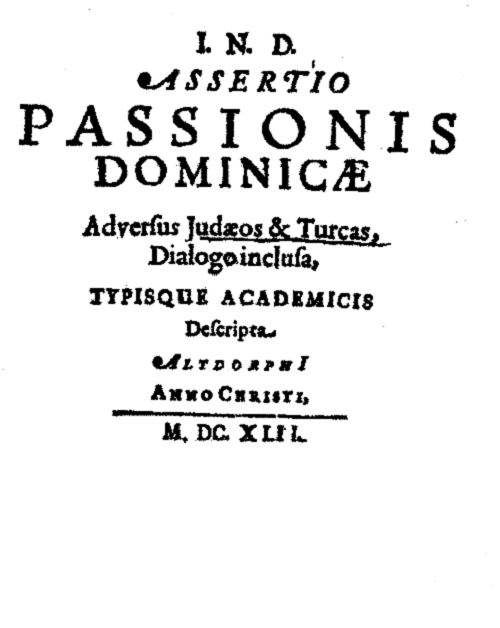
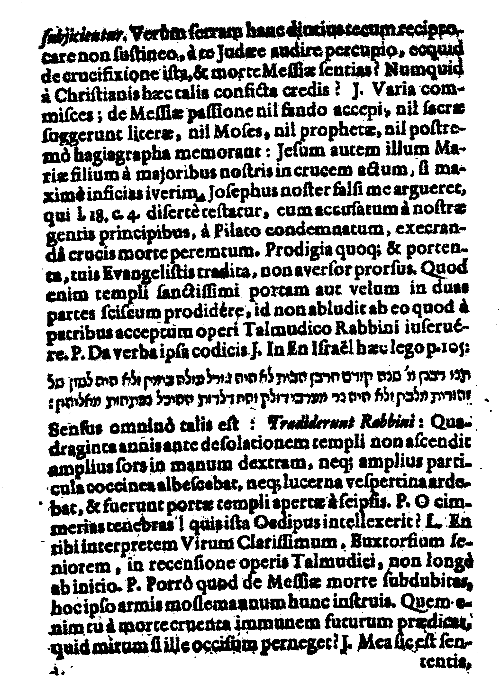
 

Assertio passionis Dominicae adversus Judaeos & Turcas is primarily in Latin with very limited Hebrew and slightly more Arabic text. Several Hebrew sources are referenced. Among them “שלחן ערוך tractatu ארוך חיים Hilcot תשעה באב ושער תעניות.” There are only two full Hebrew passages, both set in rabbinic letters, as well as several brief lines in square letters. The passages, from Ta’anit 5b-6a and Yoma 39b respectively, with Latin translation and commentary, are:

He replied: Let me tell you a parable – To what may this be compared? To a man who was journeying in the desert; he was hungry, weary and thirsty and he lighted upon a tree the fruits of which were sweet, its shade pleasant, and a stream of water flowing beneath it; he ate of its fruits, drank of the water, and rested under its shade. When he was about to continue his journey, he said: Tree, O Tree, with what shall I bless thee? Shall I say to thee, ‘May thy fruits be sweet’? They are sweet already; that thy shade be pleasant? It is already pleasant; that a stream of water may flow beneath thee? Lo, a stream of water flows already beneath thee; therefore [I say], ‘May it be [God’s] will that all the shoots taken from thee be like unto thee’. So also with you. With what shall I bless you? With [the knowledge of the Torah?] You already possess [knowledge of the Torah]. With riches? You have riches already. With children? You have children already. Hence [I say], ‘May it be [God’s] will that your offspring be like unto you.’

Our Rabbis taught: During the last forty years before the destruction of the Temple the lot [For the Lord] did not come up in the right hand; nor did the crimson-coloured strap become white; nor did the westernmost light shine; and the doors of the Hekal would open by themselves.”[7]

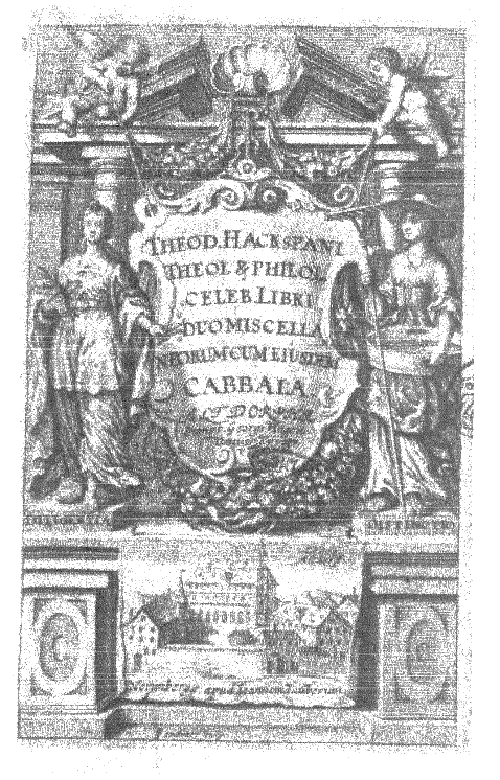
Miscellaneorum Sacrorum libri duo. Another Hackspan title published in Altdorf, this in 1660, is Miscellaneorum Sacrorum libri duo: quibus accessit ejusdem Exercitatio de Cabbala Judaica, a translation of two miscellaneous sacred books (17 cm.: 5, 453, [33] pp.), printed by Georgii Hagen, typos & Sumptibus  Universitatis Typographi together with Johannum Tauberum, Bibliopolam.
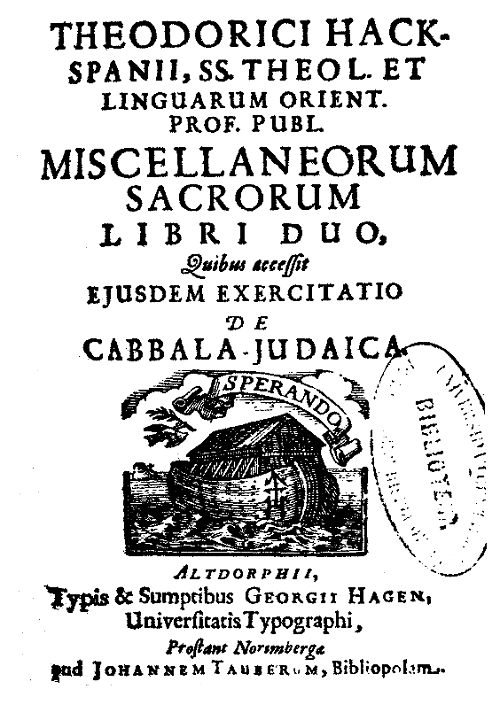
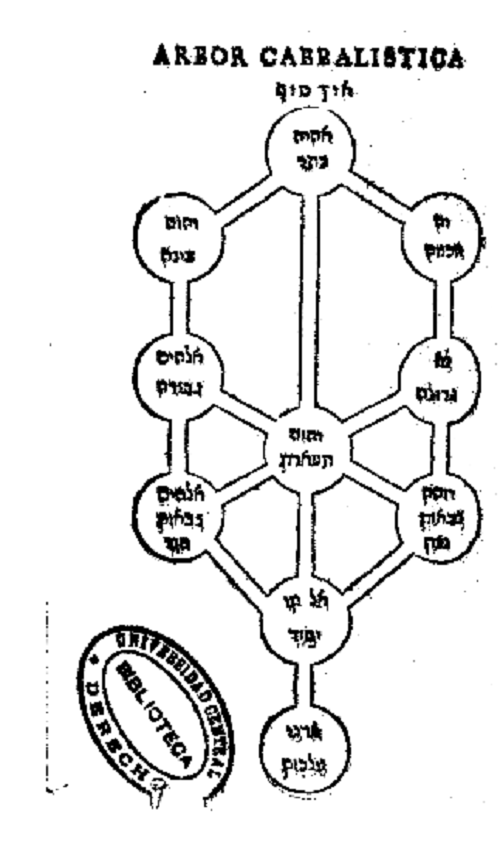
Miscellaneorum Sacrorum libri is a Latin introductory work comprised of introductions to Bible and Kabbalah, the latter section, from pp. 282-453, entitled “Cabbalae Judaicae brevis exposition.”  Miscellaneorum Sacrorum libri duo was has two lead title-pages (above) and, in the Kabbalistic section, a diagram of the tree of life which enumerates and displays the sephirot (emanations).
Here too the text is primarily Latin with varying amounts, but generally brief Hebrew, including quotes from the Talmud and other varied Hebrew sources. For example (p. 417) “CXXXII. Nostra aetate quoque familia in scriptus eorum occurrunt (In our time in the writings of these men, too, was met by the family) Kimchi in Obadiam scripit” followed by seven lines of Hebrew beginning ארץ אדום אינה היום לבני אדום כי האומות נתבלבלו רובם הם בין אמונת בנוצרים . . . (Today the sons of Edom, because the nations were confused, are mostly Christians) . . . . Terra Idumea hodie non est filiorum Edom: nam populi confusi sunt (Edom today is the rule (that is the example) for the people were mixed up.

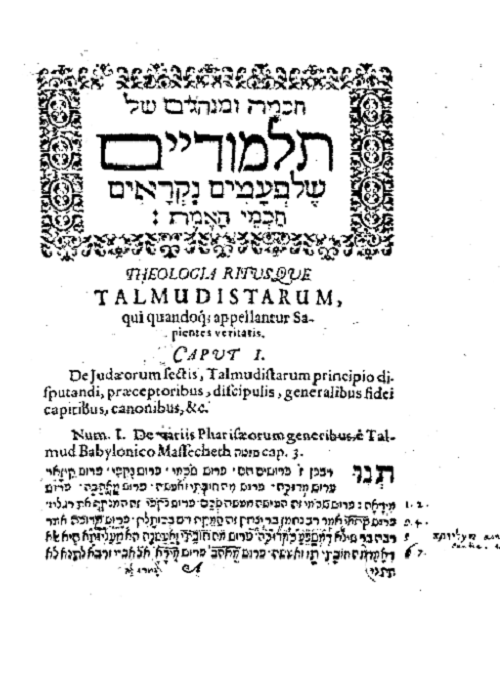
Theologiae talmudicae specimen. Yet another work by Theodricus Hackspan is Theologiae Talmudicae Specimen, certis de causis abruptum: ac si omninò res ita ferat, suo tempore continuandum. Theologiae Talmudicae Specimen (undated, 154 pp.), also printed by Georgii Hagen. The text of Theologiae Talmudicae Specimen is almost entirely in Hebrew, excepting Latin headers and marginal references. Despite the fact that Theologiae Talmudicae Specimen is almost entirely in Hebrew, in contrast to the other Hackspan titles noted here, it is set to read from left to right as if in Roman letters.
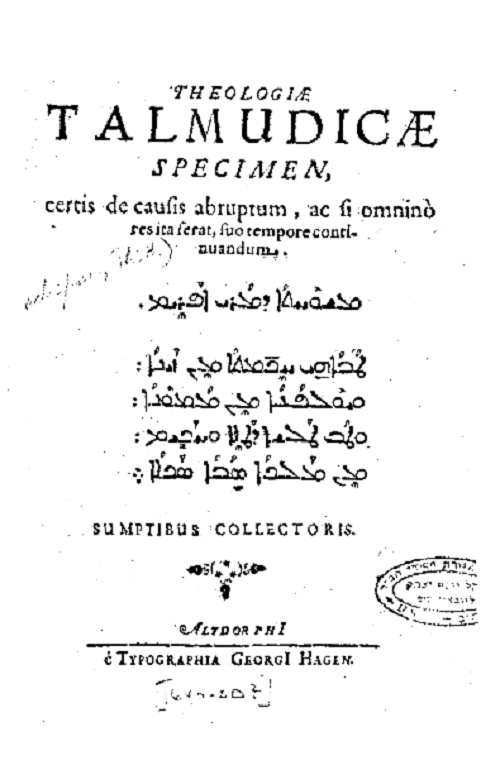
II

Sefer Nizzahon. The first Jewish title in our series published in Altdorf is R. Yom Tov Lipmann Muelhausen’s (d. 1459) Sefer Nizzahon (1644). This, the first printed edition of Nizzahon, was published in quarto format (40: [14], 512, 24 pp.), It is a polemic defense of Judaism and refutation of Christianity, here with a Latin translation by Theodore Hackspan, It was published so that Christians might be able to attempt to refute its arguments.

Muelhausen was one of the leading rabbinic figures of his time and a dayyan in Prague. His name, Muelhausen, likely derives from an earlier family residence in Muelhausen, Alsace. He studied under R. Meir ben Baruch ha-Levi (c. 1320-1390), Sar Shalom of Neustadt (14th cent.), and R. Samson ben Eleazar. In 1389, Muelhausen was one of a number of Jews incarcerated after an apostate named Peter accused them of defaming Christianity. In addition to his great rabbinic erudition, Muelhausen knew Latin and was familiar with Christian literature, making him a formidable polemicist. He was a prolific writer, his other works are on halakhah, philosophy, aggadah, piyyutim, and Kabbalah. In preparing Nizzahon Muelhausen utilized earlier Jewish polemical works, including an earlier thirteenth century Sefer Nizzahon Yashan (Nizzahon Vetus), with which this work is not to be confused. The effectiveness of Muelhausen’s Nizzahon may be gauged by the appearance of additional Latin editions and bitter attempts at refutations.
In a disputation in which Muelhausen represented the Jews he is reported to have been completely effective in his arguments, with the result that eighty Jews were martyred but Muelhausen miraculously survived.[8] Soon afterwards, in 1390, Muelhausen wrote Sefer Nizzahon for other Jews who had to respond to challenges from Christians. Nizzahon was copied but remained in manuscript until the publication of this edition, as the Church prohibited Jewish possession of a copy.

Christian scholars attempted to print Nizzahon for many years but were unable to obtain a manuscript. In 1644, Theodor Hackspan was successful in getting a copy. He had looked for a Nizzahon for a long time without success until he was informed that a rabbi in the neighboring small city of Schnattach had a copy but would not show it to anyone. Hackspan, together with some friends, paid an unwelcome visit to the rabbi, as if to engage him in a dispute. In the heat of the debate the rabbi took out his hidden manuscript of Nizzahon to look into it. Hackspan immediately seized the book from the rabbi’s hands, ran off with it to his carriage, and returned with it to Altdorf. Then, with a few of his students, they immediately copied the book and soon after printed the editio princeps of Sefer Nizzahon. Ora Limor and Israel Jacob Yuval Shoulson write that Hackspan printed Lippman’s text with care, not making any deliberate changes or alterations. Nevertheless, due to the poor knowledge of Hebrew of his “scribes . . . the book is full of mistakes, especially minor errors.” Meyer Waxman remarks that in his Latin introduction Hackman”attempts to refute Lippman in a dignified manner. Others, however, were not so generous.” [9]
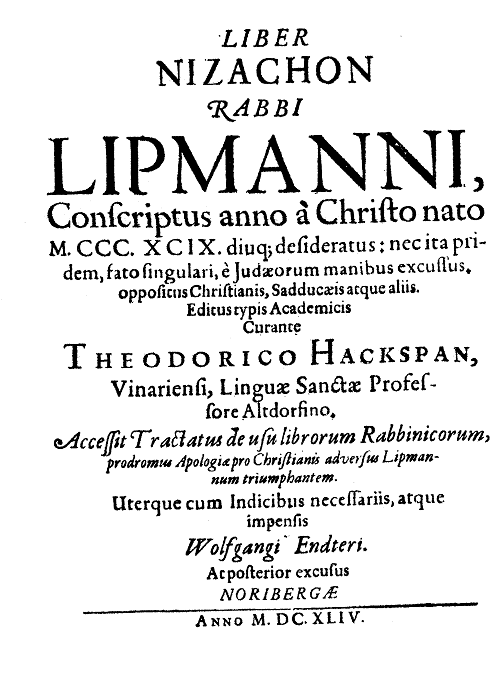
 

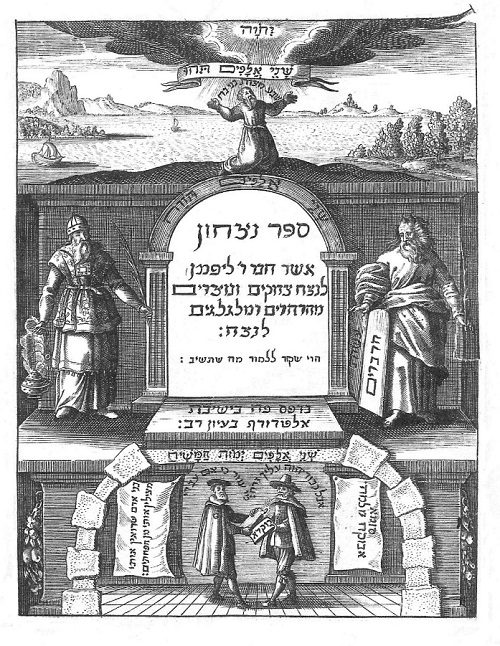
Nizzahon has an engraved Hebrew title page (above) followed by a Latin title page, which begins Liber Nizachon rabbi Lipmanni. . . .[10] Next is a dedication to Dn. Johan-Jodoco from Hackspan, introductions, a table of contents, and the Hebrew text set in a single column in rabbinic letters with marginal biblical references. Nizzahon is divided by the days of the week, further organized by books of the Bible, and subdivided into 354 sections, representative of the lunar year. These sections, not in order in the book, are refutations of Christian arguments (66 sections), explanations of dubious actions by the righteous in the Bible (39), explanations of difficult verses (41), reasons for precepts (34), refutations of the arguments of skeptics (55), against heretics and Karaites (47), and concluding with sixteen Jewish principles (48) to be read on Shabbat. Muelhausen refutes the Christian concepts of the Messiah, Immaculate Conception, and original sin. The Latin portion of the volume, printed in Nuremburg, begins on p. 211 and is paginated from right to left.[11]

Nizzahon was printed by Wolfgang Endter (1593 – 1659), a member of the well-known Nuremberg publishing family. The Hebrew title-pages states that it was printed in Altdorf, the Latin title-page gives Nuremberg at the place of publication. Nizzahon was reprinted in Altdorf in 1681 as part of Wagenseil’s Tela Ignea Satanae (below). The first Jewish edition of Nizzahon was published by Solomon Proops in Amsterdam (1709).

III

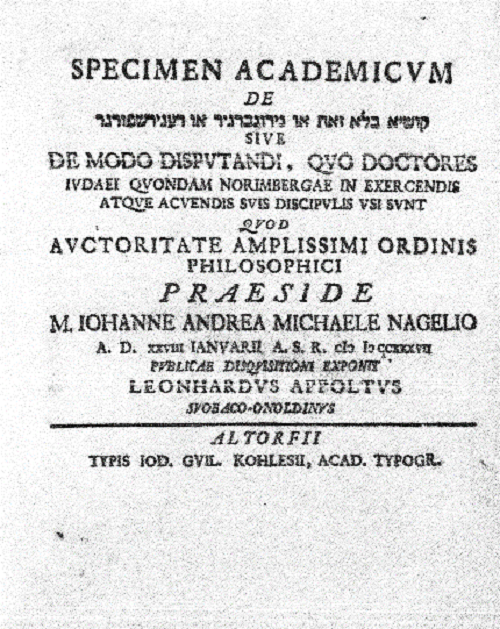
Kushya belo Zot o Niremberger o Regensburger.
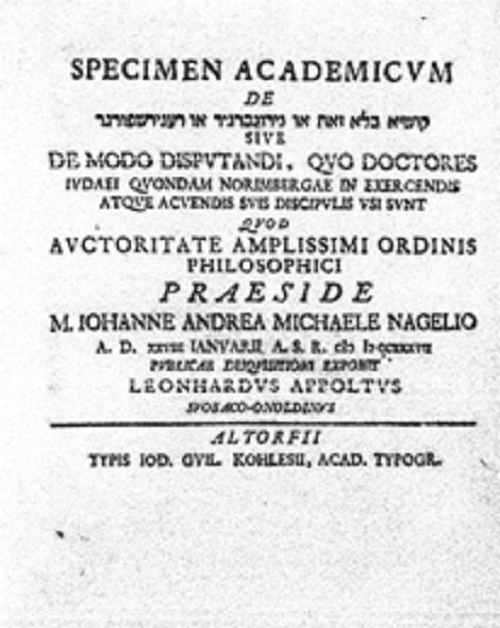
Another work with Hebrew attributed to the Altdorf press was Kushya belo Zot o Nuremberger o Regensburger, a relatively small work (19 cm. 24 pp.), printed in 1670. This very rare work was described in an auction catalogue, the entry stating,

Kushya belo Zot o Niremberger o Regensburger

A composition regarding Talmudic disputation and the ‘chilukim’ method of the Ashkenazim by Leonard Appoltus, supervised by Prof. Johanne Andre Michael Nagelio.

Altorf, [c. 1670].

In Latin with segments in Hebrew.

24 p. 19 cm. Good condition. ‘Blo Zot’, Nirenburger’ and and ‘Regensburger’ are different types of questions that it was usual to ask in the ‘chuilukim’ method.

Very rare. Not in the Jerusalem National Library.

o.b $300     $400/700[12]

From the sale results sheet it appears that this item did not sell.

IV

In 1674 Christoph Wagenseil (1633-1705), professor of Oriental languages at the University of Altdorf from 1667, succeeded Hackspan, becoming the most prominent Christian-Hebraist in Altdorf. Wagenseil, learned his Hebrew from Enoch Levi, a Viennese Jew, and Jewish studies from R. Samuel Issachar Behr ben Judah Moses Eybeschuetz Perlhefter, (d. after 1701), a Prague scholar, kabbalist, and instructor in Hebrew in the University of Altdorf. Perlhefter was the author of Ohel Yissakhar, Ma’aseh Ḥoshen u-Ketoret, and Ba’er Heitev; served as rabbi in Mantua, leaving there over a dispute concerning the pseudo-Messiah Mordecai of Eisenstadt, a follower of Shabbetai Zevi, whom Issachar Behr had initially supported. He subsequently returned to Prague where he held the position of dayyan.

Perlhefter’s wife, Bella, taught Wagenseil’s daughter dancing and music.[13] Elisheva Carlebach elaborates, writing that Wagenseil, as did other Christian-Hebraists, often pressured the Jews who assisted them to convert. In this context, Wagenseil, unable to influence Perlhefter who was residing at the time in Altdorf, turned to Bella, then in Schnattach, inviting her to join his household for a family celebration. Bella responded, in literate Hebrew, that as she had a small child, whom she could not leave, “And if I carry him with me the cold is great, the snow is high, and a tiny child cannot tolerate the cold, for he or she has not been out of the house from the day of his or her birth and is not accustomed to the cold [Mrs. Perlhefter changed genders in mid sentence].” [14]

Wagenseil traveled widely as a youth, serving as a private tutor, and while in North Africa, Wagenseil acquired Hebrew manuscripts. Although “tarred” as an anti-Semite, together with other German Hebraists in the nineteenth century, Wagenseil was an accomplished Hebraist and, despite his opposition to Jewish beliefs, often defended Judaism against its more virulent enemies and their baseless charges. David Malkiel reports that Wagenseil had cordial relations with Jewish contemporaries.[15] Assessments of Wagenseil vary, from Heinrich Graetz, that “he was a good-hearted man, and kindly disposed towards the Jews,” to Frank E. Manuel, for whom he is one of three Christian-Hebraists, with Shickard and Eisenmenger, who “used their learning to cast a glaring light on those texts in the Talmud and later Jewish writings that were either blasphemous or full of hatred for Christians.” Wagenseil confuted Christian charges that the Talmud was blasphemous, senseless and jumbled, arguing that in it were matters of morality, wisdom, and medical advice; he also opposed blood libels. Furthermore, he maintained that Catholic censors had distorted the Talmudic text, particularly of Avodah Zarah.[16]

Wagenseil is credited with assembling the first comprehensive study of Jewish observances and ceremonies by a Christian. Jonathan I. Israel notes that Wagenseil considered much of what he found superstitious and absurd, and that his motivation was to bring Jews to Christianity. Nevertheless, “for all that an unmistakable admiration for Jewish life and Jewish life-style insistently creeps through.” He quotes Wagenseil, who wrote in the forward to the apostate Friedrich Albrecht Christiani’s Der Jüden Glaube und Aberglaube (Leipzig, 1705),

that they show far more care, zeal, and constancy in all this (their religious duties) than Christians do in practicing their true faith, and that, furthermore, they are far less given to vice; rather they possess many beautiful virtues, especially compassion, charity, moderation, chastity, and so forth . . .[17]

Sotah (the suspected adulterous woman) has numerous illustrations, several being full page, and a detailed attractive copper-plate title page of the Sotah (the wife accused of adultery) being taken by the priests to be tested. The volume opens with a full page depiction of the Sotah being taken to be tested by the priests.

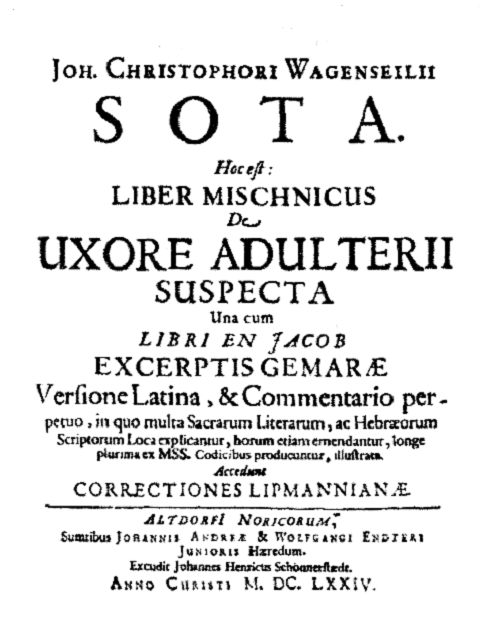
The verso has verses in Latin from Psalms and the Christian Bible. The title page in red and black, begins, Hoc est: liber mischnicus de uxore adulterii suspecta (this book is a work concerning a woman suspected of adulterous behavior). Reading from left to right, the volume begins with considerable prefatory material, including several indices, one in Hebrew, correctiones Lipmannianae (10-81), corrections to Hackman’s edition of the Sefer ha-Nizzahon based on two other manuscripts he was able to obtain, and the text, which has separate pagination.
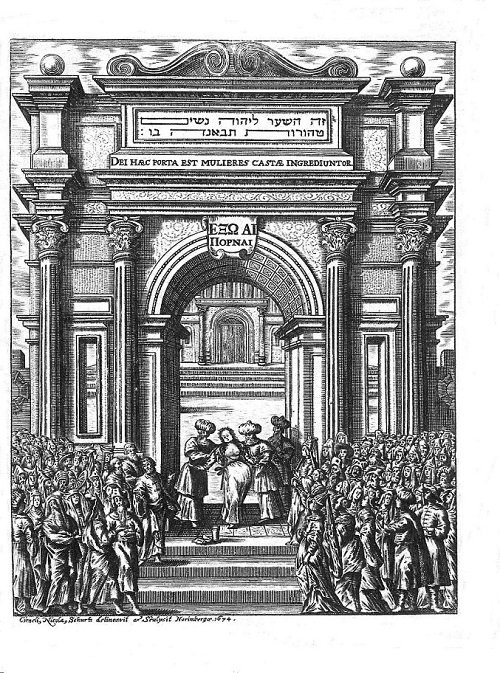
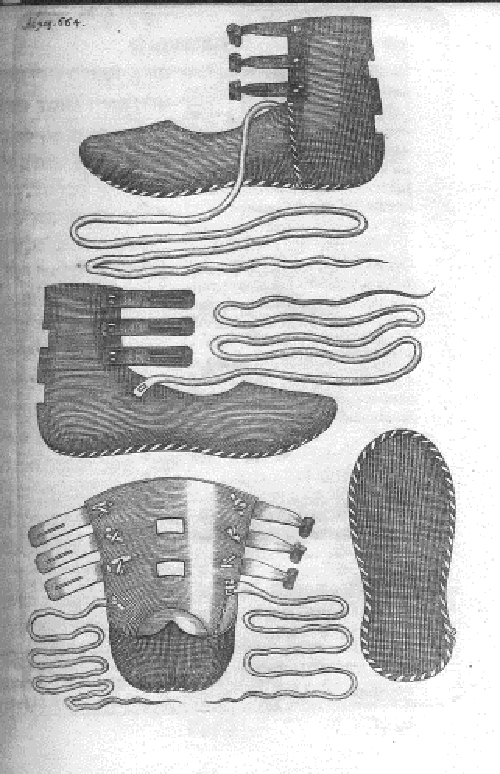
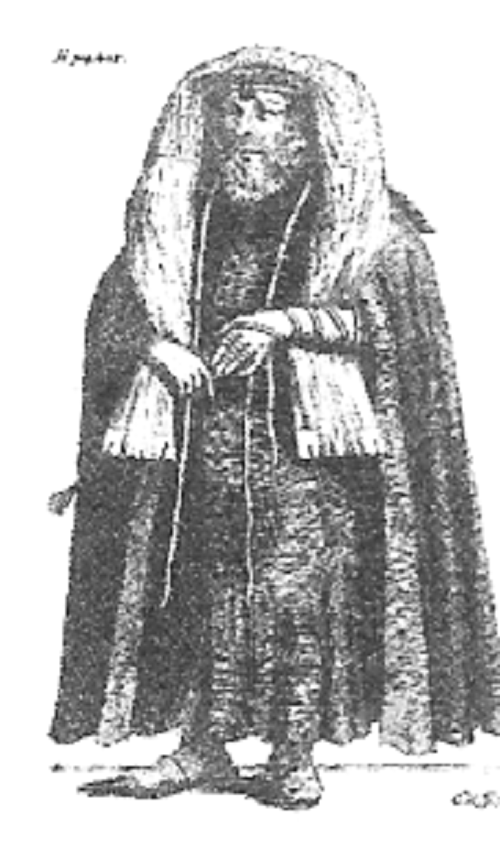
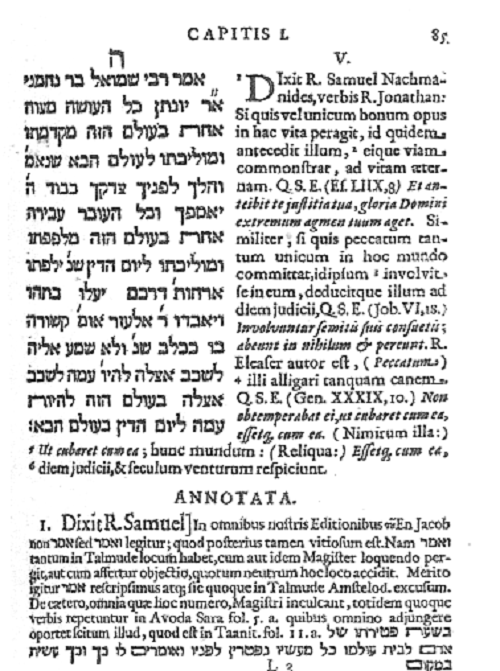
Within the text the Mishnah is always in the left margin in square unvocalized Hebrew, the translation in the right column, accompanied by an extensive Latin commentary with occasional Hebrew, with excerpts from the gemara, including most of the aggadah in the Ein Ya’akov, on this tractate. The volume has numerous illustrations, several being full page. Among them are depictions of the priest wearing talit and tefillin with their straps for the head and arm, magen davids, halizah shoes, coins, and an undressed woman with skull and cross. Negaim was the next tractate translated by Wagenseil, to prove that the Talmud contained valuable and interesting material on medicine.[18]
Tractates Avodah Zarah and Tamid. Another translation of Mishnayot tractates, this of Avodah Zarah and Tamid, prepared by the Christian-Hebraist Gustavo Peringero (Gustav von Lilienbad Peringer, 1651-1705), a student of Johann Christoph Wagenseil. Peringero, (1633–1705), was professor of Oriental languages at Upsala (1681- 1695) and afterwards librarian at Stockholm. Charles XI, king of Sweden, who reputedly had an extraordinary interest in Jews and even more so in Karaites, sent Peringero to Poland to learn about the latter and perhaps to attempt to convert the Karaites to Christianity, for, as Graetz notes, they did not have “the accretion of traditions, and were said to bear great resemblance to the Protestants,” nor were they “entangled in the web of the Talmud.” [19]
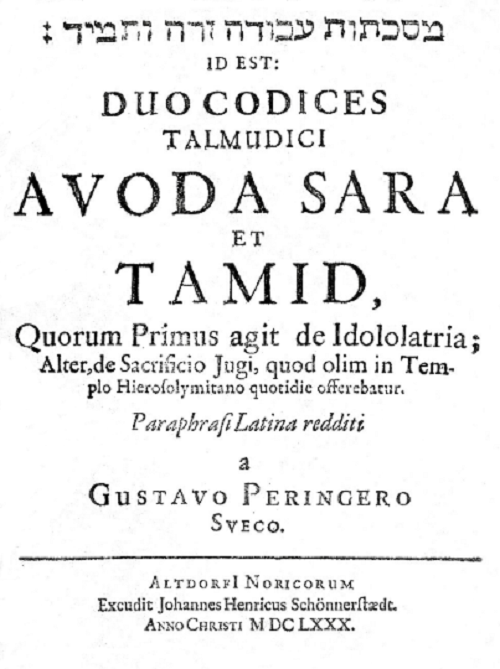
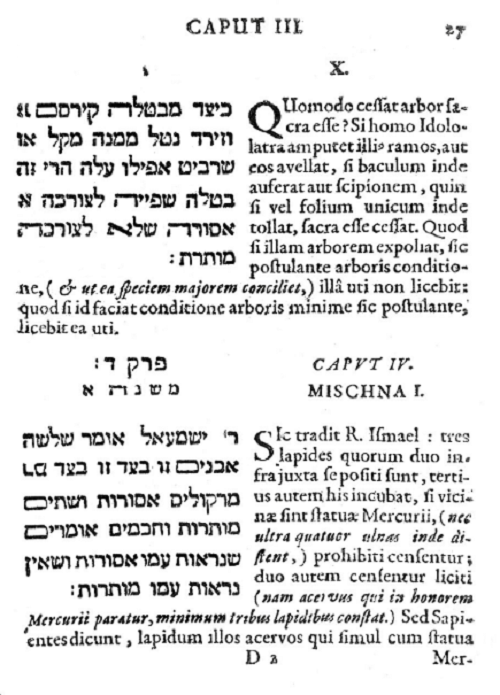
This edition of Mishnayot of tractates Avodah Zarah and Tamid in Hebrew with accompanying Latin translation and annotations by Peringero was published in 1680 by Johannes Henricus Schönnerstadt in a small octavo format (80: [7], 78 pp.).The title page of this volume is, excepting a Hebrew header, entirely in Latin. It states that it is comprised of two codices, primarily about idolatry, and secondly about sacrifices in the time of the Temple. The title page is followed by a dedication to Dominae (Mistress) Ulricae Eleonorae, wife of Charles XI, a preface in Latin with occasional Hebrew, and then the text.

Reading from left to right, the Mishnayot are in the left column, the integrated translation and glosses in the right column. Avodah Zarah concludes on p. 43 and Tamid begins immediately after on the following page. Peringero’s translation of Avodah Zarah was inserted by Wilhem Surenhusius (1666-1729) in his Versio Latina Mischnae (1698-1703). In addition to these tractates, Peringero also translated Abraham Zacuto’s Sefer Yuhasin, portions of Maimonides’ Mishneh Torah (Upsala, 1692), and several other works into Latin. He was also the author of Dissertatio de Tephillin sive Phylacteriis (Upsala, 1690). [20]

In addition to tractates Avodah Zarah and Tamid the printer, Johannes Henricus Schönnerstadt, also published separate editions of Shekalim and Sukkah at this time, also with Latin, but not translated by Peringo.

IV

Returning to Wagenseil, we come to two very different works. The first, although chronologically the later of the two, and not an Altdorf publication, is Belehrung der Judisch-Teutschen Red-und Schreibart (An Instruction Book in the Method of Speaking and Writing Judeo-German, Koenigsberg, 1699). This is, as the title suggests, a Yiddish grammar with a “loose Yiddish version (with German translation) of Hilkhot Derekh Eretz,” a rabbinic work on ethical behavior. Also included is a Yiddish account (with German translation) of the Fettmilch uprising in 1614 in Frankfurt on the Main, as well as selections from tractate Yevamot on levirate marriage as well as the entire tractate Neg’aim on leprosy with notes, this in order to aid in teaching Hebrew.[21]

The second and Wagenseil’s most famous collection of Jewish polemical literature, Tela ignea Satanae, in which Wagenseil, among other subjects, includes his responses to Sefer Ha-Nizzahon. Wagensiel travelled widely, through Spain and into Afric Belehrung e a, to collect these manuscripts.[22]

Tela ignea Satanae. Published in 1681 by Wagenseil in quarto format (40: [2], 635, [12]; 60; 260; [2], 100; 45; 480, [1] pp.) Tela ignea Satanae, perhaps Wagenseil’s best known work, is comprised of six polemical anti-Christian works, almost all not previously printed.
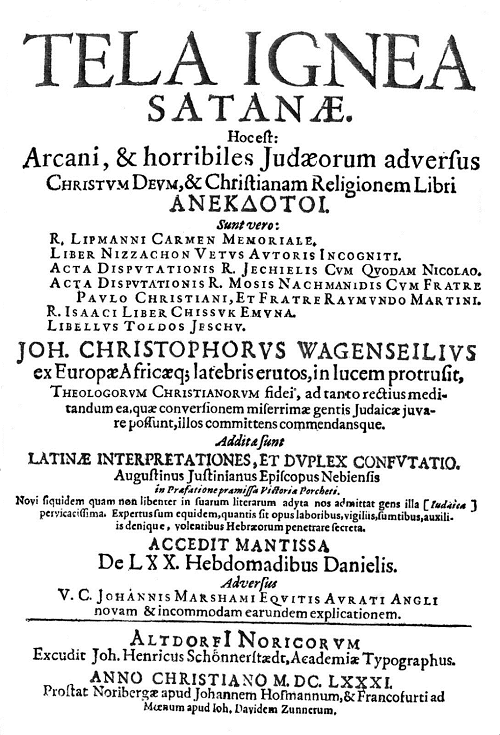
          

The first title page, printed in red and black, has the full title of Tela ignea Satanae. Hoc est: Arcani, et horribles Judaeorum adversus Christum Deum, et Christianam Religionem Libri (Flaming Arrows of Satan; that is, the secret and horrible books of the Jews against God and the Christian religion). After the verse the title-page states,

John Christopher Wagenseil thrusts these forward into the light, bringing them together and entrusting them, dug out from the hiding places of Europe and Africa, to the faith of Christian Theologians, that they may more rightly consider those things, which are able to aid the conversion of that wretched Jewish race. Added are: Latin Interpretations, and Two Confutations. Augustine Justianus Bishop at Nebiensis in the Forward Preface of Victoria Porchetus. I know how unwillingly that most stubborn (Jewish) race admits us into the most secret parts of their literature. I have tried by all means, however great the task, with toil, sleeplessness, expense, with willing helpers finally, to penetrate the secrets of the Hebrews.[23]

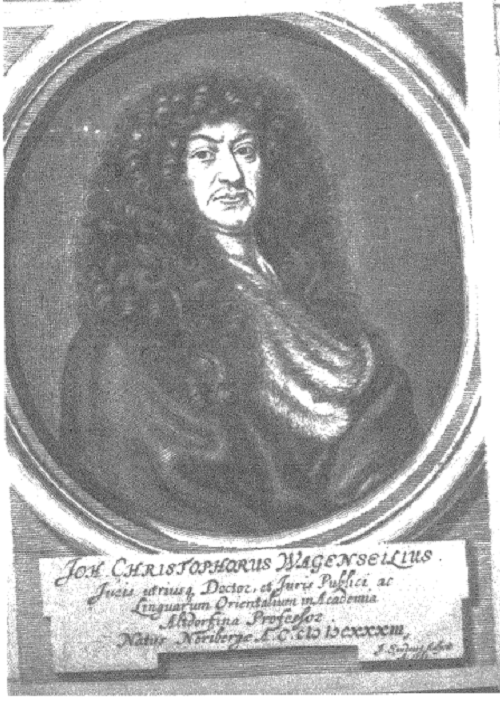
The facing page has a full front-piece portrait of Wagenseil. In two volumes, the work begins with a Latin introduction, followed by the six books, each with its own title page with Hebrew headers and Latin text, a Latin introduction (refutation), and then the text in two columns comprised of facing Hebrew and Latin.

That these books were not previously printed but rather circulated among Jews in manuscript only, or where printed were done so by Christian Hebraists with Latin translation and refutation, is due to their polemic and inflammatory content. As a result, these books today exist with variant texts. Tela ignea Satanae, as noted above, is comprised of six independent books, listed below, several described afterwards in somewhat greater detail:

Nizzahon, Polemic in defense of Judaism by R. Yom Tov Lipmann Muelhausen. Printed previously in Altdorf/Nurenburg, 1644 (see above).

Nizzahon, anonymous polemic in defense of Judaism.

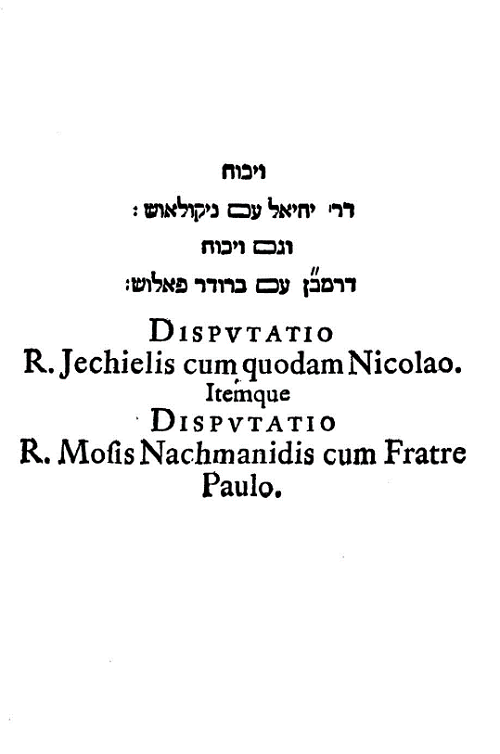
Vikku’ah Rabbenu Yehiel mi-Paris, record of the disputation between R. Jehiel of Paris and Nicholas (dispute over the Talmud in Paris in 1240, below, 1681).

Vikku’ah ha-Ramban im broder Paulus, record of the disputation between the Ramban (Moses ben Nahman, Nahmanides) and the apostate Pablo Christiani in 1263 before King James of Aragon.

Hizzuk Emunah, anti-Christian polemic by the Karaite scholar, Isaac ben Abraham Troki.

Jeshu, negative and, from a Christian perspective, highly blasphemous account of the life of Jesus.[24] [25]

Vikku’ah Rabbenu Yehiel im Nicholas Jehiel ben Joseph of Paris. This is a record of the disputation held in Paris on Monday, June 25, 1240, attributed to R. Jehiel ben Joseph of Paris. Jehiel, one of the leading Ba’alei Tosafot, was a student of R. Judah ben Isaac (Sir Leon), whom he succeeded as rosh yeshivah in Paris.  Among Jehiel’s students was his son-in-law, R. Isaac of Corbeil (Sefer Mitzvot Katan, Semak). Jehiel was the author of tosafot quoted by many rabbis and included in those tosafot known as our tosafot. He is also frequently referenced in the Torah commentary Da’at Zekenim. Because of his prominence Jehiel was selected as a primary representative of the Jewish community in the disputation over the Talmud resulting from the charges leveled against it by the apostate Nicholas Donin. The record of that disputation, generally known as Vikku’ah Rabbenu Yeh iel mi-Paris, is the third work in Wagenseil’s Tela ignea Satanae (above, 1681).

        The Vikku’ah follows the same pattern as the other works in Tela ignea Satanae, that is, it has a bilingual Hebrew-Latin title page, followed by a Latin preface, and the text in two columns in facing Hebrew and Latin. Donin’s denunciation of the Talmud included thirty‑five charges which primarily stated that Jewish emphasis on the Oral Law was in itself a blasphemy against the holiness of Scriptures recognized by Jew and Christian alike; the Talmud overtly fostered anti‑Christian attitudes and contained blasphemous statements offensive to Christianity; and that it was irrational, and morally and intellectually offensive.
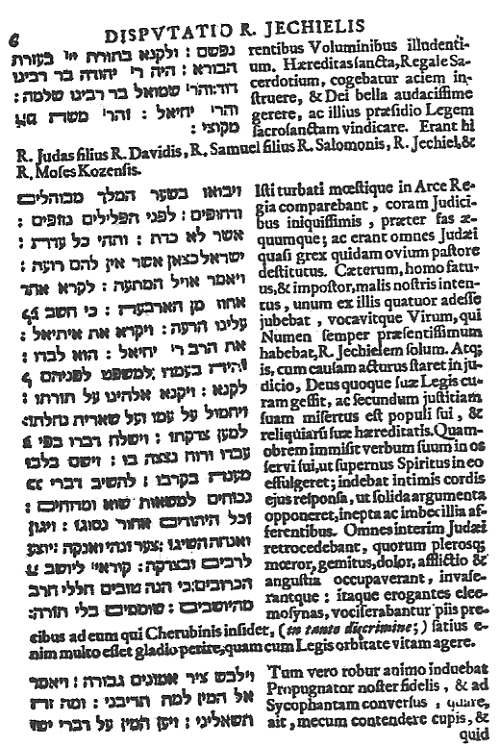
          

        The trial was presided over by the Queen Mother Blanche, who was in an advanced stage of pregnancy. The judges were high Church dignitaries, such as the Archbishop of Sens, the Bishop of Paris, and the Chaplain to King Louis IX, none of whom knew Hebrew. Jehiel, although the primary Jewish spokesman, was assisted by R. Moses ben Jacob of Coucy (Semag), R. Judah ben David of Melun, and R. Samuel ben Solomon of Chateau‑Thierry (all 13th century). Although Jehiel defended the Talmud, noting inter alia, that Donin was the real heretic, justifiably excommunicated by the Jewish community fifteen years before the debate. His arguments were to no avail, for the matter had been predetermined from the outset. Even before the court’s formal decision was rendered, it had been decided to burn the condemned books. In June, 1242, twenty‑four wagon loads of Hebrew books, containing thousands of volumes, were seized and burned in Paris. Jehiel remained for some time in Paris, teaching students from memory. In 1260, Jehiel went up to Eretz Israel, effectively ending the period of the Ba’alei Tosafot.[26]

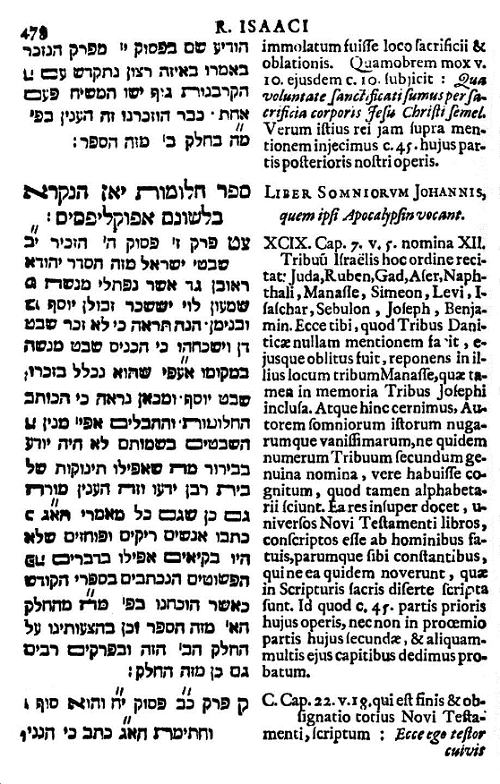
Hizzuk Emunah. Anti-Christian polemic by the Karaite scholar, Isaac ben Abraham Troki (c. 1533-c. 1594). Hizzuk Emunah is the fifth work in Wagenseil’s Tela ignea Satanae below, 1681). Troki is known by his birthplace, Troki (Trakai), capital of Lithuania until 1323 and home to the most important Karaite community in Lithuania. He was, from the age of twenty, the secretary-recorder of the Karaite General Assembly which met there in 1553. Author of a work on shehitah and religious poetry, Troki became the foremost Karaite scholar in Eastern Europe, serving as dayyan to both Karaite and rabbinic Jews. He studied Bible and Hebrew studies under the Karaite scholar Zephaniah ben Mordecai, and had Christian teachers for Latin and Polish literature. Engaging in dialogues with Christian clergyman of different persuasions, Troki became fluent in Polish and Latin and familiar with their theology and arguments against Judaism. It was those conversations that prompted Troki to write Hizzuk Emunah. Written in the last year of his life, Hizzuk Emunah was completed by Troki’s student, Joseph ben Mordecai Malinovski.
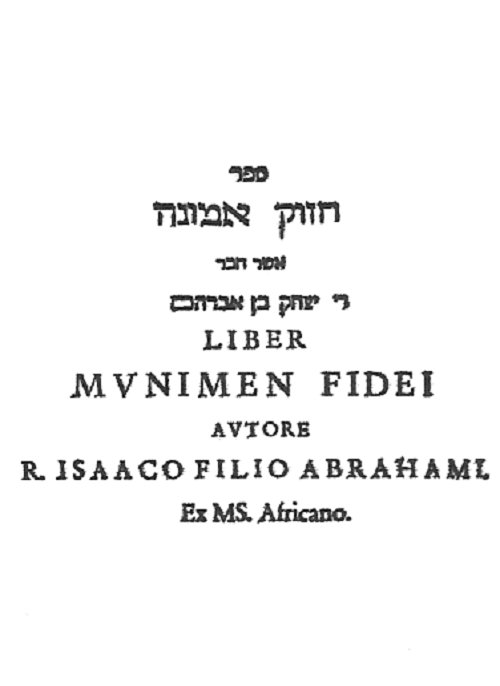
Wagenseil obtained a copy of the manuscript in 1665 on a trip to Ceuta, North Africa. He translated Hizzuk Emunah into Latin, in which form it was widely used not only by Christian missionaries but also by opponents of Christianity, such as atheists, French philosophes, among them Voltaire. Hizzuk Emunah follows the same format as the other polemic works in Tela ignea Satanae, that is, it has its own Hebrew-Latin title page, a Latin introduction, and then the text, in two facing Hebrew and Latin columns. The book, in quarto format, is in two parts comprised of ninety-nine chapters. In the first chapter, Troki begins by questioning the authenticity of the Christian messiah, arguing against his pedigree, acts, the time in which he lived, and the fact that he did not fulfill the promises expected of the Messiah.

As an example of the first argument, Troki writes that he cannot be of Davidic descent due to the concept of virgin birth and that even apart from that, the relationship of Joseph to David is wanting in proof. He also notes contradictions in the Christian Bible on that and other subjects, and compares the Hebrew Bible and Gospels. Most of Troki’s arguments are based on biblical texts, accounting for its effectiveness against Christian arguments. Nevertheless, he also utilizes rabbinic sources, so that Hizzuk Emunah has been accepted by rabbinic authorities, perhaps unique for a Karaite work.[27]

        Hizzuk Emunah is considered one of the most effective polemic works. Although circulated widely in manuscript, Hizzuk Emunah was not printed by and for Jews until the Amsterdam edition of 1705. It has been frequently reprinted, translated into Yiddish (Amsterdam, 1717), English by Moses Mocatta (London, 1851), German (Sohran, 1865), and Spanish as Fortificación de la Fe (1621), extant in manuscript.

Wagenseil would publish several additional Hebrew/Latin collections and works, among them Exercitationes sex varii argumenti (1697); Denunciatio Christiana de Blasphemiis Judæorum in Jesum Christum (1703); and Disputatio Circularis de Judæis (1705) as well as several titles published elsewhere. As might be expected, Wagenseil’s influence in this field was considerable, his students also becoming Christian-Hebraists, for example, Peringer above, and our final Altdorf imprints, the first by a student of Wagenseil.
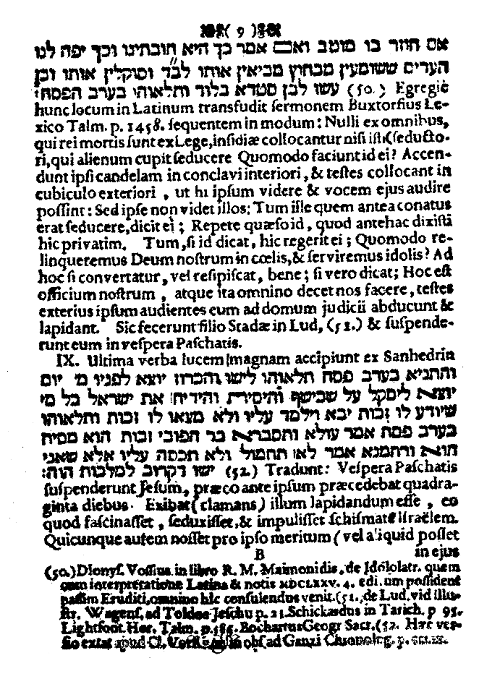
Jesus in Talmude. Our final works are Jesus in Talmude and Der Jüdische Theriak. The former is  dissertation submitted at the University of Altdorf by Rudolf Martin Meelführer (Rudolfo Martino Meelführero, 1670–1729) in 1699, and described by Peter Schäfer as “the first book solely devoted to Jesus in the Talmudic literature;” the latter a refutation by R. Solomon Ẓevi Hirsch Aufhausen (Openhausen, Ufenhausen, of Aufhausen) in Yiddish of an anti-Jewish work. Meelführer was also a Christian-Hebraist, teaching in Altdorf and afterwards as adjunct in philosophy at Wittenberg. The dissertation is important as it was the first study fully devoted to the subject. Meelführer, in contrast to Wagenseil, was almost immediately forgotten.[28] Here too the work is primarily in Latin, but includes examples of the Talmudic text in Hebrew, from early editions of the Talmud, as the later editions available to Meelführer were censored and omitted many of the passages he refers to. Meelführer appears to primarily rely on secondary sources for Talmudic entries, notably R. Gedaliah ben Joseph ibn Yahya’s (1515-1587), Shalshelet ha-Kabbalah (Venice, 1586).[29] An example of the text brought by Meelführer is Sanhedrin 42a (below), censored from most editions of the Talmud,

On the eve of the Passover Yeshu was hanged. For forty days before the execution took place, a herald went forth and cried, ‘He is going forth to be stoned because he has practiced sorcery and enticed Israel to apostasy. Anyone who can say anything in his favor, let him come forward and plead on his behalf.’ But since nothing was brought forward in his favor he was hanged on the eve of the Passover! – “Ulla retorted: Do you suppose that he was one for whom a defence could be made? Was he not a Mesith [enticer], concerning whom Scripture says, Neither shalt thou spare, neither shalt thou conceal him? With Yeshu however it was different, for he was connected with the government [or royalty, i.e., influential].
Der Jüdische Theriak (the Jewish Medicine) by Zalman Ẓevi Hirsch Aufhausen is a point by point refutation of Jüdischer Abgestreifter Schlangenbalg (The Jewish Serpent’s Skin Stripped) by the apostate Samuel Friedrich Brenz of Ettingen. Converted to Christianity in 1610, Brenz wrote Jüdischer Abgestreifter Schlangenbalg (Hanau, 1614) in “the thirteenth year after my rebirth.”[30] Der Jüdische Theriak, first printed in Hanau in 1615, was reprinted in in Altdorf in 1680 by Henricum Meyer, Academiae Typographu, as a small quarto (40: 36, [1] ff.), the text in old Yiddish set in Vaybertaytsh, a type generally but not exclusively reserved for Yiddish books, so named because these works were most often read by the less educated and women.[31] Given that it is a Jewish refutation of Christian ant-Jewish polemics its publication in Altdorf was likely done for the same purpose as Nizzahon, so that Christians might be able to attempt to refute its arguments.[32] In Jüdischer Abgestreifter Schlangenbalg Brenz collected all of the accusations made against Jews, accusing them of making derogatory and blasphemous remarks against the founders of Christianity and the Church, fostering animosity, and stating that the Talmud permits Jews to cheat Christians.
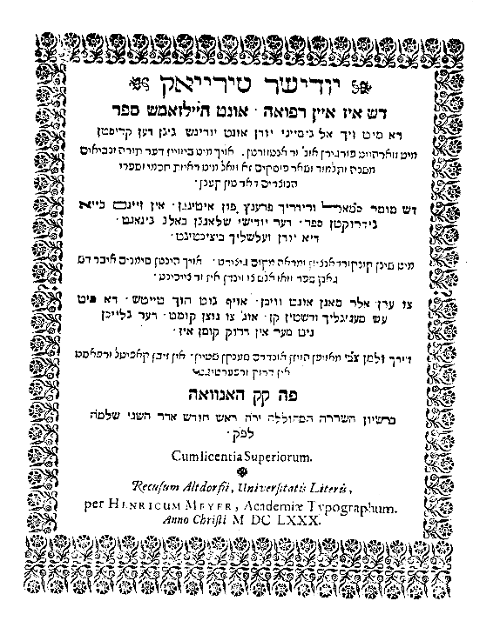
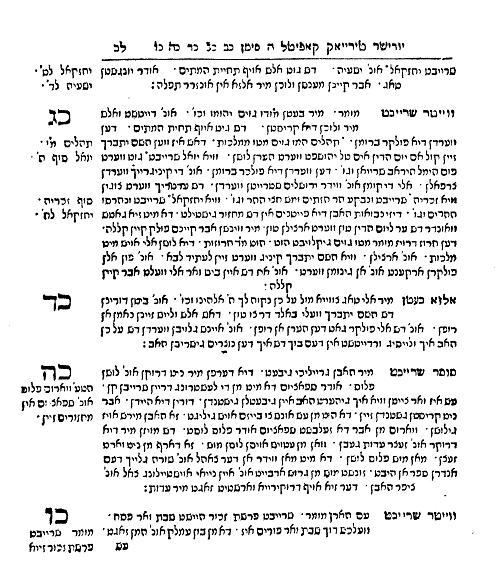
Zinberg notes that there is scant information about Aufhausen and what is known is surmised from remarks in Der Jüdische Theriak. Zinberg conjectures that Aufhausen (b. c. 1565-60) was an itinerant who, driven from his home by “evil Jews” travelled widely, broadening his world-view and culture, knowledgeable with German, knew Luther’s translation of the Bible, and was familiar with Flavious Joseph, Buxtorf the Elder, Pica della Mirandola, and Johannes von Reuchlin on the Kabbalah among others. Furthermore, Aufhausen “displays great knowledge of Talmudic literature, and that he wrote elegant Hebrew is attested to by the poem written in the well known azharot-meter on the front page of the Teryak.” Zinberg infers from Aufhausen’s remarks that he was a shohet and mohel (ritual slaughterer and circumciser) but these professions did not provide well for Aufhausen, his wife, and six children “who were not always well fed.”[33]

Morris M. Faierstein writes that Der Jüdische Theriak is unique, it is the only Jewish response in Yiddish to anti-Jewish polemics by Christians and Jewish apostates in early modern Germany and the only such work printed in Germany.[34] Zinberg quotes Aufhausen that Der Jüdische Theriak is an antidote to the venomous bite of the anti-Jewish snake, that is, Brenz’s work. Aufhausen describes Brenz as “a terrible usurer,” and if one added together all the horses on which he loaned money one could put in the filed a regiment of riders, which is what brought him to baptism, noting that the Jews hated him for his ugly deeds pushing him way with both hands.” Brenz is a “frightful ignoramus and a petty, good for nothing creature, his diatribe lacks any system or order.[35] In his introduction, Aufhausen informs how he came to write Der Jüdische Theriak. Benz’s book was

placed before me, and worthy people waved it under my nose. As a result I called the aforementioned apostate a liar, as I continue to do the present. On Monday, the seventh of Ab, he [Benz] he rode up to my door in a violent manner and threatened me and wanted to kill me. He publicly confirmed the wickedness of his book in front of Jews and Christians, said that it was all true and just and wanted to continue persecuting Jews. However, I sanctified the name of God in response to his desecration of God’s name and called him a liar to his face and swore to write a book against his lies . . .[36]

Der Jüdische Theriak is comprised of seven chapters, each addressing a specific group of accusations. Aufhausen cites numerous examples from the Talmud to show that Jews are commanded to show mercy and friendliness to non-Jews, and those few laws that are not friendly are directed against pagans, not Christians.[37] Der Jüdische Theriak is also directed towards women, for, as Carlebach notes, Christian missionaries had introduced Yiddish into their conversion material to make them accessible to women. Aufhausen refutes their claims writing for “common Jews and Jewesses.”[38] In the final chapters of Der Jüdische Theriak Aufhausen includes an appeal for tolerance advocating equal treatment for all, both Jews and Christians,

I have shown above that [tractate] Baba Kamma and [tractate] Avodah Zarah write: “A heathen who studies Torah and studies the law of Moses is as good as the high priest.” Thus anyone who studies the Law and does not ridicule it, he is an honest person and is highly honored. It is the same whether Christian or Jew. . . .

I had this book printed in Yiddish in the Hebrew alphabet so that someone will know how to respond to Christians in conducive circumstances, and also to understand from this and keep in mind what a great sin it is to deceive Christians, with words or deeds.[39]

The study of Jewish texts by Christian-Hebraists proved to be a passing phenomenon. By mid-eighteenth century the interest of Christian-Hebraists in rabbinic literature and studies had diminished.[40] In Altdorf, in contrast to other locations where, as noted above, Hebrew works, primarily philological and biblical titles and translations of rabbinic works, often theological titles accompanied by glosses contesting the Jewish authors’ positions, were studied by Christian-Hebraists for their own purposes to better understand the sources of Christian theology and to refute Jewish understanding of those works, the emphasis of those studies here was primarily for polemic purposes. Wagenseil, although his object was not always antithetical to Jewish texts, is remembered today as being among the leading exponents of the Christian-Hebraist movement. His works, several described here, as well as those of his contemporaries in Altdorf, represent an attempt by Christian-Hebraist scholars to understand and refute Jewish beliefs. Despite being, from several perspectives, among those of history, a failed and futile effort, it represents an interesting intellectual endeavor.

[1] I am indebted to Eli Genauer for reading the text and his comments, several noted below and to R. Jerry Schwarzbard, the Henry R. and Miriam Ripps Schnitzer Librarian for Special Collections for his assistance. Images are courtesy of the Library of Agudas Chassidei Chabad Ohel Yosef; Yitzhak;Bayerische StaatsBibliothek; the Library of Congress; Hathi Trust; Hebrewbooks.org; and R. Eli Amsel, Virtual Judaica.

[2] The other Altdorf’s are, in Germany, Altdorf, Lower Bavaria, Landshut, Bavaria; Altdorf, Böblingen; Altdorf, Esslingen; Altdorf, Rhineland-Palatinate, Südliche Weinstraße; and Weingarten (Württemberg) or Altdorf: in Swiitzerland, Altdorf, Jura or Bassecourt; Altdorf, Schaffhausen; and Altdorf, Uri: in France, Altdorf, Bas-Rhin” in Poland, Stara Wieś, PszczynaStara Wieś; and Silesian Voivodeship; and in the United States, Altdorf, Wisconsin.

[3] An unanticipated result of the Christian-Hebraists’ efforts, suggested by Eli Genauer in a private correspondence, is that readers of the Christian-Hebraists works might possibly have been influenced in another direction, suggesting that “even though the Christian scholars published these books to show the errors of Judaism, there might have been some people who say “‘hey, the Jews have some pretty good points.’”

[4] Aron Freimann, “A Gazetteer of Hebrew Printing” (1946; reprint in Hebrew Printing and Bibliography, New York, 1976), p. 268; Moshe Rosenfeld, Hebrew Printing from its Beginning until 1948. A Gazetteer of Printing, the First Books and Their Dates with Photographed Title-Pages and Bibliographical Notes (Jerusalem, 1992), p. 64 no. 618 [Hebrew].

[5] Yeshayahu Vinograd, Thesaurus of the Hebrew Book. Listing of Books Printed in Hebrew Letters Since the Beginning of Printing circa 1469 through 1863 II (Jerusalem, 1993-95), p. 23 [Hebrew]. Vinograd notes three additional works, a Mishnayot, printed in 1860, Toldot Jeshu, in a collection of Wagenseil’s works (below), and an undated edition of Hochmah u-Minhag shel Talmidim.ge

[6] John McClintock, James Strong “Hackspan, Theodor” Cyclopedia of Biblical, Theological and Ecclesiastical Literature, ttps://www.studylight.org/encyclopedias/tce/h/hackspan-theodor.html. (New York, 1870).

[7] Translations are from The Soncino Talmud, Judaica Press, Inc. (Brooklyn, NY, 1990).

[8] Israel Moses Ta-Shma, “Muelhausen, Yom Tov Lipmann,:EJ 14, pp. 595-59.

[9] Ora Limor and Israel Jacob Yuval “Skepticism and Conversion: Jews, Christians, and Doubters in Sefer Nizzahon,” in Hebraica Veritas?: Christian Hebraists and the Study of Judaism in Early Modern Europe, Allison P. Coudert and Jeffrey S. Shoulson, editors (Philadelphia, 2004), p. 166; Meyer Waxman, A History of Jewish Literature (1933, reprint Cranbury, 1960), II p. 51.

[10] Eli Genauer, in a separate correspondence, brought the following to my attention concerning the text at the bottom of the title-page of Sefer Nizachon.  “I was curious about the script written at the bottom starting with ‘Suma Avuka Zu Lamah’  . . . continuing on to the other side start from top line 7th word…B’Sefer HaNitzachon…I think the author is using this as an example of Jewish title pages and didn’t realize it was printed by a Christian. It is actually a Gemara in Megillah 24b which goes like this

אמר ר’ יוסי: כל ימי הייתי מצטער על מקרא זה (דברים כח, כט) “וְהָיִיתָ מְמַשֵּׁשׁ בַּצָּהֳרַיִם כַּאֲשֶׁר יְמַשֵּׁשׁ הָעִוֵּר בָּאֲפֵלָה”. וכי מה אכפת לֵיה [=לו] לעיוור בין אפלה לאורה? עד שבא מעשה לידי. פעם אחת הייתי מהלך באישון לילה ואפלה וראיתי סומא שהיה מהלך בדרך ואבוקה בידו. אמרתי לו, בני, אבוקה זו למה לך? אמר לי, כל זמן שאבוקה בידִי, בני אדם רואין אותי ומצילין אותי מן הפחתין ומן הקוצין ומן הברקנין.

Fascinating. I’m not sure what they were trying to point out but I wouldn’t be surprised if it had Christian implications.”

The above text (Megillah 24b) states “R. Jose said: I was long perplexed by this verse, And thou shalt grope at noonday as the blind gropeth in darkness.5 Now what difference [I asked] does it make to a blind man whether it is dark or light? [Nor did I find the answer] until the following incident occurred. I was once walking on a pitch black night when I saw a blind man walking in the road with a torch in his hand. I said to him, My son, why do you carry this torch? He replied: As long as I have this torch in my hand, people see me and save me from the holes and the thorns and briars.”

[11] J. Rosenthal, “Anti-Christian Polemics from its Beginnings to the End of the 18th Century,” Areshet II (Jerusalem, 1960), p. 148 no. 70 [Hebrew]; Waxman, pp. 545-51.

[12] Judaica Jerusalem, “Rare Books, Manuscripts, Documents, and Jewish Arts” (Jerusalem, October 14, 1993), no. 4.

[13] Louis Isaac Rabinowitz, “Perlhefter, Issachar Behr ben Judah Moses” Encyclopedia Judaica, edited by Michael Berenbaum and Fred Skolnik, vol. 20. (2007), vol. 15, p. 777. Concerning the personal life of Bella Perlhefter and letters to Wagenseil see Elisheva Carlebach “Introduction to The Letters of Bella Perlhefter,” Early Modern Jewries, I (2004, Wesleyan University, Middletown, CT), pp. 149-57: https://fordham.bepress.com/emw/emw2004/.

[14] Elisheva Carlebach, Divided Souls: Converts from Judaism in Germany, 1500-1750 (New (Haven & London, 2001), pp. 204-05). Carlebach  continues that Wagenseil subsequently invited her again, this time writing to Samuel Issachar Behr, to which she responded that “‘you have further written to me about coming to your place, to teach dance to the only, wonderful daughter of your master the great scholar, whose name escapes me, May God watch over her, it is puzzling to me  that you add, ‘and to teach her to play the zither,’ for you know that from the day of my mother’s death, I took an oath not to play any musical instrument, and now how can I violate my oath? But it is possible that sometime I will come to teach her to dance.”

[15] David Malkiel, “Christian Hebraism in a Contemporary Key: The Search for Hebrew Epitaph Poetry in Seventeenth-Century Italy,” Jewish Quarterly Review 96:1 (Philadelphia, 2006), pp. 126, 136.

[16] Frank E. Manuel, The Broken Staff: Judaism Through Christian Eyes (Cambridge, Mass., 1992), var. cit.

[17] Jonathan I. Israel, European Jewry in the Age of Mercantilism 1550-1750 (Portland, 1998) pp. 189-90.

[18] Elisheva Carlebach, “The Status of the Talmud in Early Modern Europe,” in Printing the Talmud: From Bomberg to Schottenstein, eds. Sharon Liberman Mintz and Gabriel M. Goldstein (New York, 2005), pp. 87-89; Heinrich Graetz, History of the Jews (Philadelphia, 1956), History of the Jews V, pp. 185-87.

[19] Graetz, History of the Jews V, pp. 182-83. Concerning Peringer’s mission, Graetz writes “Whether Peringer even partially fulfilled the wish of his king is not known; probably he altogether failed in his mission.” Moritz Steinschneider, Catalogus Liborium Hebraeorum in Bibliotheca Bodleiana (CB, Berlin, 1852-60), cols. 270 no. 1876.

[20] Graetz, History of the Jews V, pp. 182-83; Steinschneider, CB, col. 270 no. 1876.

[21] Christian Hebraism: The Study of Jewish Culture by Christian Scholars in Medieval and Early Modern Times, (Cambridge, Mass., 1986), p. 40 no. 61.[22] The Jewish Life of Christ being the SEPHER TOLDOTH JESHU, or Book of the Generation of Jesus, translated by G. W. Foote and J. M. Wheeler (2018), p. 6.

[23] “Wagenseil’s Latin Introductory Material to His Tela Ignea Satanae (The Fiery Darts of Satan) Published in 1681,, Translated into English” Translated by Wade Blocker (wblocker@nmol.com) Dates of Translation: 2000-12-21 through 2001-03-09.

[24] Malkiel,, pp. 126, 136; Manuel, The Broken Staff, pp. 76, 150-51.

[25] Toledot Jeshu, for all its condemnation in Christian sources, is also not well received by Jewish chroniclers. Graetz, vol. v pp. 185-86, describes it as an “insipid compilation of the magical miracles of Jesus (Toldoth Jesho) with which a Jew, who had been persecuted by Christians, tried to revenge himself on the founder of Christianity.” Manuel, p. 150, in even stronger language, describes it as “the most scandalous of all” of the works in Tela ignea Satanae, “a scurrilous account . . . a gross parody that outraged Christians.”

[26] J. D. Eisenstein, ed., Otzar Vikkuhim (Israel, 1969), pp. 82-86 [Hebrew Mordechai Margalioth, ed., Encyclopedia of Great Men in Israel III, (Tel Aviv, 1986), cols. 843-85 [Hebrew].

[27] Gershon David Hundert, Yivo Encyclopedia of Jews in Eastern Europe, (New Haven & London, 2008) p. 1906; Isaac ben Abraham Troki, Hizzuk Emunah or Faith Strengthened, translated by Moses Mocatta, introduction by Trude Weiss-Rosmarin (New York, 1970), v-xii.

[28] Peter Schäfer, Jesus in the Talmud (Princeton, 2007), pp. 3-4.

[29] Shalshelet ha-Kabbalah (Chain of Tradition), a popular and much reprinted mixture of history and tales, is a chronicle of Jewish history from the creation to the time of the author. Parenthetically, the work was completed on the day of the bar mitzvah of ibn Yahya’s eldest son, his first born, Joseph, to whom the book is addressed.

[30] Gotthard Deutsch, S. Mannheimer, “Brenz, Samuel Friedrich,” Jewish Encyclopedia, Isadore Singer, ed. V. 3 (New York, 1901-06), p. 370; Carlebach, Divided Souls, p. 90.

[31] The title-page gives the place of printing in Hebrew as Hanau, 1615, based on the Hebrew text, שלמ”ה (375 = 1615) and right below the Hebrew, in Latin letters, is Altdorf MDCLXXX (1680). This title page is than a copy of the original with the place and date of the second edition noted below the Hebrew. Der Jüdische Theriak was translated into Latin by J. Wülder (Wilfer, 1681) and reprinted again in 1737 by Zusssman ben Isaac Roedelsheim who, according to Israel Zinberg, A History of Jewish Literature, translated by Bernard Martin, IV (New York, 1975), p. 165, further Yiddishized the language of the work somewhat, and in places changed purely German wiods into more Yiddish teems.” Der Jüdische Theriak was translated into English by Morris M. Faierstein as Yudisher Theriak: An Early Modern Yiddish Defense of Judaism (Detroit, 2016).

[32] After writing the above my supposition found support in Faierstein’s introduction (p. 27) where he writes “The work would be useful to Christian Hebraists and help them to formulate counter arguments to the Jewish objections raised by Zalman Zevi against the missionary works that were being produced with the intention of convincing Jews to convert to Christianity.”

[33] Zinberg, pp. 165-66.

[34] Faierstein, p. ix- xi.

[35] Zinberg, p. 166, quoting Der Jüdische Theriak.

[36] Faierstein, p. 38.

[37] Waxman, II pp. 557-59; Zinberg, p. 166, quoting Der Jüdische Theriak.

[38] Carlebach, Divided Souls, p. 185.

[39] Faierstein, pp. 140, 144.

[40] Concerning the diminished interest by Christian-Hebraists in rabbinic literature and studies in the eighteenth century see Elisheva Carlebach, “The Status of the Talmud in Early Modern Europe” in Printing the Talmud: From Bomberg to Schottenstein, eds. Sharon Lieberman Mintz and Gabriel M. Goldstein, (New York: Yeshiva Univ. Museum, 2005), pp.85-88 and Jam-Win Wesselius, “The First Talmud Translation into Dutch: Jacob Fundam’s Schatkamer der Talmud (1737),” Studia Rosenthaliana 33:1 (1999), p. 60.


Deciphering the Talmud: The First English Edition of the Talmud Revisited. Michael Levi Rodkinson: His Translation of the Talmud, and the Ensuing Controversy

In honor of the publication of Marvin J. Heller’s new
book,
Further Studies in the Making
of the Early Hebrew Book (Leiden, 2013), the Seforim Blog is happy to
present this abridgment of chapter 13.
                                                                                                                   
Deciphering the Talmud: The
First English Edition of the Talmud Revisited.
      Michael Levi Rodkinson: His Translation of
the Talmud, and the Ensuing Controversy     
Marvin J. Heller
The Talmud, the quintessential Jewish book, is a
challenging work.  A source of Bible
interpretation, halakhah, ethical values, and ontology, often described as a
sea, it is a comprehensive work that encompasses all aspects of human endeavor.
 Rabbinic Judaism is inconceivable
without the Talmud.  Jewish students
traditionally followed an educational path beginning in early childhood that
culminated in Talmud study, an activity that continued for the remainder of the
adult male’s life.
That path was never easy.  The Talmud is a complex and demanding work, its complexity
compounded by the fact that it is, to a large extent, written in Aramaic, the
language of the Jews in the Babylonian exile, spoken in the Middle East for a
millennium, and used in the redaction of the Talmud.  Jews living outside of the Middle East, and even there after
Aramaic ceased to be a spoken language, found approaching the Talmud a daunting
task.  Talmud study was, for many,
excepting scholars steeped in Talmudic literature, a difficult undertaking,
made all the more so by its language and structure.  After the Enlightenment, when large numbers of Jews received less
intensive Jewish educations, these impediments to Talmud study became more prevalent.
Elucidation of the text was accomplished through
commentaries, most notably that of R. Solomon ben Isaac (Rashi,
1040-1105).  Within his commentary there
are numerous instances in which Rashi explains a term in medieval French, his
vernacular.  In the modern period,
another solution to the language problem presented itself for those who
required more than the explanation of difficult terms, that is, the translation
of the text of the Talmud into the vernacular.
There have
been several such translations of Mishnayot and parts of or entire tractates
beginning in the sixteenth century.  It was not, however, until 1891 that a complete Talmudic tractate
was translated into English. In that year, the Rev. A. W. Streane, “Fellow and
Divinity and Hebrew Lecturer, of Corpus Christi College, Cambridge, and
Formerly Tyrwhitt’s Hebrew Scholar,” published an English edition of tractate Hagigah.  A
scholarly work, the translation, in 124 pages, is accompanied by marginal
references to biblical passages and, at the bottom of the page, notes. The
volume concludes with a glossary, indexes of biblical quotations, persons and
places, Hebrew words, and a general index.
All that was available in English from the Talmud in
the last decade of the nineteenth century were fragmentary portions of
tractates, Mishnaic treatises, and Streane’s translation of Hagigah.  At that time an effort was begun to
translate a substantial portion of the Talmud into English. The subject of this
paper is that pioneer effort to produce an English edition of the Talmud.  This paper addresses the background of that
translation, the manner in which it was undertaken, and its reception.  It is also concerned with the translator’s
motivation and his qualifications for undertaking such an ambitious
project.  The paper does not, however, critique
the translation, that having been done, and done well, as we shall see, in
contemporary appraisals of  the first
English Talmud.
The effort to provide English speakers with a Talmud
was undertaken by Michael Levi Rodkinson (1845-1904), whose background and
outlook made him an unlikely aspirant for such a project.  Rodkinson, a radical proponent of haskalah,
proposed to translate the entire Talmud, not only to making it accessible to
English speakers, but also to transform that “chaotic” work, through careful
editing, into “a readable, intelligible work.”
Rodkinson is a fascinating figure, albeit a thorough
scoundrel.  He was born to a
distinguished Hasidic family; his father was Sender (Alexander) Frumkin (1799-1876)
of Shklov, his mother, Radka Hayyah Horowitz (1802-47).  Radka died when Rodkinson was an infant, and
he later changed his surname from Frumkin to Rodkinson, that is, Radka’s
son.  Some time after, perhaps in his
early twenties, Rodkinson became a maskil, with the result that his
literary oeuvre encompasses both Hasidic and maskilic works.  Rodkinson’s personal life was disreputable,
his peccadilloes including bigamy and other affairs with women.  Subsequently, Rodkinson worked in St.
Petersburg as a stock broker and speculator, and sold forged documents, such as
military exemptions and travel papers.  For these latter offenses Rodkinson was sentenced to a year in prison,
three years loss of honor, and fined 1,800 rubles.  To avoid these penalties, Rodkinson fled to Königsberg, Prussia.
In Königsberg Rodkinson edited a journal, the Hebrew
weekly, ha-Kol (1876-c.1880), described as representing the “radical and
militant tendency of the Haskalah.”  He
was also the author of a number of monographs on various Jewish subjects,
purporting to explain Jewish religious and ritual practice, although certainly
not from a traditional perspective.  The
antagonism engendered by these monographs was  intensified by his personality, arousing such hostility, that,
together with his ongoing legal entanglements, Rodkinson, in 1889, found it
advisable to emigrate to the United States.
That Rodkinson should have left the Hasidic fold, become
a maskil, and adhered to a radical ideology is not that unusual. The
late nineteenth century was witness to the assimilation or casting off of
tradition by large numbers of Jews. 
However, that someone of Rodkinson’s outlook should undertake to translate
the Talmud into English is certainly unusual and perhaps  even unique.  There is, than, a contradiction between his enlightenment
attitudes and personality, and his attempts, through his abridgement and
translation, to spread Talmudic studies. 
Individual maskilim might, as an intellectual endeavor, continue
to study Talmud, but none devoted any effort or energy to bringing the Talmud
to a public that had largely distanced itself from that repository of Jewish
knowledge. 
Nevertheless, Rodkinson’s goal of translating the
Talmud had been, as we are informed in the introduction to Rosh Hashana (sample
volume), his dream for twelve years.  He
had expressed a “desire to revise and correct the Talmud” as early as 1882 in le-Boker
Mishpat
, and subsequently in Iggorot Petuhot and Iggorot
ha-Talmud
(Pressburg, 1885); and Ha-Kol (nos. 298, 299, and 300).  In Iggorot Petuhot (repeated in the
Hebrew introduction to Rosh Hashana) Rodkinson describes the incredible
multiplicity of rabbinic works since the redaction of the Talmud.  He notes the numerous responsa, which, their
great number notwithstanding, have not resolved anything.  The Talmudic page is confused and unclear,
due to its many commentaries and cross-references.  Rodkinson states that previous exegetes, such as the Vilna Gaon,
R. Akiva Egger, R. Pick, and others, rather than clarifying the page,
proliferated works that were printed with the Talmud, adding to the confusion.
It is Rodkinson’s intent to remove the shame of the Talmud from Israel and
restore the Talmud to its original state. 
Thought of this project gives him no rest.  He thinks of it day and night. 
He writes, towards the end of Iggorot Petuhot that he will “offer
and dedicate the remainder of his days on the altar of this work, it will be
the delight of his nights and with it he will complete the hours of the
day.  . . . it will give purpose to his
life.”
Perhaps Rodkinson’s motivation can be found in the
criticism leveled by his opponents, that intellectually, Rodkinson’s weltanschauung
was bifurcated, that is, he suffered from a conflict between his Hasidic past
and radical present.  Joseph Kohen-Zedek
(1827-1903), author of Sefat Emet, a work harshly critical of Rodkinson,
accused him of being “androgynous,” two-faced, “one time he shows his face as a
Hasid, the next as a heretic, and should therefore be called Sama’el instead of
Michael, for he is a destructive angel.”[1]  More recently, Joseph Dan, writing about
Rodkinson’s Hasidic stories, notes that “Michael Ha-Levi-Frumkin Rodkinson is unique
in that he was neither a real Hasid nor a real Maskil, . . .”[2]  Abridging, editing, translating, and, most
importantly, modernizing the Talmud may have been, for Rodkinson, a means of
reconciling these diverse worlds.  The
rationale for the abridged translation, “a work that cannot prove financially
profitable, and that will probably be productive of much adverse criticism in
certain quarters,” is set forth in the English preamble, “A Few Words to the
English Reader,” to Rosh Hashana
Since the time of Moses Mendelssohn the Jew has made
vast strides forward.  There is to-day
no branch of Human activity in which his influence is not felt.  Interesting himself in the affairs of the
world, he has been enabled to bring a degree of intelligence and industry to
bear upon modern life, that has challenged the admiration of the modern
world.  But with the Talmud, it is not
so.  That vast encyclopedia of Jewish
lore remains as it was.  No improvement
has been possible; no progress has been made with it.  Reprint after reprint has appeared, but it has always been called
the Talmud Babli, as chaotic as when its canon was originally appointed.  Commentary upon commentary has appeared yet
the text of the Talmud has not received that heroic treatment that will alone
enable us to say that the Talmud has been improved.[3]
Despite the “venomous vituperation” of the attacks
upon it, a more intimate knowledge of that work would demonstrate that the
Talmud “is a work of the greatest sympathies, the most liberal impulses, and
the widest humanitarianism.”  Many of
the phrases for which the Talmud is attacked were not part of that work, but
rather “are the latter additions of enemies and ignoramuses.”  How did its present situation come about?
When it is remembered that until it was first printed,
that before the canon of the Talmud was fixed in the sixth century, it had been
growing for more than six hundred years (the Talmud was in manuscript for eight
centuries), that during the whole of that time it was beset by ignorant, unrelenting
and bitter foes, that marginal notes were easily added and in after years
easily embodied in the text by unintelligent printers, such a theory as here
advanced is not at all improbable.[4]
Rodkinson rises to the defense of the Talmud, a work
that he feels will be remembered when the Shulkhan Arukh is forgotten,
concluding that the best defense is to allow it to “plead its own cause in a
modern language.”  Others have attempted
to translate it, for example, Pinner and Rawicz, but their attempts were
neither correct not readable, precisely because they were only translations.
If it were translated from the original text one would
not see the forest for the trees. . . . As it stands in the original it is,
therefore, a tangled mass defying reproductions in a modern tongue.  It has consequently occurred to us that in
order to enable the Talmud to open its mouth, the text must be carefully
edited.  A modern book, constructed on a
supposed scientific plan, we cannot make of it, for that would not be the Talmud;
but a readable, intelligible work it can be made.  We have, therefore, carefully punctuated the Hebrew text with
modern punctuation marks, and have re-edited it by omitting all such irrelevant
matter as interrupted the clear and orderly arrangement of the various
arguments.  In this way disappears those
unnecessary debates within debates, which only serve to confuse and never to
enlighten on the question debated. . . .[5]
In the Hebrew introduction Rodkinson writes that the
task of restoring the original, or core Talmud should properly be done by a
gathering of great sages.  However,
there are none today who wish to undertake such a great and burdensome
task.  If he would seek their
assistance, it would take years to arrive at some unity of purpose, and if this
was accomplished, it would take yet more years before anything was done, for
they are occupied with other matters. 
Furthermore, the rabbinic figures appropriate for this undertaking are a
minority of a minority, for “this work is not a matter of wisdom but of
action.”[6]
 Therefore, the project only
requires men who know the language and style of the Talmud, a sharp eye and
ear, who can distinguish between its various parts and contents.  Such men need not have learned in a bet
medrash
(rabbinic house of study) or have earned the titles of professor or
doctor, nor know Latin or Greek.
Actual publication of “The New Talmud” began in
stages.  In 1895, Tract Rosh Hashana (New
Year) of the New Babylonian Talmud, Edited, Formulated and Punctuated for the
First Time by Michael L. Rodkinson and Translated by Rabbi J. Leonard Levy

. . .” appeared, issued in Philadelphia by Charles Sessler, Publisher.  The initial volume, with Hebrew and English
text, has the names of subscribers, Opinions, and a Few Words to the English
Reader from Rodkinson, all repeated in subsequent parts.
That same year, a sample volume, entitled Tract Rosh
Hashana
, was published. Despite the fact that the title-page describes it as
tract Rosh Hashana, the volume actually consists of sample pages of Rosh
Hashana
(Hebrew), together with sample pages of other tractates, in both
English and Hebrew..
The title-page of the sample volume (1895) notes that
it is being “edited, formulated and punctuated for the first time by Michael L.
Rodkinson, author of Numerous Theological Works, Formerly Editor of the Hebrew
‘CALL.’” The title-page is followed by subscription information, which may be
submitted to any one of eight individuals. 
Next are opinions from prominent personalities and Jewish periodicals,
not all of which can be printed due to space limitations.  In only two of these opinions do the writers
state that they have read the advance sheets. 
They are Drs. Szold and Mielziner. The former writes that the
Rev. M. L. Rodkinson has “laid before me a number of Hebrew proof sheets of the
treatise ‘Berachoth’ and the whole of the treatise ‘Sabbath’ in manuscript,”
requesting the work to be read critically, and, if it found favor, to “testify
to its merit.”  He continues that he has
“very carefully read sixteen chapters of the M.S. of treatise Sabbath and it
affords me the greatest pleasure . . . [that it] is of extraordinary merit and
value. . . .”  Dr. Mielziner writes that
he has “perused some advance sheets . . . and finds his [Rodkinson] work to be
very recommendable.”[7]  The remaining endorsements are for the
“planned edition,” among them the letters of Prof. Lazarus, of Berlin, and Rev.
Friedman, of Vienna, dated July, 1885, written in response to Rodkinson’s Ha-Kol
articles.
The most prominent supporter of the projected translation
was Dr. Isaac Mayer Wise (1819-1900), President of Hebrew Union College (HUC),
and, from 1889 to his death, president of the Central Conference of American
Rabbis.  He writes, in a letter dated
January 14, 1895, to an unnamed potential sponsor, “We have the duty to afford
him the opportunity to publish one volume. . . . If this volume is what he
promises, he will be the man to accomplish the task.”[8]  The “Opinions” are followed by “A Word to
the Public,” which informs us that
We have also after 40 years of study and research,
supported by frequent consultations with other like-students, corrected many
errors, discarded much legendary matter, which we have found, are entirely
foreign to the Talmud and its spirit, but have been introduced and “Talmudized”
so to speak, through innumerable reprints, unintentional and intentional errors
. . . and reduced the Babylonian Talmud from more than 5000 to about 1200
pages.  . . .
The entire cost of publication for the Hebrew and
English editions will amount to $7500.00 A sum of gigantic proportions
considering our humble means.  Yet we
are not the least appalled thereby. . . .[9]
The sample volume concludes with four specimen pages
in English of Sabbath, Chapter I; two pages, in Hebrew, of tractate Kiddushin,
with Rashi; four pages of sample sheets of “New Year” in English, tractate Rosh
Hashana
in Hebrew, with Rashi; a long turgid Hebrew introduction; the
Hebrew opinions; and a second, brief, Hebrew introduction.
The first volumes of “The New Edition of the
Babylonian Talmud” were published in 1896, the last in 1903, followed, that
year, by a supplementary volume on the history of the Talmud.
Rodkinson described his approach to translating the
text of the Talmud in the Hebrew introduction to Rosh Hashana, and
afterwards, in response to criticism, in an article in Ner Ma’aravi, and
yet again, translated and in abbreviated form, in The History.  He claims that “in reality we omit nothing
of importance of the whole text, in the shape given out by its compilers, and
only that which we were certain to have been added by the dislikers of the
Talmud for the purpose of degrading it do we omit.”  Omissions fall into seven categories.  Repetitions in both halakhah and aggadah are omitted, whether occurring
in several tractates or in only one. 
For example, “The discussions in the Gemara are repeated sometimes from
one to fifteen times, some of them without any change at all, and some with
change of little or no importance.  In
our edition we give the discussion only once, in its proper place.”  Long involved discussions, repeated
elsewhere, are deleted, with only the conclusion being presented and, “Questions
which remain undecided and many of them are not at all practical but only
imaginary, and very peculiar too, we omit.”  In some instances Mishnayot are combined.  Concerning aggadic material he repeats his
assertion that “any one with common sense, and without partiality, can be found
who would deny that such things were inserted by the Talmud haters only for the
purpose of ridiculing the Talmud.  It is
self evident that in our edition such and numerous similar legends do not find
place.”
The groundwork for the translation, as described in
the Hebrew introduction to Rosh Hashana, had been done many years
earlier.  Rodkinson, therefore,
concludes that he is able to do “one page of gemara with all of the
commentaries necessary for the work,” without the pilpul, for he has
already read all of it in its entirety, as well as the Jerusalem Talmud, the
Tosefta, and Mishnayot in the winter of 1883-84.  Some pages will not even require a full hour, but a half hour
will be sufficient.  He feels that he is
capable of learning and understanding five pages of gemara daily that will [then]
be ready for the press, with the result that, by working five hours a day, the
entire project will only take about 550 days.[10]
As noted above, Rosh Hashana was translated by
Rabbi J. Leonard Levy (1865-1917), rabbi of the Reform Congregation Keneseth
Israel, Philadelphia.  He had officiated
previously in congregations in England and California, and would later be rabbi
of Congregation Rodeph Shalom, Pittsburgh, Pa. 
Levy was the founder of the Philadelphia Sterilized Milk, Ice and Coal
Society, and the author of several books, among them a ten-volume Sunday
Lectures
The title-page of the initial
printing of Rosh Hashana (1895) credits Rodkinson with only having “edited,
formulated, and punctuated” the tractate and Levy for having “translated for
the first time from the above text.” There are photographs of Levy and
Rodkinson, and a four-page preface by the former.  Levy writes in defense of the Talmud, conservatively and
movingly, without repeating the claims made by Rodkinson.  He informs us that he has done the translation
free of charge, for he agrees with the editor that the best defense for the
Talmud is to allow it to speak for itself. He continues that “From my boyhood,
when I sat at the feet of some of the most learned Talmudists in Europe, I
learned to love this wonderful work, this testimony to the mental and spiritual
activities of my ancestors.”[11]
That Levy was the translator of Rosh Hashana
was well known at the time.  For
example, the entry for Levy in capsule bibliographies of officiating Rabbis and
Cantors in the United States in the American Jewish Year Book for 5664,
1903-1904, includes among his accomplishments, “Translation of Tractate Rosh
Hashana of the Babylonian Talmud.”[12]
 Indeed, Rodkinson thanks Levy in
the Hebrew introduction to Rosh Hashana, acknowledging that the
translator, Levy, not only worked without compensation, but also took the time
to go over each and every word with him before it went to press.  Nevertheless, Rodkinson writes, there is
absolutely nothing in the translation that he has not verified to the original.[13]
Levy also translated a portion of the first chapter of
Berakhot, printed in the Atlantic Coast Jewish Annual.[14]
The title-page states “Tract Berakhoth (‘Benedictions’) of the Unabbreviated
Edition of the Babylonian Talmud Translated into English for the first time by
Rabbi J. Leonard Levy . . . Translator of Tract ‘Rosh Hashana’ of the Talmud
Babylonian, etc. etc.  To appear in
Quarterly Parts. . . .”  Levy’s work
here, apparently, was not meant to be an abridgement, or a restoration of the “original
Talmud.”  The English text, from the
beginning of the tractate to the middle of 6a in standard editions, includes
Hebrew phrases and accompanying footnotes.
The title-pages to the “New Edition of the Talmud”
state that they were translated into English by Michael L. Rodkinson.  No other translator or collaborator is
mentioned, nor is anyone else credited with such a role in the History of
the Talmud
.  We have already seen
that in the sample volume, Rodkinson’s role is defined as editing, formulating
and punctuating.  The Prospectus informs
us that “The Rev. Dr. Grossman of Detroit will undertake ‘Yumah,’ and the Rev.
Dr. Stoltz, of Chicago, ‘Moed Katan,’” and that other tractates will be revised
by “competent authorities of English diction,” and the translation of Rosh Hashana
was done by Rabbi Levy.  However, by the
time that the New Talmud was being sold to the public the only name mentioned,
and as translator at that, is Rodkinson. 
While some commentators mention that other hands are visible in the
work, none of the rabbinic figures associated with the translation seem to have
objected to Rodkinson’s omission of their names.  Perhaps this may be attributed, as we shall see, to the responses
to the New Talmud and, most likely, a wish by the more prominent translators,
to distance themselves from it.
How did Rodkinson justify this?  In the introduction to Rosh Hashana
he remarks that books are not called by the names of multiple authors, but
rather by one writer, for example, the redactors of the Talmud, Ravina and Rav
Ashi.[15]  How then, and by whom was the translation
done?  Morris Vinchevsky, who wrote for ha-Kol
for two years, from 1877 through 1878, and was, during that time, a frequent
guest in the Rodkinson home, describes Rodkinson as being driven to translate
the Talmud into English, even though
he did not know a hundred English expressions.  How did he do the translation? Through
‘exploitation’ of indigent young men, with the help of his son (partially), and
the assistance of others.  The principle
was the translation.  Whether the
translations were good or bad – let the forest judge, as Shakespear says (As
You Like It
).  Rodkinson was never
pedantic.  Whether earlier or later, for
better or worse, between impure or pure, never mattered.  Not because he was undisciplined and
anarchic, but because he was preoccupied all his days and involved with matters
that were not within his power.  For
that reason he was not careful about the cleanliness of his teeth, and perhaps
if he had, in his later years, false teeth, he would have carried them in his
pocket, as did the late Imber, owner of ha-Tikva, in his time.[16]
An example of Rodkinson’s difficulty with English can
be seen from the title-page of the sample volume issued in 1895, which refers
to him as, “Formerly Editor of the Hebrew ‘CALL,’” that is, ha-Kol.  The translation of ha-Kol, correctly
rendered on his German title-pages as Der Stimme, is “The Voice”, not
“CALL.”  The family has confirmed that
Rodkinson was not fluent in English. 
Who then, did translate the Talmud into English for Rodkinson? According
to Vinchevsky, the work was done by the “‘exploitation’ of indigent young men”
whom Deinard reports were paid eight dollars a week for their work.[17]  A fuller description is given by Judah D.
Eisenstein (1854-1956), who writes that, not understanding the English
language, Rodkinson employed Jewish high school students.  He translated the Talmud into Yiddish for
them, and they than translated it into English.  After they had worked for him for a short time, Rodkinson,
claiming their translation was unsatisfactory, dismissed them without
payment.  He then hired more young men,
repeating the process.[18]
A  considerable
part of the work appears to have been done by family members.  Mention is made, in the Prospectus, of
Rodkinson’s son Norbert.  Credit is also
due, based on the family’s oral tradition, to Rosamund, Rodkinson’s daughter
from his first marriage, who was his secretary and researcher.  Yet another family member who assisted him
was his nephew Abraham Frumkin. 
Rodkinson also made use of dictionaries, enabling him to also work on
the translation.  Nahum Sokolow
describes the process in a kinder fashion. 
“He didn’t know English – but his son did.  This would have deterred someone else, but not him.  This elderly man began to learn English, and
translated together with his son.  When
there were errors in the first volumes, they worked further to correct those
errors.  A man such as this is a living
melodrama.”[19]
There is a disquieting note to all of this.  It is clear from the above that many of
Rodkinson’s contemporaries knew that his English was insufficient for the
undertaking.  Nevertheless, Isaac Mayer
Wise, referring to Rodkinson’s proposed translation, wrote “he will be the man
to accomplish the task,” unless he meant in the role of editor, still a
daunting venture for someone not proficient in English.  Afterwards, Rodkinson was credited with
translating a difficult, complex work, written in Hebrew and Aramaic, into a
language that, if not foreign to him, was one in which he lacked literary
competence.  Some reviewers did comment
on the work of translating.  Kaufmann
Kohler, for example, wrote in his review, “there are different hands easily
discerned in the book,” and refers to Rodkinson as the editor.  Nevertheless, most reviewers accepted him as
the translator, and he is remembered for that achievement today.
Rosh Hashana
and Shekalim were quickly followed by Shabbat, in two parts.  Printed with Shabbat is a letter,
dated March 24, 1896, from the revisor, Dr. Wise, to the New Amsterdam Book
Company, and three introductory pieces by Rodkinson.  Wise writes:
I beg leave to testify herewith that I have carefully
read and revised the English translation of this volume of the “Tract Sabbath,”
Rodkinson’s reconstruction of the original text of the Talmud.  The translation is correct, almost literal,
where the English idiom permitted it.[20]
The first of Rodkinson’s pieces, the Editor’s Preface,
is the “A few Words to the English Reader” printed with Rosh Hashana,
slightly modified, with new concluding paragraphs.  Rodkinson writes that he is open to criticism that is objective
and will “gladly avail ourselves of suggestions given to us, but we shall
continue to disregard all personal criticism directed not against our work but
against its author.  This may serve as a
reply to a so-called review which appeared in one of our Western
weeklies.”  He concludes with heartfelt
thanks to Dr. Wise for “several evenings spent in revising this volume and for
many courtesies extended to us in general.” 
This is followed by a “Brief General Introduction to the Babylonian
Talmud,” where Rodkinson restates his opinion as to what has brought the Talmud
to its present condition:
Rabana Jose, president of the last Saburaic College in
Pumbeditha, who foresaw that his college was destined to be the last, owing to
the growing persecution of the Jews from the days of “Firuz.” He also feared
that the Amoraic manuscripts would be lost in the coming dark days or
materially altered, so he summoned all his contemporary associates and hastily
closed up the Talmud, prohibiting any further additions.  This enforced haste caused not only an
improper arrangement and many numerous repetitions and additions, but also led
to the “talmudizing” of articles directly traceable to bitter and relentless
enemies of the Talmud. . . . many theories were surreptitiously added by
its enemies, with the purpose of making it detestable to its adherents. . . .
This closing up of the Talmud did not, however, prevent the importation of
foreign matter into it, and many such have crept in through the agency of the
“Rabanan Saburai” and the Gaonim of every later generation.[21]
The third introduction, to tract Sabbath, includes
such remarks as “It has been proven that the seventh day kept holy by the Jews
was also in ancient times the general day of rest among other nations. . . .”[22]
The text of the remaining tractates are entirely in
English.  Much of the text is, as
Rodkinson had promised, revised, although expurgated might be a more accurate
description; particularly involved discussions or material disapproved of by
Rodkinson being omitted.  For example,
in the beginning of Yoma (2a), nineteen of the first thirty-one lines of
gemarah dealing with the parah adumah (red heifer) are omitted.
The first half of the verso (2b) has a discussion of a gezeirah shavah
(a hermeneutic principle based on like terms) concerning the application of the
term tziva (command) to Yom Kippur, also omitted.  There are no references to the standard
foliation, established with the editio princeps printed by Daniel
Bomberg (1519/20-23), nor, except for biblical references imbedded in the text,
are the indices accompanying the Talmud, prepared by R. Joshua ben Simon Baruch Boaz for the Giustiniani Talmud (1546-51)
either present or utilized. 
There are occasional accompanying brief footnotes.  Rodkinson informs the reader in “A Word to
the Public,” at the beginning of Ta’anit, that Rashi’s commentary has,
wherever practical, been “embodied in the text,” denoted by parentheses.  Where this was not practical, due to the
vagueness of the phraseology, it has been made an integral part of the
text.  When Rash’s commentary is “insufficient
or rather vague” he makes use of another commentary.
The New Talmud does not include all of the treatises
in the Babylonian Talmud.  All the
tractates in Orders Nashim and Kodashim are omitted, as well as
tractates Berakhot and Niddah, the only treatises in Orders Zera’im
and Tohorot, respectively.  The
absence of Berakhot, a popular tractate dealing with prayers and
blessings, is surprising, for sample pages, as noted above, were sent out prior
to the publication of this Talmud.  In
fact, Rodkinson had planned to print Berakhot initially, but, as he
relates in the Hebrew introduction, difficulties with the printer prevented him
from completing that tractate.  The New
Talmud was completed with a supplementary volume, The History of the Talmud
from the time of its formation. . . .
Made up of two volumes in one, it is
much more than a history of the Talmud. 
As we shall see, Rodkinson used this book as a vehicle to discuss the
publication of his Talmud, his opponents, and the deleterious consequences of
their opposition.
The translation received favorable mention in Reform,
secular and even Christian journals. 
These reviews are general in nature, acknowledging the difficulties of
the task undertaken, and the concomitant benefit of opening what was previously
a closed work to a wider public.
Excerpts from these reviews are reprinted in The
History
.  Among them are extracts
from The American Israelite, founded by I. M. Wise, which describes the
translation as a “work which is a credit to American Judaism; a book which
should be in every home . . . a work whose character will rank it with the
first dozen of most important books,” and again, after the appearance of volume
VIII, in 1899, “the English is correct, clear, and idiomatic as any celebrated
English scholar in London or Oxford could make it. We heartily admire also the
energy, the working force of this master mind, the like of which is rare, and
always was. . . .” The Home Library review, printed in its entirety,
concludes, “The reader of Dr. Rodkinson’s own writings easily recognizes in his
mastery of English style, and his high mental and ethical qualifications, ample
assurance of his ability to make his Reconstructed Talmud an adequate text-book
of the learning and the liberal spirit of modern Reformed Judaism.  To Christian scholars, teachers, and
students of liberal spirit, his work must be most welcome.”[23]
In the New York Times – Saturday Review of Books
(June 19, 1897) the unnamed reviewer expresses considerable skepticism
concerning the contemporary worth of the Talmud, but concedes it an antiquarian
value comparable to the Egyptian Book of the Dead.  Nevertheless, “looking at Mr. Michael L.
Rodkinson’s work as literature, it is a production which has required a vast
amount of knowledge and infinite patience. 
The knowledge of the Hebrew has been profound, and the intricacies of
the text are all made clear and plain. . . . An amazing mass of material in
these two volumes will delight the ethnologist, the archaeologist, and the
folklorist, for certainly before the publication of this work, access to the
Talmud has been well-nigh impossible to those who were not of Semitic origin.”  The reviewer finds the strongest endorsement
of the work in the testimony of the Rev. Isaac Wise.
Additional reviews, also positive, were published with
the completion of volume VIII on Seder Moed in 1899.  The New York Times reviewer now writes (November 25, 1899)
that “The importance of Mr. Rodkinson’s work need not be questioned.  The Talmud as he has translated it will take
its place in all theological and well appointed libraries indifferent as to
creed.”  A third review (July 7, 1900),
at the time of the appearance of the volume IX, begins “Mr. Rodkinson must be
admired for the courage, perseverance and untiring industry with which he has
undertaken and continues to present the English speaking public the successive
volumes of the Talmud.”  The review
concludes, however, with a cautionary note suggesting Rodkinson “procure for
the coming volumes a more careful revision of the translation, because,
according to the ‘pains (or care) so much more the reward of appreciation.’”
The American Israelite (August 17, 1899) enthusiastically endorses the work
by “the great Talmudist, Rodkinson” taking “special pride” in his “gigantic
work” and urging support for “this great enterprise.”  To the question as to how Rodkinson came to this “exceptional
clearness” it responds “Mr Rodkinson never frequented any Yeshibah in
Poland or elsewhere; so he never learned that Pilpulistic, scholastic
wrangling and spouting . . . he is entirely free from this corruption, and this
is an important recommendation for his English translation.”  The Independent reviewed the
translation at least five times.  The
second review (April 7, 1898) notes the opposition to Rodkinson’s translation, and
concludes, “If it is not satisfactory let a syndicate of rabbis do better.”  The Evangelist (November 18, 1897),
echoing Rodkinson, remarks that the Talmud was previously “almost inaccessible
to even Hebrew students” due to the fact that its text is “to the last degree
corrupt, marginal notes and glosses having crept in to an unprecedented degree,
owing to the fact that it was kept in manuscript for generations after the
invention of printing.”  Previous
attempts to edit the text were hopeless, a complete revision of the text being
required.  “Rabbi Rodkinson has at last
effected this textual revision . . . a very valuable contribution to
scholarship.”
Several of the later volumes include a reproduction of
the Grand Prize Diploma from the Republique Francaise, Ministere du Commerce
de l’Industrie des Postes et des Telegraphes Exposition Universelle de 1900

for, according to the accompanying description, “the first translation (into a
modern language) of the Babylonian Talmud. 
The name of the translator leads those in Group III, Class 13, of the
American Collection Exhibit.  Presented
by the International Jury of Awards, August 18, 1900.”  Here it is.
Praise in Reform, Christian and secular journals,
awards and faint praise from foreign dignitaries notwithstanding, there was
significant criticism of the New Edition of the Babylonian Talmud.  Skepticism at an English translation of the
Talmud was expressed by no less astute an observer of the Jewish scene than
Abraham Cahan:
I hear they are translating the Talmud into modern
languages.  It cannot be done.  They may render the old Chaldaic or Hebrew
into English, but the spirit which hovers between the lines, which goes out of
the folios spreading over the whole synagogue, and from the synagogues over the
out-of-the-way town, over the dining table of every hovel, over the soul of
every man, woman, or child; that musty, thrilling something which should be
called Talmudism can no more be translated into English or German or French
than the world of Julius Caesar can be shipped . . . to the Brooklyn Bridge.[24]
Less nostalgic, more critical, and certainly more
analytical than the positive reviews, were the negative responses to the “New
Edition of the Babylonian Talmud.” 
These reviews were written by individuals with Talmudic training, as
well as scholarly credentials, for whom the Talmud was not a closed book.  They were, therefore, capable of properly
evaluating Rodkinson’s achievement. 
Among the numerous negative articles are three by individuals whose
endorsements for the projected translation had been printed in the prospectus:
B. Felsenthal, M. Jastrow, and Kaufmann Kohler. All took special exception to
Rodkinson’s claim of having restored the original Talmud, apart from their
criticism of the translation.  Indeed, there
is considerable irony in the fact that these reviews were written by Reform
rabbis who had earlier expressed support for the concept of the New Talmud.
Marcus Jastrow (1829-1903), rabbi of Rodeph Shalom
Congregation from 1866 to 1892, when he became rabbi emeritus, is primarily
remembered today for his monumental A Dictionary of the Targumim, the
Talmud, Babli and Yerushalmi, and the Midrashic Literature
(London and New
York, 1886-1903).  He was also editor of
the Department of Talmud of the Jewish Encyclopedia.  Jastrow reviewed Rosh Hashana, edited
by Rodkinson and translated by Levy, in The Jewish Exponent (June 14,
1895), contrasting their respective endeavors:
Let it be said in the premises that, while the edition
of the original text has not a single redeeming feature which the reviewer
would have been but too glad to welcome, especially as he is one of those that,
misled by the editor’s specious representations, recommended his work, however
guardedly this may have been done: there is a great deal to commend in the
translator’s work, which must be welcomed by every friend of Talmudic
literature as a first and, as a whole, successful attempt to lend a modern
(English) garb to that peculiar mode of thought and logical deduction which the
Talmud represents.
Jastrow continues, that instead of the expected
abridgement useful for beginning students, it “claims to be a critical
edition,” eliminating passages added with the “malicious intention of
discrediting that luckless book.”  Not
only are these premises absurd, but “the editor’s interminable and abstruse
prefaces serve to illustrate his utter incompetency to attack a problem of
purgation. . . .” For example, “What can one expect from one who . . .
believes, in all earnestness, that a Christian hand has succeeded in smuggling
the second Psalm (Lamah Rag’shu) into our canon. . . .”  The reviewer notes that there are fourteen
abbreviations in the first twenty-one lines. 
Passages are rendered unintelligible by the lack of a natural sequence.  Jastrow concludes his discussion of
Rodkinson’s contribution: “We gladly leave this dark production of medieval
scholasticism with the gloss of modern scholarship . . . to enter the sunlit
fields of modern English in the translator’s preface and translation.”  Jastrow congratulates Levy for his efforts,
but notes there are mistakes, which reflect the haste with which the work was
done, and inconsistencies in the translation of technical terms.  Jastrow concludes with the wish that the
translator will “give us the benefit of a translation from an entire,
unabridged and unmutilated text
.”
Kaufman Kohler (1843-1926) was a leader of the radical
branch of Reform Judaism and served, from 1903 to 1921, as president of Hebrew
Union College.  His review of Shabbat,
of the “New Talmud Translation by Rodkinson and Wise,” appeared in The
American Hebrew
(July 17, 1896). 
Kohler, whose endorsement stated that he “indorsed the opinions
expressed by” the others, became, after seeing a printed tractate, a severe
critic of the translation.  He writes
that, to his regret, he “must entirely disagree with the venerable President of
the Cincinnati College,” that is, Dr. Wise. 
After comparing the translated text to standard editions he finds it to
be “utterly defective and unreliable.” 
He remarks that “in almost every uncommon word a degree of ignorance is
displayed which is simply appalling. 
The Palestinian town B’nei B’rak, known to every child that learns the
Pesach Haggada, is translated . . . ‘the children of Barak’. . . R. Isaac the
[black]smith as Isaac of Naphia . . . in the note we are informed by the
reviser that Nap’hia is the city whence R. Isaac came.”  Kohler notes that the translator in not
conversant with either traditional or modern dictionaries of Talmudic
terminology.  Rather, he “transcribes
and translates every foreign word in the crudest possible manner.  And yet he pretends to know.”  For example, a form of locust is translated
as Vineyard bird and described in a note 
as unknown to the commentators.  It
is, however, recorded in the dictionaries and “was no bird but a kind of
locust.  Such proofs of ignorance are
given in many a note.”[25]
Kohler takes issue not only with the translation of
terms but also with the fact that, “There are sins against the very spirit of
Talmudic lore which cannot be forgiven.” 
Indeed, “the vandalism perpetrated against the text is
unparalleled.  He mutilates and murders
the finest passages without the least cause. 
He garbles and spoils the best of sentences. . . . The very first page
of the Gemara is so mutilated, bone and marrow of the passages quoted so cut
and spoiled, that a comprehension of the whole is made impossible.”  Kohler concludes:
What he understands by scholarship is brought to light
in his introduction, about which it is not too much to say that, from beginning
to end, it abounds with false and foolish statements.  In one word, the work is a disgrace to Jewish scholarship in
America, and it is a sin to encourage, or support it.
J. D. Eisenstein, (1855-1956), author and editor of
the Hebrew encyclopedia, Ozar Yisrael (1907-13), and editor of such
anthologies as Ozar Midrashim (1915), Ozar Derushim and Ozar
Dinim u-Minhagim
(1918), had written articles for ha-Sanegor, a
Rodkinson publication.  He wrote reviews
of both Rosh Hashana and Shabbat, first published in Ner
Ma’aravi
.[26]  The first review begins with an appreciation
of the Talmud, recognizing that it is a complex and difficult work.  Efforts were made, therefore, as early as
the time of R. Ahai Gaon, to assist students of the Talmud.  The monumental works of Rambam (Maimonides)
and the Rif (Rav Alfas) were designed to address the complexities of the
Talmud, by selecting halakhic material only.  One result of their efforts was an increase, rather than a diminishment,
of Talmud study.  He is not, therefore,
inherently opposed to an abridgement of the Talmud.  Nevertheless, Eisenstein writes, he is ashamed to include this “dwarf”
with those giants, for it is tantamount to comparing a gnat to the Leviathan,
or a dark candle to the sun.  Where
those giants labored for years, this abridger thinks to learn the entire Torah
while standing on one foot, in a time that is neither day nor night.
Eisenstein enumerates eight categories of errors, each
supported by examples, in his review of Rosh Hashana,.  The first, dealing with errors in the
meaning of the Talmud, begins with “the abridgers” statement that he has not
added even a single letter but only removed unnecessary material.  This is reminiscent of the English Bible in
the museum in London, where the copyists transcribed the Ten Commandments,
omitting one word, “not” before 
“adultery,” adding nothing.[27]
 His final category of errors
deals with the abridgement of Rashi.  Eisenstein
finds misrepresentations in the Hebrew abridgement of that exegete, and in
references to Rashi in the English by the translator, Levy.  He concludes this review by stating that his
purpose was not to “shoot arrows of hate, and envy, nor to diminish the
reputation of the author,” but only to review the book, not the writer, and
therefore invites him to respond with reasons, for “it is Torah and we must
learn.”[28]
            In his review of Shabbat
Eisenstein suggests that the Jewish Publication Society undertake a proper
translation of the Talmud, for which we will bless the author [Rodkinson] for
being the inspiration for such a work. 
Noting that Rodkinson has said, correctly, that he would not respond to
personal attacks, Eisenstein writes that with this review he will refrain as
much as possible from mentioning the author; instead he will take that new
invention, the x-ray machine, to reveal the mistakes and errors in Shabbat,
which, perchance the author will agree to acknowledge and correct.  Eisenstein, instead of referring to
Rodkinson, now limits his references to the author.  He reviews the three introductions to Shabbat, and then
enumerates eighteen categories of errors in the abridged translation, supported
by 125 examples.  Rodkinson is accused
of perverting and misrepresenting the intent of the Talmud, mistranslating,
omitting references necessary to the passage under discussion, and for
referring to material that he has omitted.
The Rev. Dr. Bernard Felsenthal (1822-1908), author of
several books in German and English, among them works to be used in Hebrew
studies, was, at the time the New Talmud was published, Rabbi Emeritus of Zion
Congregation, Chicago, where he had officiated from 1863 to 1887.  Felsenthal wrote three pieces in the Reform
Advocate
, the last a review taking four installments to complete, as well
as an open letter to Rodkinson, printed in the American Israelite and
the Chicago Israelite.  He also
wrote a critical letter to the editor in Ner Ma’aravi, in which he
states that he concurs with Eisenstein’s review.[29]
Felsenthal’s letter of endorsement, dated February 14,
1895, was particularly warm, recognizing the need for an abridgement of the
Talmud for students, and even rabbis, who do not have the time to master the “intricacies
of the dialectics” of the Talmud.  He
too, therefore, recommends the “intended publication.”  Three months later (May 11, 1895), however,
Felsenthal writes that his earlier approval of Mr. R.’s literary project was
not in “in the hope that he would lay before us ‘the Original Babylonian
Talmud,’ or the supposed ‘Talmud Yashan,’” but only in so far as it is,
or will be, “an abridgement of the Talmud, a ‘Talmud katzer.’” He
discusses the difficulty inherent in establishing a corrected text, and the
proper manner of approaching such a task. 
Felsenthal concludes, “I would respectfully suggest that Mr. Rodkinson
may descend from his high horse and that he may modestly restrict himself to
the work of editing merely a Talmud katzer for the use of younger
students and autodidacts.”  One week
later, in “An Additional Word Concerning Rodkinson’s New Talmud Edition,” he
observes that it is “not more than right and proper” to note that another copy
of Rosh Hashana has reached him, in which, on both the Hebrew and
English title-pages, the “words have been eliminated by which the editor had
claimed his work to be a restoration of the original Talmud, as it was,
in his opinion, in its pristine form.” 
That being the case, if Mr. Rodkinson restricts himself to an
abridgement or anthology, Felsenthal writes, much of what he said in the
previous issue “falls to the ground and becomes gegenstandlos.”
Subsequently (September 14 – October 5, 1895),
Felsenthal takes Rodkinson to task for his comments, in response to criticism,
that his purpose is “to purge the Talmud from the many falsifications . . . it
received by the hands of its enemies and thereby to restore the real
Talmud, the original Talmud in its pristine form. . . .”  Felsenthal’s introductory remarks, as harsh
as those of Kohler and Eisenstein, dismiss the abridged translation “as an
absolute failure,” neither useful as a school text-book nor for scholarly
purposes, “manufactured, as the author himself naively informs us, in a
mechanical way by the use of lead pencils and a pair of scissors.  Certain pieces, first marked by a red or
blue pencil, are cut out, and the remaining pieces are then glued together as
well as it may be.  In an average, our
manufacturer thus finishes, as he tells us, five pages in one day.”  The result is “a mutilated Talmud,
aye, it is a falsified Talmud.” 
The omission of intricate pilpul, a main characteristic of the
Talmud, which the Talmud itself repeatedly speaks of, is a falsification of
that work.
Felsenthal takes Rodkinson to task for “throwing
aside” passages which demonstrate intolerance or hostility towards gentiles as
foreign to the spirit of the Talmud, claiming the insertions were
surreptitiously smuggled into the text by enemies of the Talmud.  Felsenthal comments, “How, in heavens name,
did now ‘the enemies of the Talmud’ manage to double and treble the bulk of the
Talmud by inserting clandestinely and unbeknown to the rabbis and students such
enormous additions?” In one example at the beginning of the third installment,
a passage Rodkinson claims “never existed in Talmudical Judaism,” but rather is
a falsification, is found to exist in parallel passages elsewhere, including
the same tractate and in the Jerusalem Talmud. 
In the final installment of his review he suggests that Mr. M. L.
Rodkinson take as his next project the revision of the Hebrew Bible, purging it
from the many interpolations and falsifications Christian enemies “smuggled
stealthily into the Sacred Scriptures of the Jews during some dark night while
the Jews were off their guard!”
Felsenthal notes that passages declared by R. “To be
too difficult to be translated are ill selected.”  For example, “the word tzaphun (treasure), and the word is
taken there in the sense of tzaphon (North).  This agadic method of applying Biblical words and of connecting
with them new ideas, is to be met with on almost every page of Talmudical
literature.”  In relationship to another
example cited by Rodkinson, Felsenthal comments, “It is extremely easy, and a
tyro in Talmudic studies might master it.” 
He notes Rodkinson’s infelicitous transliterations, and writes:
And this man, so unlettered and so uncultured; this
man so without any mental discipline and without any methodical training; this
man to whom even the elementary rules of Nikud [vocalization] are an
unknown country; this man who has not the remotest idea what the words ‘canon
of correct criticism’ mean; this man who even to some extent is a stranger in
his particular field of learning, in talmudical literature and what is
pertaining thereto; – this man undertakes to issue a critical edition of the
Talmud!
Not only did individuals providing endorsements
withdraw their support.  At least one of
Rodkinson’s collaborators, R. Levy, the translater of  Rosh Hashana, also, apparently, dissociated himself from
the project.  Richard Gottheil,
reviewing Levy’s translation of Berakhot, writes in the Jewish
Messenger
(May 22, 1896), “I suppose that the word ‘unabbreviated’ is a
disclaimer of any further connection with Mr. Rodkinson’s pseudo-critical work,
with which Mr. Levy’s name was at one time connected.”  Gottheil then praises Levy’s translation,
which he describes “as readable as such a translation can possibly be, even at
the certain expense of minor inaccuracies.”
The tepid reception of the New Edition of the
Babylonian Talmud was recognized in the press. 
For example, the Independent (September 28, 1899), which
expresses ongoing support for Rodkinson and his translation, observes that “We
regret that this enterprise – tho it might be criticized – is not better
patronized. The work should go into a multitude of libraries of Biblical
students.” Chagrin at the negative reviews of the “New Talmud” are voiced in an
editorial in the American Israelite (September 19, 1901), which restates
their initial support for the project. 
The editor writes:
The complaint voiced through the Jewish press that
Rodkinson’s translation of the Talmud is not receiving the support which its
merits deserve is very much in the nature of self accusation.  The truth is that the great undertaking has
never been able to overcome the onslaught originally made upon it.  Recognizing its great value, the late editor
of this paper [Isaac M. Wise] gave to the work . . . his earnest encouragement
and support, which, instead of being seconded by the Jewish press and rabbinate
was met by a torrent of abuse and misrepresentation.  . . . As soon as unbiased reviewers were made aware of its merits
they changed their unfavorable attitudes, but it was too late to overcome the
prejudice created by the first impression. 
. . . the non-Jewish press depended largely upon Jewish sources for
their information in regard to this work, and therefore reflected the
unfavorable opinion expressed by supposed Jewish authorities.[30]
Rodkinson expressed his disappointment in the second
revised printing of tractates Shabbat and Rosh Hashana in
1901.  The title-pages of these
tractates, unlike those of the other tractates in the second (1916-18) edition,
state, “Second edition, re-edited, revised and enlarged.”  Shabbat has a “Preface to the second
edition” dated June, 1901, which reflects Rodkinson’s disappointment at the
reception to his translation.  He
writes:
The translator of the Talmud, who has now reached the
thirteenth volume of his task, covering twenty one tracts of this great work, certainly
cannot point with any great pride to the fact that this is the second edition
of his translation which first appeared in 1896, for he believes that the
opening and bringing to light of a book so long withheld from the gaze of the
curious, and even the learned, should have attracted more attention and
deserved greater consideration than it has received.  However, he is glad to see that thousands of readers have at last
taken advantage of the opportunity of looking into the ‘sealed book,’ and to
such an extent that second editions have become necessary, both of this volume
and of the tract Rosh Hashana of the fourth volume, which he has enlarged upon,
adding many historical facts and legends, so that they now appear as
practically new works.
This is certainly an encouragement to him to continue
his work, with the hope that it will gain the proper recognition and proper
attention which he thinks this great work of the sixth century should receive
at the hands of all scholars and even laymen.
The modifications between the 1896 edition of Shabbat
and the second edition are insignificant. 
In the prefatory material, the photographs of Rodkinson and Wise have
been omitted, and a dedication to Edwin R. A. Seligman, Professor of Political
Science at Columbia University, dated June 15, 1901, followed by the preface to
the second edition, has been added. 
There are unsubstantial modifications to the editor’s preface.  Part one of Shabbat, that is,
chapters one through ten, is five pages longer.  Part two of Shabbat, chapters eleven through twenty-four,
has not been revised and is identical to the first edition.  An example of these modifications is the
first Mishnah, which concluded “or puts something into it, which is drawn to
the inside by the master, – they are both not guilty,” now reads “or puts
something into it which is drawn to the inside by the master, they are both
free.” The following gemara has been modified to include a cross reference,
thus: “We were taught elsewhere:” to “We were taught (Shebuoth, IV.2):”.
As noted above, the Talmud was completed with a
supplementary volume, The History of the Talmud from the time of its
formation . . .
, comprised of two volumes in one.  This book, we are told in the preface, is to some extent based on
the work of Dr. A. Mielziner; as it “contains essentially all that concerns the
Talmud itself, we resolved to take it as a text for our historical
introduction, adding and abating as we deemed necessary.”  The first volume is a history of the Talmud,
from its inception through the Rholing-Block (sic) affair.[31]  It is followed by an appendix, which
includes material on varied subjects, many not pertinent to the books subject
matter, and a second appendix on the Karaites, Reformed Jews and resurrection.
Publication of the History provided an
opportunity to revisit the translation, which, all the previous, detailed
criticism notwithstanding, continued to find approval, at least in non-Jewish
circles.  The Nation (December
24, 1903) noted the “storm which greeted the first volumes, but which now,
happily, is blowing over. . . . Its causes were evidently in great part
personal and racial.  Dr. Rodkinson’s
work, on the other hand, has now passed to a public beyond all such limitations
and jealousies.”  Rodkinson is described
as “a most learned Talmudist of the ancient type,” whose ability to overcome
his early rabbinic education to be able to translate the Talmud into an “English
most able and nervous at that, is only another proof of the possibilities
inherent in the Jewish race and of the transforming and assimilating power of
our civilization.”  Rodkinson’s original
intent of restoring the original text of the Talmud, is compared to the task “of
editing the Arabic text of ‘The 1,001 Nights,’ a similarly gigantic oral and
floating compilation.”  The reviewer
concludes that “the translation should be heartily welcomed, and the iron
industry of the translator – brazen-bowelled as was ever Greek grammarian –
must be admired and commended.  He is
doing a piece of work of which he may well be proud. . . .”  The reviewer is equally pleased with the History.   The Catholic World (November, 1904)
describes the translation as a “memorable event indeed for both scholarship and
religion.”  It is less pleased with Dr.
Rodkinson’s introductory volume, The History of the Talmud, which is “hardly
so instructive as we should have expected.”
Criticism, or disapproval, was not restricted to
reviews, nor was it always direct. 
Solomon Schecter (1847-1915), 
lecturer in rabbinic theology at Cambridge University and, from 1902,
head of the Jewish Theological Seminary, rejected, as reported in the History,
a request from Rodkinson to attend lectures at that insitution.  Schecter puts Rodkinson off, writing, “I
have not at the moment any copy of the hours of the lectures either, nor do I
really think it would be profitable for you to attend an occasional lecture, as
you suggest. . . .”[32]
Criticism was also expressed by simply ignoring the
New Talmud.  Subsequent translations
into English either ignore or are critical of Rodkinson.  Samuel Malter, who translated Ta’anit
(Philadelphia, 1928), refers in passing to the New Talmud, by writing, “and an
uncritical fragmentary English translation (L. Rodkinson), none of which was
of  any aid to me.[33]
 Dr. J. H. Hertz, Chief Rabbi of
England, writes, in the introduction to the Soncino press translation of the
Talmud, “A reliable English translation of the whole Babylonian Talmud has long
been looked forward to by scholars.” In an address praising the Soncino Talmud,
he remarks that “Super-American hurry in the publication must be avoided,” and
in another address, “The Talmud as a Book,” he notes the Goldschmidt German and
Soncino English translations, but makes no mention of the Rodkinson effort.[34]
Michael Levi Rodkinson died of pneumonia on January 6,
1904.  He was buried in the public, that
is, non-denominational, section of Temple Israel Cemetery (then part of Mount
Hope Cemetery), Hastings On Hudson, New York, next to his second wife, Amalia.  His tombstone states that he is the
translator of the Babylonian Talmud. 
Rodkinson left, according to the publication list at the end of the History
of the Talmud
, a number of manuscripts, among them The Fiftieth Jubilee
(a voluminous book of his autobiography). 
His death was briefly noted in an obituary in the New York Times
(January 8, 1904), which stated: “Rodkinson – Dr. Michael L. Rodkinson, editor
and translator of Babylonian Talmud, died Jan. 6, 1904.  Funeral will take place from his residence
Jan. 8, 1904 at 12 0′ clock noon.”  Brief
obituaries also appeared in The American Jewish Year Book (1904) and the
London Jewish Literary Annual.[35]
By the time of Rodkinson’s death even his supporters
had abandoned him.  In the Year Book
of the Central Conference of American Rabbis
, Gotthard Deutsch (1859-1921),
Reform rabbi and professor of Jewish history at Hebrew Union College,
considered by many of his contemporaries, due to his meticulous attention to
detail, to be the foremost Jewish historian in the United States, writes, “Hesitatingly
I mention the name of Michael Levi Rodkinson, who died in New York, January 6,
1904.  While the result of his literary
activity is subject to severe criticism, we have to recognize both his
indefatigable energy and the shortcomings of our own public which considers the
demand of Jewish science rather a pretext for asking charity than a duty which
they owe themselves.”[36]
 The American Israelite, which
had often strongly defended Rodkinson’s translation, concluded its brief
obituary (January 14, 1904) with the remark that “He was rather an odd
character and had a hard struggle all his life to get means of subsistence
while doing his literary work.” A more informative obituary is in The
American Hebrew
(January 16, 1904), which includes biographical
information, and then concludes, “We understand that the widow and the children
were left unprovided for, except for the proceeds from the sale of the Talmud
and the History of the Talmud.”
In 1926, Koheleth America, Deinard’s catalogue
of Hebrew books printed in America appeared. 
He succinctly describes Rosh Hashana and Shekalim,
observing that the approbations are from reformed rabbis “who concur with the
abridging of the Talmud – after they have all entirely forsaken the Torah of
Moses.”  He then remarks that the
success of Rodkinson’s condensation can be seen in I. D. Eisenstein’s review in
his Ma’amre Bikoret, where it is noted that the Reform rabbis who
initially supported the project subsequently publicly regretted giving that
support.[37]
After all of the criticism, the minor renewed interest
notwithstanding, Rodkinson remained generally neglected.  Where recalled, it was more often
negatively, and, concerning his translation, in a disparaging manner.  Rodkinson is not mentioned in Jewish
Publishing in America
, nor in The Jews in America: A History.[38]  In the latter case, Albert Mordell,
reviewing the book for the Publication of the American Jewish Historical
Society,
wrote, “Another woeful lack is that of mention of translations
from Hebrew classics in whole or part, even though some of these translations
were, like M. L. Rodkinson’s Talmud, not of a high order.”[39]   He is also neglected in Meyer Waxman’s A
History of Jewish Literature
, where mention is made of several translations
in various languages.[40]
 Where the New Talmud is remembered it
is negatively, as in Yehuda Slutsky’s comment, “In his later years he devoted
himself to translating the Talmud.  The
value of this translation, printed in two editions, lies only in the fact that
it is a pioneering effort.”[41]  A biographer of Wise writes that “In 1898 he
gave his name to Michael Rodkinson’s quack translation of the Talmud. . . .”[42]   More
diplomatically, Jacob Rader Marcus, writes, that Rodkinson’s translations “were
anything but felicitous and did little to enhance the understanding of the
Talmud by non-Hebraists.”  Most
recently, R. Adam Mintz concludes that “Rodkinson’s work was rejected because
of its poor quality, and not because of an objection on principle to this type
of abridged translation.”[43]
Rodkinson took great pride in his translation of the
Talmud.  Indeed, his tombstone has an
inscription stating that he was the translator of the Babylonian Talmud, certainly
an attribution of questionable accuracy. 
It is ironic that Rodkinson, who did have other earlier accomplishments,
is credited with and remembered for, and negatively at that, a work for which
he was responsible and did oversee, but was, in truth, performed, either in its
entirety or in part, by others.
There is an epilogue to the New
Talmud story. After all of the above it would seem evident that the New Talmud
has been forgotten, only remembered by students of Jewish literary history.
However, that is not entirely the case, for the New Talmud has been revived,
particularly in non-Jewish circles, on the Internet.  The Internet Sacred Text Archive has posted the entire text
of  the “The Babylonian Talmud
Translated by M.L. Rodkinson [1918].”[44]  Their website is cited by a number of other
Internet sites, including at least one for Jewish studies.  The New Talmud is available on CD from both
the Sacred Text Archive, as one of 500 religious texts ($49.95), and from B
& R Samizdat Express, in the latter instance together with several other
Jewish texts ($29.95).  A number of used
and rare book sites offer individual volumes and entire sets of the New Talmud
at a wide range of prices.
Internet Sacred Text Archive and Samizdat Express
simply reproduce the text and are neutral in outlook. Unfortunately, other Internet
sites, more often than not anti-Semitic, reference and quote from the New Talmud.  This is also the case with a number of
anti-Semitic books.  Most surprisingly,
to conclude on a relatively positive note, the New Talmud reappears on the
reading list for college courses, for example, a lecture on “The Tractate Avot
and Rabbinic Judaism,” in Reed College. 
It seems that Michael Levi Rodkinson’s New Talmud has in fact not been
forgotten.  Whatever its shortcomings, it
has found an audience and is alive today in new and unanticipated formats.

[1] Joseph Kohen-Zedek, Sefat Emet (London, 1879),
pp. 1-2. 
[2] Joseph Dan, “A Bow to Frumkinian Hasidism,” Modern
Judaism
XI (1991), p. 184
[3]  Rosh
Hashana
, pp. xiii-xiv.
[4]  Rosh
Hashana
, p. xv.
[5]  Rosh
Hashana
, p. xvii.
[6]  Rosh
Hashana
(Hebrew Introduction), p. vi.
[7] The opinions (pp. [iii]-vi) in English are from M.
Lazarus, M. Jastrow, M. Mielziner, Isaac M. Wise, B. Szold, K. Kohler, B.
Felsenthal, and M. Friedman. They are reprinted in Hebrew, with additional
opinions from B. Landau, S. Morais, and S. Sonneschein.
[8]  Sample
Volume, p. iv.
[9]  Sample
Volume, pp. vii-viii.
[10]  Rosh
Hashana
(Hebrew Introduction), p. xiv.
[11]  Tract Rosh
Hashana (New Year) of the New Edition of the Babylonian Talmud

(Philadelphia, 1895), p. xx.
[12] “Bibliographical Sketches of Rabbis and Cantors.  Officiating in the United States,” American
Jewish Year Book
(Philadelphia, 1903), p. 75.
[13]  Sample
Volume
, Hebrew introduction, p. xix.
[14] Atlantic Coast Jewish Annual (Philadelphia,
February, 1896), pp. 85-110.
[15]  Sample
Volume
, Hebrew introduction, p. xiii.
[16] M. Vinchevsky, HaToren 10 (Dec. 1923), p. 59.
[17] Deinard, Zichronot Bat Ami, p. 37. (G.
Kressel, Leksikon of Modern Hebrew Literature 2 (Merhavia, 1967), p.
838), also notes that the translation was performed by others.
[18] Judah D. Eisenstein, Ozar Zikhronotai (New
York, 1929), p. 109.
[19] Oved (Nahum Sokolow), ha-Tzefira (January 22,
1904), no. 20 Friday supplement, p. 97.
[20] Wise’s letter is not reprinted in the second edition
of the New Talmud.
[21]  Shabbat,
pp. xviii-xix.
[22]  Shabbat
p. xxiv.
[23]  History
II, supplements entitled “Endorsements” (pp. 9-11) and “Some Press Comments”
(pp. 12-18).
[24] Abraham Cahan, “Talmudism at the Brooklyn Bridge,” New
York Commercial Advertiser
, reprinted in Grandma Never Lived in America.
The New Journalism of Abraham Cahan
, Moses Rischin, ed. (Bloomington,
1985), pp. 54-55. Abraham Cahan (1860-1951) was a journalist, editor and
author. He helped found, and was editor from 1902 to his death, of the Jewish
Daily Forward
. He also wrote for a number of English language newspapers,
chronicling the Jewish immigrant experience in America and was the author of The
Rise of David Levinsky
(New York, 1917), considered an American classic.
[25]  It was noted
above that, “not understanding the English language, Rodkinson employed Jewish
high school students.  He translated the
Talmud into Yiddish for them, and they then translated it into English.”  It is not inconceivable that in some
instances the infelicitous mistranslations, such as “the children of Barak,” were
not Rodkinson’s errors but rather the errors of the high school students, who,
although fluent in Yiddish and English, were likely public school students with
only a rudimentary Jewish education and no Talmudic training.  I would like to thank Mr. Joseph I. Lauer
for bringing this possibility to my attention.
[26] J. D. Eisenstein, Ner Ma’aravi, reprinted as Ma’amre
Bikoret
(New York, 1897) and in Ozar Zikhronotai, pp. 285-301.
[27] Eisenstein, Ma’amre Bikoret, p. 20.   
[28] Eisenstein, p. 28. Rodkinson responded in Ner
Ma’aravi
(reprinted in the History), as noted above.
[29] American Israelite (May 30, 1895); Chicago
Israelite
(June 1, 1895); and Ner Ma’aravi I:6 (New York, 1895), pp.
33-34.
[30] The following anecdote, reported to me by a prominent
southern rabbi, succinctly recapitulates the findings in the negative reviews,
from the perspective of an observant user of the “Rodkinson Talmud.”  This rabbi’s father, a Talmudic scholar,
emigrated to the United States from Warsaw in 1927.  In the early 1930s he was offered a position teaching an evening
Talmud class, with the stipulation that it be in English.  The elderly scholar, solely in order to
polish his English, acquired a Rodkinson Talmud.  His son recalls that “As a small child growing up I remember that
one day I found the Rodkinson in the waste can.”  His father explained that Rodkinson was both “a major kofer
(disbeliever) and such “a major am haaretz (ignoramus) that he did not
want to have his stuff around the house.”
[31] Joseph S. Bloch (1850-1923), editor of the Oesterreichische
Wochenscrift
and member of the Austrian Parliament, distinguished himself
in his defense of Judaism against the charges of the anti-Semite August Rohling
(1839-1931), author of Der Talmudjude (1871) and blood libels.  Bloch was yet another opponent of Rodkinson,
including an entire chapter, entitled “M. L. Rodkinson, the Third in the
League,” pp. 139-51, in his My Reminiscences.
[32] History, I pp. 136-37.
[33] Samuel Malter, The Treatise Ta’anit of the
Babylonian Talmud, Critically Edited on the basis of Manuscripts and Old
Editions and Provided With a Translation and Notes
(Philadelphia, 1928), p.
xlvi.
[34] J. H. Hertz, The Babylonian Talmud, Seder Nezikin
(London, 1935), editor I. Epstein, p. xxvii; idem, Sermons Addresses
and Studies by the Chief Rabbi
(London, 1938), II p. 97, and III p. 258.
[35] The American Jewish Year Book (Philadelphia,
1904), pp. 341 and 373; and Jewish Literary Annual (London, 1904), pp.
132 and 146.
[36] G. Deutsch, “Report of the Committee on
Contemporaneous History” in Year Book of the Central Conference of American
Rabbis
XIV (Baltimore, 1904), p. 142.
[37] Ephraim Deinard, Koheleth America, Catalogue of
Hebrew books printed in America from 1735-1925
II (St. Louis, 1926), p. 138
[Hebrew].
[38] Charles A. Madison, Jewish Publishing in America.
The Impact of Jewish Writing on American Culture
(New York, 1976); Rufus
Learsi, The Jews in America: A History (Cleveland and New York), 1954.
[39] Publication of the American Jewish Historical
Society
XLIV (Philadelphia, 1955), p. 125.
[40] Meyer Waxman, A History of Jewish Literature
(1941; reprint Cranbury, 1960), IV pp. 710-11.
[41] Encyclopedia Judaica, XIV (Jerusalem, 1972),
col. 218.
[42]  Sefton D.
Temkin, Isaac Mayer Wise, Shaping American Judaism (Oxford, 1992), p.
303;  Jacob Rader Marcus, United
States Jewry 1776-1985
, IV (Detroit, 1993), p. 358.  
[43] Mintz, p. 125.


Translations of Rabbi Judah Halevi’s Kuzari

Translations of
Rabbi Judah Halevi’s Kuzari
by Daniel J. Lasker
Daniel J. Lasker is Norbert Blechner Professor of Jewish Values at Ben-Gurion University of the Negev, Beer Sheva, in the Goldstein-Goren Department of Jewish Thought. He has published widely in the fields of medieval Jewish philosophy, the Jewish-Christian debate, and Karaism.
This is Professor Lasker’s third essay at the Seforim
blog.
On the occasion
of the publication of:
ספר הכוזרי. הוא ספר הטענה והראָיה לדת
המושפלת לרבי יהודה הלוי
תרגם מערבית-יהודית לעברית בת זמננו
מיכאל שוַרץ
הוצאת הספרים של אוניברסיטת בן-גוריון
בנגב, באר-שבע, תשע”ז
R. Judah Halevi,
The Book of Kuzari. The Book of Rejoinder and Proof of the Despised Religion,
translated by Michael Schwarz
Beer Sheva, 2017
The
publication of Prof. Michael Schwarz z”l’s new modern Hebrew translation of
Rabbi Judah Halevi’s Judaeo-Arabic Book of Kuzari provides a good
opportunity to discuss previous versions of this seminal book of Jewish thought
and to evaluate the advantages that Prof. Schwarz’s translation has over other
renditions. Prof. Schwarz (1929-2011), who completed a draft translation before
he died over five years ago, was a scholar of Jewish and Islamic philosophy
whose best-known publication has been his translation of Maimonides’ Guide
of the Perplexed
. After an unfortunate delay, the Kuzari has now been
published by the International Goldstein-Goren Center for Jewish Thought at
Ben-Gurion University of the Negev, in its series “Library of Jewish Thought,”
under the editorship of Prof. Haim Kreisel.[1]
Less
than thirty years after R. Judah ben Samuel Halevi completed his Book of
Kuzari
[2] in approximately
1140, it became one of the first Judaeo-Arabic compositions to be translated
into Hebrew. This pioneering translation marked part of the cultural transfer
of Andalusian Jewish culture, written in Judaeo-Arabic, into Hebrew, and was accomplished
in 1167 by R. Judah ben Saul Ibn Tibbon, “the father of the translators.” As
the centers of Jewish intellectual life moved to Christian areas where Hebrew
was the predominant Jewish literary language, it was only through this
translation that the Kuzari was known to generations upon generations of
Jews. The Kuzari’s readers were moved by its unwavering defense of
Judaism, its description of Jewish singular chosenness, and its love of Zion.
Halevi’s life story, including his departure from Iberia and, according to
legend, his martyrdom at the gates of Jerusalem, only strengthened the
resonance of the book (on this legend, see here). Extensive commentaries were written on the basis of the
Ibn Tibbon translation by authors who neither understand Arabic nor were able
to appreciate the Islamic context in which the Kuzari was written. Judah
Halevi’s defense of Judaism made a great impact on Jewish thought and achieved
canonical status.[3]
With
the birth of Jewish studies in the nineteenth century, scholars began
publishing original texts in academic editions. Thus, Hartwig Hirschfeld
(1854-1934), working with Oxford-Bodleian Ms. Pococke 284, the only complete,
or almost complete, version of the work, produced a first edition of the
original Judaeo-Arabic text of the Kuzari.[4] He published with it a
version of the Ibn Tibbon translation which was partially corrected to
correspond to the Judaeo-Arabic version, but not in a consistent manner. Thus,
Hirschfeld changed some passages in the Hebrew despite their being attested in
all the Ibn Tibbon manuscripts and editions, but left other problematic
passages untouched.[5] The Hirschfeld Ibn Tibbon text achieved wide
distribution when it was used by Avraham Zifroni as the basis of his edition of
the Kuzari, and many contemporary editions of the Hebrew Kuzari
are based on Zifroni’s work.[6] Meanwhile, Hirschfeld’s Judaeo-Arabic publication
has been supplanted by the superior edition of David Zvi Baneth and Haggai
Ben-Shammai.[7]
The
Judah Ibn Tibbon translation of the Kuzari is an adequate translation, despite
some misunderstandings. It follows the Tibbonide practice of maintaining the
syntax and word order of the original Arabic to the extent possible and often
translating the same underlying Arabic term with one Hebrew equivalent. It may also
be a better witness to the original text of the Kuzari than the unique Judaeo-Arabic
manuscript which was copied in Damascus over 300 years after the composition of
the original book. For professional students of medieval Jewish philosophy, or
those with close familiarity with medieval Hebrew, it is readable and achieves
its goal of making the work accessible to non-Arabic readers. Yet, there is
still no acceptable edition based on the best manuscripts of this translation.
In addition, as a means of communicating the extent of Judah Halevi’s thought
to the contemporary reader of modern Hebrew, it is less than ideal. Thus, since
the 1970’s, a number of new Hebrew translations of the Kuzari have
appeared.
The
first of these translations was presented by Dr. Yehudah Even Shmuel (1886-1976)
in 1973.[8] The first edition included a long introduction, a vocalized and
punctuated text, short notes and many extensive indices, and was praised for
the clarity of its Hebrew and its accessibility to contemporary readers.
Subsequently it was published in paperback with just the text and short notes,
an edition which has sold well and is used as a textbook for high schools and
universities. At first, the novelty of a medieval philosophical work in
readable modern Hebrew seems to have compensated for the imprecision of the
translation.[9] Oftentimes, the translator offered more of a creative
paraphrase than an exact translation, and there were sections where Even Shmuel
attempted to tone down considerably Judah Halevi’s view of Jewish essentialism.[10]
Many key terms were translated by different Hebrew words, making it impossible
for the reader to note the importance of these words, most of which have
resonances from the Islamic and Arabic realms. Thus, Halevi’s great debt to his
non-Jewish cultural context was effectively hidden by this translation.
Scholars soon realized that this edition of the Kuzari could not be used
for academic purposes.
Despite
its drawbacks, or perhaps because of its advantages, the Even Shmuel
translation went unchallenged for over 20 years. In the mid-1990’s, I heard
Rabbi Yosef Kafiḥ (1917-2000), the well-known editor and translator of
Judaeo-Arabic texts, reply to a question as to why he did not translate the Kuzari
as he had translated so many other classics. He responded that he had prepared
such a translation many years previously but had decided not to publish it
because he did not want to appear as competing with Even Shmuel. Nonetheless, Kafiḥ
finally did publish his own translation in 1997,[11] following his custom of
presenting the original Judaeo-Arabic and the Hebrew translation in parallel
columns.[12] This translation has neither the clarity nor the extensive
notation of Kafiḥ’s earlier translations; most of his comments are devoted to
attacking Even Shmuel’s translation. In his introduction, Kafiḥ explains that
he had begun translating the Kuzari when he was a student in a class led
by Rabbi David Cohen (the Nazir, 1887-1972) at Merkaz Harav Yeshiva in 1947-48,
where he was made responsible for comparing Ibn Tibbon’s Hebrew with the
Judaeo-Arabic in the Hirschfeld edition.[13] Repeating what he had said in
public, namely that he had waited so long to publish this translation because
of his desire not to appear as a competitor with Even Shmuel, he then goes on
to attack Even Shmuel’s translation mercilessly. He even states that Rabbi
Judah Halevi composed one of his dirges when he realized that his Kuzari
would be translated by Even Shmuel.
Despite
Rabbi Kafiḥ’s great erudition in Judaeo-Arabic, and the general readability of
his other translations, the Kuzari does not match his previous work.
Whether this was a result of the fact that the translation was, indeed, a
product of his youth before he had perfected his Hebrew style, or was the work
of an aged man who did not review his earlier drafts, it did not succeed in replacing
the Even Shmuel translation as the generally accepted Hebrew version of the Kuzari.
My own experience with Israeli students has been that Kafiḥ’s Hebrew is not
much more understandable than that of Judah Ibn Tibbon, and, despite the
convenience of having the original Judaeo-Arabic text available, it was not a
very good pedagogical tool. Sometimes I preferred using the Ibn Tibbon text
which is available in a number of formats, such as in Yediot Aharonot’s Am
ha-sefer
project[14] and on-line.
There
exists one more contemporary translation of the Kuzari into Hebrew and
that is the one produced by Rabbi Itzhak Shailat (b. 1946).[15] Shailat is
known for his editions and translations of medieval Judaeo-Arabic texts, such
as Maimonides’ Epistles. Although Shailat’s introduction and notes to
his editions demonstrate a conservative, harmonistic and pietistic approach to
his authors, his translations are generally accurate. His methodology, however,
is to reproduce Tibbonide Hebrew as much as possible, giving his translations a
classical, rather than modern, feel. Hence, his Kuzari should be seen as
an update of Ibn Tibbon rather than as an independent creation.
Before
discussing the new Hebrew translation, it might be useful to refer to
translations into other languages. In addition to editing the Judaeo-Arabic
text of the Kuzari, and producing an edition of Ibn Tibbon’s Hebrew
translation, Hartwig Hirschfeld also translated the book into English.[16] This
work was reissued many times, often with minimal attribution to Hirschfeld.[17]
The abridged translation of the Kuzari by Prof. Isaac Heinemann
(1876-1957) which appeared independently in Oxford, 1947, and was later
incorporated in the widely distributed Three Jewish Philosophers,[18] is
greatly dependent upon Hirschfeld. In addition to questions of accuracy, the
language of these translations is difficult for the contemporary English
reader.
In
an attempt to present a clearly written English version of the Kuzari
which could be used by laypeople, Rabbi N. Daniel Korobkin (b. 1964) published
a translation on the basis of the Ibn Tibbon version, relying on the
interpretations of the classical commentators Judah Moscatto and Israel of
Zamosc.[19] Although achieving its goal of readability, the author’s ignorance
of Arabic and the scholarly literature on the Kuzari are the cause of
multiple errors of translation and annotation. Ibn Tibbon’s Hebrew translation
of the Kuzari is included in the book, but since it is based on the
Hirschfeld/Zifroni edition (the exact source is not noted in the book), and the
English translation is based on older editions, there are inconsistencies
between the Hebrew and the English. Subsequent to the Korobkin translation, other
English editions of the Kuzari have appeared, but apparently none of them
is based on the Judaeo-Arabic original.[20]
A
scholarly, readable English translation of the Kuzari from the original
has long been a desideratum. In fact, Prof. Lawrence V. Berman (1929-1988)
began the work on such a translation before his untimely death. The project was
inherited by Prof. Barry S. Kogan (b. 1944) and is scheduled to appear as part
of the Yale Judaica Series. This project has been long delayed, but Prof. Kogan
has been very generous with sharing drafts of this translation with colleagues,
a number of whom have used its clear and accurate renditions in their own
publications. One can only hope that there will not be much further delay until
the translation appears in print.[21]
This
leads us to the recently published Hebrew translation of the Kuzari by
Prof. Michael Schwarz. Following the pattern established in his translation of
Maimonides’ Guide, Schwarz presents an eminently readable rendition of
the book. As in the case of his other translations, the work combines accuracy
with readability. His language is elegant, eschewing the many foreign words
which have entered contemporary Hebrew. He highlights words which appear in
Hebrew in the Judaeo-Arabic original by using a bold font so the reader knows
that this is Halevi’s Hebrew, not Schwarz’s.
As
noted above, one of the challenges with a translation of the Kuzari is
how to capture the Islamic/Arabic flavor of the work. Despite its reputation as
the most Jewish of the medieval Jewish philosophical treatises, recent research
has demonstrated the extent to which the Kuzari is steeped in Islamic concepts.[22]
This can be seen by its use of a number of key terms which are repeated
throughout the book, such as ṣafwa (the choicest, translated as segulah,
as found in other translations, despite Prof. Schwarz’s reservations); al-amr
al-ilāhī
(divine order, translated ha-davar ha-‘elohi, as per Kafiḥ,
in contrast to Ibn Tibbon’s ha-ʿinyan ha-‘elohi); ijtihād (fervent
striving or innovating new laws, translated as hit’amẓut, hishtadlut, or ḥiddush
halakhah
), or qiyās (analogous reasoning or general rationalism,
translated heqesh or higgayon). Since it is not always possible
to use the exact same translation in every context, the translator must find a
way of informing the reader of the underlying key term. Schwarz solves this
problem by drawing up a list of recurring Arabic concepts and noting each time
one of them is used. He then explains these terms in a special glossary devoted
to their explication. Some important Arabic words which are used less often are
explained in the textual notes. In addition, the notes provide references to
Halevi’s sources or further explications.
Scholarly
analyses of the Kuzari are extensive, and as in the case of Schwarz’s
translation of the Guide, the notes are full of references to this
secondary literature. Although he does not say so in his very short preface,
one can assume that as was the case in the Guide, the reference to a
particular article or book does not necessarily imply endorsement of the
material found therein. The annotations are there for comprehensiveness, and
the alert reader is enjoined to examine them carefully. The bibliography
occupies 36 pages. In addition, there are indices of sources and a general
index of topics and places.[23]
When
Part One of Prof. Michael Schwarz’s translation of the Guide was first published
by Tel-Aviv University Press in 1997, I offered the opinion that despite the
fact that it was the best available Hebrew version of Maimonides’ masterpiece,
I was not sure it would replace the other available translations, partially
since traditional Jewish readers might be wary of a university provenance and
the reliance on non-Jewish sources.[24] I believe that my estimation has been
proven wrong, since the translation’s clear superiority to the competition has
made it indispensible.[25] It is to be hoped that the same widespread
acceptance of the Schwarz translation of the Guide will be repeated in
the case of the Schwarz translation of the Kuzari, since it is, without
doubt, the best Hebrew Kuzari available.
Notes:
[1]
Books from this series are produced by the Mosad Bialik Publishing House. The
Schwarz Kuzari can be ordered here.
The translation is preceded by an introduction which Prof. Schwarz asked me to
write and which he approved a few weeks before his death. [Editor’s Note:
Professor Schwarz’ edition of the Kuzari can be purchased via Bialik or by
contacting (Eliezerbrodt@gmail.com) — where the book will be available at the
same  Book Week price. Portions of the proceeds of this sale help support the efforts of the Seforim Blog.]
[2] The title, The
Book of Rejoinder and Proof of the Despised Religion
, is in accordance with
a Geniza fragment; a slightly different title appears in the one full Judaeo-Arabic
manuscript mentioned below. The title of Ibn Tibbon’s translation, Sefer
ha-kuzari
, was that which was known to centuries of Hebrew readers, and it corresponds
to the title, al-kitāb al-khazarī (“The Book of the Khazar”), found in
Halevi’s famous autograph letter from the Geniza.
[3] See Adam
Shear, The Kuzari and the Shaping of Jewish Identity, 1167–1900,
Cambridge 2008. Another medieval translation, by Judah ben Isaac Cardenal, has
not survived.
[4] Das Buch
al-Chazarî des Abû-l-Hasan Jehuda Hallewi
; im arabischen urtext sowie in
der hebräischen übersetzung des Jehuda Ibn Tibbon, herausgegeben von Hartwig
Hirschfeld, Leipzig, 1887. The manuscript is now classified as Neubauer
Catalogue Oxford ms. 1228, and it is freely available on-line (here).
[5] See Daniel
J. Lasker, “Adam and Eve or Adam and Noah? Judaeo-Arabic and Hebrew
Versions of the Same Books,” Pesher Nahum. Texts and Studies in Jewish
History and Literature from Antiquity Through the Middle Ages Presented to
Norman (Naḥum) Golb
, ed. Joel L. Kraemer and Michael G. Wechsler et al.,
Chicago, 2012, pp.141-148.
[6] The Zifroni
edition, Warsaw, 1911, published under his original name Zifrinowitsch,
included many valuable notes. Subsequent editions generally omitted these
notes.
[7] Judah
ha-Levi, Kitāb al-radd wa-ʾl-dalīl fi ʾl-dīn al-dhalīl (Al-kitāb al-khazarī),
ed. David H. (Zvi) Baneth and Haggai Ben-Shammai, Jerusalem, 1977.
[8] The
Kosari of R. Yehuda Halevi
, Translated Annotated and Introduced by Yehuda
Even Shmuel, Tel Aviv, 1972. On Even Shmuel, né Kaufman, see Ira Robinson, “The
Canadian years of Yehuda Kaufman (Even Shmuel): Educator, Journalist, and
Intellectual,” Canadian Jewish Studies, 15 (2007), pp. 129-142.
[9] See, e.g.,
Michael Schwarz’s effusive review in Kiryat Sefer, 49 (5734), pp.
198-202. Many years later, Prof. Schwarz told me that he no longer held the
views he expressed in that review.
[10] For
instance, the term ṣarīḥ/ ṣuraḥa’, meaning “native-born,” and indicative
of Halevi’s essentialist view of the Jewish chosenness, is glossed over in
1:115; 2:1; and 5:23; see Daniel J. Lasker, “Proselyte Judaism, Christianity
and Islam in the Thought of Judah Halevi,” Jewish
Quarterly Review,
81:1-2 (July-October, 1990): 75-91 (Hebrew version: in Ephraim Hazan and Dov Schwartz, eds., The
Poetry of Philosophy. Studies on the Thought of R. Yehuda Halevi
,
Ramat-Gan, 2016, pp. 207-220).
[11] Sefer
ha-kuzari le-rabbeinu Yehuda Halevi zẓ”l
, Kiryat Ono, 5757.
[12] Kafiḥ states
that he used the text published by Hirschfeld, correcting it according to the
Baneth-Ben-Shammai edition. A comparison of texts indicates that he did not
always follow Hirschfeld and Ben-Shammai. In fact, in the edition and Hebrew
translation, he accepted certain emendations in the order of the text and the
re-assignment of sections from the King to the Sage, and vice versa, e.g.,
3:25-31. These departures from the original are very similar to ones made by
Even Shmuel (both mention the opinion of Rabbi Ben-Zion Hai Uziel).
[13] Cohen’s
class notes were published many years later as a commentary on the Kuzari
under the title Ha-kuzari ha-mevu’ar, edited by Dov Schwartz, Jerusalem,
1997.
[14] Judah
Halevi, Sefer ha-kuzari, Tel Aviv, 2008 (with my introduction). The text
is vocalized and section headings have been added (not by me), but it is not a
scientific edition.
[15] Jerusalem,
2010. In his introduction (p. 5), Shailat writes that he was aware that Prof.
Schwarz was working on a translation, but he decided to go ahead with his own
project because it was unclear when the Schwarz translation would be ready and
unlike Schwarz’s rendition into modern Hebrew, Shailat was translating it into
medieval Hebrew.
[16] Judah
Hallevi’s Kitab al Khazari
, translated from the Arabic with an introd. by
Hartwig Hirschfeld, London, 1905.
[17] E.g., the
edition by Schocken Publishing House, The Kuzari: An Argument for the Faith
of Israel
(various editions), which mentions H. Slonimsky as the author of the
introduction on the cover of the book, but requires one to search well to find
out that it was Hirschfeld’s translation.
[18] Cleveland,
1960, with many reprints.
[19] Yehuda
HaLevi, The Kuzari. In defense of the Despised Faith, translated and
annotated by N. Daniel Korobkin, Northvale, N.J., 1998.
[20] Amazon.com
lists many editions of the Kuzari. I have been unable to check them
personally. As far as I know, they are all dependent upon the Hebrew.
[21]
Reference should be made as well to the excellent French translation by Prof. Charles
Touati (1925-2003), executed on the basis of the Judaeo-Arabic original: Juda
Hallevi, Le Kuzari. Apologie de la religion méprisé, traduit sur le
texte original arabe confronté avec la version hébraïque et accompagné d’une
introduction et de notes par Charles Touati, Louvain, 1994.
[22] My student
Ehud Krinis discusses Shi’ite influence; see his God’s Chosen People: Judah
Halevi’s Kuzari and the Shīcī Imām Doctrine
, Turnhout 2014. For Sufi influence, see Diana Lobel, Between
Mysticism and Philosophy: Sufi Language of Religious Experience in Judah
Halevi’s Kuzari
. Albany, NY 2000.
[23] The indices
were produced by Prof. Schwarz’s son, David Zori, who took upon himself the
responsibility of transforming his father’s draft into publishable form.
Editorial work on the text was done by Ayal Fishler.
[24] Jewish Studies, 37 (1997): 267-271
(Hebrew).

[25] An edition
of Schwarz’s Guide, without the notes and with some corrections, was
issued by Yediot Aharonot in the Am ha-sefer series, Tel-Aviv, 2008. The
translation was also at one time freely available on-line until Tel-Aviv
University Press removed its site. Accessing it on-line is still possible, but
it is not as easy as it once was.


Churches, Ronald McDonald, and More

Churches, Ronald McDonald, and More

Marc B. Shapiro
1. In a recent post I mentioned R. Leon Modena, so let me note the following. In my article on entering churches,[1] available here, I mention that R. Modena entered churches to hear the sermons. I also quote R. Eliezer Waldenberg’s description of R. Modena as an איש הפכפך. Only after my article appeared did I find that R. Solomon Scheinfeld uses similar language in describing R. Modena[2]:

הוא היה גדול בתורה וחכמת העולם, היה גאון בטבעו, אבל כדרך הרבה גאונים שהם קרובים לפעמים אל השגעון, היה הפכפך, איש זר בכל דרכי חייו, איש שאין בו נכונה, אמונה וכפירה התרוצצו בו.

R. Scheinfeld’s point about some great Torah scholars (he actually says “many geonim”), that often they have, let’s call it “unusual” characteristics (R. Scheinfeld actually uses a different term), is certainly worthy of note. I first heard this almost thirty years ago from the late R. Herschel Cohen of West Orange, N.J., who in his youth had studied under R. Judah Leib Chasman. As a young man I used to visit him, and one day he showed me a certain sefer. He very much enjoyed the book, but also commented that the author was a “meshugena.” I replied: “But he is a gaon,” and R. Cohen shot back: “There is often a very fine line between a gaon and a meshugena.”[3] In this regard, I would add that R. Moshe Feinstein was wary of geniuses, commenting that אין לנו הרבה נחת מהעילוים.[4]
Regarding R. Modena, it is also worth noting that R. Mordechai Spielman, who knew exactly who R. Modena was, refers to him as הגאון ר’ יהודה ארי’ ממודינא ז”ל. This reference comes from R. Spielman’s Tiferet Tzvi, vol. 6, p. 99. I don’t know how many readers are aware of this significant work on the Zohar, and it is unfortunate that it is not found on either hebrewbooks.org or Otzar ha-Hokhmah. In fact, Tiferet Tzvi is one of the most important works of Torah scholarship not to be found on either of these two sites.
Regarding going into churches to hear sermons, it appears that this is mentioned by R. Isaac Arama. At the beginning of his introduction to Akedat Yitzhak, in speaking of Christian preachers speaking to the population, he writes:

ובני ישראל באו בתוך הבאים ושמעו אמריהם כי נעמו נתאוו להם להרים דגל כמותם. אומרים אמור היו יהיה חכמיהם ומביניהם שואלים ודורשים במדרשיהם ובבתי תפלתם ונתנם טעם לשבח על התורה ועל הנביאיםם  ככל חכמי הגוים לאומותם. 

In Hazut Kashah, beginning of sha’ar 4, he writes:

חכם אחד מחכמי הגוים בתוך דבריו אשר דבר במקהלות עם רב ובאזני קצת גוברין יהודאין אשר קרא לנו לשמוע מפיו דבר כמנהגם.

In the introduction to his edition of Akedat Yitzhak, note 6, R. Hayyim Joseph Pollak, suggests that R. Arama is referring to sermons that Jews were forced to attend, but in the first source this doesn’t seem to be what he is referring to.
Returning to my article on entering churches, I am honored that Rabbi J. David Bleich used some of the sources I collected and mentioned a couple of my comments in his own article on the topic that appeared in Tradition 44:2 (2011), pp. 73-101 (available here, and it has also just appeared in Contemporary Halakhic Problems, vol. 7).[5] I now have some additional sources to add. With regard to R. Modena, in my article I neglected to refer to his autobiography where he also describes being present for a sermon in the San Geremia church in Venice, which is very close to the Jewish ghetto.[6]
In my listing of those rabbis known to have entered churches,[7] I referred to R. Jacob Meir, who served as Rishon le-Tziyon. Unfortunately, one word (בכנסיה) was mistakenly omitted from the quotation, and readers might therefore have wondered why I assumed that R. Meir entered the church. Here is the full quotation, with the crucial word underlined. It comes from Gad Frumkin, Derekh Shofet bi-Yerushalayim (Tel Aviv, 1954), p. 294:

באותו זמן, נתתי דעתי בתחום אחר לגמרי, והוא למצוא ביטוי חגיגי ברוח לאומית לרגש אשר עטף אותנו לרגל שחרור ירושלים מעול העותומני, כצעד ראשון לגאולה השלימה. סיר רונלד סטורס, כמושל ירושלים, הנהיג לחוג ברוב פאר שנה שנה את יום כניסת צבאות אלנבי לירושלים, בתשיעי לדצמבר. בבוקר היו מתפללים לכבוד היום הזה בכנסית סט. ג’ורג’, ולאחר הצהריים היה מקבל אורחים בביתו. גם היהודים השתתפו בטכס בכנסיה ובין הבאים היה הרב יעקב מאיר בתלבושתו הרשמית ענוד אותות הכבוד שנתכבדד בהם על ידי  השולטן ומלכי יוון ואנגליה.

In fact, the mistaken omission of the word בכנסיה created another problem. When I read over the article just before publication, I didn’t realize that the word בכנסיה had been mistakenly deleted. I therefore added a note that maybe the meaning of the passage is that R. Meir only went to the home of Ronald Storrs, who was the Jerusalem Military Governor. (R. Bleich quotes my mistaken assumption.[8]) I also changed my formulation prior to the quotation to say that R. Meir “appears” to have entered a church. However, as we can see from the passage, Frumkin is clear that R. Meir indeed entered the church for the event.
R. Immanuel Jakobovits was asked if he would go into a church. He replied: “Perhaps for a visit, but not during prayers or a religious ceremony.” He also recounted a time when while visiting Russia it seems that he got stuck in a church during a prayer service:

On Sunday I visited Zagorsk, the repository of the treasures of the Russian Orthodox Church, where there are wonderful cathedrals in which many choirs chant. They seated me at a pulpit, where it was difficult to leave in the middle of the service, apparently so I would cancel my visits to the refuseniks in Moscow later that afternoon.[9]

As mentioned in note 7, the British chief rabbis will enter churches for various official events. As R. Jakobovits wrote on another occasion, this policy has the approval of the London Beth Din.

Another relevant text is from R. Shlomo Riskin who wrote as follows[10]:

Question:
Am I allowed to attend my friend’s wedding in a church? Are Jews allowed to enter churches at all?

Answer:
Evangelical churches do not have icons or statues and it is certainly permissible to enter Evangelical churches.[11] Catholic and most Protestant churches do have icons as well as paintings and sculptures. If you enter the church in order to appreciate the art with an eye towards understanding Christianity and the differences between Judaism and Christianity so that you can hold your own in discussions with Christians, then it is permissible.[12] Participating[13] in a church religious service is forbidden unless it is for learning purposes or unless it would be a desecration of God’s name if you don’t attend, as in the case of Chief Rabbi Sacks’ attendance at Prince William’s wedding.

R. Asher Weiss here provides support, bediavad, for R. Haskel Lookstein’s attendance at a prayer service in a church which was part of the celebrations following President Obama’s inauguration.
In my article on entering churches I refer to R. Joseph Messas’ responsum in which he mentions going into a church. I subsequently found that in his Otzar ha-Mikhtavim, vol. 1, no. 280 (p. 133), he tells of a visit to Malaga, Spain, where he also entered a church. Earlier, while still in Spanish Morocco, he explained to some non-Jews that Jews do not hold a grudge against Spain and do not hate contemporary Spaniards because of what their forefathers did. He then said something very strange (p. 131), namely, that contemporary Jews have to be thankful to the earlier Spaniards for how they persecuted the Jews of their time, since this enables everyone to see how connected Jews are to God, that despite the persecution they did not give up their faith! Is there any other rabbinic text that lets murderers “off the hook” so easily?

לדעתי, ראוי להחזיק טובה לאבותיכם על כל הרדיפות וכו’, כי על ידם נודע, שאנחנו עבדים נאמנים לא-להינו, ואף כל מיני ענויים ומיתות משונות לא הפרידו בינינו ובין א-להינו.

R. Messas finds other ways to be “melamed zekhut” on those who persecuted and even killed Jews in Spain, and if I didn’t know that he was a truly great rabbinic authority,[14] I might think that what he writes comes from the pen of a Catholic apologist for the Spanish Inquisition.[15]

שכל הרדיפות היו מפני שנאת הדת, שהנוצרים היו אוהבים מאד את דתם, ולכן היו שונאים כל בעל דת אחרת, והיהודים מאהבתם ג”כ לדתם, לא ידעו [ל]כלכל את מעשיהם, והיו ההדיוטים שבהם אומרים בפה מלא, שדת יהודית היא האמת, וזולתה שוא ודבר כזב, וזה הוסיף אש ועצם על המדורה, ובפרט המומרים מאהבת הכבוד, או מאהבת נשים, אשר אחיהם היהודים הקילו בכבודם על תמורתם, הלשינו אותם ואת דתם בדברים שלא היו ולא נבראו, כדי לנקום מהם חלול כבודם, וא”כ הא למה זה דומה, למי שיש לו בן, הוא חביב עליו מאד, ודאי ישנא כל אשר ישנאהו וכל המדבר עליו תועה, ואם תמצא לאל ידו, יהרגהו, והנוצרים היתה לאל ידם, והרגו כל השונא את דתם שהיא חביבה עליהם כבן יחיד, ואף שאין זה שכל ישר, מ”מ דעת אנשי אותו הזמן היתה כך, ואין להאשימם.

Regarding entering churches, also of interest is the report of the sixteenth-century painter and writer, Giorgio Vasari, that Roman Jews would come on the Sabbath to the Church of San Pietro in Rome to stand before Michelangelo’s statue of Moses.[16]
A number of years ago, R. Dov Linzer gave a shiur on this very topic of entering churches. At the time, I called his attention to some responsa that do not deal with this matter, but which permitted Jews to donate money to assist in building a church. These responsa are R. Mordechai Horowitz, Mateh Levi, vol. 2, Yoreh Deah, no. 28, R. Isaac Unna, Shoalin ve-Dorshin, no. 35, R. Shalom Messas, Shemesh u-Magen, vol. 3, Orah Hayyim, nos. 30-31. When there is fear of enmity (and only in this circumstance), R. Yehudah Herzl Henkin, Benei Vanim, vol. 3, no. 36, also permits donating money for the building of a church, as long as the building can be built without the Jew’s donation or his donation is merely symbolic. R. Henkin also suggests that the person donating the money make it a condition that the money go to building the parking lot or something not connected to worship. (He concludes that these suggestions will also allow one to donate to a Reform or Conservative synagogue if not doing so could arouse enmity.) In the interest of full disclosure I should mention that the first responsum of R. Messas as well as R. Henkin’s responsum were sent to me.
Some time after I showed R. Linzer these responsa, there was an attack on a church in Charleston where nine people were killed. The very next day there was an arson attack by a radical Jew (or perhaps more than one individual) against a church in the Galilee. This followed other acts of vandalism directed against churches in Israel in recent years. R. Linzer sent out the following email.
Rabbosai,
Given the recent horrific attack in Charleston and the terrible burnings of churches that has occurred in the last few days, I encourage all of you to show your support for those who have been attacked, and to act in a way of kiddush shem Shamayim to counteract these terrible hate crimes.
One way you can do this is by donating money to help in the rebuilding of these churches. While there are poskim who rule otherwise (see Melamed li’hoyil 188:2), a number of recent poskim have dealt with this issue on a halakhic basis and ruled that it is totally permissible and at times even obligatory.[17] This is based on the widely accepted ruling that Christianity is not avoda zara for non-Jews. Thus, helping non-Jews in their permissible worship of God can in no way be considered מסייע לדבר עבירה, a form of aiding transgressive behavior. Some of these teshuvot have pointed out that church buildings are often repurposed as synagogues, and this again points to the non-halakhically problematic status of these buildings. Relatedly, Rav Moshe (YD 1:68) ruled that an architect can draw up the plans for the construction of a church, and that mi’ikar ha’din it is permitted to actually participate in the building of a church (and this is even without the argument that it is not avoda zara for them!).
There are some halakhic issues when giving to avoda zara directly implicates the giver in the avoda itself (see YD 149:4 and 143), but that is not relevant to this case.
I am attaching 3 contemporary teshuvot, all thanks to Marc Shapiro, who is the shoel of the teshuva of Rav Meshash [!], and who make the argument as outlined above.
I would like to quote in particular from the teshuva of the Mateh Levi, both the question and a section from the beginning and end of the answer:

ביום א’ של שבוע זה נאספו פה אנשים אשר לא בני בריתנו המה (קאטהאליקים) ובאסיפה זאת נגמר בדעתם לבנות להם בית תפילה בעירנו. ובאשר הם מתי מספר מעט מזעיר זאת העצה היעוצה להם לשאול מאת היהודים אשר פה נדבות אחדות לבנינם ובטח גם אלי יפנו בימים הבאים. לכן הנני בבקשתי שייטיב ידידי להודיעני אם מותר לתת נדבה לדבר זה כי קדוש ה’ הוא אחרי אשר הכהן הקאטהאלי מלא פיו שבח והודיה לנדבת לב בני ישראל לסמוך ידי אחיהם בדברים של קדושה. אמנם ללמוד אני צריך וכדבריו כן אעשה… דן בנרש 

תשובה: ידעת גם ידעת ידידי נ”י כי רבים וכן שלמים מגדולי הקדמונים התירו והקילו בענינים האלה משום דרכי שלום ומשום איבה וע”י כך נעשו בין האחרונים שתי דרכים נפרדות שאף אותם הגדולים שכתבו להחמיר לא כתבו רק להלכה ולא למעשה… ואני כל ימי ראיתי שאין אמת אלא אחת ומה שאינו עולה יפה למעשה גם להלכה אינו. על כן אני אומר אין אני זז מן האמת לא משום דרכי שלום ולא משום איבה. אבל לאחר העיון נראה שהדין דין אמת וכל דרכי התורה לאמתה דרכי נועם וכל נתיבות הדין שלום… 

ועל כל הדרכים האלה נגיע לתכלית הדבר ופשוט אצלנו שאין כאן שום איסור כלל וכיון שאיסורא ליכא ממילא הדין עם ידידי נ”י שמצוה נמי איכא היינו מצות קדוש שמו הגדול [וידוע כי שר הגדול בישראל אשר לא ישכח שמו במחנה העברים כש”ת מוה’ משה מנטפיורע ז”ל קדש ש”ש ע”י זה שבנה להם בית תפלה ברמסגט] על ידי עמו ישראל ויראו כל עמי הארץ שאנחנו יהודים נאמנים עתידים בכל שעה למסור את נפשנו באהבה בעד קידוש השם שהוא ד’ אחד ושמו אחד ולהשליך את כל יהבנו ואת כל כבודנו בעולם הזה בעבור אמונתנו הקדושה…וכלנו מודים שכל מי שאינו ישראל יכול להיות אחד מחסידי וגדולי עולם ובני עולם הבא…

R. Linzer was attacked after this email was sent out, and some people made it seem as if he had come up with a crazy idea. Yet the truth is that what he suggested – donating to a church – had already been approved by a couple of recognized gedolei Yisrael. Even his point about making a kiddush ha-shem has a precedent in R. Mordechai Horowitz, the Matteh Levi, who said exactly this in discussing Moses Montefiore’s donation to a church, and this is quoted in R. Linzer’s email.
Regarding kiddush ha-shem, even if we don’t go as far as R. Linzer, I think that one can make a good case that donating to a church can be a sanctification of God’s name if, as happened in Israel, the church was set on fire by a radical Jew (or Jews). We cannot have the spectacle of Jews burning down churches in Israel, and the damage this can do to Jews worldwide is immense. Would it be out of line to argue that if Jews burn down a church, that at least to prevent enmity Jews should also help rebuild it? It is easy to see how such an action can be regarded as a kiddush ha-shem, even if most poskim would see it as technically forbidden. (I wonder, can something be both a kiddush ha-shem and a violation of halakhah?) In fact, after the church was burnt in Israel, a number of rabbis, including the great R. Nachum Rabinovitch, helped raise money to repair it.[18] What this shows is that the matter is not as clear-cut as might appear at first glance.
Speaking of Jewish donations to churches, it is of interest that Mordechai Maisel (1528-1601), the leader of the Prague Jewish community, donated to the St. Salvator Church, which is very close to the Jewish Quarter. Rachel L. Greenblatt writes that this was “an alliance-seeking neighborly act not as unusual as it might sound.”[19] Yet I do not know of any other case like this in the sixteenth century or prior, so it certainly sounds unusual to me. Unfortunately, it is not known if any of the Prague rabbis approved of Maisel’s donation, which Maisel must have assumed would create a lot of good will with the non-Jewish population, good will that might later save the community from an expulsion or even a pogrom. Two hundred years later, Meyer Amschel Rothschild (1744-1812) donated money to build a church in Kassel. The local ruler required this in order for Rothschild to be regarded as a “protected Jew” in Kassel, where he often stayed while conducting business.[20]
I have a lot I would like to say about Christianity and its impact on Judaism, in particular when it comes to seforim. For  now, here is something that I very recently found and I am not sure if it is a conscious distortion. In R. Moses Hayyim Luzzatto’s Tikunim Hadashim (Jerusalem, 1958), p. 10, as part of his messianic vision he states as follows:

כלא יתקשר ברישא דברך יחידאה מלכא משיחא לשלטאה ביה על כל עלמא ולאתגלאה נהורך עד סופא  דכלא. וכל רע יתעבר מעלמא ויתהדר כלא לאשתעבדא קמך.

R. Mordechai Chriqui has edited numerous works of Ramhal. In 1986 he published Yesod Olam, which a short book on Ramhal’s life and thought. On p. 43 he provides the following Hebrew translation of part of the Aramaic text just cited:

והכל יתקשר בראש דבריך. המיוחד מלך המשיח שלוט על כל העולם.

Yet this translation is completely mistaken. I wonder if this is an innocent mistake or was intentional so that the reader not see a text that sounds Christian (although Ramhal was not referring to Jesus). What the Aramaic text really means, and I have underlined the crucial part, is that all will align themselves with your only son, the Messiah. I am curious to hear what readers think about this (and maybe someone will even want to defend Chriqui’s rendering).[21]
Further on the subject of Christianity, R. Chaim Rapoport published an interesting responsum by R. Hayyim Galipapa (fourteenth century) of Spain.[22] In this responsum, R. Galipapa states that the Trinity is not to be regarded as avodah zarah. (R. Rapoport claims that he only means that it is not avodah zarah for non-Jews, who are not obligated to have an absolutely pure conception of God, but is indeed to be regarded as avodah zarah as far as Jews are concerned.) Here are R. Galipapa’s words:

וענין השלוש לאו ע”ז היא, אלא שהא-להות אינו מקובל עליהם כראוי, ולדעת חז”ל נקראים הם וכיוצא בהם “קוצצים בנטיעות”, וזה ברור. וכן פי’ קצת המפרשים ע”ז [= על זה], ר”ל על השלוש, הכתוב בדניאל (י”א ל”ו): “ועל א-ל אלים ידבר נפלאות”, כלו'[מר] שמדברים ומאמינים הם בא-ל אלים, רק שמדברים בו נפלאות ונמנעות והוא השלוש.

Finally, in my article on entering churches I noted that R. Jacob Meir, the Rishon le-Tziyon, wore a ceremonial medallion in the shape of a cross (I am not sure which government awarded this to him). 
You can see it here.
Here is an Israeli stamp with R. Meir on it, and you can see the medallion.
Yehudah Mirsky called my attention to this picture of R. Kook that is found in Mar’eh Kohen (Jerusalem, 2002), p. 52. The British medallion, awarded by King George V, is not completely showing.[23] I would assume, and Mirsky agrees,[24] that this was intentional.

2. In his post here, Eliezer Brodt mentioned the new book Ha-Gedolim (available here). My article in the volume is on the Steipler. As you can see from the table of contents posted by Brodt, they wanted to give each article a catchy title. One of the editors suggested Ha-Tamim for the title of my article, and I thought that this was a good suggestion. In traditional rabbinic literature תמים has the connotation of pure and unblemished, and this is how one can describe someone who has a simple, unquestioning faith. This, I thought, was a great description of the Steipler who was opposed to philosophical investigation of Judaism and even opposed polemicizing with the non-Orthodox for fear that this might expose readers to non-Orthodox ideas. (Chabad yeshiva students are also referred to as tamim.)
However, the word tamim can also have the connotation of “unsophisticated”. Even though this is clearly not what I had in mind, since at least a few people wondered about the word, I clarified it in a comment to Brodt’s post. I also asked if anywhere in rabbinic literature does the word tamim mean anything other than what I have written. From the responses I received, I have to say that the answer is no. While the word tam is used to mean “unsophisticated,” the word tamim only has a positive connotation. At least that is the opinion of everyone I have discussed the matter with. I also searched Otzar ha-Hokhmah where I found references to rabbis referred to as הגאון התמים. Otzar ha-Hokhmah also reminded me of how R. Jehiel Jacob Weinberg described his deceased student, R. Saul Weingort[25]:

בהנהגתו, באופני מחשבתו ובהילוכו עם הבריות הי’ טיפוס נעלה של יהודי תמים ונאמן לאלוקיו ולתורתו.

The Maharal writes[26]:

והתמים הוא שהולך בדרך הישר מעצמו בלי שום התבוננות, רק הולך בדרכו בתמימות.

One of the Seforim Blog readers was helpful in sending a number of relevant texts, illustrating the original meaning of tamim. Among these texts is one from the 1980s by R. Shlomo Tzadok who actually laments how the word tamim, which is supposed to have a positive connotation, has been turned into a negative term.[27]

ומדהים לראות שאף המלה תמים שנקטה תורה כאן סולפה משמעותה האמיתית בפי ההמון, וכשרוצים לקרוא למי שהוא לאיזה אמונה בלי דעת וחכמה ובלי הבנה, אומרים לו תמים תהיה! (אולי בעקבות השמוש השלילי בלשון חז”ל באגדה, תם, היפך חכם).

2. Seth Rogovoy published an article in the Forward titled “The Secret Jewish History of McDonald’s.” What precipitated the article was the recent appearance of the movie “The Founder” about Ray Croc of McDonald’s fame. Rogovoy focuses on Harry Sonneborn, the first President of McDonald’s, who came up with the idea of turning McDonald’s into a real estate empire, by owning the land under the restaurants and leasing it to the franchisees.
There is another “secret” Jewish history of McDonald’s, one which I think is of much greater interest. Ronald McDonald is the world’s most widely recognized commercial mascot, and he has “a recognition factor among children equaled only by Santa Claus.”[28] How many people know that it was a Jewish man, Oscar Goldstein, who was responsible for Ronald McDonald? The story is told in a number of places, most comprehensively in John F. Love’s McDonald’s: Behind the Arches from which I am taking the following description.
The most successful McDonald’s operation in the company’s history is that of Goldstein and his partner John Gibson. In 1956 they made a deal with Kroc for an exclusive franchise for the Washington, D.C. area. Gibson was behind the scenes focusing on financial and real estate matters, while Goldstein was running the actual restaurants which eventually reached 53. (Love says that there were 43 restaurants, but I was given other information.) As part of Goldstein’s advertising campaign, he sponsored a television show in the Washington market called Bozo’s Circus. The person who played Bozo was none other than Willard Scott, who would later find fame on the Today show.
When Bozo’s Circus went off the air, Goldstein decided that he needed another clown to appeal to the children. His ad agency came up with a clown which it proposed to call Archie McDonald. Willard Scott suggested the name Ronald McDonald, which was chosen, and Scott played the first Ronald McDonald. (Scott has often claimed that he invented Ronald McDonald, while in truth all he did – significant in and of itself – is to come up with the name.)
By the mid-1960s, the McDonald’s franchise in Washington was spending $500,000 a year on advertising – most of it on Ronald McDonald. It was more than any other local or national fast-food chain was spending on advertising, more than even McDonald’s Corporation itself. Goldstein also used Ronald McDonald to open each new store it built, and his personal appearances never failed to create traffic jams.

By 1965, Goldstein was convinced that he had discovered in Ronald McDonald the perfect national spokesman for the chain, and he offered the clown free of charge to Max Cooper, the publicist who by then had been hired as McDonald’s first director of marketing. Surprisingly, Cooper turned him down. “I told him the outfit was too corny and not up to our standards,” Cooper recalls. “Goldstein reminded me that his was the most successful market in the system.” After reflecting on that, Cooper decided not to argue, and he proposed a national Ronald McDonald to Harry Sonneborn.[29]

Here is a picture from Love’s book. Goldstein is second from the right. Harry Sonneborn is on the far right. Ray Kroc is standing in the middle.

I am certain that other than members of my family and old friends, all other readers are wondering why I have such an interest in McDonald’s. The answer is that Oscar Goldstein was my grandfather, my mother’s father. Jews are well known for being responsible for so much in American culture, but for some reason, Ronald McDonald as a Jewish creation has slipped through the cracks. Hopefully that will now change.
One final point: Why do I say that my grandfather owned 53 stores when Love puts the number at 43? Because that is what I heard from my grandmother, Gwendolyn Goldstein Freishtat, who passed away in January 2015 at the age of 99. When I questioned if she was sure it was 53, she insisted that there was no doubt. “I knew every one of those stores,” she said.
3. In my recent interview in the fascinating Der Veker, available here, I mention that I have a forthcoming article dealing with Modern Orthodoxy and modern biblical scholarship. Once the article appears I will have more to say about it on the blog. For now, let me just note that in the article I try to show how in some segments of liberal Modern Orthodoxy there has been a reinterpretation of the core theological principle of Torah mi-Sinai so as to align it with modern scholarship. I see this as a major theological development. There is no need to speak more about this now, as once the article appears readers can evaluate the evidence and see whether they think I am on to something.
One significant publication that appeared too late to be mentioned in the article is a new book by Jerome Yehuda Gellman, This Was From God: A Contemporary Theology of Torah and History. This book is precisely the sort of evidence I cite in the article to illustrate the changes that have taken place in recent years. Rather than summarize the book, let me just quote the first two paragraphs.
Increasingly, well-informed traditional Jews may find themselves distrustful of the reliability of Torah as history because of the conclusions of scholarly research from natural science, history, linguistics, Bible criticism and archaeology. And, they may not be swayed by attempts to restore their trust. If they do not have a fitting theology for their new predicament, they may well give up on Judaism altogether or else give up on their traditional Judaism. Or, they may simply repress their difficulty because they see no way of dealing with it that will allow them to retain their traditional religious loyalty. They will carry on as if they believed in the historical veracity of the Torah, when in fact they do not.
As one who has lived with this problem, I want to now propose that a person with prior emunah, belief and faith/loyalty in God and in the holiness of the Torah remain faithful to keeping God and the holiness of the Torah at the center of his or her life. What is needed is a theology that appreciates the force of the challenge to Torah as history and preserves one’s traditional religious loyalty. That is the task of the present book.
Gellman’s arguments are original and he even makes use of hasidic texts. Particularly interesting is his critique of the so-called Kuzari Argument that is sometimes used in support of the revelation at Sinai.
I mentioned Gellman’s book to someone and expressed the opinion that even if another ten theologians were to write similar books, I don’t see this as having any real impact on the ground – although it will be appealing for certain intellectuals – because at the end of the day traditional Judaism is a religion of halakhah and its leaders are talmudists and halakhic authorities. If a new theological approach does not have the imprimatur of even one outstanding religious authority – gadol for lack of a better term – I don’t see how it can gain traction in the community at large. In previous years I have made the same point about changes in women’s roles and so-called partnership minyanim. These phenomena are also having trouble making headway because they too are lacking the necessary imprimatur. Interestingly, years ago someone responded to me that my point was not valid because I was operating under an outdated “paradigm” in assuming that changes in religious life, and now we can say in theology as well, needed the imprimatur of a gadol. Yet I would like to see one example of a significant change in theology or religious life that reached wide acceptance without such an imprimatur.
4. Among other new books worth mentioning is R. Yonason Rosman’s Petihat ha-Iggerot available here. This book goes through R. Moshe Feinstein’s Iggerot Moshe and records discussions and criticisms of R. Feinstein’s points. It is like the Likutei Hearot on the Hatam Sofer’s responsa with one crucial difference: R. Rosman does not limit himself to citing traditional rabbinic works, but he also refers to English language halakhic writings and even academic works. The Seforim Blog is also mentioned a number of times.

[1] Milin Havivin 4 (2008-2011), pp. 43-50.
[2] Olam ha-Sheker (Milwaukee, 1936), p. 44. R. Solomon Judah Rapoport thought very highly of R. Modena. See Iggerot Shir (Przemysl, 1885), p. 71. As a result of this, he was worried that if R. Modena’s autobiography was published, which showed that he was addicted to gambling, it would destroy his reputation. See ibid., p. 120, where he writes to Samuel David Luzzatto:
עוד הכני לבי פן תגלה ח”ו חרפת הבונה בקהל רב, על דבר תאותו אל השחוק, ותתן מקום לשחוק וללעוג באדם יקר אחד מאלף, ולבזות את הנכבד כפי נטות לבך. ואולי תשלחהו ח”ו לבעלי ציון לבנות ציון תמרור על חרבות גבר מצויין, ותתן קברו את רשעים השמחים אלי גיל ישישו כי ימצאו קבר לגבר אשר דרכו נסתרה עד כה בענין אחד, ויסך אלוקי בעדו, ותשפוך דם נקי בקרב ישראל.
Every summer for the last five years I have led groups to Venice where I tell the story of R. Modena. I tell part of the story when standing in front of his tombstone (his actual burial place is unknown). Rather than losing respect for R. Modena because of his gambling addiction, I think people learn to appreciate that even very learned rabbis can have weaknesses.
[3] When he used the term “meshugena,” he did not mean “insane” in a clinical sense. I mention this because there is some recent research supporting the notion that there is indeed a thin line between genius and mental illness. See here.
[4] R. Michel Shurkin, Meged Giv’ot Olam ( Jerusalem, 2005), vol. 2, p. 23. R. Shurkin also quotes R. Leib Malin as saying that it is not good to be an illui. See Mesorat Moshe, vol. 2, p. 404, where R. Moshe notes another problem with iluyim.
[5] In his article, p. 74, in speaking of shituf and the famous Tosafot concerning it, R. Bleich states that “in historical context, it is obvious that the doctrine which the Tosafot seek to legitimize for non-Jews is Trinitarianism.” I don’t know how R. Bleich can say “it is obvious” when not only do many halakhic authorities not interpret Tosafot in this fashion, but great scholars such as Jacob Katz, Louis Jacobs, and David Berger have also stated that they do not think that Tosafot is in any way legitimizing Trinitarianism for non-Jews, but only permitting a non-Jew to take an oath in which he associates another being, such as Jesus, with God. On p. 74 R. Bleich himself notes that R. Ezekiel Landau, Noda bi-Yehudah, Mahadurah Tinyana, Yoreh Deah, no. 148, has the same view as Katz, Jacobs, and Berger. I would only add that the responsum in Noda bi-Yehudah that R. Bleich refers to was not written by R. Ezekiel Landau but by his son, R. Samuel Landau. For Katz, see his Exclusiveness and Tolerance (Oxford, 1961), p. 163. For Jacobs, see his A Tree of Life (London, 2000), p. 82 n. 12. Berger has expressed his opinion orally on a number of occasions, and see also his “How, When, and To What Degree was the Jewish-Christian Debate Transformed in the Twelfth and Thirteenth Centuries?” in Elisheva Baumgarten and Judah D. Galinsky, eds., Jews and Christians in Thirteenth-Century France (New York, 2015), p. 135 n. 31.
On pp. 80-81, R. Bleich states that R. Isaac Herzog’s acceptance of the Meiri’s view of the halakhic status of non-Jews was only a “hypothetical acceptance,” and he criticizes Itamar Warhaftig for assuming otherwise. In this matter, I see no way to read R. Herzog as R. Bleich has interpreted him, and thus agree with the understanding of Warhaftig that R. Herzog indeed accepted the Meiri’s view. On p. 81, R. Bleich interprets the words of R. Eliezer Waldenberg so that he also is not really accepting the Meiri. Here too, I see no way of reading R. Waldenberg as R. Bleich advocates, and I agree with David Berger’s understanding (Berger is mentioned by R. Bleich.) See Berger, “Jews, Gentiles, and the Modern Egalitarian Ethos: Some Tentative Thoughts,” in Marc D. Stern, ed., Formulating Responses in an Egalitarian Age (Lanham, MD, 2005), p. 100.
[6] Hayyei Yehudah, ed. Carpi (Tel Aviv, 1985), p. 63.
[7] R. Bleich, p. 98, writes: “Omitted from Shapiro’s list of rabbinic figures who have entered Christian houses of worship are the British Chief Rabbis who have done so on state occasions.” I did not mention the British Chief Rabbis as this is well known, and as I wrote I wanted to call attention to lesser known examples.
[8] Bleich mistakenly refers to Storrs as the High Commissioner of Palestine.
[9] Michael Shashar, Lord Jakobovits in Conversation (London, 2000) pp. 83, 103.
[11] If we assume that an Evangelical church is a place of avodah zarah, I do not see why the absence of icons or statues has any significance.
[12] Lots of people want to enter churches in order to appreciate the art or to understand Christianity. I have never heard of anyone doing so in order to be able to “hold his own” in discussions with Christians. If R. Riskin’s heter depends on this element being present, then according to him pretty much no one would be permitted to enter a church with icons or statues.
[13] I have no doubt that what R. Riskin meant to say is “Attendance at a church religious service,” since there is no possible way that a Jew is ever permitted to “participate” in a church religious service.
[14] R. Hayyim Amsalem’s just published book is titled Tokpo shel Yosef Messas. R. Amsalem sees R. Messas’ importance as providing a stellar example of the old Sephardic tradition, one that stands in opposition to the haredi ethos which has recently also taken root in some parts of the Sephardic world. For an example of what R. Amsalem is fighting against, here is a proclamation that appeared before Purim, signed by a number of Sephardic rabbis including a member of the Shas Council of Torah Sages. In addition to declaring that children cannot dress up as soldiers or policemen, it also states that “all the gedolei Yisrael” have forbid yeshiva students from enlisting in the army or in any program of national service.

This prohibition is not directed towards women but men. Can anyone imagine a Sephardic sage from earlier years declaring that it is forbidden for yeshiva students to enlist in the army or to do national service? It is this type of extremism, so far from the traditional Sephardic mentality, that has enabled R. Meir Mazuz to develop the largest following among the Sephardic masses. When R. Mazuz explains how important it is to bless the soldiers, as he did again the same week that the anti-army declaration came out, it is this sort of attitude that resonates with Israel’s Sephardic community, all of whom have family members who have served in the army. For the video of R. Mazuz’s most recent statement, see here.
[15] When reading what R. Messas wrote, I was reminded of R. Abraham Reggio’s strange claim that Christians should love Jews because according to them, the Jews’ killing of Jesus is what allowed Original Sin to be forgiven. See his letter to R. Mordechai Samuel Ghirondi published in Asupot 14 (2002), p. 306:
שיחוייבו לאהוב אותנו, יען כי בגללינו, לפי דעתם, נסלח עון אדה”ר [אדם הראשון] אחר פטרת משיחם, שאם לא היה נמצא אז בעולם מי שימיתהו, עדיין עונם על ראשם.
Just as strange are the reasons he gives why Jews must love non-Jews:
וגם אנחנו צריכים לאהוב אותם, שאילולי הם היינו חולים ומתים בשבתות ימי הקור, וגם ע”י שאוכלים כמה בעלי חיים האסורים ואילולי הם לא היתה הארץ יכולה להכיל כמה בהמות טמאות שרבו מארבה.
[16] Hermann Vogelstein, Rome, trans. Moses Hadas (Philadelphia, 1940), p. 263; Cecil Roth, The History of the Jews of Italy (Philadelphia, 1946), p. 195. R. Shlomo Goren recalled that on Tisha be-Av he used to pray on the roof of a church on Mt. Zion so that he could see the Temple Mount. He then began to have doubts about the appropriateness of using a church in this fashion so he moved to another place. See his autobiography, Be-Oz u-ve-Ta’atzumot, ed. Avi Rath (Tel Aviv, 2013), p. 217. (This book has recently appeared in English.) Regarding whether a synagogue can share the same building with a church, see R. Abraham Moses Fingerhut, She’elot u-Teshuvot (Jerusalem, 1964), no. 2.
[17] I don’t see where any of the teshuvot that permit donating to churches regard this as obligatory at times, unless we assume that when R. Horovitz writes that it is a mitzvah because of kiddush ha-shem that he means that it is obligatory. The only circumstance I can imagine where such a donation could be obligatory  would be if Jews themselves had damaged a church and posekim thought that to prevent enmity it was vital that Jews therefore help repair it.
[18] See here
[19] To Tell Their Children: Jewish Communal Memory in Early Modern Prague (Stanford, 2014), p.  25.
[20] See Amos Elon, Founder: A Portrait of the First Rothschild and His Time (New York, 1996), pp. 119-120.
[21] While on the topic of R. Moses Hayyim Luzzatto, R. Jeremy Rosten recently showed me page 14 n. 14 from the 1992 Bnei Brak edition of Kalah Pithei Hokhmah.

As you can see, material has been removed from the work on the advice of certain unnamed gedolim.
R. Rosten also showed me that a famous comment of Sforno to Lev. 13:47 has been censored.

In this passage Sforno states that most Jews, and all (!) non-Jews, are not subject to individual divine providence, but are only under general providence, just like the animal kingdom. These words were removed from the older Mikraot Gedolot.

At first glance, I thought that this censorship was because of the description of non-Jews. Rosten, however, believes that this is a theologically based censorship. In other words, Sforno’s view that most people are not subject to individual providence was viewed as religious objectionable and was thus deleted. My only problem with this suggestion is that even the censored version refers to the נרדמים, i.e., people who are not subject to individual providence, so the theological problem is not “solved” by what was removed.
[22] Se Or Yisrael 56 (Tamuz 5769), pp. 6ff.
[23] For details on R. Kook being awarded the medallion, see Natan Ophir’s note here (called to my attention by Mirsky).
[24] Rav Kook (New Haven, 2014), p. 172.
[25] Yad Shaul (Tel Aviv, 1953), p. 18.
[26] Netivot Olam, ed. Pardes (Jerusalem, 1988), p. 508.
[27] Shulhan Shlomo (Jerusalem, n.d.), p. 249.
[28] John F. Love, McDonald’s: Behind the Arches (Toronto, 1986),  p. 224.
[29] Love, McDonald’s, p. 223.


Two Notes on Censorship and Plagiarism on the Ramban’s Commentary on the Torah

There are a significant number of seforim that are considered “classic” commentaries on the Torah, including, for example, Rashi, Ibn Ezra, Radak, Ralbag and Ramban, et.al. In this post, we shall discuss the Ramban’s commentary on the Torah, as it is also on important work in the history of Hebrew printing.

The first edition, published between 1469-72,[1] in Rome, was the first book published in that city (and the only one of the early works that positively identifies Rome as the city of publication) and is available online here [it was also reprinted by Mekor in 1970 with a short introduction by A.M. Habermann]. Over the years, the Ramban’s commentary increased in popularity, and in commensurate with that popularity, many books have been written to further understand this commentary. The most commonly used edition today is the edition by Charles B. Chavel.[2] This edition, published by Mossad HaRav Kook, in two volumes, contains a critical edition of the text as well as explanatory notes.

There are two interesting points about the above edition that are less well-known. The first, a fairly minor point, is the “problem” some apparently have with the fact Mossad HaRav Kook published this edition. In R. Wreschner’s excellent commentary on Masekhet Avodah Zarah, Seder Ya’akov, first printed in 1988 (reprinted in 2004, third edition), in his introduction, he discusses the problem of censorship (in the “Jewish/Non-Jewish” sense, for example, removal of mentions of Jesus) in Hebrew books. While he rightfully decries the numerous instances of censorship in the history of the Jewish book, he notes that of late we have been partially able to rectify some of these omissions.

He singles out various editions and says:

ובעזרת הית”ב החומל על דלותם באורך גלותם, נדפסים היום ספרים כאלו [אם המילים החסרים] מחדש כגון ספר הרמב”ם בהוצ[ת] פראנקל, וכן פרש”י והרמב”ן ורבנו בחיי עה”ת . . . בהוצאת ה.ק. עכ”ל

With the help of God who has pity on our impoverished state due to the lengthy exile, today we have many such books [with the censorship replaced] anew, for instance the Frankel edition of the Rambam, and also Rashi’s commentary and the Ramban and the Rabbeinu Bachya on the Bible printed by Hey. Kuf. (Emphasis mine).

What does ה”ק stand for? R. Wreschner, two pages later, includes a full page explaining all the abbreviations in his book — but this one, ה”ק, however, does not appear there. Of course, this abbreviation is for HaRav Kook, meaning Mossad HaRav Kook. It seems that even fully mentioning the name of this publisher was, in R. Wreschner’s mind, unthinkable, even while he condemns other forms of censorship. That is, not R. Kook himself, but a publishing house named after him is also considered taboo.

The second issue with the Chavel edition is that there may actually be a reason not to mention this particular edition, not because of the publisher but because of the content. In one of the more interesting introductions, R. Moshe Greenes, in his commentary on the Ramban, Keren Peni Moshe, criticizes the Mossad HaRav Kook edition for what he perceives as serious errors in that edition.

R. Greenes begins, after going on a few tangents—including claiming that back in 1988 people were so lazy they couldn’t get up to look for a sefer, or even turn pages—by praising R. Chavel’s work on the Ramban. However, shortly after that praise, R. Greenes spends the next eight pages or so pointing out all the shortcomings of R. Chavel’s edition. First, he argues that R. Chavel plagiarized multiple times from the earlier commentary on the Ramban by R. Mordechai Gimpel, Techelet Mordechai. R. Greenes then accuses R. Chavel of plagiarizing from R. Menachem Zvi Eisenstadt’s edition (both volumes have recently been reprinted together in a single volume but were unavailable to R. Green at the time).[3]

R. Greenes includes numerous examples of alleged plagiarisms and even explains that the footnotes with asterisks can be identified with the Techelet Mordechai. These, alleges R. Greenes, were added only after R. Chavel acquired the Techelet Mordechai, which required inserting into the existing footnotes without altering the numbering scheme, resulting in numbers with asterisks. Whether or not R. Chavel properly attributed these sources is still up for debate. Nonetheless, regardless of whether there was actual plagiarism, the fact remains that R. Greenes’s introduction is one of the more unique ones out there.

Notes:
[1] On the date of publication, see Moses Marx, “On the Date of Appearance of the First Printed Hebrew Book,” in Alexander Marx Jubilee Volume (New York, 1950) pp. 485-501; and the bibliopgraphy in Catalogue of Hebrew Incunabula from the Collection of the Jewish Theological Seminary of America, ed. Shimon Iakerson (New York: Jewish Theological Seminary, 2004), [6]. For additional information on the prints of Ramban’s Commentary to the Torah, see M.M. Kasher, et al., Sa’arei haElef (Jerusalem, 1985), pp. 90-91, 571.
[2] For bio-bibliographical details about Chavel, see Moshe D. Sherman, Orthodox Judaism in America: A Biographical Dictionary and Sourcebook (Westport: Greenwood, 1996), s.v. “Charles B. Chavel.”
[3] Perush ha-Ramban al ha-Torah (Brooklyn: 5762)


Lekah Tov – What’s in a Name?

Lekah Tov What’s in a Name?
by Marvin J. Heller[1]

For I give you good doctrine (lekah tov); do not forsake My Torah (Proverbs 4:2).

The entitling of Hebrew books is a subject of considerable interest, varying as it does from the more common manner of labelling comparable works. Book titles generally reflect a book’s subject matter. In contrast, however, Hebrew book titles often reflect a subtle theme, considerably wide-ranging between books with a like title.

This subject has been addressed previously, by me and by others, in the latter case even in book format, and as the subject of encyclopedia articles. My previously addressed book titles are Adderet Eliyahu and Keter Shem Tov.[2] What the books with those titles and Lekah Tov have in common is that the books so entitled frequently do not share common subject matter.

Our listing of editions entitled Lekah Tov, a popular title, is based on the editions recorded in bibliographic works, primarily Ch. B. Friedberg’s Bet Eked Sepharim, which covers the period 1474 through 1950, and Yeshayahu Vinograd’s Thesaurus of the Hebrew Book, which covers titles printed from 1469 through 1863. Shabbetai Bass’ (1641-1718) Siftei Yeshenim (Amsterdam, 1680), the first bibliography of Hebrew books by a Jewish author, records five works entitled Lekah Tov. Isaac Benjacob, in his Oẓar ha-Sefarim, records fourteen works (through 1863) entitled Lekah Tov.[3]

The editions of Lekah Tov described in this article are the earliest editions from the sixteenth and seventeenth centuries and one title from the first decade of the eighteenth century, that is, in 1704. The order of the works addressed in this article is in chronological order, that is the order in which they were printed, rather than the time of writing or the author’s names.

I

We begin with four sixteenth century editions of Lekah Tov, the lead edition being R. Tobias (Tovyah) ben Eliezer’s Lekah Tov, known as Pesiḳta Zuṭarta (Venice, 1546), followed by R. Moses ben Levi Najara Lekah Tov (Constantinople, 1575), then R. Yom Tov ben Moses Zahalon’s commentary on the book of Esther, and R. Abraham ben Hananiah dei Galicchi Jagel’s Lekah Tov (Venice, 1595).

R. Tobias (Tovyah) ben Eliezer: Our first Lekah Tov, by R. Tobias (Tovyah) ben Eliezer (eleventh cent.), is also known as Pesiḳta Zuṭarta. A midrashic commentary on the Pentateuch and the Five Megillot, it published in רננ”ו (306 = 1546) at the renowned press of Daniel Bomberg in folio format (20:93 ff.). Bomberg, a non-Jew, came to Venice from Antwerp, obtained a privilege from the Venetian Senate to print three books, and issued as his first imprint a Latin Psalterium (1515). Soon after, in December, 1515, Bomberg requested and received the right to print Hebrew books, with a monopoly based on the expenses already incurred with such an activity. By the time his press closed, more than four decades later in 1548/49, it had published between two hundred to two hundred fifty titles, covering the gamut of Jewish literature, encompassing liturgy, Talmud, halakhah, philosophy, and grammatical works, books of high quality.

1546, Venice


R. Tobias (Tovyah) ben Eliezer 1880, Vilna
Courtesy of the National Library of Israel

Tobias (Tovyah) ben Eliezer’s (eleventh-twelfth centuries) place of residence has variously been given as Kastoria, Bulgaria, while others suggest Ashkenaz. Isidore Singer and M. Seligsohn suggest that Tobias might have been a native of Mayence (Mainz) and a son of Eliezer ben Isaac ha-Gadol, a teacher of Rashi. Ashkenaz is given suggested because Lekah Tov was written after 1097 and reference is made several times to the tribulations of the Crusades. In parashat (weekly Torah reading) Emor (Leviticus 21:1 – 24:23), for example, Tobias writes about the slaughter of the Jews in Mainz. However, as Tobias also frequently attacks Karaites and shows a knowledge of Mohammedan customs, it is suggested, by Solomon Buber, that that he was a native of Castoria in Bulgaria. Towards the end of his life Tobias settled in Eretz Israel.[4]

The pillared title-page of Lekah Tov has a header that, in a small font, states “There is neither wisdom, nor understanding, nor counsel against the Lord” (Proverbs 21:30). Below it is the phrase “the light of the righteous [will rejoice]” (Proverbs 13:9). Below in a larger font, is the title, given as Pesikta Zutarta, included here because later editions entitle and record Pesikta Zutarta as Lekah Tov.

This edition is on Vayikra, Bamidbar, and Devorim (Leviticus, Numbers, and Deuteronomy). Because the first edition was based on an incomplete manuscript which was lacking a first page, the printer entitled it Pesiḳta based on the word piska leading the words in the text. Tobias had entitled the work Lekah Tov because of the allusion to his name (tov, Tovyah, Tobias) in the title and begins each weekly Torah portion with a header verse with the word tov. For example, parashat Kedoshim begins with “Depart from evil, and do good (tov); seek peace, and pursue it” (Psalms 34:15); parashat Beha’aloscha “How sweet is the light, and it is good (tov) for the eyes to behold the sun!” (Ecclesiastes 11:7); and parashat Hukat “ You are good (tov) and beneficent, teach me Your laws.” (Psalms 119:68).

Tobias supports the literal meaning of the text but also quotes aggadot, midrashim, and the Talmud. He gives the grammatical meaning of words and quotes many halakhot, a recurrent source being R. Achai Gaon’s She’eltot. Tobias frequently refers to his father R. Eliezer, whom he refers to as ha-gadol or ha-kodesh (the great or the holy). As noted above, he attacks the Karaites and has a thorough knowledge of Mohammedan customs.

Tobias’ Lekah Tov has been cited by such leading rabbinic writers as R. Abraham ibn Ezra, R. Asher ben Jehiel (Rosh), R. Zedekiah (ha-Rofei) ben Abraham (Shibbolei ha-Leket), R. Menahem ben Solomon (Sekhel Ṭov, Even Boḥan), Rabbenu Tam, R. Isaac ben Abba Mari (Ba’al ha-Ittur), and R. Isaac ben Moses of Vienna (Or Zarua).[5]

Several editions of Tobias’ Lekah Tov on the Megillahs have been printed. The first reprint on the Torah commentary was in Vilna (1880) followed four years later by a second printing (1884), both by R. Solomon Buber at the Romm press.

R. Moses ben Levi Najara: Our next Lekah Tov is a commentary on the Torah with reasons for the mitzvot by R. Moses ben Levi Najara. This edition of Lekah Tov was printed in Constantinople at the press of the brothers, Jacob and Solomon ibn Isaac Jabez in folio format (20:150 ff.). They had printed previously in Salonica, for a brief interval in Adrianople and, after an outbreak of plague in Salonica in approximately 1570-72, Joseph Jabez sold his typographical material to David ben Abraham Azubib and left that city to join his brother Solomon in Constantinople. Solomon Jabez, had, in 1559, settled in Constantinople, founding a press that was active for about three decades. The brothers, issued more than forty titles in Constantinople.[6]

R. Moses ben Levi Najara was born in Turkey in c. 1502, perchance from a family whose origins were in Nájera, Spain. The family head, Levi Najara, settling in Constantinople after the expulsion of the Jews from Spain in1492. Moses Najara served as rabbi in Danaiditsch, spent time in Safed where at the age of thirty Najara was considered among the leading rabbinic scholars of Safed. In that location Najara was a student of R. Isaac Luria (Ari ha-Kodesh). He subsequently served as rabbi in Damascus. Moses Najara’s son, Israel Najara (c.1555 – c. 1625) was a noted poet, author of Zemirot Yisrael (Safed, 1587).

1575, Constantinople, Moses ben Levi Najara
Courtesy of the National Library of Israel

The title-page of this edition of Lekah Tov has a decorative border of florets, typical of Jabez brother publications. It dates the beginning of work to Friday, 4 Shevat, then gives the year with the chronogram “Truth will sprout from the earth אמת מארץ תצמח (331 = January 10, 1571) [and righteousness will peer from heaven]” (Psalms 85:12). The dating of this edition of Lekah Tov is problematic. With the exception of Shabbetai Bass, who gives the Hebrew chronogram date, the above bibliographic sources date publication as 1575, as does the National Library of Israel, despite the date on the title-page of מארץ (331 = 1571). Avraham Yaari transcribes the text of the title-page and then also dates it 1575.[7] In contrast to the preceeding, Abraham David, M. Franco, and Shimon Vanunu, respectively writing entries for the Najara entry in the Encyclopedia Judaica, the Jewish Encyclopedia, and Encyclopedia Arzei ha-Levanon, all date Lekah Tov to 1571. This is also the case for Isaac Benjacob who, in his Oẓar ha-Sefarim, dates publication to 1571.[8] Perchance, indeed likely, one early source erred and the later works copied and repeated the error without ever seeing the book. Another apparent error is the weekday date for the beginning of work as Friday, 4 Shevat. In 1571 that was a Sunday and in 1575 a Saturday, so that, whichever year is correct, the date for the beginning of work also appears to be in error.

There is an introduction from Najara in which he informs that he has entitled Lekah Tov for it is a good and important study, one that will guarantee the completion of their souls, truly and completely, as it was given at Sinai, to them for a goodly portion. The text follows, organized by parashah, in two columns in rabbinic letters and homilies on the Talmud, Mechiltah, Sifrah, and Sifri.

This is the only edition of Moses ben Levi Najara’s Lekah Tov. Sha’ar ha-Kelalim, published in the beginning of R. Hayyim Vital’s Etz Hayyim, is attributed to Najara in several manuscripts.

R. Yom Tov ben Moses Zahalon: Commentary on the book of Esther by R. Yom Tov ben Moses Zahalon. Entries in this article are supposed to be in chronological order of printing and this Lekah Tov was published two years after the preceding entry. However, bibliographical sources record and discount a possible, albeit questionable, Constantinople [1565], which is not noted in Avraham Yaari’ Hebrew Printing at Constantinople so that we too are discounting it. The definite publication of Zahalon’s Lekah Tov was in Safed on Friday, Rosh Hodesh Sivan, in the year “[Hear, O Lord, and have mercy on me;] O Lord, be my help! ה” היה עזר לי ([5]337 = Friday, May 27, 1577)” (Psalms 30:11) in quarto format (40: 83, 1 ff.) by Eliezer ben Isaac Ashkenazi.

This Lekah Tov is not only the first book printed in Safed, it is the first book printed in Asia, excluding Chinese imprints. Eliezer ben Isaac Ashkenazi who had printed previously in Lublin for almost two decades, leaving, with his son, to dwell in Eretz Israel – printing also, for a short time on the way, in Constantinople – anticipating that he would print books for a European market eager to purchase books from the land of Israel. Eliezer Ashkenazi became partners with Abraham ben Isaac Ashkenazi, mentioned in the colophon (apparently not a relative), the former supplying the expertise and typographic material, the latter the location and the financing.[9]

R. Yom Tov ben Moses Zahalon (Maharit Zahalon, 1558-1638), born to a Sephardic family in Safed, was a student of R. Moses Bassudia and R. Joseph Caro. He received semicha (ordination) from R. Jacob Berab II. Highly regarded by his contemporaries, who often requested his opinion on complex halakhic issues, Zahalon was a person of great integrity, not influenced by status. For example, it was his opinion, although he had the utmost respect for Caro, that the Shulhan Arukh was, “a work for children and laymen.” Zahalon made several trips as an emissary of the community in Safed to Italy, Holland, Egypt and Constantinople.[10]

1577, Safed, R. Yom Tov ben Moses Zahalon
Courtesy of the Library of the Jewish Theological Seminary

Lekah Tov was written by Zahalon at an early age, seventeen or eighteen, to send, as stated on the title page, for mishlo’ah manot (Purim gifts), to his father. Also on the title page is the prayer that, “the Lord should grant us the merit to print many books, for “from Zion shall go forth Torah, and the word of the Lord [from Jerusalem]” (Isaiah 2:3).

On the verso of the title page is a brief introduction, in which Zahalon refers to the burning of the Talmud in Italy and remarks that, “Great was the cry of the Torah before God and when He remembered the covenant that He made with us at Horeb (Sinai), the Lord roused the heart of the printer Eliezer [so that] honor dwelled in our land . . .” He encourages others to also print their books at the press in Safed. A second brief introduction from Joseph ben Meir follows, and then a longer introduction from the author. Zahalon informs that the book was named Lekah Tov because it has a reference to his name and because of the words of earlier sages on, “For I give you good doctrine (lekah tov); do not forsake my Torah” (Proverbs 4:2). The commentary, which is lengthy, includes both literal, homiletic, kabbalistic, and messianic interpretations. Zahalon does not reference a large number of other works. At the end of the volume is a copy of Marco Antonio Giustiniani’s (Justinian) device, a reproduction of the Temple in Jerusalem. Ashkenazi had used this mark previously in Constantinople.[11]


Zahalon was the author of more than 600 responsa, only partially printed (She’elot u’Teshuvot Yom Tov Zahalon, Venice, 1694); additional volumes of responsa and novellae on Bava Kamma were printed in Jerusalem (1980-81); and an extensive commentary on Avot de-Rabbi Natan entitled Magen Avot, still in manuscript.

R. Abraham ben Hananiah dei Galicchi Jagel: Catechism, or handbook on the principles of the faith, for Jewish youth by Abraham ben Hananiah dei Galicchi Jagel (1553-after 1623). This is the first edition of Jagel’s popular and much reprinted Lekah Tov. A small work, it was published as an octavo (80: 18ff.) by the press of Giovanni di Gara in Venice in 1595. Parenthetically, although the name Giovanni is given in non-Hebrew sources, the Hebrew name, which appears on the title-pages is Zoan, that is, Iohannes. The di Gara press, active from 1564 to 1611, is credited with more than 270 books, primarily in Hebrew letters, and only infrequently in non-Jewish languages.[12]

Jagel was born to the Galicchi (Gallico) family, one of the four noble families exiled from Jerusalem to Rome. The family name Jagel is taken from the liturgy of the afternoon Sabbath services (Abraham would rejoice יגל). Much of what is known about Jagel’s life is from Gei Hizzayon, an autobiographical and ethical work in the style of Dante. He settled in Luzzara, in the vicinity of Mantua in the 1570s, where, after his father’s death, he inherited the latter’s banking business, a venture, by his own admission, for which he was unqualified.

Jagel, mistakenly identified as Camillo Jagel, a censor of books from 1611, has been accused of apostasy. This identification has, however, been shown to be false. Jagel also had difficulties with business associates, particularly Samuel Almagiati, which resulted in their arranging his incarceration on several occasions, for carrying a small dagger, dining at night with a Christian, and for slander. In the last and longer imprisonment, he composed portions of Gei Hizzayon. Jagel later practiced medicine, but retained close ties with several Jewish bankers, among them Joseph ben Isaac of Fano, to whom Lekah Tov is dedicated. Jagel instructed Fano’s children, when, perhaps, he wrote Lekah Tov. In 1614, together with another banker, Jagel was kidnapped, but was able to pray three times a day with Tefillin and eat permitted foods only (Gei Hizzayon).

1595, Venice, Abraham ben Hananiah dei Galicchi Jagel
Courtesy of the Dorot Jewish Division, New York Public Library

Lekah Tov, the first catechism by a Jew, is stylistically copied from and conforms to the Catholic catechism of Peter Canisius (1521-97). It summarizes the principles of Judaism, based on Maimonides’ Thirteen articles of Faith, emphasizing Judaism’s moral and ethical aspects. Jagel also copied passages from Canisius = catechism, but without violating Jewish dogma and beliefs. The dedication, in Renaissance style, begins, “how a servant may benefit to find favor in the eyes of his lord,” followed by the introduction, in which Jagel defines his purpose as, to make a fence for the Torah and state the principles of Judaism, so that they should be fluent in the mouths of all, as did the prophets. He concludes that it is in truth a lekah tov (good doctrine, Proverbs 4:2) that I give you. The text is in the form of a dialogue between a rabbi and student, emphasizing the proper conduct for attaining happiness in the hereafter. Seven classes, each of sin and of virtue, are enumerated. The section on love towards one’s neighbor is quoted extensively in the Shelah’s Shenei Luhot ha-Berit.[13]

Lekah Tov has been reprinted thirty times, and translated into Latin, German, English, and Yiddish. Western European editions, beginning with a 1658 (Amsterdam) edition published by Naphtali Pappenheim, to compensate for insufficient Torah study. Pappenheim writes that Lekah Tov, a concise summary of the principles of the Torah, is suitable for all ages. A Yiddish edition (Amsterdam, 1675) by Jacob ha-Levi was intended for those who had difficulty with the Hebrew text and were engaged in earning a livelihood, not studying Torah sufficiently and who felt that it should be read daily by everyone.

Several editions were published by apostates, who found its style comfortable, and Christian-Hebraists, who wished to learn about Judaism, both utilizing it for missionary purposes. Eastern European editions are associated with precursors of the Haskalah in Russia. Jagel’s other works are Eishet Chail (Venice, 1606), an ode to womanhood and a code of behavior; Beit Ya’ar Levanon, a scientific encyclopedia, mostly unpublished; Be’er Sheva, also an encyclopedic compendium, and works on philosophy, astrology, and halakhah, also unpublished.

II

R. Moses ben Issachar Sertels: A Hebrew Judeo-German (Yiddish) glossary on the Prophets and Hagiographa, printed at the renowned Gersonides press in Prague, headed, from 1601, by Moses ben Joseph Bezalel Katz, his name appearing on the title-page. It was published in quarto format (40:284 ff.) in the year “Now I know that the LORD will give victory to His anointed עתה ידעתי כי הושיע ה” משיחו (364 = 1604)” (Psalms 20:7) in conjunction with Sertels’ Be’er Moshe (1605, 40: 104 ff.), a comparable work on the Torah, Hagiographa and Megillot.

Sertels (d. 1614-15) has been described by Aleander Kisch, et. al, as an exegete, resident in Prague in the first half of the seventeenth century. His name a “(סערטלש) is a matronymic from ‘Sarah.’” Olga Sixtová informs that he “shows up at the turn of the 17th century as one of the most active figures in Prague Yiddish (and Hebrew) book printing, as such he deserves more of our attention.” Sixtová writes that Sertel and his family came from Germany, likely from the Wurzburg area. A son, Issachar, died in Venna in 1625 and a daughter, Shendel, in Prague in 1631. His mobility is reflective of a Ashkenaz Jewish family, more so than of a settled Christian population. Sixtová also notes that the surname name Sertel (variously Sertl[e]in, sertl, Sertln), was after Sarah, his mother.[14]

Sertels’ Lekah Tov is described by Moritz Steinschneider as “a glossary on Pent. etc. (Moses explained), in which text is expressed separately and together with the text. Beginning as a paraphrase preceding it, in which is completed the version of words or sentences together with the expositions.”[15] It is similarly described by Otto Muneles, who records Lekah Tov together with “be’er Moŝe . . . lekah. Prag 1604, 40. (Yidd. Glossary on the Prophets and Hagigrapha.).[16] Be’er Moshe, is also glosses and notes in Yiddish.


1604, Prague, R. Moses ben Issachar Sertels
Courtesy of the National Library of Israel

Sixtová writes that Sertel’s glossaries reflect his long years and experience as a teacher. In the preface to Be’er Moshe he suggests that it could be used in place of a teacher, as the rabbis, who wander from place to place lack the time to go through the entire text with their pupils. 

The title-page of Lekah Tov has a somewhat lengthy text which begins that it is an attractive explanation in [Ashkenaz] (Judeo-German), informing that it is done with understanding and wisdom on the twenty-four books [of the Bible], of great benefit to the aged and the young. Further on Sertels notes that it was written with “an iron pen (stylus)” (Jeremiah 17:1; Job 19:24) and he entitled it Lekah Tov and included reasons. The text begins with Joshua and concludes with Daniel and Chronicles. Lekah Tov is primarily set in Vaybertaytsh, a semi-cursive type generally but not exclusively reserved for Yiddish books, so named because these works were most often read by women and the less educated.[17]

Strangely, Lekah Tov, which preceded Be’er Moshe, is recorded as a supplement to that work. Moreover, Lekah Tov, as noted above, is comprised of 284 ff. whereas Be’er Moshe, is comprised of 104 ff.

R. Abraham ben Hananiah dei Galicchi Jagel: As noted above, Jagil’s Lekah Tov has been translated into several languages. An example of these translations is the 1679 Latin edition with the title Catechismus Judaeorum. It was published in London at the press of Anne Godbid & J. Playford in duodecimo format (160: [26], 58, 58 pp.).


1679, Catechismus Judaeorum (Lekah Tov), Abraham Jagel, London
Courtesy of the National Library of Israel

It is a bi-lingual Hebrew-Latin c6atechism, or handbook on the principles of the faith, based on Maimonides’ thirteen principles of faith, for Jewish youth. Lekah Tov was written at a time when catechisms became popular as a genre due to the Reformation and Counter-Reformation. It is the first such work written for Jews. This notwithstanding, Lekah Tov became popular not only with practicing Jews but also with non-Jews and converts as a window into the beliefs of Judaism.

More unusual is this edition, the first Hebrew-Latin translation. It was prepared by an apostate, Ludovicus de Compeigne de Viel, who had been engaged by Colbert, Louis XIV’s minister of finance, to translate Maimonides’ Yad ha-Hazakah into Latin. Originally a convert to Catholicism, he subsequently converted to Protestantism under the tutelage of Henry Compton, Bishop of London.[18]

The title page, entirely in Latin, is followed by a dedication to Compton [3-10], an introduction in Latin with Hebrew [11-19] which traces the history of Jewish theology and works on Judaism, and errata. The text is in Hebrew and Latin on facing pages, each with its own pagination. The Latin text has marginal biblical references. The volume concludes with a prayer and a colophon from Meshullam ben Isaac. De Viel’s purpose, as expressed in the introduction, is to demonstrate the similarity of much Jewish and Christian doctrine. He also paraphrases Jagel’s introduction. The popularity of Lekah Tov with non-Jews may be partially attributed to the false belief, based on a misidentification, that Jagel had converted to Christianity; that unlike other works by apostates it was used to emphasize similarities rather than differences between the two religions; and that c7atechisms were part of the conversionary experience. None of this was Jagel’s intent when he wrote Lekah Tov, which was intended solely for Jewish youth.

Translations of Lekah Tov in our period were p8rinted previously in Amsterdam (1658, 1675 [Yiddish]), 9and reprinted in London (1680 [English]), Amsterdam (1686), Leipzig (1687 [Hebrew-Latin]), Franeker (1690 10[Hebrew-Latin]), Frankfurt am Oder (1691[Hebrew-Latin]), and Leipzig (1694 [Hebrew-German]).[19]

III

R. Eliezer Lipman ben Menahem Maneli (Menli) of Zamosc: Discourses and explanations of Talmudic aggadot and midrashim by R. Eliezer Lipman ben Menahem Maneli (Menli) of Zamosc, published at the Frankfurt on the Oder press of Michael Gottschalk. Originally a bookbinder and book-dealer, Gottschalk was brought into the press by Johann Christoph Beckmann, a professor of Greek language, history, and theology at the University of Frankfurt on the Oder. The latter, to, whom the press originally belonged, found that he had insufficient time to operate the press and he contracted with Gottschalk to operate the press. Among the latter’s publications is the Frankfurt on the Oder Talmud (1693-99).[20]

The title-page has a decorative frame comprised of two cherubim blowing horns at the top, at the bottom an eagle with spread wings. Within the wings is a carriage and figures, and in the middle of this scenario is a depiction of the Patriarch Jacob meeting Joseph in Egypt.[21] The text of the title-page begins “[The] wise man, hearing them, will gain more wisdom (Lekah ha-tov) ישמע החכם ויוסף הלקח הטוב” (cf. Proverbs 1:5). The initial letters of the first four words in that phrase enlarged, spelling the Tetragrammaton.


1704, Frankfurt on the Oder, Eliezer Lipman ben Menahem Maneli
Courtesy of Hebrewbooks.org

The title-page is followed by several pages of approbations, from fourteen rabbis, two pages of material that had been omitted from the text, an introduction that begins “come and partake of my food and drink of the wine that I mixed” (Proverbs 9:5). Below it a listing of the section heads, the author’s apologia, his introduction, further apologia, and finally the text, set in a single column in rabbinic letters.

IV

Seven editions of Lekah Tov have been described in this article, representing editions of that work published in the sixteenth and seventeenth centuries, as well as one work published in 1704. Among them are two editions of Abraham Jagel’s popular Lekah Tov, that is a Hebrew and a bilingual Hebrew-Latin edition. These works are varied, beginning with a midrashic commentary on the Pentateuch and the Five Megillot; a commentary on the Torah with reasons for the mitzvot; a commentary on the book of Esther; a Hebrew-Judeo-German (Yiddish) glossary on the Prophets and Hagiographa; discourses and explanations of Talmudic aggadot and midrashim, and as already noted, two editions of Abraham Jagel’s popular Lekah Tov.

These works encompass Bible commentaries, a glossary, and a Jewish catechism. None of these works are polemic, but rather, in keeping with the verse from which the title is taken “For I give you good doctrine (lekah tov); do not forsake My Torah (Proverbs 4:2), they are intellectually challenging and inspiring. That authors, from disparate places, and perchance cultures chose this title for their works, is clear, for the books described in this article represent “good doctrine.”

[1] I would like to express my appreciation to Eli Genauer for reading this paper and his editorial; comments.
[2] Previous articles on the varied use of a single book titles by Marvin J. Heller are “Adderet Eliyahu; a Study in the Titling of Hebrew Books” in Studies in the Making of the Early Hebrew Book (Brill, Leiden/Boston, 2008), pp. 72-91; and “Keter Shem Tov: A Study in the Entitling of Books, Here Limited to One Title Only,” http://seforim.blogspot.com, December 17, 2019 reprinted in Essays on the Making of the Early Hebrew Book, (Brill, Leiden/Boston, 2021), pp. 85-111. Menahem Mendel Slatkine wrote a two- volume work, Shemot ha-Sefarim ha-Ivrim: Lefi Sugehem ha-Shonim, Tikhunatam u-Te’udatam (Neuchâtel-Tel Aviv, 1950-54) on book names, Abraham Berliner, Joshua Bloch, and Solomon Schechter wrote articles on the subject and there are encyclopedia entires on the subject.
[3] Shabbetai Bass, Siftei Yeshenim (Amsterdam, 1680), pp. 35-36 nos. 44-48; Ch. B. Friedberg, Bet Eked Sepharim, (Israel, n. d), lamed 745-54 [Hebrew]; Isaac Benjacob, Ozar ha-Sefarim (Vilna, 1880, reprint New York, n. d.), p. 17 nos. 329-37; Yeshayahu Vinograd, Thesaurus of the Hebrew Book. place, and year printed, name of printer, number of pages and format, with annotations and bibliographical references I (Jerusalem, 193-95), p. 71 [Hebrew].
[4] Isidore Singer, M. Seligsohn, “Tobiah ben Eliezer,” Jewish Encyclopedia v. 12 (New York, 1901-06), pp. 169-71.
[5] Mordechai, Margalioth, ed., Encyclopedia of Great Men in Israel II (Tel Aviv, 1986), cols. 565-69 [Hebrew]; Shmuel Teich, The Rishonim: biographical sketches of the prominent early rabbinic sages and leaders from the tenth-fifteenth centuries, ed. Hersh Goldwurm (Brooklyn, 1982), p. 186; https://en.wikipedia.org/wiki/Tobiah_ben_Eliezer#Lekach_Tov.
[6] C. B. Friedberg, History of Hebrew Typography in Italy, SpainPortugal, and Turkey (Tel Aviv, 1956), pp. 134, 144 (Hebrew).
[7] Avraham Yaari, Hebrew Printing at Constantinople (Jerusalem, 1967), pp. 117-18 no. 183 [Hebrew].
[8] Isaac Benjacob, Oẓar ha-Sefarim (Vilna, 1880; reprinted New York, 1965), p. 269 no. 380; Abraham David, “Najara,” Encyclopedia Judaica 14 (Jerusalem, ) pp. 760-61; M. Franco, “Moses Najara,” 9 Jewish Encyclopedia (New York, 1901-06), p. 151; Shimon Vanunu, Encyclopedia Arzei ha-Levanon. Encyclopedia le-Toldot Geonei ve-Ḥakhmei Yahadut Sefarad ve-ha-Mizraḥ III (Jerusalem, 2006), p. 1574 [Hebrew]. A possible solution to the misdating was suggested by R. Aharon Berman, who wrote in a private communication dated December 5, 2023, “I would guess that the words on the line after “me’eretz” indicate that we are counting the 4 letters of the word “me’eretz” as part of the date. That is 331 + 4 equals 335.”
[9] Concerning Eliezer ben Isaac Ashkenazi see Marvin J. Heller, “Early Hebrew Printing from Lublin to Safed: The Journeys of Eliezer ben Isaac Ashkenazi,” Jewish Culture and History 4:1 (London, summer, 2001), pp. 81-96, reprinted in Studies in the Making of the Early Hebrew Book (Leiden/Boston, 2008), pp. 106-20.
[10] Hersch Goldwurm, The Early Acharonim: Biographical Sketches of the Prominent Early Rabbinic Sages and Leaders from the Fifteenth-Seventeenth Centuries (Brooklyn, 1989), pp. 127-28; Mordechai, Margalioth, ed., Encyclopedia of Great Men in Israel III (Tel Aviv, 1986), cols. 735-36 [Hebrew]; Abraham Yaari, Sheluhei Erez Yisrael (Jerusalem, 1951), pp. 236 [Hebrew]; Avraham Yaari, Sheluhei Erez Yisrael I (Jerusalem, 1951), pp. 238-40 [Hebrew];
[11] Concerning the widespread us of the temple device see Marvin J. Heller, “The Cover Design, ‘The Printer’s Mark of Marc Antonio Giustiniani and the Printing Houses that Utilized It,’” Library Quarterly, 71:3 (Chicago, July, 2001), pp. 383-89, reprinted in Studies, pp. 44-53; Avraham Yaari, Hebrew Printers’ Marks (Jerusalem, 1943), pp. 11 and 129-30 nos. 16-17 [Hebrew].
[12] Concerning the Di Gara press see A. M. Habermann, Giovanni di Gara: Printer, Venice 1564-1610. ed. Y. Yudlov (Jerusalem, 1982) [Hebrew].
[13] Morris M. Faierstone, “Abraham Jagel’s Leqah Tov and Its History,” The Jewish Quarterly Review LXXXIX (Philadelphia, 1999), pp. 319-50; David B. Ruderman, Kabbalah, Magic, and Science: the Cultural Universe of a Sixteenthcentury Jewish Physician (Cambridge, 1988), pp. 8-24, 158-68.
[14] Executive Committee of the Editorial Board, Aleander Kisch, “Moses Saerteles (Saertels) b. Issachar ha-Levi” J. E. 9, p. 92; Olga Sixtová, “The Beginnings of Prague Hebrew Typography 1512-1569,” in Hebrew Printing in Bohemia and Moravia, Ed. Olga Sixtová (Prague: Academia, 2012), pp. 67-68.
[15] “in ejus Glossario in Pent. etc. (Explicavit Moses), quod seorsim expressum et una cum textu (1604-5. etc.). [Incipit ut Paraphr. praecedens, sed in Ed. I. foll.12 absolvitur, sistitque Versionem verborum seu sententiarum una cum Expositionibus].” Moritz 2Steinschneider, Catalogus Liborium Hebraeorum in Bibliotheca Bodleiana (CB, Berlin, 1852-60), cols. 2428-29 no. 7038.
[16] Otto Muneles, Bibliographical survey of Jewish Prague: The Jewish State Museum of Prague (Prague, 1952), p. 29 no. 63-64.
[17] Concerning the early use of Vaybertaytsh see Herbert C. Zafren, “Variety in the Typography of Yiddish: 1535-1635,” Hebrew Union College Annual LIII (Cincinnati, 1982), pp. 137-63; idem, “Early Yiddish Typography,” Jewish Book Annual 44 (New York, 1986-87), pp. 106-119. In the former article, Zafren informs that the first book in which Yiddish was a segment was major was Mirkevet ha-Mishneh (Sefer shel R. Anshel), a concordance and glossary of the Bible (Cracow, 1534/35). In the latter article he suggests that the origin of Vaybertaytsh, which he refers to as Yiddish type, was the Ashkenaz rabbinic fonts, supplanted by the more widespread Sephardic rabbinic type which prevailed in Italy (p. 112).
[18] Morris M. Faierstone, op. cit.
[19] Charles Berlin and Aaron Katchen, eds. Christian Hebraism. The Study of Jewish Culture by Christian Scholars in Medieval and Early Modern Times (Cambridge, Ma., 1988), p. 44 no. 71; L. Fuks and R. G. FuksMansfeld, Hebrew Typography in the Northern Netherlands 1585 – 1815 (Leiden, 1984-87), II pp. 249 no. 283, 267-68 no. 332; Cecil Roth, Magna Bibliotheca Anglo-Judaica; a Bibliographical Guide to Anglo-Jewish History (London, 1937), pp. 329 no. 5, 428 no. 1.
[20] Concerning the see Gottschalk press and the Frankfurt on the Oder Talmud (1693-99) see Marvin J. Heller, Printing the Talmud: Complete Editions, Tractates, and Other Works and the Associated Presses from the Mid-17th Century through the 18th Century, (Brill, Leiden/Boston, 2019), pp. 47-73
[21] Concerning the eagle motif on the title-page of Hebrew books see Marvin J. Heller “The Eagle Motif on 16th and 17th Century Hebrew Books,” Printing History, NS 17 (Syracuse, 2015), pp. 16-40, reprinted in Essays on the Making of the Early Hebrew Book, (Brill, Leiden/Boston, 2021), pp. 5-29.