New Writings from R. Kook and Assorted Comments, part 3

New Writings from R. Kook and Assorted Comments, part 3

Marc B. Shapiro

Continued from here.
As I have dealt in this post with Maimonides and the Genesis story, it is as good a time as any to mention what I believe it to be an error that is repeated very often. I saw it most recently in Nathan Aviezer’s article “When Torah and Science Collide” (Tradition, Fall 2009). He writes as follows:

Did God create the universe? Seemingly a simple question, with the answer given in the very first verse of the Torah. Not so, writes Rambam (Guide 2:25), asserting that Torah hashkafa does not require one to believe that God created the universe. But what about the first chapter of Bereshit, which clearly states that God did create the universe? Rambam writes that one may interpret this chapter metaphorically, as an allegory that never happened, because “the paths of interpretation are not closed to us.”

What Maimonides actually says in Guide 2:25 is that it is a religious requirement to believe that God created the universe. He goes so far as to say that if it could somehow be proven that God did not create the universe, this would give the lie to miracles and Torah itself. In Maimonides’ words: “If the philosophers would succeed in demonstrating eternity as Aristotle understands it, the Law as a whole would become void.” In other words, Torah Judaism stands or falls on this issue, for acceptance of Aristotle’s view means the end of miracles, prophecy, and Torah. Fortunately for Rambam, he believes that eternity of the universe cannot be proven, because if it could be proven, that would be the end of Torah Judaism.[1]

What else does Maimonides say in this chapter? He says two things. 1. If Plato’s view, that the world was created from eternal matter,[2] were to be proven, then this would not destroy the Torah, and in fact the Torah could be interpreted in accordance with this.[3] 2. Even Aristotelian eternity of the world could be reinterpreted in accordance with the biblical verses, just as the verses that speak of God’s corporeality are reinterpreted. This is the context in which Maimonides says that “the paths of interpretation are not closed to us.” Maimonides then explains that because of this, we do not reject eternity of the world because of the simple meaning of the biblical verses (which could be reinterpreted). Rather, we reject it because 1. It has not been proven (and indeed Maimonides does not think that it can be proven). 2. Eternity of the world destroys the foundation of the Torah.

In truth, Aviezer’s understanding is not unique to him but is shared by many. They all assume that if Aristotelian eternity was proven, Maimonides would then reinterpret the Torah in accordance with this, for he says that he is indeed able to do so. This viewpoint is held by some of the top Maimonides scholars alive today. From greats of previous years who hold this position, I can add R. Elijah Benamozegh:[4]

ומה מאד הפריז על המדה הרמב”ם שכתב במורה (ח”ב פרק כה) שאלו נתבאר הקדמות במופת הגיוני היינו מחויבים לפרש הכתובים באופן שלא יכחישו המופת
Centuries earlier, Ralbag advanced the same (what I believe to be incorrect) viewpoint.[5] See Milhamot ha-Shem 6:2:1:
גם כן אמר שאם היה מתבאר חיוב קדמות העולם מדרך העיון שכבר יוכרח לפרש מה שבא בתורה שיראה חולק עם זה הדעת באופן שיאות אל העיון.
As I mentioned, all Maimonides says is that if eternity is proven, the words of the Torah could be reinterpreted to accord with eternity. But according to Maimonides, there would be no reason for doing so. This is so for if eternity could somehow be proven, that would be the end of Judaism, as it would be the end of both miracles and divine providence and thus no possibility of a revelation of the Torah. Thankfully, Maimonides believes that eternity cannot be proven.

I don’t understand why so many scholars—whose knowledge of Maimonides is much greater than mine— interpret this chapter to mean that Maimonides would accept Aristotelian eternity when he says specifically that he wouldn’t. (Again, I am speaking of the exoteric meaning of Maimonides’ words, not about any esoteric interpretation of Maimonides.) When I challenged a number of these scholars on this point, they all acknowledged that Maimonides doesn’t actually say that he would accept eternity. However, in defense of what they wrote they stated that if eternity really was proven, what choice then would Maimonides have? He would have to reinterpret the Torah to agree with eternity since we can never imagine him rejecting the Torah. In this, I agree with them. Faced with the reality that eternity has been proven, and despite what he says in Guide 2:25, he would be forced to reinterpret the Torah. Of this, I have no doubt, simply because Maimonides was a very religious man and I can’t imagine him living without the Torah. Yet my point is that he does not say this in the Guide. In fact, he says the exact opposite, that the Torah cannot co-exist with eternity.[6]
Since I have mentioned Aviezer’s article, let me discuss some other things he says. Aviezer writes:

[Stephen J.] Gould was preceded in this approach by Galileo, who is credited with the famous aphorism: “The Bible teaches us how to go to heaven, whereas science teaches us how the heavens go.” (I can’t believe that Galileo really said these words because, while snappy in English, they make no sense in Latin or Italian.)
I don’t know on what basis Aviezer insists that these words don’t make sense in Latin or Italian. If someone said them in Latin or Italian, why shouldn’t they make sense? In fact, the original text is Italian, and is found in Galileo’s “Letter to Grand Duchess Christina.” In it, Galileo writes:

I would say here something that was heard from an ecclesiastic of the most eminent degree [Cardinal Baronius]: ‘That the intention of the Holy Ghost is to teach us how one goes to heaven, not how heaven goes.’”[7]

Here is the original Italian, and one can indeed see that the words are snappy:

“Io qui direi che quello che intesi da persona ecclesiastica, costituita in eminentissimo grado, ciò è l’intenzione delle Spirito Santo essere d’insegnarci come si vadia al cielo, e non come vadia il cielo.”

Even Pope John Paul II adapted this saying, in a passage that looks like it could have been written by R. Hirsch,[8] R. Kook, or R Natan Slifkin:

The Bible itself speaks to us of the origin of the universe and its make-up, not in order to provide us with a scientific treatise, but in order to state the correct relationships of man with God and with the universe. Sacred scripture wishes simply to declare that the world was created by God, and in order to teach this truth it expresses itself in the terms of the cosmology in use at the time of the writer. The Sacred Book likewise wishes to tell men that the world was not created as the seat of the gods, as was taught by other cosmogonies and cosmologies, but was rather created for the service of man and the glory of God. Any other teaching about the origin and make-up of the universe is alien to the intentions of the Bible, which does not wish to teach how heaven was made but how one goes to heaven.[9]

Chief Rabbi Jonathan Sacks, whose prolific writing continues to astound, has recently said the same thing: “There is a difference between science and religion. Science is about explanation. Religion is about interpretation. The Bible simply isn’t interested in how the universe came into being.”[10] R. Chaim Navon put the matter as follow[11]:

התורה אינה מתעניינת במידע מדעי, אלא בערכים רוחניים. לא כך כך אכפת לתורה מנוסחאות מדעיות; אכפת לה הרבה יותר מדרכי התנהגותו של האדם, מאורחות חייו ובעיקר מעבודתו של האדם את בוראו. משום כך, לא כל כך חשוב לדעת האם האדם היה שייך פעם לעולם החיות; מה שחשוב באמת הוא האם האדם הצליח להיחלץ משם.

In other words, the Torah has nothing to tell us when it comes to science. Therefore, there can be no such thing as a conflict between Torah and science.[12] With such an approach, all of the reconciliations between science and the Book of Genesis (e.g., a “day” is really an eon, the dinosaurs are from prior worlds, etc.), which for awhile were popular in Orthodoxy, are really missing the point. The old apologetics assumed that the Torah was in accord with science, and was even teaching scientific truths. It was just that we had to read the text differently than it had been read until now. Yet as with R. Kook, from Sacks’ and Navon’s perspective the creation story is a myth, namely, a tale designed to impart cosmic truths.[13] Although this position has been argued most forcefully by Slifkin, and has found a very receptive audience at synagogues (as I can attest, having tag-teamed with Slifkin as scholars-in-residence), are there any high schools that teach the Creation story in this fashion?

Returning to Aviezer, he writes:

But what about the geocentric theory of the solar system? Wasn’t that scientific theory universally believed for nearly 1500 years, until finally shown by Copernicus and Galileo to be wrong and then replaced by the very different heliocentric theory? The answer is “no!” The geocentric theory was not a scientific theory at all; it was pure theology, unsupported by any scientific evidence. The theory was universally accepted for over a millennium on religious grounds alone. The beliefs of the Church demanded that man’s place must be at the center of the universe.

This is completely incorrect. First of all, the Ptolemaic system of geocentrism was as much science as the Copernican system, and had nothing to do with theology.[14] Secondly, geocentrism long predates the second-century Ptolemy. Aristotle himself was a geocentrist, and in Aristotle’s view, the most important part of the world is not the center! “For the medieval mind, under the influence of Aristotle, the earth as the center of the world was not a position of honor. On the contrary, as Prof. Lovejoy put it, it was ‘the place farthest removed from the Empyrean, the bottom of creation, to which its dregs and baser elements sank. The actual center, indeed, was Hell; in the spatial sense, the medieval world was literally diabolocentric.’”[15]

Aviezer “blames” geocentrism on the Church, and yet Maimonides (and every other Jewish and Islamic thinker of his day) was a geocentrist. Maimonides also had a strong anti-anthropocentric view, as he did not regard man as the central purpose of the universe. This view of Maimonides was an important source for Norman Lamm in his famous article “The Religious Implications of Extraterrestrial Life.” [16] Only those who are convinced that they are the center of the universe would be troubled by the discovery of other inhabited worlds, and that is why Maimonides’ outlook came in so handy for Lamm.

Returning to Maimonides and creation, I want to call attention to a very interesting article by R Meir Triebitz. It appears in Reshimu, vol. 1 no. 2 (2008), the journal of the so-called Hashkafa Circle. See here.

As explained in the preface to the first volume, this “Circle” aims to fill a gap in haredi yeshiva education by focusing on the classics of medieval Jewish philosophy which are pretty much ignored in contemporary haredi society. We thus have a situation where great talmudists and halakhists ignore major themes of Jewish philosophy, which were dealt with at length by the medieval sages. When there are theological discussions in haredi literature, they invariably reflect a very conservative position, often at variance with the major rishonim. I already touched on this issue in my conclusion to The Limits of Orthodox Theology, and if Triebitz and his group are successful this situation could be reversed.

However, they won’t be successful for the simple reason that the outlook of the medieval Jewish philosophers is opposed in so many ways to haredi ideology that it will never become part of the haredi curriculum. In fact, I don’t think it is possible to be a serious student of medieval Jewish philosophy and at the same time identify with any of the regnant haredi worldviews. (You might dress the part and send your children to haredi schools, but that is not the same thing as identifying with a worldview.) This is so for many reasons, primary of which is that medieval Jewish philosophy is about the search for truth. The papal model of haredi society, where the quest for truth is subordinated to the dictates of the religious authority figure, is diametrically opposed to what our great medieval philosophers taught.

Furthermore, the haredi notion that contemporary gedolim can sit in judgment of the views of the Rambam and other greats, and determine that their views are no longer “acceptable”, will be rejected out of hand by all followers of the philosophic tradition. It is therefore not surprising that when Artscroll was presented with a plan to publish Maimonides’ Guide in English, the response was a resounding no, with the explanation given that the Guide should not be found in a haredi home.[17]

Until now, three issues of Reshimu have been published, all available on its website, and it is refreshing to see haredi writers grappling with important philosophical problems. While in many cases the writers are unaware of basic academic studies in these areas, and the journals could be edited in a better fashion (eliminating typos and stylistic problems), there is a great deal to learn from some of the essays. This is especially the case for Rabbi Triebitz, who because of his wide-ranging knowledge and keen insight deserves to be better known. I encourage all to read his articles and those who have time can also watch numerous videos of his shiurim here.

In his article referred to above, Triebitz offers a commentary on Guide 2:13, where Maimonides discusses the various views of creation. It is a very challenging essay which, unless I have overlooked an academic article, presents a new perspective, not an easy task in Maimonidean scholarship. In this essay Triebitz takes his place with the esoteric readers of Maimonides. He concludes that Maimonides does not really believe in creation ex nihilo, since for Maimonides this is a mental concept, not a scientific fact. From a scientific perspective, Maimonides adopts Aristotle’s view of the eternity of the world, but this is not something that could be communicated to the non-sophisticated reader. However, those who grasp what Maimonides is saying will realize that “Creation ex nihilo is not a contending theory of creation . . . but rather a product of man’s thought which introduces a dimension other than the objective physical world pictured by Aristotelian physics.” (p. 145)

Needless to say, this approach of Triebitz also turns Maimonides’ fourth principle, which insists on creation ex nihilo (including the creation of time), into a “necessary belief.” Here is another selection from the essay:

Rambam is therefore intimating that in order to posit God’s complete incorporeality it is necessary to extend the physical world ad infinitum. Since physical infinity is impossible, it is time which must be infinite. Monotheism demands eternity. Law and ethics, however, are based upon Divine free will and Divine free will in turn demands creation ex nihilo. Since creation ex nihilo, as Rambam has already pointed out, cannot have taken place at any time, it cannot be a theory of creation. The antinomy between eternity theories, particularly Aristotle’s, and the irreducible creation ex nihilo is in fact no other than the dichotomy between ontology and ethics (p. 161).

Triebitz returns to Maimonides and creation in Reshimu vol. 1 no. 3 (2009) and once again explains that in his opinion Maimonides doesn’t really believe in creation ex nihilo.

As a consequence, while Rambam’s discussion of creation begins by asserting that the opinion of Torat Moshe is that the world was created by God ex nihilo, by the time that discussion concludes eighteen chapters later (II. 30), he makes the subtle point, casually dropped as if merely incidental, that one of the terms referring to creation in the Torah (qinyan, qeil qoneh) itself “tends toward the road of the belief in . . . eternity” (71b/358). To the astute ear honed to his method of paradoxical exposition, the underlying thrust is clear: He begins with the assertion he believes to be obvious and most fundamental—namely, creatio ex nihilo—after which, following long diversions, he introduces the contrary premise—creatio continua aeterna—by which time the less aware, less initiated reader will likely not notice the subtle discrepancy and the controversial nuance therein entailed: that creation ex nihilo is not creation in time, chiddush nifla. (p. 82)[18]

I now want to return to the Creation story, and how some have argued that it should not be taken literally. I dealt with this in my previous posts and received some e-mails by people referring to other sources that say so, including R. Gedaliah Nadel. I am grateful for all the e-mails, but the reason I didn’t mention these sources, including R. Nadel, is because all of these sources are well known. Since I was not trying to write a comprehensive study of approaches to creation, I didn’t see any need to cite them. In general, my posts here are not like my articles or books, in that I am trying to call attention to interesting ideas and texts, rather than producing complete studies of any topic.

Yet since people are obviously interested in this topic, and took the time to send me the sources, let me thank you by citing a source that has never been referred to in all of the discussions of creation and biblical literalism. It is R. Shlomo Zalman Shag’s Imrei Shlomo, published in Frankfurt in 1866. (I have transliterated his last name as “Shag”, since that is how the Harvard catalog has it.) Here is the title page, where you can see that he identifies himself as a student of R. Isaac of Volozhin.

Worthy of note is that among the subscribers one finds, right next to each other on the list, R. Marcus Lehmann, Abraham Geiger, and Ludwig Philipson.

On p. 5 Shag refers to the trees in the Garden of Eden and the snake and says that it is obvious that none of this can be taken literally:

ואם נקח הפרשה הזאת במאזני השכל, ונפלס את הדברים נראה בעליל שהוא רק דברי רמז וחידה, וכפשוטו לא יכנסו כלל בגדר השכל.

On page 10 he explains how the snake represents the evil inclination, an identification pretty standard among the medievals, and he beautifully explains the connection between the two:

והנחש הוא היצר הרע והתאוה . . . היצה”ר נמשל לנחש מה הנחש כשהולך להזיק אינו ברעש ובהלה רק זוחל על הארץ בלחש ומזיק כן הוא היצר הוא בא לאדם בעצה ותחבולה ומראה עצמו כאוהב עד שיפתה, ואח”כ רובץ על צווארי בני אדם כנחש הסובב על הדבר מכל צדדיו.

On p. 21 he even understands the Tower of Babel in non-literal fashion:

ונאמר לראות את העיר ואת המגדל. את העיר זו יושבי העיר כמו העיר ננוה, העיר שושן, הכונה הוא על יושביה, והמגדל הוא המעשים שעשו, נגד רצון השי”ת, כי הם היו מתגאים לעשות להם שם בארץ. והשי”ת שונא גאים ומשפיל אותם, לכן ויפץ ה’ אותם משם על פני כל הארץ.

There have been many understandings of the Tower of Babel, and I don’t want to go into that now, but let me at least mention one of the strangest interpretations out there. R. Menachem Tziyoni (fifteenth century), in his commentary on the episode, claims that the Tower was actually a flying object[19]:

והמגדל הוא הפורח באויר אשר ראו בשמים

At least this is how Tziyoni is usually understood. Yet it is possible that it is not to be taken literally, and I found a post that says precisely this. See here.

Pre-modern man had many stories of those who were able to rise above the ground, either by flying or being transported by God. We find this in Jewish literature as well. See, for example, Bereishit Rabbah 44:8 which focuses on the words in Gen. 15:5 ויוצא אותו החוצה. What does it mean that God brought Abraham outside? The Midrash first quotes R. Joshua in the name of R. Levi:”Did he then lead him forth outside of the world . . . It means, however, that He showed him the streets of heaven.” In response to this R. Judah b. R. Simeon said in the name of R. Johanan: “He lifted him up above the vault of heaven.” Seen in context, as a response to R. Joshua’s explanation, it seems to me that R. Judah b. R. Simeon’s statement must be understood literally. In other words, Abraham was literally transported into the Heavens. See Etz Yosef ad loc: ס”ל דהחוצה כמשמעו שהוא ממש חוץ לעולם

The most famous example of human flight in Jewish literature is that of Jesus. As described in Toledot Yeshu, Jesus was able to use God’s holy name in order to fly, and was brought down by Judas Iscariot who could also fly and defiled Jesus (which caused Jesus to lose his special powers). According to one tradition, he defiled Jesus by urinating on him, but another version has him engaging in homosexual sex while in the air, which in context certainly means rape.

וטנפו במשכב זכור . . . שטנפו במשכב זכור וכיון שטנפו ונפל הזרע על יש”ו הרשע נטמאו שניהם ונפלו לארץ שניהם כאחד

Incidentally, according to Toldot Yeshu this explains why Judas Iscariot is so hated in Christianity:

וכל חכמי הגוים יודעים סוד זה וכופרין אותו ומקללים ומחרימים יהודה אסקריוטו

See Samuel Krauss, Das Leben Jesu nach Juedischen Quellen (Berlin, 1902), pp. 48, 74.

As Morris Goldstein has noted, the second century Acts of Peter describes how Simon Magus flew over Rome, astounding all the onlookers. But Peter, through his prayer to God, was able to force Simon down, a crash landing that caused him to break his leg.[20]

Samael (Satan) can also fly, at least so we are told in the Targum to Job 28:7: סמאל דפרח היך עופא

This should not surprising as according to Isaiah 6:2 the Seraphim fly (with wings), and Hagigah 16a tells us that both angels and demons fly (also with wings).

Midrashic texts speak of two Egyptian magicians who created wings for themselves that enabled them to fly.[21] Rabbinic sources also tell us that Balaam knew how to fly.[22]

With reference to Jesus, it is interesting to note that many Jews actually believed that he performed wonders. However, they attributed it to his knowledge of God’s holy name. Why didn’t they simply assume that all the stories about him were fiction, as modern Jews do? I think the answer is that since all of their neighbors believed the stories, and the miracles Jesus performed are said to have been done before crowds of people, many Jews therefore assumed that these tales must be historically accurate.

In general, it is a common pre-modern assumption that if a group of people, even a group from generations ago, claimed to have witnessed something, that this is a sign that it indeed took place. Today, however, we know how false this argument is. We can cite many examples of mass delusion, not to mention the fact that stories of what people in previous generations witnessed are not actually examples of many people testifying to something, but of one person, the writer, claiming as much.

The stories of Jesus that are found in Toldot Yeshu do not appear in the Talmud, but there are other stories of him found there. However, these stories place Jesus a good 150 years before he actually lived. I say this because the Talmud identifies Jesus as a student of R. Joshua ben Perahyah, who lived circa 120 BCE. In Nahmanides’ disputation, paragraphs 22, 57, he points out that the Christians are wrong on their dates. (R. Judah Halevi, Kuzari 3:65 mentions that Jesus was the student of R. Joshua ben Perahyah and says nothing about the chronological problem. The standard Hebrew edition of the Kuzari is censored [self-censored?], but the reference to Jesus can be seen in the original Arabic published in Kafih’s edition, and also in Hirschfeld’s English translation.)

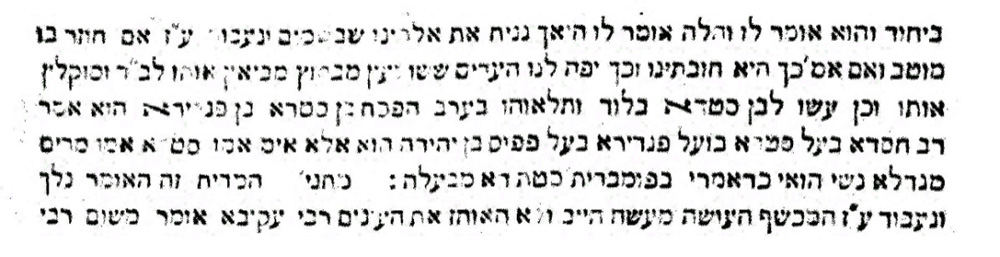
Others, such as R. Jehiel of Paris in his debate, used the chronological discrepancy to argue not that the Christians are wrong on their dates, but that the Jesus of the Talmud is not Jesus of Nazareth. I used to think that no one actually believed this, but resorted to this argument because it was a good way to deflect the Christian attacks that the Talmud defamed Jesus. However, I recently saw that Tosafot ha-Rosh, Sotah 47a, in a completely non-apologetic comment, assumes that the Talmud refers to two different men named Jesus. See also Meiri, Seder ha-Kabbalah, ed. Havlin (Jerusalem-Cleveland, 1992), pp. 69-70, and especially Havlin’s lengthy note. This was also Rabbenu Tam’s opinion, although it has been censored out of our Talmud. Take a look at Shabbat 104b, Tosafot s.v. Ben Stada in the Bomberg Venice 1520 edition, and compare to the standard Vilna edition.


Why does the Babylonian Talmud identify Jesus as a student of R. Joshua ben Perahyah if Jesus lived more than a century later? I think the answer is obvious, namely, that the Talmud had very little knowledge of who Jesus was, and thus did not know when to date him.[23] In fact, the famous story of R. Joshua ben Perahyah pushing Jesus away (Sanhedrin 107b, found in the Soncino translation) is actually a later development of an earlier story that is found in the Jerusalem Talmud. The Jerusalem Talmud’s version does not mention Jesus.[24]

This raises the question of the Talmud as a source of history, which is too large to go into here. But I do want to call attention to what R. Hershel Schachter states in a recent shiur, which I am sure will be surprising to many. The shiur (“Jewish Heritage Tour of Italy, part 2) can be found here.

Beginning at minute 66 R. Schachter acknowledges that the Talmud can err in matters of history. In support of this viewpoint, he cites R. Zerahyah ha-Levi (the Baal ha-Maor) at the beginning of Rosh ha-Shanah and R. Solomon Luria to Sanhedrin 52b. Here is an excerpt:

Today you have people [who] are considered Orthodox and they say [that] the Gemara made a mistake in history. There are a lot of people like that. . . . This is an ongoing debate. Just seventy years ago, before the Second World War, some of the rabbanim in Europe wrote in their seforim [that] it’s a well known fact that the bayit sheni was much more than 420 years. There is 150 years missing there. . . . We are used to this already. When Rabbenu Azariah min ha-Edomim (De Rossi) came out with his sefer Meor Einayim . . . and he said that maybe the chachmei ha-Gemara were wrong in history . . . many rabbanim were so upset they wanted to make a herem against him. I think they did make a herem; I am not sure. . . . Today, everybody is used to this. We assume that the Gemara is not necessarily expert on history, The Gemara can make mistakes in history. Today it’s not assumed to be apikorsus to say [this]. . . . If Azariah De Rossi would have printed his sefer today, no one would have been so excited about it.

For a hasidic perspective on this matter, which is very much in line with modern approaches to Aggadah, see R. Shlomo of Radomsk, Niflaot ha-Tiferet Shlomo (Petrokov, 1923), nos. 73-74. R. Shlomo stresses that when the Talmud tells a story, it does not matter if the facts are contradicted by other talmudic stories, because what is important is not the story itself, which need not be historically accurate, but rather the lesson to be instilled.

ובזה יש ליישב פליאה גדולה אשר יש לשאול, מה זה שמצאנו בכל הש”ס ומדרשים מסופרים מעשיות ומופתים מתנאים ואמוראים בשינוי נוסחאות מאד, זה יאמר כן היה המעשה, וזה יאמר כן . . . דאין אנו דנין על החומר, רק על הצורה, ולפי הצורה המוכנת בענין הזה, באופן זה מספרים חז”ל את המעשה והסיפור, וממ”נ אם להלל ולשבח ולפאר את התנא, או בהיפוך לגנות הרשע, הלא הצורה מוכנת לכ”א . . . ואם להשיג מטרת ותכלית ענין הנרצה בהסיפור הזה לעורר רושם ורעיון להשומע להבין דברי תורה ולעורר אמונת השגחה וכחן וגבורתן של הצדיקים, ג”כ האיכא, ומאי איכפת לן אם החומר מונע, החומר בטל לגבי הצורה, לכן אין נ”מ בין אופן זה לנוסחא אחרת כי הכל תורת אמת.

Returning to the subject of Jesus and R. Joshua ben Perahyah, I think readers might find another text interesting. It is by the kabbalist R. Moses Valle, who was an older colleague of R. Moses Hayyim Luzzatto in Padua. (Although Luzzatto was the leader of their circle, and Valle was thus subservient to him, I don’t know if it correct for the title page to describe Valle as a “student” of Ramhal. I grant that even Italian texts describe Valle as such. See R. Mordechai Samuel Ghirondi, Toledot Gedolei Yisrael [Trieste, 1853], p. 230.)

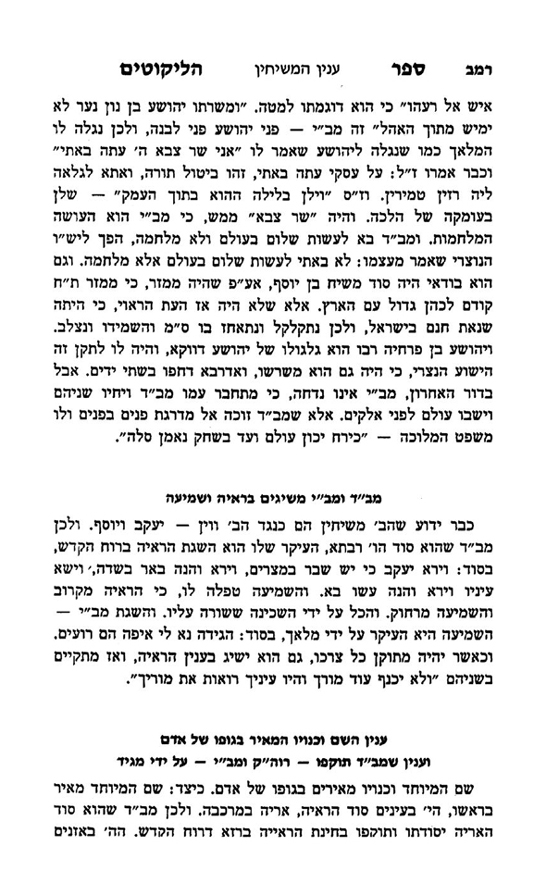
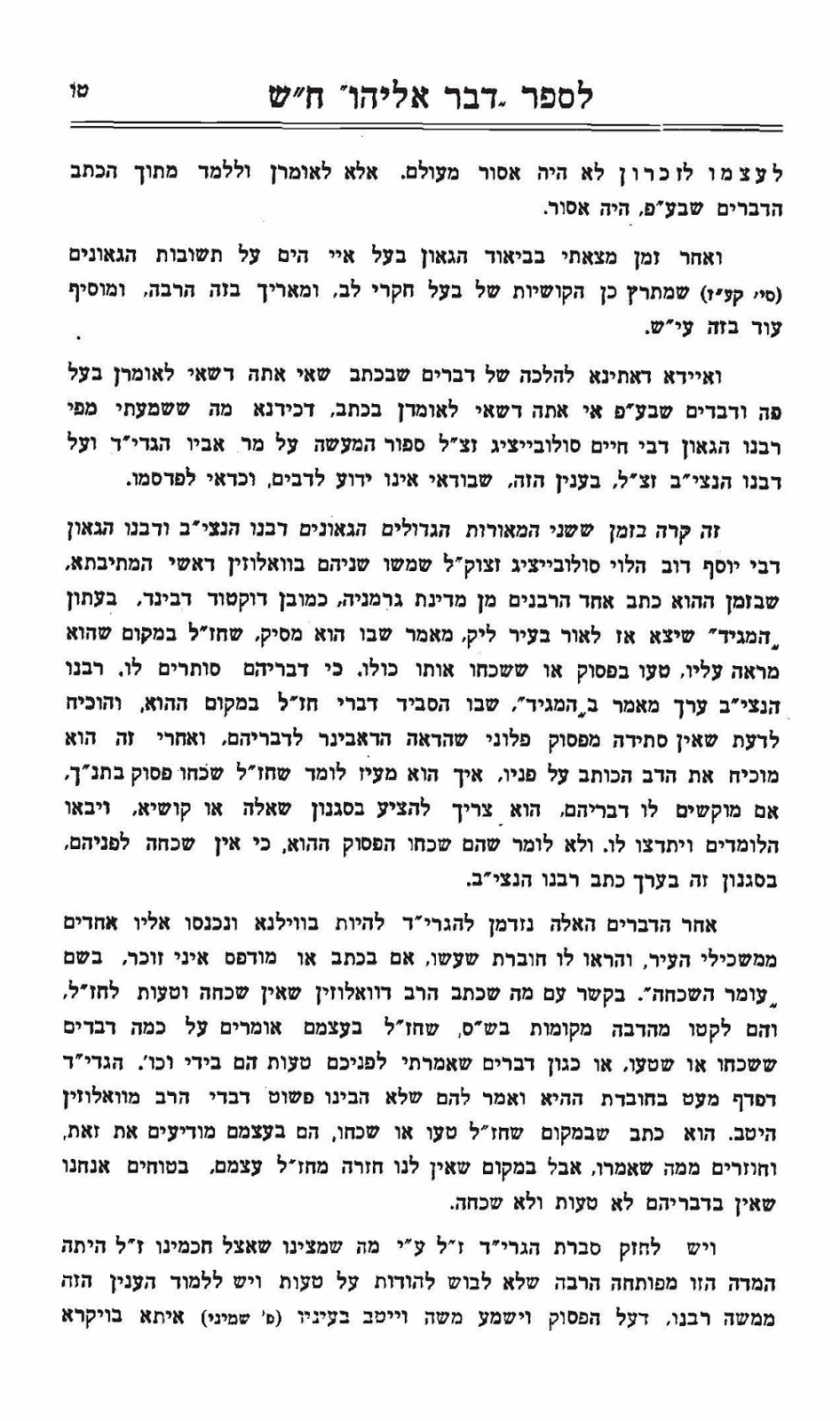
Without seeing the actual text, I don’t think people will believe me if I tell them what he writes, so here is the relevant page from Sefer ha-Likutim p. 242.

According to Valle, Jesus was meant to be Mashiach ben Joseph, but the needless hatred of the Jewish people prevented him from assuming this role. This is such a strange passage that I am impressed that the editor did not censor it prior to publication. For discussion of it, see here.

Interestingly, R. Abraham Abulafia appears to also have identified Jesus as Messiah ben Joseph. See Moshe Idel, Studies in Ecstatic Kabbalah (Albany, 1988), p. 53.

To be continued.


[1] I have explained Rambam according to the exoteric meaning, which is the level that Aviezer is arguing on. Aviezer makes no reference to a possible esoteric teaching.
[2] In the recently published The Rav Thinking Aloud on the Parsha: Sefer Bereishis, p. 8, the Rav misspoke and referred to this conception as the Aristotelian theory.
[3] Thus, I believe that both Rabad in his hassagah to Hilkhot Teshuvah 3:7 and also Kafih in his commentary ad loc., are mistaken in thinking that Maimonides, in listing different types of heretics, is referring here to one who believes in creation from eternal matter. When Maimonides writes about one who does not believe that God is ראשון וצור לכל he is not referring to time but causation. In fact, this formulation of Maimonides is also in accord with Aristotle’s view (that is, how Aristotle was understood by the medievals) that the world is both eternal and ontologically dependant on God. Nowhere in the Mishneh Torah does Maimonides affirm creation, ex nihilo or otherwise. This was recognized by R. Jacob Emden who sees the Mishneh Torah as more radical in this regard than the Guide. See Mitpahat Sefarim (Lvov, 1870) pp. 64-65 (where he also accuses Ibn Ezra of believing in eternity). See also Emden, Otzar ha-Tov (in Birat Migdal Oz [Zhitomir, 1874], p. 22a, who writes, regarding Maimonides’ use in the Mishneh Torah of a proof that assumes the world’s eternity:

לו ידעו הרבנים התלמודיים בפלוסופיא לא היה [!] שותקים לו בכאן

The Maharal, Netivot Olam,p. 224, writes:

והנה בנה עיקר ראייתו על התנועה הנצחית וזהו הפך האמונה שאין אנו מודים בזאת ההנחה. וא”כ כבר נפל הבנין בכללו

That the Guide is actually a theologically more conservative work than the Mishneh Torah has recently been argued by Charles Manekin, “Possible Sources of Maimonides’ Theological Conservatism in His Later Writings,” in Jay M. Harris, Maimonides After 800 Years (Cambridge, 2007), pp. 207-230. One should not forget that the Maimonidean controversy was precipitated by the Mishneh Torah, in particular Sefer ha-Mada, not the Guide.

[4] See the passage quoted from him in Yitzhak Shouraqui, Masoret be-Idan ha-Moderni (Tel Aviv, 2009), p. 34. On p. 44, Benamozegh writes that Ralbag, R. Hasdai Crescas, and R. Nissim did not believe in creation. What he means is that Ralbag did not believe in creation ex nihilo. Crescas did not really believe in creation at all, seeing the universe as eternal, that is, eternally created by God. This means eternal ontological dependence of all existence on the Creator. However, Crescas does believe that our world, as opposed to the universe as a whole, was created at a certain instant. See Warren Zev Harvey, Physics and Metaphysics in Hasdai Crescas (Amsterdam, 1998), pp. 18-19. As I pointed out in Limits, both Ralbag and Crescas stand in opposition to Maimonides’ Fourth Principle. Yet I am unaware of R. Nissim expressing a radical view regarding creation. Does anyone know what he is referring to?
[5] R. Judah Alfakhar also seems to make this error. See Kovetz Teshuvot ha-Rambam ve-Iggerotav (Leipzig, 1859), vol. 3, p. 1b.
[6] I thank Lawrence Kaplan for discussing this matter with me, although this should not imply that he agrees with what I have written.
[7] See here.
[8] Here is what Hirsch writes in Collected Writings, vol. 7, p. 57 (cited by Slifkin, here):

Jewish scholarship has never regarded the Bible as a textbook for physical or even abstract doctrines. In its view the main emphasis of the Bible is always on the ethical and social structure and development of life on earth; that is, on the observance of laws through which the momentous events of our nation’s history are converted from abstract truths into concrete convictions. That is why Jewish scholarship regards the Bible as speaking consistently in “human language;” the Bible does not describe things in terms of objective truths known only to God, but in terms of human understanding, which is, after all, the basis for human language and expression
[9] See here.
[10] See here.
[11] See here.
[12] On this issue, I find mid-twentieth-century Orthodox reconciliations of Torah and science very interesting in that the authors do not seem to be looking over their shoulders, worried about the reaction of the more literalist segment of Orthodoxy. R. Joseph Hertz’s essays following the book of Genesis in his edition of the Pentateuch are a good example of this. Another is R. Samuel Rosenblatt, Our Heritage (New York, 1940), pp. 174-181, in essays entitled “How the World Came Into Being” and “The Garden of Eden, Fact or Fiction.” You can see the essays here, or below.


While reading Rosenblatt’s essays, ask yourself if they could be published in an Orthodox newspaper or shul bulletin today. Note in particular Rosenblatt’s assumption that the Torah makes use of “theories about the nature of the physical world and the details of its generation that were current at the time the Bible was written.” Also relevant to the general issue are his essays on Noah and the Flood, and the Tower of Babel.
[13] For more on “myth”, see my earlier post.

There I wrote:

While in the popular mind myth often is identical with fairy tale, this is not how scholars understand myths. For them, myths communicate cosmic truths in non-historical story form, and they are not synonymous with legends. My dictionary explains myth as “a usually traditional story of ostensibly historical events that serves to unfold part of the world view of a people or explain a practice, belief, or natural phenomenon.”

S. of On the Main Line called my attention to Shadal’s letter in Iggerot Shadal, p. 661, where he speaks about the religious value of “illusions,” that is, matters that are not factual, but nevertheless have great religious value. In this letter we see Shadal, the great opponent of Maimonides, nevertheless adopting his own version of “necessary truths.”

שאין הריליגיאון חביבה לא-ל בשביל אמתתה, רק בשביל תועלתה בתקון המדות, ועל כן אין צורך שיהיו כל דבריה אמתיים, ושאין לנו עכ”ז להרחיק א-להיותה, ושאין להרחיק מהא-ל הגדת דברים בלתי אמתיים כי להגיד כח מעשה בראשית לבשר ודם א”א, ולא יתכן קיום החברה והצלחת האדם בידיעת האמת, אלא באיללוזיון, כי כן הטבע (אשר הוא בלא ספק רצון הא-ל) מרמה אותנו בענינים הרבה.

[14] Rather than refer to any number of books on the history of astronomy, here is what the Wikipedia entry on “Geocentric Model” has to say:

Adherence to the geocentric model stemmed largely from several important observations. First of all, if the Earth did move, then one ought to be able to observe the shifting of the fixed stars due to stellar parallax. In short, if the earth was moving the shapes of the constellations should change considerably over the course of a year. If they did not appear to move, the stars are either much further away than the Sun and the planets than previously conceived, making their motion undetectable, or in reality they are not moving at all. Because the stars were actually much further away than Greek astronomers postulated (making movement extremely subtle), stellar parallax was not detected until the 19th century. Therefore, the Greeks chose the simpler of the two explanations. The lack of any observable parallax was considered a fatal flaw of any non-geocentric theory. Another observation used in favor of the geocentric model at the time was the apparent consistency of Venus’ luminosity, thus implying that it is usually about the same distance from Earth, which is more consistent with geocentrism than heliocentrism. In reality, that is because the loss of light caused by its phases compensates for the increase in apparent size caused by its varying distance from Earth. Once again, Aristotle’s objections of heliocentrism utilized his ideas concerning the natural tendency of earth-like objects. The natural state of heavy earth-like objects is to tend towards the center of the earth and to not move unless forced by an outside object. It was also believed by some that if the Earth rotated on its axis, the air and objects in it (such as birds or clouds) would be left behind.

[15] Norman Lamm, “The Religious Implications of Extraterrestrial Life,” Tradition 7 (Winter 1965) pp. 27-28.
[16] A more academic version of this article appeared in JQR 55 (Jan. 1965), and some points in it were subjected to strong criticism by Harry Wolfson, ibid., 56 (Jan. 1966). Lamm told me that he felt it was a great honor for a young scholar like himself to be criticized by Wolfson. Similar sentiments have been expressed by students who were criticized in class by the Rav and Saul Lieberman.
[17] See here and here (note how the mention of R. [David] Feinstein has been removed from the first source).
[18] One reader asked me if there are traditional sources that speak of God creating things in the world after the initial creation. As a matter of fact, Isaiah 65:17 reads: “For, behold, I create new heavens and a new earth; and the former things shall not be remembered, nor come into mind.” A midrash quoted in R. Kasher’s Torah Shelemah, vol. 1, p. 123, reads as follows:

באותה שעה [כשעברו את הים] ברא להם הקב”ה ארץ חדשה כמו בבריאת העולם בששת ימי בראשית.

These two sources are cited by R. Judah Leib Zlotnick, “Bereishit” bi-Melitzah ha-Ivrit (Jerusalem, 1938), p. 27.

[19] Interestingly, R. Jonathan Eybschuetz, Tiferet Yehonatan, parashat Noah (p. 11a in the standard edition), claims that the builders of the tower were trying to make it so high that they could then launch a spaceship from it that would reach the moon (or perhaps I should say “the sphere of the moon”). This would then become their new home!

וזה היה כונת דור הפלגה ג”כ שבקשו לקבוע מושבם בכדור ירחי ששם יהיו נצולים ממבול וחשבו לעשות ע”י ספינה הנ”ל אפס כיצד יגביהו אותו הספינה למעלה מאויר העכור ולזה חשבו לבנות מגדל גבוה כל כך עד למעלה האויר ההוא ומשם יוכלו להשתמש בספינה הנ”ל לשוט באויר עד כדור הירחי.

[20] See Goldstein, Jesus in the Jewish Tradition (New York, 1950), p. 302 n. 34.

[21] See Louis Ginzberg, Legends of the Jews, vol. 3, p. 28.
[22] See Targum Ps.-Jonathan, Numbers 31:8, Zohar, vol. 3, pp. 194a-194b, Ginzberg, Legends, vol. 6, p. 144.
[23] For more on R. Joshua and Jesus, see Markham Judah Geller, “Joshua B. Perahyah and Jesus of Nazareth: Two Rabbinic Magicians” (unpublished doctoral dissertation, Brandeis University, 1974).
[24] See Peter Schäfer, Jesus in the Talmud (Princeton, 2007), ch. 3. Some readers might also enjoy Herb Basser’s lecture, “How Reliable are the Talmudic Teachings on Jesus,” available here.

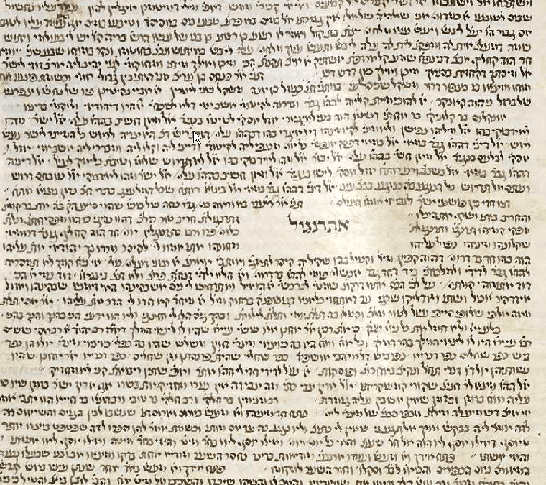
The original version of Sanhedrin, which mentions Jesus, is not found in the Artscroll edition. In other words, the Artscroll Talmud, including the Hebrew version, is still a censored, and thus defective, edition. I find this quite amazing. Is there a valid reason why Artscroll has not returned the Talmud to its pristine text? Speaking of internal censorship, here is another amazing example. Gittin 57a has a reference to Jesus, and this is preserved in the Munich manuscript and other uncensored mss. (and recorded in the Soncino translation). Here is a copy of the Munich manuscript. Look three lines above the large word אתרנגול

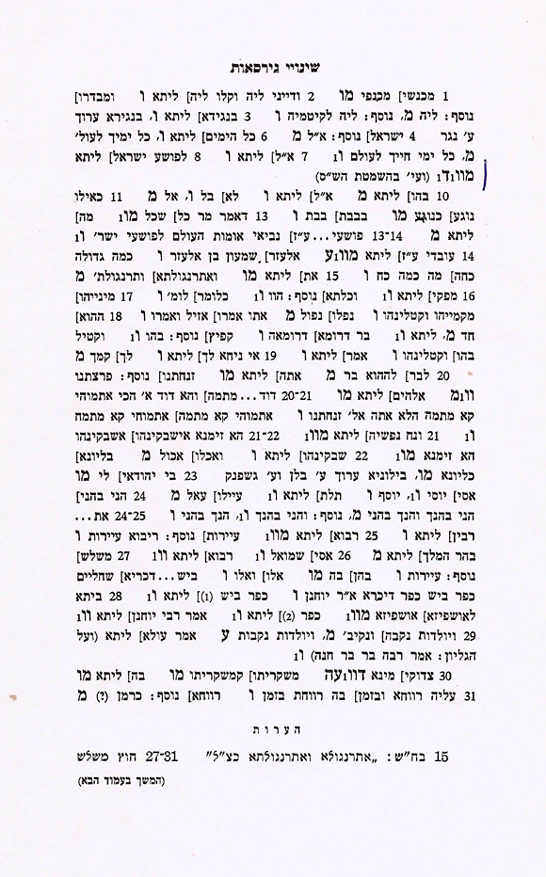
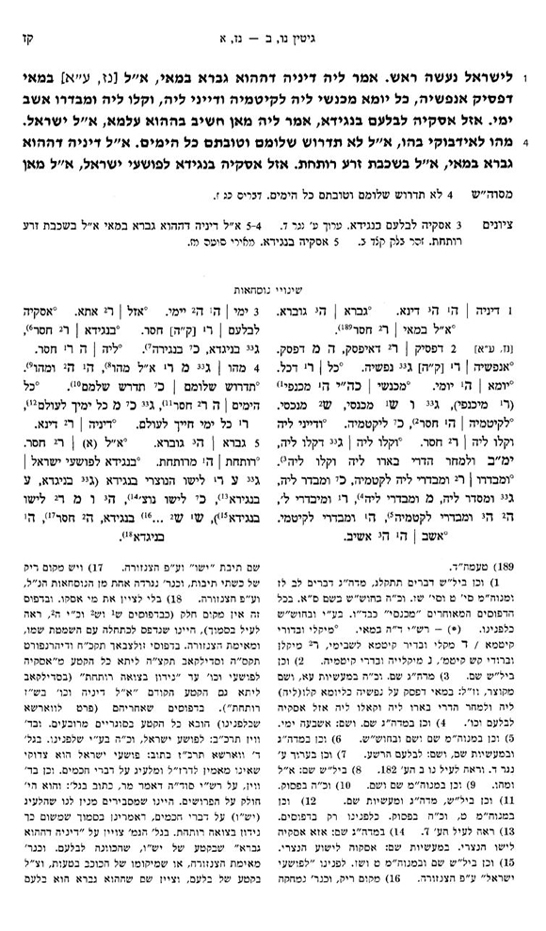
It states that Jesus was raised from the dead through incantations: אסקי’ לישו בנגיד’. In the standard text this has been altered to read, instead of Jesus, לפושעי ישראל. Now here is a copy of Meir S. Feldblum’s Dikdukei Soferim on Gittin. See how he wouldn’t even record what the Munich edition stated, and instead advises the reader to examine Hashmatot ha-Shas!


This book was published in 1966 and he was afraid to give us the reading in the Munich ms., yet Rabbinovicz in nineteenth-century Germany has no problem giving us the correct reading in the earlier mentioned story from Sanhedrin (as well as in the other talmudic passages where Jesus is mentioned). Does Feldblum’s action make any sense? I wonder if some future historian will be led to mistakenly conclude that anti-Semitism was more of a problem in 1966 America than nineteenth-century Germany. Fortunately, last year a new edition of Dikdukei Soferim on Gittin was published. Here is the relevant page where we are told what the Munich ms. really says.


Who can discern his errors? Misdates, Errors, Deceptions, and other Variations in and about Hebrew Books, Intentional and Otherwise: Revisited

Who can discern his errors?
Misdates, Errors, Deceptions, and other Variations in and about Hebrew Books, Intentional and
Otherwise: Revisited[1]
by Marvin J. Heller

Marvin J. Heller is the award winning author of books and articles on early Hebrew printing and bibliography. Among
his books are the Printing the Talmud series, The Sixteenth and Seventeenth Century Hebrew Book(s): An Abridged Thesaurus, and collections of articles.

R. Eleazar once entered a privy, and a Persian [Roman] came and thrust him away. R. Eleazar got up and went out, and a serpent came and tore out the other’s gut. R. Eleazar applied to him the verse, “Therefore will I give a man (אָדָם adam) for thee (Isaiah 43:4).” Read not adam [a man] but אֱדֹם edom [an Edomite = a Roman] corrected by the censor to “but a Persian.” (Berakhot 62b)
 “R. Eleazar said: Any man who has no wife is no proper man; for it is said, Male and female created He them and called their
name Adam” corrected by the censor to “any Jew who is unmarried” (Yevamot 63a).[2]
Sensitivity to the contents of Jewish texts by non-Jews, and apostates in their employ, was a feature of Jewish life at various periods, one particularly notable and noxious time being in the sixteenth century when, during the counter-Reformation, the Church undertook to censor and correct those Hebrew books that were not placed on the index and banned in their entirety. In the first example, the understanding based on the reading of adam אָדָם as edom אֱדֹם (Rome) is completely lost by the substitution of Persian for Edom. In the second example “Any man who has no wife is no proper man” was deeply offensive to a Church that required an unmarried and celibate clergy. In both instances the text was altered to adhere to the Church’s sensibilities despite the fact that not only was the original intent lost but that, particularly in the first case, it ceased to be meaningful.
            Books, and even more so Hebrew books, often underwent modifications, textual changes, due to the vicissitudes and complexities of the Jewish condition, frequently involuntary. The subject of “Misdates, Errors, Deceptions, and other Variations in and about Hebrew Books, Intentional and Otherwise,” addresses textual changes, as well as other errors, intentional and unintentional, that may be found in Hebrew books. Addressed previously in Hakirah, this is a companion article, providing additional examples of book errors, variations, and discrepancies. As noted previously, errors “come in many shapes and forms. Some are significant, others are of little consequence; most are unintentional, others are purposeful. When found, errors may be corrected, left unchanged, or found in both corrected and uncorrected forms. . . . Other errors are not to be found in the book per se but rather in our understanding of the book. This article is concerned with errors in and about Hebrew books only. It is not intended to be and certainly is not comprehensive, but rather explores the variety of errors, some of consequence, most less so, providing several interesting examples for the reader’s edification and perhaps enjoyment.”[3]
Among the errors discussed in this article are 1) those dealing with the expurgation of the Talmud; 2) expurgation of other Hebrew works; 3) internal censorship, that is, of Hebrew books by Jews; 4) accusations of plagiarism and forgery; 5) misidentification of the place of printing; 6) confusion due to mispronunciations.
I
            Returning to the beginning of the article, the Talmud, initially banned in 1553 and placed on the Index librorum prohibitorum in 1559, was subsequently permitted by the Council of Trent in 1564, but only under restrictive and onerous conditions. Reprinted in greatly censored form, the introductory quote refers to modifications in the Basle Talmud (1578-81). A condition of the Basle Talmud was that the name “Talmud” be prohibited. Heinrich Graetz explains the Pope’s and Council’s considerations in forbidding the name.
the Council only approved the list of forbidden books previously made out in the
papal office, the opinion of the pope and those who surrounded him served as
a  guide in the treatment of Jewish writings. The decision of this point was left to the pope, who afterwards issued
a bull to the effect that the Talmud was indeed accursed – like Reuchlin’s ‘Augenspiegel
and Kabbalistic writings’ – but that it would be allowed to appear if the name
Talmud were omitted, and if before its publication the passages inimical to
Christianity were excised, that is to say, if it were submitted to censorship
(March 24th, 1564). Strange, indeed, that the pope should have allowed the
thing, and forbidden its name! He was afraid of public opinion, which would
have considered the contradiction too great between one pope, who had sought
out and burnt the Talmud, and the next, who was allowing it to go untouched. At
all events there was now a prospect that this written memorial, so
indispensable to all Jews, would once more be permitted to see the light,
although in a maimed condition.[4]
            Among the most egregious examples of censorship of the Talmud is Bava Kamma 38a. That amud (page) of the Talmud, dealing with financial relations between Jews and non-Jews, was expurgated, almost in its entirety. Prior to the much censored Basle Talmud (1578-1581) the text was completely printed, for example, in the 1519/20-23 Venice edition of the Talmud published by Daniel Bomberg. After the censored Basle Talmud was published, initially, rather than contract the text, large blank spaces were left, clearly indicating that text had been expurgated.
            Abraham Karp notes that in some editions of the Talmud “many expurgated passages are restored, and where deletions are retained, blank spaces are left to indicate the omission to the reader and, no doubt, to permit him to fill in by pen what they dared not to print.”[5] An example of the blank spaces can be seen from the Frankfurt an der Oder Talmud 1697-99, printed by Michael Gottschalk. Such omissions are to be found in almost all seventeenth and early eighteenth editions of the Talmud, a notable exception being the Benveniste edition (Amsterdam, 1644-47).[[6]  Rabbinovitch too notes that blank spaces were left for expurgated text, those omissions being consistent with the Basle Talmud. He adds, however, that this policy was followed until the 1835 Vilna Talmud. At that time government officials prohibited the practice so that the omissions would not be so obvious.[7]  In fact, text was consolidated much earlier, as evidenced, by the illustrations of Bava Kama 38a from the 1734‑39 Frankfurt an der Oder Talmud. This expurgated material is restored in current editions of the Talmud.
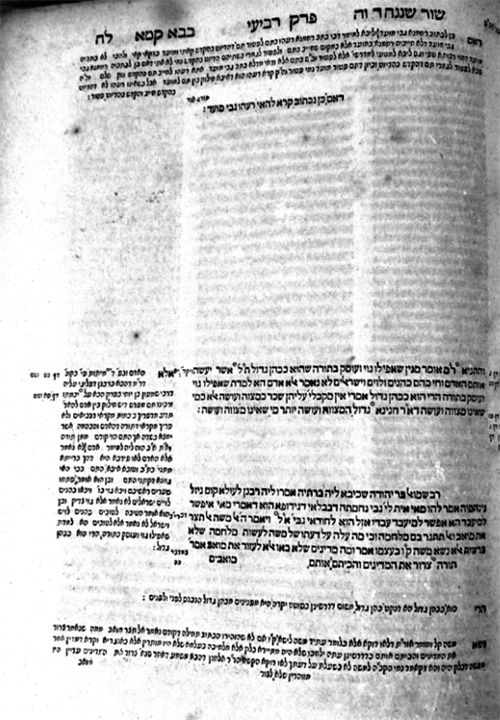
Frankfurt an der Oder – 1697-99
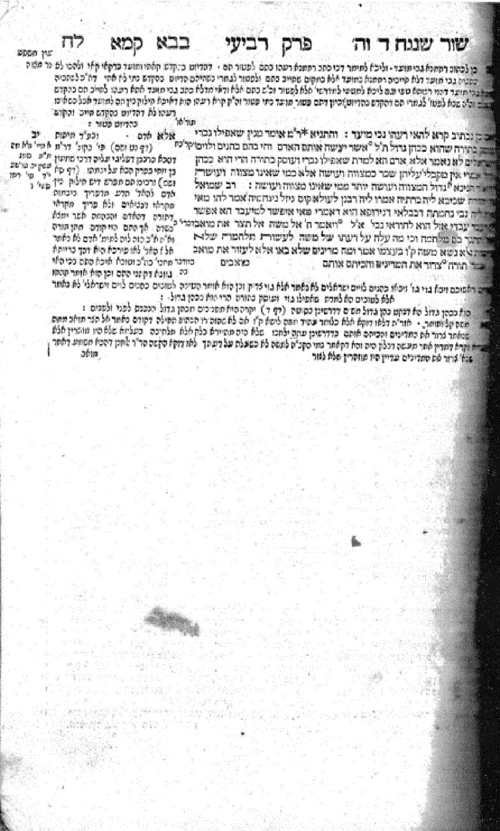
Frankfurt an der Oder – 1734-39

Another example of interest, one that has not fared as well, the text not yet restored in most editions of the Talmud, is to be found in Shabbat 104b and Sanhedrin 67a. The reference there is to Ben Satda, beginning, in the latter tractate “and so they did to Ben Satda
in Lod, and hung him on erev Pesah. Ben Satda? He was the son (ben) of Padera . . .”[8] Popper notes that Gershom Soncino, when publishing “a few of the Talmudic tracts at Soncino during the last decade of the fifteenth century, he took care not to restore any of the objectionable words in the MSS. from which he printed.”[9] Here too the text is complete in the Bomberg Talmud. Two subsequent exceptions in later editions of Sanhedrin where the Ben Satda entries do appear are in the Talmud printed by Immanuel Benveniste and in the edition of Sanhedrin printed in Sulzbach in or about 1696.

Sanhedrin 67a, Benveniste Talmud
However, in two complete editions of the Talmud (1755-63, 1766-70) printed in Sulzbach, the Ben Satda entries are omitted, as is the case of most modern editions of the Talmud.[10]
II
            The Talmud isn’t the only work to have been censored. Amnon Raz-Krakotzkin provides several examples of text in books
that were modified due to the censor’s ministrations. Among them is R. Abraham ben Jacob Saba’s (d. c. 1508) Zeror ha-Mor, a commentary on the Pentateuch based on kabbalistic and midrashic sources.[11] On the passage “They would slaughter to demons without power, gods whom they knew not, newcomers recently arrived, whom your ancestors did not dread” (Deuteronomy 32:17), referring to “Christians in general and priests in particular as ‘demons’ (shadim): ‘For as the nations of the world, all their abominations and vanities come from the power of demons, hence, the monks would shave the hair of their heads  and leave some at the top of the head as a stain.’” This passage continues, referring to bishops and popes, concluding that their entire heads are shaved like a marble with only a bit of hair about their ears, so that they have the appearance of demons, hairless, and like demons, provide no blessings, are like a fruitless tree, and “thus, it is fitting that they bear no sons of daughters.” Raz-Krakotzkin informs that this passage appeared in the first two editions of Zeror ha-Mor printed by Bomberg, and the Giustiniani edition (1545) but was already expurgated by the Cavalli edition (1566), a blank space in place of the text. That space subsequently disappeared and, although a Cracow edition based on the Bomberg Zeror ha-Mor restored the text it remains missing from most later editions.[12] Raz-Krakotzkin continues, citing additional examples.
            Early halakhic works were also subject to the ministrations of the censor.[13] Among them are such works as R. Samson ben Zadok’s (thirteenth century) Sefer Tashbez (Cremona, 1556). Samson was a student of R. Meir of Rothenburg (Maharam, c. 1220-1293). When the latter was imprisoned in the tower of Ensisheim, Samson visited him regularly, serving as his attendant and carefully recording in Tashbez Maharam’s teachings, customs, and daily rituals, as well as what he heard and observed, from the time Meir rose in the morning until he retired at night, on weekdays, Sabbaths, and festivals. Although a relatively small work (80: [6], 55 leaves), it consists of 590 entries beginning with Sabbath night (1-17), Sabbath day (18-98), followed by festivals, Sefer Torah, priestly benedictions, prayer, slumber, talis and tefillin, benedictions, issur ve-heter (dietary laws), redemption of the first born, hallah, vows, marriage and divorce, monetary laws, and piety. Expurgation by the censor of Tashbez was done sloppily, for terms such as meshumad and goy, normally excised, remain, but with a disclaimer near the end that they refer to idol worshipers only.[14]
III
Not all errors are due to the ministrations of the censor. Jews, too, at times, have taken their turns at modifying the text of books.
            A recent and perhaps quite surprising example of internal censorship is to be found in R. Solomon Ganzfried’s (1804–1886) Kizzur Shulḥan Arukh. First printed in 1864, that work an abridgement of the Shulhan Arukh for the average person, went through fourteen editions in the author’s lifetime, and numerous editions since then, as well as translations into many languages and has been the subject of glosses.[15] Marc B. Shapiro informs that in the Lublin (1904) edition of the Kizzur Shulḥan Arukh and several other editions the entry (201:4) that “apostates, informers, and heretics –for all these the rules of an onan and of mourners should not be observed. Their brothers and other next of kin should dress in white, eat, drink, and rejoice that enemies of the Almighty have perished,” the words “apostates, informers, and heretics” have been removed. In the Vilna edition (1915) the entire paragraph is removed and the sections renumbered from seven to six. In the Mossad Harav Kook vocalized edition a new halakhah was substituted, but that has since been corrected to reflect the original text. The reason, according to Shapiro, is that with the expansion of Jewish education to include girls, it was felt that schoolchildren, with assimilated relatives, would see this as referring to family members.[16] Several recent editions of the Kizzur Shulḥan Arukh that were examined, in both Hebrew and English, have the original text.
            R. Abraham Isaac Kook (1865–1935), chief rabbi of Jerusalem and first Ashkenazic chief rabbi in Israel (then Palestine),
was a profound, influential, and mystical thinker. Highly regarded by his contemporaries, his strongly Zionist views also resulted in some opposition, but even most of his contemporaries who disagreed with him held him in high regard. Shapiro notes that with time, Kook’s reputation changed. Despite the fact that such pre-eminent rabbis as R. Solomon Zalman Auerbach (1910-95) and R. Joseph Shalom Elyashiv (1910-2012) were unwavering in their high regard of Kook, strong anti-Kook sentiment developed later in religious anti-Zionist circles. Shapiro notes that “Kook has been the victim of more censorship and simple omission of fact for the sake of haredi ideology than any other figure. When books are reprinted by haredi and anti-Zionist publishers Kook’s approbations (hascomas) are routinely omitted.” One of several examples of this modified opinion Shapiro cites is a lengthy eulogy delivered by R. Isaac Kossowsky (1877-1951) praising Kook. When the eulogy was reprinted in She’elot Yitzhak, a collection of Kossowsky’s writings, the name of the subject of the eulogy, Rav Kook, was omitted. In the reprint of She’elot Yitzhak the eulogy is deleted in its entirety.[17]
            Shapiro’s observation about Rav Kook’s approbations is confirmed in several books. R. Eliezer Mansour Settehon’s (Sutton, 1860-1937) Notzar Adam: Hosafah Notzar Adam (Tiberius, 1930), discourses on spiritual development, has approbations from R. Abraham Abukzer, R. Moses Kliers, and R. Jacob Hai Zerihan, and R. Abraham Isaac ha-Kohen Kook. In a description of Notzar Adam in in Aleppo, City of Scholars (Brooklyn, 2005), Kook’s name, Kook’s name is omitted from a list of the book’s approbations.[18]

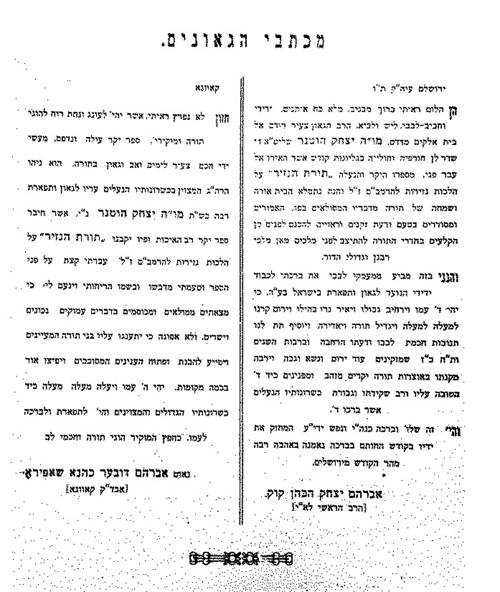
In a variation of this, two internet sites that reproduce the full text of Hebrew books both include Rav Isaac
Hutner’s (1906-80) Torat ha-Nazir (Kovno, 1932). This, the first edition, has three approbations; a full page hascoma from R. Hayyim Ozer Grodzinski (1863–1940), and the following page two approbations, side by side, from R. Abraham Duber Kahana (1870–1943) and Rav Kook. The first internet site, with more than 53,000 books for free download, follows R. Grodzinski’s approbation with a blank page and then the text. The second, a subscription site with more than 76,000 scanned books, goes directly from R. Grodzinski’s hascoma to the text, dispensing with the blank page, also not reproducing the second page of approbations. It is not clear whether the copies scanned were faulty, the scanning incomplete, or the omission intentional. Nevertheless, to conclude this section on a positive note, surprisingly, given the omission of Rav Kook’s approbation in both scans of Torat ha-Nazir, both sites list and provide an extensive number of Rav Kook’s works.
IV
Accusations of plagiarism accompany the publication of two works by and/or attributed to R. Nathan Nata ben Samson Spira (Shapira, d. 1577). Spira, born to a distinguished family that was, according to the Ba’al Shem Tov, one of the three pure families throughout the generations in Israel (the others being Margulies and Horowitz), served as rabbi in Grodno (Horodno) until 1572, when he accepted a position in Posnan. His grandson was R. Nathan Nata ben Solomon Spira (Megalleh Amukkot, c. 1585-1633). Among Nathan Nata Spira’s works is Imrei Shefer (20: [1], 260 ff.), a super-commentary on Rashi and R. Elijah Mizrahi (c. 1450–1526). The book was brought to press by Spira’s son R. Isaac Spira (d. 1623), Rosh Yeshiva in Kovno and afterwards in Cracow. Work on Imrei Shefer began in Cracow in 1591 but before printing was finished Isaac Spira accepted a position in Lublin where publication was completed at the press of Kalonymus ben Mordecai Jaffe (1597).[19]
The title-pages states that Spira, “gives goodly words (Imrei Shefer)’ (Genesis 49:21) and he gives, ‘seed to the sower, and bread לזורע ולחם (357=1597) to the eater’ (Isaiah 55:10) of Torah.” In the introduction, Isaac informs that the work is entitled Imrei Shefer from the verse, “he gives goodly words” (and the word “he gives הנתן” in the Torah is without a vav), implying the name of the author [Nathan נתן] and Shefer שפר is language of Spira שפירא the family name of the author. Isaac then addresses the existence of an unauthorized and fraudulent edition ascribed to his father, printed in Venice (Be’urim, 1593),
found and brought out by men who lack the yoke of the kingdom of heaven. A work discovered, who knows the identity of the author, perhaps a boy wrote it and wanted to credit it to an authoritative source אילן גדול), [my father my lord]. God forbid that his holy mouth should bring forth words that have no substance, vain, worthless, and empty, a forgery, “[And, behold], it was all grown over with thorns, and nettles had covered it over” (Proverbs 24:31).
Isaac Spira took his complaint to the Va’ad Arba’ah Artzot (Council of the Four Lands), requesting they prohibit the distribution of the Be’urim in Poland. The response of the Va’ad is printed at the end of the introduction,
It has been declared, by consent of the rabbis, and the [communal] leaders of these lands,
that these books shall neither be sold nor introduced into [any Jewish] home in
any of these lands. Those who have [already] purchased them shall receive their
money back and not keep [such] an evil thing in their home.
What was and who wrote the Be’urim, the reputedly plagiarized copy of R. Nathan Nata ben Samson Spira’s Imrei Shefer? The title-page of the Be’urim (40: 180 ff.), printed in Venice in 1593 “for Bragadin Giustiniani by the partners Matteo Zanetti and Komin Parezino at the press of Matteo Zanetti,” states that it was written by ha-Rav, the renowned, the gaon, R. Nathan from Grodno in the year, “For you shall go out with joy בשמחה (353=1593), and be led forth with peace” (Isaiah 55:12). Be’urim does not have an introduction nor a colophon that provides any additional information.
Isaac Spira’s accusation that the Be’urim is a forgery, not to be ascribed to his father, but rather was written by an unknown young man who then attributed it to Spira, is confirmed by R. Issachar Baer Eylenburg (1550-1623), who writes in his responsa, Be’er Sheva (Venice, 1614) and also in his commentary on Rashi, Zeidah La-Derekh (Prague, 1623) that it is obvious that the Be’urim were not the work of the holy Spira, but rather of an erring student “who hung (attributed it) to himself, hanging it on a large tree” (cf. Pesahim 112a).[20]
Among the distinguished sages of medieval Sepharad is Rabbenu Bahya ben Asher ben Hlava (c. 1255-1340). Best known for his popular, multi-faceted, and much reprinted Torah commentary, written in 1291 and first published in Naples (1491),  Rabbenu Bahya was also the author of Kad ha-Kemaḥ (Constantinople, 1515) and Shulḥan shel Arba (Mantua, 1514). The former, Kad ha-Kemaḥ, is comprised of sixty discourses on varied subjects, among them festivals, prayer, faith, and charity, all infused with ethical content. Among the numerous editions of Kad ha-Kemaḥ is a scholarly edition entitled Kitvei Rabbenu Baḥya (Jerusalem, 1970) edited and with annotations by R. Hayyim Dov Chavel (1906–1982).
Among the essays in Kad ha-Kemaḥ is one entitled Kippurim, on Yom Kippur. Part of that discourse includes a commentary on the book of Jonah, read on Yom Kippur. Chavel, in the introduction to his annotations on Rabbenu Bahya’s commentary on Jonah, suggests that Rabbenu Bahya took his commentary from R. Abraham ben Ḥayya’s (d. c. 1136) Hegyon ha-Nefesh, first published by E. Freimann (Leipzig,
1860). Abraham ben Ḥayya, a resident of Barcelona, was a philosopher, mathematician, and astronomer, reflected in his several works, including translations from the Arabic. Hegyon ha-Nefesh “deals with creation, repentance, good and evil, and the saintly life. The emphasis is ethical, the approach is generally homiletical – based on the exposition of biblical passages – and it may have been designed for reading during the Ten Days of Penitence.”[21] Kitvei Rabbenu Baḥya and Hegyon ha-Nefesh are sufficiently alike to support Chavel’s contention that
Rabbenu utilized the Sefer Hegyon ha-Nefesh (or Sefer ha-Mussar) of the earlier sage R. Abraham ben Ḥayya ha-Nasi, known as ṣāḥib-al-shurṭa . . . In it is found this commentary on the book of Jonah. This was already noted by the author of Zaphat ha-Shemen – the usage by Rabbenu of this book is comparable to his use of other works: according to his needs. The reason that he does not mention it in his commentary is, perhaps, because the books of R. Abraham ha-Nasi were well known, and the leading sages, such as the Rambam, Ramban and other leading rabbis utilized it, comparable to “Joshua was sitting and delivering his discourse without mentioning names, and all knew that it was the Torah of Moses” (Yevamot 96b).[22].
We leave accusations of plagiarism and turn to forgery, a well-known case involving a person of repute, Saul Hirsch (Hirschel)
Berlin’s (1740-94) Besamim Rosh.[23] Berlin was a person of great promise; the son of R. Hirschel Levin (Ẓevi Hirsch, 1721–1800), chief rabbi of Berlin, ordained at the age of twenty and in 1768 av bet din in Frankfurt an der Oder. At some point Berlin became disillusioned with what he believed to be antiquated rabbinical authority. He gave up his official rabbinic position in Frankfurt, removing to Berlin. There Berlin was an associate of Moses Mendelssohn (1729–1786), providing, in 1778, an approbation for Mendelssohn’s Be’ur (Berlin, 1783) and was a supporter of the enlightenment figure Naphtali Herz Wessely (1725–1805), writing an anonymous pamphlet in defense of  Wessely’s
Divrei Shalom ve-Emet (Berlin, 1782) entitled Ketav Yosher (1794).[24]
An earlier forgery of Berlin, described by Dan Rabinowitz, this under the pseudonym of Ovadiah bar Barukh Ish Polanya, was Berlin’s Mitzpeh Yokteil (1789), a vicious attack on R. Raphael Kohen, rabbi of the three communities, Altona-Hamburg-Wansbeck, who had opposed Mendelssohn’s Be’ur, and on Kohen’s Torat Yekuteil (Amsterdam, 1772) on Yoreh Deah. The Communities’ beit din placed Ovadiah, the presumed author, under a ban. The ban’s proponents approached R. Tzevi Hirsch, the chief rabbi of Berlin and Saul Berlin’s father, seeking his signature on the ban.[25] It appears that Tzvi Hirsch initially concurred with the ban, but, as he was close to deciding in favor of signing the ban, someone whispered in his ear the verse “woe is me, my master, it is borrowed שאול” (II Kings 6:5), – which he understood to be a play on שאול (borrowed), referring to his son, Saul, the true author of Mitzpeh Yokteil.[26]
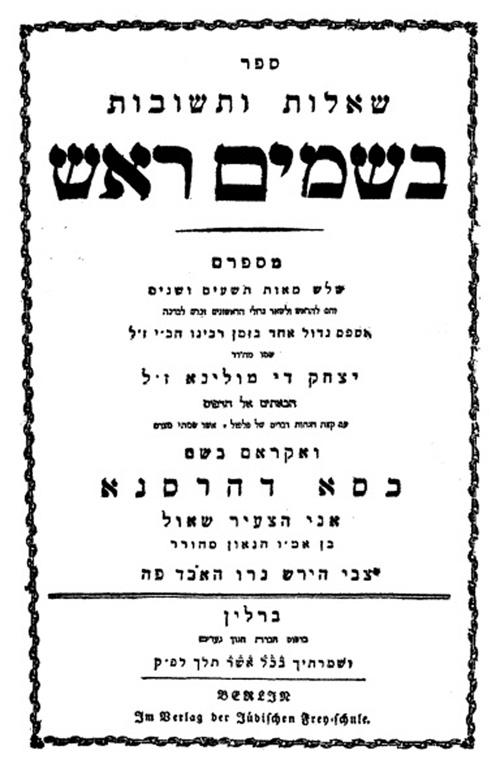
 

Turning to Besamim Rosh Saul Berlin’s infamous forgery, it claims to be the responsa of R. Asher ben Jehiel (Rosh, c. 1250–1327), among the most preeminent of medieval sages of European Jewry. The title-page describes it as the responsa Besamim Rosh, 392 responsa from books from the Rosh and other rishonim (early rabbinic sages) compiled by R. Isaac di Molina and with annotations Kasa de-Harshana by the young Saul ben R. Ẓevi Hirsch, av bet din, here (Berlin).[27] It is dated “and will keep you in all places where you goושמרתיך בכל אשר תלך   553 = 1793)” (Genesis 28:15), note Asher אשר in the date. In Besamim Rosh Berlin, having become an adherent of the haskalah, presents ideas inconsistent with and at variance with traditional halakhic positions. Among the novel responsa are removing the prohibition on suicide due to the difficult conditions of Jewish life; permitting shaving on Hol ha-Mo’ed; requiring a shohet to test the sharpness of his knife on his tongue; saying a blessing over non-kosher food; disregarding commandments that are upsetting; not taking Megillat Esther seriously; and that Jews beliefs can change. An example of the responsa, albeit a brief one and without Berlin’s Kasa de-Harshana, is the much quoted responsum concerning “legumes, rice, and millet which some Ashkenazic rabbis prohibit and is the practice in some communities. . .” (105b: no. 138): The responsum states:

This is very strange, for the Talmud permits it and no bet din is known to have made such an enactment. It is not for us to inquire why such an enactment was made and why it was followed by some. Possibly because of the exiles and the confused גירושים והבלבוחים, weighed down in poverty . . . and also due to the small community of Karaites in their midst who were also exiled. . . . unable to distinguish between bread and bread and all leavening from which it is possible to make flour and bread. But, God forbid, that we freely prohibit that which is permitted, and all the more because of the poor and needy, who lack sufficient meat and bread all the days of the festival. . . . “who eat [but] a litra of vegetables for at a meal” (Sanhedrin 94b). Also “a leap year is not intercalated in the year following a Sabbatical year for this reason.” All the more (kal ve-homer) to prohibit most types of food to the poor and needy on festivals and the overly strict (mahmerin) will have to answer on the day of judgement.
            How has Besamim Rosh been received? Soon after its publication R. Wolf Landsberg, in Ze’ev Yitrof (Frankfurt an der Oder, 1793), stated that Besamim Rosh was a forgery, and R. Mordecai Benet (1753-1829) wrote to Berlin’s father, that Besamim Rosh was “from head to foot only wounds and grievous abscesses from sinful, vile men.”[28] R. Hayyim Joseph David Azulai (Hida, 1724–1806) in his Shem ha-Gedolim, one of several works in which he mentions Besamim Rosh, states “I have heard ‘a voice of a great rushing’ (Ezekiel 3:12) that there are in this book strange things. . . . Therefore the reader should not rely on it.”[29] The Hatam Sofer (R. Moses Sofer, 1762–1839), based on the responsum on suicide, also concluded that Besamim Rosh was a forgery.[30] Among the varied modern authorities who quote Besamim Rosh, albeit critically, are R. Solomon Joseph Zevin (1885–1978) and R. Ovadia Yosef (1920-13) the latter writing an approbation for the 1984 edition of Besamim Rosh.[31]
How influential was Besamim Rosh? Fishman writes that “Besamim Rosh is of itself cast as a work of rabbinic literature, a Trojan horse of sorts, capable of injecting reformist viewpoints directly into the camp of halakhic discourse. Indeed, the sheer frequency with which Besamim Rosh has been cited in subsequent halakhic writings [documented by Samet] raises the question of whether the work may not have been effective in introducing unconventional perspectives into rabbinic thought.”[32] Similarly, Shmuel Feiner notes that “Some scholars
regard Besamim Rosh as the beginning of the reform of Judaism.”[33] Finally, knowledge that Besamim Rosh was a forgery was so widespread, that it is even so described in a book dealers catalogue, that of Jakob Ginzburg, in Listing of Rare and Valuable Books (Minsk, 1914), stating “565 Besamin Rosh attributed to the Rosh, poor condition Berlin, 1792, 50 1.”
V
Of less consequence is a common error, if it may be so described, that is, the misleading identification of the place of printing on the title-pages of late seventeenth through the early nineteenth century books. Amsterdam, from the early seventeenth century, was the foremost center of Hebrew printing in Europe. Its reputation was such that printers in other lands, often with the only the most tenuous, if any, connections with Amsterdam, attempted to associate their imprints with that city. In a wide variety of locations the actual place of printing is minimized; what is enlarged is that the letters are באותיות אמשטרדם Amsterdam letters. Mozes Heiman Gans describes this practice,
Amsterdam may have had an embarrassing lack of rabbinical training facilities, but thanks to the Hebrew printing works it nevertheless had a great name in the world of Jewish scholarship. Moreover, the haskamot (certificate of fitness) was also sought by Jewish printers abroad, and so highly-prized were books ‘printed in Amsterdam’ or ‘be-Amsterdam’ that cunning rivals invented the phrase ‘printed ke-Amsterdam’, i.e. in the manner of Amsterdam, hoping to deceive the readers by relying on the similarity of the Hebrew k and b.[34]
            An early example of this practice is in Dessau, where the court Jew, Moses Benjamin Wulff, established a Hebrew press in Anhalt-Dessau.[35] Approval for the press was given on December 14, 1695 by Princess Henriette Catherine of Orange, Prince Leopold I’s mother, acting as regent in her son’s frequent absences in the service of the Prussian army. The first books were published in 1696, among them R. Jacob ben Joseph Reischer’s (Jacob Backofen, c. 1670–1733) Hok Ya’akov and Solet le-Minhah ve-Shemen le-Minhah, and the following year R. Shabbetai ben Meir ha-Kohen’s (Shakh, 1621–1662) Gevurat Anashim, each with a title-page, with a pillared frame topped by an obelisk and the statement,
Printed here [in the holy congregation of] Dessau with AMSTERDAM letters
Under the rule of her ladyship, the praiseworthy and pious Duchess, of distinguished birth HENRIETTE CATHERINE [May her majesty be exalted]
Another notable instance are the title-pages of R. Judah Leib ben Enoch Zundel’s (1645–1705) Hinnukh Beit Yehudah (Frankfurt am Main, 1708), a collection of one hundred forty-five responsa, among them several by the author. Zundel (1645–1705), who succeeded his father as rabbi of the district of Swabia in 1675, subsequently relocated to Pfersee, where he remained until his death. Judah Leib was also the author of Reshit Bikkurim (Frankfurt, 1708), homilies by Judah Leib and his father. The sermons in that work are on festivals and Sabbaths based upon R. Joseph Albo and includes excerpts from a commentary on the Bible which Judah Leib had intended publishing.[36]

 The publisher of these books was Johann Koelner, the distinguished Frankfurt am Main printer (1708-27), credited with publishing half of the Hebrew books printed in Frankfurt up to the middle of the nineteenth century as well as a fine edition of the Babylonian Talmud.[37] Koelner began printing with Hinnukh Beit Yehudah; it is unusual in that there are two title-pages for the book, one noting that it was printed in Frankfurt am Main, the other stating that Hinnukh Beit Yehudah was printed, in an enlarged font with, Amsterdam, in a smaller font, letters, and the place of printing, Frankfurt am Main, also set in a smaller font.[38]
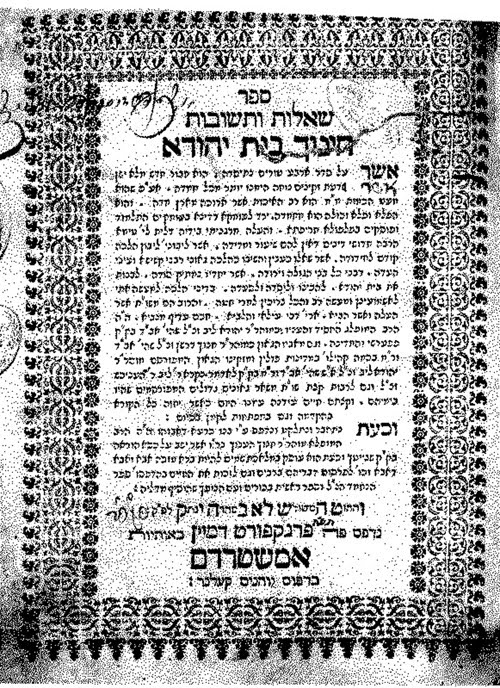
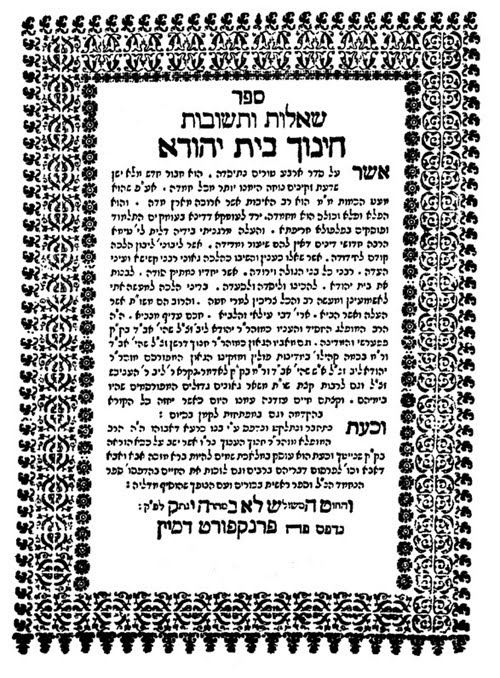
Another way of emphasizing Amsterdam fonts rather than the city in which a book was printed is evident from R. Jacob Uri Shraga Feival’s ben Menahem Nachum’s Bet Ya’akov Esh (Frankfurt an der Oder, 1765) on Job. Here, somewhat unusually, even the reference to the source of the fonts is highlighted, saying with Amsterdam letters. The place of printing is given below in abbreviation in a slightly smaller font as printed here פ”פ דאדר (Frankfurt an der Oder).
In addition to several locations in Germany, such as Hamburg and Jessnitz, we also find this practice in such varied locations as in Zolkiew, for example, R. Aaron Moses ben Zevi Hirsch of Lvov (Lemberg) Ohel Moshe (1765) on grammar; in Lvov, on the title-page of R. Jacob ben Baruch of Tyczyn’s (c. 1640-1725) Birkat Yosef (1784) on Shulhan Arukh Hoshen Mishpat; and with a mahzor that states, in large red letters, that it was printed in Slavuta and, in a small font in German only, that is, it was printed (gedrukt) in Lemberg. We also find this done, somewhat far afield, in Livorno; the title-page of Seder Nezikin of the Jerusalem Talmud (1770), printed with a frame that is like but not exact of the Amsterdam edition of Seder Nashim (1754), by Carlo Giorgi, stating “printed here, Livorno, with Amsterdam letters.
            And then there are inadvertent errors, such as misreading a colophon. Popular books, frequently reprinted, go through numerous editions. At times it is difficult to identify early editions and, as might be expected, books are occasionally misidentified, attributed to the wrong press, misdated, and there are instances when editions are recorded that never existed. All of these errors can be found in R. Leon Modena’s (Judah Aryeh, 1571-1648) Sur me-Ra.[39]
Sur me-Ra, a popular and much reprinted tract opposing the snares and consequences of gambling, was written by Modena when, according to his autobiography, he was only twelve or thirteen years old. Paradoxically, Modena would later become a compulsive gambler, even gambling away his daughters’ dowries. Translated into Latin, German, Yiddish, French, and English, Sur me-Ra is not a straightforward denunciation of gambling but rather a dialogue between two friends, one opposed to games of chance, the other a proponent of such games, both positions well argued, accounting for its popularity. It was first published in Venice in the year בשמחה (with joy, [5]355 = 1594/95) by the Venetian press of Giovanni di Gara as an anonymous tract on the evils of gambling, Modena initially choosing to be anonymous. Sur me-Ra was republished, not long afterwards, twice, according to several bibliographic sources, in 1615. One edition, attributed to a Venice press, appears to be dubious, it not being recorded in any library collection and the sources that list it do so without descriptive details.[40]
The two 1615 Prague editions are recorded in a library listing, one published at the press of Moses ben Bezalel Katz, octavo in format, here consisting of ten unfoliated leaves. The second Prague edition, a bi-lingual Hebrew-Latin edition, is not so much dubious as mislabeled, having been printed several decades later and elsewhere. The Katz edition has an introduction from R. Jacob ben Mattias Treves which concludes “And it came to pass, because the midwives feared God, that he made them houses” (Exodus 1:21) at a goodly בשע”ה (375 = 1615) time, “a time to cast להשלי”ך (75 = 1615) away stones” (cf. Ecclesiastes 3:5).
A bi-lingual Hebrew-Latin edition of Sur me-Ra was purportedly printed in Wittenburg in 1665 by Johannis Haken. This edition is physically small, octavo in format, measuring 18 cm.; otherwise it is an expanded edition of Sur me-Ra, being comprised of [134] pp. and ending on quire Q3 followed by several index pages. There is a Latin title-page with a Hebrew heading, giving the place of printing, printer’s name, and date, followed by considerable preliminary matter in Latin. There is a second Hebrew-Latin title page, lacking all of these particulars about the edition and with a somewhat dissimilar briefer Latin text.
This Wittenburg edition of Sur me-Ra has been incorrectly recorded in at least one major library as a second 1615 Prague Hebrew-Latin edition of that work. The reason for the error appears to be twofold. First, the library copy lacks the first descriptive title-page and the second title page, as noted, lacks identifying information. Moreover, the introduction to the Prague edition is included, with its reference to Prague at the beginning and, at the end, two highlighted dates, although the first “at a goodly בשע”ה (375 = 1615) time” is not highlighted here and a close reading indicates that the second date was set improperly, that is, the Prague edition which concludes with the date “a time to cast להשלי”ך (375 = 1615)” here, reading להשלי”ך, the final khaf being emphasized as if to be included in the enumeration of the letters, which likely misled a reader looking at it too casually, as it results in a figure (395) too large for the Prague edition and too small for the Wittenburg edition.[41]
Another edition of Sur me-Ra was printed in Leiden by Johannes Gorgius Nisselius. An orientalist, Nisselius, poor and unable to obtain a post as a teacher, became a printer. The title-page is misdated תנ”ו (456 = 1696) instead of 1656, attributed by L. Fuks and R. G. Fuks‑Mansfeld to Nisselius’ unfamiliarity with Hebrew chronology, and causing Moritz Steinschneider to describe it as an “edition negligenitissime curate (a very slipshod edition).[42]
Three reported bi-lingual editions of Sur me-Ra, Hebrew with Latin translation, quarto format, are recorded in bibliographic sources. The dates given are 1698, 1702, and 1767. These editions are listed, without further details, in Julius Fürst’s Bibliotheca Judaica, Benjacob’s Otzar ha-Sefarim, and Vinograd’s Thesaurus of the Hebrew Book, each likely repeating the entries in the previous earlier work.[43] That three editions of Sur me-Ra were printed in Oxford within this time frame seems highly unlikely, given that from the first Hebrew book reported for Oxford, Maimonides’ commentary on Mishnayot, with Latin, printed in 1655, concluding with a Bible in 1790, only sixteen titles with Hebrew text are reported. One printing of Sur me-Ra seems reasonable, two less so, three unlikely.
VI
            Mispronunciations and misunderstandings are the source of numerous errors, a problem that persists from biblical times, as in the following passage from Judges (12:36)
And the Gileadites took the passages of Jordan before the Ephraimites; and it was so that when those Ephraimites who had escaped said, Let me cross over; that the men of Gilead said to him, Are you an Ephraimite? If he said, No; Then said they to him, Say now Shibboleth; and he said Sibboleth; for he could not pronounce it right. Then they took him, and slew him at the passages of Jordan; and there fell at that time of the Ephraimites forty two thousand.
R. David Cohen observes that not all typesetting errors can be attributed to the compositor selecting the wrong letters. In Kuntres ha-Akov le-Mishor: le-Taken ta’uyot ha-Defus shel ha-Shas Hotsa’at Vilna he observes that there are mistakes that can only be attributed to hearing. Many printers realized that it was possible to save hours of labor by having type set by a pair of workers, one reading to the setter, who either did not hear correctly or misunderstood due to different dialects. Cohen provides several examples from the 1880-86 Vilna Talmud, for example, פסח in place of פתח, and comments that much ink has been has been spent resolving apparent difficulties that are in reality nothing more than printers’ errors. Among the numerous examples are:[44]
Rosh HaShanah 14a: Rashi בקוביא (dice-playing) – a piece of עצם (bone) . . . other reading עצים (wood).
Megillah 14a: Many prophets arose for Israel מי-הוה, (it should say מיהוי) [double the number of [the Israelites]
who came out of Egypt].
Zevahim 48a: Rashi Midrasha – (Leviticus 4) . . . Should say 6.
           
Similarly, R. Menahem Mendel Brachfeld (Brakhfeld, 1917-84), in his two volume work, Yosef Halel, based on the Reggio di Calabria (1475) and other early editions, provides a lengthy listing of emendations to current texts of Rashi. He informs that numerous errors in more recent editions of Rashi are due to errors in transmission, frequently compounded by editors, printers, and the unkind modifications of censors. Indeed, R. Solomon Alkabetz, the grandfather of the eponymous author of Lekhah Dodi, in his edition of Rashi’s Torah commentary (Guadalajara, 1476), admittedly corrected it according to his own reasoning. Furthermore, explanations of Rashi are often based on these faulty editions.[45] At the beginning of each volume are the detailed emendations and at the end a brief summary of the changes, for example:
Leviticus 10: 16) The goat of the sin-offering, the goat of the additional service of the month and the three goats of sin-offering sacrificed on that day, the he-goat, the goat of Nahshon, and the goat of [Rosh Hodesh], etc. According to this version it is not clear what Rashi is suggesting by the he-goat. In the first edition (Reggio di Calabria) and the Alkabetz edition, the text is three goats of sin-offering sacrificed on that day, take a he-goat and the goat of Nahshon, etc. and with this Rashi alludes to the verse at the beginning of the parasha that speaks about the obligatory offerings of the day, writing take “a he-goat.”[46]
Leviticus 26: 21) Sevenfold according to your sins, seven other punishments, etc. Seven שבע is in the feminine,
and others ואחרים is male. In the first edition and in the Alkabetz edition the text is seven other punishments, as the number of your sins חטאתיכם.[47]
Our text
16) the he-goat, the goat of Nahshon,  and
the goat of [Rosh Hodesh].
21) Sevenfold according to your sins, seven other punishments,
Text first edition
16) take a he-goat and the goat (RH) of Nahshon, the goat of Rosh Hodesh.
21) seven other punishments as the number of your sins.[48]

            Another, quite different, inadvertent, error is of interest. In the late seventeenth- early eighteenth century a small number of printers of Hebrew books employed monograms, formed from the Latin initials of the Hebrew printer’s name, as their devices. Several were mirror-image monograms, which can be read directly and in reverse (mirror) image, resulting in more attractive and certainly more complex pressmarks than the simple interlacing of letters; perhaps graphic palindromes.[49] They are, however, often difficult to interpret; the undiscerning reader is often unaware that the mark is a signet rather than an ornamental device.
 

Gottschalk device correct usage – Frankfort am Main
 Gottschalk device inverted – Zolkiew


The first usage of a monogram in a Hebrew book is that of the Frankfurt-am-Oder printer, Michael Gottschalk, noted above. Over several decades his mirror-image monogram appears in  all of his Talmud editions, in three forms, all consisting of Gottschalk’s initials interwoven in straight and mirror images (MG), that is, it can be read in straight and reverse images. The last of his mirror-image monograms, employed on the title-pages of the Berlin and Frankfurt an der Oder Talmud editions (1715‑22, 1734‑39) is an elongated form of his initials. Gottschalk’s place in Frankfurt was taken by Professor F. Grillo, who, in association with the Berlin printer Aaron ben Moses Rofe of Lissa, completed the third Talmud. The printer’s device on the title pages of this edition is the elongated Gottschalk Mirror-monogram.  It is correctly placed on most tractates but inverted on tractate Niddah.  The error was quickly corrected, for on the title page of Seder Tohorot, printed immediately after and bound with Niddah, the monogram is right side up. We also find the elongated Gottschalk monogram, inverted, employed in Zolkiew on the title-page of  the responsa of R. Saul ben Moses of Lonzo’s Givat Shaul (1774) by David ben Menahem, who, in this instance, likely did not realize that it was comprised of Gottschalk’s initials.[50]
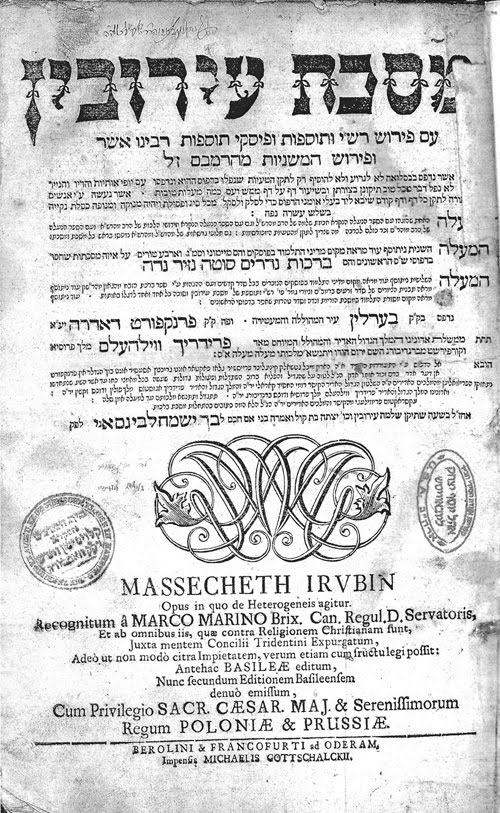
            At the beginning of the article it was stated that “this article is concerned with errors in and about Hebrew books only.” While the following example might tend to belie that statement, that is so only if the reader does not accept that the Bible is a Hebrew book, even if in translation. With that caveat, we bring an interesting and, from the printer’s perspective, an especially unfortunate error. For centuries the King James Bible was the authoritative English translation of the Bible by and for English speaking non-Jews. First published in 1611 by Robert Barker, it was reissued in 1631 by Barker, together with Martin Lucas, then the royal printers in London. This edition of the King James Bible is now best known as the Wicked Bible, but is also referred to as the Adulterous Bible or Sinners’ Bible. The error is in the Ten Commandments, in which the prohibition against adultery (Exodus 20:14; Heb. Bible 20:13) reads “Thou shalt commit adultery,” the “not” having been omitted, thus accounting for this edition of the King James Bible being referred to as the wicked Bible.
King Charles I was made acquainted with the error and the printers were called before the Star Chamber, where, upon the facts being proved, the printers were fined £3,000 about 34,000 pounds today). Subsequently, Barker and Lucas lost their printer’s licenses. The Archbishop of Canterbury, angered by the mistakes in this edition of the Bible, stated:
I knew the tyme
when great care was had about printing, the Bibles especially, good compositors
and the best correctors were gotten being grave and learned men, the paper and
the letter rare, and faire every way of the beste, but now the paper is nought,
the composers boyes, and the correctors unlearned.[51]
Printed in a press run of 1,000 copies, the wicked Bible was subsequently ordered destroyed; a handful of copies only are extant today.[52]
This article began with censorship, primarily of the Talmud and other Hebrew books, followed by internal censorship of Hebrew books, plagiarism and forgery, errors intentional (misleading) and unintentional, of varying levels of consequence. As noted in the previous article, “what they have in common is the consequence of inadvertently or deliberately misleading the reader. This is a subject that fascinates and certainly deserves further study. Nevertheless, even this overview should caution the reader that not everything in print, no matter how innocuous or well received, is necessarily so, for,”
Who can discern his errors? Clean me from hidden faults. Keep back Your servant also from presumptuous sins; let
them not have dominion over me; then shall I be blameless, and innocent of great transgression (Psalms 19:13-14).[53]


[1] I would like to express my appreciation to Eli
Genauer for reading the article and for his many corrections, my son-in-law, R.
Moshe Tepfer at the National Library of Israel, Israel Mizrahi of Mizrahi Book
Store, and R. Yitzhak Wilhelm and R. Zalman Levine, reading room librarians,
Chabad-Lubavitch Library for providing me with facsimiles of the rare books
described in this article.
[2] William
Popper, The Censorship of Hebrew Books (New York, 1899, reprint New
York, 1968), pp. 59, 60.
[3] “Who can
discern his errors? Misdates, Errors, and Deceptions, in and about Hebrew
Books, Intentional and Otherwise” Hakirah: The Flatbush Journal of Jewish
Law and Thought
12 (2011), pp. 269-91, reprinted in Further Studies in the Making of
the Early Hebrew Book
(Brill, Leiden/Boston, 2013), pp. 395-420.
[4] Heinrich
Graetz, History of the Jews IV (Philadelphia, 1956), p. 589.
[5] Abraham J. Karp, From
the Ends of the Earth. Judaic Treasures of the Library of Congress
(Washington,
1991), p. 47.
[6] Despite having a more accurate text than later seventeenth
and eighteenth editions, the Benveniste Talmud is, with exceptions, not always
highly regarded due to its small size. An
interesting early example of this relates to the handsome Lublin Talmud
(1617-39), from the perspective of the seventeenth century. In correspondence
between a representative of Duke Augustus the Young of Braunschweig [1635-66], founder
of the Ducal Library in Wolfenbuettel and R. Jacob ben Abraham Fidanque, author
of a super-commentary on the Abarbanel’s commentary on Nevi’im Rishonim and a dealer,
Fidanque writes “My lord’s letter arrived today, Wednesday, Erev Rosh Hodesh
Tevet, concerning the Lublin edition of the Talmud. I have one to sell, and it
is very fine in its beauty and its paper, in sixteen volumes and new. If my
lord wishes to give me 40R, that is, forty R. I will send it to him immediately
upon receipt of his response. I will sell it for less, but if my lord wants to
purchase an Amsterdam edition I will sell it for 14R. . . .” (K.
Wilkelm, “The Duke and the Talmud” Kiryat Sefer, XII (1936), p. 494
[Hebrew).
[7] Rabbinovicz, p.
100.
[8] Ben Satda, a
surname of Jesus of Nasereth, is, according to Marcus Jastrow, A Dictionary
of the Targumim, the Talmud Babli and Yerushalmi, and the Midrashic Literature

(Brooklyn, N.Y., n. d.), p. 972, probably of Greek origin. The section on Ben
Satda (Sanhedrin 67a) begins “and so they did to Ben Satda in Lod, and
hung him on erev Pesah. Ben Satda? He was the son (ben) of Padera . . .,
Padera being a name given to both the mother and father of Jesus.” As noted
above, neither this or comparable entries appear in many current editions of
the Talmud.
[9] Popper, p. 21.
[10] A somewhat inconsistent exception is
the Soncino translation of the Talmud. In the edition of Sanhedrin
published by the Traditional press (New York, n. d.) the Ben Satda entry is
omitted from both the Hebrew and English text. However, in the Judaic
and Soncino Classic Library (Judaica Press, Brooklyn, NY) edition, translator
David Kantrowitz, the Ben Satda entry is
available in Hebrew but not in English. However, in the Rebecca Bennet
Publications (1959) Soncino edition of Shabbat and the Judaic and
Soncino Classic Library edition of that tractate the Ben Satda text appears in both the Hebrew and in the English
translation, as well as in the Art Scroll Schottenstein edition of Shabbat.
That entry, however, is incomplete, and the Hebrew portion of the Judaic
and Soncino Classic Library edition notes that the censor has removed part of
the text.
[11] Abraham
Saba rewrote Zeror ha-Mor in Portugal from memory, having lost his writings
after the expulsionof the Jews from Spain.. Saba was imprisoned in Portugal for
refusing to accept baptism. Eventually released, he resettled in Morocco. Less
well known is what occurred afterwards. R. Hayyim Joseph David Azulai (Hida,
1724–1806) informs that Saba, after residing in Fez for ten years, traveled to
Verona, Italy. En route, a storm arose. The captain, in despair, requested Saba
pray for the ship’s safety. He agreed, but on the condition that, if he were to
die at sea, the captain should not bury him at sea, but rather take him to a
Jewish community for proper burial. The captain agreed, Abraham Saba’s prayed
and the storm abated. Two days later, on the eve of Yom Kippur, Saba died. The
captain took his body to Verona, where the Jewish community buried him with
great honor. (Hayyim Joseph David Azulai, Shem ha-gedolim ha-shalem with additions by Menachem Mendel Krengel
I (Jerusalem, 1979), pp. 13-14 [Hebrew].
[12] Amnon
Raz-Krakotzkin, The Censor, the Editor, and the Text: the Catholic
Church and the Shaping of the Jewish Canon in the Sixteenth Century
,
translated by Jackie Feldman (Philadelphia: University of Pennsylvania
Press, 2007), pp. 142. My edition of Zeror ha-Mor,
published by Heichel ha-Sefer (Benei Brak,1990) includes this passage.
[13] Among other censored halakhic works are R. Menahem ben Aaron ibn
Zerah’s (c. 1310-1385) Zeidah la-Derekh (Ferrara, 1554). The entry in Zeidah
la-Derekh
on malshinim (slanderers, informers), comprising almost an
entire leaf, was removed and the enumeration of the prayers comprising the Amidah
was correspondingly adjusted when the second edition (Sabbioneta, 1567) was
printed. The expurgated material has not been restored in subsequent editions. Another
contemporary halakhic work that was also censored is R. Isaac ben Joseph
of Corbeil (d. 1280) of the Ba’alei Tosafot’s Amudei Golah (Cremona,
1556), in which objectionable terms, and occasionally entire paragraphs, were
either substituted or suppressed. Concerning Zeidah la-Derekh and Amudei
Golah
see my “Concise and Succinct: Sixteenth Century Editions of Medieval
Halakhic Compendiums,” Hakirah: The Flatbush Journal of Jewish Law and
Thought
15 (2013), pp. 122-24 and 114-16 respectively.
[14] Isaiah
Sonne, “Expurgation of Hebrew Books,” in Hebrew Printng and Bibliography, Editor
Charles Berlin (New York, 1976), p. 231.
[15] Jacob S. Levinger, “Ganzfried, Solomon ben Joseph,” Encyclopaedia
Judaica
. Ed. Michael Berenbaum and Fred Skolnik, 7 (Detroit, 2007),
379-380.
[16] Marc B.
Shapiro, Changing the Immutable: How Orthodox Judaism Rewrites its History
(Oxford, Portland, 2015), p. 85-89.
[17] Shapiro, pp. 142 ff.
[18] David Sutton, Aleppo, City of Scholars
(Brooklyn, 2005), p. 334 no. 539.
[19] 1575, Birkat
ha-Mazon
, Lublin – Birkat ha-Mazon, facsimile reproduction
(Brooklyn, 2000), with introductions by Dovberush Weber and Eliezer Katzman,
pp. 6-23, 1-10 [Hebrew].
[20] Katzman, facsimile, p. 3; Meijer Marcus Roest, Catalogue
der Hebraica und Judaica Rosenthalishen
Bibliotek. Bearbetet von M. Roest,
with Anhang by Leeser Rosenthal (Amsterdam, 1875, reprint Amsterdam,
1966), II p. 42 n. 243  [Hebrew].
[21] Geoffrey Wigoder, “Abraham Bar Ḥiyya,” EJ 1, pp. 292-294.
[22] Hayyim Dov Chavel, “Kitvei Rabbenu Baḥya (Jerusalem, 1970), pp. 213-14 [Hebrew]. These remarks
are preceded by Chavel in the introduction to Kitvei Rabbenu Baḥya (p.
13), where he writes similarly that “the entire commentary on Jonah (in the
essay on Kippurim) is from this author (R. Abraham
ben Ḥayya). It is not clear to me why he concealed his name. Perhaps the reason
is that his books were very well known. . . .”
[23] Besamim
Rosh
was briefly referred to in “Who can discern his errors? . . .” in
footnote (25). It is addressed here in greater detail. Besamim Rosh has
been the subject of considerable interest. A sample biography includes the
following: Raymond Apple, “Saul Berlin (1740-1794) – Heretical Rabbi,”
Proceedings of the Australian Jewish Forum held at Mandelbaum House, University
of Sydney, 8-9 February 2004, Mandelbaum Studies in Judaica 12,
published by Mandelbaum House,
here; Samuel
Joseph Fuenn, Kiryah Ne’emanah (Vilna, 1860). pp. 295-98 [Hebrew];
Reuben Margaliot, “R. Saul Levin Forger of the book ‘Besamim Rosh’,” Areshet,
ed. Isaac Raphael, (1944) pp. 411-418 [Hebrew]; Moses Pelli, The age of
Haskalah, (Lanhan, 2010) pp. 171-89; idem., “Intimations of Religious
Reform in the German Hebrew Haskalah Literature” Jewish Social Studies 32:1
“(Jan. 1970), pp. 3-13); “No Besamim in this Rosh,” On the Main Line May
12, 2007, here; Dan
Rabinowitz, “Besamim Rosh,” The Seforim Blog, October 21, 2005, here;
Moshe Samet, “The Beginnings of Orthodoxy,” Modern Judaism, 8: 3
(1988), pp. 249-269;
[24] Abraham
David, “Berlin, Saul ben Ẓevi Hirsch Levin,” EJ 3, 459-460.
[25] The ban called for Mitzpeh Yokteil to be
burned  and destroyed with “great shame,”
and, in Berlin, it was so burned in the old synagogue courtyard (Israel
Zinberg, A History of Jewish Literature VIII (New York, 1975),
translated by Bernard Martin, p. 195.
[26] Dan
Rabinowitz, “Benefits
of the Internet: Besamim Rosh and its History
,” The Seforim Blog,
April 26, 2010, here.
[27] Talya
Fishman suggests that Berlin selected di Molina because little was known about
him and “it is probably of significance that this halakhist was ridiculed by
the Shulhan arukh’s (sic) author as one who failed to understand
the teachings of his predecessors and who said things of his own opinion, as if
‘prophetically, with no basis in Gemara or poskim [i.e. decisors]’.
Halakhically erudite readers of Besamim Rosh who learned that it was discovered
and compiled by R. Isaac di Molina might not have suspected the volume’s
dubious provenance, but they might well have been negatively prejudiced in
their assessment of its reliability as a legal source.” (Talya Fishman,
“Forging Jewish Memory, Besamim Rosh: and the Invention of
Pre-Emancipation Jewish Culture” in Jewish History and Jewish Memory: Essays
in Honor of Yosef Hayyim Yerushalmi
, ed. Elishiva
Carlebach
, John
M. Efron
, David
N. Myers
, pp. 78). Zinberg (p. 197) suggests that this
di Molina is a fabricated person, noting that the gematria
(numerical value) of di Molina equals di Satanow,
(137), a maskilic collaborator of Berlin.
[28] Zinberg, p. 197.
[29] Azulai, Shem
ha-Gedolim
II, p. 34 no. 127.
[30] Dan Rabinowitz, “Benefits
of the Internet.”
[31] Fishman, p. 75.
[32] Fishman, p. 81.
[33] Shmuel Feiner, The
Jewish Enlightenment
, tr. Chaya Naor (Philadelphia, 2011), p. 336.
[34] Mozes
Heiman Gans, Memorbook. History of Dutch Jewry from the Renaissance to 1940
with 1100 illustrations and text
(Baarn, Netherlands, 1977), p. 140.
[35] Concerning
Moses Benjamin Wulff see Marvin J. Heller, “Moses Benjamin Wulff – Court Jew in
Anhalt-Dessau,” European Judaism 33:2 (London, 2000), pp. 61-71,
reprinted in Studies in
the Making of the Early Hebrew Book
(hereafter Studies, Brill, Leiden/Boston,
2008), pp. 206-17.
[36]  Yehoshua Horowitz, “Judah Leib ben Enoch Zundel,” EJ 11.

[37] Richard Gottheil,
A. Freimann, Joseph Jacobs, M. Seligsohn,
“Frankfort-on-the-Main,” JE.

[38] The left
image is courtesy of Israel Mizrahi, Mizrahi Book Store.
[39] For a more detailed discussion of Leon (Judah Aryeh) Modena and Sur
me-Ra
see my “Sur me-Ra: Leone (Judah Aryeh) Modena’s Popular and
Much Reprinted Treatise Against Gambling” (Gutenberg-Jahrbuch, Mainz,
2015), pp. 105-22).
[40] Isaac Benjacob,
Otzar
ha-Sefarim: Sefer Arukh li-Tekhunat Sifre Yiśraʼel Nidpasim ṿe-Khitve Yad
(Vilna, 1880), p. 419, samekh 314 [Hebrew];
Ch. B. Friedberg, Bet Eked Sefarim, (Israel, n.d.), samekh
331 [Hebrew]; Yeshayahu Vinograd, Thesaurus of the Hebrew Book. Listing of
Books Printed in Hebrew Letters Since the Beginning of Printing circa 1469
through 1863
II (Jerusalem, 1993-95), p. 266 no. 1084 [Hebrew].
[41] The library in question was contacted and has since
modified their catalogue.
[42] L. Fuks
and R. G. Fuks‑Mansfeld, Hebrew Typography in the Northern Netherlands 1585
– 1815
(Leiden, 1984-87), I pp. 47-48 no. 53; Moritz Steinschneider, Catalogus Liborium Hebraeorum in Bibliotheca
Bodleiana
(CB, Berlin, 1852-60), no. 5745 col. 1351:24.
[43] Isaac Benjacob,
Otzar ha-Sefarim, p. 419, samekh
317 [Hebrew]; Julius Fürst, Bibliotheca Judaica: Bibliographisches Handbuch
der Gesammten Jüdischen Literatur . .
.II (1849-63, reprint Hildesheim,
1960), p. 384; Vinograd, Thesaurus of the Hebrew Book. II pp. 14-15 nos.
6, 8, 15.
[44] David
Cohen, Kuntres ha-Akov le-Mishor: le-Taken ta’uyot ha-Defus shel
ha-Shas Hotsa’at Vilna
(Brooklyn, 1983), pp. 4, 18, 22, 40.
[45] Menahem Mendel Brachfeld, Yosef Halel I (Brooklyn,
1987), pp. 8-9.
[46] Brachfeld, II p. 36. An accompanying footnote notes
that this is also the order in the Rome, Soncino, and Zamora editions, as well
as in many manuscripts on parchment.
[47] Brachfeld, II p. 102. The accompanying footnotes
states that this is also the text in the Rome and Zamora editions.
[48] Brachfeld, II, pp. 13, 33.
[49] A
palindrome is a word, line, verse, number, sentence, etc., reading the same backward as forward, for example, Madam, I’m Adam; able was I ere I saw Elba; and mom.
[50] Concerning
the usage mirror-image monograms see Marvin
J. Heller, “Mirror-image Monograms as Printers’ Devices on the Title
Pages of Hebrew Books Printed in the Seventeenth and Eighteenth Centuries,” Printing
History
40 (Rochester, N. Y., 2000), pp. 2-11, reprinted in Studies, pp. 33-43. The
title-page of Givat Shaul, as does other of works printed in various
locations, as noted above, states that it was printed, in Zolkiew, in small
letters, with fonts, again small letters, and then Amsterdam, in a very large
font.
[51] Louis Edward Ingelbart, Press
Freedoms: a Descriptive Calendar of Concepts, Interpretations, Events, and
Courts Actions, from 4000 B.C. to the Present
, (Greenwood Publishing,
1987), p. 40.
[52] A copy was
recently offered for sale for $99,500. here.
Among other errors in early editions of the Bible are the “Cannibal Bible,”
printed at Amsterdam in 1682, with the sentence “If the latter husband ate her
[for hate her], her former husband may not take her again” (Deuteronomy
24:3); a 1702 edition has the Psalmist complaining that “printers [princes]
have persecuted me without a cause” (Psalm 119:161); and  an edition published in Charles I’s reign,
reads “The fool hath said in his heart there is a God” (Psalm 14:1) here.
[53] Having pointed out the errors of others, I thought, in
all fairness, to note some errors in my own work, both those of consequence and
those less so. Those errors, however, in both categories, being too numerous,
might, given the length of this article, prove excessive and tedious for the
reader. They need, therefore, to be saved for a later day, for a possible
future article.
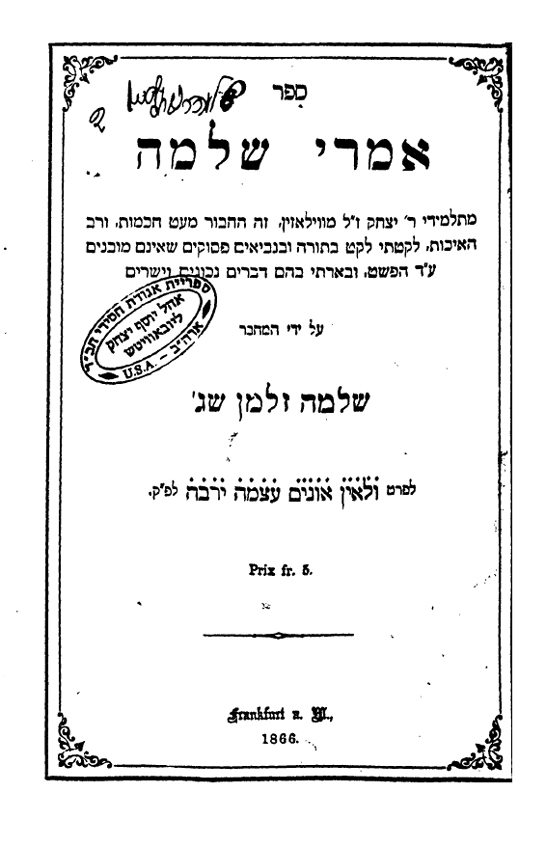
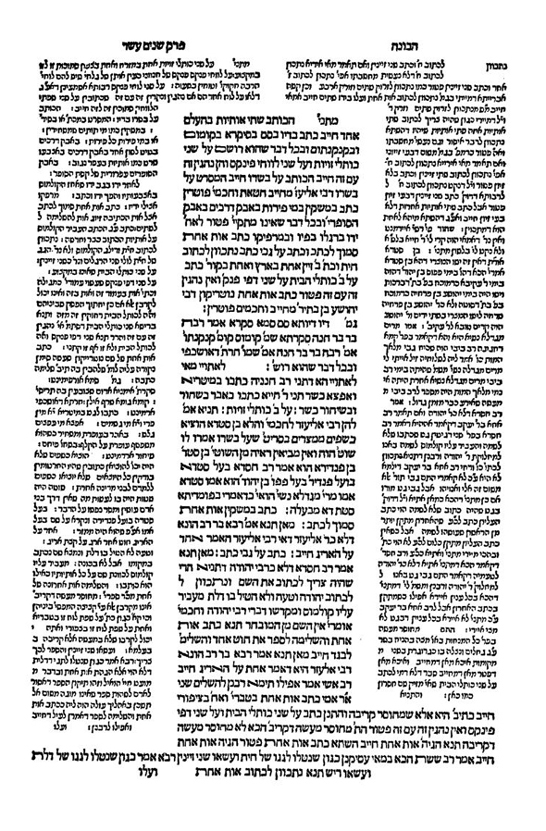
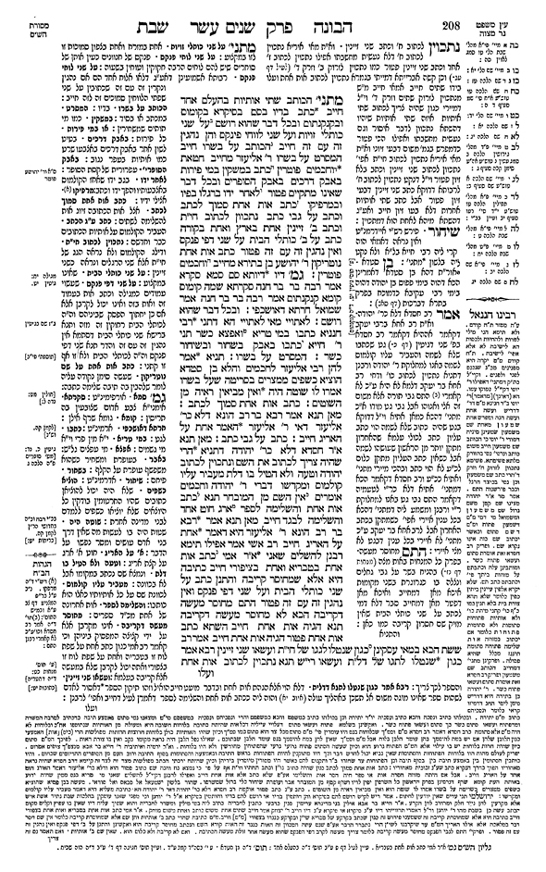
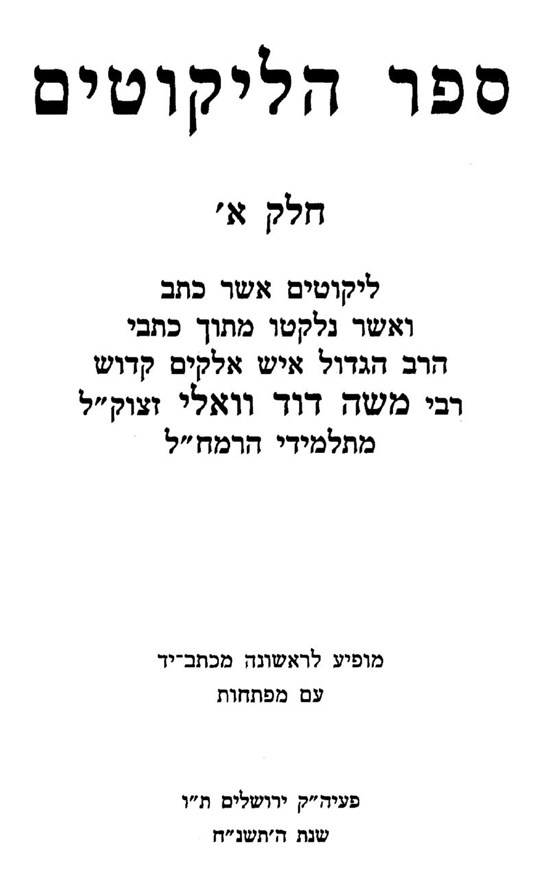
Elliott Horowitz – “”Most of all you’ve got to hide it from the kids…’ Reading Esther before Bed”

Elliott Horowitz teaches at Bar Ilan University and is co-editor of Jewish Quarterly Review.
This is his fourth contribution to the Seforim blog. We hope that you enjoy.
“”Most of all you’ve got to hide it from the kids…’:
Reading Esther before Bed”

Elliott Horowitz
“The problem of selecting Bible stories for the early grades is an especially difficult one,” wrote Emanuel Gamoran in his introduction to the first volume of Lenore Cohen’s Bible Tales for Very Young Children (2 vols, 1934-36), of which he was the editor. “Not all stories of the Bible are suited to the needs of little children,” continued Gamoran, who was an American Reform rabbi, and a disciple of the pioneer Jewish educator Samson Benderly,[1] “nor should all those children be told them in their entirety. In some instances certain details should be omitted.” In comes as little surprise, then, that in the second volume of Cohen’s Bible Tales the book of Esther contains only a single casualty – the evil Haman, who by the king’s order is hanged on the gallows he had prepared for Mordecai. No mention is made of the death by hanging of Haman’s ten sons, or of the more than 75,000 non-Jews killed, with the king’s permission, by Mordecai’s coreligionists. This was clearly one of those instances in which, according to Rabbi Gamoran, “certain details should be omitted.”
The identical omissions had been made three years earlier in a biblical anthology for children (The Children’s Bible: Selections from the Old and New Testaments) whose contents were “translated and arranged” by two distinguished non-Jews: Henry Sherman, who headed the “department of religious literature” at Charles Scribner’s Sons, which published the book, and Charles Foster Kent, who, as indicated on the frontispiece, was “Woolsey Professor of Biblical Literature in Yale University.”[2] The same editorial policy had earlier been followed by the American children’s writer Frances Jenkins Olcott (1873-1967) in her delightful Bible Stories to Read and Tell, published by Blue Ribbon Books in 1916.
Cohen and Gamoran, then, followed a venerable tradition in saving their “very young” readers from any knowledge of the sad fate of Haman’s sons. Yet they could arguably have followed the model of their British coreligionist Mrs. Philip Cohen in her two-volume Bible Readings with My Children (2nd ed., 1899). In her retelling of the book of Esther she acknowledged that not only Haman, but also his “ten sons were hanged on the gallows which their father had set up for Mordecai.”[3] Moreover, unlike Frances Olcott, who omitted mention of the permission given the Jews by Ahasuerus to defend themselves, and Messrs. Sherman and Kent, who included “the king’s “command that the Jews who were in every city should gather together and protect their lives,” but said nothing about the consequences thereof, Mrs. Cohen felt that it was safe to tell children that “the Jews, in defending themselves, killed numbers of their enemies.”
Mrs. Cohen’s justly popular anthology went through several editions, the fourth of which appeared in London in 1923. In that same year the future (but now lamented) Bible scholar Nahum Sarna was born in London. Not surprisingly, it was from that anthology that he acquired his earliest knowledge of Scripture. Reminiscing decades later about how he came to devote his life “to the study and teaching of the Hebrew Bible,” Sarna, then recently retired from Brandeis University, recalled that among his “earliest and most agreeable recollections is my father reading to me every Shabbat, with unfailing regularity from a little two-volumed work entitled Bible Readings with my Children by a Mrs. Philip Cohen. I am not certain, but I believe I was about three years old when the regimen began.”[4]
II
Bible Readings with my Children was not the first such anthology produced for Jewish children in Victorian England. Already in 1877 Ellis Davidson had published The Bible Reader under the explicit “sanction” of Britain’s Chief Rabbi Nathan Marcus Adler.[5] It was intended, as its subtitle indicated for the Use of Jewish Schools and Families, With the Addition of Questions on the Text, and Moral Reflections on Each Chapter. Davidson’s Bible Reader contained material from the popular book of Esther, but not much from the book’s brutal ending. Thus, anticipating Sherman and Kent’s Children’s Bible of 1930 readers were informed of the permission granted the Jews by Ahasuerus “to destroy, to slay, and to annihilate any armed force…that might attack them, with their children and their women,” but learned nothing of the consequences of that permission. Davidson did find a way to include the deaths of Haman’s sons, which both the Children’s Bible and Frances Olcott’s earlier Bible Stories later chose to omit, but he did so at the cost of changing the biblical story. They “were slain in battle,” and only afterwards hanged, wrote Davidson, “to show the people how utterly the whole house of Haman was degraded, and in order that future assaults might be prevented.”[6]
During the 1890’s two graduates of Oxford, each of whom had been at Balliol College when it was headed by the legendary Benjamin Jowett (1817-93), brought out their own biblical anthologies intended – at least in part – for young readers. The first of these to appear was John William Mackail’s Biblia Innocentium: Being the Story of God’s Chosen People Before the Coming of Our Lord…upon Earth, Written Anew for Children (1892). Mackail (1859-1945), who was born on the Isle of Bute and whose father was a minister of the Scottish Free Church, had overlapped as an undergraduate at Balliol with Claude Montefiore (1858-1938), who was a great nephew of the renowned Sir Moses. It is likely that they knew each other, since neither – unlike the bulk of their classmates – was an Anglican product of a posh “public school.” Both were also among the college’s most distinguished students; achieving “firsts” in the demanding course of study known as Greats (Literae Humaniores) in which their classmate George Nathaniel Curzon (a former Etonian and future viceroy of India) received only a “second.”[7]
In 1896 Montefiore, who was presumably familiar with Mackail’s Biblia Innocentium (which had appeared in a second edition in 1893) brought his Bible for Home Reading (1896), a two-volume anthology “with comments and reflections for the use of Jewish parents and their children. ” In certain respects Montefiore’s anthology followed the limitations that both his coreligionist Davidson and his former classmate Mackail had imposed upon themselves. No mention was made, for example, of the rape of Dinah in Genesis 34 or the subsequent massacre perpetrated by her brothers in Shechem. Yet with regard to the book of Esther Montefiore took a diametrically different approach. Whereas both previous Victorian anthologies, the one Jewish and the other Christian, had informed their readers of the permission granted the Jews to defend themselves but not of the bloody consequences thereof, Montefiore decided to include all the chpaters of Esther in their entirety despite what he acknowledged as the “religious and moral deficiencies.” These, he claimed, had been “ignored or explained away” by some, but also “exaggerated and falsely labelled” by others.” The best solution, he believed was to let readers, young and old, judge for themselves.
There were other ways of dealing with the book’s “religious and moral deficiencies” when presenting its contents to young readers. In his Story of the Bible: first published in 1904, Jesse Lyman Hurlbut (1843-1930), a Methodist Episcopal clergyman, reported not only that “Haman died upon the gallows that he made for Mordecai, but also that his sons “were put to death for their father’s evildoing.” He added, however, that this had been done “according to the cruel usage of those times.”[8] In contrast to Ellis Davidson’s clumsy attempt, in 1877, to make the hanging of Haman’s sons more palatable to his younger readers, Hurlbut, a native of New York, showed that it was possible to add without detracting.
Notes:
[1] On both Gamoran and Benderly, see Penny Schine Gold, Making the Bible Modern: Children’s Bibles and Jewish Education in Twentieth-Century America (Ithaca, 2004).
[2] H. A. Sherman and and C. F. Kent, The Children’s Bible (New York, 1933), 223-25.
[3] Mrs. Philip Cohen, Bible Readings with my Children, two volumes (rev. ed. London, 1899), II, 336.
[4] Nahum Sarna, “Ruminations of a Jewish Bible Scholar,” Bible Review 4:3 (June 1988). See also the obituary by Tom Long in the Boston Globe (25 June 2005).
[5] On Davidson, see Geoffrey Cantor, “‘From nature to nature’s God’: Ellis A. Davidson—mid-Victorian educator, moralist, and consummate Designer,” Jewish History 23:4 (December 2009): 263-388.
[6] On Davidson’s work and its treatment of the book of Esther, see Elliott Horowitz, Reckless Rites: Purim and the Legacy of Jewish Violence (2nd ed., Princeton, 2008), 24.
[7] On Montefiore at Balliol and the impact on the college of Jowett, see Horowitz, Reckless Rites, 25, and the sources cited there.
[8] Hurlbut, Story of the Bible: For Young and Old (Philadelphia, 1952).


Who was Reb Shlomo?

Who was Reb Shlomo? by Natan Ophir (Offenbacher)
 
Natan Ophir’s book, Rabbi Shlomo Carlebach: Life, Mission, and Legacy, has just appeared. This is a complete biography of Carlebach’s life (not a hagiography) and is essential for anyone with an interest in Carlebach. The Seforim Blog is happy to include this excerpt from the book, pp. 413-419.
1.      Who was Reb Shlomo?
Who was Reb Shlomo Carlebach? This question was deliberated in the obituaries after his death. Elli Wohlgelernter of The Jerusalem Post tried to describe Shlomo’s elusive uniqueness:
The obituaries referred to Rabbi Shlomo Carlebach as the “Singing Rabbi,” but that’s like describing Yankee Stadium as just some ballpark in the Bronx…. To have spent any time with Shlomo – that’s all he was called, never Rabbi Carlebach – was to understand this: he was his own kind of rabbi and they were his own songs, and they will be sung for as long as Jews gather to sing and dance….He was part hippie, part yippie, part beatnik, and part New Age. He was Dylan, Elvis, Arlo and Seeger all rolled into one, with a touch of Sholem Aleichem and Mark Twain.[1]
Indeed, Shlomo just didn’t seem to fit into any restrictive defining label. Menachem Daum, in a video report for Religion News and Ethics, labeled Rabbi Carlebach as the “most unorthodox Orthodox rabbi.” Moshe Stern, the internationally renowned cantor, characterized Carlebach as a combination of “a prodigal tzaddik, a musical genius, perhaps a religious exegete, a hippie in religious-ultra-orthodox garb.” Stern highlighted the all-encompassing nature of Reb Shlomo’s personality which defied categorization:
His greatest strength was and remains chiefly his ability to be all encompassing, a kind of prototype for felling the divides, for blurring the borders. This, it seems, is what the ears and souls of many in that younger generation latched onto, seeking as they did an escape path from the rigid categorizing enforced on them by the split reality of Israeli life.[2]
Similarly, Robert L. Cohen asks: Was there ever such an “embodied paradox, a bundle of contradictions?”[3] Cohen enumerates some of the seemingly contradictory aspects of Shlomo’s life. For example:
A thoroughgoing traditionalist, with Orthodox yeshiva education and rabbinical ordination, he outraged the Orthodox; a man for whom “pluralism” was an alien, ill-fitting concept, he was an implicit pluralist – teaching and singing everywhere, honoring rabbis of every denomination and encouraging others’ unorthodox paths.[4]
Shlomo was equally at home with the Admor of Amshinov, the homeless in Riverside Park, and Hadassah women. But there were subtle differences in how he presented himself. It was a different type of Shlomo comforting soldiers in hospitals during the Yom Kippur War, and another Shlomo singing for Christians in Poland and Germany.
A 1994 obituary by Yossi Klein Halevi in The Jerusalem Report used the term “Pied Piper of Judaism” to describe how Shlomo “taught an orphaned generation numbed by the Holocaust and assimilation how to return to joy.” Halevi captured the uniqueness of Shlomo’s concerts:
A Shlomo concert was part 60s-style happening, part Hasidic revival…. Shlomo always appeared with an entourage – strung-out street people, rebellious yeshivah boys, spiritual seekers, groupies… The only constant was Shlomo himself: his beautiful melodies; his deep, sure voice; his at-once profound and hokey rap ranging from Hasidic stories to exhortations for people to love each other, to mocking and very funny critiques of both ultra-Orthodoxy and Reform Judaism.[5]
The question of who was Reb Shlomo was often a reflection of how people related to him. Sometimes, it was Rabbi Shlomo Carlebach officiating in rabbinical functions such as weddings. Most disciples preferred the appellation “Reb Shlomo” to indicate a Hasidic closeness and warmth.[6] But for many followers, it was simply “Shlomo,” the best friend, informal confidant, eschewing titles or other artificial barriers. He was the rabbi poised at the entrance to his shul on West 79th St. to welcome all with a bear hug. In the setting of Manhattan’s street corners, he was a “holy brother” to many a “holy beggar.”
With a natural ease, Reb Shlomo also assumed the role of a charismatic prayer leader. For example, on Hoshana Rabbah services at West 79th St., wearing a white kittel and black gartel, he was like a choirmaster orchestrating the musical accompaniment of trumpet, violin and
singing congregation. In the full hour-long video dated September 26, 1994 at the Carlebach Shul, one can see the epitome of the new religious structure invented by Reb Shlomo: integrating a selection of his songs for the Hallel, each setting a different mood and spiritual direction; the symbolic waving of the lulav and arava with joyful dancing, and interjections in English creating a thoughtful direction.[7]
This is the Shlomo leading a new form of religious experience specifically adapted to the Orthodox community.
Shlomo was able to blend in to so many different types of communities because he reflected sundry images to diverse audiences. Prof. Shaul Magid uses the metaphor of a mirror:
Most remember him as a mirror: They saw in him what they wanted him to be, or what they imagined themselves to be…. each of his followers heard what he or she wanted and constructed him in their image. The Orthodox offer one reading, the neo-Hasidim another, Diaspora Jews another, Israeli Jews another; leftists read him one way, Jewish militants another. The point is none of them really know… He bequeathed a “Judaism of uncertainty” (“what do we know?” was his catchphrase) so that everything could be reviewed and revised, in the spirit of love and not separation, on compassion and not exclusion.[8]
Nonetheless, of all the images of Shlomo, the most well-known is that of the Singing Rabbi, the father of modern Hasidic music.
2. The Foremost Songwriter in Judaism?
Ari Goldman, in The New York Times obituary in 1994, designated Shlomo Carlebach “the foremost songwriter in contemporary Judaism.”[9] Recently, Goldman reiterated this statement, adding that it has never been disputed.[10] In 1997, music historian, Robert L. Cohen, referred to Shlomo as “the most prolific composer of liturgical folk melodies in this, perhaps any, century.”[11] In a later article, Cohen explained that Carlebach “opened the gates for a new generation of niggun makers” by creating music with a Hasidic flavor that could be accessible to young Americans:
Shlomo Carlebach had a phenomenal gift for melodies that conveyed yearning and joy, sweetness and exultation all at once… His
example inspired an entire generation to set traditional, and some original, verses to their own new melodies… The result has been a garland of new Jewish music – of new wings for our prayers.[12]
This type of recognition recurs in various Jewish encyclopedias and year books. Mark K. Bauman in the 2011 Jewish American Chronology, recognized Shlomo as “the twentieth century’s most prolific and influential composer of Jewish music and a key ambassador of spirituality,
especially to Jewish youth.”[13] Judah M. Cohen, in the Encyclopaedia Judaica entry, defined Carlebach’s extraordinary influence:
At the time of his death, Shlomo Carlebach had become a legend of sorts, having recorded over 25 albums, composed up to 5,000 songs, performed on five continents, released two official songbooks, amassed a broad following, granted semikhah to both male and female students, and given away nearly all his earnings. Several of his songs, moreover, had become “traditional” during Jewish events; revelers would sing such songs as “Esa Einai,” “David Melekh Yisrael,” “Am Yisrael Chai,” and “Od Yeshoma.”[14]
Mark Kligman, professor of Jewish Musicology at Hebrew Union College in New York, in his survey of contemporary Jewish music in the American Jewish Year Book (2001) stated: “Jewish musical artists of today consider Shlomo Carlebach the father of contemporary Jewish music.”[15] Kligman explains that the most innovative part of Shlomo’s musical success was “the blending of Hassidic song with folk music”:
Combining the participatory ease of folk music, the energy of the newly created music from Israel, and the religious fervor of the Hassidic niggun, he succeeded in moving liturgical music out of the synagogue and into a wide range of other settings, including concert halls and night clubs, and used his music to educate and inspire Jews to renew their Jewish identity and discover the beauty of Jewish life.[16]
Nonetheless, not all Jewish musicologists have recognized Shlomo’s importance. Cantor Macy Nulman in his 1975 comprehensive encyclopedia of Jewish music does not have an entry for Shlomo Carlebach.[17] Similarly, in his 1992 masterful survey of Jewish musical traditions, Hebrew University Professor of Musicology, Amnon Shiloah, does not mention Shlomo.[18] Presumably, part of the reason is that popular Hasidic folk songs are not on the same level as professional music. Indeed, Shlomo’s musical success is remarkable considering that he never really trained as a professional musician, and apart from a few voice lessons in Manhattan, was not an expert cantor. Or as Shlomo self-effacingly explained in an interview to Elli Wohlgelenter:
I don’t think I have a good voice. I think my voice is just good enough to inspire people to sing with me. If I would have a gevalt voice like, let’s say, Moshe Koussevitzky, then nobody would want to sing with me, because then they’ll think they don’t want to miss my voice, but my voice is just good enough to make them sing.[19]
Shlomo’s self-comparison to the renowned cantor Moshe Koussevitzky highlights a key ingredient of his musical success. Rather than impress an audience by a beautiful recital, Shlomo led a sing-along of catchy tunes. A typical Carlebach tune is easy to follow.[20] At Shlomo events, participants quickly learned his new songs thus furthering their popularity.
Musicologist Velvel Pasternak explained that if judged by objective musical standards, Shlomo was not the most outstanding composer, singer or guitarist, but his success was due to an uncanny ability to strike an immediate responsive chord in the ears of his listeners:
Even a seemingly banal sounding melody became a hypnotic and mesmerizing chant. The simplicity of his melody line, the intensity of his performances, the charisma of his personality, served to create a worldwide musical following.[21]
Furthermore, by adapting the form and fervor of a Hasidic farbrengen (see above, Chapter 6), Shlomo constructed a new hybrid of folk singing and semi-prayer. To quote the insightful appraisal of Motti Regev and Edwin Seroussi:
Armed with a guitar, dressed like an “orthodox hippie,” and using the most basic harmonies and short, repetitive melodies, Carlebach appeared at concerts that became a kind of unorthodox prayer that recalled the traditional Hassidic tish, an assembly of Hassidim around the table of the rebbe, held on special dates, and characterized by singing and dancing.[22]
In sum, the amalgamation of a Hasidic tish, inspirational storytelling, emotional insights, and ethical exhortations created the innovative Carlebachian musical experience. Samuel C. Heilman, professor of Sociology at Queens College CUNY, describes Shlomo Carlebach as a product of a synergy between Hasidic, Israeli, and American trends:
He attached himself to Hasidic prayer styles from which he took the idea of expressive enthusiasms in prayer and devotional ecstasy as part of Jewish outreach. From American new folk idioms, he took the guitar, rhythms, the practice of sing-alongs, the “talking blues,” concertizing, and the idea of making recordings. From Israeli culture, he borrowed the idea of shirah b’tzibbur, i.e., choral singing as a tool of social solidarity. All these he mixed syncretistically to develop his particular style.[23]
Indeed, this description sums up the secret of the appeal to Reb Shlomo’s music. He was able to bring together the popular folk music of the 1960s and the fervor of Hasidic niggunim to create a new genre of music. But Heilman goes further and explains:
Contemporary Carlebach minyanim have elevated him and his approach to a kind of mythic status. Reb Shlomo, as devotees refer to him these days, is the modern Jew’s counterpart to the Hasidic rebbes and other immortals that the Haredi world has enshrined. Like these rebbes, he is frequently resurrected in stories, songs, aphorisms, and teachings that are meant to shape the attitudes and religious character of those who invoke his memory.[24]
.
[1] Elli Wohlgelernter, “Simply Shlomo,” The Jerusalem Post, April 20, 1995.
[2] Ronit Tzach in Yediot Aharonot, Seven Day Magazine, Feb. 4, 2005, 34. Cited in Shmuel Barzilai, Chassidic Ecstasy in Music (Frankfurt am Main: 2009), 152.
[3] This witty aphorism is a quote from Charles Caleb Colton (1780–1832), Lacon or Many things in Few Words: Addressed to Those Who Think,vol.1, books?id=6AclAAAAMAAJ&pg=PA180&img=1&pgis=1&dq=paradox&sig=ACfU3U0aMhUVF-mTU8guK4hy2jQQRHDH4A&edge=0CCCCVII, p. 1980.
[4] Robert L. Cohen, “Jewish Soul Man.” Moment, August 1997, 59–64, 83.
[5] Yossi Klein Halevi, “The Pied Piper of Judaism,” The Jerusalem Report, Nov. 17, 1994, 45.
[6] Shlomo explained the advantages of using the designation “Reb” rather than “Rabbi” by playfully distinguishing the letters. “Rabbi” is a combination of Ra (Hebrew for “bad”) and Bi (“he gets by”), whereas “Reb” is a shortened form of “Rebbe,” and in Hebrew means “Rabbi” with the letter yod, signifying the Divine Presence – “God is so tremendous inside” – God’s Light in you. Shlomo’s explanation can be heard on segment 4:53–5:11 in part 4 of “Rabbi Shlomo In Concert”, YouTube, http://bit.ly/1bq3rE0. This is from his concert in Feb. 1994 in Miami Beach.
[7] For an hour long program of Reb Shlomo leading the singing for the Hoshana Rabbah service at the Carlebach Shul on 79th St., see Kikarhashabat.co.il; http://bit.ly/16CTaBM. Compare http://bit.ly/1dbGmHj; http://bit.ly/18pI96e. A record was produced entitled R. Shlomo Carlebach – The Last Hoshana Raba, http://bit.ly/HjJRAv, http://bit.ly/1g44CyH; http://bit.ly/18pHZMk.
[8] Shaul Magid, “Carlebach’s Broken Mirror,” Tablet Magazine, Nov. 1, 2012, TabletMag.com, http://www.tabletmag.com; http://bit.ly/1ac2Yc6.
[9] Ari L. Goldman, “Rabbi Shlomo Carlebach,” New York Times, Oct. 22, 1994.
[10] Ari L. Goldman, “Why Carlebach Matters,” The Jewish Week, May 8, 2009.
[11] Cohen, “Jewish Soul Man,” 59.
[12] Robert Cohen, “New Wings for Our Prayers: On American Jewish Music,” Open the Gates!, vol. 1, 2005, excerpted in Tikkun, March 27, 2008, Tikkun.org, http://bit.ly/17Qyw1k. Cohen’s essay accompanies the CD American-Jewish Music for Prayer and describes Jewish religious folk music, its inspiration in the Hasidic movement and its cultural roots in American folk music. The CD includes 18 different composers and performers of prayerful melodies and #17 is “Ein Keilokeinu” of Shlomo Carlebach.
[13] Mark K. Bauman, Jewish American Chronology: Chronologies of the American Mosaic (Santa Barbara, California: 2011), 119.
[14] Judah M. Cohen, “Carlebach, Shlomo,” Encyclopaedia Judaica, 2nd ed., vol. 4, 481–482.
[15] Mark Kligman, “Contemporary Jewish Music in America,” in David Singer and Lawrence Grossman (eds.), American Jewish Year Book. New York: 2001, vol. 101, 88–140.
[16] Kligman, “Contemporary Jewish Music.”
[17] Macy Nulman, The Concise Encyclopedia of Jewish
Music
(New Zealand: 1975).
[18] Amnon Shiloah, Jewish Musical Traditions (Detroit: 1992). His book is based on a course in Hebrew that Shiloah prepared for the Open University in the years 1985–1987.
[19] Wohlgelernter, “Simply Shlomo.”
[20] A typical Carlebach tune has two contrasting sections of only eight bars each, with the second one in a higher register, melodic sequences, and constant syncopation (with the rhythm accenting a normally weak beat) – see Motti Regev and Edwin Seroussi, Popular Music and National Culture in Israel (Berkeley–Los Angeles–London: 2004), 129.
[21] Velvel Pasternak, “A Musical Legacy,” Aquarian Minyan Newsletter, Autumn–Winter, 1995, reprinted in David Wolfe-Blank (ed.), The Aquarian Minyan KhaZak! Khazak!, 388–389.
[22] Regev and Seroussi, Popular Music, 127–128.
[23] Adapted from Samuel C. Heilman, Sliding to the Right: The Contest for the Future of American Jewish Orthodoxy (Berkeley and Los Angeles: 2006), 291.
[24] Ibid.


Crafting the Commandments

Albert D. Friedberg’s Crafting the Commandments has just appeared. The Seforim Blog is happy to present the following excerpt from the book’s conclusion.
Scholars have ascribed far too much importance to Maimonides’ enumeration of the commandments and far too little to the motivations that lay behind his appropriation of R. Simlai’s aggadah as the basis for the enumeration and to the significance that Maimonides attached to this aggadah. The proximate reason for creating an enumeration was his need to have a reasoned and methodical outline of all Torah legislation in front of him, a reminder of topics to guide his preparation of the upcoming code of law, a massive and unique undertaking. Thus we find him saying in the introduction to the ShM [Sefer ha-Mitzvot]:
All this [I would do] in order to guard against omitting any topic [emphasis added] from discussion, for only by including them in the enumeration of the commandments [heading the various treatises] would I insure against such omission.
This sense is reinforced by some of the Rules, especially Rules 7 and 10-14, which are essentially taxonomic rules rather than definitions of what constitutes a mitsvah. I posited that the logically unnecessary identification of this outline with R. Simlai’s count of 613 commandments owed its existence to Maimonides’ desire to incorporate the two fundamental beliefs of the Jewish faith, God’s existence and His oneness, into the legal realm, and thus transform their intellection into obligations, a dramatic departure from the preceding geonic paradigm. I inferred this conclusion from a dispassionate and unapologetic assessment of the mitsvah count. Maimonides stretched the meaning of mitsvat ‘aseh well beyond its common rabbinic usage, relying uncharacteristically on an aggadah of questionable legal worth, a homiletic creation with didactic aims and no pretensions of being precise, and resorted to a contrived and hardly compelling logic to arrive at the numerical target, likely fully aware of the variant results that could be legitimately obtained.
The enumeration, qua a reasoned list of commandments, has diverted the attention of the countless students of his works ever since the ShM left his hands. But I posit that it was not R. Simlai’s dictum that 613 commandments were given to Moses at Sinai that was significant, but rather R. Hamnuna’s accompanying exegesis. Maimonides used R. Hamnuna’s midrashic exegesis that the verses I am the Lord thy God and Thou shalt have no other God before Me specifically formed part of the count of 613 commandments to prove that to intellect the existence of God and His oneness constituted a positive, performative obligation. The credibility of R. Hamnuna’s exegesis was even more firmly established when Maimonides inferred from its language what he believed was a theological truth: the nature of the commandments to believe in the existence of God and to believe in His oneness was categorically distinct from the nature and motivation underlying the rest of the commandments. He explained this distinction by averring that the former were philosophically demonstrable truths, capable of being apprehended without the medium of revelation, while the latter were only conventions, necessitating the mediation of a lawgiver and prophet.
The two articles of faith occupy the most prominent position in the MT, appearing in the opening lines of the Sefer ha-Madda’. In a letter to his disciple, Joseph b. Judah, Maimonides wrote that he undertook to compile a code of law in his zeal for the glory of God, “in seeing a nation bereft of a truly comprehensive book (diwan) of law, and bereft of clear and correct [theological] notions.”  Only the inclusion of these two beliefs in the canon of law could have satisfied the requirements of “a truly comprehensive book (diwan)” containing “correct theological notions.”  In sum, the unequivocal and unique statement found in R. Simlai’s aggadah, that the beliefs in God’s existence and His oneness constituted positive obligations, led Maimonides to appropriate the aggadah, adopt its numerical value of 613, and conflate it with the outline that he was preparing—all despite the constraints that it imposed.
In the second half of the book, I turned my attention to the sub-section of positive commandments and drew some conclusions from the way they are described and defined in the Halakhot. While my readings hinged on what Maimonides actually wrote, I recognized that, being human, Maimonides was bound to make the occasional mistake. That said, the exceptional (but more than occasional) omission of the formulaic phrase “X is a mitsvat ‘aseh” at the start of a topical discussion held my special attention because of the implausibility of it being forgotten: the phrase is rich, bold, highly informative, and consistent with Maimonides’ sustained interest for making categorical distinctions. Additionally, and just as importantly, my readings focused on how Maimonides expressed himself. The rhetoric, the literary presentation of his ideas, and the logic of composition mattered as much to me as the slight inferences one could arrive at by noting the absence or presence of a particular term, elements which have constituted the more traditional way of studying his works.
I began the book’s second section by noting that in the Halakhot, Maimonides moves away from the contrived artificiality adopted in the ShM of using the term mitsvat ‘aseh to designate all types of legal themes: here he applies the term to a very specific case, that of an absolute and unconditional obligation. Combing scriptural and rabbinic sources, Maimonides searches for clear indications of unconditional commands and imperatives to perform well-defined acts. These he designates boldly and prominently at the commencement of each topical
discussion, with a formulaic phrase that states that the directive at hand is a mitsvat ‘aseh. Where Maimonides withholds the mitsvat ‘aseh designation, I theorized that he must have done so because the scriptural and/or rabbinic evidence was insufficient to make such a determination. I tested for this evidentiary insufficiency, and when confirmed, I theorized further that under the influence of reigning Islamic legal theory (which was also heavily if not wholly influenced by rabbinic thinking), Maimonides opts for a softer definition. As a result, certain scriptural directives are categorized as recommendations rather than orders, wise pieces of advice rather than commands. Supporting these with scriptural proof texts, he labels them with the solo term mitsvah, a label that he also uses to designate rabbinical directives. The scriptural mitsvot include such prominent directives as to love and fear God, to imitate Him, to appoint a king, to heed the call of a prophet, to rebuke the sinner, to honor the wise, to testify in court, and a few others.
I conjectured further that Maimonides deliberately withheld the scriptural designation from certain commandments that had been labeled as scriptural in the ShM when the plain reading of the scriptural text did not appear to provide sufficient evidence for them, even when rabbinic interpretation suggested otherwise. To this end, he chose an artful but somewhat concealed literary device to designate them as such, the participle of correct practice. This is the case with such prominent practices as the recitation of the Shema, the binding of the tefillin, the writing and placing of the mezuzah and the study of Torah.
In the heavily politicized atmosphere of Cairo, where Rabbanites were both assiduously courted and continuously attacked by sectarian groups (largely Karaites) over the role of the oral law in interpreting Scripture, Maimonides chose to keep his radical opinions hidden yet recoverable. When applied to the legal sections of the Torah, Maimonides’ peshateh di-qera hermeneutics would likely raise hackles among his own co-religionists and, worse yet, give comfort to the deniers of the oral law. His carefully planted literary cues could lead the reader who is familiar with rabbinic terminology and unburdened by popular and superficial conclusions to discover the Master’s true opinion or at the very least sense his ambivalence.
Maimonides was informed by a hermeneutics of peshateh di-qera that was firmly and demonstrably anchored in the Andalusian tradition. His insistence on presumed philological validity, however, left him uneasily placed, uncomfortably close to sectarian investigation and interpretation. Ironically, this led him at times to mount a struggling defense of his own traditional Rabbanite views, well aware that the plain sense of Scripture did not lend convincing support for such a stance.
Consciously or unconsciously, Maimonides navigated his legal system between the Rabbanites and the Karaites, upholding the former’s respect for authoritative tradition and the latter’s insistence on relying only on philologically informed readings. Maimonides’ extraordinarily novel application of peshateh di-qera to the halakhic corpus threatened the very foundations of a Rabbanism, one that was intimately intertwined with the Talmud and its authority. Nahmanides understood this too well when he criticized Rule 2:
[F]or this book of the master, its content is delightful, full of love [based on Song of Songs 5:16] except for this principle, which uproots great mountains of the Talmud and throws down fortified walls of the Gemara. For the students of the Gemara, this notion is evil and bitter. Let it be forgotten and not said.
Of course, Maimonides would not have conceded this point: he would have maintained that his paradigm flowed quite naturally from the pages of the Talmud. Did not the Talmud’s quest for peshateh di-qera support the distinction between divine and man-made law? Did not the rabbis of the Talmud acknowledge that explicitly stipulated scriptural laws enjoyed an epistemic advantage over and a distinction from man-made laws? To Maimonides the answer to these two questions was a resounding yes.


Thanks to his remarkable codification, Maimonides left an indelible mark on Jewish law. Unfortunately, an important part of his jurisprudence, the exquisitely fine distinctions he made between divine and human law and between command and advice, was never fully appreciated, perhaps because of its radical import—or perhaps because Maimonides, for his own good reasons, hid many of these contributions behind formulaic omissions, terminological nuances, and subtle literary devices. It is this rich and layered nuancing that in some modest way I have tried to recover.


The Netziv, Reading Newspapers on Shabbos, in general & Censorship (part one)*

 The Netziv, Reading Newspapers on Shabbos, in general & Censorship (part one)*
By: Eliezer Brodt
Previously, I have touched on the topic of the Netziv reading newspapers on weekdays and on Shabbos [here and here]. In this post I would like to revisit the subject, and also deal with some cases of censorship in the Netziv’s seforim.[1] I would like to stress at the outset that this is a work in progress[2] and not intended L’Halacha; each person should consult his own Rav.

In 1928, R’ Baruch Halevei Epstein described in his Mekor Baruch how on Shabbos his uncle, the Netziv, would read the Hebrew newspaper:

ואחר שקידש דודי על היין וטעמו מיני מאפה קלה, ואחר שקרא מעט בעתונים שנתקבלו מחדש… [מקור ברוך, חלק ד, עמ’ 1790].Further he adds:
וזוכר אני, כי “המגיד” הי’ דרכו להתקבל בכל ערב שבת לפנות ערב, ובלילה לא קרא אותו, מפני שליל שבת הי’ קודש לו לחזור בעל פה על המשניות ממסכתות שבת ועירובין… וקרא בו (בהמגיד) במשך היום.
וכאשר נקרה, שנתאחר “המגיד” לבא בזמנו בערב שבת, הי’ אומר, כי באותה השבת חש הוא כאלו חסר לו דבר מה, כמו שמרגיש “בשבת חזון”. זה הרגיל ללכת למרחץ בכל ערב שבת, ובערב שבת חזון נמנעים מזה; וכן הי’ אומר כי העתונים יחשבו לו כמביאי אליו ברכת שלום מכל העולם ועל כן יוקירם וייחל להם [מקור ברוך שם, עמ’ 1794].
 In 1988, Artscroll published part of this book in English called ‘My Uncle the Netziv‘. Lakewood Cheder distributed it as a fundraiser. A few months later, the Cheder sent out a letter apologizing for having sent the book and recommended not reading it. The Cheder explained that there were statements in the book which did not represent the Hashkofos of the Netziv. Jacob J. Schacter, in his frequently quoted article “Haskalah, Secular Studies and the Close of the Yeshiva in Volozhin in 1892,[3] speculates as to which aspects of the book this letter was referring; was it the author’s description of the Netziv reading of newspapers on Shabbos?
There have been many articles written in the past about the Mekor Baruch, alleging plagiarism and the errors he made in his historical narrative.[4] Some have shown that quotes in his father’s name about Chabad are unreliable. In the present article, I do not wish to add to that. It seems unlikely that that Rabbi Epstein would publish fabrications regarding his uncle’s practices that were common knowledge.[5] His work received a glowing haskamah from Rav Kook; had R. Epstein penned outright lies about the Netziv, Rav Kook’s rebbe, it is   doubtful that he would have given such an approbation.
This assumption aside, we may adduce more concrete evidence as to the veracity of R. Epstein’s report. In 1888, when Rav Kook he was 23 years old, he published the first issue of a periodical entitled ‘Ittur Sofrim’.[6] This sefer had many impressive Haskomot from Gedolei Yisroel, among them the Netziv. The volume included a Teshuvah from the Netziv, where he writes:
במכה”ע… ולי נראה דודאי לעיין מותר בפשיטות
 Here is a copy of the actual Teshuvah of the Netziv:


 Later on in the same year (1888) Rav Zev Turbavitz in a letter to the Aderet, writes:[7]
כאשר הגיע לידי סי’ עיטור סופרים חלק ראשון נבהלתי מראות הלכה הראשונה בראשית הפעלים לתורה מהרב הנצי”ב מוואלאזין שחולק על הש”ע שאוסר גם העיון בשטרי הדיוטות בשבת… והארכתי בזה ובודאי נחוץ הוא להדפיסה כי בודאי רבים יפלו על המציאה הגדולה הזאת, ויתלה עצמן באילן גדול ויתפארו בעצמן שכתורה יעשו…
 He also wrote a letter to Rav Kook, where he says:
עיטור סופרים… והנה בפתחי אותו ראיתי ראשית אומרים בד”ת פסק הג’ הנצי”ב מוואלאזין, ונשתוממתי מאד ושלח דברים ע”פ חוצות לחלוק על הש”ע וכן הראשונים והאחרונים בדברים של מה בכך, ובפרט להקל באיסורי שבת… והאמת אגיד לכת”ר כי אם לא היה שמו של הנצי”ב חתום על דבריו לא הייתי מאמין שיצאו דברים אלו מפי בן תורה ומה גם מפי גדול. ונפלאתי על כבודו שנתן להם מקום עוד בראש דבריו…”.
R’ Chaim Berlin writes this about his father’s Heter in 1893:[8]
ועל דבר לעיין בשבת בהרהורא בעלמא בלי קריאה בפה באגרות רשות ובמכתבי העתים לא הי’ כלל דעת מר אבא הגאון שליט”א, לקבוע מסמרים בהלכה זו ככל דבריו שבעטור סופרים, ולא בא אלא ליישב מנהג העולם שקוראים במכתבי העתים בשבת שסומכים בזה על משמעות תלמודא דידן עפ”י דעתם, שמפרשים דתלמודא דידן פליג בזה על תלמוד ירושלמי, אבל להלכה גם הוא יודה דקיי”ל כהירושלמי, וכה”ג מצינו בהרבה מקומות שכתבו הפוסקים ליישב מנהג העולם, שסומכים על דעה יחידית אף שלא כהלכה.

Without going into his reasoning, it seems clear that the Netziv, permitted reading newspapers on Shabbos.
In 1894, The Shut Bikurei Shlomo was printed (with a Haskamah of the Netziv). The first Teshuvah is a letter the author wrote to the Netziv in 1890, commenting on his Heter to read newspapers on Shabbos, which was printed in ‘Ittur Sofrim’. The second Teshuvah is the Netziv’s response clarifying his heter. He did not back down from it.[9] Even more interesting is that the letter of  Rabbi Chaim Berlin, previously mentioned, is also to the author of the Shut Bikurei Shlomo.

Worth pointing out is, in the Netziv’s Meromei Sadeh to Shabbos [116 b, p. 94] he writes exactly as he does in Ittur Sofrim, he just does not add in the words ‘newspapers’. This clearly shows that he understood that this was the correct way to learn the Sugyah.


R. Meir Bar-Ilan also writes that his father, the Netziv permitted reading newspapers on Shabbos (Me-Volozhin LeYerushalayim 1:138). Apparently he did not agree with his brother, R’ Chaim Berlin.

The Shut Meishiv Davar

R. Meir Bar-Ilan writes about his father’s Teshuvot:

ולא עלה על דעתו לפרסם חידושיו הרבים על הש”ס ותשובותיו שהגיעו לאלפים. רק בסוף ימיו, כאשר הפצירו בו מאות ואלפי תלמידיו שיפרסם את תשובותיו, הסכים בקושי גדול להדפיסן בשם ‘משיב דבר’, ומפני שלא היה בידו העתקות מתשובותיו, כשם שלא נשארו העתקות משאר מכתביו, מוכרחים היו לקבצם משואלים שונים ולאספם ממקומות רבים. מתוך כך התשובות שנדפסו במשיב דבר אינן אלא חלק קטן מאוד ממה שהשיב… [מוולוזין עד ירושלים, א, עמ’ 138][10].

It is interesting to note that these two Teshuvot [from Ittur Sofrim and Bikurei Shlomo] about reading newspapers were not printed in this 1894 collection.

In 1993, a new edition of the Shut Meishiv Davar was printed with a fifth section, which includes a collection of 109 Teshuvot and articles by Netziv from various places, including manuscripts. Noticeably absent are both of the Netziv’s Teshuvot regarding reading Newspapers, from the Ittur Sofrim and Bikurei Shlomo.

In 2004, Eyal Mishulash was printed on the subject of reading Shtarei Hedyotot on Shabbos. At the end of the work [p. 240], he quotes a response from Shut Bikurei Shlomo and dismisses the opinion, based upon a Mordechai. The author does not bother telling you exactly who he is dismissing, namely the Netziv, which I believe is a problematic way to present facts; at the very least, mention that the author of the Heter is the Netziv. I feel certain that if the Netziv had forbidden it, his Teshuvah would have been printed prominently in the book.

It is worth noting that none of the various compilations dealing with this topic mention the Netziv’s Teshuvot. Even Rabbi Ovadiah Yosef, who discusses reading newspapers on Shabbos in Chazon Ovadiah, 6:70-73 [one of the last things he wrote], does not quote these Teshuvot.

Reading newspapers during the week[11]

Rabbi Epstein writes:

כל מערכות העתונים העברים כמעט, מאלה אשר במדינה ואשר בחו”ל היו שולחים עליו את העתוניהם השבועיים והירחונים… חנם אין כסף, והיו מעתירים אליו כי יחוננם בספורתו מן איזה מין שהוא… והיו עתים ומקרים שנענה להם; ולקריאה תמידית וסדורית היו לו העתנוים “המגיד” ו”הלבנון”… [מקור ברוך, ד, עמ’ 1794].

R Meir Bar-Ilan also writes the same (Me-Volozhin LeYerushalayim 1:138[12]):

כשהתחילו הצפירה והמליץ לצאת בכל יום והדואר בוולוז’ין היה מתקבל פעמיים בשבוע, וכל פעם באה חבילה שלימה של עתונים, היה אבא ז”ל מקפיד על כך, שאיש לא יקח ממנו גליון עתון, קודם שעבר על הכל.

He repeats this in his work Raban Shel Yisroel (p. 112).

Micha Yosef Berdyczewski writes in an article first published in 1886:

נצי”ב… אוהב תורה וחכמה, ומכתבי העתים שלא יקצצו בנטיעות ימצאו מהלכים בביתו… [מיכה יוסף ברדיצ’בסקי, כתבים, א, עמ’ 72]
 Another student of Volozhin writes in his memoirs about the Netziv:

 היה חותם על כל מכתב עת עברי וקרא בהם כמו ה’מליץ’, ה’צפירה’, ‘היום’, ‘המגיד’ ‘הלבנון’ ועוד [פרקי זכרונות, עמ’ 127].
In his memoirs about the Netziv, yet another student of Volozhin writes:

הגר”הל [הגאון ר’ הירש ליב] כידוע לא היה קנאי, היה גם מקוראי המליץ ואף ליודעי חן היה ביתו פתוח לקרות אותו.[13]

Similarly, Rabbi Moshe Shmuel Shapiro writes:

הנצי”ב עצמו היה מקבל בכל יום את הצפירה והמליץ [ר’ משה שמואל ודורו, עמ’ 62].
Censorship in the Meishiv Davar

Shaul Stampfer writes in his excellent book ‘Lithuanian Yeshivas of the Nineteenth Century‘ (p. 163) “Both R. Berlin and R. Hayim Soloveitchik read newspapers”. 

In a footnote he records the following:

“Rabbi Boruch Oberlander pointed out that, in the latest edition of R. Berlin’s Responsa Meshiv Davar there is a curious omission. The original reads ‘as published in Hamelits, 137 in 5687′ but in the new edition reads simply ‘as published in 5687’ (… Meshiv Davar ii. [p.]71 (responsum 8). Despite the omission in the current edition, it is clear that R. Berlin read newspapers.”[14]

My good friend Mr. Israel, upon reading this passage, consulted a copy of the first edition of Meishiv Davar, printed in 1894, and confirmed what Rabbi Oberlander said is indeed correct, the words ‘Hameilits etc.’ appear. However, when he checked another copy of  Meishiv Davar, also printed in 1894, he saw that the words ‘Hameilits etc.’ had been removed! Thus proving that this censorship took place already in 1894!

It appears that the Meishiv Davar was printed twice in 1894 and already there are differences between the two editions.

 The Mifal Bibliography Haivrit notes:

קיימות הדפסות סטיריאוטיפיות אחדות של ספר זה, ובכולן התאריך תרנ”ד. יש השמטות אחדות שונות בין הדפסה להדפסה.

 However, they do not write what the differences are, exactly. It seems we have uncovered one of them.[15]


Shmuel Glick, in his first volume of Kuntres Hateshuvot Hachadoshot, s.v. Meishiv Davar [p. 686 # 2498], does not make any mention of there being two versions of the 1894 editionHowever, in volume three [p. 1505], Glick notes that there are different editions of Meishiv Davar and while he does mention one difference between the two editions, he does not note this particular discrepancy. [See the end of the post.]

The story does not end here. When Mr. Israel turned the page to the very next siman in the Meishiv Davar, he again noticed the same occurrence. In one edition of the 1894 Meishiv Davar [p. 73, responsum 9] it says ‘Hameliits etc.’ and in the other edition, also printed in 1894, the word ‘Hameilits‘ had been removed!


Even more interesting is that these two Teshuvot originally appeared as articles in the Hameilits newspaper!!

Additionally worth pointing out, is another mention of Hameilits newspaper in the same siman [no. 9], which was not edited out from either 1894 edition:

אבל אם בעל נפש הוא עליו לבקש תחלה מחילה ברבים באותו מקום הוא המליץ…

[Presumably, those responsible for censoring the edition mistook the word to mean ‘advocated’, not the title of the newspaper]

Images five
In 1968, the Meishiv Davar was reprinted based on the 1894 edition that included the words ‘Hameilits etc.’.

 In 2003, a volume called Igrot HaNetziv Me-Volozhin was printed in Bnei Brak, including some letters on this same controversy [pp. 168- 174] [without saying where they are from[16]] with the words ‘Hameilits etc.’

Netziv and his Emek Ha-Netziv

Surprisingly, the story does not end here.

In an article written in 1887 by Rav Kook about the Netziv[17], he writes:
ובהיותו בן עשרים ושלש שנים כבר ראה לבו הרבה חכמה ודעת בכל מקצועות תורה שבעל פה ואז החל לכתוב ספרו הגדול על הספרי חמדה גנוזה עמו עד היום… הננו מעוררים בזה את כבוד הגאון שליט”א לזכות את הרבים מתופשי התורה בהוצאת הספר היקר הזה לאור עולם ולהאיר עיני רבים ממבקשי הדעת [כנסת ישראל, בעריכת ש’ ראבינוויץ, ווארשא תרמ”ח, עמ’ 140(=מאמרי הראי”ה, עמ’ 124)].

However, the Netziv’s Pirush on Sifrei,[18] entitled Emek Ha-Netziv was first printed from manuscript only in 1959-1969. In the first volume the Netziv quotes the “Zofeh Le-hamagid Year ten, issue 28″. Gil Perl already notes that this is the edition of the Ha -Maggid printed on July 17, 1867.[19] Although Perl noted other cases of censorship in the Emek Ha-Netziv, this source was not censored.[20] We see here clearly that the Netziv read newspapers and even referenced them in his work.

Netziv and his Ha’amek Davar                   
          
In 1879, the Netziv printed his classic work on chumash, Ha’amek Davar,[21] based on the Shiurim he gave after Davening.[22] In his Pirush to Parshat Bereishis (2:9), he quotes a manuscript of R’ Maimon (father of the Rambam) which he had seen printed in Ha-Levonon.

In 1937, Rabbi Meir Bar-Ilan printed a collection of almost one thousand and five hundred addenda by the Netziv to his Ha’amek Davar[23] [available here]. On page seven, Netziv quotes the newspaper Ha-tzefirah. Furthermore, Gil Perl points to some additional passages in Ha’amek Davar that seem to be based on material from the newspapers of the time.[24] From all the above, we see him reading newspapers.[25]


Censorship and the Ha’amek Davar

In 1999, a new edition of the Ha’amek Davar was printed incorporating many more corrections.[26] They inserted the numerous addenda published by Rabbi Meir Bar-Ilan into their proper places in the chumash. However two pieces were censored out – both of the aforementioned quotes by the Netziv,[27] citing these newspapers!

In 2005, Rabbi Mordechai Cooperman reprinted the Ha’amek Davar; with annotations, his edition does contain both newspaper references.


More on the Netziv and newspapers

In 2003, a volume called Igrot HaNetziv Me-Volozhin was printed in Bnei Brak this volume is full of references and articles by the Netziv from different newspapers of the time.[28]

In Meishiv Davar 1:44 there is a piece titled: “Al Yamin vsmal’.[29] This siman was actually first printed in the newspaper Machzike Hadat[30] and as can be seen from the introductory paragraphs, it was a response to an earlier article that the Netziv had read in that newspaper.

Appendix: Some other Gedolim who read Newspapers

Yitzchak Wetzlar writes in the introduction to his Libes Briv (written in the early 1700’s) about his work: “think of it as a Newspaper. Nowadays the finest and most important people, scholars and Rabbis read them or have them read to them”.[31]
For other Poskim who were known to have read newspapers, see: Rabbi Yakov Emden[32]; Rabbi Yosef Zechariah Stern [as anyone familiar with his writings knows][33]; Yakov Mark, BeMechitzosom Shel Gedolei Hador, p. 34; Roni Beer Marx, ibid, pp. 40-41 [about the Malbim and others]; Rabbi Yitzchak Nissenbaum, Alei Cheldi,[34]; Jacob Katz, With My Own Eyes, pp. 30-31;  Pinchas Sirkis, Ish HaEmunah, 1979, p. 82, 86; Jacob J. Schacter, ‘Facing the Truths of History’, Torah U’maddah Journal, 8 (1998), p. 225, 263-264 [about Rav Moshe Feinstein Zatzal]; Benny Brown, Hachazon Ish, 2011, p. 21 [about the Chazon Ish; who even quotes Ha-Tzefirah in his work on Orach Chaim 141:9].

A student of the forgotten gaon,[34b] Rabbi Moshe Nechemia Kahanov (1817-1887) [Rosh Yeshiva of Eitz Chaim[34c]] writes:

 ר’ משה נחמיה כהנא או ה’רבה’ מחסלביץ, ראש הישיבה, ידע את נטיתי להשכלה וקרבני על כך, שכן אף הוא היה נוטה בצנעה להשכלה ולמשכילים. בימים ההם אסרו על ה’חבצלת’ לבוא בקהל והרב מחסלביץ היה מקבל אותה מדי שבת בשבת מידי אני. בכל שבת אחר הצהרים הייתי סר אל הישיבה כש’החבצלת’ טמונה בחיקי, מוסר אותה לידיו והוא פורש לחדר קטן הנשען אל הישיבה וקורא בה. כפעם בפעם היה מוסר על ידי שלום לרי”ד פרומקין ומביע לו את ידידותו והוקרתו על השקפתיו של העורך. אוסר אני בכבלים היה מצדיק את הדין על עצמו חולני אני ואין בכחי לעמוד בפני התקיפים ממני [אפרים כהן רייס, מזכרונות איש ירושלים, עמ’ 54].

Worth pointing out is Binyomin Goldberg’s claim that even Rabbi Chaim Soloveitchik secretly read the Hameilits.[35]
Rabbi Moshe Bernstein,[36] Son in law of Rabbi Baruch Ber Leibowitz records the following story about Reb Baruch Ber:
משביקר הגאון ר’ משה סולוביציק, שהיה אז ראש ישיבת תחכמוני בוילנה, כיבדו בהגדת שיעור בישיבה, תלמידי הישיבה שהיו ברובם קנאים התנגדו לזה בכל תקף ובאו לומר לרבם כי הם ילכו מהשיעור הזה, הוא אמר להם כדברים האלה, ת”ל חוננתי בכח מיוחד שלא להאמין בדבר שאינו רוצה, לדידי אין הדבר אמת כלל, ידיד נפשו הגאון ר’ משה אינו כלל בישיבת המזרחי תחכמוני[37], אינו קורא עתונים ואינו מאמין להם, וככה אני יועץ גם לכם, התלמידים שמעו לקולו והקשיבו אל השיעור בנחת ובשלוה [הגיונות, עמ’ עב].
Another Great Gaon who read newspapers was Rabbi Eliyahu Klatzkin. According to his son Yakov, he subscribed to and read several papers in different languages.[38] In an incredible Teshuva of his regarding Tzar Balei Chaim Rabbi Klatzkin quotes numerous medical works in different languages and even newspapers, including The London Times and others papers in Russian and Yiddish.[39]

While Rabbi Moshe Zeirah, Yeshurun 15 (2005), pp. 753-776, refers to the Teshuva on Tzar Balei Chaim and Rabbi Eliyahu Klatzkin’s expert knowledge of science, he does not mention this point.[40]

Another person who read newspapers was Rabbi Shneur Zalman Me’Lublin,[41] author of the Shut Toras Chessed:

רבי ישראל דוד פרומקין שהיה ממעריצי הרב שלח להרב בכל יום ששי העתון חבצלת שהוציא לאור. לקח הרב סכין וחתך למעלה, שיהא נוח לקרות, הביט שניה אחת על העמוד הראשון וכן על השני וכן להלן רק איזה שניות, אחר כך לקח את העתון ופרש על המפה שעל השלחן, ועליו היתה הרבנית מעמדת המנרות של שבת שלא יטפטף מן החלב על המפה. חשבתי שאינו קורא כל הכותב בעתון, המכיל 8 עמודים שלמים, רק מעט בצד זה ומעט מצד שני, וכן הלאה. פעם בין מנחה למעריב, כאשר שכב על מטתו ושמע חדשות (כשאר הבאתי לעיל), ספר אחד חדשות מענינות, אמר הרב זה מדפוס בעתון חבצלת של שבוע זה, ואמר לי להביא את העתון שהיה מונח על האיצטבא. מסרתי לו, ותוך כדי דיבר פתח העתון והראה בעמוד פלוני שורה פלונית כתוב זאת. נשתוממתי שבמהירות כל כך קורא את כל העתון ובשניה אחת הראה איפה מודפס [שלשה עולמות, ב, עמ’ קמז-קמח].
Another person who read newspapers was Rabbi Elchanon Wasserman. The following passage appears on Rabbi Aron Sorasky’s book Or Elchonon [1: 27-28 and the second passage appears in the same book pp. 282-283]. In the English version adaption of this book printed by Artscroll called Reb Elchonon both passage appear uncensored [pp. 28-29, 216] [Thanks to my friend Eli Markin for this source]. 


Another additional point in all this is there were great Gedolim who wrote articles in some of these newspapers[41b] such as Rabbi Alexander Moshe Lapidus,[42] Rabbi Tzvi Hirsch Kalisher,[43] Rabbi Eliyahu Gutmacher,[44] Rabbi Shmuel Moholiver, [45]Rabbi Mordechai Eliasberg[46] and Rabbi Yechiel Yakov Weinberg.[47]
Just to conclude with one last story related to reading newspaper:

*Special thanks goes to my good friend Yisroel Israel for all his time and help in preparing this article. I would also like to thank my friend Rabbi Yosaif M. Dubovick for editing this article. 
[1] For general sources on censorship in Shut [Responsa] Literature see S. Glick, Kuntres Hateshuvot Hachadoshot, vol. 1,  introduction, pp. 58-67; ibid, E-Shnev leSafrut HaTeshuvot, pp. 259-290.
[2]  In the future, I hope to return to exploring other Heterim for reading newspapers on Shabbos. For now see: Herman Pollack, Jewish Folkways in Germanic lands (1648-1806), Cambridge 1971, pp. 168-169, 235, Daniel Sperber, Darka Shel Halacha, pp. 238-241. I also hope to return to the Netziv and his writings in a special series of articles devoted to him. It must be noted that “newspapers” in this context do not only refer to newspapers like the New York Times. The periodical literature read by the Netziv was not the Times and was not Hamodia. These were in many cases ideologically maskilic papers, and while they contained typical Torah articles, they *also* contained editorials and “academic Jewish” type stuff, and this is what the Netziv read and these are what he is talking about, quoting, etc.
[3] Torah u-Madda Journal 2 (1990), pp. 76-133
[4] See Rabbi Kirshbaum, HY”d, Zion Le-Menachem, New York 1965, pp. 251-265.
[5]  Many years ago I discussed the work Mekor Baruch with my Rosh Yeshiva, Rabbi Zelig Epstein Zatzal. He told me he that he had no problem believing this story by Rabbi Epstein or others that people had issues with. He mentioned that when he was learning in the Mir in Europe, he chipped in together with a few friends to purchase a set of Mekor Baruch. When I asked him specifically about this passage of the Netziv reading newspapers on Shabbos, he reiterated that he had no problem accepting its truth. He then told me that he once spent a Shabbos at Rav Dovid Tevil Dynovsky’s home whose daughter would read to him from a Yiddish newspaper. See Rabbi Nosson Kamenetsky, Making of a Godol, 2, p. 1178 who quotes the same anecdote regarding Rav Dynovsky, citing Rabbi Zelig Epstein.

Rav Dynovsky’s anonymously published sefer, Maamar Likrat Tzamei,[which is an attack on Zionism, Hertzl and the Mizrachi movement], is full of quotes from the various Hebrew and Yiddish newspapers of the time [see for example pp. 5, 6, 20, 26, 29, 30, 31, 35, 37, 40, 45, 46 49, 50]. 

Saul Leiberman considered Rav Dynovsky his main Rebbe [Making of a Godol, 2, p. 1189, based on an interview with Shraga Abramson]. Shraga Abramson who also learnt by Rav Dynovsky writes about Leiberman and Rav Dynovsky the following:

לא רחוק מעיירת מולדתו, מוטלה, היתה ישיבה קטנה שידועה היתה בשעתה, לפני מלחמת העולם הראשונה, זו ישיבת מאלטש, בראשה עמד אדם מיוחד: רב העיירה וראש הישיבה ר’ דוד טעבל דיינובסקי, הי”ד, מבעלי ההגיון שבלימוד התלמוד ומבעלי המוסר מן יסד ר’ ישראל סאלאנטר. היסוד שהונח לו לליברמן בישיבה זאת היינו, לימוד התורה ולימוד המוסר נשאר אצלו חזק בכל ימי חייו. וליברמן ידע את ההשפעה שהושפע בישיבה זאת, וזכר לה חסד נעוריו כל ימיו [לזכרו של שואל ליברמן, האקדמיה הלאומית הישראלית למדעים, ירושלים תשמ”ד, עמ’ 24-25].

For more information on this unknown Gaon see Rabbi Nosson Kamenetsky, Making of a Godol, 2, pp. 1174-1181.

Of course, it bears mentioning (as already noted On the Main Line [here]), Chief Rabbi Herzog’s words, The Jewish Chronicle, February 25, 1927: “On Sabbath morning, while turning the pages of my copy of the Jewish Chronicle, my eye caught under the caption Obituary notices the name of Rabbi Meir Simcha of Dvinsk…”.

See also Rabbi Yechiel Yaakov Weinberg, Kisvei Hagaon Rabbi Yechiel Yaakov Weinberg, 2, p. 396:

אחד מבני המשפחה הזאת הלעיז על הרב שהוא קורא עתונים בשבת.
[6]  I hope to return to this journal in a future article. Meanwhile, see Yehudah Mirsky, An Intellectual and Spiritual Biography of Rabbi Avraham Yitzhaq Ha-Cohen Kook from 1865-1904, PhD dissertation, Harvard University 2007, pp. 85-99. I am not sure why this volume [as far as I can see] did not make it to the Kuntres Hateshuvot Hachadoshot of Shmuel Glick.
[7] These letters were printed from manuscript in Moriah 23 (3-4) (1999), pp. 54-60 and more recently in a new edition of the ‘Ittur Sofrim’ printed in 2011, pp. 97-102.
[8]  Otzar R’ Chaim Berlin, Shut Nishmat Chaim, 4, (2008), p. 114; Shut Nishmat Chaim, Siman 24.
[9]   Rav Kook already commented about this Heter at the end of the first issue of the Ittur Sofrim. See also Shut Bikurei Shlomo siman, 3-4 for more on this topic. The Chasdei Dovid, 2, Jerusalem 1994, p. 149, on the related passage in Tosefta, is extremely important for this topic.
[10] See also Rabbi Shlomo Yosef Zevin, Ishim Veshitos, (2007), pp. 17-18;  Rabbi Moshe Shmuel Shapiro, R. Moshe Shmuel Ve-doro, p. 54.
[11] Of course, there were many Poskim who were against reading newspapers even during the week. See, for example, the Chofetz Chaim’s son, who writes:

מר אבא לא קרא עיתונים מעולם אף באותם שלא היה בהם מינות, ועגבים וליצנות ולא היה ניחא דעתו מקריאתי אני והיה אומר מה תמצא בעתונים רק צרות וצרות מבלי שאין בידינו להושיע, וידע אנכי זאת גם מבלעדי העתונים כי אין העולם הזה מקום של נחת וקורת רוח וכמו שאמר הכתוב… [דוגמא מדרכי אבי זצ”ל, עמ’ מג.]

See also the Michtavei Chofetz Chaim #42:

See also this passage:

And this passage:

           
See most recently: Divrei Chachomim, Bnei Brak 1975; Rabbi Kalman Krohn, Harchek Mei’aleha Darcheka, Lakewood 2012. See Rabbi Fuerst, Ir Hagoleh, 1, p. 476. See also Mi’pihem, p. 375.
[12] This passage appears in the original Yiddish version of the book Fun Volozhin Biz Yerushalayim, Chapter 12. See also Me-Volozhin LeYerushalayim p. 163.
[13]  Moshe Yuft, Reshumot V’zichronot, 1924, p. 10. This memoir is not found in Pirkei Zichronot, nor was it used by S. Stampfer in Lithuanian Yeshivas of the Nineteenth Century.
[14] This passage appears on page 179 of the Hebrew edition of Stampfer’s book.
[15]  See also Rabbi S. Gershuni, Hama’yan, 52:4 [202] (2012), p. 54 note, 22 who mentions this censorship about the Hameilits, but not that there were two editions of the 1894 printing.
[16]  It appears that there are additional letters about this same subject. See ibid, pp.163-168. For more on the controversy related to these Teshuvot, see Y. Mondshine, Zechor L’Avraham, (1999) pp. 374- 444 [also available here]. See also Igrot R. Yitzchak Elchanan, 1 (2004), pp. 266-267. See also S. Glick, E-Shnev leSafrut HaTeshuvot, pp.150-154.
[17] On this essay see Yehudah Mirsky, An Intellectual and Spiritual Biography of Rabbi Avraham Yitzhaq Ha-Cohen Kook from 1865-1904, PhD dissertation, Harvard University 2007, pp. 84-85. See also Rabbi Yitzchak Nissenbaum who wrote about this essay:
את… רבי אברהם יצחק הכהן קוק שמעתי זה כבר. בעודני צעיר קראתי את מאמרו ב’כנסת ישראל’ לשפ”ר על הנצי”ב מוואלוזין, וכתלמיד הישיבה, המחבב את רבו הזקן, נהניתי מאד מדבריו [עלי חלדי, עמ’ 188].
[18]  I hope to return to this incredible work in the future for now see the beautiful book of Gil Perl, The Pillar of Volozhin, Boston 2012.
[19] Gil Perl, The Pillar of Volozhin, Boston 2012, p. 32.
[20]  Ibid, and see here.
[21]  On this work see: Jay Harris, How Do We Know This?, pp. 239-244; Channah Katz, Mishnat Hanetziv, pp. 93-98; idem, Machanayim 4 (1993), pp. 380-387; Nissim Eliakim, Haamek Davar la-Netziv, Moreshet Yaakov 2003; Gil Perl, The Pillar of Volozhin, pp. 168-237; Rabbi Dov Leor, Aloni Mamrei, 121 (2008), pp. 73-85. For the dating of this work see: Gil Perl, ibid, pp. 169-171; Rabbi S. Gershuni, Hama’yan, 52:4 [202]. (2012), pp. 50-56.

On the Ha’amek Davar, see the article (quoted above) written in 1887 by Rav Kook about the Netziv where he writes:

בעת ההיא כתב גם כן ביאורו על התורה, אשר גם בו היתה לו האמת לקו והבקרת הנאמנה למשקלת יישר דברי חז”ל עפ”י הדקדוק בסגנון מליצת הכתוב…

In a letter to Dr. Eliyahu Harkavi the Netziv writes [I will hopefully return to the nature of their relationship in the future]:

וידעתי כי איני כדאי והגון להדפסה רחבה כזו, ומה אני ומה כחי להוציא לאור ביאור פרוס על חמשה חומשי תורה, וגם בפעלת ההדפסה רבה אשר הגיע עד חמשת אלפים רו”כ, ובחיי ראשי כי לא הי’ מכן בידי גם מאה רו”כ, אך יד ה’ והשגחתו הפרטית הי’ עמדי בזכות הישיבה הק’ שאני מוסר נפשי עליה, והטה דעת המדפסים להדפיס בהקפה יותר משלש אלפים רו”כ… [שנות דור ודור, ב, עמ’ קפג-קפד (=אגרות הנצי”ב, עמ’ לא)].

See also Igrot HaNetziv Me-Volozhin, p. 214.
[22]  The subject of these shiurim was not dealt with in the excellent book of S. Stampfer, Lithuanian Yeshivas of the Nineteenth Century or in the volume Toldot Beis Hashem B’Volozhin,.

On these shiurim See the Netziv who writes:
וזכות הרבים עמדה לי שפירשתי בכל יום הפרשה לפני היושבים לפני ה’ בית התלמוד עץ החיים אשר נטע אביר הרועים הגאון מהור”ח זצ”ל [קדמת העמק, אות ה].
In the article (quoted above) written in 1887, by Rav Kook about the Netziv he writes:

בהנהגת הישיבה… גם הרגיל אותם לשנן פרשה אחת בכל יום מפרשת השבוע ויער אזנם למוסר לדעת איך ללכת נגד החיים…”.

See also Pinchas Turberg’s picturesque description of the scene when at age fourteen he first walked in to the Volzhiner Yeshiva on a Friday morning:

בבוקר,… השכמתי לקום וברוח סוערת מהרים לבית הישיבה., הרושם שעשה עלי הבית הגדול… כל זה אי אפשר לתאר באומר ודברים. הרגשתי את עצמי כאלו נכנסתי לתוך עולם אחר… ביחוד משך אליו את העין איש זקן בעל פנים מאירות ועינים טובות ומלטפות, שישב מעוטף בטלית ומעוטר בתפלין ולמד לפני תלמידים פרשת השבוע. הזקן הזה היה ראש הישיבה, הנצי”ב שלמד את שעוריו בחומש לאחרי תפלת שחרית [כתבי פינחס טורברג, ניו יורק תשי”ג, עמ’ קלא (= פרקי זכרונות, עמ’ 195)].
Rabbi Yitzchak Nissenbaum writes in his beautiful memoirs:

זמן מה הייתי שומע גם את שעורי הנצי”ב בחומש, שהיה מטיף אחרי תפילת השחרית [עלי חלדי, עמ’ 45 (=פרקי זכרונות, עמ’ 103].
In an article comparing the Netziv and Rabbi Chaim Soloveitchik, Rabbi Yitzchak Nissenbaum writes a bit more:

הסבא יושב בכל יום ויום אחר התפילה ומטיף לפני התלמידים פרשה בתורה מסדר השבוע, וכה הוא לומד ומלמד במשך השנה את כל חמשת חומשי תורה, עד שנולד לו באורו הידוע ‘העמק דבר’. והנכד חושב כי תורה שבכתב ניתנה רק לתינקות של בית רבן טרם שהגיע זמנם ללוד את תורה שבעל פה” [הצפירה, ו’ תשרי תרע”ט גלי’ 37 עמוד 9].

 Micha Yosef Berdyczewski writes:

תפילת שחרית בציבור בשעה 8 בבוקר… ורבים יישארו לשמוע פרשת השבוע מבוארת מפי הרב הגאון ר’ נצי”ב שליט”א על פי דרכו ביאורו הנפלא, הנוטע בקרב לב השומעים רגשות יקרות ואהבת אלקים ואדם. [מיכה יוסף ברדיצ’בסקי, כתבים, א, עמ’ 73 וראה שם, עמ’ 71, 196]

See also Rabbi Meir Bar-Ilan, Me-Volozhin LeYerushalayim pp. 112-113; Pirkei Zichronot, p. 127, 172; Rabbi Moshe Neryah, Toldot HaNetziv, pp. 13-14; Rabbi Moshe Shmuel Shapiro, R. Moshe Shmuel Ve-doro, p. 41, 72; Moshe Tzinovitz, Etz Chaim, p. 235. See also Binyomin Goldberg’s peculiar claim that the general consensus towards the Netziv’s Chumash Shiur was indifference, at best. This passage can be found in Zichron LeAchronim, 1924, p. 21. This book is extremely rare and there is no copy of it in Jewish National Library. Special thanks to Professor Shaul Stampfer for providing me with a photo-copy.
Chumash was learned in Volozhin in the times of Rabbi Chaim Volozhiner and Reb Itzeleh Volozhiner. See: Rabbi Yechiel Yaakov Weinberg, Kisvei Hagaon Rabbi Yechiel Yaakov Weinberg Zal, 2, p. 217; Dov Eliach, Avi Hayeshivot, 2012, pp. 460-462; S. Stampfer, Lithuanian Yeshivas of the Nineteenth Century, p. 42; Toldot Beis Hashem B’Volozhin, p. 63;M. Breuer, Ohalei Torah, pp. 122-123; Shlomo Tikochinski, Darchei Halimud Beyeshivot Lita Bimeah Hatesha Esreh, MA Thesis (Hebrew University, Jerusalem, 2004), p. 34.

In Pirkei Zichronot [p.84] we find a claim from Shmuel Zitron that R. Yehoshua Levin gave a chumash shiur using Mendelsohn’s Biur. However, S. Stampfer [ibid, p. 68] already notes that Zitron’s memoirs are not always accurate.

On Chumash being part of curricula in Yeshivot, see M. Breuer, Ohalei Torah, pp. 118-123. I hope to return to this subject in the future.
[23] The Netziv was always working on adding to this work, In a letter, he writes:
ויאמין לי מעלתו כי נכספתי מאוד לשוב ולהדפיס החומשים עם העמק דבר, כי רבים מבקשים אותם ממני, וגם יש לי הוספות הרבה, אבל אין לי עצה להשיג הוצאות הדפסה… [פרשגן, תרנ”ט ראש הספר].

This letter is also printed in Igrot HaNetziv Me-Volozhin (p. 41) without citing its source.

See also the following interesting letter from the Netziv to Rabbi Eliezer Lipman Prins:

ובכלל אענה על תרעומת מע”כ שקצרתי בלשוני כ”כ כי טוב הוא להתחוקק בראש למי שחפץ להבין ולהשכיל. ובכ”ז מודה אני שיש מקומות שקצרתי יותר מהנדרש וכשאר יזכני ה’ ברחמיו לשוב ולהדפיס החומשים עם באור העמק דבר אי”ה אראה לתקן הלשון באיזה מקומות. לבד אשר אשית נוספות הרבה אשר זכני ד’ לדקדק בלשון המקרא. אך עתה קצרה ידי לשוב ולהדפיס משום חוסר מעות. [פרנס לדורו, עמ’ 208-209].

Worth noting is that the 1999 edition quotes this letter in the beginning of their edition, without giving the source. They also print the whole letter in the back of the volume of Ha’amek Davar on Shemos (p. 21), without referencing the source. This letter is also printed in Igrot HaNetziv Me-Volozhin  (pp. 34-35) without citing its source.
The Aderet writes when he first met the Netziv:

העירותיו כמה דברים בביאורו על התורה שהיה מגיהו אז להדפיסו מחדש (סדר אליהו, עמ’ 85).

See also Rabbi Eliezer Lipman Prins’ notes on the Ha’amek Davar, printed in his Parnas Ledoro, pp.241-256.
[24] Gil Perl, ibid, p.81, 176-177. Rabbi S. Gershuni, Hama’yan, 52:4 [202], (2012), p. 54 points to further evidence in the Ha’amek Davar that the Netziv read newspapers.
[25] On this work see the excellent introduction by Rabbi Meir Bar-Ilan [of course it’s not included in the newer editions]; Rabbi Shlomo Yosef Zevin, Ishim Veshitos, (2007), pp. 23-26.
[26]   See what they write in the back of the first volume of Ha’amek Davar.

מהדורה מתוקנת המופיעה לראשונה, אשר בו אלפי תיקונים והוספות שהגיהם והוסיפם מרן הגהמ”ח זיע”א בכתב יד קדשו על גליוני החומש עם פירוש העמק דבר שהו”ל בחייו בשנות תרל”ט תר”מ. חלק גדול מההספות כבר נדפס בשנת תרח”ץ בסוף החומש, ועתה זכינו בס”ד להשלים את כל ההוספות וההגהות שנמצאו על גליוני החומש בכתי”ק, וכן לעוד הרבה תוספות מהעתקה אחרת שנערכה גם על מנת לשלב את ההוספות והתיקונים להפירוש.
I just started to compare the editions and noticed many new pieces. For example in the Introduction of the Netziv to the Ha’amek Davar called Kadmus Ha’amek there are over 20 new lines of text added in different places. In the famous introduction of Netziv to Chumash Bereishis over 6 new lines of text were added. I will hopefully return to all this in the future.
My problem with this edition is that although it’s amazing to have all these new pieces it would have been helpful for one to be able to see what’s new and what’s old. I would have suggested that they use different fonts, one for the original work, one for the 1500 additions from Rabbi Meir Bar Ilan and one for the new material that they added. Similar to the style found in the Eshkol edition of the Siddur of Rabbi Yakov Emden which allows the reader to see easily what is being added. For a different criticism see what Rabbi Mordechai Cooperman writes in the introduction to his edition of the Ha’amek Davar.

For an interesting discussion relating to this edition, see the back and forth which took place in some recent editions of the journal Hamay’an: Rabbi Avraham Glanzer, Hama’yan, 52:3 [201], (2012), pp. 94-95; Rabbi S. Gershuni, Hama’yan, 52:4 [202], (2012), pp. 50-56; Rabbi Dovid Shapiro, Hama’yan, 52:4 [203]. (2013), p. 103, Although, Rabbi Shapiro deals with an issue of the editing of the new Ha’amek Davar, he does not talk about the censorship of the Netziv’s newspaper reading. 

[27]  Rabbi S. Gershuni, Hama’yan, 52:4 [202]. (2012), p. 53 also points to the censorship.
[28] Hacarmel: p. 21; Ha’maggid: p. 54, 198; Hameilits: p. 60, 113, 114, 140, 147, 168, 170; Ha-Tzefirah: p. 112, 120, 133, 134, 140,141. See also Mekor Baruch, 4, pp.1795-1796 what he brings from the Netziv about the fighting between the Ha’maggid and  Ha-Levanon.

However in regard to the Newspaper Ha’Shachar he writes to Dr. Eliyahu Harkavi:

עוד בקשתי.. וכן ראיתי באיזה עלה עת שמעכ”ה מעריך דברים בעלה השחר, מבוקשי אם אפשר לשלחם לי כל היוצא, בלי עלה השחר, המשחיר את כבוד התורה וכל קדושיה עמה, וכי יבוא דברי מע”כ אלי וכבדתים להביט בדבריו [שנות דור ודור, ב, עמ’ קפד (=אגרות הנצי”ב, עמ’ לב)].

On these newspapers in general see: E.R. Malachi, Mineged Tir’eh, pp. 17-121; Gideon Kouts, Chadushot V’korot HaYamim, Tel Aviv 2013; Dovid Tal, Yehuda Leib Kantor, Tel Aviv 2011, pp. 367-370; Roni Beer Marx, Between Seclusion and Adaption; The Newspaper Halevanon and East European Orthodox Society’s Facing Up to Modern Challenges,(Heb.)PhD. Dissertation, Hebrew University, 2011.
[29]  On this essay see Y. Rivkin, HaNetziv Viyichuso L’Chibbat Tzion, 1919, pp. 7-9; Rabbi Moshe Shmuel Shapiro, R. Moshe Shmuel Ve-doro, p. 63; Moshe Tzinovitz, Etz Chaim, p. 236; Gil Perl, ‘No Two Minds are Alike: Tolerance and Pluralism in the Work of Netziv’, Torah U-Maddah Journal, vol. 12, pp. 74-98.
[30]  On this newspaper see: Joseph Margoshes, A world apart, A memoir of Jewish Life in Nineteenth Century Galicia, p. 14, 25-27; Rachel Manekin, The Growth and Development of Jewish orthodoxy in Galicia, The “machsike hadas” Society 1867-1883, PHD, Hebrew University 2000.
[31] [(English translation of Yiddish) The Libes Briv of Isaac Wetzlar, edited and translated by Morris Faierstein, p.43 (see also p. 13)].

For some sources of regular people reading Newspapers see Yakov Mark, BeMechitzosom Shel Gedolei Hador, p. 28; Pirkei Zichronot, p. 256 [In Telz]; Joseph Margoshes, A world apart, A memoir of Jewish Life in Nineteenth Century Galicia, p. 45, 47; Mah Shera’Iti [Zichronotav shel Yechezkel Kotik], p. 184, 297; Chaim Hamberger, Sheloshah Olamot, 2, pp. 40-41; Mi’pihem, p.273. See also M. Zalkin, Be’alot Hashachar, pp. 255-261.
[32] Rabbi J.J. Schachter, Rabbi Jacob Emden: Life and Major Works, PhD. Dissertation, Harvard University, 1988, p. 614; Maoz Kahana, ‘An Esoteric path to Modernity Rabbi Jacob Emden’s Alchemical Quest’, Journal of Modern Jewish Study (2013) 12:2, p. 271 note 70.
[33] See also Rabbi Zev Rabiner, Harav Yosef Zechariah Stern, 1943, p. 24.
[34]  pp. 56, 73-74, 76, 78, 87, 128, 132, 137, 165, 167, 196, 318.
[34b] The Mishna Berurah quotes his work Netivot Sholom numerous times in Hilchot BishulSharei Tzion (318: 55, 57, 58, 61, 62).
[34c] About him see Avraham Lunz, Netivot Zion VeYerushlayim, pp. 208-209 [who was a talmid of his]; Rabbi Betzalel Landau, in the back of Sifsei Yeshai​nyim, pp. 35-58; Pinchas Gr​ie​vsky, Zichron Lechovvim Harishonim, 8, pp. 391-413; Rabbi Yechiel Michel Tycosinski, Luach Eretz Yisroel, 1, pp. 163-167 [=Chatzer Churvos Rebbe Yehudah Hachassid, pp. 48-53] Yosef Salamon, ‘The Etz Chaim Yeshiva in Jerusalem at the time of Moshe Nechemiah Cahaniu (1866-1887)’,  Yeshivot Ubatei Midroshot, pp.187-197. I will hopefully return to this Gaon in the second part of this post.
[35] See his work Zichron LeAchronim, 1924, p. 6. This passage is quoted in Shaul Stampfer ‘Lithuanian Yeshivas of the Nineteenth Century‘, p. 163. See also Rabbi Nosson Kamenetsky, Making of a Godol, 1, p.459 & vol. 2, p. 917 for a possible explanation as to why Rabbi Soloveitchik read the paper.
[36]  About him see Li’frakim, pp. 156-157.
[37]  However see Rabbi Yitzchak Nissenbaum who was one of the people who ran this Yeshiva who writes:
תכחמוני… כאשר נמנה אחר כך הרב רבי משה סולוביייציק לדירקטור הערכה כבר תכנית ללמוד גפ”ת ובתוכם כבר הובא איזה סדר… [עלי חלדי, עמ’ 344] [וראה: אגרות הרב ניסנבוים, עמ’ 243].
[38] Notrei Morshet, pp.157-169, for a more complete version of this article see Yaakov Klatzkin, Kesavim, pp. 304-320.
[39]Imrei Shefer, Siman 34, pp. 72-73. See also Shnayer Z. Leiman, Rabbinic Responses to Modernity, Judaic Studies 5, 2007 pp. 116-118.
[40] For more on Rabbi Eliyahu Klatzkin, see Rabbi Amram Blau, Heichal Habesht 34, (2013), pp. 159-160.
[41] About him see: Chaim Hamberger, Sheloshah Olamot, 2, pp. 141-158; Yitzchak Shirion, Zichronot , pp. 43-45; Chachmei Polin, pp. 350-353; Igrot Baal Ha’Toras Chesed edited by Y. Mondshine; Y. Chananel,  Ha’Gaon Me’Lublin.
[41b] See: Yakov Lipshitz, Zichron Yakov, 2, pp. 15-19, 99-116; Roni Beer Marx, Between Seclusion and Adaption; The Newspaper Halevanon and East European Orthodox Society’s Facing Up to Modern Challenges,(Heb.)PhD. Dissertation, Hebrew University, 2011; Marc Shapiro, Between the Yeshiva World and Modern Orthodoxy, pp. 38-41.
[42]  See Toras Ha’Goan Rebbe Alexander Moshe, pp. 583-592. See also Yakov Lipshitz, Zichron Yakov, 2, p. 99.
[43]  Many of them are collected in Y. Klausner, Ketavim Tzioni’im, Jerusalem 1947.
[44]  Many of them are collected in Succos Shalom, Jerusalem 1990; see for example pp. 31-33, 43, 49, 60, 61, 65, 75, 91, 95, 96, 101, 151, 159, 168, 172. 
[45] Yakov Mark, BeMechitzosom Shel Gedolei Hador, pp. 197-198
[46]  Shevl Ha’zahav, p. 17; Yakov Mark, BeMechitzosom Shel Gedolei Hador, p. 141, 146; Rabbi Bezalel Naor, The limit of Intellectual freedom, the Letters of Rav Kook, pp. 179-180.
[47] See Marc Shapiro, Between the Yeshiva World and Modern Orthodoxy, pp. 23-26.