The Illusory Portrait of R. Yom Tov Lipmann Heller: Deceptive Art and Jewish Images in Vienna

The Illusory Portrait of R. Yom Tov Lipmann Heller: Deceptive Art and Jewish Images in Vienna

By: Dan Rabinowitz

For if I am deceived, I am.
for he who is not, cannot be deceived;
and if I am deceived,
by this same token I am.

Wolfgang Kemp after St Augustine of Hippo
(Epigraph to Rembrandt Hoogstraten: Colour and Illusion)

On October 8, 2024, Vienna’s Museum of Fine Arts, the Kunsthistorisches Museum, opened the exhibit “Rembrandt – Hoogstraten Colour and Illusion.” The museum’s permanent collection features remarkable works by Rembrandt, including a self-portrait and a now-confirmed portrait of his son, Titus van Rijn. This exhibit showcased many more items from its collection and loans from other museums. The term “illusion” in the exhibition’s title primarily refers to Samuel van Hoogstraten, a student of Rembrandt, and his exceptional use of the trompe-l’oeil technique. Trompe-l’oeil, from French, “fools the eye,” is an art that typically uses architectural elements, light, and perspective to trick the viewer into seeing a three-dimensional image, even when rendered on a single plane. Hoogstraten was one of the most skilled practitioners of this technique. It remains among the canonical approaches to art. Most recently, the Metropolitan Museum of Art recently held an exhibition, “Cubism and the Trompe-l’oeil Tradition,” featuring works by Picasso and his contemporaries.

In the lead-up to the Vienna museum’s exhibit, the city’s Morris columns were adorned with posters, and large billboards were scattered throughout the city announcing the exhibit. There were three variations of these advertisements: one featuring a Rembrandt self-portrait and two “illusory” portraits, Rembrandt’s “Girl in the Window” and Hoogstraten’s “Old Man at a Window.” In Rembrandt’s painting, the girl gazes directly at the viewer, gripping the exterior window frame, with her fingers extending beyond it. Combined with Rembrandt’s unparalleled usage of light and color, the image is unsettlingly realistic, even when reproduced in books.

Hoogstraten’s painting, “Old Man at a Window,” depicts an old, wizened, bearded man, crowned with a round fur hat, seemingly poking his head out of the window like a gargoyle protruding from the building. While the exhibit’s advertisements are silent about the man’s identity, many Orthodox Jews might recognize him as R. Yom Tov Lipman Heller, the author of, among other works, the Tosefos Yom Tov commentary on the Mishna. Heller is associated with Vienna, having served as its Chief Rabbi in the early 17th century; however, art historians and Jewish scholars have conclusively shown the impossibility of this being an authentic representation of Heller. Nonetheless, much like the trompe l’oeil technique, the Old Man at a Window continues to deceive, and many still believe it is Heller.

Figure 1 Samuel Von Hoogstraten, Old Man at a Window, Kunsthistorisches Museum, Vienna

Rabbi Heller’s Chronicle of Imprisonment & Redemption

Rabbi Yom Tov Lipman Heller was born in 1578 in Wallerstein, a small village in Southern Germany, home to around twenty Jewish families (Davis 21). As a teenager, he married into a prominent family in Prague. His perspicacity and deep knowledge were quickly recognized, and at 19, he was appointed to serve on the Prague Beis Din, overseeing the largest Jewish community in Christian Europe (Davis 25-33). A year later, he published his first book, a somewhat unusual choice for a traditional rabbinic scholar, a commentary on the philosophical work Behinas Olam. He subsequently authored dozens of books across varied genres, completing his magnum opus, Tosefos Yom Tov in Heshvan 1616 (Davis 225-231). His identity quickly became bound up with this work, and even on the epitaph of his daughters’ headstone from 1639, he is referred to by the book and not his given name (Muneles 321). (The book’s original title is Tosefes Yom Tov, and later Tosefos Yom Tov. While some posit that this change was first documented in 1653, it already appears on the epitaph. (cf. Haberman 125n1)). He also “left ample records of himself… books, letters, archival documents, responsa, poems, prayers, sermons, commentaries, and even a memoir” (Davis 1). Nevertheless, there are no surviving portraits or other images.

Rabbi Heller spent time in Vienna on two occasions. The first, in 1625, he was induced to leave Prague for Vienna’s chief rabbi position. Despite his short tenure of only two years, he scored a significant victory for the Viennese Jewish community. Until then, it was dispersed throughout the city, and Heller secured the right for the community to reside in a single area and strengthen its ties. That cohesion was shattered in 1670 when Emperor Leopold I expelled them (one of the many expulsions Viennese Jews suffered), and the area was renamed after its extirpator, Leopoldstadt. Prague, however, drew him back, and in 1627, he took on the role of chief rabbi there.

Just two years later, some of the city’s Jewish community bristled at his involvement in tax collection, accusing him of determining tax rates unfairly. In June 1629, they denounced him to the government, which resulted in his arrest and summons to Vienna. He recounts the events in his autobiographical work, Megilas Eivah—an allusion to the first letters of the first four words of Megilas Eicha, written between 1644 and 1648. Initially placed under house arrest, he was imprisoned on the 17th of Tammuz and confined in a common jail with prisoners awaiting execution. He was denied visitors and remained isolated, “no one could speak with him, even via the window.” Two days later, following appeals from the Jewish community, he was transferred to a special prison and granted visitation rights. After forty days, the community agreed to pay a substantial fine, and he was released, almost immediately departing for Prague, never to return to Vienna. By 1643, he arrived in Krakow, where he served as chief Rabbi until his death in 1654. 

Megilas Eivah circulated in various manuscripts but was published only in 1836 (Davis 228 n31). While its authenticity is beyond doubt, the additional section that first appeared in the Hebrew 1880 edition is considered a forgery. Allegedly written by Heller’s son Samuel, it “has a quality reminiscent of Dumas and The Three Musketeers: [Heller] saves a young woman from a bull, and her husband, the French ambassador, intercedes on behalf of Rabbi Yom-Tov.” In 1905, “Moritz Steinschneider identified the source as based on a short story written by Ludwig Philippson (1811‒89), a rabbi and journalist, and the author of a series of Jewish historical novelettes and stories for young readers” (Davis 146 n36).

Samuel van Hoogstraten, Master of Illusion

Samuel van Hoogstraten was born in Dordrecht, one of the oldest cities in the Netherlands, on August 2, 1627. He was the eldest child of the artist Dirk van Hoogstraten and Maeiken de Coninck. Samuel started his art studies with his father, continuing until his father passed away in 1640. Around 1642, Samuel moved to Amsterdam and began studying under Rembrandt. He rapidly proved himself to be a standout student, leading classes, reviewing his classmates’ work, and so effectively absorbing his teachers’ lessons, that some of his works were mistakenly attributed to Rembrandt (Brusati 16-31). As part of the preparation for the current exhibit, “Young Woman at an Open Half-Door” (1645) has been reassigned to Hoogstraten (Illes; Van Sloten 125).

In 1651, Samuel traveled to Vienna, the epicenter of power and prestige within the Hapsburg Empire, seeking to enhance his reputation and standing among elite society. He succeeded almost immediately. Samuel’s student, Arnold Houbraken, recounted how, on August 6, 1651, Samuel presented three of his paintings to the emperor. The first two were well received, but “the third piece,” in the trompe l’oeil style, was a still life that captivated the Emperor, who appeared to be completely taken by it. He looked at it for a long time and, finding himself still deceived, said, ‘This is the first painter who has deceived me.’ And he went on to say that he would not get the picture back as a punishment for that deception, for the Emperor wished to keep it forever.” (Houbraken 2:157-58). However, Samuel did not leave empty-handed. The Emperor awarded him an imperial medallion and a gold chain, which he took immense pride in; this would become a standard element in his subsequent self-portraits and among the items he viewed as symbolic of successful artists (Hoogstraten 371-72; Brusati 54).

Hoogstraten broadly characterized art as a form of deception. In his magnum opus on the theory of painting and color, Inleyding tot de hooge schoole der schilderkonst: anders de zichtbaere werelt (Introduction to the Academy of Painting; or, The Visible World), he describes what he considers the “perfect painting.” It “is like a mirror of nature; it makes things that are not there appear to exist and deceives in a permissible, pleasurable, and praiseworthy way” (Hoogstraten 79). One way to achieve this effect is by combining architectural elements such as open doors or windows and adding “some figures” to the composition, “by which many have been artfully deceived” (Hoogstraten 304). He takes pride in having accomplished this with his paintings completed in Vienna. One is “Old Man at a Window,” painted in 1653. (Brusati 65).

The Religious Conversion and Reversion of the Old Man at a Window 

The earliest catalogs describing the painting Old Man at a Window do not mention the man’s religious affiliation. It was not until the 19th century that two scholars suggested a Jewish connection, and even then, there was no mention of Heller. Nonetheless, this association never gained traction, and the painting continued to be described without any reference to Jews. We must wait until the 1950s for Heller’s connection to emerge. However, that link lacked any supporting evidence, leaving us in the dark about what prompted the change from an Old Man to Heller. Even that association was quickly dismissed due to the significant gap between when Heller was imprisoned and when Hoogstraten painted Old Man at a Window.

The 1653 painting is one of the first works by Hoogstraten that Emperor Charles II acquired for his castle in Prague, possibly commissioned specifically for him. The painting is described in detail in an early catalog:

No. 4. By Samuel van Hoogstraten. A lifelike, grey-bearded old man looks out of a window. His fur hat, the furrows on his face from his age, and his grey beard are so well painted that one believes one can see nature itself in each one. Hoogstraten, who did not only paint as a mere colorist, showed his deep insight into the subject and reflected light in the chiaroscuro and the deep and penetrating shadows. Just look at the head . . ., and you will find that in it, the master’s hand, which . . . expresses itself quite magnificently. The lead on the round window pane, the wooden frame, that is the glass frame, is also very well painted, but the window’s stone frame makes you believe entirely that it is the work of a mason, almost as if you can see the mason’s hand on it. The straw stalk lying on the window stone, the feather, and the bottle standing there are no less well-painted and serve to prove the excellence of the whole. This picture is painted on canvas, 3 feet 6 inches high, 2 feet and 9 inches wide. The head is life-size. The artist has engraved his monogram and the year 1653 on the window stone of this painting” (Rigler 163-164).

During the 17th century, two inventories were created for the collection. In both, the painting is described as “a man sticking his head out of the window through the shutter,” without any reference to the man’s religious affiliation or any connection to Rabbi Heller (Köpl clvnn330; Brusati 361n76). Hoogstraten’s Old Man at a Window was relocated to Vienna after the Habsburgs acquired the Belvedere Palace in the 1730s. The Palace is perhaps best known today for Gustav Klimt’s “The Kiss” and other notable Viennese Expressionists. In one of the earliest catalogs of the Belvedere by Christian van Mechel from 1783, the subject is referred to simply as a “grey-bearded man with a round fur hat on his head, looking out curiously from a window” (Mechel 84n4). That is how the description remained, unadorned with any religious identity until the 19th century.

In the 19th century, two descriptions of the Old Man at a Window added his religion: he was a Jew. In 1839, German art historian Georg Rathgeber, in his study of Netherlandish art, asserts that “this picture’s title is “Böhmischen Juden,” “Bohemian Jew.’” Rathgeber disputes the identification not for its lack of historicity but because “the character of the facial features does not seem to correspond very well to” his antisemitic views on Jewish physiognomy (Rathgeber 147). Similarly, in 1861, French art critic Charles Blanc, in his encyclopedic work Histoire des Peintres de Toutes les Écoles, asserts that the Belvedere catalog now refers to the painting as “Un vieux juif (dit le Catalogue)” or “an old Jew (as it appears in the Catalog)” (Blanc 4). This portrait impressed Blanc and is among the few he reproduced in his discussion of Hoogstraten (Blanc 1). However, Blanc is notorious for identifying Jews in Rembrandt’s and his school’s works without any supporting evidence (Knotter and Schwartz 7-9). Contrary to the “catalog’s identification,” Blanc, like Rathgeber, asserts that the face “is not Israelite” (Blanc 2). Neither Blanc nor Rathgeber mentions Rabbi Heller.


Figure 2 Charles Blanc, Histoire des Peintres de Toutes les Écoles

Blanc’s and Rathgeber’s Jewish association did not take hold. For example, G.H. Veth, in his 1889 article discussing artists from Dordrecht, including Hoogstraten, cites Blanc and notes his reproduction of Old Man. However, Veth describes it without mentioning any Jewish connections (Veth 145). Similarly, a 1903 tour guidebook of Vienna confirms that at the Belvedere, the painting’s title remains unchanged as “Old Man at a Window” (Baedeker 73; cf. Gerson, 282).

Despite the absence of objective evidence and the dismissal of Blanc’s and Rathgeber’s 19th-century Semitic connection, one scholar in the 1950s cryptically associated Rabbi Heller with Hoogstraten’s painting. Margarethe Poch-Kalous, the head of the Academy of Fine Arts in Vienna (Akademie der bildenden Künste in Wien), in her 1959 survey of Dutch art in Vienna, refers to the figure as “ein bärtiger alter Mann (Rabbi Heller),” “a bearded old man (Rabbi Heller)” (Poch-Kalous 198). The basis for her identification is opaque. Poch-Kalous’ two citations offer no support; neither mentions Heller nor suggests that the figure is even Jewish, nor does she reference Blanc or Rathgeber (Poch-Kalous 198 citing Engerth 207n928 and Köpl clvnn330).

Oddly, unlike other personalities, artists, and subjects discussed in her article, which consistently include personal names and birth and death dates, Poch-Kalous provides nothing beyond “Rabbi Heller.” This is especially puzzling for an article in the Jahrbuch der Kunsthistorische Sammlungen, whose readership is unlikely to be sufficiently familiar with the history of 17th-century Bohemian rabbis to provide the missing details.

Whatever the basis for Poch-Kalous’s connection between Hoogstraten’s painting and Heller, it was swiftly dismissed. In 1972, Klaus Demus, the art historian and curator at the Kunsthistorisches Museum, demonstrated that it was impossible for Heller to be the model. He explains that Heller was imprisoned in 1629, and by 1644, he was serving as a rabbi in Krakow, where he remained until his death in 1654. Hoogstraten, who was only two years old when Heller was imprisoned in Vienna, painted Old Man at a Window in 1653, long after Heller had left Vienna (Demus 47-48). Today, the Kunsthistorisches Museum’s website alludes to Poch-Kalous’ attribution and rejection: “According to a tradition that is now presumed to be mistaken, the man is Rabbi Yom Tov Lipmann Heller.” Hoogstraten’s “deception” and “illusion” did not extend to rendering persons he never saw.

Illustrious Jews and Illusionary Jewish Sources

Jewish sources similarly are not more persuasive in linking Heller to Hoogstraten’s painting. Generally, rabbinic portraits prior to the 19th century lack authenticity (Cohen), and Heller is no exception. Most of the few early verifiable images exist as frontispieces in books rather than as paintings, and none depict Eastern European rabbis. Heller’s image first appears in Jewish sources in the early twentieth century. It depicts an old man, yet he is completely different from Hoogstraten’s version. The first instance of Heller masquerading as the Old Man at a Window is over a decade after Demus debunks that theory!

Figure 3 Bader, Drasig Doyres, 175

The first Jewish source of an alleged portrait of Rabbi Heller appears in a Yiddish collection of stories and hagiographies of rabbis in Gerson Bader’s Drasig Doyres Yiden in Poylen, published in 1927 (Bader 175). Bader’s depiction of Rabbi Heller does not resemble the individual shown in Hoogstraten. Bader claims that his source is an “old drawing,” yet he does not provide any further details, such as where or when it was published.

Bader’s book features other alleged rabbinic images from “old drawings” that are demonstratably false. For example, Bader’s portrait of R. Aaron Shmuel Kaidanover, author of the Birkas ha-Zevach on Kodshim, is of the Karaite and forger Avraham Firkovich (1787-1875) (Bader 185). It is undoubtedly Firkovich, as it appears in his Avnei Zikaron, published in 1872, during his lifetime. Similarly, Bader misattributes Joseph Delmedigo’s (1591-1655) portrait from the frontispiece of his Sefer Elim (Amsterdam, 1629), and the photo of R. Shmuel Salant by Zadok Bassan, assigning them to alternative rabbinic figures (Bader 204, 321). Nonetheless, Bader’s depiction of Heller was often reproduced, to the extent that in a 2000 biography of Heller, it is referred to as “iyur amimi nafuts shel ha-Tosefos Yom Tov,” “the widespread folk image of the Tosefos Yom Tov” (Herskovics 32).

Figure 4 Bader, Drasig Doyres Yiden in Poylen, 175.

Figure 5 Firkovich, Avnei Zikhron, From the Gross Family Collection, The Center for Jewish Art

It was only in 1984 that a Jewish source connected the Hoogstraten painting to Rabbi Heller. The cover of the book The Feast and the Fast: The Dramatic Personal Story of Yom Tov Lipman Heller, a translation of Megilas Eivah, depicts Rabbi Heller in prison and is modeled on the figure in the Hoogstraten painting. To eliminate any doubt about the source of the cover art, the back of the book features reproductions of title pages from Heller’s works and his gravestone, along with a photo “of the drawing in the Kunsthistorisches Museum in Vienna, Austria, entitled ‘Man at the Window’ (1653) by Samuel Van Hoogstraten (1627-1678)” (Lipschitz and Rosenstein). A similar image was used for the cover illustration of another translation of Megilas Eivah published in 1991 (Heller). The English section of the 2000 biography of Heller reproduces the cover of The Feast and the Fast, describing it as “featuring a picture of the Tosefot Yom Tov” (Herskovics 101). However, it does not attempt to reconcile this image with the clearly different “widespread folk image” presented in the Hebrew section of the biography. Although not mentioned in any of these sources, they were presumably misled by the bars on the window. However, those are not prison bars; rather, as was common in that era, the windows were supported by these architectural elements (Hermans 249).

Figure 6 Cover, Feast and the Fast, 1984

By 1999, however, Jewish sources also recognized the impossibility of associating Heller with the painting. R Ya’akov Yeruchum Wreschner republished Megilas Eivah based on four editions and two manuscripts and includes a comprehensive introduction regarding Heller. In two footnotes within the introduction, Wreschner briefly addresses Heller’s connection, or lack thereof, to Old Man at a Window. Like Demas, Wreschner contends that the nearly twenty-five-year gap between Heller’s departure from Vienna and Hoogstraten’s painting of Old Man renders it impossible for Heller to have been the model. Wreschner asks rhetorically, how could Hoogstraten “paint Rabbenu [Heller] when he never set eyes on him?” (Wreschner Megilas 48n3). Wreschner also contacted the Kunsthistorisches Museum and received a response confirming that “not only is it not the Rabbi, but it is not even a Jew” (Wreschner Megilas 17n4). As a result, Wreschner refused to reproduce that portrait in his book. Similarly, despite being titled Portrait of a Seventeenth-Century Rabbi, the most recent academic biography of Heller by Joseph Davis includes neither the Hoogstraten portrait nor any other image of Heller (Davis).

In 2024, Wreschner published a significantly revised and retitled edition of his book. Despite discrediting Heller’s connection to the painting over twenty years ago, various Jewish books, newspapers, and other ephemera continue to publish Old Man at a Window and link it to Heller (e.g., Alfasi 137; Stern 184-86; Berman). Wreschner was, therefore, compelled to revisit the painting, presenting additional arguments and greater detail regarding his discussions with the Kunsthistorisches Museum.

Wreschner, in 1999, first spoke telephonically with the Director of the Kunsthistorisches Museum, Dr. Karl Schütz, who confirmed that the painting was not connected to Heller. Schütz followed up with a letter detailing the sources for his rejection. Schütz stated that, with one exception, from the earliest catalogs to contemporary analyses of the painting, it was never associated with any specific individual, Jewish or otherwise. This is consistent with Hoogstraten’s intent, showcasing the trompe l’oeil technique rather than portraiture. The only time it appears – in Demus’s “detailed catalog of Dutch painters from 1972”—is solely to repudiate Poch-Kalous’s chronologically impossible and otherwise undocumented connection to Heller. Schütz also discredited the claim that following the Anschluss, the painting was categorized as Jewish art and consigned to the museum’s basement. On the contrary, a coterminous catalog lists the painting among those on display.

Despite Wreschner’s certitude about Schütz’s rejection, for unclear reasons, Wreschner attributes an otherwise unrecorded episode to Schütz. This alleged event appears to offer some support for linking Heller to the painting, but it is completely absent from the letter. According to Wreschner, the letter references an event in 1972 when an unidentified Jew approached the museum and claimed there was “a tradition that it was Tosefos Yom Tov” (Wreschner 2024, 24-26). The museum expressed skepticism about that tradition but did not completely dismiss it. In Wreschner’s retelling, it suggested the possibility that “a Jew conjured up Heller’s image and Hoogstraten copied it.” The actual text of the letter directly contradicts Wreschner’s account. Schütz references 1972 not as the date of an important meeting that supports the “legend” but as the first substantial discussion – by Demus – and his definitive rebuttal without mentioning a meeting with the Jew.

Beyond Schütz’s letter, Wreschner adds internal reasons why the painting cannot depict Heller in jail. The window is large enough for the man to stick his head out and features high-quality glass, an uncommon design for a prison. Furthermore, the expensive fur hat worn by the Man at a Window is an unlikely accessory in a prison housing hardened criminals sentenced to death and an incongruous headpiece for the July heat when Heller was imprisoned. Wreschner could have included another element in the painting that contrasts with a prison – the wall behind the Old Man has patterned wallpaper.

Following his earlier edition, Wreschner learned of an earlier source linking Heller to the painting, which is summarily dismissed. R. Shimon Fuerst, who lived in Vienna before 1940, in his book, Shem mi-Shimon, published in 1967, recalls visiting the museum where he saw firsthand “the painting made during the imprisonment” (Fuerst 426). Wreschner is unmoved by Fuerst’s identification. First, Fuerst was not an expert on Heller. Fuerst writes that Heller left Vienna to assume the Chief Rabbi position in Krakow, which is false. After his release, Heller returned to Prague, only leaving for Krakow fifteen years later. Aside from this obvious mistake, Fuerst’s opinion is irrelevant. Wreschner does not dispute Fuerst’s rabbinic bona fides, yet he is not an art historian. When faced with questions of rabbinic law, we defer to rabbis, but, according to Wreschner, “when it comes to questions of attribution of art, we look to experts in that field” (Wreschner 2024, 26). Regardless of the reliability of Fuerst’s claim, the mystery of Poche-Kalous’ source remains unsolved as her work predates Fuerst’s by four years.

Going Once, Twice, Three Times – Sold!

The identification of Heller with the Old Man at a Window is not the first, nor likely the last portrait erroneously attributed to a well-known Jew. One such example is the “traditional” portrait of the founder of the Hassidic movement, R Yisrael Ba’al Shem Tov. This portrait depicts a Ba’al Shem, a Wonderworker, but not Yisrael; rather, it is of Ya’akov Falk of London (Oron). He was an alchemist and an eccentric, and according to R Ya’akov Emden, a crypto-Sabbatian. However, evidence does not always prevail. Books and numerous sukkah decorations continue to utilize this portrait.

There is even another Hoogstraten portrait that falls into this category. A 1670 Hoogstraten portrait now in the Jewish Museum in New York was previously associated with Baruch (Bento, Benedictus) Spinoza. This is just one of many alleged portraits of Spinoza. Yet, most, if not all, lack independent verification or directly contradict the existing evidence (Ekkart). Indeed, “It is the same with the portraits as with so many other aspects of Spinoza’s life: little can be said with any certainty” (qtd. in Ekkart 25). This portrait was first linked to Spinoza in 1929, partly based on “a slip of paper on the back bearing the scholar’s name” (Ekkart 5). It is unclear who made that determination or even when the paper was inserted into the back of the painting. Consequently, the Jewish Museum now describes the painting as “Portrait of a Man (previously thought to be Baruch Spinoza).”

Similarly, despite art historians and Jewish sources resoundingly rejecting Heller’s connection to the Old Man at a Window, it seems unlikely that the idea of Hoogstraten depicting Heller will be dislodged in the collective Jewish consciousness. The attribution is so deeply ingrained that someone spent a staggering $120,000 before fees on a late 19th-century reproduction of Hoogstraten’s painting.

Figure 7 Lot 318, Kestenbaum Auctions, March 12, 2014

In 2014, the American Judaica auction house Kestenbaum & Company listed an 1887 painting described as “Yom Tov Lipman Heller, Portrait: Imprisoned in Vienna,” with a $12,000-$18,000 estimate. The portrait also served as the front cover image of the catalog. It is described as “the celebrated portrait of the Tosefos Yom Tov” and claims that Hoogstraten “painted Rabbi Heller in 1653 and entitled it ‘Old Man in the Window.’” The catalog warns that “it is not known if van Hoogstraten ever met or saw [Heller]; however, it is likely that he was aware of the Rembrandt (School) painting of 1643 entitled ‘Portrait of an Old Jew’ (today in the National Gallery of Denmark) – where a similar, bearded Jewish man, with head cocked, looks emotively at the viewer.” Scholars acknowledge that elements of Man at a Window and other Hoogstraten paintings evoke “the face studies of costumed figures routinely produced in Rembrandt’s studio,” but this does not transform the man into a Jew, let alone Rabbi Heller. The Jewish identification of the painting in the National Gallery of Denmark is also of questionable relevance. Some aspects of that painting, most notably the chain around the man’s neck, make it highly unlikely that it depicts a Jew (Alexander-Knotter 80-81). The catalog’s only citation for attributing the subject to Heller is the 1984 book, The Fast and the Feast, mentioned earlier. It does not reference Demus’ or Wreschner’s discussions that challenge that attribution. 

The significance assigned to the artistic rendition of the original is also debatable. The 1887 reproduction bears the signature of the artist “Paul Krüger.” However, Krüger was not a recognized artist; instead, it was a commercial reproduction company in Vienna that commonly attached its labels to the works. Its full name is “Paul Krüger Atelier für Porträtmalerei in Wien” (Paul Krüger Studio for Portrait Painting in Vienna). The studio functioned in the late 19th century and reproduced numerous paintings from the Kunsthistorisches Museum. Today, for those wanting to display a similar commercial reproduction of the painting on their wall, it is available through many websites that specialize in creating highly accurate copies of famous artworks. One such site offers a hand-painted version, almost the exact size of the original, with a similar frame, for about $1,400.


If the buyer had waited a year, they could have acquired an earlier reproduction by a recognized and significant artist. On May 18, 2015, Ferdinand Waldmüller’s (1793-1865) painting “Old Man at the Window,” modeled after Hoogstraten and executed in 1819, was auctioned with an estimate of €22,400 to €28,000. Unlike Krüger’s shop, which served as a commercial entity, Waldmüller is regarded as one of “the most important Austrian painters of the Biedermeier period.” Nevertheless, the lot remained unsold.

The Krüger copy may not be the best reproduction, but the auction catalog description proved worthwhile for reproduction. Rabbi Moshe Bamberger is the author of a series of books on “Great Jewish” items published by Artscroll. One book focuses on letters, another on important Jewish books, and another titled Great Jewish Treasures, is “A Collection of Precious Judaica, Associated with Torah Leaders.” This work contains a chapter dedicated to “Artwork” that discusses some well-known examples of rabbinic images. He ably covers several of these topics and discusses the traditional portrayal of Yisrael Ba’al Shem Tov, accurately aligning it with London’s Ba’al Shem, Jacob Falk.

Bamberger also includes a section focused on the “famous depiction of Rabbi Yom Tov Lipmann Heller (1579-1654) peering through the window of his prison cell” and reproduces a version of the Hoogstraten painting. Bamberger tries to reconcile the inconsistency between the dates of imprisonment and the time when Hoogstraten painted Old Man. Bamberger’s source is the auction catalog, yet he seems to disagree with one item: which of Rembrandt’s “Jews” Hoogstraten supposedly used as a model for Heller. Rather than the 1643 “Portrait of an Old Jew” attributed to Rembrandt’s school and currently housed in the National Gallery of Denmark; according to Bamberger, the model was the subject of a painting by Rembrandt, also titled “Portrait of an Old Jew,” now held in the Hermitage Museum in Leningrad. Bamberger does not provide a rationale for selecting the Hermitage painting over the one in the National Gallery. Nevertheless, the Hermitage painting is equally unlikely to depict a Jew and is now referred to generically as “Man in an Armchair.” (Schwartz 371-373). Ironically, Bamberger’s use of the Hermitage painting only reinforces the unlikelihood that Heller served as a model for Hoogstraten. The Hermitage Rembrandt originates from 1654, one year after “Old Man in a Window.” Hoogstraten certainly did not use a nonexistent painting to model his artistic expression.

Whether we will ever fully explicate to our satisfaction the enigmatic history of Hoogstraten’s 1653 painting Old Man at a Window, Hoogstraten’s masterful execution of the Trompe l’oeil technique makes the painting worth seeking out on its own. The exhibition closed in Vienna on January 12, 2025, but relocated to Rembrandt House in Amsterdam, “The Illusionist. Samuel van Hoogstraten,” from February 1 to May 4, 2025. The Amsterdam exhibition is entirely dedicated to Hoogstraten. To accompany the Vienna exhibit, the Kunsthistorisches Museum published a collection of articles titled Rembrandt Hoogstraten: Colour and Illusion, edited by Dr. Sabine Pénot, the Curator of Netherlandish and Dutch Paintings at the museum. This book is of excellent quality, beautifully reproducing many of the exhibit’s paintings and etchings. One article is a detailed study of Hoogstraten’s process and technique in Old Man at a Window (Hermens). While it employs various infrared and other technologies to uncover what lies beneath the surface, no rabbi is lurking behind the layers of paint.

* I want to thank Dr. Shnayer Leiman for bringing to my attention Gershom Bader as the earliest source of Heller’s representation within Jewish sources. I also wish to thank Professor Marc Michael Epstein, Professor Marc Shapiro, Dr. Lara Lempertienė, and Menachem Butler for their thorough review of the draft and invaluable feedback, Dr. Sabine Pénot for scouring the Kunsthistorisches Museum’s collection for information regarding Heller’s link to the painting, and Shaul Seidler-Feller for his expertise in translating Yiddish. Additionally, I am grateful to Rabbi Yaakov Yeruchum Wreschner for sharing his correspondence with the Kunsthistorisches Museum, and, as always, Eliezer Brodt, whose enviable encyclopedic knowledge, which he freely shares, ensured I did not overlook crucial materials.

Sources:

Alexander-Knotter, Mirjam, et al. The ‘Jewish’ Rembrandt, The Myth Unraveled. Waanders Publishers/Jewish Historical Museum, [2006].

Bader, Gershom. Drasyig Doyres Yiden in Poylen. Oriom Press, 1927.

Bamberger, Moshe. Great Jewish Treasures. Artscroll, 2015.

Blanc, Charles. Histoire des Peintres de Toutes les Écoles, vol. 2, “Samuel van Hoogstraten”. Paris, 1861.

Brusati, Celeste. Artifice and Illusion: The Art and Writing of Samuel Van Hoogstraten. University of Chicago Press, 1995.

Cohen, Richard I. Jewish Icons: Art and Society in Modern Europe. California UP, 1998.

Davis, Joseph M. Yom-Tov Lipmann Heller: Portrait of a Seventeenth-Century Rabbi. Littman Library of Civilization, 2004.

Demus, Klaus. Friderike. Katalog der Gemäldegalerie: Holländische Meister des 15., 16., und 17. Jahrhunderts. Kunsthistorisches Museum, 1972.

Ekkart, Rudi. Spinoza in Beeld: Het onbekende gezicht/Spinoza in Portrait: The Unknown Face. Amsterdam Vereniging het Spinozahuis, 1999.

Engerth, Eduard van. Gemälde Beschreibendes Verzeirchness, vol. 2. 1884.

Gerson, Horst. Ausbreitung und Nachwirkung der holländischen Malerei des 17. Jahrhunderts. De erven F. Bohn n. v, 1942.

Haberman, A.M. “Piyutav ve-shirav shel R. Yom Tov Lipman Heller.” Le-Kovod Yom Tov, edited by Judah Leib Maimon. Mosad HaRav Kook, 1956, pp. 125-145.

Heller, Yom Tov Lipmann. A Chronicle of Hardship and Hope. Translated by Avraham Yaakov Finkel, C.I.S. Publishers, 1991.

Hermens, Erma, et al. “Samuel van Hoogstraten’s Illusionistic Paintings for Emperor Ferdinand III – Two Case Studies.” Rembrandt Hoogstraten: Colour and Illusion, edited by Sabine Pénot. Hannibal, 2025, pp. 232-51.

Herskovics, Mayer. Two Guardians of the Faith: The History and Distinguished Lineage of Rabbi Yom Tov Lipman Heller and Rabbi Areyeh Leib Heller. Graphit Press, 2000.

Hoogstraten, Samuel Van. Introduction to the Academy of Painting; or, The Visible World. Edited by Celeste Brusati and Translation by Jaap Jacobs. Getty Research Institute, 2021.

Illes, Angelina. “List of Works.” Rembrandt Hoogstraten: Colour and Illusion, edited by Sabine Pénot. Hannibal, 2025, 258.

Knotter, Mirjam, and Gary Schwartz, editors. Rembrandt Seen Through Jewish Eyes: The Artist’s Meaning to Jews from His Time to Ours. Amsterdam UP, 2024.

Lipschitz Chaim Uri, and Neil Rosenstein, The Feast and the Fast: The Dramatic Personal Story of Yom Tov Lipman Heller. Moriah, 1984.

Mechel, Christian van. Verzeichniß der Gemälde der Kaiserlich Königlichen Bilder-Gallerie in Wien, Vienna, 1783.

Oron, Michal. Rabbi, Mystic, or Imposter. Translated by Edward Levin. Littman Library of Jewish Civilization, 2020.

Poch-Kalous, Margarethe. “Das Legat Wolfgang van Wurzbach-Tannenberg an die Gemäldegalerie der Akademie der bildenden Künste in Wien,” in Jahrbuch der kunsthistorischen Sammlungen in Wien vol. 55, 1959.

Rathgerber, Georg. Annalen der Niederländischen Malerei und Kupferstecherkunst: Van Rubens Abreise nach Italien bis auf Rembrandt’s Tod. Gotha, 1839.

Rigler, Hieronumus. “Beschreibung und Beurtheilung verschiedener Gemälde der S.S. Bildergalerie in Belvedere van Hieronymus Rigler aus dessen 1783 herausgegebenen, ausser Wien wenig bekannten und bereits geendigten mächentlichen Anzeigen van Künstlern und Kunstsachen,” in Miscellaneen artistischen Innhalts, 21, 1784, pp. 158-177.

Schwartz, Gary. The Rembrandt Book. Abrams, 2006.

Stern, Yechiel Michel. Gedoli Ha-Doros. Minchas Yisrael, 1996.

Van Sloten, Leonore and David de Witt. “Challenged by Rembrandt,” in Samuel van Hoogstraten, The Illusionist. Edited by Nathalie Maciesza and Epco Runia. WBOOKS, 2025.

Wreschner, J. Megilat Eivah le-Ba’al Ha-TY”T.  [], Jerusalem, 1999.

Wreschner, J. Ha-Tosefos Yom Tov u-Megilaso. [], Beni Brak, 2024.

Appendix:

Hoogstraten’s painting was copied and reinterpreted multiple times, with variations in style and even gender. (See Brusati 361, which discusses two copies in royal collections.)

A few more examples:

A more compact version with a whiter and shaped bear is attributed to a Dutch painter of Hoogstraten’s school and possibly one of the versions mentioned by Brusati.

Described as 18th Century Flemish School, without identification of a specific artist, sold for CHF 800.

Two versions: a man that is a crude likeness of Old Man in a Window and a woman wearing a linen cap sold for $2,000.

An alternative version of a woman was painted by Josef Hauzinger, (1726-1787), currently at the Pushkin Museum in Moscow. A later version of this rendering appeared at auction in 2022.
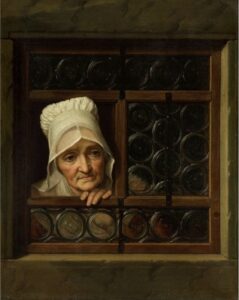
Old Woman in a Window

Another example of a woman at the window is a 1936 Picasso painting.


Nachmanides Introduced the Notion that Targum Onkelos Contains Derash

Nachmanides Introduced the Notion that Targum Onkelos Contains Derash

By Israel
Drazin

People today read Targum
Onkelos
and search it for derash, halakhah, and homiletical
teachings. The following will show that the rabbis in the Talmuds and Midrashim
and the Bible commentators who used the Targum before the thirteenth
century recognized that the Aramaic translation only contains the Torah’s peshat,
its plain meaning, and not sermonic material. It will survey how the
pre-thirteenth century rabbis and scholars used Onkelos and how
Nachmanides changed the way the Targum was understood. It was only after
this Nachmanides change that other interpreters of Onkelos read derash
into this Targum. The article also introduces the reader to Onkelos
and explains why the Talmudic rabbis required that it be read and why many
Jews failed to observe this rabbinic requirement.
The Law
The Babylonian
Talmud and the later Jewish codes mandate that Jews read the Torah portion
weekly, twice in the original Hebrew and once in Targum Onkelos.[1]
Moses Maimonides and Josef Karo, whose law codes are regarded in many
circles as binding, felt that it is vital to understand the Bible text through
the eyes of its rabbinically accepted translation Targum Onkelos, and
many authorities agree that no other translation will do.[2]
This raises some questions.
What
is Targum Onkelos?
The word Targum
means “translation,” thus Targum Onkelos means a translation by Onkelos.
Targum Onkelos is a translation of the five books of Moses, from the
Hebrew into Aramaic. The rabbis placed their imprimatur upon Targum Onkelos[3]
and considered it the official translation. Although there are other
Aramaic translations[4]
and ancient Greek ones,[5]
and latter translations into other languages, Targum Onkelos is the most
literal. Yet despite being extremely literal, it contains over 10,000
differences from the original Hebrew text.[6]
The
Significance of Onkelos
Onkelos was
extolled by all the Bible commentaries. Rashi states that the Onkelos
translation was revealed at Mt. Sinai.[7] Tosaphot[8]
made a similar statement and contends that there are places in the Torah that
simply cannot be understood without the Onkelos translation.
Some people
consider these comments as hyperbolic or metaphoric – that the authors meant
that Onkelos is so significant that it is as if it were a divine gift
handed to Moses at Sinai. But whether literal or metaphoric, it is clear that these
sages are expressing a reverence for Onkelos not accorded to any other
book in Jewish history, a reverence approaching the respect they gave to the
Torah itself. This veneration continued and is reflected in the fact that for
many centuries every printed edition of the Pentateuch contained an Onkelos
text that was generally given the preferential placement adjacent to the Torah.
Why
did the rabbis require Jews to read Targum Onkelos?
It is significant
that the Talmudic dictum was written when there were many important exegetical
rabbinical collections, the Talmuds, Genesis Rabbah, Mekhilta,
Sifra,
and Sifrei, among others. Remarkably, the rabbis did not
require Jews to read these books, filled with interesting derash,
explanations written by the rabbis themselves. They only mandated the reading
of Onkelos when reviewing the weekly Torah portion.
Furthermore,
by the time the Shulchan Arukh was composed in the sixteenth century and
the Talmudic law was stated in it, most of the classical medieval biblical
commentaries, which included derash, were already in circulation. While
Joseph Karo, its author, suggests that one could study Rashi on a weekly basis
in place of the Targum, he quickly adds that those who have “reverence
for God” will study both Rashi and Onkelos. The explanation offered by
TAZ, a commentary on the Shulchan Arukh, is that while Rashi enables the
student to read the Bible and gain access to Talmudic and Oral Law insights, Onkelos
is still indispensable for understanding the text itself.
Thus, the
rabbis, who composed books containing midrashic interpretations, felt that it
was so important for Jews to know the plain meaning of the Torah that they
mandated that Jews read Targum Onkelos every week.[9] When
did people stop seeing that Onkelos contains the Torah’s plain meaning
and read derash into the wording of the Targum?
The Earliest Understanding of Targum Onkelos
There was no
problem understanding the intent of Targum Onkelos until the
thirteenth century, close to a millennium after it was composed. At that time,
Nachmanides was the first commentator to introduce the concept that people
should read Onkelos to find deeper meaning, meaning that went beyond the
plain sense of the text. These included mystical lessons, what Nachmanides
called derekh haemet, the true way.
The conclusion that Onkelos contains only the simple meaning of
the Torah is supported by an examination of how the ancients, living before the
thirteenth century, consistently and without exception, used Onkelos only
for its peshat. Although many of these Bible commentators were
interested in and devoted to the derash that could be derived from
biblical verses, and although they were constantly using Onkelos for its
peshat, they never employed the Targum to find derash or
to support their conclusion that the verse they were discussing contained derash.
This situation changed when for the first time Nachmanides mined the Targum to
uncover derash.[10]
Nachmanides used Onkelos to support his interpretation of the Torah.
This is significant since many of these
rabbinical commentators were far more interested in derash than in peshat.
If they felt that Onkelos contained derash, they would have
used this translation, which they extolled, as Nachmanides later did, to
support their midrashic interpretations of the Torah. The following are the
ancient sources.
Midrashim and Talmuds
The first
references to a Targum are in the Midrashim and the Babylonian Talmud. A
Targum is mentioned 17 times in the Midrashim[11]
and 18 times in the Babylonian Talmud.[12]
Each of the 35 quotes is an attempt to search the Targum for the meaning
of a word. Although these sources were inclined to midrashic explanations, they
never tried to draw midrashic interpretations from the Targum. Thus, the
Midrashim and the Babylonian Talmud understood that the Targum is a
translation and not a source for derash.
Die Masorah Zum Targum
Onkelos
A volume of
targumic traditions collected in Die Masorah Zum Targum Onkelos is said
to have been composed in the third century but was most likely written a couple
of centuries later,[13]
after the Talmuds. It also has no suggestion that Onkelos contains derash.
The book attempts to describe the Targum completely, but contains only
translational traditions about Onkelos. If the author(s) believed that Onkelos
has derash, he/they would have included traditions about it.
Saadiah Gaon
The works of
Saadiah Gaon, born in 882 C.E., also contain no indication that Onkelos has
derash.
Saadiah composed a translation of the Bible into Arabic and used Targum
Onkelos
extensively to discover the plain meaning of words. He never even
hinted that his predecessor’s work contains derash.[14]
This is significant since Saadiah emphasized the Torah’s plain meaning and
used Onkelos frequently in his Arabic translation.[15]
He quotes Onkelos on every page without attribution. His uses Onkelos
as a translation so extensively that if readers have difficulty
understanding Onkelos, they can look at the Saadiah translation and be
able to see what the targumist is saying.
Menachem ibn Saruq
Menachem ibn
Saruq, a tenth century Spanish lexicographer, was explicit on the subject. He
called Onkelos a ptr, a translation.[16]
Samuel ben Hofni Gaon
Samuel Ben Hofni Gaon headed the
Babylonian Academy at Sura in Babylonia during the years 997-1013 and wrote a
biblical commentary. He refers to Targum Onkelos on several occasions,[17]
uses the Targum to understand the meaning of words, and always treats it
as a literal translation without derash.
Rashi
No biblical commentator relied
more on Onkelos than Rabbi Shlomo Yitzchaki, better known as Rashi, born
in 1040. He extols Onkelos, as stated above, mentions the targumist by
name hundreds of times,[18]
and incorporates the targumic interpretation without attribution in hundreds of
other comments. He has a non-rigid blend of peshat and derash in
his commentary,[19] and
frequently quotes the Talmuds and Midrashim as the origin of his derash.
He never uses Onkelos as a source for his derash or treats the Targum
other than as a translation. It should be obvious that since Rashi relied on Onkelos,
whom he considered holy, for peshat, if he saw derash in the Targum
he would have said so.
Rashbam
Rashi’s grandson Samuel ben Meir
(also known as Rashbam, about 1085 – 1174) wrote his Bible commentary in large
measure to liberate people from derash and to show his disagreement with
Rashi’s frequent use of derash.[20]
He seldom mentions his sources, but draws from Onkelos with respect,
usually by name. In Genesis, for example, where Rashi is only named in
37:2, Onkelos is quoted in 21:16, 25:28, 26:26, 28:2, 40:11, and 41:45.
In Deuteronomy, to cite another example, Onkelos is mentioned in
4:28, 16:2, 16:9, 17:18, and 23:13. While he criticizes his grandfather with
and without attribution for his use of derash,[21]
and occasionally disagrees with Onkelos, he never rebukes the targumist
for using derash.[22]
Like his predecessors, he saw no derash in Targum Onkelos.
Abraham ibn Ezra
Abraham ibn Ezra (1089 -1164),
like Rashbam, was determined to distance himself from derash and
establish the literal meaning of the biblical text in his Bible commentaries,
as he states in his two introductions. He uses Onkelos frequently as a
translation, and only as a translation, to prove the meaning of words.
Ibn Ezra was the first to note
some few isolated instances of derash in the Targum. This first
observation of derash in Onkelos, I believe, is because derash
did not exist in the original Targum text.[23]
Various over-zealous well-meaning scribes embedded it at a later period,
probably around the time that Ibn Ezra discovered it. Ibn Ezra recognizes that Onkelos
purpose is to offer peshat because he states that the targumist is
following his (ibn Ezra’s) own method, the “straight (or right) way” of peshat
to interpret the Hebrew according to grammatical rules.[24]
Maimonides
Shortly
thereafter, Maimonides, born in 1138, supported part of his rationalistic
philosophy by using Onkelos. Maimonides recognized that the targumist
deviated frequently from a literal rendering of the biblical text to remove
anthropomorphism and anthropopathisms to avoid portraying God in a human
fashion, for this is “a fundamental element in our faith, and the comprehension
of which is not easy for the common people.”[25]
Maimonides never uses Onkelos for derash. 

Joseph Bechor Schor
Joseph Bechor Schor (born around 1140) adopted the literal methodology of Rashbam.[26] However, he is not as consistent as Rashbam. He inserts homiletical comments along with those that are literal. He mentions Rashbam only twice by name but quotes Onkelos dozens of times to support his own definition of a word when his interpretation is literal. Although he used Onkelos and derash, he never states or even suggests that Onkelos contains derash [27] and never uses Onkelos to support his homiletical remarks.

Radak
David Kimchi
(known as Radak, about 1160 – 1235) wrote biblical commentaries using the
text’s plain sense in contrast to the homiletical elaborations that were
prevalent during his lifetime. He followed the methodology of ibn Ezra and
stressed philological analysis. He refers to Onkelos frequently and
always treats the Targum as a translation. He, like ibn Ezra,
occasionally inserted homiletical interpretations into his commentary from
midrashic legends to add zest and delight readers, but he never used Onkelos
for this purpose.

Conclusion from Reading the Ancient
Commentators

The consistent
history of all the commentators using Onkelos only for the plain
meaning of the Torah and never mentioning seeing derash in the Targum
is quite persuasive that no derash was in the original Onkelos
text. If any of the commentators who lived before the mid-thirteenth
century believed that Targum Onkelos contained derash, especially
those who delighted in or who were concerned with derash, they would
have said so. None but ibn Ezra did, and he called attention to only a very
small number of probably recent unauthorized insertions.
Where, then, did the derash
that many people today think that they see in Targum Onkelos come from?
First of all, I am convinced that most of the targumic readings that
individuals read as derash were really intended by the targumist as peshat,
the text’s simple meaning; people differ is what they see. Second, Ch. Heller
has shown us many examples where most, if not all, of the presently found derash
did not exist in the original Targum text.[28]
His findings are supported by the previously mentioned history showing that ibn
Ezra was the first to observe any derash at all in our Targum.
Nachmanides was the first Bible commentator to read derash into Onkelos
Nachmanides was
influenced by kabala, Jewish mysticism. He equated kabala with truth[29]
and felt[30] that
since Torah is truth, it must contain kabala. He stated that no one can attain
knowledge of the Torah, or truth, by his own reasoning. A person must listen to
a kabalist who received the truth from another kabalist, generation after
generation, back to Moses who heard the kabalistic teaching from God.[31]
He decided to disseminate this truth, or at least hint of its existence, and
was the first to introduce mystic teachings of the Torah into a biblical
commentary.[32]

He extended his
exegetical methodology into his interpretations of our Targum.[33]
He felt this was appropriate. Onkelos, he erroneously believed, “lived
in the age of the philosophers immediately after Aristotle,” and like the
philosopher was so interested in esoteric teachings that, though born a high
placed Roman non-Jew, he converted to Judaism to learn Torah and later teach
its secret lessons through his biblical translation.[34]
Examples of Nachmanides’
problematical interpretations of Onkelos
In a detailed separate study,
which is still in draft, I studied all the instances where Nachmanides interprets
Onkelos. I found that Nachmanides mentions Targum Onkelos in his Commentary
to the Pentateuch
while analyzing 230 verses. Most of his attempts to
see the targumist teaching homiletical lessons and mysticism seem forced. He
reads more into the Aramaic than the words themselves state.
There are 129 puzzling
interpretations of Onkelos in these 230 verses. This represents about 56
percent of the total 230. However, 55 of the 230 Nachmanidean comments are only
references to the Targum without any analysis. When these 55 comments
are subtracted from the total of 230, we are left with 175 times that
Nachmanides analyzes the Targum. The 129 problematical interpretations
represent about 75 percent of the 175 times that the sage discusses Onkelos and
uses it to support his interpretation of the biblical verse. The following are
seven examples.

1. Genesis 1:31 states: “And
God saw everything that He made, and, behold, it was very good (Torah: tov
meod
Onkelos: takin lachada).

This verse
describes the results of the sixth day of creation as “very good.” The Onkelos
translator, who prefers to clarify ambiguous biblical phrases with more
specificity (good is which way), renders it “well established,” implying that
the world was established firmly. He may have recalled Psalms 93:1, “the
world also is established that it can not be moved” and Psalms 96:10,
“the world also shall be established that it shall not be moved.”
Nachmanides
reads into the Onkelos words “well established” than the targumist is teaching
that creation contains evil, “the order (of the world) was very properly
arranged that evil is needed to preserve what is good.”[35]
This interpretation is a good homily, but is not the plain meaning of the
verse. It is problematical because “well established” does not suggest “containing
evil,” nor does it imply that evil is necessary to preserve what is good.
2. After creating man,
God, according to Genesis 2:7, “breathed into his nostrils the breath of
life, and man became a living being.” The bible uses nefesh for “breath”
and “being.” In later Hebrew, nefesh came to mean “soul,” a meaning it
did not have in the Pentateuch. Since the Hebrew “breath of life” does not
indicate how humans excel other creations, Onkelos alters the text and
clarifies that “man acquired the power of speech,” ruach memalela
(literally, “speaking breath”). Thus humans transcend animals by their
intelligence in general and their ability to speak, communicate, and reason in
particular. This is the Aristotelian concept, accepted by Moses Maimonides
(1138-1204), that the essence of a human is intelligence and people have a duty
to develop that intelligence.[36]

Nachmanides, the mystic, disagreed
with Maimonides, the rationalist, and interprets the biblical nefesh
anachronistically as “soul.” The Hebrew verse, he declares, alludes to the
superiority of the soul that is composed of three forces: growth, movement, and
rationality.[37] Onkelos,
he maintains, is reflecting this concept of the tri-partite soul and that the
rational soul that God breathed into man’s nostrils became a speaking soul. How
the two Aramaic words, literally meaning “speaking breath,” suggests this
elaborate tri-partite theology is problematical. Again, Nachmanides seemingly
desired to have Onkelos, which he admired, reflect his own idea even
though what he reads into the Targum is not its plain meaning.

3. Genesis 4:1 states that
when Eve gave birth to Cain, she exclaimed, “I have acquired a man with the
Lord.” Since this statement has an anthropomorphic sound, suggesting physical
help from God, our Targum adds qadam, “before (the Lord),”
thereby supplanting, or at least softening this implication of physical aid by
distancing God from the birth.

The term qadam
was inserted in Onkelos in verse 4, and in seventy other instances in Genesis
for the same reason as well as 585 additional times in the other volumes of Targum
Onkelos
to the Pentateuch.[38]
Nachmanides ignores the targumist’s frequent use of qadam to avoid
anthropomorphism[39] and its
plain meaning. He states that the correct interpretation of the biblical Hebrew
is that Eve said: “This son will be an acquisition from God for me, for when we
die he will exist in our place to worship his creator.” Nachmanides assures us
that this is Onkelos’ opinion as proven by the addition of the word qadam.
Thus, Nachmanides drew a conclusion from the Targum’s single word, a
word that is used over five hundred times for an entirely different purpose and
which cannot, by itself, connote and support his interpretation. Furthermore, qadam
does not have this meaning in the hundreds of other instances where it
appears.
4. In Genesis 17:17, Onkelos
changes a significant detail in the Aramaic translation. Abraham does not
“laugh” (Hebrew, vayitzchak) when he hears he will have a child in his
old age, but “rejoices” (Aramaic, vachadi). This alteration is not made
in 18:12 where Sarah “laughed” when she heard the same news. Rashi explains
that the couple reacted differently. Abraham trusted God and rejoiced at the
good news, while Sarah lacked trust and sneered; therefore God chastised her in
18:13.

Nachmanides
states that Onkelos’ rendering in 17:17 is correct because the word tzachak
also means “rejoice,” and Abraham and Sarah’s reactions, he contends, were the
same, proper “rejoicing.”
Actually, as
defined by ibn Shoshan and others, tzachak is an outward expression, a
“laugh,” and not an inner feeling of contentment. Bachya ben Asher mentions the
Aramaic rendering, but he does not mention Nachmanides. He recognizes, contrary
to Nachmanides, that tzachak does not mean “rejoice,” but “laugh.” He
states that the targumist made the change to “rejoices” because in the context
in which the word appears here it should be understood as an expression of joy.
This example, while not expressing a theology, as in the first three instances,
also shows Nachmanides insisting by a forced interpretation that the targumist
is understanding the Torah as he does.
5. Onkelos
replaces the Torah’s “Is anything too wondrous for the Lord,” in Genesis
18:14, with “Is anything hidden from before the Lord.” The Hebrew “wondrous” is
somewhat vague and is seemingly not exactly on point with the tale of Sarah’s
laughter. The Aramaic explains the text and relates that Sarah’s laughter,
mentioned in the prior verse, although it was not done openly, was not “hidden”
from God. This is also the interpretation of Saadiah, Rashi, Chazkunee, ibn
Ezra, Radak, etc. Thus, in short, all that the targumist is doing is clarifying
the text, a task he performs over a thousand times in his translation.
However,
Nachmanides states that Onkelos uses “hidden” in the translation to teach a
mystical lesson. Nachmanides, as generally happens, does not explain the
lesson, but the explanation is in Bachya ben Asher and Recanati. Bachya writes
that God added the letter hay to Abram’s name, turning it into Abraham,
and “the letter hay alludes to God’s transcendental powers”; thus God
gave Abraham the power to have a son. Abraham, he continues, exemplified the
divine attribute of mercy and Isaac the divine attribute of justice, and now
both attributes would exist on earth. It is difficult if not impossible to read
this Nachmanidean mystical interpretation of Onkelos into the word
“hidden.”[40]
6. Genesis
21:7 quotes Sarah’s excited exclamation of joy:[41]
“Who (meaning which person) would have said to Abraham” that I would give birth
at the advanced age of ninety. The Targum renders her statement as a
thankful praise of God:  “Faithful is He
who said to Abraham,” and avoids the risk of the general population reading the
translation and misunderstanding Sarah’s reaction as one of surprise, for she
should not have been surprised. God had assured Abraham that he would have a
son a year previously.[42]
Thus, by making the change, the Targum shows that she is not only not
surprised, but is thankful that God fulfilled His prior promise.
Nachmanides
interprets the Torah’s “Who would have said to Abraham” to mean that everyone
will join Abraham and Sarah and rejoice with them over Isaac’s birth because it
is such a “surprise”; the possibility of the birth would never have occurred to
anyone. He writes that Onkelos’ rendition is “close” to his
interpretation of a community celebration. Actually as we stated, Onkelos
“Faithful is He who said to Abraham” is quite the opposite. Rather than
focusing on the people and the unexpected event, the targumist deviated from the
Hebrew text to avoid depicting Sarah being surprised. His Aramaic version
concentrates on God, not the community, and how the divine promise was
fulfilled.
7. Genesis
22:2 recounts God commanding Abraham to take his son Isaac to “the land of
Moriah” and offer him there as a sacrifice. Mount Moriah was traditionally
understood to be the later place of the Jerusalem Temple[43]
and the targumist therefore renders “Mount Moriah” as “the land of worship” to
help identify the area for his readers. This is a typical targumic methodology;
the Targum changes the name of places mentioned in the Bible and gives
its later known name.[44]
Nachmanides
contends that Onkelos is referring to a midrashic teaching that was
recorded years after the targumist’s death in Pirkei d’R. Eliezer:[45]
God pointed to the site and told Abraham that this is the place where Adam,
Cain, Abel, and Noah sacrificed, and the site was named Moriah because Moriah
is derived from the word mora, “fear,” for the people feared God there
and worshipped Him.
There are
several problems with Nachmanides’ analysis. First, as we already pointed out,
our targumist frequently updates the name of a site to help his readers
identify its location[46]
and this is a reasonable consistent explanation of the targumic rendering.
Second, the words “land of worship” do not suggest the elaborate midrashic
story that is not recorded until long after the death of the targumist. Third,
the story is a legend; there is nothing in any text to indicate that God had
such a conversation with Abraham or that the ancestors sacrificed in this area;
and it is contrary to the targumist’s style to incorporate legends into his
translation.
Summary
Thus,
if the Bible commentators before Nachmanides saw derash in Onkelos
we would have expected them to say so, but none did until Abraham ibn Ezra and
he was probably referring either to recent scribal additions to the original Targum
or he was expressing his opinion that his view of peshat on certain
verses differed with those of the targumist. Nachmanides was the first to read derash
and mysticism into the Targum just as he was the first to read
mysticism into the Torah itself. We offered some examples that show the
difficulties of his methodology.

Nachmanides’
introduction of the notion that Onkelos contains mysticism may be the
reason why rabbis,[47]
who respected Nachmanides’ teachings, began for the first time to search the Targum
for derash.
Dr. Israel
Drazin is the author of thirty-three books, including twelve on Targum Onkelos.
His website is
www.booksnthoughts.com.
This article appeared previously on
www.oqimta.org.il.

[1] Babylonian Talmud, Berakhot 8a, b, Maimonides’
Mishneh Torah, Laws of Prayer 13:25, and Shulchan Arukh, Orach Chayim,
The Laws of Shabbat 285, 1. The requirement is not in the Jerusalem Talmud
because Targum Onkelos did not exist when this Talmud was composed. See
I. Drazin, Journal of Jewish Studies, volume 50, 1999, pages 246-258,
where I date Onkelos to the late fourth century, based on the
targumist’s consistent use of late fourth century Midrashim.
[2] Although some authorities, such as the Shulchan
Arukh
, discussed below, say that a person can fulfill the rabbinic
obligation by reading Rashi.
[3] Babylonian Talmud, Megillah 3a.
[4] The two other complete Jewish Aramaic translations
are Targum Pseudo-Jonathan and Targum Neophyti.
[5] The Septuagint, composed about 250 BCE, and the
translation by Aquila, composed about 130 CE.
[6] There are many reasons for the targumic changes, such
as to clarify passages, to protect God’s honor, to show respect for Israelite
ancestors, etc. These alterations were not made to teach derash, as will
be shown below. The differences between peshat and derash is a
complex subject. Simply stated, peshat is the plain or simple or obvious
meaning of a text. Derash is the reading of a passage with either a
conscious or unconscious intent to derive something from it, usually a teaching
or ruling applicable to the needs or sensibilities of the later day, something
the original writer may have never meant.
[7] S.v, m’charef, Babylonian Talmud,  Kiddushin 49a.
[8] S.v. shnayim, Babylonian Talmud, Berakhot
8a, b.
[9] They may have also been implying that one cannot understand
their derash unless they first understood the Torah’s peshat.
[10] Our view that Onkelos was written without derash
is also supported by the following interpretation of the Babylonian Talmud,
Megillah 3a. The Talmud recalls a
tradition that the world shuttered when Targum Jonathan to the Prophets
was written. Why, the Talmud asks, did this not occur when Targum Onkelos was
composed? Because, it answers, Onkelos reveals nothing (that is, it
contains no derash), whereas Targum Jonathan reveals secrets (by
means of its derash).
[11] See M. M. Kasher, Torah Shelemah 24
(Jerusalem, 1974), pages 225-238, and J. Reifman, Sedeh Aram (Berlin,
1875), pages 12-14. The mention of a Targum in the Midrashim and Talmuds
are not necessarily references to Onkelos; the wording in these sources
and Onkelos frequently differ.
[12] See Kasher, supra pages 155-161 and Reifman, supra,
pages 8-10.
[13] See edition by A. Berliner (Leipzig, 1877). See I.
Drazin, JJS 50.2, supra, and note 15, for a summary of the
scholarly comments on this volume.
[14] See my study of Saadiah Gaon and Onkelos in
the introduction to Onkelos on the Torah: Leviticus, pages xvii-xxii.
[15] Perushei Rav Saadiah Gaon, in Torat Chaim,
Mossad Harav Kook, Jerusalem, 1986, and Daf-Chen Press, Jerusalem, 1984. The
uses of Onkelos are indexed in Genesis in the 1984 volume on page
471. See E. I. J. Rosenthal, “the Study of the Bible in medieval Judaism,” Studia
Semitica
, Cambridge, 1971, pages 244-271, especially pages 248 and 249
regarding Saadiah.
    Saadiah established Hebrew
philology as a prerequisite for the study of the literal sense of the Bible and
he used rabbinic interpretations in his translation only when it complied with
reason. He stated at the end of his introduction to the Pentateuch that his
work is a “simple, explanatory translation of the text of the Torah, written
with the knowledge of reason and tradition.” He, along with ibn Ezra and
Onkelos
, as we will see, included another meaning only when the literal
sense of the biblical text ran counter to reason or tradition. His failure to
mention that Onkelos contains derash does not prove indisputably
that he saw no derash in the commentary. However, since he copied Onkelos
interpretations so very frequently in his Arabic translation, it is likely that
if he saw derash in Onkelos he would have mentioned it.
[16] In his Sefer Machberet Menahem (H. Filipowski,
editor), London and Edinburgh, 1854, pages 14a, 16b 17a, 17b, 20a, and others.
[17] Peirush Hatorah L’Rav Shmuel ben Hofni Gaon,
Mossad Harav Kook, Jerusalem, 1978, index on page 111.
[18] See the listing in Perushei Rashi al Hatorah
by Charles B. Chavel, Mossad Harav Kook, Jerusalem, 1982, pages 628 and 629.
For Rashi’s struggle against derash, see, for example, his commentary to
Genesis 3:8. While Rashi believed he interpreted Scriptures according to
its peshat, ibn Ezra criticized him: “He expounded the Torah
homiletically believing such to be the literal meaning, whereas his books do
not contain it except once in a thousand (times),” Safah Berurah, editor
G. Lippmann, Furth, 1839, page 5a. See also S. Kamin, Rashi’s Exegetical
Categorization with Respect to the Distinction Between Peshat and Derash

(Doctorial Theses), Jerusalem, 1978; M. Banitt, Rashi, Interpreter of the
Biblical Letter
, Tel Aviv University, 1985; and Y. Rachman, Igeret Rashi,
Mizrachi, 1991.
[19] Rashi said that he was offering peshat. He
meant that his commentary frequently contains derash that seemed to him
to reflect the plain meaning of the Torah.
[20] M. I. Lockshin, Rabbi Samuel ben Meir’s Commentary
on Genesis
, Jewish Studies, The Edwin Mellen Press, 1989. See especially
Rashbam to Genesis 37:2 and 49:16 where he criticizes his grandfather
with strong language.
[21] Lockshin, supra, pages 391-399, notes that
Rashi’s Torah Commentary is the primary focus of Rashbam’s own commentary. Of
some 650 periscopes of interpretation in the latter’s commentary to Genesis,
only about 33 percent concern issues not relevant to Rashi. Of the remaining
two-thirds, in only about 18 percent does Rashbam feel Rashi is correct, and in
just over 48 percent he is in disagreement with him, consistently criticizing
him for substituting derash for peshat, exactly what Rashi
declared he would not do. With this sensitivity to and opposition to derash,
it is very telling that he did not sprinkle even one drop of his venom on the
targumist.
[22] See Genesis 25:28, for example, where Rashbam
issues the accolade: “the plain meaning of scripture is the one offered by the
Targum.” It is significant to note that although Rashbam railed against the
insertion of derash into a biblical commentary, his own commentary was
frequently adulterated, as was Targum Onkelos, by the improper
insertions of derash by later hands. See, for example, Deuteronomy
2:20, 3:23, 7:11, and 11:10 in A. I. Bromberg, Perush HaTorah leRashbam,
Tel Aviv, 5725, page 201, note 25; page 202, note 111; page 206, 7, note 9; and
page 210, note 3.
[23] Ch. Heller’s and D. Revel’s were also convinced that
the original text of Onkelos did not have derash. However, they
did not recognize that Nachmanides was the first commentator to argue the
opposite. The first is in A Critical Essay on the Palestinian Targum to the
Pentateuch
, NY, 1921, pages 32-57. The second is in Targum Yonatan al
Hatorah
, New York, 5685, page 5. See also Bernard Grossfeld in “Targum
Onkelos, Halakhah and the Halakhic Midrashim
,” in D.R.G. Beattie and M.
McNamara (editors), The Aramaic Bible , 1994,  pages 228-46.
[24] In his epigram preceding one of the recessions of his
commentary on the Pentateuch, ibn Ezra writes that he intends to mention by
name only those authors “whose opinion I consider correct.” He names Onkelos
frequently. In his commentary to Numbers, for example, the Targum is
cited in 11:5 where he gives another interpretation, but respectfully adds, “he
is also correct,” and in 11:22 he comments, “it means exactly what the Aramaic
targumist states.” See also 12:1; 21:14; 22:24; 23:3; 23:10; 24:23 and 25:4.
Asher Weiser, Ibn Ezra, Perushei Hatorah, Mossad Harav Kook, 1977.
    While he treats Onkelos
respectfully, ibn Ezra uses the strongly derogatory terms “deceivers” or
“liars,” for the derash-filled Targum Pseudo-Jonathan to Deuteronomy
24:6. See D. Revel, Targum Yonatan al Hatorah, New York, 5685, pages 1
and 2.   
[25] The “fundamental element” that Onkelos
addresses is the avoidance of a literal translation of most anthropomorphic and
anthropopathic phrases. See the listing in Moses Maimonides, The Guide of
the Perplexed
, translated and with an introduction by Shlomo Pines, The
University of Chicago Press, 1963, volume 2, pages 656 and 658, and 1:28 for
the quote.
    Maimonides based his
interpretation of negative commands 128 and 163 in part upon our Targum.
Maimonides, The Commandments, translated by Charles B. Chavel, The
Soncino Press, 1967, pages 116, 117 and 155, 156. This was not because Onkelos
deviated from the plain meaning to teach halakhah. Command 128 forbids
an apostate Israelite to eat the Passover offering. Onkelos translates
the biblical “no alien may eat thereof” as “no apostate Israelite” (Exodus
12:43). The targumist may have thought this was the necessary meaning because Exodus
12:45 and 48 state that a sojourner and an uncircumcised Israelite could not
eat this sacrifice; thus the earlier verse must be referring to someone else.
Command 163 prohibits a priest from entering the Sanctuary with disheveled,
untrimmed hair.  Maimonides notes that
Onkelos
translates Leviticus
10:6’s “Let not the hair of your heads go loose” as “grow long.” Again, the
targumist may have thought that this was the verse’s simple sense because it is
the language used by the Torah itself in Numbers 6:5 and because when
one loosens one’s hair it becomes longer. Indeed, Rashi states explicitly that
the peshat of “loose” in this instance is “long.”
[26] He is believed to have been a student of Rashbam’s
brother Rabbeinu Tam. See the source in the next note.
[27] J. Nebo, Perushei Rabbi Josef Bechor Schor al
Hatorah
, Mossad Harav Kook, 1994, page 11, Schor went beyond Targum
Onkelos
in his concern about biblical anthropomorphisms and his attempts to
whitewash the patriarchs.
[28] See note 23.
[29] Genesis 6:13, 18; 31:42; 33:20; 35:13; and
others.
[30] This could be seen as a kind of syllogism. Torah is
truth. Kabala is truth. Thus, Torah “must” contain Kabala.
[31] Ramban, Writings and Discourses, translated
and annotated by Charles B. Chavel, Shilo, 1978, page 174.
[32] Ramban, Commentary on the Torah, translated
and annotated by Charles B. Chavel, Shilo Publishing House, Inc., 1971, volume
1, XII. Chavel points out that the extensive kabalistic influences on future
generations can be traced to Nachmanides.
[33] This is my original idea. It is based on several
facts. First, we know that he was the first to read Kabala in the Torah words
and phrases. Second, we know that he had enormous respect for Onkelos;
he referred to Onkelos about 230 times in his Bible commentary; although
he criticized others, he treated Onkelos with great respect, even
reverence. He considered Onkelos to be generally expressing the
truth. Thus it is reasonable to assume that he applied the same syllogism to Onkelos
that he applied to the Torah. Finally, we know of no one before him who
read mysticism into the targumist’s words.
[34] Ramban, Writings and Discourses, supra, pages
75-76. Nachmanides’ error in dating Targum Onkelos “immediately after
Aristotle” was not his only historical mistake. He believed that the Talmud’s
implied dating of Jesus at about 100 years before the Common Era was correct. See
Judaism on Trial
, editor H. Maccoby, Associated University Presses, Inc.,
1982, pages 28 and 29.       
[35] The Midrash Genesis Rabbah 9:5, which
is the source of this teaching, mentions “death” and 9:9 “the evil inclination
in man” as examples of seemingly bad things, which are good from a non-personal
world-wide perspective. Bachya ben Asher, the student of Nachmanides’ student
Rashba, who was also a mystic, mentions 9:9, but not the Targum. He did
not see this idea in Onkelos.
[36] Guide of the Perplexed 1:1. The Greek term psyche
had a similar developmental history as the Hebrew nefesh. T. Cahill, Sailing
the Wine-Dark Sea,
Doubleday, 2003, writes on page 231.
            Psyche
was, to begin with, a Greek word for “life,” in the sense of individual human
life, and occurs in Homer in such phrases as “to risk one’s life” and “to save
one’s life.” Homer also uses it of the ghosts of the underworld – the weak,
almost-not-there shades of those who once were men. In the works of the early
scientist-philosophers, psyche can refer to the ultimate substance, the
source of life and consciousness, the spirit of the universe. By the fifth
century B.C., psyche had come to mean the “conscious self,” the
“personality,” even the “emotional self,” and thence it quickly takes on,
especially in Plato, the meaning of “immortal self” – the soul, in contrast to
the body.
[37] Bachya ben Asher also mentions the parts of the soul,
but not the Targum, again not seeing Nachmanides’ idea in Onkelos.
[38] See the five books by I. Drazin on Targum Onkelos
published by Ktav Publishing House. Each contains a listing of the deviations
by the targumist from the Hebrew original.
[39] In my discussion of Genesis 46:4, I show that
Nachmanides was convinced that Onkelos never deviates to avoid
anthropomorphisms.
[40] Bachya mentions neither Nachmanides nor Onkelos,
again not seeing the Nachmanidean interpretation in the Targum.
[41] The “joy” is mentioned in the Targum to verse
6.
[42] Genesis 17:19.
[43] See II Chronicles 3:1.
[44] Rashi gives an additional reason why “Mount Moriah”
is rendered “the land of worship.” He connected “Moriah” to “myrrh,” which was
an ingredient of the sacrificial incense and an important part of the Temple
worship. Rashi states that this is the targumic interpretation. Rashi may be
explaining why the site was called Moriah, which would not be derash,
but the plain sense of the word. Nachmanides interpretation goes far beyond a
simple definition. See Genesis Rabbah 55:7, Exodus 30:23ff, and
Babylonian Talmud, Keritut 6a.
[45] Chapter 31.
[46] This occurs twenty-three times in Genesis
alone.
[47] There are many books that explain the derash that
they see in Onkelos. The most widely known is Netina Lager by
Nathan Adler (Wilna, 1886). Others include Biure Onkelos by S. B.
Schefftel (Munich, 1888), and Chalifot Semalot  and Lechem Vesimla by B. Z. J.
Berkowitz (Wilna, 1874 and 1843).  Modern
writers using this method include Y. Maori, who generally focuses on the Peshitta
Targum,
Rafael Posen who writes a weekly column for a magazine distributed
in Israeli synagogues. One can find listings in B. Grossfeld’s three volumes A
Bibliography of Targum Literature
, HUC Press, 1972.


Shnayer Leiman – The New Encyclopaedia Judaica: Some Preliminary Observations

The New Encyclopaedia Judaica: Some Preliminary Observations

by

Shnayer Leiman 1. In 1972, the first edition of the Encyclopaedia Judaica appeared in print. With 25,000 entries, it moved well beyond its distinguished predecessors, such as the Jewish Encyclopedia (New York, 1906), the Universal Jewish Encyclopedia (New York, 1939-43), and the short-lived German language Encyclopaedia Judaica (Berlin, 1928-34). Its special focus on the Holocaust and its aftermath, on the State of Israel, and on the centrality of the Jewish community in the United States, rendered it the most current and useful of all the Jewish encyclopedias. But 35 years have passed since its publication, and there was a felt need for a new version that would update many of the entries in the light of scholarly advance. Also, new entries had to be provided for all that was new in Jewish life during the past 35 years. Early in 2007, the 22-volume second edition of the Encyclopaedia Judaica appeared in print – in hard copy and electronic versions – and it was heralded as yet another milestone in the history of Jewish encyclopedias.

2. A striking difference between the first edition of the Encyclopaedia Judaica (henceforth: EJ) and the second edition of the Encyclopaedia Judaica (henceforth: NEJ [= new Encyclopaedia Judaica]) is the almost complete lack of visual images in NEJ. Whereas EJ contained some 8000 photographs and portraits (judiciously selected from a larger pool of 25,000), NEJ has only 8 pages of photographs in the center of each volume. Thus, for example, the entry on Solomon Dubno (d. 1813) in EJ is accompanied by a striking portrait of him [reproduced below]. The portrait is lacking in NEJ. Similarly, the entry on Vilna in EJ is accompanied by some 9 photographs that make the city come to life; none appear in the NEJ entry on Vilna. The almost complete lack of visual images in NEJ is a fatal flaw that renders it the least attractive (and arguably, the least informative, for often pictures inform even more than words) of all the Jewish encyclopedias listed above in paragraph 1.

3. One of the key selling points of NEJ is that it updates – and allegedly supersedes – the 1972 edition of EJ. In the general introduction to NEJ, we are informed that more than 2,650 new entries were incorporated into NEJ, and that over half of the original entries (in EJ) were revised and updated for NEJ. Indeed, it is a delight to see entries in NEJ for Dina Abramowicz, Zvi Ankori, Gerson Cohen, Lucy Dawidovich, Marvin Fox, Ismar Schorsch, Yosef Yerushalmi and the like – none of whom were accorded entries in EJ. But upon inspection, it turns out that many key entries that needed to be revised and updated were neither revised nor updated. And regarding the new entries, there are serious errors of commission and omission.

Samples of entries that should have been updated, but were not, include:

a) Abraham b. Elijah of Vilna (d. 1808). NEJ reprints EJ, apparently unaware that some 130 printed pages of Abraham b. Elijah of Vilna’s writings on Bible, Talmud, Midrash, and Jewish bibliography were published for the first time, from manuscripts, in 1998 (see Yeshurun 4[1998], pp. 123-254). EJ and NEJ list Abraham b. Elijah of Vilna’s date of birth as 1750. Recent historical studies indicate otherwise and suggest he was born in 1766 (see, e.g., Yeshurun 14 [2004], pp. 982-996). These and other post-1972 studies on Abraham b. Elijah of Vilna surely merited mention in a revised and updated entry. In this instance, NEJ does not reflect the present state of modern scholarship.

b) Adam Ba’al Shem. NEJ reprints the EJ entry by Gershom Scholem, who – in one of the most controversial passages he ever wrote – identified the writings of the Sabbatean prophet Heshel Zoref (d. 1700) with the writings ascribed by Hasidic lore to the legendary Adam Ba’al Shem. The latter’s writings, according to Hasidic legend, formed the basis for the uniquely Hasidic teachings of R. Israel Ba’al Shem Tov. Scholars were quick to challenge Scholem’s identification during his lifetime and after his death. None are cited in the NEJ entry. An entire literature has grown around this particular issue. Much (but not all) of the relevant bibliography appeared in Y. Liebes, ed., גרשם שלום: מחקרי שבתאות, Tel Aviv, 1991, pp. 597-599. None of this appears in the NEJ entry. Once again, NEJ does not reflect the present state of modern scholarship.

c) Chajes, Zevi Hirsch (d. 1855). NEJ reprints the EJ entry. In the intervening years, numerous studies and two major books were published on Chajes, none of which is mentioned in NEJ. Here it will suffice to mention the titles of the two books:

Bruria Hutner David, The Dual Role of Rabbi Zvi Hirsch Chajes: Traditionalist and Maskil, Columbia University Ph.D., University Microfilms, 1971.

Mayer Herskovicz, רבי צבי הירש חיות, Jerusalem, 1972 (reissued: Jerusalem, 2007).

Here too, NEJ does not reflect the present state of modern scholarship.

d) Kalmanovitch, Zelig (d. 1944). NEJ reprints the entry in EJ. The diary (mostly in Yiddish and partly in Hebrew) of this Yiddish scholar — and victim of the Holocaust – is one of the most poignant of the Holocaust diaries. In 1977, Kalmanovitch’s son, Shalom Luria, publish an annotated Hebrew translation of the diary, together with a 50 page introduction that reveals much about Kalmanovitch that was not previously known. See Z. Kalmanovitch, יומן בגיטו וילנה, Tel Aviv, 1977, pp. 9-59. A sizeable and significant fragment of the diary, entirely in Hebrew, was discovered in the Lithuanian Central Archive in Vilna, and published in 1997. See Yivo Bleter 3(1997), pp. 43-113. None of this information appears in the NEJ entry. Regarding the Kalmanovitch entry, then, NEJ does not reflect the present state of modern scholarship.

e) Luria, David b. Judah (d. 1855). NEJ reprints the entry in EJ. No mention is made in either EJ or NEJ that a portrait of Luria is extant (in Vilna) and has been frequently published. See, e.g., Yahadut Lita,Tel Aviv, 1967, vol. 3, p. 62. More importantly, some 230 printed pages of Luria’s hiddushim on Bible, Mishnah, the Jerusalem Talmud, and Midrash Mishle, as well as responsa, were published for the first time, from manuscripts, in 1998-9. See Yeshurun 4(1998), pp. 489-647 and 6(1999), pp. 285-359. NEJ does not reflect the present state of modern scholarship regarding this entry as well.


4. Sins of commission are inevitable in any encyclopedia. The name of the game is to keep them at a minimum, and it is largely the responsibility of the editors to check and recheck possible misspellings, mistaken dates and facts, discrepancies, imaginary references, exaggerated claims, and the like. NEJ is not lacking in sins of commission in all of the above categories. One amusing instance will have to suffice for our purposes.

NEJ contains two entries of interest that appear several pages apart in volume 3. The first entry is entitled: Bloch, Chaim Isaac. The second entry is entitled: Bloch, Hayyim Isaac ben Hanokh Zundel Ha-Kohen. Innocent readers will assume, as they have every right to assume, that these represent two different persons. Alas, they are one and the same person. The first entry is a new one, designed especially for NEJ. The second entry is the old one, reprinted from EJ (minus the handsome photograph [reproduced below] that accompanied the original EJ entry). There are some interesting differences between the two entries. In the first entry, the reader is informed that Rabbi Bloch was born in 1867. Several pages later, however, Rabbi Bloch aged some 3 years, as we are informed that he was born in 1864. In the first entry, we are told mostly about essays he contributed to a variety of Torah journals – though mention is made of the fact that he published books as well. None of their titles are listed. In the second entry, not a word is said about his contribution to Torah journals. Instead, the titles of all his published works are listed. In the bibliographies appended to the two entries, each lists an item not in the other. The primary blame here hardly rests with the authors of the entries; presumably, they performed their assigned tasks as best they knew how. It is the sloppiness of the editors that allowed for the publication of two (sometimes contradictory) entries for one and the same person. Given the premium placed on space in any encyclopedia, this is a sin of no small import.

5. Sins of omission are inevitable in any encyclopedia. As the editors indicate in the general introduction to NEJ: “An obvious problem in the compilation of any encyclopedia is the decision as to which entries are to be included and which excluded …there is always a body of “borderline” entries which potentially could fall in either category. This problem becomes particularly sensitive when dealing with biographies of contemporaries. Which scholars receive entries and which do not? Where is the line to be drawn for rabbis or businessmen or lawyers or scientists? In some subjects, it was possible to fix objective criteria. For example when it came to U.S. Jewish communities, it was decided to include only those numbering more than 4,500.”

One can only sympathize with the impossible task before the editors. It was a no-win situation for them; whatever their decision, they would surely be open to criticism. If nonetheless I join the chorus of critics, it is not because of “borderline” entries. My own sense is that serious sins of omission occurred throughout NEJ, and in a broad range of categories. I shall attempt to illustrate this by selecting at random 5 categories of Jewish life that were of sufficient interest to me that I was even willing to leaf through the pages of NEJ in order to see how they were treated. I am well aware that others may consider unimportant what I consider important. What follows is no more than the personal opinion of one observer. The names listed below have no independent entry in NEJ and, at best, are mentioned in passing in other, often thematic entries.

a) Women. In the publicity relating to NEJ, it was stated openly that in earlier encyclopedias, including EJ, Jewish women were marginalized. They accounted for no more than 1.25% of the entries in EJ. This was a matter that would be rectified in NEJ. I do not know whether, in fact, this has been rectified in NEJ. But here are some omissions that seem striking to me.


1. Adele Berlin. A noted Bible scholar in the Department of Hebrew and East Asian Languages at the University of Maryland, her published books include:

Biblical Poetry Through Medieval Jewish Eyes; Dynamics of Biblical Parallelism; Poetics and Interpretation of Biblical Narrative; JPS Bible Commentary: Esther; Lamentations: A Commentary; Zephaniah: A New Translation with Introduction and Commentary; and more.

2. Esther Rubinstein (1883-1924). An early advocate of religious Zionism, she was a leading Hebraist, Zionist, educator, and social activist in Vilna. Her learned essays on women’s suffrage paved the way for a change in rabbinic attitudes toward this issue. She founded the first religious day school for Jewish women in Lithuania. See the entry in אנציקלופדיה של הציונות הדתית, Jerusalem, 1983, vol. 5, columns 582-585.

3. Rivka Schatz-Uffenheimer (d. 1992) served as Edmonton Professor of Jewish Mysticism at the Hebrew University. Her many books on Kabbalah and Hasidut (e.g., Hasidism as Mysticism; The Thought of R. Moshe Hayyim Luzzatto [Hebrew]; The Messianic Idea from the Spanish Exile On [Hebrew]; R. Dov Baer of Mezhirech’s Maggid Devarav Le-Yaakov: An Annotated Edition [Hebrew] ) are landmarks in the history of Jewish mysticism.

4. Sara Schenierer (1883-1935), educator and author, founded the first Beth Jacob school in Cracow in 1917. In 1923, she founded the first Beth Jacob teacher’s seminary, also in Cracow. By 1927, there were 87 Beth Jacob schools, with over 10,900 students, in Poland alone. The movement spread throughout Europe, and ultimately to the United States and Israel, where it continues to thrive – with well over 50,000 students – to this very day. She also spearheaded a Jewish youth movement for young girls in Poland, wrote children’s literature and plays. Her collected writings were published in 4 volumes in Hebrew in Tel Aviv, 1955-60.

b) Rabbis.


1. R. Shneur Kotler (1918-1982) succeeded his father, R. Aharon Kotler, as Rosh Yeshiva of the Lakewood Yeshiva. He served in that capacity from 1962 until his death. Under his watch, the Lakewood Yeshiva grew from a student body of 200 students to a student body of over 1000 students. He established a system of Kollels throughout the larger Jewish communities in the United States. He was active in Agudat Israel, Chinuch Atzma’i, Torah U-Mesorah and other educational organizations. It was largely due to his leadership that the Lakewood yeshiva and its affiliate institutions number today well over 4000 students.

2. R. Eleazar Menachem Shach (1898-2001) was Rosh Yeshiva of the Ponevezh Yeshiva in Bnei Brak. From 1970 until his death, he was generally recognized by the Yeshiva world and by much of the Haredi world as the Gadol Ha-Dor. He was an occasional supporter of the Shas party, and was the founder of the Degel ha-Torah party. As such, he wielded enormous power in Israeli politics and the world over. He was the author of a monumental commentary on Maimonides’ Code, entitled Avi Ezri.

3. R. Yosef Shalom Elyashiv (b. 1910) succeeded Rabbi Shach as Gadol Ha-Dor. He is, arguably, the single, most powerful figure in the Yeshiva world and in much of the Haredi world. An expert in Jewish law, he has published some 26 volumes of hiddushim on the Talmud and Shulhan Arukh, as well as collections of responsa.

c) Academic Scholars. Two of the women listed above, Adele Berlin and Rivka Schatz-Uffenheimer, could just as easily have been listed under this rubric, with absolutely no bending of the rules. They were listed above only because of the claim that a special effort was made to include as many women as possible in the new entries for NEJ. Despite the claim, they were not accorded entries in NEJ.

1. Gerald Blidstein holds the Miriam Martha Hubert Chair in Jewish Law at Ben-Gurion University. His publications are simply too numerous to be listed here. Suffice to say that he was awarded the Israel Prize in Jewish Thought in 2006.

2. Menachem Cohen, Professor of Bible at Bar-Ilan University, is the head of the Mikra’ot Gedolot Ha-Keter Project – a project that is preparing for publication the Aleppo Codex and its Masorah, the Aramaic Targums, and critical editions of medieval Jewish commentaries on the Bible. Some 10 volumes have already appeared in print under his aegis. They represent the finest edition of Mikra’ot Gedolot ever produced.

3. Yehuda Liebes holds the Gershom Scholem Chair in Kabbalah at the Hebrew University. His many publications include: Studies in the Zohar; Studies in Jewish Myth and Jewish Messianism; and Elisha’s Sin (Hebrew). His annotated versions of Scholem’s studies are indispensable for scholarly research.

4. Haym Soloveitchik, University Professor at Yeshiva University, taught for many years at the Bernard Revel Graduate School of Yeshiva University. His published books include: Halakhah, Economics, and Communal Self Image (Hebrew); Pawnbroking in the Middle Ages (Hebrew); Wine of Non-Jews (Hebrew); Responsa as Historical Sources (Hebrew). Some of his shorter essays (e.g.“Three Themes in Sefer Hasidim”; “Rupture and Reconstruction”) have stimulated more discussion than books by others on the same topics. He was a recipient of the prestigious National Foundation for Jewish Culture Jewish Cultural Achievement Award in Jewish scholarship.

5. Yaakov Sussman is a world class Talmudic scholar who was awarded the Israel Prize for Talmudic Research in 1997. His many publications on the manuscripts, editions, and the history of the publication of the Mishnah, the Jerusalem Talmud, and the Babylonian Talmud; his edition of the “Miqsat Ma’aseh Torah” fragments of the Dead Sea Scrolls; and his edition of the Rechov inscription are the point of departure for all scholarly discussion of those topics.


d) Jewish Communities. As noted above, NEJ allows for an entry on any Jewish community in the United States with 4,500 Jewish residents or more. Thus, e.g., there is an entry on Wilkes-Barre, Pennsylvania which, perhaps, once had that many Jewish residents. According to the entry in NEJ, there were only 3000 Jewish residents in Wilkes-Barre in 2005. It is therefore somewhat surprising that there are no separate entries in NEJ on:

1. Monsey, N.Y.

2. Teaneck, N.J.

3. Far Rockaway, N.Y.

4. Lawrence, N.Y.

5. Cedarhurst, N.Y.

6. Woodmere, N.Y.

7. Kew Gardens Hills, N.Y.

I do not know the exact Jewish population of any of the towns listed above, but I suspect that each has at least 3000, and in all likelihood more than 4500, Jewish residents. In all fairness, NEJ presents a somewhat detailed discussion of Monsey and Teaneck under other rubrics (Rockland County and Bergen County). But I could not locate any discussion of Far Rockaway, the Five Towns, or Kew Gardens Hills. Each of these communities has a rich history, with many
synagogues, schools, and often institutions of national and international repute. They surely merit entries in NEJ.

6. The previous paragraph presents a rather long list of sins of omission relating to women, rabbis, academic scholars, and Jewish communities. One could easily add more names to each of the categories; and certainly so if yet other categories are examined. Doubtless, some will argue that there is simply no room in a 22-volume encyclopedia for so many “borderline” entries. In order to counter such an argument, I will list here four entries – exactly as they appear on the printed page – that found their way into NEJ.

1. Calwer, Richard (1868-1927). German socialist, economist, and politician. He belonged to the reformist wing inspired by Ferdinand Lasalle within the German Social Democratic Party (SPD). Calwer harbored a strong anti-Jewish bias. In a brochure published in 1894, he attacked the SPD’s radical wing as having been “incited by a few Jews who make slander their business,” and deplored that such “specific” Jewish characteristics as “zealousness, contentiousness, and commercial craftiness” had found their way into the party press and literature. He also criticized the SPD for combating anti-Semitism to the extent of creating the impression that Social Democracy had been “Judaized” (verjudet). Calwer left the SPD in 1909. He was a pioneer in Western socialist non-Marxian economics, which he taught until his suicide in Berlin.

2. Cohen, Philip Melvin (1808-1879), pharmacist and civic leader in Charleston, South Carolina. Cohen, born in Charleston, was the son of Philip Cohen, lieutenant in the War of 1812. During the Second Seminole War Cohen served as surgeon to a detachment of troops in Charleston Harbor (1836). In 1838 he became city apothecary. He was a member of the city board of health (1843-49). Cohen was a director of the Bank of the State of South Carolina (1849-55). He was one of the citizens who served as honorary guard at the funeral of John C. Calhoun in 1850.

3. Nagin, Harry S. (1890- ), U.S. civil engineer. Born in Romny, Russia, Nagin went to the U.S. in 1906. From 1924 he was executive vice president of a large steel products company in Pennsylvania. He took out over a hundred patents on steel structures, bridge floors, gratings, concrete, and plastics.

4. Abrams, “Cal” (Calvin Ross; 1924-1997), U.S. baseball player, lifetime .269 hitter over eight seasons, with 433 hits, 32 home runs, 257 runs, and 138 RBIS. Born in Philadelphia to Russian immigrant parents, he moved with his family to Brooklyn when he was a child. Having grown up in Brooklyn in the shadow of Ebbets field, Abrams fulfilled a life-long dream when he signed with the Brooklyn Dodgers after graduating from James Madison High School. But after two weeks in the minor leagues he was drafted into the army., where he served four years. Abrams spent three years in the minor leagues, winning the Southern Association championship with Mobile in 1947 while hitting .336. Abrams, who batted and threw left-handed, played for the Brooklyn Dodgers (1949-52), Cincinnati Reds (1952), Pittsburgh Pirates (1953-4), Baltimore Orioles (1954-55), and Chicago White Sox (1956), and had a perfect fielding percentage in three different seasons, 1950, 1952, and 1956. Abrams is best remembered for one of the most famous plays in Dodger franchise history. In the final game of the 1950 season, with the Dodgers one game behind the Philadelphia Phillies in the pennant race, Abrams tried to score from second with two out in the bottom of the ninth of a 1-1 game on a hit by Duke Snider, but Abrams, who had been waved home by third base coach Milt Stock, was thrown out by the Phillies’ Richie Ashburn. Had Cal scored, the Dodgers would have won the game and forced a playoff with the Phillies for the pennant. Dick Sisler hit a three-run home run in the top of the tenth to win the game – and the pennant – for Philadelphia. It was the closest Abrams ever got to the post-season. Dodgers fans vilified Abrams for years but he was defended by both Ashburn and Phillies pitcher Robin Roberts for the play, who agreed with many others who said that Abrams should not have been sent home by Stock.

————————–

Far be it from me to deny Richard Calwer (a non-Jew), Philip Melvin Cohen, Harry S. Nagin , and Cal Abrams – not exactly household names – their rightful place in Jewish history. But at the expense of Professor Haym Soloveitchik? NEJ inherited the Calwer and Cohen entries from EJ. But the Nagin and Abrams entries are original with NEJ. In the case of Abrams, whose baseball career ended in 1956, this is somewhat surprising, for he obviously didn’t make the cut with EJ in 1972 (in contrast to Hank Greenberg and Sandy Koufax). Now I am well aware that Rav Shach could not hit major league pitching to save his life, and that his lifetime batting average would have paled in significance to Cal Abrams .269 lifetime batting average. But, really, does Cal Abrams take precedence over Rav Shach in a Jewish encyclopedia?


7. In sum, the returns are hardly in. Not for nothing did we label these comments “preliminary observations.” Much more needs to be investigated before one can judge how well NEJ has captured the totality of past Jewish life, and the pulse of present Jewish life, as reflected in the 2007 edition. But until all the returns are in, hold on to your 1972 edition of EJ for dear life! It is not at all clear that NEJ has superseded, or that it will ever supersede, EJ. All public libraries and private collectors will do well to retain their 1972 editions of EJ and keep them precisely on the same shelves they have now occupied for some 35 years.


A World War II Liberator’s Letter to his Hometown Rabbi

A World War II Liberator’s Letter to his Hometown Rabbi

By Rabbi Akiva Males

I recently realized that this year, January 26th will correspond to the 26th of Teves. That date marks the tenth Yahrtzeit of a remarkable man — who lived through some extraordinary experiences exactly eighty years ago. I had the honor of knowing Mr. Charles Press (1920 – 2015) for the last eight years of his life. However, others in Harrisburg, PA (where I served as a pulpit Rabbi from 2007 – 2016) enjoyed his friendship for over nine decades. Over the course of those many years, Charlie (as he was lovingly known) was a very active member of his synagogue (Kesher Israel Congregation) and the Jewish community that had nurtured him. With his devoted wife Eunyce (1924 – 2023) at his side, Charlie was also among the most dedicated volunteers that his Shul ever knew.

Charlie was a member of the heroic cohort which journalist Tom Brokaw reverently labeled as “The Greatest Generation”. On several occasions, I had the opportunity to hear him speak about some of his World War II experiences. As the 80th anniversary of those events approaches, I believe some of what Charlie told me needs to be shared with a broader audience.

Measuring over six feet, Charlie was a very tall man — yet one of the gentlest people I ever met. As much as I try, it is hard for me to imagine him as a strapping young man in his early twenties, struggling to stay warm under his olive drab steel helmet, and spending sleepless nights in frigid fox holes, while slugging it out with the Nazis. However, that is exactly what the early months of 1945 were like for Charlie Press.

After the US entered World War II in December of 1941, Charlie saw many of his childhood friends leave Harrisburg to join the fight in both the European and Pacific theaters of war. As an employee of the Pennsylvania Railroad, the powers-that-be saw Charlie’s role as essential to the US war effort. As much-needed personnel and war supplies were constantly being shipped through Pennsylvania from other states, he received a draft deferment. In fact, his superiors pleaded with Charlie to remain at his railroad position in the Keystone State. Nonetheless, as a proud Jewish-American, Charlie yearned to play a more direct role in the fight against the Nazis. Unable to continue observing from the sidelines, he quit his job, enlisted in the US Army, and left the safety of Pennsylvania behind.

Charlie trained to be part of a two-man bazooka team and was assigned to the 90th Infantry Division, 357th Battalion. The bazooka (a shoulder-fired rocket launcher) was a relatively new — and highly-appreciated — weapon which gave US soldiers the firepower they needed to attack the enemy’s tanks and fortifications. In addition to his rifle and personal gear, Charlie also carried the bazooka’s shells and loaded the weapon for his partner (another Jewish GI named Harvey Goldreyer from Queens, NY) who would carefully aim and fire it.

Charlie joined his unit as a replacement following the bloody ‘Battle of the Bulge’ (December 1944 – January 1945). In the months that followed, he and his bazooka partner’s skills were called upon numerous times.

On April 23, 1945, US forces liberated the Flossenburg Concentration Camp. Decades later, this is how Charlie described those events:

I was in the 90th Infantry Division which liberated the Flossenburg Concentration Camp, located about six kilometers (about 3.5 miles) from the German-Czech border as the war in Europe drew to a close in 1945. We were not prepared for what we saw: Still smoldering crematoria and open gravesites of human ashes, piles of corpses and shoes stacked about 20 feet high. When we arrived there were about 70 men and women who survived. They were so emaciated; they were just skin and bones. Speaking with them we found out that this was a political camp as well as an exterminating camp for Jews, Gypsies, and the disabled. The camp guards and personnel had fled before our unit arrived.

In addition, there were [US] soldiers that were captured by the Germans in the Battle of the Bulge and were forced to undergo long forced marches in the cold after being deprived of their overcoats and warm clothing. As the Americans began falling by the wayside the SS guards shot them. Many never made it to Flossenburg.

The German soldiers that were taken prisoners and returned to the camp as prisoners of war were very arrogant in defeat. They [repeated how they] were following orders and were proud that they were Germans.

For many years I never talked about what I saw. My granddaughter had to do a paper for school about who was her hero. That was the first time that I told her about what I experienced at Flossenburg.

Shockingly, in the years since WWII, the outlandish claims of Holocaust deniers have gained traction in some quarters. As a result, in his later years, Charlie became more open about what he had personally witnessed at Flossenburg. What follows is the text of a letter Charlie wrote in Flossenburg and sent to his beloved Rabbi back home — Rabbi David L. Silver (1907 – 2001).

Rabbi David L. Silver — the son of the famed Rabbi Eliezer Silver (1882 – 1968) — founded Harrisburg’s Jewish day school, and led Kesher Israel Congregation for more than 50 years. Charlie Press told me that he had one goal in publicizing this historic letter which contains his eye-witness account:

Read the letter. Now tell me there was no Holocaust!”

____________________________________

Germany, July 3, 1945

Dear Rabbi,

At present my outfit is located at the Flossenburg Concentration Camp guarding Hitler’s elite. This camp was at one time a living hell for many Jewish, Polish, Czech, and German political prisoners. The atrocities which I have witnessed are uncountable. At this moment I am in a guard tower which is equipped with weapons to hinder any attempted break by the criminals. At one time though, this same tower was occupied by some of the criminals who are now inside the fence.

To the left of this tower is a crematorium where daily human beings were burned. In the rear of this crematorium is a room with small vases in which the ashes of only the German dead were placed and sent to their families. The other prisoners’ ashes and bones were piled in a small ravine and covered up. The rain washed all the dirt off and uncovered the hideous evidence. In another section of the field is where human bodies were stacked crosswise on top of wood, and oil was poured over and lighted. When one row would be burned, the next row would be started, and so they kept the fires burning continuously.

The past few Sundays I have been visiting in a small town called Floso, where there are about fifteen Jewish displaced persons who at one time have been in this camp. We go there and have services and sing songs and tell stories. It’s really wonderful to make them happy although in their hearts there is unrest from what they have gone through. They are having a synagogue rebuilt and as soon as it is finished I am going to try and have services there for all of the soldiers and civilians around. It will be great to go to Shul once more.

I thank you again for the holiday greetings, and hope next Pesach I can be home with the family in a civilian suit, and enjoying a good Pesach-dig Seder.

Sincerely yours,

Charles Press

____________________________________________

Young Israel of Memphis’ Rabbi Akiva Males can be reached at rabbi@yiom.org

Mr. Charles Press and Pennsylvania Governor Ed Rendell at the Governor’s Civic Commemoration of the Holocaust in April 2009 (Photo taken by Rabbi Akiva Males)

WWII-era photo of Charlie Press in his US Army uniform — note the 90th Infantry Division insignia

A plaque honoring the 90th Infantry Division at Flossenburg

WWII-era US soldier aiming a bazooka

Kesher Israel Congregation’s 1953 dinner honoring Rabbi David L. Silver

Left to right: Rabbi David L. Silver; Samuel Brenner (President of Kesher Israel); Rabbi Eliezer Silver (father of Rabbi David L. Silver and former Rabbi of Kesher Israel); Rabbi Dr. Samuel Belkin (President of Yeshiva University)

Charlie Press in September of 2014 – just four months before his passing (Photo taken by Rabbi Akiva Males)


When Rabbi Meir Kahane’s Father Translated the Torah

When Rabbi Meir Kahane’s Father Translated the Torah

By Yosef Lindell

Yosef Lindell is a lawyer, writer, and lecturer living in Silver Spring, MD. He has a JD from NYU Law and an MA in Jewish history from Yeshiva University. He is one of the editors of the Lehrhaus and has published more than 30 articles on Jewish history and thought in a variety of venues. His website is yoseflindell.wordpress.com.

In 1962, the Jewish Publication Society published a new translation of the Torah. The product of nearly a decade of work, the new edition was the first major English translation to cast off the shackles of the 1611 King James Bible. Dr. Harry Orlinsky, the primary force behind the new translation and a professor of Bible at the merged Reform Hebrew Union College and Jewish Institute of Religion, explained that even JPS’ celebrated 1917 translation was merely a King James lookalike, a modest revision of the Revised Standard Version that “did not exceed more than a very few percent of the whole.”[1] This new edition was different. As the editors wrote in the preface, the King James not only “had an archaic flavor,” but it rendered the Hebrew “word for word rather than idiomatically,” resulting in “quaintness or awkwardness and not infrequently in obscurity.”[2] Now, for the first time, the editors translated wholly anew, jettisoning literalism for maximum intelligibility. More than sixty years later, JPS’ work remains one of the definitive English translations of the Torah.

The new JPS may have left the King James behind, but it didn’t satisfy everyone. In addition to making the Torah more intelligible, the editors incorporated the insights of modern biblical scholarship, both from “biblical archeology and in the recovery of the languages and civilizations of the peoples among whom the Israelites lived and whose modes of living and thinking they largely shared.”[3] So when asked by Rabbi Theodore Adams, the president of the Rabbinical Council of America, whether the RCA could accept an invitation from Dr. Solomon Grayzel, JPS’ publisher, to participate in the new translation, Rabbi Joseph B. Soloveitchik demurred. He wrote in a 1953 letter to Adams, “I am afraid that the purpose of this undertaking is not to infuse the spirit of Torah she-be-al peh into the new English version but, on the contrary, … to satisfy the so-called modern ‘scientific’ demands for a more exact rendition in accordance with the latest archeological and philological discoveries.”[4]

Just one year after JPS released its volume, in 1963, R. Soloveitchik’s wish for a more “Torah-true” translation was answered, but likely not in the way he expected. The two-volume Torah Yesharah published by Rabbi Charles Kahane (1905-1978) relies heavily on traditional Jewish commentary in its translation.[5] But as we’ll explore, because of its lack of fidelity to the Hebrew text, it can hardly be called a translation at all.

Here is the title page (courtesy of the Internet Archive):

The strategically placed dots on the title page indicate that Yesharah is an acronym for the author’s Hebrew name—Yechezkel Shraga Hakohen. R. Charles Kahane was born in Safed and received semichah from the Pressburg Yeshiva in Hungary. After immigrating to the United States in 1925 and receiving a second semichah from Yeshiva University’s Rabbi Isaac Elchanan Theological Seminary, he served as rabbi of Congregation Shaarei Tefiloh in Brooklyn for most of his professional career, a shul which drew over 2,000 worshippers for the High Holidays.[6] He was a founding member of the Vaad Harabbanim of Flatbush and helped Rabbi Avraham Kalmanowitz re-establish the Mir Yeshiva in Brooklyn. Today, however, he is known as the father of Meir Kahane, the radical and controversial Jewish power activist and politician who needs no further introduction. The father does not seem to have been directly involved in his son’s activities, but he took pride in Meir’s accomplishments and was a staunch supporter of the Irgun in Palestine, Ze’ev Jabotinsky’s Revisionist Zionist movement, and Jabotinsky’s youth group, Betar.[7]

R. Kahane told the New York Times that Torah Yesharah was inspired by Bible classes he gave to his adult congregants where many people did not understand the text even in translation.[8] (Recall that the new JPS translation was not yet available, and other English translations relied on the archaic King James.) He wanted to rectify this problem; indeed, the title page states that the work is a “traditional interpretive translation,” suggesting that it was intended to be more user-friendly. But calling it user-friendly does not do justice to what Kahane did. Here is most of Bereishit 22—the passage of Akedat Yitzchak:

Most translators try to approximate the meaning of the Hebrew. Not so R. Kahane. Nearly every single English verse here contains significant additions not found in the original. The first verse, for example, which states that the Akedah was meant to punish Avraham for making a treaty with Avimelech, follows the opinion of the medieval commentator Rashbam, who, notes that the words “and it was after these things” connect the Akedah to the previous episode—the treaty with Avimelech (Rashbam, Bereishit 22:1). But it’s hard to imagine that Rashbam, famous for his devotion to peshat—plain meaning—would have been comfortable with his explanation being substituted for the translation itself. Many other verses on this page provide additions from Rashi and other commentators. 

Pretty much every page of R. Kahane’s translation looks similar: Hebrew on one side and an expansive interpretive translation drawn from the classical commentators on the other. Kahane makes no effort to distinguish between the literal meaning of the Hebrew and his interpretive gloss.[9] Dr. Philip Birnbaum, the famed siddur and machzor translator, criticizes this aspect of the work in his (Hebrew) review, noting that Kahane’s interpretations are written “as if they are an inseparable part of the Hebrew source, and the simple reader who doesn’t know the Holy Tongue will end up mistakenly thinking that everything written in ‘Torah Yesharah’ is written in ‘Torat Moshe.’”[10]

To be fair, R. Kahane cites sources for his interpretations, but only at the back of each book of the Torah and only in Hebrew shorthand:

Thus, a reader not already fluent in Hebrew and the traditional commentaries would have little idea where Kahane was drawing his “translation” from and might not grasp how much the translation departed from the Hebrew original.[11]

Yet perhaps this was the point. R. Kahane considered literal translation to be illegitimate. In the preface to Torah Yesharah, Kahane contrasts Targum Onkelos, which is celebrated by the Sages, with the Septuagint translation of the Torah into Greek, which the Sages mourned. Kahane suggests that a Targum, which is an interpretation or commentary, is superior to a direct translation. Targum Onkelos, he writes, was composed under the guidance of the Sages and based on the Oral Law, and therefore it was “sanctified.” According to Kahane, “The Torah cannot and must never be translated literally, without following the Oral interpretation as given to Moses on Sinai. … It is in this spirit that the present translation-interpretation has been written.”[12]

Kahane was not the only Orthodox rabbi of his time to criticize translation unfaithful to rabbinic interpretation. We’ve already noted R. Soloveitchik’s concerns about the new JPS.[13] Similarly, the encyclopedist Rabbi Judah David Eisenstein reported that in 1913, when JPS was preparing its initial translation, Rabbi Chaim Hirschenson of Hoboken, NJ, convinced the Agudath Harabbanim to protest JPS’ efforts so the new work should not become the “official” translation of English-speaking Jewry the way the King James had become the official translation of the Church of England. The Agudath Harabbanim noted the Sages’ disapproval of the Septuagint and explained that only Targum Onkelos and traditional commentators that based themselves on the Talmud were officially sanctioned.[14]

R. Kahane’s approach also harks back to a series of articles in Jewish Forum composed in 1928 by Rabbi Samuel Gerstenfeld, a rosh yeshiva at RIETS (a young Rabbi Gerstenfeld is pictured below), attacking the original 1917 JPS translation. Gerstenfeld labeled the JPS translation Conservative and sought to demonstrate its departure from Orthodoxy by comprehensively cataloging all the places where the translation departed from the halakhic understanding of the verse. So, for example, he criticizes JPS for translating the tachash skins used in the construction of the Mishkan as “seal skins,” because according to halachic authorities, non-kosher animal hides cannot be used for a sacred purpose.[15] He believed that the word tachash should be transliterated, but not translated.[16] Gerstenfeld concludes that the JPS translators “missed a Moses—a Rabbi well versed in Talmud and Posekim, who would have been vigilant against violence to the Oral Law.”[17]

Still, R. Kahane’s interpretive translation with additions goes far beyond what R. Gerstenfeld was suggesting. To give one example: Gerstenfeld quibbles with JPS’ translation of the words ve-yarka befanav in the chalitzah ceremony (Devarim 25:9). The 1917 JPS translates that the woman should “spit in his face” (referring to the man who refuses to perform yibbum). Gerstenfeld notes that rabbinic tradition unanimously holds that the woman spits on the ground. He suggests that “and spit in his presence” would be a better translation.[18] Gerstenfeld’s suggestion is reasonably elegant—it gives space for the rabbinic reading without negating the meaning of the Hebrew. Kahane makes no such attempt to be literal, instead translating that she will “spit on the ground in front of his face.”[19] As we’ve seen, Kahane had no compunctions about adding words.

Thus, there is no English-language precedent for Torah Yesharah of which I am aware. As the preface suggests, R. Kahane was inspired by the Aramaic targumim, but it would seem more by Targum Yonatan Ben Uziel than Targum Onkelos. Onkelos translates word-for-word in most circumstances, typically departing from the Hebrew’s literal meaning to address theological concerns, such as a discomfort with anthropomorphism. Targum Yonatan, on the other hand, seamlessly weaves many midrashic additions into its translation and looks more like Torah Yesharah. For example, at the beginning of the Akedah passage, Targum Yonatan goes on a lengthy excursus suggesting that God’s command to sacrifice Yitzchak was in response to a debate between Yitzchak and Yishmael where Yitzchak boasted that he would be willing to offer himself to God. This digression is akin to Kahane’s addition of the Rashbam into his translation. If anything, Targum Yonatan is more expansive than Torah Yesharah.

Torah Yesharah received a fair amount of press upon its publication. It was even reviewed by the New York Times, which called it “[a] new and unusual translation” that was intended to make the Torah “more meaningful to Americans.” The article quoted Rabbi Dr. Immanuel Jakobovits, then the rabbi of the Fifth Avenue Synagogue in Manhattan (before he became Chief Rabbi of the United Kingdom), as calling it “an original enterprise” and “a most specifically Jewish rendering of the Torah.” While the Times was noncommittal about the work, a critical review in the Detroit Jewish News found Kahane’s language confusing and inferior to the new JPS translation published the prior year.[20] As for Dr. Birnbaum, he praised Torah Yesharah’s reliance on traditional Jewish interpretations and lamented the fact that most other biblical translations “were borrowed from the Christians from the time of Shakespeare,” but criticized the format (as noted above) and some of Kahane’s more tendentious translations.[21]

Despite the interest Torah Yesharah generated, its unique approach was not replicated. One might see echoes of R. Kahane in a better known translation—ArtScroll’s 1993 Stone Edition Chumash. As its editors explained in its preface, the “volume attempts to render the text as our Sages understood it.”[22] To this end, ArtScroll famously follows Rashi when translating “because the study of Chumash has been synonymous with Chumash-Rashi for nine centuries,”[23] even when Rashi is at variance with more straightforward readings of the text. Thus, for example, ArtScroll translates az huchal likro be-shem hashem (Genesis 4:26) based on Rashi as, “Then to call in the name of Hashem became profaned”—a reference to the beginnings of idol worship.[24] However, a more literal translation would run, “Then people began to call in the name of God,” which sounds like a reference to sincere prayer—the opposite of idolatry. It’s also well-known that ArtScroll declines to translate Shir Ha-Shirim literally, adapting Rashi’s allegorical commentary in place of translation.

On the other hand, ArtScroll’s overall approach is different than Torah Yesharah’s. ArtScroll is typically quite literal, translating word-for-word even when the syntax of the verse suffers as a result. An example from the Akedah is again relevant: va-yar ve-hinei ayil achar ne’echaz ba-sevach be-karnav (Genesis 22:13). ArtScroll’s translation, that Abraham “saw—behold, a ram!—afterwards, caught in the thicket,”[25] is awkward, but it preserves the word achar in the precise location that it appears in the Hebrew. When ArtScroll wants to highlight more traditional interpretations of the text in line with Chazal and others, it does so in the commentary, not in the translation itself.[26]

Two recent works—the Koren Steinsaltz Humash (2018) and the Chabad Kehot Chumash (2015)—are much closer to Torah Yesharah in that they insert commentary directly into the English translation. But they still differ in an important respect. Both the Steinsaltz—which is a translation of a Hebrew Humash based on the classes of Rabbi Adin Steinsaltz—and the Kehot “interpolate” a good deal of commentary into the translation (the former is more peshat based and the latter leans more on Rashi and Midrash). Nevertheless, they distinguish between what’s literal and what’s added by using bold font for the literal translation. This approach still has its downsides, as it can still be hard to read the English cleanly without the added gloss getting in the way of the literal meaning.[27] But it’s preferable to Torah Yesharah, where R. Kahane did not provide the reader any means of distinguishing between the text and his additions.

Today, Torah Yesharah is but a historical curiosity. Yet its existence highlights the fact that some mid-20th century Orthodox Jews felt a real need for a translation that followed in the footsteps of Chazal and other traditional commentators. To them, JPS’ translation did not embrace an authentic Torah approach. Before ArtScroll came on the scene, Torah Yesharah filled that niche for a time, but its unusual format blurred the line between the Word of God and the words of His interpreters.

Yosef Lindell is a lawyer, writer, and lecturer living in Silver Spring, MD. He has a JD from NYU Law and an MA in Jewish history from Yeshiva University. He is one of the editors of the Lehrhaus and has published more than 30 articles on Jewish history and thought in a variety of venues. His website is yoseflindell.wordpress.com.

[1] Harry M. Orlinsky, “The New Jewish Version of the Torah: Toward a New Philosophy of Bible Translation,” Journal of Biblical Literature 82:3 (1963): 251.
[2] The Torah: The Five Books of Moses (The Jewish Publication Society, 1962), Preface.
[3] Ibid.
[4]
Joseph B. Soloveitchik, Community, Covenant, and Commitment: Selected Letters and Communications (Nathaniel Helfgot, ed., KTAV, 2005), 110.
[5] Charles Kahane, ed., Torah Yesharah (Torah Yesharah Publication: Solomon Rabinowitz Book Concern, NY, 1963).
[6]
To the New York Times, Kahane described the shul as “progressive Orthodox,” and it likely lacked a mechitzah. See Robert I. Friedman, The False Prophet: Rabbi Meir Kahane (Lawrence Hill Books, 1990), 20. That, however, was not unusual for those times.
[7] The biographical information in this paragraph is drawn from Friedman (see previous note) and Libby Kahane, Rabbi Meir Kahane: His Life and Thought (Institute for the Publication of the Writings of Rabbi Meir Kahane, 2008).
[8] Richard F. Shepard, “Rabbi Publishes New Bible Study; Works on Early Scholars Are Reinterpreted,” New York Times (June 21, 1964), 88.
[9] Here is another example of a large interpretive insertion concerning God’s decision that Moshe and Aharon would not lead the people into Israel because of their sin regarding the rock (Bamidbar 20:12):

That’s quite a few more words than are found in the Hebrew!
[10] Paltiel Birnbaum, “Targum Angli be-Ruah ha-Masoret,” in Pleitat Sofrim: Iyyunim ve-Ha’arakhot be-Hakhmat Yisrael ve-Safrutah (Mossad Harav Kook, 1971), 75.
[11] Of note, Kahane’s translation is available on Sefaria, but with modifications that obscure its radicalness. For one, the format is different: the Hebrew and English are not juxtaposed in the same way. Second, the sources for each verse are cited directly below the translation in parentheses. This is not the way Kahane presented his sources in the original.
[12] Torah Yesharah, xviii-ix.
[13] Among the most intriguing critics of the new JPS was Avram Davidson, who wrote in Jewish Life in 1957 that because the translation was being prepared by non-Orthodox scholars who intended to depart occasionally from the Masoretic text in light of new archaeological discoveries, it was not “being prepared on the Torah’s terms” and was unacceptable. A.A. Davidson, “A ‘Modern’ Bible Translation,” Orthodox Jewish Life 24:5 (1957): 7-11. Davidson later became a science fiction writer of some renown but by the end of his life had become enamored with a modern Japanese religion called Tenrikyo.
[14] J.D. Eisenstein, ed., Otzar Yisrael vol. 10 (New York, 1913), 309. See also the criticism of the 1962 JPS translation and the discussion of Eisenstein and R. Gerstenfeld’s article in Sidney B. Hoenig, “Notes on the New Translation of the Torah – A Preliminary Inquiry,” Tradition 5:2 (1963): 172-205.
[15] Samuel Gerstenfeld, “The Conservative Halacha,” The Jewish Forum 11:10 (Oct. 1928): 533.
[16] Indeed, ArtScroll’s Stone Chumash leaves tachash untranslated. Interestingly, R. Kahane just translates “sealskins” like JPS.
[17] Samuel Gerstenfeld, “The Conservative Halacha,” The Jewish Forum 11:11 (Nov. 1928): 576.
[18] Ibid., 575-76.
[19] Torah Yesharah, 331.
[20] Philip Slomovitz, “Purely Commentary,” Detroit Jewish News (Aug. 21, 1964), 2.
[21] Birnbaum, 76. It’s interesting that Birnbaum was far more critical of non-literal translations of the siddur. When the RCA incorporated the poetic translations of the British novelist Israel Zangwill into its 1960 siddur edited by Rabbi Dr. David de Sola Pool, Birnbaum wrote a scathing review in Hadoar, accusing Zangwill’s efforts as being “free imitations,” not translations, and of having Christian influence. Paltiel Birnbaum, “Siddur Chadash Ba le-Medinah,” Hadoar 40:6 (Dec. 9, 1960): 85. Birnbaum may have been jealous of the RCA’s siddur, which was a direct competitor to his 1949 edition. Also, he was unimpressed with Zangwill in particular, who had married a non-Jew and was not halakhically observant. For more about this, see my article in Lehrhaus here.
[22] Nosson Scherman, ed., The Stone Edition Chumash (Mesorah Publications, 1993), xvi.
[23] Ibid.
[24] Ibid., 23.
[25] Ibid., 103.
[26] Rabbi Aryeh Kaplan’s 1981 Living Torah translation also bears some resemblance to Torah Yesharah in its tendency to follow Chazal, but it too, despite its exceedingly colloquial approach to translation, does not insert large interpretive glosses into the text.
[27] R. Steinsaltz calls the commentary “transparent” and “one whose explanations should go almost unnoticed and serve only to give the reader and student the sense that there is no barrier between him or her and the text,” but I am not sure I agree. See The Steinsaltz Humash (Koren Publishers, 2015), ix. 


Dean of Historians of Jewish Philosophy: Necrology for Professor Arthur Hyman (1921-2017)

Dean of
Historians of Jewish Philosophy:
Necrology for
Professor Arthur Hyman (1921-2017).
By
Warren Zev Harvey
Warren Zev Harvey is Professor
Emeritus in the Department of Jewish Thought at the Hebrew University of
Jerusalem where he has taught since 1977. He studied philosophy at Columbia
University, writing his PhD dissertation under Arthur Hyman. He has written prolifically
on medieval and modern Jewish philosophers, e.g. Maimonides, Crescas, and
Spinoza. Among his publications is Physics
and Metaphysics in Hasdai Crescas
(1998). He is an EMET Prize laureate in
the Humanities (2009).
This is his first contribution to
the Seforim Blog.
Arthur
Hyman, 1921-2017
 
Photo
courtesy of Yeshiva University
Arthur
(Aharon) Hyman was born on April 10, 1921 (2 Nisan 5681), in Schwäbisch
Hall, Baden-Württemberg, Germany, the son of Isaac and Rosa (Weil) Hyman.
In 1935, at the age of 14, three years before Kristallnacht, he immigrated with
his family to the United States. He pursued undergraduate studies at St. John’s
College, Annapolis, which had recently adopted its Great Books curriculum
(B.A., 1944). He did graduate studies at Harvard University, studying there
under the renowned historian of Jewish philosophy, Harry Austryn Wolfson (M.A.,
1947; Ph.D., 1953). He concurrently studied rabbinics at the Jewish Theological
Seminary under the preeminent Talmudist, Saul Lieberman (ordination and M.H.L.,
1955). He taught at the Jewish Theological Seminary (1950-1955), Dropsie
College (1955-1961), and Columbia University (1956-1991). His main academic affiliation,
however, was with Yeshiva University, where he taught from 1961 until last
year, was Distinguished Service Professor of Philosophy, and Dean of the
Bernard Revel Graduate School of Jewish Studies (1992-2008). He also held
visiting positions at Yale University, the University of California at San
Diego, the Catholic University of America, the Hebrew University of Jerusalem,
and Bar-Ilan University. I had the privilege of studying with him at Columbia
University in the 1960s and early 1970s, and wrote my dissertation under his wise
supervision. Among Hyman’s other doctoral students are David Geffen and Charles
Manekin (at Columbia University), and Basil Herring and Shira Weiss (at Yeshiva
University). Hyman received wide recognition for his scholarly accomplishments.
He was granted honorary doctorates by the Jewish Theological Seminary (1987)
and Hebrew Union College (1994). He served as president of both the Société Internationale pour l’Étude de la Philosophie Médiévale
(1978-1980) and the American Academy for Jewish Research (1992-1996)
.
He was married to Ruth Link-Salinger from 1951 until her death in 1998, and
they had three sons: Jeremy Saul, Michael Samuel, and Joseph Isaiah. From 2000
until his death he was married to Batya Kahane. He died in New York City on
February 8, 2017 (12 Shevat 5777).
Hyman
was a scholar’s scholar. He was an outstanding historian of philosophy, thoroughly
at home reading recondite philosophical texts in Greek, Latin, Hebrew, Arabic,
German, French, or English. He masterfully taught classical, medieval, and
modern philosophy. However, his great love and the main focus of his research
was medieval Jewish philosophy. He is the author of more than fifty scholarly
studies on diverse philosophical subjects. He was the editor, together with
James J. Walsh, of the popular anthology of medieval philosophy, Philosophy in the Middle Ages: The
Christian, Islamic, and Jewish Traditions
(1967), a volume that did much to
shape the study of medieval philosophy over the past four decades (a revised
third edition appeared in 2010 with the collaboration of Thomas Williams). He
edited and annotated the medieval Hebrew translation of Averroes’ Arabic
treatise On the Substance of the Orbs
(1986). He founded and edited the scholarly journal Maimonidean Studies (1989-), which became an important venue for interdisciplinary
research on the Great Eagle. His book Eschatological
Themes in Medieval Jewish Philosophy
(2002) was his Aquinas Lecture,
delivered at Marquette University. In addition, he wrote pioneering studies on
Averroes, Maimonides, Spinoza, and other philosophers.
Hyman
was staunchly committed to the teaching of Jewish philosophy as philosophy.
He was not interested in appropriating it as a means to foster Jewish identity
or religiosity. Similarly, he was not enamored of academic approaches that put
too much emphasis on “esotericism” or “the art of writing,” which, in his view,
served to distract one from the hard nitty-gritty work of analyzing the
philosophic arguments. Medieval philosophy, he argued, is an integral part of
the history of philosophy, and Jewish philosophy is an integral part of
medieval philosophy. Thus, medieval Jewish philosophy should be taught in departments
of philosophy. Hyman, in practice, did teach medieval Jewish philosophy in philosophy
departments at Yeshiva University, Columbia University, and elsewhere. He also
believed that modern Jewish philosophy should be taught in philosophy
departments, but was less unequivocal about it. He thought that it is difficult
to discern a “continuous tradition” of modern Jewish philosophy, and elusive to
define the philosophic problems and methods common to it. He often noted that
in most universities modern Jewish philosophy is not taught in philosophy
departments, but in departments of Jewish studies or religion.
Hyman
and Walsh’s Philosophy in the Middle Ages
presents medieval philosophy as a tradition common to Jews, Christians, and
Muslims. Of 769 pages (in the 2nd edition), 114 are devoted to Jewish
philosophers (Saadiah, Ibn Gabirol, Maimonides, Gersonides, and Hasdai
Crescas), 134 pages to Muslims, and the remainder to Christians. As a general
textbook in medieval philosophy that included philosophers from all three
Abrahamic religions, Philosophy in the
Middle Ages
was downright revolutionary.
In
his essay “Medieval Jewish Philosophy as Philosophy, as Exegesis, and as
Polemic,” published in 1998 (Miscellanea Mediaevalia 26, pp. 245-256),
Hyman observed that medieval Jewish philosophy was originally of interest to
historians of philosophy only as “a kind of footnote to medieval Christian
philosophy.” This situation, he continued, began to change in the 1930s with
the work of scholars like Julius Guttmann, Leo Strauss, and Harry Austryn
Wolfson, and later Alexander Altmann, Shlomo Pines, and Georges Vajda. Owing to
their pioneering work, he concluded, “Jewish philosophy…has taken its rightful
place as an integral part of the history of Western philosophy” and “[i]n
universities in the United States it is now [in 1998] taught regularly in
courses on medieval philosophy.” Hyman, always modest, did not add that the
anthology he edited with Walsh, Philosophy
in the Middle Ages
, was in no small measure responsible for enabling Jewish
and Islamic philosophy to enter the curricula of courses in medieval philosophy
in universities throughout North America. Hyman was mild-mannered and courteous
in his personal relations, but as a scholar he was a revolutionary who helped
redefine the academic field of medieval philosophy.
Writing
on “The Task of Jewish Philosophy” in 1962 (Judaism 11, pp. 199-205),
Hyman bemoaned the alienation in the modern world: “though the means for
communication have increased immensely, communication itself has all but become
impossible.” He argued that the cause of this alienation was the loss of
Reason. Jewish philosophy, he urged, has a role to play in “the rediscovery of
Reason.” He defined its task as “the application of Reason to the
interpretation of our Biblical and Rabbinic traditions.”
More
than three decades later, in a 1994 essay, “What is Jewish Philosophy?” (Jewish
Studies
34, pp. 9-12), Hyman sought to clarify who is a Jewish philosopher.
“One minimal condition for being considered a Jewish philosopher,” he suggested,
“is that a given thinker (a) must have some account of Judaism, be it religious
or secular; and (b) must have some existential commitment to this account.” Given
his requirement of “existential commitment,” he unhesitatingly excluded Spinoza,
Marx, and Freud. A second condition for being considered a Jewish philosopher,
according to him, is simply that a given thinker must be a philosopher; that
is, his or her account of Judaism must be interpreted “by means of philosophic
concepts and arguments rather than in aggadic, mystic, literary, or some other
fashion.”
The
notion of “existential commitment” provides a key that enables Hyman to distinguish
the historian of Jewish philosophy from the Jewish philosopher, that is, the scholar
from the thinker or practitioner. The Jewish philosopher has an existential
commitment to a particular account of Judaism, while the historian of Jewish
philosophy must analyze the various accounts of different Jewish philosophers,
without preferring one account over another. The historian qua historian
remains uncommitted existentially, that is, he or she remains impartial and objective.
“It should be clear,” Hyman concludes, “that for the historian of Jewish
philosophy there is not one, but a variety of Jewish philosophies.”
Although
Hyman excluded Spinoza from the category of Jewish philosophers, he wrote two of
the most important studies on his debt to medieval Jewish philosophy, namely,
his “Spinoza’s Dogmas of Universal Faith in the Light of their Medieval Jewish
Backgrounds” (1963) and his “Spinoza on Possibility and Contingency” (1998). In
these essays, he showed how critical arguments in Spinoza’s Theologico-Political Treatise and Ethics reflected arguments found in the
Jewish and Muslim medieval philosophers, particularly Maimonides. In uncovering
Spinoza’s covert debt to medieval philosophy, Hyman continued the line of research
of his mentor, Wolfson. Hyman’s Spinoza was formatively influenced by
Maimonides and other Jewish philosophers in his ethics, politics, and
metaphysics, but he nonetheless was not a “Jewish philosopher” because he
lacked an existential commitment to some account Judaism, whether religious or
secular. Hyman’s insistence on an existential commitment is crucial. For a
philosopher, according to him, to be considered a Jewish philosopher, it was not sufficient for him or her to be ethnically
or culturally Jewish, or even to be well-educated in Jewish law and lore. An
existential commitment was required.
In
the introduction to the Jewish Philosophy section of Philosophy in the Middle Ages, Hyman gave a simple definition of
medieval Jewish philosophy. “Medieval Jewish philosophy,” he wrote, “may be
described as the explication of Jewish beliefs and practices by means of
philosophical concepts and norms.” It is an explication,
not a defense or apology. One might say that, according to Hyman, Jewish
philosophy is a philosophic explication of a Jew’s existential commitment.
The
medieval Jewish philosopher who stands in the center of Hyman’s research is Maimonides.
He wrote important technical studies on Maimonides’ psychology, epistemology, ethics,
and metaphysics. He always emphasized the difficulties involved in understanding
Maimonides. As he put it felicitously in his 1976 essay, “Interpreting
Maimonides”: “[The] Guide of the Perplexed is a difficult and
enigmatic work which many times perplexed the very reader it was supposed to
guide” (Gesher 5, pp. 46-59). The only way to understand Maimonides, he
insisted, is by carefully analyzing his philosophic arguments, and comparing
them with those of the philosophers who influenced him, e.g., Aristotle, Alfarabi,
Avicenna, and Algazali. In Philosophy in
the Middle Ages
, he describes the purpose of the Guide of the Perplexed: “The proper subject of the Guide may…be said to be the
philosophical exegesis of the Law.” Hyman quotes Maimonides’ statement that the
goal of the book is to expound “the science of the Law in its true sense.” In
other words, the purpose of the Guide
is to give a philosophic account of Judaism. “Maimonides,” writes Hyman,
“investigated how the Aristotelian teachings can be related to the beliefs and
practices of Jewish tradition.” He sought, if you will, to explicate
philosophically his existential commitments as a Jew.
Perhaps
Hyman’s most well-known essay on Maimonides is his 1967 exposition of
“Maimonides’ Thirteen Principles” (in A. Altmann, ed., Jewish Medieval and Renaissance Studies, pp. 119-144). Presuming
the unity of Maimonides’ thought, Hyman shows that the famous passage on the
“Thirteen Principles” in his early Commentary
on the Mishnah
coheres well with his later discussions in his Book of the Commandments, Mishneh Torah, Guide of the Perplexed, and Letter on Resurrection. He rejects the view
that the Thirteen Principles were intended as a polemic against Christianity
and Islam, and also rejects the view that they were intended only for the
non-philosophic masses. He argues for a “metaphysical” interpretation according
to which the Thirteen Principles are intended to foster true knowledge among all
Israelites, thus making immortality of the soul possible for them all, as it is
written in the Mishnah, “All Israel has a place in the world-to-come” (Sanhedrin 10:1).
A
word should be said here about Hyman’s excellent edition of the Hebrew translation
of On the Substance of the Orbs,
written by Averroes, the great 12th-century Muslim philosopher who
was Maimonides’ fellow Cordovan and elder contemporary. Averroes’ book contains
profound speculative investigations into the nature and matter of the heavens. It
is lost in the original Arabic, but was extremely popular in the Middle Ages
and the Renaissance in its Hebrew and Latin translations, and several important
commentaries were written on it by Jewish and Christian philosophers. Hyman
offers a critical annotated edition of the anonymous medieval Hebrew
translation accompanied by his own new English translation. His lucid English translation
is based on the Hebrew translation but also uses the Latin translation. His erudite
and instructive notes clarify the meaning of the text, and discuss the
development of technical philosophic terms from Greek and Arabic to Hebrew and
Latin.
In
his eulogy for his revered teacher, Harry Austryn Wolfson, printed in the Jewish Book Annual 5736 (1975-1976),
Hyman wrote as follows: “[He] showed himself the master of analysis who could
bring to bear the whole range of the history of philosophy on his
investigations. This scholarly erudition was combined with clarity of thought felicity of style, and conciseness of expression.” I think it would not be
amiss if I now conclude my remarks by applying these very same words to Professor
Arthur Hyman, my own revered teacher.
Yehi
zikhro barukh