Eliezer Brodt: A Censored Work by a Student of R. Hayyim of Volozhin: The Case of Menuchah u-Kedushah

A Censored Work by a Student of R. Hayyim of Volozhin:
The Case of Menuchah u-Kedushah
By Eliezer Brodt

A few years ago (c2000) a fascinating sefer was reprinted called Menuchah u-Kedushah. The sefer was written by R. Yisrael Isserl from Ponevezh. Not much is known about the author except that he was a talmid of R. Hayyim of Volozhin. It’s clear from the sefer that he was a very special person and a big talmid hakham. The haskamot that he received from the R. Naftali Zevi Yehudah Berlin (Neziv), R. Bezalel HaKohen and R. Avraham Eisenstadt, author of the Pitchei Teshuva, show that he was a very prominent, well-known person (for some reason these haskamot were omitted in the reprinted edition). R. Shlomo Elyashiv, the author of the Leshem, also writes that he was an Ish Kadosh, a Holy Man. It appears that he was a melamed [teacher], and (as we will see) it seems that he must have been an excellent one. In the recent reprint, R. Shmuel Auerbach writes that the sefer was famous in particular as a guide in raising children and many followed it and became true Ovdei Hashem. Interestingly, the sefer was originally published anonymously (Vilna, 1864).

In this post I would like to discuss this sefer a bit. The author in his introduction (which, oddly enough, was omitted in the newest reprinted version of the sefer) outlines very clearly what he had wanted to accomplish with this work. Divided into three parts, the first is called Sha’ar HaTefillah, an explaining as to what one should do in order for his tefillot to be accepted. Included are many explanations on different parts of Tefillah. The second part is called Sha’ar HaTorah, which is the way the author feels one should teach children. The third part is called Sha’ar Yichud HaMa’aseh which includes advice how to battle the Yetzer Hara in all different situations.

The sefer reviews many interesting things especially vignettes from R. Elijah Gaon of Vilna (the Gra) and R. Hayyim of Volozhin. Also, included are many beautiful explanations on different areas of Tanakh and Aggadah. Aside from the explanations, this the sefer also includes many halakhot and minhagim. The sefer begins with a nice collection of halakhot of kavod seforim including that the prohibition to use one sefer under another one to bring it closer to you, or leaning completely on seforim like a shtender. To list a few examples of Ta’amei Minhagim brought throughout the sefer: the reason behind the mitzvah to eat on Erev Yom Kippur (pg 51) and giving tzedakah (pg 204). He is very against talking at all during davening; even talking in learning between aliyot (pg 75). The author also wrote a lengthy discussion regarding the proper time to light the Chanukah menorah; opining to light after ma’ariv. The author states that the only reason why R. Elijah Gaon of Vilna lit earlier was because of concern that if he would have waited until after ma’ariv he would have this on his mind the throughout davening, similar to a groom who is exempt from kriat shema (pg 160) due to his preoccupation. When he discusses sitting shiva on ones parents he exclaims ‘do not just sit there making the same mistake most do’; namely, they claim that since it is prohibited for a mourner to learn Torah, they leave a Sefer Iyyov on the stool nearby just to glance at from time to time and fall asleep. Rather, one is supposed to learn the topics that a mourner is allowed to so that one could give one’s parent many merits; there is enough material to learn for three weeks (pp. 88-89)! He writes to his son any shiur that he goes to after he dies he should always say the kaddish de’rabbanan for him; not only the first year (pg 95-96).

Many interesting discussions on various topics, such as the Neshama Yetairah that one gets on shabbat (pp. 49-50) are found throughout the sefer. He also has a lengthy discussion on the now-famous topic (in light of all the biographies on the gedolim) that no great person achieved anything great in life without working very hard for it. The talmudic use of the term “Noch Nafshei” a term of resting, was not hapenstance. Instead, it was used to demonstrate that, in many instance, those persons did not have easy lives, and thus only after death is it approriate to use a term of rest – hence Noch Nafshei. This is in reference to Tana’aim and Amoraim; how much more so in regard to regular people (pp. 79-82). Elsewhere in the sefer he has a long discussion on chumrot, writing very strongly: “one should be concerned that the yetzer hara is bribing him and allowing him to do them so he will be too occupied to observe the ikkar.” As an example for this he gives, he points out that in Minhagei Ha-Gra that he had eaten Matzah Shemurah the whole Pessach. Whereas the author realizes that if because of this chumrah he will have to eat separately from the rest of his family and not have proper simchat yom tov which is a de’oraita, he should not be makpid on eating matzah shemurah which is just a pious action (pp. 155-156).

Another point of interest that he writes is that the Messilat Yesharim was written with ruach hakodesh so listen to what he says (pg 158). When he talks about the sefer Nefesh Ha-Hayyim from his teacher R. Hayyim of Volozhin, he writes “listen to his holy mouth as the sefer is exactly like its name ‘life for the soul’ and one should know that ruach hakodesh is in all the words in the sefer so that it should be accepted by its readers” (pg 69).

After reading all this it would seem to appear that this is a very good work and there should be no problems with anything written in it. However this is not the case. The people who printed it write that in the section called “Sha’ar HaTorah” we were advised by gedolim not to print some parts. This is very strange because as mentioned earlier he had very prominent haskamot from some big gedolim and as the Leshem writes he was a Holy Man, and he was also a known student of R. Hayyim of Volozhin. One is left wondering what in the world could have been wrong with what he had written prompting censor?

In the 1967 reprint of the original edition by Meir Kleiman, the missing pages are included, about five all together. In short, what the deleted material is as follows, he saw many people who had no business becoming teachers taking the job only for the money. He writes that he was a teacher and he would spend a few weeks trying to understand each student what was the best way to deal with him. Another thing he writes is the importantance that boys have a proper understanding of the Hebrew language; not that he has to be a baki in dikduk just to know the basics than it’s easier to learn chumash. Once the boy knows chumash only than should you go on to learn Gemara. When he begins this limud, be careful to go slowly so as not to over burden him. The main point is not to learn enmass, rather emphasis on making sure the student fully understands everything before going further. Instead what happens is the boy only knows how to parrot what the teacher says and on shabbos he shows this off to the father; however nothing of value ever comes out of this. Another thing he writes is in regard to the failure to teach the boys tanakh; not only Gemara as the study of Tanakh is extremely important. Professor Simha Assaf brings much of this edited part in his Mekorot le-Toledot ha-Hinnukh be-Yisrael (vol. 1 Pg 607-613). R. Yitzchak Abadie discusses this whole section in his Teshuvot Ohr Yitzchak (pp. 444-450), available for download at www.HebrewBooks.org.

Reading all of the above, one can only wonder as to what was wrong with printing these parts; the author can not be accused of having haskalic leanings for a few reasons: One, if he did have haskalic leanings, then why allow the rest of the sefer be reprinted. In all honesty, the very thought is quite ridiculous; the Leshem writes he was a Holy Man and a reading of the sefer will show how true that is. Also he was very against learning philosophy saying that only the Rishonim were they on the level to learn it (pg 47).

What’s interesting about all this is many schools in the United States would do well to follow this advice in their educational methods; I am sure it would help many. Not that it’s the solution to all the problems with the children of today but it’s certainly a good start. Interestingly enough R. Yakov Horowitz in a recent article in his column ‘Chinuch Matters’ in the English Mishpacha 143 (Pg 10) called ‘It Doesn’t Start in Tenth Grade‘ writes the same point. R. Yakov Horowitz continues with this theme in the next issue in an article called ‘Training Wheels‘. Of course these columns have been met with opposition. One reader writes (English Mishpacha 145, pg 6) “Torah is acquired thru yegia through no other method can Torah become yours. Making torah easy at the beginning only makes it harder later on. The author mentioned that he is backed by various Achranoim who have suggested alternative methods for teaching torah. It should definitely be mentioned that these methods were unaccepted in Klal Yisroel. Mesorah means tradition passed on Midor Ldor not looking in seforim for unaccepted methods.”

One only wonders what this reader is talking about as shown here a Holy Man and talmid of R. Hayyim of Volozhin wrote these same suggestions as R. Yakov Horowitz and received good haskamot from important known gedolim. Further more as I have mentioned R. Shmuel Auerbach writes that the sefer was famous, in particular, as a guide in raising children and many followed it and became true Ovdei Hashem.


R. Shlomo Yosef Zevin, Kitniyot, R. Judah Mintz, and More

R. Shlomo Yosef Zevin, Kitniyot, R. Judah Mintz, and More
Marc B. Shapiro
1. The last post dealt with R. Shlomo Yosef Zevin and I pick up with him here. Before moving forward, I have to thank R. Moshe Maimon who sent me a PDF of the essay attributed to R. Zevin which I discussed in the last post. It comes from the hebrewbooks.org hard drive that was released some time ago.[1] You can see it here. I also thank R. Eliezer Brodt who pointed out that both R. Zvi Pesah Frank and R. Eliezer Waldenberg deal with the essay.[2]
One of the most famous examples of haredi censorship relates to R. Zevin. In his classic Ha-Moadim ba-Halakhah, in the section “Ha-Tzomot”, end of ch. 5 (p. 442 in the most recent edition), in discussing if one still needs to do keriah upon seeing the destroyed cities of Judea, R. Zevin writes:
מסתבר, שעם שיחרורן של ערי יהודה משלטון נכרים והקמת מדינת ישראל (אשרינו שזכינו לכך!) בטל דין הקריעה על אותן הערים.
This is not an extreme Zionist statement. It is simply an expression of happiness that the State of Israel came into being. I have no doubt that the typical haredi agrees that this was a good thing (and see in particular the comments of R. Moshe Feinstein quoted later in this post). However, even this very “pareve” statement was too much for Artscroll. Here is how Artscroll translated this passage (The Festivals in Halachah, vol. 2, p. 294):

It could be argued that since the liberation of the cities of the Judean hills from gentile rule, the law of rending the garment for these cities may no longer be in force.

The first thing to notice is that while R. Zevin wrote מסתבר, which must be translated as “it is reasonable”, “it makes sense”, or something similar, Artscroll has turned this into a tentative argument (“it could be argued”). Yet this is not what R. Zevin is saying. “It could be argued” implies that R. Zevin is on the fence on this matter, while מסתבר shows clearly what his view is.[3]
However, the really egregious action of Artscroll comes later in this sentence where Artscroll deletes mention of the establishment of the State of Israel and, most significantly, R. Zevin’s feeling of joy at this event: אשרנו שזכינו לכך!
I have learnt that the men who run Artscroll did not originally know about the censorship just mentioned. They never authorized any distortion of the translation and were surprised to find out what had been done. Yet once learning what had happened, they never took any steps to correct the translation and even defended the alterations. To this day, the matter has not been rectified. It is one thing if in its own works Artscroll tolerates or even encourages distortions, but to take the work of someone else, especially a great Torah scholar, and “correct” it so as to bring it into line with haredi “Daas Torah” is unforgivable. Furthermore, it is a violation of a sacred trust which every translator should be cognizant of. I also wonder if there isn’t a real issue of geneivah involved. If you sell a book supposed to be a translation, and you alter the translation, it is not merely a matter of geneivat da’at but real thievery, since you are selling a product that is not authentic.[4]
When this matter was raised in Tradition by Jack Feinholtz, Rabbis Nosson Scherman and Meir Zlotowitz replied by quoting one of the translators, Meir Holder:[5]
Mr. Holder has, for many years, maintained the closest contact with Rav Zevin’s family and has been a prime force in the dissemination of this great Tzaddik’s writings, in both Hebrew and English. It is unthinkable that he would tolerate or engage in any attempt to misrepresent Rav Zevin’s thoughts. . . . According to Mr. Holder, the lines which Mr. Feinholtz quotes were added to the edition published just a few months after the State of Israel was founded, a time when Rabbi Zevin and others still held high hopes for the spiritual impact of the State upon the lives of those Jews living there. As time went on, Rabbi Zevin became disappointed and, in the opinion of the members of his own family, his final Halachic opinion with regard to the law of rending garments on seeing the Judean hills is more accurately reflected in the Artscroll translation than in the version of the passage cited by Mr. Feinholtz.
There is a good deal of falsehood here. To begin with, other than Shemirat Shabbat ke-Hilkhatah, I think Ha-Moadim ba-Halakhah has been reprinted more times than any other modern halakhic text. Neither R. Zevin nor his family ever made any changes to the work. So who are these mysterious family members that Mr. Holder consulted with? R. Nahum Zevin, the one grandson of R. Zevin who is a haredi rabbi, is completely honest in his descriptions of his grandfather’s strong Zionist feelings.[6] R. Nahum tells anyone who asks that the change in the English translation was done without his (or anyone else in the family’s) knowledge or approval. He completely rejects the attempts to distort his grandfather’s legacy, as his grandfather never moved from his Zionist outlook. Thus, in addition to what has already been noted, the distortion of R. Zevin’s words must be seen as a betrayal of the family’s trust. (See also the second to last paragraph of the Hebrew article included in this post.)
More offensive than Artscroll’s distortion of R. Zevin’s halakhic opinion is the omission of his words of thanks for the creation of the State, an omission that goes unmentioned in the letter of Scherman and Zlotowitz. In a typical debating tactic, they offer a response that allows them to pretend that the only issue being discussed is R. Zevin’s halakhic view of rending garments rather than the deletion of his comments about the State of Israel. (Regarding the first matter, does this really have anything to do with Zionism? Is there anyone today, even among the non-Zionist haredim, who rends his garment upon seeing the cities of Judea?[7] Even when it comes to mekom ha-mikdash it seems that for many the practice of keriah has fallen by the wayside, and a number of people have written to justify this. And while I am on the topic, is there any halakhic justification for people not to do keriah when they see places like Bethlehem that have been returned to Arab rule?[8])
Before going further, let me present a short article in Hebrew written by a friend of mine that also details Artscroll’s fraudulence in this matter.

בשו”ת אגרות משה או”ח ח”ה סימן לז כתב, וז”ל: בענין חיובים דקריעה על ראיית ירושלים וראיית מקום המקדש, ודאי הוא חיוב, כמפורש בברייתא דמו”ק דף כ”ו ע”א. וגם על ערי יהודה איתא שם דקורע, ואיפסק כן ברמב”ם פ”ט מאבל ה”ב, ויותר מפורט בסוף פ”ה דתעניות. ובטור וש”ע סימן מיוחד באו”ח סימן תקס”א, וגם ביו”ד סוף סימן ש”מ . . . . [אבל] עתה שבחסדי השם יתברך אין מושלים האומות על ערי יהודה ועל ירושלים, והם גם מיושבים, הוא טעם גדול שלא לקרוע, אף שעדיין לא באה הגאולה ע”י מלך המשיח ואנו מתפחדים מהאומות, אין לקרוע, דהא הקרא שלמדים משם שצריך לקרוע על ערי יהודה . . . ויבואו אנשים משכם משלו ומשמרון שמנים איש מגלחי זקן וקרעי בגדים וגו’, הרי באו אחר שנחרבו ממש, שאין ללמוד מזה אפילו ליום אחד קודם החורבן, אף שהיה ידוע על ידי ירמיהו הנביא ועוד כי יהיה החורבן. וכל שכן עתה שמקווים אנחנו שמלך המשיח יבוא בקרוב כשיהיו כל ערי ישראל על מכונם, שאין צורך לקרוע. אבל כשרואה מקום המקדש שעדיין הוא בחורבנו, ולא שייך שיבנה אלא על ידי מלך המשיח, צריך לקרוע בפשיטות. וכשיבוא מלך המשיח במהרה בימינו, אף אם נימא שיהיה קצת זמן עד שיבנה, יורנו מלך המשיח וסנהדרין איך לעשות עכ”ל.
וכ”כ הגאון ר’ שלמה יוסף זווין זצ”ל בספרו “המועדים בהלכה” בפרק חמישי של חלק “הצומות” (במהדורת תשמ”ג – עמוד תמב), שגם טרם מלחמת ששת הימים “מסתבר שעם שיחרורן של ערי יהודה משלטון נכרים והקמת מדינת ישראל (אשרינו שזכינו לכך!) בטל דין הקריעה על אותן הערים”. עכ”ל. 

אמנם בתירגום “המועדים בהלכה” לאנגלית שנעשה בחסות הוצאת “ארטסקרול-מסורה” חלק שני (הוצאת “מסורה” תשמ”ב), עמוד 294, עשו המו”ל שני שינויים לקטע זה: (א) במקום “מסתבר” כתבו “יש מקום לטעון”; (ב) השמיטו מ”ש הרב זוין: “והקמת מדינת ישראל (אשרינו שזכינו לכך!)”. וכבר עוררו על שינויים אלו במכ”ע “טראדישען” ה’תשמ”ז-ח (במדור ‘מכתבי הקוראים’) – ראה מ”ש מר ג’ק פיינהאלץ (טראדישען 22:4, עמוד 120).


העורכים הכלליים של ספרי “ארטסקרול” (הרבנים מאיר זלאטאוויץ ונתן שרמן שיחיו) התייחסו לטענת מר פיינהאלץ במכתב למערכת “טראדישען” [שנדפס ב”טראדישען” שם]. במכתב זה הצדיקו את השינויים האמורים, אשר לפי דבריהם נעשו בשיתוף פעולה עם מר מאיר הולדר ז”ל, (בעל בית הדפוס “הלל” בירושלים עיה”ק, שעמד בראש מלאכת התירגום, ואשר הי’ שותף לארטסקרול בההו”ל של ספרי הרב זוין באנגלית), על יסוד מסורה בע”פ שקיבל הלה ממשפחת הרב זוין. לפי מסורה זו, סיגנון השורות המופיעות ב”המועדים בהלכה” בלה”ק (עד עצם היום הזה) ע”ד ביטול דין קריעה על ערי יהודה אינן מתאימות לסוף דעתו של הרב זוין. שורות אלו ניתוספו ע”י הרב זוין במהדורת הספר שי”ל כמה חדשים לאחרי התייסדות מדינת ישראל, נכתבו בתקופה שהיו, להרב זוין (ולאחרים כמותו), תקוות גדולות לעתידה של המדינה ולהשפעתה על החיים הרוחניים של הגרים בארץ ישראל. ברבות הזמן בטלו סיכויים אלו, אז התאכזב הרב זוין וחזר בו ממ”ש ב”המועדים בהלכה” הנ”ל. עכת”ד מסורת מר הולדר.


הרבנים שרמן וזלאטאוויץ טוענים שאין להעלות על הדעת שמר הולדר, שהי’ [לפי דבריהם] מידידי בית הרב זוין ואיש רב פעלים בהפצת “כתבי הצדיק הזה” [=הגרש”י זוין] זצ”ל, הי’ חשוד על נתינת יד למזייפים. עאכו”כ שלא הי’ עושה בעצמו שום שינוי ב”המועדים בהלכה” שאינו בהתאם גמור ל”מחשבת הרב זוין”. ע”פ שנים עדים אלו (הרבנים שרמן וזלאטאוויץ) הסיגנון המופיע ב”המועדים בהלכה” מהדורת ארטסקרול משקף ביתר דייקנות את משנתו האחרונה של הרב זוין בקשר לחיוב קריעה על ערי יהודה.


[יש לציין שגם במהדורא חדשה של “המועדים בהלכה” שנדפסה ע”י “ארטסקרול” בשנת תשנ”ט – בה תיקנו כמה שגיאות וכיו”ב – עמדו הרבנים זלאטאוויץ ושרמן על משמרתם והניחו את הגירסא החדשה (שע”פ מסורת מר הולדר) במקומה. לאידך גיסא, בכל המהדורות של “המועדים בהלכה” שי”ל בלה”ק לאחרי פטירתו של הרב זוין (שראיתי) נמצאות השורות הנ”ל כצלמן וכתבניתן במהדורות שראו אור בחייו].


מר הולדר כבר שחל”ח וע”כ אין אפשרות לברר אצלו אם אכן הי’ ממעתיקי השמועה ומה באמת היתה מדת מעורבתו בהשינויים הנ”ל, שע”פ העדים הנ”ל נעשו ע”פ מסורת שקיבל ממשפחתו של הגרש”י זוין. [אם אמת נכון הדבר שמר הולדר הי’ מחולל השינוי, צע”ק שלא מצא מר הולדר לנכון לעשות השינויים במהדורת “המועדים בהלכה” שהו”ל באותה תקופה בלה”ק, ועכ”פ לציין בשוה”ג שהנדפס אינו אלא משנה ראשונה של המחבר]. ובכל אופן, נ”ל שטענות הרבנים זלאטאוויץ ושרמן [ומר הולדר?] ע”ד עמדתו של הגרש”י אינן עומדות בפני הביקורת, ומפני כמה טעמים. [מקצת מטענות א-ב דלהלן כבר הביע בשעתו מר טרי נאוועטסקי במכתב תגובה לטענות הרבנים הנ”ל ונדפס במכ”ע טראדישען שם 23:1 עמוד 98 ואילך].


(א) מאז היווסד מדינת ישראל נדפס ספר “המועדים בהלכה” בכו”כ מהדורות בחייו של הרב זוין [
מהדורא שניה – ירושלים תש”ט; מהדורא שלישית – ירושלים תשי”ד; מהדורא חמישית – תל אביב תשט”ז; מהדורא שישית – ירושלים תש”כ. ועוד]. הרב זוין עשה כמה כמה תיקונים והכניס כמה וכמה הוספות קטנות וגם גדולות במהדורות השונות של הספר. על כן, למרות שבספרו זה “לא נתכוון המחבר להקנות לקוראיו דינים ופסקים” (הקדמת הרב זוין ל”המועדים בהלכה”), מ”מ בהתחשב עם זה ש”הספר נועד בעיקר לקהל הרחב . . . מורים ומחנכים” (הקדמה הנ”ל שם) מסתבר שאם באמת חזר בו הרב זוין לא הי’ מניח משנה ראשונה במקומה, וע”ד האמור (איוב יא, יד. כתובות יט, ע”ב) “אל תשכן באהליך עוולה”. ומדחזינן שבענינים אחרים אכן שינה, הוסיף וגרע [אפילו בכה”ג שלא הי’ מקום לחשוש לביטול מצוה או לאפרושי מאיסורא], ובנדו”ד השאיר את הדברים על מכונם, מסתבר לומר שבאמת לא חזר בו, וחזקה על חבר שאינו מוציא מתח”י דבר שאינו מתוקן.
(ב) אין התשובה ממין הטענה כלל, דאם אמנם על השינוי מ”מסתבר” ל”יש מקום לטעון” [אין ולאו ורפיא בידי’] אנו דנים, אכן יש מקום להסברא שהתאכזבותו ממצבה הרוחני של מדינת ישראל גרם להרב זוין לנטות מצידוד חזק [“מסתבר”] לביטול חיוב קריעה [כשיטת האג”מ הנ”ל] ל”הלכה רופפת” [“יש מקום לחלוק ולומר”] בענין זה, וע”פ המבואר לקמן בפנים שיש אומרים דשלטון מדינת אינו בגדר שלטון ישראל. אבל אין אכזבה זו דורשת (1) העלמת שם “מדינת ישראל”, שם שהרבה הרב זוין להשתמש בו בכ”מ. (2) השמטת ביטוי של שמחה והודי’ להשי”ת – “אשרינו שזכינו לכך” – על הקמת המדינה. הגע בעצמך: אין ספק שהגרמ”פ (שהי’ מחברי מועצת גדולי אגודת ישראל) גם הוא התאכזב ממצב היהדות בארץ ישראל תחת שלטון מדינת ישראל [ראה מ”ש באג”מ יו”ד ח”ב סמ”ה בא”ד ש”במדינת ישראל, אין אנו אחראין להנהגת המלכות דשם שהיא בעוה”ר אצל כופרים ומומרים ואין מתחשבים עם . . . כל איסורי התורה החמורים ביותר והמפורשים בגמרא ובקראי”. וראה גם אג”מ חו”מ ח”ב סו”ס סט, ועוד], ואעפ”כ כתב באג”מ בשנת תשמ”א, וכנ”ל, “עתה שבחסדי השם יתברך אין מושלים האומות על ערי יהודה ועל ירושלים [הוא טעם גדול שלא לקרוע]”, הרי שהעברת השלטון מידי האומות לידי ממשלת ישראל הוא מ”חסדי השי”ת”! ואם הגרמ”פ הי’ מודה להקב”ה על חסד זה, מה הכריח את הרבנים זלאטאוויץ ושרמן לעשות את הרב זווין (שגם בסוף חייו פירסם בקהל רב שהוא נוהג להצביע עבור רשימת המפד”ל) לכפוי טובה שאינו מכיר בניסו?
והוא העיקר: יחסו החיובי של הרב זוין למדינת ישראל בא לידי ביטוי בעוד מקומות מפיו ומפי כתביו. הנה שתי דוגמאות לכך: (1) בספרו “לאור ההלכה” (מהדורא שניה, תל אביב תשי”ז, כמה שנים לאחרי הקמת המדינה) תיקן את מאמרו “המלחמה” והוסיף בה דברים שלא היו יכולים להכתב במהדורא הראשונה של המאמר שהדפיס לפני הקמת המדינה (ב”לאור הלכה” ירושלים ה’תש”ו), ובתו”ד (עמוד סה) כתב לאמר: “בימינו אנו שזכינו לתקומת מדינת ישראל העצמאית, משוחררת מעול מלכויות . . . הרי מלחמת השחרור ברור שהיו לה כל דיני מלחמת מצוה וחובה”. [גם ספר “לאור ההלכה” חזרה ונדפסה כמ”פ (במשך ימי חיי הרב זוין) עם תיקונים והוספות, ומשנה זו לא זזה ממקומה]. (2) (2) בראיון שהעניק למכ”ע “הצופה” שי”ל לראש השנה ה’תשל”ו קרוב לשלשים שנה לאחרי הקמת מדינת ישראל וכשנתיים לפני פטירת הרב (בשנת תשל”ח). באותו ראיון אמר הרב זוין: “הרי מדינת ישראל עם כל ליקוייה הרבים בשטח החינוך הלא-דתי וכו’ הרי עם כל זה עלינו לראות את צדדיה החיוביים: הלא רק בחמש השנים האחרונות בלבד היא הצילה יותר ממאה אלף יהודים מטמיעה מוחלטת ושמד רוחני ברוסיה הסובייטית, אשר רבים מהם לומדים עתה כאן בבתי ספר דתיים ואף בישיבות; ועוד היד שלנו נטוי’ לקלוט מהם בעז”ה כהנה וכהנה”.
לית דין צריך בושש שהרב זוין, שהכיר מקרוב את תהליך התפתחות אופיה הרוחני של מדינת ישראל, כבר ידע היטב בשלהי שנת תשל”ה את כל מה שיש לדעת ע”ד צביונה החילוני של מדינת ישראל, ובכל זאת הרי שלך לפניך, שהביע את הערכתו הרבה להקמת מדינת ישראל וחזר והדגיש באר היטב שלמרות כל חסרונותי’ וליקויי’ (‘רבים הם ואי אפשר לפורטם’) הרי הקמת המדינה בארץ ישראל והרווחה בגו”ר שהביאה לעם ישראל הינה זכי’ גדולה וה”ה מהטובות הגדולות שעשה הקב”ה לעמו ישראל וחייבים אנו להודות להקב”ה על קיומה. וא”כ אי אפשר לומר שהשמטת תיבות ההודאה על קיומה של המדינה [“אשרינו שזכינו לכך”] הולמת את שיטת הרב זוין לאחרי אכזבתו.
אמנם למרות כל הנ”ל לא מלאני לבי לבטל מסורתם של מר הולדר ויבלחט”א הרבנים שרמן וזלאטאוויץ עד שהתקשרתי עם משפחת הרב זוין ע”מ לברר וללבן את הדבר. ה’משפחה’ שאיתה עמד מר הולדר בקשר מתמיד, ה”ה הרה”ג ר’ נחום זווין שליט”א, רב בעיה”ק חיפה ת”ו. [בנו יחידו של הגרש”י זווין נלב”ע בחייו, ובנו הרב נחום ירש את הכתבים וכו’ של הגרש”י והוא הוא שמכר את רשות ההדפסה באנגלית למר הולדר]. בשיחה טלפונית שקיימתי עם הרב נחום ביום חמישי י”ד טבת ה’תשס”ד אמר לי בלשון צחה וברורה שלא היו דברים אלו מעולם. הרב נחום זוין נתן לי רשות לפרסם בשמו את אשר מסר לי בענין זה: (א) עד יומו האחרון לא זז הגרש”י מעמדתו ויחסו החיובי למדינת ישראל, עמדה שהתבטאה בכמה משיטותיו והנהגותיו [ולדוגמא: עד שנתו האחרון עלי אדמות ועד בכלל נהג הגרש”י לומר הלל (בלי ברכה) ביום העצמאות וביום ירושלים]. (ב) מעולם לא שמע ממנו שחזר בו משיטתו ע”ד חיוב הקריעה על ערי יהודה, ועד היום הזה (שהודעתיו ע”ד השינויים הנ”ל ב”המועדים בהלכה” מהדורת ארטסקרול) לא ידע אפילו שהי’ אי פעם איזו סברא והו”א (בתוך המשפחה או מחוצה לה) לומר שהגרש”י שינה את דעתו בנידון, ולמותר להגיד שמעולם לא דיבר, לא דבר ולא חצי דבר, לא עם מר הולדר ולא עם שום נציג הוצאת ארטסקרול, על דבר ענין זה. והשתא הדברים מחוורים כשמלה, שמעולם לא היתה ולא היתה יכולה להיות ‘מסורת חשאית’ ממשפחת הרב זוין בנדו”ד, כי מעולם לא חזר בו הרב זוין מדעתו הראשונה, ואין שום סתירה כלל במשנת הגרש”י שהיתה קב ונקי. אין כאן המקום להאריך בהשערות, על מה ולמה החליטו המו”ל של כתבי הגרש”י באנגלית לעשות בדבריו כבתוך שלהם ולייחס אליו דברים שהם זרים לרוחו. מה שחשוב למבקשי האמת הוא, בירור דעתו של הרב זוין בנידון, ולזה הגענו בעז”ה – ואין שמחה כהתרת הספיקות.
[דא”ג: ראה זה פלא! לאחרונה יצא לאור “תלמוד בבלי מסכת מועד קטן” מהדורת שוטנסטיין (דפוס “מסורה” ה’תשנ”ט) תחת השגחת הרבנים זלאטאוויץ ושרמן, ושם דף כו ע”א הערה 43 ציינו (בקשר לחיוב קריעה על ערי יהודה וירושלים בזמן הזה) לדברי הגרמ”פ באג”מ ח”ה הנ”ל, שם כתב שבזמן הזה בטל חיוב קריעה גם על ירושלים עיר הקודש, ולא ציינו כלל להפוסקים הרבים המובאים לקמן בפנים דס”ל שחיוב קריעה על ירושלים במקומו עומד, גם לא ציינו לעמדתו הרופפת של הרב זווין (ע”פ ‘מסורת מר הולדר’) שקנתה שביתה במהדורתם של “המועדים בהלכה” לפיה אין להחליט שחיוב קריעה (אפילו על ערי יהודה – ובמכ”ש על ירושלים) בטל בימינו. וצע”ג].


In Saul Lieberman and the Orthodox, I called attention to two other examples of censorship (omitting Lieberman’s rabbinic title) in Artscroll’s translation of R. Zevin, so it is obvious that the translators felt it was OK for them to take liberties with the text. I know from speaking to people in the haredi world that this sort of thing is very distressing to them. It is no longer surprising when we see censorship and intentional distortions in haredi works. We even expect this and are surprised when a haredi work is actually honest in how it presents historical matters and issues that are subject to ideological disputes. Yet it doesn’t have to be this way. There is no fundamental reason why haredi works can’t express their position without the all-too-common falsehoods. I think the ones most offended by this are those who are part of the haredi world and believe in its ideology, and don’t understand the need to resort to distortions in order to further the truth.


In a recent post I gave an example of fraudulence when it came to a haredi newspaper’s obituary of Louis Henkin, the son of R. Joseph Elijah Henkin. In this post, I mentioned that R. Henkin sent his sons to Yeshiva College. R. Eitam Henkin kindly sent me this picture of the tombstone of R. Henkin’s son, Hayyim, who predeceased his father.


It is noteworthy that R. Henkin saw fit to mention on the tombstone that Hayyim was a student at Yeshiva College (= Yeshivat R. Yitzhak Elhanan).
I would now like to point to an unintentional error in Artscroll’s translation of Ha-Moadim ba-Halakhah. Before last Pesah I took out my copy of The Festivals in Halachah. In reading the chapter on kitniyot, p. 118, I came across the following.
By way of reply, Rav Shmuel Freund, “judge and posek in the city of Prague”
((דין ומו”צ בק”ק פראג published the pamphlet Keren Shmuel, in which he demonstrates at length that no one has the authority to make these prohibited items (kitnios) permissible.
I immediately suspected something wasn’t right, and when I looked at the original I saw that R. Freund was described as דיין מו”ש דק”ק פראג. In translating these words into English, דיין מו”ש  became דין ומו”צ  (since the English version puts vowels on the Hebrew words  דיין became דין), and דק”ק became בק”ק (this latter point is only a minor error).
R. Zevin’s description of R. Freund is put in quotation marks since it is taken from the cover of his Keren Shmuel, as you can observe here.
The translators (who must never have seen the title page of Keren Shmuel) didn’t know what to make of מו”ש  and assumed that it was a mistake for מו”צ. They therefore “corrected” R. Zevin’s text. This is one of those cases where a few well-placed inquiries would have solved the translators’ problem. Some of the blame for this error should be laid at the feet of R. Zevin, for he never bothered explaining what מו”ש  is and he should have realized that that the typical reader (and translator) wouldn’t have a clue as to its meaning.[9]
מו”ש refers to the highest beit din in Prague, as used in the phrases דיין מו”ש and בית דין מו”ש. But what do the letters מו”ש stand for?[10] This is the subject of an essay by Shaul Kook,[11] and he points out that there has been uncertainty as to the meaning of מו”ש.[12] In fact, R. Solomon Judah Rapoport, who was chief rabbi of Prague and a member of the בית דין מו”ש, was unaware of the meaning.[13] After examining the evidence, Kook concludes that מו”ש stands for מורה שוה. This appears to mean that all the dayanim on the beit din were regarded as having equal standing. The בית דין מו”ש of Prague actually served as an appeals court, something that was found in other cities as well, even going back to Spain.[14] R. Yair Hayyim Bacharach, Havot Yair, no. 124, refers to one of the dayanim on this beit din as  אפילאנט, and the new edition of Havot Yair helpfully points out that the meaning of this is דיין לערעורים.[15]
Some people have the notion that the appeals court of the Israeli Chief Rabbinate is a completely new concept, first established during the time of R. Kook. This is a false assumption.[16] (The Chief Rabbinate’s בית דין לערעורים is also known as בית דין הגדול).
R. Moshe Taub has called my attention to another error in the translation of Ha-Moadim ba-Halakhah. In discussing what should be done first, Havdalah or lighting the menorah, R. Zevin writes (p. 204):
ברוב המקומות נתקבל המנהג שבבית מבדילים קודם, ובבית הכנסת מדליקים קודם
The translation, p. 89, has this sentence completely backwards: “Most communities have adopted the following custom: at home – Chanukah lights are lit first; in the synagogue – Havdalah first.”
Since we are on the issue of errors in Artscroll, here is another one which was called to my attention by Prof. Daniel Lasker. In the commentary to Numbers 25:1, Artscroll states:
After Balaam’s utter failure to curse Israel, he had one last hope. Knowing that sexual morality is a foundation of Jewish holiness and that God does not tolerate immorality – the only time the Torah speaks of God’s anger as אף, wrath, is when it is provoked by immorality (Moreh Nevuchim 1:36) – Balaam counseled Balak to entice Jewish men to debauchery.
Yet Rambam does not say what Artscroll attributes to him. Here is what appears in Guide 1:36:
Know that if you consider the whole of the Torah and all the books of the prophets, you will find  that the expressions “wrath” [חרון אף], “anger” [כעס], and “jealousy” [קנאה], are exclusively used with reference to idolatry.
The Rambam says that the language of “wrath” is only used with reference to idolatry, but somehow in Artscroll idolatry became (sexual) immorality. This text of the Moreh Nevukhim is actually quite a famous and difficult one, and the commentators discuss how Maimonides could say that ויחר אף is only used with reference to idolatry when the Torah clearly provides examples of the words in other contexts. In his commentary, ad loc, R. Kafih throws up his hands and admits that he has no solution.
ושכאני לעצמי כל התירוצים לא מצאו מסלות בלבבי, והקושיא היא כל כך פשוטה עד שלא יתכן שהיא קושיא, אלא שאיני יודע היאך אינה קושיא
Returning to the issue of kitniyot, in a previous post I raised the question as to why, according to R. Ovadiah Yosef, all Sephardim and Yemenites who live in Israel are to follow the practices of the Shulhan Arukh but he doesn’t insist on this when it comes to Ashkenazim. If R. Joseph Karo is the mara de-atra, shouldn’t this apply to Ashkenazim as well?[17] I once again wrote to R. Avraham Yosef and R. Yitzhak Yosef seeking clarification. Here is R. Avraham’s letter.
Unfortunately, his history is incorrect. To begin with, it is not true that all of the Ashkenazim who came on aliyah before the “mass aliyah” (which apparently refers to the late nineteenth century) adopted the practices of the Sephardim.[18] It is also not true that the beit din established by the Ashkenazim in the nineteenth century is the beit din of the Edah Haredit. The Edah Haredit is a twentieth-century phenomenon. The historical successor of the beit din of R. Shmuel Salant was the Jerusalem beit din of which R. Kook was av beit din, as he was the rav of Jerusalem (and R. Zvi Pesah Frank served on the batei din of both R. Salant and R. Kook). The Edah Haredit beit din was a completely new creation. As for the Yemenites, Moroccans, and Iraqis, when the great immigration of these groups occurred, many thousands came on aliyah together, (i.e., as complete communities) and thus they never saw themselves as required to reject their practices in favor of the Shulhan Arukh. The fact that they didn’t establish special batei din is irrelevant. In fact, R. Avraham’s last paragraph is a good description of how these communities arrived in the Land of Israel, and is precisely the reason why their rabbinic leaders almost uniformly rejected R. Ovadiah Yosef’s demand that they adopt the Shulhan Arukh in all particulars.
Here is R. Yitzhak Yosef’s letter to me, which has a different perspective.
He cites R. Joseph Karo’s responsum, Avkat Rokhel, no. 212, which requires newcomers to adopt the practices of the community to which they are going even if they come as large groups. He then says that Ashkenazim never adopted this viewpoint, but instead held to the opinion of R. Meir Eisenstadt (Panim Meirot, vol. 2, no. 133). According to R. Eisenstadt, only individuals who come to a town must adopt the local practice, but not if they come as a group and establish their own community.[19]
Let me now complicate matters further. If you recall, in the earlier post I discussed how R. Ovadiah Yosef’s writings assume that Ashkenazim have to abstain from kitniyot on Pesah. I raised the question if an Ashkenazi could “become Sephardi” and thus start eating kitniyot (and also follow Sephardic practices in all other areas). R. Avraham Yosef wrote to me that this is permissible while R. Yitzhak Yosef wrote that it is not.
R. Yissachar Hoffman called my attention to the fact that in the recent Ma’yan Omer, vol. 11, p. 8, R. Ovadiah was himself asked the following question:
אשכנזי שרוצה לנהוג כמו הספרדים במנהגים ולדוגמא לאכול קטניות בפסח, אך רוצה להמשיך ולהתפלל כנוסח אשכנז. האם הדבר אפשרי.
R. Ovadiah replied:
 יכול רק בקטניות, אך עדיף שבכל ינהג כמרן
What R. Ovadiah is saying (and see also the editor’s note, ad loc., for other examples) is that R. Avraham’s answer is correct, namely, that an Ashkenazi can “become Sephardi” (and eat kitniyot). It is significant that R. Ovadiah allows such a person to continue praying according to Ashkenazic practice. Here are the pages.
2. On my recent tour of Italy I spent a good deal of time speaking about the great sages of Venice and Padua. One such figure was R. Samuel Judah Katzenellenbogen (1521-1597), known as מהרשי”ק, the son of the famous R. Meir Katzenellenbogen, known as Maharam Padua. While R. Samuel Judah Katzenellenbogen is basically forgotten today, he was the most important Venetian rabbi in his day. He was also the father of Saul Wahl, who became famous in Jewish legend as Poland’s “king for a day.”[20]
In 1594, R. Katzenellenbogen’s collection of derashot, entitled Shneim Asar Derashot, appeared. Here is the title page.
When the volume was reprinted in Lemberg in 1798, the publisher made an error and on the title page attributed the volume to מהר”י מינץ , the son of Maharam Padua.
Apart from not knowing who the author of the volume was, the publisher also didn’t realize that R. Judah Mintz (died 1508[21]) was the grandfather of Maharam Padua’s wife, meaning that he was the great-grandfather of R. Samuel Judah Katzenellenbogen.
When the volume was reprinted in Warsaw in 1876 the publisher recognized the problem but confounded matters.
Rather than simply correcting the mistake from the 1798 title page by attributing the volume to R. Samuel Judah Katzenellenbogen, he kept the information from the mistaken title page but tells the reader that מהר”י מינץ is none other than “R. Samuel Judah Mintz”, a previously unheard of name.
The most recent printing has gets it even worse.
Now the original title of the book, שנים עשר דרשות, is simply omitted, and the book is called דרשות מהר”י מינץ
The authentic R. Judah Mintz of Padua is known for his volume of responsa that was published in Venice in 1553, together with the responsa of R. Meir Katzenellenbogen. Here is the title page.
R Judah Mintz’s responsa were reprinted in Munkacs in 1898 together with a lengthy commentary by R. Johanan Preshil.
The book was also reprinted in 1995, edited by R. Asher Siev.
Unfortunately, Siev was unaware of the 1898 edition. He also makes the mistake (see p. 353) of stating that R. Samuel Judah Katzenellenbogen was referred to as מהר”י מינץ because his mother’s family name was Mintz. I have seen no evidence that he was ever referred to as such in his lifetime or in the years after, and as mentioned, this was simply a printer’s mistake. I consulted with Professor Reuven Bonfil and he too is unaware of any reference to Katzenellenbogen being referred to as מהר”י מינץ, which supports my assumption that this all goes back to the mistaken title page.[22]
3. In my last post I mentioned how in years past there were shiurim combining students from Merkaz and Chevron and also Merkaz and Kol Torah. This is obviously unimaginable today. For another example showing how Yeshivat Kol Torah has changed, look at this picture, which appears in Yosef and Ruth Eliyahu, Ha-Torah ha-Mesamahat (Beit El, 1998), p. 105.
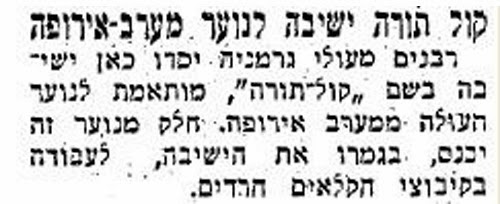
I guarantee you that even on the hottest of days, none of the Kol Torah students will be wearing shorts. For those who don’t know, Kol Torah was founded by German Orthodox rabbis and was originally very different than it is today. Here is how it was described upon its founding, in a short notice in Davar, August 27, 1939.
It is hard to imagine today, but this was a yeshiva that actually intended for some of its students to take up agriculture. See also here which cites R. Hayyim Eliezer Bichovski, Kitvei ha-Rav Hayyim Eliezer Bichovski (Brookyn, 1990), p. 180, that the Chafetz Chaim said that yeshiva students in Eretz Yisrael should learn nine months a year and work the land the other three months
Speaking of shorts, here are a couple of pictures showing how the boys of the German Orthodox separatist Adass Jisroel community looked when playing sports (also notice the lack of kippot).
This was the community of R. Esriel Hildesheimer and R. David Zvi Hoffmann. The pictures come from Mario Offenburg, ed., Adass Jisroel die Juedische Gemeinde in Berlin (1869-1942): Vernichtet und Vergessen (Berlin, 1986).
Here is how the girls dressed for sports, also with shorts and sleeveless.
And here is how the boys and girls looked when not at a sporting event.
These pictures come from Max Sinasohn, ed., Adass Jisroel Berlin (Jerusalem, 1966).[23]
4. Some people didn’t appreciate the humor in my post with regard to the Gaon R. Mizrach-Etz. I think they should lighten up, and in a previous post, available here, I gave some references to humor in rabbinic literature. This was followed up by a more extensive post by Ezra Brand, available here.
According to the commentary Siftei Hakhamim, it is not just the talmudic sages who would at times show their humorous side, but on at least one occasion Moses thought that God himself was joking with him!
In Ex. 33:13 Moses says to God: ועתה אם נא מצאתי חן בעיניך. Rashi explains this to mean: “If it is true that I have found favor in Your eyes.” This means that Moses was in some doubt as to whether he found favor in God’s eyes, but this is problematic since in the previous verse Moses quotes God as saying to him, “you have also found favor in My eyes.” So if God told Moses that he found favor in His eyes, how can Moses be in doubt and say to God, “If I have found favor in Your eyes”?
Here is the Siftei Hakhamim.
According to Siftei Hakhamim, Moses was in doubt if he really found favor in God’s eyes, since even though God said he did, perhaps God was joking just like people joke around!
דלמא מה שאמרת מצאת חן בעיני מצחק היית בי כדרך בני אדם
5. I want to call readers’ attention to a recent book, Shevilei Nissan, which is a collection of previously published essays from R. Nissan Waxman. There is lots of interesting material in the book, and let me mention just a few things.
In Studies in Maimonides and His Interpreters, p. 75 n. 302, I referred to R. Yaakov Avigdor’s strong criticism of R. Hayyim Soloveitchik’s approach. R. Avigdor also criticized R. Solomon Polachek, the Meitchiter. R. Waxman was a student of the Meitchiter, and on p. 23 n. 1, he comes to his teacher’s defense.
On p. 150, R. Waxman, who was the rav of Lakewood, mentions the problem of how some yeshiva students are halakhically more stringent than their teachers. He quotes R. Yaakov Kamenetsky in the name of R. Aharon Kotler how a student once visited R. Kotler and when the latter offered the student some cookies, the student was reluctant to take before asking which bakery they came from. (Perhaps this behavior can be explained by what I have heard – and maybe someone can confirm this – that in R. Aharon Kotler’s day the Lakewood bakery Gelbstein was not under hashgachah, and yet R. Kotler bought his challot from it. See also here and here The original post referred to in these links has definitely been taken down.)
On p. 233, R. Waxman notes that even though we have the principle, “A Jew who sins remains a Jew”, in actuality, it is possible for a Jew to so remove himself from the Jewish people (e.g., apostasy) that as far as most things are concerned, he is indeed no longer regarded as Jewish. This essay was written concerning the “Brother Daniel” case, and R. Waxman’s approach is similar to that of R. Aharon Lichtenstein who also wrote a famous article on the topic, “Brother Daniel and the Jewish Fraternity,” republished in Leaves of Faith, vol. 2, ch. 3.
On pp. 251ff., R. Waxman deals with Menahem Mendel Lefin’s Heshbon ha-Nefesh, an influential mussar text which as many know was influenced by a work of Benjamin Franklin.
6. I want to also call readers’ attention to two other books recently sent to me. The first is R. David Brofsky, Hilkhot Moadim: Understanding the Laws of the Festivals. This is very large book (over 700 pages) dealing with the Holidays and is a welcome addition to the growing number of non-haredi halakhah works in English.. In a future post I hope to deal with it in greater depth. The second book is Haym Soloveitchik, Collected Essays, vol. 1, published by Littman Library, my favorite publisher. This book is required reading for anyone with an interest in the history of medieval halakhah. I was happy to see that it also includes two essays that appear here for the first time. Furthermore, Soloveitchik’s classic essay on pawnbroking (which was his first significant article) has been expanded to almost double the size of the original. In the new preface to the essay, he writes: “Every essay is written for an imagined audience, and mine was intended for the eyes of Jacob Katz, Saul Lieberman, and my father.”
[1] I also must point out that someone involved with hebrewbooks.org informed me that the essay was not removed from the site because it was viewed as “problematic”, but because they were requested to do so by one of the members of R. Zevin’s family who claimed to hold the copyright to the work. This is obviously a false claim, since as we have seen there is no proof that R. Zevin wrote the essay.
[2] See R. Waldenberg, Hilkhot Medinah, vol. 2, pp. 14, 60, 62, and R. Frank’s haskamah, ibid., pp. 17.
[3] See Jack Feinhotz’s letter in Tradition 22 (Winter 1987), p. 120. R. Zevin’s view, that there is no need for keriah, was also advocated by R. Reuven Katz, Sha’ar Reuven (Jerusalem, 1952), p. 32.
[4] See Terry Novetsky’s letter in Tradition 23 (Summer 1987), pp. 98-99.
[5] Tradition 22 (Winter 1987), p. 120.
[6] In the interview with R. Zevin that appeared in my last post, R. Nahum’s comments tended to be somewhat dogmatic, even “haredi”, and should be contrasted with his grandfather’s words.
[7] Even among the vast majority of Lubavitchers this is the case (so I am informed by R. Chaim Rapoport). This is quite strange since the Rebbe held that you have to do keriah. What this shows us is that not everything advocated by the Lubavitcher Rebbe was adopted by his hasidim.
[8] See R. Dov Lior, Devar Hevron (Kiryat Arba, 2009), Orah Hayyim no. 567
[9] Even the incredibly learned Meir Benayahu was stumped by מו”ש. See this page from his Tiglahat be-Holo Shel Moed (Jerusalem, 1995), p. 21.


Regarding Benayahu, a recent book argues that the missing pages of the Aleppo Codex were not destroyed in Aleppo, but were actually stolen by Benayahu after arriving in Jerusalem. See Matti Friedman, The Aleppo Codex (Chapel Hill, 2012).
[10] I have found one occasion where it is written מ”ש, although this is probably a typo. See R. Yaakov Reischer, Shevut Yaakov, vol. 2, no. 129. R. Reischer was a member of this beit din,
[11] Iyunim u-Mehkarim (Jerusalem, 1963), vol 2, pp. 179ff.
[12] In the Vilna Shulhan Arukh, Yoreh Deah, there is a commentary by R. Jacob Emden. Yet R. Yaakov Hayyim Sofer, Menuhat Shalom, vol. 6, p. 116, shows that it was not written by him, and one of his proofs is that the commentary refers to הגאון אב”ד וב”ד מו”ש, implying that the author lived in Prague.
[13] See Kook, Iyunim u-Mehkarim, p. 180.
[14] See Simhah Assaf, Batei ha-Din ve-Sidreihem Aharei Hatimat ha-Talmud (Jerusalem, 1924), ch. 11.
[15] See ibid., pp. 80ff. for other examples of אפילאנט
[16] This statement should not be taken to imply that the leading rabbis in Eretz Yisrael were happy with the institution of this court, which was pretty much forced upon them by the British. See Amichai Radzyner’s book-length article, “Ha-Rav Uziel, Rabanut Tel Aviv-Yafo, u-Beit Din ha-Gadol le-Irurim: Sipur be-Arba Ma’arakhot” Mekhkerei Mishpat 21 (2004), pp. 120-242.
[17] R. Ovadiah Hadaya, in his approbation to R. Amram Aburabia, Netivei Am (Jerusalem, 1964), states that everyone in Jerusalem should follow “minhag Yerushalayim”. If his opinion is accepted, it would mean the end of any Ashkenazic practices in the city.
[18] Regarding earlier in the nineteenth century, see Yehoshua Kaniel, “Kishrei ha-Edot be-Inyanei Halakhah u-Minhag bi-Yerushalayim ba-Meah ha-Yod Tet,” Morashah 4 (5736), pp. 126-136. In the eighteenth century, the Vilna Gaon was of the opinion that Ashkenazim who come on aliyah should indeed adopt Sephardic practices. See Bezalel Landau, Ha-Gaon he-Hasid mi-Vilna (Jerusalem, 1978), p. 250, n. 30.
[19] This has indeed been the Ashkenazi approach, yet R. Abraham Danzig disagreed. See Hokhmat Adam: Sha’ar Mishpetei ha-Aretz 11:23:
נ”ל דהבאים לא”י אם יקבעו עצמם בעיר שיש שם מנין אעפ”י שהבאים הם מרובים יש להם דין יחיד וחייבים לנהוג חומרי מקום שהלכו לשם ופקעו מהם החומרות שהיו נוהגין במקומם.
[20] As far as I know, R. Samuel Judah Katzenellenbogen was the first great rabbi to have his picture made (unfortunately, it no longer exists). See R. Moses Porti, Palgei Mayim (Venice, 1608), p. 6b (referred to by R. Gedaliah Oberlander, Minhag Avoteinu be-Yadenu [Monsey, 2012], p. 451):
והלא אנכי הייתי הראשון שבקשתי להציב תמונתו לנגד עיני ע”י הצייר ואותה לקחתי לי והצבתיה בבית מדרשי לקיים מה שנאמר והיו עיניך רואות את מוריך
While this picture was hung in the beit midrash, see this post where I mention how R. Pinchas Teitz took down the poster of R. Elchanan Wasserman that I hung up in a room used for tefillah. (R. Porti’s Palgei Mayim is devoted to the famous dispute about the mikveh in Rovigo.)
[21] The standard biographies all record that R. Judah Mintz lived a very long life. This is based on R. Joseph Yavetz, Hasdei Ha-Shem (Jerusalem, 1934), Introduction, p. 9, where R. Yavetz’s son mentions that R. Mintz recited birkat ha-hamah when he was כבן מאה שנה. This would have been in 1505, and he lived another three years after that. R. Meshulam Fishel Behr, Divrei Meshulam (Frankfurt, 1926), pp. 147ff., rejects the younger Yavetz’s testimony and claims that R. Mintz died in his seventies. See, however, R. Naftali Yaakov ha-Kohen, Otzar ha-Gedolim (Haifa, 1967), pp. 35ff.
[22] See also Jewish Encyclopedia, s.v. Katzenellenbogen, Samuel Judah. R. Yissachar Hoffman called my attention to She’elot u-Teshuvot Hakham Zvi, no. 15, where R. Samuel Judah Katzenellenbogen is (mistakenly?) referred to as מהר”י מפאדואה. See also R. Aryeh Yehudah Leib Lifshitz, Avot Atarah le-Vanim (Warsaw, 1927), p. 48 n. 44
[23] When I was in high school in the early 1980s, in the New Jersey-New York yeshiva league only the girls of Bruriah wore sweat pants during basketball games (and the boys were not allowed to attend home games). At the other high schools the girls wore shorts. Today, the league requires all girls to wear sweat pants (i.e., not even long shorts). For a wonderful discussion of the yeshiva basketball league, see Jeffrey S. Gurock, Judaism’s Encounter with American Sports (Bloomington, 2005), ch. 7. Gurock discusses how for six years in the early 1950s, Yeshiva Chaim Berlin was part of the basketball league together with the Modern Orthodox co-ed high schools, something that could never happen today. During this time co-ed schools had cheerleaders, and this was a major factor in forcing Chaim Berlin to leave the league. (Mesivta Tifereth Jerusalem was also in the league for two years.) When I mention cheerleaders, don’t think of current NFL cheerleader outfits. Here, for example, is how the Brooklyn Central girls looked (from Gurock, p. 143).
Yet Gurock, ibid., points out that “as the 1950s progressed, the Brooklyn Central cheerleaders’ skirts also got shorter and shorter.” (Speaking of short skirts, anyone who has looked at Modern Orthodox yeshiva high school yearbooks from the early 1970s will see that the mini-skirt craze was also tolerated at these institutions.)


On the History of the Custom to Announce Upcoming Fasts in the Synagogue on the Shabbat Preceding the Fasts

On the History of the Custom to Announce Upcoming Fasts in the Synagogue on the Shabbat Preceding the Fasts

By Ezer Diena

About the author: Ezer Diena teaches Science and Judaics at Bnei Akiva Schools of Toronto. After studying at Yeshivas Toras Moshe for two years, Ezer received his B.Sc. in Chemistry and B.Ed. from York University.  He then joined Beit Midrash Zichron Dov of Toronto, where he studied for two years while serving as Rabbinic Assistant at BAYT and teaching in the Toronto and Thornhill communities. He welcomes any comments or feedback at ediena@torontotorah.com

Part 1: The sources of this custom

Many communities have the custom to make some type of announcement1 of a fast day on the Shabbat preceding it. In what is likely the best-known version of this custom, Shulchan Aruch (Orach Chaim 550:4) writes:

:(בשבת קודם לצום מכריז שליח צבור הצום חוץ מט”ב וצום כפור וצום פורים וסימנך אכ”ף עליו פיהו2 (ומנהג האשכנזים שלא להכריז שום אחד מהם

On the Shabbat prior to a fast, the Shaliach Tzibbur announces the [upcoming] fast, except for the 9th of Av, the fast of Kippur, and the fast of Purim [i.e. Ta’anit Esther], and the mnemonic for this is “AKaF alav pihu” [A = Av, K = Kippur, F = Purim] (Mishlei 16:26). Rema:3 And the custom of the Ashkenazim is not to announce any of them.

While the source of Shulchan Aruch’s formulation of the custom to announce fasts on the Shabbat prior is Abudarham4, this custom is described in a number of early sources. Two sources cited in support of this custom appear to be from Geonic times5, while another seven major sources span the first half of the second millennium. The Hebrew and English text of these nine sources, along with minimal analysis, follows:

Masechet Soferim (no later than 8th Century CE)

In standard printings of Masechet Soferim, Chapter 21 Halacha 36 references a custom that some individuals had to fast on Monday(s) and Thursday towards the end of the month of Nissan.7 The next passage8 reads

.במה דברים אמורים בצינעה, אבל לקרוא צום בציבור אסור, עד שיעבור ניסן

When is the above said? [When the fasting is done] privately, but to call a fast in public is prohibited, until Nissan has passed.

Rabbi Dr. Michael Higger (in his critical edition of Masechet Soferim, Volume II, p. 354, notes to line 13) notes no less than four other versions of the words that appear in the place of לקרוא צום בציבור, to call a fast in public: להטריח ציבור, to burden the community; להכריז צום בציבור, to announce a fast in public; להזכיר צום בציבור, to mention a fast in public; and להדין צום בציבור, to rule (?) a public fast. (Note as well that some of the versions lack the word צום, fast, but their meaning likely remains the same.)

Some commentaries to Masechet Soferim9 have therefore suggested that this line references this custom to announce fasts on the preceding Shabbat. While it is indeed the custom of many communities, even now, to recite a Mi Sheberach blessing on the first Shabbatot following Rosh Chodesh Iyar and Cheshvan for those who fast the Monday/Thursday/Monday fasts following Nissan and Tishrei,10 this does not seem to be the simple meaning of this passage of Masechet Soferim, for a number of reasons. Firstly, the passage in Masechet Soferim makes no mention of Shabbat, unlike all of the other sources discussing this custom. Secondly, it seems to be discussing the nature of the fast day itself as a fast of an individual, as opposed to the fast of the public. Thirdly, similar wording is used by Shulchan Aruch (Orach Chaim 429:2) to describe the prohibition of fasting during the month of Nissan, and the overwhelming majority of commentaries11 explain this phrase to refer to the act of public fasting, having nothing to do with an announcement on the Shabbat preceding the fast.12

A more plausible explanation13 of this passage in Masechet Soferim would be that this refers to the public display of fast day rituals, such as reading the Torah portion associated with a public fast day, or that there was some announcement of the fast to the public, but had nothing to do with the Shabbat preceding the fast.

In conclusion, there is no evidence from this passage in Masechet Soferim to suggest that the its author was aware of a custom to announce fast days in the synagogue on the Shabbat preceding.

Seder Rav Amram Gaon (9th Century CE)

Another early source supporting the custom of announcing fasts on Shabbat may be Seder Rav Amram Gaon. In Seder Hilchot Ta’aniyot (usually indicated as Section 57), some editions14 of this work contain the following paragraph:

ונהגו בכל המקומות שמכריז ש”ץ בשבת קודם התענית ואומר צום פלוני ביום פלוני שיהפוך אותו הקב”ה עלינו ועל כל עמו ישראל לששון ולשמחה. ככתוב. כה אמר ה’ צבאות צום הרביעי וצום החמישי וצום השביעי וצום העשירי יהיו לבית יהודה לששון ולשמחה ולמועדים טובים והאמת והשלום אהבו. תענית של צום הרביעי י”ז בתמוז, צום החמישי ט’ באב, וצום השביעי ג’ בתשרי, צום העשירי עשרה בטבת

It is the custom in all communities that the Shaliach Tzibbur announces on Shabbat before the fast and says “the fast Ploni will [take place] on the day Ploni, may Hakadosh Baruch Hu transform it for us and for His entire nation of Israel to gladness and happiness.” As it is written: “Thus said the LORD of Hosts: The fast of the fourth month, the fast of the fifth month, the fast of the seventh month, and the fast of the tenth month shall become occasions for joy and gladness, happy festivals for the House of Judah; but you must love honesty and integrity.” (JPS 1985 translation of Zechariah 8:19) The fast of Tzom Harevi’i is the 17th of Tammuz, Tzom Hachamishi is the 9th of Av, and Tzom Hashevi’i is the 3rd of Tishrei, [and] Tzom Ha’asiri is the 10th of Tevet.15

Unfortunately, this passage is not authentic. In addition to language that does not seem to fit the rest of the work16, it appears only in Manuscript Aleph (Oxford Bodleian Library Opp. Add. 4028) of this work, a manuscript known for many later interpolations based on French customs.17 Also, if such a custom was so widespread at that time, one would expect other evidence from approximately the same time period or earlier, which, if extant, has eluded this author entirely. Indeed, Professor Daniel Goldschmidt treats this section as a later addition in his edition of Seder Rav Amram Gaon.18 Therefore, it is significant as testimony to the custom in France in the 1400s, but not as a report from 500-odd years prior in a different part of the world.

Machzor Vitry (11th-12th Century CE)

Standard printings of the Machzor Vitry (Section 190), a French work composed around 1100 CE,19 read as follows:

וכשחל תענית כתוב בשבת הבאה יאמר הכי: מי שעשה כו’. עד לירושלם עיר הקודש ונאמר אמן. צום פלוני יום פלוני זה הבא עלינו יהפכהו הק’ לנו ולכל ישר’ לששון ולשמחה ולברכה ולשלום ונאמר אמן. ככת’ כה אמר י”י צום הרביעי צום החמישי צום השביעי וצום העשירי יהיה לבית יהודה לששון ולשמחה ולמועדים טובים האמת והשלום אהבו

When a “written fast” falls in the coming week, he should say as follows: “He who did…” until “to Yerushalaim, the holy city, and we say ‘Amen’!” [This text is found in the previous section as part of the prayer recited on the Shabbat before Rosh Chodesh.] “The fast of Ploni is on this day, Ploni, which is approaching. May Hakadosh Baruch Hu transform it for us and all of Israel to gladness and happiness and blessing and peace, and we say ‘Amen’!” As it is written, “Thus said the LORD of Hosts: The fast of the fourth month, the fast of the fifth month, the fast of the seventh month, and the fast of the tenth month shall become occasions for joy and gladness, happy festivals for the House of Judah; but you must love honesty and integrity.” (JPS 1985 translation of Zechariah 8:19)

Although there are various manuscripts of Machzor Vitry, and many of them have slightly different readings, the passage is considered entirely authentic. The details of this retelling of the custom, as well those which follow, will be analyzed at length later in this piece, and are brought here as a form of introduction, as well as if the reader would like to reference the full texts during other portions of this article.

Sefer Eitz Chaim (13th Century CE)

Rabbi Yaakov Ben Yehudah Chazzan lived in London in the 1200s, and produced a Halachic work called Eitz Chaim.20 Page 109 of the Brody Edition reads:

כשיארע צום21 לשבוע יאמר: צום פלוני יהיה יום פלוני, יהפכהו הקב”ה עלינו ועל כל ישראל לששון ולשמחה ולמועדים טובים, לריוח והצלה והצלחה, לברכה ושלום ונאמר אמן, כאמור: כה אמר יי [צבאות] צום הרביעי צום החמישי צום השביעי וצום העשירי יהיה לבית יהודה לששון ולשמחה ולמועדים טובים האמת והשלום אהבו

When a fast will fall in the week, he should say: “The fast of Ploni will be the day of Ploni, may Hakadosh Baruch Hu transform it for us and all of Israel to gladness and happiness and holidays, relief, deliverance and success, blessing and peace, and we say ‘Amen’!” As is said, “Thus said the LORD of Hosts: The fast of the fourth month, the fast of the fifth month, the fast of the seventh month, and the fast of the tenth month shall become occasions for joy and gladness, happy festivals for the House of Judah; but you must love honesty and integrity.” (JPS 1985 translation of Zechariah 8:19)

Kol Bo (13th-14th Century CE)

In an anonymous halachic work from around 1300, often attributed to Rabbi Aharon Ben Yaakov Hakohen22, we find the following in Hilchot Tefillat Yotzer Umussaf, Chapter 37:

.ועל ד’ הצומות שהן י”ז בתמוז וט’ באב וצום גדליה ועשרה בטבת מכריז בשבת שלפניהן ואומרים צום פלוני יהיה יום פלוני וכו’, אבל23 אין מכריזין על ט’ באב ועל צום גדליה24 לפי שהם ידועים לכל

On the four fasts, which are the 17th of Tammuz, the 9th of Av, the fast of Gedaliah, and the 10th of Tevet, he announces on the Shabbat prior to them, and they say: “The fast of Ploni will be on the day of Ploni…”. But we do not announce on the 9th of Av and the fast of Gedaliah, since they are known to all.

Orchot Chaim (13th-14th Century CE)

Standard printings of Orchot Chaim, an early 14th Century work by Rabbi Aharon Ben Yaakov Hakohen25 (Volume I, Seder Tefillat Shabbat – Shacharit, Section 8) read:

ועל ד’ הצומות שהן י”ז בתמוז וט’ באב וצום גדליה וי’ בטבת מכריז בשבת שלפניהם צום פלוני יהיה יום פלוני וכו’26 ועל ט’ באב וצום גדליה י”א שאין מכריזין עליהם לפי שהן ידועים לכל.27

On the four fasts, which are the 17th of Tammuz, the 9th of Av, the fast of Gedaliah, and the 10th of Tevet, he announces on the Shabbat prior to them: “The fast of Ploni will be on the day of Ploni…”. [Regarding] the 9th of Av and the fast of Gedaliah, some say that we do not announce them, since they are known to all.

Sefer Mitzvot Zemaniyot (13th-14th Century CE)

Rabbi Yisrael Ben Yosef Hayisraeli of Toledo, Spain, authored an Arabic work known as Sefer Mitzvot Zemaniyot around the beginning of the 14th Century. It was translated into Hebrew not long after his death by Shem Tov Ben Yitzchak Ardotial, and that translation alone remains.28 In his Hilchot Ta’aniyot, he writes:

וצריך להזהר בהם ולהזכירם ש”ץ ביום השבת הקודם אחר ההפטרה קודם שיאמר אשרי “אחינו ישראל [שמעו] צום פלוני יום פלוני. יהפוך אותו לנו29 הקב”ה לנו לששון ולשמחה, כמו שהבטיחנו בנחמות, ונאמר אמן”. והענין לזה, כדי שיקבלו עליהם הצבור קודם בואו. כי אם לא יקבלוהו ולא כיונו בו אלא אחרי בואו, יקרא תענית שעות, שאינו יום צום אלא מעת שכיון לקבלו עד תשלום היום. ואמרו אין מתענין לשעות. ואמרו עוד כל תענית שלא קבלו עליו מבעוד יום לא שמיה תענית.

One needs to be careful about them and the Shaliach Tzibbur should announce them on Shabbat Day after the haftarah before he says “Ashrei”: “Our brothers, Israel, hear: The fast of Ploni is on the day of Ploni. May Hakadosh Baruch Hu transform it for us to gladness and happiness, as he promised us in the consolations, and we say “Amen”!” The purpose of this, is so the community accepts [the fast] upon themselves before it arrives. For if they do not accept it, and only focus upon it after it arrives, it will be called a Ta’anit Sha’ot [fast of hours], which is [only considered] a day of fasting from the time that he intended to accept it until the completion of the day. And they said (Ta’anit 11b): “[One] does not fast for hours.” They also said (Ta’anit 12a): “Any fast which they did not accept while it was still [the previous] day is not considered a fast.”

Although he lived in Spain, he was tremendously influenced by Rabbi Asher Ben Yechiel (Rosh), who had lived in and travelled through various Ashkenazic communities before settling in Spain in 1306. Thus, this work may reflect an Ashkenazic custom, albeit one that may have become accepted in Spain at that time. It is also imperative to note that scholars have documented the influence of this work on the next two works listed, Sefer Abudarham and Sefer Menorat Hama’or.30

Sefer Abudarham (14th Century CE)

As mentioned above, Sefer Abudarham, a classic 14th Century Spanish liturgical work,31 served as the source for Shulchan Aruch’s ruling on this matter. The original text, found in printed versions of Sefer Abudarham (Seder Tefillat Hata’aniyot), reads:

ובשבת שקודם להם אחר קריאת ההפטורה קודם אשרי צריך שיכריז שליח צבור ולהודיע לקהל באיזה יום יחול הצום ואומר אחינו ישראל שמעו צום פלוני יום פלוני יהפוך אותו הקב”ה לששון ולשמחה כמו שהבטיחנו בנחמות ונאמר אמן. וג’ תעניות אין מכריזין עליהם ט’ באב יום הכיפורים ופורים וסימניך אכ”ף.32

And on the Shabbat before them, following the reading of the Haftarah, prior to Ashrei, the Shaliach Tzibbur must announce and notify the congregation on which day the fast falls, and he says: “Our brothers, Israel, hear: The fast of Ploni is on the day of Ploni. May Hakadosh Baruch Hu transform it to gladness and happiness, as he promised us in the consolations, and we say “Amen”!” There are three fasts which we do not announce [the date of]: The 9th of Av, Yom Hakippurim, and Purim, and the mnemonic is AKaF [A = Av, K = Kippur, F = Purim].

Sefer Menorat Hamaor (Rabbi Yisrael Al-nakawa; 14th Century CE)

Finally, at approximately the same time and place as Sefer Abudarham was written, Sefer Menorat Hama’or, a chiefly ethical work by Rabbi Yisrael Al-nakawa, was also composed.33 Standard printings of Chapter 2 of the book, entitled Hilchot Hata’aniyot (p.p.278-279 in the Anlau Edition), contain the following passage, in the context of formally accepting the “minor fasts”:

…ולפי’ נהגו להכריז ש”צ ביום השבת שהתענית חל להיות באותו שבוע הבאה אחריו. ואומר, אחינו ישראל שמעו, צום פלוני ביום פלוני, יהפוך אותו הב”ה לששון ולשמחה, כמו שהבטיחנו בנחמות, ונאמר אמן. כדי שיקבלוהו הקהל עליהם קודם שיחול, לפי שאין רובם בקיאים לקבל אותו עליהם מבעוד יום בתפלת המנחה, כמו שאמרתי.

…therefore, they have the custom that the Shaliach Tzibbur announces the fast on the Shabbat Day on which the fast falls in the week which follows it. And he says: “Our brothers, Israel, hear: The fast of Ploni is on the day of Ploni. May Hakadosh Baruch Hu transform it to gladness and happiness, as he promised us in the consolations, and we say “Amen”!” [This is done] in order that the congregation should accept it upon themselves before it arrives, since most of them are not expert enough to accept it while it is still daytime [before the fast] during the Mincha prayer, as I said.

To sum up the history of this custom, we see that it arose sometime near the start of the Second Millennium CE and was reported to be the custom of French Ashkenazic communities for at least the next few hundred years. We also see it in a distinct group of Spanish sources in the 1300s, which may have been influenced by Ashkenazic rabbis who either emigrated to Spain or were well-known in Spain, causing this to become common practice in those Sephardic communities. In the 1400s and 1500s, it appears that this custom was strong in certain Sephardic communities (especially Spanish ones), and possibly still in French communities, but virtually nonexistent in many Ashkenazic communities.

Following the dissemination of the rulings of Rabbi Yoseph Karo and Rabbi Moshe Isserles in the Shulchan Aruch and Mappah, we see significant adoption of this custom by communities that tended to follow Sephardic customs, and strong rejection of the custom by Ashkenazic communities across Europe. Ashkenazic codes of law from this point on either rejected this custom (which may be evidence that it was known to them, possibly via the ruling in Shulchan Aruch), or failed to mention it altogether, since it was not practiced.34 However, we see evidence of adoption of this custom among Yemenite Jews,35 Egyptian Jews,36 and Italian Jews.37

Part 2: Approaches to this custom

In order to properly understand this custom, we must ask the following questions:38

  1. What benefit might there be to people to announce a fast day on the Shabbat beforehand, and why would someone initiate such a custom?
  2. Why might some communities not have adopted this custom or disagreed with it?
  3. How do these reason(s) fit in with various details of the custom, as indicated in the sources noted above, including:
    1. the language of the announcement?
    2. the placement of the announcement in the prayer service?
    3. the dates which some communities do not announce?

In answering these questions, we find three distinct conceptual approaches39 to this custom, which will be outlined below. Each of these approaches finds support among the various details of this custom, as mentioned in the sources introduced above. However, rather than attempt to assign these understandings to various authorities, this article presents the general approaches and incorporates appropriate material from the primary sources. Assigning a particular approach to each source is inappropriate, since they do not fully reflect exactly how that author may have understood the custom, but rather, how it was being practiced in that locale at that time.

Approach #1: Informing the Community

Perhaps the simplest way to explain this prayer and custom is that it serves as a method of alerting the community to an upcoming fast day.40 The custom may have begun simply by necessity – members of a particular community may have not been fully aware of upcoming fast days, and as a result, it could have been decided by the community leaders that an announcement on Shabbat would be most effective to share this information with the community. Notably, around the times which we see this custom first being mentioned, there is reason to believe that there were more participants in the Shabbat prayer service than at other weekday services,41 and in addition, it provides significant time to prepare for the fast, which could be no earlier than the following day.42

One could further conjecture that in communities where the fasts were communicated otherwise, or where the general population was more aware of such dates, this announcement was simply unnecessary. Alternatively, even if there were more communities that would have benefitted from a public declaration about the upcoming fast, it is possible that while some communities incorporated this into their prayer service, others may have felt it unnecessary or inappropriate.

Such an approach is primarily taken by Abudarham43, who adds the words ולהודיע לקהל, emphasizing the element of announcement. (Truthfully, it is hard to reject this reading of virtually any source that mentions this custom.) If so, the words “אחינו ישראל שמעו44, צום פלוני [ב]יום פלוני”, serve as a crucial part of the announcement, as they serve the main goal of passing this information on to the congregation. This would also explain the proximity of this prayer to the similar announcement of when Rosh Chodesh will take place the following week.45

Commentaries to Shulchan Aruch that take this position are quite limited.46 One example is Kaf Hachaim (Orach Chaim 550:24), who cites the language of Sefer Abudarham, and in 550:26, he also cites Yafeh Lalev (Volume III, Orach Chaim 550:2), who in turn cites Orchot Chaim’s language (brought above). Since Orchot Chaim writes that according to some, we do not announce the fasts of the 9th of Av and Tzom Gedaliah “because they are known to all”, many understand this phrase to reflect an understanding that the purpose of the announcement is to make these dates known to all.47 This would be true of the passage in Kol Bo as well, which also gives that rationale without citing another view. Similarly, in Sefer Abudarham (and Shulchan Aruch), three dates are given on which we do not announce the fast on the preceding Shabbat. Yom Kippur and the 9th of Av were likely well-known, and did not need to be announced, and the Fast of Purim (Ta’anit Esther) need not be announced due to its proximity to Purim.48 However, it would be hard to understand why Tzom Gedaliah, which immediately follows Rosh Hashanah, would not fall into this category as well.49

Of particular interest50 to those who follow this approach is the custom in Egypt. Sefer Minhagei Mitzrayim (authored by Rabbi Yom Tov Ben Eliyahu Shirizali, Rabbi of Cairo in the mid-late 1800s; note 55) testifies that the custom in Egypt was not to announce any of the fasts. However, his successor Rabbi Rafael Aharon Ben-Shimon, in Sefer Nehar Mitzrayim (Hilchot Ta’aniyot 1) spoke very harshly against the custom of not announcing these fasts, since he was personally aware of complaints from G-d-fearing Jews who had unintentionally eaten on the 17th of Tammuz, and he re-instituted this custom in accordance with the view of Shulchan Aruch.51

Notably, a recent authority that takes this approach is Rabbi Mordechai Eliyahu. In Kol Tzofayich (Balak 5761), p. 3, he advocates that even in communities that do not have this custom, on the Shabbat preceding the fast, the Gabbai should announce the date on which the fast falls, as well as the start and end times for the fast.52

Approach #2: A Prayer

It is quite clear that the actual text of this addition to the Shabbat morning services contains two major components:

  1. An announcement of when the fast will be taking place
  2. A prayer that Hashem turn it into a day of happiness

When examining the various versions of this passage and the way it is described, one can see different emphases on each of these components. For example, in Orchot Chaim’s version, which reads “צום פלוני יהיה יום פלוני וכו’”, the only text mentioned outright is the announcement of the fast, although it is clear that some form of prayer was recited, since he includes וכו’, or “etc.” at the end of his statement. Thus, one would presume that the main focus of this addition is to alert the community to the upcoming fast, but we take the opportunity to also request from Hashem that these days be turned into happy occasions.53

In a second set of texts, we find the second component, the prayer, clearly written following the announcement, but it tends to be fairly short. For example, Sefer Abudarham has “יהפוך אותו הקב”ה לששון ולשמחה כמו שהבטיחנו בנחמות ונאמר אמן”.

In Machzor Vitry, we find two interesting changes. Firstly, prior to the actual announcement, there is an opening prayer which matches the opening prayer recited before the announcement of Rosh Chodesh. Secondly (and this is found in various early French records54), it concludes with a citation of the verse in Zechariah (8:19) that these days will be transformed into happy occasions. It cannot be determined if this verse was actually recited as part of the prayer at the time that these texts were written, or if the verse was printed following this prayer to explain it,55 but it clearly demonstrates a strong connection to the consolation of that verse. Additionally, in Machzor Vitry as well as Sefer Eitz Chaim, the list of blessings that we pray for is significantly longer than in other sources.

Furthermore, in Machzor Vitry we find an odd phrase – it refers to each fast that we recite this before as a “תענית כתוב”, a written fast. Different interpretations have been proposed,56 one of which is that this phrase refers to those fasts enumerated in Zechariah 8:19.57 What criterion would be only applicable to those four fast fasts, and why refer to it in this strange way? Perhaps the emphasis of Machzor Vitry was on the fact that these four fasts are enumerated in a verse which explicitly states that they will be turned into days of happiness, which according to him, would be the main purpose of this passage and custom.58

In addition to the above, many versions of Machzor Vitry omit the day of the week on which the fast will fall.59 This too serves to deemphasize the notion that this section was added to remind others of an impending fast, and perhaps further emphasizes the role of this addition primarily as a prayer.

Additionally, another text can be called upon to support this notion that the primary reason for adding this section was to pray for a reversal from sadness to happiness. Kol Bo’s language about this custom appears to be internally contradictory. It opens saying that on each of the four fasts listed in Zechariah, the fast should be announced, and the prayer text should be recited. He then writes that Tzom Gedaliah and Tish’a B’av should not be announced. Why would he open by stating that we do announce those fasts, and one line later, write that we don’t?60

Perhaps this contradiction can be resolved by noting a slight difference between the language of Orchot Chaim and that of Kol Bo.61 Kol Bo adds the word ואומרים, and they say, prior to the passage recited in the synagogue. Thus, Kol Bo opens with a statement that on these four fasts: a) one individual announces the fast to the congregation, and b) the community recites the following prayer text. Kol Bo continues by noting that on two of the aforementioned fast days, the announcement is not made, but it is possible that the prayer is still recited.62 In Orchot Chaim, however, the prayer recited is the same as the announcement, and thus, it is brought as two separate opinions as to whether the announcement/recitation takes place at all.

This suggests that the Kol Bo distinguishes between the announcement element and the prayer element of this passage, and according to him, although the announcement is recited only prior to the 17th of Tammuz and 10th of Tevet, the prayer is recited prior to each of the four fasts listed in the verse, which would also seem to indicate that its primary purpose was to ask G-d for this reversal.

If the main or sole purpose of this addition to the Shabbat morning service would be for prayer, its placement within the prayer service (as opposed to before or after, or at a completely separate time) is quite appropriate. The parallel to the mention of Rosh Chodesh, which is also surrounded by prayers for a successful month, is very easy to understand. However, as stated above, this view is limited in regards to the applicable dates on the Jewish calendar, since according to this view, the most appropriate fast day to ask for a reversal of would be the 9th of Av, yet, many sources, including Shulchan Aruch, designate that day as one that we do not recite this passage on the Shabbat prior.63 Additionally, it is hard to understand the opposition to this custom – why wouldn’t other communities have followed this custom as well?

Although there is no certain answer to this question, there are two factors worth noting:

  1. If one were to view the passage announcing the upcoming Rosh Chodesh as fulfilling a different role than a prayer for the future, this passage seems out of place. If some Ashkenazic authorities viewed the Birkat Hachodesh as either an announcement or as some ritualistic acceptance of the new month,64 they may have felt it inappropriate to add another section to the prayers which did not serve that same purpose.
  2. There is a general hesitancy to mention sad things on Shabbat;65 some have suggested that the rejection of this custom was in line with this ethic.66 Indeed, there were even communities that did not recite the general Rosh Chodesh passage during the month of Av, due to its negative nature, so as not to bring that up on Shabbat.67

While this view that this addition to the service serves primarily as a prayer is not explicitly mentioned by commentaries to the Shulchan Aruch, nor almost any writers,68 it is clear that there is certainly an element of prayer according to all views of this custom, and that it may indeed be the main purpose of the custom according to some of the authorities that we brought above.

Approach #3a: An Informal Acceptance

The final general approach brought here is the one that has been most discussed in previous sources. In particular, Rabbi Dr. Daniel Sperber’s article on the topic mainly addresses this approach, and the classic commentaries on Shulchan Aruch who take note of this custom (in this case, Be’ur Hagra to Shulchan Aruch Orach Chaim 550:4 and, following in Gra’s footsteps, Aruch Hashulchan (Orach Chaim 550:4) also follow this approach.69 However, as we will see, there is much material on this topic that has not yet been addressed, and therefore, it would be best to present the following spectrum of views within this approach, ranging from a wholly unofficial and non-halachic acceptance of the fast, to an extremely formal and legally valid acceptance of the fast.

On the less-formal side of things, Be’ur Hagra suggests that as per Talmud Bavli Rosh Hashanah 18a, the status of the fasts listed in Zechariah (likely excluding Tish’a B’av) depends on the situation of the Jewish people at that time. As the Talmud states there:

.אין גזרת המלכות ואין שלום רצו מתענין רצו אין מתענין

At a time where there is no decree of the kingdom and no peace, if they wish to fast, they should fast, and if they don’t wish to fast, they should not.”70

Based on one opinion71 that nowadays (assuming there is no persecution), or at the very least, several hundred years ago, when this custom first appeared, the status of these three72 fast days was still in the hands of the people, an announcement on the Shabbat beforehand was a form of “accepting” the fast as a community by declaring that the community wishes to fast. According to this approach, those who disagree with the institution of this custom believe that these fasts have already been formalized, and they are no longer dependent on community will at all.73

This approach does well in explaining the exclusion of Yom Kippur and the 9th of Av, since they have a status of being completely established,74 and do not require the will of the community to take effect. However, the exclusion of Ta’anit Esther is somewhat perplexing. Although it is certainly not included in the list of fasts that depend on community will, it doesn’t seem to be particularly established, especially when we contrast other halachot of the day. This led Gra to suggest that Shulchan Aruch was of the opinion that Ta’anit Esther is considered to be established in our day, that just as the Jewish people fasted as a community on the 13th of Adar, we too continue to fast each year. This is in line with Esther 9:31, as applied in Rambam Hilchot Ta’aniyot 5:5.75 On the other hand, based on Rema (Orach Chaim 684:2), Sperber suggested that Ta’anit Esther was simply a weak custom, and not obligatory to fast on at all,76 which is why it was excluded from this list.

This approach, while initially appealing, has several issues. Firstly, it is impossible to suggest this as a plausible understanding of Sefer Abudarham, the source of Shulchan Aruch, since he brings the view of Ramban that the fasts are considered absolutely obligatory and not subject to communal approval, without bringing a dissenting view. Thus, to suggest that those who support announcing the fast must disagree with Ramban would be a clear contradiction. Furthermore, a number of commentaries77 (possibly including Gra himself) understand that Shulchan Aruch also follows Ramban’s view, in which case Shulchan Aruch would also be subject to this contradiction.78

Addition issues are the lack of a clear parallel to the Rosh Chodesh announcement79, as well as language that doesn’t seem to indicate any sort of acceptance80.

Approach #3b: A formal acceptance

Many descriptions of this custom are very consistent in presenting it as a form of acceptance. Sefer Mitzvot Zemaniyot makes extensive reference to the possibility of this addition being an acceptance of the fast, and earlier in his Hilchot Ta’anit, he mentions that only the 9th of Av has status as a public fast day, unlike the other fasts. Sefer Menorat Hamaor, earlier in his Hilchot Hata’aniyot is also explicit that each individual must accept these fasts for them to be considered binding. One could certainly argue that the purpose of the announcement is to remind people to accept the fast individually, but it seems more likely that these sources viewed the mention on the Shabbat prior to be some sort of acceptance. It is also worth mentioning that this may be a more formal and individualized type of acceptance than what Gra and Sperber were referring to.

(It is also interesting to note the placement of this halacha in the various works which refer to it. In general, although it is not absolute, it seems that those authorities who place it in the Shabbat section81 tend to view it more as a prayer or announcement than an acceptance, whereas others who place it in the laws of fast days82 may view it as more of a formal acceptance.)

The question which must be posed for the adherents to this approach is by what mechanism mentioning a fast on the Shabbat prior is considered acceptance of a fast. For Mitzvot Zemaniyot (and possibly Menorat Hama’or), who view those fasts as optional, one would expect a halachically-binding acceptance.

Firstly, regarding the time gap that may occur between Shabbat and the actual fast day, it is possible that the acceptance is binding even a number of days prior to the fast. Interestingly, this halacha is derived by Ra’avyah (Ta’aniyot 857; also cited in Mordechai Ta’anit Remez 624 and Or Zaru’a Volume II, Hilchot Ta’anit 404) from the Mi Sheberach blessing of those who accept the fasts of Bahab (Monday-Thursday-Monday) around the time that the Torah is returned to the Aron on Shabbat morning on the Shabbat preceding those fats. Ra’avyah notes that if an individual answers Amen to this blessing and intends to fast on those days, they do not need an additional acceptance of the fast. Ra’avyah contends that despite the disagreement found in the Talmud (Ta’anit 12a) between Rav and Shemuel as to whether the fast must be accepted during the Mincha prayer, or simply at Mincha time, they would both agree that an agreement on the Shabbat before would be binding.83 While to lay out the specific details of accepting fasts according to all authorities is far beyond the scope of this article, it is still our custom to accept the Bahab fasts by answering to the Mi Sheberach on the Shabbat preceding, which means that practically speaking, we follow Mordechai. Nevertheless, Shulchan Aruch Orach Chaim 563:1 (based on Tur Orach Chaim 563 and Rosh Ta’anit 1:13) clearly implies that accepting a fast prior to Mincha-time on the day before the fast is insignificant, and that one would not need to fast if they accepted the fast earlier.84

Secondly, as to whether an announcement may serve as a formal acceptance of the fast, Shulchan Aruch (Orach Chaim 562:12) writes:

תענית שגוזרים על הצבור אין כל יחיד צריך לקבלו בתפלת המנחה, אלא שליח צבור מכריז התענית והרי הוא מקובל. ויש אומרים דהני מילי בארץ ישראל שהיה להם נשיא, לפי שגזרתו קיימת על כל ישראל, אבל בחוצה לארץ צריכים כל הצבור לקבל על עצמם כיחידים, שכל אחד מקבל על עצמו

A fast that they decree on the public, each individual does not need to accept it during the Mincha prayer, rather, the Shaliach Tzibbur announces the fast85, and it is accepted. And some say, that this was stated [only about] the land of Israel where they have a Nasi, since his decree is binding upon all of Israel, but in the diaspora, the entire community needs to accept the fast upon themselves as individuals, in that each [person] accepts it upon themselves.

It appears that this pronouncement of the community establishes the fast as a communal fast, which does not require any acceptance from anyone – they all must fast regardless.

If we follow the earlier view that the fasts of the 10th of Tevet, 17th of Tammuz and Tzom Gedaliah are still dependent on communal will, such an announcement might be required in order to formalize the fast. Such a view is ascribed by Sperber to Tur.86 However, one could argue that the purpose of the announcement here is to create a fast which would otherwise not exist, but for these established fasts, there is no such need. This position is explicitly taken by a number of authorities.87 Furthermore, even if there is a need to announce these fasts as a form of acceptance, as noted above, according to the second view in Shulchan Aruch, it is ineffective, so this seems to be a weak basis for announcing the fast. However, it is possible that it may be effective at continuing the custom of generations past to fast on this date,88 and despite the above challenges, Menorat Hama’or, noting that the general public was not knowledgeable and many did not formally accept the fasts as individuals, appears to suggest that this serves as a form of acceptance.89

However, both of these concerns (the acceptance of a fast not being effective prior to Mincha-time of the day before, and the potential inability of a non-Nasi Shaliach Tzibbur to affect a fast) can be addressed. Firstly, it is possible that this was not simply something announced by one individual, but that this section of the prayer service was actually recited by every individual (similar to what we find with the Rosh Chodesh announcement).90

Alternatively, one could posit that the Amen recited at the end of the passage acts as a verbal acceptance, just as it does in the case of the Mi Sheberach for those who commit to fast on the aforementioned Bahab days.91

As to the second concern, that the acceptance was made too early, it is possible that this custom of announcing the fasts was at one point practiced only in the afternoon prior to the fast. Sefer Mitzvot Zemaniyot brings up the fast in the context of the fast days which fall on Shabbat and are delayed to Sunday, and writes “therefore”, leading into his description of the custom to recite this extra passage on Shabbat. It is possible that this point in the prayer service was close enough to the time of Mincha to be considered an acceptance of the fast even by those who would require it to be accepted at Mincha-time. However, this is admittedly a very creative and innovative read of Mitzvot Zemaniyot, and various considerations make it highly unlikely that this was the author’s intent.92

The same cannot be said for Machzor Vitry. Firstly, of the four manuscript copies of this passage of Machzor Vitry, Rabbi Aryeh Goldschmidt notes that one version reads “וכשחל תענית כתוב למחר”, when a fast falls the next day.93 Additionally, he notes that three of the four manuscripts do not mention the day on which the fast falls, from which he concludes (Shinuyei Nuscha’ot note 15 and footnote 2) that the custom was not to announce the day on which it would fall, and that this indicates that the passage served more as a prayer than anything else. However, his analysis was based on looking at the sum of the manuscripts, rather than following each manuscript tradition individually. MS ex-Sassoon 535, which (as noted above) limited the prayer to when the fast fell on a Sunday, could not possibly include a day on which the fast falls, since the prayer is only recited the day before the fast! This leaves three manuscripts, two of which omitted the day. These two manuscripts94 read “וכשחל תענית כתוב לאחר השבת”, “when a fast falls after Shabbat”. This phrase, used in various places in Machzor Vitry95 refers to Sunday, which would explain why no weekday is provided in that version of the supplication text.

If so, three manuscripts of what appears to be the earliest record of this custom testify that this passage was added only on the day prior to a fast day.96 Thus, historically speaking, this addition may indeed have served as a form of accepting a fast for individuals or the community.97 This would also explain the emphasis on the verse in Zechariah, which serves as a reminder that these fasts are not as established as one might think, in that they are dependent on the will of the community, as above.

In conclusion, while many later authorities suggest that this announcement served as a form of accepting the impending fast, there is little explicit support for this notion among early records of the custom. Only Menorat Hamaor and possibly Mitzvot Zemaniyot seem to conceptualize the added passage in this way, but it may be a major factor in the origin of this custom.

Conclusion

This custom to add a short passage announcing an upcoming fast to the Shabbat morning services is multi-faceted. While many authors have tried to provide a clear conceptual framework for this custom, based in one of the three approaches outlined above, in truth, there is no clear approach to explain every detail of this custom. Rather, as we analyze the text, placement and framing of the custom over many hundreds of years across different locales, we find that it incorporates elements of each of these three understandings. Such is the richness of this custom, that we find a way to provide practical reminders to the community, properly accept these fasts upon ourselves, and simultaneously pray for G-d’s salvation, may it come speedily in our days!

[1] Note: Although this article presents three major conceptual framings of this custom, the custom itself will be often described as an “announcement” or “prayer” throughout the article, even when those approaches to the custom are not being discussed.
[2] While the mnemonic AKaF is the product of Rabbi David Abudarham, who served as Shulchan Aruch’s source for this law (see below), Rabbi Karo appears to have expanded it on his own, as when he cites Abudarham in Beit Yosef, only the mnemonic AKaF appears, not the verse. (It is possible that other versions of Abudarham included this expansion as well – in the damaged St. Petersburg Russia Ms. C 98, folio 122, there is a larger gap than would be expected at that point in the text. His selection of this verse as an expansion of this mnemonic is interesting, since one could have also chosen Michah 6:6, “אכף לאלהי מרום”. Perhaps the reference to a verse about hunger is appropriate for a fast day, or, that the compulsion of one’s mouth refers to the acceptance of the fast by pronouncing it in advance. For a kabbalistic interpretation of this hint, see text box following note 44 in Halachot Uminhagim – Hilchot Ta’aniyot (Kovetz Halacha Umesorah – Teiman).
[3] See Rabbi Dr. Daniel Sperber, Minhagei Yisrael 4 (p.p.248-9) in regards to whether this comment was actually written by Rema, or whether printers added this in accordance with Rema’s view in Darkei Moshe (Orach Chaim 550:1) that the custom of the Ashkenazim is not to announce any of these fasts on the preceding Shabbat. Early printings of Shulchan Aruch with the comments of Rema (such as the early 1600s Krakow edition) contain this comment but lack an introductory “הגה:”.

It should also be noted that the Knesset Hagedolah, whom Sperber noted brought this comment from the Sefer Hamapah (possibly as opposed to Darkei Moshe) seems to not have had a copy of Darkei Moshe on Orach Chaim, as both times he cites something from it in his works, it is a secondary citation.
[4]Seder Tefillot Hata’aniyot; p. 254 in Abudarham Hashalem, (Yerushalaim/Usha Edition). This text will be presented in full later in this article.
[5] Tosfot Yom Tov (Ta’anit 2:9) raises the possibility that this was the custom in Mishnaic times as well, but this seems to be without a firm basis.
[6] All of this is part of Halacha 1 in the Higger/Debei Rabbanan Edition of Masechet Soferim (Volume II, p. 354).
[7] See Tur, Beit Yosef, and other commentaries to Orach Chaim 429 and 492 for discussion of this custom, and interpretation of this passage of Masechet Soferim; some understood this to be referring to fasts following the conclusion of Nissan.
[8] Halacha 1, lines 12-13 in Higger’s edition, Halacha 4 in standard printings.
[9] See e.g. Be’urei Soferim (Wasserstein) to Masechet Soferim 20:4, citing Nachalat Ariel to Masechet Soferim 20:4.
[10] See e.g. Shach Yoreh Deah 22:31
[11] See e.g., the comments of Chok Ya’akov, Magen Avraham, and Mishnah Berurah to Shulchan Aruch there.
[12] It would be appropriate to note that similar phraseology appears in multiple places in Tanach, such as Melachim I 21:9, Yonah 3:5 and various other places. See Sperber, Minhagei Yisrael 1:24, footnote 5 for some sources that address this.
[13] Be’urei Soferim (Wasserstein) to Masechet Soferim 20:4 (citing Nachalat Ariel, as above) does offer an alternative explanation as well, and the Kerem Re’em Edition of Masechet Soferim (Chapter 21, note 28) concludes similarly.
[14] See e.g. Seder Rav Amram Hashalem (Frumkin), Volume 2, p. 78. As we will discuss, any printing which used the Oxford Bodleian Library manuscript of the work includes this passage.
[15] Two notes on translating this passage, which apply to the remaining translations as well: 1. Although the citations of Zechariah 8:19 found in the different sources are not identical, the same JPS translation was used throughout. 2. Whether to close the quotes before or after the citation of the verse from Zechariah was not certain; some versions of the prayer include the verse, but others do not.
[16] For example, elsewhere, the author identifies customs by locale, rather than write “all places”.
[17] See Seder Rav Amram Gaon (Goldschmidt/Mossad Harav Kook Edition), p. 12, which details the history of this manuscript.
[18] Seder Rav Amram Gaon, Mossad Harav Kook Edition, p. 96, section 57*.
[19] See e.g., the Encyclopedia Judaica entry for Mahzor Vitry and The Jewish Encyclopedia entry Simha Ben Samuel of Vitry.
[20] See e.g. The Jewish Encyclopedia entry for Jacob ben Judah Hazzan of London.
[21] This term, as opposed to Ta’anit (found in other descriptions of the custom) may indicate that it refers to the four fasts in Zechariah, which are referred to in that fashion; compare the language of Orchot Chaim and Kol Bo. For further discussion of the differences between these two terms, see The Academy of the Hebrew Language, Tzom Veta’anit (published August 4, 2014).
[22] There is a significant amount of literature devoted to the relationship between (and history of) Kol Bo and Orchot Chaim, a work authored by Rabbi Aharon Ben Yaakov Hakohen, and virtually every edition of either work addresses this issue to some degree. Rabbi Mordechai Menachem Honig (“On the new Edition of Sefer Hamaskil of Rabbi Moshe ben Rabbi Elazar Hakohen” (Hebrew), published in Yerushateinu Volume I (5767), p. 237 and footnotes 144-145) writes, based on various sources, that Kol Bo was authored in Provence in the late 13th Century, and served as an early version of Orchot Chaim, which was published in Majorca at a much later point in the author’s life.
[23] Shu”t Olat Yitzchak (Ratzabi) Orach Chaim 167 (p. 372) suggests that the words יש אומרים (and presumably the prefix of the next word) were omitted by a scribe; although this lacks manuscript support (e.g. Russian State Library, Guenzburg Collection, MS 72), it should not be discounted. This suggestion is motivated by the open contradiction in Kol Bo’s words, where he first writes that one announces the fast on all four days, then immediately writes that Tish’a B’av and Tzom Gedaliah are not announced. An alternative reading of Kol Bo will be presented later in the article.
[24] Based on the contradiction noted in the previous footnote, Rabbi David Avraham (Kol Bo Feldheim Edition, Volume 2, Column 218, footnote 59) suggests that this is a scribal error and should read “Tzom Kippur”. This is completely incorrect, as in addition to a lack of manuscript evidence, comparison to Orchot Chaim demonstrates that this is not the case, and even if one were to change this word, the contradiction in regards to the 9th of Av would still remain.
[25] See footnote 22 above, as well as the Encyclopedia Judaica and The Jewish Encyclopedia entries for Aron Ben Jacob haKohen (spellings vary slightly). It should be noted that the author of Orchot Chaim was expelled from France (likely Narbonne) in 1306 and moved to Majorca. Although it is not clear exactly when this work was written, it is likely, however, that this work represents the French custom at the time, and not necessarily the Spanish custom.
[26] The previous section in Orchot Chaim contains a prayer recited on the Shabbat prior to Rosh Chodesh Av, which is intended to be recited here as well.
[27] According to this latter view that the announcement is only made on the Shabbat preceding the 17th of Tammuz and the 10th of Tevet, Or Torah (Elul 5777, p. 1204) provides the mnemonic יאמר ד”י לצרותינו (a play on words from Bereishit Rabbah 92:1), which references the fast of the 4th (Daled) and 10th (Yud) months.
28 See Dr. Nahem Ilan, “He who has This Book Will Need no Other Book”: A Study of Mitzvot Zemaniyot by Rabbi Israel Israeli of Toledo (published in various languages in various journals).
[29] The only printed version of Mitzvot Zemaniyot (published from manuscript by Rabbi Moshe Blau in 1985) contains this word, but it is clear that it is an error. Indeed, in the manuscript that Blau used, Oxford Bodleian Library Or. 603, one can observe folio 39v and see that this word does not appear. )The same is true of National Library of France Heb. 831 manuscript, folio 386v and Oxford Bodleian Library Reg. 63 manuscript, folio 141r, although in the latter, neither occurrence of לנו appears.) The full list of manuscripts of this work is available in Dr. Ilan’s article, and many of them are available online.
[30] See Dr. Nahem Ilan, “He who has This Book Will Need no Other Book”: A Study of Mitzvot Zemaniyot by Rabbi Israel Israeli of Toledo (published in various languages in various journals), especially footnotes 80 and 81; it is quite apparent that Mitzvot Zemaniyot was used as the basis for their formulations of this custom.
[31] See Encyclopedia Judaica and Jewish Encyclopedia entries for David Ben Joseph Abudarham.
[32] Note that Shulchan Aruch appears to have completed the verse in the mnemonic (see footnote 2), as it does not appear in printings of Abudarham. It is also unclear if this mnemonic was created by Abudarham, or may have been known in communities that followed this practice. Some considerations include the usage of the term Purim as referring to Ta’anit Esther (see Sperber’s comments on this in a footnote to Minhagei Yisrael 1:24), the lack of testimony to it in other contemporary sources, and Abudarham’s general tendency towards such hints.

It is also fascinating to note that Avraham Almaliach (Meichayei Hayehudim Betripolitania, in Mizrach Uma’arav, Volume III, p. 124) writes that the custom of Libyan Jews was to refer to Tzom Gedaliah as Achi Kippur, the brother of [Yom] Kippur, since they always fall on the same day of the week, and therefore, they have a special relationship. Or Torah (Elul 5777, p. 1204) suggests that this hint, AKaF, also includes Tzom Gedaliah, interpreting the mnemonic as Achi KiPPur.
[33] See Encyclopedia Judaica and Jewish Encyclopedia entries for Israel Ben Joseph Al-Nakawa (or Alnaqua).
[34] In addition to Rema’s comments in Darkei Moshe (Orach Chaim 550:1), Levush (Orach Chaim 550:4) writes explicitly that these fasts are not announced, and the vast majority of Ashkenazic commentators/codifiers, as well as books of customs from Ashkenazic communities, make no mention of such a custom altogether.
[35] See e.g., Moshe Gavra, Mechkarim Besidurei Teiman – Shabbat Uvirchot Hanehenin, p. 216 and Shu”t Olat Yitzchak (Ratzabi), Orach Chaim 167 (p. 371).
[36] Evidence and discussion of this practice will be brought later in this article.
[37] Early versions of the Italian liturgy contain no such custom, and modern-day siddurim do. Further research is required to track exactly when these changes occurred for many of the communities influenced by Sephardim, including Italian communities.
[38] A more basic version of these questions appears in Sperber’s treatment of this topic (vis-à-vis the disagreement between Shulchan Aruch and Rema), found in Hebrew in Minhagei Yisrael Volume 1, Chapter 24 and in English in Why Jews Do what They Do: The History of Jewish Customs Throughout the Cycle of the Jewish Year, Chapter 11.
[39] These do not include kabbalistic approaches; for more on the kabbalah that relates to this, See Rabbi Chaim Ben Avraham Hakohen, Tur Bareket to Orach Chaim 550:4 (1654 Amsterdam Printing, p. 244) and text box following note 44 in Halachot Uminhagim – Hilchot Ta’aniyot (Kovetz Halacha Umesorah – Teiman).
[40] Note that such announcements (not on Shabbat) are very ancient in nature; see footnote 12 for further documentation of this practice.
[41] See e.g. Shibbolei Haleket Section 170 (a 13th Century German/Roman Rabbi), who writes in the name of his brother that some don’t always come to synagogue on weekdays.
[42] Specifically, in communities where individuals may have formally accepted the fasts at Mincha (or Mincha-time) on the day before, this would make sure that the entire community was aware in advance. The notion of accepting the fast will be discussed at great length in Approach #3.
[43] Likely, by extension, Shulchan Aruch takes this approach as well; even though the language of Sefer Abudarham is not copied in Shulchan Aruch itself, it is copied in Beit Yosef Orach Chaim 550.
[44] The addition of these three opening words, which don’t appear in many of the early versions of this custom, indicate that this was viewed as an announcement. Almost identical language is found in Talmud Bavli Ketubot 28b, also in the context of alerting the community.
[45] In his critical edition of Machzor Vitry (Tefillot Shabbat, Section 16, footnote 2, p. 287), Rabbi Aryeh Goldschmidt suggests that if the focus of the announcement of the upcoming Rosh Chodesh, in accordance with various Rishonim, is to alert the community to the upcoming day of Rosh Chodesh so that they may properly follow the associated halachot, it is logical to assume that this announcement fills a similar need. If, however, the purpose of the announcement of Rosh Chodesh is some form of Kiddush Hachodesh (as suggested by Rokeach, Section 53), this pre-fast announcement should simply be a prayer. (Interestingly, in the Nissan 5775 (Volume 70) Or Yisrael Journal, p. 240, footnote 10, Rabbi Meir Rose supports the notion that the Rosh Chodesh prayer is an announcement from this following section about fasts.)

While the main comparison to the announcement of Rosh Chodesh is certainly valid, there are two clear issues with his argument:

  1. a) Since Machzor Vitry itself follows the former view (that the Rosh Chodesh announcement is intended to alert the public to the upcoming Rosh Chodesh, so that they can properly follow the laws of the day), one would expect that the same purpose is served by the announcement of the upcoming fast. However, Rabbi Goldschmidt concludes (based on some manuscript evidence) that this section functions only as a general prayer and follows some manuscripts which remove the day of the fast from this prayer! These manuscript issues will be discussed later in the essay, but there are various possible explanations for the omission of the day of the fast in those manuscript without creating somewhat of an internal contradiction.
  2. b) In terms of Rabbi Goldschmidt’s second comparison (to a watered-down version of Kiddush Hachodesh, which establishes the date as Rosh Chodesh), it would be more natural to view this announcement as a form of accepting the fast (which establishes the date as a fast day) rather than viewing it as a general prayer, which seems to be less related.

[46] As noted above, many Ashkenazic commentaries seem to ignore this ruling altogether, so this custom is addressed primarily by Sephardic commentaries.
[47] Although one could counter that the first opinion brought in Orchot Chaim (to recite this prayer in advance of all four fasts) clearly disagrees with this reason.

Fascinatingly, the custom to avoid announcing the fast of Tzom Gedaliah was addressed at length by Rabbi Menachem Ben Yosef Chazan in Seder Troyes, a 13th Century work addressing customs of Troyes. The printed version (Section 9; Weiss Edition p. 25) reads:

ומן הזכרת צום גדליה מצאתי בשם הר”ר יהודה ז”ל וז”ל היה קשה לי מפני מה אין מזכירין צום גדליה שהוא בחדש השביעי כמו שמזכירים צום הרביעי וצום החמישי וצום העשירי, לסוף נ”ל מפני יום כפור שאינן מניחים להזכיר צום גדליה, ועוד ט”א טוב שלא יטעו העם כשישמעו צום הרביעי ויסברו זיהו צום כפור ונפיק חורב’ מיניה, מ”ר יהודה עכ”ל. ואמנם מורי אבי היה מזכירו גם מנהג ק”ק טרוייש להזכירו גם בשבת, אך שאין מזכירים חדש תשרי כשאר החדשים

In regards to mentioning Tzom Gedaliah, I found in the name of Rabbi Yehudah z”l, and these are his words: “It was troubling to me, for what reason don’t we mention Tzom Gedaliah, which is in the seventh month, just as we mention the fast of the fourth, the fast of the fifth, and the fast of the tenth? It later seemed to me because of Yom Kippur that they do not allow to mention Tzom Gedaliah, and another reason it is good that the nation should not err when they hear the fast of the fourth and think that it is the fast of Kippur, and destruction will emerge from it. Rabbi Yehudah.” However, my father would mention it, and the custom of the holy congregation of Troyes was to mention it also on Shabbat, even though they don’t mention the month of Tishrei like other months.

These words are particularly hard to understand, no doubt due to a very corrupt text. If we restore this text from available manuscripts (Cod. Parm. 1902 and JTS Rab. 1489; unfortunately, this entire chapter is missing from the copy of Seder Troyes in the Austrian National Library Cod. hebr. 175 manuscript, and the German Senckenberg Ms. Oct. 227 has been catalogued incorrectly; it contains a different Seder Troyes (usually spelled differently in Hebrew), often printed at the back of standard copies of Sefer Haminhagim – Tyrnau), we find three very significant changes to the text:

  1. מפני יום כפור שאינו נזכר מניחים להזכיר צום גדליה. Presumably, since Yom Kippur is not mentioned, it seems inappropriate to give so much honour and exposure to a minor fast that is so close in proximity.
  2. שלא יטעו העם כשישמעו צום השביעי ויסברו זיהו צום כפור. If people misunderstand the “fast of the seventh” to refer to Yom Kippur, there are various issues that may arise, including not fasting properly on Yom Kippur itself. This is an obvious emendation and should have been changed even without other manuscript evidence.
  3. גם מנהג ק”ק טרוייש להזכירו גם כשחל רה בשבת. This text may indicate that they regularly announced Tzom Gedaliah on Rosh Hashanah, even when Rosh Hashanah coincided with the Shabbat prior, or the reverse.

Both this source and general topic requires much further study and analysis and could certainly serve as the basis of another full article of its own. Some additional sources to see are Rabbi Yair Rosenfeld, Hama’ayan 56:1, #215 (Tishrei 5776), p. 17 and footnote 12, Halachot Uminhagim – Hilchot Ta’aniyot (Kovetz Halacha Umesorah – Teiman), note 44 and Shu”t Olat Yitzchak (Ratzabi), Orach Chaim 167.

[48] Mark Mietkiewicz pointed out that in some communities, there might already be changes to the liturgy on these Shabbatot that would remind any attendees of the impending fast, even without explicitly noting the date of the fast, although one would expect that the same applies to Tzom Gedaliah as well, since it follows Rosh Hashanah.
[49] Indeed, Kaf Hachaim (Orach Chaim 550:27) rules in accordance with the view that this is not recited, and a quick survey of modern-day siddurim shows that this is the accepted view.
[50] And as brought by Sperber in Minhagei Yisrael 1:24 footnote 3, as evidence that not all “classic” Sephardic communities followed this rationale. One can add that Ateret Avot (Machon Moreshet Avot Edition, Volume II, Chapter 26 footnote 1 p. 378) writes that some communities in Jerusalem, Tunis and Djerba did not have the custom to announce fasts either.
[51] He even instituted that there should be further announcement on Shabbat, not just the prayer recited in the synagogue.
[52] This does seem superfluous in a world where synagogue calendars, which generally include this information, are so well disseminated, both in print and online forms, and it is possible that now, Rabbi Eliyahu would be more lenient in this regard than he was approximately 20 years ago.
[53] Although it is more likely that Orchot Chaim did not print the full prayer to save space, since an identical prayer was mentioned in the previous section to be recited on the Shabbat prior to Rosh Chodesh Av.
[54] Sefer Eitz Chaim, the selection from Seder Rav Amram Gaon, as well as the 12th Century Provencal work, Malmad Hatalmidim (Parshat Devarim), which explores why this verse was chosen to be recited in this passage.
[55] In the versions found in Eitz Chaim and Machzor Vitry, the words ונאמר אמן, which appear to conclude the prayer, appear before the citation of the verse. However, one could argue that this was recited after the answering of amen, and the evidence from Malmad Hatalmidim (above) appears to favour this interpretation.

If one looks to modern versions of this passage, there are various customs and siddurim that include the verse as part of the prayer (e.g. Siddur Sha’ar Binyamin – Damascus, p. 402), and many others that do not (e.g. Tichlal Hamevu’ar – Baldi (Korach Edition, p. 302)). Also note the Provencal custom to recite it, as recorded in the 1762 Amsterdam printing of Seder Le’arba Tzomot Ule’arba Parshiyot according to the Provencal custom.
[56] Sperber (Minhagei Yisrael 1:24 footnote 6) assumes that this refers to any Biblical fast (which would include Yom Kippur), and this seems to be the understanding of Rabbi Dr. Alter Hilewitz in his Chikrei Zemanim, p. 375 (Ta’anit Esther). In 1954, Sefer Keter Shem Tov (by Rabbi Shem Tov Gaugin) Volume IV p. 49 suggested that this refers to any fasts listed in the verse in Zechariah, and this is also the position taken by Rabbi Goldschmidt in his commentary to Machzor Vitry (p.p. 287-8, footnote 5).
[57] In line with the latter view above.
[58] As noted in footnotes 21, 47 and 55, similar emphasis is found in Eitz Chaim, Seder Troyes and Malmad Hatalmidim.
[59]  While Rabbi Goldschmidt puts tremendous emphasis on this point, even choosing to follow the versions that do not list the weekday, we will provide an alternate reading later in the article that significantly weakens the argument from this detail.
[60]  See further footnotes 23 and 24 for suggested emendations that attempt to resolve this contradiction, which may render the following suggestion unnecessary.
[61] As outlined in footnote 22, these works are strongly related.
[62] These two elements could be roughly equivalent to the two major components of Birkat Hachodesh, one of which is to announce the day on which Rosh Chodesh actually falls, and the prayer which follows.
[63] A similar argument was made in the Sinai periodical (Tishrei-Adar 5729, 64) by Rabbi Dr. Alter Hilewitz on p. 27 of his article on Ta’anit Esther. See also his article in Chikrei Zemanim referred to in footnote 56.
[64] See the views mentioned in Rabbi Goldschmidt’s footnote 2 on p. 287 of his edition of Machzor Vitry, referred to in footnote 45.
[65] See various details relating to fasting and crying or otherwise relating to troubles on Shabbat in Tur and Shulchan Aruch (and their various commentaries) to Orach Chaim 288 and note Mishnah Berurah Orach Chaim 307:3.
[66] Rabbi Amram Aburbia, in his Netivei Am (Orach Chaim 55:2 p.p.323-324 in the 5766 edition) appears to be the first to invoke this reason, although Professor Zvi Zohar (in his article on Rabbi Aburbia, published in Harav Uziel Uvnei Zmano, p. 148) understands this not to be the rationale of Rema in his disagreement with Shulchan Aruch, but rather, an external reason which happens to support Rema. This is quoted by name in a few Sephardic works, and interestingly, appears word for word in Nitei Gavriel Hilchot Chanukah (Chapter 60, footnote 2) in the name of “Poskim”. Rabbi Yitzchak Abadi (Shu”t Or Yitzchak 1:216) also mentions this possibility.
[67] See mentions of this custom in Mordechai (Hagahot Tish’a B’av, found in Hagahot Mordechai to Moed Katan Section 934, citing Tosfot), Orchot Chaim (Seder Tefillat Shabbat – Shacharit, note 7) and Kol Bo, Chapter 37. See also Sefer Yisrael Vehazemanim (Rabbi Mordechai Hakohen, Volume II, p. 225), who writes that the custom to avoid blessing Rosh Chodesh Av is related to (if not influenced by) the hesitation to announce upcoming fasts on Shabbat.

One could argue that there is a connection between these two practices, although a less direct one. Although Mordechai (cited above) brings the custom to not announce Rosh Chodesh Av on the Shabbat prior, he also brings a number of objections to this practice, and concludes that one should announce even Rosh Chodesh Av. One objection brought is that one should specifically pray for blessing in this month, since it is “מוכן לפועניות”, or, in other words, a time of bad luck. One could make a similar argument regarding announcing the fasts, which might have been instituted specifically to pray for a reversal. Those who opposed this custom might not have felt it to be that important to pray for the upcoming month (or that mentioning these fasts would be in some way inappropriate).
[68] The various footnotes on this section list some of those who do raise this possibility.
[69] Quite shockingly, despite significant overlap between his own presentation and the presentation of Gra (and Aruch Hashulchan), Sperber does not mention their views at all throughout his article, which is especially strange since he focused on the disagreement between Shulchan Aruch and Rema, and quotes lesser-studied commentaries, such as Kaf Hachaim. This was later pointed out to him by two colleagues, Professor David Henshke and Rabbi Chaim Cohen (of Ramat Modi’in), and he noted this omission in Minhagei Yisrael 4, p.p.249-50.
[70] The details and exact parameters of this statement (e.g. which body decides whether or not they wish to fast – individuals, communities, or the entire Jewish people?) are discussed by various Rishonim and Acharonim, and are far beyond the scope of this article. Some details are discussed by Sperber in his presentation of this view, and interested parties are referred there.
[71]  See Sperber’s article (Minhagei Yisrael 1:24), which includes Mar Rav Cohen Tzedek cited in Shibolei Haleket 278, Rabbeinu Chananel (Rosh Hashanah 18a), Rashba (Rosh Hashanah 18a), and other Geonim. Be’ur Hagra to Orach Chaim 550:1 seems to identify Tosfot (Megillah 5b, d.h. verachatz) as potentially agreeing with this group of authorities, or at the very least, taking a lighter stand than Ramban (cited in the coming notes).
[72 ]The fast of Gedaliah, the 10th of Tevet, and the 17th of Tammuz. The Talmud in Rosh Hashanah continues with a discussion of the differences between the 9th of Av and the remaining three fast days. Various commentaries there address whether it is possible that the 9th of Av may also have this status; while the majority assume that the 9th of Av is not subject to the will of the public, there is a minority view which does understand that the 9th of Av is equivalent to the other “minor” fasts – see Rashba Megillah 5b, as well as Tur Orach Chaim 550 with Bach; the view of Rashba is elaborated upon by Rabbi Asher Weiss in “Gidrei Hatzomot Bazman Hazeh” (5777).
[73] This view is generally identified with Ramban (Torat Ha’adam Sha’ar Ha’evel – Inyan Aveilut Yeshanah, Chavel edition p. 243), who is widely cited by modern-day authorities, and is identified by many as the source of Tur’s comments in Orach Chaim 550.

In that passage, Ramban offers two reasons for fasting, which appear to be distinct: a) the Jewish people have accepted this as a custom, and one must not veer from that custom, b) various communities are experiencing persecution, and therefore, these fasts return to their original status, that of Divrei Kabbalah as established by Nevi’im. However, Tur omits the detail of persecution, and it is not clear if he assumes that these fasts return to their original status just through our acceptance of them. This confusion is compounded by various authorities who mix these reasons without clarifying, and who compare other views to them. It is particularly hard to understand Sperber’s classifications in Minhagei Yisrael 1:24. A much clearer classification of views is provided by Professor David Henshke, who is quoted by Sperber in Minhagei Yisrael 4, p. 249.
[74] Yom Kippur certainly does not require acceptance, and as noted in footnote 72, the vast majority of authorities agree about the 9th of Av as well. Note also Talmud Bavli Ta’anit 11b and 12b, that the only public fast day in Babylonia is the 9th of Av.
[75] Birkat Eliyahu commentary on Be’ur Hagra, p. 212, footnote 2 notes that although Gra also states that Ra’avad wrote the same, the author was unaware of a source. It is possible that Gra is referring to the second answer of Ra’avad cited in Rosh Ta’anit 2:24, which is similar to the approach detailed above. Once again, there is a lot more to be said about the status of Ta’anit Esther, but this is not the forum for it. Various authors have written excellent articles on it, and some of them incorporate this comment from Gra.
[76] See Minhagei Yisrael 1:24, footnote 28 (spanning p.p.175-177), much of which is relevant to Gra’s view as well.
[77] Only Ba’er Hagolah, Nachalat Tzvi and Gra cite Ramban by name as the source for Shulchan Aruch, and Gra also cites a dissenting view. However, Machatzit Hashekel and Ma’amar Mordechai also make reference to Ramban’s view (all commentaries are found in Orach Chaim 550:1).

Truthfully, the association with Ramban likely depends on how one understands the two statements made by Ramban (see footnote 73), since Shulchan Aruch uses similar language to both Ramban and Tur but omits their key statement that the status returns to one of Divrei Kabbalah. Sperber argues therefore that Shulchan Aruch believes that these fasts are theoretically dependent on community will, but we simply have a strong custom which cannot be violated. See Magen Avraham Orach Chaim 550:1 as well.
[78] One could resolve this contradiction by suggesting that historically the custom was intended as a form of acceptance but was later adopted and adapted by these authorities (perhaps as an announcement), despite their disagreement with the original reason.
[79] Although one could reasonably argue that this view is parallel to the minority view that the Rosh Chodesh announcement is a form of Kiddush Hachodesh, which also creates the status/sanctity of that day and informs our behaviour on it, that view is almost universally rejected; see Rabbi Goldschmidt’s notes to Machzor Vitry (Tefillot Shabbat, Section 16, footnote 2, p. 287). See further footnotes 45 and 64.
[80 Compare this to the regular prayer used to accept fasts during the Mincha prior, which explicitly mentions acceptance.
[81]  Machzor Vitry, Eitz Chaim, Orchot Chaim and Kol Bo.
[82]  The addition to Seder Rav Amram, Mitzvot Zemaniyot, Abudarham and Menorat Hama’or.
[83] This is far from being universally accepted; see Tur and Beit Yosef to Orach Chaim 562 and 563 for extensive discussion of sources on this topic. In particular, the view of Rabbeinu Tam (cited there) that an actual verbal acceptance may not be necessary at all would seem to support the notion that an announcement in advance might qualify as a formal acceptance of a fast.
[84]  Note the very strong disagreement with this view from Taz, Orach Chaim 562:16 and 563:1. For further discussion, see Magen Avraham Orach Chaim 563:1, Peri Megadim (Mishbetzot Zahav) Orach Chaim 563:1, Sha’ar Hatziyun to Orach Chaim 562, note 37, and various other sources in these two sections of Orach Chaim.
[85]  Note: there is no indication that this happens on Shabbat.
[86] Tur writes “תענית שגוזרין על הציבור אין כל יחיד ויחיד צריך לקבלו תחלה אלא ש”ץ מכריז התענית והרי הוא מקובל וכל שכן תעניות הכתובים בפסוק”. Sperber assumes that the final clause, which references the fasts listed in Zechariah, is referring to Tur’s comment that the Shaliach Tzibbur announces it, and then it takes effect. It seems more likely that Tur is referring back to the fact that it needs not be accepted, and that an announcement is necessary only when a fast is being instituted anew, but that for an established fast, there is no need for an announcement. This fits well with the usage of “כל שכן” by Tur here. Additionally, Tur himself clearly follows the stringent opinion of Ramban that these fasts have returned to their original status of Divrei Kabbalah, and also does not bring the custom of announcing the fasts on Shabbat.
[87] Sperber notes Levush (Orach Chaim 562:12) and Elyah Rabbah (note 11)/Zutah (note 4), who are followed by a number of later commentaries.
[88] See Sperber’s conclusion. See also Aruch Hashulchan Orach Chaim 562:32.
[89] Albeit with some reluctance. Rabbi Blau, in his notes to Mitzvot Zemaniyot, footnote 6, understands that Mitzvot Zemaniyot follows suit, and traces this to Rosh Ta’anit 1:13 (citing Ra’avad) that an announcement certainly works to accept a fast, and it would not require a formal acceptance. This is significant, since Mitzvot Zemaniyot (and following it, Menorat Hama’or) appears to be influenced by the school of Rosh, and such an announcement may have been far more acceptable at that time and place than at later times. On the other hand, Rosh also does not allow for early acceptance of the fast, as noted above, so this approach is hard to understand.
[90] For example, the language of Kol Bo seems to indicate that each individual recited the formula, as the printed versions read “ואומרים” prior to the text recited. Having an individual acknowledge out loud that the fast will be taking place on a specific day is tantamount to verbal acceptance. However, other (earlier) printings and manuscripts only had the word ואומר or a shortened form from which no conclusions can be drawn.
[91] See Levush, Orach Chaim 562:9, Magen Avraham 563:1 and commentaries for further discussion of this.
[92] The full citation of Mitzvot Zemaniyot is:

ואמנם שאר הצומות כשנופל ביום שבת, ואפילו ט”ב, ידחה ליום ראשון שלאחריו. וצריך להזהר בהם ולהזכירם ש”ץ ביום השבת הקודם אחר ההפטרה קודם שיאמר אשרי

However, it is far from certain that this was his intention, since those who relied upon this passage (Abudarham and Menorat Hamaor) interpreted it as referring to any fast which falls within the same week. Furthermore, the wording used includes “יום פלוני”, which would be entirely unnecessary if it was only ever practiced when a fast fell on Sunday.
[93]  Manuscript Shin, MS ex-Sassoon 535, which is the oldest, and possibly most authentic version. Rabbi Goldschmidt writes (Shinuyei Nus’cha’ot there, note 14) that this requires further study.
[94] Manuscript Nun, JTS Library MS no. 8092 and Manuscript Mem, Russian State Library, Guenzburg Collection, MS 481.
[95]  Sections 222, 499, 500, and Hilchot Pesach, Sections 23, 106, 108, albeit without the lamed prefix.
[96]  The only manuscript which does not support this reading is the British Museum MS no. 655, which contains various additions (see Rabbi Goldschmidt’s introduction to Machzor Vitry, where he dedicates Chapters 7 and 8 to discuss this manuscript). We can only speculate as to whether this was accidentally or purposefully changed, and it may have been due to a different custom at that time, or a harmonization to the custom of mentioning Rosh Chodesh.
[97]  It is still unlikely that this was the intention of Machzor Vitry, for there would be no reason to include the 9th of Av, for as part of the school of Rashi, the author would have understood that the 9th of Av does not require any form of acceptance (see Rashi to Rosh Hashanah 18a and Megillah 5b; contrast to the view of Rashba, mentioned in footnote 72). One other plausible explanation would be that this announcement was made on the day before every fast, not necessarily on Shabbat only; compare the language of Seder Troyes cited in footnote 47.

Note as well that if the fasts were originally scheduled for Shabbat, but pushed to Sunday, that may also be a basis for accepting them early (meaning, on the day that they were originally scheduled to take place on), or general leniency. This factor is discussed in Aliba Dehilchesa 97 (Haminhag Veta’amo, p. 36), in regards to the possibility of requiring an announcement prior to when the fast of Tish’a B’av falls on Shabbat, and by Rabbi Yair Rosenfeld, Hama’ayan 56:1, #215 (Tishrei 5776), p. 17 and footnote 12 in regards to Tzom Gedaliah.


An Appreciation of HaRav Gedalia Dov Schwartz, zt”l

An Appreciation of HaRav Gedalia Dov Schwartz, zt”l

By Rabbi Akiva Males

On Thursday, the 24th of Kislev, 5781 (December 10, 2020), Jews around the world prepared to use their Shamash candles to light their Chanukah Menorahs. On that same day, leading rabbinic representatives of Chicago’s strong and diverse Orthodox community delivered moving eulogies for a world-renowned Torah scholar: Rav Gedalia Dov Schwartz, zt”l. For 95 years, Rav Schwartz served as a powerful living Shamash, using his vast Halachic knowledge to illuminate Chicago — and communities around the world.

Several of the speakers remarked that in addition to all of his responsibilities heading the Beis Din of the Chicago Rabbinical Council (CRC), Rav Schwartz readily made himself available to answer the Halachic questions of rabbis across the USA. As a Shul rabbi who regularly reached out to Rav Schwartz, I can confirm that detail as being absolutely true. However, in all honesty, Rav Schwartz shared so much more than answers to the Halachic questions he was presented with.

Having served for decades as a Shul rabbi himself, Rav Schwartz readily understood the context of the Halachic questions he was presented with. He also knew the challenges, pressures, and anxieties that rabbis ‘out in the field’ often experience. In addition to providing clear answers to the queries of puplit rabbis, Rav Schwartz was an overflowing spring of wisdom, guidance, and practical rabbinic advice.

Why would a Shul rabbi out in Harrisburg, PA (where I served from 2007-2016) join a rabbinical association based in Chicago, IL? While membership in the CRC benefits a rabbi for numerous reasons, for the most part, I joined the CRC because of Rav Schwartz. As a young rabbi in my first pulpit position, I quickly realized how much I needed someone to turn to for Halachic and rabbinic guidance. On what seemed like a near-daily basis, I found myself facing numerous scenarios I had never imagined encountering — and certainly did not learn about in Yeshiva. After reaching out to Rav Schwartz on a few occasions, I quickly felt embraced and supported — and a long-distance relationship was born.

After Rav Schwartz’s funeral, I felt drawn to look over the notes I took of many of our conversations. Packed away in a box, I found a six-inch-thick file containing some of the incredibly diverse Halachic questions that came up — and that I had discussed with different Poskim — during my years in Harrisburg. Reading through those pages brought back a flood of memories and emotions. Using Post-It notes, I began flagging the pages that involved Rav Schwartz. When I was finished, I was shocked by the number of times (and the vast spectrum of issues about which) he had generously shared his time, Halachic knowledge, and direction with me.

Since so many of the matters we discussed were of a sensitive nature, I cannot share the details of those questions — as that would not be fair to the parties involved. However, here is a small sampling of some of the questions I asked Rav Schwartz about:

  • A Shul member is extremely allergic to bee stings. The community’s Eruv will be down for a few weeks for major repairs. Can this fellow go out on Shabbos carrying his EpiPen — or must he stay home and indoors the entire Shabbos?
  • One of the Shul members has an expensive African parrot that will only eat the Chometz crackers that it is used to. What should this parrot’s owner do with it over Pesach?
  • The apartment building in which a Shul member lives installed motion sensitive lights in the halls and stairwells. Is there a Halachically acceptable way for her to leave her apartment on Shabbos?
  • A Jewish-owned chain of stores asked me to be their agent to sell their Chometz before Pesach. However, they will be open and doing business as usual over Yom Tov. Does such a sale of Chometz accomplish anything?
  • A photographer working for the local newspaper took some beautiful pictures of our community while we were reciting Tashlich on the first day of Rosh Hashanah. The pictures appeared in the next day’s paper. Can we purchase those pictures from the paper for our own use?
  • I received a letter from a Pennsylvania State prison inmate claiming to be Jewish. With his newfound free time, he has been exploring his Judaism. He recently learned that although he received a medical circumcision as an infant, in order to meet the Halachic requirements of Bris Milah, he requires a Hatafas Dam. He wants me to advocate for him to be allowed to have this procedure done while serving his time behind bars. Is this a case I should take up?
  • An out-of-town Jewish college student has unfortunately been exploring her interest in Christianity. She reached out to a family in our Shul asking if she could stay with them in order to attend a Messianic conference that will take place in our locale. Could the family agree to host her — with the hope that they will be able to dissuade her from pursuing her attraction to another religion?
  • How far must a Ger Tzedek go to prevent the cremation of his / her non-Jewish parent?

In looking through that file, I was struck by how many of the questions I posed to Rav Schwartz had to do with: A) the myriad of complex issues that result from intermarriage, B) the delicate balance that needs to be found in dealing with the local Jewish Federation and non-Orthodox congregations (and their leaderships) when it comes to matters of communal concern, C) enabling the local Jewish day school to thrive and continue providing a Torah education to as many Jewish children as it can, and D) helping Jewish converts in every way possible.

As stated above, when I called Rav Schwartz, I was looking for more than just his clear answers to the Halachic questions that I had for him. I also craved his sound advice, reassurance, and sometimes, his support. On one page of my notes, I read how I had sought his guidance in a particular thorny issue. He listened to all that had taken place, shared with me what he thought I had done right, what I could have done better, how I might still be able to iron out a wrinkle I had created, and finally, some excellent ideas for dealing with similar situations that might arise in the future.

On another page of my notes, I read how he fully agreed with a position I had taken in a complicated matter. I was set to discuss what had happened with the Shul’s leadership, and had reached out to Rav Schwartz to learn what he thought. He told me he agreed with me 100%, and that if I experienced any pushback, I could let the Shul’s Board know that he absolutely stood behind me. Fortunately, this was not necessary – as, thankfully, the Shul’s Board supported me. Nonetheless, knowing that Rav Schwartz was in my corner, and willing to back me up, gave me the reassurance I greatly needed at that time.

As I looked through my files, the following five stories jumped out at me:

  1. While Rav Schwartz clearly had a phenomenal mastery and memory of all Torah-related subjects, he was also keenly aware of the world around him. His attention to detail — and his recall of those details — was often quite surprising. As an example: I once turned to him with an important Halachic question from an Israeli family who had joined our community for a year so the husband (a high-ranking IDF officer) could attend the U.S. Army War College in nearby Carlisle, PA. After answering the question, Rav Schwartz commented, “I wonder if that college is located on the campus of the boarding school that Jim Thorpe attended.” (Thorpe was a famous Native-American athlete who passed away in 1953 — and indeed, the U.S. Army War College is located on the grounds of the former ‘Carlisle Indian Industrial School’.)
  2. Often, after answering a question, Rav Schwartz would let me know that he could relate to what I was experiencing by sharing a story from his own rabbinic career. He once told me about how decades earlier, while serving as a young pulpit rabbi in Providence, RI he turned down the local Jewish Federation leader’s invitation to deliver an invocation at a gala dinner they were holding to honor one of the most prominent Jews in town (who was intermarried). The guest speaker was going to be the famous Rabbi Abba Hillel Silver (Reform), and the food being served at the dinner was in no way Kosher. Rav Schwartz told me how shocked the Federation head was upon hearing his refusal to deliver a blessing at a dinner that was so at odds with Halacha.
  3. Rav Schwartz once mentioned that Orthodox rabbis will make the greatest impression on the broader non-Orthodox Jewish community through their Chesed and Menshlichkeit — and not via their scholarship. He recalled how once while visiting Cincinnati, OH he leafed through a year book published by the local Jewish Federation. In one year’s edition, there was a small blurb on the great Rav Eliezer Silver, zt”l. (He noted that during the time of Rabbi Silver, Cincinnati’s Jewish Federation did not have the warmest feelings towards Orthodoxy.) In that small write-up they sang Rabbi Silver’s praises. What was it about Rav Eliezer Silver’s many accomplishments that had caught their notice? It was not his Torah brilliance. Instead, the Ohio River had flooded and parts of Cincinnati were devastated. In the middle of all the chaos, Rabbi Silver was spotted in a boat bringing food and aid to others. It was Rav Eliezer Silver’s selfless Chesed that had made a lasting impact on those who were not aligned with him.
  4. In 2011, my wife Layala faced a great health challenge, spent several months in hospitals, and underwent life-saving surgery. Thank G-d, she recovered, and we will always be grateful to everyone who helped us get through that extremely trying time. Over the course of those months (and the months that followed), I reached out to Rav Schwartz with many personal and Shul-related Halachic questions. Inevitably, the first words out of Rav Schwartz’s mouth were, “How’s Laya Adinah bas Chaya Esther?” My wife’s Hebrew name — as well as my mother-in-law’s — was on the tip of his tongue. Not only was Rav Schwartz thinking of my wife throughout that challenging time, but he was letting me know that he was Davening for her as well. I cannot begin to describe how much that meant (and continues to mean) to Layala and me.
  5. I once turned to Rav Schwartz for guidance with an extremely sensitive situation involving a Jewish man who had married a non-Jewish woman. In the course of conversation, Rav Schwartz taught me an important lesson I will never forget. In asking my question, I had initially used the word ‘Shiksah’ in referring to the the gentile spouse. Rav Schwartz stopped me and said that such language is not refined, and is not appropriate for anyone — especially a rabbi — to use. He went on to explain that the term ‘Shiksah’ has a derogatory connotation, and that is why it never appears in any rabbinic responsa literature. Instead, non-disparaging terms like ‘Nochris’ or ‘Goya’ are always used. Rav Schwartz told me that moving forward, I should use those terms as well. I sincerely thanked him for sharing his advice, and have made a conscious effort to remove ‘Shiksah’ from my vocabulary ever since. (Each year, I make a point of sharing this lesson with my high school students as well.)

Unfortunately, the notes of my conversations with Rav Schwartz end in May 2016. That was when the CRC membership received an email informing us that sadly, our beloved Av Beis Din, Posek, teacher, and role model had suffered a debilitating stroke while leading a Daf Yomi Shiur. In the years that followed, I would regularly mail Rav Schwartz cards and hand-written notes. However, that fateful stroke put an end to the phone conversations which I had valued so greatly. (During a quick trip to Chicago in November of 2016, I was able to visit Rav Schwartz at his home. Though my visit was short, I found much meaning in it. I truly envy all the CRC members living in Chicago who were able to regularly visit Rav Schwartz over the past four years.)

Looking back, there are so many matters I would have loved to discuss with Rav Schwartz since the last time I reached him by phone at his CRC office in 2016. Sadly, that was not meant to be.

In reflecting on the interactions I feel privileged to have had with Rav Schwartz I realize something unique about him. Whenever I spoke with him, I gained more than just additional Torah knowledge and the guidance he so generously offered. I always departed (or hung up the phone) feeling I was a better person than I had been before our conversation began. In his very humble — yet noble — manner, Rav Schwartz had a way of elevating and bringing out the best in others. Interacting with Rav Schwartz was an uplifting opportunity for self growth — one that I and so many others wish we could experience again.

_________________________

Rabbi Akiva Males is privileged to serve Young Israel of Memphis as its rabbi, and also teach Torah at the Margolin Hebrew Academy — Finestone Yeshiva of the South. He can be reached at rabbi@yiom.org


Toil of the Mind and Heart: A Meditation in Memory of Rabbi Yehoshua Mondshine

Toil of the Mind and Heart: A Meditation in Memory of Rabbi Yehoshua Mondshine

by Eli Rubin

Rabbi Eli Rubin is a writer and editor at Chabad.org, and works to further intercommunal and interdisciplinary study of Chassidism. Many of his articles can be viewed online here .

This is his first essay at the Seforim Blog.

A new anthology mines the oral teachings of Rabbi Schneur Zalman of Liadi for new insight into the historical development of his leadership and the crystallization of his ideology, and also charts the impact of Rabbi Shlomo of Karlin and Rabbi Avraham of Kalisk on the emergence of Chabad as a distinct Chassidic movement. “HaRav: On the Tanya, Chabad thought, the path, leadership and disciples of Rabbi Schneur Zalman of Liadi” ed. Rabbi Nochum Grunwald, Hebrew, 798 pp. (Mechon HaRav, 2015).

In memory of the acclaimed Chabad scholar Rabbi Yehushua Mondshine who passed away one year ago, on the final day of Chanukah, 5775.[1]

Introduction – From Liozna to Liadi

The past few years have seen many new publications shedding light on the life and times of Rabbi Schneur Zalman of Liadi, founder of the Chabad school of Chassidism, and making his teachings more accessible.[2] For the most part, however, the historical and the ideological domains have been treated in relative isolation from one another. Moreover, while R. Schneur Zalman’s magnum opus, the Tanya, has been a frequent object of study, less work has been done on the vast corpus of his oral teachings, transcriptions of which now fill some thirty published volumes.[3]

HaRav: On the Tanya, Chabad thought, the path, leadership and disciples of Rabbi Schneur Zalman of Liadi, appeared just a few months ago as a rather belated marker of the 200th year since Rabbi Schneur Zalman’s passing on the 24th of Tevet 5772 (January 1813),[4] and comprises a collection of articles, teachings and commentary, on the topics referred to in the volume’s subtitle. Rabbi Nochum Grunwald, the volume’s editor and primary contributor, is a leading Chabad thinker and historian, and the editor of the Heichal HaBesht journal. Other contributors include Chabad scholars Rabbi DovBer Levine, Rabbi Eliyahu Matusof, Rabbi Aharon Chitrik, and le-havdil bein chaim le-chaim, the late Rabbi Yehushua Mondshine.

Of the volume’s six sections, it is the third—Shaar Ha-Maamarim, focusing on R. Schneur Zalman’s oral teachings—that is the most substantial, in terms of both quantity and content. In a loose series of articles, the volume’s editor, Rabbi Nochum Grunwald, takes several important steps towards the integration of the ideological content of these discourses within a broader historiographical context, giving particular attention to Rabbi Schneur Zalman’s relationship with Rabbi Avraham of Kalisk.

An article by Rabbi Shalom DovBer Levine—in the volume’s penultimate section—traces the impact of Rabbi Shlomo of Karlin on Chabad’s emergence as a distinct school of Chassidism, adding additional dimension to the developing picture.[5]

Grunwald’s overarching thesis pivots on Rabbi Schneur Zalman’s move from Liozna (90km North-West of Smolensk) to Liadi (Lyady, 70km South-West of Smolensk), shortly after being released from his second internment in Petersburg in the summer of 1801.[6] The precise reasons for this move remain unclear, but the distinction between the Liozna and Liadi periods—also referred to as the periods “before Petersburg” and “after Petersburg”—appears in a variety of Chabad historiographic traditions to mark an array of changes in his role as a leader and teacher of Chassidism. As one source has it, “when he dwelt in Liozna the quality of emotion toward G-d radiated from him, whereas afterwards, when he dwelt in Liadi, it was not so; there the quality of intellect radiated from him.”[7]

Grunwald’s discussion of how this shift developed is complicated by Levine’s account. And though their parallel theses are both presented in the present volume, it remains the task of the reader to integrate them.

Transcendence and Interiority

In a 1903 talk delivered by Rabbi Shalom DovBer Schneersohn (Rashab), the fifth rebbe of Chabad-Lubavitch, he distinguished between the type of teaching that entirely transcends [מקיף] the students/listeners, but overwhelms, encompasses and transforms them instantaneously, and between the type of teaching that is directed to the interiority [פנימיות] of the students/listeners, to permeate their intellects, so that they can then transform themselves from within:

Before he returned from Petersburg the second time his Chassidic teaching would burn the world, for it was of transcendent quality… there was no one who would hear Chassidic teachings from him and remain in their previous condition. But after Petersburg it changed and it wasn’t so, because then… the Chassidic teachings began to be of internal quality… Through the accusations that were in Petersburg the interiority specifically was revealed…

Before this… the Chassidic teachings were specifically of transcendent quality… which causes very intense inspiration, and such examples are also found in Likutei Torah… But the ultimate intention is the quality of interiority specifically, for with the coming of Moshiach specifically the interiority will be revealed… and the quality and advantage of interiority is achieved specifically through great and extremely immense toil… with service of the mind and the heart…[8]

Here and elsewhere it is clear that the Rashab didn’t simply rely on Chassidic traditions alone, but drew philological insight from his own knowledge of the relevant texts.[9] It is this philological project that Grunwald seeks to expand, and following the Rashab, he rejects the suggestion of other scholars that the teachings of these two periods are primarily distinguished by their relative length.[10] Instead he describes six features that, in his opinion, characterize the teachings of the earlier period. It appears that the most central of these features is the almost exclusive focus on the practical challenge of serving G-d at the highest possible level. Theoretical issues are only mentioned and engaged with to the degree that that they are directly relevant to the specifics of divine worship.[11]

Rabbi Schneur Zalman’s preoccupation with this challenge is clear from Tanya, which began circulating in the early 1790s and was published in 1796. This work, as described in the author’s introduction, is comprised of “answers to many questions, asked in search of counsel… in the service of G-d.”[12] As Grunwald notes, the Tanya is a systematic presentation of the solutions and advice that its author provided in private audiences (yechidut) on an individualized and more immediate basis. “During this period,” Grunwald concludes, “the distinction between private audiences and the oral delivery of Torah was almost non-existent.”[13]

The purpose of the oral teachings during the earlier period, accordingly, was to directly inspire religious transformation by providing practical direction and immediately applicable solutions. They therefore do not digress into involved discussion of complex theoretical questions and abstractions,[14] nor do they linger on the stylistic niceties of orderly progression.[15] Instead they drive directly to the point, emphasizing it with sharp language[16] and vivid imagery,[17] and uncompromisingly demanding utter submission to the exclusive reality of divine being (“ain od milvado”). In the earlier period, Grunwald notes, such Chassidic exhortations “are not complicated by a mantle of explanation or justification, but are [delivered] straight… penetrating the gut.”[18]

In the later period, conversely, Rabbi Schneur Zalman’s oral teachings were often devoted to the theoretical explanation of a particular concept or issue, or to several related concepts. Here we find detailed and orderly expositions on the nature and purpose of the Torah and the mitzvot generally, or of particular mitzvot and festivals, as well as on complex Kabbalistic ideas. “In the extant discourses [from before Petersburg],” Grunwald writes, “it is almost impossible to find a delivery that is dedicated entirely to the clarification of an aspect of the cosmic chain of being [seder hishtalshalut], in order for it to be understood in depth and in conceptualized form. As a case in point, after Petersburg Rabbi Schneur Zalman delivered a discourse on the topic of ohr ain sof and tzimtzum nearly every year… but before Petersburg we don’t find anything like this at all.”[19]

Grunwald acknowledges that this distinction is a generalization, that in each period one can find anomalies, and that there is far more to say about the development of Rabbi Schneur Zalman’s oral teachings with the passing years. But the distinct and rather rapid change in emphasis is clear enough to demand a broader historiographical explanation. The question is sharpened when we consider that the second part of Tanya, Shaar Ha-yichud Ve-he-emunah, which was circulated and published during the earlier period, does provide a systematic and thorough account of the unity and singularity of divine being, vis-à-vis the created realms. The orderly conceptualization and contemplation of esoteric concepts was already then a fundamental element of Rabbi Schneur Zalman’s approach to the service of G-d.[20] (So fundamental, in fact, that—as discussed elsewhere in the present volume—Rabbi Schneur Zalman originally intended Shaar Ha-Yichud to be the first section of Tanya, rather than the second.[21]) Why then do we not find more of this kind of material in the oral teachings dating from this era?

The Making of a Tzaddik[22]

Conventionally, the onset of Rabbi Schneur Zalman’s leadership—and the establishment of Chabad as a distinct school of Chassidic thought and practice—is dated to 1783, when he settled in Liozna, or to 1786, when Rabbi Menachem Mendel of Vitebsk and Rabbi Avraham of Kalisk wrote from the Holy Land prevailing upon him “to draw close the hearts of the faithful of Israel, to teach them understanding and knowledge of G-d.”[23] Grunwald, however, argues that throughout the Liozna period Rabbi Schneur Zalman continued to see himself—not as an independent leader of a Chassidic community, nor as a tzaddik in his own right, but rather—as a personal mentor and guide acting as the appointed representative of the Chassidic leaders in the Holy Land.[24]

One source that Grunwald would have done well to cite to strengthen and crystalize this nuanced conception of Rabbi Schneur Zalman’s role is a 1786 letter by Rabbi Avraham responding to the complaint of the Chassidic community in the region of Lithuania and Belarus—which, along with Rabbi Menachem Mendel, he continued to lead from afar—that they were unable to hear Torah directly from the mouths of the Tzaddikim in the Holy Land. Rabbi Avraham instructs them to focus less on their desire to hear new wisdom, and more on the practicalities of action:

If only you would place action before hearing, and our sages already said (Avot, Chapter 3) “Anyone whose wisdom is more than their actions etc. [their wisdom will not hold.]” And in my opinion it is tried and tested that too much wisdom is detrimental to action… Commit your eyes and heart to one thing of Chassidic teachings that you have heard, and strengthen it with nails that it should be imprinted and dug into your heart… and due to this you climb and ascend… to exile materiality bit by bit…

And as for action you have a master, our honored friend and beloved, the beloved of G-d, precious light… our teacher the rabbi, Shneur Zalman… filled with the glory of G-d, with spirit, wisdom, understanding and knowledge to show you the path…[25]

Strikingly, Rabbi Avraham encouraged the Chassidic community to turn to Rabbi Schneur Zalman only as a master of “action,” as one who can guide them along the methodological “path” of practical service, but not as an independent tzaddik from whom to “hear” new wisdom.[26] More than a decade later Rabbi Avraham’s opinion “that too much wisdom is detrimental to action” would become a cause of contention between him and Rabbi Schneur Zalman.[27] Yet, even following the passing of Rabbi Menachem Mendel in 1788, and even as the crowds seeking Rabbi Schneur Zalman’s counsel turned Liozna into a bustling Chassidic court, the latter continued to restrict his instruction to the practicalities of actual service of G-d. In his introduction to Tanya too, in the same breath that he emphasizes that its content consists entirely of “answers to many questions, asked in search of advice… in the service of G-d” he continues to emphasize his deference and debt to “our masters in the Holy Land.”[28]

But not all Chassidim in the region were so eager to accept Rabbi Schneur Zalman as their mentor. A strong contingent looked for guidance and inspiration to his contemporary, Rabbi Shlomo of Karlin, who emphasized ecstatic faith and the centrality of the tzaddik, and was famed as a seer and wonderworker. As documented by Levine—following the earlier work of Rabbi Avraham Abish Shor—Karliner loyalists persistently lobbied the tzaddikim in the Holy Land to appoint Rabbi Shlomo in Rabbi Schneur Zalman’s place, or to allow them to travel to visit him in Ludmir, Galitzia, where he settled circa 1786. Such agitation was consistently rebuffed, but never entirely quelled.[29] Rabbi Shlomo was shot by marauding cossacks in 1792, and the Karlin legacy was continued by Rabbi Asher of Stolin and Rabbi Mordechai of Lechevitch.[30] Despite the relative peace that reigned during this period, Rabbi Avraham continued to exhort the Chassidim to seek counsel from Rabbi Schneur Zalman alone into the early months of 1797, when he had apparently not yet seen the recently published Tanya.[31]

The period from 1788 to 1797 is described by Grunwald as an intermediate one, in which Rabbi Schneur Zalman came to ever increasing prominence and also crystallized the distinctly systematic approach to the service of G-d presented and published in Tanya. Neither by restricting himself to topics directly related to practical worship, nor by describing himself as a “compiler” (melaket) of a “collection of sayings”—rather than as the author of an independent work of Chassidic thought and instruction—was he able to mask the originality of his approach. No reader of the Tanya can evade the primacy given to intellectual contemplation, to toil of the mind, as the fundamental basis of heartfelt service and actual practice, a primacy that is further underscored by the discussion of divine unity in Shaar Ha-yichud Ve-ha-emunah.[32]

As Levine explains, the crystallization of this systematic methodology to the point of publication was seized by Karliner loyalists as an opportunity to press their case before Rabbi Avraham of Kalisk, eliciting his sharp critique of Rabbi Schneur Zalman’s path in a series of letters penned between the latter part of 1797 and the summer of 1798.[33] Paradoxically, it was precisely this critique that led to Rabbi Schneur Zalman’s emergence as a Chassidic leader of a different stripe, and ultimately as an autonomous tzaddik in the fullest sense of the term.

In Grunwald’s words:

Rabbi Schneur Zalman’s two great confrontations, with Rabbi Avraham on the doctrine of Chabad, and with the Lithuanian mitnagdim on the doctrine of Chassidism, transpired and erupted at approximately the same time. The period from 1798 [when he was first arrested and taken to Petersburg on mitnagdic charges of treason] until after the second imprisonment marked the birth pangs that brought forth the shining era of the Chabad doctrine and Rabbi Schneur Zalman’s leadership… It is due to this [difficult] period that we merited the doctrine of Chabad in all its greatness and depth.[34]

According to Grunwald the distinction between the Liozna and Liadi periods is far greater than has previously been understood. Much has been made of Rabbi Schneur Zalman’s unwillingness to deal with the worldly concerns (mili de’alma) of his constituents, and of the rules he imposed to regulate the throngs who traveled to Liozna to meet with him and receive spiritual guidance in person (takonat liozna).[35] But according to Grunwald the documentary record attests that these kinds of restrictions were only imposed during the Liozna period, when Rabbi Schneur Zalman insisted that his role was only that of a spiritual guide.[36] In the Liadi period, when he no longer acted as a personal mentor and took on the full responsibility of autonomous leadership, he no longer protested against those who came to him with their worldly concerns, and imposed no regulations on those who wished to come and hear Torah from his lips.[37]

The focus of Rabbi Schneur Zalman’s leadership now shifted from the personal to the public, from direct inspiration and methodological instruction, to the coherent formulation, explanation and dissemination of a theoretical edifice accessible enough to be studied, assimilated and acted upon by every aspiring Chassid. It was only after Petersburg that Rabbi Schneur Zalman began delivering oral teachings each and every week, and often several times in a single week. It was in the later period too that new emphasis was placed on the systematic transcription of these teachings not only by Rabbi Schneur Zalman’s brother, Rabbi Yehudah Leib, but also by the former’s sons Rabbi DovBer (the Mitteler Rebbe) and Rabbi Moshe, his grandson Rabbi Menachem Mendel (the Tzemach Tzedek), as well as by noted Chassidim such as Rabbi Pinchas Reitzes. These teachings were not simply instructive or inspirational, each was a new window onto the transcendent philosophy of Chabad, to be carefully preserved, reviewed, studied, assimilated and applied, transforming the Chassid from within.[38]

Cerebral Love

According to Grunwald, the theoretical emphasis that emerged in the Liadi period also constituted a substantial shift in Rabbi Schneur Zalman’s approach to prayer, and, more broadly, to the service of G-d with love and awe.[39]

In Tanya, Chapter 16, Rabbi Schneur Zalman distinguishes between love that is revealed openly in one’s heart, “so that one’s heart burns like flaming fire, and desires with heartfelt fervour, longing and yearning,” and love “that is hidden in the mind and concealed in the heart.” Both are the product of mindful contemplation of the greatness of G-d’s infinitude. Both provide the impetus to bind oneself to G-d through the Torah and its commandments. But the former bursts forth as an emotive outpouring of love (hitgalut ha-lev), while the latter remains “enclosed in the mind and the concealment of the heart” (mesuteret be-mocho ve’taalumat libo). Rabbi Schneur Zalman establishes it as “a fundamental rule in the service of ordinary people (beinonim)” that though open love is apparently more ideal, mere mindful animation is “also” acceptable impetus for Torah study and mitzvah performance “since it is this understanding in one’s mind and the concealment of one’s heart that brings you to toil in them.”

In a later teaching Rabbi Schneur Zalman specifically refers to this passage in Tanya, but argues that a more cerebral experience of love is actually preferable, rather than merely acceptable. For one thing, emotional experience is fleeting while cerebral animation achieves a permanently effective transformation. For another, an open experience of ecstatic love may itself be so spiritually satisfying that one will no longer seek to bind oneself to G-d through actual Torah study and practice of the commandments.[40]

Though the text in question bears no date, Grunwald devotes an entire article to a survey of several similar examples, each of which date from the period following the second imprisonment specifically. Yet Grunwald fails to note a fundamental distinction between these two texts: Tanya speaks of an individual whose “intellect and spirit of understanding is insufficient” and consequently suffers from emotional indifference. But the oral teaching he cites clearly addresses an individual who possesses the intellectual and spiritual capacity to experience open love, but is enjoined to use the intellect to exercise emotional discipline in order to cultivate a more pervading experience of submissive subjugation (bitul) before G-d.[41]

Contrary to Grunwald’s suggestion, this later text does not present a complete reversal of priorities when compared to Tanya.[42] It instead introduces a loftier form of service, through which toil of the heart is further refined rather than abandoned. As Grunwald explains elsewhere, emotional enthusiasm—even when directed towards G-d—is essentially a form of self-expression and self-affirmation, whereas the Chabad ideal is to internalize the recognition that nothing exists other than G-d.[43] Ecstatic experience can accordingly be counterproductive, and as already mentioned, may well remain limited to the realm of emotion. A loftier—and more thoroughly transformative—mode of worship uses the mind to exercise emotional self-discipline, subduing self-expression and subjecting the entirety of one’s being to the mindful apprehension of divinity and the practical service of G-d.[44]

The distinctions are perhaps not as sharp as Grunwald portrays them, but the shift is certainly a real one. In the earlier period Rabbi Schneur Zalman instructed his disciples to use their intellectual capacities to inspire emotional expression and exuberance (as reflected in Tanya). In the later period he taught them to cultivate a more contained and constant form of internal animation, channeling mindful enthusiasm directly into the practical service of G-d—Torah study and mitzvah performance—rather than allowing it to overflow into the heart unbridled.[45]

A related point, addressed in a different article, is the debate between Rabbi Schneur Zalman and Rabbi Avraham of Kalisk on the complex relationship between faith and knowledge. In 1805 the former delivered a series of discourses on the topic, elicited by the latter’s renewed critique, and Grunwald’s rich treatment of the sources further underscores the centrality of such theoretical issues in Rabbi Schneur Zalman’s later teachings.[46]

As we have seen, the transition between the Liozna and Liadi periods was rooted in the parting of ways that transpired between Rabbi Schneur Zalman and Rabbi Avraham. One result of this transition—Grunwald further argues—was the subsequent parting of ways between Rabbi Schneur Zalman’s oldest son, Rabbi DovBer of Lubavitch, and his foremost disciple, Rabbi Aharon of Strashelye. As has been most extensively described by Naftali Loewenthal, these two personalities clashed precisely over the question of Rabbi Schneur Zalman’s approach to emotional enthusiasm, particularly during prayer.[47] Rabbi Aharon first came to Liozna at the age of 17, shortly after Rabbi Schneur Zalman settled there in 1783. Rabbi DovBer would have been less than ten years old at the time, and he did not begin transcribing his father’s teachings until 1798—that is, at the very end of the Liozna period. Grunwald accordingly asserts that the eras in which they each matured as students of Rabbi Schneur Zalman can be broadly distinguished along the lines of their later disagreement.[48] While this claim rings true, it is complicated by the facts that Rabbi Aharon and Rabbi DovBer were close associates for many years, and that by 1798 the later would already have been 25 years old.[49]

Grunwald enriches his analysis of the relevant transcripts with several recollections and comments of the Tzemach Tzedek.[50] One example is a note in the latter’s own hand, appended to a teaching in which Rabbi Schneur Zalman categorically rejects any emotionalism, preferring the cerebral approach “even if it is only superficial and somatic… with very brief contemplation, and coldness…” The Tzemach Tzedek recalls that this extreme formulation was directed towards a particular individual whose enthusiastic conduct needed to be reined in, and was not necessarily intended to be applied more generally. More applicable is the general thrust of this teaching, which gives ultimate primacy to “the quality and substance of internal subjugation (bitul) in the mind and heart, in the aspect of prostration… without any detectable movement.”[51]

Another source records that seeing the Tzemach Tzedek’s note, one of his grandsons asked him if the specific individual referred to was Rabbi Aharon of Strashelye: “And his grandfather answered him… G-d forbid! I was not thinking of him, for he experienced G-dly enthusiasm…”[52] Grunwald relates this remark to a distinction drawn by Rabbi Schneur Zalman himself between the worship of an ordinary individual and that of a tzaddik, who is not susceptible to the pitfalls of ecstatic love and emotional enthusiasm. Regarding the difference between Rabbi DovBer and Rabbi Aharon, he refers to the vivid image provided by the Rebbe Rashab:

Like a burning stick of hay. When it is dry it burns with a flame. It burns through and nothing remains. [Such was the service of Rabbi Aharon] But when it contains moisture its substance is entirely burnt through, and yet [its form] remains standing. Touch it. It is nothing. Yet the form stands. Such was the Mitteler Rebbe [Rabbi DovBer]. This is the love of glowing flame, an all consuming fire, yet the form stands.[53]

Of Angels and Other Things

Notable both for its topical interest and for the broader significance of its central point is an analysis of the treatment of angels in Rabbi Schneur Zalman’s teachings by Rabbi Aharon Chitrik. “Chabad teachings… present comprehensive and deep explanations, extending to very specific details of the nature of angels: their creation, their character, their station, their role, their subjugation to G-d, prayer and song, their constant service, their free-will or lack thereof, etc. etc.” But these discussions, Chitrik convincingly demonstrates, do not reflect any intrinsic interest in angels at all. Angels are only the focus of such intense discussion as a counterpoint from which we can achieve a better understanding of the unique nature of the Jewish soul, and its mission on this physical earth.[54] In an 1804 discourse explicating this point, Rabbi Schneur Zalman extends this principle to all Kabbalistic discussions of the cosmic chain of supernal realms: Ultimately all such theoretical investigations are but a stepping stone to achieve direct knowledge of G-d’s essence.[55]

Two additional articles are devoted to the Tzemach Tzedek’s intensive engagement with his grandfather’s discourses, firstly from a theoretical perspective,[56] and secondly as editor and publisher of Torah Ohr and Likutei Torah.[57] In Grunwald’s apt and illuminating formulation, the Tzemach Tzedek is to Rabbi Schneur Zalman as the Tosafists are to the Talmud Bavli: Surveying Rabbi Schneur Zalman’s different treatments of the same or related topics, the Tzemach Tzedek seeks to compare them and combine them, ironing out apparent conflicts through innovative explanation, differentiation, and harmonization, and also to contextualize the former’s teachings within the broader Jewish tradition of philosophical and mystical thought.[58]

For all the rich depth, analysis and insight of Grunwald’s scholarship, his work in this volume tends to suffer from a certain looseness of form. Moving from text to context, from observation and analysis to elaboration and speculation, order and balance is sometimes lost; some points are too often repeated, others scattered in footnotes or hardly developed at all. His article on the Midrashic notion of “a dwelling in the lower realms,” as developed in Rabbi Schneur Zalman’s thought, abounds with relevant sources, thoughtful comparisons and observations. Yet it runs to nearly sixty pages and reads more like a voluminous draft than a tightly argued thesis.[59]

At the outset, Grunwald takes stock of the various perspectives within the Jewish tradition from which the purpose of the Torah and its commandments can be viewed—the Halachic, the philosophic and the kabbalistic—before proceeding to the unique contribution of Chassidism. Self admittedly his analysis is too sweeping. But it could also be better grounded in the relevant texts.[60] His conclusion that the Chassidic object of “a dwelling in the lower realms” is tied to the revelation of divine unity is in particular need of justification and elaboration. His initial discussion of the philosophical purpose of the Torah and its commandments similarly highlighted divine unity, a point that will further confuse many readers. The Rebbe Rashab explicitly discussed the Chassidic renewal of this midrashic conception in terms of its relationship with philosophical and kabbalistic approaches, and Grunwald is as familiar as anyone with the relevant sources. But it is not till footnote 99 that the first discourse of Yom Tov Shel Rosh Hashanah 5666 (“Samach Vav”) makes an appearance.[61]

Given the immensity of Grunwald’s project, as editor of this volume and its chief contributor, he is to be applauded for his successful effort to share such a great wealth of information and insight. Nevertheless, in several instances Grunwald’s arguments would have been substantively enhanced if he had the time and resources to ensure that they were composed and constructed with more orderliness and concision. In fact, the more one delves into his work, the more one can envision all that remains to be written. Many a brief note, expanded into a fully developed thesis, could be the topic of an independent article.[62]

Moving beyond the direct transcripts of Rabbi Schneur Zalman’s oral teachings, the volume includes a substantial collection of short sayings and teachings attributed to R. Schneur Zalman in a wide variety of secondary sources.[63] A second collection draws exclusively on the oeuvre of Rabbi Yosef Yitzchak Schneersohn of Lubavitch (1880-1950), whose journals, letters and private talks preserve a rich reservoir of anecdotes and historiographical data passed down from the first generation of Chabad.[64] Both of these rich collections were compiled by Grunwald and benefit greatly from his critical notes, comments and citations.

Also included in this volume is a newly edited edition of the seminal commentary to the Tanya by one of the principal educators in the original Yeshiva Tomchei Temimim, Lubavitch—Rabbi Shmuel Groinem Estherman (d. 1921).[65] Even in its as yet incomplete form this is a substantial text, which bears study and review in its own right. Another article gathers information on the period spent by Rabbi Schneur Zalman in Mohyliv-Podil’s’kyi on the River Dniester, following Rabbi Menachem Mendel of Vitebsk’s ascent to the Holy Land.[66] Similar articles are devoted to some of the former’s Chassidim, including, but not limited to, the well known Rabbi Binyamin of Kletzk[67] and the lesser known —but perhaps equally influential, and certainly more intriguingly named—Rabbi Dovid Shvartz-Tuma.[68]

Subjective Transformation

Although the importance of Halacha for Rabbi Schneur Zalman and his work as a legal authority receives little attention in this volume, there are two notable exceptions. The first is Grunwald’s discussion of the relationship between the legal focus on physical activity and the mystical/Midrashic notion that G-d desired a dwelling in the physical realms specifically.[69] The second is a discussion by Rabbi Noach Green juxtaposing the objective rule of law in cases of monetary disputation with a more subjective process of arbitration and compromise. Rabbi Schneur Zalman prefered the subjective approach in practice, and also devoted several discourses to the mystical basis of that preference, explaining that this was the surer way of transforming our lowly environment into a “dwelling” for G-d.[70] As Green puts it: “The truth of Torah is imposed objectively, without actually refining the lowly material. Whereas the kindness of Torah is in accord with the nature of creation, and comes to refine the material as it is.”[71]

This preference—for subjective transformation rather than submissive acceptance of objective law—correlates with the ultimate focus of Rabbi Schneur Zalman’s broader educational project. As we have seen, during the Liadi period his teachings delved deeply into the most esoteric of kabbalistic doctrines. But their purpose was ultimately focused on the conjunction of the highest highs and the lowest lows: direct knowledge of G-d’s essence and the physical practice of the commandments. As is often noted in Chabad teachings, this overcoming of the cosmic hierarchy will only be accomplished fully with the advent of the messianic era. But the period of the exile is not merely a ceaseless struggle between our reality and our ideals, and messianic revelation is not simply bestowed from above. As Rabbi Schneur Zalman asserts in Tanya, it is achieved through our subjective toil throughout the era of exile.[72]

But the question remains to be asked: Why did Rabbi Schneur Zalman place such an emphasis on the assimilation and contemplation of theoretical ideals, which most of us cannot yet adequately replicate in practice? Why did he not restrict his instruction to the more directly attainable elements of divine service, as he had in the Liozna period?

A fascinating array of sources related to these questions are collected in another article by Grunwald.[73] One example attributes the following distinction between toil of the heart and toil of the mind to Rabbi Schneur Zalman: G-d promises that with the messianic advent “I shall remove the heart of stone… and give you a heart of flesh,” but nothing similar is said of the mind. In the realm of the heart, of emotional inspiration and refinement, we may ultimately rely on divine intervention. But we must first ready ourselves for such revelation intellectually, independently toiling to “subjectively assimilate, and affix in our minds, all the stations that will be achieved with the messianic advent.”[74]

Grunwald argues that for Rabbi Schnuer Zalman this kind of intellectual work isn’t simply a technical condition to the messianic revelation. It is actually central to his vision of such revelation as something achieved through human toil, through the subjective transformation of our lowly reality into a lofty messianic state. It is only if we have internally readied ourselves that the messianic advent can be complete, with the mindful quality of interiority openly spilling over into our hearts.[75] In the words of the Rashab, cited earlier in this article: “The ultimate intention is the quality of interiority specifically, for with the coming of Moshiach specifically the interiority will be revealed…”[76]

Notes:

[1] On Mondshine’s life and work see Eli Rubin, “Rabbi Yehoshua Mondshine, 67, Acclaimed Scholar and Author, Passes Away in Jerusalem,” Chabad.org (25 December 2014), available here. See also David Assaf, “Avad Chassid Min Ha-aretz,” Oneg Shabbat blog (26 December 2014), available here.
[2] Notably, the new and improved edition of Rabbi Schneur Zalman’s Igrot Kodesh (Kehot Publication Society, 2012), edited by Rabbi Shalom DovBer Levine, and the still ongoing publication of all extant transcripts of Rabbi Shneur Zalman’s oral discourses in the multi volume series Maamarei Admur Ha-zaken. See also Rabbi Shalom DovBer Levine, Toldot Chabad Be-russia Ha-tzaarit (Kehot Publication Society, 2010), and Rabbi Yehushua Mondshine, Masa Barditchev (2010), Ha-maasar Ha-rishon (2012) and Ha-masa Ha-acharon (2012), among other works. In English see, most recently, Immanuel Etkes, Rabbi Shneur Zalman of Liady: The Origins of the Chabad School (Waltham, Mass.: Brandeis University Press, 2015). While this is a valuable introductory work that takes advantage of first-hand documentary sources, I have noted elsewhere that its scope is rather limited. See Eli Rubin, “Making Chasidism Accessible: How Rabbi Shneur Zalman of Liadi Successfully Preserved and Perpetuated the Teachings of The Baal Shem Tov,” Chabad.org (10 September 2012), available here. The shortcoming of that work are further highlighted when compared with the insights offered of the present volume. See my related comment below, note three. For an earlier, but in many ways broader, more complex and more insightful work see Naftali Loewenthal, Communicating the Infinite: The Emergence of the Chabad School (Chicago: The University of Chicago Press, 1990). For a partial review of recent publications see Eli Rubin, The Rabbi Who Defied Napoleon and Made Mysticism Accessible: New publications illuminate the life and legacy of Rabbi Schneur Zalman of Liadi,” Chabad.org (11 January 2013), available here.
[3] For an important exception see Loewenthal, Communicating the Infinite, 66-76 and 117-119. Though relatively brief, Loewenthal’s discussion is well grounded in the primary sources, and in several ways prefigures insights that are presented with far more elaboration in the present work. Another important work is Roman A. Foxbrunner, Habad: The Hasidism of R. Shneur Zalman of Lyady (University of Albama Press, 1992), which takes stock of some important aspects of Rabbi Schneur Zalman’s teachings through a particularly wide analysis of the oral, as well as written, teachings. In certain respects this work similarly prefigures the present volume, but without the diachronic dimensions that will here be highlighted. For further treatments see Eli Rubin, “The Future is Now: Assorted reflections on the oral teachings of Rabbi Schneur Zalman of Liadi,” Chabad-Revisited (30 November 2015), available here, and Jonathan Garb, “The Early Writings of Rashaz,” delivered at Johns Hopkins University, April 2015, and available online here. Etkes’ fleeting discussion of the oral teachings (Rabbi Shneur Zalman of Liady, 50-54) relies on secondary sources, and at one point (note 93) confuses Rabbi Schneur Zalman with his great grandson, Rabbi Chaim Schneur Zalman of Liadi. It should be noted that none of these sources, including the present volume, address the two volumes of discourses published by Rabbi Schneur Zalman’s son, Rabbi DovBer: Siddur Tefilot Mi-kol Ha-shana Im Pirush Hamilot Al Pi Dach (Kopust, 1816), online here, and Bi’urei Ha-zohar (Kopust, 1816), online here. See also Elliot R. Wolfson, Open Secret: Postmessianic Messianism and the Mystical Revision of Menahem Mendel Schneerson (New York: Columbia University Press, 2009), where many texts by Rabbi Schneur Zalman are contextualized within a discussion of the thought of Chabad’s seventh Rebbe, Rabbi Menachem Mendel Schneerson; Elliot R. Wolfson, A Dream Interpreted Within a Dream: A Dream Interpreted within a Dream: Oneiropoiesis and the Prism of Imagination (Cambridge, MA: Zone Books, 2011), 197-217. For more on Wolfson’s oeuvre, see Joey Rosenfeld, “Dorshei Yichudcha: A Portrait of Professor Elliot R. Wolfson,” the Seforim blog (21 July 2015), available here.
[4] Such belatedness seems to be something of a custom with such publications. In the introduction to the present volume (p. 15) reference is made to Sefer HaKan, a collection of articles on Rabbi Schneur Zalman that was intended to mark the 150th year since his passing in 1962, but which did not appear till the beginning of 1970, and is available online here.
[5] For the relationship with Rabbi Avraham see Loewenthal, Communicating the Infinite, 51-54 and 77-90; Nehemia Polen, “Charismatic Leader, Charismatic Book: Rabbi Schneur Zalman’s Tanya and His Leadership,” in Suzanne Last Stone, ed., Rabbinic and Lay Communal Authority (New York: Yeshiva University Press, 2006), 60-61; Immanuel Etkes, Rabbi Shneur Zalman of Liady: The Origins of the Chabad School (Waltham, Mass.: Brandeis University Press, 2015), 209-258. On the relationship with Rabbi Shlomo see the articles of Rabbi Avraham Abish Shor, as cited specifically below.
[6] See Rabbi Meir Chaim Hillman, Beis Rebbi (Berditchev, 1902), Part 1, Chapter 20, note 5. See also the account in Rabbi Yosef Yitzchak Schneersohn, Igrot Kodesh Vol. 3 (Kehot Publication Society, 1983), 444-445.
[7] Cited in HaRav, 401, and attributed to Rabbi Shlomo Zalman of Kopust in the name of his grandfather, the Tzemach Tzedek.
[8] Rabbi Shalom DovBer Schneersohn, Torat Shalom (Kehot Publication Society, 1970), 26.
[9] See Loewenthal, Communicating the Infinite, 72-73. Grunwald, HaRav, 402-406.
[10] Torat Shalom, 114. Grunwald, HaRav, 412-413.
[11] This is the second of the six features described by Grunwald, HaRav, 415-416.
[12] Another article in this volume, by the late Rabbi Yehoshua Mondshine (HaRav, 609-650), collects extant accounts of such audiences, providing illuminating glimpses of Rabbi Schneur Zalman’s interactions as a personal mentor.
[13] HaRav, 415, and at greater length, Ibid., 394-396. See, however, the discussion of Tanya as exoteric in relation to the esoteric aspect expressed in the oral teachings, as cited by Loewenthal, Communicating the Infinite, p. 235-236, note 67.
[14] HaRav, 416.
[15] HaRav, 415.
[16] HaRav, 420-421.
[17] HaRav, 416-418. See also Jonathan Garb, “The Early Writings of Rashaz,” delivered at Johns Hopkins University, April 2015, and available online here.
[18] HaRav, 413. On this last point see also Loewenthal, Communicating the Infinite, 68. On the stringent demands Rabbi Schneur Zalman attaches to worship of G-d see Foxbrunner, Habad, 116.
[19] HaRav, 415. For an ongoing exploration of Rabbi Schneur Zalman’s discussion of ohr ain sof and tzimtzum, on the part of the present writer, see my series here.
[20] See HaRav, 430-431.
[21] See the extended discussion in HaRav, 361-375.
[22] A formulation borrowed from Jonathan Garb, “The Early Writings of Rashaz,” delivered at Johns Hopkins University, April 2015, and available online here.
[23] See the introduction to Igrot Kodesh Admur Ha-zaken (Kehot Publication Society, new and improved edition, 2012), 42-43, and sources cited there; Levine, Toldot Chabad Be-russia Ha-tzaarit, 29-31; Loewenthal, Communicating the Infinite, 42; Etkes, Rabbi Shneur Zalman of Liadi, 9-19.
[24] HaRav, 391-396. See also pages 421-423 where Grunwald argues that Rabbi Schneur Zalman sought to deemphasize the role of the tzaddik in chassidim altogether. In my view the picture he paints is overly simplistic, and he himself notes that more research is required. As I have argued elsewhere, while Rabbi Schneur Zalman’s understanding of the tzaddik’s role was different to that of other Chassidic leaders, he understood it to be no less central than they; see Eli Rubin, “The Second Refinement and the Role of the Tzaddik: How Rabbi Schneur Zalman of Liadi discovered a new way to serve G-d,” Chabad.org, available online here. For further comments on the role of the tzadik in Rabbi Schneur Zalman’s teachings see below note 28.
[25] As published in Rabbi Aharon Surasky, Yesod Ha-maalah Vol. 2 (Bnei Brak, 2000), 85-86.
[26] In a similar vein see Rabbi Avraham Abish Shor, Kovetz Beit Aharon Ve-yisra’el, Issue 167, 137.
[27] See the related discussion of this source in Rabbi Avraham Abish Shor, Kovetz Beit Aharon Ve-yisra’el, Issue 157, p. 187).
[28] Elsewhere in the present volume, Rabbi Eliyahu Matusof points out that when, in 1806—that is, in the Liadi period—Rabbi Schneur Zalman published a new edition of the Tanya, this reference to “our masters in the Holy Land” was omitted. Both Matusof (HaRav, 344-380) and Grunwald (HaRav, 398, note 30) see this as evidence that the distinction between the earlier and later periods of Rabbi Schneur Zalman’s leadership (as described in more detail below) is to be extended to Tanya as well. In the earlier period it served as a proxy for one-on-one mentorship (yechidut). In the later period (when references to yechidut were also omitted from the 1806 edition of Tanya) it was transformed into the foundation of Rabbi Schneur Zalman’s broader project to formulate, explain and disseminate the unique theoretical edifice of Chabad in terms that were accessible enough to be studied, assimilated and acted upon by any aspiring Chassid for perpetuity.

Grunwald’s general thrust also provides an important counterbalance to the argument advanced by Nehemia Polen (Charismatic Leader, Charismatic Book, 53-64) that the Tanya was designed to craft a balance between control and empowerment, enforcing a rigid structure of social stratification, in which the tzadik is placed on a spiritual plain that the average man (benoni) can never hope to reach. Grunwald’s work complicates this sociological interpretation by demonstrating that during the period of Tanya’s composition the sociological structure of the Chassidic community had not yet been crystallized into distinct hierarchies led by individual tzaddikim, but was rather a complex network with a spectrum of different kinds of authorities and leaders, whose homogeneity Rabbi Schneur Zalman did not seek to break. It is my belief that Tanya’s portrait of the tzaddik in contrast to the average man is primarily to be read theoretically and psychologically rather than sociologically. That is, it relates to the inner world of man, rather than to the external world of the community. As Polen acknowledges, the entire distinction between the tzaddik and the beinoni is such that outwardly the latter may be mistaken for the former. Tanya does discuss the role of the tzadik within the community, but it primarily does so using the terms “wise men” (chachamim), “Torah scholars” (talmidei chachamim), “wise men of the generation” (chachmei ha-dor), and “visionaries of the community” (enei ha-edah), which carry more obvious degrees of social implication. This claim, I believe, is born out by the sources discussed in my article, as cited above, note 24. Moreover, the plural tense of these terms better reflects the less stratified sociological reality of the time.
[29] Levine, HaRav, 661-684; See also the important series of articles by Rabbi Avraham Abish Shor, Karlin Be-tekufat Galut, in Kovetz Beit Aharon Ve-yisra’el, as cited by Levine, Ibid., 662, note 9.
[30] See Rabbi Avraham Abish Shor, Al Harigato Shel Moshiach Hashem, in Kovetz Beit Aharon Ve-yisra’el, Issues 39, 39 and 40.
[31] Levine, HaRav, 668-669. During this more peaceful period a match was arranged between Rabbi Schneur Zalman’s widowed son-in-law—Rabbi Shalom Shachne, father of the Tzemach Tzedek of Lubavitch—and Rivka Rivla, the sister of Rabbi Asher of Stolin. See Shor, Kovetz Beit Aharon Ve-yisra’el, Issue 162, p. 139-140.
[32] See the relevant discussions in HaRav, 426-431; Immanuel Etkes, Rabbi Shneur Zalman of Liady, 98-100; Jonathan Garb, Yearnings of the Soul (Chicago: The University of Chicago Press, 2015), 50-57. This last source is particularly notable for its emphasis on the respective roles of the mind and the heart in Rabbi Schneur Zalman’s teachings, which is also the broader theme of the present essay.
[33] Levine, HaRav, 670-672. See the excerpts appended to Igrot Kodesh Admur Ha-zaken (Kehot Publication Society, new and improved edition, 2012), 496, 498-500.
[34] HaRav, 400. The coincidence of these two ruptures is underscored in a letter by Rabbi Schneur Zalman noting his inability to respond to Rabbi Avraham’s critique until circa 1799-1800, due “to the distress of the times,” referring to his arrest. See Igrot Kodesh Admur Ha-zaken, 341; HaRav, 672.
[35] See the editor’s Introduction to Rabbi Schneur Zalman of Liadi (ed. Rabbi DovBer Levine), Igrot Kodesh (Kehot Publication Society, new and improved edition, 2012), 35-37.
[36] With regard to mili de’alma see HaRav, 391, note 13; 409-410. With regard to takonat liozna see HaRav, 398, note 29; 408, note 65. See also Levine, Toldot Chabad Be-russia Ha-tzaarit, 36.
[37] In one of the very last texts penned by Rabbi Schneur Zalman before his passing he even went so far as to justify and explain this central link between material concerns and the spiritual service of G-d. See sources cited and discussed in the editor’s Introduction to Igrot Kodesh, 39. See also Yanki Tauber, “The Physical World According to Rabbi Schneur Zalman of Liadi,” Chabad.org, available here.
[38] HaRav, 396-398; 388-389, note 6. See also the discussion by Shor, Kovetz Beit Aharon Ve-yisra’el, Issue 172, 151-152. Loewenthal, Communicating the Infinite, 71-77. For a similar shift in the role that Tanya came to play in this period see above, note 28.
[39] For Grunwald’s extended discussion see HaRav, 432-461. See also Loewenthal, Communicating the Infinite, 75-77 and 117-119. For a particularly extensive discussion of the nature and role of love and awe in Rabbi Schneur Zalman’s teachings see Foxbrunner, Habad, 178-194.
[40] Maamarei Admur Ha-zaken Al Maamarei Chazal, 94. HaRav, 453-454. See also Foxbrunner, Habad, 186.
[41] My thanks goes to Rabbi Avraham Altein for bringing this distinction to my attention, and for providing other important comments and citations.
[42] HaRav, 438-552.
[43] HaRav, 433-434. See also Foxbrunner, Habad, 185.
[44] In a discourse delivered in the autumn of 1799 (Maamarei Admur Ha-zaken Ketuvim Vol. 1, 67 [96]), in between the first and second imprisonments (and misleadingly described by Grunwald as “the very beginning of the period following Petersburg”), Rabbi Schneur Zalman describes how to cultivate this cerebral form of love. It is noteworthy that this contemplation is explicitly directed from the mind to the heart:

Speak to your heart quietly and coolly, which is the opposite of the heated movement of the heart… Settled mindfulness (yishuv ha-daat) is cool, without any movement, and you shall delve deeply into settled mindfulness with ease and calm (be-nachat), and say to your heart: ‘The infinite revelation of G-d creates [existence], something from nothing, at every moment, it is clear in my intellect that this is so… If so how can I be separate [from G-d]? And [how can] all my thoughts and the capacities of my soul not constantly be cleaving to G-d… ?”
[45] See also Loewenthal, Ibid., where similar argument are made drawing on additional textual examples. Loewenthal also demonstrates an increased focus on abnegation (bitul) in contrast to emotionalism.
[46] HaRav, 473-505. See also Levine, HaRav, 675-684. Levine, Introduction to Igrot Kodesh, 49, points out that the year 1805 is when the term “Chabad” comes into use as a way of expressly distinguishing the followers of Rabbi Schneur Zalman from those of other Chassidic leaders.
[47] Loewenthal, Communicating the Infinite, 100-138, and 167-174 and 195. See also Hillman, Beis Rebbi, Part 1, Chapter 26, and Louis Jacobs, Tract on Ecstasy (Vallentine Mitchell, 1963); Louis Jacobs, Seeker of Unity: The Life and Works of Aharon of Starosselje (Vallentine Mitchell, 1966). For more recent comments on Rabbi DovBer, Rabbi Aaron and the interrelationship of their thought see Wolfson, A Dream Interpreted Within a Dream, 210-214, and Garb, Yearnings of the Soul, 56-57.
[48] HaRav, 432-438.
[49] See also the accounts transmitted by Rabbi Yosef Yitzchak Schneersohn in Igrot Kodesh Vol. 3 (Kehot Publication Society, 1983), 477; and in Rabbi Menachem Mendel Schneerson, Reshimot Ha-yoman (Kehot Publication Society, 2006), 367.
[50] HaRav, 448-449.
[51] Rabbi Menachem Mendel of Lubavitch, Ohr Ha-torah, Bereishit Vol. 3, 603-604 (Hebrew pagination). This last quote—as well as the source quoted above, note 44—further emphasizes the central role that the heart continued to play in Rabbi Schneur Zalman’s thought, even in the later period. See Maamarei Admur Ha-zaken 5570, 207-210 for a discourse delivered by Rabbi DovBer in the lifetime of Rabbi Schneur Zalman, which similarly emphasizes this point, contrasting between the exteriority of the heart and the interiority of the heart (pnimiyut ha-lev). As Loewenthal puts it (Ibid., 122) Rabbi DovBer too demanded ecstasy: “not ecstasy of the self, but of the nonself…”
[52] Hillman, Beis Rebbi, Part 1, Chapter 26, note 4.
[53] Torat Shalom, 213.
[54] HaRav, 563-572.
[55] Maamarei Admur Ha-zaken 5565, 4.
[56] Rabbi Nochum Grunwald, HaRav, 573-586.
[57] Rabbi Nechemia Teichman, HaRav, 587-606.
[58] Grunwald’s description here is inspired by the comment of the Maharshal regarding the achievement of the Tosafists. See Yam Shel Shlomo, introduction to Chulin.
[59] HaRav, 506-562.
[60] For one relevant text that Grunwald does not discuss see Ma’amarei Admur ha-Zaken 5565, Volume 1, 489–90. For my own discussion of this text, as well as a contextualization of Rabbi Schneur Zalman’s approach within the broader streams of Jewish rationalist and mystical thought that differs somewhat from Grunwald’s approach see Eli Rubin, “Intimacy in the Place of Otherness: How rationalism and mysticism collaboratively communicate the Midrashic core of cosmic purpose,” Chabad.org, available here.
[61] HaRav, 544-545. Footnote 99, incidentally, is well worth reading. Among other points there, Grunwald makes explicit reference to Rabbi Joseph B. Soloveitchik’s Halakhic Man. Indeed, hints to the similarities and differences between the latter’s approach and that of Rabbi Schneur Zalman are already apparent from the onset of Grunwald’s article. For more on this general topic See Elliot R. Wolfson, “Eternal Duration and Temporal Compresence: The Influence of Habad on Joseph B. Soloveitchik,” in Michael Zank and Ingrid Anderson, eds., The Value of the Particular: Lessons from Judaism and the Modern Jewish Experience – Festschrift for Steven T. Katz on the Occasion of his Seventieth Birthday (Leiden: Brill, 2015), 196-238.
[62] Take for example page 562, footnote 145, where Grunwald gestures to the question of Jewish chosenness as developed in Chabad thought through the generations. For a lengthy treatment of this topic see Wolfson, Open Secret, Chapter 6. See also Eli Rubin, “Divine Zeitgeist—The Rebbe’s Appreciative Critique of Modernity,” Chabad.org, available here, and Wojciech Tworek, Time in the Teachings of Rabbi Shneur Zalman of Liadi (dissertation submitted for the degree of Doctor of Philosophy, University College London, 2014), 126-136. None of these treatments deal with the diburificating statement Grunwald points to Likutei Sichot Vol. 16 (Kehot Publication Society, 2006), 477-478: “When will it be achieved in a revealed sense that the Jews are a dwelling for G-d? …Specifically… when, through the Jews, the lower realms themselves become a place that is fit for G-d’s dwelling… Since the intention of a dwelling in the lower realms is [rooted] in G-d’s essence, it is impossible to say that this intention should be compounded of two things…”
[63] HaRav, 3-124.
[64] HaRav, 125-211.
[65] HaRav, 215-343.
[66] HaRav, 653-658.
[67] HaRav, 701-740.
[68] HaRav, 765-770.
[69] HaRav, 516-528.
[70] HaRav, 693.
[71] HaRav, 698. On Rabbi Schneur Zalman’s Halachik work and method Rabbi Shlomo Yosef Zevin, “Shulchan Aruch Admur” in Sofrim Ve-seforim Vol. 2 (Tel Aviv: Hotza’at Sefarim Avraham Tziyoni, 1959), 9-21 [Hebrew], translated and adapted by the present writer as, ‘Systematization, Explanation and Arbitration: Rabbi Schneur Zalman of Liadi’s Unique Legislative Style,” Chabad.org, available here. For an overview of the current state of scholarship on this topic see Levi Cooper, “Towards A Judicial Biography of Rabbi Shneur Zalman of Liady,” Journal of Law and Religion 30, no. 1 (2015), 107-135. On the need to address the relationship between Rabbi Schneur Zalman’s Halachik and Kabbalistic work see Garb, Yearnings of the Soul, 155-157.
[72] Likutei Amarim, Chapter 37. For an extended discussion of the prominent place of the messianic idea in Rabbi Schneur Zalman’s thought, correcting a major gap in previous scholarship, see Wojciech Tworek, Time in the Teachings of Rabbi Shneur Zalman of Liadi (dissertation submitted for the degree of Doctor of Philosophy, University College London, 2014), especially Chapters 2 and 3. See the related discussion in Foxbrunner, Habad, 85-93, and also Eli Rubin, “The Idealistic Realism of Jewish Messianism: On Chabad’s apocalyptic calculations, and why Jews have always predicted elusive ends,” Chabad.org, available here.
[73] HaRav, 462-472.
[74] HaRav, 469.
[75] HaRav, 470-472.
[76] Torat Shalom, 26.


Ariel Evan Mayse – Kindler of Hearts and Illuminator of Letters

Kindler of Hearts and Illuminator of Letters:
An Essay in Memory of Reb Levi Yitzhak ben Sara Sasha of Berdyczów
by Ariel Evan Mayse
For my wife Adina,
whose illuminating words never fail to inspire.

Relatively few Hasidic masters have enjoyed the enormous and enduring popularity of Reb Levi Yitzhak ben Sara Sasha of Berdyczów (1740-1809), perhaps with the exception of the Ba’al Shem Tov himself. Beginning in the nineteenth century and continuing to the present day, written texts and oral stories have consistently portrayed Reb Levi Yitzhak as a charitable folk hero and beloved communal leader. In these traditions he is an unwavering advocate for the Jewish people who intercedes on their behalf with temporal authorities below, and never fails to plead their case before the Divine tribunal above. In the early twentieth-century, two interesting volumes solely devoted to recalling the inspiring stories of Reb Levi Yitzhak were printed just one year apart, together spanning over one hundred pages of hagiographical tales.[1] Though one of these works was composed in Yiddish and the other in Hebrew, both were obviously intended for a popular readership extending beyond the scholarly elite. Martin Buber also devoted a significant portion of his later collection of Hasidic tales to bringing Reb Levi Yitzhak’s charitable deeds to an even wider audience.[2] Finally, the charismatic image of Reb Levi Yitzhak as a beloved leader, one who was willing to indict the Holy One and put God Himself on trial for His insensitivity to Jewish suffering, has even spilled into the non-Jewish world: a lyrical text traditionally attributed to the Hasidic master inspired American singer and polymath Paul Robeson to write the moving piece “Hassidic Chant” and, on 9 May 1958, even performed “The Hassidic Chant of Levi Isaac” at Carnegie Hall.[3]
The popular memory of Reb Levi Yitzhak of Berdyczów seems only to have increased and expanded from one generation to the next. However, aside from his unforgettable reputation for being an incandescent public leader, it should also be noted that Reb Levi Yitzhak was a brilliant scholar and innovative religious thinker. His homilies, which are framed as a running commentary on the Torah and holidays, were combined with a number of longer, more abstract philosophical excurses to fill the eponymous volume Kedushat Levi. This text is atypical amongst the majority of other early Hasidic works, for a sizable portion of this text was penned by Reb Levi Yitzhak himself and published within the master’s lifetime.[4] The remainder was collated and reprinted alongside it within a few years after his death.[5] It has also been suggested that he had an important role in editing and disseminating the posthumously assembled volume of teachings attributed to his teacher Reb Dov Ber, the Magid of Mezritch (Magid Devarav le-Ya’akov), though this point has not been irrefutably proven.[6] Reb Levi Yitzhak wrote a tremendous number of haskamot, rabbinic approbations that served as temporary copyrights for new printings, for a wide variety of books, and was involved in running a Hebrew-language publishing house.[7] Furthermore, his scholastic efforts were not limited to Hasidic philosophy: in what is perhaps amongst the more humorous machinations of the literary Fates, Reb Levi Yitzhak’s lesser known commentary to the Mishnah was published alongside that of the Gaon of Vilna in some nineteenth century Polish printings.[8] With these accomplishments in mind, it is safe to say that any comprehensive understanding of Reb Levi Yitzhak of Berdyczów must synthesize the scholastic acumen clearly visible in his philosophical teachings with the popular image of an inspiring and emotional communal leader.[9]
Over the past several decades there has been a tremendous outpouring of critical research exploring the theological and mystical facets of Hasidic thought, as well as new studies that reexamine the socio-economic and historical aspects of the Hasidic movement. However, with the exception of the Ba’al Shem Tov,[10] Nahman of Bratslav,[11] and Israel of Ruzhin,[12] nearly all of the Hasidic masters (early or late) still await a critical biography. There are no holistic scholarly accounts of the lives of great Hasidic luminaries such as the Magid of Mezritch (d. 1772), Ya’akov Yosef of Polnoye (d. 1783), Yehudah Aryeh Leib Alter (Gerer Rebbe, and author of Sefat Emet, d. 1905),[13] or, most recently, even Reb Sholom Noah Berezovsky (Slonimer Rebbe and author of Netivot Shalom, d. 2000),[14] to say nothing of the dozens of other important Hasidic rebbes and leaders who contributed to the spread Hasidism and creative energy of Hasidic thought.[15] Writing critical biographies of great men of spirit like these must necessarily include the difficult task wading through hagiographical traditions that are in some cases nearly two centuries thick, as well as examining archive materials in multiple languages aside from the Hebrew and Yiddish in which most chroniclers of Hasidism are used to working. Yet the value of these studies is paramount, and let us hope for the continued expansion of this burgeoning and exciting new field of research, in which individual Hasidic masters are the subject of academic studies that integrate historical fact, intellectual thought, and popular memory.
Given this general desideratum, it should be unsurprising we still lack a comprehensive scholarly analysis of Reb Levi Yitzhak of Berdyczów’s life and philosophy reflecting these historiographical values. This is not to say, however, that he has been marginalized or ignored by the academic community.[16] Samuel Dresner and Michael Luckens have both devoted excellent monographs to examining the figure of Reb Levi Yitzhak, and it is to their works that I defer the reader interested in the specifics of his biography.[17] Yet neither of these works fully satisfies the lacuna noted above. Dresner’s book, although quite detailed and painstakingly researched, was not written solely (or even primarily) with an academic audience in mind, and the majority of his most interesting points are necessarily exiled to the endnotes. Lucken’s dissertation, which remains unpublished, was written nearly four decades ago and must be updated to reflect methodological and technical advances in the study of Hasidism. An illustrative article by Yohanan Petrovsky-Shtern has helped to contextualize our understanding of Reb Levi Yitzhak within the social and cultural background of Eastern Europe, but in a bibliographical footnote reviewing the literature about this Hasidic master, he does not hesitate to remark that Reb Levi Yitzhak’s biography has not been adequately chronicled.[18] Regarding the analysis of his actual teachings, Moshe Idel has convincingly refuted Scholem’s thesis attributing eschatological and even antinomian sentiments to Reb Levi Yitzhak, demonstrating that Reb Levi Yitzhak’s theological philosophy was decidedly traditional (at least, within the context of early Hasidism).[19] To my knowledge, Arthur Green’s entry in the new YIVO Encyclopedia of Jews in Eastern Europe is the most recent detailing of Reb Levi Yitzhak’s biography, and while this lucid and succinct article will provide an excellent starting point for a full-length academic study, the final word on Reb Levi Yitzhak’s life has not been written.[20]
It is true that no critical examination of the life or philosophy of Hasidic rebbe can avoid dealing with the pitfalls of historical memory. At this point we should ask ourselves the following question: is the image of an altruistic Hasidic leader who inspired the common people and broke down barriers between the rabbinic elite and the downtrodden laity is indeed an accurate picture of the “historical” Reb Levi Yitzhak? Though it is nearly impossible to definitively resolve this quandary in one direction or the other, and while we must certainly be wary of basing our opinions solely on late hagiographical collections of tales or posthumous publications,[21] it seems quite unlikely that this portrait is a late attribution fabricated ex nihilo. Just the opposite is the case: the image of Reb Levi Yitzhak as a popular figure and dynamic leader appears to have been forged quite early on in the history of Hasidism. Indeed, he even received positive mention in early anti-Hasidic polemics and was praised as a learned scholar, but was at the same time bitterly criticized for fraternizing overmuch with the common people.[22]
It is my contention that the image of Reb Levi Yitzhak as an inspirational pneumatic leader on one hand, and the evidence that he was accomplished Hasidic exegete and author on the other, should not be framed as inherently contradictory or mutually exclusive. In fact, I suggest that the theoretical groundwork for the popular image attributed to Reb Levi Yitzhak is clearly anticipated by his homiletic teachings. In other words, a model of ideal spiritual leadership nearly identical to the portrait of Reb Levi Yitzhak found in the later hagiographical traditions is already visible in his own theological writings. Examining a few key passages of Kedushat Levi will help us to illustrate this point, and allow us synchronize the images of the Hasidic master as a popular charismatic as well as an gifted intellectual and talented writer.
Reb Levi Yitzhak of Berdyczów devoted a significant portion of his magnum opus to formulating his conception of the exemplary leader. To employ the terminology of the Hasidic masters, much of his work outlines the function of an ideal tzadik (alt. rebbe) – a righteous spiritual guide who is the heart of any given Hasidic society and the focal point around which the entire community rotates.[23] There is scarcely a homily contained in our volume that does not address this theme in some way. Let us begin with a passage in which Reb Levi Yitzhak compares two fundamentally disparate styles of religious service in relation to the archetypical Hasidic leader:
There are two types of tzadikim who serve the Creator: one of them worships God with great fervor, but does so entirely for himself. [This type of tzadik] serves God in isolation, without [seeking] to draw in the wicked and allow them to serve Him as well. Yet there is another kind of tzadik who worships the Creator, [while also] inspiring the wicked to return [from their folly], so that they too may serve Him. Such was the case with the patriarch Abraham, who converted idolaters.[24] It is taught in the writings attributed to Rabbi Isaac Luria that Noah was punished because he did not rebuke the wayward ones of his generation.[25] Therefore, it was necessary for him to be reborn as Moses, who constantly reproved Israel [and returned them to worshipping God].[26]
The binary distinction drawn between the two kinds of tzadikim in this passage is crucial for understanding Reb Levi Yitzhak’s conception of an ideal religious leader. The first of the models is that of a righteous individual who has achieved much in the realm of personal spiritual devotion, but whose accomplishments are solely limited progressing along his own religious path. This model is immediately contrasted with a second type of tzadik, viz. a leader whose fundamental approach to Divine service includes reaching out to people who are on much lower spiritual plane, leading them away from sin and enkindling their sense of piety. An individual of the first, more self-centered model is still considered a saintly person and deserving of the title “tzadik,” but he is clearly of a lower order. Even in this basic comparison it is not difficult to see the author’s thinly veiled displeasure with a religious individual who neglects communal responsibility and focuses solely upon his own journey.
Reb Levi Yitzhak’s critique becomes even more explicit in the final lines of our passage, as the same typological distinctions between tzadikim are hermeneutically mapped onto biblical characters. He compares an individual who follows the self-absorbed model of religious devotion to the decidedly negative image of Noah presented in some rabbinic understandings of the flood story. These accounts suggest that the post-diluvial Noah incurred Divine wrath because he was unable (or perhaps simply unwilling) to adequately reprove the wicked of his generation, or inspire them to repent.[27] The analogy drawn by Reb Levi Yitzhak between this picture of Noah and the first type of tzadik is quite clear, and the author’s underlying position is unmistakable: spiritual fulfillment at the expense of aiding one’s compatriots is both aloof and errant. He then contrasts this mode of piety with the figure of Moses, a leader remembered (even within biblical text itself) for having consistently reproached the infelicitous Israel and returned their allegiance to God. Moses is here presented as the antipathy of Noah and the embodiment of the second, higher model of tzadik, namely a leader who does not shy away from connecting with and ministering to even the wrongdoers of his community.
Elsewhere Reb Levi Yitzhak employs even stronger terms in articulating the preeminence of a tzadik whose religious service includes the people around him. He explains that drawing in prodigal individuals is not only a praiseworthy effort, but an absolute prerequisite for the tzadik’s own experience of Divine favor:
The core of the High Priest’s spiritual level is that he atones for all of Israel, and therefore he must be on a higher rung than them. The Shekhinah rests upon one who is a worldly leader, engaging with every person and returning him to the service of God – each according to his particular level. [This tzadik] merits the Divine Presence because of the merit of his interaction with the masses in helping them to return. The Shekhinah does not dwell with a tzadik who is only for himself and does not bring people near to the worship of God, since he lacks their merit.[28]
This forceful teaching reinforces the preferred model of religious service outlined in the previous passage, but adds that the Divine Presence resides only with those leaders who uplift the fallen and encourage the wicked to repent. According to Reb Levi Yitzhak, bringing the fallen back into the fold should not be considered mere altruistic outreach by the tzadik on their behalf – it strengthens and even adds to the tzadik’s spiritual acumen as well. Indeed, the tzadik’s own experience of the Divine Presence hinges upon his willingness and ability to help others.
The strength of the argument in the text above is by no means sui generis – Kedushat Levi is full of similarly emphatic formulations. To cite but one other example:
This is the meaning of the Tanna’s statement, “do not withdraw from the community”[29] – do not back down from instructing them in the path of divine service, and [showing them] the way of His awe and fear, and cleaving to Him. The explanation of his words: that although it is certainly fitting and proper to do this out of love for the Creator … I will show you that [helping others] is of great importance for yourself as well. The teaching of our Sages, “anyone who confers merit upon the masses, no sin shall come about through him,”[30] is well known. Perhaps you may say that you have no need for this, since you have already reached a very high level of awe. In that case, he [the Sage] has taught that you do not see things as the really are – don’t believe in yourself! That is, when you are just for yourself alone, not assisting the masses and [thus] lacking their merit with you in this world, do not believe in yourself.[31]
Reb Levi Yitzhak recognizes that it may be tempting for some individuals to withdraw away from the world and strive to attain their own spiritual goals wholly undistracted. However, he explains that such an effort will doubtless prove totally futile, for the tzadik’s capacity to reach the heights of religious service is totally dependant upon having the merit of those around him.
Reb Levi Yitzhak is not unaware of the dangers that come along with a model of leadership in which the leader must wholeheartedly engage with persons of much lower spiritual caliber. However, despite the perils inherent in descending to their level, Reb Levi Yitzhak’s admonition is clear: it is the duty of the tzadik to uplift the fallen and wayward, thereby returning them to the service of God. In one passage he writes:
The essence of the tzadik’s service is to uplift the lowest levels to the Creator, as it is written in the Tikkunei Zohar: “[the lower waters say,] we want to stand in front of the Supernal King!”[32] Yet there is great danger for the tzadik to descend in order to raise them up – [while doing this], he must cleave to the Ein Sof.[33]
It is the tzadik’s permanent state of attachment to the Infinite Divine that enables him to descend to the lower levels and uplift them without becoming permanently ensnared below. Note that he uses the superlative term “essence” (ikar) in describing the role of uplifting the fallen in a tzadik’s spiritual regimen. Similarly, Reb Levi Yitzhak writes:
It is known that all of the holy sparks yearn to worship the Creator, just as the angels and holy serafim wish to fulfill the desire of their Creator in fear and awe. However, we must understand why a tzadik may sometimes experience a corporeal desire for something like money, or any other desire of this world. How is it that a tzadik could crave something physical, since a tzadik’s only [true] longing is to worship the Creator? … It is because the tzadik is a servant of the Divine, going after the wicked to reprove them and bring them under the wings of the Shekhinah. Since [such leaders] uplift the wicked ones to serve their Master, a tzadik must wage a sacred battle against the external forces by removing the holy sparks from the husks into which the deeds of the wicked have cast them. The tzadik raises them up to holiness, and it is from this [engagement with the lowest rungs] that he experiences desirous thoughts for things of this world.[34]
Descent to the lower levels has an undeniable effect upon the tzadik, since it allows him to be accosted by the physical desires that would ordinarily have no purchase. However, rectifying the fractures of this world by uplifting fallen sparks and ingathering his wayward coreligionists is an essential component of his raison d’etre.
We have seen that Reb Levi Yitzhak enjoins the tzadik to descending to the lowest levels in order to uplift the wicked, despite the accompanying risks to himself, but we are still left wondering exactly what sort of a process the master has in mind. In his attempts to inspire piety, should the tzadik violently rebuke his fellows with fiery words meant to strike fear into the hearts of the listener and transform them into quaking penitents? Or, perhaps the author imagines another manner of reproach that might prove more effective than accosting them. In this matter the Reb Levi Yitzhak’s answer is unequivocal: the tzadik must use kind words in his effort shepherd the fallen back to a life of religious devotion. Furthermore, it will become clear that both components of this formula are crucial. It is necessary for the tzadik to be warm and compassionate, but it is equally so that words serve as his primary tools for engendering piety:
There are two types [of leaders] who rebuke Israel and exhort them to do the will of the Creator. One reproves [the wicked] with kind words, explaining to each person the greatness of their spiritual rung, and reminding him of the Source from which his soul was hewn, since the souls of the Jewish people are fashioned from the Throne of Glory on high.[35] [He tells him of] the great pleasure, as it were, that the God receives from the mitzvoth he performs, and the great joy in all of the worlds when a Jewish person does one of the Creator’s commandments. In this way he inspires the hearts of all Israel to do His will … the other [kind of leader] reproaches them with harsh words and shameful statements, until they are forced to obey the Creator. The difference between them is that the one who reproves with pleasant words uplifts the Jewish soul higher and higher. He recounts the righteousness and greatness of Israel, and how tremendous is their power above – such [a person as this] is fitting to be a leader, [but] one who rebukes with caustic words is not of this caliber.[36]
Reb Levi Yitzhak has once more outlined a dyadic hierarchy of religious leaders. The lower of these two models is an individual who rebukes the Jewish people by means of invectives and fierce castigation. True, he is able to force them into a state of contrite repentance, but he does totally without enlivening or uplifting them. In contrast, Reb Levi Yitzhak’s then describes a much higher sort of leader who can reproach Israel with supportive encouragement and accolades. Elsewhere he reinforces this by explaining that proper tzadik never uses anger in his reproof.[37] Indeed, since he is by definition already quite spiritually refined, the words of the tzadik are so potent that he must be particularly careful about never speaking unjustly.[38] The ideal spiritual guide has the capacity to utter gentle words with that enkindle the hearts of those who have gone astray, inspiring them to return under the most positive of terms.
As mentioned above, I believe that it is no accident that the tzadik must guide and inspire his community through the sublime medium of language. To be sure, ideal tzadikim also use words in their private devotions to bring themselves to the state of mystical nothingness.[39] However, in the following passage the unique nexus between language and leadership is made most explicit:
The rule is thus: a tzadik should reprove the sinners [and enjoin them] not to act against the Holy Blessed One or against the Torah … [However,] there is another kind of tzadik – when he rebukes the iniquitous, the letters of reproach exiting his mouth illuminate the eyes of the sinner, who is then able to return [to God] and repent. This person has merited the experience of the [tzadik’s] letters shining upon his face and inspiring him, enabling him repent with ease.[40]
It is the role of all tzadikim to reprove and rebuke their wayward comrades, specific method notwithstanding. However, tzadikim of the highest level have the capacity to inspire wicked individuals to change their ways through speech alone. That is, the both the content and the numinous quality of the tzadik’s words incline the heart of the listener towards repentance. In another passage he writes:
There are two types of tzadikim who admonish Israel to follow in the ways of God. One kind of tzadik uses his speech [alone] to influence [others], subduing the heart of the wicked and inspiring him to the way of God. He does not need to give lengthy justification to explain himself, nor must he be a gifted orator – he states the upright path and his [very] words make an impression, entering the heart of the listener.[41]
It is clear that Reb Levi Yitzhak has outlined a strong performative component to the tzadik’s speech acts. That is, the inspirational nature of his words derives not only from their literal message and the information conveyed therein, but perhaps even more importantly from the method of their delivery and the refined spiritual nature of the one who has spoken them. Elsewhere Reb Levi Yitzhak concedes that some tzadikim must provide inspiration through their deeds and physical action, but insists the most exalted spiritual leaders can accomplish this goal with nothing but words alone.[42] When operating within the plane of language, even sharing a mundane conversation with ordinary people is an opportunity for the tzadik to uplift them – his holy thoughts during their interactions raise fallen sparks.[43]
It should be noted that Reb Levi Yitzhak’s attribution of such power to the speech of the tzadik is based on a more fundamental theological perspective in which the animative force of language itself lies at the very core of existence. God created the world through speech, and although He Himself cannot be apprehended or understood through any letter or semantic symbol,[44] His divine words continue to animate all existence.[45] According to the worldview in which perceivable reality is actually an imprint created from the midst of the holiest of all texts, each and every Jewish person represents (or instantiates) a letter of the Torah.[46] Language is the primary method by which humankind (both tzadikim and ordinary people) are able to channel God’s effluence into this world.[47] However, as is evident in the following teaching attributed to Reb Levi Yitzhak, above all the task of the tzadik is intrinsically bound up with harnessing the tremendous potential of language:
There are two categories of tzadikim: one type of tzadik receives illumination from the letters of the Torah and prayer. The other, greater kind of tzadik is one who imbues the letters with brilliance drawn from above. Although the letters are in the supernal world, this greater type of tzadik brings new a luminosity into the world which cannot enter except through being enclothed in the letters – without this garment of the letters, the world would be unable to bear the [raw intensity of the] illumination. Verily, the letters soar upwards once the luminosity has descended, and the illumination remains below. This tzadik achieves such a high spiritual level because he speaks with all his might and with great devotion, entering into the words that he utters with all two hundred and forty-eight limbs and bringing new illumination into them.[48]
The lower type of tzadik is himself inspired by the holy incandescence that exists within the letters used in religious service. Put differently, he appears to be a rather passive recipient of the divine energy concealed within language. However, Reb Levi Yitzhak’s second model of a tzadik is far more dynamic: he is an active leader whose command of the linguistic aspects of prayer and Torah study gives him the power to reinfuse the world with a store of brilliance drawn from on high. When spoken by a tzadik with this type of mastery over them, words are transformed into vessels for focusing new channels of divine energy and effluence into this world.
Reb Levi Yitzhak’s conception of the ideal tzadik, clearly expressed in these passages and in the myriad others throughout Kedushat Levi examining this same theme, is that of a communal leader who does not demur from interacting with people of a lower spiritual grade. Not only is he permitted to engage with the wicked in an effort to draw them back to a life of pious observance, but Reb Levi Yitzhak demands that this be one of his foremost goals, and even describes it as a precondition for experiencing the Divine presence. He accomplishes this task not so much by setting a good example with his actions, though this is undoubtedly crucial as well. The tzadik’s capacity to inspire those around him is rather manifested primarily in his words, since the very letters he articulates have the power to draw down energy from the supernal worlds and illuminate those in need of religious guidance and spiritual reorientation. Though there are undeniable dangers of mutual influence associated with descending to their level, the tzadik’s spiritual abilities grant him the capacity to uplift his wayward coreligionists out of their erroneous ways without becoming mired in their corruption. With all of these points in mind, I hope that the following story, transcribed by one of Reb Levi Yitzhak’s disciples shortly after his master’s death, will serve as a poignant way of summing up our discussion:
Sometimes the tzadik needs to bring in the wicked more than fitting persons, for a iniquitous person allowed to do as he wishes will be consumed by his degeneracy, God forbid, and never repent. However, one who is already walking along the upright path might become conceited, and for this reason it is appropriate [for the tzadik] to send him away at times. Such was manner in which the holy rabbi [Reb Levi Yithak], his soul is at rest in the treasuries on high, rabbi of the holy congregation of Berdyczów, conducted himself: he drew near other people more than his own students.[49]
Zekher tzadik livrakhah,
may the memory of Reb Levi Yitzhak ben Sara Sasha of Berdyczów be a continued blessing.

Ariel Evan Mayse (emayse@fas.harvard.edu) is a third-year doctoral candidate in Jewish Studies at Harvard University, where he is studying with Prof. Bernard Septimus and Prof. Arthur Green (of Hebrew College). His research focuses primarily on the question of language in Hasidut and Kabbalah. Special thanks to the editors (and readers) of the Seforim blog for their gracious consideration of this essay.
[1] Tiferet Beit Levi (Jas: 1910), available here (http://hebrewbooks.org/3935); Nifla’os Beis Levi (Warsaw: 1911), available here (http://hebrewbooks.org/43354).
[2] Martin Buber, Tales of the Hasidim (New York: Schocken, 1991), 203-234.
[3] See Jonathan Karp, “Performing Black-Jewish Symbiosis: The ‘Hasidic Chant’ of Paul Robeson,” American Jewish History 91:3 (March 2003): 53-81. As noted by Karp, The “Hassidic Chant”… is a version of the Kaddish (Memorial Prayer) attributed to the Hasidic rebbe (master), Levi Yitzhak of Berditchev … a piece also known as the “Din Toyre mit Got” (“The Lawsuit with God”). According to tradition, Levi Yizhak had composed the song spontaneously on a Rosh Hashanah as he contemplated the steadfast faith of his people in the face of their ceaseless suffering. He is said to have stood in the synagogue before the open ark where the Torah scrolls reside and issued his complaint directly to God,” and the author used a translation adapted from arranger Joel Engel’s version originally published, in 1923, by the Juwal Publication Society for Jewish Music, under the title “Kaddisch des Rabbi Levi-Jitzchak Barditzewer,” and reprinted as “Rabbi Levi-Yizchok’s Kadish,” in Nathan Ausubel, ed., A Treasury of Jewish Folklore: Stories, Traditions, Legends, Humor, Wisdom and Folk Songs of the Jewish People (New York: Crown Publishers, 1948), 725–727.
[4] Kedushat Levi al Chanukah u-Furim (Sławuta: 1798).
[5] Kedushat Levi al ha-Torah, (Berdyczów: 1811). All citations in this study refer to Kedushat Levi ha-Shalem (Brooklyn: Mekhon Kedushat Levi, 1995).
[6] Rivka Schatz-Uffenheimer, Maggid Devarv le-Ya’akov (Jerusalem: Magnes Press, 1990), xiv-xxiii.
[7] See Samuel Dresner, Levi Yitzhak of Berdichev (New York: Shapolsky Books, 1986), 202-213, n28); Glenn Dynner, Men of Silk: The Hasidic Conquest of Polish Jewish Society (Oxford: Oxford University Press, 2006), 203; Zeev Gries, “The Hasidic Managing Editor as an Agent of Culture,” in Ada Rapoport-Albert, ed., Hasidism Reappraised (London: Littman Library of Jewish Civilization, 1997), 151-152.
[8] (Warsaw: 1860/1861).
[9] I would like to thank Arthur Green our shared conversations in which he helped me to formulate this point.
[10] See Moshe Rosman, Founder of Hasidism: A Quest for the Historical Ba’al Shem Tov (University of California Press, 1996), the early review by Immanuel Etkes, “The Historical Besht: Reconstruction or Deconstruction?” Polin 12 (1999): 297–306, followed by Immanuel Etkes, Ba’al ha-Shem (Merkaz Shazar, 2000), translated as Immanuel Etkes, The Besht: Magician, Mystic, and Leader, trans. Saadya Sternberg (Waltham: Brandeis University Press, 2004). For a recent overview of the state of “Beshtian studies,” see Prof. Yohanan Petrovsky-Shtern, “Hasidei de’Ar’a and Hasidei Dekokhvaya’: Two Trends in Modern Jewish Historiography,” AJS Review 32:1 (April 2008): 141-167.
[11] See the early and important scholarly biography by Arthur Green, Tormented Master: The Life of Rabbi Nahman of Bratslav (Alabama: The University of Alabama Press, 1979), as well as the recent volume by David Assaf, Bratslav: An Annotated Bibliography – Rabbi Nahman of Bratslav, His Life and Teachings, the Literary Legacy of His Disciples, Bratslav Hasidism in Its Context (Jerusalem: Merkaz Zalman Shazar, 2000; Hebrew), third updated edition available here (http://www.tau.ac.il/~dassaf/), and see the important collection of articles on Bratslav in Shaul Magid, ed., God’s Voice from the Void: Old and New Studies in Bratslav Hasidism (New York: State University of New York Press, 2002), as well as the recent article by Batsheva Goldman Ida, The Birthing Chair: The Chair of Rabbi Nahman of Bratslav – A Phenomenological Analysis,” Ars Judaica 6 (2010): 115-132.
[12] David Assaf, The Regal Way: The Life and Times of Rabbi Israel of Ruzhin, trans. David Louvish (Stanford: Stanford University Press, 2002)
[13] Though see the studies by Yoram Jacobson, “Exile and Redemption in Gur Hasidism,” Da’at 2-3 (1978-1979): 175-216 (Hebrew), and Yoram Jacobson, “Truth and Faith in Gur Hasidic Thought,” Jerusalem Studies in Jewish Thought 3 [= Studies in Jewish Mysticism, Philosophy and Ethical Literature Presented to Isaiah Tishby] (1986): 593-616 (Hebrew); Mendel Piekarz, “‘The Inner Point’ of the Admorim of Gur and Alexander as a Reflection of their Ability to Adjust to Changing Times,” Jerusalem Studies in Jewish Thought 3 [= Studies in Jewish Mysticism, Philosophy and Ethical Literature Presented to Isaiah Tishby] (1986): 617-660 (Hebrew); and Michael Fishbane, “Transcendental Consciousness and Stillness in the Mystical Theology of R. Yehudah Arieh Leib of Gur,” in Gerald J. Blidstein, ed., Sabbath: Idea, History, Reality (Beer-Sheva: Ben-Gurion University of the Negev Press, 2004), 119-129.
[14] See Shaul Magid, “The Holocaust as Inverted Miracle: Shalom Noah Barzofsky of Slonim on the Divine Nature of Radical Evil,” in Howard Kreisel, Boaz Huss, & Uri Ehrlich, eds., Spiritual Authority: Struggles over Cultural Power in Jewish Thought (Beer Sheva: Ben-Gurion University of the Negev, 2009), *33-*62; Shaul Magid, “In Search of a Critical Voice in the Jewish Diaspora: Homelessness and Home in Edward Said and Shalom Noah Barzofsky’s Netivot Shalom,” Jewish Social Studies: History, Culture, Society n.s. 12:3 (Spring/Summer 2006): 193-227; Allan Nadler, “The Synthesis of Hasidism and Mitnagdic Talmudism in the Slonimer Yeshivot,” in Immanuel Etkes ed., Yeshivot u-Batei Midrashot (Jerusalem: Merkaz Zalman Shazar, 2006), 395-415 (Hebrew), and Mordechai Meir, “‘On the Miracles and Wonders’: The Slonimer Rebbe After the Release of the Western Wall,” Tzohar 14 (2003): 81-89 (Hebrew).
[15] On the contemporary difficulties of writing Hasidic history, see David Assaf, Untold Tales of the Hasidim: Crisis and Discontent in the History of Hasidism, trans. Dena Ordan (Waltham: Brandeis University Press, 2010), a translation of David Assaf, Ne’ehaz ba-Sevakh: Chapters of Crisis and Discontent in the History of Hasidism (Jerusalem: Merkaz Zalman Shazar, 2006; Hebrew), and see Ada Rapoport-Albert, “Hagiography with Footnotes: Edifying Tales and the Writing of History in Hasidism,” History and Theory 27:4 (Beiheft 27: Essays in Jewish Historiography) (December 1988): 119-159.
[16] For examples of early scholarly work dealing with Reb Levi Yitzhak, see: Shimon Dubnov, Toledot ha-Hasidut (Tel Aviv: 1959), 151-159. See also: Yisra’el Halperin, “Reb Levi Yitsḥak mi-Berdits´ev ve-Gezerot ha-Malkhut be-Yamav,” in Yehudim ve-yahadut be-Mizra Eropah (Jerusalem, 1969), 340–347; Hayim Liberman, Ohel Rahel (New York: 1980), 1:66–68; Mordekhai Nadav, Pinkas Patua: Mekarim be-Toldot Yehude Polin ve-Lita’ (Tel Aviv: 2003), 79–82; Yohanan Twersky, Haye Reb Levi Yitsak mi-Berdits´ev (Jerusalem: 1960). This list has been reproduced for the readers convenience here, but originally appeared as “suggested reading” at the end of Arthur Green, “Levi Yitsḥak of Barditshev,” in Gershon David Hundert, ed., YIVO Encyclopedia of Jews in Eastern Europe (New York: 2010), available here (http://tinyurl.com/27z9j46). The only study of Reb Levi Yitzhak currently underway of which I am aware is Or Rose’s forthcoming dissertation on the concept of leadership in Kedushat Levi.
[17] Samuel Dresner, Levi Yitzhak of Berdichev (New York: Shapolsky Books, 1986), and Michael Luckens, “Rabbi Levi Yitzhak of Berdichev,” (PhD dissertation, Temple University, 1973).
[18] Yohanan Petrovsky-Shtern, “The Drama of Berdichev: Levi Yitshak and His Town,” Polin 17 (2004): 83-95, esp. 83n1.
[19] Moshe Idel, “White Letters: From R. Levi Isaac of Berditchev’s Views to Postmodern Hermeneutics,” Modern Judaism 26:2 (May 2006): 169-192.
[20] Arthur Green, “Levi Yitsḥak of Barditshev,” in Gershon David Hundert, ed., YIVO Encyclopedia of Jews in Eastern Europe (New York: 2010), available here (http://tinyurl.com/27z9j46).
[21] See Joseph Dan, “A Bow to Frumkinian Hasidism,” Modern Judaism 11:2 (May 1991): 175-193
[22] See Samuel Dresner, Levi Yitzhak of Berdichev, 209; Mordechai Wilensky, Hasidim u-Mitnagdim (Jerusalem: Mosad Bialik, 1970), 1:116, 2:358.
[23] See Arthur Green, “The Zaddiq as Axis Mundi in Later Judaism,” Journal of the American Academy of Religion 45:3 (1977): 327-347.
[24] Cf. Bereishit Rabbah 39:14.
[25] Based on Sha’ar ha-Gilgulim, Hakdamah 29.
[26] Kedushat Levi, Noah, 13.
[27] Cf. Zohar, 1:67b, Devarim Rabbah 11:3.
[28] Kedushat Levi, Shemini, 273-274.
[29] Pirkei Avot 2:5.
[30] Pirkei Avot 5:18.
[31] Kedushat Levi, Pirkei Avot, 636-637.
[32] Tikkunei Zohar,19b.
[33] Kedushat Levi, Lekh Lekha, 39.
[34] Kedushat Levi, Noah, 15.
[35] See Zohar, 3:29b.
[36] Kedushat Levi, Hukat, 344-345.
[37] Kedushat Levi, Bereishit, 7; Cf. Likutim, 471-472.
[38] Kedushat Levi, Lekh Lekha, 32.
[39] Kedushat Levi, Likutim, 444.
[40] Kedushat Levi, Va-Yera, 51.
[41] Kedushat Levi, Va-Era, 153.
[42] Kedushat Levi, Korah, 341.
[43] Kedushat Levi, Hayeh Sarah, 62.
[44] Kedushat Levi, Rosh Ha-Shanah, 411.
[45] Kedushat Levi, Bereishit, 6; Shavu’ot, 326.
[46] Kedushat Levi, Likutim, 474.
[47] Kedushat Levi, Shekalim, 255-6; cf. Matot, 364.
[48] Toledot Aharon, Noah (Benei Brak: 1999), 40a. In his article mentioned above, Moshe Idel has presented a brilliant exposition of this passage from a somewhat different angle. Though for reasons of maintaining conceptual and stylistic consistency within this study I have elected to provide my own somewhat freer translation of the passage, this English rendering of the text and my interpretation is based on that of Moshe Idel.
[49] Toledot Aharon, Toledot, 12b. I wish to offer a special thanks to my father-in-law, Prof. Nehemiah Polen, for pointing out the significance of this story.