Shnei Zeitim: Two Olive Branches – Piyut by Solomon Ibn Gabirol

Shnei Zeitim: Two Olive Branches

Piyut by Solomon Ibn Gabirol

Translated & Annotated by Ben Zion Katz[1]
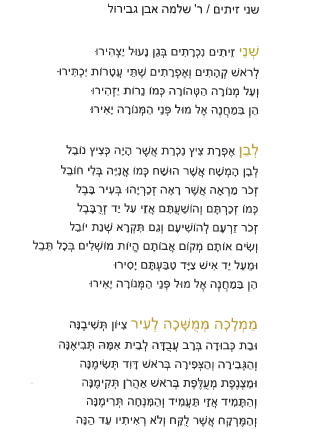
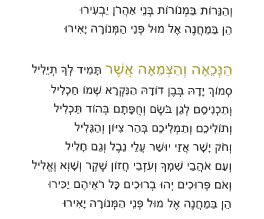
Two[2] olive branches[3] cut down in the garden[4] will again produce fresh, pure olive oil[5],

For the leaders of the Kohatites[6] and the Ephratites[7] will be crowned as one[8].

They will shine[9] like candles on the holy Menorah[10]-

There in the camp opposite the menorah, they shined![11]

The son of Ephrat[12] whose ornament[13] was cut off and then dried up[14]

Has now become the anointed one[15] for those who were laid low and directionless[16].

Recall the vision of Zachariah[17] –

As you remembered it, you were saved[18] by the hand of Zerubabel[19],

Their generation remembered and were saved[20], and that year[21] was called a Jubilee Year!

They were resettled[22] in the place of their forefathers where they were given sovereignty[23]

And from the oppression[24] of the hunter[25] they were spared[26], and

There in the camp opposite the menorah, they shined![27]

The interrupted[28] kingship was returned to the city of Zion,

The honored daughter[29], after much work, was brought back to her mother’s home (i.e., Israel),

The Kingship[30], the [beautiful] diadem[31] was placed back on David’s head,

The covered turban[32] was [re]established on the head of Aaron[’s descendants],

The daily sacrifice was reinstated and the meal offering [again] raised up [to the Lord]

The anointing oil[33] that was being used[34] hadn’t been seen in quite a while![35]

The fires are lit [again] in the menorahs by the descendants of Aaron,

There in the camp opposite the menorah, they shined[36]

[Regarding] the depressed and the thirsty who complain to You constantly –

Put your trust[37] in the son of the beloved[38] who is called ruddy[39]

Enter the garden of spices (i.e., Israel)[40] whose canopy is glorious[41]

And lead them, rule over them in Mt Zion and in the Galilee,

[Whence] just laws will be issued[42] with harp and flute.

The nation that loves Your Name and who abandon false prophets, nothingness and idols.

The nation that toiled[43] will now be so blessed, that it will be obvious to all who gaze upon them[44], that

There in the camp, opposite the menorah, they shined![45]

Figure. Synagogue motif quoting Zacharia 4:2-3 with olive branches, from India. Photo courtesy Michael R. Stein.

[1] This piyut reprinted here is from https://web.nli.org.il/sites/nlis/he/Song/Pages/song.aspx?songid=438 (accessed 12/23/20). It can also be found in Siddur Avodat Yisrael edited by Seligman Baer, corrected edition, Breidelheim, 1818, reprinted Jerusalem, no date, pp 640-1. This piyyut is known as a me’orah because it is (fittingly) inserted before the blessing Or Chadash (a new light) on Shabbat Chanukah. I have relied extensively on Baer’s notes for my annotations. I thank Michael R. Stein for the online link to this piyut and for helpful discussions.
[2] The 2 refer to priesthood and kingship; see below.
[3] Zeitim  can mean olives or olive branches or trees; olive branches is better suited to the context and to general synagogue imagry; see Figure.
[4] Lit., “enclosed garden” from Song of Songs 4:12, taken by the rabbis as a metaphor for the Jewish people; see for example Rashi on that verse.
[5] Hebrew yitzhar, is a triple play on words. I have translated literally, but it is also the name of a priestly family (e.g., Exodus 6:18; see also the following note) and can mean (sky)light or zenith.
[6] Kehat, one of the 3 sons of Levy, is the father of Yitzhar. Kehat serves as another stand-in for the priesthood.
[7] King David, who ruled over the united kingdom of Israel and Judah was descended from Ephratites (Ruth 1:2). Efrat is another name for Bet Lehem, a city in Judah (Micah 5:1). I thank another Michael Stein for help with this note.
[8] Lit., “they will be crowned with 2 (royal) wreaths”, but the sense is of combined authority uniting the priesthood and kingship. Note how this unity is presented as the ultimate achievement of the Maccabees, unlike in classical rabbinic thought where the priestly Maccabees were criticized for (also) usurping kingship (see Yerushalmi Horayot 3:2 and Ramban on Gen. 49:10 [I thank Rabbi Joel Guttstein for helping me locate these references.])
[9] This word yazhiru in this line is nearly identical to the word yatzhiru above; see note 5.
[10] If the menorah is also a reference to Israel (“a light unto the nations”) then this line means that the Maccabees were an inspiration to the Jewish people
[11] Numbers 8:2 uses similar terminology describing Aaron the high priest lighting the menorah in the desert tabernacle for the first time. This line is the refrain of the piyut and depending on what precedes it may take on slightly different meanings.
[12] See note 7
[13] This is the term used for an ornament on the miter of the high priest; cf. Exod. 29:6
[14] Cf. Isaiah 28:1 and 40:7, 8
[15] Literally “the son of the anointed one” which is alliterative in the Hebrew with what precedes and follows.
[16] Literally “like a boat without a captain”
[17] The text adds “in the city of Babylonia” immediately following, but Zachariah was one of the last prophets during the era of the rebuilding of the second Temple in Jerusalem after the exiles returned from Babylonia. Perhaps Ibn Gabirol meant that Zachariah was originally from Babylonia, that he originally had this vision in Babylonia or perhaps there is some textual confusion with the name Zerubabel, the Jewish political leader during the early second Temple period; see the following note.
[18] In Zachariah chapter 4 a vision is recounted that has relevance to Hanukah and from which Ibn Gabirol took inspiration for the current piyut. Zachariah sees a 7 branched menorah with 2 olive branches, one on each side. The 2 olive branches are called the 2 sons of oil – i.e., the 2 anointed ones (yitzhar is the word used in Zechariah 4:14 [see note 5]), who represent the priestly and political leaders of the Jews in Zachariah’s time. These 2 institutions, as Ibn Gabirol notes in this piyut, are united in the Maccabees. See the previous note and note 8, above.
[19] See note 17 and the following note.
[20] This line is a bit obscure and is missing in some manuscripts according to Baer.
[21] Literally “she” or “you”.
[22] Literally “placed”.
[23] Literally “where they could rule over all the whole Earth”.
[24] Literally “hand”
[25] A reference to Esau (cf. Gen. 25:27), a stand in for countries that conquered ancient Israel and Judah.
[26] Literally “they took his ring” a reference to Pharaoh giving Joseph his ring as a symbol of transfer of power (Gen. 41:42). An alternative reading to being spared from the hand of the enemy is that Israel will wrest the power from the hand of the oppressor.
[27] See note 11, above.
[28] Literally “extended”
[29] Cf. Psalm 45:14. An alternative to “after much work” could be “with many servants”.
[30] Literally “Queen mother” but this is probably a play on the Hebrew word for strength.
[31] Cf. Isaiah 28:5.
[32] One of the priestly garments; cf. Exod. 29:27 and Lev. 16:4.
[33] Literally “medicines”
[34] Literally “taken”
[35] Literally “till now”; cf. Gen. 45:28.
[36] See note 11, above.
[37] Literally “support your hand”
[38] A reference to the messiah – see note below
[39] For this use of ruddy or red, see Gen 49:12, part of the blessing of Judah, David’s tribe; David was a red head (I Sam. 16:12).
[40] Cf. Song of Songs 6:12.
[41] Or perhaps “whose canopy is royal blue”
[42] Literally sung; cf. Exod. 15:1.
[43] Cf. Exod. 1:14.
[44] Cf. Isaiah 61:9
[45] See note 11, above.


Jewish Communal Workers, Preacher’s Kid Syndrome, and Sefer Shmuel

Jewish Communal Workers, Preacher’s Kid Syndrome, and Sefer Shmuel [1]

This article is dedicated to the memory of HaRav Gedalia Dov Schwartz, zt”l, – whose 5th Yahrtzeit was on Erev Chanukah, the 24th of Kislev 5786 (2025). Rav Schwartz was an overflowing spring of Halachic guidance, wisdom, and practical rabbinic advice. I will always feel indebted to Rav Schwartz for the numerous times he graciously shared his vast knowledge — as well as his compassionate heart — with me.

______________________

. . . וכל מי שעוסקים בצרכי צבור באמונה, הקדוש ברוך הוא ישלם שכרם . . .

. . . and all those who faithfully occupy themselves with the community’s needs, may the Holy One, Blessed is He pay their reward . . . [2]

Yichus [pedigree] is a lot like potatoes – often times, the best part is underground.” [3]

While great ancestry may sometimes provide a person with a head start in life, pedigree offers no guarantee of achieving greatness. We have observed this reality in the world around us, we know this fact from our study of Jewish history, and we certainly know this to be true from countless episodes in Tanach.

It is important to remember, however, that while a child may not have emulated the lofty character traits and/or achievements of his/her parents, those parents and their child-raising efforts are not necessarily at fault. After all, numerous factors (i.e. inborn nature, environment, etc.) play a role in shaping a child’s development. Unless there are clear indications of bad parenting, it would be foolish speculation (at best) or outright cruelty (at worst) to accuse parents of failing to properly raise their children.

If we agree not to automatically label friends and neighbors as bad parents based on how their child(ren) turned out, do our great ancestors — our role models found in Tanach — deserve any less? Of course, we ought to extend them the same courtesy. Hence, we should not assert that any of the great figures of Tanach were guilty of poor parenting without clear indications from the texts themselves, the teachings of our Mishnaic / Talmudic Sages, or the early Biblical commentaries that this was in fact the unfortunate case.

In the Book of Shmuel I, we sadly find two tragic cases where the sons of great Jewish leaders — Eli and Shmuel — did not live up to the hopes of their fathers or their people[4]. While our Sages and the classic commentaries suggest interpretations which minimize the guilt of each leader’s sons[5], it is clear nonetheless that the sons of Eli (the High Priest of the Tabernacle at Shiloh) as well as the sons of Shmuel (the great selfless prophet) abused the power of their respective offices and were therefore unworthy of leading the Jewish people.

Do Eli’s and Shmuel’s sons’ failures to live up to their fathers’ examples indicate poor parenting on the part of their fathers? Fortunately, there is at least one of our classical commentaries to offer us some direction.

Among the early Biblical commentaries, the explanations of Ralbag[6] to Tanach are most unique. Aside from authoring a running commentary, Ralbag also provides us at regular intervals with what he refers to as the To’eliyos — the practical lessons to be learned from many Biblical episodes. Ralbag’s takeaway lessons offer a treasure trove of insights into human nature, the character traits which we aspire to attain, and a better understanding of the Mitzvos. Finally, Ralbag often utilizes his To’eliyos as a vehicle for explaining the Torah’s worldviews.

In two places in his To’eliyos to Shmuel I, Ralbag provides us with a great deal of insight into the sons of Eli and Shmuel — as well as their fathers’ roles in their unfortunate outcomes.

Ralbag #1

רלב”ג שמואל א פרק ז

העשרים ושלשה[7] הוא להודיע כי לא היתה הסבה בחטא בני עלי הוא היות עלי בלתי משגיח בענינם ובלתי מיישיר אותם אל הטוב. וזה כי את פני עלי ובהשגחתו נתיסר שמואל לשרת את ה’. ועם כל זה לא הועילה הנהגת עלי להישיר בניו אל השלמות מצד רוע תכונתם.

To paraphrase Ralbag, the sins of Eli’s sons were not due to a lack parental oversight and/or an effort to steer them in the proper direction. After all, it was Eli’s oversight and guidance which brought Shmuel to properly serve G-d. Unfortunately, Eli’s efforts did not succeed in steering his own sons towards wholesomeness, for they were born with a propensity for wrongdoing.

In this To’eles, Ralbag relates several details about Eli and his sons:

A) Eli was an involved parent. He was משגיח בענינם — he looked after the affairs of his sons and tried to be מיישיר אותם אל הטוב — steer them in the right direction.

B) Eli’s parenting skills were successful in ensuring that Shmuel — his young charge and student — developed into the consummate servant of G-d we know him as.

C) Despite Eli’s valiant efforts as a parent, unfortunately, he was unsuccessful with his own sons. Why were Eli’s parenting skills effective with Shmuel but not with his own biological children?

רוע תכונתם — unlike Shmuel, Eli’s sons naturally possessed a propensity for wrongdoing.

The picture of Eli which emerges from this To’eles / lesson of Ralbag is that of an involved parent. Though he was successful in raising Shmuel, Eli saw no such success with his own sons. Why not? The fault was not Eli’s. With a natural disposition for wrongdoing, Eli’s sons had a handicap working against them which they failed to overcome.

On the surface, this To’eles of Ralbag, wherein Eli seems blameless for the failures of his sons, stands in sharp contrast to a second To’eles of Ralbag found just a bit later in Shmuel I.

Ralbag #2

Following Chapter 12 of Shmuel I, Ralbag records another To’eles which assesses Eli’s parenting efforts.[8]

רלב”ג שמואל א פרק יב

הראשון הוא להודיע שראוי לשלם שידקדק בהנהגת בניו שתהיה באופן הראוי, ולא יקל מזה מפני רוב טרדותו בהנהגת העם. הלא תראה מה שקרה לשמואל בעבור שלא דקדק בהנהגת בניו שתהיה לפי הראוי. וזה, שזה היה סבה שסרה הממשלה מזרעו. ונמשך מזה ששאלו להם ישראל מלך, שהיה סבה בסוף לגלות ישראל מעל אדמתם, כמו שזכרנו. וכזה בעצמו קרה לעלי, מפני שלא דקדק בהנהגת בניו לפי הראוי. כי זה היה סבה שמתו בניו, וסרה מבי’ עלי בסוף הענין הכהונה הגדולה ונתנה לזרע פנחס בן אלעזר.

To paraphrase Ralbag, a wholesome person ought to be exacting in regard to his children’s conduct. One must not let communal responsibilities get in the way of his familial obligations. As an example, see what resulted from Shmuel’s not having been as exacting with his sons as he should have been. As a result, his children were not worthy of being leaders of the Jewish people. This led the people to request a King, which was the eventual cause of their exile from Israel. This is exactly what befell Eli — and it was all a result of his not having been as exacting with his sons as he should have been. This is why Eli’s sons died and the office of the High Priesthood was transferred to the offspring of Pinchas the son of Elazar.

In this To’eles / lesson, Ralbag teaches us that:

A) A truly good parent is one who is מדקדק בהנהגת בניו — exacting regarding his/her children’s conduct — despite the many communal responsibilities he/she may be tasked with.

B)  Unfortunately, Shmuel could have done better in this regard. As he was so occupied in his selfless work on behalf of the Jewish people, he neglected to be as exacting as he should have been with his own sons. Regrettably, Shmuel’s neglecting to properly involve himself in his sons’ lives eventually resulted in tragedy for the Jewish people. This sounds very much like what is referred to nowadays as “preacher’s kid syndrome” – which is “a situation in which the parents of a preacher’s kid are attuned to everyone’s problems but those of the kid.” [9]

C) Sadly, Eli preceded Shmuel in this very regard. He too was not as exacting with his sons as he should have been. Eli’s deficiency in this parental role had grave consequences for his immediate family.

The second To’eles of Ralbag clearly ascribes the failure of the sons of both Eli and Shmuel to some lack of parental involvement. On the surface, this second To’eles of Ralbag seems to contradict what he wrote about the diligent parenting efforts of Eli in the previously quoted To’eles. In that first comment, Ralbag had written that Eli’s sons failed in life as a result of their own deficiencies — not because of any lack in Eli’s parenting.

Can these two seemingly contradictory comments of Ralbag be reconciled?

I believe the following approach best resolves the apparent contradiction between Ralbag’s two Toeliyos involving the parenting efforts of Eli:

According to Ralbag, there are two different levels of parental involvement one can exercise when raising children:

  1. Ralbag’s lower level of parental involvement is described as being – משגיח בענינם. Such a parent is by no means oblivious of what the child is up to. On the contrary, that parent keeps tabs on the child, monitors the child’s affairs, and maintains a certain level of involvement in the child’s life.[10]
  2. Ralbag’s higher level of parental involvement is described as being – מדקדק בהנהגת בניו. That parent is exacting and even more involved, taking a hands-on interest in the life of the child. Such a parent is not just a משגיח / observer looking in on the child’s life. This level of parental involvement connotes one who is actively involved in every aspect of the child’s conduct.

From Ralbag’s perspective, neither Eli nor Shmuel was an uninvolved father who gave no time to their sons and left their kids alone to raise themselves. They were fathers who were definitely involved in their sons’ lives. Their commitment in raising their sons, however, was simply limited to משגיח בענינם — general oversight, that is the lower level of parental involvement. Neither Eli nor Shmuel could claim to have been a father who was מדקדק בהנהגת בניהם. According to Ralbag, they just were not exacting with, or extremely involved in every aspect of their sons’ lives.

Thus, there is no contradiction between the two To’eliyos of Ralbag. In his first To’eles, Ralbag noted that Eli fulfilled the first level of his parental responsibilities vis-à-vis his sons — that of being משגיח בענינם. While that level of parental involvement may suffice when raising a child with a propensity for goodness — i.e. Shmuel — it is not the level of involvement needed when raising children with an inclination for wrongdoing — i.e. Eli’s own sons.

In his second To’eles, Ralbag stated that while one would be wrong to claim that both Eli and Shmuel completely ignored their parental responsibilities, neither of them was as fully involved of a father he should have been. Both Eli and Shmuel should have realized that in order to successfully raise their sons, each would need to be a father who was מדקדק בהנהגת בניו. Their sons’ inborn dispositions demanded a greater level of parental involvement from their fathers.[11]

Why did Shmuel fail to be as exacting with his sons as he should have been? Ralbag clearly states that Shmuel erred due to his pre-occupation with being the consummate Jewish communal leader.[12] While Shmuel never fully ignored his parental responsibilities, Ralbag learns that in his passion to selflessly address the very real needs and concerns of his people, unfortunately, Shmuel neglected to give his sons the full measure of parental involvement which — due to their dispositions — they so desperately required.[13]


Conclusion

Having presented a working approach to reconcile two seemingly conflicting תועליות of Ralbag, it behooves us to conclude by emphasizing Ralbag’s crucial message.

In Koheles (2:14) we read: . . . הֶחָכָם עֵינָיו בְּרֹאשׁוֹ, וְהַכְּסִיל בַּחֹשֶׁךְ הוֹלֵךְ — The wise man’s eyes are in his head, but the fool walks in darkness . . . Long before the Boy Scouts of America coined their motto, King Solomon taught how important it is to “Be Prepared”. In a similar vein, during World War II, Winston Churchill is credited as having stated: “He who fails to plan is planning to fail”.

In his To’eliyos cited above, Ralbag reminds us how crucial it is that every Jewish communal worker adopt a strategy for juggling his/her many responsibilities. Jewish communal workers must struggle with allocating their limited amounts of time, attention, and energies. Anyone involved in such work must be ever alert to ensure that the needs of his/her family are not overlooked in the process of nobly serving the needs of their community.

Is there any one proven formula to help a Jewish communal worker properly balance the very real and competing needs of one’s spouse, family, and community? Absolutely not — after all, the characteristics and circumstances of no two spouses, families, communities, or Jewish communal workers are perfectly alike.

There are, however, three crucial steps which I believe each Jewish communal worker should take when allocating his/her time, attention, and energies:

  1. Communicate — One must truly know and understand their spouse, family, and community in order to correctly allocate the time and attention each requires. The only way to accomplish this is through frequent and meaningful communication.
  2. Re-evaluate — As good a balance one may have achieved in the past, the needs of one’s spouse, family, and community constantly change. As such, it is wise for every Jewish communal worker to periodically reassess the formula he/she has created to meet the needs of those requiring his/her time, attention, and energies.
  3. Pray — Ultimately, each and every Jewish communal worker is only human. As such, even one’s most thought-out plans to allocate his/her limited resources may have been made in error. Without G-d’s help, no Jewish communal worker can possibly hope to succeed in the balancing act he/she must perform. Once one has done his/her part in this process, the Jewish communal worker should sincerely ask G-d for His assistance as he/she strives to work on behalf of His people.

May the lives of Eli HaKohoen and Shmuel Hanavi serve as an inspiration — as well as a lesson — to all Jewish communal workers.[14]

  1. I am greatly indebted to my Rabbeim who introduced me to Ralbag’s commentary to Tanach during my years in Yeshiva; Rabbi Avrohom Semmel (Queens, NY) and Rabbi Yitzchok Shapiro (Boca Raton, FL) for their assistance (several years ago) with the sources cited in this article; and my father, Mr. U. Harold Males for his editorial assistance.
  2. From the pre-Mussaf prayer recited each Shabbos in synagogues around the world.
  3. A number of years ago, I heard that sharp remark from Rabbi Berel Wein, zt”l, during a Jewish history lecture. In a personal communication with Rabbi Wein regarding the origins of this adage, he told me that while he was not aware of a specific source, he believes it to be one of our people’s great Yiddish folk sayings.
  4. See Shmuel I, 2:12-22 and Shmuel I, 8:1-5.
  5. See for example the ideas mentioned in Rashi to Shmuel I, 2:22 and Radak to Shmuel I, 8:2.
  6. Ralbag (רלב”ג) is the acronym for Rabbi Levi ben Gershom — sometimes referred to by his Latinized name — Gersonides. Ralbag (1288-1344) lived in the region of Southern France known as Provence. In recent years, Ralbag’s commentaries on much of Tanach have been masterfully annotated and republished by Mossad Harav Kook in Jerusalem, Israel.
  7. In the standard Mikra’os Gedolos editions of Nach, this To’eles is listed as number 23 and can be found after Chapter 7 of Shmuel I. In the newer Mossad Harav Kook edition, however, it is listed as תועלת number 24.
  8. In all editions of Ralbag’s commentary this lesson is listed as number 1 in this group of To’eliyos.
  9. From: http://en.wikipedia.org/wiki/Preacher’s_kid
  10. According to Ralbag, this parent also makes efforts to be מיישיר אותם אל הטוב — to steer his/her children in the proper direction.
  11. Although he did not state so overtly, it seems clear that Ralbag understood Shmuel’s sons as having propensities for wrongdoing just like Eli’s sons did. Otherwise, the lower level of parental involvement, which Ralbag described as משגיח בענינם in his first To’eles would have sufficed for Shmuel’s sons.
  12. See Shmuel I 7:15-16 and Ralbag’s accompanying comments for an example of Shmuel’s devotion to serving his people in such a time-consuming and selfless fashion.
  13. Why did Eli fail to be as involved of a parent as he should have been? Ralbag does not address that question. Was Eli overly occupied with the needs of his people — like Shmuel — so that his sons’ needs were neglected? Or, perhaps Eli was not as busy with the needs of the Jewish people, but he just did not realize his sons had propensities for wrongdoing, and therefore required a higher level of parental involvement on his part? While one could certainly speculate, Ralbag does not seem to clearly address this point.
  14. Two additional comments of Ralbag concerning Dovid HaMelech are very relevant to this discussion. See Ralbag’s comments to Shmuel II 8:18 as well as To’eles #3 to Melachim I chapter 2. In both of those places, Ralbag introduces an even greater level of parental involvement which he called משגיח במוסר בניו – ensuring that one’s child is reprimanded and/or punished for his/her wrongdoings. This highest level of parenting goes beyond mere oversight, and is necessary when one’s child has stepped beyond the lines of acceptable behavior. According to Ralbag, had Dovid achieved that level of parental involvement, several of his sons might have turned out better. (It is important to note that unlike his treatment of Shmuel, Ralbag did not overtly attribute Dovid’s parental failings to his untiring efforts on behalf of the Jewish people.)


Maccabean Psalms? (and more)

Maccabean Psalms? (and more)
By Marc B. Shapiro
(This post was originally part of the previous one, but since I know people don’t like reading posts more than twenty pages long, I split it up into two parts.)
1. I know that every year around Christmas time some people read my article on Torah study on Christmas eve. At the end of the article I raise the possibility that the various Nittel practices were actually based on non-Jewish superstitions. My suspicion was proven beyond any doubt in a wonderful article by Rebecca Scharbach, “The Ghost in the Privy: On the Origins of Nittel Nacht and Modes of Cultural Exchange.”[1] I recommend that everyone add this article to their “holiday reading”. (Due to reasons beyond my control, this post was not able to appear, as planned, before Christmas.)
As for our own holiday of Hanukkah, let me share something that I think people will find interesting. When it comes to the dating of various Psalms, for those in the Modern Orthodox/Religious Zionist world there don’t appear to be any dogmatic issues involved, much like there are no dogmatic issues raised if one assumes that the prophecies beginning in Isaiah chapter 40 come from a later prophet than those in the first part of the book.[2] Nevertheless, I think people generally assume that traditionalists will not speak about “Maccabean Psalms”. (Truth be told, I don’t know if there are even any academic scholars that still identify some of the Psalms as belonging to the Maccabean period.)
See S.’s post here where he notes that Philip Birnbaum, in his siddur, seems to allude to a psalm as having been written in the Maccabean period. However, S. also quotes R. Samson Raphael Hirsch as stating that Orthodox Judaism rejects the notion of “Pseudo-Isaiah”, and of “Maccabean songs under the name of David.” On the other hand, R. Solomon Judah Rapoport believed that at least one psalm (and perhaps more) were written during the Maccabean period. He identified other psalms as dating from the Second Temple period and defended the religious legitimacy of this view. “If the sages of the Talmud advanced the date of a number of Psalms from the time of David to that of Ezra, a period of more than five hundred years, we must have no scruples in advancing them another two hundred years.”[3] R. Samuel Barukh Rabinkow also felt that “the religious value of any of the Psalms is independent of the time of its composition or any historical consideration or reflection.”[4]
I found a very interesting passage by R. Abraham Saba in his Tzeror ha-Mor.[5] He appears to be saying that Psalm 30, which we recite every day (and which many recite after Hanukkah morning tefillah and after lighting the Hanukkah candles) was written when the Temple was rededicated by the Hasmoneans.
אני סבור כי מזמור שיר חנוכת הבית לדוד נתקן על חנוכת הבית של חשמונאי . . . ולכן נעש’ נס בשמן והדליקו ממנה שמנה ימים ועל זה סדר מזמור שיר חנוכת הבית
R. Saba continues by explaining the various verses in line with this conception. Now I realize that one can argue that what he means is that David prophetically wrote the psalm with the Hasmonean rededication in mind, and this interpretation is actually stated by R. Abraham the son of the Vilna Gaon.[6]
מזמור שיר חנוכת הבית לדוד: עשה המזמור הזה לשיר אותו בחנוכת הבית העתידה להיות בימי החשמונאים
Yet such an approach this does not appear to fit with the words of R. Saba:
נתקן על חנוכת הבית של חשמונאי
In his “translation” of this passage Eliyahu Munk writes: “I am convinced that David, in his holy spirit, foresaw such a period and dedicated Psalm 30, 1-13 to that period, therefore commencing with מזמור שיר חנוכת הבית לדוד ‘a song for the consecration of the House,’ the ‘house’ being the reconsecration of the Temple after the Hasmoneans’ victory.”[7] Yet all readers can see that in the original R. Saba does not mention David or his holy spirit.
R. Joseph Hayyim[8] believes that Psalm 30 as a whole was written by David, and he says it is possible that David also wrote the first verse. But he also says that it is possible that the first verse, which speaks of dedication of the Temple, was added to the psalm during the Maccabean period.
אפשר לומר לעולם דוד הע”ה לא אמר פסוק זה של חנוכת הבית, אלא גם הוא התחיל מן ארוממך, ופסוק זה בזמן בית שני כשעשה הקב”ה להם נסים וניצולו וחנכו הבית והמזבח מחדש הוסיפו על מזמור זה פסוק זה מפני שראו דכל דברי המזמור שייכים גם לעניינם.
He adds that this notion should not trouble anyone, as we know that according to one opinion in the Talmud the last eight verses of the Torah were added by Joshua, and he also notes that there were a couple of verses in the book of Joshua that were added after Joshua’s death. In other words, minor additions to abook after the death of the author are not religiously problematic.
Nevertheless, R. Meir Mazuz is indeed troubled by what R. Joseph Hayyim wrote.[9] He claims that the verses added to biblical books noted by R. Joseph Hayyim were added by prophets.[10] Yet in the case of Psalm 30, R. Joseph Hayyim is suggesting that an addition took place during Second Temple times after prophecy had already ceased and there was no longer the institution of anshei keneset ha-gedolah. According to R. Mazuz this is indeed religiously problematic. One can reply to R. Mazuz that while prophecy might have ceased, ruah ha-kodesh did not,[11] and therefore it was permissible for verses to be added to the book of Psalms even in the Maccabean period. After all, a standard view among rishonim is that the book of Psalms is not the product of prophecy but of ruah ha-kodesh.[12]
R. Mazuz adds a second reason why he cannot accept what R. Joseph Hayyim writes. He claims that R. Joseph Hayyim’s position will give support to the modern biblical scholars who believe that verses in the book of Daniel were added in the Maccabean period, a position he also finds religiously objectionable. I don’t understand this objection as the modern biblical scholars do not need, and do not look for, support from traditional commentators. They are completely oblivious to what rabbis like R. Joseph Hayyim have to say on these matters, and have no reason to cite his view as a support for their own position.R. Moses Isaac Ashkenazi discusses the authorship of Psalms in the introduction to his Ho’il Moshe on Tehillim (Livorno, 1880). Although he has his doubts, he says that one who assumes that Psalm 44 was composed during the Maccabean period “has what to rely on.”

So much for Maccabean psalms, but what about post-Davidic psalms in general? R. Ashkenazi identifies Psalms 79 and 137 as having been written during the Babylonian Exile. He also thinks that Psalms 126 and 129 might have been written then. He is led to his view because he can find no evidence that David was a prophet. While David had ruah ha-kodesh, it is only prophecy that reveals future events, and thus the psalms that reflect a post-First Temple era must indeed have been written centuries after David. 

ואין להניח שמזמורים כאלה נכתבו בנבואה, שלא מצאנו בשום מקום שדוד היה נביא ה’, כלומר שה’ דבר עמו כמו שדבר עם שלמה בנו רק שלח אליו נביאיו נתן וגד, אולי מפני ששפך דם הרבה, רק רוח ה’ לבשתהו תמיד כשבא לחבר מזמוריו

As with R. Ashkenazi, his predecessor R. Eleazar ben Samuel Shmelke claims that Psalms 79 and 137 were composed after the destruction of the First Temple. He states that this was also Ibn Ezra’s opinion.[13] In Ibn Ezra’s introduction to Tehillim (which is not found in all mikraot gedolot editions) Ibn Ezra states that “others” held that Psalm 137 and a number of other psalms were written during the Babylonian Exile, yet he does not signal his acceptance of this view.

One of those Ibn Ezra had in mind who held that some psalms were written during the Babylonian Exile was R. Moses Ibn Gikatilla.[14] R. Raphael Berdugo also states that a number of psalms, including Psalm 137, were composed during the Babylonian Exile.[15]
In addition, Malbim, introduction to Tehillim, states that some Psalms were written during the Exile:
התפלות אשר יסדו בגלות בבל על שרפת המקדש ועל הגלות, עד שוב ה’ את שיבת ציון בימי כורש.
He refers in particular to Psalm 137 and also Psalm 85. After saying this, however, he has a footnote in which he states that what he just mentioned is only on the level of peshat, but that he really believes that these psalms were written prophetically in the days of David. I ask readers to examine the text and footnote, and tell me, does anyone think that Malbim is being frank in his comments in the note?

It appears to me that what he writes in the note does not reflect his actual view, which is indeed found in the text. The note is only apologetic, and designed to protect him from being attacked by those who would see his approach as heretical. He would therefore be able to say, “But look at what I wrote in the note.”
According to Rashbam, Commentary to Pesahim 117a s.v. Yehoshua, R. Yose ha-Gelili was of the opinion that the Hallel in Psalms (Ps. 113-118) originated with Mordechai and Esther, i.e., in the Persian period.[16]
In Rashbam’s commentary to Tehillim (which we can expect ArtScroll to censor if it ever publishes it), he points to psalms which were composed during the Babylonian Exile and also states that other psalms were written after Ezra’s return to Jerusalem. For example, Psalm 122:3 states: “Our feet are standing within thy gates, O Jerusalem. Jerusalem, that art builded as a city that is compact together.” According to Rashbam, these references to Jerusalem must date from after the return from exile.[17]
2. Here is a provocative passage quoted in the name of the hasidic master R. Uri of Strelisk (1757-1826).[18] Would any hasidic leader speak this way today?
והרה”ק מסטרעטן זצ”ל אמר משמו עה”פ שומר נפשות חסידיו מיד רשעים יצילם, שאמר: לפני ביאת המשיח יהיו רבי”ס רשעים גמורים ר”ל, אבל הן החסידים הם בתמימותם סוברים שרבם הוא עובד ה’ ולכן נוסעים אליו, לזאת התפלל דהמע”ה שומר נפשות חסידיו כי השי”ת ישמור את החסידים ומיד רשעים יצילם שלא שלא יכשלו ח”ו ברבי”ס כאלו
His comment was only applicable to the phony rebbes. But for an authentic rebbe it is worth travelling great distances and missing out on Torah and tefillah just to hear one bit of wisdom.[19]
אמר שיש ליסע לצדיק אמת אפילו אלפיים פרסאות ולבטל בהליכתו ובחזירתו מתורה ותפלה והכל כדי דיבור אחד של אמת אשר ישמע מפי צדיק אמת
3. Every year there is discussion about the moment of silence in Israel in memory of the soldiers and Holocaust victims, and we always hear about how this is not a Jewish thing to do. Here is a page from R. Ovadyah Hadaya’s Yaskil Avdi, vol. 6, p. 300 (hashmatot Yoreh Deah 2:2).

He regards the moment of silence as entirely appropriate, seeing it as similar to the silence in a house of mourning which shows acceptance of God’s decree.
See also my post here where I wrote that in November 1965 R. Jehiel Jacob Weinberg gave a hesped for four recently deceased rabbis, among them R. Yerucham Warhaftig and R. Eliezer Yehudah Finkel. These latter two were good friends of R. Weinberg, and R. Weinberg’s friendship with R. Finkel went back to their youth. After the eulogy R. Weinberg asked everyone in the room to stand up. They stood silently for around ten seconds and then he asked them to sit down.
In this post I wrote: “I presume this was intended as a show of respect rather than as a moment of silence, since the latter could be done sitting down.” I now think that my statement is probably incorrect, because a moment of silence is also intended as a show of respect, i.e., the two are not in contradiction. In thinking of the story now, it appears that R. Weinberg’s request to stand in silence is really no different than what takes place in Israel.
4. A haredi biography on R. Isaac Blazer has recently appeared. Here is its title page.


Needless to say, R. Jehiel Jacob Weinberg is quoted a good deal in the book. Here is page 410 which contains a picture of R. Weinberg.


The book does not mention that this picture first appeared on the Seforim Blog; see my post here.
In the quotations from R. Weinberg, the book has no problem making “improvements”. For example, R. Weinberg sometimes refers to R. Isaac Blazer as רי”ב, and the new book has altered this to הגרי”ב. R. Weinberg certainly regarded R. Blazer as a gaon, and he sometimes does refer to him as הגרי”ב. However, he did not feel that it was necessary to always refer to R. Blazer this way. The author of the book therefore decided to “correct” what R. Weinberg wrote. I guess this author (who is unnamed) did not think that R. Weinberg showed proper kavod to R. Blazer, which itself is a crazy thought.
Speaking of R. Weinberg and kavod, I think readers will find the following interesting. R. Weinberg stated: “We are all human. I too like kavod. I try not to chase after it, but if it is put on my plate, I will take it.”[20] How many other great rabbis would be honest enough to admit that they are not at the level of the Hafetz Hayyim and R. Elijah David Rabinowitz-Teomim,[21] and that they too like kavod? What R. Weinberg was saying is that this is normal and nothing to be ashamed of, and that for “mere mortals” what is important is not to chase after kavod.5. In my post here. I discussed Haym Soloveitchik’s newly published volume 2 of his collected essays. I neglected to mention that on pp. 285-287 he deals with R. Yitzchak Grossman’s criticism of one of his essays, criticism that appeared on the Seforim Blog here here. Soloveitchik shows his scholarly honesty in that he is prepared to acknowledge that in two of his criticisms Grossman is correct. He also responds to another criticism of Grossman, and I ask people to read what Soloveitchik says very carefully. It was precisely this sort of interpretation, now standard in the academy, that R. Samson Raphael Hirsch was so opposed to. You can be sure that if these words were stated by R. Dov Linzer or R. Ysoscher Katz, that a certain author, on a certain website, would go after them for “undermining the mesorah”.

Ben sorer u-moreh, according to the setam mishnah, nidon al shem sofo. This runs contrary to every principle in Jewish law and, indeed, in most Gentile law. People are executed for crimes that they have committed, not for crimes that they might commit–preventive detention for the criminally inclined perhaps, but preventive execution?! If I find tanna’im attempting to make the implementation of this law impossible, does it strain the imagination to think that they did so because it contradicts their elementary sense of right and wrong? I, for one, think not.

Rabbi Grossman argues that we find a similar ruling about nig’ei battim and there is no ethical problem in this realm. Indeed, there isn’t; however, no one claimed that all instances of “never was and never will be” (lo hayah ve-lo nivra) are a result of ethical issues. Only those in which we find this type of problem, such as ben sorer u-moreh and, to add to the roster, the “apostate city” (ir ha-niddahat) as R. Eliezer Berkovits has contended (as noted by R. Grossman). . . . An exegesis that makes execution of a law more difficult may be simply a matter of interpretation; an exegesis that makes execution impossible has that in mind to begin with. One plausible reason that one might have sought to render a Divine directive inoperable is that such a dictate appeared inconceivable for a just God.

6. I want to call readers attention to the recently published Kovetz ha-Mashbir, vol. 1, edited by Yissachar Dov Hoffman and Ovadyah Hoffman. This volume is devoted to the writings and teachings of R. Ovadiah Yosef and is full of valuable articles. It can be purchased at Biegeleisen.


[1] Jewish Studies Quarterly 20 (2013), pp. 340-373.
[2] The point about Second-Isaiah has recently been made by R. Amnon Bazak, Ad ha-Yom ha-Zeh: She’elot Yesod be-Limud Tanakh (Tel Aviv, 2013), pp. 161-172. There is a good deal that can be said about this book, which deals with a number of themes we have discussed in previous posts. See e.g., p. 274 n. 60, which accepts the notion that sometimes the numbers given in the prophetic books are only symbolic and don’t reflect historical reality.
[3] Quoted in Isaac Barzilay, Shlomo Yehudah Rapoport (Shir), 1790-1867, and his Contemporaries ([Israel], 1969), p. 54.
[4] See Fritz Gumpertz’s recollections in Jacob J. Schacter, ed., “Reminiscences of Shlomo Barukh Rabinkow,” in Leo Jung, ed., Sages and Saints (Hoboken, N.J., 1987), p. 110. Gumpertz, ibid., also notes that Jacob Barth dated a number of psalms to the Second Temple period.
[5] Parashat Noah, p. 13a in the Venice, 1522 edition, and p. 13a in the Warsaw 1879, edition.
[6] Tehillim: Be’er Avraham (Warsaw, 1887), Psalm 30:1.
[7] Tzror Hamor, vol. 1 (Jerusalem, 2008), p. 156.
[8] Rav Pealim, vol. 3, Orah Hayyim no. 5.
[9] See his Emet Keneh on Psalm 30:1 (p. 513), and his recently published Asaf ha-Mazkir (Bnei Brak, 2014), p. 283. (My thanks to Dov Weinstein for kindly sending me a copy of Asaf ha-Mazkir.)
[10] I have discussed the matter of later prophets adding material to the Torah and other biblical books in a number of posts. This is the phenomenon of multiple authors for one book. What do readers make of the following example, which appears to be an example of attributing one verse to more than one prophet? The Av ha-Rahamim prayer states ועל ידי עבדיך הנביאים כתוב לאמור (“your servants the prophets) and then proceeds to only cite a verse from the book of Joel. Does this make any sense? Jacob Reifman did not think so and he actually found a manuscript that had עבדך הנביא. He claimed that  this must be the authentic text and the one that printers should now use when they publish siddurim. See Ha-Magid, Jan. 23, 1861, pp. 14-15, Feb. 12, 1862, p. 55. Yet we also find in the liturgy for a ta’anit dibur that the words עבדיך הנביאים are used and this is followed by three verses from the book of Micah ch. 7. In other words, הנביאים is again used with regard to only one prophet. See this page from Seder ha-Selihot ha-Shalem Ateret Paz, p. 103 (second pagination).

When the phrase עבדיך הנביאים כתוב לאמר is used in the mussaf of Rosh ha-Shanah, in both the silent amidah and the repetition (two times in each), it is followed by citations from different biblical books.
[11] Although Yoma 9b (and parallels) states that ruah ha-kodesh ceased after the days of Haggai, Zechariah, and Malachi, it was always assumed that there were exceptions to this general statement (and some believed that when the Talmud stated “ruah ha-kodesh” it actually meant real nevuah). Also, the Talmud itself, ibid., states that even without ruah ha-kodesh people still had access to a “bat kol”. See R. Reuven Margaliyot’s introduction to his edition of She’elot u-Teshuvot min ha-Shamayim, pp. 25ff. See also R. Meir Ibn Gabai, Avodat ha-Kodesh, vol. 4, ch. 24; R. Isaac Sternhell, Kokhvei Yitzhak, vol. 2, p. 186; R. Aaron Maged, Beit Aharon, vol. 11, pp. 704-705. R. Joseph Engel, Gilyonei ha-Shas, Yerushalmi Shevi’it, 9:1, writes: צ”ל דתרי גווני רוח הקודש הם
[12] See Maimonides, Guide of the Perplexed 2:45, R. David Kimhi, introduction to his commentary on Psalms, Ritva, commentary to Rosh ha-Shanah 32a (col. 296 in the Mossad ha-Rav Kook edition) commentary to Moed Katan 16b, R. David Abudarham, Abudarham ha-Shalem (Jerusalem, 1963), p. 272. See also Meiri’s introduction to his commentary on Psalms, p. 9:
זהו דעת הקדומים בענין דוד המלך ע”ה ר”ל שלא להיות בכלל הנביאים [אבל] ברוח הקדש
[13] Ma’aseh Rokeah (Amsterdam, 1730), p. 65a. See his Ma’aseh Rokeah al ha-Torah (n.p., n.d.), parashat Va-Yehi, where he does not attribute this view to Ibn Ezra. See also Aharon Marcus, Barzilai (Jerusalem, 1983), pp. 271-272.
[14] See Uriel Simon, Four Approaches to the Book of Psalms, trans. Lenn. J. Schramm (Albany, 1991), pp. viii, ix, 120-121, 130ff.
[15] See Mesamhei Lev (Jerusalem, 1990), pp. 141, 222 (both of these page numbers are from the second pagination).
[16] See Yisrael Moshe Ta-Shma, Keneset Mehkarim (Jerusalem, 2004), vol. 1, pp. 286-287.
[17] See the selections of the commentary printed in Aharon Mondshine, “Al Gilui ha-Perush ha-‘Avud’ shel Rashbam le-Sefer Tehillim,” Tarbiz 79 (2010-2011), pp. 130, 133.
[18] Imrei Kadosh ha-Shalem (Jerusalem, 1961), Or Olam, no. 11.
[19] Imrei Kadosh ha-Shalem, no. 42. Regarding phony rebbes, see R. Pinhas Miller, Olamo shel Abba (Jerusalem, 1984), p. 245, regarding a rebbe in Bucharest who drank non-kosher wine.
[20] Hidushei Ba’al Seridei Esh (Jerusalem, 2012), vol. 3, p. 28 n. 21.
[21] See R. Kook, Eder ha-Yekar, p. 64.


New Volume of Rav Ovadiah Yosef’s “Hazon Ovadiah,” on the halakhot of the Four Fasts, the Three Weeks, Nine Days, Tisha B’Av, and Zekher le-Hurban

New Volume of Rav Ovadiah Yosef’s “Hazon Ovadiah:”
On the halakhot of the Four Fasts, the Three Weeks,
Nine Days, Tisha B’Av, and Zekher le-Hurban
by Eliezer Brodt
A new sefer just reached the seforim stores today, just in time for the three weeks. The newest volume of Chazon Ovadiah of the great gaon Rav Ovadiah Yosef. This sefer includes halakhot on a few areas: the halakhot of the Four Fasts, the Three Weeks (& Nine Days), Tisha B’Av, and halakhot related to Zekher le-Hurban, including going to the Kotel, etc. In the back there are hespedim which Rav Ovadiah delivered for various Gedolim amongst them R. Yitzchak Herzog, R. Zvi Pesach Frank and R. Shlomo Zalman Auerbach. Chazon Ovadiah is 577 pages and includes a very thorough index.

In the past few years we have been privileged to a complete encyclopedic collection on all the Yom Tovim from Rav Ovadiah Yosef. It all started many years ago when he wrote a set of seforim called Chazon Ovadiah on Pesach related topics. These seforim received impressive haskamot from many gedolim, amongst them R. Tvi Pesach Frank and R. Shlomo Yosef Zevin. It appears that this particular project was put on hold and Rav Ovadiah turned his attention to printing his Sheelot u-Teshuvot. Then, a few years ago he started printing his shiurim and notes on the sefer Ben Ish Chai. This resulted in an eight volume set called Halikhot Olam. Finally, after all that, Rav Ovadiah returned to the Yom Tov series, Chazon Ovadiah, starting with Purim than Hilkhot Yom Tov. He then continued with Pesach, Succot, Yomim Noraim and Chanukah. Earlier this year, Tu B’Shevat and Hilkhot Berakhot were printed. Thus far, the set is eight massive volumes. One only hopes that Rav Ovadiah continues this set with Hilkhot Shabbat.

Amongst the reasons why I recommend this particular set of seforim, even if one is not of sefaradic origin is as follows: Rav Ovadiah Yosef is world famous for his unbelievable memory resulting in a tremendous bekiut. [I once joked that he must have had someone develop some computer program and attached it to his brain to help him retain so much information and recall it at all times.] When one uses this work, as with all of his other works, one can find hundred of sources from the Rishonim to extremely obscure Sheelot u-Teshuvot on virtually every topic related to the Yomim Tovim. He even quotes many, very recent seforim. He covers many sugyot quite comprehensively, whereas others Rav Ovadiah simply brings down a few sources. Besides for all this, one has literally hundreds of pesakim of a great gaon on all of these topics.

All this results in making it an excellent reference for Rabbanim, Maggedei shiurim, interested laymen, and any one interested in researching any topic related to the Yomim Tovim. From all the many seforim which are printed every year on the Yomim Tovim, the entire set of Hazon Ovadiah is by far the most impressive in terms of its sources and information.

One interesting point I found in this most recent volume of Chazon Ovadiah was that Rav Ovadiah mentions in the introduction that he uses the highly ‘controversial’ sefer Hemdat Yamim [see here for Dan Rabinowitz’s post on Tu B’Shvat]. Rav Ovadiah justifies his use of this sefer, as many great Sephardi gedolim have used this sefer, ever since it was printed, so although the R. Jacob Emden comes out very strongly against Hemdat Yamim, Rav Ovadiah still quotes from it.


Shavuah HaSefer: A Recommended Reading List

Shavuah HaSefer: A Recommended Reading List by Eliezer Brodt Every year in Israel, around Shavous time, there is a period of around ten days called Shavuah Hasefer-book week. Shavuah HaSefer is a sale which takes place all across the country in stores, malls and special places rented out for the sale. There are places where strictly “frum” seforim are sold other places have most of the secular publishing houses. Every year we witness the publishing of hundreds of new seforim and books by the various publishing houses. Many publishing houses release new titles specifically at this time. In this post I would just like to mention to some of the very recent titles from the various publishing houses which are available at this years Shavuah HaSefer. Magnes Press did not put out anything special in the past few months and their prices are quite high in comparison to other years. The one exception is the very reasonable price for the set of Machzorim of Professor Daniel Goldschmidt on the Yom Tovim. Of course, one must get the Shivrei Luchos from Professor Simcha Emanuel released earlier this year. However, an older title worthy of mention is the Sefer Toseftas Targum Le’nevim it is basically a collection of lost pieces on targum on niviem (some pieces were printed over a hundred years ago). The Rishonim such as the Radak quote from it numerous times. To just to list one example of a more famous point quoted by the Radak from this Tosefta: In the discussion of the miracle of Chanukah a statement is attributed to R’ Chaim Solevetchick and others (see Making of a Godal pp. 727-729) that the oil in the original miracle was not technically shemn zeis rather it was shemn ness (miracle oil). As part of this statement a Radak is quoted by various achronim such as the Klei Chemda that the oil from the miracle of Elisha was patur from masser. This statement the Radak comes from a tosefta until recently we did not know the source of this tosefta it was assumed to be a lost tosefta now we know that its from a completely different work as it appears in the Tosefta Targum Le’nevim. The Israel Academy of Sciences and Humanities has advertised, in their catalog, that the long awaited Yerushalmi on Seder Nizkin is available. However, it seems that it will take another month or two for it actually to be released. Another older title by offered by them for a very reasonable price is the two volume set of the Hebrew Illuminated Manuscripts in The British Isles by Bezalel Narkiss. Merkaz Zalman Shazar has released some new titles among them a Sefer Chasidim. This work is an anonymous work written in 1819 which is virulently against Chasidim. This is the first time this work has been printed. Another new title is a work on R’ Yehudha Hanasiah. This is another book which is part of their recent series on the great leaders throughout the generations (previously they have done on Rashi and R. Yehuda HaChasid among others). Another point of possible interest which is worth mentioning is they reprinted a few titles of Professor Jacob Katz that had not been available for some time. Reuvan Mass recently began a new series called Reshoot. They began the series with R Moshe Feinstein Teshuvot on the hot topic of Chaluv Akum. It includes an overview of the topic and a brief history of R’ Moshe life. They plan on releasing a few more in the near future such as from R’ Herzog. Another new release is from Professor Daniel Sperber called Darka Shel Halacha it deals with the sensitive topic of woman getting aliyos. One of the main points of the sefer is to discuss the halacha process more generally. Amongst the other topics in Professor Sperber’s work are Kovod Habriyos, Darkei Naom, and mitseios (reality) changing. As always there is a wealth of sources on a wide ranging amount of topics in the notes. The Bialik Institute has a very impressive new book, the second part of the Livyat Chain. This sefer was written in the era of the Rashba. The Rashba did not allow it to be released as it uses allegorical interpretations for some of the Aggdah. It remained in manuscripts for centuries. At the turn of the century small parts were printed. But, a few years ago Professor Howard Kreisel printed one part of this work – on the creation -which is sold by Magnes Press. Recently he released another part of this work. This new volume is a massive volume of over 1000 pages on many topics. Also worth mentioning is the Sefer Hasagah from R’ Yonah Ibn Ganach it’s a critical edition translated from the Arabic for the first time. An older title that had not been around for some time is Professor Robert Brodie’s Book on the Shiltos. Meketzei Nerdamim has released a new title – a collection of poetry from the father of the Aruch R’ Yechiel it contains an extensive introduction about the author. Bar Ilan University did not put out all that much this year although there catalog shows some interesting titles in press such as another volume on the Gra. But they did put out one thing special, a pirish from the fourteenth century on the Sefer Kuzari from a R’ Shlomo Mluniel it’s a nice size work around 500 pages. Besides for this there is yet another study on the works of R’ Ovadiah Yosef. Mechon Ben Zvi has released some new titles such as a book on marriage in Italy called Nissuin Nusach Italia. Besides for that they have not released much new. But its worth mentioning the Index of the Cario Geneziah From N. Allony looks excellent for more on this book see Manuscript Boy’s post here. Also the price on the recently released Pirish of R’ Matisyhu Hayesari on Avos (from Professor Y Spiegel) has dropped a bit. Mechon Yerushalim promises a new volume to their critical edition of the Teshuvos of the Rishonim the Shut Harif but its not out yet. They also advertise a new volume of the Kovetz Zecor Leavrohm on the topic of Marriage. Beis El released another volume from R’ Eliyahu ben Amzug called Mussar Yehudi Lumos Mussar Notsri. This is a critical edition of the work edited by Professor Eliyhu Zeini. It has been retranslated from the French as a while back it had been printed by Mossad Rav Kook. This is the second in the series of R’ Eliyahu ben Amzug works, the editor promises the rest of the works in the future. Another interesting new title, by Shalem Press, is called Hashevah Le’yerushalaim from Professor Aryeh Morgenstern. This book seems to have generated some interest in the political circles in Israel session will be devoted to it in Ben Zvi Institute. I have gotten a look at this book – it is massive some 596 pages which discuss Jewish resettlement of the land 1800-1860. The Hamodiah book sale is nice as well, they even have separate hours for men and women. There one sees many people just staring at the Otzar Hachoma and Otzar Hatorah programs watching their search engines. Of course none of these people intend to buy it. Feldheim and Oz Vhadar are there in full force. Worthy of mentioning is the great price of Feldheim on the set of Rodleheim Machzorim. However the main highlight of this sale at least for me are the displays of the Shem Olam Mechon. This publishing house prints many interesting seforim every year but for some reason most of it is never sold in stores. For example, they recently printed a two volume collection of letters of the S’dei Chemed which was virtually not sold anywhere. Another highlight is the booth of Otsros Hatorah where they sell old reprints of rare seforim for great prices. One is bound to find something good there.


Seforim Blog 2.0: How You Can Help

The Seforim Blog is now in its bar-mitzvah year and over the past thirteen years has grown exponentially.  There are currently over 2,000 email subscribers and an estimated 16,000+ hits a month from all over the world and nearly 7 million hits over the lifetime of the site.  The site has published nearly 950 articles from over 100 different authors.  Articles from the site have been cited in traditional Torah works, academic journals and books and have even formed the basis of entire works.


This period of growth, however, has come with some costs – both monetary and for the readers.  The site is currently very unwieldy lacking a unified homepage with articles listed chronologically, making it difficult to quickly locate relevant articles.  Additionally, the site hosts numerous related articles, for example, customs relating to Chanukah or haggadot, yet those are not easily located or displayed.  Similarly, articles by author are difficult to find and require going through pages of single articles to locate the specific article of interest. Furthermore, for the past few years, we have hired someone to prepare and post articles. We have eschewed commercializing the site and that cost has been borne by the editors and a handful of generous donors.


To assist us in making significant improvements in the site we are for the first-time asking readers and those who benefit from the site to donate to help defray the costs of the upgrade and ongoing expenses. The site is incorporated as a 501(c)(3) charity and all donations are tax deductible and we will provide documentation of any donations. Please donate generously. Remember, donating=loving.


To donate to the Seforim Blog simply click the paypal link below.