Chanukah Customs and sources

While the only mandated mitzvot for Chanukah consist of lighting candles and saying the full hallel, there are numerous other customs that have come to be associated with Chanukah.

The custom to play driedel on Chanukah is steeped in mystical allusions. From the letters which appear on the driedel to the way the driedel spins, people have offered explanations to link this to Chanukah. The Beni Yisscar, R. Tzvi Elimelch says that the reason the dreidel is spun from the top and the gragger on Purim is turned from the bottom has to do with how each holiday’s miracles were effected. On Chanukah the miracle came from above, directly from God. However, on Purim, the miracles were directly brought about by the actions of Ester, Mordechi and the Jewish people. Thus, the dreidel is spun from the top showing the miracle came from above, and the gragger from the bottom showing the miracle came from below. Others explain the symbolism of the letters that appear on the dreidel, נ, ג, ה, ש. According to one explanation these hint to the mitzvot that we have on Chanukah, נרות שמונה (candles all eight nights) and הלל גמר (the complete hallel). Others note the gematria (numerical value) of the letters which correspond to the same gematria as משיח (the Messiah). Others still, link the letters with גשנה the city Yosef secured for his family in Egypt.

According to at least one source, the custom of playing dreidel was actually started in the time of the Maccabis. They say that in an effort to circumvent the Greek decree against studying the Torah, children and their teacher would have a dreidel handy to start playing in case the Greeks came upon them studying the Torah. They would claim they were not studying instead they were just playing dreidel.

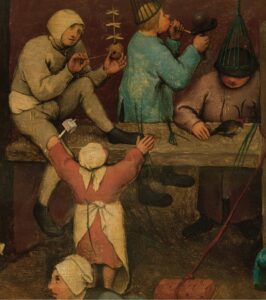
Despite all of these explanations, in truth, dreidel is not Jewish in origin. Rather, driedel is really the rather old game of teetotum. Teetotum, which uses a top with four sides and four letters is one and the same with dreidel. The letters that appear on the dreidel are really just the Hebrew letters that appear on a German or Yiddish teetotum, G, H, N, S. G= ganz (all), H halb (half), N nischt (nothing) and S schict (put). Teetotum dates back to at least the 16th century long before we have any Jewish allusions to dreidel(it was originally totum or top, but became TEEtotum due to the use of T for take all, on the top). The well-known depiction of children’s games done by Brueghel in 16th century includes Teetotum(see here and here for the complete painting). The earliest Jewish mention of dreidel or the significance of it dates to the late 18th century.

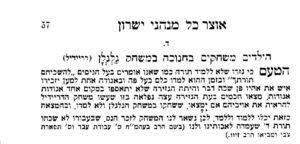
The story connecting dreidel to the ruse of the Maccabis was first published in the book Minhagi Yeshurun, which was first published in 1890 (the name was changed to Otzar Kol Minhagi Yeshurin in the third edition, which is available online here from Hebrewbooks.org . The author included a nice picture of himself at the beginning, although he was a Rabbi in Pittsburgh at the turn of the twentieth century, he is holding a quill pen.) His source is a contemporary of his. [As an aside, although his explanation of dreidel is well-known he offers a similar explanation for playing cards on Chanukah, i.e. that the Maccabi did so. However, that one is not nearly as well know.]

The custom of Chanukah Gelt appears to have changed over time. The earliest sources that mention money on Chanukah connect it with either collecting money for the poor (presumably for money to purchase the necessary implements for the Chanukah lights)(Sefer Mataamim) or giving money to ones children’s teachers. (Hemdat Yamim, Chapter 3 Chanukah early 18th century, anonymous author, some claim was Nathan of Gaza, Shabbtai Tzvi’s “prophet” others just a student of the Ari).

Again, especially amongst the Hassidic commentators, the custom took on a life of its own, both in its scope to include giving money to children and in its significance. There was also a special emphasis on giving their respective Rebbi money as well. R. Chaim Palache (Pellagi) (1788-1869) is the first to mention giving children money. He offers a kabbalistic reason “as children are representative of נצח והוד (eternity and glory). Something I don’t profess to have any idea what that means.

Another custom, again somewhat late in origin, is the custom to not study Torah on Christmas eve. Menachem Butler has a post here on some sources, however, one should add that there is now a full length sefer devoted to this topic, Yisrael Barukh Mestinger, Nitel U’Meorosav, 2000. As well as a pamphlet, Hefaru Toresecha, maamar maktif mminhag avotanu bi-yadun (sic) odot lel ha-ofel nitel nacht, u-minhag yisrael l’vatel ma-asek ha-torah, 2004. Additionally, R. Gavreil Zinner, devotes a section of his work, Neta Gavreil on Chanukah to Nitel.

For more on the various customs associated with Chanukah, see Neta Gavreil Chanukah; Pardes Eliezer Chanukah 2 vol.; R. Yitzhak Tessler, HaDreidel (Sivvivon) B’Chanukah: Mikoroteha, Tameha, u’Minhageha, in Ohr Yisrael 50-62, vol. 14 (Tevat תשנ”ט).


The Hanukkah Miracle

The Hanukkah Miracle

Marc B. Shapiro
In an earlier post I mentioned that I hoped to write about the nineteenth-century dispute about the historicity of the Hanukkah miracle of the oil. This dispute broke out after the publication of Hayyim Zelig Slonimski’s article claiming that Maimonides did not believe in the miracle. Fuel was added to the fire when R. Samuel Alexandrov publicly supported Slonimski and argued that the miracle of the oil was intended to be understood in a non-literal fashion, with the oil representing Torah. (He later retracted this view, presumably due to public pressure.) There is no longer a need for me to write in any detail about this matter after Zerachyah Licht’s recent comprehensive Seforim Blog post here, which also includes Slonimski’s original article.[1]
However, there are a few points I would like to add.
In my post here I wrote:
To give an example . . . of how [R. Samuel Moses] Rubenstein’s later thought broke with tradition, see his Ha-Rambam ve-ha-Aggadah (Kovno, 1937), p. 103, where he claims that the story of the miracle of Hanukkah is almost certainly a late aggadic creation, and like many other miracle stories in aggadic literature was not originally intended to be understood as historical reality:[2]
ספק הוא אם הנס של “פך השמן” הוא אפילו הגדה עממית קדומה, קרוב שהוא יצירה אגדית חדשה מבעל הברייתא עצמו או מאחד מבעלי האגדה, ונסים אגדיים כאלו רבים הם בברייתות וגמרא ומדרשים ע”ד ההפלגה כדרכה של האגדה. ולבסוף הובן נס זה למעשה שהיה. עיין שבת כ”ג א’. [טעם ברייתא זו הובא גם במגילת תענית (פ”ט) אבל כמו שנראה היא הוספה מאוחרת, ועיין (שם) ובפסיקתא רבתי (פיסקא דחנוכה) עוד טעם להדלקת נרות חנוכה[.
During the most recent Hanukkah I was using R. Joseph Hertz’s siddur, the Authorized Daily Prayer Book. Based upon how he describes the holiday and the lighting of the menorah, omitting any mention of the miracle of the lights (pp. 946-947), I assume that he also didn’t accept it literally. Note how he states that the lights were kindled during the eight-day Dedication festival, and this is the reason for the eight days of Hanukkah, rather than offering the traditional reason that the eight days of Hanukkah commemorate the eight days that the menorah miraculously burnt.
Three years to the day on which the Temple was profaned by the blaspheming foe, Kislev the 25th 165, Judah Maccabeus and his brethren triumphantly entered the Holy City. They purified the Temple, and their kindling of the lights during the eight-day festival of Dedication—Chanukah—is a telling reminder, year by year, of the rekindling of the Lamp of True Religion in their time.
Ad kan my words in the prior post. Some time ago I was asked if I know of any other traditional authors who deny the literalness of the Hanukkah miracle. It could be that R. Isidore Epstein should be added to the list, as in his classic work Judaism he describes Hanukkah and the kindling of lights, but mentions nothing about the miracle. However, unlike Hertz whose comments were in a siddur and directed to Jews, Epstein’s book is directed towards a general reader, and can still be used as a college text. Understandably, one would hesitate to include in such a book anything about a miracle. Yet I think it is telling that he does not even say something like, “according to tradition a cruse of oil with enough for one day burnt for eight.”
Another traditional author who must be mentioned in this regard is R. Zev Yavetz. Here is his picture.
And to remind people of what Slonimski looked like, here is his picture.[3]

And here is a picture of R. Alexandrov.
Yavetz was one of the leaders (and founders) of the Mizrachi movement, and Kfar Yavets, a religious moshav, is named after him. After his death, R. Kook wrote about how Yavetz was able to combine Torah and secular wisdom without being negatively affected and distorting religious values.[4] Yavetz is best known for his writings on Jewish history. His magnum opus is his 14 volume Toldot Yisrael. In volume 4, pp. 89-91, he discusses the Hanukkah story.

As you can see, there is no mention of the miracle of the oil. The eight day holiday is portrayed as a commemoration of the original eight day celebration that took place when the Temple was rededicated. I don’t think there is any other conclusion that can be drawn other than that Yavetz did not regard the miracle of the oil as an actual historical event.

In 1900 R. Aryeh Leib Feinstein published his Elef ha-Magen. On p. 35b he writes that whereas R. Judah (bar Ilai) believed in the Hanukkah miracle, R. Yose and R. Judah ha-Nasi did not, and that is the reason why R. Judah ha-Nasi did not include the laws of the Hanukkah lights in the Mishnah.
חיוב נר חנוכה עתה אינו בשביל המלוכה רק מפני הנס שנעשה בפך השמן שהדליקו בו שמונה ימים, ואף שגם טעם זה תלוי במחלוקת שבין ר’ יודא ור’ יוסי בהוריות [יא ע”ב] שלדעת ר’ יודא נסים רבים אירעו בשמן המשחה, ור’ יוסי חולק עליו שלא היה בו שום נס, ומטעם זה ג”כ השמיט רבי דיני נר חנוכה, ולא הזכירו בשום משנה, רק מזכירו לענין ניזקין בשם ר’ יודא שפוטר החנוני, לפי שר’ יודא לשיטתו סובר שנר חנוכה הוא מצוה לזכר הנס שאירע בפך שמן המשחה. אבל רבי פוסק כר’ יוסי לפי שנימוקו עמו. אך התלמוד אוחז בזה כר’ יודא לפי שהנס מהשמן כבר נתפרסם בהאומה.
On p. 36a Feinstein refers to the dispute between Slonimski and the rabbis, and says that many good Jews adopted Slonimski’s position. He tells us that he informed Slonimski that the dispute between him and the rabbis was actually an old dispute.
ואחריו נמשכו עוד רבים וכן שלמים שמהרו ויחליטו כדבריו . . . והראיתיו לדעת שבאמת ענין זה כבר דשו בו רבים, ונחלקו עליו משפחות משפחות, וביחוד ר’ יודא ור’ יוסי בהוריות. אך בכ”ז רבינו הקדוש אף שנטה למלכות בית דוד ולדעת ר’ יוסי, לא ערב לבו לנגוע במנהג ישן שקימו וקבלו עליהם הדורות שלפניו.
Not long ago I was listening to some recordings from R. David Bar-Hayim of Machon Shilo. One of them is entitled “The Story of the Macabees, part 2.” You can find it here. In this lecture, beginning at minute 27, R. Bar-Hayim explains that in his opinion there was no miracle of the oil, and it is simply a legend that developed in Babylonia, “because without that Hanukkah makes no sense for a Jew in galut.” Rather than attempt to summarize his perspective, it is preferable for readers to listen to his entire shiur.
Because of his originality, I would not have been surprised had R. Chaim Hirschensohn adopted the same sort of approach. Yet this is not the case, and R. Hirschensohn writes that the Hanukkah miracle was the final open miracle in Jewish history, by which he means that after this Jewish history is to be explained in a more naturalistic way, just like the history of other peoples. However, he adds that it must also be recognized that the very existence of the Jewish people over so many years in exile is itself a miracle.[5]
נר חנוכה הוא חותם הניסים בדברי ימי עמנו, כמלאכי חותם הנביאים.
אחרי נצחון החשמונאים החלו אצלנו דברי הימים כאשר לכל העמים, אם שאין ספק שגם מקודם היה לנו דברי הימים אבל המסופר לנו המה רק מעשה ניסים ובתוכם עלינו לבקש גרעיני דברי הימים, אבל המסופר לנו אחרי מלחמת החשמונאים כלו דברי הימים אבל הדברי הימים בעצמו הוא כלו מעשה נסים כי בארצות הגולה בנס אנו עומדים.
Since Slonimski claimed that Maimonides did not believe in the Hanukkah miracle, I think it is worth noting that although Maimonides could have stated that Hanukkah commemorates the military victory or the rededication of the Temple, he actually appears to say that the entire holiday is in commemoration of the lighting of the Menorah.[6] There are many sources[7] that state that the real miracle commemorated by Hanukkah is not the oil but the military victory, but this does not seem to be Maimonides’ perspective. Here is what he writes in Mishneh Torah, Hilkhot Hanukkah 3:2-3[8]:
ב. וכשגברו ישראל על אויביהם ואיבדום בחמישה ועשרים בחודש כסלו היה ונכנסו להיכל ולא מצאו שמן טהור אלא פך אחד ולא היה בו להדליק אלא יום אחד בלבד והדליקו ממנו נרות המערכה שמונה ימים עד שכתשו זיתים והוציאו שמן טהור.
ג.  ומפני זה התקינו חכמים שבאותו הדור שיהיו שמונת הימים האלו שתחילתן מלילי חמישה ועשרים בכסלו ימי שמחה והלל ומדליקין בהן הנרות בערב על פתחי הבתים בכל לילה ולילה משמונת הלילות להראות ולגלות הנס וימים אלו הןן הנקראין חנוכה.
In fact, this is the talmudic perspective as well. Shabbat 21b asks what is the reason for the holiday of Hanukkah (מאי חנוכה), and rather than speak about the military victory or rededication of the Temple all it mentions is the miracle of the oil. Many will find this strange, since can this really be the reason for the holiday? It is one thing to say that this is the reason for the eight days of celebration, but can this be the reason for the holiday itself? The Sheiltot of R. Ahai Gaon[9] preserves another version of the talmudic text. Instead of מאי חנוכה it reads מאי נר חנוכה. With this as the question, the answer which explains about the miracle of the oil makes much more sense.[10]
Slonimski did not argue that Maimonides’ philosophy does not leave room for the Hanukkah miracle. He simply pointed out that when Maimonides records the talmudic story of the miracle he leaves out three words: נעשה בו נס. Here is the relevant section of the talmudic text in Shabbat 21b. I have underlined the crucial words:
וכשגברה מלכות בית חשמונאי ונצחום בדקו ולא מצאו אלא פך אחד של שמן שהיה מונח בחותמו של כהן גדול ולא היה בו אלא להדליק יום אחד נעשה בו נס והדליקו ממנו שמונה ימים לשנה אחרת קבעום ועשאום ימים טובים בהלל והודאה.
Here is what Maimonides writes in Hilkhot Hanukkah 3:2, and as you can see the underlined words do not appear.
וכשגברו ישראל על אויביהם ואיבדום בחמישה ועשרים בחודש כסלו היה ונכנסו להיכל ולא מצאו שמן טהור אלא פך אחד ולא היה בו להדליק אלא יום אחד בלבד והדליקו ממנו נרות המערכה שמונה ימים עד שכתשו זיתים והוציאו שמן טהור.
According to Slonimski, the omission of the words נעשה בו נס indicates that Maimonides does not believe that there was any miracle. Rather, Maimonides is telling us that since there was not enough oil to last for more than one day, they used a little of the oil on each of the eight days, until they were able to get more oil.
A weakness in Slonimski’s argument, which of course was pointed out, is that in the very next halakhah, 3:3, Maimonides appears to explicitly mention the miracle.
ומדליקין בהן הנרות בערב על פתחי הבתים בכל לילה ולילה משמונת הלילות להראות ולגלות הנס
 
It is hard to see the underlined words as referring to anything other than the miracle of the oil.
Needless to say, Slonimski would have been very happy to learn that these underlined words, although they appear in the standard printed editions of the Mishneh Torah going back to early printings, do not appear in manuscripts and are not authentic (and have thus been removed from the Frankel edition). Presumably, these words were added by someone to “correct” Maimonides’ omission of the miracle of the oil.[11] (Slonimski, who did not know that להראות ולגלות הנס was a later addition, was forced to claim that these words referred to the military victory.[12])
If this was all we had to go by, I might agree that Maimonides is hinting to us that he did not accept the historicity of the miracle of the oil. However, if we examine Mishneh Torah, Hilkhot Hanukkah, chapter 4, we find that Maimonides mentions “the miracle,” and again, the miracle he refers to appears to be that of the oil.[13]
In 4:12 he writes:
מצות נר חנוכה מצוה חביבה היא עד מאוד וצריך אדם להיזהר בה כדי להודיע הנס ולהוסיף בשבח הא-ל והודיה לו על הנסים שעשה.
In 4:13 he writes
הרי שאין לו אלא פרוטה אחת ולפניו קידוש היום והדלקת נר חנוכה מקדים שמן להדליק נר חנוכה על היין לקידוש היום הואיל ושניהם מדברי סופרים מוטב להקדים נר חנוכה שיש בו זכרון הנס.
 
Isn’t the most likely understanding that these two halakhot refer to the miracle of the oil? In 4:12 he first mentions “the miracle,” which I believe refers to the miracle of the oil, and then mentions “the miracles” in plural, which would also include the military victory. I don’t believe that Maimonides generally leaves esoteric hints in the Mishneh Torah, so I don’t think leaving out the words נעשה בו נס are intended to hint to us that he rejects the historicity of the miracle. In fact, since Maimonides denies the historicity of some events recorded in the Bible, regarding them as dreams or visions, it would not have been a theological problem for him to do so with the miracle of the oil, the source of which is a talmudic aggadah. However, as we have seen, he seems to explicitly affirm this miracle in the Mishneh Torah. Therefore, one who wants to claim that Maimonides did not believe in the miracle (despite what he says in the Mishneh Torah), will have to base this claim on an interpretation of Maimonides’ approach to miracles as set out in the Guide.
As mentioned, Slonimski’s rejection of the miracle of the oil created a great controversy, but what appears to be unknown is that he was not the first of the Hebrew writers to bring this matter to the fore. The newspaper Ha-Magid published articles by both maskilim and traditional Torah scholars. On December 9, 1868[14] Nahum Bruell[15] published an article which states: “In truth, the story of this miracle is not accepted by all sages of the Talmud and Midrash.” He then cites Pesikta Rabbati, ch. 2, which asks why we light נרות on Hanukkah. Its answer is not the story of the miracle but that after the Jews entered the Temple they took eight spears and put נרות on them.
נכנסו לבית המקדש מצאו שם שמונה שפודין של ברזל וקבעו אותם והדליקו בתוכם נרות.
Bruell also cites the medieval tosafist R. Isaac ben Judah ha-Levi who in his Pa’neah Raza,[16] in explaining why the Hasmoneans decreed lighting of the נרות, mentions nothing about the miracle:
נסמכה פרשת נרות לחנוכת המזבח וע”ז סמכו בית חשמונאי לתקן נרות בחנוכה
Although Bruell cited this text to show that not everyone accepted the Hanukkah miracle, I find it impossible to believe that R. Isaac (or any other medieval Ashkenazic sage) did not accept the traditional story of the miraculous burning of the oil. If I am correct that R. Isaac’s explanation is not in place of the Hanukkah miracle but only to offer an additional explanation, then perhaps even a text like Pesikta Rabbati cites the explanation it does, not because it did not know or accept the story of the miraculous oil, but because it wanted to offer another explanation, perhaps one not as well known.
Bruell further suggests that the talmudic aggadah about the Hanukkah miracle was never meant to be taken literally:
ואפשר גם בתשובתם על השאלה מאי חנוכה רמזו לנו כעיון גדול ועמוק כי אין מעצר לד’ להושיע ברב או במעט ואם גם נמשכו כל כוכבי התקוה ורבים חללו את ברית קדש מ”מ מפך שמן טהור המונח בחותמו של כה”ג דהיינו משארית הצדיקים אשר יחזיקו במעזם ויבטחו בד’ נעשה נס, יבא עזרם מעם ד’ עשה שמים וארץ ועוד יזרח להם אור התשועה.
One more point worth noting is about the number 8. According to the traditional story of the miracle of the oil, what is special about the number 8? Most people have probably heard the reason, also accepted by Maimonides, Hilkhot Hanukkah 3:2, that in the days of the Hasmoneans this is how long it would take for those in Jerusalem to get new olive oil.[17] I never understood this explanation as why should getting new oil be a problem. It is not like olive trees are a rare thing in the Land of Israel. In any event, this explanation does not appear in the Talmud but is first found in a geonic responsum.[18]
למה אנו עושין שמונה ימי חנוכה מפני הנס שאירע שטמאו יונים וכו’. ומה טעם יש לשמנה לילות ולא הספיקו ממנו פחות או יותר.
מפני שהשמנים באים מחלקו של אשר כדכתיב (דברים לג, כד) וטובל בשמן רגלו ומקום היה לו שנקרא תקוע כדאמרינן תקוע אלפא לשמן שממנו השמנים יוצאים ומשם עד ירושלים היה מהלך שמנה ימים בין הליכה וחזרה והכי אמרינן במנחות ולפיכך המתין להם עד שיביאו משם שמן טהור וזה שנעשה להם נס לשמנת ימים.
There are a number of difficulties with this responsum. To begin with, we are told that olive oil came from the area of the tribe of Asher which is in the extreme north of the Land of Israel. This information is based on the fact that in Moses’ blessing for the tribe of Asher in Deuteronomy 33:24, he states, “let him dip his foot in oil.” This means that there would be lots of olive trees in Asher’s territory, but since there were plenty of olive trees closer to the Temple, why did they have to travel all the way to the land of Asher which, we are told, would require an eight day round trip. Even if one supposes (without any evidence) that normally they would go there since that was where the best olive oil was to be found, if they only had enough to light the menorah for one day, it is hard to imagine that they would not set out to find olive oil closer to the Temple.
The next point in the responsum is that there was a specific place in Asher’s territory called Tekoa, and that was where the oil came from. It cites Menahot 85b where the Mishnah states that “Tekoa ranks first for the quality of its oil.” Yet as I’m sure most people reading this know, Tekoa is near Jerusalem in the territory of Judah, not in the land of Asher. II Chronicles 11:5-6 states: “And Rehoboam dwelt in Jerusalem, and built cities for defense in Judah. He built even Bethlehem, and Etam, and Tekoa.”
As proof for the statement that it would take eight days to travel to the north and back in order to get the olive oil, we are told והכי אמרינן במנחות. Yet nowhere in Menahot is this information found. In Sefer Abudarham, Seder Hadlakat Ner Hanukkah, this geonic passage is quoted, but instead of referring to Menahot, we are told that the information is found in the Jerusalem Talmud. The same reference to the Jerusalem Talmud also appears in Hiddushei R. Yehonatan mi-LunelShabbat 21b, and Sefer ha-Eshkol, ed. Auerbach, vol. 2, p. 20. For those who assume that Auerbach’s edition of Sefer ha-Eshkol is a forgery, this reference is just another example of the work incorporating passages from other writings.
I don’t have an answer as to why anyone assumed that the oil had to come from the land of Asher, but as for the city of Tekoa, it could be that there was another city also named Tekoa, in addition to the one we know about in the territory of Judah. The Soncino Talmud, Menahot 85b, informs us that both Graetz and Bacher think that the Tekoa mentioned there is in the Galilee, which could be said to include part of the territory of Asher.[19] Furthermore, Samuel Klein, the leading geographer of the Land of Israel, also argues that there was a city named Tekoa in the Galilee.[20]
What about the Tekoa that Amos came from? If you look at R. David Kimhi’s commentary to Amos 1:1, he tells us that Tekoa was a large city in the land of Asher (see also his commentary to Amos 7:10). In his commentary to II Samuel 14:2, he writes, quoting the Talmud in Menahot 85b (except for the first four words):
העיר בחלקו של אשר דכתיב ביה וטוב בשמן רגלי שמושך שמן כמעין
The biblical story Radak is commenting on is when Joab fetched a wise woman from Tekoa and told her to go to King David and pretend to be a mourner. I am surprised that Radak would assume that Joab was summoning a woman from all the way in the territory of Asher. In his response to Radak, R. Profiat Duran (Efodi[21]) states that it is obvious that the story is dealing with a city near Jerusalem.[22]
והשכל הישר ישפוט כי תקוע היה קרוב לירושלם כי איך ישלח לקרות אשה מארץ אשר היה רחוק מירושלם.
Again we have to ask, just because a city named Tekoa happened to be known for its olive oil, why should anyone assume that it is in the territory of Asher? The fact that the tribe of Asher was blessed with having a lot of olive trees in its territory does not mean that the other tribes did not also have a good supply. In fact, it appears to me that the peshat of Menahot 85b, where the Mishnah speaks of Tekoa as having good olive oil, is that it is speaking about the Tekoa near Jerusalem.[23] It is true that in the talmudic discussion Tekoa and the land of Asher are mentioned regarding olive oil, but their only connection would seem to be this, not that Tekoa has anything to do with Asher’s territory.[24]
Jeremiah 6:1 states: “Gather the sons of Benjamin from the midst of Jerusalem, and blow the horn in Tekoa.” Here Jeremiah is telling the tribe of Benjamin, who lived near Jerusalem, to blow the horn in Tekoa in order to warn the people about the danger from the approaching enemy. Malbim on this verse comments that Tekoa is part of Asher. I don’t understand how Malbim could view this as peshat. Why would the people of Benjamin travel to the territory of Asher to blow the shofar? This territory was occupied by foreign troops, the local inhabitants having been deported a long time before. Here are Malbim’s words:
העיזו אתה בני בנימין התאספו מקרב ירושלים, כי בני בנימין לא היו מבני העיר ורצו לחסות שם בירושלים, אומר כי יתרחקו משם, וגם בתקוע שהוא בחלק אשר, תקעו שופר.
Based on Jeremiah 6:1, Efodi states that Tekoa is actually in the territory of Benjamin and not, as I mentioned before, in Judah’s territory.[25]
Returning to our discussion of the Hanukkah miracle, R. Sharon Shalom recently published a very interesting book entitled Mi-Sinai le-Ethiopia (Tel Aviv, 2012). This book, which is a code of halakhah for Ethiopian Jews, has haskamot from R. Nachum Rabinovitch and R. Shabtai Rappaport. It is significant in that it takes into account that it is not so easy for the older generation of Ethiopian Jews to entirely reject their traditions in order to become modern rabbinic Jews. As such, R. Shalom permits certain things that would not make sense in the larger Jewish world but are part of what he terms “Ethiopian halakhah.” For example, R. Shalom permits Ethiopian Jews, especially of the older generation, to carry items regarded as muktzeh when this is related to holy matters, for example, bringing money to synagogue on the Sabbath for charity. This was not regarded as prohibited in Ethiopia and R. Shalom allows the practice to continue today (pp. 170-171).
This is a fascinating book as it attempts to slowly ease the Ethiopian community into the wider halakhic community rather than requiring an immediate abandonment of long-standing practices, something that would certainly be demanded by haredi poskim. You can see R. Shalom discuss his book here, and he is introduced by R. Rappaport.
While the book deserves detailed analysis, I only want to call attention to one additional point that is relevant to this post. Here is R. Shalom’s discussion of Hanukkah, from pp. 214-215 in the book. There is no mention of the Hanukkah miracle in explaining why we celebrate an eight day holiday.


I would like to call readers’ attention to a short essay by R. Nosson Fried on Megilat Antiochus.[26] Here is the title page.
R. Fried points out that in the version of Megilat Antiochus that he published in Kovetz Beit Aharon ve-Yisrael[27] there is no mention of the miracle of the oil. He is quite surprised by this for as he says, “this is the central miracle in commemoration of which they established the lighting on Hanukkah.” He adds that this miracle is not mentioned in Al ha-Nisim or in Pesikta Rabbati which has a good deal to say about Hanukkah. He then notes that all of the Eretz Yisrael paytanim, which includes Yanai and R. Eleazar ha-Kalir, and some of the European paytanim also do not mention the miracle. (Other European paytanim, such as R. Menahem ben Machir, do mention the miracle.) How can this be explained?
R. Fried’s answer is quite unexpected (p. 8): “The sages of the Land of Israel in the time of the Talmudim and Midrashim knew nothing about the miracle of the cruse of oil.” He explains that the story of the miracle is a Babylonian tradition and thus was not known in the Land of Israel, or even by some of the early European paytanim. He writes (p. 9):
שכל אותן המקורות הקודמים, החל מספרי החשמונאים וכלה בפייטני א”י ומקצת מפייטני אירופה הקדמונים, לא ידעו כלל שאמנם היה נס בשמן . . . [הנקודות במקור] לשיטתם נקבע חג החנוכה לזכר הנצחונות והנסים שאירעו לבני חשמונאי במלחמותיהם נגד היונים.
Coming from a haredi writer this is quite surprising, and let me explain why. All of the scholars who have argued against the historicity of the miracle of the oil have pointed out that none of the oldest texts dealing with Hanukkah mention this miracle. This includes 1 and 2 Maccabees, the earliest version of Megilat Ta’anit, tannaitic texts, and Josephus. Josephus even suggests a different explanation for why the holiday is called “Lights.” Those who defend the historicity of the miracle have to explain why these sources chose not to mention it.Before Fried, no traditional author had ever suggested that the miracle story was unknown to the tannaim and later rabbinic authors, and that is for an obvious reason. If you say that the tannaim did not know the miracle, to say nothing of the authors of the Book of Maccabees 1 and 2, the earliest version of Megilat Ta’anit, and Josephus, how is it possible that someone who lived a few hundred years later in Babylonia would know about the miracle? By saying that the people who lived in the Land of Israel close to the time of the events did not know the miracle, Fried is providing an argument that the miracle never happened and that the much later story recorded in the Babylonian Talmud is an aggadah which is not to be regarded as historical but rather teaches a lesson as many aggadot do. In other words, Fried’s argument leads to the same conclusion as Slonimski and R. Alexandrov, and for some reason he doesn’t see it.

R. Tuvyah Tavyomi has another approach to the matter.[28] He claims that since the miracle of the oil was only seen by a small group, the leaders of the generation were afraid that the masses, many of whom were hellenized, would not believe the story and thus not adopt the holiday. Therefore, they ordained the lighting of נרות without giving a reason, hiding the real reason from the people. The masses would believe that it was because of the military victory, while those who knew that holidays are only proclaimed for “out of the ordinary” miracles, they would find out about the story of the oil and would certainly believe it. According to R. Tavyomi, this explains why in the Al ha-Nissim prayer which is to be said by all people there is no mention of the miracle of the oil.
Finally, I was surprised that an article by Avraham Ohayon could be published in Shenaton Shaanan, the annual of Shaanan, a religious teachers college.[29] Ohayon’s article not only critically examines the story of the Hanukkah miracle, which he calls מיתוס נפ”ה (נס פך השמן)  (p. 59), but concludes that that it is most likely that the miracle never happened and was invented by the Sages for religious reasons. On pp. 58-59 he writes:
שתיקתם של המקורות ההיסטוריים, ובמידה מסוימת גם של חז”ל ומקורות הלכתיים בעניין נפ”ה – מעוררת שאלות בקשר למשמעות העובדתית של נס זה: האם הנס התרחש, וכתוצאה ממנו קבעו חז”ל את סממניו ההלכתיים, או שכדי לקבוע הלכות לדורות היה צריך קודם לסמוך להם נס?
חלק הארי של המקורות דלעיל – מחזק יותר את קיומה של האפשרות השנייה. . . .
חז”ל החילו שני שינויים במהותו של החג, ושניהם קשורים זה בזה:
האחד – שינוי עיקרו של הנס, מסגידה לניצחון הצבאי – לנס על-טבעי שהוא נפ”ה.
השני – הענקת צביון דתי לחג על-ידי קביעת איסורים שונים, תפילות מיוחדות ומצוות הדלקת הנרות שמונה ימים – כזכר לנפ”ה.
In a note on this passage, Ohayon cites Gedaliah Alon who explains what would have led the Sages to invent the Hanukkah miracle:
[אלון] תומך בדעה השנייה מן הטעם, שחז”ל רצו להשכיח את שם החשמונאים וגבורתם מזיכרון האומה, ואולם לא יכלו לעקור את חג החנוכה גופו. לכן קבעו טעם אגדי ובדרך זו “קיפלו” בו את תקופת החשמונאים, שהרי סיפור נפ”ה התחיל ממקורות חז”ל בלבד. הוא מביא גם נימוקים ליחס זה של חז”ל לחשמונאים.
Nothing Ohayon writes would be surprising if it appeared in a general academic journal, but as mentioned, his article appeared in a religious journal and that is what I find significant.
Returning to R. Samuel Alexandrov, who as mentioned at first supported Slonimski, Geulah bat Yehudah has a nice article on him[30] as does Ehud Luz,[31] and there is a master’s dissertation on him by Tsachi Slater.[32] Yet I would like to call attention to a few things that these authors have not mentioned. To begin with, R. Alexandrov reports that after the death of R. Shemariah Noah Schneersohn he was asked to take the latter’s place as rav of Bobruisk (R. Alexandrov’s place of residence), yet he refused this offer.[33]
In Mikhtevei Mehkar u-Vikoret (1932), pp. 86-87, R. Alexandrov offers a provocative suggestion in explaining why Maimonides was so opposed to rabbis taking money from the community. He calls attention to Hullin 132b which states: “R. Simeon says. A priest who does not believe in the [Temple] service has no portion in the priesthood.” Rashi explains this to mean a priest who thinks the Temple service is nonsense and rather than having been commanded by God was invented by Moses. As for having no portion in the priesthood, Rashi explains that he does not receive a portion of the sacrificial meat.
Maimonides, Hilkhot Bikurim 1:1, codifies the law as follows:
וכל כהן שאינו מודה בהן אין לו חלק בכהנים ואין נותנין לו מתנה מהן.
According to R. Alexandrov, this is the key to understanding why Maimonides opposes rabbis taking money from the community. R. Alexandrov assumes based on what Maimonides writes in the Guide of the Perplexed that he did not really believe in the value of sacrifices. )R. Alexandrov himself did not believe that there would ever be a return to the sacrificial system.[34]) He further states that Maimonides realized that if he were a kohen he would have no portion in the priestly dues. Since the rabbinate, as the religious leadership of the community, replaces the old system of the kehunah, Maimonides reasoned that just as if he were a kohen he could not receive any priestly dues, so too as a rabbi he could take nothing from the community.
בספרו המורה הלא איננו מודה בקרבנות לפי המובן המורגל, ולכן חש בנפשו הנפש היפה שאין לו חלק במתנות כהונה . . . [הנקודות במקור] ובכן על פי טבעו ורוחו אוסר לקבל שכר רבנות, כי אמנם הרבנות הוא דמות זעיר אנפין של הכהונה בימים הקדמונים, כנודע.
R. Alexandrov also says a few things that some haredi readers will appreciate. For example, he explains Avot 2:2:  וכל תורה שאין עמה מלאכה סופה בטלה וגוררת עון in a very original fashion. He understands מלאכה to mean the work of creating Torah novellae! This passage in the Mishnah is always used against the Israeli haredi approach of shunning work in favor of study, and I have never seen a good justification offered as to why the Mishnah’s words can be so easily set aside. Yet with R. Alexandrov’s explanation, this is no longer a problem.[35]
ומה שאמר “כל תורה שאין עמה מלאכה סופה בטלה וגוררת עון”, יש לכוין על מלאכת החדוש והפלפול וההגיון בתורתנו, ואומר כי תורה שאין עמה מלאכה ר”ל מלאכת החדוש סופה בטלה כי באמת רק כח החדוש הנותן פנים להתורה הקדושה בכל דור ודור לפי הרוח השורר אז, הוא הוא המקיים את התורה הישנה בעם ישראל.
* * * * *
1. Dov Weinstein called my attention to the following very significant responsum by R. Ovadiah Yosef that appeared in the journal Beit Yosef, Iyar 5776, no. 169. Over a century ago, R. Shalom Mordechai Schwadron suggested a way of “cleansing” a mamzer by having the husband send his wife a get and then void it before it is delivered. According to the Talmud, in such a case the marriage is to be regarded as annulled despite the fact that the husband voided the get. The problem the Sages had to deal with was if the husband was allowed to void a get after having sent it, the woman who received it would not know that it was invalid and would remarry. Although it would not be her fault, such a situation would result in her future children being mamzerim. The way around this was to decree that in such a case her original marriage was to be regarded as never having been actualized, something which the rabbis have authority to do. R. Schwadron’s originality comes in suggesting that this mechanism could also be used to solve the problem of mamzerut even after the fact, since if the original marriage is annulled in this fashion, by sending a get and then cancelling it before delivery, there is no subsequent adultery. This proposal, which was never put into practice by R. Schwadron, is discussed by R. J. David Bleich in Contemporary Halakhic Problems, vol. 1, pp. 162ff.
R. Ovadiah’s responsum is of great importance since his approach would solve the problem of mamzerut in many case. In earlier years, R. Isser Yehudah Unterman suggested that R. Schwadron’s approach be followed in a particular case,[36] and R. Zvi Pesach Frank actually did so in another case.[37]

2. Is it significant that a haredi website recently published an article from a woman in which she argues that women should be able to become halakhic authorities? Was the website just looking to stir up trouble or is this a sign of something afoot even in the haredi world?
3. There has recently been a problem with the commenting whereby many comments that have Hebrew in them are rejected as spam. One of the rejected comments was by R. Moshe Maimon and is very insightful. Responding to R. Hershel Schachter’s point, discussed here, that Daas Torah authorities must be poskim, R. Maimon wrote:
Here is the Rambam’s formulation of the ‘Daas Torah’ concept:

כן ראוי להמון שימסרו הנהגתם לנביאים בעלי העינים באמת, ויסמכו על מה שיודיעום שהדעת הפלונית אמתית והדעת הפלונית שקר. ואחר הנביאים – החכמים הדורשים יומם ולילה הדעות והאמונות, עד שידעו ויכירו האמת מן השקר.

I don’t recall seeing this passage from אגרת תימן (Sheilat ed. p. 149) quoted in the various articles on the subject, but at any rate it seems to serve as a clear repudiation of Rav Schachter’s view that only poskim can issue Daas Torah directives.
Regarding Daas Torah, someone challenged my statement in my post here that R. Kanievsky actually declared in a formal way that R. Steinman is to be regarded as the new leader. Readers can look at the actual words where R. Kanievsky indeed declares that everyone is “obligated” to follow what R. Steinman says. (An English translation is found here.) I don’t know of any other such declaration in Jewish history. The gedolim have always been “created” by the religious community at large, and the gadol ha-dor (when there has been such a figure) emerged from this group of gedolim based on public acknowledgment. Yet here we have a declaration from one gadol establishing who the gadol ha-dor is and obligating everyone to follow his guidance. Will this be the new model in the haredi world for how to determine who the gadol ha-dor is?

Thanks to the person who doubted what I wrote, I was motivated to find R. Kanievsky’s statement and I see that I did say something incorrect. I wrote that R. Kanievsky’s statement was made after R. Elyashiv’s death, but in fact it was made shortly before R. Elyashiv’s passing, when he was no longer in the position to serve as leader of the generation.


[1] One source not cited by Licht is a recent article by Yisrael Rozenson that focuses on R. Alexandrov and the miracle of the oil. “‘Asukh shel Shemen Ehad,’ Al Nes ve-Hukiyut be-Mishnato shel Shmuel Alexandrov,” Badad 30 (Elul 5775), pp. 103-116.
[2] There is a good deal of interesting material in R. Rubenstein’s Ha-Rambam ve-ha-Aggadah. Relevant to what I mentioned in the text is that R. Rubenstein claims that many aggadot are not intended to be viewed as historical, and he refers to a number of such examples. See e.g., p. 101, that when the Talmud states that Solomon came up with the idea of an eruv, this is not to be taken literally but only means that it is an old idea which was later attributed to Solomon.
והמצאת היתר זה נעשה בזמן מן הזמנים שלא נדעהו, ומפני שתקנה זו היא המצאה מחוכמת מאד מאנשים חכמים נתנו למיסדי התקנה שם שלמה ואמרו שבשעה שתקן שלמה ערובין וכו’ והוא מאמר אגדי.
He also mentions that some aggadot about biblical figures were created for their dramatic effect and that those who take them literally are missing the point. See p. 94:
אבל באמת ספורים כאלו אינם מעשיות שהיו לא בהקיץ ולא בחלום אלא הן יצירות דרמטיות במעלי האגדה כיד השירה הטובה עליהם. ויצירות כאלו הרבה הן בש”ס ובמדרשים וביחוד מהאנשים הקדמונים שנזכרו בתנ”ך. עיין לדוגמא האגדה ע”ד האבן שבקש עוג מלך הבשן לזרוק על ישראל (ברכות נ”ד א’ [צ”ל ב’]) [מחזה התולי משונאי ישראל המבקשים להמיט רעה על ראשי ישראל וחוזר על ראשיהם עצמם בעטים של ישראל]. והאגדה ע”ד מיתתו של דוד שבת ל’ א’ [צ”ל ב’]) [מחזה על יקרת ערך החיים]. והאגדה ע”ד מפלתו של המן (מגילה ט”ז א’) [מחזה נקמי]. והאגדה ע”ד דוד וישבי בנוב (סנהדרין צ”ה א’) [מחזה מרחמי האב על זרעיו . . .] כל אגדות כאלו אינן מעשיות שהיו אלא יצירות דרמטיות.
I know there are some people who treat aggadot as if they are historical, but when it comes to the sort of aggadot mentioned by R. Rubenstein, do any really disagree with his understanding?
[3] It is perhaps noteworthy that Slonimski’s two sons apostatized and it appears that Slonimski himself, despite being an observant Jew, deserves some blame for this. See Eliyanah Tzalah, “Tenuat ha-Hitbolelut be-Polin,” in Yisrael Bartal and Yisrael Guttman, eds., Kiyum ve-Shever: Yehudei Polin le-Doroteihem (Jerusalem, 1997), pp. 344-345. See also Avraham Aryeh Akaviah, “HaZaS, Hayyim Yehiel Bornstein, Pesah Shapira,” Areshet 5 (1972), p. 387.
[4] S. Arnst, Sefer Yavetz (Tel Aviv, 1934), pp. 34-35.
[5] Apiryon 2 (1925), pp. 99-100.
[6] He also leaves no doubt that the obligation to light the menorah dates from the Hasmonean period. I say this even though R. Moshe Sternbuch argues that Maimonides agrees with R. Sternbuch’s own view that the obligation for individuals to light the Menorah only dates from after the destruction of the Temple. See Moadim u-Zemanim, Hanukah, vol. 6, no. 89. For a rejection of R. Sternbuch’s position, see R. Simhah Lieberman, Bi-Shevilei ha-Nisim, p. 11. R. Lieberman’s many volumes encompass vast areas of Torah scholarship and show incredible erudition. Yet for some reason, I hardly ever see his works quoted, while other books which don’t approach his level of scholarship are quoted very often.
[7] See R. Simhah Lieberman, Bi-Shevilei ha-Nisim, pp. 52ff.; R. Menahem Kasher, Divrei Menahem, vol. 4, pp. 134ff.
[8] This point is made by R. Yaakov Koppel Schwartz, Likutei Diburim (Brooklyn, 2015), p. 159.
[9] Parashat Va-Yishlah, section 26 (p. 177 in the Mossad ha-Rav Kook edition with the commentary of R. Naphtali Zvi Judah Berlin). This source was noted by Nahum Bruell, “Mai Hanukkah,” Ha-Magid, Dec. 2, 1868, p. 373, and Jacob Reifman. See Reifman’s letter in Or ha-Mizrah 18 (Tishrei 5729), p. 95. Regarding this matter, R. Naphtali Zvi Judah Berlin mentions Bruell by name in Ha-Amek She’alah, vol. 1, p. 178. For some reason, the Netziv refers to Bruell as בעל המגי’ which is strange, as Bruell only contributed articles to Ha-Magid but was not the editor.
[10] The Sheiltot, vol. 1, p. 178, preserves another important alternate text of the Talmud. Our version of Shabbat 21b reads: ולא היה בו להלדיק אלא יום אחד
The Sheiltot reads:  ולא היה בו להדליק אפילו יום אחד
The word I have underlined means that the oil they found was not even enough for one day. This means that the burning of the oil for the complete first day was also a miracle, and thus provides an answer to the famous question why there is an eighth day of Hanukkah if there was enough oil for one day, meaning that the miracle was only for seven days.
Of all the answers to this question, the strangest one has to be that of R. Yerahme’el Yisrael Yitzhak Danziger (1853-1910), the Rebbe of Alexander. He claims that the cruse of oil they found was completely empty, and this empty cruse produced enough oil for eight days. He says this even though the Talmud, Shabbat 21b, states explicitly that they found .פך אחד של שמן See R. Danziger, Yismah Yisrael (Bnei Brak, 2007), vol. 1, p. 98a  (Hanukkah, no. 58).
[11] Another addition that is not found in manuscripts is in 3:2 where Maimonides writes:
ונכנסו להיכל ולא מצאו שמן טהור אלא פך אחד
The standard printed versions read:  .ולא מצאו שמן טהור במקדש Even though the word במקדש is not found in manuscripts in this case for some unknown reason Frankel includes this mistaken word in his text and only in the textual note on the page informs the reader that it is not found in the manuscripts.
[12] Ha-Tzefirah, Nov. 28, 1892, p. 1069.
[13] R. Abraham Joel Abelson, the editor of the Torah journal Keneset Hakhmei Yisrael, which appeared from 1893-1900, polemicizes against those who deny the miracle of the oil. Yet interestingly enough, he accepts Slonimski’s point that Maimonides does not mention the miracle, and even explains why Maimonides omits it. Contrary to what I have written, he assumes that the miracle Maimonides refers to in Hilkhot Hanukah, ch. 4, is the military victory, as the lighting of the candles is a commemoration of this (Keneset Hakhmei Yisrael 6 [1896], p. 131.).
אין מקום כלל להקשות על הרמב”ם מה שלא הביא ביד החזקה מהנס של פך השמן, כי אין מדרכו לכתוב בכל הלכותיו טעמים עליהן כידוע, וגם נס פך השמן הלא רק כעין טעם על מה שקבעו הזקנים ימי החנכה לדורות . . . ועיקר הנס הלא הי’ במלחמות החשמונאים שע”ז קבעו להדליק נרות חנכה גם לדורות ולהודות ולהלל לשמו הגדול.
[14] “Mai Hanukkah,” p. 382.
[15] Bruell was the grandson of R. Nahum Trebitch, chief rabbi of Moravia and predecessor to R. Samson Raphael Hirsch in this position. Bruell himself became rabbi of the Reform community of Frankfurt in 1870, succeeding Abraham Geiger.
[16] Beginning of parashat Be-Ha’alotkha.
[17] As we know, the oil in the Temple was made impure by the Greeks, as the Talmud, Shabbat 21b, states: טמאו כל .השמנים שבהיכל
What does this mean? How could the oil have been made impure and what about the halakhic principle of טומאה הותרה בציבור which would have allowed them to light the menorah even with impure oil? Daniel Sperber argues that when the word “impure” is used it does not mean טמא in a technical ritual sense. Rather, it means that the oil was uses for idolatrous purposes and in a colloquial sense it was regarded as טמא. See Sperber, “Al ha-Mesorot be-Hanukat ha-Bayit,” Sinai 54 (1964), pp. 218-225.
[18] Otzar Geonim, ShabbatTeshuvot, p. 23. See also Meiri, Beit ha-Behirah, Shabbat 21b; R. Nissim, Shabbat, p. 9b in the pages of the Rif, s.v. תנו רבנן.
[19] I haven’t found the reference in Bacher. For Graetz, see Geschichte der Juden (Leipzig, 1893), vol. 4, p. 183.
[20] Eretz ha-Galil (Jerusalem, 1967), pp. 20-21. R. Israel Horowitz also believes that there were two cities named Tekoa. See his Eretz Yisrael u-Shkenoteha (Vienna, 1923), index, s.v. Tekoa.
[21] Duran is known as Efodi because this is how his commentary on Maimonides’ Guide of the Perplexed was named by the first printer. Yet he actually referred to himself as Efod אפד, not Efodi. This is usually understood to be an acronym of אני פרופיאט דוראן. Yet Norman Roth sees this as unlikely. He assumes that the name Efod alludes to Arakhin 16a which states that the efod atones for idolatry, “i.e., he sought atonement for his own conversion and for others in his generation.” See Roth, Conversos, Inquisition, and the Expulsion of the Jews from Spain (Madison, 2002), p. 192. See also Maud Kozodoy, The Secret Faith of Maestre Honoratus: Profayt Duran and Jewish Identity in Late Medieval Iberia (Philadelphia, 2015), pp. 4-5, 20, 25-26.
[22] Ma’aseh Efod (Vienna, 1865), p. 199. See also Abarbanel, II Sam. 14:2, who cites Efodi.
[23] See R. Yehosef Schwartz, Divrei Yosef, vol. 3, pp. 14a-b.
[24] Regarding oil and the tribe of Asher, there is a theory that the Bene Israel of India, who for centuries were engaged in oil pressing, originated from the upper Galilee which was famous for its oil. See Shirley Berry Isenberg, India’s Bene Israel (Berkeley, 1988), p. 8.
[25] See Ma’aseh Efod, p. 199.
[26] Megilat Antiochus Murhevet (n.p., 1992).
[27] No. 38 (Kislev-Tevet 5752), pp. 111-121.
[28] Tal Orot  vol. 1, pp. 91ff. This source is cited by Yaakov Rosenblum in Datche 17 (27 Kislev 5768), p. 11.
[29]  “Nes Pakh ha-Shemen ve-Derekh Hatma’ato be-Halakhah,”Shenaton Shaanan 19 (2014), pp. 47-60.
[30] “Rabbi Shmuel Alexandrov,” Sinai 100 (1987), pp. 195-221.
[31] “Spiritualism ve-Anarchism Dati be-Mishnato shel Shmuel Alexandrov,” Da’at 7 (1981), pp. 121-138.
[32] “Leumiut Universalit: Dat u-Leumiut be-Haguto shel Shmuel Alexandrov” (unpublished master’s dissertation, Ben Gurion University, 2014). See also Slater’s recent article, “Tziyonut Ruhanit Datit – Dat u-Leumiut be-Haguto shel Shmuel Alexandrov,” Daat 82 (2016), pp. 285-319.
[33] Mikhtevei Mehkar u-Vikoret (Jerusalem, 1932), p. 56.
[34] See Mikhtevei Mehkar u-Vikoret (Vilna, 1907), p. 12, where R. Alexandrov writes as follows to R. Kook:
ואמנם כן היא שהמוסריות המתפתחת מעצמה באה להחליט כדעת האומר שכל הקרבנות בטלים . . . גם אנכי הנני מסכים כי כל הקרבנות בטלים מפני שלא היו קדושים רק לשעתן.
In Mikhtevei Mehkar u-Vikoret (1932), p. 24, he speaks of the abolishment of sacrifices as a natural result of humanity’s developing sense of morality:
הנה נודעה היא למדי השקפת הרמב”ם ע”ד עבודת הקרבנות איך היתה מוכרחת בזמן הקדום ואיך היא נבטלת לאט לאט מעצמה ע”י התפתחות הרוח של האדם, ובאופן שמין האדם מבטל מעצמו את מצות הקרבנות וכל אבזרייהו מבלי הופעה דתיית  משמי מרומים, והנה תקון דתיי כזה הוא תקון שהזמן עושה, כלומה זה נעשה על פי התפתחות המוסריית האנושיית התלויה בזמן, ובאופן שהכל נעשה יפה בעתו ובזמנו, ולו עמדו כעת מתקנים במין האדם הנאור שהיו חפצים להנהיג את עבודת הקרבנות מחדש אז היה החפץ הזה נדחה מפני המוסריות האנושיות המנגדת לעבודה דתיית כזאת בכל כחה, ואין כל ספק כי יד המוסרית תהיה על העליונה כי לכל זמן ועת לכל חפץ תחת השמים.
In another letter to R. Kook, Mikhtevei Mehkar u-Vikoret (1907), p. 15. Alexandrov explains that the reason why in their day so many of the Orthodox youth, including sons of rabbis, were “going of the derech,” is because they saw their fathers up close and this turned them off religion.
רואה אנכי כי הנסבה הראשית להרחקת בני הרבנים והחרדים מדרכי אבותיהם ואשר עפ”י הרוב הלכו למקום שלא ישובו עוד לנו הוא מפני שנסתכלו במעשי אבותיהם לפני ולפנים . . . כמובן מעצמו שישנם אבות ובנים יוצאים מן הכלל אבל הרוב הניכר הנראה לעינים ילמדנו דעת כי שחת ישראל דרכו מחטאת כהניו ונביאיו ודור לפי פרנסו.
[35] Tal Tehiyah (Vilna, 1897), p. 8a.
[36] Shevet mi-Yehudah, vol. 2, no. 12.
[37] Details of this will be provided in a future post.


Chanukah books and Etymology, Miracles (?), Dreidel, Cards and Christmas: A Roundup of Previous Posts

Zerachya Licht, “חז״ל ופולמס חנוכה,” and Marc Shapiro, “The Hanukkah Miracle,” discuss the 19th-century controversy regarding the polyglot, Chaim Zelig Slonimsky, and the connection, or lack thereof, the miracle of the candles burning for eight days. Licht discusses Slonimsky in more depth in a two-part post, “Chaim Zelig Slonimsky and the Diskin Family,” part 1 and part 2.   Marc also discusses a potential Maccabean Psalm in his article here.

Mitchell First traces the history and spelling of two terms associated with Chanukah,  “The Identity and Meaning of the Chashmonai,” “The Meaning of the Name Maccabee,” for an earlier post by Dan Rabinowitz, on the latter term, see here.  First recently published his latest book, Words for the Wise: Sixty-Two Insights on Hebrew, Holidays, History and Liturgy.

A recurring theme of articles in the secular and Jewish presses is whether playing dreidel has any sources and if it is even fun. For example, Howard Jacobson, who won the 2010 Man Booker prize in a New York Times editorial, isn’t a fan. “How many years did I feign excitement when this nothing of a toy was produced? The dreidel would appear, and the whole family would fall into some horrible imitation of shtetl simplicity, spinning the dreidel and pretending to care which character was uppermost when it landed. Who did we think we were – the Polish equivalent of the Flintstones?” Marc Tracy, in Tablet Magazine, expressed his sentiment in his post, “The Unbearable Dumbness of Dreidel.” Although this year, two articles in Tablet, “Adapt, Adopt, Subvert, Survive” and “The Miracle of the Dreidel,” argue for the contemporary relevance of the custom.  For our discussion, see “Chanukah Customs and Sources.” For another discussion regarding dreidel and other Chanukah customs, see “The Customs Associated with Joy and their More Obscure Sources.” Another form of Chanukah gameplay, cards, is dealt with in “The Custom of Playing Cards on Chanukah.” The post highlights an important, often overlooked, source for Jewish customs, the memoir of Pauline Wengeroff, Rememberings: The World of a Russian-Jewish Women in the Nineteenth-Century.

Eliezer Brodt tackles the missing tractate for Chanukah in “The Chanukah Omission,” and with an update in his recent talk, available here.  (And a discussion of the other lesser known tractate that implicates Chanukah and an example of censorship.)The Seforimblog, in 2006, published his first post, “A Forgotten Work on Chanukah, חנוכת הבית,” discusses an obscure Chanukah-related work, Chanukas ha-Bayis, cited by Magen Avraham. Subsequently, Eliezer wrote dozens of articles for the Seforimblog and his Ph.D. dissertation on the Magen Avraham. The serious deficiencies of another work on Chanukah, Mitzva Ner Ish u-Beyoto, are highlighted in a review by Akiva Shamesh.  Shamesh deals with the “famous” question of Bet Yosef, why there are eight and not seven nights of Chanukah, in another book review, “Yemi Shemonah.

Finally, the subject of Greek Wisdom is apprised in Eliyahu Krakowski’s article, “How much Greek in ‘Greek Wisdom.'”

This year, as many, Chanukah coincides with Christmas. For our original bibliography on the topic of the Jewish response to Christmas, otherwise referred to as Nitel, see here. That post should be updated to include Rebecca Scharbach, “The Ghost in the Privy: On the Origins of Nittel Nacht and Modes of Cultural Exchange,” Jewish Studies Quarterly 20 (2013), pp. 340-373. Marc Shapiro’s lecture on the topic is available on YouTube. And for an interesting Christmas card by Edmund Wilson, see Elliot Horowitz’s post, “Edmund Wilson, Hebrew, Christma, and the Talmud.” Horowitz’s other posts include one on Bugs Bunny, Isaiah Berlin on Meir Berlin (Bar-Ilan) and Saul Lieberman, non-Jewish reactions to the synagogue, a discussion of the historical application of Amalek, and regarding reading Biblical books to children.


April Fools! Tracing the History of Dreidel Among Neo-Traditionalists and Neo-Hebraists

April Fools! Tracing the History of Dreidel Among Neo-Traditionalists and Neo-Hebraists

These explanations [for playing with the sevivon] are far from reality. Why do no sources dating from the Maccabean period, and only in the last few hundred years, mention playing sevivon? If “Hakhamim” decreed it, or it was the custom in ancient times, of if “Beis Din shel Hashmonaim” established it, why is it not mentioned for all these generations?

Yitzhak Tesler, “Ha-Dreidel (Sevivon) be-Chanukah: Mekoroseha, Ta’amyah, u-Minhagyah,” Or Yisrael, 14 (1999), 50.

I have seen a toy in London called a Teetotum. It is exactly like a Hanucah Trendel with English letters instead of Hebrew on it. But why it is called by its peculiar name, no one can tell me. Of course, the name comes from the letter T, which is inscribed on one of the four sides of the toy; thus T Totum or T takes all. This reminds me of the noted Latin epigram addressed by the boy to the twirling Teetotum Te, totum, amo, amo, te, Teetotum.

Leopold Dukes to Leopold Löw, September 1864.

Only two mitzvot of Chanukah are mentioned in Rabbinic sources: lighting candles and reciting the full Hallel. Over the centuries, many other practices came to be associated with Chanukah. Some are unique to specific geographic regions, while others saw universal adoption. One that is lesser-known today is the custom of Venetian Jews to travel on gondolas, rowing through the city, and greeting each house with a blessing and “a merry Hebrew” carol. Or the custom in Avignon, France, recorded in 1779, that women were permitted in the men’s section of the synagogue during the eight days of Chanukah.[1] Many Jews accept these as the evolution of Jewish practice without requiring any sacred reasons; others are unwilling to do so. These neo-traditionalists locate the practices within the rubric of Jewish ritual and even claim historical legitimacy when there is none. The dreidel is an example of this phenomenon.

The dreidel toy is not Jewish in origin. Instead, dreidel is the ancient game of teetotum that remained popular until at least the twentieth century. Teetotum, at its most basic, is a four-sided dice with a stick in the middle. While some versions use dots or numbers to denote players’ actions, letters are the most commonplace. The letters vary based upon the vernacular, with the name teetotum from the Latin version of T (totum-all), and the remaining letter instructions, A (aufer-take), N (nihil-nothing), D (depone-put down). Even the Hebrew letters are merely a transliteration of the German version: G (ganz-all), H (halb-half), N (nischt-nothing), and S (schict-put).

Figure 1 Detail: Pieter Bruegel, Children’s Games, Kunsthistorisches Museum, Vienna

Teetotum is documented in Vienna’s Kunsthistorisches Museum displays Pieter Bruegel the Elder’s (1525/30-1569) masterpiece, “Children’s Games” (1560). Another of his works in the museum is the “Tower of Babel,” which is the subject of a forthcoming post. Children’s Games depicts over two hundred children playing eighty different games. Bruegel’s encyclopedic pictorial catalog of games is unique in the annals of art. A small child is at the bottom left corner, her arms raised, holding a teetotum. (See here for a detailed view and here for Amy Orrock’s excellent article, “Homo ludens: Pieter Bruegel’s Children’s Games and the Humanist Educators,” discussing the purpose and interpretation of the painting within Erasmus’s views on the benefits of play.) Teetotum also appears in the list of games of Bruegel’s near contemporary French author François Rabelais’s (d. 1553) satirical work, Gargantua. The Oxford English Dictionary identifies it as “a favorite Victorian toy.” It appears in well-known English literature such as Lewis Carol’s Through the Looking Glass, where the White Queen (then a white sheep) asks Alice, “Are you a child, or a teetotum.” Other examples are Charles Dickens’ Our Mutual Friend, Edgar Allen Poe’s The System of Doctor Tarr and Professor Fether, and James Joyce’s Finnegans Wake as “finfoefom” (based on Joyce’s unique lettering system).[2]

Despite the widespread awareness of teetotum in Europe from at least the 1500s, the earliest Jewish sources connecting it with Chanukah date to the nineteenth century. Other Chanukah games boast much earlier recognition. For example, R Yosef Yuspa Nördlinger Hahn (1570-1637) mentions chess, tic-tac-toe, cards, and possibly backgammon.[3] Likewise, a 1638 herem banned cards and dice on Chanukah, although chess was excepted.[4] In subsequent Jewish literature, card playing has the most mentions, but that is due to their moral and ethical concerns rather than approval. None of these mention dreidel or any similar game.

The lack of historicity and mesorah was no barrier for 19th-century rabbis, nearly all Hassdic, from asserting Jewish relevance and stating that it is among the customs that qualify as minhag Yisrael Torah. R. Tzvi Elimelech Spira of Dinov is perhaps the most well-known example. In his Bnei Yissaschar, he contrasts the operation of the dreidel with the other Jewish play toy, the Purim gragger. The dreidel is activated from the top, symbolic of the heavenly source of the Chanukah miracle. The gragger is turned from the bottom because the catalysts of the miracle were Mordechai and Ester.

Others explain the symbolism of the dreidel’s letters, נ, ג, ה, ש. According to one explanation, these allude to the two rabbinically sanctioned mitzvot that we have on Chanukah, נרות שמונה (candles all eight nights) and הלל גמר (the complete Hallel). Others note the gematria (numerical value) of the letters, which correspond to the same gematria as משיח (the Messiah). Others still link the letters with גשנה the city Yosef secured for his family in Egypt that appears in the weekly Torah reading that coincides with Chanukah.[5]

None of these, however, locate the dreidel within the Chanukah story, and for that, we need to wait until the early twentieth century. According to this modern origin story, after the Greeks prohibited Torah study, Jewish teachers and students continued to do so surreptitiously in caves. When the authorities discovered these groups, they quickly switched from studying to playing dreidel.

The first appearance of this account appears in a collection of customs published in 1917 in Saint Louis. R. Avraham Eliezer Hirshovitz (1859-1924), originally from Kovno (today Kaunas), Lithuania, and in 1908 emigrated to the United States and was the preacher of Shaary Torah and taught children in Pittsburg, PA.[6] In 1892, he published the first edition of his book on Jewish customs, Minhagei Yeshurun, in Vilna. It includes three haskamos (approbations). The only discussion regarding Chanukah is the source of the name. Seven years later, he published an expanded second edition in Vilna, with 280 customs and now eight additional approbations (he omitted one from the first edition), most notably one from R Yitzchak Elchanan Spektor. R Spektor caveats that he only had time to read a few lines but that “it is a nice work.” Another approbation is from the maskil, Kalman Schulman.[7] We are unaware of any other religious book that bears his approbation. Hirshovitz provides that he obtained “many other approbations and letters of support” that he did not include. Neither of these editions discusses dreidel.

In 1899, Hirshovitz published a further expanded version in Yiddish in Vilna. By then, he had emigrated to the United States. He discusses game playing on Chanukah for the first time, although only cards. He explains that some play cards as it is like war, evoking the military victory over the Greeks. Nonetheless, he disapproves of playing cards, noting that cards are non-Jewish (he does not mention any halakhic reasons or the numerous Jewish sources that explicitly prohibit cards and other forms of gambling on Chanukah).

Finally, in the first American edition, published in Saint Louis in 1918, now with approximately 500 customs, Hirshovitz addresses the custom of playing dreidel. He does not mention any of the Hassidic explanations. Instead, he tells the story of the dreidel and how it was used to hoodwink the Greeks.[8] Despite the complete lack of evidence and the absurdity of the Greeks falling for such a simplistic and completely unrealistic ruse, Hirshovitz’s narrative quickly entered the Jewish collective consciousness. For example, in the collection of customs, Pardes Eliezer devotes an entire chapter to dreidel and explains “that despite the fact dreidel doesn’t appear in the sifrei ha-achronim it does not prove it is a recent custom.” Rather, “kama hokerim” (many scholars) describe it as “an ancient custom, dating to the Hasmonic period,” and then uses Hirshovitz’s story. Or, in the book Minhag Yisrael Torah, Hirshovitz’s narrative is “the simple” explanation.[9] Today, if one does a cursory search on the internet, there are articles from the Aish.com website regarding dreidel entitled “A Serious Game,” or on Chabad.org that describes Hirshovitz’s rationale as “the Classic” and “common” reason, and many others.

Not all were so taken with Hirshovitz’s work. R Shmuel Kraus published a highly critical article in Kiryat Sefer in 1933 that highlights numerous methodological issues with Hirshovitz’s work.[10] While Kraus notes the book was sloppily published with omissions and other defects, he reserves the bulk of his article is devoted to Hirshovitz’s hallucinatory customs and corresponding sources. While the article does not discuss the dreidel, it criticizes Hirshovitz for identifying sources for the “custom” to trick people on April 1, the word “daven” that is identified as either Aramaic or from the English word Dawn and provides a reason why in Europe a Bar Mitzvah boys give a “derasha,” but in the United States a “speech.” Hirshovitz sometimes tries to adopt a more substantive and historically defensible explanation, even citing an article from JQR regarding the Magen David.[11]

While Hirshovitz’s explanation is unsupportable, one hypothesis is worth mentioning. Israel Abrams, in an article that initially appeared in The American Hebrew and republished in his collection Festival Studies, posits that Teetotum:

It is a very ancient game, known to the Greeks and Romans. But why was it specially favoured on Hanucah? No answer has ever been given to this natural question. It may be that the Teetotum was regarded as a very innocent form of gambling, if that be not altogether too harsh a word to use. Many pious people never played cards or any other game of chance, but they may have felt that so simple a game as this was lawful enough. But I can now supplement this with a new suggestion. Teetotum is still in parts of Ireland the indoor recreation of the peasantry at Christmas tide. Now it is well known that such games seldom change their seasons. I should wonder if the Teetotum was a favourite toy elsewhere at Christmas. If so, the Jews may have transferred it to Hanucah. For they never invented their own games, except those of intellectual species such as Hanucah Ketowes [riddles]. The Ketowes even gave rise to a folk proverb: “Zechus Owes, Kein Ketowes,” i.e., I suppose merit of the fathers is not the solution of life’s riddle. Indeed, the moral of Hanucah, is after all, that Judaism must rely on present effort of the children as well as on the past merits of their sires, if it is to remain in any true sense a “Feast of Light.”[12]


The Case of the Origin Story of the Creation of the Word Sevivon

Another mythical story associated with dreidel occurs with the origin of the modern Hebrew word for the toy, sevivon. The most well-known history is found in the autobiography of Eliezer Ben Yehuda’s son, Itamar ben Avi (1882-1943), Im Shahar Atzmotenu, published in 1961. Rochel Berlov, in her article “Me Hidush ha-milah ‘Sevivon’?”, however, demonstrated that the term long predated Itamar. (See also Ester Goldenberg’s article).  David Yeshayahu Silberbusch coined it and first appeared in Hayyim Zelig Slonimski’s journal Ha-Tzefirah on December 24, 1897 (See Zerachyah Lict’s comprehensive article regarding Slonimski’s challenge to the miracle of the oil and Marc Shapiro’s subsequent discussion). A week and a half later, Silberbusch used the word as the title of a satirical article, and it subsequently regularly appeared in the newspaper. In 1923, Levin Kipnis published his now famous song, sevivon, sov, sov, sov. Itamar wrote his autobiography when he was fifty, and it was published posthumously. He tells the story of how

one day, when he and his family were preparing to go on a trip outside the city, outside the wall, I suddenly jumped towards my parents: Mother! Mother! I found a sevivon for Chanukah. My mother hugged and kissed me with admiration. “How beautiful is the word you created, my son!” This is how the word sevivon was created and became standard for decades among all Jewish children. I, the writer of these memories and the one who created it when I was a child, among countless other words that are now incorporated into our language, but [not everyone] recognizes who created them.

Despite this story, the word does not appear in any newspapers his father, Eliezer Ben Yehudah, edited. Moreover, Ben Yehudah did not include it in his monumental dictionary of modern Hebrew. Nonetheless, Itamar’s story was retold countless times in children’s books and treatments of Itamar (and some still think the issue remains unsettled). Zohar Shavit’s assessment of Itamar’s book, which can be equally applied to Hirshovitz’s dreidel origin story, aptly sums up the willingness to accept such tall tales:

Above all, he understood the importance of creating an interesting and fascinating story, apparently even at the expense of historical credibility… It is quite clear that in some of his personal stories, Ben-Avi prefers the interesting story over fidelity to the facts.

Notes:

[1] Recorded in Israel Abrahams, “Hanucah in Olden Times,” in Festival Studies Being Thoughts on the Jewish Year (Philadelphia, 1906), 146, 152.

[2] Joseph Shipley, The Origins of English Words: A Discursive Dictionary of Indo-European Roots (Johns Hopkins University Press, 2001), 411; John P. Anderson, Joyce’s Finnegans Wake: The Curse of Kabbalah (Universal Publishers, 2008), 211-12.

[3] Yosef Kosman, Noheg ka-Tzon Yosef, (Tel Aviv, 1979), 188 n.12; Herman Pollack, Jewish Folkways in Germanic Lands (1648-1806): Studies in Aspects of Daily Life (MIT Press, 1971) 181, 330n184.

[4] Minhagei DK”K Vermisia, Yitzhak Zimmer, ed., vol. 1 (Mefal Toras Hakhmei Ashkenaz, 1988), 238-39.

[5] See R. Yitzhak Tesler, “Ha-Dreidel (Sevivon) be-Chanukah: Mekoroseha, Ta’amyah, u-Minhagyah,” Or Yisrael, 14 (1999), 50-60 (collecting these and other sources).

[6] For biographical and complete bibliographical information, including a discussion of variant versions, see Yosef Goldman, Hebrew Printing in America 1735-1926: A History and Annotated Bibliography (Brooklyn, 2006) n583&622 (see here and here for our review of this work).

[7] For biographical information, see Hillel Noah Steinschneider, Ir Vilna, vol. 2, Mordechai Zalkin, ed. (Hebrew University Magnes Press, Jerusalem, 2002), 182-83.

[8] Avraham Hirshovitz, Otzar Kol Minhagei Yeshurun (St. Louis, 1918), 57. Hirshovitz cites “HaRav Ziv” as his source. But otherwise, it provides no information regarding this person. Two authors from that period use “Ziv,” Yehoshua ben Aba Ziv, who wrote a book of songs and a fictional work in Yiddish on the life of a Yeshiva student. The book of songs, Asifas Shirim: Al Mo’adei ha-Shana (Vilna, 1875), 13-15, includes a song for Chanukah but does not mention dreidel. The other possibility is Nehemiah Shmuel Libowitz, who used the pseudonym “Ziv.” Libowitz was a contemporary of Hirshovitz in America, and although we have not discovered any evidence, it’s possible they met in the United States. That may account for Hirshovitz’s inclusion of the dreidel story in his U.S. edition. Nonetheless, none of Libovitz’s published works include Hirshovitz’s Dreidel story, which includes the book Herod and Agrippa, which touches upon the Hashmonim.

[9] Kollel Damesek Eliezer, Pardes Eliezer, Hanukah, vol. 2 (Machon Damesek Eliezer, Brooklyn, 2004), 650-51; Yosef Lewy, Minhag Yisrael Torah, vol. 3 (Brooklyn, 1997), 216. Gavriel Zinner  however, in his extensive discussion of Chanukah customs and dreidel in his Neta Gavriel, does not mention Hirshovitz’s reason.

[10] Shmuel Kraus, “A.Y. Hirshovitz, Otzar kol Minhagei Yeshurun,” in Kiryat Sefer 11,3 (1934), 311-12.

[11] See Hirshovitz, Otzar Kol Minhagei Yeshurun, 4 (April fools), 28 (speech versus derasha), 88 (JQR).

[12] Abrahams, “Hanucah,” 154-55.


The Identity and Meaning of Chashmonai

The Identity and Meaning of Chashmonai [1]
By Mitchell  First
(MFirstatty@aol.com)
        The name Chashmonai appears many times in the Babylonian Talmud, but usually the references are vague. The references are either to beit Chashmonai, malkhut Chashmonai, malkhut beit Chashmonai, malkhei beit Chashmonai, or beit dino shel Chashmonai.[2]  One time (at Megillah 11a) the reference is to an individual named Chashmonai, but neither his father nor his sons are named.
           The term Chashmonai (with the spelling חשמוניי) appears two times in the Jerusalem Talmud, once in the second chapter of Taanit and the other in a parallel passage in the first chapter of Megillah.[3] Both times the reference is to the story of Judah defeating the Syrian military commander Nicanor,[4] although Judah is not mentioned by name. In the passage in Taanit, the reference is to echad mi-shel beit Chashmonai.[5] In the passage in Megillah, the reference is to echad mi-shel Chashmonai. Almost certainly, the passage in Taanit preserves the original reading.[6] If so, the reference is again vague.
 
           Critically, the name Chashmonai is not found in any form in I or II Maccabees, our main sources for the historical background of the events of Chanukkah.[7] But fortunately the name does appear in two sources in Tannaitic literature.[8] It is only through one of these two sources that we can get a handle on the identity of Chashmonai.
————
       Already in the late first century, the identity of Chashmonai seems to have been a mystery to Josephus. (Josephus must have heard of the name from his extensive Pharisaic education, and from being from the family.) In his Jewish War, he identifies Chashmonai as the father of Mattathias.[9] Later, at XII, 265 of his Antiquities, he identifies Chashmonai as the great-grandfather of Mattathias.[10] Probably, his approach here is the result of his knowing from I Maccabees 2:1 that Mattathias was the son of a John who was the son of a Simon, and deciding to integrate the name Chashmonai with this data by making him the father of Simon.[11] It is very likely that Josephus had no actual knowledge of the identity of Chashmonai and was just speculating here. It is too coincidental that he places Chashmonai as the father of Simon, where there is room for him. If Josephus truly had a tradition from his family about the specific identity of Chashmonai, it would already have been included in his Jewish War.
   The standard printed text at Megillah 11a implies that Chashmonai is not Mattathias: she-he-emadeti lahem Shimon ha-Tzaddik ve-Chashmonai u-vanav u-Matityah kohen gadol…This is also the implication of the standard printed text at Soferim 20:8, when it sets forth the Palestinian version of the Amidah insertion for Chanukkah; the text includes the phrase: Matityahu ben Yochanan kohen gadol ve-Chashmonai u-vanav…[12] There are also midrashim on Chanukkah that refer to a Chashmonai who was a separate person from Mattathias and who was instrumental in the revolt.[13]
        But the fact that I Maccabees does not mention any separate individual named Chashmonai involved in the revolt strongly suggests that there was no such individual. Moreover, there are alternative readings at both Megillah 11a and Soferim 20:8.[14] Also, the midrashim on Chanukkah that refer to a Chashmonai who was a separate person from Mattathias are late midrashim.[15] In the prevalent version of Al ha-Nissim today, Chashmonai has no vav preceding it.[16]
        If there was no separate person named Chashmonai at the time of the revolt, and if the statement of Josephus that Chashmonai was the great-grandfather of Mattathias is only a conjecture, who was Chashmonai?
           Let us look at our two earliest sources for Chashmonai.  One of these is M. Middot 1:6.[17]
                        …המוקד בבית היו לשכות ארבע  [18]…ייון מלכי ששיקצום המזבח אבני את חשמוניי בני גנזו בה צפונית מזרחית
From here, it seems that Chashmonai is just another name for Mattathias. This is also the implication of Chashmonai in many of the later passages.[19]
             The other Tannaitic source for Chashmonai is Seder Olam, chap. 30. Here the language is: malkhut beit Chashmonai meah ve-shalosh =the dynasty of  the House of Chashmonai, 103 [years].[20] Although one does not have to interpret Chashmonai here as a reference to Mattathias,  this interpretation does fit this passage.
          Thus a reasonable approach based on these two early sources is to interpret Chashmonai as another way of referring to Mattathias.[21] But we still do not know why these sources would refer to him in this way. Of course, one possibility is that it was his additional name.[22] Just like each of his five sons had an additional name,[23] perhaps Chashmonai was the additional name of Mattathias.[24] But I Maccabees, which stated that each of Mattathias’ sons had an additional name, did not make any such statement in the case of Mattathias himself.
         Perhaps we should not deduce much from this omission. Nothing required the author of I Maccabees to mention that Mattathias had an additional name. But one scholar has suggested an interesting reason for the omission.  It is very likely that a main purpose of I Maccabees was the glorification of Mattathias in order to legitimize the rule of his descendants.[25] Their rule needed legitimization because the family was not from the priestly watch of Yedayah. Traditionally, the high priest came from this watch.[26] I Maccabees achieves its purpose by portraying a zealous Mattathias and creating parallels between Mattathias and the Biblical Pinchas, who was rewarded with the priesthood for his zealousness.[27] Perhaps, it has been suggested, the author of I Maccabees left out the additional name for Mattathias because it would remind readers of the obscure origin of the dynasty.[28] (We will discuss why this might have been the case when we discuss the meaning of the name in the next section.)
—–
             We have seen that a reasonable approach, based on the two earliest rabbinic sources, is to interpret Chashmonai as another way of referring to Mattathias.
        The next question is the meaning of the name. The name could be based on the name of some earlier ancestor of Mattathias. But we have no clear knowledge of any ancestor of Mattathias with this name.[29] Moreover, this only begs the question of where the earlier ancestor would have obtained this name.[30] The most widely held view is that the name Chashmonai   derives from a place that some ancestor of Mattathias hailed from a few generations earlier. (Mattathias and his immediate ancestors hailed from Modin.[31]) For example, Joshua 15:27 refers to a place called Cheshmon in the area of the tribe of Judah.[32] Alternatively, a location Chashmonah is mentioned at Numbers 33:29-30 as one of the places that the Israelites encamped in the desert.[33] In either of these interpretations, the name may have reminded others of the obscure origin of Mattathias’ ancestors and hence the author of I Maccabees might have refrained from using it.
        It has also been observed that the word חשמנים  (Chashmanim) occurs at Psalms 68:32:
                     .לאלקים מני מצרים; כוש תריץ ידיו חַשְׁמַנִּים יאתיו
      Chashmanim will come out of Egypt;  Kush shall hasten her hands to God.
(The context is that the nations of the world are bringing gifts and singing to God.[34])
             It has been suggested that the name Chashmonai is related to חשמנים here.[35] Unfortunately, this is the only time the word חשמנים appears in Tanakh, so its meaning is unclear.[36] The Septuagint translates it as πρέσβεις (=ambassadors).[37] The Talmud seems to imply that it means “gifts.”[38] Based on a similar word in Egyptian, the meanings “bronze,” “natron” (a mixture used for many purposes including as a dye), and “amethyst” (a quartz of blue or purplish color) can be suggested.[39] Ugaritic and Akkadian have a similar word with the meaning of a color, or colored stone, or a coloring of dyed wool or leather; the color being perhaps red-purple, blue, or green.[40] Based on this, meanings such as red cloth or blue cloth have been suggested.[41] Based on similar words in Arabic, “oil” and “horses and chariots” have been proposed.[42] A connection to another hapax legomenon, אשמנים,[43] has also been suggested. אשמנים perhaps means darkness,[44] in which case חשמנים, if related, may mean dark-skinned people.[45] Finally, it has been suggested that חשמנים derives from the word שמן  (oil), and that it refers to important people, i.e., nobles, because the original meaning is “one who gives off light.” (This is akin to “illustrious” in English).[46]
      But the simplest interpretation is that it refers to a people by the name חשמנים.[47] An argument in favor of this is that חשמנים seems to be parallel to Kush, another people, in this verse. Also, יאתיו is an active form; it means “will come,” and not “will be brought.”[48]
        Whatever the meaning of the word חשמנים, I would like to raise the possibility that an ancestor of Mattathias lived in Egypt for a period and that people began to call him something like Chashmonai upon his return, based on this verse.
                                             Conclusions
       Even though Josephus identifies Chashmonai as the great-grandfather of Mattathias, this was probably just speculation. It is too coincidental that he places Chashmonai as the father of Simon, precisely where there is room for him.
        The most reasonable approach, based on the earliest rabbinic sources, is to interpret Chashmonai as another way of referring to Mattathias, either because it was his additional name or for some other reason. A main purpose of I Maccabees was the glorification of Mattathias in order to legitimize the rule of his descendants. This may have led the author of I Maccabees to leave the name out; the author would not have wanted to remind readers of the obscure origin of the dynasty.
       Most probably, the name Chashmonai derives from a place that some ancestor of the family hailed from.
—–
       A few other points:
            º Most probably, the name חשמונאי did not originally include an aleph. The two earliest Mishnah manuscripts, Kaufmann and Parma (De Rossi 138), spell the name חשמוניי.[49] This is also how the name is spelled in the two passages in the Jerusalem Talmud.[50] As is the case with many other names that end with אי (such as שמאי), the aleph is probably a later addition that reflects the spelling practice in Babylonia.[51]
            º The plural חשמונאים is not found in the rabbinic literature of the Tannaitic or Amoraic periods,[52] and seems to be a later development.[53] (An alternative plural that also arose is חשמונים; this plural probably arose earlier than the former.[54]) This raises the issue of whether the name was ever used in the plural in the Second Temple period.
       The first recorded use of the name in the plural is by Josephus, writing in Greek in the decades after the destruction of the Temple.[55] It is possible that the name was never used as a group name or family name in Temple times and that we have been misled by the use of the plural by Josephus.[56] On the other hand, it is possible that by the time of Josephus the plural had already come into use and Josephus was merely following prevailing usage. In this approach, how early the plural came into use remains a question.
      Since there is no evidence that the name was used as a family or group name at the time of Mattathias himself, the common translation in Al ha-Nissim: “the Hasmonean” (see, e.g., the Complete ArtScroll Siddur, p. 115) is misleading. It implies that he was one of a group or family using this name at this time. A better translation would be “Chashmonai,” implying that it was a description/additional name of Mattathias alone.
  °  The last issue that needs to be addressed is the date of Al ha-Nissim.
    According to most scholars, the daily Amidah was not instituted until the time of R. Gamliel, and even then the precise text was not fixed.[57] Probably, there was no Amidah at all for most of the Second Temple period.[58] The only Amidot that perhaps came into existence in some form in the late Second Temple period were those for the Sabbath and Biblical festivals.[59] Based on all of the above, it is extremely unlikely that any part of our text of Al ha-Nissim dates to the Hasmonean period.
    The concept of  an insertion in the Amidah for Chanukkah is found already at Tosefta Berakhot 3:14. See also, in the Jerusalem Talmud, Berakhot 4:1 and 7:4, and in the Babylonian Talmud, Shabbat 24a, and perhaps Shabbat 21b.[60] But exactly what was being recited in the Tannaitic and Amoraic periods remains unknown. The version recited today largely parallels what is found in the sources from Geonic Babylonia. The version recited in Palestine in the parallel period was much shorter. See Soferim 20:8 (20:6, ed. Higger).[61] The fact that the Babylonian and Palestinian versions differ so greatly suggests that the main text that we recite today for Al ha-Nissim is not Tannaitic in origin. On the other hand, both versions do include a line that begins biymei Matityah(u), so perhaps this line is a core line and could date as early as the late first century or the second century C.E.[62]
    In any event, the prevalent version of Al ha-Nissim today, Matityahu … kohen gadol Chashmonai u-vanav, can easily be understood as utilizing Chashmonai as an additional name for Mattathias. But this may just be coincidence. It is possible that the author knew of both names, did not understand the difference between them, and merely placed them next to one another.[63]
        On the other hand, we have seen the reading ve-Chashmonai in both Al ha-Nissim and Tractate Soferim. Perhaps this was the original reading, similar to the reading in many manuscripts of Megillah 11a. Perhaps all of these texts were originally composed with the assumption that Mattathias and Chashmonai were separate individuals. But there is also a strong possibility that these vavs arose later based on a failure to understand that the reference to Chashmonai was also a reference to Mattathias.
——
      Postscript: Anyone who is not satisfied with my explanations for Chashmonai can adopt the explanation intuited by my friend David Gertler when he was a child. His teacher was talking to the class about Mattityahu-Chashmonai and his five sons, without providing any explanation of the name Chashmonai. David reasoned: it must be that he is called חשמני because he had five sons (i.e., חמשי metathesized into חשמי/חשמני)![64]


[1] I would like to thank Rabbi Avrohom Lieberman, Rabbi Ezra Frazer, and Sam Borodach for reviewing the draft.  I will spell the name Chashmonai throughout, as is the modern convention, even though the vav has a shuruk in the Kaufmann manuscript of the Mishnah and Chashmunai may be the original pronunciation
[2]  The references to beit dino shel Chashmonai are at Sanhedrin 82a and Avodah Zarah 36b.    The balance of the references are at: Shabbat 21b,  Menachot 28b  and 64b, Kiddushin 70b, Sotah 49b, Yoma 16a, Rosh ha-Shanah 18b and 24b, Taanit 18b, Megillah 6a, Avodah Zarah 9a, 43a, and 52b, Bava Kamma 82b, and  Bava Batra 3b. For passages in classical midrashic literature that include the name Chashmonai, see, e.g., Bereshit Rabbah 99:2, Bereshit Rabbah 97 (ed. Theodor-Albeck, p. 1225), Tanchuma Vayechi 14, Tanchuma Vayechi, ed. Buber, p. 219, Tanchuma Shofetim 7,  Pesikta de-Rav Kahana, p. 107 (ed. Mandelbaum), and Pesikta Rabbati 5a and 23a (ed. Ish Shalom). See also Midrash ha-Gadol to Genesis 49:28 (p. 866). The name is also found in the Targum to I Sam. 2:4 and Song of Songs 6:7.
     The name is also found in sources such as Al ha-Nissim, the scholion to Megillat Taanit, Tractate Soferim, Seder Olam Zuta, and Midrash Tehillim. These will be discussed further below.
     The name is also found in Megillat Antiochus. This work, originally composed in Aramaic, seems to refer to bnei Chashmunai and/or beit Chashmunai. See Menachem Tzvi Kadari, “Megillat Antiochus ha-Aramit,” Bar Ilan 1 (1963), p. 100 (verse 61 and notes) and p. 101 (verse 64 and notes). There is also perhaps a reference to the individual. See the added paragraph at p. 101 (bottom). This work is generally viewed as very unreliable. See, e.g., EJ 14:1046-47.
Most likely, it was composed in Babylonia in the Geonic period.  See Aryeh Kasher, “Ha-Reka ha-Historiy le-Chiburah shel Megillat Antiochus,” in Bezalel Bar-Kochva, ed., Ha-Tekufah ha-Selukit be-Eretz Yisrael (1980), pp. 85-102,  and Zeev Safrai, “The Scroll of Antiochus and the Scroll of Fasts,” in The Literature of the Sages, vol. 2, eds. Shmuel Safrai, Zeev Safrai, Joshua Schwartz, and Peter J. Tomson (2006). A Hebrew translation of Megillat Antiochus was included in sources such as the Siddur Otzar ha-Tefillot and in the Birnbaum Siddur.
[3] Taanit 2:8 (66a) and Megillah 1:3 (70c). In the Piotrkow edition, the passages are at Taanit 2:12 and Megillah 1:4.
[4] This took place in 161 B.C.E. On this event, see I Macc. 7:26-49, II Macc. 15:1-36, and Josephus, Antiquities XII, 402-412.  The story is also found at Taanit 18b, where  the name of the victor
is given more generally as  malkhut beit Chashmonai.
[5] Mi-shel and beit are combined and written as one word in the Leiden manuscript. Also, there is a chirik under the nun. See Yaakov Zusman’s 2001 edition of the Leiden manuscript, p. 717.
[6] The phrase echad mi-shel Chashmonai  is awkward and unusual; it seems fairly obvious that a word such as beit is missing. Vered Noam, in her discussion of the passages in the Jerusalem Talmud about Judah defeating Nicanor, adopts the reading in Taanit and never even mentions the reading in Megillah. See her Megillat Taanit (2003), p. 300.
   There are no manuscripts of the passage in Megillah other than the Leiden manuscript. There is another manuscript of the passage in Taanit. It is from the Genizah and probably dates earlier than the Leiden manuscript (copied in 1289). It reads echad mi-shel-beit Chashmonai. See Levi (Louis) Ginzberg, Seridei ha-Yerushalmi (1909), p. 180.
   Mi-shel and Chashmonai are combined and written as one word in the Leiden manuscript of the passage in Megillah and there is no vocalization under the nun of Chashmonai here.
[7]  I Maccabees was probably composed after the death of John Hyrcanus in 104 B.C.E., or at least when his reign was well-advanced. See I Macc. 16:23-24.  II Maccabees is largely an abridgment of the work of someone named Jason of Cyrene. This Jason is otherwise unknown. Many scholars believe that he was a contemporary of Judah. Mattathias is not mentioned  in II Macc. The main plot of  the Chanukkah story (=the persecution of the Jews by Antiochus IV and the Jewish rededication of the Temple) took place over the years 167-164 B.C.E.
[8] M. Middot 1:6 (benei Chashmonai) and Seder Olam, chap. 30 (malkhut beit Chashmonai).
[9] I, 36. This view is also found in Seder Olam Zuta, chap. 8.
   Earlier, at I, 19, he wrote that Antiochus Epiphanes was expelled by ’Ασαμωναίου παίδων (“the sons of”  Chashmonai; see the Loeb edition, p. 13, note a. ). This perhaps implies an equation of Chashmonai and Mattathias, But παίδων probably means “descendants of” here.
[10] XII, 265. Jonathan Goldstein in his I Maccabees
(Anchor Bible, 1976),  p. 19,  prefers a different translation of the Greek here. He claims that, in this passage, Josephus identifies Chashmonai with Simon. But Goldstein’s translation of this passage is not the one adopted by most scholars.
   There are also passages in Antiquities that could imply that Chashmonai is to be identified with Mattathias. See XX, 190, 238, and 249. But παίδων probably has the meaning of  “descendants of ” (and not “sons of”) in these passages, and there is no such identification implied.
   The ancient table of contents that prefaces book XII of Antiquities identifies Chashmonai as the father of Mattathias. See Antiquities, XII,  pp. 706-07, Loeb edition. (This edition publishes these tables of contents at the end of each book.) But these tables of contents may not have been composed by Josephus but by his assistants. Alternatively, they may have been composed centuries later.
In his autobiographical work Life (paras. 2 and 4), Josephus mentions Chashmonai as his ancestor. But the statements are too vague to determine his identity. This work was composed a few years after Antiquities.
[11] Goldstein suggests (pp. 60-61) that Josephus did not
have I Macc. in front of him when writing his Jewish War, even though Goldstein believes that Josephus had read it and was utilizing his recollection of it as a source. Another view is that Josephus drew his sketch of Hasmonean history in his Jewish War mainly from the gentile historian Nicolaus of Damascus.
    Most likely, even when writing Antiquities, Josephus did not have II Macc. or the work of Jason of Cyrene. See, e.g., Daniel Schwartz, Sefer Makabim ב (2008), pp. 30 and 58-59, Isaiah M. Gafni, “Josephus and I Maccabees,” in Josephus, the Bible, and history, eds. Louis H. Feldman and Gohei Hata (1989), p. 130, n. 39, and Menachem Stern, “Moto shel Chonyo ha-Shelishi,” Tziyyon 25
(1960), p. 11.
[12] I am not referring to the Palestinian version as Al ha-Nissim, since it lacks this phrase. The text of Al ha-Nissim in the Seder R. Amram (ed. Goldschmidt, p. 97) is the same (except that it reads Matityah). See also R. Abraham Ha-Yarchi (12th cent.), Ha-Manhig (ed. Raphael), vol. 2, p. 528, which refers to Matityah kohen gadol ve-Chashmonai u-vanav, and seems to be quoting here from an earlier midrashic source. Finally, see Midrash Tehillim, chap. 30:6 which refers to Chashmonai u-vanav and then to beney Matityahu. The passages clearly imply that these are different groups.
[13] See the midrashim on Chanukkah first published by
Adolf Jellinek in the mid-19th century, later republished by Judah
David Eisenstein in his Otzar Midrashim (1915). Mattathias and Chashmonai are clearly two separate individuals in the texts which Einsenstein calls Midrash Maaseh Chanukkah and Maaseh Chanukkah, Nusach ‘ב. See also
Rashi to Deut. 33:11 (referring to twelve sons of  Chashmonai).
[14] As  I write this, Lieberman-institute.com records four manuscripts that have Chashmonai with the initial vav like the Vilna edition, two manuscripts that have Chashmonai without the initial vav (Goettingen 3, and Oxford Opp. Add. fol. 23), and one manuscript (Munich 95) that does not have the name at all. (Another manuscript does not have the name but it is too fragmentary.) There are three more manuscripts of Megillah 11a, aside from what is presently recorded on Lieberman-institute.com. See Yaakov Zusman, Otzar Kivei ha-Yad ha-Talmudiyyim (2012), vol. 3,  p. 211. I have not checked these.
    With regard to the passage in Soferim 20:8, there is at least one manuscript that reads חשמונאי (without the initial vav). See Michael Higger, ed., Massekhet Soferim (1937), p. 346, line 35 (text). (It seems that Higger printed the reading of  ms.ב  in the text here.)
[15] These midrashim are estimated to have been compiled in the 10th century. EJ 11:1511.
[16] The prevalent version is based on the Siddur Rav Saadiah Gaon (p. 255): Matityah ben Yochanan kohen gadol Chashmonai u-vanav. This version too can be read as reflecting the idea that Chashmonai was a separate person.
[17] Middot is a tractate that perhaps reached close to
complete form earlier than most of the other tractates. See Abraham Goldberg, “The Mishna- A Study Book of Halakha,” in The Literature of the Sages, vol. 1, ed. Shmuel Safrai (1987).
[18] The above is the text in the Kaufmann Mishnah manuscript. Regarding the word beney, this is the reading in both the Kaufmann and Parma (De Rossi 138) manuscripts. Admittedly, other manuscripts of Mishnah Middot 1:6, such as the one included in the Munich manuscript of the Talmud, read ganzu beit Chashmonai.
But the Kaufmann and Parma (De Rossi 138) manuscripts are generally viewed as the most reliable ones. Moreover, the beit reading does not fit the context. Since the references to Chashmonai in the Babylonian Talmud are often prefixed by the word beit and are never prefixed by the word beney, we can understand how an erroneous reading of beit could have crept into the Mishnah here.
      The Mishnah in Middot is quoted at Yoma 16a and Avodah Zarah 52b. At Yoma 16a, Lieberman-institute.com presently records five manuscripts or early printed editions with beit, and none with bnei. At Avodah Zarah 52b, it records three with beit and one with beney. (The Vilna edition has beit in both places.) Regarding the spelling חשמוניי in the Mishnah, most likely, this was the original spelling of the name. See the discussion below.
[19] See, e.g., Bereshit Rabbah 99:2: חשמונאי  בני ביד  נופלת  יון מלכות  מי ביד,  Bereshit Rabbah 97 (ed. Theodor-Albeck, p. 1225): לוי של משבטו היו חשמוניי שבני,  Pesikta Rabbati 5a, Tanchuma Vayechi 14, Tanchuma Vayechi, ed. Buber, p. 219, Pesikta de-Rav Kahana, p. 107, and Midrash ha-Gadol to Genesis 49:28. See also the midrash published by Jacob Mann and Isaiah Sonne in The Bible as Read and Preached in the Old Synagogue, vol. 2 (1966), p. עב.
      I also must mention the scholion to Megillat
Taanit
. (I am not talking about Megillat Taanit itself. There are no references to Chashmonai there.) As Vered Noam has shown in her critical edition of Megillat Taanit, the two most important manuscripts to the scholion are the Parma manuscript and the Oxford manuscript.
      If we look at the Parma manuscript to the scholion to 25 Kislev, it uses the phrase nikhnesu beney Chashmonai le-har ha-bayit, implying that the author of this passage viewed Chashmonai as Mattathias.
        On 14 Sivan, the Oxford manuscript of the scholion tells us that חשמונאי יד וכשגברה, the city of קסרי was conquered. Probably, the author of this passage is referring to the acquisition of Caesarea by Alexander Yannai, and the author is using Chashmonai loosely. Probably the author meant beit Chashmonai or malkhut beit Chashmonai. (One of these may even have been the original text.)
       On 15-16 Sivan, the Parma manuscript of the scholion tells us about the military victory of  חשמונאי בני over Beit Shean. We know from Josephus (Antiquities XIII, 275-83 and Jewish War I,  64-66) that this was a victory that occurred in the time of John Hyrcanus and that his the sons were the leaders in the battle. But it would be a leap to deduce that the author of this passage believed that John was חשמונאי. Probably, the author was using חשמונאי בני loosely and meant beit Chashmonai or malkhut beit Chashmonai. Not surprisingly, the Oxford manuscript has beit Chashmonai here.
       In the balance of the passages in the scholion, if we look only at the Parma and Oxford manuscripts, references to beit Chashmonai or malkhut beit Chashmonai  are found at 23 Iyyar, 27 Iyyar, 24 Av, 3 Tishrei, 23 Marchesvan, 3 Kislev, 25 Kislev, and 13 Adar.
[20] This passage is quoted at Avodah Zarah 9a. In the
Vilna edition, the passage reads malkhut Chashmonai. The three
manuscripts presently recorded at Lieberman-Institute.com all include the beit preceding חשמונאי. The other source recorded there is the Pesaro printed edition of 1515. This source reads  חשמוניי מלכות.
[21] One can also make this argument based on the passage
in the first chapter of Megillah in the Jerusalem Talmud: משלחשמוניי אחד ויצא. This passage tells a story about Judah (without mentioning him by name). But the parallel passage in the
second chapter of Taanit reads:  חשמוניי בית משל אחד אליו ויצא. As pointed out earlier, almost certainly this is the original reading. Moreover, if a passage intended to refer to a son of Chashmonai, the reading we would expect would be: חשמוניי מבני אחד ויצא.
[22] Goldstein, p. 19, n. 34, writes that the Byzantine
chronicler Georgius Syncellus (c. 800) wrote that Asamόnaios was
Mattathias’ additional name. Surely, this was just a conjecture by the chronicler or whatever source was before him.
[23] The additional names for the sons were: Makkabaios
(Μακκαβαîος),  Gaddi (Γαδδι), Thassi (Θασσι), Auaran (Αυαραν) and Apphous (Απφους). These were the names for Judah, John, Simon, Eleazar and Jonathan, respectively. See I Macc. 2:2-4.
[24] See, e.g., Goldstein, pp. 18-19.  Goldstein also writes (p. 19): Our pattern of given name(s) plus surname did not exist among ancient Jews, who bore only a given name. The names of Mattathias and his sons were extremely common in Jewish priestly families. Where many persons in a society bear the same name, there must be some way to distinguish one from another. Often the way is to add to the over-common given name other names or epithets. These additional appellations may describe the person or his feats or his ancestry or his place of origin; they may even be taunt-epithets. The names Mattityah and Mattiyahu do occur in Tanakh, at I Ch. 9:31, 15:18, 15:21, 16:5, 25:3, 25:21, Ezra 10:43, and Nehemiah 8:4. But to say that these names were common prior to the valorous deeds of Mattathias and his sons is still conjectural. (Admittedly, the names did become common thereafter.)
[25]  See, e.g.,
Daniel R. Schwartz, “The other in 1 and 2 Maccabees,” in Tolerance and Intolerance in Early Judaism and Christianity, eds. Graham N. Stanton and Guy G. Stroumsa (1998), p. 30, Gafni, pp. 119 and 131 n. 49,  and Goldstein,  pp. 7 and 12. See particularly I Macc. 5:62. As mentioned earlier, I Maccabees was probably composed after the death of John Hyrcanus in 104 BCE, or at least when his reign was well-advanced. See I Macc. 16:23-24.
[26] According to I Macc. 2:1, Mattathias was from the priestly watch of Yehoyariv. Of course, even if he would have been from the watch of Yedayah, the rule of his descendants would have needed legitimization because they were priests and not from the tribe of Judah or the Davidic line.
[27] See, e.g., Goldstein, pp. 5-7 and I Macc. 2:26 and 2:54. Of course, the parallel to Pinchas is not perfect. As a result of his zealousness, Pinchas became a priest; he did not become the high priest.
[28]
Goldstein, pp. 17-19. Josephus, writing after the destruction of the Temple and not attempting to legitimize the dynasty, would not have had this concern. (I am hesitant to agree with Goldstein on anything, as his editions of I and II Maccabees are filled with far-reaching speculations. Nevertheless, I am willing to take his suggestion seriously here.)
[29] As mentioned earlier, the identification by Josephus of
Chashmonai as the great-grandfather of Mattathias is probably just speculation.
[30] It has been suggested that it was the name of an
ancestor. See, e.g., H. St. J. Thackeray, ed., Josephus: Life
(Loeb Classical Library, 1926), p. 3, who theorizes that the Hasmoneans were named after “an eponymous hero Hashmon.” Julius Wellhausen theorized that, at I Macc. 2:1, the original reading was “son of Hashmon,” and not “son of Simon.”
See Emil Schürer, The History of the Jewish People in the Age of Jesus Christ, revised and edited by Geza Vermes, Fergus Millar, and Matthew Black, vol. 1 (1973),  p. 194, n. 14.
[31] See I Macc. 2:70, 9:19, and  13:25.
[32]  See, e.g., Isaac Baer, Avodat Yisrael (1868), p. 101, EJ  7:1455, and Chanukah (ArtScroll Mesorah Series, 1981), p. 68.
[33] See, e.g., EJ 7:1455.  Another less likely alternative is to link the name with Chushim of the tribe of Benjamin, mentioned at I Ch. 8:11.
[34] The probable implication of the second part of verse
32 is that the people of Kush will hasten to spread their hands in prayer, or hasten to bring gifts with their hands. See Daat Mikra to 68:32.
[35] This is raised as a possibility by many scholars. Some of the rabbinic commentaries that suggest this include R. Abraham Ibn Ezra and Radak. See their commentaries on Ps. 68:32. See also Radak, Sefer ha-Shoreshim,חשמן , and R. Yosef Caro, Beit Yosef, OH 682. The unknown author of Maoz Tzur also seems to adopt this approach (perhaps only because he was trying to rhyme with השמנים).
[36] Some scholars are willing to emend the text. See, for example, the suggested emendations at Encyclopedia Mikrait 3:317,  entry חשמנים (such as משמנים = from the oil.) The Brown-Driver-Briggs Hebrew and English Lexicon (1906) writes that there is “doubtless” a textual error here.
[37] So too, Origen (third century). Some Rishonim interpret the termחשמנים  here as rulers or people of importance. See, e.g., the commentaries on Psalms 68:32 of Ibn Ezra (סגנים) and Radak. See also Radak, Sefer ha-Shoreshim, חשמן
,
and  R. Yosef Caro, Beit Yosef, OH 682. What motivates this interpretation is the use of the term in connection with Mattathias. But we do not know the meaning of the term in connection with Mattathias.
   [38] See Pes. 118b (דורון). Perhaps supporting this is verse 68:30 (lekha yovilu melakhim shai).  See Rashbam to Pes. 118b. Also, the interpretation מנות דורונות is found at Midrash Tehillim (ed. Buber, p. 320). It also seems to be the view of Rashi.
[39] On the Egyptian word ḥsmn as bronze or natron,
and reading one of these into this verse, see William F. Albright, “A Catalogue of Early Hebrew Lyric Poems,” Hebrew Union College Annual 23 (1950-51), pp. 33-34. Jeremy Black, “Amethysts,” Iraq 63 (2001), pp. 183-186, explains that ḥsmn also has the meaning amethyst in Egyptian. But he does not read this into Ps. 68:32. (He reads it into the Biblical  חשמל.)
[40] See, e.g., Black, ibid., and Itamar Singer, “Purple-Dyers
in Lazpa,” kubaba.univ-paris1.fr/recherche/antiquite/atlanta.pdf.
[41] Ludwig Koehler and Walter Baumgartner, The Hebrew
and Aramaic Lexicon of the Old Testament
(1994),  vol. 1, p. 362, interpret “bronze articles or red cloths.” Mitchell Dahood, Psalms II:51-100 (Anchor Bible, 1968) interprets “blue cloth.”
    Based on the Akkadian, George Wolf suggests that חשמנים refers to nobles and high officials because they wore purple clothing. See his Studies in the Hebrew Bible and Early Rabbinic Judaism (1994), p. 94
[42] For “oil,” see Encyclopedia Mikrait 3:317,
entry חשמנים (one of the many possible interpretations mentioned there).  For “horses and chariots,” see Daat Mikra to 68:32 (citing the scholar Arnold Ehrlich and the reference to the coming of
horses and chariots at Is. 66:20).
[43] See Is. 59:10  באשמנים (in the ashmanim).
[44] Ernest Klein,  A
Comprehensive Etymological Dictionary of the Hebrew Language for Readers of English
(1987), p. 58, writes that it usually translated as “darkness.” Some Rishonim who adopt this interpretation are Menachem ben Saruk (quoted in Rashi) and Ibn Janach. Note also the parallel to Psalms 143:3. On the other hand, the parallel to בצהרים at Is. 59:10 suggests that the meaning of  באשמנים is “in the light,” as argued by
Solomon Mandelkern in his concordance Heikhal ha-Kodesh (1896), p. 158.
[45] See Midrash Tehillim (ed. Buber, p. 320):  שחורים
אנשים.  This is the fourth interpretation suggested there. Buber puts the second, third, and fourth interpretations in parenthesis, as he believes they were not in the original text. The first interpretation is  מנות דורונות. The second and third interpretations are farfetched plays on words.
     Also, the original reading in the Targum Pseudo-Jonathan translation of חשמנים seems to be אוכמנא or אוכמנאי,    meaning “dark people.” See David M. Stec, The Targum of Psalms (2004) p. 133. The standard printed editions have a different reading (based on an early printed edition) and imply that חשמנים was the name of a particular Egyptian tribe.
[46] See Mandelkern, p. 433, who cites this view even though he disagrees with it.
[47] A modern scholar who takes this approach is Menachem
Tzvi Kadari. See his Millon ha-Ivrit ha-Mikrait (2006). This also seems to be the approach taken in the standard printed edition of the Targum Pseudo-Jonathan, even though this does not seem to be the original reading. See also Rashi to Ps. 68:32, citing Menachem ben Saruk who claims that they are the residents of  Chashmonah. See also Radak, Sefer ha-Shoreshim, חשמן (second suggestion) and Mandelkern, p. 433.
     Gen. 10:14 mentions כסלחים as one of
the sons of Mitzrayim. Interestingly, one of the three early texts of
the Septuagint (codex Alexandrinus, fifth cent.) reads Χασμωνιειμ
(=Chasmonieim) here. If this were the original reading, this would suggest that there were a people called Hashmanim (or something similar) in second century B.C.E. Egypt. But the Sinaiticus and Vaticanus codices (which are earlier than the Alexandrinus codex) do not have this reading; they have something closer to the Hebrew. Most likely, the reading in the Alexandrinus codex is just a later textual corruption. See John William Wevers, Notes on the Greek Text of Genesis (1993), p. 136.
[48] See similarly Deut. 33:21, Proverbs 1:27, Isaiah 41:5
and 41:25, and Job 3:25, 16:22, 30:14, and 37:22.
[49] The Kaufmann manuscript dates to the tenth or eleventh century. The Parma (De Rossi 138) manuscript dates to the eleventh century. The vocalization in both was inserted later. In the Kaufmann manuscript, there is a patach under the nun and a chirik under the first yod. Also, the vav is dotted with a shuruk. (The Parma manuscript does not have vocalization in tractate Middot; the manuscript is not vocalized throughout.).
     The Leiden manuscript of the Jerusalem Talmud includes a chirik under the nun in the passage in Taanit (66a). See Zusman’s 2001 edition of the Leiden manuscript, p. 717. There is no vocalization under the nun in the passage in Megillah (70c).
[50] חשמונאי is the spelling in all but one of the manuscripts and early printed editions of Seder Olam. One manuscript spells the name חשמוני. See  Chaim Joseph Milikowsky, Seder Olam: A Rabbinic Chronography (1981), p. 440.
     Also, חשמוניי  is the spelling in the text of Pesikta de-Rav Kahana that was published by Bernard Mandelbaum in his critical edition of this work (p. 107). (But see the notes for the variant readings.) Also, חשמוניי  is the spelling in the text of the Theodor-Albeck edition of Bereshit Rabbah, at section 97 (p. 1225). (But see the notes for the variant readings.). See also ibid., p. 1274, note to line 6 (חשמניי).
     Also, Lieberman-institute.com cites one manuscript of Menachot 64b with the spelling  חשמוניי. This is also the spelling used by R. Eleazar Kallir (early seventh century). See his piyyut for Chanukkah לצלעי נכון איד (to be published by Ophir Münz-Manor).
[51] I would like to thank Prof. Richard Steiner for pointing this out to me.
[52] Jastrow, entry חשמונאי, cites the plural as appearing in some editions of Bava Kama 82b (but not in the Vilna edition.) Lieberman-institute.com presently records five manuscripts of Bava Kama 82b. All have the word in the singular here. The EJ (7:1454) has an entry “Hasmonean Bet Din.” The entry has a Hebrew title as well: חשמונאים של דין בית. The entry cites to Sanhedrin 82a and Avodah Zarah 36b, and refers to “the court of the Hasmoneans.” (In the new edition of the EJ, the same entry is republished.) Yet none of the manuscripts presently recorded at Lieberman-institute.com on these two passages have the plural.
(Lieberman-institute.com presently records two manuscripts of Sanhedrin 82a and three manuscripts of Avodah Zarah 36b. According to Zusman, Otzar Kivei Ha-Yad Ha-Talmudiyyim, vol. 3, p. 233 and 235, there are three more manuscripts of Sanhedrin 82a extant. I have not checked these.)
     Probably, the reason for the use of the plural in the EJ entry is that scholars began to use the plural for this mysterious bet din, despite the two references in Talmud being in the singular. See, e.g., Zacharias Frankel, Darkhei ha-Mishnah (1859), p. 43.  Other erroneous citations to a supposed word חשמונאים are found at Chanukah (ArtScroll Mesorah Series), p. 68, n. 6.
[53] The earliest references to this plural that I am are
aware of are at Midrash Tehillim  5:11
(ובניו  חשמונאים),  and 93:1 (חשמונאים בני). But it is possible that
חשמונאים may not be the original reading in either of these
passages. The reference at 5:11 is obviously problematic. Also, the line may be a later addition to the work. See Midrash Tehillim, ed. Buber, p. 56, n. 66. (This work also refers to חשמונאי בית  and ובניו חשמונאי. See 22:9, 30:6, and 36:6.) The next earliest use of this plural that I am aware of is at Bereshit Rabbati, section Vayechi, p. 253 (ed. Albeck): חשמונאים בני. This work is generally viewed as an adaptation of an earlier (lost) work by R. Moshe ha-Darshan (11th cent.)
[54] חשמונים is found in the piyyut שמנה כל אעדיף   by R. Eleazar
Kallir (early seventh century) and in the works of several eighth century paytannim as well. Perhaps even earlier are the references in Seder Olam Zuta. See, e.g., the text of this work published by Adolf Neubauer in his Seder ha-Chakhamim ve-Korot ha-Yamim, vol. 2 (1895), pp. 71, 74 and 75. See also the Theodor-Albeck edition of Bereshit Rabbah, section 97, p. 1225, notes to line 2, recording a variant with the reading חשמונים. Also, Yosippon always refers to the חשמונים when referring to the group in the plural. (In the singular, his references are to חשמונאי and חשמוניי.) Also, Lieberman-institute.com
cites one manuscript of Megillah 6a (Columbia X 893 T 141) with the reading חשמונים.
[55] See his Jewish War, II, 344, and V, 139, and Antiquities
XV,403 (Loeb edition, p. 194, but see n. 1).
[56] It is interesting that a similar development occurred
in connection with the name “Maccabee.” The name was originally an additional name of Judah only. Centuries later, all of the brothers came to be referred to by the early church fathers as “Maccabees.” See Goldstein, pp. 3-4.
[57] See, e.g., Allen Friedman, “The Amida’s Biblical and Historical Roots: Some New Perspectives,” Tradition 45:3 (2012), pp.  21-34, and the many references there. Friedman writes (pp. 26-27): The first two points to be noted concerning the Amida’s history are that: (1) R. Gamliel and his colleagues in late first-century CE Yavneh created the institution of the Amida, its nineteen particular subjects, and the order of those subjects, though not their fully-fixed text, and (2) this creation was a critical part of the Rabbinic response to the great theological challenge posed by the Second Temple’s destruction and the ensuing exile…See also Berakhot 28b.
[58] Admittedly, this view disagrees with Megillah 17b which attributes the Shemoneh Esreh of eighteen blessings to an ancient group of 120 elders that included some prophets (probably an equivalent term for the Men of the Great Assembly.) But note that according to Megillah 18a, the eighteen blessings were initially instituted by the 120 elders, but were forgotten and later restored in the time of R. Gamliel and Yavneh. See also Berakhot 33a, which attributes the enactment of  תפילות to the Men
of the Great Assembly.
[59] See, e.g., the discussion by Joseph Tabory in
“Prayers and Berakhot,” in The Literature of the Sages, vol. 2, pp.
295-96 and 315-316. Tabory points to disagreements recorded between the House of Hillel and the House of Shammai regarding the number of blessings in the Amidot for Yom Tov and Rosh ha-Shanah when these fall on the Sabbath. See Tosefta Rosh ha-Shanah 2:16 and Tosefta Berakhot 3:13. Disagreements between the House of Hillel and the House of Shammai typically (but not exclusively) date to the last decades of the Temple period. See EJ 4:738. The reference to Choni ha-Katan in the story at Tosefta Rosh ha-Shanah also perhaps supports the antiquity of the disagreement. (This individual is not mentioned elsewhere in
Tannaitic or Amoraic literature.)
[60] With regard to Birkat ha-Mazon, the practice
of reciting Al ha-Nissim here seems to only have commenced in the Amoraic period. See Shabbat 24a.
[61] The first two words of the Palestinian version, פלאיך וכניסי, are also referred to in שמנה כל אעדיף, a Chanukkah piyyut by R. Eleazar Kallir (early seventh century).
[62] Early authorship of Al ha-Nissim is suggested
by the fact that some of its language resembles language in I and II Macc. See particularly I Macc. 1:49, 3:17-20, 4:24, 4:43, 4:55, and II Macc. 1:17 and 10:7. See also perhaps I Macc. 4:59. The original Hebrew version of I Macc. was still in existence at the time of Jerome (4th century). See  Goldstein,
p. 16.
[63] It has already been pointed out that Josephus, having I Maccabees 2:1 in front of him (=Mattathias was the son of  John who was the son of  Simon), was faced with a similar problem. The
solution of Josephus was to conjecture that Chashmonai was the father of
Simon.
[64] I Macc. 2:2-4 states explicitly that Mattathias had
five sons: John, Simon, Judah, Eleazar and Jonathan. Another brother, Ιωσηπον (=Joseph), is mentioned at II Macc. 8:22.But it has been suggested that the original reading here was Ιωαννης (=John), or that Joseph was only a
half-brother, sharing only a mother.


The Birkhat ha-Mazon as an Early Modern Supplementary Prayerbook

The Birkhat ha-Mazon as an Early Modern Supplementary Prayerbook

Morris M. Faierstein Ph.D.

morrisfaierstein.academia.edu

The opportunity to meet the liturgical needs of the Jewish community in the age of printing presented both possibilities and problems for the publishers and printers who wished to publish prayerbooks. Unlike biblical and rabbinic texts that were the same for all Jewish communities, prayerbooks were very diverse with different communities having their own rites and sub-rites. Another problem was what to include and what not to include in the text of given prayerbook. To include everything that one might need for the whole cycle of the year, was not practical as one sixteenth century printer explained in his introduction:

Observing that the material in this work is constantly increasing, that it is attaining the size of the Shulhan Arukh … and has become too cumbersome to be carried into the synagogue, the present publisher, with a pure heart, decided to print the siddur in two volumes, the first to contain the daily prayers, and the second the prayers for the holy days. This arrangement will enable one to purchase either part, as he may desire.”[1]

In addition to the division of the prayerbooks into one for the daily and weekly prayers and a second volume for the annual holidays, more specialized texts were published like Kinot for the Ninth of Ab, and the Passover Haggadah. The subject of this study is a subgenre of the daily /weekly prayerbook. It is called Birkhat ha-Mazon or Siddur Berakhah[2] but is very different from the modern publications of this name. The Early Modern prayerbook typically had the regular prayers but did not include all the other prayers and rituals that were not part of the synagogue services but still played an important role in Jewish religious life. The Seder Tefillot, as it was commonly called, contained the standard prayers for the morning [Shaharit], afternoon [Minchah] and evening [Ma’ariv] services for weekdays and Sabbaths, and occasionally added the special prayers for the New Moon [Rosh Hodesh]. These prayerbooks also had to be adjusted to the specific rite of its intended market. The Ashkenazi prayerbook usually came in either the Ashkenazi rite, which meant Germany, and the Polish rite,[3] which covered the area from Bohemia eastward to Poland and Lithuania. These prayerbooks did not normally include the special prayers for holidays. To solve this problem, another genre of prayerbook was created, called the Mahzor. This was not the large medieval Mahzor that contained the whole cycle of the year’s prayers along with rules and laws.[4] Rather it was small book that contained those parts of the High Holiday and Festival services that were unique to those occasions and not included in the standard prayerbook. Jacob ben Abraham of Meseritz, who published a Mahzor in 1599 describes the situation that he saw that convinced him of the need publish his Mahzor. He writes in his preface:

Blessed be the Lord, God of Israel, forever and ever, who helped me to print small Mahzorim for the whole year according to the Ashkenazi Rite, in order to benefit the public. I saw the great need for every Jew, and particularly in this time when Jews travel and make journeys from land to land, city to city, and place to place, with merchandise and for other needs. I decided to print a small Mahzor to lighten their load, and it should be in the hands of everyone. In particular, the visitors to the fair in the holy community of Frankfurt, on the three Pilgrim Festivals and the High Holy Days. It should be in their hands, to bring it with them to the holy community, to the fair where God has been gracious to me, and to fulfill their [religious] obligations in this way. I saw with my own eyes, the visitors standing outside the synagogue, running back and forth, and not paying attention to the cantor reciting the piyyutim. The reason for this is that each person does not have a Mahzor in their hand. Therefore, I was awakened, and many householders in the holy community of Frankfurt agreed with me, to print this Mahzor so that it will be in the hands of everyone, like this small prayerbook. With it, everyone will be able to fulfill their [religious] obligation.[5]

Another group of prayers and rituals that were missing from the Early Modern prayerbook were a whole variety of prayers and rituals that were not part of the normal prayer service but were integral to Jewish religious life. To meet the need for a collection of these prayers, another type of prayerbook which contained the prayers and rituals of Jewish life, was created, called, Birkhat ha-Mazon or Seder Berakhot.[6] This subgenre of prayerbook has not been the subject of previous scholarly study. The term Birkhat ha-Mazon has come to refer in the modern world to a small pamphlet containing the Grace after meals [Birkhat ha-Mazon] along with Sabbath songs and occasionally some other additions. The Early Modern Birkhat ha-Mazon was a much larger and more significant source of religious rituals and prayers. It was the repository for the prayers and rituals that were not part of the statutory daily prayers but were integral to the cycle of Jewish life and the rhythms of the Jewish calendar.

This study of the Early Modern Birkhat ha-Mazon as a supplementary prayerbook is preliminary for several reasons. First and foremost, it is based on a sample and not on a comprehensive survey of every work bearing this title. There are at least 25-30 editions of books entitled Birkhat ha-Mazon and Siddur Berakhot that can be found in the classic bibliographies of the Hebrew Book that are not included in this study.[7] A certain percentage of these are the small pamphlet that only includes the Birkhat ha-Mazon and some Sabbath songs, like the modern pamphlets of this name. My sample consists of twenty-four editions that I was able to download and examine the complete text. The publication dates ranged from 1563 to 1780. Seventeen editions are titled Birkhat ha-Mazon and are Ashkenazi in their ritual. All of these editions are bilingual, Hebrew-Yiddish. Six other editions were published in Italy and represent the Ashkenazi (3), Sephardi, Italian, and Rome (one each) rites. These editions are all in Hebrew but may have directions or brief discussions applicable laws and rules in a different language.[8] The last edition is the most unusual. It was published in Amsterdam in 1640 and has Hebrew and Spanish texts on facing pages.[9] The editions I chose to study were based on availability. The parameters were from the beginning of printing until 1800. I included every edition that I was able to find digitized and readable online or downloadable, so that a thorough description of the contents would be possible. Each edition included in this study is described in the Appendix.

The selection of prayers that were included in all of these editions, Ashkenazi, and Italian/Sephardi, are more or less similar. All of them include Festival prayers that are not part of the synagogue liturgy and prayers for the major life cycle events. Beyond that there is some variation in the exclusion or addition of prayers that were not as central. The sequence of some of the prayers also varies, but these variations are not of consequence for this study. They are editorial decisions made by the printer. The most significant difference between the two groups is the bilingualism of the Ashkenazi editions. All of them are bilingual, with most of the prayers translated into Yiddish along with the Hebrew originals. Occasionally a prayer or group of prayers will only be in Hebrew. Most commonly, the prayers relating to the circumcision ceremony and the redemption of the firstborn are only in Hebrew. On the other hand, the prayers relating to the wedding ceremony are usually translated. This is understandable, since in the first two cases, a rabbi or specialist officiates and translation of the prayers is not important, since everyone understands what is happening and why. On the other hand, people who are not fluent in Hebrew might have an interest in the meaning of the blessings that are part of the wedding ceremony.

The prayers of the Italian/Sephardi editions are completely in Hebrew and do not have translations. Even the Italian edition for the Ashkenazi rite does not have Yiddish translations of the prayers. All of the sixteenth and seventeenth century editions have instructions only in Hebrew. The two eighteenth century editions, published in 1737 and 1739, for the Italian and Ashkenazi communities in Italy respectively, have instructions in Italian, in the Latin alphabet. Most unusual is the Amsterdam, 1640 edition, which has a long Introduction in Spanish, and the text is completely translated with facing pages of Hebrew and Spanish. This edition was prepared for the recently organized community in Amsterdam whose members had a low level of Hebrew knowledge, which explains the variation for the Spanish–Portuguese community in Amsterdam.

Another interesting question is the introduction of kabbalistic elements, which were introduced into different communities at different times and ways. The earliest kabbalistic influence is found in the Venice, 1623. It includes the three Sabbath hymns attributed to Rabbi Isaac Luria. They were to be sung at the beginning of the three Sabbath meals, one for each meal. These hymns were mentioned only once more, for a second time in the Venice, 1739 Seder Berakhah. The Ashkenazi Birkhat ha-Mazon has no explicit kabbalistic material before the Frankfurt am Oder, 1753 edition. It includes for the first time the suggestion to sing Shalom Aleichem and Eshet Hayil before the Friday night meal.[10] The Prague, 1773 edition also recommends these two hymns and]adds the suggestion to recite Psalm 137 before the Birkhat ha-Mazon during the week and Psalm 126 instead on the Sabbath and Festivals.[11]

The question of Early Modern Ashkenazi bilingualism needs some clarification. There was a clear division between public worship and private worship and study. Public worship was only in Hebrew and the prayerbooks published for worship were only in Hebrew, though many did have brief instructions in Yiddish. On the other hand, Yiddish was a tool for study and was acceptable for private prayers by women and others who might not understand the meaning of the Hebrew prayers. Tehinnot, prayers of petition, in Yiddish are well known and both women and even men would pray in Yiddish at appropriate occasions.[12] However, when one moves into the realm of the texts used for public worship, prayerbooks and Humashim, to follow the Torah reading in the synagogue, are always in Hebrew. At most we find prayerbooks that have brief instructions in Yiddish.

There are a few prayerbooks and Humashim that might challenge this conclusion and need to be considered. I found three editions of Yiddish prayerbooks in the course of my research that should be considered. The oldest published Yiddish prayerbook was published by Joseph ben Yakar in Ichenhausen, 1555. The Introduction makes it clear that it was published for women who did not understand Hebrew, so that they could study it and understand the meaning of the prayers.[13]The second prayerbook was published in Mantua in 1562 and reprinted in Venice, in 1599. This prayerbook is unusual in that it was bilingual, Hebrew and Yiddish. It was the only one that I could find that was bilingual. The printer offers very little in the way of explanation for the publication. He writes in the title page, “Prayer book for the whole year, in Hebrew and Yiddish, the like of which you have never seen. men and women will see that nothing is missing. Blessed be the one who made it for us with such skill.”[14] Similarly, there were Humashim published in Yiddish, but they too were for personal study or for educational use to teach children. They could not have been used to follow the Torah reading in the synagogue.[15]

The purpose of this preliminary study has been to establish the existence of the Birkhat ha-Mazon/ Siddur Berakhah as a distinct subgenre within the broader category of Jewish liturgical texts. Many questions remain about these texts. Why do the particular prayers vary from edition to edition? Are there things that should have been included that were not, and vice versa? What is their place in Jewish society? The editions published in Western and Central Europe are bilingual, while the Italian editions are only in Hebrew. We know that Ashkenazi Jews in Italy abandoned Yiddish for Italian as early as 1600.[16] Sephardi and Roman Jews in Italy bever used Yiddish. Was Yiddish a liturgical language or just a language of study is an important question. A preliminary conclusion is that was used as a language of study and private prayer, but Hebrew remained the language of public prayer. There are other questions that may be of interest to experts in the history of Jewish prayer and its development. These remain for further research and study.

Birkhat ha-Mazon Editions

The majority of editions do not have a Preface, colophon or other paratexts beyond the title page. In the few case where these items are found, they will be included. Some editions are illustrated. This has been noted. The list of prayers in each individual work follows the sequence found in that edition. It is worth noting that there is no standard order, as one finds in Hebrew prayerbooks.

Libraries where the digitized editions are found.

Basel – University of Basel Library, online
FKT – Digitized Yiddish book collection, University of Frankfurt, online
HB – Hebrewbooks.org
NLI National Library of Israel, digitized books, online

Part I. Birkhat ha-Mazon editions. All of these editions have all or a majority of the prayers in both Hebrew and Yiddish. Occasionally, a few prayers are only in Hebrew.

1. Prague, 1580? [NLI][17]

2. Contents.

1. Title page is missing. 2. Begins in middle of Zemirot. 3. Havdalah. 4. 5. Hanukkah. 6. Song for Shabbat Hanukkah. 7. Purim Song. 8. Purim Reshut. 9. Wedding ceremony. 10. Circumcision ceremony. 11. Redemption of the first born. 12. Eruv Tavshilin. 13. Kapparot. 14. Visiting the cemetery on the eve of Rosh Hashanah and Yom Kippur. 15. Shema before sleeping. 16. Kiddush for Pesach, Shavuot, Sukkot. 17. Passover Haggadah. Ends ¾ through the Haggadah, end is missing. [95 pages]

2. Basel, 1600. [Basel]
1. Title Page.

Birkhat ha-Mazon

Songs printed in Hebrew and in Yiddish that the women understand what they are blessing or what the songs say, and also the blessings that they are obligated to recite over all food, before and after. Also, over wine, and over fruit, and all drinks. I also added the Four Questions [the Passover Haggadah], which has not yet been found in any bentshen, and also how we do things on Passover, as will be shown below.

Commissioned by Jacob son of Abraham, of blessed memory, Tihinger, along with Jacob son of Abraham, of blessed memory, Pollak, who is called Jacob the Bookseller, from the land of Reisen, from the holy community of Mezeritz of Lithuania, near Brisk.,
Here in Basel the great city.
At the press of Konrad Waldkirch and household.
In the year, “Bestow Your faithful care on those devoted to You”[18] [360] in the small counting.

2. Preface.

I, Jacob ben Abraham, may his memory be for a blessing, the writer, have published this Yiddish bentshen for all pious women. Therefore, dear ladies, pay attention to me and buy the book quickly, so that I may rush home to my wife and children as soon as possible, for I have been in German lands for three years. I pray to God that my children are not ashamed by the fact that I carried around books. I hope that no one will speak badly of me. I behaved well in this endeavor, and I was held in esteem by others. My name is Jacob the bookseller; I am known throughout the German lands. I hope to have a good reward for fulfilling the commandment from this. In all the communities they ask for me, when will the bookseller come here, so that he might bring us books? At home, I did not have, because of our many sins, anything to eat, when I was in the land of Reisen. However, in Germany, God almighty did not forget my need. I hope to Him that I will also not, heaven forbid, forget Him. Therefore, I have had this Yiddish bentshen published. Your heart will rejoice in it. I hope you will always think well of me when I will be far from you. Therefore, dear ladies, buy it quickly from me, so that I will soon be able to run to my wife and children, since I have been away too long. My wife and children will be worried about me. With this you will be worthy that you will soon come to the Holy Land. This prays your servant, Jacob Pollack, bookseller.

3. Contents.

1. Psalm 23. 2. Birkhat ha-Mazon. 3. Zemirot. 4. Havdalah. 5. Hanukkah. 6. Purim songs. 7. Purim Reshut. 8. Wedding ceremony. 9. Eruv Tavshilin and Eruv Hazerot. 10. Kapparot. 11. Prayers for visiting Cemetery. 12. Circumcision ceremony. 13. Shema at Bedtime. 14. Sabbath Kiddush. 15. Kiddush for Rosh Hashanah. 16. Kiddush for Pesach, Shavuot, Sukkot. 17. Havdalah for festivals when the second day is a Sabbath. 18. Passover Haggadah. 19. Birkhot ha-Nehenin. 20. Al ha-Michyah. 21. Tehinnah for women to be recited after candle lighting on Friday night. [150 pages]

3. Wilhermsdorf, 1687. [NLI – Has Illustrations].

1. Title Page.

Seder Birkhat ha-Mazon

The Zemirot printed in Hebrew and in Yiddish. The Ma Nishtana [Haggadah] also beautifully and finely printed with all of the illustrations, as in the large Haggadot, with good paper and ink: As we find in the Italian Haggadot with Yiddish on the side, much nicer than the previous ones. With many laws in Yiddish on the side: This was newly produced.

Under the rule of our lord, Baron Wolfgang Julius, General Field Marshall, His Highness, May his lordship be glorified and magnified, and he have long life, amen selah.
Printed here in the holy community of Wilhermsdorf
By the printer, Isaac son of Leib Yudel’s Katz, of blessed memory, of the Gershuni family.
Satisfy us with Your Goodness”[19][447], in the small counting.

2. Contents.

1. Birkhat ha-Mazon. 2. Zemirot. 3. Havdalah. 4. Hanukkah. 5. Song for Shabbat Hanukkah. 6. Purim songs. 7. Purim Reshut. 8. Wedding ceremony. 9. Circumcision ceremony. 10. Redemption of the First Born. 11. Eruv Tavshilin and Hazerot. 12. Kapparot. 13. Shema for bedtime. 14. Passover Haggadah. 15. Birkhot ha-Nehenin. [104 pages]

4. Dyhernfurth, 1692. [HB – Has Illustrations.]

1. Title Page.

Seder Birkhat ha-Mazon

The Zemirot printed in Hebrew and in Yiddish. The Ma Nishtana [Haggadah] also beautifully and finely printed with all of the illustrations, as in the large Haggadot, with good paper and ink: As we find in the Italian Haggadot with Yiddish on the side, much nicer than the previous ones. With many laws in Yiddish on the side: This was newly produced.[20]

Printed here in Dyhernfurth
By the noble Rabbi Shabbetai Bass, may his Creator protect him, from Prague:
Printed in the year, “Please, my blessing” [452], in the small counting.
Cum Licentia Superiorum

2. Contents.

1. Birkhat ha-Mazon. 2. Zemirot. 3. Havdalah. 4. Hanukkah. 5. Purim. 6. Wedding ceremony. 7. Circumcision ceremony. 8. Eruv Tavshilin and Hazerot. 9. Kapparot. 10. Shema for bedtime. 11. Kiddush for Sabbath and Festivals. 12. Passover Haggadah. [100 pages]

5. Wilhermsdorf. 1694 (?).[20] [Basel – Has Illustrations.]

1. Title Page.

Seder Birkhat ha-Mazon

The Zemirot printed in Hebrew and in Yiddish. The Ma Nishtana [Haggadah] also beautifully and finely printed with all of the illustrations, as in the large Haggadot, with good paper and ink: As we find in the Italian Haggadot with Yiddish on the side, much nicer than the previous ones. With many laws in Yiddish on the side: This was newly produced.

Under the rule of our lord, Baron Wolfgang Julius, General Field Marshall, His Highness, May his lordship be glorified and magnified, and he have long life, amen selah.
Printed here in the holy community of Wilhermsdorf
By the printer, Isaac son of Leib Yudel’s Katz, of blessed memory, of the Gershuni family.

2. Contents.

1. Birkhat ha-Mazon. 2. Zemirot. 3. Havdalah. 4. Hanukkah. 5. Song for Sabbath of Hanukkah. 6. Purim. 7. Wedding ceremony. 7. Circumcision ceremony. 8. Redemption of the Firstborn. 9. Eruv Tavshilin and Hazerot. 10. Kapparot. 11. Shema for bedtime. 12. Kiddush for Sabbath and Festivals. 13. Passover Haggadah. 14. Birkhot ha-Nehenin. [100 pages]

6. Frankfurt a. Main, 1696. [NLI].

1. Title Page.

Birkhat ha-Mazon for Satiety and not for Hunger

Bless us, Lord our God

This Bentshen is printed according to the customs of Ashkenaz and Poland together, so that everyone should be able to understand the Hebrew and the Yiddish with ease. Therefore, you pious men and women, look at this new Bentshen. Nothing like it has been printed before, with Vayishlach and Ribono shel Olam that we recite Saturday night.

The flower of the staff ,in the small counting.
Aaron of the house of Levi [456]
Printed in Frankfurt am Main
In the new Press of Juspa Tadir Katz

2. Contents.

1. Birkhat ha-Mazon. 2. Zemirot. 3. Havdalah. 4. Hanukkah. 5. Purim Reshut. 6. Wedding ceremony. 7. Circumcision ceremony. 8. Redemption of the firstborn. 9. Eruv Tavshilin and Hazerot. 10. Kapparot. 11. Prayers for visiting cemetery. 12. Prayers for visiting cemetery before High Holy Days. 13. Tehinnot on the eve of the High Holy Days. 14. Shema for bedtime. 15. Kiddush for Sabbath and Festivals. 16. Passover Haggadah. 17. Birkhot ha-Nehenin. [95 pages]

7. Frankfurt a. Oder, 1701. [NLI –Has Illustrations.]

1. Title Page.

Seder Birkhat ha-Mazon

The zemirot printed in Yiddish. The Ma Nishtana [Haggadah] also beautifully and finely printed with all of the illustrations, as in the large Haggadot, with good paper and ink: As we find in the Italian Haggadot with Yiddish on the side, much nicer than the previous ones. With many laws in Yiddish on the side: This was newly produced.

Printed in the year 461, in the small counting.
Here in the holy community of Frankfurt am Oder
Under the rule of our lord, His Majesty, king of Prussia, Fredrick the Third, and Grand Duke of Brandenburg. May God elevate his majesty and his kingdom, higher and higher, amen.
Printed in the press of the noble Michael Gottschalk:
Commissioned by the noble Rabbi Gershon Wiener from Frankfurt am Oder:

2. Contents.

1. Psalm 23. 2. Birkhat ha-Mazon. 3. Zemirot. 4. Havdalah. 5. Hanukkah. 6. Shabbat Hanukkah. 7. Purim Reshut. 8. Wedding ceremony. 9. Circumcision ceremony. 10. Redemption of the firstborn. 11. Eruv Tavshilin and Hazerot. 12. Kapparot. 13. Shema at bedtime. 14. Kiddush for Sabbath, Rosh Hashanah, and Festivals. 15. Havdalah when second day is Saturday night. 16. Passover Haggadah. [115 pages]

8. Amsterdam, 1701. [NLI].

1. Title page.

Birkhat ha-Mazon

This Bentshen is printed according to the customs of Ashkenaz and Poland together, so that everyone should be able to understand the Hebrew and the Yiddish with ease. Therefore, you pious men and women, look at this new Bentshen. Your children will rejoice when they read in this Bentshen. Through this you will be worthy to soon come into the land of Israel. May the Messiah of David come speedily in our days. Amen, so may it be His will:

In Amsterdam
In the House of and commissioned by the young man Emanuel son of the venerable Joseph Athias, of blessed memory
Then Israel sang this song”[Exodus, 15:1], in the small counting [461]

2. Contents.

1. Psalm 23. 2. Birkhat ha-Mazon. 3. Zemirot. 4. Havdalah. 5. Hanukkah. 6. Shabbat Hanukkah. 7. Purim songs and Reshut. 8. Wedding ceremony. 9. Circumcision ceremony. 10. Redemption of the firstborn. 11 Eruv Tavshilin and Hazerot. 12. Kapparot. 13. Prayers for visiting cemetery. 14. Prayers for visiting cemetery before Rosh Hashanah and Yom Kippur. 15. Shema at bedtime. 16. Kiddush for Sabbath, Rosh Hashanah, and Festivals. 17. Passover Haggadah. 18. Birkhot ha-Nehenin. 19. Tehinnah for women to be recited after candle lighting on Friday night. 20. Yiddish prayer to be recited every day before the prayers. 21. Additional prayers after Havdalah. 22. Counting the Omer. [143 pages]

9. Amsterdam, 1702. [NLI].[22]

1. Title page.

Birkhat ha-Mazon

The Bentshen according to the custom of Ashkenaz and Poland

We have had it printed anew, with many more blessings and accompanying laws. Also, translated the zemirot completely differently. This is because much was missing in previous translations. Therefore, everyone laments that that they cannot have any understanding from the Yiddish translation. I hired someone who made the rhymes so that one should be able to sing them with one’s own tune, very beautifully. For women and maidens who do not understand Hebrew. each law is placed separately. It will be a wonder for the one who reads it. I have not spared any money, and all the mistakes from the previous Bentshen corrected, and everything has been placed in its proper order. The has never been anything like it in the world. I know that everyone will be well pleased, and nobody will be disappointed with what he paid for it.

Commissioned by the young man, Solomon son of Rabbi Joseph Katz, of blessed memory, Proops, bookseller.
In Amsterdam
In the House of the young man Emanuel son of the venerable Joseph Athias, of blessed memory
In the year, “The writing was God’s writing” [Exodus, 32:16], [462]

2. Contents.

1. Birkhat ha-Mazon. 2. Tehinnah for women to be recited after candle lighting on Friday night. 3. Kiddush for Sabbath. 4. Zemirot. 5. Havdalah. 6. Hanukkah. 7. Shabbat Hanukkah. 8. Purim songs. 9. Wedding ceremony. 10. Circumcision ceremony. 11. Redemption of the firstborn. 12. Eruv Tavshilin. 13. Kapparot. 14. Prayers for visiting cemetery. 15. Prayers for visiting cemetery before Rosh Hashanah and Yom Kippur. 16. Shema at bedtime. 17. Kiddush for Rosh Hashanah, and Festivals. 18. Passover Haggadah. 19. Birkhot ha-Nehenin. 20. Yiddish prayer to be recited every day before the prayers. [141 pages]

10. Frankfurt a. Main, 1713. [FKT].

1. Title page.

Birkhat ha-Mazon for Satiety and not for Hunger
The Bentshen according to the custom of Ashkenaz and Poland

Set very evenly to live by it. At the end as at the beginning nothing has been spared. Beautiful print and paper. It will not be too expensive for anyone, sharply printed and beautiful, so that the women and maidens will be able to understand. No money has been spared for it, and many mistakes corrected. One will see that not much remained standing. I did what I could, and with this it has an end. The Holy One should send us the Messiah soon, and the exile should soon be removed from us, speedily in our days. May the Lord our God bless us. Amen, so may it be His will:

Printed here in the holy community of Frankfurt am Main, with the fonts of
Amsterdam
In the year, “When you have eaten your fill, give thanks to your God” [Deuteronomy, 8:10], in the small counting

2. Contents.

1. Birkhat ha-Mazon. 2. Kiddush for Sabbath. 3. Zemirot. 4. Havdalah. 5. Hanukkah. 6. Shabbat Hanukkah. 7. Purim songs. 8. Wedding ceremony. 9. Circumcision ceremony. 10. Eruv Tavshilin. 11. Kapparot. 12. Prayers for visiting cemetery. 13. Shema at bedtime. 14. Kiddush for Rosh Hashanah, and Festivals. 15. Passover Haggadah. 16. Passover Haggadah. 17. Birkhot ha-Nehenin. 18. Prayers for Kiddush ha-Levanah. [93 pages]

11. Amsterdam, 1722. [NLI – Has Illustrations].

1. Title Page.

Birkhat ha-Mazon
According to the custom of Ashkenaz and Poland
The Bentshen

We have had it printed anew, with many more blessings and accompanying laws. Also, translated the zemirot completely differently. This is because much was missing in previous translations. Therefore, everyone laments that that they cannot have any understanding from the Yiddish translation. We have made the rhymes in Yiddish so that one should be able to sing them, with one’s own tune, very beautifully, and it will please everyone. For women and maidens who do not understand Hebrew. Each law is placed separately. It will be a wonder for the one who reads it. I have included much more in this printing. One can see everything in it, how many illustrations are in it, and to honor the Holy One. In order that children become accustomed to like the commandments. Everything is placed in order, and it’s like has not yet been seen in the world.

In Amsterdam
Commissioned by and at the press of
Rabbi Solomon son of Rabbi Joseph Katz, of blessed memory, Proops, bookseller.
In the year, “The Lord your God will bless all your enterprises” [Deuteronomy, 14:29], in the small counting [482]

2. Colophon.

This expanded Bentshen and all sorts of books, which make it exceptional. It can be purchased from the printer himself, the famous bookseller, Rabbi Solomon, Katz, may His Creator protect him, Proops, living in the Broad Street in Amsterdam.

3. Contents.

1. Birkhat ha-Mazon. 2. Tehinnah for women to be recited after candle lighting on Friday night. 3. Kiddush for Sabbath. 4. Zemirot. 5. Havdalah. 6. Hanukkah. 7. Shabbat Hanukkah. 8. Purim. 9. Wedding ceremony. 10. Circumcision ceremony. 11. Redemption of the firstborn. 12. Eruv Tavshilin and Eruv Hazerot. 13. Kapparot. 14. Prayers for visiting cemetery. 15. Prayers for visiting cemetery before Rosh Hashanah and Yom Kippur. 16. Shema at bedtime. 17. Kiddush for Rosh Hashanah, and Festivals. 18. Passover Haggadah. 19. Birkhot ha-Nehenin. 20. Yiddish prayer to be recited every day before the prayers. [141 pages]

12. Amsterdam, 1723. [HB – Has Illustrations].[23]

1. Title Page.

Birkhat ha-Mazon
According to the custom of Ashkenaz and Poland
The Bentshen

We have had it printed anew, with many more blessings and accompanying laws. Also, translated the zemirot completely differently. This is because much was missing in previous translations. Therefore, everyone laments that that they cannot have any understanding from the Yiddish translation. We have made the rhymes in Yiddish so that one should be able to sing them, with one’s own tune, very beautifully, and it will please everyone. For women and maidens who do not understand Hebrew. Each law is placed separately. It will be a wonder for the one who reads it. I have included much more in this printing. One can see everything in it, how many illustrations are in it, and to honor the Holy One. In order that children become accustomed to like the commandments. Everything is placed in order, and it’s like has not yet been seen in the world.[24]

In Amsterdam
In the house and press of
Rabbi Isaac, son of, Jacob De Cordova bookseller
In the year, “All who are inscribed for life in Jerusalem” [Isaiah, 4:3], in the small counting [483]

2. Contents.

1. Birkhat ha-Mazon. 2. Tehinnah for women to be recited after candle lighting on Friday night. 3. Kiddush for Sabbath. 4. Zemirot. 5. Havdalah. 6. Hanukkah. 7. Shabbat Hanukkah. 8. Purim. 9. Wedding ceremony. 10. Circumcision ceremony. 11. Redemption of the firstborn. 12. Eruv Tavshilin and Eruv Hazerot. 13. Kapparot. 14. Prayers for visiting cemetery. 15. Prayers for visiting cemetery before Rosh Hashanah and Yom Kippur. 16. Shema at bedtime. 17. Kiddush for Rosh Hashanah, and Festivals. 18. Passover Haggadah. 19. Birkhot ha-Nehenin. 20. Yiddish prayer to be recited every day before the prayers. [142 pages]

13. Frankfurt a.M., 1727. [HB – Has Illustrations].

1. Title Page.

Birkhat ha-Mazon
According to the custom of Ashkenaz and Poland
The Bentshen

We have had it printed anew, with many more blessings and accompanying laws. Also, translated the zemirot completely differently. This is because much was missing in previous translations. Therefore, everyone laments that that they cannot have any understanding from the Yiddish translation. We have made the rhymes in Yiddish so that one should be able to sing them, with one’s own tune, very beautifully, and it will please everyone. For women and maidens who do not understand Hebrew. Each law is placed separately. It will be a wonder for the one who reads it. I have included much more in this printing. One can see everything in it, how many illustrations are in it, and to honor the Holy One. In order that children become accustomed to like the commandments. Everything is placed in order, and it’s like has not yet been seen in the world.[25]

Printed here in the holy community of Frankfurt am Main
Commissioned by and published by the printers
Rabbi Zalman, son of, Rabbi David Aptrood, may he live long:
And Moses, son of, Rabbi Jonah Gomberg, of blessed memory
In the fonts of Amsterdam:
In the year, “The Lord your God will bless all your enterprises” [Deuteronomy, 14:29], in the small counting [487]
Printed by Henrich Bayerhefer

2. Colophon.

Bentshen and all sorts of books can be obtained for purchase without exception, from the printers themselves, the famous bookseller, the famous, Moses, son of, Rabbi Jonah Gomberg, of blessed memory, who lives near the Jews bridge in Frankfurt am Main:

3. Content.

1. Birkhat ha-Mazon. 2. Tehinnah for women to be recited after candle lighting on Friday night. 3. Kiddush for Sabbath. 4. Zemirot. 5. Havdalah. 6. Hanukkah. 7. Shabbat Hanukkah. 8. Wedding ceremony. 9. Circumcision ceremony. 10. Redemption of the firstborn. 11. Eruv Tavshilin and Eruv Hazerot. 12. Kapparot. 13. Prayers for visiting cemetery. 14. Shema at bedtime. 15. Kiddush for Rosh Hashanah, and Festivals. 16. Passover Haggadah. 17. Birkhot ha-Nehenin. [93 pages]

14. Homburg a.d.Hohe, 1727. [NLI – Has Illustrations]

1. Title Page.

Birkhat ha-Mazon
According to the custom of Ashkenaz and Poland
The Bentshen

We have had it printed anew, with many more blessings and accompanying laws. Also, translated the zemirot completely differently. This is because much was missing in previous translations. Therefore, everyone laments that that they cannot have any understanding from the Yiddish translation. We have made the rhymes in Yiddish so that one should be able to sing them, with one’s own tune, very beautifully, and it will please everyone. For women and maidens who do not understand Hebrew. Each law is placed separately. It will be a wonder for the one who reads it. I have included much more in this printing. One can see everything in it, how many illustrations are in it, and to honor the Holy One. In order that children become accustomed to like the commandments. Everything is placed in order, and it’s like has not yet been seen in the world:[26]

Printed here in the holy community of Homburg an der Hohe
Established by Seligman, son of, Itzik Rothschild
In the fonts of Amsterdam:
In the year, “The Lord your God will bless all your enterprises” [Deuteronomy, 14:29], in the small counting [487]

2. Contents.

1. Birkhat ha-Mazon. 2. Tehinnah for women to be recited after candle lighting on Friday night. 3. Kiddush for Sabbath. 4. Zemirot. 5. Havdalah. 6. Hanukkah. 7. Shabbat Hanukkah. 8. Wedding ceremony. 9. Circumcision ceremony. 10. Redemption of the firstborn. 11. Eruv Tavshilin and Eruv Hazerot. 12. Kapparot. 13. Prayers for visiting cemetery. 14. Shema at bedtime. 15. Kiddush for Rosh Hashanah, and Festivals. 16. Passover Haggadah. 17. Birkhot ha-Nehenin. Missing some pages at the end. [82 pages]

15. Frankfurt a. O., 1753. [NLI – Has Illustrations]

1. Title Page.

This edition is missing the title page and several pages at the beginning. Bibliographical information is taken from NLI catalog entry.

2. Contents.

1. Birkhat ha-Mazon. 2. Tehinnah for women to be recited after candle lighting on Friday night. 3. Tikkunei Shabbat [Includes Shalom Aleichem and Eshet Hayil].[27] 4. Zemirot. 5. Havdalah. 6. Hanukkah. 7. Shabbat Hanukkah. 8. Wedding ceremony. 9. Circumcision ceremony. 10. Redemption of the firstborn. 11. Eruv Tavshilin and Eruv Hazerot. 12. Kapparot. 13. Prayers for visiting cemetery. 14. Shema at bedtime. 15. Kiddush for Rosh Hashanah, and Festivals. 16. Passover Haggadah. [83 pages]

16. Prague, 1773. [NLI – Has Illustrations]

1. Title Page.

Seder Birkhat ha-Mazon

With all the laws, Zemirot, Shema before bed, Kiddush for the whole year, Wedding ceremony, Circumcision and Redemption of the Firstborn, Kapparot, Prayers recited at the cemetery, Passover Haggadah. Also, with the Yiddish translation and all the illustrations included. This is very necessary, so come running and buy this. Pay what you can afford. The Messiah should come in our days, amen.

Printed here in Prague

Under the rule of the noble lady …[28] Maria Theresa, Queen of Hungary and Bohemia … and Austria … may her kingdom flourish, and may no stranger occupy her throne, and may her honor and her kingdom exceed that of her fellows, for length of days forever. Amen, so may it be Your will.

Gedruckt zu Ding in der Kakischen Buchdruck[29]

2. Colophon.

Completed, Praise to the Lord, Creator of the world
By the worker in the holy craft the typesetter and printer, Rabbi Selig, son of, Rabbi Wolf Bak, craftsman, judge, and teacher, here in Prague, may his memory be for a blessing.
By the worker in the holy craft the typesetter, the young man, David son of Lipman Bak, may his Creator protect him.
By the worker in the holy craft the printer, Lieberl, son of Rabbi Meir Stroz, of blessed memory. Grandson of Rabbi Lieberl, Rabbi, and teacher, here in Prague, author of Sefer Matitya’

3. Contents.

1. Proper practices for meals. [these are all in Yiddish]. 2. Hand washing, with laws relating to it, and Psalm 23. 3. Viduy [Confession] in the singular. 4. Good customs before eating, along with tehinnot to be recited. 5. Laws of ha-Motzi blessing and proper practices relating to meals. 6. “By the waters of Babylon” [Psalm 137] and “A song of Ascent when we returned to Zion” [Psalm 126]. These are recited before the Birkhat ha-Mazon.[30] 7. Laws and rules relating to Birkhat ha-Mazon. 8. Birkhat ha-Mazon. 9. Shema before bed. 10. Laws relating to lighting candles on the Sabbath and other festivals. 11. Laws relating to Friday night, including the following prayers, Shalom Aleichem, a Tehinnah, and Eshet Hayil.[31] 12. Laws relation to the recitation of Kiddush. 13. Kiddush. 14. Kiddush for Festivals. 15. Kiddush for Rosh Hashanah along with customs for Rosh Hashanah. 16. Zemirot for Shabbat. 17. Havdalah, preceded by laws and customs. 18. Laws and customs for Sanctification of the New Moon, along with appropriate prayers. 19. Laws and prayers for Hanukkah candle lighting. 20. Shabbat Hanukkah. 21. Laws concerning the Fast of Esther and Purim. 22. Wedding ceremony. 23. Circumcision ceremony. 24. Redemption of the Firstborn. 25. Laws and customs for Shavuot. 26. Tehinnot for visiting cemetery. 27. Laws and customs for the Ninth of Ab. 28. Kapparot. 29. Laws relating to Yom Kippur and the Sukkot. 30. Laws of Passover and text of the Haggadah. 31. Eruv Tavshilin and Eruv Hazerot. [151 pages]

17. Fürth, 1780.[32][FKT]

1. Title Page.

Birkhat ha-Mazon
According to the custom of Ashkenaz and Poland
The Bentshen

We have had it printed anew, with many more blessings and accompanying laws. Also, translated the zemirot completely differently. This is because much was missing in previous translations. Therefore, everyone laments that that they cannot have any understanding from the Yiddish translation. We have made the rhymes in Yiddish so that one should be able to sing them, with one’s own tune, very beautifully, and it will please everyone. For women and maidens who do not understand Hebrew. Each law is placed separately. It will be a wonder for the one who reads it. I have included much more in this printing. One can see everything in it, how many illustrations are in it, and to honor the Holy One. In order that children become accustomed to like the commandments. Everything is placed in order, and it’s like has not yet been seen in the world.

Printed here in the holy community of Fürth
In the house and praiseworthy and learned press of, Rabbi Itzik, may his Creator protect him, son of Rabbi David, of blessed memory.
In the fonts of Amsterdam:
In the year, “The Lord your God will bless all your enterprises” [Deuteronomy, 14:29], in the small counting [540]

2. Contents.

The contents of this edition are also a reprint of the Amsterdam, 1722 edition. [78 pages]

Part II. Italian and Spanish editions. All of the editions in this section are from the NLI.

1. Mantua, 1563. [NLI]

1. Title page.

Order of Blessings
According to the custom of the Ashkenazim
See, this is new, containing the blessings for things that are enjoyed. Everyone who sees its explanations and additions will appreciate it.
Here in Mantua
Under the rule of our lord, his majesty Duke Gulielmo Gonzaga
By Rabbi Joseph son of Rabbi Jacob, of blessed memory of Padua

2. Colophons.

a. First Colophon.

Completed

To the blessed Lord I give pleasantries that we have lived to this time, to benefit the populace, young and old. They should praise the name of God with them, since the exalted task of the making of these zemirot completely, with the addition of the prayer, “the compounding of the incense” and other beautiful things. On the twelfth of Adar I, 323 [1563], in the small counting.

Here in Mantua
By Rabbi Joseph son of Rabbi Jacob, of blessed memory of Padua

b. Second Colophon.

Completed, praise to the Lord of the world

Rosh Hodesh Adar II, 323 [1563], in the small counting, by Jacob of Gezolo and Rabbi Joseph son of Rabbi Jacob, of blessed memory of Padua

3. Contents.

1. Psalm 23. 2. Birkhat ha-Mazon. 3. Zemirot. 4. Havdalah. 5. Hanukkah. 6. Shabbat Hanukkah 7. Purim. 8. Wedding ceremony. 9. Shema before bedtime. 10. Circumcision ceremony. 11. Redemption of Firstborn. 12. Bettering a bad dream [Hatavat Halom].13. Eruv Tavshilin and Eruv Hazerot. 14. Kapparot. 15. Pitum ha-Ketoret.[33] 16. Prayers for visiting Cemetery. 17. Funeral prayers. 18. Birkhot ha-Nehenin with explanations. 19. Sabbath Kiddush. 20. Kiddush for Rosh Hashanah. 21. Kiddush for Pesach, Shavuot, Sukkot. 22. First colophon. 23. Passover Haggadah. 24. Second colophon. [103 pages]

2. Venice, 1617. [NLI]

1. Title Page.

Order of Blessings
According to the custom of the holy community of Sepharad:
Printed at the request of the humble Abraham Haver Tov:
Commissioned by their excellencies
Pietro and Lorenzo Bragadin
In the house of Giovanni Kiutz, in the year 377 [1617]
Apresso i Clar. Sig. Pietro Lorēzo Bragadin

2. Contents.

1. Birkhat ha-Mazon. 2. Sabbath Kiddush. 3. Havdalah. 4. Shema before bedtime. 5. Bettering a bad dream [Hatavat Halom]. 6. Sanctification of the New Moon. 7. Hanukkah. 8. Purim. 9. Passover Haggadah. 10. Kiddush for Rosh Hashana, Shavuot, Sukkot. 11. Blessings for Lulav, Sukkah. 12. Wedding ceremony. 13. Circumcision ceremony. 14. Eruv Tavshilin and Eruv Hazerot. 15. Prayer upon leaving the city. 16. Prayer when someone has a miracle happen for him. 17. Prayer after bathroom use. 18. Prayer before bloodletting. 19. Birkhot ha-Nehenin. 20. Deathbed confession. 21. Prayers for mourners. 22. Laws of slaughtering. [110 pages]

3. Venice, 1623. [NLI]

1. Title Page.

Order of Blessings
According to the custom of the holy community of Ashkenazim, may their Creator protect them:
Commissioned by and printed by their excellencies, Pietro and Lorenzo Bragadini:
In Venice, in the year, 5383 [1623]
In the house of Giovanni Coliani
Appresso gli Illustris. Sig Pietro e Lorenzo Brag.

2. Contents.

1. Birkhat ha-Mazon. 2. Azamer Bishevakhin, Asader be-Seudeta, Bnei Heichalah.[34] 3. Zemirot. 4. Havdalah. 5. Hanukkah. 6. Shabbat Hanukkah 7. Purim. 8. Wedding ceremony. 9. Circumcision ceremony. 10. Redemption of Firstborn. 11. Bettering a bad dream [Hatavat Halom]. 12. Eruv Tavshilin and Eruv Hazerot. 13. Kapparot. 14. Prayers for visiting Cemetery. 15. Funeral prayers. 16. Birkhot ha-Nehenin with explanations. 17. Miscellaneous Blessings. 18. Sabbath Kiddush. 19. Kiddush for Rosh Hashanah. 20. Kiddush for Pesach, Shavuot, Sukkot. [77 pages]

4. Amsterdam, 1640. [NLI]

1. Title Page.

Order of Blessings
Orden de BENDICION conforme el uso K. K. de Sepharad.
Añadido y acrescentado en muchas cosas a las prededentes imprensiones.
Estampado en casa de IMANUEL Benbeniste, Año 5400.

2. Introduction.

It has a seven-page Introduction, “To the Reader.” The prayers are in Spanish and Hebrew on facing pages. The Spanish is written in the Latin Alphabet.

3. Contents.

1. Birkhat ha-Mazon. 2. Sabbath Kiddush. 3. Havdalah. 4. Shema before bedtime. . 5. Bettering a bad dream [Hatavat Halom]. 6. Sanctification of the New Moon. 7. Hanukkah. 8. Purim. 9. Passover Haggadah. 10. Kiddush for Rosh Hashana, Shavuot, Sukkot. 11. Blessings for Lulav, Sukkah. 12. Wedding ceremony. 13. Eruv Tavshilin and Eruv Hazerot. 15. Prayer upon leaving the city [Tefillat ha-Derekh]. 16. Birkhot ha-Nehenin. 17. Deathbed confession. 18. Prayers for mourners. 19. Circumcision ceremony. 20. Redemption of the Firstborn. [191 pages]

5. Venice, 1673. [NLI]

1. Title Page.

Order of Blessings
According to the custom of the holy community of Rome, may their Creator protect them:
Including everything that was previously done:
I greatly rejoice in the Lord, my whole being exults in my God” [Isaiah, 61:10] [1673]
In Venice
At the Bragadin press
IN VENETIA, M.DC.LXXIII
Nella Stamperia Bragadina. Per Christoforo Ambrosini.
Con Licenza de Superiori, e Pruilegio

2. Contents.

1. 1. Psalm for the Day, from Sunday to Friday. 2. Laws concerning Birkhat ha-Mazon [Hebrew]. 3. Birkhat ha-Mazon 4. A brief Birkhat ha-Mazon for workers having their meal at the place of their employer. 5. A piyyut to be recited Friday evening before prayers, composed by R. Judah Moscato [in the same place and time as Lekha Dodi would be in other communities. 6. Piyyutim for Shabbat [many same as Zemirot]. 7. Psalm 92 and other Psalms to be recited before the meal on Friday night. 8. Kiddush for Shabbat. 9. Zemirot. 10. Psalms 111, 15 recited for Shabbat. 11. Prayers and songs for conclusion of Shabbat. 12. Havdalah. 13. Sanctification of the New Moon. 14. Hanukkah. 15. Purim. 16. Passover Haggadah. 17. Eruv Tavshilin and Hazerot. 18. Kiddush for Rosh Hashana, Shavuot, Sukkot. 19. Circumcision ceremony. 20. Redemption of the Firstborn. 21. Engagement and wedding ceremony. 22. Funeral service. 23. Bettering a bad dream [Hatavat Halom]. 24. Shema before bedtime. 25. Prayer for travelers. 26. Havinenu prayer. 27. One Hundred blessings [various prayers]. 28. Birkhat ha-Nehenin. [175 pages]

6. Venice, 1737. [NLI]

1. Title Page.

Order of Blessings
According to the custom of the holy community of the Italians, may God protect them:
Con tutte le dichiarationi In volgare, & Haggadah Con la sua cerimonia ben Distinta.
Printed for the desire of the pleasant student Gad, son of the physician, Rabbi Isaac Foa may his Creator protect him
In Venice
NELLA STAM. BRAGADI.
Con Licenza de Superiori.
In the year, “Yea, you shall leave in joy” [Isaiah, 55:12], in the small counting [1737]

2. Contents.[35]

1. Psalm for the Day, from Sunday to Friday. 2. Zemirot. 3. Sabbath Kiddush. 4. More zemirot. 5. Havdalah. 6. Sanctification of the New Moon. 7. Hanukkah. 8. Purim. 9. Passover Haggadah. 10. Counting the Omer. 11. Eruv Tavshilin and Hazerot. 12. Kiddush for Rosh Hashana, Shavuot, Sukkot. 13. Wedding ceremony. 14. Circumcision ceremony. 15. Redemption of the Firstborn. 16. Prayers for Ninth of Ab. 17. Funeral service. 18. Bettering a bad dream [Hatavat Halom]. 19. Shema before bedtime. 20. Havinenu prayer. 21. Prayer for travelers. 22. One Hundred blessings [various prayers]. [107 pages]

7. Venice, 1739. [NLI]

1. Title Page.

Order of Blessings
According to the custom of the holy community of Ashkenazim, may their Creator protect them:
With greater vigor for the ancients
Con tutte ie dichiarationi In volgare; Et l, הגדה Con la sua cerimonia ben Distinta.
Now printed anew
In Venice
Nella Stamparia Vendramin, Con Licenza de Superiori,
In the year 5499, in the large counting.

2. Colophon.

By the one who works in the holy craft, David the son of the sage Raphael Hayyim Bueno, of blessed memory.

3. Contents.[36]

1. Psalms 23. 2. The psalms for each day of the week. 3. Birkhat ha-Mazon. 4. Three Sabbath Hymns by R. Isaac Luria.[37] 5. Zemirot. 6. Havdalah. 7. Hanukkah. 8. Shabbat Hanukkah. 9. Purim. 10. Kapparot. 11. Prayers for eve of Rosh Hashanah and Yom Kippur. 12. Kiddush for Sabbath. 13. Kiddush for Rosh Hashana, Shavuot, Sukkot. 14. Passover Haggadah. 15. Counting the Omer. 16. Eruv Tavshilin and Hazerot. 17. Wedding ceremony. 18. Circumcision ceremony. 19. Redemption of the Firstborn. 20. Funeral service. 21. Bettering a bad dream [Hatavat Halom]. 22. Shema before bedtime. 23. Prayer for travelers. 24. Pitum ha-Ketoret.[38] 25. Havinenu prayer. 26. Birkhat ha-Nehenin. 27. One Hundred blessings [various prayers]. [99 pages]

[1] Quotation from, J.D. Eisenstein, “Prayerbooks.” Jewish Encyclopedia. 12 Vols. New York: Funk & Wagnalls, 1909, 10: 172.[28]
[2] The former term is used in the Ashkenazi realm while the latter term is used by Sephardi and Italian communities.
[3]
In medieval rabbinic literature, it is also called minhag Ostreich (Austria).
[4]
A well-known example of the medieval Mahzor is the Mahzor Vitry, by Simcha of Vitry.
[5]
This is taken from the Preface to the Mahzor for the Whole Year, published by the partners, Jacob bar Abraham o.b.m. Tihinger and second, Jacob bar Abraham o.b.m from the holy community of Meseritz of Lithuania, in the land of Reisen, who is called Jacob the Bookseller. Basel: Waldkirch, 1599. For more details see, Joseph Prijs, Die Basler Hebräischen Drucke. Freiburg im Breisgau: Urs Graf Verlag, 1964, No. 157.
[6]
For convenience, the term Birkhat ha-Mazon will be used to describe both, but as we will see, their contents and format are similar.
[7]
These include: M. Steinschneider, Catalogus Librorum Hebraeorum in Bibliotheca Bodleiana. 2 Vols. Berlin: Friedlander, 1852-1860, Nos. 2599 – 2658; C.B. Friedberg, Bet Eked Sefarim. 4 Vols. Tel Aviv: Friedberg, 1951, s.v., Birkhat ha-Mazon; Y. Vinogard, Ozar Sefer ha-Ivri. Jerusalem: Institute for Computerized Bibliography, 1994, s.v., Birkhat ha-Mazon.
[8]
These details are included in the discussions of the individual editions in the Appendix.
[9]
The Spanish text is in the Latin alphabet.
[10]
Faierstein, Morris M. Jewish Customs of Kabbalistic Origin. Boston: Academic Studies Press, 2013, 39.
[11]
Ibid. 18-20.
[12]
The role of Tehinnot is discussed at greater length in,Morris M. Faierstein, “The Earliest Published Yiddish Tehinnot (1590–1609). Hebrew Union College Annual 91 (2020): 157–206.
[13]
For more details about this edition and the text of the Introduction see, A. M. Habermann, “The Printer Hayyim Shachor, His Son Isaac, and his Son-in-Law Joseph ben Yakar.” Studies in the History of Hebrew Printers [Hebrew]. Jerusalem: Reuben Mass, 1978, 122–124, No. 17.
[14]
Chava Turniansky, and Erika Timm. Yiddish in Italia: Manuscripts and Printed Books. Milan: Associazione Italiana Amici dell’Uuniversità di Gerusalemme, 2003, 22, No. 13 and 24, No. 14.
[15]
This is discussed in my forthcoming monograph, The Early Modern Yiddish Bible: From the Mirkevet ha-Mishneh to Blitz and Witzenhausen. Cincinnati: Hebrew Union College Press, forthcoming.
[16]
This is documented in Turniansky, and Timm, Yiddish in Italia.
[17]
The bibliographical information for this text is taken from Isaac Yudlov, Sefer Ginzei Yisrael: Osef Dr. Yisrael Mehlman. Jerusalem: National and University Library, 1985, No. 271.
[18]
The verse is from Psalms, 36:11.
[19]
The phrase is taken from the Sabbath morning Amidah prayer.
[20]
This text is the same as the Wilhermsdorf, 1687 edition.
[21] This edition does not have a date on the title page and there is no colophon. According to Isaac Ben-Jacob, Otzar ha-Sefarim. Romm: Vilna, 1880, 88, no. 663, lists a second Wilhermsdorf edition in 1694. Perhaps this is that edition. This copy is found in the Basel University library.
[22] Yudlov, Sefer Ginzei Yisrael, No. 273.
[23] This edition is a copy of the Amsterdam, 1722 edition. The publisher is different.
[24] The Yiddish text is the same as the Amsterdam, 1722 edition.
[25] The Yiddish text is the same as the Amsterdam, 1722 edition.
[26] The Yiddish text is the same as the Amsterdam, 1722 edition.
[27] This is the first edition that contains these kabbalistically influenced hymns.
[28] This indicates words that can’t be read.
[29] This and a number of other things are approximations, as the print is indistinct.
[30] These are kabbalistic innovations. See, Morris M. Faierstein, Jewish Customs of Kabbalistic Origin. Boston: Academic Studies Press, 2013, 18-20.
[31] Ibid., 39. This was also introduced by the Safed kabbalists.
[32] This edition is the same as the Amsterdam, 1722 edition.
[33] A group of prayers relating to the incense in the Temple. It was believed to be a protection against the plague.
[34] These three passages are from the Zohar and are recommended by Rabbi Isaac Luria to be recited at the three Sabbath meals. See, Faierstein, Jewish Customs of Kabbalistic Origin, 40-41. It is particularly interesting that it is quite early to be included in a prayerbook and particularly in an Ashkenazi one.
[35] This edition has discussions of applicable laws and instructions in Italian in the Latin alphabet.
[36] This edition has instructions in Italian, written in the Latin alphabet.
[37] For more details, see the Venice, 1623 edition above.
[38] A group of prayers relating to the incense in the Temple. It was believed to be a protection against the plague.