Sinful Thoughts: Comments on Sin, Failure, Free Will, and Related Topics Based on David Bashevkin’s new book Sin•a•gogue: Sin and Failure in Jewish Thought

Sinful Thoughts: Comments on Sin, Failure, Free Will, and Related Topics Based on David Bashevkin’s new book Sin•a•gogue: Sin and Failure in Jewish Thought (Boston: Academic Studies Press, 2019)

By Rabbi Yitzchok Oratz

A Bashevkin-inspired Bio Blurb:[1] Rabbi Yitzchok Oratz is Rabbi of the Monmouth Torah Links community in Marlboro, NJ. His writings can be found in various rabbinic and popular journals, including Hakira, Ohr Yisroel, Nehoroy, Nitay Ne’emanim, and on Aish, Times of Israel, Torah Links, Seforim Blog, and elsewhere. His writings are rejected as often as they are accepted, and the four books he is currently working on will likely never see the light of day.

“I’d rather laugh[2] with the sinners than cry with the saints; the sinners are much more fun.”[3]

Fortunate is the man who follows not the advice of the wicked, nor stood in the path of the sinners, nor sat in the session of the scorners.

(Psalms 1:1)

One who hopes is always happy [and] without pain . . . hope keeps one alive . . . even one who has minimal good deeds . . . has hope . . . one who hopes, even if he enters Hell, he will be taken out . . . his hope is his purity, literally the Mikvah [4] of Yisroel . . . and this is the secret of repentance . . .

(Ramchal, Derush ha-Kivuy) [5]

Rabbi David Bashevkin is a man deeply steeped in sin.

The study of sin, that is.

His recent book, Sin•a•gogue: Sin and Failure in Jewish Thought, is his second foray into the murky waters of sin, the first being his Hebrew B-Rogez Rahem Tizkor, which appeared in 2015. Throughout the book he ably serves as a “choti umachti,” as he walks us along the paths of sinners and allows us to listen in to their scorn sessions, plumbs their thoughts and analyzes their intentions, all with goal of detecting the sometimes deeply concealed sweet smell and seeds of holiness that can be found even among the sinners of Israel.[6]

As sin and failure are topics with which I am all too familiar, I took the opportunity to offer a review of sorts of the Hebrew book for readers of the Seforim Blog. The ensuing years have only honed my expertise, bringing me back to offer some comments on themes discussed in the new book.[7] While the topics of the two books are fundamentally the same, the new volume does include a great deal of entirely new material; the same will be true of this review. Furthermore, the change of language, in both the book and the review, demands a new style and structure for even the repeated material, and opens up the discussion to those who do not feel entirely at home in traditional rabbinic language and literature.

An Open Discussion of Sin

Overall, I found the book to be enjoyable, informative, thought-provoking,[8] and even inspiring at times. But should this discussion of sin be taking place at all?

From a traditional Jewish perspective, the answer is far from simple. The most controversial idea in the book (chapter 4), is the radical theology of the Hasidic court of Izbica in general, and Reb Tzadok ha-Kohen of Lublin in particular,[9], that sin is sometimes inevitable and always the will of God.[10] This concept does not apply only to someone who is sick (p. 42), coerced (p. 39), or in a compromising situation (note 124), nor is it the case only for someone who is faced with the necessity of choosing the lesser of two evils (p. 41); all this is standard Talmudic discussion. Rather, Izbica theology teaches that the seemingly free-willed choice to sin, motivated solely by one’s internal desires, is also the will of God – “All is in the hands of heaven, including the fear of heaven.”[11] This, of course, seems to be in direct contradiction to the concept of free will, the “fundamental concept and pillar” that is the underpinning of the totality of the Torah (Rambam, Hilchos Teshuva 5:3).

But is this really a problem? Long before the radical statements of Izbica, Rambam (Hilchos Teshuva 5:5) noted that our free will is seemingly contradicted by the existence of an all-knowing God, and Chovos Halevavos[12] raised the problem of free will being controverted by the many verses that indicate that God is in complete control of every action that takes place.[13] Neither source offers a resolution, demanding that we live with this paradox. Why, then, can’t we deal with Izbicean though similarly, why is it considered uniquely controversial? [14]

The obvious answer is that both before and after noting the paradox between predetermination and free will, Rambam hammers home the idea that, resolution or not, free will is real:

However, this is known without any doubt: That man’s actions are in his own hands and The Holy One, blessed be He, does not lead him in a particular direction or decree that he do anything. This matter is known, not only as a tradition of faith, but also, through clear proofs from the words of wisdom (Hilchos Teshuva 5:5).

Chovos Halevavos, too, stresses that the proper path requires us to act with confidence in our freedom to make our own choices.

And because free will is real, sin, with all its consequences, is very real as well:

Accordingly, it is the sinner, himself, who causes his own loss. Therefore, it is proper for a person to cry and mourn for his sins and for what he has done to his soul . . . since free choice is in our hands and with our own decision we committed all these wrongs, it is proper for us to repent (Hilchos Teshuva 5:2). “Consequently, the prophets taught that a person is judged for his deeds, according to his deeds – whether good or bad. This is a fundamental principle on which is dependent all the words of prophecy.” (5:5) And as long as one has not repented he is “hated by God, disgusting, far removed, and abominable . . . separated from God, the Lord of Israel . . .” (7:6 – 7) .

Compare this with the Izbica/Rav Tzadok attitude toward sin as (correctly) presented in Rabbi Bashevkin’s book; the Izbica approach recognizes “the powerful religious energy present in sins and the potential to challenge such energy into greatness, ultimately result[ing] in the redemption” (p. 102, based on Divrei Halomot # 3). In the Izbica worldview, sinning doesn’t make one “hated, disgusting, and far removed” from God, because “wherever a Jew may fall, he falls into the lap of God” (p. 48, from Pri Tzadik, Naso 15). Rambam’s message to sinners is to “cry and mourn,” and hope that their misdeeds do not prevent them from ever returning (6:4), while Rav Tzadok urges sinners never to despair “in any circumstance” (p. 100, from Divrei Sofrim 16). The contrast couldn’t be starker.

Based on the above, the real challenge of Izbica is neither philosophical (determinism vs. free will), nor historical (“How did the adherents of Izbica prevent their deterministic notion of sin from developing into an antinomian concept of Judaism?” [p. 47]). Instead, the question is practical: How do we go about “incorporating the theologically and oftentimes radical aspects of Izbica Hasidut into the contemporary Jewish community” without “under[mining] the ideals that we are working towards” (p. 48)?

In truth, the real question is not how we go about incorporating aspects of Izbica, but whether we need to reassess or fine-tune the aspects that have already been absorbed into our modern theology. The relatively recent phenomenon of neo-Chassidus (of which Rabbi Bashevkin is described as an avid follower is not primarily influenced by Izbica, [15] but its understanding of sin and failure certainly have Izbician overtones.[16]

Every discussion of the neo-Chassidus movement, pro and against, raises some form of the question of whether it leads to “perver[sion] of Chassidic concepts of joy, prayer . . . to the detriment of halachic observance,” and whether the idea that one always “falls into the lap of God” is mere “sugarcoating” the reality that our connection and relationship to Him can be broken “through destructive habits and the like,” no matter how deeply spiritual one “feels.” [17]

In other words, while historically Izbica theology was not detrimental to the strict halachic observance of Izbica Chasidim, [18] the jury is still out on whether the same can be said regarding its contemporary application. [19]

Rabbi Bashevkin himself clearly understands that Izbica thought is frequently misunderstood, misinterpreted and misapplied, and has a fascinating discussion on where and why its application goes wrong (pp. 50 – 52). The proper application of Izbica theology, according to Bashevkin, has us look at religious life as having a floor and a ceiling, the floor being the way “we deal with failure and those still mired in sin,” and the ceiling being the “ideals and values we reach towards.” Izbician theology can offer a message of “comfort and optimism,” helping to cushion the floor of Jewish life for those still mired in sin, without altering the ultimate ideals – “The floor was carpeted, but the ceiling remained in place” (pp. 46 – 50 and here.

While this certainly does seem to be a proper application of Izbician thought, it leaves plenty of room for the devil in the details. How comfortable should the cushions be? If every time a Jew sins he falls onto the lush carpet of the Bashevkian Izbician floor, what incentive is there ever to get up, or not to fall again? Maybe the floor needs to be carpeted, but how much more plush than commercial grade is called for?[20]

An even more fundamental question is if Bashevkin himself does justice in applying his principle. He approvingly quotes (p. 49) the work of Dr. Jennie Rosenfeld as “a fine example of the contemporary application of Izbica-Lublin theology.” Writing on the Wexner Foundation blog, Dr. Rosenfeld[21] describes her work as “focused on singles and on the need to create a sexual ethic which can speak to Orthodox singles today even when they may violate the halakhah.” Even assuming that Rabbi Bashevkin did not see her comments on the Wexner blog[22], and without casting aspersions on Dr. Rosenfeld’s important body of work, I question if a work titled “Toward a Modern Orthodox Sexual Ethic” can claim to be a faithful contemporary rendering of Izbica thought. There never was an “Izbician sexual ethic,” only “comfort and optimism” for those who had fallen (always a large segment of the community [23]) to get up off the floor and move on.

Later in that same chapter, Rabbi Bashevkin writes: ““Our collective imperfection is not cause for collective allowance . . . Sin and failure, no matter how common, can never be communally condoned or publicly institutionalized” (p. 53). This would seem to disallow creating “a sexual ethic which can speak to Orthodox singles” that might violate halacha.  That was true in the community of Izbica, in the community of Rabbi Yitzhak of Arama (p. 53), and would seem no less so in the Modern Orthodox [24] community today.

The Audacity of Hope

The above discussion highlights the sensitive nature of any public discussion of sin.[25] But every generation has its challenges in handling delicate issues. Ours may the one where the overwhelmingly forgiving tone of Izbica (and Breslov) theology is most potentially dangerous, [26] but it also may be the one where it is most needed. [27]

Support for this idea may come from a surprising place.

In chapter thirteen of Bashevkin’s book, he discusses the fascinating personal correspondence of Rabbi Yaakov Yisrael Kanievsky (the Steipler), and correctly notes (p. 143) that the theme of “[p]roductivity, patience, and optimism return again and again” throughout his letters. But hidden in his message of optimism is another subtle, but important, point that should not be overlooked. Speaking to yeshiva students struggling with “the known sin,” the Steipler acknowledges that the message of optimism he offers was deliberately downplayed in previous generations.

“The holy books intentionally wrote with great clarity [about the devastating nature of this sin] in order to keep people from sinning,” but were “very sparse” in explaining the other side of things, how one can draw a tremendous “light of holiness upon himself and throughout worlds” each time he controls his burning desires and refrains from sin. Even if one continues to fall,  says the Steipler, each time he does successfully control himself is a source of great merit and enables him to achieve levels of  “unfathomable holiness,” which will eventually permit him to leave sin completely behind. It is “fundamentally important not to feel sad, and not to think of the past [sins] at all” until one has the maturity to deal with them properly. “[N]ever despair, God forbid, for one must always hope for God’s assistance . . . “ [28]

Take careful note of what he is saying:  In today’s world we need the audacity to speak of hope even when mired in sin, the clarity to acknowledge that the strict and unforgiving messages of the previous generations would be counterproductive today. Harsh warnings are a thing of the past; strident calls for change do not suffice. “Hope and change” are the language of our times. [29]

Crying with the Sinners, Laughing with the Sages

While our generation may require a message of optimism and hope, and it is appropriate to look for sources in the rabbinic literature that reinforce that approach, it is equally important that we do not overplay our hand and interpret every source in an unreservedly sanguine way.

In chapter eight, Bashevkin insightfully analyzes the various versions of the tragic story of the great Talmudic sage Elisha ben Avuyah, and his spiritual descent to become Aher, the Other. In Bashevkin’s rendering, Aher is the foil to Rabbi Akiva, a Bizarro Rabbi Akiva, of sorts. Aher enters the pardes (“orchard” of mystical knowledge) and goes off the Torah path; Rabbi Akiva enters and emerges complete. Aher begins as a scholar and ends as a heretic. Akiva, by contrast, begins his life antagonistic to rabbinic authority and ends his life as a scholar. Rabbi Akiva’s outlook is portrayed as optimistic – his “exegetical perspective suggests indefatigable opportunity”; even in face of destruction, Rabbi Akiva “found reason for laughter.” Aher, on the other hand, is an “unrelenting pessimist” who “saw closed doors even when there was still hope of an entrance.” (pp. 94 – 95).

At the risk of being regarded as an unrelenting pessimist myself, I will note that while fascinating and certainly not without merit, there are limits to this interpretation.

Firstly, it does not seem that Rabbi Akiva’s “exegetical perspective suggests indefatigable opportunity” in all cases.  In the Babylonian Talmud version of the story (Chagigah 15a-b), the second exegetical conversation, Rabbi Akiva’s statement that “even what is broken can be fixed” does indeed suggest a great deal of optimism. However, the first one is much more ambiguous. The concept that “the wicked take their share and the share of their friend in Gehinom” has undeniable pessimistic overtones. Furthermore, the version in the Jerusalem Talmud (cited on pp. 91 – 92), where Rabbi Akiva teaches that blessing at the end [of life] is due to good deeds at the beginning, is explicitly understood as a message of doom for Aher, as the good deeds of his beginning were not done for the sake of Heaven. [30]

More fundamentally, while Rabbi Akiva did indeed find reason for laughter as others were crying, when he would study Torah verses that indicate the severity of sin, he was brought to tears [31] (not of joy) – “When Rabbi Akiva came to this verse he would cry.” [32] Only when surrounded by his colleagues who were deeply cognizant of the severity and bleak results of sin – because of our sins we were exiled from our land – did he offer a message of hope and consolation.  But sin itself is never a laughing matter (link) [34].

The Ba’al Shem Tov and (lihavdil [34]) Christine Todd Whitman:  Guilty but not Charged?

Over twenty years ago, I received a ticket for having an expired New Jersey state inspection sticker on my car. I knew it was expired, but was hoping I wouldn’t get caught until I’d had a chance to get the car inspected. No such luck. Guilty as charged, I paid the ticket and moved on.

Later that week, I heard on the radio that Christine Todd Whitman, then Governor of the State of New Jersey, had extended the inspection deadline for all cars by thirty days. As I had already paid the ticket, I sent off a protest letter (yes, an actual letter) to the Governor, and was pleasantly surprised when I received a very apologetic reply, stating that I was one-hundred-percent correct, but it was the responsibility of the local township to return the funds. Armed with the letter, I went down to the town hall, where they also apologized profusely, refunded my fine, and expunged this nefarious crime from my permanent record. I wasn’t guilty after all. [35]

Or was I?

In his Hebrew work (p. 40), Rabbi Bashevkin cites a parable from the Ba’al Shem Tov about a man who tests his wife by pretending to be another, and seduces her to sin. When she later brokenheartedly admits her sin, he consoles her by telling her that he had been masquerading as the seducer all along, and therefore she never really sinned.

Christine Todd Whitman might agree, but for Rabbi Akiva this would be nothing more than hollow consolation. As discussed in Rabbi Bashevkin’s book (pp. 33 – 36) it was these types of scenarios that brought Rabbi Akiva to tears, and Rabbi Hiyya bar Ashi to a life of repentance and a death in misery. The very fact that one intended to sin was reason for tears and repentance; that no actual sin occurred as no source of consolation.

But the Ba’al Shem Tov was not the first to offer such consolation; Yosef offered similar solace to his brothers. Which is it? Are such scenarios causes for comfort or for crying?  Bashevkin offers a number of possible resolutions (pp. 35 – 36).

Besides those he offers, others are given; [36] I would like to offer my own.

Every sin has two components: the rebellion against God and the actual damage done. In these scenarios, the consolation is only that no damage was done (either because no sin was committed or the act turned out to be for the best). But the rebellion against God’s authority still exists, and is a cause for tears.[37] In the case of Yosef’s brothers, since they had already genuinely repented (see Genesis 42:21 with Sha’arey Aharon), no new tears were needed. Only because their sincere repentance had been accepted could their negative plans be viewed as a source of blessing. [38]

First there are tears and repentance, only afterwards is the consolation meaningful.

A Flag as White as Snow [39]

Both in the text and the notes, I have touched on some of the thought-provoking topics raised in Rabbi Bashevkin’s book, touching on some of the topics (and there are many more [40]), that are ripe for discussion, challenge, debate and clarification  k’darko shel Torah (see Chagigah 3b). Indeed, a strong point of the book is that it covers many fundamentally important topics in a way that is relatable to scholar and layman alike.

Besides being provocative, discussion of sin can also be inspiring. In chapter six, Bashevkin offers a touching rereading of Richard Pindell’s famous story, “Somebody’s Son,” that would be good material for any rabbi’s Yom Kippur derasha.[41] The chapter starts off with the theologically challenging question (based on Gemara Chullin 60b), “Does God Repent?”

But theology aside, the very idea that God is hoping – waiting, so to speak – to see if He will be allowed into our lives, is one that deeply resonates.[42]

For seven years straight I had the privilege of davening on Yom Kippur in Beth Medrash Govoha’s Bais Eliyahu Bais Medrash. All of those years, the revered Rosh Yeshiva, Rav Yeruchem Olshin, shlit”a, led the davening for Neilah and spoke beforehand, and for seven years straight he said, with great emotion, the same exact thing:[43]

Yom Kippur is a great thing; there is nothing better than it . . . if we only would take advantage . . . A parable: A king made a feast to show his love for his subjects . . . four hours went by, five hours went by and no one came . . . finally towards evening people started trickling in . . . the king ran over to them and said with great emotion “I owe you a great favor! If not for you the entire feast that I made would have to be fed to the dogs.”

Yom Kippur is not only about us returning to favor in God’s eyes.  It is also about His hope (kaviyachol) that we take the opportunity to let Him into our lives. Ultimately, this is what Rabbi Bashevkin’s book is about – finding a way to let God in, to allow His spark to uplift our very human, often sinful, lives.

If you extract the precious from the worthless, you shall be as my mouth . . .

(Jeremiah 15:19)

Es Va’heiv B’Sofa

(Kidushin 30b)

Notes:

[1] See Sin•a•gogue, pp. xv – xvi, and R’ Bashevkin’s earlier comments here.  The idea that one should have a bio that includes failure may be the reason why the Torah includes the sins of the ancient greats. See the commentary of Rabbeinu Asher on Beraishis 38:16.
[2] See Sin•a•gogue, p. 95, and our discussion below.
[3] I start with this line from Billy Joel’s “Only the Good Die Young” to highlight a striking feature of Bashevkin’s book. The chapters all begin with epigraphs that run the gamut of sources, ranging from John Milton (Paradise Lost) to Bob Dylan (“Absolutely Sweet Marie,” which Bashevkin misspells as Mary) to an HBO crime drama (True Detective). The common denominator is that there is not a Jewish source among them. Indeed, throughout the book there are seemingly more obscure pop-culture references than desultory Talmudic discussions (see p. 195). This style is common in the outreach world that he (and I) work in, and popular among certain segments of the Orthodox community. Through Bashevkin’s creative pen, these sources make the book a lighter, more enjoyable read, palatable to a wider audience, without diminishing the seriousness of the topics he discusses. Of course, for some Torah scholars, this approach would be considered misguided (if not blasphemous), and their concern should not be discounted. In his Foreword to the book (p. x), Shaul Magid writes that it is “precisely Bashevkin’s point” to level the playing field by comparing a comment by George Orwell to the Hazon Ish. I have my doubts if that really is his point. In any case, while it is certainly true that sin and failure are universal concerns, and, for example, a “preacher’s kid” may have struggles similar to those of a rabbi’s son (see note 309), this book is specifically about sin and failure in Jewish thought. By emphasizing similarities we sometimes gloss over fundamental differences.  See the comments of Rabbi Aharon Lichtenstein in Judaism’s Encounter with Other Cultures: Rejection or Integration?, ed. Jacob J. Schacter (Northvale, NJ, 1997), p.  278. See also his “The Future of Centrist Orthodoxy,” Leaves of Faith. vol. 2 [Jersey City: Ktav, 2004], p. 323, where he writes, “Does a universalist concern require that youngsters – and hence most adults as well – know a good deal about the Rolling Stones but nothing of the Avnei Nezer? “ To apply his point to one of the topics in the book under discussion – I know many more people who know about the question of determinism vs. free will from The Adjustment Bureau than those who have spent time studying the sacred sources of our tradition. See also the comments of Rabbi Zion Baoron, in his michtav beracha (point # 3) to Rabbi David Stav’s Bein HaZemanim (Yedioth Acharonoth books, Tel Aviv 2012).
[4] Mikvah has the same root as tikvah – hope.
[5] A new edition of this work, with commentary, was recently put out by R’ Mordechai Elbaz of Kollel Sha’arey Tzion. Reading the Hebrew, I found it shocking how much the theme, and even the words, are reminiscent of the teachings of Rav Nachman of Breslov. I subsequently found that others agreed (see here).
[6] See Gemara Chagigah 15b and 27a (I am not sure how this fits with Chagigah 14a), Beraishis Rabba 65:22, Rav Tzadok ha-Kohen of Lublin (Likutey Ma’amarim #8, 12, and 16, and Machshavos Charutz # 8), Rav Nachman of Breslov (Likutey Mohoran # 178), and Rav Nosson of Breslov (Likutey Tefilos 2:10).
[7] The earlier review was far easier to write, as it was during the month of Elul when sin and repentance are timely topics, and the roar of Elul from my yeshiva days was still ringing in my ears. But maybe this shouldn’t be the case. Maharsha (end of Megilah) writes that there is no specific mitzvah to expound on the laws of teshuva thirty days prior to Rosh Hashana and Yom Kippur, as teshuva is a year-round undertaking. Furthermore, some commentaries explain that we begin reciting Pirkey Avos during the spring, as this season renders us particularly susceptible to sin (see Piskey Teshuvos 292 # 9).
[8] One especially thoughtful and thought-provoking topic is Bashevkin’s extremely powerful discussion of the challenges facing rabbis’ children and the challenge of balancing love of Torah and love of family (chapter 10). This issue is not new – see Gemara Bava Metzia, 85a. Some important sources on this topic include Rav Matisyahu Solomon’s commentary on Rav Moshe Cordevaro’s Tomar Devorah (on the middah of L’She’airis Nachalaso), as well as his commentary of the last verses in Megilas Esther. Rav Matisyahu writes that in order to give meaning to God’s directive that we treat the entire Jewish people as family, we must first treat our actual family kindly (Rav Matisyahu is in favor of nepotism). Praying that God have mercy “like a father has mercy on his children,” is worse than meaningless if we don’t have mercy on our actual children.  It is not clear, however, if all the ba’aley mussar agree. See Rav Yitzchok Blazer’s comments in Kochvei Ohr (regarding Rav Yisroel Salanter) and Tenuas HaMussar (volume 4, pp. 173 and 271 – 272) about the Alter of Novardok’s disregard and seeming cruelty to his family. See also Gemara Gittin 6b, Eruvin 22a, Ta’anis 23b – 24a. I hope to discuss this topic in detail in an upcoming article (and book).

On this topic, a must-read is the powerful poem by Rabbi Samuel Adelman, and the beautiful letter by his daughter, Roz Duman, which can be found in Jewish Action (Fall 2017, p. 3). One can only hope all rabbis would be so sensitive to their children’s plight, and a daughter so understanding and appreciative of her father, as this parent and child. Speaking of rabbis’ children, see here where the Klausenberger Rebbe zt”l, is quoted as questioning a father’s qualifications based on how his son turns out as an adult. However, see there where Professor Marc B. Shapiro correctly points out that “there are many examples of pious people whose children ended up very differently.”  Considering whom some of these fathers were (see the book under discussion, p. 78), the Klausenberger Rebbe’s point is very difficult to understand.
[9] It should be noted, that the seforim of Rav Tzadok were understood to explain and moderate some of the more problematic statements of Izbica. See Sefer Yam Ha-Chochma (5779, p. 450 – 451).
[10] These are two related, but distinct, concepts. See my review of the Hebrew edition in Yitzchok Oratz, “Review of ‘Sefer Berogez Racheim Tizkor’, by Dovid Bashevkin,” the Seforim Blog (7 September 2015), available here.
[11] See the sources in the book (note 131) and in my Hebrew review in Yitzchok Oratz, “Review of ‘Sefer Berogez Racheim Tizkor’, by Dovid Bashevkin,” the Seforim Blog (7 September 2015), available here, at note 16.
[12] Sha’ar Avodas Hashem # 8.
[13] Rambam raises a similar question, but doesn’t leave this one unanswered — see Hilchos Teshuva 5:5 and 6:5.  Lechem Mishneh (6:5) assumes that the two questions are one and the same, but this is strongly challenged by Ohr Sameach (6:5) and Arba Turey Even (brought down in Sefer ha-Likkutim in the Frankel Rambam, 6:5).
[14] Indeed, maybe the answer here too is that it remains a paradox. See Tzidkas HaTzadik # 40 and my Hebrew review in Yitzchok Oratz, “Review of ‘Sefer Berogez Racheim Tizkor’, by Dovid Bashevkin,” the Seforim Blog (7 September 2015), available here, at note 18.
[15] Neo-Chassidus is influenced by many streams of classical Chasidus. Indeed, part of its charm is that it is not limited to any one school of thought or practice. That being said, I have heard its influences described with an acronym that spells out the name of the prophet Chabakuk – standing for Chabad, Breslov, (R’ Shlomo) Carlebach and (Rav) Kook. Throw in a little Komarno, Berditchev and Rav Tzadok, and I do think it is a workable description.
[16] We are not discussing Izbica ideology per se, but rather its effect on our attitude toward sin. It is likely that the neo-Chassidic attitude toward failure and sin may be more influenced by Breslov than by Izbica, but both play a role. While Breslov does not share the Izbica theology of free will (see Likutey Mohoran, Tinyana 110), they share much in common regarding the proper response to sin and religious failure (see pp. 284 – 285).  Whatever the exact influence, the questions, discussion and challenges that follow still apply.
[17] The first quote is from R’ Joey Rosenfeld (a strong supporter) in the Jewish Article article on neo- Chassidus, the second from Rabbi Noach Shafran (a harsh critic) in a Mishpacha magazine conversation in response to their earlier article on the subject.  Rabbi Shafran’s comments brought a firm, but calm, response from Rav Moshe Weinberger (rav of Congregation Aish Kodesh in Woodmere, New York, and the undisputed spiritual leader of neo-Chassidus in America) in print, but a far harsher one in two public shiurim he gave shortly after the printed response came out. (The shiurim used to be available here, but seem to have been taken down, possibly because Rabbi Weinberger felt he had been too harsh. The sources to “Hashem’s Unbreakable Love For Every Jew” are still available here. The greatest share of Rabbi Weinberger’s barely concealed ire was directed at the idea that a Jew can have his connection to Hashem broken.
[18] “[N]o one, scholar or Hasid, disputes the halakhic nature of Izbica life.” “The Izbica community and its associated communities in Radzyn and Lublin were quite halakhic.” – see here. See also and my Hebrew review in Yitzchok Oratz, “Review of ‘Sefer Berogez Racheim Tizkor’, by Dovid Bashevkin,” the Seforim Blog (7 September 2015), available here, at note 35.
[19] To clarify, and not to be accused of disparaging a large group of yeraim v’shlaimim, I am speaking about a relatively small percentage of the group. As a whole, it certainly seems to be a force for enhanced avodas Hashem. I, too, have gained much from the seforim of Rav Yitzchok Meir Morgenstern and Rav Avraham Tzvi Kluger (among others), and from the shiurim of Rav Weinberger and Rav Meilech Biderman,  and very much look forward to my annual pilgrimage to Aish Kodesh for Lag Ba’omer (see here). But as opposed to Izbica theology having no known negative effect on its original adherents (for reasons explained by Bashevkin on pp. 50 – 52), the same cannot necessarily be said about neo-Chassidus today. In Rabbi Weinberger’s written response he rhetorically asks, “Can it be that there is a holy reason why every passing year sees more and more people gravitating to places like Uman or Lizhensk?” No doubt. But as anyone who has been to Uman or Lizhensk (and now Kerestir) can testify, there can also be non-holy or unholy reasons, as well.
[20] In Rabbi Weinberger’s above-mentioned lectures, he says he was challenged to reconcile his teaching of “God’s unbreakable love for every Jew” (see also Zohar, Shemos 5b) with the words of the Rambam that speak of the sinner being “hated by God, disgusting, far removed and abominable.” Rabbi Weinberger’s response (oversimplified here) is that on the deepest level the love always remains. But the question remains — whatever the answer, Rambam did write the words “hated, etc.” Doesn’t that indicate that, on some level, the sinner is supposed to feel hated etc.? Is the sinner justified, upon seeing those words, to run straight to the teachings of Rav Nachman and Izbica for comfort? How does Rabbi Weinberger know that when Rabbi Shafran speaks of the broken relationship, he isn’t simply reiterating  the concepts expressed by Rambam? Should there be some degree of discomfort, even feeling of God’s (dare I say) hate after sinning? Or is the carpet so thick that we never even feel the fall?

It could be argued that the Rambam himself never tells the sinner that he is hated. Only once he repents does Rambam tell him how fortunate he is to have overcome his prior state. And the Breslov response is likely that any harsh message (like that of Reishis Chochma) is always intended to come with a concomitant sense of God’s love (see the sources in Rav Avraham Tzvi Kluger’s Yichud HaShabbos (volume 2, p. 32).  But I still think the matter needs much more clarification then it has received.
[21] Dr. Rosenfeld has another title – “manhiga ruchanit,” – and another she does not seem to have – “rabbi” (see here). The question of the appropriateness of both these titles may be related to Izbica as well – see here and here. See also the recent review by Dr. Rosenfeld of Sin•a•gogue at the Lehrhaus blog.
[22] It may have been too painful for Rabbi Bashevkin to go to the Wexner blog, as he was ‘rejected from the Wexner Graduate Fellowship. Twice.’ (here) (This would be the appropriate place to put a “JK” or smiley emoji, but I don’t want to be known as a pioneer in using text slang or emojis in rabbinic or academic writing. Although being that among the thousands of seforim online at HebrewBooks Dot Org, Bashevkin’s is likely the only one that includes the author’s Twitter handle (see here), maybe this review would be an appropriate place to introduce some 21st-century lingua franca. But I resist.)
[23] See Raishis Chochma, Sha’ar HaTeshuva 3:10, who writes that no one in his day was free of the sin of hotza’as zera livatala.
[24] This is the true regardless of whether the word “modern” is a qualifier or not.
[25] This is especially the case regarding sexual matters, see Chagigah 11b, and especially when presented to a popular, as opposed to scholarly, audience. See Iggeros Moshe (EH 1:64, and 3:14). This highlights a fundamental difference between Rabbi Bashevkin’s Hebrew and English books. Both are fine works, both cover similar sensitive and controversial topics, but even the most traditional reader would not find Rabbi Bashevkin’s Hebrew sefer problematic, not the case with the English one. Aside from the fact that he is far more cautious in the Hebrew work (see my Hebrew review in Yitzchok Oratz, “Review of ‘Sefer Berogez Racheim Tizkor’, by Dovid Bashevkin,” the Seforim Blog (7 September 2015), available here, at note 4), style (see note 3 above) and audience matter. To use Bashevkin’s terminology (from the introduction to Mei ha-Shlioah), Hebrew readers are more likely to be “Intimates who understand [its] true value” (p. 50).
[26] See B-Rogez Rahem Tizkor, page 42) for a fascinating explanation (from Rav Hutner) of why free will is under attack, especially in our days.
[27] See my Hebrew review in Yitzchok Oratz, “Review of ‘Sefer Berogez Racheim Tizkor’, by Dovid Bashevkin,” the Seforim Blog (7 September 2015), available here at end of note 4).
[28] See letters 11 – 15 in volume 1 of Kreina d-Igrassa (Bashevkin’s spelling. No one in history has ever pronounced it like that, including, I am willing to bet, the Steipler himself.)
[29] Despite these words of encouragement, some of the points raised above still need to be clarified. The Steipler was speaking to yeshiva students in despair, offering hope to those who already felt the pain of the fall and the extreme discomfort of the “floor.” His words of hope to them (and thousands of yeshiva students who subsequently read his words) was lifesaving. Furthermore, even to them, he does mention the fear of punishment as a tool to refrain from sin. (See, for example, letter # 14).
[30] I find it fascinating, yet tragic, that the one teaching in the Mishna recorded in the name of Elisha ben Avuya (Avos 4:20) is how a child is a clean slate. Yet, at the end of his life he claimed that from the very beginning his slate wasn’t clean.
[31] And sometimes he cried and laughed – see Gemara Avoda Zara 20a. (The laughter there does seem to indicate optimism, but the tears do seem to me somewhat pessimistic, seeing something good and already thinking that all good must come to an end.)
[32] Kiddushin 81b.
[33] It should be noted that that even contemplating the severity of sin permitted Rabbi Akiva to find a spark of hope. When Rabbi Akiva recognized the severe consequences of any involvement with sinful behavior, he realized that this must indicate an even greater reward for those who have any involvement in good deeds. See Rashi on Vayikra 5:17.
[34] The term “lihavdil” is not meant, God forbid, to disparage Whitman. See Senator Joe Lieberman’s The Gift of Rest (Howard Books, New York, 2011, p. 198).
[35] As noted in the book (p. 32), the idea that one cannot be held responsible for an attempt to commit crimes that were never actually possible to execute raises questions regarding the legality of certain sting operations. .

Bashevkin also discusses culpability for an attempt when, if successful, an actual crime would have occurred.   He concludes that a “conceptual category of attempt . . . does not seem to exist in Jewish law . . .  attempted murder . . . is not found in the Talmud” (p. 32 -33).   Bashevkin’s conclusion takes for granted that the concepts of being permitted to kill a rodef (a pursuer) and ba b’machteres (a burglar who tunnels/breaks into a home) are forms of preemptive strike to save the victim, not punishment for the attempted murderer. This is not remotely clear, as there is a large body of Talmudic debate on the topic. For some discussion, see the language used in Rambam, Sefer HaMitzvos (positive mitzvos # 239 and 247 and negative mitzvah # 293), Shiurey Rav Dovid (Povarsky, Bava Basra 7b), Shiurey Rav Shmuel (Rozovsky, Sanhedrin 72b, note 309), Noda B’Yehuda, Tinyana, CM # 60, and Aruch Laner (Sanhedrin 73a).

Even more questionable is why eidim zomimin (conspiring/falsified witnesses) are not an example of criminal attempted sins, as they are punished for thought only, but not when action takes place, See Rashi to Devarim 19:19. See also Chidushey Rabbenu Chaim HaLevi, Hilchod Edus chapter 20, and the comments of Rav Yechezkal Abramsky (Melech B’Yafyo, p. 301).  For a more kabbalistic approach, see Sefer Yam Ha-Chochma (5778, p. 152 – 153, based on Maharal, Be’er HaGolah chapter 2).
[36] See also Rabbi Yehoshua Oshinsky, Sefer Shalmey Levi (Modi’in Ilit, 5770), p. 58 – 60).
[37] This is likely the intent of the parable of the Ba’al Shem Tov (mentioned above); there, too, the consolation comes only after repentance. See Peri Tzadik, Roch Chodesh Menachem Av # 1.
[38] See my Hebrew review in Yitzchok Oratz, “Review of ‘Sefer Berogez Racheim Tizkor’, by Dovid Bashevkin,” the Seforim Blog (7 September 2015), available here, at note 2.
[39] On p. 3, Bashevkin writes that 19th-century anthropologist Frank Boas’s assertion that the Eskimos have numerous words for snow is “not entirely discredited,” but on p. 13 writes that it has “long been discredited.” I guess it took a long time two write those ten pages, but not long enough to correct the name to Franz (see note 22 above, and apply here). In any case, the earlier assertion seems correct (see here).
[40] Some additional, random comments on the book: 1) On the first page of the Foreword there is a typo on the third-to-bottom line (“or” instead of “our”). 2) Page xii – regarding sanitized storytelling – see my comments in The Torah U-Madda Journal (Volume 8, pp. 331 – 333). I was subsequently quite surprised to see that Prof. Kimmy Caplan wrote an entire article in Kimmy Caplan, “‘Absolutely Intellectually Honest’: A Case Study of American Jewish Modern Orthodox Historiography,” in Rachel Elior and Peter Schäfer, eds., Creation and Re–Creation in Jewish Thought: Festschrift in Honor of Joseph Dan on the Occasion of his Seventieth Birthday (Tübingen: Mohr Siebeck, 2005), 339-361 available online here, addressing one of my points, and especially pleased with his conclusion (p. 361): “Rabbi Oratz was correct in observing that Modern Orthodox historiographers are similar in nature to Haredi historiographers.” 3) Regarding the value of “Half Repentance” (p. 127), it should be noted that not all agree. See the first “Likkut” on Hilchos Teshuva in the Sefer HaLikuttim of the Frankel Rambam. 4) Regarding outward coercion bringing out inner desire (p. 129), see  Sefer Darkey Moshe (Rabbi Shachna Mendel Scheiner, 5778, p. 329) where Rav Moshe Feinstein is quoted as positing the radical idea that based on this there can almost never be a mitzvah done shelo lishma, as any external influence just represents inner desire!
[41] I plan on using it. Please don’t tell my community.
[42] Related to this idea, see the powerful story told by Shlomo Zalman Shragai, cited in Rabbi Norman Lamm’s “The Shema” [The Jewish Publication Society, Philadelphia, 2000, p. 118 – 119.]
[43] In Yiddish, of course.  This derasha, highly based on the Yom Kippur derasha of Rav Aharon Kotler, zt”l, can be found (with sources) in Rav Olshin’s Sefer Yareach L’Moadim on Yom Kippur (Ma’amar # 83). The version in print differs slightly from the version I heard each year.


The Gaon’s Impact on the Interpretation of both Primary Sugyot in Zemanim

The Gaon’s Impact on the Interpretation of both Primary Sugyot in Zemanim

By William Gewirtz

Unquestionably, almost all iddushim in the understanding of the vast literature on zemanim have halakhic implications. My intent is not to influence what has become minhag Yisroel; my focus is on establishing more precise halakhic definitions and theoretical innovations in sugyot that are central to the study of zemanim. Competent poskim can implement any changes in halakhic practice, which they determine that these innovations support.[1]

Two areas dominate the study of zemanim:

  • How to determine precise delimiters for the day of the week, which concludes at the end of the period of bein ha-shemashot.[2]
  • How to calculate the hours of the daytime period, which according to all opinions begins at alot hashaar.

Interestingly, in both Hebrew and English, the words yom and day denote both the daytime period and the day of the week. Our focus is on:

  • the Gaon’s impact on the interpretation of two key aspects of Shabbat 34a-35b, which examines the transition between days of the week, and
  • a key aspect of the Gaon’s clarification of Pesaim 94a focused on the daytime period.

The approach to the above sugyot were radically changed by the Gaon’s observations.[3] However, only the impact on the former sugyah in Pesaim is usually recognized.

As I strongly indicated in a paper on errors in halakhic reasoning, I do not believe that attempts to deal with the critique of Rabbeinu Tam’s position by the Gaon have ever been fully effective. In this paper, however, the focus is not on the extensive halakhic literature written primarily in the period of the aaronim, but on the text of the gemara itself and its interpretation by rishonim. The conclusions reached are very different.[4]

The first two sections address areas in the gemara beginning on Shabbat 34a where a significant modification to an earlier reading of the gemara, often associated with rishonim aligned with Rabbeinu Tam, is strongly preferred, but only when assuming a slight modification to the presumed opinion of the geonim / Gaon.[5] In a similar vein we suggest a modification to how the bein hashemashot interval is to be used, something I believe to be independent of the positions of Rabbeinu Tam and the Gaon.

The third section addresses the Gaon’s innovative reading of the gemara in Pesaim 94a, a reading that is strongly supported by both elementary logic and astronomy. Included in the Gaon’s reading is a concept that was never made explicit in rabbinic literature prior to the Gaon, to the best of my knowledge. As will become clear, that observation forms the basis for the Gaon’s challenge to the opinion of Rabbeinu Tam.

My observations are not intended to be judged as controversial, although concluding a sugyah may not have been correctly understood (or at the very least properly explained) until the 18th century might be jarring.  It is beyond my focus or competence to deal with the implications of that observation; observations addressing that point would be welcomed.

Section 1: The endpoints of the period of bein ha-shemashot

The dispute between the geonim / Gaon and Rabbeinu Tam revolves around the placement of the interval of bein ha-shemashot, within the interval between sunset and tzait (kol) ha-kokhavim, whose length is (almost always) assumed to be the time needed to walk 4 milin.[6] The length of the bein ha-shemashot period is universally assumed to be the time needed to walk ¾ of a mil. It is normally assumed that

  • the opinion of the geonim / Gaon places the bein ha-shemashot period at the start of that interval, while
  • Rabbeinu Tam places it at its end.

Those two alternatives represent opposite extremes.  Two adjustments seem reasonable.

  • First, separate the dispute between the geonim / Gaon and Rabbeinu Tam into two distinct components:
    • The first concerns the beginning and the second the end of the bein ha-shemashot period, subject to a constraint that the length of the bein ha-shemashot interval must equal the time to walk ¾ of a mil.
  • Second, assume that there are multiple hybrid / intermediate positions, situated between the two generally assumed alternatives.[7]

This allows for

  • an interpretation of the gemara in Shabbat similar (or according to some identical) to the overwhelmingly compelling position of the geonim / Gaon relative to the end of the bein ha-shemashot period,
  • while defining the beginning of the bein ha-shemashot period using the textual approaches of many rishonim, albeit employing a significantly earlier point in time, much closer to sunset.

While I have not seen this conceptualization explicitly formulated[8] in the classic halakhic literature, practice and several pragmatic opinions are supportive of this approach.  More importantly, the challenges raised to the opinions of both Rabbeinu Tam and the Gaon are, without exception, directed at the late ending of the Shabbat according to the opinion of Rabbeinu Tam and at the early beginning of the Shabbat according to the opinion of the Gaon.[9] This approach sidesteps the challenges to both opinions. Additionally, this approach absolutely disputes the view that

  • Anyone who rejects the start of Shabbat precisely at or even a few minutes after sunset must embrace the approach of Rabbeinu Tam,

an assumption that does not follow logically, though it is occasionally found in the halakhic literature.[10]

There are numerous arguments in support for this position. We cite several of the strongest:

  1. The term mi-she-tishkeh ha-amah: Ramban in Torat Ha-Adam[11] and the many akhemai sforad who adopted his position stress that the meaning of the term mi-she-tishkehha-amah unquestionably implies not sunset but a point after A simpler phrase shikiat haamah would denote precisely sunset. Of course, mi-she-tishkehha-amah does not imply any specific time but only that the time follows sunset by some number of minutes. The only change required is to assume that mi-she-tishkeh ha-amah is referring to a point much closer to sunset, something that appears more reasonable than a point over 50 minutes later according to the (theoretical) view of Rabbeinu Tam. In other respects, the gemara is read like the numerous rishonim who assumed that mi-she-tishkeh ha-amah cannot refer to sunset proper.
  2. Tosefet Shabbat:[12] Ramban argues that tosefet Shabbat could only begin after sunset during an interval that is still a part of the daytime period. Ramban does not consider tosefet Shabbat prior to sunset as meaningful, equating it to the value of illumination from a candle during daylight.
  3. The sugyah in Shabbat applies year-round, not only during a specific season or seasons: The gemara in Pesaim 94a, which equates the time needed to walk 40 milin with the daytime period, must assume an average day around either the spring or the fall equinox. In the Middle East, during a winter day of approximately 10 hours or a summer day of approximately 14 hours, the distance covered in one day would vary considerably. However, unlike the gemara in Pesaim 94a that can only apply to a 12-hour daytime period, the gemara in Shabbat, defines the end of Shabbat using terms like ashekhah, hisif ha-elyon ve-hishveh le-taton and the appearance of three stars, all of which apply (nearly) uniformly throughout the year.[13]

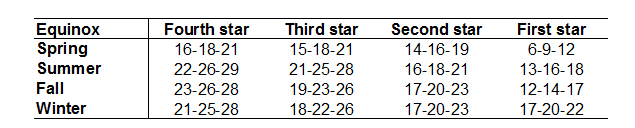
At both the fall and spring equinox, the sun appears in the same place over the equator and you might expect Shabbat to begin and end at the identical time.  Certainly, regardless of how one measures darkness, it is equivalently dark any number of minutes after sunset at those two times.  However, in Jerusalem and other parts of the Middle East, unrelated to the degree of darkness, stars first appear a number of minutes later (after sunset) in the fall than they do in the spring.[14]Advantaged by the early appearance of Sirius and Canopus in the spring but not the fall, the Gaon restricts the focus of the gemara to the spring only.

Note that:

  1. All rishonim who choose to comment on the sugyah in Pesaim 94a state that the day in question occurs only around the spring (or fall) equinox.
  2. Not a single rishon makes an analogous comment, restricting the gemara beginning on Shabbat 34b to any specific time of year.
  1. Shmuel’s unchallenged statement:[15]With Prof. Levi’s table (provided in the appendix) as background, examine Shmuel’s unchallenged statement on Shabbat 35a, according to the position of the geonim / Gaon.[16] After discussing the appearance of the horizon and the length of the bein ha-shemashot period, the gemara states the opinion of R. Yehudah in the name of Shmuel who asserts: “one star – daytime, two stars – bein ha-shemashot, and three stars – night.”[17] This is followed by the opinion of Yosi (bar Adin) asserting that the stars in question are neither stars that appear in the day (i. e., large stars[18] or planets) nor small stars that only appear well after the time of tzait ha-kokhavim, but medium stars. How might Shmuel’s statement be reconciled with the previous discussion in the gemara?
  • First, exclude the implausible suggestion that R. Yosi bar Adin’s assertion that Shmuel’s statement is referring to medium stars applies only to the third part (or second and third parts) of the text. Under this interpretation, the first part of Shmuel’s statement concerning one star, includes not only medium stars but also large stars or planets that are on occasion visible before sunset.  Were that the case, the statement would be informing us that the appearance of a planet before sunset does not indicate that the bein ha-shemashot period has begun. In addition to being forced to argue that the different parts of Shmuel’s statement refer to different types of stars, such an assertion would hardly be necessary; the gemara gives no hint that the bein ha-shemashot period begins before sunset.[19]
  • Second, because R. Yosef begins bein ha-shemashot at the time walk 1/12th of a mil later than R. Yehudah, some[20] align Shmuel’s statement and even pasken like R. Yosef, assuming that R. Yehudah start to bein ha-shemashot precisely at sunset, cannot be reconciled with Shmuel’s statement. Prof. Levi’s chart challenges that approach, since a delay of at most 2 minutes[21] (after sunset) provides no benefit; the first medium star cannot be seen until at least 6 minutes after sunset.
  • Third, there are other (implausible) solutions that align Shmuel with Rabi Yosi only, some going so far as identifying the amora Yosi (bar Adin) as the tanna Rabi Yosi. To follow a sugyah focused on Rabi Yehudah, with an uncontested statement that accords only with Rabi Yosi is dubious, at best. Furthermore, Shmuel’s statement, which refers to the non-instantaneous, successive appearance of stars, is difficult to align with an opinion that the bein ha-shemashot interval is instantaneous.

The most plausible suggestion, like the view of R. Ḥaim Volozhin below, is that the bein hashemashot begins at least 6 minutes after sunset.[22]

  1. Seeing stars so early (even if only in the spring) is practically impossible:

If the start of the period of bein ha-shemashot for the geonim / Gaon is precisely sunset, there has been considerable effort[23] to align the appearance of three stars within the time it takes to walk ¾ of a mil after sunset. The only solution provided is to assume that the time needed to walk ¾ of a mil applies only around the spring equinox[24] [25] and, even then, to make yet further assumptions to arrive at so short an interval.  Particularly if the time needed to walk ¾ of a mil is 13.5 minutes and even if it is a bit under 17 minutes, three stars can rarely be seen so soon after sunset and then

  • only with great difficulty,
  • by experts, perhaps aided by telescopes, and
  • in a pristine environment absent urban sources of light, like the Judean desert.

Under no circumstances, is 13.5 minutes possible, and 16.85 minutes is almost equally unreasonable.[26]

  1. Multiple opinions that begin bein ha-shemashot slightly after sunset:
  • 4 to 5 minutes: The minimum time reported as the custom of Jerusalem[27] as well as the opinion of R. Shneur Zalman of Liadi,[28] the point when the sun is no longer visible even from the highest elevations around Jerusalem.[29]
  • Greater than 6 minutes: The opinion of R. Ḥaim Volozhin based on Shmuel’s statement concerning the appearance of a single star that is visible in the spring to an expert observer at that time.[30] The fact that R. Ḥaim Volozhin disagrees with his Rebbe, strongly suggests that the Gaon’s position that Shabbat starts at precisely sunset was only promulgated le’migdar miltah.
  • 7 to 15 minutes: These views are supported by a variety of sources mentioned previously including R. Kapach’s view of Rambam and R. Posen’s view of the opinion of the geonim. A time around 10 minutes is implied by many Sephardi poskim who mention that until the call of the Moslem mugrab for their fourth prayer service, it is still day thus allowing for the performance of a brit on that day for a baby born in those few minutes after sunset on that same day one week earlier.

When linked to the times given in Prof. Levi’s charts, various alternatives from 6 – 16 minutes after sunset can be plausibly suggested.  The next section on how the bein hashemashot interval was intended to be used will shed further light in determining how many minutes after sunset might still be considered daytime.

Section 2.  Before or after

One aspect of the Gaon’s interpretation of Shabbat 34b, often assumed without further examination, is that bein hashemashot is calculated by adding its length to the beginning of the beginning of bein hashemashot period.  That assumption will now be challenged.  Though not conclusive as to how the sugyah should be read, some seforim of near contemporaries[31] of the Gaon assume the opposite approach, subtracting the length of the bein hashemashot interval from the end of Shabbat. The arguments below attempt to demonstrate that this approach may have been standard before the writings of the Gaon proliferated years later in the middle of the 19th century.[32] While some may argue that counting forward from sunset versus backward from nightfall is somehow tied to the fundamental makhloket of the geonim / Gaon and Rabbeinu Tam, there does not appear to be any logical, textual or halakhic basis for such an assertion.

The fundamental question is:

What possible value could there be in introducing (especially in an era before clocks) a time-based approximation that is a lower bound, season dependent, rarely applicable, and then only under rare, idealized conditions, at best? In what context would such information be useful?

Thus, I propose that the time needed to walk ¾ of a mil should be interpreted differently than the Gaon proposed and instead we will attempt to demonstrate that

  • The time to walk ¾ of a mil is to be subtracted from the end of the bein ha-shemashot period as opposed to being added to its beginning.
  • The period is not a minimum (that occurs only around the spring equinox), but a maximum (that occurs around the summer solstice). Thus, the entire sugyah is applicable year-round providing a conservative upper-bound to the length of the bein ha-shemashot

The arguments for both assertions are interrelated and are presented concurrently.[33]

  1. The gemara in Shabbat is primarily focused on Friday night and determining when the bein ha-shemashot period begins, as opposed to when it ends. The gemara assumes that the end to the period of bein ha-shemashot is known; each of the disputants are addressing when the period of bein ha-shemashot begins on Friday night. However, if the time needed to walk ¾ of a mil were meant to be added to the time of sunset, it would be addressing the end of the bein ha-shemashot period and not the beginning.
  2. The three fractions (each expressed as the time needed to walk a part (1/2, 2/3 and ¾) of a mil,) given as alternatives for the length of the period of bein ha-shemashot would then all have identical semantics; each of the three fractions (of the time to walk a mil) is counting back from the assumed point of ashekhah, to calculate the beginning of the bein ha-shemashot Given Prof. Levi’s chart, under no circumstances could anyone imagine that the time to walk either ½ of a mil after sunset could be the point at which Shabbat ends. The amoraim, R. Yehudah and R. Yosi, are quantifying the opinion of Rabi Yehudah in contrast to Rabi Nehemiah’s interval, whose period of bein ha-shemashot is only the time needed to walk ½ of a mil.
  3. If someone were countering the position of Rabi Yosi, who says the period of bein ha-shemashot is instantaneous, it is more likely that he would say that it can be “as long as” opposed to “as short
  4. The significant issue raised previously of never seeing stars as early as at the time needed to walk ¾ of a mil after sunset becomes entirely moot.
  5. The period of bein ha-shemashot has some practical consequence providing a potentially useable, conservative upper bound as opposed to a purely theoretical lower bound, which is of limited to no use.
  1. As noted earlier, rishonim, who limit the gemara in Pesaim to the equinox periods in the fall and spring, make no such assertion with respect to the gemara in Shabbat. One might presume from the lack of commentary that rishonim assumed that the sugyah applies year-round.

Treating the gemara in Shabbat like the gemara in Pesaim as referring only to days around the spring (but not the fall) equinox[34] is unnecessary when thinking of the interval as a practical upper bound.  All the other descriptions in the gemara, either the appearance of the sky / horizon or the visibility of three stars, apply year-round.

Now examine the three elements in combination:

  • The various opinions of rishonim on the time to walk ¾ of a mil – 13.5, 16.85 and 18 minutes.
  • Levi’s chart indicating that 3 stars are visible to a careful observer 30[35] minutes after sunset in the summer.
  • The two suggested interpretations that
  • delay the beginning of bein hashemashot to a point slightly after sunset, and
  • view the sugyah as subtracting the length of bein hashemashot from its end to find its beginning.

We can then assume that Shabbat begins from 12 (subtracting 18 from 30) to 16.5 (subtracting 13.5 from 30) minutes after sunset.[36]  However, given

  • very natural and expected stringency that occurs even today but certainly are to expected in an era before (widely available and accurate) clocks, and
  • the need for tosefet Shabbat

practiced times for starting Shabbat between 5 and 10 minutes after sunset ought not be surprising.

Section 3. The Gaon’s approach to Pesaim 94a.

The Gaon’s approach to Pesaim 94a is premised on an incontrovertible astronomic and logical fact. Assuming that alot hashaar approximates the first light of the day, then its evening counterpart, tzait ha-kokhavim, must occur when the sun’s illumination has (next to) no remaining effect.[37]  At both of those times, all stars that are in position to be seen are not obscured by illumination from the sun. As a result, the Gaon adds the word kol to differentiate tzait ha-kokhavim, which throughout the Talmudic literature refers to the appearance of 3 stars, from tzait kol ha-kokhavim, the appearance of “all the (potentially visible) stars.” Of course, this point demolishes[38] Rabbeinu Tam’s interpretation that is predicated on the assumption that the meaning of the term tzait ha-kokhavim occurring in both Pesaim 94a and Shabbat 35a is the same. Slightly reformulated the Gaon asks how could the time of the appearance of only three stars and the time of alot hashaar, when (almost) all the stars are still visible, be separated by intervals of identical length from sunset and sunrise respectively?  The pre-dawn counter point to the time after sunset when (only) three stars are first visible cannot be alot hashaar when (almost) all stars are still visible.[39]

This iddush is not unexpected, even though the gemara in Pesaim is the primary sugyah used throughout halakhic history to provide a source for determining the time of alot hashaar.  Despite that halakhic application, the sugyah is focused primarily on geography and astronomy. Thus, harmonious use of the term tzait ha-kokhavim with its use elsewhere in Talmudic literature, which Rabbeinu Tam assumed, need not be presumed.

Since the notion of tzait kol ha-kokhavim is new, it is also not surprising that the Gaon did not specify, to the best of my knowledge, any halakhic uses for the notion of tzait kol ha-kokhavim. Of course, those who followed Rabbeinu Tam’s position had no reason to even consider a point in the evening after tzait ha-kokhavim.

However, that changed with the arrival of what we colloquially call the Brisker methodology. Talmudists of that school have produced potential halakhic implications. For example, it is not difficult to differentiate between:

  • halakhot tied to a specific day or those that are to be performed every day,
  • from those that have no connection to any specific day but are restricted to being performed only during the daytime period.

Presumably, the construction of the Beit HaMikdash is a straightforward example. While there is a daytime requirement,[40] there is no constraint on which day of the week that construction should take place. Another example, which does not comport with the above iluk, has been proposed by R. Moshe Soloveitchik. He suggested the use of tzait kol ha-kokhavim as a delimiter for tosefet Shabbat according to those following the Gaon.  While Shabbat ends at the time of tzait ha-kokhavim, R. Soloveitchik proposed that tosefet Shabbat is meaningful only until tzait kol ha-kokhavim.

While these examples[41] are noteworthy, the lomdus of a yartzeit shiur by R. Joseph Soloveitchik was astonishing. Effectively, but not explicitly, R. Soloveitchik disregarded both historic interpretation and practice when he transformed Rabbeinu Tam into an early supporter of the notion of tzait kol ha-kokhavim.[42]  As presented in that shiur, though expressed slightly differently, the dispute between the Gaon and Rabbeinu Tam revolves around whether Shabbat ends at tzait ha-kokhavim or tzait kol ha-kokhavim.[43]

In R. Soloveitchik’s formulation, the Gaon defined a critical point along a continuum beginning at the point of sunset, when there is almost complete exposure to the sun’s illumination, and ending at the point of tzait kol ha-kokhavim when no noticeable impact from the sun’s illumination can still be detected. That critical point occurs roughly when 3 medium stars first become visible and marks the transition point between days of the week according to the geonim / Gaon.  Rabbeinu Tam, however, according to R. Soloveitchik’s formulation, defined the transition between days of the week at the point when the sun’s impact has ended entirely, a point corresponding to the end of the continuum, at tzait kol ha-kokhavim.[44]

A possible approach that R. Soloveitchik did not employ is that the Gaon and Rabbeinu Tam decided differently based on two conflicting sugyot in Shabbat and Pesaim, respectively. Of course, that would be at variance with Rabbeinu Tam’s normal methodology for resolving conflicting sugyot.  Rabbeinu Tam tends to distinguish between sugyot, something he does explicitly with respect to these sugyot, as opposed to declaring sugyot in conflict and deciding between them. The principal motivation for even raising such a possibility is R. Soloveitchik’s complete avoidance of any mention of the challenges to Rabbeinu Tam’s position from the sugyah in Shabbat. This leads me to wonder if in R. Soloveitchik’s ahistorical reformulation of Rabbeinu Tam, and for reasons entirely unstated, R. Soloveitchik gave the sugyah in Pesaim prominence and preference over the sugyah in Shabbat according to Rabbeinu Tam.

Conclusions:

It is not at all usual to treat a ruling of the Gaon as le’migdar miltah.  However, three things increase my confidence that I am correct in this instance.

  1. The reality as described in the epistle of the Ba’al ha’Tanya referenced earlier, who lived at the same time and in the same general area, clearly describes people working beyond 30 minutes after sunset, something that the Gaon would be motivated to prevent as resolutely as possible.
  2. The opinion of R. Ḥaim Volozhin, in open disagreement with the Gaon’s stated position, demands a reconciliation of views.
  3. The textual arguments made by rishonim, the halakhic writings and positions of noted aaronim, and the various arguments that I have formulated appear convincing.

What should be noted is the Gaon’s interesting ability to impact not just pesak, but the way we (perhaps even unconsciously) approach the study of sugyot.

Appendix


Prof. Levi’s Table

The three times listed in each cell of the table correspond to how difficult it is to see a star.

  • The shortest time noted is when an expert who knows exactly where to look can observe a star.
  • The intermediate time noted is when a star can be seen with great difficulty.
  • The third time noted is when a careful observer can see a star.

The time when stars are visible to a casual observer, is yet later.

[1] My assumption is that poskim may find the innovations useful in exceptional situations as opposed to more typical ones.
[2] According to the vast majority of rishonim, the day ends when bein ha-shemashot ends or at most 2 minutes later.
[3] Familiarity with both sugyot is assumed to fully assess this essay.
[4] See my article in Hakirah spring 2019 for more detail on the Gaon’s convincing attack on Rabbeinu Tam’s position.
[5] A version of that reading is presented in Ohr Meir as the opinion of the geonim, who R. Posen seeks to demonstrate conflict with that of the Gaon.  What the Gaon felt mei ikar ha’din can be disputed as will be illustrated.  Even if one were to reject any variation of the Gaon’s stated position, this paper can also be considered to apply to the less specific view of the geonim.
[6] Both 72 or 90 minutes are increasingly assumed to apply only in the Middle East around both equinoxes and require adjustment (using depression angles) to account for variation by season and latitude.
[7] These positions are more properly characterized as variants of the position of the geonim / Gaon as they are all much closer to their normally assumed period of bein ha-shemashot.
[8] Throughout R. Kapach’s commentary on Mishnah Torah, however, he asserts that this is the position of Rambam. See R. Posen’s view as well, mentioned in footnote 5.
[9] This seminal point was made explicitly by R. Chaim Sonnenfeld in teshuvah 33 (an approbation to a sefer on zemanim) in a recently published volume of his teshuvot.  His reaction, as might be expected, was to be mamir, and fulfill the stringencies of both opinions. I argue that the strengths of both opinions lead to the opposite and more probable conceptual position, adopting the leniencies of both positions.
[10] See Vol. 2 of HaZemanim BeHalakha by R. Ḥaim Benish, page 360, especially footnote 58.
[11] Pages 251 – 252, Chavel edition, Mossad Ha-Rav Kook.
[12] This argument is included due to its ancient provenance; it is easily challenged given that it is normally assumed that tosefet Shabbat can begin at plag ha’minah, which precedes sunset.
[13] Note as well, that the gemara in Pesaim 94a applies to

  • a day of average length,
  • which occurs around both the spring and fall equinox.

However, the days that would be referred to in Shabbat 34b would be

  • a minimum, as opposed to an average, and
  • restricted to those days when the appearance of three stars occurs within the time needed to walk ¾ of a mil after sunset. For astronomic reasons such days occur only in the spring and not in the fall.

While neither of these two differences is itself convincing, both lend further support to the thesis developed.
[14] See the chart by Prof. Levi provided in the attachment.
[15] A more extensive analysis of Shmuel’s statement will appear in a future issue of the Torah u’Maddah journal.
[16] This section assumes detailed familiarity with the sugyah on Shabbat 34b-35b.
[17] Prepositions have been omitted from the statement in order not to bias the semantics.
[18] Large stars are defined as kokhavei lekhet, moving stars, currently called planets. Other approaches to dividing stars into categories are much less likely and not considered.
[19] The isolated opinion of R. Eliezer mi’Mitz, who begins the bein ha-shemashot period before sunset, is difficult to reconcile with Shmuel’s statement, in any case.
[20] See the last two paragraphs on page 358 and especially footnote 50 in Vol. 2 of HaZemanim BeHalakha.
[21] The time to walk 1/12 of a mil is between 1.5 and 2 minutes.
[22] While normally I would assume Prof. Levi’s third entry matches Shmuel’s assertion, since this statement might mean seeing a star does not mean bein ha-shemashot has necessarily begun, it might mean just an accidental sighting, which may occur at the earliest time possible when normally only an expert, knowing exactly where to look, can locate a star.
[23] R. Benish, R. Willig, Prof. Levi among many others struggle with this issue.
[24] In the spring Sirius and Canopus can both be seen around 15 minutes after sunset.
[25] Having seen no earlier discussion of this issue anywhere in the halakhic literature, I believe this interpretation originated with the Gaon in O. . 261. The alternative under discussion, delaying the start of bein ha-shemashot by some small number of minutes after sunset, eliminating the hypothesis that bein ha-shemashot begins precisely at sunset, which leads to such questions.
[26] Perhaps one can assume some worsening of atmospheric conditions, as a result of pollution, slightly decreasing visibility.  I spoke with a chemist in my synagogue, Dr. Irwin Goldblatt, who verified this as a possibility.  I have no basis to determine how accurate this observation might be, but it is hard to imagine that it is consequential.
[27] See Minhagei Eretz Yisrael by R. Gliss, pages 102 and 282.
[28] Seder Hakhnosat Shabbat, found towards the end of every abad siddur, specifies 4 minutes. He reverses the position he took in Shulan Arukh HaRav, which supported Rabbeinu Tam.
[29]See Zemanim Ke’hilkhatam by R. Boorstyn, chapter 2, section 3, where he summarizes different 19th and 20th century posekim in the Middle East who supported times beyond 4 to 5 minutes and up to approximately 10 minutes after sunset.  The rationale he and many of these posekim used is varied often relying on the notion of sea level and / or visibility from higher elevations, a topic of continued debate.
[30] See the addition to Maaseh Rav section 19.  Six minutes is expressed as 1/10th of an hour to be applied in both the morning and evening, although Shmuel’s assertion of “one star – daytime” is given as the reason for the slight delay after sunset. How R. aim Volozhin determined this precise time that equals the time at which an expert can see Sirius remains a mystery.
[31] R. Adler, R. Loerberbaum, and R. Sofer all subtract the length of the bein hashemashot interval from the end of Shabbat, see my article, Zemannim: On the Introduction of New Concepts in Halakhah, in the TuMJ 2013.
[32] It goes without saying that the instantaneous communication that characterizes of our current environment cannot be anachronistically assumed in a prior period. This impacts the assumptions made about when some of these sources are read / known, a topic not pursued further.
[33] A set of arguments based on the statement of Shmuel about 1, 2 and 3 stars are not included and will be incorporated in a future paper examining both Shmuel statement and Rambam in multiple sections of Mishnah Torah, based on their mastery of astronomy as it was known in their times.
[34] First suggested by the Gaon in O. . 261, this approach is widely assumed in recent halakhic literature. Note that the gemara in Pesaim assumes an average day, which occurs in both the spring and fall around the equinox.  However, the Gaon’s argument assumes, not an average interval, but a minimum interval and one that occurs only in the spring, but not in the fall; stars are not visible as early in the fall as in the spring.  On the other hand, as suggested, a maximum would apply year-round.
[35] Prof. Levi uses a depression angle normalization to spring, which we will not explain.  His use of 28 is in fact closer to 30 minutes, as normally defined by clock-time.
[36] 12 – 13 minutes is consistent with the many rishonim supporting a time to walk a mil of 22.5 minutes.
[37] There is no reason to debate whether the underlying science favors either of the two most common halakhic definitions, which sandwich current technology’s identification of the point at which the first light of the sun is visible. Expressed as depression angles the 72- and 90-minute intervals equate to depression angles of approximately 16 and 20 degrees, respectively. With the best available equipment, light from the sun can be observed at a depression angle of approximately 18 degrees. One can then argue that 16 degrees is when the amount of light is visible to humans, while 20 degrees is when one arises in anticipation of emerging light. Both are reasonable positions for defining alot hashaar.
[38] So strong a word is intentional given the “bombe” kasha of the Gaon; see immediately below.
[39] R. Moshe Sofer might be trying to deal with this point about a symmetric point to the appearance of three stars in his commentary on Shabbat 34.
[40] See Rambam, Hilkhot Beit Ha’Beirah (1:12). Rambam’s formulation is originally stated in the negative, which raises possible questions that might be analyzed in this context.
[41] Other possible examples include the operation of a beit din, the laws of aveilut, particularly the first day, etc.
[42] The philosophical underpinnings that would enable such ahistorical iddushim is beyond the scope of this article. Despite an accusation of partiality, one cannot dismiss the assumption that R. Soloveitchik was aware of the various challenges to his iddush. Despite bringing support from the period of the rishonim, I believe the Rav was establishing what he knew to be a restatement of Rabbeinu Tam’s position, based on the undeniable accuracy and correctness of the Gaon’s notion of tzait kol ha-kokhavim. In my own mind, I have played out a long and imagined conversation with R. Soloveitchik on this subject.
[43] For any number of reasons, it is difficult to imagine the perspective presented was that of Rabbeinu Tam. Rather, it might represent Rabbeinu Tam’s position updated and enhanced by what is now known scientifically.
[44] What I also do not understand is why R. Soloveitchik referred to the mathematical notion of continuity as opposed to any astronomical knowledge, which I think would have been more relevant.


Lecture Announcement: Rabbi Yechiel Goldhaber

The readership of the Seforim Blog are invited to two lectures by the noted author, Rav Yechiel Goldhaber (link), whose respected research and scholarship is well-known to Seforim Blog readers. 
1) The first shiur that will be taking place is this Thursday, November 2, 7:30 PM at 1454 54th Street, Brooklyn, NY. Rabbi Goldhaber’s speech will be delivered in Yiddish. The subject of this shiur is “Orthodox and Rabbinic Responses to the Balfour Declaration.”
This lecture is dedicated לזכר נשמת the late Dr. Shlomo Sprecher ז״ל who coordinated and hosted many of Rabbi Goldhaber’s shiurim.
2) The readership of the Seforim Blog is also invited to a shiur that will be taking place this Sunday November 5, at 8PM. The subject is likewise “Orthodox and Rabbinic Responses to the Balfour Declaration. It will take place in Monsey at Ohr Chaim Learning Center, 20 Forshay Road, (head upstairs). This lecture is in English.
Rabbi Goldhaber has authored many wonderful articles, published important documents and written works on a wide range of topics, among them Minhagei Kehilos about customs, Kunditon (link) about the Titanic and the so-called Cherem on Spain, and two volumes of Ginzei Yehuda, a collection of assorted letters from various rabbis of note. 
It should be noted that Rabbi Goldhaber’s visit to the United States is connected with raising funds for an upcoming wedding for his son, therefore donations are encouraged (albeit not required to attend). 

EDIT 11.6.17: Here is a link to the Yiddish lecture: link. 

The English will be posted if we receive it.


A Conversation with Professor Benjamin Brown on the Publication of ‘Hasidic Leadership in Israel: Past and Present, Spirit and Matter’

A Conversation with Professor Benjamin Brown on the Publication of ‘Hasidic Leadership in Israel: Past and Present, Spirit and Matter’

This article presents an English translation of an insightful interview with Professor Benjamin Brown, conducted by Moshe Shochat for his blog, Sefarim ve-Kitvei Yad. Published online on July 26, 2025, and available here), the interview marks the occasion of Professor Brown’s newly published book, Hasidic Leadership in Israel: Past and Present, Spirit and Matter (Jerusalem: The Israel Democracy Institute and Magnes Press, 2025; Hebrew). This translation appears at the Seforim Blog with the kind permission of both Moshe Shochat and Professor Benjamin Brown.

Professor Benjamin Brown is a full professor in the Department of Jewish Thought at the Hebrew University of Jerusalem. His scholarly output is astonishing, and he stands out particularly for his extensive research on Haredi society and the Hasidic movement. I would not exaggerate to say that he is currently the foremost scholar of Haredi society, just as Professor Menachem Friedman (1936-2020) was in his time. His new book – Hasidic Leadership in Israel: Past and Present, Spirit and Matter – is an exceptionally impressive study of the social and leadership structure of the Hasidic movement. In his book, he examines the Doctrine of the Tzaddik as it was formulated at the inception of the Hasidic movement in the generation of the Baal Shem Tov’s disciples, the transformations this doctrine underwent in subsequent generations, and especially during the movement’s rehabilitation in the Land of Israel from the time of World War II to the present day. I read the book carefully and enjoyed it immensely, but I was left with some open questions. Given my friendship with the author, I chose this time to deviate from the usual review format and sit down for an open conversation with the book’s creator. To my delight, Professor Brown accepted my proposal and dedicated his valuable time to my questions about the book.

Moshe Shochat: Professor Brown, hello. First, I’d like to extend my heartfelt congratulations on the publication of your remarkable new book. Would you like to introduce the book in a few words?

Professor Brown: Hello Moshe. Thank you for the congratulations! The book is called Hasidic Leadership in Israel, and it is precisely that. It deals with the status and perception of the Admorim (Rebbes) in late Hasidism, meaning Hasidism as it exists up to our present day. The book concludes with the COVID-19 crisis. This point does not symbolize an “end of an era,” but rather the time when the book was finalized and went to print. In the book, I seek to examine a changing and evolving perception of the “Tzaddik” and the Admorut (Rebbisteve, Rebbeship) in its very process of formation, or at least within its very recent history of formation. We are accustomed to tracing the doctrine of the Tzaddik from the inception of Hasidism or in the nineteenth and early twentieth centuries. Indeed, there were interesting developments during these periods, and the book surveys at least some of them. But it becomes clear that even here in Israel, the perception of the Tzaddik continues to develop before our eyes in various forms and directions. To examine these developments, one must first and foremost follow the texts of the movement, as to a large extent we are dealing with a doctrine that Hasidism has always championed and given textual expression to throughout the generations. But in addition, one must follow the realization of the idea on the ground, following events that come and complement additional and more vivid angles of the conceptual perception. Therefore, at least the last part of the book contains a lot of politics and many events in Israeli public life and within the Hasidic communities themselves, which, although not conceptual, enrich the insights regarding the Admorim’s and Hasidim’s understanding of the essence of the Tzaddik’s role and the nature of the activity and content included in that role. In this direction, the book contributes its part to the long discussion on the development of the Tzaddik’s doctrine within the Hasidic movement throughout its generations.

Moshe Shochat: So, are all the dramas, conflicts, intrigues, and politics described in the book directly related to the question of the Tzaddik’s status? It seems that every issue in Hasidic society could be connected to the Tzaddik at its apex. What were the boundaries that guided you in choosing your topics?

Professor Brown: The first part of the book deals directly with the doctrine of the Tzaddik. Regarding the later parts of the book, which discuss the State of Israel in recent generations, I felt that all the topics were interconnected, and it was impossible to cut the story short. Therefore, I narrated the story in its full progression, hoping I ultimately succeeded in tying all the threads together. To this end, I included both summary paragraphs in each chapter and a general concluding chapter at the end of the book, aiming to demonstrate the internal connection among all these sections.

Ultimately, all the internal politics within Hasidic communities, the external politics between different Hasidic groups, and even the politics between Hasidic groups and state institutions, are all connected to the very essence of Hasidism. Therefore, when a Hasid ultimately looks at his Rebbe with reverence, today they view him differently than they did fifty years ago, and certainly before the Holocaust. Today, a Hasid reveres their Rebbe not just as a spiritual personality, a dispenser of abundance, a miracle worker, an educator, or one possessing divine inspiration, but also as a competent manager and a strong leader. Part of this strength is his ability to operate at a level that, in any other context, we would term political. The intention isn’t that all Admorim have become politicians or that their traditional roles have been marginalized. These roles are certainly present, but in a certain sense, politics has also become part of their spiritual function. In the Hasid’s consciousness, the figure of the “Tzaddik” has become imbued with a significantly higher proportion of political activity.

From these three levels – the internal, the external Hasidic or Haredi, and the external towards general society and national politics – everything ultimately converges to what I summarized in the final pages: what is perceived in the Hasid’s consciousness, and even in the consciousness of the Admorim themselves, when they contemplate Tzaddikism (or, in Hasidic parlance: Rebbisteve).

This aligns with the method of “indeliberate theology” that I’ve believed in for many years. This refers to a theological understanding that isn’t necessarily explicitly formulated as theology. I wouldn’t be overly presumptuous to extract theology from things that are not textual at all, such as the behavior of Admorim, concrete instructions, or things that don’t reflect profound conceptual depth. However, when I take the texts and construct new concepts from them, and concurrently substantiate this with descriptions of concrete actions, it helps us understand how, even without formulating the Tzaddik’s doctrine in new theological terms, a kind of new theology emerges before us. This is true even when its adherents don’t perceive it as new, and instead emphasize continuity over change.

I will later address “indeliberate theology” and the political connection, but first, I wish to conclude the discussion on the book’s boundaries. I chatted with a friend about your book and jokingly told him that in certain parts of the book, I felt like I was scrolling through the Twitter feed of Moshe Weisberg (a tweeter who extensively covers the courts of Rabbis and Admorim, often in a manner that appears grotesque and embarrassing). It seems to me that this feeling arose because, unlike your other books, the focus here is not on doctrines or the sociology of some obscure European history, but on the near present and the most beleaguered politics of Admorim’s courts that almost no one has heard of. What was the experience like to write “history” about last week’s gossip, and were there any fresh anecdotes you omitted because you felt they were “too much”?

I’ll start from the end. Well, the book certainly delves into small, even petty details, in a comprehensive and highly detailed manner. Since I present these matters as an illustration of the Tzaddik’s doctrine, I also require events that enrich the texts. The use of the word “gossip” is interesting. Perhaps I’ll share something in this context: The first conference where I participated as a lecturer was the Orthodoxy Research Conference at Givat Ram. By its nature, Orthodoxy research convenes scholars from various disciplines, and both historians and scholars of Jewish thought were present. In one of the open discussions, an interesting debate arose, where historians primarily stood against Jewish thought scholars. In summarizing the event, Professor Avi Ravitzky, one of the conference organizers, concluded that historians accuse Jewish thought scholars of dealing with “things in the air,” while Jewish thought scholars accuse historians of dealing with “gossip.” Indeed, we may sometimes feel that historical engagement is gossipy, but the engagement with that gossip has a purpose. Hasidism is not a philosophical system that one formulates at a writing desk or through abstract theoretical thought. In fact, no profound thought is like that, but certainly not thought that does not claim to be systematic, such as that of Hasidism. To forgo the “earthly” material is essentially to turn the discussion into a detached context, “things in the air.” On the other hand, I did not settle for gossip, and I endeavored to complete the picture with the help of texts that seek to formulate the concepts more consciously. It is possible that the balance was sometimes disturbed, but for my part, I aspired to achieve such a balance. The seemingly “low” engagement with “amnion and placenta” is akin to “cooks and confiture-makers for Torah,” meaning for the doctrine that I ultimately wish to reach and understand.

Fortunately, in dealing with the recent history of Haredi Judaism, there is an immense abundance of journalistic material that delves into minute details. This contrasts with the distant past, from which there is little journalism, especially non-Hasidic, and even when there is Hasidic journalism, it deals with specific and narrow aspects of the Admorim’s functions. In contrast, we have quite a bit of internal Hasidic literature, which deals with both stories and teachings. As a researcher, you utilize what is available to you, not what is not. Hasidic scholars of previous centuries would have been delighted to receive such an abundance of journalistic materials and field testimonies, but from those periods, such materials are scarce. Today the situation is different, and in my opinion, it should be leveraged effectively. Therefore, the first part of the book differs from the second, which deals with contemporary Hasidism.

Moshe Shochat: You mentioned at the beginning of the book a debate between Martin Buber and Gershom Scholem. Buber argued that the fundamental sources for understanding the Hasidic movement are the stories, whereas Scholem contended that the most fundamental source is the Admorim’s (Rebbes’) teachings. In the case of the Tzaddik doctrine, do you state that everyone would agree the stories are primary?

Professor Brown: Certainly, there’s no basis to suggest that the Tzaddik’s doctrine hasn’t been discussed in Hasidic literature. It’s been a continuous topic. His spiritual role includes elevating and bringing down from the supernal worlds, bestowing abundance and blessing, education, study, ruach hakodesh, miracles, and more. All these aspects are exhaustively discussed in Hasidic philosophical literature as well. What wasn’t discussed, and this needs qualification by saying it wasn’t extensively discussed until roughly the mid-19th-century, is the “political theology” of the Tzaddik doctrine. That is, the political dimensions of the Tzaddik as a communal leader, an individual with authority, one entrusted with communal public affairs, beyond the spiritual roles I outlined. We glean these aspects more from story literature and from additional complementary sources.

Moshe Shochat: The absence of explicit sources led you to employ a term you coined previously – “indeliberate theology.” Recently, a philosophical book on the Haredi movement, written “from within,” briefly argued that your formulation is presumptuous, as it performs a theological psychologization of individuals who haven’t experienced the language of theology. Would you like to address this critique and perhaps, at this juncture, clarify something regarding the judgmental dimension present in or absent from this term?

Professor Brown: Yes. I believe the method of “indeliberate theology” isn’t my innovation; at most, I formulated it and gave it its name. This method has been applied by scholars of Jewish studies for many years, across generations, concerning numerous non-systematic thought systems, and particularly in the study of Hasidism. No one believes that the Baal Shem Tov created theology in the conventional, institutional sense of the word, not in the Christian sense, nor even in the medieval Jewish sense. When we discuss the Baal Shem Tov’s thought, we collect his sayings and attempt to construct from them ideas that cohere into a slightly more systematic theology. This is “indeliberate theology” in its solid and moderate approach. One could extend “indeliberate theology” to more extreme degrees, creating theology not just from isolated, scattered, and eclectic texts, but even from behaviors, actions, or practical directives. However, here we are treading on far less stable ground, much more perilous, and significantly further from the word “theology,” which principally refers to a conceptual framework. Therefore, I personally refrain from engaging with “indeliberate theology” using these latter tools, treating them at most as a complement to texts. Where texts are absent, we risk descending into psychologization or similar approaches that do not qualify as theology and generally open up significant avenues for speculation.

The book you are referring to is Menachem Nabet’s work, Haredim El Devaro (2025). His comment in the context of the book puzzles me, and I’ve already discussed it with him. In his book, he seeks to counter the excessive focus on the sociology of Haredi society and to engage more with theology, whose fundamental principle, in his view, is total devotion for Torah and the observance of mitzvot. He derives this conceptual framework from behaviors, life patterns, and emotions. In fact, it turns out that he himself applies the method of “indeliberate theology” in the extreme manner I mentioned. I emphasize that he does so correctly and convincingly, in my opinion; his arguments have significant value in scholarly thought. However, precisely in light of his own use of this method, his critique of the softer version of the method I employ strikes me as puzzling.

Moshe Shochat: Let me be a bit more direct. On the surface, you strive to remain “clean” of judgmentalism and personal opinions. Yet, in several places, you chose to include humorous anecdotes from Hasidim or their opponents that cast the institution of Hasidic leadership in a somewhat ludicrous light. For example, the jest that Esau was a rebbe, given that four hundred men followed him, he wore a “peltz” (a thick fur coat), and even wished to kill his brother… Similarly, you have often highlighted behavioral paradoxes, such as the contradiction between the principled and surprising statement of the Divrei Chaim that Admorut is not inherited like rabbinate but rather derives from the Tzaddik’s inherent stature, and his personal practice of bequeathing his position to all his sons, thereby fostering a dynasty where every male child became an Admor. As an author, you can choose what to present and how to guide the reader to the desired conclusions. Is a researcher capable of presenting research without personal opinion, or will their personal opinion inevitably influence the ordering of things and the selection of sources? Or, to rephrase, does your avoidance of direct judgmentalism stem from research considerations, or is it a personal choice, perhaps out of deference?

Professor Brown: That’s a good question. First, one must distinguish between research work in its essence and an ideological or polemical work. As far as research is concerned, I adhere to the conservative, solid view, which I believe most of my colleagues in the field of Jewish studies share. This view holds that a researcher inherently possesses a personal stance, and it is impossible for this stance not to influence their research, whether consciously or unconsciously. However, as a researcher, one must strive for their personal views to influence the work as minimally as possible. Even if complete separation between research and personal stance proves challenging, at least at the foundation of the conclusions, the researcher must be transparent and explicitly state that he is presenting his personal perspective. To the extent that this personal stance is expressed in a manner that does not distort the research or mislead the reader, it is legitimate, and even then, it is advisable for it to appear only in the margins. This is how I have endeavored to conduct myself in my research over the years, and the current study is no different in this regard.

Introducing humorous and even biting anecdotes about the institution of Admorut or the functioning of specific Admorim is not pertinent to this issue. Here, I return to the earlier questions. We are blessed that the Haredi public, in my view, possesses the best sense of humor among the various sectors in Israel, a sense of humor with deep historical roots. The ability to approach the institution of Admorut itself with humor, but even more so the way it is perceived by people – both by Hasidim and Admorim themselves, and by opponents – is an integral part of enriching the content and the feeling accompanying it. That is to say, truly understanding something involves not only grasping its literal text but also comprehending the emotional and experiential depth embedded within that text. Just as we quote fervent expressions of admiration that convey positive emotion, so too irony, sarcasm, and satire are part of understanding the phenomenon. We could not fully grasp the phenomenon of Admorut if we did not read the exaggerated expressions of admiration by Hasidim, but similarly, we would not understand it correctly if we refrained from reading the critiques and irony of the opponents, or even the satires of the Maskilim. If we were to draw only from one side, or disproportionately from one at the expense of the other, then we could indeed argue that there is a bias, and a bias is usually judgmental, leading the reader in the direction the author desires. To the extent that sources from all sides are utilized, including the irony expressed by each side, it becomes an integral part of a richer understanding of the subject text.

Moshe Shochat: A fascinating answer. I also want to note that in at least one place, you explicitly voiced an opinion against absolute judgmentalism and eloquently explained how one’s personal stance influences interpretation. In the book’s summary, you discussed the decentralized nature of the Hasidic movement, for better or worse, concluding: “If you ask a person their opinion on a particular society with many groups and streams, it is likely that their answer will be determined by their normative and emotional attitude towards it: if they love it, they will say there is pluralism, and if they hate it, they will say there is factionalism” (p. 357). I felt it was important to quote these words due to their significance in my eyes.

Professor Brown: Thank you! And there are many more examples of such nuanced phrasing. It’s always worthwhile to be sensitive to them…

Moshe Shochat: Well, we’ve discussed the framework and the question of personal stance in research so far. Now, I’d like to delve a bit into a more substantive point. In several places in your book, you wrote about unique turning points related to Hasidic leadership that occurred in twentieth-century Israel. However, I often felt that these changes weren’t fundamental but rather underwent rephrasing or sharpening in light of external developments – whether “from without,” confronting secular Jewish rule, or “from within,” confronting other Haredi groups that necessitated distinguishing clarification. I’ll start with an example where you did specifically clarify what you meant by “turning point.” You mentioned three Hasidic groups where the value of holiness (in the sense of sexual abstinence in married life) became a “trademark” only in twentieth-century Israel: Gur, Slonim, and Toldos Aharon. You noted that in all three, the foundations of holiness were already rooted in previous generations in Eastern Europe, yet a unique turning point occurred here in the Land. You cited three reasons for this transformation: the need for spiritual revival and the creation of renewed values as a substitute for the mysticism of the first generations; the modern and permissive challenge that elicited a reaction; and the need for these groups to rebuild themselves after the Holocaust and adopt distinctive group features by sharpening existing values. Can one even speak of an ideological turning point based on manifestations and expressions that suddenly appear in Israel against a backdrop of new circumstances?

Professor Brown: The answer is: Yes. Absolutely yes. Traditional societies, characterized by stability and deep commitment to tradition, do not tend to innovate ex nihilo. Every innovation within them is, in fact, “ex materia” (“yesh mi-yesh”) – a return to existing values from their broad cultural and religious reservoir. Even when they present the innovation as novel, it’s typically a revival of past ideas, adapted to current needs. Historically, we know that restoration is almost never an authentic return to the past, but rather a re-processing of it. When Ben-Gurion called for a return to the Bible, he wasn’t asking to live the Bible, but to use it as a foundation for building a modern identity. The same applies to Hasidism: the call to return to the Baal Shem Tov, heard at times, is not a demand for precise replication – no one believes that’s possible – but for the adoption of suitable elements from his legacy, within the context and adaptation to society in the modern era and its needs. In a traditionalist society, where a rich repository of texts, ideas, and norms exists, there’s no need to invent anything new. Innovation occurs through selection, emphasis, or the elevation of a particular value over another, or even just alongside another value that dominates that society. Such a change, even if minor, may be considered revolutionary in the society’s internal consciousness or from the perspective of the examining researcher.

The book does not argue for a comprehensive revolution in the Tzaddik doctrine, but rather points to movements of expansion to new extremes not seen in recent generations. We are witnessing the development of a more individualistic Admorut, both on the part of the spiritual leader (for instance, in the phenomenon of the mashpi’im) and on the part of the Hasid, who gains broader scope and freedom, alongside more authoritarian, centralized, and forceful tendencies. Some Admorim display independence in relation to tradition; some revert the doctrine to spiritual-heavenly patterns, as exemplified by the Amshinover Rebbe, or conversely, to political-earthly patterns, as seen in Gur and similar movements. These changes, even if not dramatic, are significant. They delineate the boundaries of possible renewal within a conservative society and indicate how the institution of the Tzaddik is stretched and reshaped in accordance with the spirit of the times.

Moshe Shochat: I generally accept your points, and yet I’ll clarify my intention with another example. In the summary of the chapter on “The Growth and Development Phase (1966–1994),” you wrote about a change that occurred in the Tzaddik’s doctrine during this period. Although the doctrine itself didn’t show change – meaning, Hasidic texts still discussed Tzaddikim and faith in Tzaddikim in formulations similar to those in Europe – in practice, the Admor’s role underwent a transformation. This included, among other things, the integration of Admorim into politics, both national/municipal and internal Haredi/Hasidic politics. As you rightly noted, this change is hardly reflected in the rebbes’ verter (Torah homilies). Let me put it this way: While an external observer might perceive the entry into politics as a fundamental change, as you know, you place great emphasis on self-consciousness. Is there not a case to give greater weight to the self-consciousness that views this change as circumstantial and “external,” merely an adapted lobbying channel, and therefore doesn’t address it on the ideological level? After all, there’s no doubt that in Haredi eyes, “politics for heavenly purpose” (politika tzorekh gavoha) is a fundamental concept, meaning that all worldly avenues are solely for the purpose of aiding a life of Torah and fear of Heaven.

Professor Brown: Your question essentially presupposes the well-known and familiar distinction between the core and the periphery, between goals and means, between content and framework, or any similar distinction one might choose. According to your argument, at the core level, Hasidism remained in the form it had before the Holocaust or before the establishment of the State of Israel, and only the periphery changed because the means needed to adapt to changing circumstances.

I am quite suspicious of this distinction. We’re dealing with human beings. People are living creatures. The need to change the means almost necessarily, both psychologically and socially, mandates a different perspective on the core, on the content. The lack of expression of this in the philosophical discourse stems, in part, from the fact that this discourse truly reflects consciousness less. It largely continues a current of thought that is, I would almost say, inert – a continuity that is pushed to remain the same, and doesn’t adequately reflect, at least in the discourse of the Admorim themselves, the changes that others, even those in their immediate surroundings, observe. It’s very difficult to dispute that, ultimately, more and more changes in the framework eventually permeate the content as well. Therefore, even if its verbal expression, the official theological expression, remains continuous, it doesn’t mean that no changes have occurred.

Moreover, ultimately, we do see the expression of changes in certain Torah teachings, for example, in those of the Klausenberger Rebbe, or in the writings of certain Hasidim who certainly give expression to things in a way that their forefathers did not. Not to mention what is discussed in the media or other means of expression. Ultimately, there is a change in the doctrine here, even if the formulations often, at least during the transition periods themselves, don’t reflect it.

Moshe Shochat: In the same vein, I want to press you from another angle, and here I connect to another important point you mentioned in your book. In the chapter on “The Doctrine of the Tzaddik” you outlined several circles of identity for the Hasidic Jew: the circle of Halakhah, to which you also connected the encompassing circle of Ashkenazi custom; the circle of Hasidic custom in the narrow sense (various practices related to the performance of mitzvot); the circle of Hasidic custom in the broad sense (practices not related to halakhic life but to the Hasidim’s relationship with the Rebbe and the community); and others. My understanding is that in the reality of our lives in Israeli politics, it would have been appropriate to add another circle – the circle of Haredism, within which Hasidim share common ground with the Litvish and Sephardic publics. The question of involvement in politics while maintaining a conscious distinction from the national idea is, in my view, the prominent expression of this circle (with varying degrees of distinction between Ashkenazim and Sephardim). Involvement in politics is a derivative of the Haredi circle, and according to this, it has no bearing on the Hasidic circle, and it certainly does not influence or is influenced by the doctrine of the Hasidic Tzaddik.

Professor Brown: You raise a very strong point here, and the truth is, I’m somewhat conflicted about it. First, I concede that I should have considered your argument and given it due thought. According to you, and I believe you’re correct, Haredism as a social circle, which encompasses Hasidim, Litvish Jews, and Sephardic Haredim, is undoubtedly a circle with existential identity significance for every Hasid. There are norms that can be defined as general Haredi norms, and it would have been appropriate to address this in the book.

The doubt that still arises for me regarding this matter is whether it truly constitutes a normative religious circle. When I speak of normative circles of a Hasid’s life, I’m referring to religious normative circles. In the context of this circle, we must ask: what would we define as fulfilling a religious ethos in the life of Haredi Judaism that isn’t specific to being a Hasid, Litvish, or Sephardic Jew? Perhaps certain stringencies in choosing kosher certifications, perhaps certain modesty norms, but even these vary from sector to sector. I find it difficult at this moment to pinpoint particular norms that would uniformly unite the entire Haredi public as such. While such norms do exist, generally, even these norms will be carried out in different ways across sectors. I would summarize: it’s challenging to find a universal Haredi ethos that is observed identically across all of Haredi society, without shades of difference between the particular ethoi of individual sectors within the broader Haredi society. Therefore, it is certainly a less sharply defined circle than the circles I delineated in the book.

Moshe Shochat: In the book’s conclusion, you presented the phenomenon of the “Mashpi’im” as a counterpoint to Hasidic involvement in politics, and as a more primordial, purer representation of the Baal Shem Tov’s Hasidism, devoid of politics and worldliness. In my view, every Hasidism begins as a “pure” movement; its expansion in the next stage inevitably leads to institutionalization, and institutionalization brings about economic and political necessities. An example you mentioned in the book but didn’t fully elaborate on is the Mashpia Rabbi Tzvi Meir Zilberberg. For approximately two decades, he operated as a completely “pure” Mashpia, even functioning within a Beis Midrash that wasn’t his own. However, in recent years, he began establishing institutions, building a community, and more. Naturally, he also became involved in fundraising and the institutionalization of a group with solidified rules. To the best of my knowledge, his political outlook tends towards zealotry (kanaut) and an avoidance of entering the political arena (if I recall correctly, he doesn’t have Israeli citizenship and is therefore “exempt” from concerning himself with setting an example regarding electoral participation). But this is merely a coincidental value choice, and I have no doubt that if he weren’t a zealot, he would also operate on the political level to secure state funding. If so, the phenomenon of the Mashpi’im isn’t a phenomenon fundamentally opposed to institutionalized Hasidism, but rather represents Hasidic groups in developmental stages that will also eventually undergo institutionalization.

Professor Brown: The institutionalization of Mashpi’im figures in Hasidism is a fascinating question. There’s a well-known dynamic: any young, fresh, and uninstitutionalized force that seeks to establish itself in reality and ensure its continuity eventually tends to become institutionalized. Even if formal institutions aren’t established in the current generation, the desire for inheritance and continuity in future generations will lead, almost inevitably, to some process of institutionalization.

Rabbi Tzvi Meir Zilberberg is an example of a figure who established institutions, yet there are other Mashpi’im who have not done so. Nevertheless, the very emergence of individuals who operate on the non-institutionalized spiritual plane, while being very careful to avoid involvement in internal-Hasidic and external-Hasidic politics, is a unique phenomenon. Their drawing power largely stems from this very distance. Even if they themselves ultimately become institutionalized, the mere existence of a mechanism that bypasses the traditional Admorut, allowing for the growth of new Mashpi’im, is a significant innovation. This mechanism provides the Hasid or spiritual seeker with a spiritual experience that is personal and non-institutionalized, suited to the needs of their generation. The very possibility of experiencing the spiritual in an unmediated way is of great value. There are also Mashpi’im who choose to avoid institutionalization almost entirely. They don’t aim to accumulate institutional baggage or to create formal continuity, maintaining a modest, non-institutional, and even non-regal character. This, too, represents an important innovation. Once the mechanism for producing leaders of this type exists, their eventual institutionalization doesn’t really matter, because if one becomes institutionalized, two or three who haven’t yet done so will emerge in their place, able to fulfill the spiritual yearning of the less institutionally inclined Hasid.

In my opinion, the phenomenon of the Mashpi’im warrants more in-depth research. Such research should examine the personalities of the prominent Mashpi’im in our generation, but also descend to the field level – to the Mashpi’im who are emerging, or those who operate with a lower profile. There is also scope to examine the dynamics among them, perhaps even internal connections between Mashpi’im. This is a phenomenon that could justify an entire book, perhaps not too extensive, but certainly an interesting one. It’s important for me to emphasize that I didn’t see myself as the one to complete this work. This is a broad phenomenon, which is still on the fringes of the Hasidic camp – important and interesting fringes, but still fringes. Therefore, I chose to grant it a relatively modest place, understanding that it would be incorrect to give it proportions that exceed its current status and thus present a misleading picture of its power. Nevertheless, I definitely commend anyone who chooses to delve into this topic and research it thoroughly and in detail.

Moshe Shochat: In the seventh chapter, you impressively analyzed five Hasidic texts from recent years. Alongside surprising texts that seek to take a step back and express reservations about the extremist Tzaddik doctrine, such as those by Rabbi Shaul Alter or “Kehal Hasidei Yerushalayim,” you also discussed some challenging texts. One of these is the text by the Rebbe of Vizhnitz–Merkaz, which speaks of the “holy method” – “shvantzunes” – that pushes the Tzaddik doctrine to an extreme and even dangerous peak. The second text is by one of the Mashgichim in Gur, offering a principled justification for the use of violence against deviants within the group as part of enforcing the Admor’s authority. These matters seem to speak for themselves. The current public discourse on these two dangerous manifestations views them as a kind of “sect,” even though it’s debatable whether these Hasidic groups meet the clear criteria for defining sects. Sociological research offers several possible definitions for a sect, and as is well known, The Israeli Center for Victims of Sects deals extensively with these questions. First, at the level of the book itself, was there a reason you refrained from mentioning this topic, even implicitly? And moving forward, should we expect to wake up one morning and find that more Hasidic groups have reached an extreme expression that resembles a sect? We know that concerning the examples I mentioned, outsiders, not just from Haredi society, are afraid to intervene, probably mainly for political reasons. In contrast, we are familiar with extreme cases of clear sects that law enforcement agencies have dealt with (for example, Berland Hasidim or the “Lev Tahor” sect, which you didn’t mention, likely because it doesn’t operate in Israel). Do you foresee any external intervention that will put an end to these phenomena?

Professor Brown: This is a difficult question. The question of the boundaries of a “sect” is a complex and volatile issue, not only politically but also at the purely analytical research level. There’s the well-known saying, “religion is a sect that succeeded” – a militant secularist statement, yet it contains a kernel of truth. Even non-religious groups, when they succeed, can evolve into a movement, and sometimes even a full-fledged society. Prior to that, they’re often perceived as marginal, semi-underground, bizarre groups, almost “sects” in a secular sense of the word. In the 18th-century, the Illuminati and the Freemasons were largely perceived as secular “sects.”

The term “sect” carries judgmental connotations, especially in Hebrew, and sometimes it also reflects criteria of success or failure. This complicates the discourse, as it intermingles value judgment with analytical description. In English, for instance, the common phrase used in the media, and sometimes in academia, to describe Hasidic groups is “Hasidic sect.” When I was a member of an international research group that authored the book Hasidism: A New History (2018), we discussed this issue and decided to avoid the use of “sect” as much as possible, preferring terms like “Hasidic groups” due to the negative connotations of the former. Ostensibly, any Hasidic group could be considered a sect, but we don’t wish to define it that way – both because of the judgmental aspect and due to questions of size and influence. Therefore, classifying groups as “sect or not sect” strikes me as an unproductive discussion, and at times, it even diverts the focus from the essential to the trivial. For this reason, I refrained from such a definition in my research.

Nevertheless, there is room for an internal discussion within the Hasidic discourse itself: What are the limits of legitimacy for the Tzaddik doctrine? When does it begin to undermine the internal logic of the Hasidic idiom itself? Berland, for example, was condemned even within the Hasidic camp, albeit with muted language. In contrast, Rabbi Mendele of Vizhnitz-Center is perceived as a legitimate phenomenon within that camp, and some seek to adopt certain aspects of his approach. It’s truly difficult to say when Hasidic society itself begins to worry that certain perceptions of Admorut cross the line. Beyond this, as part of Israeli society, one must also examine the impact of these phenomena on fundamental norms that society is willing to tolerate, and the point at which it chooses to confront them. When the phenomenon infringes upon social norms, as in the cases of Rabbi Berland or Lev Tahor, the state knew how to act, perhaps also because these were groups with limited political power. It took steps, sometimes risking confrontation. In other cases, it refrained from doing so. Therefore, the central question is twofold: what is the degree of dangerousness of the phenomenon, and what is the society’s willingness and capacity to confront it? These questions extend beyond the book’s objectives. They are more suited for position papers by social and political research institutes. While the book provides information that can enrich a discussion on the subject, the practical aspects and public policy are not part of the current research and do not align with its character.

Moshe Shochat: We cannot avoid mentioning current events, and I’ll do so briefly, focusing narrowly on the Tzaddik doctrine. These days, the Haredi parties have stirred a political uproar with their withdrawal from the government. Do you read the news differently in light of your research on Hasidic leadership? Does every political step taken by the Haredi parties, including, of course, the Hasidim, influence or is influenced by the Tzaddik doctrine?

Professor Brown: The short answer is: no. I do not read the news differently, because the political dynamics are familiar and well-known, and the book itself points them out. Politics is politics – a system of internal and external pressures. Admorim, being leaders, are also subject to such pressures. The Tzaddik doctrine is the foundation from which these processes emanate, and it develops through its application, but not every event directly affects it. Current events are mostly an expression of the power structures and dynamics that the Tzaddik doctrine itself has created. When observing them, there is no sense of dramatic novelty, but rather an identification of familiar processes that have already been analyzed in research. My writing aims to describe these dynamics, to view them as everyday political occurrences, a sequence of actions, but not every action is the direct realization of a specific doctrine. At certain points, sometimes even arbitrary ones, there is room to pause and examine the broader picture. It’s important to experience reality “in the small,” but also to know when to observe “in the large,” as the “large” does not change frequently. It accumulates gradually from the small events. Only after a period, a decade or two, does it become clear that a substantive change has occurred, one that warrants analysis, conceptualization, and the naming of a new phenomenon. It is then necessary to rise above the current daily reality and view it with a broader perspective.

The book aims to do this at a contemporary juncture, understanding that the process will continue into the future. In a few decades, perhaps even less, there will be a need for new analyses and further conceptualizations. These too will require a descent into the field, a deep observation of details, but without getting bogged down in them. There is a need to combine particular observation with a comprehensive outlook – to ascend to the “hilltop” and survey the broad picture, while creating general conceptualizations that will allow for a profound understanding of the processes.

Moshe Shochat: Having discussed your new book, it only remains to ask, with your permission, where you are headed after this book? Does your workbench hold another surprising book for us?

Professor Brown: Thank you for the question. My workbench is laden with future plans and research, and I hope, with God’s help, that I will succeed in realizing as many of them as possible. As of now, two central projects occupy me, both very different from each other and also different from the current book. I’ll just mention that the book you read is, in all likelihood, my last research for the foreseeable future in the field of Israeli Haredi Judaism. I have dealt with this topic over the years, mainly within the framework of the Israel Democracy Institute, and I am now setting it aside.

The first project I am engaged in belongs to the field of general philosophy; a field less known to the broader public as an area of my work, yet one that has accompanied me throughout my years. Alongside my work in Jewish studies, I have also extensively engaged with philosophy: I have read, taught, written, and even published two books in English. The first, Thoughts and Ways of Thinking: Source Theory and Its Applications, was published in London in 2017, and the second, The Foundations of Rational Metaphysics, was recently published in Munich. Both deal with complex and professional philosophical topics that are not related to Jewish studies. Many, even those who know me well, are unaware of their existence, as I am generally identified with Jewish studies research. But these fields are very central in my life, and no less important to me than Jewish studies research, even if I built my professional career in this area. The last book particularly excited me, as I worked on it for 16 years. It includes, in my opinion, important innovations in the field, even if they are technical and not popular topics. I am very happy with it, and I intend to continue to engage in general philosophy. However, the book I am currently working on is in a completely different direction.

The next book in philosophy will address more accessible topics, ones that may interest a broader readership than the previous two. It focuses on the historical and intellectual roots of critical theories in the social sciences and humanities in the Western world. Critical theories represent a broad family – ranging from the Frankfurt School, through post-structuralism, feminism, critical race theories, intersectionality, and more. These theories are the intellectual, academic, and theoretical engine of progressive movements and “woke” movements today. The book does not deal with them per se, but with their roots, from the 18th century until their maturation in the 20th century: how they emerged, what were their historical, social, and political circumstances, and what granted them the immense cultural and social power they possess today. I apply a critical method to them – not their own, but a different method – with the aim of understanding their ascent and the power they have accumulated. This is a topic that fascinates me greatly, and I am in the midst of working on it, hoping to complete it in the foreseeable future.

The second project is indeed related to the field of Jewish studies, and it focuses on the circle of the Baal Shem Tov. This deals with 18th-century Hasidism, not that of the 19th and 20th centuries, which I have addressed until now. I have already written two articles on the subject that were published in the journal Zion, and their expanded versions will form part of the book, alongside additional expansions. My goal is not only to research the figure of the Baal Shem Tov, who has already been the subject of rich scholarly inquiry, but also the members of his circle who have often remained underexamined in existing scholarship. I seek to illuminate their figures and examine the politics of early Hasidism. This politics includes spiritual disagreements over paths of divine service, but also personal tensions, diverse temperaments, and group power dynamics. It’s difficult to determine which precedes what – personal relationships or ideological differences – but it doesn’t really matter, as there are almost always correlations between them. I examine this phenomenon also through new sources that have not been recognized or have been somewhat neglected in existing research.

These are the two books on my desk. I move between them according to time and capacity, alongside the routine demands of academic work. Both occupy me, excite me, and with God’s help, I hope to make progress on them in the near future.

Moshe Shochat: Professor Brown, I thank you very much for the considerable time you dedicated to me. I wish you – and us, your readership – that you continue to produce more important and fascinating works as we have been privileged to receive so far.

Professor Brown: With pleasure. Thank you too for your profound reading and insightful discussion.


New Hard Drive

With modern day technology it is now possible to store tremendous amounts of information on hard drives. In the Jewish arena some have begun harnessing this power by placing thousands of seforim on a single hard drive. While there are others, which I hope to discuss at a later date, there is a new such hard drive. This hard drive contains 11,000 seforim and journals. These are searchable to an extent, as I will explain below. This hard drive contains the contents of Copy Corner, which for many years was the place to get reprints of rare and obscure (although important) seforim. Perhaps the greatest feature of the hard drive is the price, while other such hard drives cost in excess of $1,000, this one is $300. The $300 price is really just the cost associated with the drive, and making it searchable.

The hard drive was put together by the person who started HebrewBooks.org, Chaim Rosenberg, which originally was devoted to American seforim and since has moved to encompass a significant amount of other seforim – as the drive is a testament to. Aside from the Copy Corner collection, the drive is heavy in She’elot u’Teshuvot as well as commentaries on the Shulchan Orach, haggadot, and journals. Every book is fully printable and viewable.

Additionally, aside from just viewing a random book, you can also execute searches on all the books. The search process is actually two-step. First you search for a term and it pulls up all the books which contain the term you are looking for, then you search the book, as you would any PDF document for the specific page your term appears. The more expensive hard drives the search function is more streamlined, however, one pays for that ease.

I have been using this for a couple of weeks now, and I am very pleased with the drive. While, it does not encompass everything, that is not it’s mission – yet. The hope is to constantly offer upgrades, again for cost, which will add more content. The viewer actually provides a link for feedback. Further, this hard drive does not require that you install anything on your computer rather it runs fully from the hard drive. This is rather convenient if you use it with more than one computer.

In the end, anyone looking for a fairly low cost method of obtaining a significant reference library this can not be beat. It is available from hebrewbooks.org or emailing directly to oldhebrewbooks -at- aol.com. In New York – Biegelisen, Eichlers, Tuvia’s all have it as does Judaica Plaza in Lakewood.


Guide and Review of Online Resources – 2022 – Part II

Guide and Review of Online Resources – 2022 – Part II

By Ezra Brand

Ezra Brand is an independent researcher based in Tel Aviv. He has an MA from Revel Graduate School at Yeshiva University in Medieval Jewish History, where he focused his research on 13th and 14th century sefirotic Kabbalah. He is interested in using digital and computational tools in historical research. He has contributed a number of times previously to the Seforim Blog (tag), and a selection of his research can be found at his Academia.edu profile. He can be reached at ezrabrand-at-gmail.com; any and all feedback is greatly appreciated. This post is a continuation. The first part of this post is here.

11.Tools and Indexes

There are some very powerful tools for researching primary and secondary sources.

Gone are the days when one is completely at the mercy of memory, concordance, index, or colleagues. Many of the websites in the previous section (“Primary texts”) have good hyperlinked navigation pages. In addition, they have very good search capabilities. In addition to this, there are websites which are dedicated to search and indexes, that provide powerful capabilities that the previously mentioned websites don’t have.

Open-access

  1. Dicta.
    1. Search is highly recommended.
    2. From the About Us page: “Dicta applies cutting edge machine learning and natural language processing tools to the analysis of Hebrew texts.”
    3. Created by Prof. Moshe Koppel of Bar-Ilan University, who has written for Seforim Blog (see here). List of their search and other tools, all very cool and quite user-friendly and hyper-modern UX/UI, in the best way:
      1. Tanach search: “Search the Bible intuitively, with no need to worry about alternate spellings, prefixes and suffixes or sorting out multiple meanings of a word. Dicta’s search engine understands what you’re looking for.”
      2. Talmud Search: “Search the Talmud and Mishnah for words and phrases intuitively, with no need to worry about alternate spellings and multiple meanings. Dicta’s search engine understands what you’re looking for.”
      3. Quick Nakdan: “Automatically add nikud (vocalization) to text as you type.”
      4. Citation finder: “Identify exact or approximate quotations of biblical and talmudic sources in a given text.”
      5. Rabbinic Abbreviation Expander: “Expand abbreviations in Rabbinic texts. An entered text will be displayed including expanded abbreviations. The automated expansions are editable by the user.”
      6. Synopsis Builder: “Align two or more versions of the same (arbitrarily long) text, highlighting differences between versions and matching parallel words, including variant spellings and synonyms.”
      7. Stylistic Segmentation: “Partition any selected text into distinct stylistic components. For example, a multi-authored text can be automatically decomposed and displayed so that distinct authorial threads are shown in different colors.”
      8. Charuzit: “Find rhymes, assonance, and alliteration for any given Hebrew word. Search results can be filtered by entering semantic words and configuring various grammatical settings.”
  2. Parallels in Yerushalmi (מקבילות לירושלמי).
    1. Project of Prof. Leib Moscovitz of Bar-Ilan University.
    2. From the About page:
      1. “This site contains lists of sources and parallels to the Jerusalem Talmud, from the Bible, the literature of the Tannaim (Mishnah, Tosefta, and the Halachic Midrashim), the Jerusalem Talmud itself, and the classic Aggadic Midrashim of the Land of Israel. For some of the Tractates, parallels from the Babylonian Talmud are also recorded.”
  3. Escriptorium
    1. From the homepage: “A project providing digital recognition of handwritten documents using machine learning techniques.”[13]

12.Bibliographic info

Open-access

  1. Merhav – The National Library (מרחב – הספרייה הלאומית של ישראל).
    1. Recommended. Tremendous bibliographic resource, besides for being a powerful search tool (mentioned also above, under “Search”).
    2. Overview at their website here (Hebrew): “The National Library’s collection includes about five million items, including books, manuscripts, journals, maps, music and audio-visual and electronic material, in a variety of languages.
  2. The Bibliography of The Hebrew Book (also here) (מפעל הביבליוגרפיה העברית).
    1. My understanding is that “The Bibliography of The Hebrew Book” has been incorporated into “Merhav”. See also National Library’s guides here: https://www.nli.org.il/en/research-and-teach/catalogs/bibliographic-databases
    2. Wikipedia – Hebrew: “A body designated for the editing of a bibliography of Jewish printing. The project lists and describes all the books printed in Hebrew characters in the Hebrew language and in the languages ​​of the Jews (Yiddish, Ladino, Judaeo-Arabic, etc.) from the first Hebrew incunabula in the year 1475, until about 1960. The bibliographic database was built on the basis of the collections of the National Library and other collections in Israel and around the world. The bibliography numbers over 141,000 bibliographic and 15,000 biographical entries, and includes: books, journals and individual pages (ephemera). Each publication is reviewed by the project staff, and the description of the books is very broad and comprehensive than their description in the National Library catalog, and includes, for example: book approvals (הסכמות לספרים), introductions written by other authors, and the like. As of 2011, the project recorded and described close to 90% of the world’s Jewish books and is online on the National Library website.”
  3. Thesaurus of Talmudic Manuscripts
    1. Hosted at the Hachi Garsinan website, mentioned earlier. Requires registration (free).
    2. Based on Y. Sussman, Thesaurus of Talmudic Manuscripts, Jerusalem 2012. With Friedberg updates, edited by M. Katz, September 2017.

Requires subscription or purchase

  1. Talmud Yerushalmi Citation Database (מאגרי מידע לתלמוד בבלי). Requires subscription.
    1. Project of Dr. Moshe Pinchuk of Netanya Academic College.[14] 

13.Indexes

Open access

  1. Halacha Brura Institute – Virtual Library (מכון הלכה ברורה – ספריה וירטואלית).
    1. This is an incredible project.
    2. From the webpage: “The Halacha Brura Institute centralizes here links to seforim that are on the Internet at various websites, in full text, some as text and some as images, to save the visit to libraries.”
    3. Has an extensive methodology of symbols to mark the website where the work is found, and the file type.
    4. Ironically, Halacha Brura’s own meta-index of its own indexes is unfortunately not very good, there’s no full sitemap available on the website, and the organization of the webpages doesn’t isn’t always the best (for example, Rambam and commentators and Responsa are on the same page). Presumably, this is because webpages were split as they got larger. In any case, to help with this issue, I created my own meta-index of Halacha Brura’s indexes, see appendix.
    5. This project appears to be affiliated with the Rambam Library (ספריית הרמב”ם – בית אריאלה) in Tel-Aviv, though it’s not clearly stated on their website. See the appendix.
  2. Bibliography of works in Judeo-Arabic (אתר פרידברג לביבלוגרפיה בערבית יהודית).
    1. From the webpage:
      1. “The aim of this website is to present to all scholars, researchers and, in general, users interested in Judeo-Arabic texts, a comprehensive bibliography of all works in Judeo-Arabic ever printed, in a variety of formats, with some filtering capabilities.
      2. The list, with some 1,500 entries, is intended to cover all regions of publications and all periods of the works’ writings, up until and including the very early works of the 21st century.”
  3. Seforimonline.org .
    1. Well-organized, publications can be sorted by place of publication, year, etc. There also seem to be works there not found in other websites. (Halacha Brura’s index above sometimes links to Seforimonline.org.)
  4. Heichal Menahem (היכל מנחם).
    1. E-commerce website selling seforim. Can be used as a kind of index of recently published seforim, with lots of bibliographical info and pictures.

14.Secondary literature

15.Books

There are a nice amount of academic books available online, especially more recent ones.

Open-access

  1. Society for the Interpretation of the Talmud (האיגוד לפרשנות התלמוד). Scholarly interpretation of Talmud Bavli, written in Modern Hebrew.
    1. Recommended. The first seven of their publications are available there (published between 2006 – 2016). Does not include the most recent publications published 2019 – 2021. The level of scholarship is very high.
    2. Wikipedia – Hebrew: “A series of commentaries on the Babylonian Talmud based on scientific research as well as a traditional-religious interpretation. Most of the project’s books are available for public use as PDF files on the Society’s website, along with additional unpublished reference materials. The chairman of the association is its founder, Professor Shama Friedman, and its management consists of Prof. Yeshayahu Gafni, Prof. Gideon Libson and Prof. Shmuel Shilo.”
  2. AsifSifriyat Asif (אסיף ספריית אסיף). Dissertations in Hebrew, written by scholars associated with hesder and Religious-Zionist institutions. Also whole seforim and Torah journals divided neatly and searchable, many of them of potential scholarly interest, well-annotated and sourced (such as R’ David Bruckner’s series Mishnat Tana’im).
  3. P’sik (פסיק) . Scholarly books in Hebrew, for a more popular audience, mostly on Bible and contemporary religious thought.
    1. From Bar-Ilan University’s library guide: “The digital book platform is designed for reading and academic research.”
  4. De Gruyter. Academic publisher. Has around 100 open-access books in English categorized as on Jewish topics available for download.[15]
  5. JSTOR.
    1. Many open-access books, see the books marked “open-access”.
    2. Especially JSTOR, Brown Judaic Studies. Currently around 65 open-access books. From the “Publisher Description”:
      1. “Brown Judaic Studies has been publishing scholarly books in all areas of Judaic studies for forty years. Our books, many of which contain groundbreaking scholarship, were typically printed in small runs and are not easily accessible outside of major research libraries. We are delighted that with the support of a grant from the National Endowment for the Humanities/Andrew W. Mellon Foundation Humanities Open Book Program, we are now able to make available, in digital, open-access, format, fifty titles from our backlist. Once digitized the volumes will be freely available through ProjectMUSE, JSTOR, ACLS Open Humanities and the Hathi Trust.”

Requires subscription or purchase

  1. Kotar . (כותר) – Requires subscription.
    1. For Hebrew academic books. Fairly user friendly for reading, though not as user-friendly as Kindle (see later). According to results, around 800 titles in Jewish studies. Leans towards newer publications. Subscription for remote access is sometimes available through libraries, such as my library (Tel Aviv library). Should be pointed out that Kotar links are often linked in National Library’s Merhav search results (see earlier under “Search”).[16]
    2. Wikipedia – Hebrew: “A website that is an online library for subscribers of scholarly books in Hebrew, in collaboration with Israeli publishers. The title library offers hundreds of digital books and online reference on a wide range of topics from the humanities and social sciences, law, natural sciences and exact sciences and more. The publishers involved in the project include about 100 academic, public and private book publishers. The library began operating in January 2006. Kotar offers online access to a large variety of information sources. Kotar offers online browsing of a selection of over 3,000 titles (as of March 2018) of reference and information books and is constantly expanding.”
    3. There are a large amount of works put out by the following publishers:
      1. Yad Ben-Tzvi
      2. Bialik
      3. Sifriyat Heileil Ben-Chaim
    4. A few of the hundreds of books that are available there (all in Hebrew, as mentioned):
      1. M. Kahana et. al (ed.), Sifrut Hazal HaEretz Yisra’elit (2 vol.)
      2. A. Grosman, Rashi VeHaPolemos HaYehudi HaNotzri
      3. A. Reiner, Rabbeinu Tam
      4. S. Reif, HaGeniza MiKahir
      5. Anat Reizel, Mavo LeMidrashim.[17]
  2. Kindle e-books.
    1. Great for scholarly books in English. Recommend, in my opinion underrated as a resource for scholarly English books. Great advantages of Kindle e-books:
      1. Can highlight and annotate, with a special section with your highlights and annotations, which is great for later skimming and refreshing memory.
      2. Can hover for dictionary definitions and Wikipedia entry header paragraphs.
      3. As well as many of the other advantages mentioned above for electronic resources: instant availability; takes up minimal space, searchable, easily screenshotted, etc.
      4. For most books, can download free sample of beginning of book, usually containing front matter, Table of Contents, intro, and first chapter or two.
    2. However, it should be pointed out that Kindle editions are not necessarily “cheap”, though they’re generally cheaper than the physical copies. For example, Halivni’s book mentioned below is currently being sold on Amazon for $104, and the Kindle version is $67.[18]
    3. Some of the many scholarly books available on Kindle:
        1. Secunda, The Iranian Talmud
        2. Halivni, The Formation of the Babylonian Talmud
        3. Cohen, From the Maccabees to the Mishnah
        4. Feiner, The Jewish Enlightenment
  3. Magnes Press. Hebrew University’s academic press. Around 350 books available as ebooks for purchase, to read on their app. Came across this while researching this guide, have no idea if it’s any good, but looks promising.

16.Journals

There are a lot of academic articles readily available online.

Open-access

Journals whose full archives are currently open-access.

  1. Kiryat Sefer (קרית ספר) (years available: 1924 – 1998). Scholarly articles written in Modern Hebrew.
    1. Recommended. Contains a huge number of articles by the greats of Hebrew bibliography.
    2. Wikipedia – Hebrew: “The journal was published from the founding of the database in 1925 until 2003. It also contains many bibliographic articles.”
  2. Cathedra (קתדרה) (years available: 1976 – 2017). Scholarly articles written in Modern Hebrew.
    1. See description in Wikipedia Hebrew: קתדרה (כתב עת) – ויקיפדיה
  3. Pe’amim (פעמים) (years available: 1979 – 2009). Scholarly articles written in Modern Hebrew. After 2009, some articles open-access, but most not.
    1. See description in Wikipedia Hebrew: פעמיםויקיפדיה .
  4. Jewish Studies, an Internet Journal (years available: 2002 -). Scholarly articles written in English and Modern Hebrew
    1. Started in 2002, have issued 21 issues so far. Editor-in-Chief – Prof. James L. Kugel. Managing Editor – Prof. Leib Moscovitz.
    2. From the home page: “JSIJ is a peer-reviewed electronic journal dealing with all fields of Jewish studies, which is distributed free of charge via the Internet. By publishing articles electronically via the Internet, JSIJ seeks to disseminate articles much faster than is possible with paper publication, and to make these articles readily and conveniently accessible to a wide variety of readers at all times. We hope that the use of this new technology will eventually allow JSIJ to develop in ways not available with conventional print journals, including the possibility of computerized full-text searches and the use of hyperlinks to other texts.”
  5. Ginzei Qedem (גנזי קדם). (years available: 2005 – ). Scholarly articles written in Modern Hebrew. Journal is published by the Friedberg Genizah Project and the Ben-Zvi Institute.
    1. From the About page: “Ginzei Qedem is a peer reviewed annual publication devoted to Genizah texts and studies published by the Friedberg Genizah Project and the Ben-Zvi Institute. Ginzei Qedem uses the term, “Genizah texts and studies” in the widest sense of the term – fragments of literary works and documents from genizot in Cairo and elsewhere – including all the relevant disciplines – history, literature (including piyyut), language, Biblical studies and exegesis, Talmud and Rabbinics, magic etc. The articles are in Hebrew and English. Seven issues have appeared to date.”
    2. See further description in Wikipedia Hebrew: גנזי קדם (שנתון) – ויקיפדיה
  6. HaTzofeh LaHochmat Yisra’el (הצופה לחכמת ישראל). Available on HebrewBooks. (years available: 1921 – 1931). Scholarly articles written in Hebrew. See description in Wikipedia Hebrew: הצופה מארץ הגרויקיפדיה.
  7. Kovetz al Yad (קובץ על יד) . Available on HebrewBooks. (years available: 1885 – 1946). Publications of works from manuscripts. See description in Wikipedia Hebrew: מקיצי נרדמים.
  8. Hama’ayan (המעין) (years available: 1953 – 2009). Scholarly articles written in Modern Hebrew. Journal is currently affiliated with Yeshivat Sha’alvim.
    1. Wikipedia – Hebrew: “HaMa’ayan is a quarterly publication, published since 1953, ‘which combines a Torah dimension with a scientific-Torah dimension’ and contains various articles on Halacha, hashkafa, Jewish history and scholarly research.”
    2. Available here:
      1. המעין מכון שלמה אומן: years available: 2007 –
      2. Earlier issues, years available: 1953 – 2006, at Daat and HebrewBooks
  9. Netu’im (נטועים) (years available: 1994 -). Scholarly articles written in Modern Hebrew. Focuses on Torah Sheba’al Peh. Journal is affiliated with Yeshivat Alon Shevut and Herzog College.
  10. Dinei Yisra’el (דיני ישראל). (years available: 2009 – ). Scholarly articles written in Modern Hebrew. Focuses on Jewish law. Journal is affiliated with Tel-Aviv University.[19]
  11. Masechet (years available: 2004 – ). Scholarly articles written in Modern Hebrew. Focuses on topics related to women. Journal is affiliated with Bar-Ilan University.
  12. Tallelei Orot (טללי אורות) (years available: 1989 – ). Scholarly articles written in Modern Hebrew. Journal is affiliated with Orot Yisra’el College. Also selected articles at Daat, in text format.
  13. Oreshet (אורשת) (years available: 2010 – ). Scholarly articles written in Modern Hebrew. Journal is affiliated with Orot Yisra’el College.
  14. Moreshet Israel (מורשת ישראל) (years available: 2018 – ). Scholarly articles written in Modern Hebrew. Journal is affiliated with Ariel University.
  15. Oqimta (אוקימתא). (years available: 2013 – ). Scholarly articles written in Modern Hebrew and English. Journal started by Prof. Shamma Friedman of Bar-Ilan University.
    1. See description in Wikipedia Hebrew: אוקימתא (כתב עת)
  16. Tradition (years available: 1958 -).
  17. Hakira (years available: 2004 – ). Scholarly articles written in English.
    1. Wikipedia: “Ḥakirah, The Flatbush Journal of Jewish Law and Thought is a peer-reviewed academic journal in the field of halakha and Jewish thought. Hakirah is a Jewish journal which publishes articles that reflect a wide range of Orthodox beliefs and ideas. Those who submit articles run the gamut from laypeople, to rabbis, doctors and professors. The first volume of Hakirah was published in the fall of 2004. Each volume generally contains about ten English and two Hebrew articles comprising a total of about 250 pages. A new volume appears about every six to seven months.”
  18. Many Torani journals are available on HebrewBooks, by searching the title. Many are also linked to by Halach Brura in their index of journals, and in their respective Wikipedia entries. These are Torani journals, meaning that they are published by Orthodox institutions. They are all written in Modern Hebrew. The articles in these journals are mostly not relevant for this guide, however, they often contain scholarly articles, especially related to publications of manuscripts of rabinnic works of Geonim, Rishonim, or Aharonim. For ideological reasons, the scholarly articles relevant for this guide generally don’t cover topics earlier than the Geonic period, and they are more likely to publish on recent topics than earlier ones.[20]
    1. Tzefunot (צפונות). (years available: 1989 – 1993). Focuses on bibliographic topics. See description in Wikipedia: צפונות .
    2. Kovetz Beis Aharon VeYisra’el (קובץ בית אהרן וישראל) (years available: 1986 – 2002) . Also available on Otzar Hachochma’s forum.
    3. Or Yisra’el (אור ישראל). (Years available: 1996 – 2015). See description in Wikipedia: חסידות_קרלין#קובץ_בית_אהרן_וישראל .
    4. Pe’alim LeTorah (פעלים לתורה).
    5. Yeshurun (ישורון). (Years available: 1996 – 2015). See description in Wikipedia: ישורון (מאסף תורני) .
    6. Yerushateinu (ירושתנו). See description in Wikipedia: ירושתנו .
    7. Asifas Chachomim (אסיפת חכמים).
    8. Hitzei Giborim (חצי גבורים).
    9. Min HaGenazim (מן הגנזים).

Requires subscription or purchase

  1. JSTOR
    1. 58 journals that focus on the subject of Jewish Studies.
  2. Nevo.
    1. Israeli law journals, in Modern Hebrew. Journals there with many articles relevant to history of halacha:
      1. Dinei Yisra’el available at Nevo (נבו) with subscription, years available: 1970 -.
      2. Sh’naton Hamishpat Ha’ivri (שנתון המשפט העברי). (years available: 1974 – 2006). Journal is affiliated with Hebrew University.
      3. Mehkerei Mishpat (מחקרי משפט). (years available: 1980 – ). Journal is affiliated with Bar-Ilan University.
  3. Otzar HaHochma (אוצר החכמה):
    1. See on this resource above.
    2. Areshet (ארשת). (years available: 1958 – 1980). Journal published by Mossad HaRav Kook, focused on Hebrew bibliography. Links at the Wikipedia entry for the journal.
  4. Project MUSE.
    1. Some journals on Project MUSE that focus on Jewish Studies: JQR
  5. EBSCO

17.Articles

Websites with scholarly articles.

Open-access

  1. Academy of Hebrew Language (האקדמיה ללשון העברית).
    1. Scholarly articles in Modern Hebrew.
    2. From the page on “Articles”: “The Hebrew Language Academy publishes selected articles here from time to time for the benefit and enjoyment of the visitors to the site. The articles are written by linguists – including members of the Academy and its researchers – and are usually taken from the journals of the Academy:Leshonenu (לשוננו), Ha’Ivrit (Leshonenu L’am) (העברית = לשוננו לעם) and Akadem (אקדם). Some of the articles were written specifically for the academy’s website.”
    3. Appear in both PDF format, as well as text.
  2. Daat (דעת).
    1. See above. Besides for complete texts of primary works, has many scholarly articles from journals, in text format, such as Sinai (סיני), Shma’atin (שמעתין), Mahanayim (מחניים).
  3. Academia.edu .
    1. I follow around 200 academics. Some of them are for deceased scholars whose students have set up a profile for them, and uploaded their work. I get updates of articles in my “feed” about once a day, and the articles are generally a good fit for my interests. (E.g. Elliot Wolfson has many of his articles there.)
    2. Wikipedia – English: “Academia.edu is an American for-profit social networking website for academics. It began as a free and open repository of academic journal articles and registered a .edu domain name when this was not limited to educational institutions.”
  4. Metah (מטח).
    1. Lots of transcribed scholarly articles in Hebrew. See also the section of the website called “Peshita” (פשיטא).
    2. From the About page: “The virtual library project of Metah began in 2000. Metah is a non-profit institution and the library project is non-commercial; The library is open and accessible to anyone for free.”
    3. Some examples of articles available:
      1. 55 Tarbitz (תרביץ) articles, see list.
  5. Ad Henah (עד הנה).
    1. Lots of PDFs of scholarly articles in Hebrew.
    2. From the About page: “A study and research institute that studies the Torah work of Galician and Bukovina Jewry, from the sixteenth century to the present time.”
  6. Ptil Tekhelet (פתיל תכלת).
    1. Lots of PDFs of scholarly articles in Hebrew (shows 530 items). Focuses on the topic of tekhelet.
  7. Author academic websites (e.g., Meir Bar-Ilan ; Yehuda Liebes)
  8. Ask the author – generally amenable to sending their own articles and dissertation.

18.Bibliographic info and indexes

Open-access

  1. RAMBI (רמב”י).
    1. My understanding is that “The Bibliography of The Hebrew Book” has been incorporated into “Merhav” (see above).
    2. Wikipedia – Hebrew: “An indexed and cataloged article index (or bibliography) of thousands of academic and other articles in a wide range of fields in the Jewish Studies, the study of the Land of Israel and the State of Israel, and is the largest and most comprehensive database of its kind in the world. The information contained in Rambi was collected from thousands of scientific journals, literary or documentary journals, collections and files of one-time articles on a specific topic, in Hebrew, English, French, German and other languages ​​and in the Judaic languages: Yiddish, Arabic, Ladino and others; most of them found in the National Library. The criteria for inclusion in Rambi are that the publication be in an academic publication or another recognized and respected stage, or that it be useful for academic research purposes.”
  2. RAMBISH (רמבי”ש). Same concept as RAMBI, but for articles appearing in Orthodox journals.
  3. Indexes of dissertations / theses:
    1. Hebrew University – search
    2. Bar-Ilan University, Jewish Studies Department – list
    3. Jewish Theological Seminary– search and list
  4. Google Scholar

Requires subscription or purchase

  1. Index of References Dealing with Talmudic Literature (Lieberman Index) . Requires subscription.
    1. From the home page:
      1. “The Index of References Dealing with Talmudic Literature, offering pinpointed citations from hundreds of classic and modern scholarly works directly related to the specific selected passage within Talmudic literature.”
  2. Oxford Bibliographies in Jewish Studies. Requires subscription.
    1. From Bar-Ilan University’s library guide: “Oxford Bibliographies in Jewish Studies is an interdisciplinary database encompassing history, religion, philosophy, literature, sociology and political science. Its chronological and geographical range stretches from the Bible to the present, including communities from the Americas to Western and Eastern Europe, North Africa and the Middle East, South and East Asia, and Africa. Oxford Bibliographies Jewish Studies offers selected articles that break down subject areas into their component parts and pithy annotations that summarize the main contribution of each citation. The database is one of the components of the Oxford Bibliography, a database that offers an authoritative guide to the current scholarship, containing original commentary and annotations.”

19.Dictionaries

Open-access

  1. Wiktionary – Hebrew (H). Generally very good entries, with ample primary and secondary sources.
  2. Jastrow’s A Dictionary of the Targumim, the Talmud Babli and Yerushalmi, and the Midrashic Literature, in English:
    1. Sefaria: here. Transcribed and searchable, with hyperlinked Table of Contents.
    2. Wiktionary: here. Transcribed, with hyperlinked Table of Contents.
    3. Tyndale House: here. Scanned, with hyperlinked Table of Contents.
  3. R’ Natan of Rome, Sefer HeArukh, ed. Lublin 1883, on Sefaria. Includes R’ Benjamin Mousafia’s Musaf Aruch. Also at Sefaria: R’ Isaiah Berlin’s Hafla’ah ShebaArakhin on Sefer HeArukh.
  4. Academy of Hebrew language’s online dictionary . In Modern Hebrew. Based on Milon HaHoveh (מילון ההווה). Does not include etymologies or sources.

20.Encyclopedias

Open-access

  1. Jewish Encyclopedia . In English.
    1. Large parts of it have been incorporated into the corresponding English Wikipedia entries.
  2. Wikipedia – Hebrew.
    1. Great source for Jewish topics. I personally have found Wikipedia to be great sources for, among other topics:
      1. Biographies of Jews
      2. Jewish communities
      3. Jewish Law (halacha)
  3. Encyclopedia Talmudit – Micropedia (האנציקלופדיה התלמודית). In rabbinic/modern Hebrew, on Talmudic topics.
    1. From the webpage: “From Micropedia to Encyclopedia: Wikishiva (ויקישיבה) continues its collaboration with the Talmudic Encyclopedia project and now becomes the home of the new Talmudic Encyclopedia entries. Now, beyond the Talmudic Micropedia project, the entries of the Encyclopedia itself will be published here. It is important to note that entries published here are not currently published as books. To date, 251 entries have been written in the Talmudic Encyclopedia project. The Talmudic Encyclopedia: The new Talmudic Encyclopedia entries are already on Wikishiva! You can browse all the entries on the site or search using the search box, select the first letter, or select from the new entries on the site. The Talmudic Micropedia: The Talmudic Micropedia is a concise and up-to-date treasure trove of the entries of the Talmudic Encyclopedia, in a flowing and clear style.”

Requires subscription or purchase

  1. Encyclopedia Judaica, 2nd edition. In English.
    1. Second edition published by Gale and available on their website. Requires subscription, many libraries give access through OpenAthens, see for example Bar-Ilan University’s page.
    2. The entries (all? some?) of Encyclopedia Judaica, 2nd edition, appear to have been incorporated into encyclopedia.com, and fully hyperlinked to other EJ entries. The entries seem to be able to be found only via search, there’s no way to browse list of entries. See google search “Encyclopaedia Judaica site:https://www.encyclopedia.com/”.
    3. Bar-Ilan University overview: “Provides an overview of Jewish life and knowledge from the Second Temple period to the contemporary State of Israel, from Rabbinic to modern Yiddish literature, from Kabbalah to “Americana” and from Zionism to the contribution of Jews to world cultures.”
  2. Encyclopedias published by Brill, in English:
    1. Encyclopaedia of Judaism Online.
      1. From the webpage: “The prize-winning Encyclopaedia of Judaism is now available online. More than 200 entries comprising more than 1,000,000 words. This unique reference tool offers an authoritative, comprehensive, and systematic presentation of the current state of scholarship on fundamental issues of Judaism, both past and present. Comprehensive and up-to-date, it reflects the highest standards in scholarship. Covering a tradition of nearly four thousand years, some of the most distinguished scholars in the field describe the way of life, history, art, theology, philosophy, and the practices and beliefs of the Jewish people.”
    2. Encyclopedia of Jews in the Islamic World Online.
      1. From the webpage: “[T]he first cohesive and discreet reference work which covers the Jews of Muslim lands particularly in the late medieval, early modern and modern periods. The expanded online version, EJIW Online (started in 2010), is updated twice annually with newly commissioned articles, illustrations, multimedia, and primary source material. Interdisciplinary articles cover a wide range of topics from history, law, music, visual arts, social sciences, philosophy, anthropology and demography.”
    3. Encyclopedia of Jewish History and Culture Online.
      1. From the webpage: “From Europe to America to the Middle East, North Africa and other non-European Jewish settlement areas the Encyclopedia of Jewish History and Culture covers the recent history of the Jews from 1750 until the 1950s. Translated from German into English, approximately 800 keywords present the current state of international research and depict a complex portrait of Jewish life – illustrated by many maps and images. About 40 key articles convey central themes on topics like autonomy, exile, emancipation, literature, liturgy, music or the science of Judaism.”
    4. Encyclopedia of Hebrew Language and Linguistics Online.
      1. From the webpage: “[A] systematic and comprehensive treatment of all aspects of the history and study of the Hebrew language from its earliest attested form to the present day. The encyclopedia contains overview articles that provide a readable synopsis of current knowledge of the major periods and varieties of the Hebrew language as well as thematically-organized entries which provide further information on individual topics. With over 950 entries and approximately 400 contributing scholars, the Encyclopedia of Hebrew Language and Linguistics is the authoritative reference work for students and researchers in the fields of Hebrew linguistics, general linguistics, Biblical studies, Hebrew and Jewish literature, and related fields.”

[13] For overview, see the recent presentation, available on YouTube: “eScriptorium for Handwritten Text Recognition in Humanities Research” (uploaded Mar 3, 2021. accessed 25-Feb-2022).

For use on Hebrew manuscripts, there is a gated presentation cited by Katz 2022, footnote 16:
D. Stoekl Ben Ezra, “Sofer Mahir: Opening Up Rabbinic Manuscripts Towards Scholarly Editions”.

Presentation at the DHJewish conference in Luxemburg, January 2021. URL:

https://sofermahir.hypotheses.org/59.

Katz and Gershuni point out: “Unfortunately, the ability to use OCR to read Hebrew or Aramaic manuscripts is not yet sufficiently developed. When textual manuscript-based projects such as Stoeklet al.’s Sofer Mahir and Tikoun Sofrim will reach a more mature stage, the extension of the edition to the entire Talmud will be far easier to achieve.” (Katz 2022, section 4.1).
[14] See his article:משה פינצ’וק, “מאגרי מידע לתלמוד הירושלמי“, עלי ספר כב (תשע”ב), עמ’ 165-171.
[15] Search done on 23-Jan-2022. Example of books available: Ari Bergmann’s recent book, The Formation of the Talmud: Scholarship and Politics in Yitzhak Isaac Halevy’s Dorot Harishonim (2021) ; Guggenheimer’s recent translation into English and short commentary of Talmud Yershalmi. (Guggenheimer’s translation is also available in Sefaria.)
[16] Such as for the series משנת ארץ ישראל. It appears that the entire series is on Kotar, see Merhav search results and Kotar search results.
[17] This books is also available open-access, in a very user-friendly format, at a dedicated website: מבוא למדרשים | מחלקי המים . Thanks to Eliezer Brodt for pointing this out.
[18] As of 20-Jan-2022.
[19] Previous issues of Dinei Yisra’el available at Nevo (נבו) with subscription, years available: 1970 -.
[20] See index of Hebrew Wikipedia entries on Torani journals here: קטגוריה:ישראל: כתבי עת תורנייםויקיפדיה