A Behind the Scenes Look at the Banning of HaGaon

It appears that at least one controversial book can not escape being criticized even after a significant passage of time. In this case, R. Dov Eliach’s book the R. Elijah, Gaon of Vilna, published five years ago and, at the time, subject to some harsh criticism, is the subject of a new magazine – אמת מול שקר (Truth Against Lies) published by “the Institute for Truth and Faith.” That is, the entire purpose of this magazine is to disproving and exposing alleged misstatements in R. Eliach’s book.
The first issue — see below for two excerpted pages — contains, inter alia, the text of the various bans on the book. The editors also claim – according to the ban they reproduce – that R. Chaim Kanievsky issued a ban on the book. On the other side of this particular claim is an article which appeared in Dei’ah veDibur which states that the book was done with R. Kanievsky’s approval. For an earlier discussion (circa August 2006) at the Seforim blog of the BaDaTz herem against R. Dov Eliach’s HaGaon, see here; and for pictures of burning copies of HaGaon, see here. Aside from the various bans and the like, the magazine also contains examples where they attempt to show R. Eliach distorted sources or took out of context.

Additionally, I am unsure if the book is even available anymore, from my admittedly unscientific survey of Seforim stores, the book appears to be out-of-print.


New Seforim and books 2014

New Seforim and books 2014
by Eliezer Brodt
Although the world, has been shifting more and more to E- books, seforim and books are still being printed in full force in the Jewish world. What follows is a list of new seforim and books I have seen around in the past few months. Some of the titles are brand new others are a bit older. I am well aware that there are new works worth mentioning that are not included. Due to lack of time I cannot keep track of every book of importance nor comment properly on each and every work. I just try to keep the list interesting. For some of the works listed I am able to provide a Table of contents or a sample feel free to email me at eliezerbrodt@gmail.com. I hope you enjoy!
ספרים
1.      פיוטים לארבע פרשיות, קרובץ לפורים עם פירוש רש”י ובית מדרשו [ניתן לקבל תוכן הענינים], רלט עמודים
2.      פירוש רש”י למסכת ראש השנה, מהדורה ביקורתית, מהדיר אהרן ארנד, מוסד ביאליק,
3.      ספר משלי עם פירוש הרוקח, מכ”י ע”י ר’ אליעזר שווארץ, רכב עמודים
4.      ספר המצות להרמב”ם, השגות הרמב”ן עם ביאורים והערות, שרשים, חלק א, ר’ שלמה אריאלי, שלט עמודים
5.      אהבה בתענוגים, לר’ משה בן יהודה חלק א מאמרים א-ז, איגוד העולמי למדעי היהדות, [מהדיר: אסתי אייזנמן], 355 עמודים
6.      פירושים פילוסופיים של רבי ידעיה הפניני, על מדרשי רבה, תנחומא, ספרי ופרקי דרבי אליעזר, מתוך כ”י, אוצרות המגברב, 351 עמודים
7.      תלמוד מסכות עדיות, למהר”ש סיריליאו, על פי כ”י, אהבת שלום, 73 + שיג עמודים [מצוין]
 I hope to return to this special work shortly.
8.      ר’ יעקב פראג’י, שו”ת מהרי”ף החדשות, מכ”י, מכון טוב מצרים, שפט עמודים
9.      ר’ אליעזר נחמן פואה, דרכי תשובה, על ענין התשובה עם קונטרס בקשות ווידויים כפי הזמן  על פי כ”י,  שפט עמודים [מצוין]
10.  תפארת ישראל, מגילת ספר על מגילת אסתר, להרשב”ץ האחרון [נדפס לראשונה בשנת שנ”א], שסג עמודים
11.  ר’ זאב וואלף אולסקר, חידושי הרז”ה, [אחד מגדולי חכמי הקלוז דבראד בזמן הנודע ביהודה],  ב’ חלקים, [מהדיר: ר’ אהרן וויס], חלק גדול על פי כת”י, חידושי מסכת ברכות, שיעורי תורה, דיני חדש, מכירת חמץ, הערות בשו”ע, [מצוין] כולל מבוא על הספר מאת דר’ מעוז כהנא, תרלא +רפג+117 עמודים, מכון זכרון אהרן
12.  הדרת קודש, מדרש הנעלם מגילת רות, גר”א, מהדיר: ר’ דוד קמנצקי, מוסד רב קוק, שמא עמודים
13.  ר’ ישראל איסורל מפאניוועז’, מנוחה וקדושה, תיח עמודים
A few years ago I wrote about this sefer and the censorship of various parts. This new editions is complete. What is interesting is that the censored edition had a Haskamah from Rabbi Shmuel Auerbach while the new edition is uncensored, based on the advice of Rabbi Steinman and Rabbi Chaim Kanievsky.
14.  ר’ יהודה ב”ר נתן הלוי, מחנה לויה, על הלכות שמחות למהר”ם מרוטנברג, מכון המאור, תקנט עמודים
15.  סדר הכנסת שבת מאת אדמו”ר הזקן, [זמנים], עם ביאור ר’ שלום דובער לוין, קלב עמודים
16.  ר’ אליהו הכהן האתמרי, בעל שבט מוסר, מגלה צפונות, שמות, [עם מפתחות], תרסב עמודים
17.  דרשות וחידושי רבי אליהו גוטמאכר, ויקרא, רסז עמודים
18.  יד דוד על התורה, רבי דוד אופנהיים, מכון נצח יעקב, שלח עמודים ומפתחות של סג עמודים
19.  תורת חכמי מיץ, מכ”י, ביאורים, חידושי סוגיות ודברי אגדה על פרשיות השבוע ועל המועדות, [מה’שאגת ארה’, יערות דבש, רבינו שמואל הילמן, רבינו אברהם ברודיא רבינו אהרן וורמסר עוד], שכח עמודים
20.  שו”ת נחל אשכול, כולל שו”ת מ’ ר’ צבי אויערבך, ורבו ר’ יעקב באמבערגער, וגם שו”ת עוללות אביעזר ופסקי דינים מאת ר’ יוסף זינצהיים, ושו”ת עזרי מקדש, מכון שמרי משמרת הקדש, שמד עמודים, [מצוין]
21.  משפט שלום, מהרש”ם, חושן משפט סי’ קעה-רלז, רמא- רצ, שני חלקים
22.  מהרש”ם, תכלת מרדכי מועדים, תפא עמודים
23.  צפנח פענח, על מסכת ברכות, מתוך גליונות הגמרא שלו, מכון המאור, תקכג עמודים
24.  ר’ אברהם יצחק הכהן קוק, לנבוכי הדור, [מצוין] ידיעות ספרים,  366 עמודים
25.  פנקס בית הדין בחרבת רבי יהודה החסיד מיסודו של מרן רבי שמואל סלנט, תרס”ב- תרפח, פסקים והכרעות דין בענייני הציבור והיחיד הוראות בענייני הלכה ומנהג, תקנות וחזקות, מכון הרב פרנק, שסח עמודים
26.  אוסף מכתבים ממרן בעל ‘ברכת שמואל’, נדפס ע”י ר’ קלמן רעדיש, סח עמודים
27.  ר’ אלחן ווסרמן, קונטרס דברי סופרים עם מילואי דעת סופרים, גליונות חזון איש וקהילות יעקב ומפתחות, שנב עמודים
28.  ר’ עובדיה יוסף, חזון עובדיה, שבת חלק ו, שסד עמודים
29.  ר’ רפאל בנימין פוזן, פרשגן, ביאורים ומקורות לתרגום אונקלוס, שמות, 780 עמודים, [מצוין]
30.  ר’ שמואל קמנצקי, קובץ הלכות חנוכה, רנ עמודים
31.  ר’ שמואל קמנצקי, קובץ הלכות שבת, א, תשפט עמודים
32.  ר’ מרדכי אשכנזי, שערי תפילה ומנהג, ביאורים בנוסח התפילה בסידור רבינו הזקן ובמנהגי התפילה, א, תפילות חול וברכת המזון, תקלח עמודים
33.  קנה בינה, מגן אברהם המבואר, הל’ שבת סי’ רמב-ש, תיד עמודים
34.  ר’ יצחק וויס, בינה לעתים חנוכה, קי עמודים
35.  אם הבנים שמחה [ראה כאן]
36.  ר’ מנחם שורץ, מנחת אליהו, עיונים בעמוק הפרשיות, בראשית, תתקי עמודים
37.  פסקי הגרי”ש, קובץ קיצור הלכות, או”ח, שנכתבו ע”י ר’ יוסף ישראלזון, ריג +63 עמודים
38.  חידושי מנחת שלמה, סוכה, לר’ שלמה זלמן אויערבאך, שיח עמודים
39.  ר’ יעקב בלויא, נדרי יעקב, הלכות נדרים ושבועות,  תלד עמודים
40.  ר’ דוד כהן, מזמור לדוד, מאמרים בסדר פרשיות התורה ומועדי השנה, חלק ב, תקנו עמודים
41.  ר’ יצחק שילת, רפואה הלכה וכוונות התורה, 278 עמודים [ניתן לקבל תוכן עינינים והקדמה]
42.  אנציקלופדיה תלמודית כרך לב [כפרות-כתבי קודש] [ניתן לקבל תוכן הענינים]
43.  אנציקלופדיה תלמודית כרך לג [כתובה – לא יומתו אבות על בנים] [ניתן לקבל תוכן הענינים]
44.  ישורון, קונטרס חנוכה ופורים תיד עמודים
45.  סידור אור השנים, לבעל הפרד”ס, ר’ אריה ליב עפשטיין, אהבת שלום, תתקצג עמודים
46.  סידור עליות אליהו אשכנז מהדורה שניה, 817 עמודים
47.  סידור אזור אליהו, כמנהג רבנו הגר”א ע”פ נוסח אשכנז, מהדורה תשיעית, [כיס]
48.  קובץ מאמרי טוביה פרשל לרגל מלאת השלשים לפטירתו, 149 עמודים
49.  קובץ מאמרי טוביה פרשל, כרך ב, 129 עמודים
50.  ספר בנות מלכים, עניני לידת הבת בהלכה ובאגדה, קס עמודים
51.  ר’ זאב זיכערמאן, אוצר פלאות התורה, שמות, תתקא עמודים
52.  ר’ שריה דבליצקי, תנאים טובים, תנאים בכוונת השמות הק’, נז עמודים
53.  ר’ יאיר עובדיה, קונטרס הלכה ומציאות בזמן הזה, כללים ביחס ההלכה כלפי המציאות, 75 עמודים
54.  ר’ דוד פלק כנור דוד, חדושים ובאורים בפיוטי זמירות שבת קודש, תצה עמודים
55.  ר’ ישראל מורגנשטרן, החמשל בשבת בזמנינו, קכ עמודים
56.  משוש דור ודור, מסכת חייו וקצות דרכיו בקודש של מרן רבנו יוסף שלום אלישיב זצוק”ל, חלק א, 442 עמודים
57.  ר’ דוד אברהם, מפיו אנו חיים, תולדות רבינו חיים פלאג’י, מכון ירושלים, שה עמודים
58.  ר’ בן ציון בערגמאן, מיכאל באחת, פרקי חייו  והליכותיו בקודש של רבנו מיכאל אליעזר הכהן פארשלעגער, תלמיד של ה’אבני נזר’, תלא עמודים [כולל מכתבים חשובים ועוד]
59.  ר’ נחום סילמן, אדרת שמואל, לקט הנהגות ופסקים של רבי שמואל סלנט, כולל קובץ ימי שמואל, פרקי חיים, תש”ן עמודים [ניתן לקבל דוגמא]
60.  מסורה ליוסף, עיונים במורשתו של ר’ יוסף קאפח, הלכה ומחשבה, חלק ח, 597 עמודים
61.  ר’ חיים קדם, נהג כצאן יוסף, משנתו החינוכית של הרה”ג יוסף קאפח, 219 עמודים
62.  ר’ מרדכי שפירא, דברות מרדכי, בדיני ברכת מעין שלש, קונטרס בענין אחיזת הבשמים בשמאל בהבדלה, רעח עמודים
63.  ר’ דוד יוסף, הלכה ברורה, ה’ אמירה לנכרי בשבת, ב’ חלקים
64.  ר’ יצחק אדלר, תדיר קודם, כללים ובירורי הלכה בדין תדיר ושאינו תדיר תדיר קודם, שפ עמודים הגדות
1.      הגדה של פסח מיטיב נגן, להגאון ר’ יעקב עמדין, עם הוספות מכתב יד המחבר [ניתן לקבל דוגמא], ר’ בומבך, כולל הדרשות ‘פסח גדול’ ו’שערי עזרה’.
2.      ר’ אליעזר אשכנזי הגדה של פסח עם פירוש מעשי ה’ החדש עם באורים והערות, מהדיר:  ר’ יהושע גאלדבערג, שלא עמדים
3.       הגדה של פסח, עם פירוש הגר”א כפי שהדפיס תלמידו רבי מנחם מענדיל משקלאוו עול פי דפוסים קדמונים, נערך ע”י ר’ חנן נובל, קפג עמודים + פירוש הגר”א לשיר השירים, צח עמודים
4.     רבי בנימין גיטעלסאהן, הגדה של פסח עם באור נגיד ונפיק, [נדפס לראשונה בתרס”ד בסיוע של האדר”ת], עם הרבה הוספות חדשות הערות ותיקונים שהעלה המחבר בכתב ידו בגליון שלו, נפדס ע”י ידידי ר’ שלום דזשייקאב, רנב עמודים [מצוין]
קבצים
1.      המעין גליון 208
2.      המעין גליון 209
3.      ישורון כרך ל [מצוין] [ניתן לקבל תוכן הענינים] [כולל בין השאר חומר חשוב על ר’ יעקב עמדין מכ”י וגם הרבה חומר מאת הגאון ר’ חיים לוין]

כידוע, לפני כמה שנים יצאה בהוצאת מאגנס ספר גדול ממדים ע”י ד”ר בנימין בראון בשם: ‘החזון איש’ הפוסק, המאמין המהפכה החרדית. הספר זכה לכמות חריגה של ביקורות, פנימיות וחיצוניות. לאחרונה גם קובץ ישורון הדפיס מאמר גדול על הספר ובקובץ החדש הגיב ד”ר בנימין וגם הכותב של המאמר הראשון, יהושע ענבל, הגיב לתגובה. בגלל חסר מקום בקובץ ישורון הדפיסו רק חלק של שני מאמרים אלו. באינטרנט עלו שני המאמרים השלמים, שאפשר לשולח למי שמבקש.
4.      אור ישראל גליון סח
5.      עץ חיים גליון כא
6.      מן הגנזים, ספר ראשון, ‘אוסף גנזים מתורתם של קדמונים גנזי ראשונים ותורת אחרונים דברי הלכה ואגדה, נדפסים לראשונה מתוך כתב יד, תטז עמודים
7.      קובץ אסיף, שנתון איגוד ישיבות ההסדר, ב’ חלקים, 413+414 עמודים, תלמודהלכה תנ”ך ומחשבה [מלא חומר חשוב]
8.     ארזים, גנזות וחידושי תורה, חלק ב מכון שובי נפשי, תתכב עמודים
מחקר וכדומה
1.      מסכת סוכה, פרקים ד-ה, משה בנוביץ, 802 עמודים
2.      אסופה, ארבעה מאמרים מאוצרות הר”ש אשכנזי שליט”א [‘העלם דבר וטעות סופר’, ‘הגונב מן הספר’, ‘הרמב”ם כמתרגם מלשון התלמוד ללשון המשנה’, ‘מילונות עברית כיצד’?], ערך והשלים והביא לבית הדפוס, יעקב ישראל סטל, בהשתתפות אליעזר יהודה בראדט, כריכה רכה, 166 עמודים.
3.      שלום רוזנברג, בעקבות הזמן היהודי, הפילוסופיה של לוח השנה, ידיעות ספרים, 383 עמודים
4.      אסופה ליוסף, קובץ מחקרים שי ליוסף הקר, מרכז זלמן שזר, [מצוין], ניתן לקבל תוכן ענינים, 596 עמודים
5.      גבורות ישעיהו, דרישות וחקירות אמרות ברורות על ישעיהו צבי וינוגרד, בהגיע לשנת הגבורות, נדפס במאה עותקים בלבד, 110 עמודים [ניתן לקבל תוכן ודוגמא]
6.      שליחות, מיכאל ויגודה, 1008 עמודים, המשפט העברי
7.      ר’ דוד משה מוסקוביץ, המבוא לספרי הרמב”ם, [פירוש המשניות, ספרי המצות, משנה תורה] ניתן לקבל דוגמא,
8.      אייל בן אליהו, בין גבולות, תחומי ארץ ישראל בתודעה היהודית בימי הבית השני, ובתקופת המשנה והתלמוד,  בן צבי,  348 עמודים, [מצוין]
9.      יעל לוין, תפילות לטבילה, 29 עמודים [ראה כאן] [להשיג אצל המחברת ylevine@013net.net]
10.  יוצרות רבי שמואל השלישי [מאה העשירית] ב’ חלקים, מהדירים: יוסף יהלום, נאויה קצומטה, בן צבי, 1139 עמודים
11.  קובץ על יד כרך כב [ניתן לקבל תוכן ענינים]
12.  יואל אליצור, מקום בפרשה, גיאוגרפיה ומשמעות במקרא, ידיעות ספרים, 480 עמודים, [מציון]
13.  זר רימונים, מחקרים במקרא ופרשנותו מוקדשים לפר’ רימון כשר, ניתן לקבל תוכן העינים, 640 עמודים
14.  משנת ארץ ישראל , שמואל וזאב ספראי, דמאי, 293 עמודים
15.  משנת ארץ ישראל שמואל וזאב ספראי, מעשרות ומעשר שני, 460 עמודים
16.  משנת ארץ ישראל, אבות, זאב ספראי, 390 עמודים
17.  תרביץ, פב חוברת א, [מצוין] [ניתן לקבל תוכן], 216 עמודים
18.  נטועים, גליון יח, 214 עמודים
19.  בד”ד 28
20.  דעת 76, עדות לאהרן, ספר היובל לכבוד ר’ אהרן ליכטנשטיין, הוצאת בר אילן, 304 עמודים
21.  ברכה זעק, ממעיינות ספר אלימה לר’ משה קורדובירו ומחקרים בקבלתו, אוניברסיטת בן גוריון, 262 עמודים.
22.  עמנואל טוב, ביקורת נוסח המקרא, מהדורה שנייה מורחבת ומתוקנת, נ+411+32 עמודים
23.  ליאורה אליאס בר לבב, מכילתא דרשב”י, פרשת נזיקין, נוסח מונחים מקורות ועריכה, בעריכת מנחם כהנא, מגנס, 392 עמודים
24.  שד”ל, הויכוח, ויכוח על חכמת הקבלה ועל קדמות ספר הזוהר, וקדמות הנקודות והטעמים, כרמל,41+ 142 עמודים
25.  יחיל צבן, ונפשו מאכל תאוה, מזון ומיניות בספרות ההשכלה, ספריית הילל בן חיים, 195 עמודים
26.  רחל אליאור, ישראל בעל שם טוב ובני דורו, שני חלקים הוצאת כרמל,
27.  מאה סיפורים חסר אחד, אגודת כתב יד ירושלים בפולקלור היהודי של ימי הביניים, עם מבוא והערות מאת עלי יסיף, אוניבריסיטת תל אביב, 351 עמודים
28.  רוני מירון, מלאך ההיסטוריה דמות העבר היהודי במאה העשרים, מגנס, 388 עמודים
29.  יצחק נתנאל גת, המכשף היהודי משואבך, משפטו של רב מדינת ברנדנבורג אנסבך צבי הריש פרנקל, ספריית הילל בן חיים, 211 עמודים
30.  טל קוגמן, המשכילים במדעים חינוך יהודי למדעים במרחב דובר הגרמנית בעת החדשה, מגנס 243 עמודים
31.  נעמי סילמן, המשמעות הסמלית של היין בתרבות היהודית, ספריית הילל בן חיים, 184 עמודים
32.  שמואל ורסס, המארג של בדיון ומציאות בספרותנו, מוסד ביאליק
33.  יהושע בלאו, בלשנות עברית, מוסד ביאליק
34.  יוסף פרל, מגלה טמירין, ההדיר על פי דפוס ראשון וכתבי-יד והוסיף מבוא וביאורים יונתן מאיר, מוסד ביאליק.  ג’ חלקים. כרכים ‘מגלת טמירין’ כולל 345  עמודים +מח עמודים; כרך ‘נספחים’ עמ’ 349-620;  כרך ‘חסידות מדומה’ עיונים בכתביו הסאטיריים של יוסף פרל, 316 עמודים.
35.  קרן חוה קירשנבום, ריהוט הבית במשנה, הוצאת בר אילן, 342 עמודים
36.  מאיר רוט, אורתודוקסיה הומאנית, מחשבת ההלכה של הרב פרופ’ אליעזר ברקוביץ, ספריית הילל בן חיים, 475 עמודים
37.  גלעד ששון, מלך והדיוט, יחסם של חז”ל לשלמה המלך, רסלינג, 243 עמודים
38.  יומנו של מוכתר בירושלים, קרות שכונות בית ישראל וסביבתה בכתביו של ר’ משה יקותיאל אלפרט [1938-1952], בעריכת פינסח אלפרט ודותן גורן, הוצאת אוניברסיטת בר אילן,414 עמודים
39.   אהרן סורסקי, אש התורה,  על ר’ אהרן קוטלר, ב’ חלקים
40.  ר’ משה סופר, המנהיג, תרפ”א- תשע”ד, פרקי מוסף ממסכת חיו המופלאה של מרן ר’ עובדיה יוסף, 525 עמודים
41.  ר’ יחיאל מיכל שטרן, מרן, תולדות חיין של מרן רבי עובדיה יוסף, שפג עמודים,
42.  ר’ דב אליאך, ובכל זאת שמך לא שכחנו, חלק ב, זכורות בני ישיבה שיחות אישיות עם בחורי ישבות של פעם, 399 עמודים
43.  ר’ אליהו מטוסוב, עין תחת עיון, כיצד חוקרים אישים בישראל, אודו הרמב”ם והצדיק רבי משה בן רבינו הזקן [כנגד דוד אסף ועוד], 202 עמודים
44.  שואף זורח, בסערות התקופה במערכה להעמדת הדת על תילה, מכון דעת תורה, 739 עמודים
45.  ר’ עובדיה חן, הכתב והמכתב, פרקי הדרכה והנחיה באמנות הכתיבה התורנית, [מהדורה שניה], תמד עמודים
46.  קתרסיס יט, [פורסמה תגובה של בנימין בראון למאמר הביקורת של פרופ’ שלמה זלמן הבלין שפורסמה בגליון הקודם של קתרסיס, וגם תגובה של שלמה זלמן הבלין לתגובה של בראון]  Available upon request
English
 
1.
Dialogue, 4, 305 pp.-
2.
Hakirah 16, 246+45 pp.
3.
Benjamin Richler, Guide to Hebrew
manuscript collections
, Second revised edition, Israel Academy of Sciences
and Humanities, 409 pp. [TOC available]
4.
Chaeran Y. Freeze & Jay Harris [editors], Everyday
Jewish life in Imperial Russia,
Select Documents, Brandeis University
Press, 635 pp
5.
Rabbi Daniel Mann, A Glimpse at Greatness,
A study in the work of Lomdus (Halachic Analysis), Eretz Hemdah, 262 pp.
This work deals with four great Achronim; the Machaneh Ephrayim, K’tzot
HaChoshen,
Rabbi Akiva Eiger, and the Minchat Chinuch. The author
provides a brief history of each one of these Achronim and then he delves into
their methods. He provides four samples of Torah of each one of these Achronim
with the background of the related sugyah and presents their methods clearly.
It’s a more in-depth version of Rav Zevin classic work Ishim Vishitos in
English. A Table of contents is available upon request.
6.
Rabbi Binyamin Lau, Jermiah, The fate of a
Prophet
, Maggid- Koren, 225 pp.
7.
Moshe Halbertal, Maimonides Life and
thought
, Princeton University Press, 385 pp.
8.
Rabbi Mordechai Trenk, Treasures,
Illuminating insights on esoteric Torah Topics, 244 pp
9.
Daniel Sperber, On the Relationship of
Mitzvot between man and his neighbor and man and his Maker
, Urim Press 221
pp.
10.
Rabbi Dovid Brofsky, Hilkhot Mo’adim,
Understanding the laws of the Festivals, Maggid-Koren, 753 pp.
11.
Rabbi Moshe Meiselman, Torah Chazal and
Science
, Israel book Shop, 887 pp.
12.
Rabbi J. David Bleich, The Philosophical
Quest of Philosophy, Ethics, Law and Halakhah
, Maggid-Koren, 434 pp. This
book is beautiful and will hopefully get its own post in the near future.


כעומד לפני השכינה בשעת ער לערנט: Rabbi Aharon Lichtenstein on the Divide Between Traditional and Academic Jewish Studies

כּעומד
לפֿני השכינה בשעת ער לערנט
:
Rabbi
Aharon Lichtenstein on the Divide Between Traditional and Academic
Jewish Studies
By
Shaul Seidler-Feller
Shaul
Seidler-Feller strives to be a
posheter yid

and an oved
Hashem
;
the rest
is commentary. This is his third contribution to the
Seforim blog
;
for his previous articles, see here
and here.
This
post has been generously sponsored le-illui
nishmat
Sima Belah bat
Aryeh Leib, z”l.
Rabbi
Aharon Lichtenstein enthusiasts might be surprised to learn that
there was a time when the rosh
yeshivah
,
zts”l,
lectured publicly in Yiddish. I myself had no idea that this was the
case until my dear friend, Reb Menachem Butler, who fulfills
be-hiddur
the prophetic pronouncement asof
asifem

(Jer. 8:13) in its most positive sense, forwarded me a link
containing a snippet from a talk Rav Lichtenstein had given at the
Yidisher
visnshaftlekher institut-YIVO

on May 12, 1968, as part of the Institute’s forty-second annual
conference. Feeling a sense of responsibility to help bring Rav
Lichtenstein’s insights to a broader audience, I quickly translated
that brief excerpt into English, and, with the assistance of YIVO’s
Senior Researcher and Director of Exhibitions Dr. Eddy Portnoy, my
translation was posted
on the YIVO website in early December 2017. Realizing, however, that
the original lecture had been much longer, Menachem and I made some
inquiries to see if we could locate the rest of the recording, only
to come up empty-handed.
As
hashgahah
would
have it, on the Friday night following the publication of the
translation, I was privileged to share a meal with another dear
friend, Rabbi Noach Goldstein, whose great beki’ut
in Rav Lichtenstein’s (written and oral) oeuvre was already
well-known to me. In the course of our conversation, Noach mentioned
that there was another Yiddish-language shi‘ur
by Rav Lichtenstein available on the YUTorah website. I was stunned:
could this be the missing part of the YIVO lecture? After Shabbat, I
followed up with Noach, who duly sent me the relevant link
– and lo and behold, here was the (incomplete) first part of the
speech Rav Lichtenstein had given at YIVO![1] I told myself at the
time that I would translate this as well; unfortunately, though, work
and other obligations prevented me from doing so…
But
then, in another twist of fate, one
of the orekhei/arkhei
dayyanim

at The
Lehrhaus
,
Rabbi (soon-to-be Dayyan Dr.) Shlomo Zuckier, reached out to me at
the end of December in connection with a syllabus he was compiling
for a class he is teaching this semester at the Isaac Breuer College
of Yeshiva University on “The Thought of Rabbi Aharon
Lichtenstein.” I mentioned to him at the time that Noach had
recently referred me to the YUTorah recording and that I had hoped to
translate it. With his encouragement, the permission of YUTorah
(thank you, Rabbi Robert Shur!), and the magnanimous support of an
anonymous sponsor (Menachem Butler functioning as shaddekhan),
I present below a preliminary annotated English version of the
lecture, whose relevance to the current
debate
about Rav Lichtenstein’s attitude toward academic Jewish studies
should be clear. It is my hope to post my original Yiddish
transcription (which awaits proper vocalization), as well as any
refinements to the English, shortly after Pesah;
please check back then for an update.
[UPDATE
(June 15, 2018): My vocalized Yiddish transcription of both
recordings is now available as a PDF here. The text of the
translation below has also been improved accordingly.]
Note:
As was the case with my translation of the shorter recording
published previously, Romanization of Yiddish and loshn-koydesh
(Hebrew/Aramaic) terms attempts to follow the standards adopted by
YIVO,[2] and all bracketed (and footnoted) references were added by
me. It should also be borne in mind that the material that follows
was originally delivered as a lecture, and while the translation
tries to preserve the oral flavor of the presentation, certain
liberties have been taken with the elision of repetitions in order to
allow the text to flow more smoothly.
[A
Century of Traditional Jewish Higher Learning in America]
[Introduction]
I
beg your pardon for the slight delay. It was not on my own account;
rather, my wife is not able to attend, and I promised I would see to
it to set up a recording for her. In truth, I must not only ask your
indulgence; it may be that this behavior touches upon a halakhic
matter as well. After all, the gemore
says that “we do not roll Torah scrolls in public in order not to
burden the community” [see Yume
70a with Rambam, Hilkhes
tfile
12:23]. It is
for that reason that we sometimes take out two or three Torah
scrolls: so that those assembled need not wait as we roll from one
section to another. The gemore
did not speak of tape recorders, but presumably the same principle
obtains, and so I beg your pardon especially.
When
they originally asked me to speak on the topic of “A Century of
Traditional Higher Jewish Learning in America,” they presented it
to me as a counterbalance, so to speak, to a second talk, which, as I
understand it, had been assigned to Professor Rudavsky.[3] They told
me that since we are now marking the centennial of the founding of
Maimonides College, which, as Professor Rudavsky capably informed us,
was the first institution of higher Jewish scholarship in America,
perhaps it would be worthwhile to hear from an opposing view, so to
speak, from the yeshive
world, regarding another type, another model, of Jewish scholarship.
This was certainly entirely appropriate on their part – and perhaps
it was not only appropriate, but, in a certain sense, there was an
element of khesed
in their invitation to me to serve as such a counterbalance.
I
wish to say at the outset that what I plan to present here is not
meant to play devil’s advocate, contradicting what we heard
earlier; rather, just the opposite, I hope, in a certain sense, to
fill out the picture. However, as proper as the intention was, my
assignment has presented me with something of a problem. Plainly put:
my subject, as I understand it, does not exist. We simply do not have
a hundred years of so-called “traditional higher Jewish learning in
America” – at least, not in public. Privately, presumably there
were “one from a town and two from a clan” [Jer. 3:14], a Torah
scholar who sat and clenched the bench[4] here and there. But in
public, in the form of institutions, yeshives,
a hundred years have not yet passed, and for that centennial, I am
afraid, we must wait perhaps another ten to twenty years. At that
point – may we all, with God’s help, be strong and healthy –
they will have to invite a professor as a counterbalance to the
yeshive
world.
The
first yeshive,
which was a predecessor, in a certain sense, to our yeshive,
the Rabbi Isaac Elchanan Theological Seminary, a yeshive
known as Yeshiva University, was the Etz Chaim Yeshiva, founded in
1886. As a result, I find myself facing something of a dilemma here,
bound in – as it is known in the non-Jewish world – a Procrustean
bed, that same bed familiar to everyone from the gemore
in Sanhedrin.
The gemore
describes that when a guest arrived in Sodom, they had a
one-size-fits-all bed, and it seems that in Sodom they were not
particularly attentive to individual preferences. So they took each
guest and measured him against the bed: if he turned out too short,
they stationed one fellow at his head, another at his feet, and they
stretched him in both directions until he covered the bed; if he
turned out too tall, they would cut him down to size, sometimes at
his feet, sometimes at his head, so that, in any event, he would fit
[Sanhedrin
109b].
Here
I face the same problem, and I have one of two ways to extricate
myself from my present impasse. On the one hand, I could, perhaps,
make a bit of a stretch and broaden the definition of “traditional
higher Jewish scholarship and learning,” so that my title, my
subject, would be accurate and so that I might, after all, be able to
identify a hundred years during which people sat and learned. But, on
the other hand, perhaps I should rather stay firm and close to the
title, maintaining the pure, unadulterated conception of what
constitutes “learning,” “Jewish learning,” “traditional
learning,” even if doing so would come at the expense of completely
fulfilling the task assigned to me: to speak not about a brief span
of years, but a full hundred. You yourselves understand very well
that, given these two options, it is certainly better to choose the
latter – perhaps abbreviating a bit chronologically – in order to
grasp, at least partially, the inner essence of traditional learning
as I understand it.
In
taking up the work of presenting an approach to traditional Jewish
learning here in America, I believe that, in truth, I have two tasks.
The first is to define, to a certain degree, how I conceive of
“traditional Jewish learning,” or, let us say, more or less,
yeshive
learning – what constitutes the idea in its purest manifestation? –
though I fear this might take us to an epoch, a period, that does not
fit the title as it stands, in its literal form.
Second,
having somewhat limited the definition, I wish to briefly introduce
the principal players and give a short report simply on the
historical development of this form of study in the course of the
last hundred, or, let us say, a bit less than a hundred, years.[5]
When
we speak of “traditional higher Jewish learning,” we must analyze
four different terms. And, in truth, one could – and perhaps should
– give a lengthy accounting of each of the four. However, I
mentioned earlier the concept of not burdening the community, so I
will not dwell at all on the latter two. Rather, I will speak about
the first two, “traditional” and “higher,”[6] and it will be
self-understood that my words relate to “Jewish learning.” I
especially wish to focus on the first term, “traditional.”
[Three
Definitions of “Traditional”
]
What
does it mean? When we speak here of “traditional” learning – or
when we speak in general about some occurrence or phenomenon and wish
to describe it as “traditional” – I believe we could be
referring to three different definitions:
First,
learning can be “traditional” in the sense that it involves the
study of traditional texts – khumesh
or gemore
– in the same way that one could say about a given prayer, ballad,
or poem that it is “traditional,” and sometimes we speak of a
custom or even of a food as “traditional.” Here, the adjective
refers, simply, to a text that goes back hundreds or thousands of
years, that is rooted in the life of the nation, and that takes up
residence there – at least, so to speak, in a word.
Second,
we can speak of “traditional” learning and refer thereby to
learning that operates, methodologically, using concepts, tools, and
methods that are old. There were once yeshives
– but this issue does not concern yeshives
only: whatever the discipline, the learning is “traditional” if
one is using methods that are not new, that do not seek to shake up
or revolutionize the field, that have already been trod by many in
the past, with which all are familiar, and that have been employed
for study by a long “golden chain of generations.”
Third,
though, and perhaps especially, when we describe learning as
“traditional,” we refer to a methodology that is not only old,
but that is rooted in – and, to a certain extent, implants within
the student – a particular relationship to the past, or to certain
facets thereof; in other words, an approach to learning through which
the student absorbs a certain attitude to the Jewish past.
Among
these three points, the first – studying traditional texts – is
the least important in establishing and defining what I mean, at
least, when I say that I will speak about “traditional” Jewish
learning. At the end of the day, one can take a gemore
or a khumesh,
study it in a way that is consistent with the spirit of the Jewish
past, and thereby strengthen one’s commitment to Judaism; or,
Heaven forbid, one can do the opposite, studying the same text in
such a way that it undermines that commitment. Khazal
say of Torah learning itself that it can sometimes be a medicine and
at other times, Heaven forbid, a poison [Shabes
88b]. Of course, if one is not dealing with “traditional” texts,
one cannot be engaged in “traditional Jewish learning;” but this
is nothing more than a prerequisite, so to speak, not a determining
factor in establishing what constitutes “traditional Jewish
learning.”
The
second sense – in which one follows a path one knows others have
trod in the past – is much more directly relevant. First of all, it
gives a person a sense of continuity: that he is not the first, that
he is not blazing a trail, that he is not entirely alone, and that
before him came a long chain, generation after generation of Torah
giants, or – excuse the comparison – in the case of another
discipline, of professors, thinkers, or philosophers, who established
a certain intellectual tradition to which he can feel a kind of
connection. This feeling is obviously important not only in relation
to an intellectual tradition; it is significant in general and is
relevant to a person’s approach to social questions writ large –
but perhaps especially to intellectual questions. Second, aside from
not feeling isolated and alone, the benefit is straightforwardly
intellectual: when working in a traditional manner, a person has at
his disposal certain tools that other specialists developed before
him. He also has a common language with others who are engaged in
study, so that it is simply easier for him to express himself,
understand what his fellow says, and communicate with others. For in
the ability to communicate, of course, lies much strength.
However,
I am especially interested in discussing and defining the third
sense: a “traditional” methodology which is not only inherited
from our ancestors, a kind of memento from the house of our
grandfathers and great-grandfathers, but which seeks to implant
within us, on the one hand, and is rooted in, on the other, a
particular relationship to those great-grandfathers. And here I wish
– and I hope you do not misunderstand me – especially to
distinguish and define the wall – and it is a wall – separating
what we conceive of as a yeshive
style of learning from what is considered a more or less academic
approach: that same Wissenschaft
des Judentums
which
Professor Rudavsky mentioned earlier, which was identified with those
pioneers of the previous century – [Leopold] Zunz, [Abraham]
Geiger, and their associates – and which, of course, has many
exponents to this very day.
[Two
Differences Between Traditional and Academic Learning
]
Where,
then, is the point of distinction dividing a yeshive
approach from a more academic one? I believe that there are two
points in particular upon which it would be worthwhile to focus
briefly.
[Historical
vs. Analytical Orientations in Studying the Text
]
First,
the academic approach is more historically oriented. It is more
interested in collecting facts from the past; taking a particular
author or text – it makes no difference: it could be a popular
painter or poet, rishoynim,
Khazal,
even the Bible itself – placing it within the context of a
particular epoch; seeing to it to study, as much as possible, all the
minutiae of that period; and thereby attaining a clear understanding
of the nature, the essence, of the text, work, artist, or author. On
the other hand, the yeshive
or “traditional” approach – “traditional” at least in
yeshives,
and not only in yeshives
but in the study of halokhe
in general – is more analytical in its character. It does not seek
to expand upon a particular work in order to construct an entire
edifice, a whole framework of facts, that would help us understand
the circumstances under which it was written, or what sort of
intellectual or social currents acted upon a person, driving him to
work, paint, or portray one way and not the other. Rather, it is more
interested in exploring and delving deeply into the work itself.
Whatever was happening in the world outside the gemore
has a certain significance, but the main emphasis is not there. The
main emphasis is instead on understanding what the gemore
itself says, what kind of ideas are expressed therein, what sort of
concepts are defined therein, and what type of notions can be
extracted therefrom. In other words, the focus is not so much on
facts as it is on ideas; the approach is more philosophical than
historical; one is concerned more with the text than with the
context.
And
this point – the difference between a yeshive
or traditional approach, on the one hand, and a more academically
oriented one, on the other – is not limited to the walls of the
besmedresh;
it is not our concern alone. Those familiar with the various
approaches to and methods of treating and critiquing literature in
general know that the same argument rages in that field as well –
though perhaps not as sharply. For example, in 1950, during a session
of the Modern Language Association conference, two of the most
esteemed critics in the world of English literature spoke for a group
dealing specifically with [John] Milton. One of them, A.S.P. [Arthur
Sutherland Pigott] Woodhouse, then a professor at the University of
Toronto and a man with a truly incisive approach to literature, gave
a paper whose title – it was given in English – was “The
Historical Criticism of Milton.”[7] From the other side, Cleanth
Brooks, a professor at Yale and one of the “renewers,” so to
speak – or perhaps not a “renewer” but, at the very least, one
of the propagandists arguing on behalf of the so-called “New
Criticism” – gave a different paper entitled “Milton and
Critical Re-Estimates.”[8]
This
is nothing more than a single example – they were specifically
treating Milton in that case – of the aforementioned difference in
approach. On the one hand, Woodhouse argued consistently that in
order to understand Milton, one must delve deeply into the history of
the seventeenth century and of its various intellectual currents –
one of them was mentioned earlier by Professor Rudavsky: the great
interest in Hebrew studies that exerted its influence upon him –
and only once one has gathered together such information and is able,
as much as possible, to reconstitute the seventeenth century as it
was, can one properly understand Paradise
Lost
or Samson
Agonistes
. And Brooks,
who came from an entirely different school of thought – from I.A.
[Ivor Armstrong] Richards’ school and others’ – claimed that
certainly there is some value to that as well, but the main thing, at
the end of the day, is to understand the poem itself. To do so, one
needs to focus on addressing a different set of problems, problems of
form, and to grasp not so much the relationship of Milton to, let us
say, [Oliver] Cromwell, [Edmund] Spenser, or [John] Donne, but rather
the relationship of the first book of Paradise
Lost
– or of
Paradise Regained
– to the second, and so on. And, of course, this difference in
approach, in the goal one wishes to accomplish, manifests as well at
the basic level of one’s work. According to one line of thinking,
one must busy oneself with many small minutiae; according to the
other, one can limit oneself and concentrate on the poem itself.
The
same question can be asked in regard to learning and understanding
Torah. And it is possible that this question presents itself more
sharply with respect to Torah learning than with respect to other
fields of study. In the editor’s introduction to Chaucer’s
poetry, F.N. [Fred Norris] Robinson, one of the most prominent
Chaucer scholars – forgive me, before I became a rosheshive
I studied English literature – mentions that a French professor had
once bemoaned the fact that we find ourselves now in, as he termed
it, l’âge des petits
papiers
,[9] in a
period that busies itself with small scraps of paper. What he in fact
meant was that the aforementioned broadening required by the
historical approach – which was, of course, influenced by German
Wissenschaft,
especially in the last century – can at times simply overwhelm.
Rabbi Zevi Hirsch Berliner put it differently. Someone was once
speaking with him about Jewish Wissenschaft
and the like, so he said to him, “If you want to know what Rashi
looked like, what type of clothing he wore, and so on, go consult
Zunz.[10] But if you want to know who Rashi was, what he said, better
to study with me.”[11]
And
I wish to emphasize: when we speak here of a historical, academic
methodology, we refer not only to research. Those who adopt such an
approach certainly go much further, undertaking not only historical
research but also historical criticism. In other words, after having
studied all the minutiae through various investigations, one assesses
to what use they can be put and what light they can shine on some
dark corner of Jewish history. However, this form of criticism, which
is mainly rooted in a more historical approach, is different from the
yeshive
approach. The question turns mainly on what direction one is looking
in: from outside in, so to speak, or vice versa. Does one stand with
both feet in the gemore,
or does one stand outside and look in?
This
question is particularly important in regard to learning Torah. For,
at the end of the day, when we speak of “traditional learning,”
yeshive
learning,” we are dealing not only with an intellectual activity
but a religious one as well. This means that learning is not only a
scholarly endeavor meant to inform a person of what once existed,
what Khazal
thought, what they transmitted to us, what the rishoynim
held, but is bound up in a personal encounter wherein the individual,
the student, is wholly attached and connected to what he learns and
feels that he is standing before the Divine Presence while he learns.
If one takes to learning in this way, one’s entire approach of
emphasizing the need to keep one’s head in the gemore
attains a special significance unto itself.
Lionel
Trilling once wrote about [William] Wordsworth and Khazal.[12]
There he tells us a bit about his youth – Trilling is, of course, a
Jew – going to synagogue with his father, perusing an English
translation of Pirkey
oves
since he did not
know Hebrew, and years later realizing that the relationship of
Wordsworth to nature is the same as that of Khazal
to the Holy Scriptures and that of the rishoynim
to Khazal.
What they found therein he expresses by quoting the last line of
Wordsworth’s “Immortality Ode”: “Thoughts that do often lie
too deep for tears.”[13] Trilling recognized that for Khazal
or the rishoynim,
the Torah was not simply some sort of intellectual exercise. Rather,
it was something that penetrated into the depths of their souls. It
is to attain that feeling that every yeshive
student strives. Not all achieve it, but everyone does, and must,
aspire to it.
This
is one point distinguishing the method which emphasizes the text from
that which focuses on what surrounds it.
[Respect
vs. Reverence for the Text and the Jewish Past
]
A
second difference between the yeshive
and academic approaches is their respective attitudes to the text. I
just mentioned this a moment ago: a benyeshive
approaches a gemore
and other traditional works with a certain reverence, each time with
a greater sense of “Remove your sandals from your feet” [Ex.
3:5], feeling that he is handling something holy, that he is standing
before a great, profound, and sacred text. And this goes hand-in-hand
with an approach not only to a specific text, but to the entire
Jewish past, a past which a benyeshive
not only respects – after all, academics respect it as well – but
toward which he displays a certain measure of submissiveness and
deference. He stands before it like a servant before his master
[Shabes
10a], like a student before his teacher.
If
we seek a parallel to this point in the world at large, we should not
look to modern literary criticism; I do not know whether such an
approach exists among today’s literary disciplines. Rather, we
should go back, perhaps, to the seventeenth century – Professor
Rudavsky mentioned this as well – and the whole question, the great
debate that raged within various circles in Europe, regarding what
sort of approach one should take to the classical world: the
so-called “battle of the books.” You know well that [Jonathan]
Swift, the English author, once wrote a small work – more his
best-known than his best – about a library whose various volumes
suddenly began fighting with one another, this one saying, “I am
better,” and the other saying, “I am better.” What was the
whole argument about? The debate turned on the issue of which
literature should be more highly esteemed: the ancient, classical
literature, or the new, modern literature?[14]
Once
upon a time, people assumed this was just a parody, a type of jeu
d’esprit
; Swift was,
after all, a satirical writer, so he wrote it as a joke. However,
almost fifty years ago, an American scholar, R.F. [Richard Foster]
Jones, wrote a whole book about it, The
[Background of the]
Battle
of the Books,[15] in which
he demonstrated that this was not merely a parody in Swift’s time.
Rather, he was treating an issue that, for some, actually occupied
the height of importance: the so-called querelle
des Anciens et des Modernes
,
“the battle of the Ancients and the Moderns,” which manifests
itself in many, many literary works, especially in critical works of
the seventeenth century. For example, in [John] Dryden’s essay Of
Dramatick Poesie
,[16]
there is an entire dialogue between four different speakers, each of
whom deals with the question: how should one relate to the classical
world? And let us recall that during the Renaissance and Reformation,
people related to the classical world differently than even a
professor of classical literature does nowadays. For example,
[Desiderius] Erasmus, one of the greatest figures of the European
Renaissance, made it a practice to pray, Sancte
Socrates, ora pro nobis
,
“Holy Socrates, pray for us.”[17] By contrast, today, even in the
classical universities, I do not believe that they pray to Socrates
for help.
By
the seventeenth century, the feeling that was, for Erasmus, so
intense had somewhat weakened, but, nevertheless, the question was
still looming. For an academic today, in his approach to traditional
Jewish texts, “the Ancients
– the classics, Khazal,
rishoynim
– are, in the words of the English poet Ben Johnson, “Guides, not
Commanders.”[18] A bentoyre,
by contrast, recognizes to a much sharper and greater degree the
authority of Khazal,
rishoynim,
Torah, and halokhe.
For him, texts are not only eminent or valuable, but holy. And this
is a basic difference in attitude which, perhaps, distinguishes the
two approaches and leaves a chasm between them.
Edmund
Wilson, writing one time in The
New Yorker
magazine –
he is, of course, a non-Jew, but one who is greatly interested in the
Land of Israel and Jewish matters – mentioned that he believes that
a non-Jew cannot possibly grasp what an observant Jew feels when he
holds a Torah scroll, and not only when he is holding one; how he
thinks about khumesh,
about Torah. To a certain extent, it is difficult to convey to a
modern man who has no parallel in his own experience; perhaps it is
complicated to describe how a bentoyre
or benyeshive
approaches a gemore.
Of course, it is not the same way one approaches khumesh,
for khumesh
is, from a halakhic perspective, a kheftse
of Torah. Of what does Torah consist? Text. However, the kheftse,
the object, of the Oral Torah is not the text alone – which was
itself, after all, originally transmitted orally – but the ideas
contained therein and, in a certain sense, the human being, the mind,
the soul that is suffused with those ideas by a great mentor. Still,
while it may be that the relationship of a benyeshive
to a gemore
is difficult to convey, it is certainly, at the very least, sharply
divergent from the approach of an academic.
And
so, we have, for the time being, two points that distinguish the
traditional form of learning, yeshive
learning, from a more academic approach. But these two points, it
seems to me, are not entirely separate from one another; rather, just
the opposite, one is bound up in the other. At the end of the day,
why does a benyeshive
devote himself so fully specifically to text alone, to the arguments
of Abaye and Rove, and why is he not terribly interested in knowing
Jewish history and the like? Firstly, because he considers the text
so important; if one holds that a text is holy, one wishes to study
it. Secondly, because he believes that the text is not only holy, but
deep – there is what to study there! It contains one level on top
of a second level on top of a third. The more one delves into Torah,
the more one bores into its inner essence, the more distinctly one
senses the radiance and illumination that Khazal
tell us inhere within the Torah [Eykhe
rabe
, psikhte
2].
In
order to establish the various levels of interpretation and maintain
that one can examine a particular nuance with great precision, one
must actually believe that a text is both holy and important and that
it stems from an awe-inspiring source. For example, in the Middle
Ages, in – excuse the comparison – the Christian world, people
were involved in all sorts of analysis, each person seeing from his
own perspective…
Notes:
*
I wish at the outset to express my appreciation to my dear friends,
Rabbis Daniel Tabak and Shlomo Zuckier, for their editorial
corrections and comments to earlier drafts of this piece which, taken
together, improved it considerably.
[1]
The date assigned to the
shi‘ur
on the YUTorah website is erroneous; it should read: “May 12,
1968.”
Those
who listen to the original audio will note that it begins to cut in
and out at about 42:40, thus effectively eliminating the direct
connection between the present recording and the one posted on YIVO’s
website. However, it is clear from the short snatches of Rav
Lichtenstein’s voice that have been preserved after 42:40 that the
recordings do in fact belong to one and the same talk (and not two
separate Yiddish lectures on the same topic). Incidentally, if any of
the
Seforim
blog’s
readers knows where the intervening audio can be found, please
contact the editors so that it, too, can be translated for the
benefit of the public.
For
other Seforim
blog

studies related to Rav Lichtenstein, see Aviad Hacohen, “Rav
Aharon Lichtenstein’s
Minchat
Aviv
:
A Review
,”
the
Seforim blog

(September 8, 2014), and Elyakim Krumbein, “Kedushat
Aviv: Rav Aharon Lichtenstein zt”l on the Sanctity of Time and
Place
,” trans. David Strauss, the
Seforim blog

(December 5, 2017) (both accessed March 25, 2018).
[2]
See
the YIVO website
(accessed March 25, 2018) for a guide to Yiddish Romanization, as
well as Uriel Weinreich, ModernEnglish-Yiddish, Yiddish-English Dictionary
(New York: Schocken Books, 1977) for his transcriptions of terms
deriving from the loshn-koydesh
component of Yiddish.
[3]
David
Rudavsky, research associate professor of education in New York
University’s Department of Hebrew Culture and Education, presented
before Rav Lichtenstein on “A Century of Jewish Higher Learning in
America – on the Centenary of Maimonides College.” See the
conference program in Yedies:
News
of the Yivo
.
See also David Rudavsky, Emancipation
and Adjustment: Contemporary Jewish Religious Movements and Their
History and Thought

(New York: Diplomatic Press, 1967), 318-320, for a brief discussion
of Maimonides College.
For
a history of Maimonides College, founded in Philadelphia in 1867 by
Isaac Leeser – not to be confused with the
post-secondary school of the same name
located today in Hamilton,
Ontario – see Bertram Wallace Korn, “The
First American Jewish Theological Seminary: Maimonides College,
1867–1873
,” in Eventful
Years and Experiences: Studies in Nineteenth Century American Jewish
History

(Cincinnati: The American Jewish Archives, 1954), 151-213. The
charter of Maimonides College was published in “A Hebrew College in
the United States,” The
Jewish Chronicle

(August 9, 1867): 7 (I thank Menachem Butler for this latter source).
See also Jonathan D. Sarna, American
Judaism: A History

(New Haven and London: Yale University Press, 2004), 80,
431.
[4]
Yiddish kvetshn
di bank/dos benkl
is a
particularly evocative way of referring to someone putting in long
hours learning while sitting on a bench or chair in a besmedresh.
[5]
For this part of the
lecture, see my aforementioned, previous translation published on the
YIVO website.
[6]
It appears that the
section of the lecture relating to Rav Lichtenstein’s understanding
of “higher” learning has not been preserved in either of the two
parts of the recording available at present.
[7]
See A.S.P.
Woodhouse, “The HistoricalCriticism of Milton,” PMLA
66:6 (December 1951): 1033-1044.
[8]
See Cleanth
Brooks, “Milton and Critical
Re-Estimates
,” PMLA
66:6 (December 1951): 1045-1054.
[9]
F.N.
Robinson, ed., The
Complete Works of Geoffrey Chaucer

(Boston; New York; Chicago: Houghton Mifflin Company, 1933), xv.
[10]
Leopold
Zunz, Toledot
morenu ge’on uzzenu rabbenu shelomoh yitshaki zts”l ha-mekhunneh
be-shem rashi
,
trans. Samson Bloch ha-Levi (Lemberg: Löbl Balaban, 1840).
[11]
For a
survey and discussion of the various people to whom this critique of
Wissenschaft
has been attributed, see Shimon Steinmetz, “What
color was Rashi’s shirt? Who said it and why?
the
On the Main Line blog

(June 10, 2010) (accessed March 25, 2018). For a recent biography of
Zunz, see Ismar Schorsch, LeopoldZunz: Creativity in Adversity
(Philadelphia: University of Pennsylvania Press, 2016). It should be
noted that Zunz (1794–1886) had just turned six when Rabbi Berliner
(also known as Hirschel Levin or Hart Lyon; 1721–1800) passed away.
[12]
Lionel
Trilling, “Wordsworth
and the Rabbis: The Affinity Between His ‘Nature’ and Their
‘Law,’
Commentary
Magazine
20 (January 1955): 108-119, a revised version of his earlier
Wordsworth and the Iron Time,”
The
Kenyon Review

12:3 (Summer 1950): 477-497. The essay, or a version thereof, also
appeared in a number of other forums.
[13]
William
Wordsworth, “Ode:
Intimations of Immortality from Recollections of Early Childhood
,”
Wikisource,
l.
206 (accessed March 25, 2018). (The poem was first published under
the title “Ode” in Wordsworth’s Poems,
in Two Volumes
,
vol. 2 [London: Longman, Hurst, Rees, and Orme, 1807], 147-158.) This
line does not actually appear in the aforementioned Trilling article.
The Ode itself was the subject of a different essay by Trilling
published under the title “The Immortality Ode” in Trilling’s
The
Liberal Imagination: Essays on Literature and Society

(New York: The Viking Press, 1950), 129-159.
[14]
See
Jonathan Swift, An
Account of a Battel between the Antient and Modern Books in St.
James’s
Library

(London: John Nutt, 1704).
[15]
Jones’
monograph, The
Background of the
Battle
of the Books (St. Louis: Washington University Press, 1920), was
actually an offprint of an article by the same name that appeared in
Washington University Studies: Humanistic Series7:2
(April 1920): 99-162.
[16]
John
Dryden, Of
Dramatick Poeſie, an Essay

(London: Henry Herringman, 1668). See also the version reproduced
here
(accessed March 25, 2018).
[17]
Desiderius
Erasmus, The
Colloquies of Erasmus
,
trans. N. Bailey, ed. E. Johnson, vol. 1 (London: Reeves &
Turner, 1878), 186.
[18]
Ben
Iohnson, Timber:
or, Discoveries…

(London, 1641), 89.


Mishloach Manot of Rabbis and Scholars

In honor of Purim, and in memory of Tovia Preschel, the Seforim Blog is happy to present the following.
Mishloach Manot of Rabbis and Scholars
By Tovia Preschel


     Rabbis, scholars and writers used to send on Purim—in addition to the traditional Mishloah Manotspiritual food to their dear ones: a song, a study, even an entire book, they had written.
     In this article only a few of such “manot” (“portions”, “gifts”) can be mentioned.
     Rabbi Shlomo Alkabetz, the author of Lekha Dodi—wrote a commentary on the Book of Esther and sent it as a Purim present to his future father-in-law.
     In the introduction to the commentary, he tells us how he came to write it.  It was in 1529, with the approach of Purim, the season for sending gifts, he felt extremely bad, for he did not know what present he could give to Yitzchak HaKohen, his future father-in-law, the father of his bride.  Finally he decided to write a commentary on the Book of Esther and send it to R. Yitzchak.  He was sure that he would enjoy the present, for the man was a lover of Torah.  The commentary was, indeed, very well received by the entire family.  Alkabetz’ future brother-in-law Yosef HaKohen, even wrote a poem in its honor.
     The commentary which the author called Manot HaLevi (“Gifts of the Levite”—Alkabetz was a Levite), was first printed in Venice in 1585.
     Rabbi Moshe Isserles the great Halakhic authority of Ashkenazi Jewry served as rabbi and Rosh Yeshiva in Cracow. In 1556 he was forced to leave Cracow because a plague ravaged the city. He moved temporarily to Szydlowiec. Food was scarce and Purim could not be celebrated
with “feasting and gladness.”  However, Rabbi Isserles sought delight and joy by immersing himself in the study of the Book of Esther.  He wrote a commentary on the Megillah and sent it as a Purim present to his father, who was one of the leaders of Cracow’s Jewish community.  The commentary which was named by Rabbi Isserles Mahir Yayin, was first printed in Cremona, Italy, in 1559.
     On Purim of the year 1629, Rabbi Moses Samson Bachrach who served as rabbi in Worms and in other communities, wrote a song for the welcoming of the Sabbath.  He composed it for his wife, “that she might play it on an instrument.”  The song was published in the periodical Shomer Zion HaNeeman in the year 5619 (1858-1859).
     R. Yekuthiel (Gordon) ben R. Yehuda Leib of Vilna left his native country in order to study medicine in Padua, Italy.  During his stay there he became a disciple of R. Moshe Chaim Luzzatto.  After his return to Poland he resided in Grodno and Brest Litovsk.  On the occasion of Purim he sent to R. Shlomo Zalman Segal Sinzheim, a communal leader, a poem telling the story of Esther.  The initial letters of the words of each line of the poem form the word Megilla (in the first line, the initial letters are read from right to left; in the second line they should be read backwards from left to right; in the third line—again from right to left; in the fourth—from left to right; and so on).
     The poem was printed by L. Schlossberg in Vienna in 1879. 1


1 Rabbi Eliezer Ashkenazi, famous 16th century rabbi who served in various communities, dedicated his commentary on the Book of Esther, called Yosef Lekah, to Don Joseph Nassi, but we do not know whether he actually sent him a copy as a gift for Purim.
משלוח מנות של מחברים
מאת טוביה
פרשל
“משלוח מנות של מחברים”, בשם זה פירסמתי ב”הדואר” (ח’ אדר תשל”א) מאמר על יצירות ספרותיות שמחבריהן שלחו אותן מנה לפורים לרעיהם. יורשה לי היום, לרגל חג הפורים הבא עלינו, לציין עוד כמה “מנות שבכתב”. הרב אליהו פרץ, שהיה רב באדריאנופל במאה השמונה-עשרה, כתב שירים לעת-מצוא.  בפורים שלח לידידו ר’ משה דאנון שיר כמנה לחג:
האין כלבבי תשורה להביא יהא נא כתבי למשה למנה יכופל בטעם כמו אז להעם יטועם ויונעם למשה למנא ומנות לחכו יתעב כדרכו מתוקות
בערכו, למשה למה נא.
השיר נדפס על-ידי אברהם דאנון בספרו “תולדות בני אברהם” (פרסבורג תרמ”ז, עמ’ 123).[1] דוד כהן צדק, בעודו ילד, שלח לאביו הסופר יוסף כהן צדק כמנה לפורים שיר בשם “שלום אסתר”. “הנני שולח בזה את פטר רחם עטי לכהן צדק…לא לכבודי, אך לכבוד בית אבא, הנני מכבדך היום במנחתי הדלה הזאת במקום משלוח מנות…” כתב במכתב שליווה את השיר. אביו שלח באותו יום, יום הפורים, את השיר יחד עם “אגרת פורים”, פיליטון על המתרחש בעולם המדיניות, לבן אחותו—וגם הדפיס שניהם, את “אגרת פורים” ואת השיר “שלום אסתר” בעתונו “המבשר” (י”ח אדר ב, תרכ”ב). לחג הפורים תרל”ו שלח א. ב. שוויצר מאמר על המתימטיקאי והממציא, ר’ אברהם שטרן עם תמונה משלו, אותה מצא בכתב, עת רוסי ישן, לחיים זליג סלונימסקי, שהיה חתנו של שטרן.  הוא שלח אלה לחז”ס כמנחת-חג שיוכל “לתתה למנה גם לפני קוראי “הצפירה”. ואמנם הדפיס סלונימסקי את המאמר עם התמונה בעתונו (י”ב אדר) תחת הכותרת “משלוח מנות לפורים”.[2] בגליון האחרון של “אור המזרח” (תשרי-טבת תשל”ד) פורסמו מכתב-יד שנשרד מן השואה, חידושי תורה ששלח ר’ ישראל פנחס פיוטרקובסקי, אברך חסידי מלודז’, בשנת תרצ”ה, משלוח מנות לחותנו.  לחידושי תורה הקדים שיר בן שלושה בתים, בו הוא אומר בין היתר:
אלה הכינו מרקחות ומגדנות ואלה בשר צלי אש שמו באגנות ואנוכי עשות במתכונתם ידי קצרה לאלה יין ושמן בטנים ושקדים
בכלי כסף צרוף מזוקק שבעתיים. ואני שיקויי מי לחץ ולחמי עצבה…
על כן הוא שולח לחותנו משלוח מנות מפירות לימודו.[3]


[1]   אברהם דאנון מספר בספרו כי במאה הי”ח היו בתוגרמה שכתבו שירי פורים “ותחת כי ישלח משורר לרעהו ממתקים ומגדנות…יקום מניו בפרי עטו ובניב שפתיו ובזמירות יריע לו”.     בסוף “אגרת פורים” הנזכרת לקמן כותב יוסף כהן צדק לבן אחותו כי אין לו זמן “לשיר לכבודך היום, יום בו יצאו כל בעלי השיר בשירם ובזמרם”, מכאן, שגם במזרח-אירופה היו, במאה הי”ט משכילים שכתבו ביום הפורים שירים לכבוד רעיהם. במאמרי הקודם הזכרתי שירים שמיכ”ל ויל”ג שלחו לידידים “משלוח מנות”.  בין שירי רבי”ל נמצא מכתב שכתב אותו לכבוד א. ל. מנדלשטם בפורים תר”ח (“אשכול הסופר”, וארשה תר”ס, עמ’ 56-57).  יתכן ששלח לו אותו מנחה לחג. [2]  דברי הכותב כי מאמרו הוא הראשון על שטרן בספרות העברית אינם מדוייקים.  עוד בשנת תרכ”ד הופיע ב”הנשר” (ה’ וי”ג סיון) מאמר על שטרן מאת אלכסנדר חיים שור מדרהוביץ. באותו גליון של “הצפירה” בא גם מסופרו באודיסה אלימלך ווקסלר (“איש נעמי”) מאמר “משלוח מנות” לקוראי העתון, ותוכנו דרשה לפורים של הרב ד”ר שוואבכר, שהיה רב בית-הכנסת של אנשי ברודי באודיסה. ברם, כפי שציינתי כבר במאמרי הראשון, הנני מביא רק יצורות שנשלחו מנות לחג לאנשים מסויימים, להוציא מן הכלל כאלה שמתחילה הוגשו מנחה לכלל ציבור הקוראים. [3]   ב”בצרון” (שבט-אדר תשל”ג) פירסם א. ר. מלאכי, מתוך ארכיון ייוו”א בניו-יורק, אגרת-ברכה מליצית ששלח איש לרעהו, שהיה מלפנים גם רבו, “משלוח מנות” לפורים.


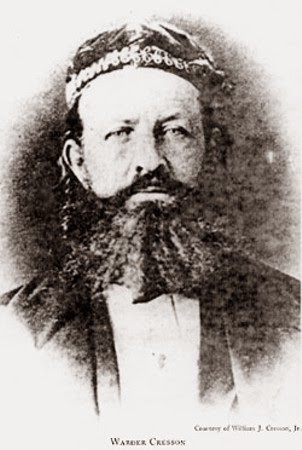
Rabbi Jacob Ettlinger and Warder Cresson

Rabbi Jacob Ettlinger and Warder Cresson
by Yirmiya Milevsky
Rabbi Jacob Ettlinger (1798 –1871) was a German rabbi and author, and one of the great leaders of Orthodox Judaism. He was born at Karlsruhe and died in Altona. He studied under Rabbi Abraham Bing in Würzburg, where he also attended the university. Because of his well-known greatness as a Torah scholar, questions were sent to him from across the globe. The following question relates to a story that occurred in Jerusalem.
    According to Jewish Law, there is a list of activities that are prohibited on the Jewish Sabbath. Although resting on the Sabbath is one of the most important commandments for a Jew, the Talmud tells us that a Gentile is actually forbidden from resting on the Sabbath, and must perform one of the “prohibited” actions to be considered a righteous gentile. The following is the question presented to Rabbi Ettlinger with regard to this issue. (Responsa Binyan Tzion 91)
שו”ת בנין ציון סימן צא
ב”ה אלטאנא, יום ו’ כ”ו אייר תר”ט לפ”ק. להרה”ג וכו’ מ”ה אשר לעמיל נ”י הגאב”ד דק”ק גאלין וכעת משכן כבודו בירושלם עיה”ק תוב”ב.
כתב מעכ”ת נ”י וז”ל – ילמדנו רבינו בעובדא דאתא לידן פעה”ק ירושלם ת”ו יום ג’ כ”ג לירח אדר שני שנת תר”ח העבר לפ”ק נימול א”י אחד שבא הנה ממדינת מאראקא לשם גירות בפנינו בד”צ דקהל אשכנזים הי”ו וקיבל עליו המצות כדין וכדתה”ק ובש”ק שלאחריו עדן /עדין/ לא היה נתרפא ממילתו ולא טבל עודנה הגידו לי לאמר מזריזתו במצות איך הוא נזהר בשביתת שבת הגם שהוא עודנה /עודנו/ בכלל חולה שאב”ס =שאין בו סכנה= אינו מניח לגוי להבעיר אש בביתו והשבתי להם לדעתי לא מבעי’ שמותר לו לעשות מלאכה בשבת אלא אפילו מחויב ומוזהר על יום ולילה לא ישבותו וחייב לעשות מלאכה בשבת כ”ז שלא טבל לשם גירות וכה עשו השומעים למשמעתי והלכו אצל הגר והגידו לו בשמי כן בש”ק לאחר תפלת המנחה וכן עשה כי כתב איזה אותיות ויהי ביום המחרת כאשר נשמע הדבר בעה”ק ת”ו פה צווחו עלי חכמי ספרד וחכמי אשכנזים הי”ו על דבר חדש הלזו אשר לא נשמע מעולם אחרי שכבר קבל עליו כל המצות בשעת מילה וכבר נימול ועומד ומצפה בכל יום לטבול לכשיתרפא שיהי’ מותר לו לחלל וכש”כ שיהי’ עליו חיובא ומצוה לחלל ש”ק והמה זוכרים כמה גרים שנימולו פעה”ק ת”ו ולא נשמע כזאת ומנין לי לחדש דבר אשר לא שערום הראשונים והשבתי להם אולי מקום הניחו לי להתגדר בו
    “Here in Jerusalem on Tuesday the twenty third day of the month of Adar Sheni of the year (5)608, a non Jew came from Morocco and was circumcised for the sake of conversion, and accepted all the mitzvoth. On the following Shabbat, he had not fully recovered from the circumcision and thus not entered the Mikvah (ritual bath to finalize the conversion). A rabbi was informed that the convert is very careful in his observance of the Sabbath. However another rabbi claimed that due to the fact that he did not yet enter the Mikvah he must not observe the Sabbath and must perform one of the prohibited acts. It was late in the day and the convert was told what he must do. Consequently he violated the Sabbath by writing a few letters. After the Sabbath when the Rabbis in town heard of the ruling they disagreed claiming that after circumcision he is considered a Jew and must not violate the Sabbath.”
    While reading about this out of the ordinary situation, that produce a vast amount of Halachic literature,[1]  a question may arise in our minds: What brought this Moroccan to Jerusalem and what prevented him from converting in his homeland where a very significant Jewish population and rabbinic court was present?
**********************
Some time ago I came across an article by Frank Fox, entitled  “Quaker, Shaker, Rabbi: Warder Cresson, the Story of a Philadelphia Mystic.” Pennsylvania Magazine of History and Biography 95, no. 2 (April 1971): 147-194  Philadelphia.(Unless otherwise indicated all information and quotes are from the article.)
The narrative follows the unorthodox journey of Cresson. Born  in 1798 and grew up following the habits of the Quaker elders.
    Warder displayed a mind immersed in Scriptures. In 1829, Cresson wrote a condemnation on the “Babylon” of Pennsylvania, attacking wealth and social distinction. “It will certainly be admitted,” he began, “that all the misery and troubles that afflict the human family arise aspiring from …selfishness.” The lack of true religion, he wrote, a faith that ought to be expressed through self-denial and universal love, had brought about tyrannies and caused slavery and bloodshed.
    Cresson became familiar with a Jewish leader in Philadelphia, Rabbi Isaac Leeser, a pioneer of the Jewish pulpit in the United States. Leeser, the minister of Congregation Mikveh Israel since 1829, was using his pulpit to educate and to revive the deteriorating communal and religious organizations.
    Another contemporary, whose views affected Cresson, was Mordecai M. Noah, who addressed Christian and Jewish audiences in New York and Philadelphia in the early 1840s and urged a return to Zion as the only solution to the Jewish problem of persecution. In 1825, he attempted to establish “Ararat”, a city of refuge for the Jewish people on Grand Island in the Niagara River.
    In 1844, Cresson decided to go to Washington and to apply for the position of the first American Consul to Jerusalem. by May 17, was officially notified of his appointment. His appointment was rescinded within a short time. Nevertheless Cresson made his way to Jerusalem.
    After his arrival Cresson wrote critically of the high salaries paid to the missionaries who lived “in the very best houses, bought most splendid Arabian horses and dressed in the most luxurious and stylish manner.” As for their practical work, he wrote that, “To further their imposing and enterprising object they built a church which has cost them more than $150,000; then a hospital and Dispensary, sent physicians from England, set up an institution of Industry and also a college and schools, all to entrap and instruct the poor, dirty, oily, greasy, starving Jews and to tempt and provide them with good livings, fine English clothing, upon the only one condition that they will give their names and use all their influence to support and promote the interest of their Society for introducing and establishing Sawdust instead of Good Old Cheese, amongst the poor Jews in Jerusalem and Palestine.” According to Cresson, the missionaries failed to get a single Jew to apostatize.
   
    In 1847, Cresson began writing, “The Key of David the True Messiah”, in which he began his journey towards Judaism.    Finally, after denying the divinity of Jesus, Cresson was ready for the final step of his spiritual journey. He writes, “I remained in Jerusalem in my former faith until the 28th day of March, 1848,” he wrote, “when I became fully satisfied that I could never obtain Strength and Rest, but by doing as Ruth did, and saying to her Mother-in-Law, or Naomi ‘Entreat me not to leave thee for whither thou goest I will go’… In short, upon the 28th day of March, 1848, I was circumcised, entered the Holy Covenant and became a Jew.”
Cresson- or Michoel Boaz Yisroel ben Avraham- returned to the United States for a few years. Upon his return to Jerusalem in 1852 he married a Sephardic woman named Rachel Moledano. Cresson died in 1865 and was buried on Mount Olives.
Many aspects of his life are quite intriguing and fascinating. However one detail provides the answer for the mystery regarding the “Moroccan” convert in Rabbi Jacob Ettlinger’s response. Cresson identifies the date of his conversion, The 28th of March 1848 – the day Warder Cresson became Michael Boaz Yisrael – corresponds to the 23rd of Adar Sheini in the Jewish year (5)608. In other words, the conversions occurred on the same day! The response indicates that conversions in Jerusalem were pretty unusual,(והמה זוכרים כמה גרים שנימולו פעה”ק ת”ו- And they recall conversions from the past…) making it difficult to believe that there were two conversions on that specific day.  
Consequently, I believe that the non Jew in Rabbi Jacob Ettlinger’s response did not come from Morocco but rather from America. In Hebrew, the spelling of America can be easily mistaken for Morocco (“מאראקא”). Cresson indeed came to Jerusalem “for the sake of conversion”.
************************************
[1]  The question is addressed by several Halachak authorities; See
Divrei Yosef Rabbi Yosef Schwartz 24(First hand knowledge of the incident) : Rabbi Abraham Bornstein; Avnei Nezer, Yoreh Deah 351: Rabbi Yeshua Shimon Chaim Ovadyah; Yismach Levav, Yoreh Deah 33: Aryeh Leib Frumkin in his Toldot Chachmei Yerushalayim mentioned as well the Halachik dispute regarding the Ger from “Morocco.”
http://hebrewbooks.org/pdfpager.aspx?req=36973&st=&pgnum=640


The Identity and Meaning of Chashmonai

The Identity and Meaning of Chashmonai [1]
By Mitchell  First
(MFirstatty@aol.com)
        The name Chashmonai appears many times in the Babylonian Talmud, but usually the references are vague. The references are either to beit Chashmonai, malkhut Chashmonai, malkhut beit Chashmonai, malkhei beit Chashmonai, or beit dino shel Chashmonai.[2]  One time (at Megillah 11a) the reference is to an individual named Chashmonai, but neither his father nor his sons are named.
           The term Chashmonai (with the spelling חשמוניי) appears two times in the Jerusalem Talmud, once in the second chapter of Taanit and the other in a parallel passage in the first chapter of Megillah.[3] Both times the reference is to the story of Judah defeating the Syrian military commander Nicanor,[4] although Judah is not mentioned by name. In the passage in Taanit, the reference is to echad mi-shel beit Chashmonai.[5] In the passage in Megillah, the reference is to echad mi-shel Chashmonai. Almost certainly, the passage in Taanit preserves the original reading.[6] If so, the reference is again vague.
 
           Critically, the name Chashmonai is not found in any form in I or II Maccabees, our main sources for the historical background of the events of Chanukkah.[7] But fortunately the name does appear in two sources in Tannaitic literature.[8] It is only through one of these two sources that we can get a handle on the identity of Chashmonai.
————
       Already in the late first century, the identity of Chashmonai seems to have been a mystery to Josephus. (Josephus must have heard of the name from his extensive Pharisaic education, and from being from the family.) In his Jewish War, he identifies Chashmonai as the father of Mattathias.[9] Later, at XII, 265 of his Antiquities, he identifies Chashmonai as the great-grandfather of Mattathias.[10] Probably, his approach here is the result of his knowing from I Maccabees 2:1 that Mattathias was the son of a John who was the son of a Simon, and deciding to integrate the name Chashmonai with this data by making him the father of Simon.[11] It is very likely that Josephus had no actual knowledge of the identity of Chashmonai and was just speculating here. It is too coincidental that he places Chashmonai as the father of Simon, where there is room for him. If Josephus truly had a tradition from his family about the specific identity of Chashmonai, it would already have been included in his Jewish War.
   The standard printed text at Megillah 11a implies that Chashmonai is not Mattathias: she-he-emadeti lahem Shimon ha-Tzaddik ve-Chashmonai u-vanav u-Matityah kohen gadol…This is also the implication of the standard printed text at Soferim 20:8, when it sets forth the Palestinian version of the Amidah insertion for Chanukkah; the text includes the phrase: Matityahu ben Yochanan kohen gadol ve-Chashmonai u-vanav…[12] There are also midrashim on Chanukkah that refer to a Chashmonai who was a separate person from Mattathias and who was instrumental in the revolt.[13]
        But the fact that I Maccabees does not mention any separate individual named Chashmonai involved in the revolt strongly suggests that there was no such individual. Moreover, there are alternative readings at both Megillah 11a and Soferim 20:8.[14] Also, the midrashim on Chanukkah that refer to a Chashmonai who was a separate person from Mattathias are late midrashim.[15] In the prevalent version of Al ha-Nissim today, Chashmonai has no vav preceding it.[16]
        If there was no separate person named Chashmonai at the time of the revolt, and if the statement of Josephus that Chashmonai was the great-grandfather of Mattathias is only a conjecture, who was Chashmonai?
           Let us look at our two earliest sources for Chashmonai.  One of these is M. Middot 1:6.[17]
                        …המוקד בבית היו לשכות ארבע  [18]…ייון מלכי ששיקצום המזבח אבני את חשמוניי בני גנזו בה צפונית מזרחית
From here, it seems that Chashmonai is just another name for Mattathias. This is also the implication of Chashmonai in many of the later passages.[19]
             The other Tannaitic source for Chashmonai is Seder Olam, chap. 30. Here the language is: malkhut beit Chashmonai meah ve-shalosh =the dynasty of  the House of Chashmonai, 103 [years].[20] Although one does not have to interpret Chashmonai here as a reference to Mattathias,  this interpretation does fit this passage.
          Thus a reasonable approach based on these two early sources is to interpret Chashmonai as another way of referring to Mattathias.[21] But we still do not know why these sources would refer to him in this way. Of course, one possibility is that it was his additional name.[22] Just like each of his five sons had an additional name,[23] perhaps Chashmonai was the additional name of Mattathias.[24] But I Maccabees, which stated that each of Mattathias’ sons had an additional name, did not make any such statement in the case of Mattathias himself.
         Perhaps we should not deduce much from this omission. Nothing required the author of I Maccabees to mention that Mattathias had an additional name. But one scholar has suggested an interesting reason for the omission.  It is very likely that a main purpose of I Maccabees was the glorification of Mattathias in order to legitimize the rule of his descendants.[25] Their rule needed legitimization because the family was not from the priestly watch of Yedayah. Traditionally, the high priest came from this watch.[26] I Maccabees achieves its purpose by portraying a zealous Mattathias and creating parallels between Mattathias and the Biblical Pinchas, who was rewarded with the priesthood for his zealousness.[27] Perhaps, it has been suggested, the author of I Maccabees left out the additional name for Mattathias because it would remind readers of the obscure origin of the dynasty.[28] (We will discuss why this might have been the case when we discuss the meaning of the name in the next section.)
—–
             We have seen that a reasonable approach, based on the two earliest rabbinic sources, is to interpret Chashmonai as another way of referring to Mattathias.
        The next question is the meaning of the name. The name could be based on the name of some earlier ancestor of Mattathias. But we have no clear knowledge of any ancestor of Mattathias with this name.[29] Moreover, this only begs the question of where the earlier ancestor would have obtained this name.[30] The most widely held view is that the name Chashmonai   derives from a place that some ancestor of Mattathias hailed from a few generations earlier. (Mattathias and his immediate ancestors hailed from Modin.[31]) For example, Joshua 15:27 refers to a place called Cheshmon in the area of the tribe of Judah.[32] Alternatively, a location Chashmonah is mentioned at Numbers 33:29-30 as one of the places that the Israelites encamped in the desert.[33] In either of these interpretations, the name may have reminded others of the obscure origin of Mattathias’ ancestors and hence the author of I Maccabees might have refrained from using it.
        It has also been observed that the word חשמנים  (Chashmanim) occurs at Psalms 68:32:
                     .לאלקים מני מצרים; כוש תריץ ידיו חַשְׁמַנִּים יאתיו
      Chashmanim will come out of Egypt;  Kush shall hasten her hands to God.
(The context is that the nations of the world are bringing gifts and singing to God.[34])
             It has been suggested that the name Chashmonai is related to חשמנים here.[35] Unfortunately, this is the only time the word חשמנים appears in Tanakh, so its meaning is unclear.[36] The Septuagint translates it as πρέσβεις (=ambassadors).[37] The Talmud seems to imply that it means “gifts.”[38] Based on a similar word in Egyptian, the meanings “bronze,” “natron” (a mixture used for many purposes including as a dye), and “amethyst” (a quartz of blue or purplish color) can be suggested.[39] Ugaritic and Akkadian have a similar word with the meaning of a color, or colored stone, or a coloring of dyed wool or leather; the color being perhaps red-purple, blue, or green.[40] Based on this, meanings such as red cloth or blue cloth have been suggested.[41] Based on similar words in Arabic, “oil” and “horses and chariots” have been proposed.[42] A connection to another hapax legomenon, אשמנים,[43] has also been suggested. אשמנים perhaps means darkness,[44] in which case חשמנים, if related, may mean dark-skinned people.[45] Finally, it has been suggested that חשמנים derives from the word שמן  (oil), and that it refers to important people, i.e., nobles, because the original meaning is “one who gives off light.” (This is akin to “illustrious” in English).[46]
      But the simplest interpretation is that it refers to a people by the name חשמנים.[47] An argument in favor of this is that חשמנים seems to be parallel to Kush, another people, in this verse. Also, יאתיו is an active form; it means “will come,” and not “will be brought.”[48]
        Whatever the meaning of the word חשמנים, I would like to raise the possibility that an ancestor of Mattathias lived in Egypt for a period and that people began to call him something like Chashmonai upon his return, based on this verse.
                                             Conclusions
       Even though Josephus identifies Chashmonai as the great-grandfather of Mattathias, this was probably just speculation. It is too coincidental that he places Chashmonai as the father of Simon, precisely where there is room for him.
        The most reasonable approach, based on the earliest rabbinic sources, is to interpret Chashmonai as another way of referring to Mattathias, either because it was his additional name or for some other reason. A main purpose of I Maccabees was the glorification of Mattathias in order to legitimize the rule of his descendants. This may have led the author of I Maccabees to leave the name out; the author would not have wanted to remind readers of the obscure origin of the dynasty.
       Most probably, the name Chashmonai derives from a place that some ancestor of the family hailed from.
—–
       A few other points:
            º Most probably, the name חשמונאי did not originally include an aleph. The two earliest Mishnah manuscripts, Kaufmann and Parma (De Rossi 138), spell the name חשמוניי.[49] This is also how the name is spelled in the two passages in the Jerusalem Talmud.[50] As is the case with many other names that end with אי (such as שמאי), the aleph is probably a later addition that reflects the spelling practice in Babylonia.[51]
            º The plural חשמונאים is not found in the rabbinic literature of the Tannaitic or Amoraic periods,[52] and seems to be a later development.[53] (An alternative plural that also arose is חשמונים; this plural probably arose earlier than the former.[54]) This raises the issue of whether the name was ever used in the plural in the Second Temple period.
       The first recorded use of the name in the plural is by Josephus, writing in Greek in the decades after the destruction of the Temple.[55] It is possible that the name was never used as a group name or family name in Temple times and that we have been misled by the use of the plural by Josephus.[56] On the other hand, it is possible that by the time of Josephus the plural had already come into use and Josephus was merely following prevailing usage. In this approach, how early the plural came into use remains a question.
      Since there is no evidence that the name was used as a family or group name at the time of Mattathias himself, the common translation in Al ha-Nissim: “the Hasmonean” (see, e.g., the Complete ArtScroll Siddur, p. 115) is misleading. It implies that he was one of a group or family using this name at this time. A better translation would be “Chashmonai,” implying that it was a description/additional name of Mattathias alone.
  °  The last issue that needs to be addressed is the date of Al ha-Nissim.
    According to most scholars, the daily Amidah was not instituted until the time of R. Gamliel, and even then the precise text was not fixed.[57] Probably, there was no Amidah at all for most of the Second Temple period.[58] The only Amidot that perhaps came into existence in some form in the late Second Temple period were those for the Sabbath and Biblical festivals.[59] Based on all of the above, it is extremely unlikely that any part of our text of Al ha-Nissim dates to the Hasmonean period.
    The concept of  an insertion in the Amidah for Chanukkah is found already at Tosefta Berakhot 3:14. See also, in the Jerusalem Talmud, Berakhot 4:1 and 7:4, and in the Babylonian Talmud, Shabbat 24a, and perhaps Shabbat 21b.[60] But exactly what was being recited in the Tannaitic and Amoraic periods remains unknown. The version recited today largely parallels what is found in the sources from Geonic Babylonia. The version recited in Palestine in the parallel period was much shorter. See Soferim 20:8 (20:6, ed. Higger).[61] The fact that the Babylonian and Palestinian versions differ so greatly suggests that the main text that we recite today for Al ha-Nissim is not Tannaitic in origin. On the other hand, both versions do include a line that begins biymei Matityah(u), so perhaps this line is a core line and could date as early as the late first century or the second century C.E.[62]
    In any event, the prevalent version of Al ha-Nissim today, Matityahu … kohen gadol Chashmonai u-vanav, can easily be understood as utilizing Chashmonai as an additional name for Mattathias. But this may just be coincidence. It is possible that the author knew of both names, did not understand the difference between them, and merely placed them next to one another.[63]
        On the other hand, we have seen the reading ve-Chashmonai in both Al ha-Nissim and Tractate Soferim. Perhaps this was the original reading, similar to the reading in many manuscripts of Megillah 11a. Perhaps all of these texts were originally composed with the assumption that Mattathias and Chashmonai were separate individuals. But there is also a strong possibility that these vavs arose later based on a failure to understand that the reference to Chashmonai was also a reference to Mattathias.
——
      Postscript: Anyone who is not satisfied with my explanations for Chashmonai can adopt the explanation intuited by my friend David Gertler when he was a child. His teacher was talking to the class about Mattityahu-Chashmonai and his five sons, without providing any explanation of the name Chashmonai. David reasoned: it must be that he is called חשמני because he had five sons (i.e., חמשי metathesized into חשמי/חשמני)![64]


[1] I would like to thank Rabbi Avrohom Lieberman, Rabbi Ezra Frazer, and Sam Borodach for reviewing the draft.  I will spell the name Chashmonai throughout, as is the modern convention, even though the vav has a shuruk in the Kaufmann manuscript of the Mishnah and Chashmunai may be the original pronunciation
[2]  The references to beit dino shel Chashmonai are at Sanhedrin 82a and Avodah Zarah 36b.    The balance of the references are at: Shabbat 21b,  Menachot 28b  and 64b, Kiddushin 70b, Sotah 49b, Yoma 16a, Rosh ha-Shanah 18b and 24b, Taanit 18b, Megillah 6a, Avodah Zarah 9a, 43a, and 52b, Bava Kamma 82b, and  Bava Batra 3b. For passages in classical midrashic literature that include the name Chashmonai, see, e.g., Bereshit Rabbah 99:2, Bereshit Rabbah 97 (ed. Theodor-Albeck, p. 1225), Tanchuma Vayechi 14, Tanchuma Vayechi, ed. Buber, p. 219, Tanchuma Shofetim 7,  Pesikta de-Rav Kahana, p. 107 (ed. Mandelbaum), and Pesikta Rabbati 5a and 23a (ed. Ish Shalom). See also Midrash ha-Gadol to Genesis 49:28 (p. 866). The name is also found in the Targum to I Sam. 2:4 and Song of Songs 6:7.
     The name is also found in sources such as Al ha-Nissim, the scholion to Megillat Taanit, Tractate Soferim, Seder Olam Zuta, and Midrash Tehillim. These will be discussed further below.
     The name is also found in Megillat Antiochus. This work, originally composed in Aramaic, seems to refer to bnei Chashmunai and/or beit Chashmunai. See Menachem Tzvi Kadari, “Megillat Antiochus ha-Aramit,” Bar Ilan 1 (1963), p. 100 (verse 61 and notes) and p. 101 (verse 64 and notes). There is also perhaps a reference to the individual. See the added paragraph at p. 101 (bottom). This work is generally viewed as very unreliable. See, e.g., EJ 14:1046-47.
Most likely, it was composed in Babylonia in the Geonic period.  See Aryeh Kasher, “Ha-Reka ha-Historiy le-Chiburah shel Megillat Antiochus,” in Bezalel Bar-Kochva, ed., Ha-Tekufah ha-Selukit be-Eretz Yisrael (1980), pp. 85-102,  and Zeev Safrai, “The Scroll of Antiochus and the Scroll of Fasts,” in The Literature of the Sages, vol. 2, eds. Shmuel Safrai, Zeev Safrai, Joshua Schwartz, and Peter J. Tomson (2006). A Hebrew translation of Megillat Antiochus was included in sources such as the Siddur Otzar ha-Tefillot and in the Birnbaum Siddur.
[3] Taanit 2:8 (66a) and Megillah 1:3 (70c). In the Piotrkow edition, the passages are at Taanit 2:12 and Megillah 1:4.
[4] This took place in 161 B.C.E. On this event, see I Macc. 7:26-49, II Macc. 15:1-36, and Josephus, Antiquities XII, 402-412.  The story is also found at Taanit 18b, where  the name of the victor
is given more generally as  malkhut beit Chashmonai.
[5] Mi-shel and beit are combined and written as one word in the Leiden manuscript. Also, there is a chirik under the nun. See Yaakov Zusman’s 2001 edition of the Leiden manuscript, p. 717.
[6] The phrase echad mi-shel Chashmonai  is awkward and unusual; it seems fairly obvious that a word such as beit is missing. Vered Noam, in her discussion of the passages in the Jerusalem Talmud about Judah defeating Nicanor, adopts the reading in Taanit and never even mentions the reading in Megillah. See her Megillat Taanit (2003), p. 300.
   There are no manuscripts of the passage in Megillah other than the Leiden manuscript. There is another manuscript of the passage in Taanit. It is from the Genizah and probably dates earlier than the Leiden manuscript (copied in 1289). It reads echad mi-shel-beit Chashmonai. See Levi (Louis) Ginzberg, Seridei ha-Yerushalmi (1909), p. 180.
   Mi-shel and Chashmonai are combined and written as one word in the Leiden manuscript of the passage in Megillah and there is no vocalization under the nun of Chashmonai here.
[7]  I Maccabees was probably composed after the death of John Hyrcanus in 104 B.C.E., or at least when his reign was well-advanced. See I Macc. 16:23-24.  II Maccabees is largely an abridgment of the work of someone named Jason of Cyrene. This Jason is otherwise unknown. Many scholars believe that he was a contemporary of Judah. Mattathias is not mentioned  in II Macc. The main plot of  the Chanukkah story (=the persecution of the Jews by Antiochus IV and the Jewish rededication of the Temple) took place over the years 167-164 B.C.E.
[8] M. Middot 1:6 (benei Chashmonai) and Seder Olam, chap. 30 (malkhut beit Chashmonai).
[9] I, 36. This view is also found in Seder Olam Zuta, chap. 8.
   Earlier, at I, 19, he wrote that Antiochus Epiphanes was expelled by ’Ασαμωναίου παίδων (“the sons of”  Chashmonai; see the Loeb edition, p. 13, note a. ). This perhaps implies an equation of Chashmonai and Mattathias, But παίδων probably means “descendants of” here.
[10] XII, 265. Jonathan Goldstein in his I Maccabees
(Anchor Bible, 1976),  p. 19,  prefers a different translation of the Greek here. He claims that, in this passage, Josephus identifies Chashmonai with Simon. But Goldstein’s translation of this passage is not the one adopted by most scholars.
   There are also passages in Antiquities that could imply that Chashmonai is to be identified with Mattathias. See XX, 190, 238, and 249. But παίδων probably has the meaning of  “descendants of ” (and not “sons of”) in these passages, and there is no such identification implied.
   The ancient table of contents that prefaces book XII of Antiquities identifies Chashmonai as the father of Mattathias. See Antiquities, XII,  pp. 706-07, Loeb edition. (This edition publishes these tables of contents at the end of each book.) But these tables of contents may not have been composed by Josephus but by his assistants. Alternatively, they may have been composed centuries later.
In his autobiographical work Life (paras. 2 and 4), Josephus mentions Chashmonai as his ancestor. But the statements are too vague to determine his identity. This work was composed a few years after Antiquities.
[11] Goldstein suggests (pp. 60-61) that Josephus did not
have I Macc. in front of him when writing his Jewish War, even though Goldstein believes that Josephus had read it and was utilizing his recollection of it as a source. Another view is that Josephus drew his sketch of Hasmonean history in his Jewish War mainly from the gentile historian Nicolaus of Damascus.
    Most likely, even when writing Antiquities, Josephus did not have II Macc. or the work of Jason of Cyrene. See, e.g., Daniel Schwartz, Sefer Makabim ב (2008), pp. 30 and 58-59, Isaiah M. Gafni, “Josephus and I Maccabees,” in Josephus, the Bible, and history, eds. Louis H. Feldman and Gohei Hata (1989), p. 130, n. 39, and Menachem Stern, “Moto shel Chonyo ha-Shelishi,” Tziyyon 25
(1960), p. 11.
[12] I am not referring to the Palestinian version as Al ha-Nissim, since it lacks this phrase. The text of Al ha-Nissim in the Seder R. Amram (ed. Goldschmidt, p. 97) is the same (except that it reads Matityah). See also R. Abraham Ha-Yarchi (12th cent.), Ha-Manhig (ed. Raphael), vol. 2, p. 528, which refers to Matityah kohen gadol ve-Chashmonai u-vanav, and seems to be quoting here from an earlier midrashic source. Finally, see Midrash Tehillim, chap. 30:6 which refers to Chashmonai u-vanav and then to beney Matityahu. The passages clearly imply that these are different groups.
[13] See the midrashim on Chanukkah first published by
Adolf Jellinek in the mid-19th century, later republished by Judah
David Eisenstein in his Otzar Midrashim (1915). Mattathias and Chashmonai are clearly two separate individuals in the texts which Einsenstein calls Midrash Maaseh Chanukkah and Maaseh Chanukkah, Nusach ‘ב. See also
Rashi to Deut. 33:11 (referring to twelve sons of  Chashmonai).
[14] As  I write this, Lieberman-institute.com records four manuscripts that have Chashmonai with the initial vav like the Vilna edition, two manuscripts that have Chashmonai without the initial vav (Goettingen 3, and Oxford Opp. Add. fol. 23), and one manuscript (Munich 95) that does not have the name at all. (Another manuscript does not have the name but it is too fragmentary.) There are three more manuscripts of Megillah 11a, aside from what is presently recorded on Lieberman-institute.com. See Yaakov Zusman, Otzar Kivei ha-Yad ha-Talmudiyyim (2012), vol. 3,  p. 211. I have not checked these.
    With regard to the passage in Soferim 20:8, there is at least one manuscript that reads חשמונאי (without the initial vav). See Michael Higger, ed., Massekhet Soferim (1937), p. 346, line 35 (text). (It seems that Higger printed the reading of  ms.ב  in the text here.)
[15] These midrashim are estimated to have been compiled in the 10th century. EJ 11:1511.
[16] The prevalent version is based on the Siddur Rav Saadiah Gaon (p. 255): Matityah ben Yochanan kohen gadol Chashmonai u-vanav. This version too can be read as reflecting the idea that Chashmonai was a separate person.
[17] Middot is a tractate that perhaps reached close to
complete form earlier than most of the other tractates. See Abraham Goldberg, “The Mishna- A Study Book of Halakha,” in The Literature of the Sages, vol. 1, ed. Shmuel Safrai (1987).
[18] The above is the text in the Kaufmann Mishnah manuscript. Regarding the word beney, this is the reading in both the Kaufmann and Parma (De Rossi 138) manuscripts. Admittedly, other manuscripts of Mishnah Middot 1:6, such as the one included in the Munich manuscript of the Talmud, read ganzu beit Chashmonai.
But the Kaufmann and Parma (De Rossi 138) manuscripts are generally viewed as the most reliable ones. Moreover, the beit reading does not fit the context. Since the references to Chashmonai in the Babylonian Talmud are often prefixed by the word beit and are never prefixed by the word beney, we can understand how an erroneous reading of beit could have crept into the Mishnah here.
      The Mishnah in Middot is quoted at Yoma 16a and Avodah Zarah 52b. At Yoma 16a, Lieberman-institute.com presently records five manuscripts or early printed editions with beit, and none with bnei. At Avodah Zarah 52b, it records three with beit and one with beney. (The Vilna edition has beit in both places.) Regarding the spelling חשמוניי in the Mishnah, most likely, this was the original spelling of the name. See the discussion below.
[19] See, e.g., Bereshit Rabbah 99:2: חשמונאי  בני ביד  נופלת  יון מלכות  מי ביד,  Bereshit Rabbah 97 (ed. Theodor-Albeck, p. 1225): לוי של משבטו היו חשמוניי שבני,  Pesikta Rabbati 5a, Tanchuma Vayechi 14, Tanchuma Vayechi, ed. Buber, p. 219, Pesikta de-Rav Kahana, p. 107, and Midrash ha-Gadol to Genesis 49:28. See also the midrash published by Jacob Mann and Isaiah Sonne in The Bible as Read and Preached in the Old Synagogue, vol. 2 (1966), p. עב.
      I also must mention the scholion to Megillat
Taanit
. (I am not talking about Megillat Taanit itself. There are no references to Chashmonai there.) As Vered Noam has shown in her critical edition of Megillat Taanit, the two most important manuscripts to the scholion are the Parma manuscript and the Oxford manuscript.
      If we look at the Parma manuscript to the scholion to 25 Kislev, it uses the phrase nikhnesu beney Chashmonai le-har ha-bayit, implying that the author of this passage viewed Chashmonai as Mattathias.
        On 14 Sivan, the Oxford manuscript of the scholion tells us that חשמונאי יד וכשגברה, the city of קסרי was conquered. Probably, the author of this passage is referring to the acquisition of Caesarea by Alexander Yannai, and the author is using Chashmonai loosely. Probably the author meant beit Chashmonai or malkhut beit Chashmonai. (One of these may even have been the original text.)
       On 15-16 Sivan, the Parma manuscript of the scholion tells us about the military victory of  חשמונאי בני over Beit Shean. We know from Josephus (Antiquities XIII, 275-83 and Jewish War I,  64-66) that this was a victory that occurred in the time of John Hyrcanus and that his the sons were the leaders in the battle. But it would be a leap to deduce that the author of this passage believed that John was חשמונאי. Probably, the author was using חשמונאי בני loosely and meant beit Chashmonai or malkhut beit Chashmonai. Not surprisingly, the Oxford manuscript has beit Chashmonai here.
       In the balance of the passages in the scholion, if we look only at the Parma and Oxford manuscripts, references to beit Chashmonai or malkhut beit Chashmonai  are found at 23 Iyyar, 27 Iyyar, 24 Av, 3 Tishrei, 23 Marchesvan, 3 Kislev, 25 Kislev, and 13 Adar.
[20] This passage is quoted at Avodah Zarah 9a. In the
Vilna edition, the passage reads malkhut Chashmonai. The three
manuscripts presently recorded at Lieberman-Institute.com all include the beit preceding חשמונאי. The other source recorded there is the Pesaro printed edition of 1515. This source reads  חשמוניי מלכות.
[21] One can also make this argument based on the passage
in the first chapter of Megillah in the Jerusalem Talmud: משלחשמוניי אחד ויצא. This passage tells a story about Judah (without mentioning him by name). But the parallel passage in the
second chapter of Taanit reads:  חשמוניי בית משל אחד אליו ויצא. As pointed out earlier, almost certainly this is the original reading. Moreover, if a passage intended to refer to a son of Chashmonai, the reading we would expect would be: חשמוניי מבני אחד ויצא.
[22] Goldstein, p. 19, n. 34, writes that the Byzantine
chronicler Georgius Syncellus (c. 800) wrote that Asamόnaios was
Mattathias’ additional name. Surely, this was just a conjecture by the chronicler or whatever source was before him.
[23] The additional names for the sons were: Makkabaios
(Μακκαβαîος),  Gaddi (Γαδδι), Thassi (Θασσι), Auaran (Αυαραν) and Apphous (Απφους). These were the names for Judah, John, Simon, Eleazar and Jonathan, respectively. See I Macc. 2:2-4.
[24] See, e.g., Goldstein, pp. 18-19.  Goldstein also writes (p. 19): Our pattern of given name(s) plus surname did not exist among ancient Jews, who bore only a given name. The names of Mattathias and his sons were extremely common in Jewish priestly families. Where many persons in a society bear the same name, there must be some way to distinguish one from another. Often the way is to add to the over-common given name other names or epithets. These additional appellations may describe the person or his feats or his ancestry or his place of origin; they may even be taunt-epithets. The names Mattityah and Mattiyahu do occur in Tanakh, at I Ch. 9:31, 15:18, 15:21, 16:5, 25:3, 25:21, Ezra 10:43, and Nehemiah 8:4. But to say that these names were common prior to the valorous deeds of Mattathias and his sons is still conjectural. (Admittedly, the names did become common thereafter.)
[25]  See, e.g.,
Daniel R. Schwartz, “The other in 1 and 2 Maccabees,” in Tolerance and Intolerance in Early Judaism and Christianity, eds. Graham N. Stanton and Guy G. Stroumsa (1998), p. 30, Gafni, pp. 119 and 131 n. 49,  and Goldstein,  pp. 7 and 12. See particularly I Macc. 5:62. As mentioned earlier, I Maccabees was probably composed after the death of John Hyrcanus in 104 BCE, or at least when his reign was well-advanced. See I Macc. 16:23-24.
[26] According to I Macc. 2:1, Mattathias was from the priestly watch of Yehoyariv. Of course, even if he would have been from the watch of Yedayah, the rule of his descendants would have needed legitimization because they were priests and not from the tribe of Judah or the Davidic line.
[27] See, e.g., Goldstein, pp. 5-7 and I Macc. 2:26 and 2:54. Of course, the parallel to Pinchas is not perfect. As a result of his zealousness, Pinchas became a priest; he did not become the high priest.
[28]
Goldstein, pp. 17-19. Josephus, writing after the destruction of the Temple and not attempting to legitimize the dynasty, would not have had this concern. (I am hesitant to agree with Goldstein on anything, as his editions of I and II Maccabees are filled with far-reaching speculations. Nevertheless, I am willing to take his suggestion seriously here.)
[29] As mentioned earlier, the identification by Josephus of
Chashmonai as the great-grandfather of Mattathias is probably just speculation.
[30] It has been suggested that it was the name of an
ancestor. See, e.g., H. St. J. Thackeray, ed., Josephus: Life
(Loeb Classical Library, 1926), p. 3, who theorizes that the Hasmoneans were named after “an eponymous hero Hashmon.” Julius Wellhausen theorized that, at I Macc. 2:1, the original reading was “son of Hashmon,” and not “son of Simon.”
See Emil Schürer, The History of the Jewish People in the Age of Jesus Christ, revised and edited by Geza Vermes, Fergus Millar, and Matthew Black, vol. 1 (1973),  p. 194, n. 14.
[31] See I Macc. 2:70, 9:19, and  13:25.
[32]  See, e.g., Isaac Baer, Avodat Yisrael (1868), p. 101, EJ  7:1455, and Chanukah (ArtScroll Mesorah Series, 1981), p. 68.
[33] See, e.g., EJ 7:1455.  Another less likely alternative is to link the name with Chushim of the tribe of Benjamin, mentioned at I Ch. 8:11.
[34] The probable implication of the second part of verse
32 is that the people of Kush will hasten to spread their hands in prayer, or hasten to bring gifts with their hands. See Daat Mikra to 68:32.
[35] This is raised as a possibility by many scholars. Some of the rabbinic commentaries that suggest this include R. Abraham Ibn Ezra and Radak. See their commentaries on Ps. 68:32. See also Radak, Sefer ha-Shoreshim,חשמן , and R. Yosef Caro, Beit Yosef, OH 682. The unknown author of Maoz Tzur also seems to adopt this approach (perhaps only because he was trying to rhyme with השמנים).
[36] Some scholars are willing to emend the text. See, for example, the suggested emendations at Encyclopedia Mikrait 3:317,  entry חשמנים (such as משמנים = from the oil.) The Brown-Driver-Briggs Hebrew and English Lexicon (1906) writes that there is “doubtless” a textual error here.
[37] So too, Origen (third century). Some Rishonim interpret the termחשמנים  here as rulers or people of importance. See, e.g., the commentaries on Psalms 68:32 of Ibn Ezra (סגנים) and Radak. See also Radak, Sefer ha-Shoreshim, חשמן
,
and  R. Yosef Caro, Beit Yosef, OH 682. What motivates this interpretation is the use of the term in connection with Mattathias. But we do not know the meaning of the term in connection with Mattathias.
   [38] See Pes. 118b (דורון). Perhaps supporting this is verse 68:30 (lekha yovilu melakhim shai).  See Rashbam to Pes. 118b. Also, the interpretation מנות דורונות is found at Midrash Tehillim (ed. Buber, p. 320). It also seems to be the view of Rashi.
[39] On the Egyptian word ḥsmn as bronze or natron,
and reading one of these into this verse, see William F. Albright, “A Catalogue of Early Hebrew Lyric Poems,” Hebrew Union College Annual 23 (1950-51), pp. 33-34. Jeremy Black, “Amethysts,” Iraq 63 (2001), pp. 183-186, explains that ḥsmn also has the meaning amethyst in Egyptian. But he does not read this into Ps. 68:32. (He reads it into the Biblical  חשמל.)
[40] See, e.g., Black, ibid., and Itamar Singer, “Purple-Dyers
in Lazpa,” kubaba.univ-paris1.fr/recherche/antiquite/atlanta.pdf.
[41] Ludwig Koehler and Walter Baumgartner, The Hebrew
and Aramaic Lexicon of the Old Testament
(1994),  vol. 1, p. 362, interpret “bronze articles or red cloths.” Mitchell Dahood, Psalms II:51-100 (Anchor Bible, 1968) interprets “blue cloth.”
    Based on the Akkadian, George Wolf suggests that חשמנים refers to nobles and high officials because they wore purple clothing. See his Studies in the Hebrew Bible and Early Rabbinic Judaism (1994), p. 94
[42] For “oil,” see Encyclopedia Mikrait 3:317,
entry חשמנים (one of the many possible interpretations mentioned there).  For “horses and chariots,” see Daat Mikra to 68:32 (citing the scholar Arnold Ehrlich and the reference to the coming of
horses and chariots at Is. 66:20).
[43] See Is. 59:10  באשמנים (in the ashmanim).
[44] Ernest Klein,  A
Comprehensive Etymological Dictionary of the Hebrew Language for Readers of English
(1987), p. 58, writes that it usually translated as “darkness.” Some Rishonim who adopt this interpretation are Menachem ben Saruk (quoted in Rashi) and Ibn Janach. Note also the parallel to Psalms 143:3. On the other hand, the parallel to בצהרים at Is. 59:10 suggests that the meaning of  באשמנים is “in the light,” as argued by
Solomon Mandelkern in his concordance Heikhal ha-Kodesh (1896), p. 158.
[45] See Midrash Tehillim (ed. Buber, p. 320):  שחורים
אנשים.  This is the fourth interpretation suggested there. Buber puts the second, third, and fourth interpretations in parenthesis, as he believes they were not in the original text. The first interpretation is  מנות דורונות. The second and third interpretations are farfetched plays on words.
     Also, the original reading in the Targum Pseudo-Jonathan translation of חשמנים seems to be אוכמנא or אוכמנאי,    meaning “dark people.” See David M. Stec, The Targum of Psalms (2004) p. 133. The standard printed editions have a different reading (based on an early printed edition) and imply that חשמנים was the name of a particular Egyptian tribe.
[46] See Mandelkern, p. 433, who cites this view even though he disagrees with it.
[47] A modern scholar who takes this approach is Menachem
Tzvi Kadari. See his Millon ha-Ivrit ha-Mikrait (2006). This also seems to be the approach taken in the standard printed edition of the Targum Pseudo-Jonathan, even though this does not seem to be the original reading. See also Rashi to Ps. 68:32, citing Menachem ben Saruk who claims that they are the residents of  Chashmonah. See also Radak, Sefer ha-Shoreshim, חשמן (second suggestion) and Mandelkern, p. 433.
     Gen. 10:14 mentions כסלחים as one of
the sons of Mitzrayim. Interestingly, one of the three early texts of
the Septuagint (codex Alexandrinus, fifth cent.) reads Χασμωνιειμ
(=Chasmonieim) here. If this were the original reading, this would suggest that there were a people called Hashmanim (or something similar) in second century B.C.E. Egypt. But the Sinaiticus and Vaticanus codices (which are earlier than the Alexandrinus codex) do not have this reading; they have something closer to the Hebrew. Most likely, the reading in the Alexandrinus codex is just a later textual corruption. See John William Wevers, Notes on the Greek Text of Genesis (1993), p. 136.
[48] See similarly Deut. 33:21, Proverbs 1:27, Isaiah 41:5
and 41:25, and Job 3:25, 16:22, 30:14, and 37:22.
[49] The Kaufmann manuscript dates to the tenth or eleventh century. The Parma (De Rossi 138) manuscript dates to the eleventh century. The vocalization in both was inserted later. In the Kaufmann manuscript, there is a patach under the nun and a chirik under the first yod. Also, the vav is dotted with a shuruk. (The Parma manuscript does not have vocalization in tractate Middot; the manuscript is not vocalized throughout.).
     The Leiden manuscript of the Jerusalem Talmud includes a chirik under the nun in the passage in Taanit (66a). See Zusman’s 2001 edition of the Leiden manuscript, p. 717. There is no vocalization under the nun in the passage in Megillah (70c).
[50] חשמונאי is the spelling in all but one of the manuscripts and early printed editions of Seder Olam. One manuscript spells the name חשמוני. See  Chaim Joseph Milikowsky, Seder Olam: A Rabbinic Chronography (1981), p. 440.
     Also, חשמוניי  is the spelling in the text of Pesikta de-Rav Kahana that was published by Bernard Mandelbaum in his critical edition of this work (p. 107). (But see the notes for the variant readings.) Also, חשמוניי  is the spelling in the text of the Theodor-Albeck edition of Bereshit Rabbah, at section 97 (p. 1225). (But see the notes for the variant readings.). See also ibid., p. 1274, note to line 6 (חשמניי).
     Also, Lieberman-institute.com cites one manuscript of Menachot 64b with the spelling  חשמוניי. This is also the spelling used by R. Eleazar Kallir (early seventh century). See his piyyut for Chanukkah לצלעי נכון איד (to be published by Ophir Münz-Manor).
[51] I would like to thank Prof. Richard Steiner for pointing this out to me.
[52] Jastrow, entry חשמונאי, cites the plural as appearing in some editions of Bava Kama 82b (but not in the Vilna edition.) Lieberman-institute.com presently records five manuscripts of Bava Kama 82b. All have the word in the singular here. The EJ (7:1454) has an entry “Hasmonean Bet Din.” The entry has a Hebrew title as well: חשמונאים של דין בית. The entry cites to Sanhedrin 82a and Avodah Zarah 36b, and refers to “the court of the Hasmoneans.” (In the new edition of the EJ, the same entry is republished.) Yet none of the manuscripts presently recorded at Lieberman-institute.com on these two passages have the plural.
(Lieberman-institute.com presently records two manuscripts of Sanhedrin 82a and three manuscripts of Avodah Zarah 36b. According to Zusman, Otzar Kivei Ha-Yad Ha-Talmudiyyim, vol. 3, p. 233 and 235, there are three more manuscripts of Sanhedrin 82a extant. I have not checked these.)
     Probably, the reason for the use of the plural in the EJ entry is that scholars began to use the plural for this mysterious bet din, despite the two references in Talmud being in the singular. See, e.g., Zacharias Frankel, Darkhei ha-Mishnah (1859), p. 43.  Other erroneous citations to a supposed word חשמונאים are found at Chanukah (ArtScroll Mesorah Series), p. 68, n. 6.
[53] The earliest references to this plural that I am are
aware of are at Midrash Tehillim  5:11
(ובניו  חשמונאים),  and 93:1 (חשמונאים בני). But it is possible that
חשמונאים may not be the original reading in either of these
passages. The reference at 5:11 is obviously problematic. Also, the line may be a later addition to the work. See Midrash Tehillim, ed. Buber, p. 56, n. 66. (This work also refers to חשמונאי בית  and ובניו חשמונאי. See 22:9, 30:6, and 36:6.) The next earliest use of this plural that I am aware of is at Bereshit Rabbati, section Vayechi, p. 253 (ed. Albeck): חשמונאים בני. This work is generally viewed as an adaptation of an earlier (lost) work by R. Moshe ha-Darshan (11th cent.)
[54] חשמונים is found in the piyyut שמנה כל אעדיף   by R. Eleazar
Kallir (early seventh century) and in the works of several eighth century paytannim as well. Perhaps even earlier are the references in Seder Olam Zuta. See, e.g., the text of this work published by Adolf Neubauer in his Seder ha-Chakhamim ve-Korot ha-Yamim, vol. 2 (1895), pp. 71, 74 and 75. See also the Theodor-Albeck edition of Bereshit Rabbah, section 97, p. 1225, notes to line 2, recording a variant with the reading חשמונים. Also, Yosippon always refers to the חשמונים when referring to the group in the plural. (In the singular, his references are to חשמונאי and חשמוניי.) Also, Lieberman-institute.com
cites one manuscript of Megillah 6a (Columbia X 893 T 141) with the reading חשמונים.
[55] See his Jewish War, II, 344, and V, 139, and Antiquities
XV,403 (Loeb edition, p. 194, but see n. 1).
[56] It is interesting that a similar development occurred
in connection with the name “Maccabee.” The name was originally an additional name of Judah only. Centuries later, all of the brothers came to be referred to by the early church fathers as “Maccabees.” See Goldstein, pp. 3-4.
[57] See, e.g., Allen Friedman, “The Amida’s Biblical and Historical Roots: Some New Perspectives,” Tradition 45:3 (2012), pp.  21-34, and the many references there. Friedman writes (pp. 26-27): The first two points to be noted concerning the Amida’s history are that: (1) R. Gamliel and his colleagues in late first-century CE Yavneh created the institution of the Amida, its nineteen particular subjects, and the order of those subjects, though not their fully-fixed text, and (2) this creation was a critical part of the Rabbinic response to the great theological challenge posed by the Second Temple’s destruction and the ensuing exile…See also Berakhot 28b.
[58] Admittedly, this view disagrees with Megillah 17b which attributes the Shemoneh Esreh of eighteen blessings to an ancient group of 120 elders that included some prophets (probably an equivalent term for the Men of the Great Assembly.) But note that according to Megillah 18a, the eighteen blessings were initially instituted by the 120 elders, but were forgotten and later restored in the time of R. Gamliel and Yavneh. See also Berakhot 33a, which attributes the enactment of  תפילות to the Men
of the Great Assembly.
[59] See, e.g., the discussion by Joseph Tabory in
“Prayers and Berakhot,” in The Literature of the Sages, vol. 2, pp.
295-96 and 315-316. Tabory points to disagreements recorded between the House of Hillel and the House of Shammai regarding the number of blessings in the Amidot for Yom Tov and Rosh ha-Shanah when these fall on the Sabbath. See Tosefta Rosh ha-Shanah 2:16 and Tosefta Berakhot 3:13. Disagreements between the House of Hillel and the House of Shammai typically (but not exclusively) date to the last decades of the Temple period. See EJ 4:738. The reference to Choni ha-Katan in the story at Tosefta Rosh ha-Shanah also perhaps supports the antiquity of the disagreement. (This individual is not mentioned elsewhere in
Tannaitic or Amoraic literature.)
[60] With regard to Birkat ha-Mazon, the practice
of reciting Al ha-Nissim here seems to only have commenced in the Amoraic period. See Shabbat 24a.
[61] The first two words of the Palestinian version, פלאיך וכניסי, are also referred to in שמנה כל אעדיף, a Chanukkah piyyut by R. Eleazar Kallir (early seventh century).
[62] Early authorship of Al ha-Nissim is suggested
by the fact that some of its language resembles language in I and II Macc. See particularly I Macc. 1:49, 3:17-20, 4:24, 4:43, 4:55, and II Macc. 1:17 and 10:7. See also perhaps I Macc. 4:59. The original Hebrew version of I Macc. was still in existence at the time of Jerome (4th century). See  Goldstein,
p. 16.
[63] It has already been pointed out that Josephus, having I Maccabees 2:1 in front of him (=Mattathias was the son of  John who was the son of  Simon), was faced with a similar problem. The
solution of Josephus was to conjecture that Chashmonai was the father of
Simon.
[64] I Macc. 2:2-4 states explicitly that Mattathias had
five sons: John, Simon, Judah, Eleazar and Jonathan. Another brother, Ιωσηπον (=Joseph), is mentioned at II Macc. 8:22.But it has been suggested that the original reading here was Ιωαννης (=John), or that Joseph was only a
half-brother, sharing only a mother.