Anim Zemorot: A Modern Purim Parody

Anim Zemorot:  A Modern Purim Parody
For many centuries, parodies have been part of the Purim literature (see this post discussing their history).  One particularly popular genre of Purim literature has been the fake tefila.  Perhaps the best-known collection is the “Kol Bo” (first printed in L’vov, 1855 – see I. Davidson, Parody in Jewish Literature, n. 191 discussing this work, and a later example here) which runs the gamut of Kiddush to Yetziv Pitgam (de-Lot mi-S’dom) and Mareh Haman to an elaborate Haggada (known as Leil Shikkorim) and even includes a collection of "Shu"t Le-Purim (which isn't recorded in Kuntres ha-Teshuvot).  A collection of these and other Purim works have been recently republished in Ve-Nahafokh Hu, ed. Dov Goldberger, 2. vol., (https://www.getit.co.il/BN_Direct/43804/).Elli Schorr has added his own contributions over the years to this venerable genre. In honor of his daughter's Bat Mitzva (this past Rosh Chodesh Adar), he published his works, as well as several of the “classics” and some by Rabbi Aharon Frazer, to flesh out a preliminary “machzor” for Purim, entitled אנעים זמורות.  (The title, like many of the lines in the machzor, is a play whereby a sacred text undergoes a minor spelling change to reference wine, or drinking, or levity, etc.)  One wishes, incidentally, that Schorr would have actually composed a faux אנעים זמירות to include in the “liturgy”.

For over a decade, Schorr has been sending Purim mailings, on an informal basis, to friends and family (and some have appeared on his blog, purim365.blogspot.com, albeit not a fulsome treatment). Most have been of the tefila genre, but others have included a parody of Aviviah Gottlieb Zornberg’s books on Chumash (co-authored with Chaim and Shari Saiman) and particular pieces that have focused more on current events or community politics than the timeless nature of the tefila parody.  Having written pieces that have been parodies of Shabbat, Pesach, Shavu’ot, Yom Kippur, and Sukkot liturgy, among others, there was enough material to print something that would be more of an anthology, across the Jewish calendar.  As he has developed more knowledge of the world of classical piyyut (largely owing to the tutelage of his neighbor, Prof. Avi Shmidman), he has also reworked older piyyutim to better reflect paytanic sensibilities.  For example, his old Tefilat Gefen (a takeoff on Geshem) was reworked this year to be an alphabetic acrostic, like the original Geshem.  Some of the rhyme scheme, though, was left imperfect, at the preference of a good punchline.

Some of the more recent works, such as ברכת המזון, a spoof of the special bentsching recited at a Brit Milah, are more faithful to the paytanic conventions of proper rhymes and meter and often include a חתימה מקראית where the last line of a stanza is a direct quote of a pasuk.  This may be the best example in the book of a parody of both the form and the content.  The stanzas are to a meter and rhyme identical to the original and, if sung with the nusach, sound authentic.  Additionally, the רשות asked at the beginning of the zimmun is turned on its head, and permission is asked of, inter alia, mamzerim, chalalim, and Haman’s children. The הרחמן section at the end turns both the blood covenant and the eschatological visions into dreams of a great, big, drunken Purim se’udah.Other pieces reappearing here, with minor varations (and many of them with nikkud for the first time, though with some errors in the preliminary draft edited here), are an akdamut retelling the story of Purim in faux Aramaic, Kabbalat Shabbat witha במה משתכרין nd כגוונא   both, a stream-of-consciousness Kiddush published by Professor J. Tabory attributed to his late father, Rabbi Zvi Tabory, and a מראה כהן  depicting a kohen having delivered a ruling regarding mareh nega’im, changing the meaning of the phrase mareh kohen.Several pieces make their first appearance in this addition.  The most ambitious is a parody of amitz koach (“mitz koach”, excerpted below) written according to the same poetic convention as the original (alphabetical acrostic, 5 words per each non-rhyming line) and, like many of the Yom kippur piyyutim, starts from the Creation and works its way to the main event. In this case, the event is not the Temple service, but is the Shushan chain of events.  Instead of the priests prostrating themselves, those in the king’s courtyard do so (when Haman passes by); instead of a goat tumbling down hill, drunkards are rolling away; instead of counting blood sprinkles, Haman’s sons (or, alternatively, glasses of wine drunk) are counted. Written with the sensibilities of a chazzan, ואף הוא היה מתכוון works well with Rosenblatt’s classic niggun for a duet.  Several smaller pieces, not bearing enough humorous content to stand alone, are included here as well.  One is a special nusakh inspired by last year’s Erev Pesach where, in one morning, we had bi’ur chametz, bi’ur of shevi’it wine, birkat ha-chammah, and siyyum for the first borns.  Another piece is a short “ushpizin” for Purim.  A parody of the prayer for the government (תפילה לשלום חמר המדינה) appears below, as does a special version of the trop for annoying people. (See below for a few examples.)

People interested in obtaining one of the remaining hard copies, should contact the author directly, at elli dot Schorr at gmail.


The Origin and Evolution of a “Rashi Yashan”- In Praise of Artscroll Rashi Breishit 12:2 – “ואעשך לגוי גדול”

The Origin and Evolution of a “Rashi Yashan”- In Praise of Artscroll
Rashi Breishit 12:2 – “ואעשך לגוי גדול

Eli Genauer

The term “רש״י ישן in printed editions often appears after a comment recorded in parentheses. An example of this is Rashi in Breishit 12:2. Here is how it looks in the first edition of the Artscroll Stone Chumash printed in November 1993:

Rashi’s comments are recorded as follows

Comment #1

ואעשך לגוי גדול. לְפִי שֶׁהַדֶּרֶךְ גּוֹרֶמֶת לִשְׁלֹשָׁה דְבָרִים, מְמַעֶטֶת פְּרִיָּה וּרְבִיָּה וּמְמַעֶטֶת אֶת הַמָּמוֹן וּמְמַעֶטֶת אֶת הַשֵּׁם, לְכָךְ הֻזְקַק לִשְׁלֹשָׁה בְּרָכוֹת הַלָּלוּ, שֶׁהִבְטִיחוֹ עַל הַבָּנִים וְעַל הַמָּמוֹן וְעַל הַשֵּׁם:

Comment #2 (attributed to ספרים אחרים and found in a “רש״י ישן)

ס״א (ספרים אחרים) ואגדלה שמך הריני מוסיף אות על שמך שעד עכשׁיו שמך אברם מכאן ואילך אברהם ואברהם עולה רמ״ח כנגד איבריו של אדם. ברש״י ישן

One wonders a bit at the use of the terminology that something is found “ברש״י ישן” because it would seem that nowadays, all comments of Rashi are “old”. One also gets the impression that this comment might be more authentic than those comments normally attributed to Rashi because it was found in a רש״י ישן. [I]

To understand why this comment is recorded as being from a “רש״י ישן’ one must go back to the first time it appeared as such. In this case it is an edition of Chumash and Rashi printed in Hanau 1611-1614.[2]

The most probable source for the text as recorded in the Hanau 1611-14 edition is an edition of Chumash and Rashi printed in Lisbon in 1492. As you can see, it is recorded almost word for word the same as the Hanau edition.[3]

It also appeared in an edition printed in Constantinople in 1522.

Why did the editors of the Hanau edition include this comment in parentheses and attribute it to a “רש״י ישן’?” Simply put because it had rarely appeared in print from 1491 until 1611 despite the fact that many other editions of Rashi had been printed. The editors most likely felt it was important to attribute the comment to something “new” they had found, a “רש״י ישן’.”

Here are some examples of texts printed between 1491 and 1611 where the comment does not appear. (Some of these editions are of Rashi alone, and others have the text of the Chumash along with Rashi)

1.Napoli 1492, 2. Bomberg Venice 1518, 3. Bomberg Venice 1522, 4. Rashi Bomberg Venice 1522, 5. Augsburg 1534, 6. Bomberg Venice 1538, 7. Giustiani Venice 1548, 8. Bomberg Venice 1548, 9. Sabionetta 1557, 10. Juan Di Gara Venice 1567,11. Cristoforo Zanetti Venice 1567, 12. Cracow 1587, and 13. Juan di Gara Venice 1590.[4]

After the comment was included in the Hanau edition of 1611-14, it was identified as a “רש״י ישן” from then on. Examples are:

Amsterdam 1635, Manasseh ben Israel, Amsterdam 1680, first edition of Siftai Chachamim, Berlin 1703,and Vienna (Netter) 1859[5] where it appears like this

As mentioned, it appeared this way all the way up to 1993 in the Artscroll Chumash. Though important to the Hanau editors, it did not make much sense 400 years later. It might have been more helpful to tell us the source in Chazal for the comment and that is precisely what Artscroll did.

In the Enhanced Edition of 2015 – (7th Impression 2020) it looked like this

The same was true of Rashi Sapirstein Student Edition 20th Impression -2019

Gone was the information that the comment in parentheses came from a “רש״י ישן’, to be replaced with the information that the Midrashic source for this comment was Breishit Rabbah 39:11. The first part of this Rashi “לְפִי שֶׁהַדֶּרֶךְ גּוֹרֶמֶת לִשְׁלֹשָׁה דְבָרִיםclearly appears there.

אָמַר רַבִּי חִיָּא לְפִי שֶׁהַדֶּרֶךְ מַגְרֶמֶת לִשְׁלשָׁה דְבָרִים, מְמַעֶטֶת פְּרִיָּה וּרְבִיָּה, וּמְמַעֶטֶת אֶת הַיְצִיאָה, וּמְמַעֶטֶת אֶת הַשֵּׁם. מְמַעֶטֶת פְּרִיָּה וּרְבִיָּה, וְאֶעֶשְׂךָ לְגוֹי גָדוֹל. מְמַעֶטֶת אֶת הַיְצִיאָה, וַאֲבָרֶכְךָ. מְמַעֶטֶת אֶת הַשֵּׁם, וַאֲגַדְלָה שְׁמֶךָ.

But there was a problem, and that is that only part of the comment in parentheses appeared in Breishit Rabbah 39:11, that of Hashem adding a letter “הריני מוסיף אות על שמךto the name of Avram. [6]

The rest of the Ma’amar “ואברהם עולה רמ״ח כנגד איבריו של אדםis not found there but rather in Medrash Tanchuma 16[7] and in Nedarim 32b.[8] This is reflected in the Artscroll Rashi Elucidated Edition of 2023.

The section called שפתי ישינים in the back of this edition informs us that the first time these comments (הריני מוסיף אות על שמך) appeared in print was the Alkabetz Guadalajara, Spain edition of 1476, (דפוס 3) though in a slightly elongated form where the words “שיצא לך טבע מוניטין בעולם ד״א” preceded it. It appeared in a shortened form in Lisbon 1491, it was added to the text of Rashi in parentheses by the Hanau edition, and that it is recorded that way even today by many Chumashim.

Were these comments included by Rashi in his original commentary?

The respected website Al HaTorah notes on this additional comment that it is found in one manuscript[9] and in the Alkabetz edition, but that it does not appear in any other manuscript that it checked.[10]

בכ״י פריס 157 ובדפוס אלקבץ נוסף כאן: ״וזהו ואגדלה שמך שיצא לך טבע מוניטון בעולם. דבר אחרואגדלה שמך – הריני מוסיף אות על שמך, שעד עכשיו שמך אברם ומכאן ואילך אברהםועולה אברהם בנוטריקון רמ״ח כנגד איבריו של אדם שהן רמ״ח.״ הביאורים חסרים בכל כ״י האחרים שבדקנו

It is absent from most printed editions of the late 1400’s and the 1500’s. Avraham Berliner did not include it in either of his editions of Zechor L’Avraham (1867 and 1905).[11] It is not included in Mikraot Gedolot HaKeter, and in Torat Chaim of Mosad Harav Kook. (1993), and it is not included in the text of Rashi in Al HaTorah. It therefore seems to be a comment that did not originate with Rashi.

Finally, I feel that Artscroll should be acknowledged for continuing to “upgrade” its presentation of the Rashi text as it has clearly done in this case.

[1] It also doesn’t indicate the source in Chazal for this comment as is done so often in Rashi editions. A good example of this is the Oz VeHadar Chumash Rashi Hamevuar of 2015 which indicates that it is a “רש״י ישן” but also tells you that the source of the comment in Chazal is בראשית רבה ל״ט:י״א (by saying ״שם״ which refers back to the citation immediately preceding it, בראשית רבה ל״ט:י״א).

[2] The comment is word for word the same as the Stone Chumash of 1993 except for the fact that it has the word ״וזהו״ before the words “ואגדלה שמך.”
[3] The Lisbon edition adds the word “בנוטריקוןbefore the words “עולה רמ״ח.
[4]
Here are two examples where the comment beginning with “ואגדלה שמך הריני מוסיףdoes not appear.

Rashi Sabionetta 1557


Venice Juan Di Gara 1567


[5] This edition was quite influential in that it served as the model for many subsequent printings of Mikraot Gedolot,
[6] Breishit Rabah 39:11 אָמַר הַקָּדוֹשׁ בָּרוּךְ הוּא בְּהֵ”א בָּרָאתִי אֶת הָעוֹלָם הֲרֵינִי מוֹסִיף הֵ”א עַל שִׁמְךָ.
[7] Tanchuma Lech Lecha 16

[8] Nedarim 32b

וְאָמַר רָמֵי בַּר אַבָּא: כְּתִיב ״אַבְרָם״, וּכְתִיב ״אַבְרָהָם״. בַּתְּחִלָּה הִמְלִיכוֹ הַקָּדוֹשׁ בָּרוּךְ הוּא עַל מָאתַיִם וְאַרְבָּעִים וּשְׁלֹשָׁה אֵבָרִים, וּלְבַסּוֹף הִמְלִיכוֹ עַל מָאתַיִם וְאַרְבָּעִים וּשְׁמוֹנֶה אֵבָרִים, אֵלּוּ הֵן: שְׁתֵּי עֵינַיִם, וּשְׁתֵּי אׇזְנַיִם, וְרֹאשׁ הַגְּוִיָּיה.

[9] Paris 157


[10] Leipzig 1 is considered to be one of the most important Rashi manuscripts and the comment is absent from it.


[11] Zechor L’Avraham, Avraham Berliner (Berlin) 1867.


The Eighth and Final Volume of Daniel Sperber’s Minhagei Yisrael Has Appeared

Mossad HaRav Kook has just published the eighth and final volume of Rabbi Prof. Daniel Sperber‘s Minhagei Yisrael. This final volume includes a complete and comprehensive index of all eight volumes volumes of Minhagei Yisrael. For this reason alone this volume is worthwhile, as anyone who has used the prior volumes knows, at times topics are spread over multiple volumes, sometimes in footnotes, which makes it difficult to locate particular topics. The first index is comprised of multiple indices; Mishna, Talmud, and Midrashim/Zohar. Additionally, there is an index using the Tur/Shulhan Arukh. The second index is done topically. Aside from the index, this volume includes a rather nice introduction where Professor Sperber discusses most of the recent literature on minhagim. Although not intended to be a full bibliography, it does include almost all the important books published on this topic in the last 15+ years, a topic that we will return to in forthcoming posts at the Seforim blog.

As with all the other volumes of Minhagei Yisrael there are also additional articles discussing minhagim. This volume starts off with a long quote from Rabbi Chaim Williamowsky. This quote, typifies the vast majority of Professor Sperber’s articles in this volume. R. Williamowsky notes that it is important to trace the history of minhagim as some are non-Jewish in origin and instead were borrowed and adopted from foreign cultures. Sperber then spends the next 100+ pages discussing minhagim which fall into that latter category. Sperber discusses the following customs — I have provided citations only if the custom is not the main focus of an article — the groom stepping on the foot of the bride (p. 14 n. 4 [and should make this person happy that in fact it has non-Jewish roots]); upsherin; round-matzot which are not linked to a non-Jewish custom, only that there is no reason to prefer round over square (p. 29-30 n. 26); which day of the week to get married, including a discussion of Friday marriages (p. 33 n. 13); marriage during a waxing of the moon (p. 37-40); bride and groom fasting on their wedding day; the huppah canopy; not having knots at the wedding (p. 71 n. 11); throwing a shoe at a wedding; burning clothing at the graves site of R. Shimon bar Yochai; feeding mourners eggs after the burial (p. 72); the additional “holy” names in mezzuzot, tzizit as protection (p. 112 n. 61 – this one may have gone from Jews to non-Jews as well as the notion of a door post protect, see idem); the use of פי פי פי to concentrate during prayers (p. 113); dipping bread in salt to protect from evil spirits.

Sperber is able to trace back almost all of these topics and offer why and when the Jews accepted what was common amongst from within the particular culture they were living. Sperber’s sources are especially helpful as, at times, others have made arguments that customs are originally non-Jewish in nature but provide no sources. For instance, both R. Gavriel Zinner and then R. Benyomin Hamburger both note the possibility that upsherin comes from non-Jewish sources. But neither provides any detail on this point. Sperber fills a significant lacuna.

Although the above makes up the bulk of this volume there are few other items of interest. Sperber offers a possibility why the custom arose to say the verse ויהי בנסע ארון at the removal of the Torah and then also discusses the recitation of the Ten Commandments at קריאה שמע על המטה. The rest of the articles are additions to this one. That is a discussion about the placement of the Ten Commandments generally by Professor Meir Schwartz. Additionally, as the source for the recitation is R. Yitzhak Klover, grandfather of the R. Shelomoh Luria (Maharshal), Dr. Meir Rapfeld provides biographical and bibliographical information about this important figure. Dr. Rapfeld also has a discussion about a custom in the synagogue of the Maharshal. There is an article from R. Meir Kodesh discussing the custom amongst mourners to wear black.

Finally, as in all of the previous volumes, Prof. Sperber has included additions and corrections covering all of the volumes.

In all, this is an excellent end to a terrific series on minhagim. The book is available in Israel directly from Mosad HaRav Kook who currently is running a sale and in the US at Biegeleisen books (and in due course) at your local seforim store.


Book Announcement

Book Announcement
By Eliezer Brodt
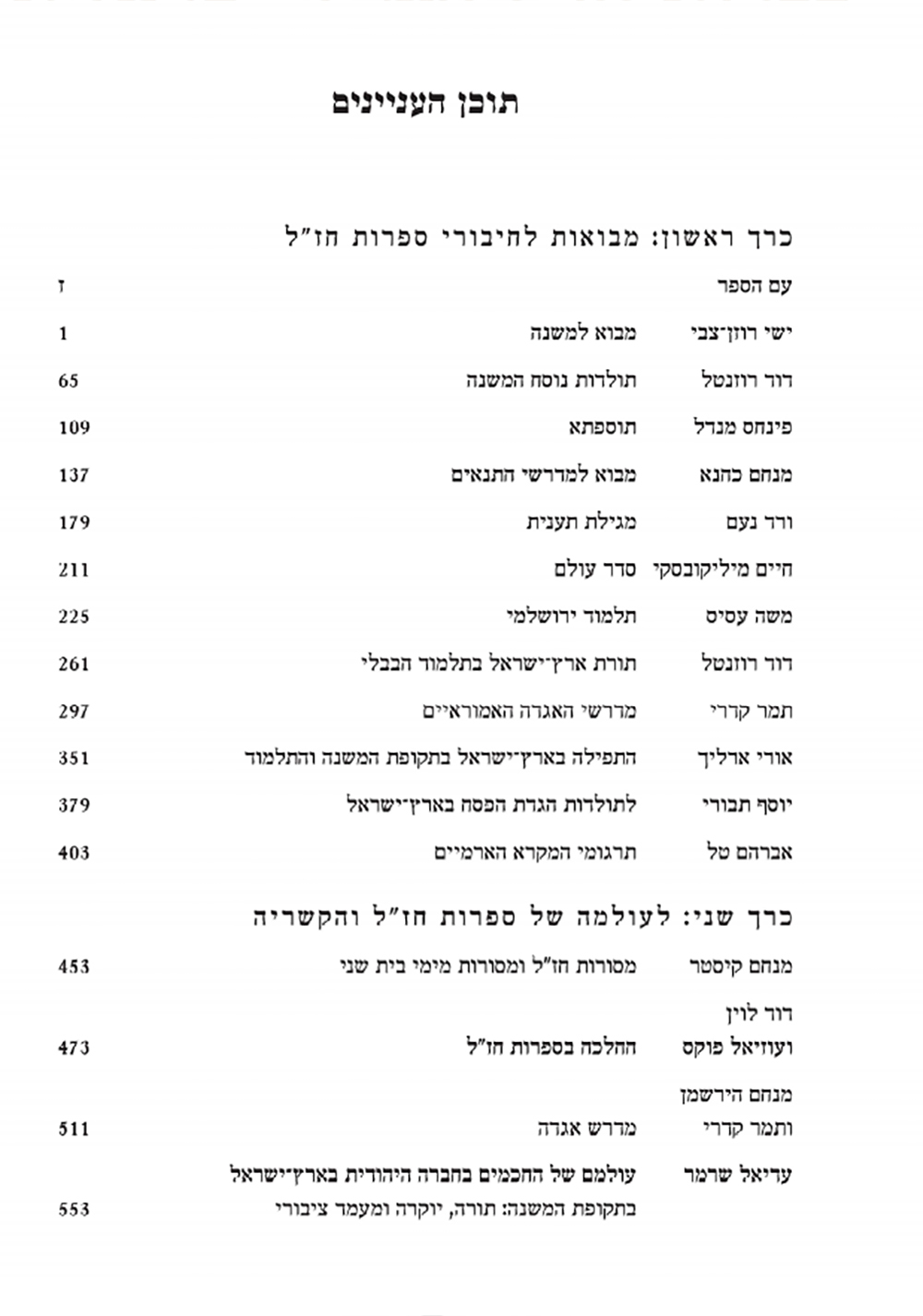
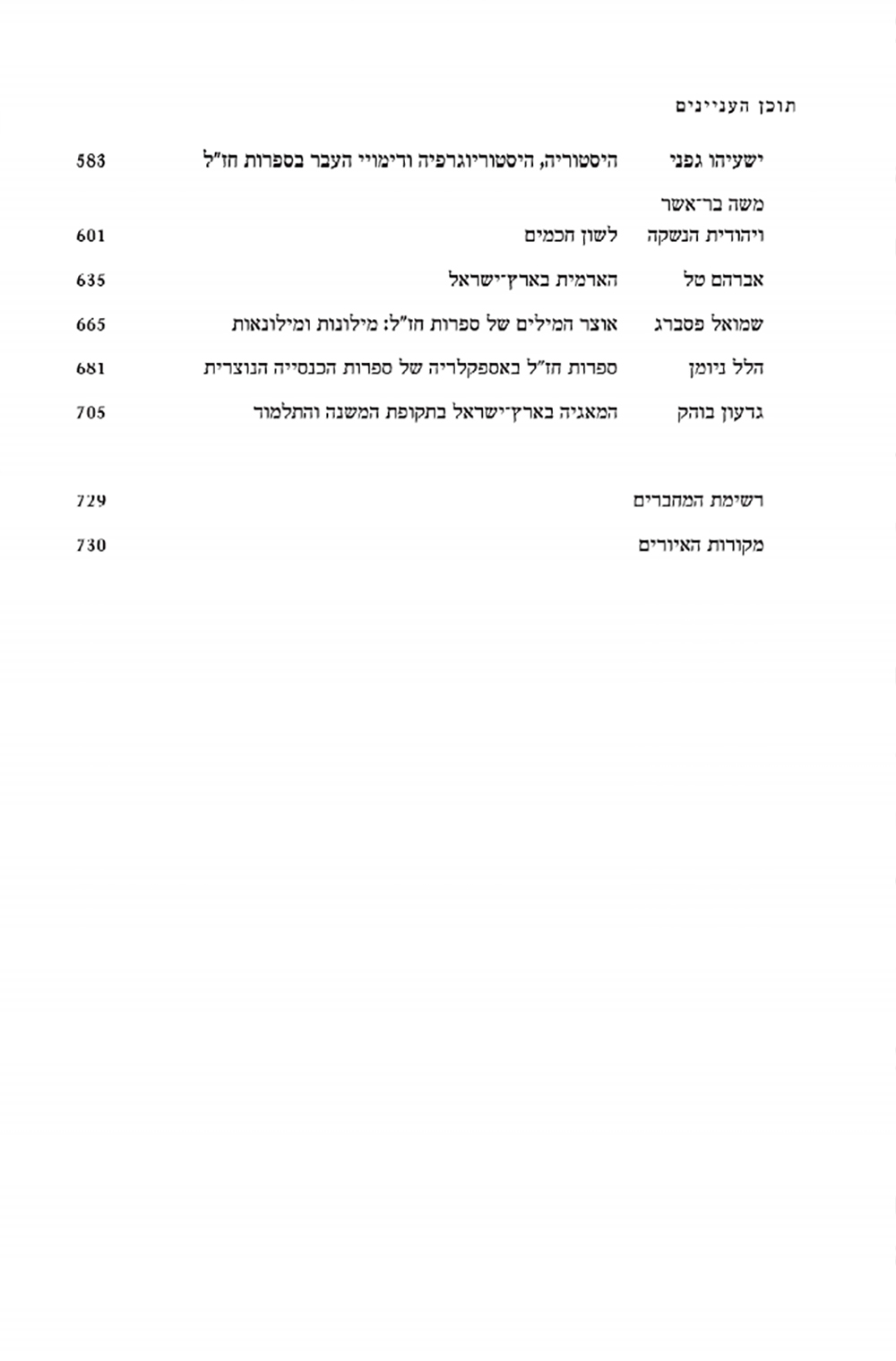
ספרות חזל הארץישראליתמבואות ומחקריםהמערכת מנחם כהנא, ורד נעם, מנחם קיסטר, דוד רוזנטל, ב’ חלקים, 732 עמודים.
I am very happy to announce the publication of an important work which numerous people will find very useful. This is a collection  essays from various experts in the field of Chazal’s Eretz Yisrael Literature. If one wants a proper introduction to various works of Chazal from the Mishna and on, this is the place to look Up until now there were numerous articles and books on all these topics, including the two volumes set Literature of the Sages Many of the topics covered in these two new volumes can be found in; Literature of the Sages, some times even by the same authors e.g. Vered Noam on Megilat Tannit or Chaim Milikowsky on Seder Olam. However, many of the chapters are new or are written by different people. One hopes that they will continue this series with a volume dealing with the Talmud Bavli.
For a short time copies can be purchased through me for a special price. Contact me at Eliezerbrodt@gmail.com


Moshe Idel — Kabbalistic Manuscripts in the Vatican Library

Professor Moshe Idel is Max Cooper Professor in Jewish Thought, Department of Jewish Thought at Hebrew University, Jerusalem, and Senior Researcher at the Shalom Hartman Institute.

This post at the Seforim blog by Prof. Moshe Idel, about Kabbalah manuscripts kept in the Biblioteca Apostolica Vaticana (Vatican Library), is an expansion of remarks delivered at the February 2009 symposium hosted at the National Library of Israel, in Jerusalem, to honor the publication of the catalog by Benjamin Richler, ed., Hebrew Manuscripts in the Vatican Library (Città del Vaticano, Biblioteca Apostolica Vaticana, 2008); 791 pages, available here.

This is his first contribution to the Seforim blog.


On Some Unique Kabbalistic Manuscripts in the Vatican Library and Their Contribution to the Scholarship of Kabbalah in Jerusalem

Prof. Moshe Idel
The Hebrew University, Jerusalem

I. The Beginnings of Christian Kabbalah and the Vatican Library

In the summer of 1280, Abraham Abulafia (1240- c. 1291), a Kabbalist who founded the special prophetic or ecstatic version of the Kabbalah, attempted to meet Pope Nicholaus III in Rome. This special effort came as the result of a revelation he had ten years earlier in Barcelona, which presumably consisted in a command to go to Rome at the eve of the Jewish New Year, in a mission reminiscent of Moses’ encounter with Pharaoh: namely to discuss issues related to redemption. From the scant information we have, it seems that though Abulafia was not shy to compare himself to Moses, he was more interested in discussing his belief about the nature of authentic Judaism with the Pope, than in the national rescue of the Jews from the burden of Christendom, or in an attempt to convert the Pope, as some scholars have claimed.  He believed Judaism to be a mystical religiosity based on pronouncing divine names in order to reach a mystical experience, understood in spiritual redemptive terms. He took a spiritualized Judaism — constituted by inner experiences which are achieved by a mystical technique – to be a higher form of religion than any of the three monotheistic religions. The Pope was reluctant to see the Kabbalist and retreated for a rest to the beautiful family castle of Soriano nel Cimini, north of Rome. The stubborn Abulafia, who was informed he would be burned if he insisted on following the Pope, nevertheless arrived at the castle, only to learn that the Pope had died of apoplexy that same day.     This non-encounter of a Kabbalist actually eager to see the Pope, and a Pope who otherwise took a keen interest in the spiritual Franciscan faction known as the Minorites, is however not the end of this story. After two weeks of arrest in the house of the Minorites in Rome, Abulafia was released and made his way to Messina, Sicily, then part of the kingdom of Aragon. There he remained active for more than a decade, writing a variety of Kabbalistic books and teaching several Jewish intellectuals, and probably also some Christians, his Kabbalah. This openness by a Kabbalist, who deliberately ignored the interdiction against revealing the Kabbalah even to most Jews, is an important development that should be taken seriously when discussing Jewish esotericism and its vicissitudes. The prophetic Kabbalistic trend remained part and parcel of the Jewish mystical literature in Italy, and a significant component of the nascent Christian Kabbalah in late 15th century Florence.       The translation of some of Abulafia’s writings from Hebrew to Latin by Flavius Mithridates was one of the most important factors in the impact of ecstatic Kabbalah on the Italian Renaissance. Mithridates, who called himself inter alia also Guillelmus Raimundo Moncada, was a convert to Christianity, who delivered a lecture in the presence of Pope Sixtus IV. Of Sicilian extraction, Mithridates, the son of a Syrian Jew called Nissim Abul- Faraj, presumably studied Abulafia’s Kabbalah in his youth in the island. The special place the ecstatic Kabbalah enjoys in his Latin translations must have something to do with his ability to fathom the rather difficult Hebrew treatises he so skillfully translated. However, his concentration on Latin translations of books of Kabbalah started in a later period of his life — in 1486 in Florence, years after he left Rome — and after his visit to the Holy See. Those translations are the fountainhead of the first most important piece of Christian Kabbalah, Giovanni Pico della Mirandola’s Conclusiones, which include dozens of theses based on Kabbalistic views. Those 900 Conclusiones were condemned immediately by the Pope, and the young count had to flee Italy.  He returned to Florence only when the next Pope, related to the Medici family, was elected. However, most of Flavius Mithridates’s Latin manuscripts, which played such an important role in the emergence of Christian Kabbalah, and thus Abulafia’s Kabbalistic treatises (in Latin and in a slightly Christianized form)  have found their way to the Vatican Library, arriving more than two centuries after their composition. Today they are catalogued as MSS 189-191, together with the Hebrew manuscripts, and a fourth one, as Vatican, Cod. Chigi A. VI.190.      Those are unique manuscripts, autographs of Mithridates. They testify to his sophisticated translations, mistranslations and deliberate glosses and interventions which sometimes change the intention of the Hebrew original, in order to look closer at Christian tenets. They remained there for more than four centuries, before a serious study of their content and an analysis of their impact on Giovanni Pico was undertaken by Prof. Chaim Wirszubski, of the Hebrew University in Jerusalem. His groundbreaking inquiry, Pico della Mirandola’s Encounter with Jewish Mysticism (Harvard University Press  1987), opens the way for a much more profound understanding of the precise sources of some important aspects of Pico’s thought. Wirszubski’s fine scholarship (done in Jerusalem under the auspices of the Israeli Academy for Sciences and Humanities) brought some of Abulafia’s Kabbalistic visions as mediated by Mitridathes to the attention of the scholarly community. In fact he discovered in the Latin translation an Abulafia work, that had been preserved only in a poor and quite fragmentary form in the original Hebrew.     Let me point out that in addition to the rich material belonging to Mithridates’s Latin translations from Abraham Abulafia and his circle, the Vatican collection contains several important treatises of this Kabbalist in their original Hebrew (e.g., Sefer ’Or ha-Sekhel, Sefer ha-’Ot, Sefer Hayyei ha-‘Olam ha-Ba’). Even more importantly, the collection houses the lengthiest extant part of one of Abulafia’s earliest books, Sefer Mafteah ha-Re‘ayon, (Heb. 291), a book not found in this form in any other manuscript. This fragment, written originally in 1273, is quite important for understanding the earliest phase of the thought of this ecstatic Kabbalist.  In this sense it is similar to the above-mentioned Latin translation that preserved another book of Abulafia’s written in the same year.  If we add to the presence of these manuscripts in the Vatican Library the fact that Abulafia’s prophetic books, (some containing quite enigmatic forms of spiritual apocalypses, found in very few manuscripts) are found in the Angelica library – which is outside the scope of Benjamin Richler, ed., Hebrew Manuscripts of the Vatican Library (Città del Vaticano: Biblioteca Apostolica Vaticana, 2008) – it seems that the written voice of Abulafia’s Kabbalah found its way to the Vatican libraries in quite an impressive manner. The recent project of a critical edition of those translations, undertaken by Giulio Busi and Saverio Campanini among others, brings scholarly attention to the basic sources of early Christian Kabbalah.

II. Vatican MS Heb. 202 and the Beginning of Jewish Kabbalah

The Vatican collection contains an important and unique manuscript compiled sometime in the 14th century and copied in a Spanish hand. This manuscript contains a variety of Kabbalistic material stemming from several schools: Provencal, Catalonian, and Castilian forms of Kabbalah. Some of the traditions found there are related to the beginnings of some historical phases of Kabbalah (especially in early decades of the thirteenth century) and served as building stones for the scholarly edifice regarding this period by Prof. Gershom Scholem of the Hebrew University, the famed pioneer of the study of Kabbalah. In this codex Scholem discovered quite early in his career an epistle that was the most important single document supporting his reconstruction of the relations between the Provencal school as represented by Rabbi Isaac Sagi-Nahor, the so-called “father of Kabbalah,” and two important younger Rabbis, active in the Catalan city of Gerona, Rabbi Moses ben Nahman (Nahmanides) and his cousin Rabbi Jonah Gerondi. The exchanges between these rabbis concern the disclosure of Kabbalistic issues by other Kabbalists; and the scant data found in the epistle are indispensable testimonies in any attempt to describe the dissemination of Kabbalah from Provence to Catalonia and from there to Castile. This epistle exists in a unique manuscript, and since its publication by Scholem in the thirties and its more detailed analyses in the forties and sixties —  especially in his Origins of the Kabbalah, trans. R.J. Zwi Werblowsky (Princeton University Press, 1989) — no other similar manuscript of this epistle has been identified. As in the case of the beginning of Christian Kabbalah, here too our understanding of the beginning of the Jewish Kabbalah owes much to unique Vatican manuscripts.

III. Rabbi David ben Yehudah he-Hasid’s Hebrew Translations of the Zohar

The most important documents of Kabbalistic literature are indubitably the Zoharic literature. The Zoharic literature, which was written between the late seventies of the 13th century and the early decades of the 14th century in Castile, mostly in Aramaic, was immediately canonized and became the cornerstone for a variety of Kabbalistic schools, especially the mid-16th century Kabbalists who were active in Safed. The processes involved in the emergence of this literature, its authors, its canonization and its various kinds of reception still need extensive research. The Hebrew manuscripts found in the Vatican library may help illuminate some aspects of those processes. Let me offer a major example in this direction.     Two anonymous manuscripts in the Vatican collection, Heb. 62 and 168, contain a Hebrew translation of some Aramaic parts of the Zoharic commentaries on the Pentateuch.  Though similar in many ways, each the two manuscripts is also unique. An analysis of the style of the translation and a comparison to segments of other Hebrew translations of Zoharic passages found in the Hebrew writings of Rabbi David ben Yehudah he-Hasid, led me to identify the anonymous translator as this Kabbalist. A late 13th or early 14th century Kabbalist, Rabbi David may well be not only one of the first commentators on this book, but quite plausibly its first translator ever. This means that these two codices can aid us to conjecture about the Aramaic versions underlying the translation. We thus have here the earliest extensive testimonies about the nature of the text of the third most important book in Judaism. Moreover, in some cases in those two manuscripts, the version of the Hebrew translation is accompanied by lengthy Aramaic passages, which may constitute the earliest extensive excerpts from the Zoharic literature to have reached us in the original language. Though some short quotes from this Hebrew translation are found in 16th century Kabbalists, it is only in the two above-mentioned manuscripts that dozens of pages are found.     However, let me point out that there are also other codices in the Vatican collection which may turn into a mine of important information related to the history of the text of the Zohar. Two examples are the anonymous Hebrew translation of the Zohar in Heb. 226 and the texts found in the first part of MS Heb. 203.  Both of these deserve special attention by the scholars of the Zohar.

IV. The Byzantine Kabbalah in the Vatican Library      

We mentioned above the main Kabbalistic codices in the Vatican that represent developments that in Sicily, Italy, and the Western Europe. However, several important manuscripts found in this library, may contribute to a future history of a rather neglected center of Kabbalistic literature, the Byzantine one. Compared to the Provencal and the Spanish centers, the Byzantine Empire was a relatively late center; and, from the mid-14th century a different form of Kabbalah emerged there.. Its precise conceptual contours, as well as the treatises that were written there, slowly emerge as the scholarship of Kabbalah is advancing. It has become more and more plausible in the last decades that important Kabbalistic treatises were written in the Empire, rather than in Spain or Italy as scholars previously believed. This is the case of some classics of Kabbalah like Sefer ha-Temunah, Sefer ha-Peliyah and Sefer ha-Qanah but there is a plethora of related smaller treatises that were also written in the Byzantine Empire. The Vatican holds several important manuscripts that may fruitfully serve as the starting point for a study of this Kabbalistic center. MSS Heb. 188, 194, 195, 218, 220, 223, are outstanding examples of the arrival of all the major pieces of Byzantine Kabbalah to Italy and the impact this arrival on the nature of Italian Kabbalah during the late 15th century, and also of the Christian Kabbalah since the beginning of the 16th century.      In this context, let me mention two other unique Kabbalistic manuscripts. These relate to a dispute regarding the belief in metempsychosis that took place in the city of Candia, in Crete in the second part of the 15th century. Two lengthy codices, MSS 105 and 254, contain the documents listing the pros and cons of this belief and against it, as reflecting the views of, respectively, Rabbi Michael ha-Kohen Balbo and Rabbi Moshe Ashkenazi. The vast majority of the arguments in this sharp controversy are unknown from any other manuscript. Thus only the Vatican manuscripts may enable a reconstruction of the various debates related to this important type of Kabbalistic belief. This reconstruction was done by a third important Hebrew University scholar, Prof. Efraim Gottlieb. It has been continued more recently in a Ph. D. thesis of Dr. Brian Ogren at The Hebrew University of Jerusalem.

We may conclude that the variety of the various manuscripts found in the Vatican collections reflects the variety of Kabbalistic literature since its inception up to its peak in the mid-16th century. In short, I offered above several examples for the indisputable contributions the Kabbalistic manuscripts found in the Vatican collection did contribute in the past for understanding major phases in the history of Kabbalah. The present Catalogue, an excellent example of what a catalogue of Hebrew manuscripts should be, will certainly facilitate the study of additional manuscripts and will enrich our understanding of the evolution of the various forms of this vast literature. We may hope, in an era less interested in philological studies than earlier, that the tradition of close reading of manuscripts in a serious manner, which was a vital part of scholarship at the Hebrew University, will remain a vital component of the future studies of Kabbalah; and the Vatican codices will continue to yield new findings for a better understanding of a vital aspect of medieval Judaism.

V. Thanks for the Free Access  

Let me turn to another dimension of the Vatican collection, which is not related to the content of manuscripts but with the politics of access to the Hebrew manuscripts found in this library. When the Institute of Hebrew Manuscripts — whose researchers were the main contributors to the Catalogue that is celebrated here — was founded at the Jewish National and University Library in Jerusalem, many libraries over the world agreed to have their manuscripts microfilmed and consulted free by scholars. However, most of them required researchers to request permission in writing before allowing their manuscripts to be copies or published. Only three libraries out of dozens — the Vatican in Rome, the Escorial in Spain, and the Cambridge University Library in England — were ready to give scholars free automatic permission to microfilm, photocopy or publish their manuscripts. For persons acquainted with the inevitable vicissitudes involved in correspondence with libraries in general, (including to be sure the Italian ones), this automatic permission constituted a special act of encouragement to engage these manuscripts. This kind renouncement of the legitimate rights of these libraries facilitated a much easier access to some Kabbalistic manuscripts.  That in turn was especially helpful for scholars who — like myself in the initial stages of my study of Kabbalistic manuscripts — did not live in Jerusalem,. This explains why in some of my writings I relied upon Vatican manuscripts, even when there are also other manuscripts containing a certain Kabbalistic treatise. Abulafia’s major treatise Sefer ’Or ha-Sekhel, found in the Vatican Library Heb. 233 is one case in point. I take this opportunity to thank the Vatican Library, late as these thanks may be, for the generosity that contributed not only my modest studies of the Kabbalistic material, but also of many other scholars, who also benefited from the liberal approach of the directors of the that Library.


Book announcement: Two books on Karlin-Stolin Chasidim

Book announcement: Two books on Karlin-Stolin Chasidim
By Eliezer Brodt
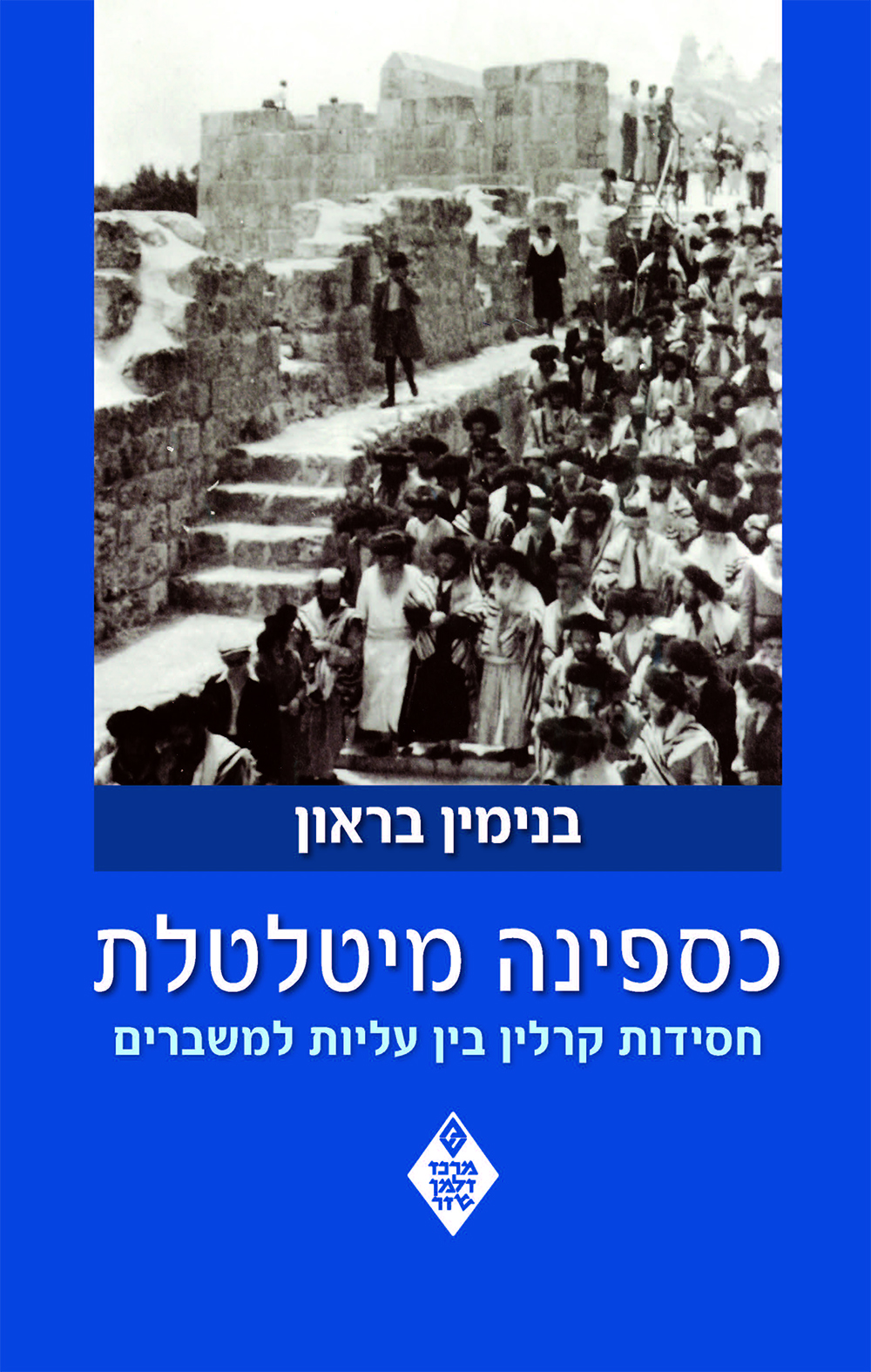
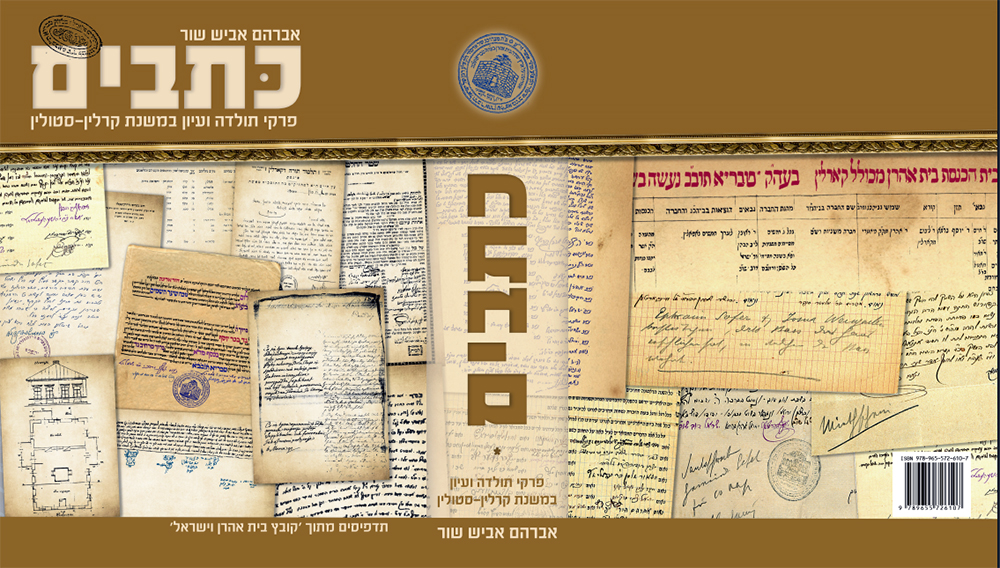
בנימין בראון, כספינה מיטלטלת, חסידות קרלין בין עליות למשברים, 659 עמודים, מרכז זלמן שזר ר’ אברהם אביש שור, כתבים, פרקי תולדות ועיון במשנת קרלין-סטולין, תדפיסים מתוך קובץ בית אהרן וישראל, 1229 + 18 עמודים.
Recently a good amount of literature devoted to Chasidim has appeared. In this announcement I am just mentioning two recent works, related specifically to Karlin-Stolin Chasidim. One is written by an academic (outsider) and one is written by a Stoliner Chassid (insider). This would be a great way to compare them, based on Chaim Liberman’s classic essay “Keitzad Chokrim Chasidus BYisrael?” (Ohel Rochel, 1, pp. 1-49).
The first volume is from Dr. Benny Brown, renowned for his massive book on the Chazon Ish a few years back (mentioned here and here) and for a more recent book edited by him (mentioned here) called HaGedolim. Last year Dr. Brown wrote a book devoted to understanding Charedim (451 pp.) called Madrich Lechevrah HaCharedis, where part of it he focuses on Chassidim. A few months ago his latest volume appeared, devoted to Karlin-Stolin (659 pp.) titled כספינה מיטלטלת.
This book also includes many documents which he got from insiders (no idea why they gave it to him). I was happy to see some discussion of a special Karliner Chasid that I had the great privilege to have a close relationship with, R’ Yossel Zeinvorth.

The table of contents to this work may be viewed here (link).Here is the cover:

The second book just released earlier this week is called Kesavim from Rabbi Abish Shor. R’ Abish is one of the most prolific writers in the Charedi Chasidic world. His articles have been featured in the Karlin-Stolin journal Kovetz Beis Aron V’Yisroel for the past thirty years. This is a collection of all his essays that appeared in that journal arranged in chronological and topical order. This volume has important information related to the history of Chasidim in general, based on numerous manuscripts amongst other sources. This huge volume was printed in a limited edition and for a short time is available for sale through me at eliezerbrodt@gmail.com

View the table of contents to the work here (link).Here is the cover: