New Books from Biegeleisen

New Books from Biegeleisen

While Eliezer is in the midst of preparing a comprehensive list of new seforim issued in the past months, I wanted to provide a shorter list of new seforim that I have recently received from Biegeleisen.  All of these are of course available at Biegeleisen in Boro Park (and I assume elsewhere as well) and some will be reviewed in greater detail in the coming months. 

Batim le-Vadim, Yaakov Mosowitz, Beni Brak, 2008, 663 pp. a collection of laws and customs relating to marriage as well as the laws relating to mahzir gerushato.  The book covers both first marriages as well as second.

Sodei Humash ve-sha'ar, Students of Rebbenu Yehuda ha-Hassid, ed. Yaakov Stal, Jerusalem, 2009, 228 pp.  This is another work from the school of Yehudah ha-Hassid edited by R. Stal.  R. Stal's prior works in this area are excellent.  Eliezer has reviewed two here and here.

Kitzur Nahlat Shivah, Shmuel ha-Levi Segal & Asher Anshel Greenwald, ed. Yehezkel Shraga Shwartz, Beni Brak, 2009, 2 vols., 315, 649 pp.  This reprint, done by Otzar ha-Poskim, follows Otzar ha-Poskim's reprint of the full Nahlat Shivah.   This contains a short introduction as well as notes on the text. 

Pirush ha-Melitz Bentotam, Tzvi Fishbein, [n.p.], 2009, 567 pp.  A commentary on the Targum Yohnathan ben Uzzeil for the parshiyot Shemot Beshalach.  The commentary is divided into two parts, the first, beiurim is an straightforward explanation of the text, while the second, Iyunim, discusses the implications of the text in great detail providing both other rishonim's take as well as the relevant achronim.

Otzar Hemdat Yamim, David Shlomo Kosovitski-Schorr, Beni Brak, 2008, 885 pp. This work collects close to all the mentions of the controversial work Hemdat Yamim in other works.  Additionally, rather than just provide quotations, full pages are reproduced which is an added boon to the interested bibliographer.  Kosovitski-Schorr's stated purpose is to show that the author of Hemdat Yamim was active during the years 1599-1639.

Ve-Zarch ha-Shemesh, Shirah Devlisky, Beni Brak, 2008, 101 pp.  A collection of custom of R. Devlisky's congregation in Beni Brak with notes and sources for said customs.

Ma'aseh Rav, Jerusalem, 2009, 423, [102] pp.  This is a new edition of the Ma'aseh Rav which collects the customs of the Gra. This edition includes some additional notes and supposedly is a "critical edition."  They also include a photomechanical reproduction of the 1832 edition of the Ma'aseh Rav as well as the Tosefot Ma'aseh Rav.  Unfortunately, the editors seem to be unfamiliar with a few points about the 1832 edition.  First, they fail to include both title pages.  The 1832 edition contains two distinct title pages, only one is included. Second, and more importantly, Dr. Jordan Penkower has already suggested that the 1832 edition while the first edition chronologically in terms of publication date may not actually reflect the first edition of the Ma'aseh Rav.  Instead, according to Penkower as well as Yeshayahu Vinograd the bibliographer of all the Gra's works, the second edition, Lemberg, 1833 is actually the "mahdurah kama" of the Ma'aseh Rav.  See J. Penkower, "Minhag and Massorah: On the Recent Ashkenazic Custom of Double Vocalization of Zeikher Amalek," in Rimon Kasher, Moshe Zipor, Yitzhak Zafati, eds., Studies in Bible and Exegesis (Ramat Gan: Bar-Ilan University Press, 1997; Hebrew), 82-85; Y. Vinograd, Thesaurus of the Books of the Vilna Gaon, Kerem Eliahu, Jerusalem, 2003, entry 809.

Sefer haKol Bo, the critical edition of the Kol Bo has been completed in eight volumes bound in four volumes.

She'elot u-Teshuvot Rebi Akiva Yosef, Akiva Yosef Schlesinger, Jerusalem, 2008, 2 vols., 403, 397 pp.  The responsa of the eclectic R. Akiva Yosef Schlesinger on Orah Hayyim and Yoreh Deah with notes and an introduction. 


The RCA “Edition” (Or Lack Thereof) Siddur

When a Yom Tov falls out on Shabbat, we add additions to the standard Yom Tov shemonei esrei that relate to Shabbat. One of these additions is found in the V’haseanu והשיאנו blessing, where we add “elokenu v’lokei avosanu retzah bemunchatanu (אלקנו ולאקי אבותנו רצה במנוחתנו).” There is very little question about this addition is Shacharit.[1] The more complex question is the Mussaf. The reason for the complexity is that in the Shaharit there is no place where the formula of elokenu v’lokei avosanu appears, so one is forced to add the entire addition. But, in Mussaf there is an elokenu v’lokei avosanu, that is, right after one says the various verses relating to the offering of the day appears “elokenu v’lokei avosanu melk rachamun rachem alenu … (אלקנו ולאקי אבותנו מלך רחמן רחם עלינו)”. Because there already the alokenu v’lokei avosunu, thereby God’s name is already mentioned, R. Yitzhak Isaac Tyrnau (end of the 14th century) in his book on Minhagim (page 56 Makhon Yerushalayim edition) says to just add here the words, retzeh bmunuchatanu here. By placing this addition here one avoids mentioning God’s name later on. But the R. Mordecai Jaffe (1530-1612), in his Levush (Orach Hayyim no. 488), argues and says that just as in Shacarit one mentions this addition later on right next to “kadeshanu” therefore it is not proper to mention it here after the passages of the offerings as there is no mention of kadeshanu. Additionally, R. Jaffe argues we should be consistent between Mussaf, Shacharit, and Mincha/Ma’ariv. Just as in those prayers, this addition appears in v’haseanu so we should do the same for Mussaf. Therefore, according to the Levush, one has to say the entire formulation later on, including the elokenu v’lokei avosanu, a repetition of God’s name, because though God’s name appears earlier it is just not the right place to add this.[2]

What emerges from this is that there are two distinct customs, either one adds just the words “retzah bemunuchatun” right after the verses for the offerings and does not add anything later on, as that would defeat the whole purpose – avoiding repeating God’s name. Or one does not add anything different after the recitation of the offerings, instead just as in the Morning Prayer, one adds the entire formula at the end of the blessing. Both of these customs have support in older siddurim. What has NO support and makes no sense is what appears in the Artscroll siddurim. In the Artscroll siddurim, BOTH additions appear.[3] That is, Artscroll advocates saying both the retzah bemuchutanu after the offerings and including the entire formulation later on. It would appear that they are unconcerned with the unnecessary repetition of God’s name or custom. It seems that in an effort to conform to all the customs, they have conformed to none. What is rather bizarre, is that in the first edition of the Artscroll Siddur, only the second appears, it seems they altered it to include both?!

But, to be fair to Artscroll there is perhaps a bigger problem. Artscroll, while they print some nice books, are not a Rabbinic organization. The RCA (Rabbinical Council of America), as the name implies, is a Rabbinic organization. One assumes a Rabbinic organization would be tasked with getting something like this correct. Historically, the RCA did get it right. The original RCA commissioned siddur is edited by R. David de Sola Pool. In this siddur they only have the second mention (like the Levush). But, now the RCA has moved to a new siddur. This – the RCA edition of the Artscroll siddur – contains both (incorrect) mentions. In the introduction, the (then) president of the RCA states that part of the reason the RCA commissed a siddur at all was due to the many errors which had crept into the siddur. But, with this edition that does nothing other than slapping on an introduction by then-RCA president R. Saul Berman and adding the teffilah l’medinah, is the type that the RCA was claiming it was fixing.

Sources:

[1] Though there is some controversy about this, that is, R. Jacob Emden says that the elokenu v’lokei avosnu should always be recited even when it is not Shabbat. He claims that these words were bracketed by mistake and in early siddurim they are not bracketed. I have found that in the Prague, 1516 Siddur they are not bracketed. See Siddur R. Shabbetai Sofer, vol. 1, appendix. On the other extreme the Vilna Gaon who says that one never recites these words even when it is Shabbat.

[2] The Eliyahu Rabbah defends R. Tirna from the Levush and also asserts that all the older siddurim follow R. Tyrnau. In truth, the old siddurim are split between these two customs; see Additions to Siddur R. Shabbetai Sofer for page 522.

[3] In the new Artscroll Hebrew-only siddurim they say “Yesh Mosifim” (there are those that add) by the first one, i.e. the one following the recitation of the offerings. But they still fail to recognize that those Yesh Mosifim also don’t add the later one.


Publication of New Book, Kana’uteh de-Pinhas, by Seforim Blog Contributor, R. Bezalel Naor

Publication of New Book, Kana’uteh de-Pinhas, by Seforim Blog
Contributor, R. Bezalel Naor
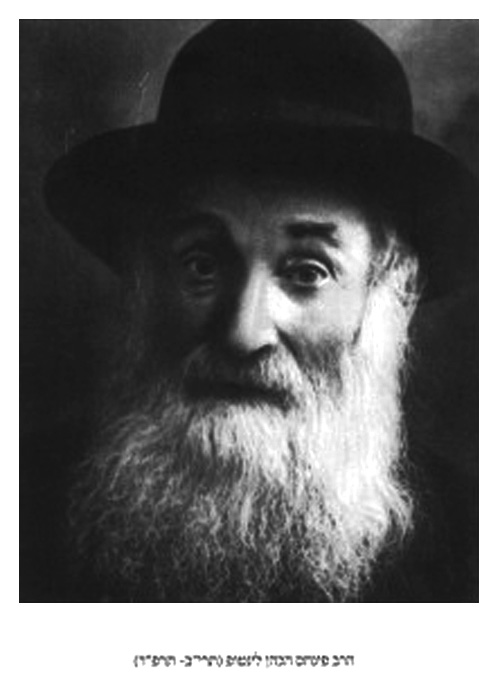
RABBI PINHAS HAKOHEN LINTOP (1852-1924)
Pinhas Hakohen Lintop, Rabbi of the Habad community of Birzh, Lithuania, was an intimate friend and colleague of Rabbi Abraham Isaac Hakohen Kook. Their friendship began when Rabbi Kook served as Rabbi of Zoimel, Lithuania and later Boisk, Latvia, and continued even after Rav Kook immigrated to Erets Israel.
What Rabbis Kook and Lintop shared in common, was the belief that the knowledge of the “inwardness of Torah” (“penimiyut ha-torah”) contained the medicine for the spiritual malady of the generation. Both men attempted, each in his own way, to disseminate Kabbalah to the masses. For this, they came under criticism from their rabbinic peers.
Rabbi Lintop was unique in that he was one of only three major Lithuanian kabbalists in that country at the beginning of the 20th century: Solomon Elyashev, Abraham Isaac Hakohen Kook, and Pinhas Hakohen Lintop.
The present book, Kana’uteh de-Pinhas (The Zeal of Pinhas) pivots on a hitherto unpublished letter of Rabbi Lintop to Rabbi Kook, then serving as Rabbi of Jaffa, Erets Israel. The lengthy letter consists of a detailed critique of the recent work of Rabbi Solomon Elyashev of Shavel (1841-1926), Hakdamot u-She’arim (Piotrkow, 1908), the first part of Rabbi Elyashev’s encyclopedic work of Kabbalah, Leshem Shevo
ve-Ahlamah.
While Rav Kook hailed Hakdamot u-She’arim as a supreme contribution to the wisdom of Kabbalah, Rabbi Lintop opposed the worldview contained therein, which as he pointed out, ran counter to both the teachings of Ramhal (acronym of Rabbi Moses Hayyim Luzzatto) and Habad (acronym of Hokhmah, Binah, Da’at, the school of Hasidism founded by Rabbi Shneur Zalman of Liadi).
Much of the present work is an attempt to unpack Rabbi Lintop’s specific criticisms of Hakdamot u-She’arim, while in the process sharpening our understanding of the ideological touchstones that set apart the respective teachings of these three great kabbalists, Rabbis Elyashev, Kook and Lintop.
The book, in Hebrew with an abstract of a few pages in English, is replete with a photo of Rabbi Lintop, his final repose in Birzh, and facsimiles of the titles of his works and some of his manuscript letters, which are of historic interest for their description of conditions in Lithuanian Jewry in the first quarter of the twentieth century (especially their vivid description of the rapid acceleration of the process of secularization and decline of rabbinic authority in the aftermath of World War I). An appendix of the book discusses Rabbi Lintop’s critique of Maimonides’ Thirteen Principles of Faith, a controversial topic which of late has been the focus of several rabbinic and academic studies. (Of especial note is Marc B. Shapiro’s The Limits of Orthodox Theology: Maimonides’ Thirteen Principles Reappraised.)
Another appendix of the book is devoted to Rabbi Solomon E. Jaffe (1858-1923), Chief Rabbi of New York after the demise of Rabbi Jacob Joseph, and to the short-lived Rabbinical Seminary (Yeshivah la-Rabbanim) that Rabbi Jaffe headed in New York (1909-1910) during the temporary closure of Rabbi Isaac Elchanan Theological Seminary (RIETS), today the rabbinical seminary of Yeshiva University. Rabbis Jaffe and Lintop overlapped in the rabbinate of Vabolnik, Lithuania circa 1888 and maintained cordial relations even after Rabbi Jaffe relocated to the United States.
Kana’uteh de-Pinhas is available at Bigeleisen and also from R. Naor’s website, www.orot.com.


A Note on the Latin Dedication in the Rabbinic Bible of Venice 15

A Note on the Latin Dedication in the Rabbinic Bible of Venice 1517
by: Jordan S. Penkower
In response to the recent post at the Seforim Blog about approbations of Hebrew books, a correction is in order concerning the footnote about the intent of the remarks of Felix Pratensis in his dedication of the Venice 1517 Rabbinic Bible to the Pope. In footnote 3 of the recent post, a conjecture was offered to explain Felix Pratensis’ remarks.
In addition, Pratensis claims that this edition was unique as the prior editions “hav[e] almost as many errors as words in them” and that “no one has attempted [such an edition] before.” Ginsburg in his discussion about this edition shows, however, that in fact previous editions were (close) to error free. Ginsburg bemoans the fact that “Felix Pratensis should have been betrayed to resort to such unfair expedients.”  But, it is possible that Pratensis’ claim regarding the novelty of the work was necessary in part due approbations.  Not Rabbinic approbations but the approbation of the Venetian Senate.  This is so, as in 1517 the Senate passed a law that would abolish all printing monopolies (copyrights) and hence forth would only grant monopolies for works which “are new or which have never been printed before.”  Horatio Brown, The Venetian Printing Press (London 1891), 74. Indeed, Bomberg, the printer of this edition had appealed to the Senate for a monopoly when he began printing in 1515 and which the new law abolished. See Meir Benayahu, Copyright, Authorization & Imprimatour for Hebrew Books Printed in Venice (Israel 1971), 17 (Hebrew).  Thus, it is possible that Pratensis claim of novelty was to argue implicitly that this book qualified for a monopoly even under the new law as it was a “new” book.  
I would like to clarify a number of points about Pratensis’ remarks.
(1) Among his remarks, Pratensis makes the following statements: (a) no one before him had collated a great number of manuscripts to prepare a Bible edition; (b) the errors in the manuscripts are almost as many as their words, and only in this printed edition has the text been restored to its purity (See my PhD, p. 282 and nn. 20-21 for text and translation).
(2) Previous scholars have pointed out the problem with Pratensis’ remarks, which seem to be mere hyperbole. C.D. Ginsburg, in his Introduction (pp. 946-947), who explained Pratensis’ remarks as referring to the text, noted that he found several manuscripts similar to Pratensis’ edition, and on the other hand, never found any manuscripts whose errors were as numerous as its words. P. Kahle, in numerous places, e.g. Cairo Geniza, p.123, offered an explanation of Pratensis’ remarks: Pratensis was referring to the vocalization found in the manuscripts, specifically those manuscripts with “expanded-Tiberian vocalization”, a system that he rejected.
(3) Neither of the above explanations of Pratensis’ remarks is satisfactory. Ginsburg – he himself noted that if Pratensis refers to the text, there are several manuscripts similar to Pratensis’ printed edition. Kahle – his explanation is unsatisfactory because Pratensis said that ALL mss – and not some specific sub-type – were replete with errors. I have offered an explanation several years ago in my doctoral thesis (pp. 187-188) that avoids the shortcomings of these suggestions. In chapter four of my thesis, I presented a detailed comparison of the variants between the Venice 1517 and the 1525 Rabbinic Bibles – in Genesis, Joshua, and Proverbs – both with respect to the text, as well as to the vocalization, accentuation, and ga’ayot. In light of the results of the comparisons between the two editions, I suggested that one should explain Pratensis’ remarks as referring both to the text, as well as to the vocalization, accentuation, and ga’ayot.
(4) I have shown in my fourth chapter that with respect to the TEXT, Pratensis relied mainly on accurate Sefardi manuscripts. These manuscripts do NOT mark the “light ga’aya” consistently; do NOT use qamatz together with shewa to note the qamatz qatan (but only the sign of the qamatz alone); do NOT have a special sub-system of accentuation in Proverbs; and do NOT write “bin-Nun” with a dagesh in the first nun of the name Nun. With respect to all of these latter four phenomena – found in the Rabbinic Bible of Venice 1517 – Pratensis relied upon Ashkenazi manuscripts, which also vary widely from the accurate Sefardi manuscripts with respect to the details of plene-defective spelling (these Ashkenzai manuscripts also vary among themselves with respect to the above four phenomena). From these details it follows that according to Pratensis every manuscript that he saw, its errors were like the number of its words: Ashkenazi manuscripts with respect to the plene-defective spelling (and other topics), and the Sefardi manuscripts with respect to vocalization, accentuation, and ga’ayot.
(5) Thus we see that Pratensis indeed thought that his edition was unique and was the first accurate Bible edition. In his edition, he gathered for the first time phenomena from the above noted Sefardi and Ashkenazi manuscripts, and in his opinion his edition thereby “restored the splendor to the crown” with regard to all of its components: text, vocalization, accentuation, and ga’ayot. In reality, he created a new hybrid that never existed in the manuscripts.
Bibliography: Christian D. Ginsburg, Introduction to the Massoretico Critical Edition of the Hebrew Bible, London 1897, reprint: New York 1966; Paul Kahle, The Cairo Genizah, Oxford 1959; Jordan S. Penkower, Jacob ben Hayyim and the Rise of the Biblia Rabbincia, PhD dissertation, 2 vols, Jerusalem 1982 (Heb.); idem, “Rabbinic Bible”, in: Dictionary of Biblical Interpretation, vol. 2, Abington Press, Nashville Tenn 1999, pp. 361b-364a.


Jews, Beards and Portraits

“If men be judged wise by their beards and their girth, Then goats would be the wisest creatures on Earth.”

With the High Holidays approaching one of the more interesting attributes which takes a more prominent position is that of shaving or facial hair. Of course, prior to any Shabbat or Yom Tov, one is supposed to shave and take a haircut. Yet, for the High Holidays, there is a special emphasis on facial hair. One of the attributes that the Hazan should have is a beard. Although a beard is not the only qualification for the Hazan, nor is it the dispositive one, it is still mentioned. The importance of the beard is mentioned in the Hazan’s prayer prior to the Mussaf prayers. In that prayer, he lists some of his possible faults including his lack of a full beard (זקן מגודל). [As an aside, this prayer is public and a general one listing in a general manner the various shortcomings everyone really has, Artscroll has that one should say silently some of the faults which seems to belie the fact that every hazzan says this thus removing any individual stigma. Yet, were I pray most years, the Hazzan goes one step further and says half if not more silently. I don’t know if this is due to his immense piety or in fact all those things are applicable to him or perhaps he doesn’t think any of those are applicable and is really just skipping them.]

While the Torah prohibits shaving one’s face with a razor, according to most, one can still remove facial hair. There is a long and tortuous debate about what exactly one can use to remove facial hair, however, putting that aside, it is assumed that there are permissible methods of removal. Now, aside from the straight halakhic (Jewish Law) debate there is another issue that is implicated in removing one’s beard – kabbalah. Some hold that although one is not prohibited from shaving according to a strict reading of the law, one must still be cogent of the kabbalah, which they argue, prohibits any trimming or shaving of the beard.

While some claim kabbalah prohibits shaving, there are others who question this. This debate while ostensibly centered around the interpretation of kabbalah texts, instead revolves around the practice of a single person, R. Menachem Azariah of Fano (Rama m’Fano).

The Rama m’Fano was considered one of the greatest kabbalisits of his generation. He authored many important works on kabbalah and was considered, among many, the heir for Lurianic kabbalah. Thus, his practices regarding shaving can shed light on whether kabbalah really advocates for a beard or if one can still conform with kabbalah and be clean shaven.

R. Shabbtai Baer (d. 1674) in his Be’er Esek was asked whether kabbalah mandates that one keep a beard. He replied by first discussing all the relevant texts and in the end makes the argument that perhaps in the Diaspora kabbalah doesn’t mandate growing a beard. He then gets to the crux of what would become the debate for the next 300 years – the practice of the Rama m’Fano. R. Baer states that he attempted to find out exactly what the practice of the Rama m’Fano was in this area. He learnt that every Friday, the Rama m’Fano would trim his beard or shave his beard “as is the custom in Italy.” And in fact, his students, including R. Baer’s father in law, followed in the practice of their teacher and also shaved. As R. Baer correctly points out, someone of the stature of the Rama m’Fano, obviously is extremely telling for whether kabbalah mandates keeping a beard. From his evidence, R. Baer concludes that kabbalah can not mandate keeping a beard.

Yet, R. Baer’s testimony regarding the Rama m’Fano did not go unchallenged. R. Yosef Ergas, in his Divrei Yosef claims R. Baer got it wrong. Specifically, R. Ergas investigated the practice of the Rama m’Fano as well. R. Ergas came to contrary conclusion than that of R. Baer – the Rama m’Fano had a full beard and he never shaved. R. Ergas’s evidence is based upon a portrait of the Rama m’Fano. In this portrait the Rama m’Fano has a full beard.

This debate continued on to the 19th century with R. Moshe Sofer (Hatam Sofer) and R. Eliezer Shapiro (Munkatcher Rebbe). R. Sofer was asked the very same question as R. Baer was, whether one shouldn’t shave based upon kabbalah. After first professing that “we do not follow kabbalah” and that “he does not occupy himself with that which is hidden” he then goes on to discuss the Rama m’Fano. He uses, as did R. Baer, the Rama m’Fano to demonstrate that kabbalah does not mandate a full beard. Instead, R. Sofer points out that based upon testimony the Rama m’Fano did not keep a beard.

R. Shapiro in his Minhat Eliazer takes strong issue with R. Sofer. He notes that R. Sofer’s evidence must be based upon the Be’er Esek and R. Shapiro argues that R. Ergas’s portrait of the Rama m’Fano has settled this issue and R. Shapiro alleges that had R. Sofer been aware of R. Ergas’s evidence R. Sofer would never have said what he did.

So, in the end, it seems in part this hinges on the portrait of the Rama m’Fano. Well in 1904 in a biography on the Rama m’Fano, the author included a portrait of the Rama m’Fano. In this portrait it is clear as day the Rama m’Fano has a full beard. In fact the author of the biography, devotes a chapter to the beard of the Rama m’Fano. He claims, however, with his publication of the portrait this issue is truly settled. What the author neglects to mention is how in the world do we actually know this in fact is the portrait of the Rama m’Fano. Although the author does provide how he obtained the portrait, no where on the portriat does it actually state this is the picture of the Rama m’Fano. Now, if you will recall, even R. Joseph Ergas testimony regarding the portrait was rather late – close to 125 years after the Rama m’Fano died. R. Baer, in fact, was actually much closer, at least in time, to the Rama m’Fano, and had his father in law who studied under the Rama m’Fano personally to talk to. Thus, it would appear that although the author with the publication of this portrait deemed this issue settled, in fact it is far from settled.

This was not the only (possibly) erroneous portrait to be brought into the debate about beards. The famous portrait of Maimonides was also discussed in the beard context. There are those who claim based upon their reading of Maimonides that using scissors on the beard is prohibited. The question then becomes, the portrait of Maimonides clearly shows a trim beard. The issue with this line of inquiry is that the portrait doesn’t necessarily depict Maimonides at all. This portrait was first published in 1744 and was allegedly based upon a medallion – a medallion which was never produced or seen by anyone other than the one who published it. You can see this portrait as well as the page from the book it originally from here (scroll down half way).

Finally, it is worth noting that Jews, even important Rabbis were far from universal in their facial hair. R. David Nieto is a good example. In this portrait, he has a wig and is sporting a stilleto beard which one assumes was the style of the times. R. Joseph Baer Solovetchik during the 1950s had a goatee.

Sources: Shu’t Be’er Esek no. 70; Shu’t Divrei Yosef, no. 28, Shu’t Hatam Sofer, Orah Hayyim no. 159; Shu’t Minhat Eliezer, vol. 2 no. 48; see also, Elliot Horowitz, “The Early Eighteenth Century Confronts the Beard: Kabbalah and Jewish Self-Fashioning,” Jewish History 8 (1994):95-115; and by Horowitz as well, “On the Significance of the Beard in Jewish Communities in the East and in Europe in the Middle Ages and Early Modern Times,” Pe’amim (1994):124-148 [in Hebrew].

There is much more on this topic, however, I can’t right now provide a complete bibliography.


Hebrew Printing in America 1735-1926 – Review II

The post below is a continuation from this prior post.

America posed some unique questions regarding marriage and divorce laws. In the early period of American Jewish history, many people were not erudite. In an apparent effort to help with this deficiency, in 1901, R. Dov Baer Abramowitz published his Sefer Ketubah. This book contains tear out, pro forma ketubot. Thus, the Rabbi could just rip one out whenever he needed to. (No. 588). Another work which dealt with marriage issues is a small pamphlet published in 1909. This dealt with the question of a man who was induced to marry a woman who was “mentally unbalanced.” The husband was allowed to marry a second wife via a heter me’ah rabbanim (the consent of one hundred rabbis). Typically, these 100 must come from different countries, however, here, for the first time, R. Rosenfeld, the author, “explained that it could be issued by American rabbis alone because ‘at one time [the United States] were separate countries. And even today each state is, to a certain extent, [a] separate [entity].'” (No. 1144).

While on the one hand there were many in America that were in the Jewish sense, illiterate, there were also those on the opposite end of the spectrum as it was, who published scholarly works. Dr. Louis Ginzberg, published in 1909 Seriedi HaYerushalmi min HaGeizah asher b’Mitzrayim. This book contained, as the title indicates, fragments from the Cairo Genizah which enabled Ginzberg to offer correction to the standard edition of the Jerusalem Talmud. It seems that this was deemed so important even outside the U.S. As “Ginzburg’s research was included – without attribution – in the Vilna 1922 edition of the Yerushalmi” (No. 606).

This copyright infringement was actually a two way street. In 1919, The Union of Orthodox Rabbis of the United States and Canada published, for the first time in America the complete Talmud. While this signaled a new era in the Jewish learning in the US, it seems that the publishers did not secure all necessary rights before embarking on this printing. Specifically, this edition is a photo-reproduction of the Romm, Vilna edition of the Talmud. This did not go unnoticed. “Moses Rosenberg wrote to R. Hayyim Ozer Grodzinski of Vilna on behalf of the Romm publishing house. He accused Agudath Harabbonim of reproducing the Romm edition without permission and requested that Agudath Harabbonim be summoned to a rabbinical court.” (No. 635). This letter is reproduced at the end of volume II of the work. (p. 1181). The end of the second volume contains many historical letters from Yosef Goldman’s collection. Additionally, there are photographs and autographs of some famous American Rabbis as well in this last section.

On the theme of lack of religious observance, there is no lack of books dealing with this. Moses Weinberger’s book, which Sarna translated into English, “People Walk on their Heads” is but one example. R. Elijah Kochin, Sefer Aderet Eliyahu (Pittsburgh, 1917) where he complains “the city of Pittsburgh is still hefker [anarchic] and it lacks everything necessary for the highest level of observance.” He decried the “accepted evil custom in this land which says that he who lies the most by bluffing, as it is called, is to be praised.” (No. 784).

Already in 1872, Nahum Streisand who I have no idea if any relation to the now woman singer Barbara, which would be rather ironic in light of the fact this book “contains an analysis of the rabbinic debate over the prohibition for a man to hear a woman singing. Streisand had originally sent its contents to Henry Vidaver after the latter issued a ruling permitting women to sing in the choir of his congregation, Bnai Jeshurun.” (No. 1091).

Other issues which came up include metzizha b’peh and whether one can use a sponge. See nos. 1117. In 1915 a book on circumcision was published which, in part dealt with metzizah b’peh by the milah board. This board was “recognized by the New York City Commissioner of Health . . . [who said] the educational value of such work as the Milah Board has done in this matter is of the greatest help to the City, and particularly to our department.” (No. 1158).

Another issue was the use of wine during Prohibition. Dr. Louis Ginzburg published a responsa which argued that grape juice was sufficient for ritual that would otherwise require wine. He did this as “during the era of Prohibition, the government granted special licenses allowing the sale for sacramental purposes. Some Jews abused these licenses.” Ginzburg, wanted to void the use of wine, thus obviating the need for such licenses. This responsa “elicited enough interest in the secular world to merit a press conference and coverage in a major newspaper [i.e. the New York Times].” (no. 1177).

This was not the only work influenced by Prohibition. Isidore Koplowitz published “Midrashic Exegetics on Wine and Strong Drink.” He endeavored to prove “that the Hebrew prophets and a host of Talmudic Rabbins, were outspoken in the great cause of prohibition.” No. 1179.

To be continued. . .