The Ancillary Benefits of Non-Jews on the Hebrew Book

The Ancillary Benefits of Non-Jews on the Hebrew Book


In the history of the Hebrew book, the books, like the Jews themselves, have been subject to external persecution.  Thus, some books and manuscripts have been totally lost.  On the other hand there are a few examples of books or, as we shall soon demonstrate, technices that are are a product of external influences. 

Abraham Ibn Ezra had a very hard life.  In his well-known formulation that appears at the beginning of his commentary to the Humash, he complains that his luck is so bad that if he were a candle maker the sun would always shine.  As Naftali ben Menachem has shown, (Inyanei Ibn Ezra, Jerusalem, 1978, 1-9 and see 132-37 for his discussion regarding the Ibn Ezra’s bad luck) the Ibn Ezra’s books “suffered” as well.  In particular, many of his books were unavailable for hundreds of years (as an aside, Ibn Ezra’s Yesod Moreh ve-Sod Torah has recently been reprinted in an expanded format by Bar Ilan Press).  Relevant to our theme, however, are Ibn Ezra’s books on astronomy.  Anyone familiar with Ibn Ezra’s commentary knows that Ibn Ezra uses astronomy in his commentary with some frequency and, to properly understand his various statements regarding astronomy it is helpful to have Ibn Ezra’s own statements regarding various astronomical ideas.  But, for hundreds of years, the only available editions were not in the original Hebrew but were instead “saved” in other languages (see one example here).

Another example, although this case is not one of saving but instead appropriating from non-Jewish sources, is the portrait traditionally associated with R. Saul Morteira (1596-1660). 


As Dr. S. Z. Leiman has noted (see Ali Sefer 10 [June 1982]: 153-55; reprinted in Givat Shaul, ed. Hayyim Eliezer Reich [Brooklyn, NY: [n.p.], 1991]) there is some doubt as to the veracity of this portrait. In a later article, (published in Daniel Sperber, Minhagei Yisrael, vol. 6, [Jerusalem: Mosad ha-Rav Kook, 1998], 17-19), Leiman shows that this portrait is not of R. Morteria.  Indeed, its first appearance was in Wagneseil’s Latin translation of tractate Sota, published in 1674.  The engraver, whose initals appear in the corner is Cornelius Nicholas Schurtz (whose initials are found in the bottom right corner) and who lived and worked in Nuremberg between 1670-90 and probably never saw R. Morteira who died in 1660 in Amsterdam. Indeed, this engraving is merely used to illustrate what tallis and teffilin look like and there is no mention of R. Morteria. [There are other illustrations by Shurtz in this volume that are also of interest including the halitzha shoe as well as others, in Sperber’s article on halitzha (Minhagei Yisrael, vol. 6, op. cit., pp. 62-73, 326-33 he doesn’t mention this illustration.] As Leiman notes, Schurtz’s engraving was very popular and subsequently appeared in various books.


J. Wagenseil, Sota, Altdorf, 1674
Courtesy of the B. Jackson Library

Reich, in his reprint of Givat Shaul provides a different portrait of R. Morteira, also from a non-Jewish source, Rembrandt.  Although Reich doesn’t provide how he knows this information, Leiman cites a Dutch book, Herman Prins Salomon, Saul Levi Mortera en zijn “Traktaat betreffende de waarheid van de wet van Mozes”, eigenhandig geschreven in de portugese taal te Amsterdam 1659-1660 (Braga, 1988), which offers the suggestion that a Rembrandt portrait is that of R. Morteira.  Although, some scholars now doubt that the Rembrandt portrait is that of Morteira and instead claim it is of the Czech Protostant Jan Amos Comenius who lived next door to Rembrandt for a period of time. See here (a review of Stevan Nadler’s book, Rembrandt’s Jews) and here.

Two other examples, both relating to the Talmud and both concern the Vatican library.  In R. N. N. Rabinowich’s Dikdukei Soferim, the introduction to Baba Batra, Rabinowich thanks God for answering his prayers and allowing Rabinowich entry to the Vatican library in preparation for this book.  Specifically, Rabinowich explains that he was allowed access to the Vatican libraries when no other outsider was allowed to use the library.  The second example concerns the Romm edition of the Talmud.  One of the most important early commentaries to the Talmud is that of the Rabbenu Hananel.  This commentary was included for the first time with the Romm edition.  The editors explain in their Afterword that the manuscript they used was the from the Vatican.

The next example, is again one in a similar vein to that of the Morteira portrait.  As S. has noted, the Brooklyn-based Jewish publishing house ArtScroll has (or purchased) a patent regarding the use of arrows to allow for an interlinear translation.  While the focus of the patent is on the arrows, the patent claims the need for the arrows is the difficulty in providing an interlinear translation from that of a right to left language (Hebrew) to one that reads from left to right (English).  It seems that this wasn’t that much of an issue for at least 400 years ago (and there may be earlier examples) an interlinear bible, printed in 1609, which translated the Hebrew into Latin (a left to right language like English) was published. It seems that it worked just fine.


Biblia Hebraica, Eorundem Latina Interpretatio, 1609
Courtesy of the B. Jackson Library


Eli Meir Cohen: A Question of Mesorah?

“בין דַּם לדָּם”

by Eli Meir Cohen

.
In the upcoming Krias Hatorah in Parshat Shoftim and Parshat Ki Savo there are a number of instances where the meaning of a phrase changes completely based on the pronunciation of a single word – דם – with either a Komatz or Patah. Until recently, most Chumashim and Tikunim which generally followed the famous Yaakov Ben Hayyim 1525 edition of Mikraot Gedolot published in Venice that printed a seemingly inconsistent pattern in the pronunciation of the different occurrences of this word.

In the following post we have attempted to trace some of the available manuscript and mesoratic evidence on this issue as well as the early printed editions. We have also presented opinions of some of the authorities on dikduk that have dealt with this issue directly.

.
בפרשיות הבאות בספר דברים ישנן כמה פסוקים אשר הניקוד במילת “דם” משנה את הפשט ואעפ”כ מופיעות נוסחאות שונות מחומש לחומש ואף במהדורות שונות מדפוס לדפוס.

הנידון הוא כאשר כתוב בתורה מילת דם לפני מילת נקי. כגון בפרשת שופטים יט,י “ולא ישפך דם נקי בקרב ארצך אשר ד’ אלקיך נתן לך נחלה והיה עליך דמים”, האם קוראים דַּם בפתח ופירושו לשפוך דַּם של איש נקי או קוראים דָּם בקמץ ופירושו לשפוך דָּם שהוא נקי, ונקי הוא תיאור להדם. מילת דם הסמוך למילת נקי מופיעה עוד ארבע פעמים בספר דברים.

השאלה נידונת באופן מפורש בחומש מאור עינים מהמדקדק הידוע הרב וולף היידנהיים בדברים יט,י ושם הוא מביא מקור לדבר מהרד”ק, וזה לשונו שם, “כן הוא (בקמץ) בספרים מדויקים וכתבי יד וכן כתב רד”ק במכלול בשקל פל, בדרך כלל כל דָּם נקי קמוץ וכל דַּם הנקי פתח, וכן עיקר כי כל דם נקי פירושו דם שהוא נקי ואיננו סמוך, אבל דַּם הנקי פירושו דם של האיש הנקי לכן סמוך ופתוח אבל הדָּם הנקי קמוץ שאיננו סמוך בעדות הה”א שבראשו”.

הכתבי יד המנוקדים הישנים והמדויקים של התורה מלפני תקופת הדפוס שנמצאים כיום תואמים בנידון זה להרוו”ה. וכן בבדיקת הערות ‘המסורה הקטנה’ ‘והמסורה הגדולה’ שבידינו מצאנו רק הערת ‘מסורה גדולה’ יחידית על “דם הנקי” שהוא בפתח והוא גם תואם למה שמובא ברד”ק והרוו”ה.

ברם חומש מקראות גדולות דפוס ויניציה הנודע (שנת רפ”ד-רפ”ו), שעליו התבססו הרבה חומשים ותיקונים במשך הדורות, מנוקד בשלוש מקומות דַּם בפתח ובשתי מקומות מנוקד דָּם בקמץ. הגם שרק מופיעה הערת ‘המסורה’, (המוזכרת למעלה) במקום אחד בלבד, והוא על “דם הנקי” שהוא בפתח.

מאידך, בתנ”ך כתר ירושלים, ע”פ הנוסח והמסורה של כתר ארם צובה וכתבי יד הקרובים לו בשיטת הרב מרדכי ברויאר (נוסח השער) ניקדו בדיוק כהרוו”ה וכן ניקדו בתנ”ך הוצאת קורן. וכנראה מכח זה שינו הרבה חומשים ותיקונים הנדפסים היום מהניקוד הישן שנסמך על דפוס ויניציה וניקדו באותו צורה כהרוו”ה וכהמופיע בכת”י.

הצעה אחת יש, והיא לחזור פעמיים על המקומות המסופקים וכעין מה שנהגו כמה בפרשת זכור במילת זכר עמלק – זֵכר או זֶכר (הגם ששם ודאי חומרא בעלמא הוא יען שאין פירושה מתחלפת). ואכן כן מצינו מובא בקובץ זכור לאברהם תש”נ במאמר “עין רואה ואזן שומעת בעניני קריאת התורה” דף ש”ה בשם הרה”ג ר’ אביגדור נבנצאל שליט”א שמכח ספק זה החמיר לקרוא “דם נקי” המופיע בפרשת כי תבוא בשתי האופנים. ולכן שאלתנו פרוסה לדעת האם אפשר להכריע בדבר ולקבוע תורה אחת לעם ישראל ושלא תהא קריאתנו אגודות אגודות, זה בכה וזה בכה, בבהכנ”ס אחת תתפרש הקריאה דם של נקי ובבהכנ”ס אחר דם שהוא נקי.

אליהו מאיר קאהן.
seforimlib@gmail.com

הספק והמקורות

חמישה פעמים מופיע בתורה המילה “דם” או “הדם” בצירוף עם מילת “נקי” או “הנקי”,
  1. (דברים יט, י) ולא ישפך דם נקי בקרב ארצך אשר ד’ אלקיך נתן לך נחלה והיה עליך דמים.
  2. (דברים יט, יג) לא תחוס עינך עליו ובערת דם הנקי מישראל וטוב לך.
  3. (דברים כא. ח) כפר לעמך ישראל אשר פדית ד’ ואל תתן דם נקי בקרב עמך ישראל ונכפר להם הדם.
  4. (דברים כא. ט) ואתה תבער הדם הנקי מקרבך כי תעשה הישר בעיני ד’.
  5. (דברים כז. כה) ארור לקח שחד להכות נפש דם נקי ואמר כל העם אמן.

הצירוף דם נקי מופיע תשעה פעמים בנ”ך (שתים מהם בתוספת “ו”)1, דם הנקי מופיע ב’ פעמים בנ”ך2. באחד מהם, מלכים ב’ כד,ד מופיע גם דם נקי וגם דם הנקי באותו פסוק. כמו כן מופיע דם נקיא פעמים בנ”ך3

ישנם שתי דרכים לנקד את מילת “דם” בקמץ או בפתח, והניקוד גורם לנפקא מינה גדולה במשמעות המילים משום הסמיכות למילת “נקי”.

  1. אם הניקוד הוא בקמץ, א”כ מילת “דם” אינה סמוכה למילת “נקי” וכוונת הפסוק הוא דם שהוא נקי (ר”ל הדם הוא נקי).
  2. אם הניקוד הוא בפתח, א”כ מילת “דם” סמוכה למילת “נקי” והכוונה הוא דם של איש הנקי.
המקורות הקדומים4

הרד”ק בספר המכלול, (שער דקדוק השמות דף קפ”ג), דן מפורשות בשאלת הניקוד, וז”ל שם, דָּם קמץ ובהסמכו פתח, דַּם הפר (ויקרא ד’). דָּם נקי (שופטי’ י”ט) קמץ, דַּם הנקי (שם) פתח, דַּם נקיים (ירמיה י”ט) פתח.

בדיקת כמה כת”י המוקדמים, והמנוקדים של התורה, מעלה את החלוקה הבאה.

  1. כידוע כתר ארם צובא, (משנת 930 לספה”נ) שהוא הכת”י הכי מדויק שיש ע”פ המסורה, חסר עד לסוף פרשת כי תבוא.

    אבל הרב יעקב ספיר שהיה מן החכמים האשכנזים בירושלים שלח בשנת 1855 לספה”נ 550 שאלות לרב משה סתהון שישב בחאלב כדי שיבדוק בכתר בשבילו.אחד מהשאלות היה ניקוד דם נקי הראשון, והתשובה הייתה שהיא בקמץ.

    בדיקת החלקים שנשתיירו מהכתר בנ”ך מעלה את החלוקה הבאה.

    דָּם נקי, ודָּם הנקיא תמיד בקמץ.

    דַּם הנקי בפתח, במלכים ב’ כ”ד ד יש הערת מסורה קטנה ג’, [דהיינו ששלושה פעמים מופיע דם הנקי בתנ”ך]. ובאותו פסוק שם מופיע דָּם נקי לאחריו מנוקד בקמץ!

  2. בכת”י לנינגרד5 (משנת 1008 לספה”נ) הניקוד הוא כדלקמן.

    • דברים יט,י דָּם נקי בקמץ.

    • דברים יט, יג, דַּם הנקי בפתח.

    • דברים כא,ח דָּם נקי בקמץ.

    • דברים כא, ט הדָּם הנקי בקמץ.

    • דברים כז, כה דָּם נקי בקמץ.

    בנ”ך כל דָּם נקי (ודָּם הנקיא) בקמץ ו דַּם הנקי בפתח.

  3. כתר דמשק6 (בערך משנת 1000 לספה”נ) גם כן

    • דברים יט,י דָּם נקי בקמץ.

    • דברים יט, יג, דַּם הנקי בפתח, הפתח ברור. (אמנם ישנו נקודה מרוחקת מהפתח אבל ברור שהיא אינה כחלק מקמץ).

    • דברים כא,ח דָּם נקי בקמץ.

    • דברים כא, ט הדָּם הנקי בקמץ.

    • דברים כז, כה דָּם נקי בקמץ. (הקמץ ברור כשבודקים במהדורה המסורקת).

  4. בספר הללי (משנת 1241 לספה”נ) הוא ככת”י לנינגרד,

    • דברים יט,י דָּם נקי בקמץ.

    • דברים יט, יג, דַּם הנקי בפתח.

    (ישנו גם שם הערת המסורה הגדולה, “דם הנקי ג’ וסי’ לא תחוס עינך עליו, וגם דם הנקי שפך, ועל דם הנקי אשר שפך”.)

    • דברים כא,ח דָּם נקי בקמץ.

    • דברים כא, ט הדָּם הנקי בקמץ.

    • דברים כז, כה דָּם נקי בקמץ.

הרב ברואיר בספרו “נוסח המקרא בכתר ירושלים” שהוא היצירה המדוקדקת שישנה כיום על המסורה, ובו מביא כל המקומות שישנם חילוקים בכתבי יד בתנ”ך, אינו מציין שום כת”י שחולק על החלוקה בכת”י לנינגרד. [הוא רק מציין לדפוס וניציה, ראה לקמן].

בשנת 1920 לספה”נ הדפיס המשומד קריסטיאן גינזבורג, שנחשב לאחד מגדולי חוקרי המסורה בעולם המחקר, חומש שמבוסס על 71 כתבי יד ו24 דפוסים ראשונים של התורה. בהערותיו על הניקוד בדברים יט,י הוא כותב שרובם של כת”י הניקוד הוא דָּם בקמץ ומיעוטם הם דַּם בפתח. החלוקה היא כדלקמן.

• כ”ד כת”י הניקוד הוא בקמץ.

• ז” כת”י הניקוד הוא בפתח.

אמנם מכיון שאינו מציין כלום בפסוקים האחרים כלל (אפילו לא בפסוק הבא דברים יט,יג דם הנקי!) א”א לדעת איך מתחלקים הכת”י בפסוקים השונים ואין רשימתו מועילה כלל מבלי בדיקת הכת”י עצמם.

דפוסים קדמוניםבדפוס הראשון של התורה בתנ”ך דפוס בולוניה שנת רמ”ב (1482) החלוקה היא כדלקמן

• דברים יט,י דָּם נקי בקמץ.

• דברים יט, יג, דַּם הנקי בפתח.

• דברים כא,ח דָּם נקי בקמץ.

• דברים כא, ט הדָּם הנקי בקמץ.

• דברים כז, כה דָּם נקי בקמץ.

אותו חלוקה ממש מופיעה בתנ”ך דפוס סונצינו שנת רמ”ח (1488), תנ”ך דפוס ליסבון שנת רנ”א (1491), תנ”ך דפוס נפולי שנת רנ”א (1491)7, תנ”ך דפוס ברישא [שונצינו] רנ”ד (1492), תנ”ך דפוס פזרו רע”א (1511),

בתנ”ך דפוס שלוניקי שנת רפ”א (1521) החלוקה היא

• דברים יט,י דָּם נקי בקמץ.

• דברים יט, יג, דַּם הנקי בפתח.

• דברים כא,ח דָּם נקי בקמץ.

• דברים כא, ט הדָּם הנקי בקמץ.

• דברים כז, כה דַּם נקי בפתח.

בתנ”ך דפוס קושטא שנת ש”ו (1546) החלוקה היא

• דברים יט,י דָּם נקי בקמץ.

• דברים יט, יג, דַּם הנקי בפתח.

• דברים כא,ח דָּם נקי בקמץ.

• דברים כא, ט הדַּם הנקי בפתח.

• דברים כז, כה דָּם נקי בקמץ.

בחומש דפוס וינציה שנת רע”ח (1518), מופיע החלוקה הבאה.

• דברים יט,י דַּם נקי בפתח.

• דברים יט, יג, דַּם הנקי בפתח.

• דברים כא,ח דָּם נקי בקמץ.

• דברים כא, ט הדָּם הנקי בקמץ.

• דברים כז, כה דָּם נקי בקמץ.

בחומש דפוס וינציה שנת רפ”ד (1524) מופיע החלוקה הבאה.

• דברים יט,י דַּם נקי בפתח.

• דברים יט, יג, דַּם הנקי בפתח.

• דברים כא,ח דָּם נקי בקמץ.

• דברים כא, ט הדָּם הנקי בקמץ.

• דברים כז, כה דַּם נקי בפתח.

בחומש דפוס וינציה שנת רע”ח (1525) מופיע אותו חלוקה.

• דברים יט,י דַּם נקי בפתח.

• דברים יט, יג, דַּם הנקי בפתח.

(כאן ישנו הערת המסורה הגדולה, “דם הנקי ג’ וסי’ לא תחוס עינך עליו, וגם דם הנקי שפך, ועל דם הנקי אשר שפך”.)

• דברים כא,ח דָּם נקי בקמץ.

• דברים כא, ט הדָּם הנקי בקמץ.

• דברים כז, כה דַּם נקי בפתח.

האור תורה וגם המנחת שי לא העירו דבר באף אחד מהמקומות.

הרב ברויאר בספרו “כתר ארם צובה והנוסח המקובל של המקרא” , דף 39, מציין רשימה ארוכה של מקומות שבהם חומש דפוס ויניציה שינה הניקוד מקמץ לפתח (בניקוד של אות “ד”) בניגוד למופיע בכתבי יד ואעפ”כ לא העיר בהם המנחת שי דבר. שתיים ממקומות אלו הם דברים יט,י ודברים כז,כה.

דפוסים מאוחריםהדפוסים הידועים של המקראות גדולות במשך כל השנים שנסמכו על דפוס ויניציה גם ניקדו כדפוס כויניציה, דהיינו

• דברים יט,י דַּם נקי בפתח.

• דברים יט, יג, דַּם הנקי בפתח.

• דברים כא,ח דָּם נקי בקמץ.

• דברים כא, ט הדָּם הנקי בקמץ.

• דברים כז, כה דַּם נקי בפתח.

וכמו כן התיקונים שנסמכו על דפוס ויניציה ניקדו ג”כ כך.

חומש היכל ברכה קמרנא (שאינו נחשב חומש מדויק ביותר) הניקוד הוא כמו דפוס ויניציה והמקראות גדולות. בהערותיו בהיכל ברכה על פסוק יט, י הוא מציין שדם בפתח, וכן ביט, יג. בדברים כא, ח אינו מעיר כלל אבל הניקוד בקמץ. וכן אינו מעיר על כא, ט שגם בקמץ ובכז, כה שנמקד בפתח.

ב’המסורה’ בחומש נטר (שבאופן כללי הולך אחר הרוו”ה) הניקוד הוא ג”כ כמו בויניציה וכמו כן רק מעיר על השתי מקומות הראשונים, יט, י שהוא בפתח וכן ביט, יג.

המקור להערות אלו המופיעים בחומש היכל ברכה וחומש נטר נראה שהיא ציון להנוסח הנדפס בדפוס ויניציה, משום שלא מצינו אף הערת מסורה בספרי המסורה, המעירים במקומות אלו, ואף בדפוס ויניציה עצמה ישנו רק הערת מסורה אחת על “דם הנקי” בלבד.

דפוסים מאוחרים מדוקדקים

בחומש מאור עינים מהמדקדק הידוע הרב וולף היידנהיים, ישנה הערה בדברים יט, י,

“דם נקי, או”ה כן הוא בספרים מדויקים וכתבי יד וכן כתב רד”ק במכלול בשקל פל, בדרך כלל כל דָּם נקי קמוץ וכל דַּם הנקי פתח, וכן עיקר כי כל דם נקי פירושו דם שהוא נקי ואיננו סמוך, אבל דַּם הנקי פירושו דם של האיש הנקי לכן סמוך ופתוח אבל הדָּם הנקי קמוץ שאיננו סמוך בעדות הה”א שבראשו”.

וכן ניקד בחומש עצמו.

• דברים יט,י דָּם נקי בקמץ.

• דברים יט, יג, דַּם הנקי בפתח.

• דברים כא,ח דָּם נקי בקמץ.

• דברים כא, ט הדָּם הנקי בקמץ.

• דברים כז, כה דָּם נקי בקמץ.

תנ”ך הוצאת קורן ג”כ הניקוד כן.

ובחומש שהדפיס הרב ברויאר לפי המסורה שהוא המדוקדק ביותר שישנו כיום, הניקוד הוא גם כך. וכן בתנ”ך כתר ירושלים.

דפוסים חדשים

הרבה מהחומשים החדשים נראה סומכים עצמם על דפוס קורן. ומשום כך הם מנקדים מחדש כמו שמופיע בדפוס קורן וכדמוכח מהכת”י.

כך הניקוד בחומש המאור

• דברים יט,י דָּם נקי בקמץ.

• דברים יט, יג, דַּם הנקי בפתח.

• דברים כא,ח דָּם נקי בקמץ.

• דברים כא, ט הדָּם הנקי בקמץ.

• דברים כז, כה דָּם נקי בקמץ.

וכמו כן חמשה חומשי תורה לבית המדרש הוצאת וגשל. וכן החומש הנפוץ חמשה חומשי תורה הוצאת ב”ב. וחומש שנדפס לאחרונה על ידי מכון ירושלים (חומש ע”פ רבינו יונתן) גם כהרוו”ה.

תיקון קוראים המפואר הוצאת יושר גם כן הניקוד כך. וכן תיקון סימנים החדש, שהוא תיקון מדוקדק (שסומך בעיקר גם על הרוו”ה ודפוס קורן) גם כהרוו”ה8.

——————————————————————————-

[1]

(מלכים ב’ כא, טז) וגם דם נקי שפך מנשה הרבה מאד עד אשר מלא את ירושלם

(מלכים ב’ כד, ד) וגם דם הנקי אשר שפך וימלא את ירושלים דם נקי ולא אבה ד’, לסלוח.

(ישעיה נט, ז) רגליהם, לרע ירוצו וימהרו, לשפוך דם נקי מחשבותיהם מחשבות אוון שוד ושבר במסילותם

(ירמיהו ז,ו) גר יתום ואלמנה, לא תעשקו ודם נקי, אל תשפכו במקום הזה ואחרי אלהים אחרים לא תלכו לרע לכם.

(ירמיהו כב, ג) כה אמר ד’ עשו משפט וצדקה והצילו גזול מיד עשוק וגר יתום ואלמנה אל תונו אל תחמוסו ודם נקי אל תשפכו במקום הזה.

(ירמיה כו, טו) אך ידע תדעו כי אם ממתים אתם אתי כי דם נקי אתם נתנים עליכם

(משלי ו, יז) עיניים רמות, לשון שקר וידיים שופכות דם נקי.

(תהילים צד, כא) יגודו על נפש צדיק ודם נקי ירשיעו.

(תהלים קו, לח) וישפכו דם נקי דם בניהם ובנותיהם
[2] (מלכים ב’ כד,ד) וגם דם הנקי אשר שפך וימלא את ירושלים דם נקי ולא אבה ד’, לסלוח. (ירמיהו כב, יז) כי אין עיניך וליבך כי אם על בצעך ועל דם הנקי לשפוך ועל העושק ועל המרוצה לעשות.
[3] (יונה א, יד) ויקראו אל ד’ ויאמרו אנה ד’ אל נא נאבדה בנפש האיש הזה ואל תתן עלינו דם נקיא כי אתה ד’ כאשר חפצת עשית.

(יואל ד, יט) מצרים לשממה תהיה ואדום למדבר שממה תהיה מחמס בני יהודה אשר שפכו דם נקיא בארצם.

[4] רב תודות לר’ יהודה חיים זאבאלאוו עמו”ש על עזרתו האדיבה בפתיחת ספרייתו הגדולה לרשותנו בעין יפה.
[5] אחרי כתר ארם צובא, נחשב כת”י לנינגרד לכת”י המדויק ביותר ע”פ המסורה.
[6] MS. Heb 5702. הוא כת”י מדויק ע”פ המסורה
[7] קצת קשה לקרוא הניקוד של דם הראשון אך נראה די ברור שהוא נקוד בקמץ

[8] על אף שבסופו יש ליקוט שכותב לנקד כויניציה, אבל כפי שכתוב בהקדמה, הליקוט אינו מהמוציא לאור של התיקון.


Benjamin Richler: “Putting the Pieces Together: The ‘discovery’ of Gershon b. Meir Heilprin (Heilbronn)”

What follows is an original contribution by noted scholar Benjamin Richler to the Seforim blog. Any typographical errors are my fault alone. — Dan

Biographical blurb: Benjamin Richler was born in Montreal, graduated from Yeshiva University in 1960 and from the Hebrew University Graduate Library School in 1963. From 1965 to 1995, he served as the Librarian at the Institute of Microfilmed Hebrew Manuscripts at the Jewish National and University Library, on the Givat Ram Campus of the Hebrew University of Jerusalem. From 1995-2005, he was the Director (now retired) of the Institute. His books include Hebrew manuscripts, a treasured legacy (Cleveland-Jerusalem 1990); Guide to Hebrew Manuscript Collections (Jerusalem, Israel Academy of Sciences, 1994); The Hebrew Manuscripts in the Valmadonna Trust Library (London 1998); Hebrew manuscripts in the Biblioteca Palatina in Parma (Jerusalem 2001); Catalogue of the Hebrew Manuscripts in the Vatican Library, edited by Benjamin Richler (in preparation, to be published in 2007). His three dozen articles (in Hebrew and English) include: “Isaac Abravanel’s ‘lost’ commentary on Deuteronomy,” in Jewish Studies at the Turn of the Twentieth Century I (1999), 199-204; “Resources for the study of Tosafist literature at the Institute of Microfilmed Hebrew Manuscripts,” in Rashi et la culture juive (1997), 383-392; “Rabbeinu Tam’s ‘lost’ commentary on Job,” in The Frank Talmage Memorial Volume I (1993), 191-202; “The scribe Moses ben Jacob Ibn Zabara of Spain; a Moroccan saint?” in Jewish Art, 18 (1992), 141-147; “Manuscripts of Moses ben Maimon’s ‘Pirke Moshe’ in Hebrew translation,” in Koroth 9:3-4 (1986), 345-356; “Resources for the history of medicine at the Institute of Microfilmed Hebrew Manuscripts,” in Koroth 8:9-10 (1984), 407-413; “A Hebrew paraphrase of the Hippocratic Oath (from a fifth-century manuscript),” in Medical History 22:4 (1978), 438-445 (with S. Kottek).

Putting the Pieces Together:
The “discovery” of Gershon b. Meir Heilprin (Heilbronn)
Benjamin Richler

The manuscripts in the collection of the great bibliophile Heiman (Hayyim) Joseph Michael (1792-1846) were purchased in 1848 by the Bodleian Library in Oxford University. One of the manuscripts [1] was described by Adolf Neubauer in his Catalogue of the Hebrew Manuscripts in the Bodleian Library (Oxford 1886), no. 1265 as:

מורה דרך commentary on the 1st part of the Moreh han’N’bokhim by Gershom. …He quotes R. Abraham Broda and מהר’ לובלין (f. 8). For the enumeration of the author’s books in his preface, see Steinschneider’s מפתח האוצר, p. 324.[2]

Steinschneider listed the following works by the author, Gershon[3]: דבר הלכה; בדי שולחן on Shulchan Arukh; חיקור דין responsa; דבר תורה on the Torah ; מאמר אסתר on Megillat Esther; דבר הגדה on the Haggadah; מליצת עיקרים on the 13 Principles of Faith and extracts and sermons.

Most of these works are not recorded in any bibliography, and the full name and identity of the author remained a mystery to Steinschneider.

Another manuscript in the Jewish National and University Library, MS Heb. oct. 711[4], contains commentaries on the Torah, Ruth and Eikhah (Lamentations), based on philosophical and scientific perspectives. The anonymous author quotes Moses Mendelssohn and Copernicus, among others. He mentions several other books he composed, including some of those listed in his preface to מורה דרך , namely מאמר אסתר and דברי הגדה as well as משאת הגרשוני on the 13 Principles of Faith – perhaps another title for מליצת עיקרים on the 13 Principles listed above – as well as commentaries or novellae on the Prophets, Moreh Nevukhim and others. One of the works he mentions is a sermon titled אבל יחיד. The author mentions an explanation he heard from Rabbi Avraham Tiktin, the dayyan of his community ושמעתי פי’ … מהגאון מה’ אברהם טיקטין אב”ד קהילתינו. Needless to say, none of these other sources are recorded in bibliographies.

We can now establish that our author, Gershon, was a pupil, of R. Avraham Tiktin, or at least a resident of the same city in which R. Tiktin officiated. R. Avraham b. Gedaliah Tiktin (1764-1820), was a Rabbi in his birthplace Schwersenz (Polish: Swarzedz) near Posen (Poznan), then in Lenshits (Leczyca) and from 1803 in Glogau and from 1816 until his death in Breslau. We can assume, then, that Gershon resided in one of these communities. Which one? The answer is supplied by a manuscript in the Hebrew Union College in Cincinnati, MS 646, a copy of אבל יחיד, the sermon mentioned in the JNUL manuscript. It contains a 24 page eulogy (“hesped”) on R. Avraham Tiktin written or composed in Schwersenz on the eve of Rosh Hodesh Shevat 5581=January 3, 1821 by גרשון היילפרין or היילפרון (Gershon Heilprin or Heilpron).

A search for other works by the author listed in the Oxford and Jerusalem manuscripts revealed a manuscript in the Jewish Theological Seminary – University of Jewish Studies (Országos Rabbiképzo Intézet – Zsidó Egyetem) in Budapest titled משאת הגרשוני. It is a curious work based on the Thirteen Principles of Moses b. Maimon and its 169 folios include a Fourteenth Principle that incorporates all the other principles and contains a critique of Kant’s theories on the soul. It also includes some explanations of passages in Moreh Nevukhim, on difficult verses in the Bible and a commentary on the piyyut “Ehad Mi Yodea” in the Passover Haggadah. One section התילדות המשפחה deals with the the practice of assigning family surnames and delves into gynecology quoting physicians from Heraclitus until contemporary experts. He describes the wonders of the microscope and relates how a physician in Danzig showed him the sperm of a rooster under a microscope (f. 14r). There are a few poems by the author with the acrostic Gershon b. Meir, that establish the name of the author. The title page reads:

חלק ראשון מספר משאת הגרשני הוא מאיר עינים לאמונת והדיעות האמיתית מוסד על שלשה עשר העיקרים מהרמב”ם ז”ל, יוסף עליו עיקר הארבע עשר הכולל כל העיקרים ונקרא … עיקר הכולל בו אמצא ויכוח עם החכם קאנט בענין השארות הנפש … והראיתי מקורה ממקום נורא נקרא מקור הפילסופיאה … והוספתי התילדות המשפחה ותפארת אדם ופירש על כמה מאמרי ספר המורה להרמב”ם ז”ל וספר המידות לאריסטו … ומאמרי חז”ל הנאמרים בדרך חידה ומשלים … גם מהדברים המוקשים ביותר בתורה ובנביאים ודע מה שתשיב לאפיקורס .

Additional information about the author is found in an inscription by his son, Pinchas Heilbronn, on the title page in which he adds the date of his father’s death, 9 Heshvan 5629=October 25, 1868 אמר פינחס בן מ”ר גרשון הילבראנן ניפטר ט חשון תרכ”ט.

We have now identified the author of these four manuscripts, Gershon b. Meir Heilprin or Heilbronn. We can assume that since he studied under R. Avraham Tiktin or audited his lessons in Schwersenz where Tiktin officiated until ca. 1800 when Gershon was in his late teens or older, that Gershon was born around 1780-1785 and lived well into his eighties, residing for most or all of his life in Schwersenz. On the basis of the cross references to his works in the various manuscripts we can date them approximately. מורה דרך is perhaps the earliest of his works to survive, though by the time he wrote it he had already composed four or five other books or essays. אבל יחיד was composed in 1821. משאת הגרשני is mentioned in the compilation in the Jerusalem manuscript which is the latest composition of Gershon’s extant. If משאת הגרשני on the 13 Principles is the same work on the Principles entitled מליצת עיקרים in the Oxford manuscript then it should be considered the earliest work by Gershon to survive.

The figure that emerges from his extant writings is one of a talmid chacham, or at least of one fairly well-versed in Bible, Talmud and the writings of the Rambam with leanings towards the haskalah. He is familiar with some of the works of Aristotle and the teachings of Kant, though we cannot know if he read Kant in German or if his knowledge is from second-hand sources. He is interested in the sciences and has at least an elementary understanding of biology, astronomy and geography. Yet he remains an enigma. Apart from these four manuscripts no other details about Gershon Heilprin have surfaced. If he was so little known, why should Heiman Michael acquire a manuscript of his? Michael obviously acquired the manuscript before his own death in 1846. Was he offered the manuscript for sale? Did he purchase it because he considered it a worthwhile addition to his collection or did Gershon send it to him hoping to receive a generous donation? Likewise, we do not know how the other manuscripts reached the libraries in Budapest, Cincinnati and Jerusalem that now preserve them. It is ironic that so many unpublished works by better known rabbis and scholars did not survive the ravages of time and the Holocaust while four manuscripts by an otherwise unknown personality remained intact and are kept in libraries on three continents.

This detective work could not have been accomplished without a union catalogue of all the Hebrew manuscripts in the world. While no such tool encompasses 100% of all existing Hebrew manuscripts, there is available on the internet a catalogue that describes over 90% of this corpus, namely the catalogue of the Institute of Microfilmed Hebrew Manuscripts in the Jewish National and University Library in Jerusalem.

For over fifty years the Institute has been collecting microfilms of Hebrew manuscripts and its present holdings of 75,000 manuscripts together with the 8,000 original manuscripts deposited in the Jewish National Library represent an estimated 90-95% of all known Hebrew codices.

In the near future, I hope to write another entry at the Seforim blog about the Institute of Microfilmed Hebrew Manuscripts in the Jewish National and University Library in Jerusalem.

Sources:
[1] MS Mich 126, listed as no. 658 in the posthumous catalog of his library אוצרות חיים (Hamburg 1848).
[2] The reference is to Moritz Steinschneider’s appendix on manuscripts אוצרות חיים (Hamburg 1848).
[3] Neubauer called him Gershom, but Steinschneider called him Gershon.
[4] There is no record in the Jewish National Library concerning prior provenance or from whom the manuscript was acquired. We can assume that it was acquired in the early 1930’s. The catalogue of Hebrew manuscripts in the Library by B.I. Joel, רשימת כתבי-היד העבריים … (Jerusalem 1934), describes octavo manuscripts numbered 1-719, but, strangely, omits no. 711, even though the manuscript was in the Library by 1934.


The Alleged Blindness of R. Jacob Joshua Falk During the Emden-Eibeschuetz Controversy

The Alleged Blindness of R. Jacob Joshua Falk During the Emden-Eibeschuetz Controversy

by Shnayer Leiman

R. Jacob Emden’s animosity toward R. Jonathan Eibeschuetz throughout the Emden-Eibeschuetz controversy could easily be explained away on grounds that are not necessarily bound up with an accusation of heresy. Emden, who proudly depicted himself as “a zealot the son of a zealot,” would hardly pass for Mister Nice Guy. In his autobiography, and certainly in his polemical works, Emden often emerges as a misanthropic, tempestuous, cantankerous, chronically-ill, and incessantly whining social misfit and rabbinic genius who did not suffer either fools or rabbinic scholars gladly. Indeed, he hardly had a kind word to say about most of the rabbis who succeeded his father, R. Zvi Ashkenazi, as Chief Rabbi of Altona, Hamburg, and Wandsbeck, and served during his (Emden’s) lifetime. Emden, whose father and grandfather had served as Chief Rabbis of Altona, Hamburg, and Wandsbeck surely felt that he should have been appointed to succeed them in the rabbinate. That he (Emden) had to live in Altona for some 15 years (1750-1764) as a lay Jew in the shadow of Chief Rabbi Jonathan Eibeschuetz was simply more than he could bear. And the two rabbis lived virtually around the corner from each other in Altona, then a bedroom community for some 200 Jewish families living outside of Hamburg. Not surprisingly, a long list of historians and apologists would suggest that it was jealousy more than heresy that motivated and drove Emden’s animosity toward Eibeschuetz.[1]

It is far more difficult to explain away R. Jacob Joshua Falk’s animosity toward R. Jonathan Eibeschuetz on grounds other than the accusation of heresy. It is called “the Emden-Eibeschuetz” controversy, and rightly so, for those two rabbis initiated the controversy in 1751, would continue the struggle against each other through 1764 (when Eibeschuetz died), and Emden would continue to denigrate Eibeschuetz’ memory for as long as he lived, i.e., until 1776. But during the key early years of the controversy, from 1751 until 1756, the campaign against Eibeschuetz was directed primarily by R. Jacob Joshua Falk, then serving as Chief Rabbi of Frankfurt am Main, and who had formerly served with distinction as Chief Rabbi of Lvov, Berlin, and Metz. He was arguably the גדול הדור, certainly the זקן הדור, and virtually everyone agreed that no other rabbi in the mid-18th century was in a better position to resolve the controversy. He was even-handed, had no axe to grind, and was unrelated to either Emden or Eibeschuetz. Author of the classic work פני יהושע (the first volume appeared in print in Amsterdam, 1739), no one could question either his learning or integrity. In a battle of titans – now Rabbis Falk and Eibeschuetz – that escalated over a five year period, Falk ultimately called for Eibeschuetz to be defrocked. He placed Eibeschuetz under the ban, specifically ruling that he could no longer function as a rabbi, teacher, or preacher either in Altona or anywhere else, until such time that he would appear before a Jewish court of law and his case would be adjudicated . That, of course, never happened. As indicated, defenders of Eibeschuetz could not easily account for Falk’s seemingly acrimonious stance in the Emden-Eibeschuetz controversy.[2]

A possible early mention of Falk’s suffering from blindness appears in an undated letter by R. Nathan Nota Eibeschuetz (circa 1732-1789), son of R. Jonathan Eibeschuetz. The letter was addressed to a rabbinic colleague, an ardent supporter of R. Jonathan Eibeschuetz, and was published surreptitiously by Emden in 1755, during Falk’s lifetime.[3] In it, Nathan Nota Eibeschuetz notes in a postscript that reports have just reached him from a variety of informants that Falk’s [second] wife had died suddenly in Mannheim. Her sudden death had an immediate traumatic effect on Falk, who was overcome with mental confusion and physical pain. Specifically, Eibeschuetz states that Falk “now walks lonely and desolate, depleted of strength, and is no longer able to see.”[4] Although the letter is undated, we know precisely that Falk’s [second] wife died on Monday, October 18, 1751(= 29 Tishre 5512).[5] The letter could only have been written shortly after the event it describes.

It is difficult to assess how much credibility is to be given to such a report. The author of the letter was not an eyewitness to the event he describes. Moreover, he personally viewed Falk as the “enemy,” and could only take delight in describing his mental and physical breakdown.[6] In any event, we know that some four months later Falk obviously recovered, for he remarried on Shushan Purim in 1752,[7] and clearly regained his eyesight (as we will prove below), even if he had lost it temporarily. Doubtless, this report, published in 1755, played a significant role in influencing the later accounts that had much to say about Falk’s blindness during the Emden-Eibeschuetz controversy.

In the 19th century, reports appeared in print that Falk suffered from blindness toward the end of his life. Even if we assume that these reports are accurate accounts of Falk’s state of health in 1756, they speak only of blindness during the last months, weeks, or days of his life.[8] By the 20th century, apologists broadened the period of Falk’s blindness to the entire span of his involvement in the Emden-Eibeschuetz controversy, from 1751 to 1756.[9] Thus, it was claimed that Falk never saw any of the amulets ascribed to Eibeschuetz and never read any of the polemical works published by the Emden forces between 1751 and 1756. He heard only oral reports, and based his rulings upon the misinformation that he was fed. It follows, then, that Falk’s stance in the Emden-Eibeschuetz controversy cannot be used as evidence against the integrity of Eibeschuetz. In the 21st century, more radical apologists would claim that all the letters and broadsides allegedly signed and published by Falk were in fact forged by the anti-Eibeschuetz forces.[10]

Here, we shall attempt to set the record straight. It would seem from a variety of sources that Falk could see perfectly well during the key years of the Emden-Eibeschuetz controversy. He had no problem reading texts as late as August of 1755, when – some 5 months before he died – he published the very last text he would contribute to the literature of the Emden-Eibeschuetz controversy. What follows is a summary list of some key sources, and their dates.

1. Wednesday, August 7, 1754 (=19 Av, 5514). The חיד”א (R. Hayyim Yosef David Azulai, 1724-1806) met with Falk in Worms. An impostor was bankrupting the חיד”א’s fundraising efforts on behalf of the Jewish community of Hebron. The impostor came with forged papers, claiming he was the true emissary of Hebron. He would reach each town and city in Europe before the חיד”א arrived, collect the funds, and abscond. Falk came to the חיד”א’s rescue by comparing חיד”א’s written credentials against his own collection of rabbinic signatures, and as recorded in חיד”א diary, “וירא כי החתימות דידי ודידיה היו לאחדים.” Falk saw that the signatures on both sets of documents were exactly the same, and declared חיד”א to be the only authorized emissary from Hebron.[11] See here:

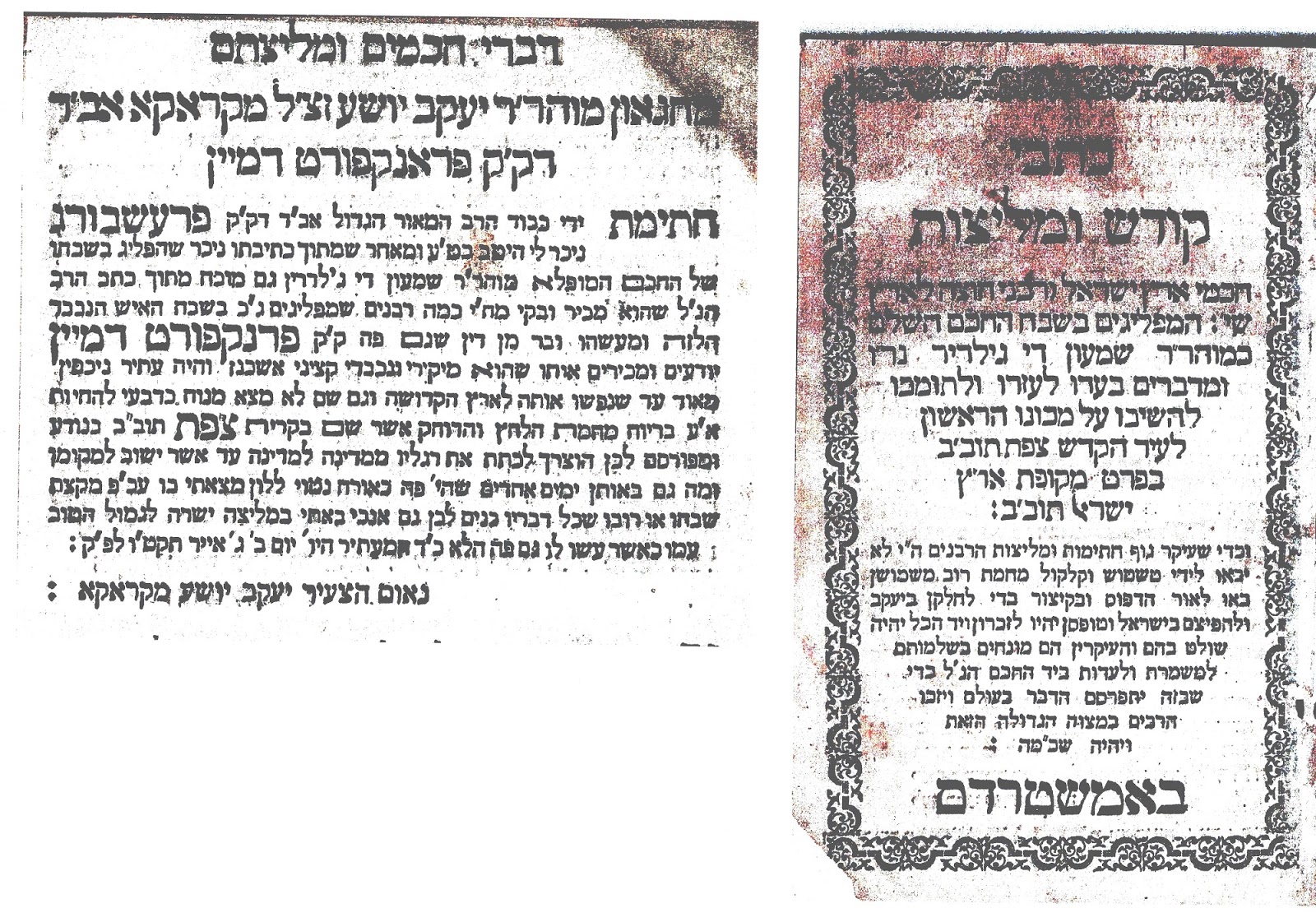
2. Monday, April 14, 1755 (=3 Iyar 5515). Falk wrote a letter on behalf of Simon von Geldern (1720-1788), then an itinerant yeshiva student. Falk writes:

“The signature of the Chief Rabbi of Pressburg [on the letter you showed me] is well known to me, and I recognize it at sight. Since he praises you in his letter… I too agree to write a letter on your behalf.”[12]  See here:


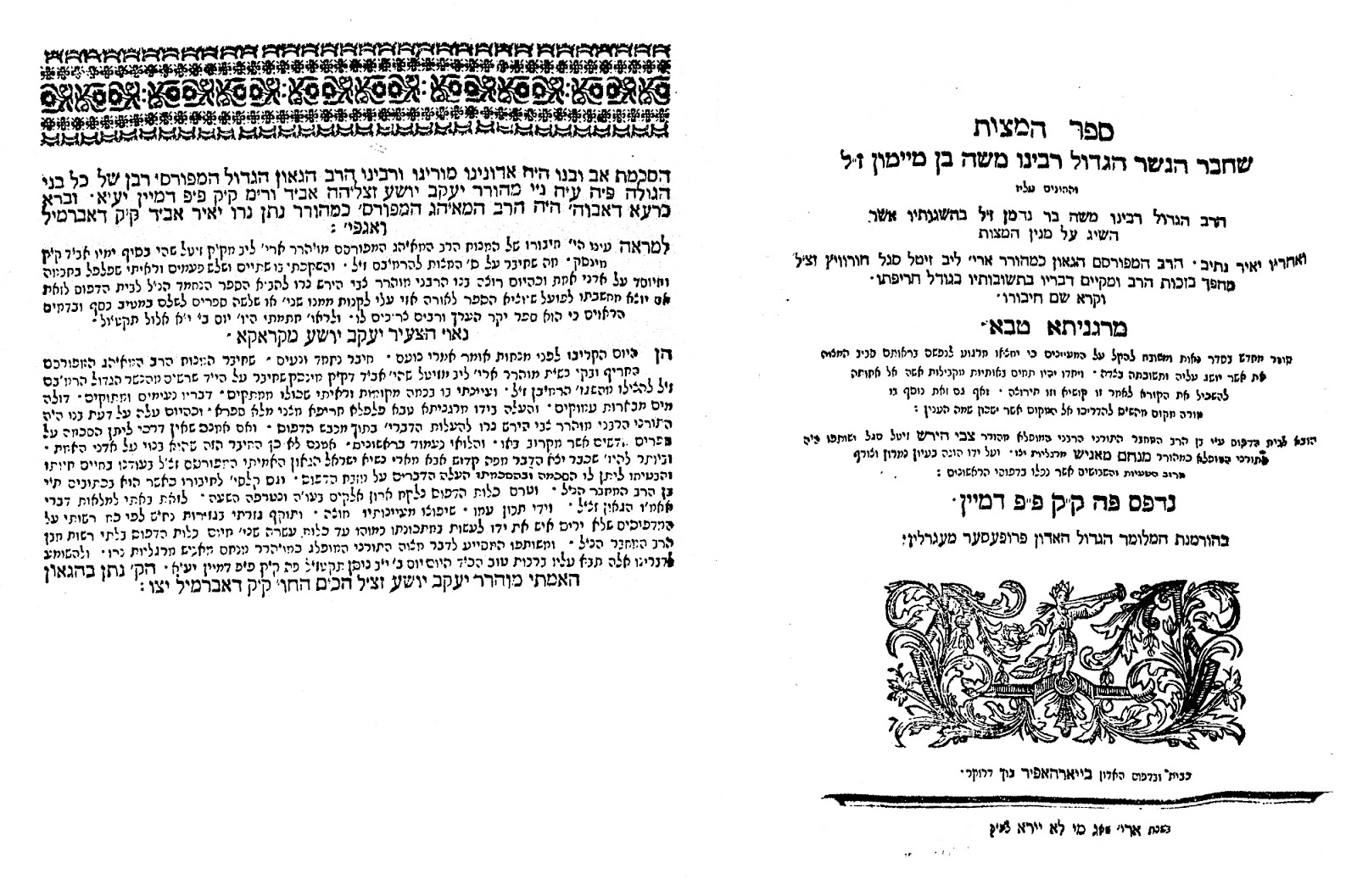
3. Monday, August 18,1755 (11 Elul, 5515). Falk wrote his final letter of approbation for authors of rabbinic works. He wrote 42 altogether. See his הסכמה to R. Aryeh Leib Horowitz’ ספר המצות עם פירוש מרגניתא טבא (Frankfurt, 1756). Falk writes that a copy of R. Aryeh Leib’s מרגניתא טבא was placed before his eyes (italics mine, s.z.l.). He examined it two or three times and saw that the comments were wise and true, and agreed to write a letter of approval.[13] See here.

4. Friday, August 29, 1755 (= 22 Elul 5515). In a broadside entitled חרבות צורים , Falk published his final salvo in the Emden-Eibeschuetz controversy.[14] Some 8 weeks earlier, Eibeschuetz had published לוחת עדות (Altona, 1755), his first published book, and the only one which was devoted to a vigorous denial of the charges made against him that he was a closet Sabbatean. In the book, he addressed the amulets that had been ascribed to him, and called to the stand an impressive list of witnesses for the defense, including many of the leading rabbis in Lithuania, Poland, Bohemia, Moravia, Germany, Italy, Turkey and elsewhere, all of whom attested to his innocence of the charges levelled against him. Falk’s חרבות צורים was the first published book review of לוחת עדות, and a devastating one at that.

For our purposes, what is significant is that Falk indicates that he read the book upon publication, and indeed cites chapter and verse with precision. He even notes that he compared the printed version (in לוחת עדות) of a personal letter that Eibeschuetz had addressed to him in 1754, to the original copy still in his possession, and noticed subtle, if only minor, differences. Apparently, Falk could see quite well, as late as August 29, 1755, when the broadside was penned by him.[15] He died some 5 months later on January 16, 1756 (= 14 Shevat 5516). See here.

In sum, R. Jacob Joshua Falk was not blind during the key years that he participated in the Emden-Eibeschuetz controversy. He may well have suffered from blindness toward the end of his life. If so, this is likely to have occurred sometime after he wrote his final salvo in the Emden-Eibeschuetz controversy on August 29, 1755.[16]

Notes

[1] For a scathing rabbinic critique of Emden’s character, and for samples of the negative impact of his character on his writings, see R. Meir Dan Plotzki, “לכותבי הסתוריא” in דגלנו 2 1922, n. 5-6, pp. 108-110, and n. 10-11, pp. 191-194; and 3(1923), n. 12, pp. 230-233. For a typical historian and apologist who explains away Emden’s animosity as being grounded largely in jealousy, see E. Duckesz, חכמי אה”ו (Hamburg, 1908), pp. 55-63. A wide variety of other motivations for Emden’s animosity have been suggested, including economic factors (see, e.g., M.J. Cohen, Jacob Emden: A Man of Controversy ,Philadelphia, 1937); halakhic issues (see, e.g., Rabbi R. Margulies, סיבת התנגדותו של רבינו יעקב מעמדין לרבינו יהונתן אייבשיץ , Tel-Aviv, 1941); and kabbalistic speculation (see, e.g., Rabbi Y.Y. Safrin, נציב מצותיך [first published in Lemberg, 1858] Jerusalem, 1983, p. 117, and Rabbi A.Y. Schlesinger, קונטרוס שמרו משפט תנינא, Jerusalem, 1914, p. 72a).
[2] On Falk’s role in the Emden-Eibeschuetz controversy, see S.Z. Leiman, “When a Rabbi is Accused of Heresy: The Stance of Rabbi Jacob Joshua Falk in the Emden-Eibeschuetz Controversy,” in D. Frank and M. Goldish, eds., Rabbinic Culture and Its Critics (Detroit, 2008), pp. 435-456.
[3] Emden, ויקם עדות ביעקב (Altona, 1755), pp. 79a-80a (the pagination mistakenly reads: pp. 59a-60a).
[4] Ibid., p. 80. The Hebrew reads: אף גם הוא כעת הולך ערירי וכוחו סר ואור עינו אין אתו.

The plain sense of the phrase אור עינו אין אתו is less than certain. Although some are inclined to render it figuratively, e.g, “his eyes lost their sparkle,” in rabbinic literature it is often rendered literally and refers to loss of sight.

For the figurative sense, see 1 Sam 14:29 ארו עיני (my eyes lit up), Psalm 38:17 ואור עיני גם הם אין אתי (my eyes have lost their luster), and cf. M. Yoma 8:6. The figurative sense, then, refers clearly to the restoration or loss of physical and mental well-being. For the sense “loss of sight,” see, e.g., R. Yosef b. Eliyahu Hazzan, עין יוסף (Smyrna, 1675), introduction; R. Jacob Emden, חלי כתם (Altona, 1775), p. 22b; R. Yissachar Lichtenstein, אהל יששכר (Altona, 1826), letter of approbation by R. Michael May of Breslau; R. Abraham Ha-Levi, אברהם זכרון (Lvov, 1837), letter of approbation by R. Yaakov Orenstein; and R. Yekutiel Yehudah Greenwald, פארי חכמי מדינתינו (Sighet, 1910), p. 38, entry 13. In these (and in other) rabbinic passages, the phrase אור עינו אין אתו is often used interchangeably with the terms עיוור, סומא, and סגי נהור.
[5] See D.A.L. Zinz, עטרת יהושע (Bilgoraj, 1936), p. 19. Her tombstone – moved from the old to the new Jewish cemetery – is preserved to this very day in Mannheim’s New Jewish Cemetery.
[6] Nathan Nota Eibeschuetz adds in the postscript that “starting at her funeral, Falk proclaimed that his punishment was due to his opposition to my [i.e., Nathan Nota Eibeschuetz’] Master, Teacher, and Rabbi, my father the Gaon [Jonathan Eibeschuetz].

[7] Zinz, loc. cit.
[8] See G. Klemperer, “Rabbi Jonathan Eibenschütz,” in Pascheles’ Sippurim 4(1856), pp. 284-5 [also published as a monograph entitled Rabbi Jonathan Eibenschütz (Prague, 1858), pp. 76-77]. Cf. Y. Gastfreund, “תולדות רבי יהונתן אייבענשיטץ” in his אנשי שם (Lyck, 1879), p.17, note. None of these sources provide any detail about a progression from partial to total blindness; they simply assume that at some point toward the end of his life Falk suffered from total blindness.
[9] See, e.g., H.Y.N. Silberberg, קונטרס דרך חיים (Piotrkow, 1931), p. 81.
[10] See, e.g., Y.Y. Vidovsky, “הקדמת המו”ל” in יערות דבש השלם המנוקד (Jerusalem, 2000), vol.1, p. 45, n. 95, whose claims are based upon an egregious misreading of the evidence he presents. Falk’s apologists are not discussed in Y. Barnai’s “יחסה של ההיסטוריוגרפיה האורטודוקסית לשבתאות” in his שבתאות: היבטים חברתיים (Jerusalem, 2000), pp.120-141.
[11] H.Y.D. Azulai, מעגל טוב השלם (Jerusalem, 1934), p. 23.
[12] Simon von Geldern, כתבי קודש ומליצות (Amsterdam, 1760), p. 4b.
[13] A.L. Horowitz, ספר המצות עם פירוש מרגניתא טבא (Frankfurt, 1756), הסכמה printed immediately following the title page (courtesy: HebrewBooks.org). See, however, the הסכמה of Falk’s son on the same page, which raises the possibility that Falk’s הסכמה was dictated by him and recorded by his son. Even so, I don’t think this changes the basic facts recorded in Falk’s הסכמה.
[14] Only one copy of חרבות צורים seems to have survived the vicissitudes of time. It is preserved in a private collection, and the owner, who prefers to remain anonymous, has graciously allowed me to publish the full text anew. I plan to do so in the near future. Here I post a scan only of the opening lines and paragraph, which are relevant to the discussion at hand.
[15] It is possible to claim that Falk was already blind when לוחת עדות was published on June 27, 1755. When a copy reached Falk in Frankfurt, it was read to him by an amanuensis, who also recorded Falk’s response as it was dictated to him. The response was then published in the broadside entitled חרבות צורים. Such a claim, however, is meaningless in terms of apologetics, whose ultimate goal is to dismiss Falk’s testimony as uninformed and meaningless. By June 1755, Falk’s role in the Emden-Eibeschuetz controversy was basically over. It’s everything he said, wrote, and did before June 1755 –when he certainly could see and read – that established his unique and unequivocal stance in the controversy. Moreover, specifically with regard to חרבות צורים, every criticism of Eibeschuetz by Falk is referenced with precision to the appropriate page in לוחת עדות. Every criticism is clever, incisive, and right on target – as one would expect from a tried and tested Sabbatean-buster like Falk. None of the criticisms could be dismissed as the uninformed and meaningless testimony of a blind man who could not read and understand the text of לוחת עדות.
[16] Anecdotal evidence (that can neither be authenticated nor dated with precision) preserves a tradition that Falk wore reading glasses in Lvov. If true, it surely suggests that he was able to see at that early stage in his life (and needed glasses only for reading). Indeed, to the best of my knowledge, no one has ever claimed otherwise. See Zinz, op. cit., pp. 95-6. Elsewhere in the same volume (on p. 25), Zinz writes specifically – without adducing any evidence – that Falk “was blind for several months prior to his death.” This is perfectly consistent with our conclusion


Mysteries of the Magical Fifth Passover Cup (II): The Great Disappearing Act

Mysteries of the Magical Fifth Passover Cup (II): The Great Disappearing Act

By Leor Jacobi

Years ago, as a Yeshiva Bochur, a Rabbi explained to me that, according to the GRA, the Cup of Elijah at the Passover Seder is really the Fifth Cup mentioned in the Talmud which there is a doubt about  Thus, it is Elijah’s cup because when he returns to herald the redemption, every Talmudic tequ will be solved. I found that the elusive Fifth Cup is not actually mentioned in the Talmud as we have it, but by most of the Rishonim, who all had a textual variant.

Later, as a Junger Mann, I found R. Menachen Mendel Kasher’s pamphlet on the Fifth Cup, also published in his Haggadot (generally abridged). Despite some intrinsic flaws, it is a masterful and ingenious integration of traditional and modern methods.

A few years ago, groundbreaking publications by my teacher, David Henshke, and my colleague, Eliezer Brodt, inspired me to build upon their foundation, concentrating on points which remain obscure or unsolved.

As there are quite a few of these, I divided up the study into seven chronological and thematic parts which I hope will evolve into book chapters eventually but also stand alone as they are. The first part of the envisioned series, on the magical genesis of the fifth cup, was accepted by a prominent journal that graciously agreed to have an early draft distributed here. Part four, on 19th century scholarship post-Levinsohn was recently submitted to another leading academic journal.

With the current social upheavals due to the Coronavirus pandemic in mind, thanks to the generosity of the editors of the Seforim Blog, we can forego delays and release a draft of part two in time for Passover. Hopefully, the virus will disappear faster than the fifth cup did! Please favor me with your feedback towards advancing the project and I will do my best to acknowledge any and all contributions.

In a previous study on the genesis of the Fifth Cup, a primary textual variant of the Babylonian Talmud (Pesachim 118a) was identified as the source, an original teaching from the Talmudic Sages. Following the compilation of the Talmud, Babylonian Geonim not only received this textual variant, but actually drank the fifth cup themselves, with the apparent exception of Rav Hai Gaon, who also had the fifth cup Talmudic variant, but interpreted it as an optional practice, one which he did not follow. If the fifth cup was ordained in Babylon due to zugot, concern for even pairs arousing evil spirits, as explained in the prior study, perhaps Rav Hai inherited the original Palestinian custom of only four cups (zugot was only an issue in Babylon), as the Sages of Erez Israel did not believe in zugot. Alternatively, perhaps Rav Hai rejected the fifth cup as far as his own practice but not to the point of speaking out against it.

The fifth cup was widely observed among the Babylonian Geonim, and subsequently mentioned by Alfasi, Maimonides, and by Tur (14th century), the latter at length, with an entire siman (OḤ 481) devoted to it. 


However, if we fast-forward to the 16th century, we find that, despite an extensive discussion in R. Joseph Karo’s monumental Bet Yosef the fifth cup disappeared completely in his Shulḥan Arukh. Following the order of Tur, R. Karo gave names to all of the simanim. Here, he adopted a side issue of the siman and made it the focus and new title: “Not to drink after the fourth cup”. 


Furthermore, none of the principal commentators on the Shulḥan Arukh (“nose kelim”, 16th-17th centuries) even noted its disappearance. Explaining the magical disappearing act of the fifth cup during the Middle Ages will be the focus of this study.

The disappearance has bothered modern scholars of rabbinic literature, who struggled to explain it, most notably R. Menahem Kasher. Several factors have been suggested to explain the elimination of the fifth cup. They include: 1) Deletion of the Talmudic text mentioning the fifth cup due to homoteleuton (skipping text from one similar word to another)[1], 2) Endorsement of this variant by Rashi and Rashbam, 3) Application of this variant by subsequent Ashkenazi scribes,[2] 4) Circulation of an abbreviated version of Rav Hai Gaon’s responsum (in Tur) which suggests that Rav Hai Gaon also received the “Rashbam’s” version of the Talmud which does not mention the fifth cup,[3] 5) A statement at the beginning of Tur that the fifth cup should not be drunk, probably explaining Rashbam’s opinion, but ambiguously stated, 6) the development of a stringency in Medieval Ashkenaz to refrain from all drinking after the fourth cup, with some including even water in the prohibition (see below) and 7) The publication of the Venice edition of the Talmud, in 1520-23 following Rashbam’s textual variant, with no mention of the fifth cup, all subsequent editions following in kind, almost certainly the edition consulted by R. Joseph Karo.

Despite this multitude of factors, they don’t adequately explain R. Joseph Karo’s editorial decision to completely delete such a well-entrenched custom as the fifth cup, mentioned by all three of his pillars, Alfasi, Maimonides, and Rosh.[4] I propose that an additional factor, barely recognized previously and never noted in this context, was the one that settled the matter conclusively in the mind of Maran.

Rabbenu Yonah Girondi (13th century) maintained that one should refrain from drinking extra wine so as to be able to study the laws of Passover and the story of the Exodous all night, as the Sages did in Bne Braq. Maharil cites Rosh (Asheri) as adding that the fifth cup was permitted due to the verse v’heveiti. However, our standard printed text of Rosh states that the fourth cup is permitted due to the verse v’laqaḥti

(אבל בכוס רביעי התירו שיש לו סמך מן הפסוק כנגד ולקחתי אתכם. (סימן לג…

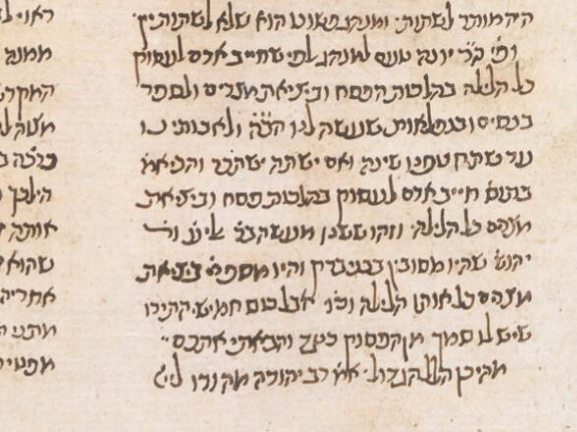
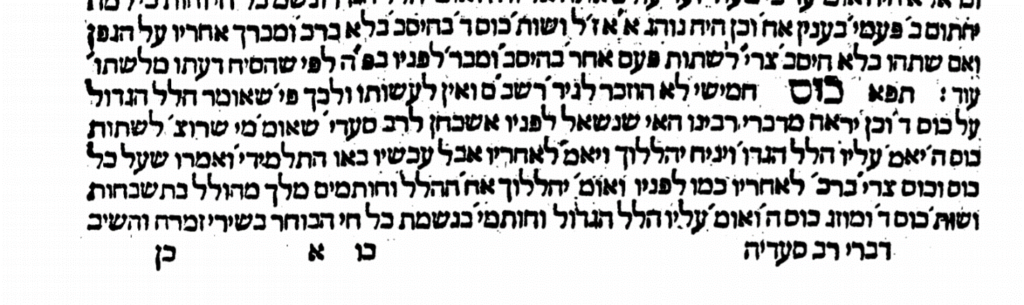
Rabbi Alter Hilewitz (1906-1994, author of halakhic works and editor of Encyclopedia Talmuditobjected that the printed text makes no sense and must have become corrupted.[5] There is no reason to permit the fourth cup after it has already been mandated in the Mishnah. The special dispensation must have been for the fifth cup and Maharil cited the genuine text version of Rosh.[6] R. Hilewitz’s hunch was correct, as we find in an early manuscript of Rosh (Asheri) written in Spain in 1325 during the lifetime of Rosh (from middle of 3rd line from bottom):[7] 


Rabbi Hilewitz

The corruption was a by-product of proliferation of the Rashbam’s text of the Talmud eliminating the fifth cup entirely. It probably represents an unintended stringency in interpretation of the prohibition on drinking excessively. Another correction we find in the manuscript is the attribution of the opinion. The manuscript attributes it to Rabbenu Yonah, corresponding to the attribution in Tur. However, the printed edition misattributes it to ר”מ, R. Meir of Rothenburg, master of Rosh.

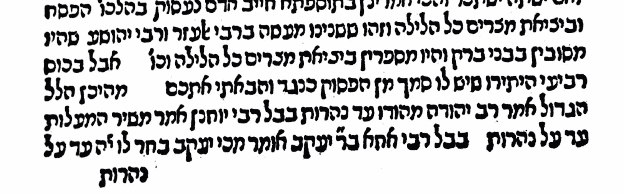
The text of Rosh which R. Joseph Karo relied upon was almost certainly that of the famous aforementioned Venice edition of the Talmud.[8] It reads:

.אבל בכוס רביעי התירו שיש לו סמך מן הפסוק כנגד והבאתי אתכם…


The text does not make sense. It is conflated. Either the fourth cup was permitted by the verse v’laqaḥti (as in the modern printed editions), or the fifth cup was permitted by the verse v’heveiti (as in the manuscript). The fourth cup could not have been permitted by the verse v’heveiti. The development was apparently a two-stage process and the Venice Edition represents the “missing link”, an intermediate stage in which the fifth cup was changed to the fourth cup but the verse remained intact. At this point, R. Joseph Karo or the later publishers could have corrected the text back to “the fifth cup”, restoring the original version in the manuscript. However, the tide was already turning towards the fourth cup Talmudic textual variant in Bet Yosef, with his decision to read Rashbam’s Talmudic textual variant into Rav Hai Gaon’s responsum.[9] R. Joseph Karo decided to keep “the fourth cup” and to ignore the word v’heveiti, or to mentally “correct” it to v’laqaḥti, exactly how the later printers chose to emend the text of Asheri.

One can speculate as to why Kasher, Benedict and subsequent Rabbinic scholars did not discover this source. R. Hilewitz’s observation was published in a 1945 newspaper article in Palestine. At the time, war was raging and R. Kasher was in America. Manuscript variants of the text of the Talmud have been studied and published on for years[10] and the last generation has brought us two editions of Tur prepared using manuscripts.[11] Even Tosafot Rosh is published from manuscripts in critical editions.[12] However, for some reason, manuscripts of Rosh are relatively uncharted territory, despite the centrality and rabbinic authority of the work. Perhaps (similar to Rashi’s Talmudic commentary, up until the groundbreaking work of my teacher, Aaron Ahrend) it is this very centrality that led its manuscripts to be ignored, as it was printed so early on, in the Venice Talmud, and so many times. 

Most significantly, the text is hidden from view. Tur clips off this section of the discussion and Bet Yosef does not cite it. However, once we return to the textual version that laid open before R. Joseph Karo on his desk, which he certainly meditated on, we can understand how he interpreted the abbreviated text of Tur and why he decided to delete the fifth cup.


Addendum: The Power of Piyyut

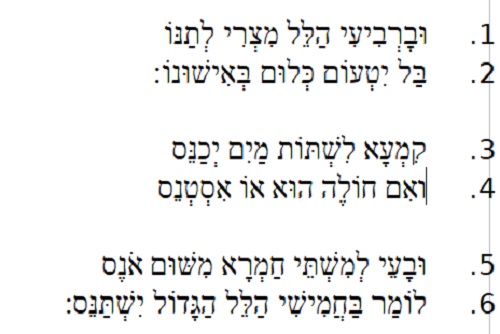
Shmuel of Evreux adopted a stringency not to drink even water after the four cups.[13] His source was the piyyut composed by R. Yosef Tuv Elem for a qerova recited on Shabbat ha-Gadol.[14] The last two stanzas at the end of the piyyut are the most famous today, for they are recited almost universally at the end of the Haggadah: “Hasal siddur Pesah”. The stanza preceding it is one mentions the fifth cup. There are two textual variants of this line interpretations of the piyyut. Three manuscripts read as follows:[15]


According to this text, line 3 states that it is permitted to drink water absolutely, in accordance with normative halakhah. Line 4 adds conditions for drinking wine, being sick or finicky, as described in line 5 with the recitation of Hallel ha-Gadol in line 6.

Medieval piyyut commentaries also follow this text, for example, the commentary by Samuel b. Salomo of Falaise:[16]

…קמעא, מעט, לשתות מים יכנס, לאחר סעודתו אם ירצה לשתות, ואם חולה הוא או אסטניס ובעי למשתי חמרא ואינו יכול לשתות מים, לומ’ בה’ על שם ‘ה הלל הגדול, ישתנס, יאזור

However, the textual variant followed by the Tosafot (Pesahim 117b) omits the vav at the beginning of line 4. Now the conditions of line 4 apply to line 3 as conditions for drinking water. Apparently from this piyyut, R. Shmuel of Évreux derived the stringency against drinking water after the Seder.[17] Tosafot for chapter Arvei Pesahim were based upon the Tosafot of R. Yechiel of Paris or a student of his, such as Rabbenu Peretz (Shalem Yahalom). R. Yechiel was in contact with R. Shmuel. R. Yechiel would attempt to refute R. Shmuel’s novel stringencies. Sometimes the refutation was accepted, such as cited by R. Peretz in his gloss to Smak 93, and sometimes not, as found in Orhot Hayyim, Hilkhot Tum’ah, vol 2, p. 602, and apparently in our case regarding the stringency of not drinking water. In this case, the development of a stringent shitta forbidding even the drinking of water likely shifted the goalposts of halakhic discussion away from the option of the Fifth Cup of wine. 

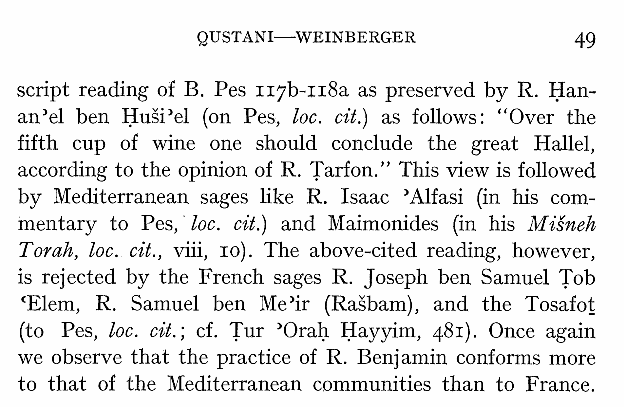
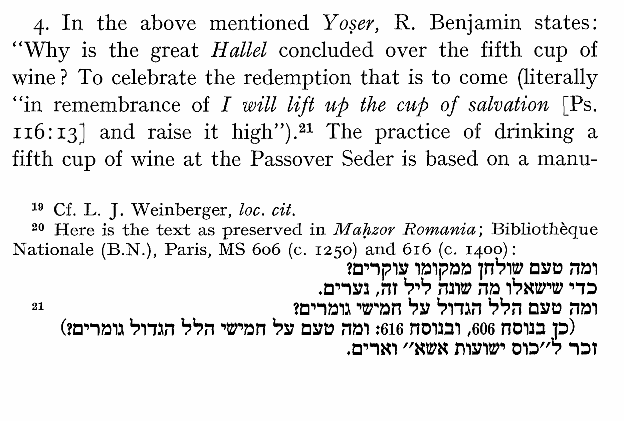
Finally, on the topic of piyyut, Leon J. Weinberger described a poem from R. Binyamin which mentions the fifth cup as a basic custom, an integral part of the Passover Seder. The piyyut was later published in its entirety by Ezra Fleischer.[18] According to Weinberger, it provides a messianic interpretation of the fifth cup, an aspect of the fifth cup that will become more evident during later periods to be discussed in chapters of this study yet to come. 


Editor Note: please see Eliezer Brodt’s earlier post on this subject: https://seforimblog.com/2013/03/the-cup-for-visitor-what-lies-behind/

[1] Henshke; also see here for another possibility and analysis of Talmudic manuscripts here.
[2] Kasher noted Rabbenu Tam’s fierce opposition in general to applying proposed emendations into the text of the Talmud itself, blaming Rashbam (his older brother) in particular. See Spiegel, Soloveitchik, briefly reviewed in my Jewish Hawking in Medieval France.
[3] Rav Kasher advanced this claim convincingly to explain the deletion by R. Joseph Karo. R. Avraham Benedict also advanced this claim, without crediting Kasher. As far as rendering a legal decision, Benedict took a diametrically opposite position. According to Kasher, now that we possess the full version of Rav Hai Gaon’s responsum, we see that R. Joseph Karo was led astray by an ambiguous text. Benedict considers R. Karo’s decision binding and the presence of the abbreviated version is ample justification.
[4] Noted especially by Kasher, also by Henshke.
[5] ‘Kos shel Eliahu’, Bamishor 245-6 (25.3.1945), p. 5.
[6] This version is also found in Abudraham (Seder ha-Haggadah u’Perisha, ed. S. Kroizer, Jerusalem 1963, p. 234), citing Rabbenu Yonah. Abudraham’s source was probably Asheri, but he did not generally cite secondary sources, as he himself stated in his introduction (p. 6.). See: L. Jacobi, “Talmudic Honey”, Fragments of the Novellae of R. David ben Saul of Narbonne”, Giluy Milta B’alma, 2/17/2016.

[7] British Library Add. 27293 f. 131v.
[8] Bomberg: Venice 1520-1523, p. 138b.
[9] Kasher, Benedict.
[10] Diqduqe Sofrim, Lieberman Instritute, Friedberg.
[11] Shirat Devorah; Ma’or.
[12] Mossad Ha-Rav Kook, Ofeq Institute.
[13] Cited by Mordechai, Hagahot Maimoniot (Ed. Constantinople, 6:11, “gedole Evreax”), Agur. Tosafot Pesachim 117b.
[14] See a letter from Pinchas Eliyahu Lawee in Kobetz Beit Aharon 15:5 (89, 1998), pp. 135–136.
[15] With only minor variants irrelevant for our purposes. Gabriel Wasserman shared with me his pilot edition of variants and Abraham Levine provided me with expert guidance in this study.
[16] Parma – Biblioteca Palatina Cod. Parm 3000 (de Rossi 378), f. 30a-35b. I was aided in locating piyyut commentaries by Elisabeth Hollender’s monumental Clavis.
[17] Another later piyyut follows this strict opinion, recently published by R. Jacob Israel Stal. See his note at page 33.
[18] Kobez al Yad 21 (1985), p, 31.


Ghosts, Demons, Golems and their Halachik Status

One explicit mention of a ghost appears in the Talmud Ketubot 103a. The Talmud records that every week Rebbi used to return to his house after he died. The Talmud, however, does not record what Rebbi used to do when he came back. The Sefer Hassidim states that Rebbi was different than other dead people in that he was considered almost fully alive. Rebbi, according to the Sefer Hassidim, would make Kiddush for his family.[1]

A much later instance of an interaction with a ghost is found in R. Pinchas Katzenellenbogen’s (1691-1765/1767) Yesh M’Nechalin. R. Katzenellenbogen happened across a man who had the last two of his fingers bent back and connected to his palm. R. Katzenellenbogen inquired whether the man was born that way. The man explained that he was not and instead this happened when he had attended a fair. There were hundreds of people in a large room preparing for the next day’s events. Suddenly, the door of the room opened on its own. Standing at the doorway was a women dressed in tachrichim (death clothes). One person, screamed that it was his dead mother. Someone got up and slammed the door shut only to have the door open by itself again with the woman standing there. This man then went and pushed the “ghost” and from that day on his fingers were permanently connected to his palm.

Continuing on the theme of dead or other beings which interact with those still alive, we come to a rather strange question which has occupied the minds of many people for the last 800 years. The question is what is the status of someone who has intercourse with a demon? The first to mention this question is R. Isaac of Vienna (1200-1270) in his work Or Zarua. He states that intercourse with a demon is halackically meaningless. He cites a midrash which has a hassid (pious one) who was seduced by a demoness on Yom Kippur. Afterwards he felt very bad about this, but Elijah the Prophet visited him and asked him why he was sad. After the hassid explained what happened Elijah said don’t worry it was only a demon. The Or Zarua therefore says as Elijah appeared to him and he told him it was ok, intercourse with a demon is not a problem.

Now, the Or Zarua was not addressed at an actual question, however, R. Meir of Lublin (1558-1616) was asked about an “actual” case where a woman had intercourse with a demon and thus could she remain married to her husband. Although R. Meir was unaware of the Or Zarua he independentally came to the same conclusion – she was still permitted to remain married as intercourse with a demon has no effect. Least one say this is all in the realm of theory or not followed, the Beit Shmuel the classic commentary on Shulhan Orach Even haEzer quotes this law of R. Meir of Lublin (Even haEzer 6:17).

The question of intercourse with a demon seems to have come up without respect to the local or time period. R. Hayyim Yosef David Azulai (Hida) discusses “groups of women who go out to the forest” and conduct rituals with music and it seems they were visited or engaged in intercourse with demons. The Hida follows the ruling of R. Meir of Lublin and permits these women.

In Hungary in the 19th century there was a celebrated case where a woman became pregnant while her husband was away and she claimed the “father” was a demon. It appears the child was not deemed a mamzer (bastard) and the woman was allowed to remain married.

Now, there were some who questioned this whole line of reasoning and said that if one engages in intercourse with what appears to be human even if they are a demon it is of no moment. Thus, a married woman would be prohibited to remain married. The first to come to this conclusion was R. Yitzhak Binyamin Lipman (17th century) in his Nahlat Binyamim. Additionally, R. Yosef Zechariah Stern says if one follows the above rulings, what is stopping anyone who commits adultery to just claim it was a demon.

Moving on from demons, we now go to beings created via the Sefer Yetzirah. The Sefer Yetzirah (Book of Creation) is a work which allows via manipulation of various names of God to create things. Many have dealt with the halakhic status of such creations. For instance, R. Meir Leibush (1809-1879) in his work the Malbim says the reason Abraham was able to give the angels milk and meat together was Abraham did not give them meat from a born cow. Rather, the Malbim points to the verse which says “the calf which he [Abraham] made.” Malbim explains the words “he made” are literal, i.e. Abraham created the calf via the Sefer Yetzirah and thus was able to feed them both this meat and milk at the same time.

R. Isaiah Horowitz in his work Sheni Luchot HaBrit (Shelah) similarly understands the controversy between the brothers and Joseph. Specifically, Joseph, according to some Midrashic sources three negative things about the brothers – they at ever min ha-hai, they engaged in intercourse with Canaanite females and they embarrassed the children of the servants. The Shelah explains all three were based upon the Sefer Yetzirah. He explains that the Sefer Yetzirah was written by Abraham and passed on to Isaac and then to Jacob. The brothers, however, felt the sons of the servants were not worthy of such an important work (thus speaking ill or embarrassing them). Additionally, the brothers acted on the book and created animals which they ate from before killing them as there was no need being they were created via the Sefer Yetzirah. Further “it is possible that the tribes [the brothers] had created a woman” and it was these things Joseph saw and misunderstood to be regular beings. Again, according to the Shelah, intercourse or otherwise with beings from other worlds pose no halakhic issues. It is not surprising the Shelah took this position as the Shelah’s teacher was R. Meir of Lublin the one who permitted the woman who had intercourse with a demon to remain married.[2]

Perhaps the brothers were not the only ones to make women for this purpose, it is recorded (albeit much later) that R. Solomon Ibn Gabriol (1021-1058) created a woman to “serve” him. But, when the authorities found out he was forced to show it was merely wood and not a person.[3]

At the end of the forgery Niflot HaMaharal (the most comprehensive source for the false legend the Maharal of Prague created a golem) there is a discussion of various aspects of a golem. For instance, whether a golem would create impurity after it was “killed” (it would not) and the like. In regards to intercourse they state that “a golem can not reproduce nor does it have desires for the opposite sex.” It would seem that in the Paul Wegner 1920 silent movie classic “Der Golem” he disagreed with that premise. Part of the plot line is the Golem falling in love with the Maharal’s daughter; the nobleman’s son also does and she in fact runs off with him only to have the Golem rescue her. (It seems the Simpsons also follows with a similar plot line.)

As a final note, it is worthwhile mentioning that going the route of trying to connect with the other world does have it perils. R. Yaakov Ettlinger, in his Binyan Tzion describes a case where a woman met a man who told her he was Elijah the prophet and through their union the Messiah would be produced. The woman believed him, only to find out after the fact the person was con man. R. Ettlinger deals with whether in such a case she can remain married to her husband. So, ultimately one should make certain they verify the credentials of any demon, golem or ghost prior to engaging in any questionable acts.

Sources: Yesh M’Nechalin, 267-68; Hannah Sprecher, “Diabolus Ex-Machina: An Unusual Case of Yuhasin” in Jewish Law Association Studies VIII: The Jerusalem Conference Volume, 183-204; J.H. Chajes, Between Worlds: Dybbuks, Exorcists, and Early Modern Judaism (who although discusses the topic of intercourse with a demon appears to have been unaware of Sprecher’s article which contains many more sources than Chajes cites or discusses); Moshe Idel, Golem, esp. pp. 213-241 (which was reprinted almost in its entirety in a Torah u-Madda Journal 9 (2000) article by Dr. John Loike available here (PDF); R. Yudel Rosenberg, Niflot HaMahral (Pitrokav, 1909), pp. 71-74; R. Yaakov Ettlinger, Binyan Tzion, no. 164; Shnayer Z. Leiman, “The Adventure of the Maharal of Prague in London; R. Yudl Rosenberg and the Golem of Prague,” Tradition 36:1 (2002): 26-58; see also the account in Kav Ha-Yashar from R. Moshe Koidonover, translated by Zinberg, A History of Jewish Literature, vol. 6, pp. 161-63.

[1] See the discussion in the R. Reuven Margulies edition how he could have been motzei them if he was dead. Sefer Hassidim, no. 1129.

[2] Interestingly, Idel in his book Golem, appears to have been unaware of the connection between the Shelah and R. Meir of Lublin.

[3] In the halakhic realm, most are already familiar with the well-known question first posed by R. Tzvi Ashkenazi and elaborated on by his son R. Ya’akov Emden, whether a golem could be counted for a minyan (quorum).