Rabbi Adam Mintz: Rabbi Henkin and The First Heter Agunot in America

Rabbi Henkin and The First Heter Agunot in America
By Adam Mintz

The tragedy of the agunah, the woman who is unable to receive a get from her husband, has plagued the Jewish people since time immemorial. Rabbis and scholars throughout the centuries have contended with this issue in an attempt to free agunot to remarry. In the United States this issue was first formally addressed following World War I. European Jews soldiers, fighting on both sides of the war, were among those killed in battle. As soldiers are generally young, they often left childless widows who required a halitzah from the dead husband’s brother in order to remarry. A number of these brothers had immigrated to the United States where visas were difficult to acquire. Therefore, the Agudath HaRabbanim sent a letter to its membership in 1922 alerting them to this situation and offering assistance in helping these women acquire temporary visas to the United States thereby allowing these women to obtain a halitzah and to remarry.

With the growth of the American Jewish community in the early part of the twentieth century, Jews began to assimilate and the predicament of the Jewish wife whose husband had abandoned her to live with a non-Jewish woman became an ever increasing phenomenon.[1] Many rabbis attempted to free the Jewish wife to remarry, even though she was unable to find the husband and receive a get. Some of the solutions were based on broad institutional enactments, while others dealt with the problem on a case-by-case analysis. One of the principles underlying the foundation of much of this discussion is the halakhic status of civil marriages and of weddings performed by Reform rabbis. Rabbis Feinstein and Henkin disagreed about the status of these marriages and this disagreement played an important role in their view of the agunah problem. Understanding their particular views is vital for the understanding of the agunah issue and for the appreciation of the important roles that these two American rabbinic giants played on this issue.

Rabbi Henkin discussed this issue in a number of articles and teshuvot. His earliest treatment of civil marriage appears in a series of articles in Hapardes in 1934, where Rabbi Henkin argued that a civil marriage is considered a marriage according to Jewish law and that a get would be required to terminate such a marriage.[2] He explained that a couple is considered halakhically married even though they did not have a Jewish ceremony and do not intend to be married according to Jewish law. According to Rabbi Henkin, the validity of the marriage is achieved by the fact that the couple lives together as husband and wife. He added that the Jews who see them together as a couple satisfy the requirement of witnesses in establishing the halakhic status of the marriage. In an article in his book, Perushei Ibra, Rabbi Henkin explained the rational for his position through the comparison to a similar historical situation.[3] He quoted a fascinating responsum of Rivash, Rabbi Isaac ben Sheshet Perfet (1326-1408), communal rabbi in Algeria who had fled Spain following the anti-Jewish riots of 1391.[4] Rivash described that he was approached by a woman who had been a converso in Majorca. After she had escaped to North Africa she asked whether she could remarry even though she did not have a get from her first husband. She explained that she had been married by a priest after both she and her husband had been forced to convert to Christianity. After the marriage they had lived together as a married couple. The husband was not available to give her a get. Rivash decided in this case that the woman could remarry and did not require a get. Rabbi Henkin argued that Rivash’s case is unique as this couple was married by a priest and no longer lived among Jews. This situation, argued Rabbi Henkin, cannot be compared to the American situation where a man and woman are married by a civil authority and live together among Jews.

Rabbi Feinstein responded to Rabbi Henkin’s decision in a number of teshuvot in Iggerot Moshe. In the earliest teshuvah, dated June 28, 1959, Rabbi Feinstein argued that a civil marriage does not require termination via a get.[5] Rather, the couple can remarry even without a get. He explained that in the United States where people easily move in and out of relationships, the fact that a couple gets married in a civil ceremony and then lives together is not considered proof that they are married according to the halakhah. He relied on the precedent of Rivash and argued that American civil marriages can be equated to that situation of the fifteenth century. Interestingly, he wrote that even though the halakhah does not require a get, if it is possible for the wife to obtain a get she should follow the opinion of Rabbi Henkin and terminate the marriage through a get. It would appear that Rabbi Feinstein would agree that in a situation where the wife received a get she would not be able to marry a kohen.

Concerning a couple that was married by a Reform rabbi, Rabbi Feinstein wrote in a number of teshuvot that this wedding is not recognized according to the halakhah and a get is not required to terminate this marriage.[6] He explained that the only time the wedding would be valid is in a situation where there are two observant Jew who witness the ceremony. However, he claimed that even in that case the Reform rabbi often does not perform the marriage ceremony properly so the wedding would not be valid. Concerning the question of whether the fact that the couple lives together as husband and wife is a factor, Rabbi Feinstein wrote that a Reform ceremony is worse than a civil ceremony. A couple that gets married in a civil ceremony understands that this ceremony is not a Jewish one and that the fact that they live together binds them as a Jewish couple. However, a couple that is married in a Reform ceremony believes that this ceremony is a religious one and do not have the necessary intention of consummating the marriage when they live together. Nevertheless, he believed that if possible the woman should arrange to receive a get.[7]

In 1964, Rabbi Henkin wrote a letter to an unnamed rabbi who had ruled that a get is not needed to terminate a marriage when the ceremony had been performed by a Reform rabbi. Rabbi Henkin explained:

And the wonder of wonders, which makes one’s hair stand on edge, is that you are lenient regarding a marriage performed by a Reform rabbi. Is there really a need for an officiating rabbi? If a Jewish man says to a Jewish woman “you are mine” in front of witnesses, then she becomes his wife. And, if there are no witnesses at the ceremony, the fact that they live together as a married couple for many years is considered acceptable testimony. What difference does it make if the witnesses were Reform?[8]

Rabbi Henkin admonishes this unnamed rabbi that he must not allow other rabbis to rely on this incorrect lenient opinion.

Rabbis Feinstein and Henkin disagreed regarding both civil marriages and Reform ceremonies. While the issues are connected, they revolve around different considerations. Rabbi Feinstein looked at American society as a promiscuous one in which a man and woman living together did not reflect a relationship of commitment while Rabbi Henkin saw a more traditional society where relationships reflected commitment. It is fascinating that two Torah scholars who lived several blocks from one another could see American society so differently. The generation of rabbis and scholars who immigrated to the United States from Eastern Europe were forced to reconcile their recollections of the past with the realities of the present. That reconciliation took different forms for different rabbis.

It would appear that with regard to a couple married in a Reform ceremony, the differing rulings of these two Torah giants were based on their understanding of the Reform movement. Rabbi Feinstein believed that Reform rabbis were attempting to undermine halakhic Judaism and anything that they did was problematic and needed to be avoided. On the other hand, Rabbi Henkin, while rejecting the religious positions of the Reform movement, did not feel that the Reform rabbis were a threat to the Orthodox. Consequently he felt that whether a wedding was conducted by a Reform rabbi was immaterial. Rabbis Feinstein and Henkin disagreed as to the extent to which the Reform movement created a risk to the Orthodox movement.[9]

The positions of Rabbis Feinstein and Henkin had critical implications for the issue of agunah. According to Rabbi Feinstein, if a couple was married civilly or by a Reform rabbi and then the husband refused to give a get, the wife may remarry as this marriage is not considered halakhically valid. According to Rabbi Henkin, in such a situation, the woman would require a get. It would appear that Rabbi Henkin’s understanding of civil and Reform marriages stands as a serious impediment to the resolution of the agunah problem. However, in an article written in 1928, Rabbi Henkin alerted the community to the fact that he was very much concerned with the problem of the agunah and began by describing the current situation:

In the past few years the problem of the agunah has increased in Europe and here in America. This is a question that burns in the entire world as to what we can do for our sisters to save them from the chains of agunah when their husbands disappear…For this reason there have been leniencies suggested here [the termination of civil marriages without a get]. However, since we have proven that these leniencies have no basis in halakhah, these leniencies are really stringencies to destroy lives and such should not be done in Israel.[10]

According to Rabbi Henkin, since civil marriages require a get, to allow women to remarry without a get creates illegitimate children from the second marriage.

While Rabbi Henkin felt that this approach of terminating civil marriages without a get was not a legitimate one, he was deeply committed to trying to find an acceptable solution to the agunah problem. Accordingly, Rabbi Henkin was the first American rabbi to offer a proposal to solve the Agunah problem. This proposal was suggested in the above article written in 1928 soon after his arrival in the United States. Henkin noted that the problem of agunah, experienced by women whose husbands had disappeared or by women who were unable to receive the necessary halitzah, was “a daily occurrence,” and he made the following suggestion: at the time of the wedding the husband must authorize that a get may be written and delivered in the future. He must allow the get to be written to cover a number of situations including one in which the husband refuses to provide a get to his wife for three years. At that time, the claim would be brought to a central beit din (in the original proposal, he wrote that this should be the Jerusalem beit din) and, if the beit din agrees, then a get would be written even if the husband opposes the writing at that time. Rabbi Henkin called for this proposal to be discussed and voted upon in a meeting of rabbis and that if approved, it would remain the standard practice for fifty years.[11]

However, in 1930 a development impacted on Rabbi Henkin’s proposal before it had the chance to be acted upon. Rabbi Louis Epstein, a leading Conservative rabbi from Boston and the president of the Rabbinical Assembly and its Committee on Jewish Law, suggested that prior to every marriage, the husband should appoint his wife as an agent to execute a divorce on his behalf. Thus, if the husband disappears or refuses to grant the get, the wife can, in effect, divorce herself. In that same year, Rabbi Epstein published a volume entitled Hatza’ah Lemaan Takanat Agunot that attempted to prove the halakhic foundation for this proposal. In 1935, the Rabbinical Assembly, the rabbinic body of the Conservative movement, initially voted to accept this proposal.

In his volume, Rabbi Epstein described how he sent copies of his book to close to 1,000 rabbis asking for their opinions on his proposal. He explained that he received very few responses. While one of the letters was critical of his work, most of the letters were complimentary but argued that he could not proceed without the consensus of the leading halakhic authorities. He seemed encouraged by the nature of these responses inasmuch as they were not critical of his halakhic reasoning.[12] Among the letters that he received was a letter from Rabbi Henkin dated February 18, 1931. In this letter, Rabbi Henkin apologized for not having the time to study the book carefully. While Rabbi Henkin proceeded to make certain halakhic suggestions to Rabbi Epstein, the letter was in no way dismissive of his efforts. He even concluded the letter with the practical advice that if he wanted to send copies to all the rabbis of Europe as he proposed, it would become a very expensive undertaking.[13]

The Orthodox rabbinate responded to Rabbi Epstein’s proposal with disapproval and the Agudath HaRabbanim convened a meeting of rabbis during which various halakhic presentations were made arguing that Rabbi Epstein’s proposal was both impractical and halakhically unsound. In 1937, a volume was published by the Agudath HaRabbanim entitled Le’Dor Aharon which included correspondence from leading rabbis around the world opposing Rabbi Epstein’s proposal. In 1940, Rabbi Epstein published Le’Sheelat Ha-Agunah in which he attempted to support his view in light of the strong rabbinic opposition. The Orthodox rabbinate did not respond to this second volume and Rabbi Epstein’s proposal was never actually adopted in practice by the Conservative movement.[14]

Rabbi Henkin wrote an article that was included in Le’Dor Aharon.[15] In his lengthy essay, he explained his halakhic opposition to Rabbi Epstein’s proposal. Among other considerations, he concluded that it is nonsensical for the husband to appoint his wife to serve as the agent to write the get as she is the one who will be receiving the divorce.

Then he added:

“And I have already written that the reason that I have become involved in this battle is due to the fact that he [Rabbi Epstein] mentioned my proposal for the freeing of agunot … and I must escape from this comparison…My proposal was merely a suggestion and not meant as a halakhic decision…and when the volume Ain Tnai Be-Nisuin was published, I retracted from my position for even the greatest scholar has to follow the majority view.”[16]

Ain Tnai Be-Nisuin is a volume published in Vilna in 1930 by Judah Lubetsky, an Eastern European rabbinic scholar who served for many years as a rabbi in Paris. The volume was published in response to a decision by the Agudat Rabbanei Tzarfat in 1908 to allow a Jewish woman to remarry after a civil divorce based on a condition made at the time of the wedding that if the couple where to be divorced by the civil authorities then retroactively the original marriage would be nullified.[17] Rabbi Lubetsky collected letters from rabbinic scholars from around the world condemning this opinion and explaining that such a condition at the time of the marriage would not be valid and that the couple would still need a get.

Indeed, it would seem probable that in 1931 when Rabbi Henkin had written his initial letter to Rabbi Epstein he had not yet seen Ain Tnai Be-Nisuin and therefore did not reject Rabbi Epstein’s proposal at that time. By 1937, he had read Ain Tnai Be-Nisuin and felt compelled to both reject Rabbi Epstein’s proposal and to retract his own view. In the reprinted edition of Perushei Ibra, the pages that contain his initial proposal are bracketed with the words “hadru be” (I have retracted) written in the margin. While it is not clear whether this remarkable editorial decision was made by Rabbi Henkin or the editor of the later reprinted volume, it reflects both the seriousness and the sensitivity with which this issue was taken.

In the Iggerot Moshe, Rabbi Feinstein never made any reference to Rabbi Henkin’s proposal regarding agunot. While Rabbi Feinstein did not arrive in America until 1936 and may not have been aware of Rabbi Henkin’s proposal before it was retracted in 1937, Rabbi Henkin was well-known among Eastern European rabbis and his decisions would have been available to Rabbi Feinstein even before his arrival in New York.[18] However, there is another variable that must be considered to explain Rabbi Feinstein’s lack of reference to this proposal. Rabbis Feinstein and Henkin took different approaches to the attempt to solve the agunah problem. Rabbi Feinstein tried to free individual agunot as they approached him with their unique situations. As a posek, Rabbi Feinstein responded to individuals on a case by case basis and did not look for institutional policies. As a communal rabbi, Rabbi Henkin dealt both with individual cases and broad policies. His position concerning civil and Reform marriages was important for American Jewish life but did not impact on his institutional proposal for the resolution of the agunah problem. His agunah proposal was never enacted but nevertheless reflects the rabbinic approach that Rabbi Henkin embodied.

Rabbi Henkin’s proposal, although “officially” retracted, has been cited in halakhic literature since 1937. Rabbi Eliezer Berkovits, the foremost disciple of Rabbi Yehiel Yaakov Weinberg and a leading Jewish philosopher of the American Orthodox community, offered a resolution to the agunah problem in 1967 in a volume entitled Tnai Be-Nisuin u-ve-Get. In this volume he reviewed the history of halakhic literature concerning the validity of a conditional marriage and argued for the introduction of a conditional marriage to prevent the tragedy of agunah. At the end of the book, he referred to Rabbi Henkin’s retraction of his proposal in 1937. Rabbi Berkovits wrote “We revere Rabbi Henkin’s greatness and piety. Yet, one is not permitted to sway from the truth as it appears to him.”[19] Rabbi Menachem Kasher, in his critique of Rabbi Berkovits’ thesis, relied on the fact that Rabbi Henkin had rejected conditional marriages.[20] Rabbi Henkin, thirty years after he retracted his proposal, is still being utilized for both sides of this argument.

Finally, in an article in The Edah Journal in 2005, Rabbi Michael J. Broyde, an Atlanta-area rabbi, professor of law at the Emory University Law School and dayan in the Beth Din of America, offered a theoretical proposal to help free agunot. He explained that for the proposal to have any chance of acceptance among the rabbinic community it would need to combine three mechanisms into a single document:

“The three elements would be: conditions applied to the marriage (tenai be-kiddushin), authorization to give a get (harsha’ah), and broad communal ordinance to void a marriage (taqqanat ha-qahal)… Indeed, in the twentieth century alone, one can cite a list of luminary rabbinic authorities who have validated such agreements in one form or another, including Rabbi Yosef Eliyahu Henkin…”[21]

While this proposal is still only in the theoretical phase, Rabbi Henkin’s argument plays an important role in its formulation.

In the introduction to Perushei Ibra, Rabbi Henkin explained that he wrote this volume to correct the mistakes that have arisen in America in the area of marriage and divorce and to restore “the law to its proper foundations.”[22]

Rabbi Henkin’s innovation and courage continue to set a model in this difficult yet critical area.

Sources:
[1] One rabbi who tirelessly dealt with issues of husband desertion was Rabbi Shaul Yedidyah Shochet, author of the Responsa volumes Sefer Tiferet Yedidyah (St. Louis, 1920), where nearly two-thirds of the first volume relates to agunot and gittin. See Jeremy Bressman, “‘Hurled into a World of Freedom’: Marital Breakdown in the American Jewish Immigrant Community,” (unpublished seminar thesis, Columbia University, 2006), 18. I thank Menachem Butler for providing this source.
[2] Hapardes 8:6 (September, 1934): 3-4; Hapardes 8:7 (October, 1934): 7-10 and Hapardes 8:8 (November, 1934): 10-12, reprinted in Lev Ivra (New York, 1956), 12-20. For an extensive and well-researched analysis of the disagreement between Rabbis Feinstein and Henkin concerning both civil marriages and Reform ceremonies, see Norman Frimer and Dov Frimer, “Reform Marriages in Contemporary Halakhic Responsa,” Tradition 21:3 (Fall 1984): 7-39.
[3] Perushei Ibra (New York, 1943) pp. 87-117. Perushei Ibra was reprinted as the first volume of Kitvei Hagri’a Henkin (New York, 1981).
[4] Rivash, no. 4; For a brief discussion of this period, see Philippe Wolff, “The 1391 Pogrom in Spain: Social Crisis or Not?” Past & Present 50 (1971): 4-18.
[5] Iggerot Moshe (New York, 1961), Even Haezer I, no. 74.
[6] Iggerot Moshe Even Haezer I, no. 76.
[7] Iggerot Moshe, Even Haezer IV, no. 75.
[8] Hapardes 38:7 (October, 1964): 5-6 and reprinted in Kitvei Hagri’a Henkin vol. 2, pp. 123-125.
[9] Neither Rabbi Feinstein nor Rabbi Henkin discussed whether their decisions would be extended to a ceremony officiated by a Conservative rabbi. According to Rabbi Henkin there should be no difference. However, the question remains whether Rabbi Feinstein would have required a get to terminate a wedding officiated by a Conservative rabbi.
[10] Perushei Ibra, p. 110
[11] Perushei Ibra, pp. 110-117.
[12] Le-She’elat Ha-Agunot (New York, 1940), p. 16
[13] This letter can be found in Tzvi Gertner and Bezalel Karlinsky, “Ain Tnai Be’Nisuin,” Yeshurun 9 (2001): 888.
[14] See Moshe Meiselman, Jewish Women in Jewish Law (New York, 1978), 105-107, and Marc B. Shapiro, Saul Lieberman and the Orthodox (University of Scranton Press, 2006), 11-13, for various descriptions (and full documentation [!] in the latter source) of the events surrounding — and the Orthodox responses to — the Epstein proposal.
[15] Le’Dor Aharon (Brooklyn, NY, 1937), pp. 105-110.
[16] Le’Dor Aharon, p. 109
[17] The events leading to the writing of this volume are described in the introduction to Ain Tnai Be-Nisuin (Vilna, 1930), 11-15. According to a letter in the London Jewish Chronicle written by a longtime rabbinical judge on the London Beth Din, Ain Tnai Be-Nisuin first appeared in 1928. The reissued 1930 edition appeared in an enlarged edition with a new forward by Rabbi Hayyim Ozer Grodzensky. See Dayan Harris M. Lazarus, “Liberalism and Orthodoxy: The Problem of the Aguna,” London Jewish Chronicle (November 1, 1946), 11.
[18] Rabbi Aharon Kotler, who did not arrive in the United States until 1941, was aware and sharply critical of Rabbi Henkin’s proposal. See Mishnat Rabbi Aharon, vol 2 (Lakewood, NJ, 1985), no. 60. It is possible that Rabbi Kotler’s criticism influenced Rabbi Henkin’s decision to retract.
[19] Eliezer Berkovits, Tnai Be-Nisuin u-ve-Get (Jerusalem, 1967), p. 170.
[20] “Be-Inyan Tnai be-Nisuin,” Noam 12 (1970): 148. For a plethora of meticulous citations and a lucid description of the debate between Rabbis Berkovits and Kasher, see Marc B. Shapiro, Between the Yeshiva World and Modern Orthodoxy: The Life and Works of Rabbi Jehiel Jacob Weinberg 1884-1966 (Littman Library, 1999), 190-192, especially the extensively researched footnote 83.
[21] Michael J. Broyde, “Review Essay: An Unsuccessful Defense of the Bet Din of Rabbi Emanuel Rackman: The Tears of the Oppressed,” The Edah Journal 4:2 (Winter, 2005): 17, available here.
[22] Perushei Ibra, p. 16.

“I Do Not Understand a Single Word of What I Wrote in My Book”: Rav Kook, Saul Lieberman, and a Literary Mishlo’aḥ Manot Exchange

“‘I Do Not Understand a Single Word of What I Wrote in My Book’: Rav Kook, Saul Lieberman, and a Literary Mishlo’aḥ Manot Exchange”

By Aviad Hacohen

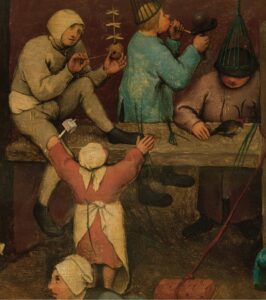
The festival of Purim, with its customs and traditions, has long constituted a broad and fertile field for a vast body of research, folklore, and ritual practice associated with the “Jewish carnival.”[1] The drinking of wine, the wearing of costumes (which have no foundation in early sources and, in the view of many scholars, were influenced by the Venetian carnival),[2] the use of noisemakers for the purpose of “blotting out Amalek,”[3] and the practice of mishlo’aḥ manot have all added layers of joy and exuberance to the festival, at times reaching the point of genuine revelry and even debauchery,[4] and giving rise in certain historical contexts to acts of mockery, hostility, and ritualized violence that have attracted sustained scholarly attention.[5]

Two of the day’s commandments explicitly mentioned in the Scroll of Esther are “the sending of portions, each man to his fellow, and gifts to the poor.”[6] Whereas the giving of charity to the poor assumed a more or less uniform form, the “sending of portions” became a platform for no small measure of creativity. Already in the Talmud,[7] it is related that the amora Rabbi Yehudah Nesi’ah (the grandson of the tanna Rabbi Yehudah ha-Nasi)[8] sent his colleague Rabbi Hoshaya an especially splendid mishlo’aḥ manot, consisting of choice veal and an entire jug of wine.

To this day, one may observe throughout Israel, particularly in Haredi concentrations, especially elaborate mishlo’aḥ manot, laden with assorted and varied food items, accompanied by ornate trays and crackling cellophane wrapping. Alongside the traditional commandment, in recent decades in particular, a rich vein of humor has developed portraying the familiar bottle of wine and dry cake as completing an entire “circuit” within the community, passed from hand to hand as a repeatedly re-gifted mishlo’aḥ manot, until it ultimately returns to its original sender.[9] In light of this reality, many today prefer to refrain from preparing an individualized mishlo’aḥ manot, much of whose content is ultimately discarded after the festival, and instead opt for a standardized communal mishlo’aḥ manot distributed collectively to members of the community. The funds thereby saved, rather than being expended on redundant food items and decorative packaging, are redirected toward a range of charitable and benevolent causes.

These contemporary developments, however, merely underscore a broader point: the commandment of mishlo’aḥ manot has long been characterized by considerable elasticity in both form and practice. Indeed, halakhic literature contains an extensive discussion concerning the question of how one may properly discharge one’s obligation with respect to this commandment. One of the more intriguing debates in this context concerns whether one may fulfill the obligation of mishlo’aḥ manot not through edible “portions,” but rather through “words of Torah,” by sending a book, each person to his fellow. There is, in fact, no small body of testimony regarding sages of Israel, such as Rabbi Shlomo Alkabetz and Rabbi Yehudah Aszod, who sent, as “mishlo’aḥ manot, each person to his fellow,” their own Torah novellae or scholarly compositions.[10]

This halakhic discussion is not merely theoretical. In the course of my research on Rabbi Professor Saul Lieberman (1898-1982),[11] I encountered a striking modern resonance of precisely this idea, one that illuminates the enduring cultural and intellectual valences of mishlo’aḥ manot beyond its strictly culinary expression. Although he arrived in Jerusalem at a relatively late age, being about twenty-nine, Lieberman quickly became integrated into Jerusalem’s intellectual milieu. As a member of the first cohort of students at the Institute of Jewish Studies at the Hebrew University on Mount Scopus (which had been founded only a few years earlier), he listened with great thirst to the teachings of the leading scholars in Jewish Studies and in classical studies, among them his teacher and master Professor Yaakov Naḥum Epstein,[12] Professor Shmuel Klein, and Professor Moshe Schwabe,[13] one of the foremost scholars of classical culture.

Alongside his academic studies, he soon acquired a reputation as an exceptionally great Torah scholar, for whom no secret of rabbinic literature was lo anīs lei, that is, nothing lay beyond him and nothing escaped his grasp. For many hours he would labor diligently over his learning, memorizing Mishnayot and Talmud – Bavli and Yerushalmi – by heart,[14] and within a few years he produced several exemplary works, such as On the Yerushalmi (1929) and The Talmud of Caesarea (1931), which to this day are regarded as foundational texts in the scholarly study of rabbinic literature.[15]

Upon the completion of his studies, Lieberman began teaching in the Talmud preparatory program of the Institute of Jewish Studies, while simultaneously devoting himself to the composition of The Yerushalmi According to Its Plain Meaning (Ha-Yerushalmi Ke-Peshuto) (1935), intended as a comprehensive commentary on the entire Jerusalem Talmud.

On the personal plane, life did not treat him kindly. A short time after his arrival in the Land of Israel, he was bereaved of his youthful wife, Rachel née Rabinowitz, daughter of the rabbi of Pinsk and a descendant of a distinguished rabbinic dynasty. Some time later, he married his second wife, Judith, likewise of illustrious lineage in her own right, the daughter of Rabbi Meir Berlin (later, Bar-Ilan), leader of the Mizrachi movement, and granddaughter of the Netziv of Volozhin. She accompanied him faithfully until the end of her days. The couple did not merit children, and Lieberman immersed himself in his learning.[16]

In the course of these years he became integrated into the “circle of Jerusalem sages,” forming close friendships with many of its members, among them the writer S.Y. Agnon[17]; the scholar Gershom Scholem[18]; the bookseller and proprietor of the Darom publishing house, Michl Rabinowitz; the educator Eliezer Meir Lifshitz; and the merchant and cultural patron Shlomo Zalman Schocken,[19] who in those days founded the Institute for the Study of Medieval Hebrew Poetry.[20]

One figure with whom Lieberman developed an especially close relationship was the Chief Rabbi of the Land of Israel, Rav Abraham Isaac Hacohen Kook. Rav Kook was revered by many members of the Yishuv, among them Berl Katznelson and S.Y. Agnon, and even by self-described “heretics” such as Gershom Scholem and Justice Haim Cohn, who in his youth studied Torah for a year in Rav Kook’s yeshiva together with his cousin, the journalist Azriel Carlebach.[21]

Despite the age gap between them (Rav Kook was twenty-seven years older than Lieberman), the two formed an exceptionally close bond, so much so that Rav Kook, despite being heavily burdened with unceasing rabbinic and public responsibilities, agreed to reserve a fixed hour each day to study in ḥavruta with Saul Lieberman the Tur on Ḥoshen Mishpat, together with Rabbi Joseph Karo’s Beit Yosef.[22]

Like many others, Lieberman, who would later come to be recognized as the greatest scholar of the Talmud in the twentieth century, continued to revere Rav Kook until his final days, and on more than one occasion cited his teachings. Thus, for example, in a letter dated 29 December 1981 to his younger colleague, Professor Ephraim E. Urbach, Lieberman opens with the following sentence:

“You wrote to me that ‘you were ill,’ and I was reminded of the words of Rav Kook, of blessed memory, who said: I prefer to hear ‘I was ill’ rather than ‘I was wealthy’….”[23]

According to a widespread Jerusalem legend, Lieberman and Rav Kook stipulated that they would not cancel their daily study session for any amount of money in the world, and that should either of them violate this condition, he would be required to pay a substantial “fine” to his counterpart. For Lieberman, whose daily schedule was relatively free, fulfilling this condition was easy. For Rav Kook, who in those days was already in poor health and burdened to exhaustion with the needs of the public, fulfilling it was far more difficult, almost impossible.

And indeed, on one such day Rav Kook was compelled to cancel the study session after being invited to serve as sandek at the circumcision of the child of one of Jerusalem’s notable residents. Lieberman, of course, did not forget the matter,[24] and resolved to vindicate the affront at an appropriate time.

In the late afternoon of the “Purim of the unwalled cities,” the fourteenth of Adar 5695 (1935), when Rav Kook was preoccupied with the final preparations for the reading of the Megillah that night in Jerusalem and with organizing the charity funds of matanot la-evyonim to be distributed the following day (for in Jerusalem Purim is celebrated on the fifteenth of Adar), Lieberman appeared unexpectedly at his home and demanded payment of the “fine”: one hour of study in exchange for the hour that had been cancelled several months earlier.

Rav Kook, who recognized the justice of the claim, had little choice. He set aside all his affairs, and the two sat and studied together for a full hour.

Thus far the story, which circulated in Jerusalem for many years. I confess that for a long time I regarded it as no more than a charming “urban legend,” one of those anecdotes that naturally crystallize around towering figures, depicting them not only in their greatness in Torah but also, in the manner of the early sages, as men of wit who knew how to tease one another with affectionate irony.

The story took root, and its echoes may be found in various books as well, albeit in an imprecise form, such as in the writings of Rabbi Moshe Tzvi Neria on Rav Kook.[25] The source material for Rabbi Neria’s account is preserved in his personal archive, now housed in the National Library of Israel, and includes a remarkable series of recollections that Lieberman shared with him in the summer of 1979.[26]

To my astonishment, however, two concrete pieces of evidence that have come to light in recent years in the course of my research on Lieberman do more than merely gesture toward the plausibility of the account. They substantially corroborate it. The first emerged many years ago in the main library of Yeshivat Mercaz HaRav – a library endowed in the name of Markus Cohn, the father of Arthur Cohn, the eminent Hollywood producer who passed away only recently.[27]

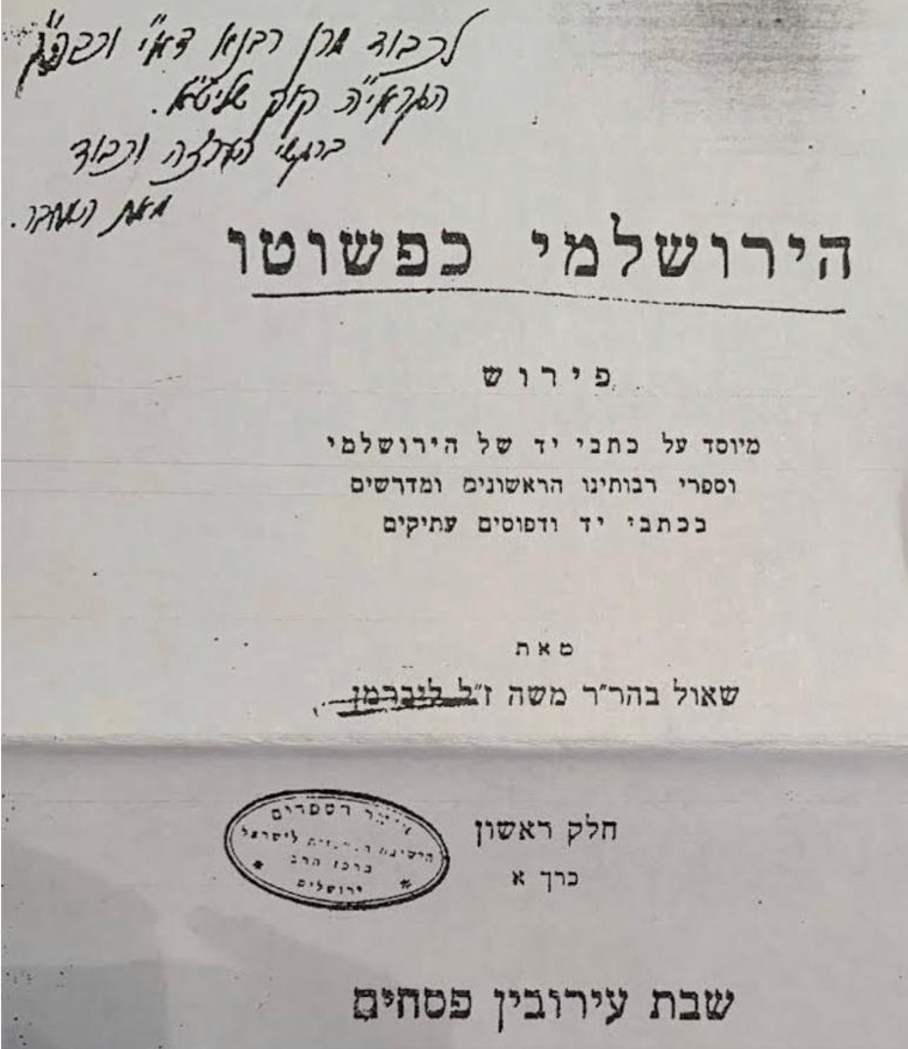
On the first volume of The Yerushalmi According to Its Plain Meaning (Ha-Yerushalmi Ke-Peshuto) (also the last, for Lieberman ultimately decided to abandon his projected commentary on the Yerushalmi and to turn instead to the Tosefta, on which he produced his monumental Tosefta Ke-Peshutah), there appears a dedication that Lieberman wrote to Rav Kook, composed, as was customary, in rabbinic idiom and in abbreviations:

“In honor of our master, the rabbi of the Land of Israel and of all the Diaspora, the Gaon Rav A.I.H. Kook, may he live a long and good life, with feelings of admiration and respect, from the author.”

Attention should be paid to the date on which these words were written. The work was published in 5695 (1935). Lieberman signed his introduction at the beginning of that year, on Sunday, 7 Tishrei 5695, between Rosh Ha-Shanah and Yom Kippur, corresponding to 16 September 1934.

Obviously, the printing also took a certain period, probably a few months.

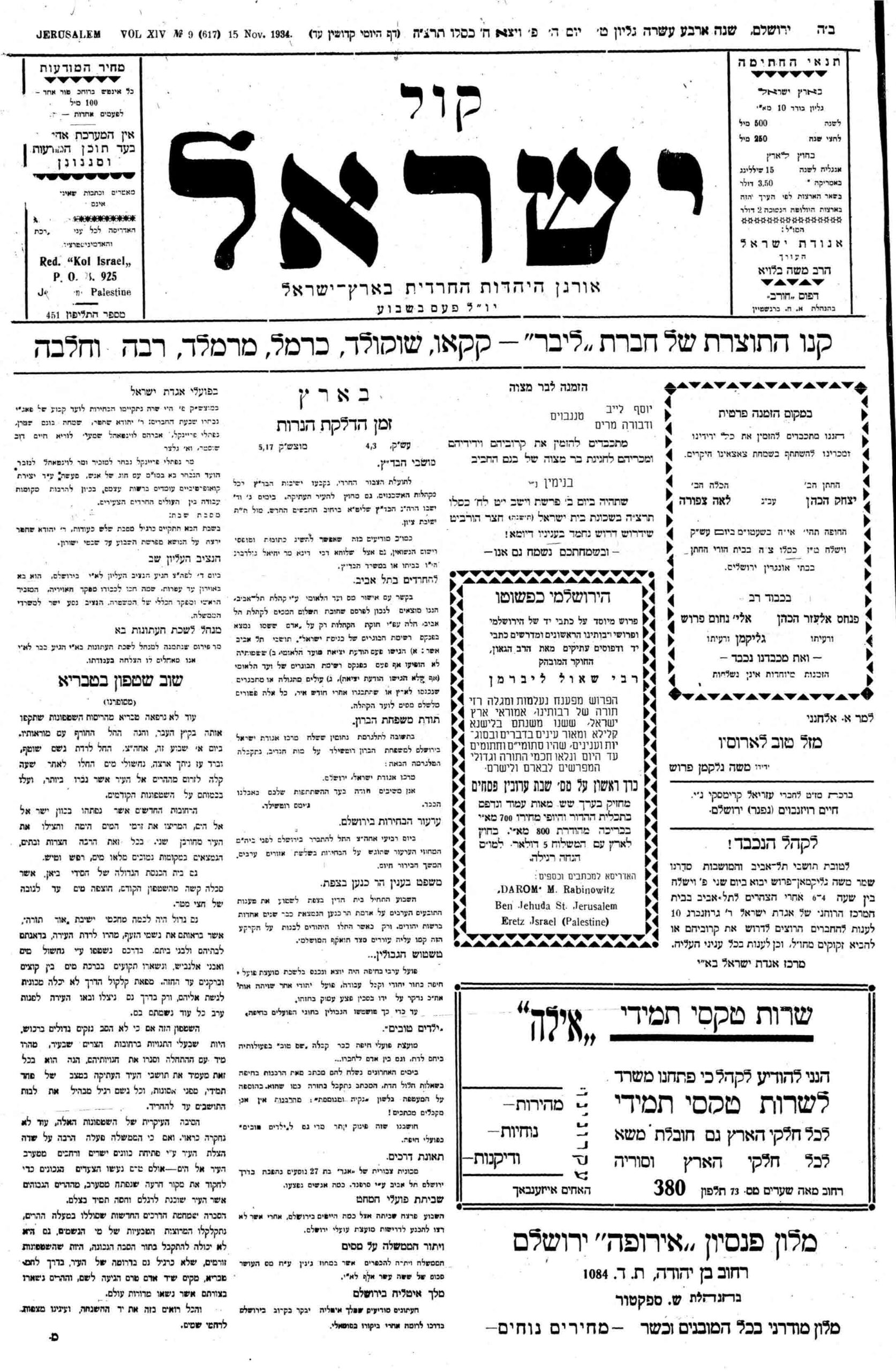
Greater precision can be established regarding the date of publication. A notice announcing the appearance of Ha-Yerushalmi Ke-Peshuto was printed on the front page of Kol Yisrael, the organ of Agudat Israel in Jerusalem (edited by Rabbi Moshe Blau), on 8 Kislev 5695 (15 November 1934). The advertisement’s conspicuous placement on the newspaper’s front page indicates that the volume had only recently emerged from the press and was then being introduced to the reading public. It therefore provides a reliable terminus post quem for any presentation of the work to Rav Kook.

Lieberman therefore could not have presented the book to Rav Kook before that date. The possible window is accordingly narrow: from mid-November 1934 until the onset of Rav Kook’s final illness around Passover 5695 (April 1935). It is thus plausible that Lieberman brought the newly printed volume to him on the eve of Purim of that year, perhaps as mishlo’aḥ manot, or shortly beforehand, and that Rav Kook, in return, presented him with a copy of Rosh Milin bearing the distinctive Purim dedication.

Rav Kook passed away in Elul of that year. Approximately six months earlier, around Passover, he had contracted his final illness and was already confined to his deathbed in a state of severe suffering. Consequently, even had Lieberman wished to do so, he could only have presented him with the work during the brief period at the beginning of that year, from the book’s publication until Passover.

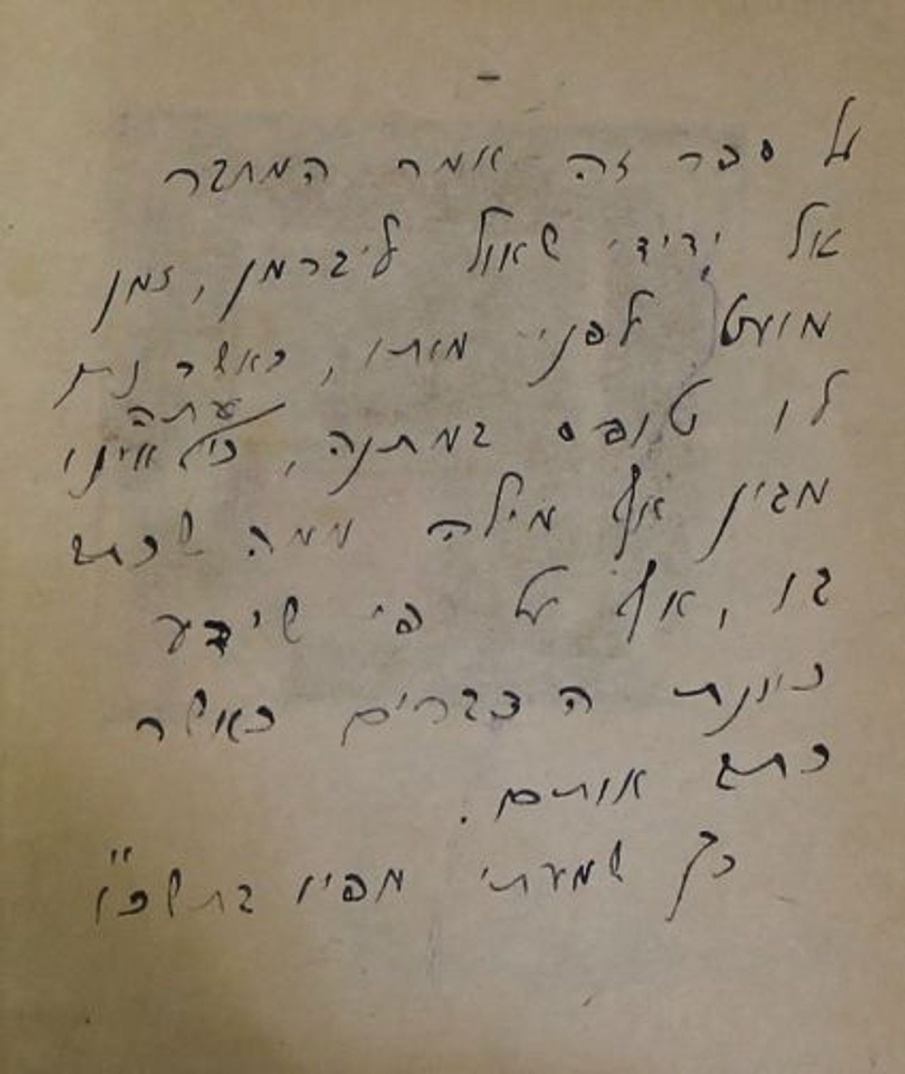
The second surprise came to my attention several years ago, when a friend sent me a photograph of the title page of Rav Kook’s small and enigmatic kabbalistic work, a copy of which was in his possession.

The work, Rosh Milin, on the Hebrew letters, was written in 1917, during Rav Kook’s exile in London in the course of the First World War.[28] Thus did Rav Kook write, in the affectionate dedication he inscribed to his young colleague and ḥavruta:

“A gift of true love to the chosen of my heart, Rabbi Saul Lieberman, may he live a long and good life. Abraham Isaac, the small [i.e., the humble one]. Purim of the unwalled cities, 5695 [1935].”

Anyone familiar with the dedications and expressions of esteem that Rav Kook addressed to various individuals, including leading Torah scholars, will recognize that the phrase he wrote to Lieberman, “true love to the chosen of my heart,” is striking in its exceptional character.

Incidentally, Gershom Scholem later related that, despite his expertise in Kabbalah, he did not succeed in understanding Rosh Milin. He further added – “on the testimony of trustworthy informants,” by which he meant his close friend Saul Lieberman (and he even recorded the remark in his personal copy of the book, now preserved in the National Library of Israel) – that Rav Kook himself told Lieberman:

“Regarding this book, the author [i.e., Rav Kook] said to my friend Saul Lieberman, shortly before his death – when he presented him with a copy as a gift – that he now does not understand a single word of what he wrote in it, even though at the time of writing he fully grasped the meaning and intent of the matters.”[29]

Although Lieberman was as far removed from engagement with Kabbalah as east is from west, he once gave memorable expression to this distance when asked to introduce a lecture by his close friend Gershom Scholem. Lieberman opened his remarks with an immortal quip about Scholem’s field of research, Kabbalah and Jewish mysticism: “Nonsense is nonsense, but the study of nonsense may be a science….”[30] Nevertheless, Rav Kook chose, of all his writings, to present Lieberman with this particular book as a gift, perhaps so that it might serve as a kind of “amulet,” or perhaps as an act of Purim mischief on the part of the aged rabbi; we cannot know.

The unusual date recorded in the dedication, “Purim of the unwalled cities, 5695,” suggests that the booklet was presented to Lieberman on that very occasion, when, according to the account, he chose to collect the aged Rav Kook’s “debt” during their joint study session, perhaps their last, on Purim of that year.

It is entirely plausible that on that occasion Lieberman brought Rav Kook his newly published work, The Yerushalmi According to Its Plain Meaning, and that in return Rav Kook presented him with mishlo’aḥ manot in the form of his small and enigmatic book.

Thus the Jerusalem legend seems to acquire flesh and sinew, and what once appeared to be no more than a charming anecdote may in fact preserve a genuine historical memory: a literary mishlo’aḥ manot exchanged between two towering figures, in which Torah, affection, and Purim playfulness were delicately intertwined.

Appendix A: Rabbi Moshe Tzvi Neria’s Archival Notes on Saul Lieberman’s Recollections of Rav Kook (Summer 1979)

The following translation is based on Rabbi Moshe Tzvi Neria’s handwritten notes preserved in his personal archive, currently housed in the National Library of Israel (Jerusalem). The notes record a conversation held during Summer 1979 in which Rabbi Professor Saul Lieberman recounted a series of episodes relating to Rav Abraham Isaac Hacohen Kook and the influence that Rav Kook exerted upon him. The material corresponds in its essentials to passages later published by Rabbi Neria, but the archival version preserves additional details and a more expansive formulation of Lieberman’s testimony.

Rabbi Neria was accustomed to preserving every scrap of paper containing substantive content that passed through his hands. Alongside newspaper clippings in which several articles about Lieberman appeared, Rabbi Neria preserved the remarks he heard directly from him in the summer of 5739 (1979). According to his account, Lieberman requested that he telephone him in the early morning (“from eight o’clock onward I disconnect the telephone, lock the door, and engage in my Talmudic study without interruptions”), and he did so.

Lieberman told Rabbi Neria that his first visit to Rav Abraham Isaac Hacohen Kook took place on the night of Shavuot:

“I heard that he was teaching Sefer ha-Mitzvot [i.e., Maimonides’ Book of the Commandments]. I came and sat down by the table. In the course of the study I made a remark, and the Rav answered me briefly. Later I made another remark, and again I received a brief reply. When I remarked upon his words a third time, the Rav turned to me and said: ‘Come in to me tomorrow.’ When I came after the festival, the Rav received me with great warmth, asked about my family, and it emerged that he knew several rabbis among my relatives. After a Torah conversation, he asked that I come to him frequently, and thus I did. On the way to the Rav’s visit to the Gerrer Rebbe (to R. Neḥemyah’le [??]), the Rav delayed at my apartment and became engrossed in a halakhic give-and-take concerning a matter I was then studying. I would come and present my novellae before him, ask about what had been difficult for me, and the like. His warm attitude toward me greatly encouraged me. He had a mystical influence upon me, even though I am far from mysticism. I had ‘tests,’ and he influenced me to remain in the study of Torah.”

Lieberman recounted to Rabbi Neria one such “test.” According to his account, a dispute arose between Rabbi Fishman [i.e., R. Yehudah Leib Maimon] and Bank Mizraḥi. The parties decided to submit to arbitration before attorney Mordechai Eliash. Lieberman represented Rabbi Fishman, whereas the bank was represented by attorney Mordechai Levanon. Rav Kook summoned Lieberman and instructed him to cease representing him in the arbitration:

“You have acquired a reputation for involving yourself in arbitration, and that will draw you away from your learning.”

Rabbi Neria further adds and cites in Lieberman’s name words of admiration and reverence for Rav Kook:

“Not only did his greatness in Torah exert influence – and he knew the entirety of Torah – but his entire personality. Matters of the people of Israel and the Land of Israel were not for him merely pathetic rhetoric; rather, they overflowed from his depths, from his hidden world, and there was something mystical in it. This was a figure overflowing with light, and his light would penetrate in its own ways… The Rav was an artist. Not merely a man with poetic sensibility, but truly an artist. In his writing there is a sacred grandeur. His words are like the tones of the shofar’s sound. The ease of his writing is astonishing, yet it is the result of abundant knowledge. They once told of a certain wealthy man who marveled at the request of a great painter to receive an enormous sum of money for a sketch he drew within ten minutes. ‘Not so,’ replied the painter; ‘I labored sixty years in order to attain an ability to draw in such a manner.’”

According to Rabbi Neria, Lieberman told him that he was occupied with printing Ḥasdei David, the commentary of R. David Pardo on the Tosefta, and that through printing his own work on Seder Ṭohorot he repaid his debt…

In this context Lieberman added:

“I also must repay a debt to the Rav [i.e., Kook]. He greatly encouraged me in the study of the Jerusalem Talmud. Several times I presented before him my Torah insights in elucidating difficult passages in the Jerusalem Talmud, and he took great pleasure in them.”

In response to Rabbi Neria’s question, “Was the Rav [i.e., Kook] as proficient in the Jerusalem Talmud as in the Babylonian?” Lieberman replied:

“The Rav was proficient in everything: Babylonian and Jerusalem Talmud, Tosefta and Midrashim, Rishonim and decisors. The Rav was the only one who encompassed the entirety of Torah, and this influenced his encompassing vision. The Rav’s vast scope contributed greatly to the richness of his personality. This was also the greatness of the Netziv, who knew the whole of Torah. I am deeply impressed by the Netziv. So too was R. Meir Simḥah [of Dvinsk, author of Or Sameaḥ].”

In this connection, Rabbi Neria cited words written by Rav Kook:

“The originality of the ‘ever-strengthening spring’ and the ‘river that does not cease’ (Avot, beginning of ch. 6) is the primary aspiration of one who engages in Torah for its own sake, which comes from divine cleaving. The inner spiritual bond with that which is all, the source of all, and beyond all. The desire filled with purity, which steadily intensifies to absorb the distilled essence of the supernal sap within the supernal realms—these are they who always seek the ennobled renewal in its vigorous force” (Iggerot ha-Ra’ayah, vol. 3, p. 4).

(“The Rav’s [i.e., Kook’s] vast scope contributed greatly to the richness of his personality. His opponents fought against him because they recognized his power, because they knew his greatness.”) According to Rabbi Neria, Lieberman described the Rav’s words as expressing a “sacred grandeur.”

Rabbi Neria further relates, in Lieberman’s name, that in the summer of 5690 (1930) Rabbi Moshe Ostrovsky came to the apartment where Rav Kook was staying in Kiryat Moshe in order to pressure him to agree to the compromise proposal then being circulated, according to which the people of Israel would relinquish part of their rights in the Land of Israel, including at the Western Wall. Lieberman was present. The visitor wished that he leave the room so that he could speak with Rav Kook privately; however, Rav Kook detained Lieberman and instructed him to continue sitting there.

Years later, after the passing of Rav Kook, Rabbi Neria heard at a memorial gathering held in the Jewish Agency building that Rav Kook had told Rabbi Ostrovsky:

“The people of Israel has not empowered any person to relinquish the Western Wall. If we relinquish it, the Holy One, blessed be He, will not wish to restore it to us.”

Rabbi Neria testifies that while he lived in Jerusalem in the 1930s, Rabbi Professor Saul Lieberman would customarily pray on the High Holy Days together with the students of Yeshivat Merkaz ha-Rav, who had established their place of prayer at Yeshivat Etz Ḥayyim in the Maḥaneh Yehudah neighborhood.

Among other matters, Rabbi Neria wrote down what he heard from Lieberman regarding his shared study with Rav Kook, and according to what is stated there. The accounts found in Rabbi Neria’s handwritten notes correspond in their essentials to what he later presented in his book.

Alongside them, I found in this archive and in additional archives details concerning Lieberman’s involvement, at the request of his friend (and relative) Rachel Yanait Ben-Zvi, wife of the late President Yitzḥak Ben-Zvi, in the establishment of a yeshivat hesder in Peki’in. Within this framework he approached Rabbi M. Z. Neria and asked him to assist in realizing the idea in practice. Concerning this episode I intend to write, God willing, elsewhere.

Notes

I would like to express my sincere gratitude to my friend and colleague Mr. Menachem Butler, who devoted considerable effort to translating and editing this article into English. I am also grateful for his valuable contributions, including bibliographical references and precise citations.

  1. See Harold Fisch, “Reading and Carnival: On the Semiotics of Purim,” Poetics Today, vol. 15, no. 1 (Spring 1994): 55-74.
  2. See, for example Yaakov Shmuel Spiegel, “Cross Dressing for Special Occasions,” in Joseph R. Hacker, Yosef Kaplan, and B.Z. Kedar, eds., Rishonim ve-Aharonim, From Sages to Savants: Studies Presented to Avraham Grossman (Jerusalem: Shazar, 2010), 329-352 (Hebrew), available here; and Gedalia Oberlander, “The Custom of Disguising Oneself on Purim,” Or Yisrael, vol. 2, no. 3 [#7] (April 1997):125-131 (Hebrew), available here; Moshe Leib Halberstadt, “Costumes on Purim and at Various Events,” Yerushatenu, vol. 5 (2011): 169-175 (Hebrew).
  3. See Shamma Friedman, “Erasing Haman,” Leshonenu, vol. 61, no. 3 (June 1998): 259-263 (Hebrew), available here; Daniel Sperber, “Destroying the Name of Haman,” Shana be-Shana, vol. 32 (2001): 203-211 (Hebrew), available here; and Daniel Sperber, How To Strike Haman (Jerusalem: The Wolfson Museum of Jewish Art, 2002; Hebrew), available here. For a comprehensive survey of the halakhic and historical sources concerning this custom, see Eliezer Brodt, “The Pros and Cons of Making Noise When Haman’s Name is Mentioned: A Historical Perspective (updated),” The Seforim Blog (22 March 2016), available here.
  4. See Dan Rabinowitz, “Purim, Mixed Dancing, and Kill Joys,” The Seforim Blog (6 March 2006), available here.
  5. See Elliott Horowitz, Reckless Rites: Purim and the Legacy of Jewish Violence (Princeton: Princeton University Press, 2006).
  6. Esther 9:22.
  7. Megillah 7a.
  8. See Alan Appelbaum, “Why the Rabbis of the Yerushalmi Called R. Judah Nesiah ‘a Great Man’?” Journal of Ancient Judaism, vol. 3, no. 3 (December 2012): 339-365.
  9. One can hardly help but wonder how long it will be before a kunṭres devoted to the halakhic parameters of re-gifting mishlo’aḥ manot appears, if indeed one has not already been published, systematically treating such questions as whether the initial recipient must effect a formal kinyan; whether the mitzvah requires that the gift be given mi-shelo (“from one’s own”); the respective roles of the giver’s kavvanah and the recipient’s awareness; the permissibility of re-gifting absent the donor’s consent (da‘at ba‘alim); whether the obligation may be discharged through an intermediary (shaliaḥ); whether one may fulfill the mitzvah with an item received earlier that same day; and whether a package that circulates through multiple hands constitutes mishlo’aḥ manot at all, or merely an elaborate exercise in communal redistribution, together with the host of subsidiary questions such a case inevitably generates.
  10. For more on this practice, see Meir Wunder, “Books as Mishlo’aḥ Manot,” Moriah, vol. 5, no. 5-6 [#53-54] (November 1973 – January 1974): 83-86 (Hebrew); and Tovia Preschel, “Mishlo’aḥ Manot of Books from Authors,” ha-Doar, vol. 53, no. 19 (8 March 1974): 295 (Hebrew).
  11. I am currently at work on a biography of Professor Saul Lieberman; for now, my earlier writings on him, see Aviad Hacohen, “Two Scholars Who Were in Our City: Correspondence between Saul Lieberman and Jacob David Abramsky,” ha-Tsofeh Literary Supplement (21 April 1984): 5 (Hebrew), available here; Aviad Hacohen, “Schlemiel, Schlimazel, and Nebbich: Letters from Saul Lieberman to Gershom and Fania Scholem,” Haaretz Literary Supplement (25 April 2000): H1 (Hebrew) , available here; Aviad Hacohen, “The Tannah from New York: A Selection of Professor Saul Lieberman’s Letters,” Jewish Studies, no. 42 (2003): 289-301 (Hebrew), available here; Aviad Hacohen, “Six Days and Seven Gates: Between Israeli President Izhak Navon and Professor Rabbi Saul Lieberman,” Oneg Shabbat (9 June 2023), available here; Aviad Hacohen, “Lieberman Kifshuto: Personal Letters Revealing the Sensitive and Playful Side of a Talmudic Genius, On the 40th Yahrzeit of Professor Saul Lieberman,” Makor Rishon, Sabbath Supplement, no. 1338: Parashat Tzav (31 March 2023): 8-11 (Hebrew), available here; Aviad Hacohen, “The Generation Did Not Appropriately and Duly Appreciate Mr. Schocken [Eulogy by Rabbi Prof. Saul Lieberman for Shlomo Zalman Schocken, March 1960],” Haaretz Literary Supplement (28 April 2024): 1 (Hebrew), available here; Aviad Hacohen, “The Story of the Rabbi Who Rejected the Maxim: ‘Torah Scholars Increase Peace in the World’,” Haaretz Literary Supplement (25 May 2023): 8 (Hebrew), available here; and Aviad Hacohen, “‘A Lithuanian Mind in Its Lithuanian Essence, From Volozhin to Jerusalem’: R. Shaul Lieberman’s Intellectual Kinship with the Legacy of Lithuanian Torah & Its Bearers,” in Martin S. Cohen, ed., Essays in Jewish Studies in Honor of Rabbi Prof. David Golinkin (Jerusalem: Schechter, 2025), 101-139 (Hebrew), available here.
  12. See Shmuel Glick and Menachem Katz, “‘A Threefold Cord’: On Saul Lieberman and His Relationship with the Hazon Ish and Jacob Nahum Epstein,” in Shmuel Glick, Evelyn M. Cohen, Angelo M. Piattelli, et al., eds., Meḥevah le-Menaḥem: Studies in Honor of Menahem Hayyim Schmelzer (Jerusalem: Schocken, 2019), 269-289 (Hebrew).
  13. See Saul Lieberman, “Ten Words,” in Texts and Studies (New York: Ktav, 1974), [1-20], where Lieberman refers explicitly to “my teacher, Prof. Moshe Schwabe, of blessed memory,” and describes Schwabe’s long-standing aspiration to produce a new dictionary of Greek and Latin loanwords in rabbinic literature. For the subsequent realization of this lexicographical program in systematic form, see Daniel Sperber, A Dictionary of Greek and Latin Legal Terms in Rabbinic Literature (Ramat-Gan: Bar-Ilan University Press, 1984); Daniel Sperber, My Rabbinic Loanwords Card Index of More Than a Half-Century: A Companion Volume to Professor Samuel Krauss’ Griechische und Lateinische Lehnwörter im Talmud, Midrasch und Targum, ed. Menachem Butler (Cambridge, MA: Shikey Press, 2022), esp. the introduction, available here, where Sperber describes the work as the product of “more than fifty-years of collection and research,” originally conceived as an annotated continuation of Krauss’s Lehnwörter, and acknowledges Lieberman’s personal role in encouraging his philological work, noting that Lieberman “adopted me as his disciple in this field.” Sperber also reproduces a letter of approbation from Lieberman dated 19 Shevat 5738 (27 January 1978), praising Sperber’s “objective evaluation of Krauss’s volume” and commending the “great progress” reflected in his conclusions.
  14. A fine “real-time” description of his path during those years appears in a letter written at the time by his father-in-law, Rabbi Meir Bar-Ilan, leader of the Mizrachi movement. Writing to his son Tuvia (a chemist and later the first Director-General of Bar-Ilan University) on 25 Marḥeshvan 5694 (5 November 1933), Bar-Ilan remarked“…And so, my dear, everything I have found here: outwardly nothing has changed in our home, but inwardly part of our apartment has been transformed into a beit midrash. For our Shaul sits and engages in Torah and scholarship with remarkable diligence. Your small room has been turned into a library, for Shaul has many books – among them items of precious value – and there he labors over them, if I am not mistaken, some ten hours a day and at night. Apart from those hours in which he teaches at the Teachers’ Seminary and at the university – only twice a week – he sits “over Torah and avodah.” He is engaged in writing a great book [this refers to Ha-Yerushalmi Kifshuto, published in 5695 (1935)], which, upon its completion and publication, will, it seems to me, renew a momentum among Talmudic circles and scholars of Israel with respect to the Jerusalem Talmud. Shaul is great – loftier than I had known – “full and overflowing” in an excellent measure; his knowledge is astonishing and his intellect clear, and beyond this he is an outstandingly diligent scholar. I do not know whether he will persist in his diligence, for it is possible that only on account of his literary work does he not divert his mind from his studies, but at present he continues his work with diligence and industriousness…”
  15. See, recently, Moshe Assis, Saul Lieberman’s Marginalia on Talmud Yerushalmi (Jerusalem: Carmel, 2022; Hebrew).
  16. On Judith Berlin Lieberman’s lineage, intellectual formation, and educational career, see Judith Berlin Lieberman, Autobiography and Reflections, eds. Menachem Butler and Abraham Lieberman (Cambridge, MA: Shikey Press, 2022), available here. See especially the autobiographical memoir (pp. 20-38) and the introductory essay by her nephew Hillel Halkin (pp. 15-19).
  17. See Aviad Hacohen, “‘Honey and Milk Are Under His Tongue, Yet Beneath It Burns a Blazing Fire’: On the Relationship between S.Y. Agnon and Saul Lieberman,” Haaretz Literary Supplement (6 October 2023): 7 (Hebrew), available here.
  18. See Aviad Hacohen, “Schlemiel, Schlimazel, and Nebbich – Letters from Saul Lieberman to Gershom and Fania Scholem,” Haaretz Literary Supplement (25 April 2000): H1 (Hebrew), available here.
  19. See Aviad Hacohen, “The Generation Did Not Appropriately and Duly Appreciate Mr. Schocken [Eulogy by Rabbi Prof. Saul Lieberman for Shlomo Zalman Schocken, March 1960],” Haaretz Literary Supplement (28 April 2024): 1 (Hebrew), available here.
  20. See, for example, Menahem Zulay, “The Research Institute for Hebrew Poetry,” Haaretz Literary Supplement (31 October 1947): 9 (Hebrew); and A.M. Habermann, “Salman Schocken and The Research Institute for Hebrew Poetry: On His Fifth Anniversary of His Death,” Haaretz Literary Supplement (17 July 1964): 13 (Hebrew).
  21. See Aviad Hacohen, “If every Sabbath were like Yom Kippur: An Interview with Haim Cohn,” Meimad, no. 17 (August 1999): 12-15 (Hebrew), available here; and Aviad Hacohen, “Apikores with Divine Grace – Review of ‘Being Jewish: Culture, Law, Religion, State’, by Haim Cohn,” ha-Tsofeh Literary Supplement (27 April 2007): 10, 13 (Hebrew), available here; and see also Azriel Carlebach, “The Rav Renowned for Halakhic Expertise,” Maariv Literary Supplement (19 February 1956): 4 (Hebrew), and Haim Cohn, “The Yeshiva of Rav Kook,” in Haim Cohn, A Personal Introduction: Autobiography, ed. Michal Smoira-Cohn (Kinneret: Dvir, 2005), 96-102 (Hebrew).
  22. Ari (Yitzchak) Chwat, “Rabbi Kook’s Connections with Prof. Rabbi Saul Lieberman as a Model for His Attitude Towards Critical Torah Research,” Tzohar, vol. 35 (2009): 59-66 (Hebrew), is especially important for situating the Rav Kook-Lieberman relationship within the broader question of Rav Kook’s principled openness to rigorous philological and historical methods in Torah study, and for treating Lieberman as a case study for the category Rav Kook termed ḥokhmat yisrael be-qedushatah. For further development of this concept, see Ari (Yitzchak) Chwat, “‘Hokhmat Yisrael in Its Holiness’: Rav Kook’s Vision for True Critical-Scientific Study,” Talelei Orot, vol. 13 (2007): 943-976 (Hebrew).
  23. The letter, preserved in the Professor Ephraim E. Urbach Archive at the National Library of Israel in Jerusalem, is scheduled for publication in my forthcoming volume, Pirkei Shaul, which, God willing, is expected to appear in the coming year.
  24. Many stories concerning Lieberman’s extraordinary powers of memory circulated among people already during his lifetime. One of the sages of Jerusalem, who sought to clarify the difference between Lieberman and other great Torah scholars endowed with remarkable mnemonic ability, described it as follows: “So-and-so, the gaon, knows the entire Talmud by heart. Say to him a particular word, and he will immediately tell you where it appears throughout the whole of the Talmud. Lieberman is greater than he: he can tell you with certainty that a particular word does not appear anywhere in the entire Talmud…”
  25. See Moshe Tzvi Neria, “From the Testimony of Rabbi Saul Lieberman,” in Likkutei ha-Ra’ayah, ed. Moshe Tzvi Neria, vol. 2 (Kefar ha-Ro’eh: 1990), 336–341 (Hebrew), which preserves a version of the Rosh Milin anecdote attributed to Lieberman (based on an interview conducted by Neria in Summer 1981), though without the later bibliographic framing and transmission history found in Scholem’s formulation. Neria’s presentation should also be situated within his broader editorial enterprise of collecting and disseminating Rav Kook-related reminiscences for a wide Hebrew readership, both in his books and in his ha-Tsofeh newspaper columns in the Religious Zionist press.
  26. For a translated excerpt from Rabbi Neria’s handwritten archival notes recording his 1979 conversation with Saul Lieberman, see Appendix A below.
  27. See Yair Sheleg, “King Arthur: Members of the Family of Arthur Cohn, Who Passed Away Last Week, Recount His Scrupulous Observance of the Sabbath Even on the Most Prestigious Stages, and His Profound Love for the State of Israel, Expressed Not Only Through Generous Donations,” Makor Rishon, Sabbath Supplement: Parashat Vayigash (25 December 2025; Hebrew), available here.
  28. See Aaron Ahrend, “About Rav Kook’s ‘Rosh Millin’,” Da’at, no. 27 (Summer 1991): 73-85 (Hebrew), available here; and Aaron Ahrend, “Further on Rav Kook’s ‘Rosh Millin’,” Sinai, vol. 110 (June – July 1992): 190-192 (Hebrew), available here.
  29. Zvi Leshem, “‘He Does Not Understand a Single Word of What He Wrote’: Gershom Scholem and Rabbi Abraham Isaac Hacohen Kook – A Story of a Marginal Note,” Ha-Safranim, Blog of the National Library of Israel (19 August 2019), available here and here.Rabbi Moshe Tzvi Neria transmitted these remarks in the name of Saul Lieberman himself. See Moshe Tzvi Neria, “From the Testimony of Rabbi Saul Lieberman,” in Likkutei ha-Ra’ayah, ed. Moshe Tzvi Neria, vol. 2 (Kefar ha-Ro’eh: 1990), 339 (Hebrew). On the affinity between the Rav Kook and Saul Lieberman, see ibid., pp. 92, 337-341, 369. From there also in Elijah J. Schochet and Solomon J. Spiro, Saul Lieberman: The Man and His Work (New York: Jewish Theological Seminary of America, 2005), 52-53, 101.
  30. See Daniel Abrams, “Defining Modern Academic Scholarship: Gershom Scholem and the Establishment of a New Discipline,” The Journal of Jewish Thought and Philosophy, vol. 9 (2000): 267-302, esp. 268n1, where he writes:“Lieberman’s statement has been circulating as an oral tradition amongst scholars and students of the Jewish Theological Seminary. The only printed reference to it I have found is offered by Joseph Dan in his “The Revelation of the Secret of the World: The Beginning of Jewish Mysticism in Late Antiquity” (Brown University Program in Judaic Studies, Occasional Paper Number 2, Providence 1992, p. 3): “We all know that mysticism is nonsense, but the history of mysticism is a science.” See however Lieberman’s article “How much Greek in Jewish Palestine,” Biblical and Other Studies, ed. A. Altmann, Cambridge, Mass. 1962, p. 135 [reprinted in Texts and Studies, New York 1974, p. 22), Lieberman offered the following formulation: “Nonsense is nonsense, but the history of nonsense is a very important science. In certain respects it is more revealing than the history of sciences based on reason.” (see also Mortimer Ostow, Ultimate Intimacy; the Psychodynamics of Jewish Mysticism, London 1995, p. 362) Lieberman apparently regretted his statement and wrote an appendix for Scholem’s Jewish Gnosticism based on these lectures.”


Between Authority and Inquiry: Beyond the Masthead of the Beys Yaakov Journal, 1923-1980 – Part 1

Between Authority and Inquiry:

Beyond the Masthead of the Beys Yaakov Journal, 1923-1980 – Part 1

by Dan Rabinowitz

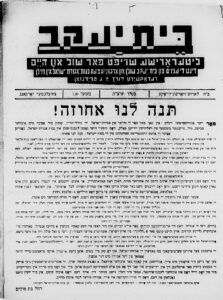
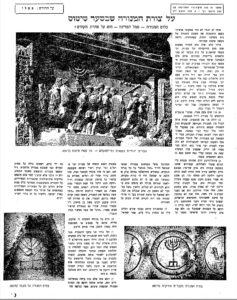
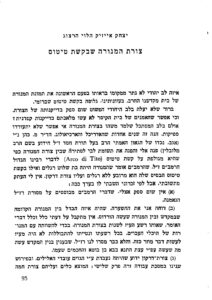
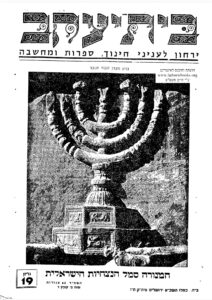
In December 1961, the Israeli edition of Beys Yaakov, the educational journal of the Agudath Israel–affiliated school system, published an article that sits uneasily with standard accounts of Agudath Israel’s twentieth-century intellectual posture.[1] Issue 6 of its second year reprinted in full a study on the archaeological and halakhic problems surrounding the base of the Temple menorah.[2] The identity of the author is therefore institutionally consequential. Rabbi Dr. Yitzhak Isaac Halevi Herzog served as the Ashkenazi Chief Rabbi of Israel at the head of a state-established rabbinate whose claim to centralized religious authority Agudath Israel did not recognize, locating binding rabbinic authority instead in its own Moetset Gedolei HaTorah.[3] The unabridged publication of his work in an Agudah-affiliated journal thus draws attention to the editorial criteria and intellectual assumptions operative within Beys Yaakov. This decision was not anomalous. From its founding in interwar Poland through its postwar continuation in Israel, Beys Yaakov repeatedly engaged materials, methods, and voices that lay beyond the formal boundaries of Agudath Israel’s institutional authority.[4] The journal maintained clear Orthodox commitments, but it did not construe those commitments as requiring insulation from external scholarship or the suppression of internal disagreement.

Examining Beys Yaakov between 1923 and 1980 permits a reconstruction of an Orthodox public discourse that does not conform to models centered on withdrawal or uniform ideological consolidation.[5] Across decades and editorial regimes, the journal published women’s reflective writing, printed criticism of decisions taken by Agudath Israel’s own rabbinic leadership, and, in later years, employed scholarly analysis to interrogate elements of the modern State of Israel’s symbolic repertoire.[6] These practices were not episodic but structural, pointing to a sustained editorial orientation in which intellectual engagement operated as a constitutive element of Orthodox self-definition rather than as a deviation from it. While recent scholarship has rightly emphasized Agudath Israel’s institutional boundary maintenance and political separatism, as well as the culturally mediating role of the Beys Yaakov movement, attention to the Beys Yaakov Journal redirects analysis from ideology and leadership to editorial practice as a central site of Orthodox intellectual life.[7]

Polish Origins: Sara Schenirer and the Educational Crisis

Before World War I, Orthodox Jewish girls in much of Eastern Europe received little formal Jewish schooling.[8] Although rabbinic attitudes toward women’s Torah study had varied across periods and locales, prevailing practice in Polish Orthodox communities restricted instruction largely to domestic settings and to the transmission of basic laws, customs, and religious dispositions.[9]At the same time, access to secular schooling expanded steadily and was widely taken up. Girls often acquired fluency in Polish language and culture while lacking the textual and conceptual resources necessary to interpret or articulate their own religious tradition. By the interwar period, this asymmetry contributed to significant patterns of religious disengagement among Orthodox young women. Sara Schenirer understood this constellation of pressures from personal experience.

Born in 1883 into a Hasidic family in Kraków, Schenirer was exposed to modern culture while remaining committed to religious life. She concluded that Orthodox women required systematic Jewish education not as enrichment but as a condition of religious continuity. In her view, inherited modes of informal instruction no longer sufficed in a social environment shaped by compulsory schooling, expanding public culture, and women’s economic participation. Early efforts to address the problem through youth circles and informal study groups proved inadequate. In 1917, Schenirer therefore turned to formal education, beginning with a small class for girls in her apartment. The initiative expanded rapidly. By 1923, the Agudath Israel movement formally adopted the schools, recognizing both the scale of the educational crisis and the effectiveness of Schenirer’s response. What began as a local experiment thus became an institutional project with transnational reach.[10]

Orthodox anxieties surrounding girls’ education crystallized around the erosion of communal control over women’s intellectual trajectories, particularly with respect to access to higher education. The emergence of Beys Yaakov must therefore be understood not only as an educational response to religious disengagement, but also as part of a broader effort to redirect female intellectual aspiration into institutionally supervised and religiously authorized forms.[11]

From the outset, the Beys Yaakov system was conceived not merely as a network of schools but as a cultural intervention. It aimed to reshape how Orthodox girls understood their position within Jewish life, public society, and the transmission of religious knowledge. This ambition required not only curricula and classrooms but also a medium capable of addressing students beyond the school setting and articulating a shared intellectual and moral framework. That medium soon took the form of a journal.

Friedenson and the Power of Print

Eliezer Gershon Friedenson understood that the success of the Beys Yaakov project depended not only on the establishment of schools but on the creation of a discursive environment capable of sustaining religious commitment amid rapid social change. From his first encounter with Sara Schenirer in 1923, Friedenson recognized that girls’ education required a medium that could operate beyond the classroom, address readers as reflective subjects, and articulate a shared intellectual vocabulary for Orthodox womanhood. The Beys Yaakov Journal, first published in June 1923, was conceived to meet precisely this need.[12] Recent scholarship has emphasized that the institutionalization of Beys Yaakov under Agudath Israel after 1923 marked a decisive transformation of the movement.[13] This period coincided with the professionalization and rapid expansion of the school network under the direction of Dr. Leo (Samuel) Deutschländer, whose training and pedagogical outlook drew on German Neo-Orthodox models that emphasized professional instruction, curricular coherence, and engagement with general culture. It also marked the movement’s absorption into Agudath Israel’s organizational framework, without full capitulation to its separatist educational norms.[14] Friedenson’s journal should be understood as part of this same process. It functioned as a centralizing instrument that helped standardize pedagogical assumptions, circulate ideological norms, and integrate disparate local initiatives into a coherent movement culture.[15]

Beys Yaakov, Issue 1, 1923

The Beys Yaakov journal’s masthead articulated its mission succinctly: an Orthodox periodical devoted to religious thought among Jewish women and girls and to the question of girls’ education in the spirit of Torah and tradition. Its choice of Yiddish situated the journal within established Orthodox linguistic practice while also enabling broad accessibility across regional and social boundaries.[16] At the same time, its format, regular publication schedule, and thematic range reflected contemporary print culture rather than traditional rabbinic genres. Schenirer herself repeatedly underscored the journal’s importance, urging that it circulate “in every corner in which a heart beats,” a formulation that framed readership not as passive consumption but as emotional and moral participation in a shared undertaking. Naomi Seidman has characterized Beys Yaakov as a “revolution in the name of tradition,” in which innovation was articulated as preservation rather than rupture.[17] The journal exemplified this logic. While anchored in Orthodox commitments, it systematically adopted literary and discursive forms – essays, poetry, autobiographical reflection, and historical narrative – that had little precedent in traditional frameworks of women’s religious instruction. These genres did not function merely as stylistic embellishments or pedagogical supplements; they reconfigured the educational encounter itself. By foregrounding narrative voice, affective experience, and historical self-placement, the journal addressed its readers as reflective subjects whose relationship to Jewish tradition was neither automatic nor self-evident, but required deliberate cultivation. In this way, Beys Yaakov treated Orthodox girls not simply as future wives and mothers charged with transmission, but as moral and intellectual agents whose commitment depended on sustained engagement, interpretation, and identification with the tradition they were being asked to inhabit.

From its earliest issues, the journal’s contents extended well beyond internal school news or institutional announcements, indicating that it was not conceived merely as an administrative organ of the school system. It published essays on Jewish women in history, profiles of literary and cultural figures, poetry, and original creative writing, genres that invited readers to situate themselves within broader historical and cultural narratives. Sara Schenirer’s own Torah commentaries appeared regularly and were incorporated into classroom instruction, further collapsing the distinction between pedagogical text and public religious discourse. In this way, the journal functioned simultaneously as a curricular supplement and an autonomous intellectual forum, shaping religious sensibility less through formal instruction or prescriptive norms than through sustained exposure, interpretive engagement, and processes of identification.

The journal’s use of literary, historical, and reflective genres was not an idiosyncratic editorial choice but emerged from the ideological landscape in which Beys Yaakov took shape. Interwar Orthodoxy in Poland was marked by unresolved tensions between Neo-Orthodox educational models, particularly Torah im derekh erets, and increasingly separatist ultra-Orthodox positions that emphasized cultural insulation. The Beys Yaakov movement developed at the intersection of these currents, selectively appropriating Neo-Orthodox pedagogical forms while operating under the institutional aegis of Agudath Israel.[18] Although the school system ultimately aligned with Agudath Israel’s organizational framework, the journal retained elements of this hybrid inheritance. Its openness to cultural reference, historical inquiry, and literary expression parallels developments in other Orthodox women’s initiatives, most notably the Lithuanian Bet Jakob, which likewise employed periodicals to cultivate modern Orthodox female subjectivity within a religious framework rather than to enforce ideological retrenchment.

Friedenson’s achievement lay not simply in founding a journal, but in identifying print culture as a form of religious infrastructure capable of sustaining Orthodox life under modern conditions. The Beys Yaakov Journal did not merely disseminate information about the movement; it produced a shared intellectual space in which Orthodox women encountered tradition as an object of study, interpretation, and appropriation rather than as an unexamined inheritance. By habituating readers to engagement through narrative, reflection, and cultural reference, the journal established patterns of reading and response that later enabled it, under different editors and in changing historical contexts, to address contested questions, incorporate external scholarship, and even publish internal critique without relinquishing institutional loyalty or doctrinal commitment.

Surveying the Inner Lives of Orthodox Girls

One of the most consequential features of the Beys Yaakov journal was its adoption of empirical and introspective methods to inform educational practice. In 1926, for example, the editors published an “urgent appeal” arguing that effective religious education required systematic knowledge of students’ personalities, aspirations, and emotional lives.[19] Rather than relying on teacher reports or ideological presuppositions, the journal solicited responses directly from its readership and published them verbatim, deferring editorial interpretation to subsequent issues.

First Survey, Beys Yaakov, 1926

The 1926 survey posed five questions:

  1. What does the child want to be when they grow up?
  2. Whom does the child love more, their father or their mother?
  3. Which subjects does the child most enjoy studying (for example, languages or history)?
  4. What does the child most enjoy reading?
  5. In which language does the child prefer to read?

These questions reflect a distinct set of pedagogical assumptions. They treated future orientation, emotional preference, and cultural consumption as legitimate objects of educational inquiry rather than as private or extraneous matters. The first question acknowledged that girls might imagine futures extending beyond domestic roles. The second redirected attention from normative family hierarchy to affective relationships. The remaining questions presupposed familiarity with secular subjects, varied reading practices, and multilingual environments, thereby situating Orthodox girls within the broader cultural landscape of interwar Poland rather than insulating them from it.

A second survey, published in 1931, expanded both the scope and the stakes of this inquiry.[20] It asked whether girls were satisfied with their education; what professions they hoped to pursue; whether they anticipated wage labor or exclusive domestic responsibility; how they related to nonreligious Jews, including within ideologically divided families; and whom they regarded as confidants, parents or peers. Additional questions addressed leisure practices and aesthetic interests, including music, art, and dance. Taken together, these questions treated social integration, emotional authority, and cultural participation as variables relevant to religious education.

Second Survey, Beys Yaakov, 1932

Respondents were permitted to answer under their own names or under pseudonyms. The journal printed their responses in full,[21] without prior selection or accompanying commentary. The range of answers was wide. Some affirmed conventional expectations, while others articulated positions that departed from them. One respondent endorsed women’s economic independence, arguing that “a woman must be concerned with her own destiny exactly as a man is.”[22] Others reported greater trust in peers than in parents, explaining that “parents today don’t understand their children.”[23] Several described attending concerts or cultivating artistic interests. The editor praised the responses as evidence of the respondents’ intelligence and noted that some articulated “brilliant ideas.” The editor explicitly rejected claims made in “a long letter” asserting that polls were meaningless and that social questions should not be discussed publicly. By contrast, the editor’s only regret was the limited number of responses received.[24]

First Responses, Beys Yaakov, Issue 81

Second Responses & Editor’s Note, Beys Yaakov, Issue 83

This procedure marked a significant departure from prevailing Orthodox educational discourse. Female students were addressed not as objects of instruction but as sources of knowledge about their own religious and social experience. Their voices were presented without mediation by teachers, administrators, or male authorities. The journal thus treated subjective experience as data relevant to institutional decision-making. Even in secular Yiddish educational and research circles, which acknowledged the importance of understanding Jewish youth, gender was rarely treated as an analytic category, and women’s experiences were largely subsumed under male norms.[25] While comparable survey-based approaches to women’s lives would later become common in mid-twentieth-century social research, Beys Yaakov employed them within an Orthodox framework decades earlier, integrating empirical attention to women’s inner lives into a religious educational project rather than positioning such inquiry in opposition to it.

Challenging Authority: The Palestine Certificate Controversy

The journal’s willingness to engage contested questions extended beyond pedagogy to matters of institutional authority. This is evident in its response to the distribution of immigration certificates to Palestine in 1934. When Agudath Israel secured a limited allotment of certificates and allocated them exclusively to men, the Beys Yaakov journal devoted its front page to a critical response under the headline drawn from the biblical verse “Tenu La’anu Achuzah!” (“Grant Us Our Rightful Portion!”; Num. 27:4).[26]

“Give Us our Portion,” Beys Yaakov, 1934

The significance of this intervention lies not only in its substance but in its institutional setting. The Beys Yaakov schools operated under Agudath Israel’s auspices, and the movement’s leadership exercised formal control over the journal’s publisher. Publishing a front-page critique of a policy associated with the Gerrer Rebbe, one of the central rabbinic authorities within Agudath Israel, placed the journal in direct tension with the leadership structures on which it depended. This episode contrasts sharply with the centralized and crisis-driven leadership culture described by Yossef Fund in his study of Agudath Israel during the Holocaust years.[27]

The article, signed by Rochel Bas Tovim, likely a pseudonym,[28] did not frame its claims in the language of contemporary feminist movements, which it explicitly rejected as incompatible with Judaism. Instead, it grounded its argument in canonical sources, invoking the biblical daughters of Tzelofchad, who appealed for inheritance rights within the framework of Torah law. The author contended that women’s exclusion from the allocation of certificates represented not a preservation of tradition but a departure from it, insofar as it denied women claims recognized within the scriptural tradition itself. The critique thus operated on two levels. Substantively, it challenged a concrete policy decision with immediate consequences for women’s lives. Formally, it modeled a mode of argument in which institutional authority could be questioned through textual reasoning rather than ideological opposition. The article neither denied rabbinic authority nor asserted autonomous rights external to halakhic discourse. Its challenge was internal, drawing on shared sources and categories to dispute the manner in which authority had been exercised.

This episode illustrates the journal’s broader editorial posture. It did not treat institutional loyalty as incompatible with critique, nor did it equate obedience with silence. By providing space for a reasoned challenge to Agudath Israel’s own leadership, framed entirely within traditional discourse, the Beys Yaakov Journal demonstrated that boundary crossing could occur not only in relation to secular culture or academic knowledge but also within Orthodoxy’s own structures of authority.

Israeli Resurrection: Moshe Prager and Postwar Transformation

The destruction of the Polish Beys Yaakov system during the Holocaust brought the journal’s original trajectory to an end. Eliezer Gershon Friedenson was murdered, and the institutional network that had sustained the movement in Eastern Europe ceased to exist. When the Beys Yaakov journal reappeared in Israel after the war, it did so under markedly different conditions and new editorial leadership. The journal was revived by Moshe Prager, a journalist and historian whose work focused on Orthodox life during the Shoah and its aftermath.[29] Under Prager’s editorship, Beys Yaakov retained its formal affiliation with the movement while undergoing a redefinition of scope and audience. It no longer addressed girls and women exclusively. Men increasingly appeared among both contributors and intended readers, and the range of subjects expanded to include Holocaust memory, Orthodox historiography, and contemporary Israeli society. These shifts reflected both the altered demographic realities of postwar Orthodoxy and Prager’s own intellectual preoccupations.

At the same time, the journal’s engagement with sources and methods beyond Agudath Israel’s institutional boundaries became more explicit and systematic. Issues from this period regularly included discussions of secular scholarship, historical research, archaeology, and European culture. Such materials were not presented as authoritative in themselves but were framed through editorial commentary that situated them in relation to Orthodox commitments. The result was neither rejection nor uncritical adoption, but sustained engagement shaped by religious criteria. A review of surviving issues from Prager’s tenure indicates that this orientation was not confined to isolated contributions; rather, it structured the journal’s content across genres, including essays, book reviews, historical reflections, and responses to contemporary events. The editorial stance was consistent: readers were introduced to ideas and figures beyond the Agudah orbit, while the journal retained control over framing and evaluation.

Under Prager’s leadership, Beys Yaakov was thus transformed from a movement-centered educational periodical into a broader Orthodox intellectual forum, without severing its institutional ties or abandoning its religious orientation. Although the postwar journal differed markedly from its Polish predecessor in subject matter and audience, it continued to operate according to an editorial logic already present in the interwar period: engagement with the surrounding intellectual world as a component of Orthodox self-understanding rather than as a concession to external authority.

Art, Archaeology, and Cultural Engagement

The journal’s engagement with material beyond conventional religious genres extended to the domain of visual art, where aesthetic production was treated as a legitimate object of religious interpretation rather than as a neutral cultural sphere. In 1969, Beys Yaakov devoted an entire issue to Rembrandt on the three-hundredth anniversary of his death, placing one of his paintings on the cover and asserting the Jewish identity of the figure depicted.[30] The editor described Rembrandt as among the hasidei ummot ha-olam and argued that his work captured the tzurah ha-Yehudit (Jewish character).[31] This framing did not present Rembrandt as a canonical figure of European high culture to be admired at a distance, nor as an external influence to be resisted. Rather, the journal appropriated his work into a Jewish interpretive framework, reading it as part of a historical and religious conversation to which Orthodox readers could lay claim. In doing so, Beys Yaakov treated visual art not as a threat to religious integrity but as a site in which meaning could be evaluated, contested, and re-situated within Jewish historical consciousness.

Rembrandt Issue, Beys Yaakov, 117

Archaeology received similar treatment. In a public exchange with Yigael Yadin, Prager engaged archaeological scholarship directly, acknowledging findings that reinforced halakhic continuity while contesting Yadin’s symbolic and practical interpretation of Masada, particularly where it entailed the desacralization of the site and the normalization of Sabbath violation.[32] These responses neither rejected archaeological inquiry nor deferred to it as an independent authority. Instead, archaeological evidence was incorporated selectively and evaluated in relation to textual tradition and halakhic categories.

Such treatments assumed an audience capable of engaging visual and historical material critically rather than passively. Cultural artifacts and scholarly claims were presented as objects of analysis and judgment, not as threats requiring avoidance. In this respect, the journal extended to art and archaeology the same editorial logic evident elsewhere: engagement framed by religious criteria, with interpretive authority retained by the journal rather than ceded to external disciplines.

The Herzog Article in Context

Read against the journal’s established editorial practice, the 1961 publication of Chief Rabbi Dr. Yitzhak Isaac Halevi Herzog’s article on the Temple menorah appears not as an exception but as a coherent extension of its editorial logic.[33] Herzog’s training combined advanced rabbinic learning with formal academic methods, a mode of scholarship that Beys Yaakov had repeatedly presented to its readership as an object of analysis rather than emulation. The article was neither commissioned for the journal nor modified to conform to its institutional priorities. It was reproduced in full from an academic festschrift honoring Sally Mayer, an Italian Jewish communal leader, philanthropist, and Zionist activist rather than a rabbinic authority. The volume focused on Italian Jewish history and culture and brought together contributors from across denominational lines in recognition of civic and intellectual contribution rather than religious office.

R. Herzog, Menorah, Beys Yaakov, 19, 1960

The subject of Herzog’s study further clarifies its original placement. The menorah depicted on the Arch of Titus in Rome occupies a central position in the historical memory of Roman and Italian Jewry, standing at the intersection of archaeological evidence, rabbinic tradition, and the symbolic legacy of exile. Herzog addressed this object through close comparison of textual and material sources, treating their divergence as a problem for interpretation rather than as grounds for dismissal. Such an approach aligns with the commemorative orientation of the Mayer volume, which foregrounded Jewish cultural and historical life beyond rabbinic authority structures. By reprinting the article without alteration and preserving its original scholarly context, the Beys Yaakov Journal framed academic Jewish scholarship as a legitimate object of Orthodox engagement while retaining control over its evaluation.

R. Herzog Original Article

Title Page, Scritti in Memoria Di Sally Mayer

Prager’s editorial handling of the article maintained its scholarly form without incorporating it into the journal’s institutional voice. The text was reproduced in full, without excerpting or interpretive gloss, and its original scholarly setting was left intact rather than explicitly affirmed or disavowed. In this way, academic Jewish scholarship was presented as material available for Orthodox consideration, while the institutional and ideological frameworks in which it had been produced were neither adopted nor contested.

Herzog’s study addressed a problem long recognized in both rabbinic and scholarly literature: the divergence between classical rabbinic descriptions of the Temple menorah and its representation on the Arch of Titus. The Roman relief depicts the menorah resting on a solid, multi-sided base adorned with ornamental motifs, whereas rabbinic sources describe a three-legged stand and explicitly exclude foreign imagery. Herzog did not resolve this discrepancy by dismissing the archaeological evidence as polemical, nor by subordinating it automatically to textual tradition. Instead, he treated the divergence itself as the object of analysis, placing halakhic sources and material evidence into direct comparison in order to account for their coexistence while preserving the distinct authority of each. This approach neither insulated tradition from external evidence nor deferred to archaeological reconstruction as determinative.

The article’s presentation was shaped as much by editorial framing as by its scholarly argument. The cover reproduced the menorah from the Arch of Titus beneath the caption “The Menorah, a Symbol of Jewish Eternity,” and the editors appended a subtitle that posed a pointed question: “Is the menorah, the symbol of the state, sacred?” These visual and textual elements placed Herzog’s study within a contemporary Israeli symbolic register, directing readers to consider its implications for modern political and religious meaning rather than treating it solely as a technical or antiquarian inquiry.

Cover, Beys Yaakov, 19, 1960

By 1961, the State of Israel had adopted the Arch of Titus menorah as its official emblem, reappropriating a Roman triumphal image associated with destruction and exile as a marker of national sovereignty. As Steven Fine has shown, this choice reflected a form of civic symbolism that drew on ancient material culture to construct a shared national iconography while bracketing explicit theological commitments.[34] By foregrounding Herzog’s study under the subtitle “Is the menorah, the symbol of the state, sacred?”, the Beys Yaakov Journal explicitly juxtaposed this civic appropriation with rabbinic conceptions of the Temple menorah. What might otherwise have remained a discussion of archaeological form and halakhic sources was thereby reframed as an inquiry into the religious status of a state symbol. In doing so, the journal subjected Israel’s central emblem to halakhic and historical evaluation, engaging civil iconography as an object of scrutiny rather than affirmation and declining to concede interpretive authority over Jewish symbols to the secular state.[35]

The journal further marked institutional boundaries through its use of honorifics. Chief Rabbi Herzog, who died in 1959, was designated ז״ל (zikhrono livrakha), the conventional formula for the deceased, rather than זצ״ל (zekher tzaddik livrakha), which in Orthodox usage signals recognized rabbinic authority. This choice acknowledged Herzog’s scholarly standing while withholding the modes of recognition through which the journal conferred religious authority, thereby separating the act of reprinting his article from any affirmation of the Chief Rabbinate he represented.[36]

Considered together, the visual reproduction of the Arch of Titus menorah, the explicit questioning of state symbolism, and the calibrated use of honorific language make visible the journal’s editorial procedure. Beys Yaakov crossed cultural and institutional boundaries while retaining control over framing and evaluation. Attention to such devices is therefore necessary for understanding how the journal accommodated intellectual engagement without erasing its own institutional distinctions.


Conclusion

The history of the Beys Yaakov journal complicates historiographical models that describe twentieth-century Orthodoxy primarily in terms of withdrawal, boundary consolidation, or epistemic closure. Without minimizing Orthodox resistance to secularization or the expansion of separatist institutions, this study has identified a parallel mode of Orthodox self-articulation in which engagement with external knowledge, cultural forms, and even rival institutions functioned as a means of maintaining religious authority rather than undermining it. The journal did not treat engagement as a value in itself or as a concession to modernity, but as a regulated practice embedded within Orthodox commitments. Attention to editorial procedure, rather than ideological declaration alone, makes visible how Orthodoxy could preserve institutional coherence while remaining responsive to changing social and cultural conditions.

Across its Polish and Israeli phases, Beys Yaakov operated according to a consistent editorial logic that cut across differences of context, audience, and leadership. In interwar Poland, the journal treated the subjective experiences of Orthodox girls as legitimate sources of knowledge, employing surveys and verbatim publication to inform educational practice and to recalibrate assumptions about women’s religious lives. It provided space for critique of Agudath Israel’s own leadership while grounding dissent in canonical texts and shared interpretive categories. In postwar Israel, the journal incorporated academic scholarship, archaeology, European art, and historiography into its pages, neither excluding these domains nor conceding interpretive authority to them. The unabridged publication of Herzog’s study of the Temple menorah – framed through visual cues, honorific distinctions, and explicit questioning of state symbolism – represents the most explicit articulation of this approach: engagement that expanded the scope of inquiry while retaining Orthodox criteria of judgment.

These practices do not support an interpretation of Beys Yaakov as a covertly liberal or proto-modernizing institution. The journal consistently reaffirmed halakhic authority, institutional loyalty, and skepticism toward secular ideologies and state claims to religious legitimacy. Its significance lies instead in the forms of engagement it authorized: empirical attention to women’s lives, critique conducted within Orthodox institutional structures, and sustained interaction with scholarly and cultural materials under religious supervision. In this respect, the journal’s trajectory parallels patterns identified by Ada Gebel in her study of Agudath-affiliated workers’ institutions, even as it complicates the political narrative of Orthodox separatism emphasized by Daniel Mahla. More broadly, the case of Beys Yaakov underscores the importance of women’s education as a site of Orthodox intellectual experimentation. Positioned outside the structures of male rabbinic authority yet committed to religious continuity, the movement developed pedagogical and editorial practices unavailable within yeshiva contexts. Taken together, these findings call for a more differentiated account of Orthodox intellectual history – one attentive to genre, audience, and institutional location, and resistant to reducing diverse Orthodox responses to modernity to a single trajectory. Rather than asking whether Orthodoxy engaged modernity, the evidence points to a more precise question: under what institutional conditions, and through which mediating forms, was engagement understood as a means of sustaining tradition?

* I would like to thank Menachem Butler for his editorial assistance and plethora of sources.

  1. See, inter alia, Daniel Mahla, Orthodox Judaism and the Politics of Religion: From Prewar Europe to the State of Israel (Cambridge: Cambridge University Press, 2020), esp. chapters 1-3; and Yossef Fund, A Movement in Ruins: Agudat Israel’s Leadership Confronting the Holocaust (Jerusalem: Magnes Press, 2008; Hebrew). For a contrasting emphasis on cultural mediation within the Beys Yaakov movement, see Naomi Seidman, Sarah Schenirer and the Bais Yaakov Movement: A Revolution in the Name of Tradition (London: Littman Library, 2019).
    For prior analyses of the Journal, see Joanna Lisek, “Orthodox Yiddishism in Beys Yakov Magazine in the Context of Religious Jewish Feminism in Poland,” in Andrzej Katny, Izabela Olszewska, Aleksandra Twardowska, eds., Ashkenazim and Sephardim: A European Perspective (Frankfurt am Main: Peter Lang, 2013), 127-154; Abraham Atkin, “The Beth Jacob Movement in Poland (1917-1939),” (PhD Dissertation, Yeshiva University, 1959), esp. 99-111; Seidman, Sarah Schenirer, passim.
    Nearly all extant issues of the Beys Yaakov Journal are accessible in digital reproduction. Issues published in interwar Poland are available through The Beys Yaakov Project at the University of Toronto, while postwar Israeli issues are available via Hebrewbooks.org. The availability of these materials in searchable digital format has enabled systematic analysis across decades of publication, including comparison of editorial practices, thematic emphases, and modes of engagement under differing institutional and historical conditions. On behalf of the readers of the Seforim blog, the author gratefully acknowledges the individuals and institutions whose efforts made these digital resources possible.
  2. Yitzhak Isaac Halevi Herzog, “On the Form of the Menorah on the Arch of Titus: Is the Menorah, the Symbol of the State, Sacred?” Beys Yaakov, vol. 2, no. 6 (December 1961): 3 (Hebrew), reprinted from Yitzhak Isaac Halevi Herzog, “The Menorah of the Arch of Titus,” in Umberto Nahon, ed., Scritti in memoria di Sally Mayer (Jerusalem: Sally Mayer Foundation, 1956), 95-98 (Hebrew).
  3. On Herzog’s conception of the Chief Rabbinate as a centralized locus of religious and legal authority, and on the principled rejection of this claim by non-Zionist Orthodoxy, see Alexander Kaye, “Modernizing the Chief Rabbinate,” in The Invention of Jewish Theocracy: The Struggle for Legal Authority in Modern Israel (Oxford: Oxford University Press, 2020), 99-121, 205-211, who shows that Agudath Israel consistently refused to recognize the Chief Rabbinate – both in Mandatory Palestine and after 1948 – as a legitimate arbiter of binding rabbinic authority, maintaining instead that such authority resided in independent rabbinic councils, above all its own Moetset Gedolei HaTorah. For the broader political and institutional consequences of this stance within early Israeli Orthodoxy, see also Daniel Mahla, “Emerging Israeli Milieus,” in Orthodox Judaism and the Politics of Religion: From Prewar Europe to the State of Israel (Cambridge: Cambridge University Press, 2020), 159-185, 252-259.
  4. For the interwar journal’s scope and editorial practices, see Seidman, Sarah Schenirer, esp. chap. 5.
  5. For historiographical models emphasizing Orthodox withdrawal, ideological consolidation, and boundary hardening in the modern period, see Jacob Katz, Tradition and Crisis: Jewish Society at the End of the Middle Ages, trans. Bernard Dov Cooperman (New York: NYU Press, 1993); Aviezer Ravitzky, Messianism, Zionism, and Jewish Religious Radicalism, trans. Michael Swirsky and Jonathan Chipman (Chicago: University of Chicago Press, 1996), esp. chaps. 1-2; and Daniel Mahla, Orthodox Judaism and the Politics of Religion: From Prewar Europe to the State of Israel (Cambridge: Cambridge University Press, 2020).
  6. On women’s reflective writing and surveys, see below, “Surveying the Inner Lives of Orthodox Girls”; on critique of Agudath Israel’s leadership, see below, “Challenging Authority: The Palestine Certificate Controversy”; on engagement with state symbolism and scholarship, see below, “The Herzog Article in Context.”
  7. On Agudath Israel’s political separatism and institutional boundary maintenance, see Mahla, Orthodox Judaism and the Politics of Religion. On the Beys Yaakov movement as a site of cultural mediation within Orthodoxy, see Seidman, Sarah Schenirer. For contrasting evidence of flexibility within Agudath-affiliated institutions, see Ada Gebel, The Agudat Yisrael Workers Movement in Eretz Israel, 1933-1939 (Jerusalem: Yad Izhak Ben-Zvi, 2017; Hebrew).
  8. Shaul Stampfer emphasizes the distinction between formal schooling and overall levels of education, cautioning against equating the relative absence of institutional frameworks for girls with intellectual illiteracy or lack of religious knowledge. See Shaul Stampfer, “Gender Differentiation and the Education of Jewish Women,” in Families, Rabbis and Education: Traditional Jewish Society in Nineteenth-Century Eastern Europe (Oxford: Littman Library, 2014), 167-190. On the persistence of the stereotype of female educational deprivation and its historiographical consequences, see also Iris Parush, Reading Jewish Women: Marginality and Modernization in Nineteenth-Century Eastern European Jewish Society (Waltham, MA: Brandeis University Press, 2004).
  9. On the history of the controversy over girls’ education, see Rachel Manekin, “Something Totally New: The Development of the Idea of Religious Education for Girls in the Modern Period,” Massekhet, vol. 2 (2004): 63-85 (Hebrew), available here; Rachel Manekin, “Torah Education for Girls in the Interwar Bais Yaakov School System: A Re-Examination,” Zion, vol. 88, no. 2 (2023): 219-262 (Hebrew), available here; and see also Rachel Manekin and Charles (Bezalel) Manekin, “The Hafetz Hayyim’s Statement on Teaching Torah to Girls in Likutei Halakhot: Literary and Historical Context,” The Seforim Blog (27 May 2020), available here.
  10. For a recent biography, see Naomi Seidman, Sarah Schenirer and the Bais Yaakov Movement: A Revolution in the Name of Tradition (London: Littman Library, 2019).
  11. Rachel Manekin, “From Anna Kluger to Sarah Schenirer: Women’s Education in Kraków and Its Discontents,” Jewish History, vol. 33, no. 1-2 (March 2020): 29-59, available here; and see also Rachel Manekin, “The Cracow Bais Yaakov Teachers’ Seminary and Sarah Schenirer: A View from a Seminarian’s Diary,” Jewish Quarterly Review, vol. 112, no. 3 (Summer 2022): 546-588, available here.
  12. Friedenson self-published a single preliminary issue in June 1923, which included contributions by Sara Schenirer and Yehudah Leib Orlean; see Abraham Atkin, “The Beth Jacob Movement in Poland (1917-1939),” (PhD Dissertation, Yeshiva University, 1959), 100; Joanna Lisek, “Orthodox Yiddishism in Beys Yakov Magazine in the Context of Religious Jewish Feminism in Poland,” 133. The journal’s official publication, however, began with the issue of Tishrei 5684 (September 1923); see Seidman, Sarah Schenirer, 111.
  13. See Seidman, Sarah Schenirer, 111-112; Mahla, Orthodox Judaism and the Politics of Religion.
  14. On the post-1923 institutional consolidation of Beys Yaakov under Agudath Israel, the central role of professional educators such as Leo (Samuel) Deutschländer, and the movement’s mediation between German Neo-Orthodox pedagogical models and the separatist educational norms of East European ultra-Orthodoxy, see Iris Brown (Hoizman), “At the Centre of Two Revolutions: Beit Ya’akov in Poland between Neo-Orthodoxy and Ultra-Orthodoxy,” in François Guesnet, et al., eds., Jewish Religious Life in Poland since 1750 [=Polin, vol. 33] (London: Littman Library, 2021), 339-369, available here.
  15. See Seidman, Sarah Schenirer, 112-204.
  16. See Joanna Lisek, “Orthodox Yiddishism in Beys Yakov Magazine in the Context of Religious Jewish Feminism in Poland,” 147-152; and Naomi Seidman, Sarah Schenirer, 181-185. From issue 3 through 1929, the journal included a Polish-language supplement titled Wschód, which was later discontinued. On the factors contributing to the supplement’s demise, see Lisek, “Orthodox Yiddishism,” 133-134. A single additional Polish-language supplement appeared in 1936, devoted to combating rising antisemitism and addressing prevailing anti-Jewish stereotypes; see ibid., 134.
  17. For an extended analysis of the use of modern print culture, literary genres, and affective address in the formation of Orthodox female subjectivity within the Beys Yaakov movement, see Naomi Seidman, Sarah Schenirer and the Bais Yaakov Movement: A Revolution in the Name of Tradition (London: Littman Library, 2019). Seidman analyzes journals, letters, autobiographical writing, and didactic essays as media that positioned girls and women as interpretive and ethical agents, capable of reflection, identification, and disciplined self-understanding. A central element of her argument is that Beys Yaakov articulated pedagogical and institutional change through idioms of continuity, presenting new educational forms and media practices as legitimate extensions of inherited religious norms rather than as departures from them. This analytic framework is essential for understanding how the movement integrated print, emotional discourse, and modes of self-articulation into an Orthodox educational setting.
  18. On the educational and ideological legacies of Torah im derekh erets within Polish Orthodox women’s education, and the selective adaptation of Neo-Orthodox pedagogical forms within Agudath Israel-affiliated institutions, see Iris Brown (Hoizman), “At the Centre of Two Revolutions: Beit Ya’akov in Poland between Neo-Orthodoxy and Ultra-Orthodoxy,” in François Guesnet, et al., eds., Jewish Religious Life in Poland since 1750 [=Polin, vol. 33] (London: Littman Library, 2021), 339-369, available here. On the role of journals and print culture in shaping Orthodox female identity, aspirations, and religious agency within Lithuanian Bet Jakob, see Tzipora Weinberg, “Toward a Modern Conception of Orthodox Womanhood: The Case of Lithuanian Bet Jakob,” in Marcin Wodziński, Shaul Stampfer, and Lara Lempertienė, eds., Jewish Religious Life in Lithuania in the 18th-20th Centuries (Leiden: Brill, 2025), 146-174.
  19. Beys Yaakov, no. 3 (June 1926): 84-85 (Yiddish), available here. Seideman incorrectly references this issue as appearing in 1924. Seidman, Sarah Schenirer, 122 and “Bibliography,” 409.
  20. Beys Yaakov, no. 77 (October 1931): 1 (Yiddish), available here. Despite the 1926 survey, Journal refers to the 1931 as the first. Seidman, Sarah Schenirer, 122.
  21. Beys Yaakov, no. 81 (January 1932): 16-17 (Yiddish), available here; and Beys Yaakov, no. 83 (March 1932): 13 (Yiddish), available here.
  22. Beys Yaakov, no. 83 (March 1932): 13 (Yiddish), available here.
  23. Beys Yaakov, no. 81 (January 1932): 17 (Yiddish), available here.
  24. Beys Yaakov, no. 83 (March 1932): 13 (Yiddish), available here.
  25. See Gershon Bacon, “Woman? Youth? Jew? – The Search for Identity of Jewish Young Women in Interwar Poland,” in Judith Tydor Baumel and Tova Cohen, eds., Gender, Place and Memory in the Modern Jewish Experience (London: Vallentine Mitchell, 2003), 3-28, esp. 4, available here; Gershon Bacon, “The Missing 52 Percent: Research on Jewish Women in Interwar Poland and Its Implications for Holocaust Studies,” in Dalia Ofer and Lenore J. Weitzman, eds., Women in the Holocaust (New Haven: Yale University Press, 1999), 55-67, available here. As Bacon demonstrates, even pioneering secular Yiddish research initiatives, including the YIVO youth autobiography collections and Max Weinreich’s sociological studies, recognized the importance of understanding Jewish youth while largely treating male experience as normative and leaving women’s voices analytically unthematized. Women appear in these corpora primarily as raw material rather than as a category of inquiry in their own right. Against this backdrop, the Beys Yaakov journal’s solicitation and verbatim publication of girls’ self-reports represents an unusual case in which women’s subjective experience was not merely documented but operationalized within an institutional educational framework.
  26. Beys Yaakov, no. 120 (November 1934): 1 (Yiddish), available here. See Seidman, Sarah Schenirer, 177-179.
  27. Yossef Fund, A Movement in Ruins: Agudat Israel’s Leadership Confronting the Holocaust (Jerusalem: Magnes Press, 2008; Hebrew).
  28. See Seidman, Sarah Schenirer, 178n90.
  29. Moshe Prager was a leading Orthodox journalist and historian whose work focused on the destruction of European Orthodoxy during the Shoah and the religious meaning of catastrophe in its aftermath. His writing combined documentary impulse with commemorative and theological reflection. For a collection of essays and memorial writings on the destruction of Polish Jewry and the spiritual legacy of Hasidic and yeshiva worlds, see Moshe Prager, Min ha-Meitzar Karati (Jerusalem: Mosad ha-Rav Kook, 1959; Hebrew), especially the introductory essays on Orthodox Holocaust memory; and for a selection in English translation in Moshe Prager, Sparks of Glory (Jerusalem, 1974), 210-213; and for his role on the Orthodox press in interwar Poland, see Moshe Prager, “When Hasidism of Ger Became Newsmen,” in Lucy S. Dawidowicz, ed., The Golden Tradition: Jewish Life and Thought in Eastern Europe (New York: Holt, Rinehart and Winston, 1967), 210-213, and for an account of Prager’s journalistic career and editorial leadership, see Tovia Preschel, “Profile of Moshe Prager,” The Jewish Press (21 April 1972): 41, translated and reprinted in Tovia Preschel, Ma’amarei Tovia, vol. 8 (Jerusalem: Mosad ha-Rav Kook, 2025), 528-530.
  30. Beys Yaakov, no. 117 (January 1969; Hebrew), available here.
  31. “Editor’s Note,” Beys Yaakov, no. 117 (January 1969): 2 (Hebrew). One article in the same issue concludes with a poem explicitly praising Rembrandt for capturing the depth and inwardness of the Jewish gaze (ibid., 17). This mode of Jewish cultural appropriation of Rembrandt belongs to a longer interpretive genealogy, ranging from nineteenth-century apologetic readings to late-twentieth- and twenty-first-century art-historical and museological reassessments. For recent synthetic treatments, see Mirjam Knotter and Gary Schwartz, eds., Rembrandt Seen Through Jewish Eyes: The Artist’s Meaning to Jews from His Time to Ours (Amsterdam: Amsterdam University Press, 2024); and the earlier demythologizing intervention in Mirjam Alexander-Knotter, Jasper Hillegers, and Edward van Voolen, The Jewish Rembrandt: The Myth Unravelled (Amsterdam: Jewish Historical Museum, 2006).An illuminating intermediate case appears in the work of the sculptor and novelist Avram Melnikoff (1892-1960), a former Jewish Legion officer and later a London-based portrait sculptor, whose writings offer a rare glimpse into an early Zionist-spiritual reception of Rembrandt. In a 1935 essay published in The London Jewish Chronicle following the death of Rabbi Abraham Isaac Kook, Melnikoff recounts a conversation that took place during Rav Kook’s wartime exile in London during World War I. The exchange was prompted by Melnikoff’s professional unease with the biblical prohibition against “graven images,” which he understood as having profoundly shaped the historical limits and possibilities of Jewish art. Melnikoff thus approached Rav Kook with a halakhic query as to whether rabbinic tradition permitted, under any conditions, the practice of sculpture by Jews. Rav Kook replied by citing a rabbinic principle according to which image-making is permitted when the work is deliberately imperfect or maimed. Melnikoff responded with irony, remarking that his own sculpture must therefore be kosher precisely because it fell so far short of perfection, a comment that, he recalls, elicited Rav Kook’s warm laughter. It is at this point that Melnikoff introduces Rembrandt. Rav Kook told him:

    “When I lived in London I used to visit the National Gallery, and my favourite pictures were those of Rembrandt. I really think that Rembrandt was a tzaddik. Do you know that when I first saw Rembrandt’s works, they reminded me of the legend about the creation of light? We are told that when God created light, it was so strong and pellucid that one could see from one end of the world to the other, but God was afraid that the wicked might abuse it. What did He do? He reserved that light for the righteous when the Messiah should come. But now and then there are great men who are blessed and privileged to see it. I think that Rembrandt was one of them, and the light in his pictures is the very light that was originally created by God Almighty.”

    This intuitive and homiletic reading of Rav Kook’s attitude toward art was subsequently taken up and given systematic halakhic and philosophical form by Rabbi David Avraham Spektor (1955-2013), a Dutch-born rabbi educated at Yeshivat Merkaz Harav and among the first religious-Zionist thinkers to treat art as a sustained field of halakhic inquiry. In Art in the Teachings of Rav Kook (Jerusalem: Ministry of Education, Culture and Sport, Religious Education Administration, 2001; Hebrew), Spektor reconstructs Rav Kook’s scattered remarks on art, aesthetics, creativity, and imagination across responsa, letters, notebooks, and published essays, arguing that Rav Kook understood artistic creation as a legitimate and even necessary expression of the divine image in humanity, so long as it remained oriented toward spiritual elevation rather than aesthetic autonomy for its own sake. He further shows that Rav Kook did not regard art merely as a tolerated concession to modernity, but as a domain through which latent spiritual forces within the nation could be revealed and disciplined. This interpretive framework was later translated into practical halakhic categories in Rabbi David Avraham Spektor, Shuʾt Omanut: Responsa and Abridged Halakhic Rulings in the Fields of Art, Graphic Design, and Computers (Jerusalem: Erez, 2003; Hebrew), which addresses concrete questions concerning sculpture, figurative representation, theater, visual media, and digital technologies. Taken together, Rabbi Spektor’s works mark a decisive shift from Rav Kook’s lyrical and metaphysical idiom to a jurisprudential effort to normalize artistic production within halakhic discourse. For further discussion, see Dan Rabinowitz and Menachem Butler, “The Halakhic Status of Illustrated Sifrei Kodesh: History, Practice, and Methodology,” forthcoming at The Seforim Blog.

  32. See Moshe Prager, “What Is Masada: An Archaeological Site or a Symbol for the Jewish Tradition?” Beys Yaakov, no. 135-136 (February 1971): 7-10 (Hebrew), available here, a published open letter addressed to Prof. Yigael Yadin responding to his archaeological and public policies regarding Masada, including the operation of the cable car on Shabbat. Prager accepts the evidentiary value of Yadin’s archaeological discoveries – especially where they corroborate halakhic continuity – while rejecting the transformation of Masada into a desacralized national monument detached from religious norms. See also Haim Zalman Dimitrovsky, “Masada,” Conservative Judaism, vol. 22, no. 2 (Winter 1968): 36-47, available here; and Nachman Ben Yehuda, The Masada Myth: Collective Memory and Mythmaking in Israel (Madison: University of Wisconsin Press, 1995).
  33. Yitzhak Isaac Halevi Herzog, “On the Form of the Menorah on the Arch of Titus: Is the Menorah, the Symbol of the State, Sacred?” Beys Yaakov, vol. 2, no. 6 (December 1961): 3 (Hebrew), reprinted from Yitzhak Isaac Halevi Herzog, “The Menorah of the Arch of Titus,” in Umberto Nahon, ed., Scritti in memoria di Sally Mayer (Jerusalem: Sally Mayer Foundation, 1956), 95-98 (Hebrew).
  34. On the emergence of the menorah as a central Zionist visual symbol, see Alec Mishory, Lo and Behold: Zionist Icons and Visual Symbols in Israeli Culture (Tel Aviv: Am Oved, 2000), 138-164 (Hebrew); and on the deliberations surrounding the adoption of the Arch of Titus menorah for the state emblem, see Alec Mishory, “The Menorah and the Olive Branches: The Design Process of the National Emblem of the State of Israel,” in Yael Israeli, ed., In the Light of the Menorah: Story of a Symbol (Jerusalem: The Israel Museum, 1999), 16-23; and, more recently, for a longue-durée analysis of the menorah’s transformation from Temple object to Roman trophy to modern Israeli national symbol, see Steven Fine, The Menorah: From the Bible to Modern Israel (Cambridge, MA: Harvard University Press, 2016).
  35. On the adoption of the Arch of Titus menorah as the emblem of the State of Israel and its role in the construction of Israeli civil iconography, see Steven Fine, “Creating a National Symbol,” in The Menorah: From the Bible to Modern Israel (Cambridge, MA: Harvard University Press, 2016), 134-162, 242, who situates the choice of the Arch menorah within a broader process of state formation, in which ancient material culture was redeployed to produce a shared civic symbol that could command wide consensus while bracketing explicit theological claims. He also documents contemporary aesthetic, cultural, and rabbinic objections to the emblem, including Herzog’s sustained critique of the menorah’s base and iconography, and analyzes the menorah’s function as a state symbol that invokes Jewish tradition while re-signifying it in secular-national terms.
  36. On the Chief Rabbinate as a contested locus of religious authority, and on Agudath Israel’s principled refusal to recognize its claims to centralized rabbinic legitimacy, see Alexander Kaye, “Modernizing the Chief Rabbinate,” in The Invention of Jewish Theocracy: The Struggle for Legal Authority in Modern Israel (Oxford: Oxford University Press, 2020), 99-121, 205-211. As Kaye shows, Agudath Israel consistently treated the Chief Rabbinate not merely as a rival institution but as an illegitimate reconfiguration of rabbinic authority grounded in state power rather than communal consent or halakhic hierarchy. The journal’s calibrated use of honorifics should be read against this background, as a micro-level editorial practice that registers non-recognition of the Rabbinate’s authority without polemical confrontation


Wine, Women and Song – Part III

Wine, Women and Song: Some Remarks On Poetry and Grammar – Part III

by Yitzhak of בין דין לדין

The previous two parts: Part I, Part II.

Lasciviousness

Rambam

In the first part of this essay, we have discussed the offenses of literature against grammar; a far more incendiary issue is the question of lasciviousness.  Judaism seems to have historically been somewhat ambivalent on the matter; it is an ineluctable fact that many of our most celebrated poets, particularly of the Arabic and Mediterranean cultures, have written some rather provocative verse, but it is equally true that there has also been vociferous opposition to such literature.Rambam has a staunchly puritanical attitude toward song; he argues that a lascivious song is actually worse for being composed in לשון הקודש.  He does concede, however, that “גדולים וחסידים” apparently disagreed with him and granted a sort of broad moral poetic license to verse composed in Hebrew:ואני אומר כי הדבור נחלק לפי חובת תורתינו חמשה חלקים, מצווה בו, ומוזהר עליו, ומרוחק, ורצוי, ורשות …ודע כי השירים המחוברים באיזו שפה שתהיה אינם נבחנים אלא לפי עניניהם, ויש לנהוג בהם בדרך הדבור שכבר חלקנוהו. והוצרכתי לבאר את זה ואף על פי שהוא פשוט מפני שראיתי גדולים וחסידים מאומתינו אם נזדמנו במסבת משתה או חתונה או זולתה ורצה אדם לשיר בשפה הערבית ואפילו היה ענין אותו השיר בשבח האומץ או הרצינות שזה מן החלק הרצוי, או בשבח היין,[1] ממחין על כך בכל אופן של מחאה ואינם מתירים לשמעו ואם זמר המזמר איזה פיוט מן הפיוטים העברים אין ממחין בכך ואין הדבר קשה בעיניהם על אף שהדברים האמורים יש בהם מן המוזהר עליו או מן המרוחק, וזה סכלות מוחלטת, לפי שאין הדבור אסור ומותר ורצוי ומרוחק ומצוה לאמרו מחמת השפה שהוא נאמר בה אלא מחמת ענינו, שאם היה ענין אותו השיר דבר נעלה חובה לאמרו באיזה שפה שיהיה, ואם היה ענינו מגרעת חובה לחדל ממנו באיזו שפה שיהיה.אלא שיש בזה לדעתי להוסיף אם היו שני פיוטים שיש להם ענין אחד לעורר את התאותנות ולהללה ולמשוך את הנפש אליה שזו מגרעת, והוא מחלק הדבור המרוחק לפי שהוא מעורר ומזרז למדה פחותה כמו שמתבאר בדברינו בפרק הרביעי, והיה אחד הפיוטים עברי והשני ערבי או פרסי, הרי שמיעת העברי והדבור בו יותר מרוחק לדעת התורה מחמת קדושת השפה, לפי שאין ראוי להשתמש בה אלא בענינים נעלים וכל שכן אם נוסף לכך שמוש בפסוק מן התורה או משיר השירים באותו הענין שזה יוצא כבר מן החלק המרוחק אל החלק האסור והמוזהר עליו, לפי שהתורה אסרה לעשות לשון הנבואה מיני זמר במגרעת ובשפלות.[2]

Immanuel of Rome

One of our most notorious and controversial poets was Immanuel of Rome, a prominent and celebrated figure of thirteenth and fourteenth century Italy. His entry in the Jewish Encyclopedia goes so far as to claim that he was “the most interesting figure among the Jews of Italy”, but hyperbole aside, he is certainly one of the most famous poets in Jewish history:The originality that Immanuel lacked as a scholar he possessed as a poet. In his verse this is given free play, and his poems assure him a place for all time. The child of his time, in sympathy with the social and intellectual life of Italy of that period, he had acquired the then prevalent pleasing, easy, humorous, harmlessly flippant tone, and the art of treating questionable subjects wittily and elegantly. He composed both in Italian and in Hebrew. Only a few of his Italian poems have been preserved. In a truly national spirit they portray and satirize the political or religious conditions of the time. Immanuel was held in high regard by the contemporaneous Italian poets; two Italian sonnets referring to his death have been preserved, which place him as poet beside Dante. Immanuel in fact knew Dante’s works, and drew upon them; in his own Italian as well as in his Hebrew poems there are very clear traces of the “divine poet.”Of course, his poetry has always been quite controversial among his more puritanical brethren:Immanuel’s “Diwan” was printed at Brescia 1491, Constantinople 1535, Berlin 1796, and Lemberg 1870; the last chapter also separately, Prague 1613, Frankfort-on-the-Oder 1713. Some passages have also been translated into German, e.g., the introduction and ch. 28, and the latter also into Italian. Yet the book is little known or disseminated. His contemporaries even censure Immanuel as a wanton scoffer, as he is occasionally flippant even in religious matters. He fared worse with later critics. Moses Rieti excluded him from the hall of fame that he erected to Jewish sages in his “Miḳdash Me’aṭ” (c. 1420). Joseph Caro even forbade the reading of his poems (Shulḥan ‘Aruk, Oraḥ Ḥayyim, 307, 16). Immanuel Frances censures, his “wanton songs,” and warns all poets of love-songs against imitating them (“Meteḳ Sefatayim.” pp. 34, 38). This criticism is due to the strong admixture of the lascivious, frivolous, and erotic found in the poems. Never since Immanuel’s verse has the Hebrew muse appeared so bold and wanton, notwithstanding that his work contains poems filled with true piety and even with invitations to penitence and asceticism.As my brother observes, Immanuel was the Lipa Schmeltzer of medieval Italy.In spite of the opprobrium directed toward him, he remained quite popular; as we have seen, his Mahberos are among the Incunabula (as is his commentary on Mishlei), and were republished numerous times.  A facsimile of the first (Brescia 5252 / 1491 [Incunabulum]) edition is available from the JNUL Digitized Book Repository (in DjVu format), facsimiles of several others (Constantinople 1535 / 5295 and Frankfort 1713 / 5473 mentioned above, as well as Berlin 1796 / 5556) are available from the indispensable HebrewBooks.org  (in PDF format), and a modern, vocalized and rather more readable, albeit incomplete, hypertext edition, based on A. M. Haberman’s edition (Tel Aviv 1947) is at Ben Yehudah.

A Problematic Stanza and Its Problematic Authorship

The critical stance toward Immanuel’s verse is eloquently expressed by Rav Baruch Epstein, who cites one particular stanza as the archetype of the immoral and unholy admixture of the sacred and the profane:[קודם לכן האריך רב עפשטיין לבאר טענת הרבה חכמים נגד הפייטן רב ישראל נגארא, ואחר כך כתב:] וכזה, ועוד מר מזה, היה גורל שיריו של המשורר הנודע עמנואל הרומי (חי במאה הראשונה לאלף זה, באיטליא), אשר עם היותו חשוב ומכובד מאוד בזמנו, עד שקהלת ישראל ברומי מנתה אותו לנגיד ולפקיד עליה,[3] ונהג נשיאותו ברמה, ותחסרהו נשיאותו אך מעט מנציב מדינה … ועם היות דרכו ישרה ונמוסית, ומאס בתענוגות החיים … וגם זמן רב היה נכרע תחת מקרים ומאורעות, מלאים דאגות ותלאות וצרות רבות ורעות, עד שחייו היו לו למעמסה, ובטה אותם בלשונות ובניבים ומאמרים, תוגים, נוגים ומרים, …ובכל זאת, יען כי היתה קסתו מהולה בטבול לעג ולצון, וכמו חבירו בדעה וברעיון, ר’ ישראל מצפת [נגארא – י’], הנזכר למעלה, למד גם הוא אל דרך המשוררים האיטלקים, בני דורו ומדינתו, אשר גם הם, כהערבים והתוגרמים … השקיעו עצמם בכל רוחם והגיונם במשלי אהבים ושירי דודים, והשתדל לחקות אותם ברוח וברעיון ובניב שפתים, ורק הוסיף לתבל אותם בלשון ומליצה יפה מן המקרא או מלשונות חז”ל אשר אפשר לכוננם לענינם, למען ישאו עליהם חותם עברי ויהיו ערוכים לחך עברי ומכוונים לרוח עברי, כאשר שר לאחת מבנות ידידיו לעת כלולותיה:על צוארך ושער ראשךיש לברךיוצר אור ובורא חושךורומז על יתרון לובן הצואר ועל עומק שחרות השער, (כי שחרות השער הוא אחת מתנאי יופי האדם, וכמו שכתב בשיר השירים, שחורות כעורב):ואף על פי שהתנצל לומר, שכיון בזה “כדי לחבבה על בעלה” – אף על פי כן היתה דרכו זאת למורת רוח לגדולי דורו, ולא סבלו אותו ואת מאמריו ואת ספריו, וגם את הטוב שבהם.ויותר מזה היה לשמצה בדורות הבאים ולמשל לפה מגונה ולשפתים דוברות נבלה עד שנדון בנזיפה קשה ומרה ובדחיפה תקיפה ועכורה, וגם הועמד על עמוד הקלון ונקבע סרחונו לדורות עולם בספר כזה אשר מקומו וכבודו מלא עולם, וכל ימי השמים על הארץ לא יאסף נגהו מעם ישראל, ואין לך אדם בישראל שלא ידענו ובית ישראל שלא יאספנו, הוא הספר המחוקקי, הנודע למדי בפי כל, בשם “שולחן ערוך” ובו מבואר מפורש, חרות בעט ברזל ועופרת, דברים מרים כלענה וחזרת, על דברי זאת המחברת, של זה המחבר בעל המגערת, והוא בחלק אורח חיים הלכות שבת, בסימן ש”ז סעיף ט”ו, בדבר המצוה לכבד את יום השבת בדבורי קודש ובקריאה קדושה ובענינים קדושים, כתוב לאמר:”מליצות ומשלים של שיחות חולין ודברי חשק כגון ספרי עמנואל אסור לקרות בהם בשבת, ואף בחול אסור, משום מושב לצים“גזר דין מר וקשה! וכמה ידאב הלב ותעיק הנפש על אדם גדול ונעלה זה, שכל כך הקדיח תבשילו וקלקל מעשיו, עד שנדון בתוכחת גערה ובנזיפה מרה לדור ודור ולנצח נצחים!רחמנא לצלן![4][Emphases in the original.]Rav Epstein’s outlook is quite problematic, however, and he has apparently made a profound error here; the stanza which he sees as the archetype of the egregious in Immanuel’s poetry actually appears (with a couple of minor differences) in ליעלת החן, a classic series of love poems written by the universally revered Rihal!יפת מראה וקולך ערבבך אראה יפי מתערבמוצאי בקר וערבעל-לחיך ושער ראשך אברך יוצר אור ובורא חשך[5]We have several possibilities:

  • The attribution of ליעלת החן to Rihal is erroneous
  • Rav Epstein misattributed (and misquoted) the stanza in question
  • Immanuel plagiarized the stanza from Rihal
  • Immanuel independently conceived of the same poetic image previously imagined by Rihal

It is interesting that this is not the first time that confusion has arisen about the authorship of this stanza.  It is cited in a commentary to Shir Ha’Shirim by an unknown author of the late twelfth century (a century before Immanuel), who attributes it to an anonymous poet:ושער שחור נוי הוא שנאמר שחורות כעורב (שיר השירם ה:יא), וגם לאשה הוא נוי כמו שאמר המשוררעל הדרךושער ראשךאברך יוצר אור ובורא חושך[6]This has already been noted by Heinrich (Haim) Brody in his notes to the aforementioned poem of Rihal:השיר הזה נודע לרבים והביאו חכמים ומשוררים את דבריו; … שורה [הנ”ל] הובא בפרוש שיר השירים למחבר בלתי נודע, הנדפס בספר “תהלה למשה” הוא ספר היובל להחכם רמש”ש, (חלק העברי צד 172; וראה במה”ע [ZfHB] לשנת 1896 צד 43).[7]David (Kahana) Kohn had previously published the version of this stanza cited by Rav Epstein, providing yet a third attribution – to R. Avraham Ibn Ezra:[8]Kohn does acknowledge the stanza’s appearance in Rihal’s poem, and he asserts that he, as well as others, utilized this “well known phrase”:נמצא גם כן בכ”י פאריז הנזכר[9], ורבי יהודה הלוי וכדומה השתמשו גם כן במאמר הזה שהיה נודע אז לרבים, ובמקום שאמר רבי יהודה הלוי: על לחייך ושער ראשך וכו’, אמר הרבי אברהם אבן עזרא על צוארך[10]Brody scathingly dismisses the attribution to Ibn Ezra:ודברי השורה הזאת בעצמה הביאם מלקט אחד (בכ”י פאריז) בתור פתגם בפני עצמו בתוך שאר פתגמים, אשר יחסם ר”ד כהנא כלם להרבי אברהם אבן עזרא והדפיסם כלם – והשורה שלפנינו בכלל – על שם החכם והמשורר הזה בספרו “רבי אברהם אבן עזרא” … ומי לא יתמה על רבי יהודה הלוי, שהוא מביא בשירו דברי הרבי אברהם אבן עזרא אות באות, ורק תיבת צוארך הוא כותב לחייך! ומי לא יתמה בראותו, כי הפתגם הזה, מכון בכל חרוזיו (ראשך, לברך, חשך) לחרוזים שנעץ אותם רבי יהודה הלוי בכל שלשת חלקי האזור, כאלו לא נברא כל השיר הנחמד הזה רק בשביל פתגמו של הרבי אברהם אבן עזרא, שהיה אז – בימי רבי יהודה הלוי! – נודע לרבים ומצא חן בעיני ראש המשוררים עד כי לקח אותו וישימהו בכליו! וכל כך למה? כדי שלא להודות על האמת, שאין לסמוך על מלקט (או מעתיק) כ”י פאריז ואין ממש בדברי מי שמיחס את כל הפתגמים ההם להרבי אברהם אבן עזרא!While we have earlier considered the possibility that Immanuel may indeed have written the lines that Rav Epstein attributes to him, I have not been able to locate them in his מחברות, and although I have not made an exhaustive search, I think it is safe to assume that if Brody, the great scholar of medieval poetry, who actually eventually published an (incomplete) edition of the מחברות [11] does not cite, in his lengthy and detailed note, a parallel passage in Immanuel, then Rav Epstein is simply mistaken.[Additionally, Rav Epstein had apparently seen the text of the anonymous מלקט, the work of Kohn, or some derivative of one of them, and not the original poem, as he has צוארך and יש לברך in place of לחיך and אברך.  His attribution to Immanuel, though, is quite baffling.][אודה ולא אבוש that until encountering the aforementioned note of Brody while researching this essay, I had never heard of him, but I then serendipitously read Rabbi Haim Sabato’s wonderful The Dawning of the Day (Yaacob Dweck’s  English translation of Sabato’s כעפעפי שחר), and I was delighted to notice that Brody makes an appearance therein, in a typically delicious Sabato anecdote:Among those listening to the dawn hymns was … that very same respected man of letters and scholar of poetry, Doctor Yehudah Tawil, who had immigrated to the land of Israel from Aleppo in his youth.  He had excelled in his studies at the Hebrew University and now gloried in the title of his doctorate.  During the singing of the dawn hymns Doctor Tawil sat off to one side.  As much as he participated, he still kept himself aloof.  It was as if he were proclaiming that he was not actually a member of the community.  He was both an insider and an outsider.  He cherished the dawn hymns for their poetry.  For all that he wanted to uphold the traditions of his father and his father’s fathers, he was a scholar of the Hebrew poetry of Sepharad at an important university and not a simple song lover like the rest of the congregation.  For they sat and sang from booklets of the dawn hymns printed in Jerusalem by the cantor Asher Mizrahi, and their primary concern was the cantor’s solo and the transitions between the different musical modes.  If the cantor mangled the meter or wrecked the rhyme in order to accommodate his melodic flourishes, they simply did not notice.  While they clearly did not understand the words of the dawn hymns and experienced them as emotion, he sat with the great tomes of the medieval Hebrew poets published by Haim Brody in Berlin at the turn of the twentieth century.  On numerous occasions, Doctor Tawil would chuckle to himself when he heard the simple souls confounding the verses of the dawn hymns.  But at times he was so overcome with passion that he would rise from his seat.  Enraged, he would approach them and interrupt their singing.  Using the great tomes from the university he would try to show them the correct version of the hymn and exactly where they had made their mistake.  They listened to him, either out of respect or to appease him and to prevent him from starting a troublesome quarrel.  Everyone remembered the great dispute between him and the Cantor Nissim Dweck, about a single letter that denoted the definite article in a poem by Ibn Ezra.  The cantor stubbornly refused to pronounce that one letter.  Even after Doctor Tawil adduced proof upon proof from verses in the Bible, writings of the Sages, and medieval manuscripts, Cantor Dweck refused to listen to him.  The cantor told him, “This is the received tradition from our fathers, and our fathers from their fathers, for many generations.  We will not change our custom simply because of what you people have learned from scholars at the university.”  Doctor Tawil took to his feet and held to his opinion, raising his voice until all the singing for that Sabbath was thrown into disarray.  Since that incident, everyone knew that one did not argue with him.[12][Emphasis added.]

Sensuousness in Rihal’s Poetry

Returning to Rav Epstein, according to all the above possibilities but the first, his point would seem to be utterly untenable; would anyone dare accuse Rihal of being מקדיח תבשילו ומקלקל מעשיו?  Moreover, even if Rihal did not indeed write this particular verse, Rav Epstein’s thesis remains untenable, since Rihal undeniably did write odes to the charms of feminine cheek, hair, bosom and so on, such as the stunningly beautiful but amazingly sensuous יונה על אפיקי מים, in honor of a bride, containing vivid depictions of the woman’s physical attractions and the enchantment that they have wrought upon the poet, who longs to gaze at, caress, and kiss her:יונה על-אפיקי מים-תאוה היא לעינים. הן יש לכסף מוצא,וכיונתי מי ימצא,יפה רעיתי כתרצה-נאוה כירושלים. ולאנה ואנה תפנהלשכון באהלים, והנהבלבבי לשכנה מחנהגדול ורחב ידים. דדיה ללבי שסו,ויעשו בי וינסולהטיהם אשר לא יעשוכן חרטומי מצרים. הוד אבן יקרה הבן:איך תאדם ואיך תלבן!-ותמה בחזות עלאבןאחת שבעה עינים. הפכי לי לצוף ראש פתן,כי כל איש בהון יתתחתן,ואני לך לבבי אתן-מנה אחת אפים. לחי שושן ועיני קוטפיםשדי רמון וידי אוספיםאם שפתותיך רצפיםמלקוחי מלקחים. ושתי מחלפות כאורבמשערך זאבי ערב,אור לחיך בם מתערבכאור בקר בין ערבים. יעלת חן וכתם אופירבמאורה מאור יום תחפיר,ולבנה כלבנת ספירוכעצם השמים חשך אין לנגד זהרהלא-יכבה בלילה נרה,ועל-אור יום נוסף אורהויהיה לשבעתים. זה דוד ואין רעיה לצדו,באי היי עזר כנגדו-כי לא-טוב היותו לבדווטובים השנים! קרבו לך עתות דודים,ובא מועד להיות אחדים,כן יקרב מועד מועדים-למחלת המחנים.[13][I have emphasized some of the most strikingly beautiful and / or provocative verses.]Some others:צבית חן, שביתני בצביך,ופרך העבדתני בשביך,ומיום הנדד בא בין שנינודמות לא אמצאה נמשל ליפיך: ואסעד בתפוח אדמדםאשר ריחו כמר אפך ועדיך,ותבניתו כשדיך, ועינוכעין אודם אשר נראה בלחיך.[14] מה-יפית יפת העין,ושכרת ולא מיין! היפה, אנה תזלי-ולאט עלי-לבבות משלי,העל חטאתם תכלישחטאו במראה עין? נא הראי את-מראיך,מה-תחשכי את-פניךבל יחזו בך חוזיך-ממך לא תשבע עין! הן לבנת ספיר לחיךומארך עדית עדיך,איך לא יאו להביט יפיך-,הגבר שתם העין! דודי אשר יעיר להבים,לכה נתעלסה באהבים,מיין חכים כי-טובים,דודיך מיין! שתו, דודים, ושכרו רעים,בבית נדיב מטע שועים,ובשמחת בן-שעשועים,השקו הנזירים יין![15] The dilemma, though, remains: why is Rihal revered, and Immanuel condemned?  Ultimately, this question, hinging on subjective judgments about taste and style, may be impossible to answer definitively, but as Justice Stewart once said in a similar context:I shall not today attempt further to define the kinds of material I understand to be embraced within that shorthand description, and perhaps I could never succeed in intelligibly doing so. But I know it when I see it[16]While I am not that well versed in Immanuel’s verse (after all, we are enjoined against reading him!), I think that although Rav Epstein is quite wrong in his conception of the unacceptable in poetry, Immanuel’s work may nevertheless have been viewed as containing quite distasteful endorsements of immorality, going beyond the relatively innocent celebration of passion and love that we find in Rihal.[17]  I leave a more articulate, thorough and satisfying explanation to others better versed in the literature in question and the traditional Jewish attitudes toward poetry and immorality.Some further online material on Immanuel:


[1]              Rambam apparently considers “praise of wine” to be a laudable category of speech; I am unsure why.  In any event, this reference justifies the mention of wine in this essay’s title.[2]              פירוש המשנה (מהדורת קאפח) אבות א:טז[3]              Modern scholarship considers this claim to be unsubstantiated; see, e.g., Immanuel’s entry in the Encyclopedia Judaica.[4]              רב ברוך עפשטיין, מקור ברוך, מבוא, עמודים צ”ה ע”א – צ”ו ע”ב[5]              ליעלת החן, י”ד, מועתק מפה[6]              From the source given by Brody, below.[7]              Heinrich (Haim) Brody, Divan of Rabbi Yehudah Halevi (Mekize Nirdamim 1894-)Vol. II, notes, pp. 53-54.  [One volume of this edition is listed as available at auction here.]  I am greatly indebted to Wolf2191 for providing me with a copy of the relevant page of this difficult to obtain work.  The image quality was less than perfect, and my transcription may, therefore, contain minor errors.  I have enclosed some quasi-legible, and consequently possibly incorrectly deciphered, material in braces.  See also Samuel Abraham Poznanski  in his introduction to פירוש על יחזקאל ותרי עשר לרבי אליעזר מבלגנצי (Kommentar zu Ezechiel und den XII kleinen Propheten von Eliezer aus Beaugency zum ersten Male herausgegeben und mit einter Abdha) (Mekize Nirdamim, Warsaw 1913) pp. LXXXIX-XC, where (citing Brody’s note) he uses the Shir Ha’Shirim commentary’s quotation of this stanza to date  it.[8]              David (Kahana) Kohn, Avraham Ibn Ezra (Ahiasaf: Warsaw 1922), Vol. I p. 85, available here.[9]              See ibid. p. 230 n. 54, available here.[10]              Ibid. p. 231 n. 62, available here.[11]              Mentioned here.[12]              Haim Sabato, The Dawning of the Day: A Jerusalem Tale, The Toby Press 2006 (translated by Yaacob Dweck), pp. 27-28[13]              וקול כלה, ב’, מועתק מפה[14]              צבית חן שביתני, מועתק מפה[15]              מהיפית, מועתק מפה[16]              Concurring opinion to Jacobellis v. Ohio (378 U.S. 184), available here.[17]              A fascinating, freewheeling discussion of the oeuvre of Immanuel in particular and lasciviousness in Hebrew poetry in general is here.[18]              Emory’s site is hosted by Geocities, whose current owner, Yahoo.com, has announced plans to shut it down later this year.  The ArchiveTeam is trying to save as much of it as it can (hat tip: /.), and I have saved a personal copy of Emory’s site.


Shemot Hakhamim & Its Ommissions

על ספר שמות חכמים, קיצור תולדות רבותינו הראשונים,
אברהם מאיר וייס, בני ברק, תשס”ט
מאת
עקביא שמש

Abstract:  A new book, a history of Rabbis and their books from the Geonic and Rishonim periods, Shemot Hakhamim, Kitzur Toldot Rabotenu ha-Rishonim, while attempting to be comprehensive falls short on that account.  In particular, the failure of the author to use “academic” works diminishes the value of this book.  While A. Shamesh is willing to cede that attempting to read the entire corpus of academic literature on this period including all the disprete articles is daunting, that does not excuse ignoring whole works on this topic.  For example, Shemot doesn’t use the classic bibliographic work, Sa’arei ha-Elef by R. M.M. Kasher (which recently has been updated here), any of Ta-Shma’s works, Amudim be-Tolodot Sefer ha-Ivri by Y.S. Speigel, A. Grossman’s works on the Rishonim, or Shivrei Luchot by Y. Emmanuel. These omissions allows for gaps and misinformation in Shemot, examples of which are provided below.  Finally, A. Shamesh notes that even without resorting to “academic” works, the author could have still mitigated his omissions by consulting the works of R. Ya’akov Hayyim Sofer
אחד מהענפים שנעשו מאוד פופלריים בספרים היוצאים לאור בשנים האחרונות הוא: תולדותיהם של גדולי ישראל. יש ספרים המוקדשים לגדול אחד בלבד, או לכמה גדולים בני אותה משפחה. יש המוקדשים לגדולים בני אותה עיר, או בני אותה מלכות, ועוד כהנה וכהנה. אם באנו למנות כאן את הספרים הרבים שיצאו לאור בתקופתנו בנושא זה אין אנו מספיקים ואין אנו מפסיקים. יש מקום לשאול מה ראה דורנו צורך כה גדול בספרים אלו, אלא שאין זה כרגע הנושא שאני רוצה לעסוק בו. בתוך כל המכלול הגדול של ספרים אלו, יש מספר ספרים, לא גדול, שכל עיקרם לא בא אלא לעזור ללומד בידיעת סדר הדורות.
לכשתמצא לומר הרי חשיבות הנושא הזה נלמדת מהספרים שהגיעו לידינו כבר מתקופת הגאונים, כמו סדר תנאים ואמוראים שמחברו אינו ידוע, או איגרת רב שרירא גאון. חלק מהאמור בספרים אלו עוסק בידיעת הדורות אם במעט ואם ברב. אין צורך להאריך ולהוכיח עד כמה ידיעה זו חשובה ללומד, ודי לעיין בהקדמתו של ר’ יחיאל היילפרין לספרו סדר הדורות, שבה הרחיב בנושא זה.[1]
בדורנו, דור שבו יוצאים לאור ספרים רבים מכתבי יד של גדולי ישראל בכל הדורות, ידיעת הדורות נעשית קשה יותר ויותר. כדי לפתור קושי זה, נתחברו בדורנו מספר ספרים המוקדשים, כאמור, לנושא של ידיעת סדר הדורות. עתה יצא לאור ספר נוסף בתחום זה הנקרא: שמות חכמים. הסמתייחס לחכמים שפעלו בתקופת הגאונים והראשונים, ועליו נייחד את דברינו.
המחבר כתב ב”פתח השער”, כי החיבור לא נעשה מלכתחילה להפצה בציבור אלא לתועלתו האישית. במשך הזמן כשגדלה כמות החומר הנלקט, הוא החליט להוציא מהדורה נסיונית לתועלת הציבור. הואיל והיא עוררה עניין רב בין הלומדים, הוא החליט להוציאה לאור לאחר שערך מחדש את החיבור, “תוך כדי מעקב צמוד למקורות נאמנים עד כמה שבידינו הדבר. עלי לציין כי המקורות נשאבו על הרוב מחיבורי רבותינו בעצמם. למעט מקורות מכתבי יד של חיבורים או איגרות, שנמסרו ע”י חוקרים מדורות שלפנינו”.
יש לשבח אפוא את המחבר על זהירותו הרבה. צא וראה שאין הוא מסתפק בכך, אלא מוסיף זהירות על זהירות והוא כותב בהמשך דבריו: “גם במה שהכנסתי לחיבור אינני נוטל אחריות מלאה על אמינות המקורות”. אמנם הוא ניסה לברר את עד כמה שאפשר את אמינות המקורות, ואם הדברים לא היו ברורים דים הוא לא הביאם בספרו, אבל “לא תמיד יכולתי לעמוד על דיוק הדברים”.
עוד הוא מוסיף ומודיע למעיין, ואף זו במסגרת זהירותו, כי “מן הראוי היה לנדוד על פני ספריות, וללקט משם חומר על חכמי הראשונים, מתוך ספרות רחבה של חוקרים ואנשי מקצוע שעסקו בתחום זה. אולם את עבודתי ערכתי כאמור במסגרת למודי, ולא ניתן לי הפנאי הדרוש להיקף הנ”ל”. ממילא מובן, כפי שהוא עצמו כותב בהמשך, כי אין הספר מכיל “את שמות כל החכמים השייכים לתקופת הגאונים והראשונים”.
למרות כל ההסתיגויות הללו, הרי שלפנינו ספר שיש בו למעלה מ-500 עמודים, ובו חומר רב על רבותינו.
הספר ערוך בצורה שיש בה מן החידוש. כידוע, שאלת עריכת ספר מעין זה, היא שאלה קשה, שהרי ניתן לערוך אותו באופנים שונים. אי לזאת כתב המחבר בעמ’ יז, את “סדר עריכת הספר” ושם מסביר כי בחר לערוך את הספר בסדר “כרונולוגי, שהוא שנת לידת החכמים, לפי מידת הידיעות שבידינו”. הסיבה לכך נמצאת המשך דבריו, ששם הוא כותב כי “הספר מחולק לערכים כלליים, בפנים הערך ישנם אותיות קטנות הכוללות את פרטי החכמים הקשורים אליו בקשר רב ותלמיד, קשרי משפחה, או השייכים לתקופתו”.
גם העריכה הפרטית של כל ערך היא מחודשת, והיא כוללת: “זמנו של החכם, משפחתו, רבותיו, חביריו ותלמידיו… שבחיו שנאמרו מפי חכמים אחרים, וכן ציון שמות החכמים שחכם זה מביא בכתביו, ולחילופין מי מהחכמים מביא בשם החכם הזה”. הוא מוסיף כי במדור “מן החכמים שמביא” ציין רק לחכמים שלדעתו יש בהם עניין מיוחד. אבל דברים מפורסמים כמו “שהרמב”ן מביא את הראב”ד” אין צורך לומר. גם המדור “הובא ב: נועד לעדכן מי מהחכמים מביא את החכם המדובר בשמו. ושוב אין השאיפה להביא הכל. מדור זה נועד לעדכן את הזמן שממנו והלאה החל החכם להתפשט ושהובא בשמו או בשם חיבוריו בספרים וחיבורים אחרים”.
הספר פותח ב”מבוא כללי קצר”, שבו כותב המחבר “על מקומות התורה, בהם גדלו וצמחו מאורינו וגדולינו, לאורך תקופת החיבור”. הספר מסתיים בחמשה מפתחות שונים לעזר המעיין.
המחבר הגיש לנו ספר על גדולי ישראל, הערוך בצורה נאותה ומחודשת. ניכר שהמחבר השקיע עמל רב בעבודה זו, והוא גם מעיד כך על עצמו בהקדמתו. עמל זה אינו לשוא, וברי כי הספר יהיה לעזר רב ללומדים.
כשעיינתי מעט בספר זה, והתפעלתי מגודל המעמסה שלקח על שכמו המחבר, אמרתי הואיל והמחבר הוא מן הזהירים, הבה ונבחן אם אכן כך הדבר. אי אפשר כמובן לעבור על כל הספר בזמן מועט, והואיל וגם לי אין פנאי, פניתי בראשונה לעמוד כג שכותרתו: “פענוח המקורות וראשי תיבות, וכן פירוט מהדורות הספרים שצויינו מהם המקורות”. ראיתי שיש קצת אי דיוקים ברשימה זו. המחבר הקפיד לרשום את המחברים והמהדורות, אבל עדיין מצאנו ספרים שנדפסו יותר מפעם אחת, והמחבר לא ציין באיזה מהדורה השתמש. כגון: סדר הדורות, ספר הקבלה, ספר חסידים, צמח דוד, ועוד. אבל לעומת זאת ביחס לתשובות הרמב”ם, תחת הקיצור: ה”פ, הוא מציין במפורש שכוונתו למהד’ פריימן.[2] יש בה גם כפילויות שהרי “ספר קושיות”, הוא הוא “קושיות” הרשום קצת אחריו. וכן “שה”ק”, הוא הוא “שלה”ק”, הרשום שתי שורות לאחר הקיצור הקודם. יש כפילות מסוג אחר שהרי הקיצור: “מה”ר”, מתפרש אצלו: “מבוא לר’ משה הרשלר לספר עליות רבינו יונה לב”ב או לתר”פ [אגב, פיענוח ראשי תיבות אלו אינן מופיעים אצלו, והכוונה כמובן: תוספות ר’ פרץ] ב”מ”. מדוע ציין באותו ציון לשני מבואות שונים, לא נתברר לי. גם לא נתבררו לי דבריו: “ח”פ – תשובות חכמי פרובינציה (מהד’ מהר”ק)”. לא ידוע לי כי ספר זה יצא ע”י מוסד הרב קוק.[3] בספר עצמו בעמ’ סח הערה 6 מופיע שלוש פעמים הקיצור: מ”ר. אין במפתח פירוש לראשי תיבות אלו, ואין לדעת כוונתו.[4]
אולם יותר ממה שיש ברשימה זו, מתגלה מה שאין בה. הרי המחבר כתב כי ברשימה זו יש “פירוט מהדורות הספרים שצויינו מהם המקורות”. לאמור, אלו הם הספרים ששימשו למחבר כאבני בנין לספרו. יש לשבח את המחבר שהזכיר ברשימה זו את ספר בעלי התוספות לא”א אורבך, ספר שרבים מכותבי התולדות והמבואות למיניהם השתמשו בו, אבל לא הזכירוהו.
אבל עם זאת מתברר שהמחבר אינו משתמש בספרות עזר נוספת. איני מתכוון למאמרים, שאכן יש צדק בדברי המחבר שיש טירחה בהשגתם, אלא אני מתכוון לספרים. כגון, אין ברשימה זו איזכור של הספר שרי האלף לרמ”מ כשר, מהד’ שנייה, ירושלים, תשל”ט. אין מן הצורך להסביר עד כמה חשיבותו של ספר זה רבה לעבודה מסוג זה, אבל המחבר אינו משתמש בו. על כך יש להוסיף כי המחבר אינו מודע כנראה לסדרת הספרים “קבץ על יד” היוצאת לאור ע”י חברת מקיצי נרדמים. חסרון זה הוא מהותי ביותר, שהרי כל ייעודם של ספרים אלו הוא פירסומם של חיבורים מכתבי יד. אין הדבר דומה כלל למאמרים שמתפרסמים בכתבי עת. בכל ספר של “קבץ על יד” מתפרסמים לראשונה חיבורים רבים מכתבי יד, וכיצד אפשר להתעלם מהם. ברור שספרים אלו מצויינים בשרי האלף, אבל מאז שפורסם שרי האלף עברו 30 שנים, ומאז נתפרסמו ב”קבץ על יד” חיבורים רבים.
אין איזכור לשני ספריו של א’ גרוסמן: חכמי אשכנז הראשונים, חכמי צרפת הראשונים. אין איזכור לספריו של י’ תא שמע: הספרות הפרשנית לתלמוד באירופה ובצפון אפריקה. אין איזכור לספריו של י”ש שפיגל: עמודים בתולדות הספר העברי. אין איזכור לספרו של ש’ עמנואל: שברי לוחות. אלו הן דוגמות בלבד, והייתי יכול להוסיף לרשימה זו ספרים נוספים שהיה מן הראוי להשתמש בהם. נכון שהמחבר נזהר והודיע למעיין כי לא היה לו זמן לעבור על ספרים של חוקרים,[5] כפי שהעתקתי את דבריו לעיל, אבל דומה שעל מספר ספרים יסודיים בתחום זה (לא מאמרים מפוזרים) היה מן הראוי לעבור.
החסרון של ספרות מחקר מלמדנו שעלינו לשבח את המחבר שהגיע לחומר רב ומגוון בכוחות עצמו. אבל מסתבר כי היה יכול להיעזר בעבודות קודמיו. יתר על כן, אילו היה נעזר בהן, הוא היה יכול להעשיר את ספרו, או למנוע שגיאות בספרו.
אין כאן מקום להאריך, ועל כן אסתפק בדוגמות בודדות. אפתח בהראותי מה חסר בספרו הואיל ולא השתמש בשרי האלף. אתייחס רק לאמור בשרי האלף, מחלקה ששית, ספרי הפוסקים,[6] ואף כאן אני מסתפק במספר דוגמות כפי המזדמן. ואני מצמצם את עצמי עוד יותר, ומתייחס רק לחיבורים שיצאו כספר, ולא לחיבורים שנתפרסמו בסדרה “קבץ על יד”, ולא באלו שנתפרסמו בכתבי עת.
א. על פי מפתח שמות החיבורים שבסוף הספר, אין נזכרים בספרו הספרים: הלכות קצובות, הלכות הנגיד מהד’ מרגליות,[7] אוצר חלוף מנהגים בין בני בבל לבני א”י, גנזי מצרים,[8] הלכות א”י מן הגניזה.
יכול אדם לומר הרי ספרים אלו אין ידוע מי חיברם, ולכן לא הזכירם. אבל אנו מוצאים בספרו בעמ’ לח אות [א] שהוא כותב: “עוד גאונים וחיבוריהם, חיבורים מהגאונים: אוצרות הגאונים, בשר על גבי גחלים, גרש ירחים, הלכות ארץ ישראל, חמדה גנוזה, מתיבות, ניהוגים שבין בני ארץ לבין בני בבל, שימושא רבא, שערי תשובה, שערי צדק, ו’תשובות הגאונים'”.
למדנו מכאן כי המחבר מנה גם חיבורים שנתחברו בתקופת הגאונים שמחברם אינו ידוע. וא”כ היה יכול להוסיף את הרשימה דלעיל.
והואיל ורשימה זו שכתב המחבר באה לידינו, הבה נעיין בה. ספר אוצרות הגאונים, איני יודע טיבו, ולא מצאתיו בספריות. כנראה צ”ל: אוצר הגאונים, שהיא הסדרה שבה רוכזו תשובות הגאונים וגם פירושיהם, וגם פירוש ר’ חננאל, על פי סדר הש”ס, ע”י ב”מ לוין. בספר גרש ירחים, נראה שכוונתו לתשובות הגאונים מהד’ ג’ הרפנס, ירושלים, תשנ”ב-תשס”ד (5 כרכים). אבל אין כאן חיבור חדש. ג’ הרפנס סידר על פי סדר שקבע לעצמו, שבחלקו דומה קצת לשולחן ערוך, את תשובות הגאונים מתוך ספרי הגאונים והראשונים שנדפסו. ביחס לספר מתיבות כתב המחבר בהערה מספר מקורות שבהם הוזכר ספר זה, אבל לא ציין כי כל המקורות שבהם נזכר הספר בדברי הראשונים נאספו ויצאו לאור כספר ע”י ב”מ לוין, ירושלים, תרצ”ד. כן נהג גם ביחס לניהוגים שבין בני א”י לבין בני בבל. והנה מלבד שהשתמש בשם שאינו מקובל כל כך, ואני מסופק אם מישהו מכיר את החיבור בשם זה, הרי שלא ציין כי הספר נדפס, ויותר מפעם אחת.
לא ברור מה רצה לומר ב’תשובות הגאונים’. בהערה שכתב שם נראה שיש טעות, הואיל ואין היא שייכת כלל לעניין. אולי רצה לפרט כאן את תשובות הגאונים שיצאו לאור בנוסף על אלו שהזכיר כאן, שהרי הוא הזכיר רק חלק קטן מהקבצים של תשובות הגאונים שיצאו לאור במשך הדורות, ואיני מפרטם כאן. אוסיף כאן כי בדורנו ראה אור הספר ‘תשובות הגאונים החדשות’ שההדיר ש’ עמנואל, מכון אופק, ירושלים, תשנ”ה. ודאי שיש להזכיר ספר זה, ואולי אף ספר זה היה אצלו תחת הכותרת ‘תשובות הגאונים’.
ב. יש ספרים שהמחבר מציין את קיומם על פי מובאות בראשונים, אבל אינו מציין כי נדפסו. על פי שרי האלף (או קטלוגים של ספריות) היה יכול לומר למעיין כי ספר מסוים נדפס. לדוגמה: ברכות מהר”ם,[9] הלכות שחיטה למרדכי,[10] ועוד.
ג. בעמ’ שיט הזכיר את החיבור הגהות מיימוניות על הרמב”ם. נראה שהיה מן הראוי לציין כי יש שתי מהדורות לחיבור זה. האחת, אלו הגהות מיימוניות דפוס קושטא, והשניה ההגהות שנדפסו בדפוס ויניציאה, וממנו בדפוסים הרגילים. עובדה זו צויינה בשרי האלף כמובן, עמ’ שעא, וגם ברמב”ם מהד’ פרנקל, ובמקורות נוספים. יש בידיעה זו חשיבות למעיינים, הואיל ומרן בבית יוסף השתמש בהגהות מיימוניות דפוס קושטא, ודברים מסויימים שהביא משם, אינם מצויים בהגהות שבדפוסים הרגילים.
ד. בדומה לכך מצינו אצלו בעמ’ רפד ביחס לשבלי הלקט. המחבר לא כתב מאומה על הדפוסים של הספר. אבל על המעיין לדעת שהחיבור שבלי הלקט שנדפס לראשונה בויניציאה ש”ו, הוא למעשה קיצור, או מהדורה אחרת, של שבלי הלקט,[11] והוא שהיה לפני הפוסקים האחרונים. שבלי הלקט השלם נדפס ע”י בובר רק בשנת תרמ”ז. אבל מרן הבית יוסף ראה את שבלי הלקט השלם והביא ממנו. עובדה זו מיישבת שאלות ששאלו האחרונים על דברי הבית יוסף המביא משבלי הלקט והדבר לא נמצא לפניהם. עתה התשובה מובנת, לפניהם היה שבלי הלקט הקצר.
אילו היה המחבר מעיין בשרי האלף עמ’ תב, היה רואה כי הספר נדפס לראשונה בקיצור, ומאוחר יותר נדפס בשלימות.
אכן בשרי האלף לא נאמר כי מרן הב”י השתמש בבהגהות מיימוניות דפוס קושטא, וכן לא נאמר כי היה לפניו שבלי הלקט במהדורתו השלימה.
אבל גם אם המחבר אינו מעיין בספרות המחקר כפי שכתב, הוא היה יכול לדעת את שני הפרטים האחרונים בשלימותם, ופרטים נוספים חשובים על ספרים ומחבריהם, אילו היה מעיין בספריו של רי”ח סופר, ראש ישיבת כף החיים. כמעט אין לך ספר שלו שאין בו דיון אגב אורחא, או במיוחד, בספרים ומחברים. יש בספריו מפתחות טובים ובנקל ניתן למצוא פרטים אלו. ואם לא די בכך, הרי שרי”ח סופר כינס חלק מדבריו על ספרים ומחברים, ועוד הוסיף עליהם, בשני ספרים מיוחדים, שהם: מנוחת שלום, חלק ו, וחלק ז, ירושלים, תשס”ב, שכותרת המשנה שלהם היא: על ספרים וסופרים.[12]
נחזור אפוא לספרות המחקר. חשבתי שמן הראוי להראות מה היה המחבר יכול להפיק משאר הספרים שהזכרתי לעיל. אבל כיון שהדברים ארוכים, אקצר בדוגמאות, והמעיין ימצא עוד.
ה. ערך רבינו מנחם המאירי, עמ’ שכ-שכב. לדברי המחבר נפטר בשנת ע”ה, ובהערה 6 כתב: “ועכ”פ לא לפני שנת ס”ו”. נמצא שהוא מסופק בשנת פטירתו, אבל תא שמע בספרו הנ”ל, ח”ב, עמ’ 159 מראה בבירור שהוא נפטר לאחר שנת ע”ד.
בין ספריו של המאירי מנה המחבר את אהל מועד.[13] תא שמע לא מנה ספר זה. ואכן המאירי אינו מזכיר ספר זה בשום מקום. האיזכור היחיד הוא בשם הגדולים ערך ר’ מנחם ב”ר שלמה לבית מאיר, המפנה לשו”ת אבקת רוכל למרן סי’ רי. התשובה שם היא של ר”ש הלוי הזקן שכתב: “גם הרב המאירי כתב כן בפירוש בספר מגן אבות ובספר אהל מועד אשר לי”. בימינו שזכינו שכל ספרי המאירי הידועים לנו נדפסו, מן הדין היה שהמחבר יעיר לפחות שספר זה לא נודע עד היום. אולם דא עקא שהמחבר אינו מציין, לא כאן ולא במקומות אחרים,[14] אם ספר זה או אחר נדפס, והמעיין אינו יודע זאת. לכן, ניתן להסביר שר”ש הלוי התכוון לספר אהל מועד המובא בבית יוסף ומחברו ר”ש גירונדי.[15]
ספר נוסף שכתב המחבר הוא בית יד. אכן המאירי חיבר קונטרס[16] הנקרא בית יד שהוא נספח לפירושו על ברכות, אבל אין זה ספר, ולכן הוא לא נמנה אצל תא שמע.
אחרי ספר זה מנה המחבר את כתב הדת, ובהערה ציין שהוא ספר בענייני אמונה “רבינו מזכירו כמה פעמים בפי’ לאבות”. בעניי לא מצאתי זכרו במסכת אבות,[17] אלא רק בבית הבחירה על סנהדרין צ ע”א כתב המאירי: “ואמנם טרם שאתחיל בזה הסכמתי לכתוב תחלה הדברים התלמודיים שבפרק ואחרי כן אשוב עליו ואכתוב מה שנכלל בו מן האמונות ולגלגל עליו שלמות מה שצריך להאמין על פי הדרכים הדתיים כאשר ייעדתי בקונדרס מיוחד בפני עצמו קראתי שמו כתב הדת”.[18]
אחרי זה כתב המחבר כי המאירי חיבר את קרית ספר. בהערה מוסיף: “על הל’ ס”ת. רבינו כותב (סנהדרין מח:) ‘הארכנו בה בחבור ספר תורה שחברנו בחסד עליון’, כנראה כוונתו לספר זה”. לא ברור מה מקום יש להסתפק בזה אחר שספר זה נדפס, וברור שכוונתו אליו.[19]
אחר ספר זה מנה המחבר את חיבור התשובה ומשיבת נפש כשני ספרים, ובהערה כתב שאולי חד הם. גם כאן יש להתפלא על המחבר, שהרי ר”א סופר הדפיס את חבור התשובה, ומשם אנו למדים כי החיבור נחלק לשני חלקים. האחד: משיב (לא: משיבת) נפש. השני: שבר גאון (המחבר לא הזכירו).
על חיבורים נוספים של המאירי ראה תא שמע הנ”ל בעמ’ 160, והמצויין כאן בהערה 18. אגב, חלק מהפרטים על המאירי היה יכול המחבר ללמוד גם מספר שרי האלף, אבל כפי שאמרנו אין הוא משתמש בספר זה.
ו. עמ’ צז ערך ר’ יעקב ב”ר שמשון. א’ גרוסמן בספרו הנ”ל, חכמי צרפת הראשונים, עמ’ 226-211, דן בפירוט רב בחכם זה. ממנו למדנו כי הוא חיבר ספר הנקרא ספר האלקושי, שאין הוא נזכר על ידי המחבר. המחבר הזכיר את הפירוש של ר’ יעקב למסכת אבות, וכותב על כך בהערה: “כתב תמים”. מה יכול להבין הקורא מהערה זו? האם כוונתו כי זה שם החיבור? האם כוונתו כי הוא נדפס בתוך ספר שנקרא כתב תמים? ובכן, כוונתו כי הוא מוזכר בספר כתב תמים שכתב ר’ משה תקו. היכן מוזכר? מה כתוב שם? הקורא אינו יכול לדעת, כיון שהמחבר קיצר. אבל גרוסמן בעמ’ 413 מביא את הציטוט בשלימותו וגם מוסר לקורא האם הפירוש נדפס, ובאיזה אופן נדפס.
המחבר כתב כי ר’ יעקב כתב פירוש על ספר יצירה. אבל גרוסמן בעמ’ 421 נוטה לדחות זאת, ולדעתו הדברים לקוחים מספר האלקושי. בעמ’ 425-424 מראה גרוסמן כי ר’ יעקב חיבר פיוטים וגם פירש פיוטים מסויימים. ברם המחבר מציין רק שר’ יעקב כתב הגהות לפיוט של ר’ שמשון ב”ר יונה לשבת הגדול.
ז. בעמ’ רעג הזכיר המחבר את תוספות אלפסי כחיבורו של ר’ משה מלונדריש על יסוד איזכור בתרומת הדשן ובשו”ת מהרי”ק. על פי מפתח שמות החיבורים שבסוף הספר, זה המקום היחיד שבו מצאנו את החיבור תוספות אלפסי.[20] אבל המונח תוספות אלפסי מציין הגהות שכתבו חכמי אשכנז לדורותיהם על הרי”ף, ואינו מיוחד לחכם אחד בלבד. כתבו על כך מספר חכמים, וציינם ודן בהם י”ש שפיגל בספרו עמודים בתולדות הספר העברי – הגהות ומגיהים, מה’ שנייה, עמ’ 177-176.
ח. ספרו של ש’ עמנואל שברי לוחות, שהוזכר לעיל, מיוחד כולו לרישום ודיון בחיבורים אבודים מתקופת בעלי התוספות. המחבר לא עיין בספר זה, ולפיכך נעלמו ממנו חיבורים אלו, ולא הזכירם. הרי מספר דוגמאות:[21] ארבעה פנים (עמנואל עמ’ 290), חנוכי (עמ’ 31), חתום (שם), ועוד.[22]
כאמור, אני מסתפק בדוגמות אלו, ודומה שבזה הבהרתי די הצורך את החסרון שיש בכך שהמחבר אינו מודע לספרים אלו שציינתי ואחרים. לכן, איני עומד על נקודות אחרות שהיה אפשר לדון בהן בקשר לספר שלפנינו.
עם זאת ברצוני להבהיר כי אין ההערות הללו גורעות מחשיבותו של הספר שלפנינו. אני סבור שיש לשבח מאוד את המחבר על העבודה העצומה שהשקיע. לא זו בלבד, אלא שהמעיין בספר רואה כי המחבר בדק פרטים רבים מבחינת סדר הזמנים והאישים, ולא אחת הוא מצביע על קשיים מסויימים ונשאר בצ”ע, או שהוא מנסה ליישבם. ברי כי גם במתכונתו הנוכחית, ספר זה הוא עזרה גדולה למעיינים.
נאחל למחבר כי בס”ד יזכה להאיר את עיני ציבור הלומדים במהדורה נוספת של ספר זה, ואולי גם בספרים נוספים שיוקדשו לחכמים שפעלו בשאר התקופות. יחד עם זאת נבקש ממנו שבבואו לעשות זאת, יואיל נא לעיין גם בספרות נוספת, תורנית ומחקרית כאחד, כדי להוציא מתחת ידו דבר מתוקן, לתועלת המעיינים. 

[1]               איני מציין לחכמים נוספים שכתבו בזה, והדברים ברורים וידועים.
[2]               לכאורה היה עליו לציין למהד’ בלאו המאוחרת והמעודכנת יותר.
[3]               יש גם שגיאת דפוס בשמו של ר”א שושנה. בקיצור: ה”מ, נדפס: ר”י שושנה. אבל בקיצור: יד רמ”ה נדפס שמו כהלכה.
[4]               אולי: מדברי רבינו, וכוונתו להערות ר”ד לנדו, שבעמ’ טז כתב כי כתב הערות על הספר במהדורתו הראשונה.
[5]               אגב, איני יודע אם שרי האלף ייחשב אצל המחבר כספר מחקרי או תורני.
[6]               יש לשים לב כי המדובר כאן בספר שיצא לאור לפני 30 שנה, ומאז נוספו ספרים רבים. עידכון מסויים לכך פירסם ש’ עמנואל באינטרנט, ואיני מתייחס לכך.
[7]               אמנם אין זה ספר מקורי אלא אוסף המובאות של הנגיד, אבל מן הראוילהזכירו בעמ’ סה הערה 7 ביחס להלכתא גברוותא.
[8]               יצא בראשונה בתוך כתב עת, ואח”כ בצילום נפרד. אולי משום כך לא נמנה בספרו.
[9]               בעמ’ רעח הערה 14 הזכיר את סדר ברכות [אינו נזכר במפתח] ואת הלכות שמחות. את השני ציין שישנו בידינו כלומר שנדפס, וא”כ משמע שהראשון אינו נדפס, ונעלם ממנו האמור בשרי האלף עמ’ שסט מס’ 29.
[10]               ראה בספרו עמ’ שיז והערה 7, אבל לא ציין שנדפס. וראה עוד על חיבור זה, ש’ עמנואל, שברי לוחות, עמ’ 245-244.
[11]               על היחס בין שני החיבורים ראה בספרו של י”ש שפיגל, עמודים בתולדות הספר העברי, כתיבה והעתקה, תשס”ה, עמ’ 226-219, ובהערה 139 שם ציין לעוד חכמים שכתבו בנושא זה.
[12]               כבר ציין מ’ שפירו כאן כי אנשי אקדמיה כמעט ואינם מכירים את ספריו של רי”ח סופר, והנה אנו רואים שככל הנראה גם בציבור התורני אין ספריו מוכרים.
[13]               אגב, המחבר אינו מציין אם ספר זה או אחר נדפס, והמעיין אינו יכול לדעת זאת מעצמו.
[14]               לעתים מצא לנכון לציין. כך בעמ’ שטז הערה 43, על ספרי ר”י אבן נחמיאש הוא כותב: “ישנם בידינו”.
[15]               וכן כתב רי”ח סופר בקובץ מקבציאל, לד, תשס”ח, עמ’ תקכט.
[16]               כך הוא קורא לו בעצמו, וא”כ אין זה ספר.
[17]               ראה אבות מהד’ ש”ז הבלין, ירושלים, תשנ”ה, עמ’ יב, שמנה את חיבורי המאירי בענייני אמונה, ולא הזכיר חיבור זה.
[18]               חשבתי שהמחבר נמשך אחר מבואו של ר”מ הרשלר לקרית ספר, ח”א, ירושלים, תשט”ז, מבוא, סוף אות ג (דומה שהרשלר נמשך אחר אור המאיר לרש”ב סופר, ירושלים, תש”ב). הרשלר הוסיף כי הוא נזכר גם בפירושו לתנ”ך. ואכן נזכר בפירוש לתהלים סוף מזמור קב, וגם שם נאמר שהוא קונטרס. אבל אם כך היה לו להזכיר גם קונטרס על פסוקים וסליחות, ועוד חיבורים שהזכיר שם הרשלר.
[19]               ראה מבואו של הרשלר שם עמ’ אות ו (אין מספור של עמודים במבוא).
[20]               יש להוסיף כי גם הרשב”ם כתב תוספות על הרי”ף, והזכירם המחבר בעמ’ קח ובהערה 17, אבל לא הזכיר זאת במפתח החיבורים. אציין כאן כי דברי הרשב”ם על הרי”ף נמצאים בחלקם גם בדפוסי הרי”ף שלפנינו, והמחבר לא ציין זאת. ראה על כך בספרו הנ”ל של שפיגל, עמ’ 175-174. שפיגל סבור שהרשב”ם כתב את הגהותיו בגליון, ולא כספר עצמאי. אפשר שגם המחבר סבור כך, ולכן לא מנה חיבור זה במפתח שמות החיבורים.
[21]               אציין כאן כי עמנואל בעמ’ 240 הזכיר את איסור והיתר לרא”ש הנזכר פעם אחת בלבד בשו”ת רדב”ז ח”ג, סי’ תתקח (תסט). גם המחבר הזכיר, בעמ’ שיד, בתוך חיבורי הרא”ש את הל’ איסור והיתר. אבל בעוד שלשאר החיבורים הוא ציין מראה מקום, לחיבור זה הוא לא ציין מקור. אכן אוסיף כאן כי ידיעה זו והפנייה לשו”ת רדב”ז, כבר כתב החיד”א בשם הגדולים ערך רא”ש.
[22]               עמנואל בעמ’ 240 מזכיר את הספר הנקרא שערי הפנים. אכן, גם המחבר הזכיר ספר זה במפתח שמות החיבורים. אלא שיש במפתח שני שיבושים. האחד, הוא נקרא: שער [צ”ל: שערי] הפנים. השני, נאמר כי הוא נזכר בעמ’ סח בהערה, ונשמט בדפוס מספר ההערה שהיא 32. 


April Fools! Tracing the History of Dreidel Among Neo-Traditionalists and Neo-Hebraists

April Fools! Tracing the History of Dreidel Among Neo-Traditionalists and Neo-Hebraists

These explanations [for playing with the sevivon] are far from reality. Why do no sources dating from the Maccabean period, and only in the last few hundred years, mention playing sevivon? If “Hakhamim” decreed it, or it was the custom in ancient times, of if “Beis Din shel Hashmonaim” established it, why is it not mentioned for all these generations?

Yitzhak Tesler, “Ha-Dreidel (Sevivon) be-Chanukah: Mekoroseha, Ta’amyah, u-Minhagyah,” Or Yisrael, 14 (1999), 50.

I have seen a toy in London called a Teetotum. It is exactly like a Hanucah Trendel with English letters instead of Hebrew on it. But why it is called by its peculiar name, no one can tell me. Of course, the name comes from the letter T, which is inscribed on one of the four sides of the toy; thus T Totum or T takes all. This reminds me of the noted Latin epigram addressed by the boy to the twirling Teetotum Te, totum, amo, amo, te, Teetotum.

Leopold Dukes to Leopold Löw, September 1864.

Only two mitzvot of Chanukah are mentioned in Rabbinic sources: lighting candles and reciting the full Hallel. Over the centuries, many other practices came to be associated with Chanukah. Some are unique to specific geographic regions, while others saw universal adoption. One that is lesser-known today is the custom of Venetian Jews to travel on gondolas, rowing through the city, and greeting each house with a blessing and “a merry Hebrew” carol. Or the custom in Avignon, France, recorded in 1779, that women were permitted in the men’s section of the synagogue during the eight days of Chanukah.[1] Many Jews accept these as the evolution of Jewish practice without requiring any sacred reasons; others are unwilling to do so. These neo-traditionalists locate the practices within the rubric of Jewish ritual and even claim historical legitimacy when there is none. The dreidel is an example of this phenomenon.

The dreidel toy is not Jewish in origin. Instead, dreidel is the ancient game of teetotum that remained popular until at least the twentieth century. Teetotum, at its most basic, is a four-sided dice with a stick in the middle. While some versions use dots or numbers to denote players’ actions, letters are the most commonplace. The letters vary based upon the vernacular, with the name teetotum from the Latin version of T (totum-all), and the remaining letter instructions, A (aufer-take), N (nihil-nothing), D (depone-put down). Even the Hebrew letters are merely a transliteration of the German version: G (ganz-all), H (halb-half), N (nischt-nothing), and S (schict-put).

Figure 1 Detail: Pieter Bruegel, Children’s Games, Kunsthistorisches Museum, Vienna

Teetotum is documented in Vienna’s Kunsthistorisches Museum displays Pieter Bruegel the Elder’s (1525/30-1569) masterpiece, “Children’s Games” (1560). Another of his works in the museum is the “Tower of Babel,” which is the subject of a forthcoming post. Children’s Games depicts over two hundred children playing eighty different games. Bruegel’s encyclopedic pictorial catalog of games is unique in the annals of art. A small child is at the bottom left corner, her arms raised, holding a teetotum. (See here for a detailed view and here for Amy Orrock’s excellent article, “Homo ludens: Pieter Bruegel’s Children’s Games and the Humanist Educators,” discussing the purpose and interpretation of the painting within Erasmus’s views on the benefits of play.) Teetotum also appears in the list of games of Bruegel’s near contemporary French author François Rabelais’s (d. 1553) satirical work, Gargantua. The Oxford English Dictionary identifies it as “a favorite Victorian toy.” It appears in well-known English literature such as Lewis Carol’s Through the Looking Glass, where the White Queen (then a white sheep) asks Alice, “Are you a child, or a teetotum.” Other examples are Charles Dickens’ Our Mutual Friend, Edgar Allen Poe’s The System of Doctor Tarr and Professor Fether, and James Joyce’s Finnegans Wake as “finfoefom” (based on Joyce’s unique lettering system).[2]

Despite the widespread awareness of teetotum in Europe from at least the 1500s, the earliest Jewish sources connecting it with Chanukah date to the nineteenth century. Other Chanukah games boast much earlier recognition. For example, R Yosef Yuspa Nördlinger Hahn (1570-1637) mentions chess, tic-tac-toe, cards, and possibly backgammon.[3] Likewise, a 1638 herem banned cards and dice on Chanukah, although chess was excepted.[4] In subsequent Jewish literature, card playing has the most mentions, but that is due to their moral and ethical concerns rather than approval. None of these mention dreidel or any similar game.

The lack of historicity and mesorah was no barrier for 19th-century rabbis, nearly all Hassdic, from asserting Jewish relevance and stating that it is among the customs that qualify as minhag Yisrael Torah. R. Tzvi Elimelech Spira of Dinov is perhaps the most well-known example. In his Bnei Yissaschar, he contrasts the operation of the dreidel with the other Jewish play toy, the Purim gragger. The dreidel is activated from the top, symbolic of the heavenly source of the Chanukah miracle. The gragger is turned from the bottom because the catalysts of the miracle were Mordechai and Ester.

Others explain the symbolism of the dreidel’s letters, נ, ג, ה, ש. According to one explanation, these allude to the two rabbinically sanctioned mitzvot that we have on Chanukah, נרות שמונה (candles all eight nights) and הלל גמר (the complete Hallel). Others note the gematria (numerical value) of the letters, which correspond to the same gematria as משיח (the Messiah). Others still link the letters with גשנה the city Yosef secured for his family in Egypt that appears in the weekly Torah reading that coincides with Chanukah.[5]

None of these, however, locate the dreidel within the Chanukah story, and for that, we need to wait until the early twentieth century. According to this modern origin story, after the Greeks prohibited Torah study, Jewish teachers and students continued to do so surreptitiously in caves. When the authorities discovered these groups, they quickly switched from studying to playing dreidel.

The first appearance of this account appears in a collection of customs published in 1917 in Saint Louis. R. Avraham Eliezer Hirshovitz (1859-1924), originally from Kovno (today Kaunas), Lithuania, and in 1908 emigrated to the United States and was the preacher of Shaary Torah and taught children in Pittsburg, PA.[6] In 1892, he published the first edition of his book on Jewish customs, Minhagei Yeshurun, in Vilna. It includes three haskamos (approbations). The only discussion regarding Chanukah is the source of the name. Seven years later, he published an expanded second edition in Vilna, with 280 customs and now eight additional approbations (he omitted one from the first edition), most notably one from R Yitzchak Elchanan Spektor. R Spektor caveats that he only had time to read a few lines but that “it is a nice work.” Another approbation is from the maskil, Kalman Schulman.[7] We are unaware of any other religious book that bears his approbation. Hirshovitz provides that he obtained “many other approbations and letters of support” that he did not include. Neither of these editions discusses dreidel.

In 1899, Hirshovitz published a further expanded version in Yiddish in Vilna. By then, he had emigrated to the United States. He discusses game playing on Chanukah for the first time, although only cards. He explains that some play cards as it is like war, evoking the military victory over the Greeks. Nonetheless, he disapproves of playing cards, noting that cards are non-Jewish (he does not mention any halakhic reasons or the numerous Jewish sources that explicitly prohibit cards and other forms of gambling on Chanukah).

Finally, in the first American edition, published in Saint Louis in 1918, now with approximately 500 customs, Hirshovitz addresses the custom of playing dreidel. He does not mention any of the Hassidic explanations. Instead, he tells the story of the dreidel and how it was used to hoodwink the Greeks.[8] Despite the complete lack of evidence and the absurdity of the Greeks falling for such a simplistic and completely unrealistic ruse, Hirshovitz’s narrative quickly entered the Jewish collective consciousness. For example, in the collection of customs, Pardes Eliezer devotes an entire chapter to dreidel and explains “that despite the fact dreidel doesn’t appear in the sifrei ha-achronim it does not prove it is a recent custom.” Rather, “kama hokerim” (many scholars) describe it as “an ancient custom, dating to the Hasmonic period,” and then uses Hirshovitz’s story. Or, in the book Minhag Yisrael Torah, Hirshovitz’s narrative is “the simple” explanation.[9] Today, if one does a cursory search on the internet, there are articles from the Aish.com website regarding dreidel entitled “A Serious Game,” or on Chabad.org that describes Hirshovitz’s rationale as “the Classic” and “common” reason, and many others.

Not all were so taken with Hirshovitz’s work. R Shmuel Kraus published a highly critical article in Kiryat Sefer in 1933 that highlights numerous methodological issues with Hirshovitz’s work.[10] While Kraus notes the book was sloppily published with omissions and other defects, he reserves the bulk of his article is devoted to Hirshovitz’s hallucinatory customs and corresponding sources. While the article does not discuss the dreidel, it criticizes Hirshovitz for identifying sources for the “custom” to trick people on April 1, the word “daven” that is identified as either Aramaic or from the English word Dawn and provides a reason why in Europe a Bar Mitzvah boys give a “derasha,” but in the United States a “speech.” Hirshovitz sometimes tries to adopt a more substantive and historically defensible explanation, even citing an article from JQR regarding the Magen David.[11]

While Hirshovitz’s explanation is unsupportable, one hypothesis is worth mentioning. Israel Abrams, in an article that initially appeared in The American Hebrew and republished in his collection Festival Studies, posits that Teetotum:

It is a very ancient game, known to the Greeks and Romans. But why was it specially favoured on Hanucah? No answer has ever been given to this natural question. It may be that the Teetotum was regarded as a very innocent form of gambling, if that be not altogether too harsh a word to use. Many pious people never played cards or any other game of chance, but they may have felt that so simple a game as this was lawful enough. But I can now supplement this with a new suggestion. Teetotum is still in parts of Ireland the indoor recreation of the peasantry at Christmas tide. Now it is well known that such games seldom change their seasons. I should wonder if the Teetotum was a favourite toy elsewhere at Christmas. If so, the Jews may have transferred it to Hanucah. For they never invented their own games, except those of intellectual species such as Hanucah Ketowes [riddles]. The Ketowes even gave rise to a folk proverb: “Zechus Owes, Kein Ketowes,” i.e., I suppose merit of the fathers is not the solution of life’s riddle. Indeed, the moral of Hanucah, is after all, that Judaism must rely on present effort of the children as well as on the past merits of their sires, if it is to remain in any true sense a “Feast of Light.”[12]


The Case of the Origin Story of the Creation of the Word Sevivon

Another mythical story associated with dreidel occurs with the origin of the modern Hebrew word for the toy, sevivon. The most well-known history is found in the autobiography of Eliezer Ben Yehuda’s son, Itamar ben Avi (1882-1943), Im Shahar Atzmotenu, published in 1961. Rochel Berlov, in her article “Me Hidush ha-milah ‘Sevivon’?”, however, demonstrated that the term long predated Itamar. (See also Ester Goldenberg’s article).  David Yeshayahu Silberbusch coined it and first appeared in Hayyim Zelig Slonimski’s journal Ha-Tzefirah on December 24, 1897 (See Zerachyah Lict’s comprehensive article regarding Slonimski’s challenge to the miracle of the oil and Marc Shapiro’s subsequent discussion). A week and a half later, Silberbusch used the word as the title of a satirical article, and it subsequently regularly appeared in the newspaper. In 1923, Levin Kipnis published his now famous song, sevivon, sov, sov, sov. Itamar wrote his autobiography when he was fifty, and it was published posthumously. He tells the story of how

one day, when he and his family were preparing to go on a trip outside the city, outside the wall, I suddenly jumped towards my parents: Mother! Mother! I found a sevivon for Chanukah. My mother hugged and kissed me with admiration. “How beautiful is the word you created, my son!” This is how the word sevivon was created and became standard for decades among all Jewish children. I, the writer of these memories and the one who created it when I was a child, among countless other words that are now incorporated into our language, but [not everyone] recognizes who created them.

Despite this story, the word does not appear in any newspapers his father, Eliezer Ben Yehudah, edited. Moreover, Ben Yehudah did not include it in his monumental dictionary of modern Hebrew. Nonetheless, Itamar’s story was retold countless times in children’s books and treatments of Itamar (and some still think the issue remains unsettled). Zohar Shavit’s assessment of Itamar’s book, which can be equally applied to Hirshovitz’s dreidel origin story, aptly sums up the willingness to accept such tall tales:

Above all, he understood the importance of creating an interesting and fascinating story, apparently even at the expense of historical credibility… It is quite clear that in some of his personal stories, Ben-Avi prefers the interesting story over fidelity to the facts.

Notes:

[1] Recorded in Israel Abrahams, “Hanucah in Olden Times,” in Festival Studies Being Thoughts on the Jewish Year (Philadelphia, 1906), 146, 152.

[2] Joseph Shipley, The Origins of English Words: A Discursive Dictionary of Indo-European Roots (Johns Hopkins University Press, 2001), 411; John P. Anderson, Joyce’s Finnegans Wake: The Curse of Kabbalah (Universal Publishers, 2008), 211-12.

[3] Yosef Kosman, Noheg ka-Tzon Yosef, (Tel Aviv, 1979), 188 n.12; Herman Pollack, Jewish Folkways in Germanic Lands (1648-1806): Studies in Aspects of Daily Life (MIT Press, 1971) 181, 330n184.

[4] Minhagei DK”K Vermisia, Yitzhak Zimmer, ed., vol. 1 (Mefal Toras Hakhmei Ashkenaz, 1988), 238-39.

[5] See R. Yitzhak Tesler, “Ha-Dreidel (Sevivon) be-Chanukah: Mekoroseha, Ta’amyah, u-Minhagyah,” Or Yisrael, 14 (1999), 50-60 (collecting these and other sources).

[6] For biographical and complete bibliographical information, including a discussion of variant versions, see Yosef Goldman, Hebrew Printing in America 1735-1926: A History and Annotated Bibliography (Brooklyn, 2006) n583&622 (see here and here for our review of this work).

[7] For biographical information, see Hillel Noah Steinschneider, Ir Vilna, vol. 2, Mordechai Zalkin, ed. (Hebrew University Magnes Press, Jerusalem, 2002), 182-83.

[8] Avraham Hirshovitz, Otzar Kol Minhagei Yeshurun (St. Louis, 1918), 57. Hirshovitz cites “HaRav Ziv” as his source. But otherwise, it provides no information regarding this person. Two authors from that period use “Ziv,” Yehoshua ben Aba Ziv, who wrote a book of songs and a fictional work in Yiddish on the life of a Yeshiva student. The book of songs, Asifas Shirim: Al Mo’adei ha-Shana (Vilna, 1875), 13-15, includes a song for Chanukah but does not mention dreidel. The other possibility is Nehemiah Shmuel Libowitz, who used the pseudonym “Ziv.” Libowitz was a contemporary of Hirshovitz in America, and although we have not discovered any evidence, it’s possible they met in the United States. That may account for Hirshovitz’s inclusion of the dreidel story in his U.S. edition. Nonetheless, none of Libovitz’s published works include Hirshovitz’s Dreidel story, which includes the book Herod and Agrippa, which touches upon the Hashmonim.

[9] Kollel Damesek Eliezer, Pardes Eliezer, Hanukah, vol. 2 (Machon Damesek Eliezer, Brooklyn, 2004), 650-51; Yosef Lewy, Minhag Yisrael Torah, vol. 3 (Brooklyn, 1997), 216. Gavriel Zinner  however, in his extensive discussion of Chanukah customs and dreidel in his Neta Gavriel, does not mention Hirshovitz’s reason.

[10] Shmuel Kraus, “A.Y. Hirshovitz, Otzar kol Minhagei Yeshurun,” in Kiryat Sefer 11,3 (1934), 311-12.

[11] See Hirshovitz, Otzar Kol Minhagei Yeshurun, 4 (April fools), 28 (speech versus derasha), 88 (JQR).

[12] Abrahams, “Hanucah,” 154-55.