Running on the Inclined Plane of the Altar in the Second Temple

Running
on the Inclined Plane of the Altar in the Second Temple

by Chaim Katz
בראשונה … 
רצין ועולים בכבש, וכל הקודם את חברו לתוך ארבע אמות זכה
 We read in the Mishna:
[The priests used to
compete for the honor of separating and removing ashes from the altar] by
sprinting up the ramp. Whoever was the first to reach the top four cubits was
entitled to remove the ashes.  Mishna
Yoma 2:1
One
of the first authorities to question the practice described in this mishna was
Eliezer ben Samuel of Metz who lived in the 12th century. He was a Tosafist and
a student of Rabbenu Tam. In his Sefer Yereim 
(Negative 311), he compared the description given in this mishna with a
conflicting description given in the Mekilta DeRabbi Yishmael: (Masechta
d’bhodesh parsha 11):
  מה ת״ל אשר לא
תגלה ערותך עליו שלא יפסיע פסיעה גסה אלא עקב בצד גודל וגודל בצד עקב
What do you learn from
the verse “don’t go up to my altar by stairs so that your nakedness isn’t
revealed near it” (Ex. 20:23) [1] – that one doesn’t take large strides when
stepping up to the altar, rather heel-next-to-toe and toe-next-to-heel.
Apparently,
the Mekilta DeRabbi Yishmael forbids not only running on the ramp, but even
forbids regular, normal, walking on the ramp.
Another
Tosafist, R. Moshe of Coucey (13th century) in his Tosafot Yeshanim on Yoma 22b
re-raised the problem. Over the years and centuries, many others suggested ways
of resolving this difficulty. [2]
A
solution occurred to me based on the idea that maybe the priests who sprinted
to the top of the ramp were acting improperly and not following the teaching of
the sages. Our sources report a number of temple practices that were initiated
by groups who followed their own teachings. For example: the practice of
lighting incense outside the kodesh ha kedoshim on Yom Kippur (Yoma 19b), the
practice of not offering the water libation on the altar on sukkot  (Yoma 26b), the practice of following a
different calendar and bringing the omer offering on Sunday (Menahot 65). [3]
Although
I don’t have a proof that the races on the ramp were improper, the Talmud
itself encourages this perception (Yoma 23a):
ת”ר מעשה
בשני כהנים שהיו שניהן שוין ורצין ועולין בכבש קדם אחד מהן לתוך ארבע אמות של
חבירו נטל סכין ותקע לו בלבו עמד רבי צדוק על מעלות האולם ואמר אחינו בית ישראל שמעו … געו כל העם בבכיה בא
אביו של תינוק ומצאו כשהוא מפרפר אמר הרי הוא כפרתכם ועדיין בני מפרפר ולא נטמאה סכין
We read in a baraita. It
once happened that two priests were racing up the ramp … when  one got close to the other and stabbed him …
R. Zadok stood on the steps of the temple and eulogized the slain priest:
Listen my brothers the house of Israel … All the people burst into tears. The
father of the young priest had meanwhile found his slain son in his death
throes, “The knife is still ritually clean”
The
obvious contrast between the father who “cared more about the purity of the
temple vessels than about the murder” and the people who were present listening
to R. Zadok and weeping, demonstrates that the priest (the father) didn’t see
himself as part of the community who was present in the temple nor did he share
the priorities of the rabbis. [4]
If
so, there really is nothing to reconcile: a priest is never allowed to run on
the ramp. Historically, there was a time when the rabbis had little control
over what the priests did. The Mishna is describing one of those times.
However, when the circumstances changed and the rabbis had the opportunity,
they stopped the racing and substituted the lottery in its place. [5]

Standing
in Prayer

The
Mekilta’s teaching is not quoted in the Babli, but is quoted in the Yerushalmi,
albeit in a different context. We read in the Yerushalmi (Talmud Berakot 1:1):
זהו שעומד ומתפלל צריך להשוות את רגליו.  תרין אמורין רבי לוי ורבי סימון חד אמר
כמלאכים וחד אמר ככהנים.  מאן דאמר ככהנים
לא תעלה במעלות על מזבחי שהיו מהלכים עקב בצד גודל וגודל אצל עקב.  ומאן דאמר כמלאכים  ורגליהם רגל ישרה.
One who stands up to
pray must hold his feet together. Two teachers: R. Levi and R. Simon. One of
them says: like angels. The other one says: like priests. The one who refers to
priests quotes:  “Don’t go up to my
altar by stairs” (Ex. 20:23).  They walked
with heel-next-to-toe and toe-next-to-heel. The one who refers to angels quotes:
“Their legs were as one straight leg” (Ez. 1:7)
It
isn’t very clear how to visualize that the kohen walking on the ramp towards
the altar, serves as a source and paradigm for the custom of standing with
one’s feet together during the amidah prayer. Many commentaries therefore,
found a practical difference between these two opinions: if we compare
ourselves to angels, then we stand with our feet together and parallel to each
other; however if we compare ourselves to priests, then we stand in prayer with
one foot in front of the other. [6]
The
Oxford manuscript of the Mekilta has a slightly different description of the
way the priest walked up the ramp. Based on the manuscript and a careful
reading of the rest of the passage in the standard editions, the comparison
between walking on the ramp and standing with our feet together in prayer is
much more straightforward: 
אלא גודל בצד
עקב ועקב בצד עקב ועקב בצד גודל
Rather toe-next-to-heel
and heel-next-to-heel and heel-next-to-toe
According to the
manuscript, the priest stood with his feet together before taking every step.
Instead of taking a full step (moving his heel about 20 inches) he took half
steps (moving his heel about 10 inches each time). [7]
In
addition, when the Mekilta teaches that the priest walked heel next to (בצד)
toe,  it doesn’t mean that he moved one
foot completely ahead of the other, with the back of the heel of one foot
touching or parallel to the top of the toe of the other foot. Rather the priest
took even smaller steps so that the length of the big toe of one foot was “next
to” or parallel to the heel and lower instep of his other foot. I experimented
and found for me, at each step my heel only moved forward  about 6 inches.  At this pace the legs are hardly parted.
This
is all to say that if you were present in the courtyard of the Israelites
(about 50 feet away from the priest walking up the ramp), you would see the
priest standing with his legs held together heel to heel 50% of the time
(assuming all steps took an equal length of time). Even when he was “walking”,
he moved his legs so slightly apart that he would appear to be standing still.
The long robe he wore that reached down to his ankles also helped to conceal
his movement. Picture the priest walking up the ramp as someone standing still
on a slowly moving sidewalk or some similar example. He looks almost
motionless, as he inches forward smoothly towards the top of the altar.  (I did a test on level ground.  Walking this way, it took me a little more
than three minutes to cover about 32 cubits).
It’s likely that both
amoraim in the Yerushalmi agree that we pray with feet held together parallel
to each other. They each  cite a
different pasuk, but they’re expressing the same idea.[8]
On the level of the aggadah,
there may be a different lesson from each teaching. We’re fortunate to have R.
Kook’s aggadic interpretation on the meaning behind aligning one’s feet
together in prayer like the angels: [9] 
המתפלל צריך שיכוין רגליו, שנאמר ורגליהם רגל
ישרה. הרגלים משמשים פעולת ההליכה ופעולתהעמידה. לפעולת ההליכה עיקר שימושם הוא
במה שהם נפרדים, בפעולת העמידה עיקר שימושם הואבמה שהם מתאחדים. במהלך שלמות האדם
יש הליכה, להוסיף לקנות שכליות ומעלות מדותיות. וישעמידה, היינו שהדברים שקנה יהי’
קנינם חזק בנפשו, לא יפסידם איזה שינוי וגירעון במצבו…
ובזההאדם
מתדמה לפי יכולתו לשכלים העליונים, שקניני שלמותם חזקים במציאותם, בהיות ג”כ
עיקרתעודתם לעמוד בשלימותם ולא להוסיף עליו.ובזה ג”כ
נכללת השתדלות האדם בתפילה שתהיינה מעלותיו קנויות אצלו ומוטבעות
Legs are used for
walking and standing. In the activity of walking, the legs’ usefulness consists
in their being parted; in standing, in being held together. To advance towards
perfection, to progress in virtuous conduct and intelligence, man must move. To
entrench in his personality what he has already acquired, man must stand still.
He must not allow any change for the worse in his circumstances to let him lose
what he possesses…Torah is essentially designed to increase man’s perfection
and exaltation. It is referred to as ‘a path’… Tefillah impresses virtues
already acquired making them stable and enduring. Here man is likened, to the
extent that he is capable, to the supreme intelligences whose perfection is
firmly ingrained in their selves – their intrinsic function being to preserve
their perfection, not to add to it [10]
I’m
not capable of extrapolating a similar lesson from the comparison with priests
walking up the ramp. However, I feel that we have a enough  key words to associate the way the priests
walk up to the altar with ideas like refinement, growth and free choice on one
hand, and ideas like slow change on the other. 
With this in mind we can at least get a fuzzy feeling for the difference
between standing with our feet together in prayer like angels and standing with
our feet together like priests walking up the ramp.
__________________________________________________
[1] I notice that in some humashim the pasuk is numbered 22 instead of 23. I was looking in some modern editions of Moreh Nebukhim, and saw two editions that reference this pasuk as 26 (following non-Jewish chapter and verse (?)).
[2] The common approach to synchronizing the two taanaitic sources is a compromise.  Kohanim may run or walk quickly on the ramp but must take smaller than normal strides. Another approach claims that the mekilta’s opinion is rejected and priests may run normally on the ramp.  Some present an opposite view and understand the mishna as a description of priests running towards the ramp, but not running on the ramp. And some interpret the mekilta to be talking about the altar itself – the kohanim may run on the ramp but may not take big strides when walking on the top of the altar.  I’m sure there are more solutions.
[3] Racing or competing seems very Hellenistic. Megillat Taanit lists a number of semi-holidays that were established when the rabbis prevailed over the temple priests. 
[4] Maybe this obsession with purity in the
temple identifies these priests as Sadducees as in the Mishna Para 3:6 “they
would touch the kohen who was about to prepare the ashes of the red heifer
because the Sadducees believed…”. But even if the priests weren’t Sadducees or
Boethusians, they might still have been ignorant of the teaching of the Rabbis.
The Mishna mentions high-priests who were illiterate. The Sifra mentions
priests who had to rely on the sages to tell them if a leprous mark was clean
or unclean.
[5] The Talmud explains that running up the ramp
was discontinued because it was too dangerous. It doesn’t say that the race was
improper on unlawful.  However, R. Saul
Lieberman discusses something similar in Hellenism in Jewish Palestine page 139
in the chapter about The Three Abrogations of Johanan the High Priest. He
writes that “the Rabbis were sometimes reluctant to reveal the reasons which
moved them to enact a new law. Moreover, in order to make the people accept a
new ordinance the Rabbis occasionally substituted some formal legalistic
grounds for the real motive.” He’s speaking there, (in one of the examples),
about the knockers who stunned the animal by hitting it on the head before
slaughtering it. The Talmud says the reason this practice was abolished,
because it made the animal treif, but the Tosefta gives a different reason for
abolishing the practice – because it mimicked what was done in the heathen
temples. 
[6] One of the first to present this
interpretation is the Talmidey Rabbenu Yona page 5a of the Rif on Berakhot .
Many commentators of the Yerushalmi have given the same explanation.
[7] This variant is quoted in the Mekilta, Horowitz-Rabin
edition, (end of Yitro) p. 245 (line 2) and is visible online here.   R. E.Z. Melamed in Essays in Talmudic
Literature (Heb.)  Iyunim b’Sifrut
HaTalmud) published in Jerusalem by Magnes press in 1986, (the original article
was published in Tarbitz in 1935), demonstrates that the Oxford manuscript is
much more accurate and authentic than the early print of the Mekilta that
Horowitz reproduced as the main text of his edition. On the other hand, the two
other manuscripts of the Mekilta, which are displayed on the web site mentioned
above, are identical to the printed version with respect to this sentence.
According to the Oxford Mekilta manuscript the
Kohen walked this way on the ramp: stand with your left foot ahead of your
right foot. Take a small step forward with your right foot until your two feet
are aligned.  Move your right foot
forward again so that it is ahead of your left foot. Now move your left food
forward until your two feet are aligned. 
Move your left foot forward again. Note that you’re moving the same foot
two times in a row.
[8] compare (for example):
Zeiri of Dihavet said to Rabhina, “You derive that idea from that pasuk and we
derive the same idea from this pasuk.” – Taanit 7b
[9] The Babli, Berakot
10b, has the comparison to angels but not the comparison to priests. R. Kook’s
comment is printed in the Siddur Olat Ray”h , (in the anthology portion)
just before the Amidah.  This section was
probably taken from his Ayn Ay”h commentary on Babli Berakot #153. I don’t
have access to the printed Ayn Ay”h. The online version (without the editor’s
notes) is here.

[10] This paragraph is
the work of Rabbi Leonard Oschry, in his English translation of Netiv Binah
called Meditations on the Siddur by B.S. Jacobson, published by Sinai
Publishing, Tel Aviv, Israel 1966. There is also an English translation of R.
Kook’s explanation by Rabbi Chanan Morrison here.


Printing of the Arukh HaShulhan: The Missing Line About Rabbi Epstein’s Daughter

In the prior post, R. Brodt discussed the new work of R. Yechiel Michal Epstein. R. Epstein is most famous for his Arukh HaShulhan a comprehensive halakhic work. Although the work itself is very well-known there is one point about the work that is not as well known.

Today, the Arukh HaShulhan is sold as a set, a set which covers most of Shulhan Arukh. However, when it was orignally published, R. Epstein did not put out all the volumes at once, rather it was published piecemeal. The first volume, on Hoshen Mishpat, was published in 1884. The volume on Orach Hayyim wasn’t completed until 1909 after R. Epstein had died (he died in 1908). Even after a portion of Shulhan Arukh was completed, in most cases, the Arukh HaShulhan continued to be published in small volumes comprising a few simamin and not more. [It was first published in a “full set” in 1950.]

After R. Epstein died, his children took over publication. Although, today, for the most part, the Arukh HaShulhan is merely a photo-mechanical reproduction of the earlier editions, one line is typically missing – which child was the publisher. That is, the title page of the orginally posthumously published editions contain the following legend (reproduced below – you can click for a larger version):

Printed by the well-known Rabbanit Mrs.
Brina Walbrinska
the daughter and legal successor [inheritor] of the Goan, the author of all the volumes of the above mentioned Arukh HaShulhan

So the person who ended up publishing the bulk of the Arukh HaShulhan was R. Epstein’s daughter. While this is not all that remarkable, there were many notable women publishers (most well-known, the Widow Romm), it is interesting that it was not R. Epstein’s famous son, R. Barukh, but instead, this task fell to his daughter. This line no longer appears in today’s copies of the Arukh HaShulhan.

Additionally, some of the volumes contain important genological information (reproduced below – you can click for a larger image) on the Epstein family. For instance, as you can see below, Brina discussses the fact that (a) she is strapped for money and looking for someone to help defray the printing costs; and (b) that her son Dovid, died young in “New York, the Bronx, in America.” Further, she discusses her husband. Additionally, she notes that she has “published 15 volumes [of the Arukh HaShulhan] and four more volumes remain in manuscript.” Finally, she notes that there is a second volume of R. Epstein’s work, Or L’Yisharim which also remained in manuscript.


A Short Note Regarding an Illustrated Title Page and A Possible Unicum

A Short Note Regarding an Illustrated Title Page and A Possible Unicum


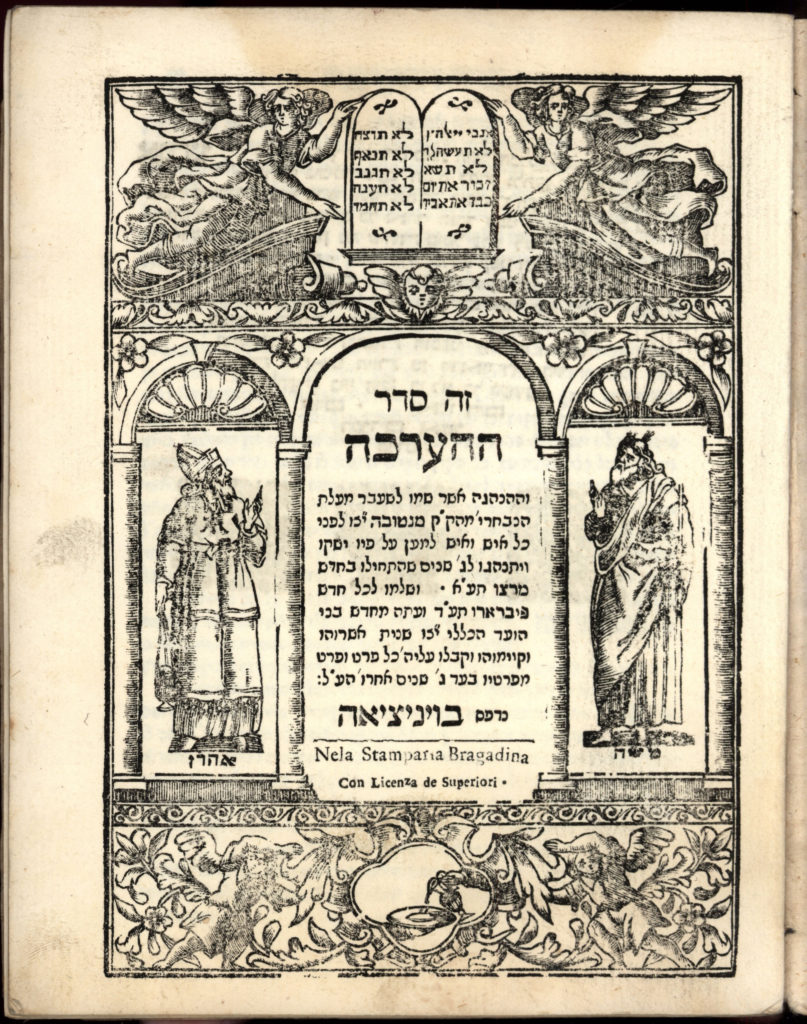
There are a series of books, Seder ha-haʻarakhah ve-haHanhagah, that record the tax law and taxes paid by the Mantuan community and were published in Mantua. [1] The taxes were calculated by communally elected assessment formulators.  The taxes were used to support the entire communal infrastructure, including the administration of communal organizations and funds for the poor.  As today, each person would provide an accounting of their funds reducing their taxable income based upon recognized deductions and certain exempted property. The formulators were wholly responsible for the determination of the specific levied taxes and could reject suspect ax filings and impose fines.

The first edition was published in 1651 and each edition covers three years, of which the National Library has 17 editions. The British Library holds 12, seven that are not in the National Library’s collection. Vinograd lists 22 editions, six in neither library. [2] (A full bibliography appears below)

There is, however, at least one edition in the series that was not published in Mantua, the most logical location, but in Venice by Bragadin in 1711.  The likely reason for the change in venue is that from 1707-1712, there were no books printed in Mantua. [3] Nonetheless, these records were so important that the community went to Venice to publish the records.


Steinschneider, based upon Wolf’s bibliography, does identify this edition of the work. [4] But the book is not extant in the Bodleian Library.[5]  Nonetheless, no modern bibliography, e.g. Vinograd or Friedberg, records the Venice edition nor does the National Library or any other library I can identify (based on a search of WorldCat) own a copy of the book.  There is one copy, however, in the Gross Family Collection in Tel Aviv, and is possibly a unicum – the only extant copy.  Although as Judge Meyer Sulzberger, himself an avid book collector, noted that caution is necessary when identifying a unica, because “that the great weakness about a unicum is that presently one or two other people are found to have the book, and instead of contently agreeing that each of them has a unicum, each feels the value of his possession has been materially impaired.”  To this we can add that without concrete evidence of the book’s singularity, there may be private collections or public ones whose holdings are insufficiently cataloged to make a confident identification regarding the rarity of any book.  Indeed, Sulzberger provides many examples of books thought to unica, only to be identified as “merely” rare.[6]

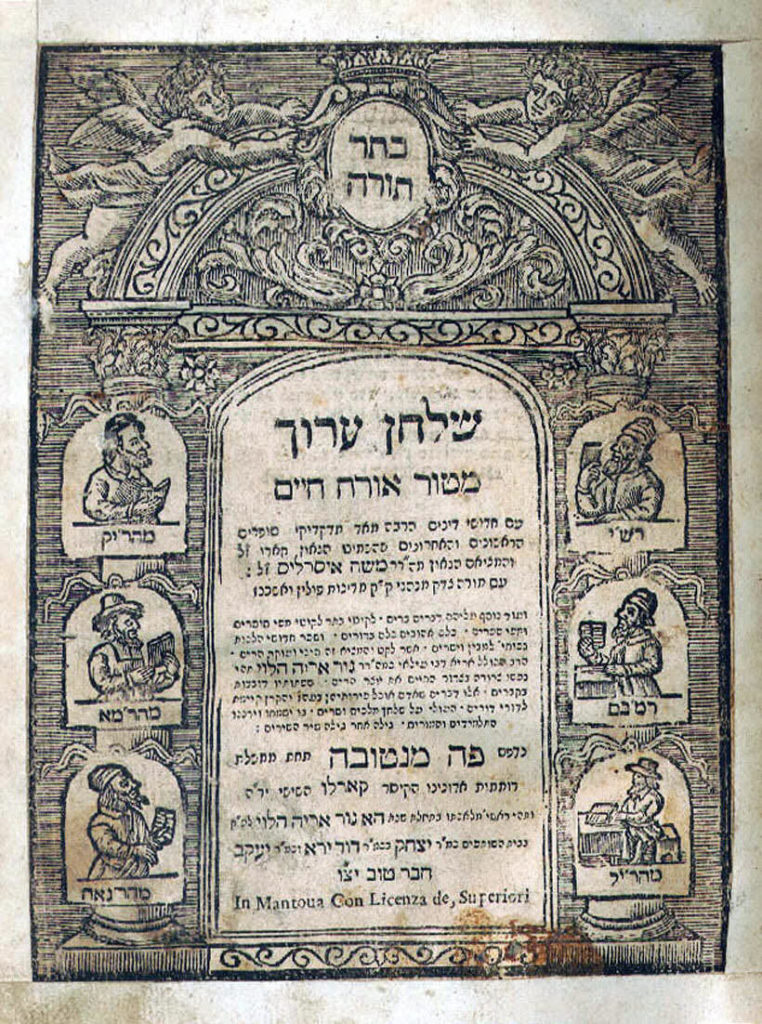
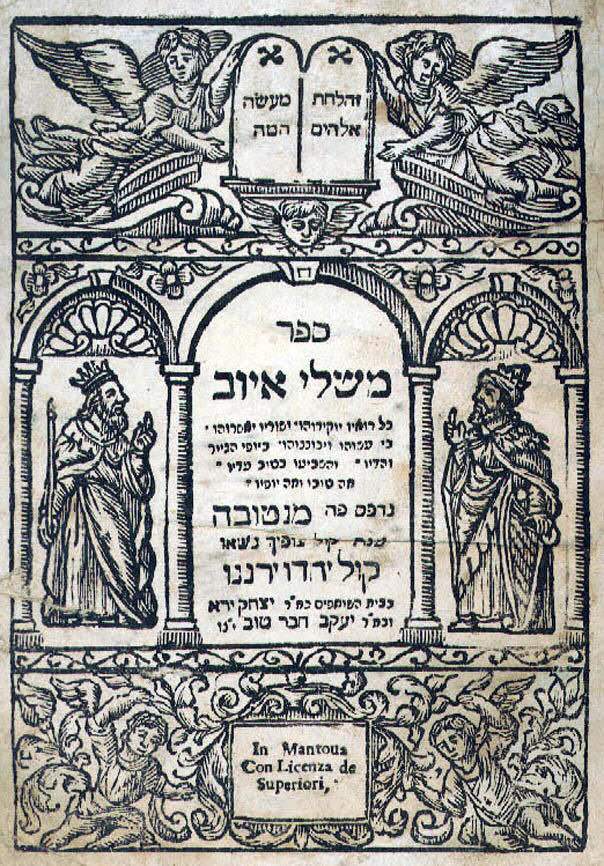
I should also note that the Venice copy has a nice title page with Moses and Aaron. (For a discussion of depictions of Moses and Aaron on Hebrew title pages see our earlier post here.)   A very similar title page appears on a later book printed in Mantua, 1720, Mishlei ve-Eiov, although in this instance it is David and Solomon who flank the title.

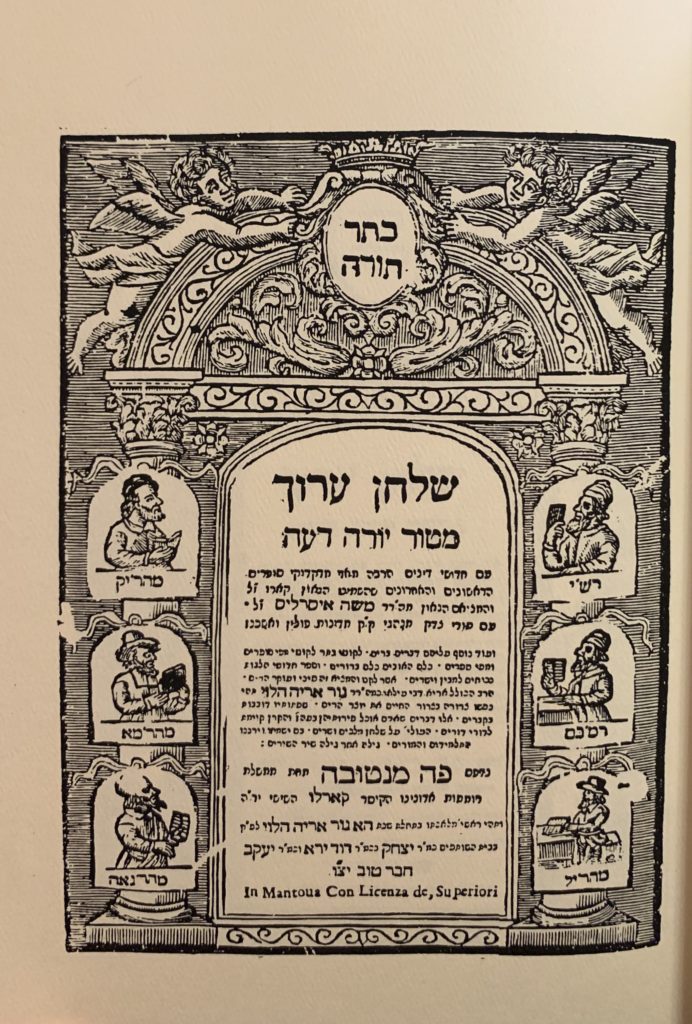
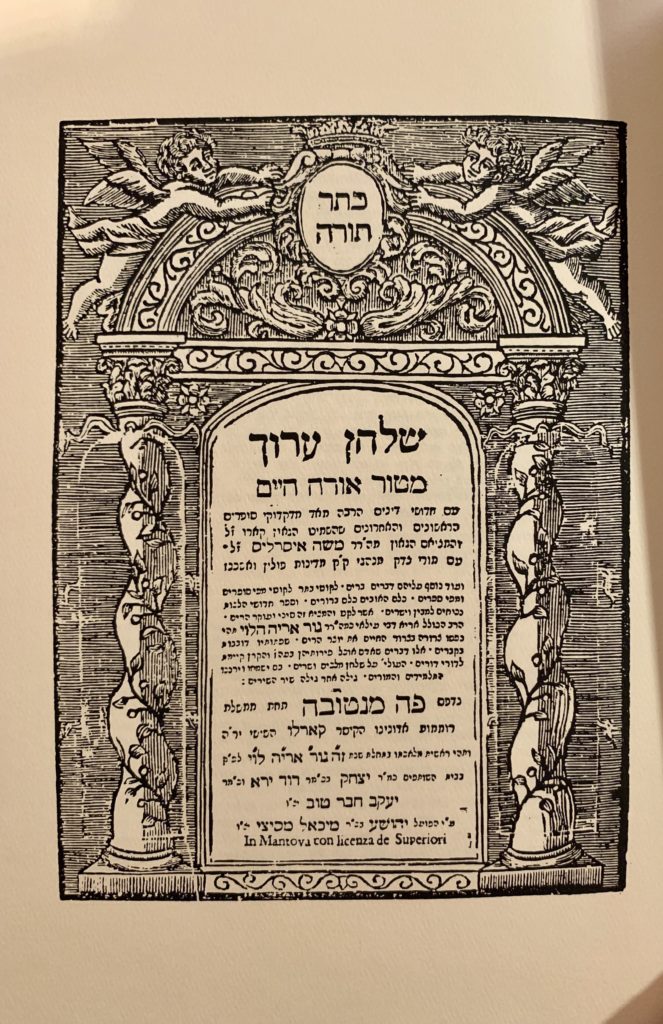
Additionally, the depiction of the Moses, Aaron, Solomon and David are similar to the ones that appear – Rambam, Rashi, R Yosef Karo, Rama, and the author – on the Gur Areyeh, a commentary on Shulkhan Orakh, Mantua, 1722.

There are two editions of this book printed within a year of one another.  The second printing lacks the images entirely and the first they only appear in Orakh Hayyim, and, although not noted in bibliographies or articles regarding the book, in at least one example the title pictorial title pages also appears in Yoreh Deah.

The remaining three (or two) volumes do not contain the images.  This led some to speculate that the images were deliberately removed, and that page was ripped out at the behest of the Mantua rabbinate and a variety of theories are offered, ranging from concern over reproducing human image to the inclusion of the author among such a distinguished group was egotistical, that the Rambam lack ed peyot, or that the portraits are just not flattering. [7]


But, both the claim of censorship and the rationale are unsupported.  Most extant copies include that page and there are many earlier examples of books containing human images including of biblical figures, many without peyot, or not dressed in flattering clothing.  There is no independent evidence to suggest anything other than a benign reason, perhaps the woodcuts wore out.  This aligns with the fact that the printer was known for crude lettering so much so that it nearly lost its ability to print at all and only survived because another party stepped in. Thus it is unlikely the lack of the portraits in the later volumes is an instance of censorship.[8]


* The identification of the Gross edition as a unicum is only preliminary and still a work in progress.  The author encourages anyone with additional information regarding this edition to comment or send an email to seforimblog@gmail.com

[1] See Shlomo Simonshon, Tolodot ha-Yehudim be-Duhosot Mantua, vol. 1 (Jerusalem, 1963), 274-86; see also Marvin J. Heller, The Seventeenth Century Hebrew Book: An Abridged Thesaurus, vol. 2 (Leiden: Brill, 2011), 957.

[2] For the NLI listing see here;   Diana Rowland Smith, Second Supplementary Catalog of Hebrew Books in the British Library 1893-1960, vol. 2 (London:  British Library, 1994), 599; Joseph Zedner, Catloglouge of the Hebrew Books in the Library of the British Museum (London, 1867), 510 recording Mantua 1759; Yeshayahu Vinograd, Otsar ha-Sefer ha-Ivri (Jerusalem:  Machon Lebibliograhia Memuhshevet, 1994).

[3] See Ch. B. Freidberg, Tolodot ha-Defus ha-Ivri be-Italia:  Be-Midenot Italiah, Aspnyah-Portugal, ve-Turgemah she-Melfenim (Tel Aviv:  Bar-Yeda, 1956), 20.  Friedberg does not explain the cause of the stoppage.

[4] Moritz Steinschneider, Catalogus Librorum Hebraeorum in Bibliotheca Bodleiana (Berollini:  Ad. Friedlander, 1852-1860) columns 625-66; Johann Christoph Wolf, Bibliothecae Hebraeae, vol. 3 (Hamburg:  Christoph Felgineri Viduam, 1827), 1207-08 (Steinschneider’s citation to Wolf should be corrected to read vol. 3 and not vol. 2).

[5] See A.E. Cowley, A Concise Catalogue of the Hebrew Printed Books in the Bodleian Library (Oxford:  Clarendon Press, 1929), 410 (listing only Mantua).

[6] Meyer Sulzberger, “Books and Bookmen,” Menorah XXXVI (Jan. 1904), 38-40. For other Hebrew unica see Marvin J. Heller, “Unicum, Fragments, and Other Hebrew Book Rarities,” Judaica Librarianship 18 (2014), 130-53.

[7] See Shmuel Weiner, Daat Kedoshim:  Pesak Herem:  Mazkeret Rabanei Italiah (Petroberg: Berman Press, 1897), 38**; Aviad Cohen, “Diuknot Hakhamim:  Bein Halkha le-Maashe,” Mahnayim 10 (1995). See Mifal ha-Bibliographia ha-Ivrei entry Gur Areyeh .

One scholar viewed the selection of personages to grace the title page as an indication of their imporatance.  Specifically the inclusion of the Mahril was used to demonstrate his unique contribution to the formation of the Shulchan Orakh.  See Yisrael Peles, Mevo ve-Hosafot le-Sefer Mahril (Jerusalem:  Machon Yerushalim, 2016), 258. (Thanks to Eliezer Brodt for providing this source).

[8] Friedberg, Tolodot ha-Defus ha-Ivri, 20-21. For another example of spurious reasons for a change to the title page, see Dan Rabinowitz, “Sheti ha-Girsot shel Shu”t ha-Bakh, Mahadurot Frankfort TN”Z:  Totsot shel Shikul Tsniut, Sha’arim be Shut ha-Bach,” Alei Sefer  21(2010), 99-112.


Bibliography of Seder ha-Ha’arakhah


Mantua, 1651(BL)

Mantua, 1656 (NLI)

Mantua, 1670 (V)

Mantua, 1675 (BL)

Mantua, 1679 (NLI)

Mantua, 1682 (V)

Mantua, 1685 (V)

Venice, 1711 (Gross)

Venice, 1714 (Wolf)

Venice, 1717 (Wolf)

Mantua, 1722 (BL)

Mantua, 1722 (BL) (& a variant)

Mantua, 1726 (NLI)

Mantua, 1729 (V)

Mantua, 1732 (NLI)

Mantua, 1735 (NLI)

Mantua 1737 (BL)

Mantua, 1739 (NLI)

Mantua, 1743 (BL)

Mantua, 1747 (NLI)

Mantua, 1750 (NLI)

Mantua, 1753 (NLI)

Mantua, 1756 (NLI)

Mantua, 1759 (NLI)

Mantua, 1773 (BL)

Mantua, 1777 (NLI)

Mantua, 1780 (NLI)
Mantua, 1783 (V)

Mantua, 1786 (NLI)

Mantua, 1789 (NLI)

Mantua, 1793 (V)

Mantua, 1795 (NLI)

Mantua, 1798 (NLI)


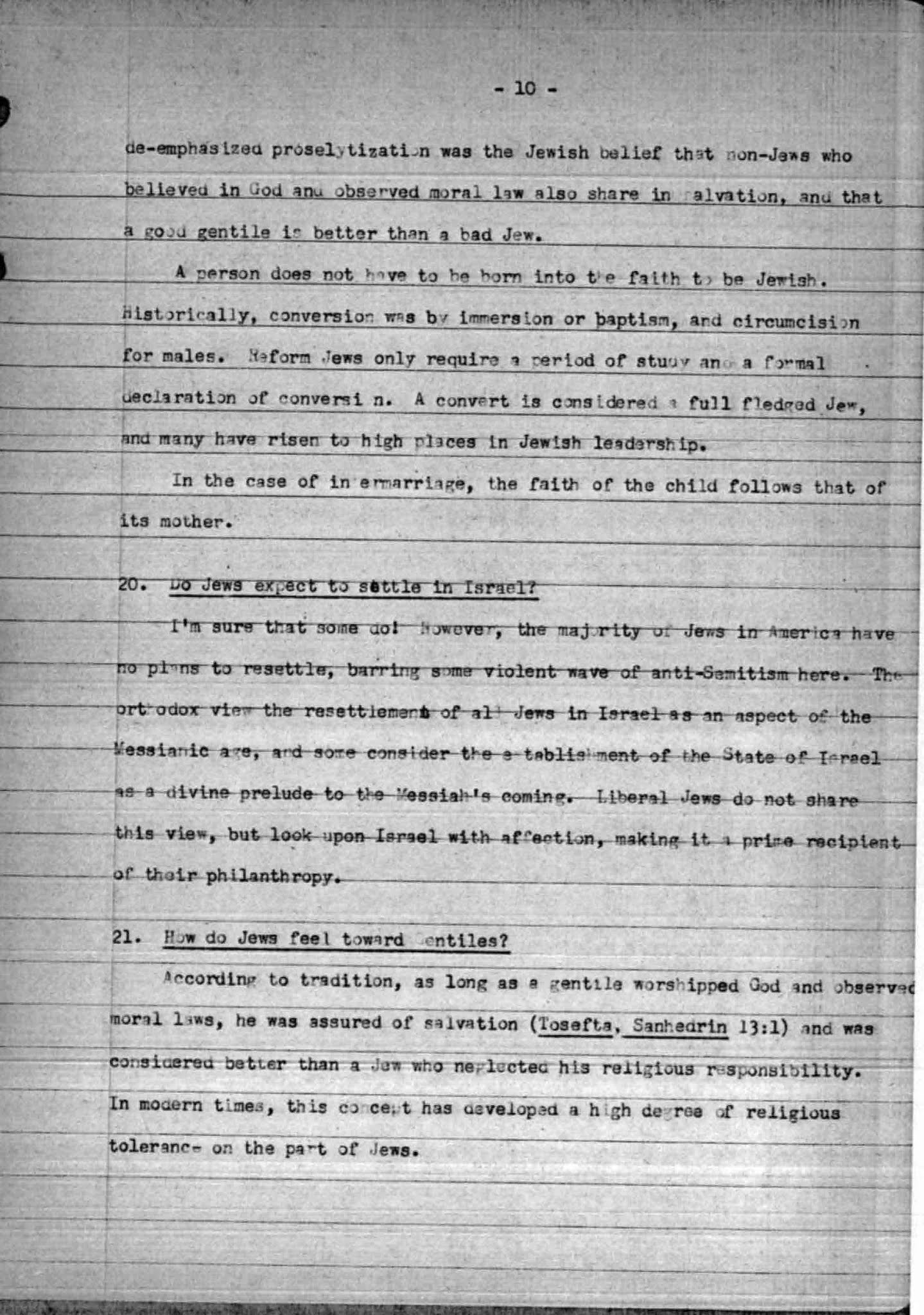
An Unpublished 1966 Memorandum from Rabbi Aryeh Kaplan Answers Questions on Jewish Theology

An Unpublished 1966 Memorandum
from Rabbi Aryeh Kaplan Answers Questions on Jewish Theology

Marc B. Shapiro and Menachem Butler

Professor Marc B. Shapiro holds the Harry and Jeanette Weinberg Chair in Judaic Studies at the University of Scranton, and is the author of many books on Jewish history and theology. He is a frequent contributor at the Seforim blog.

Mr. Menachem Butler is Program Fellow for Jewish Legal Studies at The Julis-Rabinowitz Program on Jewish and Israeli Law at Harvard Law School. He is an Editor at Tablet Magazine and a Co-Editor at the Seforim Blog.

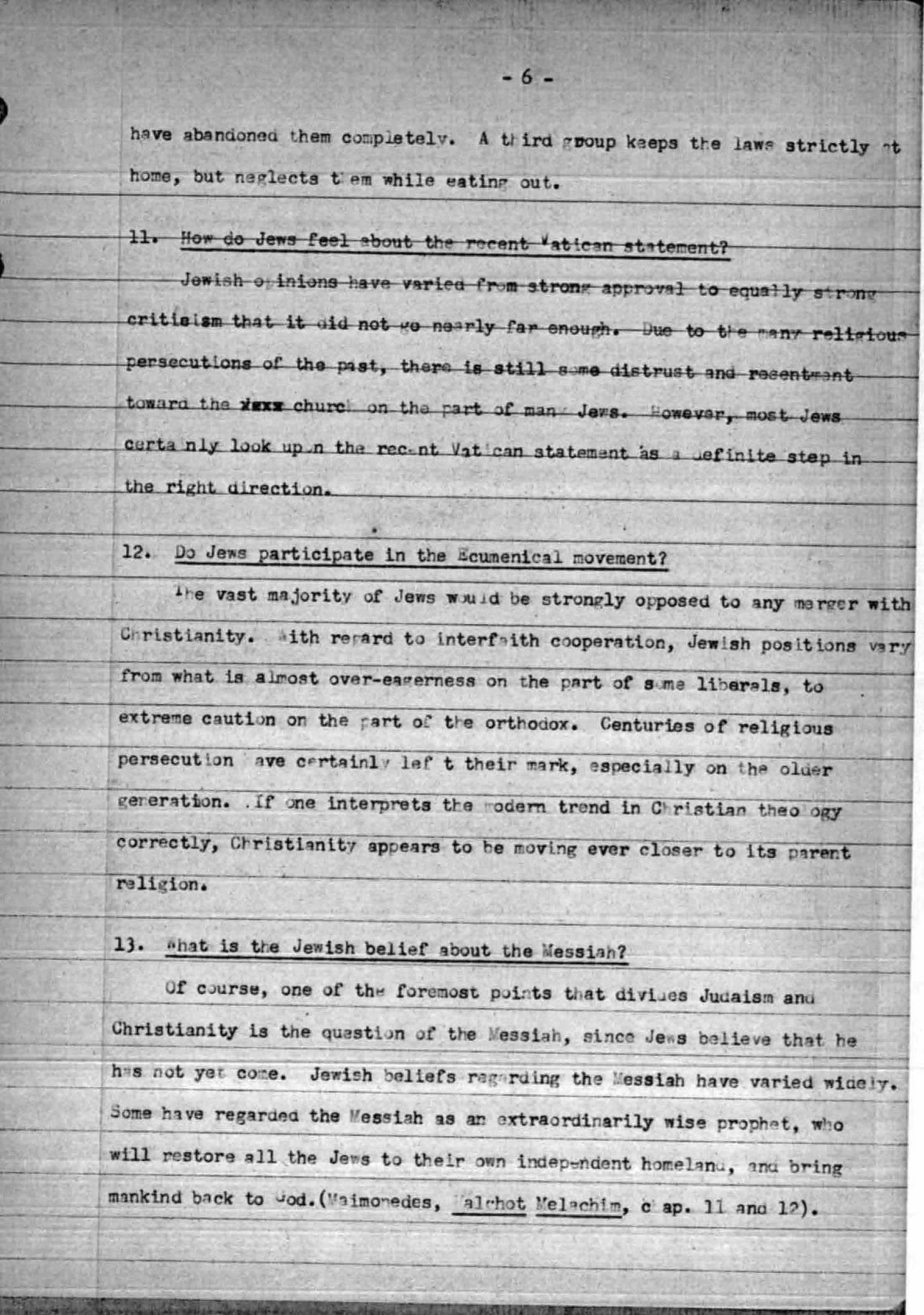
Over the last ten years Professor Alan Brill has written a series of blogposts, as well as a recent scholarly article on the perennially interesting, yet historically mysterious, rabbinic theologian, Rabbi Aryeh Kaplan (1934-1983).[1] It was from these posts that many have learned about what Kaplan was doing before he burst onto the wider Jewish literary scene in the early 1970s through his writings and public lectures. He passed away in 1983 at the age of 48.[2]

Rabbi Aryeh (Leonard M.) Kaplan was born in the Bronx in 1934, and studied at Mesivta Torah Vodaath in New York, and at the Mirrer Yeshiva in New York and in Jerusalem. In 1953, 20-year-old Aryeh Kaplan joined the group of students assembled by Rabbi Simcha Wasserman under the guidance of Rabbi Shmuel Kamenetsky to establish a yeshiva in Los Angeles,[3] and three years later in 1956 received his rabbinic ordination (Yoreh Yoreh, Yadin Yadin) from Rabbi Eliezer Yehuda Finkel of the Mirrer Yeshiva of Jerusalem, and from the Chief Rabbinate of the State of Israel. After receiving his ordination, Aryeh Kaplan began his undergraduate studies and, in 1961, earned a B.A. in physics from the University of Louisville, and two years later, an M.S. degree in Physics from the University of Maryland, in 1963. While studying towards his undergraduate degree, Aryeh Kaplan taught elementary school at the pluralistic Eliahu Academy in Louisville, and corresponded with Rabbi Moshe Feinstein about some of the challenges that he encountered.[4] He then worked for four years as a Nuclear Physicist at the National Bureau of Statistics in Washington DC.

In February 1965, Rabbi Kaplan and his wife and their two small children moved to Mason City, Iowa, where he was invited to serve as a pulpit rabbi at Adas Israel Synagogue, a non-Orthodox congregation with forty member families. It would be his first pulpit. He remained at that pulpit until July 1966. During his time in Mason City, Rabbi Kaplan and his wife were very active in all aspects of their synagogue activities. Rabbi Kaplan led services and delivered a sermon each week at the Friday Night Service at Adas Israel Synagogue, hosted a Talmud Torah and taught about Jewish tradition to the youth in the community. He was a member of the National Conference on Christians and Jews, and regularly hosted visiting religious groups to the synagogue and participated in interfaith meetings and on panels alongside religious leaders of other faiths. In all of his delivered remarks, Rabbi Kaplan would type out each sermon prior to its delivery and maintain copies of these addresses within his personal archives; to date, these sermons have not yet been published.

It was during Rabbi Kaplan’s time in Mason City that he authored a fascinating eleven-page-typescript memorandum, dated February 22, 1966, that, thanks to the research discovery of Menachem Butler, we are privileged to share with the readers of The Seforim Blog in the Appendix to this essay.[5]

Kaplan was responding to questions sent out by the B’nai B’rith Adult Jewish Education bureau in Washington DC on matters of basic Jewish theology.[6] We see from the letter that like many other rabbis who were serving in frontier communities, Kaplan maintained a camaraderie with those among the non-Jewish clergy. He was even a member of the “Ministerial Association,” and together with his wife was “founder and chairman of the local chapter of Ministerial Wives.” As one who often hosted non-Jewish groups at the synagogue, Kaplan was well equipped to place Jewish concepts and practices within a context that would make sense for Christians, and this is clearly seen in how he formulates his answers in the letter.

Although Rabbi Aryeh Kaplan’s memorandum is self-explanatory, there are a few points of theological interest that are worth calling attention to:

1. Right at the beginning, Kaplan notes that Jews have no official dogmas, and that in many cases Jewish opinions vary widely.

2. Kaplan states unequivocally that Maimonides does not believe in a literal resurrection. In support of this statement he cites Guide 2:27. If all we had were the Commentary on the Mishnah and the Guide, it would make sense to assume that when Maimonides refers to the Resurrection of the Dead that he intends immortality, not literal resurrection. Even the Mishneh Torah can be read this way, and Rabad, in his note on Hilkhot Teshuvah 8:2, criticizes Maimonides in this regard: “The words of this man appear to me to be similar to one who says that there is no resurrection for bodies, but only for souls.” Furthermore, in Hilkhot Teshuvah 3:6, in speaking of the heretics who have no share in the World to Come, Maimonides writes: והכופרים בתחית המתים וביאת הגואל, “Those who deny the Resurrection and the coming of the [messianic] redeemer.” Throughout his works Maimonides is clear that the ultimate reward is the spiritual World to Come. So how could he not mention among the heretics those who deny the World to Come, and only mention those who deny the Resurrection? It appeared obvious to many that when Maimonides wrote “resurrection of the dead” what he really meant is the spiritual “World to Come.”

As noted, if the works mentioned in the previous paragraph were all we had, then one would have good reason to conclude that for Maimonides resurrection of the dead means nothing other than the World to Come. Yet it is precisely because people came to this interpretation that Maimonides wrote his famous Letter on Resurrection in which he states emphatically that he indeed believes in a literal resurrection of the dead, after which the dead will die again and enjoy the spiritual World to Come. It is true that some have not been convinced by the Letter on Resurrection and see it as an apologetic letter that does not give us Maimonides’ true view, but such an approach means that one is accepting a significant level of esotericism in interpreting Maimonides, as we are not now concerned with a passage here or there but with an entire letter that one must assume was only written for the masses. Since Kaplan ignores what Maimonides says in his Letter on Resurrection, I think we must conclude that, at least when he wrote this letter, he did not regard it as reflecting Maimonides’ authentic view.[7] In Kaplan’s later works, there is no hint of such an approach to Maimonides.[8]

3. In discussing Jesus, Kaplan writes: “In this light, we can even regard the miracles ascribed to Jesus to be true, without undermining our own faith, since his message was not to the Jews at all.”[9]

APPENDIX:

Rabbi Aryeh Kaplan: Response to “Questions Christians Ask Jews” (1966)

[INSERT IMAGES 1-13]

Notes:

[1] See Alan Brill, “Aryeh Kaplan’s Quest for the Lost Jewish Traditions of Science, Psychology and Prophecy,” in Brian Ogren, ed., Kabbalah in America: Ancient Lore in the New World (Leiden: Brill, 2020), 211-232, available here. See also Tzvi Langermann, “‘Sefer Yesira,’ the Story of a Text in Search of Commentary,” Tablet Magazine (18 October 2017), available here.

[2] A complete biographical portrait of Rabbi Aryeh Kaplan remains a scholarly desideratum.

For appreciations of his writings, see “Rabbi Aryeh Kaplan: A Tribute,” in The Aryeh Kaplan Reader: The Gift He Left Behind (Brooklyn: Mesorah Publications, 1983), 13-17; Pinchas Stolper, “Rabbi Aryeh Kaplan z”l: An Appreciation,” Ten Da’at, vol. 1, no. 2 (Spring 1987): 8-9; Baruch Rabinowitz, “Annotated Bibliography of the Writings of Aryeh Kaplan, Part 1,” Ten Da’at, vol. 1, no. 2 (Spring 1987): 9-10; Baruch Rabinowitz, “Annotated Bibliography of the Writings of Aryeh Kaplan, Part 2,” Ten Da’at, vol. 2, no. 1 (Fall 1987): 21-22; and Pinchas Stolper, “Preface,” in Aryeh Kaplan, Immortality, Resurrection, and the Age of the Universe: A Kabbalistic View (Hoboken, NJ: Ktav Publishing House, 1993), ix-xi, among other writings.

[3] See Nosson Scherman, “Rabbi Mendel Weinbach zt”l and The Malbim,” in A Memorial Tribute to Rabbi Mendel Weinbach, zt”l (Jerusalem: Ohr Sameyach, 2014), 13-14, available here; as well as Nissan Wolpin, “The Yeshiva Comes to Melrose,” The Jewish Horizon (March 1954): 16-17.

[4] See responsum by Rabbi Moshe Feinstein as published in Shu”t Iggerot Moshe, Orah Hayyim, vol. 1 (New York: Noble Book Press, 1959), 159 (no. 98), dated 13 July 1955.

Discovery of additional correspondences between Rabbi Moshe Feinstein and Rabbi Aryeh Kaplan during those years would be of great scholarly interest and of immense historical value.

[5] Menachem Butler is also preparing for publication the typescript text of a sermon (“If This Springs From G*D…”) that Rabbi Kaplan delivered the previous month in January 1966, and where he reveals details about a conversation that he had with Dr. Robert Oppenheimer, director of the Los Alamos Project and father of the Atom Bomb.

[6] Menachem Butler writes two interesting details that, though beyond the narrow scope of this essay, are nonetheless of historical worthiness to consider when reading this memorandum:

Rabbi Aryeh Kaplan’s memorandum of February 1966 was written several months *prior* to the famous symposium of “The State of Jewish Belief:” hosted by Commentary in August 1966, and republished shortly-thereafter under the different title The Condition of Jewish Belief: A Symposium Compiled by the Editors of Commentary Magazine (New York: Macmillan, 1966), and reprinted more than two decades later in The Condition of Jewish Belief (Northvale, NJ: Jason Aronson, Inc., 1988). One wonders how Rabbi Aryeh Kaplan might have responded to the five questions sent by Commentary to 38 rabbis and scholars from around North America.

Returning to questions submitted by B’nai B’rith, it should be noted that the 21 questions were composed by Rabbi Morris Adler on behalf of the B’nai B’rith Adult Jewish Education bureau, a commission that he chaired from 1963-1966, and that he was murdered several weeks after the memorandum was submitted by Rabbi Aryeh Kaplan. It is for this reason that I believe that these responses had not been published.

The circumstances of Rabbi Adler’s assassination are that a gunman shot him multiple times during Shabbat morning services in front of hundreds of his congregants at his synagogue in Michigan. Rabbi Adler passed away from his wounds sustained in the attack nearly a month later. For a brief bibliographical portrait, see Pamela S. Nadell, Conservative Judaism in America: A Biographical Dictionary and Sourcebook (New York: Greenwood Press, 1988), 31-32; and for a full book-length account of the episode, see T.V. LoCicero, Murder in the Synagogue (Englewood Cliffs, N.J.: Prentice Hall, 1970), as well as his followup volume in T.V. LoCicero, Squelched: The Suppression of Murder in the Synagogue (New York: TLC Media, 2012), available to be ordered here.

[7] For brief discussion, see Isaiah Sonne, “A Scrutiny of the Charges of Forgery against Maimonides’ ‘Letter on Resurrection’,” Proceedings of the American Academy for Jewish Research, vol. 21 (1952): 101-117; see also Jacob I. Dienstag, “Maimonides’ ‘Treatise on Resurrection’ – A Bibliography of Editions, Translations, and Studies, Revised Edition,” in Jacob I. Dienstag, ed., Eschatology in Maimonidean Thought: Messianism, Resurrection, and the World to Come (New York: Ktav, 1983), 226-241, available here.

[8] See Aryeh Kaplan, Maimonides’ Principles: Fundamentals of Jewish Faith (New York: National Conference of Synagogue Youth, 1984), Aryeh Kaplan, Immortality, Resurrection, and the Age of the Universe: A Kabbalistic View (Hoboken, NJ: Ktav Publishing House, 1993), among other publications.

[9] The notion that in the past non-Jews have performed miracles much like the Jewish prophets needs further analysis, which Marc B. Shapiro will attempt in his forthcoming book on Rav Kook. As well, in Toledot Yeshu Jesus is described as performing miracles, but this is explained by Jesus having made use of God’s holy name.


Mehalekhet Bi-Darka – A Review Essay

Mehalekhet Bi-Darka – A Review Essay
מלכה פיוטרקובסקי, מהלכה בדרכה: אתגרי החיים במבט הלכתי-ערכי, הוצאת ידיעות אחרונות, תל-אביב תשע”ד, 567 עמ’
Yael  Levine
The author holds a Ph.D. from the Talmud department at Bar Ilan University. She is the author of numerous articles related to women in Judaism. She recently published “Tefillot Li-Tevilla”.
The following article is a critical review of the recently published book in Hebrew “Mehalekhet Bi-Darka”, a compilation of articles by Malka Peuterkovsky. The present review focuses on the chapter concerning women and the recitation of kaddish. Several highlights from the Hebrew review will now be mentioned, and the readers are encouraged to read the Hebrew review in its entirety for the full spectrum of comments.
Peuterkovsky attempts to offer a new interpretation of the classic teshuva by the Havvot Yair according to which he didn’t forbid the recitation of kaddish. However, this interpretation is unfounded and is based upon a lack of knowledge of halakhic terminology. She seeks to criticize Rav Bacharach in an unjustifiable manner, and her various discussions concerning this teshuva may be refuted.
Peuterkovsky utilizes a letter written by Henrietta Szold concerning the recitation of kaddish, and refers to this letter in a halakhic context. However, in her letter Szold raised no halakhic reasoning. Peuterkovsky refrained from mentioning that Szold held progressive Jewish beliefs. She was instrumental in the formation of an egalitarian minyan, together with Reform Rabbi Judah Magnes, which shortened the nussah of the tefilla, and omitted mention of the sacrifices.
The author utilizes sources from the responsum of Rabbi David Golinkin on the topic of women reciting kaddish, in its Hebrew version. This influence is particularly evident with regard to “Sefer Ha-Hayyim” which she copies and compounds an inaccuracy found in Golinkin’s work.
In several instances Peuterkovsky quotes excerpts from sources which are misleading. Thus, she quotes short passages in which the poskim express a theoretical position in favor of the recitation of kaddish by women, but refrains from stating that their actual psak is in direct contrast to the notion they mentioned in these quotes. Peuterkovsky erroneously explains the Be’er Heitev. She quotes the work “Ma’ayan Ganim” from the “Torah Temimah”, who himself quoted from a second-hand source which didn’t hand over an exact rendering of the text. She also relies upon the incorrect background information concerning the work and its author taken from Rabbi Baruch Epstein.
The chapter on women and kaddish in Peuterkovsky’s book in replete with mistakes, and can’t be relied upon. The present review also refers to some problematic discussions in the book.
“מהלכה בדרכה” מאת מלכה פיוטרקובסקי – נשים ואמירת קדיש
יעל לוין
מבוא
לאחרונה התפרסם ספרה של מלכה פיוטרקובסקי “מהלכת בדרכה: אתגרי החיים במבט הלכתי-ערכי” בהוצאת ידיעות אחרונות. המאמר הנוכחי מוקדש לעיון בפרק “אמירת קדיש על ידי אישה” בספרה זה (עמ’ 257–295, 539–542). והנה, עיון מעמיק בחומר חושף כי מצויות בעיות מהותיות לאורך הפרק, שאינן מאפשרות להסתמך עליו. אקדים ואומר כי אינני חולקת ברמה המעשית על האפשרות ההלכתית שנשים בזמננו יוכלו לומר קדיש מעזרת הנשים, ויש לכך סימוכין במקורות, כגון בדברי הרב יהודה הרצל הנקין.1 יחד עם זאת, כפי שאפרט, הפרק שכתבה פיוטרקובסקי בנושא נשים ואמירת קדיש בעייתי ביותר מבחינת השימוש במקורות וניתוחם, הוא רצוף שגיאות ולוקה בחסר. לא בדבר אחד או שניים, אלא בשְׁורה של דברים ובעניינים מהותיים. מצב העניינים בכל הנוגע לפרק הנוכחי פוגם באפשרות ללמוד ממנו את הנושא כראוי, וביכולתו להוביל למסקנות שגויות ולטעויות. אסור ולא נכון יהיה לעבור בשתיקה על מצב זה שנוצר, למרות הציפייה הגדולה לכרך שאולי יוכל להיהפך בר-שימוש בציבור הדתי-לאומי, ושמא אף מעבר לכך.
שו”ת חוות יאיר – פרשנות שגויה וניתוח לא ראוי
נתייחס תחילה להערות הנוגעות לניתוח של התשובה בשו”ת חוות יאיר (סימן רכב), שהיא התשובה הראשונה והמרכזית בנושא, לה מקדישה פיוטרקובסקי מקום לא מבוטל. השאלה שהופנתה לרב יאיר חיים בכרך באה על רקע מעשה באמשטרדם באדם שציווה לפני פטירתו שילמדו עשרה אנשים בביתו מדי יום תמורת שכר, ולאחר הלימוד תאמר הבת קדיש, בהעדר בנים. חכמי המקום ופרנסיו לא מיחו בבת. הרב בכרך נשאל לגבי עמדה הלכתית זו. הוא סובר כי קיימת סברה לומר שגם לבת יש שייכות לקדיש. האישה מצווה על קידוש השם וכן גם בבת יש תועלת ונחת רוח לנפש הנפטר באמירת קדיש. למרות זאת, הוא פוסק שיש לאסור על אמירת הקדיש, כלשונו: “ולכן בנדון זה שיש אסיפה ברבים יש למחות”. זאת מחמת שיש לחוש שעל ידי כך ייחלש כוח המנהגים של בני ישראל, וכל אחד יהיה בונה במה לעצמו על פי סברתו, ויבואו לזלזל בדברי חכמים.
במהלך דיונה בתשובת הרב בכרך מציבה פיוטרקובסקי מה שהיא מכנה “כמה קושיות משמעויות” (עמ’ 274). בקושייה הרביעית היא תוהה מדוע מורה הרב בכרך שיש למחות באישה המבקשת לומר קדיש, “ואינו קובע מפורשות שיש לאסור זאת?” (שם). התשובה שהיא מעניקה היא: “משום שאין בכך כל איסור!” (עמ’ 277). אולם אין לקבל את פרשנותה המחודשת הזו, וכוונת פשט דברי החוות יאיר היא שלדידו אמירת קדיש על ידי אישה אסורה. חשוב לדעת כי הטרמינולוגיה ההלכתית הנוגעת לאמירת קדיש אינה מובעת במקורות רק במונחים של איסור והיתר, אלא ביטוי שגור הנוגע להרשאה לומר או שלא לומר קדיש הוא באמצעות הפועל “מחה”. אפשר לציין כדוגמה את הנאמר בחיבורו של רבנו משה מינץ, בן המאה החמש עשרה, שו”ת מהר”ם מינץ: “… אבל היכא דליכא [=היכן שאין] מנהג קבוע על פי חכמים, וליכא שום תקנה קבוע, שעשו בני המדינה או קהילה, פשיטא דאין [=פשוט שאין] מוחין לאבל להתפלל, והמוחה באבל כאלו מוחה באדם מלעשות מצוה” (שו”ת מהר”מ מינץ, מהדורת דומב, חלק ראשון, סימן מג, עמ’ קעו). השימוש בביטוי “יש למחות” בשו”ת חוות יאיר דומה לשימוש בפועל זה בשו”ת מהר”ם מינץ, וההבנה החדשנית שפיוטרקובסקי מבקשת להעניק לעניין אינה נכונה בעליל, והיא נובעת מחוסר הכרתה את הטרמינולוגיה המקובלת. אין להצעתה על מה שתסמוך, ואין לתפוס את דבריו של החוות יאיר במשמעות הרשאה. לכן אין גם לקבל את דבריה אלה: “רב שיפסוק בהתאם להכרעת הרב בכרך, לא יוכל לאסור על אישה לומר קדיש יתומה” (עמ’ 277). היא מקיימת דיון דומה במשמעות דברי הפוסקים הסוברים שיש למחות בנשים מלהניח תפילין (ראו בין היתר עמ’ 138, 144, 148–149), ואף כאן אין לדבריה על מה שיסמוכו.
אחת הקושיות שמעוררת פיוטרקובסקי על החוות יאיר היא שהוא לא הזכיר בתשובתו שאמירת קדיש נחשבת להיות חלק ממצוות כיבוד הורים (עמ’ 270–271). לראיה היא מביאה קטע מדברי הרב פנחס זביחי בשו”ת עטרת פז (חלק א, כרך א, או”ח, ב). אולם יש לתמוה מדוע היא מביאה מוטיב זה מחכם בן זמננו בשעה שמצויים מקורות קדומים הרבה יותר. כך כבר מהר”ם מינץ מזכיר רעיון זה בתשובה שכתב (שו”ת מהר”מ מינץ, מהדורת דומב, חלק שני, סימן פ, עמ’ שפה). כמו כן, רעיון זה מובא משמו של מהר”ם מינץ בתשובה בנושא נשים ואמירת קדיש מאת ר’ אלעזר פלקלס בחיבורו תשובה מאהבה (חלק שני, פראג 1815, ארח חיים, רכט, יו”ד, י ע”א). כך חכם זה כותב “הן אמת שהקדיש הוא מפאת כבוד אב”, עמדה שהוא מזכיר מתוך שו”ת מהר”ם מינץ תוך שהוא מוסיף עליה ומרחיבה. פיוטרקובסקי מביאה במהלך הפרק קטע נבחר בלבד מתוך תשובה מאהבה (עמ’ 280–281), את המשך דבריו שבהם הוא מציין נוהג שראה לפיו בנות קטנות אמרו קדיש בחצר בית הכנסת, אולם הוא אוסר לחלוטין אמירת קדיש על ידי נשים בבית הכנסת עצמו. לגופו של עניין יש לומר כי החוות יאיר לא היה מחויב להזכיר בתשובתו את הרעיון שקדיש קשור למצוות כיבוד הורים, ואין לתמוה עליו כלל בעניין הזה.
פיוטרקובסקי מצטטת )עמ’ 275) את דברי ר’ יצחק מווינה בספרו אור זרוע לפיהם המנהג במקומו, וכן מנהג בני ריינס, הוא שהיתום עומד ואומר קדיש לאחר “אין כא-להינו”. אולם בצרפת נכח שאין מקפידים שהנער האומר הקדיש יהיה דווקא יתום, ונהגו שגם נער שיש לו הורים אומר קדיש. ר’ יצחק מווינה עצמו מעדיף את המנהג הנקוט במקומו. על יסוד זאת קובעת פיוטרקובסקי כי מכיוון שלא היה נוהג ברור, “מכאן שניתן להנהיג שגם יתומות תאמרנה קדיש במניין” (שם) כדי שלא ייגרע חלקן במצוות קידוש שם ה’, וכן כדי שיוכלו לקיים את מצוות כיבוד הורים על ידי עשיית מעשה לעילוי נשמתם. אולם אין מסקנתה זו מוכרחת ומחייבת כלל, ועובדה היא שאין בידינו עדות כלשהי מתקופת הראשונים לגבי אמירת קדיש בידי הבת, כי אם מתקופת האחרונים בלבד. אם כן, היא מכניסה בצורה אנכרוניסטית אלמנט שאין לייחס כלל למנהג המוקדם. הבחנתה זו אינה נחוצה גם משום שיש פוסקים המתירים לנשים לומר קדיש מטעמים אחרים. יש לציין עוד כי בהערת שוליים (עמ’ 540, הערה 10) היא מאזכרת בפרפרזה קטע זה מהאור זרוע, בלא שהיא מפנה לגוף המאמר כאן. ונציין שאין אחידות לאורך הספר בכתיב שמו של האור זרוע (ראו בין היתר עמ’ 127).
יש להזכיר בהקשר לשו”ת חוות יאיר כי פיוטרקובסקי עושה שימוש בנוסח של התשובה שיש בו שגיאות אחדות. כך היא מסתייעת בנוסח התשובה שבפרויקט השו”ת, אולם מצויות שם לפי שעה טעויות שונות בהעתקת הנוסח, המבוסס על הדפוס השני שיצא לאור בלמברג בשנת תרנ”ו. טעויות אלה עומדות להיות מתוקנות בגרסה הבאה של פרויקט השו”ת, בעקבות הערותיה של כותבת שורות אלה. אחת הטעויות הניכרות היא הנוסח “ויבואו לגלגל בו”, במקום “ויבואו לזלזל בו”. טעות נוספת המצויה היא “ונזכר בגמרא” במקום “כנזכר בגמרא”. מתברר שפיוטרקובסקי עשתה שימוש בנוסח שבפרויקט השו”ת, למרות שמוטל היה עליה להוציא מתחת ידה נוסח מבורר. ואמנם היא אינה מציינת את המהדורה של חוות יאיר אשר בה השתמשה. זה לא דבר של מה בכך, אלא עניין עקרוני הקשור לשיטות עבודה בסיסיות; מחבר אמור לעיין בחיבורים עצמם, ולא להסתמך על מאגרים.
יש לציין עוד שהמחברת מתייחסת בדבריה אל “השואלים” (עמ’ 266) שפנו אל הרב בכרך לבירור רשאיות אמירת קדיש בידי הבת במעשה שאירע באמשטרדם, אולם באותה מידה ייתכן שמדובר בשואל יחיד. על פי נוסח דברי הרב בכרך אין אפשרות כלל לקבוע אם מדובר בשואל יחיד או בשואלים רבים. פיוטרקובסקי טורחת להדגיש כי למרות שבעל חוות יאיר מציין שהמקור לאמירת קדיש הוא המעשה בר’ עקיבא, נראה שהמעשה המקורי אירע בר’ יוחנן בן זכאי. היא מביאה מידע זה משמו של מ”ב לרנר במאמרו המחקרי “מעשה התנא והמת” שהתפרסם בכתב העת “אסופות” (מהלכת בדרכה, עמ’ 269; 540, הערה 11), וכן מזכירה תפיסה זו מתוך אנציקלופדיה אוצר ישראל (שם, הערה 12). יש לומר תחילה לגבי אנציקלופדיה זו שהיא יצאה לאור בראשית המאה העשרים, ולא מקובל לעשות בה שימוש בכתיבה אקדמית, אלא יש להסתייע במחקרים ובמקורות ראשוניים יותר. בהקשר זה יש לציין כי המחברת לא עשתה שימוש בחיבור המקיף והנודע של הרב דוד אסף בנושא הנדון, “ספר הקדיש: מקורו, משמעותו ודיניו”, שיצא לאור בשנת תשכ”ו.
כמו כן, מלבד מאמרו של לרנר בעניין “מעשה התנא והמת”, ראה אור לאחרונה מאמרה החשוב של פרופ’ רלה קושלבסקי בנושא זה, “התנא והמת הנודד” ב”אנציקלופדיה של הסיפור היהודי”.2 מחקר זה לא זכה לאזכור אצל פיוטרקובסקי. כמובן שאין להלין על החוות יאיר על שאולי לא עשה שימוש במעשה בריב”ז, אלא החוות יאיר כתב בהתאם למה שניצב לנגד עיניו.
והרי חרף ביקורתה של פיוטרקובסקי כלפי החוות יאיר בעניין זה, היא עצמה מצטטת כמקור לאמירת קדיש את המעשה בר’ עקיבא, כפי שמובא בקובץ אוצר מדרשים, מקור שלגביו היא מודעת שהוא מקור מאוחר, אך היא בוחרת לעשות בו שימוש מחמת שנוסחו נהיר יותר (עמ’ 539, הערה 7). אולם הקובץ אוצר מדרשים איננו מקור שראוי לצטט הימנו, שכן העורך י”ד אייזנשטיין הכניס שינויים כלשהם בנוסחי המדרשים, אלא יש לחזור למקור שממנו ציטט. למעשה היה על פיוטרקובסקי להביא את המקור הטוב ביותר, ואז להציע פרשנות מבארת עליו.
יש להעיר עוד את הדברים הבאים בנוגע לציטוט של פיוטרקובסקי מתוך הקובץ אוצר מדרשים. המחברת מציינת כמראה מקום את המידע הבא: “אוצר המדרשים (איזנשטיין), ניו
יורק, תרע”ה, 1915, עמ’ ת”נ, ד”ה (ל”ב), דבור שביעי” (עמ’ 540, הערה 8). אולם היא לא מזכירה אפילו את שם המדרש הספציפי שממנו נטלה אותו; מדובר במדרש עשרת הדברות. שנית, העמודים שבהם מופיע הקטע המצוטט הם 457–458, ובמהדורת תרע”ה בה עיינתי מספור העמודים הוא במספרים, ולא באותיות כפי שהיא מציינת. (במאמר מוסגר אציין כי הסימון “עמוד ת”נ” מצוי בלקט המקורות על נשים וקדיש שאסף עמיחי טורם, אם כי שאר הרישום הביבליוגרפי אינו מצוי שם). נוסח מדרש עשרת הדברות עצמו מתחיל אמנם בעמ’ 450, אך הקטע המצוטט מופיע בהמשך. בנוסף, מראה המקום המדויק אמור להיות “אות לב, דבור שביעי”, ואין להשתמש כאן במילים “דיבור המתחיל”; זו לא הטרמינולוגיה המתאימה לציטוט המדרש כאן. כמו כן, כותר הספר הוא “אוצר מדרשים”, גם אם בפרויקט השו”ת מופיעה הכותרת בטעות כ”אוצר המדרשים”. מעבר לכך, לפני שנים אחדות יצאה לאור מהדורה מדעית של מדרש עשרת הדברות בההדרתה של ענת שפירא, ובה הייתה פיוטרקובסקי אמורה לעשות שימוש. כך שיש בעייתיות גמורה הן בבחירתה לצטט מדרש מאוחר ככלל, והן בבחירתה לצטט מתוך הקובץ אוצר מדרשים, ולא ממהדורתה של ענת שפירא.
פיוטרקובסקי מציינת שהמדרש באוצר מדרשים אינו קושר את המעשה בר’ עקיבא לעניין אמירת קדיש, וקישור זה מצוי בספר כל-בו (סימן קיד) (עמ’ 269). אולם מחזור ויטרי (סימן קמד) הוא מקור קדום יותר המעלה זיקה בין המעשה בר’ עקיבא לבין השתקפות קדומה יותר ככל הנראה של אמירת קדיש יתום במוצאי שבתות.
הקושיה הראשונה שפיוטרקובסקי מציבה על החוות יאיר נוגעת למועד תחילת נוהג אמירת קדיש יתום. היא מצטטת תחילה קטע מתוך הערך “קדיש” באנציקלופדיה אוצר ישראל (עמ’ 275), קטע המסכם את ראשית נוהג אמירת קדיש בקהילות ישראל. לפי הנאמר שם, הנוהג לא נהג עד לאחר תקופת הגאונים, וכנראה שהוא התחדש בידי חכמי אשכנז על בסיס האגדה על אודות ר’ עקיבא. והנה, פיוטרקובסקי מעירה בצורה ביקורתית על דברי החוות יאיר שהסתייע באגדה זו, ולא באגדה הראשונית יותר כביכול, ואילו כאן היא לא מבקרת את מה שנכתב באנציקלופדיה אוצר ישראל, אלא היפוכו של דבר, היא בוחרת להסתמך על הנאמר בו.
הקושיה החמישית והאחרונה שפיוטרקובסקי מקשה כלפי החוות יאיר היא: “האם אין חשש שדווקא דחיית שינוי רצוי, שמתאפשר מבחינה הלכתית, יביא לזלזול בחכמי הדור, שאינם משתמשים בכוח שניתן להם על ידי הקב”ה, לקדם את תהליך השינוי המבורך, לעודד אותו ולהביא לקיומו בפועל?” (עמ’ 274). אני סבורה שהפניית שאלה מעין זו אל החוות יאיר כנמען אינה במקום כלל, וניסוח ביקורתי זה כלפי אחד מגדולי הפוסקים איננו ראוי, והוא רשאי לסבור אחרת ממנה. זהו המשך מגמתה לנסות ולערער על אמינותו של החוות יאיר מחמת שהוא אוסר על אמירת קדיש בידי אישה. בין היתר היא מבקשת להראות שלמרות שהחוות יאיר מציין כמקור לאמירת קדיש את המעשה בר’ עקיבא, המעשה המקורי התרחש עם ר’ יוחנן בן זכאי, הגם שהיא גופה עושה שימוש במקור זה. כן היא מציינת במהלך דבריה שהוא אינו מזכיר את המקורות שעליהם הסתמך בקביעתו שיש תועלת באמירת קדיש בידי הבת (עמ’ 269), וכי הוא לא מאזכר את האלמנט שאמירת קדיש היא חלק ממצוות כיבוד הורים. ובעיקר פיוטרקובסקי מבקשת להפוך את האיסור הטמון בפסק ההלכה הברור של החוות יאיר להרשאה לאמירת קדיש בידי הבת, כפי שהראינו בלא בסיס ועוגן.
הנריאטה סולד
מלכה פיוטרקובסקי מביאה לקראת תחילת המאמר על נשים וקדיש מכתב שכתבה הנריאטה סולד (1860–1945) לאחר פטירת אמהּ בקיץ של שנת 1916 לידיד המשפחה חיים פרץ, שהציע לומר עליה קדיש במהלך שנת האבל (עמ’ 260–261). סולד דוחה את דבריו בכותבה שגם לאחר מות אביה ולמרות שהיו לו בנות בלבד, סירבה אמהּ שאדם אחר יאמר קדיש, ובנותיו אמרו זאת. לכן סולד סבורה שרצון האם הוא שבנותיה יאמרו אחריה קדיש. היא כותבת שהמנהג היהודי שגברים אומרים קדיש יקר וקדוש בעיניה. אולם משמעות הקדיש בעבורה היא “שהקרוב שנשאר בחיים, מביע את רצונו וכוונתו בפרהסיא, ובאופן בולט, לקבל על עצמו [את] היחס לקהילה היהודית שהיה להורה שלו וששושלת הקבלה לא תינתק מדור לדור, כאשר כל דור מוסיף את החוליה שלו”.
כאן חובה להצביע על בעיות אחדות הקשורות לשימושה של פיוטרקובסקי במקור זה. קודם כול, חובה היה לציין שהנוסח העברי של המכתב המובא בדבריה אינו תרגום מעשה ידיה, אלא הוא ניטל מתשובה בנושא “אמירת קדיש יתום על ידי נשים” שנכתבה בידי הרב דוד גולינקין, שהוא גם מתרגם הקטע. תשובה זו התפרסמה בנוסח מורחב בספרו “מעמד האשה בהלכה: שאלות ותשובות”, שראה אור בירושלים בשנת תשס”א (עמ’ 123–144). עדותה של הנריאטה סולד מובאת אצל גולינקין לקראת סוף דבריו, ולעומת זאת, פיוטרקובסקי מיקמה את הציטוט לקראת ראש דיונה, ועשתה שימוש מילולי בתרגומו של גולינקין מבלי להזכירו כלל. במקום אחד נשמטה המילה “מאוד” בצירוף “והמנהג היהודי יקר מאוד” וכן היא הוסיפה בסוגריים את המילה “את” שאינה מצויה אצל גולינקין, כמצוטט לעיל. עניין זה מובילנו לעניין המהותי יותר שפיוטרקובסקי עושה שימוש בולט בחומר המצוי בתשובתו הנזכרת של גולינקין במהלך הפרק שכתבה על נשים ואמירת קדיש, למרות שהיא מזכירה אותו בצורה גלויה בהקשר ספציפי אחד בהערת שוליים בודדת (עמ’ 541, הערה 22), וכותר המאמר מועתק מסיבה בלתי ברורה בשינוי. בהמשך נצביע על כך שפיוטרקובסקי נטלה מקורות נוספים ממנו מבלי שעיינה כלל בחיבורים עצמם.
אולם חיוני להעיר תחילה הערות נוספות אחדות לגבי הקטע על סולד ומכתבה הנזכר. נקודה משמעותית היא שעיון בקורות חייה של סולד מעמיד בספק, ולמעשה אינו מאפשר, הסתייעות בדמות זו כמושא חיקוי לעניינים הלכתיים, בוודאי לא לנשים אורתודוקסיות. קודם כול, במכתבה של סולד אין מצויות הנמקות הלכתיות המצדדות באמירת קדיש, מלבד העדות בדבר אמהּ. לכל היותר מצויה כאן כמיהה אישית לומר קדיש, אולם אין בכך די, משום שבדרך כזו של רצון ואיווי – אפשר לבוא חלילה ולבטל הרבה איסורים. עדותה איננה מקור שאפשר להסתייע בו בהקשר הלכתי, ומבחינה זו, מעמדו של קטע זה הוא לגריעותא בהשוואה לעדויות היסטוריות אותנטיות אחדות שיש בידינו בדבר בנות קטנות שאמרו קדיש. ויש בידינו עדויות אחדות על נשים שחפצו לומר קדיש, כגון בשו”ת יד יצחק לרב אברהם יצחק גליק (חלק ג, יורה דעה, סימן שמ), המוזכר בהמשך הפרק באופן חלקי בידי פיוטרקובסקי (עמ’ 280).
סולד החזיקה בדעות ליברליות ומתקדמות. אביה הרב בנימין סולד, היה רב בקהילה רפורמית, ויחד עם זאת, שמר שבת כהלכתה. עם זאת, היו לו מחלוקות בנושאים מסוימים הן עם רבנים אורתודוקסים וכן עם רבנים רפורמים מסוימים. הוא נפטר בשנת 1902, וכאמור בנותיו אמרו אחריו קדיש.
הנריאטה סולד הביעה באיגרת משנת 1897 את עמדתה האישית המסורתית-החיובית בעניין פטורן של נשים ממצוות עשה שהזמן גרמן. אולם בהמשך עברה מטמורפוזה אישית בחשיבתה הדתית. בראשית המאה העשרים בחרה ללמוד בבית המדרש לרבנים הקונסרווטיבי בניו יורק. היא האישה הראשונה שהתקבלה למוסד זה לאחר שהובהר לה שלא תוכל לקבל הסכמה לרבנות. לפי מקורות כתובים היא אמנם שמרה שבת, אולם בהמשך דרכה, במאמר שראה אור בשנת 1923 תיארה את היותה שותפה לייסוד מניין שיוויוני, שבין מייסדיו נמנה גם יהודה מאגנס (1877–1948), שהיה רב רפורמי. במניין זה קוצר נוסח התפילה והוצאו ממנו קטעי התפילה המזכירים הקרבת קרבנות.3 אם כן, דמות זו ומאווייה הדתיים, ובין היתר העובדה שלא ראתה פסול במניין שאין בו מחיצה ובשינוי נוסח התפילה, אינם אמורים להוות מושא חיקוי עבור נשים אורתודוקסיות. ההסתמכות על סולד כדמות הראויה לחיקוי מתאימה אולי לציבור הקונסרווטיבי, אך במפורש לא לציבור האורתודוקסי.
במקום אחר במהלך הפרק על נשים ואמירת קדיש פיוטרקובסקי עושה שימוש בדעתה של סולד כ”תנא דמסייע”. כך במהלך דיונה על הנחיצות שקדיש ייאמר בידי צאצאי הנפטר עצמו, בין זכרים בין נקבות, היא מסתייעת בדעתה של סולד: “… ברור שאין זה משנה אם הצאצא המזכה את אביו… הוא בנו או בתו… כפי שטענה הנריאטה סאלד במכתב שצוטט בתחילת הפרק” (עמ’ 270). ואגב יוער, שקודם לכן הכתיב של שם משפחתה הוא “סולד”, ואם כן ניכר חוסר אחידות לאורך הפרק.
הסתייעות במקורות חלקיים וקטועים
כאמור, אפשר להצביע על כך שפיוטרקובסקי עשתה שימוש מובהק בתשובתו של הרב דוד גולינקין על נשים ואמירת קדיש. דבר זה בולט באופן מיוחד במה שנוגע לציטוטים של קטעי מקורות אשר זהים לאלה שגולינקין עצמו הביא, זאת באופן שכמוהו היא מצרפת אותן מילות הסבר בתוככי המקורות עצמם.
תופעה זו בולטת באורח מיוחד במקור מחיבורו של ר’ שמעון פרנקפורטר, בן זמנו של הרב יאיר חיים בכרך, ספר החיים (אמשטרדם תס”ג, סימן נ, מט ע”א), שממנו מביאה פיוטרקובסקי ציטוט קצר: “כי אין לבת בקדיש, לא דין ולא דת, ואין זה אלא ‘שטות חסידי’, כי הוא כחוכא וטלולא!” (מהלכת בדרכה, עמ’ 277–278). ציטוט זהה מצוי אצל גולינקין (עמ’ 128). אפשר להראות בבירור שהמחברת העתיקה קטע זה ממנו, דבר הניכר בטעות משותפת. במקור כתוב: “שטות חסידי'” – דהיינו “שטות חסידים” – וכך היה צריך לכתוב זאת. בספר החיים עצמו מובאות לאחר המילים הללו התיבות “אף שיש לו לשון למודים”, אולם הן נעדרות מגולינקין ומפיוטרקובסקי כאחד. בנוסף, במקור כתוב “כחוכה” ואילו אצל גולינקין ואצל המחברת כתוב “כחוכא”. מבחינה זו, למרות שגולינקין מצביע על הדפוס הראשון כמקור לשאיבתו, נוסח הטקסט עצמו אינו זהה לגמרי למצוי שם. אולם לענייננו חשוב שמלכה פיוטרקובסקי העתיקה ככל הנראה את הקטע ישירות מגולינקין, ולא עיינה בספר עצמו, ספר שמהדורתו הראשונה אמנם נדירה ביותר.
שימושים נוספים במקורות המצויים אצל גולינקין ניכרים לגבי החיבורים הבאים: מטה אפרים, שדי חמד, תשובה מאהבה ויד יצחק. העובדה שהציטוט ממטה אפרים לר’ אפרים מרגליות (דיני קדיש יתום, ד, ח) נטולה מגולינקין ניכרת בהערה זהה המצויה בפנים הקטע (מהלכת בדרכה, עמ’ 278; גוליניקין, עמ’ 129). מקור נוסף שהמחברת מזכירה הוא משל ר’ חיים חזקיה מדיני בספרו שדי חמד (אסיפת דינים, מערכת אבילות, אות קס), האוסר על נשים לומר קדיש (מהלכת בדרכה, עמ’ 278–279). השאיבה הישירה המובהקת מגולינקין (עמ’ 127) ניכרת בהבאת אותן שתי הערות מבארות המצויות אצלו בסוגריים. המקרה התרחש באחד “מהקרימצאקים”. אין הסבר למונח זה בשדה חמד עצמו, וגולינקין מעניק בסוגריים את מילות הביאור “מיושבי קרים”, וכך בדיוק עושה פיוטרקובסקי. כמו כן, גולינקין עורך שינוי לקראת סיום הקטע, תוספת אות בסוגריים להבהרה, “וזה [ב]כלל ‘שב ואל תעשה עדיף'”, ושינוי זה מובא אצל פיוטרקובסקי אף היא. גם בנוגע לציטוט מתוך שו”ת תשובה מאהבה לר’ אלעזר פלקלס מדובר בציטוט של אותו הקטע עצמו וכן בהכללת אותן שתי הערות מבארות לטקסט (מהלכת בדרכה, עמ’ 280–281; גולינקין, עמ’ 133). לתשובה זו התייחסנו לעיל בהקשר לרעיון הקושר בין אמירת קדיש יתום לבין כיבוד הורים.
פיוטרקובסקי מביאה ציטוט בן שורה מתוך שו”ת יד יצחק לרב אברהם יצחק גליק (ג, יו”ד, סימן שמ), וזהו אותו ציטוט המצוי אצל גולינקין. “הנה, אם נלך אחר עיקר הדין, נראה לי דיותר טוב שתאמר הבת קדיש מבן הבת” (מהלכת בדרכה, עמ’ 280; גולינקין, עמ’ 132). חשוב להזכיר שהרב גליק פוסק אחרת באופן מעשי, על בסיס החוות יאיר ופוסקים נוספים. הוא סבור שבן הבת יכול לומר קדיש, אולם טוב תעשה הבת אם תשכיר בן תורה שילמד משניות לעילוי נשמת הנפטר. לפנינו דוגמה שבה פיוטרקובסקי התעלמה מהפסק המעשי של המחבר.
תופעה עקרונית ובעייתית זו של אי-איזכור הפסיקה המעשית של הפוסק במקומות שקיים פער בין עיקרון מכיל ומתיר יותר בהשוואה לפסק מחמיר יותר, בולטת במקומות נוספים במהלך הפרק שכתבה פיוטרקובסקי על נשים וקדיש. נציין תחילה את הדוגמה המובהקת הקשורה לרב חיים דוד הלוי. מלכה פיוטרקובסקי מביאה כפתיח לפרק על נשים ואמירת קדיש קטע מתשובה של רב זה (עשה לך רב, ה, סימן לג), קטע שמופיע ביתר הרחבה במאמר עצמו. וזה נוסח הקטע המלא המובא בספר: “ולמה ייראו דברי חכמים כחוכא ואיטלולא, אם תאמר הבת קדיש במניין שבבית? ולמה קשה להסביר שגם בתו היא יוצאת חלציו, וכשמקדשת שם שמים במניין שבבית – עושה נחת רוח לנשמת הוריה, ממש כמו אמירת קדיש ע”י הבן” (מהלכת בדרכה, עמ’ 291). מדברים אלה משתמע לכאורה שהרב ח”ד הלוי מתיר אמירת קדיש לאישה באופן גורף. אולם החומר מובא כאן בצורה קטועה. בפועל מדובר בתשובה רחבת היקף של הרב ח”ד הלוי, שבה הוא מסייג את דבריו בקטע המצוטט, ומציב תנאים מפורשים לאמירת קדיש בידי אישה. כך הוא אינו מתיר אמירת קדיש בבית הכנסת מהטעם של חשש להרהורי עבירה אצל הגברים, ומטעם זה עצמו אוסר אמירת קדיש בבית הקברות. הוא מתיר אמירת קדיש במניין שבבית, אולם רק בקרב חוג המשפחה, “ולא בשעה שבאים רבים להתפלל בצבור כנהוג בבתי-אבלים”. אולם פיוטרקובסקי לא מצאה לנכון להזכיר ולהביא מידע חיוני זה, וכך מצטייר הרושם המוטעה והמסולף כאילו הוא מתיר לגמרי אמירת קדיש בידי נשים. אם כן, פיוטרקובסקי העלימה מידע חיוני מהקורא, שכן הקטע המצוטט על ידה הוא דיון עקרוני, ואינו משקף את הפסיקה הלכה למעשה, וקיים מרחק עצום בין השתקפות הדיון בדעתו של הרב חיים דוד הלוי בדבריה של פיוטרקובסקי לבין דבריו הממשיים במלואם. למעשה, קטע זה שפיוטרקובסקי מצטטת הוא שמובא אצל גולינקין (עמ’ 132). אלא שיש בידינו חוברת מקורות שערכה פיוטרקובסקי בשנת תש”ס, “עיון בשו”תים: לקט מקורות”, הכוללת את הנושא של אמירת קדיש בידי נשים, ומשם נראה שהיא הכירה חלקים רחבים יותר של התשובה.
וכאן אנו מגיעים לתשובתו של הרב עובדיה יוסף (כפי שמופיעה באתר האינטרנט “הלכה יומית”; מהלכת בדרכה, עמ’ 291–292). מתברר שדעתו קרובה במידה מרובה לדעתו של הרב ח”ד הלוי, ולגביו פיוטרקובסקי מביאה את כל הסייגים שהוא מעמיד. הרב עובדיה מתיר אמירת קדיש רק לאישה שאין לה אחים, וזאת במניין שבבית, לאמירת דברי תורה, או לאחר קריאת תהלים באיזה מקום שיהיה. אולם אין לאישה לומר קדיש באולם המרכזי של בית הכנסת.
פיוטרקובסקי מביאה את עצם דעתו של הרב ח”ד הלוי על רקע אזכור העובדה שרבני עדות המזרח אוסרים אמירת קדיש בידי נשים, ובכללם השדי חמד והרב עוזיאל. כנגדם ציינה שהרב ח”ד הלוי מתיר אמירת קדיש לנשים. אולם כאמור, היא לא מזכירה את התנאים שהוא מציב, ומבחינה זו אפשר לומר שפסיקתו זהה לזו של החוות יאיר, השקפה שהיא כה מתאמצת במהלך ניתוח תשובתו לבטל.
בהקשר לדברינו יש לומר כי פוסקים מועטים התייחסו לשאלת אמירת קדיש על ידי נשים בבית הקברות. קדם לרב חיים דוד הלוי הרב אליעזר סילבר (1882–1968) בארה”ב שמתיר את אמירתו,4 ואילו הרב חיים דוד הלוי אוסר זאת. אי-איזכור דבריו המפורשים של הרב ח”ד הלוי בנוגע לנשים ואמירת קדיש, בין היתר בבית הקברות, צורמת גם על רקע המסגרת הכללית של הפרק, של אישה שפנתה למחברת על מנת לזכות בחוות דעת בעניין אמירת קדיש בהלוויית אביה בבית הקברות.
הבאה חלקית נוספת של תשובה אשר ראוי היה לאזכר את תוכנה במלואה נוגעת לרב משה פיינשטיין. מלכה פיוטרקובסקי מזכירה את הידרשותו של הרב פיינשטיין לאמירת קדיש בידי נשים בתשובה שנושאה: “אם צריך מחיצה לחוץ (לחצוץ – י”ל) רק בפני מעט נשים” (או”ח, ה, סימן יב) (עמ’ 286). היא מביאה ציטוט מתוך תשובה זו שבה הוא מאזכר אגב אורחא את התופעה שלעיתים נהגו נשים להיכנס לעזרת הגברים לומר קדיש: “… והנה בכל הדורות נהגו שלפעמים היתה נכנסת אשה ענייה לבית המדרש לקבל צדקה, או אבלה לומר קדיש…” (שם). בהמשך היא כותבת שהרב פיינשטיין מתאר את נוהג הנשים להיכנס לבית הכנסת ואינו מעיר דבר לגביו (עמ’ 288). אולם היא נמנעת מלציין את התנאי המפורש שהוא מתווה של הימצאות אישה בודדת או שתי נשים בלבד כמציאות שאינה מחייבת הקמת מחיצה לצורך תפילה. אם כן, מתברר שהמחברת הזכירה את הנושא במקוטע, והשמיטה פרט מהותי להבנת הנושא לפיו אי-העמדת מחיצה תלויה בהימצאות של אישה אחת ולכל היותר של שתי נשים, וכי אין היתר גורף לכניסת קבוצה גדולה יותר של נשים לעזרת הגברים לאמירת קדיש.
נקודה הראויה לציון קשורה לדבריו של הרב אליעזר זלמן גראיעווסקי בחיבורו קדיש לעלם, שבו הוא מגלה דעה המתירה לנשים לומר קדיש. פיוטרקובסקי מצטטת קטע מדבריו, שבו המחבר מטעים שאין נפקא מינה אם היתום הוא בן או בת (מהלכת בדרכה, עמ’ 281). יחד עם זאת, נפרסת כאן תמונה חלקית בלבד שכן הרב גראיעווסקי עצמו מוסר שהוא הראה את דבריו לרב שלמה אהרן ורטהיימר, רב וחוקר יהדות נודע והמגלה הראשון של הגניזה הקהירית. הרב ורטהיימר חלק עליו בנקודות מסוימות, ודבריו מתפרסמים בהמשך ספר קדיש לעלם עצמו. אולם כל זה איננו מוזכר אצל פיוטרקובסקי, ויש כאן הצגת תמונה חלקית בלבד. ראוי גם להצביע על בעיה טכנית בקטע הזה, שכן המילים “נפקא מינה” מובאות בתרגום עברי אך רק בהופעתן השנייה, ולא הראשונה. במקרה הזה אפשר להעלות את ההשערה שפיוטרקובסקי נטלה את הקטע המצוטט מתוך אוסף המקורות בנושא אמירת קדיש בידי נשים בעריכתו של עמיחי טורם, שם מובא קטע זהה ממש, וכן מצויה זהות ברישום הביבליוגרפי.
שגיאה בהבנת הבאר היטב, זלדה והתורה תמימה
אחד המקורות שמביאה פיוטרקובסקי המתירים אמירת קדיש לאישה במניין שבבית הוא דברי באר היטב לר’ יהודה אשכנזי על השולחן ערוך, ובהם נאמר: “וכל שכן לבת, אין לה קדיש כלל בבית הכנסת, ואם רוצים לעשות לה מניין – רשות בידם” (או”ח, קלב, ה; עמ’ 280). המחברת מקדימה קטע זה בכותבה שהבאר היטב פוסק כמו הרב יעקב ריישר (שבות יעקב, ב, יו”ד, סימן צג; שם, עמ’ 279–280). חכם זה התיר לילדה בת ארבע לומר קדיש במניין שבבית. אולם דבריה אלה של פיוטרקובסקי אינם נכונים בעליל. היא לא זיהתה שהקטע שהיא מצטטת הוא למעשה סיכום דעתו של בעל כנסת יחזקאל (יו”ד, נג ע”א), כמו שנזכר שם מפורשות מעט קודם לכן, ומכאן שאין מדובר בדעתו האישית והעצמאית של הבאר היטב. את דעתו של הכנסת יחזקאל מזכירה פיוטרקובסקי עצמה שני עמודים קודם לכן (עמ’ 278).
בהקשר זה חשוב לציין שניכר הבדל בין דברי הכנסת יחזקאל עצמו לבין הדברים המובאים משמו בבאר היטב. בעל כנסת יחזקאל סובר שאין לבן הבת, וכל שכן לבת, קדיש כלל בבית הכנסת, אולם במניין נפרד הרשות נתונה לבן הבת או למי שרוצה לומר קדיש בגין המת, אך לנקבה כלל לא. לעומת זאת, מהנאמר בבאר היטב משתמע שאין לבת קדיש בבית הכנסת, אולם “אם רוצים לעשות לה מניין – רשות בידם”. נראה שיש ליישב את הסתירה לכאורה בין המקורות בהבנה שהמילה “לה” היא למעשה קיצור של המילה “להם”, והייתה אמורה להופיע עם גרש. כלומר שהרשות בידי בן הבת או בידי מי שרוצה לומר קדיש במניין לעשות כן, והבאר היטב קיצר ולא הזכיר כלל אישה בהקשר למניין בבית. מכל מקום, הדברים המוזכרים אצל פיוטרקובסקי בעניין באר היטב אינם נכונים ומטעים, ואין אפשרות להסתמך עליהם.
פיוטרקובסקי מביאה את העדות הנוגעת לאמירת קדיש על ידי המשוררת זלדה (עמ’ 287). המשפחה עלתה ארצה בשנת 1925, כשזלדה הייתה בת אחת עשרה, וזמן לא רב לאחר מכן נפטרו סבה, בערב חנוכה תרפ”ו (1925), ואביה – כחלוף שישה שבועות. היא, כבת יחידה, אמרה קדיש מדי יום בבית הכנסת. פיוטרקובסקי מציינת כמקור לדבריה את ספרה של אסתר אטינגר “זלדה: שושנה צחורה”, שיצא לאור בשנת 2007. פיוטרקובסקי מסתייעת בספרה של אטינגר גם בפרק השישי של “מהלכת בדרכה” (עמ’ 222, 535). אולם חיבור זה הוא ספר פופולרי, ולמעשה, המקור הישיר שעליו נשענת אטינגר בעניין אמירת קדיש על ידי זלדה הוא מחקרה המוקדם יותר של פרופ’ חמוטל בר-יוסף, “על שירת זלדה” (מהדורה מורחבת, תל-אביב 2006, עמ’ 14), ואותו היה ראוי לאזכר. בר-יוסף מגוללת שם שזלדה ואמהּ גרו באותה העת בשכונת שערי חסד, וזלדה קיבלה רשות לומר קדיש בבית הכנסת הג’ורג’י, דהיינו הגרוזיני, כלומר הקדיש לא נאמר בבית כנסת אשכנזי. נקודה זו היא בעלת חשיבות על רקע העדות המעשית שמביאה פיוטרקובסקי (עמ’ 287) בשם יעקב יהושע ולפיה הנוהג של אמירת קדיש בידי בנות קטנות היה קיים בבתי הכנסת של האשכנזים בירושלים, אך לא בבתי הכנסת של הספרדים. אולם זלדה כן אמרה קדיש בבית הכנסת הגרוזיני.
לקראת סיום המאמר מביאה פיוטרקובסקי את התשובה שהשיב ר’ שמואל הרקוולטי ב”שו”ת מעין גנים” (עמ’ 295) על אישה שחפצה ללמוד תורה, וזאת במצוטט מ”תורה תמימה” (לדברים יא, ט, אות מח): “אמנם הנשים אשר נדב לבן אותנה לקרבה אל המלאכה – מלאכת ה’, מצד בחירתן בטוב במה שהוא טוב, הנה הן תעלינה בהר ה’ תשכונה במקום קודשו, כי נשי מופת הנה, ועל חכמי דורן לאדרן, להדרן, לסדרן, לחזק ידיהן, לאמץ זרועותיהן וכו’, עשי והצליחי ומן השמיים יסייעוך”. אולם ניכרות כאן בעיות אחדות. החיבור מעין גנים איננו ספר הלכתי, אלא הוא נמנה עם הסוגה של אגרונים, ומדובר במכתב פיקטיבי שכמובן לא נשלח מעולם, ולפיכך אין לפנינו תשובה הלכתית, גם אם יש מי שטעה לחשוב אחרת. כמו כן, הקטע המצוטט בתורה תמימה איננו הנוסח המקורי, ויש בו כמה שינויים בהשוואה למקור, וכבר הראה הרב יהושע מונדשיין5 שבעל תורה תמימה העתיק את הקטע הנדון לא מכלי ראשון כי אם מכלי שני, מגיליון כתב העת “הצפירה” משנת תרנ”ו, שהביא קטע זה. בנוסף, ב”מהלכת בדרכה” הוכנסו שינויים נוספים שכן הטקסט מובא בכתיב מלא, למרות שאין לשנות מנוסחם של ציטוטים. כן יש להזכיר שאותו הקטע עצמו מצוטט ביתר הרחבה, מתוך ספר תורה תמימה אף הוא, בספרה הנדון של פיוטרקובסקי בפרק על נשים ותלמוד תורה (עמ’ 75).
עוד יש לציין כי ביחידה על המחברים הקרויה “פרשנים ופוסקים שהוזכרו בספר” כותבת פיוטרקובסקי שר’ ברוך הלוי אפשטיין הנו מחברו של ספר מקור ברוך על הירושלמי (עמ’
505). אולם חיבורו זה איננו על הירושלמי. ראוי להזכיר כי במקור ברוך עצמו מופיע ציטוט מקביל מתוך ספר מעין גנים. העולה מתוך דברינו הוא כי מלכה פיוטרקובסקי הסתמכה בצורה עיוורת על דברי בעל תורה תמימה, ולא מצאה לנכון לבדוק את ספר מעין גנים בפנים, או לעיין בחומר רקע נוסף על החיבור. וכך יוצא שפיוטרקובסקי פרסמה מידע שגוי. גם אם מחבר תורה תמימה פרסם דברים בלתי נכונים, מוטל היה על המחברת לבדוק את הקטע מכלי ראשון, וכן להביא מידע אמין על החיבור.
סיכום
הפרק על נשים ואמירת קדיש שהוציאה מתחת ידה מלכה פיוטרקובסקי לוקה בחסר, הוא בעייתי מבחינת תהליך השימוש במקורות, ויש בו שגיאות לא מעטות. מהפרק הזה עולה ומצטיירת תמונה בלתי מהימנה, ואין אפשרות להסתמך עליו.
המחברת מעניקה פרשנות מחודשת כביכול לשו”ת חוות יאיר ולפיה המחבר אינו אוסר על אמירת קדיש בידי נשים, אולם פרשנות זו, המנוגדת לכל סברה הגיונית, אינה נכונה והיא נובעת מחוסר היכרות עם הטרמינולוגיה ההלכתית בנושא, ועל כן היא נדחית מאליה. השקפתה של המחברת היא כי מכיוון שלא היה בתחילת הנהגת מנהג אמירת קדיש יתום נוהג ברור, ויש עדויות לפיהן הן יתומים והן קטנים שלא היו יתומים אמרו קדיש, דבר זה מאפשר אמירת קדיש בידי נשים. אולם אין יסוד להבנה זו, ובתקופת הראשונים אין כלל עדויות מעשיות או דיונים עקרוניים בדבר אמירת קדיש בידי נשים. גם אם אפשר להסב את המעשה בר’ יוחנן בן זכאי או בר’ עקיבא על בת, אין ליצור אנכרוניזם כזה. כך ששני החידושים הללו שאותם ביקשה לחדש, אין להם על מה שיסמוכו.
פעמים רבות המחברת מביאה ציטוטים חלקיים של מקורות באופן שנוצר רושם שגוי ביחס לדעתם של הפוסקים. כך בעוד שמהקטע המצוטט עולה לכאורה שהם סוברים שאמירת קדיש מותרת, באופן מעשי מהמשך המקורות עולה שחכמים אלה אוסרים אמירת קדיש בידי נשים אושהם מציבים תנאים לאמירתה, ואילו הקטעים המצוטטים בידי פיוטרקובסקי מתייחסים לעיקרוןתיאורטי בלבד שהם עצמם דוחים הלכה למעשה. כך הם פני הדברים בנוגע לדברי הרב אברהםיצחק גליק, הרב חיים דוד הלוי והרב משה פיינשטיין. חלק מהציטוטים החלקיים הללו
נטולים מהתשובה בעניין אמירת קדיש בידי נשים שנכתבה על ידי הרב דוד גולינקין, דברשבולט באמצעות המקור מתוך ספר החיים שפיוטרקובסקי נטלה ממנו כלשונו באופן שהיא שיכפלה טעות המצויה אצלו. כחלק מההשפעה של גולינקין על תשובתה מצטטת פיוטרקובסקיכלשונו קטע ממכתב שכתבה הנריאטה סולד, שתרגומו ניטל מגולינקין, וזאת מבלי להזכירוכלל. פיוטרקובסקי מעלה על נס את דמותה של סולד שחפצה לומר קדיש, למרות שהנימוקיםשהעלתה אינם מבוססים על מקורות הלכתיים ולמרות שהמחברת לא הציגה בפני הקוראים את עולמה הדתי ואת העובדה שהיא החזיקה בדעות מתקדמות. דיונה של המחברת בקטע בבאר היטבשגוי. ראוי אף להזכיר שהמחברת מפנה לספרו של גולינקין בהערת שוליים בפרק “נשים כפוסקות הלכה” (עמ’ 524–525, הערה 35), אל הפרק אשר דן בעניין זה ואשר נושא אותו הכותר עצמו.
פיוטרקובסקי עשתה שימוש בחיבורים פופולריים שאין ראוי לעשות בהם שימוש, כגון באנציקלופדיה אוצר ישראל ובקובץ אוצר מדרשים, וזאת במקום לחזור למקורות ראשיים או לאזכר מקורות מוסמכים יותר. כן העתיקה מקורות מכלי שני שנוסחם שגוי, כגון העתקת הקטע ממעין גנים מתוך תורה תמימה, וכן נוסח השו”ת המרכזי בעניין נשים ואמירת קדיש, שו”ת חוות יאיר, התפרסם בנוסח משובש שהועתק מפרויקט השו”ת, מבלי שהיא אימתה את הנוסח עם מהדורה מודפסת. במקרים רבים היא לא ציינה את מהדורות הספרים שבהם עשתה שימוש.
הפרסום של הוצאת ידיעות אחרונות הנוגע לספר “מהלכת בדרכה” אומר בין היתר ש”הוא ספר פורץ דרך הניצב בשורה אחת עם ספרי ההלכה של דורנו”, והפרק על אמירת קדיש בידי נשים מוזכר כדוגמה לכך. אולם כגודל הציפייה לפרסום ראוי, כך גודל האכזבה. לו הייתה לומדת לקראת לימודי דוקטוראט ממשיים הייתה רוכשת לעצמה כלים לכתיבה תורנית, והדברים הללו לא היו מתרחשים.
המסגרת החיצונית של הפרק על נשים וקדיש ב”מהלכת בדרכה” לא מוסיפה לרצינותו. נקודת המוצא של הפרק היא מקרה של אישה חילונית שהתקשרה טלפונית אל המחברת, והעמודים הראשונים מתארים שיחות ביניהן, וכן מהלך הפרק נקטע חליפות ועניינה של אישה זו עולה שוב. אולם כל החומר הזה – לא היה ראוי להביאו כלל, והדברים נראים פופולריים יתר על המידה. אף פוסק אינו נוהג כן, אלא מקובל להציג את השאלה ואת רקעה לכל היותר בקטעים אחדים. עצם שימת הדגש על הוצאת פסק הלכה שונה לאישה חילונית ולאישה דתית, או אולי העלאת הנמקות שונות לזו ולזו, צורמת.
במבוא ל”מהלכת בדרכה” מעניקה פיוטרקובסקי קרדיט לכמה בני אדם. אולם אין זה משנה את המציאות המרה כפי שתיארתי במאמר זה, והאחריות הישירה והאישית למצב מונחת
על הכותבת. החומר לא עבר ביקורת מספקת, ואם לכאורה עבר ביקורת, יש דברים שנשמטו מידיהם של אותם קוראים. זו גם אזלת ידה של השיטה האומרת כי כשמדובר בפרסום פופולרי אין צורך לדקדק כל כך.
עיוננו זה מתייחס בעיקרו של דבר לפרק על נשים ואמירת קדיש. יש צורך לקיים עיונים מעמיקים מקבילים ביחס ליתרת החומר. אולם כבר ניכר לעין שהבעייתיות אינה מצטמצמת לפרק על נשים ואמירת קדיש וכי מצויה בעייתיות כלשהי בפרק על נשים ותלמוד תורה. כאמור, אף בפרק זה היא מצטטת מתוך התורה תמימה, ולא מתוך ספר מעין גנים. נציין עתה הערות אחדות נוספות.
פרק ט’ ב”מהלכת בדרכה” דן בנושא של חובת ההימנעות ממצב או מקום סכנה, מול מסירות נפש בקיום מצוות. פיוטרקובסקי מציינת בהערת שוליים (עמ’ 249, הערה 10) את המעשה ברב כהנא שעסק במכירת סלים (קידושין מ ע”א). פעם תבעה אותו מטרוניתא לדבר עבֵרה, וכדי שלא להיכשל בבעילת נוכריה – עלה לגג וקפץ ממנו. אליהו הנביא הגיע ממרחק ארבע מאות פרסה כדי לתופסו שלא ייפול וימות, ונזף בו על שהטריחו. פיוטרקובסקי מבקשת ללמוד מכאן “שאסור (ההדגשה במקור – י”ל) היה לו לסכן את חייו כדי להימנע מלעבור עבירה”. אולם אין לקבל בשום אופן פרשנות זו שממנה עולה שמוטב היה לו לרב כהנא לחטוא מאשר להטריח את אליהו הנביא, יש לדחות הסבר זה מכל וכול, ואין ללמוד מכאן היתר כלשהו לאדם לעבור עבֵרה בתנאים כלשהם. אלא הכוונה היא שאליהו נזף ברב כהנא על שבחר מלכתחילה בעיסוק שבמסגרתו הוא נאלץ לבוא במגע עם נשים, והוא לא שעה להוראה במשנת קידושין (ד, יד) “לא ילמד אדם את בנו אומנות שבין הנשים”.6
במהלך הפרק הדן בתפילה על החולה, המחברת עוסקת בנושא של היענות ה’ לתפילות, ומביאה את המקור הנוגע לתפילתה של חנה: “‘והיה כי הרבתה להתפלל’ – מכאן שכל המרבה בתפלה – נענה” (עמ’ 230). אולם מקור זה מובא מתוך ילקוט שמעוני (שמואל א, רמז עח), שהוא מקור משני, ולא מתוך המקור הראשי שהוא מדרש שמואל (מהדורת ליפשיץ א, ט, עמ’ 10). קטע זה במדרש שמואל עצמו מיוסד על הירושלמי בברכות (פ”ד ה”א, ז ע”ב), בתענית (פ”ד ה”א, סז ע”ג) ובביכורים (פ”ב ה”א, סד ע”ג). בנוסף, מובעת שם דעה הפוכה המפקפקת ביעילותה של תפילה מרובה, ועמדה זו אינה מוזכרת כלל.
יצויין עוד כי במהלך הפרק הנוגע להנחת תפילין על ידי נשים, פיוטרקובסקי דנה במקורות התנאיים והאמוראיים, אך אינה מסתייעת במקבילה לברייתא במסכת תפילין (הלכה ג, מהדורת היגער עמ’ מב-מג), אחת משבע מסכתות קטנות.
בפרק על נשים כפוסקות הלכה דנה המחברת בשני חידושי התורה של הרבנית בילה פאלק (עמ’ 91–97). החידוש הראשון נוגע לעיתוי של אמירת ברכת ההדלקה על נרות יום טוב. בדומה לנוהגן של הנשים בהדלקת נר שבת, מנהגן ביום טוב היה להדליק את הנרות תחילה ולאחר מכן לברך. אולם הרבנית סברה כי ראוי שהנשים יאמרו את ברכת ההדלקה על הנרות ביום טוב קודם ההדלקה עצמה, משום שלא כמו בשבת, אין ההדלקה אסורה ביום זה.
שיטתה של הרבנית בילה התקבלה אמנם בקרב פוסקים רבים, ובכלל זה ה”משנה ברורה” (רסג, כז) והרב עובדיה יוסף (יחוה דעת, א, כז; ב, לג). לעומת זאת, יש שפסקו כמו ה”מגן אברהם”, כגון ה”מטה אפרים” (תרכה, לג; ואלף למטה שם, אות מט) וה”קיצור שולחן ערוך” (עה, ד). אולם חיוני להזכיר כי במקורות שונים בספרות הראשונים מובעת מפורשות הדעה שבין בשבת בין ביום טוב יש לברך על הדלקת הנר עובר לעשייתה. כך ב”ארחות חיים” לר’ אהרן הכהן מלוניל (נפטר בשנת צ’ לערך; 1330 לערך) נאמר כי אחד האיש ואחד האישה מברכים תחילה ואחר כך מדליקים, וכן הוא הדין ביום טוב (דין הדלקת הנר בע”ש, אות א, עמ’ צז). וכך מוזכר גם בחיבורו האחר ספר כל בו (לא). בנוסף, דעה זו מובעת בין היתר ב”ספר המנהגים לרבינו אייזיק טירנא” (מהדורת שפיצר, עמ’ מ). מקורות אלה מספרות הראשונים אינם מוזכרים בדבריה של פיוטרקובסקי או במקורות הביבליוגרפיים שבהם עשתה שימוש (עמ’ 525, הערה 38).
והנה, לא מסתבר שנשי ישראל נהגו לאורך הדורות במנהגים כה בולטים בצורה שגויה מבלי שדמות תורנית תמצא לנכון לערער עליהם. אלא צריך לומר שמנהג הנשים להדליק נרות ביום טוב עובר לעשייתן מסתמך על מקורות סמכותיים מספרות הראשונים, והרבנית העלתה טעם מחודש. משום כך הטרמינולוגיה “מנהג טעות” אינה המושג הראוי והמתאים לשימוש בנוגע לנוהגן זה של הנשים.
באשר לחידוש השני של הרבנית בילה, שהוא הצעתה שביום טוב ידליקו הנשים נרות מבעוד מועד ולא לאחר ערבית, פיוטרקובסקי מציינת שלא התעוררו לגביו חילוקי דעות (עמ’ 93). אולם אין דברים אלה נכונים בעליל ויש מגדולי ישראל שחלקו על ההשקפה הזו. גם כאן, המקורות שבהם מסתייעת המחברת לא הזכירו את הדעות החולקות על חידוש התורה השני שלה. ואין כאן המקום להאריך ולפרט.7
בפרק הנדון על “נשים כפוסקות הלכה” מאריכה המחברת מאוד את הדיבור על הנשים בתקופת הרב יהודה עייאש מתוך מאמר בכתב העת פעמים מאת פרופ’ צבי זוהר, ובה בעת היא לא מזכירה כלל את המאמר החשוב המובא באותו כתב העת מאת ד”ר אורי מלמד ופרופ’ רינה לוין-מלמד על הרבנית אסנת בראזני שהקדישה את עיתותיה ללימוד תורה ועמדה בראש ישיבה. כל זאת באופן שהחומר איננו אחיד.
הערות
* מאמר זה נכתב ברובו המכריע סמוך להוצאתו לאור של “מהלכת בדרכה”. תקציר ממנו, בבחינת  הקדמה לנושא, פורסם ביום שישי, כ”ד באלול תשע”ד, 19 בספטמבר 2014, באתר כיפה בלינק הבא: http://www.kipa.co.il/tarbut/177/58796.html. נוסח כמעט זהה פורסם באתר ערוץ 7 במוצאי שבת, כ”ה באלול תשע”ד, 20 בספטמבר 2014, והוא נמצא בלינק הבא: http://www.inn.co.il/News/News.aspx/284259. המאמר הנוכחי ארוך בהרבה מן התקציר, וכולל חומר רב נוסף שלא מוזכר בו. המאמר הנוכחי עודכן במקומות אחדים מני כתיבתו הראשונית. פרסום המאמר פרי עטי הצית את הפולמוס סביב ספרה של פיוטרקובסקי. והנה, בגיליון ערב סוכות של עיתון “בשבע” התפרסם מאמרו הביקורתי של הרב יואל קטן “אין הלכה כמותה” על “מהלכת בדרכה” (בשבע, י”ג בתשרי תשע”ה, 7 באוקטובר 2014, גיליון 614, עמ’ 60, 62). לפי דברי הרב קטן, בשעה שכתב את מאמרו לא היה מודע להימצאות מאמרי. מאמרו של הרב קטן עורר פולמוס אף הוא. מלכה פיוטרקובסקי עצמה הפיצה ביום שישי, ט”ז בתשרי תשע”ה, 9 באוקטובר 2014, מסמך-מאמר ובו ביקשה לדחות את דבריו, וביום ראשון שלאחר מכן, י”ח בתשרי, 11 באוקטובר, השיב הרב יואל קטן במסמך תגובה משל עצמו שהופץ. “הבהרה” קצרה מאת הרב קטן התפרסמה בגיליון הבא של “בשבע” (כ”ט בתשרי תשע”ה, 23 באוקטובר 2014, גיליון 615, עמ’ 24), וכן נדפס באותו העמוד המאמר “ביקורת מגדרית” מאת יועצת ההלכה שולמית בן שעיה. דיון ער סביב מאמרו של הרב קטן, גם על רקע הביקורת הראשונה מאת כותבת שורות אלה, התפתח בבמות שונות, בין היתר בפורום הבא הנמצא באתר “אוצר החכמה”: http://forum.otzar.org/forums/viewtopic.php?f=7&t=19808&sid=621100864cffdfdd13d22f520f84382b אני מוצאת לנכון לציין כי לאורך המאמר הנוכחי אני מכנה את מחברת “מהלכת בדרכה” בשמה כפי שמופיע בספר עצמו, בלא תוספת כינוי. כידוע יש מחלוקת בציבור הרחב בנוגע לשאלה אם יש להצמיד לה תארים נלווים, כגון “הרבנית” או “אשת ההלכה”. כאמור, אני עושה שימוש בשמה כפי שמופיע בספר עצמו.
1. ראו בין היתר, הרב יהודה הרצל הנקין, “אמירת קדיש על ידי אשה וצרוף למנין מעזרת
נשים”, הדרום, נד (תשמ”ה), עמ’ 34–48; הנ”ל, שו”ת בני בנים, ב,
ז; ג, כז; Rabbi Yehuda Henkin, “Women and Kaddish”, Equality Lost: Essays in Torah
Commentary, Halacha, and Jewish Thought
, Jerusalem 1999, pp. 42–49; “Women,
Kaddish, and the Halakhic Process”, pp. 50–53.
וראו לאחרונה יגיל הנקין, “הקדיש הוא לא הסיפור”, מקור ראשון, מוסף שבת,
י”ד במרחשוון תשע”ה, 7 בנובמבר 2014, גיליון 900, עמ’ 6, 9; יעל לוין,
“לא היה הראשון”, מקור ראשון, מוסף שבת, תגובות, כ”א במרחשוון
תשע”ה, 14 בנובמבר 2014, גיליון 901, עמ’ 18.
2. רלה קושלבסקי, “התנא והמת הנודד”, אנציקלופדיה של
הסיפור היהודי: סיפור עוקב סיפור, בעריכת יואב אלשטיין ואחרים, רמת-גן תשס”ה,
עמ’ 281–296. ייחוס המעשה לר’ יוחנן בן זכאי מצוי בין היתר בקטע גניזה
(לרנר, אספות, ב, עמ’ סט) וב”פרקי דרך ארץ”, בתוך: נספחים לסדר אליהו
זוטא, מהדורת איש שלום, ב, עמ’ 22–23.
3. Baila Round Shargel, Love Lost: The Untold Story of Henrietta Szold, Philadelphia , 1997, pp. 331–333, 377
4. ראו יעל לוין, “נשים ואמירת קדיש ב’שו”ת אינטרנט'”, עמודים 678 2–3 (חשוון-כסלו
תשס”ד), עמ’ 18–23. יש לציין שמאמר זה אינו מצטמצם להתייחסויות לנושא
באינטרנט בלבד, והוא מביא חומר רב על נשים ואמירת קדיש.
5. הרב יהושע מונדשיין, “מקור ברוך – מקור הכזבים”,
6. וראו בהרחבה אברהם וולפיש, “העריכה היוצרת וכוח היצר: עיון בעריכת מסכת קידושין במשנה,
בתוספתא ובבבלי”, JSIJ 7 (2008), עמ’ 31–79.
7. וראו אף יעל
לוין, “עיונים בעקבות הספר ‘תיקו'”, אתר כיפה, כ”ט בתשרי
תשע”ה, 23 באוקטובר 2014, http://www.kipa.co.il/tarbut/177/59191.html.


© כל הזכויות
שמורות ליעל לוין 2014


Marc B. Shapiro: Obituary for Prof. Mordechai Breuer zt”l

Obituary: Professor Mordechai Breuer zt”l
By Marc B. Shapiro
Professsor Mordechai Breuer passed away on the twelfth of Sivan, 5767. It is a great loss for the world of Jewish scholarship as well as that of Orthodox Jewry. Breuer, born in Frankfurt in 1918, was the great-grandson of R. Samson Raphael Hirsch, the grandson of R. Shlomo Zalman Breuer, who succeeded Hirsch as Rav of the Frankfurt separatist community, and the son of Dr. Isaac Breuer, the leading theoretician of the Agudah (although the latter’s philosophy would later diverge from what came to be known as the Agudah Daas Torah).

Breuer came to the world of academic Jewish studies rather late, earning his PhD in 1967 for a study of the Ashkenazic yeshiva in the late Middle Ages. (He had previously earned an MA at the Hebrew University, writing on David Gans.) At that time, he was principal of the Horeb school in Jerusalem. He later became professor of Jewish history at Bar Ilan. It is more than a little ironic that a great-grandson of Hirsch would devote himself academic Jewish studies.[1]

Returning to Prof. Breuer, it is hard to do justice to such a productive scholar in a short post. One can be sure that the next issue of Ha-Maayan, with which Breuer was associated since its founding, will have an important obituary.

As one who has worked a great deal in the field of German Orthodoxy, I can state that my work would be much the poorer if not for Breuer’s many writings. His classic Modernity Within Tradition is a marvelous study of the German Orthodox community and a model for how to write the history of American Orthodoxy. For those who read German, I recommend the original version, published by the Leo Baeck Institute. While containing the same text as the English, the German version has additional information in the footnotes.

For those interested in the full range of his scholarship (up until eight years ago) the volume Asif (Jerusalem, 1999) contains a number of his best articles, including his classic study of Hirsch’s Torah im Derekh Eretz principle. (This article was translated into English and published as a booklet, but has been out of print for many years.) The volume also contains a bibliography of his many writings.[2]

Of particular interest to readers of this blog is his final work, Oholei Torah, on the history of the yeshivot.[3] The only criticism I can give of this work is that it tries to do too much, and throws too much information at the reader. Yet it is an enormously helpful volume. I leave aside for now his contributions in a number of other areas of Jewish studies, as well as in general German Jewish history.

As I was in touch with him for many years, allow me to offer some personal comments, and excerpts from letters and e-mails I received, as I think they will be of interest to the readers.

My first contact with Breuer was actually not the most pleasant for me. I was a graduate student and had just published an article in Ha-Maayan (Tishrei, 5754), in which I included a strong attack on R. Esriel Hildesheimer’s Eisenstadt yeshiva by an anonymous nineteenth-century critic.[4] Breuer wrote to me expressing his unhappiness that I had chosen to publicize what, in his mind, were the ignorant ravings of a benighted yeshiva bachur. I thought then, and still think, that — to paraphrase someone else — while ignorant ravings remain ignorant ravings, the history they illuminate is scholarship. The editor, the late, lamented Yonah Emanuel, took my side in this dispute, and I was happy to have his support when confronted by the man who had become one of my idols in scholarship. (Emanuel actually censored my article, taking out a reference to an attack on the Ketav Sofer, an attack that was already in print and which I found helpful in illuminating the dispute taking place in Hungary. The Ketav Sofer was actually a great friend of Hildesheimer, and even invited him to come to Pressburg to serve with him in the rabbinate.)

Following this, our relationship improved, and I often turned to him with my questions. This became much easier when he too acquired e-mail access. Two months ago, in what was one of my last e-mails to him, I wrote:

I take this opportunity to encourage you to think about writing your autobiography. Your great father did so, and all of kelal Yisrael benefited from it. The same would apply to you.

Unfortunately, this was not to be. Already I feel a great loss at not having someone to turn to with all my questions. He was a veritable Urim ve-Tumim when it came to anything dealing with the lost, wonderful world of German Orthodoxy.

A couple of months ago, someone contacted me and wanted information about Hirsch’s visits to the opera. I looked around the internet a bit, and apparently it is “common knowledge” that Hirsch attended the opera. There have even been online discussions about what the halakhic justification of this was. Despite my extensive reading in German Orthodox literature, I had never heard that Hirsch went to the opera. Therefore, I was very skeptical of this piece of “common knowledge.” I was also aware that very often “common knowledge” turns out to be incorrect. But rather than offer my opinion, I did what I always did at times like this. I turned to Professor Breuer, the man who had read everything written by and about Hirsch, and who had painstakingly gone through every page of the German Orthodox newspapers and magazines of the nineteenth century. I also asked him about the general German Orthodox practice of going to the opera.

He replied:

Here and there you can find hints in German printed sermons disapproving going to the opera. When I went to the opera as a boy of 13-14 years my father did not express his dissatisfaction. I don’t know if Hirsch was an opera lover, but I know that he went to concerts when he was at a holiday resort.

All I can say is that if Breuer had never heard that Hirsch went to the opera, how is it that others seem to know this as a fact, and if asked for a source, will reply that it is “common knowledge”?

In another e-mail he wrote similarly:

I know of no Orthodox rabbi in Germany who regularly visited the opera. This applies also to Rav S.R. Hirsch. Very musical as he was, he sometimes visited a concert, especially while on holidays, but never, to the best of my knowledge, the opera.

I also asked Breuer, who attended the Hirschian school in Frankfurt, what the situation was with regard to boys covering their heads (we all know the teshuvah of R. David Zvi Hoffmann testifying as to how they did not do so in the nineteenth century). He replied:

None of the pupils covered their heads all day. I know there were nominally orthodox homes where heads were covered only for prayers and the like. One such case is documented not in Frankfurt, but in Munich. See Adolph Fraenkel’s biography of his father Sigmund Fraenkel, one of the leading members of Bavarian Orthodoxy.

He also pointed out to me that when Hirsch was Chief Rabbi of Moravia, he protested against a rule that Jewish children were forbidden to cover their heads during class. In other words, only in Germany, where that was the common practice, did children sit with uncovered heads. It was not a “shitah” of Hirsch that they do so.

I told Breuer that some people understand Hoffmann’s teshuvah as referring to him taking off his hat when he went into Hirsch’s office, but still having a kippah underneath. He replied that Hoffmann

is obviously dealing with cases which, when the hat was removed, left the head without any cover. Carrying a kippah underneath the hat was very unusual in Germany. If that had been the case, Hoffmann would certainly have mentioned it. By the way, I remember that the principal of the school had his head always covered with a kippah, as did other teachers who carried the title of rabbi.

In another e-mail he wrote:

I left the Hirsch school in Frankfurt in 1934. The rule of uncovered heads while studying “secular” subjects (a concept which should not have actually been used at a school adhering to the principle of Torah im Derech Eretz) was enforced without exception (it was not enforced upon teachers who served as rabbis in one of the local synagogues). However, during the last years of the school’s functioning, when the impact of the Nazi regime became increasingly palpable, pupils and teachers reacted by covering their heads in “secular” subjects as well.

I wrote to Breuer:

In Binyamin Shlomo Hamburger’s new biography of Rabbi Merzbach, pp. 17-18,[5] he says that German rabbis were obligated by law to receive a university degree. As a blanket statement this is false. Yet I believe that there were some times and places when the government did require this. Do you know any particulars about this, i.e., where and when this was required? Also, was Hirsch’s school co-educational (i.e., boys and girls). If so, were the classes mixed or only the school?

He replied:

There was certainly no German law requiring rabbis to have a university degree. In mattters of religion the many German states (“Laender”) were autonomous. At the beginning of emancipation there were states which passed administrative rules concerning the qualifications of rabbis. There were no such regulations anywhere in the Weimar period.There were no mixed classes in S.R. Hirsch’s school except in the very first years when enrol which is present [!] and also in the very last years when students and teachers were continually disappearing. However, throughout its existence the girls’ school (“Lyceum”) and the boys’ school were in separate wings under one roof and one principal and adminstration. Co-education was very rare in Germany before WWI.

I asked him about congregational singing in Germany. He replied:

There was some congregational singing in Orthodox synagogues, but usually the choir sang those portions, with the congregation singing or humming with the choir.

I asked him if his great father was a rabbi (since he is usually referred to as Dr.). He replied:

My father z.l. had two semichot morenu. In Germany no one was titled “Rabbi” unless he was an officiating rabbi, which my father was not. Here in Israel the title of rabbi, gaon, etc. has undergone a process of inflation and my father is regularly referred to as rabbi, which in his case is more justified than in many others.

On another occasion he wrote a bit more about the Hirschian school in Frankfurt and the relationship between his grandfather and Rabbi Marcus Horovitz:

I cannot vouch that my grandfather never accidentally found himself in the presence of Rabbi Horovitz. He certainly tried hard to avoid this. The social rift in Frankfurt between the two orthodox congregations was proverbial. It existed even between different branches of the same family. There were quite a few members of the IRG, even such that were not also members of the other community, who transgressed the tabu [against entering the Gemeinde synagogue] and their number probably increased after World War I. There was no Austritt indoctrination in the IRG school, probably out of consideration for the students whose parents were non-members. There were also members of the faculty who were less than enthusiastic Austritt fanatics.

After reading my dissertation he wrote to me:

Leaving aside your study a certain affinity occurred to me between Rav Weinberg and R. Jacob Emden.

To what you write about R. Weinberg’s responsum about co-education in the Yeshurun organization, I might add that in the late fifties I wrote to R. Weinberg asking him whether his p’sak was applicable to the Esra movement in Israel in which I was active. He never replied, but sent word by a messenger encouraging me to continue my educational activity without swerving to the right After his death I discovered that he had asked two of his students in Montreux to draft a response to my letter. The drafts are in my possession. They contradict each other. One of the two authors now teaches at a yeshiva in Bene Berak.

In his German volume on the history of German Orthodoxy, Breuer mentions that in R. Seligman Baer Bamberger’s synagogue there was no Frauengitter. I assumed that this meant that there was no mehitzah in the famed Wuerzberger Rav’s shul, and I wrote to him to inquire. He replied:

The “Frauengitter” mentioned in my note on p. 375 is the common German translation of mechitzah. It signifies some sort of lattice which was put on top of the parapet which surrounded the women’s gallery (or balcony). The parapet was low enough to allow the women to watch what was going on in the men’s hall downstairs. The lattice (“Gitter”) did not quite conceal the women from the men’s eyes; its significance was mainly symbolical. The lack of this lattice was one of the compromises made here and there with the Reform synagogues where women sat on the balcony, yet in full view of the men since there was no lattice.

This was very helpful to me since in the next issue of Milin Havivin I am publishing something relating to the great controversy in Frankfurt over who would succeed Rabbi Shlomo Zalman Breuer as rabbi of the Hirschian kehillah. Prof. Breuer’s uncle, Rabbi Raphael Breuer, was the rabbi of Aschaffenburg, and the family obviously wanted him to step into his father’s position. However, the members of the community refused to give him their support. One of the issues brought up against Rabbi Raphael was that his synagogue did not a proper mehitzah. I was unable to find any description of exactly what the problem was. Prof. Breuer could not recall either, although as a child he had been to the synagogue on a couple of occasions. He did, however, remind me that his uncle’s predecessor was R. Simcha Bamberger, a son of the Wuerzburger Rav. I therefore assume that the “problem” with the Aschaffenburg mehitzah was the lack of latticework on top of the partition.

After gaining so much from Professor Breuer, I was happy that I was able to give him a present — a copy of a manuscript letter from Hirsch. I didn’t even know what it said, as I found it impossible to read the old handwriting. He wrote to me as follows:

The letter is quite important. R. Hirsch was asked about the relative significance of the Sabbath in Jewish law. I guess the question arose through some discussion with German authorities. They compared the Sabbath to the Christian Sunday. R. Hirsch showed by citing biblical and rabbinical sources that in Jewish law and practice the Sabbath ranked much higher than any other day of rest or festival.

I had hoped that Breuer would be able to publish the letter himself, complete with an introduction. But alas, it was not meant to be. Beli neder, I shall do so.
Despite his age, Prof. Breuer was always prompt in answering all of my questions, and I will be forever grateful. I am also in his debt for another reason. No doubt realizing that he would not be able to write about everything in his files, he offered to give me unpublished material relating to the controversy over the talmudic commentaries of R. Joseph Zvi Duenner, chief rabbi of Amsterdam. Needless to say, I was thrilled, and I thank my friend, Aharon Wexler, who went to his house, picked up the material, and mailed it to me. I hope to be able to publish it before too long.

For those who don’t know, Duenner’s approach anticipated that of Halivni in some respects, primarily in the assumption that the answers given by the amoraim, while binding for halakhic purposes, are not necessarily the best explanation of the Mishnah. Duenner also pointed to a couple of passages in the Talmud — both of which are in the current daf yomi tractate — which he believed are interpolations from the heretics, intended to mock the rabbis. He claimed that the rabbis would never have discussed the case of one who falls off a roof and while landing on a woman has sex with her (a highly improbable scenario, to put it mildly), or that a holy sage would come into a new town and announce that he was looking for a wife for the night (Yevamot 37b, 54a). According to Duenner, these texts are the product of those intending to mock the rabbis, and were unfortunately taken by later scholars as authentic.

Breuer’s grandfather, Rabbi S. Z. Breuer, was one of the leading opponents of Duenner, going so far as to threaten to place him into herem if he didn’t stop publishing his hiddushim, and put the ones already in print into genizah. Duenner refused, and the threat of a herem was never carried out. His hiddushim were later reprinted by Mossad ha-Rav Kook, and some unpublished material was also included in this new edition.

Dr. Marc B. Shapiro holds the Weinberg Chair in Judaic Studies, Department of Theology and Religious Studies, University of Scranton. He is the author of Between the Yeshiva World and Modern Orthodoxy: The Life and Works of Rabbi Jehiel Jacob Weinberg, 1884-1966 (London: Littman Library, 1999) previous posts at the Seforim blog include “Uncensored Books” and an obituary for Rabbi Yosef Buxbaum zt”l, founder and publisher of Machon Yerushalayim.

Notes:
[1] It is even more ironic that the bête noire of Hirsch and S. Z. Breuer, R. Mordechai Horovitz (the Matteh Levi), has a descendant, R. Baruch Horovitz, who runs the fairly haredi Dvar Yerushalayim Yeshiva. In fact, when Rabbi Horovitz reprinted the Matteh Levi in 1979, he received a haskamah from R. Yitzhak Yaakov Weiss, Av Beit Din of the Edah Haredit and a man far removed from the cultured and tolerant Orthodoxy of the Matteh Levi. (Of course, what some would call “tolerant Orthodoxy,” Hirsch and S.Z. Breuer regarded as fraudelent Orthodoxy.)

[2] See Mordechai Breuer, The “Torah-im-derekh-eretz” of Samson Raphael Hirsch (Jerusalem, New York, Feldheim, 1970)
[3] See Mordechai Breuer, Oholei Torah: The Yeshiva, Its Structure and History (Merkaz Zalman Shazar 2003)
[4] See my “A Letter of Criticism Directed Against the Yeshivah of Eisenstadt,” Ha-Maayan 34 (Tishrei, 5754 [1993]), 15-25 (in Hebrew).
[5] Ha-Rav Yonah Merzbach: Pirkei Hayyim, Darko U-Fe’alav (Bnei Brak, 2004)