Review of Mavericks, Mystics, & False Messiahs: Episodes from the Margins of Jewish History by Rabbi Pini Dunner (Toby Press, 2018)

Mavericks, Mystics, & False Messiahs: Episodes from the Margins of Jewish History by Rabbi Pini Dunner (Toby Press, 2018)

Reviewed by Rabbi Reuven Chaim Klein

The first chapter of this book sets the tone by introducing the reader to the oft-retold story of the famous 17th century false Messiah, Shabbetai Tzvi (1626–1676), and how he and his handler Nathan of Gaza bamboozled much of world Jewry. As the story unfolds, more and more people began to believe that Shabbetai Tzvi was indeed the scion of David sent to redeem the Jewish people, but the story climaxes with Shabbetai Tzvi’s conversion to Islam from which point more and more became suspicious of the dubious character. Although he died in near anonymity and was buried in an unmarked grave, the repercussions of his rise and fall still reverberate throughout Jewish history.

Secret followers of Shabbetai Tzvi, known as Sabbateans continued to exist for centuries after Shabbetai Tzvi’s death. They were known for their antinomian behavior and non-standard Kabbalistic teachings. The witch-hunt against Sabbateans led to one of the most explosive controversies in Jewish History, in which Rabbi Yaakov Emden (1697–1776) accused Rabbi Yonatan Eybeschutz (1690–1764) of being a closet follower of Shabbetai Tzvi. Rabbi Dunner dramatizes this story in Chapter 3 of his book, peppering the narrative with details little-known to those who have already heard about the controversy.

In Chapter 4, Rabbi Dunner tells the sordid tale of a seemingly paranoid man named Isaac Neiberg from Mannheim who divorced his young bride of one week in the town of Cleves and fled Germany. The sordidness focuses not on the young groom, but on the rabbinic controversy that erupted over the validity of this man’s gett (“bill of divorce”). The question centered on what sort of insanity passes the Halakhic threshold to legally disqualify a person from effectuating a divorce.

In his concluding remarks, Rabbi Dunner implies that the ruling that this gett was not disqualified later influenced Rabbi Moshe Feinstein (1895–1986), who ruled that a person who is seemingly mentally unstable in some aspects, but is not totally insane, is not rendered a shotah in Halacha. This reviewer had the privilege to sit on a bus next to Rabbi Meir Simcha Auerbach, a son of Rabbi Shlomo Zalman Auerbach (1910–1995), who affirmed that his father whole-heartedly agreed with Rabbi Feinstein’s ruling on this matter.

In his work Mateh Levi (§19), Rabbi Mordechai Horovitz (1844–1910) published a responsum that he ascribed to Rabbi Nosson Maaz (1720–1793), a judge on the Frankfurt court, that laid out the reasons for disqualifying the gett. Nonetheless, some have questioned the authenticity of this responsum by claiming that it was not really written by Rabbi Maaz. Despite Rabbi Dunner’s seemingly neutral position on this question, Rabbi Mordechai Emanuel of Beitar Illit, a renowned scholar who edited and published Rabbi Nosson Maaz’s writings wrote to this reviewer that a comparison of the linguistic expressions used in the responsum published by Rabbi Horovitz and those used in Rabbi Maaz’s recently published-for-the-first-time works reveals that the responsum is most likely authentic.

The common denominator among all the misfits and charlatans that Rabbi Dunner discusses in this interesting book is that each chapter has some connection to the City of London (save for the chapter about Shabbetai Tzvi): In his chapter about the Emden-Eybeschutz controversy, Rabbi Dunner mentions that Rabbi Emden’s father, the esteemed author of responsa Chacham Tzvi, was offered the post of the Chief Rabbi of London, but declined. In the chapter about the Cleves Gett, London appears again as the runaway groom’s destination. (By the way, that story concluded with a happy ending, as the young couple later reconciled and remarried.)

Another chapter focuses on the legacy of the folk-doctor Shmuel Falk (1708–1782), popularly known as the Baal Shem of London. He was reputed to have been a master Kabbalist and healer, and much lore has sprung up about him. Rabbi Emden accused him of being a follower of Shabbetai Tzvi, but that remains to be conclusively proven. Interestingly, for many years a portrait of Shmuel Falk was misidentified as that of the more famous Rabbi Yisrael Baal Shem Tov (1698–1760).

Rabbi Dunner also presents the reader with a biographical chapter about the forger Rabbi Yehudah Yudel Rosenberg (1860–1935), who is most known for making the legends about the Maharal of Prague (1512–1526) and the Golem become mainstream, and for publishing a counterfeit commentary to the Haggadah Shel Pesach ascribed to the Maharal. Rabbi Rosenberg also published other forgeries, including a work entitled Choshen Mishpat, which claims that the twelve jewels of the High Priest’s breastplate have made their way to the Belmore Street Museum in London.

Other chapters in this book that pay homage to London by mentioning the Old Smoke include the one devoted to the peculiar story of Lord George Gordon (1751–1793)—a British aristocrat who led a failed revolt against the English crown (look up: The Gordon Riots) and eventually converted to Judaism—and the one dedicated to the fantastic tale of the escapades of an infamous Hungarian Jew named Ignatius Timotheus Trebitsch-Lincoln (1879–1943), whose various occupations include thief, member of the UK Parliament, international spy, and Buddhist monk. I am fairly confident that all these mentions of London are not unrelated to Rabbi Dunner’s hometown.

Although Rabbi Dunner presents this book to a popular audience and therefore did not provide the reader with well-sourced footnotes for every detail that he discusses (as befits a scholar of his caliber), he did offer a conclusion that sheds light on many of the different sources from which he culled information in preparing this captivating book.

Rabbi Dunner is a scion of a great rabbinic family and an alumnus of the most prestigious Yeshivas of contemporary times. He currently serves as a popular rabbi in Beverly Hills, but is also celebrated as a well-known lecturer, scholar, and social critic. His lectures and essays are thoroughly educational (and sometimes even humorous in his own way) and have special appeal to Jews of all stripes—including Hareidim, Religious Zionists, and even Secular Jews. Rabbi Dunner also boasts a magnificent and impressive collection of Judaica, including rare books, documents, leaflets, and pictures related to the history of the Jewish people. These resources no doubt aid Rabbi Dunner in his scholarly and rabbinic expertise.


A Source for Rav Kook’s Orot Hateshuva Chapters 1 – 3

A Source for Rav Kook’s Orot Hateshuva
Chapters 1 – 3

By
Chaim Katz, Montreal
Rav Kook begins the
first chapter of his Orot Hateshuva [1] as follows:
We
find three categories of repentance: 1) natural repentance 2) faithful repentance
3) intellectual repentance.
את התשובה אנו מוצאים
בשלש מערכות: א) תשובה טבעית, ב) תשובה אמונית, ג) תשובה שכלית
He defines natural repentance:
(תשובה טבעית) הגופנית סובבת את כל העבירות נגד חוקי הטבע, המוסר והתורה, המקושרים עם חוקי
הטבע. שסוף כל הנהגה רעה הוא להביא מחלות ומכאובים . . . ואחרי הבירור שמתברר אצלו הדבר, שהוא בעצמו בהנהגתו הרעה אשם הוא בכל אותו דלדול החיים שבא לו, הרי הוא שם לב לתקן את המצב
The
natural physical repentance revolves around all sins against the laws of nature
ethics and Torah that are connected to the laws of nature. All misdeeds lead to
illness and pain . . . but after the clarification, when he clearly recognizes that
he alone through his own harmful behavior is responsible for the sickness he
feels, he turns his attention toward rectifying the problem.
Rav
Kook is describing a repentance that stems from a feeling of physical weakness
or illness. He also includes repentance of sins against natural ethics and
natural aspects of the Torah. A sin of ethics might be similar to the חסיד שוטה, who takes his devoutness to foolish
extremes (Sotah 20a). A sin in Torah might be one who fasts although he is
unable to handle fasting (Taanit 11b דלא מצי לצעורי נפשיה) [2].
R. Shneur Zalman of Liadi, in his
collection of sermons Likutei Torah [3], also recognizes three types of
repentance. Homiletically, he finds the three types in Ps. 34, 15.
סור מרע, ועשה
טוב, בקש שלום ורדפהו.
He also relates the
types
to three names of G-d that appear in the text of the berachos that we
say:
 ברוך
אתה ד’ אלוקינו  
According
to R. Shneur Zalman of Liadi, the first level of repentance relates to the Divine
name Elokim (In Hassidic thought, repentance (teshuva or return) is
taken literally as ‘returning to G-d’, not only as repentance from sin.) The mystics
of the 16th century connected the name Elokim to nature.
אלוקים בגימטריא הטבע
The word Elokim is numerically equivalent to the word for nature (hateva).
[4]
In the sermon, Elokim
is also related to ממלא כל עלמין, the immanence of G-d, which may have
something to do with the laws of nature.
R. Kook describes the second level of repentance as
follows:
אחרי התשובה הטבעית
באה האמונית, היא החיה בעולם
ממקור המסורת והדת
After the natural repentance comes a repentance based on faith. It subsists
in the world from a source of tradition and religion.
R. Shneur Zelman
of Liadi describes the second type of repentance as a return to the Divine
name Hashem, the Tetragrammaton. This
name signifies the transcendence of G-d, the name associated with the highest
degree of revelation, the name of G-d that was revealed at Sinai and that is
associated with the giving of the Torah.
Rav Kook’s third
level of repentance:
התשובה השכלית היא . . . הכרה ברורה, הבאה מהשקפת העולם
והחיים השלמה . . . היא מלאה כבר אור אין קץ
The
intellectual repentance . . . is a clear recognition that comes from an encompassing
world and life view. . . . It is a level filled with infinite light.
R. Shneur Zalman of Liadi describes the third level of as a return through
Torah study to the level of the Or En Sof, the infinite self-revelation
of G-d. It is a return to אתה
to Thou.
In
summary, R. Shneur Zalman discusses three types of teshuva, (although the
sources only speak about two types: תשובה מיראה , תשובה מאהבהYoma 86b). These three teshuva
categories form a progression. Rav Kook also speaks of a threefold progression:
a return based on nature, a return based on faith, and a return based on
intellect. [5]
R. Kook did study Likutei Torah. This is documented in a book called Mazkir HaRav
by R. Shimon Glicenstein (published in 1973) [6]. R. Glicenstein was Rav Kook’s
personal secretary during the years of the First World War, when Rav Kook
served as a Rabbi in London.
On page 10, R. Glicenstein writes:
One time on the eve of the holiday of Shavuot, I entered
the Rav’s room and I found him running back and forth like a young man. He was
holding Likutei Torah (the section on the Song of Songs) of the Alter
Rebbe (the Rav of Liadi) in his hand. With sublime ecstasy and great emotion, he
repeated a number of times: “Look, open Divine Inspiration springs out of each
and every line of these Hassidic essays and exegeses”.
מכל שורה ושורה שבמאמרי
ודרושי חסידות אלה מבצבץ רוח הקדש גלוי’
bcb
The second chapter of Orot Hatshuva is titled Sudden
Repentance and Gradual Repentance. The chapter consists of three short
paragraphs: the first describes the sudden teshuva as a sort of spiritual flare
that spontaneously shines its light on the soul. The second paragraph explains gradual
teshuva is terms of a constant effort to plod forward and improve oneself without
the benefit of spiritual inspiration.  
These ideas also find a parallel in the Likutei
Torah
[7]. R. Shneur Zalman of Liadi discusses
two levels of Divine service (not two levels of repentance). In one a spontaneous
spiritual arousal comes from above (itaruta de le-eyla) initiated by G-d as a
Divine kindness, without any preparation on man’s part. In the other (itaruta
de le-tata) man serves G-d with great exertion and effort, taming and refining his
own animal nature, without the benefit of any Divine encouragement.
Rav Kook’s third paragraph is difficult to understand.
Rav Kook begins by describing again the sudden repentance:
התשובה העליונה  באה מהברקה של הטוב הכללי של הטוב האלהי השורה בעולמות כולם
The sublime teshuva is a result of a flash of the general
good of the G-dly good, which permeates all worlds.
The paragraph then continues on a seemingly different
track.
והיושר והטוב שבנו
הלא הוא בא מהתאמתנו אל הכל, ואיך אפשר להיות קרוע מן הכל,
פרור משונה, מופרד כאבק דק שכלא חשב.
ומתוך הכרה זו, שהיא הכרה אלהית באמת,
באה תשובה מאהבה בחיי הפרט
ובחיי הכלל
The rightness and goodness within us, does it not come
from our symmetry with the whole. How can we be torn from the whole, like an
odd crumb, like insignificant specs of dust?
From this recognition, which is truthfully a G-dly
recognition, comes repentance from love in both the life of the individual and
the life of the society.
I have a feeling that this paragraph is also related to
something in Likutei Torah. R. Shneur Zalman of Liadi (in the sermon just mentioned)
relates that people complain to him because they feel a spirit of holiness that
arouses them to emotional prayer for a only a short duration of time (sometimes
for a few weeks). Afterwards the inspiration ceases completely and it’s as if
it never existed. He responds, that they should take advantage of those periods
of inspiration when they occur, not just to enjoy the pleasure of prayer, but
also to change their behavior and character for the better. The state of inspiration
will then return.
I
think Rav Kook, in his own way is dealing with the same issue. Obviously, the
goal is the sudden, inspired teshuvah, but how do we get there? How do we take
the exalted periods of awareness and inspiration and regulate them, so that
they are more deliberate, intentional and continuous. I can’t say I understand
the answer, but I think Rav Kook is saying that if we recognize that we are
part of the “whole” and not separate then we will get there.
bcb
In the third
chapter, Rav Kook, distinguishes between a detailed teshuva relating to
specific individual sins and a broad general teshuva related to no sin in particular.
He writes (in the second paragraph):
וישנה עוד הרגשת תשובה
סתמית כללית. אין חטא או חטאים של עבר עולים על לבו, אבל ככלל הוא מרגיש בקרבו שהוא
מדוכא מאד, שהוא מלא עון, שאין אור ד’ מאיר עליו, אין רוח נדיבה בקרבו, לבו אטום
There is another repentance emotion, which is broad and general. The person
is not conscious of any past sin or sins, but overall he feels crushed. He
feels that he’s full of sin. The G-dly light doesn’t enlighten him, he is not
awake; his heart is shut tight. 
The concept of a
teshuva that is independent of sin is also found in Likutei Torah:
התשובה אינה דוקא
במי שיש בידו עבירות ח”ו אלא אפילו בכל אדם, כי תשובה הוא להשיב את נפשו שירדה מטה מטה ונתלבשה בדברים גשמיים אל מקורה ושרשה
Repentance isn’t
only for those who have sinned (may it not happen), but it’s for everyone.
Teshuva is the return of the soul to its source and root, because the soul has
descended terribly low, and focuses itself on materialistic goals. [8]
R. Shneur Zalman of Liadi also discusses
the same symptoms as Rav Kook.
בזמן הבית הי’ הקב”ה
עמנו פנים אל פנים בלי שום מסך מבדיל   . . .
משא”כ עכשיו בגלות
מחיצה של ברזל מפסקת ונק’ חולת אהבה שנחלשו חושי אהבה ואומר על מר מתוק
When
the temple stood, when the Holy One blessed is He was with us face to face
without any concealment . . . However now in exile there’s an iron partition
that separates us. We are lovesick, meaning our love is weak. We don’t
distinguish bitter from sweet. 
כעת בגלות מחמת כי הלב
מטומטמת אין המח שליט עלי’ כ”כ
כי
עבירה מטמטמת לבו שלאדם ונקרא לב האבן
Now
in exile because the heart is shut down, the mind hardly can arouse it. Sin has
shut down the heart and it’s called a heart of stone. [9]
bcb
The
organization of the first three chapters of Orot Hateshuva, presents another
sort of problem: How are the types of teshuva in the three chapters related? Is
the intellectual teshuva of chapter one different from the sudden teshuva of
chapter two and different from the general teshuva of chapter three?
I suggest that
the arrangement of the three chapters follows the categories
of עולם שנה ונפש,
(which are found in Sefer Yetzirah). The first chapter examines natural return,
faithful and intellectual return. These are connected to נפש – one’s personality and understanding. The
second chapter deals with repentance and its relationship to time (שנה). Repentance
is either sudden or gradual. The third chapter speaks about a
return motivated by a specific sin or motivated by a general malaise. This can
possibly be associated with space/location (עולם); the world (or the specific sin) is
located somewhere outside of the person and motivates the person to return. Explanations based on the three dimensions of עולם שנה ונפש occur in a number of places in Likutei
Torah.
[10]

[1]
here, and here
[2]
I saw these two examples in Rav Kook’s Ein AY”H, (here).
In
the following paragraph, Rav Kook speaks about a natural spiritual, repentance
––pangs of remorse (if the sinner is an otherwise upright individual) that
motivate the sinner to perform teshuva.
[3] Likutei Torah Parshat Balak 73a. The sermon begins with the words מה טובו. There are
(shorter) versions of the sermon published in other collections. (here)
[4]
Quoted also in the second part of Tanya, (Shaar Hayichud Vhaemunah)
beginning of chapter 6. The statement is usually attributed to R. Moshe
Cordovero, (Pardes Rimonim)
[5] Possibly both R. Shneur Zalman of Liadi and R. Kook
relied on an earlier source that I’m unaware of. Maybe R. Kook and R. Shneur Zalman arrived at a similar
understanding independently.
[6] R. Tzvi Yehudah Kook wrote the introduction to the book. From the introduction,
it looks like R. Glicenstein had given R. Tzvi Yehudah his essays and notes so
that they could be published. (here)
[7] Parshat Vayikra
page 2b, on the words אדם
כי יקריב מכם (here).
[8] Shabbat Shuva page
66c and Balak page 75b.
[9] Parshat Re’eh page 26a, Shir ha Shirim   page 36a.
[10] Parshat Hukat
page 64d. Obviously, I don’t think that Rav Kook’s use of olam, shana, nefesh, (if
he’s in fact using that breakdown) comes specifically from Likutei Torah.


Parshat Tetzaveh. Greek letter Chi and Tav in Paleo-Hebrew

Parshat
Tetzaveh. Greek letter Chi and Tav in Paleo-Hebrew
By Chaim
Sunitsky
Rashi[1] on Parshat
Tetzave
writes that the priests were anointed with oil, poured in the shape
of the Greek letter כי.[2] One would assume this is referring to
letter Χ[3] – 22nd
letter of the Greek alphabet which sounds somewhere between English K and H[4]. This
letter spelled χῖ in Greek, is usually spelled “Chi” in English and indeed if one wanted to write it
in Hebrew, he would probably transcribe it as כי
(where Chaf is intended without dagesh). Moreover[5], when
Hebrew names are transliterated into Greek, Chi is used for Hebrew Chaf. In
addition, if the Talmud meant this letter it becomes clear why it didn’t use an
example of any Hebrew letter, as this shape is not found in Ashuri script of
Hebrew.
Despite all this
evidence we find various other shapes offered by the Rishonim[6]. In
fact in our printed editions of the Gemora only in Rashi on Kritot (5b) the printed
illustration looks like an “X.” Some of Rambam’s editions (Kelei Hamikdash 1:9)
also printed this shape, but the Frankel edition of Rambam[7]
claims that neither Rashi nor Rambam had this shape in mind and it was changed
later by some publishers[8]. Still,
one is inclined to think that the correct explanation is that it is the letter
X, and most Rishonim simply didn’t know Greek or have access to find out, and the correct tradition regarding
the shape of “Greek Chi” was forgotten, despite the fact that it pertains to
many halachot[9].
Before we go on, I’d
like to make another interesting point: Greek X has the same shape as the last
letter Tav in Paleo-Hebrew. Let us first examine the relationship of Greek
letters to Phoenician[10] and Paleo-Hebrew[11]. R.
Shaul Lieberman[12]
brings a very interesting idea with regards to the letter Tav in Paleo-Hebrew. We
find in Yehezkel (9:4) that Tav was marked on the foreheads of people to
distinguish the righteous from the wicked who were sentenced to death. According
to Hazal (Shabbat 55a) the mark was the actual letter Tav. As we mentioned this
letter in Paleo-Hebrew looked like the Greek Chi (X)[13] and
indeed became symbolic for a number of reasons[14]. R.
Lieberman brings that the X shape was used for crossing out a debt and was
therefore represented an annulment of a bad decree. On the other hand, Tav was pronounced
similarly to Greek Theta, whose shape was also associated with a death sentence[15]. We
thus have a double association of Tav (X) with Theta and with Chi. (Note in
general that while most letters in Greek alphabet clearly come from respective[16]  letters in Phoenician[17],
there are a few Greek letters, where it’s not certain which Phoenician letter
they correspond to and the Greek X is one of them[18].)
R. Lieberman further proposes
that originally the symbol of X written in blood was taken to mean forgiveness (crossing
out the decree) while X in ink was symbolic of death sentence (verdict written
in ink). However, since X has a shape similar to a cross, the early Christians started
to utilize cross in blood as symbolic of atonement, and therefore our sages
reversed that symbolism[19].
Coming back to the
shape of “Greek Chi,” it seems logical that the Hazal’s tradition is based on
an earlier tradition that the shape was that of letter Tav in Paleo-Hebrew[20] –
the last letter of the alphabet. It’s also possible that there was some
connection between the “sign” on the forehead in Yehezkel and the anointing of
a High Priest. Though the correct shape of this letter became subject to
multiple disputes over time, we may now be able to restore its ancient
symbolism[21].
[1] On verse 29:7
based on the Talmud (Kritot 5b, Horayot 12a). He also brings the same shape in
verse 29:2 in regards to the way oil was poured on the meal offerings.
[2] In some places
instead of Chi Yevanit there are versions that say Chaf Yevanit, but the
preferred girsa is Chi. While it is possible if the original version had Chi,
some copyists changed it to familiar Chaf, but if the original was Chaf, why would
someone change it to Chi? It is also possible that the Hazal themselves
sometimes used an expression Chaf Yevanit and sometimes Chi Yevanit.
[3] See additions
to Aruch by R. Benjamin Mussafia (Erech כי יונית) and Tiferet Yisrael on Menachot 6:3 and
after the last Mishna in the 10th perek of Zevachim.
[4] The Russian
letter Х (kha) also comes from it, and it is usually transliterated as kh into
English (e.g. Mikhail Gorbachev).
[5] We will discuss
this in the 17th footnote below. Similarly for those Greek words that
made it into rabbinical Hebrew, כ is generally used for χ (e.g. אוכלוסא –
populace – όχλος). However there are some exclusions, as קנקנתוס (or קנקנתום) has the first letter χ in Greek but for
some reason is not spelled with כ but with ק.  
[6] See Rabeinu
Gershom on Kritot 5b and Menachot 74b, Rashi (ktav yad) on Menachot 74b and Kritot
5b, Tosafot Menachot 75a, Rashi on Shemot 29:2, Rambam, Perush Hamishna
Menachot 6:3, Rash and Rosh on Mishna Kelim 20:7, Meiri, Horayot 12a.
[7] In the end of
Frankel’s edition they have a section where variant girsaot are brought.
[8] At least one of
the “corrections” is based on “Mesoret Hashas” in Horayot 12a, but Frankel’s
Rambam points out that Rashi’s explanation on the Gemora actually contradicts
this shape. Indeed Rashi writes different explanations in various places and the
shapes in our editions include that of Hebrew Chet (Horayot) and Tet (Menachot)
and Nun (Torah commentary to Shemot, but Tosafot quote him as mentioning the
shape of a Gimel there, see also the super-commentaries on Rashi, Shemot 29:2
and the English Artscroll where all the variant shapes of Rashi are explained).
Tosafot (ibid) also mentions Kaf and that is the shape in some editions of
Rambam. They also seem to understand Aruch to mean a shape like ^ (similar to a
Greek Lambda). These shapes are reasonably similar, they all contain a type of
semicircle (כ,ט,נ) with
possibly a sharp angle (^) or two angles (ח), see Tzeda Laderech super commentary on
Rashi ibid. None of these shapes look even remotely similar to X. (Note also
that Lekach Tov on Shemot 29 apparently has a shape of Kappa, but I didn’t find
anyone who agrees with this).
[9] See for
instance Menachot 74b-75a regarding pouring oil on certain types
meal-offerings; also this crisscross shape seems to be mentioned in Kelim 20:7,
see TIferet Yisrael there. We find another shape based on the Greek Gamma used in
various halachot (e.g. Kelim 28:7, Pesachim 8b, Baba Batra 62a, Zevachim 53b
and many other places) which was preserved quite well (see commentators to
these sugias).
[10] This is ancient
Canaanite script very close to Paleo-Hebrew. Note that Ramban (Bereshit 45:12)
and Ibn Ezra (Yeshayahu 19:18, see also his perush hakatzar to Shemot
21:2) knew that Canaanites spoke the Hebrew language, (though Hazal also thought
that Hebrew was a somehow unique Holy Tongue used only by Avraham and his
descendants, see for instance Sotah 36b).
[11] This ancient
Canaanite Hebrew script is called Ktav Ivri, see Sanhedrin 21b. In times
of Rishonim the shape of Ktav Ivri letters was not too well known
(see Haara Nosefet printed in the end of Ramban’s Torah commentary, how when he was shown an ancient coin with Ktav Ivri he had to ask a Samaritan to read it for
him). Still these letters apparently did retain some influence in certain
communities. Some Yemenite Jews actually make Shin-Dalet-Yod with Tefillin
straps on their hands in Ktav Ivri, not like the prevalent custom to make a
Shin and Dalet in Ashuri script. R. Reuven Margolios proposed that our
“four-headed” Shin on the left side of Tefillin Shel Rosh is actually based on
the Shin in Ktav Ivri (which looks similar to English “W”).
[12] “Greek in
Jewish Palestine”, pages 185-191.
[13] And
interestingly both are the 22nd letters of their respective
alphabets. 
[14] Besides being
the last letter of the alphabet this letter is taken by Hazal to stand for life
or death (Shabbat 55a), but the primary reason for its symbolism according to
R. Lieberman is its shape.
[15] This tradition
was also preserved in R. Bahye to Yitro (20:14) who discusses why there is no
letter Tet in the 10 commandments and associates Tet and Theta with death: כי לשון טיט”א סימן הריגה, see also comments of R. Chavel ad loc. in the name of Emuna
Vibitachon.
[16] On an unrelated
topic I’d like to mention that R. Reuven Margolios (HaMikra Vehamesora, 22)
wanted to prove, based on the shape of Paleo-Hebrew letters, that the so called
Arabic numbers (that are assumed to have come from India) were actually
invented by Jews. I find this theory far-fetched. If one looks at the
Paleo-Hebrew alphabet only Bet, Dalet and Het seem to look like 2, 4 and 8 and
moreover the shape of the “Arabic numerals” changed drastically over time and
in the times “the Jews” could have possibly invented them, they didn’t look
similar to the way we write them today. As for his other proofs that sometimes
we find gematrias of numbers used together with the position of the
digits as for example in Midrash (see Theodor Albeck edition of Bereshit
Rabbah
, 96) about the number of animals Yakov had: קבזר : מאה ותרתין רבוון ושבעה אלפין ומאתיין (1027200) that uses קב
(102) then ז (7) and thenר  (200), at most this shows
that for very large numbers they already started using some letters to indicate
thousands and ten-thousands (רבבות) separately. Similarly we write for year 5776: תשעו ’ה, but this is a far
stretch from system developed in India where the value of each digit depends on
its position. Indeed the Rishonim that R. Margolius himself mentions all
attribute this to Indian system. (As a side point, just to illustrate the advantage
of current mathematics symbols, look at the Rif on Pesachim, 23b, where he
calculates the reviit in terms of cubic fingers. In current notation, his
calculations taking half a page, would take one line: 3*243/(40*6*4*4)=10.8=2*2*2.7.)
 
[17] Many of them
look like Phoenician letters, except they are inverted vertically, since in
Greek the writing is from left to right.
[18] Certainly this
letter can’t come from Tav since it is pronounced completely differently. Note
that the issue of correspondence between Greek and Phoenician letters is not
related to the issue of how various Hebrew letters were transliterated in the
Septuagint and other Greek translations of Hebrew writings. By the time these
translations were made, the pronunciation of many letters changed both in
Hebrew and in Greek. For example, Theta is usually used to transliterate Tav,
and Tau to transliterate Tet, while their origins are the opposite: Tau came
from Tav, and Theta from Tet, as their names and shapes indicate. Perhaps by
the time of Septuagint the Tav without dagesh was pronounced in some areas closer
to English “th” and so was Theta, and that’s why the translators chose to use
Theta for Tav. Similarly, Mitchell First in an article “The Meaning of the Name
‘Maccabee,’ ” (available on this blog here), writes that Kuf is usually
transliterated as Kappa and Kaf-Chaf as Chi, even though originally the Greek
letter Kappa came from Kaf-Chaf. The reason for this might be similar, at the
time of these translations, the pronunciation of Chaf and Chi was similar,
while Kuf sounded like Kappa. (Other examples of this include Samech that is transliterated
as Sigma, not as Xi which originally came from it, but sounded at the times of
Septuagint like English X=KS, not S; similarly in Greek words used by Hazal,
Sigma is transliterated not as Sin from which it came but as a Samech, possibly
because at that time Sin and Samech were pronounced the same but since Sin is
written as Shin, Samech was chosen to make it clear the sound is S, not Sh.)
[19] See the
above-mentioned sugia in Shabbat 55a. We find occasionally that the sages had to
change the explanation “keneged haminim,” see for example Sanhedrin 31b, see
also Berachot 59a, 12a.
[20] It’s not
surprising that they used a Greek letter rather than not well known Paleo-Hebrew.
Moreover they sometimes used Greek letters instead of Ashuri, see Shekalim 3:2.
[21] It might be
possible to suggest that in medieval times this shape was purposefully
misrepresented, especially when dealing with the way anointing is performed.
The associations regarding Messiah, “the anointed one,” with anointing an X on
the High Priest’s head would certainly make many Jews living in Christian lands
recoil. Later on, this may have influenced the Jews living in Muslim lands.
Interestingly the Frankel edition of Rambam and R. Kapach (in his edition of Rambam’s
Mishna commentary) bring that in the manuscript attributed to Rambam’s own
writing (Kritot), the picture of Chi was blotted out.


Parshat Ki Tisa. The Anointing Oil Revisited.

Parshat
Ki Tisa. The Anointing Oil Revisited.
 By Chaim Sunitsky
In this parsha we have
the instructions of how to make anointing oil:
וְאַתָּה
קַח לְךָ בְּשָׂמִים רֹאשׁ מָר דְּרוֹר חֲמֵשׁ מֵאוֹת וְקִנְּמָן בֶּשֶׂם מַחֲצִיתוֹ
חֲמִשִּׁים וּמָאתָיִם וּקְנֵה בֹשֶׂם חֲמִשִּׁים וּמָאתָיִם וְקִדָּה חֲמֵשׁ מֵאוֹת
בְּשֶׁקֶל הַקֹּדֶשׁ וְשֶׁמֶן זַיִת הִין
All the proportions of
the ingredients are clearly explained except the second. Moshe had to take 500
(shekalim[1]) of
Mar Dror. Kinamon (probably cinnamon) “its half, 250”, K’ne – 250 and Kida –
500. The peculiar expression “its half, 250” is explained in the Talmud (Kritot
5a) to mean that 250 shekalim is taken twice. According to this the expression
“its half” is explaining the half of the weight of Kinamon and that it is
“gezeriat hakatuv” that this spice is not taken at once but rather as two
halves, 250 shekalim each. The total weight of the spices is then
500+250*2+250+500=1750.
Needless to say this
explanation does not seem to be the straightforward meaning of the verse. It is
a lot simpler to consider that mahatzito (its half) is explaining the previous
weight: while Mar Dror is 500, Kinamon is only half of that – 250. Still
practically all the commentators follow the view of our Talmud and even Rashbam
who usually explains according to what he believes to be the pshat. The words
of Rabeinu Bahya (30:23) are that this explanation is the kabala of Hazal
(presumably from Sinai) and that we already knew that half of 500 is 250, so if
we explain the Torah according to the simple meaning, these words are
redundant. However it was noticed already in Biur of Mendelssohn[2] that
our taamim don’t support this explanation, as they should have used a mesharet
to connect “mahatzito” to the next words[3]. He
leaves this as a question of why Baal Hataamim didn’t follow Hazal[4].
However Shadal in his
Chumash commentary brings from Yerushalmi Shekalim[5] (6:1)
that the total weight of the 4 spices was 1500. This implies that the weight of
Kinamon was only 250 as is the straightforward meaning of the verse[6]. We
thus find support for our Mesorah that followed a different tradition and there
was no clear “Mesorah from Sinai” that this verse should be read as the Bavli
suggests[7] but
rather this was one of possible interpretations in out Gemora.

[1] All the weights
are in shekalim although in some sources (Yerushlami Shekalim 6:1) the weights
seem to be in “mane” and not shekalim, it is probably based on a scribal error
[2] See also “Vikuach”
of Shadal (page 96) where he tries to prove from here that the tradition of
taamim is not from Ezra otherwise our Mesorah would not contradict this.
[3] Instead we have
a “tipcha” that connects this word to the previous phrase.
[4] In general the
Tosafot on Shabbat 55b already noticed that our Mesorah sometimes doesn’t
follow the Talmud. We usually follow the Mesorah in regards to the laws of
writing of the Torah. Moreover, the opinion of Masoretic scholars may have
influence on other laws like writing a “get” (see Bet Shmuel at the end of the
laws of writing names of men and women printed after siman 129 of Even Haezer;
see also GR”A, Even Haezer 129:51).
[5] Another
interesting contradiction between Bavli and this perek of Shekalim is the
number of tables in the Second Temple. The Mishna in Shekalim seems to imply
that there was only one table in the Heichal (and therefore presumably one
Menorah), but Talmud Bavli (Yoma 51b) implies that the Second Temple had 11
tables and 11 Menorot just like the First Temple (see Tosafot Rid ad loc who
notices this contradiction). Maybe at the time after the victory of Hanukkah
when the Jewish people were poor, there was only one Menorah and one table, and
at some later time more were made.
[6]Most
commentaries to Yerushalmi say this except for R. Shlomo Sirilio who changes
the girsa in Yerushalmi so as not to contradict the Bavli.
[7] While we are at
it, I’d like to add that regarding Ketoret, where the Torah mentions only 4
species, and Hazal add 7 more, that maybe the remaining 7 spices are not a Sinaic
tradition, see Shir Hashirim Rabbah 3:7 and Ramban (30:34). This would explain
why R. Natan could add Kipat Hayarden and not break the prohibition of “Bal
Tosif”. Maybe the Torah allows taking small quantities of various other spices
as long as the main ingredients were the 4 enumerated in the Torah in equal
proportion.  


The Yom Tov Lecture of R. Eliezer Hagadol

The Yom Tov Lecture of R. Eliezer
Hagadol

By Chaim Katz, Montreal
Our
Rabbis taught in a baraita: R. Eliezer was sitting and lecturing about
the laws of the festivals the entire day. A first group left and he said: these
people own pithoi (huge storage containers). 
A second group left and he said: these people own amphorae (smaller
storage containers). A third group left . .
.
 A forth group left . . .  A fifth group . . .  When a sixth group started to leave. . . He
looked towards his students and their faces turned white. He said:  “my children, I wasn’t speaking to you, but to
those who left, who abandon eternal life and busy themselves with mundane life.”
When the students were dismissed he said to them: “Go, eat delicacies, and
drink sweet drinks . . . for today is a holy day . . .”
The
baraita has: “who abandon eternal life and busy themselves with mundane
life”.   But isn’t the joy of the
festival a mitzva? Rabbi Eliezer’s opinion is that joy of the festival
is a reshut as was taught: Rabbi Eliezer says: A person on Yom Tov has
no way except to eat and drink or to sit and study [Torah].  R. Yehoshua says: divide [the time], half for
eating and drinking and half for the study hall. (Betza 15b) [1]
To
summarize:  1) R. Eliezer was critical of
those who walked out during his lecture. 2) R. Eliezer’s criticism is in
agreement with his opinion that eating on the festival is not a mitzvah. 3)
However, he believes that eating is valid on a holiday and is equivalent to study
on a holiday.  4) R. Eliezer encourages
his students to eat delicacies and drink sweet beverages after the lecture has
ended. 
Something
doesn’t seem right.
In his book on R. Eliezer ben Hyrcanus ,
Professor Yitzhak D Gilat, writes:
From R. Eliezer’s reaction to the groups
leaving the study-room, it appears that the alternative of eating and drinking
is merely a hypothetical one . . .   In
practice he disapproves of it. [2]
I think there
is another way to reconcile the different aspects of the story but first some
background:
The
definition of a derasha (the term for R. Eliezer’s lecture) is a talk
(usually related to the current Sabbath or holiday) that was delivered to the
general public. It had a standard form, and was delivered at a specific time.
[3]
An
eye-witness description of a derasha from the time of the Gaonim
exists: [4]
The
head of the yeshiva of Sura opens the lecture (with a verse) and the meturgaman
stands near to him and proclaims his words to the people. When the head of the yeshiva
lectures, he lectures with awe. He closes his eyes and wraps himself in his tallit,
even his forehead is covered. While he lectures, no one in the congregation
makes a sound or says a word.  If he senses that someone in the audience is
speaking, he opens his eyes and a dread of trembling falls upon the entire
congregation…
The derasha was delivered either at
night (the eve of yontov), or in the morning (after the Torah Reading)
or during the afternoon [5].  
R. Eliezer probably did not lecture the
entire day, [דורש
כל
היום
כולו]. He probably lectured for only part of
the day. Parallels prove this point:
1.      They said about R. Yohanan ben Zakai that
he was sitting in the shade of the Temple sanctuary lecturing the entire day.  (Pesahim 26a)
דתניא אמרו עליו על רבן יוחנן בן זכאי שהיה יושב בצילו של
היכל ודורש כל היום כולו 
R.
Yohanan b Zakai couldn’t have sat in the shade all day unless he started on the
west of the heichal and later moved himself (and the audience) to the
eastern side of the heichal. It’s likely that his derasha took
place in the afternoon, when shadows extend towards the east. [6]
2.      They
immediately sat him [Hillel] at the head and appointed him nassi over them
[the Sanhedrin]. He lectured the entire day on the laws of Passover. (Pesahim
66a)
מיד הושיבוהו בראש ומינוהו נשיא עליהם. והיה דורש כל היום
כולו בהלכות הפסח
As
the Gemarah describes, they first searched for someone who could tell
them what to do when the eve of Passover falls on the Sabbath. They found
Hillel. They interviewed him. He presented his arguments, but his reasoning was
rejected. He argued a different way and his reasoning and halakha were accepted.
They offered him the leadership of the Sanhedrin and he accepted. They gathered
the people and he gave the derasha. All that must have taken some time,
which leads to the conclusion that he also lectured during the second part of
the day.
To summarize:  
1)      The people who attended the derasha were mainly regular shul-goers –
members of the community.
2)      Although R. Eliezer’s disciples where also present, the people who left the
lecture before it ended were the regular shul-goers. [7]
3)      R. Eliezer’s lecture took up only part of the day. Based on the expressionדורש כל היום כולו , the derasha probably took place  in the latter part of the afternoon, (like
the derashot of his teacher and his teacher’s teacher).
4)     
Therefore, we can conclude that R. Eliezer expected his
congregants to eat a yomtov meal and they most probably already did so
before the derasha started. He holds that you can observe the holiday either
by eating or by learning Torah – but neither of these activities has to last the
entire day.  
The
climax of the story, the phrase “they abandon eternal life and busy themselves
with mundane life”, also needs to be explained. The sentence is used a number
of times in the Talmud, but it has a bit of a different meaning each time it’s
used. The primary sense is in Taanit 21a: Ilfa and R. Yohanan decide to leave
the beit-ha midrash in search of a more financially secure lifestyle. At
the start of their journey, an angel is heard saying, they are “abandoning
eternal life and occupying themselves with mundane.”
However, in our story
the simple straightforward meaning doesn’t fit. How
were the congregants abandoning eternal life by leaving the lecture early?  They certainly heard more Torah on this day
than they heard on a regular work day. And why were they more engaged in the
mundane today while eating a holiday meal compared to when they eat a normal week-day
meal on any other day? [8]
Which
leads to another point – we aren’t very
familiar with R. Eliezer and his halakhic opinions. We
know he had an affinity for Beit Shammai (and was maybe the last of the Beit
Shammai) and we know that the sages and most of his own disciples distanced
themselves from him and his teachings were not preserved. [9]
R.
Shaul Lieberman in his commentary to the Tosefta of Berakhot, tells us
something about R. Eliezer that I believe is the key to understanding our
story.
We
read in the Tosefta (Berakhot 4:1):
לא ישתמש אדם בפניו ידיו ורגליו אלא לכבוד קונהו שנא’
(משלי טז)
כל פעל ה’ למענהו
One
should not use his face hands or feet but in honor of his Maker as it says:
Everything G-d creates, He creates for its specific purpose.  (Proverbs 16:4)
Professor
Lieberman explains: [10]
לפי פשוטו משמעו שלא ישתמש אדם בהם להנאתו גרידא אלא לכבוד שמים ואם הוא עושה כן הרי כבוד שמים מתירן לו בהנאה.
A
person is not to act solely for his own pleasure but is to act for the honor of
heaven. When he acts this way, his intention for the sake of heaven grants him a
license to enjoy the pleasure.
R.
Lieberman continues and demonstrates that this is the position of Hillel.
However Shammai has a different approach; Shammai regards physical pleasure as
something to be accepted only grudgingly or maybe even involuntarily:
Everything
you do should be for the sake of Heaven, like Hillel.  . . . 
“Where are you going Hillel”, “I’m going to do a mitzvah.” “What mitzvah
Hillel?” “I’m going to the bath-house.” “Is that a mitzvah”, “Yes . . . ”
But
Shammai wouldn’t say that, rather he would say “let us fulfill our obligation
to this body of ours.” [11]
Prof.
Lieberman points out that R. Eliezer follows and practices the teaching of
Shammai. [12]
Returning
now to our story: R.
Eliezer however, views the yontov food like ordinary week-day food, i.e.
 שמחת יום טוב רשות,
and being an ordinary meal, the physical pleasure of the food or drink cannot be
fully enjoyed. [13]
R. Eliezer expects his community to follow
his own rulings and practices. [14]  He suspects that the groups who left before the lecture concluded
were returning home to drink wine and enjoy tasty food for the physical
pleasure of eating and drinking. They were abandoning eternal life – the life of eating purely without
thinking of the physical pleasure and were engaged in the temporal life of
self-indulgence. [15]
Yet, R. Eliezer could still be conciliatory
to his students and encourage them to eat and drink delicacies in honor of the
holiday because he knew they would eat their food in a befitting way and live
up to his teaching and principals.
I believe it’s possible to clarify the
positions of R. Eliezer based on writings of Maimonides. [16] Starting with Sefer
Ha Mitzvot
:
ואחרי עיניכם  – זו זנות שנאמר: ויאמר שמשון
אל אביו וגו’ (שופטים יד, ג (הכוונה באמרם זו זנות רדיפת התענוגות והתאות הגופניות
והעסקת המחשבה בהן תמיד.
The Sifre interprets  . . . don’t follow after your eyes (Numbers
15:39) this refers to promiscuity (zenut)  . . .   including the pursuit of pleasure and pursuit
of physical gratification as well as the constant wishful thinking about them.
[17]
In the Guide, Maimonides expands this
point. [18]
There are some – a partition separates
between them and G-d, the collection of dimwits, who suppress their faculty of
thinking about ideas, who pursue only the sensory feeling which is our greatest
disgrace – the sense of touch. They have no thought or notion except for
thoughts of eating, sex and nothing else . . .
In contrast, the ideal person whom everyone should emulate fits the
following profile [19]
[people] for whom all compulsory
materialness is humiliating and disgraceful;  a flaw  which is forced upon them, especially the
sense of touch, which is humiliating to us as Aristotle wrote, that moves us to
desire eating, drinking and sexual acts, which must be minimized as much as
possible. One must be discreet and pained when engaged in it, not make it the
subject of our speech, not talk about it freely, not sit in assemblies for
these purposes but rather control of all of these needs and reduce them to the
essential minimum as much as we can.
R. Eliezer follows this ideal. I would
argue this is not asceticism. R. Eliezer is doing the same things that everyone
else does. His feelings are different (and that affects his behavior somewhat),
but his feelings follow from his understanding of the Torah’s instruction:  לא תתורו,
and by definition, carrying out the rules
of the Torah is not called asceticism.
In the 5th chapter of the
introduction to his commentary on Abot, Maimonides speaks about dedicating
one’s actions for the sake of heaven, לשם שמיים:
[20]
Know that this level is an outstanding and
difficult accomplishment that is reached by very few, after very much practice.
If there is a man who behaves this way I don’t consider him inferior to the
prophets. Someone who uses all of his powers and directs them solely for the
sake of G-d, who doesn’t perform any big or small activity or speak a word
unless that activity or word brings one toward virtue  . . .
Maimonides’ idea of “for the sake of
heaven” is that certain activities are forbidden unless they are performed for the
sake of heaven. These activities include listening to music, studying science,
spending time on appreciating art or nature and others like them.
For “required” mundane activities like
eating, bathing and so on, the intention for the sake of heaven is also
necessary and permits two things. 1) It allows more elaborate activities (e.g.,
to eat a tasty more elaborate meal, as in Baba Kama 72a- אכילנא בשרא דתורא).
2) It also allows one to enjoy the pleasure associated with the activity
according to Hillel. As we’ve seen, R. Eliezer disagrees with the second point.
[21]
Rabbi Moshe Sokol defines Neutralism: [22] 
Pleasure in itself is neither good nor
bad. Pleasurable activities are also, in themselves, neither good nor evil.
Pleasurable activities derive their value only instrumentally, either by
considering the consequences . . .  or by
considering the intentions of the person engaging in the pleasurable activity .
. .
I believe that R. Eliezer is also a
neutralist because he is not forbidding any permitted pleasurable activity. If a
“mundane” pleasurable activity is clearly a mitzvah, (eating matzah
at the seder(?)), then I would guess the pleasure can probably be
enjoyed. If it’s not a mitzvah then the pleasure can’t be enjoyed.
I saw a midrashic source, which at first
glance seems to describe R. Eliezer’s asceticism.
The
Beit Hamidrash of R. Eliezer was shaped like a stadium. There was a special stone
there which was reserved for R. Eliezer to sit on. Once R. Yehoshua came in and
began to kiss the stone saying this stone is like Mount Sinai and the one who
sat on it is like the Ark of the Covenant. [23]
Why
did R. Eliezer sit on a stone? But this is an invalid question. Everyone in the
beithamidrash sat on the floor and this had nothing to do with
asceticism (see Yevamot 105b).  The
teacher however didn’t sit on the floor but sat a little higher, maybe on a
stone like this one [see note 24].
 The same midrash describes R. Eliezer’s
school:
One
time R. Aqiba was late in coming to the beit hamidrash. He sat
outside. A question was asked. They said the halakha is outside  . . . 
the Torah is outside  . . .  Aqiba is outside. They cleared a way and he
came and sat in front of the feet of R. Eliezer. [25]
It
sounds like the students sat (cross-legged) on the ground in concentric circles
around R. Eliezer. R. Eliezer sat (cross-legged) on his stone and R. Aqiba (the
most senior student) sat directly at R. Eliezer’s feet. [26]
If
this arrangement was also in place during R. Eliezer’s derasha, then the
first group – the group of congregants that left the earliest were probably sitting
(on the ground) on the outermost concentric circle closest to the exit so that
they could easily make their get-away. The other groups (who were also planning
on leaving early), also sat on the ground nearer to the exit. The students however,
who planned on staying until the end sat closest to their teacher R. Eliezer.
 [1]
ת”ר מעשה ברבי אליעזר שהיה יושב ודורש כל היום כולו בהלכות
יום טוב יצתה כת ראשונה אמר הללו בעלי פטסין כת שניה  אמר הללו בעלי חביות כת שלישית אמר הללו בעלי כדין כת רביעית
אמר הללו בעלי לגינין כת חמישית אמר הללו בעלי כוסות התחילו כת ששית לצאת אמר הללו
בעלי מארה נתן עיניו בתלמידים התחילו פניהם משתנין אמר להם בני לא לכם אני אומר אלא
להללו שיצאו שמניחים חיי עולם ועוסקים בחיי שעה בשעת פטירתן אמר להם לכו אכלו משמנים
ושתו ממתקים ושלחו מנות לאין נכון לו כי קדוש היום לאדונינו ואל תעצבו כי חדות ה’ היא
מעוזכם
אמר מר שמניחין חיי עולם ועוסקין בחיי שעה והא שמחת יום טוב
מצוה היא רבי אליעזר לטעמיה דאמר שמחת יום טוב רשות דתניא רבי אליעזר אומר אין לו
לאדם ביום טוב אלא או אוכל ושותה או יושב ושונה ר’ יהושע אומר חלקהו חציו לאכילה
ושתיה וחציו לבית המדרש.
[2] Yitzhak D Gilat, R. Eliezer ben
Hyrcanus A Scholar Outcast
Bar-Ilan University press 1984, p 279 (English
edition).
[3] In the Practical Talmud Dictionary by Rabbi
Yitzhak Frank, s.v. דורש this example is
quoted (Sota 40a):
R. Abbahu and R.
Hiyya b Abba happened to come to a certain town. R. Abbahu taught aggada; R.
Hiyya b Abba taught halakha.  Everyone
abandoned R. Hiyya b. Abba and went to hear R. Abbahu.
רבי אבהו דרש באגדתא רבי חייא בר אבא דרש בשמעתא שבקוה כולי
עלמא לרבי חייא בר אבא ואזול לגביה דר’ אבהו 
[4] Quoted on page 1 of the  introduction to Sheiltot
d’Rav Achai
 
ed. Rabbi Samuel K. Mirsky (Jerusalem, 1960) from Medieval Jewish
Chronicles
Seder ha-Ḥakhamim ve-Korot ha-Yamim, (Part ii, page 84)
edited by Adolf (Avrohom) Neubauer.
עד שפותח ראש ישיבת סורא והתורגמן עומד עליו ומשמיע דבריו לעם. וכשדורש דורש באימה וסותם את עיניו
ומחעטף בטליחו עד שהוא מכסה פדחחו. ולא יהיה בקהל בשעה שהוא דורש פוצה פה ומצפעף ומדבר דבר .וכשירגיש באדם שמדבר פותח את עיניו ונופל על הקהל אימה ורעדה.  וכשהוא גומר מתחיל בבעיא ואומר
[5] R. Ezra Zion Melamed in Mavo Lsifrut
Hatalmud
page 74. (However the derasha of the head of the Sura
Yeshiva on the occasion of the nomination of the exilarch (previous note) was
given before the reading the Torah.)
[6]
Mishna Midot 2:1
הר הבית היה חמש מאות אמה על חמש מאות אמה רובו מן הדרום, והשני לו מן המזרח, והשלישי לו מן הצפון,
ומיעוטו מן המערב.  מקום שהיה רוב מידתו,
שם היה רוב תשמישו.
The
temple mount was five hundred cubits by five hundred cubits. Most of the free
space was on the south; then on the east; then on the north; and the smallest
area was on the west. The larger the area the more it was used.
[7] Artscroll translated: the first group of students
left . . . the second group of students 
. . .
[8]
The same phrase also appears in Shabbat 10a and there too the plain meaning
doesn’t fit well:
Rava
saw R. Hamnuna prolonging his prayers and said: They abandon eternal life and
busy themselves with the mundane.
Aside
from the plural language, how could one describe prayer (service of the heart
(Taanit 3a)) as “mundane”?  A friend
(res) suggested that if this is the same Rav Hamnuna who was criticized by Rav
Huna for being single (Kiddushin 29b) and if he still wasn’t married by now
then Rava might be telling him that he is abandoning eternal life (marriage and
potential children), and busy with prayer , which is temporal because it
benefits only himself.  Or if it’s the
same Rav Hamnuna who in Berakot 31a taught an approach to prayer based on
Hannah’s prayer, then maybe Rava, who was a descendent of Eli the Priest (Rosh
Hashana 18a – manuscripts), like his forbearer, misunderstood this type of
prayer and considered it to be mundane.    
[9] R. Ezra Zion
Melamed, Pirkey Mavo Lsifrut Hatalmud (Jerusalem 5733), p. 64.
[10] R. Saul Lieberman
Tosefta kiPheshuto, Berakhot
, p. 56, explaining the beginning of the
4th chapter.
[11]
Solomon Schechter ed, Abot de-Rabbi Nathan, Vienna, 1887, Recession B,
chapter 30. Page 33b
שמאי לא היה אומר כך אלא יעשה חובותינו עם הגוף הזה
[12] Nedarim 20b
[13]
Mishna Betzah (5:2), reshut is a voluntary type of action that has a
certain dimension of mitvah-bility to it.
כל שחייבין עליו משום שבות, ומשום רשות, ומשום מצוה בשבת–חייבין עליו ביום טוב אלו הם משום רשות–לא דנין, ולא ולא מקדשין, ולא חולצין, ולא מייבמין
[14]
R. Eliezer also said: one may cut down trees to make charcoal for manufacturing
iron tools to perform a circumcision on the Sabbath  . . . Our Rabbis taught: In R. Eliezer’s
locality they would follow his teaching and cut down trees to make charcoal to
make iron tools to circumcise a child on the Sabbath – Shabbath 130a
[15] Rambam
Shebitat Yom Tov  6:18 writes:
The people gather early in the morning in
the synagogues and houses of study. They say the prayers, read the Torah
relevant to the day and return home to eat. They go to the houses of study,
read [Torah], recite [Mishna] until after noon. 
They say the afternoon prayers and return home to eat and drink for the
remainder of the day and night. 
R.
Kapah notes that they return home to eat (after shaharit), but return
home to eat and drink after the minha prayer. Here too, R.
Eliezer mentions the household items used mainly to store wine.
[16]
I assume that vis-à-vis these philosophical teachings, there was no “rupture
and reconstruction” to interrupt between the times of Chazal and Rambam.
[17]
Sefer HaMitzvoth, (Neg. 47) Rabbi
Kapah’s edition:
“ואחרי עיניכם”
– זו זנות שנאמר: ויאמר שמשון אל אביו וגו’ (שופטים יד, ג (הכוונה באמרם זו זנות רדיפת התענוגות והתאות הגופניות
והעסקת המחשבה בהן תמיד.
[18]
Guide section III, chapter 8, R. Kapah’s edition. (R. Kapah, in his Sefer
Hamitvot points out this parallel)
אבל האחרים שמסך מבדיל בינם לבין ה’ והם עדת הסכלים, הרי בהפך זה, ביטלו כל התבוננות ומחשבה במושכל, ועשו תכליתם אותו החוש אשר הוא חרפתנו הגדולה, כלומר: חוש המישוש, ואין להם מחשבה ולא רעיון כי אם באכילה ותשמיש לא יותר
[19]
Guide section III, chapter 8, R. Kapah’s edition.
כל הכרחי החומר אצלם חרפה וגנאי ומגרעות שההכרח מחייבם,
ובפרט חוש המישוש אשר הוא חרפה לנו כפי שאמר אריסטו אשר בו מתאווים אנו האכילה והשתייה והתשמיש, שראוי
למעט בו ככל האפשר, ולהסתתר בו ולהצטער בעשייתו. ושלא ייחד בכך שיחה ולא ירחיב בו דיבור, ולא יקהל
לדברים אלה, אלא יהיה האדם שולט על כל הצרכים הללו, וממעט בהן ככל יכולתו, ולא יקח
מהן כי אם מה שאי אפשר בלעדיו.
[20] Shemone Perakim, Chapter 5, internet
edition here.
ודע, שהמדרגה הזאת היא מדרגה עליונה מאוד וחמודה.
ולא ישיגוה אלא מעטים,
ואחר השתדלות רבה מאוד. וכשתזדמן מציאות-אדם, שזה מצבו, לא אומר, שהוא למטה מן הנביאים,
רצוני לומר: שיוציא כוחות-נפשו כולם וישים תכליתם האלוהים יתעלה לבד,
ולא יעשה מעשה קטון או גדול,
ולא יבטא מילה, אלא שאותו מעשה או אותו ביטוי יביא ל”מעלה” או ל”מה שמביא אל מעלה”.
[21]
I don’t think Maimonides discusses the pleasure associated with physical
activities performed for the sake of heaven. I noticed that in In The Sages
– Their Concepts and Beliefs
E.E. Urbach 
(Jerusalem 1978 Heb.), page 299, the author understands that according
to Shammai there is no concept of acting for the sake of heaven when it comes
to activities that fulfill bodily needs like eating, washing and so on, but I
don’t understand why the author says so.
[22]
Attitudes Toward Pleasure in Jewish Thought, Moshe Z. Sokol, in Reverence,
Righteousness and Rahamanut – Esssays in Memory of Rabbi Dr. Leo Jung
ed.
Jacob J. Schacter, page 300-304
[23]
Shir Hashirim Rabba 1:3  לריח שמניך טובים
ובית מדרשו של רבי אליעזר היה עשוי כמין ריס, ואבן אחת הייתה שם והיתה מיוחדת לו לישיבה. פעם אחת נכנס רבי יהושע התחיל ונושק אותה האבן ואמר: האבן הזאת, דומה להר סיני, וזה שישב עליה, דומה לארון הברית.
[25] Shir Hashirim Rabba 1:3 
פעם אחת שהה רבי עקיבא לבא לבית המדרש בא וישב לו מבחוץ. נשאלה שאלה: זו הלכה, אמרו: הלכה מבחוץ. חזרה ונשאלה שאלה. אמרו: תורה מבחוץ.  חזרה
ונשאלה שאלה. אמרו: עקיבא מבחוץ. פנו לו מקום. בא וישב לו לפני רגליו של רבי אליעזר.

[26]
The story in Berakhot 28a (and Yerushalmi Berakhot 4:1 (daf 32b in mechon-mamre
and snunit sites), (the question about the obligation of the evening prayer), speaks
about a beitmidrash with benches. Maybe the meeting place of the
Sanhedrin was different and they didn’t sit on the floor?


Rabbi Zeira – Forgetting the Teachings of Babylon

Rabbi Zeira – Forgetting
the Teachings of Babylon

By Chaim Katz
We read in the Talmud (Baba Metziah
85a):

R. Zeira, when he moved to the land of
Israel, observed a hundred fasts to forget the teachings of Babylonia, [1] so
that they should not disturb him.
He fasted another hundred times so that R.
Elazar should not die during his years and the responsibilities of the
community not fall upon him.He fasted another hundred times so that
the fire of Gehenna should have no power over him.

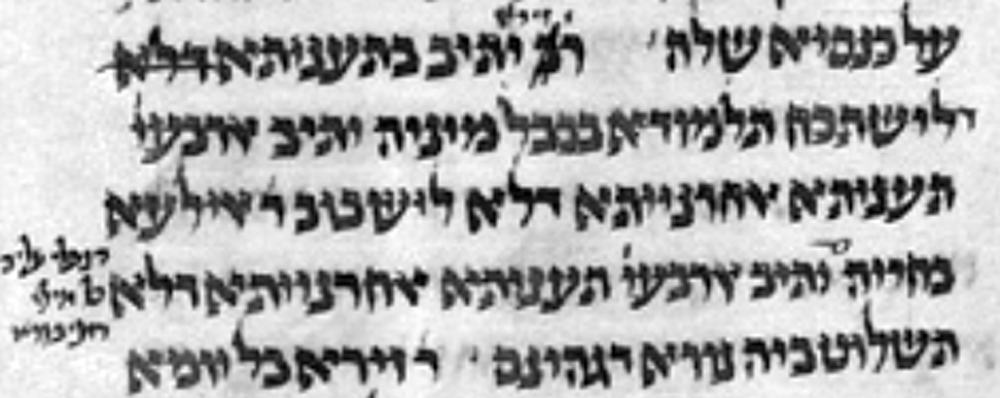
Figure 1 From the first print of Baba Metziah Soncino, Italy 1489
There are some difficulties with R. Zeira
forgetting the teachings of Babylonia:
1) Both the Babylonian and Jerusalem Talmud
contain many interactions between sages who travelled from the land of Israel
to Babylon or from Babylon to the land of Israel. These sages shared their own teachings
and traditions with their counterparts. By forgetting Babylonian teachings, R.
Zeira is choosing not to participate in this knowledge transfer. Why? [2]
2) R. Zeira is mentioned many times in
the Jerusalem Talmud and sometimes he transmits in the name of his Babylonian
teachers. Many of these exchanges clearly took place when he already was in the
land of Israel. How can he transfer Torah information that he has supposedly forgotten?
[3]
3) The Talmud (Shabbat 41a) relates that
when R Zeira was about to leave for the land of Israel, he went out of his way to
hear one more teaching from his teacher, Rav Yehuda.  Why would he go to the trouble of amassing
more Babylonian teachings if he intended to immediately forget them?
4) Forgetting one’s learning purposefully
isn’t a pious thing to do. The Mishna Pirkei Avot 3:10 strongly discourages it,
as does the Talmud:  R. Elazar said:  One who forgets a word of his learning (Talmud)
causes his descendants to be exiled – Yoma 38b. Resh Laqish said:  One who forgets a word of his learning (Talmud)
transgresses a negative commandment – Menachot 
99b.
We can find a simple solution to these
questions in one of the manuscripts of Baba Metzia, written around 1137
and housed in the National Central Library in Florence. The manuscript disagrees
with the premise that R. Zeira ever forgot his learning:
R. Zeira fasted so that he would not
forget the teachings of Babylon.
He observed another forty fasts so that
R Il’a should not die in his lifetime.
He observed another forty fasts that the
fire of Gehenna should have no power over him.

Figure 2 Florence
Manuscript BM 85a

As far as I know, this manuscript is unique among the
manuscripts that exist today in defining “not to forget” as the purpose R.
Zeira’s fast. [4] The manuscript is also attractive for a couple of other reasons:

The passage is shorter here
than in the standard version. The explanations “when he moved to the land of
Israel”, “so that it should not disturb him”, [5] “so that the responsibilities
of the community not fall upon him” are all missing. This reduction most likely
indicates that the manuscript reflects an early version of the story – a
version in which marginal commentary had not yet been copied (inadvertently) into
the text.
The paragraph that precedes the story of
R. Zeira (in all versions) tells of Rav Yosef (R. Zeira’s colleague) who also observed
a series of three sets of forty intermittent fasts. The purpose of Rav Yosef’s
fasts was to guarantee that the knowledge of the Torah would not depart from
himself, from his children and from his grandchildren. The goal of Rav Yosef’s
fasts seems to agree with the goal of R. Zeira’s fasts; to remember (i.e., not
forget) the teachings of Babylonia.
According to this manuscript, all of R.
Zeira’s fasts have something in common with each other. He fasted so he would
not forget, he fasted so that R. Ila’i would not die, and he fasted so that the
fire of Gehina would not harm him. He always seems to be fasting so that
something should not happen.
However, many authorities have discussed
the standard version, and no one (as far as I know) has relied on this reading
to resolve the original questions. [6]
Here
are some of the classical interpretations that attempt to solve the problems of
R. Zeira’s forgetting.
Rashi
writes (BM 85a) that the students in the land of Israel were not בני מחלוקת, were not contentious, ונוחין זה לזה, they were pleasant to each other]  . . .   ומיישבין את
הטעמים בלא קושיות ופירוקין and they explained their reasoning without challenging each
other with difficulties and rebuttals.
According
to Rashi , R. Zeira forgets the “atmosphere” of the Babylonian academies.  [7]
Maharsha (1555-1631), disagrees with
Rashi. He argues that the sages in the land of Israel do engage in questioning
and answering like their counterparts in Babylonia.  He cites the Gemara (Baba Metzia 84a) where
R. Yohanan says about Reish Laqish:  he
would raise twenty-four objections, and I would reply with twenty-four answers.

Therefore, Maharsha explains that
possibly the Babylonian piplul was faulty and similar to a style of piplul
that existed in his own time דוגמת חילוקים
שבדור הזה. He objects to this style of questioning and answering because it
distances one from the truth, and can’t help one rule on halakhic issues. Accordingly,
R. Zeira fasted in order to forget how to piplul the Babylonian way.
Abravanel (1437-1508) in his commentary
on Pirkei Avot (on the Mishna in chapter 5 which begins: There are four types
who study with the sages) writes somewhat similarly. The problem with the one who
is compared to a sponge, who soaks up everything – is that he retains things
that are untrue. In the search for truth, there are necessary steps which themselves
are untrue:  כי לא תברר האמת כי אם בהפכו truth can only
be evaluated when compared with its opposite. R. Zeira fasts to forget the stages in
the arguments of the Babylonian Talmud that were untrue.
In summary, all three of these
interpretations agree that R. Zeira didn’t literally forget the Babylonian
teachings. He forgot the “atmosphere” of the Babylonian academies or the
interim discussions that took place there.  [8]
I’d like now to give some examples of
how the story of R. Zeira is presented in some early Hassidic sermons, to show
how the Rebbes and their audiences understood the story of R. Zeira. These
sources aren’t concerned with explaining our Gemara; R. Zeira’s story is cited
to support an ethical or moral lesson.
Torah Or is a collection of sermons by
R. Shneur Zalman of Liadi (1745-1812). On
page 69c, in a discussion about spiritual worlds, the author says:

The purpose of the river diNur, (fiery
river (or maybe fiery light)), in which the soul submerges itself as it passes from
this world to Gan Eden, is to erase its memories of this physical world. If the
soul remembers its encounter with materiality, it can’t experience Gan Eden.
And when the soul goes from the lower Gan Eden to the higher Gan Eden it also must
pass through a river diNur to forget the comprehension and pleasures of the
lower Gan Eden. (Zohar part 2 210a) This is the idea in the Gemara: R. Zeira
observed 100 fasts to forget the Talmud of Babylonia even though he had studied
it with devotion.

In Likutei Moharan (ch. 246), R. Nachman
of Bratslav (1772 – 1810) writes:

A
person sometimes has to feel self-important גדלות, as it says (2
Chronicles 17:6) His heart was elevatedויגבה לבו  in
the service of G-d.  This helps the same way
as fasting helps. For when one needs to attain an understanding or needs to
reach a higher level, he has to forget the wisdom he had previously acquired. R.
Zeira fasted to forget the Talmud of Babylon in order to reach a greater level
of comprehension – the level of the Talmud of the land of Israel.  Similarly through self-importance, one forgets
his wisdom . . . 

In these examples of Hassidic thought there
is no difficulty with the idea that R. Zeira forgets his learning in order to reach
higher spiritual plateau. Forgetting is a purification process that is both
necessary and exemplary. [9]
Returning now to the literal sense of the
Gemara:
R. Issac Halevi (Rabinowitz)
(1847-1914), the author of Dorot Harishonim addresses our problem in a footnote
(Dorot II p 427 footnote 93). He posits that in R.  Zeira’s time there were already two canonized
collections of Talmudic material arranged around the Mishna; each in its own
distinct form and style.

כבר הי׳ להם סתמא דהש”ס על המשנה שגרסו כבר במטבע קבועה,
וכן הי׳  להם אז כבר גם בארץ ישראל.

R. Zeira chose to
forget the Babylonian Talmud (as it existed in his time), because it interfered
with his studies in the land of Israel.
According to this
interpretation, R. Zeira forgot only the redaction or arrangement of the
teachings he had learned.  He didn’t forget
the teachings themselves (or the study method). [10]
I’d like to suggest
an original explanation. It’s based on passages in the Talmud about R. Zeira
and additionally can explain why only R. Zeira decided to forget the teachings
of Babylon when he moved to the land of Israel.

1)     
R.
Yitzhak b. Nahmani said in the name of R. Eleazar: The halakha agrees with R.
Jose b. Kipper.  R. Zeira said: “If I
merit, I’ll go there and learn the halakha from the Master himself”. When R.
Zeira came to the land of Israel he found R. Eleazar and asked him: “Did you
say: The halakha is in agreement with R. Jose b. Kipper?” – Nidda 48a
2)     
R.
Zeira said to R. Abba b Papa: When you go there, detour around the Ladder of
Tyre and visit R. Yaakov b Idi. Ask him if he heard from R. Yohanan if the
Halakha is like R. Aqiba or not – Baba Metziah 43b
3)     
R
Zeira, commented: How can you compare R Binyamin b Yefet’s version of R.
Yohanan’s statement with the version of Rabbi Hiya b Abba. R Hiya b Abba was
precise when he studied the halakhic traditions from R Yohanan but R. Binyamin
b Yefet was not precise. Moreover, R Hiya b Abba reviewed his learning (Talmud)
with R. Yohanan every thirty days.  – Berachot
38b
4)     
R.
Nathan b. Tobi quoted R. Johanan . . . Rabbi Zeira asked: “Did
R. Johanan say this?” Yes, he answered. Rabbi Zeira recited this teaching forty
times. R. Nathan said to R. Zeira: Is this the only teaching that you have
heard or is it a teaching that is new to you? R. Zeira replied: “It’s new to
me. I wasn’t sure if it was taught in the name R. Yohanan or R Yehoshua b
Levi.” – Berachot 28a
We
see that the teachings of the land of Israel (especially R. Yohanan’s) did
reach R. Zeira while he was still in Babylon [11]. R. Zeira, however, didn’t really
trust these teachings. Sometimes he thought they were attributed incorrectly,
or their content was not accurate. He doubted if a statement in the name of R.
Eleazar was correct. [12] He was unsure if R. Yohanan agreed with R. Aqiba’s
position or not. He distinguished between the different amoraim who
transmitted teachings. In general he looked at Torah that reached Babylon as
something that was possibly unreliable, inaccurate or “damaged in transit”.
  
R. Zeira was
only able to resolve his doubts when he moved to the land of Israel and learned
the Torah of the land of Israel there. He then forgot the imprecise version of
these teachings that he had previously memorized in Babylon – “the teachings of
Babylon”. He could forget them because they were superseded by accurate
teachings that he now received in the land of Israel. [13]

I’d like to thank Reb Gary Gleam who
provided the cabbage rolls and coffee, and the late night sounding board.

————————————————————————————————————————–

[1] תלמודא בבלאה is sometimes translated
as Babylonian Talmud, which I think is an anachronism. I will use the translation
“Babylonian teachings”. All the available manuscripts have תלמודא דבבל  =  the teachings of Babylonia. The phrase Talmuda
dBabel
or Talmuda Babelah occurs only here
(Google). Talmud in the sense of teachings occurs many times, often in
comparison to mikra or mishna.
 [2]
Compare Rosh Hashana 20b: “When R. Zeira went up [to the land of Israel], he
sent [a letter] to his colleagues [in Babylonia]  . . .”  R.
Zeira didn’t break off all contact with the old country. He taught them what he
heard and learned in the land of Israel.
[3] See Goldberg, Abraham. “Rabbi Ze’ira
and Babylonian Custom in Palestine” (Hebrew) Tarbiz vol. 36 1967 (pages
319-341), for examples of Babylonian traditions that R. Zeira brought to the
land of Israel. The following quote is from the online abstract:
“R.
Zeira is the outstanding figure among many who came from an area of unmixed
Babylonian tradition and who tried to impose their own Babylonian practice upon
Palestinian custom.”
[4]
The crucial word דלא, is crossed-out
in the manuscript, but I’m assuming that the strikethrough is not the work of
the original sofer. (Didn’t scribes write dots on top of the words they
wanted to erase?) The facsimile shows a number of other emendations that were written
after the manuscript’s creation.
[5] The words “so that it should not disturb
him” would be out of place in this version of the story, since according to
this version, R. Zeria never forgot the Babylonian teachings, but the idea is
that the text is short. There is a geniza fragment from The Friedberg
Project for Talmud Bavli Variants and it is equally as short. (Note
that it matches the standard editions with regard to the goal of R. Zeira’s
fast.)

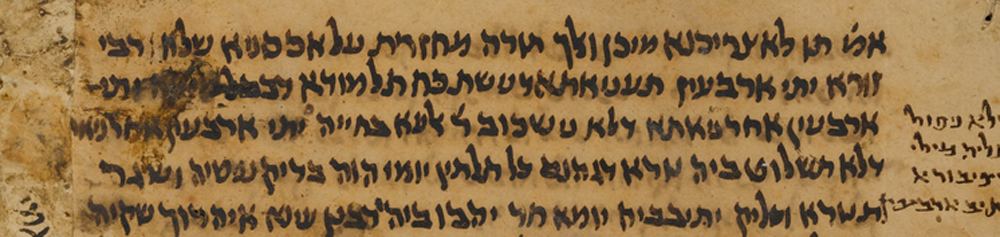
 Figure
3 Geniza fragment
of our Baba Metziah 85a

Translation of the geniza fragment:
R. Zeira observed forty fasts to forget
the teachings of Babylon.
He fasted another forty times that R
Il’a should not die in his lifetime.
He fasted another forty times that the fire of
Gehenna should have no power over him.
[6]
The author of Dikduke Soferim mentions this version but doesn’t suggest that its
reading is better than the standard one. Dikduke Sofreim has written elsewhere
that this specific manuscript belonged to Christians who translated (into Latin)
passages that were regularly used against Jews in inter-faith disputations.
There’s no Latin on this page, but you can see Latin on some other pages.
[7]
Rashi mentions his source as Sanhedrin 24a. He understands that the students of
Babylon were antagonistic to each other unlike the students in the land of
Israel who were pleasant to each other. Rashi apparently was thinking of this in
his commentary on the prayer of R. Nehunya ben HaKanah – Berachot 28b. The
prayer reads: “May it be Your will that I don’t make a mistake in a halakhic
ruling, and that my colleagues rejoice with me  . . .”  Rashi
understands the prayer this way – May it be Your will that I don’t make a
mistake in a halakhic ruling and my colleagues make fun of me.
[8]
The explanations of Maharsha and Abravanel have prompted subversive
interpretations by the school of the German Jewish historians of the
Talmud.  In the Soncino translation of
Shabbat 41a, the translator, Rabbi DR. Freedman (1901-1982) writes:  “Weiss, Dor, III, p. 188, maintains that R.
Zera’s desire to emigrate was occasioned by dissatisfaction with Rab Judah’s
method of study; this is vigorously combatted by Halevi, Doroth, II pp. 421 et
seq.”

Jacob Neusner’s
in his book A History of the Jews in Babylonia page 218, also questions the
idea that sages of the land of Israel rejected the Babylonian methods of study,
and finds “Halevi’s strong demurrer quite convincing”.
[9]
In this context, the Talmudic statement: גדולה עבירה לשמה ממצווה שלא לשמה   – מסכת הוריות י’ ע”ב may be somewhat
relevant.
[10] I’m not sure, according to R.
Halevi,  did R. Zeira also forget the
anonymous Talmudic layer (stam or redactor) that existed in his time? 
[11]
The first of these conversations definitely took place in Babylon. The fourth
interaction occurred in the land of Israel but revises a teaching that R. Zeira
probably heard in Babylonia. The middle two quotes are may describe R. Zeira in
Babylon, but even if they occurred when R. Zeira was already in the land of
Israel, they reflect doubts that he had while in Babylon.  The number 40 in the last example is also
remarkable. He repeats something 40 times in order to remember. He fasts 40
times to forget. 
[12]
R. Eleazar teaches without citing his source but everyone knows that his
teachings are R. Yohanan’s (Yerushalmi Berakot 2:1 and Yerushalmi Shekalim 2:5).
[13] R. Zeira didn’t forget the native
Babylonian teachings, authored and recorded by the Babylonian amoraim. He
never doubted their accuracy. He brought those teachings to the land of Israel
and enriched the Torah of the land of Israel with them.