New Writings from R. Kook and Assorted Comments, part 5
New Writings from R. Kook and Assorted Comments, part 5
by Marc B. Shapiro
Continued from here.
The next post (or perhaps the one following) will return to my analysis of R. Kook’s recently published Li-Nevokhei ha-Dor with which this series began. Yet before doing so, there are a number of other points I would like to make and respond to some comments and questions.
1. In previous installments I have mentioned how R. Kook compares the Torah scholars and the masses, and how the masses have elements of natural morality that are not to be found among the scholars. This is not the only provocative distinction R. Kook makes. He also distinguishes between the great tzadikim and everyone else. These two groupings are, of course, different in many ways. Yet one of the most interesting distinctions R. Kook makes—and one can find parallels to this in Ibn Caspi and hasidic texts— is that for the elites the nitty-gritty of halakhic study can have a negative affect on their spiritual life. Here is what he writes in Shemonah Kevatzim 1:412:
האדם הגדול כשהוא מכניס את עצמו יותר מדאי במדת הפרטים, בין בלימודם בין בחרדתם, הרי הוא מתקטן, ומעלתו מתמעטת, וצריך לשוב בתשובה מאהבה, מתוך גדלות הנשמה, לקשר את תוכן חיי נשמתו בענינים גדולים ונשגבים.
R. Kook goes so far as to say that for these elites the very practice of mitzvot is not part of their spiritual identity per se. They have, as it were, moved beyond this, and their involvement with the practical sphere of mitzvot is based on their connection to the larger world.[1] I think that this passage, from Shemonah Kevatzim 1:410, is the most antinomian in all of R. Kook’s writings. In it we also see how problematic the halakhic details of life are to the special personality who wants to soar the heights of spirituality and yet has to be involved with practical halakhic matters. I think it obvious that R. Kook is reflecting his own personal spiritual struggle here. On the one hand, he wants to lose himself in love of and experience of God, to bind his soul with the divine. On the other hand, as a practicing rabbi he was called upon day in and day out to answer all sorts of everyday halakhic questions. One can imagine him alone in his study, enraptured in mysticism, even nearing prophetic insights, and someone comes to his door asking him to determine the kashrut of a dead chicken. With this he is brought down to the mundane halakhic world.[2]
ישנם אנשים גדולים כאלה, שמהלך רוחם הוא כל כך נשא, עד שמצדם אם כל העולם היה במעמדם, היו המצות בטלות כמו שיהיה לעתיד לבוא, לימות המשיח או תחיית המתים. והם בכל זאת מקושרים הם במצות הרבה מאד, לא למענם, כי אם למען העולם כולו, המקושר עמם. וכשהם באים אל הפרטים, לעסוק בהם מצד עצמם, מוצאים הם סתירות נפשיות גדולות האלה, שהם נמוגים מרוב יגונם. וכשבאים לעסוק בתורה ובמצות בפרטיות בשביל העולם, יושפע עליהם מעין של גבורה ושל קדושה, שאין דומה לו.
Let me also return to the issue of the Jewish masses’ natural morality vs. the rabbinically tuned morality of the scholars, and how according to R. Kook the former is superior to that of the latter. I was asked if I can provide some examples of this. I think the most obvious such example is the response to sexual abuse that we have witnessed in the Orthodox world. While the natural impulse of the masses was that abusers must be immediately removed from any contact with children, many of the learned rabbis were able to come up with all sorts of reasons why this was not necessary, and why the police should not be called. Over time the view of the rabbinic class has evolved and many of them now advocate a strong response to sexual abuse. However, what took them a long time to get to was immediately understood by the Jewish masses, and they understood it intuitively. Years from now people will wonder how it was that rabbis refused to protect children. It will be incomprehensible to them how this could have happened. We who lived through this experience know that it was precisely the pressure on the ground, from the Jewish laypeople (and the bloggers and newspapers), that forced changes in this matter.[3] Here I think is a good example where talmudic learning led scholars לטהר את השרץ בק”ן טעמים, while the Jewish masses, with their intuitive natural morality, saw that evil must be exposed and they emerged victorious.[4]
The same phenomenon was seen in the Leib Tropper affair, where once again it was the masses, together with a couple of indefatigable bloggers, who saw what was really going on, and forced the issue. This happened while many leading rabbis continued to stand by Tropper. They were oblivious to what was unfolding before their eyes and what was obvious to everyone but them.[5] And let’s not forget about all the gedolim who signed a letter in support of the monster Elior Chen.[6] It is difficult to make sense of these terrible lapses of rabbinic judgment with a haredi Daas Torah perspective, but with R. Kook’s analysis all becomes clear.
I thought of R. Kook’s comments on the intuitive morality of the masses after hearing a few shiurim on the subject of lo tehanem. One of them has since been removed from the site. Listening to these shiurim was shocking to me, not simply because I found the views discussed at odds with what everyone in my community regards as basic Jewish values (and matters about which we would be quick to criticize non-Jews if they ever spoke this way). What was particularly surprising was how the speakers, all learned talmudically, have fallen into what I would call the textualist trap of Centrism. What this means is that the written word has become so sanctified that they feel it is their obligation to resurrect every halakhah recorded in the standard codes in order improve the masses’ behavior.
Yet for all their learning, these rabbis don’t appreciate that there are some halakhot that simply fell out of practice. This happened in pre-modern times, before there were Reform and Conservative movements. In other words, it happened at a time when communities had the status of kehillah kedoshah. Because of this, historically the poskim generally tried to be melamed zekhut on the actions of the people, on the assumption that kol hamon ke-kol sha-dai, which is in line with how R. Kook understood the pious Jewish masses. That explains why, to give just one example, confronted with the fact that pious people did not wash before eating wet food, the vast majority of poskim tried to find a justification for this. They did not lecture the people about how they were sinning and try to resurrect a practice that had fallen out of fashion. Their assumption was that there must be some justification for the practice of the masses, even if it is not readily apparent.[7]
As Haym Soloveitchik discussed in “Rupture and Reconstruction,” there is today no faith in the practice of the masses. Therefore, instead of justifying the practices which oppose the textual tradition, the rabbis are attempting to reestablish the textual tradition. The problem with this is that there is also what I call an aggadic tradition, where values and morality were passed on, and this sometimes was in tension with the letter of the law. The Jewish people, acting with their innate Torah-intuitive morality, developed an approach, and this was recognized as legitimate until recent times.[8] So we now have a situation where shiurim are being given on the prohibition of lo tehanem telling people all sorts of things about how to relate to non-Jews that no one, and this includes great rabbis, ever paid attention to (e.g., one can’t say that X is a good baseball player!).
I am not going to get into the halakhic justification which can be offered as to why the pious Jewish people didn’t follow the letter of the law. There is indeed halakhic justification. (See R. Eliezer Waldenberg, Tzitz Eliezer, vol. 15 no. 47.) Yet my point is that the Jewish people didn’t need any specific halakhic justification, because they knew from their intuitive natural morality what was proper. This is what R. Yehudah Amital meant when he said that growing up in Hungary he never heard anyone talk about “halakhah this, and halakhah that”.[9] As R. Amital pointed out, the people who speak like this, who have an endless focus on halakhic particulars, are those who have lost touch with the tradition. In a traditional society there is no need for one to delve into endless halakhic details, as simply by growing up in this society one knows how to conduct oneself. In a traditional society, you don’t need books to tell you, for example, how big the matzah needs to be and how much water you need to wash your hands, and by the same token you don’t need books to tell you what you can and can’t say about the Mets’ leading slugger or whether or not you can give your maid a gift on her birthday. There has been so much discussion about how Haredism is a modern invention, but the truth is that Centrism, with its Pan-Halakhism, is just as much a modern invention as haredism. Looking around, it is actually some groups of Hasidim who are the only real traditionalists, the ones who have a mesorah and who don’t need to constantly look into a book to tell them how they should live. As the great Hungarian scholar Ludwig Blau put it, “A drop of tradition is worth more than a ton of acumen.”[10]
2. In my last post I summarized R. Eleazar Ashkenazi’s position in his Tzafnat Paneah, pp. 29-30, as follows:
He also offers another explanation for the lengthy lifespans [in the Torah], namely, that the Torah recorded what the popular belief was, no matter how exaggerated, and Moses was not concerned about these sorts of things. In other words, just like today people say that the Torah is not interested in a scientific presentation of how the world was created, R. Eleazar’s position is that the Torah is not interested in a historically accurate presentation.
Dr. Eric Lawee, who has a chapter on Ashkenazi in his forthcoming book, wrote to me that he reads Ashkenazi differently than I did. I went back to the text and thanks to Lawee, I would like to clarify some of what I wrote.[11] It appears that the first part of Ashkenazi’s comment is merely stating that the Torah recorded exaggerated numbers as figures of speech, much like the Land of Israel is described as flowing with milk and honey which was never meant to be understood literally. Although it is true that people understand the lifespans literally, Ashkenazi sees this as a misinterpretation of the Torah. In other words, it is not correct to say that the Torah recorded the exaggerated numbers because that was what the people believed.
Yet in this very discussion, Ashkenazi also states that the exaggerated numbers are only found in the very ancient stories. However, with regard to events closer to Moses’ time the latter was more careful about recording the details accurately. It is because of this comment that I wrote that Moses left the stories of the distant path cloaked in legend. I should have also clarified that Ashkenazi is only referring to the ענייניהם ושנותיהם of the ancients who are not part of the prophetic tradition which includes Adam, Noah, and the Patriarchs. Here Ashkenazi does seem to be saying that the Torah records popular conceptions, for if not from these conceptions, where did Moses get the inaccurate information that he recorded?
It is possible to explain that the lengthy lifespans of people like Adam and Noah, whom Ashkenazi stresses were of concern to Moses and he was therefore careful with regard to their details, were always intended be understood figuratively. However, with regard to the others mentioned in the early chapters of Genesis, Ashkenazi speaks of הגוזמות הספוריים הבלתי מדוקדקים , and here it seems that he does advocate the notion that the Torah is including material that was popularly believed, even if not accurate.[12] He also writes about how certain matters in the Torah were recorded בבלבול ובקיצור מופלג ומקומותיהם ומקריהם שלא בדקדוק One such matter is the genealogies, about which he writes: לא היתה הכוונה לדקדק במספר שנות חיי כל איש כי אם על דרך כלל
Ashkenazi’s viewpoint is interesting because he acknowledges that in certain factual matters the Torah is not exact, and indeed this is not a concern of the Torah. This sounds very similar to how many people explain the first few chapters of Genesis. Yet it is much less common for Orthodox spokesmen to extend this approach to later chapters of the Torah, e.g., to say that say the genealogies recorded are not accurate. But is there a conceptual difference between saying that the Torah is not interested in presenting creation in a historically accurate form, and that is why there is no mention of billons of years or of evolution, and saying that the Torah is not interested in exact genealogies, but simply presents what was commonly thought and this explains the lengthy lifespans? If there is no conceptual difference, where does one draw the line? Surely there are some parts of the Torah in which factual history must be assumed. This is an issue that has not yet been adequately dealt with, and I will soon be publishing a letter by a great Torah scholar which refers to this problem.
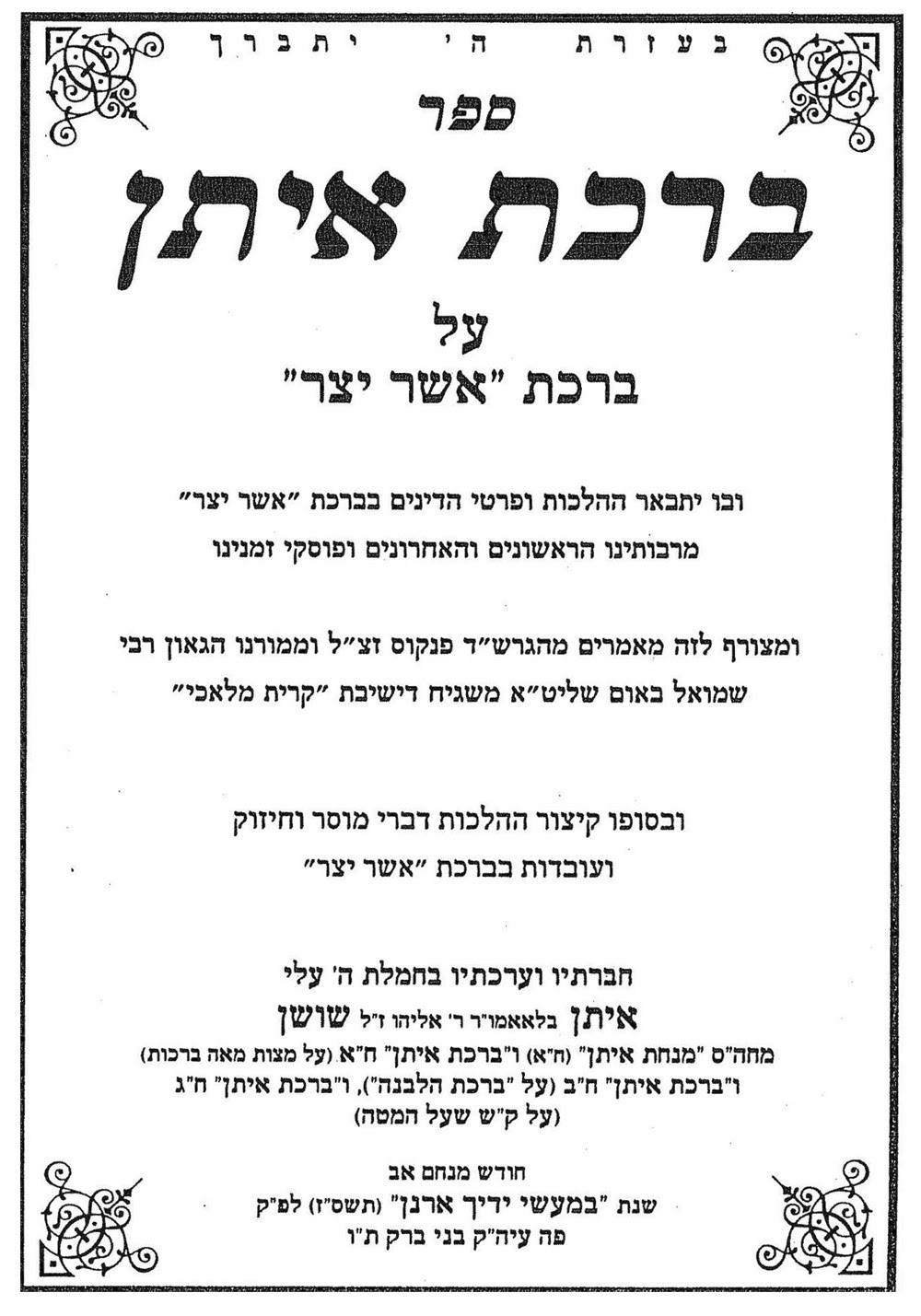
3. In the last post I cited an example where R. Shalom Messas was criticized for not understanding an Aggadah literally. More than one person thought that I should have cited sources showing how foolish it is to take bizarre aggadot literally. It is, of course, easy to cite such sources, beginning with the Rambam’s Introduction to Perek Helek.[13] Most of these are quite famous, so let me call attention to a book not so well known. It is R. Eliezer Lippmann’ Neusatz’ Mei Menuhot, published in 1884. Here is its title page.
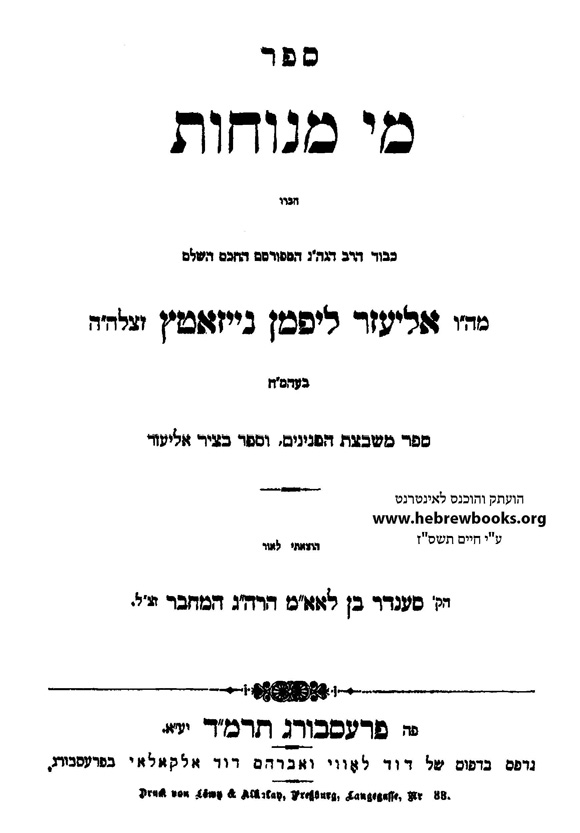
Neusatz was a student of the Hatam Sofer, and this book appears with the approbation of R. Simhah Bunim Sofer (the Shevet Sofer).
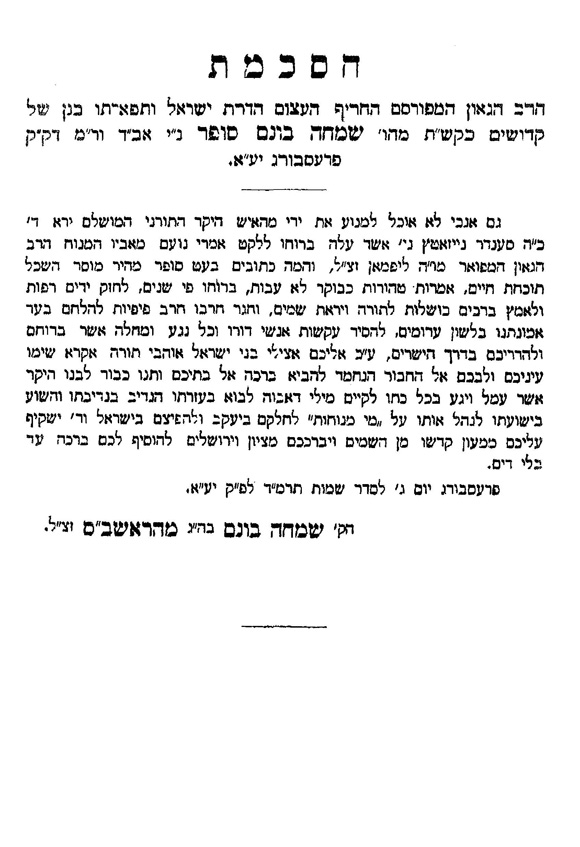
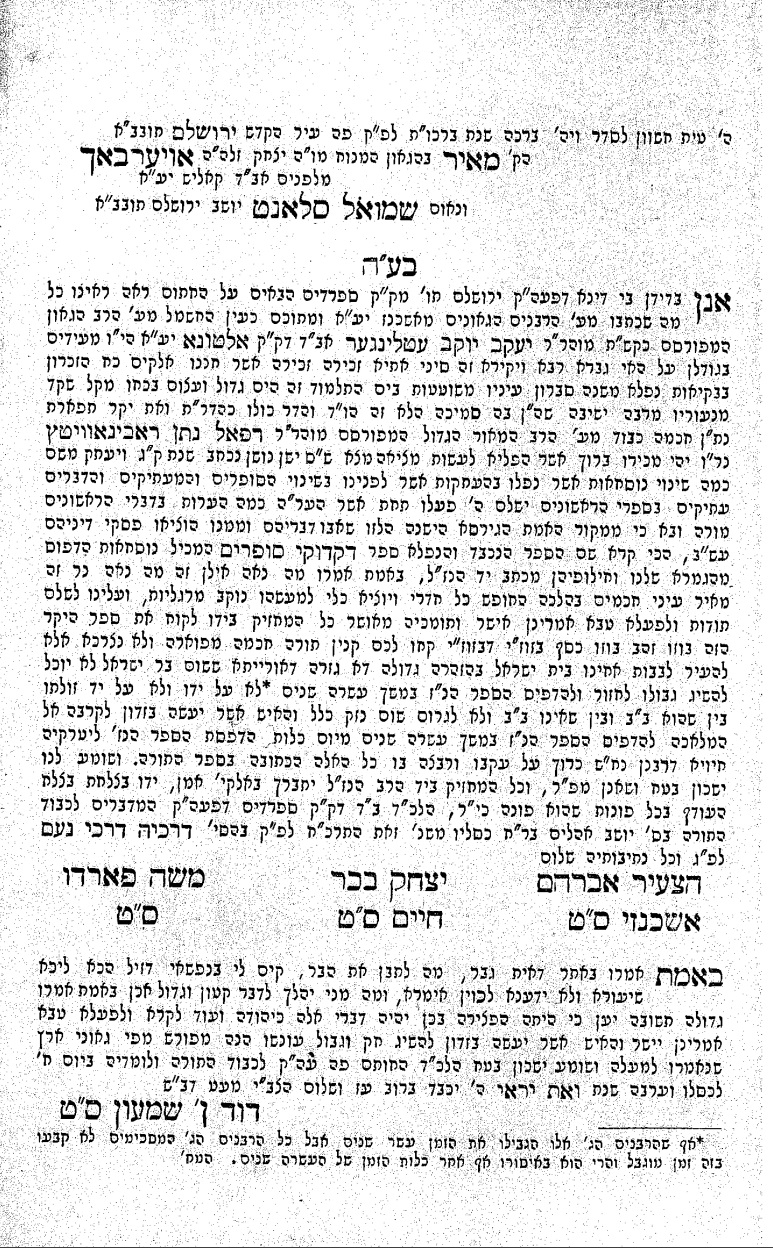
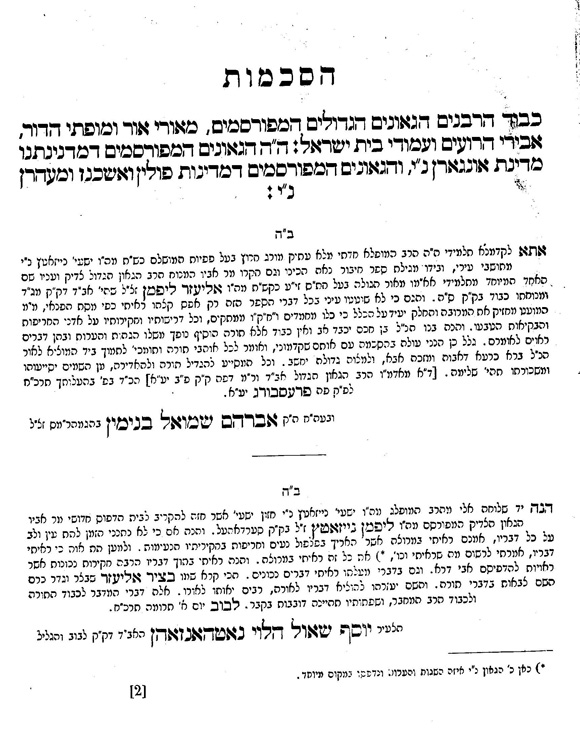
Here is the first page of the approbations to his book Be-Tzir Eliezer. Pay careful attention to how R. Abraham Samuel Sofer (the Ketav Sofer) describes Neusatz’ standing as a student of the Hatam Sofer.
On p. 16a, after citing Maimonides’ words that the majority err in understanding aggadot literally, Neusatz comments that this was the situation in earlier times, which were less religiously sophisticated than later generations. The proof that the earlier generations were religiously naïve is that belief in divine corporeality was widespread then. According to Neusatz, people who were so mistaken about God that they imagined him as a corporeal being would obviously not be able to understand Aggadah in a non-literal fashion. He contrasts that with the generation he lived in, which was able to properly understand Aggadah.
אמנם בדורנו זה נזדככו יותר הרעיונות ונלטשו הלבבות והמושגים האלהיים הנשגבים האלה מצטיירים בלבות המאמינים בטוהר יותר ורוב זוהר, ונתמעטו אנשי הכת הזאת, ותה”ל רובם יודעים שחז”ל כתבו אגדותיהם ע”ד משל ומליצה וחדות וכפי הצורך אשר היה להם לפי ענין הדורות אשר היה לפניהם, פנימיותם הם ענינים אמתיים נשגבים עומדים ברומו של עולם.
I assume that Neusatz would say that the traditional notion of the generations declining only refers to the scholars, as it is obvious from his words that when it comes to the masses the generations have been getting better.
Neusatz also has an interesting explanation as to why certain prophecies, in particular those of Ezekiel, are not written in proper grammatical Hebrew. This was already commented on by Abarbanel. Abarbanel simply attributes this to Ezekiel’s and Jeremiah’s unpolished Hebrew skills![14] He further claims that this is why there are an abundance of keri u-khetiv, ketiv ve-lo keri etc. in the book of Jeremiah. The original Hebrew had to be corrected!
Neusatz has a different approach to explain certain prophets’ apparent deficiencies in the Hebrew language. He explains that since the prophets were speaking to the lower classes, and they wanted their message to sink in, they adjusted their language accordingly. (Mei Menuhot, pp. 13b, 34b). This is also how he explains certain passages in the book of Ezekiel which would appear to be at odds with modest and proper speech. Since the prophet was speaking to the masses, he had to use their coarse language (p. 35a). This is no different than politicians today, who adopt a certain mode of speech to connect with the listeners. It also explains many of R. Ovadiah Yosef’s outrageous comments. In speaking to the masses he forgets who he is, and uses the sort of lower class language that allows him to connect with his listeners, but that is not acceptable for someone in his position.
Neusatz calls attention to R. Joseph Albo’s comment, Sefer ha-Ikarim 3:25, that even the Torah was written so as to speak to its various audiences, which included not just the wise people but also the foolish ones:
לפי שהתורה לא נתנה לחכמים ולמשכילים בלבד, אבל לכל העם מקצה גדולים וקטנים חכמים וטפשים, ראוי שיבואו בה דברים מוכנים [צ”ל מובנים כמ”ש במהדורת הוזיק] לכל.
Neusatz is also explicit that very few aggadot are actually the result of the Sages’ ruah ha-kodesh (p. 32a). He states that Maimonides’ astronomical views in the Mishneh Torah do not come from a holy source, but from the Greeks, and in our day must be rejected (p. 38a). He also acknowledges that at times the Sages’ opinions were based on the best scientific knowledge of their time, which we now know is mistaken (pp. 36a-36b, 38a-38b). On page 39b he discusses Maimonides’ rejection of astrology. The problem with Maimonides’ position is that the Talmud clearly accepts astrology. In Studies in Maimonides and His Interpreters I argue that Maimonides must have assumed that the greatest of the Sages rejected astrology. Yet the problem is that although Maimonides might assume this, is there any rabbinic source to justify this assumption? Neusatz argues that there is. There is a famous rabbinic statement in Shabbat 156a: אין מזל לישראל This means that Israel is not under the planetary influence. However, the statement is not a denial of the efficacy of astrology per se, and indeed assumes that the nations of the world are under the planetary influences. In very original fashion, Neusatz argues for a different understanding of the statement that he believes was shared by Maimonides:
והנה ידוע דעת הרמב”ם שהמזל אינו פועל כלל ונ”ל דס”ל שזה הוא כונת ר’ עקיבא ור’ יוחנן ורב ושמואל ורב נחמן ב”י בסוף מסכת שבת שאמרו אין מזל לישראל, וכונתם שאין ראוי לישראל עם חכם להאמין שמזל פועל.
In other words, אין מזל לישראל means that it is not proper for a smart people like the Jews to believe in the efficacy of astrology!
Neusatz also discusses Maimonides’ general attitude towards superstition, and argues that today, when all the superstitious beliefs have been proven false, it is a religious requirement to advocate Maimonides’ approach in these matters (p. 40b). As to why the Sages appear to believe all these superstitions, Neusatz assumes that they had to deal with the masses who were enmeshed in these notions, and that as long as the superstitious ideas were not idolatrous, the Sages were willing to tolerate them (p. 41ff. This is exactly Meiri’s view with regard to Zugot, but Neusatz had no way of knowing this as this section of the Meiri had not yet appeared in print.) Neusatz adopts the same view with regard to demons, which like Maimonides he too sees as non-existent (pp. 43ff.).[15]
Neusatz sees no harm in the Sages using common figures of speech if they never actually took them literally. Just as today we use expressions such as “the devil is in the details,” so too the Sages would refer to phenomena as due to a demon even though they didn’t believe this literally. To support this assumption, he brings a very interesting example where the Sages even used a mythological image (p. 45a). Pirkei de-Rabbi Eliezer, ch. 6, in speaking of the sun, writes: “The sun rides in a chariot and rises, crowned as a bridegroom.” This is obviously taken from the Greek myth of Helios, the god who drives the chariot of the sun across the sky every day. Yet despite this mythological origin, which Neusatz assumes must have been known to the Sages, the image appears in a Midrashic text. Neusatz writes:
ומי לא יבין? שרק על צד יופי הדבור והמשל אמרו כן לציירה כפי פעולתה, באשר מימי קדם ועד היום מפורסם משל זה לפעולת השמש ניתן לה מאת בעלי הממשילים (קראם הרמב”ם טלסמאות ובל”א מיטאלאגיע) ועד היום מציירים הממשילים את פעולת השמש בתמונה זו וכנודע.
It is in his discussion of demons that Neusatz brings amazing testimony from the Hatam Sofer, rejecting the authenticity of the vast majority of what is included in the book known as the Zohar.[16] Before quoting it, let me repeat that this book has the haskamah of the Hatam Sofer’s grandson, R. Simhah Bunim Sofer (the Shevet Sofer). Here is what Neusatz writes on p. 43b:
בפירוש שמעתי כן מפה קדוש אדומ”ו גאון ישראל קדוש ד’ מכובד מוהר”ר משה סופר זצוק”ל אב”ד ור”ם דק”ק פרעשבורג שאמר בפני רבים מתלמידיו, אלו היה יכולת ביד אדם להעמיד מדרשי רשב”י על טהרתן לבררם מתוך מה שנתחבר אליהם מחכמי הדורות שאחריו לא יהיה כולו רק ספר קטן הכמות מאד מחזיק דפים מעוטים.
The Hatam Sofer is often portrayed as both a religious extremist as well as lacking a critical sense. The first assumption, that he was an extremist, is absolutely false and is a creation of the nineteenth-century Reformers. I won’t go into it here, but suffice it to say that the Hatam Sofer was often a very lenient posek, the exact opposite of what people mean by “extremism”.
As for not having a critical sense, this too is false. I am not saying that he viewed matters as did R. Zvi Hirsch Chajes or R. Solomon Judah Rapoport,[17] but the quotation from Neusatz shows that the Hatam Sofer was much more complex than he was caricatured by his opponents. There are numerous examples that could be cited to illustrate this. In Limits of Orthodox Theology I mentioned that the Hatam Sofer leaned towards Ibn Ezra’s view that the entire last chapter of Deuteronomy was not written by Moses. He also wondered whether the Targum on Ruth was of Sadducean origin.[18] Another example relates to what was discussed in this post regarding the Jerusalem Talmud’s view that there is a mistake in the book of Jeremiah. (I neglected to mention that the J. Talmud there also states that there is a mistake in the book of Ezekiel.) According to the Hatam Sofer, the mistake in our book of Jeremiah is due to an erroneous emendation that dates back to biblical times.[19]
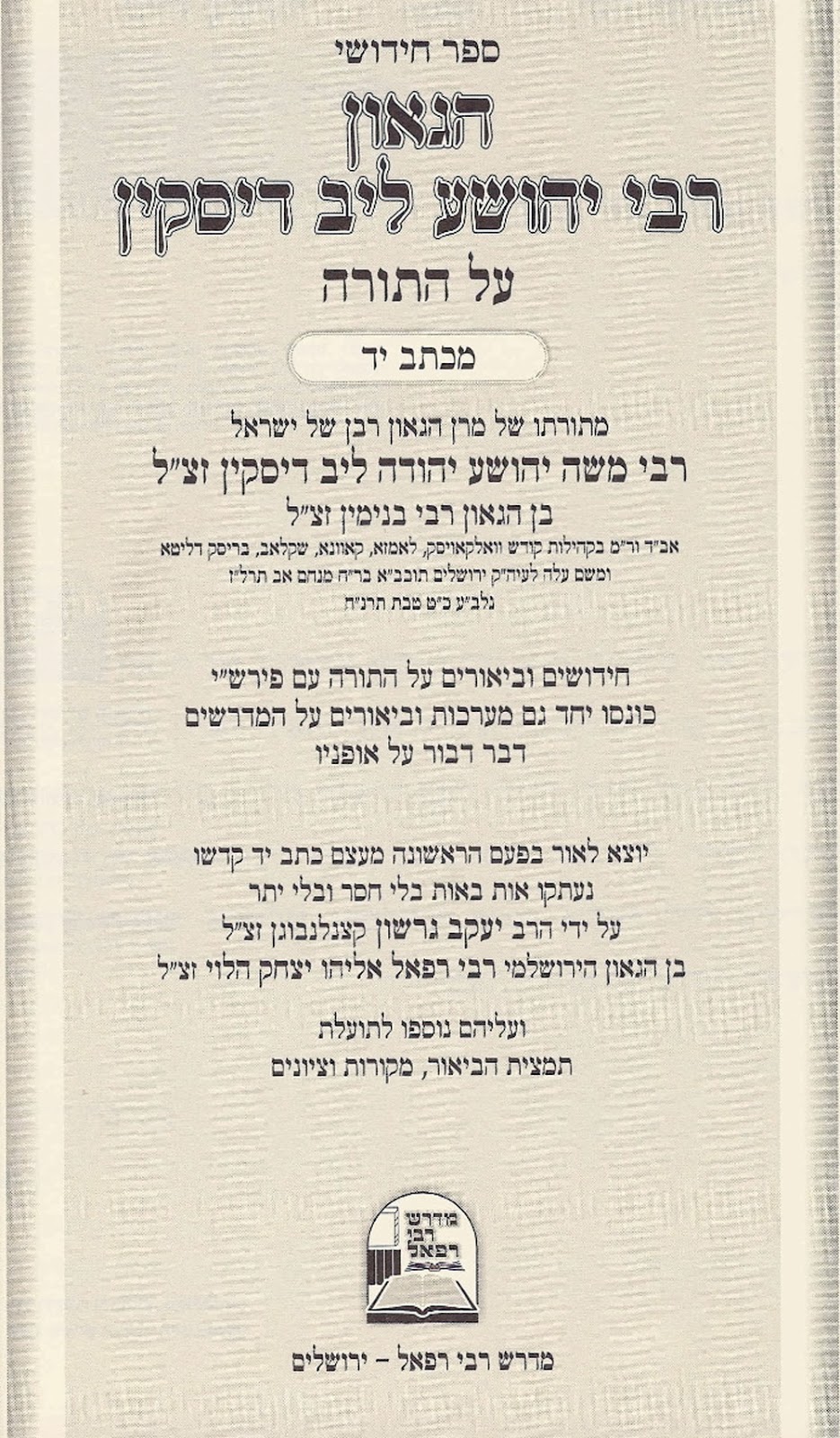
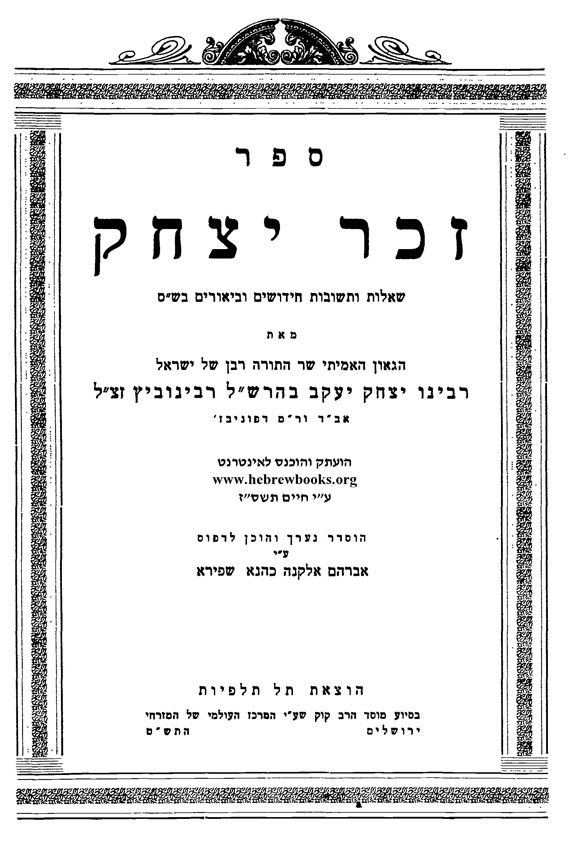
4. In my last post I quoted what R. Itzele of Ponovezh said about the superiority of the religious masses’ outlook to the Daas Torah of the gedolim. I had originally quoted this in an earlier post and referred to what R. Avraham Shapiro said about it. R. Avraham, before he became known as the Rosh Yeshiva of Merkaz ha-Rav and Chief Rabbi of Israel, had published R. Itzele’s teshuvot, Zekher Yitzhak, in 1949. Here is the title page of the book (taken from hebrewbooks.org).
Unfortunately, the version on Otzar ha-Hokhmah has been censored. Here is the title page at it appears on Otzar ha-Hokhmah, with no indication as to who brought the book to publication.
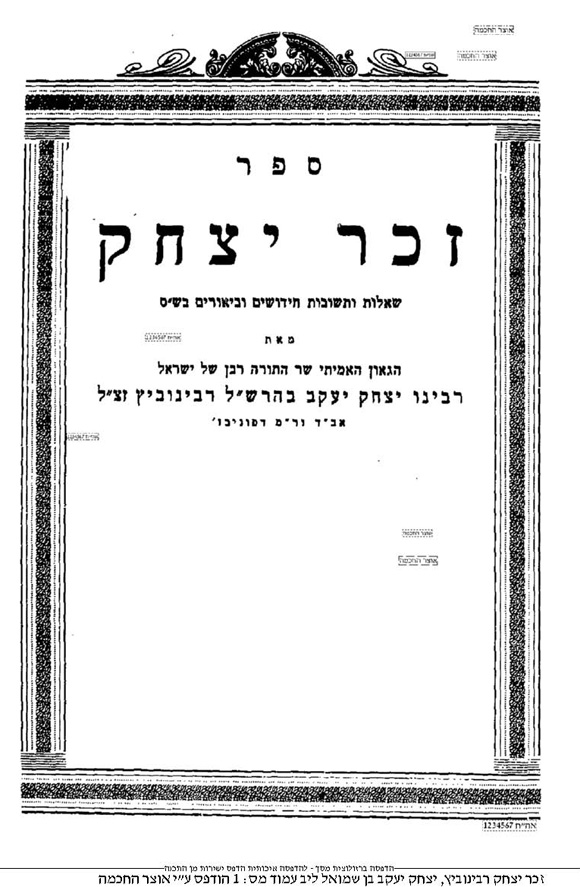
The Otzar ha-Hokhmah version is also missing R. Avraham’s learned introduction. I have no doubt that Otzar ha-Hokhmah is innocent in this matter, and was unaware that the volume it put online had been tampered with. (If you have Otzar ha-Hokhmah there is actually no reason to use the first edition of Zekher Yitzhak, as a second edition, with an additional volume, was published by Machon Yerushalayim in 2000, and this is also found on the Otzar.)
All this is by way of introduction to saying that a couple of people wondered if R. Avraham had any interesting ideas in addition to being a posek and Talmudist.. Many people indeed only see him in the latter mold. I remember some years ago when I asked an acquaintance in Israel how it was possible that some people in Merkaz ha-Rav were willing to go against the Rosh Yeshiva, R. Avraham, and establish Yeshivat Har ha-Mor. It was explained to me that “if you want to know if something is muktzeh, then you should ask R. Avraham. But in terms of hashkafah, R. [Zvi] Tau is the one to follow.”
Yet I think this is an exaggeration, and those who are interested in R. Avraham can find lots of interesting things in his book Morashah, as well as in the two volumes published on R. Avraham by R. Yitzhak Dadon, Imrei Shefer and Rosh Devarkha. (Dadon is the man – ספרא וסייפא – who killed the terrorist who attacked Merkaz a few years ago.) I have also given two lectures on R. Avraham at Torah in Motion that can be downloaded.
R. Avraham knew an enormous amount about the history of great Torah scholars, and while he didn’t have a critical sense, he knew when a story was nonsense.[20] For example, R. Shalom Schwadron told a story about how when R. Kook, R. Isser Zalman Meltzer, and R. Moshe Mordechai Epstein were together once, they decided that each one should repeat a tractate of Talmud by heart.[21] That was the extent of their conversation. R. Avraham thinks that the story is, to put it bluntly, crazy. No normal person could sit and listen to someone else rattle off an entire tractate. Furthermore, are we supposed to think that these gedolim had no Torah to speak to each other about and that they would be happy to just sit and listen to the other repeat the Talmud? (Imrei Shefer, p. 269).
A valuable story is recorded in Imrei Shefer, p. 34. One of the students asked as follows: If when peeling a cucumber he mistakenly took off some of the cucumber itself, is that is regarded as ba’al tashhit? The students started laughing upon hearing this question, but R. Avraham became very serious. He replied:
זו שאלה של “עצבנות”, יש עצבנות ביראת-שמים, לכן מגיעים לשאלות כאלה. אדם נורמאלי מקלף וזהו! אסור לבחורים להגיע למצב של שאלות כאלה.
We see from here that R. Avraham was aware that there is a fine line between religious practice and obsessive-compulsive behavior. Many readers have probably come into contact with individuals who unfortunately have crossed the line. It is interesting to speculate if observance of halakhah can sometimes lead to obsessive-compulsive behavior or if it is simply that an obsessive-compulsive personality is able to function very well in the halakhic system. As for humrot and hiddurim, which many critics see as connected with obsessive-compulsive behavior, R. Avraham had a simpler approach. He believed that the humrot we see are simply because people have more money today than in the past. When you have money, you can adopt hiddurim that no one dreamed about years ago.[22]
Since many people who read this blog are very interested in R. Joseph B. Soloveitchik and his family, let me mention something fascinating in Imrei Shefer, p. 251. R. Yehoshua Magnes, one of R. Avraham’s leading students, is quoted as follows (and the information certainly come from R. Avraham): R. Moses Soloveitchik supported R. Isaac Rubenstein. The extremists wanted to put R. Moses in herem until R. Baruch Ber Leibowitz told them in no uncertain terms that one doesn’t put “the son of the Rebbe” in herem!
This is referring to the great dispute in Vilna over the chief rabbinate in the late 1920s. The Mizrachi decided to put forth their own candidate, Rubenstein, who emerged victorious. This was seen as a terrible slap in the face to R. Hayyim Ozer Grodzinski, who until then was regarded as the unofficial chief rabbi of Vilna. The election of Rubenstein was also a rejection of the tradition that, since the late eighteenth century, there was no chief rabbi in Vilna.[23]
This story, assuming it is true, answers a perplexity I had for some time. Making of a Godol, p. 749, relates how some Polish rabbis were so upset at R. Moses Soloveitchik that they threatened to put him in herem. In response to this threat, R. Baruch Ber is quoted as saying that one doesn’t put the son of the Rebbe in herem. The story quoted by Kamenetsky has to do with a rabbinical dispute between a certain Agudist rabbi and a Mizrachi shochet. We are told that R. Moses opposed R. Zvi Hanokh Levin’s support of the rabbi. Yet why would this occasion a herem? Others have assumed that the rabbis may have wanted to place him in herem for accepting the position at the Warsaw Takhkemoni, the Mizrachi school. Yet again, why would this lead to a herem? R. Hayyim’s great student, R. Shlomo Polachek, the Meitchiter, also taught at a Mizrachi school.
Assuming the information in Imrei Shefer is correct, all is understandable. If R. Moses supported R. Isaac Rubenstein, then the herem would make perfect sense. Here was an issue in which the entire rabbinic world had joined together to support R. Hayyim Ozer. The great dayan of Vilna, R. Henokh Eiges, the Marheshet, resigned from the Mizrachi on account of the slight to R. Hayyim Ozer’s honor. R. Aaron Rabinowitz, the son-in-law of R. Reines, the founder of Mizrachi, did likewise.[24] To support Rubenstein would thus be viewed as a terrible betrayal of rabbinic solidarity, which in the rabbinic mind would be deserving of a herem.
Why would R. Moses have supported Rubenstein? Presumably this was tied in with his opposition to Agudat Israel. It is known that he was quite opposed to the Agudah, claiming that in this opposition he was simply following in the path of his father, R. Hayyim .[25] In fact, this opposition explains another interesting point. In Keneset Yisrael 10 (1932), a journal published by the Hazon Ish’s brother and brother-in-law, there appears an article by “Shlomo Kohen.” Kohen was one of the Hazon Ish’s students, but the article was by the Hazon Ish. Why did the Hazon Ish not want to sign his own name to it? The article is directed against another article published by R. Moses Soloveitchik in Ha-Pardes, in which he cited the hiddushim of his son, R. Joseph Baer. As the Steipler explained, the Hazon Ish wanted to disprove what R. Moses wrote (in the name of his son) because R. Moses was associated with the Mizrachi (teaching at Takhkemoni) and he therefore wanted to diminish his stature (לבטלו).[26] In other words, the fact that the Hazon Ish decided to dispute with R. Moses (and he rarely disputed with contemporaries) was not because he so respected the latter, but the exact opposite.[27]
With regard to Mizrachi rabbis, let me quote something else repeated by R. Avraham Shapiro: The Hafetz Hayyim once wrote to a certain Mizrachi rabbi with all sorts of elaborate titles. When R. Velvel Soloveitchik was asked how the Hafetz Hayyim could write with such respect to a Mizrachi rabbi, R. Velvel responded that this is what happens when you don’t listen to any lashon ha-ra! (Imrei Shefer, p. 271). He said this as a criticism of the Hafetz Hayim. In other words, sometimes you need to listen to lashon ha-ra in order to know how to properly evaluate people. (R. Avraham was very upset with this story and doubted its veracity, although the comment is very much in line with how R. Velvel would express himself.)
Regarding Imrei Shefer, I was very happy to see on p. 267 that R. Avraham studied Kitvei R. Weinberg, which I published a number of years ago. Both volumes of this work are now available on hebrewbooks.org.
Let me therefore call attention to another recently published text, found in R. Tsuriel’s Peninei ha-Re’iyah, p. 212. (It earlier appeared in Meorot ha-Re’iyah, Haggadah shel Pesah, p. 225.). This is actually the text from which R. Kook’s famous words in Olat ha-Re’iyah, p, 292, are taken. There R. Kook envisions a future of vegetable sacrifices.
Olat ha-Re’iyah was published in 1939, after R. Kook’s death. Now that the original text of R. Kook’s words has been published, we can see how R. Zvi Yehudah did not merely “abridge” his father’s text, as Tsuriel puts it, but clearly censored it to soften its radicalism, which is a pattern seen again and again in R. Zvi Yehudah’s editing.
What appears in R. Kook’s original text is further elaboration about how in Messianic days the animals will be raised in intelligence to the level of man, and he even brings a biblical verse in support of this notion. Isaiah 43:20 reads: “The beasts of the field shall honor Me, the jackals and the ostriches.” The fact that animals are portrayed as honoring God shows that they will move beyond behavior based purely on instinct. Then R. Kook writes as follows, and pay careful attention to what I have underlined, which is undoubtedly the reason why R. Zvi Yehudah thought he had to censor the text.
אם כן יהיה כערך האדם עכשיו. על כן לא יהיה צריך לקרב מהם ולהקריב, ויהיה איסור בזה, ותהיה ההקרבה רק מנחה מהצומח, שהוא לא ישכיל עוד על שיעלהו בפועל. על כן תערב המנחה, ולא שאר קרבן מהחיים.
Here R. Kook isn’t just expressing a preference for vegetable sacrifices, but telling us that it will actually be forbidden to offer animal sacrifices.
Regarding Tsuriel’s Peninei ha-Re’iyah, some of the passages from R. Kook cited from manuscript are quite valuable. See e.g., p. 385, where R. Kook states that when it comes to a war to defend the Jewish people even the tribe of Levi goes out to fight. What this means, of course, is that R. Kook would be opposed to any draft exemption for yeshiva students.
In addition, Tsuriel has selected passages from R. Kook’s writings and arranged them in order of the various parshiyot, so that one can always find a good piece for a devar Torah. For parashat Metzora (p. 231), he quotes R. Kook’s statement in Ezrat Kohen, no. 21, that even if one expresses heretical thoughts, this doesn’t mean that he really is a heretic. Rather, it could be that he is simply trying to show that he is in line with what “the world” is saying, but it doesn’t mean that he really believes it.
This is just one more angle whereby R. Kook tries to defend the modern free-thinkers. His most famous defense is that modern heretics have the status of onsin, in that the environment today almost forces them into their false beliefs so that they cannot be held responsible for their views. He also states that those who express heretical beliefs are not really certain of their heresy, and it is only one who is certain in this who is to be regarded as a heretic.
With the publication of Shemoneh Kevatzim we see that R. Kook goes even further and completely removes the orthoprax individual from the status of heretic. I quoted the relevant passage here.
We see from R. Kook that one who holds a heretical belief, but lives as an observant Jew in his daily life, is regarded as part of the Torah community. As I put it in my earlier post: Two important things stand out. First, while not condoning orthopraxy, R. Kook states that one who is observant, despite the fact that he denies ikkarim, is to be regarded as an erring Jew, not as a heretic. R. Kook’s position is a complete rejection of the idea that people who are shomrei Torah u-mitzvot can be read out of the fold and be regarded as heretics because of their incorrect beliefs. The second important point is that he rejects the Rambam’s entire theological conception of Principles of Faith and aligns himself with the Ra’avad, showing once again that the Rambam’s position has not attained unanimity.[29]
Had R. Zvi Yehudah printed this text, we might have been spared some of the heresy hunting in the religious Zionist world, and discussions of whether one can drink this or that observant Jew’s wine due to the fact that he might have some heretical thoughts. In fact, it is only with the publication, uncensored, of R. Kook’s writings that the “lights” of his soul are revealed in all their grandeur. What other spiritual leader with unconventional views could declare that he is ready to fight the entire world for the truth as he sees it, to proclaim his views without any compromises and without worrying about what the “world” will say? While I greatly respect R. Herzog, R. Weinberg, and R. Soloveitchik, they certainly could never say the following (Pinkasei ha-Re’iyah [2010], vol. 2, p. 201):
“אם אני מוכרח להיות איש ריב לכל העולם מצד הנטיה של האמת העמוקה שבנפשי, שאינה סובלת שום הטיה של שקר, אי אפשר לי להיות איש אחר. וצריך אני להוציא מן הכח אל הפועל רק את יסודות האמת העקריים הצפונים ברוחי, בלא שום התחשבות עם מה שחושב העולם בכל הסכמותיו.” זהו הפתגם של דורש האמת, המתעורר בגבורתו העליונה.
See also ibid., p. 208, where we see his self-image as a prophet of old, and that no one other than he can see clearly what is taking place in the world:
מה יש עכשיו בעולם? וכי מפני שאין שום איש, ושום למדן ביחוד, רוצה להביט מה שיש עתה בעולם, וכי בשביל כך, גם אנכי לא אביט? לא! אני אינני משועבד להרבים. הנני הולך במסילתי, בדרך הישרה, ישר אביט.
R. Kook’s commitment to his path, despite the controversy that ensued, was a trait also seen in R. Shlomo Goren, with all the tragic consequences, both personal and professional. Perhaps the Lubavitcher Rebbe is the only one after R. Kook who was able to successfully chart a path undisturbed by the opposition, and without any need for compromise.
One other passage from R. Kook’s recently published Pinkasei ha-Re’iyah vol. 2, p. 207, is worth noting. While tolerance of opposing viewpoints is often viewed as characteristic of a watered-down commitment to one’s own belief, R. Kook adopts a different perspective:
הסבלנות בדעות, כשהיא באה מלב טהור ומנוקה מכל רשעה, אינה עלולה לקרר את להבת רגש הקודש שבתוכן האמונה הפשוטה, מקור אושר החיים כולם, כ”א להרחיב ולהגדיל את יסוד ההתלהבות המקודשת לשמים.
To be continued.
[1] For a different perspective, see the recently published Pinkesei ha-Re’iyah, vol. 3, p. 69, where R. Kook states that one might have expected non-Jewish philosophers, since they are not involved with practical mitzvot, to be able to attain a higher grasp of theological truths, as they can devote themselves exclusively to this. Yet R. Kook explains that this is not the case.
[2] In R. Soloveitchik’s Halakhic Man we also see his dissatisfaction with practical halakhic decision-making. His alternative to this is theoretical halakhic study, which is very different than what R. Kook saw as his goal. In the hasidic world, the communal rav was relegated to the role of halakhic technician, while the focus of spiritual leadership was the Rebbe, who did not involve himself in practical halakhic rulings.
[3] Together with the crackdown on sexual abuse, there have been other changes as well. In my youth there were teachers who would punish students physically. This was, in fact, the traditional method of disciplining students, and is mentioned in Makkot 2:2, Bava Batra 21a, Mishneh Torah, Hilkhot Talmud Torah 2:2, Rotzeah u-Shemirat ha-Nefesh 5:6, and Shulhan Arukh, Orah Hayyim 551:18, Yoreh Deah 245:10. See also the picture from the 1395 Coburg Pentateuch, of a teacher with his whip, available here.
It is clear from the rabbinic sources that the physical punishments were not designed to inflict real pain, although one wonders whether the picture from the Coburg Pentateuch reflects a harsher reality. See Elliot Horowitz, “The Way We Were: ‘Jewish Life in the Middle Ages,’” Jewish History 1 (Spring 1986), pp. 81-82. In any event, today, what parent will allow the teacher to lay a hand on his child, even if the pain is minor?
Even though, as mentioned, teachers were never supposed to inflict real pain, I think it is fair to say that the physical punishments over the generations sometimes did get out of hand (see next note). I recall vividly one rebbe who would squeeze kids’ arms and even throw them against the wall. Today, in every Modern Orthodox school and even some haredi schools, that type of behavior would be grounds for immediate termination. Regarding how students were physically punished in the great yeshivot, we have reports of Roshei Yeshiva and mashgichim who would slap students in the face. See e.g., Moshe Tzinovitz, Mir (Tel Aviv, 1981), p. 464; Shaul Stampfer, Ha-Yeshivah ha-Litait be-Hithavutah (Jerusalem, 2005), p. 335 n. 76. Even R. Naftali Zvi Judah Berlin, who was a very gentle person, would occasionally slap a student in the face. On one occasion this even led to the students going “on strike” (i.e., ceasing all Torah study) in protest against the Netziv’s action. They viewed the slap as an insult to the entire student body since this was the sort of thing one would expect a melamed to do in a heder, not the rosh yeshiva of the great Volozhin. The Netziv was forced to publicly apologize to the entire student body. See M. Eisenstadt, “Revolutzyah ba-Yeshivah,” Ha-Tzefirah, 1 Sivan 5676; Stampfer, Ha-Yeshivah ha-Litait, pp. 128-129, 149.
On at least one occasion, a student certainly deserved being slapped in the face. It happened at Telz in 1905. At this time there were two mashgichim, and as was often the case at the great yeshivot, the students were very opposed to the mashgichim. (A few years earlier the students had gone on strike due to the invasive actions of a previous mashgiach, R. Aryeh Leib Hasman. See Stampfer, Ha-Yeshiva ha-Litait, p. 334.). One of the students waited above and when given the signal poured a bucket of fish sauce upon the mashgiach. R. Eliezer Gordon, the Rosh Yeshiva, slapped the suspected student on the face. Simcha Assaf, who records the story, tells us that this was the only time Gordon ever did such a thing. See Assaf, “Shenot ha-Limudim sheli bi-Yeshivat Telz (5665-5668),” in Immanuel Etkes and Shlomo Tikochinski, eds., Yeshivot Lita (Jerusalem, 2004), p. 235.
I have seen haredi authors who argue that opposition to physical punishment in school is a sign that people have moved away from “Torah values” in favor of modern psychology. See R. Chaim Rapoport’s response to this approach in his wonderful discussion of the issue in Datche 41 and 41 (2008). See also R. Avraham Steinberg, Encyclopedia Hilkhatit Refuit, vol. 6 cols. 767-768.
Another change in our era is that signs of physical affection between a rebbe and student, which at one time were very important especially as the rebbe served as a father figure, are no longer acceptable. A student cannot even sit on his rebbe’s lap, as was done in years past. It is reported that when R. Hayyim Soloveitchik visited his great student, R. Baruch Ber Leibowitz, who at this time was serving as rosh yeshiva of Keneset Beit Yitzhak in Slobodka, R. Baruch Ber sat on R. Hayyim’s lap. Just like he sat on R. Hayyim’s lap when he was a young student, R. Hayyim wanted R. Baruch Ber to sit on his lap when he was a grown man. See Making of a Gadol, p. 87. The fact that we could never imagine something like this happening today shows how different our mindset is. There are loads of stories of rebbes kissing their students. R. Zvi Yehudah Kook was known in particular for this. See e.g., Iturei Yerushalayim, no. 55 (2011), p. 4. Here are three stories from R. Shlomo Riskin’s recently published memoir, Listening to God, which also bring us back to a more innocent time.
I couldn’t wait to share my discovery [of Darwin’s theories and how they could help explain the Torah] with my rebbe, Rav Mandel, that Monday morning. I brought him the book, and showed him the relevant passages—totally ignorant of the “red flag” raised in religious circles by the mere mention of Darwin. Rav Mandel barely took the book in his hand; he slapped my face, and then kissed my forehead. “Your interpretations are magnificent, but it is forbidden to read such heretical literature,” he said gently. I smarted at the slap, felt vindicated by the kiss, and continued to adore my rebbe. . . . “ (p. 51)
Riskin describes being tested by Dr. Samuel Belkin.
He asked me which Talmudic tractate I was studying, spoke to me “in learning,” and gave me a section of Gemara and the Tosafot commentary to read. He then came around the desk where I was sitting, kissed me on the forehead, and said to Tante, “you’re right, He can have a full scholarship to Yeshiva University.”(pp. 67-68)
After Riskin passed the examination to become a city rabbi in Israel, “Rabbi [Shaul] Yisraeli rose—and visibly moved—kissed me on the forehead.” (p. 369)
In general, I have to say that Riskin’s book is quite interesting. I must note, however, that in a number of places where he is critical of people or tells a story that might be embarrassing, Riskin refers to individuals by their initials. If he did so in order to leave the figures anonymous, he was not entirely successful, since in a few cases it is not that hard to figure out whom he had in mind.
[4] Unfortunately, refusal to protect children is not a new thing. See this post where I mentioned even allowing rapists to go free.
What is new is that parents are now beginning to stand up. Here is a passage from a nineteenth-century memoir from which we see that in the past even murder was covered up. (The case described is definitely not manslaughter, which is what is described in Makkot 2:2 and Rambam, Hilkhot Rotzeah u-Shemirat ha-Nefesh 5:6. Incidentally, the latter two sources are only speaking about a society in which teachers were permitted to hit the students, and have no applicability today vis-à-vis most of the Orthodox world.)
One of the angry teachers I mentioned was nicknamed David with the tangled hair, as his head was covered with a mass of knotted hair. He was hot-tempered and frightening, and often came to within an inch of killing a pupil. When particularly enraged, he would lift a child up and ferociously throw him to the ground, so that he landed like a corpse. That actually did happen once. After the funeral the parents of the deceased never dared accuse him of murdering their child. They accepted it as preordained that their son should die while learning Torah, and so did the rest of the community. No one considered the melamed a murderer. Even the sons of M.S. who made it their business to ferret out sinners in the town, in order to cause strife and contention, kept silent on this matter, and David the melamed kept on teaching as if nothing had happened.
Yekhezkel Kotik, Journey to a Nineteenth-Century Shtetl (Detroit, 2002), p. 145. On p. 431, David Assaf, the editor, calls attention to a different memoir which tells of a child dying as a result of his melamed’s beating. On p. 145, Kotik also speaks of another melamed who “would take all his anger out on that particular part of the boy’s anatomy that is generally not mentioned in print.”
(In some segments of the hasidic world the cover-ups unfortunately also continue. Had the New Square madman succeeded and killed the five people in the house he was intent on burning down, does anyone think that the community would have assisted the police in finding the murderer? In a future post I will mention cases of murder and attempted murder carried out for “pious” reasons.)
After my previous post on ultra-Orthodox tolerance of sexual abuse, there were some who doubted that there is any rabbinic support for this. Those who can read Hebrew, please read the following responsum from R. Menasheh Klein, Mishneh Halakhot, vol. 16, pp. 169-171.
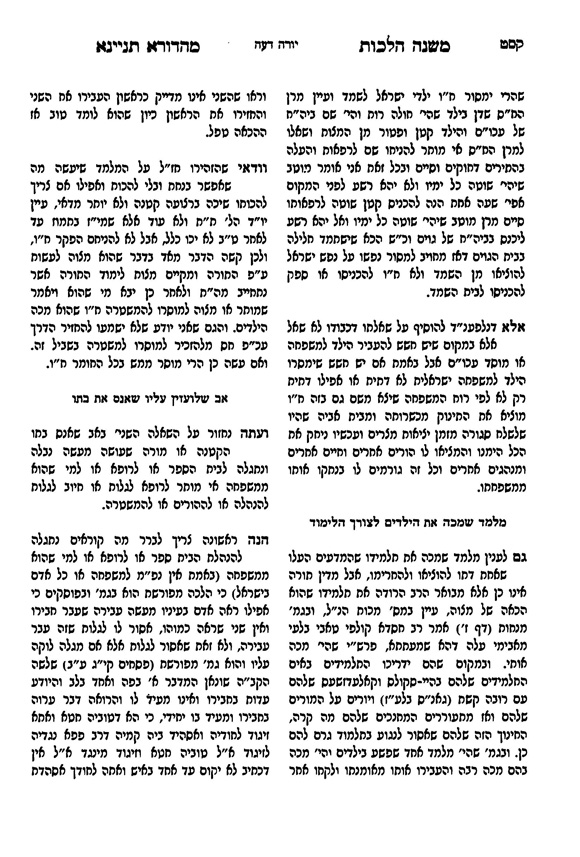
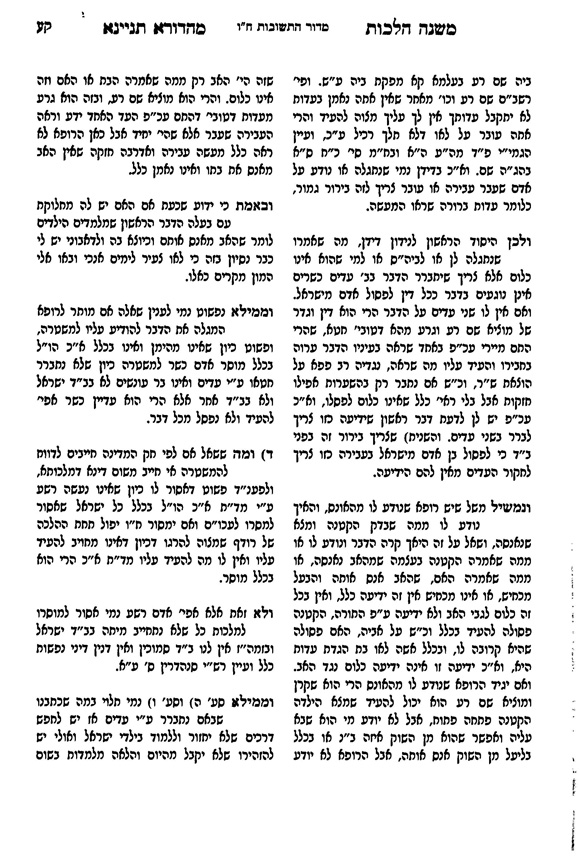
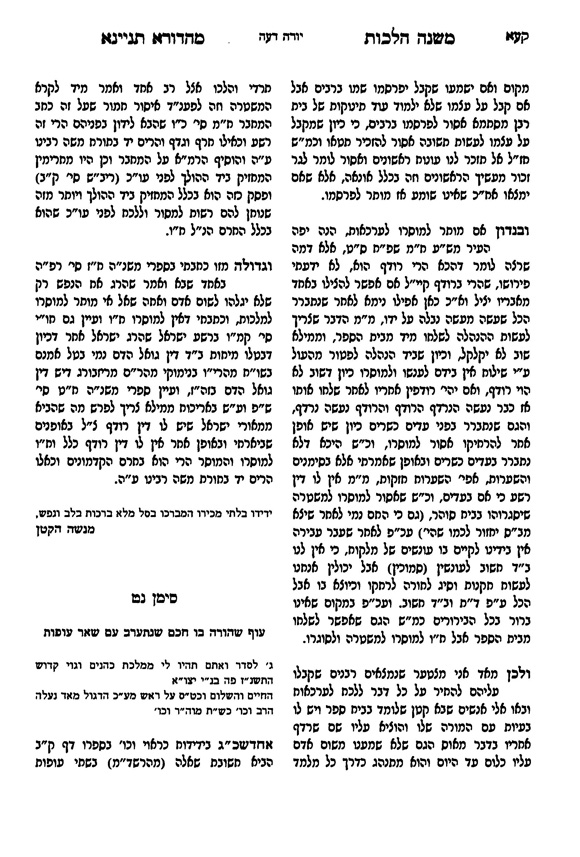
According to Klein, there is never a time when sexual abuse can be reported to the police, even if a child is being continuously raped. That is because there are never two male witnesses who see the abuse. If someone does report the abuse, it is a mitzvah to kill the moser. If anyone has a difficult time understanding why a segment of the hasidic world time and again offers support for the perpetrator and ostracizes the victim, this is all the explanation you need. From their perspective, the victim who goes to the police is worse than the sexual abuser. Based on Klein’s understanding, I don’t think there is a “heter” for a woman who has been raped by a Jew to go to the police, because there is no halakhic evidence of a crime. (He also says that it is forbidden to turn in a murderer. In case anyone needs to be reminded how crazy this viewpoint is, I am writing these words only a few hours after the monster who killed Leiby Kletzky was identified.)
A friend insists that there is no difference between Klein’s position and that of Agudat Israel. This is not true at all. Whereas Klein states that someone can never be turned in to the police, the Agudah position is that a molester can be turned in, but only after a rabbi gives approval. The Agudah position continues to develop, and I have no doubt that in the end the Agudah will end up holding a position identical to that of the RCA. I also think that it is public pressure that will move Agudah in this direction, as public pressure has been responsible for all the adjustments in the Agudah’s position that we have seen until now.
Yet even without public pressure, the current Agudah position is so untenable, that it will have to be updated. For one, it asks people to violate the law. The law is clear that some people are obligated to contact the police when they suspect child abuse. By insisting that a rabbi be consulted before doing so, mandated reporters are being put in the position of being told by a rabbi to refrain from doing something that the law requires. Do the Agudah constituents realize that listening to the rabbi in these circumstances can open them up to both criminal and civil penalties?
As for the rabbis, I can’t imagine who would agree to be on the Agudah’s panel of rabbis that will examine accusations of abuse in order to determine if it is permitted to go to the police. If one of these rabbis rules that the evidence is not compelling and it is therefore forbidden to go to the police, and the rabbi is wrong, he opens himself (and the mandated reporter) to a lawsuit by the parents of the molested child. Whatever the ultimate verdict, the lawyer fees alone will end up bankrupting the rabbi. Is the Agudah prepared to set up a fund to defend rabbis sued by parents of molested children? Certainly not, which is why no rabbi who is thinking straight will ever agree to put himself in such a circumstance. The Agudah’s position also leaves the organization itself vulnerable to a lawsuit by parents of victims.
Finally, unlike so many of the cynics in our community, I don’t think the Agudah position is all about protecting rabbis, guilty or not. I really do believe that the Agudah recognizes that there is a problem. It is convinced that the rabbis it will charge with examining abuse cases will indeed make sure that molesters are turned in. The problem, however, is that we have seen all this before. We have seen over and over again that it is precisely the rabbis who have failed in this matter, often because they are not willing to turn on their own. It was precisely because of this that the community of laypeople rose up and said “No more.” One doesn’t need to be a prophet to see that by relying on individual rabbis to determine if an accusation of sexual abuse is credible, there will continue to be cover-ups. (Am I wrong in assuming that these cover-ups never would have happened if women were in charge? Would mothers ever have permitted child molesters to continue to prey on the young?)
The Agudah position is thus both a public relations and legal disaster in the making. The Church tried such an approach already and it doesn’t work. I don’t understand why such smart people in the Agudah don’t see how their new position is doomed to failure.
[5] See here where I attribute the rabbinic silence to the money Tropper was handing out. I also brought proof that even great rabbis are not immune to being influenced by money. Regarding this point, see the recent biography of R. Zvi Pesach Frank written by Shabbetai Dov Rosenthal, Geon ha-Hora’ah (Jerusalem, 2011),, vol. 1, pp. 410-411. A letter from R. Frank is published in which he criticizes members of the Israeli Chief Rabbinate (of which he was a member). The subjects of his criticism were gedolei Yisrael, and yet he accuses them of being improperly influenced by Israeli government money. He adds:
מי לנו גדול מהכהן הגדול שלא צירפוהו לדון בענין עיבור השנה, שהיה חשש נגיעה שמפני הקור יכריע שלא לעבר השנה
[7] I hope to treat this phenomenon in great detail when I am able to complete my article on contemporary halakhic practices in opposition to the Shulhan Arukh.
[8] There are loads of sources that speak of the great weight to be assigned to the practices of the Jewish people, even when these practices appear to violate the textual halakhah. For one example, see R. Solomon Laniado, Beit Dino shel Shlomo (Jerusalem, 1986), Orah Hayyim no. 17 (p. 96): שכל מה שנהגו ישראל שכינה מוסכמת עמהם
Laniado (died 1793) was the chief rabbi of Aleppo.
[10] Moshe Carmilly-Weinberger, ed., The Rabbinical Seminary of Budapest 1877-1977 (New York, 1986), p. 77.
[11] I would also like to mention a recent article by Lawee that deals with some issues relevant to earlier installments of this series, such as the possibility of errors in the biblical text. See Lawee, “Isaac Abarbanel: From Medieval to Renaissance Jewish Biblical Scholarship,” in Magne Saebo, ed., Hebrew Bible/Old Testament (Goettingen, 2008), vol. 2, p. 210, who calls attention to Ibn Ezra, Ex. 25:29, who claims that there is a mistake in the Book of Chronicles. He also notes Abarbanel’s commentary to I Kings 10:22, which suggests another error in Chronicles, due to Ezra misunderstanding a verse in the Book of Kings.
[12] Elsewhere, Ashkenazi speaks of Moses having access to historical records, but there he assumes that these records are accurate. See Epstein, Mi-Kadmoniyot ha-Yehudim, p. 136:
כי כל התורה ברוח הקדש כתבה משה וידע שמות אלופי אדום ומשכנותם ומלכיהם ידועה [!] גמורה מפי ספרים ומפי סופרים ונודע לו האמת ונכתב בספר.
[14] See Abarbanel’s introductions to Jeremiah, p. 298, and Ezekiel, p. 434. In the latter source he writes:
הן אמת שיחזקאל הנביא לא היה בקי בלשון הקדש ולא בכתיבתו
For other references, see Eric Lawee, Isaac Abarbanel’s Stance Toward Tradition )Albany, 2001), p. 276 n. 46.
[15] On p. 46a he offers a different perspective which I don’t think can be brought into line with what he says earlier. Here he accepts the existence of some sort of demonic beings, and claims that the superstition is only that humans can interact with and influence them. Neusatz’ book was published posthumously, and it is possible that had the author been alive he would have worked out a more consistent theory.
[16] In the next issue of Milin Havivin, I deal with Orthodox views of the Zohar. In the meantime, I was surprised to find that R. Berel Wein describes the Zohar in an unsympathetic manner. Although some may claim that Wein was only presenting the history, his less than reverential attitude towards the book comes across very clearly, even if he didn’t consciously intend this. See the video here.
For another surprising piece by Wein (called to my attention by Mel Barenholtz), see here.
Wein describes Midrash as “legend.” While this might be a term used by academics (and is in the title of Louis Ginzberg’s great work), the Yeshiva World has always rejected the word as a proper description. Wein’s entire article can be seen as a reflection on the fact that rabbis, in their sermons, quote all sorts of Midrashim as if they are historical, which they are of course not. So what value do these “legends” have, and why should we use them to fill in the “missing parts” of the biblical text? That is the question Wein deals with.
In fact, Wein’s entire article, with its demand for truth in history and the need to abandon fantasy, is the sort that in today’s day and age could generate a herem. Here, for example, is one very provocative sentence: “Many times legend becomes myth. Myth is a sense of human recognition that the story being told is not factual but it nevertheless changes legend from history or biography into literature and philosophy – sometimes sacred holy literature and philosophy.” (emphasis added). And how about this paragraph, which uses the word “mythology,” certainly knowing the knee-jerk reaction it will provoke among people.
The Torah does not deal with myth per se. Yet the Flood and Noah’s ark, the Tower of Babel, the centrality of the land of Israel, factual as they all are in the biblical narrative, nevertheless were all combined to create a basis for the holy mythology of the Jewish people. In addition, the idea that the “events of the works and decisions of our founders, the fathers of Israel, are a sure guidepost for their descendants” helped strengthen a mythology that binds the Jewish generations together and gives us insights into the values of Judaism and historical events, past and present (emphasis added).
In speaking of the Flood, Noah’s Ark and the Tower of Babel, Wein states that they are factual “in the biblical narrative.” Does this mean to imply that they are really not historical events, but it is only in the biblical narrative that they are regarded as factual? Since these events, Wein tells us, are among the great myths of Judaism, and he just finished telling us that myth is not factual, this seems to be what he is saying.
[17] These two scholars would never have said, as did the Hatam Sofer, that Yiddish was invented by the medieval Jewish sages to keep Jews separate from non-Jews. See She’elot u-Teshuvot Hatam Sofer, Even ha-Ezer, vol. 2 no. 11. There are many other examples that show that the Hatam Sofer was still very much part of the medieval worldview, which is why I state that he is a complex figure. For instance, he still leaned towards Ptolemaic astronomy, centuries after Copernicus (although he acknowledged that the issue was complicated). See Eliezer Brodt’s post here.
Another example is the Hatam Sofer’s famous comment that he doesn’t understand the value of Jews training to be doctors in medical schools where they dissect non-Jewish bodies. Since Jews keep kosher, how can the information obtained from non-Jewish bodies be applicable to them? See Hiddushei Hatam Sofer, Avodah Zarah 31b. Yet I think it is more important is that in this very passage the Hatam Sofer also laments how there is no Jewish medical school.
[18] See Lishkat Soferim to Even ha-Ezer 17:43 (found in standard editions of the Shulhan Arukh).
[20] The same was true with R. Moshe Feinstein. See R. Aharon Felder’s recently published Rishumei Aharon, pp. 18-19. This book has lots of interesting stories about R. Moshe. Felder is not afraid to point out how R. Moshe, unlike other Roshei Yeshiva, had a more moderate viewpoint when it came to attending college. See pp. 19-21. See also p. 21 for the following story, which shows R. Moshe as a real down-to-earth person, who was far removed from “frumkeit” and had little patience for the aspiring pietist:
פעם ניגש למו”ר זצ”ל חתן ביום חתונתו וביקש לדעת איזו כוונה צריך לכוין בשעת ביאת מצווה. פנה אליו מו”ר זצ”ל וענה “איני מאמין שתוכל לכוין כלל וכלל”. והוא לא הסתפק והמשיך לשאול שוב את שאלתו, אם אני יכול לכוין מה הכונה הראויה לאותו זמן? ומו”ר זצ”ל לא הגיב, ורק המשיך ללכת לדרכו.
For another such story, see p. 20 where he records how R. Moshe told a certain Rosh Yeshiva that it was inappropriate for him to refuse to be mesader kidushin just because there would be mixed seating at the wedding. See also p. 22 that R. Moshe refused to write a letter to the judge on behalf of one who was to be sentenced for drug dealing. R. Moshe told the criminal’s father that his son damaged people’s lives and therefore “Let him sit in prison.” On p. 28 he quotes R. Moshe’s positive view of R. Kook. On p. 73 he quotes R. Moshe that a male massage therapist can massage a woman if he does not have a continuing professional relationship with her (!), a man can cut a woman’s hair, and a male teacher or principal can be present when girls in the school sing as the assumption is that he is involved with other things and not paying attention.
What many will regard as a surprising pesak appears on p. 36:
מותר להיות Wine Tester ולטעום סתם יינם, באופן שפולט ואינו בולע
I assume this pesak is based on Rama, Shulhan Arukh, Yoreh Deah 108:5, who is speaking about יין נסך, implying that it is permitted to taste but not swallow סתם יינם. See also Pithei Teshuvah, Yoreh Deah 98:1, for the view that it is permitted to taste, but not swallow, things forbidden by the Sages.
(Regarding tasting without swallowing, see Shulhan Arukh, Orah Hayyim 567:1-3. Based on the Rama in 567:3 it would appear that it is permissible to chew gum on a fast day other than Yom Kippur.)
Although I can’t be certain, I find it hard to believe that R. Moshe would require the wine taster to make a blessing on the non-kosher wine. If so, then R. Moshe would presumably agree with those poskim who have ruled that one does not make a blessing on gum and that you can chew it before morning tefillah. See what I wrote here.
See R. Yitzhak Barda, Yitzhak Yeranen, vol. 2, no. 11, and R. Moshe Levi, Birkat ha-Shem, vol. 2, pp. 41ff., vol. 5, pp. 537ff., for complete discussions of the topic. R. Meir Mazuz also holds that one does not make a blessing on gum. See Or Torah, Tamuz 5771, p. 973. The logic of this viewpoint is explained by the Beit Yosef, Orah Hayyim 210:
ולי נראה דברכה לא בטעימת חיך תליא אלא באכילה תליא כדכתיב ואכלת וברכת ואכילה היינו הנאת מעיים כדברי הרא”ש ז”ל
Speaking of gum, I wonder if R. Moshe would agree with R. Yitzhak Abadi that all the standard gums (Wrigleys, Trident, etc.) are kosher. See Or Yitzhak, vol. 1, Yoreh Deah no. 24:
כפי שבררנו החלק הטעים והמתוק שבו אין בו שום שאלה, ומה שנשאר הגומי אח”כ וממשיכים ללועסו אין בו לא טעם ולא ריח, והרי הוא כעץ בעלמא ושרי ללועסו כל היום כולו אף אם עירבו בו מדברים האסורים.
The kashrut organizations assume that gum needs a hashgachah. Here is what R. Zushe Blech has to say on the subject
The need for reliable Hashgacha for gum stems from many ingredient concerns. Plasticizers can be pure lard or tallow and emulsifiers are also often made from animal fats. Flavors and glycerin can also be completely non-Kosher. Even if all of the ingredients in a Kosher gum were acceptable, the equipment on which the product is made requires a Kashering from non-Kosher productions. Although the gum itself is not swallowed, these fats and flavors migrate from the gum into the mouth.
See here. (What does Blech mean by “reliable Hasghacha”? Does it mean that hashgachot that disagree with his understanding are not “reliable”?)
Let’s leave flavors out, as none of the flavors in the major gums are non-kosher. Let’s also leave out the issue of equipment, since this is not a real halakhic concern (as anyone who has ever lived in a place other than Israel and America, and thus has to buy foods without hashgachah, is well aware.) The issue is glycerin, emulsifiers etc. I don’t understand why this should be a problem. Even assuming that it is forbidden to swallow these things as part of a food, why would it be prohibited to simply chew on these tasteless items? Is there any kashrut problem when my son chews on his pigskin baseball glove while waiting patiently for a ball to be hit to him?
Returning to Felder, I give him credit for not being embarrassed to tell us how he once asked R. Moshe the following idiotic question (p. 20):
פעם הלכתי עם מו”ר זצ”ל לניחום אבלים, ולפני שנכנסנו לרכב ביקש ר”מ אחד מישיבת “רבינו יצחק אלחנן”, אם יכול להצטרף לנסיעה כי בית האבלים היה בקרבת מקום לשכונה של הישיבה הנ”ל. ושאלתי את מו”ר זצ”ל האם מותר לנו לקחת את אותו ר”מ לאותה ישיבה? וענה לי “למה לא, הרי נמצאים שם הרבה גדולי ראשי ישיבה שמלמדים תורה”.
Could it be that Felder didn’t know that R. Moshe’s great student, R. Nissan Alpert, taught at YU, or that his son-in-law, R. Moshe Tendler, likewise did? Did he not know that R. Moshe had close relationships with many of the Roshei Yeshiva at YU, and was colleagues with them in Agudas ha-Rabbonim?
While on the subject of teachers at YU, here is a page of a letter, never before published, by R. Yaakov Kamenetsky. It was sent to his son, R. Nosson, whom I thank for giving me permission to publish it. (The notations on the side of the letter are by R. Nosson.) In the letter, R. Yaakov admits that it would have been better for him to teach at YU, since the YU musmachim have a much more significant role in American Orthodoxy than those he was teaching. However, what prevented him from doing so is how this would appear to his sons. They would wonder, if YU was good enough for him to be part of the faculty, why did he think it so important to send his sons to haredi yeshivot?

[21] Kol Hotzev (Jerusalem, 1999), pp. 178-179.
[22] Among my children’s generation, many kids believe that there is a halakhic requirement to have two sinks. Some of these kids have literally never been to a kosher home which doesn’t have this. If they saw such a home, they would probably assume that there must be a heter for one sink, but only for those who can’t afford to redo their kitchens.
[23] R. Joseph B. Soloveitchik wrote of the difficulties R. Hayyim Ozer had, and strongly identified with the latter. See his hesped for R. Hayyim Ozer in Divrei Hagut ve-Ha’arakhah (Jerusalem, 1982), p. 194:
הגאון ר’ חיים עוזר לחם על זה בחרוף נפש. הוא סבל הרבה בעטיה של שיטה זו, סבל יסורי נפש ורוח. בשעה שהרבה מאחינו נכונים היו למסור את החושן לידי זרים ולהסתפק בציץ. עמד הוא בפרץ ומחה נגד זה.
The truth is that R. Soloveitchik is incorrect when he writes עמד הוא בפרץ ומחה נגד זה R. Hayyim Ozer did not protest the slight to his honor, or lead the opposition to Rubenstein. It was the other sages, including the Hafetz Hayyim and the Hazon Ish, who took the reins in this matter. Regarding the Hazon Ish, see Binyamin Brown, Ha-Hazon Ish (Jerusalem, 2011), p. 53.
[24] See Aharon Sorasky, Rabban shel Yisrael (Bnei Brak, 1971), p. 115; Moshe Tzinovitz, Ishim u-Kehilot (Tel Aviv, 1990) p. 240. Rabinowitz was the father-in-law of R. Avigdor Zyperstein, who taught at YU. In Vilna, the center of European Jewish scholarship, an Agudah rav, Grodzinski, and a Mizrachi rav, Eiges, sat on the same beit din and worked closely together. In Europe, every small town had a rav. Sometimes the rav was an adherent of Agudah, and other times a follower of Mizrachi. But as far as the townspeople were concerned, that didn’t matter. He was the rav and if there were halakhic questions in the town he was the one to decide them. If you were an Agudist and the rav was a Mizrachi man, when you had a halakhic question you would go to your rav. The politics of the Jewish world did not interfere when it came to halakhah. Furthermore, the various Agudat Rabbanim in Europe (and also in the U.S.) welcomed all rabbis, regardless of where one stood in the Agudah-Mizrachi dispute. In the post-World War II world, however, the haredi world has entirely changed all this and rewrote the rules. They were able to convince their followers that unless a rav follows the haredi Daas Torah he is not a reliable rav, and therefore he should not be consulted on halakhic matters. In other words, the halakhic competence of a rav was made dependant on his political outlook. This is a complete break with Jewish tradition, as it existed in Europe. While some might regard this development as simply another example of haredi “shtick”, I think it is more significant as it illustrates once again that haredi Judaism can be just as modern and revolutionary as that which it sees itself as fighting against.
[25] See Zvi Weinman, Mi-Katovitz ad Heh be-Iyar (Jerusalem, 1995), pp. 52ff.
[26] E. Horowitz, Orhot Rabbenu (Bnei Brak, 2005), vol. 5, p. 169
[27] See Brown, Ha-Hazon Ish, pp. 55-56.
[28] One well-known haredi rav wrote to me as follows:
I just read your post . . . regarding the abolishment of animal sacrifices. Barukh sheKivanti l’Da’ato shel Harav Kuk when I once told my students at . . . (and advised them to keep it under wraps) that perhaps a future Sanhedrin will find a drash to do that. But I had a caveat in that our present moral sensitivities were formed during the Exile in which we were enslaved to general, non-Jewish thinking. Therefore, after the Messiah arrives and we are able to think independently, and until we are on own long enough to form our own, Jewish ideas, all we will be able to do is continue from where we left off at the Destruction of Ba’yit Sheni. Only after some time has passed may the Sanhedrin decide that animal sacrifices ought to be abolished. This approach explains why the Rambam sets down Hilkhot Korbanot though he may have been prepared to abolish them had he been sitting on the Sanhedrin. It’s for that interim time — between the arrival of Mashiah and whenever the Sanhedrin makes its Judaism-inspired [changes].
He then added the following critical note:
Within the blog you used a term which ruffled my sensibilities: “Messianic Judaism.” Simply because that term has been usurped and corrupted by Christians who call themselves “Messianic Jews,” you should have written “Messianic-Era Judaism”.
[29] R. Isaac Hutner is quoted saying something very similar to that of R. Kook.. See R. Yitzhak Alster, Olat Yitzhak (Jerusalem, 2003), vol. 1, p. 188 (referred to by Bezalel Naor, The Limit of Intellectual Freedom [Spring Valley, 2011]):
שאין דנים הכופר עפ”י מחשבתו ודבורו לחוד עד שעושה מעשה מומרות. וכך היה לשונו: איך וואלט ניט געפסקנט אויף אימיצר אז אעהר איז אן אפיקורס סיידן איך וואלט געזעהן א ריעותא אין זיין מצוות מעשיות, כאיטש אפילו אפיקורסוס איז נישט תלוי אין מעשים, אבער מעלע וואס א מענטש רעדט – ער גלויבט אליין נישט וואס ער רעדט