A Survey of Contemporary Electronic Resources: Two Hard Drives of Hebraica

Aside from purchasing a hard copy of a book, there are currently many other methods are available in obtaining seforim. The easiest and cheapest is the Shapell Family Digitization Project of the Jewish National & University Library, where many rare and expensive books are available for free. While this is a terrific resource if the particular book and/or edition is available, this digital project is far from comprehensive, and its purpose is not to have every (or even close to) every book online. To fill that demand, there are two external hard drives which contain about 18,000 – 20,000 seforim, both of which are around the same price of $1,400 (estimated). I have been using both for the last few months and wanted to give my impressions.

The two hard drives are Otzrot haTorah and Otzar HaChochmah. I have the hard drive of the first, and have been using an online version of the second.

The first, Otzrot haTorah was originally the vision of R. Morgenstern, who has unfortunately since passed away. This edition includes the collection of thousands of seforim, as well as Otzar haPoskim (widely known as Otzrot haShu”t). This program allows for one to search responsa works and also classifies responsa based upon their relevance to section in Shulhan Arukh. Thus, you can click and see what the responsa has to say about Siman Gimmel in Orah Hayyim etc. Additionally you can do a text search of the responsa which appear on this program. This program, however, only covers 3 of the 4 volumes of Shulhan Arukh – Orah Hayyim, Even haEzer, and Hoshen Mishpat. I found the interface and the ease of locating material to be very good. Once you know which chapter in Shulhan Arukh you need they have the material.

The more important portion of the hard drive is the collection of the 18,000+ seforim. This section is not text searchable. So if you are just hoping to use this to find material via a word search this is not the hard drive for you. But, this hard drive still has tremendous value. This is so, as it contains a terrific amount of material. Additionally, this material was systematically collected so you are less likely to find gaps on this then on the other hard drive. Whoever made the decision what to copy chose very well. Further, the seforim are divided topically (if you want) which if you are doing research let’s say on siddur is invaluable. You can in two clicks call up all the editions of the siddur they have. Or if you want to find about a town you would go to the History section then pick the section on communities etc.

Generally, you will find what you are looking for, however, as with almost any library or hard drive, this does not have every sefer printed, but if it is important or good, they probably do have it. If desired, you can print out the entire book, or convert it to a PDF to save to your hard drive. When you print it prints a water mark with their name in the middle, which is not a big deal (the other hard drive does the same). Aside from books, the hard drive also contains many journals as well.

The other hard drive, Otzar HaChochmah, is text searchable. But, not every book which is on the drive is nor is it 100% accurate. Additionally, on the online version it tells you if found a hit in a book, but then there is no get more than the first hit in the book (there may be a way but it is not readily apparent or obvious). This is rather frustrating if the first hit is not the one you need. The reason this is not perfect as this drive uses OCR technology as opposed to typing in all the books. This means it searches the actual books as they appear with Rashi script etc., and at time all OCR makes some mistakes. But, the sheer number of books does make this feature valuable.

One must state that this hard drive is much less comprehensive than the first one. It does not seem that the person who decided what to put on this has any rhyme or reason at times a basic book is missing while a useless one is included. There are serious gaps when it comes to some areas. Furthermore, with the online version, you can only print and there is no way to save the material. Otzar HaChochmah is constantly adding books, so they may eventually correct this. But it seems that are focusing on contemporary works rather than fixing the items in their catalog.

If I had to summarize who would benefit from each of these I would say a person who is just looking to come across something they were not aware of and doesn’t need access to seforim should go with Otzar HaChochmah. But, if you are looking for something to complement other research and you need access to seforim that are otherwise too expensive or impractical to own I would go with the Otzarot haTorah.

Otzar HaChochmah is available here; and you can email kidosheypolin-at-bezeqint.net for more on Otzarot haTorah


Shnayer Leiman on “A Puzzling Passage in a Book Intended for Jewish Children”

A Puzzling Passage in a Book Intended for Jewish Children, with a Tentative Bibliography of ספרי קודש that Treat the Mitzvah of Answering “Amen”
Shnayer Leiman


In 2004, an anonymous book entitled Serenade the King appeared in print.[1] Addressed primarily to a young audience, it is an anthology of inspirational stories that focus on one teaching only: the importance of answering “Amen.” The stories are accompanied by photographs of the great Jewish sages mentioned in them, and by short inserts, mostly quotations from famous rabbis emphasizing the significance of answering “Amen.” Letters of approbation (in Hebrew) from distinguished rabbis appear at the beginning of the book, encouraging prospective buyers to acquire the book.

On p. 240, the following short insert appears:

Failure to Answer Amen Desecrates Hashem’s Name

Failure to respond Amen to a beracha that one hears is equivalent to actually cursing Hashem, and the punishment for one who is guilty of this sin is equal to the punishment that one who curses Hashem receives.

There is no greater desecration of Hashem’s Name than the desecration caused by not answering Amen to a beracha, particularly if the beracha was recited in public. In fact, if it was recited before ten men, the hearer is obligated to sacrifice his life rather than not answer Amen!

Whereas Serenade the King prints mostly inspiring stories, here we have a halakhic ruling — and an astounding one at that. Ordinarily, there are only three instances where a Jew is obligated to lay down his life (i.e., allow himself to be killed) rather than commit a violation of Jewish law. These are: idolatry, murder, and sexual immorality. Thus, if a Jew is ordered to kill an innocent person, or be killed, he must refuse the order and allow himself to be killed, if no other options present themselves. The above rule applies primarily when the violation of Jewish law is in the private domain. But if the violation takes place in the public domain, i.e., in the presence of ten or more Jews, then one needs to examine the motivation of the person issuing the illegal order. If the purpose is to force the Jew to abandon his faith, then the Jew must be prepared to lay down his life rather than violate any mitzvah of the Torah. If the purpose is for the personal pleasure of the person issuing the illegal order, then the Jew is obligated to violate the law and stay alive, except in the cases of idolatry, murder, and sexual immorality. In a period of general persecution of the Jews, one is obligated to lay down his life even if ordered to violate a mere customary practice of the Jews. Even in those instances where a Jew is obligated halakhically to violate the law and stay alive, there are some halakhic authorities who rule otherwise. They allow a Jew the option to lay down his life (rather than violate a Jewish law and remain alive) in instances other than the three exceptions listed above. All halakhic authorities agree, however, that the Jew — in those instances — is not obligated to lay down his life. Thus, a Jew who is ordered at gun-point to eat non-kosher food or be killed, must violate Jewish law and remain alive (according to some halakhic authorities), or may refuse to do so and die (according to other halakhic authorities), but he is not obligated to refuse to eat the non-kosher food. In instances where the Jew is ordered by the enemy to take no action (e.g., not to recite the obligatory prayers or not to wear tefillin), the obligation to lay down one’s life is virtually non-existent.

Thus, R. Moshe Isserles rules:[2]

The rules apply only if they order him to violate a negative commandment. But if they issue a decree against observing a positive commandment, he need not observe it and be killed. But if the circumstances require it, and he wishes to observe it — knowing that he will be killed — it is permissible for him to do so.

Similarly, R. Mordechai Jaffe rules:[3]

All the above applies only when they order him to violate a negative commandment, so that when he violates it he must engage in an act that violates the Torah. But if they decreed in a persecution that one may not fulfill a positive commandment, one is not obligated to fulfill it and be killed. This is because complying with the decree does not require an act of violation of the Torah; one can simply cease and desist and comply with the decree. Moreover, the enemy can force him to violate the law against his will, by either imprisoning him so that he will be unable to perform any of the commandments, or by depriving him of his tzitzit or tefillin so that the specific mitzvah cannot be performed. Therefore, let it go unperformed and let him not be killed. Nonetheless, even in this case, if he chooses to be stringent and to observe the commandment — even though he knows that he will be killed — he may do so. He is not considered as one who brings injury upon himself, for this too is an act of piety and fear of G-d, and a sanctification of G-d’s Name.

In the light of the above, it is astonishing indeed that Serenade the King rules that it is obligatory to lay down one’s life when ordered not to answer “Amen” to a blessing recited before ten men. At best, it may be permissible to lay down one’s life in such a case; it is certainly not obligatory according to the Shulhan Arukh.[4]

To the best of our knowledge, no such ruling appears in the Babylonian or Jerusalem Talmud, or in any of the halakhic codes, whether Rif, Rambam, Tur, or Shulhan Arukh. Indeed, the ruling appears to contradict the Shulhan Arukh, i.e. the R. Moshe Isserles passage cited above. So we were curious as to the source of this ruling in Serenade the King. One did not have to look very far. At the bottom of the insert, the source is clearly given as: Keser Melucha, page 284. It turns out that Serenade the King is simply an English version of an earlier work in Hebrew entitled שירו למלך, Jerusalem, 2002, also addressed primarily to a young audience.[5] The anonymous author of both books, apparently a reputable rabbinic scholar in Jerusalem, drew most of his material from an earlier work of his entitled כתר מלוכה, Jerusalem, 2000.[6] It is a comprehensive anthology in Hebrew of talmudic, midrashic, medieval, and modern sources relating to the mitzvah of answering “Amen” — and it is addressed to adults. [There is a rich literature, especially in Hebrew, on this topic. Since we have not seen a bibliographical listing of such books, we have appended to this essay a tentative bibliography of books in Hebrew that treat the mitzvah of answering “Amen.”]

Turning to page 284 of כתר מלוכה, one discovers that the source of the insert is: מנח”א י”א ב. Since neither Serenade the King nor כתר מלוכה contain bibliographies or lists of abbreviations, some readers will experience difficulty deciphering the abbreviation.

Amateurs attempting to decipher the abbreviation will doubtless suggest that it stands for מנחת אלעזר, the classic collection of responsa by the late Munkatcher Rebbe, Rabbi Hayyim Eleazar Shapira (d. 1937). But the responsa in that collection are always referred to by volume and by the number of the responsum (e,g., IV:19), never by page number (e.g., 11b). More importantly, our passage does not occur on p. 11b (or anywhere else) in any of the printed volumes of מנחת אלעזר.

While leafing through the pages of כתר מלוכה, it became apparent to me that מנח”א (cited throughout the volume) was itself an anthology of sources on the significance of answering “Amen.” It was a simple matter to peruse the titles of all previous anthologies on the significance of answering “Amen,” and to see which one had a title that matched the abbreviation in כתר מלוכה. The only volume to do so was R. Yehudah Leib Rogalin’s מנחיל אמונה, Poltava, 1913.[7] And sure enough on p. 11b, there appears the full text of the passage summarized in כתר מלוכה.

The passage reads:

וכמו ששכרו של העונה אמן כמה דאצטריך אין ערך ושיעור וכמובא במדרשי חז”ל, כמו כן להיפוך חלילה עונש של האינו עונה אמן, וכמובא גם כן שבאמת הוא ניאוץ וחירוף וגידוף כלפי מעלה, אלא שזה בשב ואל תעשה, אבל עונשו שוה למגדף בפועל שזה בזיון למלך הכבוד דמי שלא חש לכבד את המלך בעת שנותנין לו כבוד הוא בזיון גדול אין דגמתו, ואינו דומה מי שאינו נותן כבוד למלך למבזה ברכת המלך, וברבים הוא חילול שם שמים בפרהסיא, ובעשרה מישראל מחוייב למסור נפשו על זה מקל וחומר, שאם הוא מחוייב למסור נפשו לקדש שם שמים בפרהסיא, כל שכן שמחוייב למסור נפשו שלא לחללו, ואין לך חילול שם שמים גדול מזה שלא חש לאמן ברכותיו של המברכו וגורם שברכת המברך יהיה חלילה כברכת שוא, עיין מכילתא (משפטים ס’ כ”ג) משום ר’ אלעזר וכו’. ומכאן אזהרה למי שרואה את חבירו שאינו עונה אמן אחר השליח ציבור שמחוייב לגעור בו בנזיפה יהיה מי שיהיה, דבמקום שיש חילול השם אין חולקין כבוד.

The claim, while certainly interesting, will hardly persuade most halakhists.[8] In any event, this is surely a matter for Gedolei Ha-Poskim to decide, and not the authors of treatises on the importance of answering “Amen.” One wonders whether such a halakhic decision — of life and death import — should appear in a children’s book. Heaven forbid that a child be put to the test, and instead of consulting a posek, he will rely on the ruling of Serenade the King that “the hearer is obligated to sacrifice his life rather than not answer Amen.” One wonders whether the rabbis who wrote letters of approbation for Serenade the King also gave their approval to this ruling. If not, perhaps we need to rethink what a letter of approbation really means.

Notes:

1] Serenade the King, Jerusalem: Vehagisa, 2004. The book’s spine bears the imprint of Feldheim’s Books.

2] Shulhan Arukh: Yoreh De’ah 157:1.

3] Levush Ateret Zahav 157:1.

4] For possible support for the halakhic ruling in Serenade the King, see the sources cited in R. Hayyyim Yosef David Azulai, Birkei Yosef, Yoreh De’ah 157, paragraph 2, ד”ה הגהה

5] See שירו למלך, Jerusalem: Vehagisa, 2002.

6] כתר מלוכה, Jerusalem: Makhon Mayim Hayyim, 2000. An earlier and much abridged preliminary version of כתר מלוכה appeared in print with no place and no date on the title pages. It appears to have been published in Jerusalem, circa 1998.

7] The volume was published without הסכמות. On Rogalin, an accomplished rabbinic scholar who served as rabbi of Alexandrovsk in the Yekaterinoslav province from circa 1888 until 1913, see S.N. Gottlieb, אהלי שם, Pinsk, 1912, p. 9.

8] It will not persuade most halakhists for a variety of reasons, including the fact that the קל וחומר suffers from a serious פירכא. Indeed, a person may be obligated to lay down his life rather than actively commit a violation of Jewish law (under the right set of circumstances, as outlined above). But this cannot obligate a person to lay down his life rather than passively violate a Jewish law – by not answering “Amen.” Moreover, the halakhic source (Mekhilta to Exodus 23:1; ed. Horovitz-Rabin, p. 322) cited by Rabbi Rogalin does not treat the issue of laying down one’s life at all.

A claim similar to that of Rabbi Rogalin appears in a much earlier work: R. Moshe Kahana, דרך משה, Amsterdam, 1699. I am indebted to R. Eliezer Brodt for calling this claim to my attention (via Dan Rabinowitz). On p. 41 (of the Jerusalem, 1983 edition of דרך משה), the text reads:

על כן כל איש מישראל ששומע הברכה מישראל מחוייב לענות אמן אפילו שומע מאשה או מקטן, ואם שומע ואינו עונה חייב מיתה. וסימן אמ”ן נוטריקון א’ני מ’וסר נ’פשי, שכל אחד מישראל מחוייב למסור נפשו על עניית אמן

No halakhic source is cited for this פסק הלכה, (that not answering “Amen” is a capital offense; and that a person must lay down his life for the sake of answering “Amen”), either from the Talmud, Rishonim, or Aharonim. And while a famous story about R. Mordechai Jaffe, author of the לבושים, suggests that not answering “Amen” under normal circumstances is a capital offense (בדיני שמים), it does not suggest that a person must lay down his life if forced not to answer “Amen” (see דרך משה, loc. cit.; cf. R. Mordechai Jaffe, לבוש החור, Jerusalem, 2000, vol. 2, pp. 579-580).

Bibliography:

The tentative bibliography that follows lists ספרי קדש that treat the mitzvah of answering “Amen.” The list does not include books that treat a variety of mitzvot, including the mitzvah of answering “Amen.” Thus, for example, the list does not include R. Aharon Avraham b. R. Barukh Ha-Levi, אגרת הטעמים (Mantua, 1582), even though pp. 12b-15a of that treatise treat the mitzvah of answering “Amen.” For similar reasons, we have not listed R. Aharon Roth, שומר אמונים (Jerusalem, 1942), though see item 8 on the list. Books in foreign languages are not listed, though many exist. R. Menahem Nahum Bochner’s ספר עניית אמן (Tchernovitz, 1913) is also omitted from the list; it does not treat the mitzvah of answering “Amen.” The list certainly needs to be expanded. I’ve included only the titles of books I have held in my hand.

רשימת ספרים העוסקים במצוות עניית אמן

1] ואמרו אמן, לר’ יהושע אלטר ווילדמאן, ב’ כרכים, ירושלים, תרפ”ז-תרפ”ט

2] ונאמר אמן: יצחק לשוח, לר’ שלום יודא גראס, ברוקלין, תשמ”א

3] חוברת לימוד בנושא מעלת עניית אמן יהא שמיה רבא, בלי שם מחבר, ב’ כרכים, ירושלים, תש”ס-תשס”ב

4] חובת עניית אמן, לר’ הלל דוד ליטוואק, ברוקלין, תשנ”ט

5] כתר מלוכה, בלי שם מחבר, ירושלים, בלי שנת דפוס (לפני שנת תש”ס), והיא הוצאה ראשונה וצנומה של ספר כתר מלוכה דלהלן

6] כתר מלוכה, בלי שם מחבר, ירושלים, תש”ס

7] לקוטי תורת אמן, לר’ נחום זק”ש, ווילנא, תרס”ז

8] מאמר פתחו שערים מספר שומר אמונים, לר’ אהרן ראטה, בית שמש, תשנ”ה

9] מדריך לעניית אמן, לר’ שלום יודא גראס, ברוקלין, תשמ”א

10] מנחיל אמונה, לר’ יהודה ליב ראגאלין, פאלטאווא, תרע”ג

11] נוטרי אמן, לר’ אברהם קסלר, ב’ כרכים, בני ברק, תש”ס-תשס”ד

12] עניית אמן כהלכתה, לר’ ישכר דוב רומפלער, מאנסי, תש”ס

13] קובץ ונאמר אמן, בלי שם מחבר, בת-ים, תשס”ד

14] קונטרס הבו לה’ כבוד: התעוררות וסיפורים…בעניני…עניית אמן, בלי שם מחבר, ירושלים, תשנ”ג

15] קונטרס מהלכות עניית אמן, לר’ אברהם דוד בלאך, ווילנא, תרס”ט. נלוה לספרו ציצית הכנף, ווילנא, תרס”ט

16] קונטרס עניית אמן כהלכתה, לר’ שלום יודא גראס, ברוקלין, תש”ם

17] קונטרס שומר אמונים, בלי שם מחבר, ברוקלין, תשי”ג

18] שומר אמונים, לר’ אליהו וויגאדזקי, פיעטרקוב, תרס”ו

19] שירו למלך, בלי שם מחבר, ירושלים, תשס”ב

20] תשובת נפש תיקון אמן תשובת תענית, בלי שם מחבר, לובלין, תל”ז


Elliott Horowitz – Modern Amalekites From Adolf to Avigdor

In a previous post at the Seforim blog, Prof. Elliott Horowitz of Bar Ilan University and co-editor of Jewish Quarterly Review, described Isaiah Berlin on Meir Berlin (Bar-Ilan) and Saul Lieberman [see here].  This is his fourth contribution to the Seforim blog. We hope that you enjoy.
Modern Amalekites: From Adolf to Avigdor
by Elliott Horowitz
     Well before the outbreak of World War II the Nazi regime in Germany came to be associated by many Jews with Israel’s ancient arch-enemy, Amalek. Perhaps the first to do so was the noted historian Simon Dubnow who in a 1935 (Hebrew) letter from Riga to his disciple Simon Rawidowicz bemoaned the recently promulgated Nuremberg Laws, and then prophetically exclaimed “We are at war with Amalek!” During that same decade some ultra-Orthodox European rabbis were using the epithet of “Amalek” with reference to their more secular coreligionists who adhered to such modern ideologies as Communism or Zionism. This was true, for example, of the great Talmudist R. Elhanan Wasserman, one of the leaders of Agudat Yisrael, who like Dubnow was to meet his death in 1941 at the hands of the Nazis. Wasserman, who had studied in Volozhin and Telz before joining the kollel of the Hafetz Hayyim (R. Israel Meir Ha-Kohen, 1838-1933), cited the latter’s confident opinion that the Soviet Jewish communists (known as the Yevsektzia) were “descendants of Amalek.” Ironically, his even more ultra-Orthodox Hungarian contemporary R. Hayyim Elazar Spira of Munkacz (1872-1937) included among the ranks of modern Amalekites not only the Zionists, but also the members and leadership of Agudat Yisrael.[1]  In September of 1941 Joseph Hertz, the Chief Rabbi of (what was then still) the British Empire, delivered a thundering sermon at a public “intercession service” held on the ruins of London’s Great Synagogue, which had just been destroyed by German bombs. Drawing upon the previous week’s scriptural reading from Deuteronomy 25, which is also the “additional” reading for Shabbat Zakhor, Hertz referred to Nazi Germany as “Amalek’s latest spiritual descendant; he fears not God; he closes the gates of mercy on those who cannot resist his might.” The Chief Rabbi stressed that God’s war with Amalek was not to be left in divine hands, but was to be “carried out by…men and nations filled with an endless loathing of Amalek and all his works and ways.” He also praised those Jews who had shown support for “our beloved country in her struggle to blot out the memory of Amalek from under the heavens of the Lord.”[2]  Hertz, who had studied at New York’s City College (where he received a gold medal for English composition) before attending the Jewish Theological Seminary of America (of which he was the first rabbinical graduate), was not the first British clergyman to portray the Germans as contemporary Amalekites. Early in October of 1939, shortly after his arrival in Jerusalem to serve as chaplain of St. Andrew’s Scottish Church (and a month after Germany’s invasion of Poland), Dr. Norman Maclean chose as the text for his Sunday sermon the account (in Exodus 17) of Amalek’s attack at Rephidim. The prayer by Moses on the adjacent hill-top, asserted Maclean (1869-1952), who had earlier served as minister of St. Cuthbert’s Church in Edinburgh, “described our duty in the grim conflict now being waged.” Then as now “the nations which abolished God or reduced Him to a tribal deity confronted the nations that held fast to the faith of their fathers.” In the balance, both at Rephidim and in the present, lay nothing less than “the fate of the world’s soul.”[3]  The connection between the world’s soul and the Jewish people had concerned Rev. Maclean (to whom I hope to return in a future post) well before his arrival in Jerusalem, which he first visited in 1934. During the First World War, while still serving at St. Cuthbert’s he contributed a foreword to Leon Levison’s The Jew in History (1916) which opened with the words: “The world owes its soul to the Jews.” In consonance with that position Maclean shared the hope of Levison, his Safed-born brother in Christ,[4] that the war’s end “may be the restoration of the Jews to Palestine,” which Maclean saw as “the only lasting reparation that Christendom can make for centuries of wrong,” adding that “it was a disgrace that the holy places of Christianity should be in the hands of Mohammedans.”  Not surprisingly, Rev. Maclean, whose views were not quite in consonance with those of Britain’s Mandatory representatives, did not last very long at St. Andrews in Jerusalem. Early in January of 1941 the Palestine Post laconically reported that “Dr. Norman Maclean and the Hon. Mrs. Maclean are planning to return to Britain shortly.” Several months later he completed his tenth book, His Terrible Swift Sword: On the Problem of Jewish Immigration to Palestine (1942), which he had begun writing “on the summit of one of the hills of Judah looking down on Ain Karem,” but completed in Portree on the Island of Skye. As the Palestine Post reported, it was prohibited for importation into Palestine by the High Commissioner (Harold MacMichael) who may not have approved of such passages as: “Nine months after we declared war on Hitlerism, victims of Hitlerism are still in Athlit (p. 16).” Shortly after the book’s publication Maclean spoke at an event sponsored by the Jewish National Fund at London’s Dorchester hotel.[5]  At that event he may well have met Chief Rabbi Hertz, who was a fervent Zionist – a position of which not all prominent British Jews then approved. Had Maclean crossed the ocean to visit New York City he could, of course, have met many rabbis who shared his criticisms of British immigration policy, including Israel Levinthal of the Brooklyn Jewish Center. The Vilna-born and Columbia-educated Levinthal, like many of his coreligionists and fellow clergymen on both sides of the Atlantic, saw Hitler as a modern-day Haman and the Nazis as Amalekites, but by 1947 he was also willing to add others to the list. In a sermon delivered on Shabbat Zakhor of that year (and later published in his collection Judaism Speaks to the Modern World) he asserted that the British, who earlier “pretended to be friends of Jewish Palestine” now “suddenly reveal themselves as the modern Amalek,” and that Ernest Bevin, the Labour government’s foreign secretary, “is just like Haman himself.”[6]  It is unlikely that such ardent religious Zionists as Hertz and Levinthal were able to imagine that in the Jewish state they hoped and prayed for chief rabbis would emerge who would hurl the epithet of “Amalek” at fellow Jews, including members of parliament. Yet as many readers will recall, less than a decade ago R. Ovadia Yosef compared then-education minister Yossi Sarid to Haman, adding that “he is wicked and satanic and must be erased like Amalek.” Although the office of then-attorney general Elyakim Rubinstein pursued a criminal investigation on grounds of possible incitement to violence the redoubtable Rishon le-Zion was never charged. He was thus understandably less reluctant to make use of the same rabbinical WMD during the recent elections, when many Shas supporters showed signs of leaving the Sephardi Sage of Har Nof for the Russian Rage of Nokdim. At the same Saturday night live broadcast at which R. Ovadiah had in 2000 asserted that Sarid “must be erased like Amalek” he turned his rhetorical rifle to the right and aimed it at MK Avigdor Lieberman, announcing that “a vote for Lieberman was a vote for Amalek.”


[1] See Elliott Horowitz, Reckless Rites: Purim and the Legacy of Jewish Violence (Princeton: Princeton University Press, 2006), 140-41, and the sources cited there.

[2] See Joseph H. Hertz, Early and Late: Addresses, Messages, and Papers (Hindhead: The Soncino Press, 1943), 67-69.

[3] Palestine Post, 2 October 1939. Maclean’s imminent arrival, together with that of his wife, was reported in the same publication on 9 May of that year. The couple had previously been living on the Island of Skye.

[4] On Levison see Frederick Levison, Christian and Jew: The Life of Leon Levison, 1881-1936 (Edinburgh: The Pentland Press, 1989).

[5] idem., 4 June 1942, 17 September 1942.

[6] Israel H. Levinthal, Judaism Speaks to the Modern World (London: Abelard-Schuman, 1963), 77-84. On Levinthal see Kimmy Caplan, “The Life and Sermons of Israel Herbert Levinthal (1882-1982),” American Jewish History 87:1 (March 1999): 1-27.


Daniel J. Lasker – Birkat Ha-Hammah 5769

Get Ready – It’s Almost Time to Bless the Sun
by Daniel J. Lasker

Daniel J. Lasker is Norbert Blechner Professor of Jewish Values at Ben-Gurion University of the Negev, Beer Sheva, and is chair of the Goldstein-Goren Department of Jewish Thought. His landmark work Jewish Philosophical Polemics against Christianity in the Middle Ages, originally published in 1977, was recently republished with a new introduction in 2007.   

This is Professor Lasker’s second post at the Seforim blog. His previous post about ve-ten tal u-matar li-verakha was entitled “December 6 Is Coming: Get Out the Umbrellas,” and is available here.

לזכר אבי מורי ז”ל
In less than two months, on April 8, 2009 (Erev Pesah, 14th Nisan, 5769), the once- in-28-years Blessing of the Sun (Birkat ha-Hammah) will be recited, celebrating the occasion when the sun returns to the position where it was when it was first created, on the same day of the week and the same hour of the day as it was then. For those with short and medium range memories, and for those who were toddlers or perhaps not even born in 1981, it is useful to review the reason for this ceremony, one of the very few Jewish events which follow a solar calendar rather than our standard Jewish luni-solar calendar. This year’s Blessing is the first one in the internet age, so it is appropriate to publicize it on a blog; one can only imagine what technological breakthroughs will be around at the time of the next Blessing in 2037.
The Talmud Berakhot 59b states: “He who sees the sun at its tekufah, the moon in its power, the stars [or planets] in their orbits, and the signs of the zodiac in their orderly progress, should say, ‘Blessed be the Maker of Creation’ (ברוך עושה בראשית).” The Talmud continues: “And when is that? Abbaye said: ‘Every twenty-eight years when the cycle is repeated and Tekufat Nisan falls in Saturn on the evening of Tuesday, going into Wednesday.” It should be noted right away that Abbaye is commenting only on the first event described in the baraita, namely, “seeing the sun at its tekufah,” and that parallel passages (Tosefta Berakhot 6:10, Jer. Berakhot 9:2 [13d], and Leviticus Rabbah 23:8) do not include Abbaye’s explanation. It is that explanation, however, which is the basis of the ceremony of Birkat Ha-Hammah.
What does Abbaye’s comment mean? First of all, Tekufat Nisan refers to the vernal equinox, the exact time when spring begins, when the sun rises exactly in the east and sets exactly in the west. Since night and day are then equal, sunrise and sunset on those days are at 6:00 AM and 6:00 PM respectively (in local time; not necessarily in standard time). Second, the ancients believed that there are seven planets (Sun, Moon, Mars, Mercury, Jupiter, Venus and Saturn); and each hour of the day is controlled by a different planet on a weekly rotation (each planet controls 24 different hours during the week, repeating the cycle every seven days). For instance, the planet which controls the 6:00 AM hour names that particular day: Sunday (Sun); Monday (Moon); Tuesday (Mars – think the French mardi); Wednesday (Mercury – mercredi); Thursday (Jupiter –jeudi); Friday (Venus – vendredi); and Shabbat/Saturday (Saturn). The 6:00 PM Tuesday hour, namely the onset of Wednesday according to the Jewish practice of beginning the day at night, is Saturn; thus, “Saturn on the evening of Tuesday, going into Wednesday.” According to Abbaye, when the vernal equinox falls every 28 years on Tuesday at 6:00 PM, the blessing of the sun is to be said. Since at the time of equinox the sun sets on Tuesday at 6:00 PM, the halakah maintains that the Blessing of the Sun is to be recited on Wednesday morning after sunrise. April 8, 2009, is the Wednesday after the Tuesday on which Tekufat Nisan occurs at the 6:00 PM for the first time in 28 years.
But why does the vernal equinox fall at 6:00 PM on Tuesday night once every 28 years? This assertion is based on a number of assumptions: 1) The world was created in Nisan (actually at the end of Adar) and not in Tishrei (actually the end of Elul), following R. Yehoshua’s view in Rosh Hashanah 10b-11a. 2) When God created the sun on the fourth day, He wasted no time and did so at the very first minute of the fourth day, namely, what we call Tuesday evening at 6:00 PM. 3) The sun was created at the moment of the vernal equinox (Tekufat Nisan). 4) The solar year is exactly 365 ¼ days long. On the basis of this calculation, the tekufot (the equinoxes and the solstices) progress each year by one day and six hours (365 ¼ days is 52 weeks, one day and 6 hours). If the first Tekufat Nisan was on Tuesday night at 6:00 PM, the next one is Wednesday night at midnight; the next one was Friday morning at 6:00 AM; then Saturday at noon; Sunday night at 6 PM, and so forth. The first time after creation that Tekufat Nisan fell again on Tuesday night at 6:00 PM was in the year 29 AM, 28 years after creation. On 14th Nisan, 5769, the vernal equinox will be at 6:00 PM on Tuesday for the 207th time (5769/28 = 206 with a remainder of 1). To celebrate this event, the blessing “Blessed be the Maker of Creation” will once again be recited.
The perceptive reader may have noticed that the assumptions upon which the obligation to recite the Blessing of the Sun are based are highly problematic. There are more than seven planets and they do not revolve around the earth (which itself is a planet); and most people do not believe that each hour of the day is ruled by a different planet. Our celebration of Rosh Hashanah on the first of Tishrei seems to indicate that the world was not created in Nisan (e.g., we say: היום הרת עולם). The Bible gives no indication that the sun was created on the equinox (either vernal or autumnal), or that it was created at 6:00 PM on Tuesday night (after all, before the creation of the sun, there was no 6:00 PM). But most significantly of all, the year is not exactly 365 ¼ days long.
There are a number of consequences of the discrepancy between the actual length of the year and the approximate length of 365 ¼ days (called Tekufat Shmuel [cf. Eruvin 56a], which is the same calculation which is at the base of the Julian calendar; see my contribution to the Seforim blog on November 30, 2007, in the context of a discussion of the prayer for rain in the diaspora, also calculated according to Shmuel’s imprecise length of the year). One consequence is that the Blessing of the Sun is moving progressively forward vis-à-vis the Gregorian calendar. In 2121 the blessing will be said on April 9, not April 8. In 2205 it will be said on April 10, and so on (the Hebrew date changes every time since the Blessing is based on the solar calendar). More importantly, however, the Jewish world is blessing the sun as it returns to its original time at the vernal equinox on a date which has nothing to do with the true vernal equinox (which is this year on March 20, 11:44 UTC).
Why, then, do observant Jews observe a commandment which is so questionable (especially this year when it falls on the eve of Pesah, not the most convenient time to have a ceremony which is intended to be performed in as large a group as possible – ברוב עם הדרת מלך)? Is it just another example of Jewish stubbornness and inertia – holding onto an ancient ceremony even when it is based on questionable assumptions (perhaps like the second day of holidays in the diaspora because of calendrical doubts which were laid to rest over a thousand years ago)? Or is it a sign that in matters of religion, especially when it comes to halakhah, logic is not the only important factor or perhaps not a factor at all. The Hatam Sofer ruled (Responsa, Orah Hayyim 56) that once the great Rabbis of Israel (Maimonides [H. Berakhot 10:18], Yosef Karo [Orah Hayyim 229:2], et al.) had codified the practice of blessing the sun, the matter was closed. It would seem that, indeed, tradition, even illogical tradition, has had a strong hold on Jews; it is this Jewish loyalty to tradition which has maintained us during our long history.
And so, let us hope that on this 14th of Nisan/April 8, the skies will be clear, the sun will be bright, and we can once again thank God for making the works of creation!


Zafenat Pane’ah—A Further Example in the Titling of Hebrew Books

Zafenat Pane’ah—A Further Example in the Titling of Hebrew Books
by Marvin J. Heller[1]

Pharaoh called Joseph’s name Zafenat Pane’ah and he gave him Asenath daughter of Poti-phera, chief of On, for a wife. Thus Joseph emerged over the land of Egypt (Genesis 41:45). Zafenat: Zafenat Pane’ah. This name means decipherer of the cryptic (revealer of secrets). There is nothing similar to pane’ah in Scripture (Rashi).

The titling of Hebrew books is a beguiling subject. It has been addressed in several works and I too have addressed the subject in a number of articles. My articles differ, however, from the other studies which are concerned with the titling of books in an overview or general manner, that is, in the manner in which books are titled.[2]

Hebrew book titles often do not reflect the contents of a book, for as Dr. Joshua Bloch observes, that among the most curious characteristics of Hebrew books is that titles “frequently conceal the contents of important works which might otherwise be consulted in the course of research.” As an example, he quotes “Isaac Samuel Reggio (1784-1855), an eminent Italo-Jewish scholar, in his edition of the Behinot HaDaat (Examination of Religion) by Elijah Del Medigo (1460-1497), significantly observed that the book in addition to its other good qualities carries a title corresponding to its contents – a distinction rare among Hebrew books.”

In contrast, my articles explore the various and multiple uses of single titles, themed book titles, as well as titles from Shir ha-Shirim (Song of Songs).[3] In these cases, as Bloch observed, the subject of the book is not immediately obvious from the book title, indeed it might be considered concealed. This article focuses on a title from a unique biblical verse, employing a name that implies cryptic meaning, making its employ by varied books all the more intriguing.

The books with the cryptic title we are concerned with are entitled Zafenat Pane’ah, from the verse noted above “Pharaoh called Joseph’s name Zafenat Pane’ah.” Sixteen varied books, as well as two books with the expanded title Ẓafenat Pane’aḥ Hadash, are recorded in the Bet Eked Sefarim, a bibliography of titles set in Hebrew letters printed from 1474 through 1950.[4] In addition to the works recorded in the Bet Eked Sefarim there have been several additional printings of books with that title as well as books printed under other titles that are composites of several works, some including parts entitled Ẓafenat Pane’aḥ or with subsections or commentaries so entitled.

The examples of books entitled Ẓafenat Pane’aḥ follows, in chronological order, in two parts. The first part is comprised of expansive descriptions of books with our title, the second is concise descriptions of examples of other works with our subject title. In neither case are the titles to be considered comprehensive but rather an example of the varied and expansive uses made by authors in entitling their books Ẓafenat Pane’aḥ.

I

Abraham Menahem Rapa mi-Porto (Rapaport) Ashkenazi, Sabbioneta , 1555: Our first title, appropriately enough, is a work on cryptography by R. Abraham Menahem ben Jacob ha-Kohen Rapa mi-Porto (Rapaport) Ashkenazi, 1520-c.1594). Abraham Menahem served as rabbi in Verona, as well as heading a famed yeshiva in that location. Prior to accepting his rabbinic position, Abraham Menahem studied secular as well as rabbinic subjects, particularly medicine, and worked as an editor in Hebrew print-shops. His wide scholarship is evident from his other works, particularly his Torah commentary based on Midrashim, Minhah Belulah (Verona, 1594).

1555, Zafenat Pane’ah Abraham Menahem ha-Kohen Rapaport
Courtesy of the Jewish Theological Seminary 

1555, Zafenat Pane’ah
Courtesy of the National Library of Israel

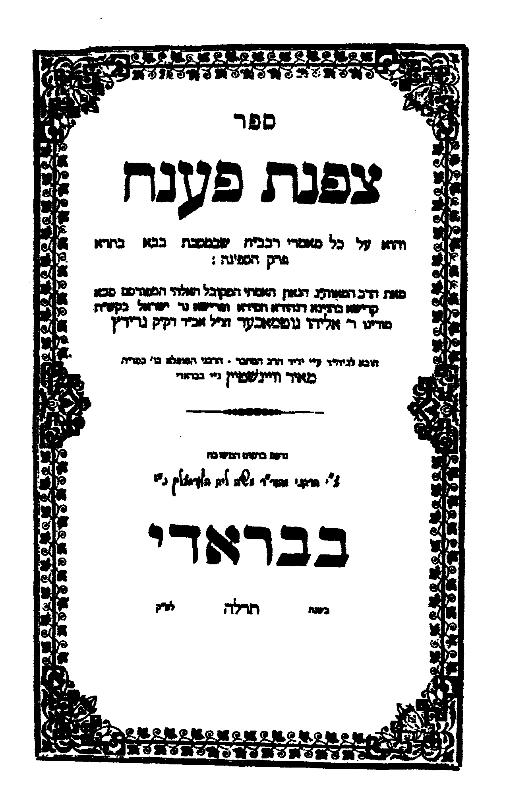
Abraham Menahem spent two years preparing Zafenat Pane’ah. It is a small work, actually a small booklet, described as either a duodecimo (120) or an octavo (80) consisting of [6ff]. In the absence of the place of publication, locations such as Venice (Steinschneider), Ferrara (BenJacob), and Sabbioneta (Sonne) have been suggested. Avraham Yaari, following Sonne, records Zafenat Pane’ah as a Sabbioneta imprint, including it among the books published by the Foa press in that location.[5] The National Library of Israel records Zafenat Pane’ah, giving the location as Sabbioneta but also notes Riva di Trento as a possible place of publication.[6]

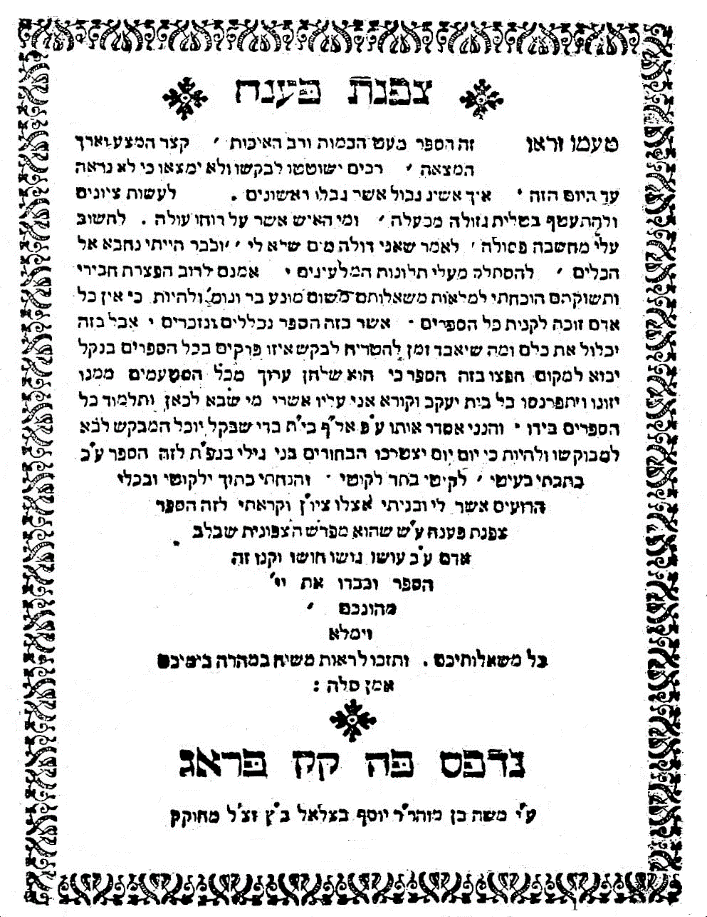
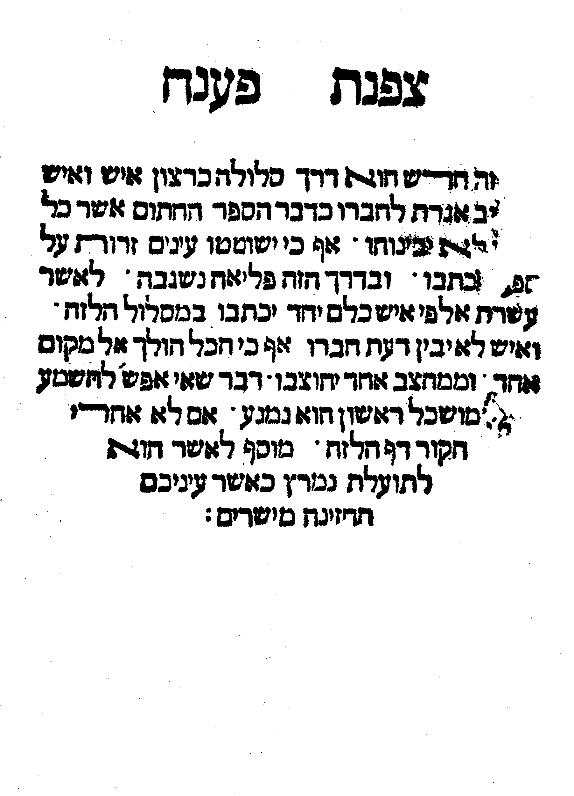
The title-page, perchance intentionally cryptic, does not identify the publisher, place of printing, or author, although the latter is evident from the text. Zafenat Pane’ah was, as noted above, published as a small booklet. The text of the title-page, again, lacking the date and place of publication, as well as having no ornamentation, states,

“See, this is new!” (Ecclesiastes 1:10); “In a levelled way” (cf. Jeremiah 18:15); “that they should do according to every man’s pleasure” (Esther 1:8); to write letters to one’s companion as a sealed book that will not be intelligible to those who see it. Even if alien eyes peruse the writing, in this manner it will be a great marvel, that tens of thousands of men all together should write in this way, that one should not understand the thinking of his companion. Even if “all go to one place” (Ecclesiastes 3:20) and hew from one quarry, something impossible to be heard and from intelligence withheld. If not after searching this page, confirming its great benefit as “your eyes uphold righteousness” (cf. Psalms 17:2).

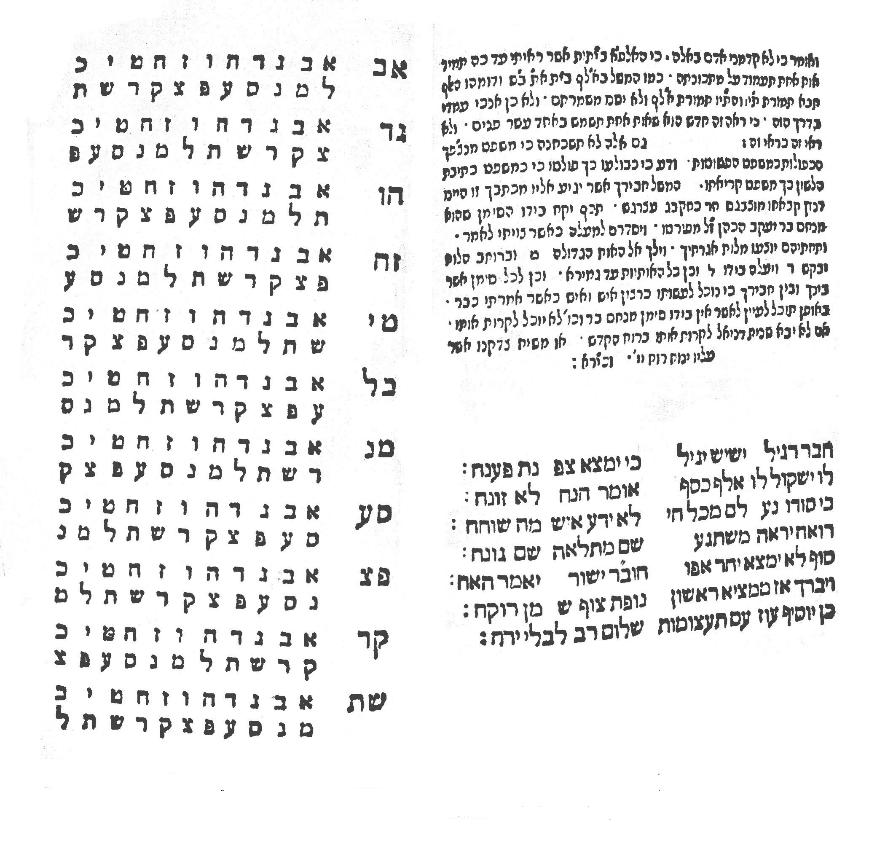
The title-page is followed by Abraham Menahem’s lengthy effusive dedication to his uncle, R. Jacob Mugil, in which he also discusses the need for and value of cryptography, concluding with the date Tuesday, 15 October, 1555, Venice, signed Menahem of Porto. Next is a brief introduction in which the rules of encryption are discussed. He writes that there should be a sign between the writer and the recipient, whether in Hebrew, Ashkenaz, or whichever language the writer chooses, and it does not matter if the signs are numerous or few in number. “‘One who does much sacrifice and one who does less, as long as’ (Berakhot 5a, 17b) he places one letter with another as I will explain.” After some brief instructions on spacing Abraham Menahem signs his name as Menahem ben Jacob ha-Kohen from Porto.

Abraham Menahem’s name follows given in a bold, brief statement referring to the coding of his name, and, also in bold letters, the verse “If you had not plowed with my heifer, you would not have found out my riddle,” (Judges 14:18 ) This is followed by an example, in which Porto’s name appears as Menahem bar Jacob ha-Kohen mi-Porto, followed by the verse. His name is then spelled out over the verse as an encryption example. The text follows, discussing the subject of cryptography.[7]

Abraham Menahem was an eyewitness to the burning of the Talmud in Venice in 1553, which tragic event is reported in the Minhah Belulah, on the phrase “. . . a fiery law unto them,” (Deuteronomy 33:2), where he writes “I fixed these days for myself, for each and every year, for fasting, weeping, and mourning, for this day was as bitter for me as the burning of the House of our God (the Temple).

Anonymous, Prague, [1617]: Our second Zafenat Pane’ah, also a small work, is a very different type of book from Abraham Menahem’s Zafenat Pane’ah. This Zafenat Pane’ah is an alphabetical listing of the chapter heads of Mishnayot in the Babylonian Talmud. It was published at the press of Moses ben Joseph Bezalel Katz in Prague ([1617]) as a quarto (40: 4 ff.). Neither the compiler’s name nor the date are given, the latter being an estimate only. The anonymous author provides a detailed title page in lieu of an introduction, writing:


1617, Zafenat Pane’ah, Prague
Courtesy of the Jewish National and University Library

“O taste and see” (Psalms 34:9) this book, small in size but of great value. “The bed is too short” (cf. Isaiah 28:20) the presentation is long. Many run to and fro, seeking but do not find, “for it was not seen to this day” (I Kings 10:12). How do I think to reset that “which the early ones marked out” (cf. Deuteronomy 19:14), to establish markers and to wrap myself in a tallit stolen from its owner. Who is the man who would think so, to think of me an unfit thought, that I draw waters that are not mine, and I had already “hidden myself among the baggage” (I Samuel 10:22) to avoid the complaints of the mockers. However, the majority urgings of my associates and their desire convinced me to fulfill their requests, because “He who withholds grain [the people will curse him]” (Proverbs 11:26). As not everyone is able to acquire every book which is included and mentioned in this work, all is included here, and whatever time would be lost in trying to locate whichever chapter in all of the books, for it is a spread table (shulhan arukh) with all the savory food from which all the house of Jacob will be fed and nurtured. And I say concerning it, “fortunate is he who comes here and has the learning of all his books is in his hand” (cf. Pesahim 50a, Mo’ed Katan 28a, Ketubbot 77b, Bava Batra 10b). . . .

He concludes that that it is Zafenat Pane’ah (revealer of secrets, Genesis 41:45) for it reveals that which is hidden in the hearts of man. One should acquire this book, honor the Lord, and merit to see the coming of the Messiah speedily in our day.

The text follows in three columns in square letters. Each entry is comprised of the initial words of the first Mishnah in a chapter, the chapter umber, and the tractate name, arranged alphabetically by the first word in a Mishnah. At the end of the volume is a brief colophon summarizing the contents.

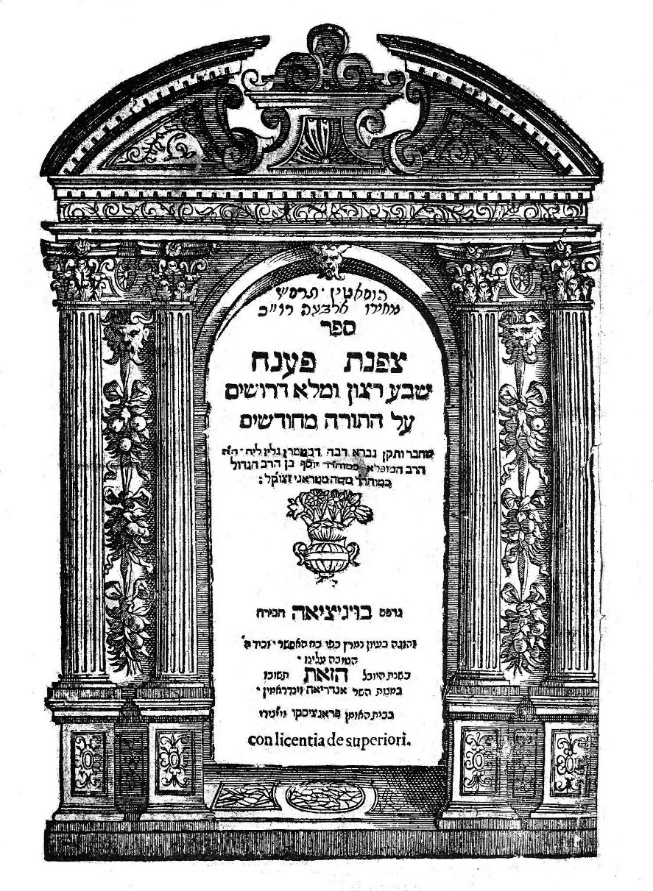
Joseph di Trani’s (Maharit), Venice, 1648: In 1648, the Venentian Vedramin press published a folio (20: [2], 236, 13 ff.) edition of R. Joseph ben Moses di Trani’s (Maharit, 1568–1639) discourses on the weekly Torah portion and festivals, entitled Zafenat Pane’ah. Trani was born in Safed under auspicious signs. On the night that he was born R. Moses Alshekh reputedly saw a great light over his house; his name was selected prior to his birth by R. Moses Cordevoro; his father noted that the year of his birth equaled איש חי (329 = late 1568; a valiant man, II Samuel 23:20), and he received a blessing from R. Joseph Caro prior to the latter’s death. Plague forced him to leave Safed for Egypt, returning, spending some time in Damascus and Jerusalem, but, by 1594 in Safed for an extended period of time where he headed a yeshivah. In 1599, he was sent as an emissary from Safed to Constantinople, and after a second visit, in 1604, heading a yeshivah, and eventually becoming chief rabbi. Among his students were R. Hayyim Benveniste, R. Joshua Benveniste, R. Hayyim Algazi, and R. Solomon ha-Levi.

The title page says that it is Zafenat Pane’ah, “satisfied with favor, and full of” (Deuteronomy 33:23) discourses on the Torah, updated, that were written and corrected by the great man . . . Printed “In the year of this הזאת (5408 = 1648) jubilee you shall return” (Leviticus 25:13).

The title page is followed by two quatrains of verse from the author’s son, R. Moses di Trani, with the heading, “I am the poorest of the poor” (cf. Judges 6:15) “my mouth shall praise you with joyful lips” (Psalms 63:6). Next is Moses’ introduction, the introduction of R. Yom Tov ben Yaish, and verse in praise of the author from his young pupil R. Isaac Alankowa, each paragraph beginning with the word kol (voice), all in a single column in rabbinic letters. At the end of the volume is the introduction of the second editor, R. Jacob ben Moses ha-Levi. The last introduction is printed twice, once with and once without Moses’ name and with variant headings. Zafenat Pane’ah concludes with indexes of verses, Midrashim, and rabbinic sayings. In his introduction Moses begins paragraphs two through nine with the phrase “before the light of the Torah became submerged” due to the destruction of the first Temple; decrees of the wicked Greek kings; destruction of the second Temple; etc. The following ten paragraphs begin “This” is in praise of his father and his work.


1648, Zafenat Pane’ah, Joseph ben Moses di Trani (Maharit), Venice
Courtesy of the Library of Agudas Chassidei Chabad Ohel Yosef Yitzhak

Zafenat Pane’ah is comprised of two to three sermons on each parashah and on festivals. Each homily begins with a quote from a Midrash or equivalent source in square letters, which is then explicated. Sources are given in the margins. The only decorative material is the frame about the heading of the first discourse and a design after the introduction of Jacob ben Moses with his name.

This is the only edition of Zafenat Pane’ah. Other works, excepting di Trani’s responsa and novellae, are no longer extant.

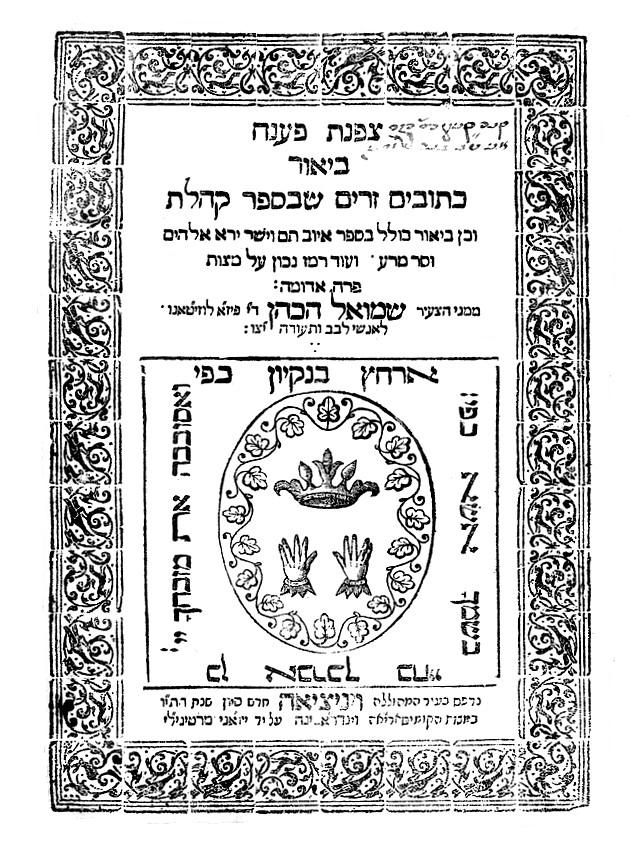
Samuel ha-Kohen di Pisa Lusitano, Venice, 1656: Controversial commentary on the difficult passages in the books of Ecclesiastes and Job by R. Samuel ha-Kohen di Pisa Lusitano (16th-17th cent.). Printed as a quarto (40: [4], 3-33 (should say 31) ff.) in 1656 by the Vendramin press in Venice, this is the only edition of this Zafenat Pa‘ane’ah, the only work of Lusitano, a scholar of Portuguese origin. The title, appropriately, reflects Lusitano’s purpose, to be, appropriately enough for our title, a revealer of secrets (Rashi on Genesis 41:45). Zafenat Pane’ah’s title page states that it is “on the unusual terms in Ecclesiastes and an explanation of Job, ‘a blameless and upright man, one who fears God and turns away from evil’ (Job 1:1, 8, 2:3). Also included are correct allusions on the precept of Parah Adumah (red heifer, Numbers 19:2).”

1656, Zafenat Pa‘ane’ah, Samuel ha-Kohen di Pisa Lusitano, Venice
Courtesy of Virtual Judaica

The title page is dated in the month Sivan in the year 416 (1656). Nevertheless, some bibliographic works, such as the Hebrew Bibliographic Project, based on references in the text, record it as a [1640] imprint. There are several pages of verse (2a-4a) in praise of the book by R. Leone (Judah Aryeh) Modena, R. Jacob ben Moses Levi, יא”ק (R. Joshua Abraham Kalimoni), אמ”ט (I, Moses Treibush of the seed of Jacob), and R. Jacob ben Abraham Shalom, nephew of Lusitano. Next is a warm letter ([4b]-4a) to Lusitano from R. Simhah Luzzatto, who raises the question of whether Job, at the time of his afflictions, denied reincarnation. Lusitano’s brief introduction (4b) follows, in which he notes that it is incumbent upon every Jew to learn Torah and to delve into the books of the Bible. He has turned to the works of “the sage Solomon” in the deep work Ecclesiastes and portions of Job and also to the precept of Parah Adumah. It is not Lusitano’s intent to bring novel interpretations but to elucidate the explanations of the sages.

Zafenat Pane’ah, in a single column in rabbinic letters, is divided into fourteen chapters, one through seven on Ecclesiastes, eight through thirteen on Job, and fourteen on Parah Adumah. Several chapters deal with the Messiah, or other controversial subjects: for example, 2) the time of the Messiah, 3) whether a person born after his coming will die, 4) if after reincarnation the Lord will renew the world in such a manner that they will be angels, 8) whether Job is Job ben Issachar ben Jacob, and 11) allusions to Leviathan on the war of Gog and Megog and whether the Lord revealed to Job his ways, wisdom, and knowledge.

Lusitano’s positions, particularly on reincarnation, incurred opposition from several rabbis. Most notable is R. Samuel Aboab (1610-94), who in his responsa, Devar Shemu’el (Venice, 1702), writes that when he saw the manuscript of Zafenat Pane’ah he was greatly pained and wrote to Lusitano attempting to prevent its publication. Attempting to explain the coming of the Messiah and reincarnation from the verses in Ecclesiastes is like attempting to “make an elephant pass through the eye of a needle” (Berakhot 55b) and attempting to determine these times is in opposition to the Rambam. Worst of all, he endangers the people by confirming that for this generation is written the end of days and Moses’ promise of redemption.

Joseph (Ashkenazi), Frankfurt on the Oder, 1693-94: Zafenat Pane’ah Hadash, homilies on diverse subjects by R. Joseph ben Moses (Ashkenazi), darshan of Przemyslany and rabbi and dayyan in that location (17th cent.) was printed in Frankfurt on the Oder in 1693-94 at the press of Michael Gottschalk as a quarto (40: 60 ff.). Joseph ben Moses was also the author of Keter Torah (Berlin, 1699), and a commentary on the Haggadah included in Haluka de-Rabbanan (Amsterdam, 1695). The title page describes it as:

Discourses, pleasing and delightful, a “work well set” (cf. Isaiah 3:24), a work of great sharpness, “more precious than fine gold” (cf. Isaiah 13:12) and pearls. His Torah was expounded with forty-nine faces, and within each and every entry you will find many views. Written by the great rav, the darshan of Przemyslany, R. Joseph ben Moses, grandson of the gaon R. Abraham Ashkenazi, descended from Rashi, son-in-law of R. Naphtali of Przemyslany, and author of Ketonet Passim.

Beginning of work is dated to Tuesday, the day that it states two times “it was good טוב (15)” (Genesis 1:10, 12) Kislev “And Pharaoh called Joseph’s name Zafenat-Pane’ah (he who explains what is hidden) שם יוסף צפנת פענח (454 = December 5, 1693)” (Genesis 41:45). The colophon (59b) dates completion of the work to Thursday, 2 Shevat, “One law shall be for him who is native born, and for the stranger who sojourns among you תורה אחת יהיה לאזרח ולגר הגר בתוככם (454 = January 28, 1694)” (Exodus 12:49). There is an approbation signed by nine rabbis from the Va’ad Arba Aratzot (1b); Joseph’s introduction (1b-2b), beginning that the Torah is expounded in 49 ways and concluding that the book is named Zafenat Pane’ah for it reveals that which is concealed; the text (3a-59b) in two columns in rabbinic letters; concluding with errata (60a-b) and a list of abbreviations (60b).

Zafenat Pane’ah Hadash is comprised of 60 discourses on diverse subjects, most discourses addressed in several homilies, varying in number from one homily (17 discourses) to sixteen (1) entries and in length from several pages to brief paragraphs The subjects are Adam and Hava, explained in sixteen entries; Patriarchs and Matriarchs; Eretz Israel; first-born; creation; blessing; exile and redemption; robbery; redemption and David (15 Shir ha-Ma’alot); judgment, mercy, and David; hekdesh; confession and repentance; merit and obligation; sin and punishment; tohorah and tuma; Jacob and tribulation; Judah, yibum and halizah; priesthood; honor of Torah and Torah scholars; honor, praise, and rising; learning the written and oral Torahs; Mizraim; Tabernacle and Temple; Moses and Aaron; flood and dispersion; angels; damages, marital property (melog and zon barzel); marriage and divorce; Sodom and Gomorrah; Sanhedrin; witnesses; slaves; Pesah, removal of hamez; Pharaoh and Mizraim; zaddikim; curse and blessing; Korah and his assembly; Cain and Abel and the splitting of the Reed Sea; Kri’at Shema; betrothal; considerable possessions; the wicked; Shabbat; representatives; tribes; oaths; reward and punishment; reward of mitzvah and Torah; resurrection; repentance; and terumot and ma’aserot.

1693-94, Tzofnat Pa’aneah Hadash, Joseph ben Moses of Przemyslany, Frankfurt am Oder
Courtesy of the Society for the Preservation of Hebrew Books

The title-page has an elaborate pillared form comprised of two cherubim at the top blowing horns and at the bottom an eagle with spread wings. Within the wings is a carriage and figures, and in the middle of this scenario is a depiction of the Patriarch Jacob meeting Joseph in Egypt, recalling “And Joseph made ready his chariot, and went up to meet Israel his father, to Goshen, and presented himself to him; and he fell on his neck, and wept on his neck a good while” (Genesis 46:29).[8]

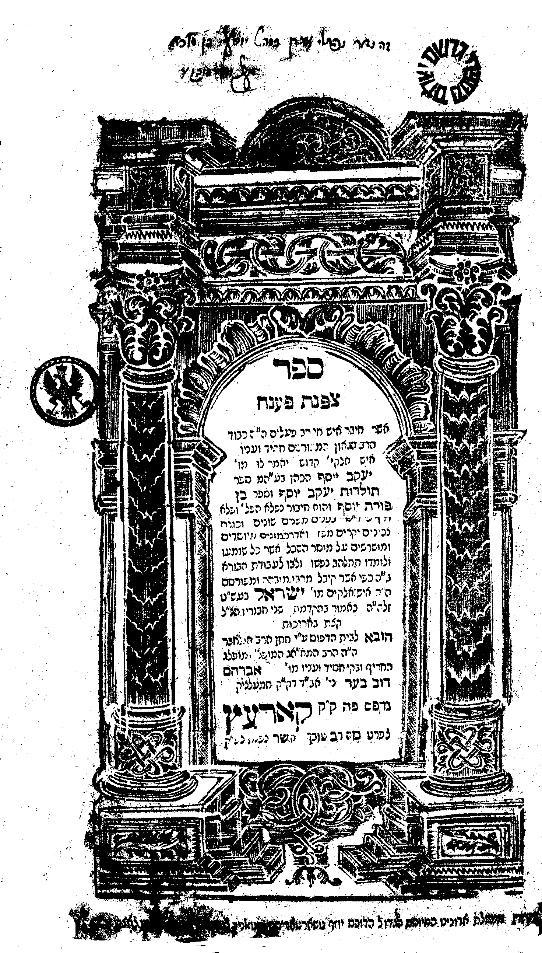
Jacob Joseph ha-Kohen Katz, Koretz, 1782: A commentary on Exodus by R. Jacob Joseph ben Zevi ha-Kohen Katz of Polonnoye (d. c. 1782). Among the foremost disciples of the Baal Shem Tov, Jacob Joseph was a scion of the kabbalists R. Samson ben Pesah of Ostropol (Ostropoler, d. 1648) and R, Joseph Katz (17th century), and of R. Yom Tov Lipman Heller (1579–1654). Jacob Joseph’s most famous work is Toledot Ya’akov Yosef (Korets, 1780), discourses on the weekly Torah readings and the first Hassidic book to be published.[9]

1782, Zafenat Pa‘ane’ah, Jacob Joseph of Polonnoye, Koretz
Courtesy of the National Library of Israel

Jacob Joseph’s Zafenat Pane’ah was printed in Koretz ([1] 35 ff.) at the press of Tsevi Hirsh ben Aryeh Leib Margolis (Margoliot), the first of two of Jacob Joseph’s works printed there at this time. Zafenat Pane’ah was preceded by Ben Porat Yosef (1781), on Genesis. The title-page, dated “How abundant is the good that You have in store [for those who fear You] מה רב טובך אשר צפנת (542 = 1782)” (Psalms 31:20) references Jacob Joseph, noting his Toledot Ya’akov Yosef and refers to the man of God, ISRAEL [Ba’al Shem Tov], informing that it was brought to press by his, Jacob Joseph’s, son-in-law R. Abraham Dov Ber, av bet din Hamaltzik.

The title-page is followed by the introduction which has an interesting and unusual heading, stating that the introduction to this work “has been printed before, twice in two of the author’s books, and is included here so as not to have a blank page. Printed here is an omission from Parasha Ki Sisa (Exodus 30:11-34:35).” It is not only the introductions that are alike, for Ya’aḳov Shemuʼel Shpigel informs that the title-page of Zafenat Pane’ah and Ben Porat Yosef, are also alike. He suggests that Jacob Joseph was not present and it is difficult to know who was responsible for the title-pages. Shpigel does note, however, that the reference to Jacob Joseph’s son-in-law is modified and either he or the printer might be responsible. The reference to the Ba’al Shem Tov is unchanged.[10]

Jedaiah ben Abraham Bedersi (Ha-Penini); Isaac Eisig ben Isaiah Auerbach (Reis) 1797: Classical ethical work, Beḥinat Olam (Examination of the World), by R. Jedaiah ben Abraham Bedersi (Ha-Penini, c. 1280 – c. 1340) with the commentary Zafenat Pane’ah by R. Isaac Eisig ben Isaiah Auerbach (Reis, early 18th century). A popular work, the Bet Eked Sefarim records as many as many as seventy-three printings of Beḥinat Olam, including editions with varied commentaries, three with Zafenat Pane’ah.[11] This printing of Beḥinat Olam, with the commentary Zafenat Pane’ah, was published in Brunn at the press of Joseph Karl Neiman as an octavo (80: 45 ff.). It was preceded by a Sulzbach edition (1744). Parenthetically, Beḥinat Olam was first printed in Mantua in 1478. This is the twenty-fifth edition of that work.

Jedaiah ben Abraham Bedersi (Ha-Penini), was a poet, physician, and philosopher. Among the other works credited to him is Baḳḳashat ha-Memim (The Mem Prayer) composed when he was fifteen. A versified prayer of 1,000 words each of which begins with the letter mem. He also wrote a commentary on the Haggadah, Ohev Nashim (In Defense of Women), Sefer ha-Pardes on such various subjects as isolation, worship, science, and grammar. Beḥinat Olam, Bedersi’s best known work, written after the expulsion of the Jews from France in 1306, is a versified examination, in thirty-seven chapters, of the vicissitudes and vanities of life, with religious and philosophical insights.

This Zafenat Pane’ah is a commentary on Beḥinat Olam by Isaac Eisig ben Isaiah Auerbach. Auerbach was a German grammarian and commentator. He was the author of several books on Hebrew grammar, reputedly motivated by his inability to understand Rashi, causing him to study philology. He eventually wrote Be’er Reḥovot (Sulzbach, 1730), a commentary on the Rashi on the Torah. He was the author of this Zafenat Pane’ah, a Yiddish translation and adaptation of Beḥinat Olam.[12]

1789, Beḥinat Olam with Zafenat Pane’ah, Brunn
Courtesy of the Jewish National and University Library

The title-page is followed by Auerbach’s introduction in which, at both the beginning and the end he describes Zafenat Pane’ah as being an explanation and interpretation (Zafenat Pane’ah). It is followed by the text which is in two columns, the inner columns the text of Beḥinat Olam in square vocalized letters, the outer column Zafenat Pane’ah set in Yiddish in Vaybertaytsh, a type generally but not exclusively reserved for Yiddish books, so named because these works were most often read by the less educated and women.[13]

II

Zafenat Pane’ah, as noted above, is an intriguing title for a book. Based on the rare appearance of the verse “Pharaoh called Joseph’s name Zafenat Pane’ah . . . (decipherer of the cryptic (revealer of secrets), a name that appears once only in the Bible. Zafenat Pane’ah is a name of Egyptian origin, it being the name given by Pharoah to Joseph, albeit one recognizing his rare ability to decipher Pharoah’s dreams. As a title, Zafenat Pane’ah has had an allure for authors. Of the books described above one only deals with cryptography, while several of the first group of books’ authors are named Joseph. Perhaps the allure of the name, Zafenat Pane’ah, decipherer of the cryptic (revealer of secrets) is seen by the authors as being applicable to their works, finding meaning in their interpretations of obscure passages in scriptures and other challenging works.

Our Zafenat Pane’ahs, the subject matter of this article, are early printings. It is important to note that later publications with our title, beyond the scope of this article, while not addressed in any detail, are also of interest. Indeed, note should be taken that several of these later works are, valuable and noteworthy. Below are concise examples of several later works entitled Zafenat Pane’ah

R. Elijah Guttmacher (1795–1874), a student of both Kabbalah and general studies, served as rabbi in Pleschen and Grodzisk Wielkopolski, attracting followers who came to him for amulets, cures, and guidance. He was unusual, in contrast to both Orthodox and assimilationist rabbis, in being a supporter of the Ḥibbat Zion movement. Author of works on Mishnayot and the Talmud, Guttmacher’s titles also include a Zafenat Pane’ah (Brody, 1875, below) “devoted to the tales of Rabbah b. Ḥana as told in Bava Batra.”[14] R. Saul Nathan Nathansohn, in his approbation to this work, writes that Zafenat Pane’ah is so entitled because it is an explanation of the aggadah of Rabbah bar Ḥana which is “obscure and sealed,” all the earlier geonim put their hearts to elucidating it and even the Vilna Gaon wrote a commentary on it.

A sad, tragic Zafenat Pane’ah is the eulogy by R. Asher Nissan ben Judah Leib Levinsohn for his only son, R. Menahem Nahum Nathan. Printed in Vilna (1875), the title-page describes Menahem Nahum Nathan as a gaon, gadol, and sage, and informs that Asher Nissan was the author of such works as Gan Ne’ul, Afikei Yehudah, and Likkutei Shoshanim. In a preface to the reader, Asher Nissan informs that he has entitled the eulogy Zafenat Pane’ah “Because his name is becoming נאה to him and he is becoming to his name, for my son, the gaon.”

Among the later editions of Zafenat Pane’ah are several books entitled Zafenat Pane’ah by the illustrious R. Joseph Rozin (Rosen, Rogachover, 1858–1936). A prolific author, all of his numerous and varied works on the Torah, Talmud, Rambam, and responsa have the title Zafenat Pane’ah.[15]

Our final Zafenat Pane’ah is a commentary on the Torah and festivals by R. Pinchas Shapira ben Shalom, published in Jerusalem (1964). A resident of Kozakonyha, Marmaros from from 1905, he was deported by the Hungarians during World War I to Galicia, settling, in 1918, in Felsovisso. He perished in the Holocaust.[16] His Zafenat Pane’ah was published by his son-in-law, R. Menahem Mendel Taub, the Kaliver rebbe. In the introduction Pinchas Shapira writes that he has entitled this work Zafenat Pane’ah because it alludes to his name and to the names of his father and of his mother. The initial numerical values of Zafenat Pane’ah צפנת פענח are, together with the number of its letters and general number (828 + 8 + 1 = 837), equal to Pinchas פינחס (208) ben במוה”ר (253) Shalom שלום (376 = 837). A second example is Pinchas פינחס ben Hanna Sarah בן חנה שרה (208 + 620 = 828).

III

Our Zafenat Pane’ahs and a [Hadash], noted both in some detail and concisely, encompass such varied subjects as cryptography, an alphabetical listing of Mishnayot chapter heads, biblical interpretations, a eulogy, an ethical work, and other diverse subjects. All reflecting the authors’ concerns with clarifying, making clear, that which is not clear, not immediately obvious without insightful interpretation. What then, could be more appropriate than the title Zafenat Pane’ah, “decipherer of the cryptic (revealer of secrets)”?

1875, Zafenat Pa‘ane’ah, Elijah Guttmacher, Berlin
Courtesy of Ozar ha-Hachms
[1] I would, once again, like to express my appreciation to and thank Eli Genauer for reading the manuscript and his comments.
[2] Among the authors addressing the subject of book titles are Abraham Berliner, “Shemot Seforim Ivrim,” in Ketavim Nivharim II (Jerusalem, 1969), pp. 147-48 [Hebrew]; Joshua Bloch, “Some Odd Titles of Hebrew Books,” Bulletin of the New York Public Library 41:10 (New York, October, 1937, reprinted in Hebrew Printing and Bibliography, New York, 1976), pp. 151-57; Solomon Schechter, “Titles of Jewish Books,” in Studies in Judaism, First Series (1896, reprint Philadelphia, 1938), pp. 270-281; and Menahem Mendel Slatkine, Shemot ha-Sefarim ha-Ivrim: Lefi Sugehem ha-Shonim, Tikhunatam u-Te’udatam (Neuchâtel-Tel Aviv, 1950-54) [Hebrew].
[3] My previous articles on the subject are “Adderet Eliyahu; A Study in the Titling of Hebrew Books,” in Studies in the Making of the Early Hebrew Book. Brill, Leiden/Boston, 2008, pp. 72-91; “What’s in a name? An example of the Titling of Hebrew Books,” in Further Studies, pp. 371-94; “Keter Shem Tov: A Study in the Entitling of Books, Here Limited to One Title Only” in Essays on the Making of the Early Hebrew Book (forthcoming); “Entitling Hebrew Books from Shir ha-Shirim: (Song of Songs)” in Essays; and “For a Remembrance: Books so entitled as a remembrance for the author.” (Hakirah, forthcoming).
[4] Ch. Friedberg, Bet Eked Sefarim, (Israel n.d.), tav379-396 [Hebrew].
[5] Avraham Yaari, “The Printers B’nei Foa,” in Studies in Hebrew Booklore, (Jerusalem, 1958), p. 362 n. 17 [Hebrew].
[6] National Library of Israel system number 990017477400205171.
[7] Marvin J. Heller, “Abraham Menahem ben Jacob ha-Kohen Rapa mi-Porto (Rapaport) Ashkenazi: A Renaissance Rabbi of interest” Seforim.blogspot.com (March 17, 2021).
[8] Concerning the eagle motif on the title-page of Hebrew book see Marvin J. Heller, “The Eagle Motif on 16th and 17th Century Hebrew Books,” Printing History, NS 17 (Syracuse, 2015), pp. 16-40 and in Essays (forthcoming).
[9] Mordechai Margalioth, ed. Encyclopedia of Great Men in Israel 3 (Tel Aviv, 1986), cols., 867-69; [Hebrew]; Tzvi M. Rabinowicz, The Encyclopedia of Hasidism (Northvale, London, 1996, pp. 239-40.
[10] Ya’aḳov Shemuʼel Shpigel, ʿAmudim be-Toldot ha-Sefer ha-Ivri: be_Sha’are ha-Defus (Jerusalem, 2014), pp. 115-16 [Hebrew].
[11] Ch. Friedberg, Bet Eked Sefarim, bet 341.
[12] Yehoshua Horowitz, “Auerbach, Isaac Eisig ben Isaiah,” Encyclopaedia Judaica, vol. 2, pp. 654-655.
[13] Concerning the early use of Vaybertaytsh see Herbert C. Zafren, “Variety in the Typography of Yiddish: 1535-1635,” Hebrew Union College Annual LIII (Cincinnati, 1982), pp. 137-63; idem, “Early Yiddish Typography,” Jewish Book Annual 44 (New York, 1986-87), pp. 106-119. Zafren suggests, in the latter article, that the origin of Vaybertaytsh, which he refers to as Yiddish type, was the Ashkenaz rabbinic fonts, supplanted by the more widespread Sephardic rabbinic type which prevailed in Italy (p. 112)..
G[14] Getzel Kressel, “Guttmacher, Elijah.” Encyclopaedia Judaica, vol. 8, pp. 155-156.
[15] An example of the Rogachover’s acumen can be seen from his exposing the widely accepted bogus edition of Seder Kodashim of the Jerusalem Talmud. The Rogachover, one of the few who questioned the authenticity of the forgery, observed that each Talmudic tractate mentions at least one amora (Talmudic sage) not mentioned elsewhere, whereas in this work there are no amoraic hapax legomena. Concerning the forgery see Marvin J. Heller, “Who can discern his errors? Misdates, Errors, and Deceptions, in and about Hebrew Books, Intentional and Otherwise” Hakirah: The Flatbush Journal of Jewish Law and Thought 12 (2011), pp. 269-91, reprinted in Further Studies in the Making of the Early Hebrew Book, (Leiden/Boston, 2013), pp. 417-20.
[16] Tzvi M. Rabinovicz, The Encyclopedia of Hasidism, (Northvale,1996), p. 450.


The Kabbalat Shabbat Memorandum by Rabbi Prof. Daniel Sperber

The Kabbalat Shabbat Memorandum       Sivan 5773
by Rabbi Prof. Daniel Sperber
The recent rather
acrid debate on women leading the Kabbalat Shabbat service appeared, at first,
to be primarily a halachic one. But it soon overflowed into additional areas,
revealing it as a clearly political polemic. Indeed, I found the whole
discussion which appeared on a whole series of blogs, and a major published
article, most astonishing. We are not talking about women reading the Torah
and/or having aliyot. The criticisms raised against this practice I can well
appreciate, though I disagree with them and have sought to refute them.
But here we are
talking about a practice first established in the latter years of the 16th
cent., among a small group of people, disciples of the Ari ha-Kadosh in Safed,
which took place outside the confines of the synagogue looking over the hills
and watching the sunset, and reciting some psalms and piyyutim. It gradually
spread to other venues, first being practiced outside the synagogue in the
courtyard, and, later, when in the synagogue, recited at the bimah, rather
than the chazan’s lectern, clearly to emphasize its different status from the Maariv
service. In many communities there is no sheliah tzibbur leading the
service; rather the congregants sing the Psalms together. Indeed, in small
communities often the service begins even before there is a minyan of
ten men, and the congregation wait for the requisite number in order to say Barchu.
As to the argument that, as it is followed by Kaddish, it must
have the status of a tefillat tzibbur or teffilat rabbim, a
communal service which cannot be led by women, it should be noted that the Kaddish
Yatom
only comes after Mizmor Shir le-Yom ha-Shabbat, which is
already found in some Rishonim as part of the Maariv Shel Shabbat;
and therefore does not in any sense relate to the Kabbalists of Safed’s Kabbalat
Shabbat
. Furthermore, Kaddish Yatom itself may be recited by women,
as was ruled by R. Ahron Soloveitchik and others. But, in point of fact, this Kaddish
is not found in early sources, such as the Tur (Orah Hayyim 337).
 Indeed, the whole argument aimed to
give Kabbalat Shabbat this new status is far-fetched.
But the debate
about Kabbalat Shabbat was intended to have far broader implications,
for, by the same argument it would also disallow women to lead Pesukei
de-Zimra
, for example. Indeed, this tendentious aim is overtly revealed by
yet another argument put forward, namely that a Shaliah tzibbur must
have a full beard; something that obviously excludes women, (Shulhan
Aruch
53:6). The reason given is the dignity of the congregation, kevod
ha-tzibbur
, which is clearly irrelevant in present day society.  Both the Maharam Mi-Rotenberg and the Rashba
agree that the congregation can waive this requirement.  The original ruling applied only to
permanent shlichei tzibbur, not to occasional readers, and, on occasion,
even a thirteen-year old, who has reached maturity may lead the service.
Additionally, the Biur Halachah writes that this requirement may be
waived when there is no one else to fulfill this function. And finally, this
restriction referred to very specific prayers, such as Keriat Shema, on
fast-days in Eretz Yisrael because of drought, and The High Holidays. In any
case, nowadays hardly any synagogue requires its reader to be bearded; even
American Rabbis are often clean-shaven, because the plain meaning of that
ruling is that a service should be led by one who is mature, i.e.
post-bar-mitzvah. And a thirty-year old without a beard is fully eligible to
serve as a shaliah tzibbur. Indeed some of greatest hazzanim were
beardless, such as the Koussevitzky brothers, Mosheh, David, Jacob and Simhah,
Leibele Waldman, Leibele Glanz, Zavel Kwartin, Shmuel Malavsky, to list only a
few of the best-known names.
Two additional
arguments were put forward. Firstly, that for Kabbalat Shabbat, the Shaliah
Tzibbur
wears a tallit. This, of course, is in the case where there
is a Shaliah Tzibbur. Now according to the Magen Avraham (Orah
Hayyim
18:1) citing the Bayit Hadash (Bah) one really should
remove the tallit one is wearing when one says Barechu since it is night
and one does not wear tzitzit at night. And so many Aharonim
specifically rebuked those who wore a tallit at night. However, those
who did so, did so because of kabbalistic reasons related to Kevod Shabbat,
and not kevod ha-tzibbur. Indeed, there were even those who wore a
tallit for kiddush at home, and kiddush at home is hardly a tefillat
tzibbur
or rabbim, (see J. Levy, Minhag Yisrael Torah 1,
Brooklyn 1994, pp.87-88).
The second point
raised was, curiously enough, from R. David Sperber, my grandfather’s Teshuvot:
Afrakasta de-Anya
, (3rd ed, Israel 2002, vol.4, p.215). There he
says that if one cannot find a minyan, at least try to pray with two
other people, since this would constitute a tefillat rabbim, which is
more readily accepted by God. He derives this from a passage in Hayyei Adam
(Klal 68:11) who says that every mitzvah which can be done be-haburah
in a group, should be so done, and not as an individual, because “the
greater the number of people, the greater is the honour to the king.” If
three people give tzedakah, does that make it a rabbim? If three
people declaim Psalms together does that make it a tefillat rabbim?
Surely the term my grandfather zt”l used was not intended to give a
special status to the group of three, but merely to say that such a mitzvah
or prayer is more acceptable before the Holy One Blessed be He, than that of a
single individual. (His other reference to vol.2 p.211 is quite irrelevant to
this issue.)
(On a personal
note, I might add, that in order fully to understand my sainted grandfather’s
ruling, one has to appreciate his particular brand of hassidic piety, which was
a blend of halachah, kabbalah and a special brand of hassidut. See my father’s
introduction in his Michtam le-David on the Torah.

His belief in the
efficacy of prayers was all so evident to anyone who saw him in prayer.  I served him in his latter years and
received my semichah from him.)
Now my learned
colleagues knew all these facts, which are plainly evident to anyone who is
conversant with the relevant sources. Nonetheless, they chose to disregard
them, or to reinterpret them in a forced fashion.
So looking more
closely at the discussion, it becomes evident that rather than this being a
genuinely halachic debate, it is more a socio-political polemic, built on shaky
grounds and dressed in the somewhat misleading garb of halachic disquisition.
(And see now the
very significant comments of Prof. Marc B. Shapiro, (link), and Rabbi Zev Farber’s responses to Rabbi R. Freundel’s articles.)
Another note on
Women’s aliyot.
One of the
central points of controversy between those who permit women’s aliyot and those
who do not, is the understanding of the critical text in B. Megillah 23a which
states that “all are counted among the seven aliyot, even women and
children. But the Rabbis said: ‘A woman should not read the Torah because of
the dignity of the community’ “. It is this final section that is the main
source of the controversy. Some have claimed that “But the Rabbis said: A
woman should not read…” is an absolute decree that cannot be changed.
Others – myself included – have argued that this is advice, rather than a
decree, limited by the principle of “the dignity of the community”.
That is to say, if there is no such slight on the community, the advice becomes
irrelevant. I argued that most of the places where the phrase “But the
Rabbis said” may be understood as “advice” and not
“decree”. Recently Ephraim Bezalel Halivni sought to show that in
many instances “But the Rabbis said” should clearly be understood as
a “decree” formulation. However, he himself (Studies in Liturgy
and Reading The Torah
, Jerusalem 2012, p.160) agrees that there are examples
where this phrase can be understood as “advice”. Hence, even
according to his position, he will have to agree that it is possible
that in our Megillah text “But the Rabbis said” may be advice. In
other words there is an element of uncertainty (safek) as to the precise
interpretation of that text.
And even if we
were to interpret it, as have some, as a decree, it is a decree with a reason.
Now there exists a well-known controversy between Rambam and Raavad as to
whether when the reason for a decree is no longer relevant the decree is still
in force; Rambam says yes, and Raavad disagrees. It is true that in such
controversies we follow the Rambam; however, it is equally true that it is not certain
that he is correct.  Perhaps the
Raavad’s position is more correct. In other words, there still exists an
element of uncertainty (a safek) as to who is right. It is just that in
accordance with certain pragmatic rules of halachic adjudications (pesak),
we follow the ruling of Rambam.
Moreover, R.
Yosef Messas added a further consideration, arguing that even according to the
view of Rambam, this principle only applies where there is a fear that the
original reason could be relevant in the future. But in a case where there is
little or no reason to think that the reason will resurface, the original
prohibitions may be disregarded, (Otzar Michtavim 1, 454; cf. Marc B.
Shapiro, Conversations 7, 2010, p.101). Here too, we may be fairly
certain that in our modern society the dignity of the community will not be
impugned by a woman’s aliyah even in the future, in addition to which, we have
already pointed out that a community can, according to both the Maharam
Mi-Rotenburg and the Rashba, forgo their dignity should they so wish.
Now, I cannot say
that R. Messas’ interpretation is necessarily correct.  There exists a safek, in fact, a
triple sfek sfeka: (i) what is the correct interpretation of B.
Megillah’s phrase, (ii) whether to rule like Rambam or the Raavad, and (iii) even
if one follows Rambam, should we accept R. Messas’ interpretation that it
applies even when there is little or no reason to think that the reason will
resurface.
Without going
into all the details of the very complex kuntres sfek-sfeka, surely here
we should rule: sfek sfeka le-kula, most leniently, admitting the
permissibility of women’s aliyot, especially when added to all our other
arguments.
Final Note
And finally, a
somewhat pedagogical comment. The Beit Yosef, of R. Yosef Caro in Yoreh Deah
242 writes:

It is forbidden for a hacham to give a ruling permitting
something which looks strange, for the masses will see this as permitting the
forbidden.

He bases himself
on Hagahot Maimoniyot to Rambam Hilchot Talmud Torah chapter 5 sect.6.  Now almost all innovations look strange, and
can easily be understood as permitting the forbidden . And indeed this is the
ruling in Shulhan Aruch Yoreh Deah 242:10. (And see Beur ha-Gra ibid. sect. 21
for Talmudic sources.) But the Shach (Siftei-Chen) ad loc. sect.17 modifies
this statement as follows:

It would appear that this [refers to a case] where he permitted
[something] without any explanation [for his ruling] – setam – and
indeed so it appears from the proofs he brings from Hagahot Maimoniyot and B.
Sanhedrin 5ab… and B. Nidah 20a…, and the beginning of B. Berachot (3 b)…  But if he tells the questioner the reason
for his ruling, and explains to him his arguments (ומראה
לו פנים), or if he brings
evidence from the book, it is permitted.

And the Beer
Heiteiv brings this in abbreviated form. (See also note 8, ad loc. in Otzar
Mefarshim in the Machon Yerushalayim [Friedman] ed. of the Shulhan Aruch.)
This indicates to
us very clearly that all the changes that we are advocating must not only be
firmly based in our canonic sources, but also clearly presented to the general
public.