A Third Way: Iyyun Tunisai as a Traditional Critical Method of Talmud Study

A Third Way: Iyyun Tunisai as a Traditional Critical Method of Talmud Study[1]
by Joseph Ringel 

The following is an excerpt from an article with the above title by Joseph Ringel. The full article, including the footnotes detailing the source materials, and the appendix, have been published in the Fall 2013 issue of Tradition (46:3), and is available for purchase at http://www.traditiononline.org/.

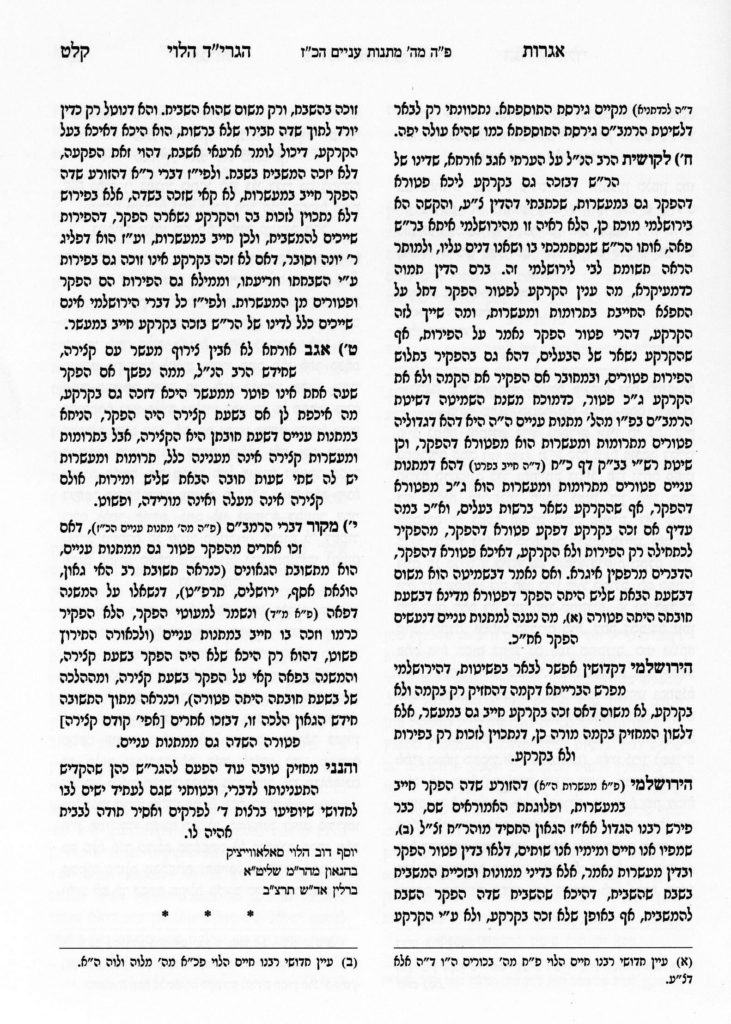
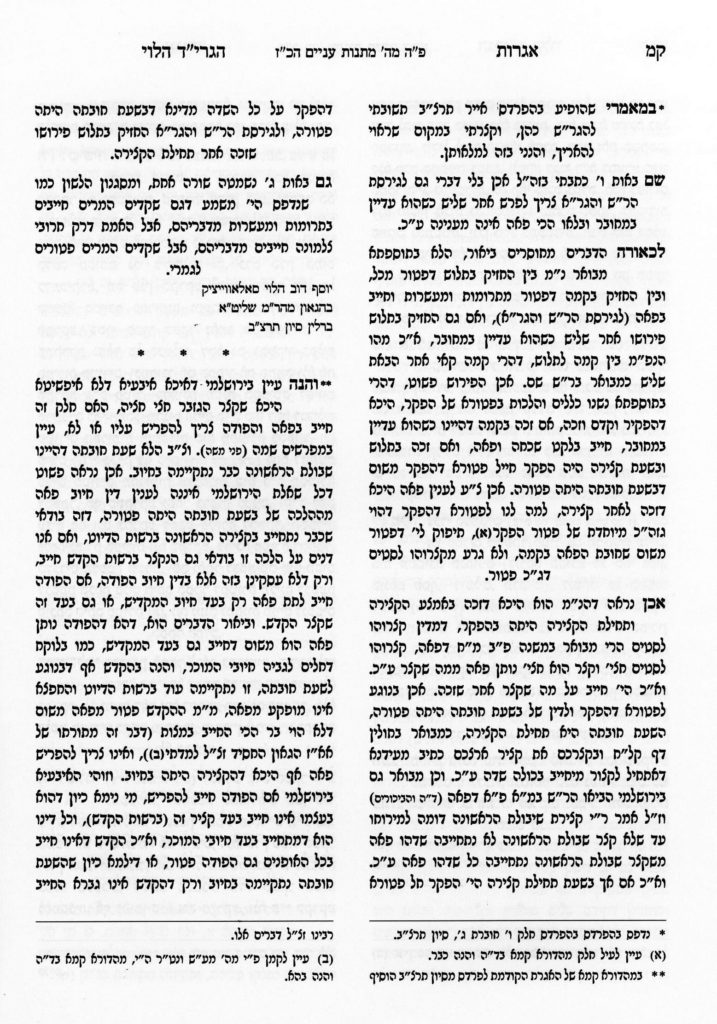
          In recent years, scholars have taken a renewed interest in elucidating the specific methods used to study Jewish texts in yeshivas, both past and present. For example,   Daniel Boyarin elucidated the classical late medieval/early modern Sephardic approach to Talmud study, and Norman Solomon published his dissertation on the development of the Analytic/Conceptual/“Brisker” approach to Talmud study in Lithuania in book form. These works are historical monographs, the purpose of which is to relate to the development of specific methods at specific times in history, not to connect those methods to the approaches utilized in present-day yeshivas. More recently, Mordechai Breuer wrote a magnificent work detailing the curricula and educational methods used in yeshivas throughout the ages until the present. Yet, despite Breuer’s painstaking research, he misses some of the more recent incarnations of older methodologies that he himself mentions. In 2006, Yeshiva University published the proceedings of the 1999 Orthodox Forum, which dealt with issues surrounding contemporary lomdut, in a volume entitled Lomdut: The Conceptual Approach to Jewish Learning. As can be seen from the title, the volume conflates contemporary lomdut (a term that is hard to define with precision but which will be used to describe any form of in-depth study of a text) with the Conceptual/Analytic /Brisker Approach and does not deal extensively with other specific forms of lomdut. In some cases, alternatives to the Brisker approach are presented as either halakha-oriented methods uninterested in more theoretical discussions or as academic approaches that are hostile to Jewish tradition.
     This article will present the basics of one alternative method of lomdut, which is dubbed by its main contemporary champion, R. Meir Mazuz, as “Iyyun Tunisai,” or “Tunisian Analysis.” The first section of the article will present the basics of Iyyun Tunisai and its origins in Jewish tradition, thereby showing that not only is it a viable alternative to the Brisker approach but it is a fully traditional method with roots in classic rabbinic sources. The second section presents R. Mazuz’s critiques of alternative methods of study, in which he claims that the critical approach utilized by the Tunisian method allows the analyst to reach the correct understanding of the text at hand and to appreciate why each element of the text is an integral part of that text. Thus, unlike academic methodologies, which often undermine the sugya (the Talmudic discussion), Iyyun Tunisai uses a critical approach in order to explain and link the different terms of the sugya, thereby strengthening the integrity of the sugya. The third section concludes with an analysis of the place of Iyyun Tunisai in the yeshiva world and its prospects for the future.
I. Jerba in Bnei Brak: Yeshivat Kisse Rahamim and the Renewal of Sephardic Iyyun
     As noted above, one of the main competitors for intellectual dominance in the yeshiva world is Iyyun Tunisai, a Sephardic method of study whose roots go back hundreds of years. Rabbi Meir Mazuz of Yeshivat Kisse Rahamim in Bnei Brak is the one responsible for the revival of this method. In order to gain a full appreciation for the context in which this method is being revived, it is necessary to give a brief overview of Yeshivat Kisse Rahamim. The yeshiva was founded by R. Meir Mazuz’s father, Rabbi and Tunisian Supreme Court Justice Matsliah Mazuz in Tunisia in 1962/63, and then re-established by his sons (Rabbis Meir and Tsemah Mazuz) in Israel in 1971, after having fled their native Jerba (an island off the Tunisian coast whose Jewish community was renowned for its scholarship) following the murder of their father by an Arab nationalist. Their school is an elite yeshiva with a rigorous examination process (only twenty-five percent of applicants are accepted), and its methodology is in keeping with its desire to produce not merely scholars but the leading posekim (jurists) of the next generation. The yeshiva also houses a bookstore that carries books published by Mekhon ha-Rav Matsliah, a press named for R. Matsliah Mazuz that (re-) publishes old Jerban and Tunisian commentaries on Talmud, grammatical works, new commentaries and textbooks written by students, graduates, and rabbis of the yeshiva, as well as siddurim and tikkunim based on the Jerban custom.
     It is in this context of Sephardic-Jerban-Tunisian religious revival that the renewal of this method of iyyun is taking place. In two essays that he wrote on the subject of method of study (derekh limmud), R. Meir Mazuz (henceforth “R. Mazuz”) insists that, though he terms the method he champions “Tunisian analysis,” he assures his readers that the method was not limited to that geographical area but was at one point used throughout the Jewish world. Indeed, Iyyun Tunisai was originally codified not by a Tunisian rabbi, but by the Castilian R. Yitshak Canpanton (or Campanton; 1360-1463) in his Darkhei ha-Talmud (“The Ways of the Talmud”). Sephardic Iyyun as it was originally
practiced was the subject of a seminal study by Daniel Boyarin, who claims that R. Canpanton interpreted various methods of analysis used in the Talmud in light of theories of semantics and language that were current in medieval Scholastic-Aristotelian works. Boyarin remarks that the method spread following the expulsion of the Jews from Spain to the sixteenth and seventeenth-century academies of “Safed and Jerusalem… Constantinople and Salonika… Cairo and Fez,” and then exclaims, “and how surprising it is that this method of learning has been almost entirely forgotten and is barely mentioned in the research laboratory (sadnat ha-mehkar) and in the house of study (beit ha-midrash) up until our very generation.” This carefully worded statement shows that the method has nevertheless not been entirely forgotten, even as the author does not seem to be aware of its existence in any significant beit midrash. This section will show that Sephardic iyyun has in fact been preserved in the “houses of study” of North Africa and is now undergoing a revival in Israel. Because Ashkenazi methods have dominated the yeshiva system for so long, a successful revival must encompass two elements: 1) a re-codification of the fine points of the methodology, with which most yeshiva-educated rabbis would not be familiar, and 2) a well-articulated attack on the regnant
Ashkenazi methods that threaten the revival. R. Mazuz’s writings do both. What follows is an analysis of R. Mazuz’s positions as expressed in his first essay on methods of study, aptly entitled “Ma’amar be-Darkhei ha-Iyyun” (“Article on Methods of Analysis”).
The Basic Assumptions of the Method
     R. Mazuz introduces his first article by terming his analytical approach ha-iyyun ha-yashar, “the straight analysis,” a term that functions as a polemical tool against other methods that he feels muddle the text instead of elucidating it in a step-by-step process. In vouching for the approach of ha-iyyun ha-yashar, R. Mazuz quibbles with Ramban’s theory of law, which asserts that, while scientific discussions result in exact conclusions, Jewish legal argumentation does not allow for definitive proofs. In contrast, R. Mazuz contends that over the centuries a methodology developed with the type of exactness necessary to properly determine the law. R. Mazuz’s rejection of inexactness in law parallels the same rejection that, according to Daniel Boyarin, stood at the heart of R. Canpanton’s methodology and its Aristotelian assumptions, which viewed any idea or interpretation of a text as provable or disprovable based on rational analysis. R. Mazuz’s confidence in the scientific acumen of his method becomes explicit when he states that the method’s goal is to “dig into and penetrate the original intention of the statements [at hand] with full confidence, without any hesitation or doubt.”
     After a discussion of his method’s roots in the rabbinic tradition, R. Mazuz goes on to describe the method in depth:
The foundation of the foundations of iyyun is that there is nothing missing [from] or added onto the language of the Gemara, Rashi, and Tosafot. There is nothing missing – because the text has not come to shut out [information] but to explain [matters], and it is not proper [to think] that the main elements of the matters [under consideration] are missing from the Talmudic discussion [Aramaic sugya] and its commentaries, for they [the rabbis] have not come to test us with riddles… And there is nothing added – because our rabbis have always tried to write with brevity and exactness, [with] the small carrying the abundant [i.e. with a small number of words carrying great depth].
     What R. Mazuz considers to be the foundation of Iyyun Tunisai is in fact already elucidated by R. Canpanton. Elements of one passage of R. Canpanton are echoed in R. Mazuz’s description above:
And always attempt to impute necessity for all of the words of a commentator or an author in all of his language: why did he say it
and what did he intend with that language, whether to explain [an issue] or to derive [a concept] from another explanation or to resolve a difficulty or a problem. And take heed to limit [le-tsamtsem] his language and to derive [concepts from] it in a way that there will not be an extra word, for if it were possible express his intent, for example, in three words, why did he express [himself using] four [words]? And so you should do with the language of the Mishna and Gemara, that is, you should check their language so that there not be an extra word, and when it appears to you to be extra go back and analyze well, for they did not expand their words unnecessarily, for it is not a small matter, and the splendor of sages is to minimize words so that many concepts are included in small [numbers of] words, and to make their words few in quantity but great [lit. “many”] in quality, and there should not be within their words an extra word, even [if it consists] of one letter, as they [the Sages] have said ([B.T.] Hullin 63b), “A person should always teach his students in a concise way,” as you see in our Holy Torah, which was given from the Mouth of the Mighty One, which speaks with a concise language but includes many things…
The Importance of Syntax
    R. Mazuz identifies the importance of syntax as the second major element of Iyyun Tunisai. He criticizes those who downplay the importance of understanding each word and its implications and the proper stopping points of statements, and complains that many students do not know the meanings of basic expressions, which can change depending on context. R. Mazuz then offers an example that highlights the importance of paying attention to syntax. In this example, an erroneous interpretation of a statement could have easily been averted if the commentator had thought about where to properly end the sentence.
     R. Mazuz’s focus on the meaning of words is not paralleled in R. Canpanton’s codification, possibly because it is so simple that no reiteration is needed. However, in the current educational climate, R. Mazuz feels that stating what should be obvious is necessary. It seems that the tendency in many yeshivas to emphasize advanced analysis contributes to the lack of focus on more simple syntax. R. Mazuz feels that this lack of focus on the basics leads to avoidable misinterpretations of the text.
Commentary for the Purpose of Preventing Alternative Mistaken Interpretations
     R. Mazuz proceeds to describe the third major element of Iyyun: “The third general rule of the methods of Iyyun is to ask, in every place, what was Rashi, Tosafot, or Maharsha bothered by, and from which error they were protected from that word and that sentence…”” In other words, the analyst studying the text should ask himself why a classical commentary would add in a seemingly extra word, or would use a seemingly odd phrase. Most often, the answer is that the commentator in question wanted to prevent his readers from making a mistaken assumption about the subject at hand, which they would have made without the quixotic phraseology that the commentator used. It follows that the seemingly extra word or the seemingly awkward phrase is in fact neither extra nor awkward, but necessary for the correct understanding of the text under discussion.
     This type of linguistic analysis assumes that the unusual language of a commentator is used to prevent the reader from coming to an incorrect conclusion. This conclusion is referred to by the classic Sephardic me’ayyenim as sevara mi-baHuts, lit. “the logical construction from the outside” – i.e., a thought process whose origin comes from outside the text. R. Canpanton writes as follows:
… And afterwards [i.e. after reading through the text a number of times and determining what is stated explicitly and what should be
understood implicitly] return to analyze if there is a novelty in what is understood from the language or not… if there is no novelty, raise a difficulty with the one who makes such a statement… “What is it [i.e. the statement] teaching us? [It is] obvious!” And if there is a novelty in its inference [i.e. if there is a novelty in what you have inferred from the statement], but there is no novelty in the essence of the statement [i.e. in the plain meaning of the statement], it is possible to say that he [i.e. the speaker] chose it [i.e. chose to make the statement in the way that he did] because of the inference… And certainly look carefully at every statement [and ask] what you would have thought based on your logic or what you would have adjudicated based on your sense before the tanna or amora would have come [to make his statement], for a great benefit will result for you from this [method], for if you yourself would have thought as he [did], ask him, “What [does this statement] teach us? It is obvious!” And if your logic contradicts his, you should know and search out what the necessity was that caused him to say thus, and [find out] what the weakness or bad element was within what you yourself had thought, and this [i.e. the logic you would have originally assumed] is called “the logical construction from the outside.”
     Due to the abstract nature of this section, it is highly recommended that readers look through the appendix, which offers a concrete example of sevara mi-baHuts.
The Logical Flow of the Text
     R. Mazuz identifies a fourth element of ‘Iyyun Tunisai, which relates to the logical flow of the text of Tosafot, who are known for posing many questions and answers in a row. R. Mazuz suggests stopping after each question-and-answer pair to analyze how each question was
answered and how the next question relates to the previous question-and-answer. In this way, the student can identify in what way the main issue being discussed is resolved. This resolution is known as “the center of the resolution,” or merkaz ha-teruts.
     The assumption that every element in a rabbinic text relates to the previous one or next one is spelled out explicitly by R. Canpanton at the beginning of Chapter Ten of his Darkhei ha-Talmud: “Always, for every statement and for every concept that is situated next to another, whether in Talmud or in  Scripture (ba-Katuv), carefully observe the relationship and connection between those concepts situated next to each other, including what order the speaker is leading (molikh) with his words.”
            R. Canpanton’s statement was made in reference to the literary structure of all rabbinic texts and specifically the Talmud. R. Mazuz’s focus on the literary structure of Tosafot is a natural outgrowth of Sephardic Iyyun’s general concern with the flow of the text. The emphasis on Tosafot began, at the very earliest, during the generation after the expulsion from Spain, with the spread of printed editions of the Talmud that included Tosafot’s commentaries. R. Canpanton himself never mentions Tosafot in his work, probably because manuscripts of Tosafot’s writings did not have widespread circulation in Spain. Instead, other passages highlight the importance of carefully analyzing Rashi and Ramban, whose commentaries were available at the time.
The Role of Writing and Revision
     The fifth and final major element of Iyyun Tunisai that R. Mazuz identifies is the importance of writing and revision following one’s studies. The student should summarize his understanding of the commentary or Tosafot he is studying as a test to see whether he has understood it properly. If the student’s own words seem to match the commentator’s but are simply more expansive, the student has understood; if not, the student should review the commentary and revise his statement. Aside from the clarity of understanding the student gains, frequent writing and revision allows the student to express his ideas clearly. R. Mazuz notes that the rabbis of Jerba traditionally educated their students in such a manner, training their students to write their own novellae in a clear and organized fashion.
R. Mazuz’s Polemic against Lithuanian-style Methodologies and Its Significance
     After having stated earlier in his essay that there is nothing extraneous to, or missing from, the language of the classical Jewish texts, R. Mazuz launches into a justification of this assumption and a polemic against alternative methods of study:
It follows that, if a person overloads explanations and commentaries regarding the intent of the early commentaries that do not flow necessarily (be-hekhreah) from the implication of the language and [of] the style or from the force of a contradiction… we should not accept his commentaries, but [instead] we should ask him, “What forced you [to say] thus? If you would like to dress [i.e., add on layers of meaning to the subject] and to expound [on it], expound and receive reward [for your efforts to come up with original ideas], but to say that Rashi or Rambam or one of the early commentaries intended abstract ideas and definitions that are ‘the finest of fine to the point where they cannot be examined’[2] – from where did this [conclusion] come to you? According to your words [i.e. explanation], why didn’t they [the early commentators] write [what you have expounded] explicitly? Do they speak in secret? Were they, God forbid, challenged [in their ability] to express [themselves] in writing, or did the matter in their eyes [have the status of] ‘the Mystery of Creation and the ‘Mystery of the Chariot,’ until hundreds of years later others arose to explain [their ideas] to them?” – From here derives the expression which is common among us [i.e. the Tunisian Jews], “rather, it is necessary” (ella mukhrah). And it is almost impossible to go through a single discussion in Iyyun Tunisai without [encountering the expression] “rather, it is necessary” tens of times… And in truth, through the necessity, the one who studies arrives at a straight and clear understanding, without dark cracks or crevices [an expression equivalent to “without any ambiguity”]. Everything is clear and lucid. If an objection is
found from elsewhere [i.e. a different source not under discussion], let it remain an objection, as “a person does not die from an [unanswered] objection.” And this is the strength of iyyun: one who learns according to the method of pilpul and of the innovation of and breaking of logical constructions (sevarot) [that derive] from the air [i.e. one who resolves difficulties by advocating ungrounded logical constructions] will many times come across a specific discussion or source that uproots his entire pilpul, and because of his concern for his work, he will [come up with]… different forced explanations and will bend what is upright… But [for] one who learns in depth (ha-me’ayyen), this is not so. If he finds a possibility to iron out difficulties and to resolve contradictions, he is praiseworthy, but if he does not find [a solution], he does not retreat from his iyyun because of this, but says, “this is the [proper] understanding of the matters [at hand], and one should not veer off from the simple explanation (peshat).” Our rabbis the Tosafists, who resolved contradictions between hundreds of Talmudic discussions and [thereby] “made the entire Talmud into the likeness of a sphere”… were not ashamed to admit that there are no fewer than thirteen contradictory Talmudic discussions that are impossible to resolve… but that, nevertheless, the simple explanation should not be stripped [of its plain meaning], and what is concrete [i.e. obvious] should not be denied.
     As a whole, R. Mazuz’s description is much less technical than that of R. Canpanton, thereby showing that it is intended for a different type of audience. This wide audience is the system of yeshiva students and the general community that draws from it, most of whom are studying according to the methods of pilpul mentioned by R. Mazuz. For this reason, R. Mazuz’s description of the method is polemical – he attacks alternatives to Iyyun Tunisai because he feels they project their own ideas onto the statements of earlier commentaries. R. Canpanton’s description is very technical and, in other passages, makes use of contemporaneous philosophical terminology.  His style is descriptive in nature and seems to be merely codifying the specifics of an approach to text that had been developing since the previously popular Tosafist method of dialectic had achieved its aims.Unlike R. Canpanton, R. Mazuz is fighting an uphill battle against dominant alternative forms of learning that he dubs pilpul.
     The term pilpul translates literally as “sharpness” and can be used in a non-technical sense to describe a general way of looking at a text or problem, or it can be a technical term for a very specific type of methodology. (In the past, the expression was even used to refer to methods that were similar to or identical with that of R. Canpanton.) Moreover, the term’s connotation can be positive (if the speaker intends to point out the advantages it offers in solving complex problems), neutral, or negative (as in the present case). By juxtaposing the term to pilpul to the phrase “the innovation and breaking of logical constructions” and by making specific arguments against it, it is clear that R. Mazuz is using pilpul in a technical sense to describe a specific methodology or specific methodologies. While, in theory, R. Mazuz can be referring to any number of alternative methods, it is likely that his polemic is directed against the “Brisker” approach to Talmud study, an approach that will be discussed in the coming paragraphs. There is evidence to support such a contention.
     The first piece of evidence is R. Mazuz’s comments on R. Yehiel Ya’akov Weinberg’s critique of R. Chaim Soloveichik’s “Brisker” approach; these comments were posted by Marc Shapiro in The Seforim Blog in the name of an anonymous rosh yeshiva, but they are
in fact the comments of R. Mazuz.  R. Weinberg accuses R. Chaim of inventing elaborate explanations of the Rambam and the Gemara that do not fit the language of the texts he is interpreting. In contrast, R. Weinberg praises the Vilna Gaon’s more simple analysis as reflecting the true meaning of the text.[3]  Upon seeing R. Weinberg’s critique, R. Mazuz responded that Yeshivat Kisse Rahamim uses the method of the Gaon of Vilna [rather than that of R. Chaim].  Thus, it is clear that R. Mazuz was including the Brisker derekh in his critique of methods that, in his mind, failed to arrive at the original intent of the sources. The second piece of evidence is an interview conducted by David Lehmann and Batia Siebzehner. In this interview, R. Tsemah Mazuz (R. Meir Mazuz’s brother mentioned previously) claimed that, until about two hundred years ago, the methods of study used by Ashkenazim and Sephardim were the same. Apparently lacking knowledge of rabbinic texts and the history of rabbinic thought, these interviewers mistakenly suggest the possibility that he was referring to the onset of the Enlightenment.  Rather, it is more likely that R. Tsemah Mazuz was referring to the flourishing of Ashkenazi rabbanim such as Aryeh Leib ha-Kohen Heller (d. 1813, often known by the name of his major work, Ketsot ha-Hoshen), Ya’akov Lorberbaum of Lissa (d. 1832, often known by the names of his major works, Netivot ha-Mishpat and Kehillat Ya’akov), and Akiva Eiger (1761-1837), who were pre-cursors to the Brisker school in terms of the type of analysis evident in their works.  Third, because the paragraph under discussion functions as a contemporary polemic, R. Mazuz is most likely referring to the popular methods used in yeshivas today; the perception among many analysts is that a large proportion of the yeshiva system has been dominated by the Lithuanian Brisker approach and related methods. For a fuller understanding of R. Mazuz’s polemic, it is necessary to describe the general contours of the Brisker approach as they relate to R. Mazuz’s objections.
     While a number of competing formulations exist for explaining the goals and methods of the “Brisker” approach, Norman Solomon’s is the most extensive. According to Solomon, proponents of the “Brisker” or “Analytic” approach [often referred to as “Briskers” in yeshiva
circles] seek to understand how various legal concepts that underlie a specific text operate. Consequently, Briskers develop every possible meaning they can think of for each concept within the text under discussion. They then re-read the text based on each of those meanings in order to figure out which understanding best sheds light on the subject.  In doing so, they often encounter the contradictory ways in which the local text and alternatives sources seem to use the concept. In order to resolve the contradictions, Briskers create a hakirah, (in this case,
the term would best be translated as a “distinction” or “dichotomy”) in which they would argue that one concept can have different facets that express themselves in different situations. Note that, because these distinctions are often based on the contradictory implications of a concept rather than on a textual ambiguity, they do not flow “necessarily” from the text and are often speculative, an issue that is the crux of R. Mazuz’s critique.
Conclusion: The Re-Codification of Iyyun
     R. Mazuz’s (re)-codification of Iyyun Tunisai functions as a way to make the method meaningful in the contemporary world. His descriptions of the method therefore lack the widespread use of philosophical terms so common among the original codifiers of Sephardic Iyyun.  Instead, they focus on justifying the method through logical argumentation, which this article has already explored, and by reference to the perceived usage of this method by the great rabbis of the past, which lends legitimacy to his project. Even before embarking on his description of the method, R. Mazuz notes that his use of the phrase Iyyun Tunisai does not connote the geographical origin of the method, merely the fact that Tunisian rabbis took pride in perfecting it. He claims that the method was used in all of the classic schools of thought within the Jewish world, starting with the Geonim, moving on to the Tosafot and Rishonim, and lastly, by Maharsha, Rashash, and others, “who excel in the straightness and depth of the[ir] analysis.”  Taken literally, this statement is misleading, as it lumps together rabbis with very different approaches to text. While Maharsha, along with many other Polish rabbis of the sixteenth and seventeenth centuries, did use this method, other commentators such as Tosafot were interested in harmonizing other contradictory texts with the local text through dialectical reasoning rather than focusing on literary issues within the local text – a process not conducive to simple readings of the local text. It is doubtful that R. Mazuz, who is fully familiar with these differences, intends that this statement be taken literally. Rather, the last clause of the sentence, which emphasizes the “straightness” (Heb. yosher) of the commentators’ analysis, is emphasized.  The statement is a rhetorical device that situates Iyyun Tunisai within the mainstream of Jewish tradition. By mentioning that great Ashkenazi rabbis, such as Maharsha, used this method, Mazuz legitimizes its usage for Ashkenazi Jews as well, since, by rejecting the Analytic approach in favor of Iyyun Tunisai, Ashkenazi Jews would not be rejecting their own traditions but reclaiming the “Tunisian” tradition as their own, “going back,” as it were, to the “original” Ashkenazi tradition. In fact, other than the name Iyyun Tunisai and occasional mention of the Tunisian/Jerban community and its rabbis, there is no indication within the article that the method uniquely represents the global Sephardic tradition, as none of the early modern and late medieval Sephardic rabbanim, such as Canpanton or Shemu’el ibn-Sid (or Sidilyo or Sirilyo), are ever cited. Despite the fact that previous sections of this article have proven the method’s Sephardic roots and its historical
uniqueness, most of the rabbis cited in R. Mazuz’s essay are well-known, “classical” Ashkenazi and Sephardic/Jerban rabbis.
     R. Tsemah Mazuz’s claim that, until about two hundred years ago, the methods of Talmud study used by Ashkenazim and Sephardim were identical should be analyzed more fully. One controversial hallmark of the “Analytic/Brisker” approach was the rejection of most of the
later Ashkenazi rabbis such as Maharsha, whose commentary, which often elucidates difficult passages in Tosafot, had been an essential part of the yeshiva curriculum in Ashkenazi lands. Instead, the “Analytic” school favored independent analysis of the classical Rishonim, especially Rambam’s Mishneh Torah, and rejected previous traditional methods of interpretation, and it was this rejection that was the subject of severe censure by critics within the Ashkenazi world. By showcasing the role of tradition in his argument for the revival of Iyyun Tunisai, R. Mazuz taps into this already ongoing debate and reveals that he is not fighting for the supremacy of the Tunisian Method merely within the Sephardic world, but within the yeshiva world in general. The revival of his method is therefore not a separatist attempt to preserve his own tradition (though it certainly encompasses that element) but a hegemonic approach that seeks to influence the entire religious world. R. Mazuz’s fight should therefore not only be analyzed “vertically,” as an expression of a line of Sephardic tradition, but also
“horizontally,” as one battle in an ongoing war against Brisk that dates back to the early years of the movement’s spread. This war has intensified in recent years, which have seen the supremacy of the “Analytic” method challenged by a number of alternative approaches. Therefore, the revival of the Tunisian method is a reflection of current socio-ideological developments within the broader Orthodox world.
     The question, then, is what the prospects for Iyyun Tunisai and other similar methodologies may be. On the one hand, one might argue that, in order to successfully compete with Brisk, Iyyun Tunisai would need to allow for a certain amount of legal conceptualization inherent within the Analytic methodology, since such conceptualization captures the imagination of specific types of students who are attracted to Brisk. While questions focused on syntax and sentence structure would be too “basic” for such conceptualization, questions focused on turns of phrase and flow of text can more easily lend themselves to further conceptualization.
     On the other hand, Iyyun Tunisai can serve as an alternative to the “Analytic” school precisely because it takes literary and historical elements into account, elements that are often ignored within the “Brisker” method. Iyyun Tunisai is ideal for those who want to develop textual skills, and its focus on basic grammatical and syntactic analysis will attract students who feel, as R. Mazuz does, that these elements should be studied before embarking on further analysis. Advanced students who are sensitive to literary structure and grammatical ambiguity will find meaning in the types of questions that Iyyun Tunisai encourages, questions that deal with unusual turns of phrase and that try to connect the different elements of the text. Critics of the Analytic School’s often a-historical approach to text would be pleased with R. Mazuz’s focus on close textual readings and critical analysis. Speaking of the original Iyyun ha-Sefaradi, Daniel Boyarin comments, “It is possible to say that, until the Historical-Philological School of later generations, there did not arise in Israel another house of study that applied with such scope the contemporary general scientific method to analysis of the Talmud.” While this claim may have held true then, strict modern-day historians hoping for a full academic approach would not agree with other assumptions upon which the method is based, most notably the assumption that the Talmudic sages and early commentators foresaw all possible alternate interpretations and rejected them. Yet this non-critical element is precisely the method’s strength. Most students in yeshivas would not be comfortable assuming that an Amora or Rishon should not be given the benefit of the doubt, and would likely view academic interpretations of a sugya as just as speculative as the very explanations that the academic approach purports to “correct.” Iyyun Tunisai strikes a balance between an overly-critical approach, which would undermine the legitimacy of the text under discussion, and an approach that is not self-critical enough to be able to discern between likely and forced interpretations. It is this balance that allows ha-Iyyun ha-Yashar to serve as an alternative to other methods of study current in the yeshiva world.


[1] In memory of my mother, פעריל מאשא בת יעקב ורבקה יענטע, זכרונה לברכה.
[2] Hebrew pun: dak al dak ad ein
nivdak
.
[3] The relevant parts of the letter also appear in ibid.
Some Assorted Comments and a Selection from my Memoir, part 1,” The Seforim
Blog
, Oct. 25, 2009.


At a Holiday Celebration with the Lubavitchers by Elie Wiesel (1963)

At a Holiday Celebration with the Lubavitchers [on Yud Tes Kislev]

By Eliezer Wiesel

The Forverts (13 December 1963) [Yiddish]

[Translated to English by Shaul Seidler-Feller (2017)]

The “Holiday of Salvation” among the Lubavitchers. – We travel to Brooklyn the way they used to travel to see the rebbe. – The holiday of Yud Tes Kislev. – Why I like to attend when the Lubavitchers host a farbrengen. – Guests from Israel. – The miracle of joy.

By Eliezer Wiesel

Someone remembered: it is Yud Tes Kislev. So, who wants to visit the Lubavitchers? Everyone. Everyone wants to go. Just because? [No,] it is the Holiday of Salvation. The first rebbe, Rabbi Shneur Zalman of Lyady, the Ba‘al ha-Tanya, was released from a tsarist prison on the nineteenth day of Kislev. The joy [of that moment] has remained in its entirety, being passed on from generation to generation, from heart to heart, from word to word. Who says that only sorrow must be bequeathed as an inheritance? Hasidim do not believe in such an inheritance. Hasidim move heaven and earth to stay happy. The Imminent Presence of God is driven away by sadness.

Ten people were gathered in the room, both locals and visitors from the State of Israel: Aryeh Disenchik, editor-in-chief of the Tel Aviv-based evening newspaper Maariv; Aharon Kidan, one of Prime Minister Levi Eshkol’s closest assistants; Yehuda Hellman, secretary of the Conference of Presidents; the Israeli author Zvi Kolitz (one of the producers of the anti-Pius play The Deputy); and Isaac Moyal, representative of Keren Hayesod.

We were speaking, as usual, about politics and acquaintances: where so-and-so is and what became of so-and-so. Also: what will be the nature of the relationship between the Johnson Administration and Israel? Or: has Levi Eshkol yet freed himself entirely of the famous shepherd in Sde Boker?

Close to midnight, someone remarked: it is Yud Tes Kislev. The effect was instantaneous. The heated discussions were cut short. No one spoke for a full minute. Presumably everyone was remembering his own Holiday of Salvation, his own personal thirst for redemption.

Who wants to visit the Lubavitchers?

Everyone. Almost without exception. Just like once upon a time in Hungary or Poland: they would travel to the rebbe to liberate themselves from the mundane; to forget their gray, daily concerns; to immerse themselves in Hasidic rapture and Hasidic song, if not in Hasidic faith.

I enjoy Lubavitcher celebrations. I enjoy watching Jews rejoicing and tearing themselves away from the earth, as if it had no control over them, as if their enemies had lost their power, if not forever, then at least for now, on this night of remembrance and thanksgiving.

The rebbe, Rabbi Menachem Mendel Schneersohn, sits up front and toasts “l’chaim!” before the hundreds of Hasidim and yeshivah students, who sway while singing and close their eyes while listening to his homily.

I first attended such a farbrengen four years ago – and whoever comes once must return.

Jews have so many reasons to mourn and to allow themselves to sink into melancholy. So when I see a congregation building the palace of song, I feel like reciting a blessing: she-heheyyanu.

Since the War, I have felt that we will never again be able to sing and forget. The Holy Temple was destroyed more than once in sinful Europe, and Tish‘ah be-Av, I thought, would fall more than once a year.

Never again will yeshivah students clap their hands to the rhythm of a melody; never again will their faces flare up under the radiant, calm gaze of their rebbe – so I thought both during and after the War. The world will remain a cemetery, without Kohanim and without Levites.

That is why I come to the Lubavitchers. Their jubilation attracts me. Since the Holocaust, every bit of joy is – a miracle, even greater than the release of the rabbi from Lyady.

Isaac Babel writes in one of his novels that he once had the opportunity to meet the Chernobyler Rebbe of that time. Involuntarily, a cry of pain escaped the Soviet Jewish writer’s heart: “Rebbe! Bless me! Give me rapture!”

That same cry of pain or prayer of pain rages within all of us. Most of us unfortunately have no one to cry to, to pray to, and we live in a desolate world. Our life force thirsts for a sip of water – but everything around us is dry, silent. There is no strength to sing, no reason to sing. The past went up in flames, the future is shrouded in heavy clouds. Not long ago, a friend of mine confided in me that he had just gotten married, but he has not yet decided if he can bring children into the world, whether he has the right to do so. Because – what can he offer his children? Just dangers and memories, both of them exceedingly dreadful.

That is why I enjoy going to the Lubavitchers, even though I am a Vizhnitser, not a Lubavitcher, Hasid.

Among them – one wishes to say: among us – they know how to banish doubt and melancholy. They know the secret of joy and rapture. The world will always remain the world, man will always remain man: if you have a difficult question, open the Tanya and learn a chapter; or: raise your cup and have the rebbe toast you “l’chaim!” – and your soul will feel relieved.

The rebbe says his Torah, the crowd sings. A bridge connects Torah and song, and on it Hasid and rebbe meet, one drawing his strength from the other.

Dozens of paper cups are lifted into the air, all of them directed toward the rebbe; no one will drink without his “l’chaim!” signal.

Here, inside, everything is clear. Without confusion. There is a path, and the rebbe knows where it leads. Liberation is a miracle that is renewed every day. Every one of us has something from which to free himself and an enemy to conquer.

Outside, that path becomes a forest where shadows stray, searching for light in others’ windows.

I cast a glance at my friends who have come from both near and far to this holiday celebration. The scene before their eyes has captivated and enchanted them. When someone leads them up to the rebbe, they are the happiest people in the world. One after the other, they shake his hand and ask for his blessing. Yud Tes Kislev will become a date in their lives, too.

On our way out, someone remarked: I had no idea that despite the fact that I am not a Hasid I would not feel like a stranger among them. That is the miracle.

Somewhere in the east, on the edge of the horizon, a ray of light has brought the promise of a new beginning.


Forthcoming Genazym Auction

Genazym Auctions is holding an auction on December 8th and browsing the catalog (available here) one can view beautiful photos of various rare books and documents, and learn more about numerous works, events and people related to many different time periods of Jewish History from all walks of life.

Just to highlight some of the items:

The first lot is a complete set of the Hanau 1610 edition of the Arba’ah Turim, with an illustrated frontispiece. There are two very similar versions of the same title page, the same year, by the same printer.  Which is first and which copied from the other?  One version appears in Shu”t Mahril, Hanau, 1610 and the other adorning the Tur, Hanau, 1610 (lot 1).

These were certainly among the first books published by Hans Jacob Hanau because both include a publisher’s note that describes the creation of his press.  Because the note appears in both (and no others in 1610), we can establish that both were among the first, but not which is first.

The most obvious physical difference between the two is size, the Tur is considerably larger than the Shu”t.  The former is a folio and the latter an octavo.

A close examination of the title page images yields interesting differences, using these differences we can determine which is the original.  Both contain non-Jewish elements, specifically Aaron with a bishop’s mitre and the incense, and Moses with horns. Yet, Aaron’s garment is considerably more embellished in the Tur.  Two winged cherubs appear above Moses and Aaron, in the Tur the wings are clearly visible and, in the Shu”t, they look more like a small scarf.  Both include a border surrounding the printer’s name, yet the Tur includes a border with figures, including a bare-breasted woman and the Shu”t is a simple border without any figures.  Underneath the printer’s mark, the Tur includes an additional panel that is completely absent in the Shu”t. That panel includes a raven, deer, and griffins.  The upper illustration is also different. Both depict the binding of Isaac, but in the Tur, Isaac is bowing whereas in the Shu”t he is kneeling.  [Regarding the image of the binding of Isaac in Hebrew books, see Marvin J. Heller, Further Studies in the Making of the Early Hebrew Book (Leiden, Brill, 2103), 35-56; Daniel Sperber, “Isaac of Prostitz’s Akedahs,” in Eshkolot: Essays in Memory of Rabbi Ronald Lubofsky (Melbourne, 2002), 213-25.] Perhaps most significant is Abraham’s clothing.  Whereas Moses and Aaron’s clothing are of indiscriminate time and is more focused on the ritual elements, in the Tur, Abraham is depicted in decidedly Renaissance garb with a neatly shaped beard.  In the Shu”t, Abraham is in the same dress as Moses and an unkempt beard.

The sum total of these changes points to a more expertly executed frontispiece on the Tur and a cruder imitation in the Shu”t.  It is possible that Hans Jacob purchased the original and then when the frontispiece was too large for the book, he created a new, smaller version.  Consequently, the first Hebrew book to include Moses and Aaron and printed in is indeed the Tur and not the Shu”t Mahril. The Tur holds both a record as the first Hebrew frontispiece with biblical imagery, Prague, 1540, and also as the first specifically with Moses and Aaron.

It appears that Hans Jacob sold the larger woodcut as it appears in 1615 in Elijah Zulkiman Ulma’s edition of Ginnat Egoz.

Finally, no matter which book is first neither qualifies as the first Hebrew book published in Hanau.  At best they can qualify as the first Hebrew books printed entirely in Hebrew and for a Jewish audience. The title of the first published Hebrew book in Hanau goes to a Latin Hebrew work, Mikneh Avraham, Grammatica Hebrae una cum Latina interpretation, published by Gulielmum Antonium in 1594. [For a description of this work, see Yitzhak Yudolov, Ginzei Yisrael (Jerusalem, Hebrew University Press, 1984), no. 1868.] The inclusion of a Latin translation and that the book opens left to right indicates a non-Jewish audience.   Thus, the Tur is the first Hebrew book for a Jewish audience published in Hanau.

Important Historical Broadsides & Documents

Lots 8 and 9 are of particular interest as they are printed editions of the classic Shu”t Noda Beyehuda but have numerous glosses from various Rabbonim of the time.

Lots 27 and 29 are original documents of the Chasam Sofer. Especially of note is lot 28 which is a manuscript copy of the very interesting autobiographical account of the Chasam Sofer when Pressburg was under siege from Napoleon’s armies in 1806. Also featured are other documents of his students and family members.

Lot 36 is R. Akiva Eiger’s personal copy of Masseches Megilah containing over fifty notes which were only printed in 1999.

Lot 39 a a broadside appealing for help after a pogrom in Posen 1716, where many Jews were killed. This item does not appear to be in any collection!

Lot 50 is a beautiful Machzor, yet another volume from the excellent collection of R’ N ’ ochum Dov Sadigur. A lot of his been written about this collection For more on this see R’ Zusha Dinkel’s article on this topic (PDF available upon request).

Lot 52 looks incredible (one can only to dream to own such an item). This is a few-page autograph manuscript of the Ramchal, where he lists out clearly and concisely fundamental concepts in Kabbalah.

Lot 53 is a manuscript of an important work of the Arizal. Of note is it’s a volume from the famous Library of R’ Daniel Itzig Berlin which the Prei Megadim used when composing some of his classic works.

Lot 61 Is a first edition of the Tikunei Shabbos. This important work was one of the key works which help “spread” and make famous various customs of the Arizal related to Shabbos.

Lot 64 is an amazing new discovery. This item is glosses of the Rogatchover Gaon on Kabbalah, written in a copy of the Rema Mi-Fano’s classic Asarah Ma’amros. As more and more of the Rogatchover Gaon’s material we learn more and more about him these notes shed light that he was also into Kabbalah (on some level).

Lot 77 is a copy of the Chortkover Rebbe’s, Avnei Miluim. What makes this of bibliographic interest is their a famous legend that Chasidim do not look at this work of the Ketzos as it was indexd by his maskilic son in law Shi”r and even contains comments of his. This copy remained in the family and was alsogin his Grandson’s collection.

Lot 90 is an original fascinating letter of R’ Yosef Zundel Salant where we learn about the following incident with the Mashgiach and some Talmidim in Volozhin:

מעשה שהיה ביה בוואלזין, פעם אחת בליל מוצא שמחת תורה משמחת יום טוב נשתכרו הר’ הג’ מו”ה אליקום ארדעצענר… והכו זה את זה והיה לחם עג”ג לאדמו”ר הרב הגאון זלה”ה… ושלחוהו מן השאלקע למטה לישיבה וגם שם לא שקט עד שאמרתי נצרך לכפתו וכן עשו, וביישתי את פניו ברבים, והיינו אוהבים נאמנים גם אחרי כן…. עתה נפלי בלבי ספק אולי שכחתי לבקש ממנו מחילה עד שימחול לי בלב שלום,… הגם שנצטויתי לעשות כן… על כן גודל בקשתי שימחול לעשות שליח עבורי… ולהביא יוד בני אדם להעמידם על קברו ולבקש מחילה בשמי…

Lot 92 is a copy of Rabbenu Yeruchem which has a signature of R’ Yisroel Salanter which is very rare to come by, interesting to see this item was in his library.

Lot 94 looks very special, as its twenty-seven original pages of the Classic work Meshech Chochma from R’ Meir Simcha Of Dvinsk. One hope who ever purchases this item prints it for the world to benefit from it.

Lot 100 relates to a controversy which took place about one hundred years ago involving many Torah giants related to a case of Chalitzah. R’ Yudolovetz offered a unique heter. Although he was a great gaon, this heter, was to put it mildly attacked by many. Yet, hundreds of people “pass” this work daily as it comes up as the first item on the Otzar Hachomah data base. The joke goes someone has to come up with a sefer with a title which would put them earlier on the list.

Lot 101 is the important and well-known, if not relied upon, responsum of R’ Chaim Ozer Grozensky on gelatin. This copy includes unpublished materials. For some sources on this topic see R’ Spitz collection here in footnote 12-13.

Item 125 is autograph copy of a responsum of R Meir Arik in regard to making Havdalah on seltzer.

Lot 183 Is the personal copy of the Chida’s classic work Birkei Yosef with over fifty glosses of his which have never been printed before. One only hopes that the future owner prints this material for the Torah world to benefit from it.

Lots 199-203 Are very important documents containing historical information about the Mir Yeshiva while it was in Shanghai.

Lots 207-208 must be pointed out as they are full manuscripts of classic Teshuva’s of the two previous Poskei Hador, R’ Moshe Feinstein (21pp.) and R’ Sholomo Zalam Auerbach (20 pp.).  R’ Moshe’s Teshuvah being offered for sale here relates to opening up cans and bottles on Shabbos has been the start of numerous Shiurim, articles and even seforim on this topic.

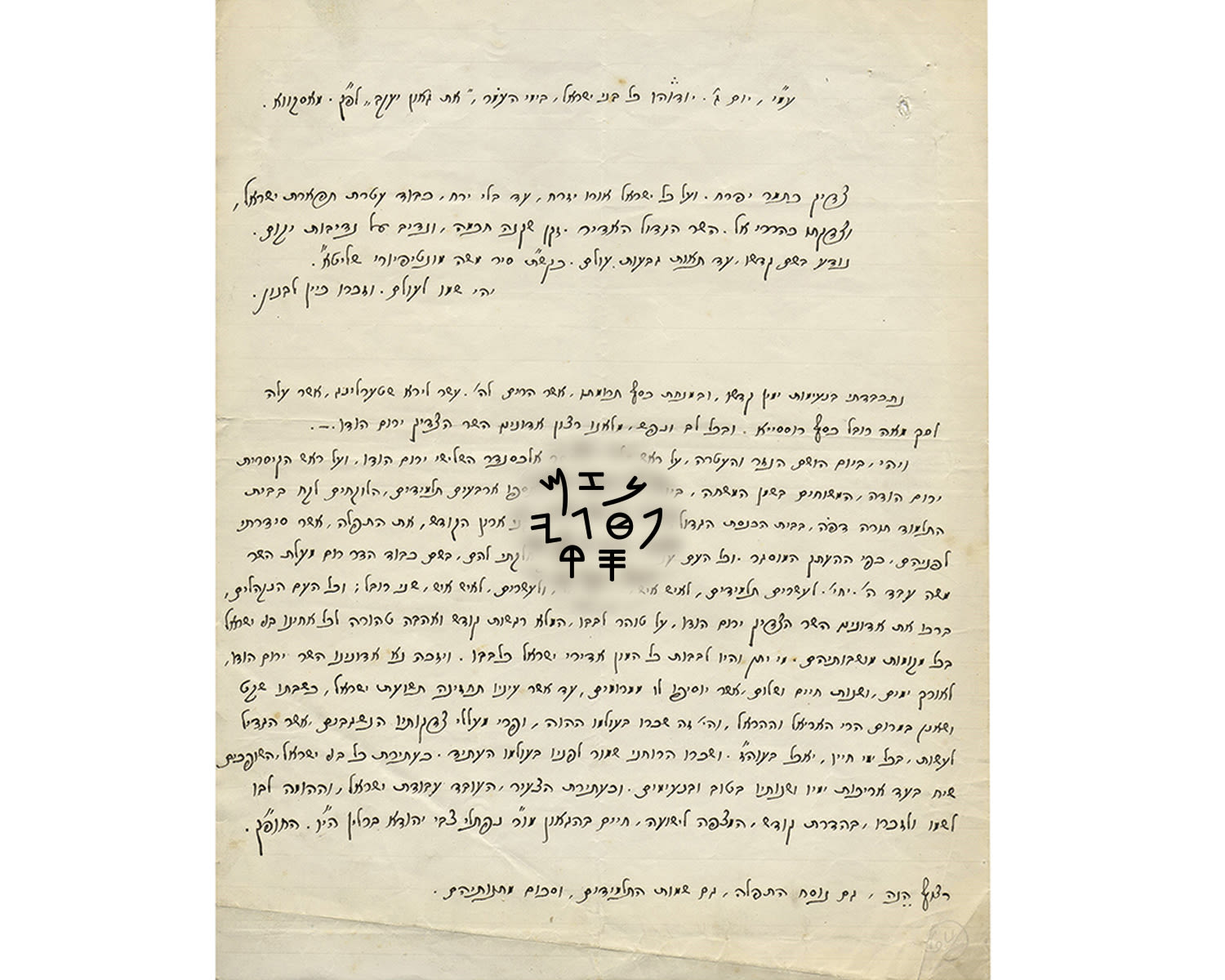
Lot 213 is a Letter and a Tefilah written by R’ Chaim Berlin, in honor of the of Czar Alexander III of Russia in Moscow, 1886. It appears to be written to Moses Montefiore and thanks him for his donation. R. Berlin describes that he, together with his students, recited this prayer. Additionally, the document discusses a heretofore unknown Talmud Torah that R’ Chaim Berlin had in Moscow.


Further On A Forged Letter of Rabbi Joseph B. Soloveitchik

Further On A Forged Letter of Rabbi Joseph B. Soloveitchik

By Mosheh Lichtenstein

Rabbi Mosheh Lichtenstein is a co-Rosh Yeshiva of Yeshivat Har Etzion.

He is a grandson of Rabbi Joseph B. Soloveitchik.

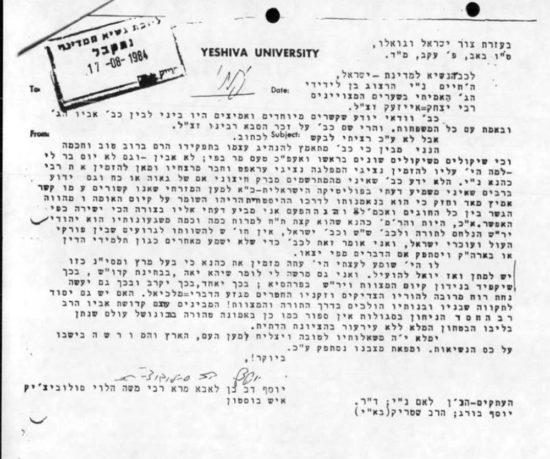
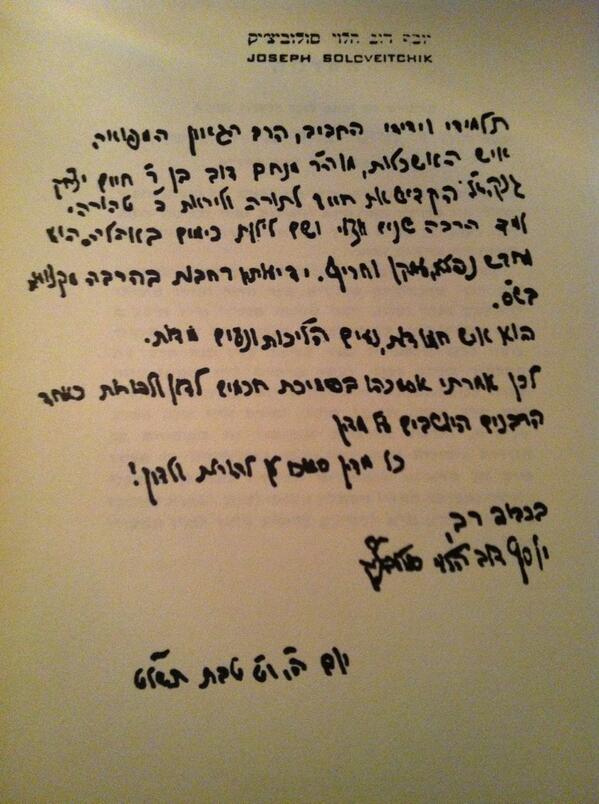
It was recently brought to my attention that various readers of the Seforim Blog have expressed skepticism regarding the determination that the letter found in President Chaim Herzog’s archives and supposedly written by my grandfather, Rabbi Joseph B. Soloveitchik zt”l (hereafter, “the Rav”), is a forgery.


Moreover, some of the commentators have engaged in various conspiracy theories regarding the motivation and the accuracy of the claim that this is a fake letter. See here. Although I do not usually attempt to argue with such claims or engage conspiracy theorists and strongly suspect that penning this response will not necessarily convince those who refused to accept the original clarification, I will, nevertheless, attempt to present the evidence that the letter is indeed a forgery since I fear that future researchers may also question the denial and view the letter’s status as an unresolved issue.

Moreover, since there may be sincere individuals who are indeed skeptical of a forgery claim regarding a letter whose subject is a controversial figure and may suspect that there is an agenda behind the denial of the letter’s legitimacy, I am presenting the evidence for their review and evaluation. Thus, if those who expressed skepticism are indeed sincere and open to evaluating the evidence, it is my hope that they will review the evidence presented below and recognize that the letter is fraudulent.

At the outset, I must re-emphasize what was clearly stated by the editors of the Seforim Blog (here); i.e. that the determination of our family members who saw this letter and judged it to be a “crude forgery” was entirely based upon an examination of the signature, stationery and other such considerations and totally independent of any opinion, positive or negative, regarding the subject of the letter. Having stated for the record what should be obvious, I will now present the considerations themselves.

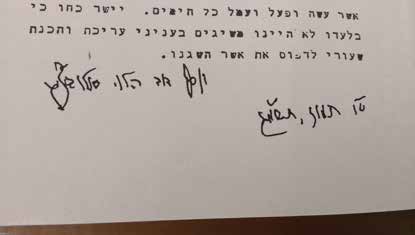
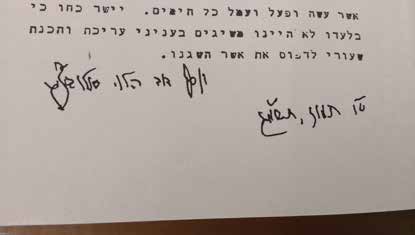
1. First, and this alone should suffice, is the error in the spelling of the name. The Rav spelled his name דוב with a vav in the middle and not דב without a vav. I have never seen a signature of the Rav without the vav and I challenge all of those who doubted our claim to produce a signature of the Rav, in his handwriting, without a vav. As there are a multitude of “semikhah klafim” signed by the Rav, as well as numerous letters that he wrote, I assume that this can be readily verified. I would add that, unlike dates or plain text, it is rare indeed that people make typos in their signature.

2. The Rav’s signature in the letter contains an additional conclusive indication that the Rav didn’t write it which is the mention of his father and his title. The Rav would use the title אבא מרי when referring to his father in his halakhic writings and famously utilized it in the title of a major work, Shiurim le-Zekher Abba Mari (Jerusalem: Mosad ha-Rav Kook, 1984). However, he never used it when referring to his father, Reb Moshe Soloveichik, in his signature. Usually, the Rav signed his name without mentioning his father but if he did mention him, he always used the Brisker title of הגאון החסיד or variations of it and never אבא מרי. Thus, he might sign בן הגאון החסיד or בהגאון מהרמsee Iggerot ha-Grid pp. 139-140 for two such examples – but not אבא מרי as in the letter under discussion.


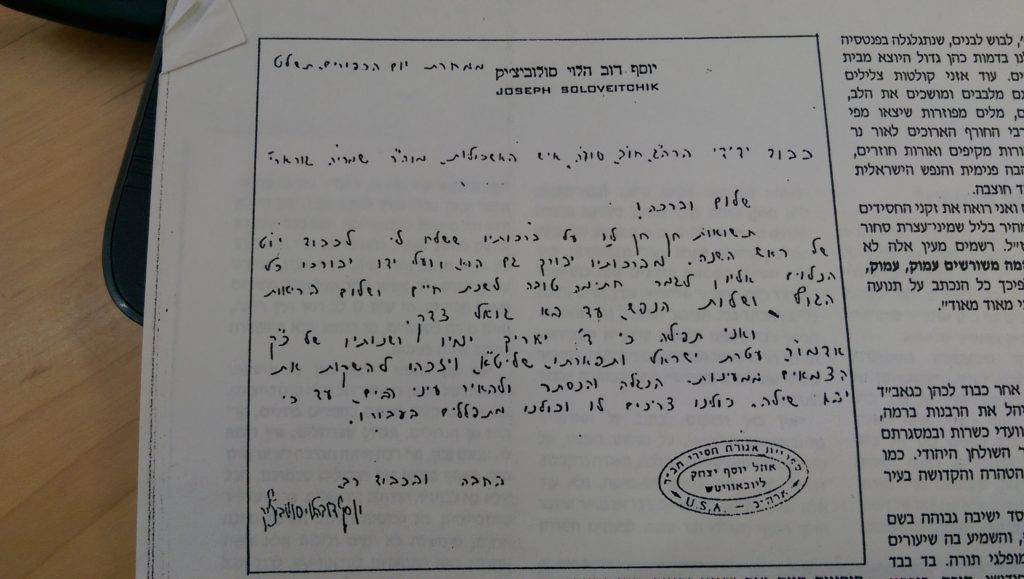
The vast majority of the letters that I have had occasion to see, as well as those published in *Community, Covenant And Commitment: Selected Letters And Communications*, ed. Nathaniel Helfgot (Jersey City, NJ: Ktav, 2005), and originally written in Hebrew, contain the Rav’s name alone without any reference to his father whatsoever. Moreover, my impression is that the younger the Rav was and the more “rabbinic” and traditional or ceremonial the context (such as HaPardes), he might refer to his father, while in more political or non-rabbinic settings and the older he gets, he rarely signs as his father’s son. This is doubly true of the years when he had physical trouble writing (for examples of 2 late letters in very rabbinic settings in which his father is not referenced in his signature, see the letter published in the beginning of the first volume of the first edition of the Shiurim le-Zekher Abba Mari and/or the letter written to Rabbi Shemariah Gourary in October 1978 and published in a Chabad journal upon his petirah in 1993).

The bottom line is that the vast majority of all his letters don’t mention his father and this is esp. true in the later years. Thus, the very reference to his father in a very late letter to a secular political figure like Chaim Herzog might already raise suspicions about this letter, but the crucial point is that even when mentioning Rabbi Moshe Soloveichik, he is never referred to as אבא מרי. Presumably, the person who wrote this letter was aware of the Abba Mari title because of the book (which had just been published a year earlier), but unfamiliar with the Rav’s normal signature mode and thus blundered into applying the wrong title to Rabbi Moshe Soloveichik.

In an aside, I’ll also mention that the person who wrote this letter was not only woefully unequipped with knowledge of the Rav’s signature, he also didn’t know how to spell אבא מרי properly. Unlike the Rav, who was aware of the phrase’s origin in the Shas (Kiddushin 31b and Sanhedrin 5a) and its usage by the Rambam in Mishneh Torah (Hilkhot Talmud Torah 4:3 and Hilkhot Shehitah 11:10) to refer to his father and, of course, spells it properly, the writer of this letter can’t even spell the title that he chose properly (although I can’t rule out the possibility of a typo, I cannot but have the impression that this is yet another instance of the work of someone who simply doesn’t know what he’s doing).

3. The letter includes the title איש בוסטון together with the signature. I’d love to see another letter of the Rav in which he signed himself as איש בוסטון. Until such a letter is produced, I regard this as an additional example of the fraudulent nature of this letter since the Rav didn’t use such a title to identify himself. He was not Paul Revere and apparently did not consider איש בוסטון to be a defining characteristic.

4. A crucial element in assessing a signature’s authenticity a graphological examination. In our case, the signature of the Rav in the Herzog letter simply fails the most basic graphological test. Since a graphological analysis is by definition subjective, I preferred to present the verifiable objective evidence regarding the Rav’s signature prior to raising this point. I also feel obligated to preface my claim with two preliminary comments about the legitimacy of handwriting comparisons:

a. Halakhah and the American banking system that has utilized handwritten checks for decades as a prime form of payment rely upon comparison and recognition of an individual’s signature. The concept of kiyum shtarot, a major legal mechanism in Halakhah which is crucial to all legal documents, is predicated upon comparing signatures.

b. The Rav’s signature is quite distinctive and remained consistent throughout the years. A clear line runs between all his signatures, from youth to old age. In his later years, the signature is more frail and less forceful than his earlier signatures, but the basic form is constant and readily recognizable. The signature that appears in the Herzog letter is so starkly different from his recognized signature that this is a plain case of black and white and not a grey area. Had it been a grey area which required a judgement call, I would never make such a subjective claim, but the contrast here is so great that it does not require a judgement call. To utilize a Talmudic concept from a somewhat different case of graphological assessment, an average ינוקא דלא חכים ולא טפש could easily make this call.

To back up this claim, I suggest that the interested reader see for himself examples of the Rav’s signature in these years. An example from June 1983 is the letter printed in the first volume of Shiurim le-Zekher Abba Mari (first edition).

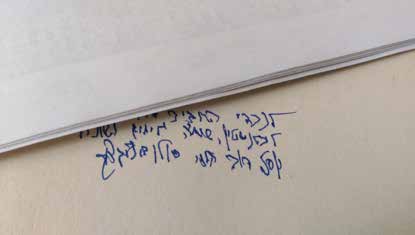
A later example, and even more relevant example, from Winter 1984 (probably January-February 1984) is this (from a dedication he inscribed to me in the Shiurim le-Zekher Abba Mari that he sent me):

One can notice 2 things in this signature: 1. Its basic consistency with his younger signatures 2. the frailty of his writing. The signature in the letter to President Herzog, in contrast, is inconsistent with all of the Rav’s signatures and does not express the frailty of his aging motoric skills, despite supposedly being written months later.

For a somewhat earlier, albeit still late, example, one can see the signature in the haskamah published by Rabbi Menachem Genack in his sefer ברכת יצחק, written in Jan. 1979.

In summary, the signature itself in the document under question is so full of errors that if it were a get, you could say that it contains almost all possible פסולים as it includes א. שינה שמו ב. ושם אביו ג. ושם עירו ד. ואינו מקויים .

From the signature, let us turn our attention to the stationery. Anyone who has seen letters of the Rav knows that the letterhead is always the Rav’s name and usually, but not always, his address as well. He does not use Yeshiva University stationery nor RIETS stationery. I have never seen a letter written by the Rav on a YU letterhead. He was not the Rosh Yeshiva of RIETS or president of YU – he was Rabbi Joseph B. Soloveitchik, the Rav, and his stationery reflects this.

It must also be emphasized that this particular letter is purported to have been written in Boston where the chance that the Rav used YU stationaey is nil. I was with the Rav in Boston during the summer of 1984 and I can attest to the fact that he did not have YU stationery in his study that summer (nor at any other time that I was in Boston).

Thus, it seems fairly obvious to assume, although I cannot verify this, that ‘the writer of this letter’ had access to YU stationery which is dispensed to hundreds of locations but not to the Rav’s private stationery and, therefore, chose to present the Rav as writing on YU stationery, unaware that by doing so ‘he’ is undermining rather than bolstering the credibility of his forgery.

Actually, what ‘the writer of this letter’ is doing is even more bumbling since ‘he’ is not using proper YU letterhead stationery either; if one looks carefully at the letter that was reproduced at the Seforim Blog, it can be noticed that it is written on paper designed for internal correspondence as a memo and is not formal institutional stationery of the sort that is appropriate to use in correspondence with a head of state.

Another suspicious element is the copies of the letter that supposedly were sent to Rabbi Norman Lamm, Dr. Burg and Rabbi Michael Strick. Aside from the fact that to the best of my knowledge, it was not the Rav’s custom to copy others on his letters and this alone is room for additional suspicion, it is unfathomable to think that he would have Rabbi Strick’s name as one of those copied to his letter. Was the Rav even aware that Rabbi Strick worked in YU’s Israel office? Even if so, why would he copy him on a letter to Herzog which does not deal with YU affairs? For that matter, why would he copy Rabbi Lamm?

Since the Rav did not ‘CC’ people and was unaware of Rabbi Strick’s position, this, too, is an additional reason that at least parts of this letter must be considered inauthentic and the work of others. [If one were to argue that this anomaly is reason to support the letter’s authenticity as a lectio difficilior, I would counter that such an argument would be reasonable, if it could be established that the Rav was aware of Rabbi Strick’s role in YU Israel, but since this is definitely not the case, he couldn’t have copied on a letter someone who he was unaware of his position. Thus it is not a more difficult reading, but rather an impossible one and, therefore, proves its inauthenticity rather than its authenticity.]

Next, let us turn our gaze to the top of the page and the salutation of בעזרת צור ישראל וגואלו. Once more, I challenge anybody to produce a letter or document in which the Rav used such a phrase to refer to the KBH in a similar context (or any context, for that matter).

Although one could conceivably argue that he did not normally do so but changed his custom when writing to the president of Medinat Yisrael, I would not accept such a line of reasoning because of the reasons outlined below, but I would also emphasize that the Rav’s letter to Prime Minister David Ben-Gurion does not contain such a phrase nor do any of his other letters to various Israeli Religious Zionist leaders. All of these letters were published in *Community, Covenant And Commitment: Selected Letters And Communications* and are readily available for examination. If one were to argue more ingeniously that he used the phrase only in a letter to Chaim Herzog because of his father, Rav Yitzhak Isaac ha-Levi Herzog’s involvement in the formulation of Tefillah Leshalom Hamedinah, he would have not only to claim that the Rav was attempting to compliment Herzog but also to establish that the Rav was aware of Rav Herzog’s role in the formulation of that text. Personally, I am quite skeptical of this for a variety of reasons, but I will not insist upon it in this discussion.

The crucial point regarding the use of צור ישראל וגואלו is that the Rav would never use such a phrase. Without entering into a protracted discussion of the Rav’s attitude to Zionism in general, a topic that much has been written upon, I will allow myself to state that while undoubtedly supportive of Religious Zionism, he was deeply opposed to three elements of Israeli Religious Zionism that he encountered in his contacts with the Israeli Religious Zionist sector. The first was the ideological position that Jewish Nationalism and its political expression are of the highest religious value. The second, not entirely unrelated to the first, was the perspective that viewed the establishment of the State of Israel and its subsequent achievements as highly significant stages in the Redemption. Regarding those who held to a position that he described as the attachment of “excessive value to the point of its glorification and deification” [of the State of Israel] (*Community, Covenant And Commitment: Selected Letters And Communications*, page 164), he defined them as delusional (the original Hebrew uses the phrase “הוזיםwhich is translated in the published text as “dreamers,” but which actually has a much stronger connation of delusion within it) and in total error. He was also very distant from a historical appraisal that saw the Geulah as imminent. As anyone who has read *Kol Dodi Dofek* or *Hamesh Derashot* is well aware, the Rav emphasizes the Man-God relationship in the context of Zionist history rather than the imminent realization of the promised Redemption.

An additional element that the Rav strenuously objected to was various expressions and formulas in liturgical or halakhic settings that were disconnected from traditional forms of expression and exuded a strong sense of a break with the past and the creation of a new religious language. I would not overstate the case if I stated that such expressions actually caused him to cringe. He certainly was emotionally distant from such phrases and did not use them. A famous example of this was his insistence upon the term “Eretz Yisroel” rather than “Israel,” but there were many such examples, some better known (e.g. translating the text of the ketuba into Hebrew), some not so well known. Even wearing a white shirt on Shabbos (“Israeli style”), rather than a suit, would sometimes annoy him if he sensed that it was an expression of non-traditionalism and “anti-Galut” sentiment. I can attest to this first hand כי מבשרי אחזה זאת. I spent time with my grandfather, the Rav, as a wide-eyed 17 year old youth who often expressed his Zionist sentiments in front of him and occasionally raised his ire by doing so. Once, discussing a related topic, he admitted to me that reciting a certain text was rationally the proper thing to do, but, nevertheless, expressed a personal emotional reluctance to do so because of its novelty and lack of traditional moorings.

Therefore, although this is admittedly a subjective criterion that I am attempting to avoid, I cannot believe that any letter that the Rav wrote or authorized – even to a head of state whose father was Rav Herzog – would contain the phrase בעזרת צור ישראל וגואלו.

Finally, I must point out an issue of content regarding the letter. As I stated at the outset, I am not judging the letter based upon any presumed attitude of the Rav regarding Rabbi Meir Kahane. However, the content of the letter is extremely problematic for totally other reasons. As can be seen, the letter concludes with a clear admonition and rebuke to President Herzog in no uncertain terms regarding his level of observance. Not only does the writer allow himself to criticize Herzog’s standards of public observance, an obviously sensitive topic for someone raised as an observant Jew, he also doesn’t shy away from introducing the extremely sensitive and intensely personal issue of Herzog’s relationships with his parents and children in light of his problematic observance of Mizvoth.

I will allow myself to state that the Rav that I knew, and I assume many of the Seforim Blog’s readers as well, would never enter into such personal matters and grant unsolicited advice and judgement upon his correspondent’s personal life and relationships. For that matter, I cannot imagine that any rational individual who is requesting a favor from a person of stature would conclude his message by rebuking the person and making it clear that he is a disappointment to his parents. Why the writer of this letter thought that this is a reasonable text is beyond me, but if he chose to concoct such a text, I do claim that the Rav would not, and could not, have written such a text. While this is admittedly subjective and, therefore, I do not rest my case upon it but rely upon the above-mentioned considerations, I do believe that the Seforim Blog’s readers should be alerted to this perspective as well.

I will not continue to discuss this letter, although much more could be said about it. In conclusion, I will add that I believe that many of the points that I raised above suffice to individually prove that this letter is utterly false; however, it is also important to emphasize that there is a significance to their cumulative effect. Thus, even if one can argue or suggest alternatives to a particular claim, the accumulation of so many suspicious characteristics is an additional consideration to recognize that the text is much too problematic to be trusted or relied upon.

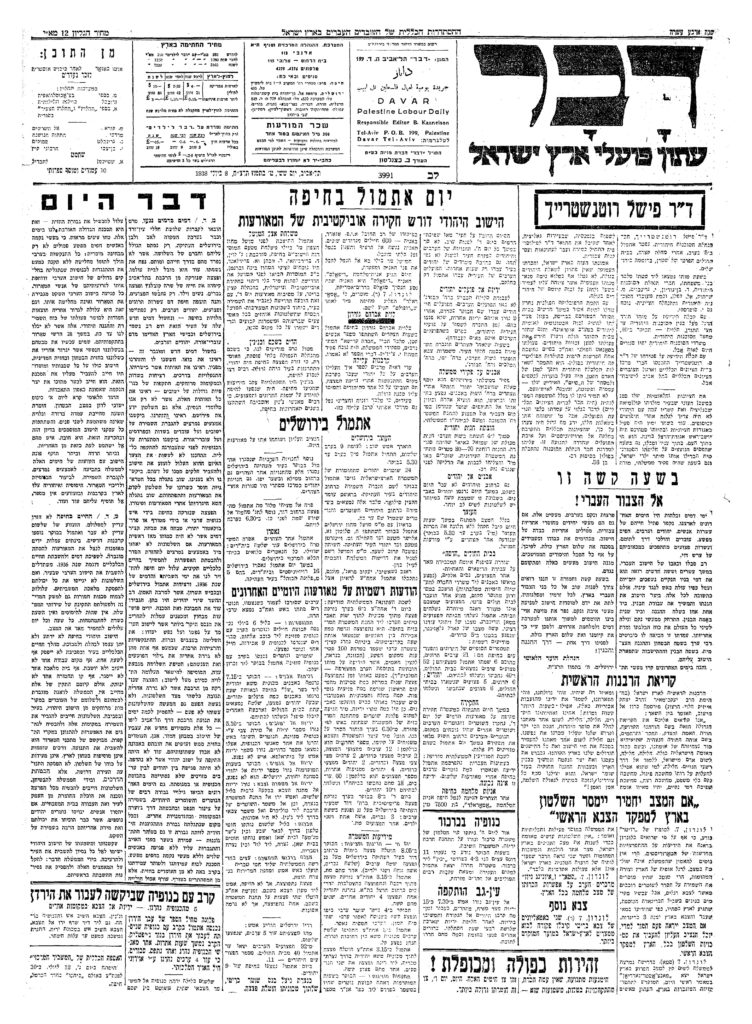
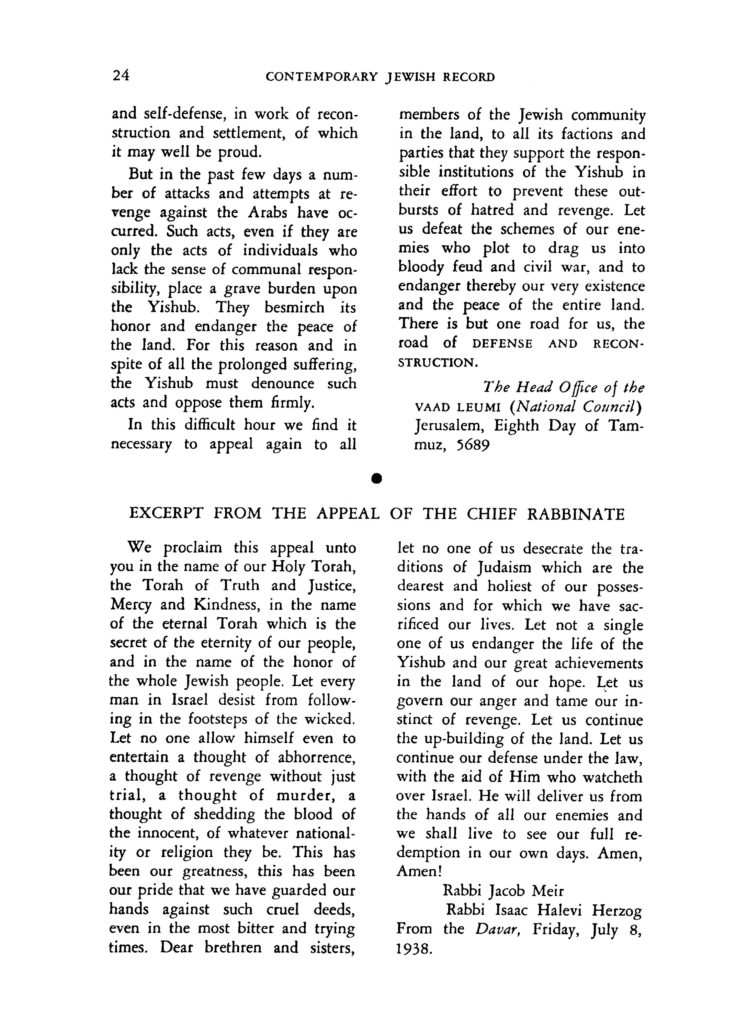
Ironically, whoever thought to send this letter to President Herzog and to appeal to his zekhut avot as part of a letter requesting support for Rabbi Kahane was probably barking up the wrong tree by doing so. Rav Yitzchak Isaac ha-Levi Herzog, whose authority is celebrated in the letter, had the following to say about the issue of retribution and Jewish-Arab relationships in times of terror attacks, published on the front page of the newspaper Davar, Friday, July 8, 1938, and translated into English several months later in Contemporary Jewish Record 1:1 (September 1938):

Why did someone want to counterfeit a letter in the Rav’s name is a question that may be unanswerable, even if we were to identify the person who wrote the letter. It is certainly unanswerable without identifying the writer. It should be recognized, though, that the primary motivation may not have been a political agenda to validate Rabbi Kahane, although it is obvious that the writer’s opinion of him is somewhat favorable and that he is attempting to advance the Kach party’s agenda, but may be rooted in other realms. For instance, the writer may have had a psychological need to empower himself to speak as the Rav, for a variety of reasons, and realized this by counterfeiting a letter in the Rav’s name and sending it to a prominent and famous person.

Whatever the motivation may be – political or psychological – we must recognize that this is a letter that that was not signed or authorized by the Rav and that is what matters.


Keser vs. Kesher: What’s In A Name?

Keser vs. Kesher: What’s In A Name?[1]
 
I – The Puzzle
Kesher Israel (KI) Congregation has enhanced Jewish life in Pennsylvania’s capital of Harrisburg for almost 115 years. During that time, KI has been blessed with outstanding rabbinic leadership: The famed Rabbi Eliezer Silver[2] first headed the congregation from 1911-1925. He was followed by Rabbi Chaim Ben Zion Notelovitz who served KI from 1925-1932. Rabbi David L. Silver (a son of Rabbi Eliezer Silver) led the congregation from 1932-1983. Rabbi Dr. Chaim E. Schertz served KI as its rabbi from 1983-2008.
Soon after arriving in Harrisburg in 2007, I found myself intrigued by the synagogue’s name. Since the congregation is called Kesher Israel, I just assumed its Hebrew name was קשר ישראל (pronounced ‘Kesher Israel’, meaning Bond of Israel). However, I soon learned that upon being founded in 1902, the synagogue was in fact named כתר ישראל (pronounced ‘Keser Israel’ in classic Ashkenazis – which KI’s founders surely spoke – meaning Crown of Israel). I soon noticed that below the words ‘Kesher Israel Synagogue’ on the cornerstone of KI’s current building (pictured above), appears the Hebrew name כתר ישראל.
This seemingly minor detail puzzled me greatly. Why did a congregation whose proper Hebrew name was כתר ישראל choose to call itself Kesher Israel? Had anyone ever taken note of – or attempted to correct – this inconsistency? During the summer of 2015, I found time to research the matter, and I now have a theory to propose.
II – An Enigmatic Account
In 1997, KI honored its beloved Rabbi Emeritus – Rabbi David L. Silver (1907 – 2001)[3] – with a community-wide weekend celebration on the occasion of his 90th birthday. As part of that celebration, the congregation published “Silver Linings” – a 90 page book of Rabbi D. Silver’s memoirs. Those memoirs were excerpted from some 35 hours of taped interviews conducted from April, 1996 – April, 1997. On pages 43 – 44 of that book we find the following account:
When the shul was founded, it was called Keser . . . which means a crown. Some fellow who was a Hebrew teacher . . . spelled it as C-a-s-s-e-u-r. He should have put it down as K-e-s-e-r. Some people – Lithuanian Jews, I want you to know, because I am of that breed – pronounced and spelled it “sh”. Kesher means “the bond” . . .
My father came here in 1907. He was a good Hebraist and he didn’t like the name. He said, in the Bible when there is the term “kesher” it’s “kesher bodim”[4]. A bond of bodim means rebels, period[5]. My father said that’s no name for a shul and changed it from Kesher Israel to Keser Israel, a crown of Israel. I don’t know whether it happened on the first day he came here but that’s what it became.
Rabbi D. Silver’s eye-opening account of the history of KI’s name is quite enigmatic. In attempting to understand this explanation, the following questions must be answered:
1)      If the congregation’s original name was in fact ‘Keser Israel’ (כתר ישראל), why would Lithuanian Jews have pronounced it ‘Kesher Israel’?
2)      If the congregation’s original name actually was ‘Keser Israel’, what exactly did Rabbi Eliezer Silver change?
3)      As the synagogue is called ‘Kesher Israel’ to this very day, what did Rabbi D. Silver mean when he reported that his father had successfully changed its name from ‘Kesher Israel’ to ‘Keser Israel’?
III – Sabesdiker Losn
In the Book of Judges, we learn of a terrible civil war that flared up between the tribes of Ephraim and Manasseh. As the beaten forces of Ephraim attempted to retreat across the Jordan River we read (Judges 12:5-6):
5 – And the Gileadites seized the crossings of the Jordan that belonged to Ephraim; and it was that when any of the survivors of Ephraim said, “Let me go over,” and the men of Gilead said to him, “Are you an Ephraimite?” and he said, “No.”
6 – And they said to him, “Say now ‘Shibboleth,’ ” and he said “Sibboleth,” and he was not able to pronounce it properly, and they grabbed him and slew him at the crossings of the Jordan; and there fell at that time of Ephriam, forty-two thousand.
At that point in Jewish history, the tribe of Ephraim was unable to correctly pronounce the hushing sound of the Hebrew letter “Shin” in the word “Shibboleth”. They instead pronounced the word with the hissing sound of the Hebrew letter “Sin”, and the word came out as “Sibboleth”.[6] With their identities compromised, many Ephraimites lost their lives.
In the course of my research, I learned that the inability of many Lithuanian Jews to properly distinguish between the hushing and hissing sounds of the Hebrew letters “Shin” and “Sin” was once common knowledge. Like the Ephraimites before them, many Lithuanian[7] Jews also pronounced the word ‘Shibboleth’ as ‘Sibboleth’.[8] As a result of their enunciation, other Yiddish speakers jokingly referred to the Lithuanian dialect of Yiddish as ‘Sabesdiker Losn’. In an often quoted article on Sabesdiker Losn, Prof. Uriel Weinreich writes:
One of the most intriguing instances of non-congruence involves a peculiar sound feature of the northeastern dialect of Yiddish: the confusion of the hushing series of phonemes (š, ž, č) with the hissing phonemes (s, z, c), which are distinguished in all other dialects . . . This dialect has come to be known as sábesdiker losn ‘solemn speech’ (literally ‘Sabbath language’), a phrase which in general Yiddish is šábesdiker lošn, with two š’s and an s. This mispronunciation of it immediately identifies those who are afflicted with the trait; to them the term litvak is commonly applied.[9]
Later in that same article Weinreich writes:[10]
The Ephraimites . . . paid with their lives for their inability to distinguish hissing and hushing phonemes in a crucial password. No litvak has ever been slain for his sábesdiker losn, but he has been the butt of innumerable jokes. The derision with which the feature was regarded by other Yiddish speakers sent it reeling back under the impact of “general Yiddish” dialects from  the south . . . In addition to dialectical pressure from the south, there were other influences tending to introduce the opposition, as it were, from within. There was for example, the growing need to learn foreign languages in which hissing and hushing phonemes are distinguished, and the promotion of Standard Yiddish by the schools, the theater, and political and educational organizations.[11]
As we have seen, many Lithuanian Jews were unable to distinguish between hushing and hissing sounds. While this led many to pronounce ‘Shibboleth’ as ‘Sibboleth’ (hence the term Sabesdiker Losn), this was not always the case. There is much evidence that in some locales, the inability of Lithuanian Jews to distinguish between the hushing and hissing sounds resulted in the exact opposite: they pronounced the word ‘Sibboleth’ as ‘Shibboleth’.[12]
In his article dealing with Sabesdiker Losn, Prof. Rakhmiel Peltz[13] quotes sources showing that many Lithuanian Jews mispronounced their words in the following manner:

. . . šuke ‘Sukkoth tabernacle’, šimkhe ‘joy, festivity’, šeykhl ‘reason, sense’, šider ‘prayer book’ . . .  [14]

A fascinating episode involving none other than Rabbi Eliezer Silver himself relates to this point, and can be found in the book “A Fire In His Soul”. A good part of that volume documents the activities of the Vaad Hatzala – the emergency rescue committee which worked so hard to save Jewish lives during the dark years of the Holocaust.[15] Soon after the fighting ended, the committee sent Rabbi E. Silver to the war-ravaged European continent to aid Jewish refugees and survivors. The following colorful incident is recorded:[16]
Rabbi Eliezer Silver, acting as a Vaad representative and president of the Agudas Harabonim, spent three months visiting Holland, Belgium, France, Czechoslovakia, Germany and Poland. Wearing a surplus American Army uniform purchased for this mission, he moved about freely, distributing funds to build mikvaos, yeshivas and kosher kitchens. He also located children who had been in hiding throughout the war.
This bearded rabbi in uniform did experience some awkward moments. When an allied soldier saluted him, Rabbi Silver did not respond in kind, causing the soldier to doubt his credentials. When Occupation officials asked to see his military identification – after all, he was a man in uniform – Rabbi Silver stared defiantly and proclaimed, “I don’t need papers. I am the Chief Rabbi of the United States and Canada!” (It came out “United Shtates” in Rabbi Silver’s characteristic accent.) Understandably, the American authorities did not believe him and were not inclined to let him go.
Chagrined, Rabbi Silver pointed to the telephone and barked, “Call Shenator Taft. Tell him Shilver’s here!” The officials looked at each other. They didn’t know that the small man, seething with almost comical anger, enjoyed a personal and political friendship with the powerful Ohio Senator Robert Taft.[17]
Rabbi Silver’s “characteristic accent” described above is a rare glimpse into how his Lithuanian upbringing and pronunciations affected his ability to articulate his words. Rabbi Eliezer Silver was born in the hamlet of Abel – in the Kovno province of Lithuania in 1881.[18] His pronunciation of “Shtates”, “Shenator”, and “Shilver” was most likely the result of his growing up in an environment where no distinction was made between hissing and hushing sounds in the Yiddish spoken all around him. In his case (and probably in the case of many others in his locale), words that should have been pronounced with a ‘hiss’, were instead pronounced with a ‘hush’.[19]
With this better understanding of how many Lithuanian Jews pronounced their words, I believe we can now solve the mystery of KI’s name.
IV – Solving the Puzzle: A Theory
Making use of KI’s historical records, I propose the following theory:
KI was founded in 1902. The congregation was officially named כתר ישראל in Hebrew, and was given the English name of ‘Casseur Israel’ – instead of the more straight-forward ‘Keser Israel’. This can be clearly seen from a document – dated January 1, 1903 – presented to Mr. Max Cohen (a founding member) which stated that he had purchased a pew in his new Harrisburg synagogue. This certificate was signed on behalf of “The Trustees of the Congregation – Casseur Israel, Harrisburg, Pennsylvania”. The document was also embossed with the new congregation’s official seal. In English, the stamp reads “Congregation Casseur Israel – Harrisburg, Pa.” In Hebrew it reads, “חברה כתר ישראל – האריסבורג פא”  [20]

Although KI was chartered as ‘Casseur Israel’ in October of 1902, the Lithuanian founders and members of this new synagogue pronounced its name as ‘Kesher Israel’. This was a result of the manner in which their version of Sabesdiker Losn Yiddish affected their enunciation of the hissing and hushing sounds.[21] As a result of the way in which the congregation’s members pronounced their own synagogue’s name, local newspaper articles began referring to the synagogue as ‘Kesher Israel’ – as early as 1903 (just months after the congregation was founded).[22]
Though Rabbi Eliezer Silver arrived in Harrisburg in 1907, he was not officially hired by KI to serve as their spiritual leader until February 11, 1911.[23] In 1908, shortly after Rabbi E. Silver arrived in Harrisburg – but still three years before he would become KI’s first rabbi – the six-year-old congregation hired a local Yiddish printer to write up its constitution.[24] The following detail on the constitution’s cover page[25] is striking: Although the synagogue’s official seal used in 1903 listed the new congregation’s Hebrew name as חברה כתר ישראל (Keser Israel Congregation), KI’s 1908 constitution records the Hebrew name of the synagogue as חברה קשר ישראל (Kesher Israel Congregation).[26] This was a result of either:
A)   The printer – unfamiliar with the congregation’s official Hebrew name of  כתר ישראל – published a document in which he spelled the congregation’s Hebrew name true to the way its own members all pronounced it – קשר ישראל – Kesher Israel.
B)   The version of Lithuanian Yiddish spoken by so many of the congregation’s founders and members caused them to refer to the synagogue as ‘Kesher Israel’ from the day it was founded. Perhaps by 1908 a movement arose within KI to have its Hebrew name officially changed from כתר ישראל (Keser Israel) to קשר ישראל (Kesher Israel). This proposed switch would enable the young congregation to have complete consistency between; 1) the synagogue’s Hebrew and English names, 2) what all of KI’s founders and members already called it, and 3) the name used by all the newspapers when referring to the congregation.

When KI hired Rabbi Eliezer Silver as its rabbi in 1911, he accepted the pulpit of a synagogue whose Hebrew name had begun as כתר ישראל (Keser Israel), but for one reason or another, was now given the Hebrew name of קשר ישראל (Kesher Israel) in its official constitution. Rabbi E. Silver could live with the fact that everyone pronounced the congregation’s name as ‘Kesher Israel’ (and from what we have seen above, he most probably pronounced it that way as well) – and did not even mind if they spelled it that way in English. However, seeing the synagogue’s name spelled in Hebrew as קשר ישראל was too much for Rabbi E. Silver to bear. Having mastered Biblical and rabbinic literature, he clearly knew the negative connotations of the word קשר . He associated that word with conspiracies and rebellions – concepts which he strongly believed had no place in a Jewish house of prayer that was to be loyal to G-d and Jewish tradition. As such, Rabbi E. Silver insisted that KI’s official Hebrew name should revert back to כתר ישראל (Keser Israel). He insisted on this Hebrew name for the synagogue despite the fact that (he and) his fellow Lithuanian Jews pronounced the congregation’s name as ‘Kesher Israel’ – and would continue spelling it that way in English as well.[27]
Rabbi E. Silver’s efforts to ensure that KI would retain its original Hebrew name of כתר ישראל (Keser Israel) can be seen in two early projects of his.
A)      Upon his arrival in Harrisburg, Rabbi E. Silver instituted a Hevra Shas – wherein he studied the Talmud together with members of Harrisburg’s Jewish community each morning and evening.[28] Rabbi Silver’s Hevra Shas moved into KI’s facility after he became its rabbi in February of 1911.[29] A large hand painted sign proudly displaying the names of the dedicated members (and supporters) of that Talmud study group was created – and still hangs in one of KI’s offices. At the top of that sign, the following Hebrew words appear: בית הכנסת כתר ישראל חברה ש”ס – האריסבורג, פא.  (Keser Israel Synagogue Hevra Shas – Harrisburg, PA.).[30] The wording of KI’s name on that sign reflects Rabbi E. Silver’s goal of reclaiming כתר ישראל as the congregation’s official Hebrew name.

B)      In 1917, KI commissioned an artisan to create a special ‘Pinkus HaZahav’ or Golden Book. This incredibly large and heavy leather-bound volume (hand-written in beautiful Hebrew calligraphy) contains a brief history of the congregation.[31] The bulk of the volume consists of a ledger listing the names of those who had made significant pledges towards the new building KI would soon move into. [32] On the book’s front cover, the congregation’s name is written in Hebrew as חברה כתר ישראל. Like the Hevra Shas sign, the wording of KI’s name on its special Golden Book reflects Rabbi E. Silver’s goal of reclaiming כתר ישראל (Keser Israel) as the congregation’s official Hebrew name.[33]

In addition to explaining Rabbi David L. Silver’s above-cited enigmatic account, I believe the puzzle of how a synagogue, with the Hebrew name of כתר ישראל (Keser Israel), ended up with the English name of ‘Kesher Israel’ has now been solved.
VI – Conclusion
Upon reflection I realize that the only time the membership of KI hears the congregation referred to as כתר ישראל (Keser Israel) is after the solemn Yizkor memorial prayers, which are recited during the holidays. At the conclusion of Yizkor, special collective Kel Maleh memorial prayers are recited on behalf of the deceased members and relatives of the congregation.[34]  Since my arrival in 2007, I listened closely as KI’s Cantor Seymour Rockoff would clearly enunciate the words קהילת כתר ישראל (Keser Israel Congregation) during that prayer – pronouncing the synagogue’s Hebrew name exactly as Rabbi Eliezer Silver would have wanted.
Following Cantor Rockoff’s sudden passing in the summer of 2015,[35] I recited those collective Kel Maleh prayers at KI this past Shemini Atzeret (5776). As I clearly pronounced the words קהילת כתר ישראל, I thought about all the history behind KI’s name. I also envisioned Rabbi Eliezer Silver grinning as he tipped his signature black silk top hat in my direction.
___________
רַבִּי שִׁמְעוֹן אוֹמֵר, שְׁלשָׁה כְתָרִים הֵם, כֶּתֶר תּוֹרָה וְכֶתֶר כְּהֻנָּה וְכֶתֶר מַלְכוּת, וְכֶתֶר שֵׁם טוֹב עוֹלֶה עַל גַּבֵּיהֶן.
Rabbi Shimon would say: There are three crowns – the crown of Torah, the crown of priesthood, and the crown of royalty – but the crown of a good name is the most valuable of them all.
(Pirkei Avot 4:13)

                 
Rabbi Eliezer Silver in his younger and older years.

[1] This article is dedicated to the memory of Cantor Seymour Rockoff – Harav Eliyahu Shalom ben Harav Chaim Shmuel, z”l. With his melodious voice and meticulous attention to the details of prayer, Cantor Rockoff greatly enhanced Kesher Israel Congregation’s services from 1986 – 2015.
[2] (1882-1968). For an excellent biography of Rabbi E. Silver, see Rakeffet-Rothkoff, Aaron. The Silver Era: Rabbi Eliezer Silver and His Generation. Jerusalem: Feldheim Publishers, 1981. This out-of-print book was republished by the Orthodox Union and Yeshiva University Presses in 2014.
[3] Yeshiva University placed an obituary for Rabbi D. Silver – one of its oldest rabbinic alumni – in The New York Times on July 11, 2001. It can be viewed online here.
[4] I am confident that the word Rabbi D. Silver used in the interview from which this account was excerpted was “Bogdim” and not “Bodim”. The term “Kesher Bogdim” means a band of traitors, and can be found in Maimonides’ Mishneh Torah Hilkhot Sanhedrin 2:14, Shulhan Arukh Hoshen Mishpat 3:4, and according to the Vilna Gaon (note 22 there) the expression is based on the term “Kesher Reshaim” – a band of evil-doers – used by the Talmud in BT Sanhedrin 26a.
[5] For examples where the word ‘Kesher’ is used in describing conspiracies in the Bible see: I Samuel 15:12, I Kings 16:20, II Kings 11:14, II Kings 12:21, II Kings 14:19, II Kings 15:15, II Kings 15:30, and II Kings 17:4.
[6] In his commentary to Judges 12:6, Rabbi Dovid Kimhi (1160 – 1235) notes that in his day, many in France were also unable to properly pronounce the hushing sound of the letter “Shin”.
[7] The region which Jews historically referred to as “Lithuania” or “Lita” included the territory of present-day BelarusLatvia, and Lithuania – and even parts of EstoniaPolandRussia, and Ukraine.
[8] See Turei Zahav note 30 to Shulhan Arukh Orah Haim 128:33
[9] Weinreich, Uriel. (1952). Sábesdiker Losn in Yiddish: A Problem of Linguistic Affinity. Word, 8, page 58. I thank Vilnius-based Professor Dovid Katz for making me aware of this important article.
[10] Ibid, page 70.
[11] While researching this topic, I took note of the fact that while Sabesdiker Losn was such a new concept to me, many Yeshiva graduates in their sixties whom I interacted with instantly recognized this phenomenon. Several shared with me fond memories of their older Lithuanian-born and educated teachers who would refer to ‘Rasi’ instead of ‘Rashi’. (For one such light-hearted published account see page 40 in Rakeffet-Rothkoff, Aaron. From Washington Avenue to Washington Street. Jerusalem: Gefen Publishing House / OU Press, 2011.) Why then was the concept of Sabesdiker Losn so new to me? I soon realized that in addition to Prof. Weinreich’s explanations (above) regarding the disappearance of Sabesdiker Losn, there was another factor which he never could have foreseen: the utter decimation of Lithuanian Jewry during the Holocaust. As a child who only began his Jewish day school education in the late 1970’s, I simply never had the chance to interact with authentic Lithuanian-born and educated teachers like many Yeshiva graduates a generation or two older than me had.  
[12] As such, this version of Lithuanian Yiddish might be described as “Shabeshdiker Loshn”. I thank Dr. Edward Portnoy of Rutgers University’s Department of Jewish Studies and YIVO’s Academic Advisor, as well as Isaac Bleaman – a doctoral student in the Department of Linguistics at New York University – for clarifying this important point for me.
[13] Peltz, Rakhmiel. (2008). The Sibilants of Northeastern Yiddish: A Study in Linguistic Variation. In Kiefer, Ulrike and Neumann, Robert and Herzog, Marvin and Sunshine, Andrew and Putschke, Wolfgang (eds.), EYDES (Evidence of Yiddish Documented in European Societies), 241-274. Berlin, New York: Walter de Gruyter – Max Niemeyer Verlag. Page 255.
[14] Peltz also notes (page 255) that some Lithuanian Jews even confused the hissing and hushing sounds within the same term / phrase. For example, some might refer to a house of study / prayer as the bešmedres instead of besmedraš. One rabbi I communicated with told me he remembered hearing a highly-regarded Lithuanian-born and educated rabbi refer to his NY study hall as the bešmedres.
[15] For more information on Rabbi E. Silver’s work with the Vaad Hatzala, see Rakeffet-Rothkoff (ibid.) pages 186-250.
[16] Bunim, Amos. A Fire in His Soul: Irving M. Bunim, 1901-1980, the Man and His Impact on American Orthodox Jewry. Jerusalem: Feldheim Publishers, 1989. Pages 166-7.
[17] The story concludes with Senator Taft eventually being reached in Washington, DC. After vouching for Rabbi Silver, the rabbi was released and allowed to continue his mission on behalf of the Vaad Hatzala.
[18] Rakeffet-Rothkoff (ibid.) page 43.
[19] In addition, Rabbi Hershel Schachter of Yeshiva University’s Rabbi Isaac Elchanan Theological Seminary related to me that he remembers hearing Rabbi Eliezer Silver pronounce Cincinnati – the city where he served as rabbi for close to 40 years – as “Shinshinati”.
[20] Pictures of this document and its accompanying stamp can be seen in KI’s 75th Anniversary Yearbook (1977) pages 5 – 6.
[21] i.e. they pronounced the word ‘Sibboleth’ as ‘Shibboleth’. In suggesting an explanation for KI’s name, someone already alluded to this point on the Shul’s Wikepedia page (here) with the following sentence: “One explanation is that the “s” and “sh” sounds were conflated in the Lithuanian Yiddish pronunciation of the time.” This was attributed to the following sentence on YIVO’s website (here):” . . . much traditional Lithuanian Yiddish collapses the hushing and hissing consonants (“confusion of sh and s sounds”), a feature most Litvaks have tried to overcome in recent generations.” See footnote 12.
[22] See for example, (1903, April 2). Jewish Synagogue Gets a Cemetery. Harrisburg Daily Independent, page 1, and (1903, April 9). Passover Services. HarrisburgTelegraph, page 3.
[23] See KI’s 75th Anniversary Yearbook (1977), page 4, and Rakeffet-Rothkoff (ibid.) page 53 which record that from 1907 – 1911, Rabbi E. Silver served the entire Orthodox Jewish community of Harrisburg – and was not employed by any one congregation exclusively.
[24] Interestingly, like Rabbi E. Silver, it seems that KI’s Lithuanian founders were also from the Kovno region. One finds the directive to follow the customs of Kovno at least twice in KI’s constitution (see KI constitution pages 8 and 22).
[25] A picture of this constitution’s cover page appears on page 5 of KI’s 75th Anniversary Yearbook. I thank Rabbi Ahron Silver (Rabbi David L. Silver’s son) of Jerusalem, Israel for e-mailing me photos he took of this important historical document. I also thank KI’s Dr. Sandy Silverstein and Dr. Mark Cohen for helping me obtain an original copy of this constitution.
[26] The congregation is referred to as קשר ישראל several times within the constitution as well – but never as  כתר ישראל.
[27] It seems that while Rabbi Eliezer Silver was quite concerned with the congregation’s Hebrew name, he did not concern himself in ensuring the congregation’s English name would be firmly registered as ‘Keser Israel’. I would suggest that the spelling of the synagogue’s English name was of little or no concern to Rabbi E. Silver. After all, it was the Hebrew word קשר which conjured up all sorts of negative connotations in his mind – not the English transliteration of that word.
[28] Rakeffet-Rothkoff (ibid.) page 54, and KI’s 75th Anniversary Yearbook (1977), page 4.
[29] Kesher Israel’s 1949 Dedication Book page 11. Interestingly, this book was published the same year it dedicated its new building. Just like the congregation’s new cornerstone, the Dedication Book records the Hebrew name of KI as  כתר ישראל, and its English name as ‘Kesher Israel Synagogue’.
[30] Just beneath the words:בית הכנסת כתר ישראל חברה ש”ס – האריסבורג, פא.  (Keser Israel Synagogue Hevra Shas – Harrisburg, PA.) on that sign, appear the words:  נתיסדה ע”י הרב מהר”א זילבער שליט”א, זאת חנוכה  התרס”ח (Established by the rabbi our teacher Rabbi Eliezer Silver, may he live for many good and long days, the 8th day of Hanukah, 5668). That date corresponds to December 8, 1907. While the Hevra Shas may have begun studying the Talmud together in Harrisburg on that date, KI would not have created this sign – which claimed the Hevra Shas as its own – until some time after February of 1911 when Rabbi E. Silver officially became KI’s rabbi.
[31] For a nice write-up on this special book, see here.
[32] Though the book contains several hundred pages, only the first 16 were ever used.
[33] On the book’s back cover, KI’s name is written in English as ‘Keser Israel Congregation’. That is the only example I could find where KI’s English name was ever officially recorded that way.
[34] While only those who have lost a parent remain in the sanctuary during the actual recitation of Yizkor, the entire congregation gathers again in KI’s sanctuary for the collective Kel Maleh prayers once Yizkor has been completed.
[35] For more on Cantor Rockoff, see here.


Review of a Recent work of Rav Zvi Hirsch Grodzinsky

Review of a Recent work of Rav Zvi Hirsch Grodzinsky

By: Eliezer Brodt

בית היין, על הלכות יין נסך עם ביאור קונדיטון, יצא לאור לראשונה מכתב יד, מאת הגאון רבי צבי הירש גראדזענסקי זצ”ל, מאנסי ניו יורק תשע”א, ש”ט עמודים.

In this post I would like to discuss an unknown Gaon – Rav Zvi Hirsch Grodzinsky, and a recently published manuscript of his on Hilchos Yayin Nessech. Not much is known about him except for what has been collected in a very nice article about him written by Jonathan Rosenbaum and Myron Wakschlag, “Maintaining Tradition: A survey of the Life and Writings of Rabbi Zvi Hirsch Grodzinsky,” AJH 82:14 (1994), pp. 263-288 which was of help to me when writing this post. R. Hirsch Grodzinsky was born in Lithuania in the year 1857. He was an older cousin of the famous Gadol Hador, Rabbi Chaim Ozer, and he learned by R. Chaim Ozer’s father for a few years. It is interesting to see what he writes about his younger cousin R’ Chaim Ozer:

ואת הגאון ר’ חיים עוזר ז”ל הייתי מכיר אותו מימי ילדותו… וכבר הכרנו אז הכשרונות של הילד הזה ר’ חיים עוזר ז”ל שעתיד להיות גדול בשיראל… (מקראי קודש, ג, הקדמה עמ’ 6).

In 1891 he moved to Omaha, Nebraska where he served as the Rav until he died in 1947 (and was known as Rabbi Henry Grodzinski). It is unclear why he chose to move so far out in the US rather than to a major Jewish center like New York City; perhaps it was so that he would be able to devote most of his time to his own learning rather than the pastoral duties of a rabbi in a large Jewish community. Evidently, this great gaon moved to the United States for parnassah, and is it perhaps due to this move he is basically unknown today. Had he remained in Europe he would likely have been better known and appreciated (but, of course, probably not with a peaceful end).


R. Grodzinsky was a prolific writer who authored many works on numerous topics. His first work, printed in 1898 was called Mikvei Yisrael, an in-depth work on Hilchos Mikvaos. He received haskamahs on this first work from various gedolim, among them R. Yitzchack Elchanan Spektor, (it is not established with certainty, but he might have even had semicha from him. According to one report R. Ephraim Oshry said that it was accepted as fact in the Litvishe yeshivos that R. Zvi Hirsch Grodzinsky had semicha from R. Yitzchak Elchanan). Either way, he was a great admirer of R. Yitzchak Elchanan, as he writes an incredible description about him in the introduction of his work on Hilchos Kriyas Hatorah, Mikroei Kodesh

לא כן רבותינו הרבנים והגאונים שהיו בדור שלפני דור זה, המה היו… ודעתם וסרותיהם הרחבה היה להלכה ברורה בכל מקצועות התורה בכל חלקי השלחן ערוך, כמו מרן הגאון האמתי רשכבה”ג מהרי”א זצ”ל אבד”ק קאוונא, שהיה ראשית דבר רב… בעל הוראה בכל ד’ חלקי השלחן ערוך, כבח”מ ואה”ע, כן בש”ע או”ח וי”ד כבש”ך וסמ”ע כן במג”א ופרמ”ג כבקצות ונתיבות, כן בחו”ד ודה”ח וח”א, כל רז לא אנס ליה, ומי כמוהו מורה ממנו יצא אורה בכל מקצועת התורה דבר קטן ודבר גדול, כמו בעניני עגונה כן בה’ ציצית ותפלין וקה”ת כו’, הכל גלוי וידוע לפני כסא כבודו מראשונים עד אחרון שבאחרונים, הוא היה בר סמכא, לסמוך על הוראותיו האמתי בכל הפרטים… פנו אליו בשאלות וספיקות לדינא בכל מקצעות התורה, ועל כולם השיב כהלכה לקטן ולגדולן גם לעת זקנותו… (מקראי קודש, ג, הקדמה עמ’ 5).

In 1916 he printed another work called Likutei Tzvi. In 1923 he printed another work called Mili Debrochos which is on part of Masseches Berachos (part two of this work was printed later). In 1936 he began printing his massive, three volume Mikraei Kodesh on Hilchos Kriyas Hatorah which he completed in 1941. This work is exceptional in both its breadth and depth. There are other important books on this topic from great gedolim such as the Chida and R. Ephraim Zalman Margolis, but none compare to this work. His later works do not have haskamos, as he writes against them in the introduction to the third volume of his Mikraei Kodesh.

ועתה בעו”ה נוהגין המחברים באמעריקא מנהג יפה מאד… לקבל הסכמה על חיבוריהם מהאי הדיוט בעל הלשון… דמיום שחרב בית המקדש גברו בעלי הלשון, ואל תהי הסכמת ההדיוט קלה בעינך ובדין הוא משום דלפנים היו מחברים ספרים בשביל ת”ח והיו צריכין להסכמת ת”ח הגדול בדורו, אך עתה במדינתנו שרוב המחברים מחברים ספריהם בשביל הדיוטים, לכן צריכין ליקח הסכמה ג”כ מהדיוט גדול, ובזכות זה יזכו שההדיוטים יקפצו לקנות חבוריהם ויראו שכר לעמלם, אשרי שככה לו, ואשרי הדור שיפתח בדורו כשמואל בדורו.

He left behind many complete manuscripts on different topics. After he died in 1947 his manuscripts were taken to Mechon Otzar Haposkim in Eretz Yisrael. Unfortunately almost nothing of his was printed except for a few teshuvos of his in various Torah Journals.[1] A few months ago a complete manuscript was printed, the Beis Hayayin, a complete work on Hilchos Yayin Nessech. This volume was published by Shalom Jacob, who has put out important and special works in the past (see here). The production of this work was a truly beautiful job. The work consists of two parts; the top is the Halachos in short, and the bottom part is called Kunditon. In the Kunditon, R. Grodzinsky goes through all the sources of each Halacha, starting from the Gemarah and going forward through the sugyos with the Rishonim and Acharonim. A small section was added by the editor at the bottom of each page called Mekorei Habayis which adds some additional sources and quotes related to the topics in the Kunditon section. The print and paper is beautiful, including small summaries on the side of each piece, making it a pleasure to use. Besides for these, there is an extremely thorough index of the work. To mention some of the interesting side points in this work; R. Grodzinski has a nice discussion of the way wine was made in the U.S. in his time (p. 42-43), as he was a rav hamachshir, he traveled to wine companies in California, to check out the exact way they made the wine. Another important piece is a lengthy discussion of the various levels of Mechalelei Shabbos in the U.S. (pp. 31-32, 190) in his time. This discussion gives us a sad but realistic glimpse of the level of American Jewish observance in those times. He writes that there were three categories; one group that came with the full intention of remaining frum, but due to the parnassah problem were forced to work on Shabbos, virtually having no other choice. This group he says, was very disturbed about having to be mechalel shabbos and whatever was not related to parnassah they were careful to observe the prohibitions. This group has a din of an oness. A second category were people who though initially forced to work on Shabbos due to parnassah issues kept on working on even when they became wealthy. Though they kept Shabbos in their homes, they do not have a din of an oness. The third category was people who besides working on Shabbos for parnassah never bothered to keep anything of Shabbos in their homes. These people, he writes, are the worst level of the three.
Another piece of interest to me was how he suggests a textual change in the girsa of a Yerushlami (p. 155). He is not one that is fast to do so in general, as a bit later where he quotes the Shach saying that there was a printing mistake, he goes out of his way to show that there is no need to suggest such a thing (p. 162). Another particular piece of interest for me was his using a piece of Rabbenu Chananel, from the fairly recently (in his time) printed manuscript on Avoda Zara (p. 54). There are two reasons why I found this interesting. One, in the journal Yeshurun (v. 2, pp. 202-205) there is a teshuva of his in regard to the custom of standing when the ba’al keriah recites the Aseres Hadibros (see here for more on this minhag). Someone had shown him a newly printed manuscript of the Shu”t Ha-Rambam who said it is improper to stand. R. Grodzinsky writes:

כי תשובות המיוחס להרמב”ם ז”ל לא נמצא אצלי ומעולם לא ראיתיו. רק פעם אחד הביא אלי השו”ב מק”ב את תשובות הנ”ל וראיתי כי נמצא שם כמה דברים הסותרים למ”ש הרמב”ם בספרו הגדול משנה תורה. ולבי אומר לי כי כמה דברים הנמצא שם ע”ש הרמב”ם הוא לא אמת רק איזה תלמיד טועה כתבם ויחסו ע”ש הרמב”ם ע”ד שאמרו חז”ל אם בקשת וכו’ התלה באילן גדול…

From this piece I generalized that he was opposed to “new rishonim” and the like. However, from this work I see it was not the case, or so simple, as he used the newly printed Rach. It is important to note that the Chazon Ish was against using the Rach[2] as he writes:

“וכן ראיתי בל’ ר”ח הנדפס בדפוס ראם, אבל לא ידענא אם אפשר לסמוך על הנדפסין מחדש שכבר הפסיקה המסורה בינינו, ואין אנו יודעין מי המה המעתיקים, שמלאכת ההעתקה כבדה מאד, ואף על ידי זריזין ומדקדקים מצוי ט”ס הרבה, ואם יעבור הדבר ע”י איזה רפיון בדקדוק הדברים יכול הדבר להשתנות לגמרי, ולכן הפוסקים שלא הפסיקה המסורה בינם ובינינו בכל הדורות, ששקדו עליהם חכמי דור דור, לשמרם ולנקותם, צריכים אנו לחשוב את ספריהם ליותר דוקנית, וכש”כ במקום שאין ללמוד מכונת הדברים אלא מדקדוק לשונם, שקשה לסמוך על החדשים…” (חזון איש, הל’ עירובין סי’ ס”ז, אות י”ב).

The Mishna Berurah argues, as we find numerous times he brings from the

ר”ח הנדפס מחדש [ביאור הלכה, סי’ ש”ב, ד”ה עליה; סי’ שט”ו, ד”ה טפח; סי’ תרכ”ו, ד”ה צריך; סי’ תרמ”ח, ד”ה מיהו, ועוד].

One thing I was rather surprised about was that there was no mention of the famous teshuva of the Rema on yayin nessech anywhere in this work. I was hoping to see his take on it. To summarize, this work is extremely important for anyone learning the complicated laws of yayin nessech and it is well worth the money.[3] The sefer is available for purchase at Biegeleisen in the U.S., and at Girsa and Otzar Haseforim in Jerusalem. I would just like to end by wishing Rabbi Jacob much success in printing the rest of the Rav Grodzinsky’s wonderful works from manuscripts.[4]

[1] Worth noting is the teshuvos printed in the Sefer Zicrhon Iyunim Beta’anis, pp. 174-183 regarding the fast that the Rabbonyim made during World War Two.
[2] For more on this topic see what I wrote in the Yeshurun 24 (2011), pp. 430-431
[3] I cannot neglect to mention that besides for this new work on YN, one’s understanding of the sugyos of YN, in the rishonim and the realia of their time would be greatly enhanced by using the special works of Professor Haym Soloveitchik on the topic (which will hopefully be translated into English in the future).
[4] Some of the notebooks have gone “missing” in recent years. If anyone knows their whereabouts it would be greatly appreciated if they would let me know.