Apostates and More, Part 1

Apostates and More, Part 1

Marc B. Shapiro

Continued from here

  1. I am aware of two seforim found on both Otzar haHochma and Hebrewbooks.org which were written by men who later apostatized (there are probably more). There are also two seforim on Hebrewbooks.org which were written by someone afterhe apostatized. I realize that after this post appears it is possible that the books mentioned will be removed from Otzar haHochma and Hebrewbooks.org (as has happened in the past with problematic books that I called attention to). I am therefore providing links so that readers can access the books even if they are removed.

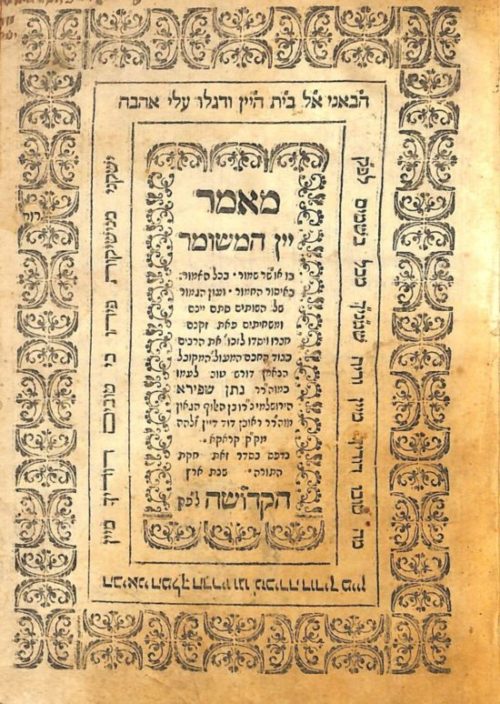
The first book by someone who later apostatized is Solomon Florentin’s Doresh Mishpat, published in Salonika in 1655. As mentioned, appears on both hebrewbooks.org and Otzar haHochma.

Here is the title page.
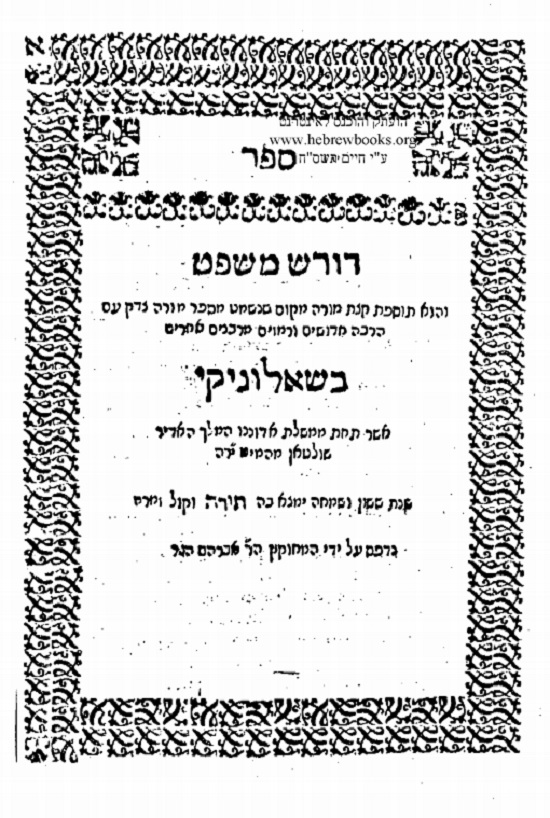

You can view the entire book here here.

Florentin was a follower of Shabbetai Zvi and was one of the group of Salonikan Jews who converted to Islam following Shabbetai Zvi’s own conversion.[1]

The second future apostate whose book appears on Hebrewbooks.org and Otzar haHochma is Aaron Israel Briman. He wrote Avnei Zikaron, which was published in Amsterdam around 1880.[2] Here is the title page.


You can view the entire book here here.

Briman, who appears to have been an ordained rabbi, was a real scoundrel. After his apostasy, which seems to have been done completely for monetary reasons, he wrote the infamous anti-Semitic work Der Judenspiegel and assisted the anti-Semite August Rohling in his attacks against the Talmud and Judaism in general.[3]  He also abandoned his wife and two small children, leaving his wife an agunah. After becoming a Christian, he engaged in various monetary frauds which landed him in prison. According to the article here in the Jewish Encyclopedia, he studied in the Rabbinical Seminary of Berlin, a point confirmed by Gotthard Deutsch.[4]

As for seforim written by someone after he converted, this brings us to Jehiel Zvi Lichtenstein (1827-1912; in his earlier years the last name he used was Hirschensohn, and I don’t know why he changed it). Detailed biographical information about Lichtenstein can be found in a good article by Samuel Leib Zitron included in volume 2 of his Me-Ahorei ha-Pargod: Mumarim, Bogdim, Mitkaḥashim that fortunately is also found online here. There is, however, no scholarly article on the writings of Lichtenstein, and although he was infamous in his day, today he is almost entirely forgotten.[5]

Lichtenstein was born in Bessarabia and was already an accomplished scholar as a young man. He was married at 18 to the daughter of a wealthy man, and he could have entered the rabbinate like so many others in his position. Yet as described by Zitron (and it appears that his description has been livened up, so it is not always clear if the facts are correct), various circumstances led him to divorce his wife, abandon his home, and convert to Christianity and become an enthusiastic missionary. Incredibly, even after converting to Christianity he continued to live as a Jew, moving to the town of Lubavitch where by all outward appearances he was a hasid of the Lubavitcher Rebbe.

Following this he went to Berlin where he was an open missionary. He then returned to Russia where he married the sister of the well-known Jewish-Christian missionary, Joseph Rabinowitz. In 1995 Kai Kjaer-Hansen published the English version of his book on Rabinowitz,[6] referring to him on the book’s cover and title page as the “Herzl of Jewish Christianity.”[7]

In 1872, after his apostasy, Lichtenstein published his book Derekh ha-Kodesh. The book was published in Berlin. I don’t know why the title page says it was printed in Russia, though this probably has something to do with taxes or customs for books sent to foreign countries.
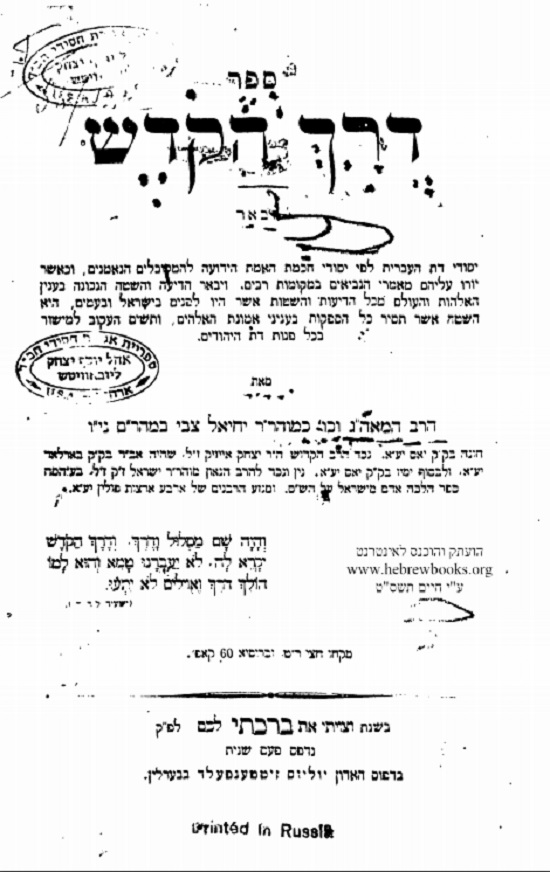
As you can see, this is the second printing and Lichtenstein gave himself a fancy rabbinic title. I have never seen a copy of the first printing, but Ephraim Deinard states that Lichtenstein’s name did not appear on the title page of this edition.[8]

Zitron tells us that Lichtenstein returned to his hometown where he distributed Derekh ha-Kodesh among the local Hasidim. The book reads like a real rabbinic text, and on the very first page he cites both the Baal Shem Tov and R. Shneur Zalman of Liady, and he continues to cite R. Shneur Zalman constantly in the book. It is obvious from what he writes elsewhere that he pretended to be a Chabad hasid. Thus, in his self-defense published in Ha-Magid [9], when he was still pretending to be a faithful Jew, he mentions that he had lived in the town of Lubavitch. In seeking to defend Derekh ha-Kodesh from the accusation that it had Christian elements, he calls for it to be examined by leading Chabad rabbis to see if there is anything problematic in the book.

.ואקרא לשופטי צדק את רבני חב”ד הגדולים אשר ירדו לעמקי הלכה של הקבלה והחסידות הדבקים באלהים חיים המה יאמרו אם עולתה בו

His call was taken up by Jacob Solomon Alschwang who claimed to have a lot of knowledge in Kabbalah and hasidic thought, “like one of the great Chabad rabbis.”[10]  I am sure that this self-judgment contains a good deal of exaggeration, yet Alschwang did come from a Chabad background and received a traditional Chabad education before leaving that world for the world of Haskalah.[11]

Alschwang identifies a number of passages in the book which he thinks are evidence of the author’s Christian sentiments.[12] Experts in Kabbalah and Hasidism can weigh in on whether Alschwang is correct or if the passages he points to can also be supported by classic kabbalistic or hasidic texts.

One of the passages Alschwang points to is on p. 68, which according to Alschwang means that Lichtenstein is speaking of God taking physical form on earth.

וע”ז נא’ עיני ה’ המה משוטטים בכל הארץ (זכריה ד, י) שענין משוטטים היינו שמתפשטים ומתלבשים בכל הארץ, והש”י משגיח בארץ ע”י שמתלבש בהם כי המה הם כלים רוחניים שהאציל וברא להשתמש בהם, והם מתפשטים ומתלבשים בתחתונים, והמה כמו העינים אל [של] האדם שהאדם יביט בהם והשכל מתלבש בהם לראות, וכן הוא הענין באזני ה

So, what do readers think? Does this passage speak of God literally assuming some bodily form? Furthermore, can we find similar passages in standard kabbalistic texts?

Alschwang also calls attention to Derekh ha-Kodesh, p. 42, where Lichtenstein states that God will appear to prophets in a physical form. Although Lichtenstein adds that God does not really take physical form, but only appears this way, Alschwang sees this as an example of Lichtenstein is trying to push a Christian notion. I guess the idea would be to first get Jews used to the notion that God can be imagined looking like a human, and the next step is to identify a real flesh and blood human as God. Here are Lichtenstein’s words:

כי העולם הזה בכללו הוא אלהות גמור מצד שאינו נראה לנו, אך לעינינו עשה האלהים על עצמו גילוי וצורה ויתחפש בדמות גשמי (זיך זעלבסט ענטשטעלט) אשר הנבראים ישיגו בחושיהם הגשמיים (אשר גם הם רק לעיניהם) דמות וצורה גשמית ארבע יסודות ומורכביהם, דומם צומח חי מדבר וכו’, אולם לעומת הש”י הכל אלהות גמור ואין פה גילוי ודמות גשמי ומהות כלל

Alschwang also notes that on page 7 Lichtenstein makes use of the famous expression from Matthew 19:24, “It is easier for a camel to go through the eye of a needle,” which is not what one would expect to find in a rabbinic text.

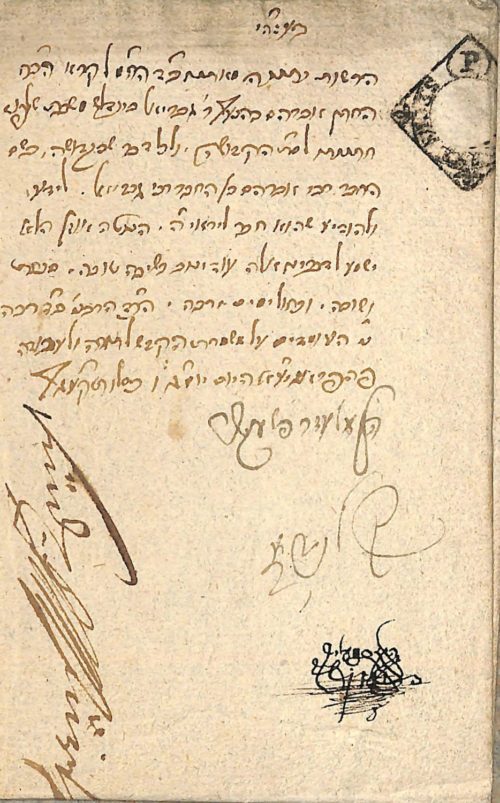
At one time in his strange life, Lichtenstein actually began serving as a hasidic rebbe of sorts, praying for people and handing out amulets. Ephraim Deinard, who knew Lichtenstein from the latter’s missionary days in Berlin in the 1870s,[13] claims that it was he who exposed Lichtenstein as a fraud. He happened to be in Lichtenstein’s town on a business trip in 1879, and that is how the townspeople learned that the supposedly pious rebbe was actually a Christian missionary.[14] Even after being exposed Lichtenstein did not give up, and a few years later he was in Podolia serving as a rabbi![15]

Derekh ha-Kodesh is only found on hebrewbooks.org, not on Otzar haHochma. You can view it here. The copy on hebrewbooks.org is missing the second half of the book. It appears that not all printings of the book contained the second part which includes a commentary on various biblical passages. (Alschwang mentions that his copy only had 84 pages, which means that it also was missing the second half.). Here is the copy which is found at Harvard, which is almost twice as long as the copy on hebrewbooks.org.[16] Interestingly, in the copy found on hebrewbooks.org (and also in the complete Harvard copy), on the second page, there are corrections applicable to the missing second half of the book. Also of note is at the bottom of this page of corrections it states that the haskamot for the book were published in the first printing. As far as I can determine, no copies of this first printing have survived.

Zitron tells us that in 1882 Lichtenstein came to Odessa with the manuscript of his book, Sheva Hokhmot. He received haskamot for the book from rabbis and maskilim. Here is the title page of the London 1912 edition of Sheva Hokhmot and you can view the book here.[17]

This is a very helpful work which in alphabetical fashion discusses all the geographical sites mentioned in the Talmud and Midrash.[18] The book previously appeared in Lemberg in 1883 and can be viewed here. The title page of the Lemberg edition mentions that Lichtenstein wrote the responsa volume Keren ha-Tzvi and the book Megaleh Sod. While Keren ha-Tzvi never appeared, Megaleh Sod, which is a commentary on the Bible, was published in Budapest in 1906 and can be viewed here. It is incredible that an apostate would write such a commentary which on its face looks like any other traditional commentary. (I haven’t read it carefully to see if he also inserts Christian interpretations.)

The actual text of both editions of Sheva Hokhmot is the same, but there are some differences between the prefaces of the two volumes. In the first edition the preface is longer, contains some notes, and also includes a list of the rabbis and scholars who prepaid for the book. In the London edition, Lichtenstein included a passage from R. Aaron Hyman’s Toledot Tannaim ve-Amoraim (London, 1910), vol. 1, p. 15, which greatly praises the book and the author, with Hyman saying that Lichtenstein is “wise in the wisdom of the Torah.” Hyman obviously must have been unaware of who Lichtenstein was.

That people did not realize who Lichtenstein was explains how a copy of Derekh ha-Kodesh was bound with regular traditional seforim (including R. Moses Cordovero’s Tomer Devorah), as seen in a recent auction here.[19]

As you can see from the title pages of Derekh ha-Kodesh and Sheva Hokhmot, both of these books, now found on hebrewbooks.org, came from the Library of Agudas Chassidei Chabad.[20] You can also see from the title page of Sheva Hokhmot that, before it was acquired by the Library of Agudas Chassidei Chabad, it belonged to the great scholar Jacob Zallel Lauterbach.

With reference to Lichtenstein, Steven J. Zipperstein writes as follows:

His Sheva Hokhmot [The Seven Wisdoms] was introduced by letters of praise from important scholars such as Mattityahu Strashun, Samuel Joseph Fuenn, and others, though the book appeared three years after Lichtenstein was first denounced as a missionary (by the rather mercurial and widely disliked Ephraim Deinard) in the newspaper Ha-Maggid.[21]

Zipperstein’s information about the letters in Sheva Hokhmot comes from Zitron, who also claims that these haskamot were forged by Lichtenstein. Yet there are no such haskamot from these figures, forged or otherwise. In the 1883 edition of the book, p. 6, we are given a list of people who wrote haskamot and letters of praise (including R. Joseph Dov Soloveitchik, the Beit ha-Levi), but these were never published, not even in the 1912 edition. I have no reason to doubt that these haskamot and letters of praise were authentic, otherwise how could he have publicly announced in the various authors’ lifetimes that he received letters from them? However, these letters were also written before news of his apostasy was known.

What makes Derekh ha-Kodesh and Sheva Hokhmot so interesting is that they were both written after Lichtenstein had become a Christian, something you would never know from the title pages. I don’t know of any other such books, namely, seforim written in a rabbinic style by someone who had already converted to Christianity.

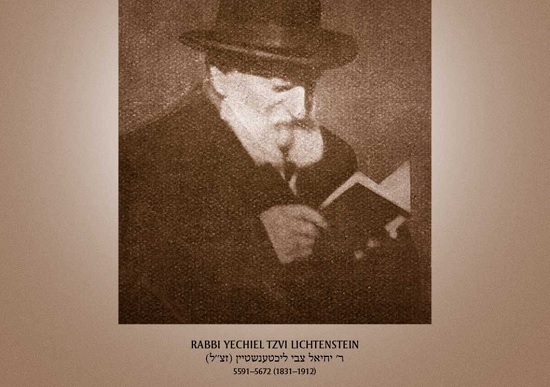
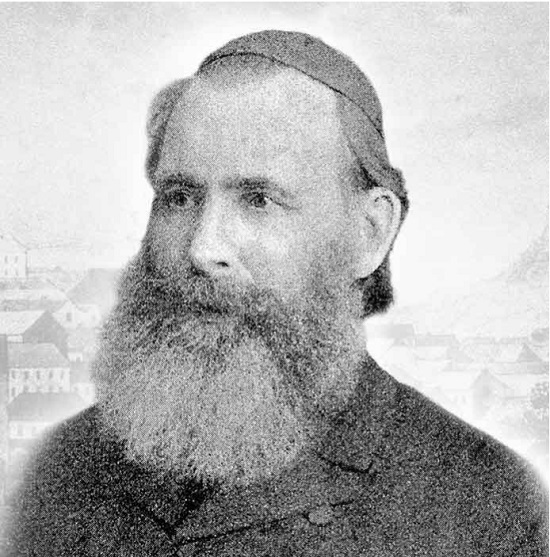
This is a picture of Lichtenstein that I found on a Messianic Jewish website here.

Here is the title page of Lichtenstein’s Hizuk Emunat Emet bi-Yeshua Mashiah ben ha-Elohim.[22]


You can find the entire book here. The author is listed as אבן צהר, which is simply the Hebrew translation of the name Lichtenstein. Also, צהר is the abbreviation of צבי הירשנזון, the birth name of the author.[23]

Lichtenstein also wrote a multi-volume Hebrew commentary on the New Testament, which you can see here. The commentary is preceded by a helpful article on Lichtenstein by Jorge Quiñónez. Lichtenstein’s revised commentary on Matthew can be seen here.[24]

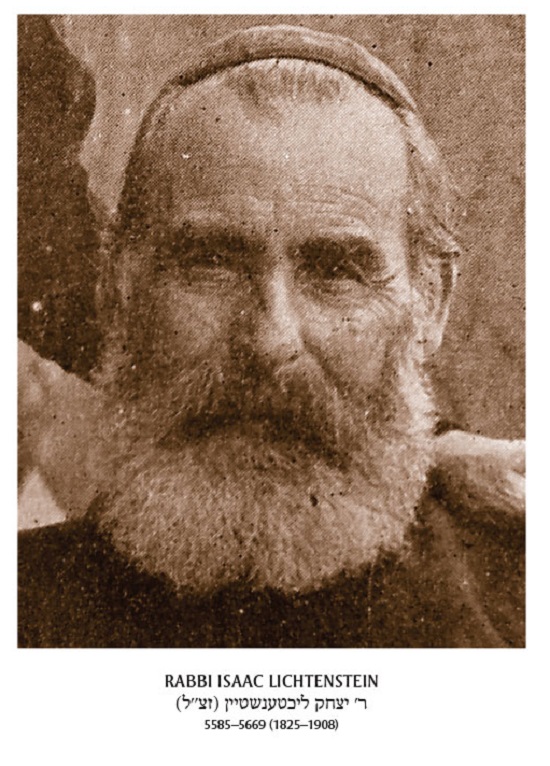
There is an entry on Lichtenstein in Zalmen Reyzen’s Yiddish Lexicon.[25] Yet one of the sources in the bibliography is about Isaac Lichtenstein. This Lichtenstein is often confused with Jehiel Zvi Lichtenstein whom we have been discussing. However, they were two separate people, and Isaac Lichtenstein (1824-1908), who was actually a rabbi, was also a believer in Jesus (although it is reported that he never actually converted to Christianity).

This is his picture taken from here.
The following picture comes from here
There was another Chabad hasid, Israel Landau, who converted to Christianity and became the chief Russian censor. In Ruth Bachi-Kolodny’s article about him, entitled “The Chabadnik Who Became Czarist Russia’s Chief Censor for Jewish Writings,” available here, he is even referred to as a rabbi, but this is certainly not correct, and the description of him as a rabbi does not appear in the original Hebrew version of the article here. The article states:

Although he became an apostate Jew, he remained, deep in his heart, a devoutly religious Hasid and continued to look the part with his short trimmed beard, earlocks, skullcap and long, broad kapota ‏(the long black jacket of members of Chabad‏); he would eat only in kosher restaurants. In fact, Landau sent his wife and only daughter, Menuha, to Switzerland so they could live as Jews without any external hindrances.[26]

Ben Zion Dinur, who was from a Chabad family, mentions that it was jokingly said about Landau that even after apostatizing he still kept the holiday of 19 Kislev.[27] As for Landau’s wife and daughter, Ephraim Deinard, who knew Landau, states that they left Russia because they did not want to convert, not because Landau sent them out.[28]

My experience has been that as soon as I publish something, I find more relevant material and wish I could go back in time to include it in the publication. Fortunately, with the Seforim Blog I am able to update my writings. Not long ago I published Iggerot Malkhei Rabbanan. On pp. 300-301, R. Meir Mazuz writes that he read in Yated Ne’eman that the apostate Russian censor removed two lines from Bialik’s poem about the Kishinev pogrom of 1903, “In the City of Slaughter,” because he found them heretical and did not want to lose his share in the World to Come! I was not aware of this story but I looked at the poem and immediately identified what these two lines must be. In fact, as I only learned after the book was published, it was actually the following four lines that were deleted, and the censor who was responsible for this was none other than Landau.[29]

,סִלְחוּ לִי, עֲלוּבֵי עוֹלָם, אֱלֹהֵיכֶם עָנִי כְמוֹתְכֶם
עָנִי הוּא בְחַיֵּיכֶם וְקַל וָחֹמֶר בְּמוֹתְכֶם
–כִּי תָבֹאוּ מָחָר עַל-שְׂכַרְכֶם וּדְפַקְתֶּם עַל-דְּלָתָי
!אֶפְתְּחָה לָכֶם, בֹּאוּ וּרְאוּ: יָרַדְתִּי מִנְּכָסָי

Forgive me, beggars of the world, your God is as poor as you,
Poor he is in your living and so much more so in your deaths.
And if you come tomorrow for your due and knock on my doors—
I’ll open for you, come and look: I’ve gone down in the world.[30]

The story of the censorship is told by Benzion Katz in his memoir, in a chapter that deserves to be translated into English.[31] Katz was the founder and editor of the newspaper Ha-Zeman, where Bialik’s poem appeared. If you look in Ha-Zeman you will find that the title of the poem was changed to “Masa Nemirov”, and a note informs the reader of the infamous 1648 massacre in Nemirov. As Katz explains, this new title was suggested by Landau, who was willing to look the other way if Bialik and Katz would pretend that the words were not about the 1903 Kishinev pogrom but about another event 250 years prior.

As for the censorship of the lines mentioned above, Katz writes as follows (p. 135):

כשהיה הכל מוכן נתתי לו לקרוא את השירה. הכל נראה לו כשר, חוץ מנקודות אחדות, שלדעתו התריס שם ביאליק נגד א-לוהים. אין הוא יכול להרשות זאת – אמר הצנזור המומר. – בשביל הממשלה ימצא תמיד תירוץ אבל לא בשביל רבונו של עולם. “אינני צעיר ואצטרך לתת דין וחשבון בעולם הבא. אינני רוצה להפסיד את חלקי בעולם הבא”

Landau would not permit some lines to appear in the poem as he did not want to lose his share in the World to Come. Bialik wrote to the censor to defend himself and the censor replied as follows (as summarized by Katz, p. 135), pointing out among other things that Bialik had misunderstood the Zohar :

הוא הצעיר, אף על פי שהוא משורר גדול, מביא לי ראיות מן הזוהר הקדוש, שבו יש ביטויים שהם כביכול גם כן עלבון לקדוש ברוך הוא, אבל אלה אינם עלבונות אלא ביטויי צער וזעם. אני בקי בזוהר. אני לומד אותו יותר ממנו. אני הרשיתי להדפיס את הזוהר מה שלא הרשו הצנזורים הקודמים. היו מביאים את הספר בגניבה מחוץ לארץ. נגד א-לוהים אי אפשר לעשות כלום

All this goes to show that while you can take the Jew out of the shtetl, often (even with apostates) you can’t take the shtetl out of the Jew.

To be continued

  1. I want to call attention to four recent valuable books. The first is Mitchell First, Roots and Rituals: Insights into Hebrew, Holidays, andHistory. This book is full of interesting chapters on liturgy, history, holidays, and the Hebrew language. If, like me, you have enjoyed First’s posts on the Seforim Blog, then his latest book will be a treat.

The second book is Bezalel Naor’s translation of R. Kook’s Commentary to the Legends of Rabbah bar Hannah. This book only further solidifies Naor’s standing as the leading interpreter of R. Kook in the English language. In addition to extensive notes, Naor also includes 11 appendices which include such topics such as R. Kook’s critique of the Mussar Movement and R. Kook and the Dybbuk in Jaffa.

The third book is a joint effort by the eminent scholars Menachem Kellner and James Diamond. Its title is Reinventing Maimonides in Contemporary Jewish Thought, published by my favorite press, Littman Library. This is a collection of articles by Kellner and Diamond which focus on various important Torah scholars and their understanding of Maimonides.

Here is the table of contents.

Anyone interested in nineteenth- and twentieth-century rabbinic thinkers will find this work of value.

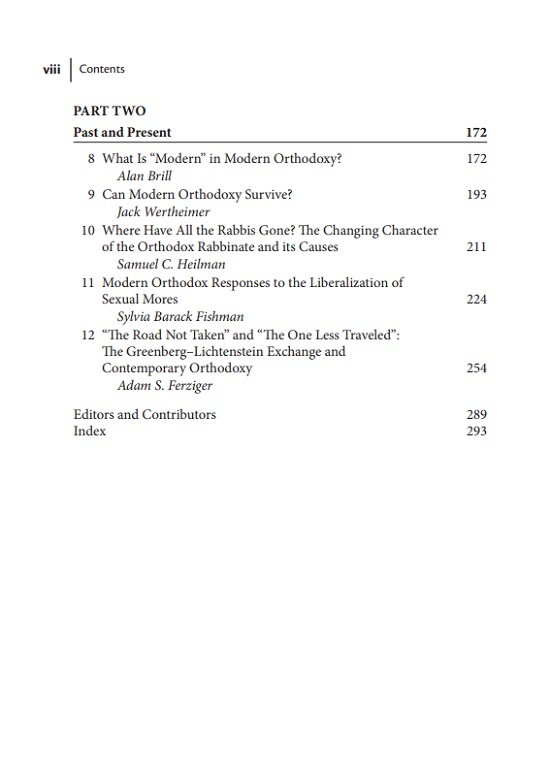
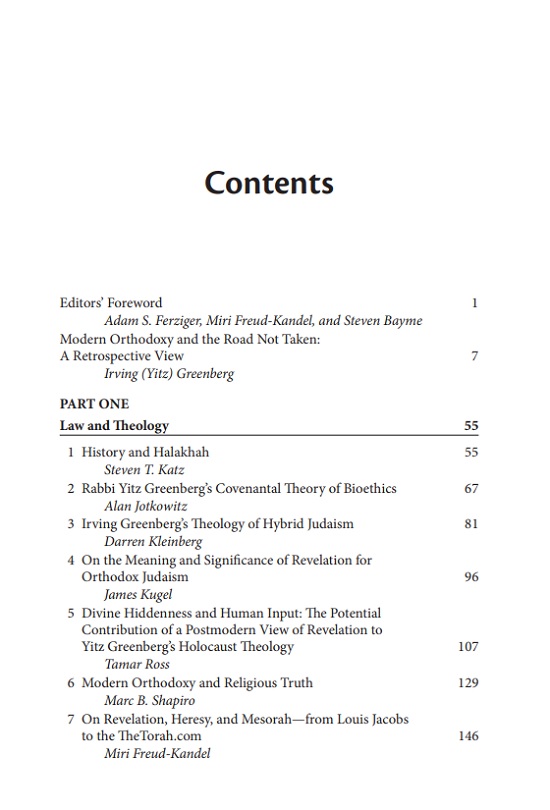
The fourth book is Yitz Greenberg and Modern Orthodoxy: The Road Not Taken, edited by Adam Ferziger, Miri Freud-Kandel, Steven Bayme. This book, which is full of great essays, is available in paperback here, and this is the table of contents.
 

  1. R. Yissachar Dov Hoffman was kind enough to send me this picture of R. Joseph B. Soloveitchik and R. Ovadiah Yosef from April 25, 1974.[32]

My question to readers is, can anyone identify the three young men standing behind the rabbis?

  1. Anyone interested in my summer 2020 trips with Torah in Motion can find details here.
  2. For those in the New York area, I will be speaking at Young Israel-Beth El of Boro Park (4802 15thAvenue, Brooklyn) on Saturday night, December 21 at 8pm. The title of my talk is “Judaism and Islam: Some Halakhic and Historical Perspectives”.

[1] See Meir Benayahu, Ha-Tenuah ha-Shabta’it be-Yavan (Jerusalem, 1971-1978), pp. 35-36.
[2] Regarding Briman and his book, which is actually a complete plagiarism – the entire book lifted word for word from R. Abraham Wallerstein, Mahazeh Avraham, found in Wallerstein’s Ma’amar Avraham (Fuerth, 1757) – see Shmuel Ashkenazi, Asufah (Jerusalem, 2014), pp 53-55.
[3] See Joseph Samuel Bloch, Zikhronot Mimei Hayai, trans. S. Shalom, (Tel Aviv, n. d), vol. 1, pp. 84ff.
[4] See his letter in the Jewish Chronicle, June 26, 1914, conveniently posted in On the Main Line here. See also On the Main Line here for a fascinating post dealing with another apostate who appears to have been a rabbi.

For detailed discussions of Briman, see Samuel Leib Zitron’s article from volume 2 of his Me-Ahorei ha-Pargod: Mumarim, Bogdim, Mitkaḥashim, available here; Joseph Samuel Bloch, Zikhronot mimei Hayai (Tel Aviv, n.d.), vol. 1, pp 81ff.; Ha-Melitz, April 24, 1885, cols. 440-441. For numerous contemporary references to Briman, see Jonatan Meir, Literary Hasidism: The Life and Works of Michael Levi Rodkinson, trans. Jeffrey G. Amshalem (Syracuse, 2016), p. 167 n. 201. Unfortunately, Meir, p. 169 n. 214, cites Chaim Bloch – about whom I have a written a good deal on this blog – without realizing that none of the unpublished material Bloch claimed to possess can be assumed to be authentic. Regarding Bloch, see also Tesla Lee’s 2016 honors thesis at the University of North Carolina at Chapel Hill, “Sigmund Freud and Chajim Bloch: Exploring the Role of the Jewish Joke in European Jewish Identity,” available here. On pp. 5-6, Lee mentions another fabrication by Bloch. Bloch describes how he offered Freud his criticisms of Moses and Monotheism, yet we know that Freud did not begin working on this book until years after Bloch’s supposed conversation with him. For a recent discussion of Bloch and his role in popularizing the Golem story, see Samuel Jacob Spinner, “Jews behind Glass: The Ethnographic Impulse in German-Jewish and Yiddish Literature, 1900-1948” (unpublished doctoral dissertation, Columbia University, 2012) pp. 89ff.
[5] The biographical information I provide about Lichtenstein comes from Zitron. Here is what the Encyclopaedia Judaica, s.v. Hirschensohn-Lichtenstein, Jehiel Zevi Hermann, writes:

Born in Russia, he converted to Christianity in 1855 in Jassy, Rumania, but keeping this secret he spent some time among the Hasidim of Lubavitch and worked on his Derekh ha-Kodesh (“The Way of Holiness,” 1872), which deals with the fundamentals of the Jewish faith, but betrays the authors Christianizing tendencies. From 1868-1878 he worked, under the name of Hermann Lichtenstein, for the Protestant mission in Berlin. He then returned to Russia where, disguised as a hasidic rabbi, he distributed his book. He married in Kishinev, Moldavia, a sister of Joseph Rabinovich, who later, probably under Hirschensohn’s influence, founded the sect called Community of Evangelian Jews. His true character discovered, he had to leave Russia and became lecturer at Franz Delitzsch’s Institutum Judaicaum at Leipzig.

[6] Joseph Rabinowitz and the Messianic Movement (Edinburgh, 1995).
[7] This title was earlier given to Rabinowitz by Hugh J. Schonfield, The History of Jewish Christianity p. 5, available here.
[8] Zikhronot Bat Ami (St. Louis, 1920), vol. 2, p. 134.
[9] Ha-Magid, May 7, 1885, p. 144.
[10] Ha-Magid, June 25, 1885, pp. 208-209.
[11] See his autobiography in Sefer Zikaron le-Sofrei Yisrael ha-Hayyim Itanu ka-Yom (Warsaw, 1889), pp. 203ff, available here. He wrote under the pseudonym ישביאל. See Saul Chajes, Otzar Beduyei ha-Shem (Vienna, 1933), p. 173. The title of the book mentioned at the beginning of this note is of interest, as it is a “memorial volume” for living writers. Today I think we would only use the words “Sefer Zikaron” for people who are deceased. It is also of interest that in the past there were writers who used ז”ל either as זכרונו לברכה or זכור לטוב for living people. See Tovia Preschel, Ma’amrei Tuvyah, vol. 1, pp. 35, 324-325, vol. 4, p. 418.

In 1878, R. Isaac Moses Abulafia published his Lev Nishbar. Here is the title page.

This book is a defense of his halakhic rulings in his responsa Penei Yitzhak against the blistering criticisms of R. Solomon Moses Gaguine in his Yismah Levav. Of interest at present is Lev Nishbar, no. 3 (p. 12b). R. Abulafia notes that R. Gaguine refers to him with ז”ל after his name, and he is certain that this was not done in accord with the view mentioned above that ז”ל can be used even with living people. Rather, he sees this as an intentional insult, and as he puts it, כונתו לרעה. This might mean that he believes that R. Gaguine, by using ז”ל after his name, is hoping for his death.

והן עתה הביאני חדריו וכתב עלי תיבת ז”ל כנז”ל וה’ יודע ועד עליו אם כונתו לרעה עלי והלב יודע אם לעקל וכו’ ועכ”פ מדקפיד בכל דוכתא ודוכתא אך בחלקות ישית להבדיל בין המתים ובין החיים בתיבת ז”ל ונר”ו כנז”ל ומדשינה עתה הפעם לכתוב עלי ז”ל במקום נר”ו הא ודאי דקפידה הוי וכונתו לרעה ב”מ

See also what R. Abulafia writes in his introduction and the first page of the opening responsum, where you can see that he is not inclined to be generous in his interpretation of R. Gaguine’s intent.

Regarding the dispute between Rabbis Abulafia and Gaguin, see Yaron Haarel, “Hashpa’atam shel ha-Sefarim Penei Yitzhak, Yismah Lev ve-Lev Nishbar al ha-Ma’avak Saviv ha-Rabanut be-Damesek,” Asuput 11 (1998), pp. 211-243.
[12] That the book contains hints to Lichtenstein’s belief in Jesus is also stated by Samuel Shraga Feigensohn, Elbonah Shel Torah (Berlin, 1929), p. 28b.
[13] Deinard, Zikhronot Bat Ami (New Orleans, 1920), vol. 2, p. 133.
[14] Ha-Magid, April 9, 1885, p. 112. See here that in his later years, Lichtenstein’s Christian missionary students would call him “Rebbe”. This source describes Lichtenstein as serving as a hasidic rebbe before adopting Christianity, but that is not correct.
[15] Deinard in Ha-Magid, April 9, 1885, p. 112. Deinard, Zikhronot Bat Ami, vol. 2, p. 137, reports that Lichtenstein served as a rabbi in Hungary. In Tzelem ba-Heikhal (New Orleans, n.d.), p. 143, Deinard writes that he was a rabbi for a short time in a town in the Austrian empire. Feigensohn, Elbonah Shel Torah, p. 28b, states that he served as the rabbi in a town in Volhynia for eight years, but there is no evidence to support this statement
[16] See Jacob Solomon Alschwang, Ha-Magid, June 25, 1885, p. 209, that David Kahana had additional pages from the book which are missing from the Harvard copy. These pages, from a section entitled Even Bohan, are explicitly Christian, as they cite Jesus and Paul, and this is no doubt why they were removed. In what looks like a defense of Even Bohan, Lichtenstein, Derekh ha-Kodesh, p. 83 in the note, states that this section was written for Christians and Muslims and deals with the Noahide laws. This is, of course, not believable, as Christians and Muslims would not be reading his Hebrew work.
[17] Deinard, Zikhronot Bat Ami, vol. 2, p. 137, claims that it was actually printed in Eastern Europe, but R. Mazin in London bought the entire printing and put a new title page on the book.
[18] The title “Seven Wisdoms” is strange as it is really not relevant to the subject of the book. Regarding the “Seven Wisdoms,” see Harry Austryn Wolfson, Studies in the History of Philosophy and Religion (Cambridge, MA, 1973), vol. 1, pp. 507ff. Abarbanel, Commentary to Exodus, ch. 25, p. 253, writes:

שבעת הנרות שבמנורה רומזים אל שבע החכמות שכלם ימצאו בתורת הא-להים

[19] In my post here, I briefly discussed the apostate Paul Levertoff. I neglected to mention that before he converted, Levertoff, whose Jewish first name was Feivel, was one of the future historian Ben Zion Dinur’s teachers in heder. See Dinur, Be-Olam she-Shaka (Jerusalem, 1958), p. 26.
[20] This library has a number of heretical books, and R. Joseph Isaac Schneersohn’s earlier collection also contained books of this sort. R. Menachem Mendel Schneerson stated:

When I came to Leningrad, I was surprised to find various [anti-religious] books in my father-in-law’s library. . . . The reason, obviously, was . . . the library attracted non-religious Jews, and even Gentiles. In the meantime, they saw what Lubavitch was and that it shares knowledge, and were drawn to it as a result. This created the opportunity to speak with non-Jews about justice, honesty, and humanity, the Seven Noahide Laws, etc. The benefit was quite evident.

On another occasion, the Rebbe explained that his father-in-law needed such books, for “such things are also necessary for good purposes, as the Mishnah [Avot 2:14] states, ‘Know what to answer a heretic.’” Both of these passages appear in R. Baruch Oberlander’s and R. Elchanan Shmotkin’s beautifully produced work on the Rebbe, Early Years (Brooklyn, 2016), pp. 167, 168.

Ephraim Deinard, Zikhronot Bat Ami, vol. 2, p. 7, reports, as an eye-witness, that R. Shmuel Schneersohn read Haskalah works before he became rebbe of Lubavitch. It is hard to know whether Deinard is to be regarded as reliable in this matter as his antipathy to Chabad is apparent throughout his writings. See especially ibid., p. 16, where among other things he states:

.החסידים היותר רעים ומסוכנים לתורת ישראל, המה חסידי חב”ד

Deinard even falsely claims, ibid., p. 8, that the responsa of R. Menahem Mendel Schneersohn, the Tzemah Tzedek, were really written by R. Hayyim Jacob Widerwitz. In Chabad texts, R. Widerwitz is referred to as the editor of the Tzemah Tzedek’s responsa. See R. Shalom Duber Levin, Toldot Habad be-Artzot ha-Berit (Brooklyn, 1988), p. 3.
[21] “Heresy, Apostasy, and the Transformation of Joseph Rabinovich,” in Todd M. Endelman, ed., Jewish Apostasy in the Modern World (New York, 1987), p. 213. Contrary to what Zipperstein states, Sheva Hokhmot was published in 1883, and only in 1885 did Deinard denounce Lichtenstein. This information appears correctly in Zitron.
[22] The book can be seen here, along with two other Christian works by Lichtenstein and an obituary of him.
[23] See Zitron here.
[24] For more on Lichtenstein, see Ephraim Deinard, Ha-Magid, April 9, 1885, p. 112; Isaac Jacob Weissberg, Ha-Melitz, May 11, 1885, pp. 515-516; Deinard, Ha-Melitz, May 29, 1885, cols. 580-581; S. Mandelkern, Ha-Magid, June 11, 1885, pp. 190-192. See also David Assaf, Hetzitz ve-Lo Nifga (Haifa, 2012), pp. 75-76.
[25] Leḳsiḳon fun der Yidisher liṭeraṭur, prese un filologye (Vilna, 1927), vol. 2, cols. 151-154, available here. An abridged entry is found in the later edition of Reyzen’s lexicon, and you can see an English translation here.
[26] I should note that not everything Bachi-Kolodny cites from Benzion Katz’s memoir, Zikhronot (Tel Aviv, 1963), actually appears there. She also writes: “Interior Minister Vyacheslav Konstantinovich von Plehve issued orders that a pogrom be carried out in Kishinev ‏(now Chisinau, Moldova‏) in April 1903, on Passover, to expedite the Jews’ exit.” This is incorrect, as no such orders were ever issued by the unquestionably anti-Semitic Plehve. See Steven J. Zipperstein, Pogrom: Kishinev and the Tilt of History (New York, 2018), 94ff.
[27] Be-Olam she-Shaka, p. 13. Incidentally, Dinur tells us, pp. 17-18, that in his Chabad home in Russia they drank milk that came from non-Jews, rather than halav yisrael. This is what he writes about his father, who was a real Torah scholar.

זכורני, פעם אחת בא הביתה ואמר לאמא: היתה לי היום עגמת נפש מזה שאת משתמשת בחלב של לא-יהודים. תמהה אמא ושאלה: מאין יודעים? אמר אבא: אני סיפרתי את הדבר. התפלאה אמא: מה ראית להודיע ברבים? אמר: פשוט, התקיפו בבית-המדרש את דוד המלמד, שהוא משתמש בחלב נכרים, והלבינו את פניו. קמתי ואמרתי: מה אתם רוצים ממנו, גם אצלי נוהגים כך! ך

This is significant testimony, as it is well known how seriously Chabad hasidim regard this matter. There is even a story about how a big scholar who came to R. Shneur Zalman of Lyady was suffering from religious doubts. R. Shneur Zalman recognized that these doubts came about because the man had inadvertently drunk non-halav Yisrael milk. See R. Joseph Isaac Schneersohn, Sefer ha-Ma’amarim 5701-5705 (Brooklyn, 2012), Hebrew version, pp. 76-77.
[28] Deinard, Tzelem ba-Heikhal, p. 169. See also Deinard, Shibolim Bodedot (Jerusalem, 1915), pp. 58ff, for Deinard’s letter to Landau which among other things urges him to return to Judaism. See ibid., pp. 176-177, for Landau’s revealing letter to Deinard. As far as I know, neither of these letters have been mentioned by scholars who have discussed Landau. They are, however, mentioned here.

Shimon Steinmetz called my attention to a memoir by another former Chabad hasid who became a missionary. See Elieser Bassin, The Modern Hebrew and the Hebrew Christian (London, 1882), available here.
[29] A reproduction of the original publication from Ha-Zeman (July-Sep. 1904), is found in Michael Gluzan, Hannan Hever, and Dan Miron, Be-Ir ha-Haregah – Bikur Meuhar (Tel Aviv, 2005), pp. 158-168.
[30] Songs from Bialik, translated by Atar Hadari (Syracuse, 2000), p. 5.
[31] Zikhronot, ch. 37.
[32] R. Aharon Rakeffet provides another picture from this particular visit of R. Ovadiah. See The Rav: The World of Rabbi Joseph B. Soloveitchik, vol. 2, in the pictures that begin after p. 135, available here. I thank R. Yissachar Dov Hoffman for providing this information as well. He also called my attention to the following additional picture of the Rav and R. Ovadiah from this visit, taken from here.


Marc B. Shapiro – Responses to Comments and Elaborations on Previous Posts II

Responses to Comments and Elaborations of Previous Posts II
by Marc B. Shapiro
In a previous post I wrote as follows:
In Kitvei Ramban, vol. 1, p. 413, Chavel prints the introduction to Milhamot ha-Shem. The Ramban writes:
וקנאתי לרבנו הגדול רבי יצחק אלפאסי זכרונו לברכה קנאה גדולה, מפני שראיתי לחולקים על דבריו שלא השאירו לו כפי רב מחלוקותיהם ענין נכון בכל מה שדבר, ולא דבר הגון בכל מה שפרש, ולא פסק ראוי בכל מה שפסק, לא נשאר עם דבריהם בהלכות זולתי הדברים הפשוטים למתחיל פרק אין עומדין
In his note Chavel explains the last words as follows:
רק בסוף הפרק הזה נמצאה השגה אחת מבעל המאור
Yet what Ramban means by למתחיל פרק אין עומדין are the children who begin their talmudic study with Tractate Berakhot. In other words, it is only the explanations and pesakim of the Rif that are obvious even to the beginner that have not been challenged.[1]
Ephraim responded as follows

WRT the reference of Ramban to פרק אין עומדין, both you and R. Chavel are wrong. Ramban is clearly referring to the gemara’s explanation of the Mishnah’s ruling at the beginning of that chapter of אין עומדין להתפלל אלא מתוך כובד ראש, which is that one should learn an undisputed halakha prior to davening. It is only on those simple and undisputed halakhos that the Maor did not disagree.

Fotheringay-Phipps wrote:

The basic problem with Dr. Shapiro’s (or R’ Mazuz’s, as the case may be) pshat is that Ain Omdin is the fifth chapter of B’rachos, not the first. If the Ramban meant the perek that a kid starting out learns, why would he choose the fifth perek? I think R’ Chavel’s pshat is somewhat of a better pshat, since Ain Omdin is somewhat unusual in that there is only one haga’a from the Ba’al Hamoar in the whole perek, and I incline to think that this is what the Ramban meant.

I presented these comments to R. Mazuz and he replied as follows:

לפי פירוש כת”ר היל”ל הדברים הפשוטים שבתחלת פרק אין עומדין. אולם ידוע שבעדות המזרח התחילו ללמוד מסכת ברכות (וכ”ה בשו”ת הרי”ף סימן רג”ג). בניגוד לנהוג היום בתלמודי תורה להתחיל פרק אלו מציאות. ואבא זצ”ל התחיל לתלמידים בפרק תפלת השחר (ומסתמא כך נהגו בג’רבא) שהוא הפרק הכי קל בין הפרקים א’ ב’ ג’ ד’ במסכת ברכות. לכן יתכן מאד שבימי הראשונים התחילו דוקא בפרק אין עומדין (שהוא קל אפילו יותר מפרק תפלת השחר, ורובו דברי אגדה). וזוהי כוונת הרמב”ן

With regard to his point about the Sephardim beginning their instruction from Berakhot, in R. Mazuz’s new book, Arim Nisi, p. 364, he notes that R. Shakh, Shimushah shel Torah p. 88, refers to the Maskilim’s attempt to institute this in Europe as a “reform.” Yet in reality, this practice has a long history. R. Mazuz writes:

ונעלם ממנו במחכ”ת שכן מנהג הספרדים עד היום הזה, והוא מנהג קדמון מימי הרי”ף והגאונים, ואולי מימי רבי מסדר המשנה שהתחיל בסדר זרעים במסכת ברכות. ולפני כששים שנה הדפיסו באי ג’רבא מסכת ברכות בהשמתטת הקטעים שאין רגילים ללמדם לתלמידים בהסכמת רבני העיר וט”ו מרביצי תורה שבעיר, ויצאו מהם פירות ופירי פירות

Since I mentioned R. Mazuz’s comment vis-à-vis what R. Shakh wrote, I should add that he criticized him on other occasions as well. These criticisms were always offered with proper respect. Yet there are those in the Lithuanian world who have no interest in hearing what another gadol has to say if it not in line with current Daas Torah.[2] R. Mazuz states that he once sent a letter to Yated Neeman pointing out an error R Shakh made, and they refused to publish it. After this paper refused to publish two more of his letters, he stopped sending them, as the hazakhah had been established.[3]
He also tells us that if the editors had a different attitude, he would have also sent in something dealing with the proper way to pronounce the word אחד in Shema, since there was a great deal of discussion in the newspaper by people who didn’t know what they were talking about. The truth is that a dalet without a dagesh is very similar to a zayin[4] and is still preserved among the elders of Yemen and Iraq. He cites one of Ibn Gabirol’s poems which reads:
לאטך דברי שיר דבורה
אשר קרית שמע מפיך יקרא
מיחדת ומארכת באחד
In Peter Cole’s translation:

Take, little bee,
your time with your song,
in your flight intoning the prayer called “Hear”
declaring and stretching “the Lord is one.”[5]

In other word, the bee’s buzzing (zzz) shows us how one can extend the dalet. It is pronounced in the way that the letter can be extended, which cannot be done with a hard dalet.

R. Shakh was a man of truth, and he certainly would have wanted to be corrected. All true scholars are happy when this happens, and this is what intellectual honesty is all about. But Yated Neeman has never been interested in truth or intellectual honesty, but in pushing a religio-political agenda, and therefore not only do they refuse to print such corrections of their gedolim, but they have even published material which they know is untrue. I refer in particular to their slander of R. Kook, stating that he applied the verse Ki Mitzion Tetze Torah to the Hebew University. Even though the truth was pointed out to them they continued to print the slander. One can read all about this in Moshe Maimon Alharar’s book Li-Khevodah shel Torah.

Returning to R. Mazuz and R. Shakh. R. Shakh had written

Whence did Hazal know that the earth was forty-two times larger than the moon, and that the sun was approximately one-hundred-and-seventy times larger than the earth (as explained in the Rambam, Hilkhot Yesodei Hatorah 3:8), if not from the power of the Torah?

Some might recognize this passage as it was subject to a very strong critique by R. Aharon Lichtenstein. I am sure that many in the haredi world were very upset by what R. Lichtenstein wrote, but it pales in comparison to what R. Shakh wrote about the Rav’s Hamesh Derashot.[6] Among his negative comments, he referred to Rav’s Zionist ideas as ממש דברי כפירה.

R. Lichtenstein actually has two replies to the quote from R. Shakh. They are both found in the same essay, but the essay has appeared in two different versions. In the original version he wrote as follows.

Upon reading the passage, one can only reflect, first, that the description cited is nowhere to be found in Hazal, but derives, rather, from medieval astronomers; second, that it is in conflict with the rudiments of contemporary scientific assumptions, and, third, that it hardly consorts with the fact that the selfsame Rambam had explicitly stated, with respect to these very issues, that they were beyond the pale of Hazal’s authority. . . . The high regard properly due the author of the Avi Ezri notwithstanding, one can only conclude that, evidently, when their reach exceeds their grasp, even acknowledged and esteemed talmdei hakhamim may falter.[7]

Yet when this essay was reprinted in Leaves of Faith, vol. 2, the criticism was softened:

In raising this question, he is wholly oblivious not only of the rudiments of astronomy but also of the fact that the selfsame Rambam explicitly states, with respect to these very issues, that they are beyond the pale of Hazal’s authority.

כן בדברי חז”ל. וכמבואר להדיא בהקדמתו לפירוש המשניות (בש”ס ברכות דפוס ווילנא דף נה סע”א וע”ב) שהמקור לזה מספר אלמגסט”י. והוא ספרו של בטלמיוס הידוע בחכמת האסטרונומיא. ועפ”ז כתב הרמב”ם בהלכות יסודי התורה (שם) שהשמש גדולה מן הירח פי 6800. ורלב”ג עה”ת (בפסוק ויאמר אלקים יהי מאורות) חולק על זה וכתב כי השמש גדולה מהירח פי חמשים אלף, כמו שביאר בח”א ממאמר חמישי מס’ מלחמות ה’ ע”ש. וכיום ידוע שהשמש גדולה מן הארץ פי מליון שלש מאות אלף

In response to this citation of R. Shakh in Yated Neeman, R. Mazuz wrote as follows (Or Torah, Adar 5753, pp. 461-462):

והנני להעיר שהרמב”ם כתב כן ע”פ חכמי המדע בימיו ולא נצמא כן בדברי חז”ל. וכמבואר להדיא בהקדמתו לפירוש המשניות (בש”ס ברכות דפוס ווילנא דף נה סע”א וע”ב) שהמקור לזה מספר אלמגסט”י. והוא ספרו של בטלמיוס הידוע בחכמת האסטרונומיא. ועפ”ז כתב הרמב”ם בהלכות יסודי התורה (שם) שהשמש גדולה מן הירח פי 6800. ורלב”ג עה”ת (בפסוק ויאמר אלקים יהי מאורות) חולק על זה וכתב כי השמש גדולה מהירח פי חמשים אלף, כמו שביאר בח”א ממאמר חמישי מס’ מלחמות ה’ ע”ש. וכיום ידוע שהשמש גדולה מן הארץ פי מליון שלש מאות אלף

R. Mazuz’s second letter deals with the nature of darkness. Yated Neeman had printed the Vilna Gaon’s opinion that darkness is not simply the absence of light but its own creation. R. Mazuz responded that this is in opposition to the opinions of the Rambam, Ramban, R. Joel Sirkes, R. Elijah Mizrahi and the Siftei Hakhamim. Subsequent to writing the letter he learnt that this view was also held by R. Saadiah Gaon, Ibn Ezra, Radak, and the Kol Bo (see ibid., p. 946) After pointing out that the Vilna Gaon’s view is held by R. Jacob Emden and the Hida. He concludes:
מכל מקום אין לקרוא לסברא. שהחשך הוא העדר “דברת המינים” ח”ו. ואלו ואלו דברי אלקים חיים
As already mentioned, Yated Neeman does not like to print letters from those who are able to show that the newspaper has erred. Only newspapers interested in the truth do that.

In his Kovetz Ma’amarim, pp. 102ff., R. Mazuz includes another letter he sent to Yated which also was not printed. The paper had published the view of the Steipler and R. Chaim Kanievsky that even Sephardim should pronounce the final vowel of אד-ני as Ashkenazim pronounce the kamatz, since otherwise it appears as it if there is more than one God.

R. Mazuz shows how mistaken this is, and illustrates though various texts that the way the Sephardim pronounce the kamatz today is precisely how it was pronounced in medieval times. For example, he cites one of Ibn Gabirol’s Azharot:

אנכי ה’ / קראתיך בסינַי/ ולא יהיה על פנַי / לך אלהים אחרים
One can easily see that the words are designed to rhyme, so obviously the last syllable of Ado-nai was pronounced the same way as Sinai and panai.
2. Since I just mentioned R. Aharon Lichtenstein, let me quote something else he wrote that relates to what I noted in a previous post.[8] I pointed to the common phenomenon of people rejecting the authenticity of texts that don’t agree with their preconceptions. R. Lichtenstein states:

The Rav had no patience for philosophies that glorified passivity and reliance on miracles. At the beginning of the 1960’s, a few years after the launch of Sputnik, I had occasion to talk with the Rav about those people who claimed that man should not reach out for the heavens, for “the heavens are the heavens of God,” and only “the earth is given to human beings.” The Rav heaped scorn upon them. One of those present jumped up to protest: “But Rabbi, the Ramban in Bechukotai (Vayikra 26:11) speaks about how a person should have faith in the Holy One, and not to delve into matters that are too wondrous for him.” The Rav replied, “I heard from my father, in the name of my grandfather, that the Ramban never uttered that statement!”

Although not identical to the Ramban’s position, there was also a medieval Jewish view that doctors should only be consulted for things like sprained arms, but that when it came to internal diseases one should only resort to prayer. Lest one think that this idiosyncratic position has totally disappeared, I have even found a twentieth-century author who adopts it,[9] leading R. Ovadiah Yosef to strongly reject this view in his haskamah.

3. In a previous post[10] I called attention to an error made by H. Norman Strickman and Arthur Silver. They claimed that according to Radak’s commentary to Gen. 14:14, after the conquest of the Land of Israel the reading of this verse was changed to read “and pursued as far as Dan.” Dr. Strickman has informed me that in the Afterword to his translation of Ibn Ezra to Leviticus, p. 291, he himself corrected the errror. The correct reference is to Radak’s commentary to I Sam. 4:1. Here Radak leaves no doubt that he indeed believes that the text of the verse was changed.
על האבן העזר: כמו הארון הברי’ והכותב אמר זה כי כשהיתה זאת המלחמה אבן נגף היתה ולא אבן עזר ועדיין לא נקראה אבן העזר כי על המלחמה האחרת שעשה שמואל עם פלשתים בין המצפה ובין השן שקרא אותה שמואל אבן העזר שעזרם האל יתברך באותה מלחמה אבל מה שנכתב הנה אבן העזר דברי הסופר הם וכן וירדף עד דן
With this text, we can now understand Radak’s commentary to Gen. 14:4 as also referring to a post-Mosaic change. Without this text, there would be no reason to assume that Radak in Gen 14:14 is not referring to Moses’ prophetically writing the word “Dan.”

As I pointed out in my previous post, in the introduction to his Commentary on the Torah Radak insists on complete Mosaic authorship. In order that there be no contradiction between the sources, we must assume that Radak means that no sections (or even verses) were written by someone other than Moses, but not that there are no minor post-Mosaic changes. In my book I pointed out that Radak understood tikkun soferim literally, that is, the Scribes actually made minor changes to the text of the Torah.[11]

(With regard to false ascription of critical views vis-à-vis the Torah’s authorship, I should also mention that Abarbanel, Commentary to Numbers 21:1, accuses both Ibn Ezra and Nahmanides of believing that the beginning verses of this chapter are post-Mosaic. Yet Abarbanel must have been citing from memory, since neither of them say this. In fact, Ibn Ezra specifically rejects the notion that the verses were written by Joshua.)

4. In a previous post I mentioned R. David Zvi Hillman’s strong attack on R. Kafih. It is only fair to point out that Hillman’s letter was the impetus for an even sharper attack on Hillman. See here, here, and here for the relevant documents.

R. Kafih was a follower of the Rambam who wrote that one should be “among those who are insulted, but not among those who are insulting” (Deot 5:28). While the articles make many good points, the crude language used is entirely unacceptable.

5. With regard to the Netziv and reading newspapers on Shabbat, Dr. Yehudah Mirsky has called my attention to the Netziv’s article in R. Kook’s journal, Ittur Soferim (1888), pp. 11-12, where the Netziv offers halakhic justification for this practice. Unfortunately, this short article was not included in Meshiv Davar, vol. 5, which appeared in 1993. (Presumably, the editors were unaware of it.) This most recent volume of Meshiv Davar is a bit strange, because the editors don’t tell us anything about where they found previoiusly unpublished responsa included here. From a historical standpoint, the most interesting responsum is no. 44. Here the Netziv blasts the new analytic approach of R. Isaac Jacob Reines, which is found in his Hotam ha-Tokhnit and Urim Gedolim.

Other than an anonymous article in Ha-Peles 5 (1903), pp. 673-674, in which Reines’ approach is regarded as falling into the category of “that which is new is forbidden by the Torah,” I don’t know of any other attacks on him. For some strange reason, Saul Lieberman thought that R. Yaakov David Wilovsky’s famous attack against the Brisker method, found in the introduction to his Beit Ridbaz, was directed against Reines. Shaul Stampfer quoted this in Lieberman’s name in the first edition of his masterpiece, Ha-Yeshivah ha-Lita’it be-Hithavutah (Jerusalem, 1995), p. 113 n. 29, but omits Lieberman’s comment in the second edition of this book (Jerusalem, 2005).

6. In a previous post I wrote about the issue of kosher sturgeon. Shortly after the post appeared I read David Malkiel’s article on R. Isaac Lampronte’s Pahad Yitzhak.[12] Malkiel, p. 129, points out that the most famous entry in the work deals with the authority of customs, and focuses on whether a certain type of sturgeon is kosher. Lampronte tell us that the custom in Ferrara was to eat it.

I wrote the post without doing an internet search, which is now the first place people go when beginning their research. Only after the post appeared did I do such a search and I came up with the following very interesting post by Rabbi Seth Mandel.[13] He writes as follows:

I have asked several rabbonim about how it came to pass that if the Noda’ biY’hudah paskened unequivocally that sturgeon is kosher, every book says black on white that it is not. Of the two rabbonim who even were aware of the issue, one said that of course sturgeon is kosher, and the fact that there is none with a hekhsher is either because the rav hamakhshir doesn’t know about the issue, or you can’t get a rav hamakhshir to the fishing plants. . . . The other rov said that of course, no recognized halakhic authority would contradict the Noda’ biY’hudah on this, but since Jews believe they are not kosher, and the only ones pushing their kashrut are the C or R, why should an O rov fight to show they are kosher, as if we accept the way they arrive at their decision? . . . 

I challenge anyone to find a posek who deals with the issue and refutes the Noda’ biY’hudah. I am _not_ saying that I “know” that there is no one; what I am saying is that I have been looking for years, and have found no one. Please do not hesitate to correct me if anyone knows of a source (but one that knows that the Noda’ biY’hudah had a t’shuva on this). The books on the kashrus of fish just take it as a given that since sturgeon, as R. Josh says, do not have scales but rather bony tubercules, they are not kosher. My bottom line is I don’t care if people hold that they are not kosher (I don’t like fish eggs, anyway), but it seems to me inexcusable for these books to distort the Torah by giving the impression that everyone agrees on this issue. The Noda’ biY’hudah is not just anyone. My goodness, he is not even MO, L, or Chareidi, so there go most of the opportunities for saying “WADR to the Noda’ biY’hudah, he is MO/L/ wears a grey hat, and so cannot be representative of true Torah.” The only thing you can say is that he was an opponent of chasidus, but even according to the Chasidim, that is not an issue, since a famous story of the Chasidim is that he repented on his deathbed from all the not nice things he said condemning chasidus (and the story _must_ be true, since it is retold in the CIS Shulman “authorized” biography of him).

Rabbi Mandel wrote this before he was appointed to his current important position in the OU kashrut organization. Somehow, I don’t think he would have expressed himself this way if he was then working in the kashrut industry.[14]

7. I was fortunate to spend back-to-back Shabbatot with Prof. Daniel Sperber. I learnt much from my conversations with him, and I think people will enjoy listening to his presentations. He is currently president of the Jesselson Institute for Advanced Torah Studies at Bar Ilan University, and was kind enough to give me a recent volume published by them, Mi-Sinai le-Lishkat ha-Gazit by Shlomo Kassierer and Shlomo Glicksberg. This book analyzes the relationship between the written and oral law, and the nature of rabbinical authority. What makes the book significant is the combination of traditional and academic study. Anyone who wants to understand the latest thinking on this topic would be wise to consult this book.

8. Many people contacted me following my last post on Rabbis and Communism, so let me add a few further comments. R. Baruch Oberlander called my attention to Likutei Sihot, vol. 33, pp. 248-249. Here the Lubavitcher Rebbe states that there is no contradiction between Judaism and socialism. He adds that in Russia, before the Revolution, he knew many socialists, even radical ones (which I assume means real communists), who were completely Torah observant. See also Iggerot Kodesh, vol. 22, p. 497.

Since my last post mentioned R. Jacob Emden and Abraham Bick’s communist ties, I should also mention Mortimer Cohen, the author of Jacob Emden: A Man of Controversy. This was the first academic defense of Emden, and was subjected to withering criticism by Scholem. Marvin Antelman, who has made attacking Eybschuetz one of his life’s goals, also sets his guns on Cohen, accusing him of having been the “’rabbi’ of a secret sect of Sabbatean communists, who carried on the Frankist conspiracy in Philadelphia” (Bekhor Satan, p. 44).

R. Nathan Kamenetsky wrote to me pointing out that when R. Dovid Leibowitz was let go from Yeshiva Torah va-Daas in the 1930s, one of the complaints against him was that he was promoting communism (whether the complaint was justified I cannot say. Kamenetsky continues: “My son, R’ Yoseph, pointed out that the Torah divides wealth evenly when it sets the law of Yovel. At the conquest of Canaan, the land was divided evenly, and every fifty years thereafter, by which time there would be wealthy lanlords and poor ones, the Torah redistributed the land in its original lots. (The difference between large estates and small ones would then result only from family sizes, by which families with many children would have smaller fields than and those with many children.)”

I had wondered about the meaning of the word ,סוללים and suggested that it refers to a white-collar profession. Kamenetsky writes:

You do not base your suggestion on philology – and nor will I. I also do not think that you are correct sociologically that white-collar workers were assumed to be less religiously observant than other Jews. I believe that Rabbi Graubart meant pharmacists, because, like doctors, they were not expected to be observant. I know this from my father’s attitude (which was grounded in the pre-World War I Jewish environment). For example, when my father would speak of my native Tzitevian, the town where he served as rabbi, and telling an involved story about how a Jewish woman who was suspected by my mother of not using the mikveh found that her husband was carrying on with their goyisheh maid, he added, (not in these exact words) “Naturally, besides the pharmacist’s wife, all the women in the shtetl used the mikveh.” Insofar as doctors, and likely pharmacists too, they weren’t trusted to be profesionally reliable if they were observant! See my Making of a Godol, page 557, (within my discussion about Dr. Einhorn, a mysterious figure), where I quote an article about that doctor which said, “The [townspeople] realized that [Dr. Einhorn’s] way of life, his devoutness, did not harmonize with his profession.”

9. Dr. Yehudah Mirsky called my attention to Mordechai Zalkin, “Bein ‘Bnei Elohim’ li-Vnei Adam’: Rabbanim, Bahurei Yeshivot ve-ha-Giyus le-Tzavah Ha-Russi ba-Meah ha-19,” in Avriel Bar-Levav, ed., Shalom u-Milhamah be-Tarbut Ha-Yehudit (Jerusalem/Haifa, 2006), pp. 165-222. I was unaware of this fabulous article which is a detailed survey of the issue of rabbis and the Cantonist problem. Let me just quote his concluding paragraph, which I was happy to see supports a suggestion I made. Coming from Zalkin, who is an expert in the history of Russian Jewry, it should be taken very seriously.

אין בידינו כלים לבחון את מידת השפעתו ארוכת הטווח של תהליך זה על מערך היחסים הבסיסי בחברה היהודית המזרח אירופית משלהי המא התשע-עשרה. אולם יש מקום להניח שלתחושת האכזבה והתסכול מאופן תפקודה של הרבנות המזרח אירופית בפרשת הגיוס היה חלק לא מבוטל במגמות החילון ובנהייה אחר תנועות אידאולוגיות שהציעו מודלים מנהיגותיים אחרים, שרווחו בקרב יהודי מזרח אירופה במחצית השנייה של המאה התשע-עשרה
Notes
[1] See R. Meir Mazuz’ note in R. Hayyim Amselem, Minhat Hayyim, vol. 2, p. 15.
[2] I stress the “current” Daas Torah, since Daas Torah has been known to change. For example, Yated Neeman will, for obvious reasons, no longer mention the Daas Torah set forth by the Brisker Rav, the Steipler, and R. Shakh, and which was the official haredi position for many decades, namely, that one is not permitted to serve in the Israeli government batei din. With regard to Daas Torah, the quote from R. Itzele that I mentioned in my last post is very interesting
החלק הפוליטי נחוץ, כי על ידו נמשוך את בני הנעורים והרחוב להסתדרותנו. גם הלא אנו רואים, כי כלל ישראל חפץ בו, בוודאי מאת ד’ הייתה זאת. וכלל ישראל הוא גבוה ונעלה מגדולי התורה. ישראל אם אינם נביאים, בני נביאים הם
In the haredi version of Daas Torah, the opinions of the masses are meaningless, indeed they are said to be – by definition – in opposition to Daas Torah (which always makes me wonder how laypeople such as Jonathan Rosenblum are able to understand and explain Daas Torah). Yet R. Itzele places the opinion of the religious masses on a higher level than that of the rabbis (à la kol hamon ke-kol shadai). One reader informed me that R. Avraham Shapira quoted this passage in defense of Zionism, i.e., the religious intuition of the people, who supported Zionism, trumped the view of the gedolim, most of whom opposed Zionism.
[3] Or Torah, Adar 5753, pp. 461ff., 946.
[4] See Shamma Friedman, “Le-Inyan ha-Devorah be-Shiro shel Ibn Gabirol, u-Minhag Ehad bi-Keriat Shema,” Lashon ve-Ivrit, Dec. 6, 1990, p. 31.
[5] Selected Poems of Solomon Ibn Gabirol (Princeton, 2000), p. 69.
[6] See Mikhtavim u-Ma’amarim, vol. 4, p. 107. See also his strong attack on the Rav’s ideology, ibid., pp. 35ff.
[7] “Legitimization of Modernity: Classical and Contemporary,” in Moshe Z. Sokol, ed., Engaging Modernity (Northvale, 1997), pp. 21-22
[8] See here.
[9] R. Reuven ben David, Meshiv Davar (Jerusalem, 1979), no. 2.
[10] http://seforim.blogspot.com/2008/01/clarifications-of-previous-posts-by.html
[11] Limits of Orthodox Theology, p. 99. I also note that Radak doesn’t usually mention the various tikkunei soferim, which probably means that he did not accept them.
[12] “The Burden of the Past in the 18th Century: Authority, Custom and Innovation in the Pahad Yitzhak,” Jewish Law Annual 16 (2006), pp. 94-132
[13] See here.
[14] In a future post I hope to deal with the history of the kashrut industry. For now, let me just note that among the many ways we are more fortunate than those of previous generations is that we can even buy toilet bowl cleaner with a hashgachah (it is parve.). See here. Here is the actual letter of certification.

[15] See http://torahinmotion.org/store/store.htm


The Origins of Hamentashen in Jewish Literature (Revisited)

The Origins of Hamentashen in Jewish Literature: A Historical-Culinary Survey Revisited*
By Eliezer Brodt

I. Introduction

As Jews, most of our holidays have special foods specific to them; and behind each culinary custom, lays enveiled the reasoning behind them. Shavuot brings with it a vast array of customary dairy delicacies – in some parts of the world, cheesecake is practically obligatory – not to mention different customs in regard to how and when to eat them. Rosh Hashanah in renowned for the different fruits and vegetables eaten as physical embodiments symbolizing our tefillot; Chanukah has fried foods (no trans-fats please); whether latkes sizzling in the frying pan, or the elusive Israeli sufganiyot (jelly doughnuts) seen for a month before but not to be found a minute after Chanukah’s departure, and on the fifteenth of Shevat a veritable plethora of fruits are sampled in an almost ‘Pesach Seder’-like ceremony. Of course, on Purim we eat hamentashen.

Hamentashen. Those calorie-inflated, Atkins-defying, doughy tri-cornered confections filled with almost anything bake-able. The Mishpacha reports that this year in Israel alone, an astounding 24.5 million hamentashen will be sold, weighing 1225 tons, and yielding an approximate 33 million NIS in sales.[1] The question that many will be asking themselves is “where did this minhag to eat hamentashen come from?”

Recently I started researching this topic; thus far (and I hope to find more) my results are as follows.

II. Origins

The earliest source I have located so far can be found in the first Jewish comedy called Ztachus Bedechusa Dekidushin. This play was written in Hebrew by Yehudah Sommo (1527- 1592) from Italy. He was a friend of R. Azariah Men Hadomim and is even quoted in the Meor Eynamim (at the end of chapter eighteen). This comedy was written for Purim as he writes in the introduction:

הוא ספר חדש מדבר צחות אשר בדה מלבו פ’ בימי בחרותו לצחק בו בימי הפורים ובשעת חדוה

In one of the scenes the following conversation take place:

יאיר: אם בדברים כאלה אכפרה פניו, כבר יש לי קושיא אחת אשר ייעפו כל תוספי התורה להתירה, כי הנה כתוב במגלת פורים “ויתלו את המן” ובפרשת בלק נכתב בפירוש “ויאכלו בני ישראל את המן”. ואיך יאכלו היהודים הנשמרים מכל רע את נבלת התלוי ההוא ואל הכלב לא ישליכו אותה?

יקטן: גם זה ראיתי אני וכבר תרץ הקושיא הזאת רב בלעם בן בבי בשם אביו: כי מה שאמרה התורה “ויאכלו את המן” היא אזהרה וציווי לנו שנאכל בימי הפורים האלה מאזני המן – הן המה הרקייקם הנעשים בסולת בלולה בשמן, וזהו שאמר אחרי כן “וטעמו כצפיחית בדבש”.

יאיר: יפה פירוש בן ביבי זכור לטוב!

Professor Schirman who printed this play from manuscript notes that רב בלעם בן בבי is the name of one of the characters in the Massekhet Purim of R. Kalonymus ben Kalonymus. [2] In connection with Yehudah Sommo’s play, it is possible to understand an engmatic statement in the Tishbi. Specifically, R. Elijah Bocher writes:

ערך “מנלן”- מנלן להמן מן התורה שנאמר ויאכלך את המן, גם זו מלה מורכבת מן ב’ מלות אן ולן
R. Yeshaya Pick in his notes on the Tishbi asks, the Gemarah in Chulin which asks this same question has a different source for Haman min Hatorah where does the Tishbi get this Chazal from? He suggests that maybe he had different chazal which we do not have. However in the new edition of Tishbi they printed notes of R. Mazauz who suggests that it is highly probable that there was no such Chazal rather the Tishbi was referring to the famous lezunuot about eating hamntashen. This suggestion is all the more probable after seeing the words of Yehudah Sommo in his play written a little after the Tishbi.[3]

The next source I have located is in the poetry of the brothers Yakov and Emanuel Pranosish (1618- 1703) in one piece [4] they write:

אמנם נזרק העט ונקצר ענינים,

כי יום פורים זה בא, נכין לו מעדנים,

נכין מרקחות ממתקים מכל מינים,

נגדיל אזני המן מאזני השפנים,

Ben-Yehudah, in his dictionary also cites to a manuscript excerpt of a Purim comedy penned by R. Yehudah Aryeh de Modena, where he is supposed to mention this food Hamantashen.[5]
Mention can also be found in some liturgical parodies [6] from the seventeenth-century, where it includes references to eating hamentashen:

שתו אכלו אזני המן

Thus, from the above, it seems that the original word was aznei Haman the name Hamantashen only came later.

In an 1846 cook book called The Jewish Manual by Lady Judith Cohen Montefiore we find a recipe for “Haman fritters.”[7] R. Barukh ha-Levi Epstein, in his Mekor Barukh, relates the following interesting anecdote which highlights the importance his grandfather placed on eating hamentashen:

One year in the beginning of the month of Adar he [my grandfather] noticed that the bakeries were not selling hamentashen. When he inquired as to why this was so, he discovered that there was a shortage of flour. He promptly went ahead and gave the biggest bakers in the city a large sum of money to enable them to buy flour to bake hamantsashen.[8]

In a nineteenth-century Lithuanian memoir again the import of hamentashen is apparent. The author recalls that “my sister spent the day preparing the baked delicacies of Purim. Most important were the hamentashen.”[9] R. Michael Braver in his excellent memoir of Galicia written in the mid 1800’s also describes the sending of Hamantashen on Purim. [10] A. S. Sachs in his memories on shtetl life notes that his “grandma would add a Haman-tash for the kiddies” in the meshloach manot.[11] Chaim Hamburger also mentions the baking of Hamantashen on purim in his memoirs. [12]. Professor Simha Assaf, in an article describing Purim, also writes that people made special foods called hamentashen.[13] Shmarya Levin recollects in his autobiography with great detail the hamentashen:

The much-loved little cakes, stuffed with nuts and poppy seed, which are called ‘Haman’s ears’ – sometimes ‘Haman’s pockets’ – had been prepared for us in vast numbers. Their shape alone was a joy. They were neither round, like rolls, nor long, like the loaf; with their triangular shape they were like nothing else that we ate during the year. The stuffing was made of poppy-seeds fried in honey, but there was not enough of it, so we used to eat the cake cagily, in such wise that with every mouthful we got at least a nibble of honeyed poppy seed.[14]

Similarly, David Zagier in his memoirs of Botchki writes about his childhood there: We commemorated Purim . . . Lesser Miracles came in the wake of the Purim miracle . . . the invention of Hamentashen, the best cakes one could dream of, all poppy seed and honey (p. 69).[15] We also find hamentashen being eaten in Amsterdam[16] and Jews from Bucharia, as well, make אזני המן, similar to hamentashen. [17] לאה אזני המן מנין is a comedy listed in Avraham Yari’s bibliographical listing of comedies.[18]

III. Other possible early origins for Hamentashen

As we can see, the custom of eating hamentashen is widespread and common from at least the 16th century. In fact, R. Shmuel Ashkenazi pointed to some sources which may demonstrate that hamentashen were eaten even earlier. Ben Yehuda in his dictionary claims that as early as the time of the Abarbanel (1437-1508), hamentashen were consumed. The Abarbanel, discussing the food which fell from heaven, the mon, describes these cakes as:[19]

וצפיחית הוא מאכל הקמח מבושל בשמן כצורת צפחת המים הנאכל בדבש והוא כמו הרקיקים העושים מן הבצק כדמות אזנים מבושלות בשמן ויטבלו אותם בדבש ויקראוהו אזנים

This sounds like our hamentashen although there is no reference to eating them on Purim. But R. Ashkenazi pointed out to me that if this is the source, you might then be able to suggest that hamentashen was already eaten much earlier, as this piece of the Abarbanel is word for word taken from R Yosef ibn Kaspi who lived several hundred years earlier (Kaspi was born in 1298 and died in 1340)!

Another possible early source for our Hamentashen could perhaps be found thru the words of Emanuel Haromi. In Machbres Emanuel [20] he writes:

מה אומר המן? לכל זמן

וזרש? לא תקלל חרש!

And then again:

ואם אמר: ארור המן וזרש! ישיבון: אל תקלל, דוד, לחרש!

Dov Yardan when he was preparing his excellent critical edition of Machbres Emanuel composed a list of statements of Emanuel that Yardan was unable to locate sources for. One of these was this line regarding Haman’s deafness. Yaran suggests that this maybe this has to do with why we eat aznei Haman! And maybe that is also tied to the banging and using of gragers when we say Haman name. [21] Interestingly Dov Sadan also writes in his youth he used to hear that Haman was deaf.

So to conclude it seems from all this that the original word was aznei Haman the name Hamantashen only came later and earliest origins are from Italy. [22]

IV. Ta’am ha-Hamentashen

Irrespective when the custom of eating hamentashen began, the question we need to now explore is why hamentashen, what connection do hamentashen have with Purim?

Hayyim Schauss explains that in actuality the origins of the hamentashen are not Jewish, rather, we originally appropriated them from another culture. He explains that “the hamentashen are also of German origin. Originally they were called mohn-tashen, mohn meaning poppy seed and tashen meaning pockets and also signified dough that is filled with other food stuffs. The people therefore related the cake to the book of Esther and changed the mahn to Haman [due to its similarity]. In time the interpretation arose that the three cornered cakes are eaten because Haman wore a three cornered hat when he became prime minister to Ahasuerus. The three corners were also interpreted as a symbolic sign of the three patriarchs whose merit aided the Jews against Haman.”[23]

Another reason offered for eating hamentashen also deals with the meaning (more correctly a pun) of the word – hamentashen, because Haman wanted to kill us out and Hashem weakened him, preventing him from doing evil to us. Thus, the treat is called המן תש (Hamen became weakened). Eating these pastries is representative of our faith that the same result will befall all our antagonists.[24]

The next reason offered by Menucha u-Kedusha has to do with the pastry itself, more specifically, how the filling is hidden. Until the events which occurred on Purim, the Jews were accustomed to open miracles like those in their battle with Sisra, whereas the Purim miracle appeared to be through natural events – only Mordechai knew that this was a miracle. To remember this, we eat pastries that the main part – the filling – is hidden in the dough, similar to the miracle which was hidden in nature. The filling chosen was specifically zeronim (seeds – poppy seed – mahn) to remind us of Daniel having eaten only seeds (and not non-kosher food) while in captivity at Nevuchadnezar’s court. Furthermore, according to this source the triangular shape also has meaning. The Talmud (Megillah 19b) records a three way argument from where to start reading the megillah. As the halakhah is to follow all three opinions and start from the beginning, we cut the pastries in triangular shape to symbolize our accordance to all three opinions. Another reason mentioned in Menucha u-Kedusha for the filling is based on the writings of R. Moshe Alsheikh, who states the Jews did not really think they were going to get completely wiped out until Mordechai finally convinced them so. The possibility arises that Mordechai was afraid to keep on sending out letters, so pastries were baked and the letters hidden therein. These pastry-letters saved the Jews; in turn we eat filled pastries. This reason is a bit interesting for itself, but what is even more interesting is that he never calls the pastries hamentashen.[25] A possibility might be kreplach, meat filled pockets boiled in soup, but the theory is unlikely as kreplach are not something special eaten exclusively for Purim – we eat it other times such as Erev Yom Kippur and Hoshana Rabah.

R. Yaakov Kamenetsky offers yet another reason for eating hamentashen on Purim. As we eat the hamentashen and eating is a form of destroying the item being eaten. Therefore, in eating hamentashen, we are fulfilling the commandment (figuratively) of destroying Amalek we are eating Hamen.[26]

Yom Tov Lewinsky and Professor Dov New both suggest that the reason for eating the hamentashen is because the custom in the Middle Ages was to cut off the ears of someone who was supposed to be hung,[27] to remember that we eat pastries from which a part had been cut off. Another point mentioned both by these authors is an opinion that the filling in the pastries [this is specific to poppy seeds] is in remembrance to the 10,000 silver coins that Haman offered to contribute to Achashverosh’s coffers.[28]

Aside from the general merrymaking on Purim, there is also a long tradition of written fun. Specifically, since the famous Massekhet Purim of R. Kalonymus ben Kalonymus (1286-1328), there have been many versions of these type of comedies written throughout the ages. One such was R. Avraham Mor, Kol Bo LePurim (Lemberg, 1855), which is a complete sefer all about Purim written to be humorous. Included therein is a question regarding changing the way hamentashen should be made from a triangle to make them square shape! He answered that it would be terrible to make hamentashen square. If the hamentashen are square they would have four corners which in turn would obligate the attachment of tzitzet like any clothes of four corners.[29]

One last interesting point in regard to hamentashen can be found within Prof. Elliott Horowitz’s recent book-length discussion related to Purim[30] where he notes that as recent as 2002, a Saudi ‘scholar’ Umayna Ahamad al Jalahma claimed that Muslim blood can be used for the three cornered hamentashen.[31] Horowitz also notes that in middle of the Damascus affair in 1840, a work from 1803 was discovered which claimed that Christian blood was used in the ingredients for Purim pastries.[32] Again in 1846, Horowitz writes that “on the holiday of Purim it was claimed the Jews would annually perform a homicide in hateful memory of Haman, and if they managed to kill a Christian the Rabbi would bake the latter’s blood in triangular pastries which he would send as mishloach manot to his Christian friend.”[33] In 1938 the Jews were once again accused of murdering an adult Christian and drying his blood to be mixed into the triangular cakes eaten on Purim.[34]

Thanks to Rabbis Y. Tessler, A. Loketch and Yosaif M. Dubovick, and the two anonymous readers, for their help in locating some of the sources.

* This article has been heavily updated from last year’s version with many important additions and corrections.

Notes
[1] Mishpacha (27 Shevat 5767), 30.
[2] This play was printed for the first time from manuscript by C. Shirman in a critical edition in 1946 and than reissued by him with additions in 1965. This piece with the quote of aznei Haman can be found in the second edition on page 67. This particular passage was also reprinted by Shirman in his Letoldos Hashira vHadrama Haivrit, 2, pg 52-53. Shirman includes a nice introduction and background on Yehudah Sommo printed in both these places.

This play is the first known play performed for Purim. From this time period and onwards we have a very rich literature of plays and musicals. They were performed especially on Purim but on other occasions such as Simchas Torah and weddings (Shirman, Ibid, pp. 63-67; 80 -85). To be sure these plays were also met with opposition most notable by R. Samuel Abhuv [See, Shu”t Davar Shmuel, siman daled and Shirman, ibid pg 47, 56]. This is the one and the same that was against Meschtas Purim and cross dressing. However, it could be there was not so much out rage against it as the Rabonim felt it was a lost battle or the lesser of two evils to go to ones of Gentiles. Of the many play writers some were very famous gedolim most notable the author of Ikrei Dinim, R. Moshe Zechuto and the Ramchal. This whole topic has been dealt with very much in depth by C. Shirman in his Letoldos Hashira VHadrama Haivrit, 2, pgs 44-94. On the Ramchal see: Shirman, ibid, pg 84-85 and 161-175.

This era in Italy was followed by a long period of Yiddish plays many of which were collected by C. Shmirk. Until today in many circles especially yeshivas plays are performed on Purim. In Europe some of the plays were performed by the bochrim to raise money for themselves. In many memoirs we have accounts of how much the masses enjoyed these plays. Just to list a few of the very many sources on this topic. See the accounts in Pauline Wengeroff, Rememberings: The World of a Russian-Jewish Woman in the Nineteenth Century pp. 31- 32; A. S. Sachs, Worlds That Passed, pp. 232-234 ; Zechronot Av Ubeno, p. 356.

On purim plays in general much has been written see: Israel Abrahams, Jewish life in the Middle Ages, pgs 260- 272; H. Pollack, Jewish Folkways in Germanic Lands (1648-1806), pp. 184- 190 and 332-335; Sperber, Minhagei Yisroel,6, p. 201 who writes this was from outside influences; M. Breuer, Ohele Torah, pp. 418-419; E. Horowitz, Reckless Rites, pp. 84-87;
[3] New edition of Tishbi p. 162.
[4] Printed in Kol Shirei Yakov Pronsish p. 363. On these brothers see the Introduction printed in this edition. See also: C. Shirman, Letoldos Hashira vHadrama Haivrit, 2, pp. 57, 138.
[5] Though I was unable to pin-point the comedy, it might be the one called La Reina Esther; see Mark R. Cohen, The Autobiography of a Seventeenth-Century Venetian Rabbi: Leon Modena’s Life of Judah (Princeton University Press, 1988), p. 235. This play was written in Italian and is extremely rare. Recently Marina Arbib wrote an excellent article called ‘The Queen Esther Triangle: Leon Modena, Ansaldo Ceba and Sara Copio Sullam’, printed in the book Aryeh Yeshag pp. 103-135. See also C. Schirman, Letoldos Hashira vHadrama Haivrit, 2, p. 55.
[6] Israel Davidson, Parody in Jewish Literature (New York, 1907), p. 193.
[7] Lady Judith Cohen Montefiore, The Jewish Manual (London, 1846)
[8] R. Barukh ha-Levi Epstein, Mekor Barukh (vol 1, p. 974)
[9] Pauline Wengeroff, Rememberings: The World of a Russian-Jewish Woman in the Nineteenth Century, ed. Bernard Dov Cooperman, trans. Henny Wenkart (University Press of Maryland, 2000), p. 29.
[10] Zechronot Av Ubeno, p. 24.
[11] A. S. Sachs, Worlds That Passed (Jewish Publication Society of America, 1928), p. 229.
[12] Shlosha Olmos, 3, p. 22.
[13] Simha Assaf, Sefer Hamoadim, p. 29.
[14] Forward from Exile: The Autobiography of Shmarya Levin, ed. and trans. Maurice Samuel (Jewish Publication Society of America, 1967).
[15] Botchki, p. 69.
[16] Minhagei Amsterdam p. 149 # 12
[17] Yalkut ha-Minhagim, pg. 210
[18] Hamachazeh Ha-Ivri, p. 76 n.654.
[19] Parashat Beshalach, end of chap. 16; [This source is also quoted in the Otzar ha-Lashon ha-Ivrit, however the editors simply describe it as a “phrase from the Middle Ages” (vol 1 p. 59).] When I first wrote this suggestion from R. Askenazi, R. M. Honig pointed out to me that it is more likely that they were referring to Sufganyuos as it is evident from the words of Rav Mamion the father of the Rambam where he says:

אין להקל בשום מנהג ואפילו מנהג קל. ויתחייב כל נכון לו עשית משתה ושמחה ומאכל לפרסם הנס שעשה השם יתברך עמנו באותם הימים. ופשט המנהג לעשות סופגנין, בערבי אלספינג, והם הצפחיות בדבש ובתרגום האיסקריטין הוא מנהג הקדמונים משום שהם קלויים בשמן לזכר ברכתו (כלומר לנס שבפך שמן)

(See my earlier post on this). This could be further supported with the words of Emanuel Haromi in Machbres Emanuel where he writes (p. 168):

בכסליו… ואחרת תבשל הרקיקים, וצפחית ומעשה החבתים.
This could be another early source for Sufganyuos. However in light of these words of Yehudah Sommo where he says:

לנו שנאכל בימי הפורים האלה מאזני המן – הן המה הרקייקם הנעשים בסולת בלולה בשמן, וזהו שאמר אחרי כן “וטעמו כצפיחית בדבש”.
So it could very well be that the Abarbanel and Kaspi were referring to Hamantashen.
[20] Machbres Emanuel pp. 109, 169. According to this that the possible source for eating aznei Haman comes from Emanuel Haromi! It is not clear if he had a source from Chazal for this statement that Haman was deaf as much of what he says is based on Chazal. However there is a good chance that this was just a joke of his. This would not be the first time that a joke of his became accepted in our regular literature. R. Askenazi pointed out to me one such example in the Tur Al Hatoroah, Bresheis (pg 7) where he writes as follows:

ויאמר האדם האשה אשר נתתה עמדי הוא נתנה לי מן העץ ואכל. לפי הפשט שהכתני בעץ עד כי שמעתי לדבריה.
The source for this is really Emmanuel Haromi (pg 400) where he writes:

ויגש העשרי ויאמר: אמר נא, פלא יועץ מה רצה הכתוב באמרו היא נתנה לי מן העץ והיה לו לומר מפרי העץ, לפי הנראה ועתה אמר נא, בחסדך מה פרוש בו אתה רואה? ואען ואמר: חייך, ידידות נפשי! פרוש הפסוק הוא: היא נתנה לי מן העץ על ראשי ודכאה לארץ חיתי עד שאכלתי על כרחי, שלא בטובתי.

R. Askenazi noted that this pirish which was meant as a joke was accepted by many besides for the Tur amongst them the Moshav Zekanim R. Yakov Meveinia.
[21] Yedah Haam, 3, p. 70.
[22] See the excellent article of Dov Saden printed in his work Shay Olomos (pp. 25-38) on the development of this word hamantashen, based on an incredible wide range of sources. This piece helped me find some of the rather unknown sources. See also Yehudah Avidah in his work on Yiddish Foods ‘Yideishe macholim’ pp. 46-49. See also Dov New, Machanaim (# 43) and the recent issue of the Kulmos (#60) p. 17.
[23] Hayyim Schauss, The Jewish Festivals (Random House, 1938; Hebrew, 1933), p. 270. The source for the first reason can be found in Judah David Eisenstein, Otzar Dinim u-Minhagim (New York, 1917), p. 336, and for the last reason in Yitzhak Lifshitz, Sefer Ma’atamim (Warsaw, 1889), p. 86.
[24] Avraham Eliezer Hershkowitz, Otzar Kol Minhaghei Yeshrun (St. Louis, 1918), p. 131. See also R. Cohen in his book Puirm VChodesh Adar, pp. 116-117 and R. Kamile, Shar Reveun, p. 206.
[25] R. Yisrael Isserl of Ponevezh Sefer Menucha u-Kedusha (Vilna, 1864), pp. 271-72.
[26] Yaakov Michoel Jacobs, Bemechitzas Rabbeinu: Hagaon Rav Yaakov Kamenetzky, zt”l (Feldheim, 2005), p. 142.
[27] Yom Tov Lewinsky, Sefer Hamoadim (pp. 153-154); Dov New, Machanaim # 43. New quotes a piece from Yashar which I have been unable to locate on this topic if any one knows its location please be so kind as to let me know. This source is also quoted by Ben Yehuda in his dictionary under the entry aznei.
[28] Ibid.
[29] R. Avraham Mor, Kol Bo LePurim (Lemberg, 1855), pg. 6. See Israel Davidson, ibid. pg 234-235, #191.
[30] Elliott Horowitz, Reckless Rites: Purim and the Legacy of Jewish Violence (Princeton University Press, 2006)
[31] Ibid, p. 9.
[32] Ibid, p. 218.
[33] Ibid, p. 219.
[34] Ibid, p. 228.


Dovid Bashevkin – Perpetual Prophecy: An Intellectual Tribute to Reb Zadok ha-Kohen of Lublin on his 110th Yahrzeit

Perpetual Prophecy:
An Intellectual Tribute to Reb Zadok ha-Kohen of Lublin on his 110th Yahrzeit
by Dovid Bashevkin
Reb Zadok ha-Kohen Rabinowitz of Lublin (hereafter: “Reb Zadok”) was born in 1823 into a noted rabbinic family. From a young age, we are told, he displayed signs of astonishing genius.[1] While many of these stories are questionable, it is evident that by the time he celebrated his bar mitzvah he was extremely thoroughly familiar with the standard rabbinic corpus and could navigate it easily.[2] By the time he turned twenty he had already written several works on Talmudic law and showed his interest in matters historical. From studying his earlier works it becomes abundantly clear that even prior to his later Hasidic transformation he was quite an original thinker. Though many of his works are in the form of traditional rabbinic writing, there is much that is truly striking, both in terms of the topics which he broached, which included historiography, chronology,[3] and astronomy, and the manner in which they were discussed. From an early age he was quite fond of amalgamating the normally distinct worlds of legal Talmudic discussion and aggadah.
During the mid-twentieth-century, Reb Zadok’s thought was first taught in America by R. Shraga Feivel Mendowitz, who gave classes on his works during his tenure as administrator and Rosh Yeshiva at Yeshivas Torah V’Daas.[4] The works of Reb Zadok also deeply influenced the works of R. Eliyahu Dessler,[5] R. Gedaliah Shor,[6] and R. Yitzchak Hutner.[7] These roshei yeshiva brought Reb Zadok’s works to American yeshivot. Often unknown to those studying the works of these aforementioned rabbis, some of who rarely, if at all, cite Reb Zadok by name, the thought and influence of Reb Zadok is manifest in their work. It is fair to say that the resurgence of the study of what has become known as “mahshava” in contemporary yeshivot truly owes a great deal of credit to the works of Reb Zadok.
The academic study of Reb Zadok is surely in debt to Prof. Yaakov Elman, who brought the thought of Reb Zadok to the English speaking academic world in a series of articles published over the past twenty-five years.[8] His analysis of many of the central themes simultaneously charted new grounds in Hasidic scholarship and remain the standard from which subsequent scholarship on Reb Zadok is measured.[9]
Recently, Reb Zadok has begun to receive much deserved attention from the academic community. Historians, theologians, and sociologists have begun to explore the works of “The Kohen,” as he is often referred to colloquially, for his timeless and penetrating approach to Jewish thought. On the occasion of Reb Zadok’s 110th yahrzeit, a brief history of Reb Zadok’s thought, as expounded in the last few generations and a never-before-published original essay (“The World as a Book: Religious Polemic, Hasidei Ashkenaz, and the Thought of Reb Zadok”), is presented for the readers of the Seforim blog.
The turning point in Reb Zadok’s life was his divorce from his first wife. At the age of twenty-one, after getting married in his mid-teens, he decided to seek a divorce. The reasons for his insistence on a divorce are not clear, though it seems that Reb Zadok was led to believe that his wife had not maintained the level of piety that was required for him, as a Rav and Kohen. His wife, however, refused to accept a bill of divorce, forcing Reb Zadok to travel as an itinerant scholar throughout Europe in order to obtain a heter meah rabbanan.[10] Of the many rabbinic personalities he met during the trip, it was R. Mordechai Yosef Leiner of Izbica who would completely transform Reb Zadok’s life.[11]
After his encounter with the Rebbe of Izbica, Reb Zadok decided to begin living as a Hasid. Though such a transition, as pointed out by Alan Brill, was certainly not as dramatic as it would have been several generations earlier, when the Hasidic-Mitnaggedic feud was in its fullest thrust, the cultural change was still quite significant. Reb Zadok spent nearly a decade at the court of R. Leiner after which he left to remarry and settle near Lublin. His second marriage, sadly, did not produce any children. For the remainder of his life, Reb Zadok remained immersed in study and contemplation from which he produced volumes of writings, none of which were published in his lifetime. He spent thirty-four years, from 1854 until 1888, in seclusion. It was only during the final thirteen years of his life, following the death of his dear friend R. Leible Eiger (who had succeeded R. Leiner after his death in 1854), that Reb Zadok functioned as a traditional Hasidic Rebbe.[12] On the ninth of Elul (Monday, 3 September 1900), in the seventy-seventh year of his life, Reb Zadok passed away.
Reb Zadok incorporated his own life struggles and frustrations into his own work. Over the course of his life there were two struggles that loomed large: his divorce and subsequent wandering through Europe, and his childlessness. Regarding the former, it is difficult to find even an allusion to the emotional toll which this difficulty took on Reb Zadok’s life. However with regard to the latter, it is quite clear that his childlessness was a major theme in his works. The title of Reb Zadok’s sermon collection, Pri Tzadik, is an allusion to his own perception of his children (referred to Rabbinic literature as pri [“fruits] of an individual) being the Torah teachings imparted to his students.[13] Additionally, Reb Zadok dedicated an entire work, entitled Poked Akarim (“The Visiting of the Barren”), first printed in 1922, for this theme to be made apparent.
The only source of directly autobiographical information from Reb Zadok is his fascinating work, Divrei Halomot (“The Message of Dreams”), first printed in 1903, of his own documentation of his dreams. The dreams, which are dated starting in 1845 and end in 1883, are mostly theological or Talmudic in nature, but many autobiographical insights can be gleaned from them as well.[14] Particularly, as been noted by several scholars, the third dream recorded, dated 1843, has provided particularly rich insight into Reb Zadok’s self-perception:
“I dreamt a dream [when I was present in Izbica] in which certain ideas were reveled to me from the roots of my soul. And among the ideas which were told to me is that the generation of Messiah will consist of those souls of the Generation of the Wilderness… whom are in turn comprised of the souls of the Flood… and they (the Generations of the Flood) corrupted their ways and sinned in what is known in rabbinic works as the sin of youth[15]… and the rectification of this is in the Generation of the Wilderness for which is was called ‘the kindness of youth.’ As it is written “I have remembered for you the kindness of my youth.” (Jeremiah 2:2).”[16]
Undoubtedly, this text, described by Reb Zadok himself as “the roots of my soul,” is the most authoritative presentation of Reb Zadok’s self-image in his extant writings. While its interpretation is ambiguous, the thrust of the dream is the powerful religious energy which is present even in sins and the potential to channel such energy into positive direction, ultimately resulting in the redemption. Why this relates to “the root” Reb Zadok’s soul is less clear. What emerges from this dream is THE central role the Hasidic idea of “descent in order to elevate” played in Reb Zadok’s life, where in his methodology, as articulated by Yaakov Elman, “the great Lurianic drama of cosmic catastrophe and slow rebuilding takes on a decided epistemologic cast.” This “cosmic drama,” which Reb Zadok brilliantly presents through his mastery of halakha, aggada, and the unfolding of Jewish History, was just as evident in the story of his life.
While the following appendix is, of course, not an exhaustive presentation of Reb Zadok’s thought, the following brief essay should serve as a call for scholars from across academic disciplines to carefully re-consider Reb Zadok’s contribution to modern intellectual thought.
Appendix:
The World as a Book:
Religious Polemic, Hasidei Ashkenaz, and the Thought of Reb Zadok
Sweet are the uses of adversity,
Which like the toad, ugly and venomous,
Wears yet a precious jewel in his head;
And this is our life, exempt from public haunt,
Finds tongues in trees, books in the running brooks,
Sermons in stones, and good in everything
-William Shakespeare (As You Like It, Act II, 1.14-17)
Mainstream Orthodox Jewish religious thought views the Bible as the exclusive representation of God’s will. Certainly, experiential reality may serve as testimony to His will or may inspire others to follow His will, however the arbiter of what His will precisely is, is restricted to the domain of the Bible. This view is clearly reflected in the oft-cited formulation of the Zohar that “God looked into the Torah and created the world.”[17] The all encompassing will of God is clearly represented in the statement by the Torah, while “the world” is merely an expression of its truth. The world is not given any independent status as a prophet of sorts for the word of God.
Yet, a second model exists. Reb Zadok cites that he has heard from his master, “That God created a book, and that is the world, and the commentary (on the book), and that is that Torah. For the Torah is akin to a commentary of God’s possessions.”[18] This analogy clearly places a greater focus on the world as a repository for Godly revelation. While the Torah clearly functions as a means of deciphering for the revelatory code of the world, it still remains to be seen within this analogy if the world can relate the will of God without the expository aid of the Torah. Moreover, does this analogy leave room for the possibility that the World may contain truths that do not even exist within the Torah? In order to understand the broader implications of this analogy, this essay will explore its origins and counterparts predating Reb Zadok and its specific influence on his general theology.
The notion that the word of God is revealed in two books, the Bible and the “Book of Nature,” dates back to beginning of the Common Era.[19] Throughout the centuries this idea was developed by many thinkers, each of whom expanded and evolved the scope and nature of the implications of this concept. While discussing its relationship to the Hasidei Ashkenaz, which will be discussed later, Haym Soloveitchik has argued that the analogy of the world as a book played an essential role in medieval thought:
“This implicit doctrine of dual revelation bears a familial resemblance to the common idea of the ‘book of creatures,’ which, in one form or another, shaped the entire medieval perception of the outside world and, as it also underlay most of its art, found expression in every frontal, portal, and stained-glass window of the cathedrals of the time. The doctrine taught that God has declared Himself in two manifestations: in the Holy Scriptures and in the Book of Nature. The world of sense is what it appears to be – a structure of physical objects – but it is at the same time a mirror and mystical typology of the attributes of the Creator Himself.”[20]
Following the humanistic revolution and the Renaissance the notion of the “Book of Nature” lost its prominence in Christian theology. The advances of science and humanistic thinking forced Christians to focus on other ideas to further their own theological agenda.[21]
Overall it seems there are two primary themes that can be culled from the vast array of presentations this analogy has taken in Christian thought relate to its objective and its substance. Firstly, in regards to its objective, the analogy served an important polemical role in the Church’s battles with the Cathar heresy which maintained that a “radical dualism of evil matter and divine spirit” existed in the world. Cathar dogma was founded upon the notion that two Gods existed, one evil who was the creator of matter, and one good, who controlled the world of spirituality.[22]
This approach is innovative for two reasons. By definition, proposing that God has revealed Himself outside the explicit prophetic revelation of Scriptures is novel to a normally prophetically based religion. Yet Christian theologians were uniquely innovative in that they actively pursued God’s implicit revelation in nature in its most basic sense, namely, flora and fauna. While other theologians were content with the first innovation, it was a markedly Christian exercise to search for Gods message in the pedals of roses and the contours of a nut.[23]
Eventually, with the advent of the scientific revolution, the Church and its sacrosanct “Book of Nature” faced tremendous controversy. The Galileo affair managed to shift the astronomical view of our universe and consequently redefine the essence of the Book of nature.
In response to a letter from his student Castelli, who informed him of the concerns of the Grand Duchess Christina regarding the relationship between religious dogma and Copernican theory, Galileo wrote her a short essay entitled “Letter to the Grand Duchess.” It was in these letters, to his student Castelli in 1613 (“Letter to Castelli”) and to the Grand Duchess in 1615, that Galileo began to release the shackles restricting the Book of Nature to the Domain of the Book of Scriptures. Later, in 1623 Galileo finally made it abundantly clear in which domain the Book of Nature resided.[24] He wrote:
“Philosophy is written in this grand book, the universe, which stands continually open to our gaze. But the book cannot be understood unless one first learns to comprehend the language and read the letters in which it is composed. It is written in the language of mathematics, and its characters are triangles, circles, and other geometric figures without which it is humanly impossible to understand a single word of it; without these, one wanders about in a dark labyrinth.”[25]
The sacred Book of Nature, which had for so long served as theological tool of the Church was now beginning to lose its authority. Galileo was careful not to deny the authority of the Book of Scriptures; it was with the interpretive framework of the Book of Nature that he took issue. Criticizing the Church’s claim as the exclusive authority in the Book of Nature’s interpretation, he felt the church had overstepped its boundaries in so narrowly defining the scope of legitimate interpretation. In his opinion the Church believed that, “Theology is the queen of all the sciences and hence must not in any way lower herself to accommodate the principles of other less dignified disciplines subordinated to her; rather, there others must submit to her as to a supreme empress and change and revise their conclusions in accordance with theological rules and decrees.”[26] Galileo did not seek to delegitimize the Church’s claim to truth in the Book of Scriptures; he just wanted that the Book of Nature be approached and understood on its own terms as a concurrent source of truth, rather than a truth subordinate to the truth of the Church.
Scholars have pointed out that it was not Galileo’s intention to engage in religious polemic, and he was, in fact, quite hesitant to respond to the Duchess, due to his concern that his innovative ideas would shake her faith. Most notably, Galileo never published the letter, a testament to his honest intentions to simply allay the Duchess’s theological concerns. However the letter did eventually circulate locally and found its way into the Congregation of the Holy Office in Rome, eventually setting the stage for Galileo’s trial of 1633 and the placement of Copernicus’ De revolutionibus on the banned Index of the Church.[27]
Ultimately Galileo’s presentation of the parallel truths of the Book of Nature and the Book of Scriptures did not help mitigate the attacks of his persecutors. As described by Biagioli, “The book of nature, therefore, was a Trojan horse: it seemed to pay homage to the theologians and their regime of truth, but it would have restricted their authority if they allowed it through their gates.” The Church did not allow itself to be fooled.
Emerging from this entire affair is a new chapter in the evolution of the interpretive framework of the Book or Nature. No longer was nature a hermeneutical resource for theological pontification, now it had a life and a message of its own, independent from theological dogma.
As the “Book of the Nature” received serious attention in the world of Christian theology, it also managed to infiltrate the medieval world Hasidei Ashkenaz. In a pioneering study, Haym Soloveitchik presented the primary text of the Hasidei Ashkenaz as Sefer Hasidim and explained that “underlying much of Sefer Hasidim, is the idea that the will of God, the rezon ha-Bore has not been cabined or confined within the overt dictates of the Torah, written or oral.”[28] The author of Sefer Hasidim seemed convinced that a vast body of unexpressed commandments exists outside of the explicit ruling of the Torah. Soloveitchik suggested that such an assumption is derived from “the vast disparity between Biblical and Rabbinic norms, and the testimony of God’s actions (both His wrath and His favor) in the Bible and in daily experience, [which] stand witness to the operation in history of standards of judgment other than those articulated in the Torah.”[29] Indeed, the introduction to Sefer Hasidim makes this goal quite clear:
“[This book] is written for those who fear God and are mindful of His name. There is a hasid whose heart desires, out of love for his Creator, to do His will, but he is unaware of all these things-which thing to avoid and how to execute profoundly the wish of the Creator. For this reason the Sefer Hasidim was written so that all who fear God and those returning to their Creator with an undivided heart may read it and know and understand what is incumbent upon them to do and what they must avoid.”[30]
Perhaps this statement may not at first glance seem relevant to the previous discussion, but it underlying assumption is extremely important to the general notion of the Book of Nature. Heretofore in Jewish theology it was generally assumed that all of God’s commandments were explicit either in the Written Law or the Oral Law which was simultaneously handed to Moses on Sinai. Generations following the canonization of the Talmud viewed it is the final authority on Jewish law not only in terms of deciding existing law but also in determining which laws even existed. Those within the Hasidei Ashkenaz were revolutionary in the sense that they suggested that the Law as revealed through the existing Torah was incomplete and an independent set of directives could be derived implicitly that had not been previously expounded in the Bible or Talmud.
To be sure, as Soloveitchik is quick to point out, the notion of a separate implicit revelation played significantly different roles in Hasidic thought and Christian theology. The differences, as presented by Soloveitchik, were as follows:
“The Hasidic doctrine dealt with Divine imperatives, the Christian one with Divine attributes; the former asserted deductions of new truths, the latter symbolic reflections of known ones. They share, however, one common assumption: outside the binding, canonized corpus, a ‘larger scripture,’ as it were, exists which can yield up religious truths upon proper inspection.”
Regardless of Soloveitchik’s distinction, the innovation of the Hasidei Ashkenaz serves as a powerful precedent in Jewish theology for extra-Biblical revelation. Reb Zadok employs the analogy of “The Book” in several different places and contexts.
As previously mentioned, in Reb Zadok’s first work after becoming joining the Hasidic ranks of Izbica, he presents the following:
“Every day there are innovations in Torah, for God recreated every day his works of the world, and the works of the world (maaseh bereishit) is through the Torah as cited in the beginning of Bereishit Rabbah,[31] and logically the recreation of the world as well is though the Torah. And it is for this reason that after the blessing [of the Shema] ‘Yotzer ha-Meorot,’ which relates to the recognition of the recreation of the world every day, [the Rabbis] established a second blessing which functions as a blessing on the Torah as explained in [TB] Berahot 11b (i.e. ‘Ahava Rabba’). One requests (to God) to know the innovations of the Torah which are through the recreation of the world. And as I have heard, that God created a book, and that is the world (olam),[32] and the commentary (on the book), and that is that Torah. For the Torah is akin to a commentary of God’s possessions.”[33]
As is typical of much of Reb Zadok’s writings in Tzidkat ha-Tzadik, he is quite brief and does not go onto lengthy expositions as found in his later writings. In this passage it is seems clear that he is following traditional Jewish thought in ascribing precedence to the book of God (i.e. the Torah) over the book of Nature. His citation of the classical passage in Midrash Rabbah, aside from lending traditional pedigree to his thought,[34] clearly articulated the traditional Jewish view that the world is an outgrowth of the Torah and not vice versa. After establishing this traditional premise, Reb Zadok proceeded to present an atypical understanding of the relationship between the Torah and the world, namely, that the World is a book while the Torah is mere commentary. Certainly it seems fair to presume that a commentary is ancillary to the book to which it is attached; therefore this relationship must be more carefully examined and defined in the context of broader Jewish thought and the full scope of Reb Zadok’s writings.
In his work Mahshavot Harutz, Reb Zadok returns to and elaborates upon the usages of the book analogy.[35] In this essay, he proposed that the essence of all existence in this world is comprised of the letters of the Torah. Similar to his previously cited comments, he once again invokes the oft-quoted passage in Bereishit Rabbah that the Torah is the blueprint of the world. However in this passage he elaborates much further upon the concept of the world as a book and its relationship to the Torah.
Reb Zadok began the essay by citing the Talmudic passage that on Rosh Hashanah “three books are opened”: The book of the righteous, the book of the wicked, and the book of the ambivalent. Each of these books, in Reb Zadok’s thematic archetype, corresponds to a different expression of spiritual existence. The book of the righteous corresponds to the objective truth contained in the Written Torah, which in effect corresponds to the world of writing. The book of the ambivalent corresponds to the Oral Law thus representing the world of speech. While the Book of the wicked, corresponding to the implicit essence of spirituality, which is the only vestige of spiritual connectivity which remains for the wicked, this, says Reb Zadok, is the world of thought. Such a presentation is counterintuitive, for it posits that the highest expression of truth is found in the Book of the Wicked. Yet, it is precisely the transcendental nature of this concealed element of Godliness which demands that it be referred to as “The Book of the Wicked;” for the only remaining grasp which the wicked have into the world of spirituality exists within this book.
Though Reb Zadok expands his tripartite correspondence, what is crucial for our discussion is his explanation as to why the Talmud ascribes the description of “writing” to all three books, even the book of thought. He writes:
“And the language of writing is relevant in all (three books). For all of them are called books…and also on the book of thought its writing is the physical world which is a remnant of the letters of thought which are faintly recognizable through their (i.e. the wicked) actions. And so I have received that this entire world is a book which God created. And it appears to me that as a child I saw such a formulation in the work Me’or Einayim[36] which cited the formulation in a gentile work of pedagogy. Seemingly, it was found there a slight parallel of this idea that all of the creations of the world are the forms of the letters which God inscribed in his book, the worlds. The Torah is the commentary on that book and adorns the world with truth for within the Torah the letters of thought are explicitly manifest, as opposed to in the World which only presents vestige and a remnant. And through the Torah we are able to understand the hints of the remnants and recognize that within the worldly actions contain the thoughts of God. Nevertheless, one must bear in mind, that all worldly actions and creations of the world are a Book unto themselves on which the letters of God’s thoughts are inscribed through great concealment. There is no creation which is not marked for a specific purpose in the mind of God.”[37]
In this remarkable passage, Reb Zadok presents more clearly his understanding of the relationship between the Book of Nature and the Book of Scriptures. Reb Zadok believed that the experiential world functioned as a means of revelation, though the cryptic revelatory language of the world is chiefly deciphered though the explanation of the Torah. Yet all of the experiences of the world are infused with spiritual and theological significance through which God’s glory can be revealed. It is clear from the passage that “The Book of Nature” in Reb Zadok’s thought it not restricted to mere flora and fauna, but encompasses more broadly the entire experiential world. Whether such experiential revelation can ever occur without the aegis of the Torah still remains to be seen.
Another point worthy of note in this passage is Reb Zadok’s willingness to cite a Gentile work which obscurely alludes to his idea. In fact, citing the controversial work Me’or Einayim, is in itself quite noteworthy bearing in mind the scathing criticism the work endured in previous generations. Certainly such citations should be seen in light of Reb Zadok’s general open mindedness to scholarly inquiry, particularly historical studies,[38] and his nuanced attitude toward gentile wisdom, all of which have been previously noted by scholars.[39] Ironically, this controversial citation may very well be justified based on the import of the very idea he is citing it for, namely, that all of creation, even gentiles, are passages in the God’s grand book: The World.
Reb Zadok’s view of the “Book of Nature” contrasts strongly to the Christian conception. Whereas Christians took a markedly literal approach to the theological messages of nature, in Reb Zadok’s works such messages are restricted to experiential sentiments and personal directives. Reb Zadok’s avoidance of homiletical deductions from nature’s structure sidesteps the potentially officious theological implications of the Book of Nature which arose for the Church during the time of Galileo.
Reb Zadok’s conception of the revelatory consequences of the “Book of Nature” appears in his novel understanding of the “bat kol” (trans: heavenly voice). Departing from the more traditional description of the bat kol,[40] which understood the phenomena quite literally, Reb Zadok proposed a new approach (which seems to be theologically rooted in his aforementioned conception of “The Book of Nature”):
“And our Rabbis have revealed to us stories which discuss the bat kol, which is defined as listening to the voices of everyday people who are discussing daily matters and do have other intentions. Rather one listener is able to be informed, through their words, what is required of him… Namely, God articulates the will of his voice through regular people. Even though they have their own intentions when they speak and the directives do not seem to emanate from God with intention and clarity, rather His will relates to us implicitly…For example when God wishes good it is manifest personally in each of his creations according to their conception of good. The Jewish people relate according to their conception of good, gentiles relate each according to their own conception…and so it is with all creations according to their own conception. And therefore it is nearly impossible to define what is the implicit will that God intends to impart since it is manifest through different being, each with their own conceptions and notions of that message.”[41]
Undoubtedly, Reb Zadok maintains that there are vital messages contained in the Book of Nature. However, the implicit revelatory message through which the Book of Nature operates often obfuscates our ability to properly decipher its contents. The Torah contains God’s explicit spoken word, while Nature, or more precisely experiential life, only relates implicitly God unarticulated will. Yet all of Nature remains, as Reb Zadok often quotes from his Hasidic predecessor R. Simha Bunim of Przysucha, “a means of acquiring God.”[42]
Indeed, Reb Zadok allowed for the actual interpretation of Natures message, yet only by those properly initiated to the methods of interpreting bat kol, as demonstrated in a widely-told story:
“As is well known in the name of Zusia of blessed memory that he was once walking along the road and it chanced upon him that a Gentile wagon driver, who was transporting hay, fell over. The man requested help, to which he responded, ‘I cannot.’ The Gentile said to him, “You can, but you just do not want to.” Regarding this Rebbe Zusia said to himself that it must be an allusion to the fallen hey (referring to the fifth letter in the Hebrew alphabet) represented in God’s name. It has fallen and it is in my power to pick it up, I just don’t want to. And so it is with all occurrences that chance upon a person, for all worldly events are really spiritual allusions.”[43]
Reb Zadok believed that the everyday experiences of life are in truth lessons which provide spiritual guidance. Often these experiences can compel one to reexamine or develop a novel approach to Torah scholarship. As Reb Zadok relates in several places, the Talmud classic presentation of a legal opinion, “A’leiba d’man d’amar,” derives from the leiv, the experiential heart, of each scholar.[44] Yet unlike to the Christian conception, which allowed viewed the Book of Scriptures and the Book of Nature as competing voices, Reb Zadok only considers the Book of the World on matters which have not yet been clearly articulated in the Torah. Though the prophetic gates of the Book of Scriptures have closed, God continues to speak.

Dovid Bashevkin studied for several years at Yeshivat Shaalavim and at Ner Israel Rabbinical College, and is completing his rabbinic ordination at RIETS (Yeshiva University), and holds an MA in Jewish philosophy the Bernard Revel Graduate School (Yeshiva University), where he focused on Polish Hasidut and the writings of Reb Zadok ha-Kohen of Lublin and studied with Prof. Yaakov Elman. The article was written on the occasion of the sixth yahrzeit, on 2 Ellul, of his grandmother, Zlata Golda bas Gershon Binyamin ha-Levi a”h. The author would like to offer a tremendous thanks to his mentor, Prof. Yaakov Elman, who continuously offers selflessly of his time, energy, and much saged advice to an ever inquiring and searching student, and under whose guidance this essay was privileged to have been written. Special thanks, as well, is extended to a very dear and longtime-friend, the ever patient and indefatigable Menachem Butler, for his assistance in many of the nuances of this essay, and to the editors (and readers) of the Seforim blog for their gracious consideration of this essay. Of course, any errors contained in this essay are the responsibility of the author, and he can be reached here (dovidbash@yahoo.com).
[1] For some astounding tales of genius and piety from Reb Zadok’s youth, of which include recitation of a blessing on his mother’s milk and the ability to count how many leaves were on a tree, see Abraham Isaac Rabinovitch, Malachei Elyon (Jerusalem: Otzar HaSippurim, 1966), 19 (Hebrew). For more general information on Reb Zadok’s life, though mostly hagiographic, see ibid. 18-32; see also Shlomo Zalman Sheragaʼi and Avraham Bick, be-Heikhal Izbica-Lublin (Jerusalem: Mosad ha-Rav Kook, 1977; Hebrew) which includes some fascinating, though almost certainly apocryphal, tales about Reb Zadok’s initial meeting with R. Mordechai Yosef Leiner. Also see the more recent work, Sefer ha-Kohen (Bnei Brak: Mekhon Shem Olam, 2004), 11-24 (Hebrew).
[2] The sermon delivered at his bar mitzvah has been subsequently published in Collected Writings of Reb Zadok of Lublin, vol. 2 (Jerusalem: Mekor ha-Seforim, 2001), Meishev Tzedek, 69-78 (Hebrew), and bears the mark of a mature and erudite scholar. Additionally see Reb Zadok, Or Zaruah, 53, which contains some remarks he wrote at the age of thirteen.
[3] See Reb Zadok, Kuntres Zikeron la-Rishonim printed in Sinai 21 (Nisan, 1947) and Kuntres Shemot ba-Aretz which discuss, respectively, the history and chronology of the prophets and the post-Talmudic sages. Reb Zadok himself dates Zikeron la-Rishonim as being written in 5597 (1837), thus placing this astounding work under the pen of a thirteen year old!
[4] This was reported to me by several students who attended these classes. See, as well, Aharon Suraski, Sheluha de-Rahmana (New York: Feldheim 1992), 126. I am especially grateful to Prof. Shnayer Z. Leiman for his assistance in locating this source.
[5] For example see Mikhtav me-Eliyahu, vol. 3 (Bnei Brak: Committee for the Publication of the Writings of E.L. Dessler, 1964), 277-278 (Hebrew).
[6] For example see Or Gedalyahu: Sihot u’Mamarim ‘al Mo’adim (Brooklyn, 1981), esp. the talks on Hanukkah.
[7] R. Hutner’s relationship with Reb Zadok’s work is particularly mysterious. Nowhere in Pahad Yitzhak does R. Hutner mention Reb Zadok explicitly by name, though those familiar with Reb Zadok’s work can sense his influence throughout. The only explicit reference to Reb Zadok can be found in an introductory letter to the publication of work Alfasi Zuta, later republished in his collected letters #80, where R. Hutner cites a passage from Reb Zadok’s Sefer Zichronot, one of his lesser studied works, explaining the permissibility to learn the works of the students of the R. Yisrael Sarug, despite the ban imposed by R. Hayyim Vital on learning Kabbalah of the Arizal from any sources other than his own. R. Hutner’s citation of this obscure passage in R. Zadok’s works definitely betrays his intimate familiarity with his works. Why Reb Zadok is never cited by name in Pahad Yitzhak is a matter which must be considered and see Steven S. Schwarzschild, “An Introduction to the Thought of R. Isaac Hutner,” Modern Judaism 5:3 (October 1985): 235-277, who discussed some of the influences of Reb Zadok’s Rebbe, R. Mordechai Yosef Leiner of Izbica on the thought of R. Hutner, and noted (in 264n27) that “R. Hutner occasionally cites R. Zadok, in a heavily chassidic, messianic context: cf. e.g. ‘This Week’s Biblical Lesson’ (Yiddish), Algemeiner Journal, Dec. 23, 1977, p. 5, col. 5,” and see also Yaakov Elman, “R. Zadok Hakohen on the History of Halakah,” Tradition 21:4 (Fall 1985): 20-22 (“Addendum”). Surprisingly, the recent exhaustive and important work by Shlomo Kasirer, “Repentance in the Thought of R. Isaac Hutner,” (PhD dissertation, Bar-Ilan University, 2009; Hebrew) does not consider the influence of Reb Zadok on R. Hutner.
[8] Shai Hadari should certainly be given due credit for his Hebrew works on Reb Zadok, the first academic presentation of R. Zadok’s works, in Shai Hadari, “Roshei Hodashim be-Mishnei R. Zadok ha-Kohen,” Sinai 56:1-2 (1965): 84-99 (Hebrew); idem, “Purim be-Mishnato shel R. Zadok ha-Kohen mi-Lublin,” Sinai 46:6 (1960): 333-369 (Hebrew); idem, “Shir Shel Yom,” Sinai 53:1-6 (1963): 75-91 (Hebrew). In addition, an excellent biographical portrait can be found in Alan Brill, Thinking God: The Mysticism of Rabbi Zadok of Lublin (Jersey City, NJ: Ktav Publishing House, 2002), 15-51, though (to date) the most comprehensive analysis of Reb Zadok’s overall works and thought remains Amira Liwer, “Oral Torah in the Writings of Reb Zadok ha-Kohen of Lublin,” (PhD dissertation, Hebrew University, 2006; Hebrew), and see, as well, her earlier work in Amira Liwer, “Paradoxical Themes in the Writings of Reb Zadok ha-Kohen of Lublin,” (MA thesis, Touro College, 1992; Hebrew). Those interested in comparative theology would certainly enjoy Chaim Hirsch, Ahavat Tzedek (Jerusalem, 2002; Hebrew), which compares the thought of Reb Zadok to that of R. Kook. In a similar vein, see Bezalel Naor, “Zedonot Na’aseh ki-Zekhuyot be-Mishnato shel ha-Rav Kook,” Sinai 97 (1983): 78-87 (Hebrew); and see also idem, “Hashpat Nefesh ha-Hayyim al Reb Zadok ha-Kohein mi-Lublin,” Sinai 104 (1989): 186-188 (Hebrew). Much can be learned from the overlap and nuanced differences of these innovative thinkers. For a comprehensive bibliography of Reb Zadok’s works, and secondary works discussing Reb Zadok’s life and scholarship, see Gershon Kitsis, ed., Me’at Latzadik (Jerusalem: Beis Publications, 2000; Hebrew), and Alan Brill, Thinking God, 378-390 (Appendix I).
[9] See Yaakov Elman, “R. Zadok Hakohen on the History of Halakah,” Tradition 21:4 (Fall 1985): 1-26; idem, “Reb Zadok Hakohen of Lublin on Prophecy in the Halakhic Process,” Jewish Law Association Studies 1 (1985): 1-16; idem, “The History of Gentile Wisdom According to R. Zadok ha-Kohen of Lublin,” Journal of Jewish Thought & Philosophy 3:1 (1993): 153-187; idem, “Progressive Derash and Retrospective Peshat: Nonhalakhic Considerations in Talmud Torah,” in Shalom Carmy, ed., Modern Scholarship in the Study of Torah: Contributions and Limitations (Northvale, NJ: Jason Aronson, 1996), 227-87; and idem, “The Rebirth of Omnisignificant Biblical Exegesis in the Nineteenth and Twentieth Centuries,” Jewish Studies Internet Journal 2 (2003): 199-249.
[10] A heter meah rabbanan is a document signed by one hundred rabbis which allows one to take a second wife in the event that the current wife refuses to willingly accept a divorce. The specific Halakhic details of this document, while fascinating, are beyond the scope of this paper. For more on the issues surrounding this document see “Herem de-Rabbeinu Gershom,” Encyclopedia Talmudit, vol. 17, cols. 378-454, esp. 447-452 (Hebrew).
[11] See Alan Brill, Thinking God, 24, for an impressive list of some of the personalities encountered during his travels. Notably, Reb Zadok is mentioned in R. Joseph Shaul Nathenson’s Shoel u-Meshiv 6th ed., no. 54.
R. Mordechai Yosef Leiner, originally a student of R. Simcha Bunim of Prysucha, and afterwards of R. Menachem Mendal of Kotzk, famously departed Koztk in 1840 to establish his own Hasidic court. For more details on the life of R. Leiner and the reasons for his schism with R. Menachem Mendel, see Morris M. Fairstein, All is in the Hands of Heaven: The Teaching of Rabbi Mordechai Joseph Liener of Izbica (New York, 1989), and, more recently, in idem, “Kotsk-Izbica Dispute: Theological or Personal?” Kabbalah 17 (2008): 75-79. A more detailed discussion of Izbica’s radical philosophy of determinism and sin can be found in Aviezer Cohen, “Self-Consciousness in Mei haa-Shiloah As the Nexus Between God and Man” (PhD dissertation, Ben-Gurion University of the Negev, 2006; Hebrew), and Aviezer Cohen, “Capability as a Criterion for Observance and Non-Observance of the Mitzvot: Religious Existentialism in the Thought of Franz Rosenzweig and Rabbi Mordechai Leiner of Izbica,” in Haviva Pedaya and Ephraim Meir, eds., Judaism, Topics, Fragments, Faces, Identities: Jubilee Volume in Honor of Rivka (Beer-Sheva: Ben-Gurion University of the Negev Press, 2007), 525-575 (Hebrew). See also the important work by Shaul Magid, Hasidism on the Margin: Reconciliation, Antinomianism, and Messianism in Izbica/Radzin Hasidism (Madison: University of Wisconsin Press, 2003), and Don Seeman, “Martyrdom, Emotion and the Work of Ritual in R. Mordecai Joseph Leiner’s Mei ha-Shiloah,” AJS Review 27:2 (November 2003): 253-280.
[12] R. Leible Eiger was the grandson of the pre-eminent Rav, R. Akiva Eiger and the son of R. Shlomo Eiger, a major rabbinic figure in his own right. Similar to Reb Zadok, he also left his Lithuanian upbringing for the world of Hasidut. Initially he began as a student of R. Menachem Mendel Morgenstern, the Rebbe of Kotzk, however he left in 1840 with the court of R. Mordechai Yosef Leiner to Izbica. Reb Zadok’s and R. Leible’s similar life trajectories made them natural friends and they remained as such their entire lives. For more on the life of R. Leible, see the three volume work Yehudah leKasho (Tel Aviv, 1999) and for a letter from Reb Zadok to R. Leible, responding to the former’s legal query regarding the laws of circumcision, see Collected Writings of Reb Zadok of Lublin, vol. 5 (Jerusalem: Mekor ha-Seforim, 2001), Levushei Tzedakah, 34-35 (Hebrew). R. Leible’s works, Torat Emet and Imrei Emet, have not received any attention in the academic community and a complete study on the intellectual oeuvre remains a scholarly desideratum.
[13] See Elchanan Dov’s biographical sketch appended to Reb Zadok, Otzar ha-Melekh (Bnei Brak: Yahadut, 1968), 3, who cited Midrash Tanhuma, Noah 3, which reads: “When a person leaves the world without children he is pained and tearful. God says to him: Why are you crying? Because you did not grow any fruits in this world? There is a fruit more beautiful than children…the Torah of which it is written, ‘The fruits of the Righteous is the Tree of Life.’”
[14] See the important study by Martin Ritter, “Scholarship as a Priestly Craft: Harry A. Wolfson on Tradition in a Secular Age,” in Klaus Herrmann, Margarete Schlüter, and Giuseppe Veltri, eds., Jewish Studies Between the Disciplines: Papers in honor of Peter Schäfer on the Occasion of his Sixtieth Birthday (Leiden and Boston: Brill, 2003), 435-455, who has noted that “only by a careful reconstruction of the scholar’s complete writings is [the reader] able to discover the speculative underlying dimension that is often inter-woven with dry and long-winded interpretations. For later generations it thus remains a complex challenge to reconstruct the ideas of those polymaths from their vast publications, correspondence, and papers” (436). The same methodological inquiry, suggested Ritter, could be extended to Henry Corbin, Étienne Gilson, Erwin R. Goodenough, Gershom Scholem, and Leo Strauss, and one would not be incorrect to also include Reb Zadok, and R. Nahman of Bratslav, R. Joseph B. Soloveitchik, among others.
[15] This is a rabbinic euphemism for the sin of wasting seed, about which see Shilo Pachter, “Shmirat ha-Berit: The History of the Prohibition of Wasting Seed,” (PhD dissertation, Bar Ilan University, 2006), esp. 247-255, for a discussion of Reb Zadok. Recently, Reb Zadok’s theology has been used to formulate an appropriate response to the growing issue of sexual impropriety within the Modern Orthodox community, as discussed in Jennie Rosenfeld, “Talmudic Re-Readings: Toward a Modern Orthodox Sexual Ethic,” (PhD dissertation, City University of New York, 2008), esp. 73-123 (“Nineteenth Century Polish Hasidism’s Radical Ethics: R. Mordekhai Yosef Leiner of Izbica and R. Zadok ha-Kohen of Lublin”), and though her interpretations and applications are often questionable, the discussion is nonetheless fascinating. For an additional perspective, listen to the lecture by R. Mayer Twersky and Dr. David Pelcovitz, “Maintaining Kedusha in an Overexposed Society,” YUTorah.org, delivered on 8 February 2009, available here (http://tinyurl.com/274omzd).
[16] See Alan Brill, Thinking God, 27.
[17] Zohar, vol. 2, 161a.
[18] This comment is prefaced with “sha’mati” (trans: I have heard) indicating, as all of his comments which such prefaces, that he heard this from his Rebbe, R. Mordechai Yosef Leiner of Izbica. For more on the phrase “I have heard” in the writings of Reb Zadok and its relationship to the similar “I have received” found in his works, see Amira Liwer, “Oral Torah in the Writings of Reb Zadok ha-Kohen of Lublin,” (PhD dissertation, Hebrew University, 2006), 426-428 (Hebrew). Yaakov Elman, “The Rebirth of Omnisignificant Biblical Exegesis in the Nineteenth and Twentieth Centuries,” Jewish Studies Internet Journal 2 (2003), 224n62, cites the comments of Mei ha-Shiloah on TB Nedarim (22b) as a source for Reb Zadok’s words. However, Liwer points out, 373n26, that the aforementioned source in Mei ha-Shiloah does not present the analogy of the world as a book, but rather relates that the Torah incorporates all of the knowledge of the world. Liwer does, however, cite two sources in Mei ha-Shiloah which refer to the Jewish people as a book, which, as will be discussed later, seems to be the essential point and source of Reb Zadok’s comments.
[19] For a detailed history of this concept see E.R. Curtius, European Literature and the Latin Middle Ages, trans. W.R. Trask (New York: Harper & Row, 1953), 304, who cites an early Babylonian reference to stars as “the writing of the sky.” See also Ilse N. Bulhof, The Language of Science: A Study of the Relationship between Literature and Science in the Perspective of a Hermeneutical Ontology. With a Case Study of Darwin’s The Origin of Species (Leiden: Brill, 1992), passim, and C.J. Glacken, Traces on the Rhodian Shore: Nature and Culture in Western Thought from Ancient Times to the End of the Eighteenth Century (Berkeley: University of California Press, 1967), 204.
[20] Haym Soloveitchik, “Three Themes in the Sefer Hasidim,” AJS Review 1 (1976): 315-16.
[21] For a more detailed discussion of the interaction of science and nature in Christian theology, see David C. Lindberg and Ronald L. Numbers, eds., God & Nature: Historical Essays on the Encounter between Christianity and Science (Berkeley: University of California Press, 1986).
[22] See Per Binde, “Nature in Roman Catholic Tradition,” Anthropological Quarterly 74:1 (January 2001): 15-27. In regards to its substance, the analogy has a markedly literalist tone to its message. Nature was not simply a product of God’s handiwork, but His spiritual message can be deciphered from within Nature to inspire man. Émile Mâle cites a gross example of literalism from Adam of Victor who, while contemplating a nut, remarked, “What is a nut if not the image of Jesus? The green and fleshy sheath is His flesh, His humanity. The wood of the shell is the wood of the Cross on which that flesh suffered. But the kernel of the nut from which men gain nourishment is His hidden divinity.” See Émile Mâle, The Gothic Image: Religious Art in France of the Thirteenth Century (New York, 1953), 30, citing Adam of St. Victor, Sequentia. Patrol, cxcvi, col. 1433. Mâle also noted other literalist interpretations of the spiritual message within nature such as Peter of Mora musing on the roses of a pedal and Hugh of St. Victor thoughts of the dove.
[23] This is not to say that such ruminations do not appear in Jewish theology. Certainly, reflections on the significance of the structure of nature are only to be found scattered in Jewish thought (see for example TB Eiruvin 100b). However the centrality and seriousness of this discipline is entirely absent and on whole the practice altogether disappeared following the redaction of the Talmud.
[24] See Mario Biagioli, “Stress in the Book of Nature: the Supplemental Logic of Galileo’s Realism,” MLN 118:3 (April 2003): 557-585, for a detailed analysis of evolution of the Book of Nature in Galileo’s thought.
[25] Galileo, “The Assayer (1623),” in Stillman Drake, trans., Discoveries and Opinions of Galileo (New York: Doubleday, 1957), 238.
[26] Galileo, “Letter to the Grand Duchess (1615),” in Maurice Finocchiaro, The Galileo Affair: A Documentary History (Berkeley: University of California Press, 1989), 99.
[27] For more details on the affair, see Maurice Finocchiaro, The Galileo Affair: A Documentary History (Berkeley: University of California Press, 1989).
[28] Haym Soloveitchik, “Three Themes in Sefer Hasidim,” 313.
[29] Ibid., 314.
[30] “Introduction,” in Judah Wistinetzki, ed., Sefer Hasidim (Berlin: M’kize Nirdamim, 1891), trans. Soloveitchik, in ibid., 312. For a related article on the background of Sefer Hasidim, see Ivan G. Marcus, “The Recensions and Structure of Sefer Hasidim,” Proceedings of the American Academy for Jewish Research 45 (1978): 131-153; and on the early 152 sections of Sefer Hasidim (dubbed “Sefer Hasidim I”), see Haym Soloveitchik, “Piety, Pietism and German Pietism: ‘Sefer Hasidim I’ and the Influence of Hasidei Ashkenaz,” Jewish Quarterly Review 92:3-4 (January-April 2002): 455-493. See, as well, the recent symposium about Sefer Hasidim that appeared in Jewish Quarterly Review 96:1 (Winter 2006).
[31] Most likely this is referring to the first passage in the introduction to Bereishit Rabbah which, based on Proverbs 8:30, refers to Torah as an instrument of a craftsman used in order to fashion the world.
[32] Our translation of the word “olam” as “the world” is important as it clearly varies from the Christian concept of “The Book of Nature.”
[33] Tzidkat ha-Tzadik 216.
[34] Reb Zadok truly made an art out of finding traditional textual support for otherwise innovative ideas. His expertise in this area was twofold. Firstly the very act of finding sources for ideas which were genuinely innovative and oftentimes radical. Secondly his command of such a wide ranch of sources allowed him to ‘create’ fascinating connections between texts which were seemingly unrelated. Oftentimes he would find support for Kabbalistic idea in Halakhic texts. For a more detailed discussion regarding Reb Zadok’s methods of interpretation, see Amira Liwer, “Oral Torah in the Writings of Reb Zadok ha-Kohen of Lublin,” (PhD dissertation, Hebrew University, 2006), especially 379-382 (Hebrew).
[35] Mahshavot Harutz #11.
[36] Written by Azariah de’ Rossi (1513-1578). For more on the thought of Azariah de Rossi and the work Me’or Einayim, see Lester A. Segal, Historical Consciousness and Religious Tradition in Azariah de’ Rossi’s Me’or ‘Einayim (Philadelphia: Jewish Publication Society, 1988), Giuseppe Veltri, “The Humanist Sense of History and the Jewish Idea of Tradition: Azaria de’ Rossi’s Critique of Philo Alexandrinus,” Jewish Studies Quarterly 2:4 (1995): 372-393, the very important scholarly contribution in Azariah de Rossi, The Light of the Eyes, trans. Joanna Weinberg (New Haven: Yale University Press, 2001), as well as Giuseppe Veltri, “Conceptions of History: Azariah de’ Rossi,” in Renaissance Philosophy in Jewish Garb: Foundations and Challenges in Jewish Thought on the Eve of Modernity (Leiden & Boston: Brill, 2009), 73-96.
[37] Mahshavot Harutz ibid.
[38] See the work of Reb Zadok, “Kuntres Zikeron la-Rishonim,” published many years later in Sinai 21 (Nisan, 1947) and Kutres Shemot ba-Aretz which discuss, respectively, the history and chronology of the prophets and the post-Talmudic sages. For further discussion regarding Reb Zadok’s iconoclastic approach to historical study and scholarly analysis see Gershon Kitsis, ed., Me’at Latzadik (Jerusalem: Beis Publications, 2000), 255-268 (Hebrew).
[39] For a detailed analysis of Reb Zadok’s innovative approach towards Gentile wisdom, see Yaakov Elman, “The History of Gentile Wisdom According to R. Zadok ha-Kohen of Lublin,” Journal of Jewish Thought & Philosophy 3:1 (1993): 153-187.
[40] About “bat kol,” see Encyclopedia Talmudit, vol. 5, cols. 1-4 (Hebrew). See also Aspaklarya, vol. 4 (Jeruslaem: Hotzat Aspaklarya, 1998), 381-385 (Hebrew).
[41] Dover Tzedek #111.
[42] Reb Zadok cites this statement of R. Simcha Bunim, which is a Hasidic reinterpretation of Psalms 104:24, in several places. For some examples see Tzidkat ha-Tzadik #232, Mahshavot Harutz, ibid. Reb Zadok was deeply influenced by the thought of Przysucha and in many ways his thought is built upon the foundation built by Przysucha. Though Reb Zadok personally never studied under R. Simcha Bunim, his Hasidic master, R. Mordechai Yosef Leiner of Izbica, was initially a student of R. Simcha Bunim. Thought much has been written about the influence of Izbica on Reb Zadok’s thought, sadly, the effects of Przysucha have been generally neglected by the scholarly community. For more on the life of R. Simcha Bunim of Przysucha, see the very important work by Michael Rosen, The Quest for Authenticity: The Thought of Reb Simhah Bunim (Jerusalem: Urim Publication, 2008), and see the earlier article by Alan Brill, “Grandeur and Humility in the Writings of R. Simha Bunim of Przysucha,” in Yaakov Elman and Jeffrey S. Gurock, eds., Hazon Nahum: Studies in Jewish Law, Thought, and History Presented to Dr. Norman Lamm on the Occasion of His Seventieth Birthday (New York: Yeshiva University Press, 1997), 419-448.
[43] Pri Tzadik Nassoh #13. See also Pri Zadik Balak #2. This approach, that the experiential life of man serves as a repository for God’s messages, can also be found in other Jewish thinkers, most notably R. Nahman of Bratslav (in, for example, Likkutei Moharan 54:2). For more on the intriguing relationship between Reb Zadok and R. Nachman’s writings, see my unpublished essay “Between Bratslav and Lublin,” written as a graduate seminar paper for Prof. Jonathan Dauber at the Bernard Revel Graduate School (Yeshiva University).
[44] See Likkutei Amarim #7, Divrei Halomot #23, and Pri Tzadik, Naso #5.


Legacy Judaica Auction, Cremation, R. Kook, and Other Items

Legacy Judaica is holding an auction on Monday, September 23rd, and a few items of note.  The Viennese Schmidt press produced two books with rather striking portraits.  One of R. Shmuel Eidels, Maharsha, and other of R. Yitzkah Alfasi, Rif, which is at lot 54.  Rif is depicted wearing robes and a turban with a long white beard.  Of course, there are no contemporaneous portraits of Rif, and this is a 19th century creation.  (For more on rabbinic portraits see Cohen, Jewish Icons, 114-153).


The first edition of R. Yitzhak Hutner’s, Torat ha-Nazir, contains three approbations from R. Chaim Ozer, R. Avraham Shapiro (Dvar Avraham), and R. Kook.  The next edition omits all three, presumably to avoid including R. Kook’s.  Although later reprints include just R. Chaim Ozer’s, leaving out the page that contains the Dvar Avraham’s and R. Kook’s letters (for example, the copy on Hebrewbooks). (See Marc Shapiro, Changing the Immutable, 157-160, and Eitam Henkin, “Historical Revisionism by the families of R. Kook’s Disciples:  Three Case Studies,” in Hakirah.)’


The polemical offerings include the Berlin 1905 book, Hayyei Olam, (lot 74) that opposes cremation of Jewish bodies.  At the turn of the twentieth century the issue of cremation was debated among Jews, with the rabbis of Hamburg and Altona having opposing views.  Hayei Olam, written by R. Lerner, the rabbi of Altona was against the practice and collects numerous other letters from sympathetic rabbis.  On the other side, R. Arentreu, in Or ha-Emet, and R. Shimon Tzvi Deutsch, in Heker Halakha, defended the practice.  (For more on the issue, see the entries for these works in Shmuel Glick’s Kuntres ha-Teshuvot ha-Hadash and Michael Heiger’s article in Halakhot ve-Aggadadot).


For a more recent controversial book, lot 80 is Making of a Godol, of the recently passed R. Nosson Kamenetsky.  We have discussed this book and its editions and the book, Anatomy of a Ban, which documents the controversy here

For those interested in bibliomancy, the edition of Tanakh recommended for the goral ha-Gra is at lot 123.  Of note is that this edition has two title pages in Hebrew and Latin, and likely not intended for a Jewish audience.

For one of the more bizarre travelogues, it is hard to surpass Sefer ha-Brit ha-Hadasha im ha-Nehar Sambatyyon be-Medinat China (lot 141).  After receiving permission from President McKinley, Uziel Haga accompanied US military forces in China for purposes of surveying the customs and life of Chinese Jews. Another lot of American Judaica, lot 138, is a collection of 10 works from R. Yekusiel Yehuda Greenwald.  R. Greenwald was a prolific author who wrote on many diverse topics. He is perhaps most well known for his book on the laws of mourning, Kol Bo Aveilut, but also wrote books on R. Yonathan Eiybschitz, the reform movement, and the Palestinian Talmud, and was a rabbi in Columbus, Ohio after emigrating from Hungary.

There is a well-known if an inaccurate story that on Yom Kippur, during a cholera epidemic, R. Yisrael Salanter wanted to ensure that those who needed to would eat.  So he got up on the bimah in the Great Synagogue of Vilna and made Kiddush and ate cake.  Although the veracity of the story has been questioned, with an eyewitness reporting that R. Yisrael announced from the bimah that those who needed to eat could do so without first asking their doctor but he ate nothing.  (See Yaakov Mark, Be-Mihitzatam shel Gedolim 68).  Lot 197 is a document from R. Yaakov Tzvi Mecklenburg, author of Kitav veha-Kabbalah, instructing women to remain at home and not attend synagogue for fear of spreading communicable diseases. For more on cholera, Yom Kippur, and R. Yisrael Salanter, see Eliezer Marmalstein, “Eating on Yom Kippur during Epidemics — Cholera — R. Yisrael Salanter’s Permissive Stance and those who Opposed Him,” Kovets Ets Hayyim, (Bobov), vol. 7, 273-294 (Hebrew).


Legacy Auction, agunot, censorship, and other notable items

Legacy Judaica will be holding its latest auction on April 4th. The auction includes a few lots regarding agunot and comprehensive attempts to annul marriages.  In the early 20th century, especially in the aftermath of WWI, some tried to find global solutions to the massive agunah problem.  To those books offering solutions were those which disputed the validity of those solutions.  There is a lot of ten historic books on the controversies and a lot of letters from American rabbis.  One of the most substantial responses is, Ein Tenai be-nesunin , whose title leaves no doubt as to its position.  The book includes an important letter from R. Chaim Ozer and other rabbis.  According to some, the book was a response to one of the more eclectic figures invovled in the controversy, R. Yosef Shapotsnik.  His book, Lekor le-Asirim Dror, also leaves no doubt as to his position.  Although that book does not appear at this auction, Shapotshnik was involved in many other controversies and one of his books on the issue with an eruv in London.  (lot 48).   One of R. Nathan Shapira’s polemics, one against drinking yayin neskeh, and the other on Lurianic observances of certain mitzvos constitutes (lot 76).

A  lesser-known example of censorship are the two “first” editions of R. Yehuda Greenwald’s Shut Zikhron Yehuda, both published in 1923.  The first contains a lengthy letter questioning how R. Yosef Hayyim Sonenfeld could associate himself with the Agudah.  In the second edition that is replaced with a letter regarding eating on the eve of Yom Kippur.  Unfortunately in the second version although they changed the letter they weren’t as thorough as they should have been left the original title in the index. (lot 50).

The version of the Shulkhan Arukh with the commentary Gur Areyeh that contains the portraits of rabbis is lot 47.  Regarding the use of the portraits and whether they were offensive see our recent post.

Lot 49 is a large double-sided broadside polemic against the Reform rabbinical conferences signed by R. Samson Raphael Hirsch when he was still the rav and av beis din of Emden. Here is an excerpt:


Lot 13 is Sefer Zichronos of R’ Abohav although quoted by many it was very rare and almost no one saw it inside but rather came to it through secondary sources including the Magan Avhrhom who quotes it often,and was printed by Ahahvat Sholom twice.

Another point of interest related to this work is this work was printed anonymously The Chida deals with this at length in his Shem hagedolim if this is a proper practice. See also most recently Yakav Speigel in Amudim Betoldost Sefer haivri ( BEsharei Hadefus) Chapter Two and see our post here. We also dealt with R Abuhav here.

Lot 12 is the first edition of of ha-Kesav Ve-ha-Kaballah by R. Jacob Zvi Mecklenburg (Leipzig, 1839).

Earlier on the blog (here) we have pointed to pieces only found in the first edition of this work and this particular volume is from the main synagogue in Koningsberg where R. Mecklensberg was the rabbi.

Lot 24 is the Nesivot Mishpat. an interesting tidbit about of this work has been noted in this post

Lot 28 is the Shut Meshiv Davar of the Netziv.  The entry notes that there are two editions of the first edition. The one for sale is more complete.  Some of the differences have been noted in The series on the seforim blog “The Netziv, Reading Newspapers on Shabbos in General & Censorship” (here, here and here). Part four in the series will hopefully be published shortly dealing with some more differences between the various editions.

Lot 94 is R’ Moshe Koerner and his Toras Moshe. There are two editions of this work, each with a different introduction. This was pointed out by Dr. Sprecher in his introduction to R’ Koerner’s Birchas Moshe which he reprinted. He also printed copies of both introductions. This is not noted in the Mifal bibliography entry on this work. Also, worth pointing to about R’ Koerner is recent excellent article from, Uriel Gellman, “Between Worlds: The Miserable Life of an Itinerant Preacher on the Eve of Modernity”, Jewish Quarterly Review, vol. 109 no. 1, 2019, pp. 54-83.

Lot 82 Sefer Safra Detzniusah DeYakov  about this rare book R’ Ephrayim Zalman Margolis who had a excellent collection writes picturesquely about this work:

.והספר היה אצלי ונשרף בעוה”ר בשריפה שהיה פ”ק שנת תק”ן לפ”ק ומאז לא בא לידי

See ( מעלות היוחסין עמ’ סד) for this reference.

Lots 111-112 manuscripts of the Maaseh Rav sound very interesting one hopes that who ever prints them makes them available to the public to study. For now see R Dovid Kamenetsky article here

Lot 102 Zemirot mateh Yehudah. See what the Pre Megadim writes about this work:

בספר נטריקן, יורשלים תשכד, דף טז ע”ב: “ועיין בספר מטה יהודה על זמירות ואדם גדול היה“. וראה שם הקדמה דף ו ע”א.

Lot 103

The Dibuk highlighted in auction entry is dealt with at great length in   Sara Zfatman’s  excellent book Jewish Exorcism in Early Modern Ashkenaz (heb.).

Lot 162 provides evidence of which edition of the haggadah the Netziv might have used at the seder, R’ Eliezer Ashkenazi ‘s Maasei Hashem.  The Netziv quotes this work in his commentary on the Sifri (1:243) and in his work on Chumash Bershis (44:34). This was his personal copy:

Lot 204 is a copy of Teudas Chaver (Prague 1813) signed by the Prague beis din, including R. Elazar Fleckeles, and R. Shmuel Landau, the Noda be-Yehuda’s son.

Lot 205 R Chaim Ozer and R Kook, relating to their relationship. See R. Dovid Kamenetsky’s article here