Akedah, Art, and Illustrations in Hebrew Books

The Akedah (binding of Isaac) is a very popular theme in the arts. It appears in music, most recently (from a decidedly Christian perspective), the critically acclaimed indie musician Sufjan Steven’s who has the song Abraham (on his Seven Swans CD). In the visual arts, numerous representations of the Akedah can be found, from Rembrandt to Chagall. Some of the earliest Jewish art also contains the Akedah. In both the Dura_Europos Synagogue and the Beth-Alpha Synagogue there are depictions of the Akedah. This trend was continued in Hebrew manuscripts throughout the Middle Ages. In Hebrew books, however, there is a dearth of illustrations generally. At most in Haggadot or on title pages, at times, there are minor illustrations. But, there is a notable exception.

In 1685, the work Pachad Yitzhak was published in Amsterdam. This book, written by Rabbi Dr. Isaac Vita (or Hayyim) Cantarini (see note 1), is about the attack on the Jewish ghetto of Padua in 1684. Preceding the title page there is an elaborate illustration of the Akedah. The simple reason for the inclusion of this is due to Cantarini’s first name Isaac and thus an allusion to his name. But, as we will see, there is more to this illustration.

In his later work Et Kets, also published in Amsterdam in 1710 he includes another depiction of the Akedah. This work is devoted to figuring out when the Messiah will come, (he thinks in 1740), a much more upbeat topic than his prior work. As you can see both illustrations, it bears discussing them in some detail.

The illustrations are most likely done by two different artists. This is so, as there are slight distinctions between the two. For instance, in the earlier one, Abraham has a full beard, while in the later one he only has a mustache. The ram in the first has straight horns, while in the second has circular ones. These distinctions, however, are not as meaningful as others.

The overall depictions are of two different time periods. In the first, the illustrations depicts Abraham just as he was about to slaughter Isaac and the angel calling out to stop him. But, in the second the illustration is of Abraham going after the ram and not Isaac. The signifcance of this is tied to the actual books. In Pachad Yitzhak the book discusses a terrific threat to the Jews and their salvation. Thus, the illustration is of the same – the terrific threat to Isaac and the salvation. The second work, Et Kets, is a much more positive book. This work has none of the fear of the prior instead, is fully devoted to Messiah and thus the illustration is only of the ram and its sacrifice.

Further, there are different Hebrew words which appear on both the illustrations. On the first the word ערכה (prepared or set up) appears across Abraham’s chest. This word expresses Abraham’s readiness to sacrifice Isaac. It would seem, similarly, the Jews of Padua were willing to sacrifice themselves for God. But the word ערכה only means to prepare and not to actually sacrifice. Thus, Isaac was only prepared but not sacrificed and so too the Jews of Padua were placed in danger but ultimately redeemed.

In Et Kets, the words ירא יראה appear. These words are a reference to what Abraham called the place where the Akedah took place. Importantly, Abraham uttered these words after the entire episode. These were words of jubilation on both him passing his test and Isaac’s redemption. Again, these words fit well with the content of Et Kets.

These allusions are unsurprising knowing the style of R. Dr. Cantarini. His books are written rather cryptically, with many many allusions to Biblical and other themes throughout.

Now, a word or two about the author. R. Dr. Isaac Cantarini lived in Padua. He came from a family of cantors or hazzanim. Thus, his name was בן חזן (ben hazzan – son of a hazzan) or in Italian Cantarini which has the same meaning. He received his medical degree from the University of Padua on the 11th of February 1664. He was a prominent Rabbi and the head of the Yeshiva in Padua. Among his students was R. Moshe Hayyim Luzzato (Ramchal). The Ramchal wrote a dirge on R. Dr. Cantarini’s death. R. Dr. Cantarini was a very popular speaker. One Shabbat, there were so many non-Jews in attendance, the Jews were forced to sit in the woman’s section. He authored repsonsa and appears in some of the contemporary responsas of his contemporaries. One work he appears in is R. Isaac Lamporti’s encyclopedia Pachad Yitzhak. Sharing the same first name and titling their books the same caused at least the Jewish Agency to conflate the two and erroneously claim about R. Dr. Cantarini that he “Published Pahad Yizhak (Fear of Isaac), a rabbinical encyclopedia which also described the attacks on the Padua community the year before.”

In his medical practice he was highly respected by both Jews and non-Jews. He left in manuscript some of his medical writings.

Note 1. At the end of his life the name Rafael was added, see Shmuel David Luzzato, Otzar Nechmad III p. 147.

Sources: Mordecai Ghirondi, Toldot Gedoli Yisrael, p. 143 no. 154; Joseph Gutmann, The Sacrifice of Isaac in Medieval Jewish Art, in Artibus et Historiae, Vol. 8 no. 16 (1987), pp. 67-89; Simon Ginzburg, The Life and Works of Moses Hayyim Luzzatto, index under Cantarini; S.D. Luzzato, Otzar Nechmad, III pp. 128-149; also the Jewish Encyclopedia has an entry (better than EJ) here.


Pandemic Bibliopenia: A Preliminary Report of Disease Eradication

אין חכמת אדם מגעת אלא עד מקום שספריו מגיעין[1]1

ריצחק קנפנטון

(ואין ספריו מגיעין בשעת המגיפה[2])

Pandemic Bibliopenia:[3] A Preliminary Report of Disease Eradication

Rabbi Edward Reichman, MD

The number of seforim written during, about or related to the Covid 19 pandemic continues to grow at breakneck speed.[4] What has largely gone unnoticed among the other unprecedented aspects of this pandemic, is that since the development of the printing press, we have not seen so much quality rabbinic literature produced in the midst of a pandemic.[5] In fact, if anything, a diminution in the quantity and quality of literature was more the norm during previous pandemics. This literature proliferation during Covid 19 heralds in a new age and reflects the eradication of a common condition prevalent in the premodern era- Pandemic Bibliopenia (heretofore, PB).

Few alive today have previously experienced a pandemic of the magnitude of Covid 19. While those Torah scholars and bibliophiles who weathered pandemics of the past would surely have been familiar with PB, possibly even from personal experience, the scholars of today are simply unfamiliar with this condition and have likely never seen a case. Furthermore, we are unlikely to see many cases of PB in the future as well (see “treatment” section below).

Since cases of PB in the present and future are likely to be exceedingly rare, the possibility of misdiagnosis or missed diagnosis is therefore a significant concern. We therefore review this condition and some illustrative cases to record its history for posterity, lest we completely forget this previously incurable disease that afflicted the Jewish community for centuries.

Definition/ Diagnosis

Pandemic

adjective

Associated with a widespread outbreak of a contagious disease.

Bibliopenia

noun

Biblio- relating to a book or books

Penia (suffix)- lack or deficiency

A lack or deficiency of books

Pandemic Bibliopenia (PB) is defined as the lack or deficiency of books available to scholars during times of widespread disease.[6] This often leads to quantitative or qualitative decline in literature produced during times of plague or pandemic.[7]

Etiology

While the Talmud explicitly recommends one to shelter in place during times of plague,[8] the practice evolved from at least the late Middle Ages and onwards to flee the urban areas for more rural, less densely populated locations.[9] Access to rabbinic works was often severely limited, if existent at all, in these remote areas. Production of literature was thus severely hindered or curtailed in areas of disease. Plagues often lasted for many months or longer.

Literary Manifestations

PB appears to be more explicitly manifest in halakhic, specifically responsa, literature, with less impact on other genres, such as poetry,[10] or other forms that do not require or rely heavily on texts. Halakhic writing often requires referencing a wide spectrum of legal writings. Furthermore, due to the often-urgent nature of halakhic queries, the response cannot await the passing of the pandemic. Elective works, however, can simply be delayed until calmer times, when access to libraries, be they private or public, can be restored.

Epidemiology

The impact and prevalence of PB throughout history is difficult to assess,[11] though it has likely been significantly underreported. Cases can only be definitively identified from manuscripts and printed works where PB is explicitly mentioned. One of the primary manifestations of Pandemic Bibliopenia is the unwritten book. How many works were conceived, and perhaps even gestated, though not birthed as a result of PB? As this is manifestly impossible to quantify, as no evidence of such remains, we will thus never know the extent of the bibliographic mortality of PB throughout history.

PB shows no innate predilection for age, gender or geographic location and is associated solely with the presence of pandemics.

Case Studies

There are a number of possible presentations of PB.

Severe Cases of Pandemic Bibliopenia

Below are two clear cases of severe PB.

  1. Rabbi Yom Tov Tzahalon (c. 1559-1638)[12]

Rabbi Yom Tov Tzahalon (known as Maharitz) authored a number of halakhic works in the late sixteenth-early seventeenth centuries and lived in Tzfat for part of that time. There were a number of plagues in Tzfat during this period. In Tzahalon’s responsa we see clear evidence in a number of places of his affliction with Pandemic Bibliopenia.[13]

Siman 8

Due to plague in Tzfat, Tzahalon was forced to flee from mountain to mountain, village to village, and states explicitly that he lacks sufficient access to works of poskim to answer the question properly. He nonetheless offers a limited response to appease the questioner.

Siman 19

Tzahalon again notes his lack of access to rabbinic literature in the midst of plague, including the tractates of the Talmud, with the exception of tractates Bava Kama and Bava Metzia, and a portion of Rambam.

During the writing of the above responsum Tzahalon resided, albeit temporarily, in Kfar Par’am, located to the Northeast of the city. People generally fled to villages on the outskirts of their city of residence.

(the pin represents Par’am)

Siman 44

During the writing of this responsum Tzahalon appears to have returned to wandering between villages and once again laments his inability to provide an in depth and expansive response.

Siman 81

In our final, albeit less explicit, example of PB in Tzahalon’s responsa, written in 1589, Tzahalon bemoans his prolonged exile and the toll it has taken, though does not allow this to prevent him from offering a halakhic analysis of the issue.

We not only have mention of Pandemic Bibliopenia in Tzahalon’s responsa, it also surfaces in his Talmudic commentary.[14] Tzahalon wrote his commentary on the fifth chapter of Bava Metzia, at least partially, while in exile. Parenthetically, this may explain why the only volumes of Talmud he possessed in exile were Bava Kama and Bava Metzia, as he likely packed these specific tractates for his travels anticipating work on his commentary. In the midst of his Talmudic commentary[15] we are introduced to Tzahalon’s personal tragedy while in exile in Kfar Par’am with the following line:

Tzahalon digresses from his commentary to share the details of the tragic death of his infant son.[16] The timing of the death, associated with a delayed burial, precipitated a halakhic question for the author:[17] Here again he reiterates his lack of access to required Talmudic tractates and poskim. He writes of his intent to review and expand his analysis upon his return to the city and to his library after the cessation of the plague.
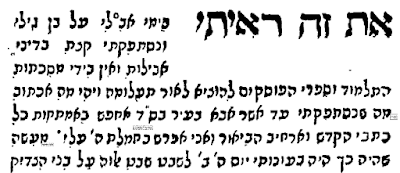
Of note, while this passage is physically situated in the midst of this Talmudic commentary, it is in essence a halakhic responsum.

  1. Rabbi Hayyim Palachi (1788-1868)[18]

Rabbi Palachi was the Chief Rabbi of Izmir in Turkey. During his lifetime a cholera pandemic affected Turkey. In a number of his works he acknowledges suffering from Pandemic Bibliopenia. An explicit reference is below:

Hikikei Lev, vol 2, H. M., n. 51, p. 164a

Palachi was exiled to the village of Boron on the outskirts of Izmir. While lamenting that there is “no wise man without seforim,” he endeavors to respond to a halakhic question with the resources he has available him in addition to relying on his memory. Below we see the repeated mention of PB throughout multiple works reflecting a most serious case of the condition.[19]

Hikikei Lev, vol 1, E. H., n. 57, p. 114b

Hayyim Biyad n. 79, p. 98a

In a letter to Rabbi Hayyim Yehudah Avraham, published in the latter’s Ahi vaRosh[20] Palachi writes while still in exile in the village of Boron:

Varied Prevalence of PB

In the following case, we see the clear impact of PB on one Torah scholar, while another scholar during the very same pandemic appears to enjoy immunity from the condition.

In perhaps our most poetic example, Rabbi Yehudah Ibn Verga[21] corresponds with Rabbi Yosef Karo, author of the Shulhan Arukh, about a financial matter.[22] After lengthy praise for Rabbi Karo, he launches into a lament about the current state of plague in Tzfat.

Ibn Verga’s invokes the same phrase from Tehillim[23] (nikhsifah vigam kaltah nafshi) as does Tzahalon (Siman 81 above) to express the emotions evoked by the plague. His comment at the end of this passage about his elation upon meeting another person in the midst of the plague will sound familiar to those of us who have weathered complete lockdown during the current pandemic.

The next passage reflects the duration of Ibn Verga’s exile. Ibn Verga remarks that his exile had passed the entire summer, now into the winter, and the plague still lingered. “We have said, it is long due to the sins of the generation.” Ibn Verga and Karo both lived in Tzfat. Ibn Verga had hoped to speak to him directly about this case, face to face, but as the plague dragged on, he had no recourse but to commit his comments to paper.

Ibn Verga concludes that he had wanted to cite a responsum of Rosh in support of his position but was unable to include it due to his affliction with PB.[24] 

In his response, Rav Yosef Karo likewise longs to speak face to face with Ibn Verga:

He concurs that sin has caused them to be in a state of “mistar panim” until the plague passes. Rabbi Karo then proceeds to discuss the halakhic issue and makes no mention of lack of access to literature. He also lived in Tzfat and endured the same plague. In fact, we know Rabbi Karo fled Tzfat during the plague to live in the village of Birya.[25] It is in Birya in 1555 that he completed the first volume of his Shulhan Arukh. While the Shulhan Arukh was only first printed in 1565 in Venice, the colophon of each volume reflects the date and place of its completion.

Colophon at end of the 1565 edition of the first volume of Shulhan Arukh:

By the time he had completed the second volume, Yoreh De’ah, less than one year later, he had already returned to Tzfat, presumably after the cessation of the plague.

Colophon at end of the 1565 edition of the second volume of Shulhan Arukh:

While Rabbi Ibn Verga was clearly a victim of PB, Rabbi Yosef Karo does not appear to have been affected whatsoever. We thus have evidence of the variable prevalence of the condition during the same pandemic.

Mild or Implicit PB

Some cases of Pandemic Bibliopenia are not as explicit or easily diagnosed as those of Rabbis Tzahalon and Ibn Verga. At the same time as the aforementioned were experiencing plague in Northern Israel, Rabbi Moshe Isserles faced advancing disease in Cracow. Rabbi Isserles describes his dire situation in the introduction to his Mehir Yayin, a commentary on Megilat Esther that he wrote for his father-in-law, in lieu of mishloah manot, while in exile in the city of Shidlov.

While Rabbi Isserles does not explicitly refer to Pandemic Bibliopenia, he makes passing references possibly alluding to the condition. For example, he writes:

which means that his intellect still remained, despite his lack of access to an extensive library.

In describing the work, he writes:

Perhaps PB is reflected in his choice of composition, a work relying heavily on his textual analytic skills, and less so on obscure or hard to obtain texts, likely unavailable to him in Shidlov.[26]

Furthermore, his qualifying statement,

might reflect a lack of bibliographical resources. Whether this case meets the diagnostic criteria for PB remains a question.

Differential Diagnosis

Pandemic Bibliopenia may possibly be confused with other forms of Bibliopenia. To be sure, many individuals have lost access to their libraries due to personal tragedies,[27] but here I refer specifically to systemic forms of Bibliopenia that impacted entire communities. In these cases authors were similarly deprived access to rabbinic literature, though for entirely different reasons. One such example will suffice.

The Physician Abraham Portaleone was a prominent figure in Renaissance Italy, treating royalty, authoring several medical works.[28] At the age of 62 he suffered a stroke which prompted a reevaluation of his life. He concluded that his affliction befell him as he had not devoted enough of his life to Torah learning. He undertook to write a work on prayer and the Beit HaMikdash which he dedicated to his children. At the end of chapter thirty-two, which discusses the shulhan in the Temple, we find the following comment.

Portaleone notes that, “Perhaps some place in the Talmud Hazal spoke of this, and I am not aware. As a result of the known deficiency [my emphasis] I have not been able to properly ascertain this.”[29] One might erroneously assume that he is referring to Pandemic Bibliopenia as the etiology for his lack of access to the Talmud. In fact, Portaleone is referring to a variant form of the condition, called Censorship Bibliopenia. A review of the entire work of Portaleone, including his introduction, will clarify any confusion.

In his introduction, Portaleone details the nature of his early education, and recalls how while a student studying Talmud with R’ Yaakov MiPano, the infamous decree led to the Talmud “being consumed by fire before our eyes.” This refers to the burning of the Talmud in Rome in 1553.[30] After the initial burning of the Talmud in Rome, other Italian cities followed suit with their own citywide burnings. Portaleone was witness to one such event. Decades later, as he penned his classic work, Shiltei haGibborim, the Talmud still remained largely unavailable in Italy. Portaleone was forced to use substitute works that alluded to or quoted the Talmud, if available, but sometimes the information was simply not accessible. One such example is his discussion of the Shulhan above.

In one remarkable instance Portaleone reveals his elation at being able to acquire a bona fide Talmudic reference. He writes that after he completed the chapter on the Lishkat haGazit (Chamber of Hewn Stone), God ordained (hikra) that he happen upon a wise man from the city of Tzfat (where the Talmud was available) who had come to Italy to seek financial support for his family. “From his mouth I heard the sugya in the second chapter of Yoma on the laws of the Lishkat haGazit, and I write them here for you (my children) from his mouth…”[31]

In yet another place he excitedly relates of his accessing a small passage from Tractate

Chagigah from a tattered manuscript remnant in the library of a great Torah scholar (Gaon) of Verona.[32] All of these instances are examples of Censorship Bibliopenia.

Treatment

During previous pandemics, in the pre-modern era, PB was considered untreatable. Fortunately, however, it was temporary and ultimately resolved with the cessation of the pandemic. Today, however, the treatment for PB is readily available and inexpensive, though its safety has been called into question. Despite the fact that the understanding of disease transmission has evolved, people still, if feasible, flee their homes in urban areas for less populated locations. As such, they could still be susceptible to PB. However, PB is now completely remediable through internet access to Rabbinic literature.[33] Not only is virtually the totality or rabbinic literature widely and freely available for scholars (rabbis, poskim and laymen) via the internet, facilitating the production of quality work; the publication and dissemination of these works can be accomplished with ease on the internet as well. It is only today, in the midst of the current Covid 19 pandemic, that we are witnessing the eradication of PB. As a result, there have likely been more pages written of rabbinic discourse (both halakhic and aggadic, related to the pandemic or not) during the present pandemic than during all previous pandemics combined.[34]

Conclusion

Pandemic Bibliopenia is an underrecognized phenomenon in Jewish history. In addition to the medical impact of pandemics in the past, our ancestors experienced spiritual and intellectual suffering by being deprived access to the Torah library, our life blood. Today, however, even in the midst of a worldwide pandemic, while libraries have shuttered, and some have fled their homes, there has been little diminution in the access to rabbinic literature. As the world may never again experience Pandemic Bibliopenia and the unique literary impact of plagues and pandemics, it behooves us to recall it in appreciation that despite the many adversities associated with this pandemic, loss of access to our beloved Torah literature is not counted among them. Not only have we eradicated Pandemic Bibliopenia, it appears to have been replaced with a new diagnostic category, Pandemic Polybiblia,[35] though in this case, fortunately, a healthy and desired condition. May we be zokheh to the continuation of Polybiblia without any associated pandemics in the future.

[1] Isaac Canpanton (15th century), Darkei HaGemara. This oft quoted phrase refers specifically to the purchase of one’s own seforim. I take literary license with its use here.
[2] My addendum.
[3] This condition has been variously called epidemic or plague bibliopenia. We use the term pandemic in light of the present Covid 19 pandemic.
[4] See Eliezer Brodt, “Towards a Bibliography of Coronavirus-related Articles and Seforim written in the past month (updated), Black Weddings and others Segulot,” Seforimblog.com (May 4, 2020).
[5] The proliferation of literature specifically related to the pandemic is also noteworthy and unprecedented but is not the focus of this article. On the history of literature written during times of plague, see Abraham Yaari, biOhalei Sefer (Reuven Mass, 5699), 82-90. The other essays in this volume chronicle the impact of various natural occurrences, such as fires, and personal experiences, such as imprisonment, miraculous salvation, or infertility, on the writing of Hebrew books.
[6] The etiology may be related to either closure of public libraries, which is a more widespread form PB, or due to required or elective relocation away from one’s personal library to remote areas devoid or deficient of seforim.
[7] Plague and the migration to the rural areas affected not just the writing, but the printing of Hebrew books as well. See Yaari, op. cit.; Avraham Haberman, Perakim biToldot haMadpisim haIvrim (Reuven Mass: Jerusalem, 5738), 314.
[8] Mishnah Ta’anit 3:4.
[9] See Yaari, Moshe Dovid Chechik and Tamara Morsel Eisenberg, “Plague, Practice and Prescriptive Text: Jewish Traditions on Fleeing Afflicted Cities in Early Modern Ashkenaz,” Journal of Law, Religion and State (2017), 1-27. I thank professor Susan Einbinder for bringing this article to my attention.
[10] For poetry in times of plague, see Susan Einbinder, After the Black Death: Plague and Commemoration Among Iberian Jews (University of Pennsylvania Press: Philadelphia, 2018). idem, “Poetry, Prose and Pestilence: Joseph Concio and Jewish Responses to the 1630 Italian Plague,” in Haviva Yishai, ed., Shirat Dvora: Essays in Honor of Professor Dvora Bregman (Ben-Gurion University: Beer Sheva, 2019), 73-101; idem, “Prayer and Plague: Jewish Plague Liturgy from Medieval and Early Modern Italy,” in Lori Jones and Nükhet Varlik, eds., Death and Disease in the Medieval and Early Modern World: Perspectives from Across the Mediterranean and Beyond (York Medieval Press, 2021), forthcoming.
[11] We do not address here the impact of disease and illness on literary output.
 [12] On Tzahalon, see, Shimon Vanunu, Arzei Halevanon (Jerusalem, 5766), 862-865; Shalom Hillel “Sefer Magen AvotRabbeinu Yom Tov TzahalonMekabtziel 33 (Kislev, 5768), 10. Vanunu lists all the references discussed below.
[13] Here we do not address the substance of the responsa, rather focus on the impact of PB on the author. I mention the responsa in number order, assuming this is chronological.
[14] Tzahalon’s Talmudic commentary was first published by his grandson in Venice, 1693, where it appears after the former’s responsa. A corrected and annotated version of the Talmudic commentary was published by S. Mertzbach in Benei Brak in 5752.
[15] This was written in the manuscript in the middle of his commentary on the fifth chapter of Bava Metzia, but is printed separately as n. 14 as part of his responsa.
[16] His son’s death does not appear to have been plague related, as he recounts that his son was perfectly healthy just prior to his death.
[17] The delayed burial generated a question for Rabbi Tzahalon as to which day was considered his first day of mourning and thus whether he should put on tefillin.
[18] On Palachi, see Shimon Aryeh Leib Eckstein, Toldot haHabif (Halevi’im Press: Jerusalem, 5759). All of the citations mentioned he are referenced on p. 183, n. 17.
[19] See also his Nishmat Kol Hay, vol 2, E. H., siman 3, page 6.
[20] (Izmir, 1840), H. M., n. 14, p. 88b.
[21] This Yehuda Ibn Verga is not to be confused with the Spanish historian and kabbalist of the fifteenth century.
[22] Rabbi Yosef Karo, Avkat Rokhel, 99 and 100.
[23] 84:3.
[24] If I am reading this correctly, it seems that Ibn Verga was still in Tzfat when he wrote this but had sent his library ahead to his location of exile.
[25] See R. Ephraim Greenblatt, “B’Inyan Kiddush Levanah,” Noam 12 (5729), 113. Birya can be seen on the map above, between Tzfat and Par’am.
[26] This work does reference texts from the Talmud and Tanakh as well as the Rambam’s Moreh Nevukhim. These may have been his available texts.
[27] See, for example, Yehuda Rosenthal, “ The History of the Jews in Poland in Light of the Responsa of the Maharam of Lublin,” (Hebrew) Sinai 31:7-12 (NisanElul, 5712), 320 regarding Maharam miLublin and his limited access to his library due to a fire in Cracow.
[28] On Portaleone, see H.A. Savitz, “Abraham Portaleone: Italian Physician, Erudite Scholar and Author, 1542-1612,” Panminerva Medica 8:12 (December, 1966), 493-5; S. Kottek, “Abraham Portaleone: Italian Jewish Physician of the Renaissance Period- His Life and His Will, Reflections on Early Burial,” Koroth 8:7-8 (August 1983), 269-77; idem, “Jews Between Profane and Sacred Science: The Case of Abraham Portaleone,” in J. Helm and A. Winkelmann (eds.), Religious Confessions and the Sciences in the Sixteenth Century (Brill, 2001); A. Berns, The Bible and Natural Philosophy in Renaissance Italy (Cambridge University Press, 2014).
[29] End of Chapter 32.
[30] See Menachem Butler, The Burning of the Talmud in Rome on Rosh Hashanah, 1553 theTalmud.blog (September 28, 2011).
[31] Chapter 23, p. 109.
[32] For discussion of these cases, see Y. Katan and D. Gerber, eds., Shiltei haGibborim (Machon Yerushalayim, 5770), 28-29.
[33] See Jacob J. Schacter, “The Challenges and Blessings of the Internet: Technology from An Historical Perspective,” Jewish Law Association Studies, vol. 29 [The Impact of Technology, Science, and Knowledge] (2020), 5-20. Rabbi Dr. Schacter highlights some striking parallels regarding challenges created by the development of printing and the development of the internet.
[34] I admit being guilty of contributing to this phenomenon.
[35] The diagnostic criteria for this new entity have not yet been adequately formulated and will require a fuller evaluation with the passage of time. A preliminary definition has been proposed: The proliferation of rabbinic works relating to pandemics written in the midst of the pandemic itself.


Jordan S. Penkower – Some Notes Regarding the First & Second Rabbinic Bibles

Some Notes Regarding the First & Second Rabbinic Bibles
by Jordan S. Penkower

Dr. Jordan S. Penkower is an associate professor in the Bible Department at Bar Ilan University, and has written extensively on the development of the printed Hebrew Bible.

This is his first contribution to the Seforim blog.

In response to the post at the Seforim blog regarding the Pinner Talmud, a correction is in order regarding the first two Rabbinic Bibles (both now available online – see below). The post states

In fact, this would not be the first time a dedication didn’t work out that well. The first Rabbinic bible published in 1522, was not a success. Instead, it would be the second Rabbinic bible that became the template for the Mikrot Gedolot Chumash. While both were done by the same publisher and soon after one another. The main difference was the first contained a dedication to the Pope, while the second did not. Perhaps, the same happened here, and Pinner was a victim of poor judgment in securing his approbations, both in the one’s that appeared and the ones that did not.
In fact, the following are the correct details.

(1)The first Rabbinic Bible was published by Bomberg in Venice and completed in 1517. The editor was the convert Felix Pratensis. This edition appeared in two versions: one with a dedication to the Pope in Latin (on the verso of the title page), and at the end of Chronicles a short decree by the Pope (in Latin) that this edition had exclusive rights for 10 years. The second – aimed at the Jews – without the Latin material.

(2) The second Rabbinic Bible was published by Bomberg in Venice, and completed in 1525. The editor of this edition was Jacob ben Hayyim Ibn Adoniyahu (who converted to Christianity sometime after 1527).

These two editions differ in a number of ways (the lack of the Latin material is not really to be considered, because such a Latin-free edition had already appeared in 1517 – see above).

Here, I will note the following differences between the two editions: (a) more commentaries in the second edition; (b) the printing of the whole apparatus of the Masorah Parva, the Masorah Magna, and the Masorah Finalis – for the first time in the second (1525) edition; (c) the bible text in the second edition was re-edited anew based on manuscripts and Masorah. As a result, one finds variants in text, vocalization and accentuation between these two editions.

Further details on the differences between these editions can be found in my Jacob ben Hayyim and the Rise of the Rabbinic Bible (Ph.D. dissertation, Hebrew University, 1982; Hebrew); see further my articles in: J.H. Hayes, ed., Dictionary of Biblical Interpretation (Abingdon Press, Nashville 1999), vol. 1: “Bomberg, Daniel,” “Jacob Ben Hayyim Ibn Adoniyahu,” and vol. 2: “Rabbinic Bible.”

Appendix:
Dedication Page to the Pope from the 1517 ed.


Decree at the end of Chronicles from 1517 ed.


Stet in the Beit Yosef: Fish and Milk, from Typographical Error to Typological Exemplar

Stet in the Beit Yosef: Fish and Milk, from Typographical Error to Typological Exemplar
Aton M. Holzer

Rabbi Dr. Holzer is Director of the Mohs Surgery Clinic in the Department of Dermatology, Tel Aviv Sourasky Medical Center, and is an assistant editor of the recent RCA Siddur Avodat HaLev. ORCID ID: 0000-0001-9852-3958/ 28 Binyamin, Beit Shemesh, Israel 9952200/ Aton.holzer@gmail.com

A passage in the magnum opus of R. Joseph Karo (Maran, or the Mehaber, 1488-1575), the Beit Yosef (YD 87:5) tends to be reckoned among the more consequential scribal errors in Jewish legal texts.

[ה] ”דגים וחגבים מותר לאכלן בחלב“. ריש פרק כל הבשר (קג:) ”(כל הבשר) אסור לבשל בחלב, חוץ מבשר דגים וחגבים“. וכתב הר”ן דכיון דלבשלן שרי משמע דלאכלן בחלב נמי שרי, דאיסור בשר בחלב בלשון בישול אפקיה רחמנא, וכן כתב הרמב”ם והרשב”א דלאכלן בחלב נמי שרי. ומכל מקום אין לאכול דגים בחלב מפני הסכנה, כמו שנתבאר בספר אורח חיים סימן קע”ג.

“Fish and locusts, it is permitted to eat them in milk.” In the beginning of the chapter kol basar (bHullin 103b) [it is written]: “(all flesh) it is prohibited to cook in milk, except for the flesh of fish and locusts.” And R. Nissim wrote that since cooking them is permitted, it implies that to eat them in milk is also permitted, for the prohibition of meat in milk was set out by the Torah in the semantics of cooking, and likewise did Maimonides and R. Shlomo ibn Adret write, that to eat them in milk is also permitted. And in any event, one should not eat fish in milk because of the danger, similar to what was elucidated in Orah Hayyim 173.

In his 2014 “A Guide to the Complex,”[1] Shlomo Brody highlights this passage – which invokes a heretofore ostensibly unknown ‘danger’ regarding consumption of fish in milk, and which makes reference to a chapter that deals with measures that must be taken with regard to the ‘dangerous mixture’ of fish and meat[2] – as a banner example of the ‘impact of inaccurate texts on Jewish law.’ He adds that ‘Ancient manuscripts regularly suffered from poor penmanship, slipping of the eyes, and misunderstandings by unlearned or confused copyists.’ The first to make this sort of observation regarding this passage was none other than R. Karo’s younger contemporary and interlocutory commentator R. Moses Isserles (Rama, 1530-1572), who puts it humorously (Darkei Moshe, Tur YD 87:4):

.ולא ראיתי מימי נזהרין בזה וגם בא”ח סימן קע”ג אינו אלא שלא לאכלו בבשר משום סכנה אבל בחלב שרי ועי”ל סימן קי”ו ולכן נראה שנתערב להרב בשר בחלב

And in all my days I have never seen [anyone] take care with regard to this, and also in Orah Hayyim 173 there is not but not to eat [fish cooked] in meat because of danger, but in milk it is permitted, and see earlier in chapter 116, and therefore it appears that the Rabbi has confused (mixed) meat and milk.

As neat as this solution appears, there remain some problems. For one thing, in context, the Beit Yosef discusses the consumption of various forms of flesh – fish and locust – in milk, not meat; replacing the word ‘milk’ for ‘meat’ would render the ultimate sentence a nonsequitur with regard to the full passage.

For another, the idea of danger attendant to mixtures of fish and dairy is not entirely unprecedented. R. Bahye b. Asher (1255-1340), who hailed from R. Karo’s native Christian Spain two centuries earlier (but from Zaragoza, quite a ways from Toledo), seems to make reference to such a practice in his commentary to Exodus 23:19:

.וכן דעת הרופאים בתערובת דג וגבינה שנתבשלו כאחד שמוליד תכונה רעה וחולי הצרעת

And so is the view of the physicians regarding the mixture of fish and cheese that were cooked together, that they beget a bad character and the illness of tsara’at (biblical ‘leprosy’).

To be sure, this is a lone statement, found in a decidedly non-Halakhic work, at a distance of two centuries and one continent from R. Karo’s work, which was completed in Ottoman Safed.

A third is that it is difficult to ascribe scribal error to the Mehaber’s project, if only because Beit Yosef was not transmitted in manuscript, and does not exist in manuscript – at least not beyond the author’s autograph. The four volumes of Tur with Beit Yosef were printed in different Italian publishing houses over the course of the 1550’s, in the author’s own lifetime, and he lived to see several printings of the Beit Yosef and Shulhan Arukh, the precis of the conclusions of halakhic discussions in the Beit Yosef. In fact, printing, and particularly choosing to do so in Renaissance Italy – where there was a Christian censor but superior presses to what was available in Ottoman Turkey, but more importantly, where (Jewish exile) cultures met and wide dissemination was guaranteed[3] – was central to R. Karo’s stated mission, a messianic objective of a piece with his participation in reconstituting the Sanhedrin to administer corporal punishment.[4] Taking a page from the messianic project of Sultan Suleiman, Kanuni or “the lawgiver,”[5] his project would complete Maimonides’ project[6] to unify the Jewish people under a uniform system of law in anticipation of redemption. And indeed, in his own lifetime, Beit Yosef and Shulhan Arukh enjoyed wide dissemination and readership, if not universal acceptance.[7] 


Figure 1: 87:5 in its first printing (Venice, 1551)

Given this, if “milk” is an error, it is much more likely typographical than scribal, and not the best example of the phenomenon R. Brody describes. But more importantly: given that the printed versions were available to the author, and were widely read and used, in his presence, for more than twenty years, the possibility that a typographical error of such consequence would go unnoticed by the author or his immediate milieu is at least somewhat diminished. The author himself issued a work called Bedek ha-Bayit with corrigenda and addenda, and there is a gloss on siman 86, but not 87.

Muhammad ‘Abd al-Ra’ūf al-Munāwī (1545-1621), a renowned scholar in Ottoman Cairo whose hadith commentary is still popular in Sunni Islam, also composed a compendium of fundamental, practical scholarly-spiritual knowledge related to a number of everyday issues[8] – a sort of Islamic Orah Hayyim, as it were – known as Tadhkirat ūlī al-albāb bi-maʻrifat al-ādāb. This work is significant as a snapshot of the cultural climate in Early Ottoman Cairo, and has traces of persistent Mamluk attitudes, reconfigured in light of Ottoman sensibilities and cutting-edge intellectual trends in his time in Cairo, which, under the Mamluks, had long been a hub of science and the occult (which, at the time, were also deemed ‘sciences’) in the Islamicate world.[9]

In his compendium,[10] there is a fascinating discussion of food mixtures, launching off a discussion of Galenic medicine and the inadvisability of combining food that relate to different humors/elements (moisture/water, dryness/air, coldness/earth and hotness/fire). In pertinent part:

يعسر علينا اثبات كثير من ذلك بالقياس فمن ذالك انه لا يجمع بين سمك و لبن فإنه يولد أمراضا مزمنة كالجدام والبرص والفالج

It is difficult for us to prove much of this by (syllogistic) reason. For example, that combining fish and milk causes chronic diseases such as leprosy, vitiligo, and paralysis.


Figure 2: Tadhkirat ūlī al-albāb bi-maʻrifat al-ādāb,folio 14a (Yale, Landberg MSS 163)

Paulina Lewicka, a Polish scholar who studied foodways in Mamluk and Ottoman Cairo,[11] highlights this passage and notes that it represents a novelty on the Egyptian scene.

In fact, there seems to be no evidence that avoidance of mixing fish and milk products had been observed in Egypt of the Mamluk period, or in the medieval Middle East in general. This combination, which is considered unhealthy today, appeared in a number of old Arabic-Islamic recipes where fish and yoghurt were put together. Al-Munāwī’s remarks may have reflected, then, a new trend in medico-culinary thinking.[12]

Lewicka also notes in al-Munāwī’s treatment of Galenic medicine an interesting development: even though Galen’s theory of humors had formed the basis of Islamicate medicine for centuries, in the Muslim-Sufi environment of early Ottoman Cairo there was discomfort with use of pagan theories and concepts. Instead, al-Munāwī traces the theory of humors to Kitāb al-Tawrāt, the Torah,[13]  where, according to him, Adam was created with dry soil, wet water, heat (nefesh/nafs) and cold (ru’ah/rūḥ).

R. Yosef Karo, living in the same territorial-ideological expanse as al-Munāwī – with frequent interchange between Safed and Cairo by figures no less than R. David abi ibn Zimra, R. Bezalel Ashkenazi, and R. Isaac Luria – had ample access to the developments in Cairene medicine that inspired the Tadhkirat passage.

His relationship with classical philosophy – the ostensible basis for Galenic (as opposed to prophetic) Cairene medicine – is complicated. In his mystical diary Maggid Meisharim (80a-b), he cites his angelic guide who allows that, pace the view of other Kabbalists of his day, Maimonides was not condemned to reincarnate as a worm because of his philosophical views – but only because he was saved from this fate by his Torah and good deeds, and thus was allowed to reincarnate in a usual way before ascending to join the souls of the righteous. However, there is evidence that he himself was more accepting and even dabbled in philosophy – but assigned it a decidedly secondary or tertiary position to the study of Talmud and Halakhah, either behind or on par with Kabbalah, which also took a backseat to Halakhic sources in terms of study and Halakhic decision/pesak.[14]

The case of milk and fish may serve as something of an acid test for medical science. R. Karo includes it in his Beit Yosef, but as an ayn le-ekhol – it should not be eaten – rather than ‘it is forbidden.’ Clearly R. Karo prohibits it, as perhaps a contemporary posek (if not for the Igrot Moshe) might prohibit smoking, but does not share al-Munāwī’s view that humoral medicine is a de’orayta. And while cutting edge Galenic knowledge merits mention in Beit Yosef, the Mehaber omits it from the Shulhan Arukh (87:3), the repository of pesak, regarding which, just as for Kabbalah,[15] the Talmudic sources – which explicitly permit such a mixture (kutah, e.g. Pesahim 76b) – trump all.

Thanks to Prof. Tzvi Langermann and Prof. Daniel Lasker for their erudite comments and corrections. Thanks to Prof. Markham Geller, R. Judah Kerbel, and R. Noam Horowitz for insights and source materials, and R. Jonathan Duker and R. Dr. Ari Zivotofsky for being a sounding board for these ideas.

[1] Shlomo Brody, A guide to the complex: contemporary halakhic debates (Maggid, 2014), 297-299.
[2] The origin of the prohibition of consuming meat with fish is Pesahim 76b, where fish cooked with meat is said to pose a risk for ‘odor’ and “something else,” davar aher. Commentators uniformly understand the referent of the latter to be tzara’at, biblical leprosy, and thus the Talmudic statement is medical in nature. Fred Rosner notes that this danger is absent from Hippocratic or Galenic medicine – se his “Eating Fish and Meat Together: Is there a Danger?.” Tradition: A Journal of Orthodox Jewish Thought 35.2 (2001): 36-44. On the other hand, medical teachings in the Talmud often preserve ancient Babylonian medicine, a more empiricist approach than the Hellenistic humor theory that replaced it. Even so, Markham Geller, a specialist in Babylonian medicine, suggests that the Talmudic passage is not health-related at all but aesthetic, and the ‘davar aher’ is more properly understood as pig in its original context – to wit, perhaps, that fish-infused meat is forbidden because of its odor and its possible close resemblance to pork (personal communication). In any event, by R. Karo’s time, the medical understanding of fish-meat mixture prohibition was universal and in that regard it was a fitting analog to fish-milk mixtures.
[3] Mor Altshuler, The Life of Rabbi Yoseph Karo (Tel Aviv University Press, 2016), 323.
[4] Amnon Raz-Krakotzkin, “From Safed to Venice: the” Shulhan ‘Arukh” and the censor.” In Chanita Goodblatt and Howard Kreisel, eds., Tradition, Heterodoxy and Religious Culture: Judaism and Christianity in the Early Modern Period (Ben Gurion University, 2006), 91-115; Roni Weinstein, “Jewish Modern Law and Legalism in a Global Age: the Case of Rabbi Joseph Karo.” Modern Intellectual History 17:2 (2020), 561-578.‏
[5] See Weinstein, ibid.
[6] Israel Jacob Yuval, “Moses redivivus — Maimonides as a ‘Helper to the King’ Messiah” [Hebrew], Zion 72 (2007) 161-188.
[7] Yaron Ben-Naeh, Hagai Pely and Moshe Idel, Rabbi Joseph Karo: History, Halakhah, Kabbalah (The Zalman Shazar Center, 2021), 234.
[8] Paulina B. Lewicka, “Challenges of Daily Life in Early-Ottoman Cairo: a Learned Sufi’s Perspective. Preliminary Remarks on al-Munawı’s Memorandum on Decent Behavior,” in Stephan Conermann and Gül Şen, eds., The Mamluk-Ottoman Transition (V&R Academic, 2017): 59-85.
[9] Matthew Melvin-Koushki, “Taḥqīq vs. Taqlīd in the renaissances of western early modernity.” Philological Encounters 3.1-2 (2018): 193-249.‏
[10] Folio 14a in the Yale MS; it also exists in at least two other manuscripts in Cairo where the passage is identical (folios 22b and 16a, respectively).
[11] Paulina Lewicka, Food and foodways of medieval Cairenes: Aspects of life in an Islamic metropolis of the eastern Mediterranean. (Brill, 2011).
[12] Lewicka, “Challenges of Daily Life,” 71-72.
[13] Or, more usually, collections of unusual hadiths that Islamic scholars mistook for the Torah. I am indebted to Prof. Langermann for this insight.
[14] See Ben-Naeh et al., Rabbi Joseph Karo, 136-140.
[15] Jacob Katz, “Post-Zoharic Relations between Halakhah and Kabbalah,” in Bernard Dov Cooperman, ed., Jewish Thought in the Sixteenth Century (Harvard University Center for Jewish Studies, 1980), 283-307.‏


The Agunah Problem, part 2; Wearing a Kippah; More Censorship by ArtScroll

The Agunah Problem, part 2; Wearing a Kippah; More Censorship by ArtScroll
Marc B. Shapiro
1. Continued from here.
There is even an opinion, which as far as I know is accepted by many, that if a man apostatizes the beit din can still not force him to issue a divorce. This is first mentioned by R. Meir of Rothenburg and his reason is quite surprising. He says that a woman would rather be married to an apostate than not married at all.[1]
כתב מורי רבינו עובר על דת או אפילו משומד אין כופין אותו להוציא ותדע מדלא מנה רשע עם שכופין אותן להוציא וטעמא דטב למיתב טן דו מלמיתב ארמלו אם לא שעבר על דת שקיבל עליו חרם שהוא כלפי דידה כגון שלא להכותה או שלא להקניטה.
This position, and the opposing one that we do force a meshumad to give a get: משומד כופין אותו על ידי גוים, is mentioned by R. Moses Isserles, Even ha-Ezer 154:1.
Today, there is no way in the world that a religious woman would wish remain married to an apostate, so how could the hazakah טב למיתב טן דו מלמיתב ארמלו be applicable in such a case? I therefore don’t see how any beit din could tell a woman whose husband apostatized that they are not able to compel him to divorce her. Incidentally, R. Solomon Luria couldn’t believe that R. Meir of Rothenburg really meant what he said. According to R. Luria, the word משומד here does not mean “apostate” but a משומד לכל התורה, that is, a complete sinner who is still in the Jewish community and can be brought back to Torah observance, perhaps even by his wife.[2]
כל זמן שלא נטמע ביניהם אפי’ הוא משומד לכל התורה כולה אין כופין אותו מאחר שיכול לקיים שאירה כסותה ועונתה כראוי וגם אולי על ידה יתחרט ויחזור למוטב ובזה יתיישבו דברי מהר”ם שכתב שאין כופין כלל אפילו משומד.
This is not the standard position as pretty much everyone assumes that R. Meir of Rothenburg was talking about an actual meshumad. Yet it must be noted that as with R. Luria, R. Jehiel Jacob Weinberg also found R. Meir of Rothenburg’s language strange, since how can you say טב למיתב טן דו מלמיתב ארמלו about a woman living with an apostate? R. Weinberg therefore suggested that perhaps R. Meir just meant a sinner.[3] Elsewhere, R. Weinberg sees it as obvious that a Jewish woman would not want to marry an apostate, even one who has repented from his apostasy.[4]
והנה זה דבר ברור שהמומר מאוס בעיני כל אחד מישראל, ואפילו אם חזר בתשובה שלמה הוא מאוס כשזוכרים שהמיר את דתו, וק”ו ב”ב של ק”ו אם לא עשה תשובה שלמה אלא הרהר תשובה בלבו ואח”כ חזר לסורו שהוא מאוס ואין שום בת ישראל מתפייסת עם אדם כזה.

הכל יודעים ששום בת ישראל לא תנשא לאיש שהמיר דתו אפילו אם עשה אח”כ תשובה בלבו ואפילו אם ימיר את דתו החדשה בדת ישראל.

Just as with the case of a real meshumad, it is hard to imagine that today a woman who wants to divorce her husband because he has become completely non-observant, and the husband refuses to give the get, that this woman would not be regarded as an agunah. I am speaking about the more modern communities. What about in the haredi world? I was shocked to read the following in a recent work by R. Judah Itah explaining why it is that even today a woman would rather be married to an apostate than be alone, something that is obviously factually incorrect and is a terrible indictment of Jewish women.[5]
והנה בדין זה אם כופין המומר לכאורה איירי דבאה האשה ומבקשת מהבי”ד שיעזרו לה לצאת מרשות המומר כי לא טוב לה להיות בחברת המומר. א”כ היאך אתה דוחה את רצונה בנימוק דטוב לה כיון דטב למיתב תן [!] דו וכו’ הרי היא זועקת דאין זה טובה בשבילה. וצ”ל דקים לחז”ל דכל אשה רוצה להיות בחברת איש מלהיות בודדה, ומה שאומרת שרצונה לצאת מהמומר לא זה סיבה בגלל המומר אלא אפשר מפני שעיניה נתנה באחר ולכן אין כופין המומר, דלא מאמינים למה שאו’ שכל רצונה לא להיות בחברת המומר.
Can R. Itah really believe that a Bais Yaakov girl could live with an apostate and the only reason she would scream to get out of the marriage is because she has her eye on someone else? If there was a haredi woman who chose to remain with an apostate rather than demand a divorce, wouldn’t the haredi world regard her as a traitor?
In the previous post I discussed R. Weinberg’s responsum dealing with a man accused of sexual abuse. In that case, R. Weinberg refused to force him to give a get. This responsum is mentioned in a 2013 decision by the Jerusalem Beit Din available here. In a 2-1 decision the beit din refused to order a convicted sexual abuser to give his wife a get. The majority recommended that the husband give a get, but as far as compelling the husband, or even telling him that he was obligated to give a get, the beit din felt that its hands were tied.
We are taught that the ways of Torah are pleasant. Can it really be that a woman who wants to be divorced from a sexual abuser has no recourse? Must it be the case that the beit din’s hands are tied and the husband can keep his wife a prisoner? 
This brings me to a suggestion which can perhaps solve some of the problems at least in the State of Israel. I am not naive enough to think that it will ever be implemented, but I do think that it is a good approach. As I just mentioned, the Jerusalem Beit Din case of the convicted sexual abuser was decided by a 2-1 majority. One of the dayanim thought that the husband could be compelled to give the divorce, but unfortunately for the wife he was in the minority. If you examine the decisions of the various batei din you find that some dayanim are more liberal than others when it comes to ordering the husband to issue a divorce. This doesn’t mean that the other dayanim are “bad guys”, as some feminists like to portray them. They just feel bound by certain halakhic restrictions. The more liberal dayanim, however, follow a halakhic tradition that assumes that if the husband and wife have been separated for a long time, or if there are good reasons for the woman to want a divorce, even if these reasons are not mentioned in the Talmud, then the husband can be forced to issue the get.
Since I think we all agree that freeing women from dead marriages is a positive goal, would it violate any halakhic procedure for certain communities to have batei din composed exclusively of those rabbis who accept the halakhic position that a husband can be obligated to divorce his wife even in cases not specified in the Talmud? This would not be an example of deciding the halakhah before the case was heard, but only of creating a beit din of dayanim who are at least open to a more liberal understanding of when divorce is to be required.
This would no different than the conversion courts set up in Israel recently under the direction of R. Nachum Rabinovitch. Only dayanim who have a liberal perspective on conversion are on this court. This doesn’t mean they will always agree on all points, but they will agree on certain baseline positions. This might be a solution to the sort of case that appeared before the Jerusalem Beit Din, discussed above. Had the make-up of the beit din been different, rather than a 2-1 decision leaving the wife in a miserable marriage perhaps for the rest of her life, the decision could have been 2-1 or 3-0 in her favor.
I don’t think anyone would object if a community said, for example, that they will only hire a rabbi who supports, or opposes, the heter mekhirah. That is the community’s prerogative. So why should it be problematic to say that for certain communities only dayanim who have a liberal perspective on when a husband is obligated to give a get should be seated on batei din dealing with these issues? I think that some dayanim will be fine with this. While their interpretation of halakhah does not generally permit them to obligate a husband to give a get, they recognize that others have a different perspective. It is not uncommon for a posek to tell a questioner that he should inquire of another posek who will probably give him a more lenient answer. For example, both R. Shlomo Zalman Auerbach and R. Ovadiah Yosef, when confronted with questions about abortion, rather then reply that it was forbidden they advised the questioners to ask R. Eliezer Waldenberg, as he had a more lenient opinion in this matter.[6] Many more such examples could be cited dealing with a whole host of issues.[7]
Here is what appears in R. Eliyahu Sheetrit’s Rabbenu, p. 137. 

It describes how R. Ovadiah Yosef did exactly what I am suggesting. He purposely arranged to have a dayan join the beit din on a certain day, knowing how this dayan held in a halakhic matter. In other words, R. Ovadiah was “stacking the deck” to get a decision he believed to be correct. If R. Ovadiah felt comfortable in doing this, then I don’t think there is a problem with picking dayanim who are known to accept the view that men can be required to issue a get in a wide range of cases.
Another way to solve the problems I have written about in the last two posts would be if the batei din accepted the view of R. Moshe Feinstein that when the husband and wife are living separately, and there is no chance of reconciliation, then halakhah requires the husband to give a get. I realize that R. Moshe’s position is not in line with the sources I have previously referred to, but since so much is at stake, perhaps the dayanim could agree that R. Moshe’s position is sufficient to rely on. This is what he states in Iggerot Moshe, Yoreh Deah 4, no. 15:2 (emphasis added):
ובדבר איש ואשה שזה הרבה שנים שליכא שלום בית, וכבר שנה וחצי דרים במקומות מופרדים, וכבר ישבו ב”ד חשוב ולא עלה בידם לעשות שלום ביניהם. וראינו גילוי דעת חתום מהב”ד שלא הועיל כל השתדלותם לעשות שום. וכנראה מזה שהב”ד סובר שא”א לעשות שלום ביניהם. אז מדין התורה באופן כזה מוכרחין להתגרש ואין רשות לשום צד לעגן, לא הבעל את אשתו ולא האשה את הבעל, בשום עיכוב מצד תביעת ממון. אלא צריכים לילך לפני ב”ד לסדר התביעות בענייני ממון ולסדר נתינת וקבלת הגט.
R. Moshe’s approach was anticipated by R. Hayyim Palache in the 19th century. Therefore, if some poskim feel that R. Moshe’s authority isn’t enough to rely on, R. Palache words might be sufficient for them (and indeed, in recent years some dayanim have relied on R. Palache).[8] R. Palache actually sounds like he is describing the contemporary scene when he says that if either husband or wife refuses to allow the divorce to go through in order to take revenge on a spouse, that the heavenly punishment for such an action is very great. He then says that if it has been eighteen months and the couple still can’t get along, then the husband is forced to give a divorce.[9]
וידעו נאמנה כי כל הבא לעכב מלתת גט בענין זה כדי להנקם זה מזה מחמת קינאה ושינאה ותחרות כאשר יהיה האופן פעמים שהאיש רוצה לגרש והאשה אינה רוצה וכדי להנקם מהאיש מעכבים הדבר שלא לש”ש עתידין ליתן את הדין . . . וכמו כן להפך כשהאשה רוצה להתגרש והאיש איו רוצה וכדי להנקם מהאשה מעכבים מלתת גט שלא לש”ש כם בזה לא בחר ה’ ויש עונש מן השמים . . . והנני נותן קצבה וזמן לדבר הזה דאם יארע איזה מחלוקת בין איש לאשתו וכבר נלאו לתווך השלום ואין להם תקנה ימתינו עד זמן ח”י חדשים ואם בינם לשמים נראה לב”ד שלא יש תקנה לשום שלום ביניהם, יפרידו הזווג ולכופם לתת גט עד שיאמרו רוצה אני.                     
As I mentioned, some dayanim will be very content not to sit on cases where their stringent approach will lead to a situation where the husband is not obligated to give his wife a get. They will recognize the problems women are sometimes placed in because of their approach and be happy that other dayanim have a different perspective, even though they themselves cannot agree. What then to do about the dayanim with a stringent perspective who will not agree to recuse themselves? I don’t see any reason why communities cannot declare that they do not wish to accept a situation where women are locked in dead marriages if there are valid halakhic options. As such, they will only hire dayanim who adopt a liberal perspective as to when a husband can be obligated to issue a divorce. This does not mean that these communities would be deciding cases in place of the dayanim, and every case is obviously different. However, there is nothing wrong with inquiring of a dayan what his halakhic philosophy is before seating him on the bench. This has nothing to do with deciding specific cases, as anyone who has ever watched a Supreme Court nominee hearing understands.[10] You are permitted to ask a question of a posek whom you assume will offer a lenient decision, as long as you are prepared to follow the decision even if in the end it is not what you expected. By the same token, one can appoint as a rav or a dayan someone whose halakhic philosophy is in line with the values of the community he will serve. That is all that I am suggesting
As mentioned in the last post, R. Jehiel Jacob Weinberg states that if there is a dispute among halakhic authorities, we must reject the view that will bring the Torah into disrepute in people’s eyes (Kitvei ha-Gaon Rabbi Jehiel Jacob Weinberg, vol. 1, p. 60):
ואגלה להדר”ג [הגרא”י אונטרמן] מה שבלבי: שמקום שיש מחלוקת הראשונים צריכים הרבנים להכריע נגד אותה הדעה, שהיא רחוקה מדעת הבריות וגורמת לזלזול וללעג נגד תוה”ק.

This formulation of R. Weinberg can provide justification for the approach I am suggesting. Interested readers should also examine R. Eliezer Waldenberg, Tzitz Eliezer, vol. 5, no. 26, where he writes to R. Elyashiv and justifies his liberal perspective. He sums up his position with these important words

ואחרי זאת בקחתנו גם בחשבון חומר השעה המיוחד שאנו חיים בה בתקופתנו אשר רבו שוטני התורה וכן בראותינו פירצת הדור הצעיר המנוער מתורה ויראת שמים וכשלא מוצא אוזן קשבת לדבריו עושה במחשך מעשיו, וכמה פעמים הרי אזנינו שומעות ולא זר מהמכשולים הגדולים שהנשים נכשלות ומכשילות את הרבים באיסור א”א ואנו עומדים רפה אונים באין בידינו להעמיד הדת על תלה, נדמה לי ששפיר ישנו במה שכתבתי בספרי שם כר נרחב לתת מקום לדון בכובד ראש בהערכת כל מקרה ומקרה שלטענת מאוס עלי ולהשתמש לפי הצורך בכפיה . . . ולכן לפענ”ד נאמנים המה דבריו של המהר”א טוואה בחוט המשולש שכותב שאפי’ לדעת הסוברים שלא לכוף אם יש צורך שעה בכפייה יכופו דאין לדיין אלא מה שעיניו רואות, ובלבד שתהא כוונת הדיין לש”ש ויחקור על הדבר כראוי.

I quoted R. Waldenberg at length as there are some people who thought that my previous post sounded “reformist”, because I argued that divorce halakhah should not be decided in a vacuum but should take into account the contemporary reality. As you can see, this is exactly what R. Waldenberg says.

R. Waldenberg concludes that the final decision on this matter should come from all the rabbinic courts in Israel. He does not want to have a situation like we have today, where different courts have entirely different approaches when it comes to how to deal with divorce law. 

There is another point that is important to make. I have heard people say that the problem of the agunah that we have today, where a man refuses to give his wife a get, is a new phenomenon. This is completely incorrect, as this phenomenon is already seen in the medieval responsa. However, you won’t generally find it discussed among the responsa that deal with agunah. The matter is discussed when dealing with whether one can be forced to give a divorce. From medieval times until the present, women in unhappy marriages have demanded divorces. As we have seen, in situations that many people today would consider cases of agunah, in prior generations the rabbis ruled that the woman was not entitled to a get

Even in earlier years, however, we do find examples of agunot where the husband refused to give a get, even after being told to so by a beit din, and the community tried to help. The 19th century Hebrew newspapers have a number of such cases. Here is one example that appeared in Ha-Magid, Feb. 13, 1861, pp. 27-28.
It is interesting that when they caught up with the man they imprisoned him in the rabbi’s house. They also took his money and used it as leverage.
Let me make one final point. In matters of divorce my feeling is that when either husband or wife wants a get, and it is obvious that there is no future in the marriage, then neither party should prevent the divorce from taking place. There shouldn’t be any reason to go to a beit din to force a divorce. Adults should be able to see that the marriage isn’t working out and come to a conclusion that it is time to end it. Any husband who chooses to withhold a get when he knows that the marriage is over is acting in a very cruel way, and the full weight of halakhically acceptable communal pressure should be brought on him. Nothing should scandalize us more than a so-called religious person keeping his wife captive as a means of revenge. I would even suggest reading the names of some agunot during the Shabbat prayers, in order to sensitize people to the issue.
I know that many people will regard what I have just written as obvious. What I will now say might anger some, but I think that it too should be obvious. I have often heard it said that a get should never be withheld, and that the get should be given immediately. For example, on ORA’s website it states: “[I]t is never acceptable to refuse to issue a get once the marriage is irreconcilable.” On JOFA’s website it states: “As soon as it becomes clear that there will be no reconciliation, the Get should be written and delivered to the woman so that it cannot be used as a bargaining tool in financial or custody negotiations.” 

While in general both these statements are correct, it is not correct that this is always the case. For instance, let’s say the wife runs away to Europe with the kids. Does anyone seriously think that the husband is still obligated to give her a get? In such a circumstance it is entirely appropriate for the husband to insist that she come back to the United States and settle all custody issues before a get is issued. Or let’s say a husband and wife separated, and the wife refuses to let the husband see his children. It could be many months before the secular court rules on the matter of visitation. Why would anyone think that in the meantime the husband is obligated to give his wife a get if she refuses to allow him to see his children? I don’t think that there is any reputable beit din in the world that would side with the woman in these two cases. These are obviously extreme examples, and have nothing to do with the typical agunah case we hear about. Yet we should be aware that there are nuances that sometimes come into play, and every case must be investigated by a reputable beit din before judgments are made.

Finally, those who want to learn more about the matters we have been discussing should consult R. Shmuel Gartner’s detailed book, Kefiyah be-Get (Jerusalem, 1998). A 2000 page book with the title Mishpat ha-Get has just appeared. I have not yet seen it but it must have important material as well. There is also another book that is worth noting, R. Raphael Aaron Ben-Shimon’s Bat Na’avat ha-Mardut (Jerusalem, 1917). R. Ben-Shimon (died 1928) was a leading Egyptian rabbi and author of a number of significant works. What makes Bat Na’avat ha-Mardut of particular interest is that he has a number of formulations that if written today would lead certain people to claim that he was a feminist or an adherent of Open Orthodoxy. For example:

P. 4:

ואמנם בזמנינו זה הנה מתלאה, כי הוסב דין המורדת לאכזריות נוראה כי בתי דינין בזמנינו האחרונים, לסיבת כי לא מצאו כל הדין מפורש מה יעשה לה להמורדת בטענת מאיס עלי ואחרי אשר אין לנו עתה דין הכפיה לכוף את הבעל לגרש בשום אופן אחזו בשיטת החומרא עד דיוטא התחתונה, ושמו להם לקו כי המורדת היא כאשה מפרת באמונה וכל חמירא דאיכא ברשותייהו נתנו אותה על ראש המורדת האומללה, כאלו הוא דין דאיסור והיתר אשר המחמיר בה בטוח הוא ממכשול יותר מהמתיר, וע”כ העמידוה על גחליה ריקה. חופשה לא ניתן לה, הפסידה נדוניתה וכ”ש כתובתה, ואף אם חזרה בה לא יקבלו תשובתה
P. 8:
דהרמב”ם ז”ל נתמלא חמלה וחנינה על בנות ישראל
P. 154:
 ואמינא ולא מסתפינא שאם היה הרמב”ם ז”ל חי אתנו היום, היה מרעיש העולם, על אחרוני זמננו אשר דנין את המורדת דמאיס עלי במשפט מר וקשה ואכזרי כנ”ל, ואומר בקול רם הלא תבושו הלא תכלמו לתלות בי קלון אכזריות כזאת אשר לא דמיתי, ולא עלתה על לבי, הן אנכי חסתי על נפשות בנות ישראל, שיחיו חיי צער ויהיו כשפחות וכשבויות חרב להבעל לאיש שנוי [שנאוי] נפשם
2. In the previous post I referred to a couple of Supreme Rabbinic Court decisions. In these cases R. Elyashiv was a member of the court and the decisions were published in the Piskei Din shel Batei Din ha-Rabaniyim be-Yisrael. In both of the cases I cited the decision was unanimous and no individual dayan is recorded as having authored the published decision. Nevertheless, the rulings are reprinted in R. Elyashiv’s Kovetz Teshuvot, vol. 1, as if they were written by him alone (and maybe they were, but no evidence for this is provided). This volume was not published by R. Elyashiv but by one of his followers, and is a collection of previously published court rulings and responsa. There are 253 sections and the table of contents at the beginning of the volume provides the original sources of all the material.
When you look at the list of sources you find something unusual. While the names of the various books and journals are given one also finds some abbreviations. This is strange since these abbreviations are nowhere explained, and abbreviations are only used for a very small number of the many different sources. I was unable to figure out what all of the abbreviations mean but I did figure out the following:
פ”ד = פסקי דין של בתי הדין הרבניים בישראל
י”א = יביע אומר
ד”י = דרך ישרה
מ”ש = משפטי שאול

When reprinting rulings from R. Elyashiv that appeared in the Israeli government Beit Din publication, rather than telling the reader where they are taken from, all we get is פ”ד. Similarly, the typical reader will have no way of knowing that material has been taken from R. Ovadiah Yosef’s Yabia Omer, R. Yitzhak Yedidyah Frankel’s Derekh Yesharah, and R. Shaul Yisraeli’s Mishpetei Shaul. Obviously, for the individual who published the Kovetz Teshuvot, there is something problematic with all of these individuals, and with the government beit din, and he therefore wouldn’t even mention the name of their publications.
If you look at Yabia Omer, vol. 3, Orah Hayyim no. 33, and Mishpetei Shaul, no. 34 you can see the original letters from R. Elyashiv. Needless to say, in these letters he relates to R. Ovadiah and R. Yisraeli as valued rabbinic colleagues. However, in Kovetz Teshuvot the beginning of the letters has been deleted, and the reader therefore has no idea who R. Elyashiv was corresponding with. Elsewhere in Kovetz Teshuvot, when the recipient of a letter is “kosher” in the eyes of the publisher, the beginning of the letter is indeed included.[11] For some reason, in the list of sources the publisher does not abbreviate the titles of R. Isaac Herzog’s Heikhal Yitzhak and R. Yitzhak Nissim’s Yein ha-Tov. Yet he still deletes the beginning of R. Elyashiv’s letters taken from these books, so the reader does not see the very respectful way he refers to R. Herzog and R. Nissim. Here, for example, is how R. Elyashiv’s letter appears in Heikhal Yitzhak, vol. 2, no. 24.

As you can see from the titles R. Elyashiv gives to R. Herzog, he has the utmost reverence for him.

Here is how the page appears in Kovetz Teshuvot, where all this is deleted.

Also, notice how at the beginning of the letter in the original it says אני מודה לכ”ג מרן, yet the wordמרן  is deleted from Kovetz Teshuvot. In the second paragraph R. Elyashiv writes
ואנכי לא באתי בשורות אלה אלא להשיב על מה שהעיר מרן שליט”א

In Kovetz Teshuvot מרן has been removed, leaving us with להשיב על מה שהעיר שליט”א, which doesn’t make sense since שליט”א does not follow a verb.[12]
For those who have read my new book, this example will not be surprising and illustrates once again the lack of basic intellectual integrity that we find in some segments of the haredi world. From the response to my book, I can tell you that the ones most upset about this sort of thing are none other than haredim. They really believe in the haredi outlook and can’t understand why some members of their society, such as the publisher of Kovetz Teshuvot, feel that the haredi position is so weak that it can only survive by misleading people. How could a haredi not be upset when seeing how a publisher feels that he knows better than R. Elyashiv which rabbis are deserving of respect, and therefore takes upon himself to “correct” R. Elyashiv’s “mistakes”? If this is not a complete undermining of Daas Torah, then I don’t know what is.
3. In this post I referred to the German Orthodox practice of men not wearing a kippah. R. Yoel Catane informed me on the authority of his mother, a native of Frankfurt and a relative of the Breuer family, that even R. Joseph Breuer when he taught secular subjects at the Hirsch school in Frankfurt did so without a kippah. R. Catane also points out that many German Orthodox Jews continued the practice of going bareheaded even when they came to Israel. R. Catane gives as an example of this Yitzhak Ernst Nebenzahl, who served as State Comptroller in Israel and was punctilious in his Torah observance. His son is the famous Rabbi Avigdor Nebenzahl. Even in his old age in Jerusalem, the elder Nebenzahl continued his practice of going bareheaded, which when it came to the German Orthodox was not a reflection about their level of piety. Here is a picture of him without a kippah.
Dr. Aharon Barth, a grandson of R. Azriel Hildesheimer, was also a well-known German Orthodox Jew. He served as the director of Bank Leumi and was one of the two people whose signature was on the first currency of the State of Israel. He also wrote the Orthodox philosophical work Dorenu Mul She’elot Netzah, which has been reprinted a number of times and has also been translated into English, French, and German. You can read about Barth here. Here is his picture showing him bareheaded.

R. Catane mentioned the following anecdote. Once Barth was giving a lecture to bankers in Israel and he heard some thunder. He stopped the talk, took a kippah out of his pocket and put it on his head, made the blessing on the thunder, then put the kippah back into his pocket and continued with the lecture.
4. In Saul Lieberman and the Orthodox I wrote about how in its English translation of R. Zevin’s Ha-Moadim ba-Halakhah, ArtScroll censored references to Saul Lieberman, removing his rabbinic title. Leon Well pointed out to me that ArtScroll didn’t just remove the “R.”, but in one case removed Lieberman’s name entirely. In Ha-Moadim ba-Halakhah (Tel Aviv, 1955), p. 133, in the article on Shemini Atzeret, R. Zevin writes:

בנוגע לתוספתא משער ר”ש ליברמאן [!] ב”תוספת ראשונים” השערה חריפה

In the Festivals in Halachah, vol. 1, p. 346, the following “translation” appears: “As regards the passage from Tosefta on which Rashi’s interpretation is based, Tosefes Rishonim ventures a daring speculation.”

On the topic of Saul Lieberman’s name being censored, Professor Yaakov Spiegel called my attention to the following. Here is R. Dov Berish Zuckerman’s Beit Aharon: Beurei ha-Rambam al pi ha-Meiri (Jerusalem, 1984) p. 311.

This volume appeared posthumously, published by Machon Yerushalayim. If you look at the second column, 6 lines from the bottom, it says שוב הראני חכם אחד. Who is the anonymous scholar? What appears in this book had earlier been printed in Talpiot 4 (1949), p. 139. In the original we find הר”ש ליברמן שליט”א.[13]

David Farkas called my attention to another case of ArtScroll censorship, this time in its new Midrash Rabbah. Here is a page from Bereshit Rabbah, Miketz, Parashah 90.

In the Etz Yosef commentary there are three dots, showing that something is missing. This is the only time I am aware of that when ArtScroll engaged in censorship they let the reader know that something was removed, so I guess we have to be thankful for this.

What was so terrible in the Etz Yosef that ArtScroll had to delete it? Here is the uncensored version of the commentary, and as you can see, Etz Yosef cited Mendelssohn. That is why it had to be removed.

While on the topic of censorship, let me share another example of censorship of R. Kook. This time R. Kook’s name is removed from R. Meir Abovitz’s commentary on the Jerusalem Talmud.

5. I want to call readers’ attention to a new book recently sent to me by R. Yaakov Shapiro. Its title is Halachic Positions: What Judaism Really Says About Passion in the Marital Bed, available here. This is the most detailed book there is on halakhah and marital sexuality. In many ways it is designed to counter a lot of the stringencies that have arisen over time and which the author feels are non-halakhic and also psychologically unhealthy, thus making a happy, balanced marriage much more difficult. You can also watch the author herehere and here. I think readers will be surprised, and perhaps upset, when they learn that some of what they have been told is forbidden is actually permitted according to the standard halakhic authorities. See also what I wrote here in note 26.

I also should add that this book is not for the prudish, as it is very explicit in what it discusses. This in fact relates to one of the themes of the book, that halakhah itself is not prudish as sex is an important part of life and is discussed in halakhic works just like everything else. Having said that, I must note that there is a difference between being prudish and refraining from inappropriate slang when discussing halakhic matters. While the author is careful in this matter, he does refer to another recent book that makes this mistake. I am uncomfortable in even recording the title of this other new halakhic work by Rabbi S. Even-Shoshan, but readers can see it here.

I don’t think I am being overly fastidious if I say that in my opinion any halakhic work with a title like that should not be regarded as a legitimate text. My yardstick in this regard is if one would feel comfortable using a word when speaking with a great rabbi or when giving a lecture. Thus, while the term “oral sex” is fine (and I was even present when a well-known rav was asked a question using these words), for the life of me I can’t understand how a rabbi discussing a halakhic topic can use a slang word.[14] In fact, I don’t think that even an acceptable term like “oral sex” should be used in the title of a book, as it is needlessly provocative. This sort of provocative title is also found with another book published by Rabbi Even-Shoshan. One who wants to write about these matters should use a title like “Jewish Sexual Ethics” or “Marital Intimacy in Halakhah”, with all the details discussed in the book.[15]

6. In the last post I wrote about a dispute in understanding a text between Rabbis Israel Brodie and Shlomo Yosef Zevin on one side, and Profs. Shlomo Zalman Havlin and Israel Moshe Ta-Shma on the other. I was incorrect in this, as R. Zevin actually agrees with Havlin and Ta-Shma. Thanks to Rabbi Dovid Solomon for noting this.

[1] Hagahot Maimoniyot, Hilkhot Ishut 25:4.
[2] She’elot u-Teshuvot Maharshal, no. 41. Cf. Yam Shel Shelomo, Yevamot 4:22.
[3] Seridei Esh, vol. 3, p. 75.
[4] Kitvei ha-Gaon Rabbi Yehiel Yaakov Weinberg, vol. 2, pp. 443, 447.
[5] Even Sapir (Jerusalem, 2013),  pp. 358-359.                     
[6] See R. Ovadiah Yosef, Ma’yan Omer, vol. 8, p. 173; R Nahum Stepansky, Ve-Alehu Lo Yibol, vol. 3, p. 296.
[7] Since I referred to Ve-Alehu Lo Yibol in the last note, see also in this book, vol. 3, p. 191, for another example, this time dealing with a kashrut issue. R. Auerbach thought that the matter was forbidden, but stated that if the questioner wished he could also ask R. Waldenberg for his opinion. See also ibid., p. 212, where the author asked a question of R. Waldenberg and he replied, “Do not ask me. I am stringent in this matter. Go to R. Ovadiah and ask him.”
[8] Hayyim ve-Shalom, vol. 2, no. 112. Another important source is R. Shlomo Moshe Amar, Shema Shelomo, vol. 3, Even ha-Ezer no. 19. In an email to me, Prof. Amichai Radzyner noted that in recent years many dayanim have been adopting a more liberal position regarding when a husband can be forced to give a get, and also when he is told that he is obligated to give a get even if the court cannot force him. Much important material in this regard is found in the many issues of the journal Ha-Din ve-ha-Dayan, found here
[9] R. Palache’s responsum is cited by many and is an important source for those who have argued for a more liberal approach to Jewish divorce law. I don’t think anyone will be surprised that R. Abraham Samuel Judah Gestetner, who in his Megilat Plaster [Monsey, 2014] makes the ridiculous argument that R. Jacob Emden’s Megilat Sefer is a Haskalah forgery, also says that this responsum of R. Palache was inserted into the volume by an unknown heretic. See ibid., p. 85.
[10] My own opinion is that no one should be appointed a dayan in the State of Israel unless he has served in the army. After all, how can a dayan understand the people appearing before him without having had such an experience? Yet I realize that this is a pipe dream.
[11] Strangely enough, he includes the beginning of the letter to R. Yitzhak Yedidyah Frankel even though, as I have mentioned, he doesn’t tell us where the letter comes from.
[12] The censorship in Kovetz Teshuvot was also noted by Avraham (Rami) Reiner in his fine article, “Kavim Rishoni’im le-Darko ha-Hikhatit shel ha-Rav Yosef Shalom Elyashiv,” Netuim 17 (2011), p. 78 n. 12.
[13] R. Zuckerman also mentions Lieberman’s point, and refers to him by name, in Kol Torah 12 (Adar 5718), p. 22.
[14] It is worth noting that there are some passages in rabbinic literature that if said by anyone today would be regarded as nibul peh (this is the correct transliteration, not “nivul”). See Changing the Immutable, ch. 6, for some examples. See also Megillah 25b: “R. Huna b. Manoah said in the name of R. Aha the son of R. Ika: It is permitted to an Israelite to say to a Cuthean, Take your idol and put it in your שי”ן תי”ו (buttocks).” Tanna de-Vei Eliyahu: Eliyahu Zuta, ch. 22 (end), is very explicit: ‘בני אותו מקום שאתה אוהב וכו
[15] An example of what I am talking about is Jennie Rosenfeld and David Ribner, The Newlywed Guide to Physical Intimacy. This book is explicit in its discussion, but the title is an appropriate one.


Temple Service on Yom Kippur

A significant portion, and perhaps the highlight, of the repetition of the Yom Kippur mussaf is the description of the Yom Kippur service as preformed in the temple. Many, however, are unfamilar with this service. There is an excellent book on the korbonot generally which devotes a portion to describing the Yom Kippur service, including the disagreeements amongst some Medievil commentors. The portion on the Yom Kippur service is highly readable and full of facintating details.

R. Raphael Nathan Nata Rabbinovicz, famous for his Dikdukei Soferim, (also recently reprinted) published the work of his Rebbi and father-in-law, R. Yosef Fadua, Ikrei haAvoda, in 1863.

The first printing was titled Ikrei haAvoda and the second printing in 1910, the book’s title became Ikrei haKorbonot.

R. Yisrael Meyer Kagan, (Hafetz Hayyim) promoted the republication in 1910 and according to the publisher, the Hafetz Hayyim himself wanted to republish this book due to its importance. The Hafetz Hayyim thus allowed for the inclusion of his introduction to his own work on the korbonot, “Asefat Zekanim.” This introduction includes why studying the korbonot is so important event today when one can’t offer them. The publisher also states that at that time (1910) the first edition was exteremly rare and thus there was a need to republish the book.

Although, the printer does not offer why he changed the title, perhaps due to the inclusion of this additional materials that he felt he was kone b’shinu ma’ashe.

This book was recently republished by Mochon Mishnat Rebi Ahron. In this new edition they have reset the type and added footnotes and some minor corrections. (Although, they have also added some typograpical errors as well. (See, e.g. pp. 82 and 83)). They have kept the second title, Ikrei haKorbonot. I purchased this book at Beigeleisen books in Boro Park.