Machon Yerushalayim’s Book Week 2011

Machon Yerushalayim’s Book week 2011

by Eliezer Brodt

As previously mentioned there are many book sales this time of year all over Eretz Yisroel, and many publishers release new titles for the occasion. One of the publishing houses that makes a special sale every year is Machon Yerushalayim (MY). This year for the sale MY released many new titles. Over twenty years ago MY released a beautiful new edition of the classic work Minchas Chinuch. Over time this edition has become a bestseller, selling thousands of copies worldwide. In the introduction of the work they wrote of plans for a fourth volume which would include indices and a collection of all the notes and discussions of the various gedolim on the Minchas Chinuch. For various reasons that project never got off the ground. Bu there was another work that does collect all the notes and discussions of the various gedolim on the Minchas Chinuch and comment on them, from Rabbi Schlessinger. This work, although beautiful and full of great stuff, looked like it would shape up to be over twenty volume,s but no more volumes were released in the past fifteen years. Recently, for Pesach and Shavuos MY released samples of this original project. Last week they released the first volume of this edition which goes up to the forty-first Mitzvah. The work is excellent. It is more concise than Rabbi Schlessinger edition and similar to the style they have used in the Otzar Miforshei Hatalmud. I just have one small complaint – at this rate it will be around twelve volumes (although they estimate only six). Although it is nice to have the notes on the same page of the Minchas Chinuch, but most people have already bought the Minchas Chinuch in three volumes, so it would be much easier for them to put all the notes in two separate volumes like originally planned. Hopefully MY will offer this option in the future. Volume two of this work is due in a month or two. Another very valuable work just printed is the sefer Shulchan Melachim. This work is based on manuscripts from Rabbi Yitzchak Bueno who was a Rav in Yerushlayim over three hundred and fifty years ago. It is on Orach Chaim and is full of pesakim of his and other giants of his time. The Prei Chadash and Chida used it in manuscript. This volume contains many useful footnotes and is printed with the Shulchan Orach on the page. Another work just printed is the extremely important work Tashbetz Koton based on many manuscripts. There are over one hundred manuscripts of this work. A few years ago an edition of Tashbetz Koton was printed by Rabbi Schneerson with many excellent notes (he promised a second volume which has still not been printed). Rabbi Schneerson’s edition is based on the version of the sefer that was in front of the Beis Yosef, who quoted from it extensively. However one weakness of this edition of Rabbi Schneerson’s is that it’s in a complete different order than many of the other editions, making it very hard to use. The new edition of MY is based on the order that most quote the sefer, making it easier to use than Rabbi Schneerson’s. Besides for this it is based on many manuscripts and contains many useful notes to help one understand the text. One small problem I had with the MY edition is they did not reprint the notes of R. Yeruchem Fischel Perlow but it could be they could not get permission. Another very valuable work just printed is called Pinkaso Shel Shmuel from the Rashash. This work is a collection of indexes of thousands of topics found in the Rashash’s writings organized according to topics, including topics related to Kelalim, Toldos Tanaim V’amoraim and more. It is mindboggling to see how many topics the Rashash touched upon in his works! One weakness in my personal opinion of this work is they should have already brought down exactly what he says instead of in an index form as he writes very concisely, so the sefer would only be a little bigger and even better. The editor of this work seemed be unaware of the great work on the Rashash from Shua Englman, “Rabbi Samuel Strashun (HaRaShaSh) and his Hagahot on the Babylonian Talmud,” (PhD dissertation, Bar-Ilan University, 2008; Hebrew). All in all it’s a beautiful job. Another work worth mentioning is a volume called Iggros Rabbenu Chaim Me-volozhiner. This small work (117 pp.) is mostly a commentary to a one-page letter of R. Chaim Volzhiner. Another volume which is due out any day is the fourth volume to the Shut Ha-Tashbetz. Some other volumes printed are two more volumes to their edition of the Shulchan Orach Yoreh Deah, another volume of Yad Dovid, another volume of Sharei Torah and a shu”t from R. Chaim Kafusi. A very special title of theirs printed last year is the Shiltei Giborim. See here for a nice article about this work. Hopefully I will return to this work in a future post. In addition to all this all their seforim are available at reduced prices. Email me at Eliezerbrodt@gmail.com if you are interested in a complete catalog.


Special Sale

Special Sale

By Eliezer Brodt

פרנס לדורו, התכתבות ר’ אליעזר ליפמן פרינץ עם חכמי דורו, ההדיר וביאר מאיר הרשקוביץ, עורכת ראשית אלס בנדהיים, ערך והקדימם מבואות ר’ נריה גוטל, ירושלים תשנ”ב, 503+ 45 עמודים

פרנס לדורות, ר’ אליעזר ליפמן פרינץ הגהות ומאמרות, ההדיר וביאר מאיר הרשקוביץ, עורכת ראשית אלס בנדהיים, ערך משנה ר’ נריה גוטל, ירושלים תשנ”ט, 496 +15 עמודים.

About twenty years ago I discovered two remarkable seforim titled Parnas Ledoro and Parnas Ledorot in a library. Baruch hashem at the time I was able to find copies to purchase. Eventually I found some more copies and was able to supply them to some other friends.

These two volumes are beautifully produced and are “must owns” for those interested in the kind of works that contain fascinating bibliographical materials along side correspondences with many Gedolim and other “book people”. Just to Highlight some of the who’s who that the author R’ Eliezer Liepman Philip Prins corresponded with was the Netziv, R’ Chaim Berlin, R’ Meir Yona, His son R Mordechai, R’ Yaakov Shor the Chafetz Chaim and many others. In addition, the volumes include his glosses on Shas, the Yosef Ometz, Netziv , and numerous articles he wrote. These volumes are fully annotated, along with introductions to each letter, full of valuable background material.

In a recent, beautiful Tablet Magazine article devoted to the Person Behind the production of these remarkable volumes, Mrs. Els Salomon-Prins Bendheim, Dr. Theodor Dunkelgrun writes:[1]

Els Salomon-Prins Bendheim, who died this past January in her hundredth year, happened upon a spectacular library, a collection of more than 6,000 manuscripts, printed editions, and ephemera, when she first visited Jerusalem in 1949 at the age of 26. The library was the life’s work of the Dutch scholar Eliezer Liepman Philip Prins (Arnhem 1835-Frankfurt 1915). Els Salomon-Prins Bendheim was his granddaughter. With time, she discovered, the library had become an archive of sorts. The margins teemed with manuscript annotations and tucked between the pages she found letters from some of the most prominent rabbis and scholars of the 19th and early 20th centuries. The encounter with his books lit a double flame of love and learning within her, and she devoted the rest of her life to safeguarding her grandfather’s memory by editing his correspondence and his marginalia, in Hebrew and in Dutch, faithfully trying to capture the portrait in his library.

Dr. Theodor Dunkelgrun than goes on to describe:

Mrs. Bendheim… gave me copies of the three books (two in Hebrew, one in Dutch) that she had devoted to her grandfather: Liepman Philip Prins: His Scholarly Correspondence (1992), Liepman Philip Prins: His Scholarly Contribution (1999) and Marginalia: An Amsterdam Scholar from the Mediene (2001). Together, those books painted a portrait of a remarkable figure—a learned independent scholar, book collector, contributor to Jewish scholarly journals of the late 19th and early 20th centuries as well as to the Dutch Jewish press. From his home in Arnhem, he had set out to connect with the leading Jewish figures of his time. Eventually, his correspondents would include Solomon Buber, Meir Friedmann (Ish-Shalom), Solomon Geiger, Louis Ginzberg, Esriel Hildesheimer, British Chief Rabbis Nathan Marcus Adler and Herman Adler, Yisrael Meir Kagan (the Chafetz Chaim), Naftali Zvi Judah Berlin (the Netziv), his son Chaim Berlin, and Samson Raphael Hirsch.

It was through his membership of this modern republic of rabbinic letters that Prins had made his greatest contributions to Jewish scholarship, as a connector and go-between with unsurpassed knowledge about the worlds of Jewish scholarship and Jewish books. Aware of the Romm publishing house’s preparations for a new edition of the Babylonian Talmud and with an insider’s intelligence about Amsterdam’s Hebrew printers, Prins managed to secure a unique and invaluable source for Vilna editors to include: a copy of the Frankfurt 1720 edition of the Babylonian Talmud densely annotated by the brilliant Rabbi Jacob Emden (1697-1776) that had come into the possession of Amsterdam’s Proops printing family (Emden’s copy of the Talmud survived, and came to Jerusalem in 1934 when the National Library acquired books and manuscripts from the Romm printing house).

The inclusion of her grandfather’s glosses on Tractate Hullin in the “Vilna Shas” and the acknowledgement of his contribution to what became the Talmud’s canonical edition in the Acharit Davar (the publishers’ general epilogue at the end of Tractate Niddah) were the source of Mrs. Bendheim’s greatest yichus. Several years later, Prins supplied the Moravian scholar David Kaufmann with one of two surviving manuscripts to use for the first edition (1896) of the memoirs of Glikl bas Leib of Hameln (1646-1724), the most important surviving ego-document of any Jewish woman written prior to modern times.

For a short time only these two volumes are available for purchase ($24 for the TWO volumes before shipping). For more information about this email me at Eliezerbrodt-at-gmail.com.

Part of the proceeds will be going to support the efforts of the the Seforim Blog.

Here are the TOC of the two volumes.

Volume I:

Volume II:.

[1] Reprinted here with Permission from the Author.


An Honest Account of a Contemporary Jewish Publishing Odyssey

In Your Anger, Please Mercifully Publish My Work:
An Honest Account of a Contemporary Jewish Publishing
Odyssey
by Dovid Bashevkin[1]
My recently published
sefer, “Berogez Racheim Tizkor” (trans: “In your anger, you shall remember to
have mercy”), whose title is based on the verse in Habbakuk 3:2 and
traditionally recited each morning during Tahanun, really began as a tweet. In
March 2014, I tweeted, “Considering writing a sefer entitled “Aveiros
K’Hilchisa.”

The tweet was originally
intended as a satire of the many seforim that have been published as halakhic
digests of obscure practical issues in Judaism.  If there could be an Ittush be-Halakhah (trans: “Sneezing in
Jewish Law,” – an actual pamphlet shown to me by my dear friend and devoted
consigliere Reb Menachem Butler), why not an “Aveiros K’Hilchisa”?[2]

However, as often
happens, what began as satire became a very real project.  Following the
passing of my Zaide, Mr. William Bashevkin, and last living grandparent, I
thought it would be a fitting tribute to their memory to publish a work of
Torah.  Additionally, coupling sorrow with joy, my marriage this past
year to Tova (née Flancbaum) gave me the inspiration to begin
my relationship with a project of Torah scholarship.  The sefer,
which is a small collection of essays discussing halakhic issues related to sin
and the path towards teshuva, is based upon shiurim I have had the opportunity
to deliver periodically at the Young Israel of Lawrence
Cedarhurst.  With special appreciation to Mr. Joel Mael, who originally invited
me and has been a continual source of guidance and counsel, the
chevra who have participated in the shiurim are really my partners in this
effort – without them, none of this would have been possible.
Nonetheless, publishing a sefer has historically, and
remains, an exercise marked with rabbinic ambivalence. As I note in the pesicha many great rabbinic figures
looked suspiciously at the growing trend of publication. The Chatam Sofer in
his Responsa Orach Chaim #208 famously considered those who publish works for
their own self-promotion to be in violation of the prohibition of writing down
Torah sh’Baal Peh, which, in his view, was only permissible if the work was
truly written with pure intention.[3]
Indeed, in a different response (vol. 6, #61), The Chatam Sofer laments the
overwhelming increase in seforim being published.
Why, then, publish a sefer?
This question, I believe, has added import in contemporary
society when the inclination for self-promotion and aggrandizement has
seemingly never been stronger. So, then, is the publication of a sefer just an
exercise in intellectual, albeit spiritual, vanity? This question has been
addressed by many, including on the pages on the Seforim blog, most notably by
Yaakov Rosenes in his post “Publish and Perish or Digital Death” (link).
What follows are my experiences and brief thoughts on the issue of seforim
publication.
Firstly, as Rabbi Yaakov Levitz, a noted seforim distributor
in Brooklyn, mentioned to me, the only thing that sells is “Soloveitchik,
stories and pictures.”[4]
No one should publish a sefer as a venture to make money. Aside from the
questionable motive, it just won’t work. The only works that have a faint
chance are those that will be purchased for Bar Mitzvah gifts. Other works that
deal with more scholarly or intricate Talmudic issues will have a hard time
even recouping the cost of publication.[5]
Financial investments aside, I published this work for three
reasons:
Firstly, as I mentioned earlier, the sefer is dedicated to
the memory of my grandparents and in honor of my marriage. Admittedly, these
reasons are rather self-centered. I do, however, think they are relatively
justifiable. While I grant that there are certainly less narcissistic ways of
memorializing or honoring loved ones, I do think that sharing Torah, when
possible, is appropriate. As Rabbi Hershel Schachter notes in the generous michtav bracha that he wrote to my
sefer, the greatest honor one can accord their ancestors is sharing Torah.
While the quality of the Torah may be questionable, I hope the honor it brings
to their memory is just the same.
Secondly, throughout the sefer, the works of Reb Zadok of
Lublin, who I had the opportunity to study under Professor Yaakov Elman at
Yeshiva University’s Bernard Revel Graduate School of Jewish Studies, and those
of Rav Yitzchok Hutner both feature prominently.[6]  I was
first introduced to the works of Reb Zadok of Lublin by Rabbi Dr. Ari Bergmann
of Lawrence, NY, and the door to Rav Yitzchok Hutner was kindly opened to me by
Rabbi Ari Waxman of Yeshivat Shaalvim. Those familiar with these thinkers
understand their relevance to the modern reader. Unfortunately, particularly
Reb Zadok and the larger school of his rebbe, Rabbi Mordechai Leiner of Izbica,
are often misunderstood and frequently misinterpreted.[7] My hope was
to develop my own creative ideas within their school of thought, while still
remaining loyal to the type of avodas
hashem
I think they hoped to engender. I don’t know if I was successful,
but I hope the sefer continues to bring the much needed attention these
thinkers deserve in contemporary times.
Lastly, the Kotzker Rebbe famously remarked, “All that is
thought should not be said, all that is said should not be written, all that is
written should not be published, and all that is published should not be read.”[8]
Undoubtedly, not everything in this work, or nearly any work, should have been
published. In some ways I am comforted by the saying of Reb Chaim Brisker that
even one valuable chiddush within an otherwise subpar work, can redeem an
entire sefer, as Rav Hershel Schachter observes in Nefesh Harav (1994), page 334. Parenthetically, in Rabbi
Schachter’s introduction to his later work, Ginat
Egoz
(2006), he shared a wonderful anecdote that after mentioning the
aforementioned saying of Reb Chaim during a shiur at Yeshivat Shaalvim, the
Rosh Yeshiva approached him and (jokingly?) said that his entire shiur was
worth hearing just because of that one story from Reb Chaim.
No one will like, enjoy, or appreciate everything in a
sefer, but I think the one insight that illuminates, explains or inspires
another makes the entire work worth it. And, as often happens in the course of
writing, the one who is inspired is the author himself. Rav Yaakov Yisrael
Kanievsky, The Steipler Gaon, often advised writing personal Torah ideas as a
means of cultivating a stronger relationship with Torah (for example, see his
collected letters, Karyana de-Igarta #41).
In fact, Yeshivat Chachmei Lublin had a special seder at the end of the day (at
10PM following a half-hour seder set to review the Rif) for students to write
and develop their own chiddushei Torah.[9] We are
willing to take risks in the pursuit of so many other goals, why not jeopardize
our precision and flawlessness by sharing more published Torah? While I admire
the Brisker allegiance to publishing perfection, I think many students have
missed the opportunity to kindle an excitement for Torah in others and
themselves by dwelling too much on their unworthiness in the endeavor. It only
takes one chiddush or one idea to make it worthwhile.
I knowingly may sound a bit too optimistic and/or forgiving
when it comes to seforim publication and am glad to be guilty of such. In fact,
it is the theme of my sefer. As I mentioned the title, Berogez Racheim Tizkor
is said during Tachanun. In Tachanun this line is followed by the verse in
Tehillim 123:3 which begins “Ki Hu Yada Yitzreinu.” Together these verses form
a meaningful plea – that though we invoke God’s anger, we request his mercy for
God knows our inner nature. Much of the work elaborates on that request.
Namely, how the limitations of our free-will relate to our shortfalls and
failures. The work discusses the halakhic and theological implications of sin
and the often inevitability of failure. The underlying message, I hope, is one
of comfort and optimism.
Here are some of the topics discussed in the sefer:
● The status of apostates
in Jewish law and thought;
● Do we always have the
free will to avoid sin? And, assuming they do exist, is repentance required for
such sins?;
● What should you wear to
a sin?;[10]
● If spiritual struggle is
redemptive, is it permissible to seek out situations of spiritual challenge?;
● The desultory
appearances of the mysterious personality “Geniva” in Tractate Gittin;
● A contextual analysis of
the Talmudic statement “A man doesn’t stand on words of Torah unless he fails
in them,” (Gittin 43a);
● The halakhic import of
granting someone forgiveness verbally, while internally still harboring
internal resentment;
● An analysis of issues
surrounding the concept of Averah Lishmah in contemporary times;
Additionally, the sefer is book-ended by two essays related
to Torah study in general, respectively considering the relationship between
Blessings on the Study of Torah HaTorah and the Blessing of the Kohanim, and
the role of Converts and Kohanim in the development of the Oral Law. Copies of
Berogez Racheim Tizkor are available for purchase at Biegeleisen in Boro Park,
and is currently available online here.
I hope Berogez Racheim Tizkor is read with the same measure
of mercy which, especially nowadays, is required of any sefer to be written.

[1] David Bashevkin is the
Director of Education at NCSY. He studied at Yeshivat Shaalvim, the Ner Israel
Rabbinical College and at Yeshiva University, where he completed a Master’s
degree in Polish Hassidut, focusing on the thought of Reb Zadok ha-Kohen of
Lublin, under the guidance of Professor Yaakov Elman. He is currently pursuing
a doctorate in Public Policy at the Milano School of International Affairs.
[2] Ittush be-Halakhah has previously been reviewed by David Assaf, “On
Sneezing in Jewish Law,” Oneg Shabbes (1
July 2012), available here;
and a mention in the infamous thirteenth footnote to Marc B. Shapiro,
“Concerning the Zohar and Other Matters,” the
Seforim blog
(29 August 2012), available here.
[3] As I also note, this is
in accordance with the more restrictive view of his Rebbe, R. Nathan Adler who
understood that the prohibition of writing down the Oral Law was not completely
abrogated and, in certain instances, remains in place even in contemporary
time; see Sdei Chemed, ma’arechet 4,
no. 22, for a longer halakhic discussion of his views. For an interesting
parallel, see Ignaz Goldziher, “The Writing Down of the Hadith,” in Muslim Studies, vol. 2 (London: George
Allen, 1971), 181-187.
[4] Rabbi Levitz’ most
(in)famous sefer that he distributed was, of course, Rabbi Nathan Kamenetsky’s
quite-celebrated and much-talked-about Making
of a Godol
in 2002. Though an improved edition of this work was published
in 2004 — with its “List of Improvements” detailed in volume two, pages
1427-1429 — Rabbi Levitz was not the distributor for the second volume.
[5] In terms of the cost of
publication there are two major expenditures: editing and printing. Editing
costs vary. For some is just gentle linguistic touch-ups and proofing, for
others the editor functions more as a ghost writer. I had the opportunity to
work with a brilliant editor, Rabbi Avshalom Gershi, who has worked on some of
the recent seforim of Rav Soloveitchik, most recently the first volume of his chiddushim on Gittin. Aside from his fair price, actually writing the sefer
yourself is a major cost-cutting initiative I would urge thrifty authors to
take. In terms of printing the price varies in terms of the amount of copies
published, the length of the work, and the quality of the page and cover. Since
my sefer is quite small and short and I eschewed editing that even bordered on
ghostwriting my costs were well under five thousand dollars. For others who
have larger works and print more than the industry minimum of five hundred
copies, the costs can rise into the tens of thousands. Hence, the rapid rise in
dedication pages.
[6] For Professor Elman’s
articles on Reb Zadok ha-Kohen of Lublin written over the past three decades,
see Yaakov Elman, “R. Zadok Hakohen on the History of Halakah,” Tradition 21:4 (Fall 1985): 1-26; Yaakov
Elman, “Reb Zadok Hakohen of Lublin on Prophecy in the Halakhic Process,” Jewish Law Association Studies 1 (1985):
1-16; Yaakov Elman, “The History of Gentile Wisdom According to R. Zadok
ha-Kohen of Lublin,” Journal of Jewish
Thought & Philosophy
3:1 (1993): 153-187; Yaakov Elman, “Progressive
Derash and Retrospective Peshat: Nonhalakhic Considerations in Talmud Torah,”
in Shalom Carmy, ed., Modern Scholarship
in the Study of Torah: Contributions and Limitations
(Northvale, NJ: Jason
Aronson, 1996), 227-87; and Yaakov Elman, “The Rebirth of Omnisignificant
Biblical Exegesis in the Nineteenth and Twentieth Centuries,” Jewish Studies Internet Journal 2
(2003): 199-249; and Yaakov Elman, “Autonomy and its Discontents: A Meditation
on Pahad Yitshak,” Tradition 47:2
(Summer 2014): 7-40. For recent latest scholarship Rav Yitzchok Hutner, see
Shlomo Kasirer, “Repentance in the Thought of R. Isaac Hutner,” (PhD
dissertation, Bar-Ilan University, 2009; Hebrew).
On the occasion of the 110th yahrzeit of Reb Zadok ha-Kohen
of Lublin zy”a five years ago, I published a 5,000 word essay in Dovid
Bashevkin, “Perpetual Prophecy: An Intellectual Tribute to Reb Zadok ha-Kohen
of Lublin on his 110th Yahrzeit,” (with an appendix entitled: “The World as a
Book: Religious Polemic, Hasidei Ashkenaz, and the Thought of Reb Zadok,”), the Seforim blog (18 August 2010),
available here.
[7] I will be elaborating
on this theme in a forthcoming essay.
[8] On The Kotzker Rebbe’s
proverbs, see Yaakov Levinger, “The Authentic Sayings of Rabbi Menahem Mendel
of Kotzk,” Tarbiz 56:1 (1986):
109-135 (Hebrew); and Yaakov Levinger, “The Teachings of the Kotzker Rebbe
According to his Grandson R. Samuel Bernstein of Sochotchow,” Tarbiz 55:4 (1986): 413-431 (Hebrew).
[9] See Dovid Abraham
Mandelbaum, ed., Iggerot ve-Toledot
Rabbeinu Maharam Shapira mi-Lublin
(Bnei Brak, 2010), 125 (Hebrew), which
reproduces in full the daily schedule from Yeshivas Chachmei Lublin. For an
earlier scholarly essay, see Hillel Seidman, “Yeshiva Chachmei Lublin,” in
Samuel K. Mirsky, ed., Mosedot Torah
be-Europa: Jewish Institutions of Higher Learning in Europe
(New York,
1956), 393-413 (Hebrew).
[10] This chapter is an
expanded Hebrew version of Dovid Bashevkin, “What to Wear to a Sin,” Torah Musings (21 July 2013), available
here.


Book Announcement: The Lost Library by Dan Rabinowitz

Book Announcement: The Lost Library by Dan Rabinowitz

By Eliezer Brodt

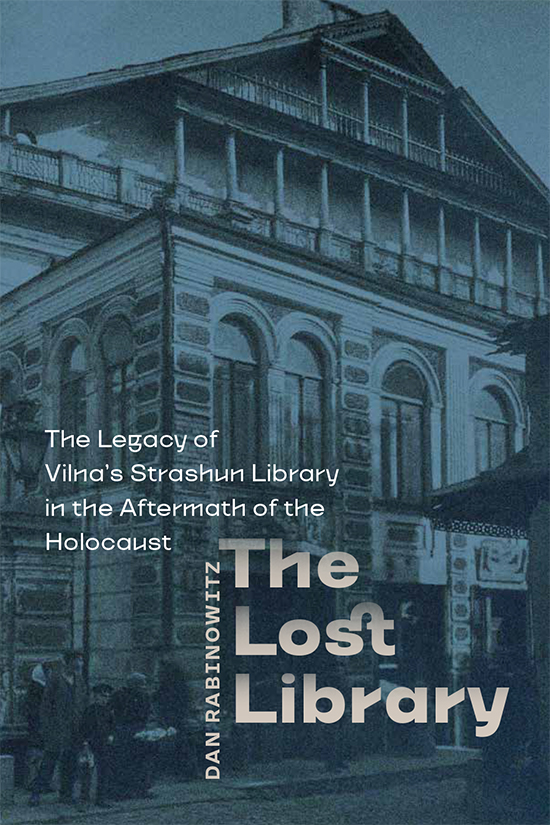
Its with great pleasure that I announce the recent publication of an important work, that I am certain will be of great interest to readers of the Seforim Blog – The Lost Library by Dan Rabinowitz, founder and editor-in-chief of the Seforim Blog. This book is devoted to the legacy of the personal and expanded public library of Rabbi Mattityahu Strashun.

From the back cover:

The Strashun Library was among the most important Jewish public institutions in Vilna, and indeed in Eastern Europe, prior to its destruction during World War II. Mattityahu Strashun, descended from a long and distinguished line of rabbis, bequeathed his extensive personal library of 5,753 volumes to the Vilna Jewish community on his death in 1885, with instructions that it remain open to all.

In the summer of 1941, the Nazis came to Vilna, plundered the library, and shipped many of its books to Germany for deposition at a future Institute for Research Into the Jewish Question. When the war ended, the recovery effort began. Against all odds, a number of the greatest treasures of the library could be traced. However, owing to its diverse holdings and its many prewar patrons, a custody battle erupted over the remaining holdings. Who should be heir to the Strashun Library?

This book tells the story of the Strashun Library from its creation through the contentious battle for ownership following the war until present day. Pursuant to a settlement in 1958, the remnants of the greatest prewar library in Europe were split between two major institutions: the secular YIVO in the United States and the rabbinic library of Hechal Shlomo in Israel, a compromise that struck at the heart of the library’s original unifying mission.

In 2005 Dan Rabinowitz founded the Seforim Blog and I started corresponding with him almost immediately. One of the people we discussed often was R’ Strashun as both Dan and I were fascinated by him. Dan’s interest extended to the library and what happened to it after R’ Strashun’s death and especially what happened to it after World War Two. Eventually, in November 2015 Dan authored a lengthy post on the Seforim Blog dealing with different aspects of R’ Strashun and his library. This post eventually turned into this full-length book on the subject.

The Lost Library is written in Dan’s extremely clear, lucid and captivating manner as familiar to readers of the Seforim Blog (having read hundreds of his articles and at times not realizing he is the author of them because most do not include his name – in essence, stamm seforim blog post dan rabinowitz, at least the scholarly ones). The book begins with an exciting personal introduction (A PDF is available upon request) giving background to the development of one of Dan’s favorite pastimes collecting books. However, similar to the subject of this book R’ Strashun, Dan’s interest extends to not just owning the book but to developing a personal relationship with the book contents. This becomes evident as one reads The Lost Library, especially the vast number of sources in multiple languages housed in numerous collections and libraries all over the world including his personal library. The Lost Library meticulously documents each of his claims from these extensive sources collected over intense research conducted over a few years.

The book begins with an overview of that ‘ir ve’em be-yisrael, the famous city of Vilna, giving the reader excellent background to the environment and city (including current descriptions as the author visited Vilna while working on this volume). The author discusses what made Vilna famous, sidetracking into very relevant topics such as R’ Mattityahu father, the Rashash and others affiliated with the Vilna Gaon, Vilna’s most famous resident. Dan then turns to deal with the hero of the book, R’ Mattityahu and provides the reader with a comprehensive biography that discusses his unique style of learning and how that influenced his book collecting habits. The next chapter is the opening of the public library after Mattityahu’s death and the impact it had on the community and eastern European Jewry at large. The book then goes onto detailing the library’s life during the Holocaust and especially afterword as different parties claimed ownership when most of it was discovered to have survived.

Marc Shapiro wrote:

Taking us on a journey from nineteenth-century Vilna until almost the present day, Rabinowitz not only documents the vicissitudes of this important institution, but helps us understand the intellectual culture of one of the centers of Judaism in modern times.”—Marc B. Shapiro, Weinberg Chair in Judaic Studies, University of Scranton

And others praised the work as well.

“Rabinowitz has done a brilliant job in his moving and important book…. Through the story of the Strashun Library, he gives us insight into the richness and vibrancy of Jewish life in Vilna. He vividly portrays the restoration of the books of the Strashun Library, a testimony to the indomitable Jewish spirit.”
—Ambassador Stuart E. Eizenstat, chief White House domestic policy adviser to President Carter

“Rabinowitz’s meticulously researched study is an outstanding expression of the wealth of knowledge provided by a thorough exploration of Jewish material culture…In his detailed reconstruction of the Strashun library’s fate after the German invasion, he detects a breathtaking history of loss and mourning, of illegal claims and desires, of appropriation and incorporation that expresses the rupture of the Holocaust and the contested visions of Jewish life after catastrophe.”—Elisabeth Gallas, Leibniz Institute for Jewish History and Culture –Simon Dubnow

This book is of particular personal great interest. The first time I recall hearing something from R’ M. Strashun was when I was in tenth grade. R’ Hershel Schachter had just begun giving a shiur once a week in Flatbush for Balei Battim on Mesechtas Kidushin. I attended a few of them, during one of the shiurim he mentioned R’ M. Strashun’s comments in Bava Basra praising him (I do not recall his exact discussion, but it was about the word Achron). I had been familiar with the Strashun name for a while through R’ Mattityahu father, the Rashash via my father. The Rashash symbolized an emphasis on peshat, from then on I was very curious about R’ Mattityahu. Fast forward a few years when I began learning in the Mir in EY I was talking to a friend somehow it came up about R’ M. and the friend mentioned he loves him and that the great Gaon R’ Yakov Chaim Sofer always quotes him with great respect. He then showed me a sefer of Mattiyahu printed by Mossad Harav Kook (Mivchar Kesavim). The sefer was out of print and hard to find, but the Sitrah Achrah helped me find it a little while later. I immediately began learning through the work. Since then I have found the work many times in used shops and have found these copies, proper owners, to appreciate them. One time while learning the sefer an Israeli chavrusha saw what I was learning and said how you could learn a sefer of a maskil! I argued it was good enough for me that R’ Yitchack Elchanan Spektor who, in his old age, came to Vilna to eulogize R’ Mattityahu. My chavrusha dismissed this anecdote and replied that means nothing! Of course, I could not convince him that there was nothing wrong with him. However, his complaint sparked the exact opposite – and spurred me to research and read more of R’ Mattityahu’s writings which only enhanced my reverence for him. My chavrusha’s position notwithstanding, other very frum Israelis friends expressed their appreciation and fascination with R’ Mattityahu. Most of his writings appeared in newspapers and journals and are not readily available or even known. However, in a few months, I will god willingly print some of them. Eventually, I wrote my first academic article in English about him (available in PDF upon request or from here).

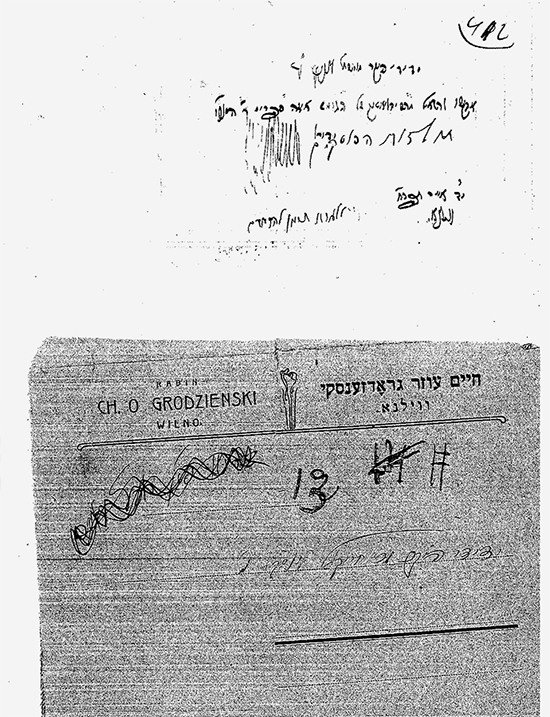
One final point about R’M that particularly resonated with me. R’M did not merely collect seforim he used them, and this is apparent from hundreds of citations throughout his works. A later resident of Vilna, and one too who was indeed very well-read was R’ Chaim Ozer. He did not need an extensive personal library as he had unfettered access to the Strashun Library – indeed was unique in that he was one of the few given borrowing privileges. Here is a book request from R’ Chaim Ozer, addressed to the Strashun Library’s head librarian Chaim Chaikel Lunski. Thanks to R’ Dovid Kamenetsky for making it available:

One of my favorite stories about the library as told by R’ Moshe Shmukler in his fascinating book, Moshe Shmuel ve-Doro, combines the idea of the voracious reader and a comprehensive library:

ר’ חיים עוזר… מלבד בקיאותו הגדולה בתלמוד ובראשונים, הצטיין בבקיאות עצומה בשאלות ותשובות האחרנים… פעם החלטתי לנסותו עד כמה כוחו גדול באחרונים, סרתי לספריה של שטראשון ועברתי על פני הקאטאלוג במקרה נתקבל מבטי על הספר מאמר מרדכי להגאון ר’ מרדכי זאב אוטינגר מלמברג ספר שלא נודע לי עד אז וחשבתיו ליקר המציאות. דפדפתי בספר ומצאתי איזה הערה נפלא על דברי בעל הלכות גדולות המובא ברא”ש סוף פ”ב דיבמות. חשבתי האח, מצאתי את מה שאוותה נפשי. במוצאי שבת באתי לר’ חיים עוזר, כי הערב ההוא היה מוקש ללות אתו בחידוש תורה. בשעת השיחה העילתי כלאחר יד את הקושיא על הבה”ג. ומה השתוממתי לשמוע מפי תיכף, כי זוהי קושיתו של בעל מאמר מרדכי… [ר’ משה שמואל ודורו, עמ’ 176].

The book can be purchased from the publisher here, Amazon or Book Depository.

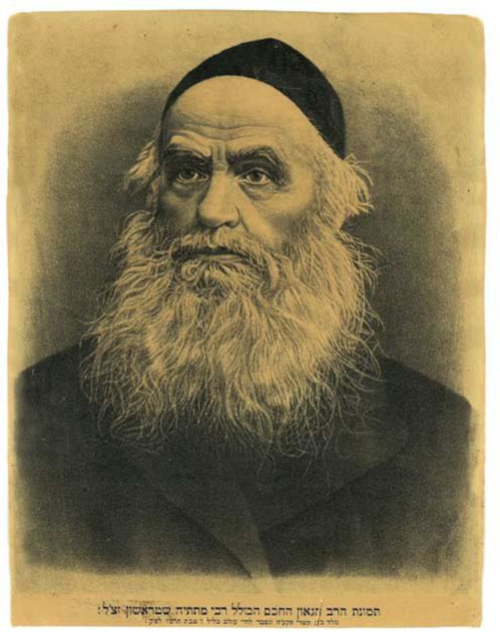
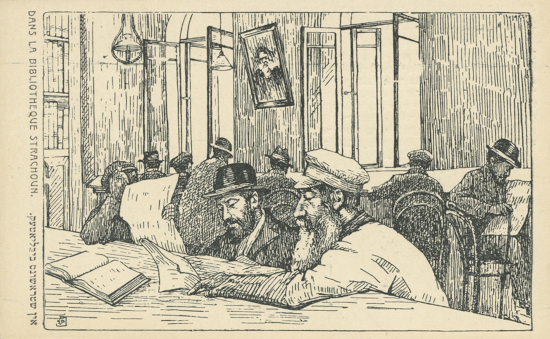
Here is a portrait of R’ Mattityahu followed by a scene depicting the Strashun Library in Vilna in its heyday:


Shnayer Leiman: In Appreciation*

Shnayer Leiman: In Appreciation*

Yitzhak Berger and Chaim Milikowsky

אוצר נחמד ושמן בנוה חכם

 (משלי כא,כ)

In multiple ways, the above-cited biblical phrase, on which the title of this volume is based, calls to mind its distinguished honoree. For one thing, few collections of Jewish writings surpass Shnayer Leiman’s אוצר נחמד – a vast store of literary treasures that encompasses, among much else, an abundance of rare traditional classics. For both its scale and its exquisiteness, the renowned Leiman Library inspires an inevitable sense of awe.

This repository of writings, however, attests to more than the efforts of a great collector. While it is difficult, within Shnayer Leiman’s many spheres of interest, to identify a book that he does not possess, it is equally challenging to find information that he does not know. If the volumes in his home comprise a storehouse of Jewish knowledge, it is hardly an exaggeration to say the same of their illustrious owner.

Indeed, whereas the Leiman Library constitutes an אוצר נחמד because of the “precious treasures” that it holds, we may apply the same Hebrew phrase to the man himself – a “delightful repository” of both knowledge and kindness who has enriched the lives and minds of scholars and laypeople alike. Widely sought out for his erudition and scholarship, Leiman has shared his expertise with countless individuals in academia and beyond, always with his signature pleasantness and soft and inviting demeanor. The success of his heavily attended biweekly classes, offered in his home for many years, owes not only to their rich content but also to the welcoming environment generated by him and his equally gracious wife Rivkah. Not only do Jewish books line the shelves of the Leiman home; their proprietors generously share the Torah that they comprise with an eager and inquisitive Jewish public.

The professional career of Shnayer (Sid) Leiman attests to his intellectual breadth and to the wide admiration he has earned in both academic and communal circles. A Mirrer yeshiva bochur who attained a Ph.D. in Bible under Moshe Greenberg at the University of Pennsylvania, Leiman spent several years as head of the Judaic Studies program at Yale. Later, he would return to New York to head the Bernard Revel Graduate School for Jewish Studies at Yeshiva University. Maintaining a sustained relationship with YU, he then commenced a professorship in Jewish Studies at Brooklyn College of the City University of New York, where he remained for several decades, including a period during which he served as Editor of the Yale Judaica Series. Currently, he holds a Distinguished Professorship at Touro College, assisting in the development of its Ph.D. program in Jewish Studies. In the broader community, Leiman remains a popular speaker across a wide spectrum of populations. He is especially known for his involvement in tours of European cities, where he has fascinated travelers with his lectures on pre-war Jewish communities and rabbinic figures.

Leiman’s scholarship stands out in multiple respects. With a degree in Bible that yielded a pivotal study on the canonization of Scripture – an inquiry demanding expertise in both Biblical Studies and Rabbinics – Leiman has contributed to a strikingly wide array of fields. Shedding the constraints of ever-increasing academic specialization, he has produced well over a hundred essays on such diverse topics – covering a range of eras – as canonization, Masorah, modern and early-modern rabbinic figures, Jewish ethics, modernization and rabbinic leadership, contemporary Jewish issues, and more. Notably, with his superior academic credentials in hand, Leiman has consciously chosen to diversify his writings among professional and more popular outlets, seeking to enrich and inspire the public no less than to advance the frontiers of scholarship. Lists of his publications and more, including the full text of several dozen essays, are conveniently available online at leimanlibrary.com.

Consistent with the breadth of its honoree, the present volume, marking fifty years of his contributions to Jewish Studies, contains essays that span a range of fields: Bible and philology, Masorah, biblical interpretation, philosophy and theology, halakhah and pilpul, works of art and their connection to Jewish law and thought, and the social and intellectual history of medieval and modern Jews of diverse regions and cultures. The eager participation of the authors, along with the kind tributes penned by several of them, reflects the warm admiration toward Shnayer Leiman felt by many. The editors, whom he ably and selflessly guided in their doctoral studies, join in wishing him enduring personal fulfillment and continued success in contributing to Jewish life and scholarship.

כי אם בתורת ה’ חפצו ובתורתו יהגה יומם ולילה

והיה כעץ שתול על פלגי מים אשר פריו יתן בעתו

ועלהו לא יבול וכל אשר יעשה יצליח

Yitzhak Berger

Chaim Milikowsky

יום העצמאות, תשע״ט

May 8, 2019

*Reprinted from *‘In the Dwelling of a Sage Lie Precious Treasures’: Essays in Jewish Studies in Honor of Shnayer Z. Leiman*, eds. Yitzhak Berger and Chaim Milikowsky (New York: Yeshiva University Press, 2020), with permission of YU Press, available to be ordered here.

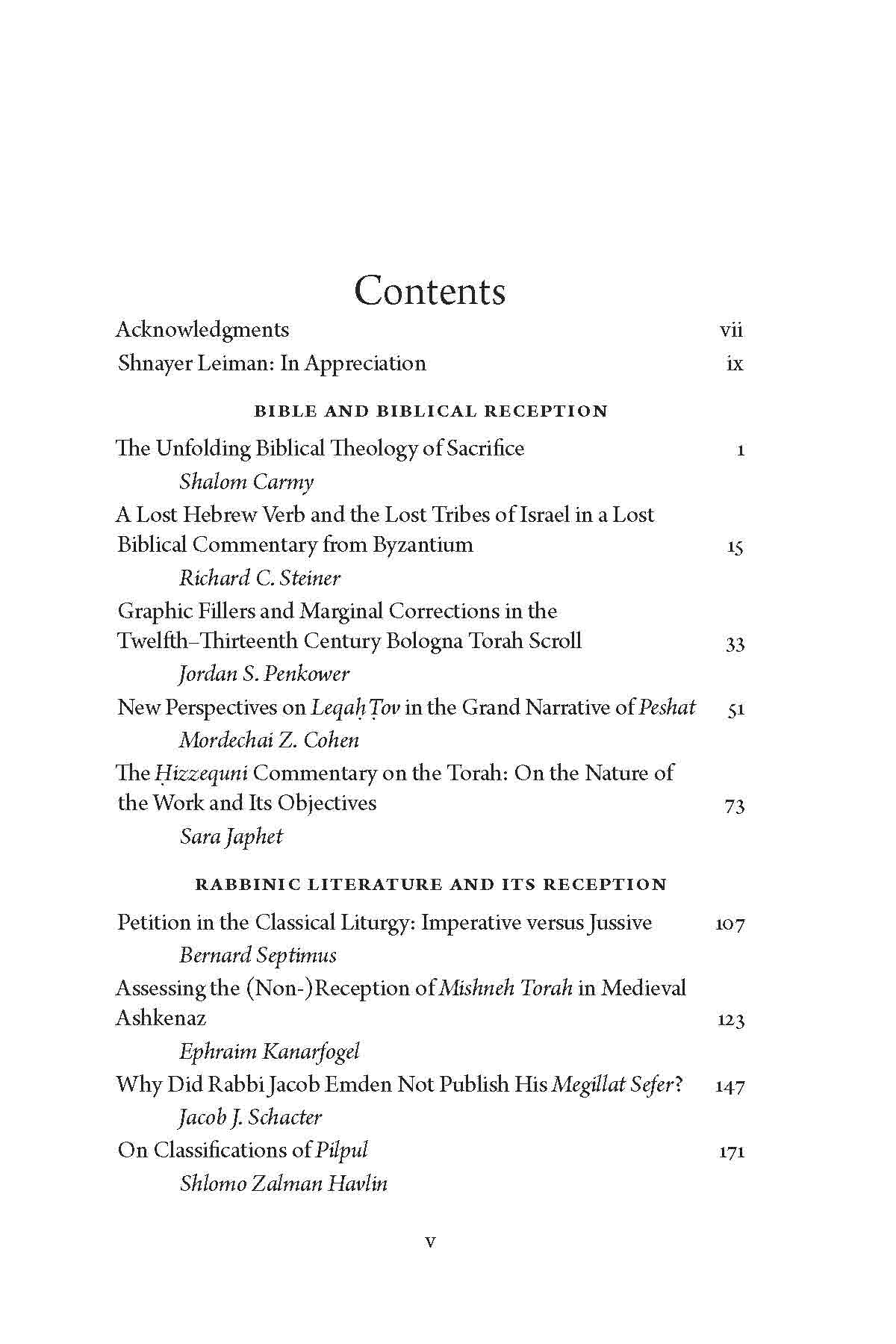
Table of Contents:


Two Jewish Temples in Egypt

Two Jewish Temples in Egypt

Rabbi Reuven Chaim Klein is the author of the newly-released work God versus Gods: Judaism in the Age of Idolatry (Mosaica Press, 2018). His book follows the narrative of Tanakh and focuses on the stories concerning Avodah Zarah using both traditional and academic sources. It also includes an encyclopedia of all the different types of idolatry mentioned in the Bible. Rabbi Klein studied for over a decade at the premier institutes of the Hareidi world, including Beth Medrash Govoha in Lakewood and Yeshivas Mir in Jerusalem. He authored many articles both in English and Hebrew, and his first book Lashon HaKodesh: History, Holiness, & Hebrew (Mosaica Press, 2014) became an instant classic. His weekly articles on synonyms in the Hebrew language are published in the Jewish Press and Ohrnet. Rabbi Klein lives with his family in Beitar Illit, Israel and can be reached via email to: rabbircklein@gmail.com
 
In this article, we will discuss two different temples which the Jews built in Egypt: the temple at Elephantine, and Chonyo’s Temple. After providing the reader with the historical background to both temples, we will analyze the nature of the worship which took place there, as well as their possible Halachic legitimacy.

The Temple at Elephantine

Ancient papyri found on the Egyptian island Elephantine (יב, Yev in Aramaic) reveal the forgotten story of a Jewish Temple that was built there.
According to those documents, Jews living in Egypt when it was still an independent state built a Temple for Hashem at Elephantine. This occurred after the destruction of the First Temple, but before the construction of the Second Temple. Later, when the Persians conquered Egypt, they destroyed most of its temples,[1] but allowed the Jewish Temple at Elephantine to remain. Sometime afterwards, the priests of the Egyptian deity Khnum and the local Persian rulers colluded against the Jewish community at Elephantine, destroying their Temple and taking the Temple’s gold and silver for themselves.
The Jewish priests of the Elephantine temple, led by a priest named Jedaniah, sent letters appealing to the Persian-appointed Jewish governor of Judah and the Cuthean governate of Samaria to intervene on their behalf, and lobby the Persians for the restoration of their temple. In these letters, the priests of Elephantine repeatedly mentioned that they wished to resume sacrificing meal-offerings, burnt-offerings, and incense (which as we will see seems to be Halachicly problematic). It seems that the Second Temple in Jerusalem had already been built by this time; as the Elephantine priests mentioned in their letter that they had also written to Yochanan, the Kohen Gadol in Jerusalem, but had not received a reply.
The Elephantine Temple was eventually rebuilt, but the Jewish community at Elephantine did not last much longer.[2]

Were the Jews at Elephantine Loyal to Halachah?

The academic consensus views the Jews at Elephantine as practitioners of a syncretistic mixture of Judaism and Egyptian/Aramean idolatrous
cults.
[3] This comes as no surprise, because Jeremiah (Chapter 44) already mentioned that the Jews who remained in Judah after the destruction
of the First Temple and the subsequent assassination of Gedaliah (the Babylonian-appointed Jewish governor over what remained of Judah) migrated to Egypt, where they engaged in idol worship.
[4] As such, the deviant practices of these wayward Jews does not warrant any attempt at justification.[5]
However, some scholars have called this picture into question. In the Ancient Levant, it was standard practice for people to bear personal names
that refer to their gods. Such references to deities within a person’s name is known as a theophoric element. Accordingly, if the Jewish community at Elephantine was truly syncretistic, then we would expect the Jews of that community to incorporate the names of foreign gods into their personal names. But the evidence shows that they did not. Partially because of this lack of idolatrous theophoric elements, some scholars argue that the Jewish community at Elephantine was not idolatrous—rather they remained wholly devoted to Hashem. These scholars explain away alleged allusions to foreign gods at Elephantine as the assimilation of various pagan religious
concepts into their brand Judaism, as opposed to the outright acceptance of pagan deities.[6] Similarly, the Jews at Elephantine may have used Aramean phraseology to refer to Jewish ideas, but they did not adopt Aramean religion.[7]
According to this approach, we must seek out the Halachic justification for offering sacrifices at the temple in Elephantine, a practice which seems to defy the Torah’s ban on sacrifices outside of the Holy Temple in Jerusalem. Assuming that the Elephantine Jews were basically loyal to normative Judaism, how did they justify building a temple, complete with sacrifices?
As mentioned previously, it seems that those Jews who built the Temple at Elephantine only did so after the destruction of the First Temple in Jerusalem. Based on this, R. Ephraim Dov ha-Kohen Lapp (1859–1925) proposes that they followed a minority Halachic opinion which maintains that when the First Temple was destroyed, the site in Jerusalem lost it holy status, thus legitimizing the use of private altars.[8] Accordingly, the Temple at Elephantine had the Halachic status of a legitimate private altar. As a result of this status, the Jews at Elephantine only offered voluntary, votive sacrifices such as meal-offerings, burnt-offerings, and incense (as opposed to obligatory sacrifices, like sin-offerings or guilt-offerings). This
is, in fact, in accordance with the Mishnah
[9] that limits the permissible sacrifices at legitimate private altars to exactly such offerings.[10]

Private Altars in the Second Temple Period

Nonetheless, the issue that remains unresolved is why this temple was not discontinued or dismantled upon the construction of the Second Temple. We can possibly resolve this question by comparing the issue of the temple at Elephantine to the issue of private altars in the Kingdom of Judah.
As evident in the Book of Kings, private altars existed in the Kingdom of Judah throughout the First Temple period. There was no systematic
campaign to destroy them until Hezekiah came along. This begs the question: Why did righteous kings of Judah, such as Asa and Jehoshaphat allow these private altars to remain, if sacrifices were only allowed at the Holy Temple in Jerusalem?
R. Moshe Sofer (1762–1839) answers that many of the private altars in question were built before the prohibition of private altars came
into effect (i.e. before the Temple in Jerusalem was built). Therefore, since these private altars were built legitimately, they maintained a certain degree of holiness. Consequently, it was actually
forbidden to destroy them, and this prohibition remained in effect even once using them for ritual purposes became prohibited (i.e., when the Temple was later built). For this reason, even the “good” kings of Judah did not remove the private altars.[11]
Based on this understanding, we can conjecture that a similar approach may have taken hold at the temple in Elephantine. If that temple was
originally built at a time when private altars were permitted (because the First Temple in Jerusalem had already been destroyed), then perhaps some Jews attached a certain degree of holiness to the temple, and refused to dismantle it after the Second Temple in Jerusalem was built. Nonetheless, even if they were justified in allowing the temple at Elephantine to remain standing, there does not seem to be any justification for continuing to offer sacrifices outside of Jerusalem once the Second Temple was built.

The House of Chonyo

The Mishnah[12] mentions another Jewish temple in Egypt—the House of Chonyo (Onias). Chonyo was the son[13] of Shimon the Just, a righteous Kohen Gadol in the Second Temple in Jerusalem. Before his death, Shimon the Just said that his son Chonyo should succeed him as Kohen Gadol.
The Talmud[14] offers two Tannaic accounts of how Chonyo’s temple came about. According to R. Meir, Chonyo’s older brother Shimi became jealous that their father chose Chonyo to succeed him, so he tricked Chonyo into making a mockery of the Temple rituals and angering the other Kohanim. Shimi gave Chonyo “instructions” for his inaugural service by telling him that he was expected to wear a leather blouse and a special belt.
When Chonyo came to the altar wearing those “feminine” articles of clothing, Shimi insinuated to the other Kohanim that Chonyo wore those clothes in order to fulfill a promise to his “lover”.
[15] This raised their ire and they chased him to the Egyptian city of Alexandria,[16] where he established an idolatrous temple.
According to R. Yehudah, the story unfolds differently. Although Shimon the Just advised that his son Chonyo should become the next Kohen Gadol, Chonyo deferred that honor, allowing his older brother Shimi to be appointed instead. Nonetheless, Chonyo became jealous of his older brother, so he devised a plan to embarrass him and deprive him of his office. Chonyo gave Shimi “instructions” for his inaugural service by telling him that he was expected to wear a leather blouse and a special belt. When Shimi came to the altar wearing those “feminine” articles of clothes, Chonyo insinuated to the other Kohanim that Shimi wore those clothes in order to fulfill a promise to his “lover”. When the other Kohanim found out the truth, i.e. that Chonyo had tricked Shimi by giving him incorrect instructions for his inaugural service, they chased Chonyo to Alexandria, where he established a temple for Hashem.[17]
The Talmud concludes this second account by relating that Chonyo justified the establishment of his temple by citing the words of Isaiah,[18] On
that day, there will be an altar for Hashem inside the Land of Egypt, and a single-stone altar to Hashem next to its border
(Isa. 19:19).

Josephus’ Account of the Chonyo Story

Josephus offers a third account of how Chonyo’s temple was established. After the death of Alexander the Great, Greek holdings in the Middle East were divided between the Seleucid kingdom in Syria and the Ptolemaic kingdom in Egypt. A flashpoint of contention between these two rival kingdoms was the Holy Land, and different groups of Jews took different sides in the conflict. When the Seleucid king, Antiochus Epiphanes, led his army to Jerusalem, he violated the Holy Temple and halted the offering of daily sacrifices for three and a half years.
Chonyo, who was the Kohen Gadol in Jerusalem, was a supporter of the rival Ptolemaic kingdom. When the Seleucids came to Jerusalem, he fled to
Egypt. In Egypt, Ptolemy granted Chonyo permission to establish a Jewish community in the district of Heliopolis. There,
[19] Chonyo built a city resembling Jerusalem, along with a temple that resembled the one in Jerusalem. Centuries later, Chonyos’ temple met its eventual demise at the hands of the Romans. After they destroyed the Second Holy Temple in Jerusalem, the Romans ordered the closure of Chonyo’s temple in Egypt, and eventually its destruction.[20]
Josephus seems to attribute noble intentions to Ptolemy. He was said to have sponsored the establishment of a Jewish temple in Egypt so that the
Jews there would have the opportunity to worship Hashem (and would be more willing to help Ptolemy battle the Seleucids). However, in
explaining Chonyo’s rationale for building the temple in Egypt, Josephus reports that Chonyo built it in order to compete with the Temple in Jerusalem and draw Jews away from worshipping Hashem properly. Chonyo had a bone to pick with the Jewish leadership in Jerusalem on account of their rejection of him, which forced him to flee to Egypt.
Josephus also reports that Chonyo rationalized his building of a temple on foreign soil[22] by citing Isaiah’s above-mentioned prophecy.[22]

Chonyo’s Temple in Halacha

As we have seen above, whether or not Chonyo’s temple was idolatrous remains a matter of contention. According to Josephus and R. Meir,
Chonyo sought to worship something other than Hashem. On the other hand, according to R. Yehuda, Chonyo’s temple was established for
the sake of Hashem. If we follow the first view, then there can be no justification for what Chonyo did and the establishment of his idolatrous temple in Egypt. However, if he sought to worship Hashem, then from a Halachic perspective, there may be two ways of looking at Chonyo’s temple: Either his temple was a place of forbidden worship (albeit not quite idolatry in the classical sense of worshipping a foreign deity), or it might have been a completely legitimate place of worship.
Maimonides[23] follows R. Yehuda’s version of events, and explains that Chonyo’s temple was not idolatrous, per se, even though it violated the ban on sacrifices outside of the Temple in Jerusalem. In other words, the practices at Chonyo’s temple reflected an illegitimate way of worshipping Hashem. Maimonides also notes that many local Egyptians—known as Copts—became involved in Chonyo’s temple, and were thus drawn to worshipping Hashem.
The Tosafists[24] disagree with Maimonides’ premise that Chonyo’s temple violated Halacha. Instead, they explain that Chonyo avoided the prohibition of offering sacrifices outside of the Temple in Jerusalem by only offering sacrifices belonging to non-Jews. According to this approach, there was nothing technically wrong with Chonyo’s temple and the services there.

Gentiles Sacrifices outside of Jerusalem

Nonetheless, the commentators grapple over reconciling the Tosafists’ explanation with the opinion of the Tannaic sage R. Yose who maintains that the prohibition of offering sacrifices outside of Temple even extends to sacrifices of non-Jews.[25]
R. Avrohom Chaim Schor (1560–1632)[26] explains that the dispute about whether Chonyo’s temple was legitimate or not centers around whether or not one accepts R. Yose’s view. In other words, R. Meir accepted R. Yose’s view that even a non-Jew’s sacrifices may only be offered in the Holy Temple. As a result of that, R. Meir understood that Chonyo’s temple must have been illegitimate, so he branded the temple idolatrous. In contrast, R. Yehuda rejected R. Yose’s opinion, so he reasoned that there could be Halachic justification for Chonyo’s temple. Because of this, R. Yehuda asserted that Chonyo’s was not idolatrous, but reflected the genuine worship of Hashem, albeit—as the Tosafists explain—specifically for gentiles.
Alternatively, R. Schor proposes that although R. Yose forbids offering the sacrifices of gentiles outside of the Temple in Jerusalem, this prohibition only applies to Jewish priests. Accordingly, R. Yehuda believed that Chonyo and the Jewish priests at his temple did not actually participate in the ritual offerings there. Rather, they offered instructions for the attending gentiles to properly offer sacrifices to Hashem. In this way, no one at Chonyo’s Jewish-run temple ever violated the prohibition against offering sacrifices outside of the Temple in Jerusalem, because they themselves never engaged in such actions, they only helped the gentiles do so.[27]
Others suggest that even R. Yose differentiates between two different types of sacrifices offered by a non-Jew. If a non-Jew consecrated a sacrifice to be brought in the Temple in Jerusalem,[28] then R. Yose would say that this sacrifice may not be offered outside of the Temple in Jerusalem. However, if a non-Jew consecrated a sacrifice without specific intent that it should be offered in Jerusalem, then his offering may Halachically be brought elsewhere. According to this, all opinions agree that a Jew may offer a gentile’s sacrifice outside of the Temple in Jerusalem provided that the gentile did not initially consecrate the sacrifice with intent to bring to Jerusalem.[29] With this in mind, we may justify the services at Chonyo’s temple by explaining that they only offered the sacrifices of non-Jews that were consecrated without specific intent to be offered in Jerusalem.
R. Yehonassan Eyebschuetz (1690–1764) proposes another answer: the Tosafists’ discussion reflects the rejected opinion of the Amoraic sage R. Yitzchok.[30] R. Yitzchok understood that the prohibition of sacrificing outside of the Temple does not apply outside of the Holy Land, thus justifying the existence of Chonyo’s temple which stood in Egypt.[31]
R. Lapp extends this logic to also justify the continued existence of the Jewish temple at Elephantine (mentioned above), even after the construction of the Second Temple in Jerusalem. He argues that in accordance with R. Yitzchok, the entire prohibition of sacrifices outside of the Temple only applies in the Holy Land, not in Egypt.[32]

Egyptian Temples and Eradication of the Idolatrous Inclination

In short, there were two Jewish Temples in Egypt that coexisted with the Second Temple in Jerusalem: the Jewish Temple at Elephantine and Chonyo’s Temple in Alexandria/Heliopolis. We have shown that it is unclear whether or not these temples were idolatrous. If the two Jewish Temples in Egypt were non-idolatrous, then there may be some Halachic justification for their existence.

This, of course, also does not hamper our understanding of the Talmudic assertion that the idolatrous inclination was abolished with the beginning of the Second Temple Era. However, if these Jewish Temples in Egypt were indeed idolatrous, then they pose a challenge to the Talmudic assertions regarding the elimination of the idolatrous inclination.[33]

We shall resolve this difficulty by addressing each temple separately.

The Elephantine Temple seems to have predated the construction of the Second Temple in Jerusalem, and thus the eradication of the idolatrous inclination. As such, the Temple existed before the sages removed the idolatrous inclination. It is not a stretch of the imagination to postulate that even if the idolatrous inclination suddenly ceased to exist, those who already engaged in systematic idolatry beforehand would continue to do so simply out of habit. Once the Elephantine Temple had already been functioning for some time, it would not simply shut down operations overnight because the sages rid the Jews of the idolatrous inclination. There was too much at stake for the priests and other functionaries who profited from the temple.

Regarding Chonyo’s Temple—which certainly did not predate the construction of the Second Temple—even if it was idolatrous, we can argue that it was not the drive for committing idolatry which led to its establishment. Rather, Chonyo’s own ego and pursuit of honor led him to establish a new Temple in Egypt. Those who participated in his cult were merely supporting characters in Chonyo’s own private scheme. In other words, the existence of Chonyo’s idolatrous temple does not contradict the Talmudic statement that the sages had removed the idolatrous inclination, because the idolatrous inclination was not what drove Chonyo’s temple.

To recap, the Idolatrous inclination was not in play at these two temples. At Elephantine, it was the priests’ greed which motivated their continued idol worship and at Chonyo’s temple, it was a personality cult intended to elevate Chonyo which sponsored idolatry.


[1] The establishment of the Jewish community in Elephantine is uncertain regarding when it happened, although some scholars argue that it predated the destruction of the First Temple. Rabbi Moshe Leib Haberman challenges this assumption, citing the Elephantine Papyri that only reveals that the Jewish settlement was there before Cambyses, but the exact timing is unknown.

[2] Primary sources for the Elephantine Jewish community include B. Porten & A. Yardeni’s Textbook of Aramaic Documents from Ancient Egypt, vol. 1 (1986) and B. Porten’s The Elephantine Papyri in English (1996). Other sources that discuss this community include M.H. Silverman’s “The Religion of the Elephantine Jews—A New Approach” (1973), J.M.P. Smith’s “The Jewish Temple at Elephantine” (1908), and C. Cornell’s “Cult Statuary in the Judean Temple at Yeb” (2016).

[3] The Elephantine Papyri include texts that mention the name of a goddess, Anat-Yahu, which some scholars argue was a syncretistic merge of the Canaanite goddess Anat with Hashem, while others argue that it was wholly an Aramean creation.

[4] J.M.P. Smith suggests that the founders of the Jewish colony at Elephantine were Jews who fled to Egypt instead of remaining in Babylonian-occupied Judah, as called for by Jeremiah.

[5] C. Cornell believes that the Jews in Elephantine worshipped the One Hashem but also held multiple images/idols in their temple, which purported to depict Him in various hypostases.

[6] M.H. Silverman disagrees with the idea that the Jews at Elephantine were entirely idolatrous.

[7] Some scholars suggest that the seemingly idolatrous elements of the Jewish presence at Elephantine were only attempts to evoke Persian sympathy for their cause.

[8] Maimonides rules that the Temple’s site became permanently holy when King Solomon sanctified it, while Raavad disagrees and accepts the opinion that the site was no longer holy after the Temple was destroyed, until it was re-consecrated upon the construction of the Second Temple.

[9] Megillah 1:10 discusses the topic of when the Second Temple was considered to be permanent.

[10] Zivchei Efrayim Al Meseches Zevachim and Responsa Chasam Sofer discuss the question of whether a new site for the Temple would need to be found if the original site was lost.

[11] Responsa Chasam Sofer (Orach Chaim §32). See also R.C. Klein, God versus Gods: Judaism in the Age of Idolatry (Mosaica Press, 2018), pgs. 28–32.
[12] Menachos 13:10.
[13] In Antiquities, Josephus attributes the temple in Egypt to a later Chonyo, who was not the son of Shimon the Just. Nonetheless, some scholars claim that Josephus purposely attributed the establishment of the temple in Egypt to a later Chonyo who had never served as Kohen Gadol in
Jerusalem in order to delegitimize its religious value. See J. E. Taylor, “A Second Temple in Egypt: the Evidence for the Zadokite Temple of Onias,”
Journal for the Study of Judaism vol. 29:3 (1998), pgs. 297–321. Interestingly, R. Yisroel Lipschitz
(1782–1860) in
Tiferes
Yisroel
(Menachos 13:10, Boaz §2)
writes that the Chonyo in discussion was not literally a
son of Shimon the Just, but rather a grandson of Shimon the Just (a son of Shimon’s son Chonyo), accepting
Josephus’s account and adjusting his understanding of the Talmud
accordingly.
[14] TB Menachos 109b.
[15] R. Gershom and Rashi explain that this “lover” was his wife. Maimonides (in his commentary to the Mishnah Menachos
13:10) writes that this “lover” was an alleged mistress.
[16] TB Yoma 38a and JT Shekalim 5:1 relate that the House of Garmu did not wish to reveal the secrets
behind making the shew-bread and the House of Avtinas did not wish to
reveal the secrets behind making the incense for the Temple. In
response, artisans from Alexandria were imported to try and mimic
those secret recipes, but they were unsuccessful in exactly copying
what those families had been able to make. Both R. Yosef Shaul
Nathansohn (1808–1875) in
Divrei Shaul (to TB Yoma
38a) and R. Shalom Massas (1909–2003) in
ve-Cham
ha-Shemesh

(Jerusalem, 2003) pp. 326–327 independently draw an explicit
connection these Alexandrian artisans to Chonyo’s Temple in
Alexandria, although no other authorities do so. The notion of
Alexandrian artisans being unable to exactly replicate something from
Jerusalem is also found in Targum to Est. 1, which relates that
Achashverosh wished to create a replica of King Solomon’s famed
throne, and employed Alexandrian artisans to do so—but to no avail.
That story must have transpired before the establishment of Chonyo’s
Temple in Alexandria because Achashverosh lived before the
construction of the Second Temple. In light of this, we may suggest
that Alexandrian artisans were employed in all cases simply because
Greek Alexandria was a center of knowledge in its time, so the most
knowledgeable craftspeople lived there.
[17] The Jerusalem Talmud (JT Yoma 6:3) slightly differs in its retelling of this discussion. Whilst in
the Babylonian Talmud, the names of the two rival sons of Shimon the
Just are Chonyo and Shimi, in the Jerusalem Talmud, they are
Nechunyon and Shimon. However, R. Tanchum ha-Yerushalmi (a 13
th
century Egyptian Rabbi) writes that Chonyo had two names, Chonyo and
Nechunyo; see B. Toledano (ed.),
ha-Madrich
ha-Maspik
(Tel Aviv, 1961), pg. 154.
Furthermore, according to the Babylonian Talmud, R. Meir believed that Chonyo was
the victim of Shimi’s deceit and ended up establishing a temple for
idolatry, while R. Yehuda believed that Chonyo tricked Shimi, and
ended up fleeing for fear of Kohanic retribution and established a
temple for Hashem. The Jerusalem Talmud echoes the dispute in the
Babylonian Talmud regarding the
story
of Chonyo, but differs in the conclusions. According to the Jerusalem
Talmud, R. Meir understood that Chonyo’s Temple was for Hashem,
while R. Yehuda understood that it was for idolatry. See also
Piskei
ha-Rid
(to TB Menachos 109b)
who copies the entire story as related by R. Meir, but concludes that
Chonyo’s intent was to establish a temple for Hashem—not for
idolatry—in line with the Jerusalem Talmud.
[18] See Isa. 19:18 which calls this Egyptian place Ir
ha-Heres
(עיר ההרס, the city of destruction), which the Talmud (TB Menachos 110a) translates as Karta
de-Beis Shemesh
(קרתא דבית שמש, city of the House of the Sun, i.e. Heliopolis). Indeed, deviant
versions of the Bible (such as the Septuagint and the Dead Sea Scroll
1QIsa3) insert this tradition into the text and read
Ir
ha-Cheres
(עיר החרס, the city of the sun), instead of Ir ha-Heres.
[19] As we saw above, the Talmud locates Chonyo’s temple at Alexandria,
which is quite distant from Heliopolis. We can reconcile this
discrepancy between the Talmud and Josephus by noting that the term
“Alexandria of Egypt” used by the Talmud does not necessarily
refer just to the Egyptian city of Alexandria, but to the entirety of
Egypt; see R. Ulmer,
Egyptian
Cultural Icons in Midrash
(Berlin/Boston:
Walter de Gruyter, 2009), pg. 210 and A. Kasher,
The
Jews in Hellenistic and Roman Egypt: The Struggle for Equal Rights
(Tubingen: Mohr, 1985), pg. 347.
R. Last, “Onias IV and the ἀδέσποτος ἱερός: Placing Antiquities 13.62–72 into the Context of Ptolemaic Land Tenure,” Journal for the Study of Judaism vol. 41 (2010), pgs. 494–516 makes the case that Ptolemey
originally granted Chonyo land in Alexandria for the construction of
the temple, but Chonyo later appropriated other, ownerless lands near
Heliopolis upon which he built his temple.
[20] Josephus concludes with a note that Chonyo’s temple lasted 343 years, although some argue that this figure is exaggerated by close to a
century; see S. G. Rosenberg, “Onias, Temple of.,”
Encyclopedia Judaica 2nd ed. vol. 15 (Detroit: Macmillan Reference USA, 2007), pg. 432. R.
Yisroel Lipschitz writes in
Tiferes Yisroel (Menachos 13:10, Yachin§57) that Chonyo’s temple lasted close to 250 years.
[21] Ibn Yachya in Shalsheles ha-Kabbalah (Jerusalem, 1962), pg. 49 writes that after Chonyo built his temple in Egypt, he later built another temple at Mount Gerizim with the help of the Samaritans. An observation of noted Bible scholar Emanuel Tov accentuates the affinity between these two renegade Jewish cults (i.e. the Alexandrian/Egyptian sect and the Samaritans). Tov
categorizes witnesses of textual variations in the Torah by
essentially dividing them into two blocks: The Masoretic Text (which
Tov admits was the original) and the Septuagint/Samaritan block
(which was derived from the MT, but splinters off into other
directions). By using this mode of classification, Tov recognizes a
certain shared affinity, or perhaps even correspondence, between
these non-mainstream Jewish sects which existed in the Second Temple
period. See E. Tov, “The Development of the Text of the Torah in
Two Major Text Blocks,”
Textus
vol. 26 (2016), pgs. 1–27.
[22] The War of the Jews (Book I, Chapter 1 and Book VII, Chapter 10) and Antiquities
of the Jews
(Book XII, Chapter 9 and Book XIII, Chapter 3).
[23] In his commentary to the Mishnah Menachos 13:10.
[24] To TB Menachos 109b.
[25] Cited in TB Zevachim 45a.
[26] Tzon Kodashim to TB Menachos 109b.
[27] This explanation is also proposed by Sfas Emes (to TB Menachos 109b).
[28] The Mishnah (Shekalim 1:5) rules that the Temple can only accept from non-Jews votive sacrifices, but not what are otherwise considered obligatory offerings.
[29] See Mikdash David (Kodshim §27:9), written by R. David Rappaport (1890–1941), Even ha-Azel (Laws of Maaseh ha-Korbanos 19:7), by R. Isser Zalman Meltzer (1870–1953), and Sefer ha-Mitzvos le-Rasag vol. 2 (Warsaw, 1914), pg. 233b, by R. Yerucham Fishel Perlow
(1846–1934).
[30] See TB Megilla 10a.
[31] Yaaros Dvash (vol. 1, drush #9).
[32] Zivchei Efrayim Al Meseches Zevachim (Piotrków, 1922), pgs. 5–7.
[33] For a fuller discussion of this Talmudic assertion, see R.C. Klein, God versus Gods: Judasim in the Age of Idolatry
(Mosaica Press, 2018), pp. 244–276.