Shaving on Chol HaMo’ad the Never-ending Controversy

While we are generally aware that denominations other than Orthodox changes and adapt to the times, in reality Orthodoxy has also made significant changes. Of course, these changes are all within the parameters of Halakah, but they are in part concession to the times.

By way of example, the Mishha and in turn the Gemera record various practices when a person is an אבל (mourner). One such practice is עטיפת הראש winding or wrapping of the head. Tosefot, however, note that although this practice is recorded without controversy – in their time, as it was uncommon to wrap one’s head there is no longer an obligation to do so.

At the time Tosefot offered this decision – a decision which took into account then modern sensibilities – it was fairly unremarkable. This would change significantly when a movement sprung up which took conforming Judaism to modernity to the extreme. The Reform movement which altered numerous, significant practices precipitated a greater hesitancy to effect change – even legitimate change within Orthodoxy.
One example of the battle over changing long established practices relates to Hol haMo’ad. The Mishna in Mo’ad Koton [1] enumerates but a small class of people who are permitted to shave on Hol haMoad. This class is comprised of people, who for reasons out of their control were unable to shave before the holiday. One who is released from prison on the Holiday is one example. But, anyone other than this small class of persons according to the Mishna, are prohibited from shaving on Hol haMo’ad. The Gemera explains the restriction in light of human nature. One, in theory, has more free time on Hol HaMo’ad (assuming one is not working) thus one may procrastinate to shave and get a haircut until Hol HaMo’ad. This would mean that they would begin the holiday unkempt, unshaven. Thus, to avoid this sort of procrastination, one is prohibited from shaving on Hol haMo’ad thus removing any temptation to delay until Hol HaMo’ad.

The question which we will now turn out focus to – is whether this reason is dispositive. That is, assuming one did in fact shave before the holiday can he then shave on Hol HaMo’ad as he did comply with the law.

For hundreds of years the answer to this question was no. Rabbenu Tam (1100-1171) did allow for someone who shaved before the holiday to do so on hol haMoad. This position, however, was uniformly rejected by everyone who voiced an opinion on this matter until the 18th century. The 18th century, however, saw an increase in emancipation and closer contact between Jews and non-Jews. This was on an unprecedented level, Jews did not want to appear strange and thus many Jews began, what is common today, dressing in contemporary style and the like. Jews also, although there were also examples earlier, began to appear clean shaven. Now, during the rest of the year, maintaining a clean shaven look did not pose too significant of a problem. But, there was one time where, based upon precedent, it would be difficult to remain clean shaven – during Hol HaMo’ad.

The first to readdress this issue was R. Yehezikel Landau, the author of the Noda B’Yehuda and one of the greatest Rabbis of his time. In approximately, 1775, R. Landua was asked (O.C. Tinyaha, no. 101) if there was any way for those who shave year round, and did so prior to the holiday, to do so on Hol HaMo’ad. R. Landau ruled in the affirmative, with one important condition – that it be done with a poor barber. This condition was an attempt to conform with the various prior opinions. Namely, R. Landau understood the rejection of Rabbenu Tam’s opinion limited to instances which the person would shave themselves. But, a poor person who needed this to survive and thus was able to do work on Hol HaMo’ad anyways, everyone would agree shaving would be permitted. As R. Landau was highly respected his opinion did not go unnoticed. With the publication of this responsa in his work Noda B’Yehuda, the reaction was almost immediate and negative. From all over Europe various people either directly addressed R. Landau or wrote their own private responses expressing their opinion to maintain the status quo. In the end, R. Landau included four responsa on this topic. The reaction was summed up by R. Hayim Yosef Azulai, the Hida (Yosef Ometz, no. 7),

ואולם בו בפרק ראיתי אשר תיכף אזרו חיל הגאונים רב של ברלין ורב של אמשטרדם וחלקו עליו, ונדפס בספר בינן אריאל. גם ידעתי נאמנה שרבני גאוני פולין ואשכנז היטב חרה להם היתר זה וכמעט נגעו בכבוד הרב. ואין ספק כי רבני ארץ ישראל . . וכל טורקיאה ומצרים . . . וערי המערב . . . כולם יסמכו עם רבני אשכנז ופולין

“During that time I heard immediately they quickly girded themselves, the great ones, the Rabbi of Berlin, the Rabbi of Amsterdam and they disagreed [with R. Landau] and this was printed in Binyan Areiel. I also heard from trustworthy sources that the Rabbis of Poland and Germany were extremely disturbed by this leniency and they went so far as to disparage R. Landau. And I have no doubt that the Rabbis in Israel, Turkey, Egypt, and all the Eastern lands agree with the Rabbis of Poland and Germany.”

There were those, who could not reconcile their high esteem of R. Landau with his permissive stance on shaving, and thus made the claim (which has no support) that R. Landau retracted his statement. [Such a claim – that the author retracted or an errant student was the author of a controversial respona – is rather common. See Speigel, cited below, pp. 271-75 for other examples.]

One particularly fantastic (and well-known) explanation attempting to reconcile the R. Landau’s position was offered by R. Moshe Sofer, the author of Hatam Sofer. R. Sofer (Shu”t Hatam Sofer O.C. no. 154) wants to understand R. Landau’s position in light of another shaving question. One is prohibited from using a straight edge razor on their face. But, as this was before electric shavers many of the other options for shaving were not appealing to some and they used a straightedge anyways. R. Landau was offered a possible justification for this practice, which R. Landau in turn rejected. The justification was one is prohibited from removing “hair” with a straight edge. Hair is only hair, for many other laws, if it is long enough to turn back on itself. Thus, if one shaved every day or so, even with a straightedge they would not be removing hair as it was too short. Now, as I mentioned R. Landau rejected this, however, R. Sofer claims as this position was perhaps the only available understanding of what many did to not consider them sinners, R. Landau in fact accepted this. But, R. Landau also knew that if he came out that shaving was prohibited on Hol HaMo’ad many people even those who use a straightedge will follow that opinion. Thus, at the end of the holiday they would have long enough facial hair to be shaving “hair.” While ascribing such motivation to R. Landau is somewhat far-fetched, it does demonstrate how far people would go to reconcile their views of R. Landau with this position.

This, as would be expected was not the end of this issue. Soon after the Noda B’Yehuda was published, another book – which was controversial in its entirety – was published. This book, Besamim Rosh, (previous discussions here) was published in 1793 but attributed to R. Asher b. Yehiel who lived at the end of the thirteenth and beginning of the fourteenth centuries. Almost immediately after its publication there were those who questioned this attribution and instead said it was not the RoSH who wrote this but instead it was the publisher, R. Saul Berlin. Although there were many controversial statements in this book, R. Saul Berlin retracted only one – his statement regarding shaving on Hol HaMo’ad (no. 40). This was the only pronouncement R. Saul agreed was not from the RoSH.

Thus far, this discussion was limited to single or a few responsa, however, in the 19th century we have the battle of the books. Isaac Samuel Reggio (1784-1855) (mentioned previously here), an Italian Rabbi and admitted maskil, devoted an entire work, Ma’amar HiTeglachat (Vienna, 1835), to the issue of shaving on Hol HaMoad. Reggio was one of the most accomplished Rabbis of his day, he was fluent in numerous languages, founded the Rabbinic Seminary in Padua and was an amazingly prolific writer (and he also went clean-shaven as is evidenced by the portrait accompanying the article on him in the Jewish Encyclopedia here). Perhaps his most accessible book is a translation in Italian and commentary in Hebrew (titled Torat HaElokim, Vienna, 1818)of the bible based upon the simple meaning (pehsat)was recently reprinted. [It appears the sponsor of this reprint was unaware of Reggio’s maskilik leanings and – as the story was related to me – was horrified to find this out and thus this edition is now difficult to obtain.]

Reggio takes the position of R. Landau one step further. You will recall that R. Landau allowed for a poor Jew to cut one’s beard but not the person himself. Reggio, however, offers that even the person themselves can shave. This is so, as he understands that in the time of the original enactment, it was highly uncommon to shave weekly and certainly daily. From this assumption Reggio notes that (1) those who shave more often the hair returns quicker and thus before it was no big deal not to shave over 8 days but today, even in such a short time the hair returns too quickly and (2) since everyone now shaves often this is not the set of circumstances the original enactment was aimed at. That is, only for those for whom shaving was infrequent was there a true fear of forgetting or pushing off shaving but today that is not nearly as much of a consideration. Of course, Reggio notes that if one did not shave prior to the holiday he can not shave on Hol HaMa’od.

This being the most sweeping ruling on this issue and the most comprehensive, an immediate reaction was not short in coming. In fact, there were two books written for the sole purpose of refuting Reggio’s position. The first, a play on Reggio’s title was Tegalachat haMa’amar (Livorno, 1839), was published anonymously. However, we now know that in fact the author was R. Avrohom Reggio, R. Yitzhak’s father!

To this day, shaving on Hol HaMoad remains a contentious issue. R. Moshe Feinstein one of the greatest American Rabbis post-Holocaust allowed for similar reasons to Reggio, one to shave on Hol HaMo’ad. R. Feinstein explains (O.C. vol. 1 no. 163) that “today for those who shave daily, they can shave on Hol HaMo’ad.” Although there is again a permissive opinion, one from a highly respected person it still did not end this issue. In the Shmerat Shabbat K’Helchata (vol. 1 p. 274), on the top portion of the text he records that it is prohibited to shave on Hol HaMo’ad. Then in a footnote he is willing to only cite to R. Feinstein’s responsa without explaining what it contains.

Additionally, in an English book devoted to the laws of Hol HaMo’ad [2] they have taken it one step further by judiciously quoting R. Feinstein to give a different impression than the actual respona. As is provided in this book, R. Feinstein concludes his responsa with “I only offer this permissive opinion to those who have a great need or are in pain from not shaving.” (p. 26 n. 7). This is where the quote ends in the English book [of course, this does not actually appear in the English section, rather this is all relegated to a Hebrew footnote – in the English portion, the authors only allow that if refraining from shaving would result in a loss – davar ha’avod – only then is it permitted]. But R. Feinstein actually continues with “if one wishes to rely upon my permissive stance for appearances sake only [i.e. not only for ‘great need’ or ‘pain’] there is no need to stop him as in reality this is permitted.”

אבל מ”מ איני נוהג להתיר אלא למי שיש לו צורך ביותר או מצטער ביותר, ואם אחד ירצה לסמוך ע”ז גם בשביל היפוי לבד אין למחות בידו כי מעצם הדין הוא מותר לע”ד

Sources: The vast majority of the above comes from M. Samet article on the topic of shaving on Hol HaMo’ad. This article appears in M. Benayhu, Tegalachat B’Holo shel HaMo’ad, Jerusalem, 1995. Benayhu’s book also reprints both Reggio’s books as well as a significant amount of material from manuscript and he provides a history as well. Interestingly, Benayahu attempted to convince R. Shlomo Zalman Aurebach that today it would be permissable to shave on Hol HaMo’ad. Benayahu, however, notes that right when he finished this book, he was planning on showing it to R. Aurebach for his thoughts and comments but R. Aurebach passed away.
[Of course, the primary material contains additional important information]. This book is the most comprehensive discussion on the topic. Samet’s article has now been reprinted in his Hadash Assur min HaTorah, Jerusalem, 2005. Samet, among other things, discusses R. Feinstein and the controversy over his opinion. There are others who discuss this topic, however, as they mainly use the two above sources (with and without attribution), and they do not add much of anything I have not provided additional citations.

I want to thank M. Solomson for providing both editorial corrections and material for this post.

Notes
[1] On the name of this Mescheta and whether it is Mashkim or Mo’ad Koton, see Y. S. Speigel, Amudim b’Toldot Sefer HaIvri, Kitvah v’HaTakah, pp. 326-27; 348-56 (discussing which rishonim referred to it as Mashkim and which referred to it as Mo’ad Koton and whether any conclusions can be drawn from that data).

[2] D. Zucker & M. Francis, Chol HaMoed, Brooklyn, NY, 1981. The book even contains an approbation from R. Feinstein, although R. Feinstein says he did not look in great detail at the book and instead his approbation is based upon the reputation of the authors.


The Image of the Menorah in the Early Printed Hebrew Book

The Image of the Menorah in the Early Printed Hebrew Book

By Dan Rabinowitz

The menorah is one of the most recognizable Jewish symbols. Today it has been adopted by the State of Israel as her official symbol, and throughout history there are numerous examples of its use. Coins, headstones, paintings and synagogue walls etchings, lamps, mosaics, manuscripts, and books, all provide examples of the widespread usage and mediums. Many of these examples have been addressed by scholars, but there is a lacuna regarding the depiction of the menorah in the Hebrew book.[1]

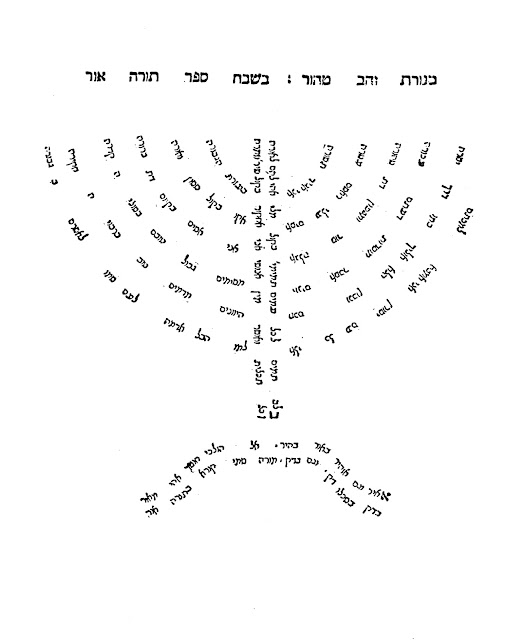
Despite that it is one of the most recognizable and ubiquitous symbols, the image of the menorah barely makes an appearance on Hebrew books. The first appearance of the menorah in a Hebrew book was Yosef Yikhya’s, Torah Or, Bologna, 1538. There is appears on the verso of the titlepage. The menorah is created via micrography and extols the value of the work. The designer even correctly places the menorah on a stand (and not a solid base as shown in the Arch of Titus). [2] 

From the inception of printing, Hebrew printers, like others, created and populated their works with their unique marks. These symbols served advertising for the publisher. Perhaps the only other symbol with such wide resonance and connection to the Jews as the Menorah is the star of David. There are over 200 printers’ marks, or emblems, close to 20 examples of the Magen David, and multiple appearances of other Jewish symbols, lions, David, Solomon, eagles, but two only of a menorah. [3]

Meir ben Jacob Parenzo, (aka Parentio, Parintz, or Maggius Parentinus), operated in Venice from 1545 until his death in 1575. He apprenticed in Daniel Bomberg’s printing shop, and in 1545 he began working for the Venetian printer, Cornelio Adelkind. Although most of his career was in the service of others, he did publish a handful of books on his own. He did not own a press and likely used Bomberg’s Press. All of these books bear Parenzo’s printers mark, a menorah. Whatever ambiguity there is about his surname, his personal name, Meir, alludes to lighting, thus a natural connection to the menorah. On either side of the menorah, “This is Meir’s menorah, he is the son of Yaakov Parenzo.”

Parnezo’s mark comprises around half of the title page. This grotesque design was called out for being unique among his contemporaries, but that it was “a pathetic bid for immortality.” As a measure of divine justice, according one scholar of Hebrew Italian printing, that “Meir Parenzo, notwithstanding his hope for immortality, is completely forgotten except for a small circle of Hebrew bibliographers, who, although conscious that the individual contributions of the men they commemorate are negligible in the great current of human affairs as it flows majestically down through the ages, nevertheless handing down (or transmitting) the knowledge of the existence of so many faithful men who have contributed their share to the enlightenment of the world.” [4] 

Another printer, also a Meir, incorporated the menorah into his mark, although on a much smaller scale. Meir ben Yaakob Ibn Ya’ir, here too, the surname, Ibn Ya’ir, references light. The menorah appears inside a border, flanked by olive trees surrounded by four verses, all mentioning either oil or light. Meir was active between 1552 and 1555. He published a few books abridged books on the laws of shehitah, as well as a work on Hebrew grammar, all exceedingly rare. [5]

The menorah next makes an appearance in Moshe Cordovero’s, (1522-1570), first book, Pardes Rimonim. This illustration is not of the biblical menorah, rather it is a kabbalistic representation of the sefirot overlaid on the menorah frame. This illustration was printed in most subsequent editions of Pardes Rimonim, although not as an exact reprint of the first edition.

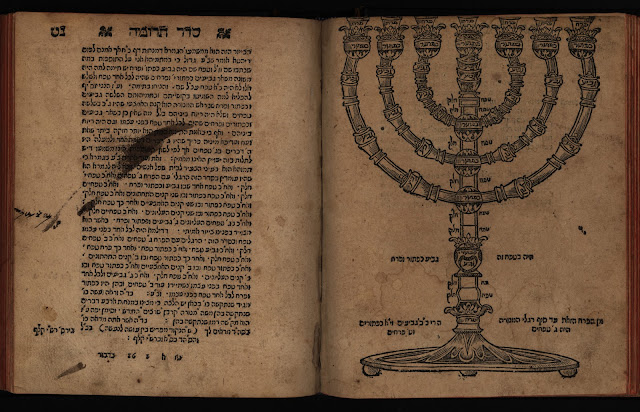
The first illustration of the menorah that was an attempt to depict and elucidate complexities of the biblical menorah only occurred in 1593. There were two books that include the illustration, Biurim and Omek Halakha.

R. Yaakov ben Shmuel Bunim Koppelman, (1555-1594) studied with R. Mordechai Jaffe, author of the Levush. In addition to traditional subjects, he was also well-versed in (my astronomy and mathematics. He published Omek Halakha in Cracow, 1593, a commentary on the Talmud. This slim volume of just 95 pages, is rich in illustrations, which appear on nearly every page. For example, there is a thirteen page an in-depth discussion of astrology with two full page diagrams of the lunar paths and many of the other pages include multiple illustrations. Koppelman includes a detailed diagram of the menorah with an accompanying commentary. [6]

The Biurim on Rashi was published in 1593 in Venice and attributed to R. Nathan Shapira. Shapira had died in 1577; his work includes three illustrations, the menorah, a map of Israel, and a diagram of how the spies carried the large bunch of grapes. This is the first Hebrew book to contain a map.

The book is one of the handful of examples of literary forgeries in Hebrew books. R. Shapira’s son, Yitzhak, published his father’s comments on Rashi in 1597 in a work titled Imrei Shefer. In the introduction he explains why there are two books that are attributed to his father on the same topic published within a few years of one another.

ואתם קדושי עליון אל תתמהו על החפץ שזה שתנים ימים יצא בדפוס איזה ביאורים הנקראים על שם הגאון אדוני אבי ז”ל, כי המציאוהו אנשים, אנשי בלי עול מלכות שמים, חיבור אשר מצאו, ומי יודע המחבר אם נער כתבו ורצו לתלותו באילן גדול אדני אבי ז”ל, חלילה לפה קדוש להוציא מפיו דברים אשר אין בהם ממש, כי הכל תוהו ובוהו ומזויף מתוכו, כלו עלו קמשונים כסו פניו חרולים. וכאשר הגיעו הספרים ההם בגלילות אלו הכרוז בהסכמת כל רבני ורשאי המדינות שלא ומכרו ויהיו בבל יראה ובבבל ימצא בכל ארצות אלו. ואשר קנו מהם יחזר להם המעות ולא ימצא בביתך עולה

[“Do not wonder why I am publishing what was published just two years ago, the Biurim, in my father’s name. As wicked people, people who found a book, a book which may have been written by a child. However, they wanted to use my father’s good name to publish their work. But, my father would never say such stupidities which appear in that book, their book is worthless and a forgery. When this was discovered all the Rabbis agreed that this book [Biurim] should be under a ban, no one should be allowed to keep it. Whomever purchased it should have their money returned, they should not allow a stumbling block into their home.”]

According to R. Shapiro’s son, the Biurim, is illicitly associated with his father. His son was not the only one to question the authenticity of the Biurim. R. Yissachar Bear Ellenburg in his Be’er Sheva and in his Tzedah L’Derekh states unequivocally that R. Shapiro did not write the Biurim.

The diagram of the menorah does not appear in Imrei Shefer. [7]

The diagram of the menorah appears in Yosef Da’at printed in Prague in 1609 by Rabbi Yosef ben Issachar Miklish (1580 -1654). He was a student of the Maharal of Prague and of Rabbi Ephraim Lonchitz, the author of the Klai Yakar. The purpose of the book was to correct errors in Rashi’s commentary. He used a 14th century manuscript to make those corrections. To better facilitate studying Rashi, the book includes illustrations including the menorah. This a full page with detailed descriptions of each part of the menorah. Interestingly, the base seems to combine two different approaches, one that has three legs and the other with a solid base. Miklish reproduces a solid base on top of three legs.

In 1656/57 Yalkut Shimoni with the commentary of Berit Avraham was published in Livorno, Italy. This one includes a menorah created via micrography, but unlike the others that appear at the front of the books, this one appears at the end. It is a colophon.

A unique example of the menorah appears in the 1684 edition of the Humash. It is the sole illustration on the title page. When the menorah appears on the title page, it is almost always in conjunction with other vessels or other symbols. This is perhaps the only instance of a stand-alone menorah on a title page.

The next appearance is the first time it illustrated a titlepage, in R. Shabbati ben Joseph Meshorer Bass’s (1641-1718), most well-known work, his commentary on Rashi, Siftei Hakhamim. This edition was published in Dyhernfurth, Germany at Bass’s press. This was the second edition of the work, (the first was published in 1680 in Amsterdam), and includes one of the most unusual Hebrew titlepages.

The titlepage depicts Moshe and Aaron, with the ark and other temple vessels, and prominently, and occupying the bottom third of the page, a menorah. Bass makes multiple luminary allusions on the title page. This edition includes

“.עם תרגום אנקלוס וביאור מאור הגדול רש״י ז״ל: ועליו מפרשי דבריו ככוכבים יזהירו: ובש״בעה נרות יאירו

The menorah makes another appearance on the next page. Like the Torah Or, Bass uses micrography, in praise of the book, to form the shape of the menorah.

Aside from the figurative arts there was also a musical component to the page. This is not surprising as Shabbati was a musician and singer, and a noted bassist singer, hence the “Meshorrer”/“Bass” surname. On the bottom of the page, in the left corner, appears “Az Yashir Moshe” the beginning of the one of the fundamental Jewish musical pieces, and musical notes appear at the bottom of the page, in what appears to be a composition of sorts. This is one of the few times musical notations appears in early Hebrew religious books. Another is Immanuel Hayi Ricci’s commentary on the Mishna, Hon Ashir, printed in Amsterdam in 1731. Appended to the end of the book are three songs, two set to music with notation.

Another menorah appears in Bass’s edition. On the next page, like the Torah Or, the menorah is comprised of micrography extoling this edition with the commentary. [8]

In 1694, R. Avraham Tzahalon published a portion of his grandfathers, R. Yom Tov Tzahalon’s (c. 1559-1638), responsa. R. Yom Tov was a child prodigy, only eighteen when he published his first work. That same year he was included in granting an approbation alongside R. Moshe Tarani (Mahrit) and R. Moshe Alschech. R. Yom Tov was no shrinking violet. And he had a dim view of R. Yosef Karo’s Shulhan Arukh. He belittled it, calling it only fit for children. The title page and the verso of the 1694 edition include depictions of the temple vessels and specifically the menorah. But his responsa do not discuss the temple vessels and this was included, “to beautify and embellish the title page of the book in a manner fit for print; the students illustrated holy concepts, the form of the Tabernacle and the Third Temple.” A rare of example of acknowledging the aesthetic beauty in the Hebrew book.

Three years later, the Italian scholar, Moshe Hafetz, (1663-1711), (aka Moses Gentili) published Hannukat ha-Bayit which discusses the Temple in great detail and includes numerous illustrations. Because of the illustrations, the book was printed in two parts. First all the text was printed with space left for the illustrations and illustrations were then added using etched copperplates.

His other work, Melekhet Mahshevet, includes his portrait, the first rabbinic portrait included in a Hebrew book, which is somewhat controversial because he is bareheaded. In a 19th century edition, a yarmulke was drawn on his head.[9]

The Bass titlepage served as the model for another lavishly illustrated titlepage. Although it served as a model, it was only a model and not a perfect facsimile. This was intentional. In this instance, the Menorah was the most important visual element of the titlepage and therefore is significantly larger than before and is in the center not the bottom of the page. Of course, this is because the book’s title includes menorah, Menorat haMeor. The book’s structure is based upon the biblical menorah and divided into seven parts, like the seven branches of the menorah. The title page was likely executed by the well-known engraver, Avraham ben Jacob, whose lavishly illustrated 1695 edition of the Haggadah, remains among the most remarkable illustrated haggadot and served as a model for dozens of other illustrated haggadot. Like in the Biruim, Jacob also produced a map, this one much more refined than the basic one in the Biruim. It is a large fold-out map of the Jews travels from Egypt to Israel. Most of his illustrations are copied from the Mathis Maren, a Christian, whose biblical illustrations were very popular. [10]

The illustration was reused by another Amsterdam printer, Solomon Proops, in 1723. Thus, this is one of the few instances of Hebrew titlepage images reflecting the title or the work itself rather than serving a mere ornamental purpose. The titlepage imagery was reused for a 1755 edition of the Torah. This time the menorah is significantly reduced in size.

While these menorahs depicted in Hebrew books, might differ in small details, they are consistent in depicting curved, and not straight, arm. Nearly every manuscript and all the archeological finds similarly depict the curved branches. Of late, this is subject to controversy. The Lubavitcher Rebbe heavily promoted his position that the arms of the biblical menorah were straight and not rounded. In the main, he based this on a manuscript in the Rambam’s hand that includes a depiction of the menorah with straight arms and the confirming testimony of his son that, according to Rambam, the arms were straight. This produced one of the more unusual exchanges in a haredi journal, in his instance, Or Yisrael, published in Monsey, New York. Those historic and documentary materials are used by R. Yisrael Yehuda Yakob, from Kollel Belz, as evidence against the Rebbe’s position. The article uses the mosaics in the 7th century Shalom al Yisrael Synagogue. The menorah is at the center of a large mosaic. The inscription near the mosaic indicates that the entire congregation, men, women, old and young, all took part in the creation of the mosaic. The Burnt House in Jerusalem’s Old City, that dates to the Second Temple period. Yakob then moves on to numismatic, citing a coin from the Hasmanoim period. Section three is then devoted to a discussion of the menorah on the Arch of Titus. Yakob references unidentified “hokrim” who posit that the base of the menorah was broken en route to Rome and was replaced with a base of a Roman creation. This explains why the base does not conform with the Rabbinic description and contains bas reliefs of various mythical and real animals. It was not the true one. Although unidentified, this position is that of the former Chief Rabbi of Israel, Rabbi Herzog as well as the nineteenth-century British Protestant academic, William Knight. Only in section four does Yakob turn to the more traditional Medieval Jewish commentaries. Ultimately, Yakob concludes that the rounded arms is the correct depictions and “justifies” the custom to draw it that way. Following the text, is a reproduction of the menorah from the second century synagogue, Dura Europas. A most unusual conclusion for a rabbinic article. (The image of the Dura Europos menorah actually depicts a straight arm menorah, that follows the Rebbe’s opinion. This is one of the only archeological examples of a straight arm menorah. The value of this image, however, is questionable. The menorah appears four times at Dura Europos. The straight arm one appears at the upper left corner of the opening for entrance. But, in the panel that specifically depicts the Mishkan and its vessels, there is a rounded arm menorah. While we don’t know what to attribute the differences to, it is more likely that greater care was placed in the accurate reproduction of the menorah within the context of the mishkan rather than were it serves as mere decoration.)

As would be expected, there was a rebuttal article that is more in line with the Haredi approach. The author concedes that his main objection is to Yakob’s approach, the “fundamental point which is almost litmus test of one’s religiosity: any evidence adduced from pictures and archeological evidence, God forbid, to rely upon these things or the conclusions of archeologists.” Although never directly discussed, presumably the author would dismiss the examples in the Hebrew book.[11]

* I would like to thank the bibliophile par excellence, Marvin Heller, for his assistance and close read of the article, and William Gross, whose library of objects and books is among the richest private collections, and provided most of the images, with credit to the Gross Family Collection. Many are available at the Center for Jewish Art website (https://cja.huji.ac.il/browser.php).

[1] See for example, Rachel Hachlili, The Menorah, The Seven-Armed Candelabrum (Leiden: Brill, 2001) who exhaustively catalogs the examples of menorah depictions but does not discuss the Hebrew book.
[2] For the history of the menorah, see Steven Fine’s comprehensive study, The Menorah, From the Bible to Modern Israel (Cambridge: Harvard University Press, 2016). Also see L. Yarden, The Tree of Light, A Study of the Menorah (Ithaca: Cornell University Press, 1971.
[3] Avraham Yaari, Degali Madfisim ha-Ivriyim (Jerusalem: Hebrew University Press, 1944), see index s.v. magen David and menorah; Yitzhak Yudlov, Degali Madfisim (Jerusalem: Old City Press, 2002); For examples of lions, eagles, and fish, see Marvin Heller, Essays on the Making of the Early Hebrew Book (Leiden: Brill, 2021), 5-84
[4] See Steinschnider, Catalogus Libr Hebr., col. 2984, no. 8761 (discussing his surname); Yaari, Degali, 128-29; Encyclopeadia Judaica, vol. 13 col. 101-02 (1996); David Amram, The Makers of Hebrew Books in Italy (London: Holland Press, 1963), 367-71.

Parenzo may have a second printers mark that only appears once, in the 1574 Bragadini edition of the Rambam. On the verso of the title page is, according to EJ, “a rather daring design” illustrating Venus hurling arrows at a seven-headed dragon. Unmentioned is Venus’ clothes, or lack thereof.

This mark is similar to the Cremona-Sabbioneta, printer, Vincenzo Conti’s mark, with the seven-headed hydra. His, however, has Hercules rather than Venus.

A nude Venus was also used by Allesandro Gardano for his printers mark. He only published one book, a pocket edition of the Shulhan Orakh in 1578. A naked Venus rising appears at the bottom.

Hans Jacob, who published in Hanau in the 1620s, also has a naked Venus rising from a seashell at the bottom of at least four works, R. Moshe Isserless, Torat Hatas, Sefer Mahril, and a Siddur.

For a detailed discussion of Parenzo’s printing activities, see A.M. Haberman, “Ha-madfeshim beni R’ Yaakov Parenzoni be-Veniztia,” in Areshet 1 (1959), 61-88.
[5] See Yudolov, Degali Madfisim (Jerusalem: Old City Press, 2002), 23-24.
[6] See Marvin Heller, “Jacob ben Samuel Bunim Koppelman: A Sixteenth Century Multi-Faceted Jewish Scholar,” Gutenberg-Jahrbuch (Mainz, 2018), pp. 195-207.
[7] Introduction Imrei Sefer, Lublin 1697 (on differences in the printings of the Imrei Shefer see Yudolov, Areshet, 6 (1981) 102 no. 7); Biurim, Venice 1693; R. E. Katzman, “Rabbi Nathan Nata Shapiro – Ha-Megaleh Amukot” in Yeshurun 13 (Elul 2002) 677-700; Introduction [R. E. Katzman], Seder Birkat HaMazon im Pirush shel R. Noson Shapiro, 2000 Renaissance Hebraica, 1-10.
[8] His original surname may have been Strimers. See Shimeon Brisman, A History and Guide to Judaic Bibliography (Cincinnati: Hebrew Union College Press, 1977), 267n.33. For additional biographical information see id. collecting sources.
[9] Dan Rabinowitz, “Yarlmuke: A Historic Cover-up?,” (here) Hakirah (4).
[10] Regarding the map, see Harold Brodsky, “The Seventeenth-Century Haggadah Map of Avraham Bar Yaacov,” in Jewish Art 19-20 (1993-1994): 149-157; David Stern, “Mapping the Redemption: Messianic Cartography in the 1695 Amsterdam Haggadah,” in Studia Rosenthaliana 42/43 (2010-2011), 43-63; Amir Cahanovitc, “Mappot be-haggadot pesah” (Masters thesis, Achva Academic College, 2015), 34-85. For a discussion of this edition and reproductions of some of its images and a comparison with Mathew Merian’s illustrations see Cecil Roth, “Ha-Haggadah ha-Metsuyyeret she-bi-Defus,” Areshet 3 (1961), 22-25; Yosef Hayim Yerushalmi, Haggadah and History (Philadelphia: The Jewish Publication Society, 2005), plates 59-62, 67, 69.
[11] See R. Yisrael Yehuda Yakob, “Tzurot Kani Menorah,” in Or Yisrael 18 () 131-139; R. Nahum Greenwald, “Kani Menorah Ketzad Havei,” in Or Yisrael 18 () 140-154.


R. Isaac Arama, R. Kook, Mordecai Kaplan, and more

R. Isaac Arama, R. Kook, Mordecai Kaplan, and more
by Marc B. Shapiro
1. In the last post I discussed R. Isaac Arama. In his Conversos, Inquisition and the Expulsion of the Jews from Spain, p. 53, Norman Roth states that Arama was not a “great scholar.” If he means to say that Arama wasn’t a great talmudist (as has been stated about Ibn Ezra and Abarbanel), then perhaps he has a point (although I am sure this would be debated). But I don’t see how the title “great scholar” can be denied to Arama whose Akedat Yitzhak is a classic of Jewish literature and shows his vast knowledge.
Because the style of Akedat Yitzhak does not make it an easy read, many people avoid the work which is a shame as it is full of fascinating insights. One of his views that has often been quoted is that while it is true that individuals have free will, this is not the case for the Jewish people as a whole. It is built into the nature of the Jewish people that there can never be a time when the entire Jewish population rejects God.[1]
I think readers will also find it interesting that in discussing the role of women, he says that their second purpose (which he terms the lesser purpose – התכלית הקטן) is to have children.[2] However, the primary purpose of women is seen in the following quote, which I think is incredible when one considers how most medievals viewed women.
האחד מה שיורה עליו שם אשה כי מאיש לוקחה זאת וכמוהו תוכל להבין ולהשכיל בדברי שכל וחסידות כמו שעשו האמהות וכמה צדקניות ונביאות . . . ודאי עקר תולדותיהם של צדיקים מעשים טובים
How many contemporary Orthodox writers advocate the viewpoint that the primary purpose of women is to bear children, and that is where they find their fulfillment? Yet Arama rejects this completely. Arama’s understanding allows him to explain why Jacob was angered with Rachel when she said to him, “Give me children, or else I die.” (Gen. 30:1). Rachel didn’t realize that the main purpose of the righteous, and this also includes women, is good deeds. She mistakenly thought that her primary goal in life was to have children, and without that her life had no value. Jacob became angry since Rachel didn’t understand the basic point that the value of women is not simply dependent on how many children they can produce.[3]
It is well known that R. Meir Arama accused Abarbanel of plagiarizing from his father, R. Isaac. Abarbanel made heavy use of R. Abraham Bibago, and this also might be considered plagiarism (although much what we would regard as plagiarism today was not regarded as such in medieval times).[4] Abarbanel also used other writings without acknowledgment, such as R. Eleazar Ashkenazi ben Nathan ha-Bavli’s Tzafnat Paneah,[5] R. Nissim of Gerona’s Derashot,[6] and the medieval work Zekhut Adam.[7] R. Azariah de Rossi even accused Abarbanel of plagiarizing from Jerome.[8]
 מן הנראה כי גנוב הוא את החכם דון יצחק מדעת המעתיק לנוצרים בפרוש דניאל
In the introduction to his edition of Akedat Yitzhak, R. Hayyim Joseph Pollak mentions Abarbanel’s unacknowledged use of Arama’s work, and he is not sure what to make of it. In one case he refers to it as שגגה שיצא מלפני השליט. In general, he assumes that Abarbanel copied material from Arama for his own use, without intending to publish it. Yet by the time he published his own biblical commentaries he had forgotten that some sections of this work had come from Arama. Pollak also suggests, without any evidence whatsoever, that originally Abarbanel did mention Arama, yet these references were removed by others who had access to the manuscript. They did so in order to give greater glory to Abarbanel, so that he be given the credit for everything in the commentary.
השמיטו הם (או המעתיקים הבאים אחריהם) את שם בעל עקיד’ ז”ל מהמאמרים הלקוחים מאתו, בחשבם להרבות בזה כבוד הר”א ז”ל, אם יראו כל דברי ספרו כאילו הם ממנו לבד
Pollak’s defenses do not make much sense, and the best explanation is as mentioned, namely, that current standards of plagiarism are not like those found in medieval times.
Speaking of R. Isaac Arama, there are a number of references to him in the new edition of R. Raphael Berdugo’s commentary on the Torah, Mei Menuhot (I have mentioned R. Berdugo in a few prior posts). Here is the title page.

Here is page 918 of the commentary, where you can see that he quotes the Akedat Yitzhak who is criticizing Narboni.

On the top of the second column he refers to המדברים. The problem is that the editor doesn’t know what this term means (or for that matter, the word ההעברה),[9] and provides some fanciful explanation. However, just a little investigation would have revealed that the “Medabrim” are the Mutakallimun, that is, the followers of the Kalam. (Kalam means “word,” “conversation,” or “discourse”.) All one needs to do is open Ibn Tibbon’s translation of the Guide, and you will find lots of references to them. There is also a reference to them in Ibn Tibbon’s translation of Shemonah Perakim, ch. 6. 
The following appears in Guide 1:73 (Ibn Tibbon translation):
ההקדמה העשירית הוא זאת ההעברה אשר יזכרהו וזהו עמוד חכמת המדברים

The problem I am focusing on is not just that the editor did not recognize the term המדברים. It is that he should have been able to see that this was something he didn’t know, which in turn would lead him to investigate. This is a common problem, namely, it is not just that people don’t know, but that they don’t know that they don’t know.[10] What we should be able to expect, however, is that when an editor sees a term or expression that he doesn’t recognize, rather than engage in fanciful speculation he should actually consult with someone who might be able to understand the text.

Let me give another example of what I am referring to from the haredi world. This should not be taken as a general criticism of haredi editors. On the contrary, most of the best editions of rabbinic texts are edited by haredi scholars. They are experts in what they do and we all benefit. They, more than anyone else, are embarrassed when amateurs try to edit texts with all the errors they bring. (In a future post I will bring examples of mistakes by academic scholars in texts they edited, errors that could have been avoided had they consulted with real talmidei hakhamim.)

A few years ago a new edition of Maimonides’ ethical will, with an extensive commentary, was published. Here is a page from the work.

The only problem is that this supposed ethical will is a forgery, a fact recognized by R. Jacob Emden.[11] Actually, let me more exact; only the second part is a forgery, the part where Maimonides addresses his son R. Abraham and among other things tells him that the French scholars “don’t appear to recognize the Creator, blessed be He, except when they are ingesting boiled ox meat, seasoned in vinegar and garlic. . . . Generally, they have two wives, so that their minds are invariably fixed on sex, eating and drinking, and other sensual pleasures.”

The first part of the ethical will, before you come to דע בני אברהם, is not a forgery, but a case of mistaken identification. As noted by Israel Abrahams,[12] and more recently by R. Yitzhak Sheilat,[13] this first part is actually an ethical will of an Italian Jew directed towards his sons. He directs his words to them in the plural. Somehow, this ethical will got attached to the forged document of Maimonides, which of course is directed towards his son in the singular.[14]

In the introduction, the editor, R. Hillel Copperman, deals with the matter of the document’s authenticity.[15] He reports that he went to an unnamed great talmid hakham who told him in no uncertain terms that the ethical will was not written by Maimonides. When challenged that both R. Solomon Luria and the Hatam Sofer assumed that it was indeed written by Maimonides, this talmid hakham was not moved, and stated that they were both in error. It is not clear why the editor does not reveal the name of this talmid hakham. It could be that he is R. Shlomo Fisher, as later in the introduction the editor cites him by name, showing that R. Fisher was consulted in this matter.

After quoting from the anonymous talmid hakham, Copperman refers to numerous earlier sources that assume that the document was written by Maimonides, including various Mussar figures and also R. Aaron Kotler. He then cites R. Moses Samuel Shapiro that even though there might be difficulties with the work, one does not reject a tradition (that the document was authored by Maimonides) based on difficulties. Copperman then tells us that he asked R. Shmuel Auerbach who was uncertain about the matter. That is, the fact that earlier scholars assumed that the ethical will was written by Maimonides did not convince him of its authenticity.

Following this, Copperman went to R. Chaim Kanievsky. He was surprised to hear from R. Kanievsky that the latter had never seen or even heard of the ethical will! To say that this is difficult to believe is to put it mildly. It is indeed impossible to believe. One doesn’t need to be a great scholar to know of this work, which appears in various books and is referred to by numerous authors. Anyone who has been exposed to R. Kanievsky’s unparalleled wide-ranging knowledge knows that he is well aware of the ethical will and must also have reached an opinion about its authenticity, which for some reason he did not want to share with Copperman. Copperman himself raises this possibility but rejects it, seeing it as unlikely that R. Kanievsky would not tell him the truth.

חשבנו שמא לא רוצה הוא להיכנס לסוגיא זו, ומשנה מפני השלום. אך זה רחוק מאד בעינינו

All I would say is that while Copperman might regard this as unlikely, it is much more unlikely (actually, impossible) that a walking encyclopedia like R. Kanievsky has never even heard of the famous ethical will attributed to Maimonides.

Copperman then went to R. Steinman, and he tells us that it was clear to him that R. Steinman does not believe that the problems with the ethical will are enough to refute its authenticity. Yet he also tells us that R. Steinman referred to the matter of the Yerushalmi Kodashim, in order to show that something that even great rabbis originally regarded as authentic could later be shown to be a forgery. This latter point would appear to show that R. Steinman is not certain about the matter.

In seeking to determine if a document attributed to Maimonides is authentic, Copperman turns to the gedolim, the ones who determine Da’as Torah. Yet there are a number of people, some in the haredi world, who are experts in Maimonides’ writings, in particular, his letters and manuscripts. Shouldn’t they be the people to turn to? Shouldn’t Copperman have consulted with R. Yitzhak Sheilat or R. Shlomo Zalman Havlin, to give just two names? This is just one example of how some editors in the haredi world are simply not doing their job properly. It would be one thing to just reprint the ethical will without comment, but once Copperman writes an introduction to discuss its authenticity, how can he possibly assume that the matter will be settled simply by citing R. Steinman’s opinion, especially since R. Steinman would agree that he has no expert knowledge of this issue?

Let me return to Norman Roth, mentioned above and from whom the Seforim Blog recently had the privilege of publishing a post. He is a well-known expert in Spanish Jewish history. His footnotes in particular are always worth reading, as he uses them to correct all sorts of misconceptions. There are many supposed facts, continuously repeated, that actually have nothing to stand on, and throughout Roth’s works errors such as these are corrected. I mention this because I too might be a future subject of one of these footnotes. My book on censorship is currently with the publisher and I can’t make any further changes. In this book I deal with Ibn Ezra’s Iggeret Shabbat and discuss the controversy over whether it was directed against Rashbam. In a recent article which I just read, and thus could not refer to in my book, Roth sums up his position (which I think is unique) as follows: “In my opinion, it is highly unlikely that he [Ibn Ezra] ever went to England, and the “Sabbath letter” is surely a forgery.”[16] I am curious to hear what Ibn Ezra scholars have to say about Roth’s argument.

2. In my post here I quoted R. Nathan Lopes Cardozo’s rejection of dogma. He continues this theme in his recent article in Conversations 19 (Spring 2014). The article is titled “God is Relocating: A Critique of Contemporary Orthodoxy – Four Observations,” and I offer here a selection from it. Are there any other Orthodox (a term Cardozo rejects) rabbis who agree with the sentiments that follow?

The truth is that Jewish Orthodoxy (from the Greek orthos [“true” or “right”) and doxa (“opinion” or “belief”) never existed. Originally Judaism was highly unorthodox. Although it always believed in God and Torah, it never offered any specifics of what God meant or what Torah consisted of. That was left to speculation, never to be determined. The early Sages, as testified by the Talmud and philosophers, disagreed on some of the most fundamental issues of faith.

But over the years we wanted more certainty. We wanted it handed to us on a silver platter, so that we could avoid debates and live a life of religious comfort, apathy, and mediocrity. Influenced by other religions, we adopted the need for cast-iron certainty and psychological security. So we began to rewrite Judaism in a way that would fit into the notions of established religions – well-structured, with a good dose of dogma. What we did not realize is that by doing so, we misrepresented Judaism by losing sight of the plot, thus doing it a great disservice.

We need to realize that our epoch of uncertainty is in fact much more conducive to authentic Judaism than all the conviction we’ve had in previous generations. It forces us to rediscover what Judaism is really about and gives us the opportunity to rebuild where rebuilding is required and leave untouched what should remain untouched.

Tamar Ross is another liberal Orthodox thinker. Here are three separate passages from a recent article.[17]

It is precisely because of the importance of everyday “realist” assumptions in cementing religious commitment that so much effort is expended by religious conservatives in cordoning off some religious beliefs as off-bounds to demythologizing or re-interpretation. Because the notion of “truth” and religious commitment are so intimately connected in the human psyche, critical scrutiny of beliefs that appear indispensable to the system is sometimes held back by upholding the remote possibility that future investigation will overturn current impressions. When scientific discoveries or deeply felt moral intuitions render even such eventualities incredible, religious adherents may resort to deliberate bifurcation, conducting themselves in accordance with reason in the laboratory and in their everyday lives while preserving professions of faith in the synagogue and in formal allegiance to what are regarded by current halakhic consensus as unavoidable halakhic constraints. Irrespective of the difficulty some may have in granting legitimacy or persuasive value to such policies, it would be fair to say that a religious world-view lacking any claims of attunement to a reality beyond its self-contained universe of discourse will never match traditional belief in its ability to preserve the intensity of feeling generated by its models and paradigms and to transmit the passion of its message to future generations.

Given these precedents, we would do will to rid ourselves once and for all of the misnomer of Orthopraxy, often invoked in a pejorative sense in order to dismiss halakhically conformist behavior that is not grounded on acceptance of dogma in its literal sense. Any behavior externally conforming to that which is historically and sociologically identified with traditional halakhic practice indicates some form of belief or justification though it may not tally with the naive objectivism of strict correspondence theory.

Postmodern language theory can redeem modern Orthodoxy from its counter-productive attachment to naive objectivism. The epistemological modesty of non-foundationalism can help religious adherents move away from overly rigid definitions of doctrine and allow them to return to the pre-modern function of religion as providing a valuable universe of discourse and a compelling way of life. It can extricate them from a mindless and stultifying triumphalism and encourage the willingness to refine religious convictions by listening carefully to other points of view.

After reading Cardozo, Ross, and numerous others I have quoted in the past, the only conclusion that can be reached is that, despite what Centrist rabbis like to claim, it is certainly not dogma, Maimonidean or otherwise, that holds wider Orthodoxy together. 

In thinking about the place of dogma, people should pay close attention to the following passage from R. Kook (Shemonah Kevatzim 1:765). R. Kook tells us that even “heretics” can have a more profound belief than so-called Orthodox Jews, and are thus described by the verse from Habakkuk 2:4  צדיק באמונתו יחיה.

לפעמים ימצא כופר שיש לו אמונה חזקה, פנימית, מאירה, נובעת ממקור הקדושה העליונה, יותר מאלפי מאמינים קטני אמנה. דבר זה נוהג באישים פרטיים וכן בדורות, ועל כולם נאמר צדיק באמונתו יחיה
R. Kook’s new published volumes contain many important texts dealing with belief, and I have quoted a number of them in prior posts. Here are some more significant passages.

Kevatzim mi-Ketav Yad Kodsho, vol. 1, p. 182: R. Kook explains that there are two types of faith, one which is based on absolute truth, and one which he refers to as אמונה הסברית. This latter type of faith is not absolute but changes with the times. For example, in one generation one can base a belief on a certain notion (scientific, moral, etc.) while in another generation, such an approach cannot be used, because the underlying notion is no longer accepted, and to use it will be dangerous to faith. We can all think of examples where this is so, i.e., where an explanation used to strengthen faith, and which was successful in its time, today will turn people off from Judaism (for example, explanations for kashrut and circumcision, or various descriptions of women’s nature and their necessary subservience to men, used to explain women’s position in Judaism). Similarly, there are examples where years ago an explanation could not have been used because of its negative impact, while today it can have a positive impact (for example, using evolution in explaining Torah). R. Kook sees the notion he is expounding upon as alluded to in Maimonides’ famous conception of “necessary truths” (Guide 3:28). 

R. Kook’s point is very important as it tells us that while the core of belief remains absolute and unchanging, the way it is understood and expressed must change with the times. This explains why earlier rabbinic conceptions of Judaism are not always satisfying to moderns. Some people assume that the reason for this is because we are at a much lower level than earlier rabbinic greats. R. Kook’s point, however, is that everyone, in every era, is subject to the times, and even the earlier examples of אמונה הסברית  are only to be regarded as provisional. As mentioned, this is a very important point and it could be expanded at great length.

שתי דרכים לאמונה, האחת האמיתית המוחלטת, והשנית ההסברית. האחרונה משתנה היא לפי הזמנים. ישנם זמנים שאם יהיה איזה עיון מתפרסם ומוחזק, היה מזיק ליסוד דברי אמונה ברורים מצד האמת המוחלטת. ואחרי אשר העולם המדעי קבל צורה אחרת בהמשך הזמן, אבדה האמונה ההסברית ההיא את ערכה, וכבר לא מזיק כלל לשום רעיון אמוני מוחלט הפרסום של אותה ההנחה בעצמה, שהיתה בזמן העבר מזקת בפרסומה. והדברים הולכים עוד יותר, שמזדמן הדבר שצורה הסברית אחת היתה מחוייבת באיזה פרק מפרקי הזמן, עד שקבעה לה אז האמונה ההסברית את צורתה באופן מיוחד, ואחר כך יזיק דוקא אופן זה להאמונה המוחלטה, ושיש חיוב אז לפרסם את ההפך מהאמונה המוסברת אז. יסוד החילוק בין שני חלקי האמונה כבר רמז הרמב”ם, אמנם צריך אומץ לב מיוחד לעמוד בניסיון בעת חשיכה כזאת.

Tied in with this is R. Kook’s comment (Kevatzim, vol. 2, p. 167) that certain great truths can only be revealed together with falsehood, which protects the truth as it were.

ישנן אמתיות גדולות, שאינן יכולות להתגלות בעולם כי אם דוקא במעטה של שקר, ומעטה של שקר השומר את האמת נעטר גם הוא באור האמת. ופקוחי עינים יודעים להבדיל בין המעטה לעוטהו, ופחותי הנפש מביטים באור האמת בשביל מעטה השקר שלה, ונמוכי הדעת אינם מכבדים את האמת יותר מהכבוד הראוי למעטהו הנאהב אצלם לפי תכונתם הנמוכה.
One can easily come up with a number of examples of this. Just think of all the foolish talk about God and His nature. It seems that every preacher feels it is OK to talk about what God “wants”, about how God gets “angry”, or is “upset”, or is “pleased”, etc. A little thought will reveal that none of these descriptions of God can be true in an absolute sense, but since these descriptions are thought necessary in order for people to believe in the ultimate truths, i.e., the existence and providence of God, they are tolerated. (See Guide 3:28 for Maimonides’ discussion of “necessary truths”.)

Since I mentioned R. Isaac Arama earlier in this post, let me give an example of this from his writings.[18] Arama asks what is the point of the commandment to build a mishkan. It is not as if God is a physical being who needs a place to live. Yet in order that the masses have a God with whom they could feel connected, that is, a God who exercises providence, the Lord was prepared to compromise and allow them to believe that he actually was found in the mishkan. Here are some of Arama’s words:

כי באומרו ולא יכול משה לבוא אל אהל מועד ויתר להם הרחקת הגשמות למה שיורה שהיה שם דבר ממשיי המעכבו לבא לשם. וזה לפי שלא יראה להמון דבר של מציאות זולת זה. ובאומרו כי שכן עליו הענן ויתר אצלם ענין ההעתק ממקום למקום לקבל מהם שירות ועבודה כי בזה יסמוך לבם על השגחתו עליהם. ובאומרו וכבוד ה’ מלא את המשכן לא נשמר מהתקוממות במקום והיותו כמלך הקובע ישיבתו באמצע המלכות

Kevatzim mi-Ketav Yad Kodsho, vol. 2, p. 129: R. Kook tells us that true belief cannot exist without the possibility of unbelief
.
האמונה בטהרתה תצא דוקא על ידי אפשרות של כפירה בלא שום הגבלה

This is very similar to the sentiments expressed by R. Jehiel Jacob Weinberg.[19] What it means is that true faith is stormy, on the edge, as it were. There are easier paths, where one is perhaps guaranteed “peace of mind.” However, this cannot be regarded as authentic religious faith. Paradoxically, true faith, the faith that keeps you up at night, can easily turn into unbelief. R. Kook also explains, ibid., p. 149, that this true faith can only be developed through freedom of thought. That is, while obedience can be assured by closing off thought, one can never reach what R. Kook terms אור א-להים if one’s thought is controlled.

Even when unbelief does arise, R. Kook does not see this as all bad. As a kabbalist, he believes that there are sparks of holiness in everything, even in unbelief. According to R. Kook, when the unbelief is directed in an ethical direction, then this too can be seen as part of the search for God (ibid., p. 151). In other words, even the atheists are engaged in derishat ha-Shem when they work for the betterment of humanity, and it unfortunate that they do not realize this.

המהומה הכפרנית כל זמן שהיא עסוקה במגמות מוסריות הרי היא ממש דרישת ד’. המוסר והרחבתו, הגדלת ערכם של החיים, ענוגם ושאיפותיהם, הוא בעצמו דרישת ד’, יותר משארי דרישות הבאות ברחשי לב המתעוררים על פי איזה דמיונות פנימיות שאין בהם הטבה מעשית לסדרי החיים. מכל מקום אומללים הם בני אדם כל זמן שאינם יודעים שכל מה שהם עסוקים לרדוף אחריו במובן המוסרי ובקשת הטוב זהו דרישת ד’, ונהרה רבה תופיע עליהם כשיגלה להם רז זה.

R. Kook also sees other positive elements in unbelief (pp. 166, 167). There are people who assume that there is no afterlife, or any reward and punishment. The positive aspect of these mistaken beliefs is that the unbelievers’ good works are not performed in order to receive reward, but for their own sake. This is a very high level of service, something Jews realized long before Kant.

יצר הרע בא לאדם לפעמים להוכיח לו שאין לו תקוה לעולם הבא. – ידע נאמנה, שהוא עומד להתעלות במעלה גדולה מאד, עד שיהי’ עובד ד’ שלא על מנת לקבל פרס, כי אם מאהבה שכלית טהורה.

הכפירה בשכר ועונש מחנכת את הבריות לעשות טוב מצד עצם הטוב. וכל מה שיתרבו עושי טוב באמת, כן יתמעט ההכרח של מציאות רעיון הכפירה, שאיננו כי אם אמצעי תרבותי לזה המצב.

Even the very thought of God when engaged in the good is not the highest level, so again, paradoxically, unbelief prepares the ground for service on the highest level (ibid., p. 166).

הצורך לחשוב על דבר א-להים היא ירידה גדולה, שהיא דרושה לאדם בתור רפואה. הכפירה היא הכנה שלילית לצורך העילוי העליון שלא יהיה שום צורך לחשוב על דבר א-להות, כי אם עצם החיים יהיה אור א-להים

Finally, let me call attention to one more interesting point about faith. R. Jacob Wreschner, Seder Yaakov (Jerusalem, 2010), vol. 2, p. 425, records that he heard from his father that R. Yerucham Levovitz had religious doubts in his youth, and R. Isaac Blazer helped him overcome these. R. Wreschner states that it is no insult to a great figure to reveal this information, though he notes that R. Judah Zev Segal, when he tells this story, does not reveal who the subject is.[20]

Anyone who thinks about the place of belief in traditional Judaism is aware of the phenomenon called, for a lack of a better term, “orthopraxy.” Many people assume that this is a fairly recent phenomenon. Yet already in the nineteenth century R. Solomon Kluger wrote about people who were completely observant but did not have proper beliefs.[21] He sees these people as worse than typical sinners who actually violate prohibitions (he specifically mentions sexual prohibitions).

בימים הראשונים היה הרשעות במעשה. אם ראו באיש אחד שאינו פרוץ בעריות וכדומה ידעו שהוא כשר. לא כן עתה הרשעות תלוי בלב ויתכן שיהי’ מקיים כל התורה ובלבו ישים ארבו ויש בלבו שמץ אפיקרסת [!] והוא גרוע מן הרשעים הראשונים שהי’ בהם כמה חטאים

Someone who is attuned to R. Kook’s way of thinking will approach matters from a completely different perspective, and see the phenomenon of orthopraxy in a much more positive light. Consider the following: The so-called orthoprax individual does not have a traditional view about the Torah. Yet he does not use this as an excuse to live a secular life, what in yeshivah we referred to as a life of “hefkerut”. On the contrary, this individual chooses to bind himself to the Torah, to observe mitzvot, to “inconvenience” himself when it would be much easier to abandon it all. How is one to judge a person who, whatever his theology, makes enormous financial sacrifices to send his children to Jewish schools and happily gives to a variety of Orthodox causes? How is one to judge such a person who when stuck in a strange place for Shabbat asks the hotel clerk to open his door (as it is electronic) and refuses to carry a map on the unfamiliar street, a person who chooses to live on fruit because there is no kosher restaurant in the city he is visiting (to give just a few typical challenges that Orthodox and orthoprax Jews confront)?

R. Kook’s insights about the religious significance of the non-observant who were building the land of Israel must be multiplied many times over when dealing with completely observant Jews who sacrifice in so many ways for Torah and halakhah, even though their beliefs are not “Orthodox”. Yet this is a phenomenon which, as far as I know, R. Kook does not mention. Rather, he refers to those who because of their belief in biblical criticism rejected all observance. They assumed that if you don’t accept the divine origin of the mitzvot that there is no need to observe them. R. Kook rejected this assumption and argued that there is a good reason to observe mitzvot even if one does not have a traditional view of the Torah’s authorship.[22] I will flesh out R. Kook’s argument in the next post.

3. In an earlier post I referred to Mel Scult’s new book, The Radical American Judaism of Mordecai M. Kaplan. Scult discusses the burning of Kaplan’s siddur at an Agudas ha-Rabbonim gathering on June 12, 1945, at which Kaplan was himself also put in herem. The significance of this event can be seen in that there were over two hundred rabbis in attendance.[23]

Here is the text of the herem from Ha-Pardes, July 1945.

The sentence immediately before the text of the herem clearly implies that the burning of the book was part of the ceremony (and see also Ha-Pardes, Nov. 1945 p. 23). Thus, Jeffrey S. Gurock and Jacob J. Schacter had good reason to write as follows:

Scult, Judaism Faces the Twentieth Century, p. 420, n. 38, suggests that the act of book burning was unintentioned and not directed by the rabbinic leaders themselves, but all evidence cited above points to the contrary. This was clearly an official act, sanctioned by those assembled as a fitting and appropriate conclusion to a most serious and solemn deliberation.[24]

Zachary Silver, who has recently written a very nice article on the episode, available here, writes as follows:

Mel Scult’s biography of Kaplan mentions that the event occurred, but he does not believe that Agudat HaRabbanim burned the book as part of the formal ceremony. Rather, he says that the burning occurred incidentally at the back of the room. However, Agudat HaRabbanim’s documents illustrate that it was a previously scripted formula.[25]

This burning of a Jewish book, coming so soon after the end of the Holocaust and so much at odds with the American tradition of freedom of expression, horrified both Jews and non-Jews. The fact that the excommunication and burning were covered in The New York Times only made matters worse, and everyone assumed that this was an officially sanctioned action of Agudat ha-Rabbanim.

In writing about the event in his diary, Kaplan referred to “rabbinical gangsters who resort to nazi [!] methods in order to regain their authority.”[26] He later publicly stated as follows:

It is just too bad that men who call themselves rabbis should in this day and age resort to the barbarous procedure of outlawing a man without giving him a hearing, and to the Nazi practice of burning books that displease them. God save us from such leadership and from the disgrace it is likely to bring upon Jews.[27]

Responding to the horror aroused by the book-burning, Agudat ha-Rabbanim publicly declared that it had nothing to do with this action. It claimed that the burning was done independently by one of its members. Silver writes:

The Union of Orthodox Rabbis later disavowed responsibility for the book burning, claiming that the event was not a scheduled part of the ceremony but rather the act of one rabbi from the audience who acted on his own, after the service was completed. This version seems unlikely, however, since the article about the excommunication in HaPardes, the unofficial magazine of Agudat HaRabbanim, gives specific justification for the book burning as part of the ceremony and does so in halakhic terms. The more likely scenario is that, after witnessing the heated public reaction, Agudat Harabbanim chose to disavow responsibility for burning the siddur as a face-saving public relations move. Thus, by saying that the burning was not part of the planned activities, the Union of Orthodox Rabbis could attempt to refocus public attention on the greater issues of the heresy of Kaplan and the Conservative movement, rather than on a particularly unsettling segment of the ceremony, which itself evoked memories of Nazi ritual book burnings. Of course, the uproar implies that Agudat Ha-Rabbanim did not realize that most Americans would be troubled by a book burning in 1945 – a lapse of judgment that would manifest the extent by which the Union of Orthodox Rabbis had lost touch with contemporary currents in American culture.[28]

Years after the event, R. Norman Lamm reflected on the book burning.

If we want to win people over to Orthodoxy, we need to present ourselves as measured, mature, and moderate people with deep faith and the right practice, but we do not insult others and we do not damage or condemn them. Coming out with issurim [decrees that forbid particular actions] against everyone else is like another Fatwa. When I was younger there was a heretic by the name of Mordecai Kaplan, and the Agudas Harabbonim had this whole big book burning party. I thought it was ridiculous to have a book burning in the twentieth century. It didn’t make anybody decide to become more religious observant. Nobody who was reading his books said[,] “If important Orthodox rabbis burned them, we’re not going to read them.” If anything, it aroused interest in people who otherwise would not have wanted to read these books. But in addition, what it accomplished was that it got people to look at the Orthodox as fanatics. That’s no way to make friends and win people over to Orthodoxy.[29]

What we see from what I have quoted is that there is agreement that it was Agudat ha-Rabbanim that sanctioned the burning of the siddur.[30] Silver adds, “It is unclear who actually burned the siddur, as the report in HaPardes uses the passive voice.”

In fact, we do know who burnt the siddur, Based on this information, we can also determine that the other point that “everyone” knows, that it was Agudat ha-Rabbanim that sanctioned the burning, is incorrect.

In 1945 The Jewish Reconstructionist Foundation published a booklet, A Challenge to Freedom of Worship. I don’t know why, but this is a very rare publication. I have therefore uploaded it here. From this booklet, you get a sense of the great ill-will produced by the excommunication of Kaplan and the burning of his siddur. This is what appears on the very first page of the booklet.

I first saw this booklet shortly before R. Joseph Ralbag passed away. At that time he was not well and I could not schedule a time to speak with him. However, at my request R. Aryeh Ralbag asked his father some questions about the episode, and I can report the following from the late R. Joseph Ralbag. R. Ralbag did not decide on the spur of the moment to burn the siddur. Rather, he knew he was going to do this ahead of time and even discussed it with his future wife. Yet the other members of Agudat ha-Rabbanim were unaware of his plans until he lit the siddur on fire. In other words, this was an individual act by R. Ralbag and, as Agudat ha-Rabbanim would later state, it was not sanctioned by them. This testimony, from the main protagonist of the event, should finally settle the matter. (Although R. Ralbag denied burning the siddur in the telephone call referred to on the page printed above, this was obviously only said to protect himself after the controversy broke out. As indicated, hundreds of people saw him burn the siddur.[31])
One more interesting point about this episode is that Rav Tzair (Chaim Tchernowitz) claimed, in the course of an attack against Kaplan’s siddur, that according to halakhah it was forbidden to burn the work.[32] I would be curious to hear what some of the readers make of this.

שמה שהחכמים גזרו על ס”ת שכתבו מין שישרף, אינו אלא מפני שהשמות לא נכתבו בקדושה, ואפשר שנכתבו לשם ע”ז, אבל בנידון דידן הרי לא את כה”י של קפלן שרפו, אלא את הסידור, שסידר אותו יהודי תמים, שבידוע שלא כוון לשום דבר אחר כשסידר את אותיות השם, ובכן אסור היה לשרוף את האזכרות שבו. ובזה עשו הרבנים שלא כדין ששרפו את הסידור (אולם הם הודיעו שלא גזרו שריפה על הסידור אלא שצורבא מרבנן אחד שרפו על דעת עצמו)
4. Before his passing, R. David Hollander asked if I could review the memoir he had written. At the time he asked me, I was too busy to do so, but hoped that I would later have the opportunity. After Hollander’s death I was unable to find out what became of the memoir. (Hollander did not have any children who would have inherited it.) Perhaps a reader will be able to help in this matter.

5. Last year Yisrael Kashkin produced a nice poster of religious Zionist rabbis. You can see it here. He has recently produced the following poster of German rabbis.

You can order framed 8.5 x 14″ and laminated 8.5 x 14″ copies. The former are meant for a wall and the latter for a sukkah. Anyone interested should write to thetidesociety@gmail.com 

[1] Akedat Yitzhak, parashat Nitzavimsha’ar 99 (pp. 105ff). Speaking of free will, see also R Meir Simhah of Dvinsk, Meshekh Hokhmah, Introduction to Exodus, who states that Moses’ free will was also taken away from him.
שהשי”ת שלל ממנו הבחירה לגמרי ונשאר מוכרח כמלאכים.
See also his Or Sameah, Hilkhot Teshuvah, ch. 4, at the end of his lengthy essay on divine knowledge and free will. In his Introduction to Exodus, R. Meir Simhah also claims that Joshua’s free will was taken away.
גם ממנו שלל השי”ת הבחירה לגמרי כמו ממשה, שלא ישלול חלילה דבר מתורת משה
[2] Akedat Yitzhak, parashat Bereshit, sha’ar 9 (p. 92b).
[3] For another fascinating idea from Arama, see here that he did not believe that the book of Esther was written with ruah ha-kodesh. Rather, the work is a completely secular (i.e., pagan) text, translated into Hebrew, and this explains the omission of God’s name. The ruah ha-kodesh is only seen in the fact that Anshei Keneset ha-Gedolah removed all falsehood from the work. This passage from Arama comes from his introduction to the book of Esther which appears in the standard edition of Akedat Yitzhak, first published in the nineteenth century with a commentary by R. Hayyim Joseph Pollak. If you look at this edition you will find that while the introduction is by Arama, the actual commentary is by his son, R. Meir. This is also what is found in the 1573 Venice edition of Akedat Yitzhak. R. Isaac’s commentary to Esther appeared in the Constantinople, 1518 edition, and was not reprinted again until 1990. In 2005 Mossad ha-Rav Kook also published an edition of this commentary.
[4] Regarding both of these matters, see Menachem Kellner, trans. Principles of Faith (Rosh Amanah) (East Brunswick, N.J., 1982), p. 219 n. 65.
[5] See Abraham Epstein, Mi-Kadmoniyot ha-Yehudim, pp. 117 n. 2, 120.
[6] See R. Yehiel Goldhaber’s Purim 5773 article, “Bitul ha-Ra ha-Nif’al bi-Yemei ha-Purim,” p. 2
[7] See Senior Sachs’ introduction to Yehiel Brill, Yein Levanon (Paris, 1866).
[8] Meor Einayim (Vilna, 1866), vol. 2, ch. 38 (p. 25). Regarding Abarbanel, see also my post here where R. Soloveitchik is quoted as saying that he wouldn’t want Abarbanel as president of Yeshiva University. I have been informed that R. Ruderman did not like Abarbanel and that is why his biblical commentaries are not found in the Ner Israel beit midrash. I was told that the reason for this dislike was that Abarbanel rejects certain aggadic statements (sometimes in a harsh manner). Some have argued that Abarbanel was not a talmudist by pointing out that he apparently didn’t realize that Bnei Brak was a place, instead thinking that מסובין בבני ברק refers to the furniture the Sages were sitting on. See his commentary to the Passover Haggadah, s.v. מעשה בר’ אליעזר. Yet it is hard to imagine that Abarbanel did not know what Bnei Brak is, for it is mentioned a number of times in the Talmud, including the famous statement in Gittin 57b and Sanhedrin 96b that descendants of Haman studied Torah in Bnei Brak. It is also mentioned in the book of Joshua 19:45. Interestingly, R. Shem Tov Ibn Shem Tov, in his commentary on the Haggadah, seems to say that the name of the city is Brak, and Bnei refers to its inhabitants. See Otzar ha-Rishonim al Haggadah shel Pesah, ed. Holzer (Miami Beach, 2006), p. 20. As with Abarbanel, it is hard to imagine that R. Shem Tov did not know the earlier biblical and rabbinic passages from which it is clear that the city’s name is Bnei Brak. For more regarding Abarbanel, see the interesting discussion in R. Yisrael Veltz, Divrei Yisrael, vol. 2, Even ha-Ezer, no. 14, and see also Pardes Eliezer: Erusin ve-Nisuin (Brooklyn, 2010), pp. 176-177.
[9] In Pines’ translation from the Arabic (Guide 1:73) this is rendered “affirmation of admissibility,” and Maimonides explains (Guide 1:73): “They [the Mutakallimun] are of the opinion that everything that may be imagined is an admissible notion for the intellect.” In his note to the passage, R. Kafih states that Ibn Tibbon’s translation as ההעברה is inaccurate, and his version has ההתכנות.
[10] Plotinus refers to this as “two-fold ignorance”, which is also the “disease of the multitude.” See Yehudah Avida, Midrash ha-Melitzah ha-Ivrit (Jerusalem, 1938), p. 49. Of course, the one who has knowledge but because of this thinks that he knows it all is a fool. Here is the formulation of R. Yedai’ah ha-Penini, Mivhar ha-Peninim (Warsaw, 1864), p. 2 (no. 21):
ואמר האדם חכם בעודנו מבקש החכמה. וכאשר יחשוב שהגיע אל תכליתה הוא סכל
For the Arabic source of this formulation, see Yehudah Ratsaby, “Mekorotav ha-Araviyim shel ‘Mivhar ha-Peninim,’” Sinai 102 (1988), p. 113. In the years after Maimonides, the term כת המדברים was used by many, with a few different meanings. For example, in a letter to R. Solomon Luria, R. Moses Isserles writes as follows (She’elot u-Teshuvot ha-Rama, no. 7):

אינני מכת המדברים בעלי הלשון כי כבד פה ולשון אנכי

R. Pinhas Horowitz also refers to the Medabrim and provides this fanciful explanation of its meaning (Sefer ha-Berit, vol. 1, sec. 19, ch. 3):

מדברים ולא מבינים מה שמדברים
[11] See Mitpahat Sefarim (Lvov, 1870), pp. 71-72.
[12] Hebrew Ethical Wills (Philadelphia, 1926), pp. 101-102.
[13] See Iggerot ha-Rambam, vol. 2 pp. 697ff.
[14] In at least one letter Maimonides addresses a man in third person singular feminine, which was a respectful way of speaking in Arabic. See Iggerot ha-Rambam, ed. Sheilat, vol. 1, p. 420. Sheilat “corrected” the original so that the feminine references are now masculine. See also R. Joseph Zechariah Stern, Beur Hadash me-ha-Rav Yosef Zechariah Stern al Shir ha-Shirim (Vilna, 1875), pp. 7b-8a.
[15] Copperman tells us that it was only towards the completion of the project that some people mentioned to him that the work might not be authentic, and this is what led him to consult with various “gedolim”. This, too, is a sign of a problem, for if he had done his homework he would have learnt of this at the beginning of the project, not at the end.
[16] “Abraham Ibn Ezra – Highlights of His Life,” Iberia Judaica 4 (2010), p. 35.
[17] “Religious Belief in a Postmodern Age,” in Avi Sagi and Dov Schwartz, eds., Faith: Jewish Perspectives (Boston, 2013), pp. 217-218, 218 n. 32, 239.
[18] Akedat Yitzhak, Terumahsha’ar 48, pp. 148ff. The Hebrew quotation I cite comes from p. 152b. See the discussion of this text in Louis Jacobs, Judaism and Theology (London, 2005), pp. 60-61.
[19] See here.
[20] See Segal, Yir’ah ve-Da’at (Lakewood, 1989), vol. 2, p. 146 n. 14.
[21] Tuv Ta’am ve-Da’at, series 3, vol. 2, no. 87.
[22] See Kevatzim, pp. 124ff., 132ff.
[23] See Zachary Silver, “The Excommunication of Mordecai Kaplan,” American Jewish Archives 62 (2010), p. 23.
[24] A Modern Heretic and a Traditional Community (New York, 1997), p. 206 n. 14
[25] Silver, “The Excommunication of Mordecai Kaplan,” p. 40 n. 2.
[26] Quoted in Silver, “The Excommunication of Mordecai Kaplan,” p. 23.
[27] Quoted in Silver, “The Excommunication of Mordecai Kaplan,” p. 32.
[28] Silver, “The Excommunication of Mordecai Kaplan,” p. 24.
[29] Quoted in Silver, “The Excommunication of Mordecai Kaplan,” p. 39.
[30] Other sources could also be quoted in support of this assertion. The only source I have found that states otherwise is Simon Noveck, Milton Steinberg: Portrait of a Rabbi (New York, 1978), p. 183.
On June 12, 1945, a few days after the appearance of the Bublick review, the Union of Orthodox Rabbis of the United States and Canada held a special meeting at the McAlpin Hotel in New York to protest the new prayer book. Attended by more than two hundred rabbis, the gathering unanimously voted to issue a writ of excommunication against Mordecai Kaplan as the principal editor of the prayer book. With solemn ceremony, the entire audience rose and repeated, word by word, the text of the first psalm, after which the traditional ban was promulgated. Immediately thereafter, one member of the group suddenly took a copy of the “new heretical prayer book,” placed it on the speaker’s stand, and set fire to it. The Union later disavowed responsibility for the burning, maintaining that the action had been taken by a single rabbi after the formal meeting was over. All admitted, however, that no effort had been made by those present to prevent the prayer book from being burned.
The first Psalm begins “Happy is the man that hath not walked in the counsel of the wicked.”
[31] The page printed above quotes a text from the June 21, 1945 New York Times disavowing R. Ralbag’s action. However, there is no such passage in the New York Times. Perhaps it appeared in the Yiddish Jewish Morning Journal which also covered the event.
[32] Siddur Tefilah shel To’im u-Mat’im (New York, 1946), p. 4. This work used to be on hebrewbooks.org but was removed. You can now find it here.


New Book List December 2007

December 2007 New Book List
By Eliezer Brodt

As previously mentioned before from time to time we hope to write up lists of new seforim with a short description. Here is a list of some new seforim that came out in the past few weeks [some of these seforim will be the subject of their own longer posts].

Iggeret Hamussar (Jerusalem, 2007); 269 pages. This sefer is the last will and testament of the Rambam (with nikkud) that he wrote to his son R. Avraham. This work has a lengthy commentary from R. H. Kupperman – 269 pages. The authenticity of this work will be discussed in a future post at the Seforim blog.

Tosaot Chaim from R. Eliyahu De Vedasch author of the Resheis Chochmah. This edition is 437 pages and contains 183 chapters from R. Akiva Yitzchak about various topics in this sefer mostly relating to Orach Chaim topics.

The Sefer Mitzvot Tefillen by R. Yeshaya Horowitz, author of the Shelah HaKadosh, was reprinted. This work was first printed by R. Kreizer over thirty years ago with notes from manuscript for the first time. It’s a complete work on the halakhot of tefillen written by the Shelah. Now R. Kreizer reprinted it with almost double amount of material in the notes than the original printing.

Yerushateinu vol. 2 (Beni Brak: Machon Moreshet Ashkenaz, 2007); 462 pages. Machon Moreshet Ashkenaz released the second volume. This journal will soon be reviewed at greater length at the Seforim blog.

R. Yadler has just printed his fourth volume of the popular work Meor HaShabbas. This work focuses on electrical products and Shabbas.

A new volume of R. Tzvi Pesach Frank’s Har Tzvi has been printed. This work is a collection of his notes on various classical acharonim, many of which have been printed before.

A new sefer called Nasiach BeChukechah was just printed by the Rosh Kollel of the kollel in Palo Alto, California, Rabbi Avi Lebowitz. This work is an excellent basic work on the klalaei hamitzvos. The volume is very organized and clear, but not overly exhaustive or encyclopedic. The author focuses on the kelalim that the Chayei Adam brings (in siman 68) and Nasiach BeChukechah has chapters on each of these kelalim, providing citations for the basic sources and relevant discussions on the various kelalim. He also has some chapters on some of the Kelalim that the Chayei Adam omitted. For some samples of this work see here.

Another volume from the Eitz Hadas Tov by R. Hayyim Vital was printed for the first time from manuscript. The introduction to this volume deals with, among other topics, the time when this work was written by R. Vital — before or after R. Vital studied kabbalah. [A topic which has already been sharply debated between R. Y. Hillel and R. Montzur]. This edition of Eitz Hadas Tov also includes a hundred page work on the history of R. Hayyim Vital and his writings.

Ahavat Sholom released two more volumes, numbers seven and eight, of their set of seforim of the Aderet. Other publishers are putting out other volumes of the Aderet’s writings as well. Amongst the seforim in these two volumes is a work of the Aderet’s father and a work on klalei Hamitzvot. All the works of the Aderet will be reviewed shortly at the Seforim blog.

HaMeor HaGodol, R. Meir son of R. Jacob Emden, ed. R. Shmuel Dovid Friedman (Brooklyn, NY, 2007), [30], 352, [6]. This is a commentary on Mishnayos Seder Nashim and the Rambam’s Mishneh Torah by R. Meir, the first born son of R. Jacob Emden. Included is a biography of R. Meir.


Augsburg and its Printers

Augsburg and its Printers: Printer of the Tur in Ashkenaz: Fragments Censored at the Beinecke’s Augsburg Mahzor
By Chaim Meiselman

Chaim Meiselman catalogs rare books for the Joseph Meyerhoff Collection, originally at Baltimore Hebrew Institute, now at Towson University. He is a bibliophile and intermittently a book dealer. This is his first contribution to the Seforim Blog.

Last summer, I was at Yale University for a conference. Those who have spent time at Yale University will know that their libraries are separated by major subject, and therefore are situated in different buildings. While I was spending a good amount of the time at the Beinecke Rare Book & Manuscript Library for material covering manuscripts, I was able to use downtime for perusing their Rare Book Collection.
This library is a breathtaking edifice erected for books. For those who haven’t had the opportunity to visit it, I highly recommend going, even for a non-research purpose. The reason why I recommend it is because one can see a modern-day example of something which used to be more common during the previous centuries – a temple dedicated to literary craft. As is with many commercial buildings built during the last century, libraries have evolved into storage containers of some kind; this building is built exhibiting manuscripts and books in rich light. Six of the seven stories of volumes are visible from the balcony, where they exhibit items and one can tour the inside.
Here is a picture of the vantage from the inside.
Among their collection of hebrew books is a copy of the very rare imprint of the Machzor ke-seder ha-Ashkenazim, the volume of Machzor printed in Augsburg in 1536 by Haim “ha-mehokek” b. David Shahor (see here). This is a rare and revolutionary title for a number of reasons, some of which I’ll write here.
While I own a facsimile of the Shahor volume, I’ve never before held it in hand. It is about the size of a large size Mechon Yerushalayim Tur, thinner though. The pages were darkened by light exposure but the type was still fresh. More below on his imprint of Tefillos.
The first question (which is relevent to what discovery i will share here) is – who is Haim Shahor. Hayyim b. David Shahor was among the earliest printers of Hebrew books north of the Alps; born in the late 15th century, likely in Ashkenaz, he was involved earlier in Hebrew print than Bomberg and Giustiani, and earlier than Bak, Prosstitz, and Jaffe in ‘Ashkenaz’. He is documented as having printed in tiny hamlets earlier than 1535 – Heddernheim, Oels (Schliesen), yet more famously Augsburg.
Augsburg was where Shahor printed his Siddur, his Machzor, and his Turim. Comparably few copies were created; for every Augsburg volume, Moritz Steinschneider (CLHB) writes “fol. Rara” or “ed. Rara”. Libraries which contain volumes of Hebrew Incunabula often don’t contain a print of Shahor, certainly not an Augsburg volume – they are extremely scarce.
There have been claims that Shahor may have been a Christian printer disguising himself as a Jew. These are very unlikely, and probably aren’t true; in one of the Augsburg printings, a long Tefillah and colophon puts this claim in doubt.
I am pasting copies of the one scanned on Hebrewbooks.org. However, this scan is extremely low resolution, even for HB. If there is a high resolution scan done of the volume, one will be able to see the precise and sharp magnificence of this font, almost like that of Ketav Ashurit. This is an adaptation of the Ashkenazic script from manuscripts centuries older, and it carries that appearance somewhat.

As I see it, it is highly unlikely that this was a Christian family printing – Yosef b. Yakar writes to his brother in law, Ya’akov b. Baruch that he has emended the printing format of the Luach ha-Simanim (in which the Mare’h ha-Mekomot are brief and added are a longer Luach preceding each of the Seder ha-Turim). Many of the examples of the “Luach Gadol” in this Tur no longer exist, making full examples of these even more rare – but they were written in heavy “Rashi script” – and if they aren’t the first tables of contents in printed Hebrew Books, they are almost certainly are the most lengthy and encompassing.
Briefly referenced is a disagreement (regarding this format) with Avraham of Prague, who is a noted editor on the other Augsburg volumes (and selected other Shahor printings).
I will quote a passage from this here: אמנם ראה ידידי … כי לא שמעתי לקולך להדפיס בספר הזה כל אותם ההגהות הארוכים אשר חידש בהם הרב הנ”ל … וכמעט אומר שרוב ההוגותיו “מכלכלים” (מקלקלים) על התלמידים בו … וכן הסכימו עמי. Below, he details exactly what the differences were, and he immediately offers words of thanks for being able to put out this edition, the first Tur to be printed in Ashkenaz, but one which is “without defects”: על כל שבח תהלה והוראה. שהחיינו וקיימנו לזאת השעה. להשלים הטורים ארבעה. אשר אין בו מאומה רעה. It is clear that the novelty of the printed Turim is paramount in the thought of the printers, however what is mentioned and repeated is לחדד התלמידים, כדי שלא יקלקלו התלמידים, and such scripts on the idea of studying the Tur and teaching it to students. This theme isn’t one of Christian influence, especially being that there already was a debate on the proper methods of studying Halacha raging at the time – this language feeds to this writing. Although it was at this time of a smaller scale (because of the not-yet published Bet Yosef and Shulchan Arukh and the later writings on the subject of Rama, Maharal, Maharshal, and R. Yoel Sirkis), the statement completing the enormous printing process was like the one above is directly showing a Rabbinic influence, not a Christian one.
After the letter of Yosef b. Yakar, Shahor writes a “Shevach Tehilla” for finishing the volume. He repeats this theme: בחור תראה | הן תשתאה | ספר נאה | בהדורים |רבה הון מה | לך תתהמה | פן יהיו מה | הד נמכרים … ישמח יסגא | כל בם הוגה | כי ממשגה | הם נשמרים | קונים מהם | יהגו בהם | הם ובניהם | עד דוד דודים | As before, I see it that this is related to the theme of the debate of the proper methods to learn Halacha, and not to neglect the study of Gemara (as it had been in Ashkenaz at the time, according to some accounts.)
Another reason it is highly doubtful that Shahor was a crypto-christian was that his granddaughter married the printer Kalonymus Jaffe, famously as printer (including the printing of the Shas and the Turim) in Lublin. He was the first cousin to R. Mordechai Yaffe, known as the Ba’al ha-Levush; his father Mordechai printed the first copies of the Levushim. This is another hint that Shahor was from a learned Jewish background, not that of a Christian printer. As is documented, from Shahor’s family descended generations of printers in Prague, Krakow, and other centers of printing in Central Europe. See Marvin J. Heller, Studies in the Making of the Early Hebrew Book, pg. 149-151.
In the entry for the Encyclopedia of Hebrew Language and Linguistics (Brill, 2013) title “Hebrew Printing” by Brad Sabin-Hill, it is recorded that Shahor was working among presses owned by Christian humanists; this is likely, in the light of what I will record below.
Leaf 7, the opening leaf of the text of the Tur, is supposedly illustrated by Hans Holbein the Younger (1497-1543), an important late-Renaissance artist originally from Augsburg. I’m not certain where this information is from. Here is the catalog entry from the Selected Catalog of the Valmadonna Trust Selections, which sold at Kestenbaum’s on November 9th.
Back to the Mahzor. Among the differences this Mahzor has with the other editions, one that should be noticeable (as relating to the editor and printer) is the self-censorship of a Piyyut. For the Yom Kippur Piyyutim recited during Shacharit, a Piyyut is supplicated in after אדיר אדירנו. Even though in the Mahzor it is recorded after ובכן יתקדש … ועל מכונך והיכלך, it follows the heading האדיר, and opens another acrostic lines into the Piyyut מי אדיר אפסיך – perhaps this is because of the re-use of the text block for the repeating paragraphs of Rosh Hashanah and Yom Kippur davening.
This is how it appears:
For the Piyyut headed by האדיר, an acrostic begins using Jer. 10:7, מי לא ייראך מלך הגויים, כי לך יאתה: כי בכל-חכמי הגויים ובכל-מלכותם, מאין כמוך. In that Piyyut, there is a portion which was censored in virtually every text. However, the Augsburg Mahzor self-censors three blocks, which would’ve likely been offensive in the eyes of the Church. Although it is possible that he did it out of consideration not to offend the Humanists who had granted him the rights to print (if it is true that this was the case for this printing), it is entirely plausible that he wanted the text to be supplemented by a scribe and didn’t want the internal work of a censor to be involved (both at the time of print and the future viewers).
This is how they look:

Back to the copy at Yale. In the copy I was holding, I saw that it was inscribed with the missing pieces.
There was a scribe who wrote in the margins, crossed through printing mistakes, and marked pieces which would be relevant to a Shaliach Tsibbur. Examples of פזמון, קהל, בניגון, and a type of cantillation abound in the volume by his hand. At the end, he signs his name as ‘Shelomoh b. Ya’akov halevi’ .
The script appears to me to be from the time the volume was printed. It utilizes flourishes and specific criteria of script that I recognize from the hands of (and from the time of) R. Yoel Sirkis, R. David Halevi (Ta”z), and other handwriting of the era.
The themes of the Piyyutim with the inscription additions are now complete, as you can see with my writing below. The paragraphs, especially the second one, are very harsh in their ‘attack’.
First, I will paste photos of the pages:

The writing has faded, and is difficult to make out in some areas. However, I transcribed what was there.

Edited to add: Marc Shapiro pointed out that variants of these paragraphs are in the Goldschmidt Mahzor. I will paste here the my transcription of the written paragraphs in text and Goldschmidt (where he differs strongly) in bold type.

Paragraph one:
הגוים

אפס ותהו נגדך חשובים: בחוניך בדודים לעם לא נחשבים: הגוים גדילים מעשיהו תעתוע והבלים

דבקיך בדולים מסגרי מסגודי לעץ בולים: הגוים הכין פסל מבקשים חרשים: ותיקיך בשהכים והערב [ייחודיך
פורשים: הגוים זהבם לאפדת מסכה מכינים: חרדי דבריך לעבדיך ליראה מוכנים: הגוים]
[שועגים טוענים בכתף יתר כליתם: ידועיך כורעים לך בפיקוק חליותם: הגוים כסף מצפים עץ  מסגריהם]– פסלם
לקחיך בחביון עזך ישימו כסלם: בגוים מכנים קדשתך לעול הזימה: נשואיך משקצים ייחוס ע[רוה]-
וזמה אשת הזמה : הגוים סמל תמונת נאלח מאליהים: עמך מעידים אדנותך אלהי האלהים: הגוים
פגר מובס בחנות פחזות תכליתם צבאך קדוש אתה יושב תהלותם: הגוים קוראים ללא מושיע ומוע—יל
רעך נשענים בך מלמד להועיל : הגוים שקר נכסם לא אמון תמימיך אומן אמונתיך בועד(ם)
ינעמון

ובכן מי לא ייראך מלך הגוים וכו

Paragraph two:

יאתה כי בכל חכמי הגוים הגוים-אמים (זמזומים)
קדר לאדומים. ואדומים
בלעם קלעים גמומים דמומים. הגוים גומר ומגוג אשכנז ורומים. דכאם הכאם זעומים
למוחרמים הגוים הגרים כעורים טורים קטורים לודים ואראמיים. ייכחם וכחם שכחם מתחת רמים. הגוים
זרם נחת מקיצים מזים ושמים. חמסם כרסמם שימם שוממים. הגוים טבח ליתר ראומים. ייסרם
סדם הסירם מהיות אומים. הגוים כפתורים כסלוחים כפלתחים לטושים לאומים . לפתם כפתם
צערם סעורים רעועים. הגוים מבשם ואדבאל משמעים ודומים. נפצם הפילם הפיצם שיתם
הדווחים הדמים. הגוים סבא וחבילה סבתכא ורעמים. ישרם עקרם קרקרם דומים דוויים נמומים. הגוים
פלשת אמון אשור בין אשור לעילמים
צמתם המיתם תנם ייתם למהלומים
—– (לירדם)
קיר ומואב לודים וענמים רטשם נטשם דקים צנומים
שישך ומדי כמים ולב-קמים תעבם העיבם לאין תקומים
זקשם —- לדמים. חכים ששך למדי כיתים ולב רשעים. תבעם תעיבם לאין

מן המים: ובכן מי לא ייראך מלך הגוים…. וכוליה

Paragraph three:
ובכן מי לא יראך מלך הגוים כי לך יאתה
כי ככל חכמי הגוים ובכל מלכותם
מלכותם באבדך עבדי ניטנים פסילי נסכים: תוכן מלכותם תיכון מלכותך מלך מלכי המלכים
מלכותם [בבלעך] בוטחי הבל תעתועים: שמים לארך שבחך יהוי אביעים
מלכותם בצרעך בגדעך מקימי אשירים לחמנים: רומותיך יקראו בגרון המונים המונים
מלכותם בדכאך דורשי קטב תהו ובעלים: קדושה ועוז תיסד כמפי עוללים?
מלכותם בהרסך המתהללים באללילים : צדקתך באיים יגידו באיים אל אלים
מלכותם בווכיך המטהרים והמקדישים: פאר מלוכה ינחלו ככוכבי נטעי כנת קדושים
מלכותם בזעמך שטי כזב פוני אל רהבים: גלו עלוי כבוד שמך יתנו כל באהבים
מלכותם כחסדך בחשפך סוגרי מעשה חדשים: סיפור מעשיך ברינה יפצחו מארישים
מלכותם בטחטאח שועגי טועני עצבים עשוים ברקים ברקים פרקים : וינעם דינו דע יראתך יתממון יתמאלון זורקים
מלכותם בידך כורעי נסבל אשא לעייפה: משתחוים כל בשר לפניך עושה שחר עיפה
מלכותם בכעותך בכלותיך  לנער רשעים מארץ: לכן יכוממו במלכו רשמי —-
ישמחו השמים ותגל הארץ
ובכן מי לא יראך וגומר
I wrote down the notes in my facsimile copy of the Mahzor with a fountain pen using these transcriptions. This part of the Piyyut will survive.

I saw that the Artscroll Mahzor published a heavily censored element of the first paragraph in the back of the book, with the remaining Piyyutim (which avoids translating it into English, although it had been censored far too much to have posed a problem for them.) It appears truncated, because the other paragraphs of the Piyyut are consistently as long as the above quoted. For example, they write for stanza Daled : דבקיך דבוקים באלהים חיים, which poses grammatical and stylistic problems (eg. no other stanza is four words, it should’ve written דבוקיך, etc.) The stanza above reads: הגוים גדילים מעשיהו תעתוע דבקיך בדולים מסגרי לעץ בולים, which follows the ebb-and-flow, הגוים, and מי לא ייראך.
I also saw in the recently printed Mahzor h-Gra the same few stanzas as Artscroll are published, but also with confusions and clearly censored items.
Finally, this Mahzor contains an interesting addition to another Piyyut, that of היום תאמצינו. In this Mahzor, another stanza is added: היום תדרש דם עבדיך השפוך.
I conclude that among the treasures that have been found, that we find (or are waiting to be discovered) the history awaits in the elements that were in the full view of the public (Jewish and Christian alike) and the censored items, which wait to be discovered and to live new life.


‘Yikar Sahaduta Dipum Bidatta’ R. Tzvi Hirsch Levin, the Besamim Rosh and the Chida

Yikar Sahaduta Dipum Bidatta’

R. Tzvi Hirsch Levin, the Besamim Rosh and the Chida

Rabbi Moshe Maimon, Jackson NJ

Some of the worst epidemics we have known in our history have indirectly been the catalyst for important contributions by scholars who produced their valuable works under quarantine. Eliezer Brodt has published in these pages considerable lists of such scholarship, from bygone plagues down to the current terrible epidemic, which highlight the vast scope of this literary bounty.

I recently came across a very interesting sefer-epidemic connection which I have not seen mentioned yet. This material highlights the contribution of a scholar who was quite probably in quarantine when he produced his indices to a well-known and much debated sefer—R. Saul Berlin’s storied publication, Besamim Rosh. Perhaps most famous (or infamous) for its reputation as the ultimate rabbinic forgery, an exhaustive history of this volume has already been written (and interested readers would do well to refresh their memory with the excellent survey in this blog post by Dan Rabinowitz & Eliezer Brodt; see also Eliezer Brodt’s exhaustive bibliography on the subject in a footnote in Yeshurun, vol. 24, pp. 425-427). My own study of the saga of this sefer during the present COVID-19 quarantine era can hopefully shed light on some striking details pertaining to this account.

R. Tzvi Hirsch Levin in defense of Besamim Rosh

Those who have followed the rocky history associated with Besamim Rosh will recall the strenuous defense of this sefer penned by R. Saul’s father, R. Tzvi Hirsh Levin, rabbi of Berlin, and reproduced in the introduction to Rabbi Amar’s recent edition of Besamim Rosh, and most recently, together with a facsimile of the original, in R. Yisroel Chaim Tessler’s comprehensive overview of the history of R. Saul Berlin and the Besamim Rosh in Pe’alim LaTorah (vol. 34 pp. 226-229).

Modern books of Hebrew Bibliography, such as Friedberg’s Bet Eked Sefarim and Winograd’s Otzar HaSefer Ha’Ivri, contain an entry for a separate pamphlet published by R. Zvi Hirsch Levin written in defense of the Besamim Rosh entitled Yikar Sahaduta. This has led some to conclude that in addition to his letter of defense, R. Levin also wrote an additional pamphlet to clear his son of any suspicion. As far as I could tell, a separate pamphlet by this name is not to be found in any library or other public holding (cf. the aforementioned Pe’alim LaTorah article fn. 61), however, the Heimann Michael collection catalogue אוצרות חיים contains an entry on p. 250 for a copy of Besamim Rosh which has an additional pamphlet by R. Tzvi Hirsch Levin by this name appended to it, and this is likely the source for the entry in the aforementioned bibliographies.

As the printed books from Heimann Michael collection were later purchased by the British Library, it stands to reason that we may yet be able to ascertain if this Yikar Sahaduta is indeed a separate publication, though I have a hunch it is none other than R. Levin’s famous (untitled) letter that must have been bound at a later date with the sefer (as it is in R. Levin’s manuscript copy of the Besamim Rosh held at The Russian State Military Archives, see here).

The existence of a volume of R. Saul’s earlier controversial work, Mitzpeh Yakte’el (Berlin 1789), bound with R. Levin’s letter in defense of the Besamim Rosh, would lend some weight to this supposition. This copy is attested to by Moshe Carmilly-Weinberger, in his Sefer VeSayaf (New York 1967, pp. 213-215), who was somehow misled by it into thinking that the defense of Besamim Rosh was written and published with Mitzpeh Yakte’el four years prior to the actual publication of the Besamim Rosh! In any event, the British Library is at present closed to staff and public alike due to Covid-19 restrictions, and I have had to arrest my investigation of the matter for now.

While In Seclusion…

This untitled letter starts with some rhymed prose, beginning with the words איש עניו, and continues on with a passionate defense of the integrity of the sefer, and includes a barely restrained attack on those who dare to impugn it. R. Levin writes that anyone who disparages this sefer is besmirching the good name of R. Levin himself, for it was he who had given the sefer his imprimatur after reading it in manuscript form (prepared for him by his other son, R. Shlomo, later famous as R. Solomon Hirschell, Chief Rabbi of Great Britain). The manuscript had been in his possession for close to ten years prior to its 1793 printing, and it was R. Levin himself who had helped prepare the indices for this volume during his stay in Pyrmont:

והנה מעידני עלי שמים וארץ כי הספר הלז הועתק לי מבני הרבני המופלג ומושלם כמוהר”ר שלמה נר”ו זה כעשר שנים, ואני בעצמי עשיתי לו המפתחות כסדר הטורים בפרמונד… ואם כדברי המתקדשים הללו בי אני העון אשר הסכמתי להוציאם לאורה ולא על בני הגאון נר”ו לבד תלונתם כי אם גם עלי.

[I call heaven and earth as my witnesses that this sefer was copied for me about ten years ago by my son, the distinguished and perfect rabbi, R. Solomon, may G-d protect and keep him, and I personally prepared the indices according to the order of the Tur in Pyrmont… and if these sanctimonious hypocrites are correct, then the fault lies with me for sanctioning the publication; their grievance is not just with my son [R. Saul], the exemplary scholar, may G-d keep and protect him, but rather with me as well]

R. Menachem Silber pointed out to me that this Pyrmont is most probably the resort and spa town Bad Pyrmont. Here is a contemporary depiction of the promenade between the baths and the town of Pyrmont from 1780, about the time of R. Levin’s stay there, courtesy of Wikipedia.

R. Levin does not explain in this letter the significance of his stay in Pyrmont. However, in an entry in his journal, published by his descendant, R. Tzvi Michaelsohn, in his responsa Tirosh VeYitzhar in the section at the end of the sefer devoted to his antecedents’ novellae (new pagination, p. 35), we read the following:

כל זה כתבתי לי זה רבות בשנים ועתה בשנת תקו”ם לפ”ק בהיותי בפירמונד ונשב בד בבד ואין ספרים הצריכים בידי כי אם מעט אשר לקחתי מביתי ומהם ס’ בשמים ראש כ”י )ברור שכך צ”ל, ובמקור “כו'” וכנראה נשתבש המעתיק בהעתקת כתה”י – MM).

[I had written the above some years ago, but now in the year 1786, while dwelling in solitude in Pyrmont, I have few sefarim with me save for the few that I was able to take with me from home, including the sefer Besamim Rosh in manuscript].

This manuscript’s placement in Pyrmont is further evidenced by an inscription on the manuscript by one Yechiel Michel b. R. Isserl who, writing in Pyrmont (the date 1757 given in the JNUL catalogue is obviously an error in transcription), attests that the volume was in the possession of “the exemplary scholar and great rabbi of Berlin and its environs” (a reference to R. Levin himself). Later (p. 41), R. Levin writes further of his stay in Pyrmont:

ב”ה פירמונד. לאשר אין אתי כי אם ספרי משניות ושאר ספרי דבי רב אינם נמצאים כאן אמרתי לרשום כל העולה בלבי עד ירחם ה לנו ונעיין בה.

[By the Grace of G-d, Pyrmont: Having no sefarim with me here, save for a set of Mishnayot and a few other rabbinic volumes, I have determined to note whatever thoughts occur to me until God has mercy on us and I have the opportunity to do further research on them].

I have not found confirmation of an epidemic in the environs of Berlin in the year 1786, but the fact that R. Levin bemoaned his having to remain in solitude in Pyrmont, bereft of his holy works, until God shows mercy on his people, does strongly indicate that he was not there on vacation, but was forced to shelter in place there to avoid the plague. Perhaps one of the readers can supply more information and shed light on this episode.

Be that as it may, it is clear that R. Levin took advantage of his time in Pyrmont to thoroughly review the manuscript volume of Besamim Rosh (see also further references to Besamim Rosh in his novella, ibid. p. 38 section 41:3, 42:6 and p. 44 section 56:1), and it was then that he created the indices for the sefer. This must have been no small feat, as he was likely forced to rely in great part on his prodigious memory due to the dearth of basic source material available at Pyrmont.

Noteworthy in itself is that the manuscript of Besamim Rosh was among the few volumes R. Levin took with him to Pyrmont, indicative of his interest – unique among his contemporaries – in manuscript works of Rishonim. Further testament to this interest is R. Levin’s copy of a manuscript of Sefer Ra’avyah (today known as The Beth Din & Beth Hamidrash Library, London, England Ms. 11) which later formed the basis of the new edition published by R. David Deblitzky (Bnei Braq 2005), and which contains many glosses in R. Levin’s hand. One such gloss actually concerns the Besamim Rosh, and it is published here for the first time in its entirety (it is cited in R. Deblitzky’s edition, vol. 1 p. 40 fn. 14, though R. Deblitzky had trouble deciphering a couple of words):

נראה שיש כאן חסרון לשון ומ”מ אנו למדין ממנו שמחלוקת ישנה היא אי בעל קרי מותר בתפילין וכאשר כתבתי במקום אחר לסתום פי דוברי נבלה אשר שננו לשונם דבר מר על ספר בשמים ראש

[There appears to be a lacunae here, however, we may adduce from this statement that the debate with regards to the permissibility of a Ba’al Keri to wear tefillin is an old one, and I already wrote on this elsewhere to silence the speakers of mendacity (cf. Yeshayahu 9:16 – MM) who sharpened their tongues to speak ill of the sefer Besamim Rosh].

Besamim Rosh in the Chida’s Shem HaGedolim

Once on the topic of the Besamim Rosh and R. Levin’s letter of defense of it, I would like to revisit the issue of the Chida’s opinion of the sefer, and his response to R. Levin’s missive supporting it. (I had touched on this previously in a note to an article for Yeshurun vol. 28 p. 935 fn. 3).

Our primary concern will be with the entry on Besamim Rosh in the Chida’s popular bibliographical work, Shem HaGedolim, though our study of his views will give us occasion to examine statements in various other works of his as well (followed by loose translations of these statements that aim to preserve the intent of the Chida’s rich rhetorical melitza, if not necessarily its literal translation). In the course of our study, it will serve us well to bear in mind that the Chida was ever the prolific writer who particularly favored the Sephardic style of journalistic study, and in the course of his study he would constantly note in his journals anything he wished to be able to refer to later.

[In Sephardic parlance these journals would be called Zichronot – perhaps best rendered in English as ‘reminders’ – as distinct from the same term used in Ashkenazic circles to denote memoir literature. For the Chida’s own use of the term in describing his journals see the list in the bibliographical work Maranan VeRabanan appended to the Machon HaMao’r edition of Shem HaGedolim vol. 2 p. 52 #17. This list adds to the scant entry in the previous edition of Maranan VeRabanan, Jerusalem 1991, though it is far from comprehensive. The Chida also alluded to this term in the naming of his sefer Eyn Zocher as evidenced in his prelude there].

The Chida’s prolific sefarim output was based on this method of study, as he would use the material in these diaries for publication in his many sefarim (compare in general Meir Benayahu’s description of the Chida’s method of arranging his notes for publication in his biography, Rabbi Chaim Yosef David Azulay, Jerusalem, 1959, p. 93). Perhaps unique among his peers in this regard, the Chida, with his keen bibliographical instinct, was also accustomed to jot down historical and bibliographical items of interest to him, and these notations would later form the basis of his various works which together form his celebrated Shem HaGedolim (cf. Oded Cohen’s doctoral dissertation on the Chida’s cultural world: Chadashim Gam Yeshanim, Tel Aviv University, 2016, from p. 169, and recently, in the introduction to the new edition of Shem Hagedolim published by Machon HaMa’or (Jerusalem, 2019).

Contemporary editions of this work are all based on the 1852 edition, edited and published in Vilna by Yitzchak Isaac Ben-Jacob. This volume is an amalgamation of two separate, though similar, works published in various editions by the Chida, Shem HaGedolim and Va’ad Lechachamim, along with various supplemental additions appended by him to some of his subsequent works, ordered in separate arrangements – by names of scholars and by names of publications. On this edition in general, and on the editorial discretion (and liberties) employed by its publisher in particular, see the excellent article by Oded Cohen, ‘The Freedom of Editing: Isaac Benjacob’s Re-editing of Hida’s Shem Ha-gedolim’, in Zutot 10 (2013), pp. 71-87 (based on his aforementioned dissertation, from p. 182; in both sources the date for Ben Jacob’s edition is given as 1853, seemingly based on a simple computation of the Hebrew date, תרי”ג, however the date 1852 is clearly listed on the title page, so the sefer must have been published in the few months remaining to that year after Rosh Hashana).

This streamlined format is very beneficial as it made it easy to access all of the Chida’s previously disassembled comments on a particular sefer or author, and this popular format has been reproduced in all subsequent editions. Yet, while Ben-Jacob was careful to delineate the various sources from the Chida’s publications used in each particular entry, and noted them in his footnotes, the later editions omitted his notations altogether. This has proven to be a major drawback since when attempting to unpack the chronological progression of the Chida’s views concerning a specific sefer, tracking down the earlier works that now comprise the Shem HaGedolim is often indispensable in determining what he had written when.

The new Machon HaMa’or edition does make some headway in this regard, and many times the varying publications that make up a specific entry in this edition are sourced in the notes. However, as explained in their introduction, they chose not to replicate Ben-Jacob’s system, but rather to incorporate these sources in their own notes when deemed important, without systematically annotating the text. This is a regrettable decision, as without a systematic formula by which the reader can identify the different sources, the reader is often at a loss in determining that what appears at times to be one unified entry, has in fact been culled from a variety of sources.

The entry on Besamim Rosh is one such example, since this entry contains three separate statements regarding the sefer – from two different publications and espousing different views. The written record in the Chida’s other works contains varied positions towards the sefer; an initial enthusiastic reception shifting to reserved suspicion, and finally, unqualified acceptance. Only by classifying the differing statements chronologically, is it possible to ascertain the progression of his opinions.

The Chida’s Evolving Assessment

The first statement in Shem HaGedolim concerning this sefer comes from the entry for Besamim Rosh in the first volume of his sefer Va’ad LeChachamim, a bibliographical sequel to the two previously published volumes of Shem HaGedolim. Va’ad LeChachamim was first published in 1796, though this entry was apparently written very shortly after the 1793 publication of Besamim Rosh, as indicated by the opening words “עתה מקרוב” =“just now”:

בשמים ראש – עתה מקרוב נדפס ספר זה בברלין ושיש בו סימנים שצ”ב מתשובות הרא”ש ושאר גדולים וזה שמו בשמים גימטריא שצ”ב. רא”ש תשובות הרא”ש. וזה הספר הכינו וקבצו וחקרו הרב הגדול מהר”ר יצחק די מולינא ז”ל אשר מצא ספר גדול משו”ת הרא”ש וגדולים אחרים אצל גביר אחד והוא סילת וזיקק ולקט קובץ זה ועשה עליו הגהות כמפורש שם. ועוד יש הגהות כסא דהרסנא.

[Besamim Rosh – This sefer has just now published in Berlin, and it has 392 responsa from the Rosh and other great rabbis, and it is thus called Besamim, the numerical value of which is 392. This volume was collected and prepared for publication by the great rabbi, our esteemed teacher R. Yitzchak De Molina of blessed memory, who found a large volume of responsa from the Rosh and other great rabbis at the home of a wealthy patron, and he sifted through them and collected the select ones to which he appended his comments as described within. There are also included a section of comments entitled Kasa DeHarsena].

The decidedly reserved tone of this entry is readily apparent, and the reason for this is immediately explained by the Chida’s observation below:

ואשמע אחרי קול רעש כי יש בספר זה קצת דברים זרים ואמרו שהמעתיק הראשון בארץ תוגרמה מכ”י הרב יצחק די מולינא ז”ל יש לחוש שהוסיף וגרע. ולכן הקורא בס’ זה לא יסמוך עליו דאפשר דתלי בוקי סריקי בגדולים עד אשר יחקור ויברר הדברים ודברי אמת ניכרים. ודי בזה.

[I subsequently heard a clamor to the effect that there are some strange things in this sefer, and that the person in Turkey who first transcribed this sefer from the original manuscript of R. Yitzchak De Molina of blessed memory, may have perhaps added and detracted. Therefore, one who reads this sefer should not rely on it as there exists the possibility that nonsensical things have been attributed to great rabbis, unless he first investigates and clarifies the matter; and indeed, authentic material is recognizable as such. Let this suffice].

The Chida, one of the most outstanding rabbinic scholars and bibliophiles of his time, was typically very enthusiastic about newly published rabbinic manuscripts. His writings are replete with references to new ones he had seen, and from which he gleaned various insights for inclusion in his own sefarim.

The publication of the Besamim Rosh understandably excited him and he perused it for insight into topics he had himself dealt with in his writings. In his collection of halachic essays, Tov Ayin, published in the same volume as the aforementioned Va’ad LeChachamim, some of the insights gleaned from this perusal are recorded in various sections (#8, 9, 18:12,29,86).

In fact, one particular section (#9), is devoted solely to halachic observations pertaining to the Besamim Rosh. This section consists of various entries, culled by the Chida from his many diaries, to which were added notations pertaining to thoughts he had seen in the copy of Besamim Rosh that he had borrowed for a few days.

[The Chida was careful to note when he quoted from a borrowed sefer so that contemporaries could not criticize him for not citing a specific source from a volume he had himself quoted elsewhere; see for example Shu”t Chayyim Sha’al, vol. 2, section 10 paragraph 1, to wit: “והיטב חרה לו דהיה לי להביא דברי ספר הכוונת… אך גר אנכי בארץ וכמה ספרים עיקריים אין בידי ואם חיי”ם שא”ל ספרא וספרי מקיים מצות השבה” =“He was greatly upset that I did not cite Sefer HaKavanot… however I am but sojourner in this land and I lack many basic sefarim. Even when I did borrow a specific sefer, I was quick to return it”].

One entry in this section (#9:2) records the Chida’s enthusiastic reception of the new sefer (“היום נראה בעליל ספר בשמים ראש”), and all the entries show how various notations in the Chida’s writings were enhanced by his brief study of the sefer. The section concludes with the Chida’s measured remarks concerning the suspicion that had been raised in connection with this sefer:

הן בעודני קורא דרך ארעי בספר בשמים ראש הנזכר אחרי כתבי קצת פרטים שכתבתי לעיל שמעתי שיש מפקפקים בספר הזה כמו שכתבתי בקונטריס ועד לחכמים ריש מערכת בי”ת והנה צור”ף כי הספר הנזכר שאול הוא אתי לכן עמד קנה במקומו לעת הלום וה’ יצילנו משגיאות ויראנו מתורתו נפלאות כי”ר.

[During my perfunctory study of the aforementioned sefer Besamim Rosh, after I had written the few things previously mentioned, I heard that there are those who view this sefer with suspicion as I have written in my work Va’ad LeChachamim at the beginning of section Bet, which is appended to this work. As it was a borrowed sefer, I desisted from further study of it for now. May God protect us from blunders and may it be His will to reveal wondrous Torah insights to us].

This passage is revealing in that it demonstrates how the Chida’s writings were constructed. As mentioned earlier, the Chida only had the Besamim Rosh in his possession for a few days before desisting from studying it upon hearing the negative rumors surrounding the sefer. Nevertheless, in this short amount of time he had managed to write down several pages of novellae, as well as add various notations to existing entries in his diaries. Only after hearing the rumblings did he go back to add a cautionary note vis-à-vis the Besamim Rosh.

It is alluring to visualize the Chida sitting diligently at his desk with his notebooks open and pen in hand, variously writing and studying, studying and writing. The Chida describes his decision to desist from further study of the Besamim Rosh with the phrase, “לכן עמד קנה במקומו” =“and so the pen stopped here”—likely a quite literal statement.

The language in the aforementioned entry in Va’ad Lechachamim, “ואשמע אחרי” =“I subsequently heard,” also suggests that the two paragraphs were written at separate intervals. It seems that the first paragraph was written almost as soon as the Chida held the sefer in hand, and he quickly noted the bibliographical information in the manuscript of Va’ad LeChachamim that he was working on. Only later, upon hearing of the suspicions leveled against the sefer, did he go back and added the cautionary note. (I might add that I think it likely that the original entries pertaining to the Besamim Rosh contained some of the Chida’s customarily laudatory language, such as we find in Tov Ayin, but were later mildly edited for publication in light of the new findings).

Further evidence for the two stages in the Chida’s early reception of the Besamim Rosh can be adduced from an earlier entry for Mar Avraham Gaon in Va’ad LeChachamim, where the Chida first notes a responsum of Besamim Rosh pertinent to the discussion of using the biblical name of Yishma’el, and only in a later paragraph adds the disclaimer:

ואחרי כותבי יצאו עוררין על ספר זה כמו שכתבתי להלן במערכת בית ע”ש.

[After this writing, rumors were spread impugning this sefer as noted further in section Bet, see there].

The notebooks that were to become the Va’ad LeChachamim and the Tov Ayin were not the only volumes on the Chida’s desk at the time he conducted his survey of Besamim Rosh. He was simultaneously in the process of publishing his Nachal Kedumim, a running commentary on the Chumash culled from manuscript works of Rishonim along with his own observations, which appeared alongside the classic Chumash commentaries in the five volume set of Torah Ohr, in the years 1795-1797. In this work too, the Chida had occasion to reference the Besamim Rosh, though only in the addendum, Arvei Nachal. This was pursuant to his comments on Shemot (25:4) regarding the identity of the Chilazon from which the t’chelet dye was extracted for use in the construction of the Mishkan:

אחר זמן נדפסו שו”ת בשמים ראש ומשם הוכחתי בקונטריס טוב עין סי’ ט’ אות י”ב דחלזון הוא טהור ולפי”ז נחה שקטה האר”ש כל זמן שלא מצינו בדברי רז”ל להיפך.

[After some time, the responsa Besamim Rosh were published and from there I was able to prove in my compendium Tov Ayin, section 9 paragraph 12, that the Chilazon was a kosher species, and accordingly, the matter is settled as long as we don’t find any contradictory passage in the words of our sages of blessed memory].

Interestingly, here the Chida refers to what he had written in his Tov Ayin based on the Besamim Rosh, though this is already after the Chida became aware of the calumnies leveled against the Besamim Rosh, and he therefore adds the postscript that he is only relying on the Besamim Rosh as a proof text inasmuch as the conclusion drawn from this particular responsum is not contradicted by any Talmudic findings. It is instructive to contrast this position with his initial position regarding Besamim Rosh, displayed earlier in Tov Ayin (section 8) whereby the Chida exhorts his correspondent to follow the ruling of Besamim Rosh, as they are the words of the Rishonim.

One reference to Besamim Rosh in Tov Ayin (18:29), where the Chida highlights the finer points of his earlier discussion regarding the propriety of using the name Yishma’el, was similarly penned after the Chida had begun to view the sefer with suspicion, and he reiterates the disclaimer that he had made in Va’ad LeChachamim:

ועוד האריך בשו”ת בשמים ראש סימן י”ט ובתשובה לא חתים שמה דמארה עלה ואין לסמוך עליה, ומה גם שנשמע שערערו שהמעתיק תשובות אלו בתוגרמה הוסיף איזה דברים כמ”ש בקונטריס ועד לחכמים.

[This is elaborated on in the responsa Besamim Rosh section 19; however that particular responsum is unsigned and it cannot be relied upon – especially after hearing the rumors claiming that the copyist of these responsa in Turkey added some interpolations, as I have written in Va’ad LeChachamim].

Suspicion Raised by Anonymous Responsa

Throughout, it is apparent that the Chida’s main suspicion lay with those responsa that appear in Besamim Rosh anonymously. This concurs with the gist of the rumors that had reached the Chida, spelled out in the aforementioned entry in Va’ad LeChachamim and also mentioned briefly in Tov Ayin, namely, that an unnamed scribe in Turkey was responsible for inserting non-authentic responsa into his transcription of the original collection.

This brings us to the letter of defense of Besamim Rosh penned by R. Levin, and the Chida’s reaction to it. Though this letter was penned in 1794, it only reached the Chida’s attention after the 1796 publication of the first volume of Va’ad LeChachamim – though sometime before the 1798 publication of the second volume (a digital copy of which can be found here), for only in this second volume, does the Chida record his reception of this letter:

בשמים ראש – עמ”ש בח”א, ואחר זמן ראיתי בדפוס דברי הגאון הגדול המפורסם ר”מ ואב”ד דק”ק ברלין יע”א מהר”ר צבי הירש נר”ו, אמר מר כי שמע מוציאי דבה על הס’ הנז’, והפיץ והדיח כל הדברים יגעים ואסהדתיה דרב כי הספר תמים כתיב ביה והיה עשר שנים בביתו טרם שנדפס ואהניא לן יק”ר סהדותא דפום בדת”א.

[Besamim Rosh – See what I wrote in volume one. After some time I saw a printed letter from the great and famous exemplary scholar, Chief Rabbi and Academy head of the holy community of Berlin, may G-d rebuild His city Amen, our esteemed teacher and rabbi R. Tzvi Hirsch, may G-d protect and keep him. Our master said that he heard of people spreading calumnies against the aforementioned sefer, and he shattered and discredited all the inane words. The rabbi testified regarding the integrity of the sefer which had been in his possession for ten years prior to its publication, and we were pleased with his testimony against the deceitful speech].

Mystery Phrase

At the end of this volume, in a section devoted to corrigenda entitled Shulchan BaMidbar, the Chida noted that two words should be added to the concluding sentence of this entry: ותנן בבחירת”א.

However, the meaning of this rhetorical flourish is not entirely clear. In my aforementioned Yeshurun article, I suggested that these words be taken in context of the Chida’s generally strong aversion to controversy, and translated accordingly as “and it was therefore chosen for inclusion.”

Later, R. Betzalel Deblitzky wrote to me proposing that these words be understood as the Chida’s emphasis of his endorsement of R. Levin’s testimony, which he did by applying to it the same Talmudic phrase used to indicate that the Halacha is in accordance with those choice halachic testimonies recorded in Masechet Eduyot (cf. Rashi Kiddushin, end of 54b).

This reading, however, is not without difficulty. At the outset, if nothing essential has been added, it is hard to see why the Chida would trouble himself to add these two words in the corrigenda. Furthermore, in an addendum to what was to be the Chida’s final publication, his Mar’it Ha’Ayin, in a parallel passage to this one in Va’ad LeChachamim 2, the Chida writes:

ועתה אמת אגיד כי בקונטריס ועד לחכמים, ושם בטוב עין כתבתי דיצאו עוררין על ספר בשמים ראש, ע”ש, ואחר זמן ראיתי פתקא אחת שהדפיס הגאון מוהר”ר הירש אב”ד דק”ק ברלין להפיץ ולהדיח מה שערערו על הס’ הנזכר, והעיד שהס’ הנזכר הוא אמיתי ולא חלו בו ידים כלל, והוא היודע ועד, ועוד האריך בזה. ובודאי דסמכינן אהימנותיה ואהניא לן אסהדתיה.

[And now, I must tell you the truth; previously I had written in the compendium Va’ad LeChachamim, and in that same volume, in Tov Ayin, that rumors were spread impugning the sefer Besamim Rosh – see what I wrote there. Yet, after a while I saw a single flyer printed by the exemplary scholar, our esteemed teacher and rabbi R. Hirsch, Chief Rabbi of the holy community of Berlin, in order to shatter and discredit the rumors impugning the aforementioned sefer, and in it he testified that the aforementioned sefer is authentic and has not been tampered with at all, saying that he knows this to be true firsthand; and he elaborated in this vein. We should certainly rely on his trustworthiness, and I was pleased with his testimony].

It is instructive to note the similarity in language in these two parallel passages. It would appear that one of these passages actually served as the basis for the other. The fact that the Chida in this Mar’it Ha’Ayin passage only refers to the first volume of Va’ad LeChachamim and not to the updated entry in Volume Two, is a strong indication that this particular passage had been penned before the 1798 publication of Volume Two, in which case it is more than likely that the Chida copied the gist of this paragraph into his final draft of Volume Two as he readied it for publication. This possibility is further bolstered by the observation that the Chida’s language in this passage indicates that this is his first telling of his about-face on the Besamim Rosh on account of R. Levin’s bulletin.

The upshot of this is that in view of the source for the entry in Va’ad LeChachamim, the addition of the two words ותנן בבחירת”א in the corrigenda, which do not appear in the original source, does not appear to serve the purpose of emphasis alone. More likely, those two words serve a purpose germane to the context in which they appear, namely as an apologetic for the inclusion of the Besamim Rosh entry in the Chida’s sefer.

My final objection to this reading is based on my understanding of the Chida’s rhetorical melitzah style. This reading would have it that the term ותנן בבחירת”א here is borrowed from its Talmudic context, with the intent to draw a parallel from its usage there. I feel this reading is more typical of the Ashkenazic melitzah of Chida’s contemporaries – such as the celebrated R. Ya’akov Emden – who would throw around Talmudic and biblical phrases in loose context just to emphasize a point connected to the meaning of the phrase in its original context. In this sort of melitzah, one cannot fully comprehend the import of the words without knowledge of their meaning in the original, though oftentimes the message of the passage is abundantly clear on its own.

The Chida’s Sephardic melitza, however was of a rather different sort. In his melitzah, the words from the fragmented biblical or talmudical quotation – applied with little regard to proper syntax and grammar – are intended to take the place of words with similar meaning, and must be read with the sentence in order to make sense. As such, it would be expected that these two words are to be understood as saying something distinct and are not just intended to add fuel to the fire.

In this case, the Chida hyphenated בבחירת”א, which he invariably does in order to highlight that the word is being used in a different manner, or with a different spelling, than in its original context. This leads me to believe that בבחירת”א here is not a reference to the Talmudic use of the phrase in which בחירתא is the name given to the collection of choice testimonies in Masechet Eduyot, but is rather used here as to indicate the Chida’s choice (בחירה) in including the entry in his bibliographical compendium.

Unequivocal Acceptance

It may also refer to the Chida’s general acceptance of the sefer, as from this point forward, the Chida freely references the sefer without adding any note of reservation, such as in his Kisse Rachamim (Livorno 1803, Soferim, Tosefot, 1:9). Especially noteworthy is the citation in his 1798 publication Shu”T Yosef Ometz (section 11) where for the third time the discussion is raised about the permissibility of using names such as Yishma’el. While in the first two discussions cited earlier, the mention of the responsum in Besamim Rosh prompted the Chida’s subsequent disclaimer, here the mention of this responsum is stated with equanimity.

Despite the ambiguity of this particular addendum, it is clear that the Chida relied completely on R. Levin’s letter and that, in his mind, the sefer was now clear of all suspicion. Yet, one question remains. If, as the Chida stated in the Besamim Rosh entry in Va’ad LeChachamim, the suspicions concerned additions to the manuscript by an unknown scribe while still in Turkey—that is before reaching the hands of the publisher in Berlin, R. Saul Berlin, and his father, R. Hirsch Levin—how would R. Levin’s testimony to the integrity of the manuscript allay these suspicions? After all, R. Levin’s manuscript was based on the one which contained these alleged interpolations! (An editorial footnote to my article points out that this question already bothered the author of Dikdukei Soferim in his glosses to Shem Hagedolim).

In my Yeshurun article, I posited that the Chida deliberately concealed the real suspicions surrounding the sefer, namely that R. Saul himself was responsible for the fraudulent interpolations in Besamim Rosh, and out of respect for R. Saul’s father, the Chida instead blamed these insertions on some anonymous copyist in Turkey. Later, I saw that R. Matisyahu Shtrashun had already reached a similar conclusion in his notes to Sh. Y. Fuenn’s Kiryah Ne’emanah (Vilna 1915, p. 47-48).

An observation noted in the new edition of Shem HaGedolim by Machon HaMa’or may lend weight to this interpretation; nowhere in all the entries pertaining to this sefer does the Chida so much as mention the name of the publisher R. Saul Berlin. This is all the more conspicuous after the Chida mentions that the notes, Kasa DeHarsena, were appended to the sefer, without mentioning the author of these notes, R. Saul Berlin himself.

On the surface, this may indeed be indicative of the Chida’s holding of R. Saul in contempt for his role in the forgery. Yet, as noted in the same Yeshurun article, the Chida rarely cites his contemporaries in his Shem HaGedolim, and little can be deduced from the omission of R. Saul’s name. This is particularly true in light of the fact that previously, in his 1785 Machazik Beracha, and his 1790 Petach Eynayim, the Chida responded to critical glosses penned by the same R. Saul Berlin on the Chida’s Birkei Yoseph on Yoreh De’ah, and when referring to these glosses, the Chida does not name the author, whom he describes as ‘a formidable scholar’ (גברא רבא), and refers to him only as ‘the German Rabbi’ (see R. Reuven Margalios article in Areshet, Jerusalem 1944, pp. 414-417, and R. Ya’akov Chaim Sofer, Menuchat Shalom, vol. 8 p. 229). Similarly, when the Chida refers in his Shu”T Yosef Ometz (section 7), to something R. Saul wrote in Kasa DeHarsena, he refers only to the sefer but does not mention the author by name.

Furthermore, we have already seen how the Chida reiterates the claim about the errant Turkish copyist in his Tov Ayin, itself an indication that this is an accurate description of the claim countered by the Chida. As previously indicated, this passage underscores that the Chida was not worried about forgery as much as unworthy interpolation; he was therefore only concerned about an unattributed and unsigned responsum.

In the Final Analysis…

I now think that the Chida’s report of interpolations by an unnamed Turkish copyist should be taken at face value. Though the Chida’s language indicates that the complaints leveled against the Besamim Rosh were mere hearsay (as opposed to R. Levin’s defense which the Chida stresses he saw in print), and we cannot specifically identify the source of the rumors that reached his ears, we do know that similar rumors did indeed abound. Take for instance this quote from one of the leading antagonists, R. Mordechai Benet, in his Parashat Mordechai (section 5, page 8): ‘He amassed a heap of untoward sources,’ and compare also this selection from R. Levin’s letter in response to the accusations:

כי מצאו בתוך הבשמים חלבנה, והדברים לא יצאו מפי המחברים אשר נקרא שמם עליהם כי דבר בליעל יצוק בו להדיח עם ה’ מעל אלהיהם.

[They claimed to have found foul-smelling Galbanum among the Besamim incense, and that the essays are misattributed to the authors whose names they bear, for malicious content has been added in to cause Hashem’s nation to stray from their God].

Though R. Levin’s description of the charges does include the charge of forgery, it still does not name R. Saul as the culprit, and it may indicate the presence of rumors that accused him of negligence in publishing a work that contained forged and misattributed material, while stopping short of accusing him of actually perpetrating the forgery. It should be pointed out that from a historical perspective, the notion that a rabbinic work could be a complete forgery was such an outlandish proposition at that time that even the detractors wouldn’t openly make such a claim. It would be almost a hundred years before someone like R. Matisyahu Shtrashun would seriously consider the possibility that the entire work was the brainchild of R. Saul alone, and even after that we still find the likes of the great R. Meir Simcha of Dvinsk insisting that the Besamim Rosh does contain legitimate Rishonaic responsa (see Chiddushei R. Meir Simcha, vol. 2, p. 372).

As such, we should understand that the Chida accepted R. Levin’s defense of the Besamim Rosh more as vouching for the content of the sefer, and less as attesting to his son’s innocence. Contrast this with the comments of the author of Dikdukei Soferim and R. Matisyahu Shtrashun (cf. the earlier citations to their respective comments), who both wondered how the Chida could rely on R. Levin’s testimony and ignore a father’s obvious partiality towards his son. Obviously, whereas they took R. Levin’s missive as an argument in support of his son, the Chida took it as a vindication of the sefer itself.

The Chida’s reading is in fact borne out by the bulk of R. Levin’s circular (which R. Matisyahu Shtrashun admits he had not actually seen) in which R. Levin asserts that that the presence of some strange content in a sefer should by no means disqualify it, as the same can be said of many sefarim, and it is wrong to characterize a sefer on the basis of a few anomalous statements (“for this is typical of [Jewish] apostates, they collect what appears to them as strange Aggadot and unjust laws, and they then slant them in a way that will incite hatred and animosity towards us”). In any case, he adds, when taken in context these passages can often be explained in a satisfactory manner. The Chida thus appeals to R. Levin’s authority and esteem, and after reading R. Levin’s strenuous claim for the veracity and integrity of the content of Besamim Rosh, the Chida readily accepted his testimony, and discounted the false rumors without equivocation.

Ironically, though R. Matisyahu Shtrashun has all but discounted the Chida’s reliance on the testimony of R. Levin, my reading of the Chida actually anticipates R. Shtrashun’s own opinion of the sefer. R. Shtrashun concludes his brief survey of the reception of Besamim Rosh with the following remarks:

ואחרי כל אלה יש להעיר כי אף אם נחליט שכל הספר מראשיתו ועד אחריתו מעשי ידי ר’ שאול הנהו, לא נוכל לדחותו כלאחר יד חלילה, ואחרי אשר נסיר ממנו איזה דברים שנפש היפה סולדת בהם (אשר אמנם גם שם נשאר מקום רחב ידים להפוך בזכותו) הנהו מלא תורה כרמון וריח בשמיו נודף כאפרסמון בלול בחריפות ובקיאות, מחברו חותר ומעמיק בפלפול ישר בדברי הש”ס ובדברי הראשונים והאחרונים כאחד ממיוחדי גאוני זמנו.

[Having said all this, it is worth noting that even if we were to conclude that the entire sefer from beginning to end is but the handiwork of R. Saul, we still cannot discount it out of hand. For once we remove some of the more objectionable content (although there is actually ample ground to find justification even for this content), we will find it be full of excellent Torah insight, replete with ingenuity and proficiency. The author utilizes sound sophistry in developing his penetrating arguments from the Talmud and the works of Rishonim and Acharonim, like one of the special exemplary scholars of his time].

R. Shtrashun, like most of the others who dealt with the subject, was primarily concerned with the question of the sefer’s authorship, and indeed in this regard the jury has come out strongly on the side of those who claim R. Saul produced this volume on his own. Yet, as demonstrated above, the Chida’s main interest in the provenance of the sefer was to ascertain the reliability of its content. As such, the Chida was delighted with R. Levin’s yikar sahaduta – esteemed testimony, who concluded, much as R. Shtrashun was later to write, that despite some of its questionable content – for which a justifiable argument could be made in any case – the sefer on the whole was full of valuable content, and all reports to the contrary were but pum bidatta – salacious rumors.

Taken this way, R. Levin’s appraisal, enthusiastically received by the Chida, and echoed in the assessment of R. Shtrashun, may yet stand the test of time.