Jews, Drinking & Kiddush Clubs
[1] For more on the topic of unfermented wine (raisin wine) on Passover and its connection with the temperance movement see Jonathan Sarna, “Passover Raisin Wine, The American Temperance Movement, and Mordechai Noah,” HUCA, 59 (1988), 269-88. Additionally, see the fascinating article by Hannah Sprecher, “‘Let Them Drink and Forget Our Poverty’: Orthodox Rabbis React to Prohibition,” American Jewish Archives 43:2 (Fall-Winter, 1991): 134–179. Sprecher discusses the one Orthodox response to Ginzberg. Id. at 158. See, as well, Marni Davis, “‘On the Side of Liquor’: American Jews and the Politics of Alcohol, 1870-1936,” (PhD dissertation, Emory University, 2006), esp. chap. five (“‘A House Divided Against Itself’: American Jews Respond to Prohibition”), 190-250. Finally, see J. David Bleich, Contemporary Halakhic Problems, vol. V, 2005, chap. viii, “The Whiskey Brouhaha,” where he takes issue with the monkier used by a drinking club – the Glatt Cigar Society. Aside from actually drinking, Jews also authored parodies on drinking. One such parody is devoted to prohibition Gerson Kiss, Massekhet Prohibishon (Brooklyn, 1929), a description of which is found in in Sharon Liberman Mintz & Gabriel M. Goldstein, eds., Printing the Talmud: From Bomberg to Schottenstein (New York: Yeshiva University Museum, 2005), 300. And, Y. Friedlander, the possible author of the well-known forgery Yerushalim on Seder Kodshim, also authored a drinking parody. This parody, however, focused on the hassidic custom of drinking for the purposes of tikkun. The parody is titled Sefer ha-Tikkun and is a “Shulhan Orakh” on all the various times and occasions to make a tikkun. See Baruch Oberlander, “Ha-Yerushalmi le-Seder Kodshim vehaMotzei le-Or Shelo,” Or Yisrael 15 (1999), 174-75; see also Boaz Haas, Ke-Zohar ha-Rakiyah, Jerusalem, 2008, 353 n.330 who also discusses the Sefer ha-Tikkun. For other examples of parodies see Eliezer Brodt’s post on the topic here. [2] As an aside, it worth noting that Ginzburg was originally a student of Telz Yeshiva and later in life went on to teach at JTS. However, after Telz relocated to the United States, he helped with the publication of the Teshuvot R. Eliezer from R. Eliezer Gordon, Rosh ha-Yeshiva of Telz. Ginsburg was thanked in the back of this edition in a full page, it appears that in some copies, (perhaps those disturbed to Telz students) Ginzberg’s name was pasted over. Additionally, on the topic of Ginzburg and Telz Yeshiva, Ginzburg authored an excellent five volume work on the Yerushalmi, Pirushim ve-Hiddushim al ha-Yerushalmi. R. Gifter and Ginzberg carried on a correspondence regarding this work which still remains in manuscript – but is facinating in its content.[3] See Y.S. Speigel, Amudim be-Tolodot Sefer ha-Ivri Ketivah ve-haTakah, Ramat Gan, 2005, 273 and the notes therein.[4] This responsum was first published by Assaf in his Mekorot l’Tolodot ha-Hinukh be-Yisrael, (in the original version it appears in vol. 4. no. 39:6, p. 43 and in the latest version, edited by Shmuel Glick, Jerusalem, 2002, it appears in vol. 1. P. 111). R. M’zia’s responsa remained in manuscript until 1986 when Mechon Yerushalim published them. This edition includes a biography of R. M’zia by Professor Eric Zimmer. Additionally, Zimmer authored an article on M’zia. See E. Zimmer, “The book Yefeh Nof of R. Yitzhak M’zia,” Kiryat Sefer 56 (1981), 529-545; E. Zimmer, Gahalaton shel Hakhamim, Jerusalem, 1999, 84-105.[5] This is distinct from the custom of stopping the prayers and everyone, not just the bachurim, going home to eat a snack and then study prior to the start of the Torah reading; this custom is discussed at length by R. Y Goldhaver. See R. Y. Goldhaver, Minhagei ha-Kehilot, Jerusalem, 2005, vol. 1, 200-208. R. Goldhaver’s work includes notes by the prolific and encyclopedic R. Shmuel Ashkenazi. On this topic of taking a break during services, Ashkenazi notes that Goldhaver made a common bibliographic mistake of attributing the Shu”t Hut ha-Meshulush to the author of the Tashbetz, R. Shimon b. Tzemach Duran, because both works were published together. See R. Shmuel Ashkenazi comments id., vol. 2, 316.
Jacob’s Dream: Reproducing a Talismanic Illustrated Title Page
(Illustrations are from the following sources: the Edut Be Yosef, Rabot, Shivim Tekunei Zohar, and Yefeh Anaf are from the Gross Family Collection. The Minhat Shai is from Dan Rabinowitz’s personal collection, and the rest are courtesy of the internet.)
One of the earliest examples of Jewish art are the biblical paintings at the Dura Europos Synagogue, completed in 244-5 C.E. Among those images is that of Jacob’s dream. The importance of the Dura Europos iconography in the development of Jewish art is hard to overestimate. “The iconographic formulas, seen for the first time in the Dura synagogue would recur both in Jewish art and Christian art, in widely differing media – manuscripts, murals, mosaics, ivories and silver utensils – frequently without modification, or with only the modifications necessitated by different materials or techniques, or the need to emphasize a new theological perspective.”[1]
By the time of its discovery in the 1920s, only a fragment of Jacob’s dream scene remained visible. Nonetheless it is possible to discern the subtly of the artist. In the fragment, Jacob is depicted as a figure wearing Greek costume – the then contemporary dress – leaning on his elbow, in the posture of Palmyrene funerary reliefs. Only the body is preserved, the head and upper body are lost. Near the figure is planted an inclined ladder, which one or perhaps two (it is unclear) personages in Persian dress are ascending. This custom, consisting of a short-belted tunic adorned with braid at the throat and hem, and wide trousers gathered into short supple boots, represents in the language of the Dura painter the garb of kings and princes, and court temple personnel.[2]
Scholars have voiced a number of opinions to explain the Persian court dress. According to one scholar the artist was referencing a midrash that appears in Pirkei de-Reb Eliezer. The angels, rather than merely serving as Jacob’s protection, also allude to “the four kingdoms that would conquer and subjugate the Jews, each as represented by its prince.”[3]One of the kingdoms is Persia. Thus, the artist’s choice of iconography was deliberate.
Jewish Title Pages
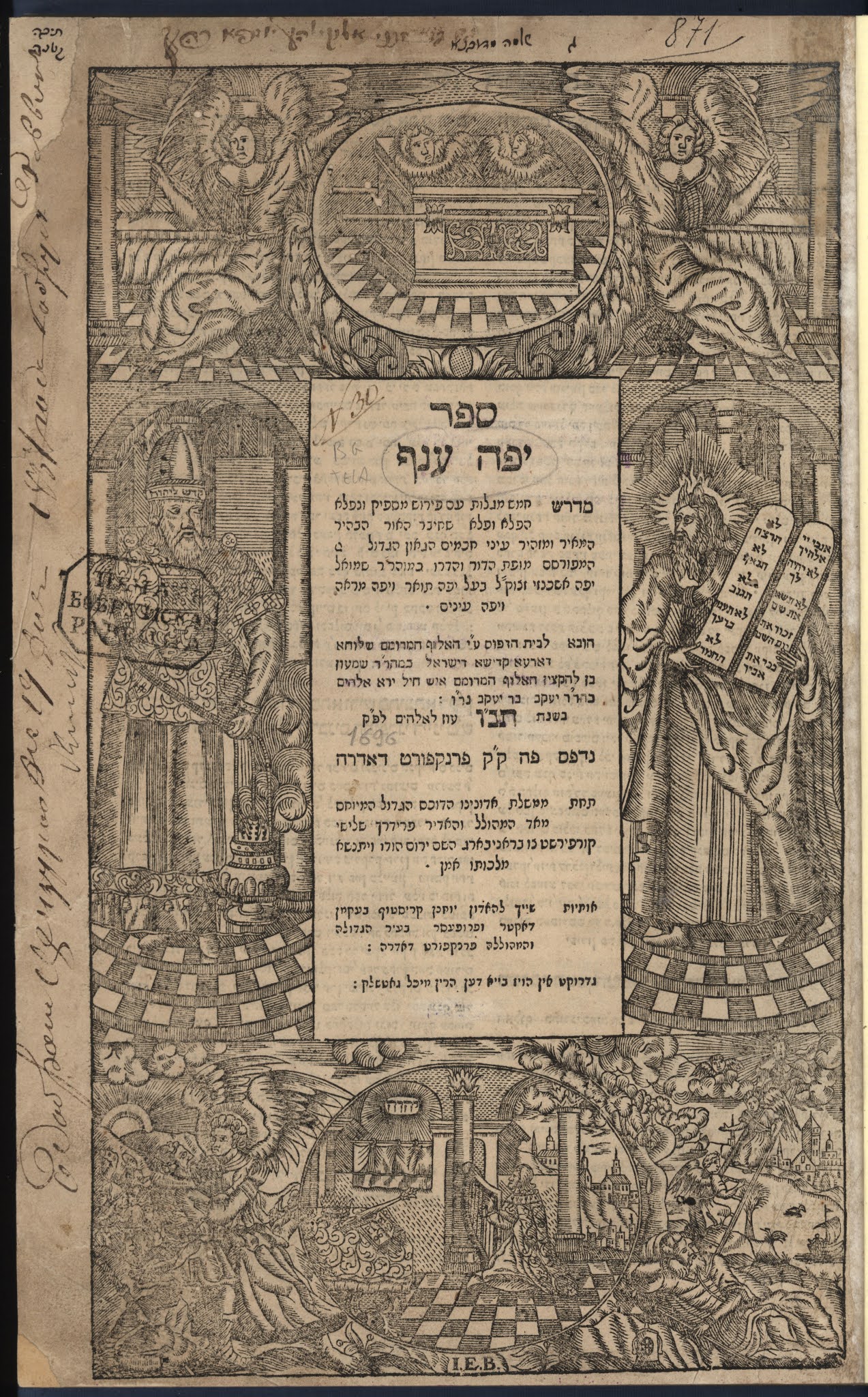
The first illustrated Jewish title pages appeared in the early seventeenth century. In 1693, the first depiction of Jacob’s dream graced a Jewish title page. That book, Sefer Rabbot, Midrash Rabba, with the commentary of R. Yisachar ben Naftali Katz, printed in Frankfurt on the Oder by Michael Gottschalk.
He was a local bookbinder and bookdealer who took over the management of Johann Christoph Beckman’s printing press in Frankfort d.O. in 1693, and led the press for almost forty years.[4] Sefer Rabbot’s title page includes Moses and Aaron (who first appear in the 1610 edition of the She’a lot u-Teshuvot Mahril, printed in Hanau (see “Aaron the Jewish Bishop”), at the top, angels around the ark, and at the bottom, three biblical scenes, Jacob wrestling with the angel, David praying, and Jacob’s dream. It is obvious that these images are modeled after Matthaeus Merian’s engravings of biblical scenes that accompanied his Icones Biblicae printed between 1625-1630. All three of these images can be traced to Merian based upon a number of similarities and artist conventions.
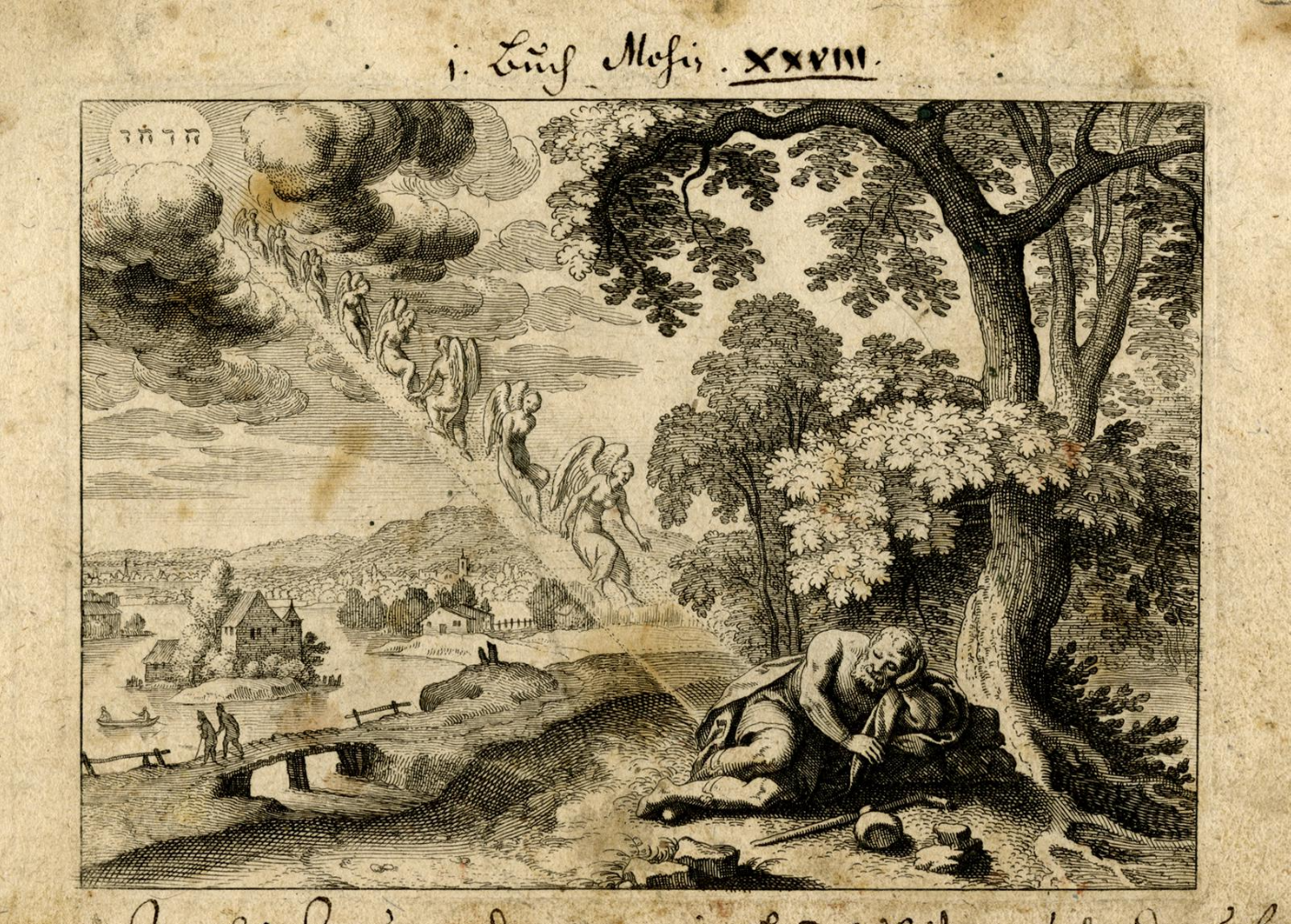
The image of Jacob’s dream depicts, in both instances, Jacob laying next to a tree, boats and houses appear in the background, and angels’ hands are outstretched to greet Jacob. There is one significant puzzling difference. In Merian’s depiction, he substitutes the letters (reversed) of tetragram for God. In the Jewish book, God is depicted as an old man with a beard wearing a crown. This, despite Judaism’s strong prohibition on depicting God in a human form.
(This is not the only instance of a Jewish book containing a human image for God. The title-page of the first edition of R. Yedidia Shlomo of Norzi’s commentary on the biblical mesorah, Minhat Shai, Mantua, 1742-44, includes a depiction of God with a human face. The images on the title page are various biblical vignettes and in the one for the resurrection of the “dry bones” that appears in Yehkezkel, God is shown as an old man with a white beard.)
Here is that image in detail:
Michael Gottschalk reused the Rabot title page at least five times; in 1695, for R. Shmuel Yaffe, Yafe Anaf, in 1696, Mattityahu ben Asher Lemle Liebermann, Mattat Yah, in 1698 in R. Benjamin Ze’ev Wolf ben Samuel Romaner’s Ir Binyamin, in 1699 in Ohel Yaakov, and in 1602 in Yisrael b. Aaron Yaffa, Or Yisrael.
These title pages are just a few of Gottchalk’s illustrated title pages. Gottshalk artistic sensibilities are on full display in his 1697-99 edition of the Talmud, a work for which the Frankfurt press is best known to this day. It contains arguably the most magnificent Talmudic title page ever printed.
In 1695, the first illustrated copperplate Haggadah was published in Amsterdam. All the images are modeled based upon Merian. The title page too contains a number of biblical scenes in circular medallions. One of which is Jacob’s dream.
The next title page that depicts Jacob’s dream appears in Tzvi Hirsch ben Rachmiel Chotsh’s, Shiv’im Tikunei ha-Zohar, Hemdat Tzvi, Amsterdam, Moshe ben Avraham Mendes Coutinho, 1706.[5] Like the Gottchalk’s image that includes heretical iconography, those of Shiv’im Tikunei ha-Zohar would prove equally problematic.[6]
Despite Hemdat Tzvi’s impressive approbations, R. Jacob Emden accused Chotsh, and specifically this book, of holding and expressing Sabbatian beliefs.[7] It has been conclusively demonstrated that indeed Chotsh’s book contains Sabbatian ideas.[8] Evidence of Chotsh’s embrace of Sabbateanism is identifiable amongst the title page images. Indeed, Chotsh calls attention to the larger meaning of the title page’s images. At the bottom of the title page Chotsh provides that “whosoever wishes to know the secret of the above frontispiece, should see the introduction to the Tikkunim at the beginning of the first article.” An inspection of that section yields likely Sabbatian passages. Thus, Chotsh is indicating that like the introduction, the title page also contains allusions to Sabbateanism.
The title page depicts a variety of biblical figures and Jacob’s dream appears at the top center of the page. Above that are two deer holding a crown with the verse from Isaiah 28:5, “On that day will the Lord of the hosts be for a crown of glory, and for a diadem of beauty.” The “crown of glory” or in Hebrew “Ateret tzvi” has a double meaning here, “glory” and “deer” and, of course, is alluding to Sabbatia Tzvi, who, “on that day” will be presumably wearing the crown.[9]
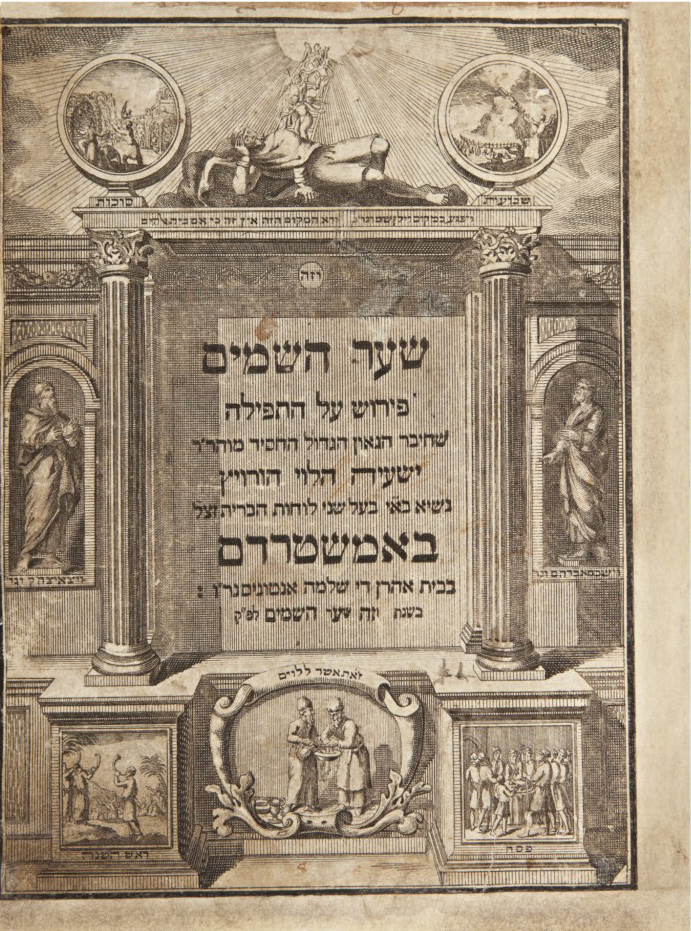
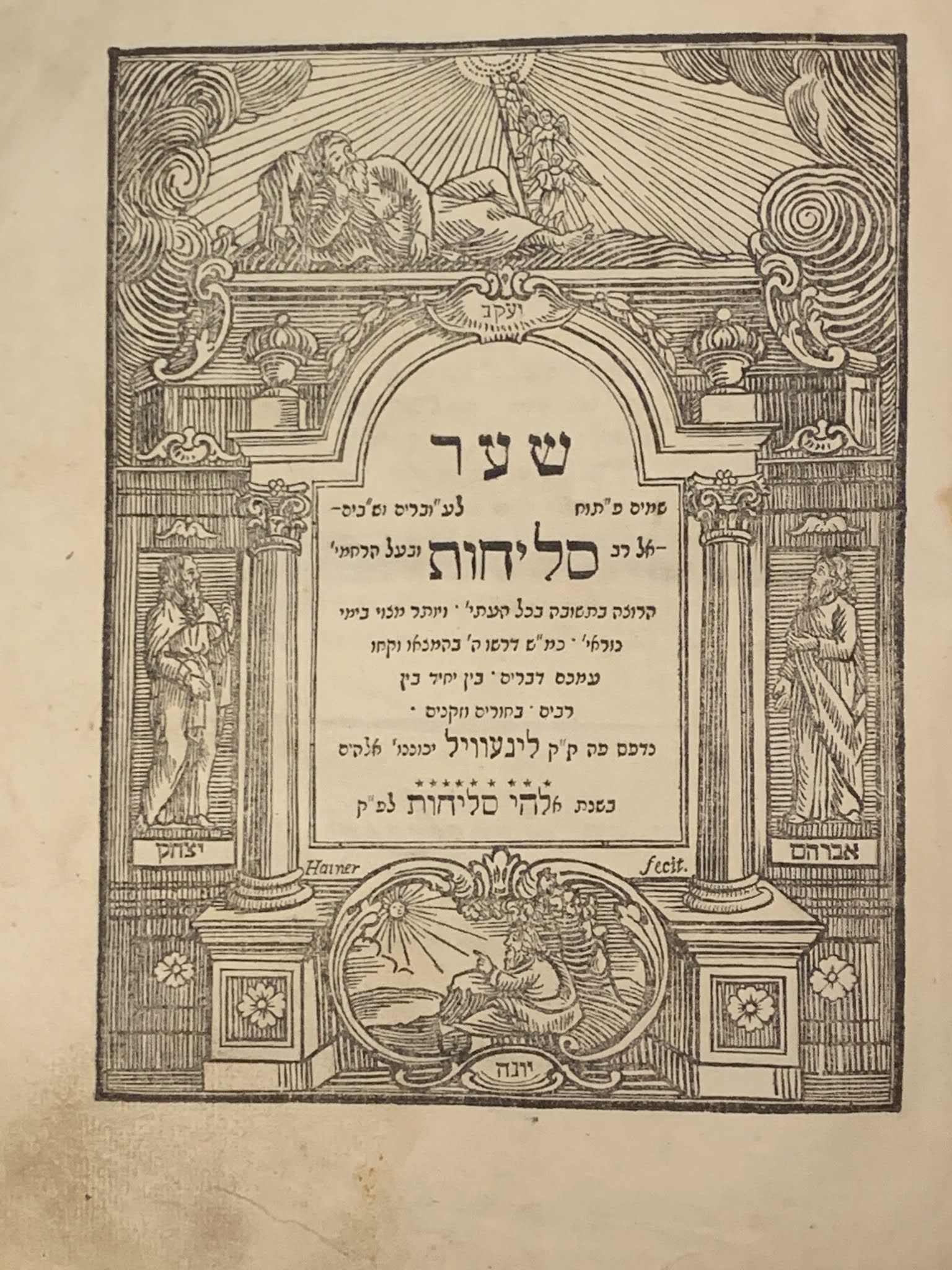
The most long-lasting depiction of Jacob’s dream is that which appeared in Siddur Shaarei Shamyim from R. Isaiah ha-Levi Horowitz (Shelah), Amsterdam, 1717.[10]
This title page is notable in that the accompanying images that align with the book which was not always the case. This is a complete machzor and as such four holidays, Sukkot, Pesach, Shavout, and Rosh Hashana, are represented on the top encased in circles, and underneath the columns. On one side of the bottom of the pillars. On either side is a niche, on the right with Abraham with the legend and on the left, Isaac, underneath each is a verse corresponding to prayer. Displayed prominently at top center, depicting his dream, with the verse from which the book’s title is derived. Underneath the title is a depiction of the Levites pouring water over the priest’s hands with the legend above, Ze hasher la-leviim. This is a reference to R. Horowitz’s lineage. All of the biblical images correspond with Merian’s depictions.
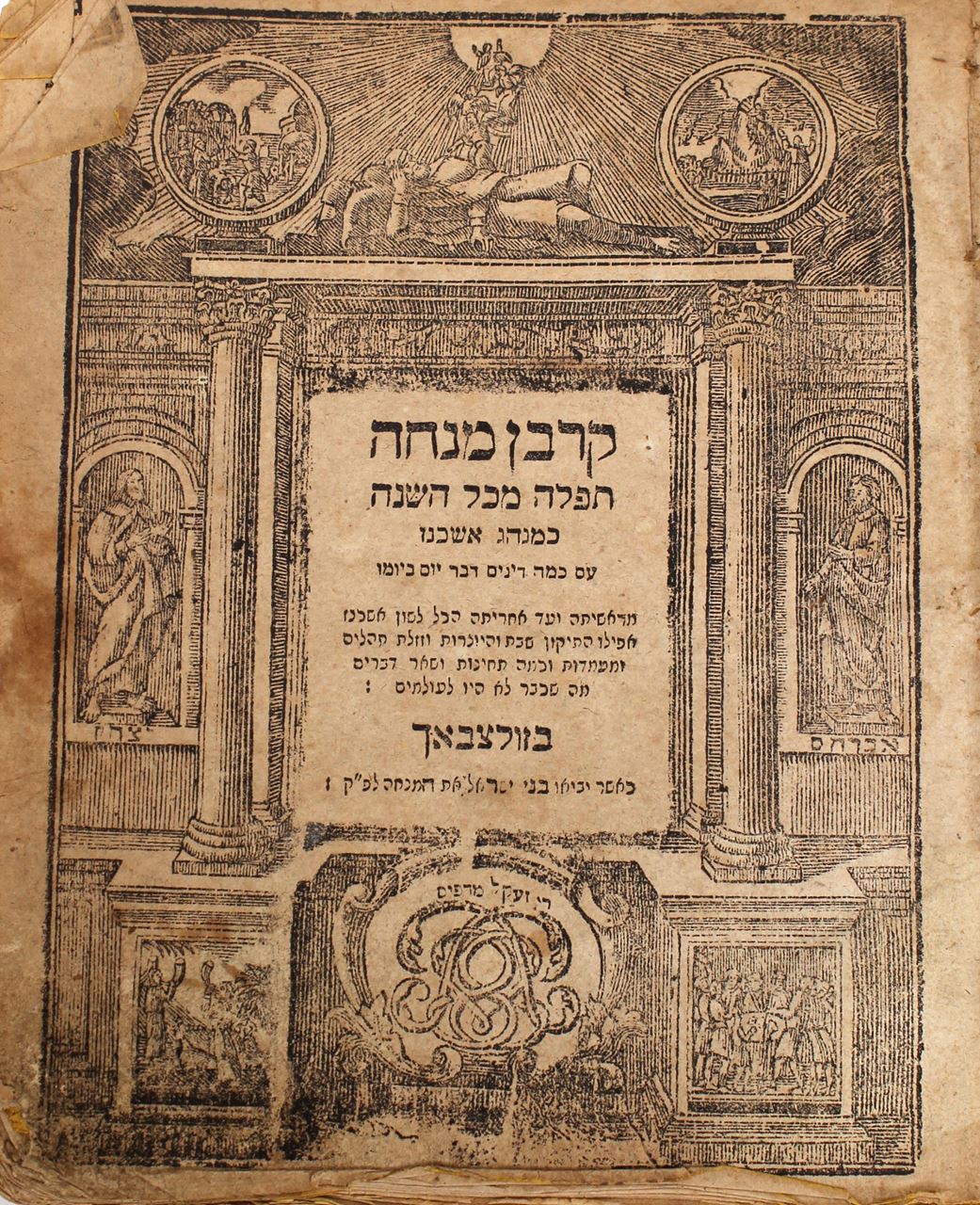
This title page, with small modifications, was repeatedly copied and is found in books from across Europe. One explanation for the ubiquity of this title page is that the Siddur ha-Shelah was imbued with talismanic effect. R. Yoel Sirkes in his approbation assures that whoever prays from this book their prayers would be answered. As evidence of the talismanic effect of the book one only needs to look to recent auctions where the book is regularly sold for tens of thousands of dollars. Perhaps printers looking to capitalize on the aura surrounding the Siddur ha-Shelah incorporated the images in their books.
For example, the title page appears in Edut be-Yaakov, Sulzbach, 1741,[11] in 1765, Furth, Siddur Korban Minha, and in 1797, in the north west of France in Luneville, Sha’ar Selihot ve-Tahanunim. In the latter, the Levite is substituted for Jonah as that is more aligned with the High Holiday themes of the book, and the four depictions of the holidays are removed because they conflict with the singular nature of the book.
Illustrated Hebrew title pages are perhaps the most ubiquitous, and certainly the most accessible form of Jewish art. Yet, the study of the art of the Hebrew title page has not attracted commensurate scholarly interest. Our example, tracing the depiction of Jacob’s dream, is but one instance that illustrated Hebrew title pages fit within the larger history of Jewish art. Here, the Hebrew title pages seventeenth- and eighteenth-century Hebrew books harken back to the iconography identified at Dura Europos that continued to appear in Jewish artistic forms, in this instance books.
[1] Gabrielle Sed-Rajna, Jewish Art (New York: Harry N. Abrams, Inc., 1997), 127.
[2] Gabrielle Sed-Rajna, Jewish Art (New York: Harry N. Abrams, Inc., 1997), 559.
[3] E.L. Sukenik, Bet-haKeneset shel Dura-Europa ve-Tserayav (Jerusalem: Mossad Bialik 1947), 112-3.
[4] B. Friedberg, History of Hebrew Typography in Central Europe (Antwerp, 1935), 35-49.
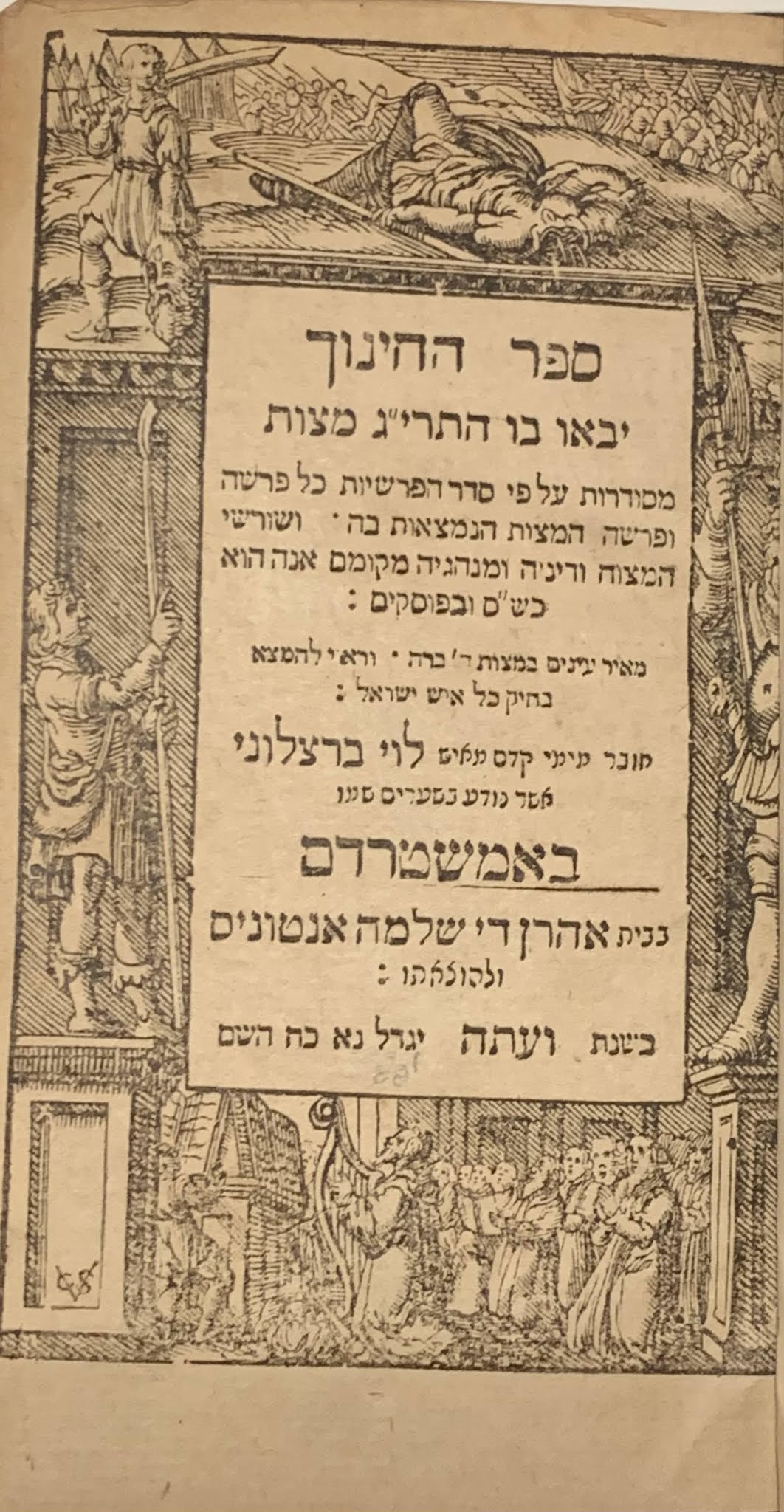
[5] Like Gottschalk, Coutinho also produced a number of other illustrated title pages with biblical images.In 1696, the year before he published the siddur, he published at least two books with illustrated title pages, Sefer Hinukh and the Mishna. This title page was reused in Coutinho’s 1698 edition of R. Hayim Moshe Karinal, Yemin Moshe.
[6] Bezalel Naor, Post-Sabbatian Sabbatianism, (Spring Valley, NY: Orot, 1999),79-82.
[7] See Shnayer Leiman, “Sefarim ha-Hashudim be-Shabbta’ot: Rishimat shel ha-Gaon Yavet”z Tzal,” in Sefer ha-Zikhron le-Rebi Moshe Lifschitz, (New York, 1996), 890
[8] See Naor, Post-Sabbatian, 80-81 and the sources cited therein.
[9] Of course, Shabbatai Tzvi is not the only “Tzvi,” Chotsh’s first name is Tzvi. Perhaps the image is an allusion to his name – a somewhat common theme in Hebrew title page illustrations. Recently, however, one scholar noted that the deers are not the only Sabbatian reference. According to his theory, the layout of the biblical figures aligns with kabbalistic representations of the sefirot. See Naor, 81.
[10] Horowitz’s other book, Sheni Luhot ha-Brit, Amsterdam, 1698, also contains a beautifully illustrated title page.
[11] The title page was reused for decades in the Sulzbach presses. As late as 1794, there are examples of the title page. See, e.g. Tsenah u-Renah, Sulzbach, 1794.
The Meaning of the Word Hitpallel (התפלל)
Meaning of the Word Hitpallel (התפלל)
Mitchell First[1]
appears in Tanakh that התפלל connotes praying. But what was the
original meaning of this word? I was always taught that it meant something like
“judge yourself.” Indeed, the standard ArtScroll Siddur (Siddur Kol Yaakov) includes the following in its introductory
pages: “The Hebrew verb for praying is מתפלל;
it is a reflexive word, meaning that the subject acts upon himself. Prayer is a
process of self-evaluation, self-judgment…”[2]
sites on the internet for the definition that was offered for hitpallel and mitpallel, I invariably
came up with a definition similar to the above. Long ago, Rabbi S. R. Hirsch
(d. 1888) and R. Aryeh Leib Gordon (d. 1912) also gave definitions that focused
on prayer as primarily an action of the self.[3]
interpretation offered by some modern scholars, one based on a simple insight
into Hebrew grammar. This new and compelling interpretation has unfortunately
not yet made its way into mainstream Orthodox writings and thought. Nor has it
been given proper attention in academic circles. For example, it did not make
its way into the widely consulted lexicon of Ludwig Koehler and Walter
Baumgartner.[4] By sharing this new interpretation of התפלל,
we can ensure that at least the next generation will understand the origin of this critical word.
——
are two issues involved in parsing this word: 1) what is the meaning of the
root פלל? and 2) what is the import of the hitpael stem, one that typically implies
doing something to yourself?
regard to the root פלל, its meaning is
admittedly difficult to understand. Scholars have pointed out that the other
Semitic languages shed little light on its meaning.[5]
we look in Tanakh, the verb פלל is found 4 times:[6]
seems to have a meaning like “think” or “assess” at Genesis 48:11: re’oh fanekha lo filalti…(=I did not
think/assess that I would see your face).[7]
seems to have a meaning like “intervene” at Psalms 106:30: va-ya’amod Pinḥas va-yefalel, va-teatzar ha-magefah (=Pinchas
stood up and intervened and the plague was stopped).[8]
seems to have a meaning like “judge” at I Sam. 2:25: im yeḥeta ish le-ish u-filelo elokim…(If a man sins against another
man, God will judge him…).[9]
also appears at Ezekiel 16:52: את שאי כלמתך אשר פללת לאחותך גם (= You also should bear your own shame that you pilalt to your sisters). The sense here is difficult, but it is
usually translated as implying some form of judging.
I would like to focus on in this post, however, is the import of the hitpael stem in the word התפלל.
Most students of Hebrew grammar are taught early on that the hitpael functions as a “reflexive” stem,
i.e., that the actor is doing some action on himself. But the truth is more
complicated.
source I saw counted 984 instances of the hitpael
in Tanakh.[10] It is true that a
large percentage of the time, perhaps even a majority of the time, the hitpael in Tanakh is a “reflexive” stem.[11] Some examples:
oneself”; the verb יצב is in the hitpael 48 times in Tanakh (e.g., hityatzev)
oneself”; the verb חזק is in the hitpael 27 times in Tanakh (e.g., hitḥazek)
oneself”; the verb קדש is in the hitpael 24 times in Tanakh (e.g., hitkadesh)
oneself”; the verb טהר is in the hitpael 20 times in Tanakh (e.g., hitaher)
ways as well. For example:
Genesis 42:1 (lamah titrau), the form
of titrau is hitpael but the meaning is likely: “Why are you looking at one
another?” This is called the
“reciprocal” meaning of hitpael.
Another example of this reciprocal meaning is found at II Chronicles 24:25 with
the word hitkashru; its meaning is
“conspired with one another.”
root הלך appears in the hitpael 46 times in Tanakh,
e.g., hithalekh. The meaning is not
“to walk oneself,” but “to walk continually or repeatedly.” This is called the
“durative” meaning of the hitpael.
There are many more durative hitpaels
in Tanakh.[12]
let us look at a different word that is in the hitpael form in Tanakh: התחנן. The root here is חנן which means “to be gracious” or “to show favor.” חנן
appears in the hitpael form many
times in Tanakh (התחנן, אתחנן, etc.). At I Kings 8:33 we even have a hitpael of פלל
and a hitpael of חנן adjacent to one another:
והתחננו והתפללו. If we are constrained to view התפלל as doing something to yourself, then what
would be the meaning of התחנן? To show favor to yourself? This
interpretation makes no sense in any of the contexts that the hitpael of חנן
is used in Tanakh.
as recognized by modern scholars, the root חנן
is an example where the hitpael has a slightly different meaning: to make
yourself the object of another’s action.
(This variant of hitpael has been
called “voluntary passive” or “indirect reflexive.”) Every time the root חנן is used in the hitpael, the actor is asking another
to show favor to him. As an example, one can look at the beginning of parshat va-et-ḥanan. Verse 3:23 states
that Moshe was אתחנן to God. אתחנן
does not mean that “Moshe showed graciousness to himself.” Rather, he was
trying to make himself the object of God’s
graciousness.
us now return to our issue: the meaning of התפלל.
Most likely, the hitpael form in the
case of התפלל is doing the same
thing as the hitpael form in the case
of התחנן: it is turning the word into a voluntary
passive/indirect reflexive.[13] Hence,
the meaning of התפלל is to make oneself the object of God’s פלל (assessment, intervention, or judging). This is a much
simpler understanding of התפלל than the ones that
look for a reflexive action on the petitioner’s part. Once one is presented
with this approach and how it perfectly parallels the hitpael’s role in התחנן,
it is very hard to disagree.[14]
Additional Comments
is interesting to mention some of the other creative explanations for התפלל that had previously been proposed (while
our very reasonable interpretation was overlooked!):
root is related to a root found in Arabic, falla,
which means something like “break,” and reflected an ancient practice of
self-mutilation in connection with prayer.[15] Such a rite is referred to at 1
Kings 18:28 in connection with the cult of Baal (“and they cut themselves [=va-yitgodedu] in accordance with their
manner with swords and lances, until the blood gushed out upon them”).[16]
oneself during prayer.[17]
root, but was a later development derived from a primary noun תפלה. In this approach, one could argue that התפלל is not even a hitpael.
(This approach just begs the question of where the word תפלה
would have arisen. Most scholars reject this approach because תפלה does not look like a primary noun. Rather, it looks like a noun
that would have arisen based on a verb such as פלל
or פלה.)
There are other examples in Tanakh of
words that have the form of hitpael
but are either voluntary passives (like התפללand התחנן)
or even true passives, as the role of the hitpael
expanded over time.[18] Some examples:[19]
37:35: va-yakumu khol banav ve-khol
benotav le-naḥamo, va-yemaen le-hitnaḥem…(The
meaning of the last two words seems to be that Jacob refused to let himself be
comforted by others or refused to be comforted; the meaning does not seem to be
that he refused to comfort himself.)
13:33: ve-hitgalaḥ (The
meaning seems to be “let himself be shaved by others.”)
23:9: u-va-goyim lo yitḥashav
28:68: ve–hitmakartem sham
le-oyvekha la-avadim ve-li-shefaḥot… (It is unlikely that the meaning is
that the individuals will be selling themselves.)
92:10: yitpardu kol poalei
aven (The evildoers are not
scattering themselves but are being scattered.)
30:29: ke-leil hitkadesh ḥag…(The holiday is not sanctifying
itself.)
31:30: ishah yirat Hashem hi tithalal
3:8: ve-yitkasu sakim ha-adam ve-ha-behemah… (Animals
cannot dress themselves!)
II Kings 8:29 (and similarly II Kings
9:15, and II Ch. 22:6): va-yashav Yoram
ha-melekh le-hitrape ve-Yizre’el… (The
meaning may be that king Yoram went to Jezreel to let himself be healed by
others or to be healed.)
precise role of the hitpael is
important to us as Jews who engage in prayer. Readers may be surprised to learn
that understanding the precise role of the hitpael
can be very important to those of other religions as well. A passage at Gen.
22:18 describes the relationship of the nations of the world with the seed of
Abraham:
again at Gen. 26:4.) Whether this phrase teaches that the nations of the world
will utter blessings using the name
of the seed of Abraham or be blessed
through the seed of Abraham depends on the precise meaning of the hitpael here. Much ink has been spilled
by Christian theologians on the meaning of hitpael
in this phrase.[20]
could be so interesting and profound!
mean “let us strengthen ourselves,” “let us continually be strengthened,” or
“let us be strengthened”? I will leave
it to you to decide!)
thank my son Rabbi Shaya First for reviewing and improving the draft.
commentary translated by Isaac Levy includes the following (at Gen. 20:7): התפלל means: To take the element of God’s truth,
make it penetrate all phases and conditions of our being and our life, and
thereby gain for ourselves the harmonious even tenor of our whole existence in
God…. [התפלל
is] working on our inner self to bring it on the heights of recognition of the
Truth and to resolutions for serving God…Prior to this, the commentary had pointed
out that the root פלל means “to judge” and that a judge brings
“justice and right, the Divine Truth of matters into the matter….”
Aryeh Leib Gordon explained that the word for prayer is in the hitpael form because prayer is an
activity of change on the part of the petitioner, as he gives his heart and
thoughts to his Creator; the petitioner’s raising himself to a higher level is
what causes God to answer him and better his situation. See the introduction to Siddur Otzar Ha-Tefillot (1914), vol. 1,
p. 20. The Encylcopaedia Judaica is
another notable source that uses the term “self-scrutiny” when it defines the
Biblical conception of prayer. See 13:978-79. It would be interesting to
research who first suggested the self-judge/self-scrutiny definition of prayer.
I have not done so. I will point out that in the early 13th century
Radak viewed God as the one doing the judging in the word התפלל. See his Sefer
Ha-Shorashim, root פלל.
and Aramaic Lexicon of the Old Testament (1994). The authors do cite the
article by E.A. Speiser (cited in the next note) that advocates the
interpretation. But they cite the article for other purposes only. The
interpretation of התפלל that Speiser
advocates and that I will be describing is nowhere mentioned.
“[o]utside Hebrew, the stem pll is at
best rare and ambiguous.” See his “The Stem PLL
in Hebrew,” Journal of Biblical
Literature 82 (1963), pp. 301-06, 301. He mentions a few references in
Akkadian that shed very little light. There is a verb in Akkadian, palālu, that has the meaning: “guard,
keep under surveillance.” See the פללarticle in Theological
Dictionary of the Old Testament, vol. 11, p. 568 (2001), and
Koehler-Baumgartner, entry פלל, p. 933. This perhaps
supports the “assess” and “think” meanings of the Hebrew פלל.
meaning at Is. 16:3 (asu pelilah) is
vague but could be “justice.” The meaning at Is. 28:7 (paku peliliah) (=they tottered in their peliliah) seems to be a legal decision made by a priest. Finally,
there is the well-known and very unclear ve-natan
be-flilim of Ex. 21:22. Onkelos translates this as ve-yiten al meimar dayanaya. But this does not seem to fit the
words. The Septuagint translates the two words as “according to estimate.” See
Speiser, p. 303. Speiser is unsure if this translation was based on guesswork
or an old tradition, but thinks it is essentially correct.
translated in this verse as “hope.” Even though this interpretation makes sense
in this verse, I am not aware of support for it in other verses. That is why I
prefer “think” and “assess,” which are closer to “intervene” and “judge.” Many
translate the word as “judge” in this verse: I did not judge (=have the
opinion) that I would see your face. See, e.g., The Brown-Driver-Briggs Hebrew and English Lexicon, entry פלל.
their entry פלל. Alternatively, some translate ויפלל here as “executed judgment.”
suggested that the “judge” meaning is just a later development from the
“intervene” meaning.
given varies from study to study. I have also seen references to 946, 780 and
“over 825.” See Joel S. Baden, “Hithpael and Niphal in Biblical Hebrew:
Semantic and Morphological Overlap,” Vetus
Testamentum 60 (2010), pp. 33-44, 35 n.7.
Most likely, the standard Hebrew hitpael
is a conflation of a variety of earlier t-stem forms that had different roles.
See Baden, p. 33, n. 1 and E.A. Speiser, “The Durative Hithpa‘el: A tan-Form,” Journal of the American Oriental Society
75 (2) (1955), pp. 118-121.
with regard to the hitpael of אבל, the implication may be “to be in mourning
over a period of time.” With regard to התמם
(the hitpael of תמם; I I Sam. 22:26 and Ps.18:26.), the implication may be “to be
continually upright.” Some more examples: משתאה at Gen. 24:21 (continually gaze), תתאוה
at Deut. 5:18 (tenth commandment; continually desire), ויתגעשו at Ps. 18:8 (continually
shake), and התעטף
at Ps. 142:4 (continually be weak/faint ). Another example is the root נחל. When it is in the hitpael, the implication may be “to come into and remain in
possession.”
pp. 249-250, and Speiser, The Stem PLL,
p. 305.
concession.” See his comm. to Deut. 3:23. This is farfetched. Hayim Tawil
observes that there is an Akkadian root enēnu,
“to plead,” and sees this Akkadian root as underlying the Hebrew התחנן. He views the hitpael as signifying that the pleading is continous (like the
import of the hitpael in hithalekh). See his An Akkadian Lexical Companion For Biblical Hebrew (2009), pp.
113-14. But there is insufficient reason to read an Akkadian root into התחנן, when we have a very appropriate Hebrew
root חנן.
Dictionary of the Old Testament, vol. 11, p. 568, Ernest Klein, A Comprehensive Etymological Dictionary of
the Hebrew Language for Readers of English (1987), p. 511,
Brown-Driver-Briggs, entry פלל, and
Koehler-Baumgartner, entry פלל, p. 933.
here remarks that this was “a form of worship common to several cults with the
purpose of exciting the pity of the gods, or to serve as a blood-bond between
the devotee and his god.”
vol. 11, p. 568, Klein, p. 511, and Koehler-Baumgartner, entry
פלל, p. 933.
to have located as many as 68 such instances in Tanakh, but does not list them. For the reference, see Baden, p.
35, n. 7. Baden doubts the number is this high and believes that the true
number is much lower. Baden would dispute some of the examples that I am
giving. Hitpaels with true passive
meanings are found more frequently in Rabbinic Hebrew. The expansion of the
meaning of the hitpael stem to
include the true passive form took place in other Semitic languages as well.
See O.T. Allis, “The Blessing of Abraham,” The
Princeton Theological Review (1927), pp. 263-298, 274-278.
others are collected at Allis, pp. 281-83.
For a few more true passives, see Kohelet 8:10, I Sam. 3:14, Lam. 4:1,
and I Chr. 5:17.
and Chee-Chiew Lee, “Once Again: The Niphal and the Hithpael of ברך in the Abrahamic Blessing for the
Nations,” Journal for the Study of the
Old Testament 36.3 (2012), pp. 279-296, and Benjamin J. Noonan, “Abraham,
Blessing, and the Nations: A Reexamination of the Niphal and Hitpael of ברך in the Patriarchal Narratives,” Hebrew Studies 51 (2010), pp. 73-93.
Purim, Mixed Dancing and Kill Joys
Although the Megilah only lists mishloch monot, matnot l’evyonim, and reading the Megilah as the customs on Purim, many others have become accepted. Most are of the ilk of boofunery or merrymaking. From making noise to drinking in excess, all have become part of the Purim landscape. With these, however, there are some lesser known customs. What is perhaps of interest is that it seems that there are those authorities that permit much if not all of these types of customs, there are others who seem set on shutting down much of the Purim fun.
For instance, the Rabbi Judah of Minz permits cross-dressing on Purim. This is so, even though this runs counter to a law in the Torah prohibiting these actions. What is lesser know, is that R. Minz also permits mixed dancing on Purim as well. In the Taknot of Padua it says “we decree that no one is permitted to dance with a married woman, no man with any married woman, with the exception of Purim.” (emphasis added).
Rabbi Yehuda Herzl Henkin in his Beni Banim vol. 1 no. 37 (5), links the two statements of R. Minz. R. Henkin says, just as R. Minz permitted cross-dressing as it was done for the joy of Purim, he permitted the mixed dancing under the same rational. That is, the dancing was just an outgrowth of the joy and not for licetnioius purposes.
Or, in the Customs of Worms, they not only celebrated Purim on the day, on the Shabbat after Purim they celebrated with similar merrymaking. Including, after the Friday night prayers all the people would first go to the Rabbi for a blessing, and then proceed to the women’s section where the Rabbi’s wife “would place her hands on their heads and bless them.” Additionally, R. Hayim Yosef Azulai in his travelogue, Ma’agel Tov, records that the Jews in Amsterdam would party all night long on the Friday night after Purim.
Although R. Minz was a proponent of happiness and its outgrowth on Purim, there were others that did not view Purim in the same vein. Rather, they seem bent on outlawing as much as possible even on Purim.
For instance, R. Samuel Aboab takes issue with at least two such Purim customs. First, he says in his Sefer Zikhronot, an ethical work and published anonymously, that he was befuddled his entire life how R. Minz and in turn R. Moshe Isserles in his Rama could allow for cross dressing on Purim. He spends at least four pages to demonstrating why this is incorrect. He states even if R. Minz is correct he should have kept that to himself. This is not his only negative opinion regarding Purim. In his responsa, Devar Shmuel, he says it is absolutely prohibited to read or even own the parody Mesachat Purim. He says any such copies should be destroyed.
Another person who looked with askance on the merry making was R. David ben Shmuel haLevi (Taz). He first follows the ruling of his father-in-law, R. Joel Sirkas (Bach), that cross-dressing is prohibited. R. Levi then also states in the law of Tisha B’av, that the prohibition of filling ones mouth with joy, is applicable even at at wedding and even on Purim.
So it seems that just as in society at large there are those who dislike the merrymaking on Purim, this is reflected in the Halakhic authorities as well. And conversely, there are those that viewed the merrymaking as a positive thing and therefore permitted many other things in connection with that merrymaking.
New Book on Rabbinic Authority
The second section discussion yeridat haDorot the lowering of the generations. This begins by telling the reader the concept of yeridat haDorot is not in relation to the tzadik rather it is to the generation. That is, the tzadik is of course as great as in previous generation rather it us that are unable to appreciate this. But then you may ask, it continues, why then do we hear of the great miracles these tzadikim did in previous generations, why not now? Of course, it is due to us – we have created a situation where the tzadikim can’t work their miracles today.
The author then treats us to a discourse on whether the achronim can argue on the rishonim. He explains that this is prohibited. In a footnote he deals with the many achronim that seem to disagree with this. However, he writes these off by noting they are like rishonim. Of course, this then poses another problem (or not) for him as if they are truly like the rishonim then it follows that their peers couldn’t argue on them as they are obviously greater. He just says that this doesn’t appear to be the case and this is allowed. He extends this prohibition against arguing against earlier ones and says this is applicable to the pronouncements of the Shulhan Arukh and the Rama. He appears to be unaware that R. Hayim Volhzin says the Gra said this is not the case and that ever Rav should just do what they see fit irrelevant of the opinion of the Shulkah Orakh and the Rama. Additionally, he doesn’t seem to be aware that R. Moshe Feinstein said the same thing. Or perhaps it is just a case of selective memory.
The next couple of chapters are devoted to the law of a Talmid Chacham today as well as the role of a Rebbi for Chassidim. The chapters include information on “Just Looking at the Rebbi Allows One To Gain In Torah and Avodah,” “The Belief in The Tzadik” as well as lesser topics such as “The Trip to the Rebbi,” “The miracles of the Rebbi” etc.
All in all, this book presents a rather interesting view into what some consider the laws and customs governing the interaction with the Rabbinic class.
I got the book at Biegeleisen in Brooklyn.