Translating the Aruch HaShulchan with AI: Method and Lessons

Translating the Aruch HaShulchan with AI: Method and Lessons[1]

Joshua Broyde (PhD)

Joshua Broyde is an AI/ML Healthcare & Life Sciences specialist at Google Cloud, where he works from strategy to implementation with enterprise medtech, healthcare, and biopharma companies to design, build, and deploy secure, production-grade AI and Generative AI systems. He has a PhD in the field of Computational Biology.

Abstract

I present a complete AI-written English translation of the Aruch HaShulchan — Rabbi Yechiel Michel Epstein’s comprehensive nineteenth-century code of Jewish law — covering all four sections of the Shulchan Aruch: Orach Chaim, Yoreh De’ah, Even HaEzer, and Choshen Mishpat. The translation was produced using Google’s Gemini 3 Flash model at its MINIMAL thinking level. Translation quality is consistently high for a first-pass working text, although it clearly sometimes makes mistakes. The full translation is freely available online at aruch-hashulchan-transla-53666.web.app, and the translation data and code are available at github.com/JoshB29/Texts_AI_Translations.

Introduction

The Aruch HaShulchan, by Rabbi Yechiel Michel Epstein (1829-1908) of Novardok, is one of the most authoritative and comprehensive codes of Jewish law in the modern era. Written in rabbinic Hebrew, it has remained largely inaccessible to English readers outside of a handful of translated sections.[2]

AI-driven translation represents a qualitative shift in what is possible for rabbinic literature. This does not fully replace careful human translation, but it creates an opportunity to scale massively: human scholars can now function primarily as editors, reviewing and refining AI-generated drafts rather than translating from scratch. A multi-year scholarly translation project can now be approximated in hours for a few dozen dollars.

Corpus

The Aruch HaShulchan comprises four sections (i.e. chelakim) corresponding to the four parts of the Shulchan Aruch: Orach Chaim, Yoreh De’ah, Even HaEzer and Choshen Mishpat. I first obtained the Hebrew source text from Sefaria[3]. In total, this corresponds to 1,507 Simanim (chapters) and comprises 24,161 seifim (subsections) and around 3,400,000 words.

Translation Method

Model and Thinking Level

I used Google’s Gemini 3 Flash (gemini-3-flash-preview) to create the translation[4]. Gemini Flash supports four “thinking levels” — MINIMAL, LOW, MEDIUM, HIGH — which trade computation budget against reasoning depth. I chose to use the MINIMAL setting, which created a good translation at a very low cost.

Each seif was passed as an isolated API call[5] with a fixed system prompt containing[6]:

  • A style guide specifying conventions for rabbinic titles (e.g., Rambam, Rema, Beit Yosef), standard formulaic phrases (e.g., עד כאן לשונו → “Thus far his words”), and transliteration conventions (siman, seif, seif katan).
  • Few-shot examples illustrating the original text and style of translation.
  • An instruction to preserve the paragraph and logical structure of the original.

In order to make the translations more consistent with each other, I applied a post-processing normalization to all translated seifim after translation was complete.

Choosing the Model Thinking Level to Use

In order to understand which model thinking level is best for rabbinic translations, I chose 5 randomly selected seifim from each chelek, and had Gemini Flash translate them at the different thinking levels. Below are the results:
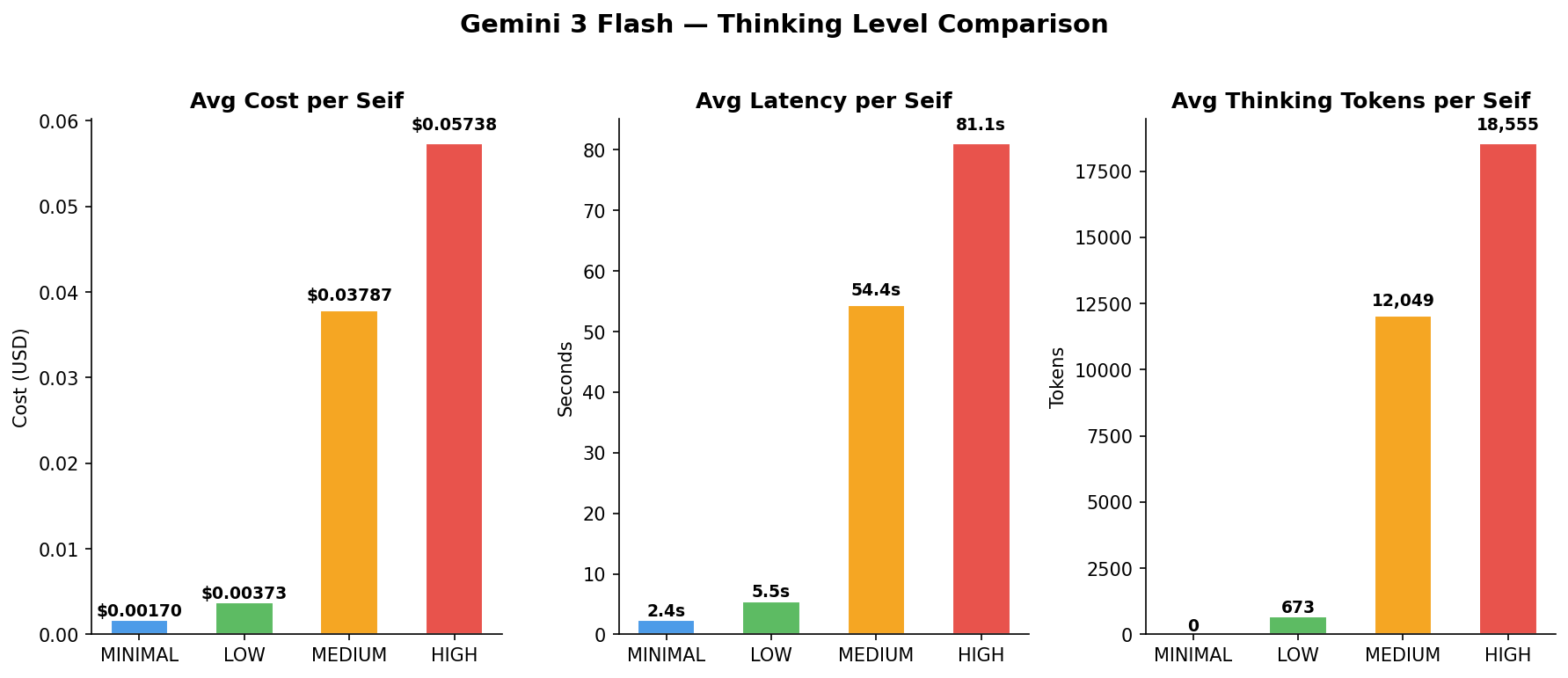
I found the MINIMAL setting to produce translations of roughly equivalent quality[7] compared to the higher thinking models. The additional expense of higher thinking did not seem to create significantly better translations. You can see from the graph that the cost for each seif at the HIGH thinking level is around 5 cents, about 33 times the MINIMAL thinking level[8]. This would represent a total cost of about $1300, as opposed to only $40 I spent using the MINIMAL setting[9]. Most of this cost is due to the significant amount of thinking tokens used by the high model. These results would also suggest that Gemini’s larger model, Gemini-Pro, would be overkill for the project. However, I did not formally test Gemini Pro, or any other model family[10].

Post-Processing Results

One thing I noticed was inconsistency of the word *seif* and the names of certain rabbinic works. Specifically, *seif* was sometimes kept in transliteration and sometimes translated as “section.” To address this, I applied a post-processing step using regular expressions to standardize these renderings: *seif* was normalized to “section” and *seif katan* to “subsection.” I applied the same approach to certain rabbinic names — for example, the *Shach* was sometimes transliterated as “Shakh” — normalizing these to a single canonical spelling throughout the corpus. For future translations, this should be fixed with better prompting.

Despite the fact that each seif is translated separately, my overall impression is that the translations were reasonably good and consistent.

Translation Quality

To more systematically validate the translation quality, I selected 100 random seifim and had a separate model evaluate the translations[11]; specifically, I used OpenAI’s GPT-5.4 model with a low reasoning effort. Each of the 100 seifim was passed to the model together with its original Hebrew, and the model was asked to classify the translation into one of four categories: Good, StyleImprovementNeeded, Mistake, or EgregiousError.

The egregious error category was defined strictly: a translation qualifies as egregious if it fundamentally inverts or distorts the author’s meaning — even if the error itself is subtle. To illustrate this, the following example was included in the evaluation prompt:

Original Hebrew

OC 635:5:

ובוודאי אין זה רק זהירות בעלמא, דאיזה פסול יש בעשיית הגג קודם הדפנות? דאין זה דמיון לחוטט בגדיש, שאין על זה שם גג כלל. אבל הכא גג גמור הוא.

Hypothetical mistranslation:

And certainly this is not only a mere stringency, for what disqualification is there in making the roof before the walls? For this is not comparable to hollowing out a haystack, where it does not have the status of a roof at all. But here, it is a complete roof.

The Aruch HaShulchan is in fact saying the opposite – the Rema’s statement is only a mere stringency. The mistranslation — inserting the words “not only” — is superficially consistent with the Hebrew, but is inconsistent with the actual context of the text and completely inverts the intended meaning.[12]

I had ran the analysis 3 times, and took a majority vote to determine the classification of the seif. If there was a 3 way-tie, the most serious category was taken. Here are the results:

Classification Percentage
Good 29%
StyleImprovementNeeded 54%
Mistake 17%
EgregiousError 0%

You can see that the GPT model thinks that the translations overall need to be improved in style, and found 17% of the translations had a mistake. Importantly though, there were no egregious errors found.

Most of the mistakes were mistranslations of specific words/phrases or incorrect abbreviation expansions; some of the mistakes are a bit humorous. Here are a few examples:

YD 187:63

[עח”ד סק”ה שכתב דדווקא ברואה מ”ת אמרינן כן משום די”ל שמש עכרן אבל בשלא מחמש (sic) תשמיש …]

Translation: [see Chavot Daat subsection 5 who wrote that specifically regarding one who sees from the Torah…]

However, מ”ת means “due to sexual intercourse”. The model seems to have incorrectly expanded this to “מן התורה׳”, despite that making no sense in context.[13]

CM 163:2

כל צרכי ציבור שאינם יכולים להשוות עצמן מפני שינוי דיעות יש להושיב כל הבע”ב הנותנים מס ויקבלו עליהם ברכה שכל אחד יאמר דעתו לש”ש וילכו אחר רוב דיעות

Translation: Regarding all communal needs where they are unable to reach an agreement due to a difference of opinions, they should seat all the householders who pay tax and they shall accept upon themselves a blessing that each one will state his opinion for the sake of Heaven, and they shall follow the majority of opinions.

This is flagged as a mistake by GPT- “blessing” is not the right translation in this context; admonition or a similar word would be better.

OC 471:4

ושתיית יין שרוף מעט – וודאי מגרר גריר.

Translation: And drinking a small amount of burnt wine – certainly stimulates.

“Burnt wine” is a clear mistake for distilled alcohol.

Here’s a few more examples that I found of clear mistakes or stylistic quirks:

  • In OC siman 475, seif 16, the abbreviation “עק”נ” is incorrectly rendered as “see Ketzot HaChoshen” — the correct translation should be “see Korban Netanel”.
  • In YD siman 19, seif 6, the word “poskekim” appears twice — a word that does not exist in Hebrew or in standard transliteration. It appears to be a model-generated corruption of poskim (the standard plural of posek, a halachic decisor). The model occasionally makes up this word a few times in its translation.
  • In EH, Siman 1 seif 2, האשה אינה מצווה על פריה ורביה is translated as “The woman is not commanded regarding pruz u-revu”. This should be “The woman is not commanded regarding pru-urevu” or even better would be “Women are not commanded in pru-urevu”.
  • CM 24:1 “רבותינו ז”ל אמרו [רפ”ה לב”ק] שאין נזקקין אלא לתובע תחלה “ “Our sages, of blessed memory, said [at the beginning of the eighth chapter of Bava Kamma]”. This should be “At the beginning of the fifth chapter”

My overall conclusion is that the translation overall avoided serious errors, but that it does occasionally mistranslate more complex words or phrases, and will sometimes incorrectly expand abbreviations. The model is also no Shakespeare in terms of prose, and is sometimes stylistically awkward. Still, it is mostly correct and I think it is a useful resource. Not bad for $40.73.

Conclusion and Lessons for Future Translations

Based on my experience on using AI to translate the Aruch HaShulchan, I offer the following recommendations for those undertaking similar large-scale AI translation projects in rabbinic or other specialized religious and legal literature.

Invest in the system prompt. The single highest-leverage action is writing a strong system prompt. The prompt should do two distinct things: (1) establish the content guidance — what the model is translating, from what tradition, at what level of expertise; and (2) establish stylistic guidance — how specific terms, titles, phrases, and citation styles should be rendered, consistently and unambiguously. The prompt I used included a style guide with explicit rules for rabbinic titles, standard formulaic phrases, and transliteration conventions.

Few-shot examples are highly effective. I found that including two or three worked examples in the prompt — a Hebrew passage followed by its correct English rendering — substantially improved consistency and register. The model learns from examples what it cannot fully internalize from rules alone, particularly for the tone and sentence structure expected in halachic prose. In the prompt I used, the few shots were not even entire seifim and were actually quasi-synthetic quotes; they were meant simply to show the style of source and target text.

Smaller, lightweight models are sufficient. There is no need to use the largest or most expensive models for this class of task. LLMs have essentially solved the problem of rabbinic Hebrew translation at the level of legal accuracy. Gemini 3 Flash at MINIMAL thinking — the smallest and cheapest configuration I tested — produced translations that were as good as those produced by higher thinking levels at 33 times the cost. The marginal quality improvement from more compute is real but small; the marginal cost increase is enormous.[14]

Prompt Iteration is essential. It took a few tries to get the model to translate in the way I wanted, and running the model on a few seifim, looking at the translation, and adjusting the prompt was very helpful. This was especially helpful for certain expressions I wanted translated consistently.

Context improves consistency, but potentially at significant cost. The primary weakness of this pipeline is that each seif is translated in complete isolation: the model has no memory of the spelling choices, transliteration decisions, or citation delimiter styles it used in prior seifim. Including previous seifim as context — either by passing the already-translated text of the current siman, or through a more dynamic agent-based RAG system — would improve within-siman consistency meaningfully. However, because halachic terminology and cross-references can reach back not just to the previous seif but to earlier simanim and even different sections of the work, the amount of context needed to capture these dependencies could quickly become expensive. For a first-pass translation, I found the isolated-call approach worked remarkably well. For a definitive scholarly edition, context-aware translation is the clear next step.

Conclusion

Translating the complete Aruch HaShulchan — approximately 24,000 seifim across four major sections — is technically feasible, inexpensive ($40.73), and fast (taking a few days on my personal Mac) using current AI technology. The resulting translation is of high quality for a working text, albeit with clear and addressable weaknesses that can be addressed in future iterations of the translation. The full translation is freely available at aruch-hashulchan-transla-53666.web.app.

Appendix A: Example Gemini translations at different thinking levels

# Orach Chaim 475:16 — Thinking Level Comparison

## Hebrew Source

וכתב רבינו הבית יוסף בסעיף ד: אכל מצה בלא כוונה, כגון שאנסוהו אנסים או לסטים לאכול – יצא ידי חובתו, כיון שהוא יודע שהלילה פסח, ושהוא חייב באכילת מצה. אבל אם היה סבור שהוא חול, או שאין זה מצה – לא יצא. עד כאן לשונו. סברא זו כתב כדי לתרץ דברי הרמב”ם, שכאן פסק דיצא ובפרק שני משופר פסק דבלא מתכוין – לא יצא, לחלק בין אכילה לשאר דבר. ומיהו גם באכילה, אם לא ידע שפסח היום או שזהו מצה – וודאי לא יצא, דמצות צריכות כוונה. ובאכילה כשידע, אף שנעשה באונס – הוה ככוונה. וסברא זו הוזכרה בתוספות פסחים (קטו א). אבל מדברי הרא”ש שם, והטור בכאן, לא משמע כן, עיין שם. (עק”נ שם אות ק’, שהאריך בזה.)

## Minimal Thinking

Our teacher, the Beit Yosef, wrote in section 4: If one ate matzah without intent, for example, if oppressors or bandits forced him to eat—he has fulfilled his obligation, since he knows that the night is Pesach and that he is obligated in the eating of matzah. But if he thought it was a weekday, or that this is not matzah—he has not fulfilled it. Thus far his words. He wrote this reasoning in order to reconcile the words of the Rambam, who ruled here that he has fulfilled it, yet in the second chapter of Shofar ruled that without intent—one has not fulfilled it, to distinguish between eating and other matters. However, even regarding eating, if he did not know that today is Pesach or that this is matzah—he certainly has not fulfilled it, for mitzvot require intent. And regarding eating, when he knew, even though it was done under duress—it is like intent. This reasoning was mentioned in the Tosafot in Pesachim (115a). But from the words of the Rosh there, and the Tur here, it does not appear so, see there. (See Ketzot HaChoshen there, letter 100, who elaborated on this.)

## Low Thinking

And our teacher, the Beit Yosef, wrote in section 4: If one ate matzah without intent, such as if oppressors or bandits coerced him to eat—he has fulfilled his obligation, since he knows that tonight is Pesach, and that he is obligated in the eating of matzah. But if he thought it was a weekday, or that this is not matzah—he has not fulfilled [his obligation]. Thus far his words. He wrote this reasoning in order to reconcile the words of the Rambam, for here he ruled that he has fulfilled [his obligation], and in the second chapter of Shofar he ruled that without intent—he has not fulfilled [it], to distinguish between eating and other things. However, even regarding eating, if he did not know that today is Pesach or that this is matzah—certainly he has not fulfilled [it], for mitzvot require intent. And regarding eating, when he knew, even though it was done under duress—it is like intent. And this reasoning was mentioned in Tosafot Pesachim (115a). But from the words of the Rosh there, and the Tur here, it does not appear so; see there. (See Korban Netanel there, letter 100, who elaborated on this.)

## Medium Thinking

Our teacher, the Beit Yosef, wrote in section 4: If one ate matzah without kavanah, such as if coercers or bandits forced him to eat—he has fulfilled his obligation, since he knows that tonight is Pesach and that he is obligated in the eating of matzah. But if he thought it was chol, or that this was not matzah—he has not fulfilled his obligation. Thus far his words. He wrote this reasoning in order to reconcile the words of the Rambam, for here he ruled that he has fulfilled his obligation, and in the second chapter of Shofar he ruled that without kavanah—he has not fulfilled his obligation, to distinguish between eating and other things. However, even regarding eating, if he did not know that today is Pesach or that this is matzah—certainly he has not fulfilled his obligation, for mitzvot require kavanah. And regarding eating, when he knew, even though it was done under coercion—it is like kavanah. And this reasoning was mentioned in Tosafot Pesachim (115a). But from the words of the Rosh, ibid., and the Tur here, it does not appear so; see there. (See Korban Netanel, ibid., letter 100, who elaborated on this.)

## High Thinking

And our teacher, the Beit Yosef, wrote in seif 4: If one ate matzah without intent, for example, if oppressors or bandits forced him to eat—he has fulfilled his obligation, since he knows that tonight is Pesach and that he is obligated in the eating of matzah. But if he thought it was a weekday, or that this is not matzah—he has not fulfilled. Thus far his words. He wrote this reasoning in order to reconcile the words of the Rambam, for here he ruled that he has fulfilled, and in the second chapter of Shofar he ruled that without intent—he has not fulfilled, to distinguish between eating and other matters. However, even regarding eating, if he did not know that today is Pesach or that this is matzah—certainly he has not fulfilled, for mitzvot require intent. And regarding eating, when he knows, even though it was done under duress—it is like intent. And this reasoning was mentioned in Tosafot Pesachim (115a). But from the words of the Rosh ibid., and the Tur here, it does not appear so; see there. (See Korban Netanel ibid., letter 100, who elaborated on this.)

These translations are substantially the same, but have a few differences:

The minimal thinking omits the initial “and”, which is technically an error but does not impact the meaning. The most glaring error is that the minimal translation expands עק”נ as Ketzot HaChoshen there, whereas the more advanced models correctly expand this to Korban Netanel.

Appendix B: Some Sample Translations

# Aruch HaShulchan — Translation Samples

## OC 67:2 — Doubt about Keriat Shema

**Hebrew**

ופשוט הוא דמיירי שיש כאן ספק על הכל: על הקריאת שמע ועל הברכות. אבל אם הספק הוא רק על קריאת שמע, והברכות וודאי קרא – פשיטא שאומר הקריאת שמע ולא הברכות, דהברכות אינם שייכים לקריאת שמע כמו שכתבתי בסימן נ”ט. אך דיש לומר דאם פשיטא ליה דאמר “אמת ויציב” – גם קריאת שמע אינו חוזר וקורא, דוודאי קרא גם קריאת שמע דסירכיה נקיט ואתי. כמו שכתבתי בסימן ס”ד, דכשפתח “למען ירבו” אמרינן דוודאי אמר “והיה אם שמע” דסרכיה נקיט, עיין שם. והכא נמי כן הוא. ואם ברי לו שברכות שלפני קריאת שמע אמר, והספק הוא מקריאת שמע והברכות שלאחריהן – קורא קריאת שמע והברכות שלאחריהן.

**Translation**
And it is simple that this refers to a case where there is a doubt regarding everything: regarding the Keriat Shema and regarding the blessings. But if the doubt is only regarding the Keriat Shema, and the blessings he certainly recited—it is simple that he recites the Keriat Shema and not the blessings, for the blessings are not connected to the Keriat Shema, as I wrote in siman 59. However, one could say that if it is certain to him that he recited “Emet VeYatziv”—he also does not return and recite Keriat Shema, for he certainly also recited Keriat Shema, as he follows his habit. As I wrote in siman 64, that when he began “Lema’an Yirbu” we say that he certainly recited “VeHayah Im Shamoa” because he follows his habit, see there. And here too it is so. And if it is clear to him that he recited the blessings before Keriat Shema, and the doubt is regarding the Keriat Shema and the blessings after them—he recites Keriat Shema and the blessings after them.

<## OC 292:1 — Mincha on Shabbat: Ashrei and Va’ani Tefilati
**Hebrew**

אומרים ‘אשרי’ ‘ובא לציון’, דבכל יום אומרים אותו בשחרית, ובשבת שבלאו הכי יש אריכות בשחרית – הניחוהו למנחה. ואומרים חצי קדיש. ואחר כך אומרים פסוק ‘ואני תפלתי’, על פי המדרש שמקודם כתיב: ‘ישיחו בי יושבי שער ונגינות שותי שכר’, אמר דוד לפני הקב”ה: אף על פי ששתינו – ואני תפלתי לך ד’. כלומר דשארי בני אדם שותים ומשתכרים ועוסקים בהוללות, ואני כשאשתה – עוסק אני אחר כך בתורה ותפ(י)לה. ולכן ביום טוב דליכא קריאת התורה – אין אומרים אותו, ועוד דעת רצון הוא רק בשבת במנחה, ונקרא בזוהר (שמות דף פ”ח:) ‘רעוא דרעוין’, וזהו רק בשבת כידוע. ולכן בשבת אף כשמתפלל ביחידות או במקום שאין ספר תורה – מכל מקום אומרים אותו (עיין מג”א סק”א), וכן הוא בזוהר תרומה.

**Translation**

We say ‘Ashrei’ and ‘Uva LeTziyon’, for on every day we say them in Shacharit, and on Shabbat, since in any case there is length in Shacharit—they left it for Mincha. And we say a half Kaddish. And afterwards we say the verse ‘Va’ani Tefilati’, based on the Midrash that previously it is written: ‘Those who sit in the gate talk about me, and I am the song of drunkards,’ David said before the Holy One, Blessed be He: Even though we have drunk—’as for me, may my prayer be unto You, Hashem.’ That is to say, that other people drink and become intoxicated and engage in revelry, but I, when I drink—I engage afterwards in Torah and prayer. Therefore, on Yom Tov, when there is no reading of the Torah—we do not say it; and furthermore, the time of favor is only on Shabbat at Mincha, and it is called in the Zohar (Shemot page 88b) ‘the favor of favors’, and this is only on Shabbat as is known. Therefore, on Shabbat, even when one prays in private or in a place where there is no Sefer Torah—nevertheless we say it (see Magen Avraham subsection 1), and so it is in Zohar Terumah.

## OC 615:1 — Marital Relations on Yom Kippur

**Hebrew**

יום הכיפורים אסור בתשמיש המטה, וגם זה בכלל “ועניתם”, דמניעת תשמיש מקרי “עינוי”. ובגמרא (עז ב) יליף זה מקרא, עיין שם. ואפילו במקום שאין טובלין לקרי – אסור התשמיש (טור), כלומר: דלא תימא דהאיסור הוא משום הטבילה שאחר כך, מפני איסור רחיצה, אלא התשמיש עצמו אסור. ולכן יתרחק אדם מאשתו כל יום זה כמנידה. והיינו: שלא יישן עמה במיטה אחת, ולא יגע בה בלילה. אבל ביום אין חשש כמובן (ט”ז). ויש שאוסר גם ביום (מגן אברהם), וכמדומה שאין המנהג כן. ולא ירבה לדבר עמה (שם).

**Translation**

Yom Kippur is forbidden for tashmish hamitah, and this too is included in “and you shall afflict yourselves,” for the withholding of tashmish is called “affliction.” And in the Gemara (77b) this is derived from a verse, see there. And even in a place where they do not immerse for keri—tashmish is forbidden (Tur), that is to say: so that you should not say that the prohibition is because of the immersion that follows, due to the prohibition of washing, but rather the tashmish itself is forbidden. Therefore, a man should distance himself from his wife all this day as if she were a niddah. And that is: that he should not sleep with her in one bed, and he should not touch her at night. But during the day there is no concern, of course (Taz). And there is one who forbids even during the day (Magen Avraham), and it seems that the custom is not so. And he should not speak extensively with her (ibid.).

## YD 38:13 — The Appearance of a Lung

**Hebrew**

ולפע”ד היה נראה להשוות הדיעות במקצת דבאמת אמראה בשר קשה מאד הרי זו אדום ולכן כתב אחד מהגדולים שצריך להבחין באדמימות אם אינה נוטה למראה בשר [שמ”ח סעי’ ד’] אבל מי הוא האיש החכם ויבן את זאת ולכן נראה דזה שכתבו כמראה בשר לאו משום המראה של אדמימות אלא גם על המראה העצמיות שלה דידוע דריאה היא חלקה מאד ולהיפך מזה הבשר אינו חלק כלל שהרי נמשכת לחוטים דקים ולכן אם הרואה לעינים לא יאמר עליה שזו היא ריאה אלא בשר היא טרפה ואם יאמר הרואה שזהו כבד כשרה וה”ה אם יאמר עליה שזהו טחול ג”כ כשר ולפ”ז זה שאמרו כמראה בשר טרפה לאו משום המראה אדמומית אלא משום מראה העצם שגשמיותה נראית כבשר [ומתורץ בזה קושית המאור למה לא אמר הש”ס כעין בישרא ע”ש]:

**Translation**

In my humble opinion, it would seem possible to reconcile the opinions somewhat, for indeed, regarding the appearance of meat, it is very difficult, as this is red. Therefore, one of the great authorities wrote that one must discern in the redness if it does not lean toward the appearance of meat [Siman 38, section 4]. But who is the wise man who can understand this? Therefore, it seems that what they wrote, “like the appearance of meat,” is not because of the appearance of redness, but also regarding its essential appearance. For it is known that a lung is very smooth, and conversely, meat is not smooth at all, as it is drawn into thin fibers. Therefore, if the observer would not say of it that this is a lung, but rather that it is meat, it is terefah. But if the observer would say that this is liver, it is kosher; and the same law applies if he would say of it that this is a spleen, it is also kosher. According to this, that which they said, “like the appearance of meat is terefah,” is not because of the appearance of redness, but because of the appearance of the substance, that its physical essence appears like meat [and with this, the difficulty of the Maor is resolved as to why the Shas did not say “like meat,” see there].

## CM 378:13 — Both Parties With or Without Permission

**Hebrew**

ומה נקרא שניהם ברשות כגון חצר השותפים או שנתן הבעה”ב רשות לשניהם ליכנס לחצרו או שהניזק נתן רשות למזיק ליכנס לחצרו או המזיק לניזק וכן כששניהם הלכו ברה”ר או בסימטא מקרי שניהם ברשות דהלא לשניהם יש רשות להלוך אבל כשרצים ברה”ר ובסימטא מקרי שניהם שלא ברשות דאין רשות לאדם לרוץ במקום הילוך רבים ושלא במקום הילוך רבים כמו בשדה ובקעה מקרי ברשות גם כשרצים [נ”ל] וכן בחצר שאינו של שניהם ובעל החצר לא נתן להם רשות מקרי שלא ברשות אבל כשלאחד נתן רשות ולא להשני הוי לזה שנתן רשות כחצרו:

**Translation**

And what is called “both are with permission”? For example, a partners’ courtyard, or where the homeowner gave permission to both of them to enter his courtyard, or where the injured party gave permission to the damager to enter his courtyard, or the damager to the injured party. And similarly, when both were walking in a public domain or in a side-alley, it is called “both are with permission,” for behold, both have permission to walk. But when they are running in a public domain or in a side-alley, it is called “both are without permission,” for a person does not have permission to run in a place where many walk. And in a place that is not a place where many walk, such as in a field or a valley, it is called “with permission” even when they run [it appears to me]. And similarly, in a courtyard that does not belong to both of them and the owner of the courtyard did not give them permission, it is called “without permission.” But when he gave permission to one and not to the other, it is for the one to whom he gave permission like his own courtyard.


  1. Special thanks to Emory University’s Law and Religion Center, which funded the model calls for this project. I want to thank my father, Rabbi Michael Broyde, for his thoughts on this piece and general helpful discussions when engaging in this project. His work on the Aruch Hashulchan is what inspired this project in the first place. I thank him also for all the Torah he has taught me and continues to teach me. Thank you also to Sefaria for publishing the original Hebrew text.
  2. My father, Rabbi Michael Broyde, undertook a scholarly translation of the Hilchos Shabbos chapters of the *Aruch HaShulchan* (*Orach Chaim* 242–292, see here). Aryeh Press is separately producing AI-assisted translations of the Aruch HaShulchan that integrates commentary from the Mishneh Brurah and the Shulchan Aruch HaRav — a more ambitious and editorially intensive project targeting the same text.
  3. For Yoreh Deah, I had to combine two different files from Sefaria: Arukh HaShulchan – he – Arukh HaShulchan, Yoreh De’ah — Wikisource.json and Arukh HaShulchan – he – Aruch HaShulchan, Vilna 1923-29.json
  4. Previously, in September 2024, I used GPT-4o to translate the Aruch HaShulchan, covering Orach Chaim, Yoreh De’ah, and Even HaEzer. You can find that older translation here. I found that it also produced translations of good quality. I have since updated the translation using Gemini 3 Flash, and extended coverage to all four sections of the Shulchan Aruch.
  5. All translation pipeline code — including the API client, the translation script, the thinking-level experiment, the post-processing normalization pass, and the code powering the website — was written with Claude Code (Anthropic’s AI coding assistant). Claude Code also assisted with some qualitative analysis of the translations and assisted drafting this article.
  6. You can find the code for creating the translation, including prompts for the model, here. All model API calls had a temperature of .4.
  7. See appendix for an example. You can see the full results of the experiment here.
  8. In the translation, I found that the MINIMAL setting never did any thinking. However, this is not guaranteed, and the minimal thinking setting sometimes can engage in thinking.
  9. Even this higher rate remains significantly lower than professional human translation, which typically ranges from $0.05 to $0.20 per word. Even at the lower estimate of $0.05 per word, a professional translation of the Aruch HaShulchan would cost approximately $170,000, making the AI-driven alternative a fraction of the market rate.
  10. That being said, my impression with informally testing with Anthropic’s Claude model and OpenAI’s ChatGPT are that they generated similarly reasonable translations. As I stated above, even the older GPT4o model did a solid job of translating sections of the Aruch Hashulchan.
  11. I chose a totally different model to avoid any potential bias of Gemini both creating the translations and also evaluating. However, in principle, LLMs of the same family can be used to evaluate their own responses.
  12. The actual Gemini generated translation correctly translates this phrase as “And certainly this is only a mere stringency”. I want to thank Claude Code for accidentally surfacing this nice example. Claude Code originally flagged this correct translation as being incorrect and I had to fight with it to persuade it that in fact the original translation was correct(!)
  13. My impression is that about a third or a half of all mistakes are incorrectly expanded abbreviations.
  14. For true publication quality translations, I think more work needs to be done to test whether smaller models can be used, especially if those translations will incorporate auto-generated commentaries and cross-references.


On the Maxwell House Haggadah

For contemporary American Jews, it is not an exaggeration to claim the Maxwell House Haggadah, as one of the most commonly used and widely known haggadahs. Even President Obama was aware of this history when he quipped regarding another recent haggadah “does this mean we can no longer use the Maxwell House Haggadah anymore?”


The first Maxwell House sponsored haggadah was published in 1932. [1] The Haggadah wasn’t published btwetween 1941 and 1948, but otherwise has been consistently published yearly, if in a changed format.  In the early years,   the editions were nearly the same with the only substantive change to update the included five-year calender. The sameness perhaps explains why the New York Times in two different articles accompanied by the identical photograph of the Maxwell House Haggdah, captions one 1932 and the other 1934.


The 1932 date is confirmed by the Maxwell House advertising campaign that included the Haggadah.
Maxwell House was not the first corporate sponsored haggadah, there were many before it.  For example, the West Side National Bank in Chicago sponsored one in 1919, which was printed in both Yiddish and English versions. Sometime in the 1920s, the American National Bank in Newark (whose name appeared in English and Yiddish) sponsored a haggadah, this one included both Hatikvah and the Star Spangled Banner (a common occurrence in many haggadahs published in America). Numerous other banks sponsored haggadas throughout the 1920s.  Postum, a coffee “substitute” put out its own haggdah in 1935, by then Postum was also part of the General Foods’ portfolio.
In 1929, Yeshiva Chaim Berlin sponsored one as “a token of gratitude to its donors.”  The Haggadah was in Hebrew and English with a Yiddish introduction.  The Haggadah also contains an image that includes a star of David flanked by the flag of the United States and the Zionist flag.
Chaim Berlin Flag
 – although in the introduction the editors write that the haggadah was distributed “in the fervent hope that this token will serve as a reminder of [the recipient’s] holy obligation to help the Yeshiva and assist in the undertaking to erect the new building.”  It includes illustrations of the Zionist and American flags, every teacher/rabbi pictured is beardless, and there are numerous pictures of the classrooms, many of which have a portrait of Lincoln hanging. Finally, it contains “a brief survey of the Yeshiva Rabbi Chaim Berlin, founded in 1912.” [By 1970, Yeshiva Chaim Berlin sponsored/published five haggadahs. See Yudolov, Otzar ha-Haggadaot, index, sub. Yeshiva Chaim Berlin.]
Some corporate sponsorships tied in more directly to the food and drink of Peasach, wine and meat. For example, Hebrew National meat products sponsored a haggadah.  Mogen David wines sponsored a haggadah in the 1920’s.(It is lacking a date, however, Yudolov, Otzar ha-Haggadot, no. 2807, dates it to “192-”. If Yudolov is correct, then Pinney’s dating of the use of brand Mogen David to 1947, needs to be corrected.  Thomas Pinney, A History of Wine in America, Univ. of Calif. Press, 2005, 174.)   Similarly, Another wine company, Schapiro’s House of Kosher Wines, California Wine Company, sponsored one in 1941.  And the Manischewitz Company, got into the haggadah sponsorship game in 1943.  While Striets[‘] Matza sponsored one in 1945.
Nor was this practice limited to sponsorship of Hebrew publications.  In 1900, Chase & Sanborn, then one of the largest US coffee concerns, issued a booklet, by one of its owners, to promote its Seal brand coffee, After Dinner Tricks and Puzzles with Your Seal Brand Coffee.  Among the brainteasers was “how many hard boiled eggs can a hungry man eat on an empty stomach?”  Answer:  One only, for after eating one, his stomach would no longer be empty.”  [The booklet also included illustrations and language that through a contemporary lens would be viewed as racist and misogynistic.]
The first edition of the Maxwell House Haggadah was issued in 1932, see supra. (The origin of the company’s name is that a roaster began selling his beans to a prestigious Nashville hotel, Maxwell House, creating a name that is similar to sponsorship.) It contains illustrations that are “reproductions of mediaeval woodcuts and of paintings of old masters.”  The illustrations are neither reproductions of woodcuts or mediaeval, instead, the illustrations can be dated to the 18th and 19th centuries and they were printed with modern techniques.
The sponsorship is indicated on a plain paper cover, “prepared by General Foods Corporation packers of Vita-Fresh Maxwell House Coffee Kosher for Passover” (General Foods appears in smaller type than Maxwell House).  This later changed to a more colorful cover.  The anonymous introduction is written from the perspective of General Foods.  The introduction explains the rational for sponsoring this haggadah that “General Foods Corporation, packers of Maxwell House Coffee, whose relations with the Jewish people have always been most friendly, take pleasure in presenting this new, up-to-date edition of The Haggadah.”  Aside from General Foods touting its relationship with “the Jewish people” there were other reasons General Foods likely sponsored the haggadah.  After the stock market crash in 1929, Maxwell House lost considerable market share.  And, in 1932, General Foods switched its advertising agency to Benton & Bowles, in the hope of turning around Maxwell House sales.  To further this revamped advertising strategy, General Foods “allotted a whopping $3.1 million . . . to advertise Maxwell House.”  And with this advertising dollars, came sponsorships.  The most notable sponsorship was that of a radio show, the Maxwell House Show Boat, that turned into an enormous success greatly increasing it market share, and, the haggada, while perhaps then a lesser known sponsorship, ironically, today it is more well known.
Turning to the advertising aspect of the haggadah, aside from the sponsorship, the final page is a full page ad for Maxwell House and, like the title page, touts the “vita-fresh process” which “assures of full flavor and deliciousness.  Not a trace of air remains in the can to cause loss of flavor or deterioration.” General Foods’ vacuum technique, vita-fresh, was introduced in 1931 to counter Chase & Sanborn’s earlier adoption of vacuum for its coffee and its accompanying advertisements proclaiming that without vacuum the coffee produces “rancid oil” which was “the cause of indigestion, headaches, sleeplessness,” an implicit criticism of Maxwell House.  [Chase & Sunborn were not even the first to adopt this technology.  Instead, the Hill Brothers pioneered the use of vacuum to preserve coffee freshness in 1900, Chase wouldn’t adopt it until the late 1920s and Maxwell House in the 1930s.] Ultimately, as mentioned above, vita-fresh didn’t save Maxwell House, it was the radio show.  Thus, in the second edition of the Maxwell House, it no longer mentions vita-fresh.
There were many companies that sponsored haggadahs in the early twentieth century, today only Maxwell House survives. To account for that longevity it is helpful to keep in mind the unique conditions that led to Maxwell House’s sponsorship — the increase focus on advertising.  The other corporate sponsorships, all predate the stock market crash and subsequent Depression.  While there is no direct evidence, it is likely that those companies reduced their advertising budgets and with that went their haggadah sponsorship.  Maxwell House, however, began its sponsorship after the stock market crash and its sponsorship remained undisturbed by external economic forces, remaining the last survivor of the early Twentieth Century corporate sponsors of the Haggadah.
Notes
[1] See Yudolov, Otzar ha-Haggadot no. 3428. Although the title page does not provide a date, the Haggadah includes a five-year Hebrew calendar.  Thus, to date the Haggadah, the first year indicated in the calendar is used as a proxy for the date of publication.  The first edition includes a calendar beginning in 1932, the next edition begins with 1933, and so on.  See Yudolov, nos. 3428, 3455, 3489, 3594, 3620, 3656, 3689, 3721.
References
Haggadah: Yudolov, Otzar ha-Haggadot, Magnus Press, Jerusalem [n.d]; Goldman, Hebrew Printing in America, Brooklyn, NY:2006, no. 170; Yaari, Bibliography of the Passover Haggadah, Bamberer & Wahrman, Jerusalem, 1960.
Coffee: Pendergrast, Uncommon Grounds, Basic Book, USA, 1999, 125, 191-96.
For an survey of coffee, see Modernist Cuisine, The Cooking Lab, Washington:2011, vol. IV, 357-403.


The most comprehensive book discussing how to brew (excellent) coffee using a variety of methods, see Scott Rao, Everything but Espresso, Professional Coffee Brewing Techniques, Canada, 2010.


Akiva Leiman: Gravely Mistaken

Gravely Mistaken
by Akiva Leiman

R. Leiman teaches high school at the Yeshiva of Greater Washington in Silver Spring, Maryland. Additionally, he leads trips to sites of Jewish interest in Eastern Europe. This is his first contribution to the Seforim blog.

One hardly need go far to find errors in published materials, but when even moderate research would suffice to unearth correct information lack of such an effort would seem egregious. Jewish burial sites have often been lost: Nazis or indigenous peoples destroyed cemeteries, acid rain ravages stones, burning candles char monuments and, of course, people just simply forget where things are.[1] Misinformation, however, would seem to be the most preventable culprit in this ever-losing battle to maintain vestiges of our heritage.
A few examples should suffice.[2]
1. In Paul Johnson’s A History of the Jews, in the very first paragraph of the actual text, he says,
There in the Cave of Machpelah, are the Tombs of the Patriarchs . . . . Across the inner courtyard is another pair of tombs, of Abraham’s grandson Jacob and his wife Leah. Just outside the building is the tomb of their[3] son Joseph.
In an endnote he references L.H. Vincent and his depiction of the cave which has been reproduced in EJ XI p. 671. There the caption does read: “Tomb of Joseph.” However, the text of the EJ explicates that, “A Muslim tradition maintains that Joseph was buried here… (t)his tradition is probably due to a corruption of the Arabic name for Esau, whose head, according to aggadic sources fell within the cave…” EJ‘s theory for the mistake aside, Johnson must not have read the text of the article (or: ignored it), for though the diagram’s caption tells us that Yosef is buried in the Cave, the text belies this point.[4] Furthermore, see Joshua 24:32 (providing Shechem as Joseph’s burial place),[5] which must, at the very least, be mentioned in any serious discussion of the final resting place for Yosef.[6]
2. In בשבילי ראדין, by M. M. Palato, Machon B’Shvilai HaYeshivot, (2001), p. 25, we are provided a picture and told “that we are being shown the final resting place of R’ Chaim of Volozhin (d. 5581 – 1821), the most esteemed student of the Vilna Gaon, and he is buried next to his mentor.”[7]
But, R’ Chaim is actually interred in Volozhin[8] and his grave is a regular stopping point for those visiting the Byelorussian town. The picture shown is of the old Ohel over the grave of the Vilna Gaon in the since-destroyed Shnipishok cemetery of Vilna. Of course, R’ Chaim’s grave is not pictured at all.[9]

3. Holy Stones: Remnants of Synagogues in Poland, drawings by Joseph Cempla, Dvir, Tel Aviv (1959) is a beautiful group of renderings of pre-war Poland. From the description for plate number 13 we read:
The gravestone of Rabbi Shalom Shachna in the Lublin Cemetery

Rabbi Shalom ben Joseph Shachna[10] (1510-1550[11]) was one of the greatest Talmudists produced by Polish Jewry. He was the pupil of Rabbi Jacob Polak, head of the Lublin Yeshiva, who created the method of “Pilpul”[12] (casuistics)[13] employed in the study of Talmudic literature.

It is correct that R’ Shalom Shachna was a student of R’ Yaakov Polak, but the stone sketched by Cempla is not R. Shalom Shachna. Here is Cempla’s drawing:

And here is a picture of R’ Shalom Shachna’s grave today in the Old Cemetery of Lublin:

The grave today stands without the adornments found in Cempla’s rendering: no pillars, no arch and no artistic flair filling the arch. Also, Cempla seems to indicate ten or twelve lines of etching while the current stone shows at least fifteen; puzzling, if not insurmountable issues.
A bit more research revealed the obvious error. Within twenty feet of R’ Shalom Shachne stands this prominent headstone:

This is the grave of Rabbi Yaakov Yitzchak Horowitz (d. 9 Av 5575 – 1815), the Chozeh of Lublin.[14] It seems almost certain, upon comparing Cempla’s drawing with that of the Chozeh’s headstone is that Cempla drew the Chozeh’s headstone mistaking it for the tomb of R’ Shalom Shachna which lies in its close proximity.

[1] I can recall, as a young man, visiting the old cemetery in Tzfat immediately after havdalah. I encountered a middle-aged Chassidic Jew at that strange time, and inquired after the grave of Rabbi Chaim Vital (d. 5380) the eminent student and chronicler of R’ Yitzchak Luriah – the Ari Hakadosh (d. 5332). He told me to go up the road and after a bit to ask for directions to Damascus…
[2] For another example see אבי מורי, Dr. S.Z. Leiman, in Who is Buried in the Vilna Gaon’s Tomb? Originally published in Jewish Action, Winter (1998), 59(2), and which can be found online at: http://www.ou.org/publications/ja/5759winter/leiman.htm
[3] Sic, he was the son of Rachel not Leah.
[4] See Z. Vilnai, מצבות קודש בארץ ישראל, pp. 167-176, where (p. 170) sightings of the burial place in Shechem date to 320 AD.
[5] ואת עצמות יוסף אשר העלו בני ישראל ממצרים קברו בשכם
[6] For further discussions, see L. Ginzberg, Legends of the Jews, V1, JPS (2003) p. 430 n. 443. Also, Vilnai pp. 141-144. To come full circle, in Acts 7:16 we are told that Jacob was also buried in Shechem!
[7] See note 1 above.
[8] For a nice photo, see Mishpacha, Special Supplement Succos 5767, pp. 24-25.
[9] The caption also tells us that R’ Zalmaleh of Volozhin, the brother of R’ Chaim and most brilliant student of the Vilna Gaon, is in the photo as well. He is neither in Volozhin, next to his brother, nor in the Gaon’s Ohel. See note 1. His grave has sadly been lost.
[10] I would assume that Shachna was his second, not family name; the stone reads:שלום המכונה שכנה, which would seem to be a nickname rather than a surname.
[11] See S. B. Nissenbaum’s Lekorot HaYehudim B’Lublin, p. 19 for the exact wording on his tombstone. He actually died on Friday Rosh Chodesh Kislev 5319, which was in 1558. See A. A. Akavia לוח לששת אלפי שנה p. 485.
[12] Quotes in original
[13] Parenthetic translation in original
[14]Interestingly, in Y. Alfasi החוזה מלובלין p. 107 nt. 9 there is a discussion if the Chozeh is in fact buried near R’ Shalom Shachna. He relies on a pre-war witness. Today one can go and see for himself, ואין לדיין אלא מה שעיניו רואות.


Adam Mintz — The Manhattan Eruv

In a previous contribution to the Seforim blog, Rabbi Adam Mintz discussed the significant roles of Rabbi Yosef Eliyahu Henkin and Rabbi Moshe Feinstein in the development of a unique halakhic response to the issue of the mehitzah in the American synagogue, based on a previous lecture delivered as part of his “History of American Poskim” series at Kehilat Rayim Ahuvim on the Upper West Side of Manhattan. The following historical and halakhic overview of the issues surrounding the Manhattan eruv is based on Rabbi Mintz’s doctoral dissertation, “The Evolution of the American Orthodox Community: The History of the Communal Eruv” (New York University, forthcoming).

The Manhattan Eruv
By Adam Mintz
The first Manhattan eruv was created in 1905 by Rabbi Yehoshua Seigel who was one of the most notable rabbinic scholars of the time. He was born in Poland and served as a rabbi in Sherps before immigrating to the Unites States. He maintained the title Sherpser Rav in America and quickly became the leader of the Polish community in New York. He described the eruv and his impetus for creating it in his volume Eruv ve-Hotza’ah (New York, 1907).[1] Rabbi Seigel’s eruv only encompassed the Lower East Side, utilizing the natural riverbanks of Manhattan on three sides and on the fourth side, the Third Avenue El. There was rabbinic opposition to Rabbi Seigel’s eruv. This view is elaborated upon by Rabbi Yehudah David Bernstein in Hilkhata Rabta le-Shabbata (Brooklyn, 1910). Rabbi Bernstein, who studied at Slabodka, was one of the founders and early teachers at the Rabbi Isaac Elchanan Yeshiva in New York.[2] This eruv was utilized by many within the Polish and Galician communities throughout the first half of the twentieth century.

Rabbi Henkin’s first encounter with the rulings on the eruv related to Rabbi Seigel’s eruv. In his volume Edut Le-Yisrael published in 1949, he wrote, “There are many observant Jews and especially those Hasidim from Poland who carry here on the street on Shabbat relying on the permission of Rabbi Yehoshua Seigel of Sherps.”[3] He went on to explain that this eruv is no longer valid due to changes that have been in the waterfront and in the Third Ave El. In addition, Rabbi Henkin explained that one of the requirements of the eruv is that the city be rented from the local authorities and that Rabbi Seigel had rented the city for only ten years which had long since expired.

The rejection of Rabbi Seigel’s eruv by the Lithuanian community and the gradual relocation of the Orthodox community to the Upper East and West Sides led to an attempt to create an eruv around the entire borough. In 1949, the Amshinover Rebbe, Rabbi Shimon Shalom Kalish, asked Rabbi Tzvi Eisenstadt to explore the possibility of creating a Manhattan eruv. Rabbi Eisenstadt, who had studied at Slabodka and was recognized as a rabbinic scholar in both the Lithuanian and Hasidic communities, investigating the Manhattan waterfront and concluded that it was enclosed by man-made walls and that an eruv could be established. The eruv came into existence in the Spring of 1962 under the leadership of Rabbi Menachem Mendel Kasher, a well-known rabbinic scholar and author who lived on the Upper West Side.[4] The long duration between the introduction of the concept and its realization was due in part to the fact that several adjustments had to be made to these man-made boundaries. However, it was largely caused by the opposition and uncertainty within the New York rabbinic community to the creation of a community eruv. While there had been eruvin in the large cities in Europe before World War II, there were very few, if any, functioning community eruvin at the time in North America.[5] The rabbinic community was confronting an issue that would shape Shabbat observance to this day.

The first extensive treatment of this issue is found in Rabbi Moshe Feinstein’s Iggerot Moshe, Orah Hayyim vol. 1, nos. 138-140. In these teshuvot, written in 1952 and addressed to Rabbi Eisenstadt, Rabbi Feinstein outlined his belief that an eruv cannot be built around Manhattan. His arguments in these teshuvot were legal and elaborated upon in great detail and it is clear from them that he had a high regard for Rabbi Eisenstadt.

Rabbi Yosef David Moskowitz, the Shatzer Rav, was one of the strongest proponents of the Manhattan eruv. In 1954, he had taken over the leadership of the project following the passing of the Amshinover Rebbe. Five years later, in 1959, Rabbi Moskowitz published a volume entitled Tikkun Eruvim (New York, 1959) in which explained the halakhic reasons for the viability of an eruv around Manhattan. Both Rabbi Henkin and Rabbi Feinstein wrote haskamot for this volume. Rabbi Henkin began by praising Rabbi Moskowitz’s scholarship and commenting on the pleasure he received knowing that there are great rabbinic scholars in America. He continued as follows: “I do not feel that we can criticize the lenient ones merely as a precaution.”[6] However, he does state that he remained uncertain as to whether the bridges and tunnels create a breach in the eruv. Rabbi Feinstein also complimented Rabbi Moskowitz on his work and wrote:[7]

“Even though there are areas in which I believe there are other opinions, this is the way of Torah where God watches two scholars disagreeing for the sake of heaven and unquestionably Rabbi Moskowitz has written for the sake of heaven.”

Rabbis Feinstein and Henkin continued their communications regarding the Manhattan eruv in the years preceding the completion of the project. Rabbi Feinstein wrote two letters in which he stated that while he would not join with those who permitted the Manhattan eruv, he believed that there was significant basis on which those who permit it could rely. In a letter published in Hapardes 33:9 (June, 1959) Rabbi Feinstein elaborated on this theme and explained that in America where there is indoor plumbing and the shuls are well stocked with books, there is no need for a community eruv. However, he concluded, “If there are those who still believe that there is need for an eruv for the sake of the children and for those who violate Shabbat unintentionally, I do not object, but I do not participate.”[8] In a letter to Rabbi Leo Jung, rabbi of the Jewish Center on the Upper West Side of Manhattan, dated December 16, 1960, Rabbi Feinstein reiterated his refusal to condemn those who supported the eruv even though he would not participate in the project. In this letter he explained his reasons for not participating. “Even though there would be an advantage for those who are carrying on Shabbat… there would be a disadvantage for those who want to conduct themselves according to the halakhah and not carry in Manhattan who might now be inclined to carry.”[9] The eruv was completed in May 1962. In June 1962, the Agudath HaRabbanim distributed a letter which reported on a meeting that took place on June 20, 1962. The letter read:[10]

In the meeting of the Agudath HaRabbanim that took place on Wednesday, Parashat Beha’alotcha, the 18th of Sivan, 5762, it was decided to publicly announce the decision already made by the Agudath HaRabbanim that it is absolutely forbidden to establish an eruv in Manhattan and that it is forbidden to carry in Manhattan even after the repairs that have been made or that will be made by some rabbis. Whoever relies on the Manhattan eruv is considered a Shabbat violator. Aharon Kotler

Yaakov Kamenetsky

Gedalia Halevi Schorr

Chaim Bick

Moshe Feinstein

This letter was reprinted in Hapardes 40:7 (April, 1966) announcing that a meeting of the Agudath HaRabbanim had taken place on the first day of Chol Hamoed Pesach of that year (April 7, 1966) under the leadership of Rabbi Feinstein at which time the decision was made to confirm the decision of 1962 and to call upon the rabbis to urge their communities not to rely on the Manhattan eruv.[11]

Rabbi Feinstein mentioned his participation in this communication of the Agudath HaRabbanim in two places in his Iggerot Moshe. In an addendum to his responsum to Rabbi Jung, Rabbi Feinstein reviewed his earlier letter comparing the situation in Manhattan with the eruv in Brooklyn and Kew Gardens Hills. He concluded this addendum as follows:[12]

However, shortly after my letter to Rabbi Jung, on the 18th of Sivan 5762 the rabbis of the Agudath Harabonim under the leadership of Rabbi Aharon Kotler and other heads of yeshivot met and decided to announce publicly that it is absolutely forbidden to establish an eruv in Manhattan and that it is forbidden to carry in Manhattan even after the repairs that have been made or that will be made by some rabbis.

Rabbi Feinstein also referenced this decision of the Agudath HaRabbanim in his responsum to Rabbi Peretz Steinberg regarding the eruv in Kew Gardens Hills. In this letter dated April 1, 1974, Rabbi Feinstein supported the establishment of an eruv in Kew Gardens Hills and distinguished this area from Manhattan where he stated, “This is not to be compared to New York which was done against our will and the will of Rabbi Aharon Kotler and other Torah giants from the Agudath HaRabbanim.”[13] In both these references, Rabbi Feinstein placed Rabbi Kotler as the chief spokesman of the Agudath HaRabbanim on this matter. It is uncertain whether Rabbi Kotler’s influence convinced Rabbi Feinstein to change his mind vis-a-vis the Manhattan eruv.[14]

Rabbi Henkin also remained involved with the eruv project. Rabbi Kasher described that on March 25, 1959, the rabbis who were involved with the creation of the eruv met in Rabbi Henkin’s home. At that meeting Rabbi Eisenstadt reviewed his findings and discussed the bridges and tunnels explaining how each one could be incorporated into the eruv. Rabbi Henkin’s position at this meeting is not discussed by Rabbi Kasher but the fact that he hosted the meeting suggests, at the very least, a strong interest in creating a halakhically permissible eruv.[15]

On March 15, 1960, Rabbi Henkin signed as a member of the “Committee for the Sake of the Manhattan Eruv” on a letter written to the rabbis of Manhattan. In this letter, the committee reviewed the history of the eruv project and explained that the committee was ready to complete the project. They called on any rabbi or lay person with a comment either in favor or opposed to the eruv to respond within a month’s time. In this communication, it is clear that Rabbi Henkin supported the creation and completion of the eruv.[16]

Rabbi Kasher included two letters that Rabbi Henkin wrote to him. In the first letter, dated November 1, 1960, Rabbi Henkin expressed his support for the eruv while expressing some reservations especially about the bridges and the potential break they created in the eruv. At the conclusion of the letter, Rabbi Henkin wrote that he did not feel that he was the ultimate authority concerning this eruv as there were many worthy rabbis who were working on the project.[17] In the next letter to Rabbi Kasher which is undated and which appears in the original at the conclusion of the eruv section of Divrei Menachem, Rabbi Henkin wrote that “I hang on the coattails of Rabbi Moshe Feinstein who does not criticize those who support the eruv even though he will not participate in this project.”[18] In this letter Rabbi Henkin seemed to retreat slightly from his previous view.

However, Rabbi Henkin wrote a final letter to the “Committee for the Sake of the Manhattan Eruv” which clarified his opinion. In a letter dated July 12, 1961, Rabbi Henkin outlined his position. He wrote that it is crucial to complete the eruv in Manhattan and that Manhattan is not worse than other cities where an eruv has been established. He explained that the committee was waiting for approbations from other rabbis and then would convene a conference of rabbis to finalize the eruv project. Rabbi Henkin disapproved of waiting for a rabbinic conference as he wrote, “For I know from experience that it takes much time to gather the rabbis. Rather, make the necessary repairs and then announce that the repairs have been made and that the rabbis are supervising the eruv.” He noted that until the committee received the approbation of the majority of the rabbis, the eruv remained one that can only be relied upon in times “of great need.” He then listed the situations he considered to be “of great need.”

1. For the sake of women and children who want to go outside, especially in the summer months.

2. For the sake of doctors who need to carry on behalf of patients who are not in life threatening situations.

3. For the sake of those who need to carry on the Shabbat of Succot to the succah.

He explained that New York is an exceptional city as there are many rabbis so that the eruv cannot be considered acceptable in all cases until the majority of the rabbis agree to its creation. Finally, he wrote that there is a need to publicize the fact that the eruv extends only to Manhattan and not the other boroughs.[19]

Rabbi Henkin never clarified whether he believed that this eruv had received the approbation of the majority of rabbis that he had felt was necessary. Due to lack of evidence, one can only conclude that he continued to believe that the eruv could only be relied upon in the situations he described in the July 12, 1961 letter. There was at least one Orthodox rabbi in Manhattan who advised his congregants that they could rely on the eruv as per the limitations in Rabbi Henkin’s letter. However, these limitations allow us to understand Rabbi Henkin’s view concerning the eruv. If the creation of an eruv was unacceptable, then carrying would not be permitted even in a situation of great need. The fact that he allowed carrying on Shabbat in a situation of great need showed that he was satisfied with the acceptability of the eruv. His problem revolved around rabbinic acceptance of the eruv and not its fundamental status. Given this consideration, it is understandable why Rabbi Henkin did not sign the letter of the Agudath HaRabbanim in 1962.[20]

In conclusion, both Rabbis Feinstein and Henkin took active roles in the history of the establishment of the Manhattan eruv. While during the process they each expressed their approval of the project with certain hesitations, in the final analysis, Rabbi Feinstein opposed the eruv while Rabbi Henkin approved it with reservations. Neither of these great Torah sages explained what led them to follow the paths that they did. Why did Rabbi Feinstein follow Rabbi Kotler and the decision of the Agudath HaRabbanim and what was Rabbi Feinstein’s role in that deliberation? Why did Rabbi Henkin ultimately sign with the members of the “Committee for the Sake of the Manhattan Eruv” and why did he not write a final conclusion concerning whether this eruv has received the necessary approbation?

The history of halakhah does not provide all the answers but it gives us a window into a fascinating and important process.

[To be continued…]
Sources:
[1] The entire volume can be accessed here. His biography can be found in Moshe D. Sherman, Orthodox Judaism in America: A Biographical Dictionary and Sourcebook (Westport, CT., 1996), pp. 193-94.

[2] Sherman, pp. 30-31

[3] Yosef Eliyahu Henkin, Edut Le-Yisrael (NY, 1949), p. 151

[4] Rabbi Kasher described the entire eruv project in great detail in the second half of the second volume of his Divrei Menachem (Jerusalem, 1980). All subsequent references will refer to this section of his work. In 1986, a short thirty page pamphlet appeared in English edited by Shalom Carmy, entitled The Manhattan Eruv: From the Writings of Rav Menachem M. Kasher (Ktav Pub. House, 1986).

[5] For an extensive discussion of the history of city eruvin, see here (courtesy of EruvOnline).

[6] Divrei Menachem vol. 2, pp. 7-9.

[7] Divrei Menachem, vol. 2, p. 9

[8] Hapardes 33:9 (June, 1959) reprinted in Divrei Menachem, vol. 2, p. 31.

[9] Iggerot Moshe, Orah Hayyim vol. 4, no. 89.

[10] This letter can be found here (courtesy of EruvOnline).

[11] Hapardes 40:8 (May, 1966)

[12] Iggerot Moshe, final volume, p. 428. It is interesting that in this responsum, Rabbi Feinstein omitted the final line of the Agudath HaRabbanim declaration calling all who rely on the eruv Shabbat violators.

[13] Iggerot Moshe, Orah Hayyim, vol. 4, no. 86.

[14] For a discussion of Rabbi Kotler’s view on city eruvin, see here courtesy of EruvOnline).

[15] Divrei Menachem, vol. 2, p. 38.

[16] Divrei Menachem, vol. 2, pp.10-11

[17] Divrei Menachem, vol. 2, p. 14

[18] Divrei Menachem, vol. 2, p. 135

[19] This letter was printed originally in Hapardes 36:4 (January, 1962), and reprinted in Divrei Menachem, vol. 2, pp. 14-15; and Kitvei Hagriah Henkin, pp. 32-33.

[20] For a discussion of the erroneous claim that Rabbi Henkin signed on the 1962 letter of the Agudath Harabonim, see here (courtesy of EruvOnline).


More on R. Kook’s Recently Published Writings

More on R. Kook’s Recently Published Writings
by Marc B. Shapiro

In my post here here I mentioned that R. Kook argued that there is good reason to observe mitzvot even if one does not have a traditional view of the Torah’s authorship. On the one hand, there is nothing surprising in this. After all, would anyone tell a non-Orthodox Jew that it is OK if he eats on Yom Kippur?[1] R. Kook’s originality is therefore not seen in the bottom line, but in the argument he uses.[2] He notes that Maimonides and other medieval greats used arguments that they themselves did not accept in order to make religious points. For example, Maimonides used an argument that assumed the eternity of matter in order to prove the existence of God.[3] This was valuable in that those who accepted the former point would also be forced to acknowledge the latter point, i.e., God’s existence. Only then could he attempt to weaken the belief in eternity. Similarly, R. Kook is prepared to argue for the binding nature of Torah law even on the assumption that it was not given to Moses. This is valuable since, in his day at least, it was the acceptance of biblical criticism that encouraged people to give up the observance of mitzvot. If R. Kook can therefore show that even an acceptance of biblical criticism does not mean that there is no place for mitzvot, it will be a great achievement.[4]
R. Kook notes that traditional Jews observe rabbinic laws and even customs. His point is that these are regarded as valuable and help form the religious personality Yet no one believes that they were given to Moses by God. Why, then, should believers in biblical criticism not feel bound to other laws, which while traditionally seen as from Sinai, can also be regarded as rabbinic or even as customs (“folkways” in Mordecai Kaplan’s language). In other words, the mitzvot should be seen as having value regardless of their origin.
I have to say, however, that the weakness in R. Kook’s argument should be apparent. For those who accept the entire system, it makes sense that on top of the divinely revealed Torah laws, that rabbinic laws and customs are also added. But if one rejects the basis of Torah law, then the other two components simply fall away.
R. Kook picks up with his theme in a later passage.[5] Before dealing with the matter of biblical criticism, he briefly discusses the so-called dispute between science and Torah that caused so much difficulty in his day. In a passage that is very similar to one that appears in his letter to Moshe Seidel,[6] R. Kook explains that the Torah makes use of the “science” of its day, and writes about such matters in a simple and understandable fashion. The Torah makes no attempt at scientific accuracy (which would not have been understandable in earlier days). As R. Uri Sharki, a follower of R. Kook, puts it, the creation story (which contains great secrets) is presented in the language of myth בסגנון המיתי.[7] Most people today who have examined the matter accept this approach, but since the average person does not understand what myth is (seeing it as synonymous with fairy tale or legend), you don’t have a typical Orthodox rabbi using this language in his sermon on parashat Bereshit.
I have discussed this matter in detail in an earlier post here so there is no need to repeat what I have already said. Let me only add that the use of the term “science” in this context is not really accurate. What R. Kook is discussing is the early history of the universe, knowledge of which we have arrived at by means of science. R. Kook is saying that we should not treat the Torah’s descriptions as “history”, as that is not the Torah’s purpose. As I have pointed out in the post mentioned above, I believe that R. Kook’s approach was not only intended to answer problems dealing with the first chapters of Genesis but with any problems that might arise between what historians conclude and what appears to be the peshat in the Torah, e.g., the lifespans recorded in Scripture, the description of the Flood, and the huge number of people who took part in the Exodus, to mention just a few that are often discussed.[8]
Following this matter, R. Kook returns to the issue of Torah mi-Sinai. He states that even if one believes that the Torah was written after Moses or that the text has been corrupted, this does not affect his obligation to observe the mitzvot, since the acceptance of the Torah was dependent on its acceptance by the nation. Therefore, an individual cannot remove himself from this group. This is no different than a host of other matters where we say that an individual cannot choose a separate path from that which was decided by the group.[9]
Regarding the revelation of the Torah, it is important to also cite R. Kook’s words in Shemonah Kevatzim 1:633, about which an entire post could be written. I ask readers to focus carefully on the implications of what he says.
There is denial that is like an affirmation of faith, and an affirmation of faith akin to denial. A person can affirm the doctrine of the Torah coming from “heaven”, but with the meaning of “heaven” so strange that nothing of true faith remains. And a person can deny Torah coming from “heaven” where the denial is based on what the person has absorbed of the meaning of “heaven” from people full of ludicrous thoughts. Such a person believes that the Torah comes from a source higher than that! . . . Although that person may not have reached the point of truth, nonetheless this denial is to be considered akin to an affirmation of faith. . . . “Torah from Heaven” is but an example for all affirmations of faith, regarding the relationship between their expression in language and their inner essence, the latter being the main desideratum of faith.[10]
Since we are speaking about R. Kook, let me also call attention to a few more significant passages in the newly published Li-Nevokhei ha-Dor. I previously referred to this text which a few years ago was somehow illegally placed online. In 2014 R. Shahar Rahmani published the work with notes, and it is to this edition that everyone should now refer. In studying Li-Nevokhei ha-Dor, readers should remember that it was written before R. Kook came to the Land of Israel.
In chapter 13 R. Kook acknowledges that in a future era, when we will have a Sanhedrin, there will be a need for new derashot in halakhah, which will respond to the then current circumstances, something we at present cannot do. In this future era people will no longer be able to complain, as they do now, that the rabbinic obligations are not suitable for the current time. This is an acknowledgment that there are indeed aspects of rabbinic law that should, and will, be changed. But R. Kook falls back on the procedural problem of doing this prematurely, before the mechanism to do so exists (i.e., the Sanhedrin).
I have no reason to assume that R. Kook is speaking about the messianic era, since he does not mention this, instead writing about the “far off future”. Had he intended the messianic era, he would have said so. What this means is that when the Jews are once again dwelling in their land there is a possibility for the revival of a living halakhah, by means of a Sanhedrin which would create derashot. See, e.g., these two sentences, where he responds to suggestions by those living in Europe to alter halakhah. He insists that no changes in halakhah can take place at present, but it is significant that he does not mention the messianic era (and note the positive way he describes the רגש of the advocates of halakhic change). In other words, while haredim push off all such talk to the messianic era, R. Kook is not bound by such conservatism and could imagine halakhic change via a Sanhedrin in the pre-messianic era as well.
אבל הרוצה לדחוק את הקץ, ולהתנהג בדרישות שאנו חייבים ויכולים לקיימן רק בהיותינו בבית חיינו, גם לעת פזורינו ודלדולינו, ופורץ גדר של המרכז הלאומי הנשגב, התלמוד וחתימתו, בשביל קורת רוח של חיי שעה ודרישת אסתתיקא זמנית, הוא מחליף עולם קיים בעולם עובר בכלל האומה ומביא אנדרולומוסיא לעולם
ידעתי אמנם שהדעה הנשאה הזאת תוכל להיות למפגע לקלי דעת החפצים לדחוק את הקץ ורודפים את העתיד הרחוק בלא זמנו, אלה הם השועלים המחבלים, שאף שהרגשתם היא הרגשה רוממה ונעלה, אבל רוחם אינו רוח שוקט הראוי לכל איש ישר היודע את אשר לפניו
The future Sanhedrin will be able not only to overturn talmudic halakhot, but it will also be able uproot Torah laws if it finds it necessary. R. Kook further tells us that if the Sanhedrin is able to change our understanding of a biblical law by means of a derashah, it is not even to be regarded as an “uprooting.” It is by means of derashot that the Sanhedrin would be able to permanently alter the way of Torah observance. Consider for example the matter of women not being accepted as witnesses for certain matters. Rather than using apologetics to explain this to contemporary women, R. Kook’s approach allows people to say that indeed, this can be changed by a future Sanhedrin by means of a new derashah, but that today there can be no change since we do not have the mechanism to do so. The matter is thus turned into a technical problem rather than an ideological one.[11]
R. Kook also elaborates on the idea that the closing of the Talmud was a historical phenomenon brought on by the difficulties of the galut. But the Jewish people only accepted such a closure until the time that they returned to their land and the nation was once again rejuvenated.
Chapter 13 of Li-Nevokhei ha-Dor can stand alone as an essay. It is a very important statement of how R. Kook understood Jewish law, and I hope someone will translate it into English. I think what R. Kook was talking about is the same thing later advocated by R. Eliezer Berkovits, although I am not claiming that R. Kook would have supported Berkovits’ ideas as practical in our time. However, the concept that Berkovits was speaking about, of an Eretz Yisrael halakhah, is exactly what R. Kook had in mind.[12]
If this wasn’t enough, R. Kook has more to say in chapter 13. He discusses how the great stress on Talmud study in recent centuries has brought much that is positive to the Jewish people. However, he also notes the downside of this single-minded focus on Talmud study, a criticism that (for those who accept it) would be even more applicable in our day. He says that this focus on Talmud study has led to a weakness of the body for many students, a point already known from Orot. He also states that the Talmud-only curriculum has led people to be unaware of those secular studies that are indeed essential.[13]
חסרון המדעים הנחוצים לאדם באשר הוא אדם
Most interesting, however, is the additional problem R. Kook sees with the exclusive focus on Talmud study. He says that it has led to ethical problems, problems that arise when people spend their time focused only on halakhic details without seeing the broader picture, that of the heart which cannot be encompassed in halakhic details but only in a broad ethical vision.
וגם חסרונות מוסריים שבאו לרגלי התיחדות העסק השכלי רק בפרטי ודקדוקי הלכות מאין שם לב לרגשי לב והגיוני מוסר כלליים
R. Kook is quick to point out that it is not the study of Talmud per se that is responsible for the problem he mentions, but rather the single-minded focus on Talmud to the exclusion of all else, meaning that there is no room for secular studies, physical exercise, and exposure to the larger ethical teachings of the Torah.
אמנם כל המגרעות האלה לא באו לנו מצד השקידה על למוד התלמוד וקיומו, כי אם מצד ההפרזה הקיצונית על שלא הנחנו מקום לחלקי החינוך האחרים להכשרת החכמות והמדעים, לחוזק הגוף, להרחבת הדעה וההגיון המוסרי שבתורה, שעל זה כבר צוחו גם כן גדולי הדורות, ומקוצר רוח לא היה להם שומע
For good measure R. Kook adds that extremism, be it in actions or beliefs, is always bad for us.
והנטיה הקיצונית היא לעולם מכאבת בנו כל חלקה טובה, הקיצוניות בחינוך ובמעשים וכמו כן הקיצוניות בדעות
I will continue with more from Li-Nevokhei ha-Dor in future posts, but for now I would like to add one more comment about R. Kook. At least one reader is upset that I haven’t focused on R. Kook’s halakhic and talmudic writings, as he thinks that this is the main aspect of R. Kook, while his philosophical writings were only done on the side, as it were. This exact same point has been made with regard to R. Soloveitchik. That is, people have criticized certain academics for portraying the Rav as primarily a philosopher for whom his talmudic studies were a secondary element. In this case the criticism is certainly correct, as when it came to the Rav his talmudic studies were the main focus and it was his philosophical writings that were secondary.
Yet this is not the case when it comes to R. Kook. It is true that he was a great posek, however this was not where his heart was. In his inner essence he was a thinker and kabbalist, not a talmudist or halakhist. This is not just my own speculation. R. Kook himself said as much to both R. Reuven Margaliyot and R. Moshe Zvi Neriyah. Here is what he told R. Neriyah:[14]
שעה שחפץ היה הפילוסוף קנט להנפש מקצת ממחקריו הפילוסיפיים, עסק בגיאוגרפיה. וכך היה אומר: “מחמת שאני איש האבסטרקים, חש אני הרגשת-נופש וחילוף כחות כשאני מעיין בדברים מוצקים כגון: הר, נחל, עיר כפר וכדומה,” אף אני כך – ציין הרב – הרי אני מטבעי איש המחשבה והרגש, אולם בבואי להנפש, אני עוסק בהלכה ואני חש שרגלי עומדות על קרקע מוצק.
R. Kook told R. Margaliyot the same thing:[15]
מטבעי “בעל מחשבות” אנכי ושורש נשמתי היא “המחשבה”, וכשאני זקוק למנוחה והחלפת כוח הנני מתעסק בהלכה.
See also my post here where I discuss R. Kook’s belief that the nitty-gritty of halakhic study can have a negative effect on great people’s spiritual life. 
All that I have just mentioned is far removed from R. Soloveitchik’s understanding of the role of halakhic study and its place in his own spiritual personality.[16]
Based on what I have cited, we can also reject what Hillel Goldberg has written in a generally very positive review of Yehudah Mirsky’s new book on R. Kook.
R. Kook’s status as a major halakhic decisor was not just something added onto an already impressive resume. It was not just one more remarkable thing he did. It was of his essence. And the elevation and illumination it entailed were of a piece with, perhaps even a spur to – certainly not in opposition to – the strivings of his soul.[17]
These are very nice words by Goldberg, but the problem is that they are contradicted by none other than R. Kook himself who denies that halakhic study is “of his essence” and confesses that halakhic study was at times indeed in opposition to “the strivings of his soul.”
In previous posts I have quoted all sorts of amazing passages from R. Kook, and here is another one. It appears in Shemonah Kevatzim 2:34.

At the beginning of the passage R. Kook refers to those special tzaddikim who do not need to learn Torah or pray on a regular basis. (When he speaks of learning Torah he is referring to traditional talmudic learning.) That there are some individuals who are so close to God that they don’t need to learn is not that surprising, as one can find the idea in certain hasidic texts that learning Talmud removes one from devekut with God. Some hasidic texts also state that the tzaddik does not need to heed the proper times of prayer, as he is above time. Yet I don’t know if there are any hasidic texts that go as far as R. Kook in assuming that that since the tzaddik is so closely connected to God that he can go for weeks without praying. I assume all this was only theoretical for R. Kook. I stress this since when one studies the totality of his writings it is obvious that R. Kook includes himself among the special tzaddikim he speaks of.
Now look at how this passage appears in Arpilei Tohar,[18] p. 16. 

The words לפי מדרגתם have been added to the original. This entirely alters the passage’s meaning, turning it on its head. R. Kook is now saying that there are tzaddikim who only rarely need to learn or pray at their special level (meaning that on a daily basis they learn and pray at a lower level, like everyone else). This alteration completely removes the antinomian sense of the passage, since one reading Arpilei Tohar will have no way of knowing that in the original text R. Kook’s point was that the tzaddikim only rarely need to learn or pray at all.
There has been a great deal of discussion about the changes made in Arpilei Tohar, and how they subverted R. Kook’s original intent. In this example, however, it was R. Kook himself who made the change,[19] obviously because he regarded his initial formulation as too provocative to appear in print.
Returning to the matter of Torah mi-Sinai, I was recently asked the following question. In Genesis 46:23 it says ובני דן חושים. “And the sons of Dan: Hushim.”[20] Many commentators discuss why it says “the sons” and not “the son”, since only one son is mentioned.[21] We find the same issue in 1 Chronicles 2:7-8 where it states ובני כרמי and ובני איתן but in each case only one son is listed. The Malbim wrote a commentary on Chronicles entitled Yemei Kedem. In this commentary, ibid., he explains that Carmi and Eitan had more sons, but Ezra, the author of Chronicles, was simply copying this information from an earlier source and only gave the name of the son that was important for his purposes. However, he kept the earlier part of the sentence, which mentions “sons”, and in the original source from which he was quoting other sons’ names also appeared.
Say what you will about this explanation, there is nothing radical in it. However, following this the Malbim says that the phenomenon he just described also explains the verse in Gen. 46:23: ובני דן חושים as well as the verse in Num. 26:8: ובני פלוא אליאב. That is, there were other sons but “he” only included the names that were important for his purpose.[22]

The questioner wondered, who is the “he” that the Malbim is referring to? Is it possible that he has Ezra in mind? I find this most unlikely, as everything that I know about the Malbim argues against the notion that he could have thought that Ezra had a role in the writing of the Torah. This leads me to assume that when the Malbim writes ולא חשיב רק הצריך לו לענינו that he is referring to Moses, and saying that just like Ezra only included the information that he needed, so too Moses chose to leave off the additional names since it wasn’t important for the story he was telling. This preserves complete Mosaic authorship, which I believe the Malbim genuinely affirmed (i.e., I don’t think he is hinting to a more radical view here). 
Some will still see the Malbim’s explanation as problematic in that it assumes that Moses independently made choices about what to include in the Torah. But in truth, even from a traditional perspective this is not problematic, and no different from the many other sources that speak of Moses formulating passages in the Torah on his own. As I pointed out in Limits, p. 113, the traditional view has always been that God’s imprimatur, as it were, was later given to those words originally stated by Moses on his own. So too the Malbim would say that while Moses originally chose what to include here, when the Torah was later given to the Children of Israel this was done at God’s direction, and this is what sanctified the text. So there is really nothing radical about what the Malbim is saying.[23]
Regarding the Malbim, R. Mordechai E. Feuerstein shares the following from R. Soloveitchik.[24]
He told me about the Malbim, the great Torah commentator, who in 1834 paid a visit to the Chasam Sofer in Pressburg. The Malbim was a younger person, about twenty-five years old at that time, while the Chasam Sofer was at the zenith of his career, one of the greatest rabbanim of the 19th century and of the whole period of the Acharonim. The Chasam Sofer accorded much honor to the Malbim, seating him on his right side at the Shabbos table, enabling them to speak together at greater length.
Apparently, after the Shabbos-day meal, the Malbim was so engrossed in what he had heard from the Chasam Sofer that he wandered back to the shul, lost in thought. It was quite dark inside the empty shul, and the Malbim found a place to stand near what seemed to be a wall, and remained there in profound contemplation.
Later when the congregants began returning to shul for Mincha, they were stunned to see the Malbim standing near the aron, still deep in thought, right in the makom kavua of the Chasam Sofer! An angry murmur swept through the crowd; people were about to step forward to rebuke the Malbim when the Chasam Sofer walked in. Quickly sizing up the situation, he stopped them and said: Zol ehr blaiben shtayn (“Let him remain standing there”). The Malbim awoke from his trance and, horror-struck to discover that he had inadvertently been standing in the Chasam Sofer’s place, offered the Chasam Sofer profuse apologies, which were accepted.
For the rest of his life, the Rov told me, the Malbim used to sequester himself in a room for a period of time, right after Shabbos Mincha. Afterwards, he would emerge red-eyed from weeping. With the passage of years, he gradually came to interpret the Chasam Sofer’s words, Zol ehr blaiben shtayn as a punitive decree: Let him remain standing where he is now—his qualitative advance in Torah knowledge is over. Where he is now is where he will stay. The Malbim sensed that the divine gift of creative inspiration which he had experienced before his inadvertent slight to the honor of the Chasam Sofer, had been irrevocably taken away.
R. Hershel Schachter, Nefesh ha-Rav, pp. 251-252, also tells the story, as he heard it from R. Soloveitchik, and in his version there are some differences. To begin with, he records that the Malbim came to Pressburg to request a haskamah on his halakhic work Artzot ha-Hayyim, which the Hatam Sofer provided. According to R. Schachter’s version, the mistake happened not when the Malbim returned to the synagogue before minhah, but when he returned for maariv. Furthermore, the Malbim was not standing in the Hatam Sofer’s place, but actually sat in his seat. As he explains, this was an understandable mistake as it was dark and throughout Shabbat he has been sitting in the seat next to that of the Hatam Sofer. When one of the laypeople tried to point out to the Malbim that he was in the Hatam Sofer’s seat, the latter was so involved in his learning that he did not even realize that someone was speaking to him. It was then that the Hatam Sofer said to leave him be. From that time on the Malbim’s main area of hiddush was in the study of Tanakh but not in halakhah[25]:
וכאילו לשונו של הח”ס שאמר לו “שישאר שמה” היה מוסבת על דרגת הלימוד שלו, שלא יעלה עוד הלאה בהלכה
* * * *
I was hoping to discuss the recent political developments that revolve around R. Meir Mazuz, but I see that the post is already quite long as it is. I will therefore postpone this discussion until a future post.

[1] R. Elhanan Wasserman suggests that it makes no difference if a non-believer fulfills a mitzvah since he does not believe in the concept of mitzvot. See R. Elhanan’s Kovetz Ma’amarim ve-Iggerot (Jerusalem, 2000), vol. 1, p. 96. However, this does not mean that R. Elhanan would actually tell a non-believer that he can violate the Torah, and I am certain that he would encourage him to fulfill mitzvot, as a means of kiruv.
[2] See Kevatzim mi-Ketav Yad Kodsho, pp. 125-12.6
[3] See his addition to the Fourth Principle, found in the Kafih edition of Perush ha-Mishnah, Sanhedrin, introduction to ch. 10 (p. 142), Guide 1:71.
[4] In Yehudah Mirsky’s fantastic new book (which deserves all the accolades it has received), Rav Kook: Mystic in a Time of Revolution (New Haven, 2014), p. 38, he writes: “He [R. Kook] suggests that one may accept the findings of biblical criticism and still keep faith with tradition.” This sentence is poorly formulated as it implies that R. Kook thought that biblical criticism was acceptable. Yet this is not true, as all R. Kook was saying is that even if one unfortunately does accept the falsehoods of biblical criticism, this does not mean that he should then discard Torah observance.
[5] Kevatzim mi-Ketav Yad Kodsho, p. 133.
[6] See Iggerot ha-Re’iyah, vol. 2, no. 478.
[7] See here. R. Chaim Navon apparently approves of Cassutto’s contention that the Torah incorporates pagan mythological conceptions, such as the taninim referred to in Genesis 1:21. See Navon, “The Torah and Ancient Near Eastern Culture,” available here.
[8] Regarding non-historical understandings of the Torah, let me call attention to an unpublished medieval work, falsely attributed to Ramban, entitled Zekhut Adam ha-Rishon. A selection of it is published in Adolf Jellinek’s edition of Ramban’s Torat ha-Shem Temimah (Leipzig, 1853), pp. 39-40. (This text I print below is not included in the second edition of Torat ha-Shem Temimah that Jellinek published in Vienna in 1873.)
I have not seen any discussion of Zekhut Adam ha-Rishon among modern scholars. This work advocates taking the narrative sections of the Torah literally, including the Cain and Abel episode. However, when סברא האנושית הישרה tells us that the text is not to be taken literally, then it is time to offer a non-literal interpretation, for the Torah does not require us to believe things that are impossible or מהתלות which I would translate as  “absurdities”:
חובה עלינו שנבין ונקבל כל תרי”ג מצות על פשוטיהם כמו שעשו אבותינו כאמרו כל אשר דבר ה’ נעשה, לכן כל הנביאים כולם היו שומרים מצות התורה ועושים אותן לפי דרך המצווה, הם עשיית הפסח בימי חזקיהו וככה בימי עזרא, ועל כולם היו מזהירים באמרו זכרו תורת משה עבדי ובזה אין חולק ואין מדחה חלילה, אבל הספורים הרומזים או הנבואיים אשר אין מצוה תלויה בהם דין אחר, וזה כי אם סברא האנושית הישרה לא תבגוד [צ”ל תנגוד] ותקביל לספור ההוא אין ראוי לנו שנתן לו ציון וחקוי דמוי או המשל אבל ראוי שנבינהו על פשוטו כמדרגת ספור עניני האבות, כמו נצחון אברהם את המלכים וספור הריגת משה רבינו ע”ה את המצרי, כי הספורים האלם [צ”ל האלה] יגידו הענינים אשר קרו בימים ההם ומה לנו לתור אחריהם חקוי ודמוי, ומזה המין הוא אצלי הפירקין והכל [צ”ל בפ’ קין והבל], אבל כאשר ימצא ספור מה בתורה אשר הסברא האנושית הישרה תחלוק עליו, ותספק בו בצדדים ודרכים עיוניים אמיתיים, ראוי שנעזב הפשט מהספור ההוא ונתן לו ציור או דוגמה מה, כי לא בא התורה להכריחנו להאמין נמנעות או מהתלות חלילה, כי תורת ה’ תמימה מחכימת פתי
[9] See also R. Kook, Eder ha-Yekar, pp. 38-39. Regarding Torah mi-Sinai, and how some segments of the Modern Orthodox world have begun to accept aspects of Higher Criticism, see my post here.
In that post I wrote: “In the next installment of this series I will present further evidence that in some parts of the Modern Orthodox world the old taboo against Higher Criticism has begun to fade.” I have decided to incorporate this further material into an academic article. Once this appears, I will summarize matters on the Seforim Blog. But in the meantime, let me offer the following interesting example relevant to the wider subject (called to my attention by a reader). 

Ba’al ha-Turim to Lev. 1:1 states that because Moses was so modest, he did not want to write the word ויקרא, but instead ויקר which implies happenstance. God however told him that that he should also include the aleph at the end of the word, so Moses wrote this letter smaller than the other letters. In other words, this was done independently by Moses, without being told to do so by God. (The comment of Ba’al ha-Turim in the standard Mikraot Gedolot humashim is abridged. The entire comment can be seen in R. Yaakov Koppel Reinitz’s edition [Jerusalem, 1996]).
R. Akiva Eger, Teshuvot, Mahadura Kamma, Orah Hayyim no. 75, summarizes the Ba’al ha-Turim as follows:
שמשה רבינו ברוב ענותנותו לא רצה לכתוב אלא ויקר ואמר לו הקב”ה לכתוב בא’ זעירא
R. Akiva Eger summarizes Ba’al ha-Turim as saying that when Moses did not want to write the word ויקרא, God told him to write the word with a small aleph. Yet this is not what Ba’al ha-Turim says. According to Ba’al ha-Turim, Moses made this decision on his own. The abridged version of the commentary available to R. Eger reads:
                       
ואמר לו הקב”ה לכתוב גם באל”ף וכתבה קטנה
The complete version printed by Reinitz reads
ואמר לו הקב”ה לכתוב גם האל”ף ושוב אמר לו משה מחמת רוב ענוה שלא יכתבנה אלא קטנה יותר משאר אלפי”ן שבתורה וכתבה
The person who alerted me to this assumes that this is a form of censorship, i.e., for dogmatic reasons R. Akiva Eger altered what Ba’al ha-Turim wrote. I think it is more likely that when he wrote his responsum he did not bother to check the actual words of Ba’al ha-Turim and simply misremembered, and thus unintentionally altered Ba’al ha-Turim’s explanation so that the provocative element was removed.
In the forthcoming article I will deal not merely with biblical criticism, but also with those who assume that the Torah is not necessarily teaching historical truths. One such example is R. Shlomo Riskin’s Oct. 14, 2014 devar Torah, available here After telling us that the Torah is “not interested in conveying literal and chronological facts in its story of creation,” R. Riskin writes:
Maimonides, in his Guide for the Perplexed, interprets all of the early biblical stories until the advent of Abraham as allegories, whose purpose is to convey moral lessons rather than historical fact.
What R. Riskin says about Maimonides is simply incorrect, as Maimonides does not say what he attributes to him. However, R. Riskin does reflect a common sentiment in the Modern Orthodox world that the first eleven chapters of Genesis (i.e., up until Abraham) are not to be understood as “history” in the way we think of it today. (Yet contrary to his point, other than the Garden of Eden story, I don’t think that there are many who would regard any of the other stories in the early Genesis chapters as allegories.)
It will be the task of Modern Orthodox theologians to explain why it not problematic to regard Gen. 1-11 as (prophetic) myth, and at the same time to insist that the events dealing with the Patriarchs are to be regarded as historical. Why the distinction?
R. Kook already stated that when it comes to determining which portions of the Torah’s narrative section should be taken literally, this is something that is left to the “clear feeling of the nation”. He also acknowledges, as I  have mentioned already, that the Torah’s descriptions could be in line with how matters were understood in ancient times, which need not be historically or scientifically accurate. See Iggerot ha-Re’iyah, vol. 2, p. 119:
ואם אין כל יחיד יכול להציב גבול מדויק בין מה שהוא בדרך משל בתורה ובין מה שהוא ממשי,  —בא החוש הבהיר של האומה בכללה ומוצא לו את נתיבותיו לא בראיות בודדות כי-אם בטביעות-עין כללית. ואם נמצא בתורה כמה דברים, שחושבים אחרים שהם לפי המפורסם מאז, שאינו מתאים עם החקירה של עכשו, הלא אין אנו יודעים כלל אם יש אמת מוחלטת בחקירה הזמנית, ואם יש בה אמת, ודאי יש גם מטרה חשובה וקדושה שלצרכה הוצרכו הדברים לבא בתיאור המפורסם ולא המדויק.
As with the matter of biblical criticism, R. Kook believed that there could be a source of spiritual growth and value even in the mistaken view that none of the stories recorded in the Torah are historical. See Iggerot ha-Re’iyah, vol. 1, pp. 48-49:
                       
שמא כל החלק הספורי שבתורה, אומרים הם, איננו כ”א דברי אגדה ולא דברים שבפועל . . . ונאמר להם: אחים, אם כדבריכם, —דברי אגדה, שכ”כ הם יכולים לפעול לטובה ולברכה, לתקות עולמים ולמוסר השכל, הם כ”כ יקרים ונכבדים עד שהנם ממש דברי אלקים חיים, והם ראויים שכל מה שנעוץ בזכרונם יהי נשמר בכבוד ואהבה רבה. זה לא יספיק להחיות לגמרי בכל המילוי, אבל יספיק לפתח פתח, להסיר את הבוז והשנאה, את המאיסה והבחילה, מכל אשר ליהדות, ג”כ בלבם של הבנים הרחוקים.
Both of these sources from R. Kook have been cited by Tamar Ross in various publications, and I will deal with her position in my forthcoming article.
[10] Translation in Jerome (Yehuda) Gellman, “Judaism and Buddhism”, in Alon Goshen-Gottstein and Eugene Korn, eds. Jewish Theology and World Religions (Oxford, 2012), p. 315.
[11] See here where I discussed R. Kook’s suggestion that the future Sanhedrin could come up with new derashot to put an end to the practice of animal sacrifice.
[12] See my “Rabbi Eliezer Berkovits’s Halakic Vision for the Modern Age,” Shofar 31 (Summer 2013), pp. 16-36.
[13] R. Zvi Yehudah Kook stated that working the Land of Israel was the equivalent kiddush ha-shem as studying in yeshiva. See Hilah Wolberstein, Mashmia Yeshuvah (Merkaz Shapira, 2010), p. 248.
[14] Neriyah, Likutei ha-Re’iyah, vol. 1, p. 427.
[15] Quoted in R. Ze’ev Aryeh Rabiner, Or Mufla  (Tel Aviv, 1972), p. 80.
[16] In my post here I wrote: “There are, of course, many other differences between R. Soloveitchik and R. Kook. From the excerpt printed in The Rav Thinking Aloud, pp. 155-156, we see that the Rav regarded R. Kook as a saintly figure, but not as an intellectual great. Yet this impression was derived from one short conversation. All the gedolim who knew R. Kook had the exact opposite impression. They correctly saw that R. Kook was a master of the entire Torah, in all of its facets. I think you have to go back to Maharal, or perhaps even Nahmanides, to find such a wide-ranging Torah scholar as R. Kook.”
In addition to what I wrote, readers should be aware that R. Kook was quite ill when R. Soloveitchik spoke to him.
Here are the pages from R. David Holzer, The Rav Thinking Aloud.

When The Rav Thinking Aloud was reprinted, what I refer to was deleted. Here is how it looks in the currently available edition.

Regarding how R. Soloveitchik viewed R. Kook, R. Ezra Bick called my attention to his important comments from 1959 available here beginning at minute 10.
While R. Soloveitchik might not have been intellectually impressed by R. Kook after his one meeting with him, R. Kook saw in R. Soloveitchik the continuation of his grandfather, R. Hayyim. Because of this, R. Zvi Yehudah Kook made a point of attending all of the shiurim delivered by R. Soloveitchik when he was in Eretz Yisrael. Here is the recollection of R. Avraham Shapira, from Siah Ish (published with his Hag ha-Sukot [Jerusalem, 2012), p. 123.

In my previously mentioned post I wrote, “I think you have to go back to Maharal, or perhaps even Nahmanides, to find such a wide-ranging Torah scholar as R. Kook.” Subsequent to writing this I saw that R. Simhah Assaf, in his eulogy at R. Kook’s funeral, stated as follows (Zohar Elyon [Jerusalem, 2011], pp. 25-26):

ממהר”ל מפראג לא קם כמוך, איש המוח והלב הגדול והרגיש. איש הרגש והמחשבה, יושב אוהל ושקוע בתורה ויחד עם זה איש המעשה, שידע ללכת לפני העם.

Since I mentioned R. Ezra Bick, let me also note the following. In an earlier post from March 11, 2013, available here, the following appears:
In my post of January 13, 2013, I wrote: “R. Meir Schiff (Maharam Schiff) is unique in believing that one without arms should put the tefillin shel yad on the head, together with the tefillin shel rosh. This is the upshot of his comment to Gittin 58a.” I saw this comment of Maharam Schiff many years ago, and unfortunately did not examine it carefully before adding this note. As R. Ezra Bick has correctly pointed out, Maharam Schiff is not speaking about wearing tefillin shel yad on the head to fulfill the mitzvah, but only stating that this is a respectful way to carry the tefillin shel yad if you have to remove it from your arm. This has no relevance to what I wrote about someone without arms (unless he has to carry the tefillin shel yad).
Yet I have now seen the following responsum of R. Jacob Meskin in his Even Yaakov: Rosh ha-Shanah (New York, 1954), no. 55 (p. 101a), who indeed derives from the Maharam Schiff that one can fulfill the mitzvah of the tefillin shel yad by putting it on one’s head.

[17] “Rav Kook: Mystic in a Time of a Revolution,” Tradition 47:3 (2014), p. 71.
[18] The title of R. Kook’s work is ערפלי טהר. How is one to pronounce the first word? I write Arpilei since in my experience this is how it is pronounced in Religious Zionist circles. It also appears this way in some machzorim (mussaf of Rosh ha-Shanah, at the beginning of Shofarot, in the paragraph (אתה נגלית. Most importantly (to me at least) is that R. Meir Mazuz states that the word is pronounced this way. See Ha-Mahzor Ha-Meduyak: Rosh ha-Shanah, at the end of לאוקמי גירסא which is found at the beginning of the volume. He sees ערפל (segol under the peh) as parallel to כרמל  (segol under the mem). In Isaiah 1:18 the latter word appears as וכרמלו, with a hirik under the mem.
Others write Arpelei, with a sheva under the peh, and intuitively this is what most would assume. This is also how the word is vocalized by R. Seraya Deblitzky, Tikun Tefilah (Bnei Brak, 2010), vol. 2, p. 27, and by the ArtScroll machzor. Wolf Heidenheim, Philip Birnbaum, and Daniel Goldschmidt, in their editions of the machzor, place a patah under the ayin and under the peh. They also do not put a dagesh in the peh, so ערפלי is pronounced Arfalei. Heidenheim explains some of his reasoning in the Rodelheim Machzor (1872), p. 63b, and says that his vocalization is “without any doubt the correct version”.
                       
Regarding the words ערפלי טהר, it is also worth noting that in Bereshit Rabbah 99:3 the following words appear: ערפלא טורא. When I first saw this I thought that there must be some connection to the Rosh ha-Shanah prayer, and this is indeed noted by Matenot Kehunah, ad loc. Yet the truth is that none of the commentaries really know what to make of these words, and it would appear to be a corrupt text. See Albeck’s note in his edition of Bereshit Rabbah, vol. 3, p. 1275.
[19] See Omer Silber, ‘Ha’arafel be-Taharato,” Ma’galim, 5 (2007), p. 311.
[20] חושים is written defective in the Torah.
[21] In Bereshit Rabbah 46:26 it states:
בתורתו של ר’ מאיר מצאו כתוב ובן דן חשים
This apparently means that R. Meir’s Torah scroll differered from the current Masoretic text. However, many traditional commentators assume that it is only referring to a note that R. Meir added to his personal copy of the Torah or to a book of his commentaries on the Torah.
[22] The book of Jubilees must have also been troubled by the plural ובני דן, as it provides us with the names of Dan’s other sons and tells us that they died in the year that they entered Egypt. See Jubilees 44:28-30.
                       
According to Sotah 10a Hushim killed Esau. However, the Jerusalem Talmud, Ketubot 1:5 and other rabbinic sources state that that Judah killed him. See S. Buber’s note to Aggadat Bereshit (Cracow, 1903), p. 160 n. 14. Tosafot, Gittin 55a s.v. bihudah, tries to reconcile the conflicting sources, but there are difficulties with this reconciliation. See Buber’s note referred to above. Regarding this matter, R. Samuel Jaffe, in his classic commentary on the Jerusalem Talmud, Yefeh Mar’eh (Venice, 1590), to Ketubot 1:7 (p. 264a), has quite a strange passage. In commenting on the text in the Jerusalem Talmud that Judah killed Esau, rather than note that this is disputed by the Babylonian Talmud, Jaffe writes:
וליתא דחושים בן דן הרגו ביום קבורת יעקב אבי’ ע”ה כדאי’ בפ”ק דסוטה
Has anyone ever seen this type of language – וליתא – used with reference to a talmudic source? It is one thing to use the term וליתא when rejecting a view put forward by one’s contemporary, but here Jaffe is rejecting a passage in the Jerusalem Talmud.
[23] In my post here I wrote:

In Limits of Orthodox Theology, I did not discuss the commentary of Ibn Ezra (Ex 20:1) referred to by Schonblum. That is because I assumed that he agreed with the standard medieval view that even though Moses may have written things on his own accord, when these texts were later included as part of the Torah given to the Children of Israel, this was done at God’s direction and that is what sanctified the text. I am no longer convinced of this. All Ibn Ezra says in his commentary to Ex. 20:1 is that minor variations in wording are due to Moses changing God’s original words. Nowhere in his commentary does Ibn Ezra state that Moses’ changes were ever given divine sanction. 
[24] “The Rov zt”l: The Nigleh and the Nistar,” in Zev Eleff, ed., Mentor of Generations (Jersey City, N.J., 2008), pp. 262-263.
[25] For other versions of the story, see Nathan Kamenetsky, Making of a Godol (Jerusalem, 2002), vol. 2, pp. 1118ff. See also Otzrot ha-Sofer 14 (5764), for a story (really a fairy tale) about how the Malbim came to the Hatam Sofer to request a haskamah. He falsely told the Hatam Sofer that the haskamah was for a book of his teacher when it was actually for a book the Malbim wrote. When the Hatam Sofer learnt of this deception, he declared that the Malbim’s life would bring him no peace, which is indeed what would later happen. 


Some Notes on Censorship of Hebrew Books

Some Notes on Censorship of Hebrew Books

by Norman Roth

Habent sua fata libelli (Books have their fate)

One of the tragedies of the Inquisition and the Expulsions – both from Spain and Portugal– which has received very little attention is the destruction and loss of Hebrew manuscripts and books. Since the printing of Hebrew books in Spain began many years before the Expulsion, this loss involved printed books as well as manuscripts. Indeed, due to these losses, since only fragments survive of some of the earliest examples of Hebrew printing in Spain it may be impossible to ever know with certainty when this printing actually began. [1]

The edict of Expulsion (1492) caught the Jews of Spain completely by surprise. Even though extensions were granted, it was not always possible to arrange for the transport of books, perhaps especially for the several thousand Jews of northern Castile who had to make their way on foot across the border into Portugal. [2] Many of the Jewish exiles of 1492 returned from Portugal and North Africa in that year and in 1493, as well as later years, to be baptized and live again in Spain. Fernando and Isabel permitted these conversos to keep Hebrew and Arabic books as long as they were not about the Jewish law or glosses and commentaries to the Bible, or, specifically mentioned, the Talmud or prayer books. A Jew of Borja who returned after the Expulsion and converted to Christianity reported that a Jewish cofradía (religious brotherhood) of that town had left 55 books valued at 4,000 jaqueses, but he wanted no part of the books because he had converted.[3]

Portugal

Isaac Ibn Faraj, one of the exiles from Portugal, reported that the king had ordered that all the books which the Jews had brought with them from Spain were to be collected and burned. Nonetheless, not all books were, in fact, burned. Another source reveals that long after the Jews were expelled from Portugal, the king of Morocco sent Jewish delegates there, one of whom was a qabalist who asked permission to see a famous biblical manuscript brought by the Jews from Spain, and this manuscript was among the books seized by the king and kept in a “synagogue filled with books.”[4]

Levi Ibn Shem Tov and his two brothers, apparently the great-grandsons of the Spanish qabalist Shem Tov b. Joseph (not, as usually stated, Shem Tov b. Shem Tov), advised King Manoel to seize all the Jewish books. Their intention had also been to burn the Sefer ha-emunot of their great-grandfather, because of his criticism of Maimonides, but they became afraid because of an order of the king not to burn any Jewish books, and therefore they hid the book in a synagogue in Lisbon. When the Jews were expelled from Portugal, those Jews who had been appointed by the king to search out and seize all books discovered this hidden manuscript and brought it, along with portions of the yet-unpublished Zohar, to Turkey (these men were Moses Zarco, Isaac Barjilun, Moses Mindeh [?], and apparently Solomon Ibn Verga, author of the semi-fictitious chronicle Shevet Yehudah). This undeniably accurate testimony appears to contradict the eyewitness account of Ibn Faraj mentioned earlier. Either he was confused, or else the king issued contradictory orders at different times.[5]

Italy

In 1533 the Talmud was, once again, condemned to the flames in Italy, and with it also legal codes or summaries derived from the Talmud. As in Spain and Portugal, censorship of all Jewish books was under the jurisdiction of the Inquisition. In 1568 a second, more sweeping, destruction of Hebrew books was carried out. Not only Jews, but even Christians, who dared to print such prohibited Hebrew books were subject to punishment, such as exile in the case of Jews, or loss of license in the case of Christians. Rabbi Judah Lerma, perhaps the first Sefardic author who so declared himself, proudly, on the title page of his book, published his Lehem Yehudah, a commentary on Avot, in Sabionetta (1554).

In his introduction to the work, printed by Tuviah Foa, he states he had already had it printed in the previous year, but the decree consigning to the flames the Talmud and Jacob Ibn Habib’s famous anthology of the talmudic agadah had also caught his work, as well as the laws of Isaac al-Fasi, and the entire edition of 1500 copies of his book (a very large printing for the time) was burned. (Later he was able to purchase, at great cost, one copy which had been saved by Gentiles; if that copy had survived until today it would certainly be the rarest Hebrew book in the world.)

David Conforte (1618-1685) also briefly cited this introduction, noting that his maternal grandfather Yequtiel Azuz, a grammarian and qabalist who lived in Italy, lost his own copy of the Talmud in the burning which took place in the same year. Ironically, a later Judah Lerma, a rabbi in Belgrade, an apparent descendant of Judah Lerma, also lost most of the edition of his own responsa in a fire in that city (ca.1650), but at least that was a natural disaster. [6]

Shortly after the burning of the Talmud, Rabbi Samuel de Medina of Salonica, who already had news of the event, wrote that because of this, and the general religious persecution taking place in Italy, any Jew who remains there “without doubt shows no fear for his soul or his Torah,” for were it not so how would a Jew dare remain there? Furthermore, he wrote, it is impossible even to study Torah (Talmud) in Italy. Therefore, all Italian Jews should come to the Ottoman empire to live, since “the soul and body and also possessions are immeasurably safer in this kingdom.”[7]

Marranos and Censorship

In addition to this loss of manuscripts and books, the invention of printing brought with it a new fear, that of censorship. Much has been written about the censorship of Hebrew books at the hands of Christians, but less known is the “internal” censorship practiced particularly by “Marranos,” or descendants of those who converted to Christianity and then decided to become Jews. They often brought with them the inherited Catholic condemnation of people (excommunication, as in the case of Spinoza) and of books which they judged to be offensive.

Amsterdam. Some descendants of Portuguese Jews who had converted to Christianity eventually fled to Italy, where they decided to go to Amsterdam and convert to Judaism. One of the most famous of these was Miguel (Daniel Levi) de Barrios (1635-1701), who was one of the greatest literary figures of the time. He was publicly condemned for visiting “a land of idolatry” (Spain, or Portugal?) and for public profanation of the Sabbath. The publication of his allegorical masterpiece Coro de las musas (1672) was immediately condemned by the Mahamad (official council of the Jewish community). Even more serious was the reaction to his next work, Harmonia del mundo (1674), which was prohibited altogether and was denounced by the famous Rabbi Jacob Sasportas (who led the campaign against Shabetai Sevi) as “converting our Torah into a profane book, making of it a poetic version.” In 1690 his Arbol de vidas [sic; the error is perhaps due to an unconscious influence of the Hebrew plural hayim, “life”) appeared and was also immediately condemned, or more specifically the “conclusions” he appended to it were condemned. The Mahamad prohibited anyone possessing, selling or giving a copy of it to any other Jew on pain of excommunication. Finally, in 1697 he was again condemned for writing a letter to the magistrate of Hamburg which the Mahamad considered potentially injurious to the “Nation” (the community). Thus did the “Nation” honor one of its greatest writers. [8]

Germany. Already in the latter part of the sixteenth century we find mention of some few Portuguese “new Christian” merchants in Germany. One of the most important cities where these “Marranos” settled was Hamburg. In 1612 a five-year contract was made by the Senate of Hamburg with the “Portuguese Nation” (the Marranos) granting them freedom of trade and residence, but stipulating that no synagogue was to be maintained nor were they to “offend” the Christian religion. They could bury their dead in Altona or wherever they chose. The population was not to exceed 150 individuals. In 1617 the original contract with the Senate was renewed for another five years, in return for a payment of 2,000 marks, and again in 1623.[9]

Having grown up and been educated in such an atmosphere of fear and intimidation in Portugal, it is perhaps not surprising that Marranos, new converts to Judaism, applied hardly less intolerant measures of censorship within their own communities. For example, the “offensive” books of Manuel de Pina (a Jew) were ordered burned by the Sefardic communities of Amsterdam and of Hamburg (1656). In 1666 the Mahamad of Hamburg ordered copies of Moses Gideon Abudiente’s book Fin de los dias (“End of days”) sealed and locked in the community safe “until the time for which we hope arrives;” i.e., until the “end of days”! Furthermore, it was decided to impose a fine on any member of the community who kept a book which did not have the “Imprimatur” (!) of the Mahamad.[10]

England. In 1664 the Saar Asamaim (Sha ar ha-Shamayim) synagogue enacted the Escamot or Acuerdos adapted from those of Amsterdam. In turn, these ordinances were adopted by the communities of Recife (Brazil), Curaçao and New Amsterdam (New York). These enactments included a prohibition on the printing of books in Hebrew, Ladino, or any other language without the approval of the Mahamad.[11]

Italy. Fear of the Inquisition and of general problems which could be caused by negative references to Spain led to Jewish censorship even of the liturgy. Thus, the Sefardic mahzor printed in Venice in 1519 (second edition in 1524) already omitted the Spanish Hebrew lamentations referring to the attacks on the Jewish communities in 1391;[12] nor was any reference to the Expulsion permitted. In a prayer book, Imrey Naim, published probably by Menasseh b. Israel (Amsterdam, 1628-30), appeared a poem which seems to be a general lamentation on Jewish suffering, but which Bernstein has shown is found in its original form in the prayer book for fasts, Arbaah Ta’aniyot, printed in Venice in 1671, when there was no longer fear of an Inquisition. There, in fact, the prayer is a lamentation on the Expulsion.[13]

No doubt there are other examples of Jewish “self-censorship” in this period, but it is hoped that this brief introduction will serve to arouse interest in the topic.

Notes

[1] For information on early printing, and fragments of talmudic tractates, in Spain and Portugal, see my Dictionary of Iberian Jewish and Converso Authors (Madrid, Salamanca, 2007), pp. 39-40 (Nos. 35-37), pp. 56-58 (Nos. 86-101. The second edition of the Torah commentary of Moses b. Nahman (“Nahmanides”) was also printed at Lisbon, 1489.
[2] On censorship of Hebrew books in Spain already before the Inquisition, books owned by conversos, etc., see my Conversos, Inquisition, and the Expulsion of the Jews from Spain (Madison, University of Wisconsin Press, 1995; revised and updated paper ed., 2002), index; seeespecially p. 103, Jews called upon to examine Heb. books owned by conversos, and p. 242.
[3] Miguel Angel Motis Dolader, Expulsión de los judíos del reino de Aragón (Zaragoza, 1990), vol. 2, pp. 338-39.
[4] Elijah Capsali, Seder Eliyahu zuta, ed. Aryeh Shmuelevitz, Shlomo Simonsohn, and MeirBenayahu (Jerusalem, 1975-83), vol.1, p. 238.
[5] Text edited from Ms. by Meir Benayahu in Sefunot 11 [1971-78]: 261, and cf. there p. 234 onLevi Ibn Shem Tov, and p. 246 on Isaac Barjilun, or Barceloni. He and Moses Zarco may have been the important tailors in Portugal, the former the court tailor of João II, mentioned in Maria Jose Pimenta Ferres Tavares, Os judeus em Portugal no século XV (Lisbon,1982-84) vol. 1, pp. 156, 252, 361 and 301. On the Jewish official Judas Barceloni at that time, see ibid. vol. 2, p. 669.
[6] See Abraham Yaari, Meqahrei sefer (Jerusalem, 1958), p. 360, citing the full introduction of Judah Lerma’s commentary; Conforte, Qore ha-dorot (Berlin, 1846; photo rpt. Jerusalem, 1969), pp. 40b and 51b. As have virtually all scholars, Yaari ignored Conforte, and therefore did not mention the second Judah Lerma in his own discussion of books lost in fires (p. 47 ff.).
[7] She’elot u-teshuvot, hoshen mishpat (Salonica, 1595), No. 303; cited in Meir Benayahu, ha-Yahasim she-vein yehudei Yavan le-yehudei Italiah (Tel-Aviv, 1980), pp. 93-94 (my translation);see there also for other important material relating to this and to censorship, pp. 95-97.
[8] See the excerpt of Arbol de la vida in Barrios, Poesía religiosa, ed. Kenneth R. Scholberg (Madrid [Ohio State University Press], s.a. [1962]), p. 99.
[9] Alfredo Cassuto, “Contribução para a história dos judeus portugueses em Hamburg,” Biblos (Coimbra University) 9 (1933): 661; see also Hermann Kellenbenz, Sephardim an der unteren Elbe (Wiesbaden, 1958 [ Vierteljahrschrift für Sozial- und Wirtsschaftsgeschichte No. 40] ), pp. 31-32.
[10] “Protocols” (of the Sefardic of Hamburg); summarized in Jahrbuch der jüdisch- literarischen Gesellschaft 6 (1909); 7 (1909); 10 (1915); 11 (1916); see 7: 183; 11: 27-28.
[11] Miriam Bodian, “The Escamot of the Spanish-Portuguese Jewish Community of London, 1664,” Michael 9 (1985): 23-24, No. 30 (text; in [barbaric] Spanish). Earlier editions and studies are Lionel Barnett, ed., El libro de acuerdos (Oxford, 1931), and N. Laski, The Laws and Charities of the Spanish and Portuguese JewsCongregation of London (1952).
[12] For these, see the translations in the journal Iberia Judaica 3 (2011): 77-113.
[13] Simon Bernstein, ed. #Al naharot Sefarad (Tel-Aviv, 1956), pp. 23, 25, 26-28.