Torah mi-Sinai and More

Torah mi-Sinai and More
by Marc B. Shapiro
1. Some people have requested that I do more posts on theological matters, as I have done in the past. So let me begin with what I think will be a three-part series on Torah mi-Sinai.
In a previous post, available here, I mentioned R. Shlomo Fisher’s rejection of R. Moshe Feinstein’s view that R. Yehudah he-Hasid’s “biblical criticism” was not authentic. As R. Fisher put it, R. Moshe assumed that even in the past everyone had to accept Maimonides’ principles, but that was not the case, and when it came to Mosaic authorship R. Yehudah he-Hasid disagreed with Maimonides. R. Uri Sharki has apparently also discussed this with R. Fisher, as he cites the latter as claiming that the issue of whether post-Mosaic additions are religiously objectionable is a dispute between the medieval Ashkenazic and Sephardic sages. See here
What this means is that in medieval Ashkenaz it was not regarded as heretical to posit post-Mosaic additions, while the opposite was the case in the Sephardic world (and this would explain why Ibn Ezra could only hint to his view). I am skeptical of this point, particularly because Ibn Ezra’s secrets are, in fact, explained openly by people who lived in the Sephardic world.[1] Yet Haym Soloveitchik has also recently made same point, and pointed to differences between Jews living in the Christian and Muslim worlds. His argument is that since medieval Ashkenazic Jews were not confronted with a theological challenge of the sort Jews dealt with in the Islamic world, where Jews were accused of altering the text of the Pentateuch, there was no assumption in medieval Europe that belief in what we know as Maimonides’ Eighth Principle was a binding doctrine of faith.
Here is some of what Soloveitchik wrote (the emphasis does not appear in the original):
One tanna had stated, simply and with no ado, that the last eight verses were of Divine origin but not of Mosaic authorship, and R. Yehudah he-Hasid added that there were several more verses that were not penned by Moses. Was such a position seen as being thoroughly mistaken? Most probably. Was it viewed as odd and non-conformist? Undoubtedly; though hardly more eccentric than R. Yehudah’s view that King David, to flesh out his book of Psalms, lifted from the text of the “original” Pentateuch many anonymous “psalms” that Moses had penned! Were these strange and misguided views, however, perceived as being in any way heretical or even dangerous? At that time and place, certainly not. They contained no concession to the surrounding culture, opened no Pandora’s Box of questions. Indeed, one can take the religious temperature of R. Yehudah he-Hasid’s explanation by the matter of fact way European medieval commentators (rishonim) treated the passages in Menahot and Bava Batra where the tannaitic dictum of Joshua’s authorship is brought.[2] In their world, these words did not abut any slippery slope of a “documentary hypothesis” or of “Jewish forgery”. No need, therefore, to reinterpret this passage or to forfend any untoward implications. What concerned R. Yehudah he-Hasid’s contemporaries, the Tosafists, in this statement were its practical halakhic implications for the Sabbath Torah readings, not its theological or dogmatic ones, for to them, as to R. Yehudah, there were none.[3]
Sharki, who is a leading kiruv figure in the Religious Zionist world, adds something quite amazing. From the standpoint of Ibn Ezra and R. Yehudah he-Hasid, which he sees as an acceptable approach, he writes that what is important is the belief that the Torah is true and from God.
 עיקר האמונה הוא להאמין שכל דברי התורה אמת ושהם מפי ה’
In other words, Mosaic authorship is not something people need to put such a focus on.
Sharki goes even further, stating that according to the Kuzari, post-Mosaic prophets could add to and delete material in the Torah. As support for this viewpoint, he cites an article by R. Yosef Kellner in Tzohar 22. (Kellner is a leading interpreter of R. Kook from the hardali camp.) I looked at Kellner’s article and found nothing that says this explicitly. However, I did find an interesting statement in Kellner’s article, and presumably this is what Sharki was referring to (although it still doesn’t say what Sharki claims it does):
אך לכוזרי, כמו לבה”ג, לא כל התרי”ג מצוות התגלו בסיני ההיסתורי, אם כי כולם דברי קבלה ממשה בסיני-הפנימי-נשמתי
This could be a very radical statement, depending on how it is interpreted. On the one hand, it could mean that some mitzvot in the Torah were actually established in a post-Mosaic era, but that is OK since these mitzvot arose from the spiritual wellsprings of Sinai. This is how Sharki must understand the passage. But I think it is obvious that Kellner doesn’t mean this at all, and the reference to the Halakhot Gedolot is the give-away. As is well known, the Halakhot Gedolot counts among the 613 commandments certain rabbinic laws. What the logic of this position is is not our concern at present. For our purposes what is important is that the Behag, and Kuzari, never say that  there are mitzvot in the Torah that are post-Mosaic, only that post-Mosaic mitzvot can be counted as part of the 613. There is an enormous difference between this understanding and the following, which is Sharki’s formulation:
לפי שיטת הכוזרי שגם הנביאים יכולים להוסיף או לגרוע בתורה, בניגוד לדעת הרמב”ם
David Halivni, Breaking the Tablets: Jewish Theology After the Shoah, p. 99 (called to my attention by Cemmie Green), states that according to R. Saadiah Gaon, “certain areas of the Law were originally more complete and more explicit in the Torah given by Moses to the people.” Here is the text he bases this statement on, found in Lewin’s introduction to Iggeret R. Sherira Gaon, p. X:
שבתורת משה אנו מוצאים הרבה ענינים הכתובים באריכות כמו למשל מעשה משכן, פרשת מלואים, פקודי ישראל וחנוכת המזבח. ובנגוד לזה כתובים בקצור נמרץ חוקי הזיבות, וחוקי עבור השנה נכללים רק במלת “אביב” גרידא, מה שהוא תמוה מאד אם לא נניח, שגם החוקים הללו היו כתובים באר היטיב אלא שאינם אצלינו בכתב אלא מסורים בעל פה.
It certainly does seem as if R. Saadiah is saying that some laws were removed from the Torah. Yet I also see how someone can argue that, contrary to Halivni, it does not say anything about these laws originally appearing in the Torah. It could be that he is only telling us that part of the “Oral Law” was written down in Moses’ day.
Assuming the latter explanation is what R. Saadiah means, there is good reason to assume that he was not being frank here. At a lecture at the University of Scranton, Prof. Daniel Lasker memorably stated that “all is fair in love and polemics.” If R. Saadiah issaying that part of the Oral Law was written down in Moses’ day, I believe he was twisting the truth as part of his battle with the Karaites. The Karaites were arguing that the Oral Law was not authentic, and R. Saadiah replied that not only was it authentic, but at least some of it was even written down in Moses’ day, thus precluding the sorts of errors that would arise from an oral tradition. R. Saadiah’s approach here would thus be no different than his claim that the calendar was the original way to determine the new moon, with sighting a later innovation. Already Maimonides declared that R. Saadiah did not really believe this, but found it useful to argue this way in the midst of a polemic against the Karaites.[4]
R. Yuval Sherlo was recently asked if it is acceptable to posit post-Mosaic authorship of passages of the Torah, following in the paths of R. Judah he-Hasid and Ibn Ezra.[5] Rather than reject the latter viewpoint, he claims that it is important to stress the ikkar ha-ikkarim, namely, that the authority of the Torah does not depend on who wrote it. What is crucial is that it was given by God. Even if there are verses that were written by someone else other than Moses, as was held by R. Judah he-Hasid and Ibn Ezra, this is not heresy, unless one assumes that these portions were not written through Divine Inspiration. Sherlo himself acknowledges that there is a good deal of evidence apparently pointing to the fact that some verses are post-Mosaic.
ישנם סימנים רבים בתורה שלכאורה מעידים על כך שחלק מפסוקי התורה נכתבו לאחר משה רבינו
 He concludes:
על כן, בשעה שמאמינים במוצא העליון המוחלט של כל פסוקי התורה אין איסור להרחיב את מה שאמרו חכמינו על הפסוקים האחרונים בתורה לעוד מקומות בתורה, בשל העיקרון הבסיסי הקיים בדברים אלה – התורה היא מוצא “פיו” המוחלט של ריבונו של עולם.
Needless to say, this is in direct contradiction to Maimonides’ Eighth Principle, and is an opening for Higher Biblical Criticism to enter the Orthodox world. For those who don’t read Hebrew, what Sherlo is saying is that Mosaic authorship does not matter, as long as one accepts that the Torah is divine. This is a huge theological step (a “game changer”), which for those who accept it entirely alters the playing field. This is such a break with the standard Orthodox view that I don’t know why Sherlo’s position has not received any publicity. Let me say it again, in case people haven’t been paying close attention: Sherlo’s argument permits Higher Criticism, as long as one asserts that the entire Torah is divinely inspired.
Sherlo is not some fringe figure. He is Rosh Yeshiva of the Hesder Yeshiva in Petah Tikva and a major personality in religious Zionism. (In the next installment of this series I will present further evidence that in some parts of the Modern Orthodox world the old taboo against Higher Criticism has begun to fade.)
Not surprisingly, Sherlo’s position was challenged by some commenters and he in turn defended what he wrote. Interestingly, one of the commenters writes about Ezra editing the Torah, and Sherlo does not reject this. Instead, he asserts that whoever arranged the Torah did it with prophecy that was the equal of Moses’ prophecy.
מי שסידר את התורה אף הוא עשה זאת בנבואה [!] התורה ולא בנבואה שהיא פחות מנבואת משה רבינו
In other words, Sherlo has adopted Rosenzweig’s point that “R”, instead of standing for “Redactor”, really means “Rabbenu.”[6]
When this formulation was challenged, since how could there be prophets of the level of Moses as this would contradict the Seventh Principle, Sherlo was unperturbed.
[שאלה] מה פירוש נביא שסדר את התורה עשה זאת בנבואת משה רבינו. האם היו עוד נביאים כמשה? הלא מעיקרי הדת שלא היו.
[תשובה] לפי הרמב“ם אלו עיקרי הדת. ברם, אפילו אמוראים סברו אחרת לגבי הפסוקים האחרונים בתורה
In other words, since there are amoraim who disagree with Maimonides’ Principle, it is not binding.[7]
In speaking of the Torah, Sherlo uses this provocative formulation (emphasis added):
ניסוח התורה הוא ניסוח שאנו מתייחסים אליו כולו כאילו כולו יצא מרבונו של עולם בדרגת “תורה” ולא בדרגה נמוכה ממנה.
One of the commenters asks as follows (and both of the possibilities he suggests are far from traditional):
הרב כותב כי “ניסוח התורה הוא ניסוח שאנו מתייחסים אליו כולו כאילו כולו יצא מריבונו של עולם”. האם זהו רק יחס שלנו, והיינו שיש לכתוב סמכות של תורה, או שבאמת אלוקים דיבר וסיעתו של עזרא כתבה?
Sherlo replies that he simply does not know, and that we don’t know what the Torah looked like in the years after it was given (until the days when the Torah she-ba’al peh was written down, and quotations of the Torah are found there). In other words, it might be significantly different than the Torah we have today:
אנחנו לא יודעים. יש חור שחור בתולדות מסירת התורה, כי אין לנו בדיוק מושג מה היה באלף השנים שבין מתן תורה לבין כתיבת התורה שבעל פה. לכן התנסחתי בנוסח זה.
In a previous post I already called attention to a comment by the great R. Solomon David Sassoon, who wrote as follows (Natan Hokhmah li-Shelomo, p. 106 [emphasis in original; I learnt of this passage from  R. Moshe Shamah]):

אבל אם יאמר פסוקים אלה נביא אחר כתב אותם מפי הגבורה ומודה שקטע זה הוא מן השמים ומפי הגבורה, אדם שאומר כך אינו נקרא אפיקורוס, מה שהגדיר אותו כאפיקורוס אינו זה שאמר שלא משה כתב את הקטע אלא בזה שהוא אומר שדבר שזה מדעתו ומפי עצמו אמרו ושאין זה מן השמים

This too can provide a religious justification for Biblical Criticism.

Let me make one more comment relating to Biblical Criticism. (There is, of course, more to say, but this can wait until the next installment.) Those who have read my posts know that I find it very interesting when Orthodox figures attack a position as foolish or heretical not knowing that this very position was stated by a great sage. If one was dealing with a detached academic, obviously heresy wouldn’t be a concern. And as for regarding a position as foolish, even if it is pointed out to the detached academic that, for example, Aristotle held this view, he would not retract from his statement that the position he criticized was foolish. It would just be an example where the great Aristotle adopted a foolish position. But in the Torah world, this sort of attitude is improper, so people are in a bind when they learn that the position they thought was foolish was actually held by a great sage.[8] In many cases I assume the people cannot change the way they think. They still think the position is foolish, but they can’t say this publicly anymore. Let me given an example of this relating to Biblical Criticism.

As is well-known, one of the arguments of early Biblical Criticism was that the “Book of the Law”, found by Hilkiah and given to Josiah (see 2 Kings 22 and 2 Chronicles 34), was actually the book of Deuteronomy, which the Critics assume to be the latest of the books of the Pentateuch.[9] They regard it as a pseudepigraphical document, attributed to Moses. In other words, it was a pious fraud created to provide the basis for Josiah’s reform. Readers can correct me if I’m wrong, but I don’t think that this theory has many advocates in recent scholarship. In any event, what concerns me here is that when rabbis and polemicists argue against Biblical Criticism, they often tear part the claim that Deuteronomy is the subject of the Josiah story. One can find lectures online where the speaker will mention this notion, and then reject it with great contempt. The attitude expressed is that anyone with any understanding of the Torah, or even of simple peshat of the relevant verses, would realize that Josiah story must be dealing with a complete Torah, not one book of the Pentateuch. Some go so far as to make it seem that only an idiot could conclude that Josiah is dealing with the book of Deuteronomy. For a traditionalist, this would appear to make perfect sense, since who ever heard of dividing the Torah into separate scrolls?[10]         
Yet if the people arguing so strongly against the Josiah-Deuteronomy connection would look at the version of the story in 2 Chron. 34, they would find something that would shock them. While verses 14 and 15 speak of finding ספר תורת ה’ ביד משה  and ספר התורה, the commentary attributed to Rashi understands this to mean משנה תורה, i.e., the book of Deuteronomy! In other words, the position of the Bible Critics as to which book was “found”,[11] and the position attacked so mercilessly by the opponents of the Biblical Critics, is in fact held by a rishon! I am not saying that this rishon is a proto-Biblical Critic, or that he denies the Mosaic authorship of Deuteronomy. But he does say that the book found, and which was read to Josiah and so affected him, was not the Torah itself, but only the book of Deuteronomy. I grant that this is an unusual position, but now that we have seen what this rishon holds, does this mean that this viewpoint now has to be treated with more respect, as opposed to the current treatment it gets at the hands of Orthodox polemicists?[12]
This notion, that the book Hilkiah found was Deuteronomy, is also advocated by R. Elijah Benamozegh. [13] Benamozegh states that if this viewpoint is correct, it means that from early on there was a practice to write the book of Deuteronomy separately from the rest of the Pentateuch. He also cites a rabbinic view that the Torah that the king carried was only the book of Deuteronomy.[14] Based upon this, he explains why the book found was brought to the king, since it was precisely this book that the king was obligated to write and carry with himself. Benamozegh concludes:
סוף דבר קרוב ונראה שהיו מעתיקים ס’ מ”ת בפ”ע כמו שנוכיח להבא בע”ה כי ספר תורת משה נכתבה בימי קדם חלקים ונתחים כל א’ בפ”ע, ובראש כל אתוון מה שהעידו רבותינו באומרם: תורה מגלה מגלה נתנה
2. Since in the previous section I referred to Ibn Ezra’s view on post-Mosaic additions to the Torah, let me say a little bit more about this. At the beginning of his commentary to Deuteronomy chapter 34, Ibn Ezra states that the last twelve verses of the Pentateuch were written by Joshua. The Talmud only offers this possibility concerning the last eight verses. The Kol Bo, Seder Tefillat ha-Moadot (ed. Avraham [Jerusalem, 1992), vol. 3, p. 220) writes:
ושמנה פסוקים אשר בזאת הברכה שהם מויעל משה עד ויהושע בן נון, יחיד קורא אותם.
The problem with this formulation is that there are twelve verses from ויעל משה (Deut. 34:1), not eight. I presume that instead of ויעל משה  the text should read וימת משה (Deut. 34:5), which is the eighth verse from the end and what the Talmud refers to. It is also possible that instead of stating “eight verses” it should read “twelve verses,” and the Kol Bo would then be agreeing with Ibn Ezra.[15]
In The Limits of Orthodox Theology I referred to Avat Nefesh, an anonymous medieval commentary on Ibn Ezra, as one of those who understood the latter as positing post-Mosaic additions. I had access to the Genesis portion of the commentary which appeared in William Gartig’s 1994 Hebrew Union College doctoral dissertation. A typescript of the complete commentary is now available on Otzar ha-Hokhmah, and this typescript pre-dates 1994. (In the preface to the typescript, the transcriber presents evidence that the author is R. Yedayah ha-Penini [ca. 1270-1340].)[16] In his commentary to Gen. 12:6, Avat Nefesh states that according to Ibn Ezra “many verses” in the Torah were only added after Moses’ death. He also notes that this is the focus of most of Ibn Ezra’s “secrets”.
כי כונתו שזה לא כתב משה אך נכתב אחר שנכבשה הארץ וכן דעתו בהרבה פסוקים ורוב סודותיו סובבים בזה כאשר אמר בראש אלה הדברים.
With the complete commentary we can also see what he says in Deut. 1:1. Here again he explains Ibn Ezra’s secret to be referring to post-Mosaic verses. Yet he also expresses his disagreement with Ibn Ezra and defends Mosaic authorship, although it is not clear if he is disagreeing in general or only with regard to the example he is discussing, where he explains why the expression בעבר הירדן is not an anachronism.
The principle by which Ibn Ezra determined that certain verses are post-Mosaic is if they contain what he regarded as clear anachronisms. All of the examples he gives in his commentary to Deut. 1:1 fall into this category. R. Joseph Bonfils famously argues that while Ibn Ezra acknowledged post-Mosaic additions of individual words and verses, which function as explanatory glosses, Ibn Ezra did not believe that there could be entire sections that are post-Mosaic. This is how Bonfils explains why Ibn Ezra, in his commentary to Gen. 36:31, responded so sharply to Yitzhaki’s suggestion that Gen. 36:31-39 is post-Mosaic:
וחלילה חלילה שהדבר עמו . . . וספרו ראוי להשרף
The problem with these verses is that they begin with the following: “And these are the kings that reigned in the land of Edom, before there reigned any king over the children of Israel.” Some viewed it is an anachronism to speak of the Israelite monarchy when still in the desert. As mentioned in The Limits of Orthodox Theology, R. Judah he-Hasid, R. Avigdor Katz, and according to one Tosafist collection also Rashbam identified these verses as post-Mosaic. As far as I can tell, there is no evidence to support Bonfil’s supposition that Ibn Ezra, for dogmatic reasons, denied that there could be post-Mosaic additions of entire sections. In the case of Gen. 36:31-39, there are internal reasons why Ibn Ezra would not see it as problematic, as he explains in his commentary.
Returning to Avat Nefesh, there is something else noteworthy in the commentary. He mentions that Ibn Ezra believes that “many verses” are post-Mosaic. Although Ibn Ezra himself doesn’t supply us with that many verses, once we assume that Ibn Ezra was guided by what he viewed as anachronisms in pointing to post-Mosaic additions, there is no reason to conclude that the examples he gives in his commentary to Deut. 1:1 exhaust the list. In support of Avat Nefesh’s point, let me mention the following: Ibn Ezra lists Gen. 12:6, “And the Canaanite was then in the land,” as one of the post-Mosaic additions. Understood according to their simple sense, these words can be seen as anachronistic as the Canaanites were still in the Land of Israel in the days of Moses. In other words, the words are written from the perspective of one living in a generation when there were no longer Canaanites in the Land of Israel. If these words are post-Mosaic, then the second half of Gen. 13:7 must also be post-Mosaic, as it says, “And the Canaanite and the Perizzite dwelt then in the land.” Just as Ibn Ezra didn’t feel it was necessary to spell out his view with regard to Gen. 13:7, so too, Avat Nefesh believes, there are other similar cases.
Avat Nefesh provides an example of this in his commentary to Num. 13:24, where he writes that according to Ibn Ezra (see his commentary, ibid.) at least some of what appears in this verse was written in the days of the Judges.
ר”ל שוירדוף עד דן נכתב לפי דעתו בימי השופטים שאז נקרא שם העיר דן כשם דן אביהם, כן כוונתו בנחל אשכול שנכתב אחרי כן בשמו שקראו הקורא
3. Let us now return to R. Shlomo Fisher, with whom we began this post. Despite coming from a very haredi background, he has close ties with the religious Zionist world. You can see many of his shiurim on www.yeshiva.org.il and here is his picture.
It is because of his ties with religious Zionists that R. Shach criticized him in conversation with R. Mordechai Elefant, late Rosh Yeshiva of the ITRI yeshiva, presumably as a way of pressuring R. Elefant to fire R. Fisher.

Here is how R. Elefant told the story, in his own words:

Rav Shlomo Fisher is a member of my faculty and one of the most brilliant talmudists of this generation. He was born and raised in the heart of Meah Shearim, but he has connections with religious Zionist institutions. I once came into Rav Shach, and he started calling Rav Shlomo a kalyekker [someone not firmly devoted to the purest Torah ideals]. I was annoyed, but I didn’t say anything. This happened a second time. I said to myself then, “If this happens again, I have to do something about it.” It happened again. So I went into Rav Shlomo’s room here in the yeshiva, and I took out a letter written by the Steipler in which he calls Rav Shlomo “pe’er ha-dor” (glory of the generation). Next time I went to Rav Shach, he said again that Rav Shlomo is a kalyekker. I said, “Rav Shach, listen to me. The Steipler is also a kalyekker.” He looked at me like I was crazy, but then I showed him the letter. I never heard any more complaints about Rav Shlomo. I told this to Rav Shlomo and it didn’t mean a thing to him. The only thing he cares about is understanding the Torah.
R. Elefant continued with the following story:
Then there was a time when a member of my own staff came to me with similar objections. He wanted me to get rid of Rav Shlomo. He quotes Bialik, Nietzsche, and all sorts of other things that are generally unacceptable in yeshivot.[17] I told him, “You’re right, but I’ve got one problem. You and me, we can teach these boys here how to understand Talmud. But there’s a lot more to education than that. Who’s going to teach these kids about purity, humility, and integrity? You? Me? That’s what we need Rav Shlomo for.” The guy chuckled and agreed with me.
I have previously mentioned that R. Fisher is, to my knowledge, the only gadol be-Yisrael who is also an expert in medieval Jewish philosophy. Many are disappointed that he does not take a public profile and express his views on issues of the day. If you are part of the group that studies with him every week, then you are fortunate to hear his views (which sometimes filter out). But what about the rest of the world?
A couple more stories R. Elefant told of his relationship with R. Shach are worth repeating. The two of them were close friends for decades, from before the time when R. Shach was recognized as the leader of the Lithuanian Torah world. That is why R. Elefant was able to speak to him in a way that others would never have dared.
Once R. Elefant was in Bnei Brak to give a shiur, and he went to visit R. Shach.
I went into Rav Shach’s room. He greeted me and asked what my lecture was about. I said, “Rav Shach, let’s be frank with each other. You don’t want to know what I lectured about, and I don’t want to know what you lectured about. I came here because you want to shoot the breeze.” His laugh was worth a million bucks to me.

The other story relates to a conflict between R. Shach and R. Yehudah Zev Segal of Manchester. R. Shach was upset with R. Segal because the latter didn’t accept R. Shach’s views which were creating great conflict between the yeshiva world and the hasidim.

Rav Shach heard that I was a friend of Rabbi Segal’s, so he told me he wanted to talk with me about him next time I was in Bnei Brak. It wasn’t too long before I was there, and Rav Shach asked me what I knew about Rabbi Segal. I told him, “I’ll tell you the truth. Rav Shach, you are the most powerful man in this world. You build governments, you break governments. What you say goes. People say about you “kocho ug’vuraso molei olam.” But Rabbi Segal is different. His opinion counts over there in the other world.Rav Shach’s attendants were dumbstruck. They couldn’t believe I had the nerve to say that to his face. But I didn’t meant to insult Rav Shach and he wasn’t fazed. He asked, “Do you really mean that?” I said I did, and after that he left Rabbi Segal alone.
Here is some of what R. Elefant said about Saul Lieberman.

When Lieberman came to Israel, the Brisker Rav acted like he was his best friend. They asked him why, and he had a one-word explanation, “mishpochoh.” They were cousins.

One of the Rav’s sons, I think it was Meir, got engaged to a girl from a family called Benedikt. I was invited to the engagement party. The Brisker Rav was sitting next to Saul Lieberman. I saw it. On Lieberman’s other side was the Mir Rosh Yeshiva, Reb Leizer Yehudah Finkel. That time Lieberman was persona non grata.
Here is another story from R. Elefant.
Lieberman was good friends with Rav Hutner. They were both students of Rav Kook, and they palled around in New York back in the fifties. They both used to go to the 42nd Street Library because there were lots of seforim there. Rav Hutner had a beard as black as coal back then. He wore a short jacket. Lieberman was once standing there in the library and who should come in but his friend, Rav Hutner. Lieberman says in Yiddish, “Here comes God’s dog.” Rav Hutner retorted, “Better to be a dog of God than to be a god to dogs.” Rav Hutner told me that one himself.
4. In a recent post on his blog, R. Daniel Eidensohn refers to my comment in this post where I suggested that the lenient attitude towards pedophilia in much of right wing Orthodoxy is due to the fact that the real trauma of sexual abuse is not something that one can learn about in traditional Jewish sources but comes to us from psychology, and as such is suspect in those circles that see psychology as a “non-Jewish” discipline. Let me offer another example that illustrates how today we take sexual abuse much more seriously than in previous years. Here is a responsum no. 378 from R. Joseph Hayyim’s Torah li-Shemah.

As you can see, the sexual abuse of a child under nine years old was not regarded by him as an earth-shattering violation (certainly not at the level of violating Shabbat or eating non-kosher food). While we regard child sexual abuse as one of the worst things imaginable, it is easy to see how someone whose only exposure to these matters would have been through traditional sources would not see it as such a terrible offense, namely, an offense that would require one turn the person into the police. In another responsum, Torah li-Shemah no. 441, R. Joseph Hayyim writes as follows regarding one who has sex with a child under nine years old:
והרי זה הבועל כמי שמשחית זרעו ע”ג עצם ואבנים
In other words, he sees this as an issue of wasting seed, without any cognizance of the terrible damage done to the child.[18] Responsa like this are important in showing how, with increased knowledge, attitudes have changed. What our generation regards as the most vile behavior was often seen in a very different light in previous generations. This is the only limud zekhut for those who in past years did not take sexual abuse seriously.
R. Ysoscher Katz also called my attention to a relevant discussion on a Yiddish site. See here. One of the matters discussed is a responsum of R. Yair Hayyim Bacharach, Havot Yair no. 108.

I think any modern person reading it will be surprised to see that there is no emotion shown, no reflection on the difficult circumstances of the girl. Everything is examined from a halakhic standpoint. But this again shows how differently we approach these sorts of matters than was the case years ago.
If sexual abuse is treated just like another sexual transgression, then the lenient approach some rabbis have adopted towards it makes sense. After all, shouldn’t a rabbi want to give a sinner the opportunity to repent? Sexual sins have always been regarded differently than kashrut or Shabbat violations. If a rebbe was seen eating a hamburger in McDonalds or driving on Shabbat he would immediately be fired, without any opportunity to repent. But more leeway is given when it comes to sexual sins, the reason being, no doubt, that everyone understands the power of the evil inclination in this area. A good illustration of my point is seen in R. Aaron Walkin, Zekan Aharon, vol. 2, no. 30.

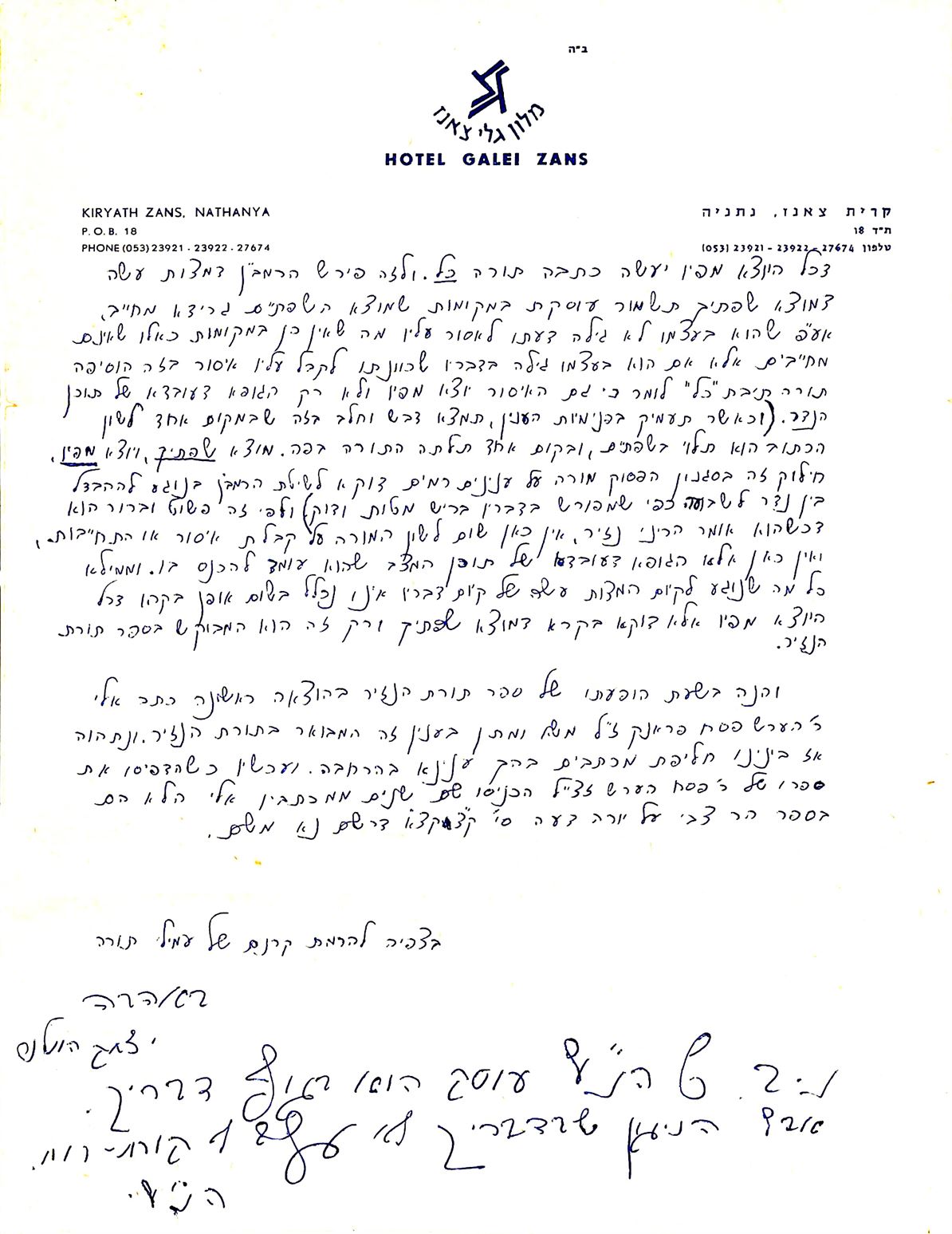
The responsum deals with a shochet who was seen entering the home of a “loose” woman. R. Zalman Sorotzkin didn’t know what do about it and wrote to R. Walkin. R. Walkin refuses to disqualify the shochet, and tells R. Sorotzkin that even if there were two witnesses testifying to the matter it would not change his mind, since this would only turn the shochet into a mumar le-davar ehad! It is true that not all rabbis would have been as lenient as R. Walkin,[19] but the fact that this great posek ruled the way he did is quite significant.[20]

Finally, I am curious to hear what some of the lawyers reading this post have to say about the following: Some time ago, I was contacted by a man who wanted to talk to me about being an expert witness for the defense in the appeal of a sexual abuse conviction. The case is actually one of the worst we have seen. I was told that my role would only be to answer questions about sexual mores in the hasidic world, in particular, how they understand tzeniut. While I am far from an expert on this, not being from that world, the defense team wanted an academic on the stand. (Needless to say, there are academics who would also be much better choices than me.) .

Nothing came of this discussion, and I myself decided that I would have nothing to do with the case after learning the particulars, which are indeed sickening. My question is as follows: We know that defense lawyers are not personally tainted even if they represent horrible people. We recognize that this is their job. My sense is that people would not give the same leeway to an expert witness, and he would be viewed very negatively, as one who was helping to free a sexual abuser. Yet I would like to get some feedback from the lawyers. If I would have agreed to be called to the stand to answer general questions about halakhah and tzeniut, does the fact that I was part of the defense team’s strategy mean that I would be “helping” the defense? It was made clear to me that my role would be to simply to answer general questions and I would have nothing to do with the defendant per se. Another way of framing the question is, would it have been immoral for me to agree to this role if, after having examined the evidence, I was convinced that the defendant committed terrible crimes and  should remain in jail?  

5. For the runoff quiz I asked the following:

A. What is the first volume of responsa published in the lifetime of its author?
B. There is a verse in the book of Exodus which has a very strange vocalization of a word, found nowhere else in Tanach. (The word itself is also spelled in an unusual fashion, found only one other time in Tanach). The purpose of this vocalization is apparently in order to make a rhyme. What am I referring to?
Some got the answer to the first question, and others got the answer to the second question. But only one person, Peretz Mochkin, got the answers to both.
The answer to the first question is the responsa volume Binyamin Ze’ev (Venice, 1539), by R. Benjamin Ze’ev of Arta.
The answer to the second question is the word אתכה in Ex. 29:35. It is spelled and vocalized the way it is in order to rhyme with the word ככה that appears earlier in the sentence.
וְעָשִׂיתָ לְאַהֲרֹן וּלְבָנָיו, כָּכָה, כְּכֹל אֲשֶׁר-צִוִּיתִי, אֹתָכָה
One of the sources that refers to this text is Zev Grossman, Darkhei ha-Melitzah be-Sefer Tehillim. This is a very interesting book on aspects of grammar in Tanach. Here is the title page, with an approbation of sorts from William Chomsky. I don’t know of any other book that puts the approbation on the title page, and in this case the approbation is in English. (William Chomsky, incidentally, is the father of Noam Chomsky.)

One of the things Grossman points out in his book is that there are many examples of verses where we find words in non-grammatical forms in order that they rhyme. Here is just one example, from Psalms 5:8:
וַאֲנִי–בְּרֹב חַסְדְּךָ, אָבוֹא בֵיתֶךָ;    אֶשְׁתַּחֲוֶה אֶל-הֵיכַל-קָדְשְׁךָ, בְּיִרְאָתֶךָ
In context, the final word, ביראתך, means “in fear of you”, even though this is not grammatically correct. This form is used to make the rhyme, because if one were applying grammatical rules it would not be spelled this way.
At the end of the Hebrew section of the book, Grossman has a page listing his published books.

As you can see, he also produced a set of gedolim cards. When I was young, in the 1970s, there were gedolim cards. I know this because I collected them.[21] But I never imagined that they existed already in the early 1950s.
6. In my post of January 13, 2013, I wrote: “R. Meir Schiff (Maharam Schiff) is unique in believing that one without arms should put the tefillin shel yad on the head, together with the tefillin shel rosh. This is the upshot of his comment to Gittin 58a.” I saw this comment of Maharam Schiff many years ago, and unfortunately did not examine it carefully before adding this note. As R. Ezra Bick has correctly pointed out, Maharam Schiff is not speaking about wearing tefillin shel yad on the head to fulfill the mitzvah, but only stating that this is a respectful way to carry the tefillin shel yad if you have to remove it from your arm. This has no relevance to what I wrote about someone without arms (unless he has to carry the tefillin shel yad).

[1] In The Limits of Orthodox Theology I listed numerous rishonim and aharonim who understood Ibn Ezra’s hints to mean that there are post-Mosaic additions the Torah. I have added to this list in various blog posts, and we are now up to around thirty-five different sources. Yet until now I overlooked an important text, namely, a comment by Tosafot. See Tosafot ha-Shalem, ed. Gellis, to Gen. 12:6 (p. 14):
זהו אמרו ואם איננו כן יש לו סוד, כי כוונתו שזה לא כתבו משה אך נכתב אחר שנכבשה, וכן דעתו בהרבה פסוקים
Tosafot rejects this opinion, stating:
 ואנחנו לא ניאות בזה הדעת שכל התורה כתבה משה מפי ה’ בלא חילוק ושנוי.
It is significant that Tosafot does not refer to Ibn Ezra’s interpretation as heretical. For another source that assumes that Ibn Ezra believes that there are post-Mosaic additions in the Torah, see R. Aharon Friedman, Be-Har ha-Shem Yeraeh (Kerem be-Yavneh, 2009), p. 30.
[2] I am aware of no evidence that the rishonim in the Islamic world interpreted these passages in a fundamentally different way than the Ashkenazic rishonim. As noted in The Limits of Orthodox Theology, R. Joseph Ibn Migash openly accepted the viewpoint that Joshua wrote the last eight verses of the Torah.
[3] “Two Notes on the Commentary on the Torah of R. Yehudah he-Hasid,” in Michael A. Shmidman, ed. Turim (New York, 2008), pp. 245-246. In his just published The Intellectual History and Rabbinic Culture of Medieval Ashkenaz (Detroit, 2013), p. 32, Ephraim Kanarfogel writes: “The availability of this kind of interpretational freedom and variety also allowed Hasidei Ashkenaz to be comfortable with Ibn Ezra’s stipulation of verses that may have been added to the Torah after the revelation at Sinai.” 
[4] I deal with this in my forthcoming book, where the relevant citations will be found.
[5] See here
http://www.moreshet.co.il/web/shut/shut2.asp?id=68707
[6] Rosenzweig wrote: “We, however, take this R to stand not for Redactor but for rabbenu [our rabbi]. For whoever he was, and whatever text lay before him, he is our teacher, and his theology is our teaching.” See Dan Avnon, Martin Buber: The Hidden Dialogue (Lanham, 1998), p. 50.
[7] Sherlo’s answer is not clear. He was asked about the Seventh Principle, that Moses’ prophecy is superior to all others. Rather than replying to this, he answers that there were amoraim who did not think that Moses wrote the last verses of the Torah. This, however, relates to the Eighth Principle, not the Seventh. None of the amoraim who thought that Joshua wrote the last verses assumed that he was on Moses’ prophetic level, so Sherlo’s answer is really a non-sequitur.
[8] In recent years I have seen many examples of this. Some extreme statement or ban is attributed to a haredi gadol, and commenters on haredi news sites declare that Gadol X could never have made such a hurtful and counterproductive statement. These commenters argue that it must be the “askanim” who are responsible for this. (I specifically remember such arguments in the first few days after the ban on Making of a Godol was announced.) When a few days later it becomes clear that the statement is accurate, and was indeed made by the gadol, what then are these people to do, people who just a few days prior were so adamant in rejecting the position? 

People convincing themselves that their leaders could not really mean what they say is obviously not merely a haredi issue. Here is what Paul Veyne writes: “Under France’s Old Regime, people believed and wanted to believe in the king’s kindness and that the entire problem was the fault of his ministers. If this were not the case, all was lost, since one could not hope to expel the king the way one could remove a mere minister.” See Did the Greeks Believe in Their Myths (Chicago, 1988), p. 91.

[9] Regarding the Sefer Torah found by Hilkiah, R. Jacob Emden, Birat Migdal Oz (Zhitomir, 1874), p. 152a, claims that Josiah was unable to read the old Hebrew script in this Torah, and that is why it had to be read to him. For a rejection of this view, see R. Jacob Bachrach, Ha-Yahas la-Ketav Ashuri u-le-Toldotav (Warsaw, 1854), pp. 47-48.
[10] The division of the Pentateuch into different books is itself quite ancient. See R. Hayyim Hirschensohn, Seder la-Mikra (Jerusalem, 1933), vol. 1, p. 52.
[11] As mentioned already, the Bible Critics of whom I speak don’t really believe that it was “found”.
[12] There is another unusual tradition that appears in Yemenite texts according to which the entire Torah (and also the rest of the Bible) was forgotten by the Jews during the First Exile, and Ezra later reconstituted it from memory. See R. Saadiah ben David, Midrash ha-Beur, ed. Kafih, vol. 2, p. 676. See also here.
[13] Mavo le-Torah she-Baal Peh, ed. Zini (Jerusalem, 2002), pp. 25-26.
[14] See also Bezalel Naor, The Limit of Intellectual Freedom (Spring Valley, 2011), pp. 77, 253. In Deut. 17:18 it says about the king: וְהָיָה כְשִׁבְתּוֹ, עַל כִּסֵּא מַמְלַכְתּוֹ–וְכָתַב לוֹ אֶת-מִשְׁנֵה הַתּוֹרָה הַזֹּאת
For a rejection of the view that the words “Mishneh Torah” refer to Deuteronomy, see Bachrach, Ha-Yahas la-Ketav Ashuri u-le-Toldotav, p. 70.
I have often heard the notion expressed, in line with Ibn Ezra to Deut. 4:14, Nahmanides to Lev. 8:38 and in his introduction toDeuteronomy, and Abarbanel in his introduction to Deuteronomy, that all of the mitzvot were given at Sinai or soon after. I don’t think this is the simple meaning of the Torah. After all, there are loads of mitzvot in the book of Deuteronomy, and this was years after the revelation at Sinai. Apparently, Nahmanides’ viewpoint was motivated by his dogmatic assumption. R. Bahya ben Asher, Commentary to Gen. 24:22, and Radbaz did not share Nahmanides’ outlook, with Radbaz writing: ודברי [הרמב”ן] תימה הם בעיני. See She’elot u-Teshuvot ha-Radbaz, no. 2143. Radbaz has a very provocative formulation in this responsum, and I am not sure what to make of it.
אין הכי נמי שצוה במצוות רבות בערבות מואב וכמה מצוות מצינו שאמרן משה לישראל ולא נאמר בהם צו את בני ישראל או דבר אל בני ישראל אלא משה יושב ודורש והכל יודעין שהכל מפי הגבורה
The words משה יושב ודורש are found in Bava Batra 119b where it means that Moses was expounding on a certain biblical law. As these words are used here, however, they appear to mean that Moses generated new mitzvot by means his יושב ודורש. This is not the same as God directly informing Moses of these new commandments, and I don’t know any earlier source that portrays mitzvot as originating in this fashion. It is also contradicted by how Maimonides describes the revelation of the Torah in his Eighth Principle.
               
Yet I am not certain about this, since the passage immediately following the one quoted above seems to offer a different perspective: 
וכל המצוות המחודשות אשר במשנה תורה הקב”ה אמר למשה בערבות מואב ומשה אמרן לישראל בכלל שבאר להם המצוות אשר כבר נאמרו וכל מה שנתחדש בהם מפי הקב”ה הוא ומשה לא דרש דבר מדעתו.
[15] See R. Eliah Shapiro, Eliah Rabbah 669:17.
[16] Avat Nefesh is discussed here.
[17] One student told me that he would often cite Kierkegaard.
[18] Both of these responsa, and others as well, are analyzed by Dr. Yitzhak Hershkowitz in a forthcoming article. I thank him for sharing his article with me prior to publication.
[19] For more stringent rulings, see R. Yekutiel Yehudah Greenwald, Ha-Shohet ve-ha-Shehitah ve-Sifrut ha-Rabbanut (New York, 1955), pp. 86ff.
[20] In Between the Yeshiva World and Modern Orthodoxy, p. 211 n. 172, I refer to R. Walkin as R. Jehiel Jacob Weinberg’s “short lived successor to the rabbinate of Pilwishki.” Some have wondered how I know this information, and indeed there is nothing about this in Eliezer Katzman’s articles on R. Walkin in Yeshurun vols. 11 and 12. That R. Walkin was rav of Pilwishki is found in R. Weinberg’s article about the town in Kitvei R. Weinberg, vol. 2, p. 390. In a letter to R. Kook, R. Walkin asks his advice on whether he should accept the rabbinate of Pilwishki. See Iggerot la-Reiyah (Jerusalem, 1990), no. 151. The date given in R. Walkin’s letter to R. Kook is Heshvan 5684 (1923), but this can’t be correct, as by this time R. Walkin was the rav of Pinsk. The original must say תרפ”ב not  תרפ”ג.
[21] A few readers might remember my bar mitzvah party, where some of these gedolim pictures were turned into posters. Also, smaller blow-ups were placed on each table as the table identifier. While most of the posters were thrown out, I saved one. When I attended JEC in Elizabeth for high school, I brought in the poster made from this picture of R. Elchanan Wasserman, and hung it on my classroom wall..

Everyone in the class thought this was very nice. One day I came to school and the poster was gone. Someone told me that R. Pinchas Teitz had taken it down. I couldn’t for the life of me understand why he would do that. I didn’t know then what I know now, about how many people strongly opposed R. Elchanan’s viewpoints (e.g., R. Zvi Yehudah Kook wouldn’t allow R. Elchanan’s Kovetz Ma’amarim in Merkaz ha-Rav’s library. See Hilah Wolberstein, Mashmia Yeshuah [Or Etzion, 2010], pp. 192-193, 404). But even if I knew that, this would not have been a reason for R. Teitz to take down the poster. I went to see him, first to get my poster back, and also to understand why he took it down. He explained that since we had a minyan in the classroom, it was improper to have a picture of a man on the wall, even if this man was R. Elchanan.


The 1526 Prague Haggadah and its Illustrations

The 1526 Prague Haggadah and its Illustrations
By ELIEZER BRODT

This piece was originally printed in Ami Magazine’s Kunteres 9 Nisan 5777 – April 5, 2017

The topic perhaps most written about in Jewish literature is the Haggadah shel Pesach. There are many kinds in many languages and with all kinds of pirushim and pictures. Whatever style one can think of, not one but many Haggados have been written—be it on derush, kabbalah, halachah, mussar or chassidus. There are people who specialize in collecting Haggados, even though they don’t regularly collect sefarim. In every Jewish house today one can find many kinds of Haggados. Over the years, various bibliographers collected and listed the various Haggados. In 1997, Yitzchak Yudolov printed The Haggadah Thesaurus, which contains an extensive bibliography of Haggados from the beginning of printing until 1960. The final number in his bibliography listing is 4,715! Of course, many more have been printed since 1960. New Haggados are printed every single year. Even people who never wrote chiddushim on the Haggadah have had one published under their name based on their collected writings. When one goes to the sefarim store before Pesach, it has become the custom to buy at least one, although it is very easy to become overwhelmed, not knowing which to pick.
The one I would like to focus on in this article was printed in Prague in 1526.[1] The Prague  edition of the Haggadah is considered by experts to be one of the most important illustrated Haggados ever published. It is perhaps the earliest printed[2] illustrated Haggadah for a Jewish audience, and it served as a model for many subsequent illustrated Haggados. Some insist that it is the greatest single Haggadah ever printed. “Certainly it is one of the chief glories in the annals of Hebrew printing as a whole and for that matter in the history of typography in any language.”[3] Printing came to Prague in 1487 (around 40 years after its invention), and the first Hebrew book was printed there in 1518. The Prague 1526 edition was published by the brothers Gershom (Cohen) and Gronom Katz on Sunday, 26 Teves 5287 or December 30, 1526.[4]
This Haggadah contains many of the halachos of the Seder beginning with bedikas chametz, a collection of pirushim on various parts of the Haggadah, and 60 illustrations made from woodcuts. However, we do not know who authored these halachos and divrei Torah (which are full of interesting ideas). The halachos written here are very significant, as they were written and printed before the Shulchan Aruch. The illustrations are also significant, as they had a tremendous impact on the illustrated Haggados printed afterward.
I would like to discuss some of the interesting things we can learn about the Seder and Haggadah via this Haggadah and some of its illustrations.
The first general question is why they chose to illustrate the Haggadah. Who was their intended audience? Various people who studied this Haggadah have debated this issue,[5] but to me it’s pretty clear that it had to do with one of the most important parts of the Seder night—the special audience—the children. This was a tool to help enable us to fulfil the important obligation of v’higadeta l’vincha. Last year, in an article in this magazine, I outlined many customs done during the Seder with the underlying theme to get the children “into” the Seder. One of the best ways to get kids “into” it is via visual aids, showing them pictures or acting out certain things.  Simply reciting the Haggadah and just saying “some Torah” is not as effective. It would seem to me that this was their intention when they illustrated the Haggadah. It could be that some of the pictures were to lighten it up for the adults too, as I will soon explain.
The significance of this point is that Rav Shlomo Zalman Auerbach, zt”l, raises possible issues with looking at illustrated Haggados on Pesach based on the halachos in the Shulchan Aruch (307:15) dealing with reading captions of images on Shabbos.[6]
If we are correct that the purpose is to educate the children, it might be a possible reason to permit looking at these images. To be sure, some of the Haggados with images were printed with the involvement of great gedolim, such as the illustrated 1590 Prague Haggadah, which had a kitzur of the Zevach Pesach of the Abarbanel written by Rav Yitzchak Chayis (1538-1610).
Just to emphasize the significance of visual aids when learning, in a haskamah for a work about shechitah that was written but never printed, the Aderes stresses the benefit of the numerous diagrams and illustrations of animals in the book for the understanding of the various complex halachos of shechitah.[7]
Similarly, Rav Belsky dissected an animal on video to give a visual aid for those learning Maseches Chulin. It is also related that when the Minsker Gadol, Rav Yerucham Perlman, zt”l (1835-1896), first became rav he made it his business to go to the head shochet of the city to learn all the aspects of animals for the laws of treifos and the like. The shochet asked him how he could possibly teach the rav anything. The Minsker Gadol replied, “It’s one thing to learn the halachos in sefarim, but when it comes to psak halachah one needs to know the exact aspects as they are on the actual animal.[8]
Additionally, there is a great benefit for us to analyze the pictures nowadays, as it can give us a glimpse into how they conducted the Seder in those days.
Halachos
One of the first parts of the Seder is the eating of karpas. Nowadays, for the most part, the custom is for the children to say, “We wash our hands, but we don’t say the brachah for this washing.” In the instructions to the Prague Hagadah it says to say the brachah for washing.[9] In fact, there are a number of Rishonim who say that one should say the brachah of al netilas yadayim.
Who pours the wine?
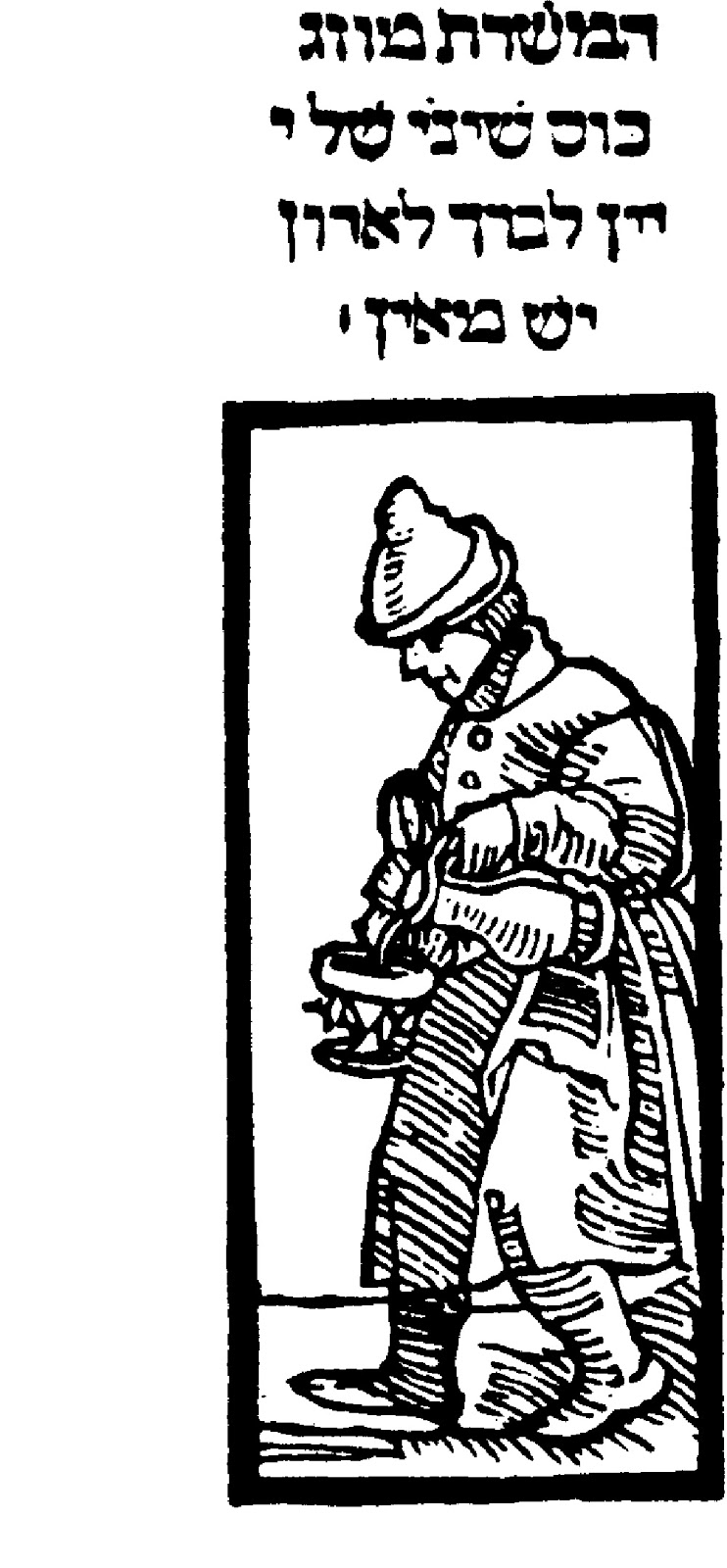
After saying Ha Lachma Anya the cups of wine are refilled. There is a picture of someone refilling the wine with a caption stating that the servant should refill the wine. The Rama in Darchei Moshe says that the person who is conducting the Seder should not fill the cups of wine; rather, someone else should do it for him.[10] This would appear to be an earlier writter source with the same idea.[11] Interestingly enough, the Aruch Hashulchan writes that we do not do this. The leader can pour the wine for himself, and there is no reason that his wife should have to pour for him.[12] Rav Yitzchak Chayis writes in Siach Yitzchak—which is a halachic work about the Seder night first printed in Prague in 1587—that one should train his six or seven-year-old child to do this mitzvah.[13] Perhaps another minhag related to this statement of the Rama is that the one leading the Seder does not get up to wash his hands; rather, the water is brought to him.[14]
Pouring out the wine for the Ten Makkos
 
After saying Ha Lachma Anya the cups of wine are refilled. There is a picture of someone refilling the wine with a caption stating that the servant should refill the wine. The Rama in Darchei Moshe says that the person who is conducting the Seder should not fill the cups of wine; rather, someone else should do it for him.[10] This would appear to be an earlier writter source with the same idea.[11] Interestingly enough, the Aruch Hashulchan writes that we do not do this. The leader can pour the wine for himself, and there is no reason that his wife should have to pour for him.[12] Rav Yitzchak Chayis writes in Siach Yitzchak—which is a halachic work about the Seder night first printed in Prague in 1587—that one should train his six or seven-year-old child to do this mitzvah.[13] Perhaps another minhag related to this statement of the Rama is that the one leading the Seder does not get up to wash his hands; rather, the water is brought to him.[14]
Another minhag found in this Haggadah is the famous custom of dipping the fingers into the wine when saying the Ten Makkos. In this section of the Haggadah there is an illustration of someone dipping his finger into his cup and there is also a caption under the picture stating that some dip with the pinky, followed by a reason for this custom.[15]
The earliest known source for this minhag can be found in a drashah of the Rokei’ach, recently printed from a manuscript by Professor Simcha Emanuel.[16] But this source speaks about dipping the index finger. The Rama also writes to dip the index finger. Interestingly, the Magen Avraham says to dip with the kemitzah, which is the ring finger.
Walking with a sack on the back
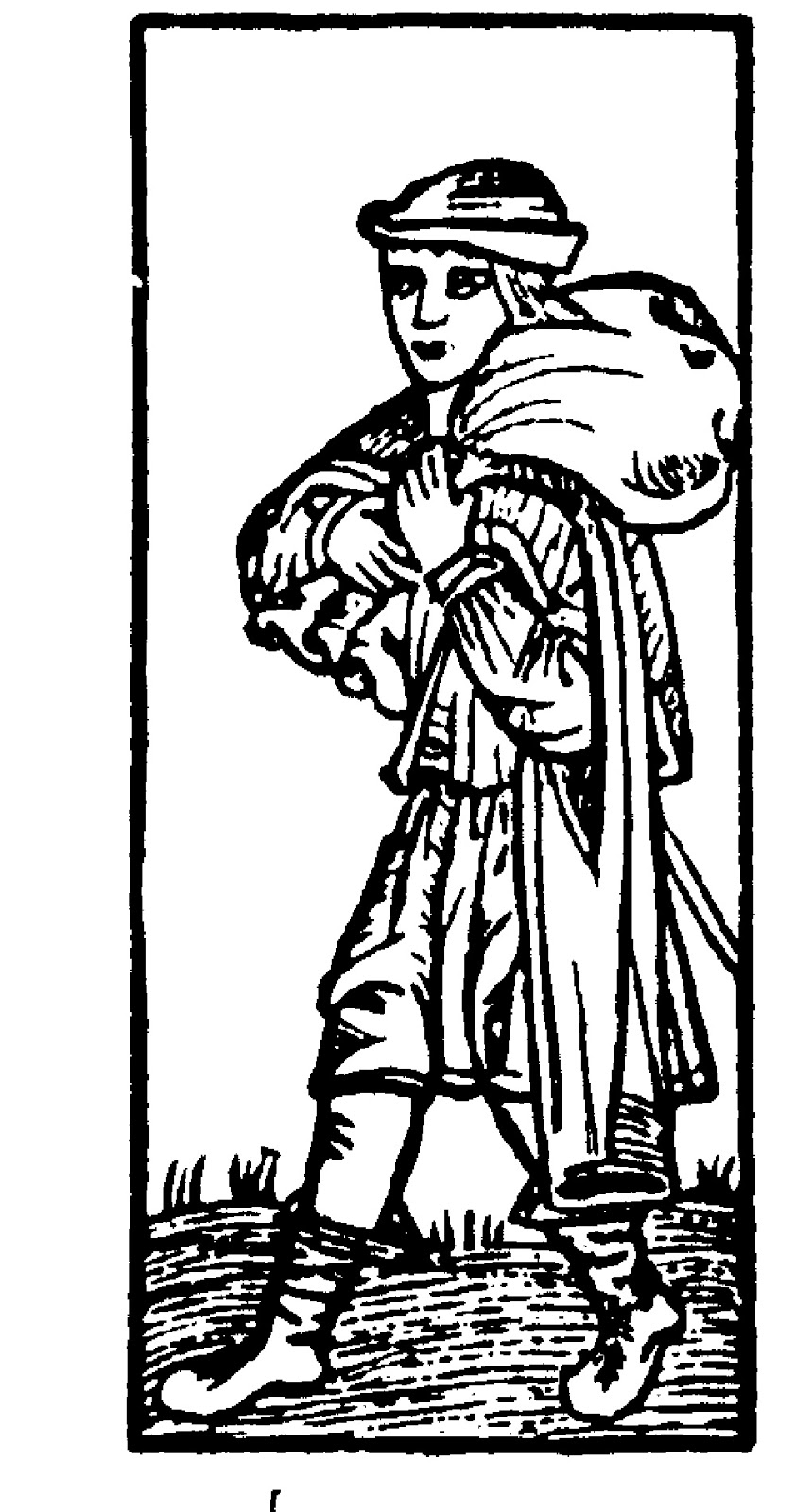
There a few places in the Haggadah, such as near the paragraph of B’chol dor vador, where we find an illustration of someone walking with a sack (of matzah) on his back. The source for this can be found in some of the Rishonim and early Acharonim. After mentioning breaking the matzah in their description of Yachatz they add that the leader of the Seder puts it on his shoulders and walks with it for a bit; others do this only later on when they eat the afikoman.[17]
Eliyahu Hanavi coming to the Seder
I traced the sources for this in a previous article in Ami Magazine. When discussing the sources for this, Rabbi Sperber notes[18] that in a few of the illustrated Haggados there are pictures of a man on a donkey near Shefoch Chamascha. In some of them he is being led by someone else; for example, in the Prague Haggadah of 1526.
I also noted that Rabbi Yuzpeh Shamash writes that mazikin run away from any place where Eliyahu’s name is mentioned. He says that because of this some make a picture of Eliyahu and Moshiach for the children, so that the children seeing it will say “Eliyahu,” causing the mazikin to disappear.[19] This could indicate that the illustrations were shown specifically to the children, as I claimed earlier.
Nusach of the Haggadah
The actual nusach of the Haggadah is its own large topic, starting from the Gemara and moving onward to manuscripts and discussions among the poskim. In the beginning of the Haggadah we begin with the famous Aramaic passage of Ha Lachma Anya. Much has been written about different aspects of this passage. One aspect is whether the exact nusach should be Ha Lachma Anya or K’ha Lachma Anya. The Rama quotes Rav Avraham of Prague, who says to specifically say Ha Lachma Anya and not K’ha Lachma Anya. The Maharal says the same. We see that two great sages from the city of Prague paskened that we should say Ha Lachma Anya.
Who was this Rav Avraham of Prague quoted by the Rama?
Rav Dovid Ganz (a talmid of the Maharal) writes in his historical work Tzemach Dovid that he was the rosh yeshivah and av beis din of Prague in the 1520s. He also authored some notes to the Tur, which were printed by Gershom (Cohen) Katz in Prague in 1540.[20] Thus, it is interesting that in the Haggadah the nusach was different from that of the av beis din of the city. Interestingly enough, his sons printed two more Haggados (1556 and 1590) in Prague and there too the nusach is different from that of Rav Avraham. Ultimately, the Magen Avraham concludes that whichever nusach one says is fine.[21]
What to use for maror
Another interesting picture is of the maror. In two places in the Haggadah the illustration used for maror is that of a lettuce—chasah. This is chazeret, which is the first of the five types enumerated in the Mishnah that one can use for maror.
There is a famous teshuvah from the Chacham Tzvi where he writes at length that this is the ideal item to be used for maror, as it’s the first in the list of the Mishnah.[22] We also find that the Netziv wrote a letter to his son, Rabbi Chaim Berlin, urging him to use it for maror instead of sharper vegetables, especially after fasting and drinking wine.[23] There are also numerous earlier illustrated manuscripts that show pictures of lettuce for the maror.[24]
More on maror
Speaking of maror, the inscription next to the picture is of great interest. It says, “There is a custom when saying maror that the man points to his wife, as it says ‘An evil wife is worse than death.’” Much has been written about this illustration. Some have written that it is ridiculous and there cannot be such a custom. On the other hand, Rabbi Wengrov and, more recently, Rabbi Yisroel Peles,[25] have demonstrated that there are pictures of a man pointing to his wife near the paragraph of maror in various illustrated Haggadah manuscripts. It is clear, however, as Rabbi Wengrov writes, that this was done in a joking manner to lighten up the Seder, but it isn’t serious, chas v’shalom. Rabbi Wengrov demonstrates that other pictures found in these Haggados show that the authors had a sense of humor and drew certain illustrations to lighten up the mood.[26]
Explanation via illustration
 
 
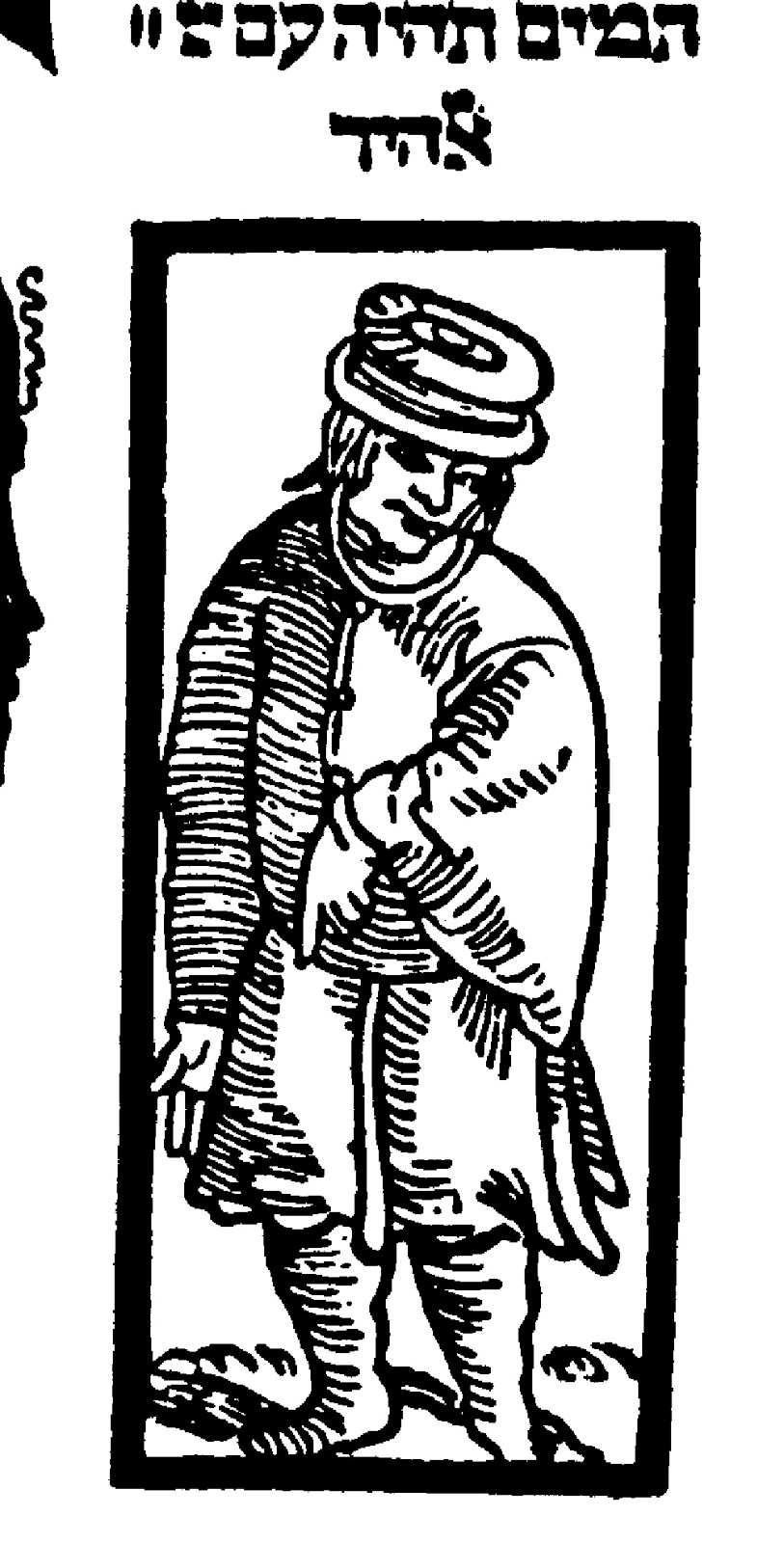
Some of the pictures in the Haggadah are to explain a particular passage. One such example is the image of the four sons. The tam is often translated as a derogatory term—the foolish son. However, the caption above the picture says, “Tamim tihyeh im Hashem” – always be complete with Hashem, which means that they understood the tam to be a man of piety.[27]
Omission
At the end of the Haggadah we conclude the Seder with a few songs, such as Echad Mi Yodei’a[28] and Chad Gadya. The authors and earliest sources for reciting them are unknown.[29] Rabbi Shemaryah Adler suggests that Chad Gadya may have been written by Daniel.[30] Rabbi Yedidyah Tiyah Weil writes in Marbeh L’sapeir on the Haggadah that he heard that these two songs were found in a manuscript from the beis midrash of Rav Elazar Rokei’ach. Numerous pirushim have been written about Chad Gadya, based on all the methods of learning Torah.[31] Be that as it may, many have noted that they are not found in this Haggadah. The first time they appear in print are in the Haggadah printed in Prague in 1590.
Another notable omission is the stealing of the afikoman. I wrote in the past in this magazine that one of the earliest sources in print can be found in the Siach Yitzchak, which mentions stealing the afikoman, but not in the same way as we do it nowadays.[32] It would seem that since no mention of it is made in the instructions of the 1526 Haggadah that it was not yet a widespread custom at that time.
Kiddush and Hunting
 

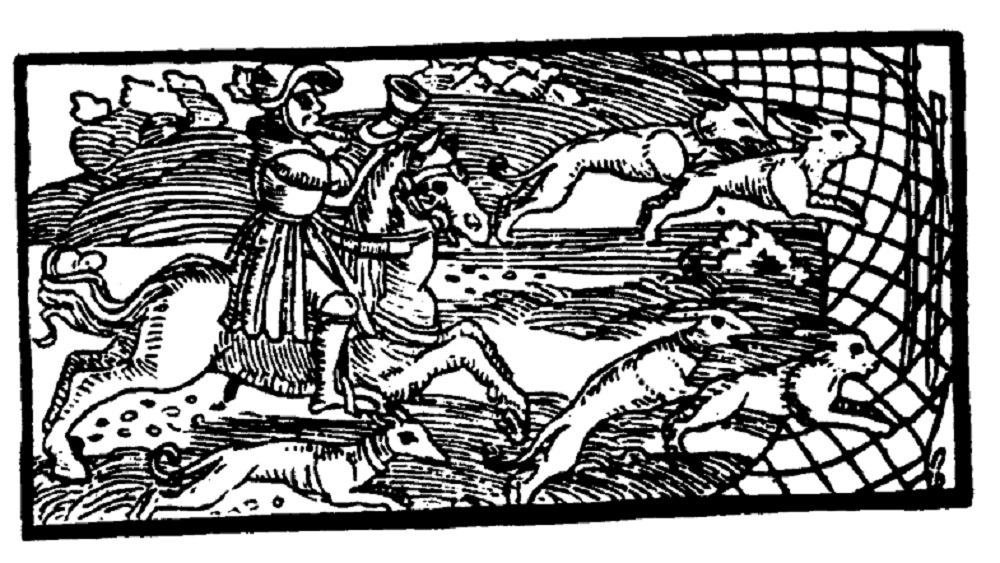
In the beginning of the Haggadah, on the bottom of the page of Kiddush, we find a mysterious picture of someone hunting hares with a horn and dogs. This picture can also be found in a bentcher printed by the Katz brothers in Prague a few years earlier. The question is obvious: What in the world does this have to do with Kiddush, especially as it is not a Jewish hobby? One of the answers suggested is that when Yom Tov occurs on Motzaei Shabbos we use an abbreviation known as Yaknehaz to remember the order in which to say Kiddush and Havdalah. The pronunciation of Yaknehaz is similar to jagen hasen, which is German for hunting hares, so this picture is meant to serve as a reminder of the abbreviation.[33]
Moreon Kiddush
Throughout the Haggadah there are illustrations of people holding cups of wine; sometimes the one holding the cup is dressed like a king. It would appear that this is to reflect the halachah to act like a king on the Seder night as part of the celebration of our freedom.
At other times the image is of an older man holding the cup either in his left hand or in his right. Rabbi Shaul Kook points out that some of the time it’s in the palm of his hand, which is the way it should be held according to various mekubalim, while at other times he holds the cup by its stem. He suggests that near the passage where Rabbi Elazar ben Azaryah says, “I am like someone who is 70 years old,” he is depicted as holding the cup in his left hand while stroking his white beard with the other to show that he’s really not that old.[34] At that point in the Haggadah one would not be holding the cup for the purpose of drinking one of the four kosos and that’s why he’s not holding it in his palm. Whereas in the pictures near where one would hold the cup for drinking he is holding it in the palm of his right hand. However, there is another picture on the page of Kiddush that is similar to the one of Rabbi Elazar holding the cup in his left hand and stroking his beard. Rabbi Kook says that this is because the printer was not educated and, not realizing the reasons for the difference, used the wrong woodcut.[35]
 
The problem with this is that the earliest source we have for holding the cup of wine specifically in the palm of the hand is in the Shalah HaKadosh, which was first printed in 1648—long after this Haggadah was printed.[36] It is, however, very possible that mistakes were made because printing with woodcuts is very difficult and confusing.
Sitting during Kiddush
Other customs that we can possibly learn from the illustration of Kiddush are that the person is both sitting and looking at the cup. These are also mentioned by various poskim in regard to the halachos for how Kiddush should be said.[37] There are other halachos of Kiddush that can perhaps be learned from these illustrations, but one has to be careful as to how much to “read into” them.
[1] On this Haggadah, see A. Yaari, Bibliography Shel Haggadot Pesach, p. 1. Y. Yudolov, Otzar Haggados, p. 2, # 7-8; the introduction to the 1965 reprint of this Haggadah; Yosef Yerushalmi, Haggadah and History, plate 13; Yosef Tabori, Mechkarim B’toldos Halachah (forthcoming), pp. 461-474. See especially the excellent work of Rabbi Charles Wengrov, Haggadah and Woodcut, (1967), which is completely devoted to this Haggadah. Another recent work devoted to this Haggadah was printed this year by R’ Yehoshua Goldberg, Haggadas Prague. Many thanks to my friend Dan Rabinowitz for the discussions about this Haggadah over the past few years. Here are two earlier posts by Dan on manucript Haggados and the 1526 Prague Haggadah: here and here. Thanks also to Mr. Yisroel Israel for his help with the images.
[2] As there are numerous illustrated manuscript haggadas.
[3] Yerushalmi, Haggadah and History, p. 30.
[4] This detailed publication information does not appear on the title page; rather, it appears at the end of the book in what is referred to as the colophon. On the printers see Chaim Friedberg, Toldos Hadefus Haivri, pp. 1-10. On various aspects about printing in these years in Prague, see Hebrew Printing in Bohemia and Moravia (Prague 2012).
[5] Richard Cohen, Jewish Icons, (1998), pp. 94-97; Chone Shmeruk, The Illustrations in Yiddish Books of the Sixteenth and Seventeenth Centuries (Heb. 1986).
[6] Halichos Shlomo (Pesach), pp. 267-268.
[7] Intro to Shu”t Ohel Yosef, 1903.
[8] Hagadol MiMinsk, p.51.
[9] Drashah L’Pesach L’Rabbi Elazar MiVermeiza, p. 96. See: Haggadah Shevivei Eish, p. 152; Y. Tabory, Pesach Dorot, pp. 216-244. See also what I wrote in my work Bein Kesse Le’assor, pp. 148-153.
[10] Darchei Moshe, 486:1.
[11] See also Siach Yitzchak (Brooklyn 2016), p. 241.
[12] Aruch Hashulchan, 473:6.
[13] Siach Yitzchak, p. 239, 252.
[14] Siach Yitzchak, p. 239.
[15] On this minhag see Zvi Ron, Our Own Joy is Lessened and Incomplete; The History of an Interpretation of Sixteen Drops of Wine at the Seder, Hakirah 19 (2015), pp. 237-255. I hope to return to this in the future.
[16] Drashah L’Pesach L’Rabbi Elazar MiVermeiza, p. 51, 101, 127.
[17] Rabbi Wengrov (above note 1), p. 60. See also Hanhagot HaMaharshal, pp. 10-11; Magen Avraham, 473:22; Chidushei Dinim MeiHilchos Pesach, p. 38. See Rabbi Chaim Benveniste, Pesach Me’uvin, 315; Vayageid Moshe, pp. 116-117.
[18] Minhagei Yisroel 4, pp. 168-170.
[19] Minhaghim Dik’hal Vermeiza, p. 86
[20] Tzemach Dovid, p. 139. See also Tzefunot 7 (1990) pp. 22-26.
[21] See also Siddur R’ Shabsei Sofer, 1, p. 5; Rabbi Yosef Zechariah Stern, Zecher Yosef, p. 4. [22] Chacham Tzvi, 119. On using this even though it is not bitter see also Dovid Henshke, Mah Nishtanah (2016), pp. 250-255, 215-220, 224-227, about Maror being bitter.
[23] Meromei Sadeh Pesachim 7b, See also Arthur Schaffer, History of Horseradish as the Bitter Herb of Passover, Gesher 8 (1981) pp. 217-237; Levi Cooper, Bitter Herbs in Hasidic Galicia, JSIJ 12 (2013), pp. 1-40; Z. Amar, Merorim, pp. 67-83. See also Rabbi Yehudah Spitz, Maror Musings, the not so bitter truth about Maror, Ami Magazine (2014), pp. 230-234.
[24] See Rabbi Wengrov (above note 1), p. 54. See also Rabbi Dovid Holtzer, Eitz Chaim 25 (2016), pp. 285-292.
[25] Hamaayan 51 (2011), pp. 11-14.
[26] On this and other pictures related to humor in the Haggadah see Rabbi Wengrov (above note  1),pp. 54-59.
[27] See also Rabbi Wengrov (abovenote 1), pp. 43-44; HaggadasMidrash B’chodesh (2015) of Rav Eliezer Foah (talmid of the Rama MiFano), p.135; R’ Elazer Fleckeles, Maaseh B’Rabbi Elazar, p. 63-64. See also Dovid Henshke, Mah Nishtanah (2016), pp. 358-359.
[28] See Rabbi Toviah Preshel, Kovetz Maamarei Tuviah 2, pp.64-65.
[29] See Chone Shmeruk, “The Earliest Aramaic and Yiddish Version of the Song of the Kid (Khad Gadye),” in The Field of Yiddish, 1 (New York 1954), pp. 214-218; Chone Shmeruk, Safrut Yiddish,pp. 40-42, 57-60; Asufot, 2 (1988), pp. 201-226; Rabbi Yisroel Dandrovitz, Eitz Chaim 23 (2015), pp. 400-416. Shimon Steinmetz discusses the origin of Chad Gadya here.
[30] Minchas Cohen, p. 73. Many thanks to my friend Rabbi Shalom Jacob for sending copies of this extremely rare work.
[31] Marbeh L’Sapeir, p. 140, 151. See also Rabbi Yosef Zechariah Stern in his Haggadah Zecher Yosef (p. 30), who writes that he did not find this piyut printed before the sefer Maasei Hashem. See also the Haggadah Shleimah ad. loc.; Assufot, vol 2 pp. 201-226; Mo’adim L’simcha vol. 5 ch. 11; Y. Tabory, Pesach Doros, pp. 341-342 and the note on pp 379.
[32] Siach Yitzchak, p. 21a. About this gaon see the introduction of Rabbi Adler in his recent edition of Pnei Yitzchak – Apei Ravrevi.
[33] See Rabbi Wengrov (above note 1), pp. 36-37.
[34] See Rabbi Yosef Zechariah Stern, Zecher Yosef, pp. 5a-6a.
[35] See Yeida Haam 2 (1954), p. 148; Iyunim Umechkarim, 1 pp. 81-83.
[36] See also R’vid Hazahav, Vayeishev (Kaf Paroh); Rabbi Mordechai Rosenbalt, Hadras Mordechai, Bereishis, 259. See also Shu”t Beis Yaakov, (1696) 174 who quotes such a custom from the Arizal.
[37] See Rabbi Dovid Deblitsky, Birchos L’rosh Tzaddik, pp. 25-31.


Legacy Judaica Spring 2021 Auction

Legacy Judaica Spring 2021 Auction

By Dan Rabinowitz and Eliezer Brodt

Legacy Auction Judaica is holding its Spring auction on May 30th (link) and it provides us the opportunity to discuss some interesting bibliographical and historical books and items.

Item #7 is the first edition of Charedim printed in 1601. This is the first appearance of R. Elazar Azkiri’s song Yedid Nefesh in print. For a full discussion of this Tefilah see Bentcy Eichorn, Zemirot Zion, pp. 91-106. This volume also has many unidentified glosses.

Another entry of note is Item #147, the Hida’s copy of the 1545 edition of the Sifra with what may be his marginalia.

An item with important glosses is Item #160 which has the notes of R’ Chaim Sofer known as ‘the Hungarian R’ Chaim,’ on the work Sharei Torah. See also Item #61 which has glosses from R’ Hirsch Berlin.

Item #79, is the first edition, Seder Zera’im. While small portions of the Tiferes Yisrael commentary on the Mishna proved controversial, this volume contains the approbation of R. Akiva Eiger, who is also listed on the subscriber list.

Another controversial work, the late R. Nosson Kamenetsky’s Making of a Godol, is Item #97. This is the first edition, not the later edition which censored material from the first. We discuss some of the controversy, bans, and differences between the editions, in a series of articles here, here, here, and here.

Also a controversial work is Item #100, Pulmus haMussar which discusses the dispute regarding the Mussar movement. Revealing the inner machinations between the parties proved controversial itself and Pulmus was printed just once and it has never been reprinted. Regarding this work, see Eitam Henkin, Ta’arokh le-fani Shulkhan, 123-139.

Item #136’s description contains an interesting cryptic note about the copy of Pe’as Hashulchan: “Includes the rare final page of corrections and polemics”.

Here is the story behind this sentence: In 1799 one of the earliest authorized works of the Gra printed was the Shenos Eliyahu. In the back there was a section called Likutim.

Here is the text of the Gra Related to Mesorah:

In 1821 R’ Wolf Heidenheim wrote about this:

This is what R’ Shklover is referring to in the last page of his work without naming who he was referring to:

Interestingly enough R’ Yitzchaki of Bnei Brak in an article in Yeshurun 5 (1999) pp. 535-537 concludes that R’ Heidenheim was correct. In later editions of the Pe’as Hashulchan has the piece of R’ Shklover added into the proper place in the important introduction of the work. (Thanks to Y. Yankelowitz for his sources and materials).

Another work of the Gra is the first edition of the Biur ha-Gra on Shulhan Orakh (Item #137). This edition removed many standard commentaries (Taz, etc.) but not the Be’er ha-Goleh because he was related to the Gra. A Shulhan Orakh with just the Gra’s commentary proved not viable because when people purchased a Shulhan Orakh they wanted all the standard commentaries in addition to the Gra’s. In the middle of the publication of the Even ha-Ezer volume the publishers decided that they would include the other commentaries even if it meant moving the Gaon’s commentary to the bottom, they received permission from R. Chaim Volozhin to do so.

About Item #18 Messechtas Purim see our discussion earlier on the blog here.

Item #25 is Peirush Megilas Achashverosh, Venice 1565. The description states:

R. Zechariah ben Saruk (1450-c. 1540), was one of the great Chachamim of Spain… With an important introduction, which provides a rare historical glimpse into the travails of Jews who were exiled from Spain as well into as other challenges of that period.

Worth quoting is part of another piece from this interesting introduction:

שהראשונים הניחו לנו לדבר אבל לא לקנטר ואני תמה מאד מן החכם העניו ה”ר שמואל די בידאש נ”ע איך נפל ברשת מאמר האומר אין משיבין על הארי אחר שמת? וזה לשתי סבות הא’ שהוא ידוע לקטני עריסה [רץ המונחים בעריסה] כי קטנם עבה ממתנינו, וההקש והערך שיש בין ידיעתם לידעתנו הוא בערך גלגל ערבות אל נמלה אחת, השנית שהחכמים ההם ע”ה שחברו מה שחברו, האירו לנו בחיבוריהם מפיהם אנו חיים, אם כן מה נהיה כפויי טובה ששתינו מים זכים מבורם ועתה נקנטר כנגדם. ובעת שאמר החכם הנזכר על בעל העטור והרא”ש והרמב”ם ז”ל שהוכו בסנורים, ודברים אחרים, זרים לכל חכם לב לאומרם מאשלי רברבי. ותמהני מחכמתו שאני הייתי מכיר אותו היטב שהוא חכם ועניו איך אמר בהקדמת ספרו מה שסתר אחר כך בספרו? כי אמר בהקדמתו שהסתירה אשר לא יכוןי הסותר לבייש את האשר נעלם ממנו דבר, כי אין זה מורידו מחזקתו. והאמת כן הוא. ובספרו, כשחלק על הגאונים הנזכרים אמר שהוכו בסנורים

ונראה לי דילמא מר נאים כדנפק שמעתתיה מפומיה, כמו שאמרו על רבי יהושע בן לוי, כדאיתא במסכת נדה פרק המפלת. ולא זו בלבד הזהיר לנו חז”ל, אבל גם כן אמרו במוסריהם שלא יחלוק אדם על רבו אפילו בעודו בחיים חייתו, ולכן אמרו בירושלמי לית ריש לקיש מתריס כלפי רבי יוחנן, למפיגל עליה לאפוקי מיניה עובדא. העובדא היה שהוראה רבי יוחנן לתלמידו ריש לקיש שהצפורן אינה מטמא, כמו שהמחלוקת הוא בירשלמי במסכת הורית פרק כהן משוח

ובעבור שזה האיש היה חשוב במדותיו, נאמר שזה היה כשגגה שיוצא מלפני השליט ולכן בכל מה שחלק כנגד גאונים עולם, לא אדבר אלא באחד, בעבור שנשבעתי ואקיימה להיות כנגד כל איש שיחלוק נגד הרא”ש והרמב”ם ז”ל וכו’

על כל שאר הדברים שהטיח כנגדם, ובפרט נגד הראב”ע ז”ל אשר אחר חתימת התלמוד היה רשום ככל הגאונים, אף אלפי שהיה הוא גאון, וראו מה שכתב עליו הרמב”ם לבנו, והוא היה חכם כולל ושלם בכל חכמה. ואנכי ראיתי חדושי הראב”ע ממסכת קידושין [ותוס’ הביאו בקידושין לו א], והם בתכלית הדקות האימות, ובא החכם ר’ שמואל די וידאש, האל יכפרהו לומר עליו, ולא אמר אמת ואינו נכון ודברים אחרים, שאינם ראויים לדבר כנגד האשל הגדול הראב”ע. ומה שאמרתי לא הייתי אומר, אלא שנקרת בפי’ אחד שלו מהמגלה הזאת

Last year this rare work was reprinted based on the first edition and manuscripts with notes and a useful introduction about the work.

Item #37 is the rare work Tal Oros. This work is almost completely unknown to most poskim. One important exception was the Magen Avraham who quoted it numerous times in his classic work on Shulchan Aruch. For additional information about this author see this earlier post on the blog (here).

Previously we have mentioned how we can learn about works found in different people’s libraries. Item #163 is the Beis Halevi’s copy of the classic work of the Malbim on Orach Chaim which sadly was never completed.

An interesting bibliographical scoop about this work can be found in an interview in Mishpacha Magazine in the September 4, 2019 (Issue #776, p. 50) by Rabbi Yonason Sacks. He describes purchasing the Malbim’s own copy which had an important gloss to a specific passage.

The catalog’s letters section is always an important way to learn about interesting unknown historical documents and the like.

Item #229 we learn about a newspaper written in Yeshivas Telz for Purim. This tradition is found already in Volozhin as described by Shaul Stampfer and continues until today.

Item #182 is another Letter of R. Yehiel Mikhel Epstein, author of the Orakh ha-Shulhan.

This letter has a very interesting passage (which the entry downplays) we already wrote about back in 2007 (here). In this letter he wrote not to write to R’ Spektor as he is מוקף מסביב and write to the Netziv even though he is sick.

Shockingly enough R’ Chaim Kanievskey advised R’ Horowitz, the editor of this edition, not to edit out this line.

Item #224 must be highlighted as this is an incredible manuscript, which relates to the famous controversy in Yerushalayim in the 1880’s.

This is a letter from 1887 written by R. Yosef Dov ha-Levi Soloveitchik, the author of the Bes ha-Levi, to his friend R’ Hildesheimer. The catalog description states in part:

During the late 1880’s the old Yishuv of Yerusholayim, then led by the great R. Yehoshua Leib Diskin, was supported by the “Chalukah” system, which was funded by Jews from the Diaspora… He continues that there is still one place that the plague of secular studies has not infiltrated and that is Yerusholayim, and despite the fact that scoffers want to implement secular studies there, the Yishuv, under the leadership of “Rabbeinu HaGadol Me’or Ha’Golah Yochid B’Doreinu B’Torah V’Yirah HaGaon MaHaRIL Diskin Shlit”a, have prevailed and held on to their sacred tradition. However, those who are opposed to the Chachomim are totally persistent in their publications against the Yishuv and the MaHaRIL”. The Beis Ha’Levi therefore requests that R. Hildesheimer publicize that he disagrees with this view, and that he reaffirm that it is forbidden for the school system in the Old Yishuv, which was constituted primarily of students with Lithuanian backgrounds, to implement these changes…

In this letter we see the incredible respect that the Beis Halevi had from R’ Yehoshua Leib Diskin, something known to us from many other sources.

R’ Hildesheimer’s role in this controversy has been discussed a bit by David Ellenson, Rabbi Esriel Hildesheimer and the Creation of a Modern Jewish Orthodoxy, pp. 110-112,123-126.

Many aspects of this fascinating controversy have been dealt with by R’ Eitam Henkin HY”d in various articles.

One important point is from the Beis Halevi letter it sounds like all Lithuanian Gedolim sided with R’ Diskin but this is not so simple at all. R’ Shmuel Salant definitely did not agree with R’ Diskin on this. IYH this will be discussed at greater length in the future.


Legacy Judaica: Astrological Title Pages, R. Hutner, and Other Items of Note

Legacy Judaica‘s Spring auction is on May 8, 2022. The catalog includes some especially rare first editions, Siddur ha-Shelah, (no. 119), Mesilat Yesharim (no. 45), a volume of the Bomberg edition of the Talmud (lot 10), and some other items of interest.

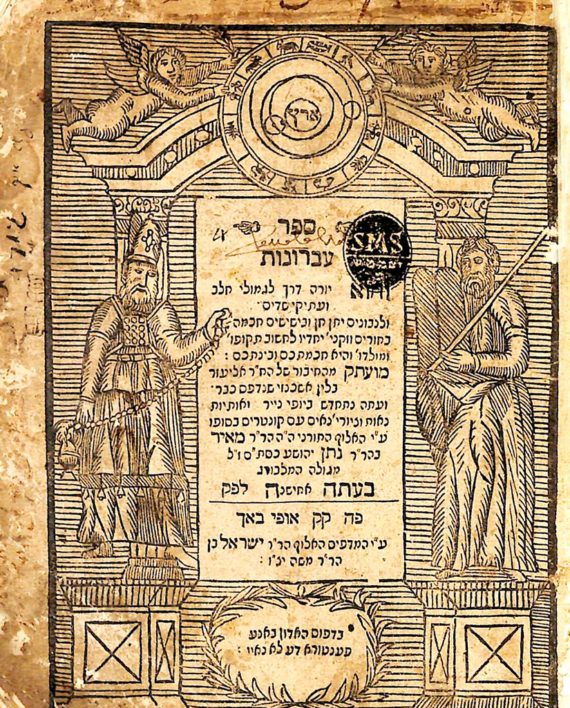
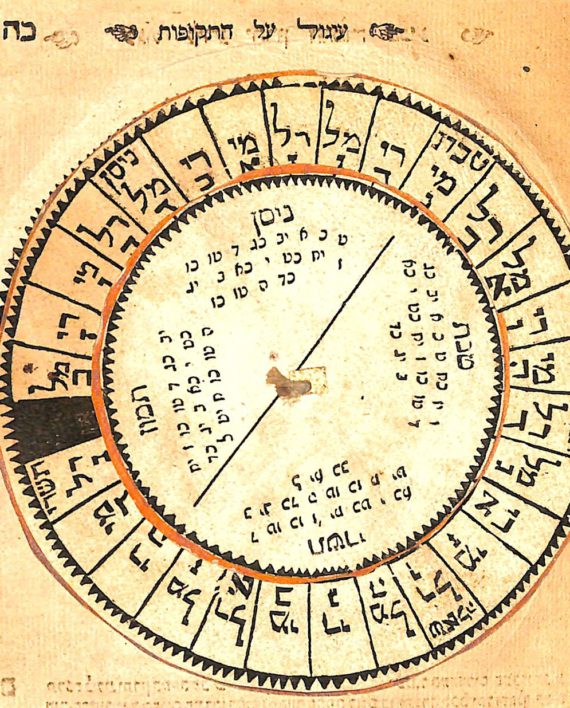
Sefer Evronot, Offenbach, 1722, (lot no. 63) is an unusual Hebrew book because it includes paper cut-outs that are reattached to the book and form an interstellar calculator allowing precise determination of the calendar. Despite the celestial nature of the work, at the top center of the title page, held aloft by putti, is a depiction of the universe. The earth is in the center, but unlike a geocentric approach with the sun circling the earth, there is no reference to the sun, only the planets. The image depicts the orb system of planets and pre-dates even Copernicus’s theory. (See, Ariel Cohen, “The Celestial Host, the Calendar, and Jewish Art,” in Written in the Stars: Art and Symbolism of the Zodiac, ed. Iris Fishof (Jerusalem: Israel Museum, 2001), 18). Israel ben Meir (his father was a noted publisher) and his non-Jewish partner, Bonaventura de Launoy, published the book. (See Marvin Heller, Essays in the Making of the Hebrew Book (Leiden: Brill, 2021), 273-92).

Auction 10 Batch 2 #18b Sefer Ibronos

The Sefer Evronot is not the book for which this title page was designed. Instead, Israel first used the illustration on Abraham ben Hiya’s, Tzurat ha-Arets (Offenbach, 1720). The image is appropriate for the book as it also discusses the solar system’s depiction. This is one of the earliest examples of a title page illustration allusion to the book’s contents and not serving an aesthetic purpose.

Tzurat Ha-Aretz, from the Gross Family Collection

A similar illustration to the title page’s celestial illustration appears in the book. 58a. But the one in the book is less sophisticated than the title page; that one contains a very detailed zodiac. Although it was specifically created for a Hebrew book it didn’t stop the ubiquitous error of depicting Aaron with a bishop’s miter, this time with a cross clearly visible. The Moses and Aaron theme title page first appeared in 1610 in Hanua. One year later, it was used in another book, Nishmat Adam, (lot no. 11), although that one does not have a cross.

The zodiac title page illustration appears on at least two other of Israel’s books that have no association with celestial ideas: a commentary on Birkat ha-Mazon and Zemirot, Mateh Yehuda, (Offenbach,1721) and a Haggadah with the commentary Zera Yehuda (Offenbach, 1721). Israel printed over 40 books, and it is unclear why he decided to use it on these two books that seemingly have no relationship to the image.

There are two items related to R. Hutner’s Torat ha-Nazir. Lot 70, is the first edition published in softcover format in Kovno in 1932. This is the only edition that R. Kook’s approbation appears. The later editions of Torat HaNazir remove it. In some editions, all the approbations are removed and in others, R. Chaim Ozer’s was retained. (although the printers did not alter the original heading, “Letters of the Ge’onim.” See Marc Shapiro, Changing the Immutable (Oxford: Littman, 2015), 157-160.

Another item related to the Torat Ha-Nazir is a letter to an unidentified correspondent (lot 236). Apparently, R. Hunter chanced upon that person’s copy of Torat ha-Nazir with their notes. One of which took issue with R. Hutner’s approach, and he defended himself. R. Hutner added a postscript that the tone was inappropriate whatever the objections (in the margins).

Lot 223 is a letter from R. Chaim Ozer regarding cremation.  Although today after the Holocaust it seems difficult to imagine cremation widely accepted by Jews, in the early 20th century, some Orthodox rabbis permitted cremation.  R. Ozer’s letter discusses one the main works, Hayyi Olam.

Lot 77 is two broadsides. One is from a list of Rabbis against Heichal Shlomo, against attending a convention. These Rabbis consistently opposed the creation of Heichal Shlomo and the idea of a Central Organization that controlled and spoke for all Orthodox Jews. The Heichal Shlomo board discussed how best to respond to those objections. Ultimately, Zerach Warhftig, argued against responding as they tried to engage and even discuss changing the name but received no response. (See Protocols of the Merkaz HaRuchani HaOlami, January 28, 1958).

The inauguration of Heichal Shlomo occurred on Lag Be’Omer, 1958, to great pomp and circumstance. The mayor held a cocktail party in the garden, and the gentleman was told to wear suits and hats.

There are both editions of the “Survivors Talmud.” (lots 160 & 161).The first edition, published in Munich in1946, only included Nedarim and Kiddushin. In 1948, the American Army published a complete edition of the Talmud. These are the only editions of the Talmud that any government published before the establishment of the State of Israel. There are three introductions, one in English and two in Hebrew. The English one reads in part:

This edition of the Talmud is dedicated to the United States Army. This Army played a major role in the rescue of the Jewish people from total annihilation and after the defeat of Hitler bore the major burden of sustaining the DPs of the Jewish faith. This special edition of the Talmud published in the very land where, but a short time ago, everything Jewish and Jewish inspiration was an anathema, will remain a symbol of the indestructibility of the Torah. […]

Rabbi Samuel A. Snieg, Chief Rabbi of the United States Zone, “Dedication.”

Munich, Germany, 1948 edition of the Talmud printed under the supervision of the Procurement Division, European Quartermaster General Depot, United States Army.

Interesting personal copies one is R. Chaim Ozer’s Achiezer with his inscription (lot 176), R. Chaim Keanievsky’s personal siddur (lot 181), and R. Yaakov Loberbaum’s, the author of the Nesivot ha-Mishpat, copy of Shev Shema’ata (lot 183) and R Chaim Berlin (item 182) a rare volume of Shut Harshaba that R Hirsch got as a gift from his father (item 179) and two items from the Beis Halevi’s Library (items 192 &194) [One with unpublished glosses].


Zvi Hirsch Masliansky: Memoirs from the Hebrew Periodical Ha-Doar

Zvi Hirsch Masliansky: 
Memoirs from the 
Hebrew Periodical Ha-Doar 
By Zviah Nardi
Introduction.

Zvi
Hirsch Masliansky, known as “The National Preacher” (1856-l943), was a member of
the Hibbat Zion movement in Russia from the time of its inception in l882, and served
as its itinerant preacher in the early 1890s. After his expulsion from Russia
in 1895, he went to the United States, where he became a leading figure in the
integration of the mass immigration of Eastern European Jews to American life.
 He wrote memoirs of those two
periods of his life in the l920s. Published in Yiddish in 1924, they were followed
by a Hebrew version, for which the author was also responsible, in l929. The
family has recently published an English translation: Memoirs; an account of
my life and travels,
Jerusalem, Ariel, 2009, which has been distributed to
family and friends, as well as to leading libraries.
 In the l930s Masliansky wrote
another memoir, which was published in installments in the Hebrew periodical
Ha-Doar, mostly in vols. 13-14, 1933-5; four segments in vol. 15 and one, which
has been translated into English and incorporated into the English 2009 book,
in vol. 16 (1937).
 The focus of these memoirs is far
more personal then that of the book. Here Masliansky describes his childhood,
his education, the early stages of his career and his marriage. Other segments
focus on various people he knew and loved back in Russia, including some great
Rabbis and important public figures.
 Despite their literary quality
and importance to social history, these memoirs, hidden in the large bound
volumes of Ha-Doar, are even less known to the public than those published in
the book. A number of excerpts from the Ha-Doar memoirs have been translated by
Zviah Nardi (co-translator of the 2009 English book) for the benefit of family
members. To the best of our knowledge, this is their first English version. The
unpublished continuation of these memoirs in Masliansky’s handwriting is in
possession of the family.
 We are most thankful to Eliezer
Brodt of the Seforim blog for putting this partial translation on the web, and
thus making it accessible to all interested in Zvi Hirsch Masliansky and in the
life of the Jews in the Pale of Settlement in the late 19th century.
We are also thankful to Moshe Maimon for bringing us together, and reviewing
the excerpts. We hope to continue the translation of both the published and the
hand written material in the future, and propagate them in the same fashion as
the work continues.
 Finally, I would like to conclude
with a personal note: In 2006, four of our progeintor’s descendants made the
decision to publish his memoirs in an English version:  his grandsons James and Marshall Weinberg of
New York and his great- granddaughters Zviah Nardi and Meira Nardi Bossem of
Jerusalem. As these excerpts of his second memoir from Ha-Doar appear on the
web, only two of us remain. My dear cousin-once-removed James Weinberg, a
businessman and prominent Jewish leader, passed away in October 2013; my dear
sister, Meira, just a year ago (on kaf-gimmel Tamuz). Meira was the first
reader of both memoirs as the work progressed — a wonderful first reader and
advisor.  We would appreciate the
willingness of our readers to join us for a moment of thought about our dear
departed.
 Zviah Nardi, Marshall Weinberg.
 
For further details contact znardi@bezeqint.net.

Excerpts from Masliansky‘s
Second Set of Memoirs,
Ha-Doar, 1933-1935.
Ha-Doar vol. 13, 1933-4,
no. 38, p. 724
Tachlith” – In search for
a purpose in life.
(A Chapter from my Memoirs)
My days as a “Yeshivah Bochur  [student at a religious academy], those
“days” devoid of goal and practical purpose, have come to an end.  I felt a growing aspiration to study at the
modern, government-authorized Teachers’ Seminary in Zhitomir. I walked from
Novogrudok to Pinsk, where I planned to board a ship headed for Kiev on the
river Dnieper, and then walk from Kiev to Zhitomir.
Tachlith, Tachlith
[purpose, purpose] – this word sounded in my ears day and night, as I walked
and as I sat, as I ‘lay down and as I got up’. What will be my purpose in life,
what will become of me? I do not want Rabbi Yosel the Dayan [judge
according to religious law] as a role model, nor do I want Rabbi Eliezer the
preacher or the fanatical ascetic who tore the [modern Hebrew] novel “Ashmat
Shomron
” [by Avraham Mapu] to shreds. This problem gave me no rest and kept
buzzing in my mind like the proverbial mosquito in the head of Titus. I had
dwelled long enough among fanatic savages. I am a grown boy, fifteen years old,
and back in my native town of Slutsk my mother, the elderly widow, is suffering
hunger, and she and my orphaned brother of eleven years, are expecting my help.
And what is my purpose in life? Tachlith! Tahclith!  –  the
cry was echoing inside me at that time as I walked along the road.
I became weaker by the hour, and
when I reached Mir, I felt that I should give my weak body and my swollen feet
a rest; I shall rest and then continue my quest for a purpose.
I was drawn to visit the Yesivah,
I so loved and adored, once more. I found this “molder of the nation’s spirit”
in fine order. Hundreds of students were chanting their gemorrah lessons
in loud voices. I found my cousin Avraham Yitzhak Masliansky[1] son of my
uncle Arieh Leib there (I used to call him ABIM in my letters). Our meeting was
one of loving excitement, as we had not seen each other since I had left
Slutsk. He told me that my younger brother Avraham was in Mir as well, studying
at the Talmud Torah [elementary school.] I was excited and moved to hear
this, and soon hugged and kissed my brother, and yet I said to myself with a
broken heart: “my miserable mother, you have lacked twice – a widow who is now
also bereaved of her children; left behind by both your sons.”
My cousin ABIM and I went to
visit our teacher Rabbi Chaim Leib[2]. He received
me cordially and discussed various issues with me. I did not tell him my
destination, as I did not wish to aggravate him. He suggested I return to the Yeshivah
and promised to provide for all my needs. My heart was indeed inclined to
accept his offer, but my mind reminded me “Tachlith!” I thanked him, he
blessed me, and I left the Yeshivah, with a heart full of longing.
After two days of rest I took my
wandering staff in my hand and put my sack on my back; my relatives escorted me
to the main road where we kissed each other and parted in tears.
– – – – – – – – – – – – – – – –
Ha-Doar, vol. 14, 1934-5,
no.1, pp. 8 – 9.
Pinsk
(a Chapter from “My Life.”)
Two Yeshivah students
seeking a purpose in life are walking along the main road leading from Kapulya
to Pinsk. They walked for six days and ‘in the seventh day’ they arrived in
Pinsk; they came to this foreign city, where they had neither a relative nor ‘a
redeeming kinsman,’ with sore feet but with courageous spirits and high hopes.  The city of Pinsk at the time excelled in its
commerce more than any other city in Lithuania. Along the river Pina, a
tributary of the Dnieper, its ships sailed to Kiev, Kremenchuk, Yekaterinoslav
and Odessa. We immediately noticed the difference between Pinsk and the surrounding
cities. The city was full of life and tumult, being the center of commerce for
grain and lumber shipped to the south of Russia by boats and rafts.  Thousands of peasants bringing their
commodities filled its streets causing this turmoil.
At that time there were a number
of rich families living in Pinsk that were renowned throughout Russia. I am
referring to the Luria, Zeitlin, Eisenberg and Greenberg families, all had
among them learned men skilled in Torah and wisdom [secular studies]. The most
illustrious family were the Lurias, descendants of Rabbi Shlomo Luria (the
MaHaRSHaL) or of the Holy Ari [the mystic Rabbi Yitzhak Luria Ashkenazi.] They
excelled in both looks and character, in their skills and in their communal
work for charitable institutions, hospitals, Talmud Torah schools,
orphanages and homes for the elderly. The head of the family at that time was
the generous lady Haya’le Luria with her sons Moshe and David, and their sons
Aharon and Isar and sons-in- law Moshe Haim Eliasberg and Jonah Simchovitch of
Slutsk, all of them renowned Talmidei Chachamim [famous for their Jewish
knowledge.]
Pinsk is divided into two cities
– Pinsk and Karlin… 
– – – – – – – – – – – – – – – –
Suddenly I received a letter from
Slutsk, informing me that my abandoned, widowed mother and my orphaned brother
are suffering cold and hunger. And so, what was I to do?!
This was an awful quandary and I
was totally hopeless. There were no Yeshivoth in Pinsk, and its
residents were unfamiliar with the practice of “eating by days” [having Yesivah
students eat in a different resident’s home each day], a practice I myself was
sick and tired of. Traveling any longer without documents had become impossible
[as the authorities were kidnapping men and boys for prolonged military service
in the area.] My friend Benyamin bid me goodbye and returned to his native town
of Poltava. Our parting was a heart wrenching sight. Little Jews, almost
children, deserted and alone, hugging and kissing each other, weeping and
sobbing on each other’s necks, separating from one another, devoid of hope to
find their purpose in life…
Absentmindedly I entered a Jewish
inn on the bank of the Pina River. The innkeeper, a man by the name of
Katchinovsky, was educated and respected students of the Torah. He took one
look at me and instantly liked what he saw. The inn served the rural Jews, the
tavern leasers and operators, living in the countryside around Pinsk. One of
the guests, a man of stature, had asked the inn keeper whether he knew of a
young man, a Torah student, who would agree to travel to the village with him
to be a melamed [teacher] for his children. It was summer, the first day
of the month of Tamuz, with three months left for the school year; He
was ready to pay thirty rubles for this period and to raise the salary for the
next year, provided he was satisfied with the man’s performance as instructor
and teacher for his children. The innkeeper turned to me and asked me if I
would agree to go with the man? I agreed.
Two days later the villager Eliezer
Rubinstein took me to his village of Harinich. He was a kind and honest man by
nature, and regarded me as a son from the very first day, treating me in a
loving and friendly manner: it was as though his heart foretold that in two
years time I would be his son-in-law.
The trip from Pinsk to Harinich
lasted for about four hours. On the way he started couching me in his own
manner. He clarified that country life was simpler and healthier than life in
the city. He proved ‘with signs and marvels’ that country people are healthier
physically and of a more honest spirit than city folk. He advised me to get
slightly more accustomed to physical work, to take long walks, gain strength
and ride a horse. ‘He said and acted’[3].
A horse he had bought in Pinsk was running behind the carriage; he put me on
the horse and I rode behind the wagon.
My heart was pounding rapidly for
the first ten minutes – the heart of a Yeshivah student who had never
touched a horse, and was suddenly studying the theoretical Talmudic issue of
‘the rider and leader’[4] in practice.
But I made the effort, straightened my neck, raised my head and rode like a
cossack in the regiment. He was surprised that I sat on the horse and rode
securely, as though accustomed to doing so, and expressed his feeling with the
Jewish proverb: “wer Torah, dort ist chochmeh!” [“Where there is Torah there is
wisdom!”]
As we were traveling I started to
understand what the world famous “Marshes of Pinsk” were. I had searched for
them in Pinsk without success, for Pinsk itself is a fine and dry city – no
swamps to be found in its streets, which stone-pavements are superior to those
of the neighboring towns.  En route,
however, I learnt the nature of the terrifying swamps of Pinsk.
These swamps have gained their
widespread reputation for a good reason. They were large broad and deep,
extending for hundreds of miles… The roads, covered with branches of Birch and
Oak trees, were called “grebliyes’, and woe to the man or horse who took
one slanted step and got their leg into the ‘grebilyeh’ branches.
I rode my horse with the utmost
care and after a number of hours we reached a wonderful and beautiful place in
the wilderness of the swamp – thick forests, green fields, planted gardens,
pastures with sheep and cows grazing. Suddenly I saw a windmill far away, its
large, broad wings spinning fast.
Reb Eliezer Rubinstein turned to
me most happily and said: “Do you see, Hirsch’le, the mill, the house next to
it and all these fields till the distant mountain? – All this is mine. We are
now in our home in the village of Harinich.”
Ha-Doar, vol. l4, 1934-5,
no. 4, pp. 61-62
In the Country
(A Chapter from “my Life”.)
It was evening. The sun was
setting in the west, earth and sky kissed each other in a sea of molted gold;
the mill and the small hills around it were glowing in red. The air was full of
the delicate sounds of bells, the bells of herds returning from pasture. The
farmers’ wives were waiting for the herds, pails in hand, while the dogs, who
had spent the entire day with the flocks, were running and jumping towards
them, barking happily as their work day had ended and the time for rest had
come. Farmers, large and small, men and woman, all dressed in thick cotton
shirts, barefoot and tired, were returning, group by group, from their labor in
the fields to their small low houses covered with straw, there they were met by
their virtually naked toddlers and children, who rushed into the arms of their
mothers they had missed so.
“Good Evening!” called the head
of the family, as he opened the door of his dwelling wide.
The mistress of the house with
her children, who were waiting for their father and for the new teacher,
surrounded me. Six pairs of lovely eyes measured me with their glances from
head to toe.
Mrs. Devorah Rubinstein, a pretty
and graceful woman of about thirty, stood by her husband and looked at me with
a mother’s eye…
“Children!” – the head of the
household turned to his sons and daughters, two boys and three girls, the
oldest among them twelve years old, “say hello to your new teacher, he will
instruct you and you are obliged to obey him and follow his orders.”
The children approached me
respectfully and handed me their little hands, Yetta, the oldest, lowered her
glance as she came to me, as though her heart told her that it would not be
long  – in three years time[5] – before
relationship would far exceed that of teacher and pupil…
I enjoyed my first meal and ate
it with zest. For the first time in my life I felt that I was eating my own
food. I then slept peacefully through the night. The next morning I examined my
pupils and saw that the two boys had studied a bit, but the girls did not even
know the [Hebrew] A-B-C. I started to work and within a number of weeks my
pupils were doing well in their studies.
The rural Jews living near
Harinich heard my praise from Reb Eliezer and came to see me. Some of them
brought their small children who joined my pupils, so that my salary doubled. I
was ever so happy when, for the first time, I sent my poor mother ten rubles.
That was a holy and festive day for me and I shall never forget it.
And yet the question of “tachlith
remained unsolved – what will my life purpose be, what will my future hold? I
am living here, in a remote and deserted village, far from the rapid pace of
life, surrounded by peasants with whom I have no spiritual bond. They regard me
as worthless, an idle person who does not really work for a living, and I –
living here I shall forget everything I have learnt. I am but fifteen years
old, what will my purpose in life be? I will grow and develop in body but when
will I see to my soul and spirit…?
A Jewish tavern leaser in one of
the villages not far from Harinich had a small library. His name was Reb
Yitzhak Rutzky. He was a Torah scholar and knew Hebrew. After we got to know
each other he was pleased with me and opened up his library so I could take
whatever I needed. This encouraged me to continue my studies of the Talmud with
great desire. But a complete Jew does not live by Talmud alone. I felt, that
with all my proficiency in the Holy Writings my knowledge of Hebrew grammar and
medieval literature, which I knew only by name, was lacking. I searched through
the small library and found “The Guide to the Perplexed” and “The Principles”
[by Maimonides], “The Kuzari” [by Yehudah ha-Levi] and “Chovot Ha-Levavot
[ by Behya ibn Pequda]. I fell upon these profound books overzealously and
enjoyed their study. I asked Mr. Rubinstein to bring me three books I wanted
from Pinsk: “Talmud Leshon Ivri” [a grammar of the Hebrew language by Judah Leib Ben Zeev], the
Biblical book of Isaiah, translated into Russian by Yehoshua Steinberg, and “Sefer
Ha-Brith.”
[6] These books
occupied much of my time and I did not go idle.[7]
I studied the “Talmud Leshon
Ivri
” most diligently from beginning to end, including the appendix by the
poet Adam HaCohen Lebensohn, and became quite a grammarian writing notes on the
margins of the book. The book of Isaiah in its Russian translation was
extremely useful: I imitated the first generation of Maskilim [adherents
of modern Jewish learning, Haskalah or Enlightenment] who learnt the
German language from Mendelsohn’s translation and commentary of the Bible [Bi-ur],
till I was able to read Russian with the help of a dictionary and thus read the
great works of Russian literature in the original.
Sefer Ha-Brith“ (“The
Book of the Covenant” which includes tenuous information in all the branches of
science known at its time, carried me off to another world. Later on, however,
I learnt that the author of the book was a Yeshivah student like me, who
had never studied the natural sciences he was interested in, and yet wrote
modestly: “And I shall now confront Master Copernicus.”
And yet, I am grateful to the
author of this book. He was extremely important to me, a rural melamed,
with no school, no guidance. He opened my eyes to see that there are sciences
and important topics in this world that are worth learning.
My employer’s affection towards
me grew daily. He would sit at the table while I taught my students and audit
the lessons most eagerly; he secretly repeated the verses till he knew them by
heart. He especially liked the sayings from the Book of Proverbs about
“jealousy”, “hatred”, “lust”, and “honor”, but his favorite theme was
“idleness”, for he detested the lazy with all his heart, and so he always liked
to recited the 24th chapter of Proverbs out loud: ‘I passed by the
field of a lazy man, by the vineyard of a man lacking sense. It was all
overgrown with thorns; Its surface was covered with chickweed. And its stone
fence in ruins. I observed and took it to heart; I saw it and learned a lesson.
A bit more sleep, a bit more slumber, a bit more hugging yourself in bed, and
poverty will come calling upon you, and want, like a man with a shield.’
When he finished reciting the
original Hebrew he started translating it to Yiddish with the same chant and
intonation I used with the students. He continued to “recite” these verses till
we arrived at his mill, where he took me nearly every day after the lessons. He
taught me how to adjust the wings towards the wind and how to help him
inside.  I especially liked sitting in
the mill during the evening hours, a highly suitable time and place to engage
in thought and to recite the declinations of Hebrew verbs to the rhythm of the
large grinding stones. And so I worked as a teacher by day and as assistant
miller by evening.
Some evenings I would stay long
hours at the mill, keeping the miller company till midnight. He was an elderly
Catholic peasant, very loyal to his faith. He loved me and felt sorry for me,
not being member to his religion. He told me as a fact that the Pope is
immortal and that old age has no power over him. He is like the moon, born
again every single month, and will never die.
The hours I spent with this innocent
old man were amazing and mysterious. The silvery moon, the rustle of the wings
of the mill, the noise of the large grinding stones as the aged man related his
stories, his nonsensical, imaginative stories enveloped in secrets and
mysteries. We pitied one another – he pitied me for my heresy and I him for the
figments of his hallucinating spirit, which he believed in with all his heart.
Ha-Doar, vol. 14,
1934-1935, no. 5, p. 79
A groom living in his
father-in-law’s home
(A chapter from “My Life”)
It was a bright pure spring day –
the third day of the third month of the year 5734 (1874), my birthday – I am
seventeen years old!  I finished teaching
my pupils at noon. The sun stood high in the sky blessing the entire universe
with majestic splendor.  My employer, Reb
Eliezer Rubinstein, stretched out his strong warm hand, kissed me and
congratulated me in honor of my birthday. He then took me by the arm and walked
with me down the narrow path leading to the hay fields he had been leasing from
the Pravoslave priests for more than twenty years. We reached a small lovely
hill; the grown hay gave a pleasant scent; the grass was sparkled with blue and
yellow flowers that seemed like little stars in the green sky beneath us.
We were walking very slowly when suddenly
Mr. Rubinstein halted and started to recite his favorite verses from the Book
of Proverbs: ‘I passed by the field of a lazy man, by the vineyard of a man
lacking sense’ etc.  When he completed
reciting the verses he held me by my right arm and looked at me lovingly for
several minutes, then spoke as a man restraining his emotions.
“You know, Hirsch’le, that I love
you very much, and so my words will come from a pure and loyal heart. You are
seventeen years old today, may you live to a hundred and twenty, it is time for
you to find “tachlith”, to seek a purpose in life. You, with all your
talents, have not been destined from birth to be a melamed. And so I
have a wonderful proposition for you, if God helps me to accomplish it: You
should get engaged to be married to a kind hearted and pretty girl, daughter of
honest and wealthy parents and become betrothed this very day. And next year,
when you will be eighteen years old, you will marry at the very age established
by our sages of blessed memory. If you take my advice I shall congratulate you
on this very day and say ‘Mazal tov’ upon your engagement.”
He then was silent, looked me in
the eye and awaited my answer. His innocent and kindhearted monologue made a
great impression on me. Some minutes later I said: “Reb Eliezer, two sides are
needed for a shiduch [match] and I’m but one. Where is the other side?”
“Quite so, my son!” he answered,
“The other side is standing before you, and I am ready, and my eldest daughter,
Yetta, agrees full heartedly, because she loves you. I shall not sing her
praises in your ears, for I am her father, but I believe that you have eyes to
see and a mind and brain to understand. You can see her beauty and understand
that she shall be a ‘woman of valor’ and a ‘splendid crown’ on her husband’s
head. She is fourteen years old, as lovely as an eighteen year old and as wise
as a twenty year old. What then have you to say as it is the shadchen
[match maker] who is speaking to you.”
“Yes, Reb Eliezer, you mentioned
the word ‘tachlith’. Do you know that it was ‘tachlith’ that
uprooted me, that tore me away from my studies and from city life and brought
here to seek my livelihood?  The question
of ‘tachlith’ is to become even more difficult now: what ‘tachlith’
will we have now if I marry and have a family?”
“Yes, my son,” he answered, “you
are right, but with God’s help I will find a solution to the problem. Open your
eyes and see this entire plain that brings me a yearly profit that could easily
support two families. I have leased all these fields for many years,we will
both live and work together. You will no longer be a ‘melamed’, and I
will build you a little house near mine and you will lack for nothing.”
Absentmindedly I put my small
hand into his large one, and our eyes filled with tears of joy.
Overjoyed, my schadchan
[match maker] and father-in-law returned home with me and with a cry of “Mazal
Tov
” that echoed through the entire house approached his wife, my
mother-in-law, and said: “I congratulate you, Devorah’le.  Mazal Tov, our eldest daughter Yetta’le,
has become a bride today and Hirsch’le is her betrothed for years to come.”
The sound of greeting and kisses
filled the house. Tears of joy streamed from everyone’s eyes, for the entire
family loved me and they all fell on my neck, kissed me and hugged me. The
young couple, the seventeen year old youth and the fourteen year old girl,
hugged each other[8] and cried,
but they did not kiss, ‘for they were ashamed…’[9]
My days as a melamed came
to an end, and the family members treated me as a master of the house from that
day on. One day the door opened suddenly and my little brother appeared. He had
walked from Slutsk to Pinsk to see his older brother who had almost reached his
tachlith.” He brought with him the kisses of my widowed mother and
described her miserable situation. My brother and I were different – he was of
a courageous spirit, hated to complain and was always satisfied, contented with
his lot. He stayed with me for about ten days and then I sent him to our mother
in Slutsk with considerable help, according to what my situation at the time
enabled me.
*
The Days of Awe had come – the
most exciting days of the year for the Jews of the villages. The leaseholders
and innkeepers started the preparations for the journey in the month of Elul.
This journey was to take them to the cities and towns [stetalach] to
pray on Rosh Ha-Shana [the New Year] and Yom Kippur [the Day of
Atonement], that is to say, to hold proper services in a synagogue with a legal
quorum [a minimum of ten adult men]. 
They would take their gentile maids, who were acquainted with all the
Jewish customs, with them.  They were
also equipped with a sufficient number of chicks and white chickens enabling
them to perform the custom of “Kapparot” for the entire family[10]. Traditional
pastries for these days were also prepared…. Indeed, it was a time when even
the fish in the rivers were terrified. In addition the country people would
take small sacks of ‘the choice products of the land’, the crops of the earth and
of the fruit of the trees, various types of beans and grits, oats and spelt, as
gifts for the home owners in the towns, who were to be their hosts for the
holidays.[11]
The town closest to our village
was Navliyah, which numbered about forty Jewish families. There were a few
affluent families, but most were impoverished and beggars; they waited all year
for the gifts their rural brethren would bring them for the Days of Awe. All
the rural Jews, the leaseholders and innkeepers, from the neighboring villages…with
their children and maids, their chicken and roosters, their sacks and
belongings would gather in the village of Womit on the shore of the pond, where
small boats awaited to lead them to the river that flowed to a spot near our
destination – the town of Navliyah.
The boats rowed on the lake, full
to capacity with young and old, men and woman, happy healthy youngsters, pretty
and shy maidens in full bloom. Christian maids, watching over the children,
were seated on sacks full of grain, foodstuffs and chicken coops carrying
roosters and chickens, future victims of “Kapparot” to atone for the
passengers’ sins. The boats sailed heavily on the pond towards the town to
celebrate the Days of Awe there.
Ha-Doar, 1934-5, no. 7, p
123
My First Sermon
As in the gathering of the exiles
the convoy of pilgrims descended from their boats to Navliyah, and the small
town was suddenly filled with a multitude of people. All the leaseholders and
innkeepers also brought their children’s teachers. Most of them were old and
feeble, men who had spent themselves as teachers [melamdim] in the
cities; their strength gone, they resorted to teaching in the villages where
they hoped to find a remedy for their ailments, sickness of the heart or
weakness of sight. Most of them were ignoramuses, all they knew was to read the
prayer book and hold the whip in hand to flog the “naughty” children, who
indulged in pure childhood mischief, refusing to listen to the teachers whom
they did not understand.
I went to see the local Rabbi, a young
man recently arrived from the Volozhin Yeshivah [religious academy]
equipped with an authorization. He understood Hebrew. When I came to the
synagogue he honored me, seated me at his side and introduced me to the leader
of the community who gave me the honor of delivering the sermon before the
prayer of “Kol Nidrei” [at the outset of the Yom Kippur Eve
prayers.]
For the first time in my life I
was to stand by the Holy Ark, wrapped in a Talith [prayer shawl] and
preach to an audience.  True, I had already
tried to conduct a study of the Pentateuch with Abarbanel’s commentary in
public, and to explain a chapter of the prophets to my friends at the Mir Yeshivah,
but I never dreamt of preaching in a synagogue before Kol Nidrei. How
could anyone imagine that this sermon would be the first of thousands I would
deliver in my lifetime? While at the time my mind was occupied with the issues
concerning the mill and the harvesting of my father-in-law’s hay in the heart
of the famous marshes of Pinsk…
I gathered my courage and
ascended towards the Holy Ark. I felt my blood burning like a divine flame in
the heat of the large wax candles that lit the small synagogue. I remember that
a few minutes into the sermon the entire crowd was sobbing with me and terrible
shrieks were heard from the women’s gallery. I spoke for close to an hour about
the situation of our brethren in dark Russia, about our murky sources of
livelihood – the war between Turkey and Russia broke out that year [sic],[12] and I quoted
the verse: ‘The snorting of their horses was heard from Dan’ [Jeremiah 8,16),
and interpreted it in homiletically: the war had started from the river
“Donau”, Esau [Christendom] is fighting with his father-in-law Ishmael
[Islam].  I concluded with a prayer:
“Lord of the Universe, remove the goat [=Se’ir = the land of Esau, Edom] and
his father-in-law, ’for liberators shall march up to Zion!’”[13]
There was a drunken and evil man
in the audience, known as “Benjamin the Factor”. His livelihood was to supply
“Pan Lapitzki”, who was single all his life, with girls, farmers’ daughters,
and he served as the Pan’s [Polish landlord] matchmaker every single day. My
sermon about our “murky sources of livelihood” must have insulted him, and
immediately after the prayer of “Kol Nidrei”, he went to the Christian
priest and informed on me, reporting that I had cursed the government, the
Christian faith and first and foremost the Russian Czar…
Imagine the fear that seized the
Rabbi and the leader of the community when, on the next day, the town policeman
burst into the synagogue during the prayers and led the three of us to the
government official. He brought us into the official’s bureau, where we found
the priest and the informer, waiting for the three of us.
“Tell me, young Jew, what did you
speak about in the synagogue yesterday? For if what I was told is true, I shall
arrest you and send you to the district capital in chains.”
   
I answered him calmly: “Yes, Sir,
I spoke yesterday to a large audience, and they can all testify that what I
shall tell you is true. I talked about interest, saying it is a great sin, and
that my Jewish brethren should stop taking interest. They should work and
engage in various sustaining livelihoods. I spoke about the ‘factors’ that
disgrace their people. I hope that this sermon brings me the thanks and praise
of the government, rather than arrest and being led off in chains.”
The official looked at the
priest, gave me his hand and asked the three of us to forgive him for
interrupting our prayers on this holy day. The snitch left the bureau ‘his head
covered in mourning.’[14]
This event, that took place
during my first sermon, was ominous of my future fate – to be ready always to
confront the government officials, high and low, from without and our informers
and enemies from within, until I was exiled from the country, much to my
happiness and to the happiness of my family.
The last winter before my wedding
was also the last of my days as a melamed. I thought I had reached my
goal and found my tachlith (my purpose in life). From time to time I
sent money to support my widowed mother and orphaned brother. My brother was
happy for me. But deep down in my subconscious I felt I was not meant to be a
country man; that the meaning of my life was not to be found in the mill and
the fields, that my rightful place was in the city, and that my work should be
of a spiritual nature. I continued my study of the Talmud, persevered in
learning Hebrew grammar, and in reading our modern literature, and Russian
literature as well. 
On the third day of the month of
Adar 5635 [March 10th, l875], I celebrated my wedding with the child bride,
Yetta Rubinstein, who was fifteen years old, while I was eighteen. The reader
nowadays may regard this marriage of young children, who know nothing of life,
appalling, a legacy of the middle ages. Yet he who reacts so knows nothing and
understands nothing of the pleasure of fathers as they look at forty- two
beautiful and fresh images of boys and girls, their descendants, grandchildren
and great grandchildren of the third and forth generations. He will not feel
what our predecessors felt, namely, that timely marriage leads to a beautiful
life, a life of morality and health, that leaves an eternal legacy for many
generations to come.
*
I am no longer a single man. God
has entrusted me with the responsibility for my family’s livelihood. I girded
my loins in leather and rose early in the morning to assist my father-in-law
with his work. I tried to engage in commerce as well, and was full of hope to soon
become my father-in-law’s partner in his fields and in the rest of his
endeavors as he had promised me.
One morning, as we were all
sitting at the table for breakfast, joyous, happy and eating heartily, the door
opened suddenly and the district policeman appeared bearing a government
document for Eliezer Rubinstein. It proclaimed that all his rights in the
fields and gardens belonging to Christian churches were ‘annulled and made
void’ from that day on, since the government had issued a new law prohibiting
Jews from buying or leasing landed property from Christians. The policeman
handed him the document and ordered him to sign it. My father-in-law was
terribly upset, his face became pale and he signed the order with a trembling
hand.
The policeman left and all of us
remained mute and dumbfound – staring at each other with horrific astonishment…
Tachlith” – practical
purpose and livelihood – had evaporated in thin air. The oil had spilled from
the pitcher, and what was to be done with an empty pitcher now?
My kind and generous
father-in-law made the utmost effort to gather his courage so as to console and
encourage us.  He said that this evil
decree affected the public at large, it was directed against all the Jewish leasers
and tavern operators, and a general disaster is, as the proverb says, half a
consolation. But what is there to be done with the other half, for which there
is no consolation at all?
For a year I tried my best to
become a “wheeler dealer”, but I was not destined for commerce. I could not
adjust myself to petty trade and to the deceitful cheating talk it always
involved.
At that time my child-wife gave
birth to our eldest son – Chaim who was named for my father. The question of
our “tachlith” – our practical purpose in life – became even more acute.
Ha-Doar, vol. 14, 1934-5,
no. 9, p.158
Thanks to a Poem.
(A chapter from “My Life.”)
In time of trouble one never
knows ‘from where will… help come.’ In the midst of despair help suddenly comes
and restores you.
In my pitiful state I was saved
by one of the poems I had written while teaching in the country, though I had
never been a poet.  My library consisted
of three books at the time: [the Hebrew grammar book] “Talmud Leshon
Ha-Ivri”, “Sefer Ha-Brith”
[on basic sciences] and the Russian translation
of the Book of Isaiah. These three books supplied my spiritual nourishment.
Thank to the first I became a grammarian, the second introduced me to “The
Seven Wisdoms,” and the through the third I came to understand Russian, as did
the Maskilim in the early days of the Haskalah [the early
adherents of modern Jewish learning, Haskalah or Enlightenment] who
studied German with the aid of Mendelssohn’s[15]
translation of the Bible.
The poem mentioned was one of six
stanzas, which I wrote on the title page of Steinberg’s Russian translation [of
Isaiah]. In the first three stanzas I praised and lauded Steinberg for his
translation, and in the last three I cautioned him, saying he was not of the
same stature as Ben Menachem [Mendelssohn]. I had no idea whether there was any
poetry in that poem, but it did have some sensible ideas. I wrote it, left it
in the book, and forgot about it.
One day, one of my rural pupils
wished to enroll in the Hebrew School in town to complete his education. He
traveled to Pinsk, where the government-appointed Rabbi, Avraham Chaim
Rosenberg, had established a Hebrew School. The boy and his father reported to
the principal of the school; the youngster happened to be holding Steinberg’s
translation in his hand, for I had given it to him as a gift for his Bar
Mitzvah
. Rabbi Rosenberg took the book in his hand and when he opened it
saw the poem on the title page. He immediately asked the boy’s father:
“Could you tell me who wrote this
poem?”
“ Yes, Rabbi, the poet was my
son’s teacher for three years.”
“Could I perhaps see him today?”
“He is in Pinsk now, at the
Katchinovsky Inn. He came to sell his merchandise, for he left teaching and is
trading in fish and hides, though with little success. If you wish to see him,
send for him and he shall come here,” answered the boy’s father.
That day as I was eating my lunch
at the inn, a man came forth and asked: “Is the son-in-law of Eliezer
Rubinstein from the village of Harinich here?” The innkeeper pointed to me, and
the man turned to me and said: “I have been sent by the Rabbi of the
congregation; he wishes you come with me to see him.”
All the people present were very
surprised: “What does the government-appointed Rabbi have to do with this young
villager?” for I was dressed in rural clothes.
I followed the man to the Rabbi
and found him in his school. For the first time in my life I saw a modern
school – a hall, large and broad, rows of benches with their desks. In the
center of the hall was a wooden black board. The teacher stood next to it,
chalk in hand, writing Hebrew words. He would call one of the pupils by name
and instruct him to read the words, add the proper vowels and explain them to
him. When the pupil erred he ordered him to return to his place and called upon
another pupil. The order and regime pleased me.
Rabbi Rosenberg handed his work
to another teacher and took me to his office. He was a tall man with a large
and handsome head, big black eyes and a round black beard. He looked at me,
observing my rural attire, the leather loincloth on my waist, and a slight
smile crossed his lips. He gave me his hand and asked that I sit next to him.
On the desk I saw Yehoshua
Steinberg’s translation. The book was open with my poem on the title page. I
was surprised – how did this book get here? The entire scene seemed like a
dream to me. He understood my confusion and did not keep me waiting. He then
asked me smilingly: “Is your name Zvi Hirsch Masliansky?”
“It is, Sir.”
“Did you write this poem?” he
asked again pointing at the title page.
“Obviously, my signature is on
it.”
“Kindly read it to me, young
man.”
I read the poem out loud,
emphasizing a certain place in a way that clarified my intention he had not
formerly understood.
He looked at my strange clothes
again, and addressed me affectionately: “And what are you doing? Where do you
live? What are your plans for the future?” I answered all his questions, from
the first to the last.
He got up, held me by the lapel,
and said: “Listen to me, young man, and take my advice. You are not destined
for country life, wheeling and dealing among the peasants. You should settle in
the city among your fellow Jews who will understand and cherish your talents,
and with time you will develop and become one of the great men of your nation.  I advise you to become a Hebrew teacher.
Divide the day into hours, and spend each hour teaching in a different home.
But be aware of the melamdim and their Hadarim [traditional
teachers and schools] for they are in a very bad state. Teaching by the hours
will give you a status and provide you with a livelihood.”
He continued talking as he walked
me to the hall of the school, and said to me: “I shall be the first and give
you an hour or two of teaching in my school for the same salary I pay all the
other teachers.”
I looked at him with both
gratitude and amazement. “I do thank you, Sir, for your generous spirit, taking
interest in the fate of a desperate and lonely person like me. I am ready to do
anything you instruct me, but I don’t know if I can fulfill your wish as far as
teaching goes. This is the first time I have had the merit of seeing a modern
school. Till now all I saw were the old fashioned Hadarim devoid of any
order and regime.”
“This ‘lack’ can ‘be made good.’
I will spend a few days with you and instruct you in the modern methods of
teaching,” was his relaxed answer.
That very moment he brought me to
the best class in the school. The room was full of pupils and the great teacher
Feitelsohn stood next to the black board explaining the difference between the
definite particle and the interrogative particle in both meaning and vowels.
The teacher too looked at my clothes with surprise. The principal introduced me
to the teacher and asked him to allow me to take over for half an hour.
The teacher handed me the chalk;
On the black board I wrote several sentences that included the two articles
without vowels. The pupils added the vowels and seemed satisfied with my work.
The Rabbi then told me to ask the
pupils a grammatical question about verbs. I did as he wished, asked them about
the passive tense, and explained the answer to them. Rosenberg and Feigelsohn[16] approved of
my answer.
“And now, young man, return to
your home,” the Rabbi said as he bid me goodbye, “Cast off ‘the filthy
clothes…and… be clothed in [priestly] robes… and I will permit you to move
about among these attendants.’” [Zachariah 3; 4,7]
Ha-Doar, vol. 14, 1934-5,
no. 11, p. 194
Teacher and Preacher
(A Chapter from “My Life.”)
I succeeded in my first trial,
and immediately after the test was appointed as teacher in the school run by
the government-appointed Rabbi, Rabbi A. Rosenberg, in Pinsk.
With little delay I took my small
family, my sixteen-year-old wife and my half-year-old eldest child Chaim, and
brought them with me to Pinsk. I shouldered my burden – the burden of a Hebrew
teacher. I divided the day to twelve periods and spent each hour in a different
house with a different pupil.
I became known in the town thanks
to my teaching and when I would teach a chapter of the prophets [in the school]
with the windows open, men and woman, young and old, would gather in the yard
to listen. A few weeks later the wealthy families of Pinsk and Karlin, the
families of Luria, Zeitlin, Greenberg and Eisenberg invited me to teach their
children.[17]
And so I was burdened with work
every day from eight o’clock in the morning till eleven o’clock at night. I got
to see my only son only on Saturdays and Holidays. My kind father-in-law was
very disappointed that I could not spend any time talking to him when he came
to visit, for I was terribly busy.
With all that I devoted a few
hours a week to study science with Rabbi Rosenberg, the principal of the
school. Later in his life he wrote the ten-volume book “Otzar Ha-Shemot.”
I was not satisfied with teaching
the young. I felt I had sufficient talent to propagate my teaching and views
among adults as well. Much to my joy I became acquainted with the Rabbi of
Pinsk, the great and renowned Rabbi Elazer Moshe Ish Horovitz, one of the
greatest luminaries of his generation, a man of clear and broadminded ideas
about life in general and Jewish life in particular. The fanatic ultra-Orthodox
and the pious Hasidim were displeased with him and regarded him with suspicion.
But his vast knowledge of the Talmud and his righteous deeds protected him, and
they could do him no harm. At that time he came out publicly against various
customs [preceding the Day of Atonement] like “Kaparoth” and “Tashlich.”
He was especially irritated with a prayer [recited prior to blowing the Shofar
– ram’s horn – on the Days of Awe], which was full of weird named angels, and
ordered it to be eliminated from the prayer service in all the synagogues…
I became acquainted with this
wonderful Rabbi, and was considered as a member of his household and family. He
was a wonderful mathematician and excellent grammarian[18].
He spent many hours with me discussing Hebrew grammar and clarifying difficult
passages in the Bible using the methods of the modern commentators.
It was to him that I divulged my
desire to speak to [adult] audiences and he fulfilled it instantly. He sent for
the Gabai [synagogue director] of the Heckelman Schul and ordered
the synagogue to be opened every Friday night. I started delivering lectures on
the Psalms that very week for a large audience that filled the house
completely.
I recall these sacred evenings
with joy and glee, for they laid the foundation for my sixty-year-long carrier
as a preacher, addressing the people of Israel from the pulpit. I gave these
lectures for three years, performing this sacred duty for a hundred and fifty
evenings and reached chapter 50 of the Psalms. The audience was so enthusiastic
that a new institution was formed: “Masliansky’s Tehilim Sagen” [The
Masliansky Reciting of Psalms].
But there were some benighted
fanatics who started to persecute me, seeking evidence to support various
religious suspicions and allegations. Tudros the enthusiastic Hasid swore
solemnly that he had seen me carrying a handkerchief in my pocket on the
Sabbath and Moshe Itzel the bum watched me as I prayed and swore that I did not
rise for the prayer “Va-Yevarech David” [and David Blessed] and did not
spit during the prayer of Aleinu… But all this was to no avail – they
could not disgrace my name or humiliate me in the eyes of the people, who were
always ready to protect me in the face of any trouble, may it not befall us.
Once in my speech I reached the
verse in Psalm 31 [verse 7]: ‘I detest those who rely on empty folly, but I
trust in the Lord.’ I then poured my wrath on the superstitions, amulets,
incantations, demons and notes placed in graves addressed to the living and the
dead.
This speech affected all the
Hasidim, especially the “confedrazim”, those who have no Rabbi and
belong to all the courts. Their fanaticism is ‘unfathomable’ and their wrath is
as a ‘spider’s venom.’ They incited groups of little Hasidim, naughty and
mischievous, who ran after me in the streets ‘crying after me as a mob’ in
strange voices: “wil Gut ist einer, und weiterer keiner” [God is one and
there is none beside Him] – the words [of the famous Passover song] with which
I ended my speech. My adult persecutors sent a committee to the rich Hasidim
whose children I taught, telling them to banish me from their homes, but they
were unable to accomplish that, because the great Rabbi Ish Horowitz, learning
of their escapades, summoned the chief persecutor, Rabbi “Tudros the Hasid” and
reprimanded him and his friends. He ordered them to stop persecuting me, for he
knew me well and found no fault in me. The persecutors were frightened and left
me alone.
*****
[1] Grandfather of Joseph Masliansky.
[2] R. Chaim Leib Tikitinsky (1823-1899), Rabbi of Mir and head of its legendary yeshiva. (M.M.)
[3] Reference to the daily prayer service: ברוך אומר ועושה .(M.M.)
[4] Reference to T.B. Bava Metzia 8b. (M.M.)
[5] Earlier he was referring to his engagement when he said “it was as though his heart foretold that in two years time I would be his son-in-law”; the current statement factors in a year-long engagement after which he married his wife. (M.M.)
[6] “The Book of the Covenant“, an early 19th century attempt to harmonize natural sciences with Jewish religion and especially mysticism by Rabbi Pinchas Eliahu of Vilna, popular in ultra-Orthodox circles till this day.
[7] These three books indicate three ways contemporary Jews would follow in the quest for Haskalah, for broader horizons, beyond the confines of Yeshivah: Systematic study of Hebrew (especially Biblical Hebrew) and grammatically correct usage, leading to proper understanding of the Bible (as against the disorderly treatment of the language in the Rabbinical Responsa of the time); the study of a foreign language to gain access to European Culture (German in early Haskalah, and later, in Russia, Russian as well); the study of natural sciences.
[8] This behavior is quite liberal, as the prohibition against touching still applies even to engaged couples in ultra-Orthodox circles till this day.
[9] Reference to Gen. 2:25. (M.M.)
[10] According to this custom a person’s sins are supposedly transferred to a chicken, which is circled around his or her head. The chicken is later ritually slaughtered and the meat donated to charity.  Nowadays this controversial ceremony is often substituted by a monetary donation, yet it is still performed in (mostly Ashkenazi) ultra-Orthodox circles
[11] The roots of the sociological structure described here are to be found in the Polish rule over these areas that lasted till the end of the 18th century. The Polish nobility owned vast tracts of land, comprised of rural areas and towns. To manage their rural estates they would hire managers (mostly Jews) who would pay a yearly advance for the operation of the estate or parts of it (such as a mill, an inn with a tavern). The leasers would charge the peasants for the services of the estate and keep the profit at the end of the year. The leaser (called ‘Yeshuvnik’ in Yiddish) and his family were often the only Jews for miles around. Hence the need to hire teachers for their children (as Masliansky was hired by the Rubinstein family) and to gather together for the High Holidays (The Days of Awe). The Russian authorities disapproved of this structure and during the 19th century tried, time and again, to have the Jews expelled from the villages. This effort culminated in the notorious “May Laws” of 1882; This expulsion and resulting lose of livelihood was one of main causes for the emigration to the United States and other countries, as were the actual pogroms that took place sporadically, mostly in southern Ukraine, following the murder of Czar Alexander II by revolutionaries in March 1881.
[12] The unrest in the Balkans started in the mid 1870s, but massive Russian intervention on behalf of the Slavic nations and a full scale war between Russia and Turkey did not occur till 1877. The events described here, on the other hand, relate to autumn l874, when Masliansky, born in l856, was eighteen years old. His wedding with Yetta Rubinstein took place in spring l875. When he wrote the memoirs he must have remembered quoting this biblical phrase and explaining it as referring to the tension between Russia and Turkey in the Balkans. This probably led him to assume that the war had already broken out at the time.
[13] The complete verse in Obadiah verse 21 reads: “For liberators shall march up on Mount Zion to wreak judgment on Mount Esau; and dominion shall be the Lord’s.”  (JPS translation, l978) Masliansky was confident that his audience knew the end of the verse well and could understand his intention.
[14] A description of Haman in the book of Esther, 6,12.
[15] Moses Mendelssohn (1729-1789), German Jewish philosopher, considered as founder of the movement of Jewish Enlightenment (Haskalah.)
[16]Unclear if it is Feigelsohn or Feitelsohn. (M.M.)
[17] The Hebrew writer, Yehuda Karni, then a child in Pinsk, gives a vivid description of the excitement   and admiration the new teacher arose in the city, see (in Hebrew):  N. Tamir-Mirsky, ed., Pinsk, a book of witness and memory of the Pinsk-Karlin community, vol. 2, Tel Aviv, Pinsk Organization in Israel, l966. We thank Prof. Zvi Gitelman of The University of Michigan for this information.
[18] Cf. the biographical elegy on him penned by his son in law, R. Boruch Halevi Epstein, נחל דמעה. (M.M.)


The Identity of an unknown Yiddish Prayer Book (From Zürich to Zürich)

The Identity of an unknown Yiddish Prayer Book
(From Zürich to Zürich)

Dr Moshe Nathan Rosenfeld, London

Moshe Rosenfeld has published books on Jewish printing in Augsburg, Wilhermsdorf and Karlsruhe as well as articles on Fuerth and Sulzbach prints. His most recent publication is the biography ‘The Rav of Fuerth’, highlighting Rav Dovid Kahana Spiro szl (1901-1970).

His contact information is mnrosenfeld@gmail.com

Yiddish printed books are the stepchildren of Hebrew bibliography.

We have systematic bibliographies of Hebrew books from nearly 500 years ago, amongst the authors are non-Jews like Gessner[1a], Bartolocci [1b] and Wolf [2]. To single out Yiddish prints for a separate bibliography did not happen until Moritz Steinschneider [3], presented a listing in 1848-9.

C. Shmeruk [4] offered in 1981 a list of Yiddish imprints from Poland until the year 1649, followed in 1982 by a similar list of Italian Yiddish prints [5]. The Poland bibliography lists 68 items, of which a staggering 40% are listed as unique copies and 23% are only known from earlier references. The Italy list of 35 Yiddish works contains 35% unique and 31% unlocated items.

The scarcity of early Yiddish prints has two main reasons. Firstly, the Yiddish text was not accredited with the same holy status as Hebrew texts. Since the contents was often of a secular nature, the book did not command the same respect. Additionally, the heavy perusal by common folk led to disproportional wear and tear. This was certainly true for prayer books and biblical works and so much more for profane texts.

In 1985 I examined the origins of Yiddish printing, covering the first 25 years and including items published in Prague and Germany [6]. I have since compiled a yet unpublished database, which to date lists close to 1000 Yiddish works until the year 1700.

Some years ago, I was sent copies of a few pages from a Sidur, a Jewish book of daily prayers, printed completely in Yiddish. The earliest all-Yiddish prayerbook known to us was printed in 1544 by Chaim Schachor in the small Bavarian town Ichenhausen, of which a single copy survives today in Munich (Bayerische Staatsbibliothek). It is likely that earlier Yiddish translations of the common prayer book existed, and we find such a manuscript, dated 17 Tevet 5296 = 12 December 1535, in the Bodleian Library, Oxford [7].

A Venice 1552 unlocated edition is mentioned in the Mantua censorship list, 1595, Nr. 176, quoted by Shmeruk, Italy Nr. 9 [5]. This imprint might have been a mixed Hebrew/Yiddish edition. Otherwise, only a Prague s.a. edition (translation by Avigdor Sofer of Eisenstadt) is quoted by Wolf II, p.1457 [2]. With the Amsterdam 1650 quarto imprint, these count amongst early all-Yiddish prayer books for all year round. (All-Yiddish Festival Prayers, also called Krovetz, are not part of this discussion).

The unknown Prayer book – an early Yiddish Sidur

It became clear to me that the copies sent to me did not match any of the known editions and as beginning and end was missing, other clues were needed in order to identify this imprint.

Since I had no access to the original, my efforts were quite limited. The typeface clearly belonged to the 16th century and had Southern Germany features. This excluded locations like Prague and Krakow. I drafted an initial list of potential printing places (printing activity in brackets):

1. Augsburg (1533-1544). Chaim Schachor apparently did not print here anything in Yiddish. There are, however, three all-Yiddish prints published by the apostate Paulus Aemilius. These are the Melochim Buch (1543), the Shmuel Buch (1544), and the folio Pentateuch, Megillot and Haphtaroth in two versions (1544). Whilst Aemilius only mentions his name in the Pentateuch (reverse of title and end of introduction) destined for the Gentile market, it has now been proven, that the Melochim and Shmuel editions were also published by him [8]. Till today we have no knowledge who actually translated these Biblical texts into Yiddish.

2. Basel (1557-1600). Basel started printing Yiddish books from 1557 onwards. Prijs [9] records titles like Sefer Daniel (Nr 97), Die Megilla s.a. (Nr. 101), (unique copy in Basel UB), a Yiddish alphabet, 1561 (Nr. 108a) and a Pentateuch 1583 (Nr. 137). The Basel printer Froben relocated to Freiburg i. Breisgau for two years, where some Yiddish was printed, but all this activity takes us past the date we can safely assume for the unknow prayer book. We should however note, that through the activity of the Basel printer Waldkirch, starting towards the end of the 16th century, appeared an amazing output of Yiddish prints.

3. Heddernheim (1546). We know of two books produced by Chaim Schachor in 1546, but no Yiddish prints.

4. Ichenhausen (1544-45). Chaim Schachor published here two books, one is the first all-Yiddish prayer book (1544), the second is a Hebrew Pentateuch (1544-1545).

5. Isny (1541-42). Elia Levita published here the famous Buovo Buch (1541) in the printshop of Paulus Fagius. The same Yiddish type was also used in the small dictionary, Shemot Devarim (1542). The equally famous and rare Yiddish Sefer Midot appeared here in 1542, though no printer is mentioned.

6. Konstanz (1543-44), Paulus Fagius moved from Isny to Konstanz in 1543, and 3 out of 4 known products from this press have Yiddish texts: a) Compendiaria Isagoge in Linguam Hebraeam (e.g. folios E2a, E3 ,T2; 1543); b) Prima Qvatvor Capita Genesos Hebraice, cvm Versione Germanica e regione Hebracis (extensive Yiddish, with Grammar, possibly taken from Merkevet Hamishne/ Sefer R. Anshel, Kraków 1535; 1543); c) Pentateuch, Megillot and Haftaroth (First all-Yiddish edition, 1544). The translation is credited to Michael Adam, an apostate, whose name is also mentioned at the end of the Yiddish edition of Jossipon, Zürich 1546.

7. Tiengen (1560) is located in southwestern Baden-Württemberg, close to the Swiss border. Printing activity was limited to the year 1560 and none of its known 6 books carries any Yiddish text.

8. Zürich (1546-1558). We know of an all-Yiddish Josippon and Sefer Hayira (both 1546), as well as a Yiddish Psalms issued by R. Eliezer Treves in 1558.

I felt it safe to exclude Heddernheim and Tiengen from this list, where no Yiddish was ever printed.

Comparison of Typeface and fonts:

Augsburg

Taking samples of the last page of the Shmuel Buch and Melochim Buch and comparing it with a text sample from the unknown Sidur, we find:

Melochim Buch, Augsburg 1543, part of last page, Courtesy British Library

Shmuel Buch, Augsburg 1544, last page, Courtesy British Library

Unknown Sidur, quire D3

The fonts are distinctly different, especially the letters ע, ש, ק, ם, ט

In addition, the numbering system of the quires includes both Gothic and Hebrew fonts, whereas the Sidur shows only the German font.

Quire numbering, Shmuel Buch, Augsburg 1543

Based on this information, Augsburg can be excluded.

Basel

The earliest known Basel Yiddish print, the Biblical Daniel Buch, appeared in 1557. It is listed by Prijs [9] Nr. 97.

The square type seems identical. But Yiddish letters, like א,צ,ק are quite different and the quire numbering is only in Hebrew, as is the pagination.

Prijs also describes another all-Yiddish book, Die Megilla (Nr. 101), a Yiddish paraphrase of the Book Esther (unique copy at UB Basel). The square type again appears to be identical, and I did not find any significant changes with regards to the Yiddish fonts. The same vignette was used in Zürich with the Yiddish Psalms, 1558, as well as in Tiengen, both publications of the known Rabbi Eliezer Treves of Frankfurt.

Die Megilla (Universitätsbibliothek Basel)

Psalms, Zürich 1558 (British Library) Shir HaYichud, Tiengen 1560

The quires for both Die Megilla and Psalms 1558, show the same Yiddish font. The book is complete but does not present us with a location or date. Sidorko p.169-174 [10] suggests, it might be a Tiengen imprint based on the vignettes used. There are two reasons to disagree with this possibility. Firstly, as mentioned, there are no Yiddish fonts used with any of the 6 known Tiengen publications, all from the year 1560. Secondly, the watermark is an oxhead, totally different from the Tiengen imprints, which show a crowned snake (except for Begidat Hazman and Malkiel, for which I did not find any watermarks). I would rather assign Die Megilla to Zürich, ca. 1558-9, a product of the Treves activity, while still present in that city. We know that at a meeting of the Eidgenossenschaft in Baden, the Catholic representatives of Luzern, accused their Zürich colleagues of allowing the sale of anti-Christian pamphlets in the streets of Zürich. Undoubtedly this put pressure on the fledgling Zürich print activity of Rabbi Treves. The missing place and date of printing could be due to the producer Eliezer Treves wanting to finish this small booklet without getting the printshop of Froschauer into trouble. By the end of 1559 Treves re-located to Tiengen with the permission of the Count of Sulz, but clearly had to leave the Yiddish types behind. By summer 1560, the threats of the Swiss from across the border, also brought the Tiengen activities to an end.

Further Yiddish printing occurred in Basel only in 1583 (Pentateuch, Prijs Nr. 137). There followed Sefer Hayirah (not mentioned by Prijs), Chaye Olam (Nr. 138), Mishle Shualim (Nr. 140), (a copy of which has since been located by Erika Timm in the Alliance Israélite Universelle, Paris) and Targum Chamesh Megilot (Nr. 143), all published by the Basel printer Ambrosius Froben in Freiburg i. Breisgau, 1583-1584. Here we have a fair match of Yiddish fonts, yet the square type is completely different. The quires show Hebrew and German letters, which does not match the unknown Sidur.

The later Basel Yiddish imprints by Waldkirch (Prjis Nr. 153 and onwards) seem to have inherited some of Froben’s typographical material.

Whilst none of the Basel publications are perfect matches to the unknown Sidur, Basel cannot be completely excluded as a potential printing location.

Ichenhausen

As mentioned, the first known Yiddish Sidur was published here in 1544. A comparison of pages, showing identical text, will exclude Ichenhausen as a potential candidate.

Unknown Sidur, last existing page Sidur Ichenhausen, 1544, page [148b], Courtesy BStB Munich

Again, there are distinct differences between the letters א, ש, ט etc. and most markedly the completely different style of the capital letters. Whilst Ichenhausen used a fair amount of punctuation, this is completely missing with the unknown Sidur. It is however possible, that the text, which only shows mild alterations, was copied from one to the other.

Isny

The famous Buovo Buch was printed in Isny אייזנה in 1541 by Elia Levita. This edition has come down to us as a unique copy, preserved in the Zentralbibliothek Zürich. The book is completely in Yiddish, but for a few Hebrew words in the title and the final leaves. The Yiddish type differs from the prayer book, especially the letters ט, ל, ע, צ, ק, ש, ך. The square Hebrew font is totally different, and the quires are numbered with Yiddish letters, there is no pagination. The printer Paulus Fagius is not mentioned.

Sefer Midot is the forerunner to the ever-popular Orchot Zadiim. It was printed in Isny אייזנא in the year 1542 and the all-Yiddish text has only square Hebrew type on the title and at the beginning of chapters. Till today, a mystery surrounds this edition, as no printer or publisher is named. The types used throughout match with the Buovo Buch. The quires are marked with bold square font and Latin letters. The pagination utilizes Yiddish letters. No printer is mentioned.

Shemot Devarim is a multilingual dictionary compiled by Elia Levita and published by Paulus Fagius in Isny, 1542. The fonts match the Buovo Buch, there is no pagination, and the quires are printed in Latin characters.

The above examples exclude Isny as a possible printing place for the unknown Sidur.

Konstanz

The Pentateuch, Megillot and Haftarot, printed by Paulus Fagius in 1544 represents its first known Yiddish translation, which was followed two months later by the Augsburg edition, published by Paulus Aemilius. Whilst the Yiddish font shows certain similarities, there are small differences with letters like ט, ע, פ, ק, ם etc.

Unlike the unknown Sidur, this Pentateuch has Hebrew page numbers. The quire numbering seems to be a close match, the square Hebrew font is however the ‘Chaim Schachor – Augsburg’ style. One also needs to consider, that a Yiddish prayer book would not fit into the portfolio of Fagius, whose Yiddish prints served mainly to assist non-Jews in their studies.

Pentateuch, Konstanz, 1544

Comparison of quire signatures:

Jossipon, Zürich

Pentateuch, Konstanz

unknown prayer book

Zürich

Even knowledgeable bibliophiles barely know of the existence of the all-Yiddish Josippon edition, which appeared here in 1546. The existence of the Yiddish Sefer Hayirah, also printed in 1546, has escaped all but a few bibliographers. The most comprehensive work by Manfred Vischer: Bibliographie der Zürcher Druckschriften des 15. und 16. Jahrhunderts, erarbeitet in der Zentralbibliothek Zürich, 1990, failed to list another all-Yiddish Zürich book, namely Psalms 1558.

Initially, I had some doubts, if Zürich was a possibility, until I noticed the following entry in the helpful booklet by Karl J. Lüthi, Hebräisch in der Schweiz, Bern 1926. He quotes some addenda on p.32:

Lüthi 1926

The first entry caught my eye: Adamus Michael, Liber Precum etc., ‘Liber Precum’ (‘Gebetbuch’ or book of Prayers) with Hebrew Germanic types, Quarto, without date, Froschauer (the printer). I assumed, Lüthi had seen a copy, but my search in Swiss libraries was without a positive result and I realized, that Lüthi (p.30) probably quoted from Julius Fuerst, Bibliotheca Judaica, Leipzig 1849 and 1863, or earlier sources. Indeed, the same entry is found in E. Camillo Rudolphi, Die Buchdrucker Familie Froschauer in Zürich, Zürich 1869, quoting a Yiddish book (Hebraeo Germanico) Liber Precum, by Michael Adam, printed without date in quarto.

Rudolphi, Buchdruckerfamilie Froschauer in Zürich, 1869

It is unlikely that Rudolphi saw this book and some further research led me to Johann Heinrich Zedler, Grosses vollständiges Lexicon aller Wissenschaften, Leipzig 1751. He quotes on p.426 (referring to Hottinger and Leus) :

Adam (Michael), a born Jew, later of Lutheran faith, citizen of Zürich. He was still alive in 1550 and published etc., Librum Precum, Yiddish characters in Zürich, quarto”.

It is likely that Zedler got his information from Johan Scheuchzer’s Bibliotheca Helvetica, Tiguri (=Zürich 1733). He lists the activities of Michael Adam, ‘previously a Jew and authorized by the emperor to settle in Zürich; still alive in 1550’. Scheuchzer features the Yiddish Josippon (Libris de Bellis Jud.), the Konstanz Pentateuch (wrongly dated 1545) and our Liber Precum, Zürich, Froschauer, in quarto.

Scheuchzer, Bibliotheca Helvetica

It appears, that Scheuchzer did not see these books, but refers to Hottinger (Hottinger, Johann Heinrich the Elder), presumably his Schola Tigurinorum Carolina: id est, demonstratio historica, ostendens … Reipub . Tigurinæ Scholam a Carolo Magno deducendam … Accedunt. I. Bibliotheca Tigurina, sive Catalogus librorum … a Tigurinis scriptorum. II. Observationes de Collegii Carolini origine … III. Judicia quædam exterorum de schola Tigurinorum reformata. Tiguri 1654.

There on p.65 we read: ‘Adamus Michael, ex Judaeo, … quanquan oblervo imperatori quodam privilegio aliquot retro seculis … Tiguriono permissum Suisse, ut certum etiam iudaeorum numerum civitatis jure dnatem. Sex libros de belle judaicis capitibus 97. Distictos germanice vertit & editit, sed characteribus hebraeo germanicis. Ita & pentateuchum & libros VT historicos. Excusos Constantiae 1545. Vixit adhuc 1550.

(Adamus Michael, a Jew, … the emperor had given a certain privilege some centuries ago … allowed Zürich to assign a certain number of Jews to the city by law. He translated and published the six books belle judaicis in 97 chapters (i.e. Josippon), translated and published in distinguished (?) German, but in Germanic Hebrew characters. As well as the Pentateuch and the historical books of the Old Testament. He left Konstanz in 1545. He was still alive in 1550).

Hottinger does not mention our Liber Precum and it is therefore possible that a copy of the Zürich Yiddish prayer book was only seen somewhere or noted between 1654 and 1733.

Michael Adam

Not much is known about this apostate, but important information can be gleaned from Konrad Pellikan’s Chronikon (ed. Bernhard Riggenbach, Basel 1877). He left the Jewish faith around 1537/38 whilst in Strasbourg, where he probably met Hebraists like Capito, Bucer and Calvin. It is also fair to assume, that he met there Paul Fagius and his brother-in-law Jacob Froschesser (Ranivore), which later laid the basis for their joint venture, the Konstanz 1544 Yiddish Pentateuch. Seeing no future in Strasbourg, Adam moved on to Zürich. Here he found employment at the important printing house Christoph Froschauer, who employed him to assist with the German Bible editions. There Konrad Pellikan befriended Adam and provided lodging for him for many months (Leeman-Van Elck, Paul, Die Offizin Froschauer, Zürich, [1940], p. 136). In 1539 he married the widow Stapfer and spent time travelling on behalf of Heinrich Bullinger. After taking part in the first all-Yiddish Pentateuch edition in Konstanz, Fagius moved to Strasbourg and Michael Adam returned to Zürich. In 1546, he prepared the Josippon (Pseudo-Iosephus Flavius book) and the Sefer Hayirah (which does not feature Adam by name) both exclusively in Yiddish. After this activity he seemed to have fallen again on hard times and financial and family issues made him return to Strasbourg. He borrowed and lost money, was arrested in Basel (1549) and the famous Hebraist Sebastian Münster refused his request to post bail for him [11] (Note 13). As mentioned, he was still alive in 1550, but no further traces of him are found in the literature.

It is amazing that the Liber Precum, a Prayer book printed with Hebrew German characters in the Zürich printshop of Chr. Froschauer, through the efforts of Michael Adam, although mentioned in a variety of publications, escaped the attention of bibliographers. Its identity with the unknown Yiddish Prayer book in hand cannot be doubted. The final confirmation comes by comparison with the known Yiddish imprints, Josippon and Sefer Hayirah. Both show a perfect identity of the Yiddish font, the square Hebrew letters and the numbering system of the quires.

Recently I traced today’s owner, the known bibliophile David Jeselsohn of Zürich.

The book had returned home.

Yiddish Sidur

Dr Jeselsohn shared with me a digital copy of this book, which is lacking beginning and end. By comparison to the layout of the Ichenhausen prayer book, we can estimate its actual pagination.

Pagination: A-Z4 (no letter U), a-h4. Quires A1-4 missing, R1-4 missing, last quire h3 (totalling so far 127 pages). Page 127 equals to Ichenhausen p.148 . Hence, by interpolation, the unknown Sidur had 144 pages, A-Z4, a-m4. It is missing the first 4 pages, and 17 pages at the end. The size is 18 x 14 cm. [Zürich, Chr. Froschauer, ca. 1546]. It appears to be a close reprint of the Ichenhausen 1544 edition.

Addenda: Hebrew in Zürich

For Hebrew bibliographers, Zürich is only on record for the Josippon, Sefer Hayirah (both 1546) and the Psalms, 1558. It should however be noted that occasionally Hebrew text appeared in other Zürich books from the 16th century and deserve to be mentioned. Here is a tentative list:

  1. Zwingli, Ulrich, Complanationis Isaiae prophetae foetura prima cum apologia qur (sic) quidque sic versum sit, Tiguri: Christophorus Froschouer, 1529 (some odd Hebrew words).

  2. Bibliander, Theodor Institvtionvm Grammaticarvm de Lingva Hebraea liber unus, Zürich: Froschauer, Christoph d.Ä., 1535, (p.193v large Hebrew ABC, odd Hebrew words throughout. (for a detailed description of this book see [11], repro on p.133)

  3. Zwingli, Ulrich: Operum Huldrychi Zuinglii. Tomus Tertius, Ea, Quae In Genesim, Exodum, Esaiam & Ieremiam prophetas, partim ex ore illius excepta, partim ab illo conscripta sunt, una cum Psalterio Latinitate donato, co[n]tinens, Tiguri: Froschauer 1544

  4. Bibliander, Theodor, De ratione communi omnium linguarum et literarum commentaries, Zürich 1548

  5. Bibliander, Theodor, Christanismus sempiternus, verus, certus et immutabilis, Zürich 1556

  6. Stucki, Johann Wilhelm, Antiquitatvm Convivialivm Libri III, Tiguri: Excudebat Christophorvs Froschovervs, 1582


Chr. Froschauer Stucki, Antiquitatum, Zürich 1582 p.27

Froschauer often used a signet with the text “Ein yeglicher guter Boum etc.”, which sometimes shows Latin, Greek and Hebrew translations. Elck notes on p. 166, that Hebrew Letters were in use already in 1526, (found in Oekolampad, Johannes, Apologetica. De dignatato eucharistiae sermones 2, Zürich 1526). A similar signet is found at the end of Zwingli, Ulrich, Svbsidivm Sive Coronis De Evcharistia Huldrycho, Zürich 1525, without Hebrew text.

Printer’s mark, Apologetica Zürich 1526, (Courtesy OeNB)

It is remarkable that Michael Neander (Sanctae linguae Hebraeae Erotemata: … Accesserunt ad finem dicta ueterum Rabinorum, Basel 1556, p.240) quotes a German Bible with Hebrew characters, prepared by Michael Adam the Jew, for the Jews, printed in Zürich. It is more likely, that he refers to the known Josippon, published by Michael Adam in Yiddish, printed in Zürich 1546, but lists this book as ‘Bible’. Or did he mean the Konstanz 1544 Pentateuch, by Michael Adam?

Michael Neander (Sanctae linguae Hebraeae Erotemata)

Notes:

[1a] Conrad Gesner,: Bibliotheca Universalis, Zürich 1545 (pages 38a-42b).
[1b] Giulio Bartolocci, , Bibliotheca magna rabbinica de scriptoribus, & scriptis Hebraicis, ordine alphabetico Hebraicè, & Latinè digestis, Rome 1675.
[2] J.Ch. Wolf, Bibliotheca hebraea, sive, notitia tum auctorum hebr. cujuscunque aetatis, vol. 1-4, Hamburgi, [1715-1733].
[3] Moritz Steinschneider, Serapeum, Jüdisch Deutsche Literatur, Leipzig, 1848-9.
[4] C. Shmeruk, Yiddish Literature in Poland, Jerusalem 1981.
[5] C. Shmeruk, (Yiddish prints in Italy), ITALIA, Studi e ricerche sulla cultura e sulla letteratutra degli ebrei d’italia, Vol. III, Jerusalem 1982.
[6] Moshe N. Rosenfeld , The Origins of Yiddish Printing, in Origins of the Yiddish Language, Winter Studies in Yiddish Volume 1, ed. Dovid Katz, Oxford, 1987,111–126).
[7] compare M. Steinschneider, Jüdisch Deursche Literatur, Serapeum, Leipzig 1848-9, No. 338-340, suppl. 361; MS Opp. 656, Neubauer 1214; Yiddishe Prachtdrucken, Yivo Bleter, N.Y. 1949, 16, 45-58.
[8] Hans Striedl, Paulus Aemilius an JA. Widmanstetter, in: Ars Jocundissima, Festschrift für Kurt Dorfmüller, Tutzing 1984.
[9] Joseph Prijs, Die Basler hebräischen Drucke (1492-1866), Olten 1964.
[10] Clemens P. Sidorko, Basel und der jiddische Buchdruck, Basel 2014.
[11] Clemens P. Sidorko, Zürich und der hebräische Buchdruck in der Frühen Neuzeit, Judaica, Heft 2, June 2013.

©2024/5 mnrosenfeld@gmail.com