Towards a Bibliography of Coronavirus-related Articles & Seforim written in the past month (updated): Black Weddings and others Segulot

Towards a Bibliography of Coronavirus-related Articles & Seforim written in the past month (updated)

Black Weddings and others Segulot

By Eliezer Brodt

Introduction

When the lockdown began in Israel a few weeks ago, a friend of mine e-mailed me an article about plagues he was about to complete, asking if I had anything to add. Upon checking my collections of material, I found I had nothing special marked down in my indexes about the topic. At the time I had no plans of writing anything about it. However, a few weeks later, when I started preparing my e-mail of reading material which I send out a few times a year, I saw that I indeed had several articles related to different aspects of the current Coronavirus pandemic, articles which I had either received or collected from various sources. By that time, I myself was deep into writing an article on R’ Akiva Eiger and the 1831 Cholera outbreak (which I hope to complete shortly IYH).

I had originally planned on including an appendix to that article with some of the material published in the past few weeks. I then decided to just make it into its own blog post, which was published last week. I was not attempting to put up everything I saw or collected on this topic – there is just so much out there! Normally, I do not update such a post so early on, however this time I decided to make an exception. I would like to thank all those that sent me material and links, I hope people will continue to do so.[1]

In my first version of the bibliography I included about twenty-five booklets and articles. This new Version has more than double, listing over fifty items, plus new links and information on the subject.

The purpose of the post is to collect a wide range of material, covering many different aspects of the Coronavirus pandemic and making it available for people to learn from. I am not necessarily endorsing the various pieces or links mentioned.

I also included Two new Appendices. One related to a famous old segulah, the so-called ‘Black Wedding’. Another one relates to a Segulah of R. Shimshon of Ostropoli. (See also Footnotes 2 & 7).

Many of us have been under some sort of lockdown for over a month – some of us for less, some for more. However, this has not silenced the ‘voice of the Torah’; all kinds of Shiurim & classes on a wide range of topics have been made available via various methods. Otzar Hachochmah has made their database available free of charge as have the Bar Ilan Responsa Project and Project Kotar. Others have chosen to spread Torah by putting digital pen to Digital paper.

The truth is, like almost every other topic, it’s hard come up with something new; plagues and the like have occurred numerous times throughout our long history.

The famous bibliographer Avraham Ya’ari already devoted a chapter of a book of his to listing some of the Seforim which were written during plagues.[2]

One thing of note is that in contrast to the past, the speed which material is coming out in typeset, PDF form etc, is simple remarkable. Many of these booklets are being updated with new material every few days making it even more difficult to keep track; some of these booklets have been updated over five times!

I believe there has never been a time when so much material on a specific topic has been flowing at such speeds. This is due to the new age of technology and new information becomes available so fast. One suggestion I would make is based on the Rambam who wrote:

וממה שראוי שתדעהו, שהאדם אין ראוי לו לדבר ולדרוש באזני העם עד שיחזור מה שרצונו לדבר פעם ושנים ושלש וארבע, וישנה אותו היטב, ואחר כך ידבר, וכן אמרו עליהם השלום, והביאו ראיה מלשון הכתוב: “אז ראה ויספרה הכינה וגם חקרה”, ואחר כך “ויאמר לאדם”. זה נאמר על מה שצריך לאדם לדבר בו בפיו. ואולם מה שיחוק האדם בידו ויכתבהו על הספר, ראוי לו שיחזירהו אלף פעמים אילו יתכן זה; וזה האיש שלא עשה דבר מזה, אבל כתב אלו הענינים הנכבדים בטופס, ולא ראה לכתבם תחלה ולתקנם, מפני שהיה דברו אצלו בלי ספק בענין שלא היה צריך לחזור עליו, ומסרו ביד איש שישוט בם בכל עיר ובכל מדינה, והאפיל בם לבות בני אדם, שלח חושך ויחשיך ,איגרות הרמב”ם, מהדורת ר’ יצחק שילת, איגרות השמד, עמ’ לג-לד

He wrote this long before the printing press! I would say how much more so in our times, with computers and the world wide web, and the speed with which our words are disseminated; one should be even more careful as to what they say, and especially what they print, and realize it has lasting effects, not only now but in many years to come.

During each of these times in the past, many discussions related to aspects of plagues and epidemics arose.[3] The sources range from descriptions of the situation, discussions of what one should do, i.e. stay put or run,[4] tefilot[5] and/or segulot,[6] Hashkafah discussions,[7] to Halachik rulings regarding observing various Halachos.[8]

Right before Pesach, Machon Yerushalayim released a 300-pp. digital work collecting hundreds of such sources (item #20).

In the most recent issue of the journal Ha-Ma’ayan (#233) released this past month my good friend R’ Moshe Dovid Chechik wrote an article titled “The Prohibition or the Obligation to Flee the city during an Epidemic” (item #18). Since, others have written about it [see below (#4&5)]. [Here is a link to a recent Shiur on this topic from Rabbi Dr. Dovid Katz on the subject].

Much has been written about R’ Akiva Eiger and the 1831 Cholera outbreak (see below – R’ Eli Fisher and Dr. Eddie Reichman’s articles items 1,2 and 20). [See also Rabbi Pinni Dunner here].

This week, I received an excellent work from Rabbi Guttman all about the 1831 Cholera outbreak (item #24) [available upon request]. I too am working on an article on the topic and hope to complete it IYH within the next few days.

This terrible time has already seen many Teshuvot written, in regard to Pesach, Sefirah, and Minyanim. Especially of note is the vast amount written and that will continue to be written about davening with a Minyan (see below #34, and item # 35 and many others below, see also R’ Avishay Elbaum’s recent post [here]).

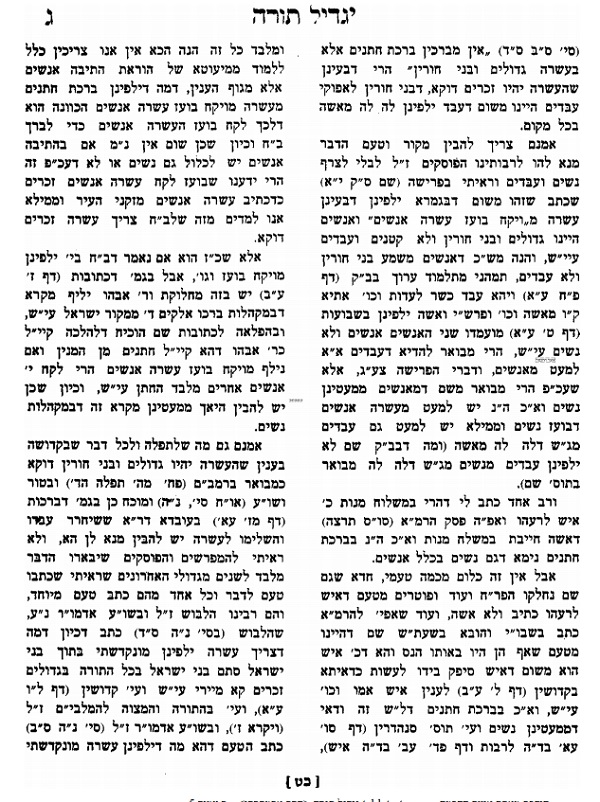
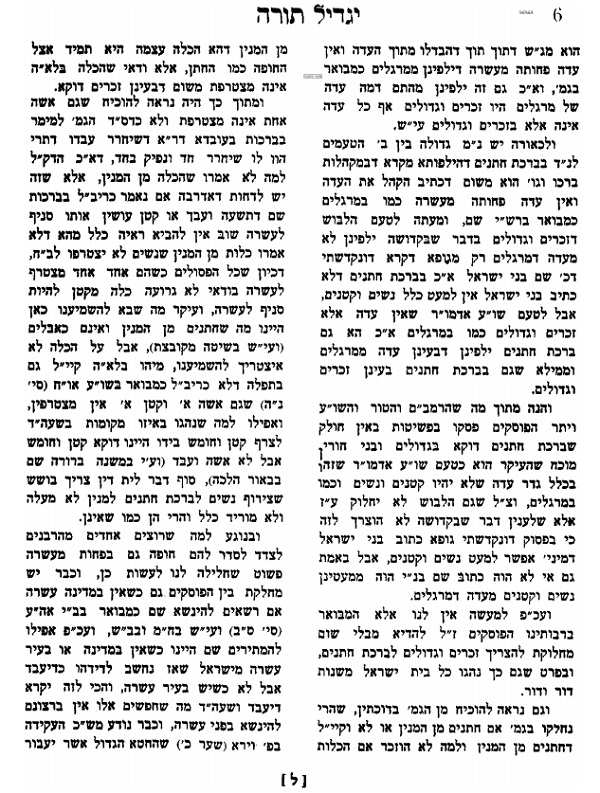
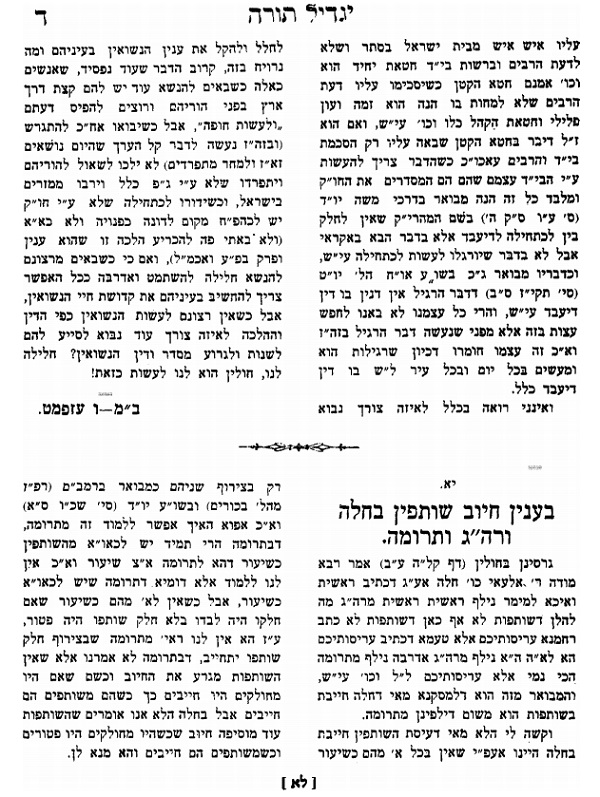
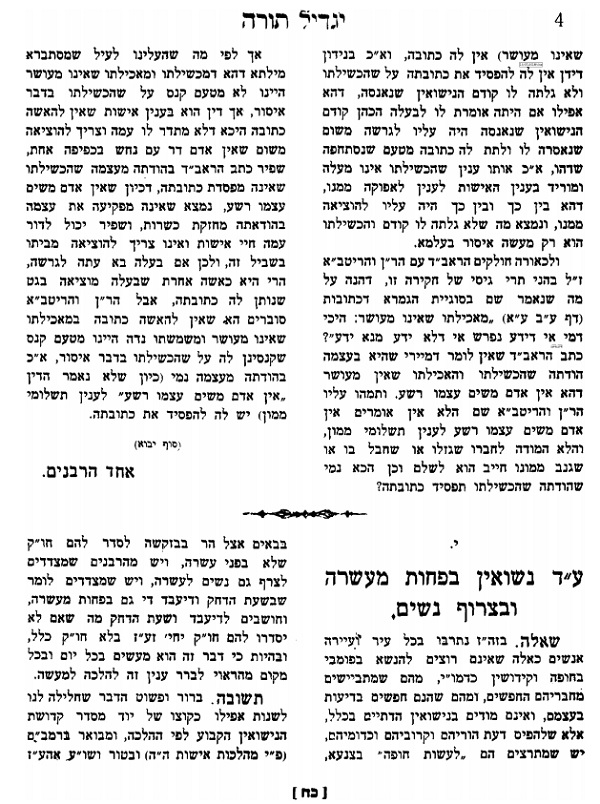
See below (Appendix five for a Teshuvah I came across recently, about a wedding with less than 10 people for a minyan, published in Russia in 1928 in the Journal Yagdil Torah edited by Rav Zevin and R’ Abramsky.

Databases – Blogs

There are also some online databases of material devoted specifically to the current Coronavirus pandemic. Kol Corona (here) is an excellent collection of material related to the Halachic aspects of Coronavirus pandemic, with many links.

Another is a database with links of material for a comparative study of Responses in Judaism, Islam and Christianity.

The Lehrhaus Blog also has many valuable articles related to the Coronavirus pandemic (see this link), as does the Torah Musing blog (see this link).

Worth mentioning is the online Newspaper-Journal Called Zarich Iyun: Charedi Thoughts and Ideas. Most of its articles are in Hebrew (below # 45-48). However, some of its Coronavirus pandemic related articles have been translated into English (see below #13-16). Some of the articles (especially # 48) have generated numerous comments as, one can see from the links. Related to some of this is Rav Michael Abraham’s article, available here, which also generated numerous comments.

Each week, Rabbi Y. Sprung of the The Beit Medrash Govoha for Medical Halacha (affiliated with Technion Medical School and under the leadership of Rav Asher Weiss) releases an article (in Hebrew and English) relating to the parsha and medicine. The past few weeks (from Ki Sisa) have related to coronavirus. See this link for these articles.

All of the items mentioned in the Bibliography bellow are available from me free of charge – just E mail me at eliezerbrodt@gmail.com

English

  1. Rabbi Eli Fischer, Rov in a Time of Cholera (here)

  2. Dr. Eddie Reichman, From Cholera to Coronavirus: Recurring Pandemics, Recurring Rabbinic Responses (here)

  3. Dr. Eddie Reichman, Incensed by Coronavirus: Prayer and Ketoret in Times of Epidemic (here)

  4. Rabbi Gil Student, Talmudic Advice on Epidemics (here)

  5. Dr. Tamara Morsel-Eisenberg, “Is It Permitted to Flee the City?” (here)

  6. Rokhl Kafrissen, Plague Weddings (here)

  7. Dr. Jeremy Brown, A Long-Forgotten Jewish Remedy for the Coronavirus Outbreak (here)

  8. Rabbi Shlomo Zuckier, Making Seder out of the Zoom Controversy (here)

  9. Rabbi Shlomo Brody, Does Jewish Law Oblige Doctors to Risk Their Own Health to Heal the Sick? (here)

  10. The Layman’s Guide to the laws of Mourning, By R’ Holzer, Based on the Rulings of Rav Asher Weiss

  11. Rabbi Prof. Avraham Steinberg, The Corona Virus Pandemic 2019-20- Historical Medical and Halakhic Perspectives, (41 pp.)

  12. Rabbi Michael Broyde, An Introduction to Pandemic Jewish Law, Responsa of Rabbi Hershel Schacter and Rabbi Asher Weiss (here)

  13. Rabbi Yehoshua Pfeffer, Coronavirus: The Charedi Response (here)

  14. Rabbi Reuven Leuchter, COVID-19: A view From Above (here)

  15. Rabbi Eli Stern, Coping without Community (here)

  16. Rabbi Moshe Farkash,COVID19: A community in Crisis (here)

  17. Professor Shaul Magid, COVID-19, Haredi Jewry, And Magical Thinking (here)

Hebrew

  1.  משה דוד צ’צ’יק, האיסור או החובה לברוח מן העיר בשעת המגפה [כאן]
  2. ר’ מנחם מענדל רוזנפלד, זמן מגיפה: הורים ילדים ומפחדים [כאן]
  3. ר’ דוד אברהם, נאמנו מאד, עדויות גדולי ישראל על הליכותיהם ומנהגיהם בימי חולי ומגיפה, אשר נאספו ונלקטו מתוך כתביהם וחיבוריהם, מכון ירושלים [ספר שלם, 300 עמודים]
  4. שמירת הסופר להינצל מחולי ומגפה מתורת החתם סופר [ספר שלם, קמא עמודים + חלק חדש של עוד 35 עמודים]
  5. ר’ שמואל ויטל, סדר משמרה לזמן המגפה, מכתב יד, בההדרת ר’ ישראל זאב גוטמאן
  6. אדם ישר, סגולות ותפילות לזמן המגפה, שחיבר ר’ יצחק אייזיק סאפרין מקאמרנא, בעל היכל הברכה [מהודרה חדשה], מא עמודים
  7. ר’ ישראל זאב גוטמאן, קונטרס טללי נוחם, כולל מכתב אגרות שפירין
  8. קונטרס תפילות מיוחדת למניעת מגיפת הקורונה, כבקשת… המקובל רבי בניהו שמואלי שליט”א, 40 עמודים [וגם קמיע למניעת המגיפה]
  9. הרב זלזניק, לוח ההלכות ומנהגים לחודש אייר, מיוחדת עם הלכות הנוגעות למגיפת הקורונה, 17 עמודים
  10. אוסף של 35 תשובות של הרב צבי שכטר שליט”א [בעברית וחלקם גם באנגלית]
  11. פסקי קורונה מאת הרב צבי שכטר שליט”א [51 עמודים]
  12. מנחת אשר, לקט שיעורים תשובות אגרות ומאמרים הנוגעים למגפת הקורונה מאת הרב אשר וייס שליט”א [100 עמודים]
  13. מנחת אשר, לקט שיעורים תשובות אגרות ומאמרים הנוגעים למגפת הקורונה מאת הרב אשר וייס שליט”א, מהדורה תניינא, [172 עמודים]
  14. הרב פרופ’ אברהם שטינברג, מגפת הקורונה התש”פ, היבטים היסטוריים, רפואיים והלכתיים, 30 עמודים
  15. ווי העמודים וחשוקיהם, ליקוט משעורי וחידוש ר’ יצחק זילברשטיין, קנו עמודים
  16. ר’ שלמה אבינר, קונטרס כתר יתנו לך, קורונה בהשקפה ובהלכה
  17. קונטרס פסקי הלכות, בשאלות שהזמן גרמן, מתוך כתבי ר’ אברהם יחיאל סגל דויטש
  18. ר’ צבי רייזמן, ‘צירוף למנין תפילה בציבור וברכת כהנים ב’בידוד בקורונה’
  19. ר’ יששכר אייכארן, פי כהן, בענין אם העומדין בשתי רשיות ורואין אלו את אלו מצטרפין למנין עשרה, 35 עמודים
  20. ר’ משה מרדכי קארפ, בדין צירוף לדבר שבקדושה ע”י חבורות ויחידים הרואין זא”ז ומניני המרפסות, 15 עמודים
  21. אליעזר יהודה בראדט, סגולת ברכת לבנה, [כאן]
  22. ר’ אברהם מימון, קונטרס בדד ישב, נח עמודים
  23. גליון עיטורי מרדכי, הלכות למגיפת הקורונה ע”י הרב מרדכי יעקב מאיר, 23 עמודים
  24. ר’ נהוראי אוחנה, הקורונה בהלכה, מהדורה חמישית, 123 עמודים
  25. ר’ יצחק לובינשטיין, המגיפה בתורה, 72 עמודים
  26. ר’ אברהם דרברמדיקר, קונטרס הקורונה, 23 עמודים
  27. קונטרס הסתר פנים, [חמישה שערים: שער חולי, שער בידוד, שער מגפה, שער חיים ושער בשורה טובה], 93 עמודים
  28. ר’ יהושע פפר, חרדים מהקורונה [כאן]
  29. ר’ ראובן לויכטר, מהותה של מגפה: מבט על [כאן]
  30. ר’ אלי שטרן, מי אנחנו ללא הקהילה? [כאן]
  31. ר’ משה פרקש, לעמוד על נפשנו [כאן]
  32. לקט מקורות ‘שומר מצוה לא ידע דבר רע’
  33. מעלת אמירת פרשת הקטרות להינצל ממגפה [מכון תורת הקרבנות], 16 עמודים
  34. קובץ תורני מה טובו אהליך יעקב, גליון י [כל הקובץ] [585 עמודים] [עניני פסח וקורונה]
  35. קישור לאוסף מאמרים על חג הפסח והמגיפות בהיסטוריה, בספרות בפיוט ובהגות. המאמרים פרי עטם של חברי וחברות סגל הפקולטה למדעי היהדות באוניברסיטת בר-אילן [כאן]
  36. לשונות של גאולה, אסופת שירה וספרות, 37 עמודים
  37. קובץ עץ חיים גליון לג [יש כמה מאמרים על קורונה]
  38. ירחון האוצר # 40 [יש כמה מאמרים על קורונה]


[1] Thanks to Nathan Hirsch from the NLI for sending me a few items which I did not see or did not have digital versions of.
[2] Mechkaray Sefer, pp. 90-99. See also Marvin Heller, Further Studies in the making of the early Hebrew Book, pp.79-90. See these recent posts here & here.

One of works mentioned by Ya’ari is R’ Chaim of Friedberg’s (the brother of the Maharal), beautiful work Sefer HaChaim (first printed in 1593) which, as he states in his introduction, he wrote during a plague in 1578. Less known (and not mentioned by Ya’ari) is that his earlier work Igerret Hatiyul was also written during an earlier Plague, in 1569. [For more information about these works see Eric Zimmer, The Fiery Embers of the Scholars, (heb.), pp. 177-219].

One bibliographical note about the Sefer HaChaim is the Haskamah of the Apta Rav who writes in the 1817 reprint:

…כל דיבור ודיבור מרגינותי’ תחותיה וברוח הקודש נאמרה

Recently the first draft of the Sefer HaChaim was printed in Yerushaseinu 10 (2019), pp. 19-55.

See note 7 for additional comments on Yaari’s article.
[3]See for example about one in Italy 1630-1631: R’ Yehudah Aryeh Modena, The Autobiography of a Seventeenth Century Venetian Rabbi, pp. 134-136; Sefer Olam Hafukh, a History of the Plague in Padua in the Year 1631, by Abraham Catalano, Kovetz Al Yad 4 (XIV) (1946), pp. 65-101 (printed by Cecil Roth). See Appendix Three about another plague in Italy in 1656.

For a description of one in 1866 see Y. Kotik, Ma SheRuetee, Edited by David Assaf, pp.349-354 (PDF available upon request).
[4] See Asher Ziv, HaRama, pp. 112-116.

See also, R’ Raphael Mordechai Malchi, Medical Essays, (ed. M. Benayahu), pp, 139-140. See also his Grandson, R’ David De Silva, Pri Megaddim, [Zohar Amar, Ed.], pp. 71-74.
[5] Two weeks, ago Rabbi Guttman released online, a PDF of a manuscript of R’ Shmuel Vital of Seder Tefilos based on Kabbalah, to say during such times (item #22). See also item # 23 & 25. See also #3, Dr. Eddie Reichman’s article on the topic.
[6] About Fasting, see Omer Ahituv, Fasting in Ashkenaz at the Beginning of the Seventeenth Century, MA thesis, Tel Aviv University 2019, (Heb.) pp. 70-74.

For other Segulot, see the various collections listed below. See also Appendix One about ‘Black Weddings’ and items # 6 &7.
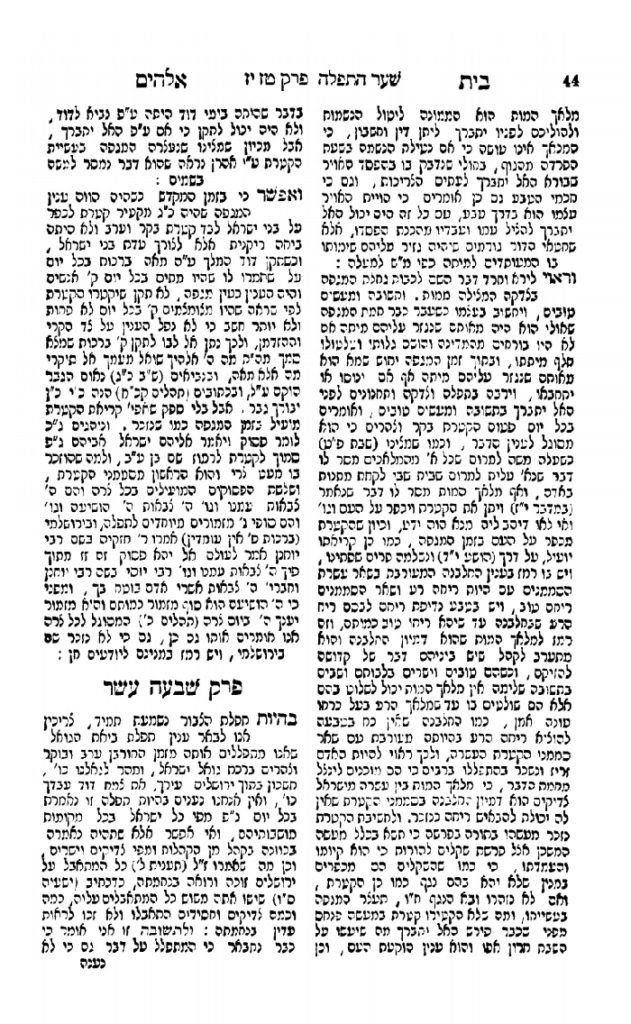
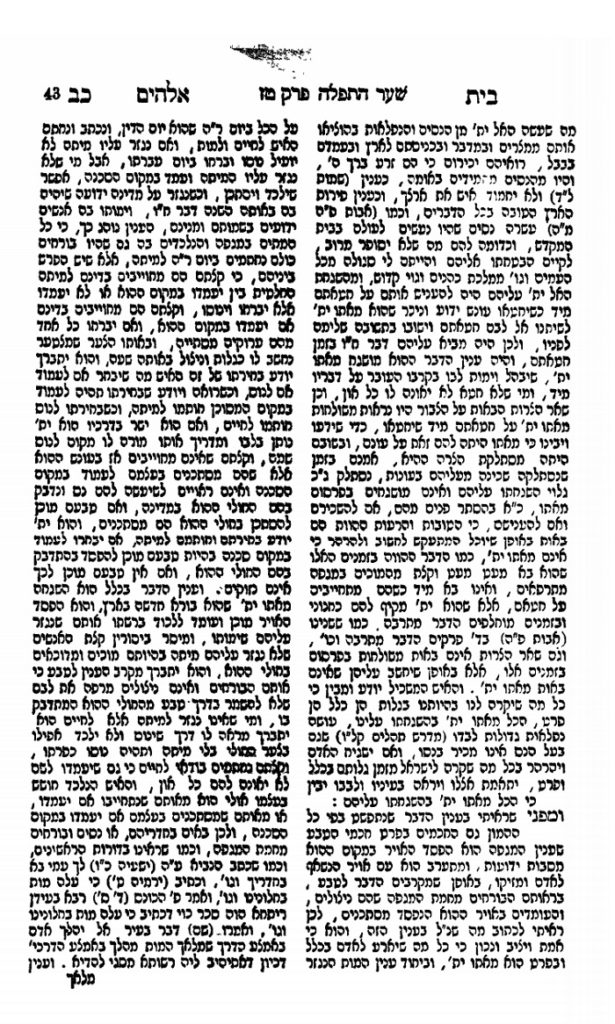
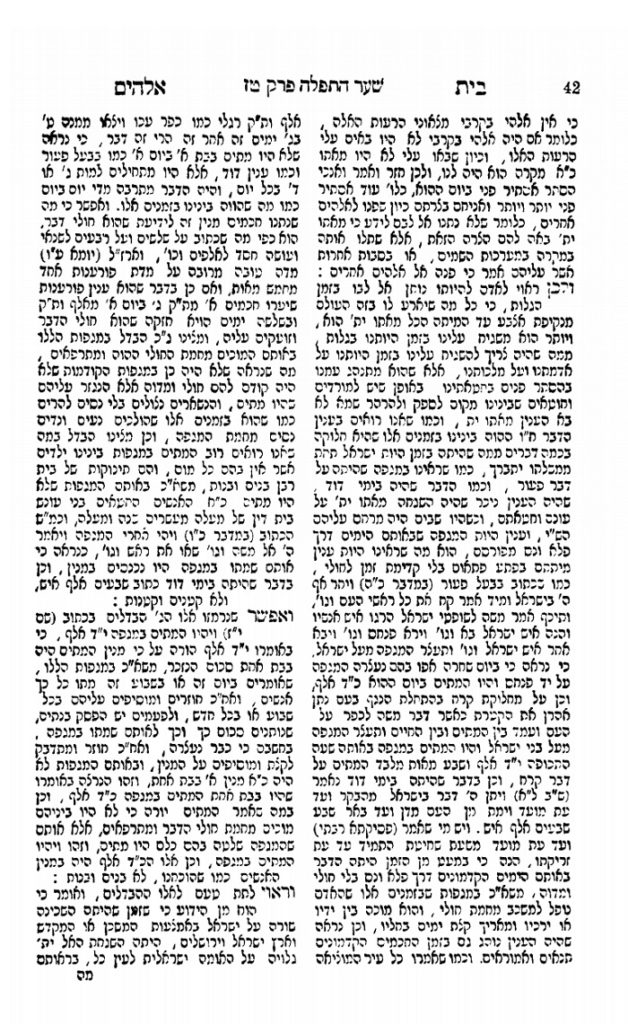
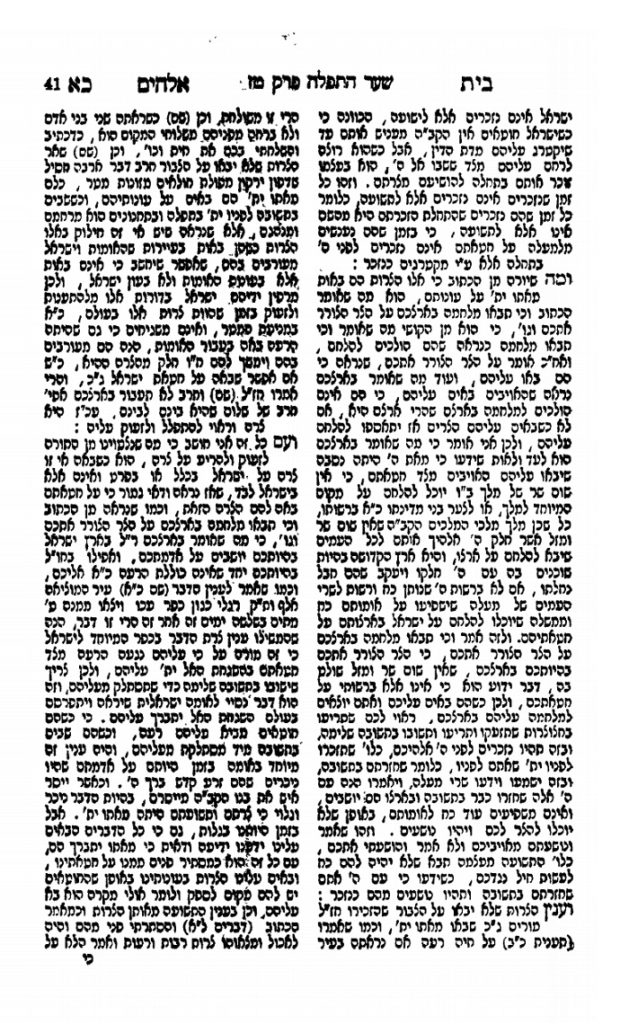
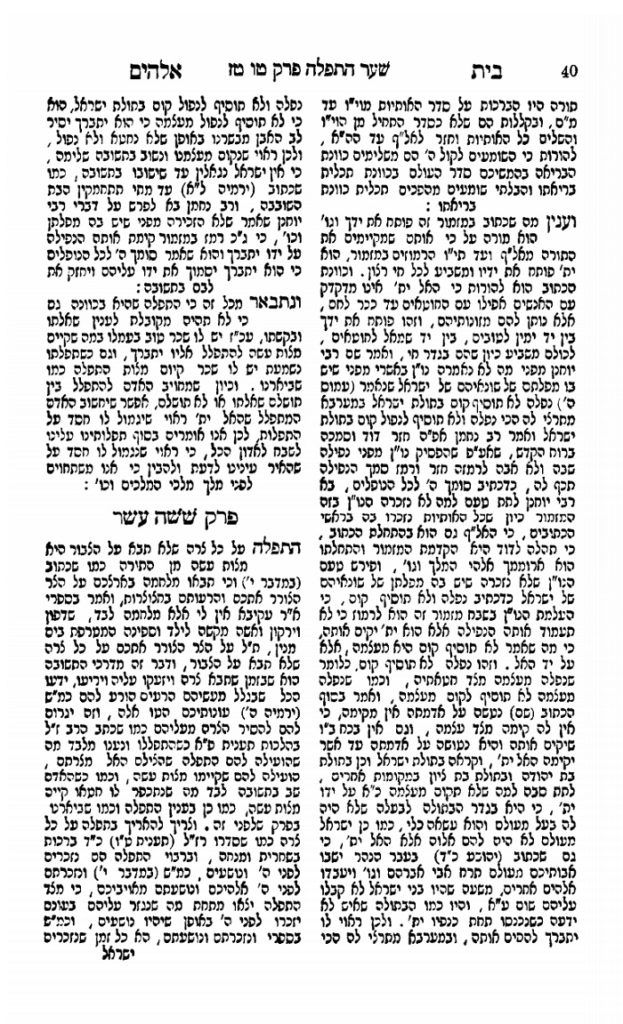
[7] See Appendix Four, for an important chapter from the Mabit’s incredible work Beis Elokiym, related to plagues in Hashkafah. The Mabit was writing about this based on experience as he lived through a few plagues himself and even authored a small work during one such plague called Igrot Derech Hashem, first printed in 1553. [Interestingly enough this work too is lacking from Ya’ari above cited chapter]. See Meir Benayahu, Yosef Bechiri, pp. 28-30,121-122. See also Ibid, p.131 about the story behind the writing of the Igrot Derech Hashem.

In an autobiography of The Mabit’s son the Maharit we find him describing some of these plagues (and others):

שנת השל”ג היתה מגפה בעיר והלך הרב אבא מארי ז”ל עמי לבוק”ע ובתחלתה נח נפשיה של הרב מהר”ר יצחק אשכנזי ז”ל מפני הרעה נאסף הצדיק. ובסוף המגפה נפל ממנו רב רב עתה הרף ידך הרב מהר”ר דוד ן’ זמרא ז”ל [שלם א (תשל”ד), עמ’ 215].

השל”ט באלול בבירייא הוכתי במגפה ובאתי בשערי שאול לולי אלקי’ אבי בעזרי בזכות א”מ והתענה עלי כל ח’ ימים ובחסדו העלה ארוכה לי [שם עמ’ 217].

השמ”ז ירדתי למצרים… בברחי מפני אימת המגיפה… [שם, עמ’ 219].

השנ”ה שנת השמיטה גלינו מאימת המגיפה בפורים לטבריא ובפסח לירושלים עיר הקדש… ושם חיברתי קונטריסין צרות הבית… [שם, עמ’ 221].

השס”ב ברחנו מחמת המגיפה כשמנה חדשים לבוקיעה… [שם, עמ’ 222].

In this autobiography we learn about an additional work written during a plague, by the Maharit. Now Yaari writes:

ר’ יוסף ב”ר משה מטראני ברח בשנת שנד מפני מגיפה מצפת… ושם חיבר את ספרו דרך הקודש על צורת בית המקדש שנדפס רק בשנת תע בקושטאדינא יחד עם הספר מגיד בראשית…”.

Yaari then quotes a passage from the Maharit at the end of the Derech Hakodesh where he describes writing this work during a plague. This complete passage from Ya’ari was quoted in a recent article in HaMevasser on the subject of seforim written during plagues without attribution. However, this information is incorrect. The Sefer that the Maharit wrote during the plague in 1595 was called Tzurot Habayis (as the Maharit wrote in the above passage). R’ Chayim Alfandri saw a manuscript copy of this work (as he writes in his introduction) and when he wrote his sefer Derech Hakodesh on the same subject he quoted numerous passages from it. However, the actual sefer by the Maharit was never printed. In 2007 Machon Zichron Aharon reprinted the Derech Hakodesh with numerous footnotes and indexes. On page 270 they list the numerous times the Maharit’s Tzurot Habayis is quoted (along with other manuscript works by Maharit that R”C Alfandri used).
[8] See the very special work by H.J. Zimmels, Magicians, Theologians and Doctors, pp. 99-110, 228-233 who has an excellent collection of material on this. See also the excellent work, Julius Preuss, Biblical and Talmudic Medicine, (translated by Fred Rosner), pp. 151-160; Herman Pollack, Jewish Folkways in Germanic lands (1648-1806) Studies in Aspects of Jewish Life, pp. 130-133, 304-305.

The Shvut Yaakov wrote in middle of a Teshuvah about money set aside for Pidyon Shivyoim, if one can use it instead for people suffering from a plague,:

אבל עכשיו בעו”ה שנתרבה עלינו עול הגלות ועלילות שקרי’ משונאינו שמעלילין עלינו כאלו הדבר בא ע”י ישראל דוקא וכשהיה הדבר בשנת תע”ג ברוב מקומות שהיו שמה מבני עמינו היה סוגרים רחוב היהודים באין יוצא ואין בא ממש ובדוחק ע”פ שתדלנו’ גדול שהניחו להביא להם צרכי מזונותיהם ובאיזה מקומות הוצרכו לילך ולחבות עצמן ביערים ומערות וישראל שהיו בדרך ועל פני השדה היו ממש מופקרים למות ואשרי מי שלא חמאן בצער ודוחק גדול כזה ואין לך שבי גדול מזו דגרע מכולהן דכולהן איתנהו ביה על כן אין צריך לפנים דמצוה זו הוי ממש פדיון שבוים ואפשר דגדול ממנו ולא הוי שינוי מדעת הנותן כי אין שעת הדחק גדול מזו (שבות יעקב, ב, סי’ פד).

[9] More sources for this can be found in H.J. Zimmels, Magicians, Theologians and Doctors, p. 233, footnote 141; David Assaf in his edition of Y. Kotik’s, Ma SheRuetee, p. 350 Hanna; Wegrzynek, Shvartze Khasene Black Weddings Among Polish Jews, Holy Dissent, 2011, pp. 55-68; Tzvi Friedhaber, Plague Marriages as Reflected in Hebrew Literature and the Hebrew Press, Dappim: Research In Literature 7 (1990), pp. 305-316; Kulmos 21, p. 26.
[10] On this work See A. Yaari, Shiluchei Eretz Yisroel, pp.96-97.
[11] Y. Kotik’s, Ma SheRuetee, p. 350.
[12] Nathaniel Deutsch, The Jewish Dark Continent: Life and Death in the Russian Pale of Settlement, p.233

Appendix One: Graveyard weddings of orphans

Recently (here, here and here) there has been some discussion about an old Segulah, performed by some towns during plagues, ; make a Wedding for Orphans in a graveyard.[9] One was even recently done in Bnei Brak (see here and here).

I would like to add some more sources to this segulah. One of the earliest sources quoted is R’ Moshe Reisher’s excellent work Sharei Yerushlayim, first printed in 1868.10 R’ Weiss, after quoting the Sharei Yerushlayim, writes:

[וגם אני שמעתי מזקני שער שעשו כן בשנת תרל”ג בפ”ב [שו”ת שיח יצחק, סי’ תצא

However, Y. Kotik, in his excellent memoir writes about a plague in 1866:

Due to the cholera epidemic, Jews resorted to all sorts of remedies; in other words: a crippled, mute virgin was married to a blind man. The wedding ceremony was held in the graveyard in the hope that they would produce a generation of righteous offspring…”.[11]

Another source from 1901 writes:

ראיתי להעלות על שלחן מלכים… על מה שנהו בסביבותנו בהרבה מקומות בעידן ריתחא ומחלת הח”ר ר”ל משיאין יתום ויתומה … ומעמידים החופה על בית הקברות ובעירנו בשנת תרנ”ג העמידו החופה סמוך שער גדר בית הקברות מבחוץ…. [ציוני שלום, יד שלום, עמ’ 154-155

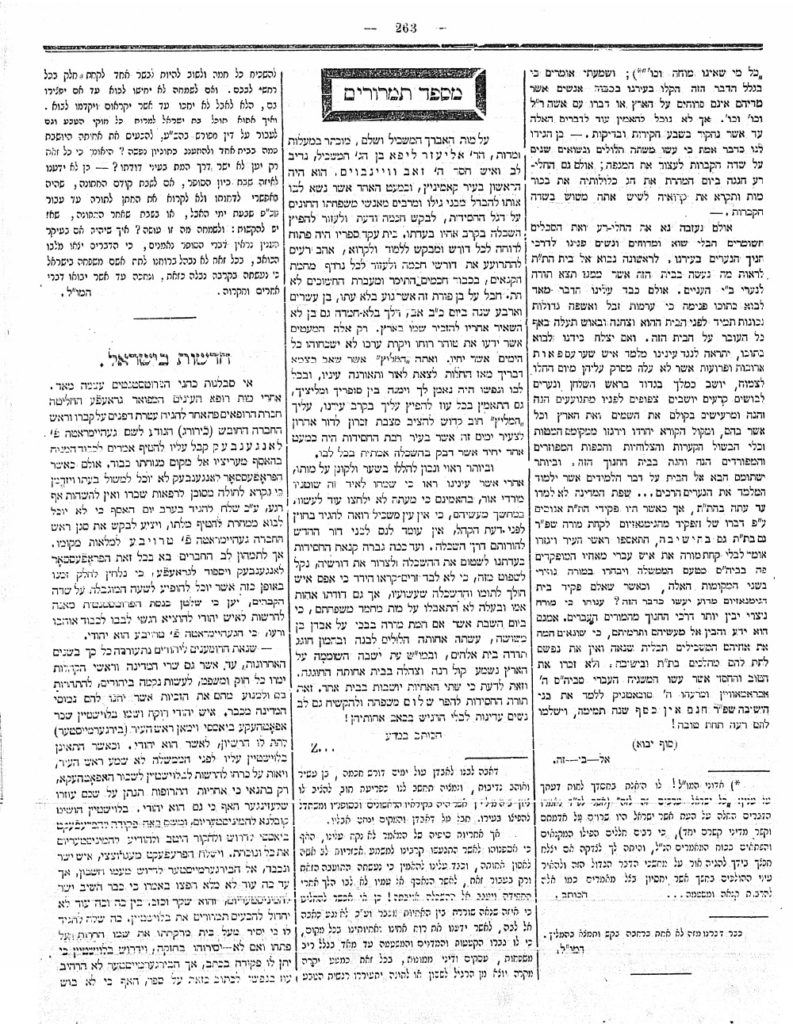
While searching for something else I came across mention of this in an article in Hamelitz 1871 (Year Eleven, Issue 33, p.263)


In the early 1900’s, the famous author and ethnographer who went by the pen-name S. Ansky started working on collecting and cataloging hundreds of details about every aspect of Jewish life in Europe. One of the ways he was planned on doing this was through a survey. The survey, in Yiddish, was a 200-page questionnaire with 2,087 questions about the Jewish life cycle. Sadly, he never got to finish the project. But each set of questions gives us a fascinating window into what Jewish life was like before World War I. In his introduction he set forth his goal:

“In order to revive traditional Jewish culture with all its customs, traditions, practices and beliefs, the team has put together a survey, hoping to reach everyone who remembers how people behaved in the past as well as in the present, in those places where Jewish life still continues in the old manner. When numerous responses to all the questions are collected, it will be possible to bring to life the entire structure of the traditional Jewish community, the Jewish family and communal life.”

In the wedding section[12] of the survey we find the following:

Do you know stories about weddings in cemeteries carried out as protections against misfortune? Does this occur only during a plague, or also in other cases, and if so which ones?

One last source related to this can be found in the Shut Maharsham (4:40)

ועד”ש לאשר נפרץ בעירו חולאת ילדים ר”ל ומורגל בין ההמון סגולה להעמיד חופה של יתום ויתומה בביה”ק וזה כמה שבועות עשו שם ביה”ק חדש שהקצוה לזה וגם כבר קברו שם כמה מתים ובנו סביבה מחיצות אבל לא נגמרו המחיצות עוד סביב רק ברוב המקומות כבר מקיף מחיצות.

והנה חתן היתום הוא כהן ונשאל מעכ”ת אם מותר להעמיד החופה בביה”ק תוך מקום המחיצות רחוק ד”א מהקברות עצמן. ורו”מ אסר מב’ טעמים מחשש הברכות על הבה”ק משום לועג לרש… אבל יל דוקא לזרוע ולנטוע שמרגילים רגל אדם משאכ בנד דהוי דבר מקריי פעם איש להקל וכיון דרוב מקום הפנוי אין בו קבר יל דכיון דלש בזה כל קבוע כמש הרש מקינון ועיחד סיקי אכ תלינן ברובא להקל וגם הרי לדבר מצוה מותר לילך בשדה שנחרש בה קבר כמש ביוד סישעב והנ הוי דבר מצוה להשקיט המיית המון העם ופחדם בעת ההוא:

Appendix Two: R’ Shimshon Ostropoler

I recently wrote an article about a book called The Rabbis Suitcase by Eli Friedwald. This book is based on Letters found in a suitcase buried in an attic, which contained over one thousand documents, as well as numerous letters from many Gedolim across the Globe. The correspondence belonged to two Litvish Rabonim in England who became dayanim on the Chief Rabbi’s Beis din during the years 1879-1905: Rabbi Yaakov Reinowitz (1818- 1893) and his son in law, Rabbi Sussman-Cohen (1841-1907). They included letters with the Netziv, R’ Yitzchok Elchonan Spektor, R’ Shmuel Salant, R’ Yehoshua Leib Diskin, R’ Yisroel Salanter, R’ Shmuel Mohilever and, R’ Eliezer Gordon, just to list a few names.

The author Eli Friedwald sent me a document found in a suitcase dated from 1754 which was headed as a segula of R. Shimshon Ostropoler.
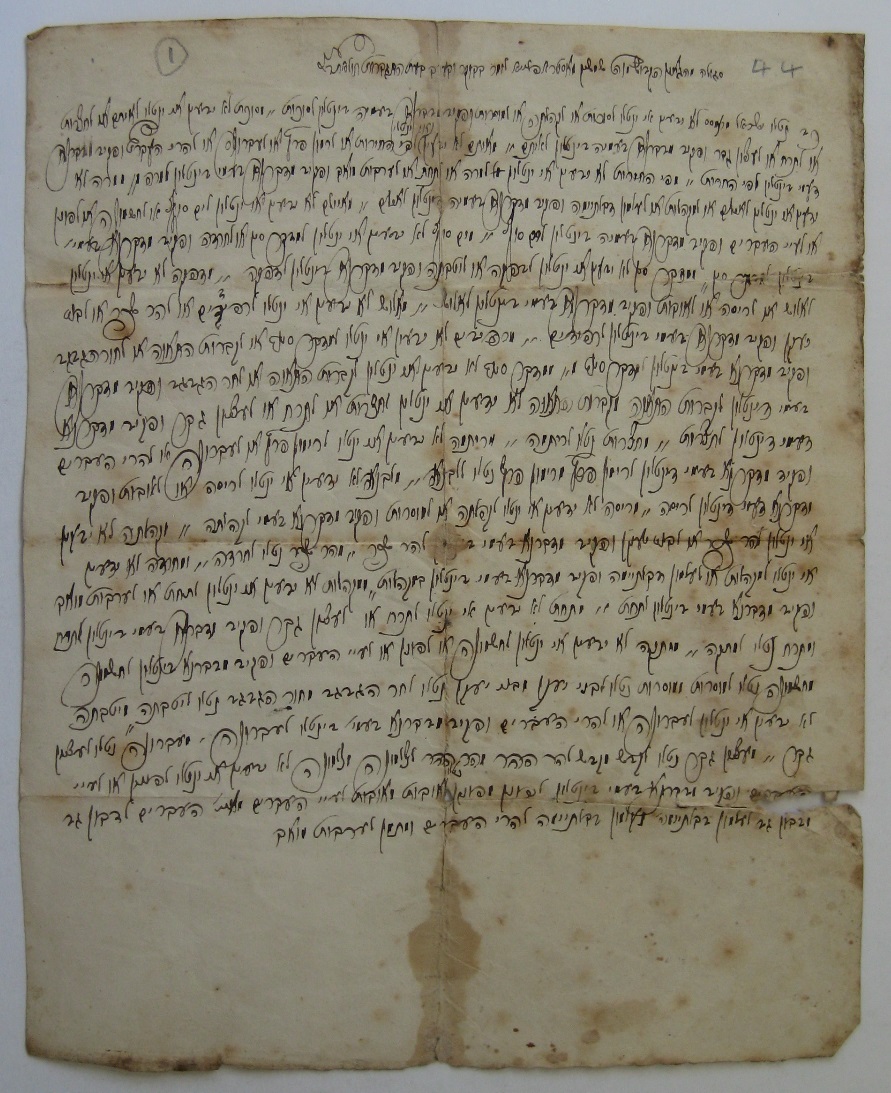


I reached out to Rabbi Bombach who has written and collected the existing material on R’ Shimshon who replied:

.אכן זו הסגולה נגד המגפה שהדפיס רבי פסח מזאלקווא בן אחותו של רבי שמשון בספרו זבח פסח (נדפס תפ”ג בערך) על סגולות ורפואות. ונדפסה בספרי ניצוצי שמשון פרשת מסעי, עם ביאור על פשר הדבר

Appendix Three

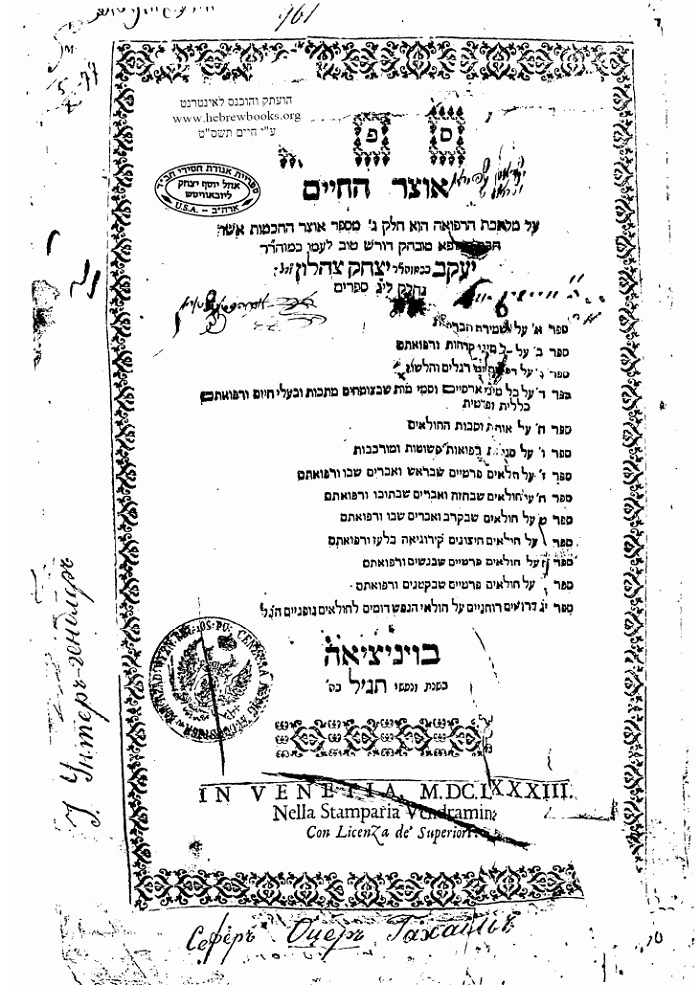
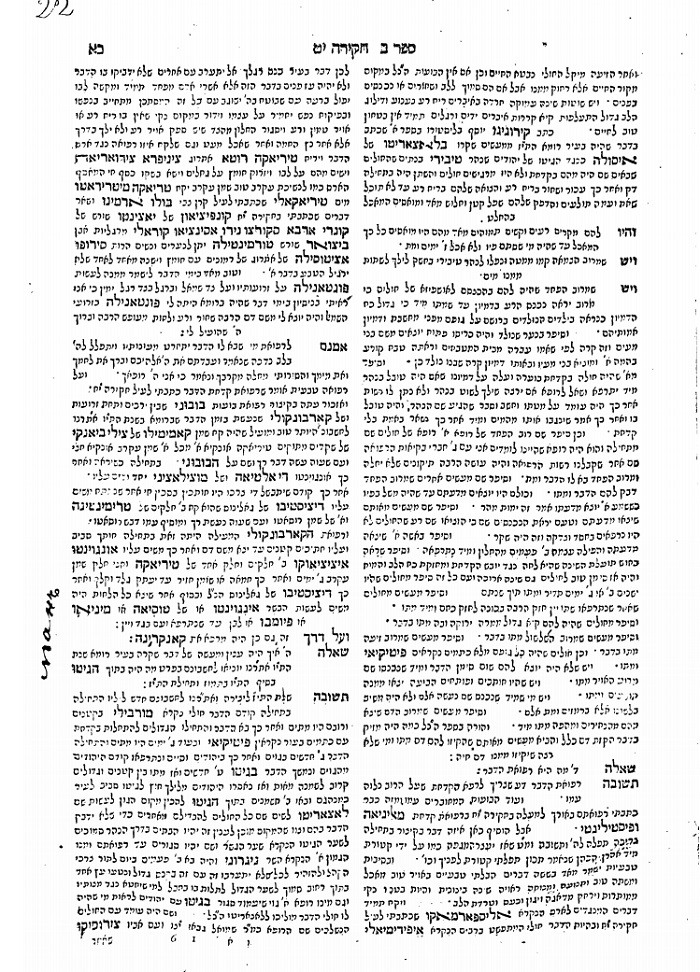
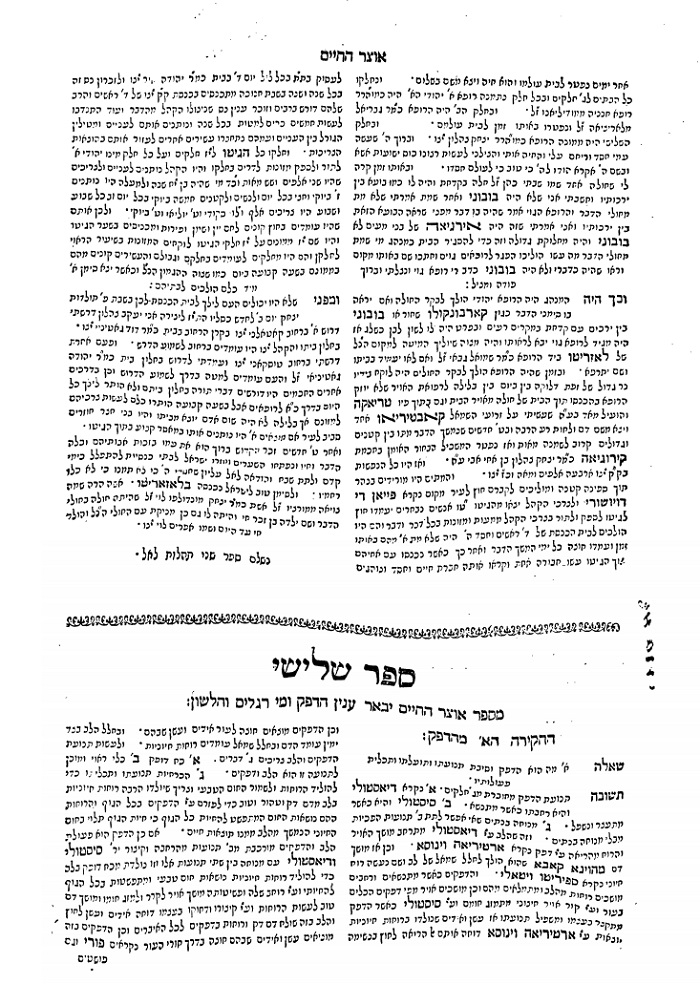
In a post from a few years back I wrote about R’ Yaakov Zahalon (1630-1693), a graduate of medical college in Rome, became a doctor at the age of twenty-six, and for several years, was also a Rav and Baal Darshan in Rome. He was famous for his important medical work, Otzar Ha-Hayyim. I also wrote a little about the work (see here).

He was very involved in the famous plague in the ghetto of Rome in 1656, which he describes at length in his work, Otzar Ha-Hayyim. Here is the very interesting passage about it which has relevance today.
Appendix Four Mabit
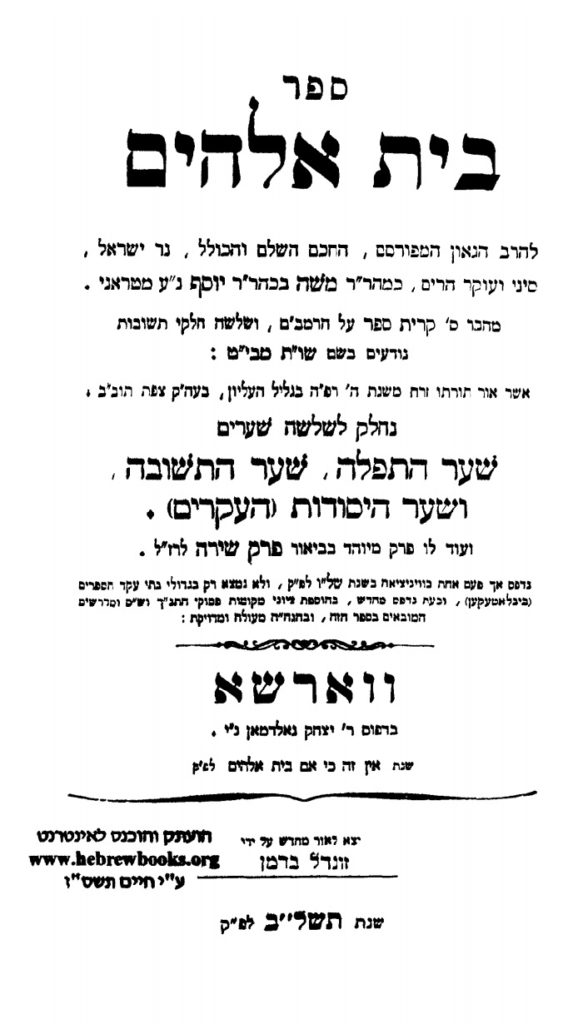


Appendix Five Yagdil Torah:


Gelatin, Supposed Retractions, and Abraham Goldstein, Part 1

Gelatin, Supposed Retractions, and Abraham Goldstein, Part 1

Marc B. Shapiro

In my last post I quoted something from Mesorat Moshe and wondered whether R. Moshe Feinstein could have actually said that which is attributed to him. While the Mesorat Moshe series is quite valuable, whenever one deals with “table talk” there is always going to be the issue of how much authority do you give to such reports, especially compared with written texts of R. Moshe. Here is an example of what I am talking about.

In the new Mesorat Moshe, vol. 4, p. 191-192, R. Moshe Feinstein is asked why gelatin is forbidden, and he replies that it is because gelatin tastes good. Unfortunately, R. Moshe was given false information, as gelatin has no taste whatsoever. If this was all we had, then I think we could assume that R. Moshe should not be regarded as strict in this matter (since the strict ruling was based on an error). Yet in R. Moshe’s responsum forbidding gelatin, Iggerot Moshe, Yoreh Deah 2, no. 23, there is no mention of gelatin having a taste, so clearly this was not an important consideration for him in coming to a stringent decision. In other words, one whose only source of information in this matter comes from Mesorat Moshe will be misled. (In Iggerot Moshe, Yoreh Deah 2, no. 27, we see that R. Moshe did not know if gelatin has a taste.)

The gelatin issue has long been an interest of mine, both the halakhic and also the sociological angles. Those interested in how the gelatin controversy played out in the United States should examine Roger Horowitz’s wonderful book, Kosher USA. Chapter 3 is titled “The Great Jell-O Controversy”. The hashgachah on Jell-O was first given by Rabbis Samuel Baskin and Shimon Winograd. They later removed the hashgachah after being pressured by R. Eliezer Silver and other members of Agudas ha-Rabbonim. See R. Baskin and R. Winograd’s public statement here.

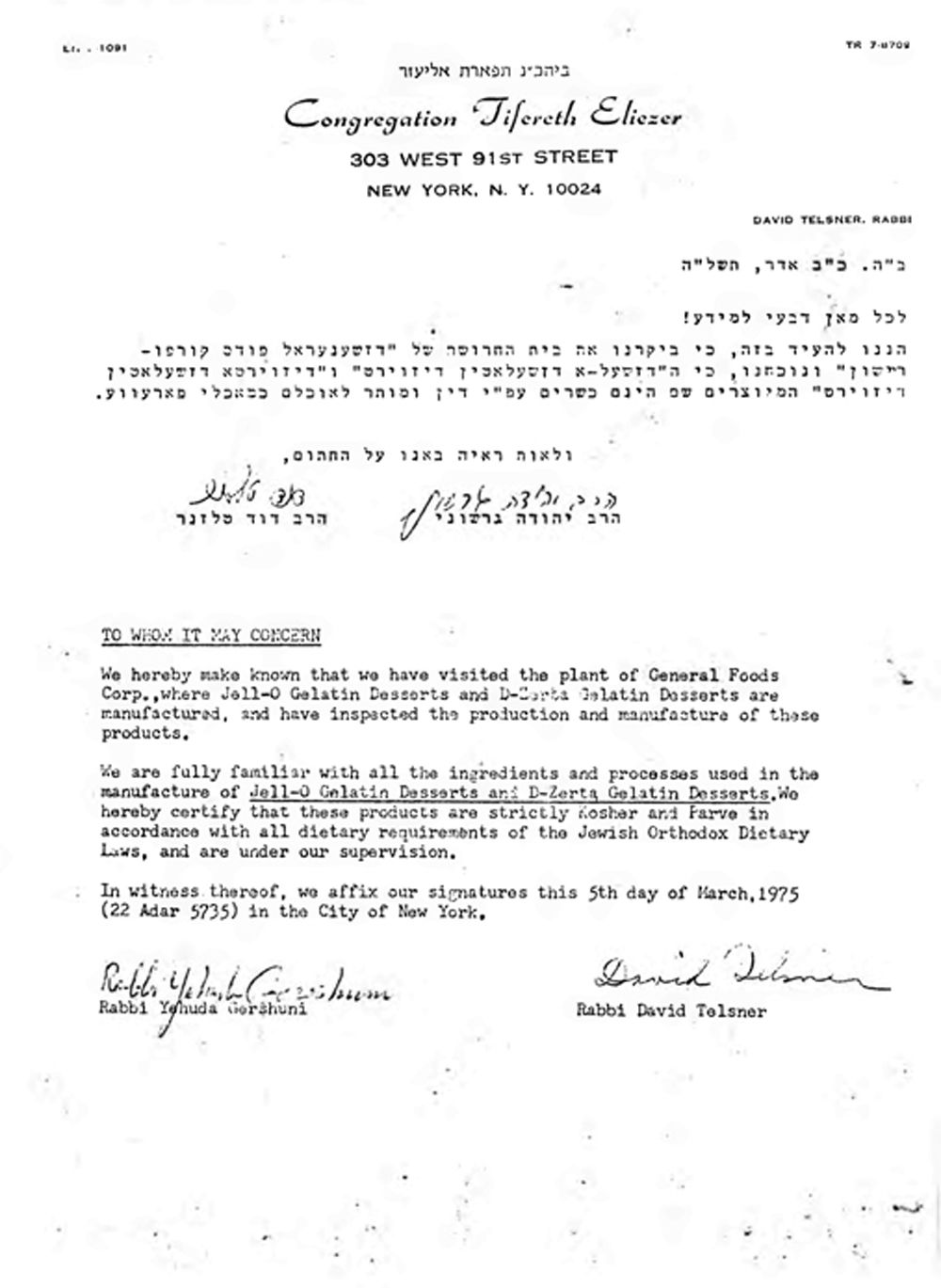
By the 1960s R. David Telsner was giving the hashgachah, and he was later joined by R. Yehuda Gershuni. (Incidentally, R. Telsner was the one who translated R. Soloveitchik’s Hamesh Derashot into Hebrew.) Here is a letter from 1975 in which these rabbis affirm that Jell-O is kosher.

Here is R. Telsner’s responsum permitting gelatin. This was printed by R. Telsner and distributed to those who wanted to know the basis for his permission. As far as I know, this responsum never appeared in any publication and it is not found on the internet.

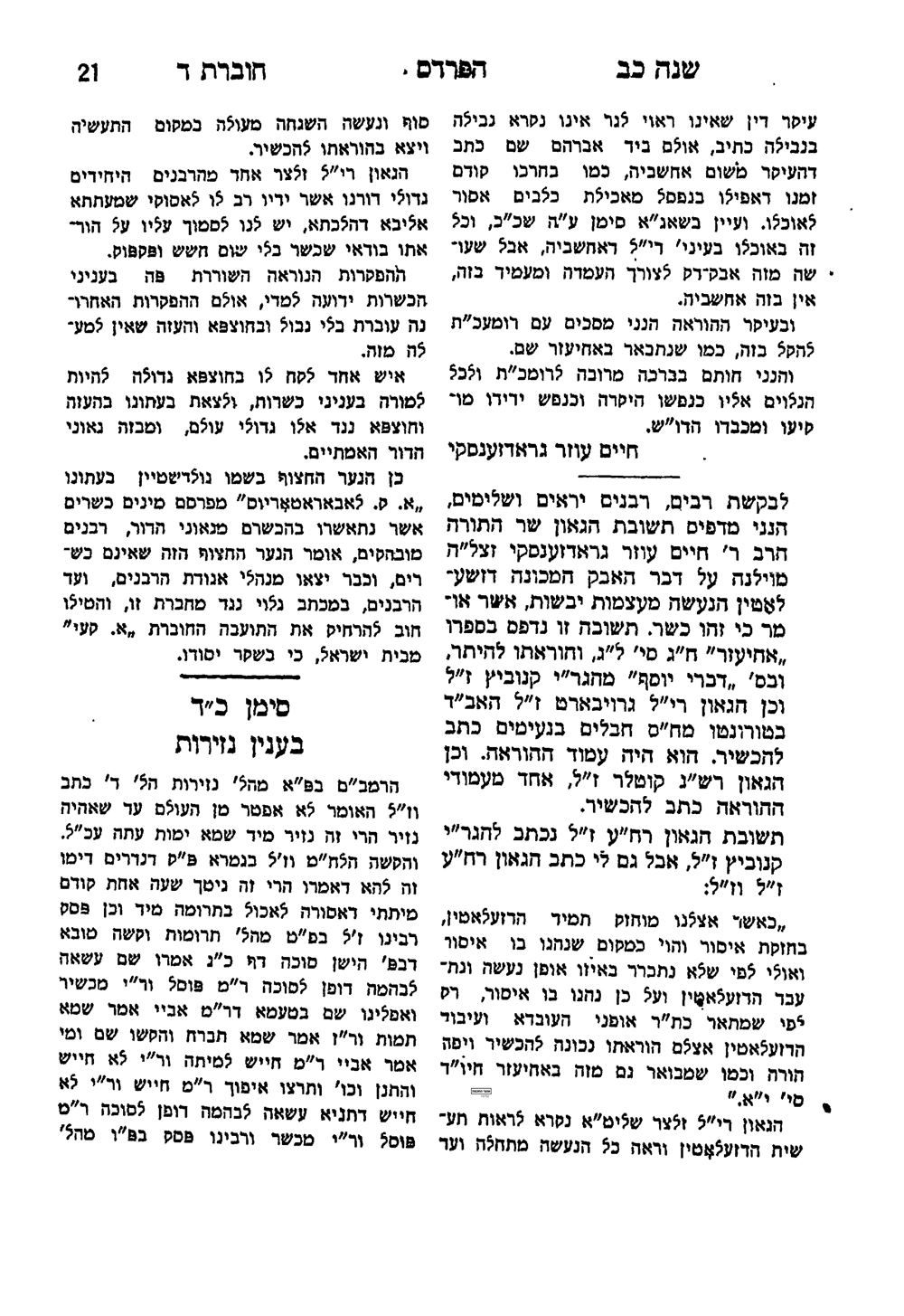
When it comes to gelatin, there were great rabbis on both sides of the issue, and those who permitted it were able to point to the lenient position of R. Hayyim Ozer Grodzenski. Even among those rabbis who were lenient, there were disputes as to whether all gelatin is OK, including from pigskins, or only gelatin made from bones or hides of kosher animals. Not so well known is the report that R. Kook permitted gelatin.[1] Also of note is that in 1952 R. Simhah Elberg testified to the wide acceptance of gelatin in the Orthodox community:[2]

שכבר נתפשט היתר והותר ע”י גדולי וגאוני ארץ

R. Noah Sheinkopf has prepared the following list of poskim who permitted bovine gelatin. (I have not checked the sources.)

1) Rabbi Dovid Tzvi Hoffmann, Melamed L’Hoil, Y.D., #24 and #35 (By Inference)

2) Rabbi Mordechai Leib Winkler, Levushei Mordechai, Yoreh Deah Tineyna, #60

3) Rabbi Yehuda Leib Tzirelson, Lev Yehuda #39

4) Rabbi Ze’ev Bidnovitz, Divrei Ze’ev, vol. 18. #12

5) Rabbi Y.L. Graubart, Chavalim Baneimim, vol. 4. #23; (See also HaPardes, Aug. 1942, p. 19)

6) Rabbi Shmuel Pardes, Avnei Shmuel, Berurei Halacha, #19

7) Rabbi Yosef Konvitz, Divrei Yosef, vol. 1, p. 172

8) Rabbi Hayyim Ozer Grodzenski, Achiezer, vol. 3, #33, sec. 5; see also Avnei Shmuel, pp. 10-11

9) Rabbi Simcha Zelig Regeur (Brisker Dayan), printed in Kovetz Moriah, issue 400-402, p. 76-77

10) Rabbi Yitzchak Burstein, Mataamei Yitzchak, vol. 2, chap. 24-25

11) Rabbi Yosef Eliyahu Henkin, HaPardes, July 1952; Edus L’Yisrael, p. 177

12) Rabbi Yehuda Leib Seltzer, HaPardes, July 1952; Vezos L’Yehuda, O.C. #26

13) Rabbi Simcha Elberg, HaPardes, July 1952; HaPardes, October 1952 

14) Rabbi Nissen Telushkin (Chabad), Taharas HaMayim, vol. 1, chap. 54

15) Rabbi Nachum Weidenfeld, Chazon Nachum, #61

16) Rabbi Tzvi Pesach Frank, Har Tzvi, Y.D., #83

17) Rabbi Yechezkel Abramskyintroduction to Tzitz Eliezer, vol. 4; Chazon Yechezkel, Zevachim, Sh“ut #6

18) Rabbi Eliezer Waldenberg, introduction to Tzitz Eliezer, vol. 4; Tzitz Eliezer, vol. 20, #33

19) Rabbi Koppel Kahana, Teshuva B’Inyan Gelatin, 1966 (By Inference)

20) Rabbi Moshe Nosson Nota Lemberger, Ateres Moshe, vol. 1, Y.D., # 42-43

21) Rabbi Yitzchak Glickman, Kol Torah, Shana 13, Choveret 4

22) Rabbi Yosef Shalom Elyashiv, Kovetz Teshuvos, #73, sec. 3 (In terms of practical halakhah, for R. Elyashiv the crucial point is if some taste remains, but as long as it is rendered completely tasteless, then he identifies with the R. Hayyim Ozer Grodzenski’s lenient decision.)

23) Rabbi Ovadya Yosef, Yabia Omer, vol. 8, Y.D., #11

24) Rabbi Ben Tzion Abba Shaul, Ohr L’Tzion, vol. 5, #32, sec. 6 (By Inference)

25) Rabbi Shlomo Amar, Shema Shlomo, vol. 5, Y.D., #12

26) Rabbi Yechezkel Roth, Emek HaTeshuva, vol. 3, #67 (By Inference)

27) Rabbi Yisroel Yaakov Fisher, Even Yisroel, vol. 8, #56

28) Rabbi Yirmiyahu Menachem Kohen, V’Heirim Kohen, vol. 2, Y.D., #31; vol. 4, Y.D., #40

29) Rabbi Moshe Levi, Tefilla L“MosheY.D., #4

30) Rabbi Almog Levi, Avnay Levi, Y.D., #1

31) Rabbi Yitzchak Mekayis and Rabbi Yaakov Mekayis, Ohr HaHalacha, Kuntres #3

32) Rabbi Amit Chadad, Pri Eitz Chaim, p. 529

33) Rabbi Moshe Dan Sheinkopf, a Vice President of the Agudas HaRabbonim, who certified Kojel until the late 1970s.

To this list from R. Sheinkopf, we can add R. Yaakov Ariel, Be-Oholah shel Torah, vol. 5, pp. 76-77, R. Eliezer Melamed, Peninei Halakhah: Likutim 3, pp. 352-353, R. Shlomo Aviner (see here) and R. Yitzhak Abadi (as seen on learn.oheltorah.com and prior to this on the old site, kashrut.org). R. Abadi’s view is particularly interesting as his teacher, R. Aharon Kotler, was one of the major forces behind the general rejection of gelatin in the United States. It is also noteworthy that for a short time in the 1950s the OU also approved of gelatin.[3] R. Avraham Vilner, in an earlier post at the Seforim Blog here, provides evidence that the Hazon Ish felt that one could rely on R. Hayyim Ozer Grodzenski’s heter for gelatin.

כשאמרתי למו”ר [הרב שמריה שולמאן] שראיתי הרבה חולקים על פסקו של רבי חיים עוזר בענין הג’אלאטין, וגם אלו שבדרך כלל לא היו פוסקים נגדו כמו הרב אליעזר סיבלר, בזה פסקו אחרית ממנו, אמר לי שהראש ישיבה הרב רודערמאן זצ”ל אמר לו, שהחזון איש אמר שעל כל פסקי רבי חיים עוזר אפשר לסמוך בלי שום פקפוק, חוץ ממה שהתיר לשמש במוך היכא שהסיבה לשימוש במוך הוא מצד האיש, שבזה א”א לסמוך

Ironically, it was Conservative Rabbi Louis Ginzberg who was mahmir, writing with great certainty:

I am convinced that no rabbinical scholar who is in a position to comprehend a problem in chemistry would ever permit the use of gelatin. . . . The late Rabbi Chaim Ozer Grodzinski was well known to me personally; as a matter of fact, his wife was a close relation to me, and I would certainly attach great weight to any decision by him on Jewish Law, but not in a case for which some knowledge of chemistry or physiology is necessary.[4]

On the other hand, Conservative Rabbi Isaac Klein, who was one of only three people to receive private semikhah from Ginzberg—the other two being Louis Finkelstein and Boaz Cohen—permitted gelatin.[5]

Returning to Mesorat Moshe and the problems with oral reports, I saw something relevant in R. Yehuda Spitz’s comprehensive new book, Food: A Halachic Analysis. The matter under discussion is whether one can use the same dishwasher for meat and milk utensils. R. Moshe has a number of responsa where he says that this is permissible as long as you have separate dish racks. His first responsum on the topic appears in Iggerot Moshe, Orah Hayyim 1, no. 104, and is from early 1957. It is the second part of one of his famous responsa on bat mitzvah, and was sent to R. Baruch Aharon Poupka of Pittsburgh. (For some reason, the heading of the responsum only mentions bat mitzvah, not the dishwasher question). R. Moshe’s answer is short and to the point:

ובדבר הכלי החדשה [!] לרחץ את הכלים שנקרא בשם “דיש וואשער” אם יכולין לרחוץ שם כלי בשר וכלי חלב זה אחר זה. הנה צריך שמה שבתוכו שהוא על מה שמניחין הכלים, שיהיה לכלי בשר אחרים ולכלי חלב אחרים, ועצם הדיש וואשער שמשימין בתוכו הדבר שמניחין עליו הכלים שהוא רק הדפנות שסביבותם יכולין להשתמש בו לשניהם בזה אחר זה

This is a very simple reply, and it is not possible to misunderstand what R. Moshe is saying. R. Moshe later sent two other responsa where he explains his reason for requiring separate dish racks (Iggerot Moshe, Yoreh Deah 2, nos. 28, 29). In the latter responsum, he mentions that different water should be used for the milk and meat washings. (In the earliest dishwashers you could use the same water more than once.) He states that he did not mention this point in the original responsum because in any event those who have a dishwasher change the water between cycles. He specifically tells us that he is referring to householders, not that anyone would have any doubt about this.

ובפרט שזמן גדול בהרבה שעות יש לכל בעהב מרחיצת כלי חלב עד רחיצת כלי בשר ולא ישאירו שם המים סרוחין זמן כזה

In this responsum, R. Moshe also recommends running an empty rinse cycle between milk and meat dishes. R. Moshe repeats his basic position in a couple of other responsa,[6] and a simple internet source will reveal that lots of people have discussed R. Moshe’s view and there is no room for misunderstanding.

R. Spitz, Food: A Halachic Analysis, p. 70, quotes someone who spoke to R. Moshe about his “dishwasher leniency.” According to this person, R. Moshe explained that everyone misunderstood what he wrote, and his view that one can use the same dishwasher with separate racks was only stated regardingcommercial dishwashers. However, when it comes to the home, one cannot use the same dishwasher, even with separate racks. Based on this report, R. Spitz writes, “If so, there is ample reason to be stringent, certainly lechatchilla, regarding using the same dishwasher for both milk and meat dishes.”

I have to say that testimony such as this has absolutely no halakhic significance. There is indeed reason to be stringent, based on the views of other poskim (and most people do not seem to follow R. Moshe’s heter of two dish racks). However, if all we had was this report, it would not lead us to ignore R. Moshe’s explicit position in his responsa.

We have many examples of such statements, where a posek supposedly said something privately that completely contradicts what he said in print. In such cases, one cannot rely on these supposed retractions or statements of clarification, except in very rare cases where the author makes his opinion widely known or the person reporting the retraction is a universally recognized Torah scholar[7] (although even in the latter case we cannot always rely on the scholar reporting the supposed retraction).[8] I have no way of knowing what the man R. Spitz quotes was told by R. Moshe. It could be that he completely misunderstood what R. Moshe said. It could also be that R. Moshe had a reason for telling this person what he did, as perhaps R. Moshe thought that this man should hold to a higher level. But it is simply incorrect to suggest that R. Moshe was not referring to a home dishwasher when all can see that he certainly was. R. Spitz himself, p. 71 n. 23, recognizes that R. Moshe was referring to home dishwashers. He also cites R. Baruch Moskowitz, Ve-Dibarta Bam, vol. 2, no. 244, that R. Dovid Feinstein also explained his father’s position as referring to home dishwashers. You can also listen to R. Shmuel Fuerst, a leading student of R. Moshe, explain the matter here.

Quite apart from my point just mentioned, that reports of private conversations that contradict a posek’s written opinion do not have halakhic significance, I must again stress the larger problem raised by books like Mesorat Moshe which is how much significance we should give to works that report oral teachings of great rabbis. Since we have so many examples of contradictory reports and incorrect statements in such texts, I think it is obvious that even such a wonderful work as Mesorat Moshe has to be used carefully, and in no way can it be seen as rising to the level of authority of what R. Moshe himself wrote.

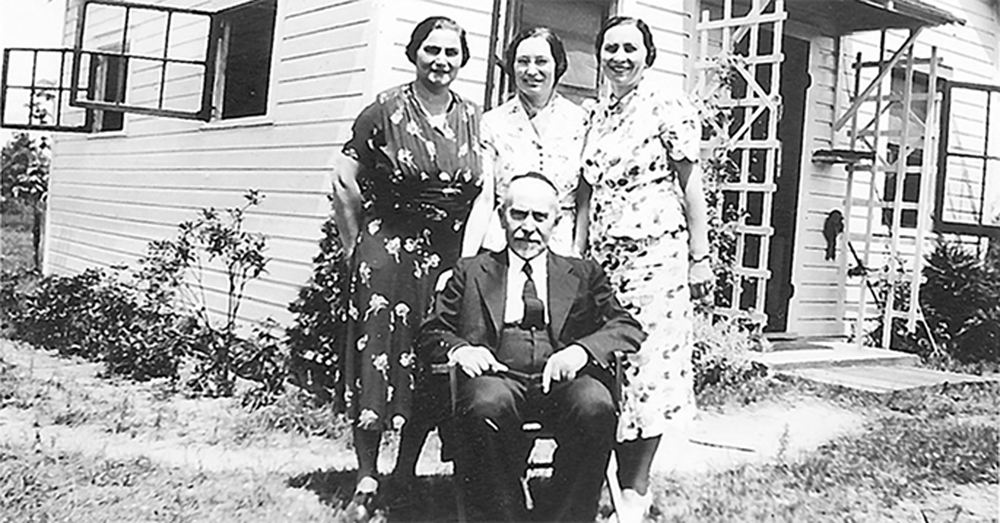
Returning to the gelatin issue, Horowitz tells the story of Abraham Goldstein (1861-1944), who really should be given the title of originator of industrial hashgachot in the United States. Here is his picture.[9]

It was Goldstein who was behind the OU’s kosher certification program and who established the agreements with the early companies. He was also the OU’s “chemical expert,” yet as Horowitz notes, he has been completely erased from the OU’s institutional memory.[10]

In 1935 he broke with the OU and founded the OK Laboratories. This would be sold in 1969 to Rabbi Berel Levy, and would then become a universally recognized hashgachah. However, this was not the case when Goldstein was in charge, and it is when Goldstein founded the OK that the controversial period of his life begins. This was because Goldstein, who was not a rabbi and had no expertise in Jewish law, set out to determine what was kosher and what was not. He made it clear that in determining what was kosher, chemists (such as himself) were a more reliable source than rabbis, as the latter did not understand food technology and were mistakenly giving approval to non-kosher food items. Goldstein had a very simple approach to the matter: If a product had any non-kosher element in it, it was treif and forbidden to be eaten. The notions of bitul or that the non-kosher food had so changed its form were not considerations he paid any attention to.[11] He also did not rely on rabbis whom he felt were not careful in such matters. Thus, he refused to accept the hashgachot issued on Coke by R. Samuel Pardes, editor of Ha-Pardes, and later by R. Tuvia Geffen.[12]

As Horowitz notes, R. Geffen was not happy with R. Pardes’ hashgachah on Coke because the drink included 0.09 percent glycerin from a non-kosher source. This is a very tiny amount—less than 1 in 1000—which according to halakhah is batel, and thus of no halakhic significance. Yet there are some fundamental questions involved here. One is if the tiny amount of non-kosher is put in as part of production, rather than accidentally falling in, do we still say that it is batel? Most authorities assume yes, so from this angle R. Pardes would have been on firm ground to declare the drink kosher. However, there is another issue, and that is can you officially give a hashgachah to an item relying on bitul, especially when the company will then be advertising the product as kosher? This can certainly be seen as distasteful and perhaps even bringing us to a situation of ein mevatelin issur lekhathilah (as the kashrut organization is now involved with the company).

R. Geffen believed that Coke should not be given a hashgachah as long as the non-kosher glycerin was not replaced with a kosher alternative. In fact, as far as I can see, R. Pardes himself never argued that it is acceptable to rely on bitul in issuing a hashgachah, since he flatly declared—mistakenly it turns out—that there were no non-kosher ingredients in Coke (that is, he was not saying that the non-kosher ingredients were of no halakhic significance).[13]

Goldstein had nothing but contempt for the way the old-time rabbis went about issuing hashgachot, and R. Pardes’ hashgachah on Coke was just another illustration of this. In speaking of R. Pardes, Goldstein wrote that “such men undermine the very foundation of our religion” and “there is no room for such scoundrels in decent company.” To reiterate, this was not a dispute between two rabbis but rather a layperson with no yeshiva training declaring that a learned rabbi did not understand the basic laws of kashrut. As far as the rabbis were concerned, the chutzpah here was unbelievable, and this was doubled by the fact that Goldstein’s Kosher Food Guide, which included all sorts of important information about kosher food together with Goldstein’s attacks on various rabbis, had a circulation of 150,000.[14] Significantly, Goldstein refused the OU’s demand that his publication be reviewed by rabbinic scholars.[15] Goldstein believed that when it came to modern food technology, he should be the one telling the rabbis what was kosher, not the reverse.

As Horowitz describes, Goldstein ratcheted up his attacks on R. Pardes after the latter gave a hashgachah to Junket, a product that was used to make a custardlike desert but which contained rennet that came from calves that were not ritually slaughtered. R. Pardes also received the backing of the OU for both his Junket hashgachah and his hashgachah on gelatin. (In 1952, after R. Eliezer Silver’s expressed a stringent opinion regarding gelatin, the OU removed its endorsement.[16])

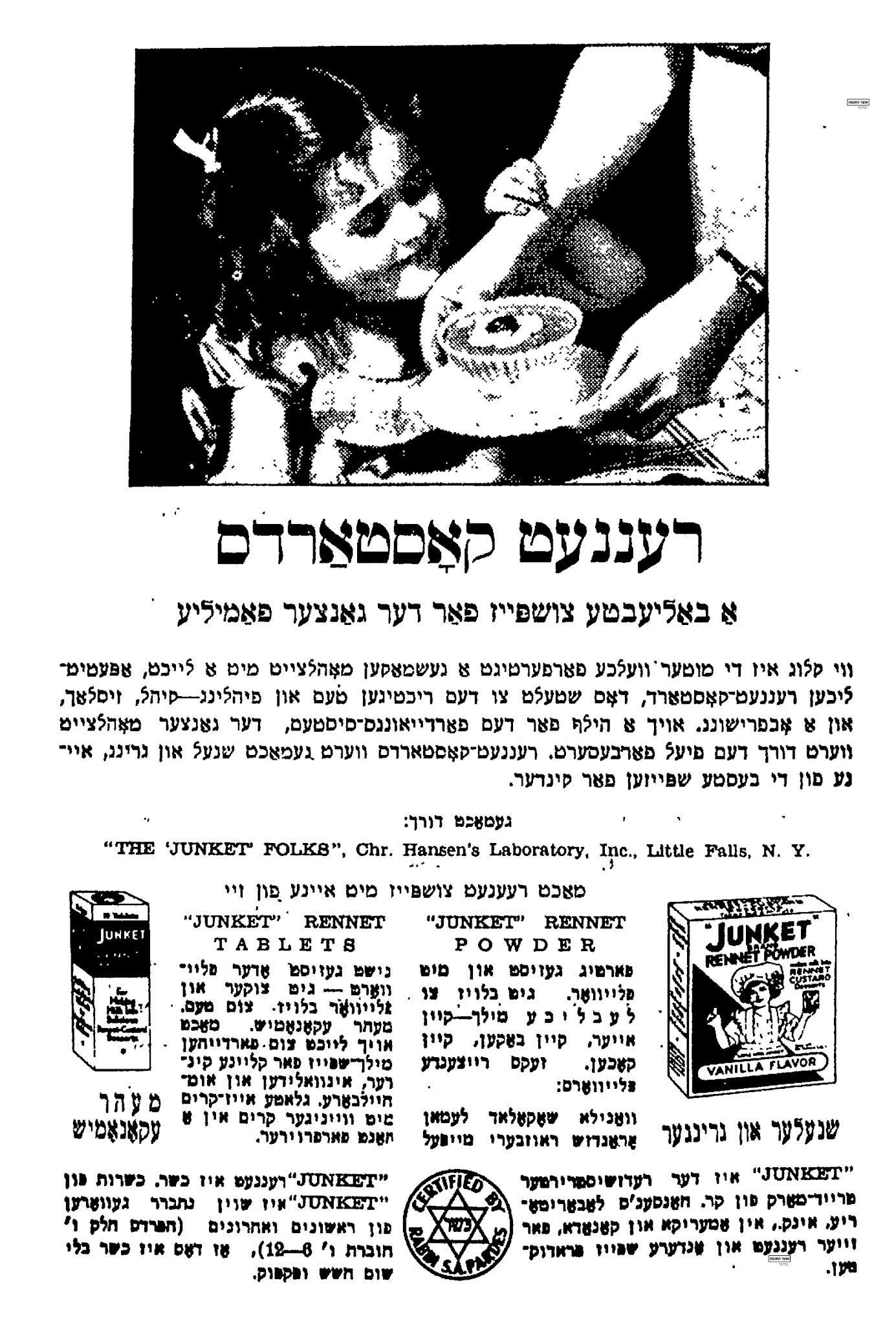
Here is an ad from Ha-Pardes, April 1938, for Junket, with R. Pardes’ hashgachah.

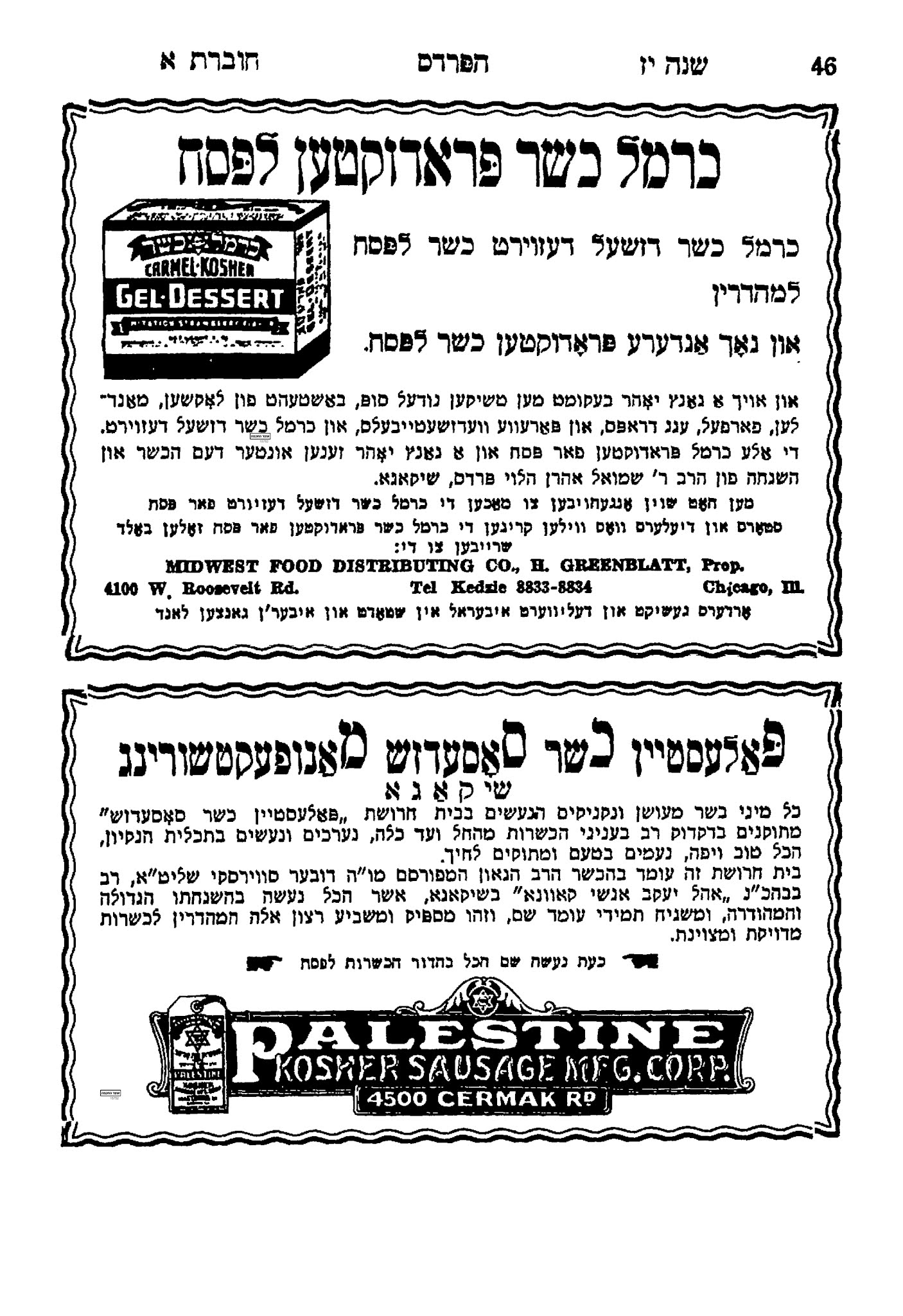
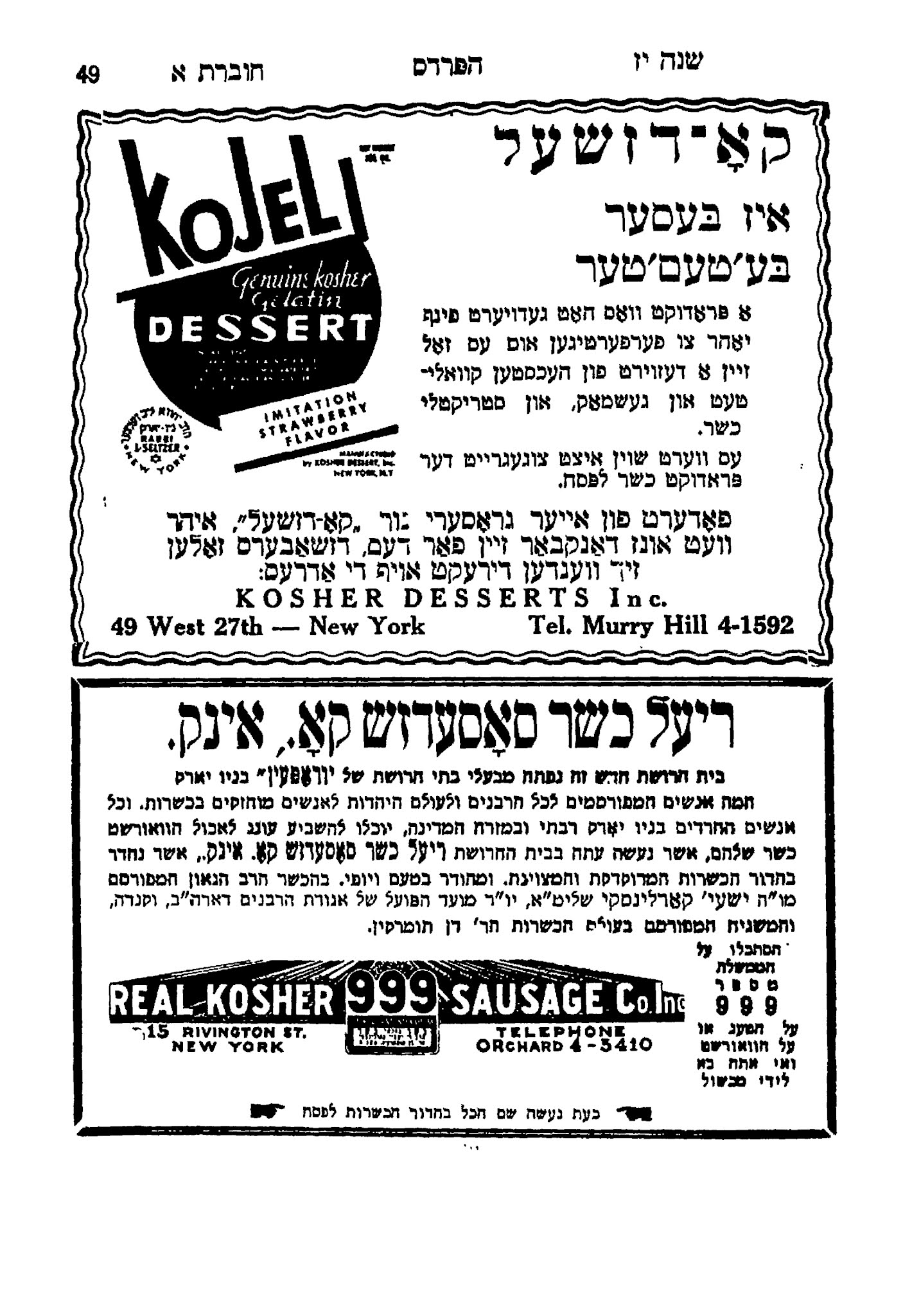
Here is an ad from Ha-Pardes, April 1943, for Carmel gelatin, with R. Pardes’ hashgachah.

Here is an ad from Ha-Pardes, April 1943, for Kojel gelatin, with R. Judah Leib Seltzer’s hashgachah.

In Goldstein’s opinion, the fact that the OU would support R. Pardes when it came to Junket—he was no longer alive when the OU approved of gelatin—only showed how low his former organization had fallen and how little it understood of food technology. For Goldstein, it was not only a sign of ignorance on the part of R. Pardes and the OU, as he also wondered if there was financial corruption involved. Addressing R. Pardes, Goldstein asked, “How much money has been paid for this false Hekhsher.” Turning to the OU, he asked if any them “participated in the division of this money.”[17] When it came to the issue of gelatin—which had great rabbis on both sides of the issue—Goldstein expressed his ire over Jello-O advertisements in the Jewish press, stating that these advertisements “are not only deplorable from a Jewish religious standpoint,” but were “an outrageous attempt to smuggle an absolutely trefa article into Jewish homes.”[18] He later repeated his warning regarding other brands of gelatin: “Neither Carmel, Emes, or Kojel gelatines can be used in Orthodox homes. They are trefa gelatines, despite the Rabbinical Heckshers.”[19] So here we have a layperson declaring that a product endorsed by leading American rabbis was “absolutely trefa.”

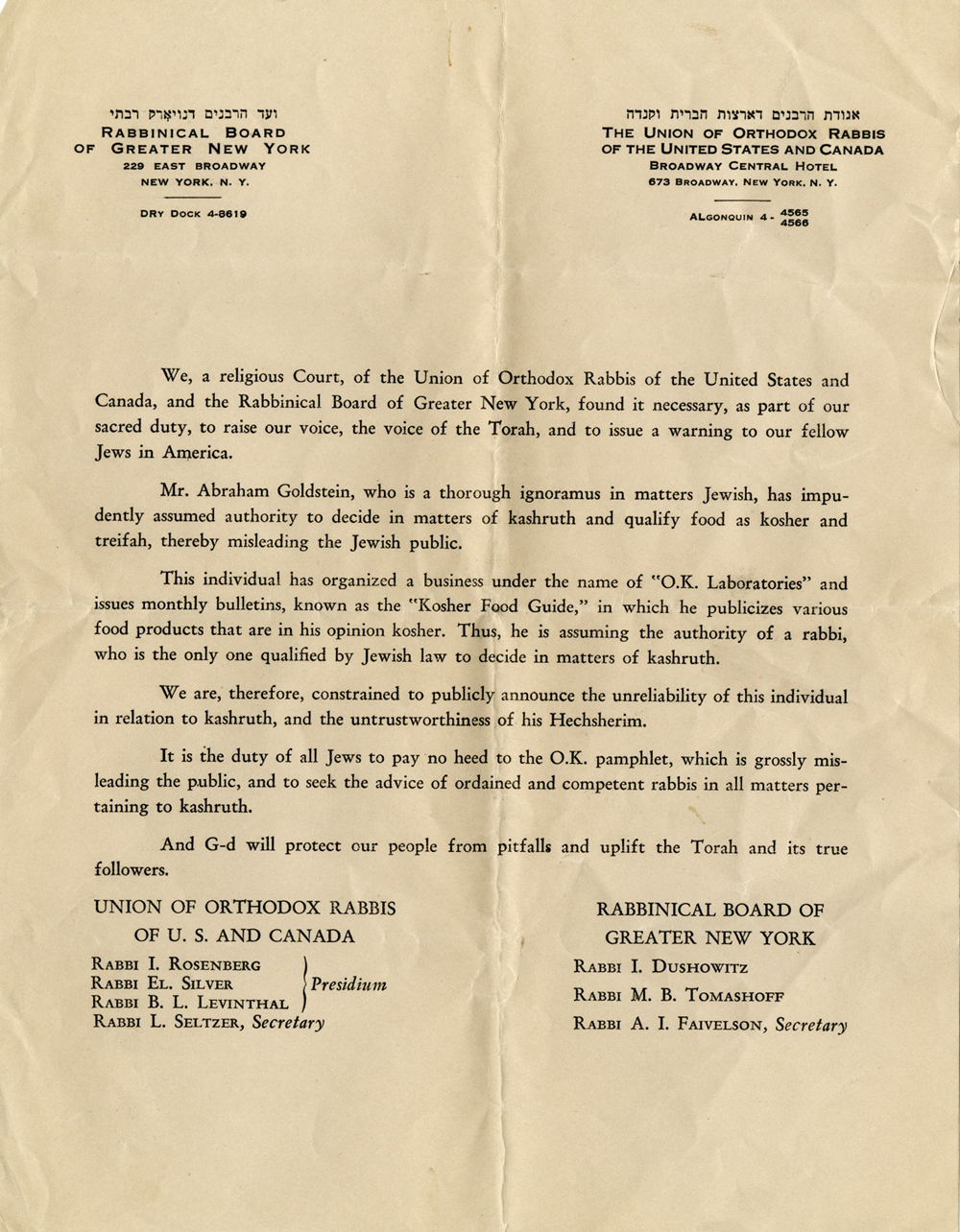
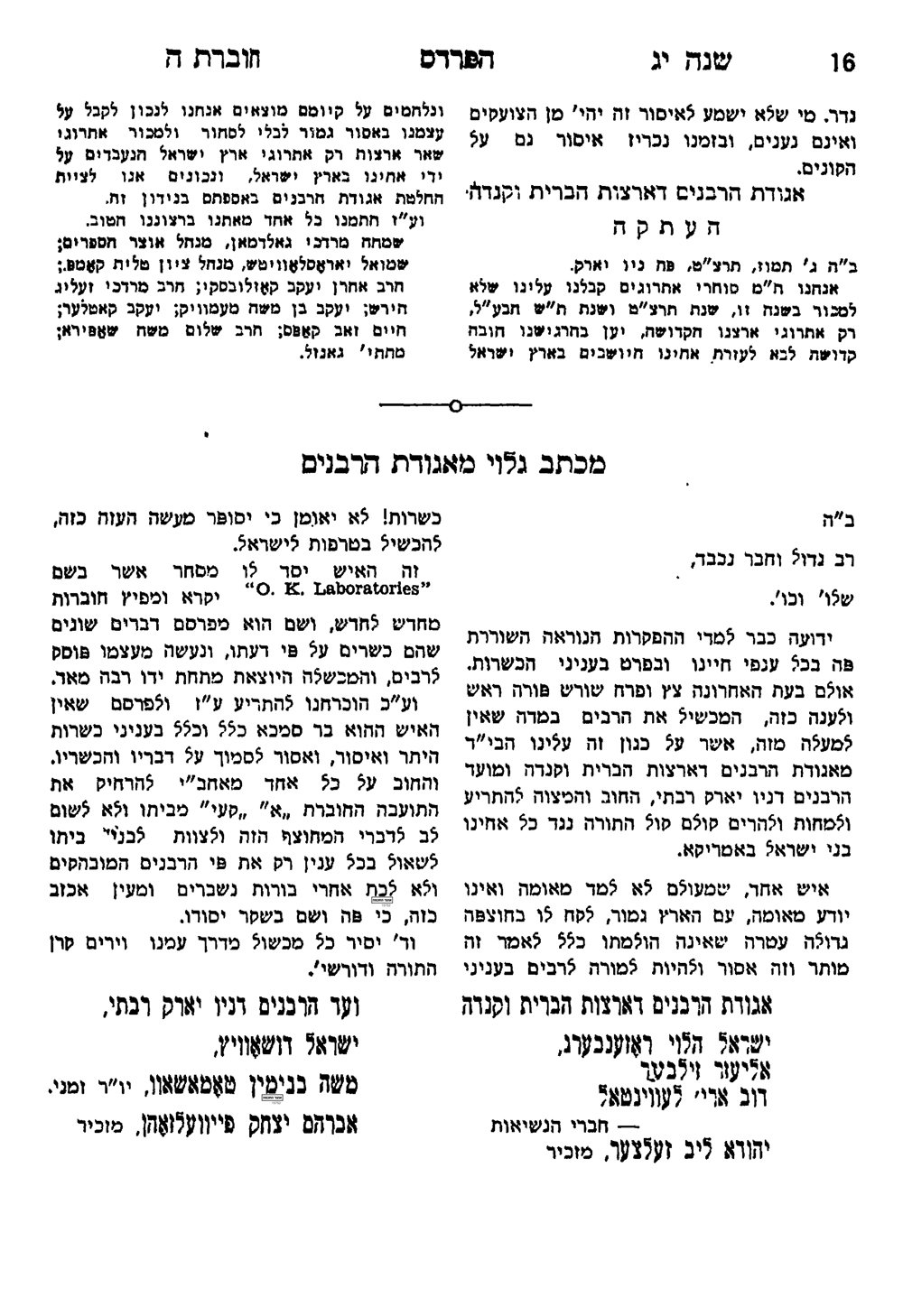
It was one thing for a rabbi who opposed the kashrut of gelatin to say such a thing, but to have a halakhically unlearned layperson setting himself up as the arbiter of what is, and is not, kosher was too much for the rabbinic leadership in the United States. Now it was no longer a question about the kashrut of Junket and gelatin—both of which R. Eliezer Silver himself would later reject—but respect due to talmidei hakhamim. As far as the rabbis were concerned, it simply was unacceptable for a layperson to establish himself as an authority when it came to kashrut. The most that he could do was supply information to the rabbis so they could make the proper halakhic decisions, but to publicly challenge the rabbis about their scientific facts and halakhic interpretations went over the line, and it was time for the rabbis to put Goldstein in his place. Here is the public statement issued by Agudas ha-Rabbonim and the Rabbinical Board of Greater N.Y.[20]

This is the English translation of the following Hebrew proclamation that appeared in Ha-Pardes, August 1939, p. 16.[21]

Almost ten years later it was Goldstein’s son, George, who was running the OK after the death of his father. He too was causing problems for R. Pardes. In Ha-Pardes, January 1948, p. 21, R. Pardes attacked the younger Goldstein, referring to him as הנער החצוף.

Despite the virtual herem on Abraham Goldstein, I agree with Horowitz[22] that at least to some extent Goldstein was posthumously vindicated. While the notion that a layperson could challenge learned rabbis in halakhic matters was never countenanced (and this is presumably the reason why Goldstein is completely absent from the OU’s institutional memory), Goldstein’s other point, that knowledge of chemistry and food technology is vital for kosher supervisors, has been accepted by all the mainstream hashgachot. Furthermore, despite the opposition of the rabbis to Goldstein’s OK, it remained a popular hashgachah with a wide following. In fact, until the mid-1950s, the OK supervised more products than the OU.[23]

One can only imagine Goldstein’s reaction had he heard of a pesak of the famed R. Ishmael ha-Kohen of Modena (1723-1811) in his Zera Emet, vol. 2, no. 48. The question is as follows:

נשאלתי מהו ליתן רפואה לחולה שאין בו סכנה חתיכות עגולים קטנים שקורין בוקונ”י בלע”ז מרוקחים בהרבה מינים ובכללם יש ג”כ עצם גולגלות אדם שרוף וכתות

R. Ishmael was asked about using a medicine for someone who was sick but not in serious danger. The issue was that the medicine contained pieces of a ground up human skull. This is what has been called “powdered skull,” and was a common medicine in the eighteenth century.[24] R. Ishmael permits one to consume this “medicine”.

A few centuries earlier, R. David Ibn Zimra was also asked about medicine that was made from flesh of non-Jewish dead bodies (מומ”יא — mummies).[25] R. Ibn Zimra focuses his responsum on the issue of benefiting from a dead body, since when it comes to eating the flesh, he sees no problem at all in this, as its form has been entirely changed:

איסור אכילה לא הוצרכת לשאול דודאי מותר באכילה שהרי נשתנה צורתו וחזר להיות עפר בעלמא וכ”ש ע”י סמים שהרי המומי”א היא בשר החנוטין שחונטין אותם בכמה מיני סמים כדי להעמיד צורתו וגופו וחזר להיות כעין זפת ואין בו איסור אכילה

For those interested in learning more about the subject of “corpse medicine”—which included much more than the skull—and if your stomach can handle it, I recommend Richard Sugg, Mummies, Cannibals and Vampires: The History of Corpse Medicine from the Renaissance to the Victorians (London and New York, 2016). What passed for medical cures in pre-modern times is shocking, and often downright disgusting.

As late as 1907, the Adeni Rabbi Samuel Yeshuah[26] discusses sick people who consume “mummy medicine,” what he refers to as

 רפואת ההבל שנתפשט בין העם . . . באמת המומיא הזו לא יועיל ולא יציל והיה כלא היה

I assume many readers will be shocked to learn that great poskim permitted what I have just described. Today, of course, it would turn our stomachs to even think about consuming part of a corpse, much like Goldstein was outraged that anyone could think that it is permissible to consume something from a non-kosher animal, even from a pig no less. Yet this revulsion does not arise from halakhah. Speaking personally, I can’t imagine that anyone I know would eat a piece of meat from a pile if he knew that a non-kosher piece had fallen into the group of kosher pieces, despite what the halakhah says; all the more so if a piece of pork fell into a kosher dish even if it was nullified by 60. Again, our revulsion has its origin in feelings that have little to do with pure halakhah. In fact, some authorities feel that to be strict in such cases is akin to heresy, as it is in practice (but not in theory) a denial of the halakhic principle of bitul.[27]

If I could have spoken to Goldstein, I would have tried to explain to him that the halakhic system does not work in accord with what has been called “da’at baalei batim,” and those who forbid gelatin also acknowledge that not everything from a non-kosher animal is forbidden. The gelatin dispute concerns the role of gelatin in the finished food product, not with the existence of non-kosher per se. Thus, even one who is strict in the matter of gelatin would not start screaming if he saw his son standing in right field chewing on his non-shechted leather baseball mitt.

To be continued

*************

My Torah in Motion trips are starting again. I am leading a group to Morocco in January, and there is a full line-up for next summer. You can see details here.

*************

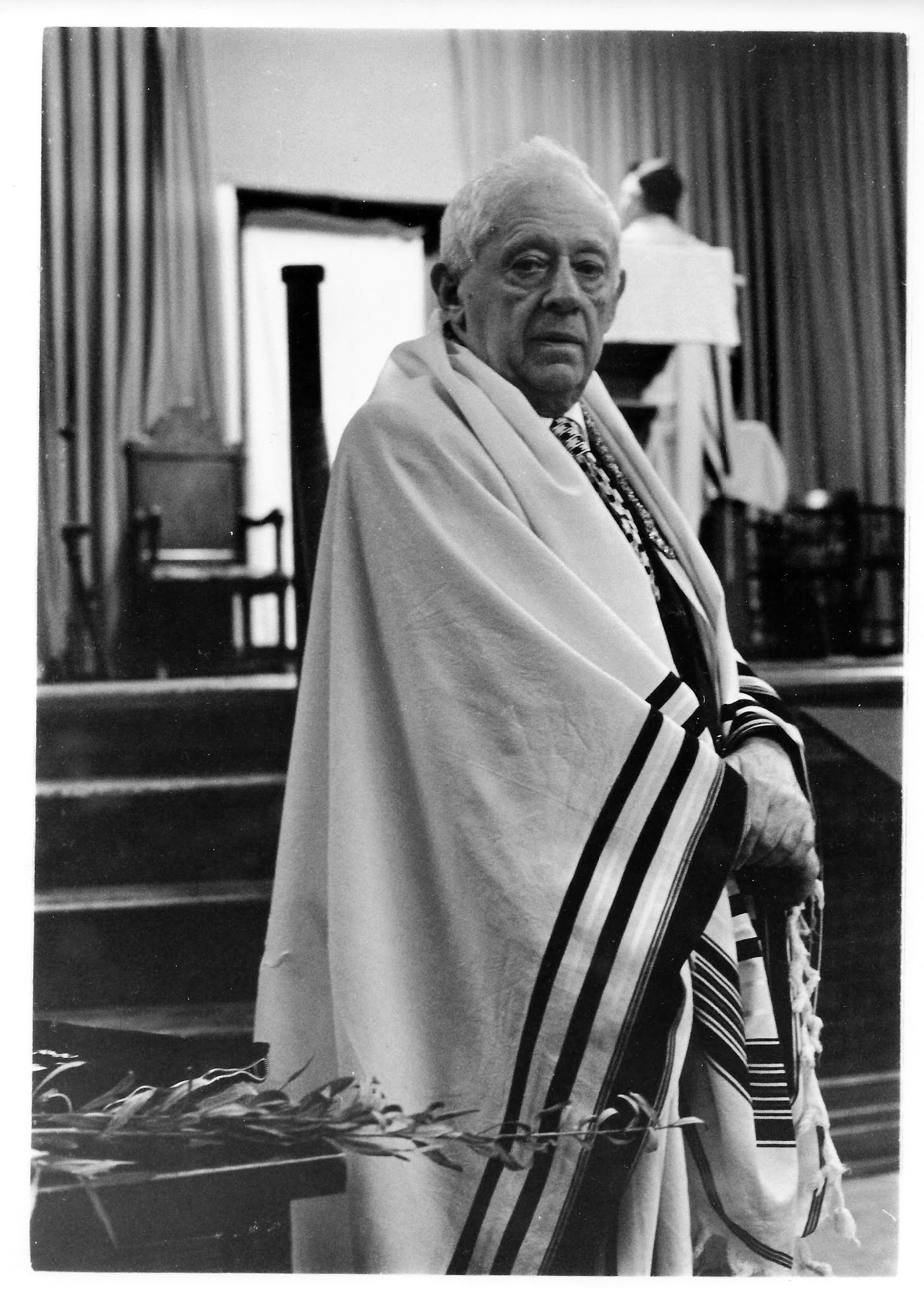
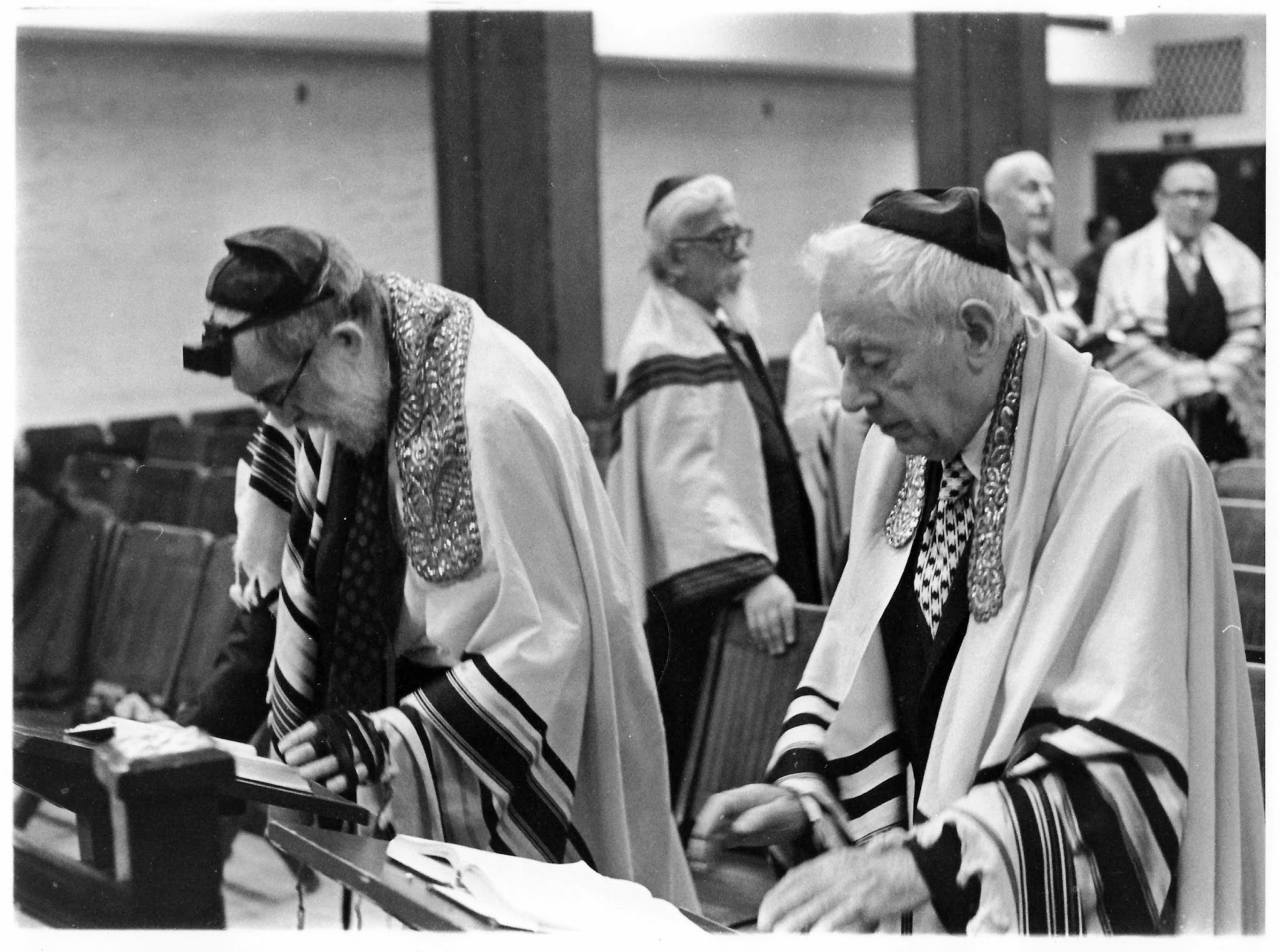
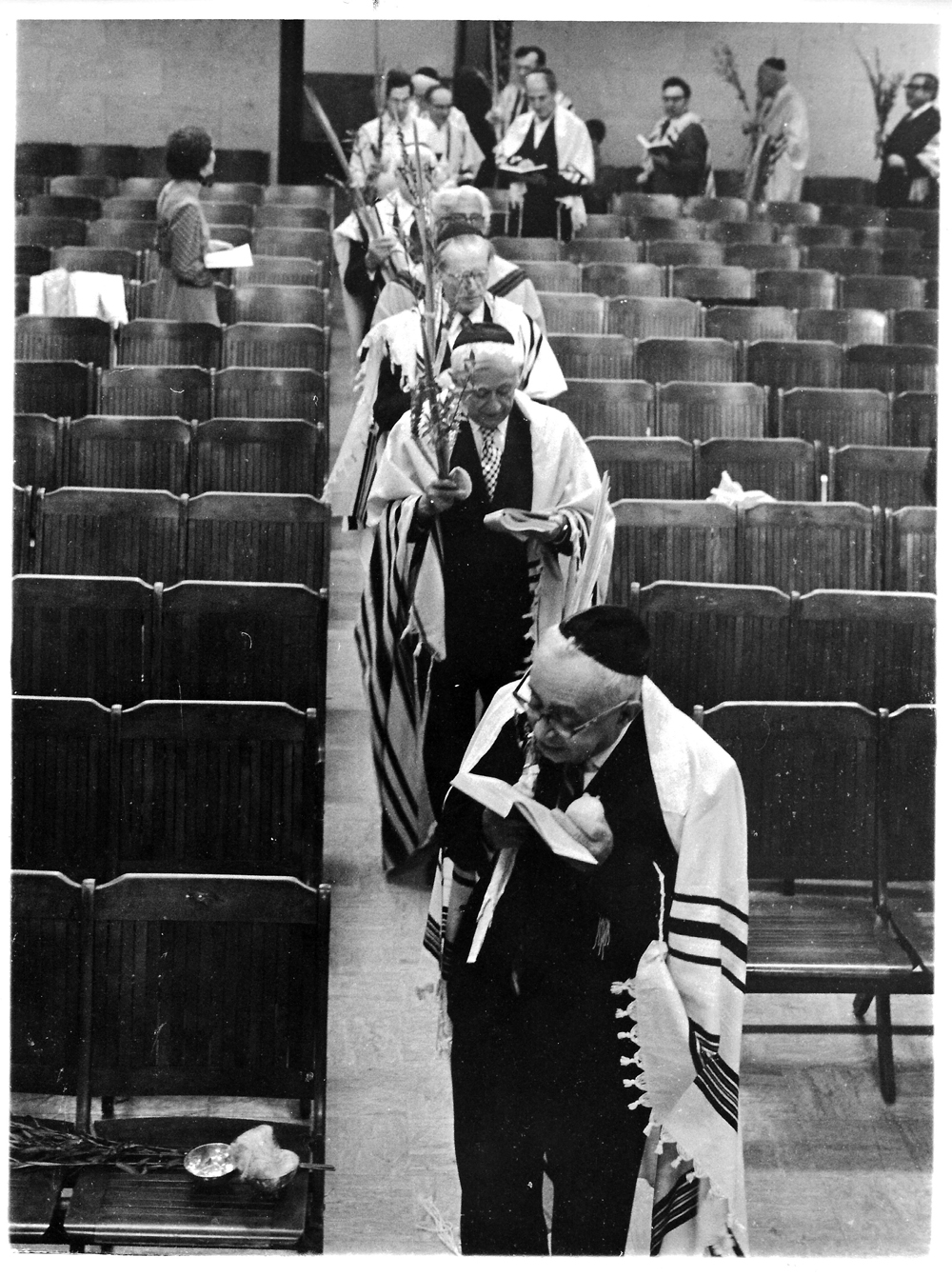
I am currently doing a series of classes for Torah in Motion on R. Saul Lieberman. You can see them here on YouTube. Here are some pictures that were taken at the Jewish Theological Seminary minyan in Unterberg Auditorium on Hoshana Rabba 1971. (At this minyan there was separate seating but no mechitzah.) The pictures were taken by Joel Mandelbaum, son of R. Bernard Mandelbaum who held many positions at the Seminary, including serving as president from 1966-1973 under Chancellor Louis Finkelstein.

Here is Lieberman.

Here is Lieberman and Louis Finkelstein. Abraham Joshua Heschel is standing between them and Bernard Mandelbaum is on the far right.

In front of Lieberman, leading the procession, is Moshe Zucker. Behind Lieberman is Simon Greenberg.

*************

[1] See Ha-Pardes, August 1942, p. 19. It also states here that R. Shlomo Natan Kotler permitted gelatin.

[2] Ha-Pardes, October 1952, p. 31.

[3] See Horowitz, Kosher USA (New York, 2016), pp. 59-60.

[4] The Responsa of Professor Louis Ginzberg, ed. David Golinkin (New York and Jerusalem, 1996), p. 152.

[5] Responsa and Halakhic Studies (n.p., 1975), ch. 7.

[6] Iggerot Moshe, Yoreh Deah 3, nos. 10, 11.

[7] For example, the Shulhan Arukh, Yoreh Deah 201:75, famously forbids heated mikvaot. (R. Karo cites the stringent view as יש מי שאוסר and he does not offer a lenient alternative). However, R. Eliezer ben Arha of Hebron (died 1691) reported that R. Karo abandoned this stringency and permitted the heating of a mikveh.

ואפילו בזמן הרב מוהרי”ק זלה”ה עשה מעשה נגד מה שפסק שחשש וכתב סברת האוסר, כי רבים מבני עליה הם המתירין, ועלייהו קא סמכינן

See She’elot u-Teshuvot Rabbenu Eliezer ben Arha (Jerusalem, 1978), no. 18, and see note 1 for the impact of this reported change in R. Karo’s position.

Another interesting phenomenon, which I will not discuss in this post, is when a posek refuses to put a leniency into writing. How authoritative is this posek’s oral ruling? A classic example of this is R. Moshe Feinstein’s opinion about turning off the flame of a gas stove on Yom Tov. In Iggerot Moshe, Orah Hayyim I, no. 128, R. Moshe writes that he doesn’t wish to put his opinion in writing, but it is known that he permitted this.

[8] See e.g., here where I discuss the false claim that R. Ezekiel Landau retracted his view that sturgeon is kosher. For the claim that R. Joseph Hayyim retracted his permission to ride a bicycle on Shabbat where there is an eruv (Rav Pealim, vol. 1, Orah Hayyim, no. 25), see R. Ovadiah Hadaya, Yaskil Avdi, vol. 3, Orah Hayim, no. 12:5:4, vol. 5, Orah Hayyim, no. 40. For a rejection of this claim, see R. Ovadiah Yosef, Yabia Omer, vol. 9, Orah Hayyim, no. 108:189. See also here where R. Doniel Neustadt writes: “Several sources report that the Chafetz Chayim eventually changed his ruling and exempted cooked fruits served for dessert from a blessing; see Orchos Rabbeinu 66 and Vezos ha-Berachah, pg. 78. Others dispute that the Chafetz Chayim changed his ruling.” The forger Chaim Bloch, Ha-Maor, Dec. 1951, p. 7, who was himself opposed to the gelatin heter, claims to have discussed the matter with R. Hayyim Ozer Grodzenski. Not surprisingly, Bloch records that R. Grodzenski told him that he never actually gave a ruling on the question of gelatin. Rather, he was only stating that his opinion inclined in this direction. For a rejection of Bloch’s false testimony, see R. Samuel Baskin and R. Shimon Winograd in Ha-Maor, Aug. 1952, pp. 7-8. Here is some of what they write:

אם הגאון רח”ע באמת חזר מתשובתו ומהיתרו על תוצרת הנ”ל, איך לא הודיע זאת ברבים, כדי שלא יכשלו ח”ו ויסמכו על פסקו ותשובתו בשו”ת אחיעזר, ויעשו מעשה לכתחילה בדבר שלא נתן הגאון הנ”ל היתר מוחלט, ועוד אם הגאון רח”ע ז”ל דיבר עם הרב ח”ב בשנת תרצ”ה כאשר כותב בהירחון “המאור”, איך כתב הרב הגאון רח”ע ז”ל להרב הגאון ר’ יוסף קאנוויץ ז”ל בחודש אייר שנת תרצ”ו שנה או יותר לאחר שיחתו עם הרב ח”ב, שמסכים עמו על היתרו בדבר הכשר הז’לטין

[9] The picture is found here and comes from the Ezra and Monica Friedman collection.

[10] Kosher USA, p. 26.

[11] See Spitz, Food: A Halachic Analysis, p. 459: “Dr. Goldstein . . . publicly maintained that any food item whose origins lie in a non-kosher source may not be considered kosher, no matter how “changed” it may currently appear.”

[12] Horowitz, Kosher USA, pp. 33ff.

[13] See Adam Mintz, “Is Coca-Cola Kosher?” in Rafael Medoff, ed., Rav Chesed: Essays in Honor of Rabbi Dr. Haskel Lookstein (Jersey City, 2009), vol. 2, p. 80; Horowitz, Kosher USA, p. 36.

[14] Horowitz, Kosher USA, pp. 29, 37.

[15] Horowitz, Kosher USA, p. 41.

[16] Horowitz, Kosher USA, p. 64.

[17] Horowitz, Kosher USA, pp. 38, 41.

[18] Horowitz, Kosher USA, p. 50.

[19] Horowitz, Kosher USA, pp. 54-55. Kojel is no longer is made with problematic gelatin and is currently under the OU hashgachah.

[20] Document provided courtesy of the Israel Rosenberg Archive, The Library of the Jewish Theological Seminary, New York, NY, ARC 98, Box 6, Folder 23.

[21] This proclamation was reprinted in Ha-Pardes, October 1939, p. 29. For other attacks on Goldstein see Ha-Pardes, August 1942, p. 17; Ha-Mesilah, Adar 5702, p. 20, sections ב, ה.

[22] Horowitz, Kosher USA, p. 42.

[23] See here.

[24] See here.

[25] She’elot u-Teshuvot ha-Radbaz, vol. 3, no. 548.

[26] Nahalat Yosef (Jerusalem, 1907), pp. 15a-b.

[27] For one discussion, see here.


Assorted Comments on R. Jacob Emden, Ashkenazic Views of Sephardic Gedolim, and More

Assorted Comments on R. Jacob Emden, Ashkenazic Views of Sephardic Gedolim, and More
by Marc B. Shapiro

1. Since I have discussed R. Jacob Emden in many posts, let me add the following. If you examine Emden’s Birat Migdal ha-Oz you find that he refers to himself as הסריס. Here is the Berditchev 1836 edition of the work, p. 135a.[1]
I think all would agree that this is a strange title to give oneself. In this work, p. 116a, he also calls himself שלו.

On p. 44a he refers to himself as שאול.

On pp. 101b and 102a he refers to himself as שכוי.

Here is Lehem Shamayim (Wandsbeck1728), vol. 1, p. 1a (see also 2a) where he also refers to himself as שכוי.

Returning to Birat Migdal Oz, on p. 108b he refers to himself as שלה.

What is this all about? The answer was revealed by R. Meir Segal in his 1881 commentary on Emden’s siddur (although I am sure many people had already figured it out).[2] The gematriyot of all these words are either 335 or 336. This corresponds to יעקב בן צבי, the gematria of which is also 336 (and we know that gematriyot are allowed to be off by one number).
In Amudei Shamayim, vol. 2, p. 154a, which you can see here

Emden writes:
סוד פורי”ים בקצור רומז ג”א ממותקים בג”ה (ס”ה של”ו הוא בה”ס . . .)

As R. Segal explains,[3] this is to be “translated” as: 

סוד פורים בקיצור רומז ג’ א-להים ממותקים בג’ הויות ס”ה גימטריא של”ו הוא בעל הספר

ס”ה obviously stands for סך הכל and what it is saying – ignoring the kabbalistic allusion – is that the gematria of פורים equals 336 and this is also equaled by א-להים x 3 = 258 + הויה x 3 = 78 (258+78=336)..

As mentioned, Emden refers to himself as שלו. How is this supposed to be pronounced? Some people would assume shelo. I originally thought that a more likely meaning was shalev, which means “calm” or “tranquil”. R. Segal also understands it this way since he writes[4]  כנה א”ע בשם שלו כי השלום יאות לבוטח

Shilo is also sometimes spelled as שלו so that is another possibility.

However, these suggestions are incorrect, and the proper way to pronounce it is selav, as in quail. We know this because of the verse in Psalms 105:40:

שאל ויבא שלו ולחם שמים ישביעם

The second half of the verse has the words לחם שמים. This is the name of Emden’s commentary on the Mishnah. I am certain that the connection of שלו and לחם שמים was regarded as significant by Emden, and this also reveals how שלו should be pronounced.[5]

2. In Changing the Immutable, p. 205, I cite a letter from R. Elhanan Wasserman to R. Eliezer Silver and note that the published version of the letter, in Kovetz Ma’amarim ve-Iggerot, vol. 2, p. 97, omits R. Wasserman telling R. Silver that before R. Hayyim Ozer Grodzinski’s death the latter reached for his wife’s hand. R. Moshe Maimon informed me that the letter with the deleted words restored was published in R. Pinchos Lipshutz, Peninei Hen (Monsey, 2000), pp. 76-77. Here it is.

From the original letter we can see that R. Hayyim Ozer’s comment that things are not good was made to his wife. However, one who reads the letter in Kovetz Ma’amarim ve-Iggerot would have to conclude that this statement was made to R. Elhanan, as the passage reads:
שעה קלה לפני הפטירה . . . אמר: “דוא וויסט עס איז ניט גוט” (אתה יודע שהמצב אינו טוב)
As I mentioned in the book, I think it is significant that the publisher inserted three dots showing that something was deleted, since this is very uncommon among haredi publishers. But the following is also important: In the original letter R. Elhanan writes אמר לה, meaning that R. Hayyim Ozer made this comment to his wife. Also (and this point was made to me by Maimon), in the Hebrew translation what appears is אתה יודע which is masculine and indicates that the comment was made to R. Elhanan. These changes had to be made since once the line about holding his wife’s hand is removed, it would not make sense for the reader to see a reference to a woman, as in אמר לה.

Maimon also called my attention to the following: Here is a famous painting portraying Napoleon granting freedom to the Jews. Notice how Napoleon appears like Moses, holding a Tablet of the Law. 

Here incidentally is another image from a coin minted on the occasion of the meeting of the Sanhedrin summoned by Napoleon. Notice how Napoleon is handing the Two Tablets of the Law to Moses. In other words, Napoleon is portrayed as God.[6]

Returning to the painting of Napoleon, it is reproduced in R. Binyamin Shlomo Hamburger’s Meshihei ha-Sheker u-Mitnagdeihim (Jerusalem, 2009), p. 481, yet here sleeves have been added to the woman.

Since I have just mentioned R. Moshe Maimon, let me continue with a couple of his comments. In my book, p. 97 n. 67, I translate minhag vatikin[7] as a “long established practice”. I actually should have said “long established practice of the pious ones” (although some might see this as already implied). Maimon questions whether there is any relationship between vatikin and “long established”, or it if just means “the pious ones”. I always assumed that vatikin means the “pious ones of old”. Indeed, Jastrow translates the word as “the conscientiously pious men of former days”, and an online search reveals that others translate similarly.

Yet Rashi, Berakhot 9b, explains vatikin as אנשים ענוים ומחבבין מצוה, and in this explanation there is no assumption that the vatikin lived in former days. In other words, a practice developed by contemporary pious ones could also be regarded as a minhag vatikin, and there appears to be no reason for me to have thought that Rashi would assume that the vatikin he describes were also “men of old”.

While modern Hebrew uses the word vatik to mean old or one involved in something for a long time, e.g., מוותיקי הסופרים, I have to acknowledge that, with apparently one exception (see note 8), I have not found early uses of the term that have this connotation. One who paid attention during the High Holidays liturgy would have noticed the term and it has nothing to do with “old” here, e.g., הועד והותיקות, לותיק ועושה חסד, and others.[8] See also Arukh, ed., Kohut, s.v. ותק, which offers Arabic and Greek cognates that have no connection to age. For those really interested in the topic, you should consult David Golinkin’s learned and comprehensive article which also shows that the term vatikin has no connection to age.[9]

Maimon also made the following correction. On p. 229 n. 64, I refer to R. Hayyim Eleazar Shapira’s criticism of Slobodka students and his negative view of R. Moses Mordechai Epstein, and note that this was removed from some editions of R. Moses Goldstein’s Mas’ot Yerushalayim.[10] The censored material I refer to is from a conversation between R. Shapira, the Rebbe of Munkacz, and R. Solomon Eliezer Alfandari, and contrary to what I carelessly wrote, what was deleted was stated by R. Alfandari, not R. Shapira. This matter, and the censorship, is discussed by Maimon in a Seforim Blog contribution here.

Let me offer another example where Mas’ot Yerushalayim is censored (and this is not noted by Maimon in his post just mentioned). Here is Mas’ot Yerushalayim (Munkacz, 1931), pp. 91a-91b.

It mentions that after R. Alfandari’s death his writings were under the control of certain Sephardic rabbis who were associated with the Chief Rabbinate. These rabbis are referred to as .איזה רבני ומלקקי המשרד מהצפרדעי”ם The last word, צפרדעים (frogs) is a play on ספרדים.

Here is how the page looks in a later edition published in Israel (pp. 319-320). As you can see, the reference to the צפרדעים has been deleted.

The same deletion is found in the 2004 edition (p. 237)

Needless to say, Sephardic readers were not pleased to see this. But this wasn’t the only thing to upset them. Earlier in the book (pp. 26a-b in the first edition), we find that R. Shapira stated that he heard from R. Yehezkel Shraga Halberstam of Sieniawa that when the latter was in Jerusalem on the yahrzeit of R. Hayyim ben Attar, the Or ha-Hayyim, he observed that the Sephardim did not visit his grave. He inquired about this and was told that even though the Or ha-Hayyim was a Sephardi, he had disputes with the Sephardim and the latter did not recognize his greatness. Referring to the Sephardim, he quotes Psalms 82:5: “They know not, neither do they understand; they go about in darkness.” This is contrasted to the Ashkenazim who give the Or ha-Hayyim his proper respect.

Here is the passage.

The text was altered in the next edition.

In the Jerusalem 2004 edition it is back in its entirety.

When Mas’ot Yerushalayim appeared, R. Meir Vaknin, the rav of Tiberias, was quite angry upon seeing the two texts I have discussed and responded sharply.[11] He completely rejects the notion that the Sephardim do not properly respect the Or ha-Hayyim. He also denies that there was ever a dispute between the Sephardic community and the Or ha-Hayyim.

Why then do the Sephardim not go to the Or ha-Hayyim’s grave on his yahrzeit?  R. Vaknin explains that the reason is simple, namely, that Sephardim don’t have this minhag and they were never taught to do so by R. Isaac Luria. Therefore, they don’t go to graves on any yahrzeit, “not to the ARI, not to Maran the Beit Yosef, and not to the Rambam. Even to Rabbi Shimon Ben Yohai only a very small number go to Meron.”

R. Vaknin is speaking about the Sephardic community in the Land of Israel before the massive aliyah of the North African Jews. Today, of course, Meron is full of Sephardim on Lag ba-Omer (which people mistakenly believe to be the yahrzeit of R. Shimon Ben Yohai[12]), but R. Vaknin provides testimony about how things were very different not too long ago.

As for Mas’ot Yerushalayim referring to Sephardim as צפרדעים, R. Vaknin is simply outraged by this insult:

והאם טוב וישר הדבר הזה בעיני א-להים ואדם לכתוב ולכנות שם רע על העם הקדוש הספרדי כולו בכללותו, מי יוכל להתאפק על בזיון ושם רע על כללות עם הקודש, ואיזה תקון יועיל לכלות העון הזה ולהתם הפשע החמור, אפילו המכנה שם רע לחברו עיין ברז”ל כמה חמור ענשו, וכל שכן על כללות העם כולו אשר כמה וכמה גדולי תורה נמצאים בתוכו, כמה צדיקים וחסידים וסובלי חולאים וסיגופים ותעניות לכבוד ה’ ותורתו נמצאים בתוכו

R. Vaknin also printed a letter by R. Jacob Zarihan of Tiberias. He too was very upset by what appears in Mas’ot Yerushalayim.

The 2004 edition of Mas’ot Yerushalayim has Goldstein’s reply to R. Vaknin in which he apologizes if he caused offense.[13] He stresses that his negative words about the צפרדעים were only made with reference to those Sephardic rabbis associated with theמשרד , i.e., the Chief Rabbinate.[14] This could hardly have been of any comfort to R. Vaknin since unlike the Ashkenazic world, the Sephardic world did not have an extremist Edah Haredit, and almost all of the Sephardic rabbis had great respect for the Rishon le-Tziyon, R. Jacob Meir, and the other outstanding Sephardic rabbis who worked with him.

It is noteworthy that Goldstein’s rebbe, R. Hayyim Eleazar Shapira, also had some negative things to say about Sephardim. In his discussion about the apparently Sabbatean work Hemdat Yamim, R. Shapira refers to R. Hayyim Palache who in his Kol ha-Hayyim[15] defends the Hemdat Yamim, even if the author was a Sabbatian. As R. Palache states, Rabbi Akiva made a mistake in thinking that Bar Kokhba was the Messiah, but this does not disqualify the Torah teachings of R. Akiva. Similarly, we should not disqualify the Hemdat Yamim no matter what the author believed about Shabbetai Zvi. R. Shapira thinks that this is nonsense, and it is obvious to him that if the author of Hemdat Yamim was a Sabbbatian then the work must be shunned.

What angers R. Shapira even more is that R. Palache later states (Kol ha-Hayyim, p. 18a) that there is a tradition not to speak at all about the Shabbetai Zvi episode, not even in a negative way[16]:

וכבר יש קבלה מרבותינו ואבותינו הקדושים שלא לדבר מטוב ועד רע על ענין ש”ץ כי גם קוב לא תקבנו גם ברך לא תברכנו

R. Shapira finds this outrageous, since how can one not speak negatively about such an evil person as Shabbetai Zvi. He writes:[17]

ורחמנא לישזבן מהאי דעתא הנפסדת המטלת ספיקות מעין היש ה’ בקרבנו וכו’ והיתכן כי על משיח השקר שהמיר דתו למחמדנות באונס או ברצון ועכ”פ שהסית והדיח אלפים מישראל עליו כתוב “גם קוב לא תקבנו” ובודאי בע”כ שהטיל ספיקות אולי הי’ אמת ע”כ קוב לא תקבנו לרעה. לא יאומן כי יסופר שיהי’ כזה נדפס מרב מגדולי הספרדים לולי ראיתי בעיני – אוי לנו שכך עלתה בימנו שהפרוץ מרובה. ואולי [צ”ל ואילו] הי’ כזה נדפס בדור הקדום היו גדולי הדור מרעישים עולם.

After these harsh words, R. Shapira offers his explanation of how R. Palache could have written what he did, and it is perhaps the all-time greatest put-down of Sephardim in rabbinic literature. While R. Shapira has great respect for the Sephardim of earlier generations, and also for special individuals such as R. Alfandari,[18] he thinks that most Sephardim of recent years are simply not that smart, and are thus able to believe all sorts of nonsense.

וחשבתי להצדיק קצת את הה”ג ז”ל בע”ס כל החיים להיות הספרדים בימינו בטבעם רובם נמוכי השכל נוחין להתפתות ולהאמין לכל דבר ע”כ השיאם עון אשמה גם לגדוליהם רבניהם בספיקות כאלה.

What R. Shapira did not know is that this strategy of not speaking bad about Shabbetai Zvi had nothing to do with being sympathetic to him, and was certainly not an example of Sephardic stupidity. Rather, as Gershom Scholem notes, it was a strategy chosen by the rabbis in order to allow the community to return to normal.

In choosing this course, the rabbis of Constantinople and Smyrna may have attempted the impossible; at any rate they acted in what seemed to them the most reasonable and responsible fashion. . . . The messianic propaganda, which had not been checked by either the rabbis or the lay leaders, had roused their emotions and faith to such a pitch that rational criticism and appeals to traditional standards would probably have availed little. It seemed safer and wiser to ignore the whole matter as far as possible, and to let time and oblivion heal the wound. Neither condemnation nor apologies, but silence alone would enable the disturbed community to find the way back to normal life.[19]

Scholem quotes the passage from R. Palache cited above, and he also summarizes another passage from the very same section in R. Palache’s Kol ha-Hayyim.

The earlier version of the story was that R. Sabbatai Ventura of Sofia had shown disrespect at Nathan’s tomb, whereupon his hand dried up and remained paralyzed until he returned again to the tomb and prayed for forgiveness. When his son Abraham Ventura passed through the city on his travels on behalf of the community of Safed, “a drop fell on him during his first night there and he died . . .  and was buried next to the tomb of R. Nathan.” (The story is told by R. Hayyim Palache of Smyrna in Kol ha-Hayyim [Smyrna, 1874], pp. 17-18.)[20]

In the earlier Hebrew version of Scholem’s work, Shabbetai Tzvi  (Jerusalem, 1957), vol. 2, p. 794 n. 2, the direct quotation of R. Palache is a little different:

“נפל עליו טיפה בלילה ראשונה שנכנס שם וימת שם אברהם וקברוהו סמוך ממש לקברו” של ר’ נתן, כפי שסופר בס’ כל החיים לר’ חיים פאלאג’י מאיזמיר, דפים יז, יח.

Notice how in the Hebrew quotation from R. Palache there is no mention of “R. Nathan” (of Gaza). In other words, the English version is mistaken in including the words “R. Nathan” as part of the direct quote.

Most people who examine the matter will probably also assume that Scholem’s Hebrew text is mistaken, since the story R. Palache tells (which appears on p. 18a, not pp. 17-18 as mentioned by Scholem), has nothing to do with Nathan of Gaza and thus the latter should not have been mentioned by Scholem. As you can see from the page following this paragraph (from Kol ha-Hayyim 18a), R. Palache’s story is about the grave of the anonymous author of Hemdat Yamim, not Nathan of Gaza. (Scholem himself did not regard Nathan of Gaza as the author of Hemdat Yamim.[21])

What is going on here? Can we assume that a careful scholar like Scholem made such a blunder and inserted Nathan of Gaza into a story that has nothing to do with him? The answer is no, and let me explain what is behind what Scholem writes since for some inexplicable reason he doesn’t do it himself. In Mekhkerei Shabtaut (Tel Aviv, 1991), p. 251, Scholem notes that once R. Jacob Emden (mistakenly) identified Nathan of Gaza as the author of Hemdat Yamim,[22] most Ashkenazic scholars kept away from the book. However, the Sephardic scholars had a different view, and they continued to treasure Hemdat Yamim despite the fact that they regarded Nathan of Gaza as its author. Furthermore, they began to refer to Nathan of Gaza as הרב חמדת ימים.

So let us now look again at the passage from R. Palache. It mentions that R. Shabbetai Ventura visited the city of איסקופייא where the grave of הרב חמדת ימים is found. איסקופייא is none other than Skoplje in Macedonia, and this is where Nathan of Gaza died and was buried. In other words, when the story speaks about visiting the grave of הרב חמדת ימים it is referring to visiting the grave of Nathan of Gaza. In Kol ha-Hayyim, p. 17b, R. Palache states that we don’t know who wrote Hemdat Yamim, so it seems that he was passing on a tradition the significance of which even he did not grasp. (If my assumption is correct that R. Palache did not realize that the story he told was referring to visiting the grave of Nathan of Gaza, then he must have assumed that while his generation did not know who the author of Hemdat Yamim was, earlier generations did know, and even knew where his grave was.) What Scholem writes in Sabbatai Sevi about the grave of Nathan of Gaza and Rabbi Shabbetai Ventura and his son Abraham is incomprehensible without the explanation just given, and I have no idea why Scholem did not feel it necessary to provide it himself.

Returning to the comments of R. Hayyim Eleazar Shapira, I wonder what he would have said about the Ashkenazi R. Joseph Seliger who commented that it really doesn’t matter whether R. Jonathan Eybeschuetz believed in Shabbetai Zvi, and our respect for him would not be lessened by such an error.[23]

בדבר המחלקת שבין הגאונים ר’ יונתן ור’ יעקב עמדן כבר עשה העם כלו פשרה בין שני החולקים ששניהם היו חכמי אמת וצדיקים גמורים, אלא שר’ יונתן ז”ל היה נוח ועלוב וענו תלמידו של הלל. ולכן עלה גם בחכמה וגם במעשה מאיש ריבו הקנא והקפדן של שמאי. נושא המחלקת היה נכבד רק בשעתו, בעת אשר פשתה האלילות של ש”ץ וכמעט גמרה לבלע את כל ישראל ותורתו בהבליה ובקסמיה. היום הנה שאלה קלת ערך אם האמין ר’ יונתן בש”ץ או לא . . . לו האמין ר’ יונתן באמת בש”ץ, אין הטעות החלקית הזאת גדולה מהטעות הכללית להאמין בקמעות. ואם בכל זה כבוד ר’ יונתן במקומו מונח לפי מצב הדעות בזמנו, כי לא כל חכמי ישראל זוכים לאמונה צרופה כבן מימון, לא היה ר’ יונתן נופל בעינינו אף לו האמין בנביא השקר כר”ח בנבנשתי ז”ל. אבל באמת לא היתה בר’ יונתן האמונה הזאת לא ממנה ולא מקצתה.

Due to what R. Shapira said about Sephardim, R. Ovadiah Yosef was very unhappy with him. The following passage, from 24 Sivan, 5767, appears in R. Eliyahu Sheetrit’s Rabbenu.[24] This book is quite fascinating as it is a diary that Sheetrit kept during the years he learnt with R. Ovadiah and assisted him in publishing his books. Most significantly, only a few of the published texts of the diary have been censored.

רבנו כתב על החמדת ימים, ואז ראה בספר חמשה מאמרות של אחד מגאוני הדור הקודם שכתב בצורה לא יפה על הרבנים הספרדים ועל הספרדים בכלל, וגם נזכר במה שבזמנו אמר הגאון הנ”ל על הספרדים “צפרדעים”, וביקש ממני לעבור בספר, ובכל מקום שכתוב שמו של הגאון הנ”ל למחוק את המלה “הגאון”. עוד אמר רבנו, שהגאון הנ”ל ביקר אצל הגאון מהרש”א אלפנדארי, ושלשה ימים לאחר מכן, נפטר מהרש”א אלפנדארי (ואמר רבנו, שכנראה הגאון הנ”ל עשה עליו עין הרע).

It would be interesting to check if indeed R. Ovadiah’s books published after 2007 are missing the title הגאון before R. Shapira’s name. In the introduction to Hazon Ovadiah: Arba Ta’aniyot, published in 2007, R. Ovadiah refers to R. Shapira’s comments and indeed in this source not only is there no הגאון before his name, but R. Shapira also doesn’t get the less exalted הרה”ג, and he is left with just a ר’. As for what R. Ovadiah said about R. Shapira apparently unintentionally causing the death of R. Alfandari, this will obviously be a great insult to all Munkatcher hasidim.

It must also be noted that R. Ovadiah did not remember correctly, as it was not R. Shapira who referred to the Sephardim as צפרדעים but his follower Moses Goldstein.

R. Chaim Amsalem took note of R. Shapira’s comments about Sephardim and he too was quite offended, and placed these comments in the context of continuing discrimination against Sephardim by the Ashkenazic haredim. He writes as follows (adding a heavy dose Sephardic pride at the end):[25]

מה אני יכול לומר על דברים מעליבים ופוגעים שכאלו “בטבעם רובם נמוכי שכל”, אני רק יכול להודות לו שגלה דעתו האמיתית מה הוא חושב הוא ואחרים שכמותו, וא”כ אין פלא על יחס השחצנות והגזענות שהם מגלים כלפי הספרדים, שרי ליה מאריה, וכמה ראוי לו לבקש מחילה קודם כל ממושא הערצתו הגאון מהרש”א אלפאנדרי זצ”ל, הדברים כ”כ נמוכי שכל שאינני רוצה להגרר להעלבות וכדומה, דבריו מדברים בעד עצמם, אבל עוד יבואו ימים שכולם יאכלו מכף ידינו . . .

I am aware of another place where R. Shapira speaks negatively about a great Sephardic sage, R. Hiyya Pontremoli, author of the halakhic work Tzapihit bi-Devash. In Minhat Eleazar, vol. 4, no. 45 (p. 37a), R. Shapira writes as follows:

הנה עשה א”ע כאלו לא ידע או העלים בכונה סוף דברי רש”י . . . וכבר תמהתי עליו איך שכח או במזיד הביא להיפך ממ”ש במאירי

Simply put, he is accusing R. Pontremoli of intellectual dishonesty. R. Ovadiah Yosef[26] calls attention to the second part of the quotation just given, and expresses his great distress that R. Shapira spoke this way about R. Pontremoli.

ואנכי איש צעיר נוראות נפלאתי עליו הפלא ופלא, מפני היד שנשתלחה, לחשוד רב גדול כהגאון בעל צפיחית בדבש, ששכח או הזיד ח”ו בדברי המאירי. הס כי לא להזכיר.

In Abir ha-Ro’im, the recent biography of R. Ovadiah by his grandson, R. Yaakov Sasson, the latter also gives examples of Ashkenazic scholars belittling Sephardic gedolim.[27] The instances Sasson cites should not be understood as conscious belittling. It is just that in these cases the Ashkenazic scholars, not knowing anything about the Sephardic Torah greats, did not take them very seriously. One of Sasson’s examples comes from Iggerot Moshe, Hoshen Mishpat, vol. 2, no. 69 (p. 298), which is R. Moshe Feinstein’s famous responsum on abortion. Here R. Moshe writes:

ופלא שראיתי בספר רב פעלים לחכם ספרדי

Sasson is correct that this is not the most respectful way to refer to R. Joseph Hayyim. R. Moshe continues by rejecting R. Joseph Hayyim’s view and does not pay him much regard. It is because of this that R. Eliezer Waldenberg, in his response to R. Moshe, says as follows after expressing his surprise with the way R. Moshe deals with R. Joseph Hayyim:[28]

ושרי ליה מריה בזה

I would like to know, did R. Moshe even have any idea who R. Joseph Hayyim was? Someone obviously showed R. Moshe the responsum in Rav Pealim, but was it explained to R. Moshe that the author of Rav Pealim is the Ben Ish Hai, and that for many Sephardim R. Joseph Hayyim’s significance is the equivalent of what the Hafetz Hayyim is for Ashkenazim, i.e., a towering figure, both spiritually and halakhically? Did R. Moshe even know the name of the man who wrote Rav Pealim, since if he only had a copy of the responsum he wouldn’t see the author’s name, as there is no name given at the end of the various teshuvot?

It is possible that the answer to one or more of these questions is “no”, and R. Moshe therefore related to R. Joseph Hayyim the same way he related to other scholars, Sephardic and Ashkenazic, whom he did not view as top-of-the-line poskim. In the last paragraph of his responsum, when dealing with R. Eliezer Waldenberg, here too R. Moshe does not show great respect but simply refers to R. Waldenberg as .חכם אחד. Contrast this with how in this responsum R. Moshe refers to R. Hayyim Ozer Grodzinksi, R. Jehiel Jacob Weinberg, and R. Isser Yehudah Unterman.

Leaving aside what I have just mentioned, R. Moshe’s responsum does have some problematic elements. R. David Feldman even claimed that it was not written by R. Moshe! Here is his letter that appears in Tzitz Eliezer, vol. 20, no. 56.

This is a very strange claim, as the responsum first appeared in 1978 in the Sefer ha-Zikaron for R. Yehezkel Abramsky. Are we supposed to believe that a responsum that appeared in R. Moshe’s lifetime was not written by him? This is clearly impossible. (When I made this point to R. Feldman he continued to insist that R. Moshe did not write the responsum.) Yet as I mentioned, there are indeed some problematic things in this responsum. For example, what is one to make of the following sentence in which R. Moshe attacks a point in R. Eliezer Waldenberg’s first responsum on abortion?[29]

וגם כתב שהשאילת יעב”ץ מתיר אף שאסר בפירוש, בשביל לשון וגם בעובר כשר יש צד להקל לצורך גדול, אף שברור ופשוט שלשון יש צד להקל הוא כאמר שיותר צדדים איכא לאסור.

R. Waldenberg states that it is “ridiculous” to claim that when R. Jacob Emden writes יש צד להקל that it really means that it is forbidden.[30] We, of course, would never use such language about something R. Moshe wrote, but the question remains, could R. Moshe really have believed that יש צד להקל means שיותר צדדים איכא לאסור?

R. Moshe Maimon wrote to me as follows:

As for the question of יש צד להקל – I think all R. Moshe meant is that when a posek says יש צד להקל he is conceding that the presumption is that it should really be אסור but nevertheless sees some ground for a קולא. To R. Moshe this indicates that this posek is more inclined to the צד איסור and can be counted on as a סניף supportive of a more stringent view.[31]

An alternative perspective is offered by a Lakewood scholar who wrote to me: “R. Moshe may have vehemently disagreed with the יעב”ץ but preferred to twist the meaning rather than say openly that the יעב”ץ was mistaken, a very typical thing for someone like R. Moshe to do.” I responded that I don’t find this compelling, since in the second to last paragraph of his responsum R. Moshe has no problem stating that Emden is mistaken, so why would he write differently in the last paragraph?

The Lakewood scholar replied as follows:

If it was a sensitive issue (I’m guessing) R. Moshe may have wanted to strip the opposing view of any legitimacy by insisting that the יעב״ץ didn’t mean it. It’s almost like saying he couldn’t have meant it. Regarding the general approach of twisting the words of achronim in order make it consistent with your own view: The Mekor Baruch describes a similar approach that he attributes to Rabbi Chaim Volozhin, that although one may rule against the Shulchan Aruch, one should nonetheless seek to find hairsplitting differences between your ruling and the Shulchan Aruch’s so not to appear as if you are going head on. The Chazon Ish would say that a טעות סופר נפלה rather than say a rishon made a mistake.

Similar to what the Lakewood scholar claimed, R. Chaim Rapoport, who has published a good deal on the Iggerot Moshe, wrote to me as follows:

מ”ש הגרמ”פ שם “שברור ופשוט שלשון יש צד להקל הוא כאמר שיותר צדדים איכא לאסור” [שיש שתמהו על זה], הנה לפענ”ד הדבר מתאים מאד לדרכו של הגרמ”פ כשהוא משוכנע לחלוטין בצדקת שיטתו ובשלילת השיטה החולקת, ובכה”ג הרגיש בעצמו שמוכרח הוא לקרב את הרחוקים בזרוע, כדי לקיים את מה שהי’ ברור בעיניו כשמש בצהריים.  

ובאמת, בנידון תשובה זו אין דבריו תמוהים כ”כ, שהרי לפעמים מצינו בדברי הפוסקים שכתבו שיש צד להקל ומ”מ אין להקל למעשה [וע”כ צ”ל דהיינו] בגלל שישנם צדדים אחרים [ואפילו צדדים יותר גדולים] להחמיר. ואם כי בנדו”ד הרי מתוכן דברי היעב”ץ אין נראה כן, מ”מ העמיס הגרמ”פ כוונה זו בדברי היעב”ץ, כי ‘ההכרח לא יגונה’. 

מה שזלזל הגרמ”פ בכבודו של הגרא”י ולדנברג בעל שו”ת ציץ אליעזר, הנה אם כנים הדברים, נראה שהי’ זה בגלל שהיטב חרה לו להגרמ”פ ע”ז שפרסם הגרא”י ולדנברג את היתרו להפיל עוברי ‘תיי-סקס’ – אשר לדעתו הר”ז בגדר שפיכת דמים ממש, ואורייתא הוא דמרתחא בי’. 

 ומ”ש הרב בעל ציץ אליעזר על הגרמ”פ “ושרי לי’ מרי’ בזה” [על מה שנראה מלשונו שמיעט בחשיבותו ומעמדו של הרב פעלים] נראה שכתב כן כלפי מה שכתב הגרמ”פ בתשובתו הנ”ל עליו [על הצי”א] “ושרי לי’ מרי’ בזה”, ועד”ז כתב הגרמ”פ בתשובתו (שם) על היעב”ץ, וע”ד מה שאחז”ל מדויל ידי’ משתלים. 

Finally, returning to the matter of negative portrayals of Sephardim, take a look at this bizarre passage in Israel Abraham’s classic Jewish Life in the Middle Ages, p. 122.

There was less warmth in the Oriental Jewish home, less of that tenderness which was once a common characteristic of Jews all the world over, but came in process of time to distinguish Western Jews from their gayer but more shallow brethren of the East. One seems to detect a feebler sense of responsibility in the mental attitude of an Oriental father to his offspring, just as one detects more volubility but less intensity in the Oriental Jew’s prayers.

3. For those who are interested, on Saturday night November 7 at 8pm, I will be speaking at Congregation Ohr Torah, 48 Edgemount Road, Edison, N.J. The title of the talk is “Some Unusual Orthodox Responses to the Rise of Nazism.”

[1] He also refers to himself this way in Birat Migdal Oz two pages later, which is mistakenly numbered as 135a. See also Torat ha-Kenaot (Lvov, 1870), p. 54, where he writes: ונמסר לי הסריס.
[2] Va’ad le-Hakhamim (Lublin, 1881), p. 3a.
[3] Ibid., p. 3b.
[4] Ibid., p. 4a.
[5] See R. Meir Mazuz, Emet Keneh (Bnei Brak, 2000), p. 227. R. Mazuz knows that Emden referred to himself as השכוי, but I can’t tell if he is aware that Emden also referred to himself as .שלו I say this since R. Mazuz mentions the gematria of שלו without indicating that Emden ever used the word. He then makes the connection to ולחם שמים ישביעם.
In 1756 the book Shevirat Luhot ha-Aven appeared. The title page says Zolkiew but this is probably intended to cover up its real place of publication, Altona. According to the haskamah, written by R. Abraham of Zamocz, the author is דוד אוז, an otherwise unknown person. There is no doubt, however, that this book was written by Emden. R. Menahem Mendel Goldstein even found a gematria to tie this name to Emden. See Etz Hayyim 15 (Tamuz-Av, 5771), p. 235 n. 46:
דו”ד או”ז עם ב’ הכוללים בגי’ יעק”ב ב”ן צב”י במספר קטן

[6] The image is from here. This site mistakenly explains that “The kneeling figure represents the Sanhedrin.”
[7] Technically, the word should be pronounced vetikin, with a sheva under the vav, but no one does this.
[8] See Ovadiah Hen, Ha-Ketav ve-ha-Mikhtav (Bnei Brak, 2014), p. 89. See also Ben Yehudah’s dictionary which does not list any early sources in which vatik means old. However, Michael Sokoloff, A Dictionary of Jewish Babylonian Aramaic of the Talmudic and Geonic Periods (Ramat Gan, 2002), p. 396, gives “old” as a translation for ותיק, referring to its use in an incantation bowl.
[9] “Le-Ferush ha-Munahim ‘Vetikin’, ‘Vatik’, ve’Talmid Vatik’ be-Sefer Ben Sira u-va-Sifrut ha-Talmudit,” Sidra  13 (1997), pp. 47-60.
[10] Maimon and pretty much everyone else transliterate the title as Masaot Yerushalayim. I believe this to be mistaken. מסעות in the title is a construct, and is the same thing as מסעי. There should be a sheva under the samekh, not a kamatz. See here.
[11] See his Va-Yomer Meir, vol. 1, no. 10.
[12] For the origin of the notion that R. Shimon Ben Yohai died on Lag ba-Omer, see Eliezer Brodt’s post here.
[13] This letter originally appeared in Vaknin, Va-Yomer Meir,vol. 1,  no. 10.
[14] Mas’ot Yerushalayim (2004), p. 258.
[15] Ma’arekhet he, no. 18 (pp. 17ff.).
[16] I am surprised that R. Shapira doesn’t also criticize R. Palache for mentioning the tradition that R. Hayyim Joseph David Azulai was a gilgul of the author of Hemdat Yamim. See Palache, Kol ha-Hayyim, p. 18a.
[17] Hamishah Ma’amarot (Jerusalem, n.d.), p. 157 (Ma’amar Meshiv Mipnei ha-Kavod).
[18] Regarding R. Alfandari, see the first two stories here from Otzrot ha-Sofer 13 (Tishrei 5763), p. 89.

It boggles the mind to think that there are people who are so gullible that they can actually believe that R. Alfandari met the Hatam Sofer in Pressburg.

There are all sorts of legends about great rabbis visiting far-off places and meeting with other great rabbis. Sometimes the stories are chronologically impossible, e.g., the tale of Ibn Ezra visiting Rashi. See Naftali Ben-Menahem, Inyanei Ibn Ezra (Jerusalem, 1978), pp. 356ff. See my Limits of Orthodox Theology, p. 115, about the legend of Maimonides’ visit to France. See also Otzar ha-Geonim: Hagigah, p. 16, where we are told of the well known “fact” that R. Natronai Gaon magically came from Babylonia to Spain and then returned home.

ודבר ברור ומפורסם לאנשי ספרד ומסורת בידם מאבותיהם כי מר רב נטרונאי גאון זצ”ל בקפיצת הדרך בא אליהם מבבל וריבץ תורה וחזר, וכי לא הלך בשיירא ולא נראה בדרך
[19] Gershom Scholem, Sabbatai Sevi: The Mystical Messiah, trans. R. J. Zwi Werblowsky (Princeton, 1973), pp. 698-699.
[20] Scholem, Sabbatai Sevi, p. 926 n. 270.
[21] See Scholem, Mehkerei Shabtaut (Tel Aviv, 1991), p. 251.                                                             
[22] See Avraham Ya’ari, Ta’alumat Sefer (Jerusalem, 1954), p. 10.
[23] Kitvei ha-Rav Dr. Yosef ha-Levi Seliger (Jerusalem, 1930), p. 503. The last section of this book, where the quoted comment appears, has been deleted (censored?) on Otzar ha-Hokhmah. It can be found in full on hebrewbooks.org.
[24] (Jerusalem, 2014), p. 378.
[25] Gadol ha-Neheneh mi-Yegio (n.p., 2012), pp. 93-94. The three periods at the end of the quotation appear in the original.
[26] Yabia Omer, vol. 2, Orah Hayyim, no. 18.
[27] See Abir ha-Ro’im, vol. 2, p. 134.
[28] Tzitz Eliezer, vol. 14, p. 186.
[29] Iggerot Moshe, Hoshen Mishpat 2, p. 300.
[30] Tzitz Eliezer, vol. 14, p. 186.
 ומגוחח {צ”ל ומגוחך] הוא לפרש כוונתו ולומר דלשון יש צד להקל הוא כאומר שיותר צדדים איכא לאיסור
[31] Somewhat parallel to this is R. Yair Hayyim Bacharach’s view that when R. Moses Isserles write ויש מחמירין it actually means that he doesn’t accept the stringency, since if he did he would have written .ויש אוסרין See Havot Yair, no. 185.


Chaim Rapoport – From Ma’adanei Eretz to Kitvei Ma’adanei Eretz (5704-5767)

From Ma’adanei Eretz to Kitvei Ma’adanei Eretz (5704-5767)
Rabbi Chaim Rapoport
(London, England)

As Rabbi Eliezer Brodt has recently noted in a post at the Seforim blog the advent of the sabbatical year has been blessed with a plethora of new books and pamphlets related to the laws of shemitah.

Prominent amongst these is a publication entitled Kitvei Ma’adanei Eretz on Masechet Shevi’it, from the writings of the world renowned halachic authority, Rabbi Shlomo Zalman Auerbach (1910-1995), published by Zehav haAretz on the “eve of the shemitah year, 5768”.

The sefer (341 pages) is divided into two parts. The first part is arranged according to the order of Masechet Shevi’it and presented as a commentary on it. The second half is comprised of a series of chapters on a broad variety of halachic topics related to shemitah.

In the preface we are told that the editors received much support and encouragement from Rabbi Shlomo Zalman’s sons, including Rabbi Shmuel Auerbach shlit”a. We also learn that much of the material in the sefer was never intended for publication by Rabbi Shlomo Zalman. [It was often written in note-form for his own perusal etc.] Nevertheless, given the enormous interest in the writings of Rabbi Auerbach, it was decided that these chiddushim should be edited and published. This feat was accomplished to the delight of the publishers and their intended audience.[1]

For the sake of producing a comprehensive work the publishers inform us that they have included segments of the author’s previously published works that relate to the Masechet Shevi’it and its halachot.

Indeed, the second half of the sefer, which consits of chiddushim on Rambam and halachic discussions pertaining to shemittah, appears to have been gleaned almost entirely from Rabbi Shlomo Zalman’s earlier works, most particularly his Ma’adanei Eretz on the laws of shevi’it.

However the publication of this sefer raises two related bibliographical questions: (a) Rabbi Auerbach’s classic on Shevi’it, namely his celebrated Ma’adanei Eretz, published originally by the author himself in anticipation of the shemitah year 5704,[2] and republished with the blessing of the author in anticipation of the shemitah year 5733, has been out of print and unavailable for many years.[3] Why has this book not yet been re-published? (b) Why has only some, but not all of the material in the original Ma’adanei Eretz been reproduced in Kitvei Ma’adanei Eretz?

I cannot offer a definitive answer to these questions. Yet it is possible that two features of the original work are the cause for these ‘omissions’.

Firstly, the original Ma’adanei Eretz dedicates much discussion to the ‘heter mechirah’ and its dynamics. Although Rabbi Auerbach clearly expresses a preference for the observance of shemitah without recourse to the heter mechirah, he does recognise the plausibility of the ‘heter mechirah’ and seeks to buttress this mechanism with halachic argumentation. Moreover, (as is evident from his introduction), Rabbi Auerbach’s defense of the ‘heter mechirah’ – which he considered to have been endorsed by ‘minhag yisroel’ – was one of the primary purposes of his work.[4]

In times bygone, this apect of Ma’adanei Eretz apparently presented no cause for concern, even amongst the most chareidi Jews. Rabbi Zelig Reuven Bengis (1864-1953), then Rosh Beth Din of the ultra-Orthodox Edah Chareidit in Jerusalem, was aware of Rabbi Auerbach’s ‘agenda’ (towards which he was not particularly sympathetic), yet this did not prevent him from writing a complimentary letter of approbation in honour of the author and the book.[5] The same is true for Rabbi Isser Zalman Meltzer, (1870-1953), then rosh yeshiva of the Etz Chaim yeshivah in Jeruslaem. Yet nowadays this is no longer the case. Some of Rabbi Auerbach’s biological and/or ‘spiritual’ heirs who completely deny the validity of the heter mechirah and/or its application in the contemporary social and economic climate, may be deeply embarrassed by the original Ma’adanei Eretz.

Secondly, Rabbi Auerbach refers with the most reverential terms to the late Rabbi Avraham Yitzchak haKohen Kook (1865-1935), and attributes much weight to his halakhic opinions.[6] In contradistinction to many other illustrious authorities to whom Rabbi Auerbach refers to as “ha-gaon . . . of blessed memory’ his appellation for Rav Kook includes the honorific “maran [ha-gaon ha-Rav Kook of blessed memory].”[7]

In today’s ultra-orthodox climate, in which Rav Kook has almost been written out of existence[8] [or worse still, ‘demonised’], it should come as no great surprise that some would like to disassociate the prestigious Rabbi Auerbach from one of his primary mentors.[9] Accordingly, it is only natural that they would endeavour to orchestrate matters in such a way that the original Ma’adanei Eretz (with its ‘offensive’ contents) fades into oblivion.[10]

An examination of the ‘privileged’ segments of the original Ma’adanei Eretz that have been ‘preserved’ in the Kitvei Ma’adanei Eretz supports my thesis. Rav Kook, whose views and vision clearly inspired Rabbi Auerbach, has been wiped off the face of the map. Likewise the heter mechirah, a central feature of the original work, has, for all practical intents and purposes, become a non-issue in the new work.[11]

In a world in which honesty means little and history means even less, Kitvei Ma’adanei Eretz has performed a successful face-saving tactic, for ‘what the eye does not see, the heart does not grieve’! [12]

Notes:
[1] The publication of this sefer seems to be in partial overlap with “Minchat Shlomo – Chiddusim uViurim al HaShas” on Masechet Shevi’it which was published by Rabbi Auerbach’s sons in Jerusalem, 5761.

[2] נוסח דף השער של הספר הוא: ‘ספר מעדני ארץ כולל חדושים וביאורים וחקרי הלכות בעניני שביעית, ונלוה אליו קונטרס לאפרושי מאיסורא בענין הפרשת תרומות ומעשרות’ חובר בס”ד מאת שלמה זלמן אויערבאך מישיבת עץ חיים בהרב הגאון המפורסם מוהר”ר חיים יהודה ליב שליט”א, יצא לאור על ידי ישיבת מדרש בני ציון בסיוע מוסד הרב קוק שעל יד המזרחי העולמי – ירושלים תש”ד – ערב שנת השמיטה

[3] A number of years ago I was fortunate enough to be able to find and purchase a somewhat worse for wear copy of Ma’adanei Eretz in a second hand seforim store in New York.

[4]בהקדמתו ל’מעדני ארץ’ כתב הגרשז”א: “לתועלת המעיינים אקדים סקירה קצרה לתולדות היתר ההפקעה משביעית שהותר לראשונה ע”י גדולי ישראל מגאוני הגולה ז”ל ושוכלל אח”כ ע”י רבותינו הגאונים מארי דארעא דישראל”. לאחרי ה’סקירה הקצרה’ הוסיף הגרשז”א, וז”ל: “אחרי כל האמור הנני מוצא לנכון להעיר לבל יתקבל ח”ו שום רושם כאילו הכנסתי ראשי בין הרים גדולים ורמים גדולי הדורות אשר מימיהם אנו שותים ומפיהם אנו חיים ואף גם את שמותיהם אזכיר במורא ופחד אלא מכיון שההיתר הזה שיסודותיו בהררי קודש נתקבל ונהוג למעשה בכל אה”ק [מלבד יחידי סגולה גבורי כח עושי דברו ששומרים שביעית כדת וכהלכה ד’ יגן עליהם ותחזקנה ידיהם קודש וכל העוזרים והמסייעים להם אשרי חלקם] לכן הרשיתי לעצמי לבאר ולברר יסודותיו עד כמה שידי יד כהה מגעת ולהציע לגדולי תורה היושבים על מדין את אשר נלענ”ד לנכון להעיר”.
בפתיחה ל’מעדני ארץ’ סימן ט כתב הגרשז”א: “כידוע היו רבים מגאוני הדור הקודם שהתנגדו להיתר המכירה, וגם היו ביניהם כאלה שאמרו שאופן המכר הנעשה על ידינו אין לו שום ערך וחשיבות . . . אע”פ שבכמה מקומות מוכח יותר כדברי המחמירים עם כל זאת מנהג ישראל תורה, וכללא הוא דכל הלכה שהיא רופפת בידך צא וראה איך המנהג, והמנהג הוא מקדמת דנא לקולא . . . ואם היינו באים להחמיר הי’ נראה הדבר כגזירה חדשה, וגם הלכה כבתראי שהכריעו רובם ככולם שההלכה מסכמת גם להמנהג . . . רק נתתי אל לבי לברר בפרק זה את יסודי הדברים של המתירים”.
וראה בהסכמת הגרא”ז מלצר, בעל ‘אבן האזל’, הנדפס בתחלת ספר ‘מעדני ארץ’ שכתב בתו”ד: ” עיינתי בכמה סימנים בספרו ונהניתי מאד מדבריו הנאמרים בהרחבה גדולה בכל פרטי ההלכות ובסברא נכונה וישרה, ואם אמנם לא אוכל להצטרף בקביעות דבריו להלכה משני טעמים, אחד בשביל שלא עסקתי הרבה במסכת זו בדברי הראשונים והאחרונים בהלכות אלו, עוד זאת בשביל שרוב דבריו הם לברר פרטי הדינים היוצאים לפי היתר המכירה שהנהיגו גאוני ארה”ק, ומכיון שיש בעיקר ההיתר מחלוקת גדולה בין גאוני הדור בדור שלפנינו לא אחפוץ להכניס ראשי בין ההרים גדולים”.

[5] ראה בהסכמת הגרר”ז בענגיס, בעל ‘לפלגות ראובן’, הנדפס בתחלת ספר ‘מעדני ארץ’ שכתב בתו”ד: “ויהי’ דברי אלה ליקר סהדותא על גודל ערך הספר ועל יקרת הגאון המחבר שליט”א. אבל חס לי להצטרף למסקנותיו גם להחמיר וכ”ש שלא להקל ובכונה רצוי’ סלקתי א”ע מלחוות דעה באלה הלכות למעשה”.

[6] גם בהקדמתו מסתייע הגרשז”א מזה שהרב אברהם יצחק הכהן קוק “נלחם מאד לחזוק ההיתר נגד הקמים עליו לבטלו, בחששו שבביטולו יחרב כל הישוב ח”ו וגם משום הוצאת לעז על הגאונים שהתירו שכבר פשטה ההלכה והמנהג כמותם”.

[7] ראה ‘מעדני ארץ’ סימן א אות ו: “ועיין גם בס’ משפט כהן למרן הגאון מוהרא”י הכהן קוק ז”ל שכתב בתשובה להגאון הרידב”ז ז”ל”; שם אות ז: “אולם בשנת תר”עיין סידר מרן הגרא”י הכהן קוק ז”ל את תיקון המכירה . . . “; שם אות טו: “ומשמטה רביעית היא שנת תר”עיין סודרו כל שטרי מכר ע”פ נוסחו של מרן הגאון מוהרא”י הכהן קוק ז”ל”.

[8] Thus, for example, the Sefer HaMafteiach in the Frankel edition of the Rambam does not include any references to the chiddushim of Rav Kook on the Mishneh Torah. Present day works on shemitah rarely include the contributions of Rav Kook (even with regard to matters unrelated to the heter mechirah). Needles to say, Rabbi Chaim Kanievski’s Derech Emunah on Rambam’s Sefer Zeraim (inc. Shemitah veYovel) does not refer to Shabbat HaAretz etc.
Rav Kook’s haskamah that was, in his heyday, often the crown of glory on many seforim is now viewed with derision by many, and has even been ‘removed’ from later editions of the same works (sometimes, apparently, by the author himself!).

[9] Recent explorations into Rav Kook’s (heretofore) esoteric thought may add to the evident anxiety that exists in certain circles regarding the relationship between Rav Kook and Rav Auerbach. [See Avinoam Rosenak, “Hidden Diaries and New Discoveries: the Life and Thought of Rabbi A.I. Kook,” Shofar: An Interdisciplinary Journal of Jewish Studies 25:3 (Spring 2007): 111-147. See also his review article, “Who’s Afraid of Secret Writings? Eight Files from the Manuscripts of Rabbi Kook,” Tarbiz 9:2 (2000): 257–291]. Most recently, see Yehudah Mirsky, “An Intellectual and Spiritual Biography of Rabbi Avraham Yitzhaq Ha-Cohen Kook from 1865 to 1904,” (PhD dissertation, Harvard University, 2007), esp. 450-485.

[10] In the course of time we may yet witness the birth of reports to the effect that Rabbi Auerbach (and/or: the Rabbis who gave their glowing haskamot) regretted ever having published (written approbations for) his Ma’adanei Eretz. Clearly Rabbi Auerbach’s regret will have to have been expressed ‘be-sof yamav’, since in 1972/5732 he was evidently still enthusiastic about the project.

[11] לדוגמא בעלמא: סימן ט בספר ‘מעדני ארץ’ נערך מחדש “ע”י בן רבינו הגאון רבי אברהם דוב אויערבאך שליט”א רב ואב”ד טבריה”, ונדפס בתוך ‘כתבי מעדני ארץ’ (בחלקו השני) סימן כג. בצורתו החדשה חסרים כמה דברים ובעיקר דברי הפתיחה לסימן זה ע”ד תוקף היתר המכירה (ראה מה שהעתקתי לעיל בהערה 4). גם לסימן יו”ד בספר ‘מעדני ארץ’ באו פנים חדשות בגלגולו החדש ב’כתבי מעדני ארץ’ סימן כ”ד [ונשמט מ”ש ב’מעדני ארץ’ שם אות א ע”ד היתר המכירה]. ואם כי לא זכיתי להבין את טעמי כל ההשמטות והשינויים שעשו העורכים בסימנים אלו, מ”מ נראה ברור שהטעם לחלקם הוא בגלל יחסם החיובי (או הקשרם) להיתר המכירה הנהוג למעשה.
להווכח מה היתה כוונת העורכים מחדש די להביט על השינויים שעשו בכותרות לשני הסימנים האלה:
בכותרת ל’מעדני ארץ’ סימן ט כתב הגרשז”א: “יסודי ההיתר של תיקון המכירה כדי להפקיע את הפירות מקדושת שביעית, ובירור דעת הסוברים דאף שאין קנין לנכרי להפקיע ממעשר ושביעית, מ”מ כל זמן שהקרקע היא ברשות העכו”ם הרי היא מופקעת שפיר ממעשר ומשביעית”, ואילו בכותרת לסימן כ”ג ב’כתבי מעדני ארץ’ נדפס: “ביאור שיטת הכסף משנה בדין קנין הנכרי בארץ ישראל” [כאילו דברי הגרשז”א נכתבו במקורן מבלי כל קשר להיתר המכירה הנהוג למעשה].
בכותרת לסימן יו”ד ב’מעדני ארץ’ כתב הגרשז”א: “המשך לסימן הקודם בבירור יסודי תיקון המכירה, עם עוד טעמים אחרים המועילים רק להפקעת דיני שביעית מגידולי שדות נכרים ולא לענין היתר עבודה, ובענין איסור האכלת פירות שביעית לנכרים, ודין פירות שביעית לאחרי הביאור”, ואילו בכותרת ל’כתבי מעדני ארץ’ סימן כ”ד כתבו העורכים: “עוד בשיטת הכסף משנה בהא דאין נוהג קדושת שביעית בפירות נכרים”, והוציאו את הדברים מהקשרן הראשון.

[12] The purpose of this article was to explore one example of a particular trend in contemporary rabbinic censorship. It was not written in order to express a view on, or assess the virtues of, the heter mechirah or its proponents. [Whilst this is totally irrelevant (at least to the subject matter at hand), I will attempt to save the time of many potential speculators by putting on record that I personally do not rely on the heter mechirah. The Lubavitcher Rebbe zy”a, whose rulings I attempt to follow, was far from enthusiastic about the heter mechirah and encouraged all Jews to observe the shemitah without recourse to the heter mechirah].


Rabbi Chaim Rapoport on the Contemporary 'Tribe of Levi' in Maimonides' Mishneh Torah

In response to Professor Menachem Kellner’s thoughtful post at the Seforim blog regarding Rabbi Aryeh Leibowitz’s recent article in the latest issue of Tradition and subsequent response at the Seforim blog, frequent contributor to the Seforim blog, Rabbi Chaim Rapoport of London, presents his latest offering below:

שבט לוי” בספר ‘משנה תורה’ להרמב”ם[1] ובזמן הזה” תגובות למאמר החכם פרופסר מנחם קלנר הרב חיים רפופורט לונדון אנגלי’ הקדמה בספר ‘משנה תורה’, בסוף הלכות שמיטה ויובל (פי”ג הי”ב והי”ג) ובסיום ‘ספר זרעים’, כתב הרמב”ם[2]: ולמה לא זכה[3] לוי בנחלת ארץ ישראל ובביזתה עם אחיו, מפני שהובדל לעבוד את ה’ לשרתו ולהורות דרכיו הישרים ומשפטיו הצדיקים לרבים[4], שנאמר (פ’ ברכה לג, יו”ד) ‘יורו משפטיך ליעקב ותורתך לישראל’.[5] לפיכך הובדלו מדרכי העולם; לא עורכין מלחמה כשאר ישראל, ולא נוחלין, ולא זוכין לעצמן בכח גופן[6], אלא הם חיל השם שנאמר (שם, יא) ‘ברך ה’ חילו’, והוא ברוך הוא זוכה להם שנאמר (פ’ קרח יח, כ) ‘אני חלקך ונחלתך’. ולא שבט לוי בלבד אלא כל איש ואיש מכל באי העולם אשר נדבה רוחו אותו והבינו מדעו[7] להבדל לעמוד לפני ה’ לשרתו ולעובדו לדעה[8] את ה’ והלך ישר כמו שעשהו האלקים ופרק מעל צוארו עול החשבונות הרבים אשר בקשו בני האדם[9] הרי זה נתקדש קדש קדשים[10] ויהי’ ה’ חלקו ונחלתו לעולם ולעולמי עולמים ויזכה לו בעולם הזה[11] דבר המספיק לו[12] כמו שזכה לכהנים וללוים[13], הרי דוד עליו השלום[14] אומר (תהלים טז, ה), ‘ה’ מנת חלקי וכוסי אתה תומיך גורלי’. עד כאן לשון הרמב”ם. והנה זה עתה מצאתי ב’אתר הספרים’, המיוחד למאמרי חכמים וסופרים, שקלא וטריא בביאור דברי הנשר בידו, זה אומר בכה וזה מראה באצבעו לעומתו. ואמרתי אף אני אענה את חלקי שהניחו לי, פרי עמלי בביאור דברי המיימוני, ואינני אומר קבלו דעתי, רק ירא הקהל וישפוט: הדין עם מי. “כל איש ואיש מכל באי העולם” א) במאמרו שנדפס זה עתה ב’אתר הספרים’, כתב ידידי החכם פרופ. מנחם קלנר, שכוונת הרמב”ם בביטויו “כל איש ואיש מכל באי העולם” היא ליהודים וגויי הארצות כאחד. והנני בזה, לכל לראש, לציין לתנא דמסייע לי’ בזה: באגרת כ”ק אדמו”ר מליובאוויטש זי”ע מיום ג’ תמוז ה’תשכ”ד[15] עמד ג”כ על דברי הרמב”ם אלו, ועל המילים “כל באי העולם” כתב בזה הלשון: “כולל גם אומות העולם – ראה ראש השנה פ”א מ”ב [‘בראש השנה כל באי העולם עוברין לפניו כבני מרון שנאמר (תהלים לג, טו) היוצר יחד לבם המבין אל כל מעשיהם’] . . . – כי חסידי אומות העולם יש להם חלק לעולם הבא (רמב”ם הל’ מלכים סוף פ”ח[16])”. עכ”ל.[17] גם מבואר מדבריו, דס”ל דזה שגם גוי מ’אומות העולם’ יכול להגיע לדרגת ‘קדש קדשים’, אין זה בגלל יכולתו להתגייר[18] ולהתעלות למדריגות גבוהות ככל ישראל (‘ככם כגר’), כי אם שגם בהיותו גוי יכול להתקדש עד כדי כך ש”יהי’ ה’ חלקו ונחלתו לעולם ולעולמי עולמים”, וכהא דקיי”ל ש”חסידי אומות העולם יש להם חלק לעולם הבא”[19]. ובמקום אחר[20] ציין אדמו”ר לכמה מקומות בספר ‘משנה תורה’ שבהם השתמש הרמב”ם בביטוי “באי עולם” או “באי העולם”, והכוונה נראית ברורה, שר”ל ‘כל בני אדם’, ואלו הם: (א) הל’ תשובה פ”ג ה”ג [“בכל שנה ושנה שוקלין עונות כל אחד ואחד מבאי העולם עם זכיותיו ביום טוב של ראש השנה]; (ב) שם פ”ו ה”ג [“ולמה הי’ שולח לו ביד משה ואומר שלח ועשה תשובה וכבר אמר לו הקב”ה אין אתה משלח כו’ כדי להודיע לבאי העולם שבזמן שמונע הקב”ה התשובה לחוטא אינו יכול לשוב אלא ימות ברשעו”]; (ג) הל’ ספר תורה פ”י הי”א “שהוא העד הנאמן לכל באי עולם“]; (ד) הל’ סנהדרין פי”ב ה”ג [“הרי כל באי עולם בצורת אדם הראשון הם נבראים”]; (ה) הל’ מלכים פ”ח הי”א [“וכן צוה משה רבינו מפי הגבורה לכוף את כל באי העולם לקבל מצות שנצטוו בני נח”]. ועליהם יש להוסיף: (ו) נוסח התפלה הנמצא ב’סדר תפלות לכל השנה'[21] הנקבע בספר ‘משנה תורה’ להרמב”ם בסוף ספר ‘אהבה’: “קבץ קויך מארבע כנפות הארץ יכירו וידעו כל באי עולם כי אתה הוא האלקים לבדך לכל ממלכות הארץ”. ויש להעיר גם ממ”ש הרמב”ם ב’פירוש המשנה’ עמ”ס ביכורים. במשנה שם (פ”א מ”ד) שנינו: “אלו מביאין ולא קורין, הגר מביא ואינו קורא, שאינו יכול לומר ‘אשר נשבע ה’ לאבותינו'[22]”. ובפירוש המשנה שם כתב הרמב”ם, דלהלכה לא קיי”ל כמשנה זו אלא ש”מביא הגר עצמו בכורים וקורא, וסמכוהו למה שאמר ה’ לאברהם (פ’ לך יז, ה) ‘כי אב המון גוים נתתיך’, אמרו[23] לשעבר הייתה אב לארם עכשיו אב לכל העולם כולו, ולפיכך אפשר לכל גר לומר ‘אשר נשבע ה’ לאבותינו’, מפני שאברהם אב לכל באי העולם לפי שלימדם האמונה והדת”, וגם בדבריו אלו הכוונה היא לגוים[24], וכמ”ש הרמב”ם בהל’ ע”ז (פ”א ה”ג) על אברהם אבינו, ד”כיון שהכיר וידע (אברהם את בוראו) . . . התחיל לעמוד ולקרוא בקול גדול לכל העולם ולהודיעם שיש שם אלו-ה אחד לכל העולם ולו ראוי לעבוד, והי’ מהלך וקורא ומקבץ העם מעיר לעיר ומממלכה לממלכה . . . שנאמר (פ’ וירא כא, לג), ויקרא שם בשם ה’ א-ל עולם”.[25] ואם ישאל השואל: היאך שייך שמי שאין לו קדושת ישראל יוכל “לעמוד לפני ה’ לשרתו ולעובדו לדעה את ה'”, אף אתה אמור לו: עבודת ה’ ושירותו שייכות גם באומות העולם, וכמבואר ממ”ש הרמב”ם בהל’ ע”ז שם, ש”כיון שהכיר [אברהם אבינו] וידע (את בוראו) התחיל . . . להודיע לעם שאין ראוי לעבוד אלא לאלו-ה העולם כו’ כדי שיכירוהו כל הברואים הבאים”, ע”ש. וגם לדורות נצטווינו, (כמ”ש הרמב”ם[26]), “שנדרוש ונקרא האנשים כולם לעבודתו יתעלה ולהאמין בו . . . כי כשתאהב אדם תשים לבך עליו ותשבחהו ותבקש האנשים לאהוב אותו . . . ולשון סיפרי[27] ‘ואהבת את ה’ וגו’, אהבהו על הבריות כאברהם אביך, שנאמר (פ’ לך יב, ה) ואת הנפש אשר עשו בחרן’, ר”ל, כמו שאברהם בעבור שהי’ אוהב השם כמו שהעיד הכתוב (ישעי’ מא, ח) ‘אברהם אוהבי’ שהי’ גם כן לגודל השגתו דרש האנשים אל האמונה מחוזק אהבתו, כן אתה אהוב אותו עד שתדרוש האנשים אליו“. [וכן יהי’ בימות המלך המשיח ש”ילמד כל העם ויורה אותם דרך ה’ ויבואו כל הגוים לשומעו, שנאמר (ישעי’ ב, ב[28]), ‘והי’ באחרית הימים נכון יהי’ הר בית ה’ בראש ההרים[29] ונשא מגבעות ונהרו אליו כל הגוים‘,” ויתקן “את העולם כולו לעבוד את ה’ ביחד, שנאמר (צפני’ ג, ט) כי אז אהפוך אל עמים שפה ברורה לקרוא כולם בשם ה’, ולעבדו שכם אחד”[30]]. ע”פ כל הנ”ל מבואר שהרמב”ם בסוף הל’ שמיטה ויובל מדבר על כל מי ש”נדבה רוחו אותו והבינו מדעו להבדל לעמוד לפני ה’ לשרתו ולעובדו”, וכל איש ואיש מבאי העולם – אפילו גוי – יכול להתקדש ‘קדש קדשים'[31]. “לְבַד רְאֵה זֶה מָצָאתִי אֲשֶׁר עָשָׂה הָאֱלֹקִים אֶת הָאָדָם יָשָׁר וְהֵמָּה בִקְשׁוּ חִשְּׁבֹנוֹת רַבִּים” (קהלת ז, כט). ב) הרמב”ם רקם בתוך דבריו את הכתוב בספר קהלת וכתב: “כל איש ואיש מכל באי העולם אשר נדבה רוחו אותו כו’ והלך ישר כמו שעשהו האלקים ופרק מעל צוארו עול החשבונות הרבים אשר בקשו בני האדם”. פרופסר קלנר נסתבך קצת בדברי הרמב”ם אלו, והעלה שאולי כוונתו לחלוק על מ”ש המקובלים בענין חטא עה”ד. אבל באמת נראה שכוונת הרמב”ם פשוטה, ודבריו עשירים במקום אחר – בספרו ‘מורה נבוכים’ חלק שלישי פרק יב. ב’מורה’ שם הגדיר וביאר שלשה מיני ‘רעה’ שנפגעים בהם בני אדם בעולם הזה, ו”המין השלישי מן הרעות הוא מה שימצא כל אחד מבני אדם מפעולתו בעצמו, וזהו הרוב . . . ומרעות זה המין יצעקו בני אדם כולם . . . ועל זה המין מן הרעות אמר שלמה (משלי יט, ג) אולת אדם תסלף דרכו וגו’, וכבר ביאר גם כן בזה המין מן הרעות שהוא פועל האדם בעצמו, והוא אמרו ‘לבד ראה זה מצאתי אשר עשה האלקים את האדם ישר והמה בקשו חשבונות רבים’, והחשבונות ההם הם אשר הביאו עליו אלו הרעות, ועל זה המין נאמר (איוב ה, ו) כי לא יצא מעפר און ומאדמה לא יצמח עמל, ואח”כ ביאר מיד שהאדם הוא אשר ימציא זה המין מן הרע, ואמר (איוב שם, ז) כי אדם לעמל יולד וגו’, וזה המין הוא הנמשך אחר המדות המגונות כולם, ר”ל רוב התאוה במאכל ובמשתה ובמשגל, ולקיחתם ביתרון כמות, או בהפסד סדר, או בהפסד איכות המזונות, ויהי’ סיבה לכל החליים והמכות הגשמיות והנפשיות”, ע”ש בארוכה. הרי מבואר שכוונת הרמב”ם במ”ש בהל’ שמיטה ויובל “כל איש ואיש . . . אשר נדבה רוחו אותו . . . והלך ישר כמו שעשהו האלקים ופרק מעל צוארו עול החשבונות הרבים אשר בקשו בני האדם”, פירושו שלא הביא על עצמו רעה על ידי המשכו אחרי תאוות עולם הזה, וע”כ לא סבל מ”החשבונות ההם”. כיון שהלך אך ורק בדרך הישר, לא נגרע מאיכות הטוב אשר בו עשה האלקים את האדם. “כל איש ואיש . . . אשר נדבה רוחו אותו . . . להבדל” והנה יש לעיין במה שכתב הרמב”ם בנוגע ל”כל איש ואיש מכל באי העולם אשר נדבה רוחו אותו”, דיש לפרש כוונתו בשני אופנים: (א) שמדבר מכל איש ואיש אשר, כמו שבט לוי ממש, אין לו עסק בנחלת שדה וכרם ואינו זוכה לפרנסתו בכח גופו, כי הבדיל א”ע מכל התעסקות בדרכי העולם וכל ימיו ושנותיו מוקדשים אך ורק לעבודת ה’ ולהורות דרכיו לרבים. 32 וממקומו אתה למד, שהרי הרמב”ם כתב את דבריו אודות “כל איש ואיש אשר הבינו מדעו” בהמשך ישר לדבריו מענין התפקידים שהוטלו על שבט הלוי ו’הבדלתם’ לעבוד את ה’. וע”כ נראה שכיוון לאותו סוג וגדר של הבדלה המיועדת לשבט הלוי, דהיינו שדיבר כלפי המורמים מעם בכל דור ודור שהבדילו את עצמם להתמסר אך ורק להתפקידים המיועדים לשבט לוי. ומה הם התפקידים המיוחדים לשבט הלוי? גם זה מפורש ב’משנה תורה’ על אתר: (א) “לעבוד את ה’ ולשרתו”[33]; (ב) “להורות דרכיו הישרים ומשפטיו הצדיקים לרבים”. [ויש להוסיף ולהבהיר, שאין בזה סתירה להמבואר לעיל שהרמב”ם הרחיב את המעגל לכלול בתוכו גם אומות העולם, כי “להורות דרכיו הישרים ומשפטיו הצדיקים לרבים”, שייך, במדה מסויימת, גם באומות העולם, שהרי כבר השריש הרמב”ם ב’ספר המדע’ (הל’ דעות פ”א ה”ה) מה הם “הדרכים הטובים והישרים” ועל זה הביא (שם ה”ז) הכתוב (פ’ וירא יח, יט) “כי ידעתיו למען אשר יצוה את בניו ואת ביתו אחריו לעשות צדקה”, והרי כתב הרמב”ם (בהל’ ע”ז שם) שה”אלפים ורבבות” של בני נח (=גוים) שהשפיע עליהם אברהם אבינו עד שהחזירם לדרך האמת34 הם “הם אנשי בית אברהם“.35 (ב) שאין הרמב”ם מייחד את דיבורו בהלכה זו לאלו שהובדלו מדרכי העולם לבדם [אשר בהכרח אין סדר זה נחלת הכלל ושייך רק ליחידי סגולה], אלא כוונתו שכל איש ואיש אפילו אלו שאינם נבדלים מדרכי העולם, יכולים להתקדש ‘קדש קדשים’ על ידי ההתמסרות לחיים מקודשים, דהיינו חיים המוקדשים – כל כולם – לעבודת ה’. ואע”פ שעוסק במשא ומתן ונוהג במנהג דרך ארץ הרי כבר כתב הרמב”ם בהל’ דעות (פ”ג ה”ג) שאפשר להיות “עובד את ה’ תמיד, אפילו בשעה שנושא ונותן וכו’ מפני שמחשבתו בכל כדי שימצא צרכיו עד שיהי’ גופו שלם לעבוד את ה’.”36] לפי האופן השני תורף דברי הרמב”ם כך הם: כל אחד ואחד ממש יכול להתדמות ללויים במדה מסויימת. והיינו, דכמו שהלויים היו מיוחדים לעבוד את ה’ תמיד, כמו כן כל איש ואיש – אפילו אם אינו משבט לוי ועל כן הוא עוסק בדרכי העולם – יכול להיות עובד ה’ תמיד (וכנ”ל מהל’ דעות); וכמו ששבטו של לוי זכו למתנות מיוחדות מאת ה’ כדי לעזור להם במשימתם המיוחדת, כך יזכה גם הוא לסייעתא דשמיא והקב”ה יספיק לו את צרכיו בזה ובבא. ואם כי, בדרך כלל, הבינו גדולי הדורות את דברי הרמב”ם באופן הראשון, נראה שמקום הניחו לנו לפרשו גם באופן השני. ועל פי אופן זה השני יובן מה שינה הרמב”ם בסגנונו: (א) שבהלכה יב, בתיאור שבט לוי, כתב “שהובדל לעבוד את ה’ לשרתו ולהורות דרכיו הישרים ומשפטיו הצדיקים לרבים“, ואילו בהי”ג, בתיאור נדיבי הרוח מכל באי עולם, כתב “להבדל לעמוד לפני ה’ לשרתו ולעובדו לדעה את ה’,” ואילו “להורות דרכיו כו’ לרבים” לא קתני; (ב) שבהלכה יב, בתיאור שבט לוי, כתב ש”הובדלו מדרכי העולם” וביאר כוונתו ש”לא עורכין מלחמה כו’ ולא נוחלין ולא זוכין לעצמן בכח גופן”, משא”כ בהי”ג בתיאור ‘נדיב הרוח’, לא כתב שהובדל מדרכי העולם, ובמקום זה הוסיף שני דברים שהם מתפקידי כל אדם הראוי לשמו, ואלו הם: “לדעה את ה’,” – וכמ”ש הרמב”ם בהל’ דעות ש”צריך האדם שיכוון לבו וכל מעשיו כולם לידע את השם ברוך הוא בלבד”; ש”הלך ישר כמו שעשהו האלקים ופרק מעל צוארו עול החשבונות הרבים אשר בקשו בני האדם”, שכוונתו בזה (כמשנ”ת לעיל ס”ב) שלא נמשך המותרות וכו’ המקלקלים את האדם, אשר גם זה הוא הדרך הישר שיבור לו כל אדם וכמ”ש הרמב”ם בהל’ דעות. מחלוקת חכמי המדע: פרופסר קלנר לעומת ר’ ארי’ לייבאוויץ ג) והנה במאמרו הנ”ל יצא פרופ. קלנר בסופה ובסערה נגד אלו שהראו מקום לדברי הרמב”ם הנ”ל (הל’ שמיטה ויובל פי”ג הי”ג) בקשר לאלו שתורתם אומנתם, [או להורות שיש מקום לחכמי התורה להתלות על נדבות הציבור או להורות על הצורך שיש לתלמידי חכמים להסתפק במועט[37], וכתב דכיון שהרמב”ם מיירי (גם) מגוים, אין לדבריו אלו שום זיק וקשר לאלו שמתמסרים לגמרי ללמוד התורה (והוראת התורה) באופן ד’תורתם אומנתם’. ואילו הרב לייבאוויץ טען דמה בכך שלשון הרמב”ם ‘כל באי העולם’ כולל גם גוים, וכי בכלל שהרמב”ם סובר שגם חסידי אומות העולם יכולים להבדל ולהתקדש כשבט לוי, אי אפשר לישראל, מזרע אברהם יצחק ויעקב, להתעלות גם הוא עד כדי כך? יציבא בארעא וגיורא בשמי שמיא! אמנם נראה שפרופסר קלנר קיצר במקום שהי’ לו להאריך. כנראה הוא הבין את דברי הרמב”ם כאופן השני הנ”ל, ד”כל איש ואיש מכל באי העולם” לא מיירי באלו (יהודים או גוים) המניחים חיי שעה ועוסקים אך ורק בחיי עולם אלא מכל איש ואיש, כולל אלו שיש להם נחלת שדה וכרם ונהנים מיגיע כפיהם. ועל כן טען שאין ללמוד מדברי הרמב”ם שום דבר בקשר להנהגת חכמי ישראל או (להבדיל) חכמי אומות העולם שהובדלו מדרכי העולם! אבל ר’ ארי’ לייבאוויץ הבין דברי הרמב”ם, כמו שהבינו רוב מפרשיו מקדמת דנא, כאופן הראשון הנ”ל, וע”כ ראה בדברי הרמב”ם הדרכה מעשית להתלמידים והחכמים הנבדלים מדרכי העולם. והבוחר יבחר. ה‘ מנת חלקי וכוסי אתה תומיך גורלי : הא כיצד ג) והנה, לפי שיטתו הנ”ל, יצא החכם קלנר לחלוק על אלו שמצאו סמוכין בדברי הרמב”ם בסוף הל’ שמיטה ויובל הנ”ל, להחזקת בני תורה ורבנים, ישיבות וכוללים וכל הנשענים על תמכין דאורייתא, כמעשה יששכר וזבולון וכשמעון אחי עזרי'[38], ודכוותייהו טובא.[39] פרופ. קלנר טוען כי אין דברי הרמב”ם שייכים לענין זה כלל, ולא בא הרמב”ם כי אם לומר שהקב”ה הוא הוא ה’תומך שבט’ לוי ודכוותי’ כל איש ואיש מכל באי עולם, יהיו מי שיהיו, המקדישים את עצמם לגמרי לעבודת ה’ – יהי’ באיזה אופן שיהי’. [40] וגם בזה יש מקום לבע”ד לחלוק על דברי פרופ. קלנר. הנה אמת נכון הדבר, שבדברי הרמב”ם באותה הלכה [המתחלת בתיבות “ולא שבט לוי בלבד”] בלבדה, אין שום הוכחה למעשה תמכין דאורייתא ואופן החזקת תלמידי חכמים ומורי הוראה בימיו ובימינו, כי: (א) לפי האופן השני הנ”ל (שכנראה נקט בו פרופ. קלנר) אין הרמב”ם מדבר בהלכה זו מאלו שתורתם אומנתם כלל, וכמשנ”ת; (ב) גם לאופן הראשון הנ”ל, יש לפרש דמ”ש הרמב”ם “ויזכה לו בעולם הזה דבר המספיק לו כמו שזכה לכהנים וללוים”, פירושו שהוא יתברך, בכבודו ובעצמו, ימציא עבורם “בעולם הזה דבר המספיק לו” למלאות צרכיו. [41] מכל מקום, נראה שעדיין יש מקום בראש לטעון ולומר, שהנהוג בימינו (ועד”ז בדורות קודמים) שתלמידי חכמים ורבנים מוסמכים מקבלים מחייתם מן הציבור, יש לה מעין מקור בדברי הרמב”ם בהלכה זו בצירוף דברי הרמב”ם בהלכה שלפני’ ובהלכות אחרות. הסברת הדברים: בדבר שבט לוי קבע הרמב”ם שבגלל “שהובדל לעבוד את ה’ לשרתו . . . לפיכך הובדלו מדרכי העולם; לא עורכין מלחמה כשאר ישראל, ולא נוחלין, ולא זוכין לעצמן בכח גופן”. וכאן הבן שואל: התינח שאין בני שבט לוי עורכין מלחמה, הרי אחיהם, בני שאר השבטים, נלחמים בעדיהם. אבל אם אינם נוחלין ואינם עובדים – מהיכן שבט זה חי? והנה בנוגע לנחלה כבר כתב הרמב”ם בתחלת הפרק ש”שבט לוי אע”פ שאין להם חלק בארץ כבר נצטוו ישראל ליתן להם ערים לשבת ומגרשיהם“, אבל עדיין יש מקום לתמוה, דהתינח בתים לשבת בהם, אבל כיון שאין להם נחלת שדה וכרם, מנין יגיע להם (בדרך הטבע) לחם לאכול ובגד ללבוש? ישוב תמיה זו אינו צריך לפנים: הרי הוא מפורש בתורה ושנוי ב’משנה תורה’ להרמב”ם ומשולש ומבואר בספרו ‘מורה נבוכים’. כתוב בתורה: (א) בפרשת ראה יב, יא-יב: וְהָיָה הַמָּקוֹם אֲשֶׁר יִבְחַר ה’ אֱלֹקֵיכֶם בּוֹ לְשַׁכֵּן שְׁמוֹ שָׁם שָׁמָּה תָבִיאוּ אֵת כָּל אֲשֶׁר אָנֹכִי מְצַוֶּה אֶתְכֶם עוֹלֹתֵיכֶם וְזִבְחֵיכֶם מַעְשְׂרֹתֵיכֶם וּתְרֻמַת יֶדְכֶם וְכֹל מִבְחַר נִדְרֵיכֶם אֲשֶׁר תִּדְּרוּ לַה’. וּשְׂמַחְתֶּם לִפְנֵי ה’ אֱלֹקֵיכֶם אַתֶּם וּבְנֵיכֶם וּבְנֹתֵיכֶם וְעַבְדֵיכֶם וְאַמְהֹתֵיכֶם וְהַלֵּוִי אֲשֶׁר בְּשַׁעֲרֵיכֶם, כִּי אֵין לוֹ חֵלֶק וְנַחֲלָה אִתְּכֶם“; (ב) שם יד, כו-כז: “וְנָתַתָּה הַכֶּסֶף בְּכֹל אֲשֶׁר תְּאַוֶּה נַפְשְׁךָ בַּבָּקָר וּבַצֹּאן וּבַיַּיִן וּבַשֵּׁכָר וּבְכֹל אֲשֶׁר תִּשְׁאָלְךָ נַפְשֶׁךָ וְאָכַלְתָּ שָּׁם לִפְנֵי ה’ אֱלֹקֶיךָ וְשָׂמַחְתָּ אַתָּה וּבֵיתֶךָ. וְהַלֵּוִי אֲשֶׁר בִּשְׁעָרֶיךָ לֹא תַעַזְבֶנּוּ כִּי אֵין לוֹ חֵלֶק וְנַחֲלָה עִמָּךְ“; (ג) שם יד, כט: “וּבָא הַלֵּוִי כִּי אֵין לוֹ חֵלֶק וְנַחֲלָה עִמָּךְ וְהַגֵּר וְהַיָּתוֹם וְהָאַלְמָנָה אֲשֶׁר בִּשְׁעָרֶיךָ וְאָכְלוּ וְשָׂבֵעוּ לְמַעַן יְבָרֶכְךָ ה’ אֱלֹקֶיךָ בְּכָל מַעֲשֵׂה יָדְךָ אֲשֶׁר תַּעֲשֶׂה” שנוי ב’משנה תורה’ להרמב”ם: (א) בנוגע לשבט לוי, ברמב”ם הל’ חגיגה פ”ב הי”ד: “חייב לשמח העניים והאומללים שנאמר (פרשת ראה טז, יא) ‘והלוי והגר והיתום והאלמנה’, מאכיל הכל ומשקן כפי עשרו. ומי שאכל זבחיו ולא שמח אלו עמו, עליו נאמר (הושע ט, ד) ‘זבחיהם כלחם אונים להם, כל אוכליו יטמאו, כי לחמם לנפשם’, ומצוה בלוי יותר מן הכל לפי שאין לו לא חלק ולא נחלה ואין לו מתנות בבשר, לפיכך צריך לזמן לויים על שולחנו ולשמחם, או יתן להם מתנות בשר עם מעשר שלהם כדי שימצאו בו צרכיהם, וכל העוזב את הלוי מלשמחו ושוהה ממנו מעשרותיו ברגלים, עובר בלא תעשה, שנאמר (פרשת ראה יב, יט), ‘השמר לך פן תעזוב את הלוי’.”[42] (ב) בנוגע לכהנים, ברמב”ם הל’ ביכורים פ”י ה”ה: “כיון שזיכה לו הקב”ה בתרומות שהן לחמו ויינו, וזיכה לו במתנות בהמה וקדשי מקדש שהבשר שלו, זיכה לו בראשית הגז ללבושו, ובגזל הגר והחרמים ושדה אחוזה ופדיון בכורות להוצאותיו ושאר צרכיו, שהרי אין לו חלק בנחלה ובבזה“. ומשולש במורה נבוכים: ב’מורה נבוכים’ חלק שלישי (הנ”ל) עמד הרמב”ם ג”כ על תפקידו המיוחד של שבט לוי וטעמי מצוות מתנות כהונה ולוי’, וכתב (בסגנון המקביל למ”ש בהל’ שמיטה ויובל), וזה לשונו: “מתנות עניים ענינם מבואר גם כן, ענין התרומה והמעשר כבר ביאר סיבתם, ‘כי אין לו חלק ונחלה עמך’, וכבר ידעת סיבת זה כדי שיהי’ זה השבט כולו מיוחד לעבודת השם ולידיעת התורה, ולא יתעסק לא בחרישה ולא בזריעה רק יהי’ להשם לבד, כמ”ש יורו משפטיך ליעקב ותורתך לישראל ישימו קטורה וגו’, ותמצא דברי התורה במקומות רבים הלוי הגר והיתום והאלמנה, ימנה אותו תמיד בכלל העניים בעבור שאין לו קנין[43]”. [וע”פ כל הנ”ל נראה דמ”ש הרמב”ם בהל’ שמיטה ויובל שם, שהכהנים והלויים שהובדלו מדרכי העולם “הם חיל השם . . . והוא ברוך הוא זוכה להם”, פירושו שהקב”ה מזכה להם מתנות כהונה ולוי’ כדי שעי”ז יהי’ להם מזון ולבוש, [44] ולשון הרמב”ם “והוא ברוך הוא זוכה להם” הוא ע”ד מ”ש בהל’ ביכורים שם: “כיון שזיכה לו הקב”ה כו’ לחמו ויינו, וזיכה לו במתנות . . . זיכה לו בראשית הגז”]. הוה אומר: לפי דעת הרמב”ם קבעה התורה שהכהנים הלויים אינם מתעסקים בחרישה וזריעה ושאר שבילי פרנסה וכלכלה, וע”כ יהיו ‘עניים’ ותלויים באחיהם בני שאר השבטים שיפרנסו ויזונו אותם משלהם בתרומות ומעשרות ועוד מתנות עניים. ועל פי כל הנ”ל הי’ נראה לכאורה, שההנהגה (השכיחה גם בימינו) שהמובדלים לעבוד את ה’ בלבד יסמכו על הציבור לצורך פרנסתם ופרנסת בני ביתם, אף שאין מקור ברור לזה מדברי הרמב”ם, ה”ה מושרשת ומעוגנת היטב בהיסודות ההגיוניים שהציק הרמב”ם בקשר לשבט לוי. ואכן מצינו שרבים מגדולי ישראל בימיהם ובימינו ראו ב’שבט לוי’ שורש לההשקפה המבססת את תמיכת חכמי התורה בכספי ציבור. הרי שלש דוגמאות מני הרבה: (1) בשו”ת ‘חתם סופר’ אורח חיים סימן רח כתב, וז”ל בא”ד: “כי כשישראל יושבים על אדמתם מלאים כל טוב, כל אחד פונה לכרמו ולזיתו, הבדיל הקב”ה שבט הנבחר והמציא להם פרנסתם בריוח בלי שום עבודה, חרישה וקצירה, וכל שבט אין לו חלק אלא אחד משנים עשר מה שמוציא האדמה דגן תירוש ויצהר, ואותו שבט נוטל חלק העשיריות דגן תירוש ויצהר בלי שום עמל ויגיעה כדי שיהיו פנויים לעבודת ה’ ולהורות נתן, אע”ג דתרומת פירות לאו דאורייתא, מכל מקום סגי להו בדגן ותירוש בריוח ותענוגים כלל לא ומשום הכי הטיל עליהם ההוראה, ושבט יששכר הפנויים גם כן על ידי שמצוי להם פרנסתם מזבולון על כן ידעו ‘בינה לעתים'[45], אבל הוא הדין כל מי שעושה מלאכתו עראי ותורתו עיקר ומטיל על עצמו עול תורה ועול הציבור ומסתפק במה שהציבור מזמינים לו פרנסתו ואינו רודף אחרי רהבים ושטי כסף, הן המה הכהנים הנגשים אל ה’ בכל עת ובכל זמן ובכל מקום מקטירים ומגישים לה’ ריח ניחוח“.[46] (2) בשו”ת ‘בנין שלמה’ להרה”ג ר’ שלמה הכהן מווילנא, סימן לג, כתב: ולענין אי שייך האידנא מצות לשמוח את הלוי ברגל, נראה לי דאף דהאידנא לא שייך לשמוח ללויים ממש, כיון שאין להם עבודה ושירות כלל בזמן הזה והם עוסקים במשא ומתן וסחורה כשאר בני ישראל, ואין שייך כלל דיהיו חייבים לשמוח אותם. אבל מכל מקום יש ללמוד מזה דכמו שחייבה התורה לשמוח את הלוי ברגל בזמן הבית, וע”כ דהטעם הוא משום דהכהנים הלויים לא נטלו חלק בארץ וכמו דכתיב בפרשת שופטים (יח, א-ב) ‘לא יהי’ לכהנים הלויים כל שבט לוי חלק ונחלה עם ישראל אשי ה’ ונחלתו יאכלון, ונחלה לא יהי’ לו בקרב אחיו ה’ הוא נחלתו כאשר דבר לו’. . . ואמנם כל אלה בהיות ההיכל על יסודותיו ומקדש הקודש על מכונו והכהנים היו עוסקין בעבודתן ולויים בדוכנם, אבל מעת חסרנו כל אלה בעוונותינו הרבים, ואין לנו לא כהן בעבודתו ולא לוי בדוכנו ולא מזבח ולא קרבן ואין לנו שיור רק התורה הזאת, לכן עתה התלמידי חכמים ורבני הקהלות ורבני המו”צ אשר בכל דור ודור הם הם המורים והם המלמדים ומהם תצא תורה והוראה לישראל, גם הם הכהנים והלויים העוסקים בעבודה . . . היוצא לנו מזה, דתלמידי חכמים העוסקים בתורה ובהלכות עבודה בזמן הזה, הם דוגמת הכהנים והלויים ממש, ודומה ממש כאילו בית המקדש בנוי וכהנים עוסקים בעבודה . . . והלכך כמו דהטילה התורה מצות עשה על הישראלים בזמן הבית ליתן תרומות ומעשרות ושאר מתנות כהונה ולוי’ לכהנים הלויים המחזיקים בתורת ה’, הכי נמי מוטל מצות עשה האידנא על הישראלים ליתן שכירות והספקה לתלמידי חכמים ולרבני הקהלות מדי שבוע בשבוע כדי שיוכלו להחזיק בתורת ה’, וכמו שהטילה התורה מצות עשה לשמוח את הכהנים הלויים ברגל ולתת להם צרכי החג, בעבור שברגל הוטל עליהם עול התורה והעבודה ביותר מכל השנה כולה, הכי נמי מוטל ממצות עשה האידנא לשמוח את התלמידי חכמים ורבני הקהלות ברגל, יען שברגלים מוטל עליהם עול התורה ביותר ולהשיב לכל שואל בדבר ה’ זו הלכה למעשה בהלכות החג ובאיסור והיתר כן נראה לעניות דעתי בעז”ה. (3) בשו”ת ‘קול מבשר’ (להגאון ר’ משולם ראטה זצ”ל) ח”א סי”ז כתב, וז”ל: “ועיין ברמב”ם סוף הלכות שמיטה ויובל שכתב, למה לא זכה לוי בנחלת ארץ ישראל עם אחיו, מפני שהובדל לעבודת ה’ ולהורות דרכיו ומשפטיו לרבים שנאמר ‘יורו משפטיך ליעקב ותורתך לישראל’, ולא שבט לוי לבד אלא כל איש ואיש וכו’ ויזכה לו בעולם הזה דבר המספיק לו כמו שזכה לכהנים וללויים, יעו”ש לשונו הזהב. הרי, דמי שתורתו אומנתו ויושב להורות לרבים ואינו עוסק בשום מלאכה צריך לקבל פרנסתו משל ציבור, כמו מעשרות ומתנות כהונה שזכתה התורה לכהנים וללוים”. אבל עכ”ז לא הגענו אל המנוחה, כי כפי שהרגישו כמה מפרשים (וביניהם הרדב”ז והמעשה רוקח על הרמב”ם הל’ שמיטה ויובל שם), מה נעשה ביום שידובר בו דברי הרמב”ם בהל’ תלמוד תורה (פ”ג ה”י)[47] ובפירוש המשנה עמ”ס אבות[48], שם כתב הרמב”ם דברים כדרבנות וכמסמרות נטועים נגד העוסקים בתורה בלא דרך ארץ ומטילים עול פרנסתם על הציבור! ולכאורה: אם לשבט לוי הותר ליקח ממון הציבור כדי שיוכלו להבדל מן העולם ולעבוד את ה’ בלבד, למה לא יעשה כן כל איש ואיש אשר נדבה רוחו אותו להיות תורתו אומנתו ולקיים מש”נ “יורו משפטיך ליעקב ותורתך לישראל”? אכן אולי אפשר ליישב קושיא זו לפי שיטותיהם של כמה מנושאי כלי הרמב”ם שכתבו לחלק בין המטיל עצמו על הציבור, שעל הנהגה כזאת צעק הרמב”ם ככרוכיא, לבין מי שהציבור מטילים אותו עליו ולפרנסו ברצון קיבלו עליהם, שבכה”ג גם לפי דעת הרמב”ם אין בזה שום איסור.[49] אמנם שערי התירוצים והחילוקים לא ננעלו, והרשות והיכולת נתונה לחלוק גם על חילוק זה.[50] מה שנוגע לעניננו הוא, שלפענ”ד, אי אפשר למבטל במחי יד את דעתם של אלו האחרונים הרואים בדברי הרמב”ם מקור הגיוני לתמיכת רבנים וחכמים ע”י יחידים וציבורים.

[1] בכל המקומות שציינתי לשינויי גירסאות בדברי הרמב”ם בספר משנה תורה ה”ה ע”פ ‘ילקוט שינויי נוסחאות’ אשר ברמב”ם מהדורת שבתי פרנקל. [2] חלק מדברי הרמב”ם הללו הובאו (בשינויים קלים) גם ב’ספר החינוך’, סוף מצוה שמב. [3] י”ג: “זכה” וי”ג “זוכה”. [4] ויש להוסיף שלפי דעת הרמב”ם ייחודו של שבט לוי הוקבע כבר בשנים קדמוניות – טרם היתה ישראל לגוי, וכמ”ש בריש הל’ עבודה זרה (פ”א ה”ג): “יעקב אבינו לימד בניו כולם והבדיל לוי ומינהו ראש והושיבו בישיבה ללמד דרך השם ולשמור מצות אברהם, וציוה את בניו שלא יפסיקו מבני לוי ממונה אחר ממונה כדי שלא תשכח הלימוד, והי’ הדבר הולך ומתגבר בבני יעקב ובנלוים עליהם ונעשית בעולם אומה שהיא יודעת את ה’, עד שארכו הימים לישראל במצרים וחזרו ללמוד מעשיהן ולעבוד כוכבים כמותן חוץ משבט לוי שעמד במצות אבות, ומעולם לא עבד שבט לוי עבודת כוכבים”. ומבואר מדברי הרמב”ם אלו, שכבר מאז ומקדם היו הלויים (ואבוהון דכולהו – לוי בעצמו) נבדלים, ומיועדים לגדלות: ללמוד וללמד, להזהר ולהזהיר. [5] להעיר ג”כ ש”מצוה להיות בסנהדרין גדולה כהנים ולויים שנאמר (פ’ שופטים יז, ט) ובאת אל הכהנים הלוים” (רמב”ם הל’ סנהדרין פ”ב ה”ב). [6] המעיין בספר ‘מורה נבוכים’ חלק שלישי פרק לט, יראה שדבריו ב’מורה’ וב’יד’ משלימים זה את זה ויחדיו יהיו תואמים. וז”ל במו”נ שם: “. . . כי אין לו חלק ונחלה עמך, וכבר ידעת סיבת זה כדי שיהי’ זה השבט כולו מיוחד [א] לעבודת השם ו[ב]לידיעת התורה, ולא יתעסק לא בחרישה ולא בזריעה רק יהי’ להשם לבד, כמ”ש יורו משפטיך ליעקב ותורתך לישראל, ישימו קטורה וגו’,” ע”ש בארוכה. [7] י”ג: “והבין מדעתו”. [8] י”ג: “לדעת”. [9] ע”פ קהלת ז, כט: “לְבַד רְאֵה זֶה מָצָאתִי אֲשֶׁר עָשָׂה הָאֱלֹקִים אֶת הָאָדָם יָשָׁר וְהֵמָּה בִקְשׁוּ חִשְּׁבֹנוֹת רַבִּים”. [10] ע”פ דברי הימים-א כג, יג: “בְּנֵי עַמְרָם אַהֲרֹן וּמֹשֶׁה וַיִּבָּדֵל אַהֲרֹן לְהַקְדִּישׁוֹ קֹדֶשׁ קָדָשִׁים הוּא וּבָנָיו עַד עוֹלָם לְהַקְטִיר לִפְנֵי ה’ לְשָׁרְתוֹ וּלְבָרֵךְ בִּשְׁמוֹ עַד עוֹלָם”. [11] יש שאין גורסים תיבה זו. [12] ברדב”ז שם: “ודקדקתי בדבריו ז”ל שכתב ‘ויזכה לו בעוה”ז דבר המספיק לו’, שהקב”ה יזכה לו להרויח בעולם דבר המספיק לו ולא שישליך עצמו על הציבור”. [13] י”ג “כמו שזכה ללוים”. [14] יש שאין גורסים שתי תיבות אלו. [15] נדפסה ב’לקוטי שיחות’ חלק ח’ עמוד 325. [16] ראה גם: הל’ תשובה פ”ג ה”ה; הל’ איסורי ביאה פי”ד ה”ז. [17] לאחרונה ראיתי שכיוונו לזה שנים מרבני דורנו: (א) “דברי הרמב”ם הם חובקי עולם: ‘כל איש ואיש מכל באי-עולם‘, אפילו גוי! אם אך ירצה באמת ובתמים לדעת את ה’ יהי’ קודש קדשים!” (‘שיחות לספר במדבר’ להרה”ג ר’ אביגדור יחזקאל הלוי נבנצל שליט”א, פרשת קרח, עמוד קסח); (ב) “שמעתי מפי מרן הרב מפוניבז’ ז”ל בקידוש עלי’ לתורה של הרב הגאון ר’ ישראל מאיר זכריש שליט”א שדייק מלשון הרמב”ם ‘כל איש ואיש מכל באי העולם’ שאפילו גוי יכול להתעלות” (‘גליונות על הרמב”ם ונו”כ’ להרב שמואל הלוי שולזינגר, רב ואב”ד דקרית אתא, נדפסו במאסף תורני ‘ישורון’ חט”ז, ארץ ישראל תשס”ה, עמוד רטו ואילך. קטע זה נמצא בעמוד רלב). [18] וע”ד מ”ש הרמב”ם בהל’ מלכים שם: “משה רבינו לא הנחיל התורה והמצות אלא לישראל כו’ ולכל הרוצה להתגייר משאר האומות”. [19] דאלה”כ – מה ענין ‘חסידי אוה”ע’ לכאן?! [20] ב’לקוטי שיחות’ שיצא לאור לקראת ש”ק פ’ קרח התשד”מ (נדפס בלקו”ש חכ”ח עמוד 104). גם פרופסר קלנר במאמרו ציין למקומות אלו – ע”פ פרוייקט השו”ת של בר-אילן. [21] קרוב לתחילתו. [22] לשון הכתוב בפרשת ביכורים – פרשת תבא כו, ג. [23] ירושלמי ביכורים פ”א ה”ד. [24] אבל יש להעיר, שבספר משנה תורה הל’ ביכורים (פ”ד ה”ג) כתב: “הגר מביא וקורא שנאמר לאברהם ‘אב המון גוים נתתיך’, הרי הוא אב כל העולם כולו שנכנסין תחת כנפי שכינה, ולאברהם היתה השבועה תחלה שיירשו בניו את הארץ”. ובספר ‘משנה תורה’ הביטוי ‘כניסה תחת כנפי השכינה’ הוא תואר נרדף ל’גירות’. ראה: הל’ איסורי ביאה פי”ג ה”ד (“כשירצה הגוי להכנס לברית ולהסתופף תחת כנפי השכינה ויקבל עליו עול תורה”); הל’ דעות פ”ו ה”ד (“אהבת הגר שבא ונכנס תחת כנפי השכינה”); הלכות מלכים פ”ח ה”ה (“אם קבלה עלי’ להכנס תחת כנפי השכינה מטבילה לשם גרות”). וכ”ה בספר המצוות להרמב”ם מל”ת רנב (“ועכשיו נכנסת תחת כנפי השכינה”). וראה גם אגרת הרמב”ם להרב עובדי’ הגר (תשובות הרמב”ם מהדורת פריימאן, תל אביב תרצ”ד, סימן שסט; תשובות הרמב”ם הוצאת ‘מקיצי נרדמים’, ארץ ישראל תש”ך, סימן תמח – עמוד 728). שם מתאר הרמב”ם את הגר צדק בזה הלשון: “אדם שהניח אביו ומולדתו ומלכות עמו . . . ורדף אחר ה’ ועבר בדרך הקדש ונכנס תחת כנפי השכינה, ונתאבק בעפר רגלי משה רבינו רבן של כל הנביאים ע”ה”. [25] ועוד יש להעיר שמצינו בספר ‘משנה תורה’ (הל’ ס”ת פ”ז ה”א) שהרמב”ם נקט הלשון “[מצות עשה על] כל איש ואיש מישראל“, ואילו בהל’ שמיטה ויובל שינה וכתב ‘כל איש ואיש מכל באי העולם’. וגם מזה סמוכין למה שנתבאר שכוונת הרמב”ם בהלכה זו היא לכל בני האדם – כולל אומות העולם. [26] מצות עשה ג. [27] עה”כ פ’ ואתחנן ו, ה. [28] ועד”ז במיכה ד, א. [29] יש גורסים בראש ההרים גו’. ונראה שגירסא זו נכונה היא דאלה”כ הרי העיקר חסר מן הספר! [30] וראה גם מ”ש לקמן (הל’ מלכים פי”ב ה”ה): “ולא יהי’ עסק כל העולם אלא לדעת את ה’ בלבד”, ו”כל העולם” כולל כל גויי הארצות (וכדמוכח ממ”ש בהלכה שלפנ”ז “לא כדי שישלטו על כל העולם”). [31] ויסודו במאמר חז”ל (ב”ק לח, ע”א. ועוד): “רבי מאיר אומר, מנין שאפילו נכרי ועוסק בתורה שהוא ככהן גדול, תלמוד לומר (פ’ אחרי יח, ה) ‘אשר יעשה אותם האדם וחי בהם’, כהנים ולוים וישראלים לא נאמר, אלא אדם, הא למדת, שאפילו נכרי ועוסק בתורה הרי הוא ככהן גדול”. [32] וכ”מ ממ”ש בספר החינוך (הנ”ל הערה 2) שם: “להבדל לעמוד לפני ה’ לעובדו, לדעת דרכיו הישרים והצדיקים וללמדם לאחרים, פורק מעל צוארו עול חשבונות הרבים אשר בקשו בני האדם”. [33] ראה גם רמב”ם הל’ כלי המקדש פ”ג ה”א: “זרע לוי כולו מובדל לעבודת המקדש שנאמר (פ’ עקב יו”ד, ח) ‘בעת ההיא הבדיל ה’ את שבט הלוי’, ומצות עשה להיות הלוים פנויין ומוכנין לעבודת המקדש”. [34] שאברהם אבינו “השיג דרך האמת והבין קו הצדק . . . כיון שהכיר וידע התחיל להשיב תשובות על בני אור כשדים ולערוך דין עמהם ולומר שאין זו דרך האמת שאתם הולכים בה . . . וכיון שהיו העם מתקבצין אליו ושואלין לו על דבריו הי’ מודיע לכל אחד ואחד כפי דעתו עד שיחזירהו לדרך האמת” (רמב”ם הל’ ע”ז שם). [35] וכן מבואר ממ”ש הרמב”ם באגרת הנ”ל (הערה 24) שאברהם אבינו “צוה בניו ובני ביתו אחריו לשמור דרך ה’ כמו שכתוב בתורה כי ידעתיו למען אשר יצוה את בניו ואת ביתו אחריו ושמרו דרך ה’ וגו’, לפיכך . . . כל המיחד שמו של הקב”ה כמו שהוא כתוב בתורה – תלמידו של אברהם אבינו ע”ה ובני ביתו הם כולם”. [36] “ואפילו בשעה שהוא ישן, אם ישן לדעת כדי שתנוח דעתו עליו וינוח גופו כדי שלא יחלה ולא יוכל לעבוד את ה’ והוא חולה, נמצאת שינה שלו עבודה למקום ברוך הוא, ועל ענין זה צוו חכמים ואמרו (אבות פ”ב מי”ב) וכל מעשיך יהיו לשם שמים, והוא שאמר שלמה בחכמתו (משלי ג, ו), בכל דרכיך דעהו והוא יישר אורחותיך” (רמב”ם הל’ דעות שם). [37] כמו שהאריך בזה ר’ ארי’ לייבאוויטץ ני”ו במאמרו הנדפס במכ”עTRADITION . [38] ראה סוטה כא, סע”א ובפירוש רש”י שם. [39] בספרי השו”ת האריכו – ראה, לדוגמא, שו”ת אגרות משה יורה דעה חלק ד סימן לז. [40] Professor Kellner writes: “Rambam is not talking about Jews, be they talmidei hakhamim supported by the community or not. He is talking about (unconverted) Gentiles who, through their devotion to G-d, become “as consecrated as the Holy of Holies.” Rambam here is talking about G-d’s support of all human beings who consecrate themselves; he could hardly imagine that this sentence would be turned into an argument in support of kollelim!” [41] וכמ”ש הרדב”ז (הנ”ל הערה 12), “שהקב”ה יזכה לו להרויח בעולם דבר המספיק לו” – “כמו שזכה לכהנים וללוים” ע”י מצות תרו”מ וכיו”ב – ולא שיצטרך להשליך עולו על הציבור. [42] ולהעיר מלשון הרמב”ם הל’ יו”ט פ”ו הי”ח. ואכ”מ. [43] ובהמשך דבריו במו”נ שם: “וכן המצות אשר ספרנום בהלכות ערכין וחרמין כולם הולכים על דרך הצדקות, מהן מה שהוא לכהנים כו’,” ע”ש. [44] ולחידודא יש להעיר מביצה כא, ע”א: “הני בני באגא דרמו עלייהו קמחא דבני חילא” ופירש רש”י: “ישראל הדרים בכפרים [ו]המלך הטיל עליהם לאפות ולבשל לבני חילו, אנשי מלחמתו” – וה”ה בחיל ה’. וד”ל. [45] ראה דברי הימים-א יב, לג: “וּמִבְּנֵי יִשָּׂשכָר יוֹדְעֵי בִינָה לַעִתִּים לָדַעַת מַה יַּעֲשֶׂה יִשְׂרָאֵל רָאשֵׁיהֶם מָאתַיִם וְכָל אֲחֵיהֶם עַל פִּיהֶם”. וראה יומא כו, ע”א:אמר רבא, לא משכחת צורבא מרבנן דמורי אלא דאתי משבט לוי או משבט יששכר, לוי דכתיב יורו משפטיך ליעקב, יששכר דכתיב ומבני יששכר יודעי בינה לעתים לדעת מה יעשה ישראל”. [46] בדפוס ירושלים תשנ”ב: עמוד רסא ואילך [תחת הכותרת “מצוה לשמח את הלוי ברגל אם נוהגת בזמן הזה”]. [47] “כל המשים על לבו שיעסוק בתורה ולא יעשה מלאכה ויתפרנס מן הצדקה, הרי זה חילל את השם וביזה את התורה וכבה מאור הדת, וגרם רעה לעצמו, ונטל חייו מן העולם הבא, לפי שאסור ליהנות מדברי תורה בעולם הזה. אמרו חכמים, ‘כל הנהנה מדברי תורה נטל חייו מן העולם’, ועוד צוו ואמרו ‘אל תעשם עטרה להתגדל בהן ולא קרדום לחפור בהן’, ועוד צוו ואמרו ‘אהוב את המלאכה ושנא את הרבנות’ ו’כל תורה שאין עמה מלאכה סופה בטילה וגוררת עון’, וסוף אדם זה שיהא מלסטם את הבריות”. [48] פ”ד מ”ו, ע”ש בארוכה. [49] ראה לדוגמא מ”ש בספר ‘ראשון לציון’ (לבעל ‘אור החיים’ הקדוש) הל’ צדקה (סרמ”ח סכ”א), דמ”ש הרמב”ם בהל’ תלמוד תורה ובפירוש המשנה עמ”ס אבות “דייק הרמב”ם ז”ל דכל זה לא מיירי אלא במי שהוא מטיל פרנסתו על הזולת, שיושב ולומר ובהכרח על הציבור לפרנסו, אבל אם הציבור או היחיד מבקשים ממנו ללמוד בעדם או לזכות לאו איסורא עביד, דכן מצינו היתר בהדיא ‘שמח זבולון כו’ ויששכר באהלך’ ושמעון אחי עזרי’ וכיוצא בזה, אלא דבזה לא מיירי כלל אלא דוקא בנידון הנזכר שמטיל פרנסתו וצרכי עצמו על הזולת כמאן דתובע שכר לימודו דבזה פשיטא שהוא נוטל חייו מן העולם, וכן דייק רמב”ם בפירוש המשנה בהדיא. אלא דאודיעך דיש הרבה חילוקים בצד ההיתר בענין זה, האחד הוא דמותר לגמרי כהא דמשתתפין שנים, אחד יוצא להכין טרף ואחד לומד ומשתתפין, כל אחד חולק עם חברו כל ריוח שיהי’ לו וזה כשמעון ועזרי’. והשני הוא, שלומד ומתפרנס מן הצדקה כדרך העניים מצד כי לא מצא אופן שיתפרנס וילמוד אפילו חלק מהיום זה יותר טוב הוא לו שילמוד ויתפרנס מהצדקה, ועכ”פ לא שיטיל עצמו על הצבור לומר פרנסוני ויבא עליהם בכח תורתו דבאופן זה אסר הרמב”ם בכל מציאות שיהי’. והחלק השלישי הוא, שיש לפניו שני דרכים; האחד, שיכול להתפרנס משלו וללמוד חלק מהיום, והשני שיקח מאדם מיחיד או מרבים שנדבה רוחם לתת לו פרנסתו ללמוד כל היום לקיים ‘עץ חיים היא למחזיקים בה’, הי מינייהו יבחר האדם, ועל זה אמרו [ברכות ח, ע”א] ‘גדול הנהנה מיגיעו יותר מירא שמים’ שיותר יבחר לו האדם שיהנה מיגיעו וילמוד חלק מהיום מליהנות מהזולת וילמוד כל היום כאשר ביארתי בחיבורי על הש”ס ספר חפץ ה’ [עמ”ס ברכות שם]. ושם כתבתי כי זה הי’ בזמניהם, משא”כ בזמנינו שנתמעטו הלבבות והדעות ואפילו חובת האדם לדעת דינים הצריכים הלואי שילמוד כל היום וישיג לדעת מה יעשה ממצות הקב”ה, נ”ל שיותר טוב ללמוד כל היום, ובתנאי שלא יבא הוא להכריח לזולת לפרנסו, אלא אם כן אם הם בקשו ממנו לההנותו וללמוד כל היום יהגה וילמוד תורת ה’ החביבה”. עד כאן דברי ‘אור החיים’ הקדוש. וראה גם ‘ערוך השולחן’ יו”ד סרמ”ו סל”ט וס”מ: הרמב”ם “גינה אותם שהם בעצמם קבעו להם חוקים על יחידים ועל קהלות והם בעצמם בקשו ממון, ע”ש, אבל אם הציבור קבלו עליהם חכם פלוני שישלמו לו כך וכך שכירות וכך וכך הכנסה וודאי דגם לדעתו היתר גמור הוא ורבים וגדולים תפסו בכוונתו שאוסר לגמרי ליטול ממון בעד הרבנות והשיגו עליו בחוזק יד. ולענ”ד גם הרמב”ם אינו חולק על זה דכשהציבור מקבלים עליהם להחזיקו ולנהוג בו כבוד פשיטא דזהו כבוד התורה ולא אסר אלא כשהחכם מטיל עליהם כמו שנתבאר”. הערה דא”ג: נראה שדברי אחרונים אלה נעלמו מר’ ארי’ לייבאוויץ שיצא לחלק כן מדעת עצמו במאמרו שנדפס בTRADITION. [50] לדוגמא: עדיין צע”ק איך יפרנסו האחרונים הנ”ל (בהערה הקודמת) מ”ש הרמב”ם (הנ”ל הערה 47), ש”אסור ליהנות מדברי תורה בעוה”ז . . . ו’כל תורה שאין עמה מלאכה סופה בטילה וגוררת עון’, וסוף אדם זה שיהא מלסטם את הבריות”.


Rabbi Chaim Rapoport on Prof. Marc B. Shapiro and Rabbi Zev Leff

In response to Prof. Marc B. Shapiro’s recent response to Rabbi Zev Leff (see original review), Rabbi Chaim Rapoport has submitted the following letter exclusively posted at the Seforim blog.

בס”ד. שלהי חודש תמוז ה’תשס”ז
לכבוד הרבנים מנהלי ‘בלוג הספרים’, וכל העוסקים במלחמתה של תורה לשם שמים, ה’ עליהם יחיו ויחיינו מיומים

בקשר להמחלוקת שפרצה מחדש בין המשפתים, בענין שיטת הרמב”ם ע”ד פעולת השמות הקדושים והטהורים, אף שאינני רוצה להכניס ראשי בין הרים גדולים[1], אבל הנני בזה כמעיר ובא לפני חכמים, להביא לכללות שיטת פרופ. שפירא סמוכין, מדברי הגאון יעב”ץ בספרו ‘לחם שמים’.
בפירושו ‘לחם שמים’ עמ”ס סוטה פרק שביעי כתב היעב”ץ על דברי הרמב”ם בפיהמ”ש שם משנה ד[2] בזה”ל: “לכאורה יראה מלשונו זה, שהי’ [הרמב”ם] מהביל כתיבת קמיעות לגמרי, ואם כן נגע ח”ו בכבוד חכמי התלמוד. ועיין מה שכתבתי ב’עקיצת עקרב’, משם תראה קצת התנצלות על מה שכתב גם בספר מורה נבוכים מענין זה כדומה לזה. אך מה שהפריז על המדה בענין באור שם המפורש, עם שהאמת אתו בזה שכן קורין חז”ל לשם הוי”ה ב”ה, אבל ניקודו ודאי צריך למסורת עכ”פ כמו שנראה בבירור בכמה מקומות בתלמוד, ביחוד ביומא ובפ”ד דקידושין וזולת. דוק ותשכח . . . וכמדומה שהי’ חושב גם כן משתגע למי שעוסק בידיעת צרופי שמות וכן שם בן ע”ב וכ”ב (והמה מוזכרים בתלמוד שהפליגו חז”ל בשבח היודעם וזהיר בהם) והדומים הידועים ומקובלים ליחידי סגולה, והנם אצלו נחשבים מהבילים ומשוגעים חלילה. אבל מחשבה כזאת היא חסרון ידיעה מסתרי תורה ודאי והעדר קבלה שלא זכה אלי’, היא שגרמה לו לשום במלאכי ה’ תהלה, שרי לי’ מרי’ וימציא לו מחילה. ופעולת השמות אמנם מפורש במקרא [3] מאז בעלי המגדל ידעו מזה כמ”ש (פ’ נח יא, ד) ‘ונעשה לנו שם’ (אלא שרצו להשתמש בו לפנייה חיצונית, לכן לא עלתה בידם, ע”י בלבול שפתם נתבטלה, לולי זאת היתה מחשבתם מתקיימת, כי חכמים גדולים היו כמ”ש בס”ה) בסוד ‘ויעש דוד שם’ (שמואל-ב ח, יג), המ”י [=המשכיל יבין]”. עכ”ל היעב”ץ.
מלשון היעב”ץ וסגנונו נראה בעליל, שהרמב”ם לא האמין בכח השמות וביטלו כליל, וזאת בגלל שהי’ לו חסרון מסורה, העדר הידיעה בחכמת האמת וסודות התורה.

[על דבר “העדר הקבלה” של הרמב”ם – ראה גם מ”ש היעב”ץ בספרו ‘מטפחת ספרים’ פי”ד המדבר “במעשיו הגדולים של הר”מ ז”ל ומדותיו האלקיות, כן הודיע גם בספר צדה לדרך בהקדמתו. גם האר”י ז”ל גלה עמוקות בסוד אחיזת נשמתו כי גבהה מאד, יעוין ספר הגלגולים. לכן חובה ודאי להפך בזכותו, ולא לתלות בי’ בוקי סריקי דספר מורה נבוכים[4], כי אמנם זולת זה כל חבוריו בתורה ובאמונה, ממנו יתד ממנו פנה. כולם נכונים למבין וישרים ליודעי בינה. חוץ איזה פרטים ומעטים, שלא יפלא אם שגה בהם מחסרון קבלה[5], ושכל אנושי עלול לחטוא, גם מבחר מין האנושי טעה איזה פעמים, לכן לא יחסר ממעלתו דבר. בפרט דרחמנא לבא בעי, וכל כוונתו ז”ל היתה לטובה, וכל מגמתו לחזק מוסדי הדת”].
בכבוד ובברכה לכל העוסקים בפרפראות לחכמה, יישר חילכם לאורייתא – הן הן גופי תורה, עלי ה’בלוג’ לא יבולו, ותורה יבקשו מפיהו
הרב חיים רפופורט
לונדון, אנגלי’.
נ. ב. לתועלת הרבים הנני בזה להעתיק קטע ממכתבי ששלחתי בשעתו לפרופ. שפירא כצורתו וכצלמו:
ב”ה. ג’ שבט ה’תשס”ד
שלום לרחוק בגשם וקרוב ברוח,
ידידי ורעי, ברכה על ראשו תנוח,
חוקר חריף ובקי, משנתו קב ונקי,
מפענח צפונות ופותר תעלומות,
קנה לו חבר, עט סופר מהיר,
הרב דר. מלך שפירא שליט”א
. . . ספרך על קצה הגבול של התיאלוגיה (האורטדוקסית), בו הבקיאות והחריפות משמשים בעירבוביא, קנה שביתה על שולחני, באמת – אוצר בלום של תורה ומחקר מדעי. וכבר הודעתי לחברים מקשיבים לעצתי, שעליהם לקנות את הספר היסודי, – גם זקנים שכבר קנו חכמה, גם מתחילים שיודעים לדבר בדברי תורה. ובעז”ה אם ירשה הזמן אכתוב דברי סקירה וביקורת כפי מסת ידי, אבל עכשיו באתי לפרש שיחתי, לבאר ביתר פירוט את שאלתי. ובהקדם:
בשו”ת אגרות משה (יו”ד ח”ב סימן קמא, ענף ג, עמוד רלט) כתב לאמר “שגם הרמב”ם מודה שאיכא שמירה בשמות מלאכים ושמות קדושים ופסוקים, ולכן פשוט שגם פרשיות דמזוזה לא גריעי משאר פסוקים ושמות ששייך לכותבם בקמיע לשמירה, ורק מה שסוברין שהנחת המזוזה בפתח הבית היא לשמירה גשמית דהנאת עצמן הוא בטול המצוה, ולכן שלא במקום המצוה אף ששם נכתבו לשמירה דקמיע אין בזה גרעון וחסרון לכתיבת הפרשיות והנחתן בפתח הבית למצוה, כדחזינן דפסוקים ושמות הם דברים שיש בהן ענין שמירה אף להרמב”ם ממה שכותבין בצד השני, שא”כ יש להבין מזה שגם הפרשיות יש בהו ענין שמירה אף שלא מצד המצוה, ומ”מ מודה הרמב”ם שאין בזה בטול וגריעותא להמצוה דאף דאיכא בה גם שמירה עכ”פ הוא מניחן בפתח למצוה ולא לקמיע, א”כ גם כשכותב אחד את הפרשיות לקמיע מה בכך הא כן הוא האמת שאיכא בהו ענין שמירה. ולכן אין למילף שהרמב”ם יאסור שם לכתוב פסוקי הפרשיות לקמיע כשמניחים במקום שלא שייך ענין מצות מזוזה, דאין ראי’ שסובר דאסור להאמין שכתיבת פסוקים ושמות יועילו לשמירה בכלל ואף לא שפסוקי הפרשיות יועילו, היפוך מה שמפורש בגמרא בשבת דף סא שהיו כותבין קמיעין מענינות הרבה ויש בהן משום קדושה ואיפסק כן ברמב”ם פ”י מס”ת ה”ה [הקמיעין שיש בהם ענינים של כתבי הקודש אין נכנסין בהן לבית הכסא אלא אם כן היו מחופות עור], וגם בכאן אינו כותב שהן טפשין שמאמינים בדבר שאין להאמין, אלא כתב שהן טפשין במה שמבטלין המצוה שעושין מצוה גדולה שהיא יחוד השם כאילו הוא קמיע שזהו הטפשות וגם איסור גדול לדעתו”.

ובספרך אשר כתבת (עמוד 157 בשולי הגליון) ציינת, לדברי האג”מ הנ”ל כ”דוגמא מדהימה”, לאי-ידיעתו של הגרמ”פ זצ”ל בספרי החקירה, של הנשר הגדול בעל משנה תורה. כתבת שהרמב”ם שולל בפירוש את כוחן של השמות הקדושים, לשמור מפגעים רעים ושאר מרעין בישין. (1) בפיהמ”ש סוטה פ”ז מ”ב ו(2)במו”נ ח”א פס”א.
והנה, כפי שכבר אמרתי: לית דין צריך בושש, שאם באנו להביא ראיות ואותות, לאשר דברנו ולקבעם במסמרות, מוכרחים אנו לתוקף של יתד בל תמוט. אמת נכון הדבר, שלפי השקפת עולמו ה’רציונליסטית’ של הרב המורה, קשה למצוא ‘מקום’ בהגיון, לפעולה על-טבעית של שמות העליון. גם מצינו בספריו דברי ביקורת חריפים, דברים כדרבונות כחיצים יורים, כנגד בעלי הקמיעות למיניהם, ביד החזקה הל’ מזוזה ובספריו הנ”ל שציינת אליהם.
אבל הנידון עלי’ עמדתי היתה, האם שלל הרמב”ם בפירוש את השיטה, המייחסת כח שמירה נסי לשמות ופסוקים, וע”ז טענתי שבמקומות שהזכרת אין הדברים מפורשים. ניתי ספר ונחזי:
בפיהמ”ש שם קאי על מה ששנינו בסוטה, “במקדש אומרים את השם ככתבו”, וע”ז כתב: “וכתבו [=השם ככתבו] הוא מה שנהגה מן יוד הא ואו הא, וזהו שם המפורש המרומם, דע זה, ואל תטריד את מחשבתך במה שהוזים כותבי הקמיעות וטפשי בני אדם”. וכוונתו במ”ש [“ואל תטריד את מחשבתך וכו'”] פשוטה, דכנגד הטפשים דיבר המורה, כלפי שאמרו בעלי הקמיעות, שהשם המפורש מרובה באותיות. לפי דבריהם שם בן ד’ קדושתו פחותה, משמות המרובים באותיות שחיברו לשמירה, “השם ככתבו” הינו שם ארוך בכמות, ולא שם הוי’ שאין בו אלא ארבע אותיות. וע”ז כתב הרמב”ם – להד”ם, אל תשגיחו בדברים חסירי טעם, את שם המפורש המירו הטפשים, בשמות שבדו להם הוזים בכוכבים. גם הרמב”ם מודה שישנן שמות קדושים לבורא, וכמ”ש בהלכות יסודי התורה; “השם ככתבו” דהיינו שם בן ארבע המורה על עצמו, בנוסף לשאר שמות ותוארים המורים על פעלו, שבעה שמות הם הקדושים במעלה, ושם המפורש העולה על כולנה.
איפה מצאת בדברי הרמב”ם בפירוש המשנה, ביטול דעת האומרים שהשמות האמיתיים כחן יפה, לשמור את האדם בשמירה מעולה, הלא מזה לא דיבר הרמב”ם מאומה?!
שמא תאמר הלא קרא לכותבי הקמיעות “טפשים”, ועל כרחך שלל מכל וכל את ערכן של הקמיעות והמחברים, לזה אני אומר המוציא מחבירו עליו הראיה, וכבר אמרו דברי תורה עניים במקום זה ועשירים במקום אחר. הלא עוד יצא כברק חצו במורה הנבוכים, לתקן הדיעות וליישר המעקשים, לא חס על הקמיעות וה’מכשפים’, הטועים ומתעים את העם בדברים מסולפים. שם (פס”א) נטה ידו לבאר החילוק בין שאר שמותיו שהם “שמות הנגזרים מן הפעולות . . . שהם כולם שמות הונחו לפי הפעולות הנמצאות בעולם” לשם המפורש המתייחס להבורא עצמו, “לא יהיה לו שם נגזר בשום פנים, אבל שם אחד מיוחד להורות על עצמו, ואין אצלנו שם בלתי נגזר אלא זה והוא יו”ד ה”א וא”ו ה”א אשר הוא שם המפורש גמור, לא תחשוב זולת זה”. ובהמשך לזה כתב: “ולא יעלה במחשבתך שגעון כותבי הקמיעות, ומה שתשמעהו מהם או תמצאהו בספריהם המשונים, ומשמות חברום, לא יורו על ענין בשום פנים, ויקראו אותן שמות, ויחשבו שהם צריכים קדושה וטהרה, ושהם יעשו נפלאות, כל אלה הדברים לא יאות לאדם שלם לשמעם, כל שכן שיאמינם, ואינו נקרא שם המפורש כלל זולת זה השם בן ארבע אותיות הנכתב אשר לא יקרא כפי אותיותיו”. עוד מתח עליהם את שבט הביקורת בסוף פרק סב: “וכאשר מצאו האנשים הרעים הפתאים אלו הדברים התרחב להם הכזב, והמאמר שיקבצו אי זה אותיות שירצו ויאמר שזה הוא שם יעשה ויפעל כשיכתב או כשיאמר על תאר כך, ואחר כך נכתבו הכזבים ההם אשר בדאום הפתאים הראשונים, ונעתקו הספרים ההם לידי הטובים רכי הלב הסכלים אשר אין אצלם מאזנים ידעו בהם האמת מן השקר, והסתירום ונמצאו בעזבונותם ונחשב בהם שהם אמת”.

שתים רעות עשו אלו, בעלי הקמיעות – במעלם אשר מעלו, על כן בצדק קרא להם הרמב”ם טפשים, גם לפי דעת האג”מ שאינו חולק על כחן של השמות הקדושים. (א) בדו להם שמות אשר “לא יורו על ענין בשום פנים”, והטעו את “רכי הלב הסכלים אשר אין אצלם מאזנים”, (ב) את השם המפורש המירו ברעתם, באותיות פורחות באוויר לעומתם.
ועוד בה שלישיה, מ”ש הרמב”ם בהלכות מזוזה, שהכותב שמות בפנים המזוזה עבודתו פסולה, ואם קבעה בדלת ביטל את המצוה. ואת רובע עשו האוילים, מוכרי הקמיעות והאלילים, במקום מצוות לאו ליהנות, החליפו ועשו ונתנו ‘סגולות’.
מקום הניח להגרמ”פ לבא ולטעון, שהרמב”ם לא חלק על הנסיון, וכפי שהעיד לנו בעצמו, בהלכות שבת אשר כתב ידו בחיבורו: “יוצאין בקמיע מומחה, ואי זה הוא קמיע מומחה זה שריפא לשלשה בני אדם או שעשהו אדם שריפא שלשה בני אדם בקמיעין אחרים, ואם יצא בקמיע שאינו מומחה פטור, מפני שהוציאו דרך מלבוש” (הלכות שבת פי”ט הי”ד).
הלא הוא הדבר אשר דברתי בתחלה, שאני הקטן לא מצאתי להדיא, בפירוש המשנה או במורה, ביד החזקה – משנה תורה, שלילת הדברים שכתב הגאון רבי משה. כולי עלמא מודים, ששמות בדויים אינם עוזרים, פיסול המזוזה ה”ה עון פלילי, הלא הגמרא (שבת לב, ב) אומרת שע”י ביטול מזוזה ימות ערירי.
הרואה באג”ם יווכח לדעת, שלא הצדיק ר’ משה את כותבי הקמיעות, במעלם אשר מעלו להמיר ולהחליף, ולעשות ככל העולה על דעתם הכוזב. אלו השמות לא יועילו, ואת כח השמירה לא יכילו, לא דיבר הגרמ”פ אלא מפסוקים הכתובים בתורה, ומשמות שנכתבו בקדושה ובטהרה.

בוודאי לא יקפיד כת”ר על המעורר, הלא כך הוא הדרך – זה בונה וזה סותר, נא אל תשיבני ריקם מלפניך, תורה היא וללמוד אני צריך ממך.
אסיים מעין הפתיחה, בכבוד ובברכה לכת”ר ולכל המשפחה, המקום ירחם עליהם ועל כל הנמצאים מאמיתת המצאו, ברוך עדי עד שם תהלתו
ידידו דושה”ט בלונ”ח תכה”י
חיים רפופורט.

Notes:
[1]
ה”ה הרה”ג ר’ זאב לעפ שליט”א ממושב מתתיהו באה”ק תובב”א והרב פרופ. מלך שפירא שליט”א מארה”ב יצ”ו.
[2]
וזה לשונו שם (לפי מהדורת קאפח): “. . . ואל תטריד את מחשבתך במה שהוזים כותבי הקמיעות וטפשי בני אדם”.
[3]
ראה גם מ”ש היעב”ץ – ע”ד פעולת השמות – בספרו ‘בירת מגדל עוז’ חלק ‘אוצר הטוב’ אות יו”ד: “. . . ההוא יקרא מעשה בראשית כשיושג ענין היצירה בעצם ובסבותיו, באופן שיגיע האדם לתכליתו ויוכל להמציא ג”כ יצירה חדשה מעיקרה, כענין ר”ח ור”א דעסקי בס’ יצירה ומיברי להו עיגלא, להורות יכות וחכמת הממציא העליון אשר חלק מחכמתו ליראיו, וגלה להם סודו לפרסם כח שמותיו הקדושים, ולידע שחולק לאוהביו מכבודו להשתמש בשרביטו שיתדמו לבוראם להוציא הוייות חדשות, ונתן כח בידם לברוא עולמות בכח צירוף השמות המתבאר בספר יצירה למי שיודעו, זוהי חכמת עצמת מעשה בראשית שהפליגו חז”ל בשבחה והעלימוה מאד, (כי אמנם עוונותינו הבדילו בינינו לבין אלקינו, וחטאתינו מנעו הטוב הגמור ממנו עד שאין אתנו יודע עד מה, ולא אחד בדור שראוי וכדאי להבין אותה חכמה), ועלי’ צוו חכמים במשנה (חגיגה רפ”ב) ‘אין דורשין במעשה בראשית בשנים’, לא על ידיעת שמות חומר וצורה ולידע שכל הגופים השפלים מורכבים מארבע יסודות ארמ”ע ושחומר הגלגל הוא גשם חמישי בלתי מושג ומנין גלגלים המדומה שבזה נכללו שני פרקים גדולים מהלכות יסוד התורה באריכות גדול ואין בהם עומק כלל ורובן סברות קלות והשערות מבני אדם חכמי העכו”ם אשר חכמת מה להם, אינן מקנות שלמות לא באמונה ולא בשכל ולא אפילו חידוד”.
[4]
השווה מ”ש על דבר הרמב”ם ב’אגרת בקורת’ ו, רע”ב: “חלילה לתלות בוקי סריקי ברבן של ישראל [!] ולהעמיס בלשונו הצך מה שאין במשמעו ושלא עלה על דעתו ז”ל”.
[5]
להעיר ממ”ש היעב”ץ בספרו ‘בירת מגדל עוז’ (הנ”ל הערה 3) על דברי הרמב”ם בהל’ יסוה”ת פ”ג ע”ד הגלגלים, וז”ל היעב”ץ שם: “כל הגלגלים אינן לא קלים ולא כבדים כו’, לא אוכל לדעת מניין לו דברים הללו, מי עלה שמים וירד ויגידה לנו גבהי שמים, מי ידע מה טבעם . . . אכן באמת הוא נטוי’ מדעת התורה ששמה מים מעל לרקיע, ואין מקרא יוצא מידי פשוטו, ואיני יודע מה בא הרב ללמדנו בכך, וכי כבוד הבורא תלוי בכך אם הגלגלים כבדים או קלים”.
ועל דבר מי שמאמין בפירוש הרמב”ם להמושגים מעשה מרכבה ומעשה בראשית –פשוטו כמשמעו, כתב היעב”ץ בספר ‘מטפחת ספרים’: “תכלית הדברים, כל המעלה בדעתו שהבלי הפלוסופים הם מעשה בראשית ומעשה מרכבה, הוא ודאי אפיקורוס. כופר לא לבד בדברי חכמים, כי גם בתורת משה, שריבוי השמות והכינויים, ופעולות הנראות גשמיות ומסורות יתרות וחסרות, ותיבות ולשונות זרות, ואותיות מלופפות ונזורות ונוספות, ונקודות ותגים ופרשיות, ומאמרים המתנכרים ומשקלות מורכבות והנקראים אצל בעלי הפשט זרים, הלא כל אלה צווחות ואומרות, דע כי לא דבר רק הוא, ואם הוא, מכם הוא. ואולם ודאי שחכמת הטבע תתכן להקרא מעשה בראשית ביחס אל מדרגת פשט המקרא. וכמו שלא יכול הפשטנים לתת טעם וסבה לזרים הנמצאים בו לרוב, וככה בטבע ימצאו זרים למהלך הטבעי, לא ידעו הטבעי, לא ידעו הטבעיים עלתם. אמנם חכמת הטבע של אנשי העולם, היא מלבוש הגס העב למעשה בראשית, שהוא הפרי הגנוז ועצם הענין במהותו, וחכמת מה היא הטבעית של פלוסופים, שעוסקים בקליפות החיצונות הנזרקות, שאינן למאכל ולא נחמדים להשכיל, כי אין להם השגה רק במקרים, ככל מעשה החושים החיצונים”. ואכ”מ להאריך בכ”ז.