Marc B. Shapiro: Thoughts on Confrontation & Sundry Matters Part I

Thoughts on “Confrontation” and Sundry Matters Part II By: Marc B. Shapiro

What follows is a continuation of this post.Some people are so set on showing the differences between Christianity and Judaism that in the process they end up distorting Judaism. Let me start with an example that for the last fifteen years must be considered a Jewish teaching. By Jewish teaching I mean a view that is taught in the observant community. This doesn’t mean that all or even most people will agree with it, anymore than they agree with the ideas of Daas Torah, religious Zionism, religious anti-Zionism, or that the shirayim of the Rebbe has mystical significance. But agree or not, these are clearly Jewish teachings. Today it must be admitted that Judaism and Christianity share a belief in the Second Coming of the Messiah. While this is an obligatory belief for Christians, for Jews it is, like so many other notions, simply an option. The truth of my statement is seen in the fact that messianist Habad is part and parcel of traditional Judaism, and, scandal or not, most of the leading Torah authorities have been indifferent to this. That is, they see it as a mistaken belief, but not one that pushes its adherent out of the fold. In other words, it is like so many other false ideas in Judaism, all of which fall under the rubric “Jewish beliefs.” As long as these beliefs don’t cross any red lines, the adherents are regarded as part of the traditional Jewish community. To give a parallel example, many people reading this post are good rationalists, and therefore regard astrology as quite foolish. But we are all well aware of the many Jewish teachers who taught the efficacy of this system. Therefore, astrology must be regarded as an acceptable belief for adherents of traditional Judaism. Whether it is correct or not is a completely different matter, and if the latter criteria determines whether something is included under the rubric of traditional Judaism, then it will be a small tent indeed. Unlike Professor David Berger, it doesn’t overly concern me that the belief in a Second Coming didn’t exist twenty years ago. After all, Judaism is a developing religion. Two hundred years ago leading Torah scholars criticized Hasidism for advocating all sorts of new ideas, and yet these too became part of Judaism. In another fifty years the notion of a Jewish Second Coming will probably be seen by most as just another Hasidic eccentricity (albeit the province of only one sect), up there with prayers after the proper time and shirayim. The important point for me is what makes a belief an acceptable one in Judaism is not whether it is new, and certainly not whether it is correct, but whether the rabbinic leaders tolerate it. Over time they have shown that they can tolerate all sorts of foolish doctrines, Habad messianism being merely the latest. Professor Berger argued his case valiantly, but it has largely fallen on deaf ears, and this includes the ears of great Torah scholars. So, like it or not, traditional Judaism now encompasses hasidim and mitnagdim, rationalists and kabbalists, Zionists and anti-Zionists, and those who think the Messiah will be coming for the first time together with those who think it will be a return trip. What has occurred with Habad messianism and its painless integration into wider Orthodoxy can also teach us something with regard to the history of Judaism and Christianity. Had Paul not insisted on his antinomian path, that is, had the Law remained central to early Christianity, there is no reason to assume that there would have been a break with Pharisaic Judaism. When thinking about Habad, there is one other point we have to bear in mind. There are great Torah scholars who unfortunately believe the messianic foolishness, and they should be treated with respect. After all, R. Hayyim Joseph David Azulai, the Hida, quoted from the works of scholars who continued to believe in Shabbetai Zvi even after his apostasy.[33] He certainly opposed their Sabbatianism, and we must oppose the Habad messianism, but one’s religious legitimacy in contemporary Orthodoxy is not destroyed because of the belief in a false Messiah. Let me now return to an issue mentioned already, namely, the naivete in dealing with the differences between Judaism and Christianity that is common in Orthodox circles, especially among those who engage in apologetics and kiruv type activities. To give an example that I have both seen in print and heard in lectures, there are those who talk about how compared to Catholicism Judaism is a much more realistic religion when it comes to divorce, in that it permits it if people don’t get along. That is fine, as far as it goes, but some people then go overboard and denigrate any outlook that opposes “Judaism’s position.” In doing so, these well-meaning people end up of denigrating Beit Shammai’s view. Some will recall that Beit Shammai said that “a man may not divorce his wife unless he has found in her some unseemly conduct” (Gittin 9:10), which means unchastity. Now the halakhah is not in accord with Beit Shammai, but his is certainly a Jewish position. Any presentation of Judaism that presents the standard view of divorce as “the” Jewish position, and denigrates any other approach, has the unintended consequence of denigrating Beit Shammai as not having had a “Jewish” position. In other words, it is disparaging to Beit Shammai for any contemporary to speak about how Beit Hillel’s view is “better” than that of Beit Shammai. In fact, there are traditional sources that speak about how in Messianic days the halakhah will follow Beit Shammai, in this and in all other disputes. I think the traditional position would be to assert that Beit Hillel’s position is not objectively any “better”, and certainly not more ethical, than that of Beit Shammai. Furthermore, a number of poskim actually hold that Beit Hillel and Beit Shammai only dispute about a second (or subsequent) marriage, but that with regard to the first marriage, Beit Hillel agrees with Beit Shammai that a man can divorce his wife only if he finds a matter of unchastity. R. Solomon ben Simeon Duran goes even further and asserts that in this dispute the halakhah is actually in accord with Beit Shammai! [34] ואע”ג דב”ש וב”ה הלכה כב”ה משמע הכא דהלכה כב”ש This is not the accepted halakhah, but it illustrates how unseemly it is to portray a position held by important poskim as out of touch or foolish. As mentioned above, I have seen many times when apologists try to show the beauty of Judaism by contrasting it positively with some “non-Jewish” position (on the unsophisticated assumption that the best way to better their position is by denigrating another). As noted, I have also observed that sometimes the position they are denigrating happens to also be a Jewish position (just not the accepted position). Of course, when you point this out to them, and show them that the way they were arguing had the unintended consequence of ridiculing a position held by traditional Jewish figures, they immediately apologize and give assurances that they won’t do so again. My question always is, why not? Five minutes ago they were happy to declare how unfair or foolish a certain position is, and once being informed that the position is also held by Jewish thinkers they drop their argument like a hot potato. Are we to conclude that it is not the inherent logic of an argument that gives it validity, but only who its adherents are? Does an approach only stop being ridiculous when the polemicist learns that it was held by a traditional thinker? Obviously yes, which leads to the conclusion that there is no purpose in the polemicist arguing the merits of his case at all, since everything he states is only conditional. In other words, the polemicist is telling us: “I can attack a position as being foolish and illogical, but this is only when I think the position is held by non-Jewish or non-traditional thinkers. Once I learn that the position is also held by traditional thinkers, all of my previous words of criticism should be regarded as null and void.” This is another example of what elsewhere I have termed the “elastic” nature of Jewish apologetics and polemics. With this in mind, let me now say something that I know will make many people uncomfortable, but which I have felt for a long time. Throughout Jewish literature one can find any number of explanations as to how the notion of the Trinity is in direct opposition to Jewish teachings, since Judaism demands a simple, unified God. There is no doubt that for much of our history this was the standard view. However, once the doctrine of the sefirot arises on the scene, matters change. Many of the arguments put forth by kabbalists to explain why the belief in the sefirot does not detract from God’s essential unity could also be used to justify the Trinity, a fact recognized by the opponents of the sefirotic doctrine. Since the doctrine of the sefirot has become part and parcel of Judaism, we must now acknowledge that Judaism does not require a simple Maimonidean-like, divine unity. In fact, without any reference to the sefirot, R. Judah Aryeh Modena was able to conclude that one could indeed justify the notion of the Trinity so that it did not stand in opposition to basic Jewish beliefs about God’s unity. As Modena points out in his anti-Christian polemic, Magen va-Herev, the real Jewish objection to the Christian godhead is not found in any notion of a Triune God, but in the Christian doctrine of the Incarnation.[35] The idea that God assumed human form, i.e., that a human is also God, is regarded by us as way over the line. This is not only because it deifies a human, but also because there is a great difference between a spiritual God divided into different “parts,” and an actual physical division in God. The latter is certainly in violation of God’s unity even according to the most extreme sefirotic formulations. (It would not, however, appear to be in violation of R. Moses Taku’s understanding of God, since he posits that God can assume form in this world at the same time that He is in the heavens. For Taku, Christianity’s heresy would thus be seen only in their worship of a human, which is avodah zarah.) From the Trinity, let’s turn to Virgin Birth, another phenomenon which everyone knows is not a Jewish concept, or is it? If by Virgin Birth one means conception through the agency of God, then there is no such concept in Judaism. Yet if by Virgin Birth we also include conception without the presence of human sperm, then as we shall soon see, this indeed accepted by some scholars. (I stress human sperm, so that we can exclude the legend of Ben Sira’s conception, which occurred by means of a bathtub, not to mention all of the responsa dealing with artificial insemination.) Pre-modern man believed in all sorts of strange things, one of which was the concept of the incubus and the succubus, which was found in many cultures. The idea was that male and female demons would have sex with humans while they slept. Among the outstanding Christian figures who believed the notion possible include Augustine and Aquinas.[36] This was an especially good way to explain an unwanted pregnancy: just blame it on the demon. While the classic example of the incubus is when a male demon comes upon a sleeping woman, there were times when this happened while both parties were awake, and we will soon see such a case in Jewish history. Lest one think that this is only a pre-modern superstition, what about all those people who claim to have had sexual relations with aliens who abducted them?[37] As the superstitions in Jewish society have often mirrored those of the dominant culture, we shouldn’t be surprised that sex with demons comes up in our literature. Already the Talmud (Eruvin 18b) speaks of Adam begetting various types of demons. This source doesn’t say who the mother was, but since it wasn’t Eve it must be a female demon. Yet the Talmud is quick to note that Adam never actually had sex with this female demon. Rather, she impregnated herself with his sperm that was emitted accidentally. Throughout Jewish history there were women who were believed to have had sex with demons, and this raised halakhic issues that had to be dealt with. There is no need for me to give various sources on this as they have been nicely collected by Hannah G. Sprecher in a fascinating article.[38] I will just mention one point which I find interesting, and which I mentioned in one of my lectures on R. Ben Zion Uziel.[39] While R. Uziel is in many respects a model for a Modern Orthodox posek, it is quite jarring to find that he too takes seriously the claim that a woman was intimate with a demon. Instead of sending her to a psychologist, he devotes great efforts to showing that she can remain with her kohen husband.[40] That poskim would discuss this sort of thing is not surprising, and in an earlier post I mentioned a current talmid chacham who discusses if one can eat the flesh of a demon. Similarly, Sprecher cites a twentieth-century work that deals with circumcising a child whose father was a demon.[41] Yet to find R. Uziel, a supposedly modern posek, also taking this very seriously was quite a surprise to me. I guess the greater surprise was that of the various women involved with the demons. While some were no doubt off their rocker, others presumably just invented the story to save themselves from the shame of an improper relationship and its consequences. Imagine their surprise when instead of being condemned for their illicit affair, the rabbis actually believed the story that they made up, namely, that the man they had sex with was really a demon![42] Once a woman is believed to have had sex with a demon, and certainly if she had a child in this fashion, people are generally not going to want to have anything to do with her and her family. Being descended from the Devil is hardly the best yichus. Yet much of the world began like this, at least according to one early interpretation. Targum Ps.-Jonathan to Gen. 4:1 explains that Cain’s father is not Adam, but Sammael, who also is known as Satan and the Angel of Death. As James Kugel has shown, this tradition is found in other early sources, such as 1 John 3:12 which describes Cain as being “of the Evil One.” Pirkei de-Rabbi Eliezer 21 describes how the serpent impregnated Eve, and we know from other sources that the serpent is none other than Sammael. While we might be inclined to smile and regard this all as pleasant folklore, there is actually much more here than meets the eye. As Kugel brilliantly notes, this portrayal of Cain serves to explain why God did not accept his sacrifice, a point that is never explained in the text. In addition, it helps solve the puzzling comment of Eve (Gen. 4:1): “I have gotten a man with the Lord,” understanding “man” to mean angel, as is elsewhere found in Scripture.[43] Lest one think that in modern times tales of the Devil’s children are only to be found in novels and on the big screen – one immediately thinks of Rosemary’s Baby and The Omen – let me tell you a fascinating story. In the beginning of the nineteenth century a married woman named Yittel Levkovich gave birth to a child which, we are told, was obviously not her husband’s. Yittel claimed that she had been raped by a male demon. This claim was accepted and the woman was not regarded as an adulteress nor was the child regarded as a mamzer. Yet other Jews refused to marry with the descendants of this woman, and these descendants were known as “Chitshers.” Matters got to be so bad that in 1926 a broadside was published signed by many Hungarian rabbis declaring that there was no problem marrying into the Chitshers. Among the signatories was the young R. Joel Teitelbaum, the rav of Satmar. Despite this plea, there were those who continued to shun the Chitchers, and even to this day there are families in the Hungarian hasidic world who will refuse to intermarry with other Hungarian hasidim since the latter are descended from Yittel and the demon. Tying in with the Christian theme with which I began this post, there was even a belief that a Chitcher has the image of a cross under his skin opposite the heart![44] Take a look at the end of this responsum. This is a fascinating topic, and those who want more details should consult the previously mentioned article by Sprecher, from which I took the information mentioned until now. One aspect of the story that appeared too late to be included by Sprecher is mentioned by Jerome Mintz, and shows how despite R. Yoel Teitelbaum’s words of support for the Chitshers, this did not carry on to one of the inheritors of his throne. Jerome Mintz records the following from a Satmar informant: The Satmar Rebbe’s son, the oldest son, Aaron, he has sometimes a big mouth. Aaron, the Rebbe’s son, gave a speech and he called Ableson’s[45] mother a hatzufah [impudent woman]. “This Ableson’s mother–that impudent woman with her tsiganer [gypsy] family–came to the shul and starts yelling.” You know, with that phrase he was trying to bring up an old pain.

There is an old story about the Ableson family, given only from mouth to ear, about the quality of their family. There were some rumors about a hundred years ago about the Ableson family, that it’s not so spotless. A woman in the family had a relationship with some demon or something and that’s how the branch of the family got started. . . . Nobody knows how she became pregnant. She went away to a different town and came back pregnant and she didn’t have any love affair. She was a virgin. She was still a virgin. . . . It’s written in a lot of books at that time. The Kotsker, on of the big rabbis, said that one of their ancestors was made pregnant by a demon.

This goes back six generations. The family is spread out and the descendants feel a little guilty. They try to behave, you know, so that nobody should throw it back at them. The family is so widespread because they’re so rich. They’ve gotten into every family. They’re very aggressive people, probably because they come from the devil. . . . Even today when somebody is making a marriage arrangement he wants to find out if the family is not from the witches. I know that my mother and my father when they made a marriage arrangement, it was a day before they left the country, they found out if there’s a witch or not.[46]
The R. Aaron mentioned in this story is one of the current Satmar Rebbes. We find another example where a large family was ostracized in this fashion. The problem here was especially acute as many great Torah scholars had married into this family, and now aspersions were being cast on it. Those casting the aspersions referred to the family members as Nadler, which has the connotation of mamzer. (As with the term mamzer, it was also used as a general term of abuse and is the subject of a responsum of R. Solomon Luria.[47]) Because of the growing calumnies against innocent families, the Maharal and numerous other great rabbis were forced to publicly support them and condemn all who would question their yichus.[48] What I don’t understand is how, considering the base origin of the term “Nadler” and how it was used in such an abusive fashion, that the word actually became an acceptable last name. Indeed, it is now more than acceptable and people are proud to have this name, which they share with two outstanding scholars, not to mention my former congressman. * * * Returning to the issue of Christianity, many have discussed whether or not it is considered avodah zarah. I will deal with this at a future time, but now I want to raise another issue which I mentioned briefly in Limits of Orthodox Theology: What is worse, atheism or avodah zarah? Subsequent to the book’s appearance I found more sources related to this, which I hope to come back to in a future post. For now, let me just call attention to found a very interesting comment of R. David Zvi Hoffmann with regard to avodah zarah. It is found in R. Hayyim Hirschenson’s journal, Ha-Misderonah 1 (1885), p. 137. In speaking about the practice of the Talmud to sometime use euphemistic language, he claims that the expression “Grave is avodah zarah, for whoever denies it is as if he accepts the whole Torah” (Hullin 5a and parallels) is an example of this. In other words, the Talmud really means: “Grave is avodah zarah, for whoever accepts it denies the entire Torah.” I had never thought of this and it is certainly interesting. Hoffmann is himself led to this interpretation, which he sees as obvious, because if it was really the case that one who rejected avodah zarah would be regarded as one who accepts the Torah, how come a public Sabbath violator who rejects avodah zarah is still regarded as having rejected the Torah? Nevertheless, despite its immediate appeal, I don’t think Hoffmann’s interpretation can be accepted, and the passage is not to be regarded as euphemistic. Rather, it is an example of the Sages’ exaggerations, which we find in other places as well, such as where they state that a certain commandment is equal to all six hundred thirteen. In fact, I have what I think is conclusive proof that Hoffmann is mistaken in regarding this passage as expressing a euphemism. In Megillah 13a the passage appears in an altered form: “Anyone who repudiates avodah zarah is called ‘a Jew.'” The Talmud then cites a biblical proof text to support this statement which shows that it was not meant to be understood as a euphemism. While on the subject of Christianity, I would like to respond to the reaction of some who read my opinion piece on John Hagee. There I showed that what got so many upset, namely, Hagee’s theological understanding of the Holocaust, was actually shared by R. Zvi Yehudah Kook.[49] Of course, I understand why people feel that attempting to explain the Holocaust is improper. I happen to share this sentiment. Yet if people are upset by what Hagee said, just wait until they see the following, which out of all the supposed justifications for the Holocaust, which have ranged the gamut, this is surely the most bizarre. What can I say, other than that it never ceases to amaze me how some of the greatest scholars we have say some of the craziest stuff imaginable. I am referring to one of the reasons R. Ovadiah Hadaya gives to explain the Holocaust. He saw it as God’s way of cleansing the world of all the mamzerim![50] How a sensitive scholar, which Hadaya certainly was,[51] could offer such an explanation really boggles the mind. To think that the cruel murder of six million, including over a million children, not to mention all of the other terrible results of the Holocaust, was in order to complete some yichus program is beyond strange. I can’t recall who it was who said that any attempts at explaining suffering are invalid if you are not prepared to tell it to a parent whose child is dying of cancer. I certainly can’t imagine anyone telling a parent that his family was wiped out in the Holocaust in order to get rid of the mamzerim! (A well-known American haredi rosh yeshiva responded very strongly when told about what Hadaya wrote, but I don’t have permission to quote his words.) Prof. David Halivni commented, when I told him about Hadaya’s view, that Sephardim often don’t get it when it comes to the Holocaust. I remember thinking about Halivni’s comment when R. Ovadiah Yosef gave his own explanation for the Holocaust, some years ago, one which created such a storm that Holocaust survivors protested outside his home. He claimed that the dead were really reincarnated souls suffering for their sins in previous lifetimes. Although he doesn’t mention it, Hadaya’s view is obviously based on the Jerusalem Talmud, Yevamot 8:3, which speaks of a catastrophe coming on the world every few generations which destroys both mamzerim and non-mamzerim (the latter are destroyed as well, so that it not be known who committed the sin.) Sefer Hasidim, ed. Margaliot, no. 213, repeats this teaching. יש הריגת דבר או חרב שלא נגזר אלא לכלות הממזרים וכדי שלא לביישם שאם לא ימותו רק הממזרים היה נודע והיתה המשפחה מתביישת מפני חברתה [ולכן נוטל הכשרים עמהם] It is with regard to the issue of the mamzer that one can see manifested a point I have often thought about. The great classical historian Moses Finley spoke of what he termed the “teleological fallacy” in the interpretation of historical change. “It consists in assuming the existence from the beginning of time, so to speak, of the writer’s values . . . and in then examining all earlier thought and practice as if they were, or ought to have been, on the road to this realization, as if men in other periods were asking the same questions and facing the same problems as those of the historian and his world.”[52] The fact is that earlier generations often thought very differently about things. For example, we are much more sensitive to matters such as human rights than they were. They took slavery for granted, while the very concept of owning another person is the most detestable thing imaginable to us. Followers of R. Kook will put all of this in a religious framework, and see it as humanity’s development as it gets closer to the Messianic era. We see this very clearly when it comes to the issue of the mamzer who through no fault of his own suffers terribly. The Orthodox community is very sympathetic to his fate, and it is unimaginable that people today will, as in the past express satisfaction at the death of a mamzer.[53] A difficulty with the sympathetic approach is the Shulhan Arukh‘s ruling (Yoreh Deah 265:4) that when the mamzer is born אין מבקשים עליו רחמים. The Shakh writes: כלומר אין אומרים קיים את הילד כו’, מטעם דלא ניחא להו לישראל הקדושים לקיים הממזרים שביניהם. In fact, according to R. Bahya ibn Paquda (Hovot ha-Levavot, Sha’ar ha-Teshuvah, ch. 10), if one is responsible for bringing a mamzer into the world, and then does a proper teshuvah, “God will destroy the offspring.” Needless to say, if a modern person believed this to be true, it hardly would encourage him or her to do teshuvah.[54] (Philippe Ariès could perhaps have cited this text in order to bolster his controversial thesis that medieval parents were indifferent to their children, as it is unimaginable that a contemporary preacher would tell parents that the result of their teshuvah would mean the death of their child.) What, from today’s standards, would be the most cruel thing imaginable, is described by R. Ishmael ha-Kohen of Modena, the last great Italian posek (Zera Emet 3:111).[55] R. Ishmael rules that the word “mamzer” should be tattooed (by a non-Jew) on a mamzer baby’s forehead![56] This will prevent him from being able to marry. I know that no contemporary rabbi would recommend such a step (although the Zera Emet‘s advice is quoted in R. Zvi Hirsch Shapira’s Darkhei Teshuvah, Yoreh Deah 190:11). Nor would anyone want the mamzer’s house or grave to be plastered, as was apparently the opinion of some in talmudic days, in order that people would be able to shun him.[57] This leads to an issue that would require an entire volume to adequately deal with it. This volume would trace the Orthodox confrontation with changing values and show how Orthodox practices and ideas have responded. It is obvious that there is much more in the way of reevaluation of prior ideas in the Modern Orthodox world, but there is also a great deal in the haredi world as well. As noted already, I have observed this personally when haredi figures, and not only of the kiruv variety, have asserted that certain ideas and concepts are in opposition to Jewish values, and have then been flustered when I showed them that great figures of the past have actually put forth what today is regarded, even in the haredi world, as immoral statements. Examples of this are easy to find. R. Jehiel Jacob Weinberg pointed to one: the Rambam’s ruling in Issurei Biah 12:10. I am reluctant to spell this out here, because I know how it could be used by anti-Semites, so let me just quote it in Hebrew. ישראל שבא על הגויה–בין קטנה בת שלוש שנים ויום אחד [!] בין גדולה, בין פנויה בין אשת איש, ואפילו היה קטן בן תשע שנים ויום אחד–כיון שבא על הגויה בזדון, הרי זו נהרגת מפני שבאת לישראל תקלה על ידיה, כבהמה. I don’t think that there is any sane person in the world, no matter what community he is in, who would advocate this in modern times.[58] Furthermore, if you defend, even in the most right wing community, what Maimonides says here with regard to an innocent child, you will be regarded as evil. The traditional commentators are at a loss to explain where Maimonides got this. This example was pointed to by Weinberg as one of the traditional passages which most distressed him. Let me give another example which again illustrates how often contemporary moral judgments are far removed from those of previous generations, even when dealing with great Jewish leaders. R. Zvi Hirsch Chajes claims that a king has the right to kill the innocent children of someone who rebels, because of tikun olam,[59] and the Hatam Sofer, in a letter to Chajes, find this a reasonable position.[60] The purpose of the killing would be to put fear into others, who while may be willing to risk their own lives in rebellion, would be deterred if their families were wiped out. This is certainly not what anyone today would regard as “Jewish values.”[61] In fact, Seforno, Netziv, and Meshekh Hokhmah, in their commentaries to Deut. 24:16 (“Children shall not be put to death for the fathers”), specifically reject this possibility, with Seforno noting how this was a typical Gentile practice that the Torah is legislating against.[62] In such a case, we have to follow the guidance of R. Jehiel Jacob Weinberg, who believed that if there is a dispute among halakhic authorities, the poskim must reject the view that will bring Torah into disrepute in people’s eyes (Kitvei ha-Gaon Rabbi Jehiel Jacob Weinberg, vol. 1, p. 60): ואגלה להדר”ג [הגרא”י אונטרמן] מה שבלבי: שמקום שיש מחלוקת הראשונים צריכים הרבנים להכריע נגד אותה הדעה, שהיא רחוקה מדעת הבריות וגורמת לזלזול וללעג נגד תוה”ק R. Shlomo Aviner has the same approach (Am ve-Artzo, vol. 2, pp. 436-437) . He refuses to say that any rishon was less moral than another, but he notes that conceptions of morality change over time and not every decision of a posek is an eternal decision. Today, when we have different standards of morality than in previous days. If there is a dispute among the authorities, we should adopt the position which we regard as more moral. וברור שבהלכה פנים לכאן ולכאן. לכן כיוון שנתיבים אלה הם נתיבים מוסריים יותר, עלינו להכריע על פיהם. לפעמים ההלכה מוכרעת, בגלל שעת הדחק, ולפעמים ההלכה מוכרעת כי כך המנהג. אם כן, בימינו ‘המנהג’ הוא להיות מוסרי . . . יש גם מושגים מוסריים המשתנים על פי המציאות. אב הסוטר לבנו הקטן, אינו דומה לאב הסוטר לבנו בן השמונה עשרה. האם סטירת לחי לבנו היא מעשה מוסרי או לא מוסרי? תלוי בנסיבות. לא כל הכרעות הפוסקים הן הכרעות נצחיות . . . במצבנו כיום ישנם שיקולים מוסריים שמצטרפים להכרעותינו ההלכתיות In a recent by book by R. Yuval Sherlo, Reshut ha-Rabim, p. 102, he acknowledges moral advancement and concludes: “Despite all the hypocricy and cynicism there is moral progress in the area of human rights. True religious people believe that this is the will of God.” All this stands in opposition to R. J. David Bleich’s incredible statement: “The halakhic enterprise, of necessity, proceeds without reference or openness to, much less acceptance or rejection of, modernity. Modernity is irrelevant to the formulation of halakhic determinationsContemporary Halakhic Problems (New York, 1995), vol. 4, p. xvii (emphasis added). This statement is wrong on so many levels that I am inclined to think that Bleich simply didn’t express himself properly and meant to say something other than what appears from his words. In any event, in a future post I will return to Bleich’s controversial understanding of the halakhic process. As to the general problem of laws that trouble the ethical sense of people, we find that it is R. Kook who takes the bull by the horns and suggests a radical approach. The issue was much more vexing for R. Kook than for other sages, as in these types of matters he could not simply tell people that their consciences were leading them astray and that they should submerge their inherent feelings of right and wrong. It is R. Kook, after all, who famously says that fear of heaven cannot push aside one’s natural morality (Shemonah Kevatzim 1:75): אסור ליראת שמים שתדחק את המוסר הטבעי של האדם, כי אז אינה עוד יראת שמים טהורה. סימן ליראת שמים טהורה הוא, כשהמוסר הטבעי, הנטוע בטבע הישר של האדם, הולך ועולה על פיה במעלות יותר גבוהות ממה שהוא עומד מבלעדיה. אבל אם תצוייר יראת שמים בתכונה כזאת, שבלא השפעתה על החיים היו החיים יותר נוטים לפעול טוב, ולהוציא אל הפועל דברים מועילים לפרט ולכלל, ועל פי השפעתה מתמעט כח הפועל ההוא, יראת שמים כזאת היא יראה פסולה. These are incredible words. R. Kook was also “confident that if a particular moral intuition reflecting the divine will achieves widespread popularity, it will no doubt enable the halakhic authorities to find genuine textual basis for their new understanding.”[63] R. Kook formulates his idea as follows (Iggerot ha-Reiyah, vol. 1, p. 103): ואם תפול שאלה על איזה משפט שבתורה, שלפי מושגי המוסר יהיה נראה שצריך להיות מובן באופן אחר, אז אם באמת ע”פ ב”ד הגדול יוחלט שזה המשפט לא נאמר כ”א באותם התנאים שכבר אינם, ודאי ימצא ע”ז מקור בתורה. R. Kook is not speaking about apologetics here, but a revealing of Torah truth that was previously hidden. The truth is latent, and with the development of moral ideas, which is driven by God, the new insight in the Torah becomes apparent.[64] In a volume of R. Kook’s writings that appeared in 2008, he elaborates on the role of natural morality) Kevatzim mi-Ketav Yad Kodsho, vol. 2, p. 121 [4:16]): כשהמוסר הטבעי מתגבר בעולם, באיזה צורה שתהיה, חייב כל אדם לקבל לתוכו אותו מממקורו, דהיינו מהתגלותו בעולם, ואת פרטיו יפלס על פי ארחות התורה. אז יעלה בידו המוסר הטהור אמיץ ומזוקק. Another interesting statement from R. Kook on developing morality is found in Pinkesei ha-Reiyah, also published in 2008. (In a future post I will have more to say about these two new volumes.) In discussing how terrible war is, and the concept of a “permissible war,” which is recognized as a halakhic category, he notes that the latter is only suitable for a world which hasn’t developed properly, one which still sees war as a means to achieve things, This proper development can only come when all peoples have reached an elevated stage, since, pace Gandhi, you can’t have one nation practice the higher morality of no war while other nations are still using force. R. Kook describes “permissible war” as follows (p. 29): כל התורה הזאת של מלחמת רשות לא נאמרה כ”א לאנושיות שלא נגמרה בחינוך. The way the Torah shows this is by the law of yefat toar, concerning which R. Kook writes: כל לב יבין על נקלה כי רק לאומה שלא באה לתכלית חינוך האנושי, או יחידים מהם, יהיה הכרח לדבר כנגד יצר הרע ע”י לקיחת יפת תואר בשביה באופן המדובר. ומזה נלמד שכשם שעלינו להתרומם מדין יפת תואר, כן נזכה להתרומם מעיקר החינוך של מלחמת רשות, ונכיר שכל כלי זיין אינו אלא לגנאי. Wouldn’t it be great to hear rabbis talk about stuff like this on Shabbat?! On the very next page of Pinkesei ha-Reiyah, R. Kook applies the same insight to the issue of slavery, seeing it as only a temporary phenomenon, one that the Torah wishes to see done away with. In addition to what I have quoted from him in note 64, R. Norman Lamm has also recently written something else relevant to the issue being discussed: If anyone harbors serious doubts about inevitable changes in the moral climate in favor of heightened sensitivity, consider how we would react if in our own times someone would stipulate as the nadan for his daughter the equivalent of the one hundred Philistine foreskins which Saul demanded of David (1 Samuel 18:25) and which dowry David later offered to him for his daughter Michal’s hand in marriage (II Samuel 3:14) . . . The difference in perspective is not only a matter of esthetics and taste but also of morals.[65] He then develops the notion of a developing halakhic morality in which our evolving understanding of morality lead us back to the Torah “to rediscover what was always there in the inner folds of the Biblical texts and halakhic traditions” (pp. 226-227). To be continued * * * Many of you reading this post have purchased my book Studies in Maimonides and His Interpreters. In the first printing there is an unfortunate typo in the very last word (there are also some typos in the Hebrew section). Although I read through the book a few times before printing, as did a copy-editor, we didn’t notice it. Neither did numerous others who read the book, and I thank R. Yoel Catane, the editor of Ha-Ma’ayan, who was the first to catch the mistake (which has been fixed in the new printing). While the last word reads ,מחמר this should actually be מחמד, and was understood to refer to Muhammad. I was very upset upon learning of the careless typo. Seeing how I was beating myself up, my friend Shlomo Tikoshinski wrote to me as follows: לאו דמחמר – אין לוקין עליו (see Shabbat 154a, Mishneh Torah, Hilkhhot Shabbat 20:1)

[33] See Isaiah Tishby, Netivei Emunah u-Minut (Jerusalem, 1982), pp. 228ff.[34] She’elot u-Teshuvot ha-Rashbash, no. 411.
[35] See Daniel J. Lasker, Jewish Philosophical Polemics Against Christianity in the Middle Ages (Oxford, 2007), pp. 81-82.
[36] See Walter Stephens, Demon Lovers: Witchcraft, Sex, and the Crisis of Belief (Chicago, 2002), ch. 3.[37] See Thomas E. Bullard, UFO Abductions (Mount Ranier, MD, 1987). See also Jonathan Z. Smith’s article “Close Encounters of Diverse Kinds,” reprinted in his Relating Religion (Chicago, 2004), ch. 13.

[38] “Diabolus Ex-Machina: An Unusual Case of Yuhasin,” Jewish Law Association Studies 8 (1994), pp. 183-204.[39] Available at torahinmotion.org[40] Mishpetei Uziel,Mahadurah Tinyana, Even ha-Ezer no. 11.[41] Yalkut Avraham (Munkacs, 1931), p. 10.[42] While it is clear that demons come in both male and female, what about angels? According to the Magen Avraham, Orah Hayyim 610:5, the reason only men wear white on Yom Kippur is because men want to appear like the angels, and angels are male! Magen Avraham didn’t make this up, but is quoting a Midrash which teaches this idea. See Yalkut Shimoni, Proverbs 959, and Louis Jacobs, Judaism and Theology (London, 2005), ch. 19.[43] See The Bible as it Was (Cambridge, 1997), p. 86; How to Read the Bible (New York, 2007), pp. 60-61[44] R. Asher Anshel Miller, Hayyei Asher (Bnei Brak, 1991), no. 123.
[45] Mintz tells us that this is a pseudonym. For details of the conflict between “Yosel Ableson” and R. Aaron, see Mintz, Hasidic People (Cambridge, MA., 1992), pp. 302ff.
[46] Ibid., p. 307.[47] See the testimony recorded She’elot u-Teshuvot Maharshal, no. 101:דוא בישט איין נאדלר. דוא נאדלר ווארום נימשטו מיר מיין געלט . . . [48] See R. Judah Loew ben Bezalel, Netivot Olam (Bnei Brak, 1980), Netiv ha-Lashon, ch. 9.[49] See here[50] Yaskil Avdi, vol. 8, p. 200.[51] See e.g., his responsum in R. Ovadiah Yosef, Yabia Omer, vol. 3 p. 300. Here he reminds dayanim not to lose site of the humanity of the people standing before them (which current dayanim voiding conversions seem to forget–I will return to this in an upcoming post):
על הדיין לראות מעצמו אם היה ענין כזה באחת מבנותיו ח”ו, ובא הבעל נגדה בטענה כזו, האם ירצה שביה”ד יפסקו עליה להוציאה בע”כ מבלי כתובה. [52] Ancient Slavery and Modern Ideology (London, 1980), p. 17.[53] See e.g., Maharil, Hilkhot Milah no. 20:וצוה הרב לשמש העיר להכריז אחר המילה לציבור קול רם תדעו הכל שהילד הנימול הוא ממזר . . . ואמר אלינו מהר”י סג”ל שנתגדל הנער ההוא לבן עשר שנים ומת. וכתבו למהרי”ל לבשורה טובה שנסתלק ונאסף מתוכנו

R. Israel Moses Hazan, Kerakh shel Romi, p. 61b:ועברו איזה ימים ומת הממזר (ברוך שעקרו ולא נתערב זרע ממזרים בתוך קהלתנו)

R. Elijah Aberzel rules that it is permitted to abort a mamzer fetus. See Dibrot Eliyahu, vol. 6, no. 107.
[54] For an example of a preacher’s words that even the most idiotic person today would never use in trying to comfort a bereaved parent, see R. Joseph Stadthagen Divrei Zikaron (Amsterdam, 1705), p. 38a:ואם ח”ו מזבח כפרה מיתת בנים יארע, גם בזה אין ראוי להצטער [!] כי מי יודע מה היה מגדל ממנו יצור או כיעור, חכם או סכל, להרע או להטיב. [55] For those who have never heard of R. Ishmael, consider this: He is quoted by R. Ovadiah Yosef in Yabia Omer and Yehaveh Da’at many more times than R. Moses Feinstein.[56] In those days mamzerim were also named kidor, based on Deut. 32:20: כי דור תהפוכות המה[57] See Meir Bar–Ilan, “Saul Lieberman: The Greatest Sage in Israel,” in Meir Lubetski, ed., Saul Lieberman (1898-1983), Talmudic Scholar (Lewiston, 2002), pp. 86-87 (referring to Tosefta Yevamot, ch. 3).
[58] In his Avi Ezri R. Shakh discusses a certain halakhah dealing with the death penalty for violating the Noahide commandments. In 1987 some (presumably Chabad) troublemakers, obviously not concerned about hillul ha-Shem, “leaked” this to Israeli newspapers with the result that the latter had headlines: הרב שך מתיר להרוג גויים ללא דין. R. Shakh’s people were quick to point out that the discussion in Avi Ezri is completely theoretical, something which the “leakers” were well of. See Moshe Horovitz, She-ha-Mafteah be-Yado (Jerusalem, 1989), 96ff. For a similar incident five years ago involving Yeshiva University, see “Critics Slam Rabbi, Y.U. Over Article on Gentiles,” available here
[59] Torat ha-Nevi’im, ch. 7.[60] She’elot u-Teshuvot Hatam Sofer, Orah Hayyim no. 108 (end).[61] Cf. however Nathan Lewin’s argument, “Deterring Suicide Kllers,” available here Lewin, however, is dealing with adults, not potentially minor children. For Arthur Green’s response, ” A Stronger Moral Force,” see here
[62] See R. Shimon Krasner, “Ishiyuto u-Feulotav shel Shaul ha-Melekh,” Yeshurun 11 (2002), pp. 779-780.
[63] Tamar Ross, Expanding the Palace of Torah (Waltham, 2004), p. 292 n. 38.
[64] Cf. this to what R. Norman Lamm wrote in his response to Noah Feldman’s infamous article, referring in particular to Feldman’s discussion of the saving of non-Jewish life on Shabbat.Surely you, as a distinguished academic lawyer, must have come across instances in which a precedent that was once valid has, in the course of time, proved morally objectionable, as a result of which it was amended, so that the law remains “on the books” as a juridical foundation, while it becomes effectively inoperative through legal analysis and moral argument. Why, then, can you not be as generous to Jewish law, and appreciate that certain biblical laws are unenforceable in practical terms, because all legal systems — including Jewish law — do not simply dump their axiomatic bases but develop them. Why not admire scholars of Jewish law who use various legal technicalities to preserve the text of the original law in its essence, and yet make sure that appropriate changes would be made in accordance with new moral sensitivities? [65] “Amalek and the Seven Nations: A Case of Law vs. Morality,” in Lawrence Schiffman and Joel B. Wolowelsky, eds., War and Peace in the Jewish Tradition (New York, 2007), p. 208.
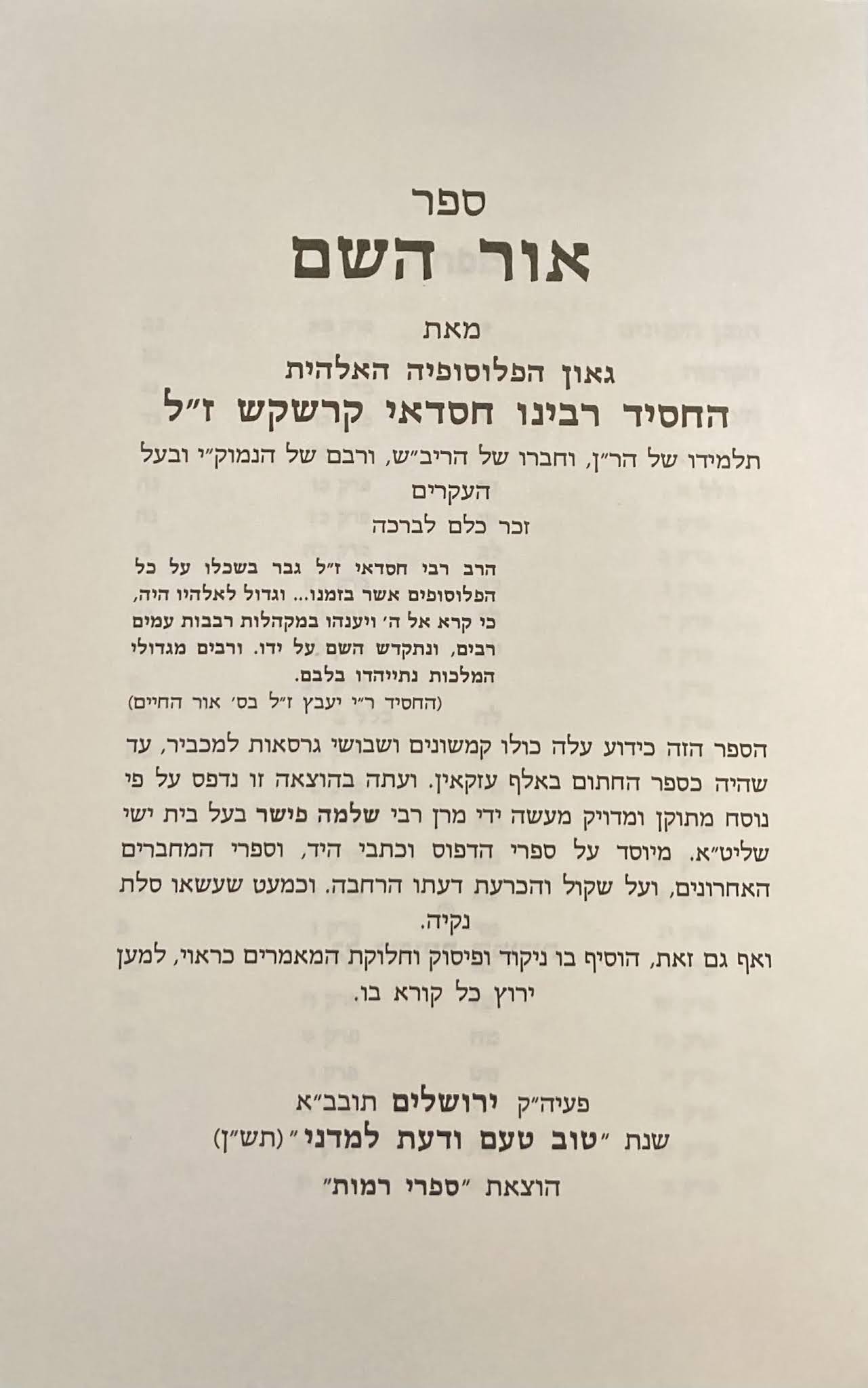
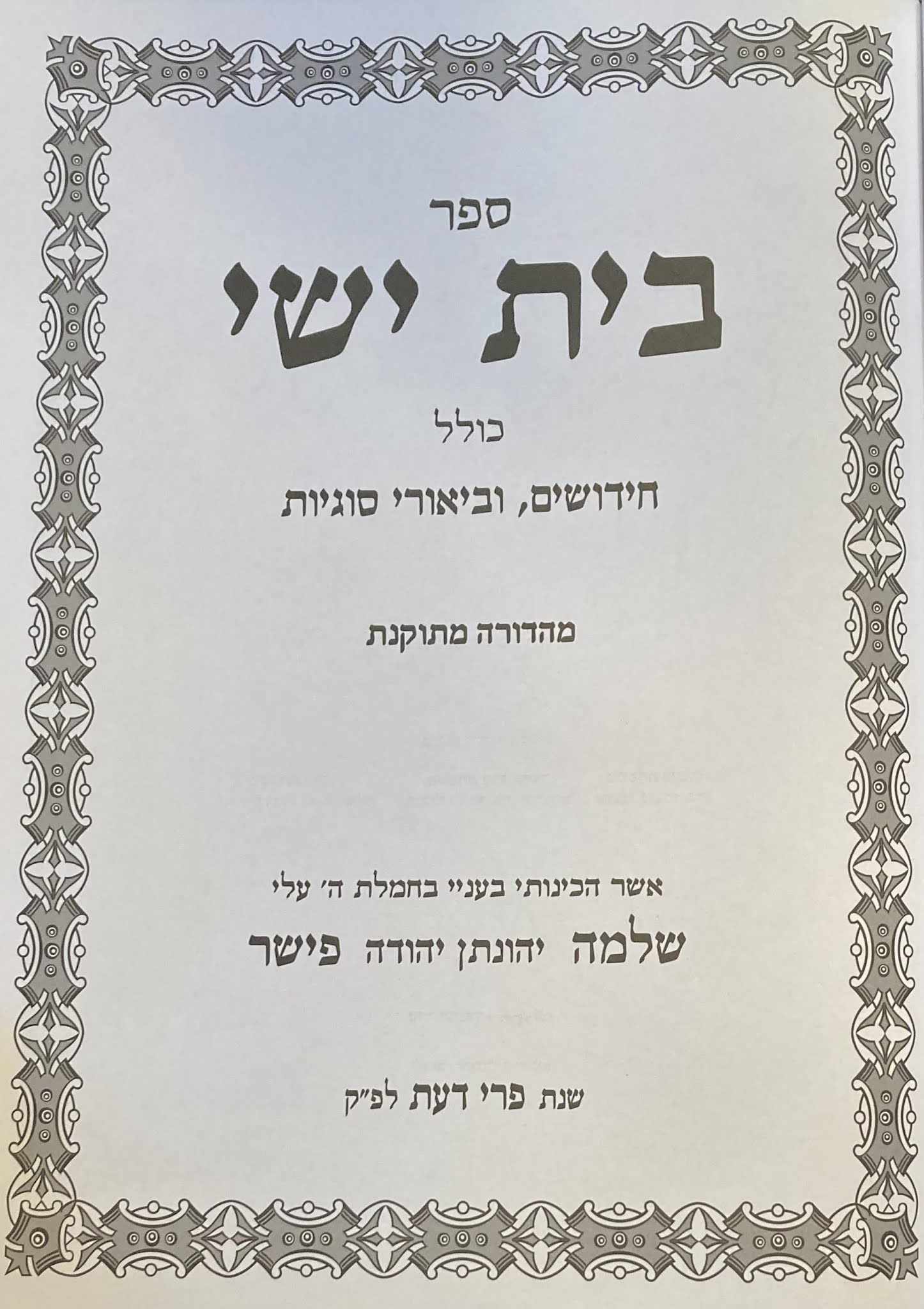


“Seeing the Infinite in Torah” A Memorial to the Gaon Rabbi Shelomo Fisher (Author of Beit Yishai)

Seeing the Infinite in Torah”: A Memorial to the Gaon Rabbi Shelomo Fisher (Author of Beit Yishai)

By Rabbi Bezalel Naor

ANCESTRY

Rabbi Shelomo Yehonathan Yehudah Fisher was born in Jerusalem in 1932 to Rabbi Aharon and Devorah Fisher. He was named after his paternal grandfather, Shelomo Fisher (1852-1932), Rabbi of Karlsburg, Siebenbürgen.

Rabbi Shelomo Fisher the Elder, an Oberlander, was a disciple of Rabbi Abraham Samuel Benjamin Schreiber of Pressburg (Ketav Sofer) and of Rabbi Isaac Dov (Seligmann Baer) Bamberger (Würzberger Rav). When Rabbi Fisher assumed the rabbinate of Karlsburg in 1891, it was a Status Quo community. Eventually, he prevailed upon the community to become Orthodox. (In Hungary there were three types of Jewish communities: Neolog or Reform, Status Quo Ante, and separatist Orthodox.) After his passing, his son Aharon published in Jerusalem his sefer, Korbani Lahmi (2 parts, 1933-1937). Besides Talmudic erudition, the work evidences linguistic ability. (His son Aharon was also known to be a talented linguist.) At the beginning of the sefer there is a photo of the author. Our Rabbi Shelomo Fisher bore an uncanny resemblance to his paternal grandfather.

Rabbi Aharon Fisher arrived in Jerusalem in 1919. Settling into the Old Yishuv, he changed his clothing from European couture to the traditional Yerushalmi levush. Thus, the inhabitants of the Old Yishuv viewed him as a “ba‘al teshuvah,” or newcomer in their midst. In 1923, he married Devorah Yager. (See more on her background below.) Aharon became a disciple of the venerated Sephardic sage, Hakham Shelomo Eliezer Alfandari (MaHaRaShA, later known as the “Sabba Kadisha”) (d. 1930). Ideologically, Aharon Fisher followed Rabbi Yosef Hayyim Sonnenfeld, Rabbi of the separatist community of Jerusalem, known as the ‘Edah ha-Haredith. Along with the Dutchman Dr. Jacob Israel de Haan, Aharon Fisher lent a worldliness to Rabbi Sonnenfeld’s camp. Subsequent to de Haan’s assassination in 1924, Rabbi Aharon Fisher named his son “Yisrael Ya‘akov” after him. The Gaon Yisrael Ya‘akov Fisher (1928-2003) would go on to become the Rav of the Zikhron Moshe neighborhood of Jerusalem and dayyan of the Beth Din Tsedek of the ‘Edah Haredit, as well as author of the multivolume set Even Yisrael on Rambam and responsa.

Rabbi Aharon Fisher was the brother-in-law of the renowned posek, Rabbi Alter Shaul Pfeffer (1874-1936) of New York. They were married to two sisters. Rabbi Feffer’s Rebbetsin Hayah Sarah and Rabbi Aharon Fisher’s Rebbetsin Devorah were the daughters of R’ Meir Yehudah (Leib) and Rahel Yager of Bitchkov, Hungary. (Rabbi Pfeffer, a born and bred Galician, went to reside in Bitchkov, where he established a yeshivah, and would later serve as Rabbi of New York’s Beth ha-Medrash ha-Gadol Anshei Ungarn.) Responsum no. 99 of the second volume of Rabbi Pfeffer’s Avnei Zikaron (New York, 1931) is addressed to his brother-in-law Aharon Fisher of Jerusalem. The responsum concerns something Aharon Fisher’s maternal ancestor, “ha-gaon he-‘atsum Tiv Gittin” (i.e. Rabbi Tsevi Hirsch Heller) wrote concerning the mahtot (fire-pans) of Korah’s congregation. Rabbi Pfeffer also wrote to his brother-in-law a letter approving Korbani Lahmi.

ROSH YESHIVAH AND DAYYAN

Rabbi Aharon died prematurely in 1942, leaving young orphans. In the introduction to his Derashot Beit Yishai, his son, Rabbi Shelomo Fisher expresses his gratitude to the gaon and tsaddik, Rabbi Matisyahu Davis who raised him and his brothers. (Rabbi Matisyahu Davis was a kanai, a zealot, who after Rav Kook’s passing, revised his thinking about the man, and pointedly attended the levayah or funeral procession of Rebbetsin Reiza Rivkah Kook in 1951.) Rabbi Shelomo Fisher edited Rabbi Davis’ posthumous work on Rambam, Matat Melekh (Jerusalem, 1968).

In that same preface, the author expresses his eternal gratitude to Rabbi Eliezer Yehudah Finkel, Rosh Yeshivah of Mir in Jerusalem, where Rabbi Shelomo studied for some years. As he put it, he merited Rabbi Finkel’s “great closeness” (“kirvato ha-gedolah”).

Rabbi Fisher married Leah Brandt, the daughter of Rabbi Eliezer Brandt, a Jerusalem Torah scholar. (More on this remarkable tsaddeket later.)

Rabbi Fisher’s first “shtelle” (position) was as a maggid shi‘ur in Rabbi Yissakhar Meir’s Yeshivat ha-Negev in Netivot. Later he would become Rosh Yeshivah of Rabbi Mordekhai Elefant’s Yeshivat ITRI in Beit Tsefafa, Jerusalem. (Rabbi Elefant, an American, called his yeshivah, “Israel Torah Research Institute,” or ITRI.) Rabbi Fisher remained in that position for decades until his passing.

The lifestyle of Rabbi Fisher was spartan, to say the least. The entire week, he resided in a simple room of the yeshivah dormitory. There were no “creature comforts,” to speak of. In Lithuanian tradition, Rabbi Shelomo would learn standing at his “shtender” for hours on end. To that barebones room, would come visitors of various types: questioners seeking halakhic guidance; young men thirsting for knowledge. On one of my visits, Rav Shelomo told me that I had been preceded by three “mekubbalot” (women kabbalists)!

Once a week, for Shabbat, Rabbi Fisher would return home. Originally, the Fisher family lived in Me’ah She‘arim. Later, Rabbi and Rebbetsin Fisher moved to Rehov Hakablan 13 in the new Har Nof section of Jerusalem.

Rabbi Fisher would speak to his wife on the yeshivah phone in the morning at the conclusion of Shaharit. Otherwise, the Rebbetsin was on her own. In the introductions of all his works, Rabbi Fisher sings the praise of his beloved wife, “the tsaddeket Mrs. Leah who … all the days carries alone with true love and amazing devotion the entire yoke of the house and the family, and ‘without her help, Tushiyah (i.e. Torah) would be far from me.’(Rabbi Aharon Fisher had written those last words—a quote from Job 6:13, as interpreted in b. Yevamot 62b—concerning his wife, Shelomo’s mother, Devorah; see Korbani Lahmi, Introduction, p. 12.) Rebbetsin Leah Fisher passed in 2016.

At the invitation of Chief Rabbi Avraham Shapira, Rabbi Fisher also served for a time, in the 1990s, as a dayyan of the Beit Din of Jerusalem.

DEREKH HA-LIMMUD (METHODOLOGY)

Rav Shelomo Fisher’s intellectual hero was the Hazon Ish, Rabbi Abraham Isaiah Karelitz, the sage of B’nei Berak. In the introduction to Beit Yishai Hiddushim, he refers to him as “the greatest of the aharonim (late authorities), the man of God (ish ha-Elohim), our teacher, Maran he-Hazon Ish, of blessed memory.” Though Rav Shelomo encountered the Hazon Ish but once in his life, when, as a youth, he filed by to give “Shalom” to the great man, his printed works exerted an enormous influence upon him.

Rav Shelomo had some exposure to the Brisker Rav, Rabbi Isaac Ze’ev Soloveichik, in Jerusalem, yet his hero was definitely the Hazon Ish.

These two sages—the Brisker Rav and the Hazon Ish—represented two different darkhei ha-limmud or methods of studying Talmud. Rabbi Hayyim Soloveichik of Brisk had innovated a new method of analyzing a Talmudic sugyah. His hasbarah or conceptualization conquered the yeshivah world. The Hazon Ish, on the other hand, maintained the older method of peshat, or simple reading of the text. The Hazon Ish viewed himself as preserving the legacy of the Vilna Gaon, the pashtan par excellence. (It is not coincidental that Rabbi Fisher became proficient in the works of the Gaon, both nigleh and nistar, exoteric and esoteric. He once edited from manuscripts the Gaon’s notes to the Sifra or Torat Kohanim.)

In none of this was there any personal animosity. This was truly a “mahloket le-shem shmayim,” “a controversy for the sake of heaven” (m. Avot 5:17). Rabbi Fisher related that the Hazon Ish’s critique of Hiddushei Rabbeinu Hayyim Halevi (since published) was delivered to the Hazon Ish’s students on the Eve of Yom Kippur, so that none would suspect him of harboring any “negi‘ot” or vested interests.

Rav Shelomo did not think that the two methods of Brisk and the Hazon Ish were mutually exclusive. He viewed them as complementary, and in his teaching and writing, he would present insights of both the Brisker Rav and the Hazon Ish, providing the best of both worlds.

BEKI’UT (ENCYCLOPEDIC KNOWLEDGE)

Besides his photographic recall of the Talmud, Rabbi Fisher was also thoroughly conversant with Hakirah, or Jewish philosophy, and Kabbalah (Jewish mysticism). His penchant for philosophy led him to publish a new edition of Hasdai Crescas’ ’Or Hashem (Jerusalem, 1990). His attraction to Kabbalah expressed itself especially in the expertise he developed in the Kabbalistic writings of the Vilna Gaon.

This made him unique among the sages of Jerusalem. Those in his league in Halakhah, such as Rav Yosef Shalom Elyashiv and Hakham ‘Ovadiah Yosef, did not claim proficiency in these other fields of Jewish learning. In this respect, Rav Fisher resembled—Rav Kook.

RAV FISHER AND RAV KOOK

Many wonder about Rav Fisher’s relation to the works of Rav Kook. One might say that he viewed Rav Kook’s sifrei mahshavah (works of Jewish Thought) the way Maimonides’ Guide of the Perplexed is viewed by some. Which is to say, if one is perplexed, then one needs to study the Guide; if one is not perplexed, then one need not study it. There were individuals whom Rav Fisher advised to study Rav Kook’s works; others, he would dissuade. He found ludicrous the recitation of Orot as if it were the Book of Psalms, just as he derided Breslover Hasidim who recited Likkutei MOHaRaN in this manner. (Rav Fisher himself made a careful study of Likkutei MOHaRaN and occasionally quoted the book.)

Rav Fisher came from a background that was highly critical of Rav Kook, yet he was able to free himself of many of the prejudices of his upbringing. (For the record, this writer [BN] once read a letter written by Rav Shelomo’s father, Aharon Fisher, to the editor of Kol Yisrael, the Agudah’s newspaper in Jerusalem, insisting that the paper not disrespect Chief Rabbi Kook.)

The last time I visited Rav Fisher, on a Friday morning, in his home in Har Nof, he gifted me the second, revised editions of his works, Beit Yishai Derashot and Beit Yishai Hiddushim, which had been recently published. On that occasion, he showed me how he slipped into a footnote a reference to Rav Kook’s Eder ha-Yekar. (See Beit Yishai Derashot [2004], p. 126, end note 3. In the earlier edition of 2000, the footnote is found on page 110.) The context is the important concept of “kabbalat ha-’ummah,” Kelal Yisrael’s acceptance as a Halakhic principle. The chapter in Beit Yishai (chap. 15) is entited “Be-‘Inyan Kabbalat ha-Rabbim.”

Perhaps the best way to sum up Rav Fisher’s perspective on Rav Kook, is by saying that it was “yeshivish” by today’s standards. He shared this outlook with his mehutan, Rabbi Simhah Kook of Rehovot, shelit”a. (Rabbi Fisher’s daughter is married to Rabbi Kook’s son, Rabbi Hayyim Kook.)

KELAL YISRAEL

Rabbi Fisher was unique in yet another aspect: his ability to bridge the gap between the “black hat” yeshivot of the so-called Haredim and the yeshivot of the “knitted kippot” (kippot serugot) or so-called Datiyim-Le’umiyim. (Back in the day, it was the great divide between Agudah and Mizrahi.)

Dressed in his distinctive Me’ah She‘arim apparel, consisting of a long black frock and a low, flat samet hat, Rav Fisher taught in the many yeshivot hesder: Kiryat Arba, Beit El, Gush ‘Etsion, Ma‘aleh Adumim, Sha‘alvim.

THE SPIRITUAL RENASCENCE IN ERETS YISRAEL

Rav Shelomo viewed our post-Holocaust era as being on a par with the generation that followed the Spanish Expulsion of 1492. In the aftermath of that tragic event, there exploded in Tsefat in the sixteenth century a burst of unparalleled creative energy. In a single generation, there was produced both Rabbi Joseph Caro’s Shulhan ‘Arukh and the Kabbalah of Rabbi Moses Cordovero and Rabbi Isaac Luria. Rabbi Fisher viewed the rebirth of Torah in Erets Yisrael after the terrible destruction of World War Two on such a grand historical scale.

REPOSITORY OF THE HISTORY OF THE OLD YISHUV

I would be remiss if I did not mention Rabbi Fisher’s role as a historian. Having grown up in the Old Yishuv of Jerusalem, he was often able to set the record straight on many accounts.

For starters, Hakham Shelomo Eliezer Alfandari—unlike the distortion of Rabbi Asher Zelig Margulies and the dramatization of Mas‘ot Yerushalayim (Munkatsh, 1931)—was not a kanai or zealot. (On the other hand, Rabbi Shelomo Eliashov, author of the kabbalistic work, Leshem Shevo ve-Ahlamah, was a kanai.)

Rabbi Fisher knew too of the intimate friendship of Rabbi Akiva Porush and Rabbi Ya‘akov Moshe Harlap before “a mountain rose up between them” (“gavah tura beinayhu”). Once an inseparable havruta, Rabbi Porush would go on to become Rav Kook’s worst detractor, and Rabbi Harlap, Rav Kook’s greatest defender.

LAKU HA-ME’OROT” (“THE LIGHTS WENT OUT”)

Rav Shelomo passed on the fourteenth of Kislev, 5782. He was buried that evening on the Mount of Olives. On that very night, the fifteenth of Kislev, in faraway North America, we witnessed a spectacular lunar eclipse. (Some astronomers called it “a once in a century celestial event”; others, “once in five hundred years”; others, “once in a millennium.”) The beraita in b. Sukkah 29a states: “A lunar eclipse is a bad omen for Israel, for Israel count time by the moon.” (See the discussion in Beit Yishai Derashot, pp. 207-208, note 13, regarding the supposed philosophic problem posed by the scientific predictability of eclipses.)

SEEING THE INFINITE IN TORAH

If one would ask me what was so special about Rabbi Shelomo Fisher, I would respond (in the words of Rav Ya‘akov Moshe Harlap): Through Rabbi Shelomo, hk”m, “we merited to see the aspect of the Ein Sof, the Infinite, that is in Torah.” (See Mei Marom, vol. 8, Bereshit [Jerusalem, 1994], Noah, ma’amar 8, p. 28.)


The Head Movements of Shema’

THE HEAD MOVEMENTS OF SHEMA’

by Bezalel Naor

Rabbi Bezalel Naor is a multifaceted scholar, recognized as the leading interpreter of R. Kook in the English language. His newest book is The Limit of Intellectual Freedom: The Letters of Rav Kook. It can be purchased from his website, www.orot.com.

The most important utterance in Judaism is the Shema’: Shema’ yisrael adonai eloheinu adonai ehad. (Hear O Israel, the Lord our God, the Lord is one.) This declaration of the absolute unity of God is the cornerstone of our faith. By Biblical mandate, a Jew recites the Shema’ twice daily, be-shokhbekha u-ve-kumekha (“when you lie down and when you rise up”). See Deuteronomy 6:7.

All of the above is quite famous. What remains today a little known fact is that once upon a time this recitation was accompanied by head movements to the four directions, and up and down. This practice is recorded both in the Ge’onim (post-Talmudic Babylonian sages) and the Rishonim (medieval European sages).[1] The basis for this observance is the following statement in the Talmud:

Symmachus says: “Whoever prolongs the word ehad (“one”), his days and years are prolonged.

Said Rav Aha bar Ya’akov: “And [specifically] the letter dalet [of ehad].”

Said Rav Ashi: “Provided he does not speed up the letter het [of ehad].”

R. Yirmiyah was sitting before R. [Hiyya bar Abba]. He saw that he was prolonging overly much. He said to him: “Once you have proclaimed Him King above and below, and to the four winds of heaven, you need not any further.”[2]

Rashi, the eleventh-century exegete of Troyes, France, comments: “Proclaimed Him King above, etc. – You have prolonged the amount [of time] necessary to think in your heart that the Lord is one in heaven and on earth and its four directions.”

This is a disembodied approach; no mention in Rashi of actual body movements. The visualization of heaven and earth and the four cardinal points is purely mental.

However, if one consults the commentary of Rabbi Menahem Ha-Me’iri of Perpignan, Provence (1249-1306) one finds an added dimension: “The amount of lengthening the letter dalet is that required to picture in the heart that He, blessed be He, rules over heaven and earth and the four winds of the world. And for this reason, it is customary to tilt the head and move it to these sides. Nevertheless, if one prefers not to tilt the head, one need not, because the thing depends not on the tilting of the head and its movements, but rather upon the feeling of the heart.”[3]

Me’iri revisits this theme in his commentary to Tractate Sukkah when discussing the na’anu’im or waving of the lulav (palm frond) during the Sukkot festival. There, he opines that both in regard to the movement of the lulav during the recitation of Hallel and the movement of the head during Shema’, only a to-and-fro and up-and-down movement is called for (as opposed to the four directions, and up and down). “Even that which they said. . .to prolong the word ehad (“one”) sufficiently to proclaim Him King above and below and in the four winds of the world, even this necessitates only a movement to the two directions, and below and above. Furthermore, some say that in ehad no movement is necessary, only picturing in the heart.”[4]

Neither is Me’iri the only Provencal commentator to bear witness to the practice of head movements. His contemporary Rabbi David ben Levi of Narbonne writes: “How long? Long enough to proclaim Him King, etc. – Some interpret that one proclaims Him King by moving one’s head. And so interpreted Rabbenu Hai, of blessed memory.”[5]

In Provence, where we find most evidence of the head movements, there were some who found the practice ludicrous (huka ve-itlula).[6] Perhaps, these authorities took exception not so much to the movements themselves, as to the fact that as often happens in the case of rituals, the simple folk focus on the externals rather than on the inner awareness which is the essence.[7]

The German codifier Rabbi Jacob ben Asher (d. Toledo, Spain before 1340) defended the practice of the head movements accompanying Shema’:

One must prolong the dalet of ehad the amount [of time] necessary to think in one’s heart that the Holy One, blessed be He, is unique in His world, above and below, and in the four winds of the world. There are some accustomed to tilt the head according to the thought, above and below, and to the four directions. Some object to the practice because of the statement of the Rabbis, “He who recites Shema’ should not gesticulate with his eyes or lips.”[8] My father, of blessed memory, used to say that one need not heed [their words], for there, the gesticulations are for an extraneous purpose, and interrupt the concentration, but here, the gesture is a requisite of the concentration and brings it about (tsorekh ha-kavvanah ve-goremet otah).”[9]

Rabbi Joshua Boaz Baruch (Italy, d. 1557) offers a very graphic description of the head movements of Shema’:

This is the amount [of time] to prolong the word ehad: one third in the letter het and two thirds in the letter dalet. How does one proclaim the Kingship? Up and down during the het, and in the four directions during the dalet.[10] And one concentrates while moving the head up and down, to the east and to the west, to the north and to the south . . .[11]

One can only speculate what happened to these head movements. Whereas the movements of the lulav or palm frond continue in full force to this day, wherever Jews are found, we are not aware of any community that has retained the custom of moving the head during Shema’, though as we have seen, it was once widespread in communities as diverse as Babel (today Iraq), Provence, Spain and Italy.

One of the most provocative statements found in Rav Kook’s Orot is this:

We dealt much in soulfulness; we forgot the holiness of the body.[12]

Perhaps these head movements of Shema’ are a “mitsvah yetomah” (orphan mitsvah) due for revival.[13]

Notes

[1] These head movements of the Shema’ are not to be confused with those employed in the so-called school of “Prophetic Kabbalah” founded by Abraham Abulafia (b. 1240), although it is possible that Abulafia was inspired in this respect by the earlier tradition surrounding the Shema’. Prof. Gershom Scholem was struck by the similarity between the Abulafian technique (especially the technique of breathing) and Indian Yogic practices. Perhaps Scholem was unaware of the Judaic practice surrounding Shema’. It is possible though, that Scholem would have regarded even this practice, stretching back at least as far as Rav Hai Gaon, as influenced by Yogic or Sufic tradition. See Gershom G. Scholem, Major Trends in Jewish Mysticism (New York, 1971), pp. 139, 144; Aryeh Kaplan, Meditation and Kabbalah (York Beach, ME, 1985), pp. 55-114.

[2] Talmud Bavli, Berakhot 13b. The words “Hiyya bar Abba” are bracketed in the standard Vilna edition. In the parallel discussion in Talmud Yerushalmi, Berakhot 2:1, rather than R. Hiyya bar Abba, it is Ze’ira who apprises R. Yirmiyah that he needn’t overly prolong the recitation. R. Aryeh Leib Yellin (Yefeh ‘Einayim) suggests that the text of the Bavli be emended to “R. Zeira” to conform to the Yerushalmi.

[3] R. Menahem ben Shelomo ha-Me’iri, Beit ha-Behirah, Berakhot, Dikman ed. (Jerusalem, 1965), p. 42.

[4] R. Menahem ben Shelomo ha-Me’ri, Beit ha-Behirah, Sukkah, Liss ed. (Jerusalem, 1966), p. 133.

[5] R. David ben Levi of Narbonne, Sefer ha-Mikhtam in: Hershler ed., Ginzei Rishonim / Berakhot (Jerusalem, 1967), p. 28. This comment of Rabbenu Hai ben Sherira Gaon (939-1038) to Berakhot 13b first crops up in the Sefer ha-Eshkol of Rabbi Abraham ben Isaac, Av-Beit-Din of Narbonne (d. 1158). See Albeck ed., Sefer ha-Eshkol, p. 14; included in B.M. Lewin ed., Otsar ha-Ge’onim, Vol. I – Berakhot (Haifa, 1928), Perushim, p. 13. Cf. Rabbi Nathan ben Yehiel of Rome, Arukh, s.v. bar pahatei.

[6] Sefer ha-Mikhtam ibid.; R. Asher of Lunel, Orhot Hayyim, chap. 18.

[7] For example, Rabbi Hayyim El’azar Shapira of Munkatch (Munkacevo) explained the custom of reciting the verse Atah har’eita la-da’at [“Unto you it was shown, that you might know, that the Lord is the God; there is none else besides Him”] (Deuteronomy 4:35) on Simhat Torah at the opening of the Ark before commencing the hakafot or circumambulations with the Torah scroll in hand, as an antidote to any perverse notions that might creep into the common mind. By declaring the absolute unity of God, we stave off any misguided tendency to deify the Torah. See Rabbi Hayyim El’azar Shapira, Sha’ar Yissachar, Simhat Torah. Cf. Rabbi Meir Simha Cohen of Dvinsk, Meshekh Hokhmah (Riga, 1927), Exodus 32:19 who explains that Moses smashed the Tablets of the Law to prevent their deification by the worshipers of the Golden Calf.

[8] Yoma 19b. There, included in the prohibition is gesticulating with the finger(s).

[9] Rabbi Jacob ben Asher, Tur, Orah Hayyim.

[10] The Hebrew letters also signify numbers. Thus, het has the numerical value of 8; dalet, the numerical value of 4. The head movements up and down allude to the seven heavens and earth, a total of eight. It is appropriate that they occur during recitation of the letter het. The movements in the four directions of the compass occur during the recitation of the letter dalet.

On the practical level, one may question how it is possible to prolong the sound of the letter dalet (twice as long as the letter het!) when the consonant dalet is a stop or plosive. The question is based on ignorance of the correct pronunciation of the Hebrew letters. In the Ashkenazic community, the differentiation between dalet degushah (hard dalet, indicated by the dot or dagesh mark) and dalet rafah (soft dalet, lacking the dagesh or dot) was lost. In the Oriental communities, this tradition was maintained. In truth, only the hard dalet has the “d” sound; the soft dalet is pronounced “th” as in the English word “the.” In phonetics, such a sound is referred to as a “continuant,” as opposed to a “stop” or “plosive.” As the dalet of ehad is soft, the word is properly pronounced “ehath.” Adhering to these basic rules of the Hebrew language, the dalet of ehad may certainly be drawn out. See Rabbi Nahum L. Rabinovitch, Yad Peshutah (Jerusalem, 1984), Hil. Keri’at Shema 2:9 (p. 64). For the record, there were several Ashkenazic gedolim who were sensitive to the refinements of Hebrew pronunciation, as practiced by the Oriental communities. In the previous generation, Rabbis Joseph Elijah Henkin and Jacob Kamenecki expressed such concerns, to name but two.

[11] R. Joshua Boaz Baruch, Shiltei ha-Gibborim to Mordekhai, Berakhot (Vilna ed., 46a).

[12] See Rabbi Abraham Isaac Hakohen Kook, Orot (Jerusalem, 1950), Orot ha-Tehiyah, chap. 33 (p. 80); Naor trans., Orot: The Original 1920 Version (Spring Valley, NY, 2004), p. 189.

[13] Rabbi Jacob Moses Harlap, the eminent disciple of Rav Kook, wrote that the revival of mitsvot that have fallen into desuetude is a cure for the malady of our generation of neshamot she-be-‘olam ha-tohu (souls of the World of Chaos), whose vessel is too narrow to contain the great light due to penetrate it. This thought is expressed in a letter Rabbi Harlap wrote in 1946 upon the occasion of the renewed “Hakhel” ceremony. Published as an appendix to Rabbi J.M. Harlap, Mei Marom, Vol. V (Nimmukei ha-Mikra’ot) (Jerusalem, 1981). Cf. the essay entitled “Ha-Neshamot shel ‘Olam ha-Tohu” (The Souls of the World of Chaos) in: Rabbi Abraham Isaac Hakohen Kook, Orot (Jerusalem, 1950), pp. 121-123.

Postscript: In an email to Marc Shapiro, Rabbi Naor adds that R. Kalonymos Kalmish Shapira of Piaseczna advocated these head movements. Unfortunately, he can’t locate the precise source. Perhaps one of the readers can help out.

Postscript 2: Eliezer Brodt adds: See Eric Zimmer, Assufot 8 (1994), Tenuchos Vetenuot Haguf Beshaat Keriat Shema, pp. 343-368. For some reason it is not included in the collection of his articles called Olam Keminhago Noheg.


Tisha B’av and History of the Temples

There is a new book out, Elefh Dor, by Yeruchum Horowitz (2 vol.). This book gathers from hazal and various secular history works to give a complete picture from the Second Temple until the closing of the Mishna. The author does an especially good job of collating and arranging the various sources in a coherent manner.

As it is tisha b’av I will focus on the parts of the book dealing with the destruction of the Temple. As anyone that has read Josephus is aware many of his histories are spread out in various volumes of his books. For example, the destruction of the Temple appears in both the Wars of the Jews as well as Josephus. Horowitz, however, is able to mesh all these sources together. What is also refreshing is that he notes where there are problems with Josephus’s recounting of the story. Further, the book contains separate articles that go into greater depth regarding the general veracity of Josephus as well as Josephus the person.

He also has an article on where the Temple vessels currently are. However, on this point he has some inaccuracies. For example, he accepts the well known story about the Hafetz Hayyim that appears in “All for the Boss.” This story claims that a farmer in Israel located the temple vessels while digging in his field. He then traveled to America and met with R. Shain who sent a letter to the Hafetz Hayyim. The Hafetz Hayyim “confirmed the man’s find by looking in various books.” This story is unfortunately, preposterous. Why would the man travel to America from Israel when he could have gone to Rabbis in Israel or Europe. America at the turn of the century was not exactly known for its wealthy of Rabbinic scholars. Second, which books did the Hafetz Hayyim look into to confirm the story. The only books that are really relevant are secular history books dealing with the rise and fall of Rome and where the spoils of Rome went to after that. He also doesn’t cite to the most relevant articles on this issue, namely, Hans Lewy, Olomot Nifgashim, 255-58; Abraham Berliner, Divrei yemi hayehudim b’roma, vol. 1 107-110.

Besides for the above issue, this book provides a basic understanding of the periods it covers, and in particular a rather good overview of the history surrounding the destruction of the second Temple.

The book is available at your local bookstore, I purchased it for $28.50 from Beigeleisen Books.


[1]: א״ל הקב״ה … יודע אני כוונתו של אהרן היאך היתה לטובה On a Short Wedding Wish to the Lichtensteins from the Pen of Rabbi Jehiel Jacob Weinberg

[1]: א״ל הקב״ה … יודע אני כוונתו של אהרן היאך היתה לטובה
On a Short Wedding
Wish to the Lichtensteins from the Pen of Rabbi Jehiel Jacob Weinberg
By Shaul Seidler-Feller
I
Rabbi Aharon Lichtenstein, zts”l, the late, lamented, “irreplaceable”[2] gedol ha-dor of the Modern Orthodox and Religious Zionist communities,[3] has been characterized by those who knew him as a larger-than-life – indeed, angelic[4] – leader whose complete command of every facet of Torah learning was matched only by his sterling character and superlative (almost Hafets Hayyim-like) piety.[5] One of the things that struck me most, however, in listening to and reading several of the eulogies delivered or published after his passing was precisely how genuinely human this prince among men was in his personal and family life. Mrs. Esti Rosenberg, one of Rav Lichtenstein’s daughters and the head of the Stella K. Abraham Beit Midrash for Women – Migdal Oz, used the biblical metaphor of “a ladder set up on the earth, whose head reached unto heaven” (Gen. 28:12)[6] to capture how her father managed to radiate both a rarefied aura of sanctity and, crucially, a true humanity that extended to such mundane matters as doing most of the laundry in the house,[7] getting the kids ready in the mornings,[8] helping them with their homework in the evenings,[9] coming to learn with them after seder twice a week,[10] making sure to eat dinner with them almost every night,[11] washing the dishes after Shabbat had ended so that his kids would not fight over whose responsibility it was,[12] attending their performances in the Ezra youth group or at school,[13] teaching them how to ride a bike,[14] playing Scrabble and chess with them,[15] taking an interest in their friends,[16] buying them gifts and clothing during his visits to the States,[17] etc. – all of them activities that might be undertaken by normal devoted fathers but that I think we usually, rightly or wrongly, do not associate with people of Rav Lichtenstein’s intellectual caliber and spiritual stature. Indeed, in the words of Rabbi Avishai David, a student of Rav Aharon’s, “Rav Lichtenstein was a normal gadol ba-Torah, a very normal gadol ba-Torah.”[18]
And, of course, the same level of devotion was manifest in his relationship with his wife, Dr. Tovah Lichtenstein (nee Soloveitchik). Rav Aharon’s children reflected at the levayah on the mutual respect and unwavering support each partner showed the other,[19] while his students described some of the (ever-modest) manifestations of their affection for one another.[20] Dr. Lichtenstein herself summed it up best in a video produced in honor of her husband’s eightieth birthday when she said, “He invested both intellectually and emotionally in our children.[21] And he invested in our marriage as well – he was not only a family man but also a husband.”[22]
II
It is in this context, then, that I wish to digress for a moment and travel back in time to the Lichtensteins’ wedding, the point at which this whole story started, by way of a unique text discovered by Menachem Butler in a volume on the shelves of Yeshiva University’s Mendel Gottesman Library of Hebraica/Judaica. The year is 1959, and Rabbi Jehiel Jacob Weinberg (1884–1966), famed prewar rector of the Hildesheimer Rabbinical Seminary in Berlin and author of the Seridei esh compendium of responsa, halakhic novellae, and topical essays, is living out the last stage of his life in Montreux, Switzerland. Meanwhile, across the ocean in the United States, Rav Lichtenstein has just received semikhah from Yeshiva University’s Rabbi Isaac Elchanan Theological Seminary, having completed his doctorate in English literature at Harvard two years prior,[23] and is engaged to be married to Tovah Soloveitchik, daughter of Rabbi Joseph B. Soloveitchik, Rav Aharon’s rav muvhak.[24] The couple originally planned to wed Tuesday night, 22 Kislev 5720 (December 22, 1959), in the Dorothy Quincy Suite of the John Hancock Building in Boston, the bride’s hometown (see Fig. 1).[25]


 Fig. 1

In anticipation of the joyous occasion, to which he apparently could not arrive in person, Rav Weinberg sent an inscribed volume of Yad sha’ul,[26] a collection of essays compiled in memory of his beloved talmid muvhak (and the person primarily responsible for bringing him to Montreux in the first place),[27] Rabbi Saul Weingort (ca. 1914–1946),[28] who had passed away following a tragic train accident while on his way to deliver a shi‘ur at the yeshivah in Montreux.[29] Through some serendipitous twist of fate, it is this copy of the sefer which made its way into the open stacks of the Gottesman Library. The dedicatory text (see Fig. 2) and my translation thereof follow:

Fig. 2
מזכרת ידידות
ושי לחתונה
של הרה״ג ד״ר אהרן ליכטנשטיין
עב״ג
מרת טובה סולוביציק ילאי״ט
בתו
של גאון הדור ותפארתו
ידידי הגאון הגדול מאוה״ג
מהרי״ד הלוי סולוביציג [!][30] שליט״א
שתתקיים במז״ט ובשעה מוצלחת
בכ״ב לחודש כסליו שנת תש״כ
ויה״ר שהזוג היקר יתברך
ממעון הברכות בחיים ארוכים
טובים ומאושרים ומוצלחים בכל
דרכי חייהם, והבית אשר יוקם
,יהי׳ לשם ולתפארת בישראל
ולמקור עונג ושמחת עולמים
.להוריהם הדגולים
יחיאל יעקב וויינברג
מונתרה, ח׳ בכסליו, תש״כ

A gift and token of friendship presented on the occasion of the marriage of the ga’on, Rabbi Dr. Aharon Lichtenstein, to his soul mate, Ms. Tovah Soloveitchik[31] – may their years be long and good – the daughter of this generation’s pride and splendor, my friend, the great ga’on and Luminary of the Diaspora, our teacher, Rabbi Joseph B. ha-Levi Soloveitchik – may his years be long and good, amen – which is set to take place, under a lucky star and at an auspicious hour, on 22 Kislev [5]720. May it be His will that this precious couple be blessed from the Abode of Blessing with long, good, and joyous lives and with success in all of their endeavors. And may the home that they build be of fame and of glory in Israel [see I Chron. 22:5] and a source of eternal delight and happiness for their distinguished parents.
Jehiel Jacob Weinberg
Montreux, 8 Kislev [5]720 [December 9, 1959]

I think this text is historically significant for at least two reasons. First, while I am unaware of any subsequent contact between the Lichtensteins and Rav Weinberg following the wedding,[32][32] this message certainly attests to a longstanding relationship of mutual regard
between Rabbis Weinberg and Soloveitchik, two leading rashei yeshivah whose formative years were spent in both the Lithuanian yeshivah world and the German academy. We know from other sources that they first met while the Rav was a student at the University of Berlin in the 1920s; according to testimony cited by Rabbi Aaron Rakeffet-Rothkoff, the Rav audited classes at Rav Weinberg’s Seminary during the 1926–1927 academic year.[33] Their encounters extended well beyond the classroom, however,[34] and even though Rav Weinberg was generally not enamored of the Brisker derekh ha-limmud espoused by Rav Soloveitchik and his forebears,[35] these two intellectual powerhouses maintained a deep appreciation for one another throughout their lives[36] – as can certainly be seen in Rav Weinberg’s above inscription.

The second issue that I wish to discuss here relates to the date of the wedding itself. As of 8 Kislev 5720, Rav Weinberg, quite justifiably, thought that it would take place two weeks hence. However, that very evening, December 9 – the same night the Rav delivered the aforementioned (n. 35) hesped for his uncle, Rabbi Isaac Ze’ev Soloveitchik (1886–1959) – Rav Soloveitchik “informed his family that he had been diagnosed with colon cancer, and would be returning to Boston the next day for surgery. His daughter Tovah and her fiancé R. Aharon Lichtenstein postponed their wedding (which had been set to take place in the coming days) until a few weeks later, so that the Rav could participate.”[37] Thus, the wedding was not actually held until Tuesday night, 27 Tevet 5720 (January 26, 1960) (see Figs. 3 and 4),[38] something Rav Weinberg could not have predicted at the time he penned his wishes to the young couple.

Fig. 3


Fig. 4
III
In any case, returning to the present after our brief historical sojourn, it seems to me that, aside from all he taught us about avodat Hashem, lomdes, morality, and how to live as deeply committed Jews in the modern world, Rav Lichtenstein also modeled what it means to be a “totally devoted” family man.[39] As Rabbi Menachem Genack, who began his undergraduate studies at Yeshiva College when Rav Lichtenstein was already a rosh kolel in RIETS, remarked, “Rav Aharon’s gadlus batorah is well-known, but less celebrated is his gadlus as a father and as a son, his commitment and dedication to his family. Rav Aharon was always learning, but nevertheless managed to spend time with all of his children.”[40] Indeed, anyone who sees the pictures of Rav Aharon and his family featured in the aforementioned video will immediately understand what Rabbi Mayer Lichtenstein meant when he said that his father fulfilled the talmudic principle of ner hanukkah ve-ner beito, ner beito adif (Shabbat 23b).[41] With this background, it should not surprise us that, when asked, “What are you most proud of having accomplished during these years of service?” Rav Lichtenstein answered:

Looking back over
the past 50 years, what I am proudest of is what some would regard as being a
non-professional task. I’m proudest of having built, together with my wife, the
wonderful family that we have. It is a personal accomplishment, a social
accomplishment, and a contribution – through what they are giving and will
give, each in his or her own way – in service of the Ribbono shel Olam in the future.[42]

I think the lesson for us, his students, is clear. May we be zokheh to rise to the challenge of carrying forth all aspects of Rav Lichtenstein’s multifaceted legacy for many years to come.


*
I wish at the outset to express my appreciation to yedidi, Reb Menachem Butler, ne‘im me’assefei yisra’el, for furnishing me with the opportunity, as well as many of the bibliographical sources (including the primary text itself!) required, to compose this essay. Additional thanks go to his fellow editors at the Seforim Blog for their consideration of this piece and, generally, for their great service to the public in maintaining such an active and high-quality platform for the serious discussion of topics of Jewish interest. Finally, I am indebted to my friends Eliyahu Krakowski, Daniel Tabak, and Shlomo Zuckier for their editorial corrections and comments to earlier drafts of this piece which, taken together, improved it considerably.
[1]

[1] See Shemot
rabbah
(Vilna ed.) to Parashat
tetsavveh
37:2.

[2]

[2] Dr. David Berger quoted Rabbi Yosef Blau
as describing Rav Lichtenstein in this way and went on to characterize him in
similar terms here
(listen at about 1:04:40). Rabbi Ezra Schwartz said in effect the same thing here,
and in some ways went even further (listen at about 58:00).

[3]

[3] For evidence of how strongly his loss
has already been felt in the Modern Orthodox/Religious Zionist communities, one
need only peruse the ever-expanding number of articles and tributes that have
been cataloged on the Yeshivat Har Etzion websites here and here.

[4]

[4] One set of verses to which maspidim kept returning when describing
Rav Lichtenstein was those that appear in Malachi 2:5-7, together with the
rabbinic interpretation thereof: “If a given rabbi can be compared to an angel
of the Lord of Hosts, let them ask him to teach them Torah, and vice versa” (Hagigah 15b, Mo‘ed katan 17a). See the hespedim
of Rabbis Mayer Lichtenstein here
(listen at about 7:50), Mordechai Schnaidman here
(listen at about 23:00), and my friend Mordy Weisel here
(listen at about 5:05). Similarly, others have described him as angelic without
specific recourse to the verses in Malachi; see the hespedim of Rabbis Mosheh Lichtenstein here
(listen at about 9:25) and Avishai David here
(listen at about 1:03:25).

[5]

[5] So according to Rabbi Mordechai
Schnaidman here
(listen at about 16:00); see also Yosef Zvi Rimon, “Keitsad magdirim gedol dor?
JobKatif (May 4, 2015). Similarly,
Rabbi Ari Kahn compared Rav Lichtenstein to Rabbi Israel Salanter (1810–1883) here
(listen at about 9:00 and 48:55), and Mrs. Esti Rosenberg said that the stories
people tell about her father remind her of those told about Rabbi Aryeh Levin
(1885–1969); see her interview with Yair Sheleg: “Yaledah ahat mul 700 otobusim,” Shabbat: musaf le-torah, hagut, sifrut
ve-omanut
927 (May 15, 2015).

[6]

[6] See her hesped here
(listen at about 0:35 and 2:25).

[7]

[7] See the hesped of Mrs. Tanya Mittleman, Rav Lichtenstein’s youngest, here
(listen at about 10:15).

[8]

[8] See the hesped of Rabbi Nathaniel Helfgot here
(listen at about 46:55).

[9]

[9] See the hesped of my friend David Pruwer here
(watch at about 18:50).

[10]

[10] See the hespedim of Rabbis Mosheh Lichtenstein here
(listen at about 4:50), Mayer Lichtenstein here
(listen at about 12:35), and Assaf Bednarsh here
(listen at about 14:05), as well as the video produced in honor of Rav
Lichtenstein’s eightieth birthday here (watch at about
9:25 and 11:35) and that of a public conversation between Rabbi Benny Lau and
Rav Aharon and Dr. Tovah Lichtenstein on the topic of “Education and Family in
the Modern World” held in Ra’anana on May 13, 2012 here (watch at about
27:45 and 28:55). See also the recently-released essay “On Raising Children,” The Israel Koschitzky Virtual Beit Midrash
(May 2015), based on a sihah
delivered by Rav Lichtenstein in July 2007.

[11]

[11] See the video produced in honor of Rav
Lichtenstein’s eightieth birthday here (watch at about
11:25), as well as the hesped of Mrs.
Tanya Mittleman here
(listen at about 19:05) and Mrs. Esti Rosenberg’s interview with Yair Sheleg, “Yaledah ahat mul 700 otobusim.”

[12]

[12] See the hesped of Mrs. Tanya Mittleman here
(listen at about 11:00). Similarly, Rabbi Julius Berman relates in his hesped here
that when Rav Aharon would stay at his house during visits to the States, he
would always wash his own dishes when he had finished eating (listen at about
20:30).

[13]

[13] See the hespedim of Mrs. Esti Rosenberg here
(listen at about 3:05) and Mrs. Tanya Mittleman here
(listen at about 19:20), as well as the video produced in honor of Rav
Lichtenstein’s eightieth birthday here (watch at about
11:15).

[14]

[14] See the hesped of Rabbi Shay Lichtenstein here
(listen at about 23:00). See also the hesped
of David Pruwer here
(watch at about 18:45), as well as Rav Lichtenstein’s “On Raising Children.”

[15]

[15] On Scrabble, see the hesped of Rabbi Shay Lichtenstein here
(listen at about 4:40). On chess, see the video produced in honor of Rav
Lichtenstein’s eightieth birthday here (watch at about
12:20).

[16]

[16] See the hesped of Mrs. Tanya Mittleman here
(listen at about 19:10).

[17]

[17] Ibid. (listen at about 10:30).

[18]

[18] See his hesped here
(listen at about 16:50).

[19]

[19] See the hespedim of Rabbi Mayer Lichtenstein here
(listen at about 16:15 and 17:30), Mrs. Esti Rosenberg here
(listen at about 13:35 and 15:25), and Mrs. Tanya Mittleman here
(listen at about 21:30); see also that of my friend Noach Lerman here
(listen at about 37:35).

[20]

[20] Rabbi Assaf Bednarsh recounted here
that when Rav Lichtenstein would call his wife on the phone, he would address
her as “darling,” rather than “rebetsin” (listen at about 14:35). (Dr.
Lichtenstein herself reminisced here about how her
husband would sometimes jokingly address her as “Mrs. L.,” and she, in turn,
would call him “Reb Aharon” [watch at about 1:10]). Noach Lerman talked here
about how Rav Aharon would open the car door for his wife when they drove
somewhere (listen at about 34:25). Similarly, see the video here for a picture of
husband and wife going rafting together (watch at about 12:22) and, of course,
the dedication Rav Lichtenstein inscribed at the front of his two-volume Leaves of Faith (Jersey City, NJ: Ktav
Pub. House, 2003–2004): “To Tovah: With Appreciation and Admiration.”

For Rav Lichtenstein’s analysis of the Torah’s attitude
toward the institutions of marriage and family and how they square with more
modern conceptions, see his “Ha-mishpahah ba-halakhah,” in Mishpehot beit yisra’el: ha-mishpahah bi-tefisat ha-yahadut
(Jerusalem: Misrad ha-Hinnukh ve-ha-Tarbut – Ha-Mahlakah le-Tarbut Toranit,
1976), 13-30, esp. pp. 21-30; “Of Marriage: Relationship
and Relations
,” Tradition 39:2
(Summer 2005): 7-35, esp. pp. 10-13 (reprinted here
in Rivkah Blau, Gender Relationships in
Marriage and Out
[New York: Michael Scharf Publication Trust of the Yeshiva
University Press; Jersey City, NJ: Ktav Pub. House, 2007], 1-34, and in Aharon
Lichtenstein, Varieties of Jewish
Experience
[Jersey City, NJ: Ktav Pub. House, 2011], 1-37); and “On Raising Children.”
[21]

[21] In the course of the aforementioned (n.
10) public conversation on the topic of “Education and Family in the Modern
World” here, Dr. Lichtenstein
recalled that at the berit milah of
the couple’s firstborn son Mosheh, her father, Rabbi Joseph B. Soloveitchik
(1903–1993), sensing that Rav Lichtenstein harbored grand aspirations to save
the world, spoke about the importance of the father’s role in raising his
children and not leaving the job solely to his wife (watch at about 26:00). See
Rav Aharon’s parallel account in “On Raising Children,” as
well as his comment there that “I feel very strongly about the need for
personal attention in child-raising, and have tried to put it into practice.”

[22]

[22] Watch here at about 12:15.
Incidentally, during a different part of that same public event in Ra’anana,
available here, Rav
Lichtenstein commented on the role of children in strengthening the emotional
bond between partners (watch at about 35:15; see also 53:55).

[23]

[23] Shlomo Zuckier and Shalom Carmy, “An Introductory
Biographical Sketch of R. Aharon Lichtenstein
,” Tradition 47:4 (2015): 6-16, at p. 7. His dissertation would
eventually appear as Aharon Lichtenstein, Henry
More: The Rational Theology of a Cambridge Platonist
(Cambridge, MA:
Harvard University Press, 1962).

[24]

[24] According to my friend Jonathan Ziring, in
an e-mail communication dated May 28, 2015, the Lichtensteins first met, by
chance, at the home of Rabbi Ahron Soloveichik (1917–2001), the Rav’s brother
and another major influence on Rav Lichtenstein. The Rav would later encourage
Rav Aharon to court his daughter, and the rest, as they say, is history.

[25]

[25] Image courtesy of Naftali Balanson’s Facebook page, as brought
to my attention by Rabbi Jeffrey Saks.

[26]

[26] Jehiel Jacob Weinberg and Pinchas Biberfeld (eds.), Yad
sha’ul: sefer zikkaron a[l] sh[em] ha-rav d”r sha’ul weingort zts”l
(Tel Aviv: The
Widow of Saul Weingort, 1953).

[27]

[27] See Rav Weinberg’s memorial essay,
“Le-zikhro,” printed at the beginning of Yad
sha’ul
, pp. 3-19, at p. 13.

[28]

[28] The date of Rabbi Weingort’s birth seems
somewhat controversial. Rav Weinberg himself, in “Le-zikhro,” 4,
estimates that his student was born in either 5673 or 5674 (1913 or 1914),
whereas the frontmatter
of the Yad sha’ul volume gives the
precise date 12 Kislev 5675 (November 30, 1914); Marc B. Shapiro, Between the Yeshiva World and Modern Orthodoxy: The Life and Works of
Rabbi Jehiel Jacob Weinberg, 1884–1966
(London; Portland, OR: Littman
Library of Jewish Civilization, 1999), 161, claims he was born in 1915; and the website of the Yad Shaoul
kolel in Kokhav Ya’akov, opened in
2011 and dedicated in Rabbi Weingort’s memory, concurs with Shapiro.

[29]

[29] See Weinberg, “Le-zikhro,” 15.

[30]

[30] Most readers are probably familiar with
the more common Hebrew spelling of “Soloveitchik” with a final kof. Rav Weinberg, however, generally
preferred ending the name in a gimel
(except, strangely, in the case of the Rav’s daughter Tovah).

[31]

[31] Dr. Lichtenstein would go on to complete
her doctoral studies in social work at Bar-Ilan University following the
family’s arrival in Israel in 1971, writing her dissertation on “Genealogical
Bewilderment and Search Behavior: A Study of Adult Adoptees Who Search for
their Birth Parents” (1992). She is therefore referred to here without her
doctoral title.

[32]

[32] It should be noted that Rav Lichtenstein
served as coeditor of the rabbinic periodical Hadorom during the mid-1960s and, as such, may have been involved
in editing some of Rav Weinberg’s last publications to appear during his
lifetime. (For a partial bibliography of Rav Weinberg’s oeuvre, see Michael
Brocke and Julius Carlebach, Biographisches
Handbuch der Rabbiner: Teil 2: Rabbiner im Deutschen Reich, 1871–1945
, vol.
2 [Munich: K. G. Saur, 2009], 639-640 [no. 2657]. For a fuller inventory, see Shapiro,
Between the Yeshiva World and Modern Orthodoxy, 239-246.) Discovery and analysis of any
potential remaining correspondence between the two during this period remain
scholarly desiderata.

[33]

[33] See Aaron Rakeffet-Rothkoff, The Rav: The World of Rabbi Joseph B.
Soloveitchik
, ed. Joseph Epstein, vol. 1 (Hoboken, NJ: Ktav Pub. House,
1999), 27 with n. 13. Similarly, see Shalom Carmy, “R. Yehiel Weinberg’s Lecture on Academic Jewish
Scholarship
,” Tradition
24:4 (Summer 1989): 15-23, at p. 16.

[34]

[34] See Werner Silberstein, My Way from Berlin to Jerusalem, trans.
Batya Rabin (Jerusalem: Special Family Edition Published in Honor of the Author’s 95th
Birthday, 1994), 26-27, as quoted in Aaron Rakeffet-Rothkoff, “Rabbi Joseph B. Soloveitchik: The Early Years,” Tradition 30:4 (Summer 1996): 193-209,
at p. 197; idem, The Rav, 28; and idem, From
Washington Avenue to Washington Street
(Jerusalem; Lynbrook, NY: Gefen; New
York: OU Press, 2011), 108 (available here).

[35]

[35] See his letter to Rabbi Jacob Arieli of
Jerusalem composed sometime after 2 Nisan 5711 (April 8, 1951), as reproduced
in Jehiel Jacob Weinberg, Seridei esh:
she’elot u-teshuvot hiddushim u-bei’urim be-dinei orah hayyim ve-yoreh de‘ah
, vol. 2 (Jerusalem:
Mossad Harav Kook, 2003), 355-357 (sec. 144), at pp. 356-357; his letters to Dr. Gabriel Hayyim Cohn,
dated 27
Tevet 5725 (January 1, 1965) and 19 Kislev 5726 (December 13, 1965), as
reproduced in Jehiel Jacob Weinberg, Kitvei
ha-ga’on rabbi yehiʼel yaʻakov weinberg, zts”l
, ed. Marc B. Shapiro, vol. 2
(Scranton, PA: Marc B. Shapiro, 2003), 219 n. 4 (esp. the latter one); and the
beginning of the selection from his eulogy for Rabbi Weingort printed in Yad sha’ul, 16. For a partial translation of the Rav’s famous hesped “Mah dodekh mi-dod,” which
originally appeared in Hebrew in Hadoar
43:39 (September 27, 1963): 752-759 and is referred to by Rav Weinberg in the
last letter cited above, see Jeffrey Saks, “Rabbi Joseph B. Soloveitchik on the Brisker Method,” Tradition 33:2 (Winter 1999): 50-60.

For further discussion of these and similar sources, see
Judith Bleich, “Between East and West: Modernity and
Traditionalism in the Writings of Rabbi Yehi’el Ya’akov Weinberg
,” in Moshe Z. Sokol
(ed.), Engaging Modernity: Rabbinic
Leaders and the Challenge of the Twentieth Century
(Northvale, NJ;
Jerusalem: Jason Aronson Inc., 1997), 169-273, at p. 239; Marc B. Shapiro, “The Brisker Method Reconsidered,” Tradition 31:3 (Spring 1997): 78-102, at
p. 86, with n. 25; idem, Between the
Yeshiva World and Modern Orthodoxy
, 194-195, with nn. 95-98; and Nathan
Kamenetsky, Making of a Godol: A Study of
Episodes in the Lives of Great Torah Personalities
, vol. 1, 1st
ed. (Jerusalem: Hamesorah, 2002), 432-433. See also Rabbi Eliezer Berkovits’
assessment of his teacher’s derekh
ha-limmud
in “Rabbi Yechiel Yakob Weinberg zatsa”l: My Teacher and Master,” Tradition 8:2 (Summer 1966): 5-14, at
pp. 5-10. For Rav Lichtenstein’s own reflections on the types of criticisms of
the Brisker derekh expressed by Rav
Weinberg, see his “Torat Hesed and Torat Emet: Methodological Reflections,”
in idem, Leaves of Faith, 1:61-87,
esp. at pp. 78-83, as well as an earlier version of this essay cited in
Shapiro, “The Brisker Method Reconsidered,” 93-94. (I am indebted
to Eliyahu Krakowski for bringing the Kamenetsky and Lichtenstein references to
my attention.) See also Aharon Lichtenstein, “The Conceptual Approach to Torah
Learning: The Method and Its Prospects,” in idem, Leaves of Faith, 1:19-60, esp. at pp. 43-44, 48-50.
As an aside, and as far as I can tell, allusions to a
“Rabbi Moses Soloveitchik” in Rav Weinberg’s published works, excluding those made
in the above letters, generally refer not to the Rav’s father (1879–1941) but
to his Swiss first cousin (1915–1995), son of Rabbi Israel Gerson Soloveitchik
(1875–1941), son of Rabbi Hayyim Soloveitchik (1853–1918).
[36]

[36] Indeed, Rav Weinberg would consistently
refer to the Rav in writing by his honorific rabbinic handle, “Ha-g[a’on]
r[abbi] y[osef] d[ov],” or a variant thereof (as in our case); see his Seridei esh, 2:196-201 (sec. 78),
at p. 198 (dated 29 Adar 5716 [March 12, 1956]), and idem, Kitvei ha-ga’on rabbi yehiʼel yaʻakov weinberg, zts”l, 219 n. 4. According to Shapiro, Between the Yeshiva World and Modern
Orthodoxy
, 163, Rav Weinberg also contacted the Rav after the War to seek
his assistance during his long recovery.

For the Rav’s part, the postwar written
record with which I am familiar is a bit more reticent, although Rabbi Howard
Jachter reports the following in the context of a discussion of the prohibition
of kol ishah and Rav Weinberg’s
now-famous lenient ruling on the question:
Interestingly, I
asked Rav Yosef Dov Soloveitchik in July 1985 whether he agrees with this
ruling of Rav Weinberg. The Rav replied, “I agree with everything that he
wrote, except for his permission to stun animals before Shechita” (see volume
one of Teshuvot Seridei Eish). Rav Soloveitchik related his great appreciation
of Rav Yechiel Yaakov Weinberg. Rav Shalom Carmy later told me that Rav
Soloveitchik and Rav Weinberg had been close friends during the years that Rav
Soloveitchik studied in Berlin.
See Howard Jachter, “The Parameters of Kol Isha,” Kol Torah 11:17 (February 2, 2002).
For more on the shehitah controversy referred to here, see H. J. Zimmels, The Echo of the Nazi Holocaust in Rabbinic
Literature
(New York: Ktav Publishing House, Inc., 1977), 183-189; Bleich,
Between East and West,” 260-261, 271-272;
and Shapiro, Between the Yeshiva World
and Modern Orthodoxy
, 117-129, 192. For Rav Soloveitchik’s own involvement
in questions relating to the humane slaughter of animals, see Joseph B.
Soloveitchik, Community, Covenant and
Commitment: Selected Letters and Communications
, ed. Nathaniel Helfgot
(Jersey City, NJ: Toras HoRav Foundation, 2005), 61-67.
[37]

[37] Jeffrey Saks, “Rabbi Joseph B. Soloveitchik and the Israeli Chief
Rabbinate: Biographical Notes (1959–60)
,” BDD 17 (September 2006): 45-67, at p.
53.

[38]

[38] Fig. 3 is courtesy of Naftali Balanson’s
Facebook page, as
brought to my attention by Rabbi Jeffrey Saks. Fig. 4 derives from the video
produced in honor of Rav Lichtenstein’s eightieth birthday here (watch at about
1:03). (I am indebted to Rabbis Dov Karoll, Jeffrey Saks, and Reuven Ziegler
for confirming some of the details of the Lichtenstein wedding for me.)

[39]

[39] See the interview with Rabbi Dov Karoll
on Voice of Israel here
(listen at about 2:55). See also the hesped
of Rabbi Mosheh Lichtenstein here
(listen at about 5:15). Similarly, at a sheloshim
event held at the Hechal Shlomo Jewish Heritage Center in Jerusalem on May 18,
Mrs. Esti
Rosenberg, in speaking of her father’s self-identification with the Levites as
the prime exemplars of ovedei Hashem par excellence, commented that just as the
Levites were netunim netunim to Aaron
and his sons in Parashat be-midbar (Num.
3:9) (which also happened to be Rav Lichtenstein’s bar mitzvah parashah), so was Rav Aharon completely
dedicated to his family. See the video here (watch at about 11:40). And for a
visual representation of just how central avodat
Hashem
was to Rav Lichtenstein’s core identity, see the photograph of his matsevah posted to Yeshivat Har Etzion’s
Facebook page.

[40]

[40] From a forthcoming article to be published
in Jewish Action.

[41]

[41] See his hesped here
(listen at about 10:30).

[42]

[42] See Rav Lichtenstein’s interview with
Yaffi Spodek: “Reflecting
on 50 Years of Torah Leadership
,” the
YUNews blog
(October 11, 2011). Similarly, see this video produced in honor
of Rav Lichtenstein receiving the Israel Prize in 2014 (watch at about 10:20),
as well as the hespedim of Mrs. Esti
Rosenberg here
(listen
at about 8:45) and Rabbi Baruch Gigi here (listen at about 16:30) and the
former’s interview with Yair Sheleg, “Yaledah ahat mul 700 otobusim.” Finally, see Rav Lichtenstein’s sihahOn Raising Children,” where
he states unequivocally: “There are very few people about whom it can […]
genuinely be said that there is something objectively more important in their
life than raising children.”


Marc Shapiro: What Do Adon Olam and ס”ט Mean?

What Do Adon Olam and ס”ט Mean ? [1]
by
By Marc B. Shapiro ס”ט
1. People often refer to me as a Modern Orthodox intellectual. There are actually quite a number of us out there. If you hear someone using words like “ontological,” “existential,” “mimetic,” and now, “tergiversation”[2] you can assume he in in our club. Also, another telltale sign is that when we give divrei Torah you will hear us refer to Philo, the Apocrypha, Pseudepigrapha (if we are confident that we can pronounce the word properly[3]), Shadal, or Cassutto.[4] Of course, we are careful to only say Midrash, and never Medrish, as the latter pronunciation is a sure sign of a Philistine.
It is no secret that Modern Orthodox intellectuals like to look down on Artscroll, and to let others know about this. So we must find places where Artscroll makes mistakes. It is not enough to point to the vastly different historical conceptions between us and Artscroll; we need to find places where Artscroll simply got it wrong (for one such example see here). This will show that even if they are conquering the world, they shouldn’t think that they are so brilliant. I am not speaking about the Artscroll Talmud (which we use when no one is looking) or the Artscroll “History” series, which is not popular with the Modern Orthodox.[5] I am referring to the Artscroll siddur and chumash which have taken over the Orthodox world. (The Modern Orthodox intellectuals must have been so busy these last twenty years producing articles read by each other that it never occurred to them to produce their own siddur and chumash.)[6]
But finding these errors is easier said than done. I am not referring to run-of the-mill errors, but the sort that will impress people at your Shabbat table. That way you can show them that you are a Modern Orthodox intellectual, and not afraid to stand up to Artscroll, this generation’s anti-Messiah. Artscroll is the Goliath, and if it can be felled, then Feldheim, Targum and certainly the minor leaguers at Aish Ha-Torah will be that much easier to take down. If the obscurantists are not yet shaking in their feet, once they see our ever-forthcoming translation of the Arukh ha-Shulhan, which will bring back the 1950’s and the “mimetic tradition”, this will put them in their place.
As I state, it is not so easy to find the perfect mistake. One could point out that in the Artscroll siddur, p. 320, it refers to a “responsa” of Maimonides, when the word they should have used is “responsum.” But this clearly won’t do the trick. After all, no one assumes that Artscroll is an expert in English; it is because Artscroll is expert in Jewish things that it has become so popular. For a while I thought that I could impress those ever-impressionable Shabbat guests by pointing out that contrary to what the Artscroll siddur, p. 870, states, R. Eleazar Kalir was not a tanna. But again, this is not something that most people care about. Besides, someone always ended up pointing out that no less than Tosafot claims that he was a tanna, and my protestations about what Shir proved were always met with blank stares, for what does a Prague song have to do with anything?
And what about when I showed people that in the chumashim printed until 1999, Lord Jakobovits, who died in that year, is referred to as Emeritus Chief Rabbi of the British Empire (see one of the first pages of the chumash where it lists the important people involved with Artscroll). On the title page of Hertz’s chumash he is referred to as “Late Chief Rabbi of the British Empire,” and the Jakobovits reference might be trying to parallel this. All my protestations that Jakobovits was never Chief Rabbi of an Empire (which had ceased to exist before he came into office) but of a Commonwealth have never found anyone showing much interest. (The technical title is Chief Rabbi of the United Hebrew Congregations of the Commonwealth. The title is more grandiose than the office. At most, there are 300,000 Jews in the United Kingdom (as, at present, no one in Australia, Canada, Zambia, etc. looks to the British Chief Rabbi for religious guidance). Subtract the unaffiliated, Reform and Masorti from this, and then subtract the Haredim and the Sephardim and this will give you the number of Jews represented by the Chief Rabbi.)
There was actually a very big error I used to point out, and this was found in the Artscroll Shabbat Zemiros (it has since been corrected). At the beginning of the Shalosh Seudos section Artscroll wrote:
The three meals of the Sabbath symbolize the three Patriarchs, the three divisions of Scripture: Torah, Prophets and Hagiographa, and the three feasts through which Esther brought about Haman’s downfall. Many matters of awesome spiritual significance are dependent on the Third Meal as the Zohar discusses frequently (Aruch HaShulchan 291).

This is a very strange passage, since what does Esther have to do with the Three Sabbath meals? Furthermore, since when did Esther organize three feasts? Everyone who attends synagogue on Purim knows that there were only two feasts. This is what the Arukh ha-Shulhan states:
ויהא זהיר מאד לקיים סעודה שלישית ואמרו חז”ל דכל המקיים סעודה ג’ ניצל משלש פורעניות . . . ואם אפשר שאינן ממש מן התורה מ”מ ודאי מתקנת משה רבינו הם שכן קיבל מסיני והם מרמזים נגד ג’ אבות, נגד תורה נביאים וכתובים, ובשעה שניתן להם המן ניתן להם על ג’ סעודות
What happened was that whoever wrote the commentary to the Zemiros understood the word המן (the manna) to mean Haman, and that he was given into the Jews’ hands because of three feasts![7]
Artscroll did what everyone should do when an error is brought to their attention, namely, correct it in a future edition.. (In another post I plan on noting a couple of corrections to my own writings.) In fact, this is a good lesson to all of us, because if Artscroll, whose writers are big talmidei hakhamim, could make such a simple mistake, then all of us should realize that we too can make simple errors.
The important thing is that they corrected the error. If only the same could be said about Mossad ha-Rav Kook. There has already been discussion on this blog about some problems with the Chavel edition of Ramban. In fact, although both the Commentary on the Torah and Kitvei Ramban have been reprinted about twenty times, many obvious errors have still not been corrected. I was planning on giving one example, but I wasn’t sure which one to use. About five minutes before writing this I received a call from the owner of www.publishyoursefer.com, which will soon be reprinting Kitvei R. Weinberg. He informed me that there are many students at the Ner Israel yeshiva who follow the Seforim Blog, pleasant news indeed. In their honor, since unlike myself, they spend most of their day involved in the intricacies of the Talmud and its commentators, my example will be from the introduction of Ramban to his Dina de-Garmei, a work which only a real talmid hakham would try to tackle. The text is found in Kitvei Ramban, vol. 1, p. 417. Ramban writes
אבל יש אשר קולמוס הראשונים סתמן
ועתה נעלם טעמן מעיני תלמידי הזמן
וחכמי הצרפתים אספו רובן אל עמן
הם המורים, הם המלמדים, הם המגלים לנו נטמן
Chavel explains the third line to mean
חכמי הצרפתים אספו רובן של הטעמים הללו לתוך ספריהם להיות לעינים של תלמידי הזמן
Yet this is incorrect. What the Ramban means is that most of the French sages have left this world and gone on to their eternal reward.
Getting back to Artscroll, I was pleased when I found the perfect example of an Arscroll error, and this in a prayer that we all know well, Adon Olam. What do these words mean? To answer this, most people will open their Arscroll siddur.[8] Artscroll translates, “Master of the Universe”. This, or similar translations (e.g., Lord of the Universe, Master of the World) seem to be standard. Yet for a while I was convinced that the proper translation was “Eternal Lord.” After looking at the song as a whole, and seeing how it speaks of God’s eternity, it appeared clear to me that this is what the first two words mean.
I was happy to find that both Birnbaum and De Sola Pool (both of which are now almost impossible to find in any synagogue) understood the first two words this way as well. So happy was I with my idea that I made sure to tell lots of people about it, all of whom were very impressed, since here was a bona fide correction to Artscroll. I was in London a couple of months ago and was davening with the new siddur published by Rabbi Jonathan Sacks. Lo and behold, I found that he too translated the words as did Artscroll. After davening the rabbi of the shul asked me if I liked the new siddur and I told him yes. I also used the opportunity to point out that even this wonderful siddur mistakenly translates the first words of Adon Olam. It seemed that he too was impressed. I certainly thought that for the rest of my life I would be able to pull this out of my back pocket whenever I needed to show that even Artscroll, the veritable Urim ve-Tumim, can make a mistake.
But alas, all good things come to an end. The very next morning after speaking to the London rabbi, I went to a hashkamah minyan and the siddur I chose to use was Ha-Siddur ha-Meduyak. This siddur is produced by the Kise Rahamim Yeshiva in Bnei Brak. This is a Tunisian yeshiva under the leadership of R. Meir Mazuz, who is known by the acronym נאמן ס”ט. In addition to the siddur, they have also produced a variety of other books with the title “Meduyak.” This is because every line has been carefully examined by R. Mazuz, who does not hesitate to make corrections, even if the version he is correcting has been in use for many hundreds of years.[10] This has been very controversial and R. Dovid Yitzchaki, in various articles, has harshly polemicized against R. Mazuz. As we have come to expect, Yated Ne’eman quoted the condemnation issued by maranan verabonon gedolei Yisroel, in which these books were described as terrible breaches in Judaism. The implication to be drawn from the attack is that R. Mazuz and his students are dangerous reformers.[11]
R. Mazuz did not rest, and the 2005 edition of the siddur (which I purchased from mysefer.com) contains letters of support for R. Mazuz from R. Ovadiah Yosef, R. Shlomo Amar, R. Shmuel Wosner, and R. Shimon Alouf of the Brooklyn Syrian community. There is also a letter from “Ha-Gaon he-Hasid” R. Dov Kook, the son-in-law of R. Yitzhak Zilberstein, who is himself the son-in-law of R. Eliashiv. This is significant since R. Elyashiv was at the forefront of the condemnation. As the Yated article states:
Woe to a generation in which every man does as he sees fit. And the matter should be publicized to prevent others from being drawn in by their ways,” write maranan verabonon gedolei Yisroel headed by Maran HaRav Yosef Sholom Eliashiv shlita, in a letter opposing the publication of “precise” (“meduyak”) editions of Chumoshim and Tehillim as well as new siddurim and machzorim that contain grave breaches and changes from the accepted tradition handed down to us.
Yet R. Dov Kook writes to R. Mazuz about how much he benefited from using the Siddur Ha-Meduyak!
R. Mazuz is a very interesting personality. To begin with, he had a close connection to Habad for many decades, having taught in a Habad school in Tunis in the 1960’s. Yet when he saw the Messianic fever and other problems in Habad, he publicly condemned what was going on and wrote a long letter detailing his objections.[12] In addition, he was very vocal in support of the Gaza settlers.[13] He is also the only one of our gedolim who is an expert in arcane areas such as grammar,[14] Masorah, and medieval Hebrew poetry.
In fact, since he is an expert in this latter field, I knew that I could ask him a question about which most other gedolim would probably have no clue what I was talking about. One doesn’t need to have read Steve Greenberg’s book, or have listened to some of the gay advocates speaking around the time of the recent Jerusalem parade, to know that man-boy love is a theme in a number of medieval Hebrew poems.[15] I raised this issue with R. Mazuz, and was pretty sure that he would answer the way he did:
חס וחלילה להאמין שחכמי ספרד כתבו שירים מענין משכב זכור. וראה בסוף ס’ תחכמוני שהביא עשרה שירים לקלל ולארר נבל אחד שכתב “לו שר בנו עמרם פני דודי” וכו’. צבי חן הוא כינוי לעלם יפה ואין בו כל דופי. חוקרי זמננו מהרהורי לבם ותעתועי רוחם כותבים מה שכותבים
(The reference to the Tahkemoni can be found in the Warsaw, 1899 edition, ed. Kaminka, pp. 430ff.)
R. Mazuz is also the final halakhic authority for the Tunisian community. With the death of R. Shalom Messas, chief rabbi of Jerusalem, I think that after R. Ovadiah, R. Mordechai Eliyahu and R. Shlomo Amar, R. Mazuz is the most important of the Sephardic rabbis in Israel. He is also very close to R. Ovadiah, who has had a long attachment to Kise Rahamim. The yeshiva is unique in that it focuses on the old Tunisian approach to the study of Talmud (the Tunisian iyyun), and from very young the students are taught to master the art of Hebrew writing [16] and to acquire wide-ranging knowledge of Tanach. We are clearly dealing with an unusual man and an unusal yeshiva. Returning again to the Chavel edition of the Ramban, I should mention that R. Mazuz is pretty harsh in his evaluation of it, and he lists a number of errors.[17]
When I first starting looking into the Thirteen Principles, I wondered how, in the Eighth Principle, Maimonides could insist on complete Mosaic authorship, and assert that denial of this equals heresy. After all, there is a view mentioned in the Talmud, and quoted by Rashi on chumash, that the last eight verses were written by Joshua. And yet, people were saying that since kelal Yisrael accepted the Ikkarim, this view must now be regarded as kefirah. I asked R. Mazuz about this and he replied:
ולענין שמנה פסוקים אחרונים ודאי האומר שכתבן יהושע אינו נחשב אפיקורוס ח”ו
I was also curious to know what he would say about study of the Ralbag’s Milhamot ha-Shem, which differs with Maimonides’ principles when it comes to creation ex nihilo and God’s knowledge of particulars.[18] He wrote to me as follows:
ודברי רלב”ג במלחמות ה’ ידועים. וזו היתה צרת הפילוסופיא היונית שלכדה ברשתה רבים וכן שלמים (כמו שלכד יצה”ר דע”ז בזמנו את מנשה בן חזקיה וחבירו ואפ”ה למדים מהם הלכה למעשה ע’ סנהדרין דף קב ע”ב). בס’ מלחמות ה’ אסור ללמוד רק מי שמילא כריסו ש”ס ופוסקים וצריך לעיין בו משהו לפי שעה. וכבר כינוהו הרב אברבנאל והיעב”ץ “מלחמותיו עם ה'” (ח”ו). אבל בפירושו על התנ”ך מותר ללמוד ויש בהם דברים נפלאים וחכמה עמוקה, אם כי לפעמים נטה מדרך היושר. וה’ הטוב יכפר בעדו
Throughout R. Mazuz’s writings, one finds interesting comments about the great medieval Jewish philosophers. Let me offer one such example.
In Guide 2:32 Maimonides speaks about the nature of prophecy and the prophet. One of the qualifications for a prophet is that he be intellectually advanced. Maimonides writes:
But with regard to one of the ignorant among the common people, this is not possible according to us – I mean, that He should turn one of them into a prophet – except as it is possible that He should turn an ass or a frog into a prophet.
Both Efodi and Shem Tov understand the last words as an allusion to Balaam’s ass and the fish that swallowed Jonah (and to whom God spoke), and understand both stories to have happened in dreams. Maimonides is, of course, explicit about the Balaam episode, and Efodi and Shem Tov see no difference between this and the Jonah story. Interestingly, Efodi says this elsewhere as well, but as Lawrence Kaplan has pointed out it was censored from the 19th century edition of the Guide that remains the standard edition (full details will be found in my forthcoming book). But the reason why that passage was censored was not because of the Jonah reference. After all, no less a figure than the Vilna Gaon saw the Jonah story as an allegory. The problem with the censored passage, and the reason it had to be taken out, was because there Efodi writes that according to the Rambam the Akedah also only happened in a dream.
According to R. Mazuz, Efodi and Shem Tov misunderstood Maimonides here, and if he was alluding to what they claim, he would have written fish, not frog. The key to understanding Maimonides are his words earlier in the chapter:
It is not possible that an ignoramus should turn into a prophet; nor can a man not be a prophet on a certain evening and be a prophet on the following morning, as though he had made some find.
In R. Mazuz’s opinion, this is a clear allusion to Muhammad, who according to Muslims was an illiterate man to whom Gabriel appeared and commanded “Read” (or “Proclaim”), and he was thus turned into a prophet. R. Mazuz concludes, “It is this sort of ‘prophet’ that Maimonides refers to as an ass or frog.”[19]
What does any of this have to do with Adon Olam? When I was using the siddur I began to study R. Mazuz’s notes (pp. 660ff.) to R. Yehudah ha-Levi’s piyyut Mi Kamokha, which Sephardim recite on Shabbat Zakhor. (For those who are Haim Sabato fans, this piyyut makes an appearance in ch. 10 of his recent book, Ke-Afapei Shahar) The first stanza of the alphabetical piyyut begins with the word אדון. On this word, R. Mazuz explains why the first letter has a kametz under it, and he contrasts that with אדון עולם אשר מלך, in which the aleph has a hataf patah since it is a construct, and means אדון של עולם.
When I saw this I was quite surprised, and upset, because here was R. Mazuz, whose knowledge of the ins and outs of the Hebrew language is perhaps unmatched except by a few specialists who spend their lives on this (while R. Mazuz’s forays into Hayyuj, Ibn Janach, and Radak’s Shorashim are as rakahot ve-tabahot to the study of Talmud and halakhah). Yet here he was explaining Adon Olam as Master of the World. I wrote to him asking why he assumed this is what it meant, especially as the piyyut as a whole seems to be speaking of Eternal Lord, the one who was here before the world and who will be here when the world ceases.
Although Adon Olam is a post-biblical prayer, as a side point I also noted that as far as I knew, the word עולם in Tanakh never means “world” (for which תבל is used) but always means ancient, eternal, eternity, or something along those lines. In fact, I was actually certain of this, and I had first heard this point twenty years ago when I was spent my junior year at the Oxford Centre for Hebrew Studies. I was fortunate to be able to study Biblical Hebrew, one-on-one, for an entire year with Professor Jeremy Hughes, author of Secrets of the Times: Myth and History in Biblical Chronology. Hughes was a strange combination of hippie and Bible scholar, and I learnt a great deal from him. I still remember my surprise at being told, when I used the word חזר in one of my exercises, that this is not a biblical Hebrew word, and I must use שב. He also pointed out the error in Weingreen’s Practical Grammar for Classical Hebrew, p. 110, which gives “world” as one of the translations of עולם. I wasn’t sure that he was correct, but a glance at the BDB confirmed his point.
A few weeks ago I received a letter from R. Mazuz, and well, let’s just say that I won’t be trying to impress people any more by pointing out that Artscroll has mistranslated Adon Olam. To begin with, R. Mazuz insists that Adon Olam is identical with Ribbono shel Olam. As for my point about “olam” never meaning “world” in the Bible, he writes:
זו דעת החוקרים האחרונים שעולם בתנ”ך פירושו נצח, אבל חז”ל לא הבינו כן
As proof for this he refers to Berakhot 54a
כל חותמי ברכות שבמקדש היו אומרים: עד העולם. משקלקלו הצדוקין ואמרו אין עולם אלא אחד התקינו שיהו אומרים מן העולם ועד העולם
At the conclusion of the benedictions said in the Temple they used at first to say simply, “forever.” When the Sadducees perverted their ways and asserted that there was only one world, it was ordained that the response should be “from world to world” [i.e., two worlds].
He also called attention to a passage in Sanhedrin 58b where the verse in Ps. 89:3, עולם חסד יבנה, is understood not as “forever is mercy built,” but as “the world shall be built up by grace.”
As I said, I am forced to conclude that in this case Artscroll gets a pass. What then is a Modern Orthodox intellectual to do? Anyone want to hear about Kalir?
Since everything with me seems to come back to the Thirteen Principles let me make one more point about Adon Olam. This time, I refer to the appearance of these words in Yigdal, and here there is no question that the words mean “Master of the Universe”. The passage reads
הנו אדון עולם לכל נוצר יורה גדולתו ומלכותו
Artscroll translates: “Behold! He is Master of the universe to every creature, He demonstrates His greatness and His sovereignty.” The translation is correct, but the problem is that this has nothing to do with the Fifth Principle. The Principle says that one cannot worship any other being but God (or use these beings as intermediaries to reach God). Because of this Birnbaum has the following in his siddur:
הנו אדון עולם וכל נוצר יורה גדולתו ומלכותו
By changing one letter, the stanza now agrees with the Principle. The problem here is that Birmbaum’s emendation, while it makes sense, is not actually a “version”. That is, there is no manuscript that reads as such. It is a speculative emendation. Abraham Berliner,[20] on the other hand, cites an actual variant text:
הנו אדון עולם וכל יוצר יודה גדולתו ומלכותו
The word יוצר is presumably a mistake for נוצר, although יודה makes sense. In fact, the Siddur ha-Meduyak offers וכל נוצר יודה as an alternate version for those who prefer that Yigdal actually correspond to the Principles.
2. Since I mentioned the Gaon נאמן ס”ט now is as good a time as ever to explain what the acronym ס”ט means. I am sure that even after what I write people will continue to err, but at least the yehidei segulah who make up the Seforim blog readership will know the truth, and will be ready offer a correction next time they hear someone refer to a ספרדי טהור.
Contrary to widespread belief ס”ט does not mean ספרדי טהור!! To be sure, you can find people today, even Sephardim, who will assert that this is what it means. But historically, it never meant this, and today, among the talmidei hakhamim who use it, this is not what it means.
How, you might be thinking, do I know this? The easiest answer is that the Hakham Zvi and R. Yaakov Emden both use the abbreviation, and neither of them were Sephardi. What it does show, however, is that the Hakham Zvi, who studied in Sephardic yeshivot and served as hakham to the Sephardic community in Sarajevo, adopted an abbreviation common in the Sephardic world. Those who study Sephardic works know that this is hardly the only example of an abbreviation which is not found in Ashkenazic works.
Furthermore, we have to ask what could the very expression ספרדי טהור mean? Presumably, it would refer to those who are not descended from Marranos. Yet we find that the abbreviation was used in an era before there was religious persecution in Spain. For example, R. David Abudarham, in the introduction to his work, attaches ס”ט to his name. Also, in Teshuvot R. Yehudah ben ha-Rosh, no. 75, two people sign with the abbreviation. What possible sense could ספרדי טהור have in early fourteenth century Spain, before the religious persecutions, not to mention in a place where everyone was Sephardic and there was no need to differentiate oneself from the uncultured Ashkenazim?
So what does ס”ט mean? Some have suggested that it stands for סין טין which is the Aramaic for רפש וטיט (Isaiah 57:20) and means mire and dirt. This would be like many other rabbinic expressions that show the author’s humility. H. J. Zimmels has correctly noted that “this explanation is not convincing as one would expect SvT = Sin ve-Tin (mire and dirt).[21] I would also add that while authors often use similar expressions – e.g., עפר ואפר – when referring to themselves, who ever heard of referring a great rabbi in such a way? It would be the height of disrespect, and yet we do find people writing to sages and attaching ס”ט to their names, showing that they didn’t have this explanation in mind.
Zimmels notes that Zunz already pointed out that the abbreviation stands for סופו טוב, which means, “may his end be good.”[22] It is also possible that the Aramaic סיפיה טב was intended.[23] This is parallel to the Ashkenazic שליט”א, the difference being that, unlike with ס”ט, no one adds שליט”א to his own name. R. Mazuz sums up the matter as follows (Or Torah [Tamuz 5733], no. 110):
ומכלל האמור תבין, שמה שכותבים כמה מאחינו האשכנזים (כגון בספר שם הגדולים וואלדען) על רבנים ספרדים ס”ט לאחר פטירתם, ויש אפילו הכותבים רב פלוני ס”ט זצ”ל, הכל טעות, ויסודו בפירוש המשובש הנ”ל ספרדי טהור, כאילו ישנה התנשאות הגזע לספרדים על אחיהם האשכנזים. ולפי הבאור הנכון “סיפי טב”, נמצא הכותב ס”ט זצ”ל ככותב שליט”א זצ”ל בנשימה אחת. ופשוט שגם “אשכנזי טהור” יכול לחתום ס”ט בלי שום פקפוק, כמו שחתמו הגאונים חכם צבי והיעב”ץ הנ”ל. ותשקוט הארש
(The last words are a play on the expression ותשקוט הארץ that appears a number of times in Tanakh. Its meaning here is that all speech or utterance will cease, i.e., there is no need for any more discussion or argument about the issue.[24])
If there are still any who have doubts, let me also quote the words of the great R. Shalom Messas, late Chief Rabbi of Jerusalem and unquestioned leader of the Moroccan community until his death a few years ago. In 2007 the fourth volume of his Shemesh u-Magen appeared. On p. 193 he writes:
הדבר פשוט וגם ברור אצלינו שהכוונה היא סיפיה טב, ר”ל שאחריתו יהיה טוב, ומעולם לא נתכוונו על ספרדי טהור כלל . . . ורק פירוש זה יצא מהמקנטרים שרוצים לעשות פירוד בין הספרדים לאשכנזים, ובאמת כל ישראל קדושים וטהורים הם בני אברהם יצחק ויעקב, אין ביניהם כמלא נימא
Now if only Yated Ne’eman and the haredi school systems in Israel would take these last words to heart![25]
Appendix 1
In my post responding to Rabbi Leff I elaborated on the fact that according to the Rambam the mezuzah does not provide any physical protection. Most Jews throughout history have disagreed with Maimonides, and a good example of this can be seen in the song my children learned in nursery school. The lyrics are as follows, and in the song each line is repeated twice.
I have a mezuzah
On my door
Now I will tell you
What it’s for
To protect us
Day and night
Kiss it when you enter
It’s on your right
This summer my three year-old came home from camp with the same song, but with different lyrics.
I have a mezuzah
On my door
Now I will tell you
What it’s for
To kiss it
That’s our aim
For on it is written
Hashem’s name
While the original manuscript of the song appears to be lost, I have no doubt that the first version is the original. The words in the second version are clumsy, and don’t fit the song very well. I therefore assume that the second version contains theologically-based textual emendations of the sort Geiger describes in his Urschrift. A critical edition of Jewish children’s songs remains a scholarly desideratum.
Appendix 2
When I asked R. Mazuz about his abbreviation ,נאמ”ן ס”ט he told me that in the book Rosh Mashbir by R. Berdugo one can find a number of examples of rabbis using such abbreviations. I haven’t yet looked through the book, but I did glance at the introduction by R. Yosef Messas. Messas was Chief Rabbi of Haifa, pride of the Moroccan rabbinate, and a great defender of R. Kook, yet unfortunately fate has destined him to be only remembered as the posek who permitted marrried women to go with uncovered hair and who permitted the use of electric hanukkah menoras. He ends his introduction to Rosh Mashbir with following words
עבד אל דוק וחוג אשש יוסף משאש ס”ט
This is a very unusual expression. I recalled that I had seen his cousin R. Shalom Messas also use it. In fact, I did a search on the various databases and other than these two, no one else signs his name this way, so it obviously was a family tradition..But what does it mean? In the search I turned up a comment by Shalom Albeck, in his edition of the Eshkol (the authentic Eshkol), p. 11 n. 9, who notes a piyyut by R. Yitzhak Ibn Ghiyat that begins
ברוך אשר אשש דוק וחוג בעשרה מאמרות
This piyyut was recited on Yom Kippur morning in North Africa, and we now know that the author was actually R. Joseph Ibn Avitur. But the question still remains, what do these words mean? Fortunately, R. Simeon ben Zemah Duran (the Tashbetz) wrote a commentary on this piyyut, and it has been published in a wonderful edition by Raphael Kohen (Jerusalem, 2002). Citing the relevant biblical texts upon which the words are based, Tashbetz explains the line as follow: “Blessed be he who established heaven and earth with ten utterances.”[26]
Thus, the Messas expression means “Servant of God, who established heaven and earth.”
Incidentally, Kohen, the editor of the Tashbetz’s commentary, is also the editor of R. Solomon ben Samuel’s Pithei Olam (Jerusalem, 2004). Kohen adds his own lengthy essay to this volume and it is of bibliographical interest in that it is probably the most vicious and insane attack of other scholars in the last hundred years (much worse than anything R. Shemariah Menasheh Adler wrote). When Kohen hates you, he says so openly. Thanks to him, we can even add two new acronyms to the Hebrew language. He adds the following after the names of all the distinguished scholars he despises (and it’s the final two acronyms that appear to be original to him).
שר”י ישו”ז תו”ע אל”ב
This means:
שם רשעים ירקב ימח שמו וזכרו תימקנה ותשחקנה עצמותיו אסור לעסוק בקבורתו


Notes:
[1] I had intended my next post to be part 2 of my discussion of Auerbach’s Eshkol. However, I still need a couple of books to complete it, so instead I decided to post this.


[2] For example see here.
[3] A number of years ago I attended a session at the American Academy of Religion annual conference. I am not ashamed to admit that I didn’t understand what they were talking about. I understood the words, but the sentences didn’t make any sense to me. It was a different language. Yet there was a woman sitting near me who kept making comments and referring to gnosis, but the problem was that she kept pronouncing the “g”. I didn’t hold that against her. You can certainly know what you are talking about and mispronounce a word, since if you have never heard it spoken, how are you supposed to know? And there are certainly many examples of people who pronounce a word perfectly, but don’t know what it means. I struggled with myself as to whether I should put a note in front of her, pointing out that the “g” is silent.. I decided not to, figuring that since she didn’t know she was mispronouncing it, she was not embarrassed, and over time she would learn. This is different than the case of the speaker some years ago who kept referring, in his talk on Hasidism, to the Zaddik, pronouncing the “z” as a “z”, not a “tz”.
[4] I was at an event where one such intellectual even referred to the Tao!
[5] The one quality history book – and it is a really fine piece of work – published by Artscroll is Eliyahu Klugman’s biography of Hirsch. But unfortunately, even he couldn’t be totally honest. Thus, we find the following on page 66: “Reb Shraga Feivel Mendlowitz, the first great Torah educator in America . . .” Is it possible that Klugman has never heard of Rabbi Bernard Revel and Yeshivas R. Yitzchak Elchanan? Regarding Mendlowitz, and the great respect he gets from the haredim, I have always assumed that they are unaware of his great love for the teachings of R. Kook. Listen to Menachem Mendlowitz, “The Complexity of Greatness: My Grandfather, Rav Shrage Feivel Mendlowitz” at Torah In Motion here.
R. Shraga also planned to open, together with R. Hutner, the American Hebrew Theological University. This is discussed in Helmreich’s World of the Yeshiva. This institution would have been just like Lander College. For a relevant source which, as far as I know, has gone unnoticed, see Otzrot Yerushalayim (5741), no. 601. Here we find that Mendlowitz wanted the Mir Yeshiva in New York to institute secular studies. (The author of this report, R. Moshe Yehudah Blau, was the world’s greatest editor of rishonim from manuscript, long before this became fashionable.)
[6] It is easy to see why the Artscroll siddur replaced the Birnbaum. It is simply better, i.e., much more complete (although I wonder who gave them the crazy idea to put the English in italics). But I am not sure what makes the Artscroll chumash “better” than Hertz. It is different, to be sure, but I think that a typical Modern Orthodox congregation would still be well-served by Hertz, if not exclusively, certainly in addition to Artscroll. I don’t understand why all the Hertz chumashim were carted away, never to be seen again. The RCA chose to make the Artscroll siddur its siddur (adding in the prayers for the government, the State of Israel, and the IDF). The fact that the first RCA siddur, edited by De Sola Pool and published in 1960, never achieved lasting popularity, and Artscroll was willing to put aside its anti-Zionist ideology when presented with the possibility of selling hundreds of thousands of siddurim, no doubt influenced the RCA to go with a tried and true product. (I understand Arscroll leaving out the prayer for Israel, but how did the haredi community come to the view that the prayer for the government is not “frum”.and thus is neither recited nor included in the siddur?). The RCA’s reluctance to actually produce a new siddur on their own was probably influenced by the controversy that ensued when their first siddur was released. This siddur was banned by Agudas ha-Rabbanim. One of the reasons was that the Song of Songs appeared with a literal translation, and this no doubt helps explain Artscroll’s method of translation of this text. For details on the ban, see see Ha-Pardes, Feb. 1961.
Let me also note that in his 1987 introduction to the RCA Artscroll siddur, RCA president Rabbi Milton Polin wrote about the original De Sola Pool RCA Siddur, that it “has been reprinted many times since its original publication and continues in use in most large Orthodox congregations.” I don’t believe the last part of this sentence is correct. In fact, even if there were some large congregations that used the original RCA siddur as the “official” shul siddur, Birnbaum certainly outnumbered De Sola Pool 10-1 in this respect.
[7] See R. Menashe Klein, Shanu Hakhamim bi-Leshon ha-Mishnah (Brooklyn, 1994), p. 108.
[8] No one has yet written about the great influence of Artscroll in influencing prayer in the English-speaking world. Let me offer an example that everyone can observe during the coming holidays. When I was growing up, during Hallel everyone sung Hodu, Yomar Na, etc. together with the chazan. That was the minhag although I don’t know if it was a minhag of long standing. The Shulhan Arukh, Orah Hayyim 422:3 says that with regard to how these verses are recited – and he assumes that they will be done responsively – כל מקום כפי מנהגו. The fact that the Mishneh Berurah points out that they are supposed to be recited responsively was ignored, much like on Rosh Hashanah there are piyyutim which the machzor says should be recited responsively but are sung together, or like Yigdal or Anim Zemirot which are sometimes recited together rather than responsively. Yet today this practice of singing Hodu, etc. together with the chazan has almost completely disappeared from the American scene, and if you do try to sing along, you will often be the only one doing so and will probably get dirty looks. In the last twenty years, what has happened is that the chazan recites the verse, and the congregation is quiet and responds Hodu and then reads the next verse. Sometimes the congregation sings the Hodu response and sometimes not, but they never sing the other verses. How did the practice change? It was a direct result of the Artscroll siddur which tells people that only the chazan recites the verse and the congregation responds.
Minhagim have a funny way of starting. In my shul, for some reason, the chazan does not recite Mussaf from the middle bimah, but from the front of the shul. I am told that this is a Hungarian practice. No one I have asked seems to know how this started, and the synagogue is less than 10 years old. Currently, I am watching a minhag develop before my eyes. A couple of years ago I noticed that people were reading the Haftorah from the side of the bimah. If I’m not mistaken this is a hasidic practice. In any event, when this first started it was only one or two people who did so, Now, virtually everyone who comes up does so, no doubt thinking that this is the halakhah and they don’t want to do something incorrect. In another year, it might even be possible to declare that the minhag of the shul is to read from the side. There are many more examples of this I can give. Let me conclude with a story of one shul that refused to be run over by Artscroll. The year was 2001 and on Shabbat morning I was davening at the Rydniker Shtiebl on the Upper West Side which was across the street from my apartment. The late Rabbi Orenstein, who had studied in Kamenitz before the war, was the rav. It was one of those Shabboses where there is some confusion as to which Haftorah is read. Rabbi Orenstein told the reader what he should do, and someone called out that Artscroll says that we should read a different haftorah. Dr. David Diamond stood up, banged his hand on the bimah, and very sternly declared: “In this shul we have a rav, and we follow what he tells us to do. Artscroll is not the rav and Artscroll does not tell us which Haftorah to read!” With that he sat down, and never again did anyone dare ask a “kasha” on the Rav from Artscroll.
[9] R. Mazuz told me that the acronym stands for נאם מאיר נסים. He also informed me that he was following in the path of Moroccan sages who signed with acronyms, such as
המרבי”ץ (מרדכי בן יוסף [בירדוגו]), יעב”ץ (יעקב בן צור), משבי”ר – משה בירדוגו
[10] Unfortunately, the newest editions of the siddur do not include his lengthy essay in which he justifies his emendations.
[11] See here.
[12] See the volume Ve-Al Titosh Torat Imekha (n.p., n.d).
[13] See here.
[14] He has a number of notes in the new edition of R. Elijah Bahur’s Tishbi. Dan Rabinowitz wrote about this edition here. After seeing what R. Mazuz wrote about the proper way to pronounce the Kaddish (see Or Torah (5750), pp. 747, 875), I abandoned my practice of Yitgadel and returned to the the time-honored Yitgadal. See Dan Rabinowitz’ review of the evidence, here.
[15] Unless I missed something, I didn’t see any of the gay advocates mention that R. Hayyim Vital recorded the accusation of a dybbuk that when drunk, R. Israel Najara would engage in homosexual behavior. This passage was censored in a recent publication, as noted by Dan Rabinowitz. See here.
[16] Recently, one of the students, R. Ovadiah Hen, published the book Ha-Ketav ve-ha-Mikhtav which attempts to bring this to the Torah world. One interesting thing he notes is that one should not write עיין ברמב”ם. Instead, one should write
עיין להרמב”ם
[17] See his introduction to R. Hayyim Amsellem, Minhat Hayyim, (Sharsheret, 1986), vol. 2. Chavel’s error cited above was first noted by R. Mazuz here.
[18] Regarding Ralbag, this comment is addressed to the few guys I was speaking to in Teaneck a few weeks ago (whose names I can’t recall and who are probably reading this). I mentioned that in my next posting I would give another example of Ralbag differing with the Thirteen Principles that I only recently found. I was referring to prophets equalling Moses during the Messianic era. However, I misspoke. Ralbag’s oppositon to Maimonides, in that he thinks the Messiah will be a superior prophet to Moses, is mentioned in my book. What I meant to say was not Ralbag, but Radak. In his commentary to Joel 3:1, in speaking of the great spirit of prophecy that will come upon people in Messianic days, Radak writes of the possibility that among these people (including women!) there may be some who will equal Moses.
והבנים והבנות יתנבאו בנערותם כמו שמואל הנביא והנבואה תהיה להם במראה החלום כמו שאמר חלומות חזיונות, וכן היתה נבואת רוב הנביאים, כמו שאמר אם יהיה נביאכם ה’ במראה אליו אתודע בחלום אדבר בו, וכן יהיו בהם מעלות זה למעלה מזה כמו שהיו בנביאים שעברו עד שאולי יהיה בהם כמשה רבינו ע”ה
[19] Kovetz Ma’amarim (Bnei Brak, 2003), p. 270. This example is not noted by Yehuda Shamir, “Allusions to Muhammad in Maimonides’ Theory of Prophecy in His Guide of the Perplexed,” JQR 64 (1975), pp. 212-224.
[20] Ketavim Nivharim (Jerusalem, 1969), vol. 1, p. 20.
[21] Ashkenazim and Sephardim (London, 1976), additional note to p. 286.
[22] Ibid., p. 287.
[23] For those who want more information on this topic, R. Shlomo Yitzchaki has written the most detailed study to date. See “Be-Inyan Roshei Tevot S”T,” Or ha-Ma’arav (Adar-Nisan, 5750), pp. 39-56.
[24] In a few weeks, in shaharit of Yom Kippur, we will recite the piyyut אדר יקר, the first line of which reads: אחוה בארש מלולי
[25] Lest people think that when it comes to Sephardi-Ashkenazi relations it is only the latter who have behaved in an improper manner, let me quote some interesting historical tidbits from Zimmels, Ashkenazim and Sephardim, p. 62:
In the year 1766 the Sephardi congrgation in London passed a law forbidding a Sephardi to marry an Ashkenazith and stipulated that the wife or widow could not obtain any relief from the ‘Zedakah’ (charity). Moreover, in the year 1772 a Sephardi asked the permission of the ‘Maamad’ to marry a “Tudesca’ but was refused, and in the Sephardi Synagogues in Amsterdam and London the Ashkenazim were prevented by wooden barriers from proceeding beyond the place permitted to them.
However, I have not yet found any sources in which Sephardim claim that Ashkenazim smell (Yated’s latest outrage, this time said about the Yemenites). It appears to me that the greatest social achievement of the religious Zionist movement in Israel has been the complete breakdown of the Ashkenazi-Sephardic divide.
[26] See also R. Abraham Ibn Ezra, Diwan, ed. Egers (Berlin 1886), p. 109: דוק וחוג התרועעו ממזרח ומים