Traditional Jewish source for the “Seven Deadly Sins”

Traditional
Jewish source for the “Seven Deadly Sins”
 By Chaim Sunitsky
In Christianity as well
as in western culture there is a well-known concept of “Seven Deadly Sins”
usually enumerated as: pride, covetousness, lust (understood as illicit sexual desire),
envy, gluttony, anger and sloth. In particular this theme is well known through
the art of Hieronymus Bosch.
Even though there is no
clear biblical source for this particular list of sins, in general the number
seven plays a major role in the Bible and in particular the concept of some
“seven sins” is thought to come from Mishle (6:16): שֶׁשׁ
הֵנָּה שָׂנֵא ה וְשֶׁבַע תּוֹעֲבַות נַפְשׁוֹ (there are six things
Hashem hates and [altogether] seven that are abomination to Him).
In traditional Jewish
literature the number seven[1] certainly
plays a very important role. The Talmud (Sukkah 52a) mentions seven “names” (or
types) of Yetzer Hara and in a different place (Eruvin 19a) seven names of
Gehinom. The Zohar (Hechalot in Parshat Pekude) associates the two with each
level in Hell ruled by a different aspect of the Satan. One would therefore expect
some list of “seven deadly sins” in our literature as well. However it would come
as a surprise to find the list that is almost identical.
Still such a source
does exist. The GR”A[2]
comments on the Agada in Berachot (4b) that the Angel of Death flies in eight
steps (מלאך המות בשמונה):
ששמונה
סבות המיתה על האדם הם , אחת מחמת חטא אדה״ר וז׳ מחמת ז׳ ראשי עבירות שהם גרם כל העבירות
והם התאוה והקנאה והגאוה שהוא הככוד והכילוה שהוא עין הרע והזנות שהוא היצה״ר ושנאת
הבריות והבטלה והיא שביעית נוק׳ לשבת בית ובה כלולין ד׳ כידוע והוא מ”ש שיחת הילדים
כו׳ וישיבת כו׳. וז׳ שמות יש ליצה”ר הידועים וז׳ מדורות ז׳ ראשי תנינים וז׳ גשרים
לס”א וז׳ של להט החרב המחהפכת צבוע כו׳ וז׳ עונשים של התורה ד׳ מיתות ב״ד ומיתה
ביד״ש וכרת ומלקות
Because there are eight
causes of death, one due to the sin of Adam and seven due to the seven main
transgressions that cause all other sins and they are the תאוה (desire for gratification which can in our case mean gluttony[3]) קנאה (envy), גאוה
(pride) that is also ככוד (honor), כילות (stinginess) that is bad eye, זנות (illicit sexual desire) that is Yetzer
Hara, שנאת הבריות  (hatred of others) and בטלה (sloth). And this [sloth] is the seventh – feminine[4] “to
sit at home[5]”
and it includes 4 as it is known, like it says “childish conversation etc and
sitting [with ignoramuses[6]].” And
there are seven known names of Yetzer Hara, and seven “heads” of the snake and
seven bridges of the “Sitra Achra” and seven of the rotating sward that turns
from hyena etc and seven types of punishments: four types of execution by Bet
Din, death at the hands of Heaven, Karet and flogging.
Regarding his words “seven
of the rotating sward that turns from hyena” he is referring to an Agada in
Baba Kama (16a) about six species turning into one another every seven years
and the person not bowing down at Modim turning into a snake:
צבוע
זכר לאחר שבע שנים נעשה עטלף עטלף לאחר שבע שנים נעשה ערפד ערפד לאחר ז’ שנים נעשה
קימוש קימוש לאחר שבע שנים נעשה חוח חוח לאחר שבע שנים נעשה שד שדרו של אדם לאחר שבע
שנים נעשה נחש והני מילי דלא כרע במודים
The male hyena after
seven years turns into a bat, the bat after seven years turns into an arpad (possibly
a species of bat), the arpad after seven years turns into kimmosh[7], the
kimmosh after seven years turns into a choach, the choach after seven years
turns into a demon. The spine of a man after seven years turns into a snake if
he doesn’t bow when reciting Modim[8].
The GR”A’s comments on
this Agada in Baba Kama are similar to his comments in Berachot: the six
animals are hinting to 6 active (masculine) sins and the seventh – to the
passive (feminine) sin of laziness:
תניא
צבוע זכר כו׳. הן ז׳ קשרים דתנינא דלהט כו׳ לכן הן מתהפכין והשביעית דנוק׳ שלכן נעשה
נחש והראשונה בדכורא לכן נעשה שד
“They are seven knots
of the snake of the “rotating [sward]” etc and therefore they turn into each
other and the seventh one is the feminine and therefore he [who doesn’t bow at
Modim] becomes a snake (fem) while the first [six] are masculine and therefore
he turns to a demon (masc)”.
R. Avraham, the Vilna
Gaon’s son explains the words of his father as follows:
הן
ז׳ קשרים דתנינא דלהט פי׳ דלהט חרב המתהפכת שמתהפכת לשבעה גוונים הם ז׳ ראשי עבירות
שהם גרם כל העבירות , והם התאוה והקנאה והגאוה שהוא הככוד, והכילות שהוא עין הרע ,
והזנות שהוא יצה”ר, ושנאת הבריות, והבטלה והיא שביעית נוק׳ לשבת בית
The seven knots of the
snake of the “rotating sward” meaning the “rotating sward” turns into seven
types of seven major sins that are a cause of all other sins and they are the תאוה, קנאה,
גאוה that is ככוד,
כילות that is bad eye, זנות that is Yetzer Hara, שנאה and בטלה. בטלה is the seventh [passive] feminine
“to sit at home”.
The correspondence of the
GR”A’s list of seven deadly sins and the non-Jewish list is almost exact with the
exception of שנאה (hatred) being used instead
of anger (כעס), and even these two are closely related.
The main question becomes: what is the GR”A’s source for this specific
collection of transgressions?
It seems that the
GR”A’s source is Mishnayot in Avot. The first three sins are mentioned in 4:21הקנאה והתאוה והכבוד  that
cause מוציאין את האדם מן העולם to take the person
out of this world. The next three sins are in 2:11:   עין הרע, ויצר הרע, ושנאת הבריות and they also “take the person out of this world[9]”. The
last of the seven sins includes the four types of time wasting mentioned in
Avot 3:10. These four also said to “take the person out of this world[10]”.
In conclusion I propose
that the collection of the “Seven Deadly Sins” that are a source[11] of all
other transgressions[12] is
found in Judaism.[13]


[1] Of course in
Kabala this number is very important as it relates to seven lower Sefirot.
[2] The GR”A didn’t
write a commentary to all agadot like Maharsha or Maharal, we only have his
words on Berachot and some of Shabbat, Megillah, Baba Kama, Baba Batra and
Bechorot; much of his commentary is hard to understand but his son R. Avraham
helps us in his super-commentary.
[3] As the other
main “desire” for sexual gratification is mentioned separately later.
[4] In Kabala
action is associated with male and passivity with female. The first six sins
are related to six “masculine” Sefirot of Sitra Achra and the Seventh – to
Malchut or Nukva – the passive “feminine” Sefira.  
[5] See Yeshayahu
44:12. Kabalistic literature uses this verse to refer to the feminine aspect –
Nukva.
[6] See Avot 3:10 שנה של שחרית, ויין של צהרים, ושיחת הילדים, וישיבת בתי כנסיות של
עמי הארץ, מוציאין את האדם מן העולם.
The GR”A is hinting that sloth includes 4 different types of empty wasting time
just as Malchut is known to include 4 separate aspects.
[7] According to
the English Artscroll and Soncino, kimosh and choach are types of thorns, but
it seems that this agada is talking about various animals. Indeed Rashi (Hoshea
9:6) brings that according to Targum Yonatan on this verse kimosh and choach
are some kinds of animals. (Hebrew Artscroll also brings the possibility that choach
and kimosh are animals.)
[8] Regarding how
Modim is related to this the GR”A gives a mystical explanation that is beyond
the scope of the present article.
[9] See also GR”A
on Mishle 21:4 that there is a correspondence between the sins mentioned in these
two mishnayot. I presume it is similar to the correspondence between the
Sefirot Hesed-Gevurah-Tiferet and the lower level Netzach-Hod-Yesod. The GR”A
also writes there that these sins correspond to the qualities of students of
Balaam (see Avot 5:19).
[10] Indeed these
are the only 3 Mishnayot in Pirke Avot that use the expression: מוציאין את האדם מן העולם
[11] Note how the
qualities of a person are in a sense more fundamental than the actions, see the
beginning of R. Hayim Vital’s “Shaare Kedusha” and “Even Shlema” written by the
students of the GR”A according to the teachings of their Rebbe. 
[12] Interestingly
even the Hebrew article in Wikipedia on the “Seven Deadly Sins” assumes it’s a
Christian concept and does not mention that this concept has a source in
Judaism as well.
[13] It might even
be that this idea came from Judaism into early Christianity.


Berakhot Koren Talmud Bavli and Ein Aya

Berakhot Koren Talmud Bavli and Ein Aya

by Chaim Katz

Berakhot Koren Talmud Bavli (KE) is a translation (into English) of Rav Adin Even-Yisrael Steinsaltz’s Hebrew edition of tractate Berakhot. It comprises the text of the Talmud, the in-line commentary, the explanation of foreign words, the mini-studies (iyunim), the biographies of selected sages, the description of cultural objects (hahayim), descriptions of fauna and flora and more. As far as I’ve noticed, they never mention in the front matter nor in the advertising blurbs that they added informational notes that don’t appear in the original edition, but there are more than 100 new notes in Berakhot KE.

In this paper, I’d like to present an overview of the new notes, and specifically examine the notes based on Ein Aya [1] – Rav Kook’s commentary to Ein Yaakov. [2]

I had a few questions about the notes based on Ein Ayah:

  1. In the Hebrew edition, Rav Adin created a bibliography of all the sources he used to compile his explanations. The list contains about 100 entries that stretch from Baal Halakhot Gedolot and Sheiltot (8th century) to Rabbi Akiba Eger (died 1837), the Hatam Sofer (died 1839), and  commentaries printed in the Vilna Shas and the Vilna Ein Yaakov, e.g., Maharatz Chajes (died 1855), Rav Samuel Strashun (died 1872), Rav Hanokh Zundel the author of Etz Yosef (died 1867).  Rav Adin did not incorporate any 20th century authors in his commentary. KE made an exception and included Rav Kook. What is the reason?
  2. Ein Aya is not really an explanation of Ein Yaakov. Rav Kook points out in its introduction that his work uses Ein Yaakov as a starting point. However, his goal was to expand the literature of Aggadah and produce a new type of reading material based upon ethical ideas in Jewish philosophy, kabbalah, musar and hassidut. Does KE realize that Ein Aya is not a commentary like the others?
  3.  Ein Aya is very long. A haggadic statement that Maharsha devotes 15 lines of explanation to, is discussed by Rav Kook in about 60 lines (30 lines of double column text). How will KE summarize all that material? [3]

First, I’ll briefly review some of the new notes in KE and then examine a few passages quoted from Ein Aya. The following are new:

1 KE Daf 16b (page 112) has a biography of Rav Safra which is copied from the Hebrew edition Moed Kattan 25a

2 KE Daf 57b (page 371) has a biography of Rabbi Yishmael ben Elisha copied from Gittin 58a

3 KE Daf 64a (page 409) has a note about the Chaldean astrologers, which is copied from the Hebrew Shabbat 156b. 

4 KE Daf 17b (page 115) has a note about Jesus the Nazarene copied from the Hebrew Edition Sotah 47a.

5 KE Daf 9b, (page 59) there is a note about tekhelet, similar but different from the notes in Menahot 38a  .

6 KE Daf 12b, (page 82) has a long note about tzizit – ritual fringes

7 KE Daf 13b, (page 91) there’s a definition of kavanah – intent

8 KE Daf 13b, (page 92) has a diagram of the placement of the tefillin on the arm and hand. 

9 KE Daf 56b, (page 365) has a note describing a lion. 

10 KE Daf 56b, (page 367) has a note describing an elephant. 

11 KE Daf 41a, (page 270) has notes for: radish, olive, wheat, barley, and fig. The following page has a definition of a date. 

12 KE Daf 59a (page 382) has a note about a rainbow.

13 KE Daf 7a, (page 42) has an unattributed explanation based on the words: “When I wanted you did not want . . . “.  The explanation is from Maharsha. 

14 KE Daf 10a, (page 64) has a comment concerning the relationship of the Holy One Blessed is He and the world. This explanation comes from Etz Yosef.

15 KE Daf 11b, (page 74) has an unattributed very long note about abounding love אהבה רבה and eternal love אהבת עולם. The note is taken verbatim from The Long Shorter Way (Chapter 4 – Two Ways of Loving G-d) [4].

16 KE Daf 51a, (page 323) has a clarification of a statement made by the angel Suriel. This is from the Maharsha. 

17 KE Daf 58a, (page 374) has an explanation concerning the statement: “When Samaria was cursed, its neighbors were blessed”. The explanation comes from Anaf Yosef.

18 KE Daf 17a (page 114) There is a short note about the “Divine Presence” (although it’s not the first time that the word שכינה appears in the tractate.)

My sense is that the Steinsaltz Hebrew edition only introduces a note when there is a problem (on the page) that the additional note might solve. KE relaxes this constraint. I’ll illustrate this difference using the first example in the above list. We read in our Gemara:

 After his prayer, Rav Safra would add: “May it be Your will, G-d our G-d, that You make peace among the members of the heavenly court…”

Rav Safra is one of many sages quoted. There is no problem that needs to be solved. The KE has a biography of Rav Safra that ends this way:

Since Rav Safra was an itinerant merchant, he never established his own yeshiva and did not spend much time in the study hall. Therefore, there were those among the Sages who held that he was unlike other Rabbis, that all are required to mourn their passing. 

This is a strange piece of information which doesn’t look like it belongs in a biography. However, the Talmud Moed Kattan 25a, records the following discussion:

When R. Safra died, the students did not rend their clothes for him, since, they said, we have not learned from him. Abaye argued with them: Does the baraita say: ‘When a teacher dies’? Rather it says ‘when a scholar dies’.  Moreover, every day in the study hall we discuss his interpretations of the halakha. 

KE’s biography was copied from Rav Adin’s biography in Moed Katan. 

There are many other examples of notes in KE that were copied from one location to another. They usually don’t fit very well in the destination location. In general, the notes regarding the religious objects add value. The notes describing the obvious (e.g., lion and elephant) are probably included for their esthetics.

Concerning Ein Aya: First, I’ll present the note, my translation and the Hebrew text of Ein Aya side by side and then I’ll discuss the note briefly. 

1 KE Daf 9a (Page 57), Ain Aya Berakhot 1 112 

When the children of Israel were redeemed from Egypt, they were redeemed only in the evening. And when they left, they left only during the day:

There are two separate elements to the transition from slavery to freedom. First, the slave acquires a personal sense of freedom and becomes master of his own fate. Second, he becomes free in the eyes of others, i.e., he is perceived by those surrounding him as a free man and has the potential to influence them. With regard to the children of Israel, the first element enabled them to receive the Torah and elevate themselves with the fulfillment of G-d’s commandments. The second element provided Israel with the opportunity to become a “light unto the nations.” Therefore, the redemption was divided into two stages. The first stage, in which they acquired private, personal freedom, took placed at night; the second stage, which drew the attention of the world to the miracle of the Exodus, took place during the day.

R. Aba said: All agree that when Israel was redeemed from Egypt, they were redeemed specifically during the night, and when they left Egypt, they left specifically during the daytime.

Redemption from slavery to freedom in general has two effects on an entire nation: 1) An inner liberation and exaltedness that it senses when it exchanges the submissiveness of slavery for autonomy and self-determination. 2) A freedom to perform actions that impact the world. 

In Israel these two effects are more pronounced. For the inner freedom is the beginning of their own perfection – developing holy behaviors in Torah, its mitzvot and its wisdom. While the outer public freedom allows Israel to be a light to the nations. A great part of the latter mission has already been accomplished even in our time and will be fully completed when G-d has compassion on His nation. For from Zion will the Torah go forth (Is. 2:3), Even the people in the far-way lands will wait to hear Torah of Israel (Is. 42:4)

Therefore, the redemptions are divided into two parts. When Israel was redeemed from Egypt – the inner redemption – this occurred during the nighttime. For the main point is not publicity or exposure to others, but a strong sense of their inner liberation. When they left, they specifically left during the daytime, publicly and openly for all the nations of the world to see, to demonstrate their worldly mission of instructing, benefiting and illuminating all of mankind with the light of G-d as it is written: Nations will walk in your light, kings in your glorious light. (Is. 60 3)

א”ר אבא הכל מודים כשנגאלו ישראל ממצרים לא נגאלו אלא בערב, וכשיצאו לא יצאו אלא ביום .

הגאולה מעבדות לחירות בכלל, פועלת בכלל עם-שלם שני עניינים. האחד הוא החופש שירגיש בנפשו התרוממות שיצא מכלל שפלות העבדות ונעשה בן חורין ואדון לעצמו. והשני הוא הפעולה הנגלית בעולם, בהיותו עם חפשי חי ופועל.

ובישראל עוד יתר שאת לשני אלה, כי החופש הפנימי הוא התחלה לשלמות עצמם, בקדושת המדות בתורה ומצותי’ וחכמתה. והחופש הגלוי החיצוני, הוא עומד בישראל להיות לאור גויים, כאשר כבר נעשה חלק גדול מזה גם לעת כזאת, ויגמר בתכליתו לעת ירחם ד’ את עמו, כי מציון תורה תצא ולתורת ישראל איים ייחלון.

 ע”כ נחלקו הגאולות לשני חלקים, כשנגאלו ישראל ממצרים הגאולה הפנימית, היינו מבערב, שע”ז אין העיקר הידיעה והפרסום של זולתם, כי אם ההרגשה הטובה בחופשתם הפנימית. וכשיצאו לא יצאו אלא ביום, ביד רמה גלוי לכל יושבי תבל, להורות על פעולתם הגלויה בעולם, להשכיל להיטיב לכל ברואי בצלם להאיר באור ד’, כדבר שנאמר “וְהָלְכוּ גוֹיִם לְאוֹרֵךְ וּמְלָכִים לְנֹגַהּ זַרְחֵךְ

KE skipped the nuance that Rav Kook was speaking about nations and not individuals. It also decided that redemption occurs in two stages, while Rav Kook only said that redemption has two components to it. They stopped short and didn’t capture the emphasis that Rav Kook placed on enlightening the nations (probably with the Noachide laws), but on the whole, it’s a fairly accurate summary.

2 KE Daf 10b, (page 65), Ain Aya Berakhot 1 141

From the chambers [kirot] of his heart – Often prayer is viewed as an act that combines the spiritual and the intellectual. There is a cognitive awareness of the necessity to turn to G-d in our time of need. When there is a pressing need, calling for a higher level of prayer, there can be an authentic call emanating from a person’s very heart, as the Psalmist declares: “My heart and my flesh sing for joy unto the living G-d” (Psalms 84:3) Hezekiah turned his face to the wall and prayed. Why wall? Rabbi Shimon b Lakish said: From the walls of his heart.

There is a prayer that accompanies emotions that are intellectual, when the intellect perceives the value of the necessity of praying and recognizes the great worth of prayer. For the intellect is associated with the spirit of the heart, which resides in the chamber of the heart. 

However, when one fortifies oneself in prayer so much so that the body’s powers are aroused by the feelings generated by prayer, then the prayer affects the body, not just the soul. This is called praying from the walls of the heart. Namely, not just with the spirit, which is in the chamber of the heart, but also with physical vitality as it written: my heart and my flesh sing to the living G-d (Psalms 84:3)

ויסב חזקי’ את פניו אל הקיר ויתפלל. מאי קיר ארשב”ל מקירות לבו

יש תפילה שבאה ברגש שכלי, שהשכל משקיף על ערך הנחיצות להתפלל ומכיר גדולת ערך התפילה. והנה השכל מיוחס לרוח הלב השורה בחלל הלב.

אבל כשמגביר ברחמים עד שגם כוחות הגופניים מתפעלים מרגשי התפילה, ונמצא שהתפילה פועלת על הגוף לא על הנפש לבדה, נקרא שמתפלל מקירות הלב. כלומר לא מהרוח לבדו שהוא בחלל הלב, כ”א גם בהתפעלות בשרית, כמו שכתוב “לבי ובשרי ירננו אל אל חי”.

This is a more difficult piece, particularly because we don’t relate to the view that (one side of) the heart is filled with spirit. We don’t identify with the description of the heart as a source of emotion and we no longer think of intellect affecting the flesh of the heart (but that’s another discussion).

The main problem with KE’s translation, is that Rav Kook is speaking here about the influence that prayer has on the person. He’s not speaking about “a higher level of prayer . . . an authentic call emanating from a person’s very heart”. He’s saying that a person can change himself through prayer.  He can change his thoughts (chamber of the heart) and he can even change his character (walls of the heart). KE’s translation misses all of this. It misses the distinction between walls and chamber, and it misses the connection to the verse from Psalms that Rav Kook cites.

(It’s not the right place now to trace the history of the idea that the person refines and elevates himself through prayer. See maybe Rav Shimshon Raphael Hirsch on Devarim 11:13, or Rabbi Soloveitchik’s Shiurim l’Zecher Aba Mori z”l  volume 2, page 29 and other places there.)

3 KE Daf 63b, (page 408), Ain Aya Berakhot 9 344

Matters of Torah are only retained by one who kills himself over it [5]

While educators often try to make Torah study easier because they believe that doing so will lead students to accumulate more information and Torah knowledge, their approach is fundamentally flawed. The significance of Torah education is qualitative, not quantitative. It is not the sheer volume of knowledge amassed; it is the quality of the Torah wisdom that is attained. Simplistic, facile methods of study do not facilitate deep understanding. That can only be achieved through hard work and serious effort

The school of R. Yannai taught: What is the meaning of (Mishle 30:33) The culturing of milk produces fermented milk (yogurt) …  In whom do you find fermented milk of Torah, in the one who spits out the milk he nursed from his mother.


There are many educators who pride themselves for introducing methods that make learning simpler. They imagine they’ll benefit the world by transmitting lessons and knowledge of Torah in an undemanding way, eliminating the need to for a person to work. 

This assistance is misguided. Knowledge isn’t measured by quantity but by quality, according to depth and perceptiveness that enable the student to apply the knowledge to any situation. More so regarding Torah knowledge, which is measured by the profound impression on the student in his ethical personality, virtuous behavior, and pure fear of Heaven.

Success will come when the studies do not follow an easy and undemanding curriculum. For through exertion and mental effort, a person is elevated to ethical behaviors, and turns with love and longing toward wisdom and holiness. The learning affects him such that he’s entirely dedicated and devoted to his lessons. Learning specifically with great effort produces a deep understanding, clarity in knowledge, and the pleasing way of serving G-d, fearing Him, and purifying one’s character. 

Studies that are acquired easily, without exertion and tremendous struggle will always be superficial, frozen and detached from the person’s inner soul. They will have minimal impact on his behavior and personality. 

Therefore, the fermented milk of Torah, the choice purified portion of Torah, the key aspect, clarified by deep thought and profound understanding that strengthens the soul in the fear G-d, and in the ways of holiness in whom will it be found? Only in one who was raised laboring in Torah and acquired Torah by following the beaten paths of strenuous effort and great toil; who distances himself from his childhood pleasures so that his Torah was not acquired though childish games.  He spits out the sweet milk he nursed from his mother

אמרי דבי ר”י: מאי דכתיב (משלי ל לג): “כי מיץ חלב יוציא חמאה במי אתה מוצא חמאה של תורה? – במי שמקיא חלב שינק משדי אמו עליה”

רבים הם הפדגוגים המתנשאים להביא דרכים להקל את עול הלימוד, וחושבים שיביאו ברכה לעולם בהקנותם את הידיעות והלימודים התורניים באופן קל, שלא יצטרך האדם להיות עמל בהם.

תועלת הדבר אינה אמנם אלא מתעה, כי הידיעות לא תימדדנה על פי כמותם כי אם על פי איכותם, על פי עומק ההבנה וחריפות השימוש בהם לכל חפץ.ביותר לימודי התורה, על פי גודל הרושם שפועלים על הלומד, לענין התכונה של המוסר המעשים הטובים ויראת ה’ הטהורה. 

ובזאת יהיה מועיל רק הלימוד שאינו בא בדרכים קלים ונוחים לקלוט, כי על-ידי היגיעה ועבודה שכלית מתעלה האדם למידות נעלות, ולהיות נוטה אל השכל ואל כל דברי קודש באהבה וחפץ לב, והלימוד פועל עליו להיות כולו נתון ומסור ללימודיו. על-כן יצא מהלמוד שעל-ידי היגיעה דווקא, עומק ההבנה והידיעה הברורה עם הפעולה הרצויה לעבודת ה’ ויראתו וכל טהרת המדות. 

אבל הלימודים הנכנסים באופן קל, בלא יגיעה ועבודה כבירה, ישארו לעולם שטחיים וקפויים, עומדים מחוץ לנפשו של אדם הפנימית, ופועלים מעט על מעשיו ועל יצרי לבבו.

ע”כ חמאה של תורה, הברור והמובחר שבה, העיקרי, המחוור בעומק רעיון ושום שכל והמרבה אומץ הנפש ביראת ה’ ודרכי קודש במי תמצא? רק במי שנתגדל על עבודת התורה בעמל, וקנה אותה בדרכים כבושים שע”י יגיעה ועבודה רבה, שעמדו לו להתרחק מן הילדות וכל געגועיה, לבלתי קנותם בדרך שעשועי ילדים, כ”א מקיא חלב שינק משדי אמו עליה

KE, missed the point here as well. Rav Kook isn’t speaking about education or Torah education. It’s not about “deep understanding that can only be achieved through hard work and serious effort” 

He’s speaking about love of G-d. The fermented milk of Torah represents the Torah studies that, under the proper conditions, lead the person to the love of G-d. Knowledge isn’t sufficient; one must labor and exert himself in these Torah studies and only then will they succeed in leading him to holiness.  

(The basis of Rav Kook’s idea might be in the Sifre Devarim (on Deut. 6 6) quoted by Maimonides Book of Commandments, Positive #3, “You shall love G-d your G-d with all your heart’, can I know how to love G-d? The Torah therefore says: These words which I command you today shall be upon your heart. Thus, you will come to recognize the One who spoke and the world was created and you’ll cling to His ways.)

4 KE Daf 10a, (page 62), Ain Aya Berakhot 1 128  

David… resided in five worlds and said a song of praise corresponding to each of them:

There is a tremendous difference between looking upon an experience in a superficial manner and reflecting upon it and contemplating it. An individual who merely sees the external will not come to understand the deeper, spiritual significance of a given experience or encounter. Natural events like pregnancy, birth and nursing may seem to be mundane events experienced by humans and animals alike. However, one with a higher level of spiritual discernment will appreciate the vast difference between man and animal. King David’s songs of praise, uttered at every stage of life, attest to the magnitude of his sensitivity to G-d’s beneficence and to his appreciation of His role in the world.

He lived inside his mother’s womb and offered songs of thanksgiving; he went out into the air of the world…

One who looks at the real world superficially cannot recognize the grandeur and beauty of the majesty of G-d nor the splendour of the human soul, as his perception of the real world is based exclusively on obvious visible traces of wisdom. In the words of the Duties of the Heart, (Hovot HaLevavot by Bahya ibn Pakuda Spain 11th century): based on the obvious visible traces of wisdom in the real world, both the intelligent man and the fool are equivalent. 

On the other hand, the truly gifted person will find hidden insights in the very things that didn’t inspire or elevate the person who looks at the world superficially. The truly gifted person will recognize the line of kindness that extends through all creations from their beginnings to their ultimate purpose. He will appreciate G-d’s wonders and thank Him. With happiness he will sing for G-d and for His goodness. He will recognize the majesty of his own soul that perceives the grandeur of the glorious King. Therefore, David (peace to him), who combined in himself depth of knowledge with sweet Divine song, sang about things that are discerned only with wisdom and deep contemplation. 

He lived inside his mother’s womb…  

Seemingly, there is no reason to be amazed. The experience is similar for a human or any other animal that doesn’t speak. In the womb, the human embryo is just like an amphibian or a lizard, the lowest rungs in the animal hierarchy.

 But when he reflects deeply, that in this lowly state all organs and limbs, which will serve the loftiest powers of the soul, are being completed. Not one is missing. If so, how great is the work taking place in the womb for the design of a person. Then, being so far from perfection, all the material and spiritual abilities he will later need are developing so that he’ll develop into a refined ethical person, who embraces in his brain and mind, the foundations of the world and its infinite expanses.

דר במעי אמו ואמר שירה, יצא לאויר העולם  . . . 

הבדל יש בין המסתכל רק בהשקפה שטחית על המציאות, הוא לא יוכל להכיר רוממות ה’ והדר גאונו ועם זה הוד נפש האדם, רק מהדברים הגלויים בסימני החכמה שבמציאות. כדברי חוה”ל, שבסימני החכמה הגלויים המשכיל והכסיל שוין בהם. 

אבל החכם האמיתי, הוא יחדור אל סימני החכמה הצפונים, שלעין הרואה רק חיצוניות הדברים לא יולד מהנה שום רוממות נפש. אבל החכם האמיתי, יכיר החוט של חסד ההולך בכל המעשים כולם מהתחלתם עד מטרתם, ויכיר נפלאות השם ית’ ויודה לשמו. ומטוב לב ישיר על ד’ ועל טובו, ויכיר הוד נפשו המכרת את הדרת מלך הכבוד. ע”כ דוד ע”ה שבו חובר עומק הדעת עם נועם השירה האלהית, אמר שירה על הדברים שרק בחכמה והשקפה רבה יוכר הודם ופלאם.

 דר במעי אמו, לפי החיצוניות אין להפליא כ”כ, מקרה האדם בזה כמו שאר החיים הבלתי מדברים, אז הוא במדרגת השרצים ג”כ שהם במדרגה הנמוכה של מערכת החי. 

אבל כשהתבונן, כי בהיותו במצב הנמוך הזה אז נגמרו ונוצרו כל יצוריו כולם, וכל האיברים המשמשים לכוחות הנפש היותר נשגבות אחד מהם לא נעדר. א”כ מה רבה התכונה הנעשה בבטן המלאה ביצירת האדם, שאז במצב רחוק משלמות והתפתחות כזה, צריכים שיוכנו לו כל הכוחות וכל הכלים הרוחניים והגשמיים שיצטרכו לו בהיותו אדם המעלה, המחבק זרועות עולם ומרחבי אין קץ בדעו ושכלו.

Here too, I think, KE missed the point. It’s not about “the vast difference between man and animal”, which Rav Kook never mentioned. Rav Kook picks the theory of recapitulation to explain David’s song. According to the theory (which was immensely popular in the second half of the 19th century), the stages of embryonic development correspond to adult stages in the evolution of the species (ontogeny recapitulates phylogeny). That’s why Rav Kook writes: the human embryo is then like an amphibian.  But the theory is based on superficial similarities. The truly wise man looks beyond the superficiality and sees that each embryonic phase is not an evolutionary ancestor, but a point on a line extending from the person’s beginning to his birth. Each point on the line contains a hidden potential that will unfold and finally develop into a moral and ethical man. The insight (probably disproves the theory and) results in a greater appreciation of the Creator’s kindness, which is the song of praise that David sings.

We can now come back and answer the three questions that I posed earlier. 1) KE is not looking at Ein Aya as a typical commentary; that’s why they had no problem including Rav Kook’s words in the Berakhot volume.  Additionally, I guess, the writers or editors have an admiration and affinity for Rav Kook and wanted to include some writings of his. 2) KE knows that in quoting a section from Ein Aya they are not explaining the text of the Talmud. Instead, they are attempting to follow the path of Ein Aya; to add thoughts and reading material of an ethical nature to KE. 3) It looks (at least in these few examples) that KE translated only the first few sentences of the Ein Aya section and then wrote up their own conclusions. They probably didn’t read to the end of the Ein Aya section(?), or if they did, they decided to “keep it simple”. I guess this can be excused too. In one of these notes they did write “see Ein Aya” instead of just attributing the section to Ein Aya.

Maybe the new notes in KE Berakhot aren’t of the same calibre as the original notes in the Hebrew edition. Still, they make the learning more interesting and more attractive. For this we should be thankful.

[1] Ein Aya is a work by Rav Kook on the Aggadah in Ein Yaakov, published by Makhon HaRav Tzvi Yehuda, Jerusalem. It consists of 4 volumes covering Berakhot and most of Shabbat. Though it was written over 100 years ago it was only published recently (approximately between 1995 and 2005). The text is also available at https://he.wikisource.org/wiki/
[2] Ein Yaakov is a collection of aggada from the Talmud Babli, by Rabbi Yaakov Ibn Habib (died 1516)
[3] I’m using as my example: Daf 3a “Rabbi Eliezer said: The night consists of three watches… during the first watch a donkey brays, during the second the dogs howl, during the third the infant nurses from its mother and a wife speaks with her husband”
[4] The Long Shorter Way, Discourses on Chasidic Thought, by Adin Even-Israel Steinsaltz, edited and translated by Yehuda Hanegbi, Koren/Maggid Publishers. Based on a series of lectures delivered by Rabbi Adin Even-Israel Steinsaltz on Rabbi Schneur Zalman of Liadi’s classic Chasidic work, the Tanya.
[5] There is a printing mistake here. They mixed up the passage’s key words (דיבור המתחיל) with another comment.  I’m not sure if this mistake affected the subsequent translation. 


Review: Or Hayyim Commentary

ביקורת ספרים: אור החיים על חומש בראשית הוצאת מוסד הרב קוק[1]מאת: רב צעיר
ביריד הוצאת מוסד הרב קוק בחודש ניסן האחרון ראיתי שיצא לאור חומש עם פירוש אור החיים בצורה ערוכה ומהודרת. עד לחודש ניסן יצא לאור הפירוש לחומשים בראשית, שמות, ויקרא. מכיוון שתכננתי להתחיל ללמוד את פירוש אור החיים לקראת תחילת ספר בראשית השנה, החלטתי לרכוש את הספרים מתוך תקווה שעד ליריד בניסן הבא יצאו שני החלקים האחרונים (שמאז יצאו לאור, ונעיר עליהם בקצרה בהמשך).פירוש אור החיים בהוצאה זו הוגה והוכן לדפוס על פי דפוס ראשון בתוספת הערות ביאורים ומראי מקומות על ידי הרב ישראל יוסף פרידמן (כך נכתב בעמוד השער). מלבד המהדיר, הרב ישראל יוסף פרידמן, חתומים בשמם על כרכים אלו כצוות העורכים: הרב שמואל נחום הלחמי, הרב מרדכי ליב קצנלנבוגן, הרב אליעזר טורק והרב נתן לויפר. כשרכשתי את הספר, לא בדקתי תחילה שאכן מדובר בספר איכותי כי סמכתי על הוצאת מוסד הרב קוק ועל עורכיו שהוציאו בעבר ספרים איכותיים מאד בתחום הפרשנות כמו חומש “תורת חיים”, הגדת תורת חיים, מגילת אסתר תורת חיים, פרקי אבות “משנת ראובן” ועוד, שאני מאד נהנה מהם. כך, חשבתי שמן הסתם גם כאן מדובר בהוצאה איכותית. הנחתי שהמטרה של מהדורה בתוספת הערות וביאורים הוא להסביר ללומד יותר טוב את כוונתו של האור החיים בפירושיו. לצערי, התבדיתי. במקום לקבל פירוש מדויק ופשוט לדברי האוה”ח המתבסס על דבריו, בספר זה ניתן למצוא דרשנות ופירושים שאינם קשורים לדבריו של האור החיים. ניתן מספר דוגמאות. שתי הדוגמאות הראשונות הן של טעויות ממש וחוסר הבנה מוחלט של דברי האור החיים. הדוגמא הראשונה היא אולי הדוגמא הבוטה ביותר שנתקלתי בה והיא מופיעה בפרשת תולדות. שם כותב האור החיים (בראשית כה ל):”על כן קרא שמו אדום” פירוש הוא עשו קרא שמו אדום, והטעם לא לצד שקרא שם האדום האדום שני פעמים, אלא לצד שהיה הולך למות ובו החיה נפשו קרא שמו אדום בשמו ועשו בדיק בשמא היה כאומרו “הכי קרא שמו יעקב ויעקבני זה פעמיים”.המהדיר כאן יצא מגדרו וחידש דבר שלא מופיע בשום מקום:ר”ל עשו קרא לנזיד ‘אדום’ על שמו כי לשון נופל על לשון הוא… ועי’ דעת זקנים לבעלי התוס’ שהקשו וכי בשביל הלעטה של מעט עדשים יקראו שמו אדום… ולדברי רבינו לא דבאמת כינו לעשו בשם אדום עוד קודם אכילת הנזיד, ועשו הוא הקורא לנזיד עדשים בשם אדום על שמו, ובזה יתיישב גם מה שאמר הכתוב ‘על כן קרא שמו אדום’ ולא אמרו ‘קראו’ לשון רבים [דאז הכוונה שקראו כן לעשו]. מלבד הטעות המוחלטת בהבנת דברי אור-החיים, כאילו שאור-החיים הבין ש”על כן קרא שמו אדום” פירושו שעשו קרא לנזיד אֶדום, המהדיר לא שם ליבו להסביר, עפ”י שיטתו, מדוע שהתורה תספר לנו איך קראו לנזיד? האם זו קושיא פחותה מזו של בעלי התוספות? הדוגמא הבאה היא גם כן חוסר הבנה מוחלט של דברי האור החיים. את הפסוק “יוסף היה רועה את אחיו בצאן” (בראשית לז ב) מפרש האור החיים:אכן כוונת הכתוב היא על זה הדרך ‘היה רועה את אחיו’ בעניין הצאן, פירוש בדרך אכילת הצאן. ברור מהמשך דברי האור החיים שהכוונה היא שיוסף היה משגיח על אחיו בעניין הדרך שבו הם היו אוכלים צאן – שהוא חשד בהם על אבר מן החי, שכן כך כותב האור החיים רק מספר שורות לאחר מכן:וממוצא דבר אתה למד מאומרו ‘רועה את אחיו’ בדין הצאן, הא למדת שנחשדו אצלו בפרט זהאך למהדיר היתה כאן הברקה של ממש:בדרך אכילת צאן- אפשר כוונתו על דרך שאמרו במדרש [ילקוט שמעוני תהלים רמז תתכג]: “ויבחר בדוד עבדו ויקחהו ממכלאות צאן. רבי יהושע הכהן בשם רבי חנינא בר יצחק מהו ממכלאות צאן שהיה דוד כולא אלו מפני אלו מוציא הגדיים ומאכילן ראשי עשבים, מוציא את התישים ומאכילן אמצען של עשבים, מוציא את הזקנות ומאכילן עיקרן של עשבים”. וזה יורה על הכשרתו למלכות כמו שאמרו (שם) על דוד שאמר הקב”ה “הואיל ויודע לרעות את הצאן יבא וירעה צאני”. כלומר, המהדיר הבין שהאור החיים כתב שיוסף היה משגיח בעניין הרגלי האכילה של הצאן. זה בודאי לא מה שהתכוון האור-החיים.עוד דוגמא למה שבעיני היא טעות בהבנה מופיעה בפרשת בראשית (בראשית ב ג), שם כותב האור החיים:”ויברך אלקים וגו'” – צריך לדעת מה היא הברכה… והנכון במשמעות הכתוב הוא כי להיות שהעולם הזה צריך הוא לשפע המקיים והיא בחינת האכילה והשתיה וצורכי האדם, וכולן מושגים על ידי טורח ויגיעה הגשמית וחולין היא, וה’ כשרצה לקדש יום השביעי קדם וברכו שלא יחסר בו דבר, הגם שאין טובת העולם השפל מושגת מהפרישות והקדושה אלא מעסק חול, אף על פי כן ברכו שלא יחסר טוב, ועוד לו שהוא יתר על שאר הימים לחם משנה שלש סעודות ותענוגים יתירים, וזו היא ברכתו והוא דבר הפך הסדר.כלומר, מכיוון שהשבת היא “שבת לה'” היינו מצפים שיידרש מן האדם להינזר מכל הנאות העולם הזה הגשמיות שהם ענייני חול, ויעסוק רק בעניינים רוחניים – כמין יום כיפור של פעם בשבוע. אך במקום זאת אנו מוצאים שדווקא בשבת האדם יותר נהנה מענייני העולם הזה מאשר בימות השבוע – הוא אוכל שלש סעודות במקום רק שתיים, הוא אוכל לחם משנה, ישן יותר וכד’. זהו הברכה שברך אלקים את היום השביעי – על אף שזה יום שאנו פורשים מעסקי החול, יום השבת לא רק שאיננו חסר בהנאות הגשמיות אלא יש בו יותר הנאות גשמיות מיום רגיל. על המילים האחרונות “והוא דבר הפך הסדר” מעיר המהדיר:כי הסדר הטבעי הוא שאם אינו מתעסק במלאכתו ביום השבת יהיה חסר ויפסיד מממונו חלק השביעי בכל שבוע, ואעפי”כ נתברך יום השביעי שלא יהיה חסר מאומה, ויותר מכך שמרבים בו בתענוגים וכמ”ש חז”ל ‘לוו עלי ואני פורע’.אך האמת היא שהאור החיים סך הכל מתמודד עם השאלה הפרשנית מדוע נכתב “ויברך… את יום השביעי ויקדש אותו” – לכאורה היה נכון יותר לומר שמברכים את היום לאחר שהוא כבר קדוש, כלומר “ויקדש… את יום השביעי ויברך אותו”. “היפך הסדר” הוא שהקב”ה קודם ברך ואחר כך קידש את יום השביעי. עוד מקום שהמהדיר טעה בו, לדעתי, זה בתחילת פרשת וישלח. שם כותב האור החיים: “ויירא יעקב מאד ויצר לו” פירוש נכנס בגדר להרוג או ליהרג, לזה כנגד ‘ליהרג’ ירא מאד, וכנגד ‘להרוג’ וייצר לו, ולזה לא אמר הכתוב ‘מאד’ אחר ‘וייצר’.עוד ירצה כי לצד שהודיעוהו כי עשו מערים להראות אחוה והוא שונא, ירא יעקב שלא להכין עצמו למלחמה שמא עשו יהרגהו ואין בידו של יעקב כלי קרב, והכין עצמו בכלי קרב “ויצר לו”, כי אפשר שלא יעשה עשו רע, וכשיראהו מוכן בכלי קרב יאמר עשו הלא יעקב הוא דורש רעה ובזה יחדש שנאתו, ולזה נתחכם “ויחץ וגו'” פירוש חיצה העם, חצי העם מראים פני אהבה וחיבה כאח לאחיו וחצי מחנהו מוכן ומזויין. כך מסביר המהדיר את החלק הראשון של דברי האור-החיים:”לא אמר הכתוב מאד אחר וייצר” וכמו שאמרו חז”ל “בתורתו של רבי מאיר מצאו כתוב והנה טוב מאד והנה טוב מות” כי לצדיקים טוב הוא המות שהם מזומנים לקבל שכרם, אך מכל מקום היה יעקב ירא כי חשש שנתמעטו זכויותיו בשביל הנסים שנעשו לו, וכמו שאמר “קטנתי מכל החסדים”, וכמו שפירש רש”י שם, אבל היה מיצר על שיהרג עשו, וכמש”כ רש”י שהיה מיצר שמא יהרג ושמא יהרוג הוא את עשו. זאת, כאשר ברור שכוונת האור החיים לומר שליהרג יעקב פחד “מאד” ולהרוג הוא לא פחד “מאד” וחס ושלום לומר “כי לצדיקים טוב הוא המות”. על חלקו השני של דברי אוה”ח המהדיר כותב כך:ויצר לו – יו”ד שויצ”ר דגושה כאילו נכתב וייצר וכמש”כ רבינו, וזה על דרך מה שנאמר לעיל “וייצר ה”א את האדם” ואמרו חז”ל “וייצר שתי יצירות” אף כאן שני צרות היו לו אם עשו בא להלחם עמו הרי אין לו כלי קרב, ואם יכין כלי קרב והוא בא לשלום תתעורר אצלו השנאה בראותו יעקב מכין עצמו למלחמה. זאת, כאשר דברי האור החיים מסובים על הכפל של “וירא” ו”ויצר” – ולא על הדגש ביו”ד של “ויצר” כמובן (ובודאי שאין שום קשר ל”וייצר ה’ אלקים את האדם”). עוד דוגמא מהסגנון הזה ניתן להביא מתחילת פרשת נח (בראשית ו’ ט’), שם דן האור החיים בשאלת החזרה על המילה “נח” בפסוק “אלה תולדות נח, נח איש צדיק”. האור החיים מסביר כך:עוד יתבאר כל הכתוב על זה הדרך, “אלה תולדות נח וגו'”, פירוש אלה סדר תולדותיו מה שהוליד מהטובות באמצעותו, אחד ‘נח’, והוא על דרך אומרם ז”ל: ‘…ריש לקיש אמר: קודם נח היו המים עולים ומציפין אותם מקבריהן כיון שבא נח ננוחו וכו” ע”כ. זה הוא שמונה בסדר תולדותיו באומרו פעם שנית ‘נח’.כלומר האור החיים מפרש את הפסוק כך: “אלה תולדות נח: [א.] נח – שהאנשים נינוחו. [ב.] איש. [ג.] צדיק. [ד] תמים. וכו'”. וכאן מסביר האור החיים מה פירוש ש’נח’ הוא מעשה טוב שעשה נח. ואיך הבין המהדיר? כך:”מה שהוליד מהטובות באמצעותו” פי’ מה שחידש נח טובה לבאי עולם באומרו פעם שנית ‘נח’, כי תיבת ‘נח’ הראשונה תורה על המנוחה שאלו שמתו והיו בקבריהן נינוחו.כמובן שהאור החיים למד שנינוחו ממילת ‘נח’ השניה, ולא הראשונה. פירוש דברי האוה”ח “מה שהוליד הטובות באמצעותו” זה פשוט הסבר למילים “אלה תולדות נח” שעיקר תולדותיהם של צדיקים מעשים טובים, והפירוט מה הם המעשים הטובים הוא: נח, איש, צדיק, תמים וכו’ כפי שהסברנו לעיל, ודבריו של המהדיר הם מוטעים לחלוטין.  לעומת מקומות שבהם המהדיר טעה באופן מוחלט בהבנה, פעמים שסתם מדובר בספקולציות חסרות כל בסיס וחסרות כל קשר לדברי האור החיים. לדוגמא, האור החיים מסביר את הפסוק “המלוך תמלוך עלינו אם משול תמשול בנו” (בראשית לז ח) באופן הבא:טעם כפל “המלוך” “אם משול” להיות כי יש בפירוש החלום שני דרכים, האחד מלכות ממש, והשני ממשלה. והנה המלכות היא בגדר ספק בפתרון אבל הממשלה בגדר מוחלט… ולזה תרגם אונקלוס במלכות-את מדמי, ובממשלה-את סביר. המהדיר מנסה להסביר מה ההבדל בין מלכות לבין ממשלה:בקול אליהו כתב בשם הגר”א מוילנא וכ”ה באבן עזרא שמלך הוא מי שהעם ממליך אותו מרצונו, ומושל הוא זה מי שמושל מעצמו בכח, ואפשר שלזה נתכוין רבינו בדרך הראשונה שהוא מלכות ממש דהיינו שהעם ממנים אותו, ודבר זה הוא בגדר ספק כי לפי שנאתם אותו ודאי לא ימליכוהו מרצונם, והדרך השני הוא החלטיי-ודאי כי זאת הדרך היחידה שיטיל ממשלתו עליהם בכח הזרוע. בהמשך מביא המהדיר גם את דעת הרמב”ן ש”המלוכה והממשלה שניהם ענין אחד, רק שהממשלה דרגה נמוכה מהמלוכה”. אעפ”כ הוא ממשיך להסביר את דברי האור-החיים בדרך הגר”א והאבן-עזרא שהוא הביא בתחילה, בדבריו בהסבר הראיה מתרגום אונקלוס:במלכות את מדמי- ‘מדמי’ פירושו מדמה בנפשו. ועל המלכות שהיא ספק אמרו לו שהוא מדמה בנפשו, כי ודאי אין הדבר יתכן, שהם ימנוהו למלך עליהם מרצונם. ובממשלה את סביר- ‘סביר’ פירושו שכך אתה סבור ומוחלט הדבר בדעתך שתהיה למושל עלינו. יש להדגיש שבשום מקום באור החיים אין ראיה או סיבה להסביר כך את דעתו על החלוקה בין מלוכה לממשלה, ודווקא מזה שהוא כתב “מלכות ממש” משמע שהוא סובר כרמב”ן ש”המלוכה והממשלה שניהם ענין אחד, רק שהממשלה דרגה נמוכה מהמלוכה”. דוגמא נוספת מעניין זה מופיעה בתחילת פרשת לך-לך (בראשית י”ב א’), שם שואל האור החיים אודות:שדיבר אליו ה’ קודם הראות לו מה שלא עשה כן בכל הנבראיםאת דבר השאלה הסביר המהדיר באופן פשוט מאד:שלא נאמר ‘וירא אליו’ אלא לקמן פסוק ז’ [וירא ה’ אל אברם ויאמר וכו’].לענ”ד השאלה יותר מורכבת מזה, והיא נובעת מתוך השוואה למשה, גדעון ושמואל שהיתה אליהם התגלות בפעם הראשונה שה’ דבר אליהם וכאן אין שום התגלות כזאת. אך אני מוכן לקבל, במקרה הזה, את הסברו של המהדיר כהסבר לגיטימי. האור החיים עונה על השאלה כך:להיות שהוא [-אברהם] עליו השלום נשתדל בהכרת בוראו מה שלא עשה אדם זולתו, ובן חמש שנים הכיר את בוראו מעצמו בהתחכמותו, לזה לא הוצרך להגלות אליו אלא אמר אליו דברותיו וכבר הוכר אצלו המדבר. כדי להסביר את דברי האור החיים, המהדיר ראה צורך להביא את דברי חז”ל:”נשתדל בהכרת בוראו” כמשאחז”ל (בראשית רבה לט א) ‘לפי שהיה אבינו אברהם אומר תאמר שהעולם הזה בלא מנהיג, הציץ עליו הקב”ה ואמר לו אני הוא בעל העולם’. “בהתחכמותו” …ששאל ‘וכי יש בירה בלא מנהיג’.אבל משום מה המהדיר בחר להוסיף עוד משפט. על סוף דברי האור החיים “לזה לא הוצרך להגלות אליו”, כותב המהדיר:ובאמת במדרש אמרו שנגלה אליו ואמר לו ‘אני בעל הבירה’. מה ראה המהדיר לכתוב משפט זה? מה הוא רצה ללמד בזה? לי אין תשובה. הדוגמא האחרונה מהסגנון הזה שבחרתי להביא הוא מדברי האור החיים על הפסוק “ויאמר ה’ לא ידון רוחי באדם לעולם” (בראשית ו’ ג’), שם כותב האור החיים:ומשחרב המעון נסתם חזון ונשארה בחינת רוח הקודש, וכשנסתתמו עיני ישראל אין אתנו משיג ריח הקודש ואין צריך לומר רוח הקודש, וזו היא צרת בית ישראל שאין למעלה ממנה הצמאים להריח ריח אבינו שבשמים ותחי רוחינו. כאן מעיר המהדיר כך:עי’ שו”ת דברי חיים לגה”ק ר’ חיים מצאנז (ח”ב יו”ד סי’ רה) שאלה אודות אחד שפגע בכבוד רבינו האוה”ח הקדוש ואמר שלא עשה ספרו ברוח הקודש, ומסיים שם את תשובתו שודאי רבינו אוה”ח הק’ חיבר את ספרו ברוח הקודש, ולפי”ז מ”ש כאן הוא רק מחמת ענתנותו (- כך במקור). קשה לומר שזה פשט דברי האור החיים, וקשה עוד יותר לומר שניתן לפרש כך את דבריו כאן. אמנם, בודאי שיש מקום להזכיר את דבריו של הדברי-חיים, אך התוספת של המהדיר על דבריו רק גורע. בהקדמה לספר, המהדיר בחר שלא לכתוב שום דבר על תולדותיו של רבי חיים בן עטר, בעל האור החיים (מלבד זה שהוא יליד מרוקו). כמו כן, הוא גם לא מצא לנכון לכתוב משהו על שיטת פרשנותו, מלבד פיסקה אחת:חיבור ה”אור החיים” על התורה אינו ספר דרושי, עיקרו הוא ביאור על התורה בדרך הפשט, חדירה לעומק השיתין של פשטי הכתובים, עמידה על קוצו של יוד בביאורי הכתובים ובלשונות השונים שהתורה נוקטת בהם, אף סדרי הכתובים גם הם מוצאים את ביטויים בהבנתו החודרת של רבינו, כשהוא חוקר ודורש למשמעותן של המאורעות וסדרי הכתובים ותוך כדי דבריו אנו מוצאים בהם פירושים מחודשים וביאורים מתוקים מדבש לאמיתה של תורה.לא נכתב שום מילה על הזמן בו נכתב הספר, על האופן בו נכתב הספר או שום דבר אחר בסגנון זה. המהדיר גם לא שטח בפני הלומד באילו ספרים הוא נעזר במהלך עבודתו. מוסד הרב קוק הם בעלי הזכויות על חלק גדול מכתביו של הרב ראובן מרגליות ביניהם ספר “נר למאור” ובו ציוני המקורות לפסוקים ולמאמרי חז”ל שבדברי אור החיים וכדרכו בקודש הוא מעיר ומפרש ביטויים קשים בדברי האור החיים (ראוי לציין כאן גם לעובדה שהרב מרגליות גם כתב ספר תולדות האור החיים). את העבודה הרבה שעשה הרב מרגליות בזמנו בעזרת מוחו החריף, היום קל מאד לבצע בעזרת חיפושים פשוטים במחשב, כך שבהחלט ייתכן שהמהדיר לא השתמש בציוני המקורות שכתב הרב מרגליות. אך חלק מההערות הקצרות שהעיר הרב מרגליות בתוך דבריו הועתקו כלשונם לתוך דברי המהדיר בתוספת “(נל”מ)” בסופו. אדם שאיננו מכיר את ספרו של הרב מרגליות, נר למאור, אין שום דרך לדעת מה זה נל”מ. יש ספרים נוספים שהמהדיר מפנה אליהם באותו צורה: שפ”ח, ברכ”ש. כמו כן גם כאשר המהדיר מפנה בפירושיו לספרים נוספים בשמם המלא הוא איננו מציין מי מחברם של ספרים אלו, היכן בדיוק (פרק, עמוד) נמצא המידע אליו הוא מפנה, על איזה הוצאה מדובר, וכדומה. דוגמא לכך מופיעה בבראשית פרק מ”א פסוק א’ ד”ה “עד ששלמו” בו מפנה המהדיר “כדאיתא בספר צפנת פענח”, מבלי להזכיר מיהו “צפנת פענח” זה, היכן איתא בספר זה וכדומה. דוגמא נוספת בבראשית פרק ל”ז פסוק ב’ ד”ה “והיכן הם” בו כותב המהדיר “וכן הקשה בסגולת משה” מבלי להזכיר כנ”ל. לאחרונה ראיתי באתר של מוסד הרב קוק שלפני כמה חדשים סיימו להדפיס גם את פירוש האור החיים לחומש במדבר ודברים. מעניין לציין שלפירוש על חומש במדבר התווסף מהדיר נוסף על הרב פרידמן, ובחומש דברים המהדיר הוחלף לחלוטין. אין לי דרך לדעת אם שינויים אלו התרחשו בעקבות טיב העבודה שהודגמה לעיל מחד, או אם שינויים אלו שיפרו במשהו את איכות העבודה על במדבר ודברים מאידך.כך או כך פניתי בשבועות האחרונים למוסד הרב קוק בנוגע לספר זה ושטחתי בפניהם את טענותי על טיבו הירוד של הספר, וביקשתי שיחזירו לי את כספי שהוצאתי בטעות מתוך מחשבה שמדובר בספר איכותי ויורידו את הספר כליל מהמדפים למען שמם הטוב. נעניתי על ידי יו”ר הנהלת מוסד הרב קוק, הרב יהודה רפאל, באופן הבא: פירוש “אור החיים” בהוצאתינו התקבל בברכה ובשמחה רבה על שולחנם של גדולי ישראל.מותר לך לחלוק על הערותיו של המהדיר ולפרש את דברי האור החיים בצורה שונה.אין מושג שמקבלים כסף בחזרה מסיבה זו שאינך מרוצה מפירושו של המהדיר.תמיד מפליא אותי איך אנשים מכובדים מוכנים להעליל על גדולי ישראל שהם נותנים את ידם לכל מיני שטויות, תוך שהם מתנסחים באופן שמשתמע כאילו הם מכבדים את אותם גדולי ישראל, אך בפועל הם בעצם מבזים אותם בטענות מסוג זה (עוד דוגמא להתנהגות מסוג זה ראו כאן). מאידך, אם יש מישהו שחושב שהאור החיים הקדוש יכול לכתוב שהתורה מספרת לנו שעשו קרא למרק אדום בשם “אֶדום”, אולי אין מה להתפלא.לסיכום, ממה שהעליתי מלימודי בספר “אור החיים” בהוצאת מוסד הרב קוק עד היום, אינני ממליץ לרכוש סדרת ספרים זו. סדרה זו, המכילה ששה כרכים, בודאי איננה מצדיקה את עצמה. להוצאת מוסד הרב קוק אני ממליץ להוריד סדרה זו מהמדפים ולמסור לתלמיד חכם המבין בפרשנות המקרא בכלל ובפירושי האור החיים בפרט את המלאכה להוציא מחדש את פירוש האור החיים על התורה.     

[1]ברצוני להודות למו”ח פרופ’ דניאל י. לסקר שעבר על רוב דברי ועזר בהערותיו להכנת המאמר לפרסום.


Book Review: Yosie Levine, Hakham Tsevi Ashkenazi and the Battlegrounds of the Early Modern Rabbinate

BOOK REVIEW

Yosie Levine. Hakham Tsevi Ashkenazi and the Battlegrounds of the Early Modern Rabbinate. London: Littman Library, 2024. xiv, 266.

Reviewed by Bezalel Naor

Yosie Levine has tackled the enigmatic figure of Hakham Tsevi Ashkenazi (1658-1718), a man whose title alone beggars the imagination. At first blush, the terms “Hakham” and “Ashkenazi” present an oxymoron. The term “Hakham” is generally reserved for Sephardic sages. (An outlier would be Hakham Isaac Bernays of Hamburg [1792-1849], but that is a discussion for another paper.) Hakham Tsevi went so far as to add to his signature the letters samekh teth, in typical Sephardic fashion. (Levine grapples with the significance of the suffix on pages 206-207.)[1]

Reared in Budin (today Budapest),[2] then under Ottoman rule, our protagonist lived at various times in the Balkans (Adrianople, Belgrade, Constantinople, Salonika and Sarajevo), Central Europe (Altona, Hamburg, Wandsbek) and Western Europe (Amsterdam and London). This straddling of Ashkenazic and Sephardic communities produced a hybrid: Hakham Tsevi Ashkenazi.

In the final chapter of the book, entitled “Afterlife: The Response of Modern-Day Posekim to Hakham Tsevi’s Early Modern Responsa,” the author demonstrates how certain positions of Hakham Tsevi which seemed outlandish and even revolutionary at the time, have come home to roost in the twenty-first century.

First, there is the Hakham’s responsum discussing whether an artificial man, a golem, can be counted in a minyan or prayer quorum of ten.[3] The Talmud (Sanhedrin 65b) recounted how Rava created a man by employing Sefer Yetsirah. The Hakham’s own ancestor, Elijah Ba‘al Shem of Chelm, created such a humanoid. (The Hakham’s son, Rabbi Jacob Emden, would later address this very issue in his responsa.)[4] In our own age of robotics and Artificial Intelligence, one anticipates a robust halakhic literature on the subject of the golem. (The golem of the Gemara was bereft of the power of speech, so in that respect, present-day robots are certainly superior.) An area of Halakhah that immediately comes to mind is Nezikin, torts or damages.

An outspoken responsum of the Hakham directed Diaspora Jews visiting the Land of Israel to observe but a single day of Yom Tov in conformity with local custom.[5] A the time it was written, Hakham Tsevi’s decision flew in the face of the accepted practice, whereby Diaspora Jews observed two days of the festival during their sojourn in the Land, in conformity to their place of origin. Writing from Safed in the sixteenth century, Rabbi Joseph Karo attested that pilgrims to the Land would assemble their own minyan, in which they recited the prayers for the second day of Yom Tov in exile, a practice sanctioned by the gedolim of old.[6]

Hakham Tsevi’s own son, Rabbi Jacob Emden, respectfully disagreed with his father’s opinion. In a lengthy responsum, he militated for the two-day observance.[7]

According to Levine, the 1903 decision of Rabbi Elijah David Rabinowitz-Te’omim (Aderet) in Jerusalem, invoking and inveighing with Hakham Tsevi’s responsum, was a first.[8] In Levine’s words: “This ruling represented a radical break with established norms and constituted a watershed in the reception history of Hakham Tsevi’s responsum” (page 197).[9]

Earlier, Levine writes that Rabbi Shneur Zalman of Liady (1745-1812) was “sympathetic to Hakham Tsevi’s ruling in principle” (p. 195). The footnote refers us to Rabbi Shneur Zalman’s Shulhan ‘Arukh 496:11. This reference requires some unpacking. While Rabbi Shneur Zalman’s ruling just happened to coincide with that of Hakham Tsevi, it was certainly not the basis of his ruling. Rather, he based his decision on a rishon, the medieval authority Rabbi Eliezer ben Nathan (Ra’avan) of Mayence. Ra’avan, in turn, followed in the footsteps of Rabbenu Hananel ben Hushiel of Kairouan.[10]

(An aside: Rabbi Abraham David Lavut of Nikolayev [1814-1890], a disciple of Rabbi Menahem Mendel Schneersohn of Lubavitch [Tsemah Tsedek], brought to the discussion a mystical element, whereby the “illumination” [he’arah] of the Festival takes a day longer to reach the Diaspora.[11] The late Rabbi Baruch Na’eh, of blessed memory, impressed upon this writer in no uncertain terms that the Alter Rebbe’s pesak was derived from Rabbenu Hananel—which is to say Ra’avan—and not from these mystical considerations.)[12]

Aderet’s contemporary, Rabbi Hayyim Soloveichik of Brisk, also maintained that visitors to Erets Yisrael should observe but a single day of Yom Tov, but unlike Aderet, he did not see the need to invoke the authority of Hakham Tsevi. Neither did he seek support in the work of the rishon, Rabbi Eliezer ben Nathan (as did Rabbi Shneur Zalman). As it is often quipped, “Reb Hayyim was a rishon!”[13]

In more recent times, Rabbi Tsevi Pesah Frank was open to the thinking of the Hakham Tsevi (though he countered that the law might devolve upon the individual, “a-karkafta de-gavra”).[14] On the other hand, Rabbi Shelomo Zalman Auerbach rejected the ruling of the Hakham Tsevi.[15]

This issue remains a heated debate to this day. Some Diaspora Jews keep two days in Erets Yisrael, while others observe but one day.

*

Perhaps the most infamous, and certainly the most traumatic of Hakham Tsevi’s controversies, was his confrontation with crypto-Sabbatian Nehemiah Hiyya Hayyon in Amsterdam in 1713. Hayyon, a man of dubious character, arrived in town from the East (he claimed to be from Safed), intent on publishing his literary oeuvre. Hakham Tsevi served at that time as Rabbi of the Ashkenazic community of Amsterdam. Upon perusal of Hayyon’s book ‘Oz le-Elohim, printed in Berlin earlier that year, Hakham Tsevi discovered that the work contained arch-heresy. (For a long time, it was thought that this was the theology of Shabbetai Tsevi. Today, the scholarly consensus is that ‘Oz le-Elohim is in fact an offshoot of the theology of Abraham Miguel Cardozo [1627-1706].)[16]

Hakham Tsevi proceeded to issue a broadside banning the book. (Levine provides a facsimile on page 168.) One would imagine that the preeminent sage would have easily prevailed over the rascal. Actually, the outcome was the exact opposite. Hayyon remained in Amsterdam and Hakham Tsevi was routed, beating a retreat to London. (Elisheva Carlebach treated this sorry chapter in Jewish history in her biography of Hakham Tsevi’s ally in the affair, Rabbi Moses Hagiz, The Pursuit of Heresy.) It turned out that the Sephardic Hakham of Amsterdam, Solomon Ayllon, was himself a crypto-Sabbatian. Presented with the political clout of the powerful Spanish-Portuguese Mahamad (or Ma‘amad), and ultimately, the Dutch authorities, Hakham Tsevi was forced to flee.

One finds it of interest that Hakham Tsevi’s broadside skirts the issue of the mistaken belief in the pseudo-Messiah Shabbetai Tsevi. (You might call that “the elephant in the room.”) Instead, it focuses on how scandalous is this strange notion that Levine felicitously refers to as Hayyon’s “belief in a First Cause that was decoupled from the revealed God of Israel” (page 167).

Since Levine has discussed the afterlife of Hakham Tsevi’s literary legacy, I should like to take this opportunity to explore the afterlife of Hayyon’s—or more precisely, Cardozo’s theology.

Today one puzzles over vestiges of the opposition of the Sibah Rishonah (First Cause) and Elohei Yisrael (God of Israel) that survive in the reputable works of Rabbi Baruch of Kosov (Yesod ha-Emunah)[17] and Rabbi Israel Hapstein, the Maggid of Kozienice (‘Avodat Yisrael).[18] Should we suspect these authors of being closet Sabbatians?

We need to disentangle theology from sociology. Espousal of this kind of theology does not necessarily connect one to the Sabbatian movement.

It is plausible (though unlikely) that even the way Cardozo himself came to his theology was coincidental to his attraction to the Sabbatian movement. Prima facie, what one observes in Cardozan theology is the convergence of two worlds: that of the philosopher and that of the kabbalist. The Marrano physician, educated at Salamanca in general philosophy, encountered, upon reentry to the Jewish fold, an opposed worldview of a particularistic Judaic nature. The valorization of Elohei Yisrael over the Sibah Rishonah is a celebration of Cardozo’s conversion (or re-conversion) to Judaism. The “decoupling,” or to use the Hebrew term, the pirud that so scandalized Hakham Tsevi, is an outgrowth of the maelstrom, and perhaps unresolved tension, within Cardozo’s soul.

Hakham Tsevi was outraged by the proposition of a First Cause without will (ratson) and intention (kavanah). Similarly irksome was the notion that on the ultimate level of divinity, chosenness disappears. The first proposition is articulated by Rav Kook.[19] The second, by Rabbi Dov Baer Shneuri of Lubavitch (Mitteler Rebbe).[20] Would Hakham Tsevi consider these writings beyond the pale? Perhaps not.

As long as unity (yihud)—for lack of a better term, monotheism—is maintained, one remains within the mainstream of Jewish belief. It was precisely the “decoupling” of these two elements—the universalist and the particularist—that provoked the defender of the faith. The Hakham recognized shtei reshuyot (dualism)[21] when he saw it. No amount of sophistry could camouflage an incipient idolatry.

Again, we need to distinguish between Cardozo’s Messianism and his theology. And even then, there is required a refinement before that theology can mainstream. (Just as Rav Kook entertained the thought that by a process of purification or tseruf, Spinoza’s pantheism might one day be rehabilitated. No longer would Spinoza be referred to as Maledictus but Benedictus.)[22]

Notes

  1. Hakham Tsevi’s son, Jacob Emden, continued the practice, signing responsa “Ya‘abets Samekh Teth.” Ya‘abets is the initials of Ya‘akov ben Tsevi.
  2. Also referred to in German as Ofen.
  3. She’elot u-Teshuvot Hakham Tsevi, no. 93.
  4. She’elat Ya‘abets II, no. 82.
  5. She’elot u-Teshuvot Hakham Tsevi, no. 167. He reasoned that should one observe an additional day in Erets Yisrael, one would thereby be in violation of Bal Tosif (Thou shalt not add). See Rosh Hashanah 28b, regarding one who sleeps in the sukkah on Shemini ‘Atseret.
  6. See Rabbi Joseph Karo, She’elot u-Teshuvot Avkat Rokhel, no. 26
  7. She’elat Ya‘abets, Part One, no. 168.
  8. See Rabbi Elijah David Rabinowitz-Te’omim, Kuntress Shevah ha-Arets, in Be-Shemen Ra‘anan, vol. 2, ed. Ben Zion Shapira (Jerusalem, 1991), p. 209, par. 35. The reference to Hakham Tsevi’s responsum should read no. 167 (not no. 147).
  9. Rabbi Elijah David Rabinowitz-Te’omim (known by the acronym Aderet) served as the assistant to Rabbi Samuel Salant, Rabbi of Jerusalem. Aderet was the father-in-law of Rav Kook, who would go on to become Ashkenazic Chief Rabbi of Erets Israel. Evidently, Rav Kook—unlike Aderet—did not accept the ruling of Hakham Tsevi. See Rabbi Avraham Yitzhak Hakohen Kook, Orah Mishpat, no. 125.
  10. See the commentaries of Ra’avan and Rabbenu Hananel to Pesahim 51b-52a. Rabbenu Hananel’s reading differs from our own. In our version, Rav Safra travels from Erets Yisrael to Bavel. In Rabbenu Hananel’s version, Rav Safra travels from Bavel to Erets Yisrael. The conclusion is that in places of habitation (yishuv), one must conform to local custom (and observe a single day of Yom Tov); in the desert (midbar), one maintains one’s original custom of two-day observance. See the letter of Rabbi Meir Don Plotzki published in Rabbi Shelomo Zalman Ehrenreich’s edition of Ra’avan. Unfortunately, Rabbi Ehrenreich terribly misunderstood the reference to Ra’avan in Rabbi Shneur Zalman of Liady’s Shulhan ‘Arukh. This misreading persisted in Rabbi Yitzhak Flakser’s Sha‘arei Yitzhak.
    See Rabbi Eliezer ben Nathan of Mayence, Even ha-‘Ezer/Sefer Ra’avan, ed. Shelomo Zalman Ehrenreich (Simleul, 1926), Pesahim, 162b (text of Ra’avan), 161d-162c (supercommentary of Even Shelemah); Rabbi Yitzhak Flakser, Sha‘arei Yitzhak, vol. 1 (Jerusalem, 1999), Hilkhot Yom Tov Sheni, chap. 3.
    In a stroke of originality, Rabbi Moshe Sternbuch suggested that this variant of Rabbenu Hananel might have been the source of Maimonides’ startling ruling (Hilkhot Kiddush ha-Hodesh 5:12) that in the desert of Erets Yisrael one observes two days of Yom Tov. See Rabbi Moshe Sternbuch, Mo‘adim u-Zemanim, Part III (Pesahim) (Jerusalem, n.d.), chap. 121 (62a).
    First published in Prague in 1610, Ra’avan was available to Rabbi Shneur Zalman of Liady. Rabbenu Hananel’s commentary to Pesahim, on the other hand, did not become available until 1868, when it was published in Paris (from a Munich manuscript) by Rabbi Yosef Halevi Stern.
  11. Rabbi A.D. Lavut, Sha‘ar ha-Kollel (Brooklyn, 2005), 1:2 (1b-2a).
  12. Rabbi Baruch Na’eh in private conversation with the writer (BN) before Pesah of 1987. He was the son of the famed Habad halakhist Rabbi Abraham Hayyim Na’eh, author of Ketsot ha-Shulhan (on Shulhan ‘Arukh Harav). Rabbi Barukh Na’eh authored two volumes of Gemara Shelemah Pesahim.
    Inter alia, see the reaction of Rabbi Meir Mazuz when presented with the Sha‘ar ha-Kollel. Recorded in She’elot u-Teshuvot Ish Matsli’ah, vol. 1, 2nd edition (B’nei Berak, 1989), Orah Hayyim, no. 40 (116b). Rabbi Matsli’ah Mazuz’s posture as a posek–similar to that of the Hakham Tsevi (Part One, no. 36)—was that the Kabbalistic perspective must never result in a bouleversement of the Halakhah. See Levine, pp. 84-86. Also, Rabbi Jacob Emden’s lengthy responsum in She’elat Ya‘abets, Part One, no. 47.
  13. See Rabbi Tsevi Yosef Reichman, Reshimot Shi‘urim, Sukkah (New York, 1990), p. 227; Rabbi Tsevi Schachter, Nefesh Harav (Jerusalem, 1994), p. 84; Levine, Hakham Tsevi, p. 198.
    Another Lithuanian posek who inclined to the one-day observance was Rabbi David Friedman of Karlin. See She’elat David (Piotrkow, 1913), Kuntress ha-Minhagim, 11b, footnote. One should not be surprised that he did not mention Hakham Tsevi. Reb Dovid Karliner was famous for his eschewal of Aharonim (later-day authorities)!
  14. Har Tsevi, Orah Hayyim, vol. 2 (Jerusalem, 1973), no. 78 (126b).
  15. See the letter of Rabbi S.Z. Auerbach to Rabbi Yitzhak Flakser in Sha‘arei Yitzhak, vol. 1 (Jerusalem, 1999), Hilkhot Yom Tov Sheni, chapter 17.
  16. See Yehudah Liebes, On Sabbateanism and Its Kabbalah (Hebrew) (Jerusalem, 1995), pp. 35-36.
    For a cornucopia of Cardozo’s literary output, see David J. Halperin, Abraham Miguel Cardozo: Selected Writings (Mahwah, New Jersey, 2001).
    Rabbi Yahya Kafah of San‘a, Yemen, mistook ‘Oz le-Elohim for a work of mainstream Kabbalah. Rav Kook set him straight that this is in fact a heretical work. See Rabbi Yahya Kafah, Milhamot Hashem (Jerusalem, 1931); RAYH Kook, Ma’amrei ha-Rayah, vol. 2 (Jerusalem, 1984), p. 520; idem, Haskamot ha-Rayah (Jerusalem, 1988), no. 41, p. 46; idem, letter and pesak din in front matter of anonymous Emunat Hashem (Jerusalem, 1937).
  17. See Rabbi Baruch of Kosov, ‘Ammud ha-‘Avodah (Chernowitz, 1863), Kuntresim le-Hokhmat ha-Emet, 128d. In the newer edition, Yesod ha-Emunah, ed. Ya‘akov Aharon Ilowich (Monsey, NY, 2007), Kuntresim le-Hokhmat ha-Emet, par. 206 (p. 488). And see Esther Liebes, Ahavah vi-yetsirah be-haguto shel R. Baruch mi-Kosov (Ph.D. dissertation, Hebrew University, 1997), pp. 279-280.
  18. In the Pe’er mi-Kedoshim edition of ‘Avodat Yisrael (B’nei Berak, 2013), 290b. The context is a kavanah for Rosh Hashanah.
    See the lengthy discussion in Bezalel Naor, Navigating Worlds: Collected Essays (New York, 2021), pp. 529-530.
  19. Siddur ‘Olat Re’iyah, vol. 1, p. 23, s.v. Le-shem yihud; p. 111, s.v. Atah hu ‘ad she-lo nivra ha-‘olam.
  20. Rabbi Dov Baer of Lubavitch, Imrei Binah (Brooklyn, 2018), Sha‘ar Keri’at Shema‘, par. 94 (120c); quoted in Bezalel Naor, The Project of Hasidism (New York, 2025), p. 108.
  21. Mutatis mutandis, we find in the Mishnaic era the heretic Elisha ben Abuyah (Aher) constructing a duality of the Unmoved One (“no sitting or standing”) and Metatron, the advocate of Israel (“sitting and writing the merits of Israel”). See Hagigah 15a; and the reading of Maimonides, Commentary to the Mishnah, Introduction to Perek Helek (Sanhedrin chap. 10), the third fundamental (Kafah edition, p. 141).
  22. Rav Avraham Yitzhak Hakohen Kook, Pinkas Rishon le-Yaffo, par. 117, in Kevatsim mi-Ketav Yad Kodsho, ed. Boaz Ofen (Jerusalem, 2006), p. 146.
    It seems such a purification of Cardozan theology was uppermost in the mind of Rabbi Pinhas Elijah Hurwitz of Vilna. See his Sefer ha-Berit (Brünn, 1797), Part One, ma’amar 20, chap. 15 (109a-111a). After presenting the opposition of the First Cause and the God of Israel (the hallmark of Cardozo’s theology), Hurwitz quotes the Italian kabbalist Rabbi Joseph Ergas (author of Shomer Emunim) in his polemic work, Tokhahat Megullah & Ha-Tsad Nahash (London, 1715) against Hayyon and Abraham Cardozo. The upshot is the integration of the two aspects of the divinity within an acceptable orthodox framework. Concerning Ergas’ anti-Sabbatian polemic, see Bezalel Naor, Post-Sabbatian Sabbatianism (Spring Valley, NY, 1999), pp. 145-149.Hurwitz has misquoted Tokhahat Megullah f.12. For “Hu mitparesh bi-fe‘ulotav ve-ne‘elam be-‘atsmuto,” read: Hu mitparsem bi-fe‘ulotav ve-ne‘elam be-‘atsmuto.


Keter Shem Tov: A Study in the Entitling of Books, Here Limited to One Title Only

Keter Shem Tov: A Study in the Entitling of Books, Here Limited to One Title Only[1]

by Marvin J. Heller

Entitling, naming books is, a fascinating subject. Why did the author call his book what he/she did? Why that name and not another? Hebrew books frequently have names resounding in meaning, but providing little insight into the contents of the book. This article explores the subject, focusing on one title only, Keter Shem Tov. That book-name is taken from a verse “the crown of a good name (Keter Shem Tov) excels them all (Avot 4:13). The article describes the varied books with that title, unrelated by author or subject, and why the author/publisher selected that title for the book.

  1. Simeon said: there are three crowns: the crown of Torah, the crown of priesthood, and the crown of royalty; but the crown of a good name (emphasis added, Keter Shem Tov) excels them all (Avot 4:13).

“As a pearl atop a crown (keter), so are his good deeds fitting” (Israel Lipschutz, Zera Yisrael, Avot 4:13).

Entitling, naming books, remains, is, a fascinating subject. Why did the author call his book what he/she did? Why that name and not another? Hebrew books since the Middle-Ages often have names resounding in meaning, but providing little insight into the contents of the book. A reader looking at the title of a book in another language, more often than not, is immediately aware of the book’s subject matter. This is not the case for many Hebrew titles, the name having been selected by the author for any one of a number of reasons, least of all the book’s subject matter, but rather the intention is/was to give the book “the crown of a good name (Keter Shem Tov).”

Book titles have been addressed in both books and articles. Menahem Mendel Slatkine wrote a two volume work, Shemot ha-Sefarim ha-Ivrim: Lefi Sugehem ha-Shonim, Tikhunatam u-Te’udatam (Neuchâtel-Tel Aviv, 1950-54) on book names; it has been the subject of encyclopedia articles in both The Jewish Encyclopedia and the Encyclopedia Judaica; and such authors as Abraham Berliner, Joshua Bloch, and Solomon Schechter have written articles on book titles, all this apart from this subject being mentioned in passing in numerous other works. I too have addressed the subject, first in “Adderet Eliyahu; A Study in the Titling of Hebrew Books,” describing about thirty books with that single title, two only related to each other, and in “What’s in a name? An example of the Titling of Hebrew Books,” describing varied books taken from a single verse “Your neck is like the tower of David built with turrets, on which hang one thousand bucklers, all of them shields of mighty men (Song of Songs 4:4).[2]

What then is the justification for yet another article on the same subject? It is, as suggested above, the allure of how authors of varied unrelated works came to entitle their books, reflective of their intellectual or emotive processes or objectives. The title selected here, Keter Shem Tov, unlike Adderet Eliyahu, is not the title of as large a number of books, but the titles here are certainly as varied as those in the previous articles. Indeed, the works so entitled are sufficiently different, again providing insight into authors’ thoughts and, perhaps, an article of interest to the reader. We will not attempt to second guess or analyze an author’s motives, all of whom intended their book to have the crown of a good name (Keter Shem Tov), but rather we will let the authors speak for themselves when describing their books

In several instances, books are so entitled as to reflect the author’s name, Shem Tov. The use of a line from Avot, to reiterate the injunctions noted previously (“Adderet”), rather than directly using the author’s name, is to avoid violating R. Judah ben Samuel he-Hasid of Regensburg’s (c.1150-1217) proscription to not do so, so as to not benefit from this world, thereby decreasing one’s portion in the world to come, or to not reduce their offspring and the good name of their progeny in this world.[3] The Roke’ah (R. Eleazar ben Judah of Worms, c. 1165–c. 1238), however states at the beginning of the introduction to his Roke’ah, that everyone should inscribe his name in his book, as we find in the Tanna de-Vei Eliyahu.[4] Indeed, the Sefer ha-Roke’ah, is so entitled because the numerical value of the family name, Roke’ah (רקח=308), equals his personal name, Eleazar (אלעזר=308). It is, therefore, permissible to allude to the author’s name, for example, a Shem Tov using the title Keter Shem Tov, a quotation from Avot. Indeed, a substantial number of the books described here refer to the author’s name.

Our selection encompasses homilies on the Torah, Kabbalah on the Tetragrammaton, halakhah and minhagim (customs), the sayings of the Ba’al Shem Tov, in praise of Sir Moses Montefiore, a letter on behalf of the Jewish community in Tiberias, and a highly unusual work on the Dead Sea scrolls. Finally, this article is a vignette, no more no less, an insight into and, in a manner of speaking, a photograph of one manner of how Hebrew books are named.

Several caveats. First, our Keter Shem Tovs are organized within subject categories, beginning with 1) discourses, both literal and kabbalistic on the Torah, followed by 2) halakhah and minhag (custom), 3) biographical and related anecdotal works, 4) miscellanea, all ordered chronologically within category, and concluding with 5) a brief summary. Secondly, our approach will be somewhat expansive, the various Keter Shem Tovs giving us entry into related aspects of Hebrew printing and Jewish history. Lastly, while the number of works entitled Keter Shem Tov is not large, that notwithstanding, our examples are an overview and not meant to be all inclusive or comprehensive but intended as an interesting insight into an aspect of Hebrew book practice.

I Discourses, Literal and Kabbalistic on the Torah

Keter Shem Tov, R. Shem Tov ben Jacob Melamed, Venice, 1596: Our first Keter Shem Tov is a commentary on the Torah by R. Shem Tov ben Jacob Melamed. It was printed in Venice (1596, 20: 136, 16 ff.) at the press of Matteo Zanetti. This Zanetti, a member of the famous Venetian printing family of that name, established his print-shop on the Calle de Dogan, publishing seven books from 1593 to 1596. Among his titles, in addition to Shem Tov Melamed’s Keter Shem Tov, are R. Nathan Nata Spira’s (Shapira) Be’urim, R. Bezalel Ashkenazi’s responsa, and R. Solomon le-Bet ha-Levi’s Divrei Shelomo.

The title page has the decorative frame employed by Zanetti on several of his books with a smaller frame in the center about the text. The title-page states that,
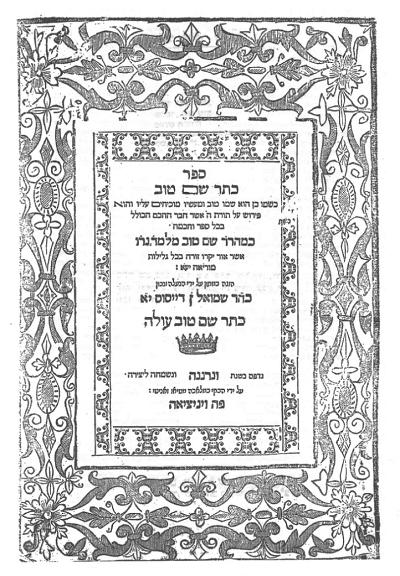
Keter Shem Tov

As is its name so is his name good and his deeds confirm it of him. It is a commentary on the Torah of HaShem written by the sage, the complete, in every book and wisdom.

Shem Tov Melamed

Whose precious light shines throughout [may

God shield him].

Edited patiently by the lofty and exalted

Samuel ibn Dysoss [may God watch over him]

Keter Shem Tov excels

Printed in the year, “that we may rejoice ונרננה (5356=1596) and be glad [all our days]” (Psalms 90:14) from the creation.


The introduction, from a student of the author, R. Samuel ben Solomon Segelmassi follows (2a), then a page of verse from the editor Samuel ibn Dysoss, the text (3a-136a), his apologia (136b), indexes (1a-16a), errata (16a), and the colophon (16b), which states that it was completed, “on the very day that Moses went up to the firmament (6 Sivan) and the Egyptians drowned in the sea (21 Nissan), in the year, “Then he saw it, and declare it ויספרה (5356=1596) (Job 28:27), from the creation.” It is unclear why there are two apparently contradictory completion dates. The text is in two columns in rabbinic type, excepting headings and initial words.

In the introduction Samuel ben Solomon writes that one who knows matters in truth and faithfully,

“shall come back with shouts of joy” (Psalms 126:6), “to perceive the words of understanding” (Proverbs 1:2) and this is the first intent of every man who presumes in his heart (Esther 7:5) to write “goodly words” (Genesis 49:21) in a book to leave after him a blessing. . . . It is a commentary on the holy Torah, “high and lofty” (Isaiah 6:1, 57:15), on each and every parshah . . .

The introduction continues that it contains derashot (discourses) according to the literal meaning, casuistic (pilpul), and very sharp. In the following paragraph we are informed that not everything that was said on every parshah was printed because of financial restraints. In the apologia ibn Dysoss adds a familiar plaint for the period, type set late erev Shabbat could not be properly corrected. Moreover, the compositors, not Jewish and not fully familiar with Hebrew and Hebrew letters, did that which was right in their eyes, and for which he should not be held responsible.

That the title clearly alludes to the author’s name, R. Shem Tov ben Jacob Melamed, is further suggested by the last line of verse at the end of the introduction, which states that “you will find that the crown of a good name (KETER SHEM TOV) excels them all. This is, as noted above, that authors’ names were frequently employed in book-titles, but, in keeping with the injunction of R. Judah he-Hasid, indirectly, here by referencing a quote from Avot.

Shem Tov Melamed was also the author of Ma’amar Mordekhai (Constantinople, 1585), a commentary on Megillat Esther, printed by Joseph Jabez. Melamed is described on the title of this work as a physician.

Keter Shem Tov, Amsterdam, R. Abraham ben Alexander (Axelrad) of Cologne, c. 1810-16: A kabbalistic Keter Shem Tov on the Tetragrammaton by R. Abraham ben Alexander (Axelrad) of Cologne (13th century). In Judaism the Tetragrammaton, the four letter divine name, is not directly expressed but instead referred to with a euphemistic name for God. The title-page describes this Keter Shem Tov as,
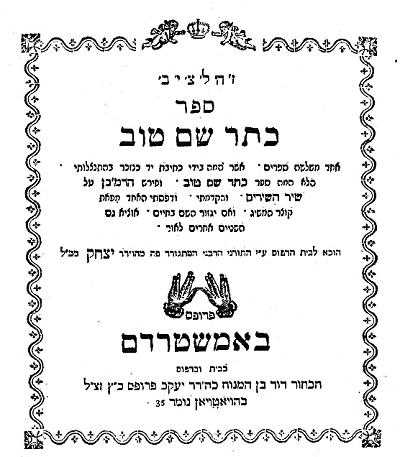
זהלציב [This is the gate of the Lord: the righteous shall enter through it] (Psalms 118:20)

Sefer

Keter Shem Tov

One of three books in my hand in manuscript, as described in my apologia. They are Keter Shem Tov and the commentary of the Ramban (R. Moses ben Nahman, Nachmanides, 1194–1270) on Shir ha-Shirim (Song of Songs). I have first printed one book only due to limited means. If the Lord will so decree I will publish the other two books. . . .


Although the title-page refers to three books two only are mentioned. The third work, noted in the editor’s apologia, is a commentary on the Merkavah of Ezekiel. Keter Shem Tov is not dated, so that various bibliographic sources date it as 1810 or 1816. The title-page is embellished by the Proops’ family press-mark, consisting of the kohen’s spread hands at the time he pronounces the priestly blessing. This edition of Keter Shem Tov (80: 5, 7 ff.) was printed in Amsterdam by David ben Jacob Proops. The Proops’ press, founded by Solomon Proops in 1704, was the longest lasting and most productive of the Hebrew printing-houses in Europe in the eighteenth century; it would continue to print Hebrew books until the mid-nineteenth century when, in 1869, the widow of David Proops sold the press to the Levissons, who printed until 1917.

Abraham, a student of R. Eleazar ben Judah of Worms (c. 1176–1238, Roke’ah), traveled through Spain between approximately 1260 and 1275, where he reportedly studied with R. Solomon ben Adret (Rashba, 1235–1310), the latter praising Abraham’s oratorical skills. Keter Shem Tov, as noted above, deals with the Tetragrammaton and also the Sefirot, addressing sacred names, using gematriot and synthesizing the mysticism of the Ashkenaz pietists (Hasidim) and Sephardic Kabbalistic methodologies.[5] Here too the reason for the title is not explicitly stated but, given the subject matter, is obvious.

This is not the first printing of Abraham ben Alexander’s Keter Shem Tov. It appeared earlier, included in a collection entitled Likkutim me-Rav Hai Gaon (Warsaw, 1798), under the title Ma’amar Peloni Almoni (ff. 26-32a). It has since been reprinted several times, often among collections of other works.

Ma’or va-Shemesh, R. Shem Tov ben Abraham ibn Gaon, Livorno, 1839: The next Keter Shem Tov, by R. Shem Tov ben Abraham ibn Gaon, is also a kabbalistic discourse on the Torah, this part of a larger multi-volume work entitled Ma’or va-Shemesh (Livorno, 1839, 80: [3], 3-11, [1], 128 ff.) printed by Eliezer Menahem Ottolenghi. The inclusion of Ma’or va-Shemesh represents a more expansive view of works entitled Keter Shem Tov as it is an independent work included in a larger collection of dissertations. The author (compiler) of Ma’or va-Shemesh, R. Judah ben Abraham Coriat (d. 1787) of Tetuán, was a scion of a distinguished Moroccan family.

  1. Shem Tov ibn Gaon (c. 1287-c. 340) was born in Soria, Spain and went up to Eretz Israel in 1312, settling in Safed where he wrote most of his books. He was a student of R. Solomon ben Adret (Rashba, 1235–1310) and R. Isaac ben Todros (13th cent.). Best known of ibn Gaon’s titles is Migdal Oz, on Maimonides’ Mishneh Torah as well as several works in manuscript. Keter Shem Tov, his first book, was reportedly written in Spain, while Rashba was still alive.[6]

The title-page of Ma’or va-Shemesh has a frame comprised of verses, all from Psalm 119:
“O how I love your Torah! It is my meditation all the day” (Psalms 97);

“O that my ways were directed to keep your statutes!) (5);

“The sum of your word is truth; and every one of your righteous judgments endures for ever” (160);

“So shall I have an answer for him who insults me; for I trust in your word” (42);

“So shall I have an answer for him who insults me; for I trust in your word” (162);

“I have more understanding than all my teachers; for your testimonies are my meditation” (99); “Great peace have those who love your Torah; and nothing can make them stumble” (165).


An additional verse is employed for the date, “This Book of the Torah shall not depart from your mouth; but you shall meditate on it הזה מפיך והגית בו (599 = 1839)” (Joshua 1:8). The title too is from Psalms, “The day is yours, the night also is yours; you have prepared the light and the sun (Ma’or va-Shemesh)” (Psalms 74:16).

The text of the title-page notes several of the authors whose kabbalistic works comprise Ma’or va-Shemesh, notably the Ari ha-Kadosh (R. Isaac Luria, 1534 – July 25, 1572), R. Moses ben Nahman (Ramban), Sefer ha-Malkut, and R. Judah ben Attar, Coriat’s maternal grandfather. The verso of the title-page has a pressmark, a lion rampant holding thistle under crown and below it the phrase Gur Aryeh Yehudah. This device was used previously in Livorno by Eliezer Saadun. When employed by Ottolenghi the lion has been turned to face right, it having previously faced left.[7]


There are introductions from R. Elijah Benamozegh and Abraham ben Judah Coriat, the former comprised of five paragraphs, each beginning with the word Kol and concluding with Judah, the latter’s introduction comprised of eight paragraphs, each beginning with Ben and concluding with Av. The text is comprised of several kabbalistic works, among them Shem Tov ben Abraham ibn Gaon’s Keter Shem Tov (ff. 25-54a), here not explicitly stated but rather entitled Perush Sodot ha-Torah. Shem Tov was a kabbalist, who studied with the Rashba and R. Isaac ben Todros. He was greatly influenced by the Ramban (R. Moses ben Nachman), reflected in his Keter Shem Tov, which is a kabbalistic super-commentary on Ramban’s Torah commentary. Here too, the title comes from the author’s name, Shem Tov.

A small portion of ibn Gaon’s Keter Shem Tov was printed previously (ff. 41b-44a), in R. Jehiel ben Israel Luria Ashkenazi’s Heikhal ha-Shem (Venice, 1601), on the ten Sefirot, Likkutei Kabbalah Kadmonim.


This much expanded version of Keter Shem Tov is based on an 1810 manuscript prepared by R. Elijah Lombroso.

II Halakhah and Minhag

Keter Shem Tov, R. Shem Tov ben Isaac Gaguine, Kaidan, Lithuania, 1934: An encyclopedic work on the varied customs and liturgy of eastern and western Sephardim and Ashkenazim by R. Shem Tov Gaguine (Gaguin, 1884-1953). Gaguine, scion of a famous Moroccan Rabbinical dynasty which emigrated to Palestine from Spain, was a great-grandson of R. Hayyim Gaguin the first Hakham Bashi of Eretz Israel in the Ottoman Empire and a great-great grandson of the kabbalist Sar Shalom Sharabi. Gaguine, who received semicha (ordination) from R. Hayyim Berlin, served as a dayyan in Cairo, rabbi and dayyan in Manchester, England, Rosh Yeshivah of Judith Montefiore Theological College, Ramsgate, and, from 1935, as head of Sephardi Medrash Heshaim in London.[8]
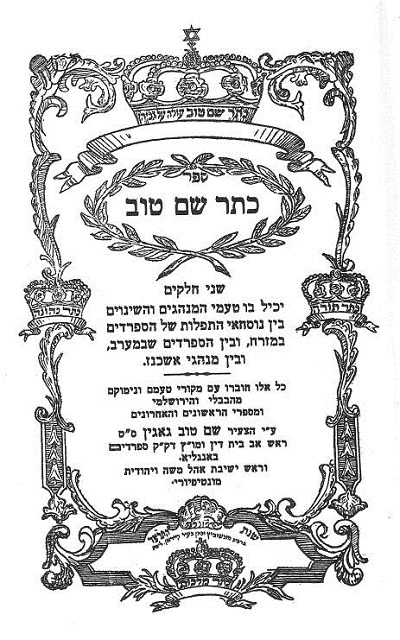


This Keter Shem Tov is comprised of seven volumes, the first two published in 1934, and the last four published posthumously by his son Dr. Maurice Gaguine. The complete work has been republished several times.

As noted above, Keter Shem Tov is a comprehensive work describing the liturgy and customs of eastern and western Sephardim and of Ashkenazim, accompanied by detailed footnotes from the Babylonian and Jerusalem Talmuds and later halakhic authorities. Although most of the entries explain more familiar customs, many are unusual. Example of the latter are:

The custom in [Eretz Israel and Syria, Turkey and Morocco] when the father, grandfather, father-in-law, one’s rabbi, or elder brother has an Aliyah, to stand on one’s feet until he returns to his place, and to go to them, kiss their hand and receive a blessing (I:213).

An unusual custom of the Sephardim in the city of Algiers is the phrase “marror zeh (this marror)” is said three times and then thrown to the ground, and afterwards picked up and returned to the ka’arah (Seder plate).[9]

Why is the marror called hasa or hazeret (lettuce or horse raddish)?

The Ashkenaz custom is to take, in place of hazeret a type of dry radish called in their language hrain, which is as sharp as mustard and does not have a bitter taste. The Sephardic custom is specifically hazeret. . . . (III: 158-59).

Keter Shem Tov, R. Avishai Taharani, Jerusalem, 2000: Another work on halakhah and customs, this most specific, described on the title-page as “a treasure of all the halakhot and personal customs concerning naming sons and daughters” by R. Avishai Taharani. The title-page continues that in it are explained the basic guidelines for giving names “by whose observance man shall live” (Leviticus 18:5, Ezekiel 20:11, 13, 21). Also addressed are the names that one should refrain from using.

In the introduction (pp. 1-23) to this two volume work, Taharani informs that he has so entitled the book, based on the injunction of the Roke’ah (above), as well as several other works. He has done so, however, with gematriot (numerical equivalencies) for “Avishai Taharani ben my lord and father Isaac אבישי טהרני בן לאדוני ואבי יצחק (977) which corresponds to Keter Shem Tov כתר שם טוב (977).” The text is wide ranging, comprehensive, and accompanied by detailed footnotes. Several examples of the more unusual entries in the text are:

If a father errs and calls his son or daughter with two names, forgetting that the additional name was given to another child, there are those who say that until thirty days he may change the name (I:118).

Some say that if one has a child from an unmarried woman, the child should be called with a name that predates [the time of the] Patriarch Abraham or with a name that is not customary, for example, Dan, so that he will be judged according to his problem. There are places that it is customary to give these names to those who are kosher and Heaven forfend one should come to question those who are kosher (I: 237-38).

Some say that one should not call [a child] with one of the names that predates the Patriarch Abraham, for example: Adam, Noah, and all who call by a name that predates the Patriarch Abraham is not in the category of one who “labors in the Torah, and does not give pleasure to his Creator” (cf. Berakhot 17a). (I:397-400).

It is permissible to shorten a name, whether for a son or a daughter, as long as that name is used only casually, and it is best to use the full name at least once a day in order that the short form dies not become customary (II:110-13).

In a lengthy footnote to the third entry concerning names that predate the Patriarch Abraham a source for the entry is given, ha-Mabit (R. Moses ben Joseph of Trani, 1500 – 1580). It is followed by a number of contrary sources by other prominent rabbis, and then a lengthy discussion. That this Keter Shem Tov has proven to be a relatively popular work is evident from the publication of two additional editions, the last in 2007.

Keter Shem Tov, Kollel Keter Shem Tov, Kiryat Bialik, 2002: Collection of discourses and responsa on Shulhan Arukh Hoshen Mishpat by rabbis from the Kollel Keter Shem Tov in Kiryat Bialik, located in the vicinity of Haifa. There is an introduction from R. Mahluf Aminadav Krispin, Chief Rabbi of Kiryat Bialik, followed by the text, comprised of nineteen articles, including one by the Rosh Yeshiva R. Solomon Shalosh. Examples of the articles are 5) “on the prohibition turning to secular courts” by R. Efied Hagibi, member of the Kollel; 6) finding a relative or one who is unfit among the judges by R. David Alharar, member of the Kollel; 9) witnesses who have fulfilled their charge” by R. Evied Elul, member of the Kollel; 11) “the obligation of rent after divorce, the portion in the residence” by R. Abraham Atlas, av bet din, Haifa; 14) “acquisition through forgiveness (relinquishment) by R. Solomon Shalaoh; and 19) “the wages of a worker and contractor who did not provide the agreed upon benefit” by R. Abraham Atlas.

The title-page numbers the volume as no. one, but it is not known whether additional volumes were published.

III Biographical and Related Anecdotal Works

Keter Shem Tov, R. Aharon ben Zevi ha-Kohen of Apta, Zolkiew, 1794/95: The most popular of our Keter Shem Tovs, based on the printed editions, is the collection of tales and stories of the remarkable and astounding deeds of the Ba’al Shem Tov (R. Israel ben Eliezer, Besht, c. 1700–1760), founder of the Hasidic movement, as well as his recorded sayings, assembled from the works of his disciples. This collection of tales and sayings was assembled by R. Aaron ben Zevi Hirsch ha-Kohen of Opatow (Apta).
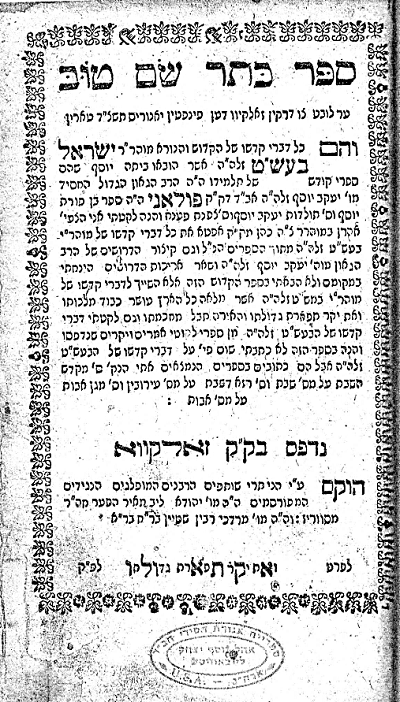


The book is in two parts, each with its own title-page but identical text, except that the first title-page is dated with a chronogram, the second title-page, printed a year later, is dated in a straightforward manner, תקנ”ה (555 = 1795). Perhaps the reason that the second title-page is so dated is that the first title-page exists in two forms, the rare first title-page, is dated “and the glory of his splendid majesty ואת יקר תפארת גדולתו (544 = 1784)” (Esther 1:4), which is incorrect, the book having been printed a decade later. The error was likely quickly caught, for the corrected and much better known title-page has the same chronogram, now reading ואת יקר תפארת גדולתו, the yod in the second word enlarged and emphasized, for a correct total of 554 (1794).[10] The variants are recorded separately in several bibliographic works.[11]

The title-page informs that that much of the contents are from the works of R. Jacob Joseph ben Zevi ha-Kohen av bet din of Polonnoye (d. c. 1782), the Ba’al Shem Tov’s leading disciple, that is, Toledot Ya’akov Yosef, Ben Porat Yosef, and Zafenat Pa’ne’ah, as well as discourses, also from other works. Among these latter sources are Likkutei Amorim and the sayings of the Ba’al Shem Tov, all collected by R. Aaron ben Zevi Hirsch ha-Kohen of Opatow (Apta).

In addition to the variations to the first title-page, the second title-page also exists in two formats, with, unlike the first title-page, some textual variations. Within the text of the book, despite Aaron ben Zevi Hirsch ha-Kohen’s comments that he has assembled the Ba’al Shem Tov’s words from the above mentioned titles, he did not, in fact, merely transcribe them in toto, nor did he distinguish which were the words of the Ba’al Shem Tov and those of Jacob Joseph.[12]

Keter Shem Tov has an approbation from R. Menachem Mendel of Liska, followed by the famed Iggeret Hakodesh, a letter from the Ba’al Shem Tov to his brother, dated Rosh Ha-Shanah, 1747, in which he relates that his soul ascended to heaven where he met with the Messiah, and then the text. This Keter Shem Tov, as noted above, has proven to be an enduring and popular work; it was printed soon after in Korezec (1797), Lemberg (1809) and several times afterwards there, in numerous other locations, and continues to be republished to the present.

Keter Shem Tov, Abraham Menahem Mendel Mohr, Lvov (Lemberg), 1847: Sir Moses Montefiore (1784–1885) was one of, if not the most prominent member of English Jewry in the nineteenth century. Cecil Roth described him as “the most notable Jew, and indeed one of the most notable Englishmen, of the 19th century by virtue of his outstanding philanthropic work extending over a period of three-quarters of a century, into his venerable old age.”13 Montefiore traveled to the Middle East during the Damascus Affair, to Russia, Morocco, and Rumania on behalf of persecuted Jewry, as well as providing leadership and support of Jewry at home and in Eretz Israel. His indefatigable efforts on behalf of world Jewry are recorded and acknowledged in books, articles, and newspapers, several works entitled Keter Shem Tov.

The first Keter Shem Tov praising Sir Moses Montefiore is by Abraham Menahem Mendel Mohr (1815–1868), a scholarly maskil, author of a number of Hebrew and Yiddish books. The title-page states that it is,
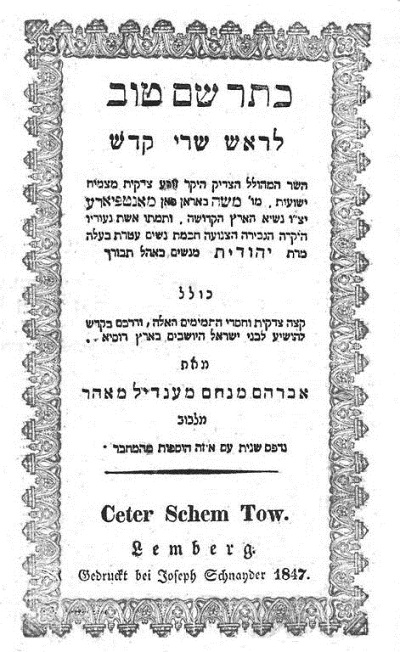
Keter Shem Tov

For the chief, holy prince

The praiseworthy, the righteous, the dear, who sows righteousness and brings forth salvation. Our teacher, Moses Baron from Montefiore [May his Rock and Redeemer protect him], prince of the holy land. And the pure wife of his youth, the honorable lady, the modest, the wisdom of women “is a crown to her husband” (Proverbs 12:4), the lady Judith “blessed shall she be above women in the tent” (Judges 5:24). . . .

The title-page continues that the text includes some of the righteousness and perfect kindness on behalf of the Jews in Russia. A small book, (80: 16 pp.: Joseph Schnander), the text begins with verse, with the header “from Moses to Moses there was none like Moses” normally referring to Maimonides but here applied to Montefiore. The verse beginning,

“Moses ben Amram brought Israel out from the burdens of Egypt

and Moses Montefiore redeemed them from death to life.

Moses ben Amram “struck the rock, so that the waters gushed out” (Psalms 78:20)

and Moses Montefiore softened the heart of stone with “words of lips” (cf. II Kings 18:20, Isaiah 36:5). . . .


The volume concludes with a letter of appreciation from Sir Moses Montefiore.

A Ladino (Judeo-Spanish) version of Mohr’s Keter Shem Tov was printed in Salonika (1850, 80: 48, 53-80 ff.) together with two other works, Tiferet Yisrael on the Rothschilds, and Ma’aseh Eretz Israel on Eretz Israel from the destruction of the Temple to the nineteenth century. Among the many other works either praising or including a section on Montefiore are Kol Kitvei Rabbi Ya’akov Saphir ha-Levi (Jerusalem, 1934), the writings of R. Jacob Saphir (1822–1886), an emissary of the Jewish community in Jerusalem and the author of Even Saphir on the Jewish communities in such varied places as Yemen, Egypt, India, and India that he visited. In Kol Kisvei is a section entitled Keter Shem Tov Kenaf Renanim Sir Moses Monrefiore, accompanied by a cameo of Montefiore.
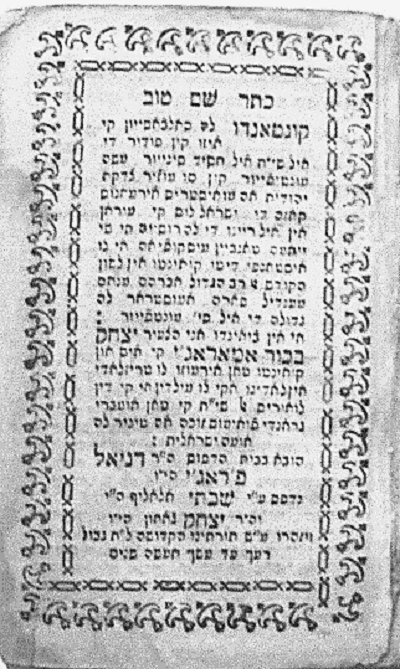


Yet another Keter Shem Tov about Montefiore was published by Hayyim Guedalla (London, 1884). The Hebrew title-page is followed by an English title-page that states,

The Crown of A Good Name

a brief account

of a few of the

Doings, Preachings, and Compositions

On

Sir Moses Montifieore’s Natal Day,

November 8th, 1883,

on which he was favored with a succession of telegraphic

Congratulations from the QUEEN OF ENGLAND and many

Eminent People of all Creeds.

Below is the quote from Pirke Avot. The text includes congratulatory letters from the Queen, the Duke of Edinburgh, many others, and special services in both Hebrew and English. In addition, many other publications relate to Moses Montefiore, among them, albeit this not directly pertinent to the article but of interest as a further example of how widespread the high esteem in which the venerable Sir Moses Montefiore was held, is the title page of the October 20. 1883 Harper’s Weekly Journal of Civilization (New York), with a full cover portrait of Montefiore.


Keter Shem Tov (Ehrenkranz des guten Rufes), R. Josef Natonek, Budapest, 1880: German Keter Shem Tov by Josef Natonek in honor of Rabbi Dr. Moritz Landsberg (1824-80), son of R. Elias Landsberg (1800-79). Except for a Hebrew header the title page is entirely in German, as is the text (32 pp.), with only occasional Hebrew.
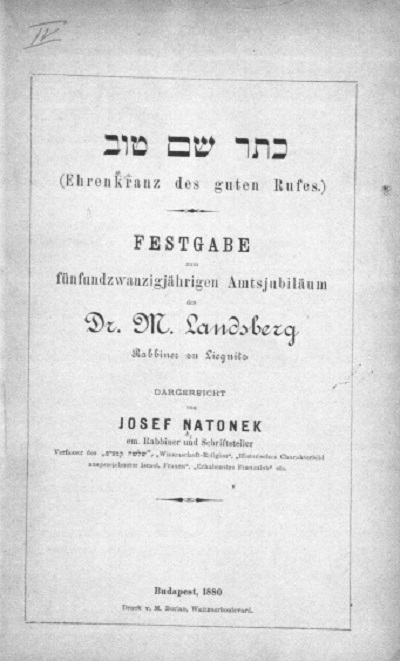


The title, Ehrenkranz des guten Rufes, is our “crown of a good name,” a Festgabe zum fünfundzwanzigjährigen Amtsjubilaeum des Dr. M. Landsberg, Rabbiner zu Liegnitz dargereicht von Rabbiner Josef Natonek em Rabbiner und Schriftsteller verfasser, that is a festive volume presented to Landsberger on the twenty-fifth jubilee of his service as rabbi in Liegnitz, by R. Josef Natonek (1813-92), a rabbi and author. Landsberg, doctor of philosophy educated in Berlin, became, in 1854, the rabbi of Legnica. Born in Rawicz, He served as rabbi for twenty-five years until his death in Liegnitz (Legnica, Silesia).[14] Landsburg was also the author of a number of studies on the history of medicine, particularly in ancient times, published for the most part in the journal Juno, published by von Henschel.[15]

At the end of the volume is a two page Stammbaum (family tree) of the Landsberg family.
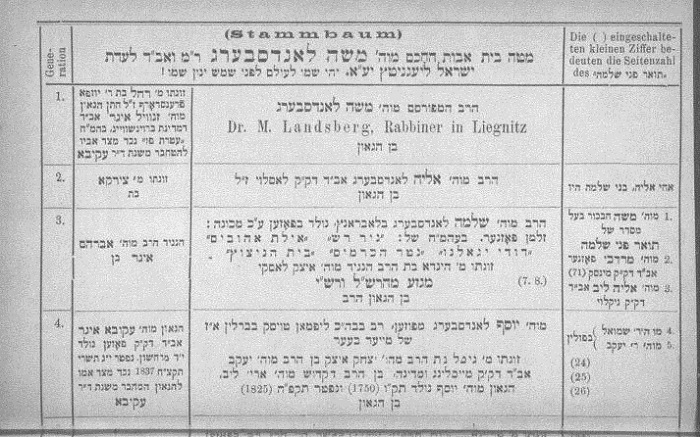


IV Miscellanea

Keter Shem Tov, R. Solomon Zalman ben Zevi Hirsch ha-Kohen, Livorno, c. 1789: Our next Keter Shem Tov is a quarto sized page printed in Livorno in c. 1789 for the Hassidic Tiberius Kollel Ashkenazim. It informs that R. Solomon Zalman ben Zevi Hirsch ha-Kohen (d. 1799) is an emissary of the Merciful One and of us (the Ashkenaz Hasidic community of Tiberias). The letter is signed by twenty-one rabbis.[16]
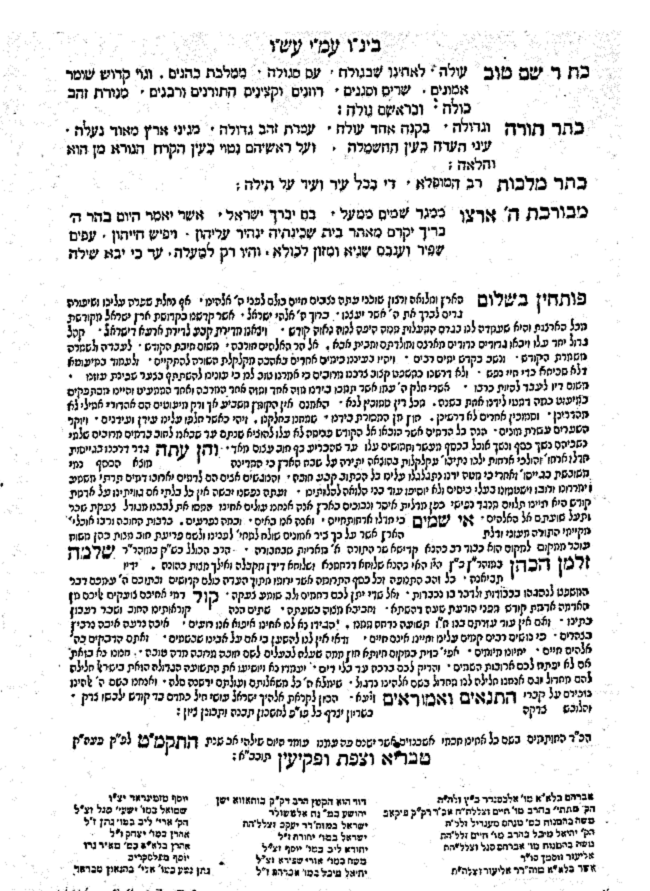


The letter begins with a reference to Keter Shem Tov followed by a list of honorifics “but the crown of a good name (Keter Shem Tov) excels them all. To our brothers in the exile, a treasured people, ‘a kingdom of priests and a holy nation’ (Exodus 19:6), keepers of the faith, princes and chieftains, princes and leaders, ‘a lampstand all of gold’ (Zechariah 4:2) Torah scholars and rabbis.”

It informs about their joy in the merit to live in Eretz Israel. Until now they had relied upon support from the country from which they had come; but now, however, due to war between Russia and the Ottoman Empire, they could no longer depend on that funding, so that they are now turning to Jews in other lands for support. Indeed, in describing the situation the letter notes the dire financial situation and that the land “‘is infested with bandits’ (Yevamot 115a, 122a) ‘the task masters hurried them’ (Exodus 5:13), they ‘lie in wait for blood’ (Micah 7:2). . . . ‘But now our soul is dried away; there is nothing at all (Numbers 11:6)’”

Solomon Zalman had traveled twice previously as an emissary to Russia (1779-81/1784-85), but this was his first trip to Western Europe. Avraham Yaari relates that Solomon Zalman’s undertaking was not without objection. The Sephardic community protested that the Hasidic community, which had previously received support from Eastern Europe, a venue now closed to them, was, by sending an emissary to Western Europe, entering into the domain of the general Tiberias community. The dispute was resolved several years later when joint representatives of both communities went to Eastern Europe.[17]

The letter begins with that part of the phrase from Avot referring to Keter Shem Tov intimating that a way one obtains the “crown of a good name (Keter Shem Tov)” is through good deeds and charity, which, as noted above, is “As a pearl atop a crown (keter), so are his good deeds fitting,” certainly appropriate for an appeal for the destitute community in Israel, the subject of the our Keter Shem Tov.

Keter Shem Tov, Shani Tzoref, Ian Young, Editors; Piscataway, NJ, 2013: A highly unusual Keter Shem Tov, this the proceedings of a conference on the Dead Sea scrolls held in memory of the late emeritus professor Alan David Crown in late 2011 at the University of Sydney, Mandelbaum House. This volume is part of a series entitled Perspectives on Hebrew Scriptures and its Contexts published by Gorgias Press, which describes itself as “an independent academic publisher of books and journals covering several areas related to religious studies, the world of ancient western Asia, classics, and Middle Eastern studies.” Among their subject matter is Ancient Near East, Arabic and Islam, Archaeology, Bible, Classics, Early Christianity, Judaism, Linguistics, Syriac, and Ugaritic.

Professor Alan David Crown (1932-2010) in whose memory this book was published, was Professor in Semitic Studies at the University of Sydney, and a renowned scholar and author. As noted on a website referring to him the title relates to the name Crown (Keter), for “He may have inherited the name Crown from his parents, but he earned the title ‘CROWN’ – the Crown of Torah, through his own merit, his sharp intellect and his deep respect for scholarship.”[18] The editors are Dr. Shani Tzoref, Ph.D., Skirball Department of Hebrew and Judaic Studies, New York University and currently a Qumran Institute Fellow, Seminar für Altes Testament, Georg-August-Universität Göttingen, and Dr. Ian Young, Associate Professor, Chair of Department at the University of Sydney, Australia, teaching Classical Hebrew and Biblical Studies.

This edition of Perspectives on Hebrew Scriptures and its Contexts 20: Keter Shem Tov (x, 400 pp.) is comprised of sixteen articles on various subjects in the field of Qumran studies (Dead Sea scrolls) from scholars in the field. The articles encompass the development and phases of Qumran scholarship; textual transmission of the Hebrew Bible, including Samaritan texts and Masada Biblical Scrolls; reception of Scripture in the Dead Sea Scrolls; community and the Dead Sea Scrolls; and eschatology and sexuality in the So-Called Sectarian Documents from Qumran; and the Temple and the Dead Sea Scrolls.

V Summary
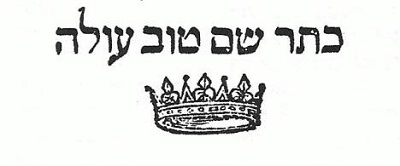


This concludes our survey of books with the title Keter Shem Tov. As noted above, the article is vignettes of books so entitled. There is no single pattern in the use of the title, it being applied to a wide variety of books. There are discourses on the Torah, both literal and kabbalistic, works on Jewish law and customs, biographic or anecdotal, and several miscellaneous works, among them an appeal for support of Jewish communities in the Holy Land and on the Dead Sea scrolls. The title Keter Shem Tov has been chosen because it refers to an author’s name, for example, R. Shem Tov Melamed, R. Shem Tov ibn Gaon, and R. Shem Tov Gaguine; bibliographical works such as those referring to the Ba’al Shem Tov, Sir Moses Montefiore, and Rabbi Dr. Moritz Landsberg; and more diverse works, such as one being the novellae of a Kollel, the Dead Sea scrolls, and even topically related as in R. Avishai Taharani’s Keter Shem Tov, which actually deals with laws and customs applicable to names.

We began by noting that the title of Hebrew books, unlike books in other languages, may have “been selected by the author for any one of a number of reasons, least of all the book’s subject matter; rather the intention is/was to give the book ‘the crown of a good name (Keter Shem Tov)’.” Indeed, not one book in this article, with the possible exception of Taharani’s Keter Shem Tov, indicates its subject matter by the title. What each of these examples do have in common, is the intent to associate the name of the author, subject, or even organization with the Mishnah in Pirke Avot, which states,

  1. Simeon said: there are three crowns: the crown of Torah, the crown of priesthood, and the crown of royalty; but the crown of a good name (emphasis added, Keter Shem Tov) excels them all (Avot 4:13).

[1] I would like to thank Eli Genauer for reading the article and his comments and my son-in-law, R. Moshe Tepfer, for his assistance and research in the National Library of Israel, including getting the 1789 Livorno illustration from
[2] Marvin J. Heller, “Adderet Eliyahu; A Study in the Titling of Hebrew Books,” in Studies in the Making of the Early Hebrew Book (Brill, Leiden/Boston, 2008), pp. 72-91; idem. “What’s in a name? An example of the Titling of Hebrew Books,” in Further Studies in the Making of the Early Hebrew Book (Brill, Leiden/Boston, 2013) pp. 371-94.
[3] Judah he-Hasid, Sefer Hasidim (Jerusalem, 1973), ed. Re’uven Margaliot, pp. 210-11, n. 367 [Hebrew].
[4] Eleazar ben Judah, Sefer Roke’ah ha-Gadol (Jerusalem, 1967), ed. Barukh Shimon Shneurson, p. 1 [Hebrew].
[5] Gershom Scholem, Kabbalah (New York, 1974), p. 51.
[6] Shimon Vanunu, Encyclopedia Arzei ha-Levanon. Encyclopedia le-Toldot Geonei ve-Hakhmei Yahadut Sefarad ve-ha-Mizrah IV (Jerusalem, 2006), pp. 2152 [Hebrew].
[7] Avraham Yaari, Diglei ha-Madpisim ha-Ivriyyim (Jerusalem, 1943, reprint Westmead, 1971), pp. 96, 174 no. 160, [Hebrew].
[8] Shimon Vanunu, Encyclopedia Arzei ha-Levanon. Encyclopedia le-Toldot Geonei ve-Hakhmei Yahadut Sefarad ve-ha-Mizrah IV (Jerusalem, 2006), pp. 2155-56 [Hebrew].
[9] In contrast, the Mishnah Berurah (477:1:5) quotes the Shelah ha-Kodesh who states that ” have seen people of status who kiss the matzah and the marror . . . all to cherish the mitzvah.”
[10] Such errors and their corrections are known as stop-press corrections. Sheets were proof read while the press-run was under way; while it certainly was preferable to correct the sheets before the run began, reading also took place while the run was under way. When the corrector would find an error he would stop the run, remove the forme, quickly correct the error, and resume printing. Unless substantial, stop-press corrections did not necessitate disposing of the previous sheet – four pages in a folio, more so in a smaller format – but rather both the altered states and the originals are used. In such a case, there will be variant copies of the book, consisting of sheets printed from forms in both the earlier and later states, as is the case here.
[11] The copy with the misdated title-page in the Chabad-Lubavitch Library is attractively bound in a soft brown leather, the cover stamped כתר שם טוב ב”ק אדמו”ר שליט”א, that is, it was in the private library of the Lubavitcher Rebbe, R. Menachem Mendel Schneeersohn (1902–94). The reading room librarian, R. Zalman Levine, informs me that to his knowledge this is the only book so bound, and that it “was given to the rebbe with this binding.
[12] Keter Shem Tov (Brooklyn, 1972), p. v [Hebrew].
[13] Cecil Roth, “Moses Montefiore, 1784-1885,” in Essays and Portraits in Anglo-Jewish History (Philadelphia, 1962), p. 262.+
[14] As an aside, Jewish settlement in Lieignitz can be traced to the Middle Ages, interrupted by pogroms, the first in 1447 due to a dispute between Elżbieta, Duchess of Legnica with Jewish bankers, who demanded that she return a loan. Liegnitz is best remembered for a battle that took place there in 1241, when a Polish-German Army lead by Duke Henry II of Silesia engaged invading Mongol near the town. The Mongols were victorious, collecting nine sacks of ears from their fallen enemies, all of whom perished.
[15] Klatzkin, Jacob and Ismar Elbogen, editors, Enyclopaedia Judaica: Das Judentum in Geschichte und Gegenwart 10 (Berlin, 1928-34), p. 619.
[16] The signatories are R. Abraham ben Alexander Katz of Kalisk; R. Matthias ben Hayyim; R. Moses ben Menahem Mendel; R. Jehiel Michal ben Hayyim; R. Moses ben Abraham Segal; R. Eliezer Sussman; R. Asher ben Eliezer; R. David he is the Katan, rav of Bohava Yeshain; R. Joshua ben Noah Altshuler; R. Israel ben Jacob; R. Israel ben Judah; R. Judah Leib ben Joseph; R. Moses ben Uri Shapira; R. Jehiel Michal ben Abraham; R. Joseph of Zimigrad; R. Samuel ben Isaiah Segal; R. Aryeh Leib ben Nathan; R. Aaron ben Isaac; R. Aaron ben Meir; R. Joseph of Poloskov; and R. Nathan Nata ben Eli of Brod.
[17] Avraham Yaari, Sheluhei Eretz Yisrael II (Jerusalem, 1951, reprint Jerusalem, 1997), pp. 619-28 [Hebrew].
[18] http://learning.mandelbaum.usyd.edu.au/about-us/alan-crown/


A Little-Known Rabbi Doctor and his Exceedingly Rare Medical Diploma Leon Cantarini- AKA Yehuda HaKohen Katz Me-HaHazzanim (University of Padua, 1623)

A Little-Known Rabbi Doctor and his Exceedingly Rare Medical Diploma
Leon Cantarini- AKA Yehuda HaKohen Katz Me-HaHazzanim (University of Padua, 1623)

Rabbi Edward Reichman, MD

Professor of Emergency Medicine, Albert Einstein College of Medicine
Isaac and Bella Tendler Chair of Jewish Medical Ethics, Yeshiva University


“He obtained a degree in medicine and philosophy on 31 October 1623, as can be seen from his original diploma which has been perfectly preserved despite the destructive effects of time.” (translated from the Italian)

Marco Osimo 1875

Original Books and manuscripts of past centuries known to historians throughout the ages have sometimes been lost forever to the ravages of time or war. Every so often, these works disappear from the public eye and are preserved in an intentional or accidental state of hibernation, only to reappear centuries later.

In late 2024, Manfred Niekisch, a German biologist, nature conservationist, and former director of the Frankfurt Zoo, died at the age of 73. He left a vast archive covering a wide range of topics, including taxonomy, ecology, behavior and reproduction of reptiles, amphibians and birds, not a place one would expect to find any items of Jewish interest, let alone of importance.

In April 2025 I was contacted to assess the historical significance of a single item from Niekisch’s massive collection. A thematic outlier, it is a small leatherbound volume, the contents of which comprise a seventeenth century medical diploma, and for a Jewish student, nonetheless. I was enlisted to address whether this item has any unique value or contribution to Jewish or medical history. This article constitutes the substance of my response. We will attempt to breathe a little life into this comatose medical document, resuscitate some long-forgotten and little-known archives, and perform at least a preliminary examination of the life of a remarkable, if little-known, Jewish medical graduate of the Early Modern period.


The Graduate- Leon Cantarini

The name of our graduate is Leon Cantarini. Leon, the son of Shmuel Cantarini, was one of eight children and a member of a prominent dynastic family in Early Modern Italy. Leon was also known as Yehuda HaKohen Katz Me’ha-Hazzanim. The synonymous Italian and Hebrew family name purportedly derives from family members having led the synagogue services as the hazzan, or cantor. Standard literature searches, including main search engines, library databases (such as the National Library Israel), or archival records (such as Internet Archives and Haithi Trust) yield next to nothing about our graduate. The few brief biobibliographical entries for him are scant, inconsistent, and often error filled.

Much of what we know about Leon is found in a comprehensive nineteenth century Italian biography of the Cantarini family by Marco Osimo, himself a medical graduate of Padua centuries later in 1851. This work was seemingly inaccessible or unknown to many of Leon’s biographers. In this essay we draw on the work of Osimo, correct some earlier biographies (including Osimo), and add much important previously unknown archival material to flesh out the existing skeletal biography of Leon Cantarini.


Dates of Birth and Death

Confusion abounds regarding the dates of both Leon’s birth and death. We begin with his date of death, as Leon’s birth date is inferred therefrom. The Jewish Encyclopedia entry for “Cantarini, Judah (Leon) ben Samuel Ha-Kohen,” authored by Louis Ginzberg and Israel Berlin, reads, “Italian physician and rabbi; born about 1650 at Padua; died there April 28, 1694.”[1] While the description is clearly of our graduate, the dates are grossly in error. Perhaps they confused Leon’s date of death with his date of birth. These dates were unfortunately perpetuated by others.[2] Osimo, the definitive biographer of the Cantarini family, places Leon’s date of death in July of 1651 based on a decree from July 20, 1651, announcing the election of Leon’s pupil to a community position, replacing his mentor upon the latter’s death. While this proves that Leon had already died by this date, it does not pinpoint his date of death.

There is a single unexpected, unimpeachable source that states the exact Hebrew date of Leon’s death. Leon’s relative, Isaac Hayyim Cantarini, also a rabbi and graduate of Padua’s medical school, engaged in a correspondence with the Christian theologian Christian Theophil Unger from 1717 to 1719. The exchange was first published by Shadal in his Otzar Nehmad in 1860.[3] While scholars have studied these letters for obvious reasons, they also contain a wealth of biographical information about the Jewish Italian scholars of this period. In a list of the dates of death of a number of prominent members of the Italian Jewish community, we find the following

The date of Leon’s death is listed as 26 Nisan 5410, corresponding to April 27, 1650. He is buried in the ancient (Via Wiel) cemetery of Padua,[4] though his tombstone does not remain.

There is one non-Jewish source, published in 1728, which correctly lists the exact date of Leon’s death.[5]

This is because the Christian author was familiar with the letter exchange of Cantarini and Unger, unlike his Jewish counterparts who only learned of it through the journal of Shadal published over a century later.

There is no independent source confirming the day or year of Leon’s birth. What is known with certainty is that he died at the age of fifty-six, a fact recorded in multiple sources, including a memorial book for the Jewish community of Padua.[6] Since Osimo dated Leon’s death in 1651, he placed his date of birth fifty-six years earlier, “around 1595.” The year 1595 is widely quoted as Leon’s birth year, based on Osimo. Since we now know the exact date of Leon’s death as being in 1650, we would revise his date of birth to “around 1594.”

Leon’s Father’s Name

The name of Leon’s father was Shmuel. Yet, he is also referred to as Simon, including on Leon’s medical diploma (see below). Simon (or Simeon) today is the English name for Shimon. What is the origin of this alternate name. The answer is surprisingly found in the aforementioned letter exchange between Isaac Cantarini and Christian Theophil Unger.

Among the numerous questions posed by Unger to Cantarini is why, for example, Rabbi Menahem Porto is called by the first name Emanuel instead of his Hebrew first name.[7] Cantarini answers that while all Italian Jews have a given Hebrew name, many have an additional secular or vernacular “translation” or substitute for their Hebrew name. He provides two examples. One is the name Mandolin for Menahem. The other is the name of one of his own children: “In my home I have a young child whom I named Shmuel, but in la’az (vernacular) he is called Simon, which is (synonymous with the Hebrew) Shimon.” This analysis of Isaac Cantarini’s child’s name provides direct insight into the double name of Leon’s father, after whom this child was likely named. It appears that while today our English correlate for Shmuel is Samuel, and for Shimon is Simon, at that time Simon was the accepted latinized form for Shmuel.

Leon’s Relationship to Isaac Hayyim Cantarini

The historical record of Leon Cantarini is dwarfed by his more famous relative, Isaac Hayyim Cantarini,[8] whose writings contribute to Leon’s biography as well. Isaac, a physician, rabbi, poet and orator, is one of the towering figures of Early Modern Jewish history. How were Leon and Isaac related? Nepi and Ghirondi identify Isaac as Leon’s “nekhed.”[9] While this typically means grandchild, perhaps they were using the term to mean descendant. Leon was in fact Isaac’s uncle, the brother of Isaac’s father, Ventura Yaakov Yitzchak. Isaac, born in 1644, would have been only six years old at the time of Leon’s death, precluding any substantive personal relationship. Nepi and Ghirondi state that they viewed a eulogy written by Isaac for his uncle Leon.[10] It is unclear to me when this eulogy would have been written, given Isaac’s age at the time of Leon’s death, though perhaps he wrote some form of eulogy when he was older to commemorate his uncle’s yartzheit (anniversary of his death). Isaac clearly had great reverence for his uncle Leon, always referring to him in a highly praiseworthy fashion. In his historical work, Pahad Yitshak, Isaac refers to Leon twice describing him as expert in both Torah and medicine.[11]

Leon Cantarini the Rabbi

Leon obtained his rabbinic ordination in 1618, at the age of twenty-four.[12] Rabbi Judah Saltara, who would later serve as a witness for his medical graduation (see below), was one of the granting rabbis. In the Padua community archives (pinkassim) for the years 1603-1630, his name appears on two occasions (October 28, 1621, and October 31, 1625) in his rabbinic capacity serving as judge for routine community matters.[13] Leon founded a yeshivah in the Ashkenazi synagogue, where he taught Talmud. He also officiated as preacher and delivered sermons and eulogies in both Padua and Venice.

I am aware of only one published responsum from Leon,[14] which he penned to Yaakov ben Yisrael Levi dealing with a dispute between three sons regarding the disposition of their father’s estate after their father had left very explicit and equitable instructions. Leon was clearly well versed in rabbinic literature, citing multiple references to support his position, and dealt among other issues with the propriety of bypassing the biblical requirement to grant a double portion to the firstborn.

Osimo was in possession of numerous rabbinic related manuscripts of Leon in varying stages of completion, the whereabouts of which are unknown to me. These manuscripts include sermons, biblical commentaries, philosophical and theological treatises. As Osimo was not versed in rabbinic literature, he forwarded Leon’s Jewish related manuscripts to a Rabbi Benedetto Levi of the Rabbinical Institute of Padua for evaluation of their content.[15] The text of Rabbi Levi’s response is provided where he comments on Cantarini’s familiarity and facility with rabbinic literature and philosophy and the areas where his work may or may not have exhibited originality. Osimo bases his laudatory comments in his work on Levi’s analysis.

Leon Cantarini the Physician

Leon’s medical degree was from the University of Padua. This university, over 800 years old, plays a prominent role in Jewish medical history.[16] As the first, and for some time only, medical school in Europe to officially admit Jewish students, it was the hub of Jewish medical training from the sixteenth to eighteenth centuries, during which some 400 Jewish students attended.

Leon graduated from Padua on October 31, 1623. We would be remiss if we did not mention that Leon wasn’t the only Cantarini to walk down the aisle of the Aula Augustiori (Grand Hall) that day to receive his medical diploma. Caliman, his younger brother by two years, graduated right alongside him. These two Cantarini brothers would be the first of a total of eleven members of the Cantarini family who would graduate from Padua over a span of some one hundred and twenty years. There is even an entry in the Padua University Archives which includes both brothers, Clemente (Latinized form of Caliman/Kalman/Kalonymus) and Leo, together.

Leon maintained a large practice among both the Christian and Jewish population of Padua. He is also recognized for his exemplary treatment of the poor, visiting them up to three or four times a day without receiving compensation.

Osimo was in possession of multiple medical manuscripts of Leon, the whereabouts of which today are unknown to me. The medical material he notes as summaries or comments on the works of Hippocrates, Galen and Avicenna, the latter explicitly mentioned in Leon’s diploma, as discussed below, and copies of his medical school lectures.

An entry in the archives of the Venetian Senate mentioning Leon reflects on the challenges and discrimination facing Jews and Jewish physicians at that time. Jews in Italy were obligated to wear distinctive clothing to identify them as members of the Jewish faith.[17] This included a specific color hat, sometimes red, sometimes yellow. This would preclude Leon, or any other Jewish physician, from wearing the black hat (biretta or cappello) which was granted them upon graduation from medical school and associated with the medical profession.[18] On May 15, 1643, Leon requested permission from the Venetian Senate to be exempted from the prohibition against wearing the black cappello on the basis of his medical degree. While Leon’s request was granted, and he was permitted to wear the black cappello both during the day and at night without any hindrance,[19] the Venetian Senate was generally conflicted about whether Jewish physicians should qualify for this exemption.[20] Other Jewish medical graduates of Padua often petitioned for similar exemptions.[21]

Leon Cantarini’s Marriage

On March 10, 1628 Leon married Mindele, daughter of Yosef Kohen Rofeh De Datolis (Tamari). They had three children.[22]

Impact of the Padua Plague of 1631 on Yehudah and the Cantarini Family

Any biographical discussion of Leon would be woefully inadequate, both literally and figuratively, without discussion of the impact on his life of the 1631 Plague in Padua. Indeed, this is exactly how Nepi and Ghirondi introduce his brief biography:[23]

The plague’s toll on the Jewish community of Padua was profound with around a fifty percent fatality. The plague was assiduously chronicled by Abraham Catalano, a physician and one of the administrators of the plague for the Jewish community, in his Olam Hafukh. One of the many remarkable aspects of this unique plague chronicle is Catalano’s scrupulous documentation for posterity of the names of all those involved, including each one of the victims. Catalano includes a passage about the Cantarini family where he singles out our graduate:


After recording the death of Leon’s brothers in the plague, Catalano writes, “May my mouth speak the praise of God
[24] that their brother the physician, prominent leader (aluf), Rabbi Yehuda Katz was not present in Padua during the plague, having married a woman from Venice and settling there. He provided aid and assistance (during the plague).”

Though the impact of Leon’s family losses during the 1631 plague is inestimable, there is likely one loss that affected him differently than others. Leon’s brother Caliman was also a physician, having graduated together with him on the very same day. Caliman was living in Padua during the plague and served as a physician for the Jewish community. Acutely aware of the raging and highly fatal epidemic in Padua, and concerned for the welfare of his dear physician brother on the medical battlefield, on July 18, 1631, Leon penned a letter to Caliman, advising him of some effective remedies recommended to overcome the dreaded disease, as well as appropriate precautions to prevent the contracting or spread of the infection.[25] Leon specifically recommended the use of emeralds, which since the Black Death had been considered a cure for plague. Leon emphatically warned his brother to exercise extreme caution and diligence in order to preserve his health. It would be only twelve days after the writing of Leon’s letter, on July 30, that Caliman succumbed to the plague at the age of 38. Below is a record of Caliman’s death in the Libro De Morti, the Padua City Death Registry.

His death is recorded in the city death registry alongside his profession, which was unusual for these records. He is also identified as “ebreo.

In order to fully assess the nature of the impact of the plague on the entire Cantarini dynasty, one would need to carefully read every line of Olam Hafukh and to note every time a member of the Cantarini family is mentioned. It turns out that this work has already been done already, by none other than Isaac Hayyim Cantarini. Isaac painstakingly transcribed the entire manuscript of Olam Hafukh by hand. While this manuscript, housed at Columbia University, is well known to Jewish scholars and historians, there is one “key” factor which has gone overlooked. For every mention of a Cantarini family member in the work, Isaac added a notation shaped like a key, akin to an asterisk, referring the reader to the margin, where he noted how the individual was related to him. Below are some examples:

Shmuel Katz MeHazanim, Isaac’s maternal grandfather, died from the plague 8 Tammuz


Menahem Katz MeHazanim, Isaac’s paternal great uncle died on 22 Tammuz


During the plague Leon lost his father, three brothers and many additional extended family members.

Leon Cantarini and the Venice Plague of 1630

While Leon’s absence from Padua during the 1631 plague is recorded for posterity by Catalano, it is not as if he completed evaded the impact of the Bubonic plague. The impact on his life of the Venetian Plague, which preceded that of Padua by just one year, has gone unnoticed. It is unappreciated that the very same bubonic plague, on its way to Padua, devastated Venice in 1630,[26] where Leon was living at the time.

We know from other sources that a young Jewish physician by the name of Isaac Gedalia served as the physician for the Jewish community of Venice during the plague. This is the same physician who wrote a poem in honor of Leon’s graduation, and Leon would certainly have been in contact with him. Tragically, Gedalia met the same fate as Leon’s brother Caliman, and succumbed to the plague. Gedalia died in 1630 at the age of 32 and is buried in the Lido Cemetery of Venice. His epitaph, composed by Rabbi Yehuda Aryeh Modena, reflects his service as a physician to the Jewish community during that time.[27] Below is the epitaph in the autograph of Modena,[28] followed by the transcription of Berliner.[29]


We have not known, however, what medical role if any Leon played in the Venice plague of 1630. Was he simply a bystander, or perhaps worked side by side with Gedalia, his fellow Padua alumnus. Leon’s diploma, discussed below, sheds new light on this question.

Leon Cantarini’s Graduation Diploma

Leon Cantarini’s magnificently bound and meticulously calligraphed medical diploma was ceremoniously placed into his hands on October 31, 1623 accompanied by the traditional pomp and circumstance of the University of Padua graduation. He put it to good use during his lifetime. Over three hundred years later, we find Leon’s diploma in the possession of Marco Osimo, a Padua-trained physician. In his definitive history of the Cantarini family he writes regarding Leon: “He obtained a degree in medicine and philosophy … and his original diploma … has been perfectly preserved despite the destructive effects of time.” The renowned Hungarian Jewish historian David Kaufmann recalled that he had viewed Leon’s diploma at Osimo’s home.[30] The Cantarini biography was published in 1875 and Osimo died in 1881. As the family biographer, Osimo likely procured the diploma from members of the Cantarini family. While details of the journey from Osimo’s home to that of Professor Manfred Niekisch, whose collection contained Leon’s diploma, are unknown, it appears that no one, not Osimo nor Kaufmann, has previously carefully examined Leon’s diploma.

One of the archival items that reflects the unique historical chapter of Jewish medical training at the University of Padua is the medical diploma.[31] Prior to reviewing Leon Cantarini’s diploma, I had identified, in libraries, museums and private collections, eighteen extant diplomas of Jewish medical graduates of the University of Padua, the earliest of which was 1647.[32] One of these is the diploma of Gershon Cantarini (1703),[33] Leon’s grandnephew. Below we review the features found in our “new” graduate’s diploma, as compared to those of his fellow Padua alumni.

Form

Leon’s diploma is a bound quarto booklet with a red Italian tooled leather binding consistent with the typical Padua diploma of this period.

In its original form, a pair of wax seals would have been attached to the binding, as pictured in the diploma of Emanuel di Jacob (Del) Medigo de Dattolis (Menachem Kohen Rofeh Tamari)[34] from 1686,[35] a member of Leon’s wife’s family.[36]

The text is written in period calligraphy appointed with periodic gold leaf lettering. The text of the diploma, written with generous font size and spacing, as well as wide margins, occupies ten double sided pages. This is unusual, as the typical diploma text usually fills four to six sides. 

Content

The diplomas of Jewish medical graduates of Padua contain some deviations from the standard issue. As the standard Padua diploma contained a number of Christian references, the university accommodated the Jewish students by allowing certain alterations or emendations:

  1. The invocation was changed from “In Christi Nomine Amen” to “In Dei Aeterni Nomine Amen.” Leon’s diploma conforms to this pattern:

  1. The convention for writing the year of the graduation invariably contained a Christian reference, such as anno Domino, anno Christiano, or anno a Christi Nativitate. In many Jewish diplomas this reference is omitted. Here we do not see an alteration of the date and it retains the Christian reference, Anno Christiano.

  1. The graduation for the Christian student was held in the Episcopal palace, a religious venue. This is mentioned in the text of the diploma. The graduation for the Jewish student was convened in a non-ecclesiastical location, a fact reflected in the diploma text. Leon’s graduation was held in the “Aula Augustiori” (grand hall) of the university, the largest hall in the university at the time and not designated for religious use.[37]

  1. Many diplomas contained ornate illustrations and images, typically of a Christian nature. If the Jewish student diploma were illustrated, it would be with flora and fauna and devoid of any Christian imagery. This diploma has no added illustrations.

  1. The identifier “ebreo” or “hebreus” was added for Jewish students. This was a convention followed consistently in Padua, and less so in other European universities. This was not specifically requested by the student, nor was its presence a reflection of antisemitism.

  1. Witnesses were required to attest to the graduation. Jewish graduates often enlisted Jewish witnesses. Leon’s three witnesses were Jewish.

The above changes are not found uniformly or consistently in every Jewish student diploma, and Leon’s diploma contains all but one of them.

General Diploma Observations

Chronological Precedence

This is the earliest extant diploma for a Jewish medical graduate of the University of Padua of which I am aware. Previously the earliest extant diploma of this type was from 1647.[38]

During the early centuries of the University of Padua Medical School, doctoral degrees were granted exclusively by the Sacred College of Philosophers and Physicians in a Catholic religious ceremony. Non-Catholics who received training at the university could obtain medical degrees through a different pathway outside of the university walls, granted by specific individuals known as Counts Palatine, who received their authority from the Holy Roman Emperor. These ceremonies were held privately before a notary and witnesses.[39] It was only in 1615 that the Collegio Veneto was established to serve the purpose of granting formal degrees to non-Catholic students and essentially replaced the Counts Palatine. Leon was the fifteenth Jewish graduate after the procedure changed.[40]

Faculty Support for Graduation

In order to graduate, a student required the support of a number of faculty to promote his candidacy. Names of the faculty members promoting the graduate are listed in the diploma. One such faculty member identified in the diploma maintained a unique relationship with Leon and the Jewish community regarding an important aspect of the educational experience of the Jewish medical students.

Caesar Cremonin was a Professor of Philosophy in Padua, as philosophy at this stage of history was an integral part of medical training. In fact, the medical diploma for each graduate, including Leon, certified a degree in “Philosophia et Medicina.”

We know from historical records of the Padua Jewish community that Professor Cremonin served as a university representative to the Jewish community on a matter of utmost significance. Since the expansion of the anatomy curriculum during the tenure of Vesalius in the mid sixteenth century, and the subsequent construction during the time of Fallopius of the first historical dedicated anatomical theater, the demand for cadavers for teaching at the university exponentially increased. The university turned to the student body, including the Jewish students, to provide cadavers from their respective communities. As this request ran counter to Jewish law, which prohibited the desecration of the corpse after death, the Jewish community negotiated a compromise arrangement whereby a fee would be paid to the university in exchange for an exemption to provide cadavers.[41] The following entry appears in the Padua Jewish Community Archives from April 19, 1624.[42]

In that the spirit of God has enlightened the esteemed philosopher Senior Caesar Cremonin to declare freedom (from dissection) for our deceased, through the continued annual designated payment to the College of Arts, generation after generation. As a result, they are obligated to allow us to properly bury our dead during the season of dissection. Any violators will be fined, and they have coordinated with us to obtain from the government permission for a required fine for all who violate this agreement in a way amenable and sufficient for our needs.

The continuation of the archival entry mentions the Jewish community member delegated to negotiate with Cremonin. It is none other than our graduate.

The aforementioned Master Caesar and Yehudah Katz have already spoken on this matter and have begun discussion regarding the amount the Jewish community is willing to pay for this privilege.

The archival entry is dated just a few months after Leon’s (Yehudah’s) graduation, and he was an ideal representative for the community given his preexisting relationship with Cremonin, one of his medical school professors and graduation promoters.

Curriculum

The diploma contains a list of the student’s professors and course subject matter. For example, Leon was taught the works of Avicenna by Professor Francisco Bonardo.

Avicenna (980–1037), known in Hebrew sources as Ibn Sina, was a Persian physician of great renown. His main work, The Canon, was considered the authoritative work on medicine for many centuries and is quoted extensively by rabbinic sources. The only extant Hebrew medical incunabula is a copy of Avicenna’s Canon (Naples, 1491). Many Hebrew manuscripts of Avicenna were found in the Cairo Geniza.[42]

The Identity of the Witnesses

Two of Leon’s witness were prominent local rabbis and are known to us from other sources.

  1. Rabbi Jacob Alpron (also known as Helipron or Heilbronn)[44]

Alpron was a Talmudic scholar, author, and translator, most known for his popular work, Mitzvot Nashim,[45] a Hebrew translation of an Italian work on the three mitzvot specific to women, the laws of niddah, hallah, and lighting of Sabbath candles, which, if not observed, “are the three transgressions for which woman die in childbirth” (Shabbat 31b).

  1. Rabbi Leon (Yehudah) Saltaro da Fano (1505-1629)[46]

Saltaro was one of the rabbis who granted Leon his rabbinic ordination five years earlier.[47] It must have been meaningful for him to serve as a witness for his student’s medical graduation.

Saltaro authored a work, Sefer Sha’arei Gan Eden, attempting to identify the location of the Garden of Eden.[48] In his Mikveh Israel on the laws of the ritual bath, inter alia, Saltaro provides insight into the Jewish education of students attending the medical school in Padua. He mentions Avtalyon miModena, the uncle of Yehuda Aryeh da Modena, who in addition to his medical studies at the University of Padua, learned Torah in the Yeshiva of Rabbi Meir Katzenelenbogen (Maharam Padua).[49]

In fact, the Jewish Ghetto of Padua was and remains mere steps from the University of Padua campus, and other students over the centuries pursued Torah study with the prominent rabbis of Padua while enrolled in the city’s famous medical school.

Addenda to the Diploma- New Evidence of Leon’s Medical Involvement in the Venice 1630 Plague

It is not uncommon to find handwritten records appended to Padua diplomas documenting subsequent academic or clinical experiences. Occasionally, a student would present his diploma as part of his application for a medical position and the institution would inscribe acceptance or approval on the diploma itself. We find such an entry in Leon’s diploma that sheds some light on his clinical role in the Venice plague. On the inside of the back cover appears the following entry dated August 1630:

The diploma was presented to the Officio di Sanità in Venice (Provveditori e sopraprovveditori alla sanità) and “admesso” (accepted). This was required in order for Leon to practice in Venice. Until now, we have had no evidence of Leon himself practicing medicine during the plague. These few lines reveal that Leon was indeed providing medical service during the Venice 1630 plague, and like his fellow Padua graduates, including Gedalia and his own brother Caliman, put his life at risk in the process. While the latter two succumbed to the plague, Leon was fortunate to survive and to live for another twenty years practicing medicine and teaching Torah.

Congratulatory Poems for Leon’s Graduation

In seventeenth century Italy it was common for Jews to compose celebratory or commemorative poems for a variety of occasions, such as weddings or funerals. One such occasion that precipitated a poetic response was the graduation of Jewish students from the medical school of the University of Padua. I have identified over one hundred such poems written in the seventeenth and eighteenth centuries, most of which are extant. Rabbi Yehudah Arye Modena compiled an entire book of collected poems in honor of Joseph Hamitz, a fellow graduate of Leon from Padua in 1623.[50]

Sometimes the poems were composed by fellow students or alumni. Isaac Gedalia, a Padua medical graduate of 1622,[51] composed two poems for our graduate, one in Spanish and one in Latin.[52] There is also a record in the Padua city medical archives from April of 1625 of Gedalia treating a number of Jewish patients,[53] one of whom was Jacob Alpron, a witness for Leon’s medical graduation.

April 20 1625
Giacob Alpron Rabi Hebreo di anni 85 in circa ammalato giorni 15 di mal di muchi visitato dall’Ecc.mo Gadilia Hebreo nel ghetto.

Giacob Alpron Rabi Hebreo aged about 85. He was ill for about 15 days with a sore throat [?]. His Excellency Gadilia Hebreo examined him in the Ghetto.[54]


A Diploma for a Rabbi Doctor

Leon was a rabbi by the time he graduated medical school and he is identified as such in his diploma. Just how rare is it find a medical diploma for a rabbi doctor? Throughout history there have numerous attempts to create institutions or formal curricula combining the study of both Torah and Medicine.[55] These initiatives, well intentioned as they may have been, were of only limited duration and success. It was thus left to the individual physician to navigate his Torah study independently, something most physicians did informally. Some however sought more formal training. The Haver degree, a lower and less rigorous form of rabbinic ordination, was one such option. Unlike rabbinic ordination, with its expansive requirements to master specific areas of practical Jewish law, there was no uniform curriculum for the Haver degree.[56] Each location designed its own program. The student would be required to spend a period dedicated to Torah study and display basic competency, as well as character traits consistent with Torah values. Those deemed worthy would receive the title Haver within a few short years or less, typically bestowed by local rabbinic authorities.[57] A number of Padua alumni chose the Haver option,[58] including Leon’s fellow graduate, David Morpurg.[59] We have record of one Padua graduate receiving his Haver degree on the very same day as his medical graduation.[60]

A select few physicians throughout Jewish history chose the more advanced and labor-intensive course of study to obtain rabbinic ordination. These physician-rabbis have garnered the attention of scholars such as Holub,61] Sergei,[62] Epstein,[63] Margalit,[64] Salah,[65] and Steinberg.[66] Of this elite group, a large number received their medical training through apprenticeship, especially prior to the sixteenth century, when, with few exceptions, Jews were barred from university training. There is thus no official diploma to be found for these rabbi doctors.

As the University of Padua was the first European university to officially admit Jewish students and remained a major center of Jewish medical training into the late eighteenth century, many of our rabbi doctors in this period are counted among its alumni.[67] Leon, though less known and not mentioned by the aforementioned scholars, was one of these university-trained rabbi doctors.

Even among this relatively small group of rabbi doctors from Padua, most obtained their rabbinic ordination after completion of their medical training. The average age of the Jewish medical students upon entry to medical school was late teens to early twenties. This would have been too young to obtain rabbinic ordination, which was not typically granted to students of this age.

In 1651, the community of Padua, set specific age requirements for both the Haver and Rabbinic degrees.[68] For unmarried men, the age requirement for Havrut was twenty-five and above, while for married men it was age twenty and above. Rabbinic ordination was restricted to those thirty and above irrespective of marital status, though I am unsure if these age limits were either in force or enforced prior to this date. It is thus rare to find a Padua medical graduate who was already a rabbi at the time of his graduation.

Leon Cantarini is one such example. Born in 1594, Leon obtained his rabbinic ordination in 1618,[69] around the age of twenty-four, and had already been an ordained rabbi for five years by the time he graduated medical school at the (atypical) age of twenty-nine. In his diploma, he is identified as “Rabbi” Leon Cantarini throughout the entire twenty-page text of the diploma.

Of note, in the university records of his graduation, maintained to this day in the archives, he is not identified as a rabbi.

Leo Cantarinius hebreus[70]

Leon’s own brother Caliman, two years his junior, also obtained rabbinic ordination, though we do not know when.[71]

While it was indeed rare for a medical graduate of Padua to have already been a rabbi, another example happens to be one of Leon’s fellow Class of 1623 graduates, Moises Uziel.72 We do not possess Uziel’s diploma, but in his archival record, unlike Leon, he is identified as a rabbi.

Rabi Moises Uziel hebreus

Leon’s however is the only extant Padua medical diploma for a rabbi, and I have not seen any other medical diplomas elsewhere where the graduate was identified as a rabbi.

Conclusion

In sum, I hope our resuscitative efforts have been successfully for both Leon Cantarini and his diploma. Leon’s diploma is the earliest known extant diploma of a Jewish medical graduate of the University of Padua, and I believe it is the only extant diploma (of any kind) granted to a rabbi who is identified as such in the text. Furthermore, it possesses nearly all the alterations, accommodations and features that can be found in the diplomas of the Jewish medical graduates of the University of Padua. Moreover, an addition later appended to the document fills an important historical lacuna in Leon’s biography and established his role in the Venice plague of 1630.

While Leon Cantarini’s diploma may be one of the least artistically adorned of the Jewish Padua graduates, it may also be one of the most historically noteworthy. A rare unicum of no mean significance, this diploma sheds light on one of the greatest chapters in Jewish medical history and its resurfacing has afforded us the opportunity to explore the life of a prominent Early Modern rabbi physician. I look forward to the reawakening of other diplomas and archives from their state of hibernation.

[1] This is all the more perplexing as in the bibliography to the entry they cite the letter exchange published by Shadal mentioned below, wherein we find the exact date of Leon’s death.
[2]
Salah, who has only one line on Leon, follows Ginzberg and Berlin and includes the date of 1694, associating it with Leon’s medical education, which would thus have had to have been postmortem. See Asher Salah, La Republique des Lettres: Rabbins, Ecrivains et Medecins, Juifs en Italie au XVIIIe Siecle (Brill: Leiden, 2007), 120. Friedenwald also followed the JE Jews and Medicine (Johns Hopkins University Press, 1944), 606.
[3]
Otzar Nehmad 3 (1860), 145.
[4] Meir Benayahu, Kabbalistic Writings of Rabbi Moshe Hayyim Luzzatto (Hebrew) (Jerusalem, 5739), 303.
[5] Christoph Wolfii Bibliothecae Hebrae 3 (Hamburg, 1728). Shadal even mentions in his introduction to the Cantarini-Ungar letters that some of the material from Cantarini’s letters were incorporated in the “Bibliotheca shel Vulfius.”
[6] Marco Osimo, Narrazione della Strage Compiuta nel 1547 Contro gli Ebrei d’Asolo e Cenni Biografici della Famiglia Koen-Cantarini (Casale-Monferrato, 1875). 108.
[7] Otzar Nehmad 3 (1860), 144.
[8] On Cantarini, see, for example, H. A. Savitz, Profiles of Erudite Jewish Physicians and Scholars (Spertus College of Judaica Press, 1973), 25-28; C. Facchini, “Icone in sinagoga: emblemi e imprese nella predicazione barocca di I.H. Cantarini”, in Materia Giudaica, 7 (2002), 124–144. I thank Professor David Ruderman for this last reference. Cantarini’s Jewish legal responsa were published in both Yitzak Lampronti’s Paad Yitzak and Samson Morpurgo’s Shemesh Tzedakah. Cantarini authored a work, also entitled Paad Yitzak, in which he records an account of an anti-Jewish incident in the Jewish ghetto of Padua in 1684 relating the anatomical dissection at the University of Padua. For his correspondence with the Christian intellectual Theophilo Ungar, see Y. Blumenfeld, Otzar Nehmad 3 (Vienna, 1860), 128-50. For the definitive work on the Cantarini family, see Marco Osimo, Narrazione della Strage Compiuta nel 1547 Contro gli Ebrei d’Asolo e Cenni Biografici della Famiglia Koen-Cantarini (Casale-Monferrato, 1875). For a comprehensive bibliography on Cantarini, see Asher Salah, La Republique des Lettres: Rabbins, Ecrivains et Medecins, Juifs en Italie au XVIIIe Siecle (Brill: Leiden, 2007), 120-124.
[9] Hananel Nepi and Mordechai Girondi, Toledot Gedolei Yisra′el (Trieste, 1853),198-199.
[10] Ibid.
[11] Pahad Yitshak, 10a and 42a. Nepi and Ghirondi also mention another manuscript of Isaac’s, Lev Hakham, which mentions his uncle Leon. I have been unable to locate a copy.
[12] Osimo, 61.
[13] I thank Pia Settimi and Laura Roumani for their assistance.
[14] It is cited by Marco Mortara, Indice alfabetico dei rabbini e scrittori israeliti di cose giudaiche in Italia : con richiami bibliografici e note illustative (Padova: F. Sacchetto, 1886), 10, though the reference is incorrect. Yaakov ben Yisrael HaLevi, Shu”t Yaakov l’Beit Levi section 8, n. 68 (not 88).
[15] Osimo, 110. The letter appears in the appendix as document (z), but does not seem to be referenced in the text.
[16] Jacob Shatzky, “On Jewish Medical Students of Padua,” Journal of the History of Medicine 5 (1950), 444-447; David B. Ruderman, “The Impact of Science on Jewish Culture and Society in Venice (with Special Reference to Jewish Graduates of Padua’s Medical School,” in Jewish Thought and Scientific Discovery in Early Modern Europe (Yale University Press: New Haven, 1995), 519-553; K. Collins, “Jewish Medical Students and Graduates at the Universities of Padua and Leiden: 1617-1740,” Rambam Maimonides Medical Journal 4, no. 1 (January 2013), 1-8; E. Reichman, “The Valmadonna Trust Broadside Collection and a Virtual Reunion of the Jewish Medical Students of Padua,” Verapo Yerapei: Journal of Torah and Medicine of the Albert Einstein College of Medicine Synagogue 7 (2017), 55-76.
[17]  See Benjamin Ravid, “From Yellow to Red: On the Distinguishing Head-Covering of the Jews of Venice,” Jewish History 6:1-2 (1992), 179-210.
[18] See Benjamin Ravid, “In Defense of the Jewish Doctors of Venice, ca. 1670,” in M. Perani, ed., Una manna buona per Mantova: Man Tov le-Man Tovah: Studi in onore di Vittore Colorni per il suo 92 compleanno. (Leo S. Olschki: Florence, 2004), 479-506.
[19] ASV, Cattaveri, b. 248, reg. 15, 37v-38r, 15 May 1643 (cited in Ravid).
[20] Ravid, “From Yellow to Red,” 190.
[21] Edward Reichman, “From Graduation to Contagion: Jewish Physicians Facing Plague in Padua, 1631” Lehrhaus (thelehrhaus.com), September 8, 2020.
[22] Osimo provides a history of the children. Mindele’s father Yosef De Datolis died in prison in October 1632 and Leon subsequently served as guardian for his under-aged brother-in-law for a brief period of time.
[23] Nepi and Ghirondi, 198-199.
[24] Excerpted from Tehillim, a section of the Ashrei prayer.
[25] Osimo, 109.
[26] See Yaffa Kohen, The Development of Organizational Structures by the Italian Jewish Commnities to Cope with the Plagues of the Sixteenth and Seventeenth Centuries (Hebrew) (Ph.D. Dissertation, Bar Ilan University, 1979).
[27] See Abraham Berliner, Lukhot Avanim: Hebraische Grabschriften in Italien (Frankfurt a. Main 1881), p. 40, n. 59. Berliner erroneously lists the year for Leon Cantarini’s graduation as 1618 instead of 1623.
[28] JTS Library. MS 3551 JTS. Soave’s marginalia mention the poems written by Gedalia for Leon, citing Osimo.
[29] I believe Berliner erred in his transcription. In the second line, middle section, it should be v’tov avad (dalet instead of reish).
[30]
 Zeitschrift für die Geschichte der Juden in Deutschland 4(1890), 98. Kaufmann mentions other diplomas he had seen at Osimo’s home, including those of Leon’s brother Caliman and his nephew Isaac. These are not mentioned in Osimo’s biography and may have been acquired after 1875, the date of the book’s publication.
[31] I have catalogued and analyzed the extant Padua medical diplomas of Jewish students elsewhere. See Edward Reichman, A Catalogue of the Diplomas and Poems of the Jewish medical Graduates of the University of Padua, in Press.
[32] Edward Reichman, ” The Medical Diploma of Moses Crespino from the University of Padua (1647): The Only ‘Jewish’ Medical Diploma in History,” Tradition Online (July 24, 2022).
[33] University of Pennsylvania Library, Call number Mapcase CAJS Rar Ms 531, identifier 9978072224103681. I thank Arthur Kiron for bringing this diploma to my attention.
[34] Modena and Morpurgo, n. 104; Salah, n. 276.
[35] Private Collection of Dr. Aaron Feingold.
[36] Leon married Mindele de Dattolis.
[37] Correspondence with Francesco Piovan, Archivist at the University of Padua Archives (April 24, 2025).
[38] Edward Reichman, ” The Medical Diploma of Moses Crespino from the University of Padua (1647): The Only ‘Jewish’ Medical Diploma in History,” Tradition Online (July 24, 2022).
[39] On the Counts Palatine, see Paul Grendler, The Universities of the Italian Renaissance (Johns Hopkins University Press: Baltimore, 2002), 183-186; Andreas Rehberg, “Le Lauree Conferite dai ContiP di Nomina Papale: Prime Indagini,” in Anna Esposito and Umberto Longo, eds., Lauree Università e Gradi Accademici in Italia nel Mmedioevo e Nella Prima età Moderna (Cooperativa Libraria Universitaria Editrice: Bologna, 2013), 47-76. For discussion of the Counts Palatine in a Jewish context, see Harry Friedenwald, “On the Giving of Medical Degrees During the Middle Ages by Other than Academic Authority,” in his Jews and Medicine 1 (Johns Hopkins University Press, 1944), 263-267; Benjamin Ravid, “In Defense of the Jewish Doctors of Venice, ca. 1670,” in M. Perani, ed., Una Manna Buona per Mantova: Man Tov le-Man Tovah: Studi in onore Vittodire Colorni per il suo 92 compleanno. (Leo S. Olschki: Florence, 2004), 479-506, esp. 480.; Debra Glasberg Gail, Scientific Authority and Jewish Law in Early Modern Italy, Ph.D Dissertation, Columbia University (2016), Chapter 3.
[40] Abdelkader Modena and Edgardo Morpurgo, Medici E Chirurghi Ebrei Dottorati E Licenziati Nell Universita Di Padova dal 1617 al 1816 (Bologna, 1967), 7.
[41] For a more expansive discussion of this historical chapter, see E. Reichman, “The Anatomy of an Auction: A Previously Undissected Body of Literature on the History of the Jews and Postmortem Dissection,” Seforim Blog (https://seforimblog.com), June 13, 2023.
[42] (entry #545) headlined “compromise with the students during the season of dissection.”
[43] Haskell D. Isaacs, Medical and Para-Medical Manuscripts in the Cambridge Genizah Collections (Cambridge, 1994).
[44] On Alpron, see Edward Fram, “Where to Turn? How One Italian Rabbi Understood Ashkenaz, ca. 1600,” Jewish History 37 (2024), 173-208; Marvin Heller, “Jacob ben Elhanan Heilbronn- A Multifaceted erudite scholar,” The Seforim Blog (February 8, 2022).
[45] On this work, see Edward Fram, My Dear Daughter. Rabbi Benjamin Slonik and the Education of Jewish Women in Sixteenth-Century Poland (HUC Press: Cincinnati, 2007).
[46] On Saltaro, see Nepi, Hananel and Mordechai S., Girondi, Toledot Gedolei Yisra′el (Trieste, 1853), 193; Andrew Berns, “The Place of Paradise in Renaissance Jewish Thought,” Journal of the History of Ideas 75:3 (July 2014), 351-371.
[47] Osimo.
[48] Berns, op. cit.
[49] Judah Saltaro Fano, Mikveh Israel (Venice, 1607) 35a-36b.
[50] B’leil Hamitz (Venice, 1623). On amitz and this collection of poems, see David Ruderman, “Padua and the Formation of a Jewish Medical Community in Italy” in his Jewish Thought and Scientific Discovery in Early Modern Europe (Yale University Press: New Haven, 1995), 100-117.
[51] See A. Modena and E. Morpurgo, op. cit., p. 4, n. 10.
[52]  Osimo 61, 109. Osimo does not mention the location of the poems.
[53] Jacob Alpron (Heilpron), Jacob Aboav and Jacob Figlio. See Ufficio di Sanita, vol. 469 for April 20, 24 and 30 for the year 1625. I thank Pia Settimi for this reference.
[54] The scribe describes his illness with forgotten words. Muchi is the plural of Mucus, i.e., phlegm, and Mal di muchi can indicate a respiratory condition, such as a lung infection or bronchitis, with cough, phlegm, or breathing difficulties. I thank Pia Settimi for the transcription and translation.
[55] E. Reichman, “The Yeshiva Medical School: The Evolution of Educational Programs Combining Jewish Studies and Medical Training,” Tradition 51:3(Summer 2019), 41-56.
[56] The famous case of the non-Jew who received rabbinic ordination, was actually a Haver degree. See Shimon Steinmetz, “On non-Jews with rabbinic ordination, real and imagined: some notes on Dr. Leiman’s post on Tychsen,” On the Main Line Blog (September 20, 2011).
[57] While the title was intended as an honorific for religious purposes, such as when being called up to the Torah, it could be used at the bearer’s discretion. See Bunim Tausig miMatersdorf, Minhagei HaKehilos in the environs of Bergenland-Austria (Jerusalem, 5765), 210-218, for a lengthy discussion of both the origin and evolution of the term Haver, as well as a list of decrees from different European locations relating to its practice and application. I thank Rabbi Eliezer Brodt for the important reference.
[58] E. Reichman, “The Physician-aver in Early Modern Italy: A Reunion of Long Forgotten ‘Friends,'” Seforim Blog (https://seforimblog.com), December 4, 2023. The earliest Haver degree
[59] Abdelkader Modena and Edgardo Morpurgo, Medici E Chirurghi Ebrei Dottorati E Licenziati Nell Universita Di Padova dal 1617 al 1816 (Bologna, 1967); Edward Reichman, “From Graduation to Contagion: Jewish Physicians Facing Plague in Padua, 1631” Lehrhaus (thelehrhaus.com), September 8, 2020; S. Simonsohn, Zikne Yehuda (Mosad HaRav Kook: Jerusalem, 5716), 48. Simonsohn mentions the Haver degree but does not provide a reference.
[60] Edward Reichman, “Enhancing the Luster of HeHaver HaRofeh Solomon Lustro, an Illustrative Medical Graduate of the University of Padua,” Korot, in press.
[61] David Holub, Pardes David, 2 vols. (Vienna, 1880 and 1882).
[62] Menachem Mendel Leib Sergei, Meshiv Nefesh (Vilna, 1906).
[63] Rabbi Barukh Halevi Epstein, Mekor Barukh vol. 2 (Ram Publishers, Vilna, 1928), 1113-1130.
[64] David Margalit, Hakhmei Yisrael ke-Rofim (Jerusalem: Mosad HaRav Kook, 1962).
[65] Asher Salah, La République des Lettres: Rabbins, écrivains et medecins juifs en Italie au 18th siècle (Leiden: Brill, 2007).
[66] Avraham Steinberg, HaRefuah Ke-Halakhah 6 ,2nd edition (Jerusalem, 5782), 196-206.See also Edward Reichman, “Jewish Medical History in Barukh Epstein’s Mekor Barukh: When the Doctor’s Became Rabbis, the Jewish People Were Healthy,” Hakirah 38 (in press).
[67] Examples include Isaac Hayyam Cantarini, Isaac Lampronti, Samson Morpurgo, and Shabtai Marini.
[68] HM 3102 photo 811, folio 168b (for date Heshvan 5412-1651 and participants), photo 813 folio 169b decision 74 (for the decision).

ליל מש”ק ליל ראשון של ר”ח חשון התי”ב

הושמה פארטי מצד מעכ”ה שמכאן ולהבא לא יוכלו לתת סמיכה מחברות לשום אחד שאינו נשוי אשר לא יהיה מבן חמשה ועשרים שנה ומחמש ועשרים שנה ולמעלה ואם נשוי אשה יוכלו לתת סמיכה לו מחברות אם יהיה מבן עשרים שנה ומעשרים שנה ולמעלה, ולא יוכלו לתת סמיכה מרבנות לשום אחד אם לא יהיה מבן שלשים שנה ומשלשים שנה ולמעלה, ועל שאר מהפארטי על זה התקפה ובגבורתה תעמוד, ולא יוכלו לכשל פארטי זו אם לא יהיה נועד כל נועדי הקק”י חוץ משנים ושתשאר ע”פ שלשה רביעים מאשר ימצאו אז בועד. ונשאר ע”פ י”ז הן ח’ לאו

[69] Osimo
[70] It appears that at the time of the entry of the archival graduation records for Clemente (Caliman) and Leon, the scribe was not aware of the name of their father. A space for the name was left and the name Simeonis was later added in different ink for both of their entries.

In addition to their separate graduation records, there is an entry for both Clemente and Leon together.

[71] See Pachad Yitzchak 10a and Osimo 59. Caliman is not identified as a rabbi in the university archives.
[72]
Abdelkader Modena and Edgardo Morpurgo, Medici E Chirurghi Ebrei Dottorati E Licenziati Nell Universita Di Padova dal 1617 al 1816 (Bologna, 1967).