Dorshei Yichudcha: A Portrait of Professor Elliot R. Wolfson

Dorshei Yichudcha:
A Portrait of Professor Elliot R.
Wolfson[1]
by Joey Rosenfeld
Joey Rosenfeld is a
psychotherapist in St. Louis where he recently moved with his family. He
recently published his first sefer, sc’hok
d’yitzchak
on the Kabbalistic theme butzina d’kardinusa, or darkened light.
More of his writing can be found online at Residual Speech.
לאו כל
מוחא סביל דא[2]
Tasked with the formidable project of recounting Franz Rosenzweig’s life, Emmanuel Levinas apologized in advance
for speaking, as well, about Rosenzweig’s opus, The Star of Redemption. The reason for this, Levinas wrote, was not due to lack of distinction, rather it would be nearly impossible to separate the man from his work.[3] This sentiment can be applied equally to Elliot R. Wolfson and his vast oeuvre. Professor Wolfson’s breathtaking breadth of scholarship – starting from his Through a Speculum that Shines: Vision and Imagination in Medieval Jewish Mysticism[4] to his recent Giving Beyond the Gift: Apophasis and Overcoming Theomania[5] – can be said to touch upon every field within the Humanities, as well as significant areas within the Sciences. Trained in Philosophy and the field of Jewish Studies, with a focus on Jewish Mysticism, Wolfson’s erudition, astonishing at times, covers diverse fields such as Hermeneutics, Anthropology, Sociology, Bible, Literary
Criticism, Gender Theory, Psychology and Psychoanalysis, Poetics, Neuroscience, and Comparative Religious studies.[6] While many authors share a similar output as that of Wolfson; ten books, four edited volumes, and tens of essays; few share the unique and apparent unity-of-thought that flows through his body of work. Whether it is an in-depth analysis of occularcentrism within Medieval Jewish mysticism, the dynamics of truth as refracted through the temporal presence of beginning-middle-end, or the Eros of poesies and the poesies of Eros in Jewish Mysticism and Philosophical hermeneutics, Wolfson’s presence as an author, delicately weaving together a tapestry of sources is felt through his texts. This presence, however, is present through its absence. Wolfson occludes himself through and within his texts, thus coloring each of his works with the dialectical dance of concealment and disclosure. Through a speculum of sources, culled from all arenas of thought – ranging from the thirteenth-century masters of Ecstatic Kabbalah to the current leaders of Haredi-Mysticism; from the annals of Greek Philosophy to the most current Hermeneutic- Phenomenologists – Wolfson speaks through and beyond the language of his sources.
Born on the 19th of Kislev,[7] a day pregnant with mystical significance within the Hasidic community of Chabad,[8] Elliot R. Wolfson was raised in a traditional Orthodox Jewish home. With an Orthodox rabbi as his father who was both a pulpit rabbi and a Rosh Yeshiva,[9] young Elliot Wolfson “was surrounded by Jewish textuality” and “was exposed as a teenager to the Hasidic works of Nachman of Bratslav and Chabad. And both of those sects were quite present physically in my environment, so it wasn’t just book study, but I interacted with Hasidim from both of these groups. And that was really my initial entry into kabbalah, or Jewish mysticism,” as he explained in a 2012 interview.[10] Beginning with the Tanya at age thirteen, Wolfson recalls his first experience with the texts of Breslov at a Tikkun Leil Shavuot at the age of fifteen. After that, he began attending classes of the well-known mashpiah of Breslov, Rabbi Zvi Aryeh Rosenfeld.[11] At sixteen, Wolfson began studying Rav Kook’s Orot ha-Kodesh, along with the various works of The Ramchal, including Kelach Pitchei Hokhmah, Derekh ha-Shem, and Da’at Tevunot, etc., and a year later, at age seventeen, he began studying the works of The Maharal.[12]
Wolfson spent three semesters at Yeshiva University, where he had the privilege of hearing Rabbi Joseph B. Soloveitchik, at his “public lectures, which were masterful in their philosophical exegesis of Jewish texts. Indeed, I would have to say that it was from Soloveitchik that I drew inspiration for the possibility of rendering traditional sources in a philosophical key,” remembered Wolfson.[13] After his time at Yeshiva University, Wolfson transferred to a program at the CUNY Graduate Center in conjunction with Queens College. It was there, under the tutelage of Professors Henry Wolz and Edith Wyschogrod that he first immersed himself in philosophical study. The relationship with Wyschogrod, whom Wolfson considers to be “one of my most important teachers,” opened up new vistas in the world of continental philosophy, and continued to bear fruits, even after her passing in 2009.[14] It was at CUNY Queens that Wolfson focused his studies to the fields of hermeneutics, phenomenology and existentialism; three registers of thought that would influence his subsequent foray into the field of Jewish mysticism.
After finishing his studies at CUNY Queens, Wolfson made the decision to pursue graduate studies at Brandeis University in the field of Jewish studies with a focus on Jewish mysticism. It was there, under the tutelage of Professors Alexander Altmann, Marvin Fox, and Michael Fishbane, that Wolfson completed his dissertation work on the thirteenth-century Spanish kabbalist Moses de Leon.[15] Regarding Wolfson’s dissertation, one can glean from the following anecdote the deep sense of hermeneutical secrecy already stirring. Wolfson recounts, “an episode that occurred in one of the doctoral qualifying exams. The topic was Perushei Ma’aseh Bere’shit and Perushei Ma’aseh Merkavah in twelfth- and thirteenth-century philosophic and kabbalistic literature. At the end of the exam Professor [Alexander] Altmann asked, “So Mr. Wolfson, what is the secret of the chariot according to Maimonides?” And I said, “The secret is that there is no secret,” and he clapped his hands as a sign of approval.”[16] His dissertation became his first published work, The Book of the Pomegranate: Moses de Leon’s Sefer ha-rimmon.[17] Upon the completion of his graduate work, Wolfson eventually joined the faculty at New York University’s Skirball Department of Hebrew and Judaic Studies in 1987, and was awarded the Judge Abraham Lieberman Professor of Hebrew Studies at New York University in 1993, where he served until early 2014, when he moved to California and currently serves as the Marsha and Jay Glazer professor of Jewish Studies at the University of California, Santa Barbara.
On a more personal note, I have been gifted the opportunity to form a close relationship with Professor Wolfson over the past few years. While he was still in New York, I had the chance to sit and learn on two separate occasions of which I would like to recall. Through the help of my dear friend, Menachem Butler, a meeting was set up in Professor Wolfson’s NYU office.[18] Having previously read numerous works of his, I was prepared to meet a removed and rightfully proud scholar. Entering into Professor Wolfson’s cramped office, I was immediately taken-aback by the sheer amount of books and seforim that lined the shelves, desk and window sills. What was most wonderful, however, was not the quantity of books, but the quality, the difference and the scope of the works scattering his office. On Wolfson’s desk one could find the most current in haredi kabbalah, Heideggerian studies, gender theory as well as recently published works of Hasidut and the students of The Vilna Gaon. These contradictory volumes were not organized by topic, rather they sat, interspersed, erasing the imaginary demarcations separating one stream of thought from its other.
Having prepared a ma’amar from Rav Yitzchak Hutner’s Pachad Yitzhak (Pesach 74) to study, we quickly descended into the textual landscape wherein I experienced, for the first time, the embodiment of what Rosenzweig called sprachdenken, or speech-thinking.[19] The text, in which Rav Hutner describes the constitutive lack within language, opened the door to the inherent gap between what Levinas refers to as the ‘saying’ and the ‘said’. The evasiveness of the perfect word, the impossibility of speech to say what it truly means to be saying, opened the conversation to various overlaps and influences that jumped out from the text before us. Unbeknownst to me, we had encountered one of the fundamental issues at play in Wolfson’s hermeneutics. What stands out most in my memory, however, is not the depth and fluidity of his thinking, but rather a seemingly insignificant incident that occurred during our learning. Having been asked to read the text, I stumbled with the reading of various words. These were not mistakes, in which the word could be misconstrued for a different out-of-context word; these were slight mispronunciations which in no way affected the meaning of the text. While reading, Wolfson, in his quiet and humble voice corrected my pronunciation to ensure that the word be read carefully and correctly. Only afterwards did I recognize the hyper-focus to detail that Professor Wolfson highlighted in his corrections. It is this insistence on the truth, the guardedness with which he approaches each and every text, which marks Wolfson’s works through and through. This attention, what Benjamin (quoting Malebranche) called “the natural prayer of the soul,” has enabled Wolfson to truly-read as he reads-truly.[20]
On another occasion, shortly before he left for the West Coast, I had the merit of accompanying Wolfson on his last pilgrimage to the gravesite of the late Lubavitcher Rebbe, Rav Menachem Mendel Schneerson, known as the ohel. Arriving at the ohel wherein lay the graves of the Rebbe and his predecessor Rav Yosef Yitzhak Schneerson, in what appeared to be a preparatory pause, Wolfson turned around and gazed at the graves of the holy women of Habad, Rebetzeins Chaya Mushka and  Shterna Sarah. Mid-gaze, Wolfson whispered, “She was the wife of the RaShab.” Those words are what I remember most. Uttered with a sense of melancholic yearning, I believe Wolfson was taken back to a space beyond memory, to a place where thinkers like Shalom Dov-Baer Schneerson walked the earth. After spending some time inside the ohel itself, Menachem and I left to give Professor Wolfson privacy with the giants who so deeply impacted his life’s work. Afterwards we sat down to learn a ma’amar from the RaShab,[21] chosen at random. Learning the text – which was written by the RaShab himself – we continuously came across the notation ve’chu, similar to “etc.,” signifying the absence of some extended textual statement. What bothered Professor Wolfson was that seemingly, everything that needed to be expressed was already written. There was no apparent reason for the text to end in the open-ended manner of ve’chu. As Wolfson later explained to me, “Usually this notation is used as an abbreviation so that one does not have to repeat the conclusion of a biblical verse or a rabbinic dictum. The author assumes that the reader can fill in the unstated text. But in the Habad context this notation refers to the inference that the reader must make from what is stated, not a marker of something previously stated.”[22]
Professor Wolfson’s impact on the field on Jewish studies cannot be overstated. In a practical sense, Wolfson has taught and mentored numerous students who have subsequently become significant scholars in the field of Jewish Mysticism.[23] Professor Daniel Abrams, an early Wolfson student, has noted the multifaceted significance of Wolfson’s scholarship as an, “approach to mythopoesis (that) explores such major topics as gender and ontology, entering into dialogue with studies and concepts from philosophy, religious studies (and comparative religions), theology and feminist theory… This history and the various text editions and major studies Wolfson has published in recent years have unfolded into a very complex matrix of methodologies which are unique to his writing and which build upon various disciplines to which few have sufficient access. From rabbinic and kabbalistic anthropology to the ontological and symbolic status of the feminine, Wolfson has shown the tacit assumptions that define the hermeneutic horizons of kabbalistic literature.”[24]
In addition, the various themes that mark Wolfson’s scholarship reverberate throughout much of the current literature and scholarship on Jewish mysticism. His constant presence at conferences and various publications testifies to the massive impact he has had in the field. On a more personal level, his vast contribution to the study of Jewish mysticism is twofold. On the one hand, Wolfson has consistently shown a continuous flow of thought, uninterrupted by the temporal fissures between one publication to the next. Indeed, as it will be shown below, one could posit certain ideas that seem to serve as the foundational stone, the even ha-shisiya, throughout all of Professor Wolfson’s scholarship. On the other hand, Wolfson manifests the true rabbinic ideal of creativity, or hiddush within each work, thus creating a stream-of-thought that is coincidental in its opposition as it is oppositional in its coincidence. Regarding the latter aspect of Wolfson’s thought, Professor Jonathan Garb makes note of “[t]he sheer scope of hiddush, of innovation, in theory, in comparative study and in textual analysis, eclipses any sense of continuity. One may say that there are two ideal types of scholars: One who unfold their earlier conceptions, even if in interesting and deep ways, and those who constantly create new domains, thus becoming one of the founders of discourse that Michel Foucault has both described and personified.”[25] In agreement with Garb’s perception of Wolfson’s capacity to unfold new creases within Jewish studies and beyond, I respectfully disagree with the notion that “the sheer scope of hiddush” diminishes, or “eclipses any sense of continuity.” Wolfson’s scholarship is marked by a unique form of radical hermeneutics which creates a repetition that is interrupted by the incessant sense of re-creation.[26]
This radical creativity, which includes the grafting together of disciplines ordinarily assumed to be separate and distinct, has- at times- been met with a sense of resistance from others in Wolfson’s field. In a more insidious sense, Professor Wolfson’s work in the field of Jewish mysticism has been met through non-meeting, or what seems to be a conscious repression of the often uncomfortable themes that Wolfson textually uncovers. Recognizing this phenomenon early on in Wolfson’s career, Professor Pinchas Giller wrote: “[t]he focus of Wolfson’s work presents challenges to the status qua of the field, and these challenges have not gone unremarked. In addition to challenging scholarly peers, Wolfson has also consistently rejected the glib, platitudinous understandings of Jewish mythology and symbolism prevalent in work written for popular audiences. This eschewing of cant and easy cliché is consistent with the restless searching spirit evident in his scholarship.”[27]
In addition to the challenges Wolfson has engaged other scholars in; his erudition in all areas of Jewish thought has also impacted the reception and engagement with his scholarship. As opposed to the static status many thinkers hold within their area of expertise, Wolfson has consistently crossed the artificial demarcations separating one area from another. Professor Wolfson is equally erudite in modern Hasidic thought – evidenced by his work Open Secret on Rabbi Menachem Mendel Schneerson[28] – as he is in Zoharic scholarship as seen in his numerous articles devoted to questions of origin and the Zohar’s evocative mystical hermeneutics.[29] The dynamic ability to live, simultaneously, in the worlds of Maimonides[30] and Abraham Abulafia,[31] for example, has both elevated and alienated Wolfson from within the static walls of the academy, particularly in Israel. In this regard, Giller wrote: “Few scholars are so brazen as to speak authoritatively about more than one genre or time period. Wolfson seems to have violated the spirit of this social compact. The scope and volume of his writings have been viewed as evidence of a certain presumption, an ambition to rise to eminence without the sanction of Jerusalem.”[32]
Although the claim is authentic, namely, that Wolfson’s erudition stretches beyond the temporal limits of one time period or genre, the sense of “presumption” or academic arrogance is unfounded. Both in his scholarship and personal life, Wolfson exudes a certain lived-sense of humility.[33] The nullification of authorial-sense that allows Wolfson to speak through his sources as his sources speak through him is rooted in the modesty that marks both his life and his scholarship. As will be explained below, this modesty is deeply connected to Wolfson’s primary treatment of Jewish mysticism. The dialectic of concealment and disclosure, modesty and expression, reveals the chiasmic[34] sense of concealment as disclosure and disclosure as concealment. To reveal is to occlude that which cannot be disclosed, as concealment is to disclose that which must remain concealed. Wolfson’s work, far from being a “presumptuous” or arrogant expression of erudition, operates as a manifestation of modesty, secrecy and concealment that marks the nature of Jewish mysticism.
            Another critique aimed at Wolfson’s scholarship is the accusation of philosophical anachronism. The engagement of thinkers temporally removed from the time and space of early kabbalists has led some to claim that Wolfson’s work operates under a certain “obvious charge of anachronism.” In this regard, Wolfson notes that the vast body of his work is contained in “The field of my vision, so to speak, has been leveled, to the degree that is possible, by a focus on kabbalistic sources ranging from the twelfth to the twenty-first centuries, a large temporal swatch by anyone’s account. The use of German and French philosophers primarily from the nineteenth and twentieth centuries to interpret texts of traditional kabbalah, whose ideas may be ancient but whose incipient articulation in a Hebrew idiom is to be traced to a rich creative period from the twelfth to fourteenth century, demands a defense against the obvious charge of anachronism.”[35]
Regarding this claim, it is appropriate to paraphrase a notion depicted by Reb Zadok HaKohen of Lublin, a nineteenth century Hasidic thinker, regarding the nature of the accusatory gaze.[36] Often when an accusation is leveled against a particular individual, it is assumed that the accusatory claim points to a character defect. Through an act of psychological inversion, however, R. Zadok posits that the accusation- far from pointing to a defect in character- points towards the uniqueness of that individual.[37] This may be applied to Professor Wolfson’s creative capacity of posing thinkers, vastly removed by time and space, in dialogue with one another. The weaving of new constellations between thinkers hitherto unassociated marks Wolfson’s work with polyphonic sprachdenken, or speech-thinking.[38]  In this sense, Wolfson has paved new clearings along the path of Jewish mysticism. The utilization of philosophers, poets and religious thinkers from separate domains has given Wolfson the opportunity of translating[39] ancient kabbalistic ideas into a modern academic idiom. Far from the self-serving act of philosophical name-dropping, Wolfson’s engagement with these thinkers is an essential aspect of his thought’s unfolding. Equally erudite in the fields of continental philosophy as he is in Jewish mysticism, the often astonishing ease with which Wolfson weaves through the intertextual landscapes creates a vortex in which the kabbalists speak through the philosophers as the philosophers speak through the kabbalists.
Among the various thinkers with whom Wolfson has engaged in the infinite conversation, a select few stand out as constant presences in his scholarship.
First and foremost, Martin Heidegger’s philosophy and poetics have served as a speculum through which Wolfson has peered, moving through and beyond the Heideggerian notions of ontology, temporality, language, poetics, eschatology and dialectics of concealment and disclosure. Deeply aware of the controversies surrounding Heidegger’s dishonorable past; Wolfson has engaged the German philosopher’s thought while simultaneously recognizing his personal, political and even philosophical failures.[40] Wolfson has even hinted to the possibility of Heidegger manifesting certain traits of the biblical nemesis of the Jewish people, Balaam.[41] Much like Balaam who blessed the Jewish people through his attempt to curse them, Heidegger’s thought has provided fertile ground for Jewish thinkers, even as he was engaged in an insidious form of anti-Semitism.[42]
 Emmanuel Levinas is another thinker with whom Wolfson engages in philosophical dialogue, often resulting in the appreciation and acceptance of certain Levinasian notions while concurrently moving beyond the limit of his ethical and ontological premises. Critical of Levinas’s rhetorical and absolute renunciation of Heidegger’s thought, Wolfson clears a middle path through which the demarcations separating Levinas and Heidegger are written under erasure.[43]
 Another philosophical muse of Wolfson’s is Jacques Derrida. The Jewish father of deconstruction marks the pages of Wolfson’s scholarship, as well as his personal philosophical stance. Derrida’s utilization of James Joyce’s enigmatic statement, “Jewgreek is Greekjew, extremes meet?”[44] has given Wolfson a predecessor in his chiasmic dance of exclusion as inclusion and distance as closeness.[45] Derrida’s discussions on language, writing, absence, and negative theology have deeply influenced Wolfson’s scholarship.[46] In particular, the notion of the Derridian differance, or trace – a presence that is present through absence as it is absent through presence- has played a significant role in Wolfson’s development of such topics as zimzum and secrecy that play a central role in the Jewish mystical tradition. Professor Wolfson has stated that the Derridian trace plays a key and central role throughout most of his philosophical hermeneutics.[47] In addition to the philosophical themes wherein these thinkers overlap, the sociopolitical critiques that Derrida has leveled against Western ontotheology have impacted Wolfson’s approach to the Jewish mystical tradition.
The area in which this is most apparent is Wolfson’s claim that Jewish mystical texts and traditions operate within a closed, phallocentric system.[48] Echoing Derrida’s claim that Western thought has consistently worked within the economy of binary oppositions, while simultaneously privileging the masculine sense of presence and speech over the more feminized forms of absence and writing, Wolfson sees the Jewish mystical tradition as being a phallocentric discourse spoken through the mouths of male mystics. Wolfson has received much attention, not always positive, as a result of his stance.[49] Numerous scholars have attempted to take Wolfson to task, claiming that Jewish mysticism gives precedence to the feminine aspect of the Godhead, namely the shkina, and thus manifests a certain mystical feminism in which the patriarchal sense of privileging the masculine is overturned.[50] As Wolfson points out, the masculine in Jewish mystical texts represents the capacity to overflow, while the feminine reflects the passive capacity to receive. In this regard, Wolfson utilizes various thinkers within the French feminist movement, first and foremost the thought of the psychoanalyst and philosopher, Luce Irigaray, to elucidate his stance on gender-valence. Quite aware of the source material in which Jewish mystical texts apply an elevated, eschatological notion to the feminine, Wolfson has consistently pointed out that the inversion of hierarchal status is not equivalent to the undoing of essentialist and binary views of gender.  While the feminine may be elevated to its initial space of origin, in the spirit of the rabbinic dictum, “a woman of valor is the crown of her husband,” implying an overcoming of the diminution of the feminine vis-à-vis the masculine, the feminine is still endowed with masculine traits, thus maintaining the hierarchal status of gender even in its collapsing. While Wolfson is aware of the difficulty in accepting such an essentialist approach to gender performativity in the Jewish mystical tradition, he has stressed the need of critically analyzing texts through their anthropological and philological counterparts.[51] It is important to note, however, that while affirming the masculine-oriented nature of the tradition, Wolfson is by no means closing the text off beyond any redemptive stance.  In his later work,[52] Wolfson has shown that certain Jewish texts do clear a path through which the patriarchal, male-dominant notions inherent within the Jewish mystical tradition can be overcome. This eschatological advent of an undifferentiated state of non-duality, in which the feminine is no longer considered other, due to the fact that the masculine loses its privileged stance as the same, is rooted in the highest manifestation of the Divine-Plemora, namely Reisha-d’lo-ityada, or the unknown, or unknowable head. It is here, in this yet undefined state, not due to lack of definition, but rather inherently tied up in its own indefinability, that the promise of redemption lays.
In order to understand Wolfson’s concentration on the nature of the feminine, and the totalized system of Jewish mystical thought which appears to operate within a patriarchal framework, one needs to view his scholarly contributions through the lens of his personal and philosophical attitudes.  In this sense it is important to note the comments of Professor David Novak, in which he stated: “I have been trying to goad Elliot Wolfson, whom I consider to be the most philosophically interesting of today’s kabbalah scholars, into explicating kabbalah philosophically, that is, doing when speaking in the first person, because a philosopher has to speak in the first person. A philosopher has to say, “‘This is what I think is true.’ Wolfson’s explication of kabbalah is philosophical, but it has to be stated more clearly in his own voice, rather than in the voice or voices of his sources.”[53]
Although I categorically disagree with Novak’s claim that “a philosopher has to speak in the first person,” or that Wolfson’s thought need be “stated more clearly in his own voice,” the notion that Wolfson renders kabbalah in a philosophical key, as well as philosophy through a kabbalistic key is noteworthy. Throughout Wolfson’s writings, one senses a personal journey- perhaps even a wandering – through the labyrinthine pathways of text, context and pretext.[54]  Grafting together thinkers, divided by the fissures of temporal sway, Wolfson allows his “still small voice” to murmur beneath the magnificent edifices he erects. This voice, pregnant with a suffering unique to the mystical-hermeneutical quest, dances between the black and white fires that have become Wolfson’s plaything. The delicate balance between Wolfson’s personal, philosophical outlook and the scholarly body-of-text creates a third, wholly new path within the field of Jewish mysticism. Returning to the emphasis on the role of the feminine in Jewish mysticism, one theme- erupting from the silent voice- marks the pages of Wolfson’s scholarship, namely- an ethically and ontologically driven concern for the other.
In Wolfson’s own words: “If I were to isolate a current running through the different studies, it would be the search to resolve the ontological problem of identity and difference, a philosophic matter that has demanded much attention in various contemporary intellectual currents, to wit, literary criticism, gender studies, post-colonial theory, social anthropology, just to name a few examples. Indeed, it is possible to say, with no exaggeration intended, that there has been a quest at the heart of my work to understand the other, to heed and discern the alterity of alterity…What has inspired the quest for me has been the discernment on the part of the kabbalists that the ultimate being-becoming becoming being- nameless one known through the ineffable name, yhwh- transcends oppositional binaries, for, in the one that is beyond the difference of being one or the other, light is dark, black is white, night is day, male is female, Adam is Edom.”[55]
Wolfson’s concern for the other, the subject removed from the philosopher’s gaze, transcends the everyday concern for the sociopolitical standing of various groups. Disquieted by the hierarchies of power on a practical level,[56] Wolfson sees the othering of the other as a symptom of a more fundamental, philosophical issue. The feminine, for Wolfson, speaks for all that which has been relegated to the margins of alterity. These specters of presence, repressed by Western ontotheological discourse, have engaged Wolfson in a lifelong quest to disclose that which has been concealed from sight. Operating from within the position of kabbalistic texts, Wolfson has shown that “the ontological problem of identity and difference” rests at the center of the Jewish mystical tradition. Whether it is the dialectic of zimzum which discloses through concealment as it conceals through disclosure; the contradictory essence of the sefirot that operate concurrently as the finitude-of-infinity and the infinity-of-finitude; the eschatological hope for the advent of the messiah that is disclosed-through-its-foreclosure as it is foreclosed-through-its-disclosure; the speaking of the Name that is no-Name that may only be spoken through non-speaking; or the duality of secrecy that is secret-in-exposure as it is exposed-in-secret; Wolfson clears a path in which the identity of the same can only take root through the difference of the other, and vice versa.
 It is important to note, that although Wolfson employs a certain dialectical logic to highlight the oppositional relation between one thing and its other, by no means does he allow the dialectical pressure to find relief in a totalized synthesis. Like many philosophers engaged with continental or post-modernist thought, Wolfson is no longer comfortable relying on transcendentally prescribed truths, or “meta-narratives” to enclose the open-endedness of thought in the post-Hegelian epoch.[57] In contradistinction to many self-proclaimed post-Hegelian’s, however, Wolfson’s disavowal of the “synthesis which reconciles the two” does not stem simply from an external adherence to the populist philosophical zeitgeist. Rather, Wolfson’s insistence on keeping the dialectical movement in play stems from uncovering the limit of thought in which the identity-of-difference can only be expressed through the difference-of-identity. In other words, the divergent paths of separation may only unite through the separateness of their divergence. In this space of the excluded middle, each thing and its other remain distinct, with neither pole swallowing its other in an act of metaphysical violence. This limit of thought as Wolfson notes,[58] is representative of, “‘the mystery of the light of infinity’- which is predicated on the supposition that A and not-A are the same in virtue of their difference, or…shnei hafakhim be-nose ehad, ‘two opposites in one subject’.” Viewed in this light, Wolfson enters into, “the scandal of the coicidentia oppositourm such that the Yes can become a No and the No, a Yes, not by way of conflation but by juxtaposition, the disappearance of the very possibility of difference in the nonidentity of the identity of opposites; that is, opposites are identical by virtue of their opposition.”[59] It is at this limit-of-thought which is simultaneously the thought-of-limit where Wolfson sees the root of the mystical experience, or in the language of Maurice Blanchot, ‘the limit experience’.[60]
To enter into this paradoxical ‘place that is no place’[61] where opposites coincide in their opposition, Wolfson travels ‘a path from the side’ in which the necessary delimitations of logic are necessarily circumvented. In this sense, one may locate Wolfson’s thought within the sefirotic-space of keter, the super-rational will, or desire in which limits collapse while paradoxically upholding their limitations. Seen through the (dark)light of keter, Wolfson’s feverish[62] obsession with Nothingness becomes an essential aspect of his thinking, as well as lived-experience.[63]
 In the space of a Nothing that is a something that is no-thing, the normative, restrictive nature of language and thought must be transgressed. This transgression, however, is not a simple disavowal of language and thought, rather- it is the movement through and beyond the limit of these phenomenological modes-of-being. The dialectical play of keter – in which Nothing and Something, Ayin and Yesh, coincide so that the something-of-nothing, Atik Yomin, becomes the nothing-of-something, Arich Anpin – enables Wolfson to speak through the nothingness-of-language which is concurrently the language-of-nothingness, as he thinks imaginatively through imaginative-thinking. In other words, as opposed to the normative response to that which transcends identification, namely the Wittgensteinian ‘not-speaking’, Wolfson engages in a hermeneutics of ‘speaking-not’.[64] Deeply aware of language’s limit, Wolfson speaks through language towards its (n)ever receding horizon, thus transforming the nihilistic tendency of language’s shattering into an affirmation of that that which can never be affirmed.[65] The same can be said regarding Wolfson’s approach to rational thinking. Operating within the Aristotelian laws-of-logic, the Western ontotheological tradition has engraved a deep boundary separating that which can be thought and that which transcends the human capacity of thought. Wolfson, however, reaching the limit of thoughts interiority, “breaks on through to the other side,” wandering into the recesses of exteriorities (un)thought space. At the threshold, Wolfson relinquishes the bonds of ‘mental slavery’ and enters the luminous space of imaginal thinking.[66] Wolfson’s imaginative faculty enables him to think otherwise, beyond positivistic and perceivable reality. However, Wolfson’s approach to imaginationmuch like his approach to languageis far more complex than the mere denial of rational thought’s efficacy. Rigorously avoiding the fantastical flight into irrationality, Wolfson’s imaginal gleanings are marked by a strict set of laws, thus enabling the paradoxical play of imaginative-thinking and thinking-imaginatively. Similar to a dream in which the imaginary is grounded by the factual as the factual is grounded by the imaginary, Wolfson’s hermeneutics transform the black and white texts into a polyphonic expression of all that remains inexpressible.
Arriving again at the beginning, we can now comment on an essential aspect of Wolfson’s life-work, that is, the two forms of expression that walk along the path of his scholarship. The poetic hermeneutics that mark Wolfson’s theoretical work manifest, suddenly “with the turn of a breath” in his personal poetry.[67] In the ruins of language, Wolfson finds the openings through which his poetic breath may enter. Following in the trace of the poet Paul Celan, Wolfson speaks ‘every word through destruction’. The poems, often times difficult to read- not due to their opacity, but rather, due to the imaginal stirrings that are evoked- are an embodiment of the rabbinic idiom, “miut ha-machazik et ha-meruba,” the diminutive that encompasses the enormous.  The exilic nature of the poems leads the reader down the path that is no path, into the silent and lonely clearing where presence and absence dance. Reading Wolfson’s poetics along the furrows of his scholarship enables the reader to behold the embodied nature of Wolfson’s lived-thought. Along with his poetry, Wolfson is a seasoned artist whose paintings have been featured at various showings.[68] If poetry is the response to language’s limit, art is born from within rationalities foreclosure. Wolfson’s paintings depict the evanescence of color, the fleetingness of forms that get caught in the horizon of the frame. The kol of Wolfson’s poetics and the ohr of his aesthetics escort his philosophical hermeneutics into the space of the mystical experience.
Much like Wolfson’s triadic expression of scholarship, poetics and aesthetics, the written or marked space can only take the reader so far. The reader must engage with the texts through an act of hermeneutical inquisitiveness, opening themselves to what murmurs beneath the surface of the text. In this sense Elliot R. Wolfsons’s work not only opens upon a new path, but beckons the reader to join him.
Notes:
[1] The title of this essay, “Dorshei Yichudcha,” is taken
from the Ana BeKoach prayer attributed to R. Nechunya ben HaKanah. Translated
by Louis Jacobs as “Seeker of Unity,” this appellation is easily applied to
Professor Elliot R. Wolfson. The full context of this phrase in the prayer is
as follows, “nah gibor dorshei yichudcha ki-vavat shamrem” (“please protect the
seekers of Your unity like the apple of Your eye”). In his monograph on the
Hasidic mystic R. Aaron haLevi Horowitz of Starosselje, “The Seeker of Unity,”
Louis Jacobs records from R. Chaim Meir Hillman’s Beis Rebbe (1:26 fn.1) that when R. Dov Ber Schneerson, the
Mitteler Rebbe of Habad would repeat this verse, he would have his dear friend
and study partner, R. Aaron haLevi in mind. The reason, explained R. Dov Ber
was because R. Aaron delves so deeply into the secret of faith, “the raza
di-meheimanusa,” to the point where the demarcations of reality and Godliness
dissolve. See Louis Jacobs, Seeker of
Unity: The Life and Works of Aaron of Starosselje
(London: Vallentine
Mitchell, 1966), 7. See also Immanuel Etkes, “The War of Lyady Succession: R.
Aaron Halevi versus R. Dov Baer,” Polin
25 (2013): 93-133.
“Dorshei,” from the root darash, represents the
hermeneutical quest, the textual journey into that which lay within the words
themselves. “Yichudcha,” from the root yichud, represents the unity of all, the
source beneath the fragmentation of things that unites all that is different
within the difference-of-unity. The hermeneutical path that seeks to uncover
the unity of all is a proper description of Elliot R. Wolfson’s life and work.
[2]
Tanya, Chapter Twenty-Three.
[3] Emmanuel Levinas, Difficult
Freedom: Essays on Judaism
, trans. Seán Hand (London: The Athlone Press,
1990),  181.
[4] (Princeton: Princeton University Press, 1994).
[5] (New York: Fordham University Press, 2014).
[6] A complete listing of his articles and book chapters are
available on his personal website here, as well as here.
[7] See Elliot R. Wolfson, Open Secret: Postmessianic Messianism and the Mystical Revision of
Menahem Mendel Schneerson
(New York: Columbia University Press, 2009),
xii-xiii, where Wolfson recounts a conversation held between himself and an
older Lubavitcher Hasid at 770 Eastern Parkway regarding the significance of
this birthdate. Wolfson quotes the Hasid as ending the conversation with, “Pay
attention, this day bears your destiny.”
[8] Amongst all streams of Jewish thought, it is possible to
say that Habad Hasidus has played one of the most significant roles in Wolfson’s
thought. His Elliot R. Wolfson, Open
Secret: Postmessianic Messianism and the Mystical Revision of Menahem Mendel
Schneerson
(New York: Columbia University Press, 2009)  is considered by many the authoritative and
definitive work on the role of kabbalah in the late Lubavitcher Rebbe’s thought
and political/theological weichenstellung. See as well Elliot R. Wolfson,
“Revisioning the Body Apophatically: Incarnation and the Acosmic Naturalism of
Habad Hasidism,” in Chris Boesel, and Catherine Keller, eds., Apophatic Bodies: Negative Theology,
Incarnation, and Relationality
(Fordham: Fordham University Press, 2010),
147-199. For his in-depth discussion on the fifth rebbe of Habad, R. Sholom Dov
Ber Schneerson’s thought, see Elliot R. Wolfson, “Nequddat ha-Reshimu-The Trace
of Transcendence and Transcendence of the Trace: The Paradox of Simsum in the
RaShaB’s Hemshekh Ayin Beit,” Kabbalah
30 (2013): 75-120.
[9] Rabbi Wilfred Wolfson was an early student of Rabbi
Yaakov Yitzchok Ruderman at Yeshivas Ner Yisrael ( (Ner Israel Rabbinical
College), Baltimore, in the 1940’s. According to his son, Rabbi Wolfson was the
first rabbinic student from Ner Israel to be given permission to attend Johns
Hopkins University, where he studied with Professor William Foxwell Albright.
See Wilfred Wolfson, “Review of William Foxwell Albright, The Archaeology of Palestine,” The
Jewish Horizon
(March 1950): 18.
Rabbi Wilfred Wolfson served as the longtime rabbi of
Congregation Sha’arei Tefillah in Brooklyn and was a popular Rosh Yeshivah at
Yeshiva University/BTA in Brooklyn. Upon his death, Rabbi Wilfred Wolfson’s
collection of seforim was sent to the library at Ner Israel.
[10] Interview With Elliot R. Wolfson, July 25, 2012, in
Hava Tirosh Samuelson and Aaron W. Hughes, eds., Elliot R. Wolfson: Poetic Thinking (Leiden: Brill, 2015), 195.
[11] Rabbi Zvi Aryeh Rosenfeld is the one who is
single-handedly responsible for introducing the teachings of Breslov on the
American scene from the 1950s until his death in 1978.
[12] Email correspondence with Elliot R. Wolfson (16 July
2015). Teachings from Rav Kook, Ramchal, and Maharal are to be found throughout
Wolfson’s work.
[13] Interview With Elliot R. Wolfson, July 25, 2012, in
Hava Tirosh Samuelson and Aaron W. Hughes, eds., Elliot R. Wolfson: Poetic Thinking (Leiden: Brill, 2015), 196. For
his recent (and extensive) treatment of R. Joseph B. Soloveitchik’s thought,
see Elliot R. Wolfson, “Eternal Duration and Temporal Compresence: The
Influence of Habad on Joseph B. Soloveitchik,” in Michael Zank and Ingrid
Anderson, eds., The Value of the
Particular: Lessons from Judaism and the Modern Jewish Experience – Festschrift
for Steven T. Katz on the Occasion of his Seventieth Birthday
(Leiden:
Brill, 2015), 196-238.
[14] See Elliot R. Wolfson, A Dream Interpreted Within a Dream: Oneiropoiesis and the Prism of
Imagination
(New York: Zone Books, 2011), in which he dedicates the work,
“To the memory of Edith Wyschogrod, for showing me the way to the way of
nonshowing.” Wolfson adds the evocative Latin phrase, “somnium somnia quasi semper vives. Vive
quasi hodie moriebar
– ‎Dream as if
you’ll live forever. Live as if you’ll die today.”
For his extensive treatment of Wyschogrod’s thought, see Elliot
R. Wolfson, Giving Beyond the Gift:
Apophasis and Overcoming Theomania
(New York: Fordham University Press,
2014), 201-227. For Wolfson’s earlier work on Wyschogrod, see Elliot R. Wolfson,
“Apophasis and the Trace of Transcendence: Wyschogrod’s Contribution to a Postmodern
Jewish Immanent A/theology,” Philosophy
Today
55:4 (Winter 2011): 328-347; and for his article published in a
memorial festschrift for Wyschogrod, see Elliot R. Wolfson, “Kenotic Overflow
and Temporal Transcendence: Angelic Embodiment and the Alterity of Time in
Abraham Abulafia,” in Eric Boynton and Martin Kavka, eds., Saintly Influence: Edith Wyschogrod and the Possibilities of Philosophy
of Religion
(New York: Fordham University Press, 2009), 113-149.
[15] Wolfson published the following essays in honor of his
doctoral advisors, see Elliot R. Wolfson, “Mystical Rationalization of the
Commandments in the Prophetic Kabbalah of Abraham Abulafia,” in Alfred L. Ivry,
Elliot R. Wolfson & Allan Arkush, eds., Perspectives
on Jewish Thought and Mysticism
[=Alexander Altmann Memorial Volume]
(Reading: Harwood Academic Publishers, 1998), 311-360; Elliot R. Wolfson,
“Female Imaging of the Torah: From Literary Metaphor to Religious Symbol,” in
Jacob Neusner, Ernest S. Frerichs, and Nahum M. Sarna, eds., From Ancient Israel to Modern Judaism,
Intellect In Quest of Understanding: Essays in Honor of Marvin Fox
, vol. 2
(Atlanta: Scholars Press, 1989), 271-307; Elliot R. Wolfson, “‘Sage Is
Preferable to Prophet’: Revisioning Midrashic Imagination,” in Deborah A. Green
and Laura S. Lieber, eds., Scriptural
Exegesis: The Shapes of Culture and the Religious Imagination: A Festschrift in
Honor of Michael Fishbane
(Oxford: Oxford University Press, 2009), 186-210.
[16] Email correspondence with Elliot R. Wolfson (16 July
2015). Wolfson’s response confirmed the approached first taken by Professor
Altmann in his earliest essay, in Alexander Altmann, “Das Verhältnis Maimunis
zur jüdischen Mystik,” Monatsschrift für
Geschichte und Wissenschaft des Judentums, 80 Jahrgang
(1936): 305-330
(German), which appeared in English translation in Alexander Altmann,
“Maimonides’ Attitude toward Jewish Mysticism,” Alfred Jospe, ed., Studies in Jewish Thought: An Anthology of
German Jewish Scholarship
(Detroit: Wayne State University Press, 1981),
200-219. See Lawrence Fine, “Alexander Altmann’s Contribution to the Study of
Jewish Mysticism,” Leo Baeck Institute
Yearbook
34:1 (1989): 421-431, as well as Wolfson’s extensive discussion on
the Maimonidean secret in Elliot R. Wolfson, Abraham Abulafia — Kabbalist and Prophet: Hermeneutics, Theosophy and
Theurgy
(Los Angeles: Cherub Press, 2000).
[17] Elliot R. Wolfson, The
Book of the Pomegranate: Moses de Leon’s Sefer ha-Rimmon
(Atlanta: Scholars
Press, 1988). About this edition, Daniel Abrams has written: “No Hebrew word
processing paragraph today can link the base-text to the line numbers of the
edition, to the variant readings and to the editor’s notes. Such linkage has to
be done manually. See the most complex page layout of any camera-ready edition
prepared by a single scholar in the field of Jewish mysticism: Elliot Wolfson’s
The Book of the Pomegranate.” See Daniel Abrams, Kabbalistic Manuscripts and Textual Theory: Methodologies of Textual
Scholarship and Editorial Practice in the Study of Jewish Mysticism

(Jerusalem: Magnes Press, 2010), 69n169.
[18] I would like to thank yedidi Reb Menachem Butler for
his help in preparing this essay. More importantly, Menachem has played a
uniquely important role in my life, opening space for relationships otherwise
inaccessible. Echoing the sentiment expressed to me by Professor Michael
Fishbane shlita, Menachem is a shadchan in the truest sense of the word,
uniting worlds otherwise disparate. The indelible mark Menachem has imparted
onto and into the world of Torah and Jewish studies is unparalleled. It is
through Menachem that I came to meet Professor Wolfson, and through Menachem is
this essay possible.
[19] See below for Wolfson’s usage of Rosenzweigian sprachdenken.
[20] See Walter Benjamin, “Franz Kafka,” trans. Harry Zohn,
in Michael W. Jennings, Howard Eiland, and Gary Smith, eds., Selected Writings, vol. 2, 1927-1934
(Cambridge, Mass.: Harvard University Press, 1999), 812.
[21] I do not recall the exact ma’amar studied, but the topic was the paradoxical nature of simsum
in which concealment is disclosed through the disclosure of concealment.
[22] Email correspondence with Elliot R. Wolfson (17 July
2015).
[23] Among the numerous students Wolfson has supervised,
Professors Daniel Abrams, Jonathan Dauber and Hartley Lachter have become
scholars of Jewish Mysticism, often building upon the themes in Wolfson’s work.
See, for example, Daniel Abrams, The
Female Body of God in Kabbalistic Literature: Embodied Forms of Love and
Sexuality in the Divine Feminine
(Jerusalem: Magnes Press, 2004); Jonathan
Dauber, Knowledge of God and the
Development of Early Kabbalah
(Leiden: Brill, 2012); Hartley Lachter, Kabbalistic Revolution: Reimagining Judaism
in Medieval Spain
(New Brunswick, NJ: Rutgers University Press, 2015), and
others. Aside from his official students, Wolfson has mentored various scholars
in the field as well.
[24] Daniel Abrams, Kabbalistic
Manuscripts and Textual Theory: Methodologies of Textual Scholarship and
Editorial Practice in the Study of Jewish Mysticism
(Jerusalem: Magnes
Press, 2010), 13-14.
[25] Jonathan Garb, “In Honor of Elliot R. Wolfson, A Dream Interpreted Within a Dream,” NYU-Humanities Initiative (28 February
2012), available online here.
[26] This sense of radical hermeneutics is borrowed from
John D. Caputo, Radical Hermeneutics:
Repetition, Deconstruction and The Hermeneutic Project
(Bloomington: Indiana
University Press, 1987) and on his usage of this terminology, see Elliot R.
Wolfson, Language, Eros, Being:
Kabbalistic Hermeneutics and Poetic Imagination
(New York: Fordham
University Press, 2005), 473fn27.
[27] See Pinchas Giller, “Elliot Wolfson and the Study of
Kabbalah in the Wake of Scholem,” Religious
Studies Review
25:1 (January 1999): 23-28.
[28] Elliot R. Wolfson, Open
Secret: Postmessianic Messianism and the Mystical Revision of Menahem Mendel
Schneerson
(New York: Columbia University Press, 2009).
[29] For a compilation of Wolfson’s work on the Zohar, see
Elliot R. Wolfson, Luminal Darkness:
Imaginal Gleanings from Zoharic Literature
(Oxford: Oneworld, 2007).
Regarding the importance of Wolfson’s Zoharic scholarship see, Daniel Abrams, Kabbalistic Manuscripts and
Textual Theory: Methodologies of Textual Scholarship and Editorial Practice in
the Study of Jewish Mysticism
(Jerusalem: Magnes Press, 2010): 132-133,
353-359.
[30] On Maimonides, see, Elliot R. Wolfson, “Beneath the
Wings of the Great Eagle: Maimonides and Thirteenth-Century Kabbalah,” in Görge
K. Hasselhoff and Otfried Fraisse, eds., Moses
Maimonides (1138-1204): His Religious, Scientific, and Philosophical
Wirkungsgeschichte in Different Cultural Contexts
(Würzburg: Ergon Verlag,
2004), 209-237; and regarding the impact of Maimonidean negative theology on
early Jewish mysticism, see Elliot R. Wolfson, “Negative Theology and Positive
Assertion in the Early Kabbalah,” Da’at
32-33 (1994): V-XXII (English); Elliot R. Wolfson, “Via Negativa in Maimonides
and Its Impact on Thirteenth-Century Kabbalah,” Maimonidean Studies 5 (2008): 363-412. For a recent discussion on
the Maimonidean influence on the Neo-Kantianism of Hermann Cohen, see Elliot R.
Wolfson, Giving Beyond the Gift:
Apophasis and Overcoming Theomania
(New York: Fordham University Press,
2014), 14-33.
[31]  On Abraham
Abulafia, see Elliot R. Wolfson, Abraham
Abulafia—Kabbalist and Prophet: Hermeneutics, Theosophy, and Theurgy
(Los
Angeles: Cherub Press. 2000).
[32] See Pinchas Giller, “Elliot Wolfson and the Study of
Kabbalah in the Wake of Scholem,” Religious
Studies Review
25:1 (January 1999): 23-28.
[33] For an extensive treatment of humility in Jewish
thought, see Elliot R. Wolfson, Venturing
Beyond: Morality and Law in Kabbalistic Mysticism
(New York: Oxford
University Press, 2006), 286-316. See also the brief letter by Rav Aryeh
Kaplan, “The Humility of God,” The Jewish
Press
(27 January 1967): 45, called to my attention by Menachem Butler.
Regarding modesty as the prerequisite for truly engaging
Jewish mystical texts, see Elliot R. Wolfson, “From Sealed Book to Open Text:
Time, Memory, and Narrativity in Kabbalistic Hermeneutics,” in Steven Kepnes,
ed., Interpreting Judaism in a Postmodern
Age
(New York University Press, 1995), 145-178; and Elliot R. Wolfson,
“Secrecy, Modesty, and the Feminine: Kabbalistic Traces in the Thought of
Levinas,” in Kevin Hart and Michael
A. Signer, eds., The Exorbitant: Emmanuel
Levinas Between Jews and Christians
(New York: Fordham University Press,
2010), 52-73.
[34] On the usage of poetic-chiasmus in Wolfson’s work, a
motif that can be found countless times throughout his oeuvre, see Aaron W. Hughes, “Elliot R. Wolfson: An Intellectual
Portrait,” in Hava Tirosh Samuelson and Aaron W. Hughes, eds., Elliot R. Wolfson: Poetic Thinking
(Leiden: Brill, 2015), 1-33.
[35] See the prologue “Timeswerve/Hermeneutic
Reversibility,” in Elliot R. Wolfson, Language,
Eros, Being: Kabbalistic Hermeneutics and Poetic Imagination
(New York:
Fordham University Press, 2005), xv-xxxi, where he combats the claim of
anachronism through an in-depth depiction of hermeneutical temporality; Elliot
R. Wolfson, Wolfson, Alef, Mem, Tau:
Kabbalistic Musings on Time, Truth and Death
(Berkeley: University of
California Press, 2006), 1-55. For a similar approach to this issue, see Elliot
R. Wolfson, “Structure, Innovation, and Diremptive Temporality: The Use of
Models to Study Continuity and Discontinuity in Kabbalistic Tradition,” Journal for the Study of Religions and
Ideologies
6:18 (2007): 143-167. See the comments of Sergey Dolgopolski, The Open Past: Subjectivity and Remembering
in the Talmud
(New York: Fordham University Press, 2013), 342fn6.
[36] On Reb Zadok ha-Kohen of Lublin, see the various
scholarly studies by Professor Yaakov Elman, which are all noted in Dovid
Bashevkin, “In Your Anger, Please Mercifully Publish My Work: An Honest Account
of a Contemporary Jewish Publishing Odyssey” the Seforim blog (26 June 2015), available here, and earlier in Dovid Bashevkin, “Perpetual Prophecy: An
Intellectual Tribute to Reb Zadok ha-Kohen of Lublin on his 110th Yahrzeit,”
(with an appendix entitled: “The World as a Book: Religious Polemic, Hasidei
Ashkenaz, and the Thought of Reb Zadok,”), the
Seforim blog
(18 August 2010), available here.
[37] See Tzidkat ha-Tzadik, no. 70.
[38] Regarding Wolfson’s usage of Rosenzweigian sprachdenken, see Elliot R. Wolfson,
“Introduction,” to Franz Rosenzweig, The
Star of Redemption
, trans. Barbara E. Galli (Wisconsin: University of
Wisconsin Press, 2005), xvii-xx. See as well, Elliot R. Wolfson, “Foreword,” to
Yudit Kornberg Greenberg, Better Than
Wine: Love, Poetry, and Prayer in the Thought of Franz Rosenzweig
(Atlanta:
Scholars Press, 1996),  xi-xii.
For an extensive treatment on Rosenzweig’s thought, see
Elliot R. Wolfson, Giving Beyond the
Gift: Apophasis and Overcoming Theomania
(New York: Fordham University
Press, 2014), 34-89. For an earlier approach see, Elliot R. Wolfson, “Facing
the Effaced: Mystical Eschatology and the Idealistic Orientation in the Thought
of Franz Rosenzweig,” Zeitschrift für
Neure Theologiegeschichte
4 (1997): 39-81. See, as well, Elliot R. Wolfson,
“Light Does Not Talk but Shines: Apophasis and Vision in Rosenzweig’s
Theopoetic Temporality,” in Aaron W. Hughes and Elliot R. Wolfson, eds., New Directions in Jewish Philosophy
(Bloomington: Indiana University Press, 2009), 87-148.
[39] Regarding the central role translation as a hermeneutic
form of interpretation, see Elliot R. Wolfson, Language, Eros, Being: Kabbalistic Hermeneutics and Poetic Imagination
(New York: Fordham University Press, 2005), 1-45. For an earlier approach, see
Elliot R. Wolfson, “Lying on the Path: Translation and the Transport of Sacred
Texts,” AJS Perspectives 3 (2001):
8-13. For the influence of Hans Georg-Gademer’s interpretation theory on
Wolfson’s thought, see, Elliot R. Wolfson, Pathwings:
Philosophic and Poetic Reflections on the Hermeneutics of Time and Language
(Barrytown,
NY: Barrytown/Station Hill Press, 2004), 227-233.
[40] Regarding Heidegger’s Nazism, see Elliot R. Wolfson, Language, Eros, Being: Kabbalistic
Hermeneutics and Poetic Imagination
(New York: Fordham University Press,
2005), 420fn241 and for a recent approach to the publications of Heidegger’s
infamous “Black Notebooks,” see the interview with Elliot R. Wolfson by Aubrey
Glazer, “What does Heidegger’s Anti-Semitism mean for Jewish Philosophy?” Religion Dispatches (3 April 2014),
online here. For a similar approach deeply influenced by Wolfson’s
thought, see Michael Fagenblat, “The Thing that Scares Me Most: Heidegger’s
anti-Semitism and the Return to Zion,” Journal
for Cultural and Religious Theory
14:1 (Fall 2014), 8-24. For an earlier
attempt to reconcile Heidegger’s thought with Jewish thought, see, Marlène Zarader, The Unthought Debt: Heidegger and the Hebraic Heritage (Stanford:
Stanford University Press, 2006) and Jean-Francois Lyotard, Heidegger and ‘the Jews’, trans. Andreas
Michel and Mark Roberts (Minneapolis: University of Minnesota Press, 1990).
Regarding Wolfson’s engagement with Heidegger, see Aaron W.
Hughes, “Elliot R. Wolfson: An Intellectual Portrait,” in Hava Tirosh Samuelson
and Aaron W. Hughes, eds., Elliot R. Wolfson:
Poetic Thinking
(Leiden: Brill, 2015), 1-33. See also the
multi-page-footnote in Elliot R. Wolfson, “Eternal Duration and Temporal
Compresence: The Influence of Habad on Joseph B. Soloveitchik,” in Michael Zank
and Ingrid Anderson, eds., The Value of
the Particular: Lessons from Judaism and the Modern Jewish Experience –
Festschrift for Steven T. Katz on the Occasion of his Seventieth Birthday
(Leiden:
Brill, 2015), 208-212fn37.
It would be difficult to speak of all the places in which
Wolfson engages Heidegger’s thought, however see Elliot R. Wolfson, “Not Yet
Now: Speaking of the End and the End of Speaking,” in Hava Tirosh Samuelson and
Aaron W. Hughes, eds., Elliot R. Wolfson:
Poetic Thinking
(Leiden: Brill, 2015), 127-193; and Elliot R. Wolfson,
“Undoing the (K)not of Apophaticism: A Heideggerian Afterthought,” in Giving Beyond the Gift: Apophasis and
Overcoming Theomania
(New York: Fordham University Press, 2014), 227-260.
The specific impact Heidegger’s thought has had on Wolfson will be discussed in
a future essay.
[41] Elliot R. Wolfson, “Achronic Time, Messianic
Expectation, and the Secret of the Leap in Ḥabad,” in  Jonatan Meir and Gadi Sagiv, eds., Habad Hasidisim: History, Theology and Image
(Jerusalem: Merkaz Zalman Shazar, forthcoming in 2016), 27fn28.
[42] On Heidegger’s impact on Jewish thinkers, see Richard
Wolin, Heidegger’s Children: Hannah
Arendt, Karl Löwith, Hans Jonas, and Herbert Marcuse
(Princeton: Princeton
University Press, 2003).
[43] See Elliot R. Wolfson, Giving Beyond the Gift: Apophasis and Overcoming Theomania (New
York: Fordham University Press, 2014), 90-154; Elliot R. Wolfson, A Dream Interpreted Within a Dream:
Oneiropoiesis and the Prism of Imagination
(New York: Zone Books, 2011),
32-38, 297-302fn59-74; and Elliot R. Wolfson, Open Secret: Postmessianic Messianism and the Mystical Revision of
Menahem Mendel Schneerson
(New York: Columbia University Press, 2009),
251-252.
For an earlier approach to the influence of Jewish mysticism
on the thought of Emmanuel Levinas, see Elliot R. Wolfson, “Secrecy, Modesty,
and the Feminine: Kabbalistic Traces in the Thought of Levinas,” in Kevin Hart
and Michael A. Signer, eds., The
Exorbitant: Emmanuel Levinas Between Jews and Christians
(New York: Fordham
University Press, 2010), 52-73. See also Elliot R. Wolfson, Language, Eros, Being: Kabbalistic
Hermeneutics and Poetic Imagination
(New York: Fordham University Press,
2005), 432fn362. The specific impact that Levinas’s thought has had on
Wolfson’s will be discussed in a future essay.
[44] On Derrida’s Jewishness and the Jewishness of Derrida,
see John D. Caputo, The Prayers and Tears
of Jacques Derrida
(Bloomington: Indiana University Press, 1997), 230-263;
see Bettina Bergo, Joseph Cohen, and Raphael Zagury-Orly, eds., Judeities: Questions for Jacques Derrida
(New York: Fordham University Press, 2007); Gideon Ofrat, The Jewish Derrida, trans. Peretz Kidron (Syracuse: Syracuse
University Press, 2001); Geoffrey Bennington and Jacques Derrida, Jacques Derrida (Chicago: University of
Chicago Press, 1993), 292-297. For Derrida’s own treatment of the Jewishness of
his thought, see Jacques Derrida, Archive
Fever: A Freudian Impression
, trans. Eric Prenowitz (Chicago: University of
Chicago Press, 1996); and Geoffrey Bennington and Jacques Derrida, Jacques Derrida (Chicago: University of
Chicago Press, 1993).
[45] Wolfson utilizes the Derridian notion of
inclusion-through-exclusion to describe his relationship with the organized
aspect of Jewish religion. While this dialectic of presence/absence demands a
more significant treatment, see Wolfson’s autobiographical comments in Elliot
R. Wolfson by Aubrey Glazer, “What does Heidegger’s Anti-Semitism mean for
Jewish Philosophy?” Religion Dispatches (3
April 2014), online here; and Interview With Elliot R. Wolfson, July 25, 2012, in
Hava Tirosh Samuelson and Aaron W. Hughes, eds., Elliot R. Wolfson: Poetic Thinking (Leiden: Brill, 2015). For an
exhaustive treatment of antinomianism and hypernomianism as it relates to the
Jewish mystical tradition see, Elliot R. Wolfson, Venturing Beyond: Morality and Law in Kabbalistic Mysticism (New
York: Oxford University Press, 2006).
[46] On Derrida, see Elliot R. Wolfson, Giving Beyond the Gift: Apophasis and Overcoming Theomania (New
York: Fordham University Press, 2014), 155-200. For an earlier approach on the
influence of kabbalah on Derrida’s thought, see Elliot R. Wolfson, “Assaulting
the Border: Kabbalistic Traces in the Margins of Derrida,” Journal of the American Academy of Religion 70:3 (September 2002):
475-514. For an analysis of Derrida’s famous phrase, “there is nothing outside
of the text,” see Elliot R. Wolfson, “From Sealed Book to Open Text: Time,
Memory, and Narrativity in Kabbalistic Hermeneutics,” in Steven Kepnes, ed., Interpreting Judaism in a Postmodern Age
(New York University Press, 1995), 145-178.
[47] In private discussion with the author.
[48] Regarding the role of gender in Jewish mysticism, see
Elliot R. Wolfson, Circle in the Square:
Studies in the Use of Gender in Kabbalistic Symbolism
(Albany: State
University of New York Press, 1995). Aside from the essays compiled in this
volume, Wolfson has continued to devote much time and effort to this aspect of
his scholarship, see for example, Elliot R. Wolfson,  “Woman—The Feminine As Other in Theosophic
Kabbalah: Some Philosophical Observations on the Divine Androgyne,” in Lawrence
J. Silberstein and Robert L. Cohn, eds.,
The Other in Jewish Thought and
History: Constructions of Jewish Culture and Identity
(New York: New York
University Press, 1994), 166-204; Elliot R. Wolfson, “Crossing Gender
Boundaries in Kabbalistic Ritual and Myth,” in Mortimer Ostow, Ultimate Intimacy: The Psychodynamics of
Jewish Mysticism
(London: Karnac Books, 1995), 255-337; and Elliot R.
Wolfson, “Occultation of the Feminine and the Body of Secrecy in Medieval
Kabbalah,” in Elliot R. Wolfson, ed., Rending
the Veil: Concealment and Revelation of Secrets in the History of Religions
(New
York and London: Seven Bridges Press, 1999), 113-154. Many more sources could
be cited.
[49] Wolfson has responded to the various critics of his
stance in numerous places within his scholarship. See for example, Elliot R.
Wolfson, A Dream Interpreted Within a
Dream: Oneiropoiesis and the Prism of Imagination
(New York: Zone Books,
2011), 439fn65; Elliot R. Wolfson, Luminal
Darkness: Imaginal Gleanings from Zoharic Literature
(Oxford: Oneworld,
2007), 254fn26; Elliot R. Wolfson, Language,
Eros, Being: Kabbalistic Hermeneutics and Poetic Imagination
(New York:
Fordham University Press, 2005), 136, 486fn191; Elliot R. Wolfson, Pathwings: Philosophic and Poetic
Reflections on the Hermeneutics of Time and Language
(Barrytown, NY:
Barrytown/Station Hill Press, 2004), 248fn53; and most recently in Elliot R.
Wolfson, “Patriarchy and the Motherhood of God in Zoharic Kabbalah and Meister
Eckhart,” in Ra’anan S. Boustan, et al., eds., Envisioning Judaism: Studies in Honor of Peter Schäfer on the Occasion
of his Seventieth Birthday
, vol. 2 (Tübingen: Mohr Siebeck, 2013),
1049-1088, esp. 1058-1059fn30.
[50] See for example, Arthur Green, “Kabbalistic Re-Vision:
A Review Article of Elliot Wolfson’s Through
a Speculum That Shines
,” History of
Religions
36:3 (February 1997): 265-274; Melila Hellner-Eshed, A River Flows from Eden: The Language of
Mystical Experience in the Zohar
(Stanford, CA: Stanford University Press,
2009), 347-356.
[51] See Elliot R. Wolfson, Language, Eros, Being: Kabbalistic Hermeneutics and Poetic Imagination (New
York: Fordham University Press, 2005), 1-45.
[52]  See Elliot R.
Wolfson, Open Secret: Postmessianic
Messianism and the Mystical Revision of Menahem Mendel Schneerson
(New
York: Columbia University Press, 2009), 200-223; for the most recent
explication of Wolfson’s stance on this issue, see Elliot R. Wolfson, “Phallic
Jewissance and the Pleasure of No Pleasure” (forthcoming in 2015). It is
important to note that this is a rudimentary treatment of one of the more
complex areas in Wolfson’s thought. The potential capacity of undoing the gender-valence
inherent within the mystical tradition has yet to be fully unfolded. This will
be addressed in a future essay.
[53] Interview with David Novak, in Hava Tirosh Samuelson
and Aaron W. Hughes, David Novak: Natural
Law and Revealed Torah
(Leiden: Brill, 2013), 118-119.
[54] On the significance of walking/wandering in Jewish
mystical thought, see Elliot R. Wolfson, “Walking as a Sacred Duty: Theological
Transformation of Social Reality in Early Hasidism,” in Ada Rapoport-Albert,
ed., Hasidism Reappraised (London:
Littman Library, 1997), 180-207.
[55]  Elliot R.
Wolfson, Luminal Darkness: Imaginal
Gleanings from Zoharic Literature
(Oxford: Oneworld, 2007), xvi. For an
extended treatment of this theme, see Elliot R. Wolfson, Language, Eros, Being: Kabbalistic Hermeneutics and Poetic Imagination (New
York: Fordham University Press, 2005), 46-111. See also Elliot R. Wolfson,
“Ontology, Alterity, and Ethics in Kabbalistic Anthropology,” Exemplaria 12:1 (January 2000): 129-155.
[56] Wolfson has consistently avoided engaging current
sociopolitical issues in his scholarship. This stems from a focus on the
subterranean themes of the dynamic as opposed to the symptomatic expression of
current events.
[57] See Elliot R. Wolfson, “Not Yet Now: Speaking of the End
and the End of Speaking,” in Hava Tirosh Samuelson and Aaron W. Hughes, eds., Elliot R. Wolfson: Poetic Thinking (Leiden:
Brill, 2015), 182.
[58] Elliot R. Wolfson, “Nequddat
ha-Reshimu-
The Trace of Transcendence and Transcendence of the Trace: The
Paradox of Simsum in the RaShaB’s Hemshekh Ayin Beit,” Kabbalah 30 (2013): 92, and for an
in-depth analysis of this (non)logic, see 92-98.
It is possible to say that this form of logic that is not
one, the middle excluded by the formal laws of logic, rests at the center of
Wolfson’s thinking. This logic inherent to Wolfson’s treatment of Jewish
Mysticism – in which the identity of opposites is affirmed by the opposite of
identity- is inspired in part by the logic of the Middle Path, or ‘the logic of
not’ expressed in the Mahayana Buddhist tradition. See Elliot R. Wolfson, Open Secret: Postmessianic Messianism and
the Mystical Revision of Menahem Mendel Schneerson
(New York: Columbia
University Press, 2009), 109-114, 247-250; Elliot R. Wolfson, A Dream Interpreted Within a Dream:
Oneiropoiesis and the Prism of Imagination
(New York: Zone Books, 2011),
179-219; Elliot R. Wolfson, Wolfson, Alef,
Mem, Tau: Kabbalistic Musings on Time, Truth and Death
(Berkeley:
University of California Press, 2006), 158-170; Elliot R. Wolfson, Venturing Beyond: Morality and Law in
Kabbalistic Mysticism
(New York: Oxford University Press, 2006), 170-176,
232-247.
[59] Elliot R. Wolfson, Giving
Beyond the Gift: Apophasis and Overcoming Theomania
(New York: Fordham
University Press, 2014), xxiii.
[60]  Wolfson expands
on this notion in a lecture at the historic Rothko Chapel in Houston, “The Path
Beyond the Path: Mysticism and the Spiritual Quest for Universal Singularity,”
delivered on 7 April 2011), available online here.
See as well, Elliot R. Wolfson, Language,
Eros, Being: Kabbalistic Hermeneutics and Poetic Imagination
(New York:
Fordham University Press, 2005), 288-289.
[61]  See Elliot R.
Wolfson, Language, Eros, Being:
Kabbalistic Hermeneutics and Poetic Imagination
(New York: Fordham
University Press, 2005), 233-234.
[62]  The usage of the
word ‘feverish’ is inspired by the Derridian notion of fever as unending memory
of the immemorial futurity; see Jacques Derrida, Archive Fever: A Freudian Impression, trans. Eric Prenowitz
(Chicago: University of Chicago Press, 1996).
[63]  The topic of
Nothingness is found too frequently throughout Wolfson’s scholarship to source
exhaustively; for example, see Elliot R. Wolfson, “Nihilating Nonground and the
Temporal Sway of Becoming: kabbalisticly envisioning nothing beyond nothing,” Angelaki 17:3 (2012): 31-45; Elliot R.
Wolfson, “Negative Theology and Positive Assertion in the Early Kabbalah,” Da’at 32-33 (1994): V-XXII (English);
Elliot R. Wolfson, Open Secret:
Postmessianic Messianism and the Mystical Revision of Menahem Mendel Schneerson
(New York: Columbia University Press, 2009), 75-82, 113-115; Elliot R.
Wolfson, Giving Beyond the Gift:
Apophasis and Overcoming Theomania
(New York: Fordham University Press,
2014), 75-87; Elliot R. Wolfson, Language,
Eros, Being: Kabbalistic Hermeneutics and Poetic Imagination
(New York:
Fordham University Press, 2005), 173-186; Elliot R. Wolfson, Venturing Beyond: Morality and Law in
Kabbalistic Mysticism
(New York: Oxford University Press, 2006), 212-215;
Elliot R. Wolfson, Wolfson, Alef, Mem,
Tau: Kabbalistic Musings on Time, Truth and Death
(Berkeley: University of
California Press, 2006), 36-39, 167-168, 234fn12; and Elliot R. Wolfson, A Dream Interpreted Within a Dream:
Oneiropoiesis and the Prism of Imagination
(New York: Zone Books, 2011),
229-239.
[64]  See Elliot R.
Wolfson, “Nihilating Nonground and the Temporal Sway of Becoming: kabbalisticly
envisioning nothing beyond nothing,” Angelaki
17:3 (2012): 31-45.
[65]
To condense Wolfson’s thought on language into a paragraph, or even a
footnote is as impossible as it is improper. Few thinkers have engaged in the
linguistic path of (un)showing the limit of language while simultaneously
utilizing language in its own disavowal, as Wolfson has. Speaking from within
and beyond the philosophers of language, including but not limited to
Heidegger, Wittgenstein, Derrida, Levinas, Blanchot, Celan, Buber, Foucault,
Jabes, Kristeva, and Lacan; Wolfson has uncovered new, impossible vistas in
which the hermeneutics of language may be thought anew. To attempt a listing of
Wolfson’s thought on language would be to miss the liminal nature of what can
properly be called “Wolfsonian Language.” For an introduction, see Elliot R.
Wolfson, Language, Eros, Being:
Kabbalistic Hermeneutics and Poetic Imagination
(New York: Fordham
University Press, 2005), 1-44.
[66]  The primacy of
imagination in Wolfson’s scholarship has already been noted in Aaron W. Hughes,
“Elliot R. Wolfson: An Intellectual Portrait,”
in Hava Tirosh Samuelson and Aaron W. Hughes, eds., Elliot R. Wolfson: Poetic Thinking (Leiden: Brill, 2015), 1-33. See
as well Jeffrey J. Kripal, “The Mystical Mirror of Hermeneutics: Gazing into
Elliot Wolfson’s Speculum,” in Roads of Excess, Palaces of Wisdom:
Eroticism and Reflexivity in the Study of Mysticism
(Chicago: University of
Chicago Press, 2001), 258-298. This is testified by the fact that nearly all of
Wolfson’s published books contain some reference to the imaginative faculty.
For example, Elliot R. Wolfson, Language,
Eros, Being: Kabbalistic Hermeneutics and Poetic Imagination
(New York:
Fordham University Press, 2005); Elliot R. Wolfson, Luminal Darkness: Imaginal Gleanings from Zoharic Literature (Oxford:
Oneworld, 2007); Elliot R. Wolfson, A
Dream Interpreted Within a Dream: Oneiropoiesis and the Prism of Imagination
(New
York: Zone Books, 2011). For an overview of Wolfson’s thoughts on imagination,
see Elliot R. Wolfson, Giving Beyond the
Gift: Apophasis and Overcoming Theomania
(New York: Fordham University
Press, 2014), 1-14. The primary treatment of imagination can be found in Elliot
R. Wolfson, A Dream Interpreted Within a
Dream: Oneiropoiesis and the Prism of Imagination
(New York: Zone Books,
2011).
[67] Elliot R. Wolfson has published two poetry collections
thus far. Elliot R. Wolfson, Pathwings:
Philosophic and Poetic Reflections on the Hermeneutics of Time and Language
(Barrytown,
NY: Barrytown/Station Hill Press, 2004), and Elliot R. Wolfson, Footdreams & Treetales: Ninety-Two Poems
(New York: Fordham University Press, 2007). Wolfson’s third collection of
poetry, On One Foot Dancing, can be
found online here. For an in-depth analysis of Wolfson’s poetics, see
Barbara Ellen Galli, On the Wings of
Moonlight: Elliot R. Wolfson’s Poetry in the Path of Rosenzweig and Celan
(Montreal:
McGill-Queen’s University Press, 2007). For the sake of space, a discussion on
Wolfson’s poetry will be treated in a future essay.


[68] For an in-depth treatment of Wolfson’s aesthetics seen
through his scholarship, and vice versa, see, Marcia Brennan, Flowering Light: Kabbalistic Mysticism and
the Art of Elliot R. Wolfson
(Houston: Rice University Press, 2009). A
selection of Wolfson’s art are online here, which is prefaced with: “elliot wolfson has long been
preoccupied with the insights of jewish mystical traditions that approach an
imageless god through the mediation of an intensely visual symbolic imaginary.
his painted canvases communicate a corresponding sense that vision hovers ever
on the borders of appearing and disappearing, disclosure and hiddenness. as the
imagination seeks to give form to what remains nonetheless formless, the
quintessentially human endeavor of hermeneutics is already caught up in the
transcending eros of a divine creativity.”
New Writings from R. Kook and Assorted Comments, part 4

New Writings from R. Kook and Assorted Comments, part 4
Marc B. Shapiro
Continued from here.
Returning to the issue of creation, I found an interesting comment in R. Hayyim Hirschensohn’s commentary on Rashi, Nimukei Rashi. For those who are unaware of this commentary, I recommend that you examine it. You can order a bound copy (even soft-cover) very cheaply at hebrewbooks.org. I think that this is one of Hirschenson’s greatest works.[1]
In his comment to Gen. 1:13 Hirschensohn writes that belief in eternity (which here apparently means eternal matter in the Platonic sense, not an eternal universe in the Aristotelian sense) is not heretical, just foolish. He explains that something foolish by definition cannot be heretical, and gives an example: If you say that 2+2=5 this is false, but it is not heretical. It would be interesting to develop this theme further, and to see to what conclusions it takes you.
Also regarding creation, see his comment to Gen. 2:6 where he explains how evolution fits in with Torah, and where he differs with Darwin.[2] He sees support for his view in Rashi, although he acknowledges that Rashi himself didn’t have evolution in mind. Rather, one can explain Rashi in accord with modern views even though Rashi himself had no knowledge of modern science. Here is an example where a book, in this case Rashi’s commentary, is explained with no concern given to original intent, the notion being that a book has a life of its own and is not bound to the interpretations of its author. I cited material on this theme in Studies in Maimonides, and there is a good deal more I can add from traditional Jewish writings. (In my Hakirah response to Buchman, I promised to explore this issue in a future Hakirah article).
Here is Hirschensohn’s passage:
אל יחשוב הקורא שדעתי שרש”י ז”ל ידע מענין ההתפתחות והי’ לו שיטה מצוינה מיוחד בזה, שאהי’ בזה לצחוק לכל שומע, אמנם דעתי שרוח הקודש הופיע בבית מדרשו ופירושו בהפסוקים מתאימים לפרש על ידיהם שיטות פילוסופיות וטבעיות לפי אמתתם
Quite apart from his main point, I find Hirschensohn’s opening words here fascinating. We get a sense of whom he felt he was writing for when he says that if he were to claim that Rashi knew of the most advanced scientific thought, that it would be regarded as laughable. I think that even today if someone were to attribute prophetic-like scientific knowledge to Rashi, there are some circles where this would not occasion laughter, but great respect, on the assumption that as with Hazal, Rashi’s knowledge in these matters is all-encompassing.
I could have an entire post on the provocative material in Nimukei Rashi, but let me just give a couple of more examples. In his commentary to Gen. 4:16, Hirschensohn says that prophets can make mistakes, just like the rest of the people of their time. He says that they can even make such errors when it comes to principles of faith:
כי לא כל הנביאים ידעו הפילוסופיא האלקות האמתית . . . יכולים לטעות בטעותים אשר בני אדם בדורם טועים
He applies this insight to prophets who lived before the giving of the Torah. However, those prophets who lived after the Revelation at Sinai and were able to study Torah in a proper philosophical fashion were spared these types of errors.
ורק נביאי ישראל אשר למדו תורת ה’ עמדו מן התורה ומן החכמה ודעת על אמתת הפילוסופיא האלקות . . . כי הנבואה לא בא להודיע רק את הדבר אשר הודיעה מפורש ובשאר דברים יכול האדם להשאר בטעותיו הקדומים ורק התורה עם החכמה והדעת המה מודיעים את האמתית [!] ועקרי האמונה והפילוסופיא . . . כי הקב”ה חפץ שהאדם יהי’ דורש למצא את האמת לא ליתן לו את האמת בנבואה בלתי דרישה וחקירה.
In a previous installment of this series I dealt with Maimonides’ view that prophets can make errors, with the proof being how Ezekiel’s prophecy was based on incorrect science. I also noted Ralbag’s claim that one of Abraham’s prophecies contained an error. In other words, Hirschensohn’s basic point has an honored precedent.
However, as far as I know, no one prior to Hirschensohn claimed that prophets could make errors in basic theological points. Yet Hirschensohn’s argument is very strong, for his proof is from Cain. Cain must be regarded as a prophet, as God spoke to him. Yet Cain also erred in a basic theological point, as he didn’t think that God’s knowledge was all-encompassing. This incidentally illustrates why according to Maimonides the entire Cain and Abel story cannot be understood as historical. While Hirschensohn is able to say that “not all prophets knew the true divine philosophy,” for Maimonides this is the basis of prophecy and the only way it comes about. The notion that Cain, or Adam for that matter, could have developed his mind philosophically in order to achieve prophecy is obviously not a serious proposition. Therefore, according to Maimonides, it is clear that God never spoke to Cain. In other words, from Maimonides’ perspective the story never actually happened, and must be understood as a philosophical or moral tale.
This interpretation of Maimonides is nothing new. Lawrence Kaplan has already noted that the standard commentaries on Maimonides’ Guide—Efodi, Shem Tov, Falaquera, Ibn Caspi, and Narboni—leave little doubt that in their mind Maimonides’ position is that the births of Cain, Abel, and Seth are to be understood allegorically.[3] When it comes to the Cain story I think the matter is fairly clear-cut, for if a brute like Cain can be regarded as a prophet this would contradict Maimonides’ entire philosophical understanding of what prophecy is.
R. Hananel Sari makes an interesting point that is relevant to what we are discussing.[4] He calls attention to the fact that matters which Maimonides does not regard as having been real historical events are treated as such, for educational or spiritual purposes, in the Mishneh Torah. Maimonides himself writes about how this was the practice of ancient courts in dealing with the Wayward Woman (Hilkhot Sotah 3:2):
ומגידין לה מעשה יהודה ותמר כלתו, ומעשה ראובן בפילגש אביו על פשטו
Sari offers two examples of this phenomenon in Maimonides’ writing. One is the story of the angels coming to visit Abraham, which Maimonides famously understands to have taken place in a dream. Yet from Hilkhot Evel 14:2 the reader would assume that Maimonides understood this event to have actually occurred. The second example Sari offers relates to Cain and Abel. According to the standard medieval commentators to Guide 2:30, Maimonides understands the Cain and Abel episode allegorically. Yet as Sari points out, in Beit ha-Behirah 2:2 Maimonides treats the Cain and Abel story as historical: והוא המזבח שהקריב עליו קין והבל
In fact, it is not only in the Mishneh Torah that we find the phenomenon Sari discusses, but in the Guide as well. Thus, while in Guide 2:42 Maimonides tells us that the entire story of Balaam and the donkey happened in a vision, in Guide 2:6 he speaks of the movements of the donkey as if this was an actual event.[5]
With regard to the story of Cain and Abel, Shalom Rosenberg has explained how Maimonides understood it allegorically:
Cain and Abel embody two types of life which epitomize the fullest development of human potential in man before he has reached his rational level. Maimonides refers here to the legend which says that before Adam begat his third son, Seth, his children for 130 years were demons.[6] For Maimonides, there is no doubt that the demons mentioned in this legend are none but Cain and Abel. Both Cain and Abel stand, for Maimonides, as symbols of types of life which have not reached their full perfection. This is the meaning of demons. For what, after all, is a demon? A demon is created when reason and thought, which are devised for protecting man’s perfection, are exploited by all sorts of devices which produce evil consequences. Thus, Maimonides sees the existence of demons as the most widespread sort of existence, the existence of human beings who are endowed with reason, but use their reason for evil purposes. Thus, a demonic existence is that of Abel, who—as one of Maimonides’ commentators remarks—stands for the fool, or for foolishness. But Cain, too, stands for man who had arrived at many technological achievements, but the purpose of these achievements is evil. When this evil predominates, it becomes the source of murder and war. These are the devices of human reason when used for evil purposes.[7]
Herbert A. Davidson writes:
Maimonides had hinted that the scriptural story of the creation of adam has in view the bringing forth of the entire human species, in other words, mankind in general; that in the rabbinic account of the formation of Eve out of Adam’s side, the male aspect of the original Adam symbolizes the human intellect, and the female aspect, man’s nonintellectual nature; that the serpent’s temptation of Eve and Eve’s temptation of Adam are an allegory for the deflection of the human intellect by the lower faculties of the human soul; that the names of Adam’s first sons, Cain and Abel, have allegorical significance, and that there is significance in Seth’s being the son of Adam from whom the entire species is descended.[8]
In 2000 R. Nissim of Marseilles’ commentary on the Torah, Ma’aseh Nissim, ed. Kreisel, was published, and it too deals with Cain and Abel. R. Nissim states explicitly (p. 271):
וכן שלשה בני אדם: קין והבל ושת – משל. או אם נמצאו ונולדו לאדם, יש בקריאת שמותם רמז והערה לשלש שלמויות האדם.
I think everyone who reads R. Nissim’s commentary will conclude that his preference is for the first possibility, namely, the non-historicity of Adam’s three children.
* * *
1. In this post I referred to what I termed an anti-intellectual comment from R. Kook’s Shemonah Kevatzim. I noted the radical nature of this comment, as it places the Jewish masses, and their natural morality, on a higher plane than the talmudic scholars.[9] I also noted that it is not surprising that R. Zvi Yehudah, recognizing the subversive nature of the comment, did not publish it.
R. Ari Chwat called my attention to the fact that, unlike R. Zvi Yehudah, the Nazir actually published the same sort of comment in Orot ha-Kodesh, vol. 2, pp. 364-365 (=Shemonah Kevatzim 1:140). While here too R. Kook speaks of how the masses need the Torah scholars, again we see that it is actually the Torah scholars who have more to learn from the masses then the reverse. Note how R. Kook privileges the masses, not only when it comes to natural morality, but in a whole host of areas. We see here how R. Kook felt that excessive book learning, with all of its details, had a negative effect on the pure Jewish soul.
הצד הבריא של היושר מצוי הוא באנשים גסים יותר ויותר ממה שהוא מצוי במלומדים ומוסריים, בעלי מחשבה. יותר מובהקים הם המלומדים בדברים הפרטיים של המוסר, בחוקיו ודקדוקיו, אבל עצם הרגשתו זאת היא מצויה באנשים בריאים טבעיים, שהם הם המון, עם הארץ. ולאו דוקא בהרגשת המוסר השרשית עולה הוא ההמון על אנשי הסגולה. גם בהרגשת האמונה, הגדלות האלהית, היופי, החושיות, הכל אשר לחיים בדרך ישרה, בלתי מסוננת על ידי הציורות המלאים שכר אגמי נפש של הדעה והחכמה הוא יותר בריא וטהור בההמון
Again I ask, is this not incredibly subversive? Since the writings of the early hasidic masters, have any of our great sages written anything that so undermines the status of the rabbinic elite? I will have more to say about this, with additional citations in R. Kook’s writings, in future installments to this series.
While not going to the extreme of R. Kook, let me mention a couple of other non-hasidic examples where book learning is “put in its place”, as it were. The late R. Mordechai Elefant told the following story: R. Chaim Ozer Grodzinski once asked R. Elijah Hayyim Meisels, the rav of Lodz, why a man of his stature didn’t publish a book. R. Elijah got up, went into the other room, and came back with ledgers full of lists of widows and orphans whom he had helped. He told R. Chaim Ozer, “This is my sefer. All my life I was like you. I thought the important thing was to write a sefer on the Rambam. But as I got older, I realized this sefer is more important.”[10]
R. Hayyim Haikel Greenberg[11] recorded the same lesson in the name of another sage:
שבעת שהיה צעיר חשב שכל העולם זהו ספרים – ועכשיו לעת זקנותו העלפען א ארימע אלמנה אוף שבת און אאידען, וויכטיקער ווי אלע ספרים.
Greenberg mentions that after publishing this he was criticized by many important rabbis, but R. Jehiel Jacob Weinberg supported him:
מי כמוני שאוהב ספרים ומחברים וכל העולם שלי זהו רק ספרים – ואני אומר בפה מלא ובלב שלם יישר כח שהדפיס והעתיק זאת.
In speaking of opposition to book learning, here is a text that is simply unbelievable, and which I have never seen mentioned in the scholarly literature.
It is from Midrash ha-Gadol on Genesis (Mossad ha-Rav Kook edition). I don’t understand how the lesson is derived from the verse, but the lesson itself is clear enough: too much Torah study will lead to heresy. This is the sort of thing that one might expect to see in a medieval Catholic source, in justification of keeping the laity ignorant. Yet here we find the same attitude in a Jewish source. There are examples in rabbinic literature where we see that Torah study can have a negative result,[12] but I don’t know of any other text that is so blatant in its opposition to “excessive” Torah study. In the highly unlikely event that there are any high school students reading this who have been slacking off in Torah study, and have been challenged by their rebbe or parents to explain their inaction, see what happens if you pull out this text to explain matters.
I had seen this text a few years ago, and wanting to include it in the post I ordered the volume from interlibrary loan. The copy sent to me was from the University of Pennsylvania, and was originally found in the personal library of the late Dr. Judah Goldin. On the page we are looking at, Goldin underlined the strange passage (and also noted it on the first page of the book). On the side he added a reference to Targum Ps. Jonathan, Num. 22:5. Here it says that Balaam (who is identified with Laban) acted foolishly “from the greatness of his wisdom.” In other words, it was Balaam’s great wisdom that led to his thinking that he could curse the Israelites. Yet this passage only refers to Balaam’s general wisdom. It says nothing of Torah knowledge leading him astray.
With regard to R. Kook’s comments about the natural morality of the simple Jew, Joel Rich sent me chapter 4 of R. Soloveitchik’s Reflections of the Rav, ed. Besdin. The chapter is entitled “The Profundity of Jewish Folk Wisdom,” and is well worth reading. Yet you don’t find in R. Soloveitchik the notion expressed by R. Kook, that the natural morality of the simple Jew is superior to that of the scholar. For R. Kook, the simple Jew has something that the scholar does not have, and the scholar has that which the simple Jew lacks (halakhic knowledge). In this way, each can learn, and indeed is dependant, on the other. In dialectical fashion, the result of this will be a new type of Jew who combines in himself the best of both the scholar and the simple Jew. This is parallel to R. Kook’s discussion of the role of the non-religious. In the creation of the new Eretz Yisrael Jew the non-religious have that which is lacking among the religious, namely, the attachment to the physical world and the strength which Jews used to have when they lived on the Land, but which was forgotten during the long Exile. So the non-religious will bring that to the table, and the religious Jew will obviously bring Torah and spirituality. The result with be a synthesis of the two and the creation of an Eretz Yisrael Jew who, while being both Torah observant and spiritually enlightened will also be strong physically, able to build roads and fight wars. This is how Jews lived in days of old and how they are supposed to live when they return to the Land of Israel.
While R. Soloveitchik might have been attracted to dialectical-type thinking, there was no way that he would see the masses as having anything to give the halakhic scholar. The most the Rav speaks of in this essay is that the common man, even in his speech, reflects Torah values, but not that he is superior in any way to the learned ones.[13]
In this essay the Rav offers a beautiful interpretation of the aggadah in Niddah 30b that before birth a fetus learns all of the Torah and then forgets it when he is born:
Rabbi Simlai is apparently saying that every Jew comes into the world with a natural responsiveness to Torah teaching. Every Jew begins with a share in Torah was vested him before his birth, and, though he is made to forget it, it is preserved in the deep recesses of his soul, waiting to be awakened by study and a favorable environment. Scholars, of course, convert this latent knowledge into actual living knowledge; but the simple Jew also has a share. Some members of the Massorah[!][14] community are scholars whose knowledge is well formulated and codified, while others, though unlearned, may be endowed with inspired and intuitive Torah wisdom . . . [W]hen a Jew studies Torah, he finds it native to his spiritual personality and he responds to it readily.
R. Shalom Messas[15] also offers an interpretation of this Aggadah. According to him, it means that before birth God planted in the fetus the ability to study all of the Torah. The angel, who causes him to forget, represents the yetzer hara which distracts people from studying Torah[16]:
אלא האמת דאין כאן לא מלאך ולא שו”ד, והכל רמז ומשל בעלמא, והכוונה היא כמו שאמרנו, שבשעה שיצר השי”ת את העובר, נתן בו כחות עצומים באופן שיכול לעתיד ללמוד כל התורה אם ירצה . . . ויש בכחו ללמוד את כולה, וכשיוצא לאור העולם בא מלאך הוא הטבע, שכאשר מתחיל לצמוח מתערב עמו היצה”ר ומראה לו יופי הטבע והבריאה ונמשך אחריהם, ומעכבים עליו מללמוד תורה
This, too, is a beautiful perspective. I think people will therefore be surprised to learn that R. Messas was actually criticized by two separate authors, each of whom thought that his allegorical understanding of the Talmud was incorrect. In their opinions the Talmud should be taken literally, that the child really does know all of the Torah. Both of these authors refer to a “yeshivishe story” (with minor discrepancies between them) about how a certain baby was born knowing all the Torah, and from the moment of his birth began “talking Torah.”
I always wonder when I hear Torah knowledgeable Jews repeat such nonsense as this yeshivishe story. What does this say about the Torah they learnt that they can be so gullible? I think the best we can say is that there is a difference between having book knowledge and being wise, and it is the latter that appears to be in such short supply. R. Messas replied to one of the authors in Shemesh u-Magen, vol. 2 pp. 322ff, and here is his reply to the second one, from Shemesh u-Magen vol. 3, p. 325.
I think R. Messas deserves a lot of credit for responding in such a polite fashion. Yet I have no doubt that if you spoke to him privately about this, his words would be much harsher in reflecting on how Torah students can be so foolish in believing such nonsensical stories.[17]
2. I have often been asked if I have pictures of R. Jehiel Jacob Weinberg. As a matter of fact I do, and here are two that I was given by Moshe Weisz of Zurich, who in the 1960’s was a student in the Montreux yeshiva. In the second picture, Weisz is the one handing Weinberg his coat.
There is actually an amazing picture of Weinberg from his time in the prisoner of war camp. I would have loved to include this in my book, but the person who showed it to me refused to allow me to do so. He didn’t think it was respectful to a great Torah sage for people see him in this state. Yet why is this disrespectful? How was Weinberg supposed to look in such circumstances? Was he supposed to have a black suit and hat? Obviously, Jews did not look their normal selves during the years of the Holocaust. Here, for instance, is a picture of the Belzer Rebbe, R. Aharon Rokeach, with R. Herzog. It appears in Shaul Maizlish, Rabanut be-Sa’arat ha-Yamim, p. 61.
The Belzer Rebbe was one of those rebbes who, for religious reasons, did not like to have pictures taken of himself. Yet because R. Herzog exerted so much effort in order to secure permission for the Rebbe to enter the Land of Israel, he agreed to have his picture taken when R. Herzog requested this. (Or Yisrael 21 [5761]. p. 257). This last source also records the following great story, told by R. Aharon about his father, the previous Rebbe R. Yissachar Dov.
פ”א דיבר מרן מוהר”א מענין זה בשם אביו זצ”ל שאמר שבספר יערות דבש כתוב דברים חריפים אודות עשיית תמונה, אבל היות שכל היהודים אינם מקפידים ע”ז אין ברצוני להיות פרוש מהם, שכלם יהיו בגיהנום ואני יחידי יהיה בגן עדן, טוב לי להיות עם כלל ישראל ביחד
(Yes, I know that someone will point out the irony of R. Yissachar Dov saying that he would rather be in gehinnom with the Jewish people when his son chose precisely the opposite course, and left the gehinnom of Europe. Here is not the place to go into this story. Suffice it to say that I find Monday morning quarterbacking very distasteful. In this case it is even worse, as R. Aharon’s children and grandchildren were all murdered.)
Here is a picture of R. Jacob Avigdor, whom I believe was a Belzer, from those difficult days (together with happier pictures).[18] Does anyone think this reduces him by showing how he looked during the Nazi years?
Incidentally, Moshe Weisz also told me about how in November 1965 Weinberg gave a hesped for four recently deceased rabbis, among them R. Yerucham Warhaftig and R. Eliezer Yehudah Finkel. These latter two were good friends of Weinberg, and Weinberg’s friendship with Finkel went back to their youth. After the eulogy Weinberg asked everyone in the room to stand up. They stood silently for around ten seconds and then he asked them to sit down. I presume this was intended as a show of respect rather than as a moment of silence, since the latter could be done sitting down.
Since I have spoken about pictures in this post, let me also include this picture of the Lubavitcher Rebbe. It appears courtesy of the Library of the Jewish Theological Seminary, and I thank Rabbi Jerry Schwarzbard who first showed it to me a few years ago.
As you can see, it is an Israeli stamp from 1999, and it can now be added to Shnayer Leiman’s collection of stamps of rabbis.[19] Yet for some reason the stamp was never put into circulation. I have been unable to find the reason for this, and there is no mention of the stamp in Maya Balakirsky Katz’s recently published The Visual Culture of Chabad (Cambridge, 2010). There are many Lubavitchers who read the Seforim Blog. Perhaps one of you knows the story of this stamp and why it was never released.
As for Balakirsky Katz’s book, I urge Lubavitchers to read it, without preconceptions, and offer their opinions. It appears, to me at least, to be a quite interesting book. I stress the need for no preconceptions since Balakirsky Katz has now been placed by Lubavitchers in the “enemy camp”, along with other contemporary authors such as R. David Zvi Hillman z”l, David Kamenetsky, David Berger, Bryan Mark Rigg, David Assaf, Menachem Friedman, and Samuel Heilman. Balakirsky Katz angered Chabad with her recent article in the AJS Review 34 (2010; “An Occupational Neurosis: A Psychoanalytic Case History of a Rabbi”), and this article is summarized in the new book (but is only a very small part of the book). She argued that the Rebbe R. Shalom Dov Baer Schneersohn (Rashab) was the rabbi who visited the psychoanalyst Wilhelm Stekel in 1903. In those meetings the rabbi spoke about being sexually molested from his youth until his marriage. He also told about his sexual dreams and how he masturbated,[20] and described how his own brother carried on an improper relationship with his (i.e., the rabbi’s) wife (although it does not appear to have led to actual adultery).
I understand that Lubavitchers will regard Balakirsky Katz’s argument as beneath contempt. They will also regard as scandalous the fact that her essay was published in such a prestigious journal as AJS Review. I would not even ask them to dignify the argument with a response, any more than a non-Lubavitcher should be asked to respond to such claims about a close family member; for a hasid, the feelings for a Rebbe are just like those of a close relative. Yet there is a lot more to the book than the few pages dealing with the rabbi and Stekel, and I wonder how Habad insiders will appraise the rest of what she says.
Appendix
It is common to hear among YU figures the expression “hakhmei ha-mesorah,” referring to authoritative rabbinic spokesmen. Readers can correct me if I am mistaken, but I don’t think that this expression, with the meaning currently applied to it, is part of the traditional rabbinic vocabulary. I also don’t recall ever seeing it in haredi writing. (When the words appear in rabbinic literature they refer to Masoretes.) The first mention of it that I know of appears in R. Soloveitchik’s famous attack on R. Emanuel Rackman regarding nullification of marriage. Needless to say, the expression makes an appearance in R. Schachter’s new book, Divrei ha-Rav. See e.g., p. 233.
This latter reference is part of an article that R. Schachter earlier published in Beit Yitzhak 38 (2006). The reprint in Divrei ha-Rav has two changes from the original. On p. 237 a sentence is added, according to which the Rav stated that in Europe he never heard the expression “Daas Torah.” The second change is that one entire paragraph, on pages 5-6, has been removed. Here is the paragraph.
From this paragraph we see that the Rav’s strong personal opposition to prayer in a synagogue without a mechitzah was not shared by all other rabbis, and that the Rav was willing to show some flexibility in this matter. The case discussed here was not like the other times that the Rav gave permission for a rabbi to take a position at a synagogue without a mechitzah. In those cases the heter was for a rabbinic appointment designed to be for a few years, and during that time the rabbi was supposed to try to convince the synagogue to install a mechitzah. The issue discussed in the Beit Yitzhak article was simply a High Holiday position at a non-mechitzah synagogue in order to make some money.
This paragraph provides important testimony that can balance some of the Rav’s more strident statements in this matter. If anyone can get a straight answer from R. Schachter as to why the paragraph has been removed, please share it with us. I would hate to think that we have here an example of revisionism—in other words, R. Schachter decided to delete the paragraph because he concluded that it is best that people not know this information, or he was responding to others who criticized him for including the paragraph.
With regard to the larger issue of how R. Schachter presents the Rav, Lawrence Kaplan has already noted that there are revisionist aspects of R. Schachter’s presentation of the Rav’s legacy. See his “Revisionism and the Rav,” Judaism, summer 1999, available here.
One aspect of this revisionism that Kaplan does not mention is that while Nefesh ha-Rav has an entire chapter on the State of Israel, there is no mention of the Rav’s view—which was expressed on a number of occasions, as well as publicly before hundreds of people—that there is no halakhic prohibition for Israel to return land to the Arabs.
It certainly says something about the transformation of American Orthodoxy in the last generation that R. Schachter became the one to carry on the Rav’s legacy. Unlike the Rav, R. Schachter is a talmudist and posek, and has no involvement with the broader philosophical and cultural issues of Western Civilization. Yet despite this, he is, by far, the most important and influential rabbi in Modern and Centrist Orthodoxy. When it comes to matters of halakhah, I wonder if there is anyone in the American haredi world who can compare to his wide-ranging knowledge. I have heard him in person and on tape many times, and I continue to be amazed at how he can speak for long periods, without notes, on literally any topic of halakhah. I have never seen anything like it. It is all at his fingertips, and he presents it in a fashion that keeps the audience’s attention. As for the liberal Orthodox, who oppose R. Schachter because of his strong stand against feminist innovations, even they must applaud his leading role in dealing with husbands who refuse to give their wives gittin. This has earned him the opprobrium of the Orthodox lunatic fringe, and one member of this group, Abraham Samuel Judah Gestetner, who styles himself a dayan, has even placed R. Schachter in herem (together with two well-known California rabbis). See here.
Gestetner is also the author of the ridiculous book Megilat Plaster, which attempts to show that R. Jacob Emden’s Megilat Sefer is a forgery perpetrated by the evil maskilim. Here is the title page.
His argument is completely demolished by R. Menachem Mendel Goldstein in Etz Hayyim (Bobov), no. 8(Shevat 5769), pp. 239-266. (Goldstein resides in that bastion of Haskalah known as Kiryas Yoel.). On the very first page of his article, Goldstein complains that the various publishers of Emden’s Megilat Sefer did not consult with gedolei Yisrael in order to determine what should have been censored. In other words, he takes it as a given that the masses need to be protected from what Emden has to say.
הספר מגילת ספר נדפס על ידי אינשי דלא מעלי שאין רוח חכמים נוחה מהם, ולא נתיעצו בגדולי חכמי ורבני דור דור האיך ומה להדפיס ומה להשמיט
To be continued.
[1] There is still a good deal more I plan to say about the whole Garden of Eden story. For now, let me respond to one question. We have seen the medieval philosophical approach that the episode with the snake is to be understood allegorically, and the snake represents the evil inclination. A few people want to know if we can find such an approach in Hazal. I actually think we can. In Pirkei de-Rabbi Eliezer, ch. 13 (referred to by Maimonides in Guide 2:30), it mentions that the serpent had a rider, Samael (Satan). Since at least some of the Sages identify Satan with the evil inclination, this opens the possibility that the snake in our story is also to be understood this way. Yet I think that most of the Sages probably understood the passage literally. For one example, see Bereishit Rabbah 19:1, where R. Hoshaya states that the snake stood up like a reed, and that he had feet. Whereas the medieval philosophers were reluctant to take literally a text that spoke of a talking snake (and donkey), this did not seem to bother the talmudic Sages.
[2] A fuller discussion of Hirschensohn’s view of evolution will appear in a future post. In the meantime, see his Seder la-Mikra, vol. 1, pp. 76-77:
אין השיטה הדארוונית מתנגדת כלל להתורה בדבר הבריאה בששה ימים, כי הימים בעצמם כל אחד הוא יום שכלו אורך תקופה שלמה . . . כי עדיין לא הי’ עוד השמש לאור יומם לראשון השני והשלישי ובכל זאת נקראים ימים וגם אחרי בריאת המאורות לא ידענו כמה לקח זמן התפתחותם לאותות למועדים לימים ושנים שלנו, ואריכת ימי בראשית לא נדע לנו שכל יום הוא תקופה שלמה
In another twenty years, I wonder if the younger generation will believe us when we tell them that Hirschensohn’s position was accepted throughout the haredi world, and was standard fare in the kiruv movement and in “science vs. Torah” discussions. There was a time when I, and so many others, would never have believed that “young earth” fundamentalism could ever become a binding principle of faith in the wider haredi world, precisely because it would mean rejecting a position that had been so central to the haredi Torah-science reconciliation.
[3] Link”Rationalism and Rabbinic Culture,” pp. 240ff.
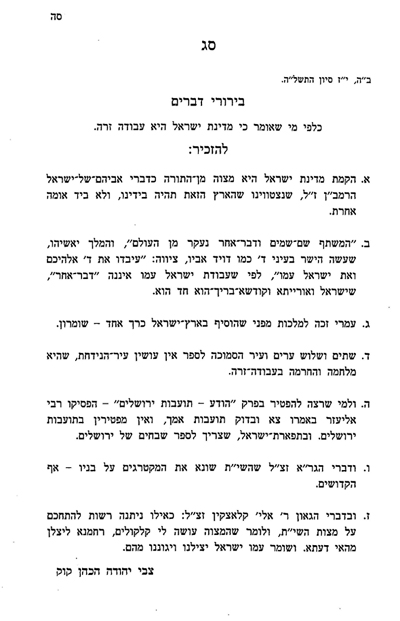
[4] Mesorah le-Yosef 4 (2005), p. 183.
[5] This point was noted by Kaplan, Link”Rationalism,” p. 300 n. 225.
[6] See Studies in Maimonides and His Interpreters, p. 111.
[7] Good and Evil in Jewish Thought (Tel Aviv, 1989), p. 63.
[8] Moses Maimonides (Oxford, 2005), p. 407.
[9] See also my post here where I noted R. Itzele of Ponevezh’s statement that how the Jewish masses feel is more important than what the rabbis think: וכלל ישראל הוא גבוה ונעלה מגדולי התורה . This is obviously diametrically opposed to the haredi conception of Da’as Torah. In my Torah in Motion lectures I discussed how R. Itzele’s conception parallels the Catholic notion of “sense of the faithful.”
In addition to the passages of R. Kook referred to in my earlier post, there are many other sources that one could quote. One that comes immediately to mind is Haym Soloveitchik’s understanding of medieval Jews committing suicide. He sees this as an example of the “sense of the faithful” which was not in line with established halakhah, but which ex post facto had to be justified. Even the murder of one’s children to prevent them from being forcibly apostatized could not be judged according to halakhic texts, or else people regarded as kedoshim would lose this status, an untenable possibility under the circumstances of medieval Jewish life. See ‘Religious Law and Change: The Medieval Ashkenazic Example,’ AJS Review 12 (1987), pp. 205-221. Soloveitchik writes (p. 209):
The magnitude of this halakhic breach is enormous. Whether one is permitted to suffer voluntary martyrdom is highly questionable; suicide is forbidden beyond question, and the permissibility of murder needs no discussion. Thus, if the law were to be followed, the scholars of these communities would have had to rule that all the martyrs—qedoshim, or “holy ones,” as they were called—were not only not “holy,” but they were “self-killers,” and murderers; that not only should they not be buried with honor, but perhaps they should even be denied burial, or at best be buried in the far end of the cemetery where the most vile criminals are interred. Such a conclusion, needless to say, was an emotional impossibility.
After speaking of the “sense of the faithful,”—or what Jacob Katz and Soloveitchik describe as “ritual instinct,” “religious intuition,” and “religious sense”—this article concludes with a couple of paragraphs that I think readers will find very interesting:
I remember my own shock when, after studying Yoreh Deah, I realized that there is no need for separate milk and meat dishtowels, separate dishracks or cabinets, and that if food is served cold, there is no need for separate dishware altogether. Again, there is all the difference in the world between not having hamets in the house (בל יראה ובל ימצא) and the house being what we call pesahdiq.
The simple truth is that the traditional Jewish kitchen and pre-Passover preparations have little to do with halakhic dictates. They have been immeasurably and unrecognizably amplified by popular religious intuition. We all know this, but our religious sense, our religious experience belies this knowledge, and our instincts reject this fact out of hand. To serve cold cuts on a “dairy” dish is treif—everything in Yoreh Deah to the contrary notwithstanding.
The prevalent has not here expanded the normative, it is the normative, and anything less is inconceivable.
Upon hearing one of my TIM lectures, R. Yonasan Rosman sent me a nice example of how the “sense of the faithful” operates independently of, and sometimes even in opposition to, halakhic particulars. It comes from Making of a Godol, p. 1188:
My father also was fond of quoting an interpretation of the Mozhirer Maggid, R. Shmuel Rabinowitz, of the gemara in Massekheth Brakhoth that
כנור היה תלוי למעלה ממטתו של דוד וכו’ ומנגן מאליו
(a fiddle hung above the bed of King David, etc., and it played on its own) to mean that Jewry senses what policy is vital for its existence and does not probe whether the course of action (or inaction) is halakhically sound or not. One of the several examples he gave was by asking rhetorically, “Who gave the Slabodka Yeshiva bahurim the halakhic permission [היתר] to marry at so late an age?” and in answer, he paraphrased the gemara (which he translated into Yiddish), “און דער פידעלע שפילט פון זיך אליין (and the little fiddle plays on its own.”) He was out to prove that when some position is of crucial importance to Jewry—such as increasing the number of intelligent Jews getting in more years of Torah study before going off into their occupations—halakhic minutiae are set aside.
It is precisely sources like this, and the others I have quoted, that are crucial for anyone wishing to challenge the pan-halakhic understanding of Judaism that has taken root in Centrism.
(Regarding yeshiva students marrying later, see R. Shlomo Sofer, Hut ha-Meshulash [Munkacs, 1894], p. 7b, that in late eighteenth-century Frankfurt, yeshiva students would sometimes wait until age thirty to marry.)
[10] For R. Jehiel Jacob Weinberg’s essay on Meisels, see Seridei Esh, vol. 4, pp. 345-352.
[11] See Ahiezer: Kovetz Rabani-Torani, vol. 4 (1969), p. 17.
[12] Sotah 21b states: “R. Eliezer says: Whoever teaches his daughter Torah teaches her obscenity. . . . Read, rather: as though he had taught her obscenity” Rashi explains: שמתוכה היא מבינה ערמומית ועושה דבריה בהצנע
Meiri, Sotah 20a explains (and as with the Ralbag quoted in a prior post, apologies to the women reading): שמתוך הבנתה ביתר מגדרה היא קונה ערמימות מעט, ואין שכלה מספיק להבנה הראויה והיא סבורה שהשיגה ומקשקשת בפעמון להראות את חכמתה לכל
[13] There are, of course, many other differences between R. Soloveitchik and R. Kook. From the excerpt printed in The Rav Thinking Aloud, pp. 155-156, we see that the Rav regarded R. Kook as a saintly figure, but not as an intellectual great. Yet this impression was derived from one short conversation. All the gedolim who knew R. Kook had the exact opposite impression. They correctly saw that R. Kook was a master of the entire Torah, in all of its facets. I think you have to go back to Maharal, or perhaps even Nahmanides, to find such a wide-ranging Torah scholar as R. Kook.
Experts on the Rav’s writings can correct me, but the only place I recall where he mentions R. Kook is in On Repentance, p. 161 (and this was not actually published by the Rav himself, but by Pinchas Peli). See incidentally, ibid., p. 224, where the Rav states, referring to the State of Israel: “Bondage to the State can also become idolatry.” When this appeared in 1975, in the original Hebrew edition Al ha-Teshuvah, R. Zvi Yehudah Kook responded with a very sharp statement (later reprinted in Le-Hilkhot Tzibbur):
The Rav in turn said about R. Zvi Yehudah: “If you follow the philosophy of Tzvi Hirsch [!] Kook a Jew outside of Eretz Yisrael is a non-Jew. And this is exactly against the passuk of כי לי כל הארץ. A Jew outside of Eretz Yisrael can be a perfect Jew. Where you accomplish more is up to the individual. . . . Kook comes out with the Ramban [who says that mitzvah observance in the Diaspora is not at the same level as in the Land of Israel] as if he is the only one to whom the Ramban has entrusted the text.” The Rav Thinking Aloud, pp. 225, 229. See also, ibid., p. 154, where he says that R. Zvi Yehudah “has an aura of kedushah about him.”
[14] See Appendix.
[15] Introduction to his Tevuot Shemesh, Even ha-Ezer, and Shemesh u-Magen, vol. 2, p. 321.
[16] See also Maharsha, Niddah 30b.
[17] With regard to what else fetuses are said to be doing in the womb (aside from learning Torah), there is a very strange passage in Otzar ha-Geonim, Berakhot 28b (p. 71). I hesitate to elaborate on it lest this post be blocked by internet filters:
כשאדם כורע במודים צריך לו לכרוע עד ברכיו לפי שהילד בעודו במעי אמו ראשו מונח בין שתי יריכיו והמילה שלו בתוך פיו ובעבור זה צריך לשוח עד ברכיו.
[18] The picture comes from Esther Farbstein’s Be-Seter Ra’am (Jerusalem, 2002).
[19] See here.
[20] With regard to masturbation, R. Simcha Ross called my attention to the responsum printed here by an unnamed talmid hakham. He argues that masturbation is permissible. When Rabbi Ross first alerted me to this (and also expressed his disagreement with the arguments of the author), I thought this was some sort of Purim Torah. But then I examined the responsum, and other responsa on the site, and I could see pretty quickly that this was a serious man, whose arguments were carefully thought out. There are so many books published today that simply repeat what others have said, without offering anything new, that it is a pleasure to see original thinking, Based on his permission to masturbate, he also concludes that homosexual activity is permissible, as long as there is no mishkav zakhur. See here.
(This anonymous author has also placed on his website his commentary on R. Baruch Ber Leibowitz’s Birkat Shmuel, and also many posts discussing talmudic sugyot.)
I showed this responsum to someone. Yet instead of examining the arguments, all he was interested in was the identity of the author, who, as can be seen from various responsa on the site, is clearly from the haredi world. Maybe some readers know who he is, but I think that someone like this has to be in “deep cover.” We all know how the powers that be would destroy anyone who argued that masturbation is permissible. Since this involves a halakhic matter, I am certain the response would be even more severe than how they dealt with Slifkin and Kamenetsky. This talmid hakham would be branded not merely a heretic and a Reformer, but also a sexually dissolute degenerate. So yes, I understand why the author chooses to remain anonymous. My request to readers is as follows: The argument permitting masturbation is so far removed from anything I have ever seen that I would like those with more halakhic learning than myself to examine his teshuvah and let us know if you think there is anything to his argument.
Also, please look at other material on his site. Is it possible that instead of a “progressive” talmid hakham we are dealing here with a Trojan Horse? That is, someone who aims to undermine traditional Judaism from within, much like Saul Berlin attempted to do.


Review of Shaul Stampfer, Families, Rabbis & Education

Review of Shaul Stampfer, Families, Rabbis and Education: Traditional Jewish Society in Nineteenth-Century Eastern Europe
by Marc B. Shapiro
The continuation of my last post will be ready soon, but in the meantime I am posting my short review of Shaul Stampfer’s new book. It appeared on the H-Judaic listserv, but since most readers of Seforim Blog probably did not see it, I am posting it here as well.
For many years, Shaul Stampfer has been recognized as an authority in all things dealing with nineteenth-century Jewish Eastern Europe. In his newest book, we have a collection of numerous essays representing more than twenty years of his scholarship, including one essay published for the first time (“The Missing Rabbis of Eastern Europe”). Stampfer’s focus is not on the purely intellectual debates between rabbinic elites. He is more interested in social history, how average people and in particular women lived. Even his discussions of rabbis emphasize such matters as inheritance of rabbinic positions and the rabbi’s role in communal life. His sources are quite broad: traditional rabbinic works as well as Hebrew, Yiddish, and Russian texts and newspapers.
I could write extensively about every essay, each of which taught me a great deal. (And I never imagined that an entire essay could be written on the pushke and its development.) Yet to remain within the word limit for this review, let me just mention some of Stampfer’s most important points, the major theses of the book.
People have generally assumed that marriages in Jewish Eastern Europe were very stable, with divorce being quite rare. Stampfer, however, provides evidence to demonstrate that divorce was common and not shameful. Based on his evidence, he is fundamentally correct. In addition to citing statistics, Stampfer also refers to memoir literature that mentions divorce. Yet I also think that Stampfer (and ChaeRan Y. Freeze before him) exaggerates the frequency of divorce. For example, one of his statistics of marriage and divorce is from the 1860s in the city of Berdichev where for every three to four marriages, there was one divorce. He cites similar statistics for Odessa (p. 46). Stampfer goes so far as to claim that “it may well be the case that there were thirty divorces for every hundred weddings in the nineteenth century” (p. 128). However, these numbers are certainly skewed for the simple reason that while marriages took place in every town, to obtain a divorce couples had to travel to a larger city where there was a beit din and scribe. Thus, divorces from any one city do not reveal a ratio of marriage to divorce. The situation is identical to what happens today. Couples get married anywhere they want, but must come to a central location for their divorce.

Stampfer also argues that contrary to another popular stereotype, early teenage marriage was not at all common in traditional Jewish society. While it occurred among the economic and intellectual elite, and is immortalized in memoirs of the latter, early teenage marriage does not reflect the life experience of the average young Jew. Similarly, the lower class, which encompassed most Jews, did not have much use for matchmaker services, and indeed, romance was a factor in their marriages.

Tied to the points made so far is the place of women in society. Many of us are accustomed to think of traditional society as one in which men had all the power and made all the decisions, and in which the husband went out to work while the wife served as a homemaker. Yet Stampfer shows that while this perception fits in very well with contemporary “family values,” it is not how East European Jewish society functioned. Women generally worked, were involved in business ventures, and were thus “out of the home.” Unlike today, the stay-at-home wife and mother was not necessarily an ideal. Stampfer also notes that many Jewish names were created from women’s names, which he thinks “reflects a reality in which both men and women could be in the centre” (p. 133).

Adding to these arguments, Stampfer includes the following suggestive comment: “Another indication of the place of women in Jewish society can be found in the aesthetics of Jews in Eastern Europe. Males were regarded as attractive if they were thin, had white hands, and wore glasses. These were all reflections of lives devoted to study and perhaps to asceticism. On the other hand, attractive women had full bodies and were strong and active. Their appearance promised work and support. Different ideals are expressed here, but the image of the ideal woman is not one of weakness” (p. 133). In short, East European Jewish society was not what we would regard as a patriarchy. Conservative views on the importance of women staying in the home to raise children might be sound social policy, yet we should not assume that this is how East European Jews ever actually lived.

Another fact noted by Stampfer, which will no doubt be surprising to readers, is the existence of coed heders. This is certainly not the image that people have of this institution. Yet while the coed aspect is interesting, especially, as Stampfer states, “given the contemporary concern (or obsession) in certain very Orthodox Jewish circles regarding co-educational education even in elementary grades,” even more significant is what this says about education for girls (p. 169 n. 11; see also p. 32). Contrary to what many think, there were East European Jewish girls who were educated just like their brothers, and Stampfer thinks that the ratio of girls to boys in heder was approximately one to eight (p. 170).

As for education in general, while some people like to imagine Eastern Europe as a placenwhere Torah study always thrived, Stampfer notes that “one can safely conclude that by the mid-1930s there were far more young Jewish males in secondary schools than in yeshivas” (p. 272). Also worthy of note is Stampfer’s point that the kollel (a school of rabbinic studies for married men) system developed because there were no longer many rich fathers-in-law willing to support a son-in-law who was studying. In addition, he argues that the shrinking of the job market for rabbis also had a share in the development of the kollel.

Let me conclude with some minor comments and corrections. On page 69, note 39, the proper reference in  Pithei Teshuvah  is  Even ha-Ezer 9:5, and the rabbi cited should be R. David Ibn Zimra (Radbaz), not R. Jacob Willowski (Ridbaz).On page 181, Stampfer discusses the famous description by R. Barukh Epstein of his aunt, Rayna Batya, the wife of R. Naphtali Zvi Judah Berlin. While acknowledging that some have doubted the veracity of Epstein’s story, Stampfer states that “the account seems plausible.” Here I must disagree. While there can be no doubt that Batya was an unusual woman, Epstein’s account of his conversations with her, as with much else in his autobiography, cannot be relied on. I have discussed this at length elsewhere, and readers can examine my arguments at the Seforim Blog here.

On page 285, Stampfer refers to the Moscow crown rabbi Jacob Mazeh (1859-1924) as having been martyred. Yet this is incorrect as Mazeh died a natural death. On page 326, note 6, regarding the Vilna Gaon’s attitude toward R. Jonathan Eibeschuetz, see Sid Z. Leiman, “When a Rabbi Is Accused of Heresy: The Stance of the Gaon of Vilna in the Emden-Eibeschuetz Controversy,” in Ezra Flescher, et al, eds., Meah Shearim (2001). Finally, on page 327, Stampfer offers evidence of criticism of the Vilna Gaon during his lifetime. In my September 12, 2009, post at the Seforim Blog, available here, I offer another example of such criticism. This is reported by R. Hayyim Dov Ber Gulevsky who heard it from his grandfather, R. Simhah Zelig Rieger, the dayan of Brisk. (Incidentally, Gulevsky is quoted by Stampfer on page 353.)

As mentioned at the beginning of this review, there is much more that can be said about Stampfer’s careful scholarship, which is a treat for all readers. I know that many share my wish to soon see in print the English edition of his classic work on the Lithuanian yeshivot.
* * *
Let me now add a few additional comments especially for the benefit of those who had already read the review before I posted it here.
1. Stampfer’s book is published by my favorite press, Littman Library. I want to call readers’ attention to another recent and wonderful book published by Littman: Sharon Flatto, The Kabbalistic Culture of Eighteenth-Century Prague. Interestingly, two dissertations were written at the same time on the Noda bi-Yehudah. The other was by David Katz, which bears the interesting title “A Case Study in the Formation of a Super-Rabbi: The Early Years of Rabbi Ezekiel Landau, 1713-1754 (University of Maryland, 2004). Although Katz’ dissertation has not yet appeared in print, there is definitely room for the two as they focus on different areas and are both works of great learning. (Yet I hope that when Katz publishes his book, he changes the title. It is bad enough that today we have people writing about how they “consulted Daas Torah” as if there is such an individual so named. The only thing worse would be to hear people recount how “I asked the Super-Rabbi his opinion” or to have Yated tell how how “The Super-Rabbi has issued his Daas Torah.” That will surely leave the religious Zionists reaching for their kryptonite.)

Regarding how Landau was indeed a “Super-Rabbi,” to use Katz’ expression, I found interesting testimony in R. Shraga Feivish Shneebalg, Shraga ha-Meir, vol. 2, no. 76. He states that he heard from R. Dov Berish Wiedenfeld, who heard from R. Meir Arik, that the Noda bi-Yehudah was the posek ha-dor. Assuming there is such a position, I don’t know of anyone more qualified for it than Landau. I must admit, however, that this is an Ashkenazic-centered perspective, because it is unimaginable that a Sephardic scholar would ever come into consideration by most of those who like to speak of the gadol ha-dor. Thus when people refer to R. Yitzhak Elhanan Spektor, R. Hayyim Ozer Grodzinski, etc. as the gadol ha-dor. they never wonder if perhaps there was a great sage in the Sephardic world who fit the bill. When people speak about the gadol or posek ha-dor, it really means the gadol or posek of their world.

Returning to Arik, he said that after the Noda bi-Yehudah the Hatam Sofer held that role. Here again, I don’t think there will be much argument. But the names he gives after this show how Arik, a Galician scholar, sees matters differently than a Lithuanian. He claimed that R. Solomon Drimer was the next posek ha-dor, yet I don’t think most people reading this post have even heard of him. For the next period, he gave the Hungarian posek R. Solomon Leib Tabak of Sighet (died 1908), author of Erekh Shai. Again, I don’t think most people reading this post have ever heard of Tabak. Yet Arik regarded him as the posek ha-dor. As a Galician, not a Lithuanian, Arik had a different perspective on who the great poskim were.[1] Yet a Lithuanian hearing this would laugh. If you asked him who the posek ha-dor was for the period of Tabak, he could give all sorts of names: R. Yitzhak Elhanan Spektor, R. Naftali Zvi Judah Berlin, R. Jehiel Michel Epstein, R. Joseph Zechariah Stern, and the list goes on, but Tabak wouildn’t even make it to the top twenty.

This different perspective was recognized by R. Jehiel Jacob Weinberg. In one responsum (Kitvei R. Weinberg, vol. 1, no. 11), after quoting a position of a Hungarian posek, Weinberg writes:

ודאי שרבני ליטא ופולין ילעגו על דברים אלה ואולם המחבר הנ”ל הי’ גאון וצדיק מפורסם וחלילה לבטל דבריו בתנופת יד גרידא. כתבתי כל הנ”ל כדי להוכיחו שצריך הוא להיות זהיר ומתון ולא להמשך אחרי הקולות של רבני ליטא ופולין שהם גדולים וחכמים בהלכה אבל בהוראה למעשה עולה עליהם רבני אונגארן וגאליציען ומובחרי השו”ת בהוראה למעשה שיצאו בזמן האחרון נתחברו על ידם.
Earlier in this responsum Weinberg writes:
כבר רמזתי לכת”ר שבעינים כאלו יש לסמוך יותר על רבני אונגארן הקרובה לאשכנז ויודעים מצב הדברים באשכנז יותר מרבני פולין וליטא. ובכלל נוטה אני מדעת חברי ורבותי רבני פולין וליטא שאינם משגיחים הרבה ברבני אונגארן. גם אני הייתי סבור כן קודם בואי לכאן, אבל אח”כ ראיתי כי בעניני הוראה עולים הם על רבני פולין וליטא, כי יש להם חוש מיוחד להוראה מעשית וכמעט כולם נתחנכו בבית מדרשו של רבינו שבגולה החת”ס ז”ל שהוא הי’ עמוד ההוראה כידוע ומפורסם.
These words are amazing because Weinberg is admitting that before he came to Germany, he too shared the feeling of superiority that he describes here. Before then it was unimaginable to him that a posek outside of Lithuania or Poland would have had much of value to add.
2. In a previous post, available here, I wrote about rabbis who began writing books at a very young age. I was asked if there are additional examples of this. There are indeed a number, and in a future post I will discuss one in more detail. For now, here is the title page of R. Aaron Friedlander’s Avrekh, where it tells us that part of the book was written when the author was nine years old! See also the approbations to this volume.

Here is the title page of R. Hezekiah David Abulafia’s Ben Zekunim. If you read the introduction you will see that the first part of this book was written when the author was thirteen years old.

R. Yitzhak Arieli reported being told by R. Kook that the latter authored a book on Song of Songs when he was only eleven years old. You can find Arieli’s testimony here.
As I am writing this people are once again outraged by something R. Ovadiah Yosef said, in that he attributed the fires in Israel to lack of Sabbath observance. Obviously, this is not the sort of comment that appeals to those with a modern temperament, but in traditional societies it is an expectation of the people that the leading rabbis will find some spiritual reason to explain tragedies. So why I am mentioning this now? Because in the document from Arieli, no. 38, he quotes R. Kook as saying something that people will find even more shocking than anything R. Ovadiah has ever said. (I don’t think you will find the students of R. Kook ever repeating it.) R. Kook wondered if the 1929 pogrom in Hebron was perhaps due to the fact that the Hebron Yeshiva brought in their “modern” ways to Israel, by which he means their way of dressing, hair style and beardless faces.
בהפרעות (בשנת תרפ”ט) בחברון מצאתיו ביום ראשון יושב ובוכה והבליט מפיו שמא מפני שהכניסו תלבושת והנהגה חדשה בארץ (היה מתנגד לגלוח הזקן (כמובן במכונה או בסם) ובלורית ואולי גם בגדים קצרים, ובישיבה העיר כ”פ ע”ז ( אבל קשה היה לשנות ההרגלים שבחו”ל).
I agree that this sounds shocking and offensive to modern ears, especially to those who lost family members in this event. I mean, can you imagine telling someone whose child was killed that it was because certain yeshiva students were dressing in a modern fashion? But again, the traditional mind works differently than the modern mind. I say this not to recommend that we all reprogram our minds so that these sorts of explanations are once again appealing, any more than I would wish that, as with Jews in medieval Germany, we once again believe that demons are all around us causing all sorts of problems. I mention it only to add some context and help explain how the most influential rabbinic mind of the twentieth century could say something which to modern ears sounds outrageous. Just as it wrong to judge pre-modern science negatively because it didn’t have access to modern technology, so too we must be careful about being prejudiced against traditionalist explanations because we might no longer share the same assumptions as our predecessors
3. With regard to R. Baruch Epstein’s discussions about his uncle the Netziv in Mekor Barukh, the irony is that the Netziv thought that there was no good purpose in reading the biographies of great Torah sages. He thought that this was nothing less than bitul Torah. See the letter from R. Hayyim Berlin printed at the beginning of his father’s Meromei Sadeh.
The Netziv’s concern with bitul Torah was such that when his wife (I presume his first wife, Rayna Batya) had to have an operation and the students wanted to say Tehillim for her, the Netziv refused to stop the learning for this. After the students continued to push, he agreed to allow five minutes of tehillim. This was reported by R. Zvi Yehudah Kook, who must have heard it from his father. See R. Hayyim Avihu Schwartz, Be-Tokh ha-Torah ha-Goelet (Beit El, 2006), p. 201.
In an e-mail discussion with one reader, he contrasted the Netziv to R. Chaim Soloveitchik and R. Velvel ,saying that the Netziv was so “normal”. I don’t want to use words like that, and while R. Chaim had many unique qualities, I don’t think the stories told about him are any more unusual than those told of other gedolim. Most of these stories are, in fact, quite inspiring. The stories about R. Velvel are, I admit, of a different flavor. I mentioned two such examples here.

Yet lest one thing that these type of stories are unique to R. Velvel, let me mention a story about the Aderet “brought down” (to use the yeshiva lingo) in the book I just referred to, Be-Tokh ha-Torah ha-Goelet, p. 324. R. Zvi Yehudah told how one of the Aderet’s sons died right after birth, just as Shabbat was starting . The Aderet told his wife that she should perpare the Shalom Zakhor as if everything was normal, for there is no avelut on Shabbat and the community does not need to know that anything is wrong. When the Rebbetzin began to cry the Aderet replied to her that she is acting this way because she doesn’t study Talmud. If she studied Talmud she would know that there are often times when we are left with questions, and the same is true in life.

4. Stampfer’s point about the frequency, and lack of shame, of divorce in Eastern Europe was an eye-opener to me. In Between the Yeshiva World and Modern Orthodoxy, p. 22, I mention that divorce was very uncommon in traditional Lithuanian Jewish society, and almost unheard of among the rabbinate. I now see that I was mistaken in this assumption (which was based on my general impressions, not on the sort of evidence Stampfer makes use of). For examples of rabbinic figures who got divorced, see here.
5. I referred to Daas Torah above, and since someone asked me if I could write up what I said about it in a recent lecture, I will do so now. In this lecture I quoted what appears in R. Yitzhak Dadon’s new book, Rosh Devarkha. This is the follow-up to his earlier book, Imrei Shefer, both of which record the teachings of R. Avraham Shapiro, Rosh Yeshiva of Merkaz ha-Rav. On p. 10 one finds R. Avraham’s very harsh comments against Daas Torah. He would refer to it as Ziyuf ha-Torah. Here are some of his words:

האם התורה עוברת רק דרך אדם אחד?! בחו”ל לא היה כדבר הזה! זה אמר כך, וגדול פלוני חלק עליו וחשב אחרת, מישהוא אמר שהפלוני הזה הוא נגד “דעת תורה”?! מהיכן הביאו את הדבר הזה? אם ה”חפץ חיים” סבר כך ורבי מאיר שמחה אחרת ופלוני גדול אחר
חלק עליהם, יש מי מהם שהוא נגד “דעת תורה”? איזו הנהגה היא זו? זו השתלטות על דעת הרבנים, ולא היה כזאת בעם ישראל.

As for the practice of declaring what the Daas Torah is through the newspaper or through placards, without any sources to support this, here are R. Avraham’s strong words (and apologies if any wives are offended):

כלפי רבנים המוצאים חוות-דעת ותלמידיהם מפרסמים זאת תחת הכותרת: “דעת תורה”, בלי שום אסמכתאות ומקורות נאמנים היה מרן זצ”ל אומר: “איזו מין דעת תורה היא זו? כשאדם אומר “דעת תורה” בלי שום מקורות, אז הכוונה היא כזאת: זה קצת מבוסס על מה שהוא למד, והרוב זה מה שאשתו אמרה לו, זה הפירוש דעת תורה.

Anyone who is honest will admit that the current practice of Daas Torah is completely phony. My proof of this is very simple. If tomorrow R. Elyashiv would declare that everyone has to say hallel on Yom ha-Atzmaut, would the Lithuanian yeshiva world listen to his Daas Torah? Of course not. They would simply replace him with another gadol whose Daas Torah is more palatable to them. In other words, the gadol only has Daas Torah because the masses, or the askanim, let him have it, and only when they like what he says. (I am curious. Has R. Elyashiv’s ruling that fashionable sheitls are forbidden had any effect on his supposed followers?).

Try to imagine what would happen if someone in the haredi world discovered a letter from the Hazon Ish, the ultimate Daas Torah authority, in which he said that only the best and the brightest in the State of Israel should devote themselves to Torah study. However, everyone else should go to work. Does anyone think that this letter would ever see the light of day? Of course not! We all know what would happen. The letter would be kept hidden, and if by chance some rebel did publish it, the haredi world would find a way to justify why they don’t accept the Hazon Ish’s viewpoint.

6. In this post I referred to a mistaken point by R. Ezriel Tauber in his recent book Pirkei Mahashavah al Yud Gimel Ikarim le-ha-Rambam. I was asked if my negative comment relates to the entire book, or just the one point I referred to. My answer is that I wasn’t referring to the entire book, and I am sure that people will find things that are valuable in it. Yet I have to say that I don’t find it helpful when an author like Tauber asserts, p. 428, that people who claim to be atheists are really not. Rather, they just don’t want to believe, but deep down they know the truth.

Contrary to Tauber (and he is not the only one to express himself this way), the only intellectually honest position is to take people like Christopher Hitchens at their word and deal with it. Claiming that the atheist really believes is no better than the atheist saying that the believer really knows the truth that there is no God.
Furthermore, from my perspective I can’t take an author seriously when he says things like how in the Far East there are people who have the power to use black magic, and their knowledge is part of a tradition that goes back to Abraham. P. 133:
ואכן במזרח הרחוק יודעים שמות של טומאה, ויש להניח ששורש הידיעה היא מאברהם אבינו. ואף על פי שהם כוחות אמיתיים, אסור לנו להשתמש בהם.
*  *  *
I want to take this opportunity to invite all Seforim Blog readers on what I know will be an amazing Jewish heritage tour to Central Europe this summer. Details can be found here. They are still working on the price, and it will be posted soon. Those who want further details are invited to contact me.
With Christmas Eve almost upon us, I also invite readers to watch, or listen to, my lecture “Torah Study (or Lack of It) On Christmas Eve: The History of a Very Strange Practice.” It is available here. The few dollars (Canadian) that it costs go to support a very worthy organization, Torah in Motion.
Notes


[1] Wiedenfeld, who is the source for the information from Arik, actually had a special place in the eyes of the Lithuanian yeshiva  world. Haym Soloveitchik writes (TUMJ 7 [1997],  p. 144):

Intellectually, the Lithuanian approach to talmudic study (derekh ha-limmud) has triumphed. One could scarcely imagine a Hungarian rosh yeshiva being considered as a candidate to head a Lithuanian yeshiva. Nor is it accidental that with one early, minor exception (the Tchebiner Rav [Wiedenfeld]), all the embodiments of da’at Torah, both in America and Israel, have been Lithuanian.


No more Bentchers: A Review of a Sefer Given as a Wedding Gift

No more Bentchers: A Review of a Sefer Given as a Wedding Gift
by Eliezer Brodt

A wedding carries with it many customs, one of which is an attempt to use this ceremony to disseminate Torah. There was an old custom in many communities for people to write poems in honor of the simchas chasan and kallah. Others even wrote plays in honor of the bride and groom. One example is the Ramchal who wrote the play Ma’ashe Shimshon (as well as other poems for various weddings). In other communities there was a custom for someone to say a derasha at the chasunah for the same reason (in certain circles this still exists). Recently a newer custom evolved to print a sefer and give it out at the wedding.

It used to be a plain old bentcher was given out at a wedding, some, wanting something more substantial than a bentcher began giving out siddurim or chumashim. Today, in many circles, a sefer of some sort is given out to the wedding guests. Some times it’s an old work of some old famous relative of the family that has never been printed before, other times is a reprint from a relative of one of the wedding parties work which had been out-of-print. Some times its it’s torah from the groom or from some family member that’s making the wedding. What’s even more interesting about these seforim is many times they never reach the stores even the famous Biegeleisen who generally gets close to everything printed (to some known as Gan Eden). The market for these seforim many times is very small so the family never bothers bringing it to any stores. [Although, recently, various works of R. Reuven Margoliyot were reprinted for a wedding. It seems these were more widely disseminated as the republication forced Mossad HaRav Kook to reprint the works and to note that, according to them, the wedding reprint was a violation of their copyright.] The only way one gets the sefer is by being at the wedding or knowing someone who has been there. Other times it’s just pure luck – somehow one gets lucky and stumbles upon it. It’s a shame that a complete bibliography of such works can not really be written because there is no way to know all the works that have been published for these occasions.

A few months ago I was at the wedding of a good friend. As is now commonplace, the guests received a sefer – more correctly a collection of seforim – at this wedding. What follows is a review of that wedding gift.

First, I can only refer to this work as Mazkeret Nisuin Yehudah Vyael Hershowitz (a keepsake from the wedding of Yehudah and Yael Hershkowitz) as no other title is provided. The sefer is a paperback and is one hundred and thirty six pages long. It includes a few parts some of which have never printed before. The book was edited by the groom – R Yehudah Hershkowitz. R. Hershkowitz has authored many articles some of which appeared in Or Yisroel and Yeshurun dealing with many areas of learning and history.

The sefer contains four sections: section one is the sefer Ashes Chayil from R. Avrohom Yagel, section two are Shelios Uteshuvot from R. Avigdor Kara, section three is the Mamar al targum from R.Yakov Ben Chaim (ibn Adonijah), and section four is a Kuntres from R. Noach Berlin. I assume the reason why he printed it in this order is because Ashes Chayil is the most relevant to the wedding and then the other placement is based on chronological order. Prior to each section R. Herskowitz includes an excellent historical introduction to the work which follows.

The first part is the sefer Ashes Chayil from R. Avrohom Yagel. This work has been printed a few times even at a chasunah in 1994 of Zvi and Sarah Friedman in this edition R Herskowitz reset the type, which had not been done in the prior reprint, and added some notes.

The author R. Avrohom Yagel has been discussed at great length by Professor David Ruderman in his book Kabblah, Magic and Science. R. Avrohum Yagel was born in 1553. He corresponded with many gedolim of the time, amongst them the Ramah Mepano and R. Mordechai Dato. He was highly respected by the Ramah Mepano. He wrote many works on all areas especially science, many of which are still in manuscript and await publishing. One of his seforim is called Gaie Chezyon this work has been recently reprinted in English and Hebrew by Professor David Ruderman. It is a highly original work written in the form of dreams dealing with many topics. Many aspects of R. Yagel’s personal life can be gleaned from this work.

Ashes Chayil was first printed in Venice in 1606 and is a commentary on the thirty-first chapter of Mishlei which contains the verse of Ashes Chayil . R. Yagel wrote this work in honor of a friend’s wedding. The main idea of the work is to discuss what the role of a wife in marriage, to fear and love god, fear and love her husband and not to sit idle. R. Yagel notes that these same attributes apply not only for marriage but also when serving God. In the work there are many interesting explanations to different aggados of Chazal. Besides for this he writes many practical pieces of advice relating to marriage. For example, he writes, how the wife should get up early to prepare the household needs (pg 36). He writes that her voice should not be heard outside (Pg 40). Another point he makes is she should be careful to dress in a ts’neius manner and not to dress up like many woman to impress everyone (pg 49-50).

The next section are the Shelios u’Teshuvot of R Avigdor Kara. These teshuvot are printed here for the first time from manuscript. Here too R. Hershkowitz includes an excellent historical background about R. Avigdor Kara and his times. Although not much is known about R Avigdor Kara, R. Hershkowitz includes a brief history as well as a listing of the writings of two of his contemporaries which help with R. Kara’s biography: R. Yom Tov Melehuzan and R. Menachem Shalem. They were all active on the beis din in Prague during the same time periods (approx. 1390-1439). Besides for this R. Yom Tov Melehuzan was involved in kabblah as many of his works show whereas R. Menachem Shalem was more involved in philosophy. R Avigdor Kara was somewhere in between them as he was involved with both areas. In one of the teshuvot printed in this collection we see how R Avigdor Kara struggled trying to reconcile contradictions between Kabblah and philosophy. In the end R. Kara writes that he was successful and felt that he was able to show that there were no contradictions between the two. Both R. Yom Tov Melehuzan and R. Menachem Shalem were close with R Avigdor Kara quoting him in their respective works. R Avigdor Kara wrote many works on all areas. Some were printed many others remain in manuscript. One work, the Sefer Hapliah (more on this in a future post) was attributed to him but as has been recently proven is certainly not from him. The Sefer Hapliah although many write it is from R Nechunyah Ben Hakonah (see the many sources R Hershkowitz cites) but Professor Ta Shema (see his Kneset macharim Volume 3) and others have demonstrated that it’s a much later work.

R Herskowitz was perhaps unaware of some more sources on R Avigdor Kara. R. Yididiah Tiyah Weil brings that R Avigdor made a golem (Levushim Levadim pg 37). There is a nice chapter on R. Avigdor Kara in the controversial book Hachasidus from R. Ahron Marcus (chapter 28). Another point R. Hershkowitz missed is that the Zemir Achud Yuchud is attributed to him . This song is sung in many circles when the chasun gets an aliyah and has been subject to an excellent article by one of the experts on minhagim, R. Hamburger in his Shorshei Minhag Ashkenaz (volume 3 Pg 373- 397). While these contemporary sources are not mentioned, R. Herskowitz does provide many other sources.

The teshuvos which are included in this volume are on some very interesting topics. He discusses davening to angels and in general what function they serve exactly in tefilah. This is another great source for the well-known discussion of Machnesei Rachamim which has been treated thoroughly in the classic article of R. S. Sprecher (Yeshurun, vol. 3, pp. 706-29). It is also an important source for the debate, recently restarted again on this blog, regarding Professor Marc B Shapiro book. Another teshuvah deals with a work of R. Avigdor Kara’s which we do not have called Even Sappir. R. Avigdor explains what this work was, it appears to be rectifying contradictions between Kabblah and philosophy. For both these teshuvot R. Hershowitz provides some excellent background behind these topics. One other (of the many) interesting points found in this section is a early source that one should remove ones shoes before entering shul. This subject has been treated by many, most recently by R. Yecheil Goldhever in his now classic Minhaghei Hakehilos (volume one pg 3-7).

The next section is the Mamar Al targum from R.Yakov Ben Hayyim. This Mamar was very rare and exists in less than five chumushim in the world. R. Yakov Ben Hayyim was the famous editor for the Bomborg publishers in Venice. Much has been written about Bomberg, but suffice it to say it played a very important role in the history of the printing of seforim. Many of the seforim printed in this printing house have remained the same layout to this day such as the Mikros Gedolos Chumash, Shas Bavli and Yerushalmi and Rambam. R. Hershkowitz has a nice discussion on how exactly did R.Yakov Ben Hayyim edit the seforim. One of the famous points of interest with R.Yakov Ben Hayyim is that he became a Christian, not much is known as to when and why. R. Hershkowitz wants to suggest an interesting possibility that R.Yakov Ben Adoneiah did not do so willingly but rather was forced. [The inclusion of R. Yakov and R. Yagel has another connection, in that R. Yagel was erroneously accused of converting to Christianity.]

The Mamar Al targum discuses many interesting things amongst them when was Targum Onkelos given and written. He also has a big chidish L’ehalacha that sh’naim mikra ve’achad targum needs to be done during K’reias hatorah.

The last section is a Kuntres from R. Noach Berlin. This kuntres was never printed before. In this section R Hershkowitz does not provide that much of a biography about R. Noach Berlin as he and a friend are currently working on another work of R. Berlin the Meyin Hachacmah (which we eagerly await). R. Noach Berlin authored many famous works amongst them the Atzei Arazim (on Shulchan Orach Even Ezer) and Aztei Almughim (on eruv chaserios and netlayas yadaim). R. Chaim Volozhiner writes that after the Gra died the only person he had to consult with was R. Noach Berlin. This kuntres is on the topic of woman doing semicha. While discussing this topic he goes thru many others (as was the style of learning in those days) and deals with woman and mitzvos aseh sheha’zman grama especially Tefilin.


Kitniyot and Mechirat Chametz: Paradoxical Approaches to the Chametz Prohibition

Contemporary Rabbis don’t bother to interrogate the sources of law and custom; instead, their purpose is to traffic in chumrot and create new prohibitions. They are unable to appreciate their hypocrisy … on the one hand, they roar like a lion against those who are open to change and the reformists, that one cannot alter an iota from what the kadmonim imposed, while on the other hand, casually discard the kadmonim whenever the achronim create new chumrot and they fight with all their might…to impose these new prohibitions.”

R. Yitzhak Shmuel Reggio, Yalkut YaShaR, Gorizia 1854.

Kitniyot and Mechirat Chametz: Paradoxical Approaches to the Chametz Prohibition

By Dan Rabinowitz

Some Pesach rituals trace their history for millennia. Others are of more recent vintage and continue to evolve significantly without any indication of stopping. Two in that category define the contours of chametz prohibition, one expanding and the other contracting its perimeters. Each’s creation was itself a radical departure from the status quo. In both instances, rabbis readily overcame established legal precedent. But their methodologies differ substantially and, at times, are contradictory. Yet, the intersection between the two, mechirat chametz and kitniyot, remains unexplored, and their conflicts unresolved.[1]

Mechirat Chametz

The present-day practice of “mechirat chametz” consists of the pre-Pesach transference of the title to the Jew’s chametz to a non-Jew, and upon the conclusion of Pesach, the chametz reverts to the Jew at no cost. The Torah prohibits any relationship between a Jew and their chametz on Pesach. Aside from the usual restrictions against eating or otherwise enjoying a prohibited item, here, the Torah proscribes even possession. One must destroy their chametz. The Mishna (Pesachim, 21a) and Talmud (Pesachim 13a) recognize that one can avoid liability if they sell their chametz to a non-Jew. But those transactions were permanent and irreversible, and the chametz never returned to the Jew. The first instance of a reversible transaction appears in the Tosefta (Pesachim 2:6).

ישראל ונכרי שהיו באין בספינה וחמץ ביד ישראל הז מוכרו לנכרי ונותנו במתנה וחוזר ולוקח ממנו לאחר הפסח ובלבד שיתנו לו במתנה גמורה

A Jew and a non-Jew are boarding a ship on the eve of Pesach, and the Jew has chametz, he can gift it or sell it to the non-Jew and get it back afterward so long as it was an absolute gift.

The Jew is boarding a ship on Erev Pesach,[2] on a journey that will extend beyond the holiday. There is enough non-chametz for Pesach, but if he destroys his chametz now, he likely will not survive the remainder of the journey. Can one violate Pesach and keep the chametz?  If the chametz is necessary to survive Pesach, he can keep it and even eat it on the holiday. But does a future pikuah nefesh issue justify violating the law now? According to the Tosefta, a reversible transaction will avoid liability for the chametz, so long as it is “matanah gemurah,” an unconditional gift, and not matanah ‘al meant le-hachzer.   One can justify relying on pure legal formalism and comply with all the technical requirements of a transaction, even if the practical effect of this transaction is a nullity.  

Another version of the Tosefta seems to envision an even more restrictive view of the transaction.  In this version, in addition to the requirement that the transaction is a “matanah gemurah,” there is one more caveat, “u-belvad she-lo yarim,” “so long as it is not a trick.” [3]

According to Rav Amram Gaon (810-875) and Rishonim, “no trickery” codifies the implicit limitation of the Tosefta, that this solution is exceptional (expressed nautically) and can never become the norm. This approach remained the practice for hundreds of years, and there was no yearly mechirat chametz. The Rambam and the Rosh repeat the case described in the Tosefta, occurring on a ship, not in any other context. [4]

R. Yisrael Isserlein (1390-1460), in his collection Terumat HaDeshen, is the first recorded instance of a Jew seeking to avoid financial loss affirmatively engaging in the Tosefta’s solution. He discusses a case where someone owns a significant amount of chametz and would incur a loss if he destroys it. But there is a non-Jewish acquaintance that is willing to accept the chametz gift with the understanding that he will return it after Pesach. Isserlein permits this approach so long as it is a gift without explicit conditions. Isserlein does not limit the frequency of resorting to this approach.[5]    

The immediate impact, and rate of adoption, of his decision, remains unclear. Indeed, some question the historicity of Isserlein’s responsa. They claim that the issues described are theoretical and are not in response to actual queries or events.

In the 16th century, R. Yosef Karo (1488-1575) discusses the legal issue of the retrievable sale in his commentary on the Tur, Bet Yosef, and records Isserlein’s ruling in Shulchan Orach but does not indicate whether it was commonplace.  In his commentary on Shulchan Orach, R. Moshe Isserless (1530-1572) (Rema) is silent on this issue entirely and does not mention a yearly custom to sell chametz.  The first to widely apply this technique and significantly lower the requirements was R. Yoel Sirkes (1561-1640).  

With the introduction of propination laws in the 16th century and the rise of the arendtor, there was consolidation in the alcohol industry, shifting control from localized production by peasants to the ruling class. Many of those licenses were managed or leased to Jews. By the late 16th century, Jews in Poland and Lithuania were firmly entrenched in the alcohol industry.  For many non-Jews, arendtor and Jew were synonymous. According to one account, Jews held a monopoly on the entire alcohol trade in Cracow. This created an issue for Pesach.  While Isserlein and Karo, and many others accept that one can sell their chametz, they all explicitly require, like any standard transaction, that the non-Jew remove the chametz he bought. Karo, in Shulchan Orach, codifies the requirement that the chametz is “me-chutz le-bayit,” outside of the Jews’ control. The Jew’s house was chametz-free.  But it was impractical to remove the distillers’ chametz from their property because of the substantial amounts and the fear that with alcohol, the non-Jew might not return it. [6] 

Faced with these issues, Sirkes created a new approach to the sale. Mechirat chametz is not just chametz, he also counseled to sell the ground underneath the chametz. It effectively created non-Jewish property within the Jew’s home. The chametz was “me-chutz le-bayit,” but remained in situ.

Sirkes’ ingenious solution created another issue. When the sale was just for chametz (a transportable good), a monetary transaction, even a nominal one, sufficed. But a written contract is required to sell land to a non-Jew.  Rather than change the process for the sale of chametz and mandate a written contract, Sirkes relaxed the contractual requirement.  He reasoned that requiring a contract for mechirat chametz potentially created another economic issue. He explained that a written agreement might otherwise induce the non-Jew to think the Jew fully sold the chametz and might keep it! This would trigger significant losses, and Sirkes was willing to forego the contract entirely.  He justifies both the sale and the diminution of its legal requirements because of potential economic harm.[7]  

Sirkes’ solution generally relaxed the legal requirements, but he did add two new aspects to mechirat chametz.  First, one must explicitly acknowledge the deficiency of the sale and announce that “I am selling you the room where the chametz is for money and even though I didn’t write a contract.”  He explains that this formulation works according to Tur and R. Karo in Bet Yosef (Choshen Mishpat 194), even for a land sale. Left unmentioned is that Sirkes rejects that position in that same section.

Second, the Jew must give the non-Jew a key to the house. Without that, no external action signifies the chametz is not the Jews, and the sale is clearly a sham.  By the early twentieth century, R. Yisrael Meir Kagan, in his Mishna Berurah, further eroded the key requirement and nullified the need for it entirely for all intents and purposes.  Rather than a physical transfer of the key, the Mishna Berurah allows one merely to identify the key’s location. Like the chametz, the keys can remain in the Jew’s possession, on their regular hook, and in the Jew’s control. There is no independent source for this leniency.  Instead, according to R. Kagan, it is “pashut.” [8] 

The key requirement was not the only aspect of Sirkes’ formula that fell by the wayside. Almost immediately after Sirkes created his workaround, it was being degraded.  Both R. Avraham Gombiner (1635-82), in his Magen Avraham, and R. David HaLevi Segal, in his Turei Zahav, hold that even giving a key is unnecessary. Simply setting aside a place for the chametz is enough.  (Although it seems that the key’s association with mechirat chametz was so pervasive that people began to sell the key rather than the chametz.) [9]

Sirkes’ idea that one can include non-chametz items in the fictional sale was adopted in a different context, again because of the effect of the alcohol trade. At the time, most distilling occurred with rye. The process produced a significant amount of spent rye, while otherwise useless, could be turned into cattle feed. Jewish cattle farmers recognized that they needed to sell their animal feed, and they did so. But, without that feed, the animal’s health and well-being were affected, and it took them time to recover after Pesach. Thus, it became customary to sell not only the chametz but also the cow. Now the non-Jews could come and feed the now non-Jewish cattle their regular diet. While this was initially frowned upon by some, many ultimately accepted it. [10]

The Dispute in Jassy Regarding Modifications to the Process

Despite all of these changes, until the 19th century, one aspect of the sale remained consistent; the individual conducted it, and there was no public communal sale of everyone’s chametz. Yet, leaving it to the individual proved problematic. According to some, there were widespread issues of sales not conforming with the (then) acceptable formulations, inattention to the transaction details, and a general failure to consummate the sale. To accommodate those realities, another shift in the process occurred. The most conspicuous example of introducing the new approach occurred in Romania in the 1840s. R. Yosef Landau and R. Aaron Moshe Taub, two of the leading rabbis in the same city, Jassy, disagreed about the propriety of instituting this new method. Collectively, they published six titles and five books supporting their respective opinions. 

Additionally, Landau asked one of the most well-known legal authorities in the region, R. Shlomo Kluger (1785-1869), to adjudicate the dispute. He wrote a lengthy teshuva siding with Landau’s approach. Yet, this remained unsettled in his mind, and some years later, he retracted his position and agreed with Tauber.

R. Yosef Landau (1791-1853) came from a rabbinic family and, in his youth, studied with R. Levi Yitzhak of Bardichiv. He married young, and when his first wife died at 18, he remarried. His father-in-law was wealthy and generously supported Landau, enabling him to study full-time. At 22, he accepted the position as Liytin’s rabbi. In 1834, at the suggestion of the Ruzhiner Rebbe, Landau took the position of chief rabbi of Jassy.

Jassy (Iași) is today located within northeastern Romania, near the border with Moldovia. In 1565, it became the capital of the former principality of Moldovia and today is the second-largest city in Romania. Jassy had long been the spiritual center for Jews throughout Romania/Moldovia. By the early 19th century, it became a hub for Chasidim. In 1808, R. Yehoshua Heschel Shor, the Apter Rebbe, settled in Jassy.

The early to mid-19th century was arguably the high point of Jewish life in Jassy. At the opening of the century, there were less than 2,000 Jews. By 1838, there were almost 30,000 Jews, accounting for over 40% of the total population. Concurrent with the influx of Jews into Jassy was a general improvement of its finances, especially after the Russian Turkish peace of Adrianople in 1829. Jews played a sizeable role in the city’s overall commerce. They held monopiles to several industries, cattle, cheese, cereals, and dominated in others, such as banking, and owned most commercial buildings in the center of town.

While progress had been good for Jassy, it came with challenges. The combination of the sprawling populace and robust commercial market created complexities that required a revision to the process. After Landau arrived in Jassy, he instituted a new form of mechirat chametz. He established a system where individuals would no longer transact directly with a non-Jew. A handful of select people would buy everyone else’s chametz, and those designated ones would execute the final sale to the non-Jew. Appointing a few knowledgeable people ensured consistency and greater compliance.

Sometime before 1842, Landau published the rationale for this decision. There are no extant copies of that book, Seyag le-Torah, and consequently, the publication date has confused some bibliographers. Friedberg, and after him, Vinograd, date Seyag le-Torah to 1846, which would place it at the tail end of the controversy, its final book, published after three years of silence. But Shmuel Ashkenazi demonstrated that Seyag le-Torah is the first book published regarding the communal mechirat chametz controversy in Jassy and was printed around 1842. The rest of our discussion follows Ashkenazi’s reconstruction of the dispute. [11]

By 1842 Landau could no longer lead the community alone. He requested for the Jewish community to hire a second rabbi. With Landau’s blessing, R. Aaron Moshe Tauber (1787-1852), originally from Lviv, was engaged. Tauber also came from a storied rabbinic family and was the grandson of R. Yoel Sirkes. He also married into a wealthy family in Przemysl, Poland, and studied there for a few years after marriage. He began a relationship with R. Yaakov Meshulum Orenstein (author of the Yeshuot Ya’akov), then rabbi in Jaroslaw, about ten miles from Przemysl. Tauber eventually left Przemysl and returned to Lviv. By this time, Orenstein was the chief rabbi of Lviv, and he and Tauber reconnected. Tauber also began regularly studying with R. Shlomo Kluger, then rabbi in Kulykiv, on the outskirts of Lviv. In 1817, Kluger would leave Kukykiv for Brody, but Tauber remained until 1820. When he was 32, he took a position in the hamlet of Snyatyn, Ukraine, over 150 miles south of Lviv. In 1831, he made an unsuccessful bid for the chief rabbi of Óbuda (one of the three towns that merged in 1873 to form Budapest). In 1842, after 24 years in Snyatyn, Tauber moved further south to Jassy as the new co-rabbi.

Soon after arriving, he learned of Landau’s mechirat chametz process and disapproved. In a public address, Tauber criticized the practice but declined to take any more concrete action against it because he deemed it an entrenched and accepted custom. Nonetheless, he counseled those “who have the fear and trembling of God in their heart” to execute a private sale. According to Tauber, Landau started a whisper campaign that all private sales of chametz are ineffective. Nonetheless, Tauber “remained silent” and held himself back from a direct conflict with Landau.

By Pesach of 1843, all the gloves were off. Tauber claimed that he identified additional issues with the new procedure that convinced him he must act; otherwise, all Jassy’s Jews risked liability. On the eve of Pesach 1843, he published Modo’ah Rabba (An Important Announcement), identifying issues with Landau’s approach to a communal mechirat chametz. Landau had his response ready and published Mishmeret Seyag le-Torah defending his position in Seyag le-Torah within a month. A second title, Bitul Modo’ah (A Nullification of the Announcement), specifically addressed the issues Tauber raised in Modo’ah Rabba appeared at the end of the book. While Landau was formulating and printing his response, Tauber was working to explain his position further.

A short time later, Tauber published Hagu Segim (Remove the Detritus, based upon Misheli 25:4), offering additional evidence against the new practice. But, he wrote this before seeing Landau’s Mishmeret Seyag le-Torah and did not discuss its arguments. To address that, soon after, Tauber published another pamphlet, Hareset Mishmeret (Destroying the Guardian), that attempted to rebut Landau’s rejoinder of Tauber’s rejoinder of Landau’s original defense.

Meshmeret Seyag Le-Torah, Jassy, 1842

A few copies of Landau’s Mishmeret le-Seyag with Bitul Mo’dah and Tauber’s Hareset Mishmeret survive. There are no extant copies of the other books. Mishmeret le-Seyag/Bittul Mo’dah and Hareset Mishmeret are now available online. But both digital versions are flawed. The National Library of Israel’s copy of Hareset Mishmeret is damaged, and some text is lost. But Tauber autographed the final page of that copy.

Final leaf from National Library of Israel copy with Tauber’s signature

The issue with the copy of Mishmeret le-Seyag le-Torah on Hebrewbooks.org is more significant. There is no title page, and the text begins on the first page. Typically, the verso of the title-page is blank or contains copyright information. This copy was originally reproduced by Copy Corner.  In the pre-internet era, the Goldberg brothers photocopied rare and out of print books and bound them in a rudimentary hardcover and distributed them through Beigeleisen Books in Boro Park. Through their efforts thousands of seforim were accessible to the wider public at very reasonable prices.  For those without access to libraries with significant seforim collections, Copy Corner’s catalog stepped in to address that gap. When Copy Corner photocopied the books they added their publication information to the verso of the title page. Normally not an issue, here it results in a blank page with just the Copy Corner legend substituted for the second page of the text of Mishmeret le-Seyag le-Torah.

Hareset Mishmeret was the last public missive, but the two sides remained at loggerheads privately. Communal leaders unsuccessfully pressed for a resolution but eventually, the two reconciled. Love instigated the cessation of hostilities.

In 1846, R. Landau’s son, Mattityahu, married Tauber’s daughter. But the marriage almost didn’t happen. Not because of the controversy over mechirat chametz. Instead, the bride’s and groom’s mothers shared the same name, Hindi. Some view such a match as taboo. But the Ruzhiner Rebbe, R. Yisrael Friedman, endorsed the match. He reasoned that there is no prohibition here because neither mother uses her given name. They both go by “Rebbetzin.” [12]

Sometime before the intermarriage of the two families, Landau requested R. Shlomo Kluger’s assistance to resolve the dispute and determine which approach to adopt. Kluger’s reply begins that he is personally unacquainted with R. Landau but that Tauber is a childhood friend. Despite that friendship, Kluger sides with Landau.

Tauber only recently arrived in Jassy, the largest city in Moldovia, and was unwise to the realities of a big city. Kluger attributes Tauber’s objections to his naivety. Tauber spent the last twenty-two as the rabbi of the small town of Sniatyn, where there were around 2,000 Jews compared to Jassy’s 30,000. The traditional practice of private transactions might work in a town the size of Sniatyn, where Tauber was able to supervise the process. Jassy was a different animal. Landau was responding to those realities when he restructured mechirat chametz. Kluger was the rabbi of Brody, a substantial city of an estimated 15,000 Jews, and saw first-hand the challenges of a large and more cosmopolitan community. Like Landau, Kluger adopted the revised mechirat chametz. Indeed, he had already done so six years earlier! Over the next seven printed double-column pages, Kluger justifies his and Landau’s mechirat chametz ritual, concludes that Landau’s approach is correct, and describes it as “takanah Gedolah,” a worthy edict. Kluger, however, notes that he finds the whole episode distasteful and that he doesn’t have time to engage in these sorts of controversies and communicates his mystification that such a vicious dispute could arise over a “davar katan” like this.

Despite Kluger’s comprehensive defense of the communal mechirat chametz ceremony, he ultimately regretted that position. Kluger included an addendum when this responsum went to press in 1851. After seeing the effects of the new approach, he explained that he was reversing his stance. With the consolidation of mechirat chametz into a communal sale, an industry arose. Profiteers saw an opportunity and began competing for people to sell them their chametz. With money as their only motive, they were incredibly sloppy with the sales. With the single points of failure, there was often no legally recognized transfer, leaving countless people owning chametz on Pesach. Kluger disavowed his lengthy defense. He ascribed it to alternative motives, preserving Landau’s honor. Kluger concluded with the recommendation that every individual execute their own contract with the non-Jew, i.e., Tauber’s position.[13]

During that same period, R. Moshe Sofer, in a very lengthy responsum, supports preserving the less than 100-year-old practice of selling chametz and rebuffing the many reasons it seemingly conflicts with established Jewish law. Despite his leading the rallying cry of “hadash assur min ha-Torah,” Sofer, who rejects new approaches because of their novelty, unqualifiedly approved of mechirat chametz.

R. Ephraim Zalman Margolis wrote to Sofer and raised issues with the current process as it was nothing more than “ha-aramah” and that certainly selling one’s animal is prohibited. Sofer began by noting that there are instances where ha-aramah is permitted. Hazal crafted those exceptions because they recognized that “אין כל המקומות והזמנים שוים.” Ultimately, he concluded that despite the sham nature of the modern procedure, it is a fully-realized transaction that discharges ownership for purposes of chametz and even permits the Jew to sell their cattle with the chametz. [14]

Sometime after the widespread adoption of communal mechirat chametz, there was another revision to the practice. Now, the individual no longer sells his chametz to the rabbi and the individual never directly executes a sale. Instead, the individual approaches the rabbi not to sell him the chametz but appoint him an agent to sell it on their behalf.[15]

The most recent shift in mechirat chametz is that it is no longer de facto but de jure.  According to some, R. Shlomo Yosef Eliashiv among them, today, mechirat chametz is obligatory even if one destroyed their chametz. [16]  

(Bardak, recently satirized the contemporary practice, with all its details, in an episode that imagined a very sophisticated purchaser that presses their rights, legal and political.)

Kitniyot

The historical approach to mechirat chametz and the willingness to adapt biblical law to the realities of modern society stands in sharp contrast to another chametz-related issue, kitniyot. There is no doubt that the biblical prohibition against chametz did not include kitniyot. The Mishna and Talmud agree that it is permissible. At best, it is an Ashkenazi custom and/or edict whose earliest record is the 13th century and was never universally adopted by all Jews. Consequently, many rabbis explicitly rejected the prohibition as either a “minhag ta’ot” or even a “minhag shetut.” Yet, according to some, kitniyot is such a powerful legal concept that even in instances of severe famine, kitniyot remains prohibited. Kitniyot is even more pervasive now than ever before, with new items added yearly to the list. [17]

There have been attempts to repeal kitniyot custom since the 18th century, without significant success. In the case of the nascent Reform Judaism movement, like many other laws and customs, it overturned kitniyot without any specific halakhic justification. But the other attempts came with substantial legal analysis that supported removing the prohibition. Many raised economic arguments to justify reversing kitniyot. In the case of mechirat chametz, the initial beneficiaries of the sale were well-to-do Jews who held large amounts of chametz. The kitniyot restrictions mainly affected the poor who could not afford expensive matza and for whom kitniyot’s low cost would provide a more economically feasible alternative to satisfy their daily caloric needs.

R. Tzvi Ashkenazi, Chakham Tzvi (1656-1718), one of the leading rabbis in Western Europe, first articulated this argument. Chakham Tzvi concluded that the economic harm justifies removing the restriction. Nonetheless, he declined to act alone, and without others joining his approach, the rule remained in effect even in the communities he served. Likewise, his son, R. Yaakov Emden (1697-1776), agreed with removing the restriction against kitniyot but required consensus among rabbis to make any practical change. [18]

Eventually, beginning at the turn of the 19th century, a handful of communities in Western Europe acted upon the approach of Hakham Tzvi (in addition to marshaling other arguments) and abolished the prohibition against kitniyot.[19] The first to do so was a community under French control, the Consistory of Kingdom of Westphalia, created by Napoleon in 1807, today located in the north-western corner of Germany. The argument for the repeal was initially only on behalf of garrisoned soldiers in the area. They did not have access to large amounts of matzo, and permitting kitniyot would alleviate their hunger. Ultimately, the kitniyot repeal applied to all Jews in the area. Perhaps the most well-known rabbi involved, R. Menahem Mendel Steinhardt, authored a lengthy defense of the dispensation and many other changes and sent it to his close friend R. Wolf Heidenheim (1757-1832). Although Steinhardt specifically told Heidenheim to keep the letter private, Heidenheim believed that the analysis was too compelling to hold back from the public. Heidenheim went ahead and published it without consent at his own expense. He also appended some of his notes to the book. The book, Divrei Iggeret, published in 1812, contains one of the most cogent published arguments for the abolition of kitniyot. Nonetheless, Steinhardt’s defense was rejected by many.

Despite those rejections, in addition to Heidenheim, others continued to support him, if not his kitniyot position. His former havruta, R. Betzalel of Ronsburg (1760-1820), who provided a haskamah to Steinhardt’s responsa work, Divrei Menahem, still held him in high esteem long after Divrei Iggeret. He also secured two subsequent rabbinic positions in other Jewish communities. Others, however, cast him as a villain.

One recent book characterizes Steinhardt and others as “the wicked maskilim may their names be blotted out” and ascribes their motivations as solely driven “to disparage the kadmonim.” Rather than concern for the poor, according to the book, the true purpose of reversing the prohibition against kitniyot is to permit chametz on Pesach eventually. [20]

Heidenheim’s support troubled some because he is an accepted orthodox figure. One approach is to attribute Heideheim’s willingness to publish Divrei Iggeret as a favor to Steindhardt’s uncle, R. Yosef Steinhardt, with whom Heidenheim studied in his teens.[21] This explanation seems implausible. First, this approach ignores Heidenheim’s unreserved praise of the force of Menahem’s arguments. Heidenheim justified his decision to unilaterally publish Menahem’s letter so that “every honest, sensitive, and intelligent person will see that [Menahem’s] purpose is to teach Beni Yehuda avodat Hashem, to fear and love Him in the ways of truth and peace . . . and to respond to the detractors and support the poor and provide them as much food as possible.” Second, when Divrei Iggeret was published, Yosef Steinhardt had been dead thirty-six years, and when he passed, his nephew, Menachem, was only seven years old. Indeed, another author, Benyamin Shlomo Hamburger, highlights this lack of connection between uncle and nephew to diminish any family prestige that might inure to Menachem.

Likewise, Hamburger turns Menachem’s adoption of his uncle’s surname (and not the more traditional approach of using his birthplace, Hainesport, as the surname) into a liability. Hamburger sees this as a blatant example of carpetbagging, trading on his uncle’s reputation. Similarly, Hamburger delegitimates Menachem’s responsa work, Divrei Menachem, and describes it as entirely self-interested, simply “an attempt to get any rabbinic position.”

Although Steinhardt’s approach to kitniyot did not significantly alter the orthodox practice, he substantially changed Jewish liturgical practices despite attempts to marginalize him. Steinhardt’s Divrei Iggeret comprises ten letters, one of which is devoted to kitniyot. The other nine argued for changes to other Jewish practices. The seventh letter addresses the custom to recite the mourner’s Kaddish.

Until the 19th century, the accepted Ashkenazi custom was to have each mourner recite the Kaddish individually. Steinhardt argued for adopting the Sefardic tradition of all the mourners reciting Kaddish in unison. While some rejected that position as a change to the status quo, including R. Moshe Sofer, Steinhardt’s modification of the practice is today widely accepted. His opinion was first cited approvingly in the commentary to Shulchan Orach, Piskei Teshuva, with the instruction to review Divrei Iggeret for its compelling arguments. Many of those arguments mirror those Steinhardt relied upon for his repeal of kitniyot. Among those that kitniyot lacks Talmudic sources, the current restriction did more harm than good, the Sefardim already do it, and R. Emden theoretically permits its annulment.

Steinhardt first categorizes the entire kaddish ritual as a custom that “has absolutely no root or foundation.” He challenges any attempt to find early sources that support incorporating Kaddish into the standard prayers. Neither the Bavli nor Yerushalmi nor the “Rishonim” incorporate the practice. Steinhardt dismisses midrashic sources, presumably the Zohar Hadash (Achrei Mot, 112), as irrelevant to determining practice. Second, the current custom of assigning only one mourner to right to lead Kaddish is detrimental because it leads to fighting for priority and a general lack of decorum. Third, the modification is the standard practice amongst Sefardim. Fourth, in theory, R. Yaakov Emden’s willingness to overturn the Ashkenazi custom in favor of the Sefardic one. Fourth, he cites R. Moshe Hagiz’s that implies reciting kaddish unison is permitted. He concludes that despite canceling the historical practice, his position is also ancient.[23]

Steinhardt’s change was embraced by conventional rabbis, explicitly citing the Divrei Iggeret and incorporating the change into their codifications. For example, Kitzur Shulchan Orach, Ta’amei Minhagim, Kol Bo’ al Avelut, and the more recent Peni Barukh associate the change with Divrei Iggeret. R. Gavriel Zinner, in his work on the laws of mourning, Neta Gavriel, didn’t just cite the Divrei Iggeret; he reproduces the entire letter from “ha-Gaon Rebbi Mendel Steinhardt.”[24]

Hamburger is again troubled by the seeming approval of Menahem’s modification of Kaddish and asks, “how is it possible that Divrei Iggeret received such a positive reception that he became the source of this [new] law?” The answer: Steinhardt hoodwinked the Eastern European rabbis. They thought that the change occurred with the consent of all the German rabbis and was unaware that Menahem acted alone and his true purpose was radical reform. Left unexplained is why many of the same Eastern European rabbis were aware of his actual intentions when it came to kitniyot.[25]

Likewise, many of those same personalities that vigorously defended the retention and extension of the leniency of mechirat chametz refused to budge on the custom of kitniyot. Despite the lack of supporting evidence, R. Moshe Sofer held that repealing the kitniyot restriction is impossible because it is a universally accepted formal edict. Nonetheless, among his arguments in defense of mechirat chametz was that “any restriction that the Talmud does not explicitly mention we cannot decree that is prohibited.” [26]

R. Tzvi Hirsh Chajes defends the practice of mechirat chametz. He accepted that the justification for mechirat chametz is economic. Nonetheless, he rejects the elimination of kitniyot as a too substantial reformation of Jewish practice to allow, even though it too caused significant financial hardship. According to him, because the Reform movement abolished kitniyot, any other attempt is tainted and assumed to be driven by the same anti-Orthodox sentiments and must be rejected to maintain the status quo. Even though the first major successful attempt to remove kitniyot was not a Reform congregation but an Orthodox one, headed by notable Orthodox rabbis, who based their decision on the law. [27]

The practice of mechirat chametz significantly altered the landscape of Pesach compliance. Each stage of its evolution required creative solutions to contemporary issues as they arose. Rather than invoking the general rule that chametz demands a strict reading of the law, leniencies were repeatedly devised and were near-universally adopted. Indeed, R. Isserlein, in his responsum permitting mechirat chametz, rejects that principle’s applicability to mechirat chametz. With limited exception, until the 17th century, Jews complied with the straightforward reading of the Biblical restriction, “chametz shall not be found in your houses.” The changing economics of the 17th century forced the rabbis to confront a new reality where it was no longer financially possible to physically remove one’s chametz. One rabbi’s solution was universally adopted, altering the mechirat “chametz” to include a second sale, that of the land. In less than a century, his formulation proved insufficient to deal with the continuing changing reality. Other Rabbis instituted additional modifications to the process. Now there is no direct sale of chametz, and the mechirat chametz ritual consists of appointing an agent. Each of these changes required reliance on leniencies, and in nearly every instance, the modifications themselves created ancillary issues. Ultimately, rabbis overcame all the objections, and the mechirat chametz ceremony remains in full effect.[28]

Paradoxically, kitniyot, despite the many reasons marshaled against retaining the practice, each of these is ruled insufficient to justify repealing kitniyot. Instead, the principle of “the severity of the prohibition of chametz (leavened food) mandates rejecting leniencies” was applied to kitniyot (non-leavening foods) to justify its endless expansion and ignored for mechirat “chametz.” As of now, mechirat chametz does not apply to kitniyot, and the two practices remain isolated from one another, just as they have in their development and legal approach. Both, however, remain examples of the dynamic nature of Jewish practice even within Orthodoxy.

NOTES

[1] This article is not intended to provide a comprehensive survey of all the literature regarding mechirat chametz and kitniyot. The focus of the article is the historical modifications to the practices. For a general discussion regarding the history and application of mechirat chametz, see Shmuel Eliezer Stern, Mechirat Hametz ke-Hilkhato (Bene Brak: 1989); R. Shlomo Yosef Zevin, Ha-Mo’adim be-Halakha, vol. 2 (Jerusalem: Talmud HaYisraeli HaShalem, 1980), 294-304; Tuvia Friend, Mo’adim le-Simha, vol. 4 (Jerusalem: Otzar haPoskim, 2004), 151-223.

For a comprehensive discussion regarding kitniyot, see the recently published book by Yosef Ben Lulu, Kitniyot be-Pesach: Gilgulo ve-Hetatputhoto ha-Halakhtit ve-Historiyt shel Minhag Zeh be-Adat Yisrael ’ad Yamenu (Be’er Sheva: Dani Sefarim, 2021); see also our discussion, “Kitniyot and Stimulants: Coffee and Marijuana on Passover,” Seforim blog, March 9, 2010.
[2] The scenario of boarding on the eve of Pesach is problematic. The Tosefta prohibits boarding a ship within three days of Shabbat. Tosefta Shabbat 13:13. He is already in breach of one prohibition confirms that this is an extraordinary case.
[3] This is an alternative text and not a later interpolation. See Leiberman, Tosefta ke-Peshuto, Seder Mo’ad, vol. 4 (New York: JTS, 2002), 495-96. But R. Yosef Karo mistook this just to be the commentary of the BaHaG and not part of the text because otherwise, it would prohibit the then-current form of mechirat chametz. Karo dismissed “shelo yarim” as an independent requirement and treated it as simply a reiteration of the prohibition against an explicitly conditional gift. See R. Shlomo Yosef Zevin, Ha-Mo’adim be-Halakha, vol. 2 (Jerusalem: Talmud HaYisraeli HaShalem, 1980), 295.
[4] See Lieberman, id. at 496, collecting sources.
[5] See R. Israel Isserlein, Shmuel Avitan ed., Terumat ha-Deshen (Jerusalem: 1991), no. 120, 93. Of note is that Isserlein does explicitly cite the Tosefta as his source. Indeed, his “rayah” “prooftext” is a passage from Talmud Bavli (Gitten 20b). He argues that the Talmudic source generally recognizes a transaction even when the parties’ intent is for the recipient to return it. It is possible that he held the Tosfeta alone is insufficient justification for the broad applicability of a reversible gift. Instead, he needed to prove the general efficacy of this type of transaction.
[6] Gershon Hundert, Jews in Poland-Lithuania in the Eighteenth Century (Berkley: University of California Press, 2004), 14-15, 36-37; see generally, YIVO Encyclopedia, Tavernkeepers; Glenn Dynner, Yankel’s Tavern: Jews, Liquor, & Life in the Kingdom of Poland (Cambridge: Oxford University Press, 2013). Jews’ association with the liquor trade persists today in Poland. Since the 1980s, Kosher and “Jewish style” vodka has become popular with Poles. These vodkas are considered premium brands, allegedly so pure as to stave off any ill effects the next morning. See Andrew Ingall, “Making a Tsimes, Distilling a Performance: Vodka and Jewish Culture in Poland Today,” Gastronomica, 3 (1), (2003), 22-27.
[7] Sirkes assumes that a written contract is unnecessary. The contemporary practice of executing a written agreement occurred later. See Mechirat Chametz ke-Helkhato, 68-9.
[8] For a survey of sources requiring giving the key, see Mechirat Chametz ke-Hilkhato, 13n18. Mishna Berurah, 448:12 & Sha’arei Tzyion, id. He asserts that this position is alluded to in the Hemed Moshe. But the Hemed Moshe (448:6) discusses an instance where the non-Jew decides to return the keys to the Jew unilaterally. In that instance, the Jew does not violate the law. But this scenario still contemplates the Jew physically transferring the key to the non-Jew. There is no indication that the Jew can forego the entire transaction by simply referencing the existence of a key.

R. Yechiel Epstein (Arukh ha-Shulchan 448) also rules that the mere identification of the key’s location is sufficient to avoid liability. He also holds that he need not go alone if the non-Jew uses the key to access the room, not for chametz but to get something else. The Jew is permitted to accompany him to ensure the integrity of the goods.
[9] See Mechirat Chametz Ke-Hilkahto, 13.
[10] For an exhaustive collection of sources, see R. Yitzhak Eliezer Jacob’s 2003 book, Tevu’at be-Ko’ah Shor, devoted to the topic; see also Mehirat Hametz ke-Hilkhato, 30-31.
[11] See Yisrael Landau’s son, Mattityahu Landau, wrote a biography of his father. Toldot Yosef, (Bardichiv, 1908), 13-16; Shmuel Ashkenazi, “Ha-Mahloket bein Rabanei Yus be-Shenat 1843,” Ali Sefer, 4 (June 1977), 174-77. Iasi, Yivo Encyclopedia; Iasi, Pinkas Kehilot Romania.

For biographical information for Tauber, see Hayyim Nasson Dembitzer, Kelilat Yofei (Cracow, 1888), 151n1.
[12] Landau, Toldot Yosef, 15.
[13] Shlomo Kluger, Shu” T meha-Gaon Mofes ha-Dor R. Shlomo Kluger, in David Shlomo Eibsheuctz, Na’ot Desha (Lemberg: 1851) 3a-6b (at the back of the book). Avraham Binyamin Kluger, Shlomo Kluger’s son, published the book.

A few years later, another Pesach controversy, machine-made matza, also involved R. Shlomo Kluger. He was against using the new technology for Pesach. See Meir Hildesheimer and Yehoshua Lieberman, “The Controversy Surrounding Machine-made Matzot: Halakhic, Social, and Economic Repercussions,” Hebrew Union College Annual 75 (2004), 193-26.
[14] Shu’T Hatam Sofer, OH, 62.
[15] Like the other solutions, using an agent created its issues. But none were significant enough to undermine the efficacy or acceptance of the practice. See Mechirat Chametz ke-Hilkhato, 5-6, 110-19.
[16] See Mechirat Chametz ke-Hilkhato, 7. The legitimacy of the sale is of such force that even if someone completely ignores it and continues to eat and use their chametz, the sale is still effective for anything that remains. See R. Moshe Feinstein, Iggerot Moshe, Orach Hayim 1 (New York: 1959), 203 (no. 149).
[17] Ben Lulu, Kitniyot, 31-93.
[18] Yaakov Emden, Mor u-Ketiah, 453.
[19] Another early attempt to rescind kitniyot was the inclusion of a responsum in Besamim Rosh that alleges kitniyot source is from the Karaites. There is no basis for this assertion. On the contrary, the extant evidence demonstrates that Karaites affirmatively rejected any prohibition against kitniyot. See Ben Lulu, Kitniyot,173-75. See here for our previous discussions regarding the Besamim Rosh.
[20] Moadim LeSimcha 241-42
[21] See R. Nosson David Rabinowich, “Be-Mabat le-Ahor: Kamma he-Orot be-Inyan “Heter” Achilat Kitniyot be-Pesach,” Kovetz Etz Chaim 15(2011), pp. 345–348.
[22] Binyamin Shlomo Hamberger, Ha-Yeshiva ha-Ramah be-Feyorda: Ir Torah be-Dorom Germaniyah ve-Geon’eha (Bene Brak: Machon Moreshet Ashkenaz, 2010), 398-422.
[23] See Divrei Iggeret, no. 7, 10b-11a; Tzvi Hirsch Eisenstadt, Piskei Teshuva, Yoreh De’ah, 376:6.
[24] Gavriel Zinner, Neta Gavriel: Helkhot Avelut (Jerusalem: Congregation Nitei Gavriel, 2001), 344n2.
[25] Hamburger, Ha-Yeshiva, 412-417.
[26] For a discussion of R. Moshe Sofer’s position regarding kitniyot and his involvement in the controversy, see Ben Lulu, Kitniyot, 185-88.
[27] See Darkei ha-Hora’ah, chap. 2, Kol Kitvei MaHaRiTz, vol. 1, 223-225; Minhat Kenot, Kol Kitvei MaHaRiTz Hiyut, vol. 2, 975-1031.
[28] Some refrain from selling certain forms of chametz out of an abundance of caution, but the custom of the vast majority of Jews is to sell all types of chametz. See Mehirat Chametz, 5-6.


Chaim Zelig Slonimsky and the Diskin family

Chaim Zelig Slonimsky and the Diskin family
by Zerachya Licht
Two years ago, the Seforim Blog published an article, written by Zecharya Licht, about the maskil, Chaim Zelig Slonimsky, and the Chanuka controversy he’d ignited.
Last year, the Seforim Blog published published Part I of another article, also written by Zecharya Licht, which again focused on the above-mentioned maskil. This second article highlighted Slonimsky’s relationship with the Diskin Family.
Part II of the article, which had already been published, zeroed in on Slonimsky’s relationship with R’ Binyomin Diskin of Horodna, the patriarch of the illustrious and rabbinical Diskin family. In this article, Licht reproduced hitherto unknown letter written by R’ Yehoshua Leib’s son, Binyomin Diskin to the maskil, Shmuel Yosef Finn. In that letter, Binyomin Diskin mentions the relationship between Slonimsky and Diskin’s grandfather R’ Binyomin of Horodna.
Presented here is Part II of the monograph which focuses on R’ Yehoshua Leib’s connection with Slonimsky. In the appendixes, R’ Yehoshua Leib’s positive relationship to the Haskalah is discussed. The enlightenment of the wider Diskin family, and R’ Abbele Paslover’s attitude towards the books published by the maskilim, are also discussed here.
Perakim א’ through ד’ appear in Part I.
פרק ה: מציאות הנפש – השכלתו הכללית של מהרי”ל דיסקין.
נספח א: יחסו של מהרי”ל דיסקין להשכלה כללית בעודו משמש ברבנות באירופה.
נספח ב: יחסם להשכלה כללית של שאר בניו וחתנו של רבי בנימין דיסקין.
נספח ג: הסכמות מרבי אבלי לספרי משכילים.
פרק ה
מציאות הנפש – השכלתו של מהריל דיסקין
בחנוכה שנת תרי”ב הוציא חז”ס לאור את ספרו ‘מציאות הנפש’ ששמו המלא הוא ‘מציאות הנפש וקיומה חוץ לגוף – מבואר על פי ראיות נכוחות הלקוחות מן בחינות הטבע’. בדבריו “אל הקורא” כתב המחבר, שספרו מיועד לאלה “אשר ספר אלה [ספרים ההולכים על דרך העיון והמחקר] ואלה [ספרי מוסר והיראה הנמצאים אתנו למרבה] בלתי נכון לפניהם לפשט עקמומיות שבלב, והמה האנשים אשר …”
נראים הדברים שספרו ‘מציאות הנפש’ מצא חן בעיני הרבנים, ויעיד עליו העובדה שספר זה צוטט ע”י הגאון רבי מרדכי גימפל יפה האב”ד ראזיאני[1] בספרו ‘תכלת מרדכי’ על הרמב”ן (בראשית א, יד). אמנם מה שמעניין ביותר הוא שיתכן מאד שגם הגאון רבי יהושע ליב דיסקין זצ”ל עשה שימוש בספר זה. שהרי בכתביו של מהרי”ל דיסקין נמצא כתוב:
העיקר, ידוע אנחנו מאמינין בהשארות הנפש, ואולם חה”ע[2] מודים בזה, לפי שלא נמצא בעולם שום נברא שנעדר מן העולם, כי אם לבוש צורה אחרת, וכן הנשרף נשאר אפר והעודף בעשן נשאר נחלק למים ואויר, ונפש זה שהכרנוה בחיים איפה היא? אם לא שישנה בפני עצמה וכו’.[3]
רעיון זה שיש להוכיח השארת הנפש מ’חוק שימור החומר’ שגילו המדענים בני המאה ה-18 מופיע בפרק ראשון מהספר ‘מציאות הנפש’. מטרת הפרק היא, בלשונו של חז”ס, ש”יבאר שאין הפסד וכליון, השבתה ואבדון בעולם ואם הנפש נמצאה במציאות אי אפשר עוד שיאבד נצחה אחרי מות הגוף”. סביר להניח שמהרי”ל דיסקין ראה דבר זה בשם חכמי האומות העולם בספרו של חז”ס ומשם רשם רשימתו הנ”ל.
 
כבר פרסם הפרופסור מלך שפירא בספרים בלוג שהגאון רבי יהושע ליב ציין לספר ‘הכורם’ מהמשכיל נפתלי הירץ הומברג[4]. הומברג היה מחבריו של משה מנדלסון ואף כתב את ה’ביאור’ על חומשים במדבר ודברים. מה שמפתיע ביותר הוא מה שגילה הרב אליעזר בראדט במאמרו על קופרניקוס[5] שבסדר יומו של מהרי”ל דיסקין שנתפרסם מתוך כתב ידו מצאנו שמהרי”ל דיסקין קיבל על עצמו “לעיין בספרים פלפול אגדה דרוש מחקר פלוסופי’ השכלה…”. לאור תגליות אלו לא רחוק הוא לומר כהשערתי שמהרי”ל עיין גם בספר של עמיתו חז”ס.
טרם שנמשיך לשרטט עוד פרטים אודות חז”ס ופעילותיו הספרותית, אעיר על איזה פרטים שבתוך סדר היום הנ”ל של מהרי”ל.
יש להעיר שהמהדיר בספר זכרון יהוסף, סילף כוונת מהרי”ל דיסקין, בכוונה או שלא בכוונה. בהערה כ”ב ‘מפרש’ המהדיר הנ”ל, שקבלתו של מהרי”ל דיסקין ללמוד ‘ספרי פלוסופיה’ היינו ספרים כמו מורה נבוכים להרמב”ם וכדומה, דבר זה עדיין בכלל הגיוני. אבל בהערה כ”ג ‘מפרש’ שקבלת מהרי”ל דיסקין ללמוד ‘ספרי השכלה’, היינו ספרי קבלה והיא מלשון ‘השכל וידוע אותי’, זה הפירוש כבר מביא הקורא לידי גיחוך[6]. הכל יודעים מה זה ‘השכלה’ ואין כאן מקום לפרשה בתרי אנפין. ועוד, אפילו אם יתעקש בזה המתעקש, הלא סדר הדברים מורה שמהרי”ל קבע הזמן לפני הליכתו לשינה לדברים יותר קלים הדורשים שיעור פחות של ריכוז המוח: פלפול, אגדה, דרוש, מחקר, פילוסופיה, השכלה. ואם נפרש כולם כפשוטם, הרי לפנינו סדר של לימוד דברים קלים ולא כל כך רציניים כמו שאר לימודיו במשך היום, אבל אם נפרש שהכוונה לקבלה אז אין כאן סדר של מהכבד אל הקל. וכבר שקלו וטרו בזה באוצר החכמה פורום ואין צורך לכפול את הדברים.
עוד פרט חשוב שראוי להעיר עליו הוא, שמהרי”ל קבע לימודו ב”פרשה חומש ורש”י ואבן עזרא”. וידוע שפירוש האבן עזרא אהוב ביותר על בעלי המחקר והשכלה. וגם על פרט זה לא דלגו עיניו של המהדיר הנ”ל, וכדי להגן על מהרי”ל דיסקין וגינוניו האנטי-משכיליים מצא לנכון להוסיף בהערה ד’ שהגרנ”צ ווייס רשם כמה פעמים על דברי האב”ע “אין הדין כן – מהרי”ל דיסקין זצ”ל”. הרי במקום שאנו יכולים ללמוד ממהריל”ד שיש לקבוע לימודינו בפירוש האבן עזרא, בא המהדיר להעיר לנו שדברי האבן עזרא הם נגד הדין!
עובדה נוספת מעניינת מאד מופיעה בהקדמה ל’אלון בכות’ [הספד על מהרי”ל] שנכתבה על ידי תלמידו הרב יעקב אורנשטיין[7] ובה הוא מונה את אותן החכמות שהשתלם בהן אביו של מהרי”ל, הגאון רבי בנימין, כחכמות שהצטיין בהן גם מהרי”ל:
החכמות שיש בהם צורך לתוה”ק בכולם היה לו עשר ידות, בהנדסה, באלגיברה, בתכונות שמים וגלגלי המזלות, בכל אלה למד ולימד הפליא עצה הגדיל תושיה – בכל אלה לו דומיה תהילה[8] ע”כ דבריי מעטים.[9]
הרי לנו עדות מפי תלמיד מהרי”ל שניתן ללמוד ממנה, שבאותן חכמות שהצטיין בהן רבי בנימין דיסקין, ואחריו חז”ס, גם מהרי”ל הצטיין בהן, והן אלגברה ותכונות השמים.
¨¨¨
נחזור לספר ‘מציאות הנפש’. בהשקפה הראשונה נראה שתוכן הספר הוא חיזוק אמונה בהשארת הנפש. ואכן לפי ר’ יעקב ליפשיץ, התבטא בזה השתייכותו של חז”ס למשכילי דור הישן שכיבדו את המסורה:
החכם מר חז”ס נחשב בימים ההם ממשכילי הדור הישן כמו שכנה הוא את עצמו באיזה מאמרו “תלמיד מבית המדרש הישן”, ובספריו ובמאמריו מימי נעוריו התראה כעין מגן ומחסה למסורת אבות. שלתכלית זו נחבר את ספרו ‘יסוד העיבור’ ומחברתו ‘מציאות הנפש’ להוכיח אמיתת השארת הנפש.[10]
ברם, הוסיף ר’ יעקב ליפשיץ:
המבקרים המומחים הכירו גם במחברותיו אלה שצפונה בם ארס של חפשיות עד שאפילו הסופר המפורסם ‘ליליענבלום'[11] יאמר במחברתו הידועה ‘חטאת נעורים’ שמאז שקרא את המחברת ‘מציאות הנפש’ התעוררה בלבבו הספק של מציאות הנפש’.[12]
עם כל זה מסיק ליפשיץ:
ביחס למשכילי דורו שקפצו בעזות להיות לרוכבים ומנהיגים על ישראל בכח הרשות והטיחו דברים בספרותם כלפי מסורת אבות, נחשב חז”ס לבעל נימוס, ורבים נהגו בו כבוד ויקר.
יש שטענו שערבוביה זו של חיזוק אמונה יחד עם קרירותה, לא הייתה מקרית. אלא שבכוונה חיבר חז”ס ספרים שבאופן רשמי באים לחזק את הדת, אבל במקום לחזקה, הטמין בו חז”ס ארס נגד הדת. אברהם אריה עקביא[13] מעיר, שבכל מאמריו וספריו נזהר חז”ס שלא לגלות שמץ של כפירה באלקים ולא לפגוע ברגשי אנשי הדת; ולא עוד, אלא דווקא בהגיעו במחקריו המדעיים לנקודות העלולות לשמש יסוד או ראייה לכפירה, דווקא שם הוא מוצא לנכון לדבר בשבח האמונה ולהאדיר את גדולת אלקים הכל יכול, אבל לא תמיד נראים כיוצאים מלב אמת.[14] עקביא ממשיך להביא דוגמא לכך – ובלשונו “היא הדוגמה החריפה ביותר” – מהספר הקטן בעל השם הארוך ‘מציאת הנפש וקיומה חוץ לגוף מבואר על פי ראיות נכוחות הלקוחות מן בחינות הטבע’. תמצית דבריו של עקביא היא, שבמקום להוכיח את השארת הנפש, מסיק חז”ס כי כל הראיות שהביא לשם כך לא היו אלא ראיות על דרך ההיקש ואילו מופת מוחלט המוכיח מצד עצמו את מציאות הנפש וקיומה בהיפרד מן הגוף אי אפשר למצוא בשום פנים, אלא שטבע האדם הוא, שאין הוא יכול להאמין בכיליון הנפש… אחת היא האמונה באושר הנצחי המנחמת את האדם מכל יגון החיים, אשרי אדם עוז לו בה! הרי בא ללמד הוכחות להשארת הנפש ונמצא למד שאין לאמונה זו מופת.
יתר דברי חזס ומעשיו יופיעו בעזהית בעתיד
נספח א
יחסו של מהריל דיסקין להשכלה כללית בעודו משמש ברבנות באירופה
מעניין לעניין, ברצוני להזכיר כמה רמזים שמצאתי פה ושם המורים על השקפתו החיובית של מהרי”ל דיסקין לשאר חכמות בכל אותן השנים ששימש ברבנות בחו”ל. בזמן שבתו בירושלים היה ידוע למקנא קנאת ה’ נגד אלו שהלכו לרעות בשדי נכרים. לכן, הדבר מפתיע ביותר שלא כן היו נראים פני הדברים בעודו יושבת בארץ טמאה, חוצה לארץ.
1. תקופת קאוונא:
כשנתקבל מהרי”ל לשמש כרב אב”ד בעיר הגדולה קאוונא (1861) נתפרסם בהמגיד מודעה אודות התמנותו. מתוך סגנון הדברים משמע שהרב יהושע ליב רכש לו לכה”פ איזו ידיעות בעניני העולם:
קאוונא בחודש האביב. כתפארת ערי ישראל הבנויות לתלפיות בימי עולם, ככה אשוה אותך קאוונא בגודל וביקר. עתה לא לשוא תוכלי להתפאר ולאמר לערים הנכבדות והגדולות ממך: לא נופלת אנכי מכן; הן רבניך ומנהליך מימי עולם בישראל גדול שם. המה כללו יפיך ביתר שאת מני-עד. המה שמוך נאדרי בקדש על כל הערים אשר סביבותיך. לא אדבר משנות קדם כי אין ספורות למו, אך מהדור החי הזה את אשר חזו עינינו אספרה. בך הרב הגאון חסיד ועניו כו’ מוהר”ר ישראל סלאנטער שליט”א זרע זרע אמת פרי חיים על תלמי לבב בניך בדבריו החוצבים להבת אש דת-יה בלב וקרב איש. בקרבך הורה דעת וצדק הרב הגאון פאר זמננו מ’ יצחק אביגדור הי”ו, ומה מאד נעלית קריה נאמנה עתה, עת אשר עיניך ראות את מוריך אשר עתה מחדש נגלה נגלה בהדר גאוני שעריך, לרעות בצדק עדתך בעקבות מנהליך הקודמים הוא הרב הגאון חכם הכולל כו’ מו”ה יהושע יהודא ליב הי”ו אשר ישב בעיר לאמזא כסא אביו הגאון הצדיק וישר מ’ בנימין זלה”ה. לכן עורי קאוונא והתעוררי לקראת איש אשר אלה לו לאשר עדת ישרון על פי דרכי התורה והחכמה. ולטעת מטעי יראת האל לבבבם לשים עין על כל דרכיהם ומעללותיהם. ולכן קריה עליזה ראוי ונכון להיות אלוף לראשך איש כמוהו. יען מה? יען כי חכמיך וסופריך מגפן התורה והמדע גפנם, גביריך וקצינך ענבימו ענבי צדקה וחסד… דוב בער ווארשאווסקי[15]
2. תקופת שקלאוו:
לאחר שכיהן בקאוונא עבר לשרת בעיר שקלאוו. בתקופה זו מצאנו הדים למהרי”ל הקנאי מצד אחד, אבל מאידך מצאנו עדים המעידים על הידיעות הכלליות שרכש ועמדתו החיובית כלפיהן.
בסוף תקופת רבנותו בעיר שקלאוו נתפרסם במכ”ע הלבנון פרטים אודות ביקורו של מהרי”ל באשכנז. אנו למדים מתוך הכתבה שבלבנון, שזמן מה לפני כן נתפרסם בעיתון המליץ “כי הרב הגאון הזה כל מעיינו להוליך את העם בחשך”[16]. כמענה לכך, מדגיש הסופר של ‘הלבנון’ איך שרבי יהושע ליב היה פתוח מאד להקים בית ספר לתורה ולחכם ברוסיה ופולין. וכך הוא כותב:
מאינץ. כ”א תמוז. – זה שבנו מעיר זאדען אשר הלכנו לשם לראות את פני הרב הגאון הגדול צדיק וענו מוהר”ר יהושע ליב נ”י האבד”ק שקלאב, אשר בא הוא ורעיתו הצדקת והמשכלת תי’ לשתות ממעיני מים חיים אשר בזאדען. מאד מאד שבעה לה נפשנו שובע נעימות מראות את פני האדם הגדול הזה, וביותר אחרי דברנו עמו בהענינים הנוגעים לתקון מעמד המוסרי והרוחני של אחינו ברוסיא. ספרנו לו מדבר בית הספר לתורה וחכמה אשר יסד הרה”ג הצדיק מוה’ רפאל שמשון הירש בפפד”מ, והבטיחנו כי בשובו דרך פפדמ[17] יבוא לראות את כבוד הבית הזהלמען יספר באזני אחיו הרבנים הגאונים ברופ [ברוסיה ופוליןאיך יעזור ה‘ לחוסים בו המשתדלים לגדל את בני הנעורים על ברכי התורה והדעהלמען יראו וישמעו אחינו ברוסיא ויעשו כמעשה אחינו בפפדמ. ואחרי שמענו את כל מחשבותיו הטובות והרצויות, אמרנו מי יתן ויכולנו להביא הלום את אלה המבאישים אשר נסו להבאיש את שמן הרקח בשערי ‘המליץ’, לאמר כי הרב הגאון הזה כל מעיינו להוליך את העם בחשך. – מי יתן והיו האנשים האלה בפנינו כי עתה בכלימה כסנו פניהם בדברם על צדיק עתק. כי האמנם בכל לבבו יחפץ הרב הגאון הנז‘ אשר אחינו ברוסיא ידעו שפת ארץ מולדתם וכל הידיעות הדרושות לאדם לדעתאבל בראש כולם יחפץ כי לא תשתכח חו התורה מפי זרענו.
בהפרדנו מלפני הרב הגאון הצדיק הזה, אמרנו בלבבנו: מי יתן ויכולנו לאסוף את אחינו באשכנז לעיר זאדען, למען תאורנה עיניהם מאור פני גאון וצדיק מרוסיא, למען לא יוסיפו לחשוב תועה על כל אחינו יושבי רוסיא כי מרביתם הם כאלה הדופקים על דלתותם לבקש מהם ככר לחם ואגורות נחושת. יבואו נא אחינו האשכנזים עתה לזאדען, יבאו ויראו ויקימו בפניהם ויוכחו לדעת כי התורה והצדקות יחד עם ענוה טהורה תשכון מרומים עוד היום ברוסיא.
מכל אחינו האוהבים את התורה היושבים סמוך לזאדען, נאוה תהלה לאיזה מנכבדי עמנו אשר בפפד”מ כי באו לבקר את פני הגאון הנז’ ולשמו ולזכרו תאוות נפשם. גם הגביר הצדיק מוה’ זיסקיד הירש אשר הוא עתה בזאדען בקר את כבוד הגאון הזה בביתו.[18]
חודש אחד לאחר מכן, נתפרסמה עוד כתבה בעיתון הלבנון, שנכתב ע”י הסופר אפרים בן דוב ראסקין[19], יליד שקלאוו, ומטרתה להעיד על אמיתת הדברים שבכתבה הנ”ל, ולהבהיר את עמדתו החיובית של מהרי”ל כלפי השכלה כללית. סופר זה מציג את עצמו כאחד משומעי לקחו הטוב של מהרי”ל, בשיעור תלמוד איזה שעות בכל יום, ומהנכנסים אליו בלא בר.
אפרים ראסקין מספר בפרוטרוט אודות הנהגתו של מהרי”ל עם גוים שבאו להישפט בפניו. וכך הוא כותב:
כמה פעמים הייתי בבית הגאון הנ”ל, כשבאו עברים ונוצרים לפניו לבקש מאתו, שיהיה השופט ביניהם, אודות הסכסוכים אשר בעסקיהם, בעת שלא היו עוד שופטי השלום בערי רוססיא הלבנה, כי שמו הטוב הוא מפורסם גם בין הרוססים יושבי המקום, התקין שכל הטענות אשר היו בין העברי והנוצרי יהיו בלשון רוססיא, כדי שיבין הנוצרי מה שידבר ויטעון נגדו העברי, וכאשר בין אחינו אז היה יקר מאוד מי שיבין לדבר בלשון רוססיא, ובפרט לסדר טענות נגד איש ריבו, אשר שפתו שגור על לשונו, אמר שהעברי יעמיד מליץ, שידבר בעדו בלשון רוססיא לפני כבודו, כי הוא מבין בלשון רוססיא.[20]
ולגבי גוף העניין, שמהרי”ל החזיק מעמד חיובי כלפי לימוד שפות זרות וכו’,, כותב אפרים ראסקין:
בערדיאנסק. י”ד אב. שנת “התברכו”. בעלה 47 – ממ”ע הזאת שנה ט’. קראתי דברי המו”ל על אודות כבוד אדמו”ר, הב הגאון הגדול, צדיק ועניו, מפואר במעלות ובמדות, שונא בצע, הר”ר יהושע יהודא ליב דיסקין נרו יאיר ויופיע. האב”ד משקלאוו עיר מולדתי אשר דבר עמו בנוגע להשכלת אחינו ברוססיא הלבנה, ועד כמה נחוץ ללמדם לשון ושפת המדינה, והנני לקיים הדברים האלה… שמעתי מאדמור כמה פעמיםכי לא טוב הדבר בעינו מה שלא ירגילו בני הנעורים את לשונם לדבר בלשון המדינהכי טוב תורה עם דרך ארץוהוא יודע לילך לפי רוח עת החדשה להצמיד האמונה והתבונה ביחד. בתחילת בואו לשקלאוו, פרצה אש המחלוקת בין המתנגדים והחסידים[21], ורבים תלו אשמת המחלוקת באדמו”ר, אשר ידוע כעת לכל אנשי עיר שקלאוו, כי חף הוא מפשע המחלוקת. ואחרי כן כאשר רבים הכירו ערכו ותכונותיו היקרות והנחמדות[22] ונשקעה חמת המחלוקת, קפצה עליו חמת עלילי דברים, כאשר נתפרסם הדברים במ”ע הרוססים, ובמ”ע “היום” בלשון רוססיא שיצא אז לאור באדעססע, כתבו משכילי עיר שקלאוו, והצדיקו את הגאון מהפשעים אשר חפאו עליו. וגם לי ידוע כי נקי הוא מהפשעים אשר עללו עליו, וכל אלה וגם סיבת נפילת מעמד אנשי עיר שקלאוו, אשר נפלו פלאים – ד’ ירחם עליהם – עצרו בעדו מלדבר על לב אנשי עיר שקלאוושלא ילכו נגד העת החדשה הקוראת בכח. וכפי דברי הרב המו”ל בעלה הנ”ל, הבטיח לו אדמו”ר, בשובו בשלום שקלאווה, יסע דרך פפד”מ… למען בבואו לביתו ידבר על לב נדיבי עיר שקלאוו, להוציא מחשבתו הטובה, אשר הוא חושב, לאור. ולתקן בעירו דבר טוב ומועיל כזה, בית תלמוד תורה אשר מאתו תצא תורה ותבונה ביחד, אמרתי אבא במאמרי זה, לעורר את אחינו בערי רוסייא הלבנה בכלל, ויושב עיר שקאלוו בפרט, לשמוע ולהקשיב לקול העת החדשה הקוראת בכח, לעורר בני הנעורים הנרדמים בחיק העצלות והיאוש, להבינם ולהשכילם כי ערומים הם מחכמה ודעת דרכי החיים. ואקרא! למען יתאמצו ללמוד לבני הנעורים שפת המדינה על בוריה. כי מי כמוני יודע המכשולים אשר יפגשו בני הנעורים אחרי אכלם את לחם העצלות בבית אביהם וחותנם, ואחרי כן כאשר יאבדו הונם בענין רע רח”ל, ואפס מהם כל תקוה לפרנס את ביתם ועולליהם במקום מגורם מוכרחים הם לגלות את עצמם לערי רוססיא הגדולה, הקטנה או החדשה לבקש טרף לנפשם ונפש עולליהם המבקשים לחם בתקותם למצוא שם את אשר יבקשו. וכשהם נודדים בארץ, אז ירגישו ברגש מכאיב לב, המכשולים אשר יקרה להם בארץ נידודיהם, בזה שלא יבינו שפת המדינה, ולא ידעו דרכי החיים, ויקללו את יום הולדם. וגם את הוריהם ומוריהם לא ינקו. [ולאחר שהוא ממשיך לעורר אנשים שילמדו את בניהם שפת המדינה, הוא מסיים:] ואל ראשי החברה כנכבדה “מרבי ההשכלה בין אחינו ברוססיא” ראשי ונדיבי אחינו בארצינו אקרא, שגם אתם תשימו לב על מחשבת הגאון משקלאוו, אשר במחשבתו לעשות, ותתאמצו להיות לעזר להדבר הטוב והמועיל הזאת. ומהנכון שתעוררו את הגאון הנ”ל במכתב פרטי, להציע לפניו את אשר יכשר בעיניכם, לעשות בהדבר הטוב הזאת, ולחזקהו ולאמצהו ולכם תהיה צדקה…[23]
אחיכם המדבר באמת אפרים בן דוב ראסקין, ילידי שקלאוו
מיד אחר הכתבה הנ”ל של ראסקין, יש הערה מהמו”ל אודות התמנותו של מהרי”ל לשרת כאב”ד בעיר בריסק:
בזה הננו לבשר לכל מוקירי שם כבוד הגאב”ד משקלאב הי”ו נ”י, כי נעתר לבקשת עיר ואם בישראל ק”ק בריסק דליטא לשבת בתוכם על כסא הרבנות, [ואף כי צר לו מאד לעזוב שקלאב אשר נפשו קשורה בנפש העדה הקדושה שם, רק מפני רוע אוירה ומצב בריאותו רפה מוכרח לעזוב אותה], ובעוד איזה שבועות יבוא אליהם. בכל לב נברך עדת עיר בריסק כי תשמח היא באיש אלקים הזה אשר זכתה כי יהיה לה לרב והוא ישמח בה עד עולם.[24]
3. תקופת בריסק:
גם בתקופת כהונתו בבריסק מצאנו שתי דמויות הנ”ל משתמשים בערבוביה. המשכילים מאשימים אותו כאיש ההולך בחושך ובאפלה שאינו רוצה להתקדם ולהתפתח. אמנם מאידך מצאנו מגינים עליו ומעידים על השכלתו הכללית.
בעיתון הלבנון מופיע מענה לדברי המשכילים שהתלוצצו בעיתון המגיד[25] על פעילות מהרי”ל בעיר בריסק לחזק את שמירת שבת. המענה נדפס בהלבנון ונחתם בשם ‘פל”א’ ובו הוא מוחה על שהתלוצצו במהרי”ל, וכדי להצדיק את הצדיק, מזכיר הסופר איך שמהרי”ל אהב גם חכמות:
לא נוכל להתאפק לשים יד לפה מהשיב דבר את המחרף אשר לצון חמד לו, למען בסופרים יתחשב, ותדרוך נפשו עוז, לעלות על במתי ‘המגיד’ לחרף ולגדף את הגאון הגדול צדיק יסו”ע מוה’ יהושע יהודא ליב אבד”ק בריסק נ”י על אשר החזיר העטרה ליושנה להזהיר את בעל חנויות מחלל את השבת. מי יתן ונדע אם המפעל הזה עצר בעד ההשכלה הצועדת קדימה…? האם רוח הפאנאטיזסום לוטה בהמפעל הזה אשר מהר חיש להודיע קבל עם את עון הגאון כי גדול מאוד? מי לא ידע את מצעדי הגאון והלך נפשו אשר הוא אחד מהשרידים האומרים גם לחכמה אחותי את, ודבר שפתיים אך למחסור לדבר אדותו חי נפשי! כי צחוק מכאיב לב היה לנו בראותנו כי ישים אשם נפש הרב, על כי שמשי עיר בריסק הסכינו להזהיר את אנשי המסחר בלשון צלו-דג “זיד פיש”[26] – האם הרב שם בפי השמש את הקריאה הזאת ואל ישנה? דברי פיך יענו בך כי רוח הרעפארם נזרקה בך באמרך כי אחרי בלותו היה להמנהג הזה עדנה, הלא מעולם לא נשבת המנהג הישן הזה מהעירות אשר הסכינו מראש בזה, כי גם היום לא פסקו שמשי מחוז ליטא מלדפוק בכל עש”ק על פתחי החנויות להבהיל את העם לביתם, ומעולם לא מלא רוסי אחד שחוק פיו על המנהג הזה ותהי להפך כי הרוסים הנבונים ישבחו ויהללו את היהודים על כי השבת קודש הו אלמו, ומאשר מפעל הגאון לא יתאים עם מטרת חפץ המתלוצץ והלך נפשו, לכן פער פיו לבלי חוק לתתו ללעג בין כת המכנים את עצמם בשם משכילים אשר כבכורה טרם קיץ כן יבלעו כל מלה אשר תצא מפי רועי צאן יעקב, לחלל כבוד האורתודוקסים ולהתלונן כי לא יבוא כל תועלת ותושיה, רק להזהיר את ישראל מחלל את השבת. אילו בא הרב ותקן בתי-תפלה כתבנית ב”ת הבנוים על אדני הרעפארם, וגם לספח ארגעל אליו, כי עתה פרשת ידיך להלל את הרב הגאון כי שפך רוח עצה וחכמה על העם. תהלה לאל עירות רבות הנה ההולכות קדימה לרוח הזמן. ואשר כפלים להן לתושיה ולחכמה בעיר בריסק, בכ”ז מאד יתעצבו אל לבם בראותם כי הרהיב שועל אחד עוז בנפשו לחבל כרם ד’ צבאות ולתת לשמצה את הגאון, ועירנו אחת מהן אשר העירתני לענות את הכסיל כאולתו אשר בא לבער אחר מנהגי ישראל יען כי קנאת סופרים אכלתהו למען הראות לעיני כל כי רוח החופש יתנוסס בו, ויותר הרבה השתוממותנו על ‘המגיד’ הנושא דגל האמת והשלום, כי הטה אזל לאיש כזה ההולך בשרירות לב ואשר כמוהו כאנשי בריתו יבערו ויכסלו לחשוב כי הציוויליזאציא אור למו ובאמת המה כהמה להם האוכל להאמין כי רק מסוה פרושה על פני המגיד ולבו לא כן? ומאשר לא מצאתי מאומה להצדיקהו אפונה אם לא כנים המה דברי האומרים כי בעל ‘המגיד’ מתהפך כחומר חותם לכל הצדדים לפי רוח הזמן והעת.[27]
4. אשתו ובנו:
גם אשתו של רבי יהושע ליב [שרה/סוניה], “הרבנית מבריסק”, שהייתה מראשי הלוחמים נגד המתחדשים, “הייתה יודעת שפות אירופיות” (אנציקלופדיה לחלוצי הישוב עמוד 565). במקור אחד הוזכר שבנוסף לידיעתה ובקיאותה בתלמוד, שו”ע, ובספרי מוסר ואגדה וכו’, ידעה גם עברית, רוסיתצרפתית בדיבור ובכתב. יש הרבה להאריך אודות אישיות מופלאת זו, ואולי עוד חזון למועד.
גם בנו יחידו מאשתו הראשונה, הגאון רבי יצחק ירוחם, ידע לדבר בכמה לשונות. בספר “דורות האחרונים” (עמוד 111 ערך דיסקין, ירוחם יצחק), מתואר ריי”ד כ”גאון גדול וחריף, מופלא במדע ויודע לשונות”.
למרות שקיצרתי בענין השכלתם הכללית של אשתו ובנו של מהריי”ל דיסקין, אעתיק כאן מהספר ‘בתוך החומות’ מאת ‘מנחם מנדיל פרוש’ לגבי השכלתו הכללית של רבי יצחק ירוחם. בראשית דבריו מתארו הסופר הנ”ל כ”אישיות גאונית ופלאית ורבת הסתירות”[28]. אך הסופר הנ”ל מרחיב הדברים וכך כתב:
כשהופיע בירושלים בשנת תרס”ז עפ”י דרישת גבאי ומנהלי המוסדות שיסד אביו הרב מבריסק מוהריי”ל זצ”ל, לא נתקבל מאת ראשי ומנהיגי העיר בכל הכבוד הראוי לו, אולי משום… וגם מפני… גם אחרי שבא ירושלימה, הסתיגו ממנו הת”ח והלומדים מפני צורתו החצונית ותלבושתו המודרנית אף שמעו עליו שיודע שפות זרות רוסית וצרפתית גם יש לו ידיעה במדעים חצוניים ויודע פרק בחוקי משפט של נכרים כמו עורך דיןביחוד נרתעו בני ירושלם כששמעו שאשתו לובשת פאה נכרית עם כובע אירופית…[29]
בהמשך מזכיר הסופר הנ”ל התנגדותם של הקנאים הקיצונים, בייחוד של כולל אונגארין, שנמנעו “מלדרוך על סף בית הגריי”ד [=הגאון רבי יצחק ירוחם דיסקין] עד זמן מחלוקת הרבנות שאז נצלו את שמו והכתירו אותו לנשיא עדתם.”
מעניין שגם בעניינו של רבי יצחק ירוחם חוזר ונשנית התיאור ‘אריסטיקרטי’ שמצאנו אצל כמה מבני משפחתו. וכך כותב הסופר פרוש הנ”ל:
מין אצילות אריסטיקרטית מהספירות הגבוהות היה חופף עליו שהטיל חרדה נעלמה ובלתי מבוררת יחד עם הדרת הכבוד על כל איש רציני בעל כובד הדעה שנגש אליו.[30]
דברים מרחיקי לכת אודות נטייתו של רבי יצחק ירוחם לציונות ראוי להעתיק כאן מפני שאם כנים הדברים יהיה בזה צד השווה בינו לבין דודו הרב נח יצחק שהיה מחובבי ציון. וכך כתב פרוש:
בעיר אומן מקום שהיה גר שם [רבי יצחק ירוחם] שנים רבות ושם נשא אשתו השניה מרת ינטה עה”ש היה שם מהציונים הראשונים, וד”ר הרצל פנה אליו במכתב ובקש ממנו שיעמיד את עצמו בראש התנועה הציונית במחוזו.[31]
הכי מעניין הוא טענת פרוש שאשתו העשירה [ינטה] של רבי יצחק ירוחם הייתה הסיבה מדוע התנגד להרב קוק, שכן טענה זו ממש טענו מעריכי אביו רבי יהושע לייב שהתנגדו לפולמוסים שלו, שאשתו הגבירה [סוניה] הייתה הסיבה לכך. וכך כתב פרוש:
חלק גדול בהתנגדותו [להרב קוק], היתה לאשתו שכיבדוה מאד, היתה ממשפחה עשירה, ודעתה היתה זחוחה עליה, ועזרה במסירות רבה בכלכלת בית היתומים וגם היותה דעתה בכל עניני ההנהלה והיא הקפידה הרבה על כבוד בעלה. זכורני שפעם כאשר בא רבינו [אברהם יצחק הכהן קוק] מיפו ירושלימה וביקר מקודם בבית הרב רבי חיים ברלין ז”ל התרגזה עד כדי כך שאמרה שלא תעזוב את רבינו [קוק] לבוא לביתם, ובקושי עלה לפייסה עד שתנוח דעתה.[32]
עוד בענין השכלתו הכללית של מהרי”ל, ראה כאן וצפו כאן.[33]
נספח ב
יחסם להשכלה כללית של שאר בניו וחתנו של רבי בנימין דיסקין
לאחר שהראנו כיצד דמויותיו של הרב יהושע ליב בחוצה לארץ אינה שחור לבן, ושהיא שונה היא לחלוטין מזה שאנו מכירים בירושלים, ראוי למלאות את דברינו על ליקוט פנינים כאלה אודות בני משפחתו הרחבה. כל עובדות הללו מצביעים בכיוון אחד, והוא מה שכבר הראנו בחלק ראשון של מאמר זה, שאבי המשפחה, הרב בנימין מהורודנה, הנחיל דמות של גדלות מופלאה בתורה ממוזג עם השכלה כללית ואריסטוקרטיה.
ונתחיל עם האח של מהרי”ל, הרב נח יצחק:
1. הרב נח יצחק דיסקין מלומזה
בספר עץ חיים (שו”ת ממשפחת אבלסון עמוד פב) מתאר הרב אברהם יואל אבעלסאהן את רבי נח יצחק “הגאון המפורסם זך הרעיון החכם הכולל ר’ יצחק דיסקין”, ואילו מהרי”ל דיסקין עצמו מתואר בשם “הגאון אריה דבי עלאי צי”ע”. רואים מכאן שביחד למהרי”ל היה ר’ נח יצחק יותר עולמי ומפותח עד כדי כך שהתואר “החכם הכולל” הולמתו במקום שהתואר “אריה דברי עלאי צדיק יסוד עולם” הולם את האח הגדול.
כמו כן בספר ה’סבלוני’ מאת אביו של הגרי”א הרצוג, הרב יואל ליבוש הרצוג מלומזה (ווארשא, 1890) כותב המחבר הנ”ל שבמקום לקחת הסכמות על ספרו “הראתי את כתבי לכבוד הרב הגאון הגדול כליל החכמה והמדעים שלשלת היוחסין כקש”ת מו”ה ר’ נח יצחק דיסקין מלאמזא וגם לכבוד הרב הגאון הגדול צמ”ס [צנא מלא ספרא] שלשלת היוחסין כקש”ת מו”ה ר’ אליהו דוד תאומים מק”ק פאניוועז…”. (אני מודה לפרופסור מלך שפירא שהפנה אותי לספר ה’סבלוני’)
מלבד היותו “כליל החכמה והמדעים” היה רבי נח יצחק נמנה “מחובבי ציון” (אישים וקהילות עמוד 384 – הרב משה צינוביץ). ובאנציקלופדיה של הציונות הדתית (ערך דיסקין, נח יצחק) כתוב שהיה פעיל בתנועה זו, וגם השתתף באסיפותיהם של “חובבי ציון” בלומזה ואף נאם שם. מעניין, שהוזכר שם שהקנאים הקיצוניים שבעיר נאלצו לשתוק על פעולתו זו, משום כבודו של אחיו רבי יהושע לייב דיסקין, ראש הקנאים בירושלים. ראה שם עוד פרטים בעניין זה.
בספר זיכרון של קהילת לומזה (אכסניה של תורה עמוד 109) נזכרו כמה פרטים אודות רבי נח יצחק המזכירים מאד את דמות אביו, רבי בנימין. כתוב ש”רבי נח יצחק היה אדם יפה-תואר, הדור בלבושו, אציל הרוח ונוח לבריות. בדיני תורה ו’שאלות’ היתה דרכו להקל. בחוגי הממשלה כבדוהו לרגל תלבושתו המהודרת וכובע צילינדרו המבריק, והציגו אותו דוגמא לעומת רבנים אחרים, מסביבות לומזה, שהיו באים אל השלטונות כשאינם לבושים כהוגן ורבבים על בגדיהם.”
כבר ראינו למעלה שימוש בכינויים אלו ‘החכם הכולל’ ו’הדר בלבושו’ גם על רבי בנימין. כמו כן ראינו אגדות המקשרים רבי בנימין עם הממשלה.
עוד הובא (שם) בשם המצייר בוגאצקי שהיה אומר “לצייר צורתו הפטריארכלית של ר’ נח יצחק דרוש לי המכחול של ראפאל או רמבראנד”. ובשם רבי טוביה פנסטר שהיה מרואי פני רבי נח יצחק הובא שם, שכשהיה דרוש לפנות אל הבארון רוטשילד הפראנקפורטי בדבר ענין ציבורי, נבחרו למטרה זו בפולין שני רבנים מפורסמים ובראשם רבי נח יצחק, שידע היטב את השפה הגרמנית.
רבי יצחק אייזיק הלוי הרצוג (ספר זיכרון לקהילת לומזה – רשומות עמוד 323), יליד לומזה, הקהילה אשר בה כיהן רבי נח יצחק כראש בית דין, מספר שהיה מצוי הרבה אצל הג”ר נח יצחק דיסקין זצ”ל, הואיל ואביו [של רבי יצחק אייזיק] הורה ודן אתו יחד משך חמש שנים. אצטט כאן מלשונו של רבי יצחק אייזיק, אשר לימים היה רב הראשי לישראל:
[הרב נח יצחק] היה טיפוס מעניין. הוא היה בנו של הגאון רבי בנימין דיסקין זצ”ל ואחיו של הגאון רבי יהושע ליב דיסקין הידוע כאן בירושלים בשם הרב מבריסק ז”ל. התענגתי מאוד לשמוע שיחותיו הנעימות מתובלות בדברי תורה ובזכרונות על אחיו שבירושלים עיה”ק, על גאונותו המפליאה ועל חסידותו המופלגת. ועל אביו רבי בנימינק”א, ועל הגאון [רבי יצחק אלחנן] מקובנה שלמד אצלו [= אצל רבי בנימינק”א] בגרודנה [אולי כוונתו לוואלקאוויסק פלך גרודנה] שלוש שנים. כשהייתי בן שמונה והתפללתי בשבת עם אבא זצ”ל במנינו הפרטי, כיבדני לדרוש, אחרי קריאת התורה. לאחר סיום דרשתי נשקני על ראשי ואמר: אע”פ שאין מנשקים בבית הכנסת לילד כזה מותר.
והראה לי פרופסור מלך שפירא שבספר ‘אמרי יואל’ (בראשית, עמ’ 200) מאת אביו של הרב הרצוג, ישנו הספד שנשא על הג’ ר’ משה יהושע יהודה ליב דיסקין, ובראש ההספד מזכיר הרב הרצוג ש”גזר עלי אחיו הגאון ר’ נח יצחק ראב”ד דק”ק לאמזא ז”ל להספידו כהלכה בבית המדרש הגדול אשר שם התפלל ודרש. והנה כאשר המקום היה צר לכן הוציאו כל הספסלים החוצה וכל העם מקטן ועד גדול עמדו על רגליהם כל העת, המחזה לעצמה הייתה נוראה וזאת אשר דרשתי…” עוד הראה לי שבספר הנ”ל (שמות, עמ’ 28, וחלק ד עמ’ נו ועמ’ קנג) מזכיר הרב יואל הרצוג דברי תורה וסיפורים בשם רבי נח יצחק.
אנו מוצאים כתבה מעניינת בעיתון הצפירה (מרץ 11, 1879 עמ’ 67) אודות רבי נח יצחק המעידה גם כן על ידיעותיו הרבות ועל נועם הליכותיו. מי שחותם את שמו ‘הירש פערלא, מורה בטשענסטאכויא’, מתלונן שם שכבר עברו איזה ירחים מאז נתקבל רבי נח יצחק לשמש כרב אב”ד בעיר טשענסטאכויא, ועדיין לא קיימו העיר את מוצא שפתיהם למנות אותו כרב. המורה הנ”ל מתאר איזה מין רב דרוש לעירו:
אשר מלבד תורתו וחכמתו, יהיה גם איש טאלעראנטי היודע לנהג את בני עדתו בשלום ובמישור; רב היודע לתווך בין סוחר לסוחר בכל עניני מסחר וקנין בדעת ותבונה, ולפשר ביניהם בדברים כבושין ובחכמה; רב אשר יוכל לשאת מדברותיו בדרושיו המחוכמים בדברים פשוטים המובנים לכל ההמון כו’ וכו’ לנו נחוץ רב היודע ומבין לבד השפות רוססית ואשכנזיתגם שפת פולאנית, כי לבד הפולאנים הרבים הגרים פה, ואשר רוב עסקי היהודים פה סובבים על אופניהם, עוד רבים מבני ישראל בעירנו ידברו גם הם רק שפת הפולאנים. והרב אשר אלה לו, יוכל לקנות לו את לב בני עדתנו, לאהבה אותו בכל לבבם. וכל המעלות האלה נמצאו בהרב הגאון רני דיסקין מלאמזאאחד לא נעדר. לבד יחוסו הגדול מאביו זצלל”ה, ומכבוד אחיו הגאונים הגדולים והמפורסמים בכל הארץ…
ובשולי הגיליון של הצפירה מעיר המו”ל, חז”ס, שהוא עצמו הכיר את רבי נח יצחק דיסקין באופן אישי מתקופת למדו אצל אביו של רנ”י, והעיד חז”ס שכל השבחים שנאמרו אודות רבי נח יצחק אמתיים הם.
מעניין מאד שבעיתון ‘חבצלת’ (פברואר 9, 1898) מדווחים ש”קרובי ומקורבי הרב הגאון המנוח מוהר”ר משה יהושע יהודא ליב זצ”ל, בקשו את אחיו הרב הגאון מוהר”ר נח יצחק דיסקין נ”י אב”ד בלאמזא, לבא ירושלימה, למלא מקומו, ולעמוד בראש מוסד החסד בית היתומים אשר יסד, כפי הנשמע נעתר הרב הגאון הנ”ל לבקשתם ויודיעם בטע”ג [טלגרף] בשבוע הזה, כי יבא ירושלימה. מכירי הרב הגאון הנזכר מהללים אותו כי חכם גדול הנהו ודעתו מעורבת עם הבריות.”
2. רבי זרח דיסקין מהורודנה
למרות שלא מצאתי כל כך מידע אודות הרב זרח דיסקין, מכל מקום זה ברור שלא היה קנאי ואף הראה פנים מסבירות לציונות (אישים וקהילות שם). לאחר פטירת רבי זרח הופיע בעיתון הצפירה (ספטמבר 14, 1914) מודעה זו:
הגאון ר‘ זרח דישקין זל
ביום ו’, י”ג אלול, נפטר בעירנו הגאון המפורסם ר’ זרח בהגאון ר’ בנימין דישקין זצ”ל.
המנוח היה אחד מארבעת האחים הגאונים הנודעים שהיו תפארת לישראל: ר’ יהושע ליב מבריסק, שהיה אח”כ רב בירושלים, הגאון ר’ שמואל, שהיה רב בוולקוביסק, והגאון ר’ נח יצחק אב”ד בלומזה. הגאון ר’ זרח היה המוהיקני האחרון [The last of the Mohicans] במותו פסקה הרבנות הגאונית, חכמת ישישים ובטלה השקדנות. המנוח היה למדן ושקדן שאין דוגמתו. מבן חמש עד יום מותו לא הניח הספר מידו. בנעוריו נסה להיות סוחר, אבל עד מהרה נוכח, שאין המסחר יכול להשביע רוחו הגדול ואת לבו הרחב, ויפן אל הרבנות, ויהי רב בהורודנה, באותו הפרבר, ששם כהן פאר אביו הגאון ר’ בנימין זצ”ל, כארבעים שנה. בדעתו את העולם ובחכמתו הרבה ידע להתהלך עם הבריותויהי אהוב ומכובד על כל איש. עונג וקורת רוח היה לאיש שישב בחברת המנוח ושמע שיחותיו הנעימות והערבות, שיחות תלמיד חכם מתובלות בזיכרונות דברי הימים, כי המנוח הצטיין גם בכח זיכרון עמוק ונפלא, עם גדלו בתורה ויראה לא היה קנאי אדוקלא השמיע תוכחהבדעתו שאין לשחות נגד הזרם. בשנת תרכ”ב הוציא בקניגסברג את ארבעת הטורים עם ביאור נפלא משלו. ומאז כתב הרבה ולא הדפיס, באמרו, “דייני שאני יודע שאינני למדן”. במות אחיו הגאון ר‘ יהושע ליב בירושליםפנו אליו יקירי ירושלים בהצעה לרשת את כסא הרבנות בירושליםאבל המנוח בהיותו רחוק מריב מפלגות ומפני זקנתו המופלגת דחה את ההצעה.
בן תשעים ושלש היה במותו. לא כהתה עינו ולא נס ליחו. זקנתו המופלגת לא עצרה כח להכריע את רוחו הגדול. המנוח לא עזב את הספר עד רגעו האחרון, ויהי באמת מזקני תלמידי החכמים, שכל זמן שמזקינים דעתם מתישבת עליהם.
להלויתו, שהיתה ביום הראשון, ט”ו אלול, נהרו אנשים לאלפים.
תנצב”ה.
ידידיה ינובסקי
3. הרב ישראל אברהם שמואל מוילקובסיק
כל ארבעה אחים מילאו מקומו של אביהם, מהרי”ל מילא מקומו בלומזה, רבי נח יצחק גם כן מילא מקומו בלומזה, רבי זרח בהורודנה, ורבי ישראל אברהם שמואל שהיה בעל מחבר ספר ‘לבני בנימין’ מילא מקום אביו בעיר וולקוביסק. למרות שבדרך כלל לא התערב הרב אברהם שמואל בענינים ציבוריים, יש ממנו מכתב הנדפס במוריה (שנה יח, גליון ג) בו הוא משתדל לבטל גזירת הממשלה שאיימה על עמדתם של הרבנים המסורתיים, ומתלונן על ‘הגאון מקאוונא’, שלא התערב עד אז. וכך הוא כותב לידידו הגאון רבי מרדכי גימפל אב”ד רוזאני, “מכתב קדשו הנורא הגיעני כרגע קראתי בשברון מתנים, אהה ד’ אלקים כלה אתה עושה לשיור התורה הזאת. שאלה אחת אשאלה מכת”ר, מדוע יחשה הגאון מקאוונא, הלא הוא היה ראש המדברים בשאלת היהודים הכללי, וכאשר לא נמניתי עד היום בארצינו בכל דבר הכלל ולא נודע שמי, דעתי להוחיל עד בוא דבר הרב מקאוונא שליט”א”. בתוך דבריו מציע הג”ר אברהם שמואל שהוא עצמו ייסע לדבר לפני השר ומתפאר בעצמו שהוא ראוי לכך, “ואני כאשר הייתי בפאריז לא עמדו לפני כל חכמיהם ומלומדיהם כי מצאו בי עשר ידות בכל השלמות אשר המה מתהללים בהם ולא נעלם ממני כל אשר שאלו ממני”. רואים מכאן שמצד אחד השלים עצמו בחכמות, אבל היה מקנא קנאת ה’ לבטל גזירת המשכילים.
מצאתי עוד פרט אודות רבי אברהם שמואל הנוגע קצת לענינינו, והוא מדברי הרב הראשי רבי יצחק אייזיק הרצוג ז”ל (תחומין ו, עמ’ 311) בשם אביו:
מאבא מארי ז”ל שמעתי שהגאון ר’ אברהם שמואל דיסקין ז”ל, רבה של וילקוביסק פלך גרודנא, (נפטר קרוב לחמשים שנה בערך), מחבר ספר לבני בנימין, היה גדול בשחמט ושחכמתו זו עמדה לו להנצל מצרה.
4שרה דבורה רוזנברג
לארבעה אחים הנ”ל היתה גם אחות ושמה שרה דבורה. היא הייתה אשתו של רבי אליהו רוזנברג. רבי אליהו היה סוחר משכיל, מפורסם בעשרו ומופלג בתורה (ישראל לוינסקי, ספר זיכרון לקהילת זאמברוב עמ’ 458). בספר זיכרון לקהילת לומזה (עמ’ 126) כתוב שרבי אליהו דאג שחתנו ר’ עקיבא רבינוביץ ילמד גם לימודי חול, רוסית ופולנית גרמנית ורומית. בראשית דרכו של חתנו הנ”ל, הוא היה רב מטעם, ואחד מהרבנים של חובבי ציון. לאחר מכן נעשה מקורב לרבי שמואל מוהליבר שהמליץ לפני קהילת פולטאווה למנותו בה לרב. אולם בעת ועידת חובבי ציון בווארשה נהפך לב רבי עקיבא והפך להיות מתנגד חריף לתנועת ציון, ויסד את ה”פלס” ומלא אותו במאמרים נגד הציונות.
היה גם נכד לרבי אליהו, שקראו לו בנימין, ואותו לקח הסבא ר’ אלי’ רוזנברג לווארשא, ושם למד תלמוד ומפרשים אצל מלמדים מובהקים וגם השכלה. סבא שלו שכר לו מורים טובים למתמטיקה, עברית, לשון המדינה ושפות אירופה (ישראל לוינסקי שם). יש סיפור מעניין אודות ר’ אליה בספר זיכרון לקהילת לומזה הנ”ל:
ר’ אליה רוזנברג היה חתן הרב ר’ בנימין דיסקין והצטיין בחריפותו ותבונתו. כאשר עזב ר’ י”ל דיסקין, גיסו, את לומזה ועבר למזריץ’, בשנת 1859 בערך, נשאר הוא הדיין והמורה צדק בלומזה, שלא על מנת לקבל פרס. ר’ אליהו היה מעשירי לומזה, סוחר ישר ומפורסם וגם פטריוט פולני וכפי מה שמסופר ב’כרמל’ (שנה ב’ עמ’ 10) ערך ר’ אליהו אזכרה בבית המדרש הגדול ביום כ’ תמוז תרכ”א (1861) למותו של החכם הסופר הפולני יואכים לאלאוויל. באותו יום בבוקר נערכה אזכרה בבית התפילה של הקאפוצינים ומשם הלכו כולם אל בית המדרש הגדול. השתתפו נוצרים רבים, כוהני דת ופקידים גבוהים. הרב דמתא הספידו פולנית מעל הנייר ואחריו ניגן “אל מלא רחמים” ופרקי תהילים החזן ר’ אברהם משה בלושטיין שהפתיע הנוכחים הנוצרים בקולו החזק.
סיכום אודות משפחת דיסקין
נראים הדברים שיוצאי בית מדרשו של רבי בנימין דיסקין נהנו מידיעותיו בעניני העולם, כגון אסטרונומיה, אלגברה, ועוד חכמות. יתכן מאד שבתחום הזה השפיע רבי בנימין על חז”ס שיתקדם בלימודים הללו. כמובן, שרבי בנימין לא היה מרחיק לכת כמו חז”ס, אבל התמונה החדשה שהצגנו כאן אודות רבי בנימין, בני משפחתו, ויוצאי בית מדרשו, נותן קצת קונטקסט לחז”ס. אין הכוונה, שאישיותו של חז”ס דורש קונטקסט, הלא רבים מבני דורו עזבו בית מדרש הישן ודבקו בדרכים החדשים של אסכולת ההשכלה, אבל מאחר שאנו רואים איך שחז”ס בראשית דרכו כתב ספרים דווקא על הנושאים שהיה רבו בקי בהם, ומאחר שאנו רואים שחכמת המדעים ודברי ההשכלה לא היו כל כך רחוקים מדרכי משפחת דיסקין עצמם, הרי יש לנו קונטקסט בין אם יש צורך בכך או לא. הראנו איך שחז”ס מתגאה בזה ששקד על דלתי רבי בנימין וגם מעיד על היכרותו עם בני רבו. והבאנו דברי נכד מהרי”ל שהצביע על חז”ס כעדות על השכלת רבי בנימין, אבי סבו. אך לא מצאנו קשר ישיר בין מהרי”ל וחז”ס, שכן לא נתקבל אצלנו העובדה שחז”ס ביקש הסכמה ממהרי”ל, אבל מצאנו אולי מקום אחד שינק מהרי”ל מחכמת חז”ס שבספרו מציאות הנפש.
נספח ג
הסכמות מרבי אבלי לספרי משכילים
בקשר להסכמת רבי אבלי לספרו של חז”ס, ראוי להזכיר שחז”ס לא היה המשכיל הראשון שקיבל הסכמה מרבי אבלי. רבי אבלי כבר הסכים על הספר ‘תעודה בישראל’ שש שנים לפני שהעניק הסכמתו ל’מוסדי חכמה’. הספר ‘תעודה בישראל’ חובר ע”י ה’מנדלסון הרוסי’ יצחק בר לוונזון[34] המכונה ריב”ל, וכך כתב הרב אבלי בהסכמתו:
קול התורה נשמע בארצנו, וזמיר החכמה הגיע עדינו, כי נראה קסת הסופר בימינו, ספירת דברים דברי חכמה ובינה, כמסמרות נטועים וכדרבונה, פעמי שולמית בתורה ובחכמה להכינה, ומה הדרבן מכוון להביא חיי העוה”ז אף דברי חכמים הגם שעיקרן לחיי עד עם כל זה בחכמתם מכוונים גם חיי עוה”ז לכוננה, ולכן נקראו אבות שגם הם מביאים לחיי עוה”ז כמו האב. אפס כי לא רבים יחכמו ללקט מפניני פנימה אמרות טהורות ללבות דברים כגחלי אש, אשר אם לבה מלבה והיה לאש בוערת, ואשר הם כחדום בלשונם לשון זהב ואדרת, לזאת יקרו בעיני מאד מליצינו ורעינו, אשר לטובת בני עמינו, בחבורתם נרפא לנו, לרפאות משבח ה’ ההרוס כי יוסיפו לספר בשבח האר”ש ארשנ”ו הרעננה ארשת שפתינו, שפת לשון עבר ואשורית, זכה וצחה מלובנת בקמוניא אשלג ובורית, וילמדנו דעת סדר הלמוד ללמד לבני יהודא, לתורה ולתעודה, בישראל שמו, כי העד העיד בעמו, ויתן אומר אמרי שפר, ככל הכתוב פה בספר, לשובב נתיבות ולגדור פרץ, בלמוד התורה והחכמה וגם בדרך ארץ, ויישר לישורון הדרך הנכוחה, לדעת לשון וספר ולאחוז במלאכה, או במסחר הראוי לעשות ככה, ולדרוש שלום העיר המחוז והפלך, ולעשות הטוב והישר בעיני אלקים ומלך, ויחזק חרש זה כל דבריו את צורף באמרות ה’ הצרופות, או בדברי חז”ל בעלי אסופות, הן כל אלה פעל ועשה גבר חכם בעוז, יקר מפז, החכם המפואר ותורני מופלג הרב מוה יצחק בער מקרעמניץ יצו, חזיתי איש מָאור מעיר במלאכתו לפני מלכים יתיצב, גזרתו ספיר אבן מחצב, וספרו זה ראו חכמים ויאשרוהו, שרים ורוזנים ויהללוהו, סופרים הביטו ונהרו, ומשוררים יצאו לקראתו ושרו, עד שעלה והגיע למרום מצבו, כי עד מקום שאדונינו הקירה במסבוהובא להתבונן בו מה טיבוויחוננהו הקירה כרוב נדבת לבו, למען יצא לאור לראות באבו, הן מאן חשוב ומאן ספון ומאן מעייל אזובי הקיר, לא ראו אור בהיר, אך אחרי שה”ה הרב החכם השלם הלזה גם אותי דרש במכתבו הרמה, חפצו הטוב והישר להשלימה, לזאת אמרתי לענות אחריו אמן בכל כחי, ולהגיד לו באמת משפט לבי ורוחי, ובאין משוא פנים אמרי ושיחי, כי נחת”תי בספרו זה ויהי לריח ניחוחי, והנני לקבל ספר אחד במחיר הקצוב וגם לעורר נדיבי עמנו לקחת לקח טוב כי מוצאו מצא טוב, ויפק רצון מה’, כרצון המחבר מלב ורצון תמים מעתיר לראות בגויות ברמים, היום יום ב’ ו’ מרחשון קחו דעת לפ”ק, פה ק”ק ווילנא.
נאום אברהם אבלי בהרב המאו”הג מהו’ א”ש זצ”ל
קשה לראות בהסכמה זו שום דבר אחר, מלבד הסכמה נלהבת לספרו המשכילי של ריב”ל. ואכן בנוסף ל’תורה שבכתב’ הנ”ל מאת הרב אברהם אבלי, יש לנו גם ‘תורה שבעל פה’ המעידה על מבטו החיובי של הגאון רבי אברהם אבלי על הספר ה’תעודה בישראל’.
מ. ליפסן מספר:
כשהוציא רבי יצחק-בר לווינזון, הריב”ל, את ספרו “תעודה בישראל” נתקבל הספר בכל תפוצות ישראל ורבו המעיינים בו.
שאלו לרבי אבלי מפוסביל: ספר “תעודה בישראל” מהו בעיני רבנו?
ספר זה – אומר רבי אבלי – חסרון אחד יש בו.
חסרון זה מהו? – שואלים אותו.
חסרונו, – משיב רבי אבלי – שהגר”א מווילנה לא חבר אותו…[35]
סיפור זה הובא גם ע”י מ. אשעראוויטש[36] עם תוספת ביאור, כלומר, שכוונתו של רבי אבלי הייתה שספר כמו התעודה בישראל אפילו הגאון מווילנה היה מחברו.[37]
ברם, ר’ דב אליאך מתקשה להבין כיצד יתכן שרבי אבלי – אחד מגדולי הדור – יסכים על ספרו של ריב”ל – ‘המנדלסון הרוסי’. ומתוך כך בא לידי מסקנה שלא מרצונו הטוב עשה רבי אבלי כן, אלא שאימת המלכות הייתה רובצת עליו. וכך הוא כותב:
לריב”ל זה היו מהלכים במסדרונות השלטון, והוא נעזר בו רבות למימוש מזימתו. ראשי השלטון שראו ברעיונותיו פתרון מתאים לעתיד היהודים בני חסותם, נאותו להקציב לו סכום כסף נכבד לשם הוצאת ספרו, והדבר צויין על ידו בהקדשה מיוחדת בראש הספר. מה תימה אפוא, אם חתימת הג”ר אבלי, מגדולי הפוסקים בימיו, מתנוססת בראש הספר, אחר שריב”ל נזקק לה כדי לקבל אישור ותוקף לחיבור. אימת השלטון הצארי פעלה כאן את פעולתה.[38]
הרב אליאך[39] מפנה את הקורא לספר ‘רבינו אליהו מווילנא’ שהעיד שזה היה דבר ידוע בקרב זקני ווילנא שרבי אבלי עשה כן בבחינת אנוס על פי הדיבור. וכך כותב יצקן:
כלנו יודעים את כל המסופר אחורי התנור בבתי המדרש[40], על דבר הסכמתו של רבי אבלי פאסוולער על הספר “תעודה בישראל” להריב”ל, שזה אחד מהדברים הסתומים שזקני ליטא כבר דרשו עליו תילי תילים של אגדות וסיפורי מעשיות. איך ובמה הגיע לכך. זה יספר לדבר ברור לפי המסורת הנאמנה שבידו כי רבי אבלי עשה זאת רק מפני שלום מלכות, מאחר שהקרמיניצר [כינויו של לוינזן שגר בקרמניץ] היה מבאי ביתו של הקיסר ניקולאי הראשון כידוע, ולוּ לא נתן רבי אבלי את הסכמתו על ספרו, כי אז הלא יכול היה להביא שואה על כל בית ישראל חלילה. וזה מספר כי רמזו לו ממקום גבוה. ורבי אבלי כתב בדמע. אבל בין כך ובין כך הכל מודים, ואין אף ספק אצלם, כי רבי אבלי לא היה נותן את הסכמתו על “התעודה” בלתי איזו סיבה חיצונית שהביא לכך. ומעשה באחד מזקני המוצי”ם שבוילנא, שקרא תגר על אחד מתלמידיו, על שנמצא אצלו ‘התעודה’. ויתאמץ הצעיר להתנצל ולהצטדק בזה, כי הלא רבי אבלי נתן הסכמתו עליו. ויתמרמר הזקן ובחמת רוחו הכהו על הלחי לאות ולחרפה על שאלתו הנבערה, “הטרם תדע”, קרא המו”צ בשצף קצף, “כי לא מדעת עצמו נתן את ההסכמה הזאת? [מעשה שהיה לפני שנים אחדות, ועדים חיים אתנו כהיום, שמוכנים להעיד על אמתת הדבר]”[41]
ברם, כל הסיפורים והאמתלות האלו יכולים להתקבל על לבו של מי שמעולם לא ראה את הסכמתו של רבי אבלי, אבל מי שבאמת קרא הסכמתו של רבי אבלי, לא ישתכנע מסיפורים אפולוגטיים כאלה. שהרי מי שהוא אנוס ע”פ הדיבור אינו חייב להעניק הסכמה כל כך חמה ושופעת חן. אין זו הסכמה שנכתבה ‘בדמע’. כמו כן מתעלם הרב אליאך מהעובדה שרבי אבלי העניק הסכמותיו גם לספרו של חז”ס וגינצבורג[42]. ומה שיצקן מספר שהיה אנוס על פי המלכות, למרות שיש אולי רגליים לדבר מהעובדה שהקיסר השתתף בהוצאת הספר ‘התעודה בישראל’, מכל מקום הלא חכם עדיף מנביא, וכבר ראה מזלו של רבי אבלי, שיבואו אלו ויהרהרו שבלא לב ולב כתב הסכמתו, ולכן הדגיש רבי אבלי בהסכמתו, שלא כן הוא פני הדברים, אלא שהוא כותב כן ‘באמת’. רבי אבלי מדגיש שלא הלחץ מאת הקיר”ה הפעיל עליו, אלא למרות שהספר “עלה והגיע למרום מצבו, כי עד מקום שאדונינו הקיר”ה במסבו, הובא להתבונן בו מה טיבו, ויחוננהו הקיר”ה כרוב נדבת לבו”, הוא עצמו רוצה “להגיד לו באמת משפט לבי ורוחי, ובאין משוא פנים אמרי ושיחי, כי נחת”תי בספרו זה ויהי לריח ניחוחי.”
עדותם של ‘זקני ווילנא’ שנמסרה יותר משבעים שנה לאחר המעשה, אינה מתקבלת כלל נגד מכתב ברור. וגם ה’הוכחה’ שהביא אליאך[43] על השקפתו של רבי אבלי הנלמדת מתוך הסכמתו לספר איל משולש, אינה ראויה להשיב עליה. רבי אבלי כתב בהסכמתו להדפסת הספר ‘איל משולש’ שחובר ע”י הגר”א, ואשר נושא הספר הוא חכמות ההנדסה, האלג’ברה ותכונה, ש”ראוי ונכון לפרסם חכמת הגאון [רבינו אליהו מווילנה] זללה”ה, למען ידעו רבים, כי חסידי ישראל הם חכמים אמתיים, וחכמתם עמדה להם לעבודת השי”ת ב”ה”. לדעת אליאך רואים מזה שבעיני רבי אבלי “כל חשיבות הדפסת הספר אינה אלא למען ידעו הרבים, כי חכמת גדולי ישראל עמדה להם לעבודת ה’, והם הם החכמים האמתיים, אבל לדברי הספר הזה, כמו לחכמות בכלל, אין כל ערך עצמי ומהותי, המחייב לקרוא לציבור הרחב לעסוק ולהתמיד בהם”.
קשה לקבל ‘דיוק’ לשון כזה בדברי רבי אבלי, שהרי בין בהסכמתו לספר ‘התעודה בישראל’ של ריב”ל, ובין בהסכמתו לספר ‘מוסדי חכמה’ של חז”ס, ברור מללו שרבי אבלי חשב שהפצת החכמות היא דבר חיובי מצד עצמה ולא רק “למען ידעו הרבים כי חכמת גדולי ישראל עמדה להם לעבודת ה’ והם הם החכמים האמתיים”. דברי רבי אבלי בשתי ההסכמות הללו מוחקים את התמונה שצייר אליאך. אין אנחנו חייבים לקבל את האגדה של ליפסן שרבי אבלי הגזים שהגר”א היה ראוי לחבר ‘התעודה בישראל’, אבל לעומת זה איננו יכולים לקבל האגדה בשם ‘זקני ווילנא’ אשר כאילו רבי אבלי כתב את דבריו כמי שכפאו שד.
מעניין לעניין, ראוי להזכיר, שגם בנו של הנודע ביהודה, “הרב הגאון הגדול החכם השלם הגביר המפואר הדר עמו ותפארת לאומו, גבר חכם בעוז לפני מלכים יתייצב כבוד מוהר”ר יעקבקא לנדא נ”י”[44] דיבר בשבח הספר במכתב שנתפרסם ע”י ריב”ל בספרו הנ”ל מיד אחר הסכמת רבי אבלי.
[1] רבי מרדכי גימפל (1820-1891) היה רבה של העיירה רוז’נוי שברוסיה הלבנה ועלה לארץ בשנת תרמ”ח (1888).
[2] בשולי הגליון כתבו עורכי ‘אוצרות ירושלים’: אולי צ”ל חכמי האומות העולם.
[3] אוצרות ירושלים חלק יג עמוד ל.
[4] הירץ הומברג (1749-1841) היה איש תנועת ההשכלה מראשית פריחתה בגרמניה.
אך מהראוי להעיר כאן שהקטע שהפסוק שאותו מפרש מהרי”ל ומייחס פירושו למה שראה ב’הכורם’, על אותו הפסוק נמצא ב’הכורם’ פירוש אחר. שהרי זהו הקטע מתוך ספרו של מהרי”ל דיסקין:
וזה הפירוש שהובא בהכורם על אותו פסוק:
[5] הערה 70.
[6] בנוסף ראוי לשים לב שבהקדמתו ל’אלון בכות’ [הספד על הרב דיסקין] מתאר תלמידו הרב יעקב אורנשטיין את גדלותו בתורה של מהרי”ל, ואת בקיאותו העצומה בשני התלמודים, ובדברי הראשונים והאחרונים, ולא כתוב שם ולו ברמז שהיתה לו ידיעה כלשהי בתורת הנסתר. אולם בספר עמוד אש (עמ’ ג) כתב שרבי יצחק ירוחם דיסקין ראה בחדר בדידותו המיוחדת של אביו מהרי”ל “את הספרים הגדושים בארגזי הספרים העומדים שם, והנה כולם ספרי קבלה”. ואם קבלה היא נקבל.
[7] לדברי יוסף שלמון במאמרו ‘איש מלחמה: ר’ משה יהושע לייב (מהרי”ל) דיסקין’ (ה’גדולים’ עמ’ 315), ר’ יעקב אורנשטיין היה “תלמיד חכם מובהק, שפרסם מאמרים תורניים וכן מאמרים במתמטיקה ופילוסופיה”.
[8] יש כאן רמז שמוטב לא לדבר בגודל מעלתו בחכמות חיצוניות.
[9] אלון בכות עמ’ 5 והובא ע”י יוסף שלמון במאמרו שבספר ה’גדולים’ (עמ’ 303).
[10] זכרון יעקב, ג’ עמ’ 205.
[11] משה ליב ליליינבלום (1843-1910) היה משכיל וסופר מראשי תנועת חובבי ציון ברויסה.
[12] חיפשתי בספר חטאת נעורים ולא מצאתי דבר זה.
[13] חוקר הלוח העברי ותוכן (1882-1964).
[14] ארשת ה עמ’ 387.
[15] המגיד אפריל 4, 1861.
[16] למרות שכעת עתה לא מצאתי דבר זה בעיתון המליץ, ראוי לציין לכתבה אודות העיר שקלאוו שהופיע בהמליץ בשנת 1872 (דצמבר 31) ובו מתלונן הסופר על חסרון השכלה בעיר שקלאוו. בראשית המאמר מעיד הסופר “עדתנו זאת רחוקה עוד מדרך השכלה כמו לפני מאה שנים. כל לימוד וכל סדר חדש, אף שאינו מתנגד במאומה להש”ע ולתורת היהדות פגול המה בעיני העם השוכן בה! רבניה, נגידיה, אלופיה, והמונה. די לשפוט מזה, כי אחרי אשר בחרו לראשונה לרב מטעם הממשלה את ה’ פעסקין העבירוה שנתים ימים מכהונתו רק לאשר התנוסס בו רוח השכלה במעט ויאבה לעשות איזה תקונים, לא בדת ודין חילה, רק משטרים נכונים נחוצים למשאלות העת החיה… וגם מנה שטות לא יבל. וזה האות כי בימיו עשו בשנה העברה חופת דודים על שדה הקברים… ואם אמנם הרב התורני הגאון לא עזר לשטות ולא העיר את ההמון לעשות תועבות כאלהאך גם לא התיצב נגדם לסכל מועדיהם הנבערות, האף כי הוא יודע עד מאד כי היא נגד דת תוה”ק ובידו היה למחות…
[17] הראה לי החכם הרב מהרמ”מ שבקובץ ישורון ח”ו עמ’ תשה נזכר פרטים נוספים אודות ביקורו של מהרי”ל דיסקין בעיר פפד”מ.
[18] הלבנון שנה תשיעית, יולי 23, 1873.
[19] בשנת תרנ”ה הוציא אפרים ראסקין לאור ספר בשם אוצשעבניקקאנטראליאר אשר מטרתו ללמד כתיבה וקריאה ברוסיה בתוך שלש שבועות בלי צורך למורה. ראוי להזכיר שבהקדמה לספר ‘משפחות ק”ק שקלאב’ מאת שלמה בערמאן ומיכל רבינוביץ, ירושלים תרצ”ו, נזכר ש”התורני מו”ה אפרים ראסקין יליד שקלאב היושב בווארשא, מו”ל הלוח ה”יומי”, אסף הרבה חומר וכתבי יד והתכונן לחבר ולהוציא לאור “תולדות העיר שקלאב” כעין הספר “קריה נאמנה” לרש”י פין ז”ל.” כותב ההקדמה, שלמה ברמן, משער בשנת תר”ץ, שלא עלה ביד ראסקין לכתוב הספר עפ”י החומר שאסף מסיבת המלחמה העולמית [הראשונה].
[20] הלבנון אוגוסט 20, 1873.
[21] מהנכון להעתיק כאן מה’מכתב מהאמלע’ שהופיע בהמליץ, בו מתלוצץ משכיל אחד החותם שמו ‘יפת”ח הגלעדי מפלך מאהליב’ על מנהגי החסידים בעיר האמלע. מענין מאמרינו להעתיק כאן איך שמתאר הסופר הנ”ל מסיבת ליל י”ט כסלו לפני כמעט 150 שנה:
י”ט כסלו הוא ליל שמורים שקימו וקבלו אותו כל המתחסדים לעשותו יום טוב ולכבדהו במשתה שמרים עד בוא הגואל. מי יתן לך קורא יקר כנפי יונה, או מיכאל המלאך יביאך בטיסה אחת לפה וראית את כל ההכנות, השמחה והקדושה והיהודים שמיחדין לשם קוב”ה ושכינתיה בלילה ההוא. כל אחד ואחד מתלבש בבגדי יום טוב ופניו צהובים, כי אין דומה אור פניו של חסיד בכל ימות השנה כקלסתר פניו באותו שעה. לא אכבירה במילים למצוא חשבון כמה בקבוקי יין שרף או כמה אווזות של רבה בר בר חנה ולשונות עם חרדל אשר יהיו לברות למלתעותם. דעת לנבון נקל, כי אז מצוה על כל איש לקחת שקל אחרון מכיס אשתו אשת החיל אשר בזעת אפה תוציאהו, לתתו בקופת הלשכה. הדרושים והשיחות אשר הלמו ומחצו תוף אזני שומעיהם, הלא אבניהם הטבעו לחרף גאוני ומשכילי עמנוכמו את הרב הגאון ר‘ יהושע יהודה ליב המכהן פאר בשקלאבומשנהו הרהג החכם הכולל הכהן הגדול מאחיו מהרז ראפאפורט ממינסק – אשר בשם מין וצדוקי יעיזו לכנותו -. ואנכי זכיתי לראות כל המחזה מהחל עד כלה את כל הקהל שמחים וטובי לב – כי בעל האושפיזין שלי הוא מנכבדי בהמ”ד וע”ש נקרא ובביתו יחוגו את החג הנאדר הזה בתופים ובמחולות -, וק”ו בן בנו של ק”ו כי קללת שמעי בן גרא יקללו את האיש הנעלה הרמבמ”ן זצ”ל והחכם ריב”ל ז”ל ואחריהם כל דורשי חכמה ודעת עם כל המוציאים לאור מ”ע לב”י. (המליץ, ספטמבר 5, 1871)
קשה לדעת אם התואר ‘משכיל’ נופל רק על מהר”ז ראפאפורט ממינסק, והתואר ‘גאון’ נופל על ראש מהרי”ל דיסקין, ובאמת היה מהרי”ל משולל השכלה, או ששניהם כלולים יחד תחת התואר ‘גאוני ומשכילי’. בין כך ובין כך, רואים כאן שנאת החסידים למהרי”ל, ואיך שמשכיל זה קינא לכבודו.
[הרב הגביר הגאון החכם והשלם, ר’ יקותיאל זיסל הכהן ראפופורט, מנכבדי עיקר מינסק, היה שר וגדול בתורה ופעל הרבה לטובת הציבור בכלל וישיבת וולוז’ין בפרט (המגיד, מרץ 20, 1872). בשנת 1851 הוציאה הממשלה צו, שילמדו בישיבות את הלשון הרוסית, וראשי הישיבות מצאו דרכים לעקוף את הגזירה הזאת, שכאשר באו פקידים בכירים לבחון את תלמידי הישיבה בידיעת הלשון הרוסית, היו מושיבים לפניהם אלה מן התלמידים שהרוסית היתה ידועה להם מבית אבא. רבי יהושע השיל לעווין, בעל עליות אליהו רצה להכניס אי-אלו תיקונים בישיבת וולוז’ין, כדי שתהיה מוכרת באורח רשמי ע”י הממשלה ותוכל להתחרות בשני בתי-מדרש לרבנים שבווילנה ובזיטומיר. דבר זה היה למורת רוח הרבנים, ולהשקפות גדולי הרבנים הצטרפו הגבאים מווילנא וממינסק, ביניהם בעל תורה וחכמה ועסקנים ציבוריים וותיקים.. מהם כדאי להזכיר את רבי יעקב באריט מווילנא והגביר המפורסם רבי זיסל הכהן רפפורט ממינסק, שאף הם היו בין המכריעים את הכף לטובת הנצי”ב שיעמוד הוא בראש הישיבה ולא הרב לעווין (משה צינוביץ, עץ חיים עמ’ 223). מהר”ז הכהן רפפורט נפטר ביום כ”ז אדר א’ תרל”ב והספידו הגאון הנצי”ב מוולוז’ין הספד מר (המגיד שם).
בספר ‘מקור ברוך’ מובא שבעל ‘צמח צדק’ סיפר לבעל ‘ערוך השולחן’, שהיה אחד שהתלוצץ על רב נחמן מבראסלאוו נ”ע, אבל הגיב הצמח צדק שאפשר למחול אותו על זה, כי לא ברוח מחלוקת ולא לקנטור וגם לא ברוח שנאה בנפש דיבר מה שדיבר, כי אם לתכלית ההלצה בלבד, וכמו שרגילים לומר במקרה “להשתעשע מטוב לב”; ועם זה, הנה גדול זה האיש בתורה ושלם במדעים ומיוחס גדול, ועל כולם – עשיר ובעל נכסים, אשר כידוע, במצב העשירות יערך בעולם קנינו בתורה ובחכמה פי שנים, ובעיני עצמו – פי חמש; וזה אשר רשם החכם העשיר הזה בגליון אחד הספרים של מהר”ן הנזכר, על מה שכתב מהר”ן “כי בהושענא רבה מצוה לרכוב ולאחוז הושענא ביד”… רשם הנ”ל בגליון בצד הדברים ההם כדברים האלה “היה לו להסמיך זה על הפסוק בתהלים (סח) “לרוכב בערבות”; ושימש כאן בלצון ובהיתול במלה “בערבות” להוראות ערבות מלשון ערבי נחל הושענות, תחת הוראתה האמתית – שמים; “והנה עם כל צדדי הזכות אשר הראיתי לזכותו של האיש הזה – גמר הרב [בעל צמח צדק] את דבריו – עם כל זה אין זה מן הנימוס ודרך ארץ לאנשים מתוקנים ומנומסים”. ובהערת שוליים גילה בעל ‘מקור ברוך’ כי למרות שהרב [צמח צדק] לא קרא בשם את האיש הזה, מבני משפחת הרב נודע לאבי [בעל ערוך השולחן] כי זה מוסב על הרה”ג ר’ זיסל רפפורט, ממינסק. (מקור ברוך חלק שלישי, פרק כ סעיף ב)
ראוי לציין כאן מש”כ הרב יהושע מונדשיין (‘מקור ברוך’ – ‘מקור הכזבים’) להוכיח מסיפור זה שדברי ה’מקור ברוך’ בכזב יסודם. וכך כתב הרב מונדשיין,
ומכיון שה’מקור ברוך’ היה לץ מתלוצץ, ורצה להעביר לקוראיו גם דברי חידודין על הצדיקים ועל החסידים, כיצד יעשה זאת? אין לך דבר פשוט מזה: את כל ההלצות הללו נתן בפיו של הצמח צדק שסיפרם באריכות ובפרטי פרטים (בתוספת הסתייגות של צער וכאב על שדברים מגונים מעין אלו נאמרים על הצדיקים…), והכל כשר וישר! כך הצליח ה’מקור ברוך’ לשלב בספרו בעקיפין ובצורה “מתוחכמת” דברי לעג וקלס על מרן הבעש”ט נ”ע, על הרה”ק ר’ לוי יצחק מברדיטשוב ועל הרה”ק ר’ נחמן מברסלב – דבר שלא היה עולה בידו לעשותו אילו רצה לכתוב את אותם הדברים בצורה גלויה וישירה. אגב כך מתאפשר לנו להיווכח בסילוף נוסף של ה’מקור ברוך’: הוא מביא בשם הצמח צדק, שמהר”נ מברסלב כותב בספרו “כי בהושענא רבה מצוה לרכוב ולאחוז הושענא ביד, לקיים מה שנאמר מרכבותיך ישועה” (עמ’ תרכה), ובכך תולה הוא את דברי הליצנות על הפסוק “לרוכב בערבות”. ברם, בכתבי ר”נ מברסלב לא נאמר אלא “מי שרוכב על סוס יוליך עמו הושענות” (ספר המדות, פרק ‘דרך’ אות ו). וכבר אמרוהו רבותינו הראשונים בקשר לערבה של הושענא רבה: ושמעתי שיש בה סגולת שמירה למתכוין בה בסכנת דרכים (ס’ מנורת המאור, נר ג, כלל ד, חלק ו, סוף פרק ז). ואת ה”ליצנות” שה’מקור ברוך’ תולה בפסוק “לרוכב בערבות”, המעיין בזוהר פ’ תרומה (דף קסה, א) יראה שאלו הם דבריו (כמצויין בהגהותיו של הרב מטשעהרין לס’ המדות שם).]
[22] בהערת שוליים שבתוך הכתבה מוסיף אפרים ראסקין: אחת מהם אציג לפני הקוראים היקרים: כי שונא בצע הוא, ולבד השכירות אשר נקבה לו עדת שקלאוו, לא יקבל משום איש מתנה אפילו קטנה. וההכנסות אשר נהוגים אצל רב כל עיר בישראל, גם כן לא יקבל. ופזרן גדול הוא בנדבותיו הגדולות לכל דבר טוב ומועיל.
[23] שם.
[24] שם.
[25] בעיתון המגיד (פברואר 3, 1874) מופיע כתבה שבו מתלוצץ הסופר על המנהג שהנהיג מהרי”ל דיסקין בעיר בריסק, שהשמש יחזור על פתחי החנויות להזהירם על השבת. וכך הוא כותב:
בריסק. בצדק תוכל קריתנו לקוות כי השכלה תתחיל לפרוש כנפיה גם במלוא רוחב עירנו הישנה מימי קדם קדמתה, כי מעת אשר נבנו בפה מסלות הברזל מארבע רוחות העיר המתאחדים אותה עם ארבע כנפות הארץ היתה עירנו למרכז גדול לעיר הומים תשואות מלאה ורוכלת עמים ולקול התקיעות והתרועות אשר שומעים אנחנו שלשים קלות בכל שעה וירוצו ויעופו אליה בעל עב קל אנשים רבים מכל המקומות, וכן גרי עירנו יסחרו את הארץ ומסלות הברזל תשאינה אותם לכל ערי העולם. ע”כ תקוה נשקפה כי יעשו חיל בהכירום את אחיהם יושבי הערים אחרות המלאות חכמה ודעת ויראת ד’ היא אוצרם. – מי יתן ותבוא שאלתנו ותקותנו בל תהי’ מפח נפש.
כן חמד פה לשבת הרב הגאון מו”ה ר’ יהושע ליב נ”י מלאמזע אשר היה איתן מושבו עד כה בעיר שקלאב הישנה. על פיו נתחדשו חדשות בהלכות העיר במנהגיה ובעניניה ולדוגמא אציג פה רק חדשה אחת המשמחת את נפש הקורא ומזה ישפוט על השאר. –
הדת מכבוד הדר גאונו יצאה כי מדי ערב שבת בשבתו כחצות היום ילך שמש הקהל בכל רחובות קריה ובחוצותיה מקצה ועד קצה ואל חכו כשופר ישמיע קול רעש גדול אדיר וחזק אשר תצילנה אזני השומע: “זיד פיש” (Sud Fisch)! המנהג הזה ישן נושן הוא ועליו אבד כלה, שאלנו אבותינו ולא הגידו לנו זקנינו ולא אמרו, ועתה אחרי בלותו היתה לו עדנה בעיר מגורתנו.
לב מי לא ישבע עונג ונחת לראות איך יתנו לשמצה יעקב וישראל לגדופים!!! מה נהדר המראה איך שמש הקהל החרד אל דברי משלחו יצעד כגבור משכיל בחוצות העיר ישתקשק ברחבותיה בגאון ובשלות השקט ושואג בקול את הפזמון שלו החודר מאוד לאזני השומע כסוד שיח שרפי קודש! וכאשר יפגשוהו אנשים אשר לא מבני ישראל ימלאו שחוק פיהם ולשונם קלסה ואחריו ראש יגיעו בהבינם לדעת איך רוח הזמן (!) נשפכה על יושבי עירנו ומרחפת על פני שערינו וחוצותינו! אשרי עין תראה כל אלה ולמשמע אוזן דאבה נפשנו!
עוד יזעקו המשכילים ואוהבי עמם באמת מרה בשערי מכתבי עתים על הרבנים הרועים את צאן יעקב כי מודדי אור המה ויושבים אחורי התנור והכירים מבלי עשות תושיה להועיל לטובת הכלל ואין חולה מהם עלינו! תואנה המה מבקשים! יראו לדעת כי שקר יענה פיהם, יראו לדעת כי לא אלמן ישראל מרעפארמאטארען וממתחדשים חדשות לבקרים לכבוד ישראל לעמן יאמרו בעמים רק עם חכם ונבון וכו’! יראו אחינו ורבנינו בהערים הגדולות ויעשו גם המה כמעשה אחיהם הגאון בעירנו בתקונו הגדול לתפארת ישראל ולתועלתו! א. ל פ”ז.
[26] ראה שבת (לה, ב) “כדי לצלות דג קטן”.
[27] הלבנון מרץ 11, 1874.
[28] בתוך החומות עמ’ 200. תודה רבה לידידי הרב משה מיימון שהפנה אותי למקור זה.
[29] שם.
[30] שם עמ’ 202.
[31] שם עמ’ 203.
[32] שם.
[33] יוסף שלמון במאמרו ‘איש מלחמה: ר’ משה יהושע לייב (מהרי”ל) דיסקין’ שהופיע בספר ה’גדולים’ (עמ’ 315), למרות שהוא לא דן ברוב המקורות שהבאנו בקשר להשכלתו הכללית של מהרי”ל, הוא מסכם את הדברים בנוסח הזה:
יעקב אורנשטיין, כמו הרב דיסקין ואפילו הרבנית דיסקין, היו תוצר של תופעה מנטלית של היפוך התודעה: הם – שהיו בקיאים בחכמות חיצוניות והכירו את העולם מחוץ למובלעת של קהילתם הירושלמית או המזרח-אירופאית – הפכו לשוללי ההשכלה הכללית, המודרנה, המערב, והעולם מחוץ ל’מובלעת’, שבהם תלו את חילון. הייתה זו שלילה אידיאולוגית ולא נטיית לב המבוססת על זרות או ניכור.
[34] נולד ביום כ”ט אלול תקמ”ח (1788) ונפטר ביום כ”ב שבט תר”כ (1860).
[35] מר דרור – ניו יארק 1929 מתורגם מספרו “די וועלט דערציילט” ניו יורק כרך שני תרפ”ט עמוד 136. מיד לפני פירסם מאמרי’ ראיתי בספר ‘נאחז בסבך’ מדוד אסף עמ’ 43 הע’ 49 שמתייחס לסיפור זה כ’פולקלור משכילי’. ועתה ראיתי ב’לשם שמים’ מאת עמנואל אטקס (עמ’ 282 הע’ 36) שסיפור זה מובא ע”י ריב”ל בעצמו במהדורה שנייה של הספר תעודה בישראל (ווילנא תרט”ז) ב’ראש דבר למהדורא תניינא’ בהערת שוליים על המילים “וגאוני הזמן במדינה זו וחוצה לה נתנו עליו עטרת תפארת, וירוממוהו בקהל עם ברשיונם” וכך כתב:
והגאון האמיתי ר’ אבלי הראב”ד דווילנא נ”ע, אחרי תתו הסכמתו עליו, שאלוהו נכבדי קהלת ווילנא באסיפה רבה לאמור: מה ספר זה? מה טובו? ומה חסרונו? ויען הרב קבל-עם “לא נמצא בו חסרון כי אם זה: שלא חיברו רבינו הגדול ר’ אליהו החסיד דווילנא”.
[36] ‘שטעט און שטעטלעך אין אוקראינע’ כרך שני ערך “יצחק בער לעווינזאן” עמוד 49.
[37] ראה מש”כ אריה מורגנשטרן ב’גאולה בדרך הטבע’ הוצאת ‘מאור תשנ”ז; עמוד 163 הערה 26 אודות הסכמה זו.
[38] הגאון ח”ג עמוד 1305.
[39] שם הערה 18.
[40] מיד לפני פירסם מאמרי זה, ראיתי בספר ‘נאחז בסבך’ מדוד אסף (עמ’ 43 הע’ 49) שהוכיח מלשון זה ‘אחורי התנור בבית המדרש’, “שיצקן, עורך היומון ‘היינט’, הביא זאת כדבר הבל שסופר ‘אחורי התנור בבית המדרש’. אינני משוכנע שזוהי כוונת יצקן, וגם לא נראה כן מהקשרם של הדברים, שהרי יצקן משתמש בזה להוכיח שרבי זלמלי לא היה מעניק הסכמה לרש”ד אילו הכירו טוב. בין השאר כותב יצקן “עוד לא הגיע בימים ההם לליטא רוח ברלין, וגדולי וילנא לא ידעו מאומה מכל הנעשה בין אחיהם הרחוקים אשר באשכנז. ספק גדול הוא בעינינו אם היה רבי זלמלי מולאזין נותן הסכמתו על ספרי רש”ד… לו ידע באמת מי הוא זה הרש”ד, כי היה חבר להרמבמ”ן, ומי הוא הרמבמ”ן ומה שמרננים אחריו. לא נוכל להחליט כי היה מתנגד [רבי זלמלי] להם כיתר הרבנים הקנאים בדורו, מאחר שאין אנו יודעים מדת רוחו בדברים כאלה, אבל גם הסכמה, כמדומה שלא היה נותן”. מיד אחר דברים האלה מביא יצקן ‘ראיה’ לדבריו מהסיפורים אודות רבי אבלי, ומסיק “מכל אלה יכולים אנחנו לראות כבראי את מחזה התמימות והאדיקות הנוראה, שהיו אבותינו שקועים בה בראשם ורובם, מבלי לזוז ממנה אף כמלא נימא, בהיות נפשם ורוחם מסורים לדתם ולתורתם ויפחדו מפני כל צל עובר ועוף פורח לבל ידע חלילה לרעה באישן בת עינם. וגם אין כל פלא ושמץ טינא על רבי זלמלי הצדיק אם לא היה נותן הסכמתו על ספרו של רש”ד הבא מברלין, לו רק ידע מאיזה חברה הוא בא ואת כל הנעשה שם. ואם נתן, קרוב לודאי, כי לא ידע מאומה, ולא היה לפניו רק מה שעיניו רואות”. כלומר, שלדעת יצחק לא היו אדוקים כמו רבי זלמלי ורבי אבלי מעניקים הסכמה לספרי משכילים אילו ידעו שיש בהם שמץ של השכלה ובאים לחלל את הקודש.
[41] ש”י יצקן, ורשה תר”ס עמ’ 119. מעניין שהסופר ‘בנימין נהוראי’, במוסף שבת קודש של יתד נאמן; תשנ”א פרשת שמות העתיק כמעט כל דברי יצקן, אבל השמיט השורה “ויתמרמר הזקן ובחמת רוחו הכהו על הלחי לאות ולחרפה על שאלתו הנבערה”. אולי לא רצה נהוראי שילמדו קוראי היתד מדרכי המו”ץ של ווילנא ויעשו כמעשהו.
[42] ראה הערה למעלה אודות הסכמה זו.
[43] ‘הגאון’ חלק ב עמודים 633-634.
[44] לשונו של ריב”ל בריש התעודה בישראל.