What Did the Willows Ever Do to Deserve Such a Beating? An Original Explanation for a Perplexing Custom

What Did the
Willows Ever Do to Deserve Such a Beating?
An Original
Explanation for a Perplexing Custom

By Steven Weiner 

Steven had the privilege and good fortune of
learning from Rav Aharon Lichtenstein ztz”l and Rav Yaakov Meidan
Shlit”a at Yeshivat Har Etzion (1982-83) and prior to that from Rav
Yisroel Mendel Kaplan ztz”l and other Rabbeim at the Talmudical Yeshiva of
Philadelphia.  He is currently working on a series of essays on the theme
of Shivat Tzion and its contemporary resonance.

Introduction
The
seventh day of Sukkot – the day we now call הושענא רבה – has no special significance in the Torah.  The day has no distinctive name; no mitzvot
or rules distinguish it from the rest of Sukkot; its sacrifices follow
precisely the same pattern as the previous six days; and, unlike the seventh day
of Pesach, the seventh day of Sukkot is not even a מקרא קדשIn other words, the seventh day of Sukkot
appears in the Torah as indistinguishable from the other days of המועד חול.
Nevertheless,
the Talmud describes several unique practices that were performed on הושענא רבה.  One such practice is the custom we still
observe today known as חיבוט ערבות (chibut aravot),
beating our ערבות against the ground. 
What is the meaning of this strange ritual, and does it have any meaningful
relationship with הושענא רבה?
In
this article, we suggest an original answer grounded in a deep connection
between the curious practice of beating ערבות and the teachings
of the final נביאים who were active during the early days of
the Second Temple, also known as the period of שיבת ציון.
A
most mysterious
מנהג
נביאים
According
to the Mishna (Sukka 4:5), on each day
of Sukkot the people brought tall ערבות branches to the מקדש and stood them on the
ground surrounding the מזבח,
thereby adorning the מזבח with an overhanging
canopy of leaves.  The Gemara (Sukka
44a-44b) concludes that this practice is rooted in a הלכה למשה מסיני
(an
oral tradition received at Sinai).  However,
while the Mishna describes only a ritual performed inside the מקדש, the Gemara adds that a custom involving ערבות also
developed later outside of the מקדש – but only on one day of Sukkot, הושענא רבה.[1]  The Gemara describes this custom using the
verb חיבוט –
understood by Rashi as waving the ערבות,
and by Rambam as beating them e.g. against the floor.  The familiar custom nowadays is to take a
bundle of ערבות on הושענא רבה and strike it
sharply, several times, against the floor or a chair.
What is the
source and meaning of חיבוט ערבות outside the מקדש?  The Gemara (Sukka 44b) calls this practice a מנהג נביאים (“custom of the
prophets”).  Rashi and other traditional
commentators understand this as meaning that the custom was instituted by the trio
of prophetsחגי
זכרי’ ומלאכי , who prophesied during the early Second Temple period and were
members of אנשי כנסת הגדולה.  However, barely one page earlier (44a), the Gemara indicates חיבוט ערבות is a זכר למקדש!  Indeed, Rambam and numerous other subsequent authorities
who discuss the practice of חיבוט
ערבות echo the Gemara on both counts, dubbing
the practice a זכר למקדש
as
well as a מנהג נביאים.  But performing a זכר למקדש
is
an act of דרישת
ציון, a response to Yirmiyahu’s cry that poor
Zion lies destroyed and abandoned with none seeking her.[2]  How could a זכר למקדש in
the spirit of דרישת ציון possibly make sense in the earliest days
of the Second Temple, centuries before its destruction[3]? 
Furthermore, why
does the Gemara ascribe this custom specifically to the prophets?  The intriguing term מנהג נביאים is not used elsewhere
in the Talmud.  While many familiar practices
are known as enactments of אנשי
כנסת הגדולה (the Rabbinic authority during שיבת ציון, whose
members included חגי זכריה ומלאכי as well as other leading scholars of that period), they are not
labeled as מנהג נביאים.  What significance is to be found in the
Talmud’s attribution of חיבוט ערבות specifically to the prophets of the early Second
Temple?
In addition, the
peculiar way we perform this custom – beating ערבות against the ground[4] –
also cries out for explanation.  What does
beating branches symbolize?  Moreover, if
the custom is intended to remind us of the ערבות ceremony inside the מקדש, shouldn’t we instead encircle and adorn
the שלחן with
our ערבות, just as the מזבח was
encircled and adorned with ערבות in the מקדש?  After all, we commemorate the practice of הקפות in
the מקדש (Mishna Sukka 4:5) by marching around the שלחן in very similar
fashion.  Why then do we commemorate a
ceremony of adorning the מזבח by beating our ערבות against the ground?
A well-known Kabbalistic explanation
views חיבוט ערבות as a rite of atonement, and interprets הושענא רבה as
a day of final judgment and forgiveness. 
Beating the branches symbolizes, and mystically brings about, a
sweetening of the Divine attribute of justice.[5] While a mystical interpretation is certainly possible,
the Talmud never mentions judgment or atonement regarding חיבוט ערבות or הושענא רבה.  For
those of us who might prefer a less esoteric alternative, I wish to propose an
explanation for חיבוט ערבות that is
grounded in Biblical sources, and which also helps to resolve the puzzle of exactly
how and why a זכר למקדש
was
initiated as a מנהג נביאים in the early
days of שיבת
ציון.  I am not sure that
difficulty is tackled by the Kabbalistic approach.
Others have suggested that חיבוט ערבות represents
a prayer for rain, the sound of beating ערבות evoking the sounds
and sights of a rainstorm.[6]  This seems plausible, as the Talmud and
Midrash indicate that arba minim and
other practices of Sukkot are in part connected to our prayers for rain, which
begin at this time of year.  However, once
again this explanation fails to shed light on why the custom was initiated specifically
by the prophets of שיבת ציון, or how we can possibly reconcile the seemingly
self-contradictory, dual status of מנהג
נביאים and זכר למקדש.
Affirming a powerful prophecy by acting
it out
I believe the
key to unlocking the significance of חיבוט ערבות may be found by
examining the visions proclaimed by the prophets of שיבת ציון.
The Second
Temple was built in a climate of intensely mixed emotions.  The austere structure of שיבת ציון paled against the splendid, opulent בית ראשון
constructed
by Solomon.  Celebrating their first
Sukkot shortly after rebuilding the מזבח,
the people of Ezra’s time offered the obligatory holiday offerings בְּמִסְפָּר
כְּמִשְׁפַּט דְּבַר־יוֹם בְּיוֹמוֹ – “by number, according to the obligation of each day.”  In contrast, Solomon offered such bountiful
sacrifices for the inauguration of בית ראשון that the capacity of the מזבח was
overwhelmed and more space had to be specially consecrated![7]  Moreover,
בית ראשון
was
graced with a visible appearance of God’s presence, ‘ה כְּבוֹד, with clouds filling the Temple upon its
dedication, just as occurred in the original משכן.[8]  No comparable revelation is reported for בית שני.  Accordingly, elders who remembered the
magnificent First Temple wept loudly over the Second Temple’s modest foundations,
and the inaugural ceremony was accompanied by a heart-rending mixture of tears
and rejoicing (Ezra 3:12-13).  To make matters even worse, Persia soon
suspended further rebuilding of the Temple
in response to slander against the Jews by their envious, non-Jewish
neighbors (see Ezra 4).
Against this painful
backdrop, the prophet חגי received a stirring vision on the 21st day of Tishrei – i.e.
on
הושענא רבה,
the same date when Solomon had concluded his spectacular חֲנֻכַּת הַמִּזְבֵּחַ for the
First Temple centuries earlier:
חגי פרק ב
(א)
בַּשְּׁבִיעִי בְּעֶשְׂרִים וְאֶחָד לַחֹדֶשׁ הָיָה דְּבַר־יְקֹוָק
בְּיַד־חַגַּי הַנָּבִיא לֵאמֹר:
In a powerful message
of hope and encouragement, God first acknowledged that the Jewish people were demoralized
by the humble stature of בית שני
(“it is nothing in your eyes”) in comparison to the glorious Temple and kingdom
of Solomon:
(ג)
מִי בָכֶם הַנִּשְׁאָר אֲשֶׁר רָאָה אֶת־הַבַּיִת הַזֶּה בִּכְבוֹדוֹ הָרִאשׁוֹן,
וּמָה אַתֶּם רֹאִים אֹתוֹ עַתָּה? הֲלוֹא כָמֹהוּ כְּאַיִן בְּעֵינֵיכֶם:
Nevertheless, God
urged the people and their leaders to strengthen themselves and take action (continue
rebuilding), mindful that He is with them.  God declared that in but a moment He could
shake (מַרְעִישׁ)
the heavens and the earth, overturn (וְהִרְעַשְׁתִּי) powerful empires and deliver their wealth
to Israel, and “fill this house with כָּבוֹד.”[9]  The כָּבוֹד of
the new Temple could then exceed even the כָּבוֹד of
the First Temple, in both material wealth and Divine presence:
(ד) וְעַתָּה חֲזַק זְרֻבָּבֶל נְאֻם־יְקֹוָק, וַחֲזַק יְהוֹשֻׁעַ
בֶּן־יְהוֹצָדָק הַכֹּהֵן הַגָּדוֹל, וַחֲזַק כָּל־עַם הָאָרֶץ נְאֻם־יְקֹוָק,
וַעֲשׂוּ – כִּי־אֲנִי אִתְּכֶם, נְאֻם יְקֹוָק צְבָקוֹת:
(ה) אֶת־הַדָּבָר אֲשֶׁר־כָּרַתִּי אִתְּכֶם בְּצֵאתְכֶם
מִמִּצְרַיִם וְרוּחִי עֹמֶדֶת בְּתוֹכְכֶם אַל־תִּירָאוּ:
(ו) כִּי
כֹה אָמַר יְקֹוָק צְבָקוֹת:
עוֹד אַחַת מְעַט הִיא, וַאֲנִי מַרְעִישׁ
אֶת־הַשָּׁמַיִם וְאֶת־הָאָרֶץ וְאֶת־הַיָּם וְאֶת־הֶחָרָבָה
:
(ז) וְהִרְעַשְׁתִּי אֶת־כָּל־הַגּוֹיִם וּבָאוּ חֶמְדַּת
כָּל־הַגּוֹיִם וּמִלֵּאתִי אֶת־הַבַּיִת הַזֶּה כָּבוֹד אָמַר יְקֹוָק
צְבָקוֹת:
(ט) גָּדוֹל
יִהְיֶה כְּבוֹד הַבַּיִת הַזֶּה הָאַחֲרוֹן מִן־הָרִאשׁוֹן
אָמַר יְקֹוָק
צְבָקוֹת וּבַמָּקוֹם
הַזֶּה אֶתֵּן שָׁלוֹם נְאֻם יְקֹוָק צְבָקוֹת:
I suggest our מנהג נביאים of
beating ערבות has its roots in this prophecy.  When חגי received these powerful words, cutting
to the heart of the difficult challenges that he and his generation faced, he responded
by
acting out his own prophecy
וְהִרְעַשְׁתִּי /אֲנִי מַרְעִישׁ, “God
will shake the heavens and the earth” – by striking the earth sharply with a
bundle of
ערבות.[10]
 Using ערבות poignantly evoked the
similar branches that were used on that same day by the people within the מקדש to
encircle and celebrate their modest, fragile מזבח.
Prophets
in the Bible often acted out the imagery of their prophecies, as a way of affirming
and reinforcing their visions.  Ramban notes
this phenomenon in his commentary to the Torah (Breisheet 12:6).  One famous example
is even highly reminiscent of חיבוט
ערבות: Elisha instructed the King of Israel to bang arrows on the ground,
in order to affirm Elisha’s prophecy that Israel would smite and defeat its enemy
(Melachim II 13:16-17).  It is easy to picture חגי
following
in Elisha’s path and striking the ground with ערבות in place of
arrows, as an affirmation of his own prophecy ofוְהִרְעַשְׁתִּי /מַרְעִישׁ and
as a prayer to God that it be completely and speedily fulfilled.[11]
Thus,
חיבוט ערבות was from its very
inception both מנהג נביאים
and זכר למקדש – a זכר למקדש ראשון!!  Our puzzle is solved!  חגי and his colleagues performed חיבוט ערבות in the purest spirit of דרישת ציון.  Their ritual expressed a heartfelt plea for
the redemptive upheaval (רעש) that they envisioned, so that the full glory of בית ראשון could be
restored and exceeded.  At the same time,
the custom also served as a reminder of God’s command to חגי that we
strengthen ourselves and act courageously in fulfillment of God’s mandate to
continue rebuilding.
Although
בית שני was eventually completed, the longed-for glory of Solomon’s
era remained elusive. Judea was a vassal state for most of the Second Temple
period.  God’s presence (שכינה) was not manifest in בית שני, at least in
comparison with בית ראשון.[12]
 Therefore, it makes sense that חגי
and
his colleagues, and eventually all Jews, would annually repeat the custom of חיבוט ערבות outside
the מקדש on
הושענא רבה, affirming the
yearned-for prophecy on its anniversary.  To this day, in the prayer we recite just
before חיבוט ערבות – known as (“”קול מבשר) אומץ ישעך – we plead for complete and imminent
redemption by evoking “sounds” of deliverance including the earth-shaking upheaval
around Jerusalem foretold by זכרי’ , close colleague of חגי.  Like the original
prophecy of חגי, and much
like אני מאמין,
our custom of beating ערבות expresses both a prayer to God for redemption as well as
an uplifting pledge of faith and determination.
Our
novel interpretation also explains why the custom of חיבוט ערבות outside the מקדש is unique
to הושענא רבה.  The Gemara (Sukka 44a) explains why חיבוט
ערבות is performed on only one day of
Sukkot, as opposed to all seven days, but never explains the choice of which
day.[13]
 According to our explanation, the prophecy
of חגי
is
naturally reenacted and reaffirmed on its anniversary.  Intriguingly, Taz[14] suggests
חיבוט ערבות is
performed on הושענא רבה because of its unique holiness: יותר קדושה ביום זה.  Our proposal offers one way of interpreting
that special holiness.  הושענא רבה, the anniversary of בבית ראשון
חנכת המזבח
and
of נבואת חגי, is a day
of yearning for full redemption and the imminence of God’s presence – precisely
the theme expressed by חיבוט ערבות.
Counterpoint: who dares scorn the day of
small beginnings
?
While
beating ערבות outside of the מקדש expressed a deep longing for more
completion redemption, adorning the מזבח with a beautiful canopy of ערבות sounded a complementary
note inside the מקדש.  I believe this latter
practice acquired particular poignancy during the Second Temple period,
precisely because nagging feelings of disappointment over the limited “glory”
of that redemption were so palpable from the very start.  As cited above from Ezra 3, tears threatened
to drown out the shouts of joy heralding the inauguration of the Second
Temple.  Likewise, חגי
in
his הושענא רבה prophecy hears God say: “Who among you remembers the
glory of the First Temple, and what do you think of this house now?  It is nothing in your eyes!”
In
the prophecy of חגי, God’s primary response to these feelings of disappointment is
a promise that the future can be brighter if the people will only be strong and
act with courage and faith.  However, in 4:10
זכרי’, we hear
a somewhat different response: כִּי מִי בַז לְיוֹם קְטַנּוֹת?  – Who scorns
the day of small things?  I sense a sharp
tone of rebuke in the word “scorn”: Who dares to scorn the גאולה of שיבת ציון simply because it appears “small” and
modest compared to Solomon’s empire?  Shouldn’t
the people be grateful for even the smallest beginnings of גאולה?  Perhaps
חגי
2:3
contains a hint of the same rebuke: is the nascent בית שני really nothing
in your eyes?
I
suggest that for the Jews of the Second Temple[15],
adorning the מזבח with ערבות
became a deeply meaningful way of expressing gratitude and appreciation for the
redemption they enjoyed, imperfect as it was. 
The ceremony became a way of saying: we will never scorn you, oh מזבח, you are precious to
us!  In fact, the Mishna (Sukka 4:5) records that when the
ceremonies in the מקדש were completed on הושענא רבה, the people shouted: יופי לך מזבח, יופי לך מזבח
(“beauty is yours, מזבח”).  The reason for this charming salute to the
altar is not discussed in the Talmud, and several commentaries have commented
on it.[16]  Personally, I cannot help but hear an unmistakable
echo of the “cheers of ‘Beauty! Beauty!’” foretold in 4:7 זכרי’:
מִי־אַתָּה הַר־הַגָּדוֹל לִפְנֵי זְרֻבָּבֶל לְמִישֹׁר וְהוֹצִיא
אֶת־הָאֶבֶן הָרֹאשָׁה תְּשֻׁאוֹת חֵן חֵן לָהּ
:
Whatever great mountain
[obstacle] lies before Zerubavel –will be flattened!  He will present the cornerstone amid cheers of
“beauty, beauty!”
This vision of זכרי’
is adjacent
to his rebuke against those who scorn the day of small things.  The prophet’s message is that when the cornerstone
of the new Temple is placed, the proper response is joyous applause of “beauty,
beauty!”  Do not dare to be so ungrateful
as to scorn the modest beginnings of our new מקדש, thunders זכרי’!  I suggest that for the
people of בית שני,
the ערבות ceremony around the מזבח was an opportunity
to align themselves with those who gratefully cheered the cornerstone, and to
distance themselves from any thoughts of scorn.
Our
novel interpretation of the ערבות ceremony in the מקדש is further supported by the Gemara’s
citation (Sukka 45a) of Tehilim
118:27 – אִסְרוּ־חַג
בַּעֲבֹתִים עַד־קַרְנוֹת הַמִּזְבֵּחַ – as a source for encircling the מזבח with a canopy of ערבות. 
In
this section of Tehilim, familiar to us from Hallel, just a few verses earlier (118:22)
we read:
אֶבֶן מָאֲסוּ הַבּוֹנִים
הָיְתָה לְרֹאשׁ פִּנָּה
The
lowly stone once scorned by many is now the celebrated cornerstone!  This echoes the message and “stone” imagery
of זכרי’ that we
read above.  As Tehilim 118 continues, we
rejoice in this remarkable gift from God (23-24), we bless those who come
paying respects to the מקדש (26), and we gratefully salute the מזבח by encircling it
with leafy boughs (27).  The Gemara’s
citation of this excerpt from Tehilim as a source for adorning the מזבח makes perfect sense.
A Message for Our Own Era
We
have suggested a new interpretation for the mysterious custom of חיבוט ערבות, attributed by the
Gemara to the prophets of שיבת ציון.  We suggest the custom
arose from confrontation with the incomplete redemption of the Second Temple era.  The seemingly bizarre ritual of shaking
branches and striking the ground expressed profound longing for (and faith in) a
more perfect גאולה,
by vividly acting out the vision of חגי that one day God will bring a fully redemptive
“upheaval” when His presence returns to “shake” the earth and overthrow all
oppressors.  This same theme is
emphasized even today on הושענא
רבה in our prayers accompanying חיבוט ערבות.
At
the same time, we have also suggested that the related practice of adorning the
מזבח with
a beautiful canopy of boughs and shouting יופי לך מזבח expressed a complementary
sense of gratitude.  Even as the people
of בית שני pined
for complete redemption, they acknowledged the partial, beautiful redemption
which they had merited to receive, and did not dare scorn it.
How
fortunate are we in contemporary times, two thousand years after the Second
Temple’s destruction, that while still yearning for שלמה
גאולה, we can once again also express gratitude
for an imperfect but precious redemption already granted us.  Indeed today’s Jerusalem and Israel are
beautiful gifts – יופי לך
– as well as a work-in-progress.  As we
continue to beat our branches against the earth crying out for the קול מבשר heralding our ultimate redemption, and committing ourselves to the national
project of rebuilding (materially and spiritually), we dare not forget to appreciate
the remarkable gifts God has already bestowed upon us.
[1] It is evident
from the Gemara’s complicated discussion on Sukka 43b-44a, and is universally
accepted by all subsequent authorities, that חיבוט ערבות outside the מקדש is
performed only on הושענא רבה.
[2] Sukka 41a, ditto Rosh Hashana 30a, citing Yirmiyahu
30:17.
[3] One might attempt
to answer that חיבוט ערבות was originally a מנהג נביאים, but after המקדש חורבן it became instead, or in addition, a זכר למקדש.  See Tosafot Yom Tov
(Sukka 4:5), the only source I have seen so far who addresses this apparent
contradiction between מנהג
נביאים and
זכר למקדש.  But this answer seems
problematic.  Following Gemara Sukkah
44b, all of the major poskim rule that we recite no blessing on חיבוט ערבות precisely because it is a mere custom,
a מנהג נביאים.  But
if the practice was converted after the חורבן into a זכר למקדש, then why shouldn’t it warrant a blessing, just like holding arba minim after the first day of Sukkot
זכר למקדש?  Evidently then, even
the זכר למקדש
aspect
of חיבוט ערבות itself only has
the authority of a מנהג נביאים, which leaves our question unanswered.
[4] This question
is strongest according to Rambam and others who understand חיבוט as
banging against a surface, as is our common practice nowadays.  According to Rashi, who interprets חיבוט as
a synonym for waving or shaking, the ritual would not stand out as so unusual per se.
[5] Zohar parshat Tzav (end of 31b); see also
Ramban on Bamidbar 14:9.
[6] E.g. Rabbi Dr. Louis
Jacobs, in The Jewish Religion: A Companion, reprinted  here.
[7] Compare Ezra 3:4 versus Melachim I 8:63-64 and Divrei
HaYamim II 7:5, 7
.
[8] Melachim I 8:10-11, Divrei HaYamim II 7:1-3, Exodus
40:34-35
.
[9] Compare Melachim I 8:11 and Divrei HaYamim II 7:1-2 (כִּי־מָלֵא כְבוֹד־יְקֹוָק אֶת־בֵּית יְקֹוָק).
[10] The same verb רעש

upheaval, literally shaking the earth – also appears prominently in the visions
of final redemption recorded by זכרי’
(contemporary of חגי) and יחזקאל (slightly earlier, during the Babylonian exile), traditionally
read as haftarot during Sukkot.
[11] There is also
Midrashic precedent for the notion that shaking the branches of ארבע מינים symbolizes
the overthrow of our enemies and the redemption of Israel.  See ספר הרוקח,
in the attached source sheets.
[12] Yoma 21b. 
See also Yoma 9b
: because the Jews of that era did not return to
Israel en mass “like a wall”, and instead mustered only a relatively weak
return, God’s presence likewise returned only to a limited extent.
[13] Admittedly, the
choice of הושענא רבה might be
arbitrary: might as well pick the last day, if we must pick one.  Compare Sukka 43a, explaining why ערבה was
taken in the מקדש
on הושענא רבה even on Shabbat.  Essentially, the Gemara explains that הושענא רבה was selected by Chazal for this purpose not necessarily due to its inherent special
character, but perhaps simply because it happens to be “the last day.”  Beit Yosef and Bach (O.C. 664) both suggest explaining
the assignment of חיבוט ערבות to הושענא רבה in a similar manner.  However, it is more satisfying to find an underlying
connection between the day and its practices, if we can.
[14] Taz O.C. 664
note 2; cited by Mishna Berura in note 11. 
Taz also connects the special holiness of הושענא רבה to the performance of seven הקפות in
the מקדש; we hope and intend בעזרת
ה’ to
explore the meaning of הקפות in a separate, companion essay.
[15] The precise
origin of adorning the מזבח with a tall canopy
of ערבות is unclear.  I am not aware of any indication that it was an
essential part of the original הלכה למשה מסיני of
holding extra ערבות in the מקדש.  However, for our
purposes, it doesn’t really matter if the practice originated during the Second
Temple era, or if it was initiated earlier and simply took on additional
meaning later.
[16] See Aruch
Le-Ner (Sukka 45a); Tiferet Yisrael in הלכתא גבירתא
on Mishna Sukka chapter 4.


ArtScroll and More

ArtScroll and More
by Marc B. Shapiro
Continued from here.
1. As mentioned, I believe that on occasion ArtScroll is unaware that the text it is explaining is a censored text. Sometimes it might even be an internally censored text (i.e., censored by Jews so as to avoid difficulties with the non-Jewish authorities). This same problem is often found with aharonim. How about with rishonim? For example, was Rashi ever misled by an internally censored text? I would hesitate to say so but this is exactly what is suggested by R. Elijah David Rabinowitz-Teomim (the Aderet), though he piously prefaces his remarks with the words לולי דברי רש”י.
Sanhedrin 58b states:
Resh Lakish said: A heathen who keeps a day of rest, deserves death, for it is written, “And a day and a night they shall not rest” (Gen. 8:22), and a master has said: Their prohibition is their death sentence. Ravina said: Even if he rested on a Monday.
The Aderet sees it as obvious (פשוט) that the original version of Ravina’s statement was “Even if he rested on Sunday,” and this was changed to “Monday” due to fear of the Christians.[1] Rashi, however, offers an explanation as to why “Monday” is mentioned, meaning that if the Aderet is correct then even Rashi was misled by the altered text.[2]
As part of his explanation on this passage, Rashi also writes: אחד בשבת ששובתין בו הנוצרים. This is the authentic version of Rashi which appears in the early Talmud printings. It is also found in Steinsaltz and Oz ve-Hadar. The censored Vilna Talmud, followed by ArtScroll, omit the word הנוצרים.
Even in the censored Vilna Talmud the word הנוצרים appears in Ta’anit 27b where we find the following:

Our Rabbis have taught: The men of the Mishmar prayed over the sacrifice of their brethren that it may be favorably accepted, whilst the men of the Ma’amad assembled in their synagogues and observed four fasts, on Monday, Tuesday, Wednesday and Thursday of that week. On Monday [they fasted] for those that go down to the sea; on Tuesday for those who travel in the deserts; on Wednesday that croup may not attack children; on Thursday for pregnant women and nursing mothers, that pregnant women should not suffer a miscarriage, and that nursing mothers may be able to nurse their infants; on Friday they did not fast out of respect for the Sabbath; and certainly not on the Sabbath. Why did they not fast on Sunday? — R. Johanan said: Because of the Christians (הנוצרים). R. Samuel b. Nahmani said: Because it is the third day after the creation of Man. Resh Lakish said: Because of the additional soul. For Resh Lakish said: Man is given an additional soul on Friday, but at the termination of the Sabbath it is taken away from him, as it is said, “He ceased from work and rested” [shavat va-yinafash], that is to say, once the rest had ceased, woe! that soul is gone.

There is something very strange about this passage, and yet it is not noted in Soncino, ArtScroll, Koren, or by R. Zvi Hirsch Chajes whom I could have expected to pick up on it. I assume that most people read this passage without even realizing the problem, which for the rishonim was not a problem as I will explain. The Sages, in describing what went on in Second Temple days, make clear that the men of the Ma’amad did not fast on Sunday. R. Johanan, who lived in third-century Eretz Yisrael, says that this was because of the Christians. Rashi explains that the Christians “make this day [Sunday] their holiday.”[3] R. Gershom, in his commentary on the passage, writes that the Christians’ “holiday is on Sunday and if the Jews would fast they [the Christians] would be angered.”[4]
The problem with all this is that in the days of the Second Temple there was no significant Christian community for Jews to be concerned with. Furthermore, these early followers of Jesus would not have observed the Sabbath on Sunday.[5] I think the answer to this problem is that the talmudic sages regarded Jesus as a student of R. Joshua ben Perahyah who flourished in the latter part of the second century BCE (i.e., ca. 130-100 BCE). In other words, in the talmudic conception Jesus lived at least a century earlier than the historical record tells us, and the amoraim assumed that the Christianity as they knew it was also practiced centuries before. Robert Travers Herford writes: “R. Johanan transferred to the time of the Temple a feature of the religious life of his own totally different time.”[6] The predating of Jesus’ life was also shared by the rishonim, which explains why the chronological problem did not trouble them.
Ketubot 102b states:

If a man died and left a young son with his mother, [and while] the father’s heirs demand, ‘Let him be brought up with us’, his mother claims, ‘My son should be brought up by me’, [the son] must be left with his mother and may not be left with anyone who is entitled to be his heir. Such a case once occurred and [the heirs] killed him ער”ה.

What does ער”ה mean? The first thing to note is that these letters are not part of the original talmudic text. In talmudic manuscripts, the writings of the rishonim, and also the early printed editions in Pesaro and Venice, the uncensored text reads “killed him on the eve of Passover.”[7] Because this is the authentic reading, this is how it appears in Steinsaltz, Koren, and Soncino. ArtScroll, however, translates the last words of the passage as “They butchered him on the first evening of his stay,” reading ער”ה as ערב הראשון.
ArtScroll’s action is quite strange, as there is absolutely no question what the authentic reading of the text is. Not only does ArtScroll translate the false acronym, but it even offers an explanation of it. “They were so eager for his blood that he did not even last a single night with him. They killed him on the evening of his arrival.” This is wildly incorrect as the acronym ער”ה is simply a printer’s invention.
ArtScroll continues its explanation as follows:

The words ערב הראשון, the first evening, are not actually found in the Baraisa. Rather, the Baraisa contains an acronym – ער”ה – which is read as ערב הראשון (see Rosh; Mesoras HaShas). Another interpretation of this acronym reads it as ערב הפסח, on Pesach eve (Meiri; Hagahos Yavetz)

This note also needs to be corrected as there is no dispute among rishonim about how to how to read the acronym, as the acronym did not exist in the days of the rishonim. It is an invention of one of the printed editions. Thus, contrary to what the note states, Meiri never gave an interpretation of the acronym to mean ערב הפסח. Rather, these words were in his text of the Talmud, and they were also in the Rosh’s text of the Talmud and appear in the manuscripts of the Rosh. The printed version of the Rosh has been “corrected”, just like the text of the Talmud and Rif was “corrected”.[8]
Why did printed editions of the Talmud begin to use the acronym? This talmudic passage was cited by anti-Semites to support the blood libel, namely, that Jews would kill Christian children before Passover to use their blood.[9] Thus, this “correction”, like so many others, was designed to undermine anti-Semitic attacks against the Talmud.[10]       
Seth Leibowitz called my attention to the Stone Chumash, p. 407, where in the introduction to the Ten Commandments it states:

Rambam (Moreh Nevuchim II:32) comments that they only heard the first two [commandments] from God, but they could hear only the sound of the Divine voice, as it were, and could not understand the words He was saying. . . . Thus, the people experienced prophecy, for they heard God’s voice, but their faith in Moses was reinforced, because only he understood what God was saying.

The first thing to note is that the reference should be II:33 not II:32. The passage just quoted states that the people experienced prophecy. Does Maimonides say this? Guide 2:33 is a very difficult chapter and any interpretation given can be challenged with alternative perspectives. (See Yaakov Levinger, Ha-Rambam ke-Filosof u-khe-Fosek, ch. 3.) Yet I think I am on safe ground in saying that Maimonides does not believe that what the people as a whole experienced is to be regarded as prophecy. While Guide 2:33 might be ambiguous in this matter, the previous chapter, 2:32, states explicitly: “As for the Gathering at Mount Sinai, though through a miracle all the people saw the great fire and heard the frightening and terrifying voices, only those who were fit for it achieved the rank of prophecy, and even those in various degrees.”
Shem Tov explains:
ואחר שסלק הרב אלו הטעיות אשר יראה מהם שהשם ינבא כל איש מבני אדם, סלק מעלינו ספק גדול והוא מעמד הר סיני אשר אנשים ונשים סכלים ובלתי ראויים כל היו נביאים וזה יביא לחשוב שהשם ית’ ינבא כל מי שירצה מבלתי שיהיה מוכן, ואמר שאף שכלם היו רואים האש הגדולה ושומעים הקולות הנוראות המפחידות וזה היה על צד הפלא, לא הגיע למדרגת הנבואה אלא הראוי לה והראויים יתחלפו מדרגותיהם ג”כ
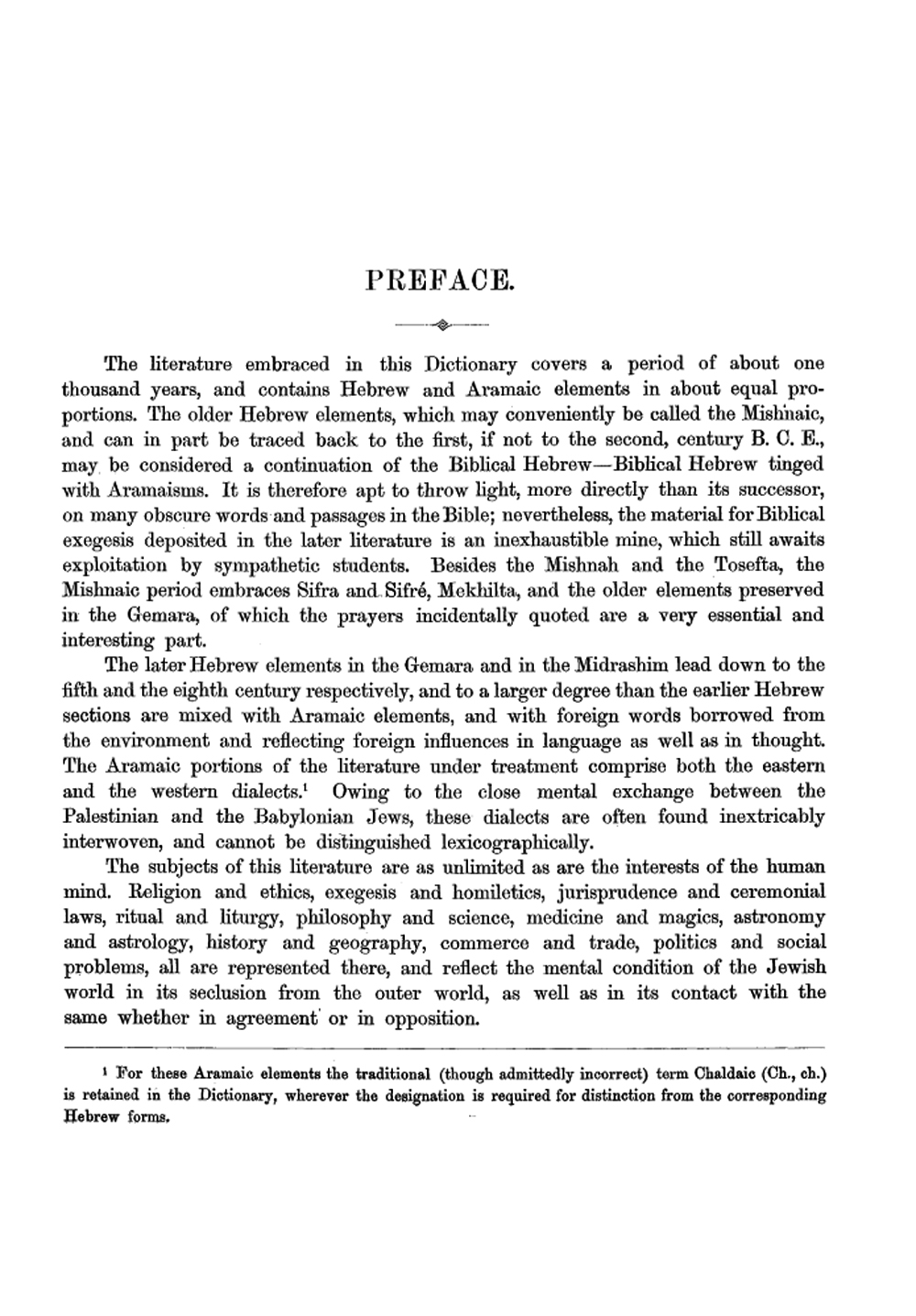
Finally, so that all the attention is not on ArtScroll, the following point was called to my attention by Benjamin Apfel. Here is the first page of Jastrow’s introduction to his dictionary. Read the last paragraph.

Here is the first page of Philip Birnbaum’s introduction to his translation of sections of the Mishneh Torah.[11]
The first paragraph is lifted from Jastrow. Would it have been so difficult for Birnbaum to simply add a note indicating that he was adapting Jastrow’s words?
2. In my post here I referred to selections from Rashbam’s commentary on Psalms that were recently printed from manuscript. This should be distinguished from Rashbam’s commentary on Psalms published in Vienna in 1816 by Isaac Satanow. Here is the title page which tells us that the manuscript comes from the royal library in Berlin.
This commentary on Psalms is a forgery. While the volume is attributed to Rashbam it was actually written by Satanow. Regarding this forgery, David Rosin writes as follows:[12]
הכי קרא שמו יצחק ויהי כצחוק בעיניו להתחפש במעטה רבנו שמואל ולעשות מעשהו ולעבוד עבודתו. זר מעשהו ונכריה עבודתו, כל השומע יצחק לו
3. In my post here I quoted R. Moses Isaac Ashkenazi in his Ho’il Moshe that King David is not to be regarded as a prophet as he only had ruah ha-kodesh. One of the commenters wrote:

Rashi Megilla 14a quotes a Halachot Gedolot which names David as [a] prophet. Rashi speaks specifically about prophets as opposed to Ruach Hakodesh, and excludes Daniel based on Megilla 3a.

 Another commenter was more strident:

Wonderful example how modern scholars have no place in the Torah world! As first commenter pointed out, Dovid Hamelech is prominent in the list of 48 neviim, and there are scores of sugyos based on the nevuah of DH. The makom mizbeach, etc. Pure AmHaaRatzus!

I am not sure if I am the am ha-aretz he is referring to, which in any case would be uncalled for since I never said that David only had ruah ha-kodesh and was therefore not a prophet. All I did was point out that R. Moses Isaac Ashkenazi said this. When I called the commenter’s attention to the fact that his strong words were directed against R. Ashkenazi, he wrote:

I wouldn’t start up with Hoil Moshe, but was pointing out the danger of someone reading this post, and then taking it at face value. For anyone fluent in Shas they will find numerous references to DH’s nevua. Ruach HaKodesh wouldn’t work for all the halachos we learn out from DH. . . . I do thoroughly enjoy your posts, but find them quite dangerous. I would prefer my children at least stick to Artscroll and have their basics –DH’s nevua – straight!

Now let me say something that I did not put in the comments because I want the entire audience to see it, not just the tiny group that reads the comments. The commenter just quoted is a perfect example of one who is certain of something, and certain that the opposing position is incorrect, and this leads to very harsh language. Let’s leave aside R. Moses Isaac Ashkenazi who is not an important scholar. All would agree that R. Moses Sofer, the Hatam Sofer, is important and certainly not an am ha’aretz (which is the term the commenter used). Yet the Hatam Sofer is explicit that David was not a prophet and only had ruah ha-kodesh, which is exactly what R. Ashkenazi states and what the commenter so harshly attacks. Here are the Hatam Sofer’s words in Torat Moshe ha-ShalemBa-Midbar, p. 74.

הנה לא מצינו לישראל מלך שיהי’ גם נביא משולח לעם כי אם משה רבינו ע”ה, דכתיב גבי’ (דברים ל”ג ה’) ויהי בישורון מלך, אבל שארי נביאים לא היו מלכים והמלכים לא התנבאו, ודוד המלך ע”ה רה”ק הו”ל ולא נבואה, ולכן אחז”ל (גיטין נ”ט ע”א) מימות משה עד רבי לא מצינו תורה וגדולה במקום אחד, דאלו כל הנביאים היו עליהם בגדולה השופט והמלך שבימיו, וכל המלכים אפי’ דוד ושלמה היו הנביאים שבדורם גדולים מהם בתורה . . . שהרי אין מלך נביא.

This notion, that the kings were not prophets (other than Moses), is also stated in Zohar, Terumah, p. 154a, and this is presumably the Hatam Sofer’s source. I don’t deny that there are other authoritative sources that contradict this, including passages in the Talmud. Some of them are cited by R. Reuven Margaliyot in his note to the Zohar, ad loc., and we can speculate as to why the Hatam Sofer preferred the Zohar over these other sources. I cite this only to show that commenters should be very careful before labeling something as am ha’aratzus, as you never know whom you might be insulting with this comment.

4. The latest book in my series with Academic Studies Press has recently appeared. It is Sara Reguer, My Father’s Journey: A Memoir of Lost Worlds of Jewish Lithuania. (Reguer is the granddaughter of R. Simcha Zelig Reguer, the dayan of Brisk.) Here is the book’s description.

Born into a leading Lithuanian-Jewish rabbinic family, Moshe Aron Reguer initially followed the path of traditional yeshiva education. His adolescence coincided with World War I and its upheavals, pandemics, and pogroms, as well as with new ideas of Haskalah, Zionism, and socialism. His memoir, recently discovered and here translated and published for the first time, discusses his internal struggles and describes the world around him and the people who influenced him. Moshe Aron Reguer wrote his memoir at the age of 23, on the eve of his departure for Eretz Israel in 1926. However, his story did not end there, but continued in British Mandated Palestine and the United States. He kept in touch with the family in Brest-Litovsk until the Nazis destroyed Jewish Lithuania, and some of their correspondence is included within this volume.

Anyone who is interested in Jewish Lithuania and the great yeshivot will find this book of value.

I also want to call attention to the recent publication of Menachem Kellner, Jewish Universalism, edited by Hava Tirosh-Samuelson and Aaron W. Hughes. Kellner’s work has made a great impact, not only in Jewish scholarship but among thinking Jews in general. This small volume is a wonderful read and contains an intellectual portrait of Kellner written by James A. Diamond as well as a lengthy interview with Kellner.

This book is number 12 in Brill’s Library of Contemporary Jewish Philosophers. Here is what has appeared so far and what if forthcoming (taken from the Brill website).

Published Volumes

Vol. 1: Eliezer Schweid: The Responsibility of Jewish Philosophy
Vol. 2: Jonathan Sacks: Universalizing Particularity
Vol. 3: David Novak: Natural Law and Revealed Torah
Vol. 4: Eugene B. Borowitz: Rethinking God and Ethics
Vol. 5: Elliot N. Dorff: In Search of the Good Life
Vol. 6: Judith Plaskow: Feminism, Theology, and Justice
Vol. 7: David R. Blumenthal: Living with God and Humanity
Vol. 8: Moshe Idel: Representing God
Vol. 9: Lenn E. Goodman: Judaism, Humanity, and Nature
Vol. 10: Avi Sagi: Existentialism, Pluralism, and Identity
Vol. 11: Elliot R. Wolfson: Poetic Thinking
Vol. 12: Menachem Kellner: Jewish Universalism

Forthcoming Volumes

Vol. 13: J. David Bleich: Where Halakhah and Philosophy Meet (est. October 2015)
Vol. 14: Michael Fishbane: Jewish Hermeneutical Theology (est. October 2015)
Vol. 15: Norbert M. Samuelson: Reasoned Faith (est. November 2015)
Vol. 16: Arthur Green: Hasidism for Tomorrow (est. January 2016)

5. The issue of truth-telling in halakhic matters, discussed in the last chapter of my new book, has been of interest to many people. I did not want to be too lengthy in my response to Aryeh Frimer here, because it was not my own independent post. So let me now add some more details. DG reminded me of the following source. According to R. Jacob Moellin, when the Talmud states that a law is rabbinic but a verse is brought as an asmachta, this was done so as to mislead the people into thinking that it is a Torah law so that they would observe it more carefully.[13] In other words, the Sages were engaging in falsehood for a higher purpose.

This is exactly the sort of thing that Frimer claimed is not part of mainstream halakhic thought, a point which I disputed. It also is very relevant to my discussion of the dispute between the Hatam Sofer and R. Zvi Hirsch Chajes regarding “raising the prohibition”. Here are the Maharil’s words, as quoted by his student.

כל היכא דאיתמר מדרבנן הוא וקרא אסמכתא בעלמא, הכי פירושו ודאי תקנתא דרבנן הוא והם יצאו ובדקו ומצאו להם סמך מקרא, וסמכו דבריהם עליו כדי להחזיקם שיהיו סבורים דהוא מדאורייתא ויחמירו בו, ולא אתו לזלזל ולהקל בדברי חכמים

In the notes to this text, the editor informs us that one of the manuscripts has a different version. Instead of כדי להחזיקם שיהיו סבורים it reads להטעות הבריות שהם סבורים. This text is even more explicit that the Sages were not being honest with the masses. This manuscript has a handwritten note explaining that instead of reading להטעות הבריות it should say להטעים לבריות because the word להטעות is a דבר מגונה . In other words, the person who made this “correction” was troubled by the explicit statement that the Sages would deceive people, even if it was for a higher cause.

If there is one thing people have learnt from my posts over the years, it is that whenever you find a passage that diverges radically from what others think is appropriate, you will find those who deny the passage’s authenticity. In this case, the most prominent of the deniers is R. Joseph Engel[14]:

לענ”ד לא מיסתברי כלל ולא אאמין כלל שיצאו מפה קדוש המהרי”ל ז”ל

R. Simhah Klein writes[15]:
וכי ישקרו חז”ל לחזק דבריהם שיהיו סבורין דהוא דאורייתא

However, R. Eliyahu Bohbut is not at all bothered by the claim of the Maharil that the Sages engaged in a form of deception vis-à-vis the masses. After quoting the passage he explains matter-of-factly[16]:

כלומר דאסמכתא באה כביכול “להטעות” את העם שיסברו דאיכא איסור דאורייתא “ויחמירו בו”

Regarding one of the other matters I discussed in the book, namely, so-called “Orthodox history”, the folllowing appears in Divrei David (p. 30a), a collection of teachings of R. David Moses Friedman, the first Chortkover Rebbe.

פ”א סיפרו לפניו על איזה מעשה שאדמ”ור מרוזין זי”ע סיפר אותו פעם בסינגון זה ופעם בסיגנון אחר אמר על זה מרן אדמ”ור זי”ע שהסיפורי מעשיות שמספרים הצדיקים הוא לפי מה שצריך באותו שעה

This is an acknowledgment that the stories told by the rebbes are not really history, as they are designed to serve the needs of the present. As I think most people today realize, haredi “historical” writing in general is as much about the present as the past, and it is precisely because of this that authors feel it is legitimate to cover up or even alter the historical record in order to best serve the religious needs of the present.

Finally, a few people have asked about what I wrote on p. 244, that the strand of Jewish tradition that countenances falsehood “deserves to be understood in a sympathetic manner as well”. This does not mean that people need to agree with those who countenance falsehood, and I certainly do not. However, in writing an academic study as opposed to a polemic, it is important to recognize that approaches that today we might regard as unacceptable, were viewed very differently in other times and cultures (and for some, these “other times and cultures” continue into our own day). I am interested in understanding what leads people to diverge so dramatically from a value that I regard as important. In my book I did not set out to judge them, but in a sympathetic manner, i.e, with a sensitivity to their worldview, attempt to understand them. (When I used the word “sympathetic”, I did not mean that I approved of what I was describing, only that I was sensitive to the motivations behind the approach.) By the same token, when I see that great figures from earlier years have written troubling things about non-Jews or women, I also approach this in a sympathetic manner, understanding that for these people, living in a vastly different time and often suffering under terrible anti-Semitism, it made sense that they would express certain thoughts that today pretty much everyone regards as unacceptable. One need not be a complete historicist to acknowledge that all people are influenced by their era, for good and for bad. This is what I mean by understanding in a sympathetic manner.

Coming Soon: R. Ysoscher Katz and Modern Orthodox Halakhah; The Nineteenth- and Early Twentieth-Century Dispute Regarding the Historicity of the Hanukkah Miracle; R. Steinman and the Messianic Belief; R. Mazuz’s Short-Lived Entry into Politics; and a response to R. Aharon Lopiansky’s article in Dialogue.


[1] See his note in Mekabtzi’el 36 (2009), p. 64.
[2] Was Maimonides ever misled by a censored text? According to R. Eliyahu Zini, Eretz Hemdatenu, p. 75, this was indeed the case. Mishneh Torah, Hilkhot Avodah Zarah 9:13 states:
 המוכר ביתו לעבודה זרה דמיו אסורין בהנייה ויוליך אותם לים המלח
As Kesef Mishneh and others point out, the origin of this halakhah is Gittin 44a. Yet the authentic reading there is המוכר ביתו לגוי (the Vilna Talmud has לעובד כוכבים). As Dikdukei Soferim ha-Shalem (Jerusalem, 2001), ad loc., informs us, לגוי is the reading in all surviving manuscripts and early printings. Meiri, ad loc., explains the halakhah as follows:
שהמוכר בית לגוי בארץ ישראל ר”ל לאחד מעובדי האלילים דמיו אסורים מתורת קנס על שנתן לעובדי האלילים חנייה בקרקע
Since Maimonides had the reading לעבודה זרה, R. Zini concludes that the talmudic manuscript he used had been altered. This is much more compelling than the explanation offered by Kesef Mishneh and Lehem Mishneh that Maimonides interpreted לגוי to mean לעבודה זרה.
Yet there is no doubt that R. Zini is incorrect. As has been pointed out by many, one who examines Tosefta, Avodah Zarah 7:2, will see that this, and not Gittin 44a, is the source for Maimonides, and Kesef Mishneh and Lehem Mishneh were simply unaware of this source. It is significant that לעבודה זרה appears even in manuscripts of the Tosefta. 

Regarding Tosefta, Avodah Zarah 7:2 and Gittin 44a, I assume that only one of the versions preserves the authentic text, but I don’t think we can determine which one it is. The only thing that remains to be explained is why Maimonides did not codify the halakhah in Gittin 44a. (It could be that his version of Gittin 44a was indeed the same as that which appears in the Tosefta, but this has nothing to do with censorship.)

[3] Kesef Mishneh, Hilkhot Melakhim 10:9, cites Rashi. You can see the uncensored text of Kesef Mishneh in the Frankel edition. The version of Kesef Mishneh that appears in older editions of the Mishneh Torah is a censored text, and instead of recording Rashi’s statement about Sunday, the following appears: או בע”ש ששובתים בו הישמעלים. For printers in the Christian world there was no problem speaking about Muslim beliefs and practices, so in this case the original statement, made with reference to Christians, was substituted with one referring to Muslims. The printers who made this “correction” had the same misconception as many today, namely, that Friday is a day of rest for Muslims. It is not. Friday is a day of gathering for prayer, but Muslims do not have a sabbath, i.e., a day of rest.
[4] Interestingly, I found an anonymous medieval Italian text that records a “minhag tov” not to eat meat on Sunday. One reason offered is kevod Shabbat, namely, by having meat so soon after Shabbat one lessens the special nature of this day in which meat is the main dish. (Obviously, meat was not regarded as an everyday meal in this author’s time and place.) The second reason is מפני קלון הנוצרים. What this means is that since Sunday is the Christians’ holy day, Jews should avoid eating a special food like meat on that day. See Minhag Tov, ed. Weiss (Budapest, 1929), p. 230, no. 47.
[5] See Reuven Kimelman, “Birkat ha-Minim and the Lack of Evidence for an Anti-Christian Jewish Prayer in Late Antiquity,” in E. P. Sanders, et al., eds., Jewish and Christian Self-Definition (Philadelphia, 1981), vol. 2, p. 242.
[6] Christianity in Talmud and Midrash (London, 1903), p. 172. His first name “Robert” never appears in his works, as he went by “R. Travers Herford”. I supplied the first name in full as I did not want people to assume that we are dealing with “Rabbi Travers Herford”. Herford wrote a number of works about the Pharisees. His positive portrayal of them was in opposition to the standard Christian view. This highly impressed R. Zvi Yehudah Kook, who suggested translating Herford’s works into Hebrew. See his letter here where he writes:
חשבתי אז להעירו ע”ד ספריו החשובים של החכם האנגלי הרפורד, – היודע ואוהב את היהדות באופן נפלא, –  ע”ד תורת היהדות הפרושית וערכה העולמי, כהמשכה האמיתי של הנבואה בחיוניותה הנמשכת עד היום. כדאי וחשוב מאד היה לתרגמם לעברית, בשביל הנוער שלנו המתחשב מאד עם דבריו של גוי, וביחוד לעומת הרבוי של תרגומי דברי תפלות, שזכו ומזכים בהם את ספרותנו החדשה. אולי יואיל כ’ לזכות במצוה זו בהתמחות זריזותו ושקידתו
Herford’s commentary on Pirkei Avot is full of interesting points. To give one example, he argues that the proper vocalization of אמרו  in Avot 1:5: באשתו אמרו קל וחומר באשת חבירו, is amaro, not amru. (R. Mazuz told me that this is definitely incorrect.)
[7] See Dikdukei Soferim ha-Shalem, ad loc., Saul Lieberman, Tosefta ki-Feshutah, Ketubot, p. 365.
[8] See R. Yonatan Binyamin Buchinger in Or Yisrael 46 (Tevet 5767), pp. 237ff., ibid. 48 (Tamuz 5767), pp. 240-241, ibid. 51 (Adar Sheni 5768), p. 246. The authentic text of the Rif, which reads ערב הפסח, is found in the Constantinople 1509 edition. See Hilkhot Rav Alfas, ed. Zaks (Jerusalem, 1969), vol. 2, p. 128.
[9] See Ariel Toaff, Blood Passover (available online) ch. 8 n. 8. (Unfortunately, this book continues to give ammunition to anti-Semites.)
[10] See F. H. Wettstein, Halifat Mikhtavim (Cracow, 1900), p. 97; R. Dovid Cohen, He-Akov le-Mishor (Brooklyn, 1993), to Ketubot 102b (p. 106); Soncino’s note, Ketubot 102b.
[11] Maimonides’ Mishneh Torah (New York, 1967).
[12] Introduction to his edition of Rashbam on the Pentateuch, p. xix. See also Reuven Elitzur, Degel Mahaneh Reuven (n.p., n.d.), pp. 365ff. Not knowing who Satanow was, R. Yisrael Yaakov Fisher of the Edah Haredit refers to him as ר’ יצחק מסטנוב ז”ל. See Even Yisrael, vol. 8, no. 9. I found the same lack of awareness in R. Aryeh Leib Neimark, Even Yaakov (Slutzk, 1910), p. 57b: יפה פירש החכם מהר”י סאטנאב
[13] Sefer Maharil, ed. Spitzer (Jerusalem, 1989), Likutim, no. 70 (p. 629).
[14] Beit ha-Otzar, vol. 1, kelal 190 (p. 118b).
[15] Peleitat Soferim 1 (2012), p. 87 n. 7.
[16] Shoshanat ha-Amakim (Jerusalem, 2008), p. 257.


Jewish Treasures From Oxford Libraries

JEWISH TREASURES FROM OXFORD LIBRARIES

By Paul Shaviv

Ed. Rebecca Abrams and Cesar Merchan-Hamann / Bodleian Library, University of Oxford, 2020 / ISBN 978 1 85124 502 4 / Available in the USA via Amazon $55

307pp, 140 full-colour plates

Oxford,[1] the ‘City of Dreaming Spires’, is one of the world’s greatest repositories of Hebraica and Judaica, both books and manuscripts.

This sumptuous volume was initiated at the encouragement and support of Martin J. Gross, a New Jersey philanthropist and Jewish community activist. It is a bargain at the price. The book is absolutely handsome – the quality of the printing is outstanding, and it is printed on 135gsm paper.

The core of ‘Jewish Treasures from Oxford Libraries’ describes seven collectors and their eponymous collections, which together constitute the Hebraica holding of the Bodleian library; plus a description of smaller, but important, holdings of some individual College libraries; and the Genizah fragments held in Oxford. There are additional essays describing the history of the Bodleian itself, and the role of successive Librarians in encouraging the acquisition of Hebrew (and other ‘Oriental’) manuscripts; of the great cataloguers (Neubauer and Cowley); and of other benefactors, including the amazing figure of John Selden.[2]

Each chapter is written by different scholars. Archbishop Laud (1573–1645), by Giles Mandelbrote; Edward Pococke (1604-1691) by Benjamin Williams; Robert Huntington (1637-1701) by Simon Mills and Cesar Merchan-Hamann; Benjamin Kennicott (1718-1783) by Theodor Dunkelgrun; Matteo Luigi Canonici (1727-1805) by Dorit Raines; Rabbi David Oppenheim (1664-1736) by Joshua Teplitzky; and Heimann Joseph Michael (1792-1846) by Saverio Campanini. Each describes the biography of the collector, the characteristics and most important items of their collection, and how and why they amassed them.

The first thing that readers will note is that only the last two are Jewish. Even in the case of David Oppenheim, his unique collection of approximately 4,500 printed books and just under 1,000 bound volumes of manuscripts languished in storage in Europe until Revd. Alexander Nicoll, the Regius Professor of Hebrew, engineered its purchase by the Library. Otherwise they are a parade of Anglican Divines and Christian Hebraists (except Canonici, who was a Jesuit), witness to the intense interest (and expertise) in Hebrew and Jewish Studies by non-Jewish scholars in the sixteenth and seventeenth centuries. The stories of the collections are fascinating. Ambassadors, merchants and missionaries all have a part in purchasing (and pursuing) manuscripts. A special place seems to be occupied by the ‘Chaplains’ attached to the Embassies – one can surmise that they both had some expertise in Hebrew, even if rudimentary, and also perhaps time to devote to the ‘hunt’. We visit the great cities of the ‘Orient’ – Constantinople, Damascus, Aleppo, Cairo, and of Europe – Italy, Spain and Germany.

The objectives and interests of each collector were different. Some – Oppenheim is the obvious example – were happy to scoop up whatever was on the market. Kennicott was interested in Biblical material, resulting in his two-volume study of variations in extant biblical texts. Along the way, each of them acquired examples of the most magnificent decorated and illuminated works, covering the entire span of Judaica – texts, contracts, ketubot, from every place. The calligraphy itself is to be savoured and enjoyed. As mentioned, the 140 full-colour (and often full-page) plates do all of this justice.

Although overshadowed by Cambridge, Oxford too has significant Genizah holdings – described by Nadia Vidro. These were acquired in the nineteenth century and pre-dated Solomon Schechter’s bulk removal of the Genizah contents to Cambridge. They are apparently strong in Talmudic texts, and also include an autograph copy of Rambam’s Mishneh Torah – complete with alterations and editing notes. Adolph Neubauer sifted through the material; kept the largest fragments, often complete or semi-complete pages – and rejected the remainder, which were sold on to Elkan Adler. Neubauer could not foresee the techniques available later, and utilized in Cambridge, to read, identify and reap the benefits of the tiniest pieces.

It is very difficult to summarize such a wide-ranging work in a short review. I am left with several thoughts:

  • In the case of the Bodleian, their holdings were purchased, not plundered, although the circumstances by which the objects came into the possession of previous owners is not necessarily known. The scholarship, and enthusiasms, of the Christian Hebraists, familiar to scholars, is of course little appreciated in today’s wider Jewish community. Were it not for them, many, many of these works would be lost. Were it not for the conscientious curation and preservation of these books and manuscripts by non-Jewish, mainly academic, libraries, they would almost certainly be lost, and even if they existed, would probably be far less accessible.

  • The sheer aesthetic beauty of many of the manuscripts speaks of a different culture. Even if, as is surmised, many were illustrated by non-Jewish professional artists[3] – they were commissioned by Jewish patrons. Even the almost-certainly Jewish artists (of Ketubot and the like) seem to show a joyfulness absent from our contemporary production of texts; which I take as a reflection of a certain dour outlook and philosophy. The same comment could be made about the narrowness of contemporary religious publishing compared to the width of thought, concern and scholarship of our forebears.

  • On a different perspective, as an (ex-pat) Anglo-Jew, and a former graduate student of Jewish Studies at Oxford (way back in the 1970’s!), I have to again sigh at the neglect of its own treasures by the Anglo-Jewish community[4]. Even the initiator of this project hails from New Jersey! Perhaps a ray of optimism may come from the fairly recent appointment of Prof. Judith Olszowy Schlanger as head of the Oxford Centre for Hebrew and Jewish Studies (formerly housed at Yarnton Manor)? Until now, most of the OCHJS Presidents have been specialists in one or another aspect of the ancient world, or of other, wider areas of Jewish study. This is not to disparage any of these eminent scholars in any way whatsoever! But Professor Olszowy Schlanger has already published on Anglo-Norman and pre-Expulsion manuscripts; perhaps we will see fresh scholarship on English and European rabbinic study from her Presidency, from still-to-be-researched corners of the Bodleian!

A great read, a great book to possess, and – happy are they who may receive this book as a perfect gift!

[1] The city has a rich Jewish history of its own, which is thought to date back to 1075. Two (!) complementary websites both give excellent information and resources about Jewish Oxford. The first site, sponsored by the local Jewish community, whose supervisory committee includes one of the editors of the volume under review, is www.oxfordjewishheritage.co.uk . Clicking on the small window labelled ‘Jewish Heritage’ in the middle of the homepage of Oxford Chabad www.oxfordchabad.org opens up a surprisingly academic and scholarly range of material on Jewish Oxford. Both recommended!
[2] The present Bodley Librarian, Richard Ovenden, writes a Foreword; Cesar Merchan-Hamann a general Introduction; Rahel Fronda writes on the smaller College collections; and Piet van Boxel on the cataloguers. Mr. Martin J. Gross, the book’s ‘prime mover’, contributes an elegant Preface!
[3] See, for example, plate 114, from Ms. Michael 627 – from a Yom Kippur mahzor, where a non-Jewish artist, not knowing which way up the Hebrew is written, has the illustrations drawn upside down on the page.
[4] Painfully, the single most important Anglo-Jewish artefact, the dated pre-Expulsion Chumash mss, shown to H.M. The Queen to demonstrate the depth of Jewish experience in England, was sold at the Valmadonna Auction. The purchaser remains anonymous. It is not known if it is still in the UK. If it is, it is neither displayed nor accessible. The Bomberg Talmud, also sold by the Valmadonna Trust, is now in New York City after being in Westminster Abbey for centuries.


The Greatest Story in the Annals of Jewish Book Collecting

The Greatest Story in the Annals of Jewish Book Collecting
 By Jeremy Brown

Jeremy Brown is the author of New Heavens and a New Earth; The Jewish Reception of Copernican Thought. He writes on science, medicine and the Talmud at Talmudology.com 

As we approach the end of Masechet Yevamot in the Daf Yomi cycle, it seems appropriate to reflect on a legendary story in the annals of Jewish bibliography. This story involves King Henry VIII, the laws of Yevamot, and the greatest private Jewish library in the world.
About thirty years ago, while a medical student in London, I had the good fortune of visiting the Valmadonna Trust Library, that greatest of private Jewish libraries. (How I got there is another story for another time). And while there, I held the Talmud that certainly once belonged to Westminster Abbey. It may also have been owned by Henry VIII, who had brought a Bomberg Talmud from Venice in order to help him end his marriage to Catherineof Aragon, the first of his many wives. The story of Henry VIII’s purchase of the Bomberg Talmud – the first complete printed Talmud – actually hinges on Yevamot, and whether the rules of levirate marriage, or yibum, applied to him. 
Catherine of Aragon was actually a widow, having first been married to Henry’s younger brother Arthur. About six months after Catherine married Arthur he died childless, and in 1509 his older brother Prince Henry married his widow.  One more thing to know: Catherine claimed that her marriage to Arthur had never been consummated; this is important later in the story. (And here is an interesting historic footnote: it was Catherine’s parents, Ferdinand and Isabella who had expelled the Jews from Spain.)
By 1525, Prince Henry had become King Henry VIII, and has had one daughter with Catherine. He wanted a son, and now wished to marry Ann Boleyn. There was, however, a problem:  what was he to do with Catherine, his existing wife?  Divorce, remember, was tricky for this Catholic King. And here is where the Talmud comes in.  
Henry argued that his marriage to Catherine should be dissolved since it was biblically forbidden for a man to marry his sister-in-law. (Henry claimed years earlier that he could marry her because the marriage to his brother had not been consummated. See, I told you that was important information…)
But as we from Masechet Yevamot, the Bible commands a man to marry his widowed sister-in-law if his brother died without children. Since Arthur died childless, it could be argued that Henry was now fulfilling the biblical requirement of levirate marriage – known as yibum. If that was the case, the marriage was kosher and could not be dissolved
How was this conundrum to be resolved? Let’s have Jack Lunzer, the custodian of the library, tell the story. (You can also see the video here. Sorry about the ads. They are beyond our control.) 
As Lunzer tells us, the Talmud was obtained from Venice to help King Henry VIII find a way to divorce his wife (and former sister-in-law) Catherine, and so be free to marry Ann Boleyn. In fact, it’s a little bit more complicated than that. Behind the scenes were Christian scholars who struggled to reconcile the injunction against a man marrying his sister-in-law found in one part of the Bible, with the command to do so under specific circumstances, found in another. In fact the legality of Henry’s marriage had been in doubt for many years, which is why Henry had obtained the Pope’s special permission to marry.
John Stokesley, who later became Bishop of London, argued that the Pope had no authority to override the word of God that forbade a man from marrying his brother’s wife. As a result the dispensation the Pope had given was meaningless, and Henry’s marriage was null and void. In this way, Henry was free to marry.  But what did Stokesley do with the passages in Deuteronomy that require yibum?  He differentiated between them.  The laws in Leviticus, he claimed, were both the word of God and founded on natural reason. In this way they were moral laws; hence they applied to both Jew and Christian.  In contrast, the laws found in Deuteronomy, were judicial laws, which were ordained by God to govern (and punish) the Jews – and the Jews alone. They were never intended to apply to any other people, and so Henry’s Christian levirate marriage to Catherine was of no legal standing. There was therefore no impediment for Henry to marry Ann. As you can imagine, this rather pleased the king.
It remains unclear whether the Valmadonna Library Bomberg Talmud is indeed the very same one that Henry had imported from Venice. According to Sotheby’s and at least one academic, it actually came from the library of an Oxford professor of Hebrew, who bequeathed it to the Abbey. In any event, a Bomberg Talmud lay undisturbed at Westminster Abbey for the next four hundred years.  How Lunzer obtained it for his library is possibly the greatest story in the annals of Jewish book collecting. In the 1950s there was an exhibition in London to commemorate the readmission of the Jews to England under Cromwell. Lunzer noted that one of the books on display, from the collection of Westminster Abbey, was improperly labeled, and was in fact a volume of a Bomberg Talmud. Lunzer called the Abbey the next day, told them of his discovery, and suggested that he send some workers to clean the rest of the undisturbed volumes.  They discovered a complete Bomberg Talmud in pristine condition, and Lunzer wanted it. But despite years of negotiations with the Abbey, Lunzer’s attempts to buy the Talmud were rebuffed.  
Then in April 1980, Lunzer’s luck changed. He read in a brief newspaper article that the original 1065 Charter of Westminster Abbey had been purchased by an American at auction, but because of its cultural significance the British Government was refusing to grant an export license. Lunzer called the Abbey, was invited for tea, and a gentleman’s agreement was reached. He purchased the Charter from the American, presented it to the Abbey, and at a ceremony in the Jerusalem Chamber of Westminster Abbey the nine volumes of Bomberg’s Babylonian Talmud were presented to the Valmadonna Trust. It’s a glorious story, and it’s so much better when Lunzer himself tells it, as he does here: (You can also see the video here,and end it at 14.35. We continue to apologize for those ads.)

The Valmadonna Trust Library – all of its 13,000 books and manuscripts, including the Westminster Abbey Talmud, is now on sale at Sotheby’s in New York. It can be yours for about $35 million.  But if you buy it, you must agree to two conditions set by Lunzer: that the Library remain whole, and that it be made available to scholars. In that way, just as I once held that magical Talmud, others may continue to do so. 


Partnership Minyanim and More

Partnership Minyanim and More
Marc B. Shapiro

1. A few people have wanted me to comment on the recent debate between Rabbis Barry Freundel and Zev Farber about the so-called Partnership Minyanim in which women lead Kabbalat Shabbat. See here. The issue goes back to R. Freundel’s article in Tradition 44:2 (2011) on the topic. I was planning to respond to this article when it first appeared, and even wrote some pages, but I never completed the piece. Since the issue has once again surfaced, now is a good time to deal with it. Some of what I will say was also stated by an anonymous commenter on the Torah Musings blog, but both R. Zev Farber and Lazer Kaganovitch can testify that I sent them these points before the commenter posted anything, so I see no reason not to record my thoughts. (I should also note that this anonymous commenter, while pointing out errors and misreadings by R. Freundel, did not show proper respect in recording his criticisms.)
In his article, R. Freundel argues against the Partnership Minyanim with an original approach. Rather than summarize his viewpoint in my own words, this quotation sets forth his thesis, which the article attempts to prove:

In those communities which do not employ a Hazan for Kabbalat Shabbat, that lack would indicate that they view this liturgy as neither mandatory nor communal. Nonetheless, putting a woman (and maybe a child) into the role of Hazan would still be problematic. Adding a Hazan makes the prayer mandatory and communal but women and possibly children cannot lead a mandatory communal prayer. As a result, even in a setting that currently has no Hazan, the innovation of using a Hazan who cannot serve as a Hazan for communal prayer creates a halakhic dissonance that is unsustainable.
This is quite an argument and if it could be sustained, then it would be a significant contribution to the debate. However, in my opinion, and the opinion of everyone I know who has examined the issue, R. Freundel’s argument is completely unconvincing. There is simply no way that having a person read a few paragraphs of Psalms or more recent compositions before some other people makes the prayer “mandatory” and “communal.”
Before getting into some particulars of R. Freundel’s piece, let me offer a more general criticism. Reading the article I was troubled by the author’s need to come up with a halakhic argument to forbid that which pretty much everyone can see is not a halakhic matter at all (apart from possible halakhic concerns of tzeniut). Those who are in favor of Partnership Minyanim devote great efforts to show that there is no halakhic objection, and therefore these minyanim should be instituted, and R. Freundel is playing the same game, but from the other side. He feels that he needs to show why Partnership Minyanim are halakhically forbidden, and therefore shouldn’t be instituted.
The truth of the matter is that many of the most important things traditional Jews do and don’t do have nothing to do with halakhah. Something can be a bad idea, even a very bad idea, and deserve to be rejected even if there is no technical halakhic objection to it. As the Steipler wrote (Karyana de-Igarta [2011 ed.], vol. 2 no. 581):

יש כמה דברים שאין בכח החכם להורות איסור אע”פ שבאמת אינו נכון כלל
There are good reasons people can offer in opposition to Partnership Minyanim without falling into the “pan-halakhic” trap that everything you oppose has to be shown to be halakhically improper. Opponents of the Partnership Minyanim should be able to acknowledge that if non-bar mitzvah age boys are permitted to serve as a hazan for pesukei de-zimra or Kabbalat Shabbat then, apart from issues of tzeniut (in which I include kol ishah), there is no “technical” halakhic objection with women doing so as well. But as mentioned already, lack of a prohibition doesn’t necessarily make something a good idea. Plenty of synagogues will not let someone serve as a hazan if he is wearing jeans (or if he is not wearing a jacket or hat), yet this doesn’t mean that we need to find a technical halakhic objection for something which is at essence a matter of synagogue custom and propriety, and therefore does not need to be supported by halakhic sources. By the same token, I think we have reached the point whereby the typical Orthodox rabbi acknowledges (privately, at least) that there is no real halakhic objection to a woman rabbi, while at the same time continuing to oppose the concept (much like many oppose yoatzot halakhah). They oppose it because of how women rabbis will change the structure of traditional Judaism, change it in way they view as negative. This point can be made without using halakhic arguments that after a little investigation people will see don’t carry any weight. This is especially so in the Modern Orthodox world where there are women principals of Jewish day school, women synagogue presidents, women teachers of Talmud, women learning advanced halakhah, and no one bats an eye when a woman speaks in front of men.
For those who oppose things like women leading Kabbalat Shabbat, a weak halakhic argument is worse than no argument at all. The best tactic for the opponents is simply to keep the issue focused on what direction is best for Judaism. It is known that a number of great rabbis refused to provide halakhic reasons for particular decisions they gave, especially when the halakhic justification was weak. They chose this path precisely because they didn’t want these issues to become matters of halakhic debate, as there were other, even more important considerations guiding them. (In a future post I will give examples.) What R. Freundel’s article does is empower the proponents of Partnership Minyanim because they can rightfully say, “If this is the best our opponents can muster in terms of halakhic objections, then there really is no reason to oppose what we are doing.”
Now let’s turn to some particulars, as there are a couple of points in R. Freundel’s article that I would like to comment on. He writes:
The second oft-cited opinion in Rishonim is that of Nahmanides, who argues for obligatory twice a day recitations of the Amidah by women at Shaharit and Minha. The problem is that, despite the fact that the Mishna Berurah quotes this approach in the name of Ramban, I cannot find this opinion anywhere in Nahmanides’ writings. An examination of the section of Shulhan Arukh where Mishna Berurah makes this statement indicates that he is quoting R. Akiva Eiger.
There is a misunderstanding here. Here is the passage from the Mishnah Berurah 106:4 referred to by R. Freundel.

What the Mishnah Berurah is saying is that Nahmanides’ view is that prayer is a rabbinic commandment. The part about Anshei Keneset ha-Gedolah requiring the Amidah to be recited twice a day and that women are also obligated in this is not from Nahmanides. This is the Mishnah Berurah speaking. Contrary to what R. Freundel writes, the Mishnah Berurah is not quoting R. Akiva Eger.
           
In the next paragraph, Freundel writes:
R. Eiger cites Nahmanides from section 89 of Responsa Besamim Rosh. At one time this book was attributed to a variety of important scholars including Ramban, but now it is known to have been written by Isaac Molina in the 16th century. . . . Section 89 of Besamim Rosh tells us that women “in our area” are required to pray twice a day because “they have accepted this practice upon themselves.” This is hardly an indication that all Jewish women are required to recite the formal liturgy at Shaharit and Minha as Mishna Berurah claims.
Here is the responsum from Besamim Rosh.

It never uses the words “in our area”, and furthermore, the responsum is not from Nahmanides. It seems that R. Freundel makes the false assumption that at one time this book was attributed to Ramban because he thinks that R. Akiva Eger is citing a responsum of Ramban in Besamim Rosh. Yet Besamim Rosh was never attributed to Nahmanides nor to Isaac Molina.[1] The latter supposedly gathered the teshuvot (that is what it says on the title page, but this is part of Saul Berlin’s forgery). This means that R. Freundel’s critique of the Mishnah Berurah falls by the wayside, since the responsum in Besamim Rosh has nothing to do with the Ramban and thus nothing to do with the Mishnah Berurah’s point, which is derived from the Ramban. .

Here is the text from R. Akiva Eger.


In his heading he cites Ramban, but that is simply a quote from the Magen Avraham, and has nothing to do with the Besamim Rosh that he cites immediately following this. All R. Akiva Eger is doing by citing Besamim Rosh is providing another relevant text dealing with the issue under consideration, i.e., women and prayer. In R. Akiva Eger’s responsa, vol. 1, no. 9, he cites this same responsum in Besamim Rosh. (R. Akiva Eger thought that Besamim Rosh was an authentic work.[2]) 

However, how did R. Freundel ever assume that Besamim Rosh was citing Nahmanides? He never could have concluded this if he used the Machon Yerushalayim edition, which is the text I just used. He also could not have concluded this if he used one of the older editions of the Shulhan Arukh in which R. Akiva Eger’s note doesn’t even refer to Ramban. See here:

Yet here is the text as it appears in what used to be the standard edition of the Shulhan Arukh. In this edition there is a mistake in R. Akiva Eger’s text and it indeed has him stating that Nahmanides’ view is found in Besamim Rosh.

R. Freundel writes:
While all agree that women do not count towards adding Elokeinu, there is some debate about whether women can count among the three for zimmun. Nonetheless, even for those who say that women do count for the three no one suggests that a woman can lead if there are both men and women present. This is either because women’s obligation is rabbinic while men’s is Biblical or because the formal text of Birkat ha-Mazon contains references to certain mitsvot (e.g., circumcision) which are not applicable to women (emphasis added).
The passage I have underlined is incorrect. Ritva writes as follows[3]:

נשים חייבות בברכת המזון מן התורה, ולפיכך אשה מברכת לאיש על ידי זימון, או אם הוא עם הארץ להוציאו ידי חובתו כדרך שהאיש מוציאו.
See also R. Asher Ben Hayyim, Sefer ha-Pardes, ed. Blau (New York, 1984), pp. 176-177, and also the Hazon Ish, Orah Hayyim 30:8, who mentions that according to one approach in the rishonim גם הנשים רשאות לזמן כה”ג אם אין אנשים בקיאין . 

R. Yitzhak Yosef, Yalkut Yosef, Orah Hayyim 186:5, writes:
אשה שבירכה ברכת המזון ונתכוונה להוציא את האיש ידי חובתו, ושניהם אכלו כדי שביעה, בדיעבד יצא ידי חובה, ואינו צריך לחזור ולברך
A good discussion of the issue is found in R. Yehudah Herzl Henkin, Bnei Vanim, vol. 3, no. 1.[4]
R. Freundel writes:
The presence of a Hazan was essential to Magen Avot becoming a mandatory tefillah be-tsibburMagen Avot became mandatory with a Hazan. . . . If the presence of a Hazan makes a prayer mandatory, then Kabbalat Shabbat, which today has a Hazan in the vast majority of synagogues, is also mandatory.
I think R. Freundel has it all backwards. The presence of a hazan never made Magen Avot mandatory. Rather, when Magen Avot was made mandatory, it was required that there be a hazan. But what does this have to do with Kabbalat Shabbat which was never made mandatory by anyone?
R. Freundel writes:
R. Kook maintained that one who has heard the repetition of the Amidah on Rosh Hodesh thereby fulfilling his tefillah be-tsibbur requirement, but who must repeat his silent Amidah because he forgot Ya’ale ve-Yavo[,] counts among the six to whom four who previously prayed are added for recitation of devarim she-bi-kedushah. His repeat prayer constitutes tefillat rabbim in that venue, which is sufficient to count him in the majority of a tsibbur that has not yet prayed. Tefillat rabbim is, therefore, not a larger form of individual prayer, rather it is a diminished form of tefillah be-tsibbur and therefore, he counts because his is a minor act of communal prayer.
This description is incorrect as R. Kook does not “maintain” that which is being attributed to him. In his responsum, Orah Mishpat, no. 23, R. Kook presents both sides of the matter and concludes וצריך בירור. What this means is that he does not make a final decision. In any event, what does this have to do with someone such as a minor or a woman leading a prayer that is not obligatory?
The larger problem of R. Freundel’s article is that he makes assumptions which are simply not in accord with the practice of Jewish communities. For example, his argument leads to the conclusion that it should be forbidden (not just inappropriate, but forbidden) for someone under bar mitzvah age to lead any part of the service. Yet this is the practice in communities all over the world. Doesn’t every Modern Orthodox synagogue have a child lead Adon Olam? R. Freundel assumes that the only reason this can be permitted is because of hinnukh considerations. That is possible, but it is just as likely permitted precisely because there is no prohibition, and it is a nice thing to do. In other words, there is no default position that it is prohibited, from which one then needs to then find a way to permit.
The Beit Yosef, Orah Hayyim 53, discusses the practice of children leading the congregation in maariv and those who objected. He explains that the practice can be defended since there is no repetition of the Amidah, the hazan is not fulfilling anyone’s obligation for him, and maariv is also reshut. In other words, there are no considerations of hinnukh raised here, and for the Beit Yosef there is no default position that it is prohibited, and certainly no concept of tefillat rabbim, (which is mostly a hiddush of R. Freundel). It seems to be entirely a matter of synagogue etiquette, i.e., kevod ha-tzibbur, and if this can be overcome, then there is no halakhic problem. R. Yitzhak Zilberstein even argues that in an extreme circumstance (the particular case concerned a prison) one need not protest if a non-Jew leads the maariv service![5]
Let me stress that there is nothing wrong with R. Freundel coming up with a hiddush dealing with tefillat rabbim. However, a hiddush such as this cannot be the basis for forbidding a practice such as Partnership Minyanim. To see how far R. Freundel’s model takes him, in response to criticism he even stated that it is forbidden for a woman to recite tefillat ha-derekh on behalf of men and also to lead a communal recitation of Psalms. R. Freundel assumes that this is all tefillat rabbim and therefore forbidden for a woman to lead.
I have no doubt that if you ask the typical posek about a woman reciting tefillat ha-derekh or reading a Psalm before a mixed group of men and women, he will say it should not be done, for reasons of tzeniut or mesorah. But if you ask him if it is forbidden on account of tefillat rabbim, he won’t have a clue what you are talking about. Speaking historically, there is simply no such halakhic framework, and I find it hard to believe that people are going to be convinced that if some men and women sit down to read a few Psalms together (or a liturgical text of more recent vintage) that there is a prohibition for a woman to lead the recitation. (Again, I am not referring to tzeniut issues here.). Let me just remind readers that R. Ovadiah Yosef, relying on numerous rishonim, has ruled that if necessary a woman can read the Purim megillah for men (which might arise if no men know how to read it).[6] If the halakhically obligatory Megillah can be read by women for men, with none of the poskim saying a word about a concept of tefillat rabbim, then why should people accept that there is a prohibition for a woman to lead a group of men and women in recitation of a Psalm? (I realize that one can respond that reading the Megillah is not tefillah, but it would nevertheless be strange to permit a woman to read an entire book of the Bible before a group of men, and at the same time not allow her to read even a few verses from another book, i.e., Psalms.)
There is a good deal more to say about the phenomenon of Partnership Minyanim and the strange way they came about. Before Prof. Daniel Sperber got involved, the basis for them was an article written by an otherwise unknown rabbi in the Edah Journal. I can’t help but wonder about the halakhic methodology of changing traditional Jewish practice simply because a rabbi writes an article with some suggestions. If tomorrow a rabbi, any rabbi, writes an article arguing that in today’s day and age when men and women mix freely, that there is no need for a mehitzah in prayer (after all, it is not mentioned in the Shulhan Arukh), would that then give people carte blanche to remove the mehitzah? Had this not already been an issue between the Orthodox and Conservative, and thus of great symbolic significance, I am sure the mehitzah would already have been removed in liberal Orthodox synagogues. And what about counting women in the minyan? Halakhic arguments can be advanced for this as well. Is the only reason the liberal Orthodox don’t accept R. Ethan Tucker’s and R. Micha’el Rosenberg’s arguments[7] because of their non-affiliation with Orthodoxy? If an Orthodox rabbi had advanced the same argument as them, would it then be OK to move to complete halakhic egalitarianism?[8]
2. In a previous post I wrote about the dispute over whether there is pesak in hashkafah. Only recently did I see the following relevant statement of R. Soloveitchik, The Emergence of Ethical Man, p. 6 (emphasis added).
It is certain that the fathers of the Church and also the Jewish medieval scholars believed that the Bible preached this doctrine [the separateness of man from nature]. Medieval and even modern Jewish moralists have almost canonized this viewpoint and attributed to it apodictic validity. Yet the consensus of many, however great and distinguished, does not prove the truth or falseness of a particular belief.
In my article, I discussed some of the difficulties with the Hatam Sofer’s position that principles of faith can change with time, and are determined in a fashion no different than typical halakhic decisions. I argued that this understanding diverges from that of the rishonim. In R. Dovid Cohen’s recently published Ha-Emunah ha-Ne’emanah (Brooklyn, 2012), p. 41, he appears troubled by the Hatam Sofer’s approach.
                       
וקשה מאד להתאים דברי הח”ס שעיקרי הדת חשובים עיקרים שהכל צריכים להאמינם מפני ההכרעה שאז י”ל שהפורק עול שאינו רוצה לקבל ההכרעה נענש מטעם זה, אבל איך זה שייך לסברת האברבנאל והגרי”ז שמי שאינו מאמין אין לו התפיסה שיוכל להשיג עולם הבא האם ההשגה תלויה בהכרעה או במציאות של האמת והאם שייך לומר שלרב הלל יש חלק בעוה”ב והבא אחריו שסובר כוותיה אין לו חלק לעולם הבא שאינו יכל להשיג. . . . ועיין לקמן בעיקר ז’ שהערתי שמשמע מהאריז”ל ומבעל התניא שהם חולקים על החתם סופר ודו”ק.
What does the last word (abbreviation) mean, as it does not stand for ודוחק קצת, which is how it is usually understood? Furthermore, what are we to do with the expression והדברים ברורים ודו”ק that appears in Maharsha and elsewhere? I remember how in yeshiva we didn’t know what to make of this, since it obviously doesn’t  mean  ודוחק קצת. One rebbe told us that the abbreviation mark is a mistake and it should be read as  ודוק, that is, “examine it carefully” (like ודייק). It is also possible that the abbreviation stands for ודיק וקרא, although this meaning is not mentioned in Otzar Rashei Tevot. R. Meir Mazuz recounts that in Tunis they explained it: ואחר דרישה וחקירה קל. (Otzar Rashei Teivot has ודייק ותמצא קל). See his Lo Tashikh (Bnei Brak, 2005), p. 8 (first numbering). But he assumes that the real meaning is as I mentioned, i.e., ודייק.
Returning to R. Cohen’s book, it really requires a post of its own, as it contains all sorts of interesting things. Here is one example, from p. 127, where he suggests an interpretation of the Twelfth Principle of Maimonides according to which belief in a personal Messiah and other details in the Principle are not really  required beliefs.
וצ”ל שהעיקר הי”ב הוא גאולה באחרית הימים והכופר בזה הוא כופר גמור והפרטים שכתב הרמב”ם שיהיה משיח והוא מיו”ח של שלמה בן דוד אין זה מהעקרים שהכופר בהם אינו נחשב ככופר והוא חידוש עצום.
I only quote this for its novelty, as it is contradicted by Maimonides’ explicit words in the Principle. With reference to the detail of the Messiah’s genealogy, Maimonides states: “Included in this fundamental principle is that there will be no king of Israel except from David and from the seed of Solomon exclusively. Anyone who disputes concerning this family denies God and the words of His prophets.”
On p. 162 R. Cohen states that according to Maimonides even non-Jews are obligated to believe in the Thirteen Principles. He concludes his paragraph with ודו”ק, and again, it does not mean ודוחק קצת.
ועיין סוף פ”ח ממלכים שכתב וז”ל כי [כל] המקבל שבע מצות ונזהר לעשותן הרי זה מחסידי אומות העולם ויש לו חלק לעולם הבא. והוא שיקבל אותן ויעשה אותן מפני שצוה בהן הקב”ה בתורה והודיענו על ידי משה רבינו שבני נח מקודם נצטוו בהן. אבל אם עשאן מפני הכרע הדעת אין זה גר תושב ואינו מחסידי אומות העולם ולא מחכמיהם עכ”ל. ומשמע מכאן שהרמב”ם בא לכלול הגוים שהם חסידי אומות העולם שמאמינים בתורה, אבל אינם מאמינים בי”ג עיקרים שאין להם חלק לעוה”ב . . . הרי מוכח כנ”ל שגוי צריך להאמין בי”ג עקרים ודו”ק
Contrary to R. Cohen, when Maimonides speaks of righteous non-Jews being required to believe in the revelation at Sinai, this has nothing to do with acceptance of the complete Thirteen Principles.
One more point about R. Cohen’s book is that it is obvious that at times he is responding to what I wrote in The Limits of Orthodox Theology (and he also makes use of many of the sources I cite). While I am not mentioned by name (no surprise there) I am apparently included among the משמאילים referred to on p. 5 (see Limits, pp. 7-8).
Finally, let me add more comment about the Thirteen Principles. Just when I was about send in this post, I received the latest issue (Spring 2013) of the journal Conversations, published by Rabbi Marc Angel’s Institute for Jewish Ideas and Ideals. Each issue is a great read as it includes material from both well-known scholars as well as talented newcomers who have a lot to contribute and whose writings have often been real eye-openers for me.
Among the established writers in the new issue is R. Nathan Lopes Cardozo. If there is any contemporary writer in the Orthodox world who reminds me of the early Hasidic masters, the Kotzker, or even R. Jehiel Jacob Weinberg in his private moments,[9] it is R. Lopes Cardozo. Reading him one can sense how difficult it is for R. Lopes Cardozo to live in a world in which spiritual authenticity is in such short supply. As with his similar-minded predecessors, he too must protest, and the real perplexity is why so many others don’t join in this protest. The questions he asks, and what keeps him up at night, are exactly what should be on the mind of all thinking Orthodox Jews, even if one may disagree with the answers he gives.
His latest article, which appears in Conversations, is entitled “Lonely but Not Alone: An Autobiography by a Jew Who Should Never Have Been.” On p. 10 he writes:
It became clear to me that Judaism is based on the need for absolute questioning. I discovered that there are no absolute dogmas in Judaism, at least not in the way they are found within the Catholic Church. Maimonides’ famous Thirteen Principles of Faith, which are sung in nearly every synagogue on Friday nights, were never accepted as the final version of Jewish belief and were in fact heavily attacked and challenged by the greatest rabbinical authorities. Today, I see that Maimonides’ thirteen principles caused major damage to Judaism. It was the famous Professor Leon Roth who once remarked: “For this Hebrew of Hebrews had in many respects a Greek mind and through his sense of logic and his passion for precision, he brought Judaism into a doctrinal crisis, the echoes of which are with us yet” (Judaism, A Portrait, 1960, p. 122). How true! Judaism, while surely consisting of certain beliefs, is open to self-critique, debate, and ongoing discussions that have almost never been resolved. This spoke to my imagination. A religion with no dogmas, always open to new ideas! What could be better than that!

3. In a previous post I called attention to a bizarre segulah from R. Zvi Hirsch Kaidonover which I didn’t translate and which I suggested the police might regard as a form of sexual abuse. The text is as follows:
ועוד סגולה נפלאה לתינוק הנולד שלא יקרה עליו חולי נכפה בר מינן, מיד כשנולד ישימו בפיו ברית קודש של תינוק ויהיה ניצול כל ימיו מחולי נכפה
If you thought that this was strange, I guarantee that you will find the following, which was sent to me by a friend, even stranger.


The text comes from Meir Benayahu, Toldot ha-Ari (Jerusalem, 1967), pp. 224-225, and describes a “cure” recommended by R. Isaac Luria. The passage is too bizarre to translate. If the man who “came to the rescue” was just a man off the street it would be one thing. However, we see that it was none other than R. Moses Galante, a great sixteenth-century Torah scholar of the land of Israel who was given real semikhah by R. Joseph Karo. Even though the pre-modern mind was able to come up with all sorts of strange “cures”,  I would like to believe that the entire story is a fiction. But even if it never happened, the fact that people believed it happened tells us a great deal about their mindset.

On p. 110 n. 4, Benayahu cites the following text from R. Hayyim Vital (and note the shocking passage I have underlined):

בענין לילית ההורגות את הילדים מבן שמונה ימים ללידתם . . . נטיתי אז ושמתי אבר מילת נער קטן בפי הילד תכף כשנולד טרם שיינק . . . ואמנם פעמים אחרות עשיתי כל הנ”ל וגם דברים אחרים, שנבאר עתה, ולא ניזוק. ואלה הם: לשים אבר מילת אבי הנולד עצמו בפי הילד טרם שיינק
On p. 111 he records a story that once when a lion was about to attack R. Hayyim Ben Attar

גילה בריתו ברית קדש, וכשראה אותה האריה ברח מפניו . . . שמעולם לא ראה טפת קרי

All of these texts relate to the power of circumcision, a topic that is relevant to an earlier post here where I discussed the notion that Eliezer took an oath to Abraham by placing his hand on Abraham’s circumsision.

Returning to the first story quoted from Benayahu, there is no doubt that people can believe all sorts of strange things. There is currently a situation in London where a leading rabbi is charged with inappropriate contact with women. This rabbi denies the charges. However, he has admitted, so I am informed, that he did touch women in non-sexual ways, but this was done as part of his “therapy” which he claims was halakhically permitted. Now obviously we can’t have a situation where a male therapist, or  “therapist”, is arm wrestling or massaging his female patients. In fact, after everything we have seen these last few years, I think we can all agree that there can’t be any touching.

Imagine my surprise, therefore, when in the most recent volume of Ma’ayan Omer I came across the following text:


R. Ovadiah gives permission for a kabbalist to touch a woman as part of his kabbalistic healing. R. Ovadiah requires that he wear gloves when touching her, but this is still surprising, as once such a heter is given it is not too difficult to see where this can lead..

I didn’t know what to make of the words צריכה להתפשט. Does this mean that a woman can remove all her clothes if that’s what the kabbalist needs in order to complete the healing process? (According to news reports, the Breslov figure currently in the news for sexual impropriety operated in this way). I was certain it couldn’t mean this, but then what does it mean? I wrote to R. Avraham Yosef and here is his reply.

Even with R. Avraham’s explanations, both regarding the nature of the pesak and the limited removing of clothes, it is still very difficult to stomach. But I acknowledge that this is only because of my rationalist perspective and my assumption that virtually all of these “kabbalists” are more snake oil salesmen than anything else. (R. Yitzhak Kaduri, a real kabbalist, said that an authentic mekubal does not charge money for helping people, so that immediately knocks out some of the most popular “kabbalists” who make a very good living at their craft.) However, for one who believes that a kabbalist can heal just like a doctor, then all the heterim that apply to a male doctor, including touching a woman while healing her, would also apply to a kabbalist. Skeptical as I am, I wonder why such a powerful kabbalist can’t do his healing without touching the woman.[10]

[1] This information is available simply by googling “Besamim Rosh”, and the first two results are from Seforim Blog posts. The third result is Wikipedia which also states that Besamim Rosh is an eighteenth century forgery.
[2] This can be seen from how he cites the source, and see also his note to Shulhan Arukh, Even ha-Ezer 117, where he is explicit (this source was noted by one of the commenters on Torah Musings).
[3] Hilkhot Berakhot 7:2 (p. 106 in the Mossad ha-Rav Kook edition).
[4] R. Baruch Gigi, one of the roshei yeshiva of Yeshivat Har Etzion, believes that women saying birkat ha-mazon together with their families can be counted towards a mezuman. See Yonatan Gershon, “On Women Joining in a Zimmun,” Meorot 9 (2011), available here. I have yet to see this acted on in practice.
[5] Hashukei Hemed, Berakhot 51b. R. Zilberstein’s books contain some of the strangest cases. I don’t know whether these are actual cases or if people just ask him the strange questions knowing he will respond, or if perhaps even he makes up the questions so that he can then discuss the matter להגדיל תורה ולהאדירה
[6] See Yalkut Yosef, Dinei Keriat ha-Megillah, no. 12.
[7] See here.
[8] David Berger has recently alluded to Partnership Minyanim in his “Texts, Values, and Historical Change: Reflections on the Dynamics of Jewish Law,” in Michael J. Harris, et al., eds., Radical Responsibility: Celebrating the Thought of Chief Rabbi Lord Jonathan Sacks (Jerusalem, 2012). In referring to Haym Soloveitchik’s thesis in “Rupture and Reconstruction,” Berger writes (p. 204): “[S]ome of those who lionize the mimetic society as they savour the anti-haredi uses of Soloveitchik’s analysis are simultaneously impelled by feminist convictions to change generations of synagogue practice on the basis of textual analysis far more tenuous than the considerations that lead the traditionalist Orthodox to their usually more stringent deviations from the practices of the past. Affirmation or rejection of a mimetic ideal can depend very much on whose ox is being gored.”
[9] I think readers will appreciate this letter of R. Jehiel Jacob Weinberg. It first appeared in Mordechai Eliav and Yitzhak Rafael, eds., Sefer Shragai (Jerusalem, 1981), p. 275, and was reprinted in Ba’ayot Aktualiyot le-Or ha-Halakhah (Jerusalem, 1993), pp. 58-59. We are now sixty years after R. Weinberg wrote his letter, and not only have things not gotten better, but they have actually gotten much worse.

[10] In the recently published Mesorat Moshe, p. 612, it records that R. Moshe Feinstein responded as follows, after being told of a dentist who sexually assaulted female patients while they were sedated: אמר רבינו שממש פלא, דהלא זה כנגד החזקה שאומן לא “מרע אומנותו”. I don’t understand R. Moshe’s surprise, as he could say the same thing about teachers or anyone else who engages in this sort of behavior. Since we are dealing with people who are sick, there is no rational calculation for which you can apply the concept of מרע אומנותו. We have already seen numerous people who have destroyed their lives and their families by engaging in the sort of behavior, and taking the sort of risks, that simple self-interest would be enough to deter normal people from. (In a future post I will discuss other passages in Mesorat Moshe.) Also regarding sexual (and physical) abuse, R. Yosef Shalom Elyashiv writes, in discussing whether to inform the authorities (Kovetz Teshuvot, vol. 4, no. 198):
יש גם לשקול בגדר של ההתעוללות, שבהשקפה שלהם היא אחרת לגמרי משלנו
What does this mean? In what way is the religious Jewish approach to this matter superior to that found among non-Jews and non-religious Jews?

And finally, I found what I thought was a strange passage in R. Abraham Bornstein, Avnei Nezer, Even ha-Ezer no. 44. Much like Todd Akin, the Avnei Nezer thought that a woman couldn’t get pregnant through rape (unless . . . actually I would rather not explain it).

ואם היתה אנוסה מתחילה ועד סוף ולא רצתה בו כלל אי אפשר שתתעבר, רק שיש חשש שמא תחילה באונס וסופו ברצון . . . אלא ודאי כמ”ש משום דבאונס מתחלה ועד סוף אי אפשר שתתעבר

I have not found such a notion in any earlier rabbinic source. However, S. of On the Main Line called my attention to Rachel P. Maines, The Technology of Orgasm (Baltimore, 2009), pp. 51-52, from which we see that there was indeed a long-standing view that conception was not possible without female orgasm or at least desire.


Israel ben Shabtai [Hapstein]. ‘Avodat Yisrael – Book review by Bezalel Naor

Israel ben Shabtai [Hapstein]. ‘Avodat Yisrael (B’nei Berak: Pe’er mi-Kedoshim, 5773 / 2013). 66, 738 pages. 
Reviewed by Bezalel Naor 
Rabbi Israel ben Shabtai Hapstein, the Maggid of Kozienice (or more commonly, the “Kozhnitser Maggid”) (d. 1814) was a major figure in the third generation of East-European Hasidism founded by Rabbi Israel Ba’al Shem Tov, and specifically, a towering luminary within Polish Hasidism. Like his contemporary Rabbi Shneur Zalman of Liozhno (and later Liadi), Rabbi Israel studied under Rabbi Dov Baer, the Maggid of Mezritch (who led the Hasidic movement after the death of the founder, Ba’al Shem Tov). Unlike Rabbi Shneur Zalman, whose school of Hasidism, Habad, continues to this very day, Rabbi Israel founded no school and has no hasidim, no followers to speak of, today. 
The same goes for Rabbi Israel’s book. Whereas Rabbi Shneur Zalman’s most famous work, Tanya, has earned the sobriquet (at least among Habad Hasidim) “the written Torah of Hasidism” (“torah she-biketav shel hasidut”), relatively few have studied Rabbi Israel’s magnum opus, ‘Avodat Yisrael (Service of Israel), a commentary on the Pentateuch. Indicative of neglect in this respect, until today the book has been an example of poor typography. First published in 1842, ‘Avodat Yisrael has been reissued periodically with pitifully broken letters of “Rashi” script (today unfamiliar to Hebrew readers without rabbinic training). About now the cognoscenti will chime in, “Afilu sefer torah she-be-heikhal tsarikh mazal” (“Even a Torah scroll in the ark requires luck”) and “Habent sua fata libelli” (“Books have their fates”). 
Thankfully, this horrendous situation has now been remedied. Enter Pe’er mi-Kedoshim, a publishing concern headed by Rabbi Israel Menachem Alter, son of the present Rebbe of Gur. Pe’er mi-Kedoshim has committed itself to re-issuing the classic texts of Hasidic thought in deluxe, state-of-the-art editions. The Kozhnitser Maggid’s ‘Avodat Yisrael is the premier volume in a series envisioned to include: Degel Mahaneh Efraim by Ba’al Shem Tov’s grandson, Rabbi Moses Hayyim Ephraim of Sudylkow (next on the agenda); No’am Elimelekh by Rabbi Elimelekh of Lizhensk; Zot Zikaron by Rabbi Jacob Isaac Horowitz (the “Seer of Lublin”), et cetera. 
The book displays all the benefits that the modern age of Hebrew printing has brought to the sacred realm. The cursive “Rashi” script has been replaced by the square characters familiar to every Hebrew reader, which have then been provided with vowel points and modern punctuation. Sidebars caption the highlights of the Maggid’s comments. Footnotes reference sources in rabbinic and kabbalistic literature, as well as cross-referencing to parallel passages in the Maggid’s own works. As is customary, the book is preceded by “Toledot” (Biography) of the Author, and followed by “Maftehot” (Indices). (At present these indices are purely topical. It is hoped that in the future there will be included an index of the works cited by the Maggid, which will allow students of his thought a glimpse of his library, and the horizon of his intellectual and spiritual world.) 
Quoting the Psalmist, “Who can understand errors?” (Psalms 19:12), the Editors have encouraged readers to offer constructive criticism, including pointing out errata in the present printing. Let us take them up on their kind offer. 
In Parashat Bereshit, end s.v. vayyasem H’ le-Kayin ‘ot (6a), the Maggid observes “that there are times when miracles are performed by the Other Side, as we find in the Gemara, and in the Midrash, Parashat Toledot, that through Arginiton miracles were performed for Rabbi Judah the Prince and his companions, and the Omnipresent has many emissaries.” Where the Maggid alludes to an unspecified “Gemara,” the Editors have supplied within the text itself, within parentheses, “Me’ilah 17b.” If one consults the text of that passage in the Talmud Bavli, one discovers that it concerns miracles wrought by Ben Temalyon (name of a demon) for Rabbi Shim’on ben Yohai during his mission to Rome. When offered the demon’s help, rather than rebuffing him, Rabbi Shim’on resigned himself to accepting his intervention by saying: “Yavo’ ha-ness mi-kol makom.” (“Let the miracle come from any place.”) This statement of Rabbi Shim’on is similar in tenor to the Maggid’s conclusion: “Harbeh sheluhim la-Makom.” (“The Omnipresent has many emissaries.”) 
Clearly, the Editors have read the text of ‘Avodat Yisrael in a disjointed fashion, interpreting that the “Gemara” and the “Midrash, Parashat Toledot” refer to two different stories. My own reading of the situation is that the “Gemara” and the “Midrash, Parashat Toledot” refer to the identical story whereby Rabbi Judah the Prince and his companions were spared the imperial wrath of Diocletian through the intervention of the demon Arginiton (or in the version of the Yerushalmi, “Antigris”). The “Gemara” of course is not the Gemara Bavlit, but rather the Gemara Yerushalmit, and the reference is to the Talmud Yerushalmi at the end of the eighth chapter of Terumot. I rather like my suggested reading for two reasons. First, we are told in the biographical introduction to the book that Rabbi Hayyim of Volozhin attested that the Kozhnitser Maggid was “familiar with Talmud Yerushalmi” (“baki be-Shas Yerushalmi”) (p. 30). Second, in recent years, the Hasidic court of Gur has expended great energy in promoting the study of the hitherto neglected Talmud Yerushalmi, so I believe it especially appropriate that the edition of ’Avodat Yisrael under the guidance of Rabbi Israel Menachem Alter shelit”a offer this alternate solution to deciphering the Maggid’s cryptic reference to “the Gemara.” 
In Parashat Shemot, beginning s.v. ve-sham’u le-kolekha (91a), the Maggid writes that Moses was confronted with a conundrum. On the one hand, he was pressing for some kind of divine assurance that his mission to Egypt be crowned with success and that the Hebrews indeed hearken to his voice. On the other hand, he was concerned that by its very nature a divine guarantee would rob the Hebrews of their free will, forcing them into belief. The assumption is that the Hebrews were redeemed from Egypt in the merit of their faith or emunah. (See Exodus Rabbah, Beshalah [parashah 23] playing on the words “tashuri me-rosh Amanah” [Song of Songs 4:8].) It is a tribute to the originality of the Kozhnitser Maggid that while most Biblical commentators busied themselves with the philosophic problem of God’s hardening the heart of Pharaoh, thereby depriving him of the free will to respond affirmatively to the divine demands, the Maggid explored in the opposite direction the problem of preserving the Hebrews’ free will to disbelieve. The Maggid’s solution to the problem involves some rather esoteric doctrines of Kabbalah, namely “hanhagat gadlut” (“governance of greatness”) versus “hanhagat katnut” (“governance of smallness”), best left for the adept in Jewish mysticism. I would just point out for the record that the Editors missed a cue here. When the Maggid writes “’Ve-hen’ she-hu ahat,” he is clearly referencing the Talmud Bavli, Shabbat 31b: “She-ken bi-leshon yevani korin la-ahat ‘hen’.” (“Hen in Greek is one.”) 
In the section for the festival of Shavu’ot, s.v. u-Moshe ‘alah el ha-Elohim (200a), the Maggid writes: “Since all Israel prepared themselves for the sanctity of the Lord, and a leader is commensurate to his generation, therefore Moses was able to ascend above.” Now the crucial words, the key to understanding this thought, “u-parnas lefi doro” (“and a leader is commensurate to his generation”), have been emended by the Editors to: “kol ehad le-fi koho” (“each according to his ability”). Granted that in the old edition there was some fuzziness concerning these words (“u-parush lefi doro”), but they could still be made out simply by correcting “u-parush lefi doro” to “u-parnas lefi doro,” a well-known Hebrew adage. In the present version, one is at a loss to glean the Maggid’s meaning. (I see now that the wording “kol ehad lefi koho” does occur in the Warsaw 1878 edition of ‘Avodat Yisrael. Unfortunately, the edition I possess is without place or date. Unable to locate a copy of the editio princeps of 1842, I have no way of knowing which version occurs there.) 
In Parashat Mas’ei, end s.v. eleh mas’ei b’nei yisrael (240a), in regard to Tish’ah be-Av, the Maggid discusses the difference between the “batei gava’ei” (“inner chambers”) and the “batei bara’ei” (“outer chambers”), alluded to by the Rabbis in TB, Hagigah 5b. The Maggid’s remarks in this passage are consonant with what he wrote elsewhere in Ner Israel, his commentary to the Likkutim me-Rav Hai Gaon (2a): “In the outer chambers there is sadness and mourning, but for one who is able to ascend to the inner chambers, to the will of the Creator, blessed be He, certainly there is happiness.” (By the way, the kabbalists’ reading of the passage in Hagigah, while opposite Rashi’s, coincides with the version of Rabbenu Hananel. See Rabbi Solomon Elyashev, Hakdamot u-She’arim [Piotrkow, 1909], sha’ar 6, chap. 6, “avnei milu’im” [24b-27b].) 
In Parashat Devarim, end s.v. eleh ha-devarim (246a) there is a quote from Rabbi Isaac Luria’s commentary to the Idra Zuta. The Maggid supplies the exact page number: folio 120. The problem is that the passage does not occur there. The Editors have left the reference in the text untouched. At least in a footnote we should be told that the quote may be found in Rabbi Jacob Zemah, Kol ba-Ramah (Korets, 1785), 122a. (I am indebted to my dear friend Prof. Menachem Kallus for the correct address.) See also Rabbi Hayyim Vital, Sefer ha-Derushim (Jerusalem, 5756 /1996), 214 (left column); and Rabbi Shalom Buzaglo, Hadrat Melekh, 139a. 
In the section for Tu be-Av, s.v. meyuhasot she-bahen (256b-257a), the Maggid writes that there are times that ki-ve-yakhol (as it were), God so delights in Israel that He becomes as a young man (bahur). The Maggid writes that he has dealt with this in his commentary to the line in Avot (beginning Chap. 6), “Barukh she-bahar bahem u-be-mishnatam.” As the Editors point out, the comment is not to be found in the Maggid’s remarks on Avot. Instead, they refer us to a parallel passage in Re’eh, s.v. ve-hineh ha-Midrash (270a). By the same token, they might have referred us to Ner Israel (commentary to Likkutim me-Rav Hai Gaon), 4b: “Ve-nikra bahur ka-arazim…” 
In the section for Rosh ha-Shanah, there is a lengthy kabbalistic homily, the thrust of which is that on that day we ask the Holy One, blessed be He, to reinvest himself in the particular role of “Elohei Yisrael” (“God of Israel”). “The God of these [Jews] is asleep.” Which is to say, [the nations] were not foolish enough to assert that the Sibat Kol ha-Sibbot (Cause of All Causes) is in a state of slumber, only “the God of these [Jews],” in other words, this particular hanhagah (governance) referred to as “Elohei Yisrael” (the God of Israel) is in a state of sleep…and unconsciousness, and there is but “Elaha de-Elahaya” (the God of Gods). Based on this, you will understand the kavvanot (mystical meditations) of Rabbi Isaac Luria for Rosh Hashanah. We awaken Him with the shofar (ram’s horn). (‘Avodat Yisrael, 290b) The Editors duly noted the reference to Rabbi Hayyim Vital, Peri ‘Ets Hayyim, Sha’ar ha-Shofar, chap. 1. But what they should have noted is the following reference which would have been even more instructive: “Now in the days of Mordecai was the mystery of the time of dormita of Zeir Anpin, and the mystery that Haman said ‘There is (yeshno) one people spread and separated among the peoples’ [Esther 3:8]. The Rabbis, of blessed memory, commented on the word ‘yeshno,’ that Haman alleged ‘their God is asleep.’” (Rabbi Hayyim Vital, Sha’ar ha-Purim, beginning chap. 5) The Holy Maggid loaded the kavvanot of Purim on to the kavvanot of Rosh Ha-Shanah
The Kozhnitser Maggid was a preeminent halakhist (specializing in heter ‘agunot, permitting wives of missing husbands to remarry), kabbalist, thinker (penning commentaries to the works of Maharal of Prague), and statesman. With all that, the following anecdote sent a shiver down my spine: The Kozhnitser Maggid was on friendly terms with several prominent members of the Polish nobility. In the eighteenth century, Poland, dismembered and subjected to a tripartite division—whereby Prussia annexed the western portion of Poland; Austro-Hungary annexed Galicia in the south; and Russia annexed the east—simply ceased to exist. A certain Polish nobleman importuned the Maggid to intercede with Heaven on behalf of the Polish nation. The gentleman would not leave the Maggid’s home until promised Polish independence. Finally, the Maggid foretold that at a time in the future Poland would once again be a sovereign nation—for a span of “three shemitin” (three sabbatical cycles or 21 years). When the Jews of Warsaw were being subjected to aerial bombardment by the Luftwaffe in September of 1939, they recalled the Maggid’s prediction. In the aftermath of World War I, in 1918 to be precise, Poland once again declared its independence. Three shemitin had passed from 1918 until 1939. Warsaw capitulated to the Nazis on the eve of Sukkot, the yahrzeit of the Kozhnitser Maggid! This anecdote was told by a witness to Warsaw’s destruction, Rabbi Joseph Friedenson, editor of Dos Yiddishe Vort, the Yiddish magazine of Agudath Israel of America (“Toledot,” p. 37).