In Praise of Ephemera: A Picture Postcard from Vilna Reveals its Secrets More than One Hundred Years after its Original Publication

In Praise of Ephemera:
A Picture Postcard from Vilna Reveals its Secrets
More than One Hundred Years after its Original Publication*

by Shnayer Leiman

I belong to a small group of inveterate collectors of Jewish ephemera. We collect artifacts that many others consider of little or no significance, such as postage stamps; coins and medallions; old posters, broadsides, and newspaper clippings; outdated New Years cards; wine-stained Passover Haggadot; Jewish ornaments, objects (e.g., Chanukkah dreidels) and artwork of a previous generation; photographs and postcards; and the like. The items we collect – all of Jewish interest – take up much space in our homes; they can also be costly at times. Often, we end up paying much more for an item than it is really worth, especially if it completes a set. Collectors of ephemera suffer from a disease that has no known remedy. The only respite we have from the disease is when we write scholarly essays about what we have collected, for – as I know from experience – it is not possible to write scholarly essays and actively collect ephemera at the same time.

The Picture Postcard.

Several years ago, I acquired the following postcard. It measures 5½ inches by 3½ inches, a standard size for its time. It is a mint copy, meaning that no message was penned on its back and it was never mailed. Thus, I cannot date the postcard by a recorded date or postmark on its reverse side (but see below). We present the obverse and the reverse of the postcard for the benefit of the reader:
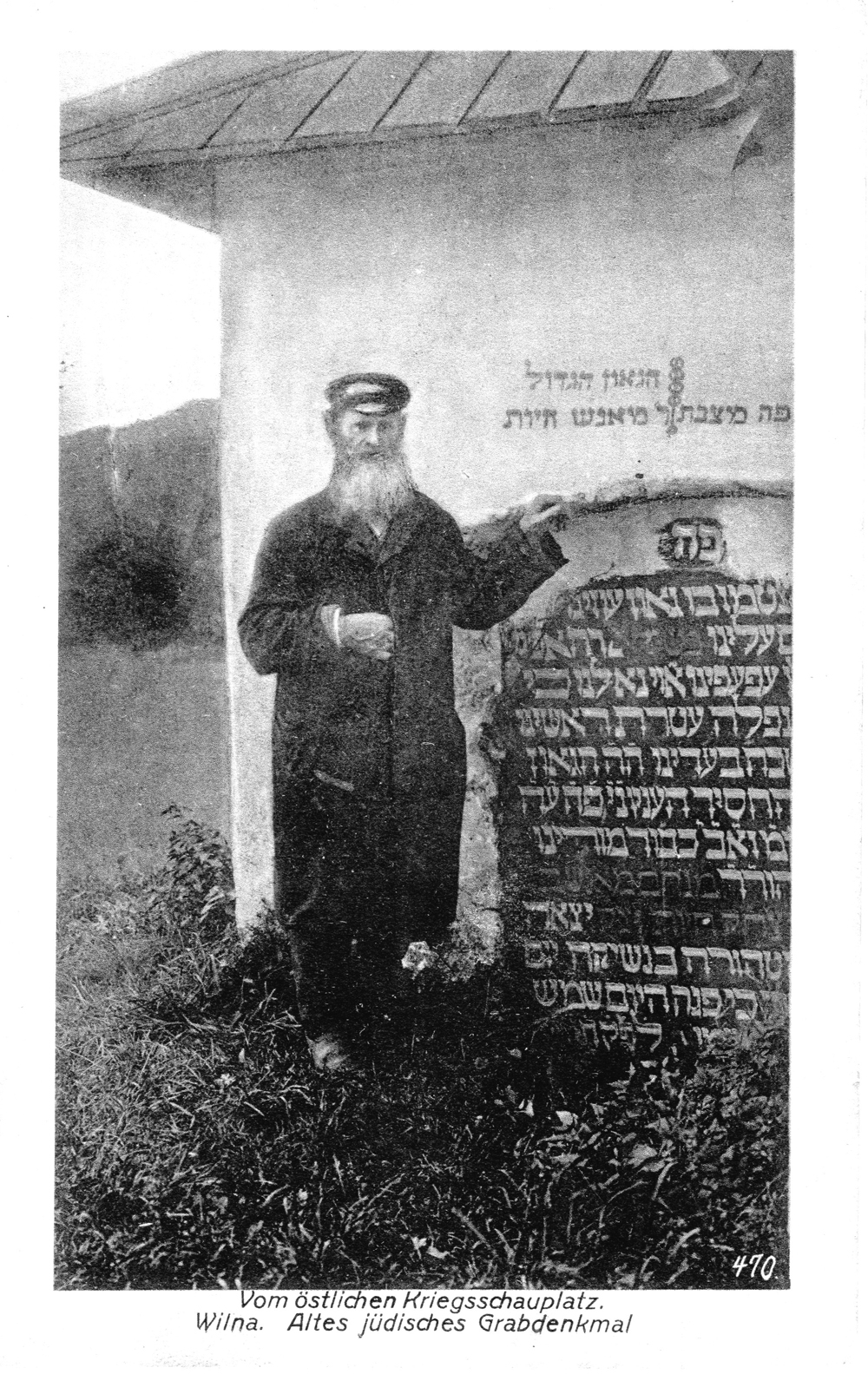
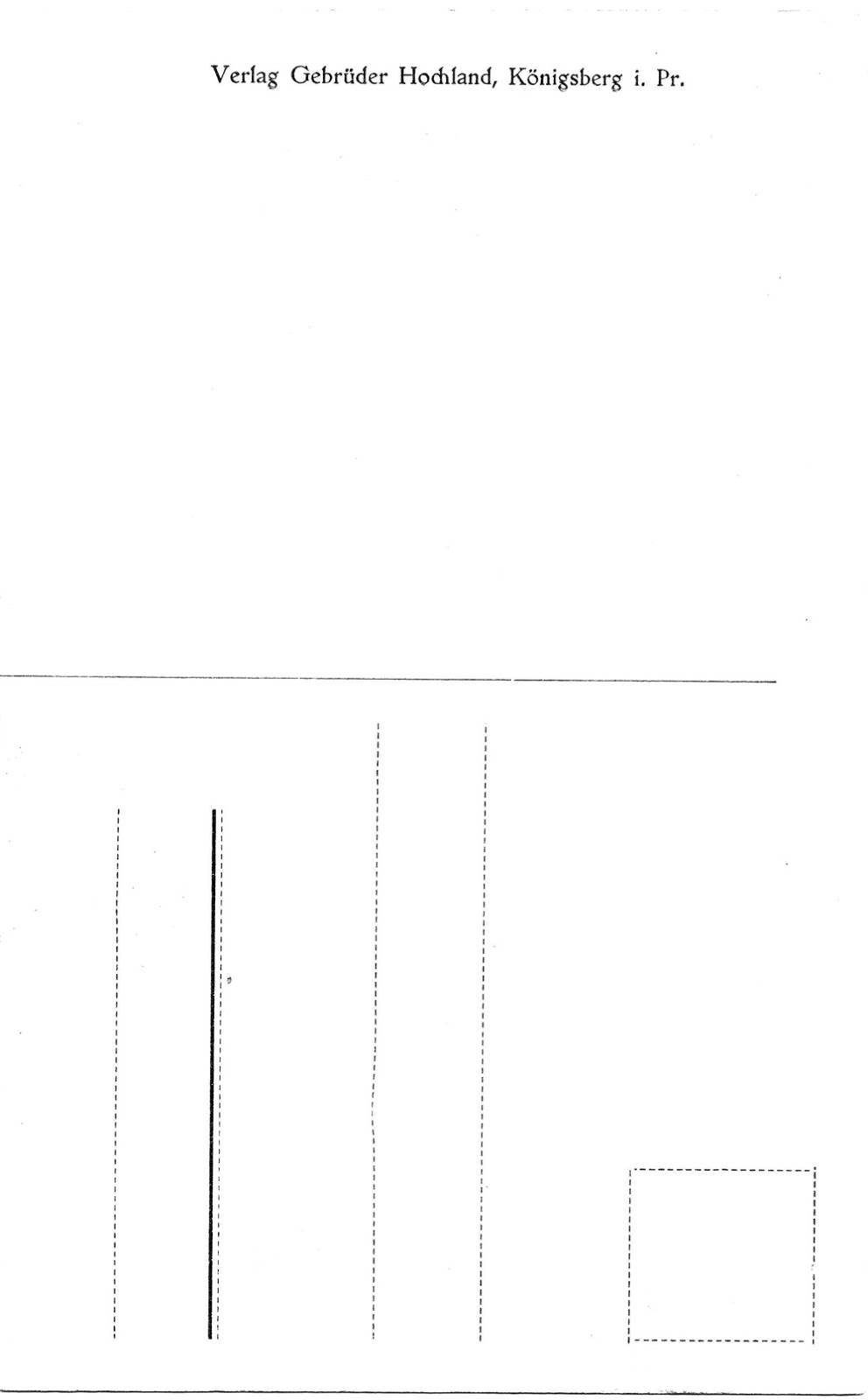
Obverse. The obverse presents a black and white photograph, also standard for its time. It features a tombstone with a Hebrew inscription; a mausoleum behind the tombstone, with a brief Hebrew inscription; and what appears to be a cemetery attendant, with his hand atop the tombstone. Most important, it contains a German heading under the photograph, which reads in translation: “From the Eastern Front of the Theater of War, Wilna, An Old Jewish Tombstone [with Inscription].”

Reverse. The reverse prints the name of the publishing company that produced the postcard: “The Brothers Hochland in Koenigsberg, Prussia.”

Historical Context.

In terms of historical context, the information provided by the postcard (a German heading; Vilna is defined as the eastern front of the theater of war; the postcard was produced in Koenigsberg) can lead to only one conclusion, namely that the postcard was produced on behalf of the German troops that had occupied, and dominated, Vilna during World War I. German troops occupied Vilna on September 18, 1915 and remained in Vilna until the collapse of the Kaiser’s army on the western front, which forced the withdrawal of all German troops in foreign countries at the very end of 1918. Thus, our photograph was taken, and the postcard was produced, during the period just described. Its Sitz im Leben was the need for soldiers to send brief messages back home in an approved format. The ancient sites of the occupied city made for an attractive postcard. (This may have been especially true for Jewish soldiers serving in the German army.)

Due to a wonderful coincidence, a distinguished scholar of Yiddish and a dear colleague, Professor Dovid Katz, recently published a copy of the very same postcard we publish here.[1] Unlike my copy, his copy includes on the reverse side a dated message penned by the German soldier who mailed it, as well as a dated postmark. The message was written on December 3, 1917 and postmarked the next day, on December 4. Thus, we can narrow the timeline somewhat, and suggest that the postcard was almost certainly produced circa 1916 or 1917.

The Old Jewish Cemetery.

The old Jewish cemetery was the first Jewish cemetery established in Vilna. According to Vilna Jewish tradition, it was founded in 1487. Modern scholars, based on extant documentary evidence, date the founding of the cemetery to 1593, but admit that an earlier date cannot be ruled out. The cemetery, still standing today (but denuded of its tombstones), lies just north of the center of the city of Vilna, across the Neris River, in the section of Vilna called Shnipishkes (Yiddish: Shnipishok). It is across the river from, and just opposite, one of Vilna’s most significant landmarks, Castle Hill with its Gediminas Tower. The cemetery was in use from the year it was founded until 1831, when it was officially closed by the municipal authorities. Although burials no longer were possible in the old Jewish cemetery, it became a pilgrimage site, and thousands of Jews visited annually the graves of the righteous heroes and rabbis buried there, especially the graves of the Ger Zedek (Avraham ben Avraham, also known as Graf Potocki, d. 1749), the Gaon of Vilna (R. Eliyahu ben R. Shlomo, d. 1797), and the Hayye Adam (R. Avraham Danzig, d. 1820). Such visits still took place even after World War II.

The cemetery, more or less rectangular in shape, was spread over a narrow portion of a sloped hill, the bottom of the hill almost bordering on the Neris River. The postcard captures the oldest mausoleum and rabbinic grave in the old Jewish cemetery, exactly at the spot where the bottom of the hill almost borders on the Neris River. It was an especially scenic, and historically significant, site in the old Jewish cemetery, and it is no accident that the photographer chose this site for the postcard.

The Tombstone and its Hebrew Inscription.

The tombstone is that of R. Menahem Manes Chajes (1560-1636). He was among the earliest Chief Rabbis of Vilna. Indeed, his grave was the oldest extant dated grave in the Jewish cemetery, when Jewish historians first began to record its epitaphs in the nineteenth century. R. Menahem Manes’ father, R. Yitzchok Chajes (d. 1615), was a prolific author who served as Chief Rabbi of Prague. Like his father, R. Menahem Manes published several rabbinic works in his lifetime, and some of R. Menahem Manes’ unpublished writings are still extant in the Bodleian Library at Oxford University. His epitaph reads:[2]

The Mausoleum and its Hebrew Inscription.

In the old Jewish cemetery, many of the more famous rabbis were buried in mausoleums. All rabbis buried in mausoleums were buried underground. The mausoleum itself served as an honorific place of prayer that a visitor could enter and then pray at the grave of the rabbi of his choice. All tombstones were placed outside the mausoleum, and were affixed to its outside wall, directly opposite the body of the deceased rabbi named on the tombstone (but buried inside the mausoleum). Often, the names of famous rabbis were painted on the outside wall of the mausoleum (much like street signs) identifying who was buried in it. The mausoleums sometimes contained the graves of several famous rabbis. R. Menahem Manes Chajes was buried in the mausoleum that can be seen behind his tombstone. A famous rabbi buried in the same mausoleum was R. Moshe Rivkes (d. 1672), author of באר הגולה on the Shulhan Arukh.[3] The inscription on its wall, and above the tombstone of R. Menahem Manes, reads:

פה מצבת הגאון הגדול ר‘ מאנש חיות

Here is the tombstone of the great Gaon, R. Manes Chajes

The Cemetery Attendant.

What has remained a mystery for more than one hundred years is the identity of the cemetery attendant. We shall attempt to identify him, and to restore him to his proper place in Jewish history.

The reader will wonder how I know that the person in the photograph was a cemetery attendant. Perhaps he was a tourist who just happened to be there on the day the Hochland Brothers Publishing Company arranged for a photograph to be taken for its postcard collection?

Initially, it was simply a hunch, largely due to ephemera, that is, other photos of visitors to the old Jewish cemetery in the interwar period. I have a collection of such photos, and either they feature the tourist (who handed his camera to the tour guide or to the cemetery attendant, and asked that his picture be taken in front of the Vilna Gaon’s tombstone or at the Ger Zedek’s mausoleum), or they feature a cemetery attendant who stands in those places, while the tourist, who knows how to use the camera, takes the photo. The tourists can always be recognized by their garb, which matches nothing worn by anyone else in Vilna. The cemetery attendants, functionaries of a division of the Jewish Kehilla (called Zedakah Gedolah at the time), all wear the same dress, a “Chofetz Chaim” type cap and a long coat, both inevitably dark grey or black. While I am not aware of another old Jewish cemetery photograph featuring the specific cemetery attendant seen in our postcard, his dress is precisely that of all the other cemetery attendants whose photos have been preserved.

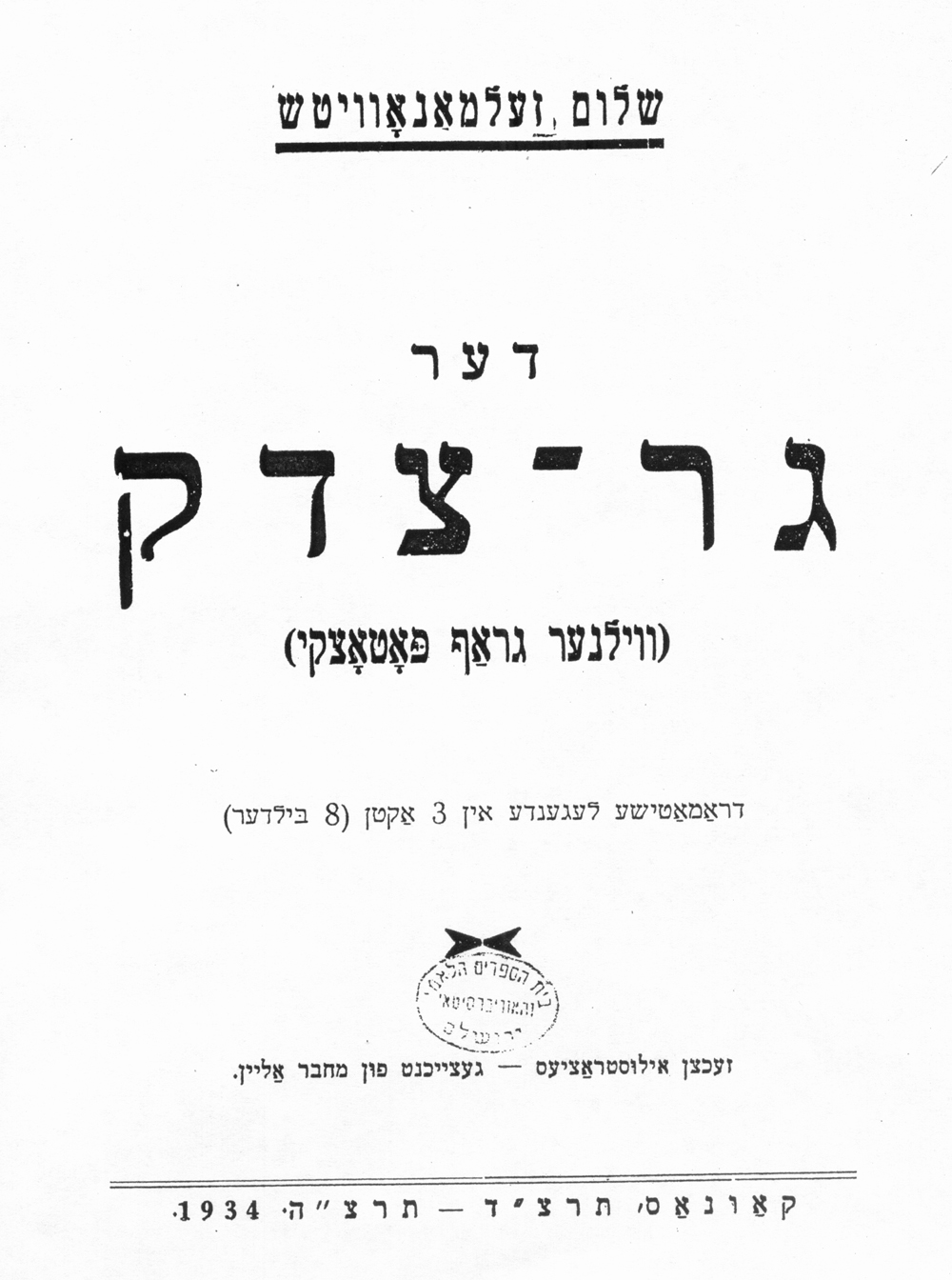
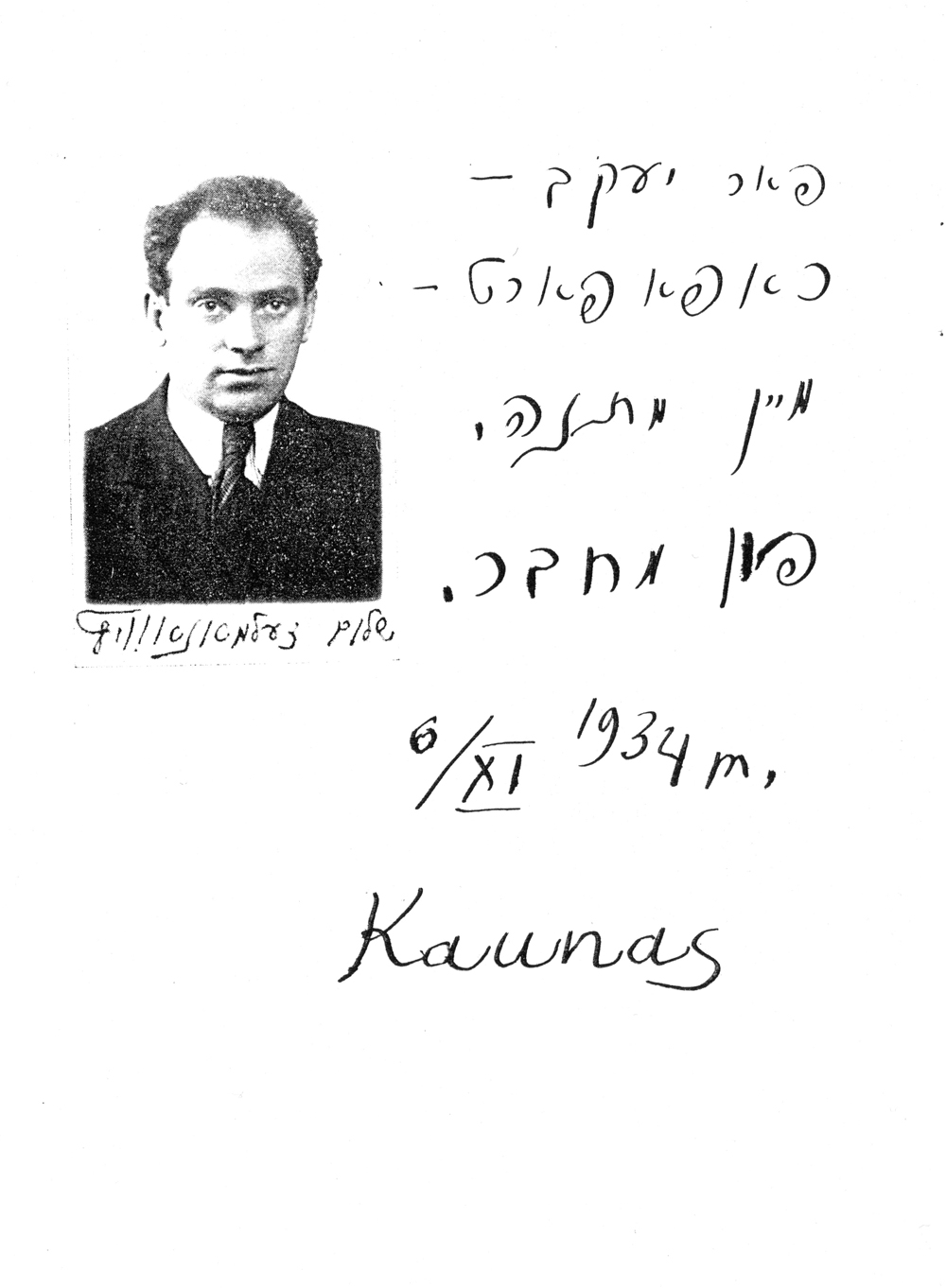
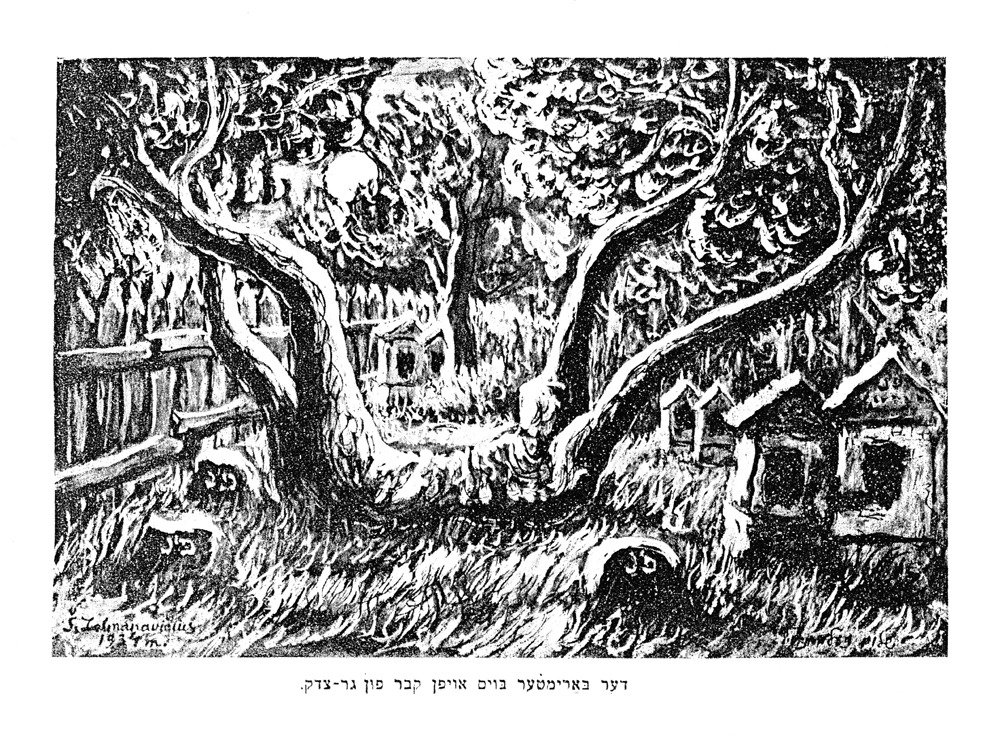
But there is no need for guesswork here. Sholom Zelmanovich, a talented artist and Yiddish playwright, published his דער גרצדקווילנער גראף פאטאצקי  in 1934.[4]

This three-act play commemorates the life and death of the legendary Ger Zedek of Vilna in a new and mystical mode.[5] The volume includes sixteen original drawings by Zelmanovich. Several of the drawings preserve details of Vilna’s old Jewish cemetery with seemingly incredible accuracy. Thus, for example, Zelmanovich depicts the northern entrance gate to the old Jewish cemetery, as well as the nearby Jewish caretaker’s house on the cemetery grounds, even though few photographs are extant that even begin to capture the details of those sites. His depiction of the Ger Zedek’s grave (and the human-like tree that hovered over it) is perfectly located in the south-eastern corner of the old Jewish cemetery, and is surrounded by the wooden fence that existed in that corner prior to 1926. Only someone who spent quality time in Vilna’s old Jewish cemetery could have known exactly where to place the entrance gate, the caretaker’s house, and the Ger Zedek’s grave.
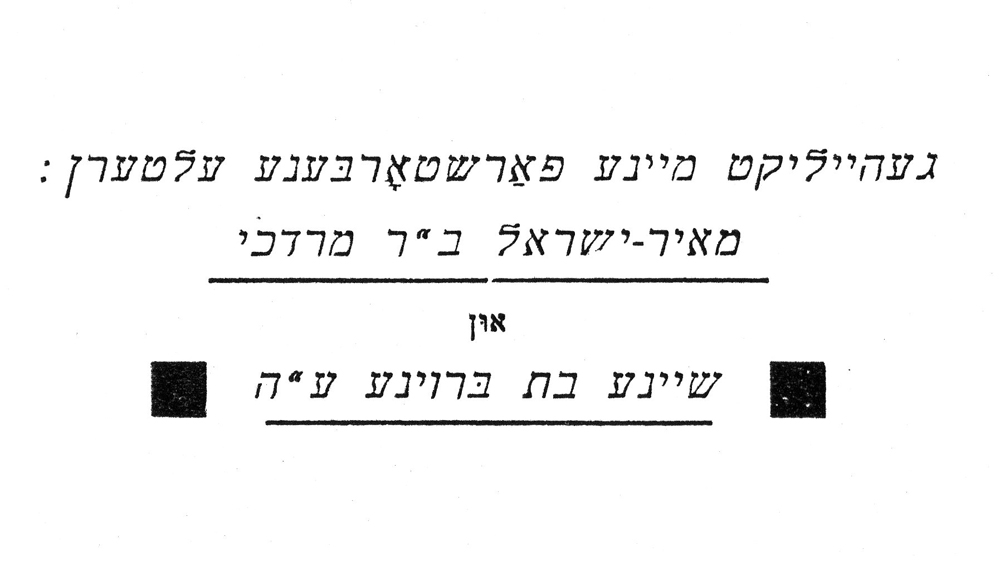
One other matter needs to be noticed. Zelmanovich dedicated the volume in memory of his deceased parents, Meir Yisrael son of Mordechai and Sheyne daughter of Broyne.[6]
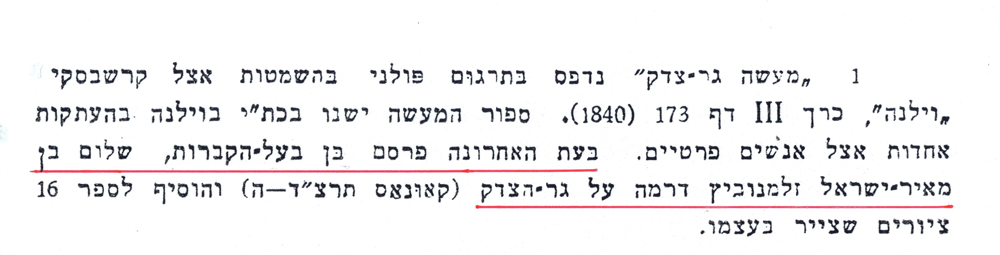
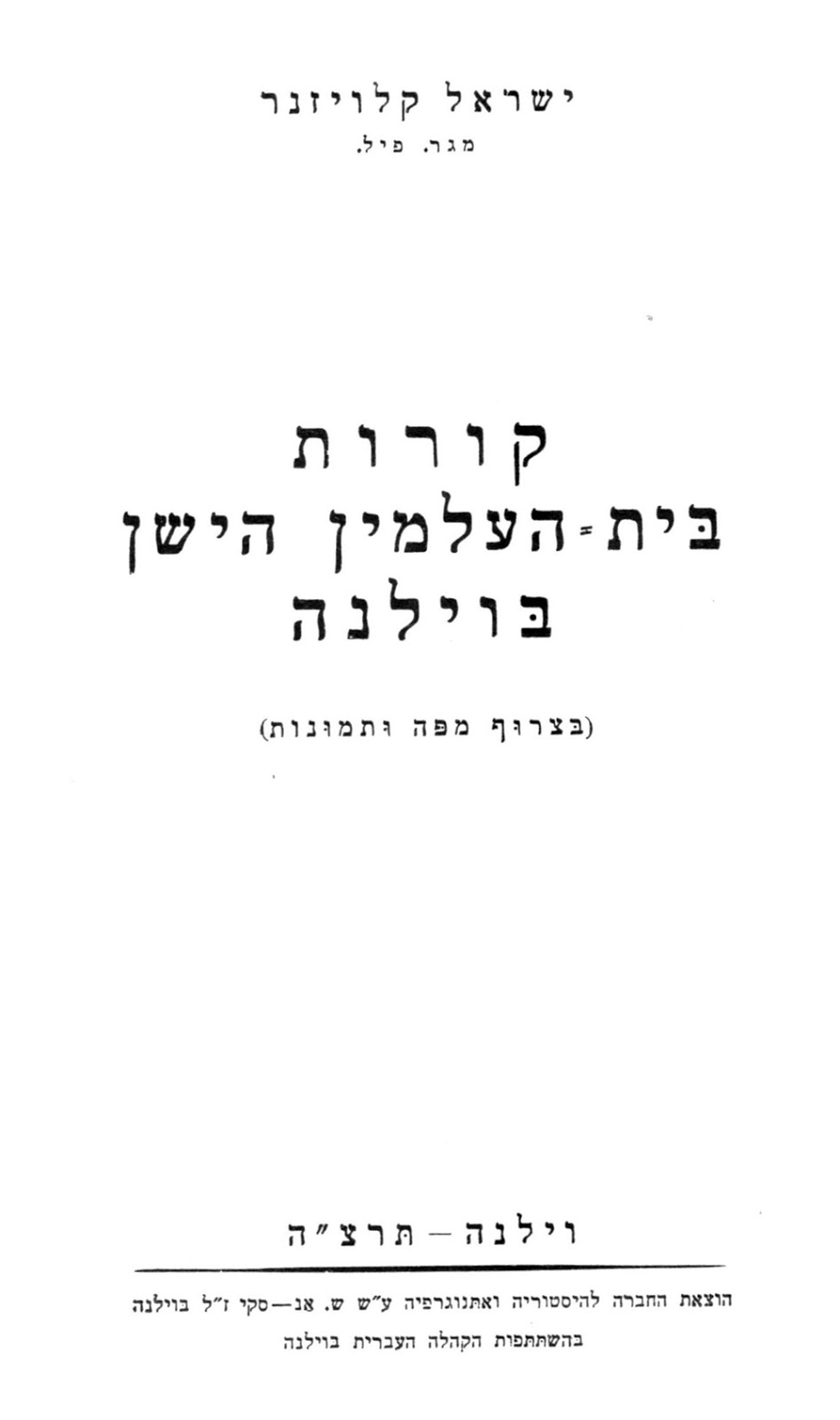
In the summer of 1935, the municipal authorities of Vilna, then under Polish rule, announced their plan to demolish Vilna’s old Jewish cemetery and replace it with a soccer stadium. Vilna – and worldwide – Jewry did not stand idly by. Instead, they engaged in an extensive, and ultimately successful, battle against the municipal authorities. As part of its efforts to win over the municipal authorities, the Vilna Jewish community charged a young Jewish scholar, Israel Klausner,[7] with writing a history of the old Jewish cemetery. It would offer clear documentation and prove beyond doubt that various Polish kings and municipal authorities throughout the centuries had authorized the Jewish community to construct the cemetery and maintain it. The cemetery was legally the property of Vilna’s Jewish community. Klausner’s monograph, entitled קורות בית-העלמין הישן בוילנה (Vilna, 1935), includes a discussion of the Ger Zedek’s grave. In a footnote,[8] Klausner mentions in passing Sholom Zelmanovich’s “recently published drama on the Ger Zedek,” and adds that Zelmanovich was the son of the caretaker of the old Jewish cemetery (Hebrew: בן בעלהקברות ), Meir Yisrael Zelmanovich! The plot thickens.
The full force of the Hebrew term בעלהקברות is not really captured by the English term “caretaker.” There were a variety of cemetery attendants who worked in the old Jewish cemetery in various capacities (such as guiding visitors and leading them to the graves they wished to visit, reciting prayers at the graves, ground-keeping, repairing broken tombstones and re-inking their inscriptions, and guard duty). But one cemetery attendant was in charge of all the other attendants, and as we shall see, he and his family lived in the house on the cemetery grounds. He was called: בעלהקברות, perhaps best rendered as: “Cemetery Keeper” or “Managing Director” of the old Jewish cemetery. We have established that Meir Zelmanovich served in that capacity. But who was he when did he live?

Meir Zelmanovich.

Sadly, almost nothing is known about the life of Meir Zelmanovich. He published no books and wrote no essays. As best I can tell, only one newspaper report mentions his name during his lifetime.[9] The report itself is significant. It records a complaint made by Meir Zelmanovich in 1919 that the Polish legionnaires had desecrated the old Jewish cemetery. But it would be Zelmanovich’s tragic death in 1920 that would perpetuate his memory. Here, we need to provide some historical context. Israel Cohen begins his discussion of the impact of World War I on Vilna, as follows:[10]

Within the small space of eight years, from 1914 to 1922, the Jews of Vilna tasted of the blessings of nine different governments, and suffered from a combination of other evils even more noxious. They became a prey to economic depression, military requisitions, unemployment, famine and disease; thousands of them were subjected to forced labor, imprisonment, plunder and brutal attacks; and physical and material deterioration inevitably engendered a certain degree of social demoralization. All the variegated differences of principle, of religious outlook and sociological doctrine, were now forgotten in the inferno created by the common foe. The long protracted fight for civil and political rights had to yield to the more primitive and desperate struggle for mere existence.

Almost certainly, the greatest concentration of Jewish suffering in this period came in April of 1919, when the Polish legionnaires unleashed a pogrom against Vilna’s Jews. Israel Cohen describes the horrors that followed:[11]

The [Polish] legionnaires[12] defiled and desecrated the [old Jewish] cemetery, smashed the tombstones, and opened the graves (including some of Vilna’s earliest rabbis) in the belief that they would find in them arms and money. Disappointed in their search, the Poles transferred their attentions from the dead to the living and ran amuck in the Jewish quarter. For three days they seized Jews in the streets, dragged them out of their homes, bludgeoned them savagely, and looted their houses and shops. About 80 Jews were shot, mostly in the suburb of Lipuvka, where some were ordered to dig their own graves; others were buried alive, and others were drowned, with their hands tied, in the Vilia [now: Neris] River… All sorts of outrages were committed in those days by the Poles in celebration of their victory. They tied a Jew to a horse and dragged him through the streets for three miles. They took a sadistic delight in cutting off the beards and earlocks of pious Jews. They even arrested, assaulted and humiliated Rabbi Rubinstein and Dr. Shabad. Altogether, thousands of Jews in Vilna, as well as in Lida and Bialystock were imprisoned in various concentration camps where they were ill fed and beaten, and where they suffered from hunger and typhoid. Moreover the total loss due to destruction and pillaging of Jewish people in the pogrom, in Vilna alone, was estimated at about 20 million roubles (about $10,000,000).

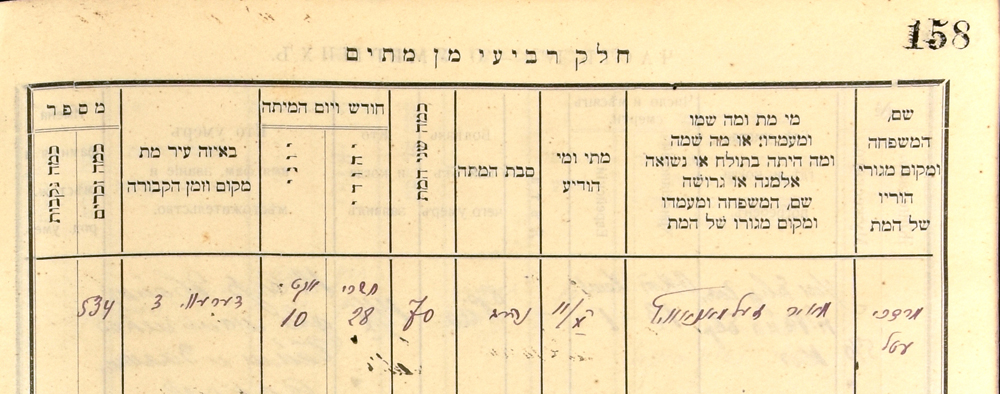
Polish rule of Vilna came to an end when the Russians recaptured Vilna on July 14, 1920. Russian rule lasted for six weeks, after which the Russians retreated and left Vilna in the control of the Lithuanians. Lithuanian rule lasted until October 8, 1920, when the Poles once again recaptured Vilna. One can only imagine the fear that gripped the Jewish community in Vilna, when they heard the sounds of the approaching Polish legionnaires. In fact, hundreds (some claim: thousands) of Vilna’s Jews fled on October 8 to Kovno, then part of Independent Lithuania.[13] Indeed, there was what to fear, for the Polish legionnaires were free again to wreak havoc with Jewish lives. And although the severity of the pogrom of 1919 did not repeat itself, the indiscriminate murder, rape, and looting of Jews that took place in Vilna between October 8-10, 1920 was, at least in the eyes of the victims, yet another pogrom.[14] Briefly, eye-witness Yiddish accounts[15] record that at least 6 Jewish men and women were murdered, numerous women were raped, and some 80 Jews were mugged and robbed. No one was brought to justice for committing these crimes! On October 10, 1920 Meir Zelmanovich, Cemetery Keeper of the old Jewish cemetery in Vilna was murdered by the Polish legionnaires. He was 70 years old when he died. The official Jewish record of his death lists his home address as “Derewnicka 3.” This is the address of the house on the grounds of the old Jewish cemetery. It is no wonder that Sholom Zelmanovitch could depict so vividly the northern entrance gate to the cemetery, its nearby caretaker’s house, and the human-like tree hovering over the Ger Zedek’s grave. His childhood playground was the old Jewish cemetery in Vilna.
On the picture postcard from 1916-1917, one sees an elderly Jew. One possibility is that it depicts none other than Meir Zelmanovitch, the Cemetery Keeper of the old Jewish cemetery until his death in 1920 at age 70. I suspected that this was the case, but could not prove it until recently — when a small miracle occurred.

Miracles Sometimes Do Occur.

In March of this year, out of the clear blue sky, I was contacted by Laurie Cowan, who introduced herself as a great-granddaughter of Meir Zelmanovich! She basically was interested in any information I could provide about her great-grandfather that she didn’t already know. I was delighted to make her acquaintance, but wondered what led her to me. It turns out that both of us were seeking information about the same person – Meir Zelmanovich – from the Lithuanian State Historical Archives in Vilnius. An alert researcher at the Archives noticed this, and made the “shidduch” between us. I shared with Laurie whatever I knew about her great-grandfather. In turn, I asked her to send me copies of whatever documents she had relating to her great-grandfather. She sent me a scan of the following photograph of her great-grandmother and great-grandfather, Sheyne[16] and Meir Zelmanovich:
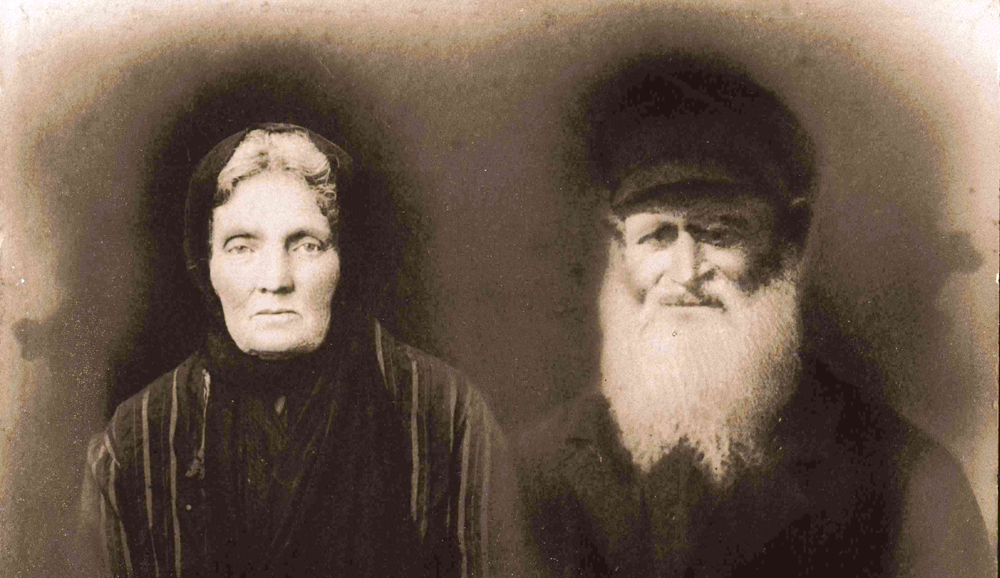
Never has it been so easy to identify an unidentified picture on a one-hundred year old picture postcard! One suspects that the picture postcard company representative, and a photographer, met with the Cemetery Keeper Meir Zelmanovich at the old Jewish cemetery in Shnipishok. He led them to the mausoleum of R. Menahem Manes Chajes, and was asked to pose at the tombstone just outside it. He graciously accepted the invitation. This may well have been the last photo taken of Zelmanovich, and it preserves, together with the photo provided by Laurie Cowan, the likeness of a martyr who fell during the October 1920 mini-pogrom in Vilna.[17]

At least six Jews were murdered between October 8-10 in 1920 in Vilna. They died for one reason only, namely, because they were Jews. Such Jews are regarded as martyrs and their names, at the very least, deserve to be recorded and remembered. Until now, none of the names of the Vilna martyrs of 1920 have been published in any public Jewish record, whether in a contemporary Jewish newspaper, or a Jewish historical essay or book, or an online posting. Having examined the extant records in the Lithuanian State Historical Archives, I have been able to retrieve the 6 names of the Jewish victims who were murdered in Vilna in October of 1920. In each case, the Jewish Kehillah records of Vilna in 1920 state clearly in Hebrew that the cause of death was either נהרג or נהרגה (i.e., murdered). The names are:

1. Shmuel ben Mendel Katz, age 56, died October 9.

2. Etel Natin, age 36, died October 9.

3. Basya Natin, age 32, died October 9.

4. Rokhl Blume Shuster, age 45, died October 9.

5. Meir Zelmanovich, age 70, died October 10.

6. Shlomo Abramovich, age 17, died October 12.[18]

May the memory of these martyrs be forever for a blessing! [19]

NOTES:

עם הספר, the People of the Book the world over, mourn the death of R. Shmuel Ashkenazi in Jerusalem, at the age of 98. He was שר הספר, the consummate master of the Hebrew book. Bibliographer, bibliophile, and book collector, his encyclopedic knowledge of all of Hebrew and Yiddish literature remains unparalleled in our time. His most recent contributions appeared in three massive volumes, replete with some 1,794 pages of immaculate scholarship. He never wasted a word; he wrote with precision and parsimony. Among his many accomplishments, he edited the Kasher Passover Haggadah, one of the most significant scholarly editions of the Passover Haggadah ever published. He was largely responsible for the single most accurate bibliography of Hebrew books ever produced, מפעל הביבליוגרפיה העבריתThe Bibliography of the Hebrew Book 1473-1960. Aside from his scholarly distinction, R. Shmuel Ashkenazi wrote in an elegant Hebrew with its own special charm. Not only did he advance discussion, but he did so in an aesthetically pleasing manner. For those of us who knew him personally, he evinced the same charm in his personal relationships that he did in his writings. He set a standard of excellence that we can only strive to emulate, but never really replicate. יהא זכרו ברוך!

This essay is dedicated to his memory, a token of appreciation for all he has taught me.

[1] Dovid Katz, “World War I Postcard of the Grave of Rabbi Menachem Manes Chayes (1560-1636) in the Old Vilna Jewish Cemetery,” Defending History (11 March 2020), available here) A copy of our postcard can also be seen online at ‘YIVO 1000 Towns’, record ID 10743 (http://yivo1000towns.cjh.org).
[2] For a fuller discussion of R. Menahem Manes Chajes and his epitaph, see S. Leiman, “A Picture and its One Thousand Words: The Old Jewish Cemetery of Vilna Revisited,” The Seforim Blog, January 14, 2016, especially notes 7-11, online here.
[3] Aside from his pivotal commentary on R. Joseph Karo’s Shulhan Arukh, R. Moshe Rivkes was a great-great grandfather of the Vilna Gaon.
[4] Precious little is known about Sholom Zelmanovich (1898-1941). See the brief biographical entry in לעקסיקאן פון דער נייער יידישער ליטעראטור (Martin Press: New York, 1960), vol. 3, column 670, which mistakenly lists him as being born in a town near Kovno, circa 1903. He was born in Vilna in 1898 (JewishGen) and died during one of the first Nazi aktions in the Kovno Ghetto.
[5] In general, see Joseph H. Prouser, Noble Soul: The Life and Legend of the Vilna Ger Tzedek Count Walenty Potocki (Gorgias Press: Piscataway, 2005). Prouser’s excellent monograph is a study of the many literary reworkings of the legends surrounding the Vilna Ger Zedek, with primary focus on 20th century Jewish literary contributions. Strangely, he offers no discussion of Zelmanovich’s contribution.
[6] On the feminine Yiddish name “Broyne,” see Alexander Beider, Dictionary of Ashkenazic Given Names (Avotaynu: Bergenfield, 2001), pp. 484-486.
[7] Klausner (1905-1981) settled in Palestine in 1936 and continued to be a prolific author of studies and books on the history of Vilna’s Jewish community. Aside from several important monographs, like his history of the old Jewish cemetery, he wrote a two-volume history of Jewish Vilna entitled 1939-1881 וילנה ירושלים דליטאדורות האחרונים (Ghetto Fighters’ House: Tel-Aviv, 1983), to which a third volume treating 1495-1881 was added posthumously, based largely on studies previously published by Klausner.
[8] קורות ביתהעלמין הישן בוילנהp. 45, note 1.
[9] See Vytautas Jogela, “The Old Jewish Cemetery in the Nineteenth and Twentieth Centuries,” Lituanus, vol. 61, no. 4 (2015), pp. 81-82.
[10] Israel Cohen, Vilna (Jewish Publication Society: Philadelphia, 1943), pp. 358-359.
[11] Ibid., pp. 378-379.
[12] Cohen regularly spells the word: “legionaries.” For the sake of consistency, I have spelled the word “legionnaires” throughout this essay.
[13] See, e.g., Boaz Wolfson, “מיטלליטע” in פנקס פאר דער געשיכטע פון ווילנע אין די יארן פון מלחמה און אקופאציע (B. Zionson: Vilna, 1922), column 387.
[14] There are probably as many definitions of “pogrom” as there are scholars and politicians. Since it is unclear whether the crimes committed on October 8-10, 1920 were planned and implemented by either a government or a political action committee, and since the duration of the attacks was short and rather swiftly brought under control, historians are reluctant to refer to the events that occurred on October 8-10, 1920 as a pogrom. On the other hand, to label those events a mere “disturbance” does not begin to capture the malevolent intent of the perpetrators directed specifically against Jews, and does not address the intensity of Jewish suffering at the time. For some of the different views regarding the definition of “pogrom,” and how the term has been manipulated by political interests, see Szymon Rudnicki’s forthcoming essay “The Vilna Pogrom of 19-21 April 1919,” to appear in Polin 33 (2020). Professor Rudnicki kindly allowed me to see a pre-publication copy of his lucid and informative essay.
[15] Wolfson, loc. cit. Cf. Jacob Wygodski, אין שטורם (B. Kletzkin: Vilna, 1926), pp. 217-221.
[16] Sheyne Zelmanovich died in Vilna on October 26, 1921, at age 68 (JewishGen). She lived in her home on the old Jewish cemetery grounds until her death. In a personal communication, Laurie Cowan informed me that the Zelmanoviches had 10 children who survived to adulthood. The 6th child, Beirach (popularly called: Berik; and later, Ben), was her grandfather, an older brother of Sholom mentioned above.
[17] The only other extant likeness of Meir Zelmanovich (known to me, and recovered on July 15, 2020) is an undated passport photo (circa 1916) preserved in the Lithuanian State Historical Archives. During the German occupation, all residents of Vilna were required to have – and to carry at all times – a German passport (we would call it: an Identity Card). Meir Zelmanovich’s German passport photo confirms the identity and authenticity of the photos of Zelmanovich published in this essay. All three photos are of one, and the same, person.
[18] One suspects that Abramovich may have been shot or beaten on October 9 and 10, like the others, but did not die from his wounds until the 12th.
[19] This essay could not have been written without the help of Regina Kopilevich, researcher (and tour guide) extraordinaire, who located whatever documents I sought at the Lithuanian State Historical Archives (Lietuvos Valstybes Istorijos Archyvas) in Vilnius. I am indebted to the librarians at the Archives for allowing her and me to examine these and other documents during my visits to Vilnius. Next to Google, JewishGen is a modern Jewish historian’s best friend, and we are grateful to all who contribute to making JewishGen the great historical resource that it is. Matt Jelen’s careful reading of an earlier draft has significantly improved the final version. I alone am responsible for whatever errors appear in this essay.

An Incident of “Pilegesh B’Givah” in 19th Century Germany

AN INCIDENT OF “PILEGESH B’GIVAH” IN 19TH CENTURY GERMANY
by Eli Genauer
I recently purchased an antique Hebrew book for less than the price of a dinner at a moderately priced restaurant. This particular edition is what some would call a “common” — meaning it is the 36th edition (the fourth edition of a revised version) of this book and it was printed in the mid-19th century. Generally, the market does not assign a high price for books like these, but they can be a treasure trove of knowledge and information.
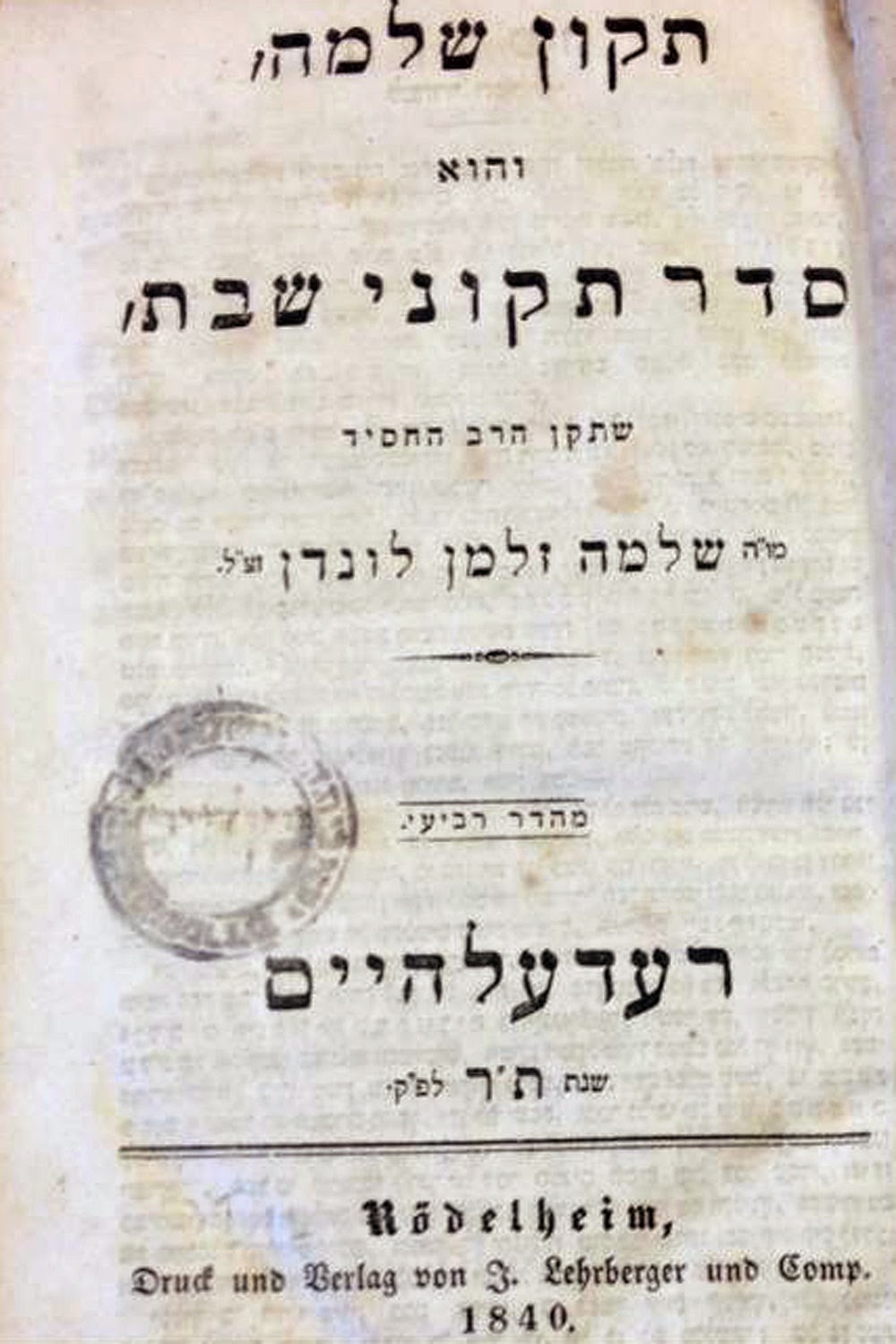
The work is Tikkun Shlomo and is primarily focused on the Shabbos liturgy.  I reproduced the title page:
Many will no doubt recognize the name of the compiler, Shlomo Zalman London (1661-1748) who wrote the book “קהלת שלמה”and that it was reprinted thirty times in the next 200 years.  
Tikkun Shlomo was first published in Amsterdam by Dr. Naftali Hertz HaLevi in 1733.  Dr. Levi published many a storied book, including the first edition of Mesilat Yesharim and the edition of the Shu”t HaTashbetz that is alleged (erroneously) to have been cosigned to flames.  According to Friedberg, when Dr. Levi published the Tikun Shlomo, not much else was being published in Amsterdam due to the effect of the Thirty-Year War.[1]  The Tikkun Shlomo was very popular, going through almost 40 editions by the late 19th century. Heidenheim expanded this work in 1835, and the edition I purchased was the fourth Heidenheim edition (two of the three were published in Roedelheim and the other in Lemberg).  
Things get off to a wonderful start in this book with the Hakdamah which is indicated to come from the third edition. In it, the unnamed editor pays tribute to his mentor Wolf Heidenheim Z”L and maintains that he has followed in his footsteps in all matters because “anyone who follows him will not err”. The editor only refers to himself at the end of the Hakdamah as “HaTzair”, but he leaves us an unmistakable hint as to his identity. Before we get to that, let us see what else he includes in this “Hakdamah”
ויהי מימים,ויקם עוד בּישׂראל פּורץ גדר,וישׁחת דברים נעימים, ויוסף עוד להרוס חומת שׂפת עבר ולדבּר תועה אשר לא כּדת. כּי פּרץ מצפון בא בא, ותפתח הרעה, וידפיס אישׁ אחד את המחזורים ב׳האננאפער׳, ויעבור חק, ויהפוך וישׁנה מדעתו את דברי התפילות ופיוטים, ויעקש ויעקל מאוד כמעט בכל דף ודף, ותהי זמירת ישׂראל בידו מעין משחת ומקור נרפשׁ, אשה יפה וסרת טעם, כּי שנה את טעמה ויתעמר בה וימכרה בּכּסף, וכן לא יעשׂה.
He takes great offense to a certain Machzor printed by “one man”. The Machzor to which he referring to is known as “Ordnung der Oeffentlichen Andacht für die Sabbath und Festtage des Ganzen Jahres, nach dem Gebrauche des Neuen Tempel-Vereins”, otherwise known as “Seder ha-‘Abodah, Minhag Ḳehal Bayit Ḥadash” printed in Hamburg (not Hanover) in 1819. Two editors are listed:  Seckel Isaac Fraenkel and Meyer Israel Bresslau. It was the new prayer book of the Hamburg Reform Temple dedicated in 1818.  To paraphrase what he writes about this effort: “ a great evil has descended from the north, one that has been perpetrated by a man who published Machzorim in the city of Hanover ( Hamburg ). In his hands, the prayers, which are like a beautiful  woman , are now left with no personality. His purpose was to destroy the Hebrew language, the prayers as we know them, and Judaism itself.”


He continues by writing that he has authored a work Zichron Livnei Yisroel ( Altona 1819) in which he lays out his war against these Machzorim.[2] The title incorporates this explanation:
זה ימים יצא בדפוס קונטרס מיוחד לתפילת ערבית ושחרית לשבת, ומעתיקי תפלה הזאת עברו גבול אשר גבלו הראשונים, גרעו והוסיפו כחפץ לבבם … חלילה … לשנות מסדר תפלתינו / … דברי … עקיבא בר”א ברעסלויא, ראב”ד פה ק”ק אלטונא
This was Rabbi Akiva Wertheimer (1778-1835), the Rav of Altona, Germany, today part of the city of Hamburg. He wrote “Zichron Livnei Yisroel” and was the editor of our edition of “Tikun Shlomo”. His opposition to the new Reform prayer service is noted in a book called “Shnos Dor V’Dor” printed in Jerusalem by Artscroll/Mesorah in 2004. It records the following that occurred in 1819 which coincides with the printing of his book “Zichron Livnei Yisroel”:
בשנת תקע״ט, עוד קודם להתמנורנו, בקום המחדשים ״אנשי ההיכל״
הרפורמי דהמבורג לשנות את סדרי התפילה היה הוא הראשון אשר יצא כנגדם והזהיר את כל הקהילות סביבות אלטונא מפניהם.
Continuing in the Hakdamah to Tikun Shlomo, we find that Rav Wertheimer has launched a campaign against the reformers by adding that he has sent this out broadside everywhere to warn others of this assault on tradition. He does this brilliantly by paraphrasing a Pasuk in Tanach ( Shoftim 20:6) which deals with the tragic story of “Pilegesh B’Givah” an incident which almost tore the Jewish people apart.
The Pasuk reads:  וָאֹחֵז בְּפִילַגְשִׁי, וָאֲנַתְּחֶהָ, וָאֲשַׁלְּחֶהָ, בְּכָל-שְׂדֵה נַחֲלַת יִשְׂרָאֵל:  כִּי עָשׂוּ זִמָּה וּנְבָלָה, בְּיִשְׂרָאֵל.
His paraphrase reads:
ואוחז בפּילגשׁו ואנתחה ואשׁלחה בכל גבול ישׂראל, למען יראו זקני עם וקציניו, והסירו גם את המכשלה הזאת מקרבּם
The full text of the broadside was published in Dukes, AW”H leMoshav, Cracow: 1903, 104-05.  Additionally, the National Library of Israel has a copy (perhaps that of Israel Mehlman, see his catalog Ginzei Yisrael, no. 1743).  The broadside is signed, Akiva br”a Bresslau without additional identifiers, i.e. the son of Avigdor Wertheimer.  As Dukes notes, Graetz mistakenly attributed this work to a different Akiva, Akiva Eiger.  But he was not the only one to publish against the Hamburg Temple and its prayer book in Altona that year.  The work, Eleh Divrei ha-Brit, was also published in Altona in 1819 and it contains, among others, the position of the Hatam Sofer.  
The battle was waged by both sides, and Meyer Israel Bresslau, one of the editors of the Hamburg prayer book, that same year responded with Herev Nokmat (available online here).  The other editor, Fraenkel, in the prayerbook includes a defense of the changes[3].  
As with many editors of Siddurim, Rav Wertheimer extols the exactness of his edition, claiming that he has fixed many of the errors that have crept into previous Siddurim. Specifically, he addresses the text of Mishnayos Shabbos which appeared in many Siddurim and which he has carefully edited especially when it comes to the “Nekudos”.
He continues and states that when it comes to words of foreign origin, such as in Greek, Latin or Arabic, he has also made sure that the “Nekudos” are correct reflecting the proper pronunciation in those languages.
Unfortunately this is not a simple task and this example will illustrate the difficulty in doing so.
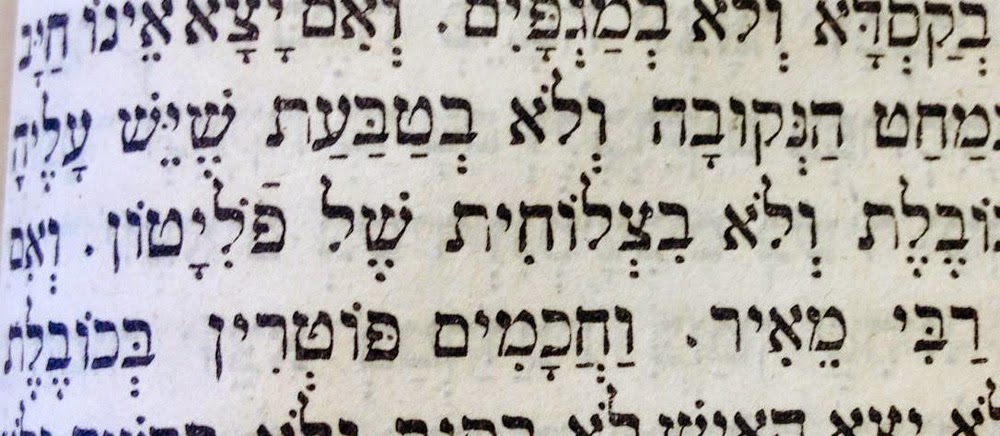
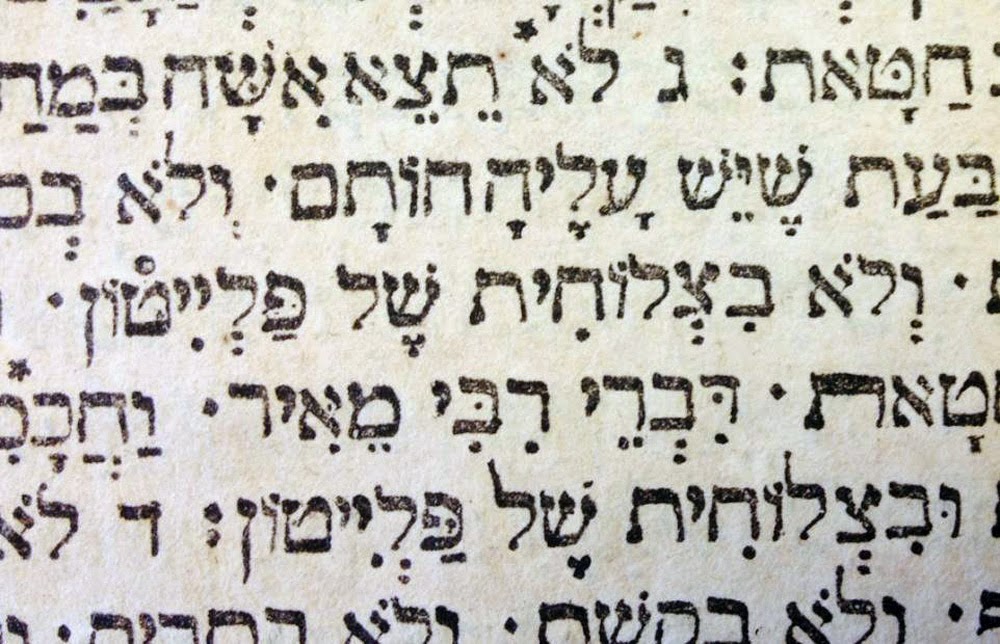
The laws of what a woman may or may not carry outside on Shabbos are discussed in Shabbos 6:3. Among the items prohibited is something called a “Tzlochis Shel Palyiton”, a flask of “Palyiton.” Jastrow defines this word as “an ointment or oil prepared from the leaves of spikenard”. He adds that its origin is the Latin word “foliatum”. The Latin Lexicon website spells this word foliātum and gives the exact same definition. So how should this Latin word be spelled in Hebrew?
Rav Wertheimer indicates that it should be pronounced something like “Folia’tone”which is pretty close to the Latin word except for there being an “n” sound at the end of the word instead of the “m” sound.
I have a Mishnayos printed in Pisa during the same time period (1797) which makes it look more like “Pal’yi’tone”:
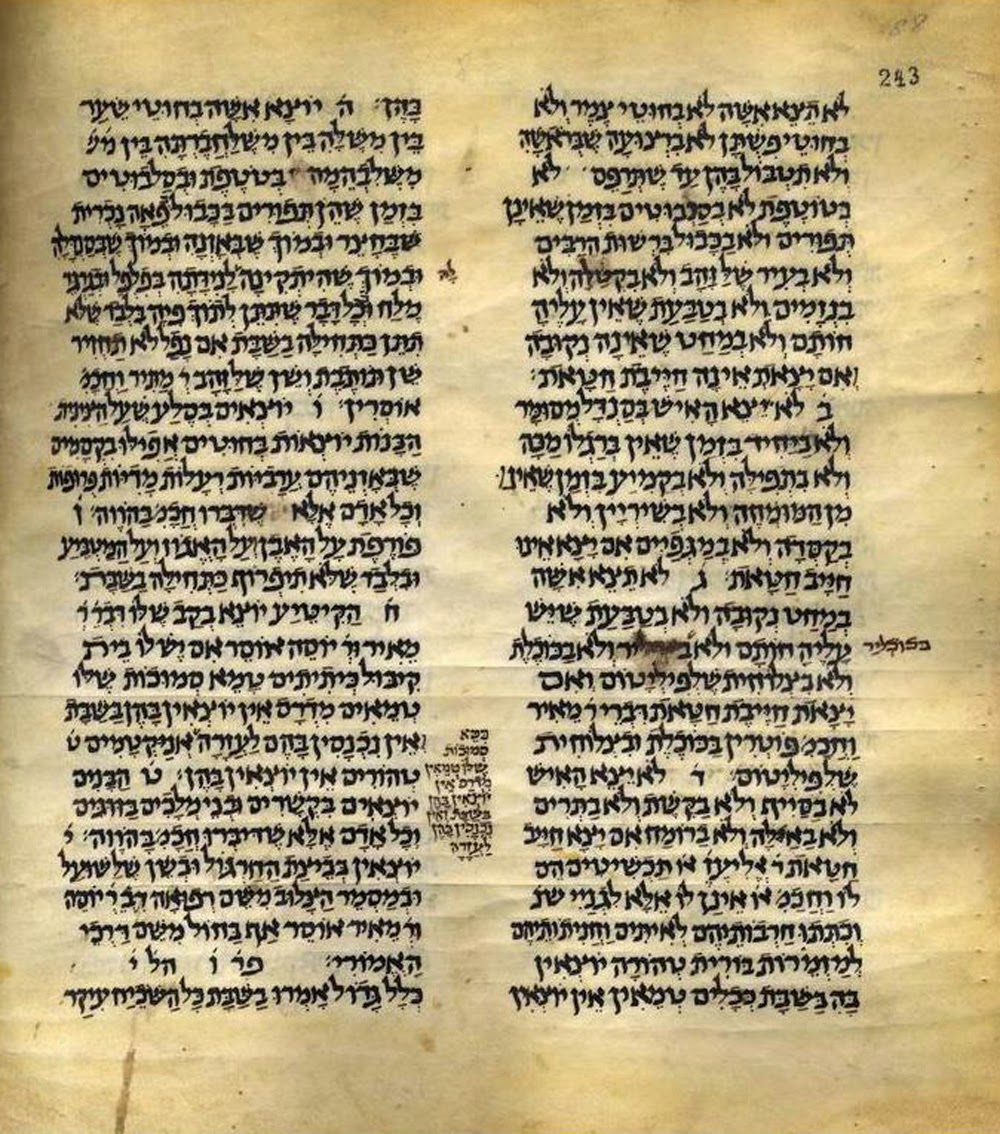
Two very old manuscripts of the Mishneh shed some light on how the word was originally spelled. One of the most famous is known as Codex Kaufmann ( MS Kaufmann A 50) which was written in 10th or 11th century Palestine. There we find the word looking more like “Pil’Ya’Tome”, with an “m” sound at the end:
The Parma manuscript referred to as MS Parma, De Rossi 138 written in 1073 has it the same as Kaufmann.
In recently printed Mishnayos such as from Feldheim, Artscroll, Steinsaltz, and Blackman, the word is spelled “פלייטון” with either a Patach ,Chirik, or “Shva”  under the “Peh”, or “פולייטון”, which looks more like Rav Wertheiner’s rendering.
One thing is clear- it is sometimes very difficult to write a foreign word with Hebrew letters and vowels, and it is also difficult to ascertain which version is “correct”.
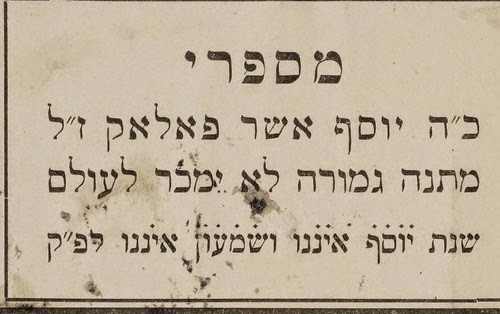
Another wonderful aspect to the book that I bought was learning about the man whose name is embossed on the front cover. He is listed as יוסף אשר בן כ״ה (כבוד הרב) משה פאלאק   
We know a bit about Yosef Asher Pollock from some of the other books and manuscripts he owned. The following two citations are from the online catalogue of the Israel National Library:
1. A manuscript written in the 19th century by Chaim ben Yaakov Abolofia.
תקנות קהלת איזמיר. ‬
Los Angeles – University of California 960 bx. 1.9
ותו הספר: “מספרי יוסף אשר פאלאק ז”ל” משנת תרפ”ה. ‬
From this record we know that he had passed away before 1925 and that the manuscript is now in Los Angeles.


2. A manuscript written in the 18th century
(ספר הכונות (חלק שבת ומועדים. 
Amsterdam – Universiteitsbibliotheek MS Rosenthal 567
בראשו תו ספר של הבעלים “יוסף אשר פאלאק
This rare manuscript has been scanned and is available online. The first page looks like this:
From this one we also learn quite a bit more about Yosef Asher Pollock because it contains this bookplate on the inside front cover

We surmise from here that this was not the only book he had that was donated, as someone went to a lot of trouble composing and printing such a heartfelt donation plate. (“ Yosef is not here, nor is Shimon”) The year the bookplate was printed was 5693(1933). There is also a stern warning that since this is a gift, it may never be sold by the recipient.   

The history of the Bibliotheca Rosenthaliana in Amsterdam is also interesting, especially how the collection of Judaica survived the Nazi occupation. The library’s website notes the following:
“The Germans closed the Bibliotheca Rosenthaliana in the summer of 1941 and transported part of the collection to Germany, where it was earmarked for Rosenberg’s ‘Institut zur Erforschung der Judenfrage’.
Happily, these plans were thwarted with the German capitulation. Most of the boxes of books were in storage in Hungen, near Frankfurt am Main, where they were found and shipped back to Amsterdam. But the curator and his assistant together with their families had also been deported-for them there was no return”
Finally, it seems clear to me that my book was also a gift never to be sold. I surmise this from the fact that the name of Yosef Asher Pollack is beautifully embossed on the front cover of the Siddur, making it unnecessary to have an ownership bookplate inside the Siddur.
Nevertheless, on the inside front cover there is a rectangular remnant of a bookplate which has been torn off.  
Coincidentally, its size exactly matches the bookplate of the manuscript donated to the Bibliotheca Rosenthaliana, which contained the admonition of not selling the book. Tearing off this “warning label” enabled the book to be sold, something that most likely happened over time to many books that were donated to libraries.
___________________________________________________
[1] Friedberg, History of Hebrew Typography, Antwerp: 1937, 49.  Although Dr. Levi’s production may have slowed, the bases for Freidberg’s assertion that Amsterdam publishing was affected by the Thrity-Year War is uncertain.  During the 18th century, production of Hebrew books in Amsterdam ranges from 82 to a high of 246 per decade.  The 1730s, the period that Tikkun Shlomo was published, is in the mid-range of those two extremes, with 145 books published between  1730-39.
[2] This work is a single sheet broadside and begins with Moda’ah raba . . . Zikhron Le-veni Yisrael.  
[3] For a summary of his arguments, see Petuchowski, Prayerbook Reform in Europe, New York, NY: 1968, 53-54.


The Illusory Portrait of R. Yom Tov Lipmann Heller: Deceptive Art and Jewish Images in Vienna

The Illusory Portrait of R. Yom Tov Lipmann Heller: Deceptive Art and Jewish Images in Vienna

By: Dan Rabinowitz

For if I am deceived, I am.
for he who is not, cannot be deceived;
and if I am deceived,
by this same token I am.

Wolfgang Kemp after St Augustine of Hippo
(Epigraph to Rembrandt Hoogstraten: Colour and Illusion)

On October 8, 2024, Vienna’s Museum of Fine Arts, the Kunsthistorisches Museum, opened the exhibit “Rembrandt – Hoogstraten Colour and Illusion.” The museum’s permanent collection features remarkable works by Rembrandt, including a self-portrait and a now-confirmed portrait of his son, Titus van Rijn. This exhibit showcased many more items from its collection and loans from other museums. The term “illusion” in the exhibition’s title primarily refers to Samuel van Hoogstraten, a student of Rembrandt, and his exceptional use of the trompe-l’oeil technique. Trompe-l’oeil, from French, “fools the eye,” is an art that typically uses architectural elements, light, and perspective to trick the viewer into seeing a three-dimensional image, even when rendered on a single plane. Hoogstraten was one of the most skilled practitioners of this technique. It remains among the canonical approaches to art. Most recently, the Metropolitan Museum of Art recently held an exhibition, “Cubism and the Trompe-l’oeil Tradition,” featuring works by Picasso and his contemporaries.

In the lead-up to the Vienna museum’s exhibit, the city’s Morris columns were adorned with posters, and large billboards were scattered throughout the city announcing the exhibit. There were three variations of these advertisements: one featuring a Rembrandt self-portrait and two “illusory” portraits, Rembrandt’s “Girl in the Window” and Hoogstraten’s “Old Man at a Window.” In Rembrandt’s painting, the girl gazes directly at the viewer, gripping the exterior window frame, with her fingers extending beyond it. Combined with Rembrandt’s unparalleled usage of light and color, the image is unsettlingly realistic, even when reproduced in books.

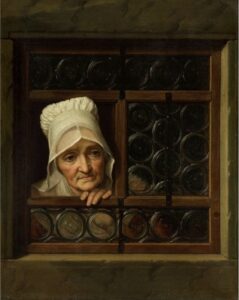
Hoogstraten’s painting, “Old Man at a Window,” depicts an old, wizened, bearded man, crowned with a round fur hat, seemingly poking his head out of the window like a gargoyle protruding from the building. While the exhibit’s advertisements are silent about the man’s identity, many Orthodox Jews might recognize him as R. Yom Tov Lipman Heller, the author of, among other works, the Tosefos Yom Tov commentary on the Mishna. Heller is associated with Vienna, having served as its Chief Rabbi in the early 17th century; however, art historians and Jewish scholars have conclusively shown the impossibility of this being an authentic representation of Heller. Nonetheless, much like the trompe l’oeil technique, the Old Man at a Window continues to deceive, and many still believe it is Heller.

Figure 1 Samuel Von Hoogstraten, Old Man at a Window, Kunsthistorisches Museum, Vienna

Rabbi Heller’s Chronicle of Imprisonment & Redemption

Rabbi Yom Tov Lipman Heller was born in 1578 in Wallerstein, a small village in Southern Germany, home to around twenty Jewish families (Davis 21). As a teenager, he married into a prominent family in Prague. His perspicacity and deep knowledge were quickly recognized, and at 19, he was appointed to serve on the Prague Beis Din, overseeing the largest Jewish community in Christian Europe (Davis 25-33). A year later, he published his first book, a somewhat unusual choice for a traditional rabbinic scholar, a commentary on the philosophical work Behinas Olam. He subsequently authored dozens of books across varied genres, completing his magnum opus, Tosefos Yom Tov in Heshvan 1616 (Davis 225-231). His identity quickly became bound up with this work, and even on the epitaph of his daughters’ headstone from 1639, he is referred to by the book and not his given name (Muneles 321). (The book’s original title is Tosefes Yom Tov, and later Tosefos Yom Tov. While some posit that this change was first documented in 1653, it already appears on the epitaph. (cf. Haberman 125n1)). He also “left ample records of himself… books, letters, archival documents, responsa, poems, prayers, sermons, commentaries, and even a memoir” (Davis 1). Nevertheless, there are no surviving portraits or other images.

Rabbi Heller spent time in Vienna on two occasions. The first, in 1625, he was induced to leave Prague for Vienna’s chief rabbi position. Despite his short tenure of only two years, he scored a significant victory for the Viennese Jewish community. Until then, it was dispersed throughout the city, and Heller secured the right for the community to reside in a single area and strengthen its ties. That cohesion was shattered in 1670 when Emperor Leopold I expelled them (one of the many expulsions Viennese Jews suffered), and the area was renamed after its extirpator, Leopoldstadt. Prague, however, drew him back, and in 1627, he took on the role of chief rabbi there.

Just two years later, some of the city’s Jewish community bristled at his involvement in tax collection, accusing him of determining tax rates unfairly. In June 1629, they denounced him to the government, which resulted in his arrest and summons to Vienna. He recounts the events in his autobiographical work, Megilas Eivah—an allusion to the first letters of the first four words of Megilas Eicha, written between 1644 and 1648. Initially placed under house arrest, he was imprisoned on the 17th of Tammuz and confined in a common jail with prisoners awaiting execution. He was denied visitors and remained isolated, “no one could speak with him, even via the window.” Two days later, following appeals from the Jewish community, he was transferred to a special prison and granted visitation rights. After forty days, the community agreed to pay a substantial fine, and he was released, almost immediately departing for Prague, never to return to Vienna. By 1643, he arrived in Krakow, where he served as chief Rabbi until his death in 1654. 

Megilas Eivah circulated in various manuscripts but was published only in 1836 (Davis 228 n31). While its authenticity is beyond doubt, the additional section that first appeared in the Hebrew 1880 edition is considered a forgery. Allegedly written by Heller’s son Samuel, it “has a quality reminiscent of Dumas and The Three Musketeers: [Heller] saves a young woman from a bull, and her husband, the French ambassador, intercedes on behalf of Rabbi Yom-Tov.” In 1905, “Moritz Steinschneider identified the source as based on a short story written by Ludwig Philippson (1811‒89), a rabbi and journalist, and the author of a series of Jewish historical novelettes and stories for young readers” (Davis 146 n36).

Samuel van Hoogstraten, Master of Illusion

Samuel van Hoogstraten was born in Dordrecht, one of the oldest cities in the Netherlands, on August 2, 1627. He was the eldest child of the artist Dirk van Hoogstraten and Maeiken de Coninck. Samuel started his art studies with his father, continuing until his father passed away in 1640. Around 1642, Samuel moved to Amsterdam and began studying under Rembrandt. He rapidly proved himself to be a standout student, leading classes, reviewing his classmates’ work, and so effectively absorbing his teachers’ lessons, that some of his works were mistakenly attributed to Rembrandt (Brusati 16-31). As part of the preparation for the current exhibit, “Young Woman at an Open Half-Door” (1645) has been reassigned to Hoogstraten (Illes; Van Sloten 125).

In 1651, Samuel traveled to Vienna, the epicenter of power and prestige within the Hapsburg Empire, seeking to enhance his reputation and standing among elite society. He succeeded almost immediately. Samuel’s student, Arnold Houbraken, recounted how, on August 6, 1651, Samuel presented three of his paintings to the emperor. The first two were well received, but “the third piece,” in the trompe l’oeil style, was a still life that captivated the Emperor, who appeared to be completely taken by it. He looked at it for a long time and, finding himself still deceived, said, ‘This is the first painter who has deceived me.’ And he went on to say that he would not get the picture back as a punishment for that deception, for the Emperor wished to keep it forever.” (Houbraken 2:157-58). However, Samuel did not leave empty-handed. The Emperor awarded him an imperial medallion and a gold chain, which he took immense pride in; this would become a standard element in his subsequent self-portraits and among the items he viewed as symbolic of successful artists (Hoogstraten 371-72; Brusati 54).

Hoogstraten broadly characterized art as a form of deception. In his magnum opus on the theory of painting and color, Inleyding tot de hooge schoole der schilderkonst: anders de zichtbaere werelt (Introduction to the Academy of Painting; or, The Visible World), he describes what he considers the “perfect painting.” It “is like a mirror of nature; it makes things that are not there appear to exist and deceives in a permissible, pleasurable, and praiseworthy way” (Hoogstraten 79). One way to achieve this effect is by combining architectural elements such as open doors or windows and adding “some figures” to the composition, “by which many have been artfully deceived” (Hoogstraten 304). He takes pride in having accomplished this with his paintings completed in Vienna. One is “Old Man at a Window,” painted in 1653. (Brusati 65).

The Religious Conversion and Reversion of the Old Man at a Window 

The earliest catalogs describing the painting Old Man at a Window do not mention the man’s religious affiliation. It was not until the 19th century that two scholars suggested a Jewish connection, and even then, there was no mention of Heller. Nonetheless, this association never gained traction, and the painting continued to be described without any reference to Jews. We must wait until the 1950s for Heller’s connection to emerge. However, that link lacked any supporting evidence, leaving us in the dark about what prompted the change from an Old Man to Heller. Even that association was quickly dismissed due to the significant gap between when Heller was imprisoned and when Hoogstraten painted Old Man at a Window.

The 1653 painting is one of the first works by Hoogstraten that Emperor Charles II acquired for his castle in Prague, possibly commissioned specifically for him. The painting is described in detail in an early catalog:

No. 4. By Samuel van Hoogstraten. A lifelike, grey-bearded old man looks out of a window. His fur hat, the furrows on his face from his age, and his grey beard are so well painted that one believes one can see nature itself in each one. Hoogstraten, who did not only paint as a mere colorist, showed his deep insight into the subject and reflected light in the chiaroscuro and the deep and penetrating shadows. Just look at the head . . ., and you will find that in it, the master’s hand, which . . . expresses itself quite magnificently. The lead on the round window pane, the wooden frame, that is the glass frame, is also very well painted, but the window’s stone frame makes you believe entirely that it is the work of a mason, almost as if you can see the mason’s hand on it. The straw stalk lying on the window stone, the feather, and the bottle standing there are no less well-painted and serve to prove the excellence of the whole. This picture is painted on canvas, 3 feet 6 inches high, 2 feet and 9 inches wide. The head is life-size. The artist has engraved his monogram and the year 1653 on the window stone of this painting” (Rigler 163-164).

During the 17th century, two inventories were created for the collection. In both, the painting is described as “a man sticking his head out of the window through the shutter,” without any reference to the man’s religious affiliation or any connection to Rabbi Heller (Köpl clvnn330; Brusati 361n76). Hoogstraten’s Old Man at a Window was relocated to Vienna after the Habsburgs acquired the Belvedere Palace in the 1730s. The Palace is perhaps best known today for Gustav Klimt’s “The Kiss” and other notable Viennese Expressionists. In one of the earliest catalogs of the Belvedere by Christian van Mechel from 1783, the subject is referred to simply as a “grey-bearded man with a round fur hat on his head, looking out curiously from a window” (Mechel 84n4). That is how the description remained, unadorned with any religious identity until the 19th century.

In the 19th century, two descriptions of the Old Man at a Window added his religion: he was a Jew. In 1839, German art historian Georg Rathgeber, in his study of Netherlandish art, asserts that “this picture’s title is “Böhmischen Juden,” “Bohemian Jew.’” Rathgeber disputes the identification not for its lack of historicity but because “the character of the facial features does not seem to correspond very well to” his antisemitic views on Jewish physiognomy (Rathgeber 147). Similarly, in 1861, French art critic Charles Blanc, in his encyclopedic work Histoire des Peintres de Toutes les Écoles, asserts that the Belvedere catalog now refers to the painting as “Un vieux juif (dit le Catalogue)” or “an old Jew (as it appears in the Catalog)” (Blanc 4). This portrait impressed Blanc and is among the few he reproduced in his discussion of Hoogstraten (Blanc 1). However, Blanc is notorious for identifying Jews in Rembrandt’s and his school’s works without any supporting evidence (Knotter and Schwartz 7-9). Contrary to the “catalog’s identification,” Blanc, like Rathgeber, asserts that the face “is not Israelite” (Blanc 2). Neither Blanc nor Rathgeber mentions Rabbi Heller.


Figure 2 Charles Blanc, Histoire des Peintres de Toutes les Écoles

Blanc’s and Rathgeber’s Jewish association did not take hold. For example, G.H. Veth, in his 1889 article discussing artists from Dordrecht, including Hoogstraten, cites Blanc and notes his reproduction of Old Man. However, Veth describes it without mentioning any Jewish connections (Veth 145). Similarly, a 1903 tour guidebook of Vienna confirms that at the Belvedere, the painting’s title remains unchanged as “Old Man at a Window” (Baedeker 73; cf. Gerson, 282).

Despite the absence of objective evidence and the dismissal of Blanc’s and Rathgeber’s 19th-century Semitic connection, one scholar in the 1950s cryptically associated Rabbi Heller with Hoogstraten’s painting. Margarethe Poch-Kalous, the head of the Academy of Fine Arts in Vienna (Akademie der bildenden Künste in Wien), in her 1959 survey of Dutch art in Vienna, refers to the figure as “ein bärtiger alter Mann (Rabbi Heller),” “a bearded old man (Rabbi Heller)” (Poch-Kalous 198). The basis for her identification is opaque. Poch-Kalous’ two citations offer no support; neither mentions Heller nor suggests that the figure is even Jewish, nor does she reference Blanc or Rathgeber (Poch-Kalous 198 citing Engerth 207n928 and Köpl clvnn330).

Oddly, unlike other personalities, artists, and subjects discussed in her article, which consistently include personal names and birth and death dates, Poch-Kalous provides nothing beyond “Rabbi Heller.” This is especially puzzling for an article in the Jahrbuch der Kunsthistorische Sammlungen, whose readership is unlikely to be sufficiently familiar with the history of 17th-century Bohemian rabbis to provide the missing details.

Whatever the basis for Poch-Kalous’s connection between Hoogstraten’s painting and Heller, it was swiftly dismissed. In 1972, Klaus Demus, the art historian and curator at the Kunsthistorisches Museum, demonstrated that it was impossible for Heller to be the model. He explains that Heller was imprisoned in 1629, and by 1644, he was serving as a rabbi in Krakow, where he remained until his death in 1654. Hoogstraten, who was only two years old when Heller was imprisoned in Vienna, painted Old Man at a Window in 1653, long after Heller had left Vienna (Demus 47-48). Today, the Kunsthistorisches Museum’s website alludes to Poch-Kalous’ attribution and rejection: “According to a tradition that is now presumed to be mistaken, the man is Rabbi Yom Tov Lipmann Heller.” Hoogstraten’s “deception” and “illusion” did not extend to rendering persons he never saw.

Illustrious Jews and Illusionary Jewish Sources

Jewish sources similarly are not more persuasive in linking Heller to Hoogstraten’s painting. Generally, rabbinic portraits prior to the 19th century lack authenticity (Cohen), and Heller is no exception. Most of the few early verifiable images exist as frontispieces in books rather than as paintings, and none depict Eastern European rabbis. Heller’s image first appears in Jewish sources in the early twentieth century. It depicts an old man, yet he is completely different from Hoogstraten’s version. The first instance of Heller masquerading as the Old Man at a Window is over a decade after Demus debunks that theory!

Figure 3 Bader, Drasig Doyres, 175

The first Jewish source of an alleged portrait of Rabbi Heller appears in a Yiddish collection of stories and hagiographies of rabbis in Gerson Bader’s Drasig Doyres Yiden in Poylen, published in 1927 (Bader 175). Bader’s depiction of Rabbi Heller does not resemble the individual shown in Hoogstraten. Bader claims that his source is an “old drawing,” yet he does not provide any further details, such as where or when it was published.

Bader’s book features other alleged rabbinic images from “old drawings” that are demonstratably false. For example, Bader’s portrait of R. Aaron Shmuel Kaidanover, author of the Birkas ha-Zevach on Kodshim, is of the Karaite and forger Avraham Firkovich (1787-1875) (Bader 185). It is undoubtedly Firkovich, as it appears in his Avnei Zikaron, published in 1872, during his lifetime. Similarly, Bader misattributes Joseph Delmedigo’s (1591-1655) portrait from the frontispiece of his Sefer Elim (Amsterdam, 1629), and the photo of R. Shmuel Salant by Zadok Bassan, assigning them to alternative rabbinic figures (Bader 204, 321). Nonetheless, Bader’s depiction of Heller was often reproduced, to the extent that in a 2000 biography of Heller, it is referred to as “iyur amimi nafuts shel ha-Tosefos Yom Tov,” “the widespread folk image of the Tosefos Yom Tov” (Herskovics 32).

Figure 4 Bader, Drasig Doyres Yiden in Poylen, 175.

Figure 5 Firkovich, Avnei Zikhron, From the Gross Family Collection, The Center for Jewish Art

It was only in 1984 that a Jewish source connected the Hoogstraten painting to Rabbi Heller. The cover of the book The Feast and the Fast: The Dramatic Personal Story of Yom Tov Lipman Heller, a translation of Megilas Eivah, depicts Rabbi Heller in prison and is modeled on the figure in the Hoogstraten painting. To eliminate any doubt about the source of the cover art, the back of the book features reproductions of title pages from Heller’s works and his gravestone, along with a photo “of the drawing in the Kunsthistorisches Museum in Vienna, Austria, entitled ‘Man at the Window’ (1653) by Samuel Van Hoogstraten (1627-1678)” (Lipschitz and Rosenstein). A similar image was used for the cover illustration of another translation of Megilas Eivah published in 1991 (Heller). The English section of the 2000 biography of Heller reproduces the cover of The Feast and the Fast, describing it as “featuring a picture of the Tosefot Yom Tov” (Herskovics 101). However, it does not attempt to reconcile this image with the clearly different “widespread folk image” presented in the Hebrew section of the biography. Although not mentioned in any of these sources, they were presumably misled by the bars on the window. However, those are not prison bars; rather, as was common in that era, the windows were supported by these architectural elements (Hermans 249).

Figure 6 Cover, Feast and the Fast, 1984

By 1999, however, Jewish sources also recognized the impossibility of associating Heller with the painting. R Ya’akov Yeruchum Wreschner republished Megilas Eivah based on four editions and two manuscripts and includes a comprehensive introduction regarding Heller. In two footnotes within the introduction, Wreschner briefly addresses Heller’s connection, or lack thereof, to Old Man at a Window. Like Demas, Wreschner contends that the nearly twenty-five-year gap between Heller’s departure from Vienna and Hoogstraten’s painting of Old Man renders it impossible for Heller to have been the model. Wreschner asks rhetorically, how could Hoogstraten “paint Rabbenu [Heller] when he never set eyes on him?” (Wreschner Megilas 48n3). Wreschner also contacted the Kunsthistorisches Museum and received a response confirming that “not only is it not the Rabbi, but it is not even a Jew” (Wreschner Megilas 17n4). As a result, Wreschner refused to reproduce that portrait in his book. Similarly, despite being titled Portrait of a Seventeenth-Century Rabbi, the most recent academic biography of Heller by Joseph Davis includes neither the Hoogstraten portrait nor any other image of Heller (Davis).

In 2024, Wreschner published a significantly revised and retitled edition of his book. Despite discrediting Heller’s connection to the painting over twenty years ago, various Jewish books, newspapers, and other ephemera continue to publish Old Man at a Window and link it to Heller (e.g., Alfasi 137; Stern 184-86; Berman). Wreschner was, therefore, compelled to revisit the painting, presenting additional arguments and greater detail regarding his discussions with the Kunsthistorisches Museum.

Wreschner, in 1999, first spoke telephonically with the Director of the Kunsthistorisches Museum, Dr. Karl Schütz, who confirmed that the painting was not connected to Heller. Schütz followed up with a letter detailing the sources for his rejection. Schütz stated that, with one exception, from the earliest catalogs to contemporary analyses of the painting, it was never associated with any specific individual, Jewish or otherwise. This is consistent with Hoogstraten’s intent, showcasing the trompe l’oeil technique rather than portraiture. The only time it appears – in Demus’s “detailed catalog of Dutch painters from 1972”—is solely to repudiate Poch-Kalous’s chronologically impossible and otherwise undocumented connection to Heller. Schütz also discredited the claim that following the Anschluss, the painting was categorized as Jewish art and consigned to the museum’s basement. On the contrary, a coterminous catalog lists the painting among those on display.

Despite Wreschner’s certitude about Schütz’s rejection, for unclear reasons, Wreschner attributes an otherwise unrecorded episode to Schütz. This alleged event appears to offer some support for linking Heller to the painting, but it is completely absent from the letter. According to Wreschner, the letter references an event in 1972 when an unidentified Jew approached the museum and claimed there was “a tradition that it was Tosefos Yom Tov” (Wreschner 2024, 24-26). The museum expressed skepticism about that tradition but did not completely dismiss it. In Wreschner’s retelling, it suggested the possibility that “a Jew conjured up Heller’s image and Hoogstraten copied it.” The actual text of the letter directly contradicts Wreschner’s account. Schütz references 1972 not as the date of an important meeting that supports the “legend” but as the first substantial discussion – by Demus – and his definitive rebuttal without mentioning a meeting with the Jew.

Beyond Schütz’s letter, Wreschner adds internal reasons why the painting cannot depict Heller in jail. The window is large enough for the man to stick his head out and features high-quality glass, an uncommon design for a prison. Furthermore, the expensive fur hat worn by the Man at a Window is an unlikely accessory in a prison housing hardened criminals sentenced to death and an incongruous headpiece for the July heat when Heller was imprisoned. Wreschner could have included another element in the painting that contrasts with a prison – the wall behind the Old Man has patterned wallpaper.

Following his earlier edition, Wreschner learned of an earlier source linking Heller to the painting, which is summarily dismissed. R. Shimon Fuerst, who lived in Vienna before 1940, in his book, Shem mi-Shimon, published in 1967, recalls visiting the museum where he saw firsthand “the painting made during the imprisonment” (Fuerst 426). Wreschner is unmoved by Fuerst’s identification. First, Fuerst was not an expert on Heller. Fuerst writes that Heller left Vienna to assume the Chief Rabbi position in Krakow, which is false. After his release, Heller returned to Prague, only leaving for Krakow fifteen years later. Aside from this obvious mistake, Fuerst’s opinion is irrelevant. Wreschner does not dispute Fuerst’s rabbinic bona fides, yet he is not an art historian. When faced with questions of rabbinic law, we defer to rabbis, but, according to Wreschner, “when it comes to questions of attribution of art, we look to experts in that field” (Wreschner 2024, 26). Regardless of the reliability of Fuerst’s claim, the mystery of Poche-Kalous’ source remains unsolved as her work predates Fuerst’s by four years.

Going Once, Twice, Three Times – Sold!

The identification of Heller with the Old Man at a Window is not the first, nor likely the last portrait erroneously attributed to a well-known Jew. One such example is the “traditional” portrait of the founder of the Hassidic movement, R Yisrael Ba’al Shem Tov. This portrait depicts a Ba’al Shem, a Wonderworker, but not Yisrael; rather, it is of Ya’akov Falk of London (Oron). He was an alchemist and an eccentric, and according to R Ya’akov Emden, a crypto-Sabbatian. However, evidence does not always prevail. Books and numerous sukkah decorations continue to utilize this portrait.

There is even another Hoogstraten portrait that falls into this category. A 1670 Hoogstraten portrait now in the Jewish Museum in New York was previously associated with Baruch (Bento, Benedictus) Spinoza. This is just one of many alleged portraits of Spinoza. Yet, most, if not all, lack independent verification or directly contradict the existing evidence (Ekkart). Indeed, “It is the same with the portraits as with so many other aspects of Spinoza’s life: little can be said with any certainty” (qtd. in Ekkart 25). This portrait was first linked to Spinoza in 1929, partly based on “a slip of paper on the back bearing the scholar’s name” (Ekkart 5). It is unclear who made that determination or even when the paper was inserted into the back of the painting. Consequently, the Jewish Museum now describes the painting as “Portrait of a Man (previously thought to be Baruch Spinoza).”

Similarly, despite art historians and Jewish sources resoundingly rejecting Heller’s connection to the Old Man at a Window, it seems unlikely that the idea of Hoogstraten depicting Heller will be dislodged in the collective Jewish consciousness. The attribution is so deeply ingrained that someone spent a staggering $120,000 before fees on a late 19th-century reproduction of Hoogstraten’s painting.

Figure 7 Lot 318, Kestenbaum Auctions, March 12, 2014

In 2014, the American Judaica auction house Kestenbaum & Company listed an 1887 painting described as “Yom Tov Lipman Heller, Portrait: Imprisoned in Vienna,” with a $12,000-$18,000 estimate. The portrait also served as the front cover image of the catalog. It is described as “the celebrated portrait of the Tosefos Yom Tov” and claims that Hoogstraten “painted Rabbi Heller in 1653 and entitled it ‘Old Man in the Window.’” The catalog warns that “it is not known if van Hoogstraten ever met or saw [Heller]; however, it is likely that he was aware of the Rembrandt (School) painting of 1643 entitled ‘Portrait of an Old Jew’ (today in the National Gallery of Denmark) – where a similar, bearded Jewish man, with head cocked, looks emotively at the viewer.” Scholars acknowledge that elements of Man at a Window and other Hoogstraten paintings evoke “the face studies of costumed figures routinely produced in Rembrandt’s studio,” but this does not transform the man into a Jew, let alone Rabbi Heller. The Jewish identification of the painting in the National Gallery of Denmark is also of questionable relevance. Some aspects of that painting, most notably the chain around the man’s neck, make it highly unlikely that it depicts a Jew (Alexander-Knotter 80-81). The catalog’s only citation for attributing the subject to Heller is the 1984 book, The Fast and the Feast, mentioned earlier. It does not reference Demus’ or Wreschner’s discussions that challenge that attribution. 

The significance assigned to the artistic rendition of the original is also debatable. The 1887 reproduction bears the signature of the artist “Paul Krüger.” However, Krüger was not a recognized artist; instead, it was a commercial reproduction company in Vienna that commonly attached its labels to the works. Its full name is “Paul Krüger Atelier für Porträtmalerei in Wien” (Paul Krüger Studio for Portrait Painting in Vienna). The studio functioned in the late 19th century and reproduced numerous paintings from the Kunsthistorisches Museum. Today, for those wanting to display a similar commercial reproduction of the painting on their wall, it is available through many websites that specialize in creating highly accurate copies of famous artworks. One such site offers a hand-painted version, almost the exact size of the original, with a similar frame, for about $1,400.


If the buyer had waited a year, they could have acquired an earlier reproduction by a recognized and significant artist. On May 18, 2015, Ferdinand Waldmüller’s (1793-1865) painting “Old Man at the Window,” modeled after Hoogstraten and executed in 1819, was auctioned with an estimate of €22,400 to €28,000. Unlike Krüger’s shop, which served as a commercial entity, Waldmüller is regarded as one of “the most important Austrian painters of the Biedermeier period.” Nevertheless, the lot remained unsold.

The Krüger copy may not be the best reproduction, but the auction catalog description proved worthwhile for reproduction. Rabbi Moshe Bamberger is the author of a series of books on “Great Jewish” items published by Artscroll. One book focuses on letters, another on important Jewish books, and another titled Great Jewish Treasures, is “A Collection of Precious Judaica, Associated with Torah Leaders.” This work contains a chapter dedicated to “Artwork” that discusses some well-known examples of rabbinic images. He ably covers several of these topics and discusses the traditional portrayal of Yisrael Ba’al Shem Tov, accurately aligning it with London’s Ba’al Shem, Jacob Falk.

Bamberger also includes a section focused on the “famous depiction of Rabbi Yom Tov Lipmann Heller (1579-1654) peering through the window of his prison cell” and reproduces a version of the Hoogstraten painting. Bamberger tries to reconcile the inconsistency between the dates of imprisonment and the time when Hoogstraten painted Old Man. Bamberger’s source is the auction catalog, yet he seems to disagree with one item: which of Rembrandt’s “Jews” Hoogstraten supposedly used as a model for Heller. Rather than the 1643 “Portrait of an Old Jew” attributed to Rembrandt’s school and currently housed in the National Gallery of Denmark; according to Bamberger, the model was the subject of a painting by Rembrandt, also titled “Portrait of an Old Jew,” now held in the Hermitage Museum in Leningrad. Bamberger does not provide a rationale for selecting the Hermitage painting over the one in the National Gallery. Nevertheless, the Hermitage painting is equally unlikely to depict a Jew and is now referred to generically as “Man in an Armchair.” (Schwartz 371-373). Ironically, Bamberger’s use of the Hermitage painting only reinforces the unlikelihood that Heller served as a model for Hoogstraten. The Hermitage Rembrandt originates from 1654, one year after “Old Man in a Window.” Hoogstraten certainly did not use a nonexistent painting to model his artistic expression.

Whether we will ever fully explicate to our satisfaction the enigmatic history of Hoogstraten’s 1653 painting Old Man at a Window, Hoogstraten’s masterful execution of the Trompe l’oeil technique makes the painting worth seeking out on its own. The exhibition closed in Vienna on January 12, 2025, but relocated to Rembrandt House in Amsterdam, “The Illusionist. Samuel van Hoogstraten,” from February 1 to May 4, 2025. The Amsterdam exhibition is entirely dedicated to Hoogstraten. To accompany the Vienna exhibit, the Kunsthistorisches Museum published a collection of articles titled Rembrandt Hoogstraten: Colour and Illusion, edited by Dr. Sabine Pénot, the Curator of Netherlandish and Dutch Paintings at the museum. This book is of excellent quality, beautifully reproducing many of the exhibit’s paintings and etchings. One article is a detailed study of Hoogstraten’s process and technique in Old Man at a Window (Hermens). While it employs various infrared and other technologies to uncover what lies beneath the surface, no rabbi is lurking behind the layers of paint.

* I want to thank Dr. Shnayer Leiman for bringing to my attention Gershom Bader as the earliest source of Heller’s representation within Jewish sources. I also wish to thank Professor Marc Michael Epstein, Professor Marc Shapiro, Dr. Lara Lempertienė, and Menachem Butler for their thorough review of the draft and invaluable feedback, Dr. Sabine Pénot for scouring the Kunsthistorisches Museum’s collection for information regarding Heller’s link to the painting, and Shaul Seidler-Feller for his expertise in translating Yiddish. Additionally, I am grateful to Rabbi Yaakov Yeruchum Wreschner for sharing his correspondence with the Kunsthistorisches Museum, and, as always, Eliezer Brodt, whose enviable encyclopedic knowledge, which he freely shares, ensured I did not overlook crucial materials.

Sources:

Alexander-Knotter, Mirjam, et al. The ‘Jewish’ Rembrandt, The Myth Unraveled. Waanders Publishers/Jewish Historical Museum, [2006].

Bader, Gershom. Drasyig Doyres Yiden in Poylen. Oriom Press, 1927.

Bamberger, Moshe. Great Jewish Treasures. Artscroll, 2015.

Blanc, Charles. Histoire des Peintres de Toutes les Écoles, vol. 2, “Samuel van Hoogstraten”. Paris, 1861.

Brusati, Celeste. Artifice and Illusion: The Art and Writing of Samuel Van Hoogstraten. University of Chicago Press, 1995.

Cohen, Richard I. Jewish Icons: Art and Society in Modern Europe. California UP, 1998.

Davis, Joseph M. Yom-Tov Lipmann Heller: Portrait of a Seventeenth-Century Rabbi. Littman Library of Civilization, 2004.

Demus, Klaus. Friderike. Katalog der Gemäldegalerie: Holländische Meister des 15., 16., und 17. Jahrhunderts. Kunsthistorisches Museum, 1972.

Ekkart, Rudi. Spinoza in Beeld: Het onbekende gezicht/Spinoza in Portrait: The Unknown Face. Amsterdam Vereniging het Spinozahuis, 1999.

Engerth, Eduard van. Gemälde Beschreibendes Verzeirchness, vol. 2. 1884.

Gerson, Horst. Ausbreitung und Nachwirkung der holländischen Malerei des 17. Jahrhunderts. De erven F. Bohn n. v, 1942.

Haberman, A.M. “Piyutav ve-shirav shel R. Yom Tov Lipman Heller.” Le-Kovod Yom Tov, edited by Judah Leib Maimon. Mosad HaRav Kook, 1956, pp. 125-145.

Heller, Yom Tov Lipmann. A Chronicle of Hardship and Hope. Translated by Avraham Yaakov Finkel, C.I.S. Publishers, 1991.

Hermens, Erma, et al. “Samuel van Hoogstraten’s Illusionistic Paintings for Emperor Ferdinand III – Two Case Studies.” Rembrandt Hoogstraten: Colour and Illusion, edited by Sabine Pénot. Hannibal, 2025, pp. 232-51.

Herskovics, Mayer. Two Guardians of the Faith: The History and Distinguished Lineage of Rabbi Yom Tov Lipman Heller and Rabbi Areyeh Leib Heller. Graphit Press, 2000.

Hoogstraten, Samuel Van. Introduction to the Academy of Painting; or, The Visible World. Edited by Celeste Brusati and Translation by Jaap Jacobs. Getty Research Institute, 2021.

Illes, Angelina. “List of Works.” Rembrandt Hoogstraten: Colour and Illusion, edited by Sabine Pénot. Hannibal, 2025, 258.

Knotter, Mirjam, and Gary Schwartz, editors. Rembrandt Seen Through Jewish Eyes: The Artist’s Meaning to Jews from His Time to Ours. Amsterdam UP, 2024.

Lipschitz Chaim Uri, and Neil Rosenstein, The Feast and the Fast: The Dramatic Personal Story of Yom Tov Lipman Heller. Moriah, 1984.

Mechel, Christian van. Verzeichniß der Gemälde der Kaiserlich Königlichen Bilder-Gallerie in Wien, Vienna, 1783.

Oron, Michal. Rabbi, Mystic, or Imposter. Translated by Edward Levin. Littman Library of Jewish Civilization, 2020.

Poch-Kalous, Margarethe. “Das Legat Wolfgang van Wurzbach-Tannenberg an die Gemäldegalerie der Akademie der bildenden Künste in Wien,” in Jahrbuch der kunsthistorischen Sammlungen in Wien vol. 55, 1959.

Rathgerber, Georg. Annalen der Niederländischen Malerei und Kupferstecherkunst: Van Rubens Abreise nach Italien bis auf Rembrandt’s Tod. Gotha, 1839.

Rigler, Hieronumus. “Beschreibung und Beurtheilung verschiedener Gemälde der S.S. Bildergalerie in Belvedere van Hieronymus Rigler aus dessen 1783 herausgegebenen, ausser Wien wenig bekannten und bereits geendigten mächentlichen Anzeigen van Künstlern und Kunstsachen,” in Miscellaneen artistischen Innhalts, 21, 1784, pp. 158-177.

Schwartz, Gary. The Rembrandt Book. Abrams, 2006.

Stern, Yechiel Michel. Gedoli Ha-Doros. Minchas Yisrael, 1996.

Van Sloten, Leonore and David de Witt. “Challenged by Rembrandt,” in Samuel van Hoogstraten, The Illusionist. Edited by Nathalie Maciesza and Epco Runia. WBOOKS, 2025.

Wreschner, J. Megilat Eivah le-Ba’al Ha-TY”T.  [], Jerusalem, 1999.

Wreschner, J. Ha-Tosefos Yom Tov u-Megilaso. [], Beni Brak, 2024.

Appendix:

Hoogstraten’s painting was copied and reinterpreted multiple times, with variations in style and even gender. (See Brusati 361, which discusses two copies in royal collections.)

A few more examples:

A more compact version with a whiter and shaped bear is attributed to a Dutch painter of Hoogstraten’s school and possibly one of the versions mentioned by Brusati.

Described as 18th Century Flemish School, without identification of a specific artist, sold for CHF 800.

Two versions: a man that is a crude likeness of Old Man in a Window and a woman wearing a linen cap sold for $2,000.

An alternative version of a woman was painted by Josef Hauzinger, (1726-1787), currently at the Pushkin Museum in Moscow. A later version of this rendering appeared at auction in 2022.

Old Woman in a Window

Another example of a woman at the window is a 1936 Picasso painting.


When Rabbi Meir Kahane’s Father Translated the Torah

When Rabbi Meir Kahane’s Father Translated the Torah

By Yosef Lindell

Yosef Lindell is a lawyer, writer, and lecturer living in Silver Spring, MD. He has a JD from NYU Law and an MA in Jewish history from Yeshiva University. He is one of the editors of the Lehrhaus and has published more than 30 articles on Jewish history and thought in a variety of venues. His website is yoseflindell.wordpress.com.

In 1962, the Jewish Publication Society published a new translation of the Torah. The product of nearly a decade of work, the new edition was the first major English translation to cast off the shackles of the 1611 King James Bible. Dr. Harry Orlinsky, the primary force behind the new translation and a professor of Bible at the merged Reform Hebrew Union College and Jewish Institute of Religion, explained that even JPS’ celebrated 1917 translation was merely a King James lookalike, a modest revision of the Revised Standard Version that “did not exceed more than a very few percent of the whole.”[1] This new edition was different. As the editors wrote in the preface, the King James not only “had an archaic flavor,” but it rendered the Hebrew “word for word rather than idiomatically,” resulting in “quaintness or awkwardness and not infrequently in obscurity.”[2] Now, for the first time, the editors translated wholly anew, jettisoning literalism for maximum intelligibility. More than sixty years later, JPS’ work remains one of the definitive English translations of the Torah.

The new JPS may have left the King James behind, but it didn’t satisfy everyone. In addition to making the Torah more intelligible, the editors incorporated the insights of modern biblical scholarship, both from “biblical archeology and in the recovery of the languages and civilizations of the peoples among whom the Israelites lived and whose modes of living and thinking they largely shared.”[3] So when asked by Rabbi Theodore Adams, the president of the Rabbinical Council of America, whether the RCA could accept an invitation from Dr. Solomon Grayzel, JPS’ publisher, to participate in the new translation, Rabbi Joseph B. Soloveitchik demurred. He wrote in a 1953 letter to Adams, “I am afraid that the purpose of this undertaking is not to infuse the spirit of Torah she-be-al peh into the new English version but, on the contrary, … to satisfy the so-called modern ‘scientific’ demands for a more exact rendition in accordance with the latest archeological and philological discoveries.”[4]

Just one year after JPS released its volume, in 1963, R. Soloveitchik’s wish for a more “Torah-true” translation was answered, but likely not in the way he expected. The two-volume Torah Yesharah published by Rabbi Charles Kahane (1905-1978) relies heavily on traditional Jewish commentary in its translation.[5] But as we’ll explore, because of its lack of fidelity to the Hebrew text, it can hardly be called a translation at all.

Here is the title page (courtesy of the Internet Archive):

The strategically placed dots on the title page indicate that Yesharah is an acronym for the author’s Hebrew name—Yechezkel Shraga Hakohen. R. Charles Kahane was born in Safed and received semichah from the Pressburg Yeshiva in Hungary. After immigrating to the United States in 1925 and receiving a second semichah from Yeshiva University’s Rabbi Isaac Elchanan Theological Seminary, he served as rabbi of Congregation Shaarei Tefiloh in Brooklyn for most of his professional career, a shul which drew over 2,000 worshippers for the High Holidays.[6] He was a founding member of the Vaad Harabbanim of Flatbush and helped Rabbi Avraham Kalmanowitz re-establish the Mir Yeshiva in Brooklyn. Today, however, he is known as the father of Meir Kahane, the radical and controversial Jewish power activist and politician who needs no further introduction. The father does not seem to have been directly involved in his son’s activities, but he took pride in Meir’s accomplishments and was a staunch supporter of the Irgun in Palestine, Ze’ev Jabotinsky’s Revisionist Zionist movement, and Jabotinsky’s youth group, Betar.[7]

R. Kahane told the New York Times that Torah Yesharah was inspired by Bible classes he gave to his adult congregants where many people did not understand the text even in translation.[8] (Recall that the new JPS translation was not yet available, and other English translations relied on the archaic King James.) He wanted to rectify this problem; indeed, the title page states that the work is a “traditional interpretive translation,” suggesting that it was intended to be more user-friendly. But calling it user-friendly does not do justice to what Kahane did. Here is most of Bereishit 22—the passage of Akedat Yitzchak:

Most translators try to approximate the meaning of the Hebrew. Not so R. Kahane. Nearly every single English verse here contains significant additions not found in the original. The first verse, for example, which states that the Akedah was meant to punish Avraham for making a treaty with Avimelech, follows the opinion of the medieval commentator Rashbam, who, notes that the words “and it was after these things” connect the Akedah to the previous episode—the treaty with Avimelech (Rashbam, Bereishit 22:1). But it’s hard to imagine that Rashbam, famous for his devotion to peshat—plain meaning—would have been comfortable with his explanation being substituted for the translation itself. Many other verses on this page provide additions from Rashi and other commentators. 

Pretty much every page of R. Kahane’s translation looks similar: Hebrew on one side and an expansive interpretive translation drawn from the classical commentators on the other. Kahane makes no effort to distinguish between the literal meaning of the Hebrew and his interpretive gloss.[9] Dr. Philip Birnbaum, the famed siddur and machzor translator, criticizes this aspect of the work in his (Hebrew) review, noting that Kahane’s interpretations are written “as if they are an inseparable part of the Hebrew source, and the simple reader who doesn’t know the Holy Tongue will end up mistakenly thinking that everything written in ‘Torah Yesharah’ is written in ‘Torat Moshe.’”[10]

To be fair, R. Kahane cites sources for his interpretations, but only at the back of each book of the Torah and only in Hebrew shorthand:

Thus, a reader not already fluent in Hebrew and the traditional commentaries would have little idea where Kahane was drawing his “translation” from and might not grasp how much the translation departed from the Hebrew original.[11]

Yet perhaps this was the point. R. Kahane considered literal translation to be illegitimate. In the preface to Torah Yesharah, Kahane contrasts Targum Onkelos, which is celebrated by the Sages, with the Septuagint translation of the Torah into Greek, which the Sages mourned. Kahane suggests that a Targum, which is an interpretation or commentary, is superior to a direct translation. Targum Onkelos, he writes, was composed under the guidance of the Sages and based on the Oral Law, and therefore it was “sanctified.” According to Kahane, “The Torah cannot and must never be translated literally, without following the Oral interpretation as given to Moses on Sinai. … It is in this spirit that the present translation-interpretation has been written.”[12]

Kahane was not the only Orthodox rabbi of his time to criticize translation unfaithful to rabbinic interpretation. We’ve already noted R. Soloveitchik’s concerns about the new JPS.[13] Similarly, the encyclopedist Rabbi Judah David Eisenstein reported that in 1913, when JPS was preparing its initial translation, Rabbi Chaim Hirschenson of Hoboken, NJ, convinced the Agudath Harabbanim to protest JPS’ efforts so the new work should not become the “official” translation of English-speaking Jewry the way the King James had become the official translation of the Church of England. The Agudath Harabbanim noted the Sages’ disapproval of the Septuagint and explained that only Targum Onkelos and traditional commentators that based themselves on the Talmud were officially sanctioned.[14]

R. Kahane’s approach also harks back to a series of articles in Jewish Forum composed in 1928 by Rabbi Samuel Gerstenfeld, a rosh yeshiva at RIETS (a young Rabbi Gerstenfeld is pictured below), attacking the original 1917 JPS translation. Gerstenfeld labeled the JPS translation Conservative and sought to demonstrate its departure from Orthodoxy by comprehensively cataloging all the places where the translation departed from the halakhic understanding of the verse. So, for example, he criticizes JPS for translating the tachash skins used in the construction of the Mishkan as “seal skins,” because according to halachic authorities, non-kosher animal hides cannot be used for a sacred purpose.[15] He believed that the word tachash should be transliterated, but not translated.[16] Gerstenfeld concludes that the JPS translators “missed a Moses—a Rabbi well versed in Talmud and Posekim, who would have been vigilant against violence to the Oral Law.”[17]

Still, R. Kahane’s interpretive translation with additions goes far beyond what R. Gerstenfeld was suggesting. To give one example: Gerstenfeld quibbles with JPS’ translation of the words ve-yarka befanav in the chalitzah ceremony (Devarim 25:9). The 1917 JPS translates that the woman should “spit in his face” (referring to the man who refuses to perform yibbum). Gerstenfeld notes that rabbinic tradition unanimously holds that the woman spits on the ground. He suggests that “and spit in his presence” would be a better translation.[18] Gerstenfeld’s suggestion is reasonably elegant—it gives space for the rabbinic reading without negating the meaning of the Hebrew. Kahane makes no such attempt to be literal, instead translating that she will “spit on the ground in front of his face.”[19] As we’ve seen, Kahane had no compunctions about adding words.

Thus, there is no English-language precedent for Torah Yesharah of which I am aware. As the preface suggests, R. Kahane was inspired by the Aramaic targumim, but it would seem more by Targum Yonatan Ben Uziel than Targum Onkelos. Onkelos translates word-for-word in most circumstances, typically departing from the Hebrew’s literal meaning to address theological concerns, such as a discomfort with anthropomorphism. Targum Yonatan, on the other hand, seamlessly weaves many midrashic additions into its translation and looks more like Torah Yesharah. For example, at the beginning of the Akedah passage, Targum Yonatan goes on a lengthy excursus suggesting that God’s command to sacrifice Yitzchak was in response to a debate between Yitzchak and Yishmael where Yitzchak boasted that he would be willing to offer himself to God. This digression is akin to Kahane’s addition of the Rashbam into his translation. If anything, Targum Yonatan is more expansive than Torah Yesharah.

Torah Yesharah received a fair amount of press upon its publication. It was even reviewed by the New York Times, which called it “[a] new and unusual translation” that was intended to make the Torah “more meaningful to Americans.” The article quoted Rabbi Dr. Immanuel Jakobovits, then the rabbi of the Fifth Avenue Synagogue in Manhattan (before he became Chief Rabbi of the United Kingdom), as calling it “an original enterprise” and “a most specifically Jewish rendering of the Torah.” While the Times was noncommittal about the work, a critical review in the Detroit Jewish News found Kahane’s language confusing and inferior to the new JPS translation published the prior year.[20] As for Dr. Birnbaum, he praised Torah Yesharah’s reliance on traditional Jewish interpretations and lamented the fact that most other biblical translations “were borrowed from the Christians from the time of Shakespeare,” but criticized the format (as noted above) and some of Kahane’s more tendentious translations.[21]

Despite the interest Torah Yesharah generated, its unique approach was not replicated. One might see echoes of R. Kahane in a better known translation—ArtScroll’s 1993 Stone Edition Chumash. As its editors explained in its preface, the “volume attempts to render the text as our Sages understood it.”[22] To this end, ArtScroll famously follows Rashi when translating “because the study of Chumash has been synonymous with Chumash-Rashi for nine centuries,”[23] even when Rashi is at variance with more straightforward readings of the text. Thus, for example, ArtScroll translates az huchal likro be-shem hashem (Genesis 4:26) based on Rashi as, “Then to call in the name of Hashem became profaned”—a reference to the beginnings of idol worship.[24] However, a more literal translation would run, “Then people began to call in the name of God,” which sounds like a reference to sincere prayer—the opposite of idolatry. It’s also well-known that ArtScroll declines to translate Shir Ha-Shirim literally, adapting Rashi’s allegorical commentary in place of translation.

On the other hand, ArtScroll’s overall approach is different than Torah Yesharah’s. ArtScroll is typically quite literal, translating word-for-word even when the syntax of the verse suffers as a result. An example from the Akedah is again relevant: va-yar ve-hinei ayil achar ne’echaz ba-sevach be-karnav (Genesis 22:13). ArtScroll’s translation, that Abraham “saw—behold, a ram!—afterwards, caught in the thicket,”[25] is awkward, but it preserves the word achar in the precise location that it appears in the Hebrew. When ArtScroll wants to highlight more traditional interpretations of the text in line with Chazal and others, it does so in the commentary, not in the translation itself.[26]

Two recent works—the Koren Steinsaltz Humash (2018) and the Chabad Kehot Chumash (2015)—are much closer to Torah Yesharah in that they insert commentary directly into the English translation. But they still differ in an important respect. Both the Steinsaltz—which is a translation of a Hebrew Humash based on the classes of Rabbi Adin Steinsaltz—and the Kehot “interpolate” a good deal of commentary into the translation (the former is more peshat based and the latter leans more on Rashi and Midrash). Nevertheless, they distinguish between what’s literal and what’s added by using bold font for the literal translation. This approach still has its downsides, as it can still be hard to read the English cleanly without the added gloss getting in the way of the literal meaning.[27] But it’s preferable to Torah Yesharah, where R. Kahane did not provide the reader any means of distinguishing between the text and his additions.

Today, Torah Yesharah is but a historical curiosity. Yet its existence highlights the fact that some mid-20th century Orthodox Jews felt a real need for a translation that followed in the footsteps of Chazal and other traditional commentators. To them, JPS’ translation did not embrace an authentic Torah approach. Before ArtScroll came on the scene, Torah Yesharah filled that niche for a time, but its unusual format blurred the line between the Word of God and the words of His interpreters.

Yosef Lindell is a lawyer, writer, and lecturer living in Silver Spring, MD. He has a JD from NYU Law and an MA in Jewish history from Yeshiva University. He is one of the editors of the Lehrhaus and has published more than 30 articles on Jewish history and thought in a variety of venues. His website is yoseflindell.wordpress.com.

[1] Harry M. Orlinsky, “The New Jewish Version of the Torah: Toward a New Philosophy of Bible Translation,” Journal of Biblical Literature 82:3 (1963): 251.
[2] The Torah: The Five Books of Moses (The Jewish Publication Society, 1962), Preface.
[3] Ibid.
[4]
Joseph B. Soloveitchik, Community, Covenant, and Commitment: Selected Letters and Communications (Nathaniel Helfgot, ed., KTAV, 2005), 110.
[5] Charles Kahane, ed., Torah Yesharah (Torah Yesharah Publication: Solomon Rabinowitz Book Concern, NY, 1963).
[6]
To the New York Times, Kahane described the shul as “progressive Orthodox,” and it likely lacked a mechitzah. See Robert I. Friedman, The False Prophet: Rabbi Meir Kahane (Lawrence Hill Books, 1990), 20. That, however, was not unusual for those times.
[7] The biographical information in this paragraph is drawn from Friedman (see previous note) and Libby Kahane, Rabbi Meir Kahane: His Life and Thought (Institute for the Publication of the Writings of Rabbi Meir Kahane, 2008).
[8] Richard F. Shepard, “Rabbi Publishes New Bible Study; Works on Early Scholars Are Reinterpreted,” New York Times (June 21, 1964), 88.
[9] Here is another example of a large interpretive insertion concerning God’s decision that Moshe and Aharon would not lead the people into Israel because of their sin regarding the rock (Bamidbar 20:12):

That’s quite a few more words than are found in the Hebrew!
[10] Paltiel Birnbaum, “Targum Angli be-Ruah ha-Masoret,” in Pleitat Sofrim: Iyyunim ve-Ha’arakhot be-Hakhmat Yisrael ve-Safrutah (Mossad Harav Kook, 1971), 75.
[11] Of note, Kahane’s translation is available on Sefaria, but with modifications that obscure its radicalness. For one, the format is different: the Hebrew and English are not juxtaposed in the same way. Second, the sources for each verse are cited directly below the translation in parentheses. This is not the way Kahane presented his sources in the original.
[12] Torah Yesharah, xviii-ix.
[13] Among the most intriguing critics of the new JPS was Avram Davidson, who wrote in Jewish Life in 1957 that because the translation was being prepared by non-Orthodox scholars who intended to depart occasionally from the Masoretic text in light of new archaeological discoveries, it was not “being prepared on the Torah’s terms” and was unacceptable. A.A. Davidson, “A ‘Modern’ Bible Translation,” Orthodox Jewish Life 24:5 (1957): 7-11. Davidson later became a science fiction writer of some renown but by the end of his life had become enamored with a modern Japanese religion called Tenrikyo.
[14] J.D. Eisenstein, ed., Otzar Yisrael vol. 10 (New York, 1913), 309. See also the criticism of the 1962 JPS translation and the discussion of Eisenstein and R. Gerstenfeld’s article in Sidney B. Hoenig, “Notes on the New Translation of the Torah – A Preliminary Inquiry,” Tradition 5:2 (1963): 172-205.
[15] Samuel Gerstenfeld, “The Conservative Halacha,” The Jewish Forum 11:10 (Oct. 1928): 533.
[16] Indeed, ArtScroll’s Stone Chumash leaves tachash untranslated. Interestingly, R. Kahane just translates “sealskins” like JPS.
[17] Samuel Gerstenfeld, “The Conservative Halacha,” The Jewish Forum 11:11 (Nov. 1928): 576.
[18] Ibid., 575-76.
[19] Torah Yesharah, 331.
[20] Philip Slomovitz, “Purely Commentary,” Detroit Jewish News (Aug. 21, 1964), 2.
[21] Birnbaum, 76. It’s interesting that Birnbaum was far more critical of non-literal translations of the siddur. When the RCA incorporated the poetic translations of the British novelist Israel Zangwill into its 1960 siddur edited by Rabbi Dr. David de Sola Pool, Birnbaum wrote a scathing review in Hadoar, accusing Zangwill’s efforts as being “free imitations,” not translations, and of having Christian influence. Paltiel Birnbaum, “Siddur Chadash Ba le-Medinah,” Hadoar 40:6 (Dec. 9, 1960): 85. Birnbaum may have been jealous of the RCA’s siddur, which was a direct competitor to his 1949 edition. Also, he was unimpressed with Zangwill in particular, who had married a non-Jew and was not halakhically observant. For more about this, see my article in Lehrhaus here.
[22] Nosson Scherman, ed., The Stone Edition Chumash (Mesorah Publications, 1993), xvi.
[23] Ibid.
[24] Ibid., 23.
[25] Ibid., 103.
[26] Rabbi Aryeh Kaplan’s 1981 Living Torah translation also bears some resemblance to Torah Yesharah in its tendency to follow Chazal, but it too, despite its exceedingly colloquial approach to translation, does not insert large interpretive glosses into the text.
[27] R. Steinsaltz calls the commentary “transparent” and “one whose explanations should go almost unnoticed and serve only to give the reader and student the sense that there is no barrier between him or her and the text,” but I am not sure I agree. See The Steinsaltz Humash (Koren Publishers, 2015), ix. 


The Pitfalls of Disagreeing with the Gra

Sunday, the second day of Hol HaMo’ad, was the 210th yahrzeit of the Gra. The Gra, a towering figure in modern Judaism, was not immune from criticism. His views, like any other’s were subject to scrutiny. And, at times, there were those who disagreed with the Gra’s conclusions. While this criticism should come as no surprise (and especially so in light of the Gra’s dim view of deference to prior authorities), some felt the Gra should be immune from any criticism. Thus, we find the Gra’s dissenters taken to task for merely arguing with the Gra’s position.
Additionally, this post will be the beginning of a series of posts devoted to reviewing and highlighting one of the most important books in the history of the Jewish book to be published in recent memory. Dr. Yaakov Shmuel Spiegel (who has a terrific Hebrew Wikipedia entry here)has published two volumes of Amudim b’Tolodot Sefer HaIvri. Both volumes are tremendously rich in material and appear to have gone virtually unnoticed. (Unfortunately, Spiegel soon after the publication of the first volume came out with a revised edition. All citations are to the first edition of the first volume.)
As mentioned above, the first part of this post, is the first in a series discussing Spiegel’s book. The second part, although related to Spiegel is not discussed by Spiegel, and instead, is from another important bibliography work, Ohel Rochel.
There is but one review in HaMayaan [and in the latest AJS review of Spiegel’s second volume]. In fact, although those who have read it have recognized its import it has not stopped some from hiding their use of the book. Thus, a couple of weeks ago the Hiddushei HaBach were published on portions of the Talmud. Spiegel has an amazing discussion about the Hagot haBach. Spiegel discusses the history, what the Bach was doing, which edition of the Talmud he had. Perhaps most importantly, Spiegel discusses the errors that have crept into the Bach – mainly because the editors of the Vilna Shas removed the introduction to the work. The introduction explains certain devices that were employed to make clear which words the Bach was removing. Both the device (quotation marks) as well as the explanatory notes no longer appear, thus Spiegel provides numerous examples of people who based their Torah on an incorrect understanding of what the Bach was doing.

Returning to the new Hidushei HaBach, in the introduction they discuss the Bach’s other works. Of course, they discuss the Hagot HaBach and they rely heavily (read almost in entirety) on Spiegel. But, the only times they cite (p. 19 n. 1; p.43 n. 55; p. 46 n.65, n. 67) to Spiegel they use the following abbreviation עמודים בתולדות ה”ה. They do not provide what that means, and only a reader who was already aware of Spiegel’s book would have any idea. This is deliberate as although they are willing to use his book they are unwilling to let others know that.

In this post, however, I will not focus on the Bach, rather as mentioned above, we are going to discuss the Gra, and the first example focuses on the Hagot HaGra. This portion of the post mainly comes from Spiegel (Amudim: Haghot u’Maghim pp. 422-426, 461).

R. Gershon Henoch Leiner, the Radzyner Rebbi, published Sidrei Tahros. Sidrei Tahros is an attempt to fill a gap in the talmud. There are some mesechtot that do not have any talmudic commentary. While some, Zeraim for instance, have at least Yerushalmi, the mesechtot of Tahoros do not. Thus, R. Leiner culled the corpus of Rabbinic literature, Talmud, Midrash, Zohar, etc. and collected the relevant statements to create a “talmud” (it is even labeled as such – the legend on the page reads Gemara) on the two mesechtot of Ohelot and Kelim. Additionally, he wrote his own commentary on these volumes. The volume on Kelim was published in 1873 and included a map that can be seen here. The volume on Ohelot was published in 1903. After that both books were not republished until 1960 in a photomechanical reproduction.

Soon after it came out, people took issue with the entire concept – the concept of “creating” a gemara. Those who came out against him, did so in the newspaper Halevonon (available here – see the 1875 nos. 34, kovod levonon (machberes sheni year 11) 6 tamuz edition and see Ir Vilna vol. 1 p. 60 n. 7 for some choice quotes). Someone responded in Hamaggid (also available online see 17 Av, 1875). Much of this criticism was more focused on the concept of the Sidrei Taharos, (creating a “new” gemara) for our purposes, however, we are going to focus on one point, R. Leiner’s disagreements with the Gra.

In his commentary, R. Leiner takes issue with some of the Gra’s textual emendations. For instance R. Leiner states:
ודע דדברי הגר”א ז”ל בזה בספרו . . . לא איתברר לן ולא זכינו לעמוד בסוד דבריו ז”ל . . . דרכו בקודש נסתרה ונעלמה מאתנו

This is but one of the times R. Leiner disagrees with the Gra. At one time, R. Leiner is willing to attribute his disagreement not to the Gra, but instead, R. Leiner claims that perhaps the difficult statements in the Gra were not made by the Gra. Instead, a student misunderstood and thus it is now necessary to figure out what in fact the Gra said. Setting aside this justification (which, when it comes to the Gra’s notes on the Talmud is difficult to believe in light of the fact much comes from the Gra’s hand itself), R. Leiner still disagreed with the Gra for whatever reason it may be.

R. Yosef Refael and R. Betzalael HaKohen, Dayanim in the Vilna Bet Din were against the whole notion of the Sidrei Tahros. But, they also singled out R. Leiner’s disagreements with the Gra. Specifically, they say

ובהשגות המחבר [ר’ גרשון] על רבינו מאור הגולה הגר”א ז”ל כתב הרבה נגד כבוד הגר”א ז”ל בכמה מקומות ומדקדק עליו בדקדודי עניות לבד אשר אין מהצרוך להשיב עליהם כלל, וגם במהלליו את רבינו הגר”א ז”ל התנכר כנגדו כובד וכאילו היה חלילה אחד מחבריו . . . ובכמה מקומות תלה דברים זרים בפירוש הגר”א ז”ל, אשר לא יטעה כל המתחיל ללמוד לפרש כזאת

Another example is that of R. Barukh Brody in his book Bet Ya’akov where he states:

ועל של עתה באתי כי זה לא כביר נדפס ילקוט על מס’ כלים . . . והנה בעברי על פני דבריו באיזה מקומן ראיתי כי יצא בילקוטו באבני נגף נוכח תורת הגר”א ופגע ונגע בכ”מ [= בכמה מקומות] בכבוד רבינו הגר”א ומשיג על דבריו בעזות וחוצפה מאד, ושמתי עיוני על השגותיו ומצאתי ראיתי כי מלבד שאין קטן ערך כמוהו ראוי להתוכח עם ארי ארי[ה] דבי עילאה הגר”א ז”ל, בר מכל דין לא הבין ולא רצה להבין דברי הגר”א הקדושים רק שנאה וחוצפה מדברת מתוך גרונו . . . חכמתו המעט נסתקלה ממנו ולא הבין אפילו פשט הפשוט שבדברי הגר”א ז”ל

R. Brody thus accuses R. Leiner of brazeness, chutzpah, and that R. Leiner “is unable to understand even the simplest explanations.” Harsh words indeed all for disagreeing with the Gra.

The second example deals with a recently discussed book. In our discussion of Teffilah Zakah, we noted that various editions of the Hayye Adam were altered. In this case, we are going to deal with R. Danzig’s other well-known work the Hokhmat Adam. In the prior discussion the removal was due to the inclusion of a controversial book, in this case it was R. Danzig’s own words. [1]

The Hokhmat Adam was published after the Hayye Adam. In the Hayye Adam at various times, he take issue with the opinions of the Gra. R. Danzig was no stranger to the Gra, R. Danzig’s son married the grand-daughter (Gittel Vilner) of the Gra. It appears that R. Danzig’s disagreements with the Gra did not go unnoticed or unopposed.

In the first edition of the Hokhmat Adam, R. Danzig addresses criticisms. R. Danzig notes, inter alia, that the Gra himself would be more than happy to have people disagree with him. It appears, however, that only one copy remains of R. Danzig’s original words. This copy was discovered by Chaim Lieberman, one of the great bibliographers of the past generation, in what was R. Shmuel Straushun’s former library (a portion of the library is now housed in YIVO). The page, in relevant part, reads as follows:

והנה לא נמצא בחיבור זה מדברי מחותני הגאון רשכבה”ג מו’ אלי’ החסיד, והוא לסיבת כי שמעתי דבת רבים המתרעמים עלי שהשגתי עליו באיזה מקומות בחיבורי [חיי אדם] ובלתי ס[פק] שהאנשים המתרעמים לא ידעו דרך הפוסקים שכך דרך תה”ק זה בונה וזה סותר והתלמיד חולק על הרב כמש”כ בש”ע [יו”ד ס’ רמ”ב סע’ ג] ודרך זה היה נוהג אף בזמן תנאים ואמורים, ובודאי ניחא להגר”א מה שאני מפלפל בדבריו ממי שהוא אומר שפיר קאמר כדאר”י [=כדאמר רבי יוחנן] על בר לקישא. ולכתוב דבריו אף אם לא יהיה נ”ל זה לא אוכל, ולכן אחזתי במדת השתיקה להסיר תלונתם מעלי והם עתידים ליתן את הדין כי מנעו נ”ר [=נחת רוח] להגר”א לפלפל בדבריו, ודין אותי לכף זכות ידונו אותו משמים לזכות

This is not the text that appears in Hokhmat Adam, rather a slightly different text appears. These changes, however, as been demonstrated by Ch. Lieberman are significant. The following is how it appears (prior to the Binat Adam section):

והנה דברי מחותני גאון ישראל וקדושו אשר מימיו אנו שותים המקובל אלקי החסיד המפורסם מהו’ אלי’ חסיד דקהילתינו לא הבאתי כלל דבריו כמעט רק איזה גרגרים והוא לסיבה כי שמעתי דיבת רבים המתרעמים עלי על שבאיזה מקומות בחיברי חיי אדם השגתי עליו, ובלתי ספק שאנשים האלה אינם בקיאי’ בלימוד הפוסקי’ שכן דרך תה”ק זה בונה וזה סותר והתלמוד חולק על הרב והטור על אביו הרא”ש כמש”כ בש”ע ובפוסקי’, וזה ניחא להון כדאמר ר’ יוחנן על ר”ל דמיני ומיני’ רווח שמעתתא, ובודאי זהו נחת רוח להגואן יותר ממי שיאמר שפיר קאמר ועתידין ליתן את הדין על שמונעים נחת רוח מהגואן, והדן לכף זכות ידונו משמים לזכות

Lieberman points to four major changes. First, the honorifics surrounding the first mention of the Gra. Second, in the first iteration, R. Danzig decided to totally avoid any mention of the Gra while in the second iteration he cites “some small statements” of the Gra. Third, in the later iteration the statement of R. Yochonon is filled in. That is it provides the text. Lieberman allows that perhaps this was done to avoid “confusion” with another statement of R. Yochonon. R. Yohonon (Ketubot 84,b) says about Resh Lakish “what can I do my peer disagrees with me.” Rashi explains that “peer” means equal. Thus, perhaps the reader would think that R. Danzig was comparing himself with the Gra. Instead, the reader is now directed to the statement of R. Yohonon (Pesachim 88,a; Megilah 14,b) generally discussing Resh Lakish providing numerous answers to questions. Finally, in the later iteration the language “it is impossible for me to write what I don’t actually believe” is missing in it entirety. (For Lieberman’s article see Ohel Rochel, vol. 1, 473-74 [first printed in Kiryat Sefer, 37 (1962) pp. 413-14]).

Note:
[1] For examples of R. Danzig’s disagreements and some responses see Eliach, HaGoan, vol. 2 pp. 706-09.


Further Comments by Marc Shapiro

Further Comments
By Marc B. Shapiro
I had thought that this would be my last post of the current batch, but it turned out to be too long. So I have divided it into two parts. Here is part no. 1.
The volumes Shomrei Mishmeret ha-Kodesh, by R. Natan Raphael Auerbach, have just appeared. Here is the cover.

This book is devoted to the Auerbach family, which was one of the great rabbinic families in Germany. They were the “A” in what was known as the ABC rabbinic families (the others being Bamberger and Carlebach). Over 150 pages are devoted to R. Zvi Benjamin Auerbach, who was the most prominent of the Auerbach rabbis. He was also the publisher of Sefer ha-Eshkol, to which he added his commentary Nahal Eshkol. In a number of posts I dealt with Auerbach’s edition of Sefer Ha-Eshkol, and discussed how both academic scholars and traditional talmidei hakhamim have concluded that the work is a forgery.1 Readers who are interested in the details can examine the earlier posts. In this newly published volume, which was called to my attention by Eliezer Brodt, the author speaks briefly about the Sefer ha-Eshkol controversy and responds to those who, in his words, continue to defame a gadol be-Yisrael (p. 382):
הממשיכים לבזות גדול בישראל ולהכפישו באופן אישי

In the note the author refers to Moshe Samet, who earlier had dealt with Sefer ha-Eshkol, and also to one of my posts on the Seforim Blog. While Seforim Blog posts have been cited in English scholarly writings, as far as I know this is the first time that there has been citation in a Hebrew volume.

I understand why members of the Auerbach family might feel obliged to defend him. (Yet one of my college suitemates was a descendant of Auerbach, and it didn’t seem to trouble him when I told him about the controversy.) Why a respected rabbi would forge a book is not something I want to get into now. In the earlier post I assumed that he was schizophrenic, as when it comes to Sefer ha-Eshkol I can’t think of any ideological reason for his actions. (Samet, He-Hadash Assur min ha-Torah [Jerusalem, 2005], p. 152 n. 235, identifies as one of Auerbach’s motivations: מגמה אורתודוקסית).

As for the argument that since he was a leading rabbi we must therefore assume that he couldn’t have done such a thing, this is disproven by all  the recent examples of well-known rabbis who were involved in a variety of types of improper behavior. Before they were exposed, no one could ever have imagined what we learnt, and everyone would have been 100 percent sure that these rabbis could not possibly have been involved in such activities. This simply shows that that just because someone is a well-known rabbi we don’t have to automatically conclude that he is innocent no matter what the evidence says.

In many of the recent cases, at least the ones dealing with sexual abuse, the rabbis no doubt suffered from some sort of mental illness, as I can’t imagine that men who did so much to influence people positively and help them were complete frauds. I think that Auerbach must also have had some psychological issues, and this is actually the best limud zekhut. For once we assume this, it means that we don’t have to view the rest of his illustrious career and achievements as fraudulent. In short, he had a problem and it manifested itself in his forgeries. Yet I admit that I can’t prove my supposition, and at the end of the day we will probably never be able to explain definitively why Auerbach would forge the text any more than we can explain how another great figure, Erasmus, forged a patristic work and attributed it to Saint Cyprian.2 Anthony Grafton, who has written an entire book on the subject, sums up the matter as follows: “The desire to forge, in other words, can infect almost anyone: the learned as well as the ignorant, the honest person as well as the rogue.”3

Unfortunately, Shomrei Mishmeret ha-Kodesh does not seriously deal with any of the evidence that has led to the conclusion that we are dealing with a forgery. (For reasons I can’t get into now, I find it completely implausible that someone in medieval times forged the work and Auerbach was duped. But let me make one point: Auerbach claimed to be working from a very old manuscript, and yet this “manuscript” contains material from the 17th and 18th centuries.). Since the author mentions Sefer ha-Eshkol vol. 4, which was published in 1986 together with the Nahal Eshkol, I once again renew my call for this manuscript to be made public and for some explanation to be given as to where it comes from, since Auerbach’s many defenders were unaware of it. The fact that a portion of Auerbach’s manuscript (i.e. his copy of the supposed medieval manuscript) mysteriously surfaced so many decades after Auerbach’s death, and that we are told nothing about it or even shown a picture of it, certainly raises red flags. As I noted in one of my previous posts, the Nahal Eshkol published here has a reference to a book that only appeared after Auerbach died. This means that quite apart from Sefer ha-Eshkol, we also have to raise questions about whether the Nahal Eshkol published here is itself authentic. It could be that it is indeed genuine, and the reference to the later book is an interpolation, but that is why we have to see the manuscript. After all, if the manuscript is written in one hand, and it includes the reference to the later book, then there is no doubt that it too is a forgery. So let the evidence about Sefer ha-Eshkol vol. 4, together with the manuscript, be placed on the Seforim Blog for all to see. Perhaps then we can begin to understand the mystery of this volume.

As long as the topic has been brought up, let me call attention to Shulamit Elitzur’s new book, Lamah Tzamnu (Jerusalem, 2007). On p. 115 n. 2, she gives an example where the Sefer ha-Eshkol forgery was perpetrated by using a quotation from the Shibolei ha-Leket, and cites a comment in this regard from the noted scholar Simhah Emanuel. On p. 235 n. 3,8 she mentions another example of forgery in the Auerbach Sefer Ha-Eshkol. For further instance, see Israel Moshe Ta-Shma’s posthumously published Keneset Mehkarim, vol. 4 (Jerusalem, 2010), p. 183 n. 28.4 In an article in Atarah le-Hayyim (Jerusalem, 2000), p. 292, Neil Danzig also points to a non-authentic interpolation in Auerbach’s Sefer ha-Eshkol. Yet I am surprised to see that he follows Ta-Shma in thinking that R. Moses De Leon might have had something to do with this.

In terms of traditional Torah scholars, I came across a comment by R. Avigdor Nebenzahl in R. Yaakov Epstein’s recently published Hevel Nahalato, vol. 7, p. 157. (Epstein is the grandson of Prof. Jacob Nahum Epstein.5) Nebenzahl comes from a German Orthodox background, so one might expect him to come to the defense of Auerbach, as did a number of prominent German Orthodox figures. Yet that is not what we find. Epstein had cited a passage from Auerbach’s Sefer ha- Eshkol to which Nebenzahl added that it is well known that some question the authenticity of this edition and claim that it is a forgery. In case you are looking for any non-scholarly motivations for this comment, I should mention that Nebenzahl’s sister was Plia Albeck (died 2005), the daughter-in-law of Hanokh Albeck and a significant person in her own right. (She paved the way for most of the Jewish settlements in the West Bank.) Hanokh Albeck, together with his father, Shalom Albeck, published the authentic Sefer ha-Eshkol, and were both very involved in exposing Auerbach’s forgery. In other words, Nebenzahl’s comment shows that families stick together. (Just out of curiosity, does anyone know if there have been any marriages between the two important families, the Auerbachs and the Albecks?)

In a previous post, I mentioned R. Yehiel Avraham Zilber’s belief that the Auerbach Sefer ha-Eshkol is forged. To the sources I referred to, we can add Birur Halakhah, Orah Hayyim 75. Also, R. Yisrael Tuporovitz, who has written many volumes of Talmudic commentaries, is not shy about offering his opinion. Here is what he writes in Derekh Yisrael: Hullin (Bnei Brak, 1999), p. 8:

וכבר נודע שספר האשכול הנדפס עם ביאור נחל אשכול הוא מזוייף ואין לסמוך עליו כלל

He repeats this judgment on pages 38, 53 and 345.

In one of the earlier posts I mentioned that R. Yitzhak Ratsaby denies the authenticity of Auerbach’s edition. I also quoted from his letter to me. At the time,  I was unaware that portions of this letter also appear in his haskamah to R. Moshe Parzis’ Taharat Kelim (Bnei Brak, 2002). Another new source in this regard from Ratsaby is his Shulhan Arukh ha-Mekutzar (Bnei Brak, 2000), Yoreh Deah 138:3 (p. 287), where he accuses Auerbach of taking something from the Peri Hadash and placing it in Sefer ha-Eshkol

Ratsaby discussed the Sefer ha-Eshkol in his haskamah to Parzis’ book because the latter had called attention to the defense of Auerbach in Tzidkat ha-Tzaddik. Here is the title page of the latter work.

Among the defenders of Auerbach was R. Jacob Schorr of Kuty, Galicia. Schorr was a genius and is best known for his edition of the Sefer ha-Itim.6 He also wrote the responsa volume Divrei Yaakov (Kolomea, 1881), and a second volume, culled from various sources, both published and manuscript, appeared in 2006.  Here is his picture, taken from Aharon Sorasky’s Marbitzei Torah me-Olam ha-Hasidut, vol. 3, p. 11.

It is an unfortunate oversight that this incredible scholar does not have an entry in the Encyclopaedia Judaica. A list of all of his works can be found in the introduction to his Mavo al ha-Tosefta (Petrokov, 1930). This introduction also contains R. Zvi Ezekiel Michaelson’s biography of Schorr. As with everything written by this amazing bibliophile,7 one learns a great deal, not only about the subject he focuses on, but about all sorts of other things.8 Michaelson was killed in the Holocaust and numerous unpublished manuscripts of his were lost. His grandson was Prof. Moshe Shulvass, and a responsum is addressed to him in Michaelson’s Tirosh ve-Yitzhar, no. 158.

Schorr’s son was Dr. Alexander Schorr, who translated many classic Greek and Latin texts into Hebrew.9 Alexander Schorr’s grandson is the well-known Israeli film director, Renen Schorr.10

Since Prof. Leiman has just written about the Maharal, it is worth noting that Schorr tells an incredibly far-fetched story, which he actually believed, about the Maharal and Emperor Rudolph. According to the tale, Rudolph’s biological father was a Jewish man. What happened was that Rudolph’s mother, the queen, could not have children with the Emperor. She therefore asked a Jewish man to impregnate her or else she would unleash persecution on the Jews in the kingdom. Upon hearing this, the beit din gave the man permission to accede to her wishes. I don’t want to repeat any more of this nonsensical story, but those who are interested can find it in R. Abraham Michaelson’s Shemen ha-Tov (Petrokov, 1905), pp. 60a-b. (R. Abraham was R. Zvi Ezekiel’s son.)

Returning to Schorr, one of the most astounding examples of self-confidence—others will no doubt call it arrogance or foolishness—ever stated by a rabbi (in print, at least) was penned by him. In his Meir Einei Hakhamim, reprinted in Kitvei ve-Hiddushei ha-Gaon Rabbi Yaakov Schorr (Bnei Brak, 1991), p. 177, we find the following:

ואני מעיד עלי שמים וארץ כי לא היה ולא יקום עוד אחרי שום חכם אשר יהי’ בקי בטוב [!] בפלפול תנאים ואמוראים כמותי

This text is often quoted by R. Yaakov Hayyim Sofer in his various works.11 This is not the only time Schorr expressed himself this way. On page 129 he writes
ודע דהופיע רוח הקודש בבית מדרשי

(This expression can also be found in other books, and originates in Rabad’s hassagah to Hilkhot Lulav 8:5. But to see this type of language in a sefer written by a someone very young [see below], even a genius like Schorr, is a bit jarring.) Sofer, Shem Betzalel, p. 28, also points to Meir Einei Hakhamim, p. 209, where Schorr writes about one of his ideas:

וזה נכון יותר מפירוש רש”י

(On this page, Schorr alludes to R Zvi Hirsch Chajes, referring to him as אחד מחכמי הזמן. Sofer claims that Schorr’s general practice is to not mention Chajes by name. Sofer wants the reader to think that he doesn’t know why Schorr acts this way. Yet the reason is obvious, and Sofer himself certainly knows that some talmudists were not fans of Chajes.)

Perhaps we can attribute Schorr’s over-the-top comments to his own immaturity. After all, as Sofer, Shem Betzalel, p. 29, points out, Schorr began writing the book  I am quoting from at age thirteen, and completed it by the time he was sixteen. A genius he certainly was, yet I think we should assume that his excessive comments were the product of youthful exuberance. Sofer sees Schorr’s youthfulness as also responsible for the very harsh way he criticizes the writings of various gedolim, which is something that is more understandable, and forgivable, in a teenager than in a mature scholar. I think all writers are embarrassed of things their penned in their youth, and that is to be expected.12 An example I often mention in this regard (when not referring to myself) is Hirsch’s harsh criticism of Maimonides. This appeared in Hirsch’s first book, the Nineteen Letters, published when he was 28 years old. Never again in Hirsch’s many writings does he ever express himself this way. My assumption is that he regretted what he wrote, and in his mature years he would not have used such strong language. Similarly, I wonder if in his mature years R. Soloveitchik would have commented to R. Weinberg—as he did in his twenties—that his grandfather had a greater understanding than even the Vilna Gaon. (I have printed Weinberg’s letter where this appears in a few different places, most recently on the Seforim Blog and in the Hebrew section to my Studies in Maimonides.)

In terms of young achievers in the Lithuanian Torah world, I wonder how many have ever heard of R. Meir Shafit. He lived in the nineteenth century and wrote a commentary on the Jerusalem Talmud, when not many were studying it. Here is the title page of one of the volumes, where it tells us that he became rav of a community at the age of fifteen. 

The Hazon Ish once remarked that the young Rabbi Shafit would mischievously throw pillows at his gabbaim!13

Returning to Schorr and Sefer ha-Eshkol, Ratsaby is not impressed by Schorr’s defense. He notes that in R. Yaakov Hayyim Sofer’s Torat Yaakov, Sofer states that the ideas of Schorr “צריכים בדיקה.”

I found the comment in Torat Yaakov (2002 edition) p. 880. Here Sofer claims that despite his brilliance, Schorr often puts forth unsustainable suppositions, and he calls attention to R. Reuven Margaliot, Ha-Mikra ve-ha-Mesorah, ch. 12. Here Margaliot cites a suggestion by Schorr that the text of Kiddushin 30a should be emended because the vav of גחון is not the middle letter of the Torah. Schorr further states that the editor of Masekhet Sofrim was misled by the error in the Talmud. The implication of Schorr’s comment is that all of our sifrei Torah are mistaken, for they mark this letter as special. Margaliot responds:
ותמה אני על תלמיד חכם מובהק כמוהו איך הרשה לעצמו לחשוב על מסדר מסכת סופרים שהוא טועה ומטעה וגם בודה מלבו מנהגים בכתיבת ס”ת. ב”הגהות” כאלו יכולים לעשות כל מה שרוצים, וכאשר כתב הגר”א [אליהו] פוסק בפסקי אליהו שם: רעדה אחזתני לעשות טעות כזה בגמרא ולחשוב על כל הס”ת שגיונות בדקדוקים דו’ דגחון ודרש דרש.

With regard to Ratsaby, I should also note that his dispute with R. Ovadiah Yosef continues unabated. In his recent Ner Yom Tov (Bnei Brak, 2008), pp. 20-21, he goes so far as to accuse R. Ovadiah of plagiarism.

He also states, with regard to R. Ovadiah (p. 100):

 שכבוד התורה אצלו, הוא רק למי שמסכים לדבריו

Ratsaby’s book was written to defend the Yemenite practice of not making a blessing on Yom Tov candles against the criticism of R. Ovadiah. He also deals with R. Ovadiah’s larger point that the Yemenites must embrace the Shulhan Arukh’s rulings now that they are in the Land of Israel. The entire Yemenite rabbinate agrees with Ratsaby’s position, but upon seeing how he attacked R. Ovadiah, the condemnation of him from other Yemenite rabbis was swift. All I can say in defense of Ratsaby is that R. Ovadiah has been criticizing him in a less than respectful way for some time now. But in a sense, Ratsaby got what was coming to him, because for many years he has been writing very disrespectfully about R. Kafih.

In this new book, p. 98, Ratsaby goes so far as to repeat the legend that when Kafih was appointed a dayan in Jerusalem he swore to R. Ovadiah that he accepted the Zohar, and Ratsaby claims that Kafih swore falsely. Kafih, however, denied that he ever took such an oath.14 For a long time Ratsaby has been proclaiming that it forbidden to use Kafih’s books, as he is a member of the kat, i.e., the Dardaim who don’t accept the Zohar or Kabbalah in general. Yet R. Ovadiah has declared that the Dardaim are not to be regarded as heretics.15 This is in contrast to R. Chaim Kanievsky who holds that the Dardaim are heretics who cannot be counted in a minyan.16  R. David Teherani states that since the Dardaim reject the Zohar, their wine is yein nesekh.17 According to Aaron Abadi, R. Shlomo Zalman Auerbach also ruled that rejection of the Zohar and Kabbalah is heresy.18

I can understand those who assert that one must believe that the Zohar was written by Rashbi or at the very least that it was written be-ruah ha-kodesh, and if you deny this it is heresy. Yet what is one to make of the following statement, which greatly enlarges the realm of heresy (R. Menasheh Klein, Mishneh Halakhot, vol. 7, no. 160):
ואם הוא אינו מאמין שהמ”ב [משנה ברורה] נכתב ברוה”ק אזי הוא בכלל אפיקורוס וכופר בתורת ה’ . . . יש בזמן הזה שאין מאמינים שגם בדורינו אנו ישנם חכמי הזמן שיש להם רוה”ק . . . ומי שלא מאמין בזה הרי הוא אפיקורוס וכופר בלי ספק.

Based on this definition, I think the entire Lithuanian rabbinate until World War II would be regarded as heretics. Would such a statement even have been imaginable before twenty years ago? It is, of course, no secret that the Lithuanian rabbinate has been transformed along hasidic lines. This change is undeniable and I can point to many examples of this. Here is one (which was sent to me by R. Yitzhak Hershkowitz).

Would any Jew in Lithuania ever fall for such a thing as magic (or holy) wine? Anyone who tried to peddle this stuff would have been thrown out of the beit midrash. I was actually told an anti-hasidic joke with regard to this picture. I ask all Hasidim not to be offended as neither I nor the management endorse the joke. Yet it deserves to be recorded for posterity, for as we all know, jokes are simply jokes, but the history of jokes (even bad ones), well that is scholarship. The joke goes as follows: “It is incredbible. We now see great Lithuanian Torah scholars doing things that until now only hasidic rebbes did. But even more incredible would be to see the reverse, that is, to see hasidic rebbes write seforim on Shas and poskim.”

With regard to the Zohar, I must mention an amazing point called to my attention by David Zilberberg, from which we see that R. Joseph B. Soloveitchik did not believe that R. Simeon bar Yohai wrote the Zohar, or at least that he didn’t write all of it. I always assumed as much, but as far as I know there was never any proof, until now. In The Lord is Righteous in All His Ways, pp. 206-207, the Rav discusses the Western Wall and says that there is no mention of it in Chazal and very little mention in rishonim. The Wall is mentioned in Shir ha-Shirim Rabbah 2:2219, where it states that the Kotel will never be destroyed, but the Rav says about this Midrash:

I will tell you frankly that I am always suspicious about this midrash, because the classical sources, the Bavli and the Yerushalmi, do not mention the Kotel ha-Ma’aravi. The midrash cited earlier is, perhaps, a later insert. Apparently, Rabbi El’azar ha-Kalir knew the midrash. To my mind, this kinah of Rabbi Elazar ha-Kalir is one of the earliest documents to mention the Kotel ha-Ma’aravi.

Earlier in this book the Rav tells us when Kalir lived:

I do not know why historians have to explore when Kalir lived when he himself states that nine hundred years have passed and the Messiah has not yet arrived. It means that Kalir lived in the tenth century.

Yet as Zilberberg correctly points out, the Western Wall is seen as quite significant in the Zohar (II, 5b), and is referred to as Rosh Amanah.20 The Rav knew the Zohar very well, and therefore, when he tells us that Chazal do not mention the Western Wall, and it is only during the time of the rishonim that we begin to see references to it, he is also telling us that the Zohar (or at least this section of the Zohar) was written in the days of the rishonim.

Returning to Auerbach, let me add in conclusion that he is not the only great rabbi and Torah scholar who was involved in forgery. An earlier case is R. Benjamin Ze’ev of Arta (sixteenth century), author of the well known responsa volume Teshuvot Binyamin Zeev. Here is the title page from the first edition (Venice, 1539):

In the midst of a dispute he was involved in, he forged the signature of the Venetian rabbi, R. Baruch Bendit Axelrad, placing it on a document that supported himself. He also forged an entire letter in R. Baruch Bendit’s name. When all this was discovered, it helped lead to R. Benjamin’s downfall.21

Quite apart from the forgery, R. Solomon Luria, Yam Shel Shlomo, Bava Kamma, ch. 8 no. 72, also accuses R. Benjamin Zev of plagiarism. Here are some his words: 
כל דבריו גנובים וארוכים בפלפול שאינו לצורך וכנגד פנים מראה אחור . . . ושרי לי מרי אם הוא צדיק למה הביא הקב”ה תקלה על ידו הלא הוא היה הכותב ונתן לדפוס הספר מידו ומפיו.
One big question that needs to be considered is how far removed is forgery from false attribution? When it comes to false attribution there is a long rabbinic tradition supporting it, and in the book I am currently working on I deal with this in great detail. If you can falsely attribute a position to a sage, perhaps you can forge a document in his name as well (assuming it is not done for personal gain). Could that be what was driving Auerbach?
*        *        *

A few people have sent me a question about my Monday night Torah in Motion classes, so I assume that there are others who have the question as well. Here is the answer: If you cannot be with us at 9PM and you are signed up, the classes are sent to you so that you can watch or listen at your convenience. This is much cheaper than downloading the classes individually.

Notes

1 From my post here you can find all the links.
2 See Anthony Grafton, Forgers and Critics: Creativity and Duplicity in Western Scholarship (Princeton, 1990), pp. 44-45.
3 Ibid., p. 48.
4 As has been noted by many, Auerbach’s edition of Sefer Ha-Eshkol has misled countless talmidei hakhamim. There is another way in which Auerbach misled a scholar, but in this case it was accidental. In the introduction to his edition, p. xv note 9, Auerbach reports in the name of a supposedly reliable person that the Yerushalmi Kodashim was to be found in the Vatican library. This false report led R. Mordechai Farhand to travel there from Hungary in search of this treasure, and he describes his journey. See Farhand, Beer Mordechai (Galanta, 1927), pp. 154ff. Farhand was a gullible fellow. See ibid. p. 152, where even though it had been a number of years since Friedlaender’s Yerushalmi forgery had been established, he didn’t want to take sides. The legend that there was a copy of the Yerushalmi Kodashim in the Vatican had been disproven already in the nineteenth century. See R. Baruch Oberlander in Or Yisrael (Tamuz 5761),  p. 220.
5 In his review of my edition of Kitvei ha-Rav Weinberg, vol. 2, R. Neriah Guttel, Ha-Maayan (Nisan 5764), pp. 82-83, writes that it was improper for me to publish Weinberg’ judgment of Epstein (p. 430). Although they were friends, and Weinberg thought that Epstein was a great scholar, he also pointed out that that Epstein wasn’t a lamdan. What Weinberg meant is that Epstein wasn’t a traditional talmid hakham but an academic Talmudic researcher. As such, while his publications had great value, in Weinberg’s eyes they didn’t get to the heart of what Talmudic scholarship should be about. In Weinberg’s words:
סוכ”ס אפשטיין אינו למדן, ואיננו אלא פילולוג בעל חוש חד. בלא לומדות אי אפשר לחקור לא את המשנה ולא התלמוד.
Statements like these are vital for evaluating Weinberg’s approach to academic scholarship, and I never would dream of censoring such things.
6 In his Shaar Yaakov (Petrokov, 1922), no. 16, there is a responsum to “Abraham Joshua Heschel.” Shmuel Glick, Kuntres ha-Teshuvot he-Hadash, vol. 3, s.v. Shaar Yaakov, assumes that this is the famous A. J. Heschel, but I don’t think we can conclude this based only on the name, which was shared by a number of others.
7 Eleh Ezkerah (New York, 1957), vol. 2, p. 196 (repeated in the Encylopaedia Judaica entry on Michaelson), states that in Michaelson’s Degan Shamayim (Petrokov, 1901), there are responsa written when he was twelve and thirteen years old. This is a mistake. The earliest responsa dates from when he was seventeen years old. See pp. 10a, 11a.
8 On p. 23 he prints a letter that Schorr wrote to Michaelson’s son, who wanted to translate the Sefer ha-Hinukh into Yiddish. Schorr was strongly opposed to this. He explained as follows, using words that won’t make the women very happy:
רבינו הרמב”ם והחינוך אחריו שהודיעו ברבים טעמי מצות וכו’ יכשלו בזה קלי הדעת לבטל המצוה כפי סכלות דעתם אשר לפי הטעם אין לחוש עוד בזמנינו וכיוצא שבטל בהם טעם זה וכו’ איך ניתן לגלות טעמי מצות גם בפני נשים ועמי הארץ אשר יקראו בו, חלילה לרו”מ לעבור על לפני עור.
9 See here
10 See here
11 Sofer often refers to a similar type of comment by R. Shlomo Kluger, Ha-Elef Lekha Shlomo, Orah Hayyim 367:
אם הייתי זוכר כל מה שכתבתי מעולם לא הי’ שום הערה בעולם שלא הרגשתי בזה.
(I cited both Schorr and Kluger in a footnote in my article on the Hatam Sofer in Beerot Yitzhak: Studies in Memory of Isadore Twersky. Although other writers also cite this comment of Kluger, as with much else, I believe that I first saw the reference in one of Sofer’s writings.) Kluger wrote so many thousands of responsa, that it is not uncommon for him to contradict himself and forget what he wrote previously. See R. Yehudah Leib Maimon, ed., Sefer ha-Gra (Jerusalem, 1954), p. 99 in the note. R. Solomon Schreiber, Hut ha-Meshulash (Tel Aviv, 1963), p. 19, claims that R. Nathan Adler’s reason for not recording his Torah teachings was due to a belief that the permission to put the Oral Law into writing only applies if one is not able to remember this information. Since, according to Schreiber, R. Nathan claimed that he never forgot any Torah knowledge, he was not permitted to take advantage of this heter.
12 Regarding Schorr being a childhood genius, this letter from him to R. Shlomo Kluger appeared in Moriah, Av 5767. 

As you can see, the letter was written in 1860 (although I can’t make out what the handwriting says after תר”ך). We are informed, correctly, that Schorr was born in 1853, which would mean that he was seven years old when he wrote the letter. This, I believe, would make him the greatest child genius in Jewish history, as I don’t think the Vilna Gaon could even write like this at age seven. Furthermore, if you read the letter you see that two years prior to this Schorr had also written to Kluger. Are there any other examples of a five-year-old writing Torah letters to one of the gedolei ha-dor? Furthermore, from the letter we see that the seven-year-old Schorr was also the rav of the town of Mariompol! (The Mariompol in Galicia, not Lithuania.) I would have thought that this merited some mention by the person publishing this letter. After all, Schorr would be the only seven-year-old communal rav in history, and this letter would be the only evidence that he ever served as rav in this town. But the man who published this document and the editor of the journal are entirely oblivious to what must be one of the most fascinating letters in all of Jewish history. Yet all this assumes that the letter was actually written by Schorr. Once again we must thank R. Yaakov Hayyim Sofer for setting the record straight. In his recently published Shuvi ha-Shulamit (Jerusalem, 2009), vol. 7, p. 101, he calls attention to the error and points out, citing Wunder, Meorei Galicia, that the rav of Mariampol was another man entirely, who was also named Jacob Schorr.
13 A. Horowitz, Orhot Rabbenu (Bnei Brak, 1991), vol. 1, p. 364.
14 See Avivit Levi, Holekh Tamim (Jerusalem, 2003), p. 133 n. 161.
15 See R. Yosef Pinhasi, Yefeh Toar, p. 116.
16 See his response in Mordechai Alemkayas, Va-Yikhtov Mordechai (Jerusalem, 2009), p. 340.
17 Yayin le-Nesekh (Betar Ilit, 1996), p. 70.
18 See here.  According to Abadi, R. Shlomo Zalman’s decision was made with regard to a well-known scholar who is very involved with Artscroll.
19 The Rav doesn’t note that there is a mention of the Wall in Shemot Rabbah 2:2 as well, but his judgment would no doubt be the same. Contrary to the Rav, since these midrashim are found in so many parallel sources, I don’t think there is any question that they indeed originate with Chazal.
20 See Pinchas Giller, Reading the Zohar (Oxford, 2001), pp. 12-13.
21 The event is described in Meir Benayahu, Mavo le-Sefer Binyamin Zeev (Jerusalem, 1989),  pp. 120ff. Once the dispute got going, all sorts things were said. R. Benjamin was even accused of purchasing his semikhah. See ibid., p.140. The source for this is R. Elijah ha-Levi,  Zekan Aharon (Constantinople, 1534), no. 184.