Rabbi Chaim Volozhin’s Motivation to Write Nefesh HaChaim

Rabbi Chaim Volozhin’s Motivation to Write Nefesh HaChaim

(Including a response to R. Bezalel Naor’s Review of Nefesh HaTzimtzum)

Avinoam Fraenkel

Avinoam Fraenkel’s new 2 volume work, Nefesh HaTzimtzum (Urim Publications), is a full facing page translation and extensive commentary on Nefesh HaChaim together with all related writings by R. Chaim Volozhin. It also presents a groundbreaking study on the Kabbalistic concept of Tzimtzum which is demonstrated to be the key principle underpinning all of Nefesh HaChaim. The following essay captures some of the key insights in overview from Nefesh HaTzimtzum which should be referred to for in-depth details and sources.[1]

Life is complex and our most significant actions in life are often motivated by a wide spectrum of catalysts driven by both conscious and subconscious objectives. Therefore it is a considerable challenge when looking deeply into R. Chaim Volozhin’s magnum opus, Nefesh HaChaim, to try to ascertain what may have primarily driven him to compose it and what motivated him to provide an urgent deathbed instruction to his son in 1821, to publish it as soon as possible.[2]

Was it simply a structured presentation, recording the enormously important worldview of R. Chaim’s revered master, the Vilna Gaon? Was it a manifesto to set the tone for his newfound and soon to be world famous Volozhin Yeshiva? Was it a broadside shot at the entire Chassidic establishment to attempt to bring it into line? Was it a defense for the Mitnagdic camp, to shore up their opposition to the Chassidim by providing them with its own authoritative framework to dampen any attraction to the looming specter of what for many was the compelling allure of the competing Chassidic philosophy?

In all likelihood, all of these factors and many more, both communal and personal, may have motivated R. Chaim, at least to some degree. Nevertheless, on investigation, it appears that there was indeed a single primary motivating factor that can be isolated as significantly influencing the presentation of Nefesh HaChaim. However, in order to be able to relate to this factor, it is necessary to first dispel a smokescreen of deep rooted misconception which has persisted for the last 200 years about perceived fundamental differences of faith between the Chassidim and the Mitnagdim. Once dispelled, as explained below, it becomes clear that R. Chaim aimed his urgent message in Nefesh HaChaim at many on the periphery of the Chassidic movement, but not directly at the Chassidic establishment itself. He perceived those on the periphery to be at severe risk of compromising their faith due to their mistaken adoption of practices whose sole objective was to passionately increase their piety to get closer to God at all costs even if this would ironically result in Halachic compromise.

This smokescreen was a result of raging turmoil between the Chassidim and their opponents, the extent of which was so acute that it caused many to be utterly confused as to what the fight was actually about. It prepared the ground for it to be all too easy to believe and accept that the schism was about the fundamental principles of Judaism focusing, in particular, on the Kabbalistic concept of Tzimtzum and the degree to which God is directly manifest in this physical world – and therefore to have a different perception of the required balance between the desire to get closer to God and the necessary punctilious observance of the Halacha. So, even though many equivalences can be found between statements in Nefesh HaChaim, the contemporary Chassidic literature of its time in general and Sefer HaTanya in particular, the profound importance of the key message of Nefesh HaChaim to the wider Chassidic community was entirely misunderstood and therefore totally ignored, as Nefesh HaChaim was perceived to have been based on a fundamentally different philosophical outlook that diverged from what was mistakenly thought by many to be the exclusively Chassidic view on the extent of God’s immanence.

It should be noted that this is not just of historic interest in that it was only relevant in R. Chaim’s day. Even though the acuteness of the schism between the Chassidim and Mitnagdim has abated and both camps, although with some exceptions, are generally accepting of each other nowadays, nevertheless the prevalence of Halachic practice becoming the primary casualty of a desire to get closer to God is in many ways just as rife today as it ever was. This impacts all camps across the entire spectrum of Jewish religious affiliation. The less religiously affiliated who are susceptible to possibly view Halachic compromise as sometimes being acceptable if they see it as enabling more of their activities to otherwise be closer to God. The more religiously affiliated who frequently adopt pious self-imposed practices going beyond the letter of Halachic obligation, where out of what they call “Frumkeit,” are vulnerable to possibly look down on, speak about and act disdainfully with baseless hatred towards others who they may view as less pious, flagrantly and often publicly breaching the Halacha. This phenomenon is arguably manifest in its worst form in instances of acts of open aggression in the name of God against Jews by some extremist Jews who try to enforce what they perceive to be a high level of piety, where neither the aggression nor the supposed piety conform with anything even vaguely close to any accepted standard of Halachic practice. R. Chaim’s message is therefore just as urgently required and relevant today and the fact that Nefesh HaChaim has largely been ignored for the last 200 years has prevented its critical message from being properly communicated and absorbed.

It should also be highlighted that while the Chassidic community has ignored the message of Nefesh HaChaim due to their perception of the entire work as being philosophically disconnected from their own outlook, the Mitnagdim on the other hand have had a problem accepting the widespread study of Kabbalah. No-one in the Mitnagdic community has any authority or would dare to challenge the status of Nefesh HaChaim as a seminal work that must be studied. Nevertheless, many in the Mitnagdic community have been generally guilty of attempting to rebrand Nefesh HaChaim, trying to ignore that it is a Kabbalistic work, failing to appreciate, or even denying outright, that engagement in the Kabbalistic concepts it so intentionally presents for public consumption is an absolute pre-requisite to properly relate to its message. They surreptitiously treat it as an ethical work, a work of Mussar, by only focusing study on some selected non-Kabbalistic parts of the book and thereby entirely miss the point of the book.[3]]Therefore from either the Chassidic or Mitnagdic perspective, the key burning message of Nefesh HaChaim which so badly needs to be applied to Jewish life today, has sadly and irresponsibly been ignored!

The historic smokescreen of fundamental difference between the Chassidic and Mitnagdic camps has unfortunately been propagated by many of great stature in the Jewish world and also by many in the academic world. Simply put, the general mistaken presentation of difference around the Tzimtzum process which explains why we cannot see the infinite God in this finite physical world, is that the Chassidic view is that God is present everywhere and in everything physical but His presence is concealed, i.e., God is totally immanent. Whereas the Mitnagdic view is that God is removed and absent from the physical world and merely controls all from a distance through Divine Providence, i.e., God is totally transcendent.

This unfortunate presentation was perhaps most famously captured by a letter written in 1939 by R. Menachem Mendel Schneerson, the last Lubavitcher Rebbe, which delineates a 4 position approach to the concept of Tzimtzum and presents a picture of stark contrast between each of the views of the Vilna Gaon, the Baal HaTanya and R. Chaim.[4] In this letter R. Schneerson went so far as to state “… the author of Nefesh HaChaim … disagrees with his master, the Vilna Gaon [about the concept of Tzimtzum]. In general, it appears that R. Chaim Volozhin saw the works of Lubavitch – and Sefer HaTanya, in particular – and that he was influenced by them, however, I do not have definite proof of this.” In contrast to the positions of both the Vilna Gaon and R. Chaim, R. Schneerson then continued to explain the Chassidic view, that the Tzimtzum process was only initially applied to “the lowest level of the Light [of the Ein Sof].”

R. Schneerson’s statement here explicitly highlights a diverse difference in fundamental philosophical outlook between the Chassidic world and that of the Vilna Gaon and therefore the Mitnagdic world. His suggestion, without proof, that R. Chaim was swayed somewhat towards what he describes as the Chassidic view was based on the employment of many seemingly Chassidic statements in Nefesh HaChaim.

However, on in-depth study of the positions of the Vilna Gaon, R. Chaim and the Leshem[5] it becomes crystal clear that they are identical with the Baal HaTanya, and indeed with the Arizal and the Zohar, regarding the concept of Tzimtzum. In order to see this it is crucial not to initially look at the terminology they employ but to carefully assess the substance of each of their arguments. On face value, the Vilna Gaon and the Leshem seemed to openly express strong dissatisfaction with the Chassidic perspective and there is scope to question if the Baal HaTanya aimed scathing comments on this topic directly at the Vilna Gaon. Notwithstanding this, if we are particular to examine what they actually say about the substance of the topic, and not be deflected about what they may or may not have said about each other, then it will allow us to see that they in fact all agreed.

The critical factor to appreciate the substance of each of their arguments is to understand that they all saw the arena within which the Tzimtzum process occurs as only being in the Sefira of Malchut of any level, including that of the highest level called the “Ein Sof.”[6] Malchut is the lowest Sefira of any level and is in fact in a different dimension to it. This means that any change within Malchut of any level as a result of the Tzimtzum process, does not impact the level itself in any way. Therefore, the first instance of the Tzimtzum process which occurred in the Malchut of the first level which was emanated from God’s Essence, the Ein Sof, did not impact the Ein Sof in any way. Therefore, by extension, not only does the Tzimtzum process not change the Ein Sof, it also has no impact on God’s Essence in any way.

Once this is understood then it becomes clear that the debate over whether Tzimtzum means either immanence or transcendence is simply wrong. As the Tzimtzum removal only occurs within Malchut, transcendence only applies to Malchut. Therefore, everything above Malchut, i.e., both God’s Essence and also the Ein Sof, is entirely and absolutely immanent. In other words, the Tzimtzum process itself results in a dual simultaneous combination of both immanence and transcendence. The particular stance of immanence or transcendence then becomes a matter of perspective. In the language of the Nefesh HaChaim, immanence is “Mitzido”, the perspective of the higher level (and ultimately God’s perspective) and transcendence is “Mitzideinu”, the perspective of the lower level (and ultimately that of the physical creations).[7] All discussion about the differences between levels therefore becomes relative to the level the discussion is centered upon. This point is so important that it is the key to begin to understand any discussions of the Arizal.[8]

This, in a nutshell, is the concept of Tzimtzum that was held in common by the Vilna Gaon, R. Chaim, the Leshem, the Arizal and the Zohar. Any time any one of these sources refers to a “removal”, they are therefore referring to a removal within “Malchut” only of whatever level they happen to be discussing. It is far beyond the scope of this essay to provide sources to explain the concepts and demonstrate how they translate into day to day life and the reader is referred to Nefesh HaTzimtzum.[9]

However, just to whet the appetite and demonstrate that our focus must be on the substance of the argument and to not be deflected by terminology let’s look at two simple sources. The Baal HaTanya states “… the characteristic of His Malchut is the characteristic of Tzimtzum and concealment, that conceals the light of the Ein Sof.”[10] This, unsurprisingly, is consistent with R. Schneerson’s statement that the Tzimtzum process was only initially applied to “the lowest level of the Light [of the Ein Sof].” The Leshem, on the other hand, states the following “…and therefore that place within which the Tzimtzum process occurred is called Malchut of the Ein Sof … it is exclusively in Malchut of every revelation for every Tzimtzum is exclusively in Malchut ….”[11] Therefore, very surprisingly to many, the Leshem, the staunch Mitnaged and follower of the path of the Vilna Gaon, entirely agrees with the Baal HaTanya and with what R. Schneerson presents as the Chassidic view that the Tzimtzum process is only within Malchut!

With all of the above in mind, we are now in a position to step aside and briefly focus our attention on R. Bezalel Naor’s review of Nefesh HaTzimtzum (see here). In his eloquent review, he “cuts to the chase,” as he puts it, to describe his argument against the Tzimtzum thesis of Nefesh HaTzimtzum. Unfortunately, he “cuts” out more than he “chases” and it is astonishing that in his entire review, R. Naor doesn’t even vaguely mention or make any attempt to counter the key critical factor presented above that is emphasized numerous times in Nefesh Hatzimtzum, that all the players in the Tzimtzum discussion agree with each other that Tzimtzum happens exclusively in Malchut! It seems that R. Naor, in common with many of great stature before him, has unfortunately fallen into the classic historical trap which has plagued this topic for centuries of focusing on a presumed understanding of the terminology employed by the various proponents, especially in their expressions of disagreement with their colleagues. In doing so he has failed to investigate the actual substance of their Tzimtzum argumentation and is unaware that they actually agreed with each other! (This response continues in the note.[12])

Stepping back to the main thread of this essay, historically most were severely misled and confused by a smokescreen of difference which was contributed to by two key factors. Firstly, by terminology used by some key Kabbalists, the historic context of which was misunderstood.[13] Secondly, by a famous letter forged in the name of the Baal HaTanya which explained the Vilna Gaon’s position on Tzimtzum as arguing with the view of Chassidut.[14] However, not all were misled. Rabbi Eliyahu Dessler, among many other prominent individuals, understood that the argument between the Chassidim and the Mitnagdim was not about the fundamental principles of Judaism. He wrote on the topic of Tzimtzum in 1938 that “in this generation in which there is a need to unite…it is fitting to publicize the fact that there are no differences of opinion in the essence of these issues”.[15]

After fully absorbing the fact that the philosophical outlook in relation to the Tzimtzum concept of the Vilna Gaon, R. Chaim, the Baal HaTanya and the Chassidic world are identical, the genius of R. Chaim’s presentation in Nefesh HaChaim can then be clearly seen. The Chassidic works of his day, including Sefer HaTanya, barely quoted their sources. In contrast, when R. Chaim presents his ideas in general, and the concept of Tzimtzum in particular, ideas which at the time were seen by many to be uniquely Chassidic ideas, he frames them in the context of extensive quotations from and references to traditional Jewish sources. As mentioned above, he even uses many similar expressions and sentences to those appearing in the Chassidic works of his day. He is demonstrating that there is no scope for anyone to suggest that there is a fundamental difference between the formal outlook of the Chassidic Movement and that of mainstream Judaism and that the paths for serving God of both the Chassidim and the Mitnagdim are fundamentally the same and are derived from the same Torah and the same Mesorah. Therefore, against a historic backdrop of some who erroneously thought that the new Chassidic Movement had blazed a new trail in Judaism and were using the inspiring Chassidic presentation of these concepts to compromise Halacha, R. Chaim’s key message is, there is no basis for anyone to bend these concepts out of their true context of mainstream Judaism, and as a result, there is no basis to use them to license Halachic compromise in any way whatsoever.

It is fascinating to note that R. Chaim was not alone in this quest to highlight the potential pitfalls of Halachic compromise resulting from an attempt to get closer to God. He was joined by some of the establishment Chassidic figures who expressed themselves in a very similar way.[16] Furthermore it is inconceivable that the Baal HaTanya would have sanctioned any form of Halachic compromise, as he is after all the author of the widely respected and accepted Halachic work, the Shulchan Aruch HaRav.[17]

The underlying principle guiding R. Chaim’s presentation in Nefesh HaChaim reflects the position of his master, the Vilna Gaon, that as the Kabbalah is an intrinsic part of the Torah, it cannot be that anything derived from it can prescribe any action which contradicts and is inconsistent with the Torah.[18] Any directive derived from the Kabbalah which contravenes the Torah and Halachic practice must therefore be a misunderstanding of Kabbalah. In addition, this principle was explicitly highlighted by some of the Chassidic masters who were also clearly objecting to the same phenomenon of Halachic compromise on the periphery of the Chassidic world that R. Chaim was objecting to.[19]

The outcome of all the above is that because of R. Chaim’s historic motivation to write Nefesh HaChaim, he has left us with a remarkable work, a motivational framework of how a person is to view and philosophically interact with the world, which substantiates every statement it makes by referencing many traditional Jewish sources in general, and Kabbalistic sources in particular. As a result, the highly structured presentation of Nefesh HaChaim itself is a unique gateway into the highly unstructured world of Kabbalah. It is a tremendous portal through which a genuine introduction to the world of Kabbalah and to the deeper meaning of the Torah has been made accessible to one and all. May the study of Nefesh HaChaim and R. Chaim’s Torah bring a true conscious awareness of unity in the Jewish World.

[1] Nefesh HaTzimtzum includes the following:

  • A historical and structural introductory overview.
  • A corrected Hebrew text for Nefesh HaChaim, likely to be the most accurate ever published.
  • An innovative hierarchical presentation of both the Hebrew and facing page English texts for ease of use.
  • Extensive explanatory annotations on all texts.
  • Expansion in English translation of virtually all sources quoted and referenced in Nefesh HaChaim, including all Kabbalistic sources.
  • An explanation of the concept of Tzimtzum with:
    • Full details of the positions of the Zohar, the Arizal, Yosef ben Immanuel Irgess, R. Immanuel Chai Ricchi, the Vilna Gaon, the Baal HaTanya, R. Chaim Volozhin, the Leshem, R. Dessler and the Lubavitcher Rebbe, among others.
    • Extensive source material in both the original Hebrew and facing page translation.
    • A comparison between Nefesh HaChaim and Sefer HaTanya on their key approaches to Torah study, Mitzvah performance and prayer which are all based on their common understanding of the Tzimtzum concept.
    • A demonstration of how the correct understanding of the Tzimtzum concept underpins the concept of Partzuf and therefore all of the Arizal’s Kabbalistic teachings.
    • A presentation of the Vilna Gaon’s messianic outlook which is dependent on knowing Kabbalah and Science.
  • An explanation of the concept of The World of the Malbush.
  • Facing page translation of all of R. Chaim Volozhin’s published writings related to Nefesh HaChaim, including his single published sermon, letters and his introductions to commentaries of the Vilna Gaon on Shulchan Aruch, Zohar and Sifra DeTzniyuta (which includes the largest authentic published repository of stories of the Vilna Gaon by any of his students).
  • Translated and cross-referenced extracts of all Nefesh HaChaim related sections from Ruach Chaim.
  • Yosef Zundel of Salant’s brief extract on prayer with translation.
  • Detailed outlines and extensive indexes by themes, people’s names and book references.

[2] As recorded by R. Chaim’s son, R. Yitzchak, in his introduction to Nefesh HaChaim. Nefesh HaChaim was subsequently published in 1824.

[3] Most of the Yeshivot which include the study of Nefesh HaChaim as part of their curriculum only study the last section, the Fourth Gateway. Most of the commentaries and translations that have been published to date omit comment on or even translation of the Kabbalistic material which forms a substantial part of the book.

[4] Iggrot Kodesh, published by Kehot, Volume 1, Letter 11.

[5] For a scholarly portrait of the Leshem which brings together much important biographical information, a succinct overview of the Leshem’s major works and many further sources, see Joey Rosenfeld, “A Tribute to Rav Shlomo Elyashiv, Author of Leshem Shevo v-Achloma: On his Ninetieth Yahrzeit,” the Seforim blog, 10 March 2015, available here.

[6] It is not in the scope of the discussion here to discuss what is meant by a Sefira or a level. In Kabbalistic terminology a level may be called a “World” or a “Partzuf”.  A “Sefira” is a subcomponent of the “World” or the “Partzuf”.

[7] “Mitzido”/”Mitzideinu” are also synonymous with the Zohar’s terminology “Yichuda Ilaah”/ “Yichuda Tataah,” e.g., as per end of Nefesh HaChaim 3:6 (Nefesh HaTzimtzum, Vol. 1, pp. 510-511).  Incidentally “Mitzido”/”Mitzideinu” are also synonymous with the terms of “Orot”/”Keilim”.
“Mitzideinu”, “Yichuda Tataah” and “Keilim” are all different expressions which mean “Malchut”.

[8] In particular, it is the dual simultaneous perspective which generates the concept of “Partzuf” which underpins all the discussions of the Arizal. See Nefesh HaTzimtzum, Vol. 2, pp. 145-150.

[9] In particular, to the first 2 sections of Volume 2.

[10] Sefer HaTanya 2:7:

… שמדת מלכותו היא מדת הצמצום וההסתר להסתיר אור אין סוף …

[11] Sefer Hakdamot UShearim, Shaar 7, Perek 5, Ot 1:

… ולכן נקרא אותו המקום שנתצמצם בו בשם מלכות דאין סוף … הנה הוא הכל בהמלכות של כל גילוי כי כל צמצום הוא רק בהמלכות …

There are many similar statements across the writings of the Leshem. This source is particularly explicit and the review of all of Ot 1 will be insightful.

[12] In continuation of the response to R. Naor’s review, a number of points have been picked up on as detailed below. Please note that all of these points are side issues and pale into insignificance compared to the details of R. Naor’s stark omission of the concept of Tzimtzum in Malchut as per the main essay text. These points are as follows:

(1) In note 1 of his review, R. Naor quotes Dr. Menachem Kallus and mentions that in a note to Etz Chaim, R. Meir “Poppers writes that it sounds to him as if Luria’s disciples Rabbi Hayyim Vital and Rabbi Yosef ibn Tabul understood from the Rav [Isaac Luria] that ‘the Tzimtzum is literal’ (‘ha-tzimtzum ke-mishma‘o’).”

R. Naor’s suggestion here is that the Arizal is saying that the Tzimtzum process results in total literal removal and transcendence of God from physicality. However, in the light of the fact that we now know that the Tzimtzum process that the Arizal is referring to only took place in Malchut of the Ein Sof, this point is simply not relevant as the removal and transcendence only occurs in Malchut, from the perspective of the creations, Mitzideinu, but at the same time there is a total immanence of God within the unchanged presence of the Ein Sof.

Even the Baal HaTanya agrees that there is a removal in Malchut, resulting in physicality from our perspective, as he says e.g., in Sefer HaTanya 2:3 that our “flesh eyes” only see physicality.

Also see the particularly explicit statement of the Baal HaTanya in Sefer HaTanya 4:20 which is a direct corollary of the Mitzido/Mitzideinu concept of Nefesh HaChaim: “Relative to [God – i.e., Mitzido], the created physical entity is as if it has no consequence, i.e., its existence is nullified relative to the power and the light which is bestowed within it. It is like the radiance of the sun [before it has emanated and is still] within the sun. This is specifically relative to Him, where His Awareness is from above to below. However, from the perspective of the awareness of [the created entities – i.e, Mitzideinu,] from below to above, the created physical entity is an entirely separate/disconnected entity, with this awareness and perception being [only] from below, as [from its perspective] the power which is bestowed within it is absolutely not perceived at all.”

Multiple sources from across Sefer HaTanya directly expressing the Mitzido/Mitzideinu concept are brought in Nefesh HaTzimtzum, Vol. 2, pp. 94-95, fn. 120.

(2) R. Naor quotes from R. Yitzchak Aizik of Homil, one of the greatest students of the Baal HaTanya who stated that the Mitnagdim “have no room for this faith that All is God.”

It is of interest to note that R. Dessler was a close student of R. Mordechai Duchman who in turn was a close student of R. Yitzchak Aizik of Homil (See Nefesh Hatzimtzum, Vol. 2, p. 305, fn. 474). R. Dessler was therefore intimately familiar with the works of Lubavitch and would have most certainly been aware of R. Yitzchak Aizik of Homil’s comment.  Notwithstanding this he clearly saw that Tzimtzum was not the issue of the Machloket and valiantly tried to publicize this, as quoted in the continuation of this essay.

(3) The Baal HaTanya’s rejection of “Tzimtzum Kipshuto” (Sefer HaTanya 2:7) uses scathing, derisive language to describe those who hold by that position referring to them as “scholars in their own eyes” (Yishayahu 5:21) and that “they also do not speak intelligently” (Iyov 34:35). The question is who was the Baal HaTanya referring to? Nefesh HaTzimtzum presents a number of arguments to say that it could not have been the Vilna Gaon or R. Ricchi and by a process of elimination would then be referring to the Shabbatians.  R. Naor rejects this position but in doing so starkly omits most of the argumentation from Nefesh HaTzimtzum!

A brief summary of the main Nefesh HaTzimtzum arguments is presented as follows (see Nefesh HaTzimtzum, Vol. 2, pp. 75-79 for much more detail on this).

Firstly and most importantly, even if we were to say that the Baal HaTanya was directing his statements at the Vilna Gaon and disagreed with what he may have assumed was the Vilna Gaon’s position, it doesn’t change the fact that the Vilna Gaon actually agreed with the Baal HaTanya on Tzimtzum only occurring in Malchut. So the debate about who the Baal HaTanya was referring to, while it may be interesting, is academic as far as who held what about Tzimtzum is concerned, as both the Baal HaTanya and the Vilna Gaon shared a common position.

R. Naor severely underplays the level of vitriol in the Baal HaTanya’s tone and considers that his statements are mild.  In Nefesh HaTzimtzum, Vol. 2, p. 75, fn. 80, a number of sources are brought which demonstrate that Chazal very specifically used both the expressions “scholars in their own eyes” and “they do not speak intelligently” to refer to the “wicked”, e.g., “. . . and even among the wicked there are scholars, as it says . . . ‘Woe to those who are scholars in their own eyes’” (Bereishit Rabbati, Toldot, on Bereishit 26:12). Even if one could make a (somewhat forced) argument that the Baal HaTanya is taking these expressions out of their original context, since the Baal HaTanya quotes directly from R. Ricchi’s Mishnat Chassidim twice in Sefer HaTanya, it is highly questionable to suggest that such a punctilious author would quote holy statements from anyone he directly refers to derisively as “a scholar in his own eyes” and implies that he is wicked!

The section of Sefer HaTanya which included these statements, although distributed to the Baal HaTanya’s students and is extant in manuscripts of Sefer HaTanya, was only inserted for the first time in a published edition of Sefer HaTanya in the 1900 Romm edition some 88 years after the passing of the Baal HaTanya. It should be noted that this section was not just a few lines containing caustic statements. It actually ran on for a number of pages. The majority of the information it contains is repeated from other places in Sefer HaTanya, although brought together in an effective presentation in one place. Even though this is the only place in Sefer HaTanya that the specific expression “Tzimtzum Kipshuto” is used, the rejection of this position is very clear from the presentation of Tzimtzum in other places in Sefer HaTanya. Therefore, if it were just 2 or 3 caustic statements that were not initially included in Sefer HaTanya and were later inserted in the 1900 edition, it could reasonably be argued (as R. Naor suggests) that they were not included due to the raging arguments at the time of the original printing in 1796 and that they therefore were pointed at the Vilna Gaon. However, if the Baal HaTanya wanted to include this section, it would have been trivial for him to simply edit the 2 or 3 very brief caustic statements to make them politically correct. The fact that he did not edit these statements, but omitted the entire lengthy section, suggests that there was another reason for the omission.

It should also be noted that the Vilna Gaon, never used the expression “Tzimtzum Kipshuto” in any of his writings and also, as already explained, did not actually hold this position. This means that if the Baal HaTanya was directing his vitriol at the Vilna Gaon, he was doing so based on rumor. On the Baal HaTanya’s release from prison in 1798, he wrote a letter outlining the importance of remaining silent in the face of controversy, strongly highlighting that this is a characteristic of those close to God (Sefer HaTanya 4:2). Given the devotional premium that he attached to remaining silent in the face of controversy it would have been complete hypocrisy were the Baal HaTanya to have been openly derisive about his main partner in controversy. This is accentuated by the fact that the Vilna Gaon did not actually hold this position and the Baal HaTanya’s attack would have been based on rumor.

(4) R. Naor quotes what he refers to as a key passage from Yosher Levav (Nefesh HaTzimtzum, Vol. 2, pp. 260-261): “Therefore relative to us (le-gabei didan), it is as if there was no Tzimtzum and we can say that the Tzimtzum is not literal. However, relative to the Ein Sof (le-gabei ha-Ein Sof) itself, it is literal.”  He argues that as R. Ricchi is saying that relative to the creations the Tzimtzum is not literal, how can Nefesh HaTzimtzum present R. Ricchi as saying that relative to the creations the Tzimtzum IS literal?

Unfortunately, R. Naor omits to present the very specific and complex context of R. Ricchi’s statement which appears in Yosher Levav, Ch. 15 – and as a result his statement is misleading!

The context is set at the beginning of Ch. 15, arguably the most subtle argument in the Yosher Levav’s overall Tzimtzum presentation, saying “Even though we have proven that the Tzimtzum process itself is literal, nevertheless there is scope to say that the way in which the Tzimtzum process was applied was not literal”.

R. Ricchi spent the previous few chapters explaining that the Tzimtzum process is literal and earlier (Yosher Levav, Ch. 13) he makes a key statement: “even though I cannot imagine how this could be [literal], as I have no knowledge of how He can contract Himself since there was no space empty of Him – this is my deficiency, as I have no way of knowing anything about His Exalted Unity.”  He is saying that God’s perspective is unknowable and notwithstanding God’s point of view of there being no space empty of Him, that from the point of view of the creations there is an apparent literal removal of God even though, as R. Ricchi highlig hts, he cannot logically relate to how this can be so.  Therefore R. Ricchi’s general position is that from our point of view, relative to us, Tzimtzum IS literal.

In contrast, the very specific context of the beginning of Yosher Levav, Ch. 15, is discussing a scenario after the literal Tzimtzum has already taken place. R. Ricchi explains that after the literal Tzimtzum, there still remained a residue, called a “Reshimu,” which has greater creative intensity than anything we could ever imagine – therefore relative to us, we cannot differentiate between the intensity of the Reshimu and of the Ein Sof, so we would relate to the Reshimu in the same way as we do to the Ein Sof and therefore relative to us there is scope to say that it is as if there was no Tzimtzum – however relative to the Ein Sof it is literal, because compared to the Ein Sof the Reshimu is like something physical.

This point is succinctly related to in Nefesh HaTzimtzum, Vol. 2, p. 70, fn. 65.

[13] In particular by R. Yosef ben Immanuel Ergas and R. Immanuel Chai Ricchi. See Nefesh HaTzimtzum, Vol. 2, pp. 63-71, for details.

[14] This forged letter is published in Iggrot Kodesh Admor HaZaken, published by Kehot in 1987, letter 34, p. 85. It was first published as an appendix to Metzaref HaAvodah, 1858 – which was also an entirely forged work. For extensive details and hard evidence of both the letter and Metzaref HaAvodah forgeries, see Nefesh HaTzimtzum, Vol. 2, pp. 79-88.

[15] This was from a letter written by R. Dessler expressing his position on Tzimtzum. It was R. Dessler’s position which prompted the response by R. Schneerson in his 1939 letter.  R. Dessler’s complete letter is published in Kodshei Yehoshua by his son in-law R. Eliyahu Yehoshua Geldzahler, Volume 5, Siman 421, pp. 1716–1717. It is also partially printed in Michtav MeEliyahu by R. Eliyahu Dessler, Volume 4, p. 324. This part of the letter only appeared in earlier print editions of Michtav MeEliyahu and was removed from the more recent print editions when its editor later decided to include another paragraph which was previously omitted (the complete letter could not be included at that stage as the book layout had been fixed and the contents of this letter had to be restricted to a single page).

[16] E.g., R. Tzvi Elimelech Shapira of Dinov, the Bnei Yisaschar, in Derech Pikudecha, Mitzvah Lo Taaseh 16, Chelek Hamachshava 4. Also R. Nachman of Breslov in Sichot Moharan, Siman 267. See Nefesh HaTzimtzum, Vol. 2, pp. 137-138, fn. 217.

[17] E.g., as quoted frequently by the Chafetz Chaim in his Mishneh Berurah, referring to the Baal HaTanya as “HaGraz”, “HaGaon Rabbi Zalman.”

[18] See R. Chaim’s introduction to the Vilna Gaon’s commentary on Zohar as brought in Nefesh HaTzimtzum, Vol. 2, p. 464.

[19] E.g., R. Tzvi Hirsch of Zidichov in Sur MeRah VeAseh Tov, pp. 79–80 of the Emet publication,

Jerusalem, 1996. Also R. Yitzchak Issac Yehuda Yechiel of Komarna in Zohar Chai, Hakdamat Sefer HaZohar, p. 41b. See Nefesh HaTzimtzum, Vol. 2, pp. 138-139, fn. 217.


A Final Word to Chaim Rapoport

A final word to Chaim Rapoport’s continuing need to comment on our book
by: Menachem Friedman & Samuel Heilman

While we hoped our last posting would be our last word on this subject, since the Seforim
Blog has posted Rapoport’s rejoinder simultaneously (a courtesy never offered to us), we
want to add a brief postscript, which we have been assured by the blog moderators will
be the last posting on our book.

We are happy Rapoport checked the Paris directory and found the listing of the Engineer
Schneerson. Why he failed to note this listing (which as Rapoport at last reports was
noted in our book) when he attacked us over our error on the envelope, he will have to
explain to his readers. But in his long riff on the listing Rapoport misses the point we
made, and which was lost in the laughter over our use of the envelope as the graphic
proof. What was MMS interested in announcing about himself?

Rapoport seems to think we thought that MMS used the directory in which he
listed himself not as “Rabbin” but “Ing. Elec and Mecan” was a “venue for joy and
thanksgiving.” Not at all. We say it was a sign of pride at his accomplishments (p.121),
a way of publicly identifying himself – not as a rabbi but as what he saw himself:
engineer. It was MMS who chose to put his listing in as this; not the Paris telephone
service. He wanted the public to know. As for revealing his dreams, we have already
covered that in our book (p. 119). It was in his letter to his father that he made that
abundantly clear. We urge readers to look at the letter and judge for themselves if after
years of study for this degree in 3 countries, when he wrote to his father and said in his
own words that engineering was his “dream” he meant it as a fantasy. In any case, we
did not say it was his “ultimate goal in life,” as Rapoport puts it. Apparently, the
Hasidim know best what that was; we are not nearly as categorical.

As for what ‫ חלום‬means, we’ll simply say that we believe Rapoport’s twist on this
word is actually a dream in the sense of fantasy. His explanation puts nothing to rest,
much as he might wish it to be the case.

Rapoport’s dance around MMS’s pursuit of the engineering degree is to assure us that he
wanted this only for parnassa, the classic haredi explanation for any secular studies by
those they deem religious. He adds to this that this was driven by the realization that he
could not be a rabbi in the Stalinist USSR or that he could thereby observe the Sabbath
better there. But MMS had no intentions of returning to the Stalinist regime from France
and affirmed this in his affidavit to the French when he sought French citizenship, (see
pp. 122-3 in our book). All of Rapoport’s tortured efforts to write off the long pursuit of
an engineering degree by MMS as nothing other than a quest for a side job are simply not
credible, as our book demonstrates time and again.

Rashag, he tells us was also involved in “commerce and the like.” Rashag was Rayatz’s
right-hand man, completely taken up with that task; something MMS was not. The
revision of the Gourary history continues.

We are accused of “not letting the man speak for himself.” The writings and speeches of
Menachem Mendel Schneerson are all over the internet, in countless books and distributed by Lubavitchers wherever they can. Our job is not to let the Rebbe speak for
himself. The Lubavitchers do that, and sometimes they also speak for him. No one could
accuse us of hiding his words. If anything, our book has made many more people
interested in reading his words. Our book is a framework against which those words may
now be looked at from a new perspective.

Rapoport once again tries to teach us about academic standards. We’ll simply say that on
that we shall by judged not by a Lubavitcher hasid with an axe to grind and venom to
spew but by our peers.

The discussion of the ‘local’ synagogue nearer to MMS’s residence is a new wrinkle in
Rapoport’s argument. Readers will recall he told us how much the man liked to walk and
assured us it was no problem for him to walk to the synagogues in the Pletzel. Now
suddenly he talks about this large nearby synagogue (which he wonders that we did not
mention nor did he, why?) but conveniently fails to mention that MMS was not seen
there, nor did he take any active role as teacher in this synagogue. Where is the evidence
he went there?

As for distances, as one will discover the distance from 7 Robert Lindet to the synagogue
on 10 Rue Dieu where Zalman Schneerson his cousin prayed (see our p. 140) is 8.5km or
5.3 miles one way and to Rue de Rosiers is according to Google Maps a walk of between
1 hour 18 minutes (3.8 miles via rue de Vaugirard, as we said) and 1 hour and 27 minutes
(4.25 miles via rue du Bac) one way. Apparently, in Rapaport’s thinking MMS had
kefitzat derech. We hope this puts this matter to rest, unless in Rapoport’s geography the
world shrinks when his Rebbe walks upon it.

With regard to the testimony of Mr. Shochetman’s recollection about his father’s visits,
we shall simply say that we did not find this recollection persuasive when we came upon
it in the JEM recordings. This is the same man who claimed in Yemei Melech that MMS
was a student who studied engineering at Sorbonne, something that has been shown to be
false in our book. Suffice it to say even if we accept its veracity, a report of one person
studying Torah with him in Paris does not make the case for MMS being one who was an
active teacher of Torah in his Paris years. Where is the rest of the evidence of the after-
school Toarh classes he set up for children besides this testimony? Where are the
children and their parents? The “100 witnesses” to borrow Rapaport’s expression; where
are they? And the argument that MMS spent those years as Rapaport asserts, “primarily
engaged” in his own learning of Torah simply does not persuade us. He did not have to
go to Paris for that; he could have stayed at the Rebbe’s court.

As for the letters from Levi Yitzchak to his son, we shall simply repeat our reading of
them and readers of our book can judge for themselves. Obviously, Rapoport reads them
with his special esoteric understanding. In his readings ‫ חלום‬is not dream, words take on
new meanings. Rapoport does this as well when we asked for a straight declarative
sentence in which MMS states unequivocally that he is neither immortal nor the Messiah.
Instead Rapoport refers to “the Rebbe’s vernacular” which does not use language as
others do, words he will “be happy to explain” to us. Reading Rapoport one is reminded of Humpty Dumpty: “When I use a word,” Humpty Dumpty said in rather a scornful
tone, “it means just what I choose it to mean — neither more nor less.”
“The question is,” said Alice, “whether you can make words mean so many different
things.”
“The question is,” said Humpty Dumpty, “which is to be master – – that’s all.”
(Through the Looking Glass, Chapter 6)

In his typical approach of half truth or falsification, Rapaport claims we did not mention
that Levi Yitzchak added a blessing that his son have a son but that we took this from
him. Apparently he missed p. 128 of our text where we write exactly that.

On the beard, we have said all we need to say. But we’ll just add that in his long
quotation on Rayatz’s talk at the sheva brachot about beards, Rapoport leaves out the
following words: “Then he denounced those who trimmed their beards or who shaved
them off altogether. All of this he said while his new university bound son-in-law with a
beard that for all intents and purposes looked as if it were trimmed sat there, and his two
younger daughters (one of whom was the bride), who everyone in the room likely knew
shared an outlook of modernity, were in a room nearby.” We maintain that with all he
could have talked about, Rayatz chose this not because, as Rapaport ludicrously asserts, a
few “elder Chasidim in town had been trimming their beards….”

Rapoport wants us to list accolades Rayatz gave to MMS. That is a task for him and his
hagiographers. We note the relevant communications where MMS refused to accompany
Rayatz on his missions, where he collected books for him, where he actually did things
for his father-in-law. In Rapoport’s mind, our book should, as we said in our original
response, have been a book of praises. For that, he will have to go to Chabad.

Nowhere did we write that “mamesh” was an “innovation.” We do say that when MMS
used it after the honors from President Reagan, he added the phrase “with all its
interpretations.” (p. 215). Readers would do well to see what we wrote and at the
context rather than depending on Rapoport’s twist.

We are happy that Rapoport at last acknowledges the view held by some Hasidim,
including Lubavitchers we spoke to and observed, that the “graves of the righteous” are
accepted as not being defiling of a Cohen. He of course sidesteps the issue of the lack of
curtains around the graves opposite the ohel entrance with the word that it is “awkward.”
Indeed.

Once again in his quotation of our book, Rapoport makes use of ellipses to twist the truth.
In noting why we had to be careful with Lubavitcher sources, we wrote (and he fails to
quote these words) “To believers it cannot be that the man who stands between them and
God could have had a life like any other. Even that which seems prosaic is understood as
appearing so only to the uninitiated, and therefore things can never be what they seem.
For believers, beneath the surface reality there is to be found a deeper truth. Only one
who has the key can thus unlock the whole truth, and that key is possessed only by those who are truly Hasidim,” (p. 65) Yes we did use Lubavitcher sources, but not all and not
always if we could find more reliable ones elsewhere.

The assertion that the late Barry Gourary, z’l hated his uncle “with a passion” is yet
another of the libels Rapoport perpetrates against a man who cannot defend himself
against such calumnies. The very accusation he later makes against us! Shame on you.
Where is there any evidence to support such a hateful accusation, one that has been
refuted by Zalman Alpert and others, who actually knew and spoke to him.

Our book is our final word on how we explain matters; references to earlier interviews by
one or another of us in the papers are not relevant. In the course of the book and
discussions between us the narrative evolved. By this we should be judged. Not by a
reporter’s characterization nor by a blogger’s or a hasid’s.

We “intimate” nothing. That is a word Rapoport uses to characterize our work. We are
very careful in our language. When we know something, we say it and when we do not,
we leave matters as open questions. We say Moussia and Mendel “may have” attended a
theatre (we know she did even after he became Rebbe). We never say they chose that
over attending synagogues as Rapoport accused us of saying or intimating. And yes, they
may have attended the theatre – chances are they did. Horrors.

On the matter of the purloined copy of the uncorrected galleys, Rapoport, who apparently
is in charge of the portfolio on “ethics” for Lubavitch see here:
(http://tomerpersico.com/2010/07/18/the_rebbe_book_review/) now adds yet another lie
– time for teshuva, Rabbi, teshuva. The Seforim blog was never sent a copy of the
uncorrected galleys that you claim to have received from them. We cannot vouch for
when and from whom Rabbi Rapoport received his purloined copy, but it adds insult to
injury for him to continue to claim it was all above-board. That the Seforim blog will
allow itself to be a tool of his lying and post this claim of course adds to our dismay.

Finally, Rapoport once again claims that our book constitutes an effort “to malign the
name of a great man after his death.” We believe our book does quite the opposite and
shows how this great man was a complex, fascinating and extraordinary man. We have
devoted years of our lives to this task. We believe the truth is as one person close to
Chabad who wrote us after reading the book said – and we shall quote him and if he
chooses to reveal his identity, he may and if not that is his right (having seen how people
like Rapoport attack and twist the words those with whom they disagree) and maybe a
good idea. This reader wrote:

“While I am sure that there are many within the movement who are
dissatisfied with your treatment of the Rebbe as a human being effected [sic] by
his time and human emotion, I believe that the perspective brought by you both
has done a great service to those who wish to better understand the phenomenon
of Chabad generally and the Rebbe in particular. Rather than diminish the Rebe
[sic] and his accomplishments, you have magnified both by placing them in
context. The “Great Oz” has not been shown to be a mere mortal, but rather, a
mere mortal has been shown to be the “Great Oz” (L’Havdil).”

We think this reader of ours got it right, and we hope this will be the last word on the
subject here, as we have been promised by the Seforim Blog that it would be.


The Physicians of the Rome Plague of 1656, Yaakov Zahalon and Hananiah Modigliano

The Physicians of the Rome Plague of 1656, Yaakov Zahalon and Hananiah Modigliano
Reclaiming a Long-Lost Role and the
Only Known Example of Father and Son Diplomas

By Edward Reichman

Ellen Wells of the Smithsonian Libraries wrote,[1] “The plague of Rome of 1656 was one of the best recorded medical events of the 17th century. It was referred to in most major political and ecclesiastical histories, in diplomatic correspondence and in personal memoirs. Books and pamphlets were issued in profusion. Commemorative prints were published …” The Jewish physician Yaakov Zahalon[2] contributed to this documentary phenomenon from the Jewish perspective.[3] Zahalon is one of the most famous physicians in Jewish history, and his book Otzar HaHayyim, published in Venice 1683, is one of only few original Hebrew medical treatises written in the premodern era. Therein, Zahalon added to the personal memoir genre of the plague.[4]

In the context of his discussion of pestilential fevers and plague, Zahalon records his recollections, both medical and non-medical, of the Bubonic Plague in Rome of 1656.[5] This passage is well-known and has been partially translated by Friedenwald.[6] It is in this passage that we read of Zahalon preaching from the balconies of the Rome Ghetto due to the closure of synagogues during the plague, an account recalled frequently over this past year.[7]

Zahalon was clearly present and practicing medicine in Rome during the epidemic, as he mentions a first-hand encounter with a patient, Shabtai Kohen, who died with fever and groin swelling, typical of bubonic plague. Zahalon diagnosed an intestinal hernia, despite the insistence of the non-Jewish physician that the patient had succumbed to plague. A diagnosis of plague would have necessitated quarantine of Kohen’s entire household. A postmortem exam confirmed Zahalon’s diagnosis. Yet, Zahalon’s exact role during the plague has remained elusive.

Regarding the administration of medical care in the Ghetto during the plague, Zahalon identifies a number of medical roles. An isolation house, called a Lazaretto, was set up in the Ghetto to accommodate those afflicted with plague.[8] The medical care in the Lazaretto was provided by Samuel Gabai, and his father, Ciroccio (Mordechai), who succumbed to the plague.[9]

Zahalon discusses the division of the ghetto into three sections, each with its appointed physician.[10]

The three physicians who equally divided the medical care of the city were Hananiah Modigliano, Gavriel Lariccia, and Yitzhak Zahalon. Who were these three physicians?

On Lariccia, I have found no additional information, and it is possible that this mention by Zahalon may be the only historical record of his existence. As recorded by Zahalon, Lariccia died during the plague.

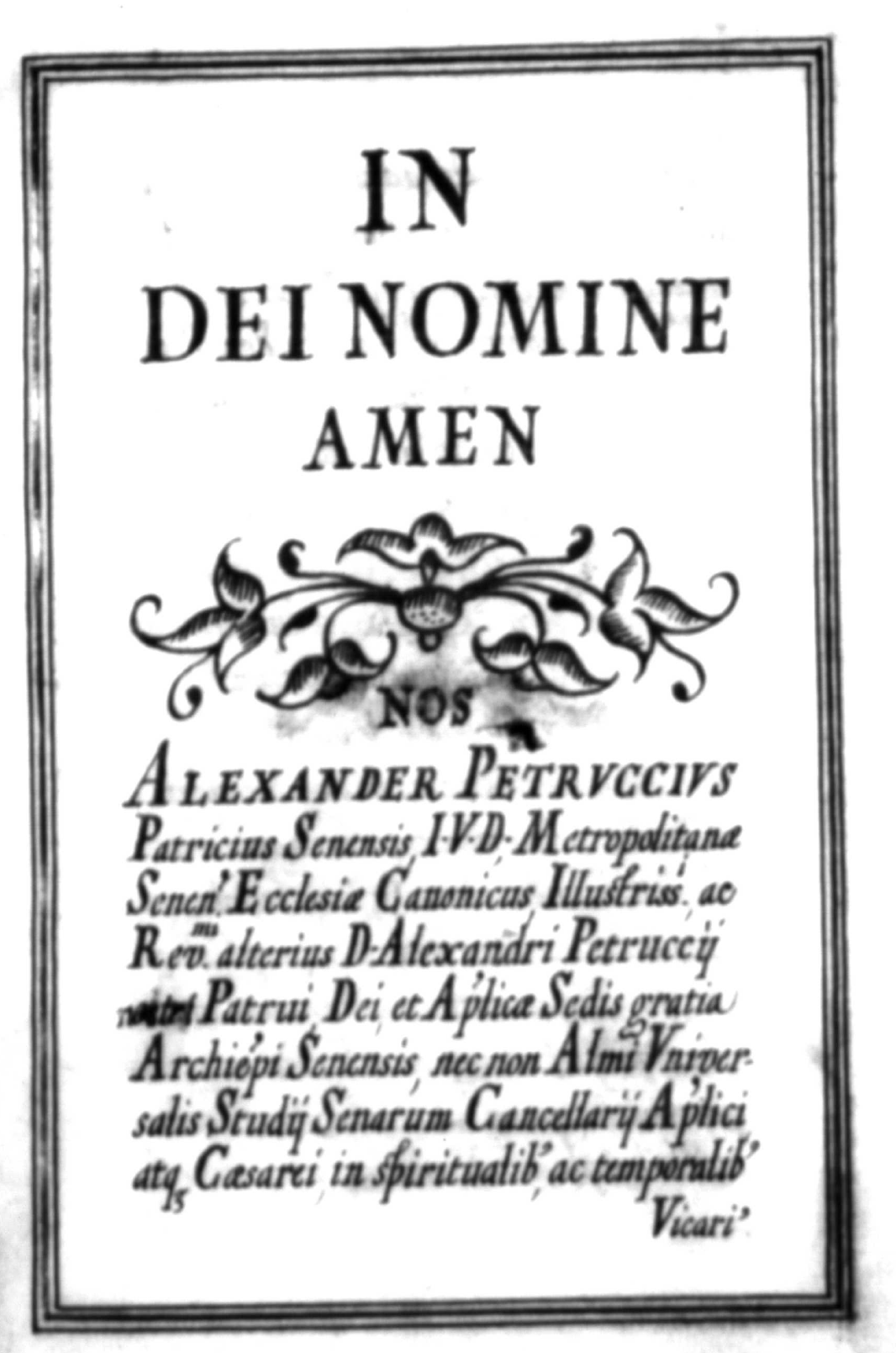
On Modigliano, we are fortunate to have archival material. Hananiah Modigliano was a graduate of the University of Siena in 1628 and was one of a mere eleven Jewish graduates from this university from the years 1543 to 1695.[11] His medical diploma is extant and housed in the Jewish Theological Seminary Library.[12]

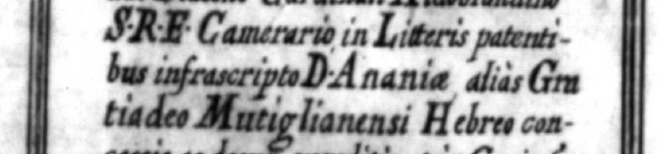
The invocation reads “In Dei Nomine Amen” (in the Name of God, Amen). While I have not seen any other diplomas of this period from the University of Siena,[13] there are a number of extant medical diplomas from this period issued by the University of Padua. The typical Padua diploma invocation reads “In Christi Nomine, Amen” (in the Name of Christ, Amen). The only diplomas that deviated from this norm were those of non-Christian students, in particular diplomas of Jewish graduates. Virtually every Jewish graduate’s diploma begins with the invocation, “In Dei Aeterni Nomine.” It is possible that the University of Siena made the same accommodations for its Jewish graduates as did Padua, few as they may have been.[14] Modigliano was also identified as a Jew in his diploma, with the word “Hebreo” appearing after his name:

This was also commonly found in the diplomas of the Jewish graduates of Padua, where the word “Hebreus” or “Iudeus” would typically, though not always, follow the name of the Jewish graduates.

We next hear of Modigliano on August 14, 1650, when upon the departure of Rafael Corcos,[15] the Roman Jewish community appointed three new worthy teachers, one of whom was the doctor Hananiah b. Rafael Modigliano.[16] As reported by Zahalon, Hananiah tragically died while serving as a physician for the Jewish community in Rome during the Bubonic Plague of 1656.

Modigliano’s son Raphael was also a physician, as well as a rabbi.[17] Extant medical diplomas of Jewish students are exceedingly rare, yet in this case, we are fortunate not only to possess a copy of Hananiah’s diploma, but we also possess the diploma of his son Raphael as well.[18] This is the only known case of extant father and son diplomas. A copy of his medical diploma from the University of Ferrara in 1662 is below:[19]

The invocation, similar to his father’s diploma, reads, “In Dei Nomine, Amen,” and he is likewise identified as “Hebreus.”

Of note, the document explicitly restricts his medical practice to Jewish patients.

We also have record of Raphael delivering weekly Shabbat sermons in the synagogue in Siena. Moses ben Samuel ben Bassa of Blanes records in his manual for preachers, Tena’ei ha-Darshan,[20] that both he and Raphael Modigliano would deliver weekly sermons, after which they would each provide constructive criticism of the other’s sermon.

What of our third and final physician, Yitzhak Zahalon? Regarding the third of the Jewish plague physicians for Rome in 1656, the author does not reveal additional details about him, despite their sharing the same last name. A few sentences later, however, Yaakov Zahalon enumerates the fatalities of the plague at around eight hundred deaths and mentions his cousin, the young skilled surgeon, Yitzhak Zahalon, amongst the casualties.

This has led at least one scholar to identify the physician in charge of one third of the city as the same Yitzhak Zahalon, the surgeon and cousin of Yaakov, the author. Sosland writes, “Three Jewish doctors are mentioned by Zahalon as having charge over the patients. One of them was a first cousin of our author, a certain Isaac Zahalon, a “skilled surgeon” who died toward the end of the epidemic.”[21]

With the physicians in charge of the medical care of the Lazaretto, as well as the different sections of the Ghetto, accounted for by name, we are left to wonder about the role, if any, the author, Yaakov Zahalon, played during the plague. As Sosland notes, “as to the exact role Jacob filled, we have no direct knowledge.”[22]

Zahalon’s medical work was published in Venice in 1683, and unlike the work of his rough contemporary, Tuviya Cohen, whose Ma’aseh Tuviya has been reprinted numerous times, has not yet merited even a second printing.[23] There is however one extant manuscript of Zahalon’s Otzar HaHayyim housed in the Vatican,[24] dated from no later than 1675, and it is in this manuscript that we find the solution to the riddle of Zahalon’s role in the administration of medical care to the Jews in the Rome Ghetto during the plague.

The manuscript appears to reflect that Otzar HaHayyim was initially part of a larger multi-section work entitled Ohalei Yaakov Otzar HaHokhmot. Zahalon’s medical work is labelled as section two, Hokhmat HaRefuah, the only section in the Vatican manuscript.

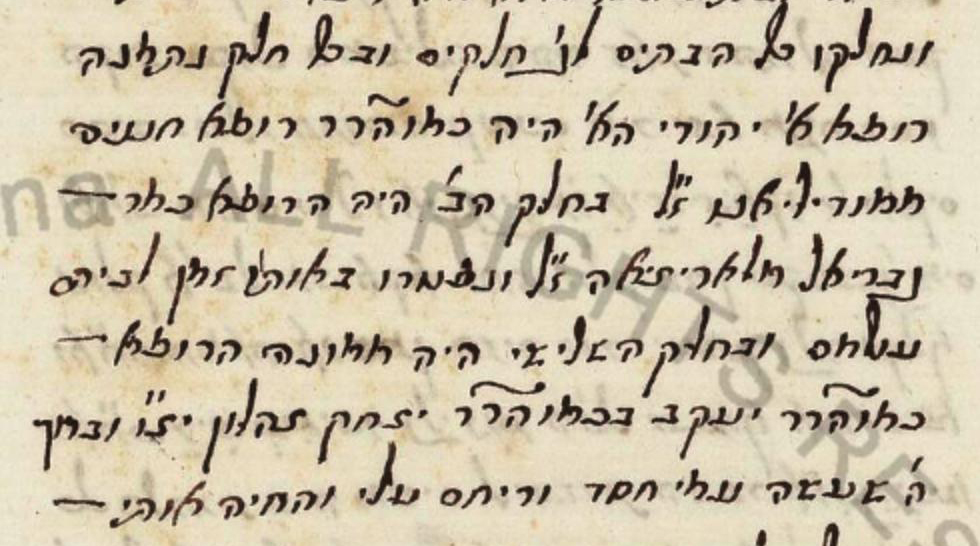
Below is the section describing the division of the city into three sections, each with its respective physician.

There is one key difference in this passage between the printed edition and the manuscript version. The physician in charge of the third section of the city is not Yitzhak Zahalon, whose identity is ambiguous, but rather, Yaakov ben Yitzhak Zahalon, none other than the author himself! A part of the name was accidentally omitted in the printed work. Zahalon refers to himself here in third person. This correction now facilitates a better understanding of the next sentence in the text, in which Zahalon continues to refer to himself, expressing gratitude to God for having rescued him from the ravages of the plague.

In this vein, I conclude with a comment on Zahalon’s conclusion to his plague passage. Despite the unspeakable tragedies experienced by the Jewish community, Zahalon ends his plague discussion by sharing a positive, though bittersweet, thought reflecting the continuity of the Jewish community:

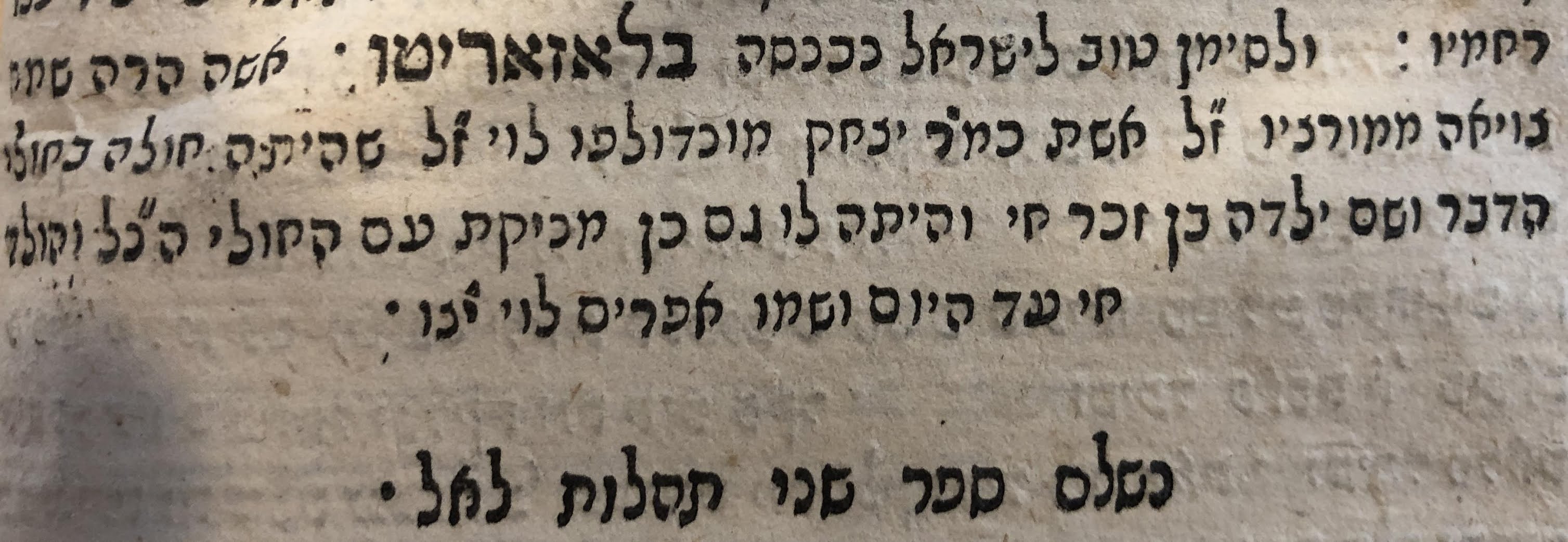
As a good sign for the people of Israel, a pregnant woman named Zivia, the wife Yitzhak Mondolfo, contracted the plague, and though confined to the Lazaretto, was able to deliver a healthy child, whom she was able to nurse for a period before her demise. In the final line of this section in the printed work, we read that the child was still alive “until today,” and that his name was Efraim Levi. Though Zahalon’s book was published in 1683, this line appears in the manuscript, thus “until today” would be some twenty years after the plague.

While this indeed is some form of consolation, the manuscript adds an additional sentence which yields a far more powerful conclusion.

“And the circumcision was performed there (in the Lazaretto), and I say to you by your blood you shall live, and I say to you by your blood you shall live.” Zahalon concludes with the phrase from Yechezkel 16:6 which is traditionally recited as part of the circumcision ceremony. The allusion here to the plague is obvious.

Omitting this last sentence denies us not only the additional factual information about the performance of the circumcision in the Lazaretto, itself a remarkable event, but also Zahalon’s homiletic flourish which marked the community’s (re)birth after the tragedies of the plague. As I write these words, we are still in this midst of the Covid 19 pandemic, though the dissemination of the vaccines portends, God willing, for its cessation in the near future. These final intended words of Zahalon resonate deeply with us today, perhaps even more so than they would have when Otzar HaHayyim was published, some three decades after the plague.

[1] Ellen B. Wells, “Prints Commemorating the Rome 1656 Plague Epidemic,” Annali dell’Istituto e Museo di Storia della Scienza di Firenze 10 (1985), 15-21.
[2] On Zahalon, see Harry A. Savitz, “Jacob Zahalon, and His Book, ‘The Treasure of Life,’” New England Journal of Medicine 213:4 (July, 1935), 167-176; Harry Friedenwald, “Jacob Zahalon of Rome: Rabbi, Physician, Author and Moralist,” in his The Jews and Medicine 1 (Ktav Publishing House: New York, 1967), 268-279; J. Ph. Hes, “Jacob Zahalon on Hypochondriasis,” (Hebrew) Koroth 4:5-7 (December, 1967), 444-447; A. Danon, A. Kadar and D. V. Zaitchek, “Physiology and Pathology of Lactation in Zahalon’s Work,” (Hebrew) Koroth 4:11-12 (December, 1968), 667-678; D. Margalit, “Shmirath Habriuth by Maimonides and Comment by R. Jacob Zahalon,” (Hebrew) Koroth 5:1-2 (September, 1969), 96-98; Yehoshua Leibowitz, “R’ Yaakov Zahalon Ish Roma uPizmono liShabbat Hannukah 1687,” Sefer Zikaron liHayyim Enzo Sereni: Ketavim al Yehudei Roma (Shlomo Mayer Institute: Jerusalem, 5731), 166-181; Jonathan Jarashow, “Yakov Zahalon and the Jewish Attitude Towards Medicine,” Koroth 9:9-10 (1989), 725-736; Zohar Amar, Maimonides’ Regimen Sanitatis: Commentary of R. Jacob Zahalon on “Hilchot Deot” – Chapter Four, With an Added Brief Preface to the Treatise Ozar ha-Hayyim (Hebrew) (Neve-Tzuf, 2002); Samuel Kottek, “Pediatrics in the work Otzar HaHayyim of Jacob Zahalon,” (French), in Gad Freudenthal and Samuel Kottek, eds., Melanges d’Histoire de la Medicine Hebraique: Etudes Choisies de la Revue d’Histoir de la Medicine Hebraique (1948-1985) (Brill: Leiden, 2003), 183-207; Eliezer Brodt, Bein Keseh Le’Asor (Jerusalem, 5768), 184-185; Eliezer Brodt, “Segulot leZikaron uPetihat haLev,” Yerushateinu 5 (5771), 337-360, esp. 352; Michal Altbauer-Rudnik, “Love For All: The Medical Discussion of Lovesickness in Jacob Zahalon’s The Treasure of Life (Otzar Ha-Hayyim),” in Asaph Ben-Tov, Yaakov Deutsch and Tamar Herzig (eds.) Knowledge and Religion in Early Modern Europe: Studies in Honor of Michael Heyd (Brill: Leiden, 2013), 87-106. For discussion of the sources of Zahalon’s medical work, see Iris Idelson-Shein, “Rabbis of the (Scientific) Revolution: Revealing the Hidden Corpus of Early Modern Translations Produced by Jewish Religious Thinkers.” American Historical Review 126, no. 1. Forthcoming, March 2021.
[3] For the response of the Italian Jewish community to plagues in this period, including the plague in Rome of 1656, see Yaffa Kohen, The Development of Organizational Structures by the Italian Jewish Communities to Cope with the Plagues of the Sixteenth and Seventeenth Centuries (Hebrew) (Doctoral Dissertation: Bar Ilan University, submitted Tishrei, 5740). I thank Naomi Abraham, librarian at Bar Ilan University, for her truly exceptional efforts in making this dissertation available to me in the midst of the Covid pandemic.
[4] For more on this passage and on the plague in the Jewish Ghetto of Rome, see Yehoshua Leibowitz, “Bubonic Plague in the Ghetto of Rome (1656): Descriptions by Zahalon and by Gastaldi,” (Hebrew) Koroth 4: 3-4 (June, 1967), 155-169; Kohen, op. cit., 72-95.
[5] Y. Zahalon, Otzar HaHayyim (Venice, 1683), 21a-21b. Elsewhere we have discussed the Jewish physicians of the 1631 plague in Padua. See E. Reichman, “From Graduation to Contagion: Jewish Physicians Facing Plague in Padua, 1631” Lehrhaus (thelehrhaus.com), September 8, 2020.
[6] See H. Friedenwald, “Jacob Zahalon of Rome,” in his The Jews and Medicine (Johns Hopkins Press: Baltimore, 1944), 268-279.
[7] On Zahalon’s abilities and reputation as an orator, see Henry A. Sosland, A Guide for Preachers: The Or HaDarshan of Jacob Zahalon—A Seventeenth Century Italian Preacher’s Manual (Jewish Theological Seminary: New York, 1987). On the plague sermons, see pgs. 23-28.
[8]  See, for example, Guenter Risse, “Seventeenth-century Pest Houses or Lazarettos: Rome 1656,” in his Mending Bodies, Saving Souls: A History of Hospitals (Oxford University Press, 1999), 190-214.
[9] On the medical members of the Gabai (and Zahalon) families, see S. Plashkes, “Two Jewish Medical Families in 17th Century Italy: Gabai and Zahalon,” (Hebrew) Koroth 3:1-2 (October, 1962), 97-99.
[10] Otzar HaHayyim 21b.
[11] Israele Zoller, “I Medici Ebrei Laureati a Siena negli Anni 1543-1695,” Revista Israelitica 10 (1913), 60-70 and 100-110. In contrast, the University of Padua counts 127 Jewish medical graduates from 1617 to 1695. See A. Modena and E. Morpurgo, Medici E Chirurghi Ebrei Dottorati E Licenziati Nell’Universita di Padova dal 1617 al 1816 (Italian) (Forni Editore, 1967). For Jewish graduates of Padua earlier than this period, see D. Carpi, “Jews who received medical degrees from the University of Padua in the 16th and early 17th centuries,” (Hebrew) in Scritti in Memoria di Nathan Cassuto (Ben Tzvi Publishers: Jerusalem, 1986), 62-91.
[12] JTS, MS 8519. I thank Sharon Liberman Mintz for bringing this diploma to my attention. As part of my research interest in Jewish medical history, I have sought out copies of medical diplomas of Jewish students from previous centuries. Sharon, aware of this interest, notified me of a medical diploma in the JTS collection. The record does not identify the graduate but lists the University of Siena as the granting institution. I had never seen a diploma of a Jewish medical student from this institution; the majority of extant medical diplomas of Jewish students are from the University of Padua. However, due to the Covid 19 pandemic, access to the original diploma, stored in the remote site of the library, has been impossible. Fortunately, the National Library of Israel had taken black and white photographs of this document some years ago, and I was able to acquire copies. Since the onset of the pandemic, I have been focusing of the history of pandemics in Jewish medical history. When I received the copies of the diploma, and read the name, Hananiah Modigliano, it sounded familiar to me. It was a short while until I realized that I had seen the name mentioned in Zahalon’s passage on the plague.
[13] As per the librarian for the University of Siena Archives, the university does not possess any diplomas of this period.
[14] On the differences in the diplomas of Jewish medical graduates of the University of Padua, see E. Reichman, “Confessions of a Would-be Forger: The Medical Diploma of Tobias Cohn (Tuviya Ha-Rofeh) and Other Jewish Medical Graduates of the University of Padua,” in Kenneth Collins and Samuel Kottek, eds., Ma’ase Tuviya (Venice, 1708): Tuviya Cohen on Medicine and Science (Muriel and Philip Berman Medical Library of the Hebrew University of Jerusalem: Jerusalem, 2019), in press; E. Reichman, “The ‘Doctored’ Medical Diploma of Samuel, the Son of Menasseh ben Israel: Forgery or ‘For Jewry’?” Seforim Blog (https://seforimblog.com) (forthcoming).
[15] The Corcos family was a prominent Jewish Italian family. Another Jewish graduate of the University of Siena was Isaac Corcos, who graduated in 1654. See Zoller, op. cit. He may have been a relative and possibly a brother of Raphael Corcos.
[16] See H. Volgstein and P. Reiger, Geschichte der Juden in Rom, 2 vol (Berlin, 1895-1896), 267.
[17] On Raphael Modigliano, see Asher Salah, La Republique des Lettres: Rabbins, ecrivains et medecins juifs en Italie au XVIIIe Siecle (Brill: Leiden, 2007), 428-429.
[18] What makes this even more exceptional is that Hananiah’s diploma is the only known Jewish diploma from the University of Siena, and Raphael’s diploma is one of only two known Jewish diplomas from the University of Ferrara, the other being from 1802 (Samuel Vita Della Volta).
[19] The diploma was originally part of the Valmadonna Trust Library, Ms. 292, and is now incorporated into the National Library of Israel, system n. 990000822160205171. See Benjamin Richler, The Hebrew Manuscripts in the Valmadonna Trust Library (Valmadonna Trust: London, 1998), n. 269.
[20] Columbia University Library, Ms. X 893 T 15, p. 15a. See Sosland, op. cit., 82-83.
[21] Sosland, op. cit., 25. Others just listed the name as Isaac Zahalon without comment. See H. Volgstein and P. Reiger, Geschichte der Juden in Rom, 2 vol (Berlin, 1895-1896), 212-213.
[22] Sosland, op. cit., 25.
[23] Some years ago, Chaim Reich, ah, of Renaissance Hebraica, produced a high-quality reproduction of Otzar HaHayyim. I thank Rabbi Eliezer Brodt, who owns one of these copies, for this information.
[24] The manuscript is available online at https://digi.vatlib.it/mss/detail/Vat.ebr.466. On this manuscript see, Malachi Beit-Arié and Nurit Pasternak, Hebrew Manuscripts in the Vatican Library (Vatican City, 2008), 405. I have only compared the manuscript to the printed edition for this brief passage. A comprehensive comparison remains to be done.


Should we celebrate birthdays or not? Is it better to ignore them?

Should we celebrate birthdays or not? Is it better to ignore them?
By Rav Binyamin Wattenberg

This post was originally an answer posted on july 25 2016 on the French website techouvot.com (https://www.techouvot.com/feter_les_anniversaires-vp46393.html).

The author agreed to have it translated into English but did not review the translation.

The author, Rav Binyamin Wattenberg teaches Talmud in Neuilly sur Seine, France, among other talmudic activities (techouvot.com…)

This subject is widely debated in our sefarim. Some are convinced that it is entirely a “non-Jewish” custom which is important not to follow, but I think that it is rather because of ignorance of what has been written on the subject.

I will try to summarize the different rabbinical positions with their reason, and as we will see we can find anything and everything.

GOOD MAZAL

The Yerushalmi Rosh Hashana (III, 8) relates that Amalek placed soldiers on their birthday at the battle front because they would have a good “mazal” and Moshe had to “mix mazalot”. Korban Haeda explains that by raising his hands, Moshe “mixed / disturbed” the Mazalot to counter the good mazal of Amalek’s warriors.

This idea is also found in the Chida who writes (Chomat Anakh, Iyov 3) on behalf of the Kabbalists that the birthday is a day of good mazal.[1]

That would explain the wish of the day: Mazal Tov!

There is also Rabbi Tsadok Hacohen Rabinovicz of Lublin in his Resisei Layla (Divrei Chalomot 20) who writes that a man has nothing to fear on his birthday and while the Gmara Kiddushin (38a) says that Tzadikim die on their birthday (and therefore have something to fear about), it is because for them, death is an accession to a higher level (and is therefore a positive occasion).[2]

There is a more plausible explanation of the Maguen Avraham in his Zayis Raanan on Yalkut Shimoni (‘Habakkuk 3) who answers that it is a blessing for the tzaddik to die on his birthday because “the Holy One, Blessed be He, sits and completes the years of the righteous from day to day” (Kiddushin 38a, Sotah 13b and Rosh Hashana 11a).[3]

But some consider that this good mazal on this day concerns only non-Jews (like Amalek).[4]

This is perhaps why we find several authors who are very reluctant about the idea that a Jew could celebrate such a day.

AGAINST CELEBRATING:

For example, in his Torah Shleima (Vayeshev p.1522 note 49), Rav Menachem Kasher quotes a manuscript (Chemat Hachemda) commentary on Bereshit 40, 20, that still today, non-Jews celebrate birthdays (meaning that Jews do not).[5]

Certainly, in the Gmara (Moed Katan 28a) we are told that Rav Yossef celebrated his 60th birthday, but that also indicates that he did not celebrate his other birthdays – neither he nor the other Amoraim – and it is only for its 60th that he wished to celebrate because – as he says it – it excluded Karet’s punishment.

The Minchat Elazar (the Munkasz’ Rebbe) writes[6] that there is nothing to celebrate on one’s birthday since the Sages tell us (Eruvin 13b) that it would have been better for the man not to be born.[7]

It is also the position of many authors, such as : Rav Horovitz of Strasbourg (and then of Badats of Jerusalem) in his Shout Kinian Torah Bahalacha (III, §21), Arugat Habossem (II, §215),[8] Abelsohn (Shut Knesset Avraham Yoel, §6 p.116 – linked with Shut Etz Chaim),[9] R. Tsadok Hacohen (Likutei Maamarim §13, p.140), the Klausenburg-Sanz Rebbe (Michtevei Torah II, 82 p.55), Rav Shlomo Zalman Bloch (Hatzadik R. Shlomo, p.29, ot 18), Patsovsky rav (Pardes Yosef Vayeshev Milouim p.48 and in the new edition, Bereshit II, p.777), Rav Dunner (Leket Sheelot Hametzuyot IV, p.13 and Kol Hatorah 65, p.164), Rav Stern (Beer Moshe) and Rav Wozner (Shevet Halevy) both quoted by Rav Harfenes in Beit Vaad LaChachamim (adar 2009, p.356), Shut Lehorot Natan (IX, §5, 9),[10] Gdulat Yehoshua (Chelek 2, Hakdama), Rav Shmuel Mohliver (Midei Chodesh BeChodsho, II, Jerusalem 1957, p.192 and Shana Beshana 1976, p.237).

In Hapeles (shana III, 1903, p.633) it cites the Beer Yitzchak of rav Itzchak Ber Levinzohn (p.34) stating that birthdays were non-Jewish holidays close to Avoda zara, although this Rav himself was close to Haskala![11]

The Kinian Torah Bahalacha (III, §21) is also opposed to celebrating birthdays, and quotes in support the Vizhnits’ Rebbe, Ahavat Israel, who refused to make a seuda for his 70th birthday and recited a lot of Tehilim and Bakachot instead.[12]

Rav Israel of Rouzhin also vigorously refused the surprise birthday organized by his wife and dismissed all the guests.[13]

The Otsar Kol Minhaguei Yeshurun (4th ed., §XXVII, 4, p.60 and 3rd ed., St Louis 1917-8, Hashmatot §14, p.304) considers that celebrating one’s birthday is a non-Jewish custom and the only character in the Choumash that one finds celebrating his birthday is Paro.[14]

It seems that it is also the opinion of the Aderet in his Nefesh David (p.129) who did not appreciate when we wished him a happy birthday, saying that it was never a holiday among the Jews and that the only one that one finds celebrating his birthday in the Chumash is Pharaoh, while the Gmara Erouvin (13b) tells us that it would have been better not to be born … He even states that he tries to forget that it is his birthday because it causes him great sadness[15] (because “it is better not to be born …”).[16]

He emphasizes, however, that the Tzadikim have something to celebrate their birth, according to the opinion of Tosfot (Avoda Zara 5a).

He nevertheless rejoiced on the day of his 60 years for the same reasons as Rav Yosef in Moed Katan (28a), as he wrote in a letter (Eder Hayakar II, Igrot, p.93, §14 ).

Not that you have to be ashkenaz to oppose birthdays. The Rav Chalfon Moshe HaC ohen in his Yad Moshe (Vayeshev, §63 daf 70b) writes that the custom of celebrating birthdays is very present in Europe, but we (the Jews) mark this date with fasting and repentance, preferring in this the useful to the pleasant.

There is in any case a very clear tendency to connect the birthday party to Pharaoh and that would therefore be considered as a “non-Jewish” rejoicing.[17]

IN FAVOR OF CELBRATING BIRTHDAYS :

However, one could just as easily see things differently.

For the Sadigura Rebbe,[18] if the Torah tells us that there was a celebration in honor of Pharaoh’s birthday, it is not in vain, it is here for us to learn that we must celebrate birthdays. And even though Pharaoh is not a good person, the fact that the Torah mentions it indicates it has to be a followed practice. He brings as a support we learn the principle of not mixing two feasts (ein mearvin simcha bessimcha) from the Torah relating the habit of the non-Jews and particulary Lavan (see Bereshit XXIX, 27 and see Yeroushalmi Moed Katan I, 7) ; and Lavan is also the source for the idea of the seven days of wedding’s festivities.

Therefore, it should not be considered as a non-Jewish minhag, and there is no problem of Chukot hagoyim in celebrating birthdays (see also Shut Beth David, §176).

Rabbi Meir Mazouz also writes (annotations on Ben Ish Chai shana 1, Ree §7, p.580) that he has heard that some people are against celebrating birthdays but since he remembers reading that the Baal Shem Tov was celebrating his – on Elul 18th – and deduces that there is no problem.[19]

His brother-in-law, Rav Yitzchak Berdah, is even clearer in his Shut Yitzak Yeranen (V, §54) and validates the birthdays minhag by writing that those who do so have whom to rely upon.

Rav Nissim Karelitz (Chut Hashani, §195, 1, 6 p.215), unlike Rav Zeldner cited above, does not seem to consider it problematic to offer a birthday present.[20]

Ben Ish Chai (I, Ree, §17) writes that it is a good custom to celebrate birthdays every year and note that some are celebrating the anniversary of their circumcision, indicating that in his family, they usually follow the first minhag (= celebrate the day of birth).[21]

R. Avraham Pallagi in his Veavraham Zaken (Yod, §19) mentions also the minhag of celebrating birthdays. Yabia Omer (VI, WH, §29) also finds this positive.

The custom of a birthday seuda, has also been endorsed by multiple and different authors such as’ Havot Yair (§70), Shout Beth Israel (Landau) (§32), Beer Moshe (Yeroushalaimsky) (Maamar Zikhron Tov, daf 138a, §5).

The Tiferet Israel, in his will prompts his children to mutually wish each other good wishes on the days of their respective birthdays (Hamaayan -Tamuz 1971- ot 6).

It is also a habit taken seriously by Loubavitsh Chassidim. The chabad literature is full of advice and remarks on to conduct oneself on one’s birthday and even tracks sources for it in Kabbalah (Shaarei Halakha UMinhag II, §302).

We also find many Tzadikim who have celebrated their birthdays themselves.

Rabbi Avraham Pallagi already mentioned, celebrated his birthday every year from the age of 70 – according to the testimony of his son Rabbi Avraham Pallagi (Tsavaa Mechaim §40 and see also Guinzei Chaim, yud §16). And this is also the case of Rabbi David Chazan quoted in Yishrei Lev (daf 2b).[22]

We also find the Midrash Sechel Tov (XL, 20 ; p.247) stating that “the majority of “people” enjoy (mechavevim) their birthday, rejoice and make a feast”. (But it’s not clear if he speaks only of gentiles or also of jews.)

The Ktav Sofer probably did not celebrate each of his birthdays with great fanfare, but celebrated his 50th one publicly (see Shut Ktav Sofer Y “D, §148).[23]

We also know – as mentioned above – that Rav Yosef celebrated his 60th birthday (Moed Katan 28a).

And this habit was followed by several rabanim, such as the Trumat Hadeshen, quoted by his pupil (Leket Yosher II, Y “D, p.40), or the Tshortkov Rebbe and the Rudzimin’s Rabbi both cited by R.A Nayerman in his Toafot Reem (volume 1, Warsaw 1936, p.30, §23).

We also find the idea of especially ​​thanking G-d on one’s 60th birthday, as Pele Yoets in his Chesed Laalafim (§221-230, sk.8, p.372) who advocates reciting Shehechiyanu without shem UMalchut or else to prepare a fruit or a new garment for that. This is also the Ben Ish Chai’s opinion (I, Ree, §9) for the 60th and 70th birthday.

For the 70th birthday, we find in Shut Chavot Yair (§70) that it is necessary to recite Shehechiyanu (without restriction). But this opinion is not followed and the Chida (Birkei Yosef-Shiyurei Bracha §223, sk.2) will impose the same restrictions as for 60th birthday, i.e without pronouncing the name of G-d or wearing a new garment (or eating a new fruit).

See as well the Pri Megadim (Mish Zahav §444, sk.9), Shut Tzitz Eliezer (XVIII, §33), Shut Tshuva Meahava (II, §239), Samach Nefesh (erekh Shehechyanu), Rabbi Avraham Pallagi (Tsavaa Mechaim, §40), Hagahot Chatam Sofer (O.C §225), Shut R. Yedidia Tia Weill (Y “D §106 p.224 of the recent edition), Kaf Hachaim (§223, sk.28), Shut Beth Israel (Landau) (§32), Shut Beth David (§176), Chesed Laalafim (§221-23, sk.8), Divrei Israel (II, p.175) and Afarkasta Deania (I, §123), who all oppose reciting shehchiyanu “only because of the 70th birthday”, since this blessing should only be recited for the situations indicated by Chazal, as Shut Olat Shmuel (Kauder) writes (I, §22 ).[24]

However, it will still be necessary to mark the hit. The Chafetz Chaim, for his 70th birthday, invited rav Elchanan Wasserman and rav Yossef Shlomo Kahaneman for a little cake and drink and recited Shehechiyanu! (Mishnat Yaakov II, §225).

But according to other sources (Hechafetz Chaim, chayav UPealo, p.312), he did it (on his 70th birthday) on a new garment.[25]

The Chafetz Chaim also celebrated his 90th birthday and finished his Beth Israel that day (see Hechafetz Chaim, chayav UPealo, p.25).

I was myself invited to the 80th birthday (the last one) of my teacher Rabbi Chaim Yaakov Rottenberg (see Shut Beth Israel -Landau- §32), he did not recite shehechiyanu, but there was cake anyway.

Rav Fishman-Maïmon also celebrated his 80th birthday, and Rav Reuven Margulies participated to the “party” (Machanayim LXXII of Elul 5722 -1962, page 41).

Rav Nathan Adler, from London, traveled to Hanover, Germany for his mother’s 80th birthday (Letter from Rav Shlomo Eiger, printed in Igrot Sofrim, 1, p.83).

It seems that Rav Sonnenfeld also “celebrated” his 80th birthday and Rav Mendel Alter (son of the Sfas Emes) presented him his wishes despite some hesitation about the dubious origin of the birthday minhag (see his letter printed in Kerem Shlomo – Bobov – vol.205, p.47).

But for the 60 years, it is likely that there was nothing dubious, since his older brother, since the Imrei Emes, organized his (the Imrei Emes) 60th birthday party and during the meal he explained the reason for rejoicing, i.e Moed Katan 28a (Shut Maharaav – R. Avraham Binyamin Zilberberg – NY 1941, Volume 2, §61).

Returning to the 70th birthday, Rav Schneebalg (Shut Shraga Haméir IV, §69) was in favor of celebrating it.

Sdei Chemed also celebrated his (Hameassef X, Tevet 5665, IV, p.43 and p.46), and it is also the case of the Vizhnitz rebbe who celebrated it joyfully with his pupils (Israel Saba Kadisha, II, p. 177). This is also what Rav Michael Goldberger did.[26]

In 1860, for Shir’s 70th birthday (Rav Shlomo Yehuda Rapoport), his students had prepared a feast and honors for him, but he refused the honors, humbly explaining that he was born in the year Takan / TIKEN (1790) but he has not been Metaken – Ma Tikanti? (Toldot Shir of Bernfeld, p.126).

See also Voice of Truth (p.282-3) or in Hebrew Kol Chotsev (p.263-4) about the 70th birthday of Rav Schwadron.[27]

We ca find another rationale for the celebration of the 70th birthday. In the Mekor Chesed (Rav Reouven Margulies) on Sefer Chasidim (§213, note 1 ), it brings that the Yerushalmi (Yevamot VIII, 3) states that a plague occurs (at least) once every 60 or 70 years. Therefore, whoever reaches his 70 years has certainly escaped the plague that has declared “in his day”, and that’s a good reason to make a “seudat Hodaa”!

Finally, we even find in the Orchot Chaim (Bukhner) (Krakow edition 1654, §16) that the 60th and 70th birthday’s meals are of the nature of a Seudat Mitzvah.

We realize therefore that many (to the exception of those mentioned in the previous part) view positively the birthday party, and especially those of the 60th and 70th one. But we still have to define what should be done to celebrate a birthday properly.

HOW TO CELEBRATE?

On one’s birthday, it is proper to :

– as we have seen bless Shehechyanu on a fruit or a new garment (Shut Guinzei Yossef §4, 2 quoting his father-in-law, Rav Deutsch, author of Shut Pri Hassadé);

– give a lot of tzedakah (R. Chaim Pallagi in Tzedaka Lechaim – maarechet ayin §555)

– make it a “day of prayer” (Melitsei Esh p.54)

– dedicate this day or at least most of it for divine service (Torat Shalom-Schneersohn-p.398 ; Kerem Habad II, p.102 ; see also Hapardes, year 62 volume 9, p.2 on the name of the Lubavitsh Rebbe)

– learn a lot (Shut Hillel Omer, O “H §139).[28]

One should also be careful to reserve a moment for introspection and Cheshbon Hanefesh over the past year, as the Chut Hameshoulash (Munkasz edition 1893, volume 1, daf 59b-60a footnote) brings about the Ktav Sofer who had locked up hiself on his birthday (54th one) and someone who mistakenly entered the room found him sitting on the floor crying, and asked him what was happening to which he replied that he was crying over the loss of time over the past years (see also the preface to Ktav Sofer Al Hatorah, p.29)

In Shut Hadar (§18), the author states that his master – the Rav of Stretin – wanted to have an aliyah to the Torah on his birthday (which is not feasible every year …). In the same vein, the Divrei Yechezkel Shraga (parshat Vayakel) and the Tehilat Caim (p.409) bring down that the Divrei Yechezkel of Shinova wanted to be shaliach tzibur on his birthday (which is practicable more often). And this is also what R. Shaul Broch did (Shaul Behir Hashem, Ashkavta derabbi, p.275)

See also Torat Shalom (p. 406) who – for his birthday – advocates having an aliyah to the Torah, giving tzedakah, adding moments of prayer, tehilim, study and introspection, bless shehechiyanu on a fruit or a garnment (etc).

I have also read in the name Spinka Rebbe quoted in the Shut Chakal Yitzchak (I, 3) that it is appropriate on one’s birthday, to take upon oneself the commitment on something one knows he has to work on.[29]

There is also a notion of making a Siyum on a birthday.

Several rabanim wanted to make a siyum on their birthday, the Terumat Hadeshen did one on his 60th birthday (Leket Yosher II, Y “D, p.40).

See also Leket Hakemach (131) that it is appropriate to mix this rejoicing with a siyum massechet.

Thus, the Chatam Sofer planned that the end of the cycle of chumash study with his pupils falls on his birthday – the 7th Tishri (Minhaguei CS, VII, §14, p.31).[30]

His son Ktav Sofer also completed a massechet each year on his birthday (Chout Hameshoulash ed Munkasz 1893, Volume 1, daf 59b footnote).

Another fact deserves to be emphasized:

In the Sheerit Natan (p.392 ; quoted in Or Israel 46, p.249) we find a very particular siyum minhag that was taking place at Yeshivat Chachmei Lublin, every 7th Adar, birthday of the Rosh yeshiva Rabbi Meir Shapira (initiator of the study of Daf Yomi). Talmud treatises were “dispatched”, and each student took a massechet or half of it, in order that they altogether fnished Shas in one night, so that on the next day, the 7th of Adar, they were all together making a great Siyum Hashas with the Rav.

All this being said, personally, I will be tempted to give an argument in favor of those who celebrate their birthdays, but I have not seen any Acharon underlining this aspect (except Torat Shalom -Schneersohn (p.399-400 ) I found recently):

The halacha is to celebrate annually a miracle that would have happened to us (see Mishna Berura end of §218), for example the one who survives a fatal accident must celebrate this event every year.

If it is so, given the great danger of a baby birth, one could consider that it is necessary to celebrate the miracle of his birth each year.

True, nowadays, in civilized countries, the risk of miscarriage is pretty much reduced and infant mortality has also fallen down, B “H, but if the minhag has been implanted since a time when it was not the case, we may continue this custom because the danger is still not totally absent.

Only that according to this, it should also be that each mom celebrates the birthday of each of her children, because she also escaped death that day.

And, according to this rationale, we should celebrate the Hebrew date rather than the civil one.[31]

Anyway, even if no halakhic argument would push to celebrate the birthdays (and it is probable because we proved Moed Katan 28a that the Amoraim did not celebrate any birthday, only Rav Yosef distinguished itself by celebrating 60 years old – and only that one …), there is another reason, especially for children: nowadays this custom is widespread and children are sometimes misled and are tempted to move away from family. It is beneficial to show each child in the family that he is important and at least one day a year, we celebrate together. He becomes the hero of a day.

See also, a bit in this way, Kitvei Reb Eizik (Schwei) (p.273) and Torat Shalom (p.405).

At the time of the Talmud, it was not necessary, but today it can be according to the situations, the families and the place.

It would be inappropriate to say that since the Amoraim did not celebrate them, we must refrain from doing so.

To refrain from them at their time meant nothing particular, because no one was celebrating them (among the Jews at least). Today it would have another meaning for the child …

It cannot be said that he fails to celebrate, but that those who are accustomed to it should not lose it under a “religious” pretext, they must perhaps channel its spirit and enhance it by making it look, more “kadosh”, by giving more meaning to it.

See also Shut Mayim Hahalacha (Metzger) (IV, §46) who writes that it is necessary to know how to give a kedusha spirit to birthdays and not to celebrate them in frivolity.

More generally, Rav Shach used to say (see Machshevet Zkenim p.342 and also p.141 and 332) that each birthday brings us closer to death, so why rejoice? That is why only the “ben aliya”, the one who progresses from year to year in the Torah, must rejoice, because each passing year carries a new advance in Avodat Hashem, so it is closer to Chayei Netsach, the reverse of death, for the tzaddikim are called alive even after their death (Brakhot 18a).

Once a rav had suggested to the great and famous Rav Yechezkel Lewinstein – when he was mashgiach of Ponovez – to suppress the minhag of the “Santukha” (small celebration among friends of the Yeshiva when one of them is engaged) for it is systematically engaged in flattery to highlight the qualities of the chatan and the speaker, in a laudatory spirit, sometimes praises too much, which necessarily leads to a uncontrollable feeling of pride so repudiated by Baalei Moussar.

Rav Lewinstein exclaimed: “Once in the life of a man it happens that his friends give him compliments and even that you want to suppress?! “

IN CONCLUSION: It is perfectly legitimate to wish and celebrate birthdays, but you must know how to do it.

Those who are not used to accompany a family snack with Cheshbon Hanefesh are not required to adopt this minhag. But those who already celebrate this day with a small party should not abandon this beautiful habit because of some rabbis who grumble against birthdays; as we have seen, the rabbis who attached importance to these moments of rejoicing are very numerous and to the extent that one does not feast bestially but for a constructive purpose, with a feeling of Hodaa, Tshuva and introspection, it’s a very good Minhag.

[1] See also Ben Yehoyada Brachot 28a, that if a miracle happens on one’s birthday, it does not diminish his merits…
[2] It seems that some Tzadikim were not so happy to leave this world. The story that is told about the Gaon or the ‘Hazon Ish (or others, depending on the version), who would have cried before dying while saying regret a world where we can buy mitzvot for some pennies like Tzitzis, shows us that feelings are mixed ….
[3] Which means that by dying on that day, it indicates that they could have died before but have benefited from an extension, so it is “positive”.
[4] Taam Vodaas Bereichit XL, 20, however, see Nefesh Chaya (Orach Chaim §580).
[5] From Rav Aharon Zeldner’s Mate Aharon (p.68) it is deduced that giving a gift to a friend on his birthday is a non-Jewish custom not to follow.
[6] Minchat Elazar in his Divrei Torah (V, §88).
[7] This argument seems strange. In fact, we find in the prayers, all kind of different expressions of gratitude to G-d for the life He gives us (the Gomel, for example), which seems to indicate that life has its interest …

Moreover, Ramban (Shemot XIII, 16) writes that we must thank G-d for creating us.

We must therefore temper the teaching quoted (Erouvin 13b), since it is impossible to interpret it as if God had made a mistake by creating us!

It is only from men’s viewpoint that he would have been “noach“, pleasant/easier, to not have been created. Easier, certainly, but not “preferable” since G-d knows what He does.
[8] But his son (Shut Migdalot Merkachim, O.C, §31) greatly relativizes his father’s opposition by explaining the very particular context of this responsum and the specific case of the person who was concerned. Shut Vayaan Yossef (§73) also diminish the opposition of Arugat Habossem stating he was only opposed to big feasts, but not to small family party at home (see also in the same way Kvod Chachamim (Jerusalem 1982 – p.208, rav Meir Eisenstein’s maamar).
[9] See also in his Knesset Chachmei Israel, kountras 3, §66, 4 daf 65b and Kountras 6, §115, 1 daf 125a.
[10] Though he tolerates a birthday meal if it is exclusively reserved for scholars, as Rav Yossef did in Moed Katan 28a – see Lehorot Natan IX, § 5, 11.
[11] Rav H.D Halévy (Asse Lecha Rav IV, §26) has not read it, but writes that it is obvious that there is no issur Avoda Zara nor Chukot Hagoyim, because the Avoda Zara part was only the sacrifices they brought to their gods, but to celebrate a birthday is in itself a healthy idea.
[12] He quotes also his grandfather Rav Pinchas Chaim Horovitz, the Pitcha Zuta, whom he was surprised to see on his birthday – on the 18th Tamouz 1938 – crying while reading Tehilim. He explained to his grandson (the Ahavat Israel) that he was crying over the suffering he had cause to his mother when he was born 80 years earlier … However, see how Rav Eisenstein (Zichron Shlomo, p.214 and following) rejects every argument of Rav Horovitz.
[13] Shout Knesset Avraham Yoel – Abelsohn – §6 p.116 and Knesset Chachmei Israel §115, 1 daf 125a.
[14] He also states that when the pupils of Rav Yitzchak Elhanan Spektor of Kovno in 1889 wanted to celebrate the anniversary of his 50th year in the rabbinate, he was firmly opposed it – but this was not really a birthday [Actually, it was for his 25th years (not the 50th) in Kovno, as we see in Hatzfira (No. 68) and later on in Shana Beshana (1976, p.237), even if it was already his 52th in the rabbinate in different cities].

The opposition of the Rav was also published in Hatzfira (No. 77 – 11 Nissan 1889) and for more on this subject see Toldot Yitzchak p.114 of Rav Yaakov Lifshitz, Darkenu (shana II , guilion 3, p.16) and Pardes Yosef (Vayeshev Miluim p.48) who quotes several opponents of birthdays, including “the Toldot Yitzchak of an Italian rav with the Kotna rav’s haskama” [There is indeed a Toldot Yitzchak of the rav Yitzchak Luzzato but it is a book of poems and songs which does not contains neither an approval of the Kotna’s rav, nor opposition to birthdays party. In fact, the Pardes Yossef mixed up when copying the references on this subject from the Darkenu (op cit) which quotes Toldot Yitzchak and then Kochav MiYaakov of an Italian rav with approval of Kotna’s rav (in the Kochav MiYaakov it’s p.54)].

As an aside, many other rabanim did not mind celebrating the anniversary years of their rabbinate or action for Torah, often by the publication of a sefer Hayovel, as for R. Shimon Schkop for his 50 years of teaching (see what Moshe Avigdor Amiel writs in this collection, in 1943 there will also be a sefer Hayovel for him), Rabbi Meir Shapira from Lublin (in 1930) for his 20 years in the service of the Torah, Rav Fishman-Maïmon for his 50 years (in 1926), sefer Hayovel for Rav Rabinovicz’s 70th birthday (NY 1930), another for 70 years of rav Azriel Hildesheimer (Shay Lemora), and for his rav, rav Yitzchak Bernays, for whom his 25 years of rabbinate in Hamburg were celebrated with great fanfare in 1846 (Shana Beshana 5736 p.238).
[15] Rabbi David Pardo, author of many sfarim including Lamnatzeach LeDavid and Chasdei David, writes at the end of his commentary Shoshanim LeDavid that he finished it on his 34th birthday, 1st Nissan 1752, and it does not seem to sadden him at all …
[16] But he himself writes in his Har Hamoria (Ahavat Shalom ed., P.59) that he requoted the Bracha of Shehechiyanu for his birthday with great joy! [However, in this instance, he was sick, with 41 ° C fever (!) and thought he would pass away. So, when he had the strength to pray Shavuos Maariv BeTzibur, he rejoiced (and thus the Shehechiyanu blessing). Especially since having been born in Shavuot, he perhaps said it for the Yom Tov, although he wrote that he requoted it for his birthday).
[17] We also find some who were opposed to the celebration of a death day (yohrtseit) of a tzaddik! In 1890, some wanted to celebrate the 50 years of the death of Chatam Sofer, but his students, Rav Naftali Sofer (see the beginning of Kountras Beth Efraim printed at the end of Et Sofer Volume 2) and Rav Yehuda Modern (strange name for a disciple of Chatam Sofer, symbol of the opposition to modernism deviating from the massoret) for whom it was a non-Jewish custom directly inspired by Maskilim who had recently (in 1886) celebrated the 100 years of the death of their master Mendelssohn, opposed it. “Yohrtzeit” yes, but “specifically for the 50th years”, no ! (Leket Shoshana (1942, §19) and Beth Vaad Lachachamim (Nissan 5771, p.463)). It is the idea that there would be a particular reason to celebrate only the symbolic years because “round”, which displeased these Rabanim.

Personally, I do not see why this notion should be classified as heretical / non-Jewish, if not – and it is this their real motive – in my opinion – because of the likeness with the Maskilim whose aspirations were rarely holy. The Rabanim at that time were doing everything to remove their flock from the Maskilim in order to stop the spread of the Haskala “virus”, it is a kind of prophylactic disposition. It would have been purely conjunctural, so, nowadays “the prohibition” would no longer be appropriate, but disbanded. And it is probably what could explain why for the 100th years of the death of Chatam Sofer (in 1940), they published a Sefer Hazikaron with a great ceremony in Pressburg, presided over by R. Akiva Sofer himself.
[18] Quoted in Messilot-Kislev 5747 ; see also Abir Yaakov – of the Sadigura Rebbe- p.161
[19] He does not remember where he has read this about the Baal Shem Tov, but I suppose it’s in Chabad literature, for example in Sefer Hasichot (1943, p.154, 187), Kountras Chay Elul, and Kerem Chabad (II, p.100).
[20] See also Rav Halevy in Assé Lecha Rav (IV, §26) for whom there is also no problem.
[21] Shut Beer Eliyahu (Katz) (II, Y “D §32) writes that, in his opinion, the advantage of the day of circumcision can only concern the first twelve birthdays, but from the Bar Mitzvah and on, it is more logical to celebrate the day he took upon himself to commit to the mitzvos, which is birth.
[22] See the Knesset ChaChmei Israel – kountras 3 – §115, 1 for which only birthdays of 60 and 70 deserve attention, but not the following ones.
[23] see Afarkasta Deania (I, §123) who is surprised about it because it seems to be against his father’s position. In fact, the Chatam Sofer states (Torat Moshe, Vayera, Bereshit XXI, 8) that Avraham used to celebrate every year on his son Yitzchak’s circumcision day – not his birthday.
[24] This rationale is rejected by the Tshuva Meahava for whom the Chavot Yair is not absurd (when advocating the shehechiyanu blessing in other occasion than those of takanat chazal) because, as the Bach (où, O.C 225 ?) writes, it is a bracha that has been instituted on man’s joy (and not only on the precise situations listed by chazal.

The Komarno Rebbe (Chulchan Hatahor §223, 7) sides with the Chavot Yair and indicates – at odds with all the poskim listed- to recite the bracha (he often has marginal positions in this book).

See also Rav Shlomo Tzvi Shik (Shout Rashban I, §61). According to whom, Chavot Yaïr does not hold one should recite shehechiyanu (!), but he personally thinks we should.
[25] Hard to know who to trust when the two are also contradicted by Rav Shlomo Zalman Bloch who, when he heard that the Chafetz Chaim would have given a small snack for his 70th birthday, exclaimed : “Sheker Gomur! Dos iz nit kein arbeit far Chofetz Chaim, s’iz nit a yiddishe weg!” (Hatzadik R. Shlomo, p.29, ot 18). In other words, according to him, it is absolutely impossible for the Chafetz Chaim to do so, because it is not “Jewish” to celebrate his birthday … (see Or Israel 24, p.193 note 103).
[26] see Shut Rashban I, §61 where Rav Shik wrote to him that he learned from his son (the son of rav Goldberger) that his father (rav Michael Goldberger) was about to celebrate his 70th birthday and according to him (rav Shik) it would be appropriate to recite Shehechyanu, and that he himself, if he was able to attend, would have recited it (because of Haroe et chavero achar 30 yom) as well as shechalak MeChoChmato liyereav (which is recited at the sight of a great sage in Torah).
[27]
To celebrate the 70th years of a Tzadik is noble and desirable according to the Chesed LeAvraham (Brudno) (volume 2, pticha, p.6 §4)

We also find the idea of ​​rejoicing on the birthday -at least a tzadik’s one- in the Midrash Tanchuma (Pekoudei XI) which states that G-d wished to mix the joy of the Mishkan with the joy of the birthday of Yitzchak (the 1st Nissan).

See also Tosfot and Rosh (Nazir 14a) explaining there is a doubt arising when someone says “I will be as Moshe the 7th adar” (is he Nazir or not?) because this person might allude to Moshe’s death a sad day when mourners engage in a Nezirut, or he alludes Moshe’s birthday a day of celebration and joy …

Still on the subject of celebrating important people birthdays, it seems (from see Oshea (VII, 5) “yom malkenou” and Metzudas David, ad loc) that contrary to what Rav Fraenkel writes in his Labar-mitzvah Encyclopedia (p.217), Jews did celebrate their kings’ birthdays, who explains that this is the birthday of the king and there was a feast. However, Malbim (ad loc) explains otherwise.
[28] In yeshivos, the custom is to “have a mishmar”, i.e to study all the night of the 20 years anniversary.
[29] If we do not find one (we are a great tzaddik or we do not understand the concept), we can always work on acquiring a ” Jewish spirit “. In fact, it is sometimes thought that doing all the mitzvot makes us a good Jew, but the truth is that we can do lots of mitzvot, pray three times a day, put on tfilin and tzitzit, keep Shabbat, eat strictly kosher etc. … and yet … being far from a true Judaism.

The Piaseczner Rebbe, R. Kalmish Shapiro (killed by the Nazis in Trawniki camp on 4th Heshvan 1943 after being deported from the Warsaw Ghetto in April 1943 following the insurrection), had a diary in which he wrote on his 40th birthday (19 Iyar 1929) that he should take a commitment on himself, but that he does not know what to take as “kabala” this year, “to study more? it seems to me that I’m not wasting a moment in my schedule; stay away from Taavos ? Baruch Hashem I am not dependent on any material Taava ; so what do I lack ? What I lack … is being “a Jew”! I feel like a human form, with its colors and shapes etc. to which only one thing is missing: the Neshama! Master of the world! … This is what I wish for this year (from now on), I want to convert and become a Jew! “(Quoted in Mimaayanot Hanetsach p.294).
[30] However, in the Shut Afarkasta Deania (§123), he quotes the Chatam Sofer as being opposed to choosing the birthday rather than circumcision day (see on this subject Or Israel 49, p.142, note 46).
[31] But Zichron Shlomo (Jerusalem 1994, p.219) emphasizes that according to the idea that birthdays are days of good Mazal (as mentioned in the first part), as it is related to the stars (mazalot), one must follow the solar/civil calendar ! But more on this (which date someone should celebrate) in a future post.


The Mysteries of Hoshana Rabbah

THE MYSTERIES OF HOSHANA RABBAH

By Eliezer Brodt


This article originally appeared last year in Ami Magazine (2016) This version has a many updates and corrections. I hope to revisit this subject shortly.


The sources of our Yomim Tovim are relatively easy to find, as one simply locates the relevant pesukim or Gemara and starts from there. However, one Yom Tov does not have such a starting point: Hoshana Rabbah. Its roots and numerous customs are shrouded in mystery. This article is an attempt to shed a bit of light on some of the early sources and customs behind this special day.[1]


A very early mention is in an anonymous attack against Yiddishkeit apparently written around the year 1500, where we already find Hoshana Rabbah under attack.[1a] At a later date we find in a work which records a debate about Kabbalah, written in 1825 that the origins of Hoshana Rabbah were also dealt with harshly.[1b]


The Name


Today we know this special day as Hoshana Rabbah, but it wasn’t always called by this name. In earlier sources, such as the Mishnah and Gemara, the Yom Tov is never called Hoshana Rabbah but “Yom Aravah” or “Yom Hoshana.” In a recent article, Rabbi Yaakov Stahl traces mentions of these names through numerous Geonim, Paytanim and Rishonim and concludes that the earliest known mention of the name “Hoshana Rabbah” is in the piyyutim of Rav Yosef Avitur, who passed away in 1024. However, it took a long time for the name to become popular.[2]


The Chayei Adam writes that the name Hoshana Rabbah references the many tefillos recited on this day that begin with the word “hoshana.”[3] This idea can be found as early as 1599 in the Seder Hayom. Rav Eliyahu Bachur writes in his Sefer HaTishbi that the aravos we take on Sukkos are called hoshanos because we call out hoshana, a contraction of the words hoshia na (please save), while holding them.[4]


YOM ARAVAH


In the fourth perek of Maseches Sukkah (42b-45a), the mishnayos and Gemara discuss the extra aravah that was used in the Beis Hamikdash in addition to the one included in the daled minim. Each day the kohanim would circle the mizbei’ach one time, and on the seventh day they would do so seven times. Rishonim differ as to whether they went around with both the aravah and the daled minim, or with the daled minim alone, as well as if the Yisraelim went around as well.[5]


On the seventh day, they would do chavatah on the ground with the aravos. Rashi (ibid. 44b) understands this to mean shaking the aravos, whereas the Rambam writes that it means to bang them two or three times on the floor or on a utensil[6] without making a brachah, in keeping with a minhag hanevi’im.[7] Since the destruction of the Beis Hamikdash, we go around with daled minim only, and not with the aravah, since it is not mentioned in the Torah.[8] The Rambam writes that nowadays we go around the bimah as a zecher l’Mikdash, where they circled the mizbei’ach.[9]


These mishnayos are the earliest sources for the hakafos we do once each day on Sukkos and seven times on Hoshana Rabbah. There are numerous sources from the Geonim onward about this.


It’s worth mentioning the powerful words of Rav Yosef Hahn Norlingen (1570-1637) in Yosef Ometz, first printed in 1723. He writes that one should make a great effort to go around each day with the lulav, to the extent that it’s worthwhile to spend a lot of money on the daled minim for this aspect of the mitzvah alone. He writes sharply against those who leave early and avoid hakafos and describes how he completed the circuit every day, even when there was a lot of pushing, especially on Hoshana Rabbah when the children pushed a lot.[10] A similar point is made by the anonymous work Chemdas Yomim.[11]


We see from this the great significance of completing a circuit around the bimah each day, which ties into zecher l’Mikdash, a concept that stands behind numerous halachos.[12]


But what else—besides for circling the bimah seven times and banging the aravos—is done differently on Hoshana Rabbah than the other days of Chol Hamoed Sukkos?


MISHNEH TORAH[13]


Many have the custom to hear Mishneh Torah, or Sefer Devarim, on Hoshana Rabbah night.[14]


Where did this custom originate?


Avudraham writes that in his time, a few people had the custom to read the whole Torah on the night of Hoshana Rabbah in case they didn’t complete shnayim mikra that year. He personally does not endorse this minhag and feels one should make up any missed shnayim mikra over Sukkos, or better yet, during the Aseres Yemei Teshuvah.[15] Tashbetz, a talmid of the Maharam MiRotenburg, is also wary of this custom, giving the strong opinion that it doesn’t help for anything.[16] However, the Shibolei Haleket writes that it is a worthy practice, and the Magen Avraham mentions it as well. The Shibolei Haleket links this custom to the fact that it is the yom hadin for water, and though the Gemara says one should really finish shnayim mikra before Yom Kippur, if one does not, now is a good time.[17]


The anonymous early Italian work Minhag Tov also describes this custom and says he has seen people practice it. His reasoning for it is interesting: on Rosh Hashanah, we are judged for life and death. In case death was decreed upon him, he will have reviewed his learning.[18] Agudas Eizov adds that through learning, one will be reminded to do teshuvah.[19]


Rav Yaakov Emden suggests that the reason for this custom is to remember the king’s Torah reading at Hakhel, but says that this may be a bit farfetched. He also points out that chumash is not generally to be learned at night.[20] However, he concludes “I bend my head to a custom that is already accepted.” However, he is discussing the Mishneh Torah, not the reading of the entire Torah mentioned by the Rishonim.[21] Rabbi Yosef Ginsburg also writes that the custom is to read only the Mishneh Torah.[22] What’s the source for this?


Shulchan Aruch HaArizal, first printed around 1660, writes that on the night of Hoshana Rabbah one should read Mishneh Torah.[23] Basically, the earliest source for the custom is the Arizal.[24]


The minhagim of the Arizal became widespread through various “bestseller” sefarim. [25] To point to just three “bestsellers,” that helped spread this minhag, one was the Tikunei Shabbos, first printed in 1613,[26] and another the Shaarei Tzion by Rav Nassan Hanover, first printed in 1662.[27] These two works saw dozens of editions and were extremely popular and widespread. Both contain a full Hoshana Rabbah learning seder, famously known as the Tikun Leil Hoshana Rabbah. These works inspired other versions based on Kabbalah.[28] A third work that also helped spread this seder was the very popular (and anonymous) Chemdas Yamim, first printed in 1731.


What was farfetched to Rav Yaakov Emden was fact for the Aderes, who writes in his anonymous[29] work on Hakhel that the reason behind the minhag of Mishneh Torah is for a remembrance of Hakhel.[30] Elsewhere, he writes that he himself would lein Mishneh Torah each year in his sukkah from his own sefer Torah.[31]


Rav Charlop did the same.[32] Many gedolim would also say this tikkun. For example, the Chida records this in his autobiography many times.[33] The Chasam Sofer would say tikkun and then go to sleep.[34]


Interestingly, Rabbi Chaim Benveniste (1603-1673) in Shiurei Knesses Hagedolah[35] and others[36] bring down that many have a minhag to say selichos on Hoshana Rabbah night.[37] Others say selichos during the hakafos in the morning and even blow shofar after each circuit of the bimah.[38]


By contrast, in Vilna it appears there were those who said selichos on Hoshana Rabbah night and the Gra wanted to abolish it because of Simchas Yom Tov. It’s even recorded that on Hoshana Rabbah night the Gra was noheg Simchas Beis Hashoeivah like the rest of the nights of Chol Hamoed but he stopped it after one  Hoshana Rabbah night someone died.[39a]


TEHILLIM


Other early sources, such as Rav Avraham Galante write that one should say the whole Sefer Tehillim on Hoshana Rabbah.[39] Rav Moshe Machir, in his classic Seder Hayom, cites such a custom, as does Rav Yuzpeh Shamash (1604-1678) of Worms[40] and Rav Yosef Hahn Norlingen. The Chasam Sofer would say the whole Sefer Tehillim and go to sleep,[41] as did R’ Shlomo Zalman Auerbach.[41a] Rabbi Hertz Scheir would pay people to say Tehillim the whole night.[42]


Rav Chaim Stein, Rosh Yeshivah of Telz, in his incredible World War II diary chronicling his great mesiras nefesh for whatever mitzvos he was able to do during that time, also writes that he and his friends stayed up saying all of Tehillim.[43]


The Butchasher Rav (1771-1841) gives an additional interesting reason for doing so: because Hoshana Rabbah is the ushpizin night of Dovid Hamelech. Dovid was known not to sleep for longer than sixty horse breadths,[44] and we try to emulate that.[45]


CHECKING SHADOWS[46]


Avudraham also records an elaborate Hoshana Rabbah custom: at night, some wrap themselves in sheets and go out to the shade of the moon. If they find their shadow complete, they are happy; if the head is missing, they assume they will die during the coming year. Depending on the appearance of the shadow, one can tell if other family members will survive the year. (A possible similarity can be found in Maseches Horayos.)


However, the Avudraham concludes not to do it.[47] This custom is found in numerous Rishonim—Ramban, Rav Yehudah Hachasid, Rokei’ach, Rikanati,[48] Tzioni, and Rav Aharon Hakohen Miluneil, to list a few. At the end of a manuscript written by Rav Eliyahu Bachur in 1515, he notes, “I completed this sefer on Hoshana Rabbah, when I saw my head in the shadows of the moon, so I know that I will not die this year.”[49] Rav Chaim Benveniste writes that the purpose of this custom is to do teshuvah, for if one sees that the shadows are not in his favor, he will daven for the decree to be abolished.[50]


Interestingly, Rav Yosef Karo makes no mention of this minhag, but the Rama in Darchei Moshe cites the Avudraham without giving his own opinion about it. However, in his glosses on Shulchan Aruch, he stresses not to do it,[51] writing that we do not understand exactly how to do it and in general it is not advisable to look into the future. Rav Yosef Hahn Norlingen and the Mateh Moshe[52] write the same. (It’s worth pointing out, though, that the Arizal was an adherent of this custom.)[53]


Returning to the previously mentioned minhag, that of reading the whole Torah throughout the night of Hoshana Rabbah, the Agudas Eizov adds that another reason to learn is to amass zechusim so that one’s shadow will be complete on Hoshana Rabbah. What lies behind this unique custom?


There are many more minhagim of Hoshana Rabbah, almost all for the same reason.


ECHOES OF YOM KIPPUR[54]


The Tur and numerous other Rishonim mention the lighting of candles. Leket Yosher writes that his rebbe, the Terumas Hadeshen, would use in part leftover candles from Yom Kippur.[55] Rav Zalman of St. Goar, in his work Sefer Maharil, writes that he observed his rebbe, the Maharil, doing the same.[56] Rav Isaac Tirna describes the same in his Sefer Minhagim.[57]


Another minhag echoing Rosh Hashanah and Yom Kippur is mentioned by Rav Zalman of St. Goar, who writes that he observed the Maharil wearing a kittel on Hoshana Rabbah.[58] The Rama cites a similar practice in Darchei Moshe and the Mapah. The Magen Avraham does the same, but says that the minhag in Poland is to wear Shabbos clothes, but not a kittel.[59] Rabbi Henkin writes that the minhag is only for the chazan to wear a kittel.[60]


Rav Isaac Tirna in his Sefer Minhaghim,[61] the Rama, Rav Yosef Hahn Norlingen and others bring that some go to the mikvah on the morning of Hoshana Rabbah.[62] Rav Chaim Benveniste writes in Shiurei Knesses Hagedolah that it’s better to do so in the evening. The Mateh Moshe,[63] Rabbi Yuzpeh Shamash (1604-1678) of Worms and others[64] write that it’s one of the five days of the year on which one should wake up early.[65]


The Tur and other Rishonim write that the minhag is to daven as on the morning of a Yom Tov, with a longer Pesukei Dezimrah.[66] However, it is unclear if they mean to include Nishmas. Numerous sources describe that the custom was to say it, such as in the French Work on Minhaghim written between 1360-1390 [66a], In the Zecher Yosef from 1467,[67] the Kabbalistic work Agudas Eizov,[68] Rav Chaim Benveniste’s description of Izmir, Turkey, in Shiurei Knesses Hagedolah, the Kaf Naki’s,[69] description of Morocco, and other descriptions of Italy.[70] However, the Rama says not to say Nishmas.


The Kitzur Shibolei Haleket writes that he heard some say Zachreinu L’chayim. Rav Chaim Benveniste cites others who had such a minhag.The Maharam would say Hamelech Hakadosh and Hamelech Hamishpat,[71] and in some early manuscripts, the tefillah of Unesaneh Tokef includes the words “Ub’Hoshana Rabbah yeichaseimun.”[72]


What is the common denominator of all these minhagim? The answer is simple. Hoshana Rabbah is a day of judgement. The question is, for what?


According to the Gemara (Rosh Hashanah 16a), it is a day of judgment for water. As the Taz[73] and Gra[74] point out, water is one of the most important human needs. The aravah grows by the water, says the Rokeach, so we take it up on this day. Of course it is well-known in Kabbalistic literature that this day marks the chasimah of the din handed down on Rosh Hashanah, but it is clear that sources who were not familiar with the Zohar also knew this. For example, the Manhig writes that the reason for lighting candles as on Yom Kippur, among other minhagim, is because on this day the judgment is sealed.[75] Some manuscripts of the Machzor Vitri write that we say Hashem hu haElokim seven times on Hoshana Rabbah, like we do on Yom Kippur, to symbolize the completion of judgment.[76] Others point to a cryptic line in the Yerushalmi in Rosh Hashanah to claim it as a final day of judgment.[77]


Based on these sources, it makes sense that all the many different minhagim are due to Hoshana Rabbah being a final day of judgment.[78] The question, though, is in the secrecy of it. Why are Rosh Hashanah and Yom Kippur openly discussed by Chazal as a day of judgment, while Hoshana Rabbah goes unmentioned? If it were such an important day, one would expect Chazal to let us in on the secret.[79]


Rav Yaakov Kamenetsky answers[80] this with an interesting idea, similar to one proposed by Rav Shlomo Zalman Auerbach.[81] They explain that Chazal felt that if the concept ever “got out,” it would disrupt simchas Yom Tov. At that time, the secret was only told to special people, but due to yeridas hadoros, it soon became clear that Hoshana Rabbah’s judgment would not affect simchah all that much. So the secret of the day’s tremendous significance was let out to the masses.
It is worth noting a similarly interesting statement from Rav Yehoshua Ibn Shuaib, talmid of the Rashba, that one of the reasons we do not find an open discussion of Rosh Hashanah’s judgment in the Torah is because such concepts are very hard to comprehend and discuss openly.[82]


STRANGE CUSTOM


In a letter in 1488, Rav Ovadiah miBartenura writes that in Italy, on Yom Kippur and Hoshana Rabbah nights, the aron was opened after davening and women would line up to kiss the Torah the whole night.[83] Rav Yehoshua Falk describes a similar practice in Pressburg. He links these customs, once again, to the fact of the final din.[84]


CHALLAH IN THE SHAPE OF A BIRD


Related to all of this, we find in a 19th-century Lithuanian memoir that white bread for Hoshana Rabbah was baked in the shape of a bird, because on this day, a final decision is made as to who will live or die that year. In folk tradition, this bird would fly to heaven and bring the determination on a scrap of paper.[85]  In Mattersdorf, the challahs of the Yomim Nora’im were baked in a round pan and stamped with a picture of a bird, probably for a similar reason.[86]


BANGING OF ARAVOS


After saying the hoshanos, we bang the bundle of aravos on the floor five times. The Chayei Adam[87] writes that children bang it until there are no leaves left, because of their exuberance for the mitzvah.[88] Rav Yair Chaim Bachrach of Worms (1638-1702) writes in the Mekor Chaim that fools bang it until no leaves are left. We bang it a few times, but why?


Rabbi Alexander Moshe Lapidos answers this question,[89] but to illustrate it clearly, some background is helpful. On Rosh Hashanah, we have a custom to eat various fruits and say accompanying tefillos. Numerous Acharonim [90] explain this minhag by pointing to a Ramban[91] that states that when an action is done in this world, it has an effect in shamayim, which in turn causes something to happen down here.[92] For instance, there is a custom among some to keep their hands open when reciting the words “Posei’ach es yadecha,” as though waiting to receive the parnasah.[93] This reasoning is in part what is behind the banging of the aravos.


THE FATE OF ARAVOS AFTER WE FINISH BANGING THEM


After we finish banging the aravos, what do we do with them? Many are noheg to place them on top of the aron kodesh, but it is not clear how far back this minhag can be traced, or if it is even permissible to do so.


Interestingly The Chayei Adam writes (153:3) one should burn the Aravos afterwards as does the Aruch Hashulchan (664:6).


The Munkatcher did not hold of throwing it onto the aron kodesh. However the Marsham points to a Malbushei Yom Tov which mentions that they did do so in his time. This work was written by the Tosfos Yom Tov (1579-1654) on the Levush, but was only first printed from manuscript in 1895.[94] However, this piece is already brought down by the Eliyhau Raba who had this work in manuscript and quotes from it often. [94a]


The sefer Tanya Rabbasi by Rav Yechiel HaRofei (1240-1289) records that “The custom we received from our fathers is that after we finish the mitzvah of aravah on Hoshana Rabbah, we take it home with us and put it next to our beds to show the love for mitzvos, and this is a kosher minhag.”[95] It is clear that in his time, the aravos were brought back home. The Mekor Chaim quotes the Tanya Rabbasi as saying that he heard that this practice serves as a protection when traveling.
We find segulos in numerous sefarim relating to saving a piece of the aravos, beginning with Derech Hayashar, written in Krakow in 1646. From there, it is also found in Uber Orach, Sefer Zechirah,[96] and Tzeidah Lederech, first printed in 1760.[97] It became famous in its Sefer Zechirah printing, as Rav Zechariah Simnar’s work was extremely popular in its time.[98] The custom is also found in the Chemdas Yomim.[99] All these sefarim write that one should use some of the candles of Yom Kippur for this practice to work, and that it saves one from robbery. Sefer Zechirah adds that you don’t need to carry the aravah on you for it to work, as long as you know where it is in your house.[100]


Numerous Rishonim and Acharonim advise that the aravos be saved and burned with the chametz,[101] because it is good to do mitzvos with objects already used for a mitzvah. None of these many sources mention throwing the aravos on top of the aron kodesh, even in passing.


SEGULAH WITH THE ESROG


One last famous Hoshana Rabbah segulah is the custom of women who are expecting to bite off the pitum of an esrog, daven that the birth not be painful, and then give tzedakah. The earliest source for this can be found in Rav Yaakov MiYanev’s classic Tz’ena Ur’ena.[102] This sefer, first printed around 1622, was reprinted over 200 times,[103] which explains why the minhag is so famous and popular. This practice is also cited by Rav Zechariah Simnar in Sefer Zechirah [104].


The reason for this minhag, as given by the Tz’ena Ur’ena, is because the fruit of the Eitz Hadaas that Chavah gave to Adam was an esrog. This caused the curse of painful childbirth. Since they did not pasel the esrog or eat from it all Sukkos, and do not do so even now that Sukkos is over, the tefillah of women is that they should not suffer because of Chavah’s sin, and instead have an easy labor.


May we all be zocheh to be inscribed in the sefer hachayim.


[1] For useful collections on this topic see; A. Berliner, Kesavim Nivcharim, 2, pp. 100-103; L. Zunz, Minhagei Tefah Upiut BiKhilot Yisrael, pp. 95-96,284- 288; R. Shlomo Y. Zevin, Moadim Bahalachah, pp. 142-149; Encyclopedia Talmudit, 8, pp. 527-535; Daniel Goldshmidt–Yonah Frankel, Machzor Sukkos, pp. 20-22; Daniel Goldshmidt, Mechkarei Tefillah Upiyut, pp. 392- 394; R’ Mordechai Spielman, Tiferes Tzvi, 3 pp.335-349; R’ Betzalel Landau, Machanayim 74 (1963), pp. 30-39; R’ Yechiel Goldhaver, Minhagei Hakehilot 2, pp. 136- 146; R’ Ovadiah Yosef, Chazon Ovadiah (Sukkos), pp. 438-450; R’ Ben Ish Chai, HaModiah (1999), pp. 14-15 [Thanks to R’ Menachem Silber for this source]; R’ Deblitsky, Kitzur Hilchos HaMoadim (Sukkos), pp. 224-237; R’ Tchezner, Sharei Chag HaSukkos, pp. 249-256, 450-458; Rabbi Tuviah Freund, Moadim L’Simchah,1, pp. 422- 451; Pardes Eliezer, Sukkos, pp. 227 and onwards; Luach HaHalachos Uminhaghim, pp. 102-111.I hope to return to all this more extensively in the near future in a hebrew work.
[1a] Bechinas haKabbalah, p. 50. See T. Fishman, Shaking the Pillars of Exile, 1997, p. 140; R’ Eliyahu Benamozegh, Tam LiShad, p.12, 29.
[1b] Shadal, Vikuach Al Chochmas Hakabbalah, introduction. On this work see Jordan Penkower, The Dates of Composition of the Zohar, pp.75-116.
[2] Yerushaseinu 9 (2016), pp. 155-201.
[3] 153:2.
[4] Sefer HaTishbi, Erech Hoshana.
[5] See Biur Hagra, 660;1, 664;12; R’ Shimon Horowitz, Biur Marsha (on Sefer Tanya Rabbasi), p. 198; R’ Elyukim Horowitz, Zichron Yerushalayim p. 50.
[6] See R’ Eliyahu Posek, Ki Ha’adam Eitz Hasadeh, p. 136.
[7] Hilchos Lulav 7:22. See also R’ Eliyahu Posek, Ki Ha’adam Eitz Hasadeh, p.136.
[8] See Beis Yosef, 664. See also Rama, 664:7. However the Taz (5) concludes one should hold both as does the Eliyhau Raba (11). See also R’ Henkin in Shut Gevurat Eliyahu, p.299.
[9] Hilchos Lulav 7:23. See R’ Yosef Dubovick, ‘MiTorat Rav Shmuel Ben Chafni Gaon: Inyanei Aravah Beyom Shvi’i Shel Sukkos,’Asifat Chachamim Boyan 12 (2013) pp. 13-22 R. Shlomo Y. Zevin, Moadim Bahalacha, pp. 142-146; Yosef Tabori, Moadei Yisrael Bitkufat HaMishnah V’haTalmud, 2000, pp. 190-194; R’ Shlomo Pick, Ilana D’Chaye Sarah (1986), pp. 51-61; Otzar Mefarshei Hoshanos (Machon Yerushalayim) 2003, pp. 19-34.
[10] Yosef Ometz, Siman 1048.
[11] Chemdas Yomim, 83b.
[12] See the work from the Aderet called Zecher L’mikdash, and Zichron Yerushalayim from R’ Elyakim Horowitz both devoted to this topic. See especially pp. 50-52 in Zichron Yerushalayim.
[13] R’ Yechiel Goldhaver, Minhagei Hakehilot, 2, pp. 136-137. See also R’ Weiss Binah L’itim, Tishrei, pp. 525-527 (staying up); see ibid, 527-530 (on finishing Chumash); Herman Pollack, Jewish Folkways in Germanic Lands (1648-1806), p.173; J. Lauterbach, Rabbinical Essays, pp. 328-329. For a very interesting article connecting this minhag to Coffee, see Elliott Horowitz, “Coffee, Coffeehouses, and the Nocturnal Rituals of Early Modern Jewry,” AJS Review 14:1 (Spring 1989), pp. 17-46; Assaf Nabarro, Tikkun from Lurianic Kabbalah to popular culture, Phd Ben Gurion University 2006, p. 87. See also R’ Aron Felder, Sh’eilot Aron, Siman 16 [Thanks to Menachem Butler for this source].
[14] It’s interesting that R’ Moshe Machir in Seder Hayom brings this minhag and the problems mentioned here for Simchas Torah at night. R’ Dovid Sasso writes in Masot Bavel (p. 197) that in Baghdad they would lein the whole Torah on Shmini Atzeres.
[15] Avudraham, Hoshana Rabbah.
[16] Tashbetz (Schneerson edition), siman 410.
[18] Shibolei Haleket, Siman 371.
[19] Minhag Tov, #76. On the dating of this work see Y. Ta Shema, Collected Writings 3, p. 248.
[20] p. 263
[21] R’ Henkin also raises this issue in Shut Gevurat Eliyahu, p.298
[22] Siddur R’ Yaakov Emden 2, p. 407
[23] Itim LeBinah, p. 220.
[24] The importance of this work was that it was one of the main sources for the Magen Avraham when quoting the Arizal. See Eliezer Brodt, Halachic Commentaries to the Shulchan Aruch on Orach Chayim from Ashkenaz and Poland in the Seventeenth Century, PhD, Bar Ian University) July 2015. pp. 191-198.
[25] See for example Sefer Kavanos HaYashan, Jerusalem 2014, p. 285.
[26] See also R’ Yechiel Goldhaver, Minhagei Hakehilot, 2, pp. 137-142.
[27] On the Significance and editions of this work see Eliezer Brodt, Halachic Commentaries to the Shulchan Aruch on Orach Chayim from Ashkenaz and Poland in the Seventeenth Century, PhD, Bar Ian University) July 2015, pp. 265-266. 29. [See the Appendix here]. See Assaf Nabarro, Tikkun from Lurianic Kabbalah to popular culture, PhD, Ben Gurion University, 2006, pp. 88-121. I hope to deal with this work in an article in the near future, iyH.
[28] See for example E. Landshuth, Amudei Ha’avodah pp. 218-220. See also Yosef Yahalom, Alei Ayin, pp. 130-143.
[29] He even gave a haskamah to his own work. See Yaakov Spiegel, Amudim Betoldot Hasefer Haivri, BiSharei Defus, pp. 35-36.
[30] Zecher L’mikdash, p. 19. See also Seder Eliyahu, Nefesh Dovid, p. 139.
[31] Seder Eliyahu, Nefesh Dovid, p. 139. R’ Moshe Feinstein was against leining from a Sefer Torah for Mishna Torah (Mesorat Moshe 2, p. 151).
[32] R’ Deblitsky, Binu Shnos Dor Vador, p. 63, 70
[33] Meir Benayahu, Ha-Chida, p. 533.
[34] See Zichronos Umesoros al HaChasam Sofer, pp. 205-206; Minhagei Raboseinu V’hilchosam, p. 170.
[35] He brings this from the Arizal, which is one of the only times he quotes him in his sefarim on Orach Chaim.
[36] R’ Yechiel Goldhaver, Minhagei Hakehilot, 2, pp. 138-139.
[37] See Avraham Yari, Toldos Chag Simchas Hatorah, pp. 292-295, about those who thought there was a custom to say Selichos on the night of Simchas Torah, when in reality they got confused and it was really on the night of Hoshana Rabbah. See Kaf Naki, Lud 2014, p. 108 who writes he could not find early sources for this minhag.
[38] See for example R’ Moshe Machir in Seder Hayom; R’ Meir Soloveitchick, Ha-Meir La’aretz, p. 104.
[38a] Aliyot Eliyahu, Maylot HaSulum 13, pp. 32-33.
[39] S. Schechter, Studies in Judaism, Philadelphia 1908, 2, p. 296. About this see Moshe Chalamish, HaKabbalah Betefillah Uminhag, pp. 332-355. See also Meir Benayahu, Dor Echad Ba’aretz, p. 268.
[40] Minhaghim D’Kehal Vermeiza, (1988), pp. 214
[41] See his own testimony in Sefer Zikaron, p.3 about a dream he had.
[41a] Halichos Shlomo (Tishrei), p. 241. See About R’ Moshe Feinstein, in Mesorat Moshe 1, p. 119 that he would “say” Mishnah Torah at night and finish Tehilim during the day. See also Mesorat Moshe 2, p. 151; R’ Henkin in Shut Gevurat Eliyahu, p.298.
[42] Turei Zahav, p. 16 (introduction).
[43] Mi-Telz Ad Telz, p. 276.
[44] See my Bein Kesseh LeAssur, pp. 173-215.
[45] Peninim Yekarim # 8 (printed in back of Da’as Kedoshim on Yoreh Deah, Tel Aviv 1959). Thanks to R’ Yehuda Spitz for this source.
[46] A. Berliner, Kesavim Nivcharim, 2, p. 101; R’ Eliyahu Benamozegh, Tam LiShad, p. 59, 217; Y. Weinstock, B’Maagalei Haniglah V’hanistar, pp. 245-269; Dov Sadan, Gilgul Moadim, pp. 163-178; R’ Lipshitz, Iyunim B’-Rabbeinu Bechaye, pp.327-331; Daniel Sperber, Minhagei Yisrael, 6, pp. 173-182; Daniel Speber, The Jewish Life Cycle, pp. 373-383; Ibid, Sefer Zikaron Heichal Hanefesh, pp. 369-376; Y. Ta-Shema, Ha-Niglah She-Benistar, pp. 30-31,120; R’ Yaakov Stahl, Sefer Gimatriyos, 2, Appendix pp. 866-874; Yisroel Ta-Shema, Kneset Mechkarim 4, p. 234. See this recent post.
[47] Avudraham, Hoshana Rabbah.
[48] He even mentions some trying to do it on a bird. The Mateh Moshe brings this down, but Mekor Chaim comments on this that it’s strange.
[49] About this passage see Y. Weinstock, B’Maagalei Haniglah V’hanistar, p.259; Dov Sadan, Gilgul Moadim, p.165. About R’ Eliyahu Bachur and Kabbalah see my Likutei Eliezer, pp. 71-72.
[50] Shiurei Knesses Hagedolah, 664. See also Sha’arei Tzion from R’ Nassan Hanover, p. 142. [51] See the Gilyon of the Magen Avraham here.
[52] Mateh Moshe, 957 (at the end). See the comments of R’ Chaim Ulma on Yosef Ometz (Mechon Yerushalayim ed.), p. 294.
[53] Sefer Kavanos HaYashan, Jerusalem 2014 pp. 286-287.
[54] See Herman Pollack, Jewish Folkways in Germanic Lands (1648-1806), p. 173; R’ Yechiel Goldhaver, Minhagei Hakehilot, 2, p.96,135.
[55] Leket Yosher,(2010), p. 334.
[56] Maharil, p.381.
[57] p. 125.
[58] Maharil, p. 381. See Yerushaseinu 3 (2009), pp. 90-93 about wearing a Kittel and saying Nishmas.
[59] Magen Avraham, 664;3. See Halichos Shlomo (Tishrei), p. 241 about what R’ Shlomo Zalman Auerach did.
[60] Shut Gevurat Eliyahu, p.298. See also R’ Deblitsky, Kitzur Hilchos HaMoadim (Sukkos), p. 229 Ftnt, 23 from Shar Mayim Rabim, p. 611. See also R’ Nosson Kamentsky, Making of a Godol, p. 131.
[61] p. 125.
[62] See what the Leket Yosher writes about his Rebbe the Terumas Hadeshen, p. 333.
[63] Matteh Moshe, 958.
[64] See for example the early collection of Minhagim in Genuzot 2 (1985), p. 14.
[65] Minhagim D’Kehal Vermeiza, (1988), pp. 214
[66] See Likutei Chaim (talmid of Minchas Chinuch), pp. 329-330. See also R’ Yitzchak Weiss, Shut Siach Yitzchak, Siman 318; Eishel Avraham (Butchatch) 664:1; Orchos Chaim (Spinka), about saying Mizmor Shir L’Yom HaShabbos.
[66 a] See the recent article from R’ Stahl, Yeshrun 37 (2017), p.185 where he printed parts of this manuscript for the first time. See also the additional early source from manuscript in footnote 47.
[67] Manuscript printed by Yaakov Spiegel, Moriah 30 (2011) 10-12 (358-360) p. 18. See also L. Zunz, Minhagei Tefah Upiut B’kehilot Yisrael, p. 285; Nevei Shalom, p. 27a.
[68] p. 264.
[69] Lud 2014, p. 108.
[70] Megilas Sedarim, (2002), p.85
[71] See Tiferes Shmuel end of Brachos (quoted by Da’as Torah, 664:1)
[72] A. Berliner, Kesavim Nivcharim, 2, p. 102. See the manuscript from 1560-1590 in  the recent article from R’ Stahl, Yeshrun 37 (2017), p.187 and Footnote 56.
[73] 664;1.
[74] 664:5. See R’ Dovid Cohen, Zeman Simchaseinu, pp. 87-97
[75] Sefer Hamanhig, 2, pp. 402-403.
[76] Machzor Vitri 3 (Goldsmidt ed,) , p. 876
[77] See Yerushalmi Rosh Hashanah 4:4. See also Yefeh Mareh; Mareh Panim. See R’ Meir Soloveitchik, Ha-Meir La’aretz, p. 104; R’ Zevin (above note 1), p. 147; R’ Reuven Margolis, Nefesh Chayah, 664; R’ Yissachar Tamar, Alei Tamar, Moed 2, pp. 226-227,128-129, 310; Y. Brand in B’Rosh Hashanah Yikaseivun (2003), p. 37-39 [Thanks to R’ Yakov Stahl for this source]. For more sources on it being the Gemar Din see: R’ Yaakov Emden, Shut Sh’eilat Yaavetz, 1, 33 (end); R’ Meir Don Polotzky (letter in back of Toldos HaRama Mifano, p. 87; R’ Eliyahu Posek, Shut Mor Oheles, p. 35a; R’ Dovid Hanazir, Kol HaNevuah, pp. 251-252. See also the recent article of R’ Urile Biner, HaOtzar 8, pp. 155-167; R’ Stahl, Yeshrun 37 (2017), p.184-185 footnote 44; See also his forthcoming work Minhag Avos where he deals with this at length tracing sources for this concept in early Paytanyim.
[78] See R’ Yitzchak Weiss, Shut Siach Yitzchak, Siman 315 who deals with why we say hallel if it’s a Yom Hadin.
[79] See R’ Eliyahu Nissim, Aderet Eliyahu, p. 29-30; R’ Eliyahu Benamozegh, Tam LiShad, pp. 19-21, 5; R’ Schick, Shut Rashban, Siman 252.
[80] Emes LeYaakov, pp.398-399. R’ Yaakov Kamenetsky writes an interesting language about the person who asked this question to him
הרגשתי בקושיא זו קושיא של קנטור כנגד דברי הזוהר
I once speculated that perhaps the reason for this comment was that R’ Yaakov had read the work of Shadal, VeKuach Al Chochomas Kabalah which begins with a debate between two people on Hoshana Rabba debating the origins of the Day and via this lead to a full fledged discussion of the origins of Kabbalah. However I have no evidence for the speculation that R’ Yaakov read or was familiar with this work.
[81] Halichos Shlomo (Tishrei), pp. 241, 428-435 See also Shalmei Moed, pp.169-170.
[82] Drasha L’Rosh Hashanah.
[83] Igrot Eretz Yisrael, p. 106. See also A. Grossman, Chasidus Umorodot, p. 302.
[84] Choshvei Machshavos, p. 71.
[85] Pauline Wengeroff, Memoirs of a Grandmother, 2010, p. 166. See also Herman Pollack, Jewish Folkways in Germanic Lands (1648-1806), p. 276 note 47.
[86] R’ Yechiel Goldhaver, Minhagei Hakehilot, 2, p. 28. See also R’ Yaakov Stahl, Yerushaseinu 9 (2016), p. 177.
[87] 153:3.
[88] See the Sefer Hakundos from 1824 in the 1997 edition, p. 66.
[89] See R’ Hirshevitz, Minhagei Yeshurun, p. 112; Toras Hagaon R’ Alexander Moshe Lapidos, p.430.
[90] See for example R’ Margolis in his Shut Machlos Hamachanayim, pp. 27b-28a
[91] Breishis, 12:6; 48:22
[92] See Daniel Sperber, Minhagei Yisrael, 3, pp. 113-172
[93] R’ Yosef ben Naim, Noheg BiChachmah, pp. 167-168. See Daniel Sperber, Minhagei Yisrael, 3, pp. 113-172.
[94] See Eliyhau Rabbah, 664:11: Darchei Chaim VeSholom, p. 292; Orchos Chaim (Spinka) 664:6; Luach HaHalachos Uminhaghim p. 109 – quoting Shut Marsham, 4:57 who mentions that they did this. See also  R’ Moshe Harari, Mikraei Kodesh, (Daled Minim), 2017 pp. 828-829.
[94a] This was one of many manuscripts used by the Eliyhau Rabba see R’ Tzi Leher, Yeshurn 35 (2106), pp.729-730.
[95] Siman 86, Brought in the Eliyhau Rabbah (13). See this recent article of R’ Yaakov Stal about this Minhag.
[96] p. 270-271.
[97] In 2001 edition p. 7.
[98] Sefer Zechira, p. 271. On this work see my Likutei Eliezer, pp. 13-25.
[99] Chemdas Yomim, p. 90b.
[100] See also R; Chaim Palagi, Ruach Chaim; Yifah LiLev; Segulot Yisroel, Erech Eyen, 61-62; Orchas Chaim (Spinka) 664:8; R’ Eliyahu Posek, Kie Hadem Etz haSudeh, p.139a.
[101] See for example sources brought in the Beis Yosef and Darchei Moshe here. See also my article in Yerushaseinu 2 (2008), p. 219.
[102] Bershis Jerusalem 1975, p. 34.
[103] See Introduction to Old Yiddish Literature, Jean Baumgarten, Oxford 2005, pp. 113-121; C. Shmeruk, Safrut Yiddish BePolin, pp. 147-164.

[104] Sefer Zechirah, p. 241; See also R’ Eliyahu Posek, Ki Ha’adam Eitz Hasadeh, p. 127b, 138b ; Chaim Uberachah, 228. See the extensive article from R’ Daniel Racah, Or Yisrael 41 (2006), pp. 167-188. On eating esrogim see A. Shemesh, Plants, Nourishments and ways of eating in Blessing Literature 1492-2000 (heb.) (2014), pp. 240-243.


WHEN HISTORY IS HIS STORY A Review of R. Dovid Kamenetsky’s “Rabeinu Chaim Ozer: Raban Shel Kol B’nei Ha’golah”

WHEN HISTORY IS HIS STORY
A Review of R. Dovid Kamenetsky’s “Rabeinu Chaim Ozer: Raban Shel Kol B’nei Ha’golah” *
(Vol. 1, Hebrew, 671 pages)

Rabbi Jonah Steinmetz is a fellow in the Wexner Kollel Elyon and director of Asicha Seminars, an online learning program for women. This is Jonah’s first contribution to the Seforim Blog.

  1. OF HISTORY AND STORY

When asked to describe the difference between recording history and telling stories, the prolific historical fiction novelist, E.L. Doctorow responded, “The historian will tell you what happened. The novelist will tell you what it felt like.” Doctorow’s assessment is unsurprisingly insightful, highlighting the benefits and drawbacks of both historiography and storytelling; however, there are rare instances where history also tells a story.

R. Dovid Kamenetsky’s new book, Rabeinu Chaim Ozer: Raban Shel Kol B’nei Ha’goleh (Vol. 1), is one such instance. In culling almost entirely from primary sources such as letters from R. Chaim Ozer Grodzinsky and his contemporaries, newspapers, and journals, Kamenetsky unwraps the history and the story of not only the protagonist, but his entire generation.

In his introduction, the author notes that “multiple writers have published short biographies – and more are yet to come – which are filled with inaccuracies and incorrect stories, and therefore [these works] should not be relied upon.”[1] He also observes that while many of R. Chaim Ozer’s correspondences have been published, the order and fashion in which they were compiled make it “nearly impossible to discern the true greatness” of the man. In stating his objective, Kamenetsky writes,

This book… is not just a biography or a book of stories. I will leave that to others… In our book, the various events are arranged according to the [chronological] order of their occurrence, contextualized by a description of Rabeinu’s navigation – as the captain of the ship of [the] Jewish [people] – which led to the achievement of desired results.

In fact, this is not a biography. It is not a book of stories. It is a book of history through which the story unfolds. In stark contrast to rigid academic works often perceived as dry and removed, Kamenetsky’s book is refreshingly dynamic. Whereas one often relies on popular tales to discover the politics, drama, and personalities in the rabbinic world, Kamenetsky allows the reader to experience history by reading the firsthand accounts of the parties and witnesses to the events.

  1. THE KIBUTZ IN VILNA

In the third chapter, Kamenetsky discusses R. Chaim Ozer’s famous kibutz in Vilna. The kibutz consisted of a small group of young prodigies who came from across Europe to study with one of the leading gedolim of the generation. In his eulogy for R. Chaim Ozer, R. Moshe Avigdor Amiel describes how there were no set shiurim. “He simply had no time.” However,

on Shabbos during bein hashmashos (the twilight hours), was our time, only our time. We felt the presence of the Shabbos queen as [R. Chaim Ozer] sat down to discuss torah with us.[2]

The students were handpicked by R. Chaim Ozer, and Kamenetsky exposes us to R. Chaim Ozer’s charisma, wisdom, and foresight without ever resorting to hearsay by sharing reports written by alumni of the kibutz. These documents reveal R. Chaim Ozer as an extraordinarily perceptive person with a keen insight into the human psyche. In perhaps the most exciting episode, R. Chaim Ozer turned down a young man applying to the kibutz with a letter of recommendation from none other than R. Chaim Soloveitchik![3] Although R. Chaim describes the potential student as an “outstandingly wonderful” prodigy from an exceptional family, he was “rejected at the doorstep.” In what is perhaps a retroactive exhibition of R. Chaim Ozer’s intuition, this young man eventually left the torah world to become an academic.[4]

In the course of this discussion, the reader learns about famous scholars such as R. Shlomo Polachek (the Meitcheter Iluy), R. Amiel, R. Reuven Katz, R. Eliezer Silver, and others who benefited from learning in the presence of R. Chaim Ozer in Vilna. Perhaps more critically, Kamenetsky disproves commonly held mistruths about others having learned in the kibutz. R. Yechezkel Abramsky fled Telz for Vilna in 1906 to avoid conscription into the Russian army. His biographers claim that he then joined the kibutz.[5] Kamenetsky notes, however, that this claim is unfounded. He similarly dispels the rumor that R. Avraham Yeshaya Karelitz (the Chazon Ish) learned in the kibutz.[6]

Supporting and managing this group was no small task. However, relative to the drama which characterized his many public roles, one imagines that the kibutz held a special place in R. Chaim Ozer’s heart as a calm, safe space for growth in talmud torah.

  1. TORAH KNOWS NO BOUNDARIES

But life was rarely calm for our protagonist. In 1932, R. Chaim Ozer wrote a letter to his nephew, Shlomo Kosovsky, in which he describes the many stressful responsibilities which burdened him in Vilna.

Thank G-d we and our family are well. However, there is no shortage of burdens and aggravation. [T]here is a decline in the physical and spiritual condition, [causing] many [people] to come to discuss and pour their bitter hearts out, and it is upon me to listen to their sighs all day. The institutions are on the verge of closure (lit. hang on nothingness), the Rameilles Yeshiva which is my load has no foundation or basis, and the future is covered in fog.[7]

Given this description of the local hardships and pressures, one would expect that R. Chaim Ozer focused exclusively on his role in Vilna, with no time to assist elsewhere. But this is not the case. When French rabbis instituted faulty halachic procedures regarding marriage and divorce, R. Chaim Ozer was at the helm of a collaborated effort on the part of the leading Eastern European rabbis to expose the colossal distortion and demand a retraction.[8] In this context, R. Chaim Ozer wrote,

Do not be surprised that foreign rabbis are intervening in halachic decisions in France, for our torah is not restricted by space.[9] Additionally… it is our opinion… that a woman who marries [under these circumstances]… [thus] her children are illegitimate and it is forbidden for others to marry them. As such, doesn’t this matter affect the entire nation?![10]

Still more political friction is uncovered through accounts of R. Chaim Ozer’s fiery disputes with R. Yosef Shaposhnik of London.[11] In 1928, Shaposhnik, self-declared “chief rabbi of the world,” published a pamphlet announcing his plans and methods for freeing agunos worldwide. The methods were halachically unfounded. Called upon by London’s R. Shmuel Yitzchak Hillman, R. Chaim Ozer led a fierce attack against Shaposhnik’s decisions, authority, and even his mental capacity.[12]

Later chapters are replete with further examples of R. Chaim Ozer’s political tact as he deftly steers the global Jewish community through the obstacle course of the 20th century. The detailed account of R. Chaim Ozer’s intimate and devoted involvement in supporting the settlement of Israel and its rabbinate will be of particular interest to the reader.[13]

  1. THE RABBINICAL CONFERENCES OF 1909-1910

With no embellishment and limited elaboration, six of the final seven chapters invite the reader into the world of the pre-Agudas Yisroel rabbinate struggling to unify in guiding the public on critical issues. Kamenetsky’s work is chronological, so this first volume does not discuss the founding of Agudas Yisroel in Kattowitz in 1912. However, these chapters discuss the seeds of the organization.

R. Chaim Ozer emerges as the founder and leader of these endeavors, and in studying his correspondences, one is welcomed into the mind and heart of the protagonist in a surprisingly intimate fashion.[14] Descriptive newspaper reports and detailed rabbinic correspondences unveil shockingly comprehensive accounts of the formation of K’nesses Yisroel – the forerunner of Agudas Yisroel – starting in 1908, as well as the rabbinical conferences in Vilna and Bad Homburg in 1909 and St. Petersburg in 1910. Kamenetsky allows the reader to feel as though he is sitting in on the events, meeting the characters, experiencing the drama, and navigating the politics.

One example of the heated nature of the conference in St. Petersburg is the reaction to the position of R. Shalom Dovber Schneerson of Lubavitch (herein Rasha”b) regarding who is eligible to be registered as a Jew in the communal records.[15] He was of the opinion that children who were uncircumcised due to the parents’ recalcitrance should not be registered as Jews. The Yiddish newspaper, Haynt (21 Adar Beis, 5670) reported this and more of Rasha”b’s inflammatory remarks.

Due to the sharp objection… to the rebbe of Lubavitch’s statements that one who does not wear tefillin is not considered a Jew, and along with this, the decision on the part of the conference to exclude uncircumcised children from the records, I felt it necessary to turn to some of the greatest rabbinic participants to hear their halachic opinion on this burning question…[16]

The pushback to these assertions was fierce and the arguments were impassioned. In further viewing reports of the intense discussions as to which Jews are eligible for higher statuses and positions within the community, the reader is drawn into fundamental, heartfelt dialogue about the core definition of a Jew.[17]

  1. R. CHAIM SOLOVEITCHIK: LEGENDS CONFIRMED

Throughout the book, we are brought into R. Chaim Ozer’s personal world as he balances his roles as decisor, teacher, and leader. But Kamenetsky exposes us to the protagonist’s social and professional circles, as well. In providing capsule biographies for many of the characters mentioned throughout the book, the author introduces us to significant, albeit lesser known, rabbinic personalities, providing background for the letters and articles from which he draws.[18]

One unforeseen benefit of Kamenetsky’s approach is the unveiling of the persona of R. Chaim Soloveitchik as perceived by his colleagues. Stories – factual, apocryphal, and everything in between – about R. Chaim’s legendary genius, benevolence, and sagacity abound. Many have been published, still more have been orally transmitted. It is fascinating to see the aforementioned stories and still other traits be corroborated and come to life through firsthand accounts recorded in this book.

R. Chaim’s position as one of the most respected rabbinic figures in Europe is revealed time and again. In introducing the concept of what eventually became Agudas Yisroel, R. Chaim Ozer heavily stresses R. Chaim’s involvement, noting that his greatness and dominance will surely draw other colleagues to join the movement.[19] In a letter encouraging Rasha”b to join, R. Yitzchak Isaac Rabinowitz points to R. Chaim as one of the three most important, influential contemporary rabbinic figures.[20] When chief rabbi of Jerusalem, R. Shmuel Salant’s assistant, R. Eliyahu David Rabinowitz-Teomim predeceased him, the former desperately pushed R. Chaim to assume the position immediately.[21] In a letter from R. Yehuda Leib Frank to his son, R. Tzvi Pesach Frank, the writer makes the astonishing claim that the Hasidim of Jerusalem will agree to no Lithuanian rabbinic leader except for R. Chaim![22]

In one pointed display of his uniqueness, R. Rabinowitz writes that R. Chaim is unlike all other Russian rabbis in that there is “nothing in his world other than torah.” “Even the greatness of millionaires like Rothschild can not affect him even slightly.”[23] About R. Chaim, Rasha”b writes, “he literally became sick from aggravation, being that he is truly G-d-fearing.”[24] These lines aptly portray R. Chaim’s confidence and immovability and capture his intense, unyielding yiras shamayim.

It is well known that, all his greatness notwithstanding, R. Chaim was exceedingly humble. R. Yaakov Ha-levi Lifschitz corroborates this in a letter to R. Rabinowitz in which he describes R. Chaim’s aversion to hubris in the following terms: “The Gaon R. Chaim is as far from pride and self-praise as we are far from eating treifos (i.e. non-Kosher meat).”[25]

It is no wonder that the newspapers would eventually describe R. Chaim, along with one other rabbi, as the “living spirit” of the rabbinical gatherings.[26] Generally, he would listen quietly as the animated discussions carried on, waiting until the arguments subsided to succinctly summarize the points and offer a brilliant assessment and decision.[27] Often, his opinion was accepted.[28]

These commonly held truths about R. Chaim’s unique genius and character are compellingly corroborated at various junctures. The author provides important insight and perspective by bearing these facts out through presenting firsthand accounts of contemporaries.

  1. OF HISTORY, NOT STORY

Kamenetsky is allergic to mythology. To be clear, he displays no disdain for tradition and no proclivity for sniffing out and destroying hagiographical accounts.[29] Balanced by genuine reverence, Kamenetsky’s commitment to intellectual honesty and academic rigor leads him to disprove baseless stories through revealing their inconsistencies with the primary sources.[30] He has a particular penchant for noting calendric contradictions which dispel the accuracy of popular tales.[31]

In the penultimate chapter, Kamenetsky recounts the classic tale of the meeting between R. Yisrael Meir Kagan (the Chafetz Chaim) and R. Meir Simcha Ha-kohen of Dvinsk at the 1910 rabbinical conference in St. Petersburg.[32] At the behest of R. Chaim Soloveitchik, the Chafetz Chaim visited the convention to reinforce the minority’s opposition to a requirement for rabbis to learn the Russian language. R. Meir Simcha – along with R. David Friedman of Karlin, R. Chaim Ozer, R. Yitzchak Yaakov Rabinowitz of Ponovizh, and the majority of those present – asserted, however, that knowledge of the national language would ultimately strengthen the orthodox hold on the rabbinate. Kamenetsky quotes R. M.M. Yoshor’s account of the following exchange.

[The Chafetz Chaim] traveled to visit the Gaon [R. Meir Simcha] of Dvinsk in his hotel. As the Chafetz Chaim began to explain his reasoning for coming, R. Meir Simcha lightheartedly remarked: “Don’t fret. The torah will remain torah and the rabbis will remain rabbis.” And, in relying upon the letter [of support] from R. David of Karlin, he said, “You should not contend with the opinion of the eldest of the Geonim. Being that you do not serve in the rabbinate and you live in a small town, you are not expert in the ways of the world and its demands.”

Unmoved, the Chafetz Chaim calmly asked [R. Meir Simcha] if he too leads a Yeshiva, noting that only someone who is in close contact with a Yeshiva is capable of presciently sensing the impending danger [in this decision].

So as to avoid a quarrel, R. Meir Simcha bolted out of the room (this was his way) … On the way [home], the Chafetz Chaim remarked: “I am impressed by R. Meir Simcha’s refined character…”

Yoshor also recounts that R. Meir Simcha quipped,

This small Jew from a small town makes more noise across the world with his simple words than the biggest rabbis from the biggest towns with their depth and sharpness.”[33]

This meeting and its narrative is preserved in many scholarly and other works, with slight but critical tweaks to the words, tones, and cadences of the parties involved.[34] Tradition has it that the Chafetz Chaim – who rarely cites contemporaries by name – relays the opinion of R. Meir Simcha in Beur Halacha (585, s.v. v’tov l’tkoah b’yad yemin) in an attempt to show the world that he bears no grudge against his colleague, their squabble notwithstanding.[35]

While this story has all the desired trappings of conflict and resolution, Kamenetsky declares that “anyone with eyes” will notice that the ending is patently false. The alleged meeting between these two rabbis occurred in 1910. The volume of Mishnah Berurah in which this paragraph appears was published sometime between 1896 and 1899, more than ten years prior to their contentious encounter![36] Of course, this does not call the veracity of the crux of the tale into question. The intellectually honest student of history must sift through the layers of a story until what remains is only the truth.[37]

In one instance, Kamenetsky disproves Ahron Sorosky’s claim that R. Avraham Bornstein of Socatchov (the Avnei Nezer) attended the 1909 conference in Vilna.[38] Although Sorosky describes the rebbe’s journey and his meetings with R. David of Karlin, the Chafetz Chaim, and R. Chaim Soloveitchik, Kamenetsky claims they are all fantasy which never occurred. R. Bornstein was invited to the conference, but he did not end up joining. Kamenetsky explains that Sorosky confused this conference with another one in Warsaw in which a rebbe from Socatchov – either R. Avraham or his son R. Shmuel (the Shem M’shmuel) did participate. He takes this opportunity to remind the reader to “never rely on any information without cross-checking other sources.”

In yet a third example, the author uses creative resources to disprove a rumored event. R. Yosef Yitzchak Schneerson (Rayat”z), son and successor of Rasha”b, reports yet another rabbinic gathering which occurred in Vilna in 1905.[39] He claims that R. David Tevele Katzenellenbogen presided over this conference which was attended by R. David of Karlin, R. Chaim Soloveitchik, and Rasha”b. Rayat”z relays his father’s call for only ordaining young rabbis who display impeccable yiras shamayim. Allegedly, R. Chaim then penned a letter to R. Chaim Ozer, informing him of this decision to only ordain such rabbinic candidates.

Kamenetsky disputes this, declaring that such an event was simply an imagined imitation of the 1909 conference in which the aforementioned rabbis participated.[40] Aside from the nonexistence of corroborating sources, the author highlights the glaring peculiarity that a rabbinical conference occurred in Vilna in 1905 and yet R. Chaim Ozer had to be informed through a letter. Furthermore, Kamenetsky notes that Rasha”b’s passport is still extant, displaying all his travels, and there is no such trip to Vilna in 1905 signified!

  1. MEGALEH TEFACH, MECHASEH T’FACHAYIM

In some cases, Kamenetsky leaves us on the edge of our seat, wishing he would disclose additional sources or offer his insightful commentary. One such case is his passing reference to the well-known tale of R. Chaim Ozer’s alleged broken engagement. Legend has it that a young R. Chaim Ozer became engaged to the daughter of R. Eliyahu Feinstein of Pruzhin. For reasons unknown, the wedding was called off.[41] The most ambitious versions of this story append a sensational postscript. Years later, R. Chaim Ozer’s only daughter, Malka, fell fatally ill with polio. With no hope of medical salvation, the desperate father sent a message to the Chafetz Chaim, requesting that he pray for the girl’s recovery. Purportedly, the Chafetz Chaim refused to offer any hope, attributing his reluctance to the fact that R. Chaim Ozer had broken an engagement in his youth.

Twice, Kamenetsky references this story. Twice, he rejects it as unfounded.[42] Of course, the intellectually honest student of history approaches such a staggering, phenomenal story with cautious skepticism. However, being that the legend is entrenched in the Krakowsky and Soloveitchik family traditions and widely accepted, one hopes that the author will provide his reasons for disbelief. Sensing our excitement, Kamenetsky asserts his claim that this story exists “only in the imagination of the maskilic authors” who invented it, “but there is no space here to elaborate.”

The author teases us in other instances as well. In his description of the Rameilles Yeshiva, Kamenetsky discusses R. Shlomo Heiman’s role as maggid shiur.[43] In 1927, R. Chaim Ozer brought R. Heiman to teach in the yeshiva in Vilna, raising the institution to new heights.[44] In the summer of 1934, however, Mesivta Torah V’Daas recruited R. Heiman to join their staff. Much to the dismay of R. Chaim Ozer, R. Heiman accepted the offer and left for America.[45] While Kamenetsky cites R. Chaim Ozer’s letters expressing his feelings during this period, he adds,

Indeed, in a different letter, dated 8 Adar 1937, Rabeinu [Chaim Ozer] partially reveals (lit. – reveals one tefach while concealing two tefachim) the reason for [R. Shlomo Heiman’s] departure.[46]

Kamenetsky proffers that this mysterious reason is “connected to R. Heiman’s role in the Yeshiva” and announces that he has the letter in his possession, but stops short of sharing the information with us. As frustrating as it may be, the reader senses and respects that the author protects the information out of great reverence for the parties involved.[47]

  1. HISTORY AS OUR STORY

In his approbation to R. Yehuda Ha-levi Lifschitz’s Dor Yesharim, R. Chaim Ozer writes the following about the study of Jewish history.

Historically, gedolei torah never devoted their minds to delving into Jewish history or even to write books about Jewish sages of past generations. The words of our ancient and later rabbis are alive and maintained in the mouths of those who learn torah. Every study hall is brimming with rabbis and their students studying a living torah as if the words were taught that day. There is no need to memorialize tzadikim, as their words are their legacy.

However, since the decline of Judaism in Europe during the time of the Reform… there is no torah and there is no fear of G-d. As such, the remaining authors devoted themselves to memorialize the great figures and occurrences of past generations. Some of them intended to endear the wisdom of Israel and its gedolim to this generation. If they won’t receive this through knowledge, recognition, and vision (i.e. through learning torah), [at least] they should receive it through hearing stories – that they had outstanding ancestors through which they claim honor.[48]

In this first volume, R. Kamenetsky fulfills R. Chaim Ozer’s charge.[49] In drawing exclusively from firsthand accounts, he presents a compelling and exciting perspective on the life and leadership of R. Chaim Ozer as well as his rabbinic milieu. He simultaneously wears the hats of both historian and novelist, telling us what happened and showing us how it felt. Most importantly, he reminds us of our great ancestors and rich history to which we strive endlessly to connect.

*Thank you to my good friends, R. Jacob Sasson and R. Dovid Bashevkin for their encouragement and involvement. Special thanks to R. Eliezer Brodt for his willingness and efforts to publish this review.

[1] P. 4
[2] P. 147
[3] Pp. 161-2
[4] Kamenetsky (ibid., n161) assures the reader that the subject remained torah-observant throughout his life. Kamenetsky (p.139, n1) also cites Ben-Zion Dinur’s account of R. Chaim Ozer’s less than warm reception when he arrive to apply for the kibutz. “From his questions,” writes Dinur, “it was clear that he knew much more about me than expected.” Dinur was rejected. He abandoned religion for the academy. Even with his prescience, however, R. Chaim Ozer was not a prophet. Kamenetsky (pp. 163-6) brings one example of a student who was accepted into the kibutz and ultimately abandoned religion, as well.
[5] See Sorosky, Ahron, Melech B’yofyo (Jerusalem, 5764), pp. 29-31.
[6] P. 160, n41
[7] Igros R. Chaim Ozer, Vol. 1, #20
[8] See Kamenetsky, pp. 261-271.
[9] Though he rightly asserted that torah knows no boundaries, R. Chaim Ozer recognized that there were situations in which he was too far-removed to offer advice or render a decision. See, for example, Igros R. Chaim Ozer (Vol. 1, #203) regarding his hesitancy to advise Mesivta Torah v’Daas regarding whether secular studies should take place on the yeshiva grounds or at an external location. After weighing the benefits and disadvantages, R. Chaim Ozer writes,

In truth, it is difficult for me to answer from afar without understanding the local conditions… I cannot know which way is better. It is preferable to take counsel with great torah scholars and decisors who are found in your country, and they will know which path to take.

See also ibid., #14 where R. Chaim Ozer differentiates between issues on which he will and will not advise from afar.
[10] Kamenetsky, p. 269
[11] Pp. 271-300
[12] R. Chaim Ozer consistently referred to Shaposhnik as “ha-meturaf” (the madman). Kamenetsky notes that this is especially striking given the former’s generally calm disposition and aversion to strife.
[13] See chapter 16.
[14] It is important to note that R. Chaim Ozer already envisioned the concept of Agudas Yisroel – with many of the details which eventually materialized – as long as ten years before the first conference in St. Petersburg. See Kamenetsky, pp. 119-126.
[15] P. 579
[16] Ibid. The reporter interviews R. Chaim Soloveitchik, among others. See pp. 579-80 for R. Chaim’s pointed, strong objection to these statements. In this context, it is important to see R. J.B. Soloveitchik’s essay, Ish Ha-halacha (p. 79 in the 1979 publication, Ish Ha-Halacha – Galuy V’nistar). The reader should note that R. Soloveitchik does not identify any particular rabbi who held that uncircumcised babies should not be included in the records. He quotes it as a majority opinion at the St. Petersburg conference. See also R. Yosef Shaul Nathanson, She’eilot U’teshuvot Sho’el U’meishiv, Vol. 3, #64.
[17] Pp. 582-3
[18] See, for example, pp. 48-103; pp. 142-156; pp. 521-7.
[19] P. 349
[20] P. 442. The other two are R. Chaim Ozer and R. Avraham Mordechai Alter of Gur.
[21] Pp. 632-3. See also p. 636.
[22] P. 647
[23] P. 439
[24] Pp. 546-7, n75. Rasha”b claims that R. Chaim initially agreed with the majority regarding the requirement to learn Russian and that it was only after the former convinced him that R. Chaim changed course. The abovementioned “aggravation” was due to R. Chaim’s regret for his alleged near misstep.
[25] P. 440, n16
[26] P. 392. The other rabbi mentioned is Rasha”b.
[27] See p. 589. It is interesting to read of the rare instances in which R. Chaim became passionate, even heated, in his participation at the conference (ibid.). It is critical to note that, on more than one occasion, R. Chaim stressed the need for decentralization of rabbinic authority. Namely, he impressed upon his colleagues the reality of nuanced situations in each community. Accordingly, he held, it was important to allow each community to take measures to form their own leadership which would guide them on local issues. See pp. 410-11.
[28] See pp. 410, 411, and 416 for three such examples. Of course, R. Chaim did not always get the final word. See pp. 541-2, for example, regarding the requirement for rabbis to learn the Russian language and the role of the “rav m’taam ha-memshalah.”
[29] In fact, in an email correspondence regarding a myth debunked, R. Kamenetsky remarked, “I don’t know of an early source to this story… To me, historically, it does not make sense. But if I find conclusive proof, I am ready to accept.”
[30] For example, see p. 314, n16; p. 386, n16; p. 431, n86; p. 457, n8; p. 666, n98.
[31] For example, see p. 10, n14; p. 37, n9; p. 65, n35; p. 66, n38; p. 79, n64; p. 158, n37; p. 173, n1; p. 347, n63
[32] Pp. 559-61
[33] Kamenetsky (ibid., n98).
[34] See Bergman, Asher, Ha-ohr Same’ach, p. 123; see also Yoshor, Ha-Chafetz Chaim: Chayav U’fo’alo, Vol. 1, Ch. 42; see also Soffer, R. Yaakov Chaim, Lecha Na’eh Le’hodot, pp. 113-14 (here); see also Brown, Benjamin, From Principles to Rules and From Musar to Halakha, n234; see also Rapoport, Yaakov M. The Light From Dvinsk: Rav Meir Simcha, The Ohr Somayach. Southfield: Targum Press Inc. (1990), p. 98; see also Schachter, R. Hershel. Divrei ha-Rav. NY: OU Press (2010), p. 215, n33); see also Kamenetsky, Noson (Nathan). Making of a Godol: A Study of Episodes in the Lives of Great Torah Personalities. Jerusalem: Hamesorah Publishers (2002), pp. 535-7. For a comprehensive review of many of the versions, merits, and demerits of this story, see R. Yisrael Dendrowitz’s piece in Ha-pa’amon, Issue 6 (Nissan, 5777), pp. 7-23. Many thanks to Dovid Bashevkin for calling my attention to the last article.
[35] The original claim was that he never quotes from contemporaries or their books, but this has been disproven time and again. For one comprehensive example, see R. Yaakov Tribetz’s essay in Yeshurun Vol. 36 (Nissan 5776), p. 501 and p. 583.
[36] It should be noted that R. Dovid Kamenetsky is not the first to call attention to this blatant discrepancy. His uncle, R. Nosson Kamenetsky raised this issue years ago (Making of a Godol, ibid). See also Mordechai Solomon’s article in Yated Ne’eman (5766, issue 1, Hebrew), cited in Ha-pa’amon (ibid., p. 11). R. Nosson Kamenetsky and Solomon note that the Mishnah Berurah was published in 1907, based on the author’s own words at the conclusion of the work. (See also Soffer, Lecha Naeh, p. 114.) R. Dendrowitz (Ha-pa’amon, ibid. pp. 19-20) claims that he saw the first edition of the Mishnah Berurah published in 1907 with this quote from R. Meir Simcha printed there.
[37] To (over)quote Doctorow, “what most people think of as history is its end product, myth.” To say as much does not deny that there may exist certain truths in myth. It is simply a call for vigorous discernment in recognizing the point at which the history becomes a story.
[38] Pp. 386-7, n16
[39] Torat Shalom – Sefer Ha-sichos, p. 365
[40] Kamenetsky, p. 431, n86
[41] R. Hershel Schachter (here, at the three minute mark) has mentioned that R. Chaim Ozer was nervous about the Feinstein family’s openness to secular studies, which led him to break the shidduch. (Thank you to Jacob Sasson for reminding me of this detail.) The young lady went on to marry R. Menachem Krakowsky, author of Avodas Ha-melech and maggid meisharim in Vilna. For more on R. Krakowsky’s relationship with R. Chaim Ozer in Vilna, see Kamentsky, Dovid, Tevunot Vol. 2 (2018), R. Menachem Krakowsky of Vilna and His Relationship to Rabbi Hayyim Ozer Grodzinski”, pp. 805-46 (Hebrew; also accessible at Academia.edu). (Compare also to Kamenetsky, Rabeinu Chaim Ozer, pp. 375-6.) If the story is true, it is also critical to consider the generous assistance which R. Chaim Ozer provided to R. Elya Pruzhiner regarding his candidacy for the rabbinical position in Jerusalem (see Kamenetsky, R. Chaim Ozer, pp. 619-21 and p. 651). R. Moshe Soloveitchik married another Feinstein daughter, adding yet another layer to his complicated relationship with R. Chaim Ozer (see Fuss and Sasson articles referenced below).
[42] P. 27, n51 and p. 37, n69
[43] Pp. 194-7
[44] P. 194
[45] Pp. 198-200
[46] P. 200, n51
[47] Yet another case of teasing the reader appears on page 434 (n5). There, Kamenetsky references an article which contains R. Chaim Ozer’s response to the Mizrachi movement’s claim that R. Chaim Soloveitchik never supported Agudas Yisroel. He writes, “elsewhere, I will expand on this.” Although here too, we are left waiting with baited breath, the author assured me that he will deal with this in the next volume. In preparation, the reader is advised to see Moshe Ariel Fuss’s piece on the topic in volume 25 of Hakirah (here) and R. Jacob Sasson’s response in volume 26 (here).
[48] Igros R. Chaim Ozer, Vol. 1, #293. See also ibid., #306 for similar comments regarding the appropriateness of celebrating the 800th anniversary of Maimonides’ birth in America.
[49] The author has promised us a second and third volume. The work is chronological. Subsequent volumes will include rigorous research and analysis of the formation, founding, and activities of Agudas Yisrael from 1912 and on, R. Chaim Ozer’s exile from Vilna during World War I. His efforts to save yeshivos and the talmidei ha’yeshivos during World War II is another topic which will benefit serious treatment. The famed dispute over the Vilna rabbinate, R. Chaim Ozer’s efforts to fight against the shechita ban, and the preventive measures he took to keep the Berlin seminary from entering Israel are also topics about which Kamenetsky will enlighten us in the future. We excitedly anticipate the forthcoming publication of all this material and more.