Rabbi Chaim Volozhin’s Motivation to Write Nefesh HaChaim

Rabbi Chaim Volozhin’s Motivation to Write Nefesh HaChaim

(Including a response to R. Bezalel Naor’s Review of Nefesh HaTzimtzum)

Avinoam Fraenkel

Avinoam Fraenkel’s new 2 volume work, Nefesh HaTzimtzum (Urim Publications), is a full facing page translation and extensive commentary on Nefesh HaChaim together with all related writings by R. Chaim Volozhin. It also presents a groundbreaking study on the Kabbalistic concept of Tzimtzum which is demonstrated to be the key principle underpinning all of Nefesh HaChaim. The following essay captures some of the key insights in overview from Nefesh HaTzimtzum which should be referred to for in-depth details and sources.[1]

Life is complex and our most significant actions in life are often motivated by a wide spectrum of catalysts driven by both conscious and subconscious objectives. Therefore it is a considerable challenge when looking deeply into R. Chaim Volozhin’s magnum opus, Nefesh HaChaim, to try to ascertain what may have primarily driven him to compose it and what motivated him to provide an urgent deathbed instruction to his son in 1821, to publish it as soon as possible.[2]

Was it simply a structured presentation, recording the enormously important worldview of R. Chaim’s revered master, the Vilna Gaon? Was it a manifesto to set the tone for his newfound and soon to be world famous Volozhin Yeshiva? Was it a broadside shot at the entire Chassidic establishment to attempt to bring it into line? Was it a defense for the Mitnagdic camp, to shore up their opposition to the Chassidim by providing them with its own authoritative framework to dampen any attraction to the looming specter of what for many was the compelling allure of the competing Chassidic philosophy?

In all likelihood, all of these factors and many more, both communal and personal, may have motivated R. Chaim, at least to some degree. Nevertheless, on investigation, it appears that there was indeed a single primary motivating factor that can be isolated as significantly influencing the presentation of Nefesh HaChaim. However, in order to be able to relate to this factor, it is necessary to first dispel a smokescreen of deep rooted misconception which has persisted for the last 200 years about perceived fundamental differences of faith between the Chassidim and the Mitnagdim. Once dispelled, as explained below, it becomes clear that R. Chaim aimed his urgent message in Nefesh HaChaim at many on the periphery of the Chassidic movement, but not directly at the Chassidic establishment itself. He perceived those on the periphery to be at severe risk of compromising their faith due to their mistaken adoption of practices whose sole objective was to passionately increase their piety to get closer to God at all costs even if this would ironically result in Halachic compromise.

This smokescreen was a result of raging turmoil between the Chassidim and their opponents, the extent of which was so acute that it caused many to be utterly confused as to what the fight was actually about. It prepared the ground for it to be all too easy to believe and accept that the schism was about the fundamental principles of Judaism focusing, in particular, on the Kabbalistic concept of Tzimtzum and the degree to which God is directly manifest in this physical world – and therefore to have a different perception of the required balance between the desire to get closer to God and the necessary punctilious observance of the Halacha. So, even though many equivalences can be found between statements in Nefesh HaChaim, the contemporary Chassidic literature of its time in general and Sefer HaTanya in particular, the profound importance of the key message of Nefesh HaChaim to the wider Chassidic community was entirely misunderstood and therefore totally ignored, as Nefesh HaChaim was perceived to have been based on a fundamentally different philosophical outlook that diverged from what was mistakenly thought by many to be the exclusively Chassidic view on the extent of God’s immanence.

It should be noted that this is not just of historic interest in that it was only relevant in R. Chaim’s day. Even though the acuteness of the schism between the Chassidim and Mitnagdim has abated and both camps, although with some exceptions, are generally accepting of each other nowadays, nevertheless the prevalence of Halachic practice becoming the primary casualty of a desire to get closer to God is in many ways just as rife today as it ever was. This impacts all camps across the entire spectrum of Jewish religious affiliation. The less religiously affiliated who are susceptible to possibly view Halachic compromise as sometimes being acceptable if they see it as enabling more of their activities to otherwise be closer to God. The more religiously affiliated who frequently adopt pious self-imposed practices going beyond the letter of Halachic obligation, where out of what they call “Frumkeit,” are vulnerable to possibly look down on, speak about and act disdainfully with baseless hatred towards others who they may view as less pious, flagrantly and often publicly breaching the Halacha. This phenomenon is arguably manifest in its worst form in instances of acts of open aggression in the name of God against Jews by some extremist Jews who try to enforce what they perceive to be a high level of piety, where neither the aggression nor the supposed piety conform with anything even vaguely close to any accepted standard of Halachic practice. R. Chaim’s message is therefore just as urgently required and relevant today and the fact that Nefesh HaChaim has largely been ignored for the last 200 years has prevented its critical message from being properly communicated and absorbed.

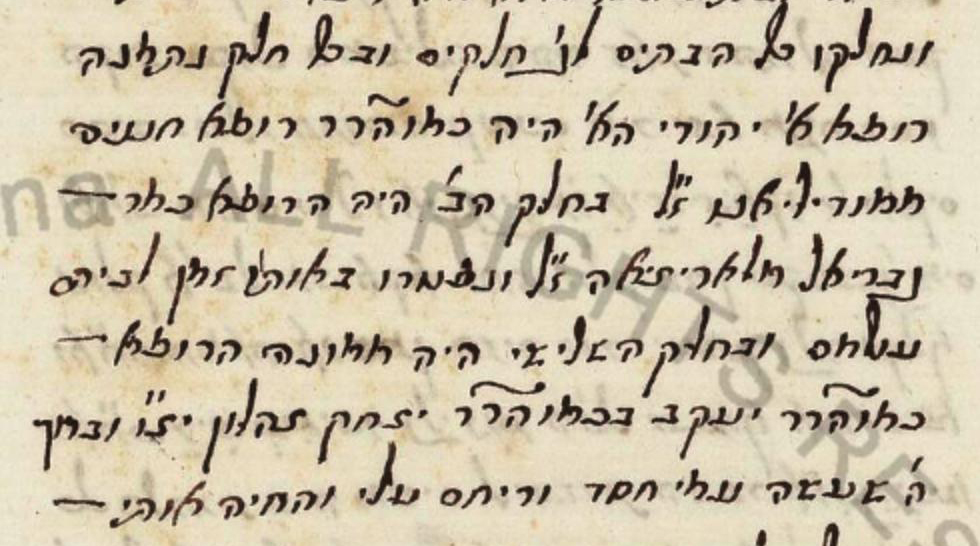
It should also be highlighted that while the Chassidic community has ignored the message of Nefesh HaChaim due to their perception of the entire work as being philosophically disconnected from their own outlook, the Mitnagdim on the other hand have had a problem accepting the widespread study of Kabbalah. No-one in the Mitnagdic community has any authority or would dare to challenge the status of Nefesh HaChaim as a seminal work that must be studied. Nevertheless, many in the Mitnagdic community have been generally guilty of attempting to rebrand Nefesh HaChaim, trying to ignore that it is a Kabbalistic work, failing to appreciate, or even denying outright, that engagement in the Kabbalistic concepts it so intentionally presents for public consumption is an absolute pre-requisite to properly relate to its message. They surreptitiously treat it as an ethical work, a work of Mussar, by only focusing study on some selected non-Kabbalistic parts of the book and thereby entirely miss the point of the book.[3]]Therefore from either the Chassidic or Mitnagdic perspective, the key burning message of Nefesh HaChaim which so badly needs to be applied to Jewish life today, has sadly and irresponsibly been ignored!

The historic smokescreen of fundamental difference between the Chassidic and Mitnagdic camps has unfortunately been propagated by many of great stature in the Jewish world and also by many in the academic world. Simply put, the general mistaken presentation of difference around the Tzimtzum process which explains why we cannot see the infinite God in this finite physical world, is that the Chassidic view is that God is present everywhere and in everything physical but His presence is concealed, i.e., God is totally immanent. Whereas the Mitnagdic view is that God is removed and absent from the physical world and merely controls all from a distance through Divine Providence, i.e., God is totally transcendent.

This unfortunate presentation was perhaps most famously captured by a letter written in 1939 by R. Menachem Mendel Schneerson, the last Lubavitcher Rebbe, which delineates a 4 position approach to the concept of Tzimtzum and presents a picture of stark contrast between each of the views of the Vilna Gaon, the Baal HaTanya and R. Chaim.[4] In this letter R. Schneerson went so far as to state “… the author of Nefesh HaChaim … disagrees with his master, the Vilna Gaon [about the concept of Tzimtzum]. In general, it appears that R. Chaim Volozhin saw the works of Lubavitch – and Sefer HaTanya, in particular – and that he was influenced by them, however, I do not have definite proof of this.” In contrast to the positions of both the Vilna Gaon and R. Chaim, R. Schneerson then continued to explain the Chassidic view, that the Tzimtzum process was only initially applied to “the lowest level of the Light [of the Ein Sof].”

R. Schneerson’s statement here explicitly highlights a diverse difference in fundamental philosophical outlook between the Chassidic world and that of the Vilna Gaon and therefore the Mitnagdic world. His suggestion, without proof, that R. Chaim was swayed somewhat towards what he describes as the Chassidic view was based on the employment of many seemingly Chassidic statements in Nefesh HaChaim.

However, on in-depth study of the positions of the Vilna Gaon, R. Chaim and the Leshem[5] it becomes crystal clear that they are identical with the Baal HaTanya, and indeed with the Arizal and the Zohar, regarding the concept of Tzimtzum. In order to see this it is crucial not to initially look at the terminology they employ but to carefully assess the substance of each of their arguments. On face value, the Vilna Gaon and the Leshem seemed to openly express strong dissatisfaction with the Chassidic perspective and there is scope to question if the Baal HaTanya aimed scathing comments on this topic directly at the Vilna Gaon. Notwithstanding this, if we are particular to examine what they actually say about the substance of the topic, and not be deflected about what they may or may not have said about each other, then it will allow us to see that they in fact all agreed.

The critical factor to appreciate the substance of each of their arguments is to understand that they all saw the arena within which the Tzimtzum process occurs as only being in the Sefira of Malchut of any level, including that of the highest level called the “Ein Sof.”[6] Malchut is the lowest Sefira of any level and is in fact in a different dimension to it. This means that any change within Malchut of any level as a result of the Tzimtzum process, does not impact the level itself in any way. Therefore, the first instance of the Tzimtzum process which occurred in the Malchut of the first level which was emanated from God’s Essence, the Ein Sof, did not impact the Ein Sof in any way. Therefore, by extension, not only does the Tzimtzum process not change the Ein Sof, it also has no impact on God’s Essence in any way.

Once this is understood then it becomes clear that the debate over whether Tzimtzum means either immanence or transcendence is simply wrong. As the Tzimtzum removal only occurs within Malchut, transcendence only applies to Malchut. Therefore, everything above Malchut, i.e., both God’s Essence and also the Ein Sof, is entirely and absolutely immanent. In other words, the Tzimtzum process itself results in a dual simultaneous combination of both immanence and transcendence. The particular stance of immanence or transcendence then becomes a matter of perspective. In the language of the Nefesh HaChaim, immanence is “Mitzido”, the perspective of the higher level (and ultimately God’s perspective) and transcendence is “Mitzideinu”, the perspective of the lower level (and ultimately that of the physical creations).[7] All discussion about the differences between levels therefore becomes relative to the level the discussion is centered upon. This point is so important that it is the key to begin to understand any discussions of the Arizal.[8]

This, in a nutshell, is the concept of Tzimtzum that was held in common by the Vilna Gaon, R. Chaim, the Leshem, the Arizal and the Zohar. Any time any one of these sources refers to a “removal”, they are therefore referring to a removal within “Malchut” only of whatever level they happen to be discussing. It is far beyond the scope of this essay to provide sources to explain the concepts and demonstrate how they translate into day to day life and the reader is referred to Nefesh HaTzimtzum.[9]

However, just to whet the appetite and demonstrate that our focus must be on the substance of the argument and to not be deflected by terminology let’s look at two simple sources. The Baal HaTanya states “… the characteristic of His Malchut is the characteristic of Tzimtzum and concealment, that conceals the light of the Ein Sof.”[10] This, unsurprisingly, is consistent with R. Schneerson’s statement that the Tzimtzum process was only initially applied to “the lowest level of the Light [of the Ein Sof].” The Leshem, on the other hand, states the following “…and therefore that place within which the Tzimtzum process occurred is called Malchut of the Ein Sof … it is exclusively in Malchut of every revelation for every Tzimtzum is exclusively in Malchut ….”[11] Therefore, very surprisingly to many, the Leshem, the staunch Mitnaged and follower of the path of the Vilna Gaon, entirely agrees with the Baal HaTanya and with what R. Schneerson presents as the Chassidic view that the Tzimtzum process is only within Malchut!

With all of the above in mind, we are now in a position to step aside and briefly focus our attention on R. Bezalel Naor’s review of Nefesh HaTzimtzum (see here). In his eloquent review, he “cuts to the chase,” as he puts it, to describe his argument against the Tzimtzum thesis of Nefesh HaTzimtzum. Unfortunately, he “cuts” out more than he “chases” and it is astonishing that in his entire review, R. Naor doesn’t even vaguely mention or make any attempt to counter the key critical factor presented above that is emphasized numerous times in Nefesh Hatzimtzum, that all the players in the Tzimtzum discussion agree with each other that Tzimtzum happens exclusively in Malchut! It seems that R. Naor, in common with many of great stature before him, has unfortunately fallen into the classic historical trap which has plagued this topic for centuries of focusing on a presumed understanding of the terminology employed by the various proponents, especially in their expressions of disagreement with their colleagues. In doing so he has failed to investigate the actual substance of their Tzimtzum argumentation and is unaware that they actually agreed with each other! (This response continues in the note.[12])

Stepping back to the main thread of this essay, historically most were severely misled and confused by a smokescreen of difference which was contributed to by two key factors. Firstly, by terminology used by some key Kabbalists, the historic context of which was misunderstood.[13] Secondly, by a famous letter forged in the name of the Baal HaTanya which explained the Vilna Gaon’s position on Tzimtzum as arguing with the view of Chassidut.[14] However, not all were misled. Rabbi Eliyahu Dessler, among many other prominent individuals, understood that the argument between the Chassidim and the Mitnagdim was not about the fundamental principles of Judaism. He wrote on the topic of Tzimtzum in 1938 that “in this generation in which there is a need to unite…it is fitting to publicize the fact that there are no differences of opinion in the essence of these issues”.[15]

After fully absorbing the fact that the philosophical outlook in relation to the Tzimtzum concept of the Vilna Gaon, R. Chaim, the Baal HaTanya and the Chassidic world are identical, the genius of R. Chaim’s presentation in Nefesh HaChaim can then be clearly seen. The Chassidic works of his day, including Sefer HaTanya, barely quoted their sources. In contrast, when R. Chaim presents his ideas in general, and the concept of Tzimtzum in particular, ideas which at the time were seen by many to be uniquely Chassidic ideas, he frames them in the context of extensive quotations from and references to traditional Jewish sources. As mentioned above, he even uses many similar expressions and sentences to those appearing in the Chassidic works of his day. He is demonstrating that there is no scope for anyone to suggest that there is a fundamental difference between the formal outlook of the Chassidic Movement and that of mainstream Judaism and that the paths for serving God of both the Chassidim and the Mitnagdim are fundamentally the same and are derived from the same Torah and the same Mesorah. Therefore, against a historic backdrop of some who erroneously thought that the new Chassidic Movement had blazed a new trail in Judaism and were using the inspiring Chassidic presentation of these concepts to compromise Halacha, R. Chaim’s key message is, there is no basis for anyone to bend these concepts out of their true context of mainstream Judaism, and as a result, there is no basis to use them to license Halachic compromise in any way whatsoever.

It is fascinating to note that R. Chaim was not alone in this quest to highlight the potential pitfalls of Halachic compromise resulting from an attempt to get closer to God. He was joined by some of the establishment Chassidic figures who expressed themselves in a very similar way.[16] Furthermore it is inconceivable that the Baal HaTanya would have sanctioned any form of Halachic compromise, as he is after all the author of the widely respected and accepted Halachic work, the Shulchan Aruch HaRav.[17]

The underlying principle guiding R. Chaim’s presentation in Nefesh HaChaim reflects the position of his master, the Vilna Gaon, that as the Kabbalah is an intrinsic part of the Torah, it cannot be that anything derived from it can prescribe any action which contradicts and is inconsistent with the Torah.[18] Any directive derived from the Kabbalah which contravenes the Torah and Halachic practice must therefore be a misunderstanding of Kabbalah. In addition, this principle was explicitly highlighted by some of the Chassidic masters who were also clearly objecting to the same phenomenon of Halachic compromise on the periphery of the Chassidic world that R. Chaim was objecting to.[19]

The outcome of all the above is that because of R. Chaim’s historic motivation to write Nefesh HaChaim, he has left us with a remarkable work, a motivational framework of how a person is to view and philosophically interact with the world, which substantiates every statement it makes by referencing many traditional Jewish sources in general, and Kabbalistic sources in particular. As a result, the highly structured presentation of Nefesh HaChaim itself is a unique gateway into the highly unstructured world of Kabbalah. It is a tremendous portal through which a genuine introduction to the world of Kabbalah and to the deeper meaning of the Torah has been made accessible to one and all. May the study of Nefesh HaChaim and R. Chaim’s Torah bring a true conscious awareness of unity in the Jewish World.

[1] Nefesh HaTzimtzum includes the following:

  • A historical and structural introductory overview.
  • A corrected Hebrew text for Nefesh HaChaim, likely to be the most accurate ever published.
  • An innovative hierarchical presentation of both the Hebrew and facing page English texts for ease of use.
  • Extensive explanatory annotations on all texts.
  • Expansion in English translation of virtually all sources quoted and referenced in Nefesh HaChaim, including all Kabbalistic sources.
  • An explanation of the concept of Tzimtzum with:
    • Full details of the positions of the Zohar, the Arizal, Yosef ben Immanuel Irgess, R. Immanuel Chai Ricchi, the Vilna Gaon, the Baal HaTanya, R. Chaim Volozhin, the Leshem, R. Dessler and the Lubavitcher Rebbe, among others.
    • Extensive source material in both the original Hebrew and facing page translation.
    • A comparison between Nefesh HaChaim and Sefer HaTanya on their key approaches to Torah study, Mitzvah performance and prayer which are all based on their common understanding of the Tzimtzum concept.
    • A demonstration of how the correct understanding of the Tzimtzum concept underpins the concept of Partzuf and therefore all of the Arizal’s Kabbalistic teachings.
    • A presentation of the Vilna Gaon’s messianic outlook which is dependent on knowing Kabbalah and Science.
  • An explanation of the concept of The World of the Malbush.
  • Facing page translation of all of R. Chaim Volozhin’s published writings related to Nefesh HaChaim, including his single published sermon, letters and his introductions to commentaries of the Vilna Gaon on Shulchan Aruch, Zohar and Sifra DeTzniyuta (which includes the largest authentic published repository of stories of the Vilna Gaon by any of his students).
  • Translated and cross-referenced extracts of all Nefesh HaChaim related sections from Ruach Chaim.
  • Yosef Zundel of Salant’s brief extract on prayer with translation.
  • Detailed outlines and extensive indexes by themes, people’s names and book references.

[2] As recorded by R. Chaim’s son, R. Yitzchak, in his introduction to Nefesh HaChaim. Nefesh HaChaim was subsequently published in 1824.

[3] Most of the Yeshivot which include the study of Nefesh HaChaim as part of their curriculum only study the last section, the Fourth Gateway. Most of the commentaries and translations that have been published to date omit comment on or even translation of the Kabbalistic material which forms a substantial part of the book.

[4] Iggrot Kodesh, published by Kehot, Volume 1, Letter 11.

[5] For a scholarly portrait of the Leshem which brings together much important biographical information, a succinct overview of the Leshem’s major works and many further sources, see Joey Rosenfeld, “A Tribute to Rav Shlomo Elyashiv, Author of Leshem Shevo v-Achloma: On his Ninetieth Yahrzeit,” the Seforim blog, 10 March 2015, available here.

[6] It is not in the scope of the discussion here to discuss what is meant by a Sefira or a level. In Kabbalistic terminology a level may be called a “World” or a “Partzuf”.  A “Sefira” is a subcomponent of the “World” or the “Partzuf”.

[7] “Mitzido”/”Mitzideinu” are also synonymous with the Zohar’s terminology “Yichuda Ilaah”/ “Yichuda Tataah,” e.g., as per end of Nefesh HaChaim 3:6 (Nefesh HaTzimtzum, Vol. 1, pp. 510-511).  Incidentally “Mitzido”/”Mitzideinu” are also synonymous with the terms of “Orot”/”Keilim”.
“Mitzideinu”, “Yichuda Tataah” and “Keilim” are all different expressions which mean “Malchut”.

[8] In particular, it is the dual simultaneous perspective which generates the concept of “Partzuf” which underpins all the discussions of the Arizal. See Nefesh HaTzimtzum, Vol. 2, pp. 145-150.

[9] In particular, to the first 2 sections of Volume 2.

[10] Sefer HaTanya 2:7:

… שמדת מלכותו היא מדת הצמצום וההסתר להסתיר אור אין סוף …

[11] Sefer Hakdamot UShearim, Shaar 7, Perek 5, Ot 1:

… ולכן נקרא אותו המקום שנתצמצם בו בשם מלכות דאין סוף … הנה הוא הכל בהמלכות של כל גילוי כי כל צמצום הוא רק בהמלכות …

There are many similar statements across the writings of the Leshem. This source is particularly explicit and the review of all of Ot 1 will be insightful.

[12] In continuation of the response to R. Naor’s review, a number of points have been picked up on as detailed below. Please note that all of these points are side issues and pale into insignificance compared to the details of R. Naor’s stark omission of the concept of Tzimtzum in Malchut as per the main essay text. These points are as follows:

(1) In note 1 of his review, R. Naor quotes Dr. Menachem Kallus and mentions that in a note to Etz Chaim, R. Meir “Poppers writes that it sounds to him as if Luria’s disciples Rabbi Hayyim Vital and Rabbi Yosef ibn Tabul understood from the Rav [Isaac Luria] that ‘the Tzimtzum is literal’ (‘ha-tzimtzum ke-mishma‘o’).”

R. Naor’s suggestion here is that the Arizal is saying that the Tzimtzum process results in total literal removal and transcendence of God from physicality. However, in the light of the fact that we now know that the Tzimtzum process that the Arizal is referring to only took place in Malchut of the Ein Sof, this point is simply not relevant as the removal and transcendence only occurs in Malchut, from the perspective of the creations, Mitzideinu, but at the same time there is a total immanence of God within the unchanged presence of the Ein Sof.

Even the Baal HaTanya agrees that there is a removal in Malchut, resulting in physicality from our perspective, as he says e.g., in Sefer HaTanya 2:3 that our “flesh eyes” only see physicality.

Also see the particularly explicit statement of the Baal HaTanya in Sefer HaTanya 4:20 which is a direct corollary of the Mitzido/Mitzideinu concept of Nefesh HaChaim: “Relative to [God – i.e., Mitzido], the created physical entity is as if it has no consequence, i.e., its existence is nullified relative to the power and the light which is bestowed within it. It is like the radiance of the sun [before it has emanated and is still] within the sun. This is specifically relative to Him, where His Awareness is from above to below. However, from the perspective of the awareness of [the created entities – i.e, Mitzideinu,] from below to above, the created physical entity is an entirely separate/disconnected entity, with this awareness and perception being [only] from below, as [from its perspective] the power which is bestowed within it is absolutely not perceived at all.”

Multiple sources from across Sefer HaTanya directly expressing the Mitzido/Mitzideinu concept are brought in Nefesh HaTzimtzum, Vol. 2, pp. 94-95, fn. 120.

(2) R. Naor quotes from R. Yitzchak Aizik of Homil, one of the greatest students of the Baal HaTanya who stated that the Mitnagdim “have no room for this faith that All is God.”

It is of interest to note that R. Dessler was a close student of R. Mordechai Duchman who in turn was a close student of R. Yitzchak Aizik of Homil (See Nefesh Hatzimtzum, Vol. 2, p. 305, fn. 474). R. Dessler was therefore intimately familiar with the works of Lubavitch and would have most certainly been aware of R. Yitzchak Aizik of Homil’s comment.  Notwithstanding this he clearly saw that Tzimtzum was not the issue of the Machloket and valiantly tried to publicize this, as quoted in the continuation of this essay.

(3) The Baal HaTanya’s rejection of “Tzimtzum Kipshuto” (Sefer HaTanya 2:7) uses scathing, derisive language to describe those who hold by that position referring to them as “scholars in their own eyes” (Yishayahu 5:21) and that “they also do not speak intelligently” (Iyov 34:35). The question is who was the Baal HaTanya referring to? Nefesh HaTzimtzum presents a number of arguments to say that it could not have been the Vilna Gaon or R. Ricchi and by a process of elimination would then be referring to the Shabbatians.  R. Naor rejects this position but in doing so starkly omits most of the argumentation from Nefesh HaTzimtzum!

A brief summary of the main Nefesh HaTzimtzum arguments is presented as follows (see Nefesh HaTzimtzum, Vol. 2, pp. 75-79 for much more detail on this).

Firstly and most importantly, even if we were to say that the Baal HaTanya was directing his statements at the Vilna Gaon and disagreed with what he may have assumed was the Vilna Gaon’s position, it doesn’t change the fact that the Vilna Gaon actually agreed with the Baal HaTanya on Tzimtzum only occurring in Malchut. So the debate about who the Baal HaTanya was referring to, while it may be interesting, is academic as far as who held what about Tzimtzum is concerned, as both the Baal HaTanya and the Vilna Gaon shared a common position.

R. Naor severely underplays the level of vitriol in the Baal HaTanya’s tone and considers that his statements are mild.  In Nefesh HaTzimtzum, Vol. 2, p. 75, fn. 80, a number of sources are brought which demonstrate that Chazal very specifically used both the expressions “scholars in their own eyes” and “they do not speak intelligently” to refer to the “wicked”, e.g., “. . . and even among the wicked there are scholars, as it says . . . ‘Woe to those who are scholars in their own eyes’” (Bereishit Rabbati, Toldot, on Bereishit 26:12). Even if one could make a (somewhat forced) argument that the Baal HaTanya is taking these expressions out of their original context, since the Baal HaTanya quotes directly from R. Ricchi’s Mishnat Chassidim twice in Sefer HaTanya, it is highly questionable to suggest that such a punctilious author would quote holy statements from anyone he directly refers to derisively as “a scholar in his own eyes” and implies that he is wicked!

The section of Sefer HaTanya which included these statements, although distributed to the Baal HaTanya’s students and is extant in manuscripts of Sefer HaTanya, was only inserted for the first time in a published edition of Sefer HaTanya in the 1900 Romm edition some 88 years after the passing of the Baal HaTanya. It should be noted that this section was not just a few lines containing caustic statements. It actually ran on for a number of pages. The majority of the information it contains is repeated from other places in Sefer HaTanya, although brought together in an effective presentation in one place. Even though this is the only place in Sefer HaTanya that the specific expression “Tzimtzum Kipshuto” is used, the rejection of this position is very clear from the presentation of Tzimtzum in other places in Sefer HaTanya. Therefore, if it were just 2 or 3 caustic statements that were not initially included in Sefer HaTanya and were later inserted in the 1900 edition, it could reasonably be argued (as R. Naor suggests) that they were not included due to the raging arguments at the time of the original printing in 1796 and that they therefore were pointed at the Vilna Gaon. However, if the Baal HaTanya wanted to include this section, it would have been trivial for him to simply edit the 2 or 3 very brief caustic statements to make them politically correct. The fact that he did not edit these statements, but omitted the entire lengthy section, suggests that there was another reason for the omission.

It should also be noted that the Vilna Gaon, never used the expression “Tzimtzum Kipshuto” in any of his writings and also, as already explained, did not actually hold this position. This means that if the Baal HaTanya was directing his vitriol at the Vilna Gaon, he was doing so based on rumor. On the Baal HaTanya’s release from prison in 1798, he wrote a letter outlining the importance of remaining silent in the face of controversy, strongly highlighting that this is a characteristic of those close to God (Sefer HaTanya 4:2). Given the devotional premium that he attached to remaining silent in the face of controversy it would have been complete hypocrisy were the Baal HaTanya to have been openly derisive about his main partner in controversy. This is accentuated by the fact that the Vilna Gaon did not actually hold this position and the Baal HaTanya’s attack would have been based on rumor.

(4) R. Naor quotes what he refers to as a key passage from Yosher Levav (Nefesh HaTzimtzum, Vol. 2, pp. 260-261): “Therefore relative to us (le-gabei didan), it is as if there was no Tzimtzum and we can say that the Tzimtzum is not literal. However, relative to the Ein Sof (le-gabei ha-Ein Sof) itself, it is literal.”  He argues that as R. Ricchi is saying that relative to the creations the Tzimtzum is not literal, how can Nefesh HaTzimtzum present R. Ricchi as saying that relative to the creations the Tzimtzum IS literal?

Unfortunately, R. Naor omits to present the very specific and complex context of R. Ricchi’s statement which appears in Yosher Levav, Ch. 15 – and as a result his statement is misleading!

The context is set at the beginning of Ch. 15, arguably the most subtle argument in the Yosher Levav’s overall Tzimtzum presentation, saying “Even though we have proven that the Tzimtzum process itself is literal, nevertheless there is scope to say that the way in which the Tzimtzum process was applied was not literal”.

R. Ricchi spent the previous few chapters explaining that the Tzimtzum process is literal and earlier (Yosher Levav, Ch. 13) he makes a key statement: “even though I cannot imagine how this could be [literal], as I have no knowledge of how He can contract Himself since there was no space empty of Him – this is my deficiency, as I have no way of knowing anything about His Exalted Unity.”  He is saying that God’s perspective is unknowable and notwithstanding God’s point of view of there being no space empty of Him, that from the point of view of the creations there is an apparent literal removal of God even though, as R. Ricchi highlig hts, he cannot logically relate to how this can be so.  Therefore R. Ricchi’s general position is that from our point of view, relative to us, Tzimtzum IS literal.

In contrast, the very specific context of the beginning of Yosher Levav, Ch. 15, is discussing a scenario after the literal Tzimtzum has already taken place. R. Ricchi explains that after the literal Tzimtzum, there still remained a residue, called a “Reshimu,” which has greater creative intensity than anything we could ever imagine – therefore relative to us, we cannot differentiate between the intensity of the Reshimu and of the Ein Sof, so we would relate to the Reshimu in the same way as we do to the Ein Sof and therefore relative to us there is scope to say that it is as if there was no Tzimtzum – however relative to the Ein Sof it is literal, because compared to the Ein Sof the Reshimu is like something physical.

This point is succinctly related to in Nefesh HaTzimtzum, Vol. 2, p. 70, fn. 65.

[13] In particular by R. Yosef ben Immanuel Ergas and R. Immanuel Chai Ricchi. See Nefesh HaTzimtzum, Vol. 2, pp. 63-71, for details.

[14] This forged letter is published in Iggrot Kodesh Admor HaZaken, published by Kehot in 1987, letter 34, p. 85. It was first published as an appendix to Metzaref HaAvodah, 1858 – which was also an entirely forged work. For extensive details and hard evidence of both the letter and Metzaref HaAvodah forgeries, see Nefesh HaTzimtzum, Vol. 2, pp. 79-88.

[15] This was from a letter written by R. Dessler expressing his position on Tzimtzum. It was R. Dessler’s position which prompted the response by R. Schneerson in his 1939 letter.  R. Dessler’s complete letter is published in Kodshei Yehoshua by his son in-law R. Eliyahu Yehoshua Geldzahler, Volume 5, Siman 421, pp. 1716–1717. It is also partially printed in Michtav MeEliyahu by R. Eliyahu Dessler, Volume 4, p. 324. This part of the letter only appeared in earlier print editions of Michtav MeEliyahu and was removed from the more recent print editions when its editor later decided to include another paragraph which was previously omitted (the complete letter could not be included at that stage as the book layout had been fixed and the contents of this letter had to be restricted to a single page).

[16] E.g., R. Tzvi Elimelech Shapira of Dinov, the Bnei Yisaschar, in Derech Pikudecha, Mitzvah Lo Taaseh 16, Chelek Hamachshava 4. Also R. Nachman of Breslov in Sichot Moharan, Siman 267. See Nefesh HaTzimtzum, Vol. 2, pp. 137-138, fn. 217.

[17] E.g., as quoted frequently by the Chafetz Chaim in his Mishneh Berurah, referring to the Baal HaTanya as “HaGraz”, “HaGaon Rabbi Zalman.”

[18] See R. Chaim’s introduction to the Vilna Gaon’s commentary on Zohar as brought in Nefesh HaTzimtzum, Vol. 2, p. 464.

[19] E.g., R. Tzvi Hirsch of Zidichov in Sur MeRah VeAseh Tov, pp. 79–80 of the Emet publication,

Jerusalem, 1996. Also R. Yitzchak Issac Yehuda Yechiel of Komarna in Zohar Chai, Hakdamat Sefer HaZohar, p. 41b. See Nefesh HaTzimtzum, Vol. 2, pp. 138-139, fn. 217.



A Final Word to Chaim Rapoport

A final word to Chaim Rapoport’s continuing need to comment on our book
by: Menachem Friedman & Samuel Heilman

While we hoped our last posting would be our last word on this subject, since the Seforim
Blog has posted Rapoport’s rejoinder simultaneously (a courtesy never offered to us), we
want to add a brief postscript, which we have been assured by the blog moderators will
be the last posting on our book.

We are happy Rapoport checked the Paris directory and found the listing of the Engineer
Schneerson. Why he failed to note this listing (which as Rapoport at last reports was
noted in our book) when he attacked us over our error on the envelope, he will have to
explain to his readers. But in his long riff on the listing Rapoport misses the point we
made, and which was lost in the laughter over our use of the envelope as the graphic
proof. What was MMS interested in announcing about himself?

Rapoport seems to think we thought that MMS used the directory in which he
listed himself not as “Rabbin” but “Ing. Elec and Mecan” was a “venue for joy and
thanksgiving.” Not at all. We say it was a sign of pride at his accomplishments (p.121),
a way of publicly identifying himself – not as a rabbi but as what he saw himself:
engineer. It was MMS who chose to put his listing in as this; not the Paris telephone
service. He wanted the public to know. As for revealing his dreams, we have already
covered that in our book (p. 119). It was in his letter to his father that he made that
abundantly clear. We urge readers to look at the letter and judge for themselves if after
years of study for this degree in 3 countries, when he wrote to his father and said in his
own words that engineering was his “dream” he meant it as a fantasy. In any case, we
did not say it was his “ultimate goal in life,” as Rapoport puts it. Apparently, the
Hasidim know best what that was; we are not nearly as categorical.

As for what ‫ חלום‬means, we’ll simply say that we believe Rapoport’s twist on this
word is actually a dream in the sense of fantasy. His explanation puts nothing to rest,
much as he might wish it to be the case.

Rapoport’s dance around MMS’s pursuit of the engineering degree is to assure us that he
wanted this only for parnassa, the classic haredi explanation for any secular studies by
those they deem religious. He adds to this that this was driven by the realization that he
could not be a rabbi in the Stalinist USSR or that he could thereby observe the Sabbath
better there. But MMS had no intentions of returning to the Stalinist regime from France
and affirmed this in his affidavit to the French when he sought French citizenship, (see
pp. 122-3 in our book). All of Rapoport’s tortured efforts to write off the long pursuit of
an engineering degree by MMS as nothing other than a quest for a side job are simply not
credible, as our book demonstrates time and again.

Rashag, he tells us was also involved in “commerce and the like.” Rashag was Rayatz’s
right-hand man, completely taken up with that task; something MMS was not. The
revision of the Gourary history continues.

We are accused of “not letting the man speak for himself.” The writings and speeches of
Menachem Mendel Schneerson are all over the internet, in countless books and distributed by Lubavitchers wherever they can. Our job is not to let the Rebbe speak for
himself. The Lubavitchers do that, and sometimes they also speak for him. No one could
accuse us of hiding his words. If anything, our book has made many more people
interested in reading his words. Our book is a framework against which those words may
now be looked at from a new perspective.

Rapoport once again tries to teach us about academic standards. We’ll simply say that on
that we shall by judged not by a Lubavitcher hasid with an axe to grind and venom to
spew but by our peers.

The discussion of the ‘local’ synagogue nearer to MMS’s residence is a new wrinkle in
Rapoport’s argument. Readers will recall he told us how much the man liked to walk and
assured us it was no problem for him to walk to the synagogues in the Pletzel. Now
suddenly he talks about this large nearby synagogue (which he wonders that we did not
mention nor did he, why?) but conveniently fails to mention that MMS was not seen
there, nor did he take any active role as teacher in this synagogue. Where is the evidence
he went there?

As for distances, as one will discover the distance from 7 Robert Lindet to the synagogue
on 10 Rue Dieu where Zalman Schneerson his cousin prayed (see our p. 140) is 8.5km or
5.3 miles one way and to Rue de Rosiers is according to Google Maps a walk of between
1 hour 18 minutes (3.8 miles via rue de Vaugirard, as we said) and 1 hour and 27 minutes
(4.25 miles via rue du Bac) one way. Apparently, in Rapaport’s thinking MMS had
kefitzat derech. We hope this puts this matter to rest, unless in Rapoport’s geography the
world shrinks when his Rebbe walks upon it.

With regard to the testimony of Mr. Shochetman’s recollection about his father’s visits,
we shall simply say that we did not find this recollection persuasive when we came upon
it in the JEM recordings. This is the same man who claimed in Yemei Melech that MMS
was a student who studied engineering at Sorbonne, something that has been shown to be
false in our book. Suffice it to say even if we accept its veracity, a report of one person
studying Torah with him in Paris does not make the case for MMS being one who was an
active teacher of Torah in his Paris years. Where is the rest of the evidence of the after-
school Toarh classes he set up for children besides this testimony? Where are the
children and their parents? The “100 witnesses” to borrow Rapaport’s expression; where
are they? And the argument that MMS spent those years as Rapaport asserts, “primarily
engaged” in his own learning of Torah simply does not persuade us. He did not have to
go to Paris for that; he could have stayed at the Rebbe’s court.

As for the letters from Levi Yitzchak to his son, we shall simply repeat our reading of
them and readers of our book can judge for themselves. Obviously, Rapoport reads them
with his special esoteric understanding. In his readings ‫ חלום‬is not dream, words take on
new meanings. Rapoport does this as well when we asked for a straight declarative
sentence in which MMS states unequivocally that he is neither immortal nor the Messiah.
Instead Rapoport refers to “the Rebbe’s vernacular” which does not use language as
others do, words he will “be happy to explain” to us. Reading Rapoport one is reminded of Humpty Dumpty: “When I use a word,” Humpty Dumpty said in rather a scornful
tone, “it means just what I choose it to mean — neither more nor less.”
“The question is,” said Alice, “whether you can make words mean so many different
things.”
“The question is,” said Humpty Dumpty, “which is to be master – – that’s all.”
(Through the Looking Glass, Chapter 6)

In his typical approach of half truth or falsification, Rapaport claims we did not mention
that Levi Yitzchak added a blessing that his son have a son but that we took this from
him. Apparently he missed p. 128 of our text where we write exactly that.

On the beard, we have said all we need to say. But we’ll just add that in his long
quotation on Rayatz’s talk at the sheva brachot about beards, Rapoport leaves out the
following words: “Then he denounced those who trimmed their beards or who shaved
them off altogether. All of this he said while his new university bound son-in-law with a
beard that for all intents and purposes looked as if it were trimmed sat there, and his two
younger daughters (one of whom was the bride), who everyone in the room likely knew
shared an outlook of modernity, were in a room nearby.” We maintain that with all he
could have talked about, Rayatz chose this not because, as Rapaport ludicrously asserts, a
few “elder Chasidim in town had been trimming their beards….”

Rapoport wants us to list accolades Rayatz gave to MMS. That is a task for him and his
hagiographers. We note the relevant communications where MMS refused to accompany
Rayatz on his missions, where he collected books for him, where he actually did things
for his father-in-law. In Rapoport’s mind, our book should, as we said in our original
response, have been a book of praises. For that, he will have to go to Chabad.

Nowhere did we write that “mamesh” was an “innovation.” We do say that when MMS
used it after the honors from President Reagan, he added the phrase “with all its
interpretations.” (p. 215). Readers would do well to see what we wrote and at the
context rather than depending on Rapoport’s twist.

We are happy that Rapoport at last acknowledges the view held by some Hasidim,
including Lubavitchers we spoke to and observed, that the “graves of the righteous” are
accepted as not being defiling of a Cohen. He of course sidesteps the issue of the lack of
curtains around the graves opposite the ohel entrance with the word that it is “awkward.”
Indeed.

Once again in his quotation of our book, Rapoport makes use of ellipses to twist the truth.
In noting why we had to be careful with Lubavitcher sources, we wrote (and he fails to
quote these words) “To believers it cannot be that the man who stands between them and
God could have had a life like any other. Even that which seems prosaic is understood as
appearing so only to the uninitiated, and therefore things can never be what they seem.
For believers, beneath the surface reality there is to be found a deeper truth. Only one
who has the key can thus unlock the whole truth, and that key is possessed only by those who are truly Hasidim,” (p. 65) Yes we did use Lubavitcher sources, but not all and not
always if we could find more reliable ones elsewhere.

The assertion that the late Barry Gourary, z’l hated his uncle “with a passion” is yet
another of the libels Rapoport perpetrates against a man who cannot defend himself
against such calumnies. The very accusation he later makes against us! Shame on you.
Where is there any evidence to support such a hateful accusation, one that has been
refuted by Zalman Alpert and others, who actually knew and spoke to him.

Our book is our final word on how we explain matters; references to earlier interviews by
one or another of us in the papers are not relevant. In the course of the book and
discussions between us the narrative evolved. By this we should be judged. Not by a
reporter’s characterization nor by a blogger’s or a hasid’s.

We “intimate” nothing. That is a word Rapoport uses to characterize our work. We are
very careful in our language. When we know something, we say it and when we do not,
we leave matters as open questions. We say Moussia and Mendel “may have” attended a
theatre (we know she did even after he became Rebbe). We never say they chose that
over attending synagogues as Rapoport accused us of saying or intimating. And yes, they
may have attended the theatre – chances are they did. Horrors.

On the matter of the purloined copy of the uncorrected galleys, Rapoport, who apparently
is in charge of the portfolio on “ethics” for Lubavitch see here:
(http://tomerpersico.com/2010/07/18/the_rebbe_book_review/) now adds yet another lie
– time for teshuva, Rabbi, teshuva. The Seforim blog was never sent a copy of the
uncorrected galleys that you claim to have received from them. We cannot vouch for
when and from whom Rabbi Rapoport received his purloined copy, but it adds insult to
injury for him to continue to claim it was all above-board. That the Seforim blog will
allow itself to be a tool of his lying and post this claim of course adds to our dismay.

Finally, Rapoport once again claims that our book constitutes an effort “to malign the
name of a great man after his death.” We believe our book does quite the opposite and
shows how this great man was a complex, fascinating and extraordinary man. We have
devoted years of our lives to this task. We believe the truth is as one person close to
Chabad who wrote us after reading the book said – and we shall quote him and if he
chooses to reveal his identity, he may and if not that is his right (having seen how people
like Rapoport attack and twist the words those with whom they disagree) and maybe a
good idea. This reader wrote:

“While I am sure that there are many within the movement who are
dissatisfied with your treatment of the Rebbe as a human being effected [sic] by
his time and human emotion, I believe that the perspective brought by you both
has done a great service to those who wish to better understand the phenomenon
of Chabad generally and the Rebbe in particular. Rather than diminish the Rebe
[sic] and his accomplishments, you have magnified both by placing them in
context. The “Great Oz” has not been shown to be a mere mortal, but rather, a
mere mortal has been shown to be the “Great Oz” (L’Havdil).”

We think this reader of ours got it right, and we hope this will be the last word on the
subject here, as we have been promised by the Seforim Blog that it would be.


The Physicians of the Rome Plague of 1656, Yaakov Zahalon and Hananiah Modigliano

The Physicians of the Rome Plague of 1656, Yaakov Zahalon and Hananiah Modigliano
Reclaiming a Long-Lost Role and the
Only Known Example of Father and Son Diplomas

By Edward Reichman

Ellen Wells of the Smithsonian Libraries wrote,[1] “The plague of Rome of 1656 was one of the best recorded medical events of the 17th century. It was referred to in most major political and ecclesiastical histories, in diplomatic correspondence and in personal memoirs. Books and pamphlets were issued in profusion. Commemorative prints were published …” The Jewish physician Yaakov Zahalon[2] contributed to this documentary phenomenon from the Jewish perspective.[3] Zahalon is one of the most famous physicians in Jewish history, and his book Otzar HaHayyim, published in Venice 1683, is one of only few original Hebrew medical treatises written in the premodern era. Therein, Zahalon added to the personal memoir genre of the plague.[4]

In the context of his discussion of pestilential fevers and plague, Zahalon records his recollections, both medical and non-medical, of the Bubonic Plague in Rome of 1656.[5] This passage is well-known and has been partially translated by Friedenwald.[6] It is in this passage that we read of Zahalon preaching from the balconies of the Rome Ghetto due to the closure of synagogues during the plague, an account recalled frequently over this past year.[7]

Zahalon was clearly present and practicing medicine in Rome during the epidemic, as he mentions a first-hand encounter with a patient, Shabtai Kohen, who died with fever and groin swelling, typical of bubonic plague. Zahalon diagnosed an intestinal hernia, despite the insistence of the non-Jewish physician that the patient had succumbed to plague. A diagnosis of plague would have necessitated quarantine of Kohen’s entire household. A postmortem exam confirmed Zahalon’s diagnosis. Yet, Zahalon’s exact role during the plague has remained elusive.

Regarding the administration of medical care in the Ghetto during the plague, Zahalon identifies a number of medical roles. An isolation house, called a Lazaretto, was set up in the Ghetto to accommodate those afflicted with plague.[8] The medical care in the Lazaretto was provided by Samuel Gabai, and his father, Ciroccio (Mordechai), who succumbed to the plague.[9]

Zahalon discusses the division of the ghetto into three sections, each with its appointed physician.[10]

The three physicians who equally divided the medical care of the city were Hananiah Modigliano, Gavriel Lariccia, and Yitzhak Zahalon. Who were these three physicians?

On Lariccia, I have found no additional information, and it is possible that this mention by Zahalon may be the only historical record of his existence. As recorded by Zahalon, Lariccia died during the plague.

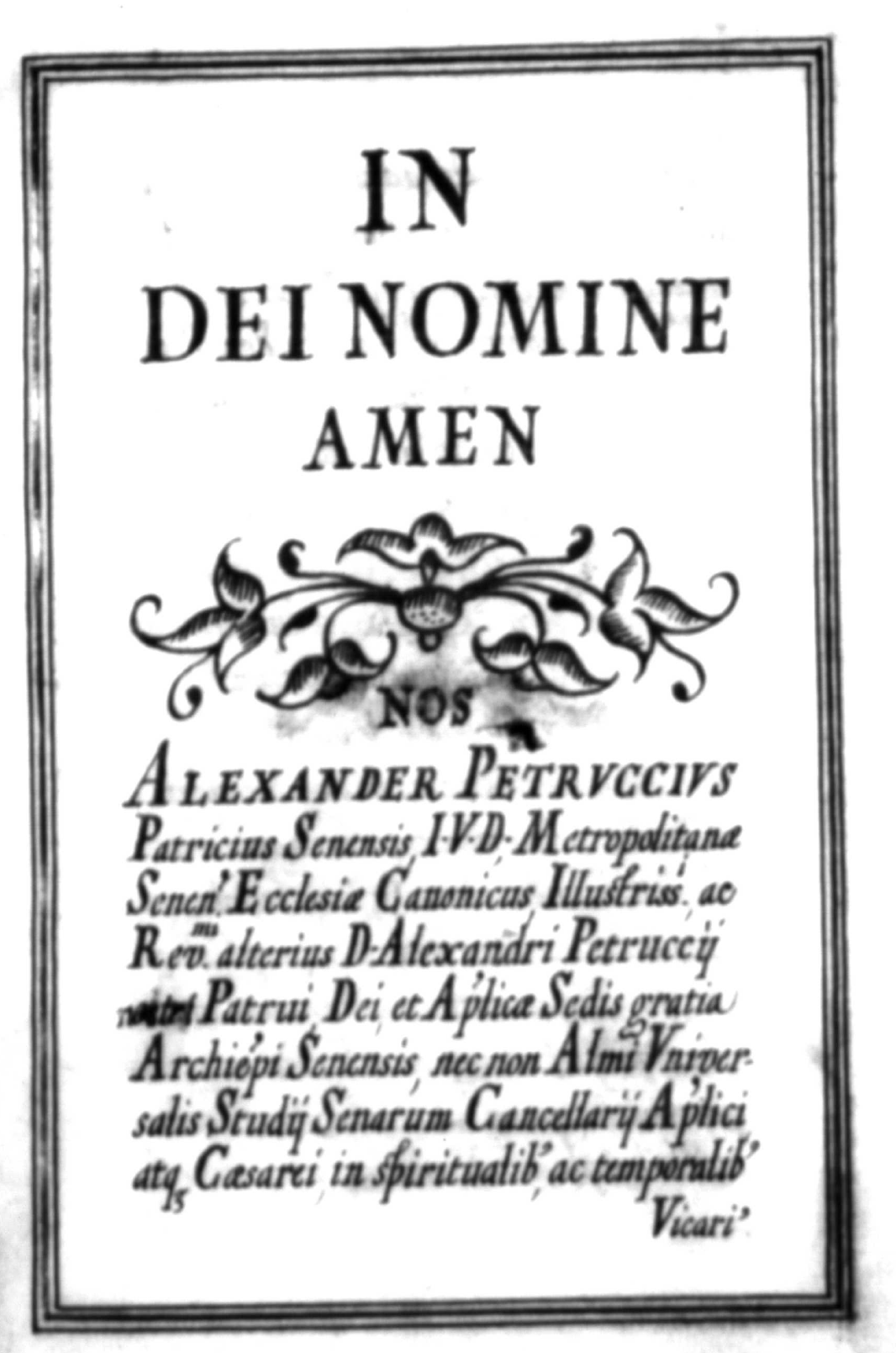
On Modigliano, we are fortunate to have archival material. Hananiah Modigliano was a graduate of the University of Siena in 1628 and was one of a mere eleven Jewish graduates from this university from the years 1543 to 1695.[11] His medical diploma is extant and housed in the Jewish Theological Seminary Library.[12]

The invocation reads “In Dei Nomine Amen” (in the Name of God, Amen). While I have not seen any other diplomas of this period from the University of Siena,[13] there are a number of extant medical diplomas from this period issued by the University of Padua. The typical Padua diploma invocation reads “In Christi Nomine, Amen” (in the Name of Christ, Amen). The only diplomas that deviated from this norm were those of non-Christian students, in particular diplomas of Jewish graduates. Virtually every Jewish graduate’s diploma begins with the invocation, “In Dei Aeterni Nomine.” It is possible that the University of Siena made the same accommodations for its Jewish graduates as did Padua, few as they may have been.[14] Modigliano was also identified as a Jew in his diploma, with the word “Hebreo” appearing after his name:

This was also commonly found in the diplomas of the Jewish graduates of Padua, where the word “Hebreus” or “Iudeus” would typically, though not always, follow the name of the Jewish graduates.

We next hear of Modigliano on August 14, 1650, when upon the departure of Rafael Corcos,[15] the Roman Jewish community appointed three new worthy teachers, one of whom was the doctor Hananiah b. Rafael Modigliano.[16] As reported by Zahalon, Hananiah tragically died while serving as a physician for the Jewish community in Rome during the Bubonic Plague of 1656.

Modigliano’s son Raphael was also a physician, as well as a rabbi.[17] Extant medical diplomas of Jewish students are exceedingly rare, yet in this case, we are fortunate not only to possess a copy of Hananiah’s diploma, but we also possess the diploma of his son Raphael as well.[18] This is the only known case of extant father and son diplomas. A copy of his medical diploma from the University of Ferrara in 1662 is below:[19]

The invocation, similar to his father’s diploma, reads, “In Dei Nomine, Amen,” and he is likewise identified as “Hebreus.”

Of note, the document explicitly restricts his medical practice to Jewish patients.

We also have record of Raphael delivering weekly Shabbat sermons in the synagogue in Siena. Moses ben Samuel ben Bassa of Blanes records in his manual for preachers, Tena’ei ha-Darshan,[20] that both he and Raphael Modigliano would deliver weekly sermons, after which they would each provide constructive criticism of the other’s sermon.

What of our third and final physician, Yitzhak Zahalon? Regarding the third of the Jewish plague physicians for Rome in 1656, the author does not reveal additional details about him, despite their sharing the same last name. A few sentences later, however, Yaakov Zahalon enumerates the fatalities of the plague at around eight hundred deaths and mentions his cousin, the young skilled surgeon, Yitzhak Zahalon, amongst the casualties.

This has led at least one scholar to identify the physician in charge of one third of the city as the same Yitzhak Zahalon, the surgeon and cousin of Yaakov, the author. Sosland writes, “Three Jewish doctors are mentioned by Zahalon as having charge over the patients. One of them was a first cousin of our author, a certain Isaac Zahalon, a “skilled surgeon” who died toward the end of the epidemic.”[21]

With the physicians in charge of the medical care of the Lazaretto, as well as the different sections of the Ghetto, accounted for by name, we are left to wonder about the role, if any, the author, Yaakov Zahalon, played during the plague. As Sosland notes, “as to the exact role Jacob filled, we have no direct knowledge.”[22]

Zahalon’s medical work was published in Venice in 1683, and unlike the work of his rough contemporary, Tuviya Cohen, whose Ma’aseh Tuviya has been reprinted numerous times, has not yet merited even a second printing.[23] There is however one extant manuscript of Zahalon’s Otzar HaHayyim housed in the Vatican,[24] dated from no later than 1675, and it is in this manuscript that we find the solution to the riddle of Zahalon’s role in the administration of medical care to the Jews in the Rome Ghetto during the plague.

The manuscript appears to reflect that Otzar HaHayyim was initially part of a larger multi-section work entitled Ohalei Yaakov Otzar HaHokhmot. Zahalon’s medical work is labelled as section two, Hokhmat HaRefuah, the only section in the Vatican manuscript.

Below is the section describing the division of the city into three sections, each with its respective physician.

There is one key difference in this passage between the printed edition and the manuscript version. The physician in charge of the third section of the city is not Yitzhak Zahalon, whose identity is ambiguous, but rather, Yaakov ben Yitzhak Zahalon, none other than the author himself! A part of the name was accidentally omitted in the printed work. Zahalon refers to himself here in third person. This correction now facilitates a better understanding of the next sentence in the text, in which Zahalon continues to refer to himself, expressing gratitude to God for having rescued him from the ravages of the plague.

In this vein, I conclude with a comment on Zahalon’s conclusion to his plague passage. Despite the unspeakable tragedies experienced by the Jewish community, Zahalon ends his plague discussion by sharing a positive, though bittersweet, thought reflecting the continuity of the Jewish community:

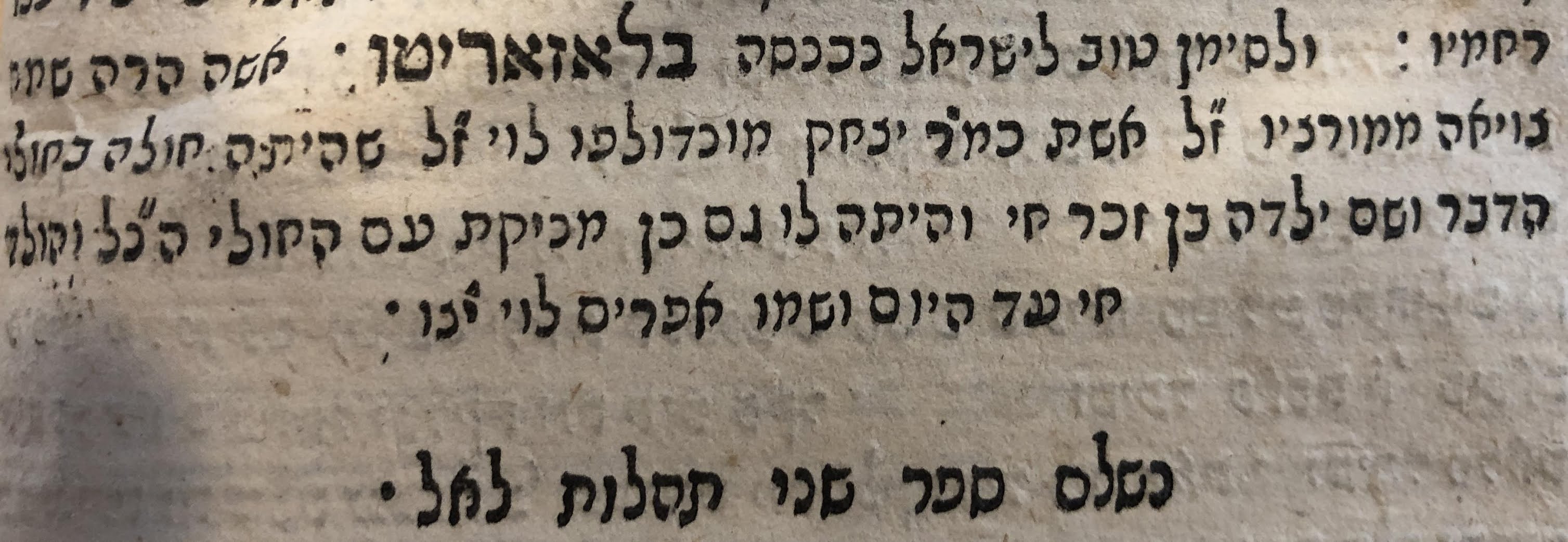
As a good sign for the people of Israel, a pregnant woman named Zivia, the wife Yitzhak Mondolfo, contracted the plague, and though confined to the Lazaretto, was able to deliver a healthy child, whom she was able to nurse for a period before her demise. In the final line of this section in the printed work, we read that the child was still alive “until today,” and that his name was Efraim Levi. Though Zahalon’s book was published in 1683, this line appears in the manuscript, thus “until today” would be some twenty years after the plague.

While this indeed is some form of consolation, the manuscript adds an additional sentence which yields a far more powerful conclusion.

“And the circumcision was performed there (in the Lazaretto), and I say to you by your blood you shall live, and I say to you by your blood you shall live.” Zahalon concludes with the phrase from Yechezkel 16:6 which is traditionally recited as part of the circumcision ceremony. The allusion here to the plague is obvious.

Omitting this last sentence denies us not only the additional factual information about the performance of the circumcision in the Lazaretto, itself a remarkable event, but also Zahalon’s homiletic flourish which marked the community’s (re)birth after the tragedies of the plague. As I write these words, we are still in this midst of the Covid 19 pandemic, though the dissemination of the vaccines portends, God willing, for its cessation in the near future. These final intended words of Zahalon resonate deeply with us today, perhaps even more so than they would have when Otzar HaHayyim was published, some three decades after the plague.

[1] Ellen B. Wells, “Prints Commemorating the Rome 1656 Plague Epidemic,” Annali dell’Istituto e Museo di Storia della Scienza di Firenze 10 (1985), 15-21.
[2] On Zahalon, see Harry A. Savitz, “Jacob Zahalon, and His Book, ‘The Treasure of Life,’” New England Journal of Medicine 213:4 (July, 1935), 167-176; Harry Friedenwald, “Jacob Zahalon of Rome: Rabbi, Physician, Author and Moralist,” in his The Jews and Medicine 1 (Ktav Publishing House: New York, 1967), 268-279; J. Ph. Hes, “Jacob Zahalon on Hypochondriasis,” (Hebrew) Koroth 4:5-7 (December, 1967), 444-447; A. Danon, A. Kadar and D. V. Zaitchek, “Physiology and Pathology of Lactation in Zahalon’s Work,” (Hebrew) Koroth 4:11-12 (December, 1968), 667-678; D. Margalit, “Shmirath Habriuth by Maimonides and Comment by R. Jacob Zahalon,” (Hebrew) Koroth 5:1-2 (September, 1969), 96-98; Yehoshua Leibowitz, “R’ Yaakov Zahalon Ish Roma uPizmono liShabbat Hannukah 1687,” Sefer Zikaron liHayyim Enzo Sereni: Ketavim al Yehudei Roma (Shlomo Mayer Institute: Jerusalem, 5731), 166-181; Jonathan Jarashow, “Yakov Zahalon and the Jewish Attitude Towards Medicine,” Koroth 9:9-10 (1989), 725-736; Zohar Amar, Maimonides’ Regimen Sanitatis: Commentary of R. Jacob Zahalon on “Hilchot Deot” – Chapter Four, With an Added Brief Preface to the Treatise Ozar ha-Hayyim (Hebrew) (Neve-Tzuf, 2002); Samuel Kottek, “Pediatrics in the work Otzar HaHayyim of Jacob Zahalon,” (French), in Gad Freudenthal and Samuel Kottek, eds., Melanges d’Histoire de la Medicine Hebraique: Etudes Choisies de la Revue d’Histoir de la Medicine Hebraique (1948-1985) (Brill: Leiden, 2003), 183-207; Eliezer Brodt, Bein Keseh Le’Asor (Jerusalem, 5768), 184-185; Eliezer Brodt, “Segulot leZikaron uPetihat haLev,” Yerushateinu 5 (5771), 337-360, esp. 352; Michal Altbauer-Rudnik, “Love For All: The Medical Discussion of Lovesickness in Jacob Zahalon’s The Treasure of Life (Otzar Ha-Hayyim),” in Asaph Ben-Tov, Yaakov Deutsch and Tamar Herzig (eds.) Knowledge and Religion in Early Modern Europe: Studies in Honor of Michael Heyd (Brill: Leiden, 2013), 87-106. For discussion of the sources of Zahalon’s medical work, see Iris Idelson-Shein, “Rabbis of the (Scientific) Revolution: Revealing the Hidden Corpus of Early Modern Translations Produced by Jewish Religious Thinkers.” American Historical Review 126, no. 1. Forthcoming, March 2021.
[3] For the response of the Italian Jewish community to plagues in this period, including the plague in Rome of 1656, see Yaffa Kohen, The Development of Organizational Structures by the Italian Jewish Communities to Cope with the Plagues of the Sixteenth and Seventeenth Centuries (Hebrew) (Doctoral Dissertation: Bar Ilan University, submitted Tishrei, 5740). I thank Naomi Abraham, librarian at Bar Ilan University, for her truly exceptional efforts in making this dissertation available to me in the midst of the Covid pandemic.
[4] For more on this passage and on the plague in the Jewish Ghetto of Rome, see Yehoshua Leibowitz, “Bubonic Plague in the Ghetto of Rome (1656): Descriptions by Zahalon and by Gastaldi,” (Hebrew) Koroth 4: 3-4 (June, 1967), 155-169; Kohen, op. cit., 72-95.
[5] Y. Zahalon, Otzar HaHayyim (Venice, 1683), 21a-21b. Elsewhere we have discussed the Jewish physicians of the 1631 plague in Padua. See E. Reichman, “From Graduation to Contagion: Jewish Physicians Facing Plague in Padua, 1631” Lehrhaus (thelehrhaus.com), September 8, 2020.
[6] See H. Friedenwald, “Jacob Zahalon of Rome,” in his The Jews and Medicine (Johns Hopkins Press: Baltimore, 1944), 268-279.
[7] On Zahalon’s abilities and reputation as an orator, see Henry A. Sosland, A Guide for Preachers: The Or HaDarshan of Jacob Zahalon—A Seventeenth Century Italian Preacher’s Manual (Jewish Theological Seminary: New York, 1987). On the plague sermons, see pgs. 23-28.
[8]  See, for example, Guenter Risse, “Seventeenth-century Pest Houses or Lazarettos: Rome 1656,” in his Mending Bodies, Saving Souls: A History of Hospitals (Oxford University Press, 1999), 190-214.
[9] On the medical members of the Gabai (and Zahalon) families, see S. Plashkes, “Two Jewish Medical Families in 17th Century Italy: Gabai and Zahalon,” (Hebrew) Koroth 3:1-2 (October, 1962), 97-99.
[10] Otzar HaHayyim 21b.
[11] Israele Zoller, “I Medici Ebrei Laureati a Siena negli Anni 1543-1695,” Revista Israelitica 10 (1913), 60-70 and 100-110. In contrast, the University of Padua counts 127 Jewish medical graduates from 1617 to 1695. See A. Modena and E. Morpurgo, Medici E Chirurghi Ebrei Dottorati E Licenziati Nell’Universita di Padova dal 1617 al 1816 (Italian) (Forni Editore, 1967). For Jewish graduates of Padua earlier than this period, see D. Carpi, “Jews who received medical degrees from the University of Padua in the 16th and early 17th centuries,” (Hebrew) in Scritti in Memoria di Nathan Cassuto (Ben Tzvi Publishers: Jerusalem, 1986), 62-91.
[12] JTS, MS 8519. I thank Sharon Liberman Mintz for bringing this diploma to my attention. As part of my research interest in Jewish medical history, I have sought out copies of medical diplomas of Jewish students from previous centuries. Sharon, aware of this interest, notified me of a medical diploma in the JTS collection. The record does not identify the graduate but lists the University of Siena as the granting institution. I had never seen a diploma of a Jewish medical student from this institution; the majority of extant medical diplomas of Jewish students are from the University of Padua. However, due to the Covid 19 pandemic, access to the original diploma, stored in the remote site of the library, has been impossible. Fortunately, the National Library of Israel had taken black and white photographs of this document some years ago, and I was able to acquire copies. Since the onset of the pandemic, I have been focusing of the history of pandemics in Jewish medical history. When I received the copies of the diploma, and read the name, Hananiah Modigliano, it sounded familiar to me. It was a short while until I realized that I had seen the name mentioned in Zahalon’s passage on the plague.
[13] As per the librarian for the University of Siena Archives, the university does not possess any diplomas of this period.
[14] On the differences in the diplomas of Jewish medical graduates of the University of Padua, see E. Reichman, “Confessions of a Would-be Forger: The Medical Diploma of Tobias Cohn (Tuviya Ha-Rofeh) and Other Jewish Medical Graduates of the University of Padua,” in Kenneth Collins and Samuel Kottek, eds., Ma’ase Tuviya (Venice, 1708): Tuviya Cohen on Medicine and Science (Muriel and Philip Berman Medical Library of the Hebrew University of Jerusalem: Jerusalem, 2019), in press; E. Reichman, “The ‘Doctored’ Medical Diploma of Samuel, the Son of Menasseh ben Israel: Forgery or ‘For Jewry’?” Seforim Blog (https://seforimblog.com) (forthcoming).
[15] The Corcos family was a prominent Jewish Italian family. Another Jewish graduate of the University of Siena was Isaac Corcos, who graduated in 1654. See Zoller, op. cit. He may have been a relative and possibly a brother of Raphael Corcos.
[16] See H. Volgstein and P. Reiger, Geschichte der Juden in Rom, 2 vol (Berlin, 1895-1896), 267.
[17] On Raphael Modigliano, see Asher Salah, La Republique des Lettres: Rabbins, ecrivains et medecins juifs en Italie au XVIIIe Siecle (Brill: Leiden, 2007), 428-429.
[18] What makes this even more exceptional is that Hananiah’s diploma is the only known Jewish diploma from the University of Siena, and Raphael’s diploma is one of only two known Jewish diplomas from the University of Ferrara, the other being from 1802 (Samuel Vita Della Volta).
[19] The diploma was originally part of the Valmadonna Trust Library, Ms. 292, and is now incorporated into the National Library of Israel, system n. 990000822160205171. See Benjamin Richler, The Hebrew Manuscripts in the Valmadonna Trust Library (Valmadonna Trust: London, 1998), n. 269.
[20] Columbia University Library, Ms. X 893 T 15, p. 15a. See Sosland, op. cit., 82-83.
[21] Sosland, op. cit., 25. Others just listed the name as Isaac Zahalon without comment. See H. Volgstein and P. Reiger, Geschichte der Juden in Rom, 2 vol (Berlin, 1895-1896), 212-213.
[22] Sosland, op. cit., 25.
[23] Some years ago, Chaim Reich, ah, of Renaissance Hebraica, produced a high-quality reproduction of Otzar HaHayyim. I thank Rabbi Eliezer Brodt, who owns one of these copies, for this information.
[24] The manuscript is available online at https://digi.vatlib.it/mss/detail/Vat.ebr.466. On this manuscript see, Malachi Beit-Arié and Nurit Pasternak, Hebrew Manuscripts in the Vatican Library (Vatican City, 2008), 405. I have only compared the manuscript to the printed edition for this brief passage. A comprehensive comparison remains to be done.


WHEN HISTORY IS HIS STORY A Review of R. Dovid Kamenetsky’s “Rabeinu Chaim Ozer: Raban Shel Kol B’nei Ha’golah”

WHEN HISTORY IS HIS STORY
A Review of R. Dovid Kamenetsky’s “Rabeinu Chaim Ozer: Raban Shel Kol B’nei Ha’golah” *
(Vol. 1, Hebrew, 671 pages)

Rabbi Jonah Steinmetz is a fellow in the Wexner Kollel Elyon and director of Asicha Seminars, an online learning program for women. This is Jonah’s first contribution to the Seforim Blog.

  1. OF HISTORY AND STORY

When asked to describe the difference between recording history and telling stories, the prolific historical fiction novelist, E.L. Doctorow responded, “The historian will tell you what happened. The novelist will tell you what it felt like.” Doctorow’s assessment is unsurprisingly insightful, highlighting the benefits and drawbacks of both historiography and storytelling; however, there are rare instances where history also tells a story.

R. Dovid Kamenetsky’s new book, Rabeinu Chaim Ozer: Raban Shel Kol B’nei Ha’goleh (Vol. 1), is one such instance. In culling almost entirely from primary sources such as letters from R. Chaim Ozer Grodzinsky and his contemporaries, newspapers, and journals, Kamenetsky unwraps the history and the story of not only the protagonist, but his entire generation.

In his introduction, the author notes that “multiple writers have published short biographies – and more are yet to come – which are filled with inaccuracies and incorrect stories, and therefore [these works] should not be relied upon.”[1] He also observes that while many of R. Chaim Ozer’s correspondences have been published, the order and fashion in which they were compiled make it “nearly impossible to discern the true greatness” of the man. In stating his objective, Kamenetsky writes,

This book… is not just a biography or a book of stories. I will leave that to others… In our book, the various events are arranged according to the [chronological] order of their occurrence, contextualized by a description of Rabeinu’s navigation – as the captain of the ship of [the] Jewish [people] – which led to the achievement of desired results.

In fact, this is not a biography. It is not a book of stories. It is a book of history through which the story unfolds. In stark contrast to rigid academic works often perceived as dry and removed, Kamenetsky’s book is refreshingly dynamic. Whereas one often relies on popular tales to discover the politics, drama, and personalities in the rabbinic world, Kamenetsky allows the reader to experience history by reading the firsthand accounts of the parties and witnesses to the events.

  1. THE KIBUTZ IN VILNA

In the third chapter, Kamenetsky discusses R. Chaim Ozer’s famous kibutz in Vilna. The kibutz consisted of a small group of young prodigies who came from across Europe to study with one of the leading gedolim of the generation. In his eulogy for R. Chaim Ozer, R. Moshe Avigdor Amiel describes how there were no set shiurim. “He simply had no time.” However,

on Shabbos during bein hashmashos (the twilight hours), was our time, only our time. We felt the presence of the Shabbos queen as [R. Chaim Ozer] sat down to discuss torah with us.[2]

The students were handpicked by R. Chaim Ozer, and Kamenetsky exposes us to R. Chaim Ozer’s charisma, wisdom, and foresight without ever resorting to hearsay by sharing reports written by alumni of the kibutz. These documents reveal R. Chaim Ozer as an extraordinarily perceptive person with a keen insight into the human psyche. In perhaps the most exciting episode, R. Chaim Ozer turned down a young man applying to the kibutz with a letter of recommendation from none other than R. Chaim Soloveitchik![3] Although R. Chaim describes the potential student as an “outstandingly wonderful” prodigy from an exceptional family, he was “rejected at the doorstep.” In what is perhaps a retroactive exhibition of R. Chaim Ozer’s intuition, this young man eventually left the torah world to become an academic.[4]

In the course of this discussion, the reader learns about famous scholars such as R. Shlomo Polachek (the Meitcheter Iluy), R. Amiel, R. Reuven Katz, R. Eliezer Silver, and others who benefited from learning in the presence of R. Chaim Ozer in Vilna. Perhaps more critically, Kamenetsky disproves commonly held mistruths about others having learned in the kibutz. R. Yechezkel Abramsky fled Telz for Vilna in 1906 to avoid conscription into the Russian army. His biographers claim that he then joined the kibutz.[5] Kamenetsky notes, however, that this claim is unfounded. He similarly dispels the rumor that R. Avraham Yeshaya Karelitz (the Chazon Ish) learned in the kibutz.[6]

Supporting and managing this group was no small task. However, relative to the drama which characterized his many public roles, one imagines that the kibutz held a special place in R. Chaim Ozer’s heart as a calm, safe space for growth in talmud torah.

  1. TORAH KNOWS NO BOUNDARIES

But life was rarely calm for our protagonist. In 1932, R. Chaim Ozer wrote a letter to his nephew, Shlomo Kosovsky, in which he describes the many stressful responsibilities which burdened him in Vilna.

Thank G-d we and our family are well. However, there is no shortage of burdens and aggravation. [T]here is a decline in the physical and spiritual condition, [causing] many [people] to come to discuss and pour their bitter hearts out, and it is upon me to listen to their sighs all day. The institutions are on the verge of closure (lit. hang on nothingness), the Rameilles Yeshiva which is my load has no foundation or basis, and the future is covered in fog.[7]

Given this description of the local hardships and pressures, one would expect that R. Chaim Ozer focused exclusively on his role in Vilna, with no time to assist elsewhere. But this is not the case. When French rabbis instituted faulty halachic procedures regarding marriage and divorce, R. Chaim Ozer was at the helm of a collaborated effort on the part of the leading Eastern European rabbis to expose the colossal distortion and demand a retraction.[8] In this context, R. Chaim Ozer wrote,

Do not be surprised that foreign rabbis are intervening in halachic decisions in France, for our torah is not restricted by space.[9] Additionally… it is our opinion… that a woman who marries [under these circumstances]… [thus] her children are illegitimate and it is forbidden for others to marry them. As such, doesn’t this matter affect the entire nation?![10]

Still more political friction is uncovered through accounts of R. Chaim Ozer’s fiery disputes with R. Yosef Shaposhnik of London.[11] In 1928, Shaposhnik, self-declared “chief rabbi of the world,” published a pamphlet announcing his plans and methods for freeing agunos worldwide. The methods were halachically unfounded. Called upon by London’s R. Shmuel Yitzchak Hillman, R. Chaim Ozer led a fierce attack against Shaposhnik’s decisions, authority, and even his mental capacity.[12]

Later chapters are replete with further examples of R. Chaim Ozer’s political tact as he deftly steers the global Jewish community through the obstacle course of the 20th century. The detailed account of R. Chaim Ozer’s intimate and devoted involvement in supporting the settlement of Israel and its rabbinate will be of particular interest to the reader.[13]

  1. THE RABBINICAL CONFERENCES OF 1909-1910

With no embellishment and limited elaboration, six of the final seven chapters invite the reader into the world of the pre-Agudas Yisroel rabbinate struggling to unify in guiding the public on critical issues. Kamenetsky’s work is chronological, so this first volume does not discuss the founding of Agudas Yisroel in Kattowitz in 1912. However, these chapters discuss the seeds of the organization.

R. Chaim Ozer emerges as the founder and leader of these endeavors, and in studying his correspondences, one is welcomed into the mind and heart of the protagonist in a surprisingly intimate fashion.[14] Descriptive newspaper reports and detailed rabbinic correspondences unveil shockingly comprehensive accounts of the formation of K’nesses Yisroel – the forerunner of Agudas Yisroel – starting in 1908, as well as the rabbinical conferences in Vilna and Bad Homburg in 1909 and St. Petersburg in 1910. Kamenetsky allows the reader to feel as though he is sitting in on the events, meeting the characters, experiencing the drama, and navigating the politics.

One example of the heated nature of the conference in St. Petersburg is the reaction to the position of R. Shalom Dovber Schneerson of Lubavitch (herein Rasha”b) regarding who is eligible to be registered as a Jew in the communal records.[15] He was of the opinion that children who were uncircumcised due to the parents’ recalcitrance should not be registered as Jews. The Yiddish newspaper, Haynt (21 Adar Beis, 5670) reported this and more of Rasha”b’s inflammatory remarks.

Due to the sharp objection… to the rebbe of Lubavitch’s statements that one who does not wear tefillin is not considered a Jew, and along with this, the decision on the part of the conference to exclude uncircumcised children from the records, I felt it necessary to turn to some of the greatest rabbinic participants to hear their halachic opinion on this burning question…[16]

The pushback to these assertions was fierce and the arguments were impassioned. In further viewing reports of the intense discussions as to which Jews are eligible for higher statuses and positions within the community, the reader is drawn into fundamental, heartfelt dialogue about the core definition of a Jew.[17]

  1. R. CHAIM SOLOVEITCHIK: LEGENDS CONFIRMED

Throughout the book, we are brought into R. Chaim Ozer’s personal world as he balances his roles as decisor, teacher, and leader. But Kamenetsky exposes us to the protagonist’s social and professional circles, as well. In providing capsule biographies for many of the characters mentioned throughout the book, the author introduces us to significant, albeit lesser known, rabbinic personalities, providing background for the letters and articles from which he draws.[18]

One unforeseen benefit of Kamenetsky’s approach is the unveiling of the persona of R. Chaim Soloveitchik as perceived by his colleagues. Stories – factual, apocryphal, and everything in between – about R. Chaim’s legendary genius, benevolence, and sagacity abound. Many have been published, still more have been orally transmitted. It is fascinating to see the aforementioned stories and still other traits be corroborated and come to life through firsthand accounts recorded in this book.

R. Chaim’s position as one of the most respected rabbinic figures in Europe is revealed time and again. In introducing the concept of what eventually became Agudas Yisroel, R. Chaim Ozer heavily stresses R. Chaim’s involvement, noting that his greatness and dominance will surely draw other colleagues to join the movement.[19] In a letter encouraging Rasha”b to join, R. Yitzchak Isaac Rabinowitz points to R. Chaim as one of the three most important, influential contemporary rabbinic figures.[20] When chief rabbi of Jerusalem, R. Shmuel Salant’s assistant, R. Eliyahu David Rabinowitz-Teomim predeceased him, the former desperately pushed R. Chaim to assume the position immediately.[21] In a letter from R. Yehuda Leib Frank to his son, R. Tzvi Pesach Frank, the writer makes the astonishing claim that the Hasidim of Jerusalem will agree to no Lithuanian rabbinic leader except for R. Chaim![22]

In one pointed display of his uniqueness, R. Rabinowitz writes that R. Chaim is unlike all other Russian rabbis in that there is “nothing in his world other than torah.” “Even the greatness of millionaires like Rothschild can not affect him even slightly.”[23] About R. Chaim, Rasha”b writes, “he literally became sick from aggravation, being that he is truly G-d-fearing.”[24] These lines aptly portray R. Chaim’s confidence and immovability and capture his intense, unyielding yiras shamayim.

It is well known that, all his greatness notwithstanding, R. Chaim was exceedingly humble. R. Yaakov Ha-levi Lifschitz corroborates this in a letter to R. Rabinowitz in which he describes R. Chaim’s aversion to hubris in the following terms: “The Gaon R. Chaim is as far from pride and self-praise as we are far from eating treifos (i.e. non-Kosher meat).”[25]

It is no wonder that the newspapers would eventually describe R. Chaim, along with one other rabbi, as the “living spirit” of the rabbinical gatherings.[26] Generally, he would listen quietly as the animated discussions carried on, waiting until the arguments subsided to succinctly summarize the points and offer a brilliant assessment and decision.[27] Often, his opinion was accepted.[28]

These commonly held truths about R. Chaim’s unique genius and character are compellingly corroborated at various junctures. The author provides important insight and perspective by bearing these facts out through presenting firsthand accounts of contemporaries.

  1. OF HISTORY, NOT STORY

Kamenetsky is allergic to mythology. To be clear, he displays no disdain for tradition and no proclivity for sniffing out and destroying hagiographical accounts.[29] Balanced by genuine reverence, Kamenetsky’s commitment to intellectual honesty and academic rigor leads him to disprove baseless stories through revealing their inconsistencies with the primary sources.[30] He has a particular penchant for noting calendric contradictions which dispel the accuracy of popular tales.[31]

In the penultimate chapter, Kamenetsky recounts the classic tale of the meeting between R. Yisrael Meir Kagan (the Chafetz Chaim) and R. Meir Simcha Ha-kohen of Dvinsk at the 1910 rabbinical conference in St. Petersburg.[32] At the behest of R. Chaim Soloveitchik, the Chafetz Chaim visited the convention to reinforce the minority’s opposition to a requirement for rabbis to learn the Russian language. R. Meir Simcha – along with R. David Friedman of Karlin, R. Chaim Ozer, R. Yitzchak Yaakov Rabinowitz of Ponovizh, and the majority of those present – asserted, however, that knowledge of the national language would ultimately strengthen the orthodox hold on the rabbinate. Kamenetsky quotes R. M.M. Yoshor’s account of the following exchange.

[The Chafetz Chaim] traveled to visit the Gaon [R. Meir Simcha] of Dvinsk in his hotel. As the Chafetz Chaim began to explain his reasoning for coming, R. Meir Simcha lightheartedly remarked: “Don’t fret. The torah will remain torah and the rabbis will remain rabbis.” And, in relying upon the letter [of support] from R. David of Karlin, he said, “You should not contend with the opinion of the eldest of the Geonim. Being that you do not serve in the rabbinate and you live in a small town, you are not expert in the ways of the world and its demands.”

Unmoved, the Chafetz Chaim calmly asked [R. Meir Simcha] if he too leads a Yeshiva, noting that only someone who is in close contact with a Yeshiva is capable of presciently sensing the impending danger [in this decision].

So as to avoid a quarrel, R. Meir Simcha bolted out of the room (this was his way) … On the way [home], the Chafetz Chaim remarked: “I am impressed by R. Meir Simcha’s refined character…”

Yoshor also recounts that R. Meir Simcha quipped,

This small Jew from a small town makes more noise across the world with his simple words than the biggest rabbis from the biggest towns with their depth and sharpness.”[33]

This meeting and its narrative is preserved in many scholarly and other works, with slight but critical tweaks to the words, tones, and cadences of the parties involved.[34] Tradition has it that the Chafetz Chaim – who rarely cites contemporaries by name – relays the opinion of R. Meir Simcha in Beur Halacha (585, s.v. v’tov l’tkoah b’yad yemin) in an attempt to show the world that he bears no grudge against his colleague, their squabble notwithstanding.[35]

While this story has all the desired trappings of conflict and resolution, Kamenetsky declares that “anyone with eyes” will notice that the ending is patently false. The alleged meeting between these two rabbis occurred in 1910. The volume of Mishnah Berurah in which this paragraph appears was published sometime between 1896 and 1899, more than ten years prior to their contentious encounter![36] Of course, this does not call the veracity of the crux of the tale into question. The intellectually honest student of history must sift through the layers of a story until what remains is only the truth.[37]

In one instance, Kamenetsky disproves Ahron Sorosky’s claim that R. Avraham Bornstein of Socatchov (the Avnei Nezer) attended the 1909 conference in Vilna.[38] Although Sorosky describes the rebbe’s journey and his meetings with R. David of Karlin, the Chafetz Chaim, and R. Chaim Soloveitchik, Kamenetsky claims they are all fantasy which never occurred. R. Bornstein was invited to the conference, but he did not end up joining. Kamenetsky explains that Sorosky confused this conference with another one in Warsaw in which a rebbe from Socatchov – either R. Avraham or his son R. Shmuel (the Shem M’shmuel) did participate. He takes this opportunity to remind the reader to “never rely on any information without cross-checking other sources.”

In yet a third example, the author uses creative resources to disprove a rumored event. R. Yosef Yitzchak Schneerson (Rayat”z), son and successor of Rasha”b, reports yet another rabbinic gathering which occurred in Vilna in 1905.[39] He claims that R. David Tevele Katzenellenbogen presided over this conference which was attended by R. David of Karlin, R. Chaim Soloveitchik, and Rasha”b. Rayat”z relays his father’s call for only ordaining young rabbis who display impeccable yiras shamayim. Allegedly, R. Chaim then penned a letter to R. Chaim Ozer, informing him of this decision to only ordain such rabbinic candidates.

Kamenetsky disputes this, declaring that such an event was simply an imagined imitation of the 1909 conference in which the aforementioned rabbis participated.[40] Aside from the nonexistence of corroborating sources, the author highlights the glaring peculiarity that a rabbinical conference occurred in Vilna in 1905 and yet R. Chaim Ozer had to be informed through a letter. Furthermore, Kamenetsky notes that Rasha”b’s passport is still extant, displaying all his travels, and there is no such trip to Vilna in 1905 signified!

  1. MEGALEH TEFACH, MECHASEH T’FACHAYIM

In some cases, Kamenetsky leaves us on the edge of our seat, wishing he would disclose additional sources or offer his insightful commentary. One such case is his passing reference to the well-known tale of R. Chaim Ozer’s alleged broken engagement. Legend has it that a young R. Chaim Ozer became engaged to the daughter of R. Eliyahu Feinstein of Pruzhin. For reasons unknown, the wedding was called off.[41] The most ambitious versions of this story append a sensational postscript. Years later, R. Chaim Ozer’s only daughter, Malka, fell fatally ill with polio. With no hope of medical salvation, the desperate father sent a message to the Chafetz Chaim, requesting that he pray for the girl’s recovery. Purportedly, the Chafetz Chaim refused to offer any hope, attributing his reluctance to the fact that R. Chaim Ozer had broken an engagement in his youth.

Twice, Kamenetsky references this story. Twice, he rejects it as unfounded.[42] Of course, the intellectually honest student of history approaches such a staggering, phenomenal story with cautious skepticism. However, being that the legend is entrenched in the Krakowsky and Soloveitchik family traditions and widely accepted, one hopes that the author will provide his reasons for disbelief. Sensing our excitement, Kamenetsky asserts his claim that this story exists “only in the imagination of the maskilic authors” who invented it, “but there is no space here to elaborate.”

The author teases us in other instances as well. In his description of the Rameilles Yeshiva, Kamenetsky discusses R. Shlomo Heiman’s role as maggid shiur.[43] In 1927, R. Chaim Ozer brought R. Heiman to teach in the yeshiva in Vilna, raising the institution to new heights.[44] In the summer of 1934, however, Mesivta Torah V’Daas recruited R. Heiman to join their staff. Much to the dismay of R. Chaim Ozer, R. Heiman accepted the offer and left for America.[45] While Kamenetsky cites R. Chaim Ozer’s letters expressing his feelings during this period, he adds,

Indeed, in a different letter, dated 8 Adar 1937, Rabeinu [Chaim Ozer] partially reveals (lit. – reveals one tefach while concealing two tefachim) the reason for [R. Shlomo Heiman’s] departure.[46]

Kamenetsky proffers that this mysterious reason is “connected to R. Heiman’s role in the Yeshiva” and announces that he has the letter in his possession, but stops short of sharing the information with us. As frustrating as it may be, the reader senses and respects that the author protects the information out of great reverence for the parties involved.[47]

  1. HISTORY AS OUR STORY

In his approbation to R. Yehuda Ha-levi Lifschitz’s Dor Yesharim, R. Chaim Ozer writes the following about the study of Jewish history.

Historically, gedolei torah never devoted their minds to delving into Jewish history or even to write books about Jewish sages of past generations. The words of our ancient and later rabbis are alive and maintained in the mouths of those who learn torah. Every study hall is brimming with rabbis and their students studying a living torah as if the words were taught that day. There is no need to memorialize tzadikim, as their words are their legacy.

However, since the decline of Judaism in Europe during the time of the Reform… there is no torah and there is no fear of G-d. As such, the remaining authors devoted themselves to memorialize the great figures and occurrences of past generations. Some of them intended to endear the wisdom of Israel and its gedolim to this generation. If they won’t receive this through knowledge, recognition, and vision (i.e. through learning torah), [at least] they should receive it through hearing stories – that they had outstanding ancestors through which they claim honor.[48]

In this first volume, R. Kamenetsky fulfills R. Chaim Ozer’s charge.[49] In drawing exclusively from firsthand accounts, he presents a compelling and exciting perspective on the life and leadership of R. Chaim Ozer as well as his rabbinic milieu. He simultaneously wears the hats of both historian and novelist, telling us what happened and showing us how it felt. Most importantly, he reminds us of our great ancestors and rich history to which we strive endlessly to connect.

*Thank you to my good friends, R. Jacob Sasson and R. Dovid Bashevkin for their encouragement and involvement. Special thanks to R. Eliezer Brodt for his willingness and efforts to publish this review.

[1] P. 4
[2] P. 147
[3] Pp. 161-2
[4] Kamenetsky (ibid., n161) assures the reader that the subject remained torah-observant throughout his life. Kamenetsky (p.139, n1) also cites Ben-Zion Dinur’s account of R. Chaim Ozer’s less than warm reception when he arrive to apply for the kibutz. “From his questions,” writes Dinur, “it was clear that he knew much more about me than expected.” Dinur was rejected. He abandoned religion for the academy. Even with his prescience, however, R. Chaim Ozer was not a prophet. Kamenetsky (pp. 163-6) brings one example of a student who was accepted into the kibutz and ultimately abandoned religion, as well.
[5] See Sorosky, Ahron, Melech B’yofyo (Jerusalem, 5764), pp. 29-31.
[6] P. 160, n41
[7] Igros R. Chaim Ozer, Vol. 1, #20
[8] See Kamenetsky, pp. 261-271.
[9] Though he rightly asserted that torah knows no boundaries, R. Chaim Ozer recognized that there were situations in which he was too far-removed to offer advice or render a decision. See, for example, Igros R. Chaim Ozer (Vol. 1, #203) regarding his hesitancy to advise Mesivta Torah v’Daas regarding whether secular studies should take place on the yeshiva grounds or at an external location. After weighing the benefits and disadvantages, R. Chaim Ozer writes,

In truth, it is difficult for me to answer from afar without understanding the local conditions… I cannot know which way is better. It is preferable to take counsel with great torah scholars and decisors who are found in your country, and they will know which path to take.

See also ibid., #14 where R. Chaim Ozer differentiates between issues on which he will and will not advise from afar.
[10] Kamenetsky, p. 269
[11] Pp. 271-300
[12] R. Chaim Ozer consistently referred to Shaposhnik as “ha-meturaf” (the madman). Kamenetsky notes that this is especially striking given the former’s generally calm disposition and aversion to strife.
[13] See chapter 16.
[14] It is important to note that R. Chaim Ozer already envisioned the concept of Agudas Yisroel – with many of the details which eventually materialized – as long as ten years before the first conference in St. Petersburg. See Kamenetsky, pp. 119-126.
[15] P. 579
[16] Ibid. The reporter interviews R. Chaim Soloveitchik, among others. See pp. 579-80 for R. Chaim’s pointed, strong objection to these statements. In this context, it is important to see R. J.B. Soloveitchik’s essay, Ish Ha-halacha (p. 79 in the 1979 publication, Ish Ha-Halacha – Galuy V’nistar). The reader should note that R. Soloveitchik does not identify any particular rabbi who held that uncircumcised babies should not be included in the records. He quotes it as a majority opinion at the St. Petersburg conference. See also R. Yosef Shaul Nathanson, She’eilot U’teshuvot Sho’el U’meishiv, Vol. 3, #64.
[17] Pp. 582-3
[18] See, for example, pp. 48-103; pp. 142-156; pp. 521-7.
[19] P. 349
[20] P. 442. The other two are R. Chaim Ozer and R. Avraham Mordechai Alter of Gur.
[21] Pp. 632-3. See also p. 636.
[22] P. 647
[23] P. 439
[24] Pp. 546-7, n75. Rasha”b claims that R. Chaim initially agreed with the majority regarding the requirement to learn Russian and that it was only after the former convinced him that R. Chaim changed course. The abovementioned “aggravation” was due to R. Chaim’s regret for his alleged near misstep.
[25] P. 440, n16
[26] P. 392. The other rabbi mentioned is Rasha”b.
[27] See p. 589. It is interesting to read of the rare instances in which R. Chaim became passionate, even heated, in his participation at the conference (ibid.). It is critical to note that, on more than one occasion, R. Chaim stressed the need for decentralization of rabbinic authority. Namely, he impressed upon his colleagues the reality of nuanced situations in each community. Accordingly, he held, it was important to allow each community to take measures to form their own leadership which would guide them on local issues. See pp. 410-11.
[28] See pp. 410, 411, and 416 for three such examples. Of course, R. Chaim did not always get the final word. See pp. 541-2, for example, regarding the requirement for rabbis to learn the Russian language and the role of the “rav m’taam ha-memshalah.”
[29] In fact, in an email correspondence regarding a myth debunked, R. Kamenetsky remarked, “I don’t know of an early source to this story… To me, historically, it does not make sense. But if I find conclusive proof, I am ready to accept.”
[30] For example, see p. 314, n16; p. 386, n16; p. 431, n86; p. 457, n8; p. 666, n98.
[31] For example, see p. 10, n14; p. 37, n9; p. 65, n35; p. 66, n38; p. 79, n64; p. 158, n37; p. 173, n1; p. 347, n63
[32] Pp. 559-61
[33] Kamenetsky (ibid., n98).
[34] See Bergman, Asher, Ha-ohr Same’ach, p. 123; see also Yoshor, Ha-Chafetz Chaim: Chayav U’fo’alo, Vol. 1, Ch. 42; see also Soffer, R. Yaakov Chaim, Lecha Na’eh Le’hodot, pp. 113-14 (here); see also Brown, Benjamin, From Principles to Rules and From Musar to Halakha, n234; see also Rapoport, Yaakov M. The Light From Dvinsk: Rav Meir Simcha, The Ohr Somayach. Southfield: Targum Press Inc. (1990), p. 98; see also Schachter, R. Hershel. Divrei ha-Rav. NY: OU Press (2010), p. 215, n33); see also Kamenetsky, Noson (Nathan). Making of a Godol: A Study of Episodes in the Lives of Great Torah Personalities. Jerusalem: Hamesorah Publishers (2002), pp. 535-7. For a comprehensive review of many of the versions, merits, and demerits of this story, see R. Yisrael Dendrowitz’s piece in Ha-pa’amon, Issue 6 (Nissan, 5777), pp. 7-23. Many thanks to Dovid Bashevkin for calling my attention to the last article.
[35] The original claim was that he never quotes from contemporaries or their books, but this has been disproven time and again. For one comprehensive example, see R. Yaakov Tribetz’s essay in Yeshurun Vol. 36 (Nissan 5776), p. 501 and p. 583.
[36] It should be noted that R. Dovid Kamenetsky is not the first to call attention to this blatant discrepancy. His uncle, R. Nosson Kamenetsky raised this issue years ago (Making of a Godol, ibid). See also Mordechai Solomon’s article in Yated Ne’eman (5766, issue 1, Hebrew), cited in Ha-pa’amon (ibid., p. 11). R. Nosson Kamenetsky and Solomon note that the Mishnah Berurah was published in 1907, based on the author’s own words at the conclusion of the work. (See also Soffer, Lecha Naeh, p. 114.) R. Dendrowitz (Ha-pa’amon, ibid. pp. 19-20) claims that he saw the first edition of the Mishnah Berurah published in 1907 with this quote from R. Meir Simcha printed there.
[37] To (over)quote Doctorow, “what most people think of as history is its end product, myth.” To say as much does not deny that there may exist certain truths in myth. It is simply a call for vigorous discernment in recognizing the point at which the history becomes a story.
[38] Pp. 386-7, n16
[39] Torat Shalom – Sefer Ha-sichos, p. 365
[40] Kamenetsky, p. 431, n86
[41] R. Hershel Schachter (here, at the three minute mark) has mentioned that R. Chaim Ozer was nervous about the Feinstein family’s openness to secular studies, which led him to break the shidduch. (Thank you to Jacob Sasson for reminding me of this detail.) The young lady went on to marry R. Menachem Krakowsky, author of Avodas Ha-melech and maggid meisharim in Vilna. For more on R. Krakowsky’s relationship with R. Chaim Ozer in Vilna, see Kamentsky, Dovid, Tevunot Vol. 2 (2018), R. Menachem Krakowsky of Vilna and His Relationship to Rabbi Hayyim Ozer Grodzinski”, pp. 805-46 (Hebrew; also accessible at Academia.edu). (Compare also to Kamenetsky, Rabeinu Chaim Ozer, pp. 375-6.) If the story is true, it is also critical to consider the generous assistance which R. Chaim Ozer provided to R. Elya Pruzhiner regarding his candidacy for the rabbinical position in Jerusalem (see Kamenetsky, R. Chaim Ozer, pp. 619-21 and p. 651). R. Moshe Soloveitchik married another Feinstein daughter, adding yet another layer to his complicated relationship with R. Chaim Ozer (see Fuss and Sasson articles referenced below).
[42] P. 27, n51 and p. 37, n69
[43] Pp. 194-7
[44] P. 194
[45] Pp. 198-200
[46] P. 200, n51
[47] Yet another case of teasing the reader appears on page 434 (n5). There, Kamenetsky references an article which contains R. Chaim Ozer’s response to the Mizrachi movement’s claim that R. Chaim Soloveitchik never supported Agudas Yisroel. He writes, “elsewhere, I will expand on this.” Although here too, we are left waiting with baited breath, the author assured me that he will deal with this in the next volume. In preparation, the reader is advised to see Moshe Ariel Fuss’s piece on the topic in volume 25 of Hakirah (here) and R. Jacob Sasson’s response in volume 26 (here).
[48] Igros R. Chaim Ozer, Vol. 1, #293. See also ibid., #306 for similar comments regarding the appropriateness of celebrating the 800th anniversary of Maimonides’ birth in America.
[49] The author has promised us a second and third volume. The work is chronological. Subsequent volumes will include rigorous research and analysis of the formation, founding, and activities of Agudas Yisrael from 1912 and on, R. Chaim Ozer’s exile from Vilna during World War I. His efforts to save yeshivos and the talmidei ha’yeshivos during World War II is another topic which will benefit serious treatment. The famed dispute over the Vilna rabbinate, R. Chaim Ozer’s efforts to fight against the shechita ban, and the preventive measures he took to keep the Berlin seminary from entering Israel are also topics about which Kamenetsky will enlighten us in the future. We excitedly anticipate the forthcoming publication of all this material and more.


How Dare You Translate Kabbalah!

How Dare You Translate Kabbalah!

by Avinoam Fraenkel

Avinoam Fraenkel’s new book, Shomer Emunim: The Introduction to Kabbalah (Urim Publications, 2021), is a full facing page translation and expansive commentary on Shomer Emunim by R. Yosef Ergas, together with an extensive Kabbalah Overview systematically explaining key concepts of Lurianic Kabbalah in the context of a revolutionary framework of scientific understanding (see here).

His previous two-volume Nefesh HaTzimtzum (Urim Publications, 2015), is a full facing page translation and expansive commentary on Nefesh HaChaim together with all related writings by R. Chaim Volozhin, and a broad study on the Kabbalistic concept of Tzimtzum (see here).[1]

Before publishing Nefesh HaTzimtzum and Shomer Emunim, I sought the feedback and approbation of several scholarly Kabbalists of note. Most were warmly encouraging and actively supportive. However, I encountered some who vigorously opposed any form of translation of Kabbalistic texts from their original Hebrew/Aramaic and who fundamentally challenged my objectives in the strongest terms.

When subsequently approaching potential publishers, I discovered that this vocal group exerts substantial influence over various Jewish publishers serving the ultra-orthodox community. In 1996, Artscroll/Mesorah Publications was halfway into a Nefesh HaChaim translation project, when the project was suddenly shelved following the intervention of a respected Kabbalist.[2] I understand from an authoritative senior source at Artscroll, that the project was stopped as they were fearful that continuing would jeopardize their multimillion-dollar Talmud business. As a result, to this day, they do not publish serious Kabbalah works in English. For example, their publication of an English translation of Nachmanides/Ramban’s commentary on the Torah, while keeping the original Hebrew intact, omits the translation of all the many Kabbalistic comments. Feldheim Publishers, who act as a distribution channel for several Jewish book publishers, also refused to distribute English Kabbalah works.[3]

Then we have Judaica Press who published what they claim is a translation of Nefesh HaChaim, where in the translator’s introduction it states “Please note: The sections of Nefesh HaChaim dealing with Kabbalistic subjects have been omitted, as the subject matter is not suitable for translation.”[4] Given that Nefesh HaChaim is a Kabbalistic work with its primary messages expressed in Kabbalistic language, it is beyond comprehension how Judaica Press can consider their publication to be anything other than a radical distortion of the original work. Not only is the English translation severely expurgated and summarized, without any hint given to its reader either in its Hebrew or English sections, the original Hebrew text published at the back of the book has also undergone a drastic act of editing. It entirely omits R. Chaim Volozhin’s fifty-two notes, many of which are lengthy and Kabbalistic, amounting to a major part of the original Hebrew text, that were written and published as an integral part of Nefesh HaChaim.[5]

The Kabbalists of this genre that I encountered very firmly expressed their objection. Primarily, there were those who argued that the subtle and diverse array of multiple meanings and nuances of both names and expression of the Kabbalistic concepts, embedded within the original Hebrew/Aramaic, are entirely lost in translation. This, they explained, would result in a translated text that diverges from the original, misleading its reader into thinking that it may accurately capture at least some of the depth encrypted in the original. Surprisingly to me, they suggested this to be the case even when translating basic introductory texts that were specifically designed to combat widespread misinformation and distortion of Kabbalistic concepts. One such example is Shomer Emunim, which communicates the basic concepts simply, clearly and unambiguously, so that they cannot be taken out of context.[6] 

Remarkably, another view expressed by one individual, went even further. This view additionally holds that just as it is forbidden to eat non-Kosher meat, so too, it is forbidden to use either a foreign language or even scientific analogies to express Kabbalistic concepts!

These Kabbalists hardly pointed to any sources to support their position of forbidding the translation of Kabbalistic texts from their original Hebrew/Aramaic. We will soon look at the key points from the sources and arguments they did provide to appreciate the basis of their position.

However, before doing so, it is important to briefly examine why the communication of Kabbalistic ideas was historically considered so sensitive in general, even in its original language, thus generating a Kabbalistic culture that fostered an aversion to public discourse. In contrast, over the centuries there have been several highly esteemed Kabbalists who very openly broke rank and chose to record these concepts in a format for wider consumption. There were several primary factors and various historical triggers that motivated them to do so and for the purpose of this essay it will be helpful to focus on one of these triggers. It will then be relevant to reflect on the nature of contemporary access to Kabbalah by the many who are currently intrigued with it.

Kabbalah is the inner understanding of the depth of Torah. Given that Torah is the blueprint for all creation and for everything we see in the natural world around us, Kabbalah is therefore the body of knowledge that captures the underlying essence of God’s Creation.[7] As an essential part of the Torah, there is an obligation to study it just like every other part of the Torah. For example, the Baal HaTanya sets out a syllabus for an adult beginner in Torah study that includes a portion on Kabbalah, and advocates that the proportion of Kabbalah study is to increase as the beginner advances. In particular, there is a substantial obligation for every Torah scholar to study it.[8]

However, while Kabbalah study should certainly be an aspiration for all who study the Torah, R. Ergas also highlights that it is not necessarily for everybody and quotes the Lurianic caution for those beginning its study. In introducing this caution he states, “The foundations of the Kabbalah and the paths of Divine Wisdom are such that not every person is suited to search out and be involved with them as not everyone who wants to take God’s Name, [i.e., to study Kabbalistic knowledge,] should do so.”[9] Primary requirements for such engagement include a genuine aspiration for increased personal improvement, a rechanneling of life focus from physical pursuits to intellectually guided spiritual goals, and a maturity of understanding.[10] A Kabbalah teacher should therefore be discerning in choosing a student, as R. Ergas states based on a source from the Zohar, “It is incumbent on the teacher to only teach one who properly serves God.”[11]

Historically, after Moshe received the Torah on Mount Sinai and handed it over to the Jewish People, it was fervently transmitted from generation to generation. In contrast to the rest of the Torah, however, the transmission of Kabbalah from generation to generation has been heavily restricted. Instead of being passed down the generations via the entirety of the Jewish People like the rest of the Torah, the Kabbalistic tradition has been passed down via select individuals in each generation. These select individuals were all rabbinic sages of the highest caliber, however, while many were well-known, this chain also often included sages who were completely unknown.

This mode of transmission was very necessary due to the subtle nature of Kabbalistic concepts, especially in the earlier generations. Due to the limitations of human language to express these subtle non-physical ideas, it was all too easy for the highly cryptic expression of these concepts using human physically related language to be completely misinterpreted and used to build a physicalized perspective of God, either in a partial or complete way. Since a belief in any form of a physicalized perspective of God fundamentally contravenes the Jewish Faith, there was no choice but to restrict the Kabbalistic transmission to individuals of sterling character and maturity of understanding, with whom there would be zero risk of misinterpretation.[12]

During and beyond the Middle Ages, with the circulation of ancient cryptic Kabbalistic manuscripts, and particularly in the subsequent age of printing when these texts were frequently published, Kabbalistic ideas became increasingly widespread. The great fear the rabbinic sages had of the risk of distortion of the Kabbalah in physical terms, materialized in the most dramatic and public way with the appearance of the false messiah, Shabbetai Tzvi, in the mid-17th century. Shabbetai Tzvi distorted Kabbalistic concepts to justify gross Halachic malpractice, licensing flagrant and unspeakable transgressions of Jewish Law. With his extraordinary charisma, he spawned a wide following and sparked a movement that from approximately 1650 until 1800, attracted and led astray many tens, if not hundreds, of thousands of Jewish followers from authentic Judaism.

With the episode of the Shabbetai Tzvi, several great Kabbalist sages felt compelled to break rank from their avoidance of publicly explaining and widely sharing Kabbalistic concepts. The Kabbalistic concepts were already in the public domain, however the misinformation surrounding them now had to be urgently corrected to stem the flow away from authentic Judaism.

One example was R. Ergas, who was engaged in a vitriolic polemic with a follower of the school of Shabbetai Tzvi, Nechemia Chiya Chayun,[13] who distorted Kabbalistic principles, including the framing of God in a physical context. R. Ergas vigorously attacked Chayun’s position in his polemic work Tochachat Megula, expressing his intention to set the record straight by providing an explanation of these principles, commenting as follows:

If God grants [me] life, I will be the talebearer who reveals secrets that are hidden and hinted at about these [Kabbalistic] matters. [To explain] what is Tzimtzum? What is Makom Panui/Empty Space? What are the pipe[/Kav], dissemination, removal, marital relations, pregnancy and other similar expressions? To save students from error so that they should not stumble and be trapped in the net of error and distortion as happened to this excommunicated one, [to Nechemia Chiya Chayun].[14] 

R. Ergas expressed the inappropriateness of such a future act of revelation by stating that he would be a “talebearer who reveals secrets.”[15] Nevertheless, the circumstances of those times dictated that he must save future students from error. He did indeed subsequently materialize this intention in his writing of Shomer Emunim, whose succinct clarity of explanation of basic Kabbalistic concepts is striking.

Another stark example was from R. Ergas’ contemporary, R. Moshe Chaim Luzzatto, the Ramchal, who also attacked the Sabbatians in his work Kinat Hashem Tzvaot. This work addresses what the Ramchal perceived to be fundamental Sabbatian errors in the way they misinterpreted Kabbalistic concepts to license committing terribly sinful acts of lust. The Ramchal felt the urgent need to explain some very deep Kabbalistic secrets that had not previously been publicly explained. His motivation was that they would no longer be taken out of context and pose what he saw as nothing less than a life-threatening risk to the continuity of Judaism. In doing so he repeatedly justified the need to explain these matters and to override the strict policy of silence over them. In one of several such justifications he commented as follows:

Dear reader, know that I need to tell you the most awesome and significant secrets here in Part Two. Matters that stand at the highest point of the Universe, about which it states … “it is God’s honor to conceal a matter.”[16] However, you should know that “everything has its season and there is a time for everything,”[17]for it is “a time to act for God, they have voided Your teaching.”[18] Just as we were commanded to be silent about the smallest or greatest details of these exalted matters, so too, there is a great commandment and imposed obligation to save many great lives from the current destruction. There are substances that kill a healthy person but heal the sick, for “there is a time for silence and a time to speak.”[19] Since the area of failure of these foolish boors [the Sabbatians,] is with the roots of the Holy Wisdom [of the Kabbalah], I must therefore reveal these roots in their proper context, to properly establish them and to extract them from their untrue [Sabbatian] falsehood.[20]

While, during the Sabbatian crisis, individual Kabbalists responded to it by clarifying the distorted Kabbalistic concepts, the overarching rabbinic response was to publicly impose restrictions on Kabbalah study to dampen its allure. For example, the Brody ban of 1756 forbade the study of almost all Kabbalistic works for people under the age of 40. This was in response to a resurgence of a cult branch of Sabbatianism under the auspices of Jacob Frank and his followers, the “Frankists.” Although this policy of restriction may have eventually been successful, with Sabbatianism and its offshoots eventually dying out around 1800, nevertheless it added to the mystique surrounding the Kabbalah.

Moving forward to today and the age of the internet, not only does the mystique surrounding Kabbalah study still exist, it is also greatly accentuated due to the ease of access to information over the internet. There are many genuine knowledge seekers who are intrigued by the now very widely discussed Kabbalistic concepts and are thirsting to deepen their understanding. However, almost invariably and unknown to many of these seekers, the Kabbalistic information currently available via internet articles and presentations, and in the plethora of available books, is generally highly misleading and distorted. The presentation of Kabbalah information tends to present watered-down ideas based on secondary indirect sources, with the ideas for the most part being transformed into oversimplified motivational, behavioral and ethical messages, taken far from their original context. These watered-down ideas are also often used as a medium to support various disciplines of study, many of which are New Age related, but also appear in some more traditional disciplines such as psychology. In addition, it is unfortunately often the case that many of these distorted Kabbalistic ideas are disseminated by charlatan organizations and individuals, motivated primarily by financial gain. In sum, there are currently many thirsting for a real understanding of the depth of Jewish thought and for true Kabbalistic knowledge, who are unwittingly forced to quench their thirst with distorted information.

Against this background there is a Kabbalistic tradition brought in the Zohar that “as we draw closer to the future redemption, even children will be able to relate to hidden wisdom … and at that time it will be revealed to all.”[21] This piece from the Zohar elaborates with a depiction of a simultaneous opening of the gates of Kabbalistic and scientific knowledge from the year 1840 onwards together with the subsequent continued acceleration of the revelation of both these areas of knowledge over time. Before the “opening of the gates” the sheer depth of abstract subtlety of the Kabbalistic concepts made them impossible to transmit except on a one-to-one basis to a select few individuals alone. These individuals were able to relate to the concepts, even though they were framed with highly limited human language, without misinterpreting the vagueness of the analogies that were available at the time. The Zohar’s reference to the opening of the gates of both Kabbalistic and scientific knowledge is not accidental. It is the opening of the gates of scientific knowledge that acts as the primary key to provide a language of expression with more accurate and relatable analogies, enabling ordinary people to relate to the deepest Kabbalistic ideas in the run-up to Messianic times.[22]

Looking at the world around us it is impossible to miss the exponential pace of accelerating increase in scientific and technological knowledge. The Zohar predicts that there will be a corresponding increase in Kabbalistic understanding. Some Kabbalistic concepts can already be related to using analogies from relatively recent scientific discoveries, and as the Zohar notes, even by children.[23] As demonstrated in Shomer Emunim: The Introduction to Kabbalah, several fundamental Kabbalistic concepts can now be properly related to using very recently understood scientific concepts and language. These Kabbalistic concepts are therefore now truly accessible to the wider public in a way they have never previously been, and most importantly, without any danger of misinterpretation.

However, the sheer volume of distorted Kabbalistic information that is currently available is seriously preventing many from properly learning Kabbalah, and by extension from learning Torah. There are many who as a result of this distortion, disconnect Kabbalah from Torah and think they can be studied independently of one another. They engage with what they believe to be Kabbalah, often unwittingly disconnected from Torah, and with no appreciation of the depth of Kabbalah’s intrinsic and vital connection to Torah.

It is therefore incumbent upon those who are familiar with real Torah true Kabbalistic knowledge, to make this information widely and publicly available. In particular, it is imperative for them to use various languages, together with analogies of contemporary science, as mediums through which the many can now genuinely relate to the underlying concepts. As was the case in R. Ergas’ and the Ramchal’s day, now is also a “a time to act for God,” as those who earnestly search for true knowledge can have their thirst quenched with real Kabbalistic understanding framed in a language they understand and genuinely relatable contemporary analogies.

With all the above in mind, let us now return to the arguments of those few scholarly Kabbalists who vigorously oppose any form of translation of Kabbalistic concepts from their original Hebrew/Aramaic. A primary source they quote is a responsum of the Kabbalist, R. Yosef Chayim of Baghdad, the Ben Ish Chai,[24] answering a question posed to him if it is permissible to translate and publish one of the most esoteric sections of the Zohar, the Idra Rabba, into Arabic or other languages. A detailed English outline together with a link to the full original Hebrew text of this responsum is brought in the note.[25]

The opening comments of this responsum suggest that it may indeed have been the first responsum forbidding the translation of esoteric Kabbalistic texts. This could account for why this was the only authoritative Kabbalistic focused source quoted to me by the few Kabbalists I encountered who insisted that Kabbalah must not be translated into English.

The key points expressed by the Ben Ish Chai in this responsum are as follows:

  • The Kabbalistic texts – in particular the Zohar and the Lurianic texts (and also the texts of Shir HaShirim, and of the Aggadah/story narrative of the Talmud) – refer to God, His Attributes and Actions, in highly physical terms. Nevertheless, they are written in a highly esoteric and cryptic way, such that there is absolutely no literal meaning of their words. The keys to unlock the cryptic information were handed down, by word of mouth only, to individuals of great stature, and even then, almost always partially. Therefore, a literal translation of these texts cannot even begin to capture any truth of their meaning and can only mislead its reader into thinking that any understanding of the underlying text has been conveyed. Much worse, it can convince its reader that God can be related to blasphemously in physical terms.
  • Furthermore, the Ben Ish Chai understands that the Zohar was specifically written with Divine inspiration like the text of Jewish prayer, such that in addition to its words being written in the form of a deeply encrypted analogy, there is another dimension of encoded esoteric concepts. These encoded concepts are contained within the specific letter sequences and numerical values of the words and phrases of the Zohar. This clearly cannot even be vaguely hinted to in any form of translated text. The Ben Ish Chai therefore concludes that it is forbidden to translate the Zohar.
  • A final point is made by quoting a section from Shomer Emunim highlighting the sheer importance of not framing the Sefirot in a physical context, such that one should only focus on the concept of each Sefira and on the image of the Hebrew letters from which its name is constructed. The Ben Ish Chai understands from this that when the Sefirot names are translated, the letters of the translated names do not represent the same underlying encoded concepts as the original Hebrew names. A translation of these Sefirot names therefore bears no relationship with their original intended meaning.

The Ben Ish Chai’s position is crystal clear. He strongly forbids the literal translation of any Kabbalistic text that is written in a deeply cryptic style for fear of physicalizing God. However, he does not forbid a non-literal, highly explanatory translation of an encrypted Kabbalistic text that provides conceptual background underpinning Kabbalistic terminology referred to with transliterated Hebrew, (i.e., not translated). Much more significantly, he most certainly does not forbid the translation of an unencrypted Kabbalistic text designed to properly explain Kabbalistic concepts such that there is zero risk of any physical misinterpretation of Divine concepts.

The quotation brought by the Ben Ish Chai from Shomer Emunim to bolster his view is significant, in that it emphasized the clarity of that work in distancing its reader from the physicalization of God. As mentioned earlier Shomer Emunim communicates basic Kabbalistic concepts in a simple, clear and unambiguous manner. It was specifically written as an entirely unencrypted and accessible text. It is therefore extremely difficult to understand how any of the Kabbalists I encountered who forbid the translation of all Kabbalistic texts, including Shomer Emunim, can use the Ben Ish Chai’s responsum as a basis to support their opinion. Moreover, there is clear evidence that the Ben Ish Chai’s responsum has unfortunately been misrepresented by these Kabbalists, as per the example in the note.[26]

In addition to the Ben Ish Chai’s responsum, only one other source was mentioned. A responsum of the contemporary Halachist and prolific author, R. Menashe Klein.[27] While R. Klein had no claim of Kabbalistic expertise, he wrote an interesting rich responsum going much further than just forbidding the translation of encrypted hidden concepts. He forbade the translation of any texts of Jewish learning and primarily the Halachic texts.[28] He absolutely refused to endorse any translated text as he put it “especially in the current times when translations already exist of the Shulchan Aruch, the Talmud and the entire Torah such that it is as if [the Torah] was not given in the Holy Tongue.” He closed his responsum by objecting to outreach programs translating the Torah in order to reach those on the periphery of Judaism and stated that “they should be drawn near, by teaching them the Holy Tongue and only then teaching them Torah from holy works, rather than distancing them even further from Torah by translating the Torah for them.”

It is beyond any question that R. Klein’s extreme views on this are not accepted by the mainstream rabbinic authorities and publishing houses, including the ultra-orthodox publishers, and we are indeed blessed with a vast library of meaningful translated Torah texts that are of significant assistance to all requiring them in their Torah study. It is also clear that his outreach strategy is not taken seriously or considered acceptable by any of the successful outreach programs like Chabad and Aish HaTorah. R. Klein’s position therefore has no meaningful bearing on the Kabbalah translation discussion.

Another view encountered, as mentioned earlier, was the statement that just as it is forbidden to eat non-Kosher meat, so too, it is forbidden to use either a foreign language or even scientific analogies to express Kabbalistic concepts. This appears to be an incorrect assertion and the technicalities of this issue are discussed in the note.<[29]

From all the above, it is beyond question that great care needs to be invested to ensure that Kabbalistic concepts are correctly built up and presented in their proper context, especially when translated into other languages. However, it seems that the objection to the translation and proper explanation of these concepts is entirely unwarranted, especially in relation to the translation of unencrypted Kabbalah works such as Shomer Emunim. This is particularly true in our current times when, as stated above, it is “a time to act for God” for those who earnestly seek true knowledge.

No-one understood this better than the brilliant Kabbalist and prolific author, R. Aryeh Kaplan,[30] who blazed the trail in not only presenting Kabbalistic concepts in English, but also even going so far as to translating and unlocking encrypted Kabbalistic works, such as Sefer Yetzirah, with proper contextual explanation on a level that arguably had never been done before him.

When it came to the provision of ethical teachings for the future generations, our Sages never held back from heaping praise or providing stinging critique for various types of actions. There are a pair of Mishnayot in Yoma that starkly illustrate this.[31] The first Mishna praises four individuals for their different types of gifts and sponsored initiatives related to the Temple. In contrast, the second Mishna describes four groups of people, all of whom had perfected a specific area of knowledge that facilitated serving God in different ways. The commonality between these four groups is that they each refused to teach their acquired knowledge and for this our Sages severely castigated them. While there is discussion in the Talmud and various commentators as to whether some of these groups may or may not have been justifiably motivated in withholding this information, the overriding message of the second Mishna is that by default there is an obligation incumbent on all to share all knowledge facilitating our service of God.

This sentiment is echoed by the Kabbalist, R. Yehuda HaChassid, who says, “Anyone who God revealed information to and doesn’t write it and is capable of writing it, such a person is stealing from the One who revealed it, for [God] only revealed it to him so that he should write it, as written ‘God’s secret is to those who fear Him, and His covenant is to make it known [through] them.’”[32]

Therefore, in our day and age, in the run-up to Messianic times, there is an incumbent obligation upon all those who have knowledge of true Torah based Kabbalah, to translate, explain and share Kabbalah texts and concepts for the consumption of the many who deeply thirst and yearn for them.[33] Through this and the wider study of true Torah based Kabbalah, may it be God’s Will that the prophecy of the Zohar will be fulfilled that “In the future, Israel will taste of the Tree of Life, which is this book of the Zohar [the knowledge of Kabbalistic wisdom], and with it will exit the exile with mercy [with minimal hardship].”[34]

[1] The author’s conclusions in this essay are based on his observations, detailed research and consultations with various Rabbis and Kabbalists. In addition, his Kabbalistic translations, commentaries, and in-depth presentations have been published with the blessing and approbation of leading Rabbis and Kabbalists. Notwithstanding that, there may be those who disagree with him.

[2]  The Artscroll Nefesh HaChaim translation project had reached the end of the 2nd Gateway.

[3] This was certainly true as per inquiries made at the time of publishing Nefesh HaTzimtzum, when investigating publication possibilities with a boutique publishing house who used Feldheim Publishers as their distribution channel. Although not personally validated, I recently heard that Feldheim Publishers have changed their policy on this.

[4] This Judaica Press edition was published in 2009.

[5] The integral nature of these notes is clearly evidenced by several direct references to them from the main text of Nefesh HaChaim (see Nefesh HaTzimtzum, Vol. 1, p. 54, fn. 50).

[6] R. Ergas’ Shomer Emunim was first published in 1736 and is also known today as Shomer Emunim HaKadmon. This is to differentiate it from the much later work first published in 1942, composed by the leader of a specific Chassidic sect that is known for its extreme views. As we will see, one of the primary objectives of Shomer Emunim was to specifically combat the Kabbalistic distortions of the Sabbatians.

[7] Mishna Avot 3:14: “A desirable vessel [the Torah] was given to them [Israel] … with which the world was created.” (It should be noted that this statement does not appear in all versions of Mishna Avot. It does however appear in the Bar Ilan Responsa version. It is also directly referred to in several important commentaries on this Mishna, including those from Rashi, Rabbeinu Yona, Tosefot Yom Tov and Tiferet Yisrael.)

Bereishit Rabba 1:1: “God looked into the Torah and created the world. The Torah states ‘With Reishit, God created’ [Bereishit 1:1], and there is no ‘Reishit’ apart from Torah.”

Zohar II Pekudei 221a: “When God wanted to create the world, He looked into the Torah and created it.”

See Nefesh HaTzimtzum: Vol. 1, p. 128, fn. 74; Vol. 1, p. 666/682; Vol. 2, p. 162.

[8] Detailed sources relating to the importance of including Kabbalah within a Torah curriculum from the Ramchal, Vilna Gaon, Baal HaTanya and others, are brought and discussed in Shomer Emunim: The Introduction to Kabbalah, Translator’s Introduction, Chap. 4, pp. 46-52.

[9] Shomer Emunim: The Introduction to Kabbalah, Second Introduction, Third Prerequisite, p. 340.

[10] There are many who consider that Kabbalah study is primarily subject to a minimum age. However, the real criterion is not reaching a particular age, rather it is the attainment of a suitable level of maturity of understanding. This is explained with sources in Shomer Emunim: The Introduction to Kabbalah, Translator’s Introduction, Chap. 4, pp. 51-52.

[11] Shomer Emunim: The Introduction to Kabbalah, Second Introduction, Fourth Prerequisite, p. 362 (and fn. 133 there).

[12] Details of the transmission contrast between the Kabbalah and the other parts of Torah are brought in Shomer Emunim: The Introduction to Kabbalah, Translator’s Introduction, Chap. 5, pp. 58-63. The details touched on in the following paragraphs relating to the greater accessibility to Kabbalistic concepts directly resulting from recent scientific advancement are expanded upon in Shomer Emunim: The Introduction to Kabbalah, Translator’s Introduction, at the end of Chap. 4, and also in Chap. 5.

[13] Details about Chayun are provided in several places in Shomer Emunim: The Introduction to Kabbalah that can be found from its Index of People’s Names.

[14] Tochachat Megula, London, 1715, p. 9a

[15] A play on Mishlei 11:13. The connotation of a “talebearer” being highly pejorative, as e.g., expressed in the Mishna brought in Sanhedrin 29a.

[16] Mishlei 25:2.

[17] Kohelet 3:1.

[18]  Tehillim 119:126. This verse underpins a Halachic concept brought down in many places, e.g., Berachot 54a, that justifies developing or changing a previously accepted practice to prevent error arising from the changed circumstances of a new era. In this case it relates to the practice of being silent about Kabbalistic secrets.

[19] Kohelet 3:7.

[20] Kinat Hashem Tzvaot, as per the complete edition published in Ginzei Ramchal, compiled by R. Chaim Friedlander, Bnei Brak, 1980, pp. 73-74.

[21] Zohar I Vayera 118a.

[22] See further comment on this Zohar piece by R. Shlomo Elyashiv, the “Leshem,” in Leshem Shevo VeAchlama, Sefer HaDe’ah (Sefer Derushei Olam HaTohu), Vol. 1, Derush 5, Siman 3, Ot 4 (see Nefesh HaTzimtzum, Vol. 2, p. 153).

[23] E.g., there is a Kabbalistic principle that every whole contains all the parts but at the same time every part contains the whole. Until recently this was a very difficult concept to relate to. However, with the recent scientific understanding of what DNA is, every educated child knows that all human cells in a person’s body contain DNA and that the DNA is a code structure from which the whole body is constructed. So, using the DNA as an analogy a child can, nowadays, easily relate to this Kabbalistic concept.

[24]  The Ben Ish Chai (1835-1909) was an outstanding Kabbalist, a highly respected rabbinic authority, a gifted educator and a prolific author writing about all parts of Torah.

[25] Rav Pe’alim, Part 1, Yoreh De’ah, Question 56. The full responsum is lengthy and can be seen here. The following is a detailed outline of the key points of this responsum:

  • Previous authors have not forbidden translation of the Idra Rabba as it has not previously occurred to anyone to do such a thing.
  • There was however a precedent recorded in a responsum which the Ben Ish Chai quotes in full, from R. Yosef Chanina Lipa Meisels, the head of the Bet Din of Przemyśl, written to R. Chaim, the head of the Bet Din of Sanz. It deals with a question about the permissibility of translating Ein Yaakov, the Aggadah/story narrative of the Talmud, into German [This responsum was published in R. Meisels’ Tiferet Yosef, Przemyśl 1869 edition, p. 133a].
    • R. Meisels strictly forbids such a translation. His key point is that the Aggadah of the Talmud contains exalted secrets that are only accessible to select individuals and he states “it is forbidden to explain the majority of the Aggadah in a literal way so that one will not come to physicalize God, God forbid.”
  • If these sages were so zealous about translating Talmudic statements then how very much more so should this apply to the Idra Rabba, which is entirely comprised of exalted secrets. “It is certainly forbidden to translate it into any other language as a translation will [misleadingly] appear to its reader as giving over the real meaning of the original author.”
  • In addition, in contrast to the rest of the Torah, the book of Shir Hashirim was written as an analogy that significantly departs from its literal presentation as a love song. This is reflected in the official Targum, Aramaic translation, of Shir Hashirim, which is not a literal translation, compared to the Targum of the rest of Torah, which is literal. Therefore, in response to an approach by someone who had written a literal Arabic translation of Shir Hashirim for his young students, the Ben Ish Chai forbade it and considered it misleading for young children and the uneducated, who would consider the literal translation to be the real meaning.
    • This demonstrates that if a literal translation of Shir Hashirim is inappropriate, how much more so that the Idra Rabba should not be translated into another language.
  • A translation into Arabic of the Idra Rabba which literally expresses Divine concepts in physical terms, would expose it to misinterpretation by Jews and non-Jews, leading to erroneous understanding and blasphemy “when they see the Higher Realms described in physical terms.”
  • The Zohar and in particular its sections, the Idra Rabba and Idra Zuta, contains great depth and was written with multifaceted meaning in a highly encrypted way, such that it is only accessible to one who is on an appropriate level. The Lurianic teachings were also written down in an encrypted format such that only a great sage, who was verbally handed down the keys to relate to them, can unlock an understanding of their meaning. Even with this, there are concepts from the Lurianic teachings that have remained locked and beyond the grasp of even the greatest such scholars.
  • More than this, with the exception of the Arizal’s primary student, R. Chaim Vital, even the greatest students of the Lurianic teachings who heard them directly from the Arizal himself were requested by the Arizal to desist from their study as their incorrect understanding could lead them to blasphemy and self-destruction. How very much more so is this the case with one who studies these ideas from books without receiving a handed down verbal tradition.
    • “This is because these secrets can only be spoken about when framed in the context of human physicality … but they don’t have even the slightest physical nature about them at all.”
  • An additional strong argument as to why the Idra Rabba and Idra Zuta should not be translated is that they, together with the rest of the Zohar, were written with Divine Inspiration. This means that every word contains great encoded secrets, far beyond the meaning of the words, related to hinted meaning encoded in the sequence of its letters, numerical letter values etc., such that is found in the words of prayer constructed with Divine Inspiration by the Men of the Great Assembly.
  • Now, our Torah also contains great encoded secrets related to letter sequences, numerical values etc. so how can it be permitted to translate the Torah? There is a clear distinction, as with all the great secrets embedded in the Torah, it nevertheless has a true literal meaning. However, the Idra Rabba and Idra Zuta, together with the Zohar, only have encrypted and encoded meaning and do not have any literal meaning at all.
  • “With all that has been said above … it should suffice to forbid the translation of the Idra Rabba and Idra Zuta, and the Zohar, into any other language, and there is no need to elaborate on this.”
  • The Ben Ish Chai closes his responsum with the following statement:
    • “There is just one point I will bring to strengthen our words from the teaching of the well-known Kabbalist, R. Yosef Ergas in Shomer Emunim [2:11, from the discussion of the 5th principle ] as follows:
      • “‘Take care, that when you think about any of the Sefirot, that you should not apply your abilities of imagination [to them] and that through such imagination come to frame the Sefirot in a physical context. This is a complete mistake and serious offense. Rather, you should intellectually focus on the concept [of each Sefira] and imagine the form of the letters of the Names [of God, as each Sefira is associated with a different Name of God], as you are permitted to do this. But, one who imagines more than the letters, frames [the Sefirot] in a physical context. Imagining the letters [of the Names of God, is done] with the intellectual thought that this [structure of the Name] ‘YHVH’ relates to the secret of a particular Sefira as is known from Sefer HaKavanot and is similarly written in [R. Moshe Cordovero’s] Sefer Eilima [Maayan 1 (Ein Kol), Tamar 1, Chap. 5, which is the source for this entire statement].’
    • “[The Ben Ish Chai continues:] It is therefore that even with the names of the Sefirot it is required to think about their letters. As it is with [the letters] that the conceptual secret of the Sefira is hinted. If you translate the names of the Sefirot, which are Keter, Chochma, Binah, etc. to another language, constructing each Sefira out of different letters as per the foreign language, then you have corrupted the secret of that Sefira, as this is not the name of the Sefira or its secret. For that Sefira is only called with these letters of Keter, or Chochma, or Binah etc. When you read them with different letters [pronouncing them] as per a translation the result is that you are lying.
    • “These words are true and the Rav [R. Ergas] brought them from R. Moshe Cordovero. These are exactly the points that I argued above about the translation of the holy Idra [Rabba] into another language ….”

[26] R. Yaakov Moshe Hillel writes about the conditions and methods for Zohar study in his Vayeshev HaYam, Part 3, Siman 32, sect. 11, which includes the following statement (the original Hebrew is followed by its translation and analysis):

… ובפרט יש להודיע ולהזהיר, לגבי אותם הקטעים שבזוהר העוסקים על דרך הסוד, שאיסור חמור הוא לתרגם אותם, כי אין בהם שייכות עם הפשט, והם סודות מופשטים ונעלמים, ורק שהלבישום במשלים גשמיים, אבל אין להם שום דמיון עם המשל החיצוני לפי האמת. ולכן אין בתרגומם שום תועלת כלל, כי הרי אין הדברים כפשטן כלל. ואדרבא הוא מזיק מאד, שמגשים בתכלית את הסודות. (ופשוט דגם ללשון הקודש אין נכון לתרגם לשונות כאלו). וכבר האריך בזה בתשובה רבינו הרי”ח טוב ז”ל בשו”ת רב פעלים (חלק א’ חלק יו”ד סימן נ”ו), וגזר חרם ושמתא על אדם אחד על שתרגם שיר השירים והאדרות וספר שומר אמונים ללשון ערבי המדוברת בין היהודים (באותיות עבריות). ואסר בכל תוקף לתרגם סודות התורה, עי”ש באורך.

“It should specifically be made known and the caution given, that there is a severe prohibition to translate those passages of the Zohar that relate to Kabbalistic secrets, as they do not have any associated literal meaning. They are abstracted and concealed secrets expressed using physical analogies. However, in truth, they are not comparable with the external analogy. Therefore, there is no purpose in translating them at all, as these matters are not like their literal meaning at all. On the contrary, it is very damaging, as it absolutely physicalizes the secret concepts. (It is obvious that it is also improper to translate these expressions [from Aramaic] into Hebrew.) This has already been elaborated upon by R. Yosef Chaim in a responsum in Rav Pe’alim (Part 1, Yoreh De’ah, Question 56). He decreed the excommunication of an individual who translated Shir Hashirim, the Idrot [Rabba and Zuta] and the work Shomer Emunim into Arabic that was spoken by the Jews (using Hebrew letters). He forbade, in the strongest terms, the translation of the secrets of the Torah. Refer there at length.”

R. Hillel’s comment broadly echoes one of the key points of the Ben Ish Chai’s responsum. However, his brief closing statement summarizing the Ben Ish Chai’s responsum is highly inaccurate, as follows:

1. While the Ben Ish Chai strictly forbids translation, he did not decree excommunication of anyone;

2. There were three people involved in acts of translation, not one. One from Bombay who translated the Idra Rabba into Arabic, the primary subject of the responsum. Another, referred to in a quoted responsum, who translated Ein Yaakov into German. Then there was a third person from Baghdad who translated Shir HaShirim into Arabic, referred to within the detailed discussion;

3. The responsum gives no indication or any reason to assume that the translations were written down using Hebrew letters, and they all appear to have been written in their translated language of Arabic and German;

4. There is no mention in the responsum of anyone having translated Shomer Emunim into any language;

5. Most importantly, in contrast to explicitly stating that it is forbidden to translate Idra Rabba, and to literally translate Ein Yaakov and Shir HaShirim, the responsum does not say that it is forbidden to translate Shomer Emunim!

[27] R. Klein (1924-2011) penned at least 19 volumes of responsa together with more than 20 other works.

[28] Mishne Halachot, Vol. 10, Siman 164. R. Klein also wrote a brief responsum on Kabbalah study in current times (Mishne Halachot, Vol. 7, Siman 220) in which he unsurprisingly mentions his disfavor with the fact that “Kabbalistic works have already begun to be translated into English and studied in English.”

[29] The single individual providing this view explained that the Hebrew language is holy, whereas Aramaic is something called “Kelipat Nogah,” a milder form of impurity that can be used for the good. In contrast, he considered that other languages and scientific concepts, like non-Kosher meat, are part of what is called the “3 Core Kelipot,” a stronger form of impurity that has no good application. A proper contextual explanation of Kelipat Nogah and the 3 Core Kelipot has been provided elsewhere (see Shomer Emunim: The Introduction to Kabbalah, Kabbalah Overview, Chap. 3, Section 4), however, the basic point is that the essential difference between them relates to different levels of impurity, and it this difference that specifically determines much of the Halachic legal practice required by the Torah. Most entities in this physical world are either Kelipat Nogah or from the 3 Core Kelipot. An entity that is Kelipat Nogah is what would Halachically be defined as “Mutar,” permitted to engage with, and the purpose of the Torah Commandments is to engage with Kelipat Nogah in a positive way to elevate it from impurity to holiness. For example, a Kosher piece of meat is Kelipat Nogah. If it is eaten in the correct measure to cater for the body’s needs so that the body is specifically empowered to engage in good activities, then the Kosher meat together with the person eating it are elevated in holiness by this action. However, if it is eaten gluttonously in surplus quantities for no other purpose than to satisfy an animalistic desire, then the person eating it descends into a level of impurity. This level of impurity is relatively easier to subsequently rectify. So, Kelipat Nogah is an entity that has the potential to either be used for holiness or impurity, it can go either way depending on how we choose to use it. In contrast an entity that is part of the 3 Core Kelipot is Halachically defined as “Assur,” as forbidden by the Torah to engage with. For example, a non-Kosher piece of meat is part of the 3 Core Kelipot. If it is eaten, the person eating it descends into a severe level of impurity that is far more challenging to subsequently rectify.

Against this background, the question is which category of Kelipah truly includes the foreign languages. Are they Kelipat Nogah and therefore Mutar, or are they part of the 3 Core Kelipot and Assur. There is a principle that Kabbalah must be consistent with Halacha and this is a key to answer this question (e.g., expressed by the Vilna Gaon, see Nefesh HaTzimtum, Vol. 1, p. 42). Therefore, if the Halacha permits the Torah to be translated into foreign languages, it must be Mutar and Kelipat Nogah. The Torah records Moshe’s instruction to the Jewish People that after crossing over the Jordan River into Israel, they should set up large stones upon which the Torah should be written,“Ba’er Hetev/in a well explained manner” (Devarim 27:8). Our Sages comment that “Ba’er Hetev/well explained” means “in 70 languages” (Sotah 32a/36a, see Shomer Emunim: The Introduction to Kabbalah, p. 834, fn. 407 for deeper insight). It is therefore very clear that our Sages understand that it is Mutar to translate the Torah into 70 languages (see bracketed paragraph below marked with *). Furthermore, we have various Halachic practices that are specifically permitted to be performed in any language. For example, the Mishna Berura writes that “the Acharonim write that the [commandment of] counting the Omer can be fulfilled in any language” (Mishna Berurah, Hilchot Pesach, 489:1:5). It is therefore very clear that Torah permits the usage of any language, that all foreign languages are Mutar, Kelipat Nogah, and are not part of the 3 Core Kelipot as was asserted. (Note that in Likutei Moharan 1:19, R. Nachman of Breslov seems to say that the “holy language” is differentiated from the 70 languages which are part of the “3 Core Kelipot.” However, there is no contradiction, as other teachings from R. Nachman and his school clarify this by defining his use of the term “holy language” as referring to the purity and sanctification of speech, in all languages and not just Hebrew. E.g., see Likutei Eitzot, Erech Hitbodedut, 13/Erech Brit Pegamo Vetikuno, 11; Hishtapchut HaNefesh, Ot 70; Kitzur Likutei Moharan MiMoharanat, 1:19:9.)

In relation to the use of scientific concepts as analogies however, the individual who expressed this view is clearly unaware that much of the language of Kabbalah is based on and expressed through the contemporary scientific knowledge available at the time of writing. It is therefore clear that the use of scientific analogies to properly explain Kabbalah is also Mutar and is certainly not part of the 3 Core Kelipot. The historic usage of contemporary science to explain Kabbalah is detailed in Shomer Emunim: The Introduction to Kabbalah, p. 47-48, fn. 38.

*(Further insight is provided in the Kabbalistic work Shela, Masechet Shabbat, Perek Ner Mitzva, 13, who quotes the Halachic work Mateh Moshe, 464, which provides an explanation of why our Sages explain that we are required to review the Torah portion three times each week, twice in Hebrew and once with Aramaic translation. In particular, Mateh Moshe explains why fulfilment of this requirement is specifically in the sequence of first twice in Hebrew and only then the third time in Aramaic. He bases himself, without quoting it, on the Talmud, Chagigah 6b, which states “R. Akiva said: The generality and details [of the Torah] were said over at Sinai. They were repeated in the Ohel Moed/Tent of Meeting. They were repeated again BeArvot Moav/in the Plains of Moav.” It should be noted that Moshe’s instruction to set up large stones upon which the Torah should be written Ba’er Hetev, in 70 languages, was given BeArvot Moav. Mateh Moshe as quoted by Shela, says the following: “I heard the reason why it is necessary to complete the weekly portion [three times]. It corresponds to the Torah which was given three times. The first time on Mount Sinai. The second time in Ohel Moed and the third time Ba’er HeTev. It is for this reason that we read each verse twice [in Hebrew] and the third time is the Aramaic translation, corresponding to Ba’er HeTev.”)

[30] R. Aryeh Kaplan (1934-1983) left a substantial legacy of Torah literature in English, plumbing all aspects of Jewish thought. This included several important works on Kabbalah.

[31] Mishna Yoma 3:10-11. The second of these, Mishna 11 (quoting Mishlei 10:7) is as follows:

“And these are to be denigrated: Those of the House of Garmu did not want to teach how to make the [Temple] showbread. Those of the House of Avtinas did not want to teach how to produce the [Temple] incense. Hugras the Levite had a special musical skill and did not want to teach it. Ben Kamtzar did not want to teach a [special] writing skill. Concerning the first ones [listed in the previous Mishna, Mishna 10], it is said ‘The mention of a righteous one is for a blessing.’ And concerning these [listed above in this Mishna], it is said ‘And the name of the wicked will rot.’”

[32] Sefer Chassidim, 530. A more complete quotation from this source is as follows:

“God decrees who will be wise and what the nature of his wisdom will be, how many years [he will live] and how many works he will produce. There are those who are decreed to produce one work, or two, or three. Similarly, [in producing commentary on the] Talmud. Similarly, [in producing] Scriptural explanations. Similarly, with other secrets. Anyone who God revealed information to and does not write it and is capable of writing it, such a person is stealing from the One who revealed it, for [God] only revealed it to him so that he should write it, as written ‘God’s secret is to those who fear Him, and His covenant is to make it known [through] them’ [Tehillim 25:14], and it is written ‘Your wellsprings shall disseminate outwards’ [Mishlei 5:16]. This is the meaning of the verse ‘Judgment is brought for all that which is concealed, [whether good or evil]’ [Kohelet 12:14], as he causes that it should be concealed, ‘whether good’ [meaning the information] that was revealed to him, ‘whether evil’ [meaning] that he does not write it [causing it to be concealed].”

R. Chaim Yosef David Azulai, the “Chida,” wrote a commentary on Sefer Chassidim named Brit Olam (published at the end of the Livorno/Leghorn 1789 edition of the Chida’s work Lev David). His comments on Sefer Chassidim, 530, conclude with:

“I saw in the manuscript work of R. Ephraim on the Torah, on the Torah portion of [Ki] Tissa, that he wrote in the name of [the Kabbalist] R. Elazar of Garmiza of blessed memory [the author of Sefer HaRokeach], that whoever Heaven reveals Torah secrets to and does not write them will ultimately undergo judgement.”

[33] One may ask that surely the Talmud, Chagiga 11b, restricts the Kabbalistic study that it refers to as the “Maaseh Bereishit/Act of Creation” and “Maaseh Merkava/Act of the Chariot” to just one or two people. Therefore, how can we even begin to discuss the mass dissemination of this information? The answer is that the stern injunction given by this section of the Talmud is only applicable to the teaching of practical acts using Kabbalah and does not forbid the teaching and publication of general Kabbalistic knowledge. This is explained in context with sources in Shomer Emunim: The Introduction to Kabbalah, p. 49, fn. 40.

[34] Zohar Raya Mehemna III Naso 124b.


Mayim Hayyim, the Baal Shem Tov, and R. Meir the son of R. Jacob Emden

Sources contemporary to the Baal Shem Tov that attest to his deeds, or that even discuss him at all, are sparse. Although some secular sources, including tax records and other documents, have recently been unearthed by academic researchers, there is a paucity of Jewish texts. Most of the “historical” record regarding the Baal Shem Tov comes from a collection of stories, Shivhei Ha-Besht.[1] That work, however, was collected much later and is less reliable than others when assessing the Baal Shem Tov. [2] One important text regarding the Baal Shem Tov, however, appears in the Teshuvot Mayim Hayyim.

Mayim Hayyim was published in Zhitomer by Shapira press. The Shapira press is well-known for publishing hassidic works, and the press was originally in Slavita. As a result of dubious circumstances, the press moved to Zhitomer and in 1857 the Mayim Hayyim was published.[2a] While the publication of that book took place long after the Baal Shem Tov’s death in 1760, Mayim Hayyim consists of responsa both from the time of the Baal Shem Tov and later. Mayim Hayyim mainly consists of the responsa of R. Hayyim HaKohen Rapoport (1772-1839), was published by R. Hayyim’s son, R. Yaakov HaKohen Rapoport. R. Yaakov HaKohen Rapoport included material from other relatives as well (i.e., aside from his father, R. Hayyim). One such responsum is from R. Meir, son of R. Jacob Emden, who we shall return to later.

This undated responsum begins with a technical question regarding a lesion found in the lungs of an animal after shechitah. The slaughterer could not remove the lesion and took it to the local rabbi in Medzhybizh, a Rabbi Falk, who appeared to be unsure of the status of the animal. Based upon the remainder of the responsum, however, R. Falk eventually permitted the animal. It appears that some disagreed with the decision of R. Falk and thus sent the question to R. Meir to see if the local rabbi got it right. In an effort to ensure that R. Meir would get the whole story, it was recorded and signed by R. Mordechai, the ne’eman (literally, the trustee; but in this context, probably the secretary); the following appears after the question:

In our presence, the court signed below, our teacher, the aforementioned Mordecai, related all that is written above as testimony and then wrote all of this in his own handwriting and signed it with his very own signature. Therefore we have confirmed it and substantiated it as proper
Signed Israel BA”Sh [Ba’al Shem] of Tluste [this was the city the Baal Shem Tov lived prior to moving to Medzhybizh]
Signed Moshe Joseph Maggid Mesharim of Medzhybizh [3]

Thus, one of the three signatories was R. Israel Baal Shem Tov. The questioners then continue to flesh out their question as to whether or not Rabbi Falk paskened correctly. As Moshe Rosman notes, this question places the Baal Shem Tov as an important figure within Medzhybizh. That is, the Baal Shem Tov involved himself in this controversy, a controversy that may have resulted in the dismissal of their local rabbi. Furthermore, this episode illustrates how the Baal Shem Tov was important enough to be one of the three persons picked to sign on this letter. As Rosman states: “this incident presents a dimension of the Besht not usually emphasized by the interpreters of the hagiographic stories about him in Shivhei Ha-Beshet. It makes it difficult to portray him – as has often been done – as an unalloyed populist figure, alienated from the rabbinic or political establishment” (118).

Aside from the above value of the letter, there is the additional importance of how R. Meir treated the Baal Shem Tov, thus providing a contemporary account on how others viewed the Baal Shem Tov. Although the letter was from three people, R. Mordechai, R. Moshe Joseph and the Baal Shem Tov, R. Meir in his response only addresses himself to the Baal Shem Tov. Moreover, the honorifics R. Meir uses demonstrates that he surely held the Baal Shem Tov in the highest regard. R. Meir addressed the Baal Shem Tov as:

Champion in Yehuda and Israel! He who succeeds there at the small and the great. He provides balm and medicament to the persons without strength. He is great in Bavel and famous in Teveriah and has prevailed in all things. The great sage, the eminent rabbi, famous for his good name, our teacher Israel, may God protect and bless him. And all of his colleagues, all of them beloved rabbis, the great and eminent sage, our teacher Gershon, may God protect and bless him; and those who I don’t know [by name] I greet; may they all be granted the highest blessing.

As is apparent from the titles provided, “champion in Yehuda and Israel” and with the use of the terms “the great sage, the eminent rabbi” that R. Meir held the Baal Shem Tov in very high regard. Additionally, from both the Baal Shem Tov’s own use of “Baal Shem” to describe himself and R. Meir’s mention that the Baal Shem Tov “provides balm and medicament to persons without strength,” the term “Baal Shem” as used here refers to a medicine man. That is, aside from whatever else the Baal Shem Tov was known for, he was known for being a healer – thus Baal Shem means healer. This understanding is confirmed by tax records that refer to the Baal Shem Tov as a “Doctor.” From all this is should be apparent that the Baal Shem Tov was respected by his peers and was known outside of Medzhybizh while he was there.[4]Teshuvot Mayim Hayyim
There is a question, however, regarding when the foregoing letter was written. Most place it sometime around 1744, but, at the latest, 1747. They do so based on the mention of “our teacher Gershon.” They understand that the Gershon referenced here is Avraham Gershon of Kutower, the Baal Shem Tov’s brother-in-law. As R. Gershon moved to Israel in 1747, and the letter mentions R. Gershon, it must have been while he was still in Medzhybizh.[5] Personally, I think that that conclusion assumes that R. Meir was intimately familiar with R. Gershon’s whereabouts. While there is no doubt that R. Meir heard of R. Gershon, it does not automatically follow that he was informed regarding when R. Gershon moved to Israel. It could very well be the letter was written after R. Gershon left for Israel and R. Meir then merely assumed that R. Gershon was still living in Medzhybizh – it is not as if there was an announcement in the Międzybórz Times or at OnlySimchas.com that R. Gershon had made Aliyah! Either way, this letter was written while the Baal Shem Tov was alive, and provides a virtually unimpeachable source for his participation in the community-at-large and about how others viewed him. I don’t think Rosman is exaggerating when he says that “[t]his responsum, then, would seem to be an excellent starting point for attempting to gauge the Besht’s position in his community and his relationship to the political and religious establishment” (119).

Aside from the above points that can be gleaned from this responsum, R. Shlomo Yosef Zevin, in an article that originally appeared in Sinai and has now been reprinted in the nice, new edition of his le-Ohr Halakhah uses this responsum for a different purpose. R. Zevin wants to disprove the notion that “the Hassidim and their Rebbes don’t care about studying the revealed Torah and thus they did not spend much time on studying talmud and poskim.” R. Zevin notes, as well, that this attitude towards Hassidim was prevalent right from the start of the Hassidic movement. That is, “even today, those who are not hassidim allege that the founder of the Hassidic movement, the Baal Shem Tov, was not a ben torah, heaven forbid.” R. Zevin totally rejects this notion as “false and incorrect.” As proof the Baal Shem Tov was indeed learned R. Zevin cites to the above responsum. R. Zevin explains:

In the Shu”t Mayim Hayyim from R. Hayyim Kohen Rapoport from Austria, printed there is a responsum from Medzhybizh regarding a lesion in the lung, from the Baal Shem Tov to the gaon R. Meir, the son of R. Jacob Emden, who was the chief rabbi in Constantine, and the response from the goan [R. Meir] to him [the Baal Shem Tov]. As is common knowledge, the Baal Shem Tov was not the Rabbi of Medzhybizh, even so the Baal Shem Tov is one of the signatories to the letter, singing it “Yisrael Baal Shem of Tluste” – “and the Maggid Mesharim of Medzhybizh.” [6] The response of R. Meir is a long one. R. Meir was not a hassid. It is important to note the honorifics R. Meir uses at the beginning of his response: “Champion in Yehuda and Israel! He who succeeds there at the small and the great. He provides balm and medicament to the persons without strength. He is great in Bavel and famous in Teveriah and has prevailed in all thins. The great sage, the eminent rabbi, famous for his good name, our teacher Israel, may God protect and bless him. And all of his colleagues, all of them beloved rabbis . . .” And would a goan [R. Meir] who is not a hassid uses such language on someone who is not a godal b’torah?

Therefore, R. Zevin, with this responsum, demonstrates that the notion that the Baal Shem Tov was not learned and not respected is utterly false.

Until now, we have been focusing on the Baal Shem Tov, but there is another important person in this responsum, the author – R. Meir (1717-1795)[7], the first born son of R. Jacob Emden.[8] R. Meir was the rabbi in Constantine in the Ukraine. R. Meir was highly respected in the area, as is demonstrated by this responsum. This is so, as you will recall, in that the purpose of the responsum was to settle a controversy in the town of Medzhybizh – a controversy between the local rabbi and some of the persons in the town. This was a serious controversy — indeed the petitioners describe it as “a fire burning in the community” — and, especially in light of R. Meir’s response, where he notes that the rabbi was wrong and if the rabbi refuses to admit that he is wrong, he is to be dealt with as a zakan maamrei as the rabbi, according to R. Meir, is denying a portion of the torah. This was no small matter. As the three persons picked R. Meir to adjudicate the matter, they must have respected him and thought that his answer, what ever it would be, would settle the issue.

Unfortunately, until now, we only had a tiny amount of written material from R. Meir, the bulk of which appears in Mayim Hayyim. Specifically, of the six extant responsa from R. Meir, four can be found in Mayim Hayyim. Now the reason they are included in Mayim Hayyim is because R. Meir is related to R. Hayyim HaKohen Rapoport.[9] What is shocking is that in his introduction to the Mayim Hayyim, R. Yaakov HaKohen Rapoport, publisher of the Mayim Hayyim, uses his relationship to R. Meir as the sole reason for publishing R. Meir’s responsa. That is, although the Mayim Hayyim was published by the Shapira hassidic publishing house in Zhitomer, and done so in the mid-19th century, R. Yaakov HaKohen Rapoport never mentions that he includes a responsum — the only one of its kind — from the Baal Shem Tov. Instead, the reason for the inclusion of the responsum is R. Meir.

As mentioned previously, today, Shmuel Dovid Friedman has attempted to fill the void of R. Meir’s works in publishing the first volume of R. Meir’s hiddushim. These hiddushim are on Mishnayot Seder Nashim and on the Rambam’s Mishneh Torah. The title of the book is taken from the above responsum. As R. Meir was referred to as “HaMeor HaGodol” thus the title of this new work is HaMeor HaGodol. See Meir Konstantine, HaMeor HaGodol, ed. R. Shmuel Dovid Friedman (Brooklyn, NY, 2007), [30], 352. [6]

While the publication of the Hiddushei Torah of R. Meir is indeed welcome, this particular work is plagued with numerous deficiencies. Firstand foremost is the problem with the manuscript itself. It does not appear that the Meor HaGodol was published from R. Meir’s actual manuscript. Instead, R. Meir’s manuscripts were copied over time by the Bick family and it is from these copies that the Meor HaGodol is comprised. Thus, there is no independent method of verifying that this material actually came from R. Meir. Aside from the manuscript, the introduction is rather bizarre. The introduction includes various stories about R. Meir, most of which focus on his relationship to hassidim. The bulk of the stories are then shown to be false, but only in the footnotes. So, the body of the text are the stories and then a careful reader will see that most of the stories likely never occurred. For instance, there is a story that R. Meir’s daughter — when R. Meir was sick and unbeknownst to him– sent a request to the Baal Shem Tov to ask him to heal R. Meir. The editors of Meor HaGodol, in note 49, then say it is hard to reconcile the story with the facts known about R. Meir. Or, another example is that the introduction includes a story that after R. Meir became a hassid — there is no evidence that he ever did so, but the story assumes so — his father, R. Jacob Emden, disowned R. Meir. Again, the editors, in note 59, state that “there are many difficulties with this story” and then proceed to enumerate them. Why a story for which there is no support would be included to begin with is left unexplained. Perhaps the reason is that the editors are unduly interested in demonstrating that R. Meir was a full hassid (indeed, the main chapter in the introduction is entitled “[R. Meir’s] Connection with the Baal Shem Tov”). It is particularly ironic that they present such shaky evidence in light of the fact the responsum in Mayim Hayyim from R. Meir is the only objective contemporaneous evidence of the Ba’al Shem from a Jewish source.

Moreover, the introduction seems to have missed and, in fact purposely left out, some material. Specifically, in note 3, the editors of HaMeor HaGodol note that R. Jacob Emden at some point added the name Yisrael. In the introduction they then attempt to understand what precipitated this change. They cite the following from R. Jacob Emden’s Hitavkut, (p. 112,a)

מבטן אמי קראני יעקב, אליו פי קראתי ורומם תחת לשוני, והוא יתברך שלחני בשמי קראני, וכעת הראני לקרוא שמי ישראל וכו’, ע”כ


“from birth I was called Yaakov, this is what I was called and my name elevated, and then God sent [a message] to me that I should be called in God’s name, and thus I will now be called Yisrael.”

Although we can see from that quote that R. Emden added his name, the introduction does not tell us exactly why. What is astounding is that the editors ought to know why R. Emden added his name. The reason is because the above quote from Sefer Hitavkut continues beyond the portion quoted and explains that the name Yisrael was added because it was a testament that R. Jacob Emden was correct in his battle with R. Jonathan Eybeschütz. Instead, the editors cut off the quote right before R. Emden explains precisely that. Therefore, I assume that the omission is because they would rather not bring up that R. Emden had a fight with R. Eybeschütz, or that R. Emden viewed himself as having been correct. It is worth noting that the Sefer Hitavkut is not the only place R. Emden offers his victory as the reason for the name change. Rabbi Dr. Jacob J. Schacter, on page 754 (n.11) of his dissertation about Rabbi Jacob Emden (Harvard, 1988), refers to a passage in Mitpachat Sefarim (p. 118 in the Lemberg, 1871 ed. and p. 171 in the most recent 1995 ed. – provided below) where R. Emden says “that after he battled with IS”H [R. J. Eybeschütz] a name was added” — a play on the verse in Genesis 32:24, 28. So it is incorrect to assert, as the editors of HaMeor HaGodol do, that “why and when R. Emden’s name was changed is unclear.” Rabbi Schacter also notes that Emden’s earliest reference “to himself as ‘Yaakov Yisrael’ is in a responsum SY [She’elat Yaavetz] II:24) dated February 22, 1765. In another responsum dated just six days later (SY II:144), Emden was addressed as ‘Yaakov Yisrael.’ For other references to this name, see SY II:25, 71, 72, 73, 112, [and] 146” (p. 754, n.11 – special thanks to Rabbi Schacter for his discussions with Menachem Butler about this aspect about Rabbi Jacob Emden).

Thus, in the editors’ effort to highlight the connection of R. Meir to hassidim, they downplay any opposition R. Meir’s father, R. Jacob Emden, had to hassidism (see n.59). They apparently were unaware (?) that an additional important statement from R. Jacob Emden has recently been published. (see here )

One final note. It is particularly disappointing today to find a sefer that does not contain an index. With technology as it is today, publishers easily should be able to provide a decent index to a book; it is quite surprising, then, that Meor HaGodol, does not contain an index.

Notes
[1] There are other sources as well, including letters. Many of the letters are highly controversial as to their authenticity. See Moshe Rosman, Founder of Hasidism: A Quest for the Historical Ba’al Shem Tov (University of California Press, 1996), 99-113, 119-126; Nahum Karlinsky, Historia SheKeneged (Jerusalem, 1998); and Immanuel Etkes, The Besht: Magician, Mystic and Leader (UPNE/Brandeis University Press, 2005), chapter six, “The Historicity of Shivhei Habesht,” 203-248, among many other sources.
[2] See Rosman, Founder of Hasidism, 143-155 and 162-8 (lending credence to some of the stories in Shivhei Ha-Besht based on governmental records), as well as his earlier article, “The History of a Historical Source: On the Editing of Shivhei Ha-Besht,” Zion 58 (1993): 175-214, and in his recently published monograph, Stories That Changed History: The Unique Career of Shivhei Ha-Besht (=The B.G. Rudolph Lectures in Judaic Studies, new series, 5) (Syracuse University Press, 2007), Rosman notes how through this text of some two hundred stories, one can “explore such themes as the Besht’s miraculous birth and childhood, his initiation into the mystical secrets, his revelations, his prayers, his dreams, his travels, his encounters with noblemen and priests, his contests with doctors, his attraction of various associates, and, most of all, the miracles, large and small, that he performs” (1). Rosman notes, as well, that over the past sixty years alone, “there have been five new Hebrew editions, some printed more than once; one Yiddish and two Hebrew reworkings; a German translation and critical edition, and an English translation printed four times. All this was in addition to various adaptations in fiction and in educational materials used by all types of Jewish schools, from Israeli secular to American Reform and Brooklyn Ultra-Orthodox” (24), and Rosman notes quite humorously how “Shivhei Ha-Besht has been analyzed as inspirational literature, political tract, holy writ, silly stories, historical source, and theological doctrine. It has entertained, inspired, embarrassed, inspired repentance, and formed the basis for doctoral dissertations. For nearly two hundred years it has been read with passion and diligence by people of many approaches and predilections. In search for the wellsprings of modern Jewish culture, it surely represents a unique source” (20).
[2a] For a discussion of the Shapira press see Ch. B. Friedberg, History of Hebrew Typography in Poland (Tel Aviv, 1950), 104-09 (discussing the Slavita period) and 135 (discussing the Shapira press in Zhitomer). For what precipitated the move, see Saul Moiseyevich Ginsburg, The Drama of Slavuta, trans. by Ephraim H. Prombaum (Lanham, Maryland, 1991).
[3] I have essentially used Rosman’s translation of this responsum.
[4] See Rosman, Founder of Hasidism, at 168.
[5] Dinur, B’Mifaneh HaDorot, vol. 1, pp. 205-6, cited in Rosman, Founder of Hasidism, 119 n.29.
[6] This is actually incorrect. The Baal Shem Tov does not sign himself as the Maggid of Medzhybizh, rather the final signatory, R. Moshe Yosef signs himself as the Maggid.
[7] 1795 is the death date given in HaMeor HaGadol, (there are no page numbers provided in the introduction thus I will use the footnote numbers to attempt to give a rough citation) at n.60. The source given is “a letter from R. Mordechai Blechman z”l the chief rabbi of Constantine to R. Hayyim Bick the chief rabbi of Medzhybizh.” The editors of HaMeor HaGodol, however, fail to provide where this source is located, i.e. is it in their possession, is it in some library or perhaps somewhere else. Moreover, they do not provide the context of the letter – was R. Meir’s death date mentioned in passing or was that the focus of the letter. Nor do they mention how R. Blechman knows this date. Did he pull it off of R. Meir’s tombstone or was it simply a legend? This sort of lack of information plagues the entire introduction of the Meor HaGodol.
This same death date, however, is given by Abraham Bick, Rebi Yaakov Emden (Jerusalem, 1974), 17, 182. Bick doesn’t either provide a source for this date. See also id. at 17-8, citing to where R. Jacob Emden and others quote R. Meir. About Bick’s 1974 biography, Schacter writes in his dissertation, that this work “is uncritical, incomplete and simply sloppy. it is barely more useful than an earlier historical novel in yiddish about emden by the general author with the same title published in New York, 1946. In general, all of Bick’s work is shoddy and irresponsible and cannot be taken seriously.” See Jacob J. Schacter, “Rabbi Jacob Emden: Life and Works,” (PhD dissertation, Harvard, 1988), 17.
The editors of HaMeor HaGodol explain that most of the biographical information on R. Meir comes from Kitvei HaGeonim (Pietrokov, 1928), 127-30, n.3. Additionally, R. Meir is mentioned a few times in his father’s autobiography, Megilat Sefer, Kahana ed., (Warsaw, 1896), 104 and 110. R. Jacob Emden mentions that he was unable to attend R. Meir’s wedding in 1732 even as his wife attended, though as Schacter notes in his dissertation, R. Emden had “travel[ed] to Amsterdam during this period” (152, n. 126).
[8] R. Meir was related to R. Rapoport through the marriage of R. Meir’s daughter to R. Hayyim HaKohen Rapoport’s grandson, Dov Bear. See R. Jonathan Eybeschütz, Luchot Edut (Altona, 1755), 62a. Additionally, R. Meir was the brother-in-law of R. Shlomo Chelm, author of the Merkevet HaMishna. One of the responsum in Mayim Hayyim, no. 28, from R. Meir is to R. Shlomo.
[9] In fact, this is the only reason why the responsum that includes the mention of the Ba’al Shem Tov appears in Mayim Hayyim. As mentioned above, when the Mayim Hayyim was published, it was done so not by R. Hayyim HaKohen Rapoport, the author of the bulk of the teshuvot, but instead by his son R. Yaakov. R. Hayyim had died prior to publishing his own works. Thus, R. Yaakov decided to include not only his father’s responsa but those from other relatives, as well. Thus, the Mayim Hayyim contains two title pages. After the first title page, the approbations that R. Hayyim received for his responsa are included (one additional later approbation is included but the main are addressed to R. Hayyim). R. Yaakov then included a second title page after which two additional approbations are included. These approbations were collected by R. Yaakov and mention not only R. Hayyim’s responsa but the inclusion of other luminaries including R. Meir. The second title page is used a division between the two types of approbations, those directed at R. Hayyim and those at the book Mayim Hayyim. It is worthwhile noting that in the electronic editions they have removed the second title page. For instance, www.hebrewbooks.org only includes the first. This is but one example of the need to actually obtain a hard copy of a book and not solely rely on such databases. See Anthony Grafton, “Future Reading, Digitization and its Discontents,” The New Yorker (Nov. 5, 2007) and his New Yorker web-supplement, “Adventures in Wonderland,” for other limitations of digitization.